The Not-So-Spooky Origins of ‘Ghost’ — and Why the Word Still Haunts Our Language
It's not spooky season without ghosts. But they weren't always the evil spirits we see in pop culture today.
Joe Hernandez, NPR
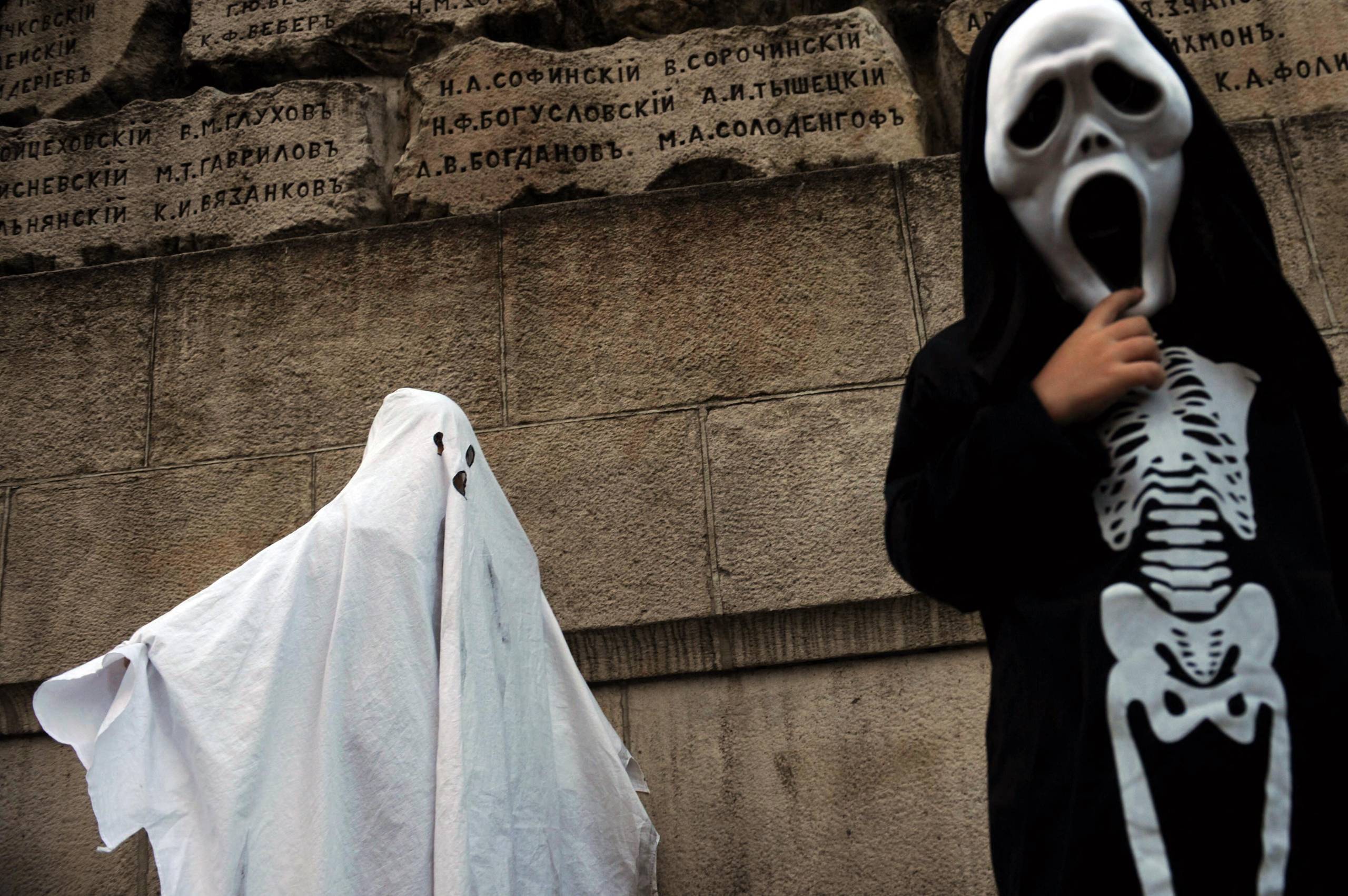
Ghosts have gone through a variety of makeovers over the centuries — but white sheet imagery persists. (Nikolay Doychinov/AFP via Getty Images)
It wouldn’t be spooky season without ghosts. The otherworldly white apparitions are a standby of Halloween celebrations.
But they weren’t always the stereotypical evil spirits we see in books and movies today. The messengers from the afterlife have gone through a variety of makeovers over the centuries, and the word continues to influence the English language in many ways.
Related Article
Part of the reason for that, said Lisa Morton, author of Ghosts: A Haunted History, is just like ghosts themselves, our fascination with the afterlife just won’t die.
“I think one of the reasons we fear them is that sense that this is the worst part of us and this is what’s going to survive after death,” she said.
For this installment of NPR’s Word of the Week, we look back on the origins of “ghost.” Don’t be scared! It’s just a little etymology.
Inflatable ghost decorations are on display outside a home in Ailingen, Germany, in 2013. (Felix Kastle/DPA/AFP via Getty Images)
It originally meant ‘breath’ or ‘life’
“Ghost” can be traced to the Old English root gast, but back then it didn’t carry the haunting connotation it does today.
“All of [its meanings] centered on breath, life and the human spirit,” and it was also used in Christian contexts like the notion of the Holy Ghost, said Jess Zafarris, author of Useless Etymology and other books about the origins of words.
“These broad spiritual concepts predate the narrower idea of a ghost as a spooky creature or an apparition of a deceased person,” Zafarris said.
Related Article
Still, the idea that the spirit of a dead person or animal could return to the land of the living was present as far back as the ancient world, according to Morton, the author of Ghosts.
In the Mesopotamian text Epic of Gilgamesh, Gilgamesh’s late friend Enkidu appears as a specter and recounts to Gilgamesh his experience in the underworld. One section of Homer’s Odyssey describes Odysseus traveling through the underworld and encountering the ghost of his mother, Anticlea.
Ghosts take a turn for the malevolent
Over time, the word “ghost” does some shape-shifting, both in its meaning and in how it’s spelled.
The Old English gast and Middle English gost picked up a silent “h” centuries later thanks to the influence of Flemish typesetters, said Zafarris. When William Caxton introduced the printing press to England in 1476, the Bruges-trained printer also brought with him compositors from the Low Countries, who modified some English words using Flemish spellings.
“That also happened to words that are related to ghosts, like ‘aghast’ and ‘ghastly,'” Zafarris said, “and you’ll notice that those also have that breathiness to them, things make you gasp.”
Related Article
The 19th century ushered in a cultural obsession with spiritualism. Ghosts peppered Victorian literature, and séances soared in popularity. The supernatural rituals, in which participants called upon the spirits of their deceased loved ones and others, challenged the idea that the living couldn’t communicate with the dead, said Morton.
“Suddenly, along came this notion that any group of people could sit down around a table and call up spirits that they could actually hold conversations with,” she said.
The physical appearance of ghosts has also fluctuated over time and geography. “In many parts of Asia, a ghost will appear in such a way that it’s almost impossible to distinguish from a living person,” she said. “The idea of this sort of wispy, translucent thing is very Western and is fairly modern.”
In the decades that followed the Victorian era, ghosts took on the more sinister reputation they now hold thanks to the growth of horror films and novels, Morton noted.
Related Article
Considered by some as the first horror film, 1896’s Le Manoir du Diable, translated into English as The Haunted Castle or The House of the Devil, featured a group of what appear to be ghosts shrouded in white. The works of horror writers such as Shirley Jackson and Stephen King have continued to terrify readers for decades.
Then again, not all ghosts in pop culture are out for revenge. Ghostbusters rubbed elbows with both evil and more eccentric spirits, while the friendly ghost Casper has transcended decades after getting his start in midcentury comic books.
A cosplayer dressed as a member of the Ghostbusters attends Argentina Comic Con in Buenos Aires in 2024. (Luis Robayo/AFP via Getty Images)
How phantasms haunt our modern slang
The spectral and unreal quality of the modern ghost has lent itself to several English idioms used to describe things that are both there and not there.
Ghost towns evoke abandoned places that were once full of life, while “to give up the ghost” means to die or stop working. (Those tiny clumps of lint under your furniture? Ghost turds.)
Related Article
The word was used as a verb as early as the beginning of the 20th century, Zafarris said, to describe when someone secretly did work on someone else’s behalf, such as ghostwriting.
More recently, “ghosting” has taken off as a slang term in the dating world for the act of suddenly cutting off contact with a romantic partner. Merriam-Webster officially committed to the new definition in 2017.
Ghosts — along with the word “ghost” — look to be sticking around. You might even say they’re still part of the zeitgeist, which itself is based on the German cognate geist and translates as “the spirit of the time.”