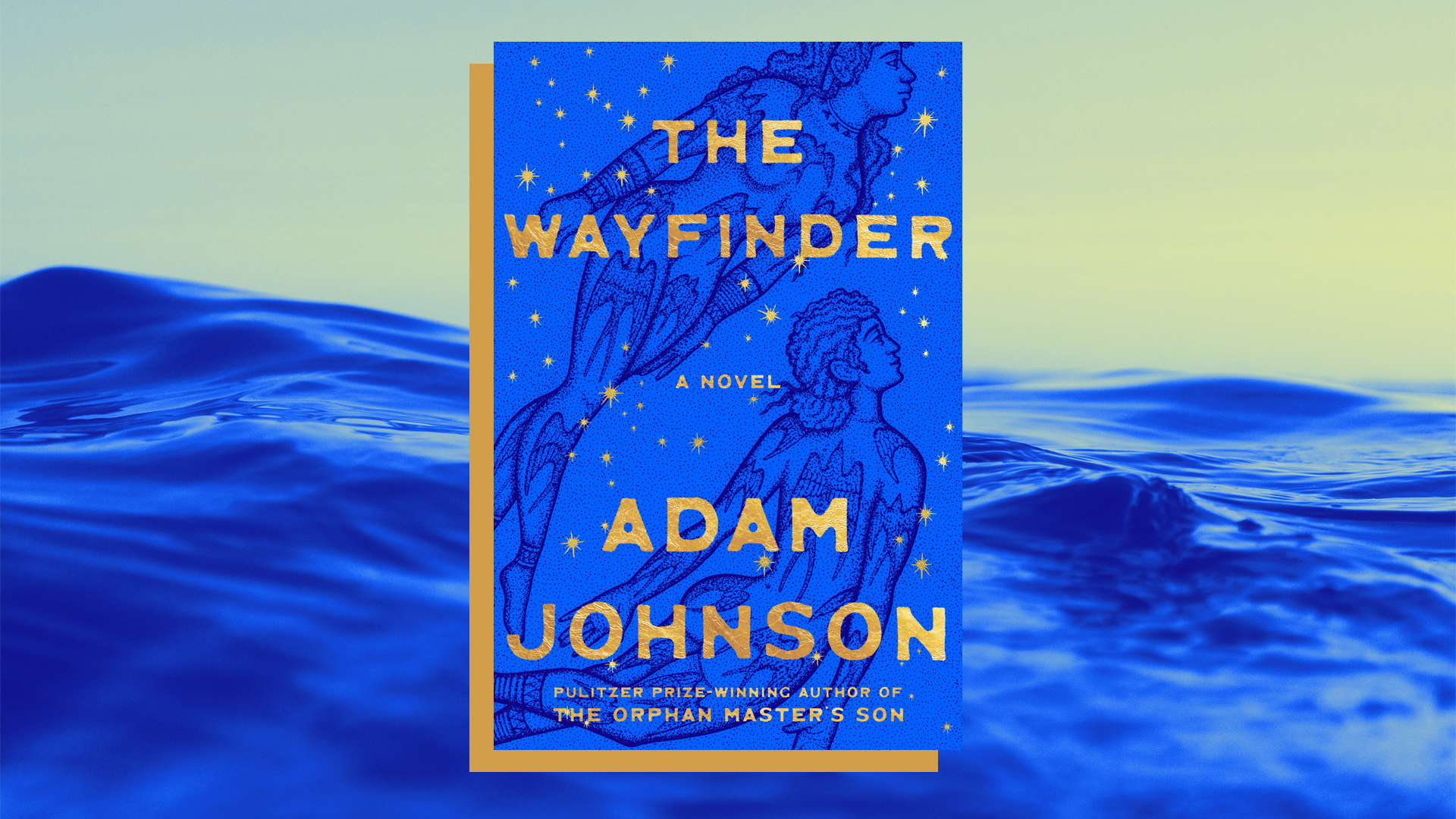
Adam Johnson's first book since his 2012 novel 'The Orphan Master's Son' is out Oct. 14, 2025 from MCD. (Photo by Matt Hardy/Pexels; Cover courtesy of MCD)
After his first trip to New Zealand, San Francisco author Adam Johnson found himself changed. He was in Auckland to give a reading for his novel The Orphan Master’s Son, a literary journey into the shadows of North Korean dictatorship that won the 2013 Pulitzer Prize for fiction. On the island, where the Indigenous Polynesian people known as Māori are the second-largest ethnic group, he learned how ancient tradition could persist and co-exist with the modern world. The local Māori community welcomed him onto the University of Auckland’s marae, a Māori meeting space. And Johnson was pleasantly surprised that the Māori language was recognized as the state’s official language, with high visibility in official documents and street signs.
Related Article
A subsequent trip to another Polynesian island, the Kingdom of Tonga, deepened his fascination. “I don’t know if that was the first place I’d been to that hadn’t been colonized,” he recalls, but the experience stirred his imagination. “I wanted to know much more about both places,” he explains, “and the way I learn about things is by writing about them.” A particular oral history from a Māori storyteller confronted him with “real storytelling,” and changed how he wrote and taught moving forward.
The author, who teaches creative writing at Stanford, was drawn to these cultures in part because of his Lakota grandmother, whom he never met. “We have all these family ties that were broken and severed in America,” he explains. “In the reservation I can reconstruct broken legacies, things that were never passed down, and all the family dislocation. [So] whenever I go to a place where Indigeneity seems to be working, I think of what could have been for all of America.”
Johnson’s weighty novel The Wayfinder, out Oct. 14 on MCD, is the result of more than a decade of such curiosity and research, an exploration of family and history and storytelling itself. The epic, set in pre-colonial Polynesia, tells the tale of a young girl named Kōrero (“story” in Māori) who lives on Monumotu, or Bird island, a small island “located in the southern waters” that is struggling to survive. Kōrero and her people — who are inspired by the real-life Moriori people of the Chatham Islands — are sheltered. She is told by her father that “there were as many islands as stars in the sky,” but she has never left her own or met visitors from any other.
Struggling to produce the nourishment needed to survive depopulation, the island’s inhabitants constrict their food intake and resort to graverobbing for tools. They live by variations of Moriori chief Nunuku-whenua’s laws for population control, and resolve conflict through duels that end at the drawing of first blood. These restrictions are enforced by a concept that exists across Polynesian cultures, tapu, which is also the inspiration behind the English word “taboo.”
Johnson demonstrates the gravity of the situation and the island’s insularity with choice details, like how Kōrero only knows of the onetime existence of dogs from the remains of bones.
“Indigeneity and orality was in my thinking, but also ecological concerns,” Johnson says of the novel’s inspirations. “The same types of distresses that we’re facing in the world today have been faced many times before — resource scarcity, extinctions — and those lead to destabilization, conflict, displacements, internal and external.”
Challenging romanticized narratives
When we meet the Bird Islanders, they are the hungriest, most suspicious, and searching version of themselves. That’s when Johnson introduces a pair of Tongan brothers to their shores. One of the boys is a wayfinder, or sea navigator, capable of reading the stars and mapping his way to and from countless islands (worlds, really) by boat. Their arrival is as momentous as an alien ship making first contact. The promise they introduce — to end starvation, to learn of the world and link arms with neighboring and distant islands — is a necessary lifeline. It’s also a gamble; the Kingdom of Tonga is embroiled in its own crisis.
Adam Johnson. (Brice Portolano)
The book wrestles with the same questions that Johnson found himself and his two children posing around the dinner table after the family toured disparate parts of the world for his literary readings: “Why do some people have stuff and some people don’t? What do we owe these other people?”
Kōrero must find her own answers to these questions as she matures and is granted the burdensome knowledge her elders carry about her people’s suffering, and hears from the Tongans about the suffering on other islands. Johnson’s depiction of their plight leans on history to challenge romanticized narratives about how land was perfectly managed in Indigenous hands.
“I really did have to question the narrative that Native peoples are sacred stewards of the land,” says Johnson, noting that “on Tonga, which was a powerful set of islands, they made 24 species of birds extinct … and in New Zealand there were 26 species of birds that went extinct.”
“I think that people act to their benefit until they’re forced to become good stewards,” says Johnson. As much as the book is Kōrero’s coming-of-age story, it is also a literary exploration of a timeless human foible: short-sightedness.
Forget the word ‘novel’
Still, The Wayfinder’s depictions honor the beauty, richness, and ingenuity of traditional Indigenous Polynesian life. The narrative captures the significance of greeting rituals and inking ceremonies, how dance choreography is used to communicate, the nuances of waka (canoe) construction, and how torch lamps were created from the oily kernels of kukui (candlenut) trees. Johnson writes with a confidence bolstered by his extensive research, and his lauded narrative abilities do not disappoint.
In one scene, he describes how “morning light spear-tipped the sea, bluing the peaks of waves.” In another, a worried mother looks out to the sea and is greeted by “the pounding of pumice-black waves, bruising one another in the dark.” Later, someone describes seeing “a whale composed of starlight dive into the sea.”
Johnson’s approach honors the way stories were originally told within their communities, taking “oral history as literal.” An important subplot about sexual violence against women on the island was inspired by a Tongan legend about a war veteran with a tattoo of a jellyfish on his hand, who Johnson explains “would violate the wives of the men who were gone and [who] had the power to transfer his tattoo and mark them.” His power, which some would deem mythological, was considered historically true for these people. Honoring their worldview means telling a story that asks audiences to suspend their disbelief, and accept it as reality.
This sometimes manifests in the book as magical realism — a fan that can waft life into people, a talking bird companion, and a sacred ceremony in which the souls of the dead can be harvested and transferred into coconuts — that are understood in context by the characters as fact, not fiction.
Related Article
Johnson encountered variants of that Tongan legend over time, and was surprised by its longevity. “That’s a story that hadn’t died, even after Christianity and after the missionization of Tonga had removed a lot of stories,” he says. The Wayfinder honors these stories not by regurgitating them verbatim, but by foregrounding the importance of storytelling itself.
Kōrero, true to her name, is determined to be her people’s storyteller. At first contact with the Tongans, they share stories back and forth as a form of introduction and to size each other up. “Stories are the proof,” she tells the wayfinder — of who they are and how they lived. Tales are vital self-making tools.
Johnson further emphasizes the sanctity of words by weaving original poetry (which he studied Tongan to write) into the text. Poems — of great battles won, of losses suffered, of traditions preserved — are recited to communicate across generations and seas. Just as navigators must rely on stars, Johnson intimates, the islanders rely on words to create and recognize constellations of themselves.
Before he began writing The Wayfinder, Johnson recalls writing on a piece of paper: “Forget the word ‘novel.’” He told himself, “If you name what this is beforehand, you’ll limit it.” Over the course of 700-plus pages, The Wayfinder prevails in testing and besting those limits. Here, the novel is stretched to encompass, interpolate and elevate Polynesian stories — and seats them next to a hearty new tale.
Adam Johnson appears at 7 p.m. on Friday, Oct. 17 at The Booksmith (1727 Haight St., San Francisco). More info here.