California College of the Arts, Northern California’s last remaining nonprofit art and design college, announced today it has entered into a memorandum of understanding (MOU) with the technology company Nvidia, which designs and manufactures graphics processing units and other advanced chips.
Nvidia and California College of the Arts Enter Into a Partnership
The technology company and the art school announced ‘a transformative collaboration’ to tap into AI resources.
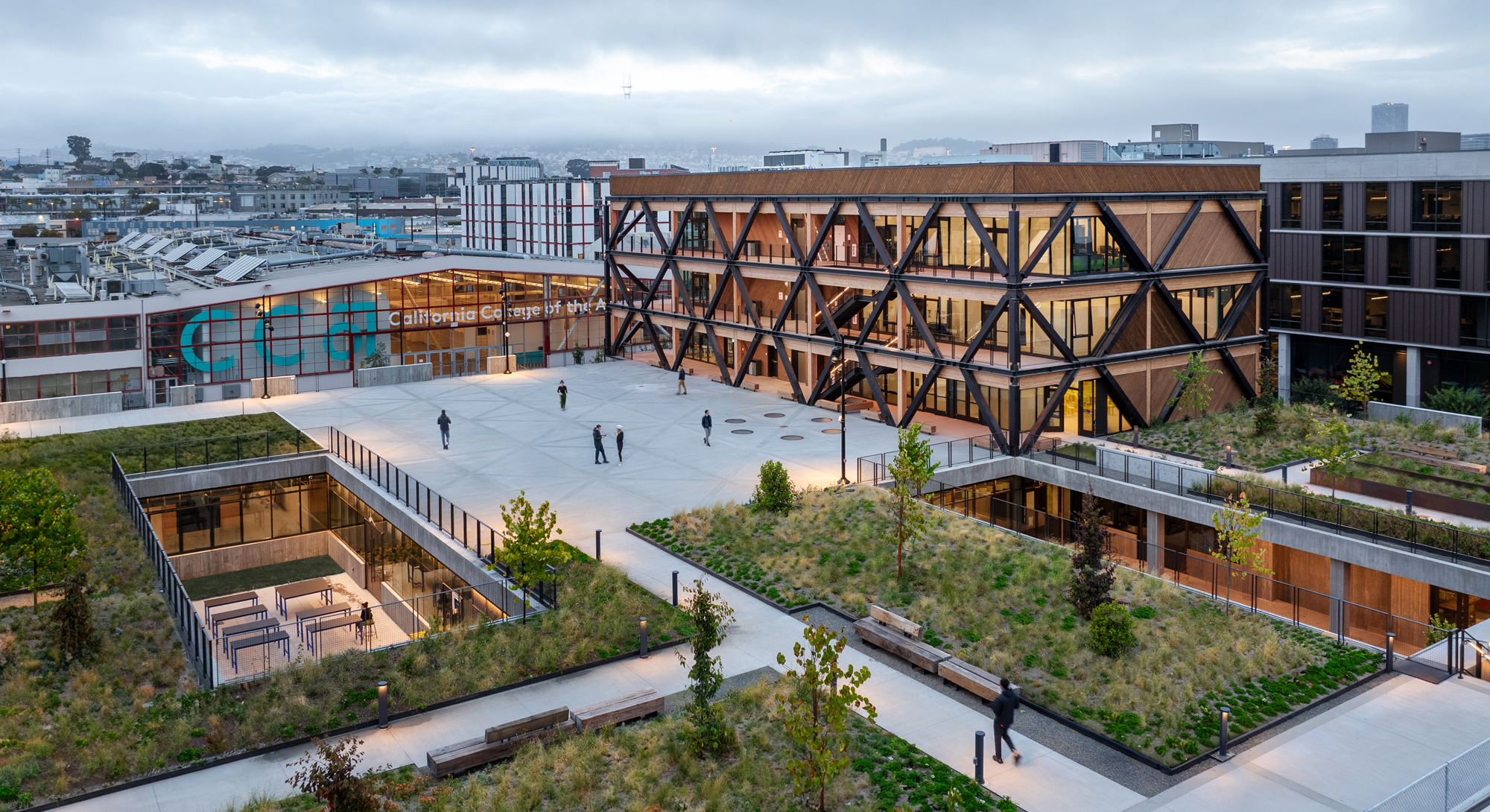
The ‘transformative collaboration’ will bring AI resources and training into the art and design school, pictured here. (Jason O'Rear)
Related Article
Nvidia has increasingly become central to the AI boom; as the company’s promotional materials put it: “Nvidia is the engine of the world’s AI infrastructure.”
The collaboration with CCA is described in today’s announcement as aiming to “prepare a new generation of creatives to thrive at the intersection of art, design and emerging technologies.” The partnership will include workforce development, curriculum innovation, collaborative research, and AI-arts education beyond the student body.
“For an education institution, we see AI as a material that can be shaped,” CCA President David Howse told KQED. “And part of our responsibility is to make sure that we’re providing our students with as many tools and materials to think about how they want to shape the future.”
Howse pointed out that AI is not new to CCA. Faculty members use it in the classroom; students are curious about its application in their chosen fields; parents of prospective students ask about it during tours.
“There are a lot of questions around the role of AI, how it shows up, how we engage it, how we think about it, and how we incorporate it,” Howse said. “This partnership allows us to lean more deeply into those questions.”
“Our approach,” he added, “is not an uncritical one.”
Nvidia first came into CCA’s orbit through a $22.5 million matching donation from the Jen-Hsun and Lori Huang Foundation, announced in February 2025. (Jen-Hsun Huang is the president and CEO of Nvidia.) That helped CCA raise a total of $45 million in one-time donations, giving the school a longer runway to “rightsize” and stave off a $20 million deficit.
So far, Howse said, the new partnership is “more of a creative collaboration and less of a financial partnership or collaboration.”
“The currency, if you will, is knowledge, expertise and collaboration, and not necessarily a financial transaction,” he said.
Nvidia has previously partnered with colleges and universities known for their engineering departments; CCA is their first collaboration with an art and design school. In December 2024, San José State University and the city of San José signed an MOU with Nvidia to better equip students for AI-related fields and allow the city to “tap into NVIDIA’s resources, training and networking opportunities,” according to an SJSU press release.
The CCA news follows just a few months after a similar announcement from California Institute of the Arts (CalArts) in Valencia. At CalArts, the luxury brand Chanel has funded the creation of the Chanel Center for Artists and Technology to focus on artificial intelligence, machine learning and digital imaging.
Back in San Francisco, Howse says CCA brings its own expertise to the arrangement, particularly when it comes to critical thinking around AI. “I imagine that Nvidia is interested in how we actually wrestle with some of these questions, and how that might engage and inform the way that they think about the business.”
Louis Stewart, Nvidia’s head of ecosystem development, is quoted saying, “Our collaboration with California College of the Arts brings together creativity and computing. By combining CCA’s artistic vision with Nvidia’s AI platforms, we aim to set new standards for how technology enhances human imagination and innovation.”
CCA also announced the consolidation of five standalone BFA programs — ceramics, furniture, print media, sculpture and textiles — into a new interdisciplinary BFA program, to which they are adding a new “Craft & Creative Technologies Track,” which will begin in fall of 2026.
“This approach ensures that CCA continues to serve those students interested in studying traditional crafts,” the announcement reads, “while also embracing new opportunities.”
A previous version of this story referred to CCA as Northern California’s last remaining art and design college. It has been updated to reflect that CCA is the region’s last remaining art and design college that does not operate on a for-profit model.