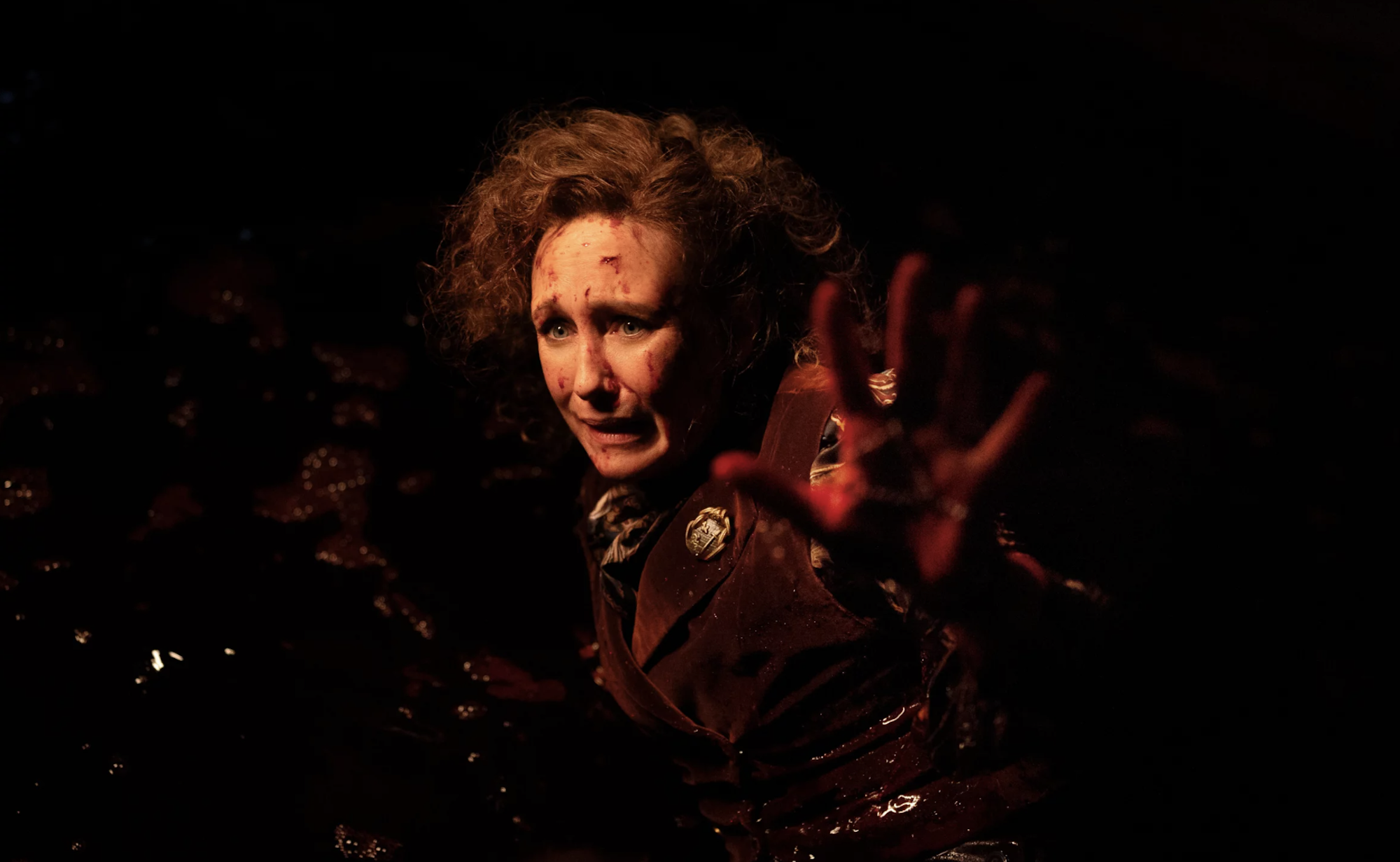
The heroes of The Conjuring movies are based on a real-life couple: Ed and Lorraine Warren. They were professional ghostbusters with a knack for packaging their experiences into books, TV and movie deals. The Conjuring movies all draw explicitly from the Warren’s real-life cases. (Ed Warren died in 2006, Lorraine Warren died in 2019.)
The Conjuring: Last Rites is about one such case: a family who claimed their house was haunted. In various mediainterviews datingfrom the 1980s, Jack and Janet Smurl said a demon was hurting members of their family, that included four young daughters. They said it injured the family dog and sexually assaulted at least one parent. All of this is in the movie.
“Carefully,” Chaves said when asked how he crafts horror films based on the experiences of real-life people. While making Last Rites, he said he worked closely with the Smurl sisters, now adults. “It really left big scars on their family and on them as individuals,” he said. “One of the things that really struck me was just how much the Warrens meant to them. When so many people were very skeptical about them, the Warrens came in and the Warrens believed.”
“They have always been entertainers,” observed Grady Hendrix. A bestselling author of horror novels, Hendrix also studies the occult in popular culture. Ed and Lorraine Warren started crafting their image with public lectures in the early 1970s, he said, after the novel and the movie The Exorcist became a huge success.
“The Catholic Church had gone through [the Second Vatican Council] when it liberalized in the ’60s, and there were a lot of sort of old school Catholics — Ed was one — who felt like the church had gotten too liberal and it needed to get back to its more conservative roots,” Hendrix said.
Related Article
Hendrix said the idea that Satan attacks Christians and their faith with demonic entities was enticing to some old-school believers. But the real people who became characters in The Conjuring movies suffered from terribly sad backstories that often included histories of substance abuse, other forms of abuse, generational trauma and mental health crises.
“These are cases where people are in distress, and I don’t think it helps to have a couple of people who have no training and no clinical background show up, tell you it’s a demon, and walk away with book and movie contracts,” Hendrix said.
The 2021 movie The Conjuring: The Devil Made Me Do It was based on a real family whose preteen son saw visions, quoted from the Bible and spat at and hissed at people, according to interviews given by his parents to such outlets as The Washington Post and People magazine in 1981.
“His family had recently seen The Exorcist on TV. His sister had gone to a lecture by the Warrens beforehand,” Hendrix said. “They decided he was possessed and his older sister’s boyfriend invited the demon to come into him.”
When the boyfriend, Arne Cheyenne Johnson, later murdered his landlord, the Warrens encouraged him to plead not guilty, by reason of demonic possession. As the Post reported at the time:
“We tried to warn Arne,” sighed Lorraine Warren, clairvoyant. “But he just wouldn’t listen.”
“It’s just one of those things you never do,” says Ed Warren, demonologist. “Not if you know anything about this sort of thing.”
Soon, everyone will know about this sort of thing, what with the diligent work the Warrens are doing in spreading the word to the press. “Will we have a book written about this?” Lorraine Warren asks rhetorically. “Yes we will. Will we lecture about it? Yes, we will.” Are they talking to writers and movie producers? “No, we’re not,” she says. “Our agents at the William Morris Agency are.”
In 2010, family members sued Lorraine Warren and the writer of a book about the case after the book, The Devil In Connecticut, was re-issued. Their lawsuit, which was ultimately dismissed, claimed the family had been exploited and manipulated. Tony Spera, the Warrens’ son-in-law, told NPR the lawsuit was “very frivolous.”
Related Article
Spera directs the New England Society for Psychic Research, which the Warrens started. Spera and his wife, Judy Warren, are major characters in the new movie and positioned to be central ones if the franchise continues.
“They never knew them,” Spera said of skeptics criticizing the Warrens. “They’re armchair quarterbacks. They’re trying to say that the cases were phony, they’re fraudulent, they’re not real.”
The cases are real, Spera insists. But any movie made from them is generally intended as entertainment. “It’s not meant to be a documentary,” he said. “Not meant to be a word-for-word transcribing of what happens.”
Ed and Lorraine Warren outside court in Danbury, Conn. in 1981 for Arne Cheyenne Johnson’s trial for murder. The Warrens said that Johnson, who killed his landlord, was possessed by demons. (Bob Child/Associated Press)
Still, when director Michael Chaves made the third Conjuring film, he questioned himself, as he told NPR.
“I really struggled with it,” he said. The Conjuring: The Devil Made Me Do It supports the Warrens’ version of how Arne Cheyenne Johnson committed murder after becoming demonically possessed.
Related Article
“I really struggled with just even the morality of that story, and, you know, we were telling the story of a murderer,” Chaves said. He acknowledged that the victim’s family now must live with the knowledge that a movie, that earned more than $200 million at the box office, argues the killer was innocent because he was under the influence of a demonic force.
As a horror writer, Grady Hendrix said he’s a sucker for a ghost story. But he’s haunted, he said, by people with untreated mental health disorders, children who may have been abused and people who self-harmed and harmed others, whose problems were solved on screen with exorcisms and whose real and painful stories are told as entertainment.