Music shouldn't be treated like a game to master — it should be treated like something that changes you.
Ann Powers, NPR
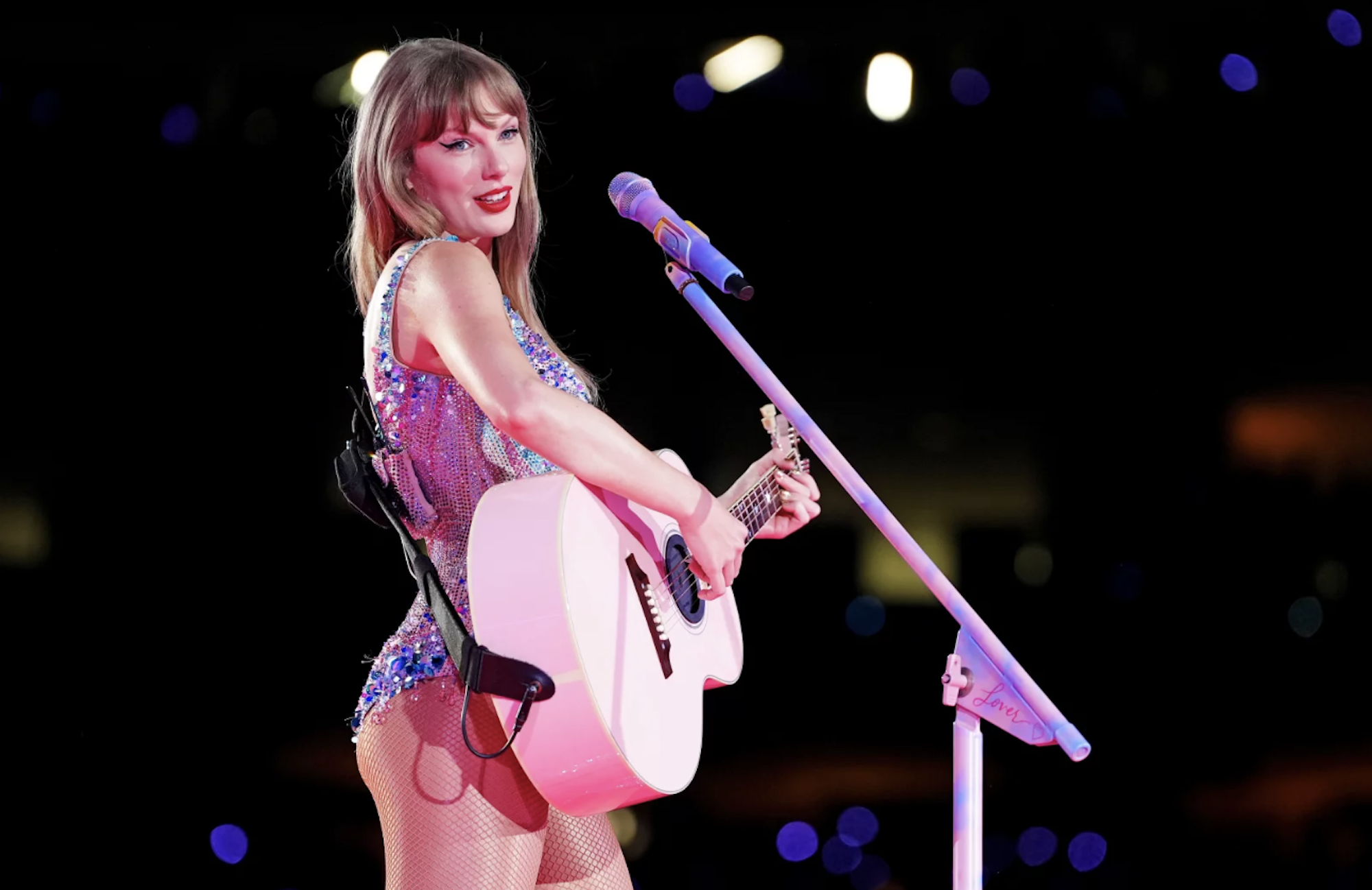
The never-ending egg hunt is a big part of what non-Swifties find exhausting about her rollouts. It does something else, too: it trains fans to appreciate art in a particular way. (Erika Goldring/TAS24/Getty Images for TAS Rights Mana/Getty Images North America)
This essay first appeared in the NPR Music newsletter. Sign upfor early access to articles like this one, listening recommendations and more.
Did you hear the noise enveloping the pop music world last week? A squeal met by a sigh: the collision of excitement and exhaustion could only mean one thing. Taylor Swift was on her way back to center of the discourse, a new album cover (concealed, of course, in a monogrammed custom case) under her arm. Last Monday’s public notice that The Life of a Showgirl‘s physical existence would be officially revealed the next day on New Heights, the podcast hosted by Swift’s boyfriend Travis and brother-in-love Jason Kelce, sent fans into a Pavlovian tizzy and critics into an equally kneejerk downward spiral. Swifties took mere minutes to begin reading clues (“easter eggs,” you all know the lingo) in the blurry imagery posted on Swift’s website: the glittery orange background fulfilled the promise of the vermillion door leading away from the stage at the end of her Eras tour shows; a TikTok posted last fall showing Swift in a stadium section labeled A12 was now proven to be a signal of the day she would announce her return. By the time Swift actually made that podcast appearance, sweetly and seriously discussing her life with Kelce and recent victory in the battle for her master recordings, and announced pre-orders on her website, the egg hunt was in full swing.
Related Article
Meanwhile, non-Swifties were doing their usual thing: bitching about Swift’s inability to take a truly restorative break from cultural world domination. She might not need time to rest and enjoy life with her GQ cover man, but we do. Showgirl, this argument goes, will again strongarm the discourse as click-hungry media outlets focus on her every move, mainstream pundits (oh hai) will pour out think pieces about how her presence has affected their self-conception/love lives/parenting styles, and every other artist will wonder where the air in the room went. Some negative Nellies tire of Swift the moment they see her because they feel she’s a distraction from serious political issues; others dislike her because they think she’s too political, or an enemy of the alliances they favor. (Swift herself throws off the haters with calm magnanimity.) These objections have nothing to do with Swift’s music and only reflect her public presence in the broadest terms — by their logic, the Kelces, Pedro Pascal, Benson Boone and Beyoncé are also a pox on society, keeping us snoozing or pointing us in the wrong direction as the empire collapses.
Then there are people like me, who may see Swift’s return as a labor issue. I’m sure many culture writers felt the familiar pressure to quickly produce the first hot take in a series inevitably extending past the album’s October rollout. Swift’s prolificity isn’t that unusual among her peers, though it’s considerably enhanced by her re-recordings of past material; her pal Ed Sheeran, for example, has released a new core product coming every two years, augmented by various extras. Several rappers outrun her exponentially, with Gucci Mane holding the crown at 108 releases including mixtapes. The ascendant country star Charley Crockett is another who beats Swift at her numbers game, having released 15 fresh studio albums in half the time the pop star has managed 12. Flooding the market is a business decision for some, a way to deal with the messed-up monetization methods of streaming platforms; for others it’s an aspect of an exceptionally energetic creative life.
Swift is often compared to the Beatles, who over a shorter lifespan released a similar flood of albums alongside films, mucho merchandise and various side projects. The music industry was very different in the 1960s, but what rings true about this comparison is the work ethic involved — like Swift, the Fabs were methodical and disciplined about making music even at their most personally worn down — and the demands that productivity made on a rock press that recognized readers’ inexhaustible desire to track every move their faves made. “Since a craze is a form of inflation, it may precede a crash,” a New York Times correspondent wrote hopefully after Beatlemania hit in 1964, and some culture chroniclers never stopped waiting for that crash to happen. (He also expressed fear that the band would become “the vocal scourge of the whole Western world.”)
Like Swift, the Beatles grew up in public, giving even the snobbiest critics more to chew on with every release. Yet it was inevitable that, to some, the group’s dominance over pop would begin to feel like a burden. Even as the members’ unprecedented success as popular artistes made wider coverage of adventurous pop music more common, it also reinforced a pattern that grew ever more intractable with every passing decade, in which popularity and cultural significance are equated, not only in the moment but as pop’s canons and legacies began to be built.
Related Article
If music writers and other supposed gatekeepers breathe wearily around Swift today, it’s partly because the vestiges of a hierarchy that commercial realities have long toppled remain lodged within the practice of discernment that expertise represents. It’s frankly a fruitless aspect of the work — not discernment itself, which is fundamental, but the maintenance of a binary distinction between what was once called “high” and “low” art, which now could perhaps be identified as “mainstream” and “niche” or, if you’re feeling righteous (and I often am), “the 1%” and “the marginalized.” The reality is that there’s exciting, well-executed art being created at every level of popular culture, and discernment should happen at the level of individual works, though with a constant eye toward how those works are shaped by the economic systems that support or hinder their makers.
What I think is most different about music-driven popular culture now — though not wholly unprecedented — is the gamification of everything. My friend, the scholar and critic Eric Harvey, put this thought in my mind the day after Swift announced Showgirl, when he posted a response to fellow arts writer Sam Adams’ bitter Bluesky comment about the dwindling of the critic’s role in mainstream publications.
“For decades now, people have been conditioned to view popular culture as something to ‘solve’ and the answer keys are on Reddit and YouTube,” Harvey wrote. “So why pay critics to essentially give people homework to do?”
That rang a bell in my brain. The idea that criticism or any kind of “expert” commentary might distract fans from their enjoyment of their favorite music, rather than illuminating it, made me think about what it means when we turn art appreciation into a game with a desired outcome, whether it’s picking up the most easter eggs or, as in museums who provide children with placards that direct them through galleries, identifies the biggest number of preselected details within designated masterpieces. The never-ending egg hunt is a big part of what non-Swifties find exhausting about her rollouts — it takes up an enormous amount of space in the public consciousness. It does something else, too: it trains fans to appreciate art in a particular way. Loving Showgirl, for some fans, is all about deciphering its signals in predictable ways, with the outcome being a solution rather than a surprise. Art becomes something you master, rather than something that affects and potentially changes you.
Don’t get me wrong: I know that many Swifties are deeply enriched by her music and engage with it as a way of better understanding their own lives. And some are even listening with musically attuned ears, noticing her hard work as a songwriter and in the studio, where she’s one of the more meticulous and subtly inventive pop stars we’ve ever had. But the noise overwhelming her signals is all about the game. With every new release, Swifties engage as numerologists and map readers first and only as listeners long after the fun has begun. And they’re doing so under the direction of a master, as I’m not the first to note. No one has grasped better than Swift how music in the attention-deficit century requires a multi-media frame to keep people engaged. (On Monday, to announce the new vinyl variants for Showgirl, she baited fans once again with a countdown clock on her website.) As early as 2012, when she swathed her rollout for Red in crimson at well-orchestrated fan events, Swift has been taking cues from contemporary phenomena like Harry Potter and the Marvel Comics Universe to create a virtual world around her music, and to make that world an eminently solvable mystery.
Swift hardly invented this approach; fans did, with some help from earlier stars who encouraged their obsessions while also being somewhat irked by them. The whole “Paul is Dead” thing around the bass-playing Beatle was a kind of gamification. So was the search for the meaning of Led Zeppelin’s “runes” album title. Prince sometimes planted hidden messages in his videos and songs. Madonna created scripts for her alter egos. In 2006, Trent Reznor even created a LARP-ing game to enhance the rollout of the Nine Inch Nails album Year Zero. K-Pop’s rise came about, in part, because that industry so seamlessly integrated online gaming with music; that’s how we got to K-Pop Demon Hunters. Focusing on the game-like aspect of musical projects, or building them in to define and extend the parameters of those projects, makes fans feel deeply connected to their idols and to each other.
Related Article
Despite the fact that fans have always made music loving into a game, and that artists have historically engaged with that process in creative ways, the dominance of gamification within music is relatively new. It suits generations who grew up playing video games and learning basic skills like reading and math, in part, from educational adaptations of the same diversions. Anyone Swift’s age or younger could very well comprehend the world primarily in terms of gaming, the way a bookworm learns about it through reading, or an athlete does through the lessons of her body and of team interaction. Given this, making art into a game feels legitimate. But art can also be very different from most games, in that it can be open-ended; it can be something that people abide with, letting its meanings grow and change, rather than “solving” it. I think that’s what Eric Harvey’s comment laments — the loss of a sense of art as having meaning that is unfixed, unlimited. As a fan of Swift’s albums, I’ve found many moments that fulfill that definition within her recorded work. But I’m not always sure her presentation of that work encourages such richly personal and varied interpretations.
I could be wrong here. I believe Swift is a true artist, devoted to the process first, whether that’s writing all the time, spending endless hours in the studio, or giving 110% during her performances. Her interest in gamification is an aspect of her total absorption in the creative process. She’s said during her New Heights appearance that she will never gamify her personal life; every egg she hides in the grass of the agora leads back to her songs, not the gossip pages. She does want people to think of her as a musician first, not as an avatar. Yet her successful method for continually amplifying her efforts — exemplified by that appearance on her partner’s podcast (as he welcomed the ratings boost it would bring) to debut her latest offering — illustrates the difficulty this most 24/7 pop star has with separating work and love, work and play. She’s hinted that while Showgirl will be a happy album that makes people want to dance, it will also explore the experience of being Taylor Swift across the whole game board of her life. I’m looking forward to hearing how her new music connects the pieces.