Sponsor MessageBecome a KQED sponsor
upper waypoint

Trans Activists Vow to ‘Liberate Compton’s’ After SF Board of Appeals Loss

Save ArticleSave Article
Failed to save article

Please try again

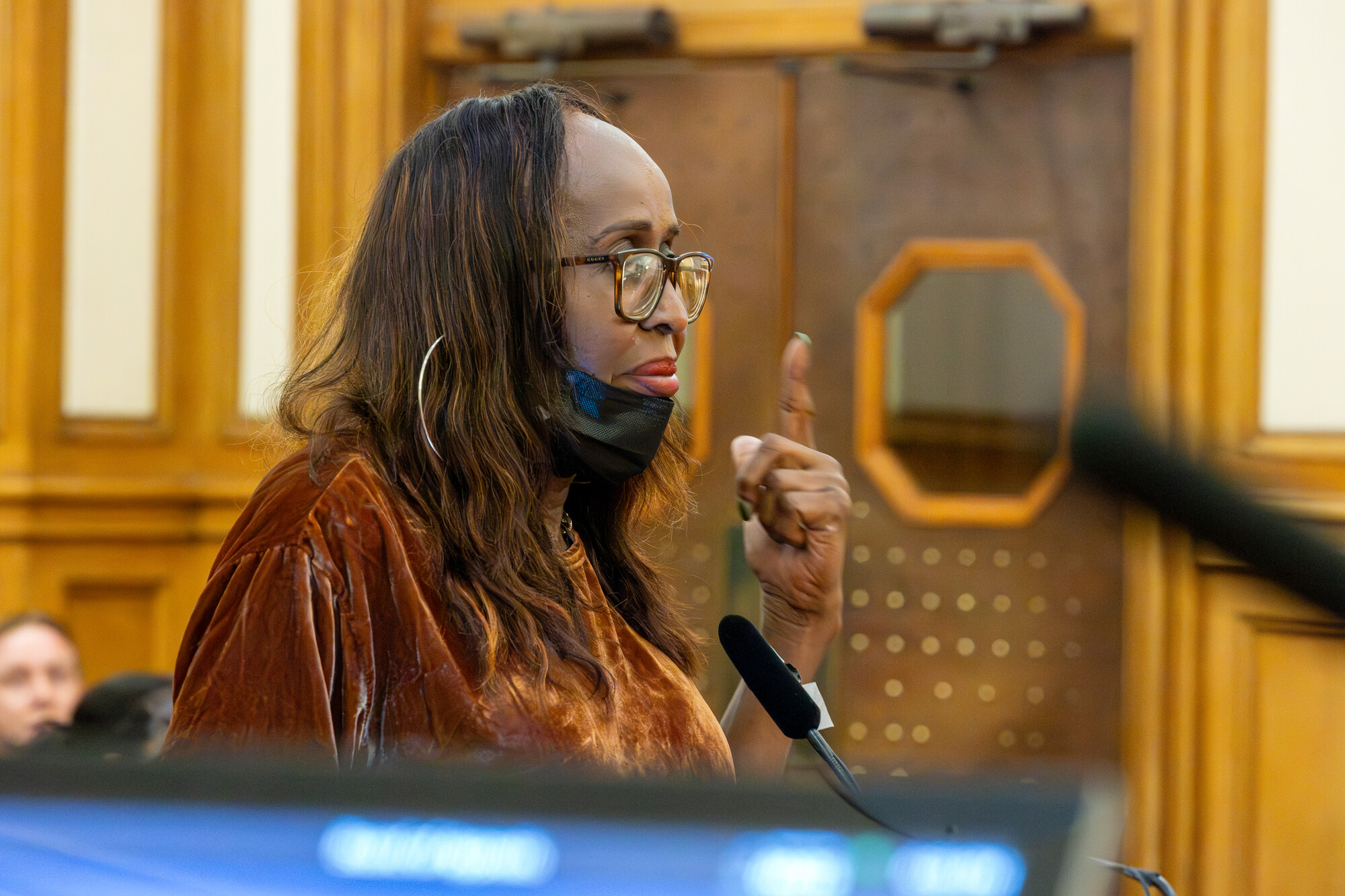
Janetta Johnson, co-founder of the Transgender District and an advocate for incarcerated trans people, speaks during public comment during the San Francisco Board of Appeals hearing on July 16, 2025.  (Gustavo Hernandez/KQED)

A group of San Francisco activists wants to oust a private prison corporation from a historic site in the Tenderloin and turn it into a community resource center. But on July 16, their strategy to use zoning law to do so hit a roadblock.

At a packed five-hour Board of Appeals meeting where over 60 people gave impassioned testimonies supporting the activists, the board ruled in favor of Geo Group in a zoning dispute over 111 Taylor, a building where a riot for trans rights took place in 1966.

“We have not lost this fight,” said historian Susan Stryker to her fellow activists after they exited the hearing. “We’re going to continue pursuing justice. … We’re gonna do it together and we’re gonna live to be the change that we need to see in this world.”
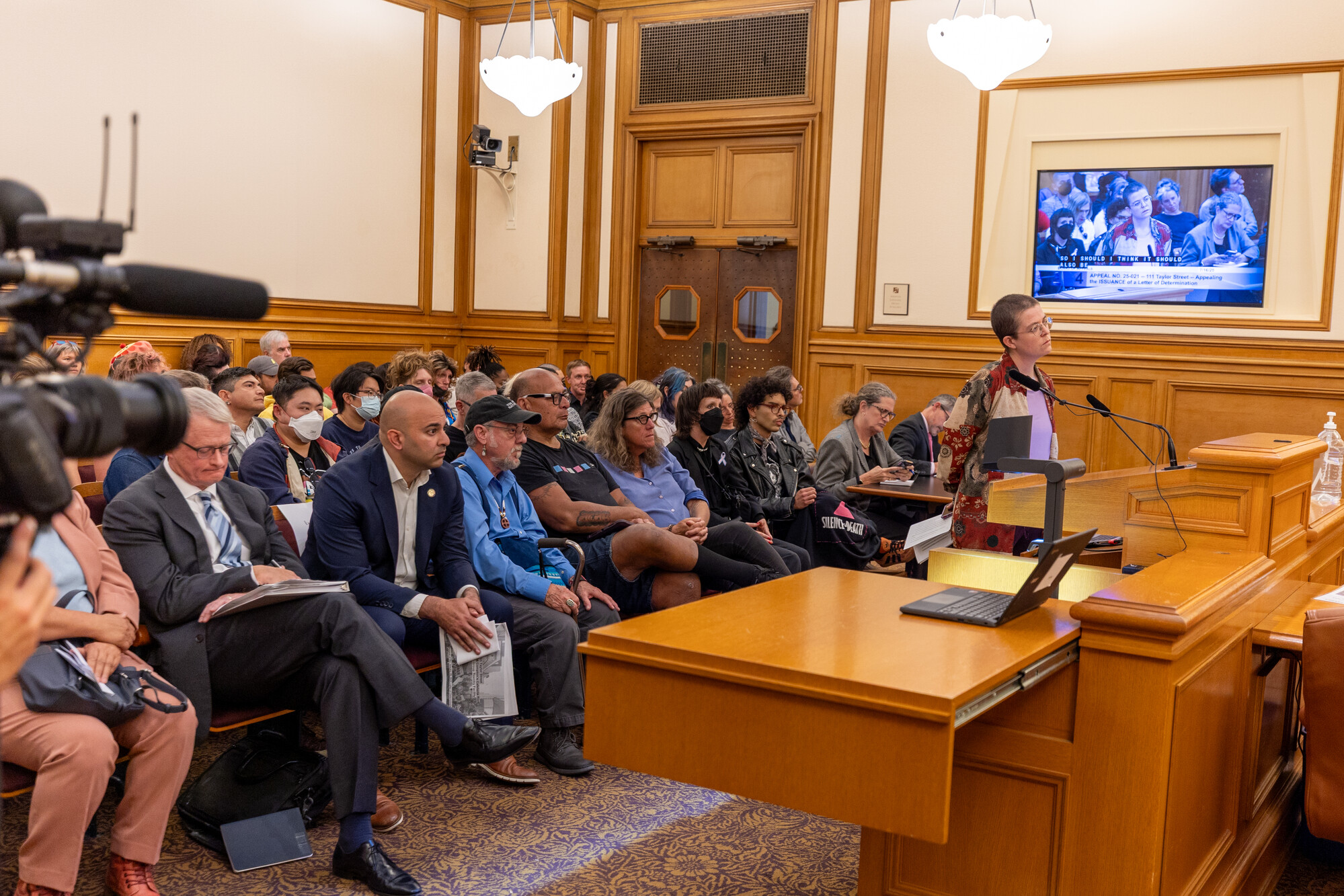
Chandra Laborde speaks before the San Francisco Board of Appeals on July 16, 2025 urging the removal of GEO Group from the historic Compton’s Cafeteria building and its return to community use. (Gustavo Hernandez/KQED)

To understand the significance of the hearing, it’s crucial to understand the building’s history. In the ’60s, 111 Taylor was a late-night diner called Gene Compton’s Cafeteria, a popular hangout for trans women and queer people. Police routinely raided the establishment, and one summer night the patrons fought back. After the riot, San Francisco became the first city to create social services for its trans community — three years before a similar riot at Stonewall Inn in New York City launched the modern-day LGBTQ+ rights movement.

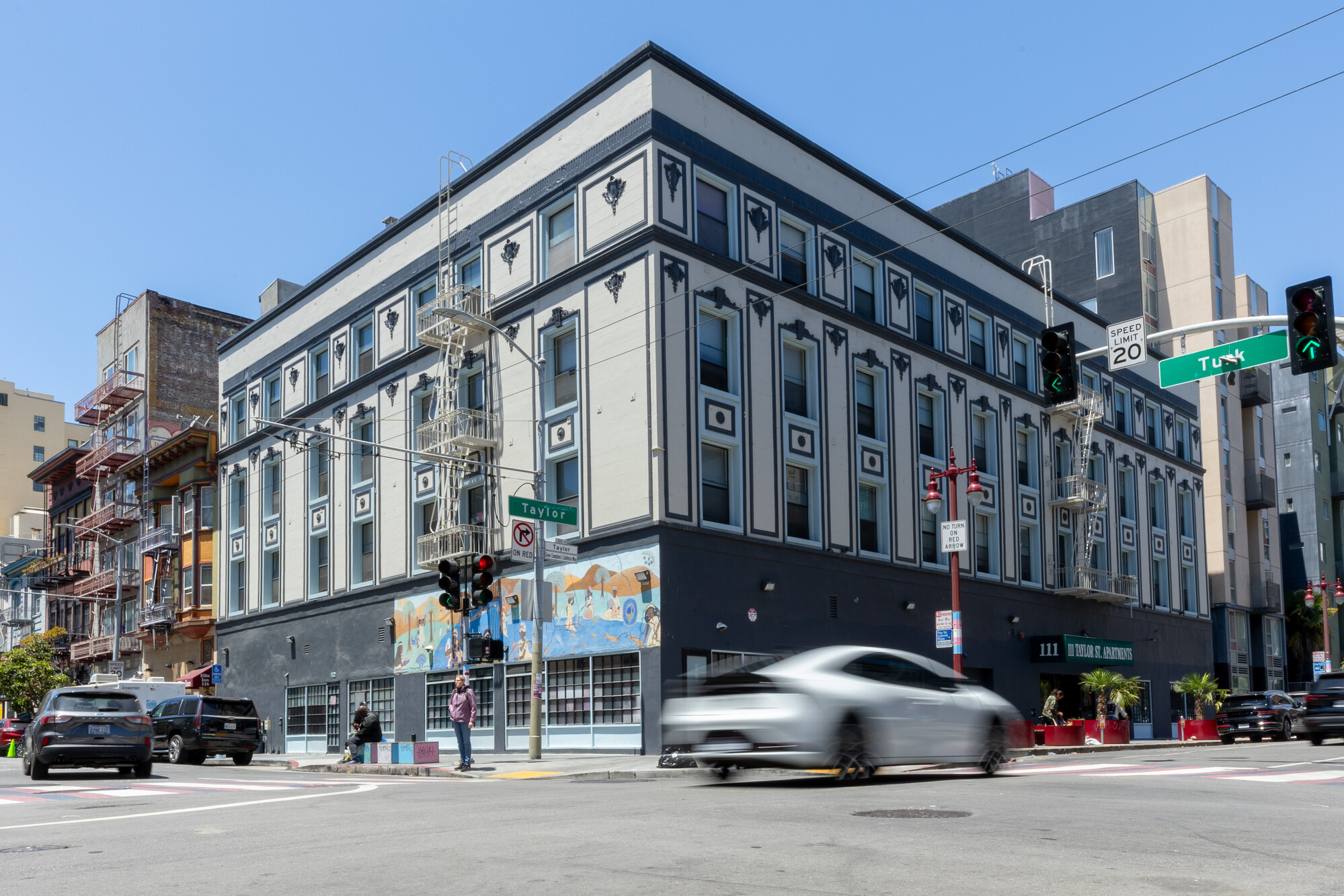
Today, the diner’s former location at the intersection of Turk and Taylor Streets is the epicenter of San Francisco’s Transgender District, the first of its kind in the country. Every year during Pride, the Trans March concludes at Turk and Taylor, where activists call back to that summer night at Compton’s Cafeteria for inspiration in today’s battle for trans rights.


Sponsored

Yet activists say 111 Taylor’s current operations are an affront to this history. Geo Group is a multi-billion-dollar private prison corporation that has been accused of holding inmates in inhumane conditions and underpaying them for prison labor. At 111 Taylor, a subsidiary of the company, Geo Reentry Services, runs a transitional facility for people on parole. (Geo Group also operates ICE detention centers and has recently made headlines for profiting from the Trump administration’s mass deportations.)

“I think that the building should be something different that is aligned with the legacy of resistance,” said Chandra Laborde, the appellant in the zoning dispute and a member of Compton’s x Coalition, the activist group behind the “Liberate Compton’s” movement.

At the Board of Appeals hearing, Laborde went head-to-head with Geo Group’s attorney, David Blackwell. In her presentation, she argued that the board should revoke Geo Group’s zoning letter of determination, a document Geo Group needs to maintain its contract with the California Department of Corrections and Rehabilitation (CDCR). 111 Taylor is currently zoned for group housing, and Laborde argued that Geo Group is violating its current zoning by providing services that are more in line with a residential care facility.

Meanwhile, after 111 Taylor’s Facility Director Maria Richard made a case for the institution’s service to the community, Blackwell’s legal argument zeroed in on the Board of Appeals’ jurisdiction. He contended that its sole responsibility is to determine whether Zoning Administrator Corey Teague committed an error or abused his discretion when issuing the letter.

“We have to make this distinction that it all can’t be conflated into one big ‘we hate Geo’ fest,” said Blackwell. “That’s not what this is about.”

David Blackwell, land‑use attorney for GEO Group, listens as activists appeal the for‑profit operator’s reentry center at 111 Taylor St. before the Board of Appeals on July 16. (Gustavo Hernandez/KQED)

When public comment opened, Laborde and the Compton’s x Coalition got support from prominent figures like District 5 Supervisor Bilal Mahmood, who represents the Tenderloin; Janetta Johnson, a Transgender District co-founder and director of the Transgender Gender-Variant Intersex Justice Project, which helps incarcerated trans people; and Honey Mahogany, director of the city’s Office of Transgender Initiatives.

In their comments, community members pointed to AB 32, a California law that will ban most private prisons by 2028. Several former residents of 111 Taylor who spoke against Geo Group described it as a prison-like environment.

“I’m formerly incarcerated, and I’m here to give a voice of the reentry community to say that my successful reentry has been in spite of Geo Group,” said a San Francisco resident named Joseph Norris. “There is a lie and a myth that Geo Group helps people.”

“I think that everyone here who’s speaking at public comment supports those who are formerly incarcerated, wants to see those people transition into everyday life, wants those people to have a safe place to live and to be able to have resources,” said Mahogany. “But what we are saying is that Geo Group has been continually found to be in violation of their stewardship, their requirements.”

Honey Mahogany addresses the Board of Appeals during public comment on July 16, 2025. (Gustavo Hernandez/KQED)

Out of the dozens of commenters, only a handful of people spoke in support of Geo Group, including a retired parole officer and several former residents. “I was given two life sentences when I was 15 years old. I got over two decades inside,” said one speaker who identified himself as William. “Going to 111 Taylor was a blessing. If I had been paroled to my family, I would have been a burden on them.”

Despite speakers’ passionate arguments about trans history and the best way to support formerly incarcerated people, the board’s final ruling in Geo Group’s favor came down to a legal technicality. Several of the five Board of Appeals commissioners said they agreed with the activists’ ideas, but explained that their job at hand was to determine whether the Zoning Administrator committed an error or abuse in determining the legal use of the building.

“If we had a proposition on the city buying the property and handing it over to the trans community as a community center, I would vote the same way that a lot of folks in this room would,” said Commissioner Jose Lopez. “But that’s not what’s on the table for us.”

Ultimately, the vote to uphold Geo Group’s letter of determination was 4-1, with Board Vice President J.R. Eppler siding with the activists.

Yet there may be other legal avenues at the Compton’s x Coalition’s disposal. Separately from the hearing, the Planning Department has an ongoing investigation at 111 Taylor to determine whether Geo Group has violated its zoning.

David Blackwell and members of Geo staff at the Board of Appeals hearing, including Facility Director Maria Richard, declined interviews with KQED.

111 Taylor St., the former Compton’s Cafeteria site, is now operated as a GEO Group halfway house in San Francisco’s Tenderloin neighborhood. (Gustavo Hernandez/KQED)

Compton’s x Coalition’s ultimate goal is to pressure Geo Group to sell the building to a community land trust so that local residents can reimagine it as a resource center for the neighborhood. The next envisioning session for the building’s future is on Aug. 23; ideas for the space so far have included housing, an arts space, and a site offering services for trans people and immigrants in the Tenderloin, many of whom live below the poverty line.

It remains to be seen whether Geo Group would ever be willing to sell the building, but State Senator Scott Wiener told KQED in an interview that there is a precedent, and that he supports the activists. “In terms of purchase of private property to restore it to a cultural use, that’s not uncommon,” he said. “There have been plenty of examples of a home of a historic figure being purchased and turned into a museum, or in a different context, purchasing private land to preserve it as natural space.”

Reached by phone after the hearing, Supervisor Mahmood said he’s disappointed with the outcome and plans to meet with activists, the City Attorney’s office, the Planning Department and other officials.

Sponsored

“I’ve talked to previous supervisors who held this position representing the Tenderloin, and this has been coming up again and again and again, and the community just has not been able to get adequate justice on this site,” he said, adding, “We look forward to … figuring out a next step in partnership with the community.”

lower waypoint
next waypoint