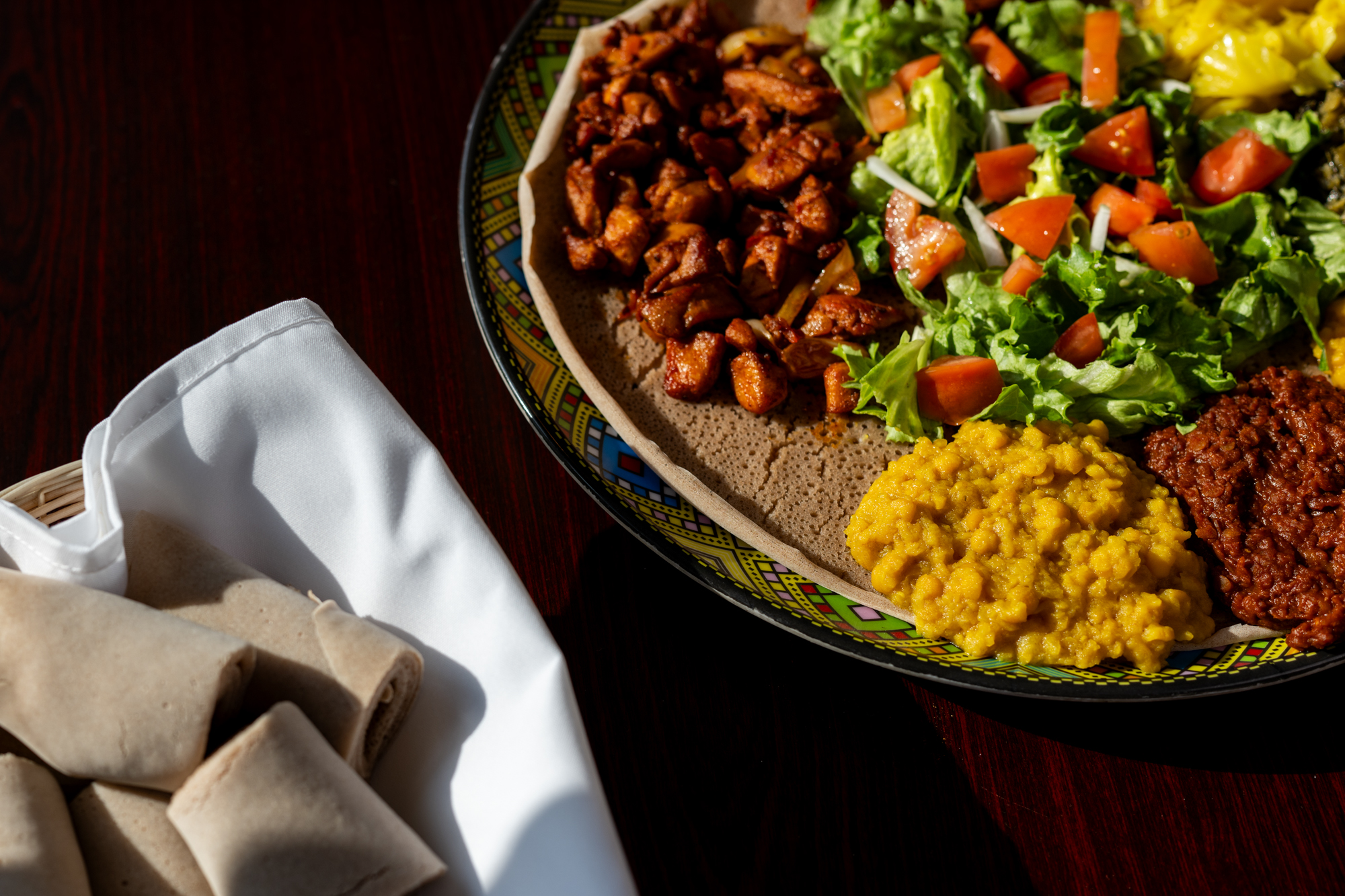
The meat and veggie combo at Meskie’s Kitchen on Telegraph Avenue in Berkeley on June 16, 2025. The platter includes stews made with lentils, greens, and meat, served atop traditional injera. Founded by the late Meskerem Tsegaye in 1993, the family-run restaurant is now operated by her son Guma Fassil, who continues to serve authentic Ethiopian cuisine. (Beth LaBerge/KQED)
In 2007, when my mom hadn’t yet been priced out of San Francisco, I’d trek over from my dorm in Berkeley to wander with her around the neon-drenched, still-Waymo-less city. That’s when I first tasted Ethiopian food.
Attracted to its rich flavors and affordability, my mom, a Mexican immigrant who worked odd jobs in the food industry, often insisted on taking me out for Ethiopian. The spongy, sour fluffs of injera and heaps of berbere-rich chicken and spicy lentil stew were new and exciting to my teenage palate, though of course by then the East African cuisine was already well entrenched in Bay Area culture. And while my exposure to the cuisine tapered off after I moved out of the Bay, Ethiopian and Eritrean restaurants have somehow managed to look, smell and taste exactly as I remembered them in those days — despite the rest of the Bay’s aggressive changes.
In 2025, you can walk into just about any popular fixture of our region’s loaded East African food circuit — Café Colucci in North Oakland, Ensarro near Lake Merritt, Sheba Jazz Lounge (formerly Piano Lounge) on Fillmore Street — and it’ll still feel mostly like it did decades ago.
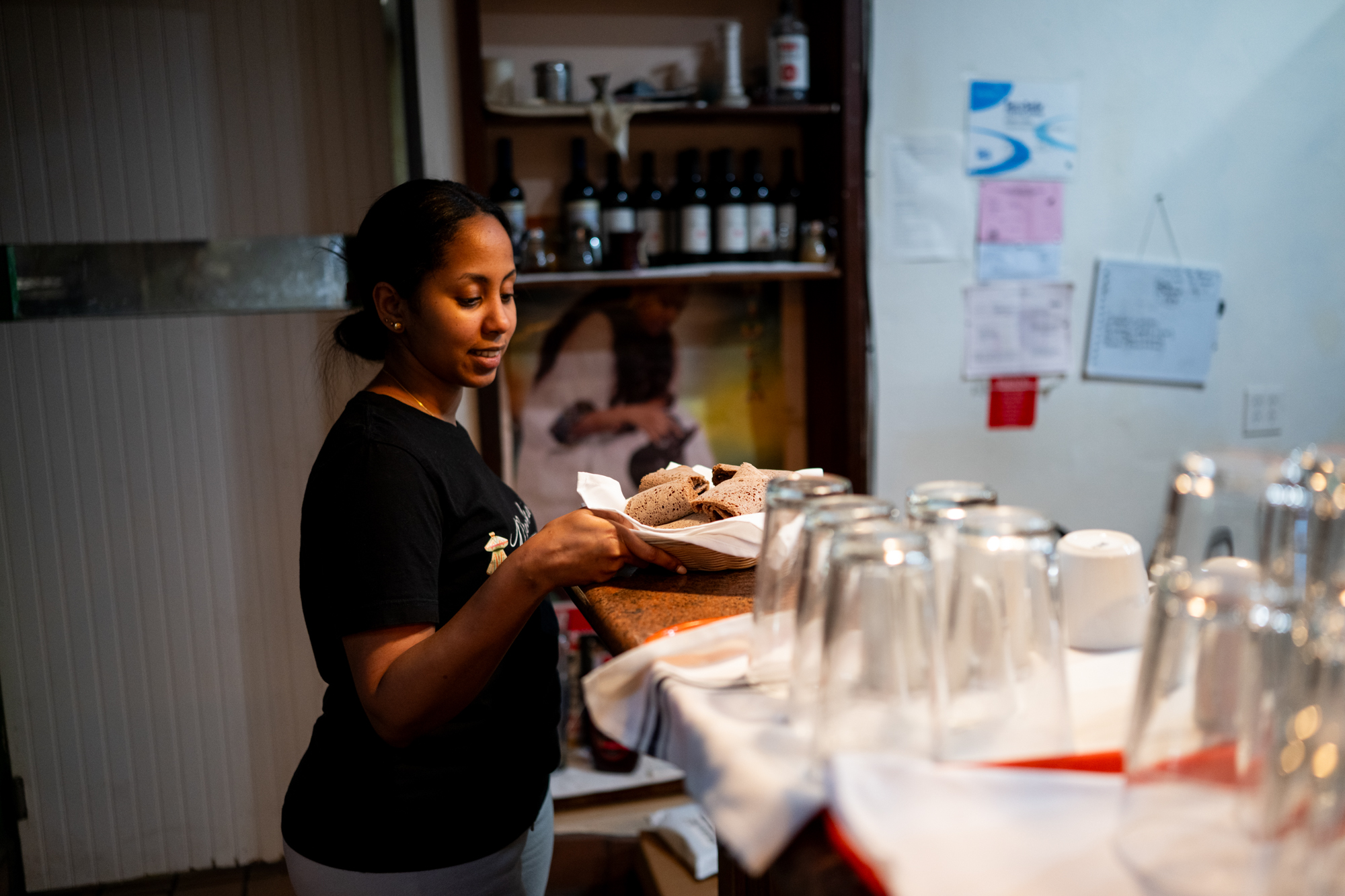
Yohana Woldeabzgi serves injera at Meskie’s Kitchen on Telegraph Avenue in Berkeley on June 16, 2025. (Beth LaBerge/KQED)
Take my recent visit to Meskie’s Kitchen in Berkeley, which has stayed relatively the same since it opened over three decades ago under the name Ethiopia Restaurant. The place is still filled with the fragrant aromas you’ll mostly find inside family kitchens equipped with mom-approved recipes. Even though the space was renovated in 2020, the unpretentious interior, with a few Ethiopian paintings and photographs dotting the walls, may as well be from the late aughts.
I stuck with the basics. A round of beef tibs, a stir-fry dressed in zesty awaze sauce. Doro wot, a piquant stew of tender bone-in chicken and hard-boiled eggs. Yebeg alicha, an herb-infused lamb stew. And gomen, the peppery collard green sauté. I also ordered the classic veggie combo, a vegan-friendly mix of spiced red lentils, split peas, cabbage, puréed garbanzo beans and more, all jigsawed onto a large, colorful platter. And that’s only the tip of the pyramid when it comes to its diverse menu.
Historically, the Bay Area’s Ethiopian restaurants have provided more than just uber-fresh flavors. The cuisine is also known for its comparatively low price point, generous family-sized portions and down-to-earth simplicity. Almost all of the region’s East African restaurants are small, homey mom-and-pop operations. For the past 40 years, you wouldn’t necessarily expect to find an Ethiopian or Eritrean fine dining establishment or experimental fusion hot spot.
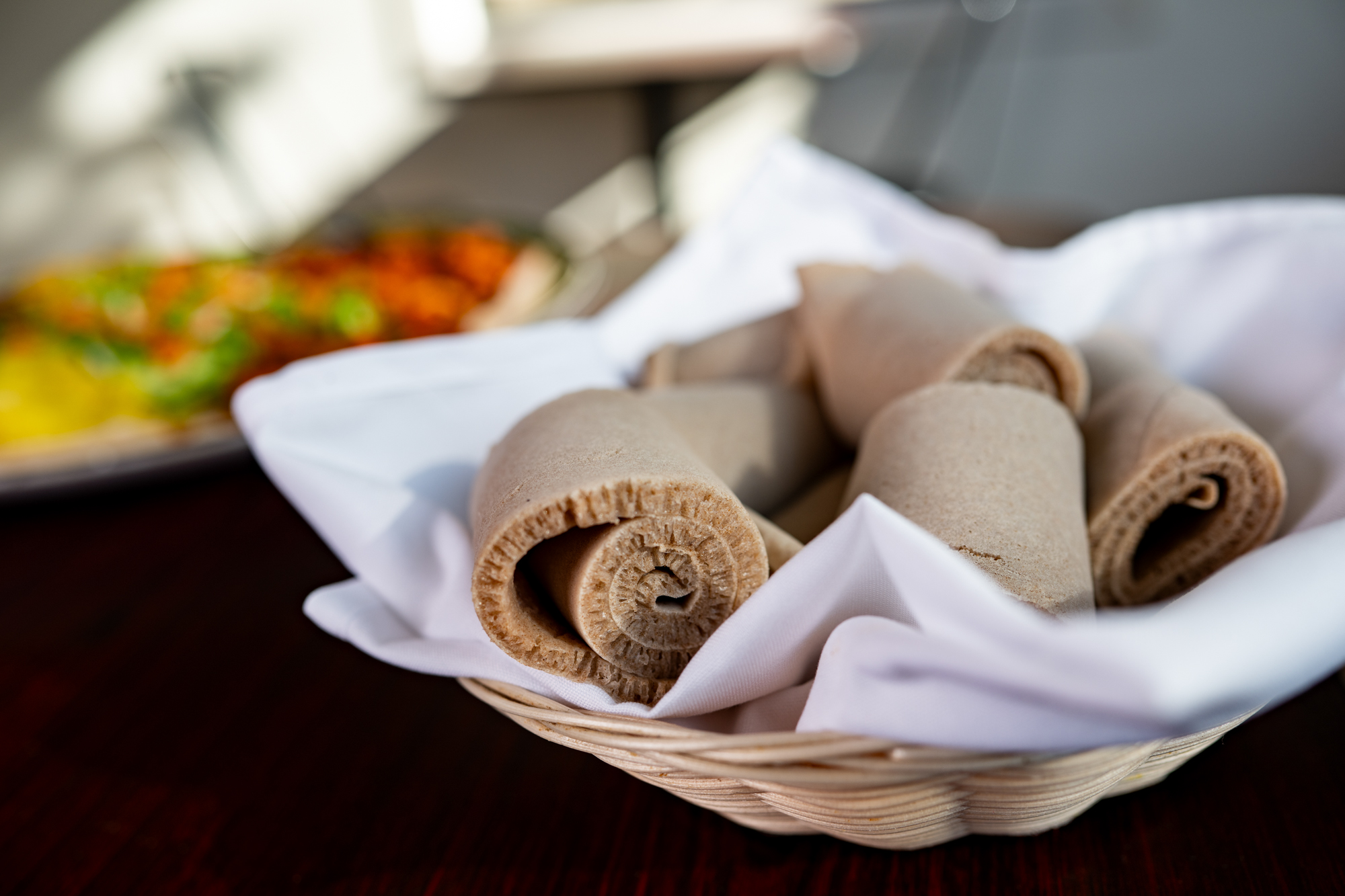
Injera at Meskie’s Kitchen on Telegraph Avenue in Berkeley on June 16, 2025. (Beth LaBerge/KQED)
But those long-held expectations are slowly starting to shift. A new generation of East African business owners, entrepreneurs and creatives are taking the reins while upholding the work and legacy they’ve inherited. As their elders pass down knowledge, resources and capital, Americanized millennials — the first generation to be born and raised stateside after their parents immigrated from Ethiopia and Eritrea in the 1970s, ’80s and ’90s — are expanding on what their predecessors built. The result? At least in the Bay Area, East African food seems poised to enter its biggest evolutionary moment, as newer, more open-ended approaches to the cuisine now appeal to younger, social media–savvy crowds.
Daniel Aderaw Yeshiwas, a managing partner of Café Colucci and Brundo Spice Company in North Oakland, runs a series of innovative pop-ups in Colucci’s patio: blending Ethiopian spices with flavors from Ghana and the American South. First-generation brothers Benyam and Yonathan Yohannes — whose family opened Asmara, Oakland’s first East African restaurant, in 1985 — recently unveiled a cocktail bar, 51 & Tel, that features modern vegan bites like a burrito-esque “injera-ritto” and boozy drinks inspired by underground Bay Area rap and spiked punch bowls. Meanwhile, an Ethiopian duo based in San Jose has been working on the first automated injera maker, Automitad. The startup boasts “unrivaled efficiency” with a product able to crank out between 1,000 and 1,7000 injeras an hour. Last year, they announced the shipment of their first machine.
“There’s a new wave of Ethiopian entrepreneurs who are taking risks in different fields,” says Guma Fassil, the 37-year-old Ethiopian American who owns the aforementioned Meskie’s. A savvy playmaker and the ambitious only child of Ethiopian immigrants, Fassil would know. He unexpectedly took charge of the Berkeley restaurant in 2019 after his mother, Meski, passed away. She had opened the institutional eatery in 1993, operating it as a community hub until her final days.
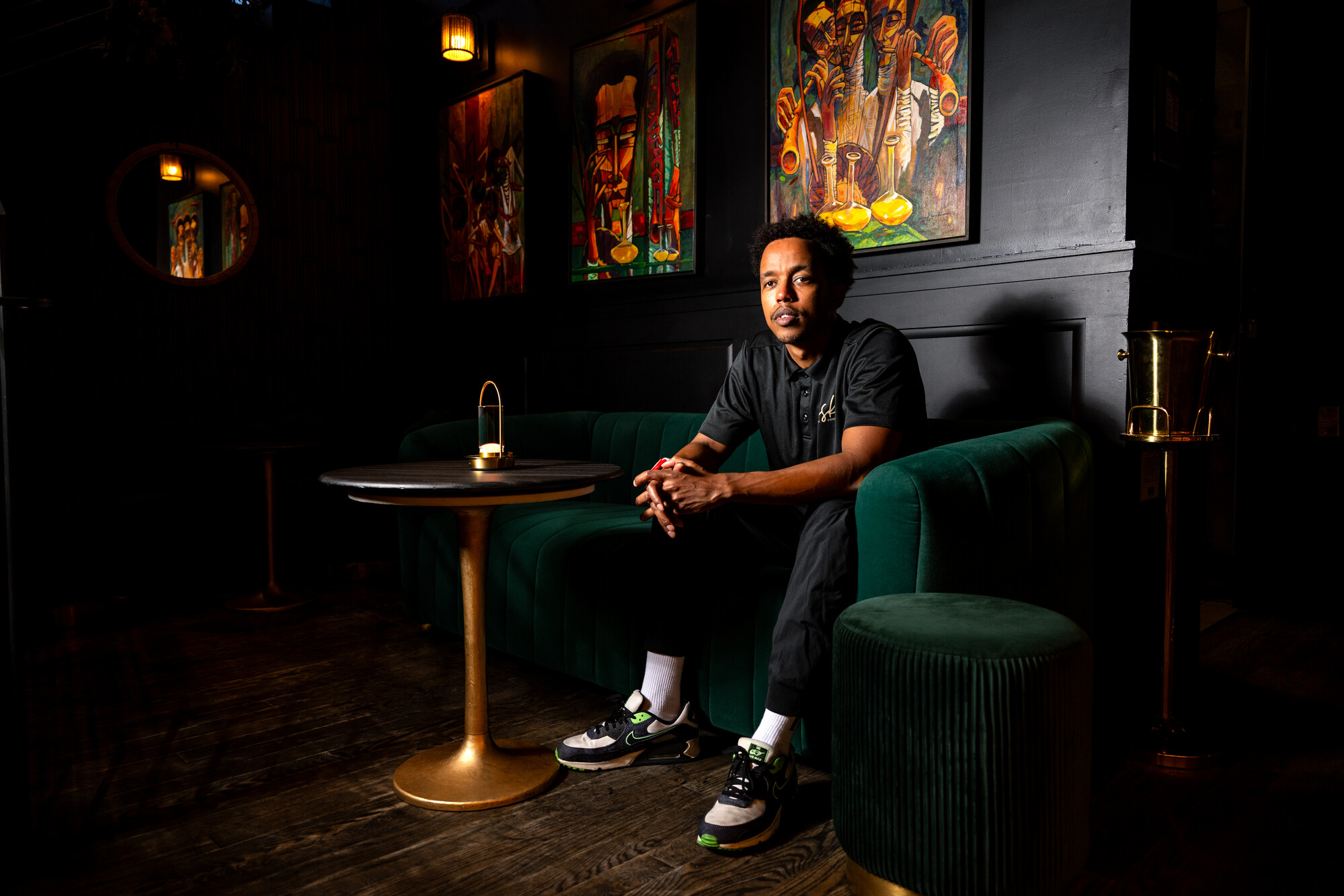
Guma Fassil sits in the lounge at Meski, an Ethiopian–Afro-Latin fusion restaurant in San Francisco co-owned by Fassil, chef Nelson German, and NBA star Draymond Green, on July 10, 2025.
Since taking over the restaurant and rebranding it as Meskie’s, Fassil has learned to inject his own worldview and expertise into the Bay’s vibrant East African scene. Fassil — who worked at his mom’s restaurant throughout his twenties while also making a name for himself in Bay Area nightlife — opened his own splashy, Ethiopian-inspired establishment in San Francisco earlier this year: Meski. In his telling, it’s an Ethiopian-nightclub-meets-dining-lounge concept with an Afro-Latino punch, occupying prime real estate in the glamorous Lower Nob Hill neighborhood. This new place to be seen at is co-owned by Golden State Warriors star Draymond Green, and the kitchen’s Ethiopian-Dominican menu is overseen by Top Chef alum Nelson German, the Oakland-based Dominican cuisinier behind Sobre Mesa and alaMar.
“I love traditional mom and pop Ethiopian food. I was raised on it,” Fassil says. “But I honestly had no interest in replicating that. I wanted to be a vanguard in creating something that hasn’t been done before, and changing the narrative on East African cuisine. We are capable of packaging our culture in an elevated way. There is an appetite for this.”
The ’80s and ’90s brought a slew of East African businesses to the Bay after an initial wave of Ethiopian immigrants, refugees and dreamers first reached America beginning in the late ’70s. Many — including Fassil’s and Yeshiwas’ parents — came on student visas, initially landing in states like Ohio and Massachusetts before graduating and migrating westward. Others fled from the drought, government-induced famines, and a 17-year civil war that took hundreds of thousands of East African lives after Haile Selassie was overthrown in the 1974 Ethiopian coup. In Northern California, this led to a flourishing ecosystem of Ethiopian and Eritrean community leaders, including future restaurateurs. Their hard-earned resolve, scrappy resourcefulness, and memories of their estranged homeland helped forge one of the nation’s most distinct swaths of East African food.
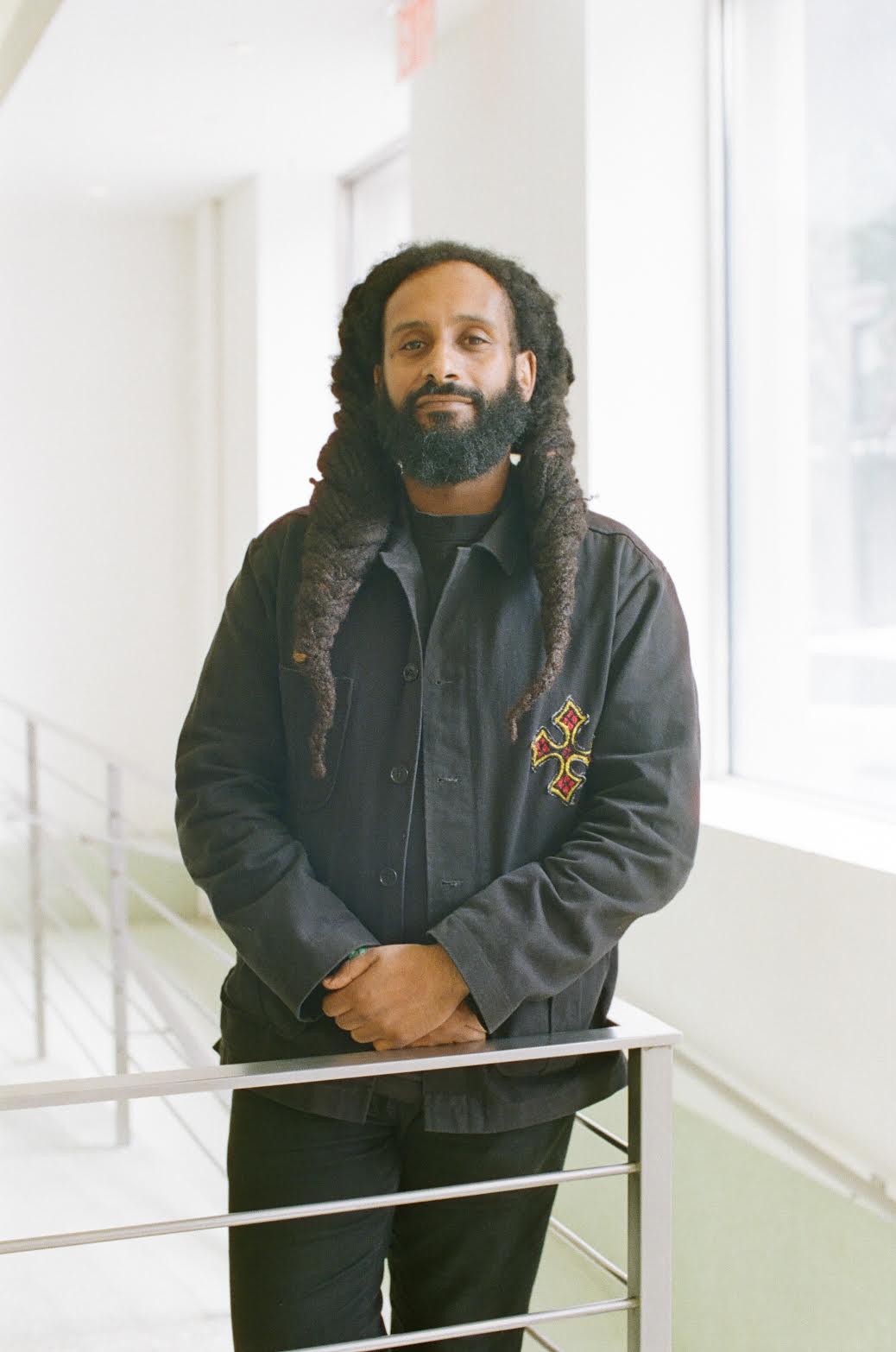
Daniel Aderaw Yeshiwas, manager of Café Colucci and owner of Brundo Spice Company. (Clay Williams)
“Bay Area Ethiopians are unique,” says Yeshiwas. “Our take on Ethiopian food here merges with our surroundings. In the Bay, we have the best access to produce and fresh vegetables. Our food is full of greens, hummus, salads. That’s traditional, but it’s not exactly the same in Ethiopia. And if you go to D.C., it’s huge piles of meat. It’s all tasty, but there’s an added emphasis on veganism and vegetarianism [in the Bay].”
Michelin-recognized Café Colucci was founded in 1991 by Fetlework Tefferi, Yeshiwas’ lifelong family friend and nominal aunt. The Oakland staple was preceded by Chibbo in 1985, an Afrocentric after-hours club and East African grill that Tefferi formerly helped to run on University Avenue in Berkeley. During the day, Tefferi dreamed of building her own space. She eventually opened Café Colucci, which was meant to be an Italian-inspired cafe when it debuted. After it became clear that Ethiopian grub was a bigger hit than expected, Tefferi went all in.
Nowadays, Yeshiwas helps run the longstanding business that Tefferi built. He knows Fassil’s family through an Ethiopian church (because, as Fassil says, “every Ethiopian in the Bay knows each other, or knows someone who knows you.”) Similar to Fassil, Yeshiwas stepped into his role at Café Colucci with deep pride and respect, but also with an unfurled sense of possibility.
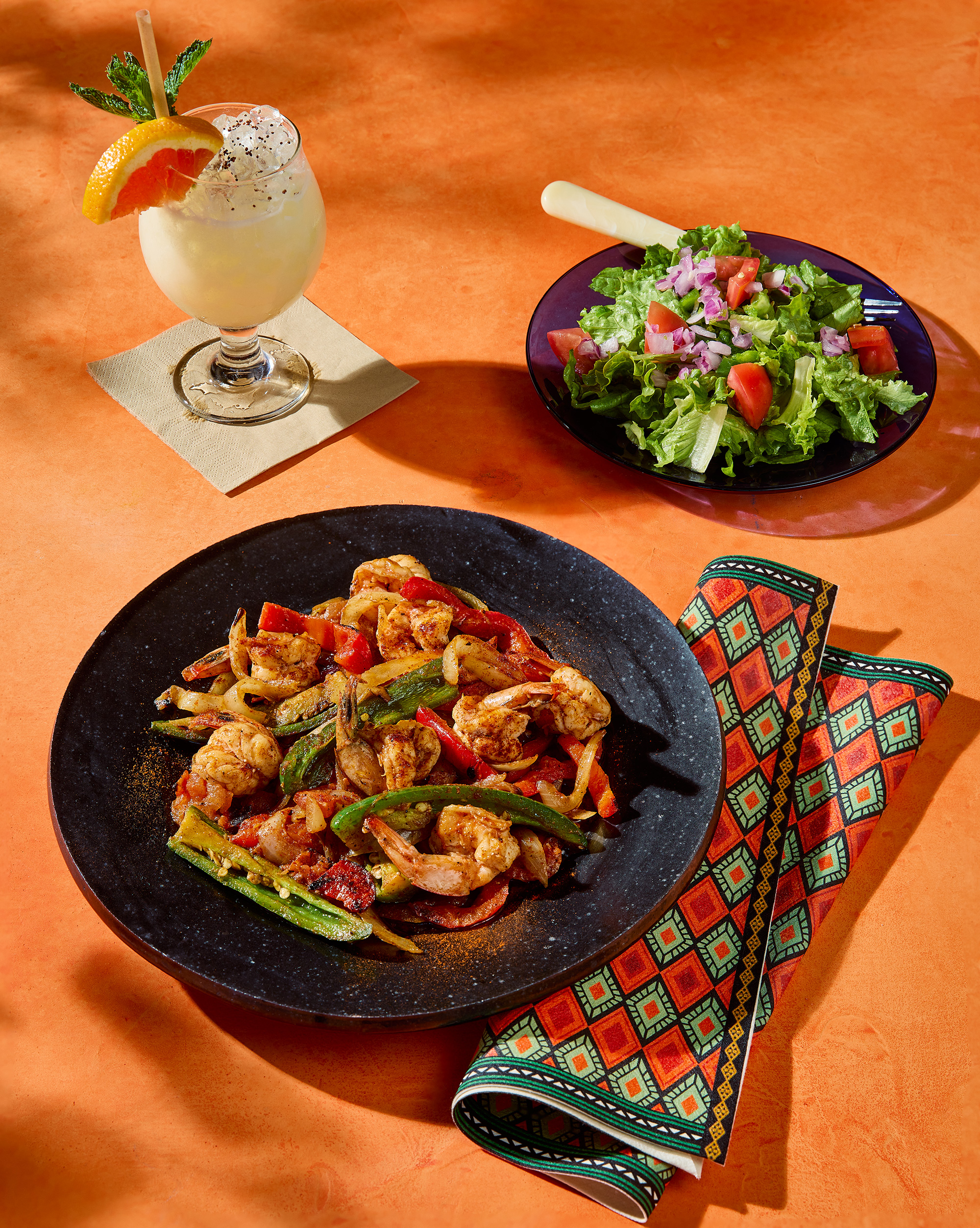
Suggested recipes from the Brundo Spice Company include Shrimp Tibs with a citrus dressed salad and a side of Shiro. (Melati Citrawireja / Courtesy Brundo Spice Company)
“Ethiopian food is really hard to make,” says Yeshiwas, who regularly travels to Ethiopia to oversee a spice packaging warehouse in Modjo that was built for his spice company, Brundo. “Taking 2,000 pounds of onions, then cooking that down into a sauce to be made into another sauce to be put on lentils and then selling that for $13 bucks — it worked for our parents trying to survive however they could. But for a group of friends today, it’s like, just making injera, we have two shifts of workers making a thousand daily. It’s a very old-school process, rooted in tradition, but [my generation is] thinking about scale, and we’re living in an ultra-capitalistic society. So how can we preserve the culture and, frankly, be able to run these operations a bit more efficiently?”
Over the past five years, Yeshiwas has used Brundo — an Ethiopian colloquialism that roughly translates into “good food” — to reconnect with his Ethiopian identity and to reimagine Ethiopian heirloom spices and herbs as a premier product with top-end partnerships.
Related Article
That takes the form of Ethiopian spice chai and black cardamom lattes at Blue Bottle Coffee. It’s berbere-spiced greens at Burdell in Oakland, the nationally recognized soul food restaurant. It’s berbere hummus at Obour. It’s Ethiopian hot chocolate at Coracao. It’s all of the clever pop-ups hosted on Café Colucci’s side patio, which bring in talented young chefs from all different backgrounds and set them loose on Brundo’s full spectrum of East African spices. It’s even Ethiopian-spiced ice cream — something Yeshiwas has his aim set on next.
“I want to have a high quality, presentable Ethiopian product,” he says. “Food systems in the U.S. are difficult [to navigate] and can make it harder, but I want it to be in a lot of other different places. I want to collab in new kinds of ways.”
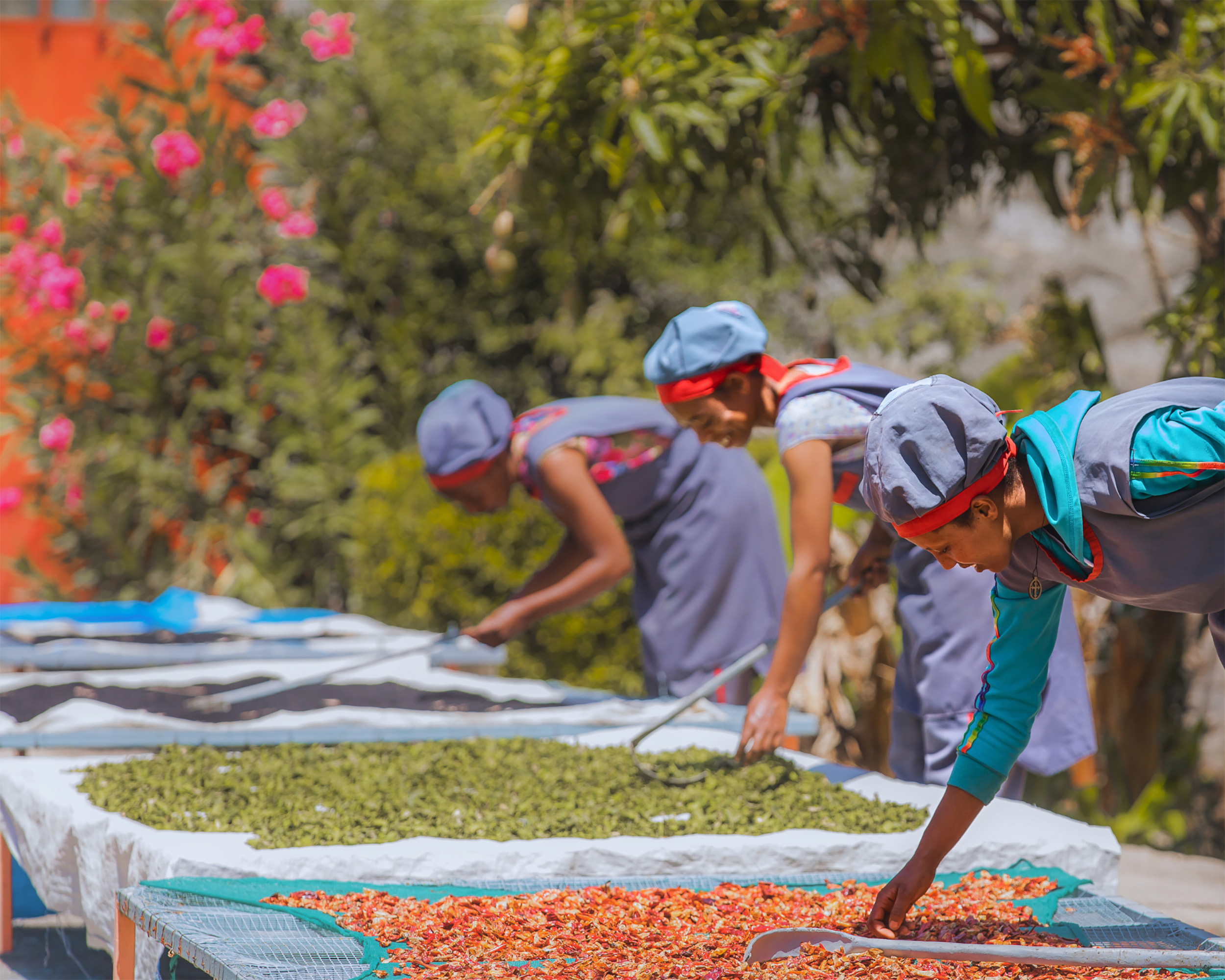
Women oversee the drying process on the farm in Ethiopia that supplies Brundo Spice Company. (Courtesy Brundo Spice Company)
Fassil has a similar game plan. At the sleek new Meski in San Francisco, eaters will find dining options that they likely won’t find at other Ethiopian-owned businesses: Ethiopian-style sambusas made from island yuca, stuffed with berbere-kissed beef or lentils; tibs de maduro, a Carribeanized spin on the dish made with plantains, inca peppers and salsa afrikana; teff pancakes with coconut cookie crumble and grilled pineapple; and habichuela misir wet, which combines Dominican kidney beans and sofrito with Ethiopian-spiced lentils. Of course there’s also plenty of tej, the classic Ethiopian honey wine, which gets remixed as a bottomless mimosa.
“Right now, the older first-gen Ethiopian Americans are in our thirties; that’s really the entrepreneurial stage of life,” Fassil says. “In your twenties, you’re working and figuring it all out, saving your money. But in your thirties you can take those bigger risks and pursue those endeavors. I’m now in a position to do it. I’ve been dreaming of this my entire life.”
Like Yeshiwas, Fassil credits those who came before him and doesn’t shortchange the labor of those who paved the proverbial way forward. He’s adamant about carrying on his mom’s memory through food. He also namedrops Ethiopian-Swedish chef Marcus Samuelson as an inspiration who encouraged him, via Instagram, to take the leap with his bold approach to Ethiopian cuisine.
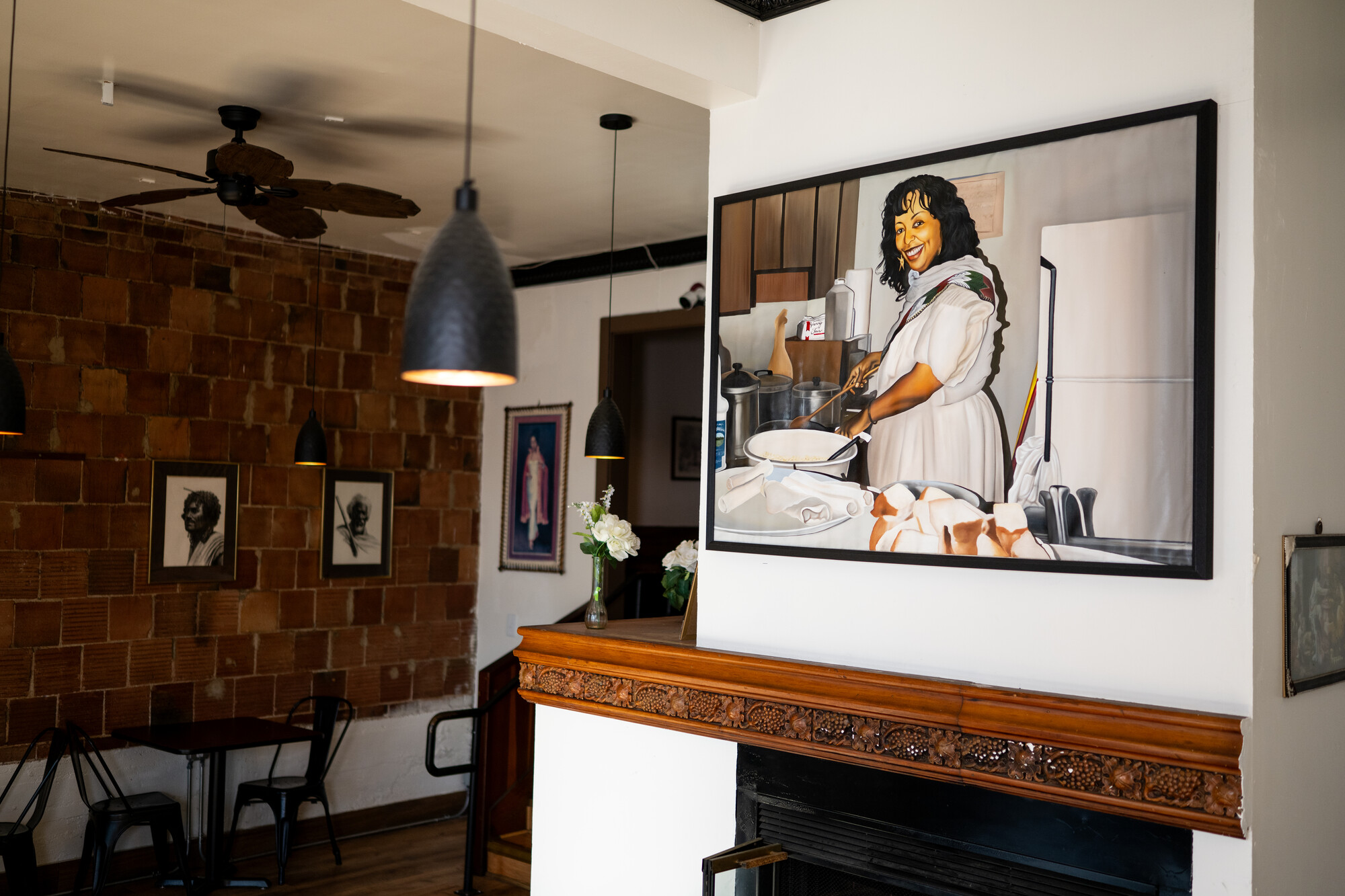
A painting of Meskie’s Kitchen founder Meskerem Tsegaye hangs inside the restaurant on Telegraph Avenue in Berkeley on June 16, 2025. Founded by the late Tsegaye in 1993, the family-run restaurant is now operated by her son Guma Fassil, who continues to serve authentic Ethiopian cuisine. (Beth LaBerge/KQED)
“It’s all about timing. And right now, the time is perfect,” Fassil declares. “You can argue that Ethiopian cuisine in the East Bay has become mainstream now, that it’s over-saturated. If you’re near Oakland, you don’t even know where to choose. So I had no interest in opening another traditional spot. I wanted to mix my culture as an American with my nightlife background. We don’t really have that vibe [with Ethiopian food].”
In a way, Fassil is doing both — keeping those old-school East African traditions intact at the original Meskie’s in the East Bay while also carving out his own definition of Ethiopian dining across the bridge at Meski, in a way that still honors his mom’s spirit.
He continues with his entrepreneurial manifesto: “Ethiopian cuisine is at a place where most people around here have tried it. It was in a Simpsons episode, I mean, that’s how you know most people know about it. If I tried to do what I’m doing 10 or more years ago, it may not have had the same reception. But the Bay is ready for a different iteration of Ethiopian food. So many people have already tried the traditional version.”
Meski (1000 Larkin St., SF) is open Wed. to Sun. for dinner (hours vary from 5 p.m. to 11 p.m. or 1 a.m.) and on Sun. for brunch from 11 a.m. to 3 p.m.. Meskie’s (2955 Telegraph Ave., Berkeley) is open every day from 11:30 a.m. to 9 p.m. Café Colucci (5849 San Pablo Ave., Oakland) is open every day with varying lunch and dinner hours from 11 a.m. to 10 p.m. Brundo Spice Company is located inside Café Colucci.
lower waypointnext waypoint
Player sponsored by
window.__IS_SSR__=true
window.__INITIAL_STATE__={
"attachmentsReducer": {
"audio_0": {
"type": "attachments",
"id": "audio_0",
"imgSizes": {
"kqedFullSize": {
"file": "https://ww2.kqed.org/news/wp-content/themes/KQED-unified/img/audio_bgs/background0.jpg"
}
}
},
"audio_1": {
"type": "attachments",
"id": "audio_1",
"imgSizes": {
"kqedFullSize": {
"file": "https://ww2.kqed.org/news/wp-content/themes/KQED-unified/img/audio_bgs/background1.jpg"
}
}
},
"audio_2": {
"type": "attachments",
"id": "audio_2",
"imgSizes": {
"kqedFullSize": {
"file": "https://ww2.kqed.org/news/wp-content/themes/KQED-unified/img/audio_bgs/background2.jpg"
}
}
},
"audio_3": {
"type": "attachments",
"id": "audio_3",
"imgSizes": {
"kqedFullSize": {
"file": "https://ww2.kqed.org/news/wp-content/themes/KQED-unified/img/audio_bgs/background3.jpg"
}
}
},
"audio_4": {
"type": "attachments",
"id": "audio_4",
"imgSizes": {
"kqedFullSize": {
"file": "https://ww2.kqed.org/news/wp-content/themes/KQED-unified/img/audio_bgs/background4.jpg"
}
}
},
"placeholder": {
"type": "attachments",
"id": "placeholder",
"imgSizes": {
"thumbnail": {
"file": "https://cdn.kqed.org/wp-content/uploads/2024/12/KQED-Default-Image-816638274-2000x1333-1-160x107.jpg",
"width": 160,
"height": 107,
"mimeType": "image/jpeg"
},
"medium": {
"file": "https://cdn.kqed.org/wp-content/uploads/2024/12/KQED-Default-Image-816638274-2000x1333-1-800x533.jpg",
"width": 800,
"height": 533,
"mimeType": "image/jpeg"
},
"medium_large": {
"file": "https://cdn.kqed.org/wp-content/uploads/2024/12/KQED-Default-Image-816638274-2000x1333-1-768x512.jpg",
"width": 768,
"height": 512,
"mimeType": "image/jpeg"
},
"large": {
"file": "https://cdn.kqed.org/wp-content/uploads/2024/12/KQED-Default-Image-816638274-2000x1333-1-1020x680.jpg",
"width": 1020,
"height": 680,
"mimeType": "image/jpeg"
},
"1536x1536": {
"file": "https://cdn.kqed.org/wp-content/uploads/2024/12/KQED-Default-Image-816638274-2000x1333-1-1536x1024.jpg",
"width": 1536,
"height": 1024,
"mimeType": "image/jpeg"
},
"fd-lrg": {
"file": "https://cdn.kqed.org/wp-content/uploads/2024/12/KQED-Default-Image-816638274-2000x1333-1-1536x1024.jpg",
"width": 1536,
"height": 1024,
"mimeType": "image/jpeg"
},
"fd-med": {
"file": "https://cdn.kqed.org/wp-content/uploads/2024/12/KQED-Default-Image-816638274-2000x1333-1-1020x680.jpg",
"width": 1020,
"height": 680,
"mimeType": "image/jpeg"
},
"fd-sm": {
"file": "https://cdn.kqed.org/wp-content/uploads/2024/12/KQED-Default-Image-816638274-2000x1333-1-800x533.jpg",
"width": 800,
"height": 533,
"mimeType": "image/jpeg"
},
"post-thumbnail": {
"file": "https://cdn.kqed.org/wp-content/uploads/2024/12/KQED-Default-Image-816638274-2000x1333-1-672x372.jpg",
"width": 672,
"height": 372,
"mimeType": "image/jpeg"
},
"twentyfourteen-full-width": {
"file": "https://cdn.kqed.org/wp-content/uploads/2024/12/KQED-Default-Image-816638274-2000x1333-1-1038x576.jpg",
"width": 1038,
"height": 576,
"mimeType": "image/jpeg"
},
"xxsmall": {
"file": "https://cdn.kqed.org/wp-content/uploads/2024/12/KQED-Default-Image-816638274-2000x1333-1-160x107.jpg",
"width": 160,
"height": 107,
"mimeType": "image/jpeg"
},
"xsmall": {
"file": "https://cdn.kqed.org/wp-content/uploads/2024/12/KQED-Default-Image-816638274-2000x1333-1-672x372.jpg",
"width": 672,
"height": 372,
"mimeType": "image/jpeg"
},
"small": {
"file": "https://cdn.kqed.org/wp-content/uploads/2024/12/KQED-Default-Image-816638274-2000x1333-1-672x372.jpg",
"width": 672,
"height": 372,
"mimeType": "image/jpeg"
},
"xlarge": {
"file": "https://cdn.kqed.org/wp-content/uploads/2024/12/KQED-Default-Image-816638274-2000x1333-1-1020x680.jpg",
"width": 1020,
"height": 680,
"mimeType": "image/jpeg"
},
"full-width": {
"file": "https://cdn.kqed.org/wp-content/uploads/2024/12/KQED-Default-Image-816638274-2000x1333-1-1920x1280.jpg",
"width": 1920,
"height": 1280,
"mimeType": "image/jpeg"
},
"guest-author-32": {
"file": "https://cdn.kqed.org/wp-content/uploads/2025/01/KQED-Default-Image-816638274-1333x1333-1-160x160.jpg",
"width": 32,
"height": 32,
"mimeType": "image/jpeg"
},
"guest-author-50": {
"file": "https://cdn.kqed.org/wp-content/uploads/2025/01/KQED-Default-Image-816638274-1333x1333-1-160x160.jpg",
"width": 50,
"height": 50,
"mimeType": "image/jpeg"
},
"guest-author-64": {
"file": "https://cdn.kqed.org/wp-content/uploads/2025/01/KQED-Default-Image-816638274-1333x1333-1-160x160.jpg",
"width": 64,
"height": 64,
"mimeType": "image/jpeg"
},
"guest-author-96": {
"file": "https://cdn.kqed.org/wp-content/uploads/2025/01/KQED-Default-Image-816638274-1333x1333-1-160x160.jpg",
"width": 96,
"height": 96,
"mimeType": "image/jpeg"
},
"guest-author-128": {
"file": "https://cdn.kqed.org/wp-content/uploads/2025/01/KQED-Default-Image-816638274-1333x1333-1-160x160.jpg",
"width": 128,
"height": 128,
"mimeType": "image/jpeg"
},
"detail": {
"file": "https://cdn.kqed.org/wp-content/uploads/2025/01/KQED-Default-Image-816638274-1333x1333-1-160x160.jpg",
"width": 160,
"height": 160,
"mimeType": "image/jpeg"
},
"kqedFullSize": {
"file": "https://cdn.kqed.org/wp-content/uploads/2024/12/KQED-Default-Image-816638274-2000x1333-1.jpg",
"width": 2000,
"height": 1333
}
}
},
"arts_13977745": {
"type": "attachments",
"id": "arts_13977745",
"meta": {
"index": "attachments_1716263798",
"site": "arts",
"id": "13977745",
"found": true
},
"title": "250616-MESKISKITCHEN-12-BL-KQED",
"publishDate": 1750184914,
"status": "inherit",
"parent": 0,
"modified": 1752846413,
"caption": "The meat and veggie combo at Meskie’s Kitchen on Telegraph Avenue in Berkeley on June 16, 2025. The platter includes stews made with lentils, greens, and meat, served atop traditional injera. Founded by the late Meskerem Tsegaye in 1993, the family-run restaurant is now operated by her son Guma Fassil, who continues to serve authentic Ethiopian cuisine.",
"credit": "Beth LaBerge/KQED",
"altTag": null,
"description": null,
"imgSizes": {
"thumbnail": {
"file": "https://cdn.kqed.org/wp-content/uploads/sites/2/2025/06/250616-MESKISKITCHEN-12-BL-KQED-160x107.jpg",
"width": 160,
"height": 107,
"mimeType": "image/jpeg"
},
"medium_large": {
"file": "https://cdn.kqed.org/wp-content/uploads/sites/2/2025/06/250616-MESKISKITCHEN-12-BL-KQED-768x512.jpg",
"width": 768,
"height": 512,
"mimeType": "image/jpeg"
},
"1536x1536": {
"file": "https://cdn.kqed.org/wp-content/uploads/sites/2/2025/06/250616-MESKISKITCHEN-12-BL-KQED-1536x1024.jpg",
"width": 1536,
"height": 1024,
"mimeType": "image/jpeg"
},
"post-thumbnail": {
"file": "https://cdn.kqed.org/wp-content/uploads/sites/2/2025/06/250616-MESKISKITCHEN-12-BL-KQED-672x372.jpg",
"width": 672,
"height": 372,
"mimeType": "image/jpeg"
},
"twentyfourteen-full-width": {
"file": "https://cdn.kqed.org/wp-content/uploads/sites/2/2025/06/250616-MESKISKITCHEN-12-BL-KQED-1038x576.jpg",
"width": 1038,
"height": 576,
"mimeType": "image/jpeg"
},
"kqedFullSize": {
"file": "https://cdn.kqed.org/wp-content/uploads/sites/2/2025/06/250616-MESKISKITCHEN-12-BL-KQED.jpg",
"width": 2000,
"height": 1333
}
},
"isLoading": false,
"fetchFailed": false
}
},
"audioPlayerReducer": {
"postId": "stream_live",
"isPaused": true,
"isPlaying": false,
"pfsActive": false,
"pledgeModalIsOpen": true,
"playerDrawerIsOpen": false,
"liveAudioPlayStartedAt": 0,
"liveAudioPlayContext": ""
},
"authorsReducer": {
"achazaro": {
"type": "authors",
"id": "11748",
"meta": {
"index": "authors_1716337520",
"id": "11748",
"found": true
},
"name": "Alan Chazaro",
"firstName": "Alan",
"lastName": "Chazaro",
"slug": "achazaro",
"email": "agchazaro@gmail.com",
"display_author_email": true,
"staff_mastheads": [],
"title": "Food Writer and Reporter",
"bio": "Alan Chazaro is the author of \u003cem>This Is Not a Frank Ocean Cover Album\u003c/em> (Black Lawrence Press, 2019), \u003cem>Piñata Theory\u003c/em> (Black Lawrence Press, 2020), and \u003cem>Notes from the Eastern Span of the Bay Bridge\u003c/em> (Ghost City Press, 2021). He is a graduate of June Jordan’s Poetry for the People program at UC Berkeley and a former Lawrence Ferlinghetti Fellow at the University of San Francisco. He writes about sports, food, art, music, education, and culture while repping the Bay on \u003ca href=\"https://twitter.com/alan_chazaro\">Twitter\u003c/a> and \u003ca href=\"https://www.instagram.com/alan_chazaro/?hl=en\">Instagram\u003c/a> at @alan_chazaro.",
"avatar": "https://secure.gravatar.com/avatar/ea8b6dd970fc5c29e7a188e7d5861df7?s=600&d=blank&r=g",
"twitter": "alan_chazaro",
"facebook": null,
"instagram": null,
"linkedin": null,
"sites": [
{
"site": "arts",
"roles": [
"contributor"
]
},
{
"site": "news",
"roles": [
"editor"
]
}
],
"headData": {
"title": "Alan Chazaro | KQED",
"description": "Food Writer and Reporter",
"ogImgSrc": "https://secure.gravatar.com/avatar/ea8b6dd970fc5c29e7a188e7d5861df7?s=600&d=blank&r=g",
"twImgSrc": "https://secure.gravatar.com/avatar/ea8b6dd970fc5c29e7a188e7d5861df7?s=600&d=blank&r=g"
},
"isLoading": false,
"link": "/author/achazaro"
}
},
"pagesReducer": {},
"pfsSessionReducer": {},
"postsReducer": {
"stream_live": {
"type": "live",
"id": "stream_live",
"audioUrl": "https://streams.kqed.org/kqedradio",
"title": "Live Stream",
"excerpt": "Live Stream information currently unavailable.",
"link": "/radio",
"featImg": "",
"label": {
"name": "KQED Live",
"link": "/"
}
},
"stream_kqedNewscast": {
"type": "posts",
"id": "stream_kqedNewscast",
"audioUrl": "https://www.kqed.org/.stream/anon/radio/RDnews/newscast.mp3?_=1",
"title": "KQED Newscast",
"featImg": "",
"label": {
"name": "88.5 FM",
"link": "/"
}
},
"arts_13978846": {
"type": "posts",
"id": "arts_13978846",
"meta": {
"index": "posts_1716263798",
"site": "arts",
"id": "13978846",
"found": true
},
"articlePosition": 0,
"guestAuthors": [],
"slug": "new-ethiopian-eritrean-restaurants-bay-area-san-francisco-oakland",
"title": "The New Evolution of Ethiopian and Eritrean Restaurants in the Bay Area",
"publishDate": 1752850191,
"format": "standard",
"headTitle": "The New Evolution of Ethiopian and Eritrean Restaurants in the Bay Area | KQED",
"labelTerm": {},
"content": "\u003cp>In 2007, when my mom hadn’t yet been priced out of San Francisco, I’d trek over from my dorm in Berkeley to wander with her around the neon-drenched, still-Waymo-less city. That’s when I first tasted Ethiopian food.\u003c/p>\n\u003cp>Attracted to its rich flavors and affordability, my mom, a Mexican immigrant who worked odd jobs in the food industry, often insisted on taking me out for Ethiopian. The spongy, sour fluffs of injera and heaps of berbere-rich chicken and spicy lentil stew were new and exciting to my teenage palate, though of course by then the East African cuisine was already well entrenched in Bay Area culture. And while my exposure to the cuisine tapered off after I moved out of the Bay, Ethiopian and Eritrean restaurants have somehow managed to look, smell and taste exactly as I remembered them in those days — despite the rest of the Bay’s aggressive changes.\u003c/p>\n\u003cp>In 2025, you can walk into just about any popular fixture of \u003ca href=\"https://sf.eater.com/maps/ethiopian-restaurant-oakland-east-african\">our region’s loaded East African food circuit\u003c/a> — Café Colucci in North Oakland, Ensarro near Lake Merritt, Sheba Jazz Lounge (formerly Piano Lounge) on Fillmore Street — and it’ll still feel mostly like it did decades ago.\u003c/p>\n\u003cfigure id=\"attachment_13977747\" class=\"wp-caption aligncenter\" style=\"max-width: 2000px\">\u003cimg loading=\"lazy\" decoding=\"async\" src=\"https://cdn.kqed.org/wp-content/uploads/sites/2/2025/06/250616-MESKISKITCHEN-18-BL-KQED.jpg\" alt=\"\" width=\"2000\" height=\"1333\" class=\"size-full wp-image-13977747\" srcset=\"https://cdn.kqed.org/wp-content/uploads/sites/2/2025/06/250616-MESKISKITCHEN-18-BL-KQED.jpg 2000w, https://cdn.kqed.org/wp-content/uploads/sites/2/2025/06/250616-MESKISKITCHEN-18-BL-KQED-160x107.jpg 160w, https://cdn.kqed.org/wp-content/uploads/sites/2/2025/06/250616-MESKISKITCHEN-18-BL-KQED-768x512.jpg 768w, https://cdn.kqed.org/wp-content/uploads/sites/2/2025/06/250616-MESKISKITCHEN-18-BL-KQED-1536x1024.jpg 1536w\" sizes=\"auto, (max-width: 2000px) 100vw, 2000px\">\u003cfigcaption class=\"wp-caption-text\">Yohana Woldeabzgi serves injera at Meskie’s Kitchen on Telegraph Avenue in Berkeley on June 16, 2025. \u003ccite>(Beth LaBerge/KQED)\u003c/cite>\u003c/figcaption>\u003c/figure>\n\u003cp>Take my recent visit to \u003ca href=\"https://www.instagram.com/meskisberkeley/?hl=en\">Meskie’s Kitchen\u003c/a> in Berkeley, which has stayed relatively the same since it opened over three decades ago under the name Ethiopia Restaurant. The place is still filled with the fragrant aromas you’ll mostly find inside family kitchens equipped with mom-approved recipes. Even though the space was renovated in 2020, the unpretentious interior, with a few Ethiopian paintings and photographs dotting the walls, may as well be from the late aughts. \u003c/p>\n\u003cp>I stuck with the basics. A round of beef tibs, a stir-fry dressed in zesty awaze sauce. Doro wot, a piquant stew of tender bone-in chicken and hard-boiled eggs. Yebeg alicha, an herb-infused lamb stew. And gomen, the peppery collard green sauté. I also ordered the classic veggie combo, a vegan-friendly mix of spiced red lentils, split peas, cabbage, puréed garbanzo beans and more, all jigsawed onto a large, colorful platter. And that’s only the tip of the pyramid when it comes to its diverse menu. \u003c/p>\n\u003cp>[ad fullwidth]\u003c/p>\n\u003cp>Historically, the Bay Area’s Ethiopian restaurants have provided more than just uber-fresh flavors. The cuisine is also known for its comparatively low price point, generous family-sized portions and down-to-earth simplicity. Almost all of the region’s East African restaurants are small, homey mom-and-pop operations. For the past 40 years, you wouldn’t necessarily expect to find an Ethiopian or Eritrean fine dining establishment or experimental fusion hot spot. \u003c/p>\n\u003cfigure id=\"attachment_13977746\" class=\"wp-caption aligncenter\" style=\"max-width: 2000px\">\u003cimg loading=\"lazy\" decoding=\"async\" src=\"https://cdn.kqed.org/wp-content/uploads/sites/2/2025/06/250616-MESKISKITCHEN-15-BL-KQED.jpg\" alt=\"\" width=\"2000\" height=\"1333\" class=\"size-full wp-image-13977746\" srcset=\"https://cdn.kqed.org/wp-content/uploads/sites/2/2025/06/250616-MESKISKITCHEN-15-BL-KQED.jpg 2000w, https://cdn.kqed.org/wp-content/uploads/sites/2/2025/06/250616-MESKISKITCHEN-15-BL-KQED-160x107.jpg 160w, https://cdn.kqed.org/wp-content/uploads/sites/2/2025/06/250616-MESKISKITCHEN-15-BL-KQED-768x512.jpg 768w, https://cdn.kqed.org/wp-content/uploads/sites/2/2025/06/250616-MESKISKITCHEN-15-BL-KQED-1536x1024.jpg 1536w\" sizes=\"auto, (max-width: 2000px) 100vw, 2000px\">\u003cfigcaption class=\"wp-caption-text\">Injera at Meskie’s Kitchen on Telegraph Avenue in Berkeley on June 16, 2025. \u003ccite>(Beth LaBerge/KQED)\u003c/cite>\u003c/figcaption>\u003c/figure>\n\u003cp>But those long-held expectations are slowly starting to shift. A new generation of East African business owners, entrepreneurs and creatives are taking the reins while upholding the work and legacy they’ve inherited. As their elders pass down knowledge, resources and capital, Americanized millennials — the first generation to be born and raised stateside after their parents immigrated from Ethiopia and Eritrea in the 1970s, ’80s and ’90s — are expanding on what their predecessors built. The result? At least in the Bay Area, East African food seems poised to enter its biggest evolutionary moment, as newer, more open-ended approaches to the cuisine now appeal to younger, social media–savvy crowds.\u003c/p>\n\u003cp>Daniel Aderaw Yeshiwas, a managing partner of \u003ca href=\"https://www.instagram.com/cafecolucci/?hl=en\">Café Colucci\u003c/a> and \u003ca href=\"https://www.instagram.com/brundospices/?hl=en\">Brundo Spice Company\u003c/a> in North Oakland, runs a series of innovative pop-ups in Colucci’s patio: blending Ethiopian spices with flavors from \u003ca href=\"https://www.kqed.org/arts/13938506/cafe-colucci-pop-up-oakland-ethiopian-ghanaian-selasie-dotse\">Ghana\u003c/a> and the \u003ca href=\"https://www.instagram.com/p/DLLVteMhd3t/?hl=en&img_index=1\">American South\u003c/a>. First-generation brothers Benyam and Yonathan Yohannes — whose family opened Asmara, Oakland’s first East African restaurant, in 1985 — recently unveiled a cocktail bar, 51 & Tel, that features modern vegan bites like a burrito-esque “\u003ca href=\"https://sf.eater.com/2024/9/9/24240304/51-and-tel-oakland-temescal-cocktail-bar-opening\">injera-ritto\u003c/a>” and boozy drinks inspired by underground Bay Area rap and spiked punch bowls. Meanwhile, an Ethiopian duo based in San Jose has been working on \u003ca href=\"https://www.instagram.com/automitad/\">the first automated injera maker, Automitad\u003c/a>. The startup boasts “unrivaled efficiency” with a product able to crank out between 1,000 and 1,7000 injeras an hour. Last year, they announced \u003ca href=\"https://www.facebook.com/share/p/1AQ7JXvkhm/\">the shipment of their first machine\u003c/a>.\u003c/p>\n\u003cp>“There’s a new wave of Ethiopian entrepreneurs who are taking risks in different fields,” says Guma Fassil, the 37-year-old Ethiopian American who owns the aforementioned Meskie’s. A savvy playmaker and the ambitious only child of Ethiopian immigrants, Fassil would know. He unexpectedly took charge of the Berkeley restaurant in 2019 after his mother, Meski, passed away. She had opened the institutional eatery in 1993, operating it as a community hub until her final days.\u003c/p>\n\u003cfigure id=\"attachment_13978624\" class=\"wp-caption aligncenter\" style=\"max-width: 1999px\">\u003cimg loading=\"lazy\" decoding=\"async\" src=\"https://cdn.kqed.org/wp-content/uploads/sites/2/2025/07/250710-MeskisKitchen-05-BL_qed.jpg\" alt=\"\" width=\"1999\" height=\"1333\" class=\"size-full wp-image-13978624\" srcset=\"https://cdn.kqed.org/wp-content/uploads/sites/2/2025/07/250710-MeskisKitchen-05-BL_qed.jpg 1999w, https://cdn.kqed.org/wp-content/uploads/sites/2/2025/07/250710-MeskisKitchen-05-BL_qed-160x107.jpg 160w, https://cdn.kqed.org/wp-content/uploads/sites/2/2025/07/250710-MeskisKitchen-05-BL_qed-768x512.jpg 768w, https://cdn.kqed.org/wp-content/uploads/sites/2/2025/07/250710-MeskisKitchen-05-BL_qed-1536x1024.jpg 1536w\" sizes=\"auto, (max-width: 1999px) 100vw, 1999px\">\u003cfigcaption class=\"wp-caption-text\">Guma Fassil sits in the lounge at Meski, an Ethiopian–Afro-Latin fusion restaurant in San Francisco co-owned by Fassil, chef Nelson German, and NBA star Draymond Green, on July 10, 2025.\u003c/figcaption>\u003c/figure>\n\u003cp>Since taking over the restaurant and rebranding it as Meskie’s, Fassil has learned to inject his own worldview and expertise into the Bay’s vibrant East African scene. Fassil — who worked at his mom’s restaurant throughout his twenties while also making a name for himself in Bay Area nightlife — opened his own splashy, Ethiopian-inspired establishment in San Francisco earlier this year: Meski. In his telling, it’s an Ethiopian-nightclub-meets-dining-lounge concept with an Afro-Latino punch, occupying prime real estate in the glamorous Lower Nob Hill neighborhood. This new place to be seen at is co-owned by Golden State Warriors star \u003ca href=\"https://www.kqed.org/news/tag/draymond-green\">Draymond Green\u003c/a>, and the kitchen’s Ethiopian-Dominican menu is overseen by \u003ci>Top Chef\u003c/i> alum Nelson German, the Oakland-based Dominican cuisinier behind Sobre Mesa and alaMar.\u003c/p>\n\u003cp>“I love traditional mom and pop Ethiopian food. I was raised on it,” Fassil says. “But I honestly had no interest in replicating that. I wanted to be a vanguard in creating something that hasn’t been done before, and changing the narrative on East African cuisine. We are capable of packaging our culture in an elevated way. There is an appetite for this.”\u003c/p>\n\u003cp>[aside postID='arts_13905230']Ethiopia is Africa’s oldest independent nation — a millenia-old society, and \u003ca href=\"https://schoolfor.africa/education/african-communities-that-resisted-colonization/\">the first and only African country that successfully resisted European occupation\u003c/a>. So it makes sense that its diasporic foods would also have a proudly unchanging quality.\u003c/p>\n\u003cp>The ’80s and ’90s brought a slew of East African businesses to the Bay after an initial wave of Ethiopian immigrants, refugees and dreamers first reached America beginning in the late ’70s. Many — including Fassil’s and Yeshiwas’ parents — came on student visas, initially landing in states like Ohio and Massachusetts before graduating and migrating westward. Others fled from the drought, government-induced famines, and a 17-year civil war that took hundreds of thousands of East African lives after Haile Selassie was overthrown in the 1974 Ethiopian coup. In Northern California, this led to a flourishing ecosystem of Ethiopian and Eritrean community leaders, including future restaurateurs. Their hard-earned resolve, scrappy resourcefulness, and memories of their estranged homeland helped forge one of the nation’s most distinct swaths of East African food.\u003c/p>\n\u003cfigure id=\"attachment_13970244\" class=\"wp-caption aligncenter\" style=\"max-width: 1038px\">\u003cimg loading=\"lazy\" decoding=\"async\" src=\"https://cdn.kqed.org/wp-content/uploads/sites/2/2025/01/0.jpg\" alt=\"Daniel Aderaw Yeshiwas, manager of Cafe Colucci, poses for a photo in a black jacket in front of a white background.\" width=\"1038\" height=\"1566\" class=\"size-full wp-image-13970244\" srcset=\"https://cdn.kqed.org/wp-content/uploads/sites/2/2025/01/0.jpg 1038w, https://cdn.kqed.org/wp-content/uploads/sites/2/2025/01/0-800x1207.jpg 800w, https://cdn.kqed.org/wp-content/uploads/sites/2/2025/01/0-1020x1539.jpg 1020w, https://cdn.kqed.org/wp-content/uploads/sites/2/2025/01/0-160x241.jpg 160w, https://cdn.kqed.org/wp-content/uploads/sites/2/2025/01/0-768x1159.jpg 768w, https://cdn.kqed.org/wp-content/uploads/sites/2/2025/01/0-1018x1536.jpg 1018w\" sizes=\"auto, (max-width: 1038px) 100vw, 1038px\">\u003cfigcaption class=\"wp-caption-text\">Daniel Aderaw Yeshiwas, manager of Café Colucci and owner of Brundo Spice Company. \u003ccite>(Clay Williams)\u003c/cite>\u003c/figcaption>\u003c/figure>\n\u003cp>“Bay Area Ethiopians are unique,” says Yeshiwas. “Our take on Ethiopian food here merges with our surroundings. In the Bay, we have the best access to produce and fresh vegetables. Our food is full of greens, hummus, salads. That’s traditional, but it’s not exactly the same in Ethiopia. And if you go to D.C., it’s huge piles of meat. It’s all tasty, but there’s an added emphasis on veganism and vegetarianism [in the Bay].”\u003c/p>\n\u003cp>Michelin-recognized Café Colucci was founded in 1991 by Fetlework Tefferi, Yeshiwas’ lifelong family friend and nominal aunt. The Oakland staple was preceded by Chibbo in 1985, an Afrocentric after-hours club and East African grill that Tefferi formerly helped to run on University Avenue in Berkeley. During the day, Tefferi dreamed of building her own space. She eventually opened Café Colucci, which was meant to be an Italian-inspired cafe when it debuted. After it became clear that Ethiopian grub was a bigger hit than expected, Tefferi went all in.\u003c/p>\n\u003cp>Nowadays, Yeshiwas helps run the longstanding business that Tefferi built. He knows Fassil’s family through an Ethiopian church (because, as Fassil says, “every Ethiopian in the Bay knows each other, or knows someone who knows you.”) Similar to Fassil, Yeshiwas stepped into his role at Café Colucci with deep pride and respect, but also with an unfurled sense of possibility.\u003c/p>\n\u003cfigure id=\"attachment_13978891\" class=\"wp-caption aligncenter\" style=\"max-width: 2000px\">\u003cimg loading=\"lazy\" decoding=\"async\" src=\"https://cdn.kqed.org/wp-content/uploads/sites/2/2025/07/MelatiCitrawireja2.jpg\" alt=\"\" width=\"2000\" height=\"2506\" class=\"size-full wp-image-13978891\" srcset=\"https://cdn.kqed.org/wp-content/uploads/sites/2/2025/07/MelatiCitrawireja2.jpg 2000w, https://cdn.kqed.org/wp-content/uploads/sites/2/2025/07/MelatiCitrawireja2-160x200.jpg 160w, https://cdn.kqed.org/wp-content/uploads/sites/2/2025/07/MelatiCitrawireja2-768x962.jpg 768w, https://cdn.kqed.org/wp-content/uploads/sites/2/2025/07/MelatiCitrawireja2-1226x1536.jpg 1226w, https://cdn.kqed.org/wp-content/uploads/sites/2/2025/07/MelatiCitrawireja2-1634x2048.jpg 1634w\" sizes=\"auto, (max-width: 2000px) 100vw, 2000px\">\u003cfigcaption class=\"wp-caption-text\">Suggested recipes from the Brundo Spice Company include Shrimp Tibs with a citrus dressed salad and a side of Shiro. \u003ccite>(Melati Citrawireja / Courtesy Brundo Spice Company)\u003c/cite>\u003c/figcaption>\u003c/figure>\n\u003cp>“Ethiopian food is really hard to make,” says Yeshiwas, who regularly travels to Ethiopia to oversee a spice packaging warehouse in Modjo that was built for his spice company, Brundo. “Taking 2,000 pounds of onions, then cooking that down into a sauce to be made into another sauce to be put on lentils and then selling that for $13 bucks — it worked for our parents trying to survive however they could. But for a group of friends today, it’s like, just making injera, we have two shifts of workers making a thousand daily. It’s a very old-school process, rooted in tradition, but [my generation is] thinking about scale, and we’re living in an ultra-capitalistic society. So how can we preserve the culture and, frankly, be able to run these operations a bit more efficiently?”\u003c/p>\n\u003cp>Over the past five years, Yeshiwas has used Brundo — an Ethiopian colloquialism that roughly translates into “good food” — to reconnect with his Ethiopian identity and to reimagine Ethiopian heirloom spices and herbs as a premier product with top-end partnerships.\u003c/p>\n\u003cp>[aside postID='arts_13977950']That takes the form of Ethiopian spice chai and black cardamom lattes at Blue Bottle Coffee. It’s berbere-spiced greens at Burdell in Oakland, the \u003ca href=\"https://www.foodandwine.com/2024-restaurant-of-the-year-burdell-8702727\">nationally recognized soul food\u003c/a> restaurant. It’s berbere hummus at Obour. It’s Ethiopian hot chocolate at Coracao. It’s all of the clever pop-ups hosted on Café Colucci’s side patio, which bring in talented young chefs from all different backgrounds and set them loose on Brundo’s full spectrum of East African spices. It’s even Ethiopian-spiced ice cream — something Yeshiwas has his aim set on next.\u003c/p>\n\u003cp>“I want to have a high quality, presentable Ethiopian product,” he says. “Food systems in the U.S. are difficult [to navigate] and can make it harder, but I want it to be in a lot of other different places. I want to collab in new kinds of ways.”\u003c/p>\n\u003cfigure id=\"attachment_13978886\" class=\"wp-caption aligncenter\" style=\"max-width: 2500px\">\u003cimg loading=\"lazy\" decoding=\"async\" src=\"https://cdn.kqed.org/wp-content/uploads/sites/2/2025/07/Green-Red-and-White-Minimalist-Family-Time-Photo-Collage-Landscape.jpg\" alt=\"\" width=\"2500\" height=\"2000\" class=\"size-full wp-image-13978886\" srcset=\"https://cdn.kqed.org/wp-content/uploads/sites/2/2025/07/Green-Red-and-White-Minimalist-Family-Time-Photo-Collage-Landscape.jpg 2500w, https://cdn.kqed.org/wp-content/uploads/sites/2/2025/07/Green-Red-and-White-Minimalist-Family-Time-Photo-Collage-Landscape-2000x1600.jpg 2000w, https://cdn.kqed.org/wp-content/uploads/sites/2/2025/07/Green-Red-and-White-Minimalist-Family-Time-Photo-Collage-Landscape-160x128.jpg 160w, https://cdn.kqed.org/wp-content/uploads/sites/2/2025/07/Green-Red-and-White-Minimalist-Family-Time-Photo-Collage-Landscape-768x614.jpg 768w, https://cdn.kqed.org/wp-content/uploads/sites/2/2025/07/Green-Red-and-White-Minimalist-Family-Time-Photo-Collage-Landscape-1536x1229.jpg 1536w, https://cdn.kqed.org/wp-content/uploads/sites/2/2025/07/Green-Red-and-White-Minimalist-Family-Time-Photo-Collage-Landscape-2048x1638.jpg 2048w\" sizes=\"auto, (max-width: 2500px) 100vw, 2500px\">\u003cfigcaption class=\"wp-caption-text\">Women oversee the drying process on the farm in Ethiopia that supplies Brundo Spice Company. \u003ccite>(Courtesy Brundo Spice Company)\u003c/cite>\u003c/figcaption>\u003c/figure>\n\u003cp>Fassil has a similar game plan. At the sleek new Meski in San Francisco, eaters will find dining options that they likely won’t find at other Ethiopian-owned businesses: Ethiopian-style sambusas made from island yuca, stuffed with berbere-kissed beef or lentils; tibs de maduro, a Carribeanized spin on the dish made with plantains, inca peppers and salsa afrikana; teff pancakes with coconut cookie crumble and grilled pineapple; and habichuela misir wet, which combines Dominican kidney beans and sofrito with Ethiopian-spiced lentils. Of course there’s also plenty of tej, the classic Ethiopian honey wine, which gets remixed as a bottomless mimosa.\u003c/p>\n\u003cp>“Right now, the older first-gen Ethiopian Americans are in our thirties; that’s really the entrepreneurial stage of life,” Fassil says. “In your twenties, you’re working and figuring it all out, saving your money. But in your thirties you can take those bigger risks and pursue those endeavors. I’m now in a position to do it. I’ve been dreaming of this my entire life.” \u003c/p>\n\u003cp>Like Yeshiwas, Fassil credits those who came before him and doesn’t shortchange the labor of those who paved the proverbial way forward. He’s adamant about carrying on his mom’s memory through food. He also namedrops Ethiopian-Swedish chef Marcus Samuelson as an inspiration who encouraged him, via Instagram, to take the leap with his bold approach to Ethiopian cuisine.\u003c/p>\n\u003cfigure id=\"attachment_13978626\" class=\"wp-caption aligncenter\" style=\"max-width: 2000px\">\u003cimg loading=\"lazy\" decoding=\"async\" src=\"https://cdn.kqed.org/wp-content/uploads/sites/2/2025/07/250616-MeskisKitchen-06-BL_qed.jpg\" alt=\"\" width=\"2000\" height=\"1333\" class=\"size-full wp-image-13978626\" srcset=\"https://cdn.kqed.org/wp-content/uploads/sites/2/2025/07/250616-MeskisKitchen-06-BL_qed.jpg 2000w, https://cdn.kqed.org/wp-content/uploads/sites/2/2025/07/250616-MeskisKitchen-06-BL_qed-160x107.jpg 160w, https://cdn.kqed.org/wp-content/uploads/sites/2/2025/07/250616-MeskisKitchen-06-BL_qed-768x512.jpg 768w, https://cdn.kqed.org/wp-content/uploads/sites/2/2025/07/250616-MeskisKitchen-06-BL_qed-1536x1024.jpg 1536w\" sizes=\"auto, (max-width: 2000px) 100vw, 2000px\">\u003cfigcaption class=\"wp-caption-text\">A painting of Meskie’s Kitchen founder Meskerem Tsegaye hangs inside the restaurant on Telegraph Avenue in Berkeley on June 16, 2025. Founded by the late Tsegaye in 1993, the family-run restaurant is now operated by her son Guma Fassil, who continues to serve authentic Ethiopian cuisine. \u003ccite>(Beth LaBerge/KQED)\u003c/cite>\u003c/figcaption>\u003c/figure>\n\u003cp>“It’s all about timing. And right now, the time is perfect,” Fassil declares. “You can argue that Ethiopian cuisine in the East Bay has become mainstream now, that it’s over-saturated. If you’re near Oakland, you don’t even know where to choose. So I had no interest in opening another traditional spot. I wanted to mix my culture as an American with my nightlife background. We don’t really have that vibe [with Ethiopian food].”\u003c/p>\n\u003cp>In a way, Fassil is doing both — keeping those old-school East African traditions intact at the original Meskie’s in the East Bay while also carving out his own definition of Ethiopian dining across the bridge at Meski, in a way that still honors his mom’s spirit.\u003c/p>\n\u003cp>He continues with his entrepreneurial manifesto: “Ethiopian cuisine is at a place where most people around here have tried it. It was in a Simpsons episode, I mean, that’s how you know most people know about it. If I tried to do what I’m doing 10 or more years ago, it may not have had the same reception. But the Bay is ready for a different iteration of Ethiopian food. So many people have already tried the traditional version.”\u003c/p>\n\u003chr>\n\u003cp>[ad floatright]\u003c/p>\n\u003cp>\u003ca href=\"https://www.instagram.com/meski.sf/?hl=en\">\u003ci>Meski\u003c/i>\u003c/a>\u003ci> (1000 Larkin St., SF) is open Wed. to Sun. for dinner (hours vary from 5 p.m. to 11 p.m. or 1 a.m.) and on Sun. for brunch from 11 a.m. to 3 p.m.. \u003c/i>\u003ca href=\"https://www.instagram.com/meskisberkeley/?hl=en\">\u003ci>Meskie’s\u003c/i>\u003c/a>\u003ci> (2955 Telegraph Ave., Berkeley) is open every day from 11:30 a.m. to 9 p.m. \u003c/i>\u003ca href=\"https://www.instagram.com/cafecolucci/?hl=en\">\u003ci>Café Colucci\u003c/i>\u003c/a>\u003ci> (5849 San Pablo Ave., Oakland) is open every day with varying lunch and dinner hours from 11 a.m. to 10 p.m. \u003c/i>\u003ca href=\"https://www.instagram.com/brundospices/?hl=en\">\u003ci>Brundo Spice Company\u003c/i>\u003c/a>\u003ci> is located inside Café Colucci.\u003c/i>\u003c/p>\n\n",
"blocks": [],
"excerpt": "A fresh generation of Ethiopian and Eritrean entrepreneurs are taking over family-owned businesses and infusing new perspectives.",
"status": "publish",
"parent": 0,
"modified": 1752863973,
"stats": {
"hasAudio": false,
"hasVideo": false,
"hasChartOrMap": false,
"iframeSrcs": [],
"hasGoogleForm": false,
"hasGallery": false,
"hasHearkenModule": false,
"hasPolis": false,
"paragraphCount": 29,
"wordCount": 2570
},
"headData": {
"title": "The New Wave of Ethiopian and Eritrean Restaurants in the Bay Area | KQED",
"description": "A fresh generation of East African entrepreneurs are taking over family-owned businesses and infusing new perspectives.",
"ogTitle": "",
"ogDescription": "",
"ogImgId": "",
"twTitle": "",
"twDescription": "",
"twImgId": "",
"socialTitle": "The New Wave of Ethiopian and Eritrean Restaurants in the Bay Area %%page%% %%sep%% KQED",
"socialDescription": "A fresh generation of East African entrepreneurs are taking over family-owned businesses and infusing new perspectives.",
"schema": {
"@context": "https://schema.org",
"@type": "Article",
"headline": "The New Evolution of Ethiopian and Eritrean Restaurants in the Bay Area",
"datePublished": "2025-07-18T07:49:51-07:00",
"dateModified": "2025-07-18T11:39:33-07:00",
"image": "https://cdn.kqed.org/wp-content/uploads/2020/02/KQED-OG-Image@1x.png",
"author": {
"@type": "Person",
"name": "Alan Chazaro",
"jobTitle": "Food Writer and Reporter",
"url": "https://www.kqed.org/author/achazaro"
}
},
"authorsData": [],
"tagData": []
},
"primaryCategory": {
"termId": 1,
"slug": "arts",
"name": "Arts"
},
"source": "Food",
"sourceUrl": "https://www.kqed.org/food",
"sticky": false,
"nprStoryId": "kqed-13978846",
"templateType": "standard",
"featuredImageType": "standard",
"excludeFromSiteSearch": "Include",
"articleAge": "0",
"path": "/arts/13978846/new-ethiopian-eritrean-restaurants-bay-area-san-francisco-oakland",
"audioTrackLength": null,
"parsedContent": [
{
"type": "contentString",
"content": "\u003cdiv class=\"post-body\">\u003cp>\u003cp>In 2007, when my mom hadn’t yet been priced out of San Francisco, I’d trek over from my dorm in Berkeley to wander with her around the neon-drenched, still-Waymo-less city. That’s when I first tasted Ethiopian food.\u003c/p>\n\u003cp>Attracted to its rich flavors and affordability, my mom, a Mexican immigrant who worked odd jobs in the food industry, often insisted on taking me out for Ethiopian. The spongy, sour fluffs of injera and heaps of berbere-rich chicken and spicy lentil stew were new and exciting to my teenage palate, though of course by then the East African cuisine was already well entrenched in Bay Area culture. And while my exposure to the cuisine tapered off after I moved out of the Bay, Ethiopian and Eritrean restaurants have somehow managed to look, smell and taste exactly as I remembered them in those days — despite the rest of the Bay’s aggressive changes.\u003c/p>\n\u003cp>In 2025, you can walk into just about any popular fixture of \u003ca href=\"https://sf.eater.com/maps/ethiopian-restaurant-oakland-east-african\">our region’s loaded East African food circuit\u003c/a> — Café Colucci in North Oakland, Ensarro near Lake Merritt, Sheba Jazz Lounge (formerly Piano Lounge) on Fillmore Street — and it’ll still feel mostly like it did decades ago.\u003c/p>\n\u003cfigure id=\"attachment_13977747\" class=\"wp-caption aligncenter\" style=\"max-width: 2000px\">\u003cimg loading=\"lazy\" decoding=\"async\" src=\"https://cdn.kqed.org/wp-content/uploads/sites/2/2025/06/250616-MESKISKITCHEN-18-BL-KQED.jpg\" alt=\"\" width=\"2000\" height=\"1333\" class=\"size-full wp-image-13977747\" srcset=\"https://cdn.kqed.org/wp-content/uploads/sites/2/2025/06/250616-MESKISKITCHEN-18-BL-KQED.jpg 2000w, https://cdn.kqed.org/wp-content/uploads/sites/2/2025/06/250616-MESKISKITCHEN-18-BL-KQED-160x107.jpg 160w, https://cdn.kqed.org/wp-content/uploads/sites/2/2025/06/250616-MESKISKITCHEN-18-BL-KQED-768x512.jpg 768w, https://cdn.kqed.org/wp-content/uploads/sites/2/2025/06/250616-MESKISKITCHEN-18-BL-KQED-1536x1024.jpg 1536w\" sizes=\"auto, (max-width: 2000px) 100vw, 2000px\">\u003cfigcaption class=\"wp-caption-text\">Yohana Woldeabzgi serves injera at Meskie’s Kitchen on Telegraph Avenue in Berkeley on June 16, 2025. \u003ccite>(Beth LaBerge/KQED)\u003c/cite>\u003c/figcaption>\u003c/figure>\n\u003cp>Take my recent visit to \u003ca href=\"https://www.instagram.com/meskisberkeley/?hl=en\">Meskie’s Kitchen\u003c/a> in Berkeley, which has stayed relatively the same since it opened over three decades ago under the name Ethiopia Restaurant. The place is still filled with the fragrant aromas you’ll mostly find inside family kitchens equipped with mom-approved recipes. Even though the space was renovated in 2020, the unpretentious interior, with a few Ethiopian paintings and photographs dotting the walls, may as well be from the late aughts. \u003c/p>\n\u003cp>I stuck with the basics. A round of beef tibs, a stir-fry dressed in zesty awaze sauce. Doro wot, a piquant stew of tender bone-in chicken and hard-boiled eggs. Yebeg alicha, an herb-infused lamb stew. And gomen, the peppery collard green sauté. I also ordered the classic veggie combo, a vegan-friendly mix of spiced red lentils, split peas, cabbage, puréed garbanzo beans and more, all jigsawed onto a large, colorful platter. And that’s only the tip of the pyramid when it comes to its diverse menu. \u003c/p>\n\u003cp>\u003c/p>\u003c/div>",
"attributes": {
"named": {},
"numeric": []
}
},
{
"type": "component",
"content": "",
"name": "ad",
"attributes": {
"named": {
"label": "fullwidth"
},
"numeric": [
"fullwidth"
]
}
},
{
"type": "contentString",
"content": "\u003cdiv class=\"post-body\">\u003cp>\u003c/p>\n\u003cp>Historically, the Bay Area’s Ethiopian restaurants have provided more than just uber-fresh flavors. The cuisine is also known for its comparatively low price point, generous family-sized portions and down-to-earth simplicity. Almost all of the region’s East African restaurants are small, homey mom-and-pop operations. For the past 40 years, you wouldn’t necessarily expect to find an Ethiopian or Eritrean fine dining establishment or experimental fusion hot spot. \u003c/p>\n\u003cfigure id=\"attachment_13977746\" class=\"wp-caption aligncenter\" style=\"max-width: 2000px\">\u003cimg loading=\"lazy\" decoding=\"async\" src=\"https://cdn.kqed.org/wp-content/uploads/sites/2/2025/06/250616-MESKISKITCHEN-15-BL-KQED.jpg\" alt=\"\" width=\"2000\" height=\"1333\" class=\"size-full wp-image-13977746\" srcset=\"https://cdn.kqed.org/wp-content/uploads/sites/2/2025/06/250616-MESKISKITCHEN-15-BL-KQED.jpg 2000w, https://cdn.kqed.org/wp-content/uploads/sites/2/2025/06/250616-MESKISKITCHEN-15-BL-KQED-160x107.jpg 160w, https://cdn.kqed.org/wp-content/uploads/sites/2/2025/06/250616-MESKISKITCHEN-15-BL-KQED-768x512.jpg 768w, https://cdn.kqed.org/wp-content/uploads/sites/2/2025/06/250616-MESKISKITCHEN-15-BL-KQED-1536x1024.jpg 1536w\" sizes=\"auto, (max-width: 2000px) 100vw, 2000px\">\u003cfigcaption class=\"wp-caption-text\">Injera at Meskie’s Kitchen on Telegraph Avenue in Berkeley on June 16, 2025. \u003ccite>(Beth LaBerge/KQED)\u003c/cite>\u003c/figcaption>\u003c/figure>\n\u003cp>But those long-held expectations are slowly starting to shift. A new generation of East African business owners, entrepreneurs and creatives are taking the reins while upholding the work and legacy they’ve inherited. As their elders pass down knowledge, resources and capital, Americanized millennials — the first generation to be born and raised stateside after their parents immigrated from Ethiopia and Eritrea in the 1970s, ’80s and ’90s — are expanding on what their predecessors built. The result? At least in the Bay Area, East African food seems poised to enter its biggest evolutionary moment, as newer, more open-ended approaches to the cuisine now appeal to younger, social media–savvy crowds.\u003c/p>\n\u003cp>Daniel Aderaw Yeshiwas, a managing partner of \u003ca href=\"https://www.instagram.com/cafecolucci/?hl=en\">Café Colucci\u003c/a> and \u003ca href=\"https://www.instagram.com/brundospices/?hl=en\">Brundo Spice Company\u003c/a> in North Oakland, runs a series of innovative pop-ups in Colucci’s patio: blending Ethiopian spices with flavors from \u003ca href=\"https://www.kqed.org/arts/13938506/cafe-colucci-pop-up-oakland-ethiopian-ghanaian-selasie-dotse\">Ghana\u003c/a> and the \u003ca href=\"https://www.instagram.com/p/DLLVteMhd3t/?hl=en&img_index=1\">American South\u003c/a>. First-generation brothers Benyam and Yonathan Yohannes — whose family opened Asmara, Oakland’s first East African restaurant, in 1985 — recently unveiled a cocktail bar, 51 & Tel, that features modern vegan bites like a burrito-esque “\u003ca href=\"https://sf.eater.com/2024/9/9/24240304/51-and-tel-oakland-temescal-cocktail-bar-opening\">injera-ritto\u003c/a>” and boozy drinks inspired by underground Bay Area rap and spiked punch bowls. Meanwhile, an Ethiopian duo based in San Jose has been working on \u003ca href=\"https://www.instagram.com/automitad/\">the first automated injera maker, Automitad\u003c/a>. The startup boasts “unrivaled efficiency” with a product able to crank out between 1,000 and 1,7000 injeras an hour. Last year, they announced \u003ca href=\"https://www.facebook.com/share/p/1AQ7JXvkhm/\">the shipment of their first machine\u003c/a>.\u003c/p>\n\u003cp>“There’s a new wave of Ethiopian entrepreneurs who are taking risks in different fields,” says Guma Fassil, the 37-year-old Ethiopian American who owns the aforementioned Meskie’s. A savvy playmaker and the ambitious only child of Ethiopian immigrants, Fassil would know. He unexpectedly took charge of the Berkeley restaurant in 2019 after his mother, Meski, passed away. She had opened the institutional eatery in 1993, operating it as a community hub until her final days.\u003c/p>\n\u003cfigure id=\"attachment_13978624\" class=\"wp-caption aligncenter\" style=\"max-width: 1999px\">\u003cimg loading=\"lazy\" decoding=\"async\" src=\"https://cdn.kqed.org/wp-content/uploads/sites/2/2025/07/250710-MeskisKitchen-05-BL_qed.jpg\" alt=\"\" width=\"1999\" height=\"1333\" class=\"size-full wp-image-13978624\" srcset=\"https://cdn.kqed.org/wp-content/uploads/sites/2/2025/07/250710-MeskisKitchen-05-BL_qed.jpg 1999w, https://cdn.kqed.org/wp-content/uploads/sites/2/2025/07/250710-MeskisKitchen-05-BL_qed-160x107.jpg 160w, https://cdn.kqed.org/wp-content/uploads/sites/2/2025/07/250710-MeskisKitchen-05-BL_qed-768x512.jpg 768w, https://cdn.kqed.org/wp-content/uploads/sites/2/2025/07/250710-MeskisKitchen-05-BL_qed-1536x1024.jpg 1536w\" sizes=\"auto, (max-width: 1999px) 100vw, 1999px\">\u003cfigcaption class=\"wp-caption-text\">Guma Fassil sits in the lounge at Meski, an Ethiopian–Afro-Latin fusion restaurant in San Francisco co-owned by Fassil, chef Nelson German, and NBA star Draymond Green, on July 10, 2025.\u003c/figcaption>\u003c/figure>\n\u003cp>Since taking over the restaurant and rebranding it as Meskie’s, Fassil has learned to inject his own worldview and expertise into the Bay’s vibrant East African scene. Fassil — who worked at his mom’s restaurant throughout his twenties while also making a name for himself in Bay Area nightlife — opened his own splashy, Ethiopian-inspired establishment in San Francisco earlier this year: Meski. In his telling, it’s an Ethiopian-nightclub-meets-dining-lounge concept with an Afro-Latino punch, occupying prime real estate in the glamorous Lower Nob Hill neighborhood. This new place to be seen at is co-owned by Golden State Warriors star \u003ca href=\"https://www.kqed.org/news/tag/draymond-green\">Draymond Green\u003c/a>, and the kitchen’s Ethiopian-Dominican menu is overseen by \u003ci>Top Chef\u003c/i> alum Nelson German, the Oakland-based Dominican cuisinier behind Sobre Mesa and alaMar.\u003c/p>\n\u003cp>“I love traditional mom and pop Ethiopian food. I was raised on it,” Fassil says. “But I honestly had no interest in replicating that. I wanted to be a vanguard in creating something that hasn’t been done before, and changing the narrative on East African cuisine. We are capable of packaging our culture in an elevated way. There is an appetite for this.”\u003c/p>\n\u003cp>\u003c/p>\u003c/div>",
"attributes": {
"named": {},
"numeric": []
}
},
{
"type": "component",
"content": "",
"name": "aside",
"attributes": {
"named": {
"postid": "arts_13905230",
"label": ""
},
"numeric": []
}
},
{
"type": "contentString",
"content": "\u003cdiv class=\"post-body\">\u003cp>Ethiopia is Africa’s oldest independent nation — a millenia-old society, and \u003ca href=\"https://schoolfor.africa/education/african-communities-that-resisted-colonization/\">the first and only African country that successfully resisted European occupation\u003c/a>. So it makes sense that its diasporic foods would also have a proudly unchanging quality.\u003c/p>\n\u003cp>The ’80s and ’90s brought a slew of East African businesses to the Bay after an initial wave of Ethiopian immigrants, refugees and dreamers first reached America beginning in the late ’70s. Many — including Fassil’s and Yeshiwas’ parents — came on student visas, initially landing in states like Ohio and Massachusetts before graduating and migrating westward. Others fled from the drought, government-induced famines, and a 17-year civil war that took hundreds of thousands of East African lives after Haile Selassie was overthrown in the 1974 Ethiopian coup. In Northern California, this led to a flourishing ecosystem of Ethiopian and Eritrean community leaders, including future restaurateurs. Their hard-earned resolve, scrappy resourcefulness, and memories of their estranged homeland helped forge one of the nation’s most distinct swaths of East African food.\u003c/p>\n\u003cfigure id=\"attachment_13970244\" class=\"wp-caption aligncenter\" style=\"max-width: 1038px\">\u003cimg loading=\"lazy\" decoding=\"async\" src=\"https://cdn.kqed.org/wp-content/uploads/sites/2/2025/01/0.jpg\" alt=\"Daniel Aderaw Yeshiwas, manager of Cafe Colucci, poses for a photo in a black jacket in front of a white background.\" width=\"1038\" height=\"1566\" class=\"size-full wp-image-13970244\" srcset=\"https://cdn.kqed.org/wp-content/uploads/sites/2/2025/01/0.jpg 1038w, https://cdn.kqed.org/wp-content/uploads/sites/2/2025/01/0-800x1207.jpg 800w, https://cdn.kqed.org/wp-content/uploads/sites/2/2025/01/0-1020x1539.jpg 1020w, https://cdn.kqed.org/wp-content/uploads/sites/2/2025/01/0-160x241.jpg 160w, https://cdn.kqed.org/wp-content/uploads/sites/2/2025/01/0-768x1159.jpg 768w, https://cdn.kqed.org/wp-content/uploads/sites/2/2025/01/0-1018x1536.jpg 1018w\" sizes=\"auto, (max-width: 1038px) 100vw, 1038px\">\u003cfigcaption class=\"wp-caption-text\">Daniel Aderaw Yeshiwas, manager of Café Colucci and owner of Brundo Spice Company. \u003ccite>(Clay Williams)\u003c/cite>\u003c/figcaption>\u003c/figure>\n\u003cp>“Bay Area Ethiopians are unique,” says Yeshiwas. “Our take on Ethiopian food here merges with our surroundings. In the Bay, we have the best access to produce and fresh vegetables. Our food is full of greens, hummus, salads. That’s traditional, but it’s not exactly the same in Ethiopia. And if you go to D.C., it’s huge piles of meat. It’s all tasty, but there’s an added emphasis on veganism and vegetarianism [in the Bay].”\u003c/p>\n\u003cp>Michelin-recognized Café Colucci was founded in 1991 by Fetlework Tefferi, Yeshiwas’ lifelong family friend and nominal aunt. The Oakland staple was preceded by Chibbo in 1985, an Afrocentric after-hours club and East African grill that Tefferi formerly helped to run on University Avenue in Berkeley. During the day, Tefferi dreamed of building her own space. She eventually opened Café Colucci, which was meant to be an Italian-inspired cafe when it debuted. After it became clear that Ethiopian grub was a bigger hit than expected, Tefferi went all in.\u003c/p>\n\u003cp>Nowadays, Yeshiwas helps run the longstanding business that Tefferi built. He knows Fassil’s family through an Ethiopian church (because, as Fassil says, “every Ethiopian in the Bay knows each other, or knows someone who knows you.”) Similar to Fassil, Yeshiwas stepped into his role at Café Colucci with deep pride and respect, but also with an unfurled sense of possibility.\u003c/p>\n\u003cfigure id=\"attachment_13978891\" class=\"wp-caption aligncenter\" style=\"max-width: 2000px\">\u003cimg loading=\"lazy\" decoding=\"async\" src=\"https://cdn.kqed.org/wp-content/uploads/sites/2/2025/07/MelatiCitrawireja2.jpg\" alt=\"\" width=\"2000\" height=\"2506\" class=\"size-full wp-image-13978891\" srcset=\"https://cdn.kqed.org/wp-content/uploads/sites/2/2025/07/MelatiCitrawireja2.jpg 2000w, https://cdn.kqed.org/wp-content/uploads/sites/2/2025/07/MelatiCitrawireja2-160x200.jpg 160w, https://cdn.kqed.org/wp-content/uploads/sites/2/2025/07/MelatiCitrawireja2-768x962.jpg 768w, https://cdn.kqed.org/wp-content/uploads/sites/2/2025/07/MelatiCitrawireja2-1226x1536.jpg 1226w, https://cdn.kqed.org/wp-content/uploads/sites/2/2025/07/MelatiCitrawireja2-1634x2048.jpg 1634w\" sizes=\"auto, (max-width: 2000px) 100vw, 2000px\">\u003cfigcaption class=\"wp-caption-text\">Suggested recipes from the Brundo Spice Company include Shrimp Tibs with a citrus dressed salad and a side of Shiro. \u003ccite>(Melati Citrawireja / Courtesy Brundo Spice Company)\u003c/cite>\u003c/figcaption>\u003c/figure>\n\u003cp>“Ethiopian food is really hard to make,” says Yeshiwas, who regularly travels to Ethiopia to oversee a spice packaging warehouse in Modjo that was built for his spice company, Brundo. “Taking 2,000 pounds of onions, then cooking that down into a sauce to be made into another sauce to be put on lentils and then selling that for $13 bucks — it worked for our parents trying to survive however they could. But for a group of friends today, it’s like, just making injera, we have two shifts of workers making a thousand daily. It’s a very old-school process, rooted in tradition, but [my generation is] thinking about scale, and we’re living in an ultra-capitalistic society. So how can we preserve the culture and, frankly, be able to run these operations a bit more efficiently?”\u003c/p>\n\u003cp>Over the past five years, Yeshiwas has used Brundo — an Ethiopian colloquialism that roughly translates into “good food” — to reconnect with his Ethiopian identity and to reimagine Ethiopian heirloom spices and herbs as a premier product with top-end partnerships.\u003c/p>\n\u003cp>\u003c/p>\u003c/div>",
"attributes": {
"named": {},
"numeric": []
}
},
{
"type": "component",
"content": "",
"name": "aside",
"attributes": {
"named": {
"postid": "arts_13977950",
"label": ""
},
"numeric": []
}
},
{
"type": "contentString",
"content": "\u003cdiv class=\"post-body\">\u003cp>That takes the form of Ethiopian spice chai and black cardamom lattes at Blue Bottle Coffee. It’s berbere-spiced greens at Burdell in Oakland, the \u003ca href=\"https://www.foodandwine.com/2024-restaurant-of-the-year-burdell-8702727\">nationally recognized soul food\u003c/a> restaurant. It’s berbere hummus at Obour. It’s Ethiopian hot chocolate at Coracao. It’s all of the clever pop-ups hosted on Café Colucci’s side patio, which bring in talented young chefs from all different backgrounds and set them loose on Brundo’s full spectrum of East African spices. It’s even Ethiopian-spiced ice cream — something Yeshiwas has his aim set on next.\u003c/p>\n\u003cp>“I want to have a high quality, presentable Ethiopian product,” he says. “Food systems in the U.S. are difficult [to navigate] and can make it harder, but I want it to be in a lot of other different places. I want to collab in new kinds of ways.”\u003c/p>\n\u003cfigure id=\"attachment_13978886\" class=\"wp-caption aligncenter\" style=\"max-width: 2500px\">\u003cimg loading=\"lazy\" decoding=\"async\" src=\"https://cdn.kqed.org/wp-content/uploads/sites/2/2025/07/Green-Red-and-White-Minimalist-Family-Time-Photo-Collage-Landscape.jpg\" alt=\"\" width=\"2500\" height=\"2000\" class=\"size-full wp-image-13978886\" srcset=\"https://cdn.kqed.org/wp-content/uploads/sites/2/2025/07/Green-Red-and-White-Minimalist-Family-Time-Photo-Collage-Landscape.jpg 2500w, https://cdn.kqed.org/wp-content/uploads/sites/2/2025/07/Green-Red-and-White-Minimalist-Family-Time-Photo-Collage-Landscape-2000x1600.jpg 2000w, https://cdn.kqed.org/wp-content/uploads/sites/2/2025/07/Green-Red-and-White-Minimalist-Family-Time-Photo-Collage-Landscape-160x128.jpg 160w, https://cdn.kqed.org/wp-content/uploads/sites/2/2025/07/Green-Red-and-White-Minimalist-Family-Time-Photo-Collage-Landscape-768x614.jpg 768w, https://cdn.kqed.org/wp-content/uploads/sites/2/2025/07/Green-Red-and-White-Minimalist-Family-Time-Photo-Collage-Landscape-1536x1229.jpg 1536w, https://cdn.kqed.org/wp-content/uploads/sites/2/2025/07/Green-Red-and-White-Minimalist-Family-Time-Photo-Collage-Landscape-2048x1638.jpg 2048w\" sizes=\"auto, (max-width: 2500px) 100vw, 2500px\">\u003cfigcaption class=\"wp-caption-text\">Women oversee the drying process on the farm in Ethiopia that supplies Brundo Spice Company. \u003ccite>(Courtesy Brundo Spice Company)\u003c/cite>\u003c/figcaption>\u003c/figure>\n\u003cp>Fassil has a similar game plan. At the sleek new Meski in San Francisco, eaters will find dining options that they likely won’t find at other Ethiopian-owned businesses: Ethiopian-style sambusas made from island yuca, stuffed with berbere-kissed beef or lentils; tibs de maduro, a Carribeanized spin on the dish made with plantains, inca peppers and salsa afrikana; teff pancakes with coconut cookie crumble and grilled pineapple; and habichuela misir wet, which combines Dominican kidney beans and sofrito with Ethiopian-spiced lentils. Of course there’s also plenty of tej, the classic Ethiopian honey wine, which gets remixed as a bottomless mimosa.\u003c/p>\n\u003cp>“Right now, the older first-gen Ethiopian Americans are in our thirties; that’s really the entrepreneurial stage of life,” Fassil says. “In your twenties, you’re working and figuring it all out, saving your money. But in your thirties you can take those bigger risks and pursue those endeavors. I’m now in a position to do it. I’ve been dreaming of this my entire life.” \u003c/p>\n\u003cp>Like Yeshiwas, Fassil credits those who came before him and doesn’t shortchange the labor of those who paved the proverbial way forward. He’s adamant about carrying on his mom’s memory through food. He also namedrops Ethiopian-Swedish chef Marcus Samuelson as an inspiration who encouraged him, via Instagram, to take the leap with his bold approach to Ethiopian cuisine.\u003c/p>\n\u003cfigure id=\"attachment_13978626\" class=\"wp-caption aligncenter\" style=\"max-width: 2000px\">\u003cimg loading=\"lazy\" decoding=\"async\" src=\"https://cdn.kqed.org/wp-content/uploads/sites/2/2025/07/250616-MeskisKitchen-06-BL_qed.jpg\" alt=\"\" width=\"2000\" height=\"1333\" class=\"size-full wp-image-13978626\" srcset=\"https://cdn.kqed.org/wp-content/uploads/sites/2/2025/07/250616-MeskisKitchen-06-BL_qed.jpg 2000w, https://cdn.kqed.org/wp-content/uploads/sites/2/2025/07/250616-MeskisKitchen-06-BL_qed-160x107.jpg 160w, https://cdn.kqed.org/wp-content/uploads/sites/2/2025/07/250616-MeskisKitchen-06-BL_qed-768x512.jpg 768w, https://cdn.kqed.org/wp-content/uploads/sites/2/2025/07/250616-MeskisKitchen-06-BL_qed-1536x1024.jpg 1536w\" sizes=\"auto, (max-width: 2000px) 100vw, 2000px\">\u003cfigcaption class=\"wp-caption-text\">A painting of Meskie’s Kitchen founder Meskerem Tsegaye hangs inside the restaurant on Telegraph Avenue in Berkeley on June 16, 2025. Founded by the late Tsegaye in 1993, the family-run restaurant is now operated by her son Guma Fassil, who continues to serve authentic Ethiopian cuisine. \u003ccite>(Beth LaBerge/KQED)\u003c/cite>\u003c/figcaption>\u003c/figure>\n\u003cp>“It’s all about timing. And right now, the time is perfect,” Fassil declares. “You can argue that Ethiopian cuisine in the East Bay has become mainstream now, that it’s over-saturated. If you’re near Oakland, you don’t even know where to choose. So I had no interest in opening another traditional spot. I wanted to mix my culture as an American with my nightlife background. We don’t really have that vibe [with Ethiopian food].”\u003c/p>\n\u003cp>In a way, Fassil is doing both — keeping those old-school East African traditions intact at the original Meskie’s in the East Bay while also carving out his own definition of Ethiopian dining across the bridge at Meski, in a way that still honors his mom’s spirit.\u003c/p>\n\u003cp>He continues with his entrepreneurial manifesto: “Ethiopian cuisine is at a place where most people around here have tried it. It was in a Simpsons episode, I mean, that’s how you know most people know about it. If I tried to do what I’m doing 10 or more years ago, it may not have had the same reception. But the Bay is ready for a different iteration of Ethiopian food. So many people have already tried the traditional version.”\u003c/p>\n\u003chr>\n\u003cp>\u003c/p>\u003c/div>",
"attributes": {
"named": {},
"numeric": []
}
},
{
"type": "component",
"content": "",
"name": "ad",
"attributes": {
"named": {
"label": "floatright"
},
"numeric": [
"floatright"
]
}
},
{
"type": "contentString",
"content": "\u003cdiv class=\"post-body\">\u003cp>\u003c/p>\n\u003cp>\u003ca href=\"https://www.instagram.com/meski.sf/?hl=en\">\u003ci>Meski\u003c/i>\u003c/a>\u003ci> (1000 Larkin St., SF) is open Wed. to Sun. for dinner (hours vary from 5 p.m. to 11 p.m. or 1 a.m.) and on Sun. for brunch from 11 a.m. to 3 p.m.. \u003c/i>\u003ca href=\"https://www.instagram.com/meskisberkeley/?hl=en\">\u003ci>Meskie’s\u003c/i>\u003c/a>\u003ci> (2955 Telegraph Ave., Berkeley) is open every day from 11:30 a.m. to 9 p.m. \u003c/i>\u003ca href=\"https://www.instagram.com/cafecolucci/?hl=en\">\u003ci>Café Colucci\u003c/i>\u003c/a>\u003ci> (5849 San Pablo Ave., Oakland) is open every day with varying lunch and dinner hours from 11 a.m. to 10 p.m. \u003c/i>\u003ca href=\"https://www.instagram.com/brundospices/?hl=en\">\u003ci>Brundo Spice Company\u003c/i>\u003c/a>\u003ci> is located inside Café Colucci.\u003c/i>\u003c/p>\n\n\u003c/div>\u003c/p>",
"attributes": {
"named": {},
"numeric": []
}
}
],
"link": "/arts/13978846/new-ethiopian-eritrean-restaurants-bay-area-san-francisco-oakland",
"authors": [
"11748"
],
"categories": [
"arts_1",
"arts_12276",
"arts_235"
],
"tags": [
"arts_1270",
"arts_21761",
"arts_10278",
"arts_1146"
],
"featImg": "arts_13977745",
"label": "source_arts_13978846",
"isLoading": false,
"hasAllInfo": true
}
},
"podcastsReducer": {
"isFetching": false,
"fetchFailed": false,
"hasFetched": false,
"podcasts": {}
},
"radioProgramsReducer": {
"isFetching": false,
"fetchFailed": false,
"hasFetched": false,
"radioPrograms": {}
},
"radioSearchSegmentsReducer": {},
"programsReducer": {
"all-things-considered": {
"id": "all-things-considered",
"title": "All Things Considered",
"info": "Every weekday, \u003cem>All Things Considered\u003c/em> hosts Robert Siegel, Audie Cornish, Ari Shapiro, and Kelly McEvers present the program's trademark mix of news, interviews, commentaries, reviews, and offbeat features. Michel Martin hosts on the weekends.",
"airtime": "MON-FRI 1pm-2pm, 4:30pm-6:30pm\u003cbr />SAT-SUN 5pm-6pm",
"imageSrc": "https://cdn.kqed.org/wp-content/uploads/2024/04/All-Things-Considered-Podcast-Tile-360x360-1.jpg",
"officialWebsiteLink": "https://www.npr.org/programs/all-things-considered/",
"meta": {
"site": "news",
"source": "npr"
},
"link": "/radio/program/all-things-considered"
},
"american-suburb-podcast": {
"id": "american-suburb-podcast",
"title": "American Suburb: The Podcast",
"tagline": "The flip side of gentrification, told through one town",
"info": "Gentrification is changing cities across America, forcing people from neighborhoods they have long called home. Call them the displaced. Now those priced out of the Bay Area are looking for a better life in an unlikely place. American Suburb follows this migration to one California town along the Delta, 45 miles from San Francisco. But is this once sleepy suburb ready for them?",
"imageSrc": "https://cdn.kqed.org/wp-content/uploads/2024/04/American-Suburb-Podcast-Tile-703x703-1.jpg",
"officialWebsiteLink": "/news/series/american-suburb-podcast",
"meta": {
"site": "news",
"source": "kqed",
"order": 19
},
"link": "/news/series/american-suburb-podcast/",
"subscribe": {
"npr": "https://rpb3r.app.goo.gl/RBrW",
"apple": "https://itunes.apple.com/WebObjects/MZStore.woa/wa/viewPodcast?mt=2&id=1287748328",
"tuneIn": "https://tunein.com/radio/American-Suburb-p1086805/",
"rss": "https://ww2.kqed.org/news/series/american-suburb-podcast/feed/podcast",
"google": "https://podcasts.google.com/feed/aHR0cHM6Ly9mZWVkcy5tZWdhcGhvbmUuZm0vS1FJTkMzMDExODgxNjA5"
}
},
"baycurious": {
"id": "baycurious",
"title": "Bay Curious",
"tagline": "Exploring the Bay Area, one question at a time",
"info": "KQED’s new podcast, Bay Curious, gets to the bottom of the mysteries — both profound and peculiar — that give the Bay Area its unique identity. And we’ll do it with your help! You ask the questions. You decide what Bay Curious investigates. And you join us on the journey to find the answers.",
"imageSrc": "https://cdn.kqed.org/wp-content/uploads/2024/04/Bay-Curious-Podcast-Tile-703x703-1.jpg",
"imageAlt": "KQED Bay Curious",
"officialWebsiteLink": "/news/series/baycurious",
"meta": {
"site": "news",
"source": "kqed",
"order": 3
},
"link": "/podcasts/baycurious",
"subscribe": {
"apple": "https://podcasts.apple.com/us/podcast/bay-curious/id1172473406",
"npr": "https://www.npr.org/podcasts/500557090/bay-curious",
"rss": "https://ww2.kqed.org/news/category/bay-curious-podcast/feed/podcast",
"amazon": "https://music.amazon.com/podcasts/9a90d476-aa04-455d-9a4c-0871ed6216d4/bay-curious",
"stitcher": "https://www.stitcher.com/podcast/kqed/bay-curious",
"spotify": "https://open.spotify.com/show/6O76IdmhixfijmhTZLIJ8k"
}
},
"bbc-world-service": {
"id": "bbc-world-service",
"title": "BBC World Service",
"info": "The day's top stories from BBC News compiled twice daily in the week, once at weekends.",
"airtime": "MON-FRI 9pm-10pm, TUE-FRI 1am-2am",
"imageSrc": "https://cdn.kqed.org/wp-content/uploads/2024/04/BBC-World-Service-Podcast-Tile-360x360-1.jpg",
"officialWebsiteLink": "https://www.bbc.co.uk/sounds/play/live:bbc_world_service",
"meta": {
"site": "news",
"source": "BBC World Service"
},
"link": "/radio/program/bbc-world-service",
"subscribe": {
"apple": "https://itunes.apple.com/us/podcast/global-news-podcast/id135067274?mt=2",
"tuneIn": "https://tunein.com/radio/BBC-World-Service-p455581/",
"rss": "https://podcasts.files.bbci.co.uk/p02nq0gn.rss"
}
},
"californiareport": {
"id": "californiareport",
"title": "The California Report",
"tagline": "California, day by day",
"info": "KQED’s statewide radio news program providing daily coverage of issues, trends and public policy decisions.",
"imageSrc": "https://cdn.kqed.org/wp-content/uploads/2024/04/The-California-Report-Podcast-Tile-703x703-1.jpg",
"imageAlt": "KQED The California Report",
"officialWebsiteLink": "/californiareport",
"meta": {
"site": "news",
"source": "kqed",
"order": 8
},
"link": "/californiareport",
"subscribe": {
"apple": "https://podcasts.apple.com/us/podcast/kqeds-the-california-report/id79681292",
"amazon": "https://music.amazon.com/podcasts/26099305-72af-4542-9dde-ac1807fe36d5/kqed-s-the-california-report",
"npr": "https://www.npr.org/podcasts/432285393/the-california-report",
"stitcher": "https://www.stitcher.com/podcast/kqedfm-kqeds-the-california-report-podcast-8838",
"rss": "https://ww2.kqed.org/news/tag/tcram/feed/podcast"
}
},
"californiareportmagazine": {
"id": "californiareportmagazine",
"title": "The California Report Magazine",
"tagline": "Your state, your stories",
"info": "Every week, The California Report Magazine takes you on a road trip for the ears: to visit the places and meet the people who make California unique. The in-depth storytelling podcast from the California Report.",
"airtime": "FRI 4:30pm-5pm, 6:30pm-7pm, 11pm-11:30pm",
"imageSrc": "https://cdn.kqed.org/wp-content/uploads/2024/04/The-California-Report-Magazine-Podcast-Tile-703x703-1.jpg",
"imageAlt": "KQED The California Report Magazine",
"officialWebsiteLink": "/californiareportmagazine",
"meta": {
"site": "news",
"source": "kqed",
"order": 10
},
"link": "/californiareportmagazine",
"subscribe": {
"apple": "https://podcasts.apple.com/us/podcast/the-california-report-magazine/id1314750545",
"google": "https://podcasts.google.com/feed/aHR0cHM6Ly9mZWVkcy5tZWdhcGhvbmUuZm0vS1FJTkM3NjkwNjk1OTAz",
"npr": "https://www.npr.org/podcasts/564733126/the-california-report-magazine",
"stitcher": "https://www.stitcher.com/podcast/kqed/the-california-report-magazine",
"rss": "https://ww2.kqed.org/news/tag/tcrmag/feed/podcast"
}
},
"city-arts": {
"id": "city-arts",
"title": "City Arts & Lectures",
"info": "A one-hour radio program to hear celebrated writers, artists and thinkers address contemporary ideas and values, often discussing the creative process. Please note: tapes or transcripts are not available",
"imageSrc": "https://ww2.kqed.org/radio/wp-content/uploads/sites/50/2018/05/cityartsandlecture-300x300.jpg",
"officialWebsiteLink": "https://www.cityarts.net/",
"airtime": "SUN 1pm-2pm, TUE 10pm, WED 1am",
"meta": {
"site": "news",
"source": "City Arts & Lectures"
},
"link": "https://www.cityarts.net",
"subscribe": {
"tuneIn": "https://tunein.com/radio/City-Arts-and-Lectures-p692/",
"rss": "https://www.cityarts.net/feed/"
}
},
"closealltabs": {
"id": "closealltabs",
"title": "Close All Tabs",
"tagline": "Your irreverent guide to the trends redefining our world",
"info": "Close All Tabs breaks down how digital culture shapes our world through thoughtful insights and irreverent humor.",
"imageSrc": "https://cdn.kqed.org/wp-content/uploads/2025/02/CAT_2_Tile-scaled.jpg",
"imageAlt": "KQED Close All Tabs",
"officialWebsiteLink": "/podcasts/closealltabs",
"meta": {
"site": "news",
"source": "kqed",
"order": 1
},
"link": "/podcasts/closealltabs",
"subscribe": {
"apple": "https://podcasts.apple.com/us/podcast/close-all-tabs/id214663465",
"rss": "https://feeds.megaphone.fm/KQINC6993880386",
"amazon": "https://music.amazon.com/podcasts/92d9d4ac-67a3-4eed-b10a-fb45d45b1ef2/close-all-tabs",
"spotify": "https://open.spotify.com/show/6LAJFHnGK1pYXYzv6SIol6?si=deb0cae19813417c"
}
},
"code-switch-life-kit": {
"id": "code-switch-life-kit",
"title": "Code Switch / Life Kit",
"info": "\u003cem>Code Switch\u003c/em>, which listeners will hear in the first part of the hour, has fearless and much-needed conversations about race. Hosted by journalists of color, the show tackles the subject of race head-on, exploring how it impacts every part of society — from politics and pop culture to history, sports and more.\u003cbr />\u003cbr />\u003cem>Life Kit\u003c/em>, which will be in the second part of the hour, guides you through spaces and feelings no one prepares you for — from finances to mental health, from workplace microaggressions to imposter syndrome, from relationships to parenting. The show features experts with real world experience and shares their knowledge. Because everyone needs a little help being human.\u003cbr />\u003cbr />\u003ca href=\"https://www.npr.org/podcasts/510312/codeswitch\">\u003cem>Code Switch\u003c/em> offical site and podcast\u003c/a>\u003cbr />\u003ca href=\"https://www.npr.org/lifekit\">\u003cem>Life Kit\u003c/em> offical site and podcast\u003c/a>\u003cbr />",
"airtime": "SUN 9pm-10pm",
"imageSrc": "https://cdn.kqed.org/wp-content/uploads/2024/04/Code-Switch-Life-Kit-Podcast-Tile-360x360-1.jpg",
"meta": {
"site": "radio",
"source": "npr"
},
"link": "/radio/program/code-switch-life-kit",
"subscribe": {
"apple": "https://podcasts.apple.com/podcast/1112190608?mt=2&at=11l79Y&ct=nprdirectory",
"google": "https://podcasts.google.com/feed/aHR0cHM6Ly93d3cubnByLm9yZy9yc3MvcG9kY2FzdC5waHA_aWQ9NTEwMzEy",
"spotify": "https://open.spotify.com/show/3bExJ9JQpkwNhoHvaIIuyV",
"rss": "https://feeds.npr.org/510312/podcast.xml"
}
},
"commonwealth-club": {
"id": "commonwealth-club",
"title": "Commonwealth Club of California Podcast",
"info": "The Commonwealth Club of California is the nation's oldest and largest public affairs forum. As a non-partisan forum, The Club brings to the public airwaves diverse viewpoints on important topics. The Club's weekly radio broadcast - the oldest in the U.S., dating back to 1924 - is carried across the nation on public radio stations and is now podcasting. Our website archive features audio of our recent programs, as well as selected speeches from our long and distinguished history. This podcast feed is usually updated twice a week and is always un-edited.",
"airtime": "THU 10pm, FRI 1am",
"imageSrc": "https://cdn.kqed.org/wp-content/uploads/2024/04/Commonwealth-Club-Podcast-Tile-360x360-1.jpg",
"officialWebsiteLink": "https://www.commonwealthclub.org/podcasts",
"meta": {
"site": "news",
"source": "Commonwealth Club of California"
},
"link": "/radio/program/commonwealth-club",
"subscribe": {
"apple": "https://itunes.apple.com/us/podcast/commonwealth-club-of-california-podcast/id976334034?mt=2",
"google": "https://podcasts.google.com/feed/aHR0cDovL3d3dy5jb21tb253ZWFsdGhjbHViLm9yZy9hdWRpby9wb2RjYXN0L3dlZWtseS54bWw",
"tuneIn": "https://tunein.com/radio/Commonwealth-Club-of-California-p1060/"
}
},
"forum": {
"id": "forum",
"title": "Forum",
"tagline": "The conversation starts here",
"info": "KQED’s live call-in program discussing local, state, national and international issues, as well as in-depth interviews.",
"airtime": "MON-FRI 9am-11am, 10pm-11pm",
"imageSrc": "https://cdn.kqed.org/wp-content/uploads/2024/04/Forum-Podcast-Tile-703x703-1.jpg",
"imageAlt": "KQED Forum with Mina Kim and Alexis Madrigal",
"officialWebsiteLink": "/forum",
"meta": {
"site": "news",
"source": "kqed",
"order": 9
},
"link": "/forum",
"subscribe": {
"apple": "https://podcasts.apple.com/us/podcast/kqeds-forum/id73329719",
"google": "https://podcasts.google.com/feed/aHR0cHM6Ly9mZWVkcy5tZWdhcGhvbmUuZm0vS1FJTkM5NTU3MzgxNjMz",
"npr": "https://www.npr.org/podcasts/432307980/forum",
"stitcher": "https://www.stitcher.com/podcast/kqedfm-kqeds-forum-podcast",
"rss": "https://feeds.megaphone.fm/KQINC9557381633"
}
},
"freakonomics-radio": {
"id": "freakonomics-radio",
"title": "Freakonomics Radio",
"info": "Freakonomics Radio is a one-hour award-winning podcast and public-radio project hosted by Stephen Dubner, with co-author Steve Levitt as a regular guest. It is produced in partnership with WNYC.",
"imageSrc": "https://ww2.kqed.org/news/wp-content/uploads/sites/10/2018/05/freakonomicsRadio.png",
"officialWebsiteLink": "http://freakonomics.com/",
"airtime": "SUN 1am-2am, SAT 3pm-4pm",
"meta": {
"site": "radio",
"source": "WNYC"
},
"link": "/radio/program/freakonomics-radio",
"subscribe": {
"npr": "https://rpb3r.app.goo.gl/4s8b",
"apple": "https://itunes.apple.com/us/podcast/freakonomics-radio/id354668519",
"tuneIn": "https://tunein.com/podcasts/WNYC-Podcasts/Freakonomics-Radio-p272293/",
"rss": "https://feeds.feedburner.com/freakonomicsradio"
}
},
"fresh-air": {
"id": "fresh-air",
"title": "Fresh Air",
"info": "Hosted by Terry Gross, \u003cem>Fresh Air from WHYY\u003c/em> is the Peabody Award-winning weekday magazine of contemporary arts and issues. One of public radio's most popular programs, Fresh Air features intimate conversations with today's biggest luminaries.",
"airtime": "MON-FRI 7pm-8pm",
"imageSrc": "https://cdn.kqed.org/wp-content/uploads/2024/04/Fresh-Air-Podcast-Tile-360x360-1.jpg",
"officialWebsiteLink": "https://www.npr.org/programs/fresh-air/",
"meta": {
"site": "radio",
"source": "npr"
},
"link": "/radio/program/fresh-air",
"subscribe": {
"npr": "https://rpb3r.app.goo.gl/4s8b",
"apple": "https://itunes.apple.com/WebObjects/MZStore.woa/wa/viewPodcast?s=143441&mt=2&id=214089682&at=11l79Y&ct=nprdirectory",
"tuneIn": "https://tunein.com/radio/Fresh-Air-p17/",
"rss": "https://feeds.npr.org/381444908/podcast.xml"
}
},
"here-and-now": {
"id": "here-and-now",
"title": "Here & Now",
"info": "A live production of NPR and WBUR Boston, in collaboration with stations across the country, Here & Now reflects the fluid world of news as it's happening in the middle of the day, with timely, in-depth news, interviews and conversation. Hosted by Robin Young, Jeremy Hobson and Tonya Mosley.",
"airtime": "MON-THU 11am-12pm",
"imageSrc": "https://cdn.kqed.org/wp-content/uploads/2024/04/Here-And-Now-Podcast-Tile-360x360-1.jpg",
"officialWebsiteLink": "http://www.wbur.org/hereandnow",
"meta": {
"site": "news",
"source": "npr"
},
"link": "/radio/program/here-and-now",
"subsdcribe": {
"apple": "https://itunes.apple.com/WebObjects/MZStore.woa/wa/viewPodcast?mt=2&id=426698661",
"tuneIn": "https://tunein.com/radio/Here--Now-p211/",
"rss": "https://feeds.npr.org/510051/podcast.xml"
}
},
"hidden-brain": {
"id": "hidden-brain",
"title": "Hidden Brain",
"info": "Shankar Vedantam uses science and storytelling to reveal the unconscious patterns that drive human behavior, shape our choices and direct our relationships.",
"imageSrc": "https://ww2.kqed.org/radio/wp-content/uploads/sites/50/2018/05/hiddenbrain.jpg",
"officialWebsiteLink": "https://www.npr.org/series/423302056/hidden-brain",
"airtime": "SUN 7pm-8pm",
"meta": {
"site": "news",
"source": "NPR"
},
"link": "/radio/program/hidden-brain",
"subscribe": {
"apple": "https://itunes.apple.com/us/podcast/hidden-brain/id1028908750?mt=2",
"tuneIn": "https://tunein.com/podcasts/Science-Podcasts/Hidden-Brain-p787503/",
"rss": "https://feeds.npr.org/510308/podcast.xml"
}
},
"how-i-built-this": {
"id": "how-i-built-this",
"title": "How I Built This with Guy Raz",
"info": "Guy Raz dives into the stories behind some of the world's best known companies. How I Built This weaves a narrative journey about innovators, entrepreneurs and idealists—and the movements they built.",
"imageSrc": "https://ww2.kqed.org/news/wp-content/uploads/sites/10/2018/05/howIBuiltThis.png",
"officialWebsiteLink": "https://www.npr.org/podcasts/510313/how-i-built-this",
"airtime": "SUN 7:30pm-8pm",
"meta": {
"site": "news",
"source": "npr"
},
"link": "/radio/program/how-i-built-this",
"subscribe": {
"npr": "https://rpb3r.app.goo.gl/3zxy",
"apple": "https://itunes.apple.com/us/podcast/how-i-built-this-with-guy-raz/id1150510297?mt=2",
"tuneIn": "https://tunein.com/podcasts/Arts--Culture-Podcasts/How-I-Built-This-p910896/",
"rss": "https://feeds.npr.org/510313/podcast.xml"
}
},
"hyphenacion": {
"id": "hyphenacion",
"title": "Hyphenación",
"tagline": "Where conversation and cultura meet",
"info": "What kind of no sabo word is Hyphenación? For us, it’s about living within a hyphenation. Like being a third-gen Mexican-American from the Texas border now living that Bay Area Chicano life. Like Xorje! Each week we bring together a couple of hyphenated Latinos to talk all about personal life choices: family, careers, relationships, belonging … everything is on the table. ",
"imageSrc": "https://cdn.kqed.org/wp-content/uploads/2025/03/Hyphenacion_FinalAssets_PodcastTile.png",
"imageAlt": "KQED Hyphenación",
"officialWebsiteLink": "/podcasts/hyphenacion",
"meta": {
"site": "news",
"source": "kqed",
"order": 15
},
"link": "/podcasts/hyphenacion",
"subscribe": {
"apple": "https://podcasts.apple.com/us/podcast/hyphenaci%C3%B3n/id1191591838",
"spotify": "https://open.spotify.com/show/2p3Fifq96nw9BPcmFdIq0o?si=39209f7b25774f38",
"youtube": "https://www.youtube.com/c/kqedarts",
"amazon": "https://music.amazon.com/podcasts/6c3dd23c-93fb-4aab-97ba-1725fa6315f1/hyphenaci%C3%B3n",
"rss": "https://feeds.megaphone.fm/KQINC2275451163"
}
},
"jerrybrown": {
"id": "jerrybrown",
"title": "The Political Mind of Jerry Brown",
"tagline": "Lessons from a lifetime in politics",
"info": "The Political Mind of Jerry Brown brings listeners the wisdom of the former Governor, Mayor, and presidential candidate. Scott Shafer interviewed Brown for more than 40 hours, covering the former governor's life and half-century in the political game – and Brown has some lessons he'd like to share. ",
"imageSrc": "https://cdn.kqed.org/wp-content/uploads/2024/04/The-Political-Mind-of-Jerry-Brown-Podcast-Tile-703x703-1.jpg",
"imageAlt": "KQED The Political Mind of Jerry Brown",
"officialWebsiteLink": "/podcasts/jerrybrown",
"meta": {
"site": "news",
"source": "kqed",
"order": 18
},
"link": "/podcasts/jerrybrown",
"subscribe": {
"npr": "https://www.npr.org/podcasts/790253322/the-political-mind-of-jerry-brown",
"apple": "https://itunes.apple.com/us/podcast/id1492194549",
"rss": "https://ww2.kqed.org/news/series/jerrybrown/feed/podcast/",
"tuneIn": "http://tun.in/pjGcK",
"stitcher": "https://www.stitcher.com/podcast/kqed/the-political-mind-of-jerry-brown",
"spotify": "https://open.spotify.com/show/54C1dmuyFyKMFttY6X2j6r?si=K8SgRCoISNK6ZbjpXrX5-w",
"amazon": "https://music.amazon.com/podcasts/44420f75-3b0e-4301-ab3b-16da6b09e543/the-political-mind-of-jerry-brown"
}
},
"latino-usa": {
"id": "latino-usa",
"title": "Latino USA",
"airtime": "MON 1am-2am, SUN 6pm-7pm",
"info": "Latino USA, the radio journal of news and culture, is the only national, English-language radio program produced from a Latino perspective.",
"imageSrc": "https://ww2.kqed.org/radio/wp-content/uploads/sites/50/2018/04/latinoUsa.jpg",
"officialWebsiteLink": "http://latinousa.org/",
"meta": {
"site": "news",
"source": "npr"
},
"link": "/radio/program/latino-usa",
"subscribe": {
"npr": "https://rpb3r.app.goo.gl/xtTd",
"apple": "https://itunes.apple.com/WebObjects/MZStore.woa/wa/viewPodcast?s=143441&mt=2&id=79681317&at=11l79Y&ct=nprdirectory",
"tuneIn": "https://tunein.com/radio/Latino-USA-p621/",
"rss": "https://feeds.npr.org/510016/podcast.xml"
}
},
"marketplace": {
"id": "marketplace",
"title": "Marketplace",
"info": "Our flagship program, helmed by Kai Ryssdal, examines what the day in money delivered, through stories, conversations, newsworthy numbers and more. Updated Monday through Friday at about 3:30 p.m. PT.",
"airtime": "MON-FRI 4pm-4:30pm, MON-WED 6:30pm-7pm",
"imageSrc": "https://cdn.kqed.org/wp-content/uploads/2024/04/Marketplace-Podcast-Tile-360x360-1.jpg",
"officialWebsiteLink": "https://www.marketplace.org/",
"meta": {
"site": "news",
"source": "American Public Media"
},
"link": "/radio/program/marketplace",
"subscribe": {
"apple": "https://itunes.apple.com/WebObjects/MZStore.woa/wa/viewPodcast?s=143441&mt=2&id=201853034&at=11l79Y&ct=nprdirectory",
"tuneIn": "https://tunein.com/radio/APM-Marketplace-p88/",
"rss": "https://feeds.publicradio.org/public_feeds/marketplace-pm/rss/rss"
}
},
"masters-of-scale": {
"id": "masters-of-scale",
"title": "Masters of Scale",
"info": "Masters of Scale is an original podcast in which LinkedIn co-founder and Greylock Partner Reid Hoffman sets out to describe and prove theories that explain how great entrepreneurs take their companies from zero to a gazillion in ingenious fashion.",
"airtime": "Every other Wednesday June 12 through October 16 at 8pm (repeats Thursdays at 2am)",
"imageSrc": "https://cdn.kqed.org/wp-content/uploads/2024/04/Masters-of-Scale-Podcast-Tile-360x360-1.jpg",
"officialWebsiteLink": "https://mastersofscale.com/",
"meta": {
"site": "radio",
"source": "WaitWhat"
},
"link": "/radio/program/masters-of-scale",
"subscribe": {
"apple": "http://mastersofscale.app.link/",
"rss": "https://rss.art19.com/masters-of-scale"
}
},
"mindshift": {
"id": "mindshift",
"title": "MindShift",
"tagline": "A podcast about the future of learning and how we raise our kids",
"info": "The MindShift podcast explores the innovations in education that are shaping how kids learn. Hosts Ki Sung and Katrina Schwartz introduce listeners to educators, researchers, parents and students who are developing effective ways to improve how kids learn. We cover topics like how fed-up administrators are developing surprising tactics to deal with classroom disruptions; how listening to podcasts are helping kids develop reading skills; the consequences of overparenting; and why interdisciplinary learning can engage students on all ends of the traditional achievement spectrum. This podcast is part of the MindShift education site, a division of KQED News. KQED is an NPR/PBS member station based in San Francisco. You can also visit the MindShift website for episodes and supplemental blog posts or tweet us \u003ca href=\"https://twitter.com/MindShiftKQED\">@MindShiftKQED\u003c/a> or visit us at \u003ca href=\"/mindshift\">MindShift.KQED.org\u003c/a>",
"imageSrc": "https://cdn.kqed.org/wp-content/uploads/2024/04/Mindshift-Podcast-Tile-703x703-1.jpg",
"imageAlt": "KQED MindShift: How We Will Learn",
"officialWebsiteLink": "/mindshift/",
"meta": {
"site": "news",
"source": "kqed",
"order": 12
},
"link": "/podcasts/mindshift",
"subscribe": {
"apple": "https://podcasts.apple.com/us/podcast/mindshift-podcast/id1078765985",
"google": "https://podcasts.google.com/feed/aHR0cHM6Ly9mZWVkcy5tZWdhcGhvbmUuZm0vS1FJTkM1NzY0NjAwNDI5",
"npr": "https://www.npr.org/podcasts/464615685/mind-shift-podcast",
"stitcher": "https://www.stitcher.com/podcast/kqed/stories-teachers-share",
"spotify": "https://open.spotify.com/show/0MxSpNYZKNprFLCl7eEtyx"
}
},
"morning-edition": {
"id": "morning-edition",
"title": "Morning Edition",
"info": "\u003cem>Morning Edition\u003c/em> takes listeners around the country and the world with multi-faceted stories and commentaries every weekday. Hosts Steve Inskeep, David Greene and Rachel Martin bring you the latest breaking news and features to prepare you for the day.",
"airtime": "MON-FRI 3am-9am",
"imageSrc": "https://cdn.kqed.org/wp-content/uploads/2024/04/Morning-Edition-Podcast-Tile-360x360-1.jpg",
"officialWebsiteLink": "https://www.npr.org/programs/morning-edition/",
"meta": {
"site": "news",
"source": "npr"
},
"link": "/radio/program/morning-edition"
},
"onourwatch": {
"id": "onourwatch",
"title": "On Our Watch",
"tagline": "Deeply-reported investigative journalism",
"info": "For decades, the process for how police police themselves has been inconsistent – if not opaque. In some states, like California, these proceedings were completely hidden. After a new police transparency law unsealed scores of internal affairs files, our reporters set out to examine these cases and the shadow world of police discipline. On Our Watch brings listeners into the rooms where officers are questioned and witnesses are interrogated to find out who this system is really protecting. Is it the officers, or the public they've sworn to serve?",
"imageSrc": "https://cdn.kqed.org/wp-content/uploads/2024/04/On-Our-Watch-Podcast-Tile-703x703-1.jpg",
"imageAlt": "On Our Watch from NPR and KQED",
"officialWebsiteLink": "/podcasts/onourwatch",
"meta": {
"site": "news",
"source": "kqed",
"order": 11
},
"link": "/podcasts/onourwatch",
"subscribe": {
"apple": "https://podcasts.apple.com/podcast/id1567098962",
"google": "https://podcasts.google.com/feed/aHR0cHM6Ly9mZWVkcy5ucHIub3JnLzUxMDM2MC9wb2RjYXN0LnhtbD9zYz1nb29nbGVwb2RjYXN0cw",
"npr": "https://rpb3r.app.goo.gl/onourwatch",
"spotify": "https://open.spotify.com/show/0OLWoyizopu6tY1XiuX70x",
"tuneIn": "https://tunein.com/radio/On-Our-Watch-p1436229/",
"stitcher": "https://www.stitcher.com/show/on-our-watch",
"rss": "https://feeds.npr.org/510360/podcast.xml"
}
},
"on-the-media": {
"id": "on-the-media",
"title": "On The Media",
"info": "Our weekly podcast explores how the media 'sausage' is made, casts an incisive eye on fluctuations in the marketplace of ideas, and examines threats to the freedom of information and expression in America and abroad. For one hour a week, the show tries to lift the veil from the process of \"making media,\" especially news media, because it's through that lens that we see the world and the world sees us",
"airtime": "SUN 2pm-3pm, MON 12am-1am",
"imageSrc": "https://ww2.kqed.org/radio/wp-content/uploads/sites/50/2018/04/onTheMedia.png",
"officialWebsiteLink": "https://www.wnycstudios.org/shows/otm",
"meta": {
"site": "news",
"source": "wnyc"
},
"link": "/radio/program/on-the-media",
"subscribe": {
"apple": "https://itunes.apple.com/us/podcast/on-the-media/id73330715?mt=2",
"tuneIn": "https://tunein.com/radio/On-the-Media-p69/",
"rss": "http://feeds.wnyc.org/onthemedia"
}
},
"pbs-newshour": {
"id": "pbs-newshour",
"title": "PBS NewsHour",
"info": "Analysis, background reports and updates from the PBS NewsHour putting today's news in context.",
"airtime": "MON-FRI 3pm-4pm",
"imageSrc": "https://cdn.kqed.org/wp-content/uploads/2024/04/PBS-News-Hour-Podcast-Tile-360x360-1.jpg",
"officialWebsiteLink": "https://www.pbs.org/newshour/",
"meta": {
"site": "news",
"source": "pbs"
},
"link": "/radio/program/pbs-newshour",
"subscribe": {
"apple": "https://itunes.apple.com/us/podcast/pbs-newshour-full-show/id394432287?mt=2",
"tuneIn": "https://tunein.com/radio/PBS-NewsHour---Full-Show-p425698/",
"rss": "https://www.pbs.org/newshour/feeds/rss/podcasts/show"
}
},
"perspectives": {
"id": "perspectives",
"title": "Perspectives",
"tagline": "KQED's series of daily listener commentaries since 1991",
"info": "KQED's series of daily listener commentaries since 1991.",
"imageSrc": "https://cdn.kqed.org/wp-content/uploads/2025/01/Perspectives_Tile_Final.jpg",
"imageAlt": "KQED Perspectives",
"officialWebsiteLink": "/perspectives/",
"meta": {
"site": "radio",
"source": "kqed",
"order": 14
},
"link": "/perspectives",
"subscribe": {
"apple": "https://podcasts.apple.com/us/podcast/id73801135",
"npr": "https://www.npr.org/podcasts/432309616/perspectives",
"rss": "https://ww2.kqed.org/perspectives/category/perspectives/feed/",
"google": "https://podcasts.google.com/feed/aHR0cHM6Ly93dzIua3FlZC5vcmcvcGVyc3BlY3RpdmVzL2NhdGVnb3J5L3BlcnNwZWN0aXZlcy9mZWVkLw"
}
},
"planet-money": {
"id": "planet-money",
"title": "Planet Money",
"info": "The economy explained. Imagine you could call up a friend and say, Meet me at the bar and tell me what's going on with the economy. Now imagine that's actually a fun evening.",
"airtime": "SUN 3pm-4pm",
"imageSrc": "https://ww2.kqed.org/radio/wp-content/uploads/sites/50/2018/04/planetmoney.jpg",
"officialWebsiteLink": "https://www.npr.org/sections/money/",
"meta": {
"site": "news",
"source": "npr"
},
"link": "/radio/program/planet-money",
"subscribe": {
"npr": "https://rpb3r.app.goo.gl/M4f5",
"apple": "https://itunes.apple.com/us/podcast/planet-money/id290783428?mt=2",
"tuneIn": "https://tunein.com/podcasts/Business--Economics-Podcasts/Planet-Money-p164680/",
"rss": "https://feeds.npr.org/510289/podcast.xml"
}
},
"politicalbreakdown": {
"id": "politicalbreakdown",
"title": "Political Breakdown",
"tagline": "Politics from a personal perspective",
"info": "Political Breakdown is a new series that explores the political intersection of California and the nation. Each week hosts Scott Shafer and Marisa Lagos are joined with a new special guest to unpack politics -- with personality — and offer an insider’s glimpse at how politics happens.",
"airtime": "THU 6:30pm-7pm",
"imageSrc": "https://cdn.kqed.org/wp-content/uploads/2024/04/Political-Breakdown-2024-Podcast-Tile-703x703-1.jpg",
"imageAlt": "KQED Political Breakdown",
"officialWebsiteLink": "/podcasts/politicalbreakdown",
"meta": {
"site": "radio",
"source": "kqed",
"order": 5
},
"link": "/podcasts/politicalbreakdown",
"subscribe": {
"apple": "https://podcasts.apple.com/us/podcast/political-breakdown/id1327641087",
"amazon": "https://music.amazon.com/podcasts/e0c2d153-ad36-4c8d-901d-f1da6a724824/political-breakdown",
"npr": "https://www.npr.org/podcasts/572155894/political-breakdown",
"stitcher": "https://www.stitcher.com/podcast/kqed/political-breakdown",
"spotify": "https://open.spotify.com/show/07RVyIjIdk2WDuVehvBMoN",
"rss": "https://ww2.kqed.org/news/tag/political-breakdown/feed/podcast"
}
},
"possible": {
"id": "possible",
"title": "Possible",
"info": "Possible is hosted by entrepreneur Reid Hoffman and writer Aria Finger. Together in Possible, Hoffman and Finger lead enlightening discussions about building a brighter collective future. The show features interviews with visionary guests like Trevor Noah, Sam Altman and Janette Sadik-Khan. Possible paints an optimistic portrait of the world we can create through science, policy, business, art and our shared humanity. It asks: What if everything goes right for once? How can we get there? Each episode also includes a short fiction story generated by advanced AI GPT-4, serving as a thought-provoking springboard to speculate how humanity could leverage technology for good.",
"airtime": "SUN 2pm",
"imageSrc": "https://cdn.kqed.org/wp-content/uploads/2024/04/Possible-Podcast-Tile-360x360-1.jpg",
"officialWebsiteLink": "https://www.possible.fm/",
"meta": {
"site": "news",
"source": "Possible"
},
"link": "/radio/program/possible",
"subscribe": {
"apple": "https://podcasts.apple.com/us/podcast/possible/id1677184070",
"spotify": "https://open.spotify.com/show/730YpdUSNlMyPQwNnyjp4k"
}
},
"pri-the-world": {
"id": "pri-the-world",
"title": "PRI's The World: Latest Edition",
"info": "Each weekday, host Marco Werman and his team of producers bring you the world's most interesting stories in an hour of radio that reminds us just how small our planet really is.",
"airtime": "MON-FRI 2pm-3pm",
"imageSrc": "https://cdn.kqed.org/wp-content/uploads/2024/04/The-World-Podcast-Tile-360x360-1.jpg",
"officialWebsiteLink": "https://www.pri.org/programs/the-world",
"meta": {
"site": "news",
"source": "PRI"
},
"link": "/radio/program/pri-the-world",
"subscribe": {
"apple": "https://itunes.apple.com/us/podcast/pris-the-world-latest-edition/id278196007?mt=2",
"tuneIn": "https://tunein.com/podcasts/News--Politics-Podcasts/PRIs-The-World-p24/",
"rss": "http://feeds.feedburner.com/pri/theworld"
}
},
"radiolab": {
"id": "radiolab",
"title": "Radiolab",
"info": "A two-time Peabody Award-winner, Radiolab is an investigation told through sounds and stories, and centered around one big idea. In the Radiolab world, information sounds like music and science and culture collide. Hosted by Jad Abumrad and Robert Krulwich, the show is designed for listeners who demand skepticism, but appreciate wonder. WNYC Studios is the producer of other leading podcasts including Freakonomics Radio, Death, Sex & Money, On the Media and many more.",
"airtime": "SUN 12am-1am, SAT 2pm-3pm",
"imageSrc": "https://ww2.kqed.org/radio/wp-content/uploads/sites/50/2018/04/radiolab1400.png",
"officialWebsiteLink": "https://www.wnycstudios.org/shows/radiolab/",
"meta": {
"site": "science",
"source": "WNYC"
},
"link": "/radio/program/radiolab",
"subscribe": {
"apple": "https://itunes.apple.com/us/podcast/radiolab/id152249110?mt=2",
"tuneIn": "https://tunein.com/radio/RadioLab-p68032/",
"rss": "https://feeds.wnyc.org/radiolab"
}
},
"reveal": {
"id": "reveal",
"title": "Reveal",
"info": "Created by The Center for Investigative Reporting and PRX, Reveal is public radios first one-hour weekly radio show and podcast dedicated to investigative reporting. Credible, fact based and without a partisan agenda, Reveal combines the power and artistry of driveway moment storytelling with data-rich reporting on critically important issues. The result is stories that inform and inspire, arming our listeners with information to right injustices, hold the powerful accountable and improve lives.Reveal is hosted by Al Letson and showcases the award-winning work of CIR and newsrooms large and small across the nation. In a radio and podcast market crowded with choices, Reveal focuses on important and often surprising stories that illuminate the world for our listeners.",
"airtime": "SAT 4pm-5pm",
"imageSrc": "https://ww2.kqed.org/radio/wp-content/uploads/sites/50/2018/04/reveal300px.png",
"officialWebsiteLink": "https://www.revealnews.org/episodes/",
"meta": {
"site": "news",
"source": "npr"
},
"link": "/radio/program/reveal",
"subscribe": {
"apple": "https://itunes.apple.com/us/podcast/reveal/id886009669",
"tuneIn": "https://tunein.com/radio/Reveal-p679597/",
"rss": "http://feeds.revealradio.org/revealpodcast"
}
},
"rightnowish": {
"id": "rightnowish",
"title": "Rightnowish",
"tagline": "Art is where you find it",
"info": "Rightnowish digs into life in the Bay Area right now… ish. Journalist Pendarvis Harshaw takes us to galleries painted on the sides of liquor stores in West Oakland. We'll dance in warehouses in the Bayview, make smoothies with kids in South Berkeley, and listen to classical music in a 1984 Cutlass Supreme in Richmond. Every week, Pen talks to movers and shakers about how the Bay Area shapes what they create, and how they shape the place we call home.",
"imageSrc": "https://cdn.kqed.org/wp-content/uploads/2024/04/Rightnowish-Podcast-Tile-500x500-1.jpg",
"imageAlt": "KQED Rightnowish with Pendarvis Harshaw",
"officialWebsiteLink": "/podcasts/rightnowish",
"meta": {
"site": "arts",
"source": "kqed",
"order": 16
},
"link": "/podcasts/rightnowish",
"subscribe": {
"npr": "https://www.npr.org/podcasts/721590300/rightnowish",
"rss": "https://ww2.kqed.org/arts/programs/rightnowish/feed/podcast",
"apple": "https://podcasts.apple.com/us/podcast/rightnowish/id1482187648",
"stitcher": "https://www.stitcher.com/podcast/kqed/rightnowish",
"google": "https://podcasts.google.com/feed/aHR0cHM6Ly9mZWVkcy5tZWdhcGhvbmUuZm0vS1FJTkMxMjU5MTY3NDc4",
"spotify": "https://open.spotify.com/show/7kEJuafTzTVan7B78ttz1I"
}
},
"science-friday": {
"id": "science-friday",
"title": "Science Friday",
"info": "Science Friday is a weekly science talk show, broadcast live over public radio stations nationwide. Each week, the show focuses on science topics that are in the news and tries to bring an educated, balanced discussion to bear on the scientific issues at hand. Panels of expert guests join host Ira Flatow, a veteran science journalist, to discuss science and to take questions from listeners during the call-in portion of the program.",
"airtime": "FRI 11am-1pm",
"imageSrc": "https://cdn.kqed.org/wp-content/uploads/2024/04/Science-Friday-Podcast-Tile-360x360-1.jpg",
"officialWebsiteLink": "https://www.wnycstudios.org/shows/science-friday",
"meta": {
"site": "news",
"source": "npr"
},
"link": "/radio/program/science-friday",
"subscribe": {
"apple": "https://itunes.apple.com/WebObjects/MZStore.woa/wa/viewPodcast?s=143441&mt=2&id=73329284&at=11l79Y&ct=nprdirectory",
"tuneIn": "https://tunein.com/radio/Science-Friday-p394/",
"rss": "http://feeds.wnyc.org/science-friday"
}
},
"snap-judgment": {
"id": "snap-judgment",
"title": "Snap Judgment",
"tagline": "Real stories with killer beats",
"info": "The Snap Judgment radio show and podcast mixes real stories with killer beats to produce cinematic, dramatic radio. Snap's musical brand of storytelling dares listeners to see the world through the eyes of another. This is storytelling... with a BEAT!! Snap first aired on public radio stations nationwide in July 2010. Today, Snap Judgment airs on over 450 public radio stations and is brought to the airwaves by KQED & PRX.",
"airtime": "SAT 1pm-2pm, 9pm-10pm",
"imageSrc": "https://cdn.kqed.org/wp-content/uploads/2024/05/Snap-Judgment-Podcast-Tile-703x703-1.jpg",
"imageAlt": "KQED Snap Judgment",
"officialWebsiteLink": "https://snapjudgment.org",
"meta": {
"site": "arts",
"source": "kqed",
"order": 4
},
"link": "https://snapjudgment.org",
"subscribe": {
"apple": "https://podcasts.apple.com/us/podcast/snap-judgment/id283657561",
"npr": "https://www.npr.org/podcasts/449018144/snap-judgment",
"stitcher": "https://www.pandora.com/podcast/snap-judgment/PC:241?source=stitcher-sunset",
"spotify": "https://open.spotify.com/show/3Cct7ZWmxHNAtLgBTqjC5v",
"rss": "https://snap.feed.snapjudgment.org/"
}
},
"soldout": {
"id": "soldout",
"title": "SOLD OUT: Rethinking Housing in America",
"tagline": "A new future for housing",
"info": "Sold Out: Rethinking Housing in America",
"imageSrc": "https://cdn.kqed.org/wp-content/uploads/2024/04/Sold-Out-Podcast-Tile-703x703-1.jpg",
"imageAlt": "KQED Sold Out: Rethinking Housing in America",
"officialWebsiteLink": "/podcasts/soldout",
"meta": {
"site": "news",
"source": "kqed",
"order": 13
},
"link": "/podcasts/soldout",
"subscribe": {
"npr": "https://www.npr.org/podcasts/911586047/s-o-l-d-o-u-t-a-new-future-for-housing",
"apple": "https://podcasts.apple.com/us/podcast/introducing-sold-out-rethinking-housing-in-america/id1531354937",
"rss": "https://feeds.megaphone.fm/soldout",
"spotify": "https://open.spotify.com/show/38dTBSk2ISFoPiyYNoKn1X",
"stitcher": "https://www.stitcher.com/podcast/kqed/sold-out-rethinking-housing-in-america",
"tunein": "https://tunein.com/radio/SOLD-OUT-Rethinking-Housing-in-America-p1365871/"
}
},
"spooked": {
"id": "spooked",
"title": "Spooked",
"tagline": "True-life supernatural stories",
"info": "",
"imageSrc": "https://cdn.kqed.org/wp-content/uploads/2024/10/Spooked-Podcast-Tile-703x703-1.jpg",
"imageAlt": "KQED Spooked",
"officialWebsiteLink": "https://spookedpodcast.org/",
"meta": {
"site": "news",
"source": "kqed",
"order": 7
},
"link": "https://spookedpodcast.org/",
"subscribe": {
"apple": "https://podcasts.apple.com/us/podcast/spooked/id1279361017",
"npr": "https://www.npr.org/podcasts/549547848/snap-judgment-presents-spooked",
"spotify": "https://open.spotify.com/show/76571Rfl3m7PLJQZKQIGCT",
"rss": "https://feeds.simplecast.com/TBotaapn"
}
},
"tech-nation": {
"id": "tech-nation",
"title": "Tech Nation Radio Podcast",
"info": "Tech Nation is a weekly public radio program, hosted by Dr. Moira Gunn. Founded in 1993, it has grown from a simple interview show to a multi-faceted production, featuring conversations with noted technology and science leaders, and a weekly science and technology-related commentary.",
"airtime": "FRI 10pm",
"imageSrc": "https://cdn.kqed.org/wp-content/uploads/2024/04/Tech-Nation-Radio-Podcast-Tile-360x360-1.jpg",
"officialWebsiteLink": "http://technation.podomatic.com/",
"meta": {
"site": "science",
"source": "Tech Nation Media"
},
"link": "/radio/program/tech-nation",
"subscribe": {
"rss": "https://technation.podomatic.com/rss2.xml"
}
},
"ted-radio-hour": {
"id": "ted-radio-hour",
"title": "TED Radio Hour",
"info": "The TED Radio Hour is a journey through fascinating ideas, astonishing inventions, fresh approaches to old problems, and new ways to think and create.",
"airtime": "SUN 3pm-4pm, SAT 10pm-11pm",
"imageSrc": "https://ww2.kqed.org/radio/wp-content/uploads/sites/50/2018/04/tedRadioHour.jpg",
"officialWebsiteLink": "https://www.npr.org/programs/ted-radio-hour/?showDate=2018-06-22",
"meta": {
"site": "news",
"source": "npr"
},
"link": "/radio/program/ted-radio-hour",
"subscribe": {
"npr": "https://rpb3r.app.goo.gl/8vsS",
"apple": "https://itunes.apple.com/WebObjects/MZStore.woa/wa/viewPodcast?s=143441&mt=2&id=523121474&at=11l79Y&ct=nprdirectory",
"tuneIn": "https://tunein.com/radio/TED-Radio-Hour-p418021/",
"rss": "https://feeds.npr.org/510298/podcast.xml"
}
},
"thebay": {
"id": "thebay",
"title": "The Bay",
"tagline": "Local news to keep you rooted",
"info": "Host Devin Katayama walks you through the biggest story of the day with reporters and newsmakers.",
"imageSrc": "https://cdn.kqed.org/wp-content/uploads/2024/04/The-Bay-Podcast-Tile-703x703-1.jpg",
"imageAlt": "KQED The Bay",
"officialWebsiteLink": "/podcasts/thebay",
"meta": {
"site": "radio",
"source": "kqed",
"order": 2
},
"link": "/podcasts/thebay",
"subscribe": {
"apple": "https://podcasts.apple.com/us/podcast/the-bay/id1350043452",
"amazon": "https://music.amazon.com/podcasts/d800ea4c-7a2c-42f2-b861-edaf78a5db0b/the-bay",
"npr": "https://www.npr.org/podcasts/586725995/the-bay",
"stitcher": "https://www.stitcher.com/podcast/kqed/the-bay",
"spotify": "https://open.spotify.com/show/4BIKBKIujizLHlIlBNaAqQ",
"rss": "https://feeds.megaphone.fm/KQINC8259786327"
}
},
"thelatest": {
"id": "thelatest",
"title": "The Latest",
"tagline": "Trusted local news in real time",
"info": "",
"imageSrc": "https://cdn.kqed.org/wp-content/uploads/2025/05/The-Latest-2025-Podcast-Tile-703x703-1.jpg",
"imageAlt": "KQED The Latest",
"officialWebsiteLink": "/thelatest",
"meta": {
"site": "news",
"source": "kqed",
"order": 6
},
"link": "/thelatest",
"subscribe": {
"apple": "https://podcasts.apple.com/us/podcast/the-latest-from-kqed/id1197721799",
"npr": "https://www.npr.org/podcasts/1257949365/the-latest-from-k-q-e-d",
"spotify": "https://open.spotify.com/show/5KIIXMgM9GTi5AepwOYvIZ?si=bd3053fec7244dba",
"rss": "https://feeds.megaphone.fm/KQINC9137121918"
}
},
"theleap": {
"id": "theleap",
"title": "The Leap",
"tagline": "What if you closed your eyes, and jumped?",
"info": "Stories about people making dramatic, risky changes, told by award-winning public radio reporter Judy Campbell.",
"imageSrc": "https://cdn.kqed.org/wp-content/uploads/2024/04/The-Leap-Podcast-Tile-703x703-1.jpg",
"imageAlt": "KQED The Leap",
"officialWebsiteLink": "/podcasts/theleap",
"meta": {
"site": "news",
"source": "kqed",
"order": 17
},
"link": "/podcasts/theleap",
"subscribe": {
"apple": "https://podcasts.apple.com/us/podcast/the-leap/id1046668171",
"npr": "https://www.npr.org/podcasts/447248267/the-leap",
"stitcher": "https://www.stitcher.com/podcast/kqed/the-leap",
"spotify": "https://open.spotify.com/show/3sSlVHHzU0ytLwuGs1SD1U",
"rss": "https://ww2.kqed.org/news/programs/the-leap/feed/podcast"
}
},
"the-moth-radio-hour": {
"id": "the-moth-radio-hour",
"title": "The Moth Radio Hour",
"info": "Since its launch in 1997, The Moth has presented thousands of true stories, told live and without notes, to standing-room-only crowds worldwide. Moth storytellers stand alone, under a spotlight, with only a microphone and a roomful of strangers. The storyteller and the audience embark on a high-wire act of shared experience which is both terrifying and exhilarating. Since 2008, The Moth podcast has featured many of our favorite stories told live on Moth stages around the country. For information on all of our programs and live events, visit themoth.org.",
"airtime": "SAT 8pm-9pm and SUN 11am-12pm",
"imageSrc": "https://ww2.kqed.org/radio/wp-content/uploads/sites/50/2018/04/theMoth.jpg",
"officialWebsiteLink": "https://themoth.org/",
"meta": {
"site": "arts",
"source": "prx"
},
"link": "/radio/program/the-moth-radio-hour",
"subscribe": {
"apple": "https://itunes.apple.com/us/podcast/the-moth-podcast/id275699983?mt=2",
"tuneIn": "https://tunein.com/radio/The-Moth-p273888/",
"rss": "http://feeds.themoth.org/themothpodcast"
}
},
"the-new-yorker-radio-hour": {
"id": "the-new-yorker-radio-hour",
"title": "The New Yorker Radio Hour",
"info": "The New Yorker Radio Hour is a weekly program presented by the magazine's editor, David Remnick, and produced by WNYC Studios and The New Yorker. Each episode features a diverse mix of interviews, profiles, storytelling, and an occasional burst of humor inspired by the magazine, and shaped by its writers, artists, and editors. This isn't a radio version of a magazine, but something all its own, reflecting the rich possibilities of audio storytelling and conversation. Theme music for the show was composed and performed by Merrill Garbus of tUnE-YArDs.",
"airtime": "SAT 10am-11am",
"imageSrc": "https://cdn.kqed.org/wp-content/uploads/2024/04/The-New-Yorker-Podcast-Tile-360x360-1.jpg",
"officialWebsiteLink": "https://www.wnycstudios.org/shows/tnyradiohour",
"meta": {
"site": "arts",
"source": "WNYC"
},
"link": "/radio/program/the-new-yorker-radio-hour",
"subscribe": {
"apple": "https://itunes.apple.com/us/podcast/id1050430296",
"tuneIn": "https://tunein.com/podcasts/WNYC-Podcasts/New-Yorker-Radio-Hour-p803804/",
"rss": "https://feeds.feedburner.com/newyorkerradiohour"
}
},
"the-sam-sanders-show": {
"id": "the-sam-sanders-show",
"title": "The Sam Sanders Show",
"info": "One of public radio's most dynamic voices, Sam Sanders helped launch The NPR Politics Podcast and hosted NPR's hit show It's Been A Minute. Now, the award-winning host returns with something brand new, The Sam Sanders Show. Every week, Sam Sanders and friends dig into the culture that shapes our lives: what's driving the biggest trends, how artists really think, and even the memes you can't stop scrolling past. Sam is beloved for his way of unpacking the world and bringing you up close to fresh currents and engaging conversations. The Sam Sanders Show is smart, funny and always a good time.",
"airtime": "FRI 12-1pm AND SAT 11am-12pm",
"imageSrc": "https://cdn.kqed.org/wp-content/uploads/2025/11/The-Sam-Sanders-Show-Podcast-Tile-400x400-1.jpg",
"officialWebsiteLink": "https://www.kcrw.com/shows/the-sam-sanders-show/latest",
"meta": {
"site": "arts",
"source": "KCRW"
},
"link": "https://www.kcrw.com/shows/the-sam-sanders-show/latest",
"subscribe": {
"rss": "https://feed.cdnstream1.com/zjb/feed/download/ac/28/59/ac28594c-e1d0-4231-8728-61865cdc80e8.xml"
}
},
"the-splendid-table": {
"id": "the-splendid-table",
"title": "The Splendid Table",
"info": "\u003cem>The Splendid Table\u003c/em> hosts our nation's conversations about cooking, sustainability and food culture.",
"imageSrc": "https://cdn.kqed.org/wp-content/uploads/2024/04/The-Splendid-Table-Podcast-Tile-360x360-1.jpg",
"officialWebsiteLink": "https://www.splendidtable.org/",
"airtime": "SUN 10-11 pm",
"meta": {
"site": "radio",
"source": "npr"
},
"link": "/radio/program/the-splendid-table"
},
"this-american-life": {
"id": "this-american-life",
"title": "This American Life",
"info": "This American Life is a weekly public radio show, heard by 2.2 million people on more than 500 stations. Another 2.5 million people download the weekly podcast. It is hosted by Ira Glass, produced in collaboration with Chicago Public Media, delivered to stations by PRX The Public Radio Exchange, and has won all of the major broadcasting awards.",
"airtime": "SAT 12pm-1pm, 7pm-8pm",
"imageSrc": "https://ww2.kqed.org/radio/wp-content/uploads/sites/50/2018/04/thisAmericanLife.png",
"officialWebsiteLink": "https://www.thisamericanlife.org/",
"meta": {
"site": "news",
"source": "wbez"
},
"link": "/radio/program/this-american-life",
"subscribe": {
"apple": "https://itunes.apple.com/WebObjects/MZStore.woa/wa/viewPodcast?s=143441&mt=2&id=201671138&at=11l79Y&ct=nprdirectory",
"rss": "https://www.thisamericanlife.org/podcast/rss.xml"
}
},
"tinydeskradio": {
"id": "tinydeskradio",
"title": "Tiny Desk Radio",
"info": "We're bringing the best of Tiny Desk to the airwaves, only on public radio.",
"airtime": "SUN 8pm and SAT 9pm",
"imageSrc": "https://cdn.kqed.org/wp-content/uploads/2025/04/300x300-For-Member-Station-Logo-Tiny-Desk-Radio-@2x.png",
"officialWebsiteLink": "https://www.npr.org/series/g-s1-52030/tiny-desk-radio",
"meta": {
"site": "news",
"source": "npr"
},
"link": "/radio/program/tinydeskradio",
"subscribe": {
"rss": "https://feeds.npr.org/g-s1-52030/rss.xml"
}
},
"wait-wait-dont-tell-me": {
"id": "wait-wait-dont-tell-me",
"title": "Wait Wait... Don't Tell Me!",
"info": "Peter Sagal and Bill Kurtis host the weekly NPR News quiz show alongside some of the best and brightest news and entertainment personalities.",
"airtime": "SUN 10am-11am, SAT 11am-12pm, SAT 6pm-7pm",
"imageSrc": "https://cdn.kqed.org/wp-content/uploads/2024/04/Wait-Wait-Podcast-Tile-300x300-1.jpg",
"officialWebsiteLink": "https://www.npr.org/programs/wait-wait-dont-tell-me/",
"meta": {
"site": "news",
"source": "npr"
},
"link": "/radio/program/wait-wait-dont-tell-me",
"subscribe": {
"npr": "https://rpb3r.app.goo.gl/Xogv",
"apple": "https://itunes.apple.com/WebObjects/MZStore.woa/wa/viewPodcast?s=143441&mt=2&id=121493804&at=11l79Y&ct=nprdirectory",
"tuneIn": "https://tunein.com/radio/Wait-Wait-Dont-Tell-Me-p46/",
"rss": "https://feeds.npr.org/344098539/podcast.xml"
}
},
"weekend-edition-saturday": {
"id": "weekend-edition-saturday",
"title": "Weekend Edition Saturday",
"info": "Weekend Edition Saturday wraps up the week's news and offers a mix of analysis and features on a wide range of topics, including arts, sports, entertainment, and human interest stories. The two-hour program is hosted by NPR's Peabody Award-winning Scott Simon.",
"airtime": "SAT 5am-10am",
"imageSrc": "https://cdn.kqed.org/wp-content/uploads/2024/04/Weekend-Edition-Podcast-Tile-360x360-1.jpg",
"officialWebsiteLink": "https://www.npr.org/programs/weekend-edition-saturday/",
"meta": {
"site": "news",
"source": "npr"
},
"link": "/radio/program/weekend-edition-saturday"
},
"weekend-edition-sunday": {
"id": "weekend-edition-sunday",
"title": "Weekend Edition Sunday",
"info": "Weekend Edition Sunday features interviews with newsmakers, artists, scientists, politicians, musicians, writers, theologians and historians. The program has covered news events from Nelson Mandela's 1990 release from a South African prison to the capture of Saddam Hussein.",
"airtime": "SUN 5am-10am",
"imageSrc": "https://cdn.kqed.org/wp-content/uploads/2024/04/Weekend-Edition-Podcast-Tile-360x360-1.jpg",
"officialWebsiteLink": "https://www.npr.org/programs/weekend-edition-sunday/",
"meta": {
"site": "news",
"source": "npr"
},
"link": "/radio/program/weekend-edition-sunday"
}
},
"racesReducer": {},
"racesGenElectionReducer": {},
"racesGenElection2026Reducer": {},
"racesGenElection2026PresidentialReducer": {},
"radioSchedulesReducer": {},
"listsReducer": {},
"recallGuideReducer": {
"intros": {},
"policy": {},
"candidates": {}
},
"savedArticleReducer": {
"articles": [],
"status": {}
},
"newslettersReducer": {
"isFetching": false,
"fetchFailed": false,
"hasFetched": false,
"newsletters": {},
"isSubscribing": false,
"isUnsubscribing": false,
"subscribedNewsletters": {}
},
"termsReducer": {
"about": {
"name": "About",
"type": "terms",
"id": "about",
"slug": "about",
"link": "/about",
"taxonomy": "site"
},
"arts": {
"name": "Arts & Culture",
"grouping": [
"arts",
"pop",
"trulyca"
],
"description": "KQED Arts provides daily in-depth coverage of the Bay Area's music, art, film, performing arts, literature and arts news, as well as cultural commentary and criticism.",
"type": "terms",
"id": "arts",
"slug": "arts",
"link": "/arts",
"taxonomy": "site"
},
"artschool": {
"name": "Art School",
"parent": "arts",
"type": "terms",
"id": "artschool",
"slug": "artschool",
"link": "/artschool",
"taxonomy": "site"
},
"bayareabites": {
"name": "KQED food",
"grouping": [
"food",
"bayareabites",
"checkplease"
],
"parent": "food",
"type": "terms",
"id": "bayareabites",
"slug": "bayareabites",
"link": "/food",
"taxonomy": "site"
},
"bayareahiphop": {
"name": "Bay Area Hiphop",
"type": "terms",
"id": "bayareahiphop",
"slug": "bayareahiphop",
"link": "/bayareahiphop",
"taxonomy": "site"
},
"campaign21": {
"name": "Campaign 21",
"type": "terms",
"id": "campaign21",
"slug": "campaign21",
"link": "/campaign21",
"taxonomy": "site"
},
"careers": {
"name": "Careers",
"type": "terms",
"id": "careers",
"slug": "careers",
"link": "/careers",
"taxonomy": "site"
},
"checkplease": {
"name": "KQED food",
"grouping": [
"food",
"bayareabites",
"checkplease"
],
"parent": "food",
"type": "terms",
"id": "checkplease",
"slug": "checkplease",
"link": "/food",
"taxonomy": "site"
},
"education": {
"name": "Education",
"grouping": [
"education"
],
"type": "terms",
"id": "education",
"slug": "education",
"link": "/education",
"taxonomy": "site"
},
"elections": {
"name": "Elections",
"type": "terms",
"id": "elections",
"slug": "elections",
"link": "/elections",
"taxonomy": "site"
},
"events": {
"name": "Events",
"type": "terms",
"id": "events",
"slug": "events",
"link": "/events",
"taxonomy": "site"
},
"event": {
"name": "Event",
"alias": "events",
"type": "terms",
"id": "event",
"slug": "event",
"link": "/event",
"taxonomy": "site"
},
"filmschoolshorts": {
"name": "Film School Shorts",
"type": "terms",
"id": "filmschoolshorts",
"slug": "filmschoolshorts",
"link": "/filmschoolshorts",
"taxonomy": "site"
},
"food": {
"name": "KQED food",
"grouping": [
"food",
"bayareabites",
"checkplease"
],
"type": "terms",
"id": "food",
"slug": "food",
"link": "/food",
"taxonomy": "site"
},
"forum": {
"name": "Forum",
"relatedContentQuery": "posts/forum?",
"parent": "news",
"type": "terms",
"id": "forum",
"slug": "forum",
"link": "/forum",
"taxonomy": "site"
},
"futureofyou": {
"name": "Future of You",
"grouping": [
"science",
"futureofyou"
],
"parent": "science",
"type": "terms",
"id": "futureofyou",
"slug": "futureofyou",
"link": "/futureofyou",
"taxonomy": "site"
},
"jpepinheart": {
"name": "KQED food",
"relatedContentQuery": "posts/food,bayareabites,checkplease",
"parent": "food",
"type": "terms",
"id": "jpepinheart",
"slug": "jpepinheart",
"link": "/food",
"taxonomy": "site"
},
"liveblog": {
"name": "Live Blog",
"type": "terms",
"id": "liveblog",
"slug": "liveblog",
"link": "/liveblog",
"taxonomy": "site"
},
"livetv": {
"name": "Live TV",
"parent": "tv",
"type": "terms",
"id": "livetv",
"slug": "livetv",
"link": "/livetv",
"taxonomy": "site"
},
"lowdown": {
"name": "The Lowdown",
"relatedContentQuery": "posts/lowdown?",
"parent": "news",
"type": "terms",
"id": "lowdown",
"slug": "lowdown",
"link": "/lowdown",
"taxonomy": "site"
},
"mindshift": {
"name": "Mindshift",
"parent": "news",
"description": "MindShift explores the future of education by highlighting the innovative – and sometimes counterintuitive – ways educators and parents are helping all children succeed.",
"type": "terms",
"id": "mindshift",
"slug": "mindshift",
"link": "/mindshift",
"taxonomy": "site"
},
"news": {
"name": "News",
"grouping": [
"news",
"forum"
],
"type": "terms",
"id": "news",
"slug": "news",
"link": "/news",
"taxonomy": "site"
},
"newsletters": {
"name": "newsletters",
"type": "terms",
"id": "newsletters",
"slug": "newsletters",
"link": "/newsletters",
"taxonomy": "site"
},
"perspectives": {
"name": "Perspectives",
"parent": "radio",
"type": "terms",
"id": "perspectives",
"slug": "perspectives",
"link": "/perspectives",
"taxonomy": "site"
},
"podcasts": {
"name": "Podcasts",
"type": "terms",
"id": "podcasts",
"slug": "podcasts",
"link": "/podcasts",
"taxonomy": "site"
},
"pop": {
"name": "Pop",
"parent": "arts",
"type": "terms",
"id": "pop",
"slug": "pop",
"link": "/pop",
"taxonomy": "site"
},
"pressroom": {
"name": "Pressroom",
"type": "terms",
"id": "pressroom",
"slug": "pressroom",
"link": "/pressroom",
"taxonomy": "site"
},
"quest": {
"name": "Quest",
"parent": "science",
"type": "terms",
"id": "quest",
"slug": "quest",
"link": "/quest",
"taxonomy": "site"
},
"radio": {
"name": "Radio",
"grouping": [
"forum",
"perspectives"
],
"description": "Listen to KQED Public Radio – home of Forum and The California Report – on 88.5 FM in San Francisco, 89.3 FM in Sacramento, 88.3 FM in Santa Rosa and 88.1 FM in Martinez.",
"type": "terms",
"id": "radio",
"slug": "radio",
"link": "/radio",
"taxonomy": "site"
},
"root": {
"name": "KQED",
"image": "https://ww2.kqed.org/app/uploads/2020/02/KQED-OG-Image@1x.png",
"imageWidth": 1200,
"imageHeight": 630,
"headData": {
"title": "KQED | News, Radio, Podcasts, TV | Public Media for Northern California",
"description": "KQED provides public radio, television, and independent reporting on issues that matter to the Bay Area. We’re the NPR and PBS member station for Northern California."
},
"type": "terms",
"id": "root",
"slug": "root",
"link": "/root",
"taxonomy": "site"
},
"science": {
"name": "Science",
"grouping": [
"science",
"futureofyou"
],
"description": "KQED Science brings you award-winning science and environment coverage from the Bay Area and beyond.",
"type": "terms",
"id": "science",
"slug": "science",
"link": "/science",
"taxonomy": "site"
},
"stateofhealth": {
"name": "State of Health",
"parent": "science",
"type": "terms",
"id": "stateofhealth",
"slug": "stateofhealth",
"link": "/stateofhealth",
"taxonomy": "site"
},
"support": {
"name": "Support",
"type": "terms",
"id": "support",
"slug": "support",
"link": "/support",
"taxonomy": "site"
},
"thedolist": {
"name": "The Do List",
"parent": "arts",
"type": "terms",
"id": "thedolist",
"slug": "thedolist",
"link": "/thedolist",
"taxonomy": "site"
},
"trulyca": {
"name": "Truly CA",
"grouping": [
"arts",
"pop",
"trulyca"
],
"parent": "arts",
"type": "terms",
"id": "trulyca",
"slug": "trulyca",
"link": "/trulyca",
"taxonomy": "site"
},
"tv": {
"name": "TV",
"type": "terms",
"id": "tv",
"slug": "tv",
"link": "/tv",
"taxonomy": "site"
},
"voterguide": {
"name": "Voter Guide",
"parent": "elections",
"alias": "elections",
"type": "terms",
"id": "voterguide",
"slug": "voterguide",
"link": "/voterguide",
"taxonomy": "site"
},
"guiaelectoral": {
"name": "Guia Electoral",
"parent": "elections",
"alias": "elections",
"type": "terms",
"id": "guiaelectoral",
"slug": "guiaelectoral",
"link": "/guiaelectoral",
"taxonomy": "site"
},
"source_arts_13978846": {
"type": "terms",
"id": "source_arts_13978846",
"meta": {
"override": true
},
"name": "Food",
"link": "https://www.kqed.org/food",
"isLoading": false
},
"arts_1": {
"type": "terms",
"id": "arts_1",
"meta": {
"index": "terms_1716263798",
"site": "arts",
"id": "1",
"found": true
},
"relationships": {},
"featImg": null,
"name": "Arts",
"description": null,
"taxonomy": "category",
"headData": {
"twImgId": null,
"twTitle": null,
"ogTitle": null,
"ogImgId": null,
"twDescription": null,
"description": null,
"title": "Arts Archives | KQED Arts",
"ogDescription": null
},
"ttid": 1,
"slug": "arts",
"isLoading": false,
"link": "/arts/category/arts"
},
"arts_12276": {
"type": "terms",
"id": "arts_12276",
"meta": {
"index": "terms_1716263798",
"site": "arts",
"id": "12276",
"found": true
},
"relationships": {},
"featImg": null,
"name": "Food",
"description": null,
"taxonomy": "category",
"headData": {
"twImgId": null,
"twTitle": null,
"ogTitle": null,
"ogImgId": null,
"twDescription": null,
"description": "Explore the Bay Area culinary scene through KQED's food stories, recipes, dining experiences, and stories from the diverse tastemakers that define the Bay's cuisines.",
"title": "Bay Area Food Archives, Articles, News, and Reviews | KQED",
"ogDescription": null
},
"ttid": 12288,
"slug": "food",
"isLoading": false,
"link": "/arts/category/food"
},
"arts_235": {
"type": "terms",
"id": "arts_235",
"meta": {
"index": "terms_1716263798",
"site": "arts",
"id": "235",
"found": true
},
"relationships": {},
"featImg": null,
"name": "News",
"description": null,
"taxonomy": "category",
"headData": {
"twImgId": null,
"twTitle": null,
"ogTitle": null,
"ogImgId": null,
"twDescription": null,
"description": null,
"title": "News Archives | KQED Arts",
"ogDescription": null
},
"ttid": 236,
"slug": "news",
"isLoading": false,
"link": "/arts/category/news"
},
"arts_1270": {
"type": "terms",
"id": "arts_1270",
"meta": {
"index": "terms_1716263798",
"site": "arts",
"id": "1270",
"found": true
},
"relationships": {},
"featImg": null,
"name": "Berkeley",
"description": null,
"taxonomy": "tag",
"headData": {
"twImgId": null,
"twTitle": null,
"ogTitle": null,
"ogImgId": null,
"twDescription": null,
"description": null,
"title": "Berkeley Archives | KQED Arts",
"ogDescription": null
},
"ttid": 1282,
"slug": "berkeley",
"isLoading": false,
"link": "/arts/tag/berkeley"
},
"arts_21761": {
"type": "terms",
"id": "arts_21761",
"meta": {
"index": "terms_1716263798",
"site": "arts",
"id": "21761",
"found": true
},
"relationships": {},
"featImg": null,
"name": "ethiopian food",
"description": null,
"taxonomy": "tag",
"headData": {
"twImgId": null,
"twTitle": null,
"ogTitle": null,
"ogImgId": null,
"twDescription": null,
"description": null,
"title": "ethiopian food Archives | KQED Arts",
"ogDescription": null
},
"ttid": 21773,
"slug": "ethiopian-food",
"isLoading": false,
"link": "/arts/tag/ethiopian-food"
},
"arts_10278": {
"type": "terms",
"id": "arts_10278",
"meta": {
"index": "terms_1716263798",
"site": "arts",
"id": "10278",
"found": true
},
"relationships": {},
"featImg": null,
"name": "featured-arts",
"description": null,
"taxonomy": "tag",
"headData": {
"twImgId": null,
"twTitle": null,
"ogTitle": null,
"ogImgId": null,
"twDescription": null,
"description": null,
"title": "featured-arts Archives | KQED Arts",
"ogDescription": null
},
"ttid": 10290,
"slug": "featured-arts",
"isLoading": false,
"link": "/arts/tag/featured-arts"
},
"arts_1146": {
"type": "terms",
"id": "arts_1146",
"meta": {
"index": "terms_1716263798",
"site": "arts",
"id": "1146",
"found": true
},
"relationships": {},
"featImg": null,
"name": "San Francisco",
"description": null,
"taxonomy": "tag",
"headData": {
"twImgId": null,
"twTitle": null,
"ogTitle": null,
"ogImgId": null,
"twDescription": null,
"description": null,
"title": "San Francisco Archives | KQED Arts",
"ogDescription": null
},
"ttid": 701,
"slug": "san-francisco",
"isLoading": false,
"link": "/arts/tag/san-francisco"
},
"arts_21866": {
"type": "terms",
"id": "arts_21866",
"meta": {
"index": "terms_1716263798",
"site": "arts",
"id": "21866",
"found": true
},
"relationships": {},
"featImg": null,
"name": "Arts and Culture",
"description": null,
"taxonomy": "interest",
"headData": {
"twImgId": null,
"twTitle": null,
"ogTitle": null,
"ogImgId": null,
"twDescription": null,
"description": null,
"title": "Arts and Culture Archives | KQED Arts",
"ogDescription": null
},
"ttid": 21878,
"slug": "arts-and-culture",
"isLoading": false,
"link": "/arts/interest/arts-and-culture"
},
"arts_21871": {
"type": "terms",
"id": "arts_21871",
"meta": {
"index": "terms_1716263798",
"site": "arts",
"id": "21871",
"found": true
},
"relationships": {},
"featImg": null,
"name": "East Bay",
"description": null,
"taxonomy": "interest",
"headData": {
"twImgId": null,
"twTitle": null,
"ogTitle": null,
"ogImgId": null,
"twDescription": null,
"description": null,
"title": "East Bay Archives | KQED Arts",
"ogDescription": null
},
"ttid": 21883,
"slug": "east-bay",
"isLoading": false,
"link": "/arts/interest/east-bay"
},
"arts_21865": {
"type": "terms",
"id": "arts_21865",
"meta": {
"index": "terms_1716263798",
"site": "arts",
"id": "21865",
"found": true
},
"relationships": {},
"featImg": null,
"name": "Food and Drink",
"description": null,
"taxonomy": "interest",
"headData": {
"twImgId": null,
"twTitle": null,
"ogTitle": null,
"ogImgId": null,
"twDescription": null,
"description": null,
"title": "Food and Drink Archives | KQED Arts",
"ogDescription": null
},
"ttid": 21877,
"slug": "food-and-drink",
"isLoading": false,
"link": "/arts/interest/food-and-drink"
},
"arts_21859": {
"type": "terms",
"id": "arts_21859",
"meta": {
"index": "terms_1716263798",
"site": "arts",
"id": "21859",
"found": true
},
"relationships": {},
"featImg": null,
"name": "San Francisco",
"description": null,
"taxonomy": "interest",
"headData": {
"twImgId": null,
"twTitle": null,
"ogTitle": null,
"ogImgId": null,
"twDescription": null,
"description": null,
"title": "San Francisco Archives | KQED Arts",
"ogDescription": null
},
"ttid": 21871,
"slug": "san-francisco",
"isLoading": false,
"link": "/arts/interest/san-francisco"
}
},
"userPermissionsReducer": {
"wpLoggedIn": false
},
"eventsReducer": {},
"fssReducer": {},
"tvDailyScheduleReducer": {},
"tvWeeklyScheduleReducer": {},
"tvPrimetimeScheduleReducer": {},
"tvMonthlyScheduleReducer": {},
"userAccountReducer": {
"user": {
"email": null,
"emailStatus": "EMAIL_UNVALIDATED",
"loggedStatus": "LOGGED_OUT",
"loggingChecked": false,
"articles": [],
"firstName": null,
"lastName": null,
"phoneNumber": null,
"fetchingMembership": false,
"membershipError": false,
"memberships": [
{
"id": null,
"startDate": null,
"firstName": null,
"lastName": null,
"familyNumber": null,
"memberNumber": null,
"memberSince": null,
"expirationDate": null,
"pfsEligible": false,
"isSustaining": false,
"membershipLevel": "Prospect",
"membershipStatus": "Non Member",
"lastGiftDate": null,
"renewalDate": null,
"lastDonationAmount": null
}
]
},
"authModal": {
"isOpen": false,
"view": "LANDING_VIEW"
},
"error": null
},
"youthMediaReducer": {},
"checkPleaseReducer": {
"filterData": {
"region": {
"key": "Restaurant Region",
"filters": [
"Any Region"
]
},
"cuisine": {
"key": "Restaurant Cuisine",
"filters": [
"Any Cuisine"
]
}
},
"restaurantDataById": {},
"restaurantIdsSorted": [],
"error": null
},
"userAgentReducer": {
"userAgent": "Mozilla/5.0 AppleWebKit/537.36 (KHTML, like Gecko; compatible; ClaudeBot/1.0; +claudebot@anthropic.com)",
"isBot": true
},
"requestOutcomesReducer": {
"notFound": []
},
"navPromosReducer": {
"isFetching": false,
"fetchFailed": false,
"hasFetched": true,
"promos": {
"news": {
"name": "2026 Voter Guide",
"link": "/voterguide",
"imageURL": "https://cdn.kqed.org/wp-content/uploads/2026/10/Nav-News-Nov2026ElectionCoverage@2x-7bd4aad4.png",
"description": "Get informed in minutes with our Voter Guide for California’s November 3 election."
},
"podcasts-radio": {},
"video-tv": {},
"events": {},
"support": {}
}
}
}