Nothing about My Underground Mother is easy to watch. Violence is ever-present in journalist Marisa Fox’s investigation into her Jewish mother’s concealed life during and after World War II. And over the course of the film, Fox’s mother Hela Hocherman emerges as both a victim and a perpetrator of that violence.
‘My Underground Mother’ Uncovers a Hidden Holocaust History
Marisa Fox tells a harrowing story of Jewish girls in WWII labor camps — one of whom was her mother.
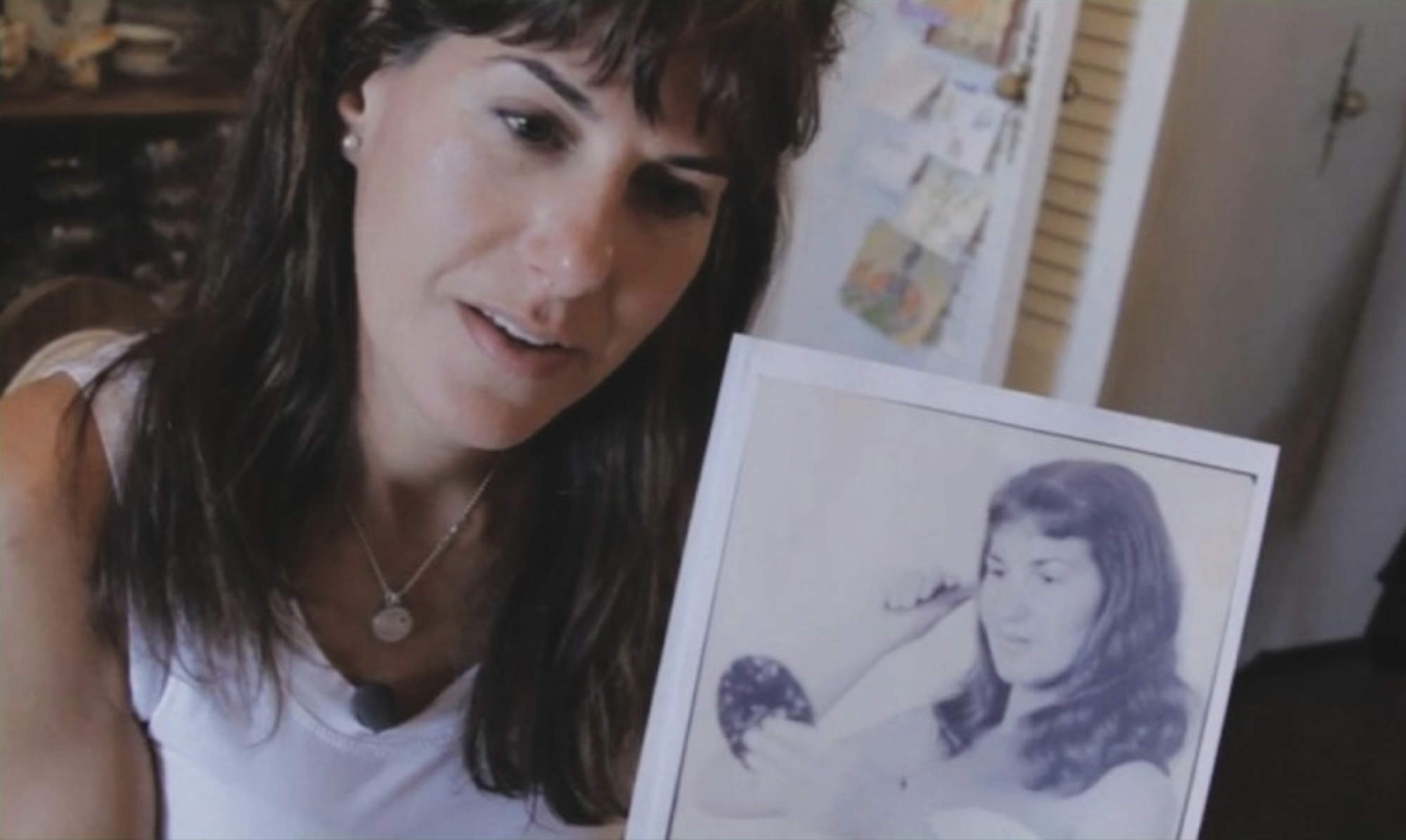
Journalist Marisa Fox holds up a photograph of her mother, Hela Hocherman, whose concealed wartime history she uncovers in ‘My Underground Mother.’ (San Francisco Jewish Film Festival)
Related Article
The majority of the film reveals the harrowing fates of thousands of Jewish girls who spent World War II imprisoned in forced-labor camps. Viewing the Holocaust from the perspectives of teen girls feels starkly revelatory, as Fox depicts how sexual violence is weaponized during war.
The final 15 minutes of My Underground Mother is an examination of Hocherman’s postwar life. She became a militant Zionist operating in Palestine with Haganah, a paramilitary organization that attacked and disrupted the British forces charged with keeping Jewish refugees out of Palestine until 1948. While Hocherman’s activities are neither held up as heroic nor vilified in the film, it also does not mention the hundreds of thousands of Palestinian people caught up in that postwar conflict and ultimately displaced by the founding of Israel. At best, this is a frustrating omission. At worst, it feels pointedly neglectful.
That’s not to say My Underground Mother isn’t worth your time. In many ways, the film’s value is born directly from its challenging subject matter.
The documentary begins with Fox’s journey into Europe to find out who her mother really was. After moving to the U.S. at the age of 30, Hocherman spent her life hiding who she had been before, using an entirely different name and even lying to her Brooklyn-born husband about her past. Hocherman’s reasons were, in Fox’s estimation, likely an attempt to conceal “how dehumanizing part of her life was.”
Related Article
Hocherman told her American family that she spent the war safe in Palestine, and that she escaped from Poland before German forces invaded. The truth, Fox discovers, is that her mother was forcibly taken from her Polish apartment building at the age of 14, separated from her family, and transported to Gabersdorf, a forced-labor camp. Hocherman remained there with hundreds of other teenage girls for four and a half years while her mother languished in Auschwitz. (Tragically, Fox’s grandmother died from typhus shortly after she was liberated.)
At Gabersdorf, Hocherman endured 12-hour work days with no breaks, in silence, under threat of severe beatings. At night, she slept in lice- and bedbug-infested barracks with 41 other girls. And as the teens aged, they came under increasingly invasive threats of sexual exploitation and violence. After Gabersdorf was finally liberated, the ever-present threat of rape remained — even from their liberators.
“We knew what it is to be a Jew,” one survivor says in the film, “but we didn’t feel it on our bodies until Hitler came.”
Hocherman’s story is relayed to Fox by friends who knew her mother, both inside Gabersdorf and outside the camp’s barbed-wire fences. Further details are revealed by historical documents, secret camp diaries, and the German women who were paid to work alongside the Gabersdorf prisoners, but forbidden to talk to them. It’s tempting in 2025 to assume we’ve heard every possible narrative about the Holocaust. My Underground Mother proves otherwise.
Hocherman’s wartime experience turned her militant. Fox learns that her mother was involved in many clandestine Haganah actions against British troops in Palestine, including blowing up trains. One interviewee tells Fox that her mother killed at least one British officer during the Zionists’ fight.
Hanna Armoni, a former member of the Lehi Underground, another Zionist group, says Hocherman once told her, “After what I saw, what the Germans did to us, how the British treated us, I wanted to fight for my country.”
“My mother’s way of rejecting shame,” Fox says, “was to reinvent herself a freedom fighter.”
Throughout, the film does not acknowledge the experience of Palestinians past or present. Viewers in 2025 may find this uncomfortable, especially as Palestinians starve and the Gaza Strip is under threat of annexation.
Though the portion of My Underground Mother that concerns Gabersdorf feels very different in tone to the chapter about Hocherman’s postwar militancy, there is one overarching theme that connects the two: Humankind is capable of incredible cruelty.
As Fox realizes everything her mother went through and concealed, the filmmaker’s raw emotions are what makes this film so compelling. “Wherever you are, Mom,” Fox says in the film, “I wish you didn’t feel you had to be alone with this.”
‘My Underground Mother’ premieres at Oakland’s Landmark Piedmont Theatre on Aug. 2, 2025 at 8:30 p.m., as part of the 45th San Francisco Jewish Film Festival.