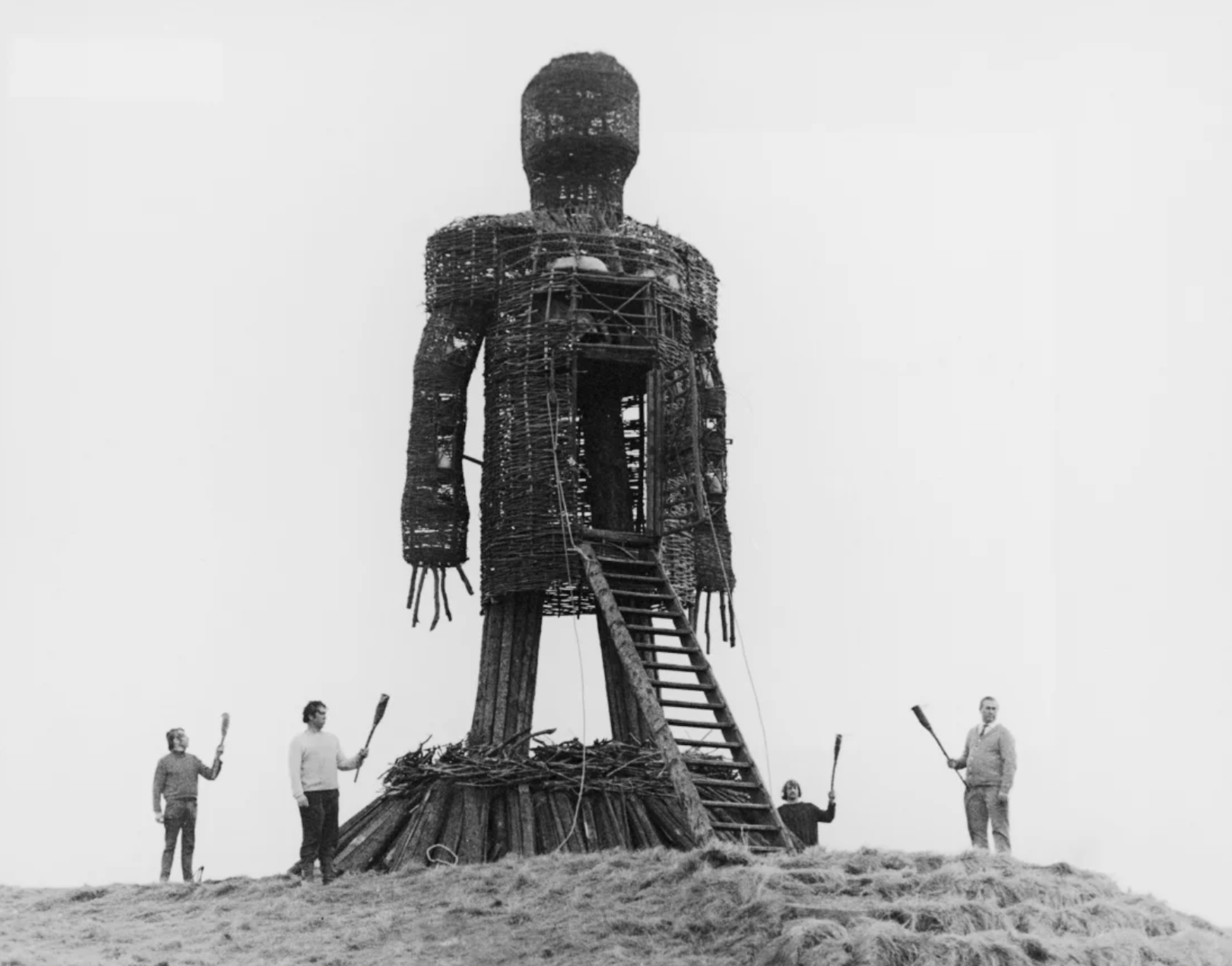
In 1973’s ‘The Wicker Man,’ British policeman (Edward Woodward) visits a remote Scottish island to find that the locals have embraced a form of paganism.It’s October. Some of your neighbors will spend this, the official first weekend of spooky season, going all-out with inflatable yard skeletons and ghosts. They will embark upon the annual attempt to make candy corn, aka high-fructose ear wax, a thing. They’ll adorn their front porches with those cotton spider webs that look nothing like real spider webs and instead just make it look like they went and ritually murdered a white sweater so they could hang its dismembered corpse across their doorway as a grisly warning to all other knitwear.
For me, it’s a more simple, elemental formula: Hot cider, cider donuts, folk horror.
The appeal of cider and donuts is universal, but folk horror might need some defining. Essentially, it’s horror set in remote, isolated areas where nature still holds sway. Well, nature paired with the superstitious beliefs of the locals, who tend to treat unwary outsiders with suspicion (if the outsiders are lucky) or malice (if they’re not).
The classic example is 1973’s The Wicker Man, in which an uptight, devout, and veddy veddy British policeman (Edward Woodward) visits a remote Scottish island to investigate the disappearance of a young girl. Turns out the locals have embraced a form of Celtic paganism, which doesn’t sit right with him. He says as much to the island’s aristocratic leader, a mysterious and charismatic sort played by Christopher Lee. Things don’t end well for our poor British bobby — though presumably the island will enjoy a bountiful harvest, so, you know: Big picture, it’s still a win.
Other founding classics of the genre include 1968’s The Witchfinder General and 1971’s The Blood on Satan’s Claws, which of the three films has the least going for it, apart from its title, which is, all reasonable people can agree, metal AF.
I love me some folk horror, and am never happier than when I can while away a damp, foggy (and thus obligingly atmospheric) October afternoon mainlining new and old examples of the form like Kill List, You Won’t Be Alone, Viv, The Ritual, Häxan, The Medium, Apostle, Midsommar, The Witch, Hereditary, Night of the Demon, A Field in England, Robin Redbreast, and Men. (Looking for more examples? Check out the documentary Woodlands Dark and Days Bewitched: A History of Folk Horror.)
Some folk horror involves supernatural elements, but I confess a particular fondness for those stories that don’t — stories where it’s the folk themselves (read: the locals, and their beliefs) who are the true and only source of the horror. (I won’t spoil which of the above films traffic in human vs. supernatural evil, in case you haven’t seen them.)
Talismans and turtlenecks
The Wicker Man was the first folk horror film I saw as a kid, which is maybe why I harbor a deep love of folk horror set in ’70s Britain, a time and place when an interest in the occult became faddish, inspiring a wave of folk horror specifically inflected with Satanic panic. Many of these films were set in the past, but those like The Wicker Man were set in the then-present, a time when men wore wavy hair and tight bell bottoms. Christopher Lee’s Lord Summerisle, for example, sported a kicky tweed leisure suit topped off by a burnt-orange sweater.
It’s why I think of this very specific subgenre of ’70s folk horror as Talismans and Turtlenecks.
I just came across a new-to-me example of T & T last Sunday afternoon, which was suitably cold and wet and misty: 1970’s The Dunwich Horror. A stiff-haired Sandra Dee, desperately attempting to shake her goody-goody image, plays a woman who falls under the sway of a young and hilariously intense, wide-eyed Dean Stockwell. (Seriously, you keep waiting for his character to blink, but instead he just keeps goggling fixedly at the world around him. At one point he makes a pot of tea, staring at it so fiercely through every stage of the process you start to wonder if he’s trying to convince it to hop into bed with him.)
Don’t get me wrong: It’s a cheesy film, filled with crummy dialogue and hammy acting and cheap sets and one fight scene so wildly inept that has to be seen to be disbelieved. I won’t reveal if the threat hanging over the film is human or supernatural (though the fact that it’s based on an H.P. Lovecraft short story should tip you off). But I will say that Stockwell sports a thick, curly hairdo, a cravat, two count-em two pinky rings, and a huge mustache that curls under itself at either end, in the process effectively turning my guy’s mouth into a parenthetical statement.
You can watch it for free, with commercials, on Pluto TV, which I swear is a real streaming service and not something I made up. The Dunwich Horror is not remotely scary, but it does have something to say, I suppose, about the madness of crowds and what, back in grad school, we used to call “othering.” (The Stockwell character is the scion of an eccentric family that the local community has shunned for generations, you see.)
And that, of course, is the abiding appeal of folk horror: It takes those universal feelings of alienation and isolation that make us all feel like outsiders in our own communities and gives them flesh. When the supernatural is involved, sometimes that flesh pulses and oozes. Sometimes it’s furry and clawed.
But whenever the story is about our collective tendency to cling to belief in the supernatural, the flesh involved is all too human, and probably gets stabbed with a sacrificial dagger in the final reel. Happy spooky season, y’all.
This piece also appeared in NPR’s Pop Culture Happy Hour newsletter. Sign up for the newsletter so you don’t miss the next one, plus get weekly recommendations about what’s making us happy.
Listen to Pop Culture Happy Hour on Apple Podcasts and Spotify.