The Museum of the African Diaspora’s Emerging Artists Program, a staple of the institution’s programming since 2015, is a rare thing in the world of Bay Area museums. It’s a generous open call that results not in massive group shows — or even group shows at all — but three-month solo shows for local artists, plus stipends. These shows remain sure-fire ways of catching talented Bay Area artists early in their ascendency.
At MoAD, ‘The Meeting Place’ Vibrates With In-Progress Energy
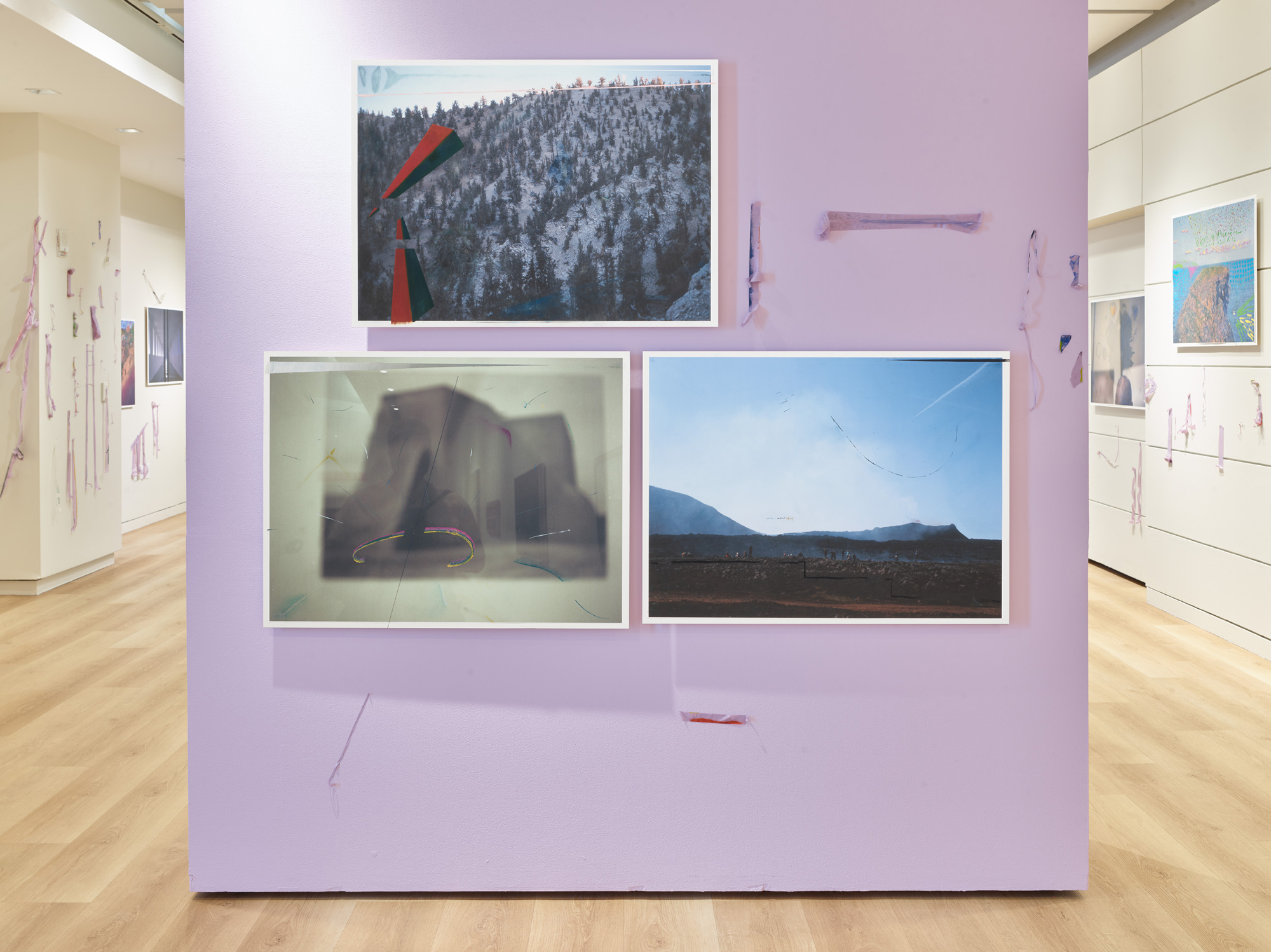
An installation view of Zekarias Musele Thompson's 'The Meeting Place' at the Museum of the African Diaspora. (Courtesy of the artist and MoAD; photos by Josef Jacques)
Related Article
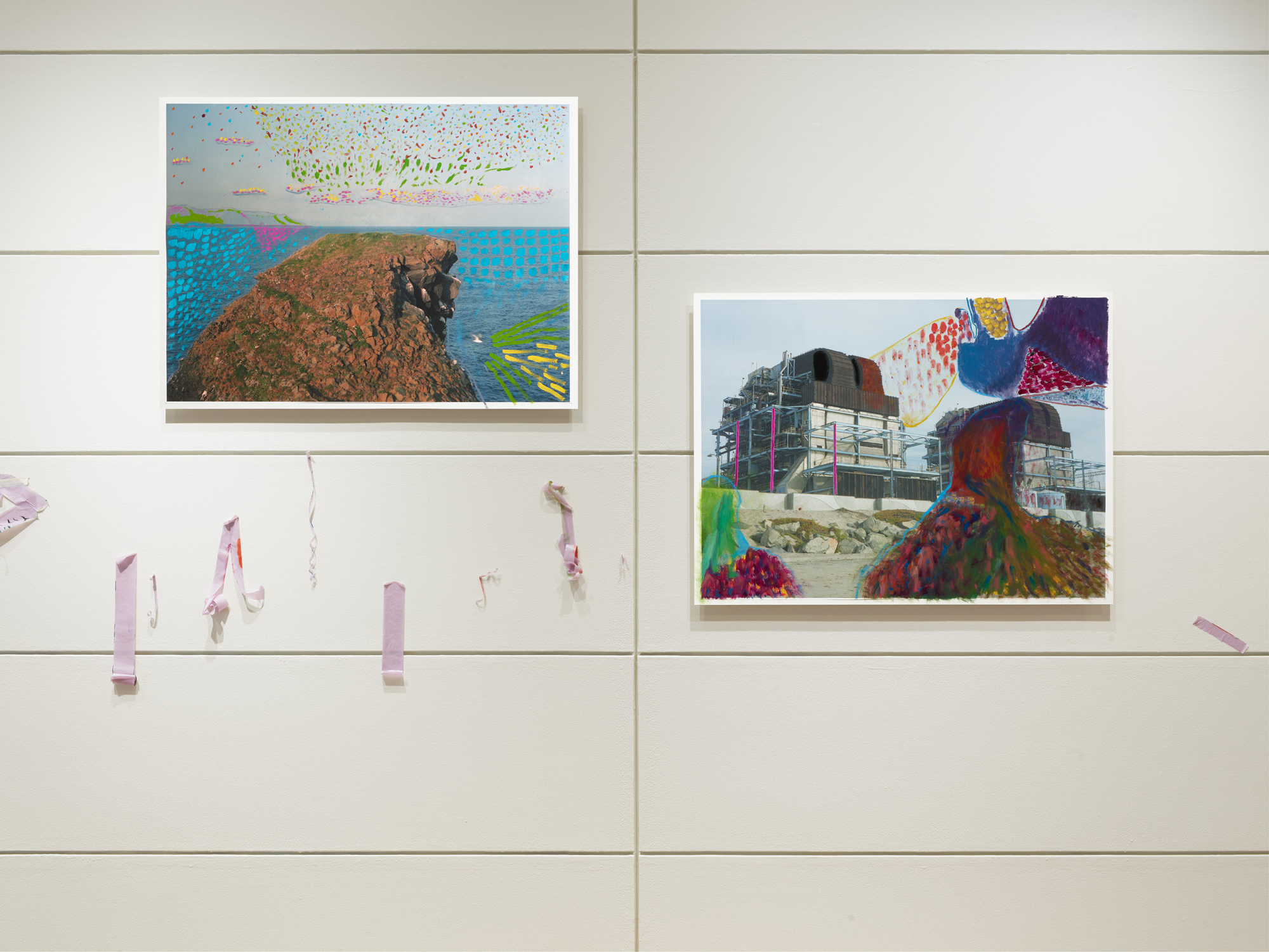
Enter Oakland artist Zekarias Musele Thompson, whose solo show The Meeting Place is on view through Sept. 1 on the museum’s second floor. This is not an overly polished, sterile exhibition, but an installation of art and music that gives the sense of being in progress, or possibly just finished. Wrapping around the gallery’s walls are oil-painted photographic prints of people in landscapes, scenes of vast spaces and repeated patterns.
Between these mounted works on paper, Thompson has placed lavender strips of painter’s tape used to mask off portions of the photographs. Like confetti or accent marks, the bits of tape dangle, twist and bend, implying that these works were made here, in MoAD’s gallery, and only recently achieved their finished state. In actuality, they’re props — tools used in the artist’s studio that have entered the gallery as a demonstration. Bringing the residue along to the big show is Thompson’s way of offering a glimpse into their process; it gives The Meeting Place a festooned feeling, an unexpected and off-kilter zing.
Complementing this tactic is the show’s sound element, which plays pleasantly over gallery speakers in a continuous loop. While scores of various lengths are meant to correspond to particular diptychs and triptychs within the gallery, the visitor experience is less defined — you hear things as you hear them, while looking where you’re looking. And what you hear (Thompson on alto sax, synthesizers, electric guitar and bass, shruti box and singing) is light and airy, with repetition marked by bright bursts of sound.
Circling the gallery and one lavender stand-alone wall, Thompson’s painted photographs range in density. Some bear the lightest of interventions, like a thin horizon line and an extra-purplish cloud. Others overflow with colorful emphasis, drawing the eye to a specific part of a landscape, or illustrating the things a photograph can’t capture: thoughts, implied emissions, invisible compositional elements.
Thompson’s approach here is freeform and improvisational. The artist responds to each image in a unique way, turning even the most blurry non-photo into a lovely something with the addition of a rainbow arc and ecstatic lines of emphasis.
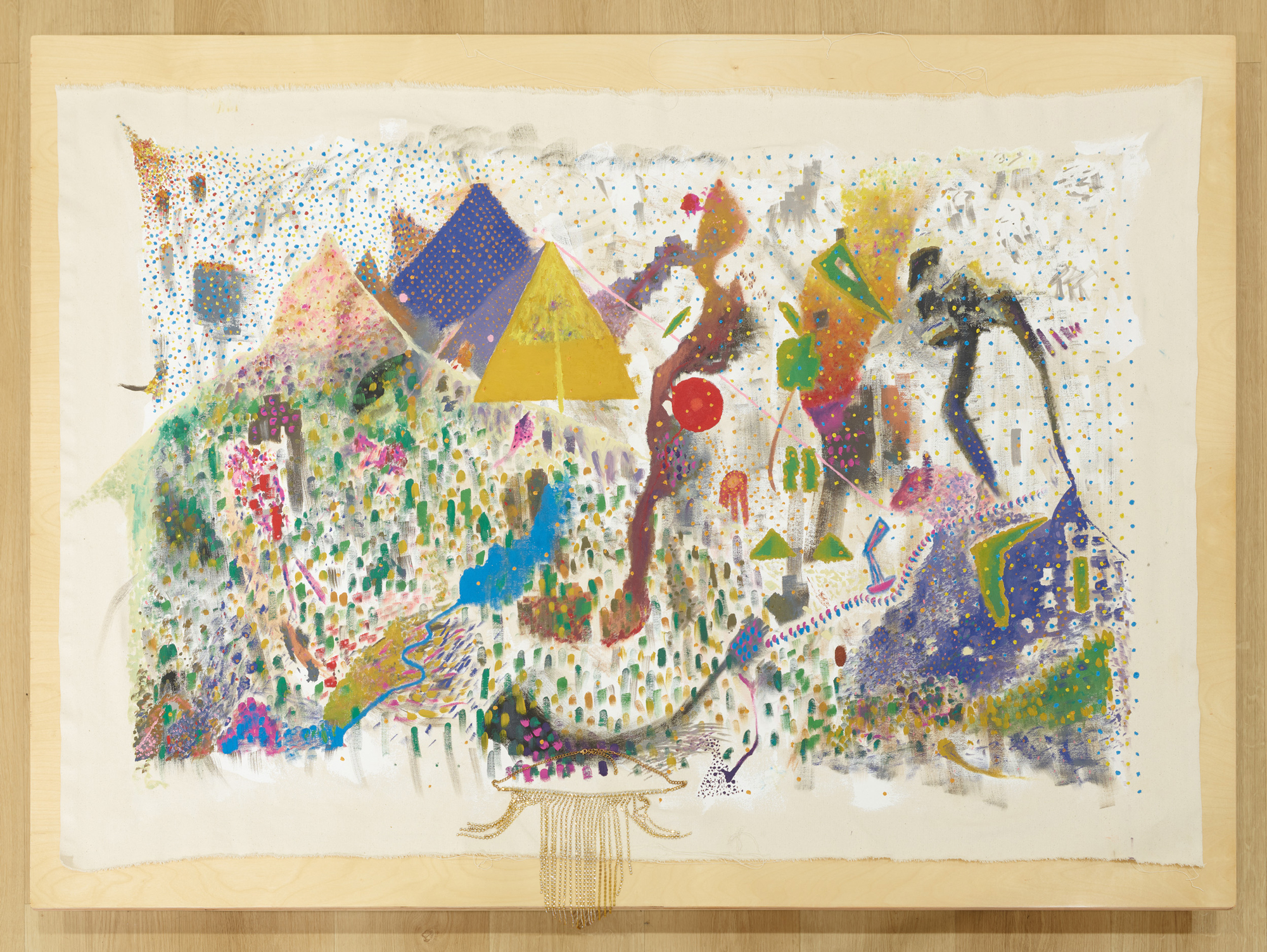
Pulling the entire exhibition together like an area rug is ad infinitum (The Meeting Place), an unstretched canvas laid flat on a low wooden pedestal at the gallery’s center. Here, all of Thompson’s painterly gestures combine. We get pointilist dots of color that coalesce into hillsides, solid purple and yellow triangles that become mountains, and streams of blue, reds and black extending vertically — water, fire, smoke? It’s a map of somewhere, possibly an imaginary place, with a bit of treasure laid across its bottom edge. A delicate gold necklace dangles over the pedestal’s brim, lightly touching the floor.
Thompson, who will graduate next year from UC Berkeley’s MFA program, is clearly onto something. Already established as a musician (they’re also the co-founder of Oakland’s Working Name Studios), at MoAD they’ve fluidly brought together what could otherwise be disparate practices. The result, a literal Meeting Place, is distinctly satisfying to visit, listen to and puzzle through.
‘The Meeting Place’ is on view at the Museum of the African Diaspora (685 Mission St., San Francisco) through Sept. 1, 2024. Zekarias Musele Thompson and an ensemble of collaborators will perform ‘the meeting place,’ followed by a conversation on Saturday, Aug. 10, 2–3:30 p.m. Find more information about the event here.