Modern life is cacophonous. Even in our most quiet spaces, there’s the hum of HVAC, the rumble of traffic or a distant, tinny voice coming through someone else’s headphones. We simply cannot escape the din of ceaseless motion, production and consumption.
Mika Rottenberg’s ‘Spaghetti Blockchain’ Pries Open Our Very Weird World
In a survey of the video artist’s recent work at the Contemporary Jewish Museum, mundane activities become delightfully strange.

Mika Rottenberg, video still from ‘Spaghetti Blockchain,’ 2019. (© Mika Rottenberg; Courtesy the artist and Hauser & Wirth)
Related Article
At the Contemporary Jewish Museum, sounds both real and fantastical waft over the gallery walls of Mika Rottenberg’s wonderfully titled exhibition, Spaghetti Blockchain. The show, which includes three looping video installations and a handful of kinetic sculptures, provides less of an escape from the everyday than a magical heightening of it. In Rottenberg’s hands, once mundane activities become hilariously, often uncomfortably, weird, underlining systems of mass production in an age of hypercapitalism.
The show opens with a bang, a crunch and a sneeze. On the museum’s second floor, an untitled video projects onto an angled wall; a hammer smashes colored light bulbs into a rainbow of glass shards. A nearby screen plays Sneeze (2012), Rottenberg’s earliest work in the CJM survey (and one of the few pieces here with any male protagonists). In it, besuited men with comically red noses achoo out live rabbits with a soft thump.
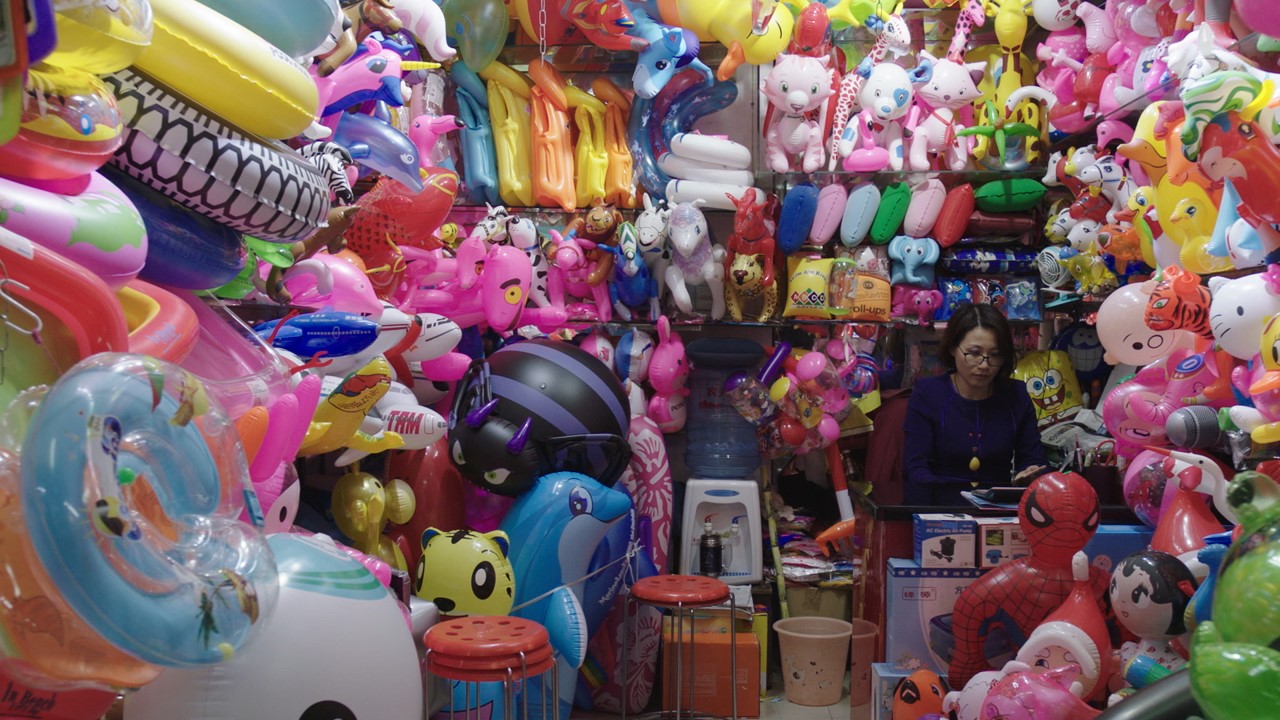
From this deadpan pairing, we get an early sense of the notes Rottenberg likes to hit: ceaseless labor and absurdist outcomes. In the exhibition’s winding arrangement, we enter Cosmic Generator (2017/2018) through a rough-hewn tunnel and a sparkly curtain. The video connects two spots on the globe through one of Rottenberg’s signature Rube-Goldberg-esque contraptions, seemingly turning geography (and physics) upside down.
One of those locales is Yiwu Market, a wholesale market complex in eastern China, where women sit among mostly plastic, often flashing wares, nearly disappearing to their overstuffed product booths. The other is Calexico and Mexicali, a symbiotic pair of cities spread across the U.S.-Mexico border.
When a string of rope lights produced in China can quickly move nearly anywhere in the world, how do people’s hours-long journeys across car-clogged borders even make sense? Rottenberg’s answer is they don’t — it’s all strange.
But she emphasizes this comparison without didacticism. Playful sound and visual effects, a rainbow-lit tunnel and a man dressed — inexplicably — in a taco costume, push Cosmic Generator into fever-dream territory, underlining that the logic overseeing the international movement of goods and people is 100% illogical.
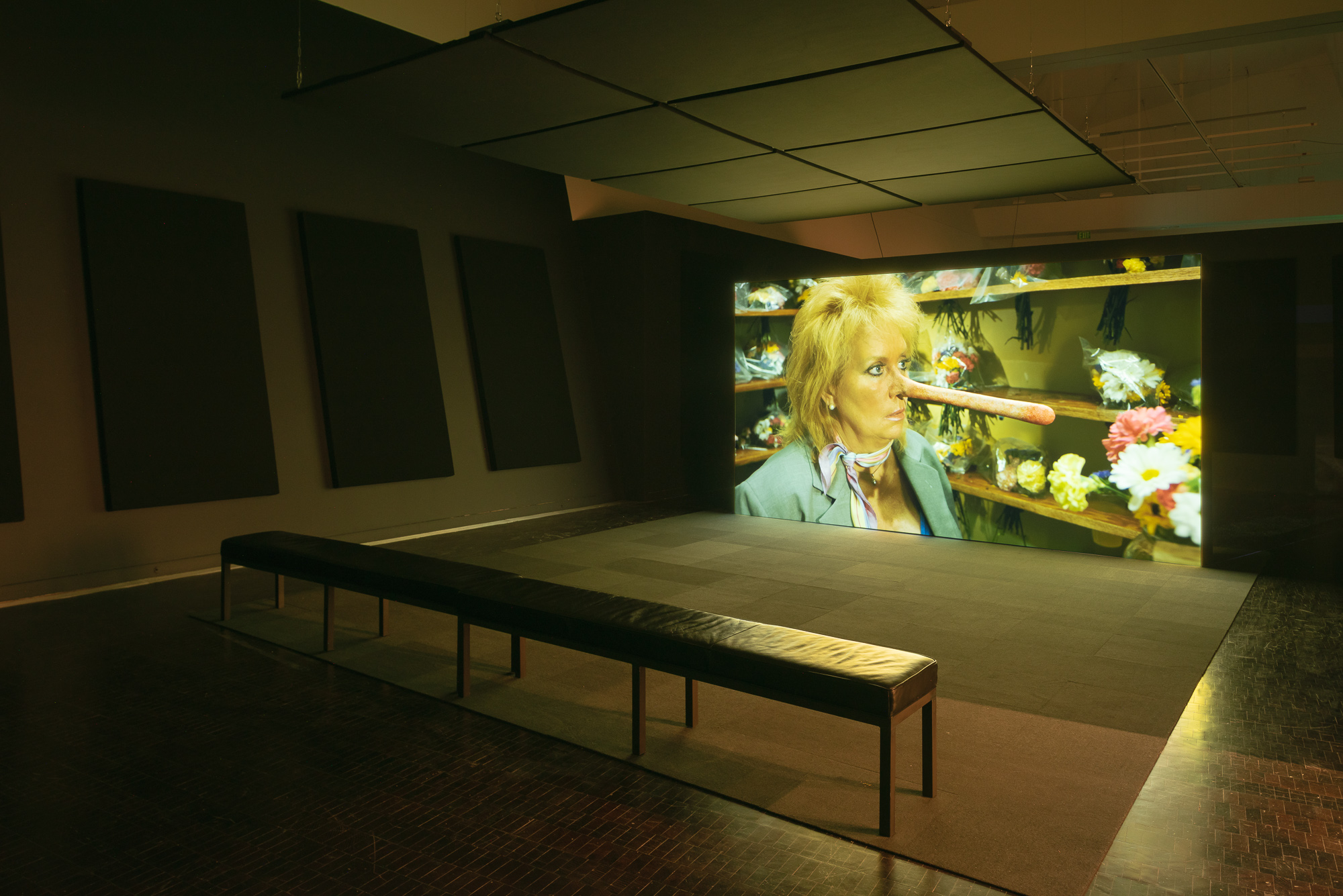
A room of those Rube Goldbergian kinetic sculptures, some available to crank and pedal, set the stage for Rottenberg’s next video, NoNoseKnows (2015). Here, the labor is less familiar and more gooey. Filmed in Zhejiang province, China, the video stars the performer Bunny Glamazon as a Western “boss” at a pearl factory, where we see workers move through both the delicate and crude steps of farming pearls. In her office, Glamazon does the inscrutable work of all managers: she sniffs various small bouquets, spritzes a pair of feet protruding from a bucket and sneezes out elaborate pasta dishes. (The stack of untouched plates creates a neat visual parallel to a scene of opened oysters tossed in a muddy pile, emptied of pearls.)
While ideas about working conditions, natural resources, overconsumption and waste are inevitable byproducts of watching the delightfully bizarre dynamics of NoNoseKnows, the video resists moral conclusions. Every consumer good has an origin story, the video posits, elaborately spinning out a complex system that is part documentary, part fantasy, a messy and tactile mix of sculptural space and cold factory.
NoNoseKnows taps into rhythms of production — whacking open oysters, rapidly sorting pearls, turning a hand-crank to create a pollen-filled breeze — and it’s these sounds that best set the stage for the exhibition’s final piece and Rottenberg’s newest work: Spaghetti Blockchain (2019).

Where the previous two videos took their inspiration from particular places and processes, Spaghetti Blockchain revels in the nowhere of the internet. Soundtracked by Tuvan throat singing and the hum of the Large Hadron Collider, the video feels epic in scope (everything is matter!) but its centerpiece is a series of ASMR-like interactions with objects. A disembodied hand smacks a gelatin cylinder, another frantically grabs at colorful magnetic balls, yet another scrapes ridges into a block of red clay.
Zooming in and out in scale, Spaghetti Blockchain connects the ASMR video-watcher’s desire for melty, crunchy, sound-producing things with a quest to understand the basic building blocks of the universe. An atomic model made from marshmallows and uncooked spaghetti is not the same as the atomic structure it depicts — but isn’t it also, kind of?
Watching cotton candy phase change into a bubbling liquid, your own body melting into a bean bag, it’s easy to accept this duality because Rottenberg makes it so visually and aurally scintillating to do so. In all the work on view, she seduces the viewer with colors, textures, improbable mechanisms and magical thinking. Her trick in the process is to pry us open, just like those oysters, and insert a tiny irritant of a question. Why does this system work this way? Why are we attracted to these things? What is our place in this weird, weird world?

‘Mika Rottenberg: Spaghetti Blockchain’ is on view at the Contemporary Jewish Museum through Oct. 22, 2023. Show details here.