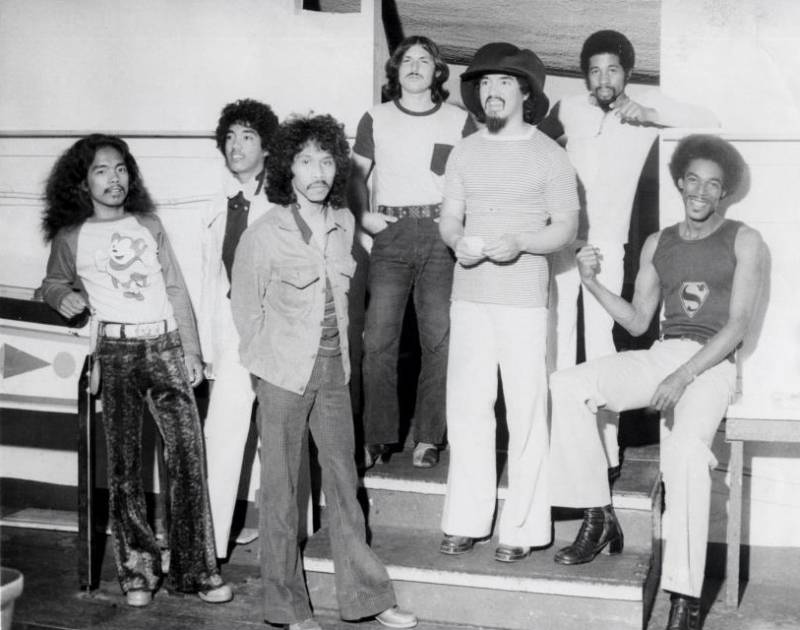
From left to right: Frank Magtoto, David Bustamante, Bert Ancheta, Carlos Bato Badia, Romeo Bustamante, Michael Gopaul and David ‘D’ Zandos. (Guerssen Records)
Dakila begins their debut album with a call to arms for the young Filipinos, Latinos, and Black kids they rubbed shoulders with as teenagers living in the Mission. “We are all brothers and sisters / Let’s work together,” they sing in Tagalog over a Latin rock groove.
“We were right in the middle of this wave of activism. I was hoping our band would encourage Filipinos to go out there and be counted,” says Dakila’s drummer Frank Magtoto, recalling his youth in the ’70s.
For a band now considered obscure, Dakila can claim some incredible achievements. After Fanny, they were the second Filipino band signed to a major label, and the first to put their Filipino identity front and center. They were the first American band to record a track in Tagalog. In their time, they were popular, playing shows for Bill Graham alongside the biggest names of their generation.
“Santana and Malo, the Pointer Sisters and Sly, and us. We practiced alongside them, we covered their songs, and we sometimes performed with them,” guitar player David Bustamante reminisces.
Along with vocalist Romeo Bustamante and conguero Carlos Badia, Frank and David were part of a crowded scene in the Mission, the Black and Brown counterpart to the San Francisco sound up in Haight-Ashbury.
“We had all these other bands around us. We felt like we had to come up with a brand of our own, in music or in identity. We’re not Latinos, we’re actually Filipinos from the Mission,” recalls David, “and, on our first record, I think we wanted to expand on that.”
Dakila is now getting the attention they have always deserved. Their debut album was reissued in Europe last year, just in time for the 50th anniversary of its release. They are the subject of a documentary coming out this year called Searchin’ For My Soul: The Dakila Story, directed by local filmmaker Paul Abueg-Igaz. And David, the youngest surviving member of the band, is preparing to take Dakila to concerts across the Bay for the first time since the pandemic started, hoping to capitalize on their newfound popularity.
In recent interviews, what he and Frank told me was simply incredible. The story of Dakila connects with the major social struggles shaking the Bay at the time, including the birth of the Asian American protest movement and the United Farm Workers’ fight for labor rights. This political consciousness animated their work — and led to what was likely the first truly Asian American rock album in music history.
The first politically Asian American album
The story of Asian immigrants and their descendants in American music is as long as the history of Asian immigration itself. Every moment in American music history had their representative: Jazz had Japanese American pianist Toshiko Akiyoshi, for example, and early rock ’n’ roll had Filipino four-piece The Rocky Fellers. They certainly broke barriers for Asians in American pop culture, but these forerunners generally lacked an explicitly political, pan-continental self-image; after all, they existed before the term “Asian American” was even coined. That broader political identity only came into being in 1968, when graduate students Yuji Ichioka and Emma Gee coined the term to unify activists at UC Berkeley.
Yellow Pearl’s folk album A Grain of Sand, released independently in 1973, is usually cited as the first consciously Asian American album by music critics, thanks to its radical lyrics and pan-Asian philosophy. But perhaps this judgment reflects a pattern, all too common in Asian American studies, of overlooking the achievements of Filipinos. In fact, Dakila’s self-titled came out a year earlier than Yellow Pearl’s work, in 1972, and clearly expresses an Asian American consciousness, down to the decision to sing proudly in Tagalog.
Dakila wanted their music to represent Asian Americans, and they made several radical choices to support that movement. On their debut album’s promotional tour, they played for Asian American student groups in campuses across the West Coast. They also performed benefit concerts to fundraise for Cesar Chavez as part of the oft-forgotten Filipino contingent of the United Farm Workers movement.
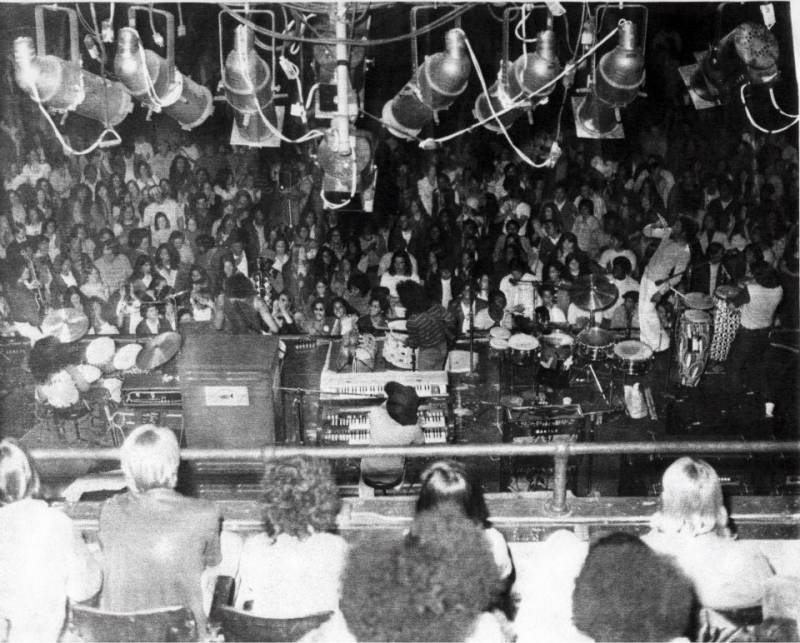
Dakila perform at the Winterland Ballroom in San Francisco in 1972. (Guerssen Records)
The first track on their album nods to their involvement in local activism; it includes the slogan “Makibaka,” Tagalog for “struggle,” in its lyrics.
“Makibaka was a protest chant that was happening here in the U.S.,” says Frank, who had never spoken about Dakila in the press prior to our interview. “Filipinos were using that when they were protesting our colleges, our government.”
Dakila’s background probably contributed to their prescient activist turn. The band’s history is intimately connected with the issues that animated the ’70s generation of Filipino American activists: the American occupation of the Philippines, the Vietnam War and the search for a uniquely Fil-Am identity.
Dakila’s rise to fame
Every Filipino member of Dakila has family ties to the military bases that dot the Bay, the legacy of a government program that granted citizenship to those who served in the Army or Navy during the American occupation of the Philippines. For the Bustamante brothers, Romeo and David, as well as their cousin Frank, the rhythms of military life defined their childhood. Their dads’ army band music was the soundtrack of those years, but once they caught the Beatlemania bug as teenagers, they ditched it for the electric sound of rock’n’roll.
David and Romeo got their start rocking out for the school crowds of Vallejo, while Frank did the same over in the Mission, where they respectively grew up. But they didn’t get together and try to make it big until many years later, after Romeo got back from his Vietnam War conscription in Germany with an itch to make a change in his life.
David, who was younger than Romeo by almost a decade, was still a senior in high school when his older brother informed him of his plans. “Romeo wanted to form a band because when Santana came out in ’69, he fell in love with that music,” says David. “He had moved to the Mission and his tastes had changed — before that we were playing R&B and funk for school crowds. So he told me that when I got out of high school, I should go play with him in San Francisco.”
Romeo assembled a talented, multiracial group of musicians for his band, including the Ancheta cousins, two Filipino guitarists who went on to found the first Asian American hard rock band Golden Dragon, and Michael Gopaul, Romeo’s brother-in-law who was also a timbales player.
“One of our original members was Raul Rekow,” David says, referring to Santana’s longtime conga drummer. “He actually got his start with us before he joined Santana.” In the final lineup, though, Rekow was replaced by another conguero, Carlos Badia.
They quickly attained prominence in the Mission’s Latin rock scene, then the focus of intense major label interest after the success of bands like Santana and Malo.
“Three record companies approached us and wanted to give us a record deal,” recalls David. “We were in a bidding war with our friends in Malo, but they ended up signed to Warner Brothers while we went with Epic.”
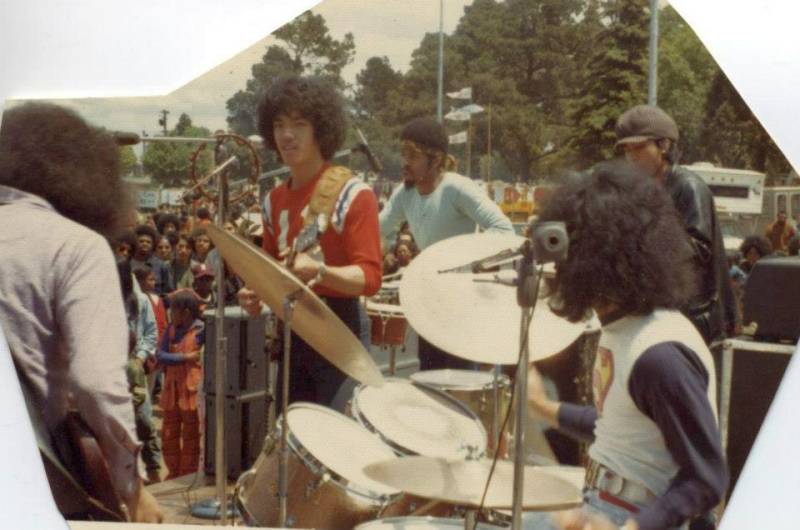
Dakila live in the ’70s. (Guerssen Records)
At the time, the band performed under the name Soul Sacrifice — but Romeo felt like they should change their name to something that stood out, something perhaps in Tagalog, their first language. Romeo’s dad was the one who proposed the winning name Dakila, Tagalog for “great.” It put the band’s Filipino heritage front and center, and had another appeal as well.
“It kind of sounded like ‘tequila,’” says Frank, laughing. “And that wasn’t a bad thing for a band to be associated with.”
Dakila tries for the big leagues
Dakila was up to this point a live band, and this was their first time in a record studio. “We practiced every day so we don’t waste any studio time,” says David. “We played like ten original songs for them, which the producers cut and spliced into six tracks on the album.”
David is still disgruntled by the producers’ edits, which the band had no say in. “They were like, you’re done recording, you guys come back in the week. Meanwhile, they sped things up and played things backwards and did studio tricks. When we finally heard it, we thought it didn’t sound like us.”
The meddling didn’t end with their production. For unknown reasons, Epic decided to release Dakila’s first single, the patchouli-tinged instrumental “El Dùbi,” with a comedic spoken word A-side called “Language Lessons,” created without the band’s involvement.
“I didn’t know why [Epic] had to do this language thing,” says Frank with irritation. The spoken word piece posed as an instruction manual for DJs struggling to pronounce Dakila’s Tagalog song titles, but this was just an elaborate set-up for racist jokes about Filipino people (“small but wiry”) and the Tagalog language.
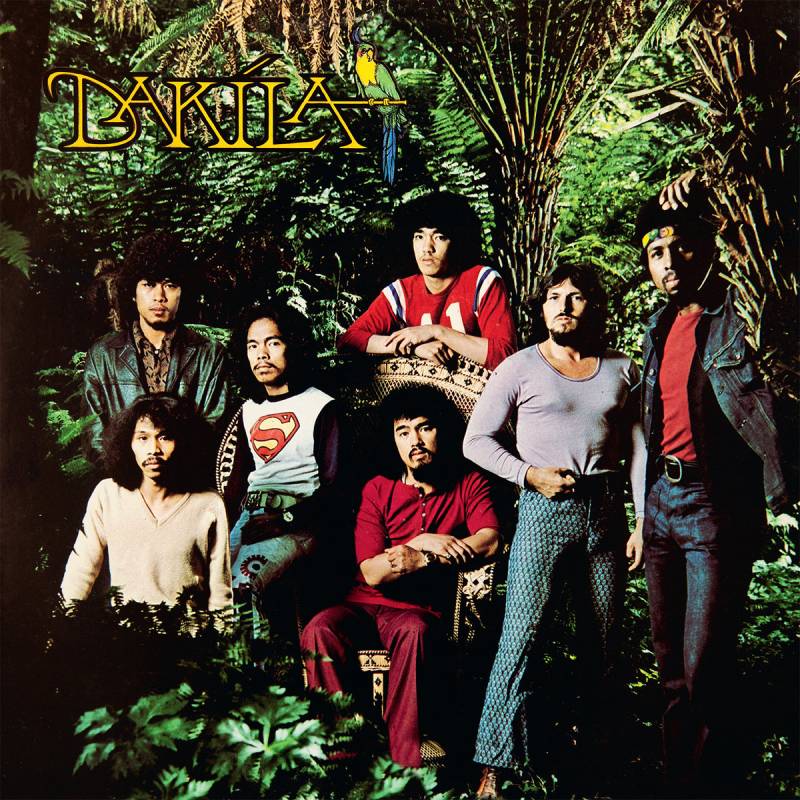
The cover of Dakila’s self-titled debut album, shot by Herb Greene in Golden Gate Park.
Nevertheless, there was one thing about the release the band did have control over: the album cover. Shot by Herb Greene in Golden Gate Park, it features the band members arrayed around a large, round wicker chair, an omnipresent feature of album covers in the ’70s.
“We borrowed that chair from Mabuhay [Gardens] – it was a Filipino restaurant before it became a punk venue, you know,” says Frank. “A lot of people didn’t know this when it was trendy in the ’70s, but it was a Filipino chair, with Filipino origins.”
The “peacock” chair, as it is sometimes called, was first built by Filipino prisoners forced into manufacturing goods for American export during the country’s occupation by the United States. The band’s reclamation of that chair was also a reclamation of that history. In their image and in their music, Filipinos were now speaking back to their former colonizers.
Related Articles
Epic Records, though, didn’t know how to promote a proudly Filipino American band. After making a last ditch effort to boost sales by touring the band through Asian American hotspots in California and Hawaii, Epic quietly dropped the band and scrapped their in-progress second album.
“In the band, there was a lot of dissatisfaction with the way things were going,” says Frank. “Not just about the label, but also the band. Members were getting restless, saying we’re not making it because of you, because of this.”
“I decided to leave,” says David. “I thought, if this wasn’t going to work out, I’d rather go back to school and get a degree in something that will get me money.”
David wasn’t alone in thinking this way: The rest of Dakila called it quits a year after they left Epic.
The band breaks up, but they aren’t forgotten
Carlos Badia and Michael Gopaul left the music industry and disappeared from their bandmates’ lives after Dakila broke up, while the Ancheta cousins moved on to their other band, Golden Dragon. Frank worked his way up from a floor job at a company warehouse to becoming a programmer for that company, all without a degree, while David went to school for nursing and got a job at John Muir Health, in Concord.
While they got on with their lives, the band had no idea that their music was still out there, circulating in bootlegged copies in Europe, Asia and South America.
“A while ago, some people started telling me that my old band had been up on YouTube for a couple years now,” says David. “I was like, ‘I don’t know.’ I wasn’t on the internet back then. I guess there are some underground people, a younger generation, who like our music. I started looking it up, and wow, people were selling us on eBay. Cassettes. CDs. Eight tracks!”
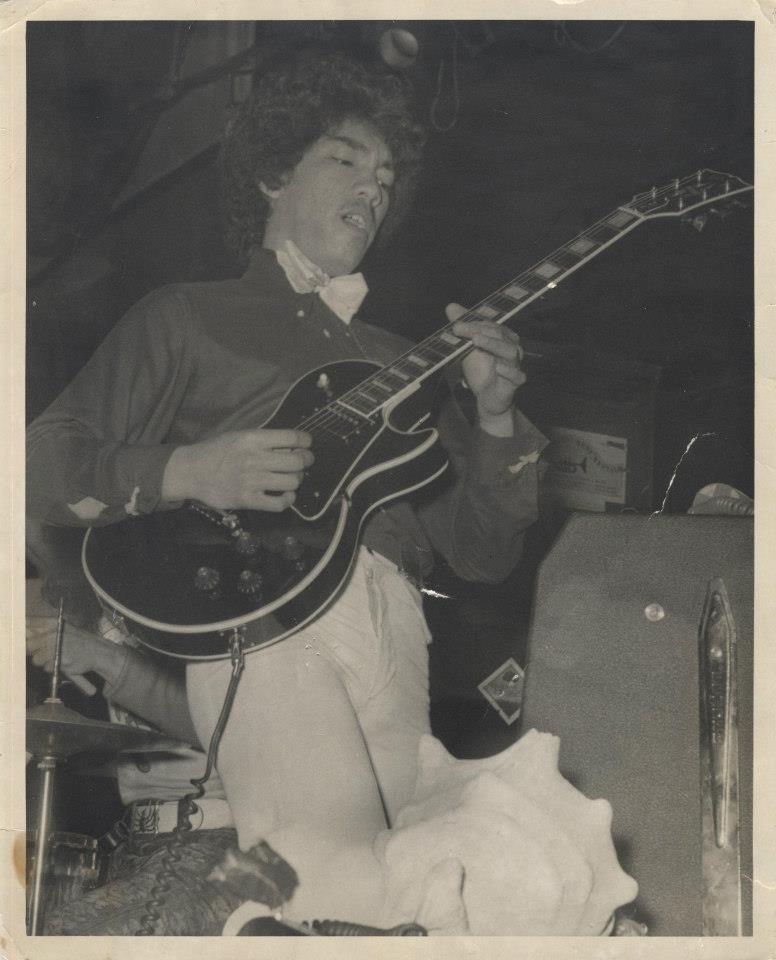
David Bustamante at a 1973 Dakila Concert at Winterland in San Francisco, where the band performed with Malo and Buddy Miles. (Guerssen Records)
David, now retired from his job, dedicates his time to preserving the legacy of Dakila. He tried to iron out the ownership rights from Epic Records, copyrighted Dakila’s logo and, most importantly, got the band back together.
“David started calling all the band members who were still around for a concert called Voices of Latin Rock,” says Frank. “The promoter of the event wanted to get all the groups that used to play in the ’70s, and he knew Dakila from way back when.”
What was supposed to be a one-off reunion turned into multiple event appearances throughout the Bay. The reunion began with David, Romeo, Frank and a new crop of Filipino musicians playing Dakila’s back catalog, but eventually Romeo and Frank decided to retire. Now, David, a full-time musician again, is the only one keeping Dakila alive, performing both their released music and tracks off their scrapped album that never saw the light of day.
Last year, for their album’s 50th anniversary, the newly reunited band partnered with Spain’s Guerssen Records to put out the only official reissue of Dakila. And David finally got his revenge on the producers: “I asked them to digitally slow the tempo down on some tracks to reflect how we wanted it,” David says. “It’s not perfect, but it’s better in my ears.”
As for the rest of the living members, they’re all appearing in the forthcoming documentary on the band, Searchin’ For My Soul, which takes its title from the final track on their album.
“Michael wrote that one,” muses David. “It’s really about searching for your identity, you know? A lot of our music is about speaking up and showing who you are. We were one of a kind; you weren’t seeing people like us on the main stage, or on movies, or TV. Now it’s common. We have a lot of Filipino artists, like H.E.R. What we were trying to say back then is becoming reality today.”
window.__IS_SSR__=true
window.__INITIAL_STATE__={
"attachmentsReducer": {
"audio_0": {
"type": "attachments",
"id": "audio_0",
"imgSizes": {
"kqedFullSize": {
"file": "https://ww2.kqed.org/news/wp-content/themes/KQED-unified/img/audio_bgs/background0.jpg"
}
}
},
"audio_1": {
"type": "attachments",
"id": "audio_1",
"imgSizes": {
"kqedFullSize": {
"file": "https://ww2.kqed.org/news/wp-content/themes/KQED-unified/img/audio_bgs/background1.jpg"
}
}
},
"audio_2": {
"type": "attachments",
"id": "audio_2",
"imgSizes": {
"kqedFullSize": {
"file": "https://ww2.kqed.org/news/wp-content/themes/KQED-unified/img/audio_bgs/background2.jpg"
}
}
},
"audio_3": {
"type": "attachments",
"id": "audio_3",
"imgSizes": {
"kqedFullSize": {
"file": "https://ww2.kqed.org/news/wp-content/themes/KQED-unified/img/audio_bgs/background3.jpg"
}
}
},
"audio_4": {
"type": "attachments",
"id": "audio_4",
"imgSizes": {
"kqedFullSize": {
"file": "https://ww2.kqed.org/news/wp-content/themes/KQED-unified/img/audio_bgs/background4.jpg"
}
}
},
"placeholder": {
"type": "attachments",
"id": "placeholder",
"imgSizes": {
"thumbnail": {
"file": "https://cdn.kqed.org/wp-content/uploads/2024/12/KQED-Default-Image-816638274-2000x1333-1-160x107.jpg",
"width": 160,
"height": 107,
"mimeType": "image/jpeg"
},
"medium": {
"file": "https://cdn.kqed.org/wp-content/uploads/2024/12/KQED-Default-Image-816638274-2000x1333-1-800x533.jpg",
"width": 800,
"height": 533,
"mimeType": "image/jpeg"
},
"medium_large": {
"file": "https://cdn.kqed.org/wp-content/uploads/2024/12/KQED-Default-Image-816638274-2000x1333-1-768x512.jpg",
"width": 768,
"height": 512,
"mimeType": "image/jpeg"
},
"large": {
"file": "https://cdn.kqed.org/wp-content/uploads/2024/12/KQED-Default-Image-816638274-2000x1333-1-1020x680.jpg",
"width": 1020,
"height": 680,
"mimeType": "image/jpeg"
},
"1536x1536": {
"file": "https://cdn.kqed.org/wp-content/uploads/2024/12/KQED-Default-Image-816638274-2000x1333-1-1536x1024.jpg",
"width": 1536,
"height": 1024,
"mimeType": "image/jpeg"
},
"fd-lrg": {
"file": "https://cdn.kqed.org/wp-content/uploads/2024/12/KQED-Default-Image-816638274-2000x1333-1-1536x1024.jpg",
"width": 1536,
"height": 1024,
"mimeType": "image/jpeg"
},
"fd-med": {
"file": "https://cdn.kqed.org/wp-content/uploads/2024/12/KQED-Default-Image-816638274-2000x1333-1-1020x680.jpg",
"width": 1020,
"height": 680,
"mimeType": "image/jpeg"
},
"fd-sm": {
"file": "https://cdn.kqed.org/wp-content/uploads/2024/12/KQED-Default-Image-816638274-2000x1333-1-800x533.jpg",
"width": 800,
"height": 533,
"mimeType": "image/jpeg"
},
"post-thumbnail": {
"file": "https://cdn.kqed.org/wp-content/uploads/2024/12/KQED-Default-Image-816638274-2000x1333-1-672x372.jpg",
"width": 672,
"height": 372,
"mimeType": "image/jpeg"
},
"twentyfourteen-full-width": {
"file": "https://cdn.kqed.org/wp-content/uploads/2024/12/KQED-Default-Image-816638274-2000x1333-1-1038x576.jpg",
"width": 1038,
"height": 576,
"mimeType": "image/jpeg"
},
"xxsmall": {
"file": "https://cdn.kqed.org/wp-content/uploads/2024/12/KQED-Default-Image-816638274-2000x1333-1-160x107.jpg",
"width": 160,
"height": 107,
"mimeType": "image/jpeg"
},
"xsmall": {
"file": "https://cdn.kqed.org/wp-content/uploads/2024/12/KQED-Default-Image-816638274-2000x1333-1-672x372.jpg",
"width": 672,
"height": 372,
"mimeType": "image/jpeg"
},
"small": {
"file": "https://cdn.kqed.org/wp-content/uploads/2024/12/KQED-Default-Image-816638274-2000x1333-1-672x372.jpg",
"width": 672,
"height": 372,
"mimeType": "image/jpeg"
},
"xlarge": {
"file": "https://cdn.kqed.org/wp-content/uploads/2024/12/KQED-Default-Image-816638274-2000x1333-1-1020x680.jpg",
"width": 1020,
"height": 680,
"mimeType": "image/jpeg"
},
"full-width": {
"file": "https://cdn.kqed.org/wp-content/uploads/2024/12/KQED-Default-Image-816638274-2000x1333-1-1920x1280.jpg",
"width": 1920,
"height": 1280,
"mimeType": "image/jpeg"
},
"guest-author-32": {
"file": "https://cdn.kqed.org/wp-content/uploads/2025/01/KQED-Default-Image-816638274-1333x1333-1-160x160.jpg",
"width": 32,
"height": 32,
"mimeType": "image/jpeg"
},
"guest-author-50": {
"file": "https://cdn.kqed.org/wp-content/uploads/2025/01/KQED-Default-Image-816638274-1333x1333-1-160x160.jpg",
"width": 50,
"height": 50,
"mimeType": "image/jpeg"
},
"guest-author-64": {
"file": "https://cdn.kqed.org/wp-content/uploads/2025/01/KQED-Default-Image-816638274-1333x1333-1-160x160.jpg",
"width": 64,
"height": 64,
"mimeType": "image/jpeg"
},
"guest-author-96": {
"file": "https://cdn.kqed.org/wp-content/uploads/2025/01/KQED-Default-Image-816638274-1333x1333-1-160x160.jpg",
"width": 96,
"height": 96,
"mimeType": "image/jpeg"
},
"guest-author-128": {
"file": "https://cdn.kqed.org/wp-content/uploads/2025/01/KQED-Default-Image-816638274-1333x1333-1-160x160.jpg",
"width": 128,
"height": 128,
"mimeType": "image/jpeg"
},
"detail": {
"file": "https://cdn.kqed.org/wp-content/uploads/2025/01/KQED-Default-Image-816638274-1333x1333-1-160x160.jpg",
"width": 160,
"height": 160,
"mimeType": "image/jpeg"
},
"kqedFullSize": {
"file": "https://cdn.kqed.org/wp-content/uploads/2024/12/KQED-Default-Image-816638274-2000x1333-1.jpg",
"width": 2000,
"height": 1333
}
}
},
"arts_13926506": {
"type": "attachments",
"id": "arts_13926506",
"meta": {
"index": "attachments_1716263798",
"site": "arts",
"id": "13926506",
"found": true
},
"parent": 13926503,
"imgSizes": {
"thumbnail": {
"file": "https://ww2.kqed.org/app/uploads/sites/2/2023/03/From-left-to-right-Frank-Magtoto-David-Bustamante-Bert-Ancheta-Carlos-Bato-Badia-Rome-Bustamante-Michael-Gopaul-David-DZandos-cropped-160x90.jpg",
"width": 160,
"mimeType": "image/jpeg",
"height": 90
},
"post-thumbnail": {
"file": "https://ww2.kqed.org/app/uploads/sites/2/2023/03/From-left-to-right-Frank-Magtoto-David-Bustamante-Bert-Ancheta-Carlos-Bato-Badia-Rome-Bustamante-Michael-Gopaul-David-DZandos-cropped-672x372.jpg",
"width": 672,
"mimeType": "image/jpeg",
"height": 372
},
"kqedFullSize": {
"file": "https://ww2.kqed.org/app/uploads/sites/2/2023/03/From-left-to-right-Frank-Magtoto-David-Bustamante-Bert-Ancheta-Carlos-Bato-Badia-Rome-Bustamante-Michael-Gopaul-David-DZandos-cropped.jpg",
"width": 813,
"height": 457
},
"medium": {
"file": "https://ww2.kqed.org/app/uploads/sites/2/2023/03/From-left-to-right-Frank-Magtoto-David-Bustamante-Bert-Ancheta-Carlos-Bato-Badia-Rome-Bustamante-Michael-Gopaul-David-DZandos-cropped-800x450.jpg",
"width": 800,
"mimeType": "image/jpeg",
"height": 450
},
"medium_large": {
"file": "https://ww2.kqed.org/app/uploads/sites/2/2023/03/From-left-to-right-Frank-Magtoto-David-Bustamante-Bert-Ancheta-Carlos-Bato-Badia-Rome-Bustamante-Michael-Gopaul-David-DZandos-cropped-768x432.jpg",
"width": 768,
"mimeType": "image/jpeg",
"height": 432
}
},
"publishDate": 1679331425,
"modified": 1679332436,
"caption": "From left to right: Frank Magtoto, David Bustamante, Bert Ancheta, Carlos Bato Badia, Romeo Bustamante, Michael Gopaul and David DZandos.",
"description": null,
"title": "From left to right Frank Magtoto, David Bustamante, Bert Ancheta, Carlos Bato Badia, Rome Bustamante, Michael Gopaul, David DZandos-cropped",
"credit": "Guerssen Records",
"status": "inherit",
"altTag": null,
"isLoading": false,
"fetchFailed": false
}
},
"audioPlayerReducer": {
"postId": "stream_live",
"isPaused": true,
"isPlaying": false,
"pfsActive": false,
"pledgeModalIsOpen": true,
"playerDrawerIsOpen": false,
"liveAudioPlayStartedAt": 0,
"liveAudioPlayContext": ""
},
"authorsReducer": {
"athapliyal": {
"type": "authors",
"id": "11766",
"meta": {
"index": "authors_1716337520",
"id": "11766",
"found": true
},
"name": "Adesh Thapliyal",
"firstName": "Adesh",
"lastName": "Thapliyal",
"slug": "athapliyal",
"email": "athapliyal@kqed.org",
"display_author_email": false,
"staff_mastheads": [],
"title": "KQED Contributor",
"bio": "Adesh Thapliyal is KQED Arts' Editorial Intern. Previously, he wrote for the experimental newsletter \u003cem>Tone Glow\u003c/em> and the pop music blog \u003cem>The Singles Jukebox\u003c/em>.",
"avatar": "https://secure.gravatar.com/avatar/25c945182616a5283c4f746e7017bca3?s=600&d=blank&r=g",
"twitter": null,
"facebook": null,
"instagram": null,
"linkedin": null,
"sites": [
{
"site": "arts",
"roles": [
"author"
]
}
],
"headData": {
"title": "Adesh Thapliyal | KQED",
"description": "KQED Contributor",
"ogImgSrc": "https://secure.gravatar.com/avatar/25c945182616a5283c4f746e7017bca3?s=600&d=blank&r=g",
"twImgSrc": "https://secure.gravatar.com/avatar/25c945182616a5283c4f746e7017bca3?s=600&d=blank&r=g"
},
"isLoading": false,
"link": "/author/athapliyal"
}
},
"pagesReducer": {},
"pfsSessionReducer": {},
"postsReducer": {
"stream_live": {
"type": "live",
"id": "stream_live",
"audioUrl": "https://streams.kqed.org/kqedradio",
"title": "Live Stream",
"excerpt": "Live Stream information currently unavailable.",
"link": "/radio",
"featImg": "",
"label": {
"name": "KQED Live",
"link": "/"
}
},
"stream_kqedNewscast": {
"type": "posts",
"id": "stream_kqedNewscast",
"audioUrl": "https://www.kqed.org/.stream/anon/radio/RDnews/newscast.mp3?_=1",
"title": "KQED Newscast",
"featImg": "",
"label": {
"name": "88.5 FM",
"link": "/"
}
},
"arts_13926503": {
"type": "posts",
"id": "arts_13926503",
"meta": {
"index": "posts_1716263798",
"site": "arts",
"id": "13926503",
"found": true
},
"articlePosition": 0,
"parent": 0,
"labelTerm": {
"site": "arts"
},
"blocks": [],
"publishDate": 1679338588,
"format": "aside",
"title": "How Filipinos in the Mission Recorded the First Asian American Rock Album",
"headTitle": "How Filipinos in the Mission Recorded the First Asian American Rock Album | KQED",
"content": "\u003cfigure id=\"attachment_13926505\" class=\"wp-caption aligncenter\" style=\"max-width: 800px\">\u003cimg loading=\"lazy\" decoding=\"async\" class=\"size-medium wp-image-13926505\" src=\"https://ww2.kqed.org/app/uploads/sites/2/2023/03/From-left-to-right-Frank-Magtoto-David-Bustamante-Bert-Ancheta-Carlos-Bato-Badia-Rome-Bustamante-Michael-Gopaul-David-DZandos-1-800x630.jpg\" alt=\"\" width=\"800\" height=\"630\" srcset=\"https://cdn.kqed.org/wp-content/uploads/sites/2/2023/03/From-left-to-right-Frank-Magtoto-David-Bustamante-Bert-Ancheta-Carlos-Bato-Badia-Rome-Bustamante-Michael-Gopaul-David-DZandos-1-800x630.jpg 800w, https://cdn.kqed.org/wp-content/uploads/sites/2/2023/03/From-left-to-right-Frank-Magtoto-David-Bustamante-Bert-Ancheta-Carlos-Bato-Badia-Rome-Bustamante-Michael-Gopaul-David-DZandos-1-160x126.jpg 160w, https://cdn.kqed.org/wp-content/uploads/sites/2/2023/03/From-left-to-right-Frank-Magtoto-David-Bustamante-Bert-Ancheta-Carlos-Bato-Badia-Rome-Bustamante-Michael-Gopaul-David-DZandos-1-768x605.jpg 768w, https://cdn.kqed.org/wp-content/uploads/sites/2/2023/03/From-left-to-right-Frank-Magtoto-David-Bustamante-Bert-Ancheta-Carlos-Bato-Badia-Rome-Bustamante-Michael-Gopaul-David-DZandos-1.jpg 813w\" sizes=\"(max-width: 800px) 100vw, 800px\">\u003cfigcaption class=\"wp-caption-text\">From left to right: Frank Magtoto, David Bustamante, Bert Ancheta, Carlos Bato Badia, Romeo Bustamante, Michael Gopaul and David ‘D’ Zandos. \u003ccite>(Guerssen Records)\u003c/cite>\u003c/figcaption>\u003c/figure>\n\u003cp>Dakila begins their debut album with a call to arms for the young Filipinos, Latinos, and Black kids they rubbed shoulders with as teenagers living in the Mission. “We are all brothers and sisters / Let’s work together,” they sing in Tagalog over a Latin rock groove.\u003c/p>\n\u003cp>“We were right in the middle of this wave of activism. I was hoping our band would encourage Filipinos to go out there and be counted,” says Dakila’s drummer Frank Magtoto, recalling his youth in the ’70s.\u003c/p>\n\u003cp>For a band now considered obscure, Dakila can claim some incredible achievements. After Fanny, they were the second Filipino band signed to a major label, and the first to put their Filipino identity front and center. They were the first American band to record a track in Tagalog. In their time, they were popular, playing shows for Bill Graham alongside the biggest names of their generation.\u003c/p>\n\u003cp>“Santana and Malo, the Pointer Sisters and Sly, and us. We practiced alongside them, we covered their songs, and we sometimes performed with them,” guitar player David Bustamante reminisces.\u003c/p>\n\u003cp>Along with vocalist Romeo Bustamante and conguero Carlos Badia, Frank and David were part of a crowded scene in the Mission, the Black and Brown counterpart to the San Francisco sound up in Haight-Ashbury.\u003c/p>\n\u003cp>[ad fullwidth]\u003c/p>\n\u003cp>“We had all these other bands around us. We felt like we had to come up with a brand of our own, in music or in identity. We’re not Latinos, we’re actually Filipinos from the Mission,” recalls David, “and, on our first record, I think we wanted to expand on that.”\u003c/p>\n\u003cp>\u003c!-- iframe plugin v.4.3 wordpress.org/plugins/iframe/ -->\u003cbr>\n\u003ciframe loading=\"lazy\" style=\"border: 0; width: 100%; height: 120px;\" src=\"https://bandcamp.com/EmbeddedPlayer/album=868204738/size=large/bgcol=ffffff/linkcol=0687f5/tracklist=false/artwork=small/transparent=true/\" width=\"100%\" height=\"500\" scrolling=\"yes\" class=\"iframe-class\" frameborder=\"0\">\u003c/iframe>\u003c/p>\n\u003cp>Dakila is now getting the attention they have always deserved. Their debut album was reissued in Europe last year, just in time for the 50th anniversary of its release. They are the subject of a \u003ca href=\"https://www.facebook.com/dakilamovie/\">documentary\u003c/a> coming out this year called \u003ca href=\"https://www.dakilamovie.com/\">\u003cem>Searchin’ For My Soul: The Dakila Story\u003c/em>\u003c/a>, directed by local filmmaker Paul Abueg-Igaz. And David, the youngest surviving member of the band, is preparing to take Dakila to concerts across the Bay for the first time since the pandemic started, hoping to capitalize on their newfound popularity.\u003c/p>\n\u003cp>In recent interviews, what he and Frank told me was simply incredible. The story of Dakila connects with the major social struggles shaking the Bay at the time, including the birth of the Asian American protest movement and the United Farm Workers’ fight for labor rights. This political consciousness animated their work — and led to what was likely the first truly Asian American rock album in music history.\u003c/p>\n\u003ch2>The first politically Asian American album\u003c/h2>\n\u003cp>The story of Asian immigrants and their descendants in American music is as long as the history of Asian immigration itself. Every moment in American music history had their representative: Jazz had Japanese American pianist Toshiko Akiyoshi, for example, and early rock ’n’ roll had Filipino four-piece The Rocky Fellers. They certainly broke barriers for Asians in American pop culture, but these forerunners generally lacked an explicitly political, pan-continental self-image; after all, they existed before the term “Asian American” was even coined. That broader political identity only came into being in 1968, when graduate students \u003ca href=\"https://time.com/5837805/asian-american-history/\">Yuji Ichioka and Emma Gee coined the term\u003c/a> to unify activists at UC Berkeley.\u003c/p>\n\u003cp>Yellow Pearl’s folk album \u003cem>A Grain of Sand\u003c/em>, released independently in 1973, is usually cited as the first consciously Asian American album by music critics, thanks to its radical lyrics and pan-Asian philosophy. But perhaps this judgment reflects a pattern, all too common in Asian American studies, of overlooking the achievements of Filipinos. In fact, Dakila’s self-titled came out a year earlier than Yellow Pearl’s work, in 1972, and clearly expresses an Asian American consciousness, down to the decision to sing proudly in Tagalog.\u003c/p>\n\u003cp>Dakila wanted their music to represent Asian Americans, and they made several radical choices to support that movement. On their debut album’s promotional tour, they played for Asian American student groups in campuses across the West Coast. They also performed benefit concerts to fundraise for Cesar Chavez as part of the oft-forgotten Filipino contingent of the United Farm Workers movement.\u003c/p>\n\u003cfigure id=\"attachment_13926507\" class=\"wp-caption aligncenter\" style=\"max-width: 800px\">\u003cimg loading=\"lazy\" decoding=\"async\" class=\"size-medium wp-image-13926507\" src=\"https://ww2.kqed.org/app/uploads/sites/2/2023/03/WINTERLAND-SF-1972-800x643.jpg\" alt=\"An overhead shot of Dakila performing in front of a large club crowd. \" width=\"800\" height=\"643\" srcset=\"https://cdn.kqed.org/wp-content/uploads/sites/2/2023/03/WINTERLAND-SF-1972-800x643.jpg 800w, https://cdn.kqed.org/wp-content/uploads/sites/2/2023/03/WINTERLAND-SF-1972-160x129.jpg 160w, https://cdn.kqed.org/wp-content/uploads/sites/2/2023/03/WINTERLAND-SF-1972-768x618.jpg 768w, https://cdn.kqed.org/wp-content/uploads/sites/2/2023/03/WINTERLAND-SF-1972.jpg 960w\" sizes=\"(max-width: 800px) 100vw, 800px\">\u003cfigcaption class=\"wp-caption-text\">Dakila perform at the Winterland Ballroom in San Francisco in 1972. \u003ccite>(Guerssen Records)\u003c/cite>\u003c/figcaption>\u003c/figure>\n\u003cp>The first track on their album nods to their involvement in local activism; it includes the slogan “Makibaka,” Tagalog for “struggle,” in its lyrics.\u003c/p>\n\u003cp>“Makibaka was a protest chant that was happening here in the U.S.,” says Frank, who had never spoken about Dakila in the press prior to our interview. “Filipinos were using that when they were protesting our colleges, our government.”\u003c/p>\n\u003cp>Dakila’s background probably contributed to their prescient activist turn. The band’s history is intimately connected with the issues that animated the ’70s generation of Filipino American activists: the American occupation of the Philippines, the Vietnam War and the search for a uniquely Fil-Am identity.\u003c/p>\n\u003ch2>Dakila’s rise to fame\u003c/h2>\n\u003cp>Every Filipino member of Dakila has family ties to the military bases that dot the Bay, the legacy of a government program that granted citizenship to those who served in the Army or Navy during the American occupation of the Philippines. For the Bustamante brothers, Romeo and David, as well as their cousin Frank, the rhythms of military life defined their childhood. Their dads’ army band music was the soundtrack of those years, but once they caught the Beatlemania bug as teenagers, they ditched it for the electric sound of rock’n’roll.\u003c/p>\n\u003cp>David and Romeo got their start rocking out for the school crowds of Vallejo, while Frank did the same over in the Mission, where they respectively grew up. But they didn’t get together and try to make it big until many years later, after Romeo got back from his Vietnam War conscription in Germany with an itch to make a change in his life.\u003c/p>\n\u003cp>David, who was younger than Romeo by almost a decade, was still a senior in high school when his older brother informed him of his plans. “Romeo wanted to form a band because when Santana came out in ’69, he fell in love with that music,” says David. “He had moved to the Mission and his tastes had changed — before that we were playing R&B and funk for school crowds. So he told me that when I got out of high school, I should go play with him in San Francisco.”\u003c/p>\n\u003cp>Romeo assembled a talented, multiracial group of musicians for his band, including the Ancheta cousins, two Filipino guitarists who went on to found the first Asian American hard rock band \u003ca href=\"https://goldendragonband.bandcamp.com/album/golden-dragon\">Golden Dragon\u003c/a>, and Michael Gopaul, Romeo’s brother-in-law who was also a timbales player.\u003c/p>\n\u003cp>“One of our original members was Raul Rekow,” David says, referring to Santana’s longtime conga drummer. “He actually got his start with us before he joined Santana.” In the final lineup, though, Rekow was replaced by another conguero, Carlos Badia.\u003c/p>\n\u003cp>They quickly attained prominence in the Mission’s Latin rock scene, then the focus of intense major label interest after the success of bands like Santana and Malo.\u003c/p>\n\u003cp>“Three record companies approached us and wanted to give us a record deal,” recalls David. “We were in a bidding war with our friends in Malo, but they ended up signed to Warner Brothers while we went with Epic.”\u003c/p>\n\u003cfigure id=\"attachment_13926508\" class=\"wp-caption aligncenter\" style=\"max-width: 800px\">\u003cimg loading=\"lazy\" decoding=\"async\" class=\"size-medium wp-image-13926508\" src=\"https://ww2.kqed.org/app/uploads/sites/2/2023/03/20615_462202417150574_1324443240_n-800x530.jpg\" alt=\"A photo of Dakila rocking out on an outdoor festival stage. \" width=\"800\" height=\"530\" srcset=\"https://cdn.kqed.org/wp-content/uploads/sites/2/2023/03/20615_462202417150574_1324443240_n-800x530.jpg 800w, https://cdn.kqed.org/wp-content/uploads/sites/2/2023/03/20615_462202417150574_1324443240_n-160x106.jpg 160w, https://cdn.kqed.org/wp-content/uploads/sites/2/2023/03/20615_462202417150574_1324443240_n-768x509.jpg 768w, https://cdn.kqed.org/wp-content/uploads/sites/2/2023/03/20615_462202417150574_1324443240_n.jpg 960w\" sizes=\"(max-width: 800px) 100vw, 800px\">\u003cfigcaption class=\"wp-caption-text\">Dakila live in the ’70s. \u003ccite>(Guerssen Records)\u003c/cite>\u003c/figcaption>\u003c/figure>\n\u003cp>At the time, the band performed under the name Soul Sacrifice — but Romeo felt like they should change their name to something that stood out, something perhaps in Tagalog, their first language. Romeo’s dad was the one who proposed the winning name Dakila, Tagalog for “great.” It put the band’s Filipino heritage front and center, and had another appeal as well.\u003c/p>\n\u003cp>“It kind of sounded like \u003cspan style=\"font-weight: 400\">‘\u003c/span>tequila,’” says Frank, laughing. “And that wasn’t a bad thing for a band to be associated with.”\u003c/p>\n\u003ch2>Dakila tries for the big leagues\u003c/h2>\n\u003cp>Dakila was up to this point a live band, and this was their first time in a record studio. “We practiced every day so we don’t waste any studio time,” says David. “We played like ten original songs for them, which the producers cut and spliced into six tracks on the album.”\u003c/p>\n\u003cp>David is still disgruntled by the producers’ edits, which the band had no say in. “They were like, you’re done recording, you guys come back in the week. Meanwhile, they sped things up and played things backwards and did studio tricks. When we finally heard it, we thought it didn’t sound like us.”\u003c/p>\n\u003cp>The meddling didn’t end with their production. For unknown reasons, Epic decided to release Dakila’s first single, the patchouli-tinged instrumental “El Dùbi,” with a comedic spoken word A-side called “\u003ca href=\"https://www.youtube.com/watch?v=ag1Lg1eTrdI\">Language Lessons\u003c/a>,” created without the band’s involvement.\u003c/p>\n\u003cp>“I didn’t know why [Epic] had to do this language thing,” says Frank with irritation. The spoken word piece posed as an instruction manual for DJs struggling to pronounce Dakila’s Tagalog song titles, but this was just an elaborate set-up for racist jokes about Filipino people (“small but wiry”) and the Tagalog language.\u003c/p>\n\u003cfigure id=\"attachment_13926522\" class=\"wp-caption aligncenter\" style=\"max-width: 800px\">\u003cimg loading=\"lazy\" decoding=\"async\" class=\"size-medium wp-image-13926522\" src=\"https://ww2.kqed.org/app/uploads/sites/2/2023/03/dakila-album-cover-800x800.jpg\" alt=\"The members of Dakila pose around a wicker chair, surrounded by trees. \" width=\"800\" height=\"800\" srcset=\"https://cdn.kqed.org/wp-content/uploads/sites/2/2023/03/dakila-album-cover-800x800.jpg 800w, https://cdn.kqed.org/wp-content/uploads/sites/2/2023/03/dakila-album-cover-1020x1020.jpg 1020w, https://cdn.kqed.org/wp-content/uploads/sites/2/2023/03/dakila-album-cover-160x160.jpg 160w, https://cdn.kqed.org/wp-content/uploads/sites/2/2023/03/dakila-album-cover-768x768.jpg 768w, https://cdn.kqed.org/wp-content/uploads/sites/2/2023/03/dakila-album-cover.jpg 1200w\" sizes=\"(max-width: 800px) 100vw, 800px\">\u003cfigcaption class=\"wp-caption-text\">The cover of Dakila’s self-titled debut album, shot by Herb Greene in Golden Gate Park.\u003c/figcaption>\u003c/figure>\n\u003cp>Nevertheless, there was one thing about the release the band did have control over: the album cover. Shot by \u003ca href=\"https://www.herbgreenefoto.com/\">Herb Greene\u003c/a> in Golden Gate Park, it features the band members arrayed around a large, round wicker chair, an \u003ca href=\"https://www.youtube.com/watch?v=_V10kWLh71U\">omnipresent feature of album covers in the ’70s\u003c/a>.\u003c/p>\n\u003cp>“We borrowed that chair from \u003ca href=\"https://en.wikipedia.org/wiki/Mabuhay_Gardens\">Mabuhay [Gardens]\u003c/a> – it was a Filipino restaurant before it became a punk venue, you know,” says Frank. “A lot of people didn’t know this when it was trendy in the ’70s, but it was a Filipino chair, with Filipino origins.”\u003c/p>\n\u003cp>The “peacock” chair, as it is sometimes called, was first built by Filipino prisoners forced into manufacturing goods for American export during the country’s occupation by the United States. The band’s reclamation of that chair was also a reclamation of that history. In their image and in their music, Filipinos were now speaking back to their former colonizers. [aside postid='arts_13924042,arts_13905208,news_11943512']\u003c/p>\n\u003cp>Epic Records, though, didn’t know how to promote a proudly Filipino American band. After making a last ditch effort to boost sales by touring the band through Asian American hotspots in California and Hawaii, Epic quietly dropped the band and scrapped their in-progress second album.\u003c/p>\n\u003cp>“In the band, there was a lot of dissatisfaction with the way things were going,” says Frank. “Not just about the label, but also the band. Members were getting restless, saying we’re not making it because of you, because of this.”\u003c/p>\n\u003cp>“I decided to leave,” says David. “I thought, if this wasn’t going to work out, I’d rather go back to school and get a degree in something that will get me money.”\u003c/p>\n\u003cp>David wasn’t alone in thinking this way: The rest of Dakila called it quits a year after they left Epic.\u003c/p>\n\u003ch2>The band breaks up, but they aren’t forgotten\u003c/h2>\n\u003cp>Carlos Badia and Michael Gopaul left the music industry and disappeared from their bandmates’ lives after Dakila broke up, while the Ancheta cousins moved on to their other band, Golden Dragon. Frank worked his way up from a floor job at a company warehouse to becoming a programmer for that company, all without a degree, while David went to school for nursing and got a job at John Muir Health, in Concord.\u003c/p>\n\u003cp>While they got on with their lives, the band had no idea that their music was still out there, circulating in bootlegged copies in Europe, Asia and South America.\u003c/p>\n\u003cp>“A while ago, some people started telling me that my old band had been up on YouTube for a couple years now,” says David. “I was like, \u003cspan style=\"font-weight: 400\">‘\u003c/span>I don’t know.’ I wasn’t on the internet back then. I guess there are some underground people, a younger generation, who like our music. I started looking it up, and wow, people were selling us on eBay. Cassettes. CDs. Eight tracks!”\u003c/p>\n\u003cfigure id=\"attachment_13926509\" class=\"wp-caption alignright\" style=\"max-width: 776px\">\u003cimg loading=\"lazy\" decoding=\"async\" class=\"size-full wp-image-13926509\" src=\"https://ww2.kqed.org/app/uploads/sites/2/2023/03/David-Bustamante-in-Dakila-SF-Winterland-with-Malo-and-Buddy-Miles-Band.-1973..jpg\" alt=\"David Bustamante plays a guitar solo with great concentration.\" width=\"776\" height=\"960\" srcset=\"https://cdn.kqed.org/wp-content/uploads/sites/2/2023/03/David-Bustamante-in-Dakila-SF-Winterland-with-Malo-and-Buddy-Miles-Band.-1973..jpg 776w, https://cdn.kqed.org/wp-content/uploads/sites/2/2023/03/David-Bustamante-in-Dakila-SF-Winterland-with-Malo-and-Buddy-Miles-Band.-1973.-160x198.jpg 160w, https://cdn.kqed.org/wp-content/uploads/sites/2/2023/03/David-Bustamante-in-Dakila-SF-Winterland-with-Malo-and-Buddy-Miles-Band.-1973.-768x950.jpg 768w\" sizes=\"(max-width: 776px) 100vw, 776px\">\u003cfigcaption class=\"wp-caption-text\">David Bustamante at a 1973 Dakila Concert at Winterland in San Francisco, where the band performed with Malo and Buddy Miles. \u003ccite>(Guerssen Records)\u003c/cite>\u003c/figcaption>\u003c/figure>\n\u003cp>David, now retired from his job, dedicates his time to preserving the legacy of Dakila. He tried to iron out the ownership rights from Epic Records, copyrighted Dakila’s logo and, most importantly, got the band back together.\u003c/p>\n\u003cp>“David started calling all the band members who were still around for a concert called Voices of Latin Rock,” says Frank. “The promoter of the event wanted to get all the groups that used to play in the ’70s, and he knew Dakila from way back when.”\u003c/p>\n\u003cp>What was supposed to be a one-off reunion turned into multiple event appearances throughout the Bay. The reunion began with David, Romeo, Frank and a new crop of Filipino musicians playing Dakila’s back catalog, but eventually Romeo and Frank decided to retire. Now, David, a full-time musician again, is the only one keeping Dakila alive, performing both their released music and tracks off their scrapped album that never saw the light of day.\u003c/p>\n\u003cp>Last year, for their album’s 50th anniversary, the newly reunited band partnered with Spain’s \u003ca href=\"https://guerssen.com/\">Guerssen Records\u003c/a> to put out the only official reissue of \u003cem>Dakila\u003c/em>. And David finally got his revenge on the producers: “I asked them to digitally slow the tempo down on some tracks to reflect how we wanted it,” David says. “It’s not perfect, but it’s better in my ears.”\u003c/p>\n\u003cp>As for the rest of the living members, they’re all appearing in the forthcoming documentary on the band, \u003cem>Searchin’ For My Soul\u003c/em>, which takes its title from the final track on their album.\u003c/p>\n\u003cp>“Michael wrote that one,” muses David. “It’s really about searching for your identity, you know? A lot of our music is about speaking up and showing who you are. We were one of a kind; you weren’t seeing people like us on the main stage, or on movies, or TV. Now it’s common. We have a lot of Filipino artists, like H.E.R. What we were trying to say back then is becoming reality today.”\u003c/p>\n\u003cp>\u003cimg loading=\"lazy\" decoding=\"async\" class=\"aligncenter size-medium wp-image-12127869\" src=\"https://ww2.kqed.org/app/uploads/sites/2/2016/09/Q.Logo_.Break_-800x78.jpg\" alt=\"\" width=\"800\" height=\"78\" srcset=\"https://cdn.kqed.org/wp-content/uploads/sites/2/2016/09/Q.Logo_.Break_.jpg 800w, https://cdn.kqed.org/wp-content/uploads/sites/2/2016/09/Q.Logo_.Break_-400x39.jpg 400w, https://cdn.kqed.org/wp-content/uploads/sites/2/2016/09/Q.Logo_.Break_-768x75.jpg 768w\" sizes=\"(max-width: 800px) 100vw, 800px\">\u003c/p>\n\u003cp>[ad floatright]\u003c/p>\n\u003cp>\u003cem>For Dakila concert announcements and updates on their upcoming documentary, follow \u003ca href=\"https://www.instagram.com/dakilaband/\">David Bustamante \u003c/a>and the \u003c/em>\u003ca href=\"https://www.instagram.com/dakilamovie/\">Searchin’ for My Soul\u003c/a>\u003cem> film on Instagram. \u003c/em>\u003c/p>\n\n",
"stats": {
"hasVideo": false,
"hasChartOrMap": true,
"hasAudio": false,
"hasPolis": false,
"wordCount": 2604,
"hasGoogleForm": false,
"hasGallery": false,
"hasHearkenModule": false,
"iframeSrcs": [
"https://bandcamp.com/EmbeddedPlayer/album=868204738/size=large/bgcol=ffffff/linkcol=0687f5/tracklist=false/artwork=small/transparent=true/"
],
"paragraphCount": 48
},
"modified": 1705005722,
"excerpt": "A new generation is discovering Dakila, who found fame in the early '70s while proudly singing in Tagalog.",
"headData": {
"twImgId": "",
"twTitle": "",
"ogTitle": "",
"ogImgId": "",
"twDescription": "",
"description": "A new generation is discovering Dakila, who found fame in the early '70s while proudly singing in Tagalog.",
"title": "How Filipinos in the Mission Recorded the First Asian American Rock Album | KQED",
"ogDescription": "",
"schema": {
"@context": "https://schema.org",
"@type": "Article",
"headline": "How Filipinos in the Mission Recorded the First Asian American Rock Album",
"datePublished": "2023-03-20T11:56:28-07:00",
"dateModified": "2024-01-11T12:42:02-08:00",
"image": "https://cdn.kqed.org/wp-content/uploads/2020/02/KQED-OG-Image@1x.png",
"author": {
"@type": "Person",
"name": "Adesh Thapliyal",
"jobTitle": "KQED Contributor",
"url": "https://www.kqed.org/author/athapliyal"
}
},
"authorsData": [],
"tagData": []
},
"guestAuthors": [],
"slug": "dakila-guerssen-records-asian-american-filipino-rock-history-san-francisco",
"status": "publish",
"templateType": "standard",
"excludeFromSiteSearch": "Include",
"featuredImageType": "standard",
"sticky": false,
"articleAge": "0",
"path": "/arts/13926503/dakila-guerssen-records-asian-american-filipino-rock-history-san-francisco",
"audioTrackLength": null,
"parsedContent": [
{
"type": "contentString",
"content": "\u003cdiv class=\"post-body\">\u003cp>\u003cfigure id=\"attachment_13926505\" class=\"wp-caption aligncenter\" style=\"max-width: 800px\">\u003cimg loading=\"lazy\" decoding=\"async\" class=\"size-medium wp-image-13926505\" src=\"https://ww2.kqed.org/app/uploads/sites/2/2023/03/From-left-to-right-Frank-Magtoto-David-Bustamante-Bert-Ancheta-Carlos-Bato-Badia-Rome-Bustamante-Michael-Gopaul-David-DZandos-1-800x630.jpg\" alt=\"\" width=\"800\" height=\"630\" srcset=\"https://cdn.kqed.org/wp-content/uploads/sites/2/2023/03/From-left-to-right-Frank-Magtoto-David-Bustamante-Bert-Ancheta-Carlos-Bato-Badia-Rome-Bustamante-Michael-Gopaul-David-DZandos-1-800x630.jpg 800w, https://cdn.kqed.org/wp-content/uploads/sites/2/2023/03/From-left-to-right-Frank-Magtoto-David-Bustamante-Bert-Ancheta-Carlos-Bato-Badia-Rome-Bustamante-Michael-Gopaul-David-DZandos-1-160x126.jpg 160w, https://cdn.kqed.org/wp-content/uploads/sites/2/2023/03/From-left-to-right-Frank-Magtoto-David-Bustamante-Bert-Ancheta-Carlos-Bato-Badia-Rome-Bustamante-Michael-Gopaul-David-DZandos-1-768x605.jpg 768w, https://cdn.kqed.org/wp-content/uploads/sites/2/2023/03/From-left-to-right-Frank-Magtoto-David-Bustamante-Bert-Ancheta-Carlos-Bato-Badia-Rome-Bustamante-Michael-Gopaul-David-DZandos-1.jpg 813w\" sizes=\"(max-width: 800px) 100vw, 800px\">\u003cfigcaption class=\"wp-caption-text\">From left to right: Frank Magtoto, David Bustamante, Bert Ancheta, Carlos Bato Badia, Romeo Bustamante, Michael Gopaul and David ‘D’ Zandos. \u003ccite>(Guerssen Records)\u003c/cite>\u003c/figcaption>\u003c/figure>\n\u003cp>Dakila begins their debut album with a call to arms for the young Filipinos, Latinos, and Black kids they rubbed shoulders with as teenagers living in the Mission. “We are all brothers and sisters / Let’s work together,” they sing in Tagalog over a Latin rock groove.\u003c/p>\n\u003cp>“We were right in the middle of this wave of activism. I was hoping our band would encourage Filipinos to go out there and be counted,” says Dakila’s drummer Frank Magtoto, recalling his youth in the ’70s.\u003c/p>\n\u003cp>For a band now considered obscure, Dakila can claim some incredible achievements. After Fanny, they were the second Filipino band signed to a major label, and the first to put their Filipino identity front and center. They were the first American band to record a track in Tagalog. In their time, they were popular, playing shows for Bill Graham alongside the biggest names of their generation.\u003c/p>\n\u003cp>“Santana and Malo, the Pointer Sisters and Sly, and us. We practiced alongside them, we covered their songs, and we sometimes performed with them,” guitar player David Bustamante reminisces.\u003c/p>\n\u003cp>Along with vocalist Romeo Bustamante and conguero Carlos Badia, Frank and David were part of a crowded scene in the Mission, the Black and Brown counterpart to the San Francisco sound up in Haight-Ashbury.\u003c/p>\n\u003cp>\u003c/p>\u003c/div>",
"attributes": {
"named": {},
"numeric": []
}
},
{
"type": "component",
"content": "",
"name": "ad",
"attributes": {
"named": {
"label": "fullwidth"
},
"numeric": [
"fullwidth"
]
}
},
{
"type": "contentString",
"content": "\u003cdiv class=\"post-body\">\u003cp>\u003c/p>\n\u003cp>“We had all these other bands around us. We felt like we had to come up with a brand of our own, in music or in identity. We’re not Latinos, we’re actually Filipinos from the Mission,” recalls David, “and, on our first record, I think we wanted to expand on that.”\u003c/p>\n\u003cp>\u003c!-- iframe plugin v.4.3 wordpress.org/plugins/iframe/ -->\u003cbr>\n\u003ciframe loading=\"lazy\" style=\"border: 0; width: 100%; height: 120px;\" src=\"https://bandcamp.com/EmbeddedPlayer/album=868204738/size=large/bgcol=ffffff/linkcol=0687f5/tracklist=false/artwork=small/transparent=true/\" width=\"100%\" height=\"500\" scrolling=\"yes\" class=\"iframe-class\" frameborder=\"0\">\u003c/iframe>\u003c/p>\n\u003cp>Dakila is now getting the attention they have always deserved. Their debut album was reissued in Europe last year, just in time for the 50th anniversary of its release. They are the subject of a \u003ca href=\"https://www.facebook.com/dakilamovie/\">documentary\u003c/a> coming out this year called \u003ca href=\"https://www.dakilamovie.com/\">\u003cem>Searchin’ For My Soul: The Dakila Story\u003c/em>\u003c/a>, directed by local filmmaker Paul Abueg-Igaz. And David, the youngest surviving member of the band, is preparing to take Dakila to concerts across the Bay for the first time since the pandemic started, hoping to capitalize on their newfound popularity.\u003c/p>\n\u003cp>In recent interviews, what he and Frank told me was simply incredible. The story of Dakila connects with the major social struggles shaking the Bay at the time, including the birth of the Asian American protest movement and the United Farm Workers’ fight for labor rights. This political consciousness animated their work — and led to what was likely the first truly Asian American rock album in music history.\u003c/p>\n\u003ch2>The first politically Asian American album\u003c/h2>\n\u003cp>The story of Asian immigrants and their descendants in American music is as long as the history of Asian immigration itself. Every moment in American music history had their representative: Jazz had Japanese American pianist Toshiko Akiyoshi, for example, and early rock ’n’ roll had Filipino four-piece The Rocky Fellers. They certainly broke barriers for Asians in American pop culture, but these forerunners generally lacked an explicitly political, pan-continental self-image; after all, they existed before the term “Asian American” was even coined. That broader political identity only came into being in 1968, when graduate students \u003ca href=\"https://time.com/5837805/asian-american-history/\">Yuji Ichioka and Emma Gee coined the term\u003c/a> to unify activists at UC Berkeley.\u003c/p>\n\u003cp>Yellow Pearl’s folk album \u003cem>A Grain of Sand\u003c/em>, released independently in 1973, is usually cited as the first consciously Asian American album by music critics, thanks to its radical lyrics and pan-Asian philosophy. But perhaps this judgment reflects a pattern, all too common in Asian American studies, of overlooking the achievements of Filipinos. In fact, Dakila’s self-titled came out a year earlier than Yellow Pearl’s work, in 1972, and clearly expresses an Asian American consciousness, down to the decision to sing proudly in Tagalog.\u003c/p>\n\u003cp>Dakila wanted their music to represent Asian Americans, and they made several radical choices to support that movement. On their debut album’s promotional tour, they played for Asian American student groups in campuses across the West Coast. They also performed benefit concerts to fundraise for Cesar Chavez as part of the oft-forgotten Filipino contingent of the United Farm Workers movement.\u003c/p>\n\u003cfigure id=\"attachment_13926507\" class=\"wp-caption aligncenter\" style=\"max-width: 800px\">\u003cimg loading=\"lazy\" decoding=\"async\" class=\"size-medium wp-image-13926507\" src=\"https://ww2.kqed.org/app/uploads/sites/2/2023/03/WINTERLAND-SF-1972-800x643.jpg\" alt=\"An overhead shot of Dakila performing in front of a large club crowd. \" width=\"800\" height=\"643\" srcset=\"https://cdn.kqed.org/wp-content/uploads/sites/2/2023/03/WINTERLAND-SF-1972-800x643.jpg 800w, https://cdn.kqed.org/wp-content/uploads/sites/2/2023/03/WINTERLAND-SF-1972-160x129.jpg 160w, https://cdn.kqed.org/wp-content/uploads/sites/2/2023/03/WINTERLAND-SF-1972-768x618.jpg 768w, https://cdn.kqed.org/wp-content/uploads/sites/2/2023/03/WINTERLAND-SF-1972.jpg 960w\" sizes=\"(max-width: 800px) 100vw, 800px\">\u003cfigcaption class=\"wp-caption-text\">Dakila perform at the Winterland Ballroom in San Francisco in 1972. \u003ccite>(Guerssen Records)\u003c/cite>\u003c/figcaption>\u003c/figure>\n\u003cp>The first track on their album nods to their involvement in local activism; it includes the slogan “Makibaka,” Tagalog for “struggle,” in its lyrics.\u003c/p>\n\u003cp>“Makibaka was a protest chant that was happening here in the U.S.,” says Frank, who had never spoken about Dakila in the press prior to our interview. “Filipinos were using that when they were protesting our colleges, our government.”\u003c/p>\n\u003cp>Dakila’s background probably contributed to their prescient activist turn. The band’s history is intimately connected with the issues that animated the ’70s generation of Filipino American activists: the American occupation of the Philippines, the Vietnam War and the search for a uniquely Fil-Am identity.\u003c/p>\n\u003ch2>Dakila’s rise to fame\u003c/h2>\n\u003cp>Every Filipino member of Dakila has family ties to the military bases that dot the Bay, the legacy of a government program that granted citizenship to those who served in the Army or Navy during the American occupation of the Philippines. For the Bustamante brothers, Romeo and David, as well as their cousin Frank, the rhythms of military life defined their childhood. Their dads’ army band music was the soundtrack of those years, but once they caught the Beatlemania bug as teenagers, they ditched it for the electric sound of rock’n’roll.\u003c/p>\n\u003cp>David and Romeo got their start rocking out for the school crowds of Vallejo, while Frank did the same over in the Mission, where they respectively grew up. But they didn’t get together and try to make it big until many years later, after Romeo got back from his Vietnam War conscription in Germany with an itch to make a change in his life.\u003c/p>\n\u003cp>David, who was younger than Romeo by almost a decade, was still a senior in high school when his older brother informed him of his plans. “Romeo wanted to form a band because when Santana came out in ’69, he fell in love with that music,” says David. “He had moved to the Mission and his tastes had changed — before that we were playing R&B and funk for school crowds. So he told me that when I got out of high school, I should go play with him in San Francisco.”\u003c/p>\n\u003cp>Romeo assembled a talented, multiracial group of musicians for his band, including the Ancheta cousins, two Filipino guitarists who went on to found the first Asian American hard rock band \u003ca href=\"https://goldendragonband.bandcamp.com/album/golden-dragon\">Golden Dragon\u003c/a>, and Michael Gopaul, Romeo’s brother-in-law who was also a timbales player.\u003c/p>\n\u003cp>“One of our original members was Raul Rekow,” David says, referring to Santana’s longtime conga drummer. “He actually got his start with us before he joined Santana.” In the final lineup, though, Rekow was replaced by another conguero, Carlos Badia.\u003c/p>\n\u003cp>They quickly attained prominence in the Mission’s Latin rock scene, then the focus of intense major label interest after the success of bands like Santana and Malo.\u003c/p>\n\u003cp>“Three record companies approached us and wanted to give us a record deal,” recalls David. “We were in a bidding war with our friends in Malo, but they ended up signed to Warner Brothers while we went with Epic.”\u003c/p>\n\u003cfigure id=\"attachment_13926508\" class=\"wp-caption aligncenter\" style=\"max-width: 800px\">\u003cimg loading=\"lazy\" decoding=\"async\" class=\"size-medium wp-image-13926508\" src=\"https://ww2.kqed.org/app/uploads/sites/2/2023/03/20615_462202417150574_1324443240_n-800x530.jpg\" alt=\"A photo of Dakila rocking out on an outdoor festival stage. \" width=\"800\" height=\"530\" srcset=\"https://cdn.kqed.org/wp-content/uploads/sites/2/2023/03/20615_462202417150574_1324443240_n-800x530.jpg 800w, https://cdn.kqed.org/wp-content/uploads/sites/2/2023/03/20615_462202417150574_1324443240_n-160x106.jpg 160w, https://cdn.kqed.org/wp-content/uploads/sites/2/2023/03/20615_462202417150574_1324443240_n-768x509.jpg 768w, https://cdn.kqed.org/wp-content/uploads/sites/2/2023/03/20615_462202417150574_1324443240_n.jpg 960w\" sizes=\"(max-width: 800px) 100vw, 800px\">\u003cfigcaption class=\"wp-caption-text\">Dakila live in the ’70s. \u003ccite>(Guerssen Records)\u003c/cite>\u003c/figcaption>\u003c/figure>\n\u003cp>At the time, the band performed under the name Soul Sacrifice — but Romeo felt like they should change their name to something that stood out, something perhaps in Tagalog, their first language. Romeo’s dad was the one who proposed the winning name Dakila, Tagalog for “great.” It put the band’s Filipino heritage front and center, and had another appeal as well.\u003c/p>\n\u003cp>“It kind of sounded like \u003cspan style=\"font-weight: 400\">‘\u003c/span>tequila,’” says Frank, laughing. “And that wasn’t a bad thing for a band to be associated with.”\u003c/p>\n\u003ch2>Dakila tries for the big leagues\u003c/h2>\n\u003cp>Dakila was up to this point a live band, and this was their first time in a record studio. “We practiced every day so we don’t waste any studio time,” says David. “We played like ten original songs for them, which the producers cut and spliced into six tracks on the album.”\u003c/p>\n\u003cp>David is still disgruntled by the producers’ edits, which the band had no say in. “They were like, you’re done recording, you guys come back in the week. Meanwhile, they sped things up and played things backwards and did studio tricks. When we finally heard it, we thought it didn’t sound like us.”\u003c/p>\n\u003cp>The meddling didn’t end with their production. For unknown reasons, Epic decided to release Dakila’s first single, the patchouli-tinged instrumental “El Dùbi,” with a comedic spoken word A-side called “\u003ca href=\"https://www.youtube.com/watch?v=ag1Lg1eTrdI\">Language Lessons\u003c/a>,” created without the band’s involvement.\u003c/p>\n\u003cp>“I didn’t know why [Epic] had to do this language thing,” says Frank with irritation. The spoken word piece posed as an instruction manual for DJs struggling to pronounce Dakila’s Tagalog song titles, but this was just an elaborate set-up for racist jokes about Filipino people (“small but wiry”) and the Tagalog language.\u003c/p>\n\u003cfigure id=\"attachment_13926522\" class=\"wp-caption aligncenter\" style=\"max-width: 800px\">\u003cimg loading=\"lazy\" decoding=\"async\" class=\"size-medium wp-image-13926522\" src=\"https://ww2.kqed.org/app/uploads/sites/2/2023/03/dakila-album-cover-800x800.jpg\" alt=\"The members of Dakila pose around a wicker chair, surrounded by trees. \" width=\"800\" height=\"800\" srcset=\"https://cdn.kqed.org/wp-content/uploads/sites/2/2023/03/dakila-album-cover-800x800.jpg 800w, https://cdn.kqed.org/wp-content/uploads/sites/2/2023/03/dakila-album-cover-1020x1020.jpg 1020w, https://cdn.kqed.org/wp-content/uploads/sites/2/2023/03/dakila-album-cover-160x160.jpg 160w, https://cdn.kqed.org/wp-content/uploads/sites/2/2023/03/dakila-album-cover-768x768.jpg 768w, https://cdn.kqed.org/wp-content/uploads/sites/2/2023/03/dakila-album-cover.jpg 1200w\" sizes=\"(max-width: 800px) 100vw, 800px\">\u003cfigcaption class=\"wp-caption-text\">The cover of Dakila’s self-titled debut album, shot by Herb Greene in Golden Gate Park.\u003c/figcaption>\u003c/figure>\n\u003cp>Nevertheless, there was one thing about the release the band did have control over: the album cover. Shot by \u003ca href=\"https://www.herbgreenefoto.com/\">Herb Greene\u003c/a> in Golden Gate Park, it features the band members arrayed around a large, round wicker chair, an \u003ca href=\"https://www.youtube.com/watch?v=_V10kWLh71U\">omnipresent feature of album covers in the ’70s\u003c/a>.\u003c/p>\n\u003cp>“We borrowed that chair from \u003ca href=\"https://en.wikipedia.org/wiki/Mabuhay_Gardens\">Mabuhay [Gardens]\u003c/a> – it was a Filipino restaurant before it became a punk venue, you know,” says Frank. “A lot of people didn’t know this when it was trendy in the ’70s, but it was a Filipino chair, with Filipino origins.”\u003c/p>\n\u003cp>The “peacock” chair, as it is sometimes called, was first built by Filipino prisoners forced into manufacturing goods for American export during the country’s occupation by the United States. The band’s reclamation of that chair was also a reclamation of that history. In their image and in their music, Filipinos were now speaking back to their former colonizers. \u003c/p>\u003c/div>",
"attributes": {
"named": {},
"numeric": []
}
},
{
"type": "component",
"content": "",
"name": "aside",
"attributes": {
"named": {
"postid": "arts_13924042,arts_13905208,news_11943512",
"label": ""
},
"numeric": []
}
},
{
"type": "contentString",
"content": "\u003cdiv class=\"post-body\">\u003cp>\u003c/p>\n\u003cp>Epic Records, though, didn’t know how to promote a proudly Filipino American band. After making a last ditch effort to boost sales by touring the band through Asian American hotspots in California and Hawaii, Epic quietly dropped the band and scrapped their in-progress second album.\u003c/p>\n\u003cp>“In the band, there was a lot of dissatisfaction with the way things were going,” says Frank. “Not just about the label, but also the band. Members were getting restless, saying we’re not making it because of you, because of this.”\u003c/p>\n\u003cp>“I decided to leave,” says David. “I thought, if this wasn’t going to work out, I’d rather go back to school and get a degree in something that will get me money.”\u003c/p>\n\u003cp>David wasn’t alone in thinking this way: The rest of Dakila called it quits a year after they left Epic.\u003c/p>\n\u003ch2>The band breaks up, but they aren’t forgotten\u003c/h2>\n\u003cp>Carlos Badia and Michael Gopaul left the music industry and disappeared from their bandmates’ lives after Dakila broke up, while the Ancheta cousins moved on to their other band, Golden Dragon. Frank worked his way up from a floor job at a company warehouse to becoming a programmer for that company, all without a degree, while David went to school for nursing and got a job at John Muir Health, in Concord.\u003c/p>\n\u003cp>While they got on with their lives, the band had no idea that their music was still out there, circulating in bootlegged copies in Europe, Asia and South America.\u003c/p>\n\u003cp>“A while ago, some people started telling me that my old band had been up on YouTube for a couple years now,” says David. “I was like, \u003cspan style=\"font-weight: 400\">‘\u003c/span>I don’t know.’ I wasn’t on the internet back then. I guess there are some underground people, a younger generation, who like our music. I started looking it up, and wow, people were selling us on eBay. Cassettes. CDs. Eight tracks!”\u003c/p>\n\u003cfigure id=\"attachment_13926509\" class=\"wp-caption alignright\" style=\"max-width: 776px\">\u003cimg loading=\"lazy\" decoding=\"async\" class=\"size-full wp-image-13926509\" src=\"https://ww2.kqed.org/app/uploads/sites/2/2023/03/David-Bustamante-in-Dakila-SF-Winterland-with-Malo-and-Buddy-Miles-Band.-1973..jpg\" alt=\"David Bustamante plays a guitar solo with great concentration.\" width=\"776\" height=\"960\" srcset=\"https://cdn.kqed.org/wp-content/uploads/sites/2/2023/03/David-Bustamante-in-Dakila-SF-Winterland-with-Malo-and-Buddy-Miles-Band.-1973..jpg 776w, https://cdn.kqed.org/wp-content/uploads/sites/2/2023/03/David-Bustamante-in-Dakila-SF-Winterland-with-Malo-and-Buddy-Miles-Band.-1973.-160x198.jpg 160w, https://cdn.kqed.org/wp-content/uploads/sites/2/2023/03/David-Bustamante-in-Dakila-SF-Winterland-with-Malo-and-Buddy-Miles-Band.-1973.-768x950.jpg 768w\" sizes=\"(max-width: 776px) 100vw, 776px\">\u003cfigcaption class=\"wp-caption-text\">David Bustamante at a 1973 Dakila Concert at Winterland in San Francisco, where the band performed with Malo and Buddy Miles. \u003ccite>(Guerssen Records)\u003c/cite>\u003c/figcaption>\u003c/figure>\n\u003cp>David, now retired from his job, dedicates his time to preserving the legacy of Dakila. He tried to iron out the ownership rights from Epic Records, copyrighted Dakila’s logo and, most importantly, got the band back together.\u003c/p>\n\u003cp>“David started calling all the band members who were still around for a concert called Voices of Latin Rock,” says Frank. “The promoter of the event wanted to get all the groups that used to play in the ’70s, and he knew Dakila from way back when.”\u003c/p>\n\u003cp>What was supposed to be a one-off reunion turned into multiple event appearances throughout the Bay. The reunion began with David, Romeo, Frank and a new crop of Filipino musicians playing Dakila’s back catalog, but eventually Romeo and Frank decided to retire. Now, David, a full-time musician again, is the only one keeping Dakila alive, performing both their released music and tracks off their scrapped album that never saw the light of day.\u003c/p>\n\u003cp>Last year, for their album’s 50th anniversary, the newly reunited band partnered with Spain’s \u003ca href=\"https://guerssen.com/\">Guerssen Records\u003c/a> to put out the only official reissue of \u003cem>Dakila\u003c/em>. And David finally got his revenge on the producers: “I asked them to digitally slow the tempo down on some tracks to reflect how we wanted it,” David says. “It’s not perfect, but it’s better in my ears.”\u003c/p>\n\u003cp>As for the rest of the living members, they’re all appearing in the forthcoming documentary on the band, \u003cem>Searchin’ For My Soul\u003c/em>, which takes its title from the final track on their album.\u003c/p>\n\u003cp>“Michael wrote that one,” muses David. “It’s really about searching for your identity, you know? A lot of our music is about speaking up and showing who you are. We were one of a kind; you weren’t seeing people like us on the main stage, or on movies, or TV. Now it’s common. We have a lot of Filipino artists, like H.E.R. What we were trying to say back then is becoming reality today.”\u003c/p>\n\u003cp>\u003cimg loading=\"lazy\" decoding=\"async\" class=\"aligncenter size-medium wp-image-12127869\" src=\"https://ww2.kqed.org/app/uploads/sites/2/2016/09/Q.Logo_.Break_-800x78.jpg\" alt=\"\" width=\"800\" height=\"78\" srcset=\"https://cdn.kqed.org/wp-content/uploads/sites/2/2016/09/Q.Logo_.Break_.jpg 800w, https://cdn.kqed.org/wp-content/uploads/sites/2/2016/09/Q.Logo_.Break_-400x39.jpg 400w, https://cdn.kqed.org/wp-content/uploads/sites/2/2016/09/Q.Logo_.Break_-768x75.jpg 768w\" sizes=\"(max-width: 800px) 100vw, 800px\">\u003c/p>\n\u003cp>\u003c/p>\u003c/div>",
"attributes": {
"named": {},
"numeric": []
}
},
{
"type": "component",
"content": "",
"name": "ad",
"attributes": {
"named": {
"label": "floatright"
},
"numeric": [
"floatright"
]
}
},
{
"type": "contentString",
"content": "\u003cdiv class=\"post-body\">\u003cp>\u003c/p>\n\u003cp>\u003cem>For Dakila concert announcements and updates on their upcoming documentary, follow \u003ca href=\"https://www.instagram.com/dakilaband/\">David Bustamante \u003c/a>and the \u003c/em>\u003ca href=\"https://www.instagram.com/dakilamovie/\">Searchin’ for My Soul\u003c/a>\u003cem> film on Instagram. \u003c/em>\u003c/p>\n\n\u003c/div>\u003c/p>",
"attributes": {
"named": {},
"numeric": []
}
}
],
"link": "/arts/13926503/dakila-guerssen-records-asian-american-filipino-rock-history-san-francisco",
"authors": [
"11766"
],
"categories": [
"arts_1",
"arts_7862",
"arts_69"
],
"tags": [
"arts_4672",
"arts_6660",
"arts_10342",
"arts_10278",
"arts_2855",
"arts_2519",
"arts_905"
],
"featImg": "arts_13926506",
"label": "arts",
"isLoading": false,
"hasAllInfo": true
}
},
"podcastsReducer": {
"isFetching": false,
"fetchFailed": false,
"hasFetched": false,
"podcasts": {}
},
"radioProgramsReducer": {
"isFetching": false,
"fetchFailed": false,
"hasFetched": false,
"radioPrograms": {}
},
"radioSearchSegmentsReducer": {},
"programsReducer": {
"all-things-considered": {
"id": "all-things-considered",
"title": "All Things Considered",
"info": "Every weekday, \u003cem>All Things Considered\u003c/em> hosts Robert Siegel, Audie Cornish, Ari Shapiro, and Kelly McEvers present the program's trademark mix of news, interviews, commentaries, reviews, and offbeat features. Michel Martin hosts on the weekends.",
"airtime": "MON-FRI 1pm-2pm, 4:30pm-6:30pm\u003cbr />SAT-SUN 5pm-6pm",
"imageSrc": "https://cdn.kqed.org/wp-content/uploads/2024/04/All-Things-Considered-Podcast-Tile-360x360-1.jpg",
"officialWebsiteLink": "https://www.npr.org/programs/all-things-considered/",
"meta": {
"site": "news",
"source": "npr"
},
"link": "/radio/program/all-things-considered"
},
"american-suburb-podcast": {
"id": "american-suburb-podcast",
"title": "American Suburb: The Podcast",
"tagline": "The flip side of gentrification, told through one town",
"info": "Gentrification is changing cities across America, forcing people from neighborhoods they have long called home. Call them the displaced. Now those priced out of the Bay Area are looking for a better life in an unlikely place. American Suburb follows this migration to one California town along the Delta, 45 miles from San Francisco. But is this once sleepy suburb ready for them?",
"imageSrc": "https://cdn.kqed.org/wp-content/uploads/2024/04/American-Suburb-Podcast-Tile-703x703-1.jpg",
"officialWebsiteLink": "/news/series/american-suburb-podcast",
"meta": {
"site": "news",
"source": "kqed",
"order": 19
},
"link": "/news/series/american-suburb-podcast/",
"subscribe": {
"npr": "https://rpb3r.app.goo.gl/RBrW",
"apple": "https://itunes.apple.com/WebObjects/MZStore.woa/wa/viewPodcast?mt=2&id=1287748328",
"tuneIn": "https://tunein.com/radio/American-Suburb-p1086805/",
"rss": "https://ww2.kqed.org/news/series/american-suburb-podcast/feed/podcast",
"google": "https://podcasts.google.com/feed/aHR0cHM6Ly9mZWVkcy5tZWdhcGhvbmUuZm0vS1FJTkMzMDExODgxNjA5"
}
},
"baycurious": {
"id": "baycurious",
"title": "Bay Curious",
"tagline": "Exploring the Bay Area, one question at a time",
"info": "KQED’s new podcast, Bay Curious, gets to the bottom of the mysteries — both profound and peculiar — that give the Bay Area its unique identity. And we’ll do it with your help! You ask the questions. You decide what Bay Curious investigates. And you join us on the journey to find the answers.",
"imageSrc": "https://cdn.kqed.org/wp-content/uploads/2024/04/Bay-Curious-Podcast-Tile-703x703-1.jpg",
"imageAlt": "KQED Bay Curious",
"officialWebsiteLink": "/news/series/baycurious",
"meta": {
"site": "news",
"source": "kqed",
"order": 3
},
"link": "/podcasts/baycurious",
"subscribe": {
"apple": "https://podcasts.apple.com/us/podcast/bay-curious/id1172473406",
"npr": "https://www.npr.org/podcasts/500557090/bay-curious",
"rss": "https://ww2.kqed.org/news/category/bay-curious-podcast/feed/podcast",
"amazon": "https://music.amazon.com/podcasts/9a90d476-aa04-455d-9a4c-0871ed6216d4/bay-curious",
"stitcher": "https://www.stitcher.com/podcast/kqed/bay-curious",
"spotify": "https://open.spotify.com/show/6O76IdmhixfijmhTZLIJ8k"
}
},
"bbc-world-service": {
"id": "bbc-world-service",
"title": "BBC World Service",
"info": "The day's top stories from BBC News compiled twice daily in the week, once at weekends.",
"airtime": "MON-FRI 9pm-10pm, TUE-FRI 1am-2am",
"imageSrc": "https://cdn.kqed.org/wp-content/uploads/2024/04/BBC-World-Service-Podcast-Tile-360x360-1.jpg",
"officialWebsiteLink": "https://www.bbc.co.uk/sounds/play/live:bbc_world_service",
"meta": {
"site": "news",
"source": "BBC World Service"
},
"link": "/radio/program/bbc-world-service",
"subscribe": {
"apple": "https://itunes.apple.com/us/podcast/global-news-podcast/id135067274?mt=2",
"tuneIn": "https://tunein.com/radio/BBC-World-Service-p455581/",
"rss": "https://podcasts.files.bbci.co.uk/p02nq0gn.rss"
}
},
"californiareport": {
"id": "californiareport",
"title": "The California Report",
"tagline": "California, day by day",
"info": "KQED’s statewide radio news program providing daily coverage of issues, trends and public policy decisions.",
"imageSrc": "https://cdn.kqed.org/wp-content/uploads/2024/04/The-California-Report-Podcast-Tile-703x703-1.jpg",
"imageAlt": "KQED The California Report",
"officialWebsiteLink": "/californiareport",
"meta": {
"site": "news",
"source": "kqed",
"order": 8
},
"link": "/californiareport",
"subscribe": {
"apple": "https://podcasts.apple.com/us/podcast/kqeds-the-california-report/id79681292",
"amazon": "https://music.amazon.com/podcasts/26099305-72af-4542-9dde-ac1807fe36d5/kqed-s-the-california-report",
"npr": "https://www.npr.org/podcasts/432285393/the-california-report",
"stitcher": "https://www.stitcher.com/podcast/kqedfm-kqeds-the-california-report-podcast-8838",
"rss": "https://ww2.kqed.org/news/tag/tcram/feed/podcast"
}
},
"californiareportmagazine": {
"id": "californiareportmagazine",
"title": "The California Report Magazine",
"tagline": "Your state, your stories",
"info": "Every week, The California Report Magazine takes you on a road trip for the ears: to visit the places and meet the people who make California unique. The in-depth storytelling podcast from the California Report.",
"airtime": "FRI 4:30pm-5pm, 6:30pm-7pm, 11pm-11:30pm",
"imageSrc": "https://cdn.kqed.org/wp-content/uploads/2024/04/The-California-Report-Magazine-Podcast-Tile-703x703-1.jpg",
"imageAlt": "KQED The California Report Magazine",
"officialWebsiteLink": "/californiareportmagazine",
"meta": {
"site": "news",
"source": "kqed",
"order": 10
},
"link": "/californiareportmagazine",
"subscribe": {
"apple": "https://podcasts.apple.com/us/podcast/the-california-report-magazine/id1314750545",
"google": "https://podcasts.google.com/feed/aHR0cHM6Ly9mZWVkcy5tZWdhcGhvbmUuZm0vS1FJTkM3NjkwNjk1OTAz",
"npr": "https://www.npr.org/podcasts/564733126/the-california-report-magazine",
"stitcher": "https://www.stitcher.com/podcast/kqed/the-california-report-magazine",
"rss": "https://ww2.kqed.org/news/tag/tcrmag/feed/podcast"
}
},
"city-arts": {
"id": "city-arts",
"title": "City Arts & Lectures",
"info": "A one-hour radio program to hear celebrated writers, artists and thinkers address contemporary ideas and values, often discussing the creative process. Please note: tapes or transcripts are not available",
"imageSrc": "https://ww2.kqed.org/radio/wp-content/uploads/sites/50/2018/05/cityartsandlecture-300x300.jpg",
"officialWebsiteLink": "https://www.cityarts.net/",
"airtime": "SUN 1pm-2pm, TUE 10pm, WED 1am",
"meta": {
"site": "news",
"source": "City Arts & Lectures"
},
"link": "https://www.cityarts.net",
"subscribe": {
"tuneIn": "https://tunein.com/radio/City-Arts-and-Lectures-p692/",
"rss": "https://www.cityarts.net/feed/"
}
},
"closealltabs": {
"id": "closealltabs",
"title": "Close All Tabs",
"tagline": "Your irreverent guide to the trends redefining our world",
"info": "Close All Tabs breaks down how digital culture shapes our world through thoughtful insights and irreverent humor.",
"imageSrc": "https://cdn.kqed.org/wp-content/uploads/2025/02/CAT_2_Tile-scaled.jpg",
"imageAlt": "KQED Close All Tabs",
"officialWebsiteLink": "/podcasts/closealltabs",
"meta": {
"site": "news",
"source": "kqed",
"order": 1
},
"link": "/podcasts/closealltabs",
"subscribe": {
"apple": "https://podcasts.apple.com/us/podcast/close-all-tabs/id214663465",
"rss": "https://feeds.megaphone.fm/KQINC6993880386",
"amazon": "https://music.amazon.com/podcasts/92d9d4ac-67a3-4eed-b10a-fb45d45b1ef2/close-all-tabs",
"spotify": "https://open.spotify.com/show/6LAJFHnGK1pYXYzv6SIol6?si=deb0cae19813417c"
}
},
"code-switch-life-kit": {
"id": "code-switch-life-kit",
"title": "Code Switch / Life Kit",
"info": "\u003cem>Code Switch\u003c/em>, which listeners will hear in the first part of the hour, has fearless and much-needed conversations about race. Hosted by journalists of color, the show tackles the subject of race head-on, exploring how it impacts every part of society — from politics and pop culture to history, sports and more.\u003cbr />\u003cbr />\u003cem>Life Kit\u003c/em>, which will be in the second part of the hour, guides you through spaces and feelings no one prepares you for — from finances to mental health, from workplace microaggressions to imposter syndrome, from relationships to parenting. The show features experts with real world experience and shares their knowledge. Because everyone needs a little help being human.\u003cbr />\u003cbr />\u003ca href=\"https://www.npr.org/podcasts/510312/codeswitch\">\u003cem>Code Switch\u003c/em> offical site and podcast\u003c/a>\u003cbr />\u003ca href=\"https://www.npr.org/lifekit\">\u003cem>Life Kit\u003c/em> offical site and podcast\u003c/a>\u003cbr />",
"airtime": "SUN 9pm-10pm",
"imageSrc": "https://cdn.kqed.org/wp-content/uploads/2024/04/Code-Switch-Life-Kit-Podcast-Tile-360x360-1.jpg",
"meta": {
"site": "radio",
"source": "npr"
},
"link": "/radio/program/code-switch-life-kit",
"subscribe": {
"apple": "https://podcasts.apple.com/podcast/1112190608?mt=2&at=11l79Y&ct=nprdirectory",
"google": "https://podcasts.google.com/feed/aHR0cHM6Ly93d3cubnByLm9yZy9yc3MvcG9kY2FzdC5waHA_aWQ9NTEwMzEy",
"spotify": "https://open.spotify.com/show/3bExJ9JQpkwNhoHvaIIuyV",
"rss": "https://feeds.npr.org/510312/podcast.xml"
}
},
"commonwealth-club": {
"id": "commonwealth-club",
"title": "Commonwealth Club of California Podcast",
"info": "The Commonwealth Club of California is the nation's oldest and largest public affairs forum. As a non-partisan forum, The Club brings to the public airwaves diverse viewpoints on important topics. The Club's weekly radio broadcast - the oldest in the U.S., dating back to 1924 - is carried across the nation on public radio stations and is now podcasting. Our website archive features audio of our recent programs, as well as selected speeches from our long and distinguished history. This podcast feed is usually updated twice a week and is always un-edited.",
"airtime": "THU 10pm, FRI 1am",
"imageSrc": "https://cdn.kqed.org/wp-content/uploads/2024/04/Commonwealth-Club-Podcast-Tile-360x360-1.jpg",
"officialWebsiteLink": "https://www.commonwealthclub.org/podcasts",
"meta": {
"site": "news",
"source": "Commonwealth Club of California"
},
"link": "/radio/program/commonwealth-club",
"subscribe": {
"apple": "https://itunes.apple.com/us/podcast/commonwealth-club-of-california-podcast/id976334034?mt=2",
"google": "https://podcasts.google.com/feed/aHR0cDovL3d3dy5jb21tb253ZWFsdGhjbHViLm9yZy9hdWRpby9wb2RjYXN0L3dlZWtseS54bWw",
"tuneIn": "https://tunein.com/radio/Commonwealth-Club-of-California-p1060/"
}
},
"forum": {
"id": "forum",
"title": "Forum",
"tagline": "The conversation starts here",
"info": "KQED’s live call-in program discussing local, state, national and international issues, as well as in-depth interviews.",
"airtime": "MON-FRI 9am-11am, 10pm-11pm",
"imageSrc": "https://cdn.kqed.org/wp-content/uploads/2024/04/Forum-Podcast-Tile-703x703-1.jpg",
"imageAlt": "KQED Forum with Mina Kim and Alexis Madrigal",
"officialWebsiteLink": "/forum",
"meta": {
"site": "news",
"source": "kqed",
"order": 9
},
"link": "/forum",
"subscribe": {
"apple": "https://podcasts.apple.com/us/podcast/kqeds-forum/id73329719",
"google": "https://podcasts.google.com/feed/aHR0cHM6Ly9mZWVkcy5tZWdhcGhvbmUuZm0vS1FJTkM5NTU3MzgxNjMz",
"npr": "https://www.npr.org/podcasts/432307980/forum",
"stitcher": "https://www.stitcher.com/podcast/kqedfm-kqeds-forum-podcast",
"rss": "https://feeds.megaphone.fm/KQINC9557381633"
}
},
"freakonomics-radio": {
"id": "freakonomics-radio",
"title": "Freakonomics Radio",
"info": "Freakonomics Radio is a one-hour award-winning podcast and public-radio project hosted by Stephen Dubner, with co-author Steve Levitt as a regular guest. It is produced in partnership with WNYC.",
"imageSrc": "https://ww2.kqed.org/news/wp-content/uploads/sites/10/2018/05/freakonomicsRadio.png",
"officialWebsiteLink": "http://freakonomics.com/",
"airtime": "SUN 1am-2am, SAT 3pm-4pm",
"meta": {
"site": "radio",
"source": "WNYC"
},
"link": "/radio/program/freakonomics-radio",
"subscribe": {
"npr": "https://rpb3r.app.goo.gl/4s8b",
"apple": "https://itunes.apple.com/us/podcast/freakonomics-radio/id354668519",
"tuneIn": "https://tunein.com/podcasts/WNYC-Podcasts/Freakonomics-Radio-p272293/",
"rss": "https://feeds.feedburner.com/freakonomicsradio"
}
},
"fresh-air": {
"id": "fresh-air",
"title": "Fresh Air",
"info": "Hosted by Terry Gross, \u003cem>Fresh Air from WHYY\u003c/em> is the Peabody Award-winning weekday magazine of contemporary arts and issues. One of public radio's most popular programs, Fresh Air features intimate conversations with today's biggest luminaries.",
"airtime": "MON-FRI 7pm-8pm",
"imageSrc": "https://cdn.kqed.org/wp-content/uploads/2024/04/Fresh-Air-Podcast-Tile-360x360-1.jpg",
"officialWebsiteLink": "https://www.npr.org/programs/fresh-air/",
"meta": {
"site": "radio",
"source": "npr"
},
"link": "/radio/program/fresh-air",
"subscribe": {
"npr": "https://rpb3r.app.goo.gl/4s8b",
"apple": "https://itunes.apple.com/WebObjects/MZStore.woa/wa/viewPodcast?s=143441&mt=2&id=214089682&at=11l79Y&ct=nprdirectory",
"tuneIn": "https://tunein.com/radio/Fresh-Air-p17/",
"rss": "https://feeds.npr.org/381444908/podcast.xml"
}
},
"here-and-now": {
"id": "here-and-now",
"title": "Here & Now",
"info": "A live production of NPR and WBUR Boston, in collaboration with stations across the country, Here & Now reflects the fluid world of news as it's happening in the middle of the day, with timely, in-depth news, interviews and conversation. Hosted by Robin Young, Jeremy Hobson and Tonya Mosley.",
"airtime": "MON-THU 11am-12pm",
"imageSrc": "https://cdn.kqed.org/wp-content/uploads/2024/04/Here-And-Now-Podcast-Tile-360x360-1.jpg",
"officialWebsiteLink": "http://www.wbur.org/hereandnow",
"meta": {
"site": "news",
"source": "npr"
},
"link": "/radio/program/here-and-now",
"subsdcribe": {
"apple": "https://itunes.apple.com/WebObjects/MZStore.woa/wa/viewPodcast?mt=2&id=426698661",
"tuneIn": "https://tunein.com/radio/Here--Now-p211/",
"rss": "https://feeds.npr.org/510051/podcast.xml"
}
},
"hidden-brain": {
"id": "hidden-brain",
"title": "Hidden Brain",
"info": "Shankar Vedantam uses science and storytelling to reveal the unconscious patterns that drive human behavior, shape our choices and direct our relationships.",
"imageSrc": "https://ww2.kqed.org/radio/wp-content/uploads/sites/50/2018/05/hiddenbrain.jpg",
"officialWebsiteLink": "https://www.npr.org/series/423302056/hidden-brain",
"airtime": "SUN 7pm-8pm",
"meta": {
"site": "news",
"source": "NPR"
},
"link": "/radio/program/hidden-brain",
"subscribe": {
"apple": "https://itunes.apple.com/us/podcast/hidden-brain/id1028908750?mt=2",
"tuneIn": "https://tunein.com/podcasts/Science-Podcasts/Hidden-Brain-p787503/",
"rss": "https://feeds.npr.org/510308/podcast.xml"
}
},
"how-i-built-this": {
"id": "how-i-built-this",
"title": "How I Built This with Guy Raz",
"info": "Guy Raz dives into the stories behind some of the world's best known companies. How I Built This weaves a narrative journey about innovators, entrepreneurs and idealists—and the movements they built.",
"imageSrc": "https://ww2.kqed.org/news/wp-content/uploads/sites/10/2018/05/howIBuiltThis.png",
"officialWebsiteLink": "https://www.npr.org/podcasts/510313/how-i-built-this",
"airtime": "SUN 7:30pm-8pm",
"meta": {
"site": "news",
"source": "npr"
},
"link": "/radio/program/how-i-built-this",
"subscribe": {
"npr": "https://rpb3r.app.goo.gl/3zxy",
"apple": "https://itunes.apple.com/us/podcast/how-i-built-this-with-guy-raz/id1150510297?mt=2",
"tuneIn": "https://tunein.com/podcasts/Arts--Culture-Podcasts/How-I-Built-This-p910896/",
"rss": "https://feeds.npr.org/510313/podcast.xml"
}
},
"hyphenacion": {
"id": "hyphenacion",
"title": "Hyphenación",
"tagline": "Where conversation and cultura meet",
"info": "What kind of no sabo word is Hyphenación? For us, it’s about living within a hyphenation. Like being a third-gen Mexican-American from the Texas border now living that Bay Area Chicano life. Like Xorje! Each week we bring together a couple of hyphenated Latinos to talk all about personal life choices: family, careers, relationships, belonging … everything is on the table. ",
"imageSrc": "https://cdn.kqed.org/wp-content/uploads/2025/03/Hyphenacion_FinalAssets_PodcastTile.png",
"imageAlt": "KQED Hyphenación",
"officialWebsiteLink": "/podcasts/hyphenacion",
"meta": {
"site": "news",
"source": "kqed",
"order": 15
},
"link": "/podcasts/hyphenacion",
"subscribe": {
"apple": "https://podcasts.apple.com/us/podcast/hyphenaci%C3%B3n/id1191591838",
"spotify": "https://open.spotify.com/show/2p3Fifq96nw9BPcmFdIq0o?si=39209f7b25774f38",
"youtube": "https://www.youtube.com/c/kqedarts",
"amazon": "https://music.amazon.com/podcasts/6c3dd23c-93fb-4aab-97ba-1725fa6315f1/hyphenaci%C3%B3n",
"rss": "https://feeds.megaphone.fm/KQINC2275451163"
}
},
"jerrybrown": {
"id": "jerrybrown",
"title": "The Political Mind of Jerry Brown",
"tagline": "Lessons from a lifetime in politics",
"info": "The Political Mind of Jerry Brown brings listeners the wisdom of the former Governor, Mayor, and presidential candidate. Scott Shafer interviewed Brown for more than 40 hours, covering the former governor's life and half-century in the political game – and Brown has some lessons he'd like to share. ",
"imageSrc": "https://cdn.kqed.org/wp-content/uploads/2024/04/The-Political-Mind-of-Jerry-Brown-Podcast-Tile-703x703-1.jpg",
"imageAlt": "KQED The Political Mind of Jerry Brown",
"officialWebsiteLink": "/podcasts/jerrybrown",
"meta": {
"site": "news",
"source": "kqed",
"order": 18
},
"link": "/podcasts/jerrybrown",
"subscribe": {
"npr": "https://www.npr.org/podcasts/790253322/the-political-mind-of-jerry-brown",
"apple": "https://itunes.apple.com/us/podcast/id1492194549",
"rss": "https://ww2.kqed.org/news/series/jerrybrown/feed/podcast/",
"tuneIn": "http://tun.in/pjGcK",
"stitcher": "https://www.stitcher.com/podcast/kqed/the-political-mind-of-jerry-brown",
"spotify": "https://open.spotify.com/show/54C1dmuyFyKMFttY6X2j6r?si=K8SgRCoISNK6ZbjpXrX5-w",
"amazon": "https://music.amazon.com/podcasts/44420f75-3b0e-4301-ab3b-16da6b09e543/the-political-mind-of-jerry-brown"
}
},
"latino-usa": {
"id": "latino-usa",
"title": "Latino USA",
"airtime": "MON 1am-2am, SUN 6pm-7pm",
"info": "Latino USA, the radio journal of news and culture, is the only national, English-language radio program produced from a Latino perspective.",
"imageSrc": "https://ww2.kqed.org/radio/wp-content/uploads/sites/50/2018/04/latinoUsa.jpg",
"officialWebsiteLink": "http://latinousa.org/",
"meta": {
"site": "news",
"source": "npr"
},
"link": "/radio/program/latino-usa",
"subscribe": {
"npr": "https://rpb3r.app.goo.gl/xtTd",
"apple": "https://itunes.apple.com/WebObjects/MZStore.woa/wa/viewPodcast?s=143441&mt=2&id=79681317&at=11l79Y&ct=nprdirectory",
"tuneIn": "https://tunein.com/radio/Latino-USA-p621/",
"rss": "https://feeds.npr.org/510016/podcast.xml"
}
},
"marketplace": {
"id": "marketplace",
"title": "Marketplace",
"info": "Our flagship program, helmed by Kai Ryssdal, examines what the day in money delivered, through stories, conversations, newsworthy numbers and more. Updated Monday through Friday at about 3:30 p.m. PT.",
"airtime": "MON-FRI 4pm-4:30pm, MON-WED 6:30pm-7pm",
"imageSrc": "https://cdn.kqed.org/wp-content/uploads/2024/04/Marketplace-Podcast-Tile-360x360-1.jpg",
"officialWebsiteLink": "https://www.marketplace.org/",
"meta": {
"site": "news",
"source": "American Public Media"
},
"link": "/radio/program/marketplace",
"subscribe": {
"apple": "https://itunes.apple.com/WebObjects/MZStore.woa/wa/viewPodcast?s=143441&mt=2&id=201853034&at=11l79Y&ct=nprdirectory",
"tuneIn": "https://tunein.com/radio/APM-Marketplace-p88/",
"rss": "https://feeds.publicradio.org/public_feeds/marketplace-pm/rss/rss"
}
},
"masters-of-scale": {
"id": "masters-of-scale",
"title": "Masters of Scale",
"info": "Masters of Scale is an original podcast in which LinkedIn co-founder and Greylock Partner Reid Hoffman sets out to describe and prove theories that explain how great entrepreneurs take their companies from zero to a gazillion in ingenious fashion.",
"airtime": "Every other Wednesday June 12 through October 16 at 8pm (repeats Thursdays at 2am)",
"imageSrc": "https://cdn.kqed.org/wp-content/uploads/2024/04/Masters-of-Scale-Podcast-Tile-360x360-1.jpg",
"officialWebsiteLink": "https://mastersofscale.com/",
"meta": {
"site": "radio",
"source": "WaitWhat"
},
"link": "/radio/program/masters-of-scale",
"subscribe": {
"apple": "http://mastersofscale.app.link/",
"rss": "https://rss.art19.com/masters-of-scale"
}
},
"mindshift": {
"id": "mindshift",
"title": "MindShift",
"tagline": "A podcast about the future of learning and how we raise our kids",
"info": "The MindShift podcast explores the innovations in education that are shaping how kids learn. Hosts Ki Sung and Katrina Schwartz introduce listeners to educators, researchers, parents and students who are developing effective ways to improve how kids learn. We cover topics like how fed-up administrators are developing surprising tactics to deal with classroom disruptions; how listening to podcasts are helping kids develop reading skills; the consequences of overparenting; and why interdisciplinary learning can engage students on all ends of the traditional achievement spectrum. This podcast is part of the MindShift education site, a division of KQED News. KQED is an NPR/PBS member station based in San Francisco. You can also visit the MindShift website for episodes and supplemental blog posts or tweet us \u003ca href=\"https://twitter.com/MindShiftKQED\">@MindShiftKQED\u003c/a> or visit us at \u003ca href=\"/mindshift\">MindShift.KQED.org\u003c/a>",
"imageSrc": "https://cdn.kqed.org/wp-content/uploads/2024/04/Mindshift-Podcast-Tile-703x703-1.jpg",
"imageAlt": "KQED MindShift: How We Will Learn",
"officialWebsiteLink": "/mindshift/",
"meta": {
"site": "news",
"source": "kqed",
"order": 12
},
"link": "/podcasts/mindshift",
"subscribe": {
"apple": "https://podcasts.apple.com/us/podcast/mindshift-podcast/id1078765985",
"google": "https://podcasts.google.com/feed/aHR0cHM6Ly9mZWVkcy5tZWdhcGhvbmUuZm0vS1FJTkM1NzY0NjAwNDI5",
"npr": "https://www.npr.org/podcasts/464615685/mind-shift-podcast",
"stitcher": "https://www.stitcher.com/podcast/kqed/stories-teachers-share",
"spotify": "https://open.spotify.com/show/0MxSpNYZKNprFLCl7eEtyx"
}
},
"morning-edition": {
"id": "morning-edition",
"title": "Morning Edition",
"info": "\u003cem>Morning Edition\u003c/em> takes listeners around the country and the world with multi-faceted stories and commentaries every weekday. Hosts Steve Inskeep, David Greene and Rachel Martin bring you the latest breaking news and features to prepare you for the day.",
"airtime": "MON-FRI 3am-9am",
"imageSrc": "https://cdn.kqed.org/wp-content/uploads/2024/04/Morning-Edition-Podcast-Tile-360x360-1.jpg",
"officialWebsiteLink": "https://www.npr.org/programs/morning-edition/",
"meta": {
"site": "news",
"source": "npr"
},
"link": "/radio/program/morning-edition"
},
"onourwatch": {
"id": "onourwatch",
"title": "On Our Watch",
"tagline": "Deeply-reported investigative journalism",
"info": "For decades, the process for how police police themselves has been inconsistent – if not opaque. In some states, like California, these proceedings were completely hidden. After a new police transparency law unsealed scores of internal affairs files, our reporters set out to examine these cases and the shadow world of police discipline. On Our Watch brings listeners into the rooms where officers are questioned and witnesses are interrogated to find out who this system is really protecting. Is it the officers, or the public they've sworn to serve?",
"imageSrc": "https://cdn.kqed.org/wp-content/uploads/2024/04/On-Our-Watch-Podcast-Tile-703x703-1.jpg",
"imageAlt": "On Our Watch from NPR and KQED",
"officialWebsiteLink": "/podcasts/onourwatch",
"meta": {
"site": "news",
"source": "kqed",
"order": 11
},
"link": "/podcasts/onourwatch",
"subscribe": {
"apple": "https://podcasts.apple.com/podcast/id1567098962",
"google": "https://podcasts.google.com/feed/aHR0cHM6Ly9mZWVkcy5ucHIub3JnLzUxMDM2MC9wb2RjYXN0LnhtbD9zYz1nb29nbGVwb2RjYXN0cw",
"npr": "https://rpb3r.app.goo.gl/onourwatch",
"spotify": "https://open.spotify.com/show/0OLWoyizopu6tY1XiuX70x",
"tuneIn": "https://tunein.com/radio/On-Our-Watch-p1436229/",
"stitcher": "https://www.stitcher.com/show/on-our-watch",
"rss": "https://feeds.npr.org/510360/podcast.xml"
}
},
"on-the-media": {
"id": "on-the-media",
"title": "On The Media",
"info": "Our weekly podcast explores how the media 'sausage' is made, casts an incisive eye on fluctuations in the marketplace of ideas, and examines threats to the freedom of information and expression in America and abroad. For one hour a week, the show tries to lift the veil from the process of \"making media,\" especially news media, because it's through that lens that we see the world and the world sees us",
"airtime": "SUN 2pm-3pm, MON 12am-1am",
"imageSrc": "https://ww2.kqed.org/radio/wp-content/uploads/sites/50/2018/04/onTheMedia.png",
"officialWebsiteLink": "https://www.wnycstudios.org/shows/otm",
"meta": {
"site": "news",
"source": "wnyc"
},
"link": "/radio/program/on-the-media",
"subscribe": {
"apple": "https://itunes.apple.com/us/podcast/on-the-media/id73330715?mt=2",
"tuneIn": "https://tunein.com/radio/On-the-Media-p69/",
"rss": "http://feeds.wnyc.org/onthemedia"
}
},
"pbs-newshour": {
"id": "pbs-newshour",
"title": "PBS NewsHour",
"info": "Analysis, background reports and updates from the PBS NewsHour putting today's news in context.",
"airtime": "MON-FRI 3pm-4pm",
"imageSrc": "https://cdn.kqed.org/wp-content/uploads/2024/04/PBS-News-Hour-Podcast-Tile-360x360-1.jpg",
"officialWebsiteLink": "https://www.pbs.org/newshour/",
"meta": {
"site": "news",
"source": "pbs"
},
"link": "/radio/program/pbs-newshour",
"subscribe": {
"apple": "https://itunes.apple.com/us/podcast/pbs-newshour-full-show/id394432287?mt=2",
"tuneIn": "https://tunein.com/radio/PBS-NewsHour---Full-Show-p425698/",
"rss": "https://www.pbs.org/newshour/feeds/rss/podcasts/show"
}
},
"perspectives": {
"id": "perspectives",
"title": "Perspectives",
"tagline": "KQED's series of daily listener commentaries since 1991",
"info": "KQED's series of daily listener commentaries since 1991.",
"imageSrc": "https://cdn.kqed.org/wp-content/uploads/2025/01/Perspectives_Tile_Final.jpg",
"imageAlt": "KQED Perspectives",
"officialWebsiteLink": "/perspectives/",
"meta": {
"site": "radio",
"source": "kqed",
"order": 14
},
"link": "/perspectives",
"subscribe": {
"apple": "https://podcasts.apple.com/us/podcast/id73801135",
"npr": "https://www.npr.org/podcasts/432309616/perspectives",
"rss": "https://ww2.kqed.org/perspectives/category/perspectives/feed/",
"google": "https://podcasts.google.com/feed/aHR0cHM6Ly93dzIua3FlZC5vcmcvcGVyc3BlY3RpdmVzL2NhdGVnb3J5L3BlcnNwZWN0aXZlcy9mZWVkLw"
}
},
"planet-money": {
"id": "planet-money",
"title": "Planet Money",
"info": "The economy explained. Imagine you could call up a friend and say, Meet me at the bar and tell me what's going on with the economy. Now imagine that's actually a fun evening.",
"airtime": "SUN 3pm-4pm",
"imageSrc": "https://ww2.kqed.org/radio/wp-content/uploads/sites/50/2018/04/planetmoney.jpg",
"officialWebsiteLink": "https://www.npr.org/sections/money/",
"meta": {
"site": "news",
"source": "npr"
},
"link": "/radio/program/planet-money",
"subscribe": {
"npr": "https://rpb3r.app.goo.gl/M4f5",
"apple": "https://itunes.apple.com/us/podcast/planet-money/id290783428?mt=2",
"tuneIn": "https://tunein.com/podcasts/Business--Economics-Podcasts/Planet-Money-p164680/",
"rss": "https://feeds.npr.org/510289/podcast.xml"
}
},
"politicalbreakdown": {
"id": "politicalbreakdown",
"title": "Political Breakdown",
"tagline": "Politics from a personal perspective",
"info": "Political Breakdown is a new series that explores the political intersection of California and the nation. Each week hosts Scott Shafer and Marisa Lagos are joined with a new special guest to unpack politics -- with personality — and offer an insider’s glimpse at how politics happens.",
"airtime": "THU 6:30pm-7pm",
"imageSrc": "https://cdn.kqed.org/wp-content/uploads/2024/04/Political-Breakdown-2024-Podcast-Tile-703x703-1.jpg",
"imageAlt": "KQED Political Breakdown",
"officialWebsiteLink": "/podcasts/politicalbreakdown",
"meta": {
"site": "radio",
"source": "kqed",
"order": 5
},
"link": "/podcasts/politicalbreakdown",
"subscribe": {
"apple": "https://podcasts.apple.com/us/podcast/political-breakdown/id1327641087",
"amazon": "https://music.amazon.com/podcasts/e0c2d153-ad36-4c8d-901d-f1da6a724824/political-breakdown",
"npr": "https://www.npr.org/podcasts/572155894/political-breakdown",
"stitcher": "https://www.stitcher.com/podcast/kqed/political-breakdown",
"spotify": "https://open.spotify.com/show/07RVyIjIdk2WDuVehvBMoN",
"rss": "https://ww2.kqed.org/news/tag/political-breakdown/feed/podcast"
}
},
"possible": {
"id": "possible",
"title": "Possible",
"info": "Possible is hosted by entrepreneur Reid Hoffman and writer Aria Finger. Together in Possible, Hoffman and Finger lead enlightening discussions about building a brighter collective future. The show features interviews with visionary guests like Trevor Noah, Sam Altman and Janette Sadik-Khan. Possible paints an optimistic portrait of the world we can create through science, policy, business, art and our shared humanity. It asks: What if everything goes right for once? How can we get there? Each episode also includes a short fiction story generated by advanced AI GPT-4, serving as a thought-provoking springboard to speculate how humanity could leverage technology for good.",
"airtime": "SUN 2pm",
"imageSrc": "https://cdn.kqed.org/wp-content/uploads/2024/04/Possible-Podcast-Tile-360x360-1.jpg",
"officialWebsiteLink": "https://www.possible.fm/",
"meta": {
"site": "news",
"source": "Possible"
},
"link": "/radio/program/possible",
"subscribe": {
"apple": "https://podcasts.apple.com/us/podcast/possible/id1677184070",
"spotify": "https://open.spotify.com/show/730YpdUSNlMyPQwNnyjp4k"
}
},
"pri-the-world": {
"id": "pri-the-world",
"title": "PRI's The World: Latest Edition",
"info": "Each weekday, host Marco Werman and his team of producers bring you the world's most interesting stories in an hour of radio that reminds us just how small our planet really is.",
"airtime": "MON-FRI 2pm-3pm",
"imageSrc": "https://cdn.kqed.org/wp-content/uploads/2024/04/The-World-Podcast-Tile-360x360-1.jpg",
"officialWebsiteLink": "https://www.pri.org/programs/the-world",
"meta": {
"site": "news",
"source": "PRI"
},
"link": "/radio/program/pri-the-world",
"subscribe": {
"apple": "https://itunes.apple.com/us/podcast/pris-the-world-latest-edition/id278196007?mt=2",
"tuneIn": "https://tunein.com/podcasts/News--Politics-Podcasts/PRIs-The-World-p24/",
"rss": "http://feeds.feedburner.com/pri/theworld"
}
},
"radiolab": {
"id": "radiolab",
"title": "Radiolab",
"info": "A two-time Peabody Award-winner, Radiolab is an investigation told through sounds and stories, and centered around one big idea. In the Radiolab world, information sounds like music and science and culture collide. Hosted by Jad Abumrad and Robert Krulwich, the show is designed for listeners who demand skepticism, but appreciate wonder. WNYC Studios is the producer of other leading podcasts including Freakonomics Radio, Death, Sex & Money, On the Media and many more.",
"airtime": "SUN 12am-1am, SAT 2pm-3pm",
"imageSrc": "https://ww2.kqed.org/radio/wp-content/uploads/sites/50/2018/04/radiolab1400.png",
"officialWebsiteLink": "https://www.wnycstudios.org/shows/radiolab/",
"meta": {
"site": "science",
"source": "WNYC"
},
"link": "/radio/program/radiolab",
"subscribe": {
"apple": "https://itunes.apple.com/us/podcast/radiolab/id152249110?mt=2",
"tuneIn": "https://tunein.com/radio/RadioLab-p68032/",
"rss": "https://feeds.wnyc.org/radiolab"
}
},
"reveal": {
"id": "reveal",
"title": "Reveal",
"info": "Created by The Center for Investigative Reporting and PRX, Reveal is public radios first one-hour weekly radio show and podcast dedicated to investigative reporting. Credible, fact based and without a partisan agenda, Reveal combines the power and artistry of driveway moment storytelling with data-rich reporting on critically important issues. The result is stories that inform and inspire, arming our listeners with information to right injustices, hold the powerful accountable and improve lives.Reveal is hosted by Al Letson and showcases the award-winning work of CIR and newsrooms large and small across the nation. In a radio and podcast market crowded with choices, Reveal focuses on important and often surprising stories that illuminate the world for our listeners.",
"airtime": "SAT 4pm-5pm",
"imageSrc": "https://ww2.kqed.org/radio/wp-content/uploads/sites/50/2018/04/reveal300px.png",
"officialWebsiteLink": "https://www.revealnews.org/episodes/",
"meta": {
"site": "news",
"source": "npr"
},
"link": "/radio/program/reveal",
"subscribe": {
"apple": "https://itunes.apple.com/us/podcast/reveal/id886009669",
"tuneIn": "https://tunein.com/radio/Reveal-p679597/",
"rss": "http://feeds.revealradio.org/revealpodcast"
}
},
"rightnowish": {
"id": "rightnowish",
"title": "Rightnowish",
"tagline": "Art is where you find it",
"info": "Rightnowish digs into life in the Bay Area right now… ish. Journalist Pendarvis Harshaw takes us to galleries painted on the sides of liquor stores in West Oakland. We'll dance in warehouses in the Bayview, make smoothies with kids in South Berkeley, and listen to classical music in a 1984 Cutlass Supreme in Richmond. Every week, Pen talks to movers and shakers about how the Bay Area shapes what they create, and how they shape the place we call home.",
"imageSrc": "https://cdn.kqed.org/wp-content/uploads/2024/04/Rightnowish-Podcast-Tile-500x500-1.jpg",
"imageAlt": "KQED Rightnowish with Pendarvis Harshaw",
"officialWebsiteLink": "/podcasts/rightnowish",
"meta": {
"site": "arts",
"source": "kqed",
"order": 16
},
"link": "/podcasts/rightnowish",
"subscribe": {
"npr": "https://www.npr.org/podcasts/721590300/rightnowish",
"rss": "https://ww2.kqed.org/arts/programs/rightnowish/feed/podcast",
"apple": "https://podcasts.apple.com/us/podcast/rightnowish/id1482187648",
"stitcher": "https://www.stitcher.com/podcast/kqed/rightnowish",
"google": "https://podcasts.google.com/feed/aHR0cHM6Ly9mZWVkcy5tZWdhcGhvbmUuZm0vS1FJTkMxMjU5MTY3NDc4",
"spotify": "https://open.spotify.com/show/7kEJuafTzTVan7B78ttz1I"
}
},
"science-friday": {
"id": "science-friday",
"title": "Science Friday",
"info": "Science Friday is a weekly science talk show, broadcast live over public radio stations nationwide. Each week, the show focuses on science topics that are in the news and tries to bring an educated, balanced discussion to bear on the scientific issues at hand. Panels of expert guests join host Ira Flatow, a veteran science journalist, to discuss science and to take questions from listeners during the call-in portion of the program.",
"airtime": "FRI 11am-1pm",
"imageSrc": "https://cdn.kqed.org/wp-content/uploads/2024/04/Science-Friday-Podcast-Tile-360x360-1.jpg",
"officialWebsiteLink": "https://www.wnycstudios.org/shows/science-friday",
"meta": {
"site": "news",
"source": "npr"
},
"link": "/radio/program/science-friday",
"subscribe": {
"apple": "https://itunes.apple.com/WebObjects/MZStore.woa/wa/viewPodcast?s=143441&mt=2&id=73329284&at=11l79Y&ct=nprdirectory",
"tuneIn": "https://tunein.com/radio/Science-Friday-p394/",
"rss": "http://feeds.wnyc.org/science-friday"
}
},
"snap-judgment": {
"id": "snap-judgment",
"title": "Snap Judgment",
"tagline": "Real stories with killer beats",
"info": "The Snap Judgment radio show and podcast mixes real stories with killer beats to produce cinematic, dramatic radio. Snap's musical brand of storytelling dares listeners to see the world through the eyes of another. This is storytelling... with a BEAT!! Snap first aired on public radio stations nationwide in July 2010. Today, Snap Judgment airs on over 450 public radio stations and is brought to the airwaves by KQED & PRX.",
"airtime": "SAT 1pm-2pm, 9pm-10pm",
"imageSrc": "https://cdn.kqed.org/wp-content/uploads/2024/05/Snap-Judgment-Podcast-Tile-703x703-1.jpg",
"imageAlt": "KQED Snap Judgment",
"officialWebsiteLink": "https://snapjudgment.org",
"meta": {
"site": "arts",
"source": "kqed",
"order": 4
},
"link": "https://snapjudgment.org",
"subscribe": {
"apple": "https://podcasts.apple.com/us/podcast/snap-judgment/id283657561",
"npr": "https://www.npr.org/podcasts/449018144/snap-judgment",
"stitcher": "https://www.pandora.com/podcast/snap-judgment/PC:241?source=stitcher-sunset",
"spotify": "https://open.spotify.com/show/3Cct7ZWmxHNAtLgBTqjC5v",
"rss": "https://snap.feed.snapjudgment.org/"
}
},
"soldout": {
"id": "soldout",
"title": "SOLD OUT: Rethinking Housing in America",
"tagline": "A new future for housing",
"info": "Sold Out: Rethinking Housing in America",
"imageSrc": "https://cdn.kqed.org/wp-content/uploads/2024/04/Sold-Out-Podcast-Tile-703x703-1.jpg",
"imageAlt": "KQED Sold Out: Rethinking Housing in America",
"officialWebsiteLink": "/podcasts/soldout",
"meta": {
"site": "news",
"source": "kqed",
"order": 13
},
"link": "/podcasts/soldout",
"subscribe": {
"npr": "https://www.npr.org/podcasts/911586047/s-o-l-d-o-u-t-a-new-future-for-housing",
"apple": "https://podcasts.apple.com/us/podcast/introducing-sold-out-rethinking-housing-in-america/id1531354937",
"rss": "https://feeds.megaphone.fm/soldout",
"spotify": "https://open.spotify.com/show/38dTBSk2ISFoPiyYNoKn1X",
"stitcher": "https://www.stitcher.com/podcast/kqed/sold-out-rethinking-housing-in-america",
"tunein": "https://tunein.com/radio/SOLD-OUT-Rethinking-Housing-in-America-p1365871/"
}
},
"spooked": {
"id": "spooked",
"title": "Spooked",
"tagline": "True-life supernatural stories",
"info": "",
"imageSrc": "https://cdn.kqed.org/wp-content/uploads/2024/10/Spooked-Podcast-Tile-703x703-1.jpg",
"imageAlt": "KQED Spooked",
"officialWebsiteLink": "https://spookedpodcast.org/",
"meta": {
"site": "news",
"source": "kqed",
"order": 7
},
"link": "https://spookedpodcast.org/",
"subscribe": {
"apple": "https://podcasts.apple.com/us/podcast/spooked/id1279361017",
"npr": "https://www.npr.org/podcasts/549547848/snap-judgment-presents-spooked",
"spotify": "https://open.spotify.com/show/76571Rfl3m7PLJQZKQIGCT",
"rss": "https://feeds.simplecast.com/TBotaapn"
}
},
"tech-nation": {
"id": "tech-nation",
"title": "Tech Nation Radio Podcast",
"info": "Tech Nation is a weekly public radio program, hosted by Dr. Moira Gunn. Founded in 1993, it has grown from a simple interview show to a multi-faceted production, featuring conversations with noted technology and science leaders, and a weekly science and technology-related commentary.",
"airtime": "FRI 10pm",
"imageSrc": "https://cdn.kqed.org/wp-content/uploads/2024/04/Tech-Nation-Radio-Podcast-Tile-360x360-1.jpg",
"officialWebsiteLink": "http://technation.podomatic.com/",
"meta": {
"site": "science",
"source": "Tech Nation Media"
},
"link": "/radio/program/tech-nation",
"subscribe": {
"rss": "https://technation.podomatic.com/rss2.xml"
}
},
"ted-radio-hour": {
"id": "ted-radio-hour",
"title": "TED Radio Hour",
"info": "The TED Radio Hour is a journey through fascinating ideas, astonishing inventions, fresh approaches to old problems, and new ways to think and create.",
"airtime": "SUN 3pm-4pm, SAT 10pm-11pm",
"imageSrc": "https://ww2.kqed.org/radio/wp-content/uploads/sites/50/2018/04/tedRadioHour.jpg",
"officialWebsiteLink": "https://www.npr.org/programs/ted-radio-hour/?showDate=2018-06-22",
"meta": {
"site": "news",
"source": "npr"
},
"link": "/radio/program/ted-radio-hour",
"subscribe": {
"npr": "https://rpb3r.app.goo.gl/8vsS",
"apple": "https://itunes.apple.com/WebObjects/MZStore.woa/wa/viewPodcast?s=143441&mt=2&id=523121474&at=11l79Y&ct=nprdirectory",
"tuneIn": "https://tunein.com/radio/TED-Radio-Hour-p418021/",
"rss": "https://feeds.npr.org/510298/podcast.xml"
}
},
"thebay": {
"id": "thebay",
"title": "The Bay",
"tagline": "Local news to keep you rooted",
"info": "Host Devin Katayama walks you through the biggest story of the day with reporters and newsmakers.",
"imageSrc": "https://cdn.kqed.org/wp-content/uploads/2024/04/The-Bay-Podcast-Tile-703x703-1.jpg",
"imageAlt": "KQED The Bay",
"officialWebsiteLink": "/podcasts/thebay",
"meta": {
"site": "radio",
"source": "kqed",
"order": 2
},
"link": "/podcasts/thebay",
"subscribe": {
"apple": "https://podcasts.apple.com/us/podcast/the-bay/id1350043452",
"amazon": "https://music.amazon.com/podcasts/d800ea4c-7a2c-42f2-b861-edaf78a5db0b/the-bay",
"npr": "https://www.npr.org/podcasts/586725995/the-bay",
"stitcher": "https://www.stitcher.com/podcast/kqed/the-bay",
"spotify": "https://open.spotify.com/show/4BIKBKIujizLHlIlBNaAqQ",
"rss": "https://feeds.megaphone.fm/KQINC8259786327"
}
},
"thelatest": {
"id": "thelatest",
"title": "The Latest",
"tagline": "Trusted local news in real time",
"info": "",
"imageSrc": "https://cdn.kqed.org/wp-content/uploads/2025/05/The-Latest-2025-Podcast-Tile-703x703-1.jpg",
"imageAlt": "KQED The Latest",
"officialWebsiteLink": "/thelatest",
"meta": {
"site": "news",
"source": "kqed",
"order": 6
},
"link": "/thelatest",
"subscribe": {
"apple": "https://podcasts.apple.com/us/podcast/the-latest-from-kqed/id1197721799",
"npr": "https://www.npr.org/podcasts/1257949365/the-latest-from-k-q-e-d",
"spotify": "https://open.spotify.com/show/5KIIXMgM9GTi5AepwOYvIZ?si=bd3053fec7244dba",
"rss": "https://feeds.megaphone.fm/KQINC9137121918"
}
},
"theleap": {
"id": "theleap",
"title": "The Leap",
"tagline": "What if you closed your eyes, and jumped?",
"info": "Stories about people making dramatic, risky changes, told by award-winning public radio reporter Judy Campbell.",
"imageSrc": "https://cdn.kqed.org/wp-content/uploads/2024/04/The-Leap-Podcast-Tile-703x703-1.jpg",
"imageAlt": "KQED The Leap",
"officialWebsiteLink": "/podcasts/theleap",
"meta": {
"site": "news",
"source": "kqed",
"order": 17
},
"link": "/podcasts/theleap",
"subscribe": {
"apple": "https://podcasts.apple.com/us/podcast/the-leap/id1046668171",
"npr": "https://www.npr.org/podcasts/447248267/the-leap",
"stitcher": "https://www.stitcher.com/podcast/kqed/the-leap",
"spotify": "https://open.spotify.com/show/3sSlVHHzU0ytLwuGs1SD1U",
"rss": "https://ww2.kqed.org/news/programs/the-leap/feed/podcast"
}
},
"the-moth-radio-hour": {
"id": "the-moth-radio-hour",
"title": "The Moth Radio Hour",
"info": "Since its launch in 1997, The Moth has presented thousands of true stories, told live and without notes, to standing-room-only crowds worldwide. Moth storytellers stand alone, under a spotlight, with only a microphone and a roomful of strangers. The storyteller and the audience embark on a high-wire act of shared experience which is both terrifying and exhilarating. Since 2008, The Moth podcast has featured many of our favorite stories told live on Moth stages around the country. For information on all of our programs and live events, visit themoth.org.",
"airtime": "SAT 8pm-9pm and SUN 11am-12pm",
"imageSrc": "https://ww2.kqed.org/radio/wp-content/uploads/sites/50/2018/04/theMoth.jpg",
"officialWebsiteLink": "https://themoth.org/",
"meta": {
"site": "arts",
"source": "prx"
},
"link": "/radio/program/the-moth-radio-hour",
"subscribe": {
"apple": "https://itunes.apple.com/us/podcast/the-moth-podcast/id275699983?mt=2",
"tuneIn": "https://tunein.com/radio/The-Moth-p273888/",
"rss": "http://feeds.themoth.org/themothpodcast"
}
},
"the-new-yorker-radio-hour": {
"id": "the-new-yorker-radio-hour",
"title": "The New Yorker Radio Hour",
"info": "The New Yorker Radio Hour is a weekly program presented by the magazine's editor, David Remnick, and produced by WNYC Studios and The New Yorker. Each episode features a diverse mix of interviews, profiles, storytelling, and an occasional burst of humor inspired by the magazine, and shaped by its writers, artists, and editors. This isn't a radio version of a magazine, but something all its own, reflecting the rich possibilities of audio storytelling and conversation. Theme music for the show was composed and performed by Merrill Garbus of tUnE-YArDs.",
"airtime": "SAT 10am-11am",
"imageSrc": "https://cdn.kqed.org/wp-content/uploads/2024/04/The-New-Yorker-Podcast-Tile-360x360-1.jpg",
"officialWebsiteLink": "https://www.wnycstudios.org/shows/tnyradiohour",
"meta": {
"site": "arts",
"source": "WNYC"
},
"link": "/radio/program/the-new-yorker-radio-hour",
"subscribe": {
"apple": "https://itunes.apple.com/us/podcast/id1050430296",
"tuneIn": "https://tunein.com/podcasts/WNYC-Podcasts/New-Yorker-Radio-Hour-p803804/",
"rss": "https://feeds.feedburner.com/newyorkerradiohour"
}
},
"the-sam-sanders-show": {
"id": "the-sam-sanders-show",
"title": "The Sam Sanders Show",
"info": "One of public radio's most dynamic voices, Sam Sanders helped launch The NPR Politics Podcast and hosted NPR's hit show It's Been A Minute. Now, the award-winning host returns with something brand new, The Sam Sanders Show. Every week, Sam Sanders and friends dig into the culture that shapes our lives: what's driving the biggest trends, how artists really think, and even the memes you can't stop scrolling past. Sam is beloved for his way of unpacking the world and bringing you up close to fresh currents and engaging conversations. The Sam Sanders Show is smart, funny and always a good time.",
"airtime": "FRI 12-1pm AND SAT 11am-12pm",
"imageSrc": "https://cdn.kqed.org/wp-content/uploads/2025/11/The-Sam-Sanders-Show-Podcast-Tile-400x400-1.jpg",
"officialWebsiteLink": "https://www.kcrw.com/shows/the-sam-sanders-show/latest",
"meta": {
"site": "arts",
"source": "KCRW"
},
"link": "https://www.kcrw.com/shows/the-sam-sanders-show/latest",
"subscribe": {
"rss": "https://feed.cdnstream1.com/zjb/feed/download/ac/28/59/ac28594c-e1d0-4231-8728-61865cdc80e8.xml"
}
},
"the-splendid-table": {
"id": "the-splendid-table",
"title": "The Splendid Table",
"info": "\u003cem>The Splendid Table\u003c/em> hosts our nation's conversations about cooking, sustainability and food culture.",
"imageSrc": "https://cdn.kqed.org/wp-content/uploads/2024/04/The-Splendid-Table-Podcast-Tile-360x360-1.jpg",
"officialWebsiteLink": "https://www.splendidtable.org/",
"airtime": "SUN 10-11 pm",
"meta": {
"site": "radio",
"source": "npr"
},
"link": "/radio/program/the-splendid-table"
},
"this-american-life": {
"id": "this-american-life",
"title": "This American Life",
"info": "This American Life is a weekly public radio show, heard by 2.2 million people on more than 500 stations. Another 2.5 million people download the weekly podcast. It is hosted by Ira Glass, produced in collaboration with Chicago Public Media, delivered to stations by PRX The Public Radio Exchange, and has won all of the major broadcasting awards.",
"airtime": "SAT 12pm-1pm, 7pm-8pm",
"imageSrc": "https://ww2.kqed.org/radio/wp-content/uploads/sites/50/2018/04/thisAmericanLife.png",
"officialWebsiteLink": "https://www.thisamericanlife.org/",
"meta": {
"site": "news",
"source": "wbez"
},
"link": "/radio/program/this-american-life",
"subscribe": {
"apple": "https://itunes.apple.com/WebObjects/MZStore.woa/wa/viewPodcast?s=143441&mt=2&id=201671138&at=11l79Y&ct=nprdirectory",
"rss": "https://www.thisamericanlife.org/podcast/rss.xml"
}
},
"tinydeskradio": {
"id": "tinydeskradio",
"title": "Tiny Desk Radio",
"info": "We're bringing the best of Tiny Desk to the airwaves, only on public radio.",
"airtime": "SUN 8pm and SAT 9pm",
"imageSrc": "https://cdn.kqed.org/wp-content/uploads/2025/04/300x300-For-Member-Station-Logo-Tiny-Desk-Radio-@2x.png",
"officialWebsiteLink": "https://www.npr.org/series/g-s1-52030/tiny-desk-radio",
"meta": {
"site": "news",
"source": "npr"
},
"link": "/radio/program/tinydeskradio",
"subscribe": {
"rss": "https://feeds.npr.org/g-s1-52030/rss.xml"
}
},
"wait-wait-dont-tell-me": {
"id": "wait-wait-dont-tell-me",
"title": "Wait Wait... Don't Tell Me!",
"info": "Peter Sagal and Bill Kurtis host the weekly NPR News quiz show alongside some of the best and brightest news and entertainment personalities.",
"airtime": "SUN 10am-11am, SAT 11am-12pm, SAT 6pm-7pm",
"imageSrc": "https://cdn.kqed.org/wp-content/uploads/2024/04/Wait-Wait-Podcast-Tile-300x300-1.jpg",
"officialWebsiteLink": "https://www.npr.org/programs/wait-wait-dont-tell-me/",
"meta": {
"site": "news",
"source": "npr"
},
"link": "/radio/program/wait-wait-dont-tell-me",
"subscribe": {
"npr": "https://rpb3r.app.goo.gl/Xogv",
"apple": "https://itunes.apple.com/WebObjects/MZStore.woa/wa/viewPodcast?s=143441&mt=2&id=121493804&at=11l79Y&ct=nprdirectory",
"tuneIn": "https://tunein.com/radio/Wait-Wait-Dont-Tell-Me-p46/",
"rss": "https://feeds.npr.org/344098539/podcast.xml"
}
},
"weekend-edition-saturday": {
"id": "weekend-edition-saturday",
"title": "Weekend Edition Saturday",
"info": "Weekend Edition Saturday wraps up the week's news and offers a mix of analysis and features on a wide range of topics, including arts, sports, entertainment, and human interest stories. The two-hour program is hosted by NPR's Peabody Award-winning Scott Simon.",
"airtime": "SAT 5am-10am",
"imageSrc": "https://cdn.kqed.org/wp-content/uploads/2024/04/Weekend-Edition-Podcast-Tile-360x360-1.jpg",
"officialWebsiteLink": "https://www.npr.org/programs/weekend-edition-saturday/",
"meta": {
"site": "news",
"source": "npr"
},
"link": "/radio/program/weekend-edition-saturday"
},
"weekend-edition-sunday": {
"id": "weekend-edition-sunday",
"title": "Weekend Edition Sunday",
"info": "Weekend Edition Sunday features interviews with newsmakers, artists, scientists, politicians, musicians, writers, theologians and historians. The program has covered news events from Nelson Mandela's 1990 release from a South African prison to the capture of Saddam Hussein.",
"airtime": "SUN 5am-10am",
"imageSrc": "https://cdn.kqed.org/wp-content/uploads/2024/04/Weekend-Edition-Podcast-Tile-360x360-1.jpg",
"officialWebsiteLink": "https://www.npr.org/programs/weekend-edition-sunday/",
"meta": {
"site": "news",
"source": "npr"
},
"link": "/radio/program/weekend-edition-sunday"
}
},
"racesReducer": {},
"racesGenElectionReducer": {},
"racesGenElection2026Reducer": {},
"racesGenElection2026PresidentialReducer": {},
"radioSchedulesReducer": {},
"listsReducer": {},
"recallGuideReducer": {
"intros": {},
"policy": {},
"candidates": {}
},
"savedArticleReducer": {
"articles": [],
"status": {}
},
"newslettersReducer": {
"isFetching": false,
"fetchFailed": false,
"hasFetched": false,
"newsletters": {},
"isSubscribing": false,
"isUnsubscribing": false,
"subscribedNewsletters": {}
},
"termsReducer": {
"about": {
"name": "About",
"type": "terms",
"id": "about",
"slug": "about",
"link": "/about",
"taxonomy": "site"
},
"arts": {
"name": "Arts & Culture",
"grouping": [
"arts",
"pop",
"trulyca"
],
"description": "KQED Arts provides daily in-depth coverage of the Bay Area's music, art, film, performing arts, literature and arts news, as well as cultural commentary and criticism.",
"type": "terms",
"id": "arts",
"slug": "arts",
"link": "/arts",
"taxonomy": "site"
},
"artschool": {
"name": "Art School",
"parent": "arts",
"type": "terms",
"id": "artschool",
"slug": "artschool",
"link": "/artschool",
"taxonomy": "site"
},
"bayareabites": {
"name": "KQED food",
"grouping": [
"food",
"bayareabites",
"checkplease"
],
"parent": "food",
"type": "terms",
"id": "bayareabites",
"slug": "bayareabites",
"link": "/food",
"taxonomy": "site"
},
"bayareahiphop": {
"name": "Bay Area Hiphop",
"type": "terms",
"id": "bayareahiphop",
"slug": "bayareahiphop",
"link": "/bayareahiphop",
"taxonomy": "site"
},
"campaign21": {
"name": "Campaign 21",
"type": "terms",
"id": "campaign21",
"slug": "campaign21",
"link": "/campaign21",
"taxonomy": "site"
},
"careers": {
"name": "Careers",
"type": "terms",
"id": "careers",
"slug": "careers",
"link": "/careers",
"taxonomy": "site"
},
"checkplease": {
"name": "KQED food",
"grouping": [
"food",
"bayareabites",
"checkplease"
],
"parent": "food",
"type": "terms",
"id": "checkplease",
"slug": "checkplease",
"link": "/food",
"taxonomy": "site"
},
"education": {
"name": "Education",
"grouping": [
"education"
],
"type": "terms",
"id": "education",
"slug": "education",
"link": "/education",
"taxonomy": "site"
},
"elections": {
"name": "Elections",
"type": "terms",
"id": "elections",
"slug": "elections",
"link": "/elections",
"taxonomy": "site"
},
"events": {
"name": "Events",
"type": "terms",
"id": "events",
"slug": "events",
"link": "/events",
"taxonomy": "site"
},
"event": {
"name": "Event",
"alias": "events",
"type": "terms",
"id": "event",
"slug": "event",
"link": "/event",
"taxonomy": "site"
},
"filmschoolshorts": {
"name": "Film School Shorts",
"type": "terms",
"id": "filmschoolshorts",
"slug": "filmschoolshorts",
"link": "/filmschoolshorts",
"taxonomy": "site"
},
"food": {
"name": "KQED food",
"grouping": [
"food",
"bayareabites",
"checkplease"
],
"type": "terms",
"id": "food",
"slug": "food",
"link": "/food",
"taxonomy": "site"
},
"forum": {
"name": "Forum",
"relatedContentQuery": "posts/forum?",
"parent": "news",
"type": "terms",
"id": "forum",
"slug": "forum",
"link": "/forum",
"taxonomy": "site"
},
"futureofyou": {
"name": "Future of You",
"grouping": [
"science",
"futureofyou"
],
"parent": "science",
"type": "terms",
"id": "futureofyou",
"slug": "futureofyou",
"link": "/futureofyou",
"taxonomy": "site"
},
"jpepinheart": {
"name": "KQED food",
"relatedContentQuery": "posts/food,bayareabites,checkplease",
"parent": "food",
"type": "terms",
"id": "jpepinheart",
"slug": "jpepinheart",
"link": "/food",
"taxonomy": "site"
},
"liveblog": {
"name": "Live Blog",
"type": "terms",
"id": "liveblog",
"slug": "liveblog",
"link": "/liveblog",
"taxonomy": "site"
},
"livetv": {
"name": "Live TV",
"parent": "tv",
"type": "terms",
"id": "livetv",
"slug": "livetv",
"link": "/livetv",
"taxonomy": "site"
},
"lowdown": {
"name": "The Lowdown",
"relatedContentQuery": "posts/lowdown?",
"parent": "news",
"type": "terms",
"id": "lowdown",
"slug": "lowdown",
"link": "/lowdown",
"taxonomy": "site"
},
"mindshift": {
"name": "Mindshift",
"parent": "news",
"description": "MindShift explores the future of education by highlighting the innovative – and sometimes counterintuitive – ways educators and parents are helping all children succeed.",
"type": "terms",
"id": "mindshift",
"slug": "mindshift",
"link": "/mindshift",
"taxonomy": "site"
},
"news": {
"name": "News",
"grouping": [
"news",
"forum"
],
"type": "terms",
"id": "news",
"slug": "news",
"link": "/news",
"taxonomy": "site"
},
"newsletters": {
"name": "newsletters",
"type": "terms",
"id": "newsletters",
"slug": "newsletters",
"link": "/newsletters",
"taxonomy": "site"
},
"perspectives": {
"name": "Perspectives",
"parent": "radio",
"type": "terms",
"id": "perspectives",
"slug": "perspectives",
"link": "/perspectives",
"taxonomy": "site"
},
"podcasts": {
"name": "Podcasts",
"type": "terms",
"id": "podcasts",
"slug": "podcasts",
"link": "/podcasts",
"taxonomy": "site"
},
"pop": {
"name": "Pop",
"parent": "arts",
"type": "terms",
"id": "pop",
"slug": "pop",
"link": "/pop",
"taxonomy": "site"
},
"pressroom": {
"name": "Pressroom",
"type": "terms",
"id": "pressroom",
"slug": "pressroom",
"link": "/pressroom",
"taxonomy": "site"
},
"quest": {
"name": "Quest",
"parent": "science",
"type": "terms",
"id": "quest",
"slug": "quest",
"link": "/quest",
"taxonomy": "site"
},
"radio": {
"name": "Radio",
"grouping": [
"forum",
"perspectives"
],
"description": "Listen to KQED Public Radio – home of Forum and The California Report – on 88.5 FM in San Francisco, 89.3 FM in Sacramento, 88.3 FM in Santa Rosa and 88.1 FM in Martinez.",
"type": "terms",
"id": "radio",
"slug": "radio",
"link": "/radio",
"taxonomy": "site"
},
"root": {
"name": "KQED",
"image": "https://ww2.kqed.org/app/uploads/2020/02/KQED-OG-Image@1x.png",
"imageWidth": 1200,
"imageHeight": 630,
"headData": {
"title": "KQED | News, Radio, Podcasts, TV | Public Media for Northern California",
"description": "KQED provides public radio, television, and independent reporting on issues that matter to the Bay Area. We’re the NPR and PBS member station for Northern California."
},
"type": "terms",
"id": "root",
"slug": "root",
"link": "/root",
"taxonomy": "site"
},
"science": {
"name": "Science",
"grouping": [
"science",
"futureofyou"
],
"description": "KQED Science brings you award-winning science and environment coverage from the Bay Area and beyond.",
"type": "terms",
"id": "science",
"slug": "science",
"link": "/science",
"taxonomy": "site"
},
"stateofhealth": {
"name": "State of Health",
"parent": "science",
"type": "terms",
"id": "stateofhealth",
"slug": "stateofhealth",
"link": "/stateofhealth",
"taxonomy": "site"
},
"support": {
"name": "Support",
"type": "terms",
"id": "support",
"slug": "support",
"link": "/support",
"taxonomy": "site"
},
"thedolist": {
"name": "The Do List",
"parent": "arts",
"type": "terms",
"id": "thedolist",
"slug": "thedolist",
"link": "/thedolist",
"taxonomy": "site"
},
"trulyca": {
"name": "Truly CA",
"grouping": [
"arts",
"pop",
"trulyca"
],
"parent": "arts",
"type": "terms",
"id": "trulyca",
"slug": "trulyca",
"link": "/trulyca",
"taxonomy": "site"
},
"tv": {
"name": "TV",
"type": "terms",
"id": "tv",
"slug": "tv",
"link": "/tv",
"taxonomy": "site"
},
"voterguide": {
"name": "Voter Guide",
"parent": "elections",
"alias": "elections",
"type": "terms",
"id": "voterguide",
"slug": "voterguide",
"link": "/voterguide",
"taxonomy": "site"
},
"guiaelectoral": {
"name": "Guia Electoral",
"parent": "elections",
"alias": "elections",
"type": "terms",
"id": "guiaelectoral",
"slug": "guiaelectoral",
"link": "/guiaelectoral",
"taxonomy": "site"
},
"arts_1": {
"type": "terms",
"id": "arts_1",
"meta": {
"index": "terms_1716263798",
"site": "arts",
"id": "1",
"found": true
},
"relationships": {},
"featImg": null,
"name": "Arts",
"description": null,
"taxonomy": "category",
"headData": {
"twImgId": null,
"twTitle": null,
"ogTitle": null,
"ogImgId": null,
"twDescription": null,
"description": null,
"title": "Arts Archives | KQED Arts",
"ogDescription": null
},
"ttid": 1,
"slug": "arts",
"isLoading": false,
"link": "/arts/category/arts"
},
"arts_7862": {
"type": "terms",
"id": "arts_7862",
"meta": {
"index": "terms_1716263798",
"site": "arts",
"id": "7862",
"found": true
},
"relationships": {},
"featImg": null,
"name": "History",
"description": null,
"taxonomy": "category",
"headData": {
"twImgId": null,
"twTitle": null,
"ogTitle": null,
"ogImgId": null,
"twDescription": null,
"description": null,
"title": "History Archives | KQED Arts",
"ogDescription": null
},
"ttid": 7874,
"slug": "history",
"isLoading": false,
"link": "/arts/category/history"
},
"arts_69": {
"type": "terms",
"id": "arts_69",
"meta": {
"index": "terms_1716263798",
"site": "arts",
"id": "69",
"found": true
},
"relationships": {},
"featImg": null,
"name": "Music",
"description": null,
"taxonomy": "category",
"headData": {
"twImgId": null,
"twTitle": null,
"ogTitle": null,
"ogImgId": null,
"twDescription": null,
"description": null,
"title": "Music Archives | KQED Arts",
"ogDescription": null
},
"ttid": 70,
"slug": "music",
"isLoading": false,
"link": "/arts/category/music"
},
"arts_4672": {
"type": "terms",
"id": "arts_4672",
"meta": {
"index": "terms_1716263798",
"site": "arts",
"id": "4672",
"found": true
},
"relationships": {},
"featImg": null,
"name": "Asian American",
"description": null,
"taxonomy": "tag",
"headData": {
"twImgId": null,
"twTitle": null,
"ogTitle": null,
"ogImgId": null,
"twDescription": null,
"description": null,
"title": "Asian American Archives | KQED Arts",
"ogDescription": null
},
"ttid": 4684,
"slug": "asian-american",
"isLoading": false,
"link": "/arts/tag/asian-american"
},
"arts_6660": {
"type": "terms",
"id": "arts_6660",
"meta": {
"index": "terms_1716263798",
"site": "arts",
"id": "6660",
"found": true
},
"relationships": {},
"featImg": null,
"name": "bay area history",
"description": null,
"taxonomy": "tag",
"headData": {
"twImgId": null,
"twTitle": null,
"ogTitle": null,
"ogImgId": null,
"twDescription": null,
"description": null,
"title": "bay area history Archives | KQED Arts",
"ogDescription": null
},
"ttid": 6672,
"slug": "bay-area-history",
"isLoading": false,
"link": "/arts/tag/bay-area-history"
},
"arts_10342": {
"type": "terms",
"id": "arts_10342",
"meta": {
"index": "terms_1716263798",
"site": "arts",
"id": "10342",
"found": true
},
"relationships": {},
"featImg": null,
"name": "editorspick",
"description": null,
"taxonomy": "tag",
"headData": {
"twImgId": null,
"twTitle": null,
"ogTitle": null,
"ogImgId": null,
"twDescription": null,
"description": null,
"title": "editorspick Archives | KQED Arts",
"ogDescription": null
},
"ttid": 10354,
"slug": "editorspick",
"isLoading": false,
"link": "/arts/tag/editorspick"
},
"arts_10278": {
"type": "terms",
"id": "arts_10278",
"meta": {
"index": "terms_1716263798",
"site": "arts",
"id": "10278",
"found": true
},
"relationships": {},
"featImg": null,
"name": "featured-arts",
"description": null,
"taxonomy": "tag",
"headData": {
"twImgId": null,
"twTitle": null,
"ogTitle": null,
"ogImgId": null,
"twDescription": null,
"description": null,
"title": "featured-arts Archives | KQED Arts",
"ogDescription": null
},
"ttid": 10290,
"slug": "featured-arts",
"isLoading": false,
"link": "/arts/tag/featured-arts"
},
"arts_2855": {
"type": "terms",
"id": "arts_2855",
"meta": {
"index": "terms_1716263798",
"site": "arts",
"id": "2855",
"found": true
},
"relationships": {},
"featImg": null,
"name": "Filipino",
"description": null,
"taxonomy": "tag",
"headData": {
"twImgId": null,
"twTitle": null,
"ogTitle": null,
"ogImgId": null,
"twDescription": null,
"description": null,
"title": "Filipino Archives | KQED Arts",
"ogDescription": null
},
"ttid": 2867,
"slug": "filipino",
"isLoading": false,
"link": "/arts/tag/filipino"
},
"arts_2519": {
"type": "terms",
"id": "arts_2519",
"meta": {
"index": "terms_1716263798",
"site": "arts",
"id": "2519",
"found": true
},
"relationships": {},
"featImg": null,
"name": "Latin music",
"description": null,
"taxonomy": "tag",
"headData": {
"twImgId": null,
"twTitle": null,
"ogTitle": null,
"ogImgId": null,
"twDescription": null,
"description": null,
"title": "Latin music Archives | KQED Arts",
"ogDescription": null
},
"ttid": 2531,
"slug": "latin-music",
"isLoading": false,
"link": "/arts/tag/latin-music"
},
"arts_905": {
"type": "terms",
"id": "arts_905",
"meta": {
"index": "terms_1716263798",
"site": "arts",
"id": "905",
"found": true
},
"relationships": {},
"featImg": null,
"name": "rock",
"description": null,
"taxonomy": "tag",
"headData": {
"twImgId": null,
"twTitle": null,
"ogTitle": null,
"ogImgId": null,
"twDescription": null,
"description": null,
"title": "rock Archives | KQED Arts",
"ogDescription": null
},
"ttid": 923,
"slug": "rock",
"isLoading": false,
"link": "/arts/tag/rock"
}
},
"userPermissionsReducer": {
"wpLoggedIn": false
},
"eventsReducer": {},
"fssReducer": {},
"tvDailyScheduleReducer": {},
"tvWeeklyScheduleReducer": {},
"tvPrimetimeScheduleReducer": {},
"tvMonthlyScheduleReducer": {},
"userAccountReducer": {
"user": {
"email": null,
"emailStatus": "EMAIL_UNVALIDATED",
"loggedStatus": "LOGGED_OUT",
"loggingChecked": false,
"articles": [],
"firstName": null,
"lastName": null,
"phoneNumber": null,
"fetchingMembership": false,
"membershipError": false,
"memberships": [
{
"id": null,
"startDate": null,
"firstName": null,
"lastName": null,
"familyNumber": null,
"memberNumber": null,
"memberSince": null,
"expirationDate": null,
"pfsEligible": false,
"isSustaining": false,
"membershipLevel": "Prospect",
"membershipStatus": "Non Member",
"lastGiftDate": null,
"renewalDate": null,
"lastDonationAmount": null
}
]
},
"authModal": {
"isOpen": false,
"view": "LANDING_VIEW"
},
"error": null
},
"youthMediaReducer": {},
"checkPleaseReducer": {
"filterData": {
"region": {
"key": "Restaurant Region",
"filters": [
"Any Region"
]
},
"cuisine": {
"key": "Restaurant Cuisine",
"filters": [
"Any Cuisine"
]
}
},
"restaurantDataById": {},
"restaurantIdsSorted": [],
"error": null
},
"userAgentReducer": {
"userAgent": "Mozilla/5.0 AppleWebKit/537.36 (KHTML, like Gecko; compatible; ClaudeBot/1.0; +claudebot@anthropic.com)",
"isBot": true
},
"requestOutcomesReducer": {
"notFound": []
}
}