
W
hen J.C. Smith arrived in Novosibirsk, Russia in February, the trip started off almost like any other tour. “This is my 10th year of going to Russia. And so the mood was good. The shows were sold out all over Siberia,” he says.
The San Jose blues musician had been traveling to Russia to perform since 2012, after a local promoter discovered him from a concert DVD. Over the years, Smith grew a loyal fanbase in the country, collaborated with musicians and made lifelong friendships.
“I have a big following, and the people that I know are like family members,” he says. “We love each other and, you know, we talk all the time on the internet and what have you.”
But the mood abruptly shifted after the first show in Moscow. “I’m going out to breakfast and I’m sitting with our keyboard player. She had tears in her eyes and she was crying, and she said, ‘The invasion just happened,’” Smith recalls. “Everything changed with the mood. Everyone was sad. And you know, a lot of the Russian people have friends in Ukraine and have families that are in Ukraine.”
As Russian armed forces began their attack on major Ukrainian cities, photos and videos of civilians fleeing on buses and trains, and hiding from shelling in metro stations, spread through social media. Thousands of people took to the streets all over Russia to oppose the war.
And just as quickly, the Russian government began to crack down on dissent and arrest protesters. (Watchdog group OVD-Info estimates that police have arrested over 14,861 protesters in over 150 cities since the start of the war.)
“And then as days went on, things got worse,” Smith says.
Shelling and bombing continued in Ukraine, and the United States, European Union and their allies began to deploy economic sanctions against Russia. Multiple Russian banks were cut off from the SWIFT international banking system. The value of the ruble fell to record lows. People stood in huge lines at ATMs, which were running out of money, and the prices of basic goods went up in stores. International airlines began canceling flights.
The situation was changing by the hour, and Smith was getting messages from his wife and friends back home urging him to leave. But he decided to stay a few more days. He saw it as his mission to help uplift ordinary people dealing with the consequences of a war many of them don’t support.
“I went to 12 different cities before I cut my tour. … Nobody was in favor of the war,” he says. “They would come and say, ‘Well, sorry about the situation,’ and it was just the mood because these guys were way into peace.”
W
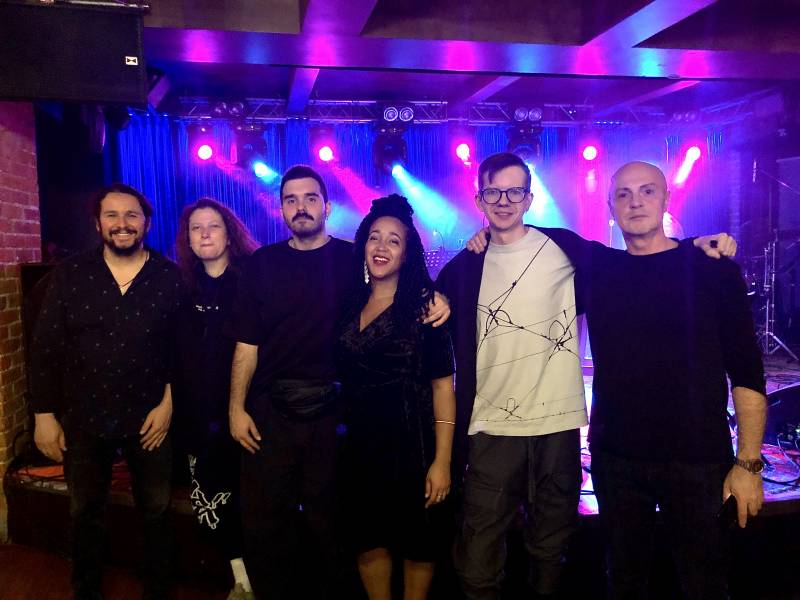
hen the war broke out, Smith connected over the phone with Jackie Gage, a jazz singer also from San Jose. They’ve known each other for years through the music scene and have a family connection—Smith’s cousin is best friends with Gage’s grandmother. She had gotten to Russia on Feb. 19, five days before the invasion.
“I was in touch with him, like, ‘How are you feeling? What do you want to do?’” she remembers. “He had a really good point, he said, ‘You know, the people really need this music, so I’m here to give it to them, and you should really stay.’ And that was a good frame of mind for me because I would have ended it the minute that the war started had I not spoken with him.”
Out of safety concerns, Gage canceled her concert in Rostov, right next to the Ukrainian border, and stayed a few extra days in Moscow. “Protests were starting to happen, which, as you know, are completely unheard of—like speaking ill of the government or the president,” she says. “And then it became a little bit scary to even want to go out into the major areas because there’s also a higher police presence at the same time.”
“People were starting to share videos of police stopping people and asking for their phones and whatnot,” she added, referring to reports of Moscow officers stopping people at random and demanding to look at their messages.
“My biggest fear was just, you know, being questioned and detained and disappeared,” Gage says.
“This is a crazy, devastating time and I [had] that in the back of my mind this whole time. It was even in the song selection like, I put in Marvin Gaye, ‘What’s Going On,’” says Gage. “I don’t feel like I’m in a position to speak out vocally about something like this while I’m there in Russia. And I know people who are my friends also feel that same way, so all I can do is put it into the music.”
As the situation intensified, Smith and Gage both decided to cut their tours short. “It was really bad by the time I was leaving,” Smith says. “I had to take a train 19 hours back to Moscow, and then hang around the airport and [get tested for COVID] for six hours, and fly to Qatar four hours, and then another 15 hours to get home.”