Lawrence Ferlinghetti has died in San Francisco. He was 101. Ferlinghetti is probably best known for three things: his Beat poetry, his San Francisco bookstore and small press, and his defense of the First Amendment in a famous court case.
Lawrence Ferlinghetti, Beat Poet And Small Press Publisher, Dies At 101
In 1956, Ferlinghetti published the first edition of Allen Ginsberg‘s ‘Howl.’ According to one critic, his greatest accomplishments were fighting censorship and starting a small press revolution.

Poet and author Lawrence Ferlinghetti, pictured in 1960, was born on March 24, 1919. (AP)
Related Article
His most famous work is a 1958 collection of poetry called A Coney Island of the Mind. In it, he compares the horrors depicted in Francisco Goya’s paintings of the Napoleonic Wars to scenes of post-World War II America.
A Coney Island of the Mind was translated into nine languages and sold more than a million copies. Despite his popularity, Ferlinghetti was never considered on par with some of the other Beat writers he called his friends — Jack Kerouac, Gregory Corso and Allen Ginsberg.
Even though Ferlinghetti was raised in New York, he said he never met those East Coast writers until he moved to San Francisco and opened his bookstore, City Lights.
“A bookstore is a natural place for poets to hang out,” Ferlinghetti said in a 1994 interview. “And they started showing up there right from the beginning.”
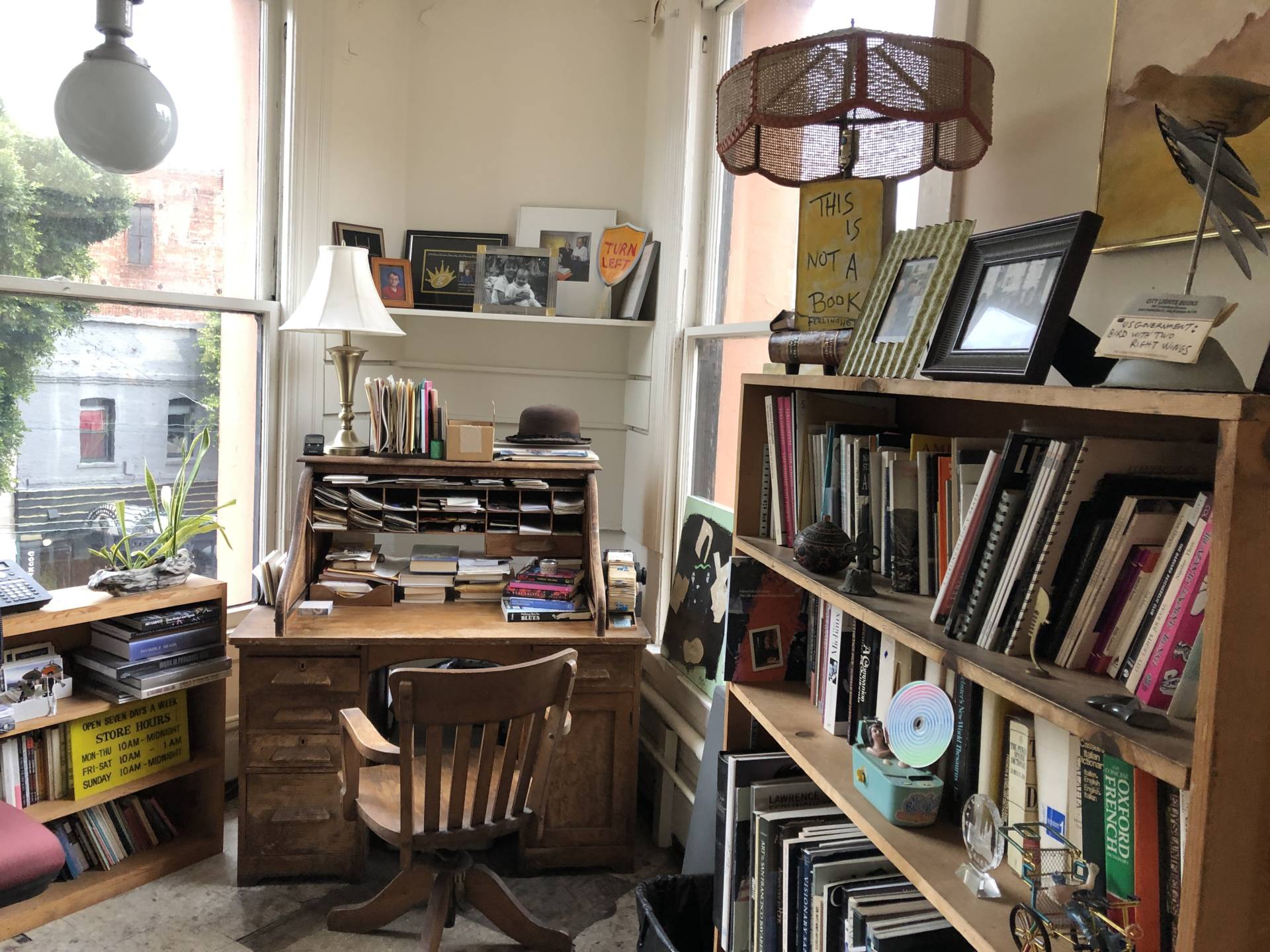
City Lights became a magnet for West Coast intellectuals, and later a tourist destination.
Ferlinghetti also started a small press called City Lights Books. In the fall of 1956, he published a little 75-cent paperback, the first edition of Howl by Allen Ginsberg.
Howl was a new type of poetry that gave voice to an undercurrent of dissatisfaction in Eisenhower’s America. It became an anthem for the nascent counterculture.
“Before Allen Ginsberg’s Howl, the state of poetry in America is a little bit like the way it is today: poetry about poetry,” Ferlinghetti said. “Howl knocked the sides out of things. Just the way rock music in the ’60s knocked the sides out of the old music world.”
Howl included passages of homosexual imagery, and Ferlinghetti was arrested in 1957 on charges of publishing obscene material. At the end of a long federal trial, the poem was found to have redeeming social importance, and therefore not obscene.
Literary critic Gerald Nicosia says Ferlinghetti’s two greatest accomplishments were fighting censorship, and inaugurating a small press revolution.
“Up until that point, getting published was a difficult thing,” Nicosia says. “If you were a radical, an innovative writer, you would be rebuffed by New York, by mainstream publishers. By creating this press out of nothing — City Lights Press — he said: Look, you don’t need these big publishers in New York. You can do it, and you can get the books out, and not only that, you can make waves.”
Ferlinghetti was always an advocate for the underdog, in part because of his own life story. He was born on March 24, 1919, in Yonkers. His father died shortly before he was he was born, and his mother was committed to a psychiatric hospital shortly after. He was raised by an aunt, and then by foster parents.
Ferlinghetti enlisted in the Navy after Pearl Harbor, and served as an officer at Normandy on D-Day and at Nagasaki after the atomic bomb. That experience turned him into a lifelong pacifist.
After the war, he got a master’s degree at Columbia University, and a doctorate at the Sorbonne. He began writing poetry about America in the 1950s.
Ferlinghetti began his career at a revolutionary time in arts and music. In 1994, he still believed art could make a difference. “I really believe that art is capable of the total transformation of the world, and of life itself,” he said. “And nothing less is really acceptable. So I mean if art is going to have any excuse for — beyond being a leisure class play thing — it has to transform life itself.”
Through more than half a century of writing and publishing, Lawrence Ferlinghetti did.
Copyright 2021 NPR.