
In 1963, when Barbara May Cameron was just 9 years old, she read an article about San Francisco. At the time, Cameron, a Hunkpapa Lakota, lived on the Standing Rock Reservation in North Dakota with her grandparents. As soon as she read about the far-away California city, she confidently informed her grandmother that, one day, she would live there. “And save the world too,” she added.
Just over a decade later, Cameron made it to San Francisco and got to work. First, she co-founded Gay American Indians (GAI) alongside her friend Randy Burns. Cameron viewed GAI as both a support group for Native lesbians and gay men, and a means to carve out space for them within the wider (and whiter) LGBTQ+ community. Those pursuits carried over into her writing as well. Though she had originally trained as a photographer at Santa Fe’s Institute of American Indian Arts, Cameron found her message was better conveyed through essays. Hers were personal and powerful, and became a loudspeaker for the Indigenous gay community.
Cameron’s 1981 essay “Gee, You Don’t Seem Like An Indian From The Reservation” remains a searing snapshot of the struggle to survive marginalization and thrive despite it. In it, she viscerally describes 26 years of bearing witness to violence against her community. Remarkably, she also uses that backdrop as a means to openly discuss her own lasting trauma and the challenge of erasing color lines.
Because of experiencing racial violence, I sometimes panic when I’m the only non-white in a roomful of whites, even if they are my closest friends; I wonder if I’ll leave the room alive. The seemingly copacetic gay world of San Francisco becomes a mere dream after the panic leaves … I want to scream out my anger and disgust with myself for feeling distrustful of my white friends and I want to banish the society that has fostered those feelings of alienation.
Later, as Cameron describes working on becoming more comfortable in a white-dominated world, she wonders aloud about how she’ll do that without leaving some of her “Indianness” behind. As it turns out, for the rest of her life, Cameron never lost sight of her roots and identity.
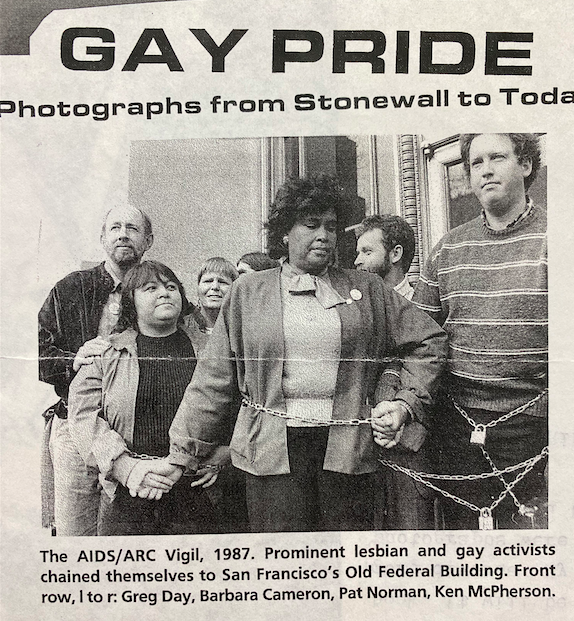 Though outspoken and formidable, Cameron is often remembered for her calm and respectful energy in the face of opposition. Those qualities made her a natural leader, and the positions she came to occupy reflect that.