Mills College, the private liberal arts institution in Oakland, plans to sell its coveted 1623 copy of playwright William Shakespeare’s First Folio as well as a handwritten musical score by the 18th-century composer Wolfgang Amadeus Mozart, KQED has learned.
Mills College to Sell Shakespeare First Folio, Mozart Manuscript Amid Budget Woes
The sales, expected to fetch millions, continue the Oakland private college administration’s attempts to overcome a budget deficit.
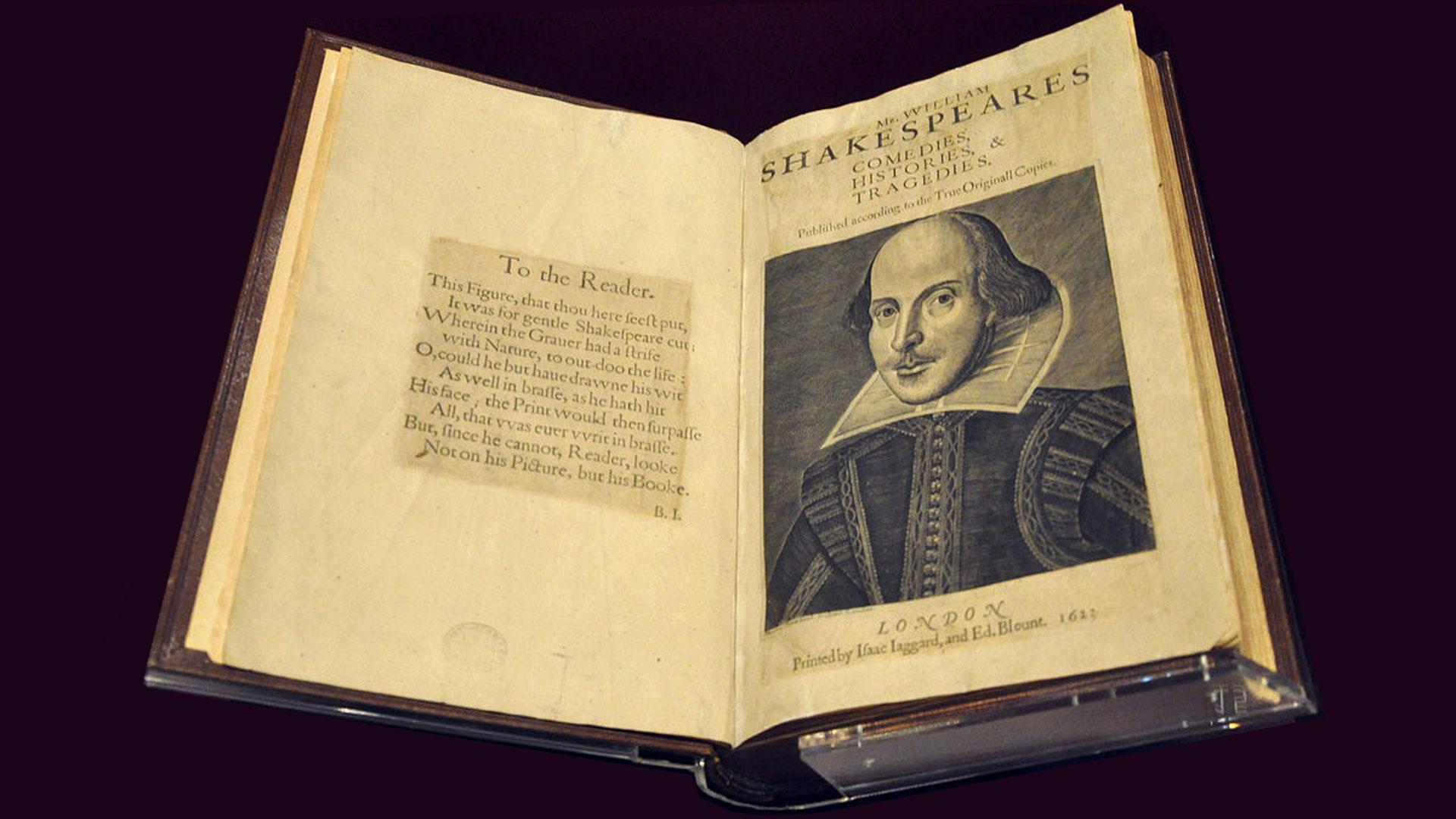
Shakespeare's First Folio displayed at the Victoria and Albert Museum in London. (Andreas Praefcke)
Related Articles
In an internal email Thursday, college president Elizabeth Hillman revealed the planned sale of the First Folio—one of the English language’s most influential and valuable books, expected to draw millions of dollars at auction—as part of “MillsNext,” the school’s plan to overcome a budget deficit that’s led to controversial layoffs of tenured faculty and union organizing among staff. Selling the “precious assets” will support current programs “while we build a bridge to a sustainable future,” the email reads.
Hillman’s email also mentions selling a “musical transcript,” which a source close to Mills’ F.W. Olin Library said refers to Mozart’s notation of five epistle sonatas created in the early 1770s. The source also said the First Folio will be auctioned by Christie’s, while the manuscript is being sold privately. As a private college, Mills is not obligated to publicly disclose its de-accessions.
“My first thought is disappointment,” said Thomas Goldwasser, an antiquarian book dealer in San Francisco. “It’s a shame because institutional libraries are supposed to steward and preserve cultural properties, and use them to teach and inspire, not treat them as commodities.”
“Christie’s has no news to announce at this time,” an auction house spokesperson said. Library staff directed inquiries to the Mills administration, and a school spokesperson declined to provide information for this article. “These gifts have been treasured deeply by the Mills community and will now be sold in compliance with College regulations,” reads Hillman’s email.
Mills, a historic private college for women and gender non-binary students, with graduate programs for all genders, enrolls some 1,200 students in East Oakland. The Olin Library’s special collections and archives includes the papers of artists such as Pauline Oliveros and Patti Smith, and as recently as Tuesday the website listed the First Folio in its Early Printed Books Collection.
The book, which the source close to the library said has already left campus, was a 1977 gift from Mary Louise O’Brien in honor of her father Elias Olan James, a former English professor at Mills and namesake of a Shakespeare collection at the Olin Library.
When copies of the First Folio change hands, it tends to make headlines. Christie’s sold one in 2001 for $6.1 million, establishing a then-world record for a 17th-century book, and another copy fetched $5.1 million in 2006 at Sotheby’s. Most recently, in 2016, a newly-discovered copy of the First Folio exceeded Christie’s auctioneers expectations by garnering $2.75 million.
Goldwasser expects Mills’ First Folio to also snare millions, while the Mozart manuscript is easily worth six figures. It’s not unusual for Mills and other private institutions to quietly sell assets, he said, but the First Folio is uniquely monumental, and its sale will dissuade prospective donors from continuing to bestow important research objects and archives to Mills’ special collections.
“Maybe Shakespeare’s not so important anymore at some undergraduate institutions,” he said.
Mills’ First Folio is one of 235 extant copies of the book known worldwide, according to the Folger Shakespeare Library. Its original publication in 1623, seven years after the playwright’s death, marked the first-ever printed appearance of 18 of its 36 collected plays, including Macbeth and The Tempest, changing the course of English literature.
“Without this particular copy, we wouldn’t have authoritative versions of many of Shakespeare’s works,” said Diana Kohnke, a librarian at the California State Library’s Sutro Library in San Francisco, one of few other local institutions possessing a First Folio. “Laws prohibit us from selling—our deed from the Sutro family says the collection can’t even leave San Francisco.”
Peter Hanff, deputy director of the Bancroft Library at UC Berkeley, another academic research library with a First Folio, said that the sale signals a smaller institution redefining or narrowing its primary purpose—and weighing a cash infusion against the book’s research value to students. “They’re going, ‘This doesn’t advance our primary mission,’ and making a challenging decision,” Hanff said. “Personally I still hate it when this happens, because I really value the accessibility.”
The sales reflect Mills’ efforts to manage a budget deficit due in part to declining enrollment. In 2017, the school declared a financial emergency, and controversially moved to lay off 11 professors, many of them tenured, including renowned composer Roscoe Mitchell. The restructuring particularly impacted the storied Center for Contemporary Music; co-directors Maggi Payne and Chris Brown retired early in the hopes of pre-empting additional cuts.
Replacing tenured faculty with adjunct professors has become a common cost-saving strategy for college administrations, one deeply unpopular with academics and students alike. (Mills recently posted job listings for several adjunct music professors.) Brown, the former CCM co-director, said Mills selling the documents is another worrisome sign. “My impression is this is part of the pattern—things have not improved since the purge,” he said. “Now it’s the rainy day.”
Staff at Mills recently launched a campaign to unionize with Service Employees International Union (SEIU) Local 1021, which already represents school faculty. Members of the organizing committee previously told KQED that part of their motivation for unionizing is to attain greater representation and transparency in institutional decision-making as the administration tries to rebound financially.