window.__IS_SSR__=true
window.__INITIAL_STATE__={
"attachmentsReducer": {
"audio_0": {
"type": "attachments",
"id": "audio_0",
"imgSizes": {
"kqedFullSize": {
"file": "https://ww2.kqed.org/news/wp-content/themes/KQED-unified/img/audio_bgs/background0.jpg"
}
}
},
"audio_1": {
"type": "attachments",
"id": "audio_1",
"imgSizes": {
"kqedFullSize": {
"file": "https://ww2.kqed.org/news/wp-content/themes/KQED-unified/img/audio_bgs/background1.jpg"
}
}
},
"audio_2": {
"type": "attachments",
"id": "audio_2",
"imgSizes": {
"kqedFullSize": {
"file": "https://ww2.kqed.org/news/wp-content/themes/KQED-unified/img/audio_bgs/background2.jpg"
}
}
},
"audio_3": {
"type": "attachments",
"id": "audio_3",
"imgSizes": {
"kqedFullSize": {
"file": "https://ww2.kqed.org/news/wp-content/themes/KQED-unified/img/audio_bgs/background3.jpg"
}
}
},
"audio_4": {
"type": "attachments",
"id": "audio_4",
"imgSizes": {
"kqedFullSize": {
"file": "https://ww2.kqed.org/news/wp-content/themes/KQED-unified/img/audio_bgs/background4.jpg"
}
}
},
"placeholder": {
"type": "attachments",
"id": "placeholder",
"imgSizes": {
"thumbnail": {
"file": "https://cdn.kqed.org/wp-content/uploads/2024/12/KQED-Default-Image-816638274-2000x1333-1-160x107.jpg",
"width": 160,
"height": 107,
"mimeType": "image/jpeg"
},
"medium": {
"file": "https://cdn.kqed.org/wp-content/uploads/2024/12/KQED-Default-Image-816638274-2000x1333-1-800x533.jpg",
"width": 800,
"height": 533,
"mimeType": "image/jpeg"
},
"medium_large": {
"file": "https://cdn.kqed.org/wp-content/uploads/2024/12/KQED-Default-Image-816638274-2000x1333-1-768x512.jpg",
"width": 768,
"height": 512,
"mimeType": "image/jpeg"
},
"large": {
"file": "https://cdn.kqed.org/wp-content/uploads/2024/12/KQED-Default-Image-816638274-2000x1333-1-1020x680.jpg",
"width": 1020,
"height": 680,
"mimeType": "image/jpeg"
},
"1536x1536": {
"file": "https://cdn.kqed.org/wp-content/uploads/2024/12/KQED-Default-Image-816638274-2000x1333-1-1536x1024.jpg",
"width": 1536,
"height": 1024,
"mimeType": "image/jpeg"
},
"fd-lrg": {
"file": "https://cdn.kqed.org/wp-content/uploads/2024/12/KQED-Default-Image-816638274-2000x1333-1-1536x1024.jpg",
"width": 1536,
"height": 1024,
"mimeType": "image/jpeg"
},
"fd-med": {
"file": "https://cdn.kqed.org/wp-content/uploads/2024/12/KQED-Default-Image-816638274-2000x1333-1-1020x680.jpg",
"width": 1020,
"height": 680,
"mimeType": "image/jpeg"
},
"fd-sm": {
"file": "https://cdn.kqed.org/wp-content/uploads/2024/12/KQED-Default-Image-816638274-2000x1333-1-800x533.jpg",
"width": 800,
"height": 533,
"mimeType": "image/jpeg"
},
"post-thumbnail": {
"file": "https://cdn.kqed.org/wp-content/uploads/2024/12/KQED-Default-Image-816638274-2000x1333-1-672x372.jpg",
"width": 672,
"height": 372,
"mimeType": "image/jpeg"
},
"twentyfourteen-full-width": {
"file": "https://cdn.kqed.org/wp-content/uploads/2024/12/KQED-Default-Image-816638274-2000x1333-1-1038x576.jpg",
"width": 1038,
"height": 576,
"mimeType": "image/jpeg"
},
"xxsmall": {
"file": "https://cdn.kqed.org/wp-content/uploads/2024/12/KQED-Default-Image-816638274-2000x1333-1-160x107.jpg",
"width": 160,
"height": 107,
"mimeType": "image/jpeg"
},
"xsmall": {
"file": "https://cdn.kqed.org/wp-content/uploads/2024/12/KQED-Default-Image-816638274-2000x1333-1-672x372.jpg",
"width": 672,
"height": 372,
"mimeType": "image/jpeg"
},
"small": {
"file": "https://cdn.kqed.org/wp-content/uploads/2024/12/KQED-Default-Image-816638274-2000x1333-1-672x372.jpg",
"width": 672,
"height": 372,
"mimeType": "image/jpeg"
},
"xlarge": {
"file": "https://cdn.kqed.org/wp-content/uploads/2024/12/KQED-Default-Image-816638274-2000x1333-1-1020x680.jpg",
"width": 1020,
"height": 680,
"mimeType": "image/jpeg"
},
"full-width": {
"file": "https://cdn.kqed.org/wp-content/uploads/2024/12/KQED-Default-Image-816638274-2000x1333-1-1920x1280.jpg",
"width": 1920,
"height": 1280,
"mimeType": "image/jpeg"
},
"guest-author-32": {
"file": "https://cdn.kqed.org/wp-content/uploads/2025/01/KQED-Default-Image-816638274-1333x1333-1-160x160.jpg",
"width": 32,
"height": 32,
"mimeType": "image/jpeg"
},
"guest-author-50": {
"file": "https://cdn.kqed.org/wp-content/uploads/2025/01/KQED-Default-Image-816638274-1333x1333-1-160x160.jpg",
"width": 50,
"height": 50,
"mimeType": "image/jpeg"
},
"guest-author-64": {
"file": "https://cdn.kqed.org/wp-content/uploads/2025/01/KQED-Default-Image-816638274-1333x1333-1-160x160.jpg",
"width": 64,
"height": 64,
"mimeType": "image/jpeg"
},
"guest-author-96": {
"file": "https://cdn.kqed.org/wp-content/uploads/2025/01/KQED-Default-Image-816638274-1333x1333-1-160x160.jpg",
"width": 96,
"height": 96,
"mimeType": "image/jpeg"
},
"guest-author-128": {
"file": "https://cdn.kqed.org/wp-content/uploads/2025/01/KQED-Default-Image-816638274-1333x1333-1-160x160.jpg",
"width": 128,
"height": 128,
"mimeType": "image/jpeg"
},
"detail": {
"file": "https://cdn.kqed.org/wp-content/uploads/2025/01/KQED-Default-Image-816638274-1333x1333-1-160x160.jpg",
"width": 160,
"height": 160,
"mimeType": "image/jpeg"
},
"kqedFullSize": {
"file": "https://cdn.kqed.org/wp-content/uploads/2024/12/KQED-Default-Image-816638274-2000x1333-1.jpg",
"width": 2000,
"height": 1333
}
}
},
"news_11929788": {
"type": "attachments",
"id": "news_11929788",
"meta": {
"index": "attachments_1716263798",
"site": "news",
"id": "11929788",
"found": true
},
"parent": 11929785,
"imgSizes": {
"twentyfourteen-full-width": {
"file": "https://ww2.kqed.org/app/uploads/sites/10/2022/10/IMG_0076-1038x576.jpg",
"width": 1038,
"mimeType": "image/jpeg",
"height": 576
},
"thumbnail": {
"file": "https://ww2.kqed.org/app/uploads/sites/10/2022/10/IMG_0076-160x103.jpg",
"width": 160,
"mimeType": "image/jpeg",
"height": 103
},
"post-thumbnail": {
"file": "https://ww2.kqed.org/app/uploads/sites/10/2022/10/IMG_0076-672x372.jpg",
"width": 672,
"mimeType": "image/jpeg",
"height": 372
},
"kqedFullSize": {
"file": "https://ww2.kqed.org/app/uploads/sites/10/2022/10/IMG_0076.jpg",
"width": 1920,
"height": 1240
},
"large": {
"file": "https://ww2.kqed.org/app/uploads/sites/10/2022/10/IMG_0076-1020x659.jpg",
"width": 1020,
"mimeType": "image/jpeg",
"height": 659
},
"1536x1536": {
"file": "https://ww2.kqed.org/app/uploads/sites/10/2022/10/IMG_0076-1536x992.jpg",
"width": 1536,
"mimeType": "image/jpeg",
"height": 992
},
"medium": {
"file": "https://ww2.kqed.org/app/uploads/sites/10/2022/10/IMG_0076-800x517.jpg",
"width": 800,
"mimeType": "image/jpeg",
"height": 517
}
},
"publishDate": 1666379969,
"modified": 1666387774,
"caption": "Despite growing demand for mental health services for children, the mental health field has failed at recruiting enough professionals of any background. California has less than a quarter of the therapists it needs — and the existing workforce doesn't mirror the state's demographics, making culturally competent care difficult to come by.",
"description": null,
"title": "IMG_0076",
"credit": "Illustration by Anna Vignet/KQED",
"status": "inherit",
"altTag": "An illustration in orange and black and pink showing a therapist and a client",
"isLoading": false,
"fetchFailed": false
},
"news_11929349": {
"type": "attachments",
"id": "news_11929349",
"meta": {
"index": "attachments_1716263798",
"site": "news",
"id": "11929349",
"found": true
},
"parent": 11929333,
"imgSizes": {
"twentyfourteen-full-width": {
"file": "https://ww2.kqed.org/app/uploads/sites/10/2022/10/IMG_0068-1038x576.jpg",
"width": 1038,
"mimeType": "image/jpeg",
"height": 576
},
"thumbnail": {
"file": "https://ww2.kqed.org/app/uploads/sites/10/2022/10/IMG_0068-160x103.jpg",
"width": 160,
"mimeType": "image/jpeg",
"height": 103
},
"post-thumbnail": {
"file": "https://ww2.kqed.org/app/uploads/sites/10/2022/10/IMG_0068-672x372.jpg",
"width": 672,
"mimeType": "image/jpeg",
"height": 372
},
"kqedFullSize": {
"file": "https://ww2.kqed.org/app/uploads/sites/10/2022/10/IMG_0068.jpg",
"width": 1920,
"height": 1240
},
"large": {
"file": "https://ww2.kqed.org/app/uploads/sites/10/2022/10/IMG_0068-1020x659.jpg",
"width": 1020,
"mimeType": "image/jpeg",
"height": 659
},
"1536x1536": {
"file": "https://ww2.kqed.org/app/uploads/sites/10/2022/10/IMG_0068-1536x992.jpg",
"width": 1536,
"mimeType": "image/jpeg",
"height": 992
},
"medium": {
"file": "https://ww2.kqed.org/app/uploads/sites/10/2022/10/IMG_0068-800x517.jpg",
"width": 800,
"mimeType": "image/jpeg",
"height": 517
}
},
"publishDate": 1666115909,
"modified": 1666131631,
"caption": "The need to come to terms with how parental mental health influences the mental health of children has come into sharper focus as the US grapples with a crisis of children experiencing higher rates of anxiety, depression and thoughts of suicide.",
"description": null,
"title": "IMG_0068",
"credit": "Illustration by Anna Vignet/KQED",
"status": "inherit",
"altTag": "a pink, red, black and orange illustration of a family staring down a windy road",
"isLoading": false,
"fetchFailed": false
},
"news_11929032": {
"type": "attachments",
"id": "news_11929032",
"meta": {
"index": "attachments_1716263798",
"site": "news",
"id": "11929032",
"found": true
},
"parent": 11928995,
"imgSizes": {
"twentyfourteen-full-width": {
"file": "https://ww2.kqed.org/app/uploads/sites/10/2022/10/Screen-Shot-2022-10-14-at-3.37.09-PM-1038x576.png",
"width": 1038,
"mimeType": "image/png",
"height": 576
},
"thumbnail": {
"file": "https://ww2.kqed.org/app/uploads/sites/10/2022/10/Screen-Shot-2022-10-14-at-3.37.09-PM-160x94.png",
"width": 160,
"mimeType": "image/png",
"height": 94
},
"post-thumbnail": {
"file": "https://ww2.kqed.org/app/uploads/sites/10/2022/10/Screen-Shot-2022-10-14-at-3.37.09-PM-672x372.png",
"width": 672,
"mimeType": "image/png",
"height": 372
},
"kqedFullSize": {
"file": "https://ww2.kqed.org/app/uploads/sites/10/2022/10/Screen-Shot-2022-10-14-at-3.37.09-PM.png",
"width": 2082,
"height": 1224
},
"2048x2048": {
"file": "https://ww2.kqed.org/app/uploads/sites/10/2022/10/Screen-Shot-2022-10-14-at-3.37.09-PM-2048x1204.png",
"width": 2048,
"mimeType": "image/png",
"height": 1204
},
"large": {
"file": "https://ww2.kqed.org/app/uploads/sites/10/2022/10/Screen-Shot-2022-10-14-at-3.37.09-PM-1020x600.png",
"width": 1020,
"mimeType": "image/png",
"height": 600
},
"1536x1536": {
"file": "https://ww2.kqed.org/app/uploads/sites/10/2022/10/Screen-Shot-2022-10-14-at-3.37.09-PM-1536x903.png",
"width": 1536,
"mimeType": "image/png",
"height": 903
},
"full-width": {
"file": "https://ww2.kqed.org/app/uploads/sites/10/2022/10/Screen-Shot-2022-10-14-at-3.37.09-PM-1920x1129.png",
"width": 1920,
"mimeType": "image/png",
"height": 1129
},
"medium": {
"file": "https://ww2.kqed.org/app/uploads/sites/10/2022/10/Screen-Shot-2022-10-14-at-3.37.09-PM-800x470.png",
"width": 800,
"mimeType": "image/png",
"height": 470
}
},
"publishDate": 1665787474,
"modified": 1665789126,
"caption": "A satellite image of the Crockett wastewater treatment plant, located next to the Carquinez Bridge in Contra Costa County.",
"description": null,
"title": "Screen Shot 2022-10-14 at 3.37.09 PM",
"credit": "Courtesy of Google Earth",
"status": "inherit",
"altTag": "A satellite image of the Crocket wastewater treatment plant.",
"isLoading": false,
"fetchFailed": false
},
"news_11927939": {
"type": "attachments",
"id": "news_11927939",
"meta": {
"index": "attachments_1716263798",
"site": "news",
"id": "11927939",
"found": true
},
"parent": 11927938,
"imgSizes": {
"twentyfourteen-full-width": {
"file": "https://ww2.kqed.org/app/uploads/sites/10/2022/10/gettyimages-1429101833_custom-4e894b11c72c30b54ebd0aab0bd886a5d29bae91-1038x576.jpg",
"width": 1038,
"mimeType": "image/jpeg",
"height": 576
},
"thumbnail": {
"file": "https://ww2.kqed.org/app/uploads/sites/10/2022/10/gettyimages-1429101833_custom-4e894b11c72c30b54ebd0aab0bd886a5d29bae91-160x107.jpg",
"width": 160,
"mimeType": "image/jpeg",
"height": 107
},
"post-thumbnail": {
"file": "https://ww2.kqed.org/app/uploads/sites/10/2022/10/gettyimages-1429101833_custom-4e894b11c72c30b54ebd0aab0bd886a5d29bae91-672x372.jpg",
"width": 672,
"mimeType": "image/jpeg",
"height": 372
},
"kqedFullSize": {
"file": "https://ww2.kqed.org/app/uploads/sites/10/2022/10/gettyimages-1429101833_custom-4e894b11c72c30b54ebd0aab0bd886a5d29bae91-scaled.jpg",
"width": 2560,
"height": 1705
},
"2048x2048": {
"file": "https://ww2.kqed.org/app/uploads/sites/10/2022/10/gettyimages-1429101833_custom-4e894b11c72c30b54ebd0aab0bd886a5d29bae91-2048x1364.jpg",
"width": 2048,
"mimeType": "image/jpeg",
"height": 1364
},
"large": {
"file": "https://ww2.kqed.org/app/uploads/sites/10/2022/10/gettyimages-1429101833_custom-4e894b11c72c30b54ebd0aab0bd886a5d29bae91-1020x679.jpg",
"width": 1020,
"mimeType": "image/jpeg",
"height": 679
},
"1536x1536": {
"file": "https://ww2.kqed.org/app/uploads/sites/10/2022/10/gettyimages-1429101833_custom-4e894b11c72c30b54ebd0aab0bd886a5d29bae91-1536x1023.jpg",
"width": 1536,
"mimeType": "image/jpeg",
"height": 1023
},
"full-width": {
"file": "https://ww2.kqed.org/app/uploads/sites/10/2022/10/gettyimages-1429101833_custom-4e894b11c72c30b54ebd0aab0bd886a5d29bae91-1920x1279.jpg",
"width": 1920,
"mimeType": "image/jpeg",
"height": 1279
},
"medium": {
"file": "https://ww2.kqed.org/app/uploads/sites/10/2022/10/gettyimages-1429101833_custom-4e894b11c72c30b54ebd0aab0bd886a5d29bae91-800x533.jpg",
"width": 800,
"mimeType": "image/jpeg",
"height": 533
}
},
"publishDate": 1665088208,
"modified": 1665089889,
"caption": "President Biden speaks at the White House on Sept. 30. On Thursday, Biden announced that he is taking executive action to pardon people convicted of simple marijuana possession under federal law and D.C. statute.",
"description": "U.S. President Joe Biden delivers remarks on the federal government's response to Hurricane Ian in the Roosevelt Room at the White House on Sept. 30, 2022 in Washington, DC. The hurricane made landfall at Cayo Costa, Florida, on Wednesday as a Category 4 storm and caused 18 confirmed deaths in Florida so far. Biden concluded his remarks by addressing Russian President Vladimir Putin, saying, the recent referendum in eastern Ukraine was a sham and \"Mr. Putin, don't misunderstand what I'm saying. . . . the U.S. is prepared to defend every single inch of NATO territory.\" (Photo by Chip Somodevilla/Getty Images)",
"title": "President Biden speaks at the White House on Sept. 30. On Thursday, Biden announced that he is taking executive action to pardon people convicted of simple marijuana possession under federal law and D.C. statute.",
"credit": "Chip Somodevilla/Getty Images",
"status": "inherit",
"altTag": "President Joe Biden speaks into a microphone at a podium.",
"isLoading": false,
"fetchFailed": false
},
"news_11927846": {
"type": "attachments",
"id": "news_11927846",
"meta": {
"index": "attachments_1716263798",
"site": "news",
"id": "11927846",
"found": true
},
"parent": 11927844,
"imgSizes": {
"twentyfourteen-full-width": {
"file": "https://ww2.kqed.org/app/uploads/sites/10/2022/10/Flavored-tobacco-1038x576.jpg",
"width": 1038,
"mimeType": "image/jpeg",
"height": 576
},
"thumbnail": {
"file": "https://ww2.kqed.org/app/uploads/sites/10/2022/10/Flavored-tobacco-160x107.jpg",
"width": 160,
"mimeType": "image/jpeg",
"height": 107
},
"post-thumbnail": {
"file": "https://ww2.kqed.org/app/uploads/sites/10/2022/10/Flavored-tobacco-672x372.jpg",
"width": 672,
"mimeType": "image/jpeg",
"height": 372
},
"kqedFullSize": {
"file": "https://ww2.kqed.org/app/uploads/sites/10/2022/10/Flavored-tobacco.jpg",
"width": 1920,
"height": 1280
},
"large": {
"file": "https://ww2.kqed.org/app/uploads/sites/10/2022/10/Flavored-tobacco-1020x680.jpg",
"width": 1020,
"mimeType": "image/jpeg",
"height": 680
},
"1536x1536": {
"file": "https://ww2.kqed.org/app/uploads/sites/10/2022/10/Flavored-tobacco-1536x1024.jpg",
"width": 1536,
"mimeType": "image/jpeg",
"height": 1024
},
"medium": {
"file": "https://ww2.kqed.org/app/uploads/sites/10/2022/10/Flavored-tobacco-800x533.jpg",
"width": 800,
"mimeType": "image/jpeg",
"height": 533
}
},
"publishDate": 1665010680,
"modified": 1666651687,
"caption": "\"Fruit n Custard Banana\" flavored tobacco at the Vapor Den in San Francisco, Calif., on Wednesday, May 9, 2018. Flavored tobacco has since been banned in San Francisco and voters are being asked to decide if products like these should be banned statewide. ",
"description": null,
"title": "Flavored-tobacco",
"credit": "Lauren Hanussak/KQED",
"status": "inherit",
"altTag": "Colorful bottles with pictures of enticing fruit and candy flavors line a shelf",
"isLoading": false,
"fetchFailed": false
},
"news_11927555": {
"type": "attachments",
"id": "news_11927555",
"meta": {
"index": "attachments_1716263798",
"site": "news",
"id": "11927555",
"found": true
},
"parent": 11927544,
"imgSizes": {
"twentyfourteen-full-width": {
"file": "https://ww2.kqed.org/app/uploads/sites/10/2022/10/GettyImages-1239458034-1038x576.jpg",
"width": 1038,
"mimeType": "image/jpeg",
"height": 576
},
"thumbnail": {
"file": "https://ww2.kqed.org/app/uploads/sites/10/2022/10/GettyImages-1239458034-160x103.jpg",
"width": 160,
"mimeType": "image/jpeg",
"height": 103
},
"post-thumbnail": {
"file": "https://ww2.kqed.org/app/uploads/sites/10/2022/10/GettyImages-1239458034-672x372.jpg",
"width": 672,
"mimeType": "image/jpeg",
"height": 372
},
"kqedFullSize": {
"file": "https://ww2.kqed.org/app/uploads/sites/10/2022/10/GettyImages-1239458034-scaled.jpg",
"width": 2560,
"height": 1650
},
"2048x2048": {
"file": "https://ww2.kqed.org/app/uploads/sites/10/2022/10/GettyImages-1239458034-2048x1320.jpg",
"width": 2048,
"mimeType": "image/jpeg",
"height": 1320
},
"large": {
"file": "https://ww2.kqed.org/app/uploads/sites/10/2022/10/GettyImages-1239458034-1020x658.jpg",
"width": 1020,
"mimeType": "image/jpeg",
"height": 658
},
"1536x1536": {
"file": "https://ww2.kqed.org/app/uploads/sites/10/2022/10/GettyImages-1239458034-1536x990.jpg",
"width": 1536,
"mimeType": "image/jpeg",
"height": 990
},
"full-width": {
"file": "https://ww2.kqed.org/app/uploads/sites/10/2022/10/GettyImages-1239458034-1920x1238.jpg",
"width": 1920,
"mimeType": "image/jpeg",
"height": 1238
},
"medium": {
"file": "https://ww2.kqed.org/app/uploads/sites/10/2022/10/GettyImages-1239458034-800x516.jpg",
"width": 800,
"mimeType": "image/jpeg",
"height": 516
}
},
"publishDate": 1664828655,
"modified": 1664828789,
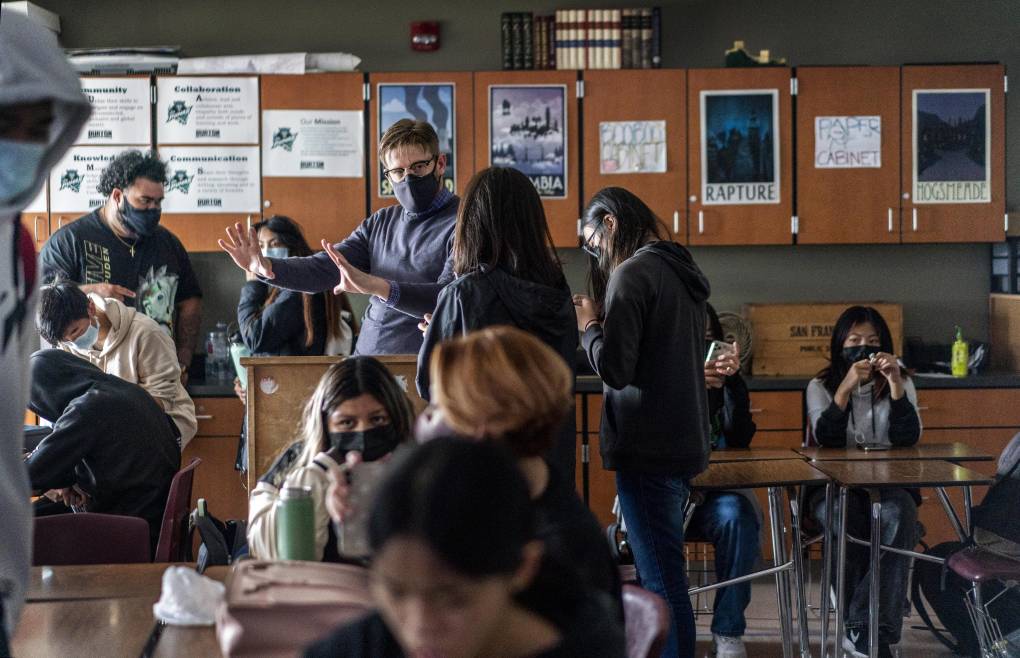
"caption": "History teacher Eirik Nielsen speaks to students at Burton High School in San Francisco. A new survey of California teachers sheds light on the profession's retention issues, finding the majority are experiencing stress and financial instability.",
"description": null,
"title": "Coronavirus Pandemic 2021",
"credit": "Melina Mara/The Washington Post via Getty Images",
"status": "inherit",
"altTag": "a high school teacher speaks to students in a packed classroom",
"isLoading": false,
"fetchFailed": false
},
"news_11927329": {
"type": "attachments",
"id": "news_11927329",
"meta": {
"index": "attachments_1716263798",
"site": "news",
"id": "11927329",
"found": true
},
"parent": 11927310,
"imgSizes": {
"twentyfourteen-full-width": {
"file": "https://ww2.kqed.org/app/uploads/sites/10/2022/09/MoehligCalmatters-1038x576.jpg",
"width": 1038,
"mimeType": "image/jpeg",
"height": 576
},
"thumbnail": {
"file": "https://ww2.kqed.org/app/uploads/sites/10/2022/09/MoehligCalmatters-160x107.jpg",
"width": 160,
"mimeType": "image/jpeg",
"height": 107
},
"post-thumbnail": {
"file": "https://ww2.kqed.org/app/uploads/sites/10/2022/09/MoehligCalmatters-672x372.jpg",
"width": 672,
"mimeType": "image/jpeg",
"height": 372
},
"kqedFullSize": {
"file": "https://ww2.kqed.org/app/uploads/sites/10/2022/09/MoehligCalmatters.jpg",
"width": 1920,
"height": 1287
},
"large": {
"file": "https://ww2.kqed.org/app/uploads/sites/10/2022/09/MoehligCalmatters-1020x684.jpg",
"width": 1020,
"mimeType": "image/jpeg",
"height": 684
},
"1536x1536": {
"file": "https://ww2.kqed.org/app/uploads/sites/10/2022/09/MoehligCalmatters-1536x1030.jpg",
"width": 1536,
"mimeType": "image/jpeg",
"height": 1030
},
"medium": {
"file": "https://ww2.kqed.org/app/uploads/sites/10/2022/09/MoehligCalmatters-800x536.jpg",
"width": 800,
"mimeType": "image/jpeg",
"height": 536
}
},
"publishDate": 1664567294,
"modified": 1664567391,
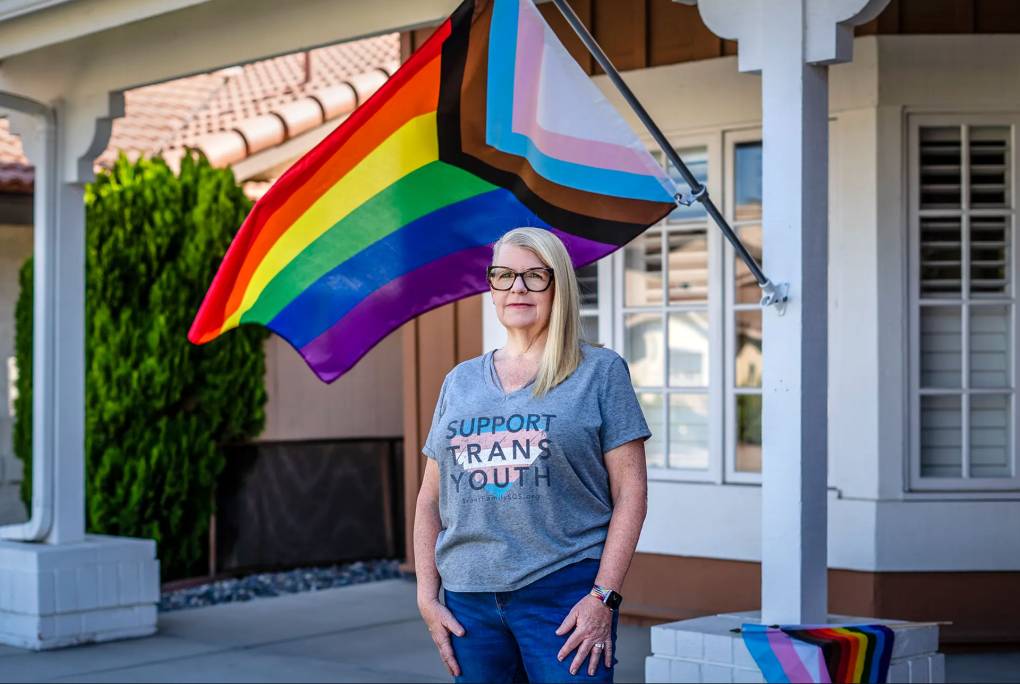
"caption": "Kathie Moehlig, founder of TransFamily Support Services, at her home in San Diego County on Aug. 26, 2022.",
"description": null,
"title": "MoehligCalmatters",
"credit": "Ariana Drehsler/CalMatters",
"status": "inherit",
"altTag": "woman with straight blonde hair and glasses wearing 'support trans youth' shirt stands underneath a pride flag outdoors outside of a home",
"isLoading": false,
"fetchFailed": false
},
"news_11927064": {
"type": "attachments",
"id": "news_11927064",
"meta": {
"index": "attachments_1716263798",
"site": "news",
"id": "11927064",
"found": true
},
"parent": 11927062,
"imgSizes": {
"twentyfourteen-full-width": {
"file": "https://ww2.kqed.org/app/uploads/sites/10/2022/09/RS54766_008_KQED_CastroHousingRightsRally_03272022-qut-1038x576.jpg",
"width": 1038,
"mimeType": "image/jpeg",
"height": 576
},
"thumbnail": {
"file": "https://ww2.kqed.org/app/uploads/sites/10/2022/09/RS54766_008_KQED_CastroHousingRightsRally_03272022-qut-160x107.jpg",
"width": 160,
"mimeType": "image/jpeg",
"height": 107
},
"post-thumbnail": {
"file": "https://ww2.kqed.org/app/uploads/sites/10/2022/09/RS54766_008_KQED_CastroHousingRightsRally_03272022-qut-672x372.jpg",
"width": 672,
"mimeType": "image/jpeg",
"height": 372
},
"kqedFullSize": {
"file": "https://ww2.kqed.org/app/uploads/sites/10/2022/09/RS54766_008_KQED_CastroHousingRightsRally_03272022-qut.jpg",
"width": 1920,
"height": 1278
},
"large": {
"file": "https://ww2.kqed.org/app/uploads/sites/10/2022/09/RS54766_008_KQED_CastroHousingRightsRally_03272022-qut-1020x679.jpg",
"width": 1020,
"mimeType": "image/jpeg",
"height": 679
},
"1536x1536": {
"file": "https://ww2.kqed.org/app/uploads/sites/10/2022/09/RS54766_008_KQED_CastroHousingRightsRally_03272022-qut-1536x1022.jpg",
"width": 1536,
"mimeType": "image/jpeg",
"height": 1022
},
"medium": {
"file": "https://ww2.kqed.org/app/uploads/sites/10/2022/09/RS54766_008_KQED_CastroHousingRightsRally_03272022-qut-800x533.jpg",
"width": 800,
"mimeType": "image/jpeg",
"height": 533
}
},
"publishDate": 1664410267,
"modified": 1664471018,
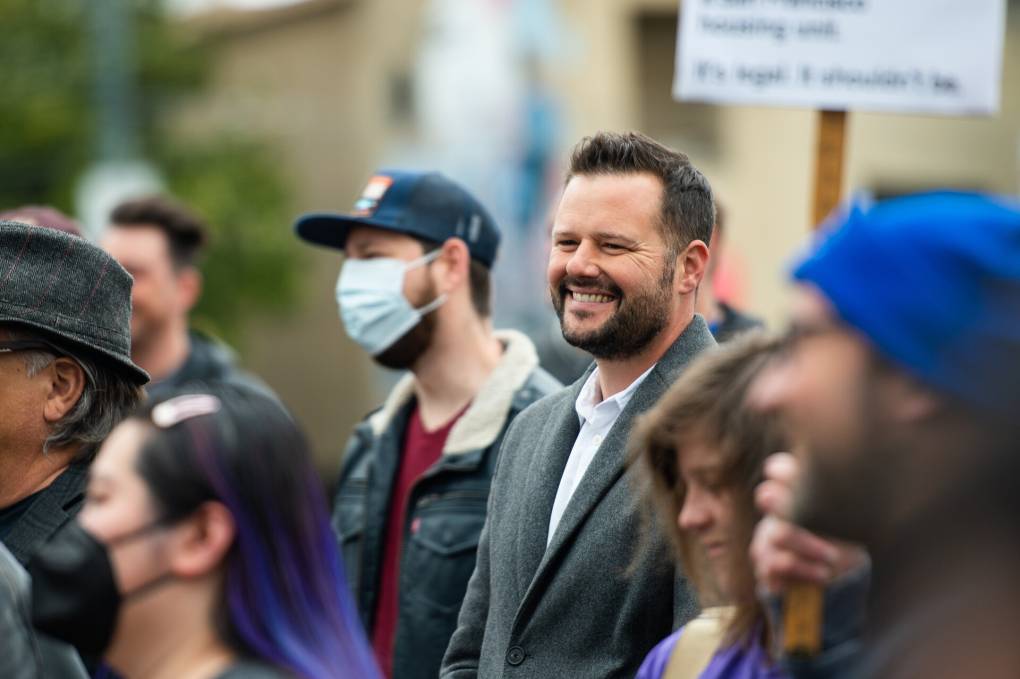
"caption": "Assemblymember Matt Haney will lead a bipartisan committee that will look for solutions to the opioid epidemic.",
"description": null,
"title": "RS54766_008_KQED_CastroHousingRightsRally_03272022-qut",
"credit": "Beth LaBerge/KQED",
"status": "inherit",
"altTag": "Assemblyman Matt Haney smiles among a crowd of people.",
"isLoading": false,
"fetchFailed": false
},
"news_11926780": {
"type": "attachments",
"id": "news_11926780",
"meta": {
"index": "attachments_1716263798",
"site": "news",
"id": "11926780",
"found": true
},
"parent": 11926757,
"imgSizes": {
"thumbnail": {
"file": "https://ww2.kqed.org/app/uploads/sites/10/2022/09/GettyImages-1340030341-160x107.jpg",
"width": 160,
"mimeType": "image/jpeg",
"height": 107
},
"post-thumbnail": {
"file": "https://ww2.kqed.org/app/uploads/sites/10/2022/09/GettyImages-1340030341-672x372.jpg",
"width": 672,
"mimeType": "image/jpeg",
"height": 372
},
"kqedFullSize": {
"file": "https://ww2.kqed.org/app/uploads/sites/10/2022/09/GettyImages-1340030341.jpg",
"width": 724,
"height": 483
}
},
"publishDate": 1664236398,
"modified": 1664237753,
"caption": "Insurers that lose their appeals with the state Department of Health Care Services, which runs Medi-Cal, are likely to take their complaints to court. That could delay final decisions by months or years, causing a headache for the department, which wants coverage under the new contracts to start Jan. 1, 2024.",
"description": "A nurse assists a patient at the reception desk in the hospital during the COVID-19 pandemic.",
"title": "Young man checking in for medical appointment",
"credit": "mixetto/Getty Images",
"status": "inherit",
"altTag": "A black nurse with a hair net and a face mask wearing blue scrubs is standing behind a counter as she helps a Asian patient with a face mask explaining something to her.",
"isLoading": false,
"fetchFailed": false
},
"news_11926675": {
"type": "attachments",
"id": "news_11926675",
"meta": {
"index": "attachments_1716263798",
"site": "news",
"id": "11926675",
"found": true
},
"parent": 11926652,
"imgSizes": {
"twentyfourteen-full-width": {
"file": "https://ww2.kqed.org/app/uploads/sites/10/2022/09/IMG_8931_blur-1038x576.jpg",
"width": 1038,
"mimeType": "image/jpeg",
"height": 576
},
"thumbnail": {
"file": "https://ww2.kqed.org/app/uploads/sites/10/2022/09/IMG_8931_blur-160x107.jpg",
"width": 160,
"mimeType": "image/jpeg",
"height": 107
},
"post-thumbnail": {
"file": "https://ww2.kqed.org/app/uploads/sites/10/2022/09/IMG_8931_blur-672x372.jpg",
"width": 672,
"mimeType": "image/jpeg",
"height": 372
},
"kqedFullSize": {
"file": "https://ww2.kqed.org/app/uploads/sites/10/2022/09/IMG_8931_blur.jpg",
"width": 1920,
"height": 1280
},
"large": {
"file": "https://ww2.kqed.org/app/uploads/sites/10/2022/09/IMG_8931_blur-1020x680.jpg",
"width": 1020,
"mimeType": "image/jpeg",
"height": 680
},
"1536x1536": {
"file": "https://ww2.kqed.org/app/uploads/sites/10/2022/09/IMG_8931_blur-1536x1024.jpg",
"width": 1536,
"mimeType": "image/jpeg",
"height": 1024
},
"medium": {
"file": "https://ww2.kqed.org/app/uploads/sites/10/2022/09/IMG_8931_blur-800x533.jpg",
"width": 800,
"mimeType": "image/jpeg",
"height": 533
}
},
"publishDate": 1664211534,
"modified": 1664220641,
"caption": "O Service of Los Angeles won a T-shirt during a Folsom Street Fair 'Jeopardy' game at the San Francisco Community Health Center's booth. Monkeypox for 300 featured a question about the incubation period of the virus.",
"description": null,
"title": "IMG_8931_blur",
"credit": "Sara Hossaini/KQED",
"status": "inherit",
"altTag": "A person wearing a top hat, sun glasses, and a black vest with several pins, holds up a white t-shirt in one hand and points to a board with different colored numbers in the other hand.",
"isLoading": false,
"fetchFailed": false
},
"news_11925904": {
"type": "attachments",
"id": "news_11925904",
"meta": {
"index": "attachments_1716263798",
"site": "news",
"id": "11925904",
"found": true
},
"parent": 11925882,
"imgSizes": {
"twentyfourteen-full-width": {
"file": "https://ww2.kqed.org/app/uploads/sites/10/2022/09/RS57898_033_KQED_KaiserStrikeOakland_08192022-qut-1038x576.jpg",
"width": 1038,
"mimeType": "image/jpeg",
"height": 576
},
"thumbnail": {
"file": "https://ww2.kqed.org/app/uploads/sites/10/2022/09/RS57898_033_KQED_KaiserStrikeOakland_08192022-qut-160x107.jpg",
"width": 160,
"mimeType": "image/jpeg",
"height": 107
},
"post-thumbnail": {
"file": "https://ww2.kqed.org/app/uploads/sites/10/2022/09/RS57898_033_KQED_KaiserStrikeOakland_08192022-qut-672x372.jpg",
"width": 672,
"mimeType": "image/jpeg",
"height": 372
},
"kqedFullSize": {
"file": "https://ww2.kqed.org/app/uploads/sites/10/2022/09/RS57898_033_KQED_KaiserStrikeOakland_08192022-qut.jpg",
"width": 1920,
"height": 1280
},
"large": {
"file": "https://ww2.kqed.org/app/uploads/sites/10/2022/09/RS57898_033_KQED_KaiserStrikeOakland_08192022-qut-1020x680.jpg",
"width": 1020,
"mimeType": "image/jpeg",
"height": 680
},
"1536x1536": {
"file": "https://ww2.kqed.org/app/uploads/sites/10/2022/09/RS57898_033_KQED_KaiserStrikeOakland_08192022-qut-1536x1024.jpg",
"width": 1536,
"mimeType": "image/jpeg",
"height": 1024
},
"medium": {
"file": "https://ww2.kqed.org/app/uploads/sites/10/2022/09/RS57898_033_KQED_KaiserStrikeOakland_08192022-qut-800x533.jpg",
"width": 800,
"mimeType": "image/jpeg",
"height": 533
}
},
"publishDate": 1663290645,
"modified": 1663347911,
"caption": "Kaiser mental health care workers and supporters march from Oakland Kaiser Medical Center to the health care company's nearby corporate headquarters on Friday, Aug. 19, 2022, during the first week of their strike.",
"description": null,
"title": "RS57898_033_KQED_KaiserStrikeOakland_08192022-qut",
"credit": "Beth LaBerge/KQED",
"status": "inherit",
"altTag": "Striking workers wearing red shirts and holding signs march on the street.",
"isLoading": false,
"fetchFailed": false
},
"news_11925828": {
"type": "attachments",
"id": "news_11925828",
"meta": {
"index": "attachments_1716263798",
"site": "news",
"id": "11925828",
"found": true
},
"parent": 11925585,
"imgSizes": {
"twentyfourteen-full-width": {
"file": "https://ww2.kqed.org/app/uploads/sites/10/2022/09/GettyImages-1422321173-1024x576.jpg",
"width": 1024,
"mimeType": "image/jpeg",
"height": 576
},
"thumbnail": {
"file": "https://ww2.kqed.org/app/uploads/sites/10/2022/09/GettyImages-1422321173-160x107.jpg",
"width": 160,
"mimeType": "image/jpeg",
"height": 107
},
"post-thumbnail": {
"file": "https://ww2.kqed.org/app/uploads/sites/10/2022/09/GettyImages-1422321173-672x372.jpg",
"width": 672,
"mimeType": "image/jpeg",
"height": 372
},
"kqedFullSize": {
"file": "https://ww2.kqed.org/app/uploads/sites/10/2022/09/GettyImages-1422321173.jpg",
"width": 1024,
"height": 683
},
"large": {
"file": "https://ww2.kqed.org/app/uploads/sites/10/2022/09/GettyImages-1422321173-1020x680.jpg",
"width": 1020,
"mimeType": "image/jpeg",
"height": 680
},
"medium": {
"file": "https://ww2.kqed.org/app/uploads/sites/10/2022/09/GettyImages-1422321173-800x534.jpg",
"width": 800,
"mimeType": "image/jpeg",
"height": 534
}
},
"publishDate": 1663277250,
"modified": 1663281884,
"caption": "Margaret LaRaviere gets an influenza vaccine during an event hosted by the Chicago Department of Public Health at the Southwest Senior Center on Sept. 9, 2022, in Chicago.",
"description": null,
"title": "COVID-19 Omicron Booster Shots Administered Along With Other Vaccines At Chicago Senior Center",
"credit": "Scott Olson/Getty Images",
"status": "inherit",
"altTag": "A woman wearing a face mask and a black sleeveless shirt sits as hands wearing blue gloves inject a syringe into her arm while holding the arm in place.",
"isLoading": false,
"fetchFailed": false
}
},
"audioPlayerReducer": {
"postId": "stream_live",
"isPaused": true,
"isPlaying": false,
"pfsActive": false,
"pledgeModalIsOpen": true,
"playerDrawerIsOpen": false,
"liveAudioPlayStartedAt": 0,
"liveAudioPlayContext": ""
},
"authorsReducer": {
"byline_news_11927938": {
"type": "authors",
"id": "byline_news_11927938",
"meta": {
"override": true
},
"slug": "byline_news_11927938",
"name": "Ximena Bustillo",
"isLoading": false
},
"byline_news_11927310": {
"type": "authors",
"id": "byline_news_11927310",
"meta": {
"override": true
},
"slug": "byline_news_11927310",
"name": "\u003ca href=\"https://calmatters.org/author/ariel-gans/\">Ariel Gans\u003c/a>",
"isLoading": false
},
"byline_news_11926757": {
"type": "authors",
"id": "byline_news_11926757",
"meta": {
"override": true
},
"slug": "byline_news_11926757",
"name": "\u003ca href=\"https://californiahealthline.org/news/author/bernard-j-wolfson/\">Bernard J. Wolfson\u003c/a>",
"isLoading": false
},
"ohubertallen": {
"type": "authors",
"id": "102",
"meta": {
"index": "authors_1716337520",
"id": "102",
"found": true
},
"name": "Olivia Allen-Price",
"firstName": "Olivia",
"lastName": "Allen-Price",
"slug": "ohubertallen",
"email": "oallenprice@kqed.org",
"display_author_email": false,
"staff_mastheads": [
"news"
],
"title": "Senior Editor",
"bio": "Olivia Allen-Price is senior editor and host of the award-winning Bay Curious podcast. Prior to joining KQED in 2013, Olivia worked at The Baltimore Sun and The Virginian-Pilot in Norfolk, Va. She holds degrees in journalism and political science from Elon University. Her work has earned awards from the Society of Professional Journalists, the Hearst Foundation and Hearken. She loves to talk about running and curly hair.\r\n\r\nFollow: \u003ca href=\"https://twitter.com/oallenprice\">@oallenprice\u003c/a>\r\nEmail: \u003ca href=\"mailto:oallenprice@kqed.org\">oallenprice@kqed.org\u003c/a>",
"avatar": "https://secure.gravatar.com/avatar/07f7803c1f6be56f3be58ef276dfa64dce898502e0554408ef4858451a8294f7?s=600&d=blank&r=g",
"twitter": "oallenprice",
"bluesky": null,
"facebook": null,
"instagram": null,
"linkedin": null,
"sites": [
{
"site": "",
"roles": [
"editor"
]
},
{
"site": "arts",
"roles": [
"subscriber"
]
},
{
"site": "news",
"roles": [
"administrator"
]
},
{
"site": "pop",
"roles": [
"administrator"
]
},
{
"site": "bayareabites",
"roles": [
"contributor"
]
},
{
"site": "stateofhealth",
"roles": [
"administrator"
]
},
{
"site": "science",
"roles": [
"editor"
]
}
],
"headData": {
"title": "Olivia Allen-Price | KQED",
"description": "Senior Editor",
"ogImgSrc": "https://secure.gravatar.com/avatar/07f7803c1f6be56f3be58ef276dfa64dce898502e0554408ef4858451a8294f7?s=600&d=blank&r=g",
"twImgSrc": "https://secure.gravatar.com/avatar/07f7803c1f6be56f3be58ef276dfa64dce898502e0554408ef4858451a8294f7?s=600&d=blank&r=g"
},
"isLoading": false,
"link": "/author/ohubertallen"
},
"katrinaschwartz": {
"type": "authors",
"id": "234",
"meta": {
"index": "authors_1716337520",
"id": "234",
"found": true
},
"name": "Katrina Schwartz",
"firstName": "Katrina",
"lastName": "Schwartz",
"slug": "katrinaschwartz",
"email": "kschwartz@kqed.org",
"display_author_email": false,
"staff_mastheads": [
"news"
],
"title": "Producer",
"bio": "Katrina Schwartz is a journalist based in San Francisco. She's worked at KPCC public radio in LA and has reported on air and online for KQED since 2010. She covered how teaching and learning is changing for MindShift between 2012 and 2020. She is the co-host of the MindShift podcast and now produces KQED's Bay Curious podcast.",
"avatar": "https://secure.gravatar.com/avatar/edb4ee79070447a018538c9aae6eeecf28786515b8a0c30e43b6b7dce5aa44c8?s=600&d=blank&r=g",
"twitter": "kschwart",
"bluesky": null,
"facebook": null,
"instagram": null,
"linkedin": null,
"sites": [
{
"site": "",
"roles": [
"editor"
]
},
{
"site": "news",
"roles": [
"editor"
]
},
{
"site": "mindshift",
"roles": [
"administrator"
]
},
{
"site": "stateofhealth",
"roles": [
"author"
]
},
{
"site": "science",
"roles": [
"editor"
]
}
],
"headData": {
"title": "Katrina Schwartz | KQED",
"description": "Producer",
"ogImgSrc": "https://secure.gravatar.com/avatar/edb4ee79070447a018538c9aae6eeecf28786515b8a0c30e43b6b7dce5aa44c8?s=600&d=blank&r=g",
"twImgSrc": "https://secure.gravatar.com/avatar/edb4ee79070447a018538c9aae6eeecf28786515b8a0c30e43b6b7dce5aa44c8?s=600&d=blank&r=g"
},
"isLoading": false,
"link": "/author/katrinaschwartz"
},
"tgoldberg": {
"type": "authors",
"id": "258",
"meta": {
"index": "authors_1716337520",
"id": "258",
"found": true
},
"name": "Ted Goldberg",
"firstName": "Ted",
"lastName": "Goldberg",
"slug": "tgoldberg",
"email": "tgoldberg@kqed.org",
"display_author_email": true,
"staff_mastheads": [
"news"
],
"title": "KQED Managing Editor, News and Newscasts",
"bio": "Ted Goldberg is Managing Editor of News and Newscasts at KQED. His main reporting beat is the Bay Area's oil refining industry.\r\n\r\nPrior to joining KQED in 2014, Ted worked at CBS News and WCBS AM in New York and Bay City News and KCBS Radio in San Francisco. He graduated from Oberlin College in Ohio in 1998.",
"avatar": "https://secure.gravatar.com/avatar/30ce2e4fe89135e104f89be2394d16225b9d36c121b5b3cb7651ce642978b96f?s=600&d=blank&r=g",
"twitter": "TedrickG",
"bluesky": null,
"facebook": null,
"instagram": null,
"linkedin": null,
"sites": [
{
"site": "news",
"roles": [
"editor"
]
},
{
"site": "science",
"roles": [
"editor"
]
}
],
"headData": {
"title": "Ted Goldberg | KQED",
"description": "KQED Managing Editor, News and Newscasts",
"ogImgSrc": "https://secure.gravatar.com/avatar/30ce2e4fe89135e104f89be2394d16225b9d36c121b5b3cb7651ce642978b96f?s=600&d=blank&r=g",
"twImgSrc": "https://secure.gravatar.com/avatar/30ce2e4fe89135e104f89be2394d16225b9d36c121b5b3cb7651ce642978b96f?s=600&d=blank&r=g"
},
"isLoading": false,
"link": "/author/tgoldberg"
},
"shossaini": {
"type": "authors",
"id": "3214",
"meta": {
"index": "authors_1716337520",
"id": "3214",
"found": true
},
"name": "Sara Hossaini",
"firstName": "Sara",
"lastName": "Hossaini",
"slug": "shossaini",
"email": "shossaini@kqed.org",
"display_author_email": true,
"staff_mastheads": [
"news"
],
"title": "KQED Reporter",
"bio": "Sara Hossaini came to general assignment reporting at KQED in 2013 after two winters reporting at Wyoming Public Radio. She holds a bachelor's degree in broadcast journalism from the University of Nebraska-Lincoln. Her radio romance began after a bitter breakup with documentary film (Ok, maybe it's still complicated). Her first simultaneous jobs in San Francisco were as Associate Producer on a PBS film series through the Center for Asian American Media and as a butler. She likes to trot, plot and make things with her hands.",
"avatar": "https://secure.gravatar.com/avatar/060e9f56b9554e17942e89f413242774?s=600&d=blank&r=g",
"twitter": "mshossaini",
"facebook": null,
"instagram": null,
"linkedin": null,
"sites": [
{
"site": "news",
"roles": [
"author"
]
},
{
"site": "stateofhealth",
"roles": [
"author"
]
}
],
"headData": {
"title": "Sara Hossaini | KQED",
"description": "KQED Reporter",
"ogImgSrc": "https://secure.gravatar.com/avatar/060e9f56b9554e17942e89f413242774?s=600&d=blank&r=g",
"twImgSrc": "https://secure.gravatar.com/avatar/060e9f56b9554e17942e89f413242774?s=600&d=blank&r=g"
},
"isLoading": false,
"link": "/author/shossaini"
},
"mlagos": {
"type": "authors",
"id": "3239",
"meta": {
"index": "authors_1716337520",
"id": "3239",
"found": true
},
"name": "Marisa Lagos",
"firstName": "Marisa",
"lastName": "Lagos",
"slug": "mlagos",
"email": "mlagos@kqed.org",
"display_author_email": false,
"staff_mastheads": [
"news"
],
"title": "KQED Contributor",
"bio": "Marisa Lagos is a correspondent for KQED’s California Politics and Government Desk and co-hosts the award-winning show and podcast, Political Breakdown. At KQED, Lagos also conducts reporting, analysis and investigations into state, local and national politics for radio, TV, online and onstage. In 2022, she and co-host, Scott Shafer, moderated the only gubernatorial debate in California. In 2020, the \u003ci>Washington Post\u003c/i> named her one of the top political journalists in California; she was nominated for a Peabody and won several other awards for her work investigating the 2017 California wildfires. She has worked at the \u003ci>San Francisco Chronicle\u003c/i>, \u003ci>San Francisco Examiner\u003c/i> and \u003ci>Los Angeles Times\u003c/i>. A UC Santa Barbara graduate, she lives in San Francisco with her two sons and husband.",
"avatar": "https://secure.gravatar.com/avatar/a261a0d3696fc066871ef96b85b5e7d2?s=600&d=blank&r=g",
"twitter": "@mlagos",
"facebook": null,
"instagram": null,
"linkedin": null,
"sites": [
{
"site": "arts",
"roles": [
"author"
]
},
{
"site": "news",
"roles": [
"editor"
]
},
{
"site": "science",
"roles": [
"editor"
]
},
{
"site": "forum",
"roles": [
"author"
]
},
{
"site": "liveblog",
"roles": [
"author"
]
}
],
"headData": {
"title": "Marisa Lagos | KQED",
"description": "KQED Contributor",
"ogImgSrc": "https://secure.gravatar.com/avatar/a261a0d3696fc066871ef96b85b5e7d2?s=600&d=blank&r=g",
"twImgSrc": "https://secure.gravatar.com/avatar/a261a0d3696fc066871ef96b85b5e7d2?s=600&d=blank&r=g"
},
"isLoading": false,
"link": "/author/mlagos"
},
"carlysevern": {
"type": "authors",
"id": "3243",
"meta": {
"index": "authors_1716337520",
"id": "3243",
"found": true
},
"name": "Carly Severn",
"firstName": "Carly",
"lastName": "Severn",
"slug": "carlysevern",
"email": "csevern@kqed.org",
"display_author_email": false,
"staff_mastheads": [
"news"
],
"title": "Senior Editor, Audience News ",
"bio": "Carly is KQED's Senior Editor of Audience News on the Digital News team, and has reported for the California Report Magazine, Bay Curious and KQED Arts. She's formerly the host of \u003ca href=\"http://ww2.kqed.org/pop/category/the-cooler/\" rel=\"noopener noreferrer\">The Cooler\u003c/a> podcast.",
"avatar": "https://secure.gravatar.com/avatar/54037bf5c128fe678f0ef26cec97a93f2e7f220a22d7285703328f12c42c1b1d?s=600&d=blank&r=g",
"twitter": "teacupinthebay",
"bluesky": null,
"facebook": null,
"instagram": null,
"linkedin": null,
"sites": [
{
"site": "",
"roles": [
"editor"
]
},
{
"site": "arts",
"roles": [
"editor"
]
},
{
"site": "news",
"roles": [
"administrator"
]
},
{
"site": "pop",
"roles": [
"editor"
]
},
{
"site": "futureofyou",
"roles": [
"editor"
]
},
{
"site": "about",
"roles": [
"administrator"
]
},
{
"site": "mindshift",
"roles": [
"editor"
]
},
{
"site": "bayareabites",
"roles": [
"editor"
]
},
{
"site": "stateofhealth",
"roles": [
"editor"
]
},
{
"site": "science",
"roles": [
"editor"
]
},
{
"site": "food",
"roles": [
"contributor"
]
},
{
"site": "forum",
"roles": [
"editor"
]
},
{
"site": "perspectives",
"roles": [
"administrator"
]
},
{
"site": "liveblog",
"roles": [
"editor"
]
}
],
"headData": {
"title": "Carly Severn | KQED",
"description": "Senior Editor, Audience News ",
"ogImgSrc": "https://secure.gravatar.com/avatar/54037bf5c128fe678f0ef26cec97a93f2e7f220a22d7285703328f12c42c1b1d?s=600&d=blank&r=g",
"twImgSrc": "https://secure.gravatar.com/avatar/54037bf5c128fe678f0ef26cec97a93f2e7f220a22d7285703328f12c42c1b1d?s=600&d=blank&r=g"
},
"isLoading": false,
"link": "/author/carlysevern"
},
"ecruzguevarra": {
"type": "authors",
"id": "8654",
"meta": {
"index": "authors_1716337520",
"id": "8654",
"found": true
},
"name": "Ericka Cruz Guevarra",
"firstName": "Ericka",
"lastName": "Cruz Guevarra",
"slug": "ecruzguevarra",
"email": "ecruzguevarra@kqed.org",
"display_author_email": true,
"staff_mastheads": [
"news"
],
"title": "Producer, The Bay Podcast",
"bio": "Ericka Cruz Guevarra is host of \u003ca href=\"https://www.kqed.org/podcasts/thebay\">\u003cem>The Bay\u003c/em>\u003c/a> podcast at KQED. Before host, she was the show’s producer. Her work in that capacity includes a three-part reported series on policing in Vallejo, which won a 2020 excellence in journalism award from the Society of Professional Journalists. Ericka has worked as a breaking news reporter at Oregon Public Broadcasting, helped produce the Code Switch podcast, and was KQED’s inaugural Raul Ramirez Diversity Fund intern. She’s also an alumna of NPR’s Next Generation Radio program. Send her an email if you have strong feelings about whether Fairfield and Suisun City are the Bay. Ericka is represented by SAG-AFTRA.",
"avatar": "https://secure.gravatar.com/avatar/accefc1de4bafc7e234b69bcb9b6f6536c130fd84709bc3069ef11a78787e1bb?s=600&d=blank&r=g",
"twitter": "NotoriousECG",
"bluesky": null,
"facebook": null,
"instagram": null,
"linkedin": null,
"sites": [
{
"site": "arts",
"roles": [
"subscriber"
]
},
{
"site": "news",
"roles": [
"editor",
"manage_categories"
]
},
{
"site": "futureofyou",
"roles": [
"subscriber"
]
},
{
"site": "stateofhealth",
"roles": [
"subscriber"
]
},
{
"site": "science",
"roles": [
"editor"
]
},
{
"site": "forum",
"roles": [
"subscriber"
]
}
],
"headData": {
"title": "Ericka Cruz Guevarra | KQED",
"description": "Producer, The Bay Podcast",
"ogImgSrc": "https://secure.gravatar.com/avatar/accefc1de4bafc7e234b69bcb9b6f6536c130fd84709bc3069ef11a78787e1bb?s=600&d=blank&r=g",
"twImgSrc": "https://secure.gravatar.com/avatar/accefc1de4bafc7e234b69bcb9b6f6536c130fd84709bc3069ef11a78787e1bb?s=600&d=blank&r=g"
},
"isLoading": false,
"link": "/author/ecruzguevarra"
},
"lesleymcclurg": {
"type": "authors",
"id": "11229",
"meta": {
"index": "authors_1716337520",
"id": "11229",
"found": true
},
"name": "Lesley McClurg",
"firstName": "Lesley",
"lastName": "McClurg",
"slug": "lesleymcclurg",
"email": "lmcclurg@KQED.org",
"display_author_email": false,
"staff_mastheads": [
"news",
"science"
],
"title": "KQED Health Correspondent",
"bio": "Lesley McClurg is a health correspondent and fill-in host whose work is regularly rebroadcast on NPR and PBS programs. She’s earned multiple regional Emmy awards, a national and a regional Edward R. Murrow award, and was named Best Beat Reporter by the Association of Health Care Journalists. The Society of Professional Journalists has recognized her work several times, and the Society of Environmental Journalists spotlighted her coverage of California’s historic drought.\r\n\r\nBefore joining KQED in 2016, Lesley covered food and sustainability for Capital Public Radio, environmental issues for Colorado Public Radio, and reported for KUOW and KCTS 9 in Seattle. Away from the newsroom, she loves skiing with her daughter, mountain biking with her partner, and playing with Ollie, the family’s goldendoodle. On deadline, she runs almost entirely on chocolate chips.\r\n\r\n ",
"avatar": "https://secure.gravatar.com/avatar/bab49e972ea10c774fe0f5e29dba1722b158f7c0d58a360923d1389d380b2978?s=600&d=blank&r=g",
"twitter": "lesleywmcclurg",
"bluesky": null,
"facebook": null,
"instagram": null,
"linkedin": null,
"sites": [
{
"site": "arts",
"roles": [
"author"
]
},
{
"site": "news",
"roles": [
"editor"
]
},
{
"site": "futureofyou",
"roles": [
"editor"
]
},
{
"site": "stateofhealth",
"roles": [
"author"
]
},
{
"site": "science",
"roles": [
"editor"
]
},
{
"site": "quest",
"roles": [
"subscriber"
]
},
{
"site": "forum",
"roles": [
"administrator"
]
},
{
"site": "liveblog",
"roles": [
"author"
]
}
],
"headData": {
"title": "Lesley McClurg | KQED",
"description": "KQED Health Correspondent",
"ogImgSrc": "https://secure.gravatar.com/avatar/bab49e972ea10c774fe0f5e29dba1722b158f7c0d58a360923d1389d380b2978?s=600&d=blank&r=g",
"twImgSrc": "https://secure.gravatar.com/avatar/bab49e972ea10c774fe0f5e29dba1722b158f7c0d58a360923d1389d380b2978?s=600&d=blank&r=g"
},
"isLoading": false,
"link": "/author/lesleymcclurg"
},
"bwatt": {
"type": "authors",
"id": "11238",
"meta": {
"index": "authors_1716337520",
"id": "11238",
"found": true
},
"name": "Brian Watt",
"firstName": "Brian",
"lastName": "Watt",
"slug": "bwatt",
"email": "bwatt@KQED.org",
"display_author_email": false,
"staff_mastheads": [
"news"
],
"title": "Morning News Anchor",
"bio": "Brian Watt is KQED's morning radio news anchor. He joined the KQED News team in April of 2016. Prior to that, he worked as a Reporter for KPCC in Los Angeles and a producer at \u003cem>Marketplace.\u003c/em>\r\n\r\nDuring eight years at KPCC, Brian covered business and economics, and his work won several awards. In 2008, he won the Los Angeles Press Club’s first-place award for Business and Financial Reporting, Broadcast. He’s also received honorable mention and been first runner up for the Press Club’s Radio Journalist of the Year. He won two Golden Mike awards from the Radio and TV News Association of Southern California.\r\n\r\nBrian holds degrees in theater from Yale University and the Sorbonne, and has worked as an actor in France, Italy, Brazil, Hungary and . . . Hollywood. He appeared in a few television shows, including \u003cem>The West Wing, Judging Amy\u003c/em> and \u003cem>The District.\u003c/em>\r\n\r\nEmail: bwatt@KQED.org Twitter: @RadioBWatt",
"avatar": "https://secure.gravatar.com/avatar/55393ff57ed34e2be773ba4789dd6a19?s=600&d=blank&r=g",
"twitter": "@RadioBWatt",
"facebook": null,
"instagram": null,
"linkedin": null,
"sites": [
{
"site": "arts",
"roles": [
"contributor"
]
},
{
"site": "news",
"roles": [
"editor"
]
}
],
"headData": {
"title": "Brian Watt | KQED",
"description": "Morning News Anchor",
"ogImgSrc": "https://secure.gravatar.com/avatar/55393ff57ed34e2be773ba4789dd6a19?s=600&d=blank&r=g",
"twImgSrc": "https://secure.gravatar.com/avatar/55393ff57ed34e2be773ba4789dd6a19?s=600&d=blank&r=g"
},
"isLoading": false,
"link": "/author/bwatt"
},
"amontecillo": {
"type": "authors",
"id": "11649",
"meta": {
"index": "authors_1716337520",
"id": "11649",
"found": true
},
"name": "Alan Montecillo",
"firstName": "Alan",
"lastName": "Montecillo",
"slug": "amontecillo",
"email": "amontecillo@kqed.org",
"display_author_email": false,
"staff_mastheads": [
"news"
],
"title": "KQED Contributor",
"bio": "Alan Montecillo is the senior editor of \u003cem>\u003ca href=\"http://kqed.org/thebay\">The Bay\u003c/a>, \u003c/em> KQED's local news podcast. Before moving to the Bay Area, he worked as a senior talk show producer for WILL in Champaign-Urbana, Illinois and at Oregon Public Broadcasting in Portland, Oregon. He has won journalism awards from the Society of Professional Journalists Northern California, the Public Media Journalists Association, The Signal Awards, and has also received a regional Edward R. Murrow award. Alan is a Filipino American from Hong Kong and a graduate of Reed College.",
"avatar": "https://secure.gravatar.com/avatar/268f53a2066899ea9efdd8a5900218b17c822d9862cbc9326cccec53ef41d349?s=600&d=blank&r=g",
"twitter": "alanmontecillo",
"bluesky": null,
"facebook": null,
"instagram": null,
"linkedin": null,
"sites": [
{
"site": "",
"roles": [
"editor"
]
},
{
"site": "news",
"roles": [
"editor",
"manage_categories"
]
}
],
"headData": {
"title": "Alan Montecillo | KQED",
"description": "KQED Contributor",
"ogImgSrc": "https://secure.gravatar.com/avatar/268f53a2066899ea9efdd8a5900218b17c822d9862cbc9326cccec53ef41d349?s=600&d=blank&r=g",
"twImgSrc": "https://secure.gravatar.com/avatar/268f53a2066899ea9efdd8a5900218b17c822d9862cbc9326cccec53ef41d349?s=600&d=blank&r=g"
},
"isLoading": false,
"link": "/author/amontecillo"
},
"btorres": {
"type": "authors",
"id": "11666",
"meta": {
"index": "authors_1716337520",
"id": "11666",
"found": true
},
"name": "Blanca Torres",
"firstName": "Blanca",
"lastName": "Torres",
"slug": "btorres",
"email": "btorres@kqed.org",
"display_author_email": true,
"staff_mastheads": [
"news"
],
"title": "Producer, Forum",
"bio": "Blanca Torres brings sharp news judgement and keen sense of lively conversation to her work as producer for Forum. She loves producing shows that leave listeners feeling like they heard distinctive voices, learned something new and gained a fresh perspective.\r\n\r\nShe joined KQED in January of 2020 after 16 years of working as a newspaper reporter most recently at the \u003cem>San Francisco Business Times,\u003c/em> where she wrote about real estate and economic development. Before that, she covered a variety of beats including crime, education, retail, workplace, the economy, consumer issues, and small business for the \u003cem>Contra Costa Times, Baltimore Sun\u003c/em> and\u003cem> The Seattle Times\u003c/em>. In addition to reporting, she worked as an editorial writer and columnist for the \u003cem>Seattle Times\u003c/em>. From 2017 to 2020, Blanca won a total of ten awards from the National Association of Real Estate Editors and won first place for land use reporting from the California News Publishers Association two years in a row. She is also a member and former board member for the National Association of Hispanic Journalists.\r\n\r\nA native of the Pacific Northwest, Blanca earned her bachelor's degree from Vanderbilt University in Nashville and a master's in fine arts in creative writing at Mills College. She lives in the East Bay with her family.",
"avatar": "https://secure.gravatar.com/avatar/50b49d19b14a1eed34f26ebf4681152cdd81574ed21851100871ccd29e578cdc?s=600&d=blank&r=g",
"twitter": "@blancawrites",
"bluesky": null,
"facebook": null,
"instagram": null,
"linkedin": null,
"sites": [
{
"site": "arts",
"roles": [
"editor"
]
},
{
"site": "news",
"roles": [
"editor"
]
},
{
"site": "forum",
"roles": [
"editor"
]
}
],
"headData": {
"title": "Blanca Torres | KQED",
"description": "Producer, Forum",
"ogImgSrc": "https://secure.gravatar.com/avatar/50b49d19b14a1eed34f26ebf4681152cdd81574ed21851100871ccd29e578cdc?s=600&d=blank&r=g",
"twImgSrc": "https://secure.gravatar.com/avatar/50b49d19b14a1eed34f26ebf4681152cdd81574ed21851100871ccd29e578cdc?s=600&d=blank&r=g"
},
"isLoading": false,
"link": "/author/btorres"
},
"agonzalez": {
"type": "authors",
"id": "11724",
"meta": {
"index": "authors_1716337520",
"id": "11724",
"found": true
},
"name": "Alexander Gonzalez",
"firstName": "Alexander",
"lastName": "Gonzalez",
"slug": "agonzalez",
"email": "AlexanderGonzalez@KQED.org",
"display_author_email": false,
"staff_mastheads": [
"news"
],
"title": "KQED Contributor",
"bio": null,
"avatar": "https://secure.gravatar.com/avatar/9e291ed34e154df4c662edf858b641d70b4859939bfe40be478408f9dfd057d2?s=600&d=blank&r=g",
"twitter": null,
"bluesky": null,
"facebook": null,
"instagram": null,
"linkedin": null,
"sites": [
{
"site": "arts",
"roles": [
"editor"
]
},
{
"site": "news",
"roles": [
"editor"
]
},
{
"site": "science",
"roles": [
"editor"
]
}
],
"headData": {
"title": "Alexander Gonzalez | KQED",
"description": "KQED Contributor",
"ogImgSrc": "https://secure.gravatar.com/avatar/9e291ed34e154df4c662edf858b641d70b4859939bfe40be478408f9dfd057d2?s=600&d=blank&r=g",
"twImgSrc": "https://secure.gravatar.com/avatar/9e291ed34e154df4c662edf858b641d70b4859939bfe40be478408f9dfd057d2?s=600&d=blank&r=g"
},
"isLoading": false,
"link": "/author/agonzalez"
},
"jlara": {
"type": "authors",
"id": "11761",
"meta": {
"index": "authors_1716337520",
"id": "11761",
"found": true
},
"name": "Juan Carlos Lara",
"firstName": "Juan Carlos",
"lastName": "Lara",
"slug": "jlara",
"email": "jlara@kqed.org",
"display_author_email": false,
"staff_mastheads": [],
"title": "KQED Contributor",
"bio": null,
"avatar": "https://secure.gravatar.com/avatar/19e2052b9b05657c5ff2af2121846e9c?s=600&d=blank&r=g",
"twitter": null,
"facebook": null,
"instagram": null,
"linkedin": null,
"sites": [
{
"site": "arts",
"roles": [
"editor"
]
},
{
"site": "news",
"roles": [
"editor"
]
},
{
"site": "forum",
"roles": [
"editor"
]
},
{
"site": "liveblog",
"roles": [
"contributor"
]
}
],
"headData": {
"title": "Juan Carlos Lara | KQED",
"description": "KQED Contributor",
"ogImgSrc": "https://secure.gravatar.com/avatar/19e2052b9b05657c5ff2af2121846e9c?s=600&d=blank&r=g",
"twImgSrc": "https://secure.gravatar.com/avatar/19e2052b9b05657c5ff2af2121846e9c?s=600&d=blank&r=g"
},
"isLoading": false,
"link": "/author/jlara"
},
"mesquinca": {
"type": "authors",
"id": "11802",
"meta": {
"index": "authors_1716337520",
"id": "11802",
"found": true
},
"name": "Maria Esquinca",
"firstName": "Maria",
"lastName": "Esquinca",
"slug": "mesquinca",
"email": "mesquinca@kqed.org",
"display_author_email": false,
"staff_mastheads": [],
"title": "Producer, The Bay",
"bio": "María Esquinca is a producer of The Bay. Before that, she was a New York Women’s Foundation IGNITE Fellow at Latino USA. She worked at Radio Bilingue where she covered the San Joaquin Valley. Maria has interned at WLRN, News 21, The New York Times Student Journalism Institute and at Crain’s Detroit Business as a Dow Jones News Fund Business Reporting Intern. She is an MFA graduate from the University of Miami. In 2017, she graduated from the Walter Cronkite School of Journalism and Mass Communication with a Master of Mass Communication. A fronteriza, she was born in Ciudad Juárez, Chihuahua, Mexico and grew up in El Paso, Texas.",
"avatar": "https://secure.gravatar.com/avatar/77cedba18aae91da775038ba06dcd8d0?s=600&d=blank&r=g",
"twitter": "@m_esquinca",
"facebook": null,
"instagram": null,
"linkedin": null,
"sites": [
{
"site": "news",
"roles": []
}
],
"headData": {
"title": "Maria Esquinca | KQED",
"description": "Producer, The Bay",
"ogImgSrc": "https://secure.gravatar.com/avatar/77cedba18aae91da775038ba06dcd8d0?s=600&d=blank&r=g",
"twImgSrc": "https://secure.gravatar.com/avatar/77cedba18aae91da775038ba06dcd8d0?s=600&d=blank&r=g"
},
"isLoading": false,
"link": "/author/mesquinca"
}
},
"pagesReducer": {
"news_tag_health": {
"type": "terms",
"id": "news_18543",
"meta": {
"index": "terms_1716263798",
"site": "news",
"id": "18543",
"score": 6.886679
},
"featImg": null,
"name": "Health",
"description": null,
"taxonomy": "tag",
"headData": {
"twImgId": null,
"twTitle": null,
"ogTitle": null,
"ogImgId": null,
"twDescription": null,
"description": null,
"title": "Health Archives | KQED News",
"ogDescription": null
},
"ttid": 466,
"slug": "health",
"isLoading": false,
"title": "Health",
"pageMeta": {
"site": "news",
"WpPageTemplate": "page-topic-editorial",
"currentPage": 50
},
"blocks": [
{
"blockName": "kqed/post-list",
"attrs": {
"layout": "cardArticle2",
"query": "posts/news?tag=health",
"seeMore": false,
"paginated": true,
"page": 50
}
},
{
"blockName": "kqed/ad"
}
]
}
},
"pfsSessionReducer": {},
"postsReducer": {
"stream_live": {
"type": "live",
"id": "stream_live",
"audioUrl": "https://streams.kqed.org/kqedradio",
"title": "Live Stream",
"excerpt": "Live Stream information currently unavailable.",
"link": "/radio",
"featImg": "",
"label": {
"name": "KQED Live",
"link": "/"
}
},
"stream_kqedNewscast": {
"type": "posts",
"id": "stream_kqedNewscast",
"audioUrl": "https://www.kqed.org/.stream/anon/radio/RDnews/newscast.mp3?_=1",
"title": "KQED Newscast",
"featImg": "",
"label": {
"name": "88.5 FM",
"link": "/"
}
},
"news_11929785": {
"type": "posts",
"id": "news_11929785",
"meta": {
"index": "posts_1716263798",
"site": "news",
"id": "11929785",
"score": null,
"sort": [
1666620053000
]
},
"guestAuthors": [],
"slug": "california-needs-more-latinx-therapists-but-the-mental-health-field-is-still-full-of-barriers-to-entry",
"title": "California Needs More Latinx Therapists — but the Mental Health Field Is Still Full of Barriers to Entry",
"publishDate": 1666620053,
"format": "standard",
"headTitle": "California Needs More Latinx Therapists — but the Mental Health Field Is Still Full of Barriers to Entry | KQED",
"labelTerm": {
"site": "news"
},
"content": "\u003cp>Growing up in Daly City, Eric Valladares remembers hearing how his parents and extended family fled El Salvador during the country’s 12-year civil war that ended in 1992.\u003c/p>\n\u003cp>After settling in California, some members struggled financially, finding it hard to adjust to a country where they didn’t speak the language and felt like outsiders.\u003c/p>\n\u003cp>[aside label=\"Related Stories\" postID=\"news_11929333,news_11926978,news_11912753\"]His family never discussed how they coped with those traumas or mentioned mental health. He remembers adults masking emotions with alcohol, something he later imitated. He didn’t realize he had a problem until he was in graduate school, learning how to help others with \u003ci>their\u003c/i> problems.\u003c/p>\n\u003cp>Valladares decided to become a therapist while an undergraduate student at San Francisco State University. He made the career choice believing he just wanted to help the Latinx community, but his decision was deeper than that.\u003c/p>\n\u003cp>“There was pain and there were experiences from my life and my family’s life that in subtle ways put me on this path,” he said. “I wanted to help others heal and help myself heal, but it didn’t occur to me until later. I thought of it as, ‘Isn’t it nice that I want to help people?’ But no, it was really, ‘I have unresolved issues and I want to work them out.’”\u003c/p>\n\u003cp>Valladares, now 37, spent years providing therapy to mostly immigrant, Spanish-speaking people. He’s now the executive director of Family Connections, a Palo Alto nonprofit that provides educational and mental health services to families with young children.\u003c/p>\n\u003cfigure id=\"attachment_11929791\" class=\"wp-caption aligncenter\" style=\"max-width: 800px\">\u003ca href=\"https://ww2.kqed.org/app/uploads/sites/10/2022/10/RS58551_010_KQED_EricValladaresFamilyConnections_09062022-qut.jpg\">\u003cimg loading=\"lazy\" decoding=\"async\" class=\"size-medium wp-image-11929791\" src=\"https://ww2.kqed.org/app/uploads/sites/10/2022/10/RS58551_010_KQED_EricValladaresFamilyConnections_09062022-qut-800x533.jpg\" alt=\"a Latino man in a blue and white checked shirt poses for a portrait in front of a colorful tree decoration in an office\" width=\"800\" height=\"533\" srcset=\"https://cdn.kqed.org/wp-content/uploads/sites/10/2022/10/RS58551_010_KQED_EricValladaresFamilyConnections_09062022-qut-800x533.jpg 800w, https://cdn.kqed.org/wp-content/uploads/sites/10/2022/10/RS58551_010_KQED_EricValladaresFamilyConnections_09062022-qut-1020x680.jpg 1020w, https://cdn.kqed.org/wp-content/uploads/sites/10/2022/10/RS58551_010_KQED_EricValladaresFamilyConnections_09062022-qut-160x107.jpg 160w, https://cdn.kqed.org/wp-content/uploads/sites/10/2022/10/RS58551_010_KQED_EricValladaresFamilyConnections_09062022-qut-1536x1024.jpg 1536w, https://cdn.kqed.org/wp-content/uploads/sites/10/2022/10/RS58551_010_KQED_EricValladaresFamilyConnections_09062022-qut.jpg 1920w\" sizes=\"auto, (max-width: 800px) 100vw, 800px\">\u003c/a>\u003cfigcaption class=\"wp-caption-text\">Executive Director Eric Valladares at the Redwood City location of his mental health nonprofit, Family Connections. \u003ccite>(Beth LaBerge/KQED)\u003c/cite>\u003c/figcaption>\u003c/figure>\n\u003cp>In many ways, Valladares exemplifies what experts and policymakers say California needs more of: He’s a multilingual Latino who brings cultural competency to mental health services. But his journey into the profession demonstrates the difficulties mental health care providers face, such as addressing their own traumas and figuring out how to navigate the professional mental health field — from earning enough money to dealing with insurance companies resistant to paying for patient care.\u003c/p>\n\u003ch2>‘Folks need to be served by people who look like them’\u003c/h2>\n\u003cp>Despite growing demand for mental health services for children struggling with depression, anxiety and suicidal ideation, the mental health field has failed at recruiting enough professionals — of any background. California has less than a quarter of the therapists it needs to care for the state’s population, and the majority specialize in treating adults, according to the Kaiser Family Foundation.\u003c/p>\n\u003cp>And the existing mental health workforce doesn’t mirror the state’s demographics. About 40% of Californians identify as Hispanic or Latino, according to research provided to KQED by the Healthforce Center at UCSF. But only 9% of clinical psychologists, 21% of marriage and family therapists and 27% of mental health counselors identified as Hispanic or Latino from 2015 to 2019, the research shows.\u003c/p>\n\u003cp>“Part of what makes any kind of therapeutic intervention work is the relationship between the provider and the person getting the service,” said Chris Stoner-Mertz, CEO of the California Alliance of Child and Family Services, a coalition of about 150 nonprofits and organizations that serve the state’s children and families. “Folks need to be served by people who look like them and who maybe had some of their life experiences.”\u003c/p>\n\u003cp>[pullquote align=\"right\" size=\"medium\" citation=\"Chris Stoner-Mertz, CEO, California Alliance of Child and Family Services\"]‘Part of what makes any kind of therapeutic intervention work is the relationship between the provider and the person getting the service. Folks need to be served by people who … maybe had some of their life experiences.’[/pullquote]The two biggest barriers to accessing mental health care are the cost and lack of providers. Insurers make it difficult for therapists to get paid by requiring a lot of paperwork, limiting mental health services they will cover and covering only patients with specific diagnoses or those who meet “medical necessity.”\u003c/p>\n\u003cp>Mental health professionals tend to fall into two camps: those who work in the public or nonprofit side and those in private practice. To avoid the hassle of dealing with insurance companies, many therapists go into private practice and accept only cash payments, which inherently means they end up serving patients who can afford to pay $100 to $250 per session.\u003c/p>\n\u003cp>The public or nonprofit side is typically supported by tax or philanthropic funding, and serves people with lower incomes or who aren’t covered by insurance. The government covers the biggest share of mental health care spending in the U.S. In 2019, \u003ca href=\"https://openminds.com/press/u-s-mental-health-spending-reached-225-1-billion-in-2019-open-minds-releases-new-analysis-on-market-spending/\">taxpayers covered 63% of all mental health care costs\u003c/a> — about $150 billion — including therapy and prescriptions, according to Open Minds, a health care market research firm.\u003c/p>\n\u003cp>When Valladares began his career 12 years ago, he wanted to treat underserved Latinx clients who had lower incomes or were immigrants, so he focused on working for nonprofit organizations. At his first job after completing a master’s degree in 2010, he earned $22 per hour or about $46,000 per year.\u003c/p>\n\u003cp>“I lived at home with my parents,” he said, to make it work financially.\u003c/p>\n\u003cp>Valladares estimates that a therapist entering a nonprofit or publicly funded agency now can expect to earn $55,000 to $70,000 per year.\u003c/p>\n\u003cp>“We’re losing a lot of therapists to private practice, and that’s OK,” Valladares said. “I don’t fault them. They don’t want yachts. They just want to be able to live.”\u003c/p>\n\u003cp>Haggling insurance companies to get paid for their services “creates a disillusionment with our mental health system,” Valladares said. “Providers like to say, ‘I don’t want to be a part of a system that just perpetuates this cycle of putting Band-Aids on much deeper issues,’ and then it pushes people into private practice. But again, if you go into private practice, who’s not getting served?”\u003c/p>\n\u003cfigure id=\"attachment_11929795\" class=\"wp-caption aligncenter\" style=\"max-width: 800px\">\u003ca href=\"https://ww2.kqed.org/app/uploads/sites/10/2022/10/RS58566_024_KQED_EricValladaresFamilyConnections_09062022-qut.jpg\">\u003cimg loading=\"lazy\" decoding=\"async\" class=\"size-medium wp-image-11929795\" src=\"https://ww2.kqed.org/app/uploads/sites/10/2022/10/RS58566_024_KQED_EricValladaresFamilyConnections_09062022-qut-800x533.jpg\" alt=\"a Latino man in a blue checked shirt with a mask shows an orange wall of musical instruments\" width=\"800\" height=\"533\" srcset=\"https://cdn.kqed.org/wp-content/uploads/sites/10/2022/10/RS58566_024_KQED_EricValladaresFamilyConnections_09062022-qut-800x533.jpg 800w, https://cdn.kqed.org/wp-content/uploads/sites/10/2022/10/RS58566_024_KQED_EricValladaresFamilyConnections_09062022-qut-1020x680.jpg 1020w, https://cdn.kqed.org/wp-content/uploads/sites/10/2022/10/RS58566_024_KQED_EricValladaresFamilyConnections_09062022-qut-160x107.jpg 160w, https://cdn.kqed.org/wp-content/uploads/sites/10/2022/10/RS58566_024_KQED_EricValladaresFamilyConnections_09062022-qut-1536x1024.jpg 1536w, https://cdn.kqed.org/wp-content/uploads/sites/10/2022/10/RS58566_024_KQED_EricValladaresFamilyConnections_09062022-qut.jpg 1920w\" sizes=\"auto, (max-width: 800px) 100vw, 800px\">\u003c/a>\u003cfigcaption class=\"wp-caption-text\">Executive Director Eric Valladares displays musical instruments in the play area at the Redwood City location of Family Connections. \u003ccite>(Beth LaBerge/KQED)\u003c/cite>\u003c/figcaption>\u003c/figure>\n\u003cp>Valladares’ focus on the Latinx community is tied to his upbringing. He recalled how some of the relatives who fled El Salvador were later hospitalized or placed on psychiatric holds because of mental health crises. One of his uncles had an alcohol addiction.\u003c/p>\n\u003cp>“I saw in my own family how they were impacted by immigration, trauma, the war that they had witnessed in their country and losing a piece of their identity through that,” he said.\u003c/p>\n\u003cp>The way he saw his relatives cope was by not talking about their issues and drinking in excess, habits he also picked up — which later led to his own alcohol addiction.\u003c/p>\n\u003cp>“In college, it’s normal to have a drink when you’re stressed out,” he said. “You don’t really look at it as a pattern or something you inherited from your family.”\u003c/p>\n\u003cp>[pullquote align=\"right\" size=\"medium\" citation=\"Eric Valladares, executive director, Family Connections\"]‘I don’t think that there’s enough of us out there. But I do have a lot of faith that there are people out there who still want to help.’[/pullquote]No one questioned Valladares about his drinking until he entered a psychology master’s program at SF State when he was 23. The program encouraged students to see a therapist. When his therapist asked him why he drank frequently, he became defensive and ignored her concerns.\u003c/p>\n\u003cp>He went from only drinking with friends on weekends to frequently drinking at home on weeknights. Then he started canceling plans because he was too hungover. As he was nearing 30, he realized he needed to change.\u003c/p>\n\u003cp>“I was able to dismiss (my alcohol addiction) for years,” he said. “I started getting older and I realized that my patterns hadn’t only changed, they had gotten worse. The biggest part was meeting my wife. She was not OK with my lifestyle.”\u003c/p>\n\u003cp>When he decided to seek help, his insurance company denied him coverage for therapy and suggested he try a support group. He paid out of pocket for a therapist for about two years and has been in recovery for seven years.\u003c/p>\n\u003cp>His graduate program opened his eyes to the undiagnosed mental health conditions he had observed in his family, and how they lacked the understanding and vocabulary to talk about their issues. His mother never described herself as having anxiety, but would often say, “I just worry a lot.”\u003c/p>\n\u003cp>“My mom was an anxious person and I was an anxious child and we bonded over that,” he recalled. “Years later, alcohol helped me calm down.”\u003c/p>\n\u003cfigure id=\"attachment_11929800\" class=\"wp-caption aligncenter\" style=\"max-width: 800px\">\u003ca href=\"https://ww2.kqed.org/app/uploads/sites/10/2022/10/RS58556_016_KQED_EricValladaresFamilyConnections_09062022-qut.jpg\">\u003cimg loading=\"lazy\" decoding=\"async\" class=\"size-medium wp-image-11929800\" src=\"https://ww2.kqed.org/app/uploads/sites/10/2022/10/RS58556_016_KQED_EricValladaresFamilyConnections_09062022-qut-800x533.jpg\" alt=\"two people in masks speak in a children's therapy office\" width=\"800\" height=\"533\" srcset=\"https://cdn.kqed.org/wp-content/uploads/sites/10/2022/10/RS58556_016_KQED_EricValladaresFamilyConnections_09062022-qut-800x533.jpg 800w, https://cdn.kqed.org/wp-content/uploads/sites/10/2022/10/RS58556_016_KQED_EricValladaresFamilyConnections_09062022-qut-1020x680.jpg 1020w, https://cdn.kqed.org/wp-content/uploads/sites/10/2022/10/RS58556_016_KQED_EricValladaresFamilyConnections_09062022-qut-160x107.jpg 160w, https://cdn.kqed.org/wp-content/uploads/sites/10/2022/10/RS58556_016_KQED_EricValladaresFamilyConnections_09062022-qut-1536x1024.jpg 1536w, https://cdn.kqed.org/wp-content/uploads/sites/10/2022/10/RS58556_016_KQED_EricValladaresFamilyConnections_09062022-qut.jpg 1920w\" sizes=\"auto, (max-width: 800px) 100vw, 800px\">\u003c/a>\u003cfigcaption class=\"wp-caption-text\">Eric Valladares speaks with Carolina Calderón Balladares at the Redwood City location of Family Connections. \u003ccite>(Beth LaBerge/KQED)\u003c/cite>\u003c/figcaption>\u003c/figure>\n\u003cp>His experience overcoming substance use disorder taught him that even for someone working in mental health, getting access to care is still a challenge. It also illustrated how valuable therapy can be.\u003c/p>\n\u003cp>“If I had not gotten into the mental health field, I would have just assumed and assimilated that that’s part of who I am,” he said. “It does make me a believer in what we do. I don’t think that there’s enough of us out there. But I do have a lot of faith that there are people out there who still want to help.”\u003c/p>\n\u003ch2>A lack of parity\u003c/h2>\n\u003cp>Elected officials in California also recognize that the state needs to expand its mental health workforce. One strategy is to hire more counselors and behavioral coaches — roles that require less education than psychiatrists and psychologists.\u003c/p>\n\u003cp>On August 18, Gov. Gavin Newsom announced a plan to add 40,000 mental health care professionals across the state. At least half of those positions will mostly be housed in schools. Newsom said the missing component to helping kids is “people willing to do this work.” Others say the system isn’t working as it should.\u003c/p>\n\u003cp>The federal Mental Health Parity Act, passed in 1996, ruled that insurers’ dollar limits on mental health benefits couldn’t be lower than their equivalents for physical health. But “that has not been in effect for most insurance companies across the country,” said Naomi Allen, CEO and co-founder of Brightline, a Palo Alto-based behavioral health start-up that provides virtual therapy to kids.\u003c/p>\n\u003cp>She was so frustrated by the experience of trying to find therapists for her three children using commercial insurance that she co-founded Brightline in 2019.\u003c/p>\n\u003cp>“What we have is a situation where year over year, more and more therapists are not available through insurance. They’re going out of network. They’re in private practice,” Allen said. “And so we have this scenario that existed pre-COVID, where care was essentially unaffordable to the vast majority of families.”\u003c/p>\n\u003cfigure id=\"attachment_11929797\" class=\"wp-caption aligncenter\" style=\"max-width: 800px\">\u003ca href=\"https://ww2.kqed.org/app/uploads/sites/10/2022/10/RS58544_001_KQED_EricValladaresFamilyConnections_09062022-qut.jpg\">\u003cimg loading=\"lazy\" decoding=\"async\" class=\"size-medium wp-image-11929797\" src=\"https://ww2.kqed.org/app/uploads/sites/10/2022/10/RS58544_001_KQED_EricValladaresFamilyConnections_09062022-qut-800x533.jpg\" alt=\"kids' art on a bulletin board in a therapist's office\" width=\"800\" height=\"533\" srcset=\"https://cdn.kqed.org/wp-content/uploads/sites/10/2022/10/RS58544_001_KQED_EricValladaresFamilyConnections_09062022-qut-800x533.jpg 800w, https://cdn.kqed.org/wp-content/uploads/sites/10/2022/10/RS58544_001_KQED_EricValladaresFamilyConnections_09062022-qut-1020x680.jpg 1020w, https://cdn.kqed.org/wp-content/uploads/sites/10/2022/10/RS58544_001_KQED_EricValladaresFamilyConnections_09062022-qut-160x107.jpg 160w, https://cdn.kqed.org/wp-content/uploads/sites/10/2022/10/RS58544_001_KQED_EricValladaresFamilyConnections_09062022-qut-1536x1024.jpg 1536w, https://cdn.kqed.org/wp-content/uploads/sites/10/2022/10/RS58544_001_KQED_EricValladaresFamilyConnections_09062022-qut.jpg 1920w\" sizes=\"auto, (max-width: 800px) 100vw, 800px\">\u003c/a>\u003cfigcaption class=\"wp-caption-text\">Art hangs in the therapy room at the Redwood City location of Family Connections. \u003ccite>(Beth LaBerge/KQED)\u003c/cite>\u003c/figcaption>\u003c/figure>\n\u003cp>Patricia Alvarado is one of those practitioners. She founded her online-only practice, Alvarado Therapy, about five years ago, and now employs a team of mostly bilingual therapists serving Latinx clients.\u003c/p>\n\u003cp>“We’re a private pay organization,” she said. “Sometimes it can be really hard to obtain payment (from insurance companies). It could take many months. There’s a lot of restrictions … like you could only work with a client for X amount of sessions and that’s it, and the client may need more.”\u003c/p>\n\u003cp>Some patients who have insurance end up paying out of pocket just to speed up the process of getting care.\u003c/p>\n\u003cp>“A lot of time passes by, and that can take away the motivation of wanting to seek services,” Alvarado said. “It shouldn’t be as hard as it is. ”\u003c/p>\n\u003cp>Valladares provided therapy until he burned out. Then he made the switch to running programs for nonprofits like Family Connections, which works with families who don’t qualify for lower-income programs and can’t afford to pay out of pocket.\u003c/p>\n\u003cp>“As long as the families expressed an interest in mental health services, we’re able to provide them with those services, which has been really great,” he said.\u003c/p>\n\u003cp>The shift to administrative work helped Valladares stay in the field, make more money and have time to spend with his wife and two kids, ages 5 and 1.\u003c/p>\n\u003cp>“I still want to be in a position where I can affect change and support families in a different way,” he said. “I make it a point to go out there and make a connection with the people my organization is serving and definitely not lose sight of why I do what I do.”\u003c/p>\n\u003cp>\u003cem>Blanca Torres reported this story while participating in the \u003ca href=\"https://centerforhealthjournalism.org/about-us\">USC Annenberg Center for Health Journalism’s 2022 California Fellowship\u003c/a>.\u003c/em> \u003cem>Subscribe to her monthly newsletter focused on the Bay Area’s Latinx community, K Onda KQED. \u003ca href=\"https://www.kqed.org/newsletters/k-onda\">Click here to subscribe\u003c/a>.\u003c/em>\u003c/p>\n\u003cp>[ad fullwidth]\u003c/p>\n\u003cp>[ad floatright]\u003c/p>\n",
"blocks": [],
"excerpt": "Despite growing demand for children's mental health services, California has less than a quarter of the therapists it needs — and due to low pay, burnout and other barriers, culturally competent care from Latinx therapists and other therapists of color is even harder to find.",
"status": "publish",
"parent": 0,
"modified": 1742251290,
"stats": {
"hasAudio": false,
"hasVideo": false,
"hasChartOrMap": false,
"iframeSrcs": [],
"hasGoogleForm": false,
"hasGallery": false,
"hasHearkenModule": false,
"hasPolis": false,
"paragraphCount": 46,
"wordCount": 2271
},
"headData": {
"title": "California Needs More Latinx Therapists — but the Mental Health Field Is Still Full of Barriers to Entry | KQED",
"description": "Despite growing demand for children's mental health services, California has less than a quarter of the therapists it needs — and due to low pay, burnout and other barriers, culturally competent care from Latinx therapists and other therapists of color is even harder to find.",
"ogTitle": "",
"ogDescription": "",
"ogImgId": "",
"twTitle": "",
"twDescription": "",
"twImgId": "",
"schema": {
"@context": "https://schema.org",
"@type": "NewsArticle",
"headline": "California Needs More Latinx Therapists — but the Mental Health Field Is Still Full of Barriers to Entry",
"datePublished": "2022-10-24T07:00:53-07:00",
"dateModified": "2025-03-17T15:41:30-07:00",
"image": "https://cdn.kqed.org/wp-content/uploads/2020/02/KQED-OG-Image@1x.png",
"isAccessibleForFree": "True",
"publisher": {
"@type": "NewsMediaOrganization",
"@id": "https://www.kqed.org/#organization",
"name": "KQED",
"logo": "https://cdn.kqed.org/wp-content/uploads/2020/02/KQED-OG-Image@1x.png",
"url": "https://www.kqed.org",
"sameAs": [
"https://www.facebook.com/KQED",
"https://twitter.com/KQED",
"https://www.instagram.com/kqed/",
"https://www.tiktok.com/@kqedofficial",
"https://www.linkedin.com/company/kqed",
"https://www.youtube.com/channel/UCeC0IOo7i1P_61zVUWbJ4nw"
]
}
}
},
"sticky": false,
"templateType": "standard",
"featuredImageType": "standard",
"excludeFromSiteSearch": "Include",
"articleAge": "0",
"path": "/news/11929785/california-needs-more-latinx-therapists-but-the-mental-health-field-is-still-full-of-barriers-to-entry",
"audioTrackLength": null,
"parsedContent": [
{
"type": "contentString",
"content": "\u003cdiv class=\"post-body\">\u003cp>\u003cp>Growing up in Daly City, Eric Valladares remembers hearing how his parents and extended family fled El Salvador during the country’s 12-year civil war that ended in 1992.\u003c/p>\n\u003cp>After settling in California, some members struggled financially, finding it hard to adjust to a country where they didn’t speak the language and felt like outsiders.\u003c/p>\n\u003cp>\u003c/p>\u003c/div>",
"attributes": {
"named": {},
"numeric": []
}
},
{
"type": "component",
"content": "",
"name": "aside",
"attributes": {
"named": {
"label": "Related Stories ",
"postid": "news_11929333,news_11926978,news_11912753"
},
"numeric": []
}
},
{
"type": "contentString",
"content": "\u003cdiv class=\"post-body\">\u003cp>His family never discussed how they coped with those traumas or mentioned mental health. He remembers adults masking emotions with alcohol, something he later imitated. He didn’t realize he had a problem until he was in graduate school, learning how to help others with \u003ci>their\u003c/i> problems.\u003c/p>\n\u003cp>Valladares decided to become a therapist while an undergraduate student at San Francisco State University. He made the career choice believing he just wanted to help the Latinx community, but his decision was deeper than that.\u003c/p>\n\u003cp>“There was pain and there were experiences from my life and my family’s life that in subtle ways put me on this path,” he said. “I wanted to help others heal and help myself heal, but it didn’t occur to me until later. I thought of it as, ‘Isn’t it nice that I want to help people?’ But no, it was really, ‘I have unresolved issues and I want to work them out.’”\u003c/p>\n\u003cp>Valladares, now 37, spent years providing therapy to mostly immigrant, Spanish-speaking people. He’s now the executive director of Family Connections, a Palo Alto nonprofit that provides educational and mental health services to families with young children.\u003c/p>\n\u003cfigure id=\"attachment_11929791\" class=\"wp-caption aligncenter\" style=\"max-width: 800px\">\u003ca href=\"https://ww2.kqed.org/app/uploads/sites/10/2022/10/RS58551_010_KQED_EricValladaresFamilyConnections_09062022-qut.jpg\">\u003cimg loading=\"lazy\" decoding=\"async\" class=\"size-medium wp-image-11929791\" src=\"https://ww2.kqed.org/app/uploads/sites/10/2022/10/RS58551_010_KQED_EricValladaresFamilyConnections_09062022-qut-800x533.jpg\" alt=\"a Latino man in a blue and white checked shirt poses for a portrait in front of a colorful tree decoration in an office\" width=\"800\" height=\"533\" srcset=\"https://cdn.kqed.org/wp-content/uploads/sites/10/2022/10/RS58551_010_KQED_EricValladaresFamilyConnections_09062022-qut-800x533.jpg 800w, https://cdn.kqed.org/wp-content/uploads/sites/10/2022/10/RS58551_010_KQED_EricValladaresFamilyConnections_09062022-qut-1020x680.jpg 1020w, https://cdn.kqed.org/wp-content/uploads/sites/10/2022/10/RS58551_010_KQED_EricValladaresFamilyConnections_09062022-qut-160x107.jpg 160w, https://cdn.kqed.org/wp-content/uploads/sites/10/2022/10/RS58551_010_KQED_EricValladaresFamilyConnections_09062022-qut-1536x1024.jpg 1536w, https://cdn.kqed.org/wp-content/uploads/sites/10/2022/10/RS58551_010_KQED_EricValladaresFamilyConnections_09062022-qut.jpg 1920w\" sizes=\"auto, (max-width: 800px) 100vw, 800px\">\u003c/a>\u003cfigcaption class=\"wp-caption-text\">Executive Director Eric Valladares at the Redwood City location of his mental health nonprofit, Family Connections. \u003ccite>(Beth LaBerge/KQED)\u003c/cite>\u003c/figcaption>\u003c/figure>\n\u003cp>In many ways, Valladares exemplifies what experts and policymakers say California needs more of: He’s a multilingual Latino who brings cultural competency to mental health services. But his journey into the profession demonstrates the difficulties mental health care providers face, such as addressing their own traumas and figuring out how to navigate the professional mental health field — from earning enough money to dealing with insurance companies resistant to paying for patient care.\u003c/p>\n\u003ch2>‘Folks need to be served by people who look like them’\u003c/h2>\n\u003cp>Despite growing demand for mental health services for children struggling with depression, anxiety and suicidal ideation, the mental health field has failed at recruiting enough professionals — of any background. California has less than a quarter of the therapists it needs to care for the state’s population, and the majority specialize in treating adults, according to the Kaiser Family Foundation.\u003c/p>\n\u003cp>And the existing mental health workforce doesn’t mirror the state’s demographics. About 40% of Californians identify as Hispanic or Latino, according to research provided to KQED by the Healthforce Center at UCSF. But only 9% of clinical psychologists, 21% of marriage and family therapists and 27% of mental health counselors identified as Hispanic or Latino from 2015 to 2019, the research shows.\u003c/p>\n\u003cp>“Part of what makes any kind of therapeutic intervention work is the relationship between the provider and the person getting the service,” said Chris Stoner-Mertz, CEO of the California Alliance of Child and Family Services, a coalition of about 150 nonprofits and organizations that serve the state’s children and families. “Folks need to be served by people who look like them and who maybe had some of their life experiences.”\u003c/p>\n\u003cp>\u003c/p>\u003c/div>",
"attributes": {
"named": {},
"numeric": []
}
},
{
"type": "component",
"content": "‘Part of what makes any kind of therapeutic intervention work is the relationship between the provider and the person getting the service. Folks need to be served by people who … maybe had some of their life experiences.’",
"name": "pullquote",
"attributes": {
"named": {
"align": "right",
"size": "medium",
"citation": "Chris Stoner-Mertz, CEO, California Alliance of Child and Family Services",
"label": ""
},
"numeric": []
}
},
{
"type": "contentString",
"content": "\u003cdiv class=\"post-body\">\u003cp>The two biggest barriers to accessing mental health care are the cost and lack of providers. Insurers make it difficult for therapists to get paid by requiring a lot of paperwork, limiting mental health services they will cover and covering only patients with specific diagnoses or those who meet “medical necessity.”\u003c/p>\n\u003cp>Mental health professionals tend to fall into two camps: those who work in the public or nonprofit side and those in private practice. To avoid the hassle of dealing with insurance companies, many therapists go into private practice and accept only cash payments, which inherently means they end up serving patients who can afford to pay $100 to $250 per session.\u003c/p>\n\u003cp>The public or nonprofit side is typically supported by tax or philanthropic funding, and serves people with lower incomes or who aren’t covered by insurance. The government covers the biggest share of mental health care spending in the U.S. In 2019, \u003ca href=\"https://openminds.com/press/u-s-mental-health-spending-reached-225-1-billion-in-2019-open-minds-releases-new-analysis-on-market-spending/\">taxpayers covered 63% of all mental health care costs\u003c/a> — about $150 billion — including therapy and prescriptions, according to Open Minds, a health care market research firm.\u003c/p>\n\u003cp>When Valladares began his career 12 years ago, he wanted to treat underserved Latinx clients who had lower incomes or were immigrants, so he focused on working for nonprofit organizations. At his first job after completing a master’s degree in 2010, he earned $22 per hour or about $46,000 per year.\u003c/p>\n\u003cp>“I lived at home with my parents,” he said, to make it work financially.\u003c/p>\n\u003cp>Valladares estimates that a therapist entering a nonprofit or publicly funded agency now can expect to earn $55,000 to $70,000 per year.\u003c/p>\n\u003cp>“We’re losing a lot of therapists to private practice, and that’s OK,” Valladares said. “I don’t fault them. They don’t want yachts. They just want to be able to live.”\u003c/p>\n\u003cp>Haggling insurance companies to get paid for their services “creates a disillusionment with our mental health system,” Valladares said. “Providers like to say, ‘I don’t want to be a part of a system that just perpetuates this cycle of putting Band-Aids on much deeper issues,’ and then it pushes people into private practice. But again, if you go into private practice, who’s not getting served?”\u003c/p>\n\u003cfigure id=\"attachment_11929795\" class=\"wp-caption aligncenter\" style=\"max-width: 800px\">\u003ca href=\"https://ww2.kqed.org/app/uploads/sites/10/2022/10/RS58566_024_KQED_EricValladaresFamilyConnections_09062022-qut.jpg\">\u003cimg loading=\"lazy\" decoding=\"async\" class=\"size-medium wp-image-11929795\" src=\"https://ww2.kqed.org/app/uploads/sites/10/2022/10/RS58566_024_KQED_EricValladaresFamilyConnections_09062022-qut-800x533.jpg\" alt=\"a Latino man in a blue checked shirt with a mask shows an orange wall of musical instruments\" width=\"800\" height=\"533\" srcset=\"https://cdn.kqed.org/wp-content/uploads/sites/10/2022/10/RS58566_024_KQED_EricValladaresFamilyConnections_09062022-qut-800x533.jpg 800w, https://cdn.kqed.org/wp-content/uploads/sites/10/2022/10/RS58566_024_KQED_EricValladaresFamilyConnections_09062022-qut-1020x680.jpg 1020w, https://cdn.kqed.org/wp-content/uploads/sites/10/2022/10/RS58566_024_KQED_EricValladaresFamilyConnections_09062022-qut-160x107.jpg 160w, https://cdn.kqed.org/wp-content/uploads/sites/10/2022/10/RS58566_024_KQED_EricValladaresFamilyConnections_09062022-qut-1536x1024.jpg 1536w, https://cdn.kqed.org/wp-content/uploads/sites/10/2022/10/RS58566_024_KQED_EricValladaresFamilyConnections_09062022-qut.jpg 1920w\" sizes=\"auto, (max-width: 800px) 100vw, 800px\">\u003c/a>\u003cfigcaption class=\"wp-caption-text\">Executive Director Eric Valladares displays musical instruments in the play area at the Redwood City location of Family Connections. \u003ccite>(Beth LaBerge/KQED)\u003c/cite>\u003c/figcaption>\u003c/figure>\n\u003cp>Valladares’ focus on the Latinx community is tied to his upbringing. He recalled how some of the relatives who fled El Salvador were later hospitalized or placed on psychiatric holds because of mental health crises. One of his uncles had an alcohol addiction.\u003c/p>\n\u003cp>“I saw in my own family how they were impacted by immigration, trauma, the war that they had witnessed in their country and losing a piece of their identity through that,” he said.\u003c/p>\n\u003cp>The way he saw his relatives cope was by not talking about their issues and drinking in excess, habits he also picked up — which later led to his own alcohol addiction.\u003c/p>\n\u003cp>“In college, it’s normal to have a drink when you’re stressed out,” he said. “You don’t really look at it as a pattern or something you inherited from your family.”\u003c/p>\n\u003cp>\u003c/p>\u003c/div>",
"attributes": {
"named": {},
"numeric": []
}
},
{
"type": "component",
"content": "‘I don’t think that there’s enough of us out there. But I do have a lot of faith that there are people out there who still want to help.’",
"name": "pullquote",
"attributes": {
"named": {
"align": "right",
"size": "medium",
"citation": "Eric Valladares, executive director, Family Connections",
"label": ""
},
"numeric": []
}
},
{
"type": "contentString",
"content": "\u003cdiv class=\"post-body\">\u003cp>No one questioned Valladares about his drinking until he entered a psychology master’s program at SF State when he was 23. The program encouraged students to see a therapist. When his therapist asked him why he drank frequently, he became defensive and ignored her concerns.\u003c/p>\n\u003cp>He went from only drinking with friends on weekends to frequently drinking at home on weeknights. Then he started canceling plans because he was too hungover. As he was nearing 30, he realized he needed to change.\u003c/p>\n\u003cp>“I was able to dismiss (my alcohol addiction) for years,” he said. “I started getting older and I realized that my patterns hadn’t only changed, they had gotten worse. The biggest part was meeting my wife. She was not OK with my lifestyle.”\u003c/p>\n\u003cp>When he decided to seek help, his insurance company denied him coverage for therapy and suggested he try a support group. He paid out of pocket for a therapist for about two years and has been in recovery for seven years.\u003c/p>\n\u003cp>His graduate program opened his eyes to the undiagnosed mental health conditions he had observed in his family, and how they lacked the understanding and vocabulary to talk about their issues. His mother never described herself as having anxiety, but would often say, “I just worry a lot.”\u003c/p>\n\u003cp>“My mom was an anxious person and I was an anxious child and we bonded over that,” he recalled. “Years later, alcohol helped me calm down.”\u003c/p>\n\u003cfigure id=\"attachment_11929800\" class=\"wp-caption aligncenter\" style=\"max-width: 800px\">\u003ca href=\"https://ww2.kqed.org/app/uploads/sites/10/2022/10/RS58556_016_KQED_EricValladaresFamilyConnections_09062022-qut.jpg\">\u003cimg loading=\"lazy\" decoding=\"async\" class=\"size-medium wp-image-11929800\" src=\"https://ww2.kqed.org/app/uploads/sites/10/2022/10/RS58556_016_KQED_EricValladaresFamilyConnections_09062022-qut-800x533.jpg\" alt=\"two people in masks speak in a children's therapy office\" width=\"800\" height=\"533\" srcset=\"https://cdn.kqed.org/wp-content/uploads/sites/10/2022/10/RS58556_016_KQED_EricValladaresFamilyConnections_09062022-qut-800x533.jpg 800w, https://cdn.kqed.org/wp-content/uploads/sites/10/2022/10/RS58556_016_KQED_EricValladaresFamilyConnections_09062022-qut-1020x680.jpg 1020w, https://cdn.kqed.org/wp-content/uploads/sites/10/2022/10/RS58556_016_KQED_EricValladaresFamilyConnections_09062022-qut-160x107.jpg 160w, https://cdn.kqed.org/wp-content/uploads/sites/10/2022/10/RS58556_016_KQED_EricValladaresFamilyConnections_09062022-qut-1536x1024.jpg 1536w, https://cdn.kqed.org/wp-content/uploads/sites/10/2022/10/RS58556_016_KQED_EricValladaresFamilyConnections_09062022-qut.jpg 1920w\" sizes=\"auto, (max-width: 800px) 100vw, 800px\">\u003c/a>\u003cfigcaption class=\"wp-caption-text\">Eric Valladares speaks with Carolina Calderón Balladares at the Redwood City location of Family Connections. \u003ccite>(Beth LaBerge/KQED)\u003c/cite>\u003c/figcaption>\u003c/figure>\n\u003cp>His experience overcoming substance use disorder taught him that even for someone working in mental health, getting access to care is still a challenge. It also illustrated how valuable therapy can be.\u003c/p>\n\u003cp>“If I had not gotten into the mental health field, I would have just assumed and assimilated that that’s part of who I am,” he said. “It does make me a believer in what we do. I don’t think that there’s enough of us out there. But I do have a lot of faith that there are people out there who still want to help.”\u003c/p>\n\u003ch2>A lack of parity\u003c/h2>\n\u003cp>Elected officials in California also recognize that the state needs to expand its mental health workforce. One strategy is to hire more counselors and behavioral coaches — roles that require less education than psychiatrists and psychologists.\u003c/p>\n\u003cp>On August 18, Gov. Gavin Newsom announced a plan to add 40,000 mental health care professionals across the state. At least half of those positions will mostly be housed in schools. Newsom said the missing component to helping kids is “people willing to do this work.” Others say the system isn’t working as it should.\u003c/p>\n\u003cp>The federal Mental Health Parity Act, passed in 1996, ruled that insurers’ dollar limits on mental health benefits couldn’t be lower than their equivalents for physical health. But “that has not been in effect for most insurance companies across the country,” said Naomi Allen, CEO and co-founder of Brightline, a Palo Alto-based behavioral health start-up that provides virtual therapy to kids.\u003c/p>\n\u003cp>She was so frustrated by the experience of trying to find therapists for her three children using commercial insurance that she co-founded Brightline in 2019.\u003c/p>\n\u003cp>“What we have is a situation where year over year, more and more therapists are not available through insurance. They’re going out of network. They’re in private practice,” Allen said. “And so we have this scenario that existed pre-COVID, where care was essentially unaffordable to the vast majority of families.”\u003c/p>\n\u003cfigure id=\"attachment_11929797\" class=\"wp-caption aligncenter\" style=\"max-width: 800px\">\u003ca href=\"https://ww2.kqed.org/app/uploads/sites/10/2022/10/RS58544_001_KQED_EricValladaresFamilyConnections_09062022-qut.jpg\">\u003cimg loading=\"lazy\" decoding=\"async\" class=\"size-medium wp-image-11929797\" src=\"https://ww2.kqed.org/app/uploads/sites/10/2022/10/RS58544_001_KQED_EricValladaresFamilyConnections_09062022-qut-800x533.jpg\" alt=\"kids' art on a bulletin board in a therapist's office\" width=\"800\" height=\"533\" srcset=\"https://cdn.kqed.org/wp-content/uploads/sites/10/2022/10/RS58544_001_KQED_EricValladaresFamilyConnections_09062022-qut-800x533.jpg 800w, https://cdn.kqed.org/wp-content/uploads/sites/10/2022/10/RS58544_001_KQED_EricValladaresFamilyConnections_09062022-qut-1020x680.jpg 1020w, https://cdn.kqed.org/wp-content/uploads/sites/10/2022/10/RS58544_001_KQED_EricValladaresFamilyConnections_09062022-qut-160x107.jpg 160w, https://cdn.kqed.org/wp-content/uploads/sites/10/2022/10/RS58544_001_KQED_EricValladaresFamilyConnections_09062022-qut-1536x1024.jpg 1536w, https://cdn.kqed.org/wp-content/uploads/sites/10/2022/10/RS58544_001_KQED_EricValladaresFamilyConnections_09062022-qut.jpg 1920w\" sizes=\"auto, (max-width: 800px) 100vw, 800px\">\u003c/a>\u003cfigcaption class=\"wp-caption-text\">Art hangs in the therapy room at the Redwood City location of Family Connections. \u003ccite>(Beth LaBerge/KQED)\u003c/cite>\u003c/figcaption>\u003c/figure>\n\u003cp>Patricia Alvarado is one of those practitioners. She founded her online-only practice, Alvarado Therapy, about five years ago, and now employs a team of mostly bilingual therapists serving Latinx clients.\u003c/p>\n\u003cp>“We’re a private pay organization,” she said. “Sometimes it can be really hard to obtain payment (from insurance companies). It could take many months. There’s a lot of restrictions … like you could only work with a client for X amount of sessions and that’s it, and the client may need more.”\u003c/p>\n\u003cp>Some patients who have insurance end up paying out of pocket just to speed up the process of getting care.\u003c/p>\n\u003cp>“A lot of time passes by, and that can take away the motivation of wanting to seek services,” Alvarado said. “It shouldn’t be as hard as it is. ”\u003c/p>\n\u003cp>Valladares provided therapy until he burned out. Then he made the switch to running programs for nonprofits like Family Connections, which works with families who don’t qualify for lower-income programs and can’t afford to pay out of pocket.\u003c/p>\n\u003cp>“As long as the families expressed an interest in mental health services, we’re able to provide them with those services, which has been really great,” he said.\u003c/p>\n\u003cp>The shift to administrative work helped Valladares stay in the field, make more money and have time to spend with his wife and two kids, ages 5 and 1.\u003c/p>\n\u003cp>“I still want to be in a position where I can affect change and support families in a different way,” he said. “I make it a point to go out there and make a connection with the people my organization is serving and definitely not lose sight of why I do what I do.”\u003c/p>\n\u003cp>\u003cem>Blanca Torres reported this story while participating in the \u003ca href=\"https://centerforhealthjournalism.org/about-us\">USC Annenberg Center for Health Journalism’s 2022 California Fellowship\u003c/a>.\u003c/em> \u003cem>Subscribe to her monthly newsletter focused on the Bay Area’s Latinx community, K Onda KQED. \u003ca href=\"https://www.kqed.org/newsletters/k-onda\">Click here to subscribe\u003c/a>.\u003c/em>\u003c/p>\n\u003cp>\u003c/p>\u003c/div>",
"attributes": {
"named": {},
"numeric": []
}
},
{
"type": "component",
"content": "",
"name": "ad",
"attributes": {
"named": {
"label": "fullwidth"
},
"numeric": [
"fullwidth"
]
}
},
{
"type": "contentString",
"content": "\u003cdiv class=\"post-body\">\u003cp>\u003c/p>\n\u003cp>\u003c/p>\u003c/div>",
"attributes": {
"named": {},
"numeric": []
}
},
{
"type": "component",
"content": "",
"name": "ad",
"attributes": {
"named": {
"label": "floatright"
},
"numeric": [
"floatright"
]
}
},
{
"type": "contentString",
"content": "\u003cdiv class=\"post-body\">\u003cp>\u003c/p>\n\u003c/div>\u003c/p>",
"attributes": {
"named": {},
"numeric": []
}
}
],
"link": "/news/11929785/california-needs-more-latinx-therapists-but-the-mental-health-field-is-still-full-of-barriers-to-entry",
"authors": [
"11666"
],
"categories": [
"news_457",
"news_8"
],
"tags": [
"news_30826",
"news_27626",
"news_18543",
"news_2109"
],
"featImg": "news_11929788",
"label": "news"
},
"news_11929333": {
"type": "posts",
"id": "news_11929333",
"meta": {
"index": "posts_1716263798",
"site": "news",
"id": "11929333",
"score": null,
"sort": [
1666136743000
]
},
"guestAuthors": [],
"slug": "breaking-the-cycle-how-parental-mental-health-affects-kids-and-what-to-do-about-it",
"title": "Breaking the Cycle: How Parental Mental Health Affects Kids — and What to Do About It",
"publishDate": 1666136743,
"format": "standard",
"headTitle": "Breaking the Cycle: How Parental Mental Health Affects Kids — and What to Do About It | KQED",
"labelTerm": {
"site": "news"
},
"content": "\u003cp>When Mariana Pimentel thinks about her childhood in a small town in Mexico, she remembers being surrounded by anger and desperation.\u003c/p>\n\u003cp>Her parents worked long hours to support Pimentel and her brothers and sisters, so they were often absent. When they \u003cem>were\u003c/em> home, her parents communicated by yelling.\u003c/p>\n\u003cp>“I want my kids to grow up in a different environment from how I grew up and not repeat the same mistakes,” said Pimentel, a 41-year-old mother of three.\u003c/p>\n\u003cp>[aside label=\"Related Stories\" postID=\"news_11926978,news_11924343,news_11924980\"]Shifting away from the parenting style she grew up with took time and lots of work. Nine years ago, Pimentel, who lives in Salinas, began attending free classes on topics such as positive parenting and discipline at GoKids Inc., a nonprofit that provides early childhood education to lower-income families.\u003c/p>\n\u003cp>“I’ve noticed that if I am stressed or anxious, I will end up transmitting that to my kids. There is a connection,” Pimentel said. “The more I attend classes, the more I learn, the better I can help my children and the better off they will be.”\u003c/p>\n\u003cp>In addition to taking classes, Pimentel, her husband and two of her children received individual therapy through GoKids to deal with depression and anxiety. The family’s experience demonstrates the importance of addressing mental health not just for one person, but the family as a whole.\u003c/p>\n\u003ch2>Pandemic ‘forced us to look at the shadows’\u003c/h2>\n\u003cp>During the first year of the pandemic, \u003ca href=\"https://www.cdc.gov/mmwr/volumes/70/wr/mm7024a3.htm#:~:text=Among%202%2C391%20parents%2Dcaregivers%2C%20approximately,past%2Dmonth%20serious%20suicidal%20ideation.\">nearly two-thirds of caregivers, including parents, reported adverse mental or behavioral health symptoms\u003c/a>, according to a Centers for Disease Control and Prevention survey. The survey also found that 27% of parents of children under 18 reported that their mental health worsened during the pandemic.\u003c/p>\n\u003cp>The need to come to terms with how parental mental health influences the mental health of children has come into sharper focus as the United States grapples with a crisis of children experiencing higher rates of anxiety, depression and thoughts of suicide.\u003c/p>\n\u003cp>In 2020, California saw a 70% increase in kids being diagnosed with anxiety or depression. That’s 1 in 8, up from 1 in 14 in 2016, \u003ca href=\"https://assets.aecf.org/m/resourcedoc/aecf-2022kidscountdatabook-2022.pdf\">according to The Annie E. Casey Foundation (PDF)\u003c/a>.\u003c/p>\n\u003cfigure id=\"attachment_11929357\" class=\"wp-caption aligncenter\" style=\"max-width: 800px\">\u003ca href=\"https://ww2.kqed.org/app/uploads/sites/10/2022/10/RS58811_image000000-1-2-qut.jpg\">\u003cimg loading=\"lazy\" decoding=\"async\" class=\"size-medium wp-image-11929357\" src=\"https://ww2.kqed.org/app/uploads/sites/10/2022/10/RS58811_image000000-1-2-qut-800x640.jpg\" alt=\"a young Latinx couple, a man and a woman, in white shirts, smiling in front of a blue sky\" width=\"800\" height=\"640\" srcset=\"https://cdn.kqed.org/wp-content/uploads/sites/10/2022/10/RS58811_image000000-1-2-qut-800x640.jpg 800w, https://cdn.kqed.org/wp-content/uploads/sites/10/2022/10/RS58811_image000000-1-2-qut-1020x816.jpg 1020w, https://cdn.kqed.org/wp-content/uploads/sites/10/2022/10/RS58811_image000000-1-2-qut-160x128.jpg 160w, https://cdn.kqed.org/wp-content/uploads/sites/10/2022/10/RS58811_image000000-1-2-qut-1536x1229.jpg 1536w, https://cdn.kqed.org/wp-content/uploads/sites/10/2022/10/RS58811_image000000-1-2-qut.jpg 1920w\" sizes=\"(max-width: 800px) 100vw, 800px\">\u003c/a>\u003cfigcaption class=\"wp-caption-text\">Jose Angel Morales and Mariana Pimentel learned to manage their own stress and anxiety with therapy, and are working to pass the tools they’ve learned on to their children. \u003ccite>(Courtesy of Mariana Pimentel)\u003c/cite>\u003c/figcaption>\u003c/figure>\n\u003cp>Children of color suffer the most, say experts, because services remain inaccessible to them for a variety of reasons.\u003c/p>\n\u003cp>“One thing the pandemic did is that it forced us to look at the shadows, the darker things, both within ourselves and within our communities that need attention,” said Tlazoltiani Jessica Zamarripa, who co-founded the Institute of Chicana/o/x Psychology with her husband, Manuel X. Zamarripa.\u003c/p>\n\u003cp>Based in Austin, Texas, the organization provides training for mental health providers and individuals with an emphasis on ancestral knowledge and practices from Indigenous cultures of Mexico. The Zamarripas founded the Institute of Chicana/o/x Psychology as a way to combat what they call the “mental health industrial complex” that has largely left kids from nonwhite communities underserved.\u003c/p>\n\u003cp>“Our children have never been immune to the stresses, the anxieties, the intergenerational ancestral, familial, interpersonal and racial traumas, and the harms and violence we have experienced and experience now,” Zamarripa said.\u003c/p>\n\u003cp>[pullquote align=\"right\" size=\"medium\" citation=\"Tlazoltiani Jessica Zamarripa, co-founder, Institute of Chicana/o/x Psychology\"]‘Our children have never been immune to the stresses, the anxieties, the intergenerational ancestral, familial, interpersonal and racial traumas, and the harms and violence we have experienced.’[/pullquote]Often, when a child is struggling, the focus is solely on what they are doing wrong and correcting those behaviors, while not taking into account the stressors in their environment, including some caused by stressed parents. Parents need to recognize when their children need help, but also need to understand their own behavior, mental health and patterns of generational trauma, Zamarripa said.\u003c/p>\n\u003cp>In 2019, close to 1 in 5 white children received some form of mental health treatment. For \u003ca href=\"https://www.cdc.gov/nchs/products/databriefs/db381.htm\">Latino and Black children the rate was about 1 in 11\u003c/a>, according to the CDC.\u003c/p>\n\u003cp>“It’s a deep pain to know that our children are struggling and suffering,” Zamarripa said. “We just want to believe that they’re happy and playful.”\u003c/p>\n\u003cp>But children don’t have the same coping mechanisms and understanding that adults have. When a child is acting out, Zamarripa’s advice is to avoid reacting, punishing or judging the behavior.\u003c/p>\n\u003cp>“Kids act out in all kinds of ways, and for generations and generations and generations that has been misinterpreted as bad behavior when, in fact, all behavior is communication,” she said.\u003c/p>\n\u003cfigure id=\"attachment_11929393\" class=\"wp-caption aligncenter\" style=\"max-width: 709px\">\u003ca href=\"https://ww2.kqed.org/app/uploads/sites/10/2022/10/RS58816_2_5_2022-12_52_44-AM.jpg\">\u003cimg loading=\"lazy\" decoding=\"async\" class=\"size-full wp-image-11929393\" src=\"https://ww2.kqed.org/app/uploads/sites/10/2022/10/RS58816_2_5_2022-12_52_44-AM.jpg\" alt=\"a man and a woman in traditional Chicana/o/x dress talk in a room\" width=\"709\" height=\"399\" srcset=\"https://cdn.kqed.org/wp-content/uploads/sites/10/2022/10/RS58816_2_5_2022-12_52_44-AM.jpg 709w, https://cdn.kqed.org/wp-content/uploads/sites/10/2022/10/RS58816_2_5_2022-12_52_44-AM-160x90.jpg 160w\" sizes=\"(max-width: 709px) 100vw, 709px\">\u003c/a>\u003cfigcaption class=\"wp-caption-text\">Manuel X. Zamarippa (left) and Tlazoltiani Jessica Zamarripa, co-founders of the Institute of Chicana/o/x Psychology. \u003ccite>(Courtesy of the Institute of Chicana/o/x Psychology)\u003c/cite>\u003c/figcaption>\u003c/figure>\n\u003cp>Some parents, particularly the parents of children of color, often don’t know how to manage the stigma attached to seeking therapy for themselves or their children.\u003c/p>\n\u003cp>“Sometimes the difficulty with gaining access [to mental health care] is even getting buy-in” from parents, said Patricia Alvarado of Alvarado Therapy, a Los Angeles-based practice made up of Latinx and Spanish-speaking therapists. “If we’re talking about a young person, like a kid or a teenager, it can be quite difficult to say, ‘Yes, I need help.’ And also for the parent, depending on their socioeconomic status, their background, their education, they may not even know what that means.”\u003c/p>\n\u003cp>Not treating mental illness in kids can cause long-term harm. CDC researchers estimate that \u003ca href=\"https://www.cdc.gov/childrensmentalhealth/features/kf-childrens-mental-health-report.html\">13% to 20% of children are affected by an emotional or mental health disorder before the age of 17\u003c/a>.\u003c/p>\n\u003cp>“We still don’t know the long-term impact of the pandemic on children,” said Dr. Sandra Pisano, director of behavioral health for AltaMed, a community health provider in Southern California that serves lower-income people and mostly Latinx patients. “By normalizing wellness and self-care, this is where there’s a great opportunity for us to provide services to develop a healthy future generation after the pandemic.”\u003c/p>\n\u003cp>[pullquote align=\"right\" size=\"medium\" citation=\"Dr. Sandra Pisano, director of behavioral health, AltaMed\"]‘By normalizing wellness and self-care, this is where there’s a great opportunity for us to provide services to develop a healthy future generation after the pandemic.’[/pullquote]According to Pisano, many parents don’t know how to talk to their children about self-care, which can be as simple as good sleep, eating well, taking deep breaths and doing something that brings joy or relaxation.\u003c/p>\n\u003cp>“It’s important for them as they grow older … that they still have the practice of self-care, because this is creating a healthy child who will eventually be a healthy adult,” Pisano said.\u003c/p>\n\u003ch2>The transformative power of therapy\u003c/h2>\n\u003cp>When she was 24 years old, Pimentel left her home in Hidalgo, a state in central Mexico, to join her brother and sister in Salinas. There she met her husband, Jose Angel Morales, and started a family. Their three children are ages 9, 6 and 7 months.\u003c/p>\n\u003cp>“I looked for parenting resources when my eldest daughter was born, and connected with GoKids,” she said. “We started with classes and workshops and then wellness visits for my daughter and then, eventually, I found out they offered therapy.”\u003c/p>\n\u003cp>In 2020, Pimentel sank into depression after going through a miscarriage and went to therapy for the first time to deal with her grief.\u003c/p>\n\u003cp>In early 2021, she noticed her son biting his nails, a habit that went from occasional to excessive. His personality shifted from mostly happy and outgoing to somber and anxious, she said. He came home from school with bruises because classmates were bullying him.\u003c/p>\n\u003cfigure id=\"attachment_11929362\" class=\"wp-caption aligncenter\" style=\"max-width: 800px\">\u003ca href=\"https://ww2.kqed.org/app/uploads/sites/10/2022/10/RS58810_IMG-20220915-WA0009-qut.jpg\">\u003cimg loading=\"lazy\" decoding=\"async\" class=\"size-medium wp-image-11929362\" src=\"https://ww2.kqed.org/app/uploads/sites/10/2022/10/RS58810_IMG-20220915-WA0009-qut-800x600.jpg\" alt=\"a Latinx family posing in a park, with a dad, mom and three young kids\" width=\"800\" height=\"600\" srcset=\"https://cdn.kqed.org/wp-content/uploads/sites/10/2022/10/RS58810_IMG-20220915-WA0009-qut-800x600.jpg 800w, https://cdn.kqed.org/wp-content/uploads/sites/10/2022/10/RS58810_IMG-20220915-WA0009-qut-1020x765.jpg 1020w, https://cdn.kqed.org/wp-content/uploads/sites/10/2022/10/RS58810_IMG-20220915-WA0009-qut-160x120.jpg 160w, https://cdn.kqed.org/wp-content/uploads/sites/10/2022/10/RS58810_IMG-20220915-WA0009-qut-1536x1153.jpg 1536w, https://cdn.kqed.org/wp-content/uploads/sites/10/2022/10/RS58810_IMG-20220915-WA0009-qut.jpg 1599w\" sizes=\"(max-width: 800px) 100vw, 800px\">\u003c/a>\u003cfigcaption class=\"wp-caption-text\">Jose Angel Morales, Mariana Pimentel and their children. \u003ccite>(Courtesy of Mariana Pimentel)\u003c/cite>\u003c/figcaption>\u003c/figure>\n\u003cp>At the same time, Pimentel’s 9-year-old was also showing signs of anxiety. When she had to take a test or do something new, she would freeze with fear and struggle to complete her work. The stress of going from remote to in-person school also put a strain on her. Her children attended therapy sessions for about a year, until December of 2021.\u003c/p>\n\u003cp>Pimentel’s husband went to therapy last year to cope with stress from the pandemic — like losing his job at a car wash and family members contracting the virus, including Pimentel.\u003c/p>\n\u003cp>According to Pimentel, her husband’s therapist helped him realize that he had put too much emphasis on working extra hours or taking on additional tasks, all because he was afraid of being fired. He eventually found a new job at a different car wash and is far less stressed about work.\u003c/p>\n\u003cp>For families like Pimentel’s, having timely access to affordable mental health services was transformative, along with creating a culture of mental wellness at home.\u003c/p>\n\u003cp>Her son is more relaxed and joyful, she said, and many of his anxious behaviors, such as the nail biting, have decreased. He’s also developed the tools and confidence to stand up to bullies.\u003c/p>\n\u003cp>Her daughter has learned to calm her anxiety with techniques such as taking deep breaths, a sip of water or a short walk. She is bringing home higher grades.\u003c/p>\n\u003cp>“I didn’t know that I had depression or that I had a lot of anxiety,” Pimentel said, referring to the time before she entered therapy. “I have discovered many things, how to understand these issues and how I can work on them. And also how to help my children.”\u003c/p>\n\u003cp>\u003cem>Blanca Torres reported this story while participating in the \u003ca href=\"https://centerforhealthjournalism.org/about-us\">USC Annenberg Center for Health Journalism’s 2022 California Fellowship\u003c/a>.\u003c/em>\u003c/p>\n\u003cp>[ad fullwidth]\u003c/p>\n\u003cp>[ad floatright]\u003c/p>\n",
"blocks": [],
"excerpt": "In 2020, California saw a 70% increase in kids being diagnosed with anxiety or depression, which experts say can't be separated from parents and caregivers' struggles — and children of color are suffering the most. Here's how one family used therapy and other tools to address stress and grief.",
"status": "publish",
"parent": 0,
"modified": 1726005568,
"stats": {
"hasAudio": false,
"hasVideo": false,
"hasChartOrMap": false,
"iframeSrcs": [],
"hasGoogleForm": false,
"hasGallery": false,
"hasHearkenModule": false,
"hasPolis": false,
"paragraphCount": 38,
"wordCount": 1693
},
"headData": {
"title": "Breaking the Cycle: How Parental Mental Health Affects Kids — and What to Do About It | KQED",
"description": "In 2020, California saw a 70% increase in kids being diagnosed with anxiety or depression, which experts say can't be separated from parents and caregivers' struggles — and children of color are suffering the most. Here's how one family used therapy and other tools to address stress and grief.",
"ogTitle": "",
"ogDescription": "",
"ogImgId": "",
"twTitle": "",
"twDescription": "",
"twImgId": "",
"schema": {
"@context": "https://schema.org",
"@type": "NewsArticle",
"headline": "Breaking the Cycle: How Parental Mental Health Affects Kids — and What to Do About It",
"datePublished": "2022-10-18T16:45:43-07:00",
"dateModified": "2024-09-10T14:59:28-07:00",
"image": "https://cdn.kqed.org/wp-content/uploads/2020/02/KQED-OG-Image@1x.png",
"isAccessibleForFree": "True",
"publisher": {
"@type": "NewsMediaOrganization",
"@id": "https://www.kqed.org/#organization",
"name": "KQED",
"logo": "https://cdn.kqed.org/wp-content/uploads/2020/02/KQED-OG-Image@1x.png",
"url": "https://www.kqed.org",
"sameAs": [
"https://www.facebook.com/KQED",
"https://twitter.com/KQED",
"https://www.instagram.com/kqed/",
"https://www.tiktok.com/@kqedofficial",
"https://www.linkedin.com/company/kqed",
"https://www.youtube.com/channel/UCeC0IOo7i1P_61zVUWbJ4nw"
]
}
}
},
"sticky": false,
"excludeFromSiteSearch": "Include",
"path": "/news/11929333/breaking-the-cycle-how-parental-mental-health-affects-kids-and-what-to-do-about-it",
"audioTrackLength": null,
"parsedContent": [
{
"type": "contentString",
"content": "\u003cdiv class=\"post-body\">\u003cp>\u003cp>When Mariana Pimentel thinks about her childhood in a small town in Mexico, she remembers being surrounded by anger and desperation.\u003c/p>\n\u003cp>Her parents worked long hours to support Pimentel and her brothers and sisters, so they were often absent. When they \u003cem>were\u003c/em> home, her parents communicated by yelling.\u003c/p>\n\u003cp>“I want my kids to grow up in a different environment from how I grew up and not repeat the same mistakes,” said Pimentel, a 41-year-old mother of three.\u003c/p>\n\u003cp>\u003c/p>\u003c/div>",
"attributes": {
"named": {},
"numeric": []
}
},
{
"type": "component",
"content": "",
"name": "aside",
"attributes": {
"named": {
"label": "Related Stories ",
"postid": "news_11926978,news_11924343,news_11924980"
},
"numeric": []
}
},
{
"type": "contentString",
"content": "\u003cdiv class=\"post-body\">\u003cp>Shifting away from the parenting style she grew up with took time and lots of work. Nine years ago, Pimentel, who lives in Salinas, began attending free classes on topics such as positive parenting and discipline at GoKids Inc., a nonprofit that provides early childhood education to lower-income families.\u003c/p>\n\u003cp>“I’ve noticed that if I am stressed or anxious, I will end up transmitting that to my kids. There is a connection,” Pimentel said. “The more I attend classes, the more I learn, the better I can help my children and the better off they will be.”\u003c/p>\n\u003cp>In addition to taking classes, Pimentel, her husband and two of her children received individual therapy through GoKids to deal with depression and anxiety. The family’s experience demonstrates the importance of addressing mental health not just for one person, but the family as a whole.\u003c/p>\n\u003ch2>Pandemic ‘forced us to look at the shadows’\u003c/h2>\n\u003cp>During the first year of the pandemic, \u003ca href=\"https://www.cdc.gov/mmwr/volumes/70/wr/mm7024a3.htm#:~:text=Among%202%2C391%20parents%2Dcaregivers%2C%20approximately,past%2Dmonth%20serious%20suicidal%20ideation.\">nearly two-thirds of caregivers, including parents, reported adverse mental or behavioral health symptoms\u003c/a>, according to a Centers for Disease Control and Prevention survey. The survey also found that 27% of parents of children under 18 reported that their mental health worsened during the pandemic.\u003c/p>\n\u003cp>The need to come to terms with how parental mental health influences the mental health of children has come into sharper focus as the United States grapples with a crisis of children experiencing higher rates of anxiety, depression and thoughts of suicide.\u003c/p>\n\u003cp>In 2020, California saw a 70% increase in kids being diagnosed with anxiety or depression. That’s 1 in 8, up from 1 in 14 in 2016, \u003ca href=\"https://assets.aecf.org/m/resourcedoc/aecf-2022kidscountdatabook-2022.pdf\">according to The Annie E. Casey Foundation (PDF)\u003c/a>.\u003c/p>\n\u003cfigure id=\"attachment_11929357\" class=\"wp-caption aligncenter\" style=\"max-width: 800px\">\u003ca href=\"https://ww2.kqed.org/app/uploads/sites/10/2022/10/RS58811_image000000-1-2-qut.jpg\">\u003cimg loading=\"lazy\" decoding=\"async\" class=\"size-medium wp-image-11929357\" src=\"https://ww2.kqed.org/app/uploads/sites/10/2022/10/RS58811_image000000-1-2-qut-800x640.jpg\" alt=\"a young Latinx couple, a man and a woman, in white shirts, smiling in front of a blue sky\" width=\"800\" height=\"640\" srcset=\"https://cdn.kqed.org/wp-content/uploads/sites/10/2022/10/RS58811_image000000-1-2-qut-800x640.jpg 800w, https://cdn.kqed.org/wp-content/uploads/sites/10/2022/10/RS58811_image000000-1-2-qut-1020x816.jpg 1020w, https://cdn.kqed.org/wp-content/uploads/sites/10/2022/10/RS58811_image000000-1-2-qut-160x128.jpg 160w, https://cdn.kqed.org/wp-content/uploads/sites/10/2022/10/RS58811_image000000-1-2-qut-1536x1229.jpg 1536w, https://cdn.kqed.org/wp-content/uploads/sites/10/2022/10/RS58811_image000000-1-2-qut.jpg 1920w\" sizes=\"(max-width: 800px) 100vw, 800px\">\u003c/a>\u003cfigcaption class=\"wp-caption-text\">Jose Angel Morales and Mariana Pimentel learned to manage their own stress and anxiety with therapy, and are working to pass the tools they’ve learned on to their children. \u003ccite>(Courtesy of Mariana Pimentel)\u003c/cite>\u003c/figcaption>\u003c/figure>\n\u003cp>Children of color suffer the most, say experts, because services remain inaccessible to them for a variety of reasons.\u003c/p>\n\u003cp>“One thing the pandemic did is that it forced us to look at the shadows, the darker things, both within ourselves and within our communities that need attention,” said Tlazoltiani Jessica Zamarripa, who co-founded the Institute of Chicana/o/x Psychology with her husband, Manuel X. Zamarripa.\u003c/p>\n\u003cp>Based in Austin, Texas, the organization provides training for mental health providers and individuals with an emphasis on ancestral knowledge and practices from Indigenous cultures of Mexico. The Zamarripas founded the Institute of Chicana/o/x Psychology as a way to combat what they call the “mental health industrial complex” that has largely left kids from nonwhite communities underserved.\u003c/p>\n\u003cp>“Our children have never been immune to the stresses, the anxieties, the intergenerational ancestral, familial, interpersonal and racial traumas, and the harms and violence we have experienced and experience now,” Zamarripa said.\u003c/p>\n\u003cp>\u003c/p>\u003c/div>",
"attributes": {
"named": {},
"numeric": []
}
},
{
"type": "component",
"content": "‘Our children have never been immune to the stresses, the anxieties, the intergenerational ancestral, familial, interpersonal and racial traumas, and the harms and violence we have experienced.’",
"name": "pullquote",
"attributes": {
"named": {
"align": "right",
"size": "medium",
"citation": "Tlazoltiani Jessica Zamarripa, co-founder, Institute of Chicana/o/x Psychology",
"label": ""
},
"numeric": []
}
},
{
"type": "contentString",
"content": "\u003cdiv class=\"post-body\">\u003cp>Often, when a child is struggling, the focus is solely on what they are doing wrong and correcting those behaviors, while not taking into account the stressors in their environment, including some caused by stressed parents. Parents need to recognize when their children need help, but also need to understand their own behavior, mental health and patterns of generational trauma, Zamarripa said.\u003c/p>\n\u003cp>In 2019, close to 1 in 5 white children received some form of mental health treatment. For \u003ca href=\"https://www.cdc.gov/nchs/products/databriefs/db381.htm\">Latino and Black children the rate was about 1 in 11\u003c/a>, according to the CDC.\u003c/p>\n\u003cp>“It’s a deep pain to know that our children are struggling and suffering,” Zamarripa said. “We just want to believe that they’re happy and playful.”\u003c/p>\n\u003cp>But children don’t have the same coping mechanisms and understanding that adults have. When a child is acting out, Zamarripa’s advice is to avoid reacting, punishing or judging the behavior.\u003c/p>\n\u003cp>“Kids act out in all kinds of ways, and for generations and generations and generations that has been misinterpreted as bad behavior when, in fact, all behavior is communication,” she said.\u003c/p>\n\u003cfigure id=\"attachment_11929393\" class=\"wp-caption aligncenter\" style=\"max-width: 709px\">\u003ca href=\"https://ww2.kqed.org/app/uploads/sites/10/2022/10/RS58816_2_5_2022-12_52_44-AM.jpg\">\u003cimg loading=\"lazy\" decoding=\"async\" class=\"size-full wp-image-11929393\" src=\"https://ww2.kqed.org/app/uploads/sites/10/2022/10/RS58816_2_5_2022-12_52_44-AM.jpg\" alt=\"a man and a woman in traditional Chicana/o/x dress talk in a room\" width=\"709\" height=\"399\" srcset=\"https://cdn.kqed.org/wp-content/uploads/sites/10/2022/10/RS58816_2_5_2022-12_52_44-AM.jpg 709w, https://cdn.kqed.org/wp-content/uploads/sites/10/2022/10/RS58816_2_5_2022-12_52_44-AM-160x90.jpg 160w\" sizes=\"(max-width: 709px) 100vw, 709px\">\u003c/a>\u003cfigcaption class=\"wp-caption-text\">Manuel X. Zamarippa (left) and Tlazoltiani Jessica Zamarripa, co-founders of the Institute of Chicana/o/x Psychology. \u003ccite>(Courtesy of the Institute of Chicana/o/x Psychology)\u003c/cite>\u003c/figcaption>\u003c/figure>\n\u003cp>Some parents, particularly the parents of children of color, often don’t know how to manage the stigma attached to seeking therapy for themselves or their children.\u003c/p>\n\u003cp>“Sometimes the difficulty with gaining access [to mental health care] is even getting buy-in” from parents, said Patricia Alvarado of Alvarado Therapy, a Los Angeles-based practice made up of Latinx and Spanish-speaking therapists. “If we’re talking about a young person, like a kid or a teenager, it can be quite difficult to say, ‘Yes, I need help.’ And also for the parent, depending on their socioeconomic status, their background, their education, they may not even know what that means.”\u003c/p>\n\u003cp>Not treating mental illness in kids can cause long-term harm. CDC researchers estimate that \u003ca href=\"https://www.cdc.gov/childrensmentalhealth/features/kf-childrens-mental-health-report.html\">13% to 20% of children are affected by an emotional or mental health disorder before the age of 17\u003c/a>.\u003c/p>\n\u003cp>“We still don’t know the long-term impact of the pandemic on children,” said Dr. Sandra Pisano, director of behavioral health for AltaMed, a community health provider in Southern California that serves lower-income people and mostly Latinx patients. “By normalizing wellness and self-care, this is where there’s a great opportunity for us to provide services to develop a healthy future generation after the pandemic.”\u003c/p>\n\u003cp>\u003c/p>\u003c/div>",
"attributes": {
"named": {},
"numeric": []
}
},
{
"type": "component",
"content": "‘By normalizing wellness and self-care, this is where there’s a great opportunity for us to provide services to develop a healthy future generation after the pandemic.’",
"name": "pullquote",
"attributes": {
"named": {
"align": "right",
"size": "medium",
"citation": "Dr. Sandra Pisano, director of behavioral health, AltaMed",
"label": ""
},
"numeric": []
}
},
{
"type": "contentString",
"content": "\u003cdiv class=\"post-body\">\u003cp>According to Pisano, many parents don’t know how to talk to their children about self-care, which can be as simple as good sleep, eating well, taking deep breaths and doing something that brings joy or relaxation.\u003c/p>\n\u003cp>“It’s important for them as they grow older … that they still have the practice of self-care, because this is creating a healthy child who will eventually be a healthy adult,” Pisano said.\u003c/p>\n\u003ch2>The transformative power of therapy\u003c/h2>\n\u003cp>When she was 24 years old, Pimentel left her home in Hidalgo, a state in central Mexico, to join her brother and sister in Salinas. There she met her husband, Jose Angel Morales, and started a family. Their three children are ages 9, 6 and 7 months.\u003c/p>\n\u003cp>“I looked for parenting resources when my eldest daughter was born, and connected with GoKids,” she said. “We started with classes and workshops and then wellness visits for my daughter and then, eventually, I found out they offered therapy.”\u003c/p>\n\u003cp>In 2020, Pimentel sank into depression after going through a miscarriage and went to therapy for the first time to deal with her grief.\u003c/p>\n\u003cp>In early 2021, she noticed her son biting his nails, a habit that went from occasional to excessive. His personality shifted from mostly happy and outgoing to somber and anxious, she said. He came home from school with bruises because classmates were bullying him.\u003c/p>\n\u003cfigure id=\"attachment_11929362\" class=\"wp-caption aligncenter\" style=\"max-width: 800px\">\u003ca href=\"https://ww2.kqed.org/app/uploads/sites/10/2022/10/RS58810_IMG-20220915-WA0009-qut.jpg\">\u003cimg loading=\"lazy\" decoding=\"async\" class=\"size-medium wp-image-11929362\" src=\"https://ww2.kqed.org/app/uploads/sites/10/2022/10/RS58810_IMG-20220915-WA0009-qut-800x600.jpg\" alt=\"a Latinx family posing in a park, with a dad, mom and three young kids\" width=\"800\" height=\"600\" srcset=\"https://cdn.kqed.org/wp-content/uploads/sites/10/2022/10/RS58810_IMG-20220915-WA0009-qut-800x600.jpg 800w, https://cdn.kqed.org/wp-content/uploads/sites/10/2022/10/RS58810_IMG-20220915-WA0009-qut-1020x765.jpg 1020w, https://cdn.kqed.org/wp-content/uploads/sites/10/2022/10/RS58810_IMG-20220915-WA0009-qut-160x120.jpg 160w, https://cdn.kqed.org/wp-content/uploads/sites/10/2022/10/RS58810_IMG-20220915-WA0009-qut-1536x1153.jpg 1536w, https://cdn.kqed.org/wp-content/uploads/sites/10/2022/10/RS58810_IMG-20220915-WA0009-qut.jpg 1599w\" sizes=\"(max-width: 800px) 100vw, 800px\">\u003c/a>\u003cfigcaption class=\"wp-caption-text\">Jose Angel Morales, Mariana Pimentel and their children. \u003ccite>(Courtesy of Mariana Pimentel)\u003c/cite>\u003c/figcaption>\u003c/figure>\n\u003cp>At the same time, Pimentel’s 9-year-old was also showing signs of anxiety. When she had to take a test or do something new, she would freeze with fear and struggle to complete her work. The stress of going from remote to in-person school also put a strain on her. Her children attended therapy sessions for about a year, until December of 2021.\u003c/p>\n\u003cp>Pimentel’s husband went to therapy last year to cope with stress from the pandemic — like losing his job at a car wash and family members contracting the virus, including Pimentel.\u003c/p>\n\u003cp>According to Pimentel, her husband’s therapist helped him realize that he had put too much emphasis on working extra hours or taking on additional tasks, all because he was afraid of being fired. He eventually found a new job at a different car wash and is far less stressed about work.\u003c/p>\n\u003cp>For families like Pimentel’s, having timely access to affordable mental health services was transformative, along with creating a culture of mental wellness at home.\u003c/p>\n\u003cp>Her son is more relaxed and joyful, she said, and many of his anxious behaviors, such as the nail biting, have decreased. He’s also developed the tools and confidence to stand up to bullies.\u003c/p>\n\u003cp>Her daughter has learned to calm her anxiety with techniques such as taking deep breaths, a sip of water or a short walk. She is bringing home higher grades.\u003c/p>\n\u003cp>“I didn’t know that I had depression or that I had a lot of anxiety,” Pimentel said, referring to the time before she entered therapy. “I have discovered many things, how to understand these issues and how I can work on them. And also how to help my children.”\u003c/p>\n\u003cp>\u003cem>Blanca Torres reported this story while participating in the \u003ca href=\"https://centerforhealthjournalism.org/about-us\">USC Annenberg Center for Health Journalism’s 2022 California Fellowship\u003c/a>.\u003c/em>\u003c/p>\n\u003cp>\u003c/p>\u003c/div>",
"attributes": {
"named": {},
"numeric": []
}
},
{
"type": "component",
"content": "",
"name": "ad",
"attributes": {
"named": {
"label": "fullwidth"
},
"numeric": [
"fullwidth"
]
}
},
{
"type": "contentString",
"content": "\u003cdiv class=\"post-body\">\u003cp>\u003c/p>\n\u003cp>\u003c/p>\u003c/div>",
"attributes": {
"named": {},
"numeric": []
}
},
{
"type": "component",
"content": "",
"name": "ad",
"attributes": {
"named": {
"label": "floatright"
},
"numeric": [
"floatright"
]
}
},
{
"type": "contentString",
"content": "\u003cdiv class=\"post-body\">\u003cp>\u003c/p>\n\u003c/div>\u003c/p>",
"attributes": {
"named": {},
"numeric": []
}
}
],
"link": "/news/11929333/breaking-the-cycle-how-parental-mental-health-affects-kids-and-what-to-do-about-it",
"authors": [
"11666"
],
"categories": [
"news_457",
"news_8"
],
"tags": [
"news_25806",
"news_20634",
"news_27626",
"news_18543",
"news_6904",
"news_2109"
],
"featImg": "news_11929349",
"label": "news"
},
"news_11928995": {
"type": "posts",
"id": "news_11928995",
"meta": {
"index": "posts_1716263798",
"site": "news",
"id": "11928995",
"score": null,
"sort": [
1665789636000
]
},
"guestAuthors": [],
"slug": "contra-costa-health-officials-dont-plan-to-investigate-whether-toxic-releases-from-crockett-wastewater-plant-made-people-sick",
"title": "Contra Costa Health Officials Don't Plan to Investigate Whether Toxic Releases From Crockett Wastewater Plant Made People Sick",
"publishDate": 1665789636,
"format": "standard",
"headTitle": "Contra Costa Health Officials Don’t Plan to Investigate Whether Toxic Releases From Crockett Wastewater Plant Made People Sick | KQED",
"labelTerm": {
"site": "news"
},
"content": "\u003cp>Despite mounting concerns and an ongoing foul odor, county health officials do not plan to investigate whether the extended release of a toxic gas from a Crockett wastewater treatment plant caused migraines, nausea and other ailments among people living nearby.\u003c/p>\n\u003cp>Residents of the small Contra Costa County community near the Carquinez Bridge have been exposed for more than a month to a putrid odor presumably caused by the release of \u003ca href=\"https://www.cdc.gov/niosh/topics/hydrogensulfide/default.html\">hydrogen sulfide\u003c/a>, a toxic gas, from the malfunctioning Crockett wastewater treatment plant. The facility is primarily owned by the nearby C&H Sugar company.\u003c/p>\n\u003cp>“I’ve had migraines, nausea. There’s been points where you walk out of the house and you just immediately start gagging,” Jena Goodman, president of the Crockett Improvement Association, told KQED on Thursday.\u003c/p>\n\u003cp>“You get slapped in the face with this odor,” she added. “It’s so thick you can almost taste it.”\u003c/p>\n\u003cp>Local air regulators on Thursday said they had already received \u003ca href=\"https://twitter.com/AirDistrict/status/1580656809265594369?s=20&t=nONz9p90PW7kL0n_YhVJKw\">300 complaints\u003c/a> about the vile odor, including from some who complained the stench made them sick.\u003c/p>\n\u003cp>And on Friday, Contra Costa Health Services said the \u003ca href=\"https://cchealth.org/press-releases/2022/1013-Health-Advisory-Remains-in-Effect-in-Crockett.php\">health advisory\u003c/a> it issued in early October, urging residents to take precautions, remains in effect. Officials, however, noted they had detected less hydrogen sulfide in the air than earlier in the week.[aside label=\"Related Stories\" postID=\"news_11875511,news_11785533,news_11783200\"]The county health department also said the releases prompted them to give 40 indoor air filters to a local high school and middle school.\u003c/p>\n\u003cp>Despite these concerns, county health officials say they do not plan to investigate whether the chemicals drifting from the facility have indeed made people sick.\u003c/p>\n\u003cp>“Based on the current detected levels of hydrogen sulfide, we do not believe there is a need to survey the community for symptoms of exposure,” Karl Fischer, spokesperson for Contra Costa Health Services, said in an email Thursday. “The detected levels are not immediately dangerous to public health, and we do not have evidence that people with acute symptoms related to this event are seeking medical care.”\u003c/p>\n\u003cp>Fisher emphasized that the agency’s role — and the purpose of its health advisory — is to notify people in the area of possible hydrogen sulfide exposure, the levels of it that have been detected, the potential symptoms people could experience, and how they can stay safe.\u003c/p>\n\u003cp>The agency says it has not seen an uptick in emergency room and ambulance activity.\u003c/p>\n\u003cp>But the odor had been present in the community for roughly a month before the county issued its advisory, Goodman said.\u003c/p>\n\u003cp>“We don’t know how long we had been exposed to who knows what,” she said.\u003c/p>\n\u003cp>Goodman, who lives a block away from the plant, has taped up her windows and vents. “No matter what we do, it just seeps inside,” she said.\u003c/p>\n\u003cp>She organized two town hall meetings in recent weeks in response to the odor, and says residents have complained of the kinds of symptoms county health officials say people can experience if exposed to hydrogen sulfide for extended periods of time: including headaches, nausea and burning eyes.\u003c/p>\n\u003cp>One resident told \u003ca href=\"https://abc7news.com/crockett-bad-smell-odor-sewage-ch-sugar-factory/12322542/\">ABC 7\u003c/a> this week she has recently experienced nausea and brain fog, and said some of her friends have had nosebleeds.\u003c/p>\n\u003cp>Goodman, who said her 2-year-old daughter got sick in recent weeks from the odor, expressed frustration about how long the stench has been hitting the town.\u003c/p>\n\u003cp>“I have spent weeks trying to get ahold of somebody to do something,” she said, noting her efforts to contact both C&H and county officials. “It progressively got worse. It was very frustrating to have this happen for so long and not be able to get a resolution or to get somebody to help.”\u003c/p>\n\u003cp>“I’m really mad about it,” Gaunt Murdock, general manager of the Crockett Community Services District, told KQED earlier in the week. “We don’t deserve this.”\u003c/p>\n\u003cp>“It smells like excrement,” he added.\u003c/p>\n\u003cp>The treatment plant’s problems began in early September, when the Bay Area was slammed by a historic heat wave, according to Murdock. A compressor failed, causing the system that digests sewage in the plant to shut down. Weeks later, a power outage took place at the cogeneration plant that provides energy to the facility. Both incidents caused the strong odor to waft from the plant into downtown Crockett.\u003c/p>\n\u003cp>Because Crockett is unincorporated, it lacks a mayor, city council, police department and many other common local government institutions.\u003c/p>\n\u003cp>The ownership and operation of the wastewater plant is complicated. The community services district operates the sewer system that sends wastewater from homes and businesses into the facility. But C&H Sugar shares ownership of the plant with the district and has a majority stake in it. The sugar company’s contractor, Inframark, operates the facility.\u003c/p>\n\u003cp>“We pay C&H to handle the sewage. It’s not being handled well,” Murdock said.\u003c/p>\n\u003cp>Representatives for C&H say crews have been working hard to solve the problem. Inframark cleaned more than 1,300 air diffusers on Wednesday and plans to clean another round soon, according to Ashley Bauman, spokesperson for the company. That should help provide oxygen to microorganisms in the wastewater that break down the sewage, Bauman said.\u003c/p>\n\u003cp>The odor is expected to fully subside within seven to 10 days, according to the company, and residents should notice it easing before then.\u003c/p>\n\u003cp>Local air and state water regulators also are investigating the plant’s malfunctions.\u003c/p>\n\u003cp>The Bay Area Air Quality Management District says it has issued 16 notices of violation against C&H in recent days. Agency staff have been in the area daily, patrolling the community and responding to complaints, according to agency spokesperson Ralph Borrmann.\u003c/p>\n\u003cp>“In the case of odor complaints in Crockett, I can generally say complainants have mentioned being sick due to the odor,” Borrmann said in an email Friday.\u003c/p>\n\u003cp>He said agency staff have told residents who say they’ve become ill to contact the county health department.\u003c/p>\n\u003cp>The San Francisco Bay Regional Water Quality Control Board also is investigating whether the wastewater plant’s problems violate regional pollution regulations, said agency spokesperson Blair Robertson. The results of tests taken last week along the shoreline near the plant did not suggest any violations, and the agency is still awaiting test results from this week, Robertson said.\u003c/p>\n\u003cp>Between August 2009 and November 2019, the agency issued $514,000 in fines to C&H for releasing unauthorized amounts of pollutants into the bay.\u003cbr>\n[ad fullwidth]\u003c/p>\n\u003cp>[ad floatright]\u003c/p>\n",
"blocks": [],
"excerpt": "Residents of the small Contra Costa County community have been exposed for more than a month to a putrid odor presumably caused by the release of hydrogen sulfide from the malfunctioning Crockett wastewater treatment plant. Some say they've experienced migraines, nausea and other symptoms.",
"status": "publish",
"parent": 0,
"modified": 1726005571,
"stats": {
"hasAudio": false,
"hasVideo": false,
"hasChartOrMap": false,
"iframeSrcs": [],
"hasGoogleForm": false,
"hasGallery": false,
"hasHearkenModule": false,
"hasPolis": false,
"paragraphCount": 32,
"wordCount": 1129
},
"headData": {
"title": "Contra Costa Health Officials Don't Plan to Investigate Whether Toxic Releases From Crockett Wastewater Plant Made People Sick | KQED",
"description": "Residents of the small Contra Costa County community have been exposed for more than a month to a putrid odor presumably caused by the release of hydrogen sulfide from the malfunctioning Crockett wastewater treatment plant. Some say they've experienced migraines, nausea and other symptoms.",
"ogTitle": "",
"ogDescription": "",
"ogImgId": "",
"twTitle": "",
"twDescription": "",
"twImgId": "",
"schema": {
"@context": "https://schema.org",
"@type": "NewsArticle",
"headline": "Contra Costa Health Officials Don't Plan to Investigate Whether Toxic Releases From Crockett Wastewater Plant Made People Sick",
"datePublished": "2022-10-14T16:20:36-07:00",
"dateModified": "2024-09-10T14:59:31-07:00",
"image": "https://cdn.kqed.org/wp-content/uploads/2020/02/KQED-OG-Image@1x.png",
"isAccessibleForFree": "True",
"publisher": {
"@type": "NewsMediaOrganization",
"@id": "https://www.kqed.org/#organization",
"name": "KQED",
"logo": "https://cdn.kqed.org/wp-content/uploads/2020/02/KQED-OG-Image@1x.png",
"url": "https://www.kqed.org",
"sameAs": [
"https://www.facebook.com/KQED",
"https://twitter.com/KQED",
"https://www.instagram.com/kqed/",
"https://www.tiktok.com/@kqedofficial",
"https://www.linkedin.com/company/kqed",
"https://www.youtube.com/channel/UCeC0IOo7i1P_61zVUWbJ4nw"
]
}
}
},
"sticky": false,
"excludeFromSiteSearch": "Include",
"path": "/news/11928995/contra-costa-health-officials-dont-plan-to-investigate-whether-toxic-releases-from-crockett-wastewater-plant-made-people-sick",
"audioTrackLength": null,
"parsedContent": [
{
"type": "contentString",
"content": "\u003cdiv class=\"post-body\">\u003cp>\u003cp>Despite mounting concerns and an ongoing foul odor, county health officials do not plan to investigate whether the extended release of a toxic gas from a Crockett wastewater treatment plant caused migraines, nausea and other ailments among people living nearby.\u003c/p>\n\u003cp>Residents of the small Contra Costa County community near the Carquinez Bridge have been exposed for more than a month to a putrid odor presumably caused by the release of \u003ca href=\"https://www.cdc.gov/niosh/topics/hydrogensulfide/default.html\">hydrogen sulfide\u003c/a>, a toxic gas, from the malfunctioning Crockett wastewater treatment plant. The facility is primarily owned by the nearby C&H Sugar company.\u003c/p>\n\u003cp>“I’ve had migraines, nausea. There’s been points where you walk out of the house and you just immediately start gagging,” Jena Goodman, president of the Crockett Improvement Association, told KQED on Thursday.\u003c/p>\n\u003cp>“You get slapped in the face with this odor,” she added. “It’s so thick you can almost taste it.”\u003c/p>\n\u003cp>Local air regulators on Thursday said they had already received \u003ca href=\"https://twitter.com/AirDistrict/status/1580656809265594369?s=20&t=nONz9p90PW7kL0n_YhVJKw\">300 complaints\u003c/a> about the vile odor, including from some who complained the stench made them sick.\u003c/p>\n\u003cp>And on Friday, Contra Costa Health Services said the \u003ca href=\"https://cchealth.org/press-releases/2022/1013-Health-Advisory-Remains-in-Effect-in-Crockett.php\">health advisory\u003c/a> it issued in early October, urging residents to take precautions, remains in effect. Officials, however, noted they had detected less hydrogen sulfide in the air than earlier in the week.\u003c/p>\u003c/div>",
"attributes": {
"named": {},
"numeric": []
}
},
{
"type": "component",
"content": "",
"name": "aside",
"attributes": {
"named": {
"label": "Related Stories ",
"postid": "news_11875511,news_11785533,news_11783200"
},
"numeric": []
}
},
{
"type": "contentString",
"content": "\u003cdiv class=\"post-body\">\u003cp>The county health department also said the releases prompted them to give 40 indoor air filters to a local high school and middle school.\u003c/p>\n\u003cp>Despite these concerns, county health officials say they do not plan to investigate whether the chemicals drifting from the facility have indeed made people sick.\u003c/p>\n\u003cp>“Based on the current detected levels of hydrogen sulfide, we do not believe there is a need to survey the community for symptoms of exposure,” Karl Fischer, spokesperson for Contra Costa Health Services, said in an email Thursday. “The detected levels are not immediately dangerous to public health, and we do not have evidence that people with acute symptoms related to this event are seeking medical care.”\u003c/p>\n\u003cp>Fisher emphasized that the agency’s role — and the purpose of its health advisory — is to notify people in the area of possible hydrogen sulfide exposure, the levels of it that have been detected, the potential symptoms people could experience, and how they can stay safe.\u003c/p>\n\u003cp>The agency says it has not seen an uptick in emergency room and ambulance activity.\u003c/p>\n\u003cp>But the odor had been present in the community for roughly a month before the county issued its advisory, Goodman said.\u003c/p>\n\u003cp>“We don’t know how long we had been exposed to who knows what,” she said.\u003c/p>\n\u003cp>Goodman, who lives a block away from the plant, has taped up her windows and vents. “No matter what we do, it just seeps inside,” she said.\u003c/p>\n\u003cp>She organized two town hall meetings in recent weeks in response to the odor, and says residents have complained of the kinds of symptoms county health officials say people can experience if exposed to hydrogen sulfide for extended periods of time: including headaches, nausea and burning eyes.\u003c/p>\n\u003cp>One resident told \u003ca href=\"https://abc7news.com/crockett-bad-smell-odor-sewage-ch-sugar-factory/12322542/\">ABC 7\u003c/a> this week she has recently experienced nausea and brain fog, and said some of her friends have had nosebleeds.\u003c/p>\n\u003cp>Goodman, who said her 2-year-old daughter got sick in recent weeks from the odor, expressed frustration about how long the stench has been hitting the town.\u003c/p>\n\u003cp>“I have spent weeks trying to get ahold of somebody to do something,” she said, noting her efforts to contact both C&H and county officials. “It progressively got worse. It was very frustrating to have this happen for so long and not be able to get a resolution or to get somebody to help.”\u003c/p>\n\u003cp>“I’m really mad about it,” Gaunt Murdock, general manager of the Crockett Community Services District, told KQED earlier in the week. “We don’t deserve this.”\u003c/p>\n\u003cp>“It smells like excrement,” he added.\u003c/p>\n\u003cp>The treatment plant’s problems began in early September, when the Bay Area was slammed by a historic heat wave, according to Murdock. A compressor failed, causing the system that digests sewage in the plant to shut down. Weeks later, a power outage took place at the cogeneration plant that provides energy to the facility. Both incidents caused the strong odor to waft from the plant into downtown Crockett.\u003c/p>\n\u003cp>Because Crockett is unincorporated, it lacks a mayor, city council, police department and many other common local government institutions.\u003c/p>\n\u003cp>The ownership and operation of the wastewater plant is complicated. The community services district operates the sewer system that sends wastewater from homes and businesses into the facility. But C&H Sugar shares ownership of the plant with the district and has a majority stake in it. The sugar company’s contractor, Inframark, operates the facility.\u003c/p>\n\u003cp>“We pay C&H to handle the sewage. It’s not being handled well,” Murdock said.\u003c/p>\n\u003cp>Representatives for C&H say crews have been working hard to solve the problem. Inframark cleaned more than 1,300 air diffusers on Wednesday and plans to clean another round soon, according to Ashley Bauman, spokesperson for the company. That should help provide oxygen to microorganisms in the wastewater that break down the sewage, Bauman said.\u003c/p>\n\u003cp>The odor is expected to fully subside within seven to 10 days, according to the company, and residents should notice it easing before then.\u003c/p>\n\u003cp>Local air and state water regulators also are investigating the plant’s malfunctions.\u003c/p>\n\u003cp>The Bay Area Air Quality Management District says it has issued 16 notices of violation against C&H in recent days. Agency staff have been in the area daily, patrolling the community and responding to complaints, according to agency spokesperson Ralph Borrmann.\u003c/p>\n\u003cp>“In the case of odor complaints in Crockett, I can generally say complainants have mentioned being sick due to the odor,” Borrmann said in an email Friday.\u003c/p>\n\u003cp>He said agency staff have told residents who say they’ve become ill to contact the county health department.\u003c/p>\n\u003cp>The San Francisco Bay Regional Water Quality Control Board also is investigating whether the wastewater plant’s problems violate regional pollution regulations, said agency spokesperson Blair Robertson. The results of tests taken last week along the shoreline near the plant did not suggest any violations, and the agency is still awaiting test results from this week, Robertson said.\u003c/p>\n\u003cp>Between August 2009 and November 2019, the agency issued $514,000 in fines to C&H for releasing unauthorized amounts of pollutants into the bay.\u003cbr>\n\u003c/p>\u003c/div>",
"attributes": {
"named": {},
"numeric": []
}
},
{
"type": "component",
"content": "",
"name": "ad",
"attributes": {
"named": {
"label": "fullwidth"
},
"numeric": [
"fullwidth"
]
}
},
{
"type": "contentString",
"content": "\u003cdiv class=\"post-body\">\u003cp>\u003c/p>\n\u003cp>\u003c/p>\u003c/div>",
"attributes": {
"named": {},
"numeric": []
}
},
{
"type": "component",
"content": "",
"name": "ad",
"attributes": {
"named": {
"label": "floatright"
},
"numeric": [
"floatright"
]
}
},
{
"type": "contentString",
"content": "\u003cdiv class=\"post-body\">\u003cp>\u003c/p>\n\u003c/div>\u003c/p>",
"attributes": {
"named": {},
"numeric": []
}
}
],
"link": "/news/11928995/contra-costa-health-officials-dont-plan-to-investigate-whether-toxic-releases-from-crockett-wastewater-plant-made-people-sick",
"authors": [
"258"
],
"categories": [
"news_457",
"news_8"
],
"tags": [
"news_26838",
"news_20023",
"news_31830",
"news_18543"
],
"featImg": "news_11929032",
"label": "news"
},
"news_11927938": {
"type": "posts",
"id": "news_11927938",
"meta": {
"index": "posts_1716263798",
"site": "news",
"id": "11927938",
"score": null,
"sort": [
1665089914000
]
},
"guestAuthors": [],
"slug": "biden-to-pardon-simple-federal-marijuana-possession-convictions",
"title": "Biden to Pardon Simple Federal Marijuana Possession Convictions",
"publishDate": 1665089914,
"format": "standard",
"headTitle": "Biden to Pardon Simple Federal Marijuana Possession Convictions | KQED",
"labelTerm": {
"term": 253,
"site": "news"
},
"content": "\u003cp>President Biden on Thursday announced that he is taking executive action to pardon people convicted of simple marijuana possession under federal law and Washington, D.C. statute.\u003c/p>\n\u003cp>The pardons will be done through an administration process to be developed by the Justice Department, senior administration officials told reporters on a briefing call, and will cover citizens and lawful permanent residents.\u003c/p>\n\u003cp>“Sending people to prison for possessing marijuana has upended too many lives and incarcerated people for conduct that many states no longer prohibit,” Biden said in a statement.\u003c/p>\n\u003cp>More than 6,500 people were convicted of simple possession between 1992 and 2021 under federal law, and thousands more under D.C. code, the officials said. Biden had promised the action during his campaign.\u003c/p>\n\u003cp>https://twitter.com/WhiteHouse/status/1578108939174281218\u003c/p>\n\u003cp>However, most convictions happen at the state level, leaving those pardons up to each governor.\u003c/p>\n\u003cp>The order comes as five states, \u003ca href=\"https://ballotpedia.org/Marijuana_laws_and_ballot_measures_in_the_United_States\">Arkansas, Maryland, Missouri, North Dakota and South Dakota\u003c/a>, have legalization measures on their ballots for November. Nineteen states have legalized marijuana for recreational use and 38 states have legalized marijuana for medical use.\u003c/p>\n\u003cp>In addition to the executive order, Biden is also urging all governors to take similar action in their states.\u003c/p>\n\u003cp>Biden is also asking his Health and Human Services and Justice departments to review whether marijuana should still be classified as a Schedule 1 substance under the Controlled Substances Act. The classification is meant for the most dangerous substances, according to Biden.\u003c/p>\n\u003cp>DOJ will in the coming days begin creating the process for issuing the pardons, according to a statement from Justice Department spokesperson Anthony Coley, and will work with HHS on the review of drug scheduling.\u003c/p>\n\u003cp>[aside label=\"related coverage\" tag=\"marijuana\"]“This is the same schedule as for heroin and LSD, and even higher than the classification of fentanyl and methamphetamine – the drugs that are driving our overdose epidemic,” Biden said in a statement.\u003c/p>\n\u003cp>The president, however, noted that “even as federal and state regulation of marijuana changes, important limitations on trafficking, marketing, and under-age sales should stay in place.”\u003c/p>\n\u003cp>The moves do not legalize the use of marijuana.\u003c/p>\n\u003cp>Some marijuana advocacy groups have applauded the move. But they want the president to go further.\u003c/p>\n\u003cp>“We, however, hope that the Biden Administration will go further and fully deschedule marijuana from the Controlled Substances Act, rather than initiate a process that could lead to rescheduling,” said Kassandra Frederique, executive director of the Drug Policy Alliance, in a statement. “Keeping marijuana on the federal drug schedule will mean people will continue to face criminal charges for marijuana.”\u003c/p>\n\u003cdiv id=\"storytext\" class=\"storytext storylocation linkLocation\">\n\u003cp>GOP members, like Sen. Tom Cotton, \u003ca href=\"https://twitter.com/SenTomCotton/status/1578116642969714688?s=20&t=lWi9Nlq78SOgnag6ApXQsg\">opposed the move\u003c/a>, calling it a blanket pardon and a “desperate attempt” at distraction.\u003c/p>\n\u003cp>Some Democrats have long pushed Biden to fulfill his campaign promise. In \u003ca href=\"https://www.warren.senate.gov/imo/media/doc/2021.11.9%20Letter%20to%20POTUS%20on%20Cannabis%20Pardons.pdf\">a letter sent nearly a year ago\u003c/a>, Sens. Elizabeth Warren, \u003ca href=\"https://twitter.com/senmarkey/status/1578102493166587904?s=46&t=cels3SB7hdJm576H_hh-ig\">Ed Markey\u003c/a>, and Jeff Merkley wrote to Biden urging him to issue a blanket pardon for all non-violent federal cannabis offenses.\u003c/p>\n\u003c/div>\n\u003cdiv class=\"fullattribution\">Copyright 2022 NPR. To see more, visit https://www.npr.org.\u003cimg decoding=\"async\" src=\"https://www.google-analytics.com/__utm.gif?utmac=UA-5828686-4&utmdt=Biden+to+pardon+simple+federal+marijuana+possession+convictions+&utme=8(APIKey)9(MDAxOTAwOTE4MDEyMTkxMDAzNjczZDljZA004)\">\u003c/div>\n\u003cdiv>\u003c/div>\n\u003cp>[ad fullwidth]\u003c/p>\n\u003cp>\u003c/p>\n",
"blocks": [],
"excerpt": "The pardons will be done through an administration process to be developed by the Justice Department, administration officials told reporters; it will cover citizens and lawful permanent residents. ",
"status": "publish",
"parent": 0,
"modified": 1726005574,
"stats": {
"hasAudio": false,
"hasVideo": false,
"hasChartOrMap": false,
"iframeSrcs": [],
"hasGoogleForm": false,
"hasGallery": false,
"hasHearkenModule": false,
"hasPolis": false,
"paragraphCount": 18,
"wordCount": 523
},
"headData": {
"title": "Biden to Pardon Simple Federal Marijuana Possession Convictions | KQED",
"description": "The pardons will be done through an administration process to be developed by the Justice Department, administration officials told reporters; it will cover citizens and lawful permanent residents. ",
"ogTitle": "",
"ogDescription": "",
"ogImgId": "",
"twTitle": "",
"twDescription": "",
"twImgId": "",
"schema": {
"@context": "https://schema.org",
"@type": "NewsArticle",
"headline": "Biden to Pardon Simple Federal Marijuana Possession Convictions",
"datePublished": "2022-10-06T13:58:34-07:00",
"dateModified": "2024-09-10T14:59:34-07:00",
"image": "https://cdn.kqed.org/wp-content/uploads/2020/02/KQED-OG-Image@1x.png",
"isAccessibleForFree": "True",
"publisher": {
"@type": "NewsMediaOrganization",
"@id": "https://www.kqed.org/#organization",
"name": "KQED",
"logo": "https://cdn.kqed.org/wp-content/uploads/2020/02/KQED-OG-Image@1x.png",
"url": "https://www.kqed.org",
"sameAs": [
"https://www.facebook.com/KQED",
"https://twitter.com/KQED",
"https://www.instagram.com/kqed/",
"https://www.tiktok.com/@kqedofficial",
"https://www.linkedin.com/company/kqed",
"https://www.youtube.com/channel/UCeC0IOo7i1P_61zVUWbJ4nw"
]
}
}
},
"sticky": false,
"nprImageCredit": "Chip Somodevilla",
"nprByline": "Ximena Bustillo",
"nprImageAgency": "Getty Images",
"nprStoryId": "1127302410",
"nprApiLink": "http://api.npr.org/query?id=1127302410&apiKey=MDAxOTAwOTE4MDEyMTkxMDAzNjczZDljZA004",
"nprHtmlLink": "https://www.npr.org/2022/10/06/1127302410/biden-pardon-marijuana-possession-convictions?ft=nprml&f=1127302410",
"nprRetrievedStory": "1",
"nprPubDate": "Thu, 06 Oct 2022 16:04:00 -0400",
"nprStoryDate": "Thu, 06 Oct 2022 16:04:29 -0400",
"nprLastModifiedDate": "Thu, 06 Oct 2022 16:04:29 -0400",
"excludeFromSiteSearch": "Include",
"showOnAuthorArchivePages": "No",
"path": "/news/11927938/biden-to-pardon-simple-federal-marijuana-possession-convictions",
"audioTrackLength": null,
"parsedContent": [
{
"type": "contentString",
"content": "\u003cdiv class=\"post-body\">\u003cp>\u003cp>President Biden on Thursday announced that he is taking executive action to pardon people convicted of simple marijuana possession under federal law and Washington, D.C. statute.\u003c/p>\n\u003cp>The pardons will be done through an administration process to be developed by the Justice Department, senior administration officials told reporters on a briefing call, and will cover citizens and lawful permanent residents.\u003c/p>\n\u003cp>“Sending people to prison for possessing marijuana has upended too many lives and incarcerated people for conduct that many states no longer prohibit,” Biden said in a statement.\u003c/p>\n\u003cp>More than 6,500 people were convicted of simple possession between 1992 and 2021 under federal law, and thousands more under D.C. code, the officials said. Biden had promised the action during his campaign.\u003c/p>\u003c/p>\u003c/div>",
"attributes": {
"named": {},
"numeric": []
}
},
{
"type": "component",
"content": "",
"name": "singleTwitterStatus",
"attributes": {
"named": {
"id": "1578108939174281218"
},
"numeric": []
}
},
{
"type": "contentString",
"content": "\u003cdiv class=\"post-body\">\u003cp>\n\u003cp>However, most convictions happen at the state level, leaving those pardons up to each governor.\u003c/p>\n\u003cp>The order comes as five states, \u003ca href=\"https://ballotpedia.org/Marijuana_laws_and_ballot_measures_in_the_United_States\">Arkansas, Maryland, Missouri, North Dakota and South Dakota\u003c/a>, have legalization measures on their ballots for November. Nineteen states have legalized marijuana for recreational use and 38 states have legalized marijuana for medical use.\u003c/p>\n\u003cp>In addition to the executive order, Biden is also urging all governors to take similar action in their states.\u003c/p>\n\u003cp>Biden is also asking his Health and Human Services and Justice departments to review whether marijuana should still be classified as a Schedule 1 substance under the Controlled Substances Act. The classification is meant for the most dangerous substances, according to Biden.\u003c/p>\n\u003cp>DOJ will in the coming days begin creating the process for issuing the pardons, according to a statement from Justice Department spokesperson Anthony Coley, and will work with HHS on the review of drug scheduling.\u003c/p>\n\u003cp>\u003c/p>\u003c/div>",
"attributes": {
"named": {},
"numeric": []
}
},
{
"type": "component",
"content": "",
"name": "aside",
"attributes": {
"named": {
"label": "related coverage ",
"tag": "marijuana"
},
"numeric": []
}
},
{
"type": "contentString",
"content": "\u003cdiv class=\"post-body\">\u003cp>“This is the same schedule as for heroin and LSD, and even higher than the classification of fentanyl and methamphetamine – the drugs that are driving our overdose epidemic,” Biden said in a statement.\u003c/p>\n\u003cp>The president, however, noted that “even as federal and state regulation of marijuana changes, important limitations on trafficking, marketing, and under-age sales should stay in place.”\u003c/p>\n\u003cp>The moves do not legalize the use of marijuana.\u003c/p>\n\u003cp>Some marijuana advocacy groups have applauded the move. But they want the president to go further.\u003c/p>\n\u003cp>“We, however, hope that the Biden Administration will go further and fully deschedule marijuana from the Controlled Substances Act, rather than initiate a process that could lead to rescheduling,” said Kassandra Frederique, executive director of the Drug Policy Alliance, in a statement. “Keeping marijuana on the federal drug schedule will mean people will continue to face criminal charges for marijuana.”\u003c/p>\n\u003cdiv id=\"storytext\" class=\"storytext storylocation linkLocation\">\n\u003cp>GOP members, like Sen. Tom Cotton, \u003ca href=\"https://twitter.com/SenTomCotton/status/1578116642969714688?s=20&t=lWi9Nlq78SOgnag6ApXQsg\">opposed the move\u003c/a>, calling it a blanket pardon and a “desperate attempt” at distraction.\u003c/p>\n\u003cp>Some Democrats have long pushed Biden to fulfill his campaign promise. In \u003ca href=\"https://www.warren.senate.gov/imo/media/doc/2021.11.9%20Letter%20to%20POTUS%20on%20Cannabis%20Pardons.pdf\">a letter sent nearly a year ago\u003c/a>, Sens. Elizabeth Warren, \u003ca href=\"https://twitter.com/senmarkey/status/1578102493166587904?s=46&t=cels3SB7hdJm576H_hh-ig\">Ed Markey\u003c/a>, and Jeff Merkley wrote to Biden urging him to issue a blanket pardon for all non-violent federal cannabis offenses.\u003c/p>\n\u003c/div>\n\u003cdiv class=\"fullattribution\">Copyright 2022 NPR. To see more, visit https://www.npr.org.\u003cimg decoding=\"async\" src=\"https://www.google-analytics.com/__utm.gif?utmac=UA-5828686-4&utmdt=Biden+to+pardon+simple+federal+marijuana+possession+convictions+&utme=8(APIKey)9(MDAxOTAwOTE4MDEyMTkxMDAzNjczZDljZA004)\">\u003c/div>\n\u003cdiv>\u003c/div>\n\u003cp>\u003c/p>\u003c/div>",
"attributes": {
"named": {},
"numeric": []
}
},
{
"type": "component",
"content": "",
"name": "ad",
"attributes": {
"named": {
"label": "fullwidth"
},
"numeric": [
"fullwidth"
]
}
},
{
"type": "contentString",
"content": "\u003cdiv class=\"post-body\">\u003cp>\u003c/p>\n\u003cp>\u003c/p>\n\u003c/div>\u003c/p>",
"attributes": {
"named": {},
"numeric": []
}
}
],
"link": "/news/11927938/biden-to-pardon-simple-federal-marijuana-possession-convictions",
"authors": [
"byline_news_11927938"
],
"categories": [
"news_457",
"news_6188",
"news_8"
],
"tags": [
"news_19963",
"news_17725",
"news_17999",
"news_18543",
"news_717",
"news_102",
"news_18584",
"news_17968"
],
"affiliates": [
"news_253"
],
"featImg": "news_11927939",
"label": "news_253"
},
"news_11927844": {
"type": "posts",
"id": "news_11927844",
"meta": {
"index": "posts_1716263798",
"site": "news",
"id": "11927844",
"score": null,
"sort": [
1665050500000
]
},
"guestAuthors": [],
"slug": "transcript-prop-31-asks-should-californian-ban-the-sale-of-flavored-tobacco",
"title": "Transcript: Prop. 31 Asks Whether California Should Ban the Sale of Flavored Tobacco",
"publishDate": 1665050500,
"format": "standard",
"headTitle": "Transcript: Prop. 31 Asks Whether California Should Ban the Sale of Flavored Tobacco | KQED",
"labelTerm": {},
"content": "\u003cp>\u003cem>This is a transcript of the Prop Fest episode explaining Proposition 30 on the 2022 California ballot. Check out \u003ca href=\"https://www.kqed.org/voterguide/\">KQED’s Voter Guide\u003c/a> for more information on local and state races.\u003c/em>\u003c/p>\n\u003cp>\u003cstrong>Oliva Allen-Price:\u003c/strong> [00:00:05] Hey, hey, hey. You have made it to the final installment of this year’s Prop Fest series. Well done. We’ve been through six of the propositions on this year’s ballot, giving you the inside scoop, the ins and outs, the ups and downs for each one with some of the smartest reporters in the KQED newsroom. Today, we’re taking on the final measure on the ballot, Proposition 31. It’s all about flavored tobacco. But before we jump in, we want to make sure you’re caught up on some recent political happenings. Back in 2020, California lawmakers passed a bill that would have banned the sale of flavored tobacco products at retail stores. But before it could go into effect, tobacco companies stepped in and got enough signatures to put this issue on the ballot. So now it’s up to California voters to decide whether or not to ban the sale of flavored tobacco. Here’s the title you’ll see on your ballot.\u003c/p>\n\u003cp>Voice over [00:01:03] Proposition 31, a referendum on the 2020 law that would prohibit the retail sale of certain flavored tobacco products.\u003c/p>\n\u003cp>[baycuriouspodcastinfo]\u003c/p>\n\u003cp>\u003cstrong>Oliva Allen-Price:\u003c/strong> [00:01:11] If Californians choose to uphold the 2020 law banning flavored tobacco, it would be the fifth state in the U.S. to do so. I’m Olivia Allen-Price. You’re listening to the Big Curious Prop Fest series produced in partnership with the Bay. After the break, we’ll get into the nitty gritty on Proposition 31. To get the full story on Proposition 31, The Bay’s Erica Cruz Guevarra spoke with Lesley McClurg. She’s a health correspondent for KQED.\u003c/p>\n\u003cp>[ad fullwidth]\u003c/p>\n\u003cp>\u003cstrong>Erica Cruz Guevarra:\u003c/strong> [00:01:50] Okay, let’s start super basic here. When we say flavored tobacco, what are we talking about exactly?\u003c/p>\n\u003cp>\u003cstrong>Lesley McClurg:\u003c/strong> [00:01:57] We are talking about the syrupy flavors that you can put in a vape pen so it can be gummy bear or honey or mango or raspberry or you’re talking about more traditional things like menthol cigarets. Companies try to lure you in by bright colors. Sometimes they look kind of like candy products. They have, you know, enticing pictures of palm trees or it’s kind of like a candy aisle, I guess is the best way to describe it.\u003c/p>\n\u003cp>\u003cstrong>Erica Cruz Guevarra:\u003c/strong> [00:02:25] And how aggressive has California been on fighting big tobacco, including more recently flavored tobacco?\u003c/p>\n\u003cp>\u003cstrong>Lesley McClurg:\u003c/strong> [00:02:35] Yes, it’s kind of helpful to go back in history and will highlight that the specifically the Bay Area has been extremely kind of leading on fighting big tobacco. So if you go back into the eighties, the culture back then was very smoke friendly. Here in the Bay Area, even at the UCSF hospital, I learned that the dean of the hospital used to smoke and you could buy Cigarets in the gift shop there. Now, as kind of science began to show that, okay, maybe these things are not so healthy for you. City supervisors put forward in 1983 a bill that if a nonsmoker in the office wanted a space where they wouldn’t have to breathe cigaret smoke, then the office itself had to create a smoking area. The tobacco industry pushed back on that, and by a sweeping majority, city voters voted to uphold that and kind of protect the rights of the nonsmokers across the country. Similar bans unfolded and then eventually, obviously, you have you fast forward to today and you know, no one is smoking in any offices. Then that kind of brings us to 2018, where San Francisco put forward the first and most sweeping legislation to ban flavored tobacco. And that led to the beginning. The first domino kind of falling to now. Today, I think there’s 60 local bans across California banning flavored tobacco products. So then in 2020, there was an effort by State Senator Jerry Hill. He’s a Democrat in San Mateo to put forward a statewide ban against flavored tobacco products. So to take those products off store shelves. That was SB 793.\u003c/p>\n\u003cp>\u003cstrong>Sound of legislature:\u003c/strong> [00:04:19] Bill 793 by Senator Hill, an act relating to tobacco products. Senator Hill, the floor is yours. Thank you.\u003c/p>\n\u003cp>\u003cstrong>Lesley McClurg:\u003c/strong> [00:04:25] The law did not apply to hookah premium cigars, loose leaf tobacco. These were all excluded. And you could still and can still buy flavored tobacco online.\u003c/p>\n\u003cp>\u003cstrong>Erica Cruz Guevarra:\u003c/strong> [00:04:35] What was the rationale behind this law back in 2020?\u003c/p>\n\u003cp>\u003cstrong>Lesley McClurg:\u003c/strong> [00:04:39] It’s kind of the slippery slope. So flavored tobacco products are the beginning where kids may start their addiction to nicotine by picking up these, you know, vaping pens, etc., and then starting a habit that turns into regular cigaret smokers. So it’s the gateway drug, you might say.\u003c/p>\n\u003cp>\u003cstrong>Jerry Hill:\u003c/strong> [00:04:58] The tobacco industry has already introduced the next fad.\u003c/p>\n\u003cp>\u003cstrong>Lesley McClurg:\u003c/strong> [00:05:01] The push by State Senator Jerry Hill at that time was, Hey, hey, if we need to ban these and get this these products off of store shelves to protect future generations.\u003c/p>\n\u003cp>\u003cstrong>Jerry Hill:\u003c/strong> [00:05:11] Well, I am disgusted by the youth e-cigarette epidemic. I am not surprised. It is in line with big tobacco’s long track record of destroying and devastating our communities.\u003c/p>\n\u003cp>\u003cstrong>Erica Cruz Guevarra:\u003c/strong> [00:05:21] So, I mean, that’s pretty straightforward. The argument there behind that law. But how does it bring us to Prop 31?\u003c/p>\n\u003cp>\u003cstrong>Lesley McClurg:\u003c/strong> [00:05:32] Right. So that law really never went into effect. It went into effect, I think, for, you know, a few days, three days after SB 793 went into effect. The tobacco industry proposed a referendum on that law. Here we are two years later with Proposition 31. And basically the tobacco industry is using this referendum to ensure that their flavored tobacco products stay on store shelves across California.\u003c/p>\n\u003cp>\u003cstrong>Erica Cruz Guevarra:\u003c/strong> [00:05:57] So what are we voting on exactly?\u003c/p>\n\u003cp>[emailsignup newslettername=\"baycurious\" align=\"right\"]\u003c/p>\n\u003cp>\u003cstrong>Lesley McClurg:\u003c/strong> [00:06:00] If you vote yes, flavored tobacco products will be banned from store shelves. And these are products, like I’ve said, on, you know, convenience stores and vending machines. Those physical products you won’t be able to buy if you vote. No flavored tobacco will stay on store shelves. And again, either way, flavored tobacco products, you can still, you know, legally purchase those products online and any local bans across the state will remain in place. So you, you know, still wouldn’t be able to do it in, say, San Francisco.\u003c/p>\n\u003cp>\u003cstrong>Erica Cruz Guevarra:\u003c/strong> [00:06:35] In 2021. Federal data show that about 2 million high school students had used tobacco products in the last 30 days, with e-cigarettes being the most popular way of using it. Among those students, about 85% had used a flavored e-cigarette recently. Popularity among minors who can’t buy these products legally is a big reason why supporters of Prop 31 want things like flavored e-cigarettes off store shelves. So it sounds like voting yes means we would uphold the statewide ban, and voting no would mean that this ban is overturned. Who is arguing for Proposition 31 and what is their argument?\u003c/p>\n\u003cp>\u003cstrong>Lesley McClurg:\u003c/strong> [00:07:22] So Jerry Hill is back at it.\u003c/p>\n\u003cp>\u003cstrong>Jerry Hill:\u003c/strong> [00:07:24] When this legislative body passed SB 793 in 2020, it was even further proof that big tobacco doesn’t stand a chance against all the people of California and their elected representatives on both sides of the aisle.\u003c/p>\n\u003cp>\u003cstrong>Lesley McClurg:\u003c/strong> [00:07:37] He is retired, but he and other proponents of Proposition 31 say again. If you maintain these flavored tobacco bans, if you take these products off store shelves, then you’re really protecting kiddos from getting addicted to these products.\u003c/p>\n\u003cp>\u003cstrong>Jerry Hill\u003c/strong>: [00:07:52] Tobacco companies use candy flavors to hide strong hits of nicotine. As we know, a highly addictive drug that is especially dangerous for kids harming brain development and impacting their attention, mood and impulse control.\u003c/p>\n\u003cp>\u003cstrong>Lesley McClurg:\u003c/strong> [00:08:07] You know, if you add fruit, mint menthol, they say it’s kind of a shameless tactic to lure in, you know, new users. And so if we ban these products, it’s kind of the best way to prevent a whole new generation from being addicted to nicotine.\u003c/p>\n\u003cp>\u003cstrong>Jerry Hill:\u003c/strong> [00:08:21] With a yes on 31 vote. We can stop big tobacco from using flavors to get kids hooked on nicotine and profiting from addiction, disease and death.\u003c/p>\n\u003cp>\u003cstrong>Lesley McClurg:\u003c/strong> [00:08:33] There are some medical groups that support, you know, passing Proposition 31, like the American Cancer Society and the American Lung Association.\u003c/p>\n\u003cp>\u003cstrong>Erica Cruz Guevarra:\u003c/strong> [00:08:42] The site also says lower income neighborhoods and communities of color have been disproportionately affected by the tobacco industry’s tactics. Those for the ban say the history of marketing targeting African-American neighborhoods has led to more smoking related illness and death and that the ban is necessary to stop the industry’s influence. So it’s pretty clear to me, I think, who is behind this referendum, the tobacco industry. And it is kind of confusing. But they do want you to vote no on Prop 31, which would overturn the ban on flavored tobacco. What is the know sides argument against this?\u003c/p>\n\u003cp>\u003cstrong>Lesley McClurg:\u003c/strong> [00:09:26] Right. So people who are against this say it really unfairly blocks kind of preferred products by millions of adults and they underline adults over and over and over. So Joe Lang, who’s a lobbyist, says, quote, Prop 31 is not a ban on flavored tobacco for children. That’s already illegal.\u003c/p>\n\u003cp>\u003cstrong>Joe Lang:\u003c/strong> [00:09:45] It’s a ban on legal regulated sales to adult consumers.\u003c/p>\n\u003cp>\u003cstrong>Lesley McClurg:\u003c/strong> [00:09:49] And they also kind of underline that the ban could also hurt convenience stores. And I did in my reporting talked to convenience store owners. And, you know, they do say this is a substantial part of their sales.\u003c/p>\n\u003cp>\u003cstrong>Erica Cruz Guevarra:\u003c/strong> [00:10:00] And I know they’re also making this argument that a ban could lead to sort of an underground market. Can you talk a little bit about that argument?\u003c/p>\n\u003cp>\u003cstrong>Joe Lang:\u003c/strong> [00:10:08] Illicit markets are a real problem for Californians. They’re bad for public health precisely because they are made, distributed and sold outside of the law.\u003c/p>\n\u003cp>\u003cstrong>Lesley McClurg:\u003c/strong> [00:10:17] Joe Lang says that would mean that we would not be able to regulate it and we would also lose out on the tax revenue from it. And when you’re not regulating something, you kind of lose control and mostly kids are going to do it anyways. And so we might as well, you know, be regulating it and have some control.\u003c/p>\n\u003cp>\u003cstrong>Erica Cruz Guevarra:\u003c/strong> [00:10:35] And make money off it.\u003c/p>\n\u003cp>\u003cstrong>Lesley McClurg:\u003c/strong> [00:10:37] Exactly.\u003c/p>\n\u003cp>\u003cstrong>Joe Lang:\u003c/strong> [00:10:38] Principles of harm reduction, whether in the context of drugs or any other, dictate that the best way to change harmful adult behavior isn’t to criminalize it, but to provide support, information and choice. In our view, Prop 31 will send California in the wrong direction.\u003c/p>\n\u003cp>\u003cstrong>Erica Cruz Guevarra:\u003c/strong> [00:11:02] Well, let’s move on now, Leslie, to the money behind this and support who is spending and how much has been spent on the yes side versus the no side of this proposition.\u003c/p>\n\u003cp>\u003cstrong>Lesley McClurg:\u003c/strong> [00:11:17] So on the yes side, Michael Bloomberg is kind of leading this effort. Around 8.7 million is the total for the yes side. And then on the no side, it’s about $1.8 million, and that’s led by tobacco companies.\u003c/p>\n\u003cp>\u003cstrong>Erica Cruz Guevarra:\u003c/strong> [00:11:30] Lesley, thank you so much.\u003c/p>\n\u003cp>\u003cstrong>Lesley McClurg:\u003c/strong> [00:11:32] Thank you.\u003c/p>\n\u003cp>\u003cstrong>Erica Cruz Guevarra:\u003c/strong> [00:11:35] In a nutshell, a vote yes on Prop 31 means you want to uphold the 2020 law that bans the retail sale of certain flavored tobacco products. Under the ban, hookah, premium cigars and loose leaf tobacco can still be sold in stores. A vote no means you want to repeal the 2020 law. Keeping the sale of flavored tobacco legal in California, however it is you vote, you can still buy flavored tobacco legally online and local bans won’t be going anywhere.\u003c/p>\n\u003cp>\u003cstrong>Oliva Allen-Price:\u003c/strong> [00:12:14] Okay. Friends, that is a wrap on prop fest. I hope he gave you the answers that you came looking for and even answered some questions that you didn’t know to ask. If you found the series helpful, please share it with your friends, your family, your colleagues, your acquaintances, even. We think that informed voters make the best decisions. So please spread the love. If you missed an episode, you can find them all in our podcast feed or at KQED.org/PropFest. And KQED also has a voter guide with information about all sorts of other races that you’re going to see on your ballot. Find it at KQED.org/VoterGuide.\u003c/p>\n\u003cp>\u003cstrong>Oliva Allen-Price:\u003c/strong> [00:12:58] Prop Fest is made by us at Bay Curious. That’s Katrina Schwartz, Brendan Willard, Darren Tu. Amanda Font and me, Olivia Allen-Price. And the folks who make The Bay: Alan Montecello, maria Esquinca and Erika Cruz Guevarra. Both shows are a production of member supported KQED in San Francisco. Best of luck to you as you fill out your ballot. You got this.\u003c/p>\n\u003cp>[ad floatright]\u003c/p>\n\u003cp>[baycuriousquestion]\u003c/p>\n\n",
"blocks": [],
"excerpt": "Prop Fest 2022 breaks down all the statewide propositions on your ballot. Proposition 31 is a referendum on a law California legislators passed in 2020 that would ban the sale of favored tobacco products in retail outlets.",
"status": "publish",
"parent": 0,
"modified": 1726005578,
"stats": {
"hasAudio": false,
"hasVideo": false,
"hasChartOrMap": false,
"iframeSrcs": [],
"hasGoogleForm": false,
"hasGallery": false,
"hasHearkenModule": true,
"hasPolis": false,
"paragraphCount": 49,
"wordCount": 2414
},
"headData": {
"title": "Transcript: Prop. 31 Asks Whether California Should Ban the Sale of Flavored Tobacco | KQED",
"description": "Prop Fest 2022 breaks down all the statewide propositions on your ballot. Proposition 31 is a referendum on a law California legislators passed in 2020 that would ban the sale of favored tobacco products in retail outlets.",
"ogTitle": "",
"ogDescription": "",
"ogImgId": "",
"twTitle": "",
"twDescription": "",
"twImgId": "",
"schema": {
"@context": "https://schema.org",
"@type": "NewsArticle",
"headline": "Transcript: Prop. 31 Asks Whether California Should Ban the Sale of Flavored Tobacco",
"datePublished": "2022-10-06T03:01:40-07:00",
"dateModified": "2024-09-10T14:59:38-07:00",
"image": "https://cdn.kqed.org/wp-content/uploads/2020/02/KQED-OG-Image@1x.png",
"isAccessibleForFree": "True",
"publisher": {
"@type": "NewsMediaOrganization",
"@id": "https://www.kqed.org/#organization",
"name": "KQED",
"logo": "https://cdn.kqed.org/wp-content/uploads/2020/02/KQED-OG-Image@1x.png",
"url": "https://www.kqed.org",
"sameAs": [
"https://www.facebook.com/KQED",
"https://twitter.com/KQED",
"https://www.instagram.com/kqed/",
"https://www.tiktok.com/@kqedofficial",
"https://www.linkedin.com/company/kqed",
"https://www.youtube.com/channel/UCeC0IOo7i1P_61zVUWbJ4nw"
]
}
}
},
"source": "Bay Curious",
"sourceUrl": "https://www.kqed.org/podcasts/baycurious",
"audioUrl": "https://www.podtrac.com/pts/redirect.mp3/traffic.megaphone.fm/KQINC9132297654.mp3?updated=1665010849",
"sticky": false,
"excludeFromSiteSearch": "Include",
"path": "/news/11927844/transcript-prop-31-asks-should-californian-ban-the-sale-of-flavored-tobacco",
"audioTrackLength": null,
"parsedContent": [
{
"type": "contentString",
"content": "\u003cdiv class=\"post-body\">\u003cp>\u003cp>\u003cem>This is a transcript of the Prop Fest episode explaining Proposition 30 on the 2022 California ballot. Check out \u003ca href=\"https://www.kqed.org/voterguide/\">KQED’s Voter Guide\u003c/a> for more information on local and state races.\u003c/em>\u003c/p>\n\u003cp>\u003cstrong>Oliva Allen-Price:\u003c/strong> [00:00:05] Hey, hey, hey. You have made it to the final installment of this year’s Prop Fest series. Well done. We’ve been through six of the propositions on this year’s ballot, giving you the inside scoop, the ins and outs, the ups and downs for each one with some of the smartest reporters in the KQED newsroom. Today, we’re taking on the final measure on the ballot, Proposition 31. It’s all about flavored tobacco. But before we jump in, we want to make sure you’re caught up on some recent political happenings. Back in 2020, California lawmakers passed a bill that would have banned the sale of flavored tobacco products at retail stores. But before it could go into effect, tobacco companies stepped in and got enough signatures to put this issue on the ballot. So now it’s up to California voters to decide whether or not to ban the sale of flavored tobacco. Here’s the title you’ll see on your ballot.\u003c/p>\n\u003cp>Voice over [00:01:03] Proposition 31, a referendum on the 2020 law that would prohibit the retail sale of certain flavored tobacco products.\u003c/p>\n\u003cp>\u003c/p>\u003cp>\u003caside class=\"alignleft utils-parseShortcode-shortcodes-__bayCuriousPodcastShortcode__bayCurious\">\u003cimg src=https://cdn.kqed.org/wp-content/uploads/2023/02/bayCuriousLogo.png alt=\"Bay Curious Podcast\" loading=\"lazy\" />\n \u003ca href=\"/news/series/baycurious\">Bay Curious\u003c/a> is a podcast that answers your questions about the Bay Area.\n Subscribe on \u003ca href=\"https://itunes.apple.com/us/podcast/bay-curious/id1172473406\" target=\"_blank\" rel=\"noopener noreferrer\">Apple Podcasts\u003c/a>,\n \u003ca href=\"http://www.npr.org/podcasts/500557090/bay-curious\" target=\"_blank\" rel=\"noopener noreferrer\">NPR One\u003c/a> or your favorite podcast platform.\u003c/aside>\u003c/p>\u003cp>\u003c/p>\n\u003cp>\u003cstrong>Oliva Allen-Price:\u003c/strong> [00:01:11] If Californians choose to uphold the 2020 law banning flavored tobacco, it would be the fifth state in the U.S. to do so. I’m Olivia Allen-Price. You’re listening to the Big Curious Prop Fest series produced in partnership with the Bay. After the break, we’ll get into the nitty gritty on Proposition 31. To get the full story on Proposition 31, The Bay’s Erica Cruz Guevarra spoke with Lesley McClurg. She’s a health correspondent for KQED.\u003c/p>\n\u003cp>\u003c/p>\u003c/div>",
"attributes": {
"named": {},
"numeric": []
}
},
{
"type": "component",
"content": "",
"name": "ad",
"attributes": {
"named": {
"label": "fullwidth"
},
"numeric": [
"fullwidth"
]
}
},
{
"type": "contentString",
"content": "\u003cdiv class=\"post-body\">\u003cp>\u003c/p>\n\u003cp>\u003cstrong>Erica Cruz Guevarra:\u003c/strong> [00:01:50] Okay, let’s start super basic here. When we say flavored tobacco, what are we talking about exactly?\u003c/p>\n\u003cp>\u003cstrong>Lesley McClurg:\u003c/strong> [00:01:57] We are talking about the syrupy flavors that you can put in a vape pen so it can be gummy bear or honey or mango or raspberry or you’re talking about more traditional things like menthol cigarets. Companies try to lure you in by bright colors. Sometimes they look kind of like candy products. They have, you know, enticing pictures of palm trees or it’s kind of like a candy aisle, I guess is the best way to describe it.\u003c/p>\n\u003cp>\u003cstrong>Erica Cruz Guevarra:\u003c/strong> [00:02:25] And how aggressive has California been on fighting big tobacco, including more recently flavored tobacco?\u003c/p>\n\u003cp>\u003cstrong>Lesley McClurg:\u003c/strong> [00:02:35] Yes, it’s kind of helpful to go back in history and will highlight that the specifically the Bay Area has been extremely kind of leading on fighting big tobacco. So if you go back into the eighties, the culture back then was very smoke friendly. Here in the Bay Area, even at the UCSF hospital, I learned that the dean of the hospital used to smoke and you could buy Cigarets in the gift shop there. Now, as kind of science began to show that, okay, maybe these things are not so healthy for you. City supervisors put forward in 1983 a bill that if a nonsmoker in the office wanted a space where they wouldn’t have to breathe cigaret smoke, then the office itself had to create a smoking area. The tobacco industry pushed back on that, and by a sweeping majority, city voters voted to uphold that and kind of protect the rights of the nonsmokers across the country. Similar bans unfolded and then eventually, obviously, you have you fast forward to today and you know, no one is smoking in any offices. Then that kind of brings us to 2018, where San Francisco put forward the first and most sweeping legislation to ban flavored tobacco. And that led to the beginning. The first domino kind of falling to now. Today, I think there’s 60 local bans across California banning flavored tobacco products. So then in 2020, there was an effort by State Senator Jerry Hill. He’s a Democrat in San Mateo to put forward a statewide ban against flavored tobacco products. So to take those products off store shelves. That was SB 793.\u003c/p>\n\u003cp>\u003cstrong>Sound of legislature:\u003c/strong> [00:04:19] Bill 793 by Senator Hill, an act relating to tobacco products. Senator Hill, the floor is yours. Thank you.\u003c/p>\n\u003cp>\u003cstrong>Lesley McClurg:\u003c/strong> [00:04:25] The law did not apply to hookah premium cigars, loose leaf tobacco. These were all excluded. And you could still and can still buy flavored tobacco online.\u003c/p>\n\u003cp>\u003cstrong>Erica Cruz Guevarra:\u003c/strong> [00:04:35] What was the rationale behind this law back in 2020?\u003c/p>\n\u003cp>\u003cstrong>Lesley McClurg:\u003c/strong> [00:04:39] It’s kind of the slippery slope. So flavored tobacco products are the beginning where kids may start their addiction to nicotine by picking up these, you know, vaping pens, etc., and then starting a habit that turns into regular cigaret smokers. So it’s the gateway drug, you might say.\u003c/p>\n\u003cp>\u003cstrong>Jerry Hill:\u003c/strong> [00:04:58] The tobacco industry has already introduced the next fad.\u003c/p>\n\u003cp>\u003cstrong>Lesley McClurg:\u003c/strong> [00:05:01] The push by State Senator Jerry Hill at that time was, Hey, hey, if we need to ban these and get this these products off of store shelves to protect future generations.\u003c/p>\n\u003cp>\u003cstrong>Jerry Hill:\u003c/strong> [00:05:11] Well, I am disgusted by the youth e-cigarette epidemic. I am not surprised. It is in line with big tobacco’s long track record of destroying and devastating our communities.\u003c/p>\n\u003cp>\u003cstrong>Erica Cruz Guevarra:\u003c/strong> [00:05:21] So, I mean, that’s pretty straightforward. The argument there behind that law. But how does it bring us to Prop 31?\u003c/p>\n\u003cp>\u003cstrong>Lesley McClurg:\u003c/strong> [00:05:32] Right. So that law really never went into effect. It went into effect, I think, for, you know, a few days, three days after SB 793 went into effect. The tobacco industry proposed a referendum on that law. Here we are two years later with Proposition 31. And basically the tobacco industry is using this referendum to ensure that their flavored tobacco products stay on store shelves across California.\u003c/p>\n\u003cp>\u003cstrong>Erica Cruz Guevarra:\u003c/strong> [00:05:57] So what are we voting on exactly?\u003c/p>\n\u003cp>\u003c/p>\u003c/div>",
"attributes": {
"named": {},
"numeric": []
}
},
{
"type": "component",
"content": "",
"name": "emailsignup",
"attributes": {
"named": {
"newslettername": "baycurious",
"align": "right",
"label": ""
},
"numeric": []
}
},
{
"type": "contentString",
"content": "\u003cdiv class=\"post-body\">\u003cp>\u003c/p>\n\u003cp>\u003cstrong>Lesley McClurg:\u003c/strong> [00:06:00] If you vote yes, flavored tobacco products will be banned from store shelves. And these are products, like I’ve said, on, you know, convenience stores and vending machines. Those physical products you won’t be able to buy if you vote. No flavored tobacco will stay on store shelves. And again, either way, flavored tobacco products, you can still, you know, legally purchase those products online and any local bans across the state will remain in place. So you, you know, still wouldn’t be able to do it in, say, San Francisco.\u003c/p>\n\u003cp>\u003cstrong>Erica Cruz Guevarra:\u003c/strong> [00:06:35] In 2021. Federal data show that about 2 million high school students had used tobacco products in the last 30 days, with e-cigarettes being the most popular way of using it. Among those students, about 85% had used a flavored e-cigarette recently. Popularity among minors who can’t buy these products legally is a big reason why supporters of Prop 31 want things like flavored e-cigarettes off store shelves. So it sounds like voting yes means we would uphold the statewide ban, and voting no would mean that this ban is overturned. Who is arguing for Proposition 31 and what is their argument?\u003c/p>\n\u003cp>\u003cstrong>Lesley McClurg:\u003c/strong> [00:07:22] So Jerry Hill is back at it.\u003c/p>\n\u003cp>\u003cstrong>Jerry Hill:\u003c/strong> [00:07:24] When this legislative body passed SB 793 in 2020, it was even further proof that big tobacco doesn’t stand a chance against all the people of California and their elected representatives on both sides of the aisle.\u003c/p>\n\u003cp>\u003cstrong>Lesley McClurg:\u003c/strong> [00:07:37] He is retired, but he and other proponents of Proposition 31 say again. If you maintain these flavored tobacco bans, if you take these products off store shelves, then you’re really protecting kiddos from getting addicted to these products.\u003c/p>\n\u003cp>\u003cstrong>Jerry Hill\u003c/strong>: [00:07:52] Tobacco companies use candy flavors to hide strong hits of nicotine. As we know, a highly addictive drug that is especially dangerous for kids harming brain development and impacting their attention, mood and impulse control.\u003c/p>\n\u003cp>\u003cstrong>Lesley McClurg:\u003c/strong> [00:08:07] You know, if you add fruit, mint menthol, they say it’s kind of a shameless tactic to lure in, you know, new users. And so if we ban these products, it’s kind of the best way to prevent a whole new generation from being addicted to nicotine.\u003c/p>\n\u003cp>\u003cstrong>Jerry Hill:\u003c/strong> [00:08:21] With a yes on 31 vote. We can stop big tobacco from using flavors to get kids hooked on nicotine and profiting from addiction, disease and death.\u003c/p>\n\u003cp>\u003cstrong>Lesley McClurg:\u003c/strong> [00:08:33] There are some medical groups that support, you know, passing Proposition 31, like the American Cancer Society and the American Lung Association.\u003c/p>\n\u003cp>\u003cstrong>Erica Cruz Guevarra:\u003c/strong> [00:08:42] The site also says lower income neighborhoods and communities of color have been disproportionately affected by the tobacco industry’s tactics. Those for the ban say the history of marketing targeting African-American neighborhoods has led to more smoking related illness and death and that the ban is necessary to stop the industry’s influence. So it’s pretty clear to me, I think, who is behind this referendum, the tobacco industry. And it is kind of confusing. But they do want you to vote no on Prop 31, which would overturn the ban on flavored tobacco. What is the know sides argument against this?\u003c/p>\n\u003cp>\u003cstrong>Lesley McClurg:\u003c/strong> [00:09:26] Right. So people who are against this say it really unfairly blocks kind of preferred products by millions of adults and they underline adults over and over and over. So Joe Lang, who’s a lobbyist, says, quote, Prop 31 is not a ban on flavored tobacco for children. That’s already illegal.\u003c/p>\n\u003cp>\u003cstrong>Joe Lang:\u003c/strong> [00:09:45] It’s a ban on legal regulated sales to adult consumers.\u003c/p>\n\u003cp>\u003cstrong>Lesley McClurg:\u003c/strong> [00:09:49] And they also kind of underline that the ban could also hurt convenience stores. And I did in my reporting talked to convenience store owners. And, you know, they do say this is a substantial part of their sales.\u003c/p>\n\u003cp>\u003cstrong>Erica Cruz Guevarra:\u003c/strong> [00:10:00] And I know they’re also making this argument that a ban could lead to sort of an underground market. Can you talk a little bit about that argument?\u003c/p>\n\u003cp>\u003cstrong>Joe Lang:\u003c/strong> [00:10:08] Illicit markets are a real problem for Californians. They’re bad for public health precisely because they are made, distributed and sold outside of the law.\u003c/p>\n\u003cp>\u003cstrong>Lesley McClurg:\u003c/strong> [00:10:17] Joe Lang says that would mean that we would not be able to regulate it and we would also lose out on the tax revenue from it. And when you’re not regulating something, you kind of lose control and mostly kids are going to do it anyways. And so we might as well, you know, be regulating it and have some control.\u003c/p>\n\u003cp>\u003cstrong>Erica Cruz Guevarra:\u003c/strong> [00:10:35] And make money off it.\u003c/p>\n\u003cp>\u003cstrong>Lesley McClurg:\u003c/strong> [00:10:37] Exactly.\u003c/p>\n\u003cp>\u003cstrong>Joe Lang:\u003c/strong> [00:10:38] Principles of harm reduction, whether in the context of drugs or any other, dictate that the best way to change harmful adult behavior isn’t to criminalize it, but to provide support, information and choice. In our view, Prop 31 will send California in the wrong direction.\u003c/p>\n\u003cp>\u003cstrong>Erica Cruz Guevarra:\u003c/strong> [00:11:02] Well, let’s move on now, Leslie, to the money behind this and support who is spending and how much has been spent on the yes side versus the no side of this proposition.\u003c/p>\n\u003cp>\u003cstrong>Lesley McClurg:\u003c/strong> [00:11:17] So on the yes side, Michael Bloomberg is kind of leading this effort. Around 8.7 million is the total for the yes side. And then on the no side, it’s about $1.8 million, and that’s led by tobacco companies.\u003c/p>\n\u003cp>\u003cstrong>Erica Cruz Guevarra:\u003c/strong> [00:11:30] Lesley, thank you so much.\u003c/p>\n\u003cp>\u003cstrong>Lesley McClurg:\u003c/strong> [00:11:32] Thank you.\u003c/p>\n\u003cp>\u003cstrong>Erica Cruz Guevarra:\u003c/strong> [00:11:35] In a nutshell, a vote yes on Prop 31 means you want to uphold the 2020 law that bans the retail sale of certain flavored tobacco products. Under the ban, hookah, premium cigars and loose leaf tobacco can still be sold in stores. A vote no means you want to repeal the 2020 law. Keeping the sale of flavored tobacco legal in California, however it is you vote, you can still buy flavored tobacco legally online and local bans won’t be going anywhere.\u003c/p>\n\u003cp>\u003cstrong>Oliva Allen-Price:\u003c/strong> [00:12:14] Okay. Friends, that is a wrap on prop fest. I hope he gave you the answers that you came looking for and even answered some questions that you didn’t know to ask. If you found the series helpful, please share it with your friends, your family, your colleagues, your acquaintances, even. We think that informed voters make the best decisions. So please spread the love. If you missed an episode, you can find them all in our podcast feed or at KQED.org/PropFest. And KQED also has a voter guide with information about all sorts of other races that you’re going to see on your ballot. Find it at KQED.org/VoterGuide.\u003c/p>\n\u003cp>\u003cstrong>Oliva Allen-Price:\u003c/strong> [00:12:58] Prop Fest is made by us at Bay Curious. That’s Katrina Schwartz, Brendan Willard, Darren Tu. Amanda Font and me, Olivia Allen-Price. And the folks who make The Bay: Alan Montecello, maria Esquinca and Erika Cruz Guevarra. Both shows are a production of member supported KQED in San Francisco. Best of luck to you as you fill out your ballot. You got this.\u003c/p>\n\u003cp>\u003c/p>\u003c/div>",
"attributes": {
"named": {},
"numeric": []
}
},
{
"type": "component",
"content": "",
"name": "ad",
"attributes": {
"named": {
"label": "floatright"
},
"numeric": [
"floatright"
]
}
},
{
"type": "contentString",
"content": "\u003cdiv class=\"post-body\">\u003cp>\u003c/p>\n\u003cp>\u003c/p>\u003c/div>",
"attributes": {
"named": {},
"numeric": []
}
},
{
"type": "component",
"content": "",
"name": "baycuriousquestion",
"attributes": {
"named": {
"label": ""
},
"numeric": []
}
},
{
"type": "contentString",
"content": "\u003cdiv class=\"post-body\">\u003cp>\u003c/p>\n\n\u003c/div>\u003c/p>",
"attributes": {
"named": {},
"numeric": []
}
}
],
"link": "/news/11927844/transcript-prop-31-asks-should-californian-ban-the-sale-of-flavored-tobacco",
"authors": [
"234",
"8654",
"11229",
"102",
"11649",
"11802"
],
"programs": [
"news_33523"
],
"series": [
"news_17986"
],
"categories": [
"news_457",
"news_8",
"news_33520"
],
"tags": [
"news_28606",
"news_23477",
"news_18543",
"news_2629"
],
"featImg": "news_11927846",
"label": "source_news_11927844"
},
"news_11927544": {
"type": "posts",
"id": "news_11927544",
"meta": {
"index": "posts_1716263798",
"site": "news",
"id": "11927544",
"score": null,
"sort": [
1664834119000
]
},
"guestAuthors": [],
"slug": "huge-workload-low-pay-close-to-half-of-california-teachers-thinking-about-leaving-the-profession",
"title": "Huge Workload, Low Pay: Close to Half of California Teachers Thinking About Leaving the Profession",
"publishDate": 1664834119,
"format": "standard",
"headTitle": "Huge Workload, Low Pay: Close to Half of California Teachers Thinking About Leaving the Profession | KQED",
"labelTerm": {
"site": "news"
},
"content": "\u003cp>Amid significant teacher shortages in school districts throughout California, \u003ca href=\"https://www.cta.org/wp-content/uploads/2022/09/Voices-from-the-Classroom-CTA-Survey-Deck.pdf\">a new survey (PDF)\u003c/a> of thousands of educators depicts a profession marked heavily by burnout and job dissatisfaction.\u003c/p>\n\u003cp>“Close to half of teachers are thinking about leaving the profession in the next three years,” said Tyrone Howard, co-faculty director of UCLA’s Center for the Transformation of Schools, which produced the report in collaboration with the California Teachers Association and Hart Research Associates.\u003c/p>\n\u003cp>Researchers polled more than 4,600 TK-12th grade teachers across the state between May 24 and June 6. The findings show that while many teachers find their work rewarding, a majority said they felt exhausted and stressed — with burnout cited as the top reason for leaving the profession.\u003c/p>\n\u003cp>The findings come as many large and small districts across the state scramble to fill \u003ca href=\"https://learningpolicyinstitute.org/sites/default/files/product-files/Teacher_Shortages_During_Pandemic_REPORT.pdf#page=13\">significant teacher vacancies in their schools (PDF)\u003c/a>, part of a longstanding problem made worse during the pandemic.\u003c/p>\n\u003cp>[aside label=\"Related Stories\" postID=\"forum_2010101887906,mindshift_59821,mindshift_59018\"]Other factors impacting teacher retention include heavy workload, low pay and escalating living costs, with some 80% of survey respondents saying it was difficult to find affordable housing close to where they teach. Many also cited a lack of support from district administrators. And a significant portion of teachers of color and LGBTQ+ educators surveyed said they had experienced discrimination.\u003c/p>\n\u003cp>Howard recently discussed the survey with KQED morning host Brian Watt. Here’s an excerpt of their conversation, which has been edited for brevity and clarity.\u003c/p>\n\u003cp>\u003cstrong>BRIAN WATT: Tell us more about the findings and how they relate to keeping teachers in the classroom.\u003c/strong>\u003c/p>\n\u003cp>\u003cstrong>TYRONE HOWARD\u003c/strong>: So these data were deeply troubling on a lot of levels because we know the pandemic has really been difficult for a lot of folks — educators included. But these data really lifted up how teachers are exhausted, stressed, frustrated (and) overwhelmed. In many ways, I think these educators are telling us that they’re beyond burnout.\u003c/p>\n\u003cp>\u003cstrong>I remember feeling like teachers were stressed, exhausted and overwhelmed before the pandemic. Do you think that the pandemic just made these trends worse or more evident?\u003c/strong>\u003c/p>\n\u003cp>It’s not an “either/or.” I think it’s a “both.” Our data show about 77% of our respondents saying that things have changed for the worse, compared to where they were prior to the pandemic. And I think during the pandemic, the general public got a bit of a sense of what it meant to educate young people, because lots of parents and caregivers were doing that at home. So I think there’s been a larger awareness that the general public cares about the difficulties of teaching.\u003c/p>\n\u003cp>\u003cstrong>One of the other things that struck me in this survey is the experience of teachers of color, in particular. Just over 60% of Black teachers and half of Asian American and Pacific Islander teachers reported having experienced racial discrimination in their current position. What does this tell you about school support?\u003c/strong>\u003c/p>\n\u003cp>What it tells me is that we have a lot of work to do. Because, on the one hand, we talk about creating inclusive and supportive spaces for our students, but yet we’ve not done that as adults when it comes to our staff. My concern becomes, if the adults don’t feel safe, what does that say for the students who are from those same ethnic and racial backgrounds? So there’s a lot of work that needs to be done with regard to how we create truly inclusive, safe and affirming spaces for all educators, regardless of their ethnic or racial backgrounds.\u003c/p>\n\u003cp>\u003cstrong>What might an episode of racial discrimination for a teacher of color look like?\u003c/strong>\u003c/p>\n\u003cp>It can manifest in so many different ways — implicit and explicit.\u003cbr>\nFrom an explicit standpoint, what happens in schools is that frequently teachers of color are the primary advocates for students of color. And so when there’s an issue of what some might perceive as unfair treatment, when there’s an issue of what some might consider to be overlooking or under-serving certain students of color, it’s typically the teacher of color who says, ‘Wait a minute, that’s not fair. That’s not what we should be doing as educators.’\u003c/p>\n\u003cp>When they raise those issues, oftentimes they are quick to be shut down and told that those things aren’t real, or they’re quick to be told that you only are concerned about the Black students or the Asian students, or they’re told that you need to mind your business. So they’re told to stay in their place and keep quiet.\u003c/p>\n\u003cp>[pullquote align=\"right\" size=\"medium\" citation=\"Dr. Tyrone Howard, co-faculty director, UCLA’s Center for the Transformation of Schools\"]‘We talk about creating inclusive and supportive spaces for our students, but yet we’ve not done that as adults when it comes to our staff.’[/pullquote]From an implicit standpoint, it happens where teachers of color are sitting in meetings and they raise questions or they ask about issues. But yet there’s no recognition of those points. There’s no affirmation of their concerns or this subtle sort of passing-over of those teachers of color for leadership opportunities. What we learn from this data is that those Black teachers and those Asian American teachers said that they feel like they can’t be their authentic selves. And that’s deeply troubling because we say we want to have a more diverse teaching field here in the state of California. But if these are the experiences of many teachers of color, we’re not doing well to attract more folks of color into the profession.\u003c/p>\n\u003cp>\u003cstrong>Given the results of this survey in the findings, how can retention be improved, especially among teachers of color?\u003c/strong>\u003c/p>\n\u003cp>The data are very clear about what educators think are important. No. 1 is better pay, (which) would go a long way to increase teacher satisfaction. We know that smaller class sizes would be another step in the right direction. A number of the educators that we spoke to said that strengthening discipline policies around disruptive behavior would be a step in the right direction.\u003c/p>\n\u003cp>And as it pertains to teachers of color, we know that there is an ask for a greater focus on diverse and inclusive workspaces. That means we have to have leaders in schools who are willing to talk about the racial ethnic makeup of our schools, and talk about how we can best support teachers across the ethnic and racial spectrum.\u003c/p>\n\u003cp>\u003cstrong>You’ve mentioned that many people take pay cuts in order to enter the teaching profession. Are you worried that the sentiments this poll uncovered are going to deter even the most inspired people from giving teaching a try?\u003c/strong>\u003c/p>\n\u003cp>Absolutely. That’s one of the underlying concerns that I have. While this gives us a snapshot of the current state of affairs for educators, there are also some key points that may scare folks off. One of the data points that was really disturbing for me is that a significant number of teachers said they oftentimes don’t make a living wage; they are not having their basic needs met. So if you’re someone who really wants to make a difference in our society by way of teaching, and you hear things like, “I’m burned out, I can’t make a living wage. I’m constantly under attack from my political beliefs. I don’t feel supported,” … that’s not going to really sort of excite people to enter into our profession.\u003c/p>\n\u003cp>This is not only about a “here and now” moment in terms of education. It’s about what our field looks like in the next five to 10 years.\u003c/p>\n\u003cp>[ad fullwidth]\u003c/p>\n\u003cp>[ad floatright]\u003c/p>\n",
"blocks": [],
"excerpt": "In a survey of more than 4,000 TK-12th grade teachers in California, the majority of respondents described feeling exhausted and stressed, citing heavy workloads, low pay and a lack of support from district administrators.",
"status": "publish",
"parent": 0,
"modified": 1726005586,
"stats": {
"hasAudio": false,
"hasVideo": false,
"hasChartOrMap": false,
"iframeSrcs": [],
"hasGoogleForm": false,
"hasGallery": false,
"hasHearkenModule": false,
"hasPolis": false,
"paragraphCount": 24,
"wordCount": 1352
},
"headData": {
"title": "Huge Workload, Low Pay: Close to Half of California Teachers Thinking About Leaving the Profession | KQED",
"description": "In a survey of more than 4,000 TK-12th grade teachers in California, the majority of respondents described feeling exhausted and stressed, citing heavy workloads, low pay and a lack of support from district administrators.",
"ogTitle": "",
"ogDescription": "",
"ogImgId": "",
"twTitle": "",
"twDescription": "",
"twImgId": "",
"schema": {
"@context": "https://schema.org",
"@type": "NewsArticle",
"headline": "Huge Workload, Low Pay: Close to Half of California Teachers Thinking About Leaving the Profession",
"datePublished": "2022-10-03T14:55:19-07:00",
"dateModified": "2024-09-10T14:59:46-07:00",
"image": "https://cdn.kqed.org/wp-content/uploads/2020/02/KQED-OG-Image@1x.png",
"isAccessibleForFree": "True",
"publisher": {
"@type": "NewsMediaOrganization",
"@id": "https://www.kqed.org/#organization",
"name": "KQED",
"logo": "https://cdn.kqed.org/wp-content/uploads/2020/02/KQED-OG-Image@1x.png",
"url": "https://www.kqed.org",
"sameAs": [
"https://www.facebook.com/KQED",
"https://twitter.com/KQED",
"https://www.instagram.com/kqed/",
"https://www.tiktok.com/@kqedofficial",
"https://www.linkedin.com/company/kqed",
"https://www.youtube.com/channel/UCeC0IOo7i1P_61zVUWbJ4nw"
]
}
}
},
"audioUrl": "https://traffic.omny.fm/d/clips/0af137ef-751e-4b19-a055-aaef00d2d578/ffca7e9f-6831-41c5-bcaf-aaef00f5a073/95be7481-0913-43ff-8a8b-af2401635a72/audio.mp3",
"sticky": false,
"excludeFromSiteSearch": "Include",
"path": "/news/11927544/huge-workload-low-pay-close-to-half-of-california-teachers-thinking-about-leaving-the-profession",
"audioTrackLength": null,
"parsedContent": [
{
"type": "contentString",
"content": "\u003cdiv class=\"post-body\">\u003cp>\u003cp>Amid significant teacher shortages in school districts throughout California, \u003ca href=\"https://www.cta.org/wp-content/uploads/2022/09/Voices-from-the-Classroom-CTA-Survey-Deck.pdf\">a new survey (PDF)\u003c/a> of thousands of educators depicts a profession marked heavily by burnout and job dissatisfaction.\u003c/p>\n\u003cp>“Close to half of teachers are thinking about leaving the profession in the next three years,” said Tyrone Howard, co-faculty director of UCLA’s Center for the Transformation of Schools, which produced the report in collaboration with the California Teachers Association and Hart Research Associates.\u003c/p>\n\u003cp>Researchers polled more than 4,600 TK-12th grade teachers across the state between May 24 and June 6. The findings show that while many teachers find their work rewarding, a majority said they felt exhausted and stressed — with burnout cited as the top reason for leaving the profession.\u003c/p>\n\u003cp>The findings come as many large and small districts across the state scramble to fill \u003ca href=\"https://learningpolicyinstitute.org/sites/default/files/product-files/Teacher_Shortages_During_Pandemic_REPORT.pdf#page=13\">significant teacher vacancies in their schools (PDF)\u003c/a>, part of a longstanding problem made worse during the pandemic.\u003c/p>\n\u003cp>\u003c/p>\u003c/div>",
"attributes": {
"named": {},
"numeric": []
}
},
{
"type": "component",
"content": "",
"name": "aside",
"attributes": {
"named": {
"label": "Related Stories ",
"postid": "forum_2010101887906,mindshift_59821,mindshift_59018"
},
"numeric": []
}
},
{
"type": "contentString",
"content": "\u003cdiv class=\"post-body\">\u003cp>Other factors impacting teacher retention include heavy workload, low pay and escalating living costs, with some 80% of survey respondents saying it was difficult to find affordable housing close to where they teach. Many also cited a lack of support from district administrators. And a significant portion of teachers of color and LGBTQ+ educators surveyed said they had experienced discrimination.\u003c/p>\n\u003cp>Howard recently discussed the survey with KQED morning host Brian Watt. Here’s an excerpt of their conversation, which has been edited for brevity and clarity.\u003c/p>\n\u003cp>\u003cstrong>BRIAN WATT: Tell us more about the findings and how they relate to keeping teachers in the classroom.\u003c/strong>\u003c/p>\n\u003cp>\u003cstrong>TYRONE HOWARD\u003c/strong>: So these data were deeply troubling on a lot of levels because we know the pandemic has really been difficult for a lot of folks — educators included. But these data really lifted up how teachers are exhausted, stressed, frustrated (and) overwhelmed. In many ways, I think these educators are telling us that they’re beyond burnout.\u003c/p>\n\u003cp>\u003cstrong>I remember feeling like teachers were stressed, exhausted and overwhelmed before the pandemic. Do you think that the pandemic just made these trends worse or more evident?\u003c/strong>\u003c/p>\n\u003cp>It’s not an “either/or.” I think it’s a “both.” Our data show about 77% of our respondents saying that things have changed for the worse, compared to where they were prior to the pandemic. And I think during the pandemic, the general public got a bit of a sense of what it meant to educate young people, because lots of parents and caregivers were doing that at home. So I think there’s been a larger awareness that the general public cares about the difficulties of teaching.\u003c/p>\n\u003cp>\u003cstrong>One of the other things that struck me in this survey is the experience of teachers of color, in particular. Just over 60% of Black teachers and half of Asian American and Pacific Islander teachers reported having experienced racial discrimination in their current position. What does this tell you about school support?\u003c/strong>\u003c/p>\n\u003cp>What it tells me is that we have a lot of work to do. Because, on the one hand, we talk about creating inclusive and supportive spaces for our students, but yet we’ve not done that as adults when it comes to our staff. My concern becomes, if the adults don’t feel safe, what does that say for the students who are from those same ethnic and racial backgrounds? So there’s a lot of work that needs to be done with regard to how we create truly inclusive, safe and affirming spaces for all educators, regardless of their ethnic or racial backgrounds.\u003c/p>\n\u003cp>\u003cstrong>What might an episode of racial discrimination for a teacher of color look like?\u003c/strong>\u003c/p>\n\u003cp>It can manifest in so many different ways — implicit and explicit.\u003cbr>\nFrom an explicit standpoint, what happens in schools is that frequently teachers of color are the primary advocates for students of color. And so when there’s an issue of what some might perceive as unfair treatment, when there’s an issue of what some might consider to be overlooking or under-serving certain students of color, it’s typically the teacher of color who says, ‘Wait a minute, that’s not fair. That’s not what we should be doing as educators.’\u003c/p>\n\u003cp>When they raise those issues, oftentimes they are quick to be shut down and told that those things aren’t real, or they’re quick to be told that you only are concerned about the Black students or the Asian students, or they’re told that you need to mind your business. So they’re told to stay in their place and keep quiet.\u003c/p>\n\u003cp>\u003c/p>\u003c/div>",
"attributes": {
"named": {},
"numeric": []
}
},
{
"type": "component",
"content": "‘We talk about creating inclusive and supportive spaces for our students, but yet we’ve not done that as adults when it comes to our staff.’",
"name": "pullquote",
"attributes": {
"named": {
"align": "right",
"size": "medium",
"citation": "Dr. Tyrone Howard, co-faculty director, UCLA’s Center for the Transformation of Schools",
"label": ""
},
"numeric": []
}
},
{
"type": "contentString",
"content": "\u003cdiv class=\"post-body\">\u003cp>From an implicit standpoint, it happens where teachers of color are sitting in meetings and they raise questions or they ask about issues. But yet there’s no recognition of those points. There’s no affirmation of their concerns or this subtle sort of passing-over of those teachers of color for leadership opportunities. What we learn from this data is that those Black teachers and those Asian American teachers said that they feel like they can’t be their authentic selves. And that’s deeply troubling because we say we want to have a more diverse teaching field here in the state of California. But if these are the experiences of many teachers of color, we’re not doing well to attract more folks of color into the profession.\u003c/p>\n\u003cp>\u003cstrong>Given the results of this survey in the findings, how can retention be improved, especially among teachers of color?\u003c/strong>\u003c/p>\n\u003cp>The data are very clear about what educators think are important. No. 1 is better pay, (which) would go a long way to increase teacher satisfaction. We know that smaller class sizes would be another step in the right direction. A number of the educators that we spoke to said that strengthening discipline policies around disruptive behavior would be a step in the right direction.\u003c/p>\n\u003cp>And as it pertains to teachers of color, we know that there is an ask for a greater focus on diverse and inclusive workspaces. That means we have to have leaders in schools who are willing to talk about the racial ethnic makeup of our schools, and talk about how we can best support teachers across the ethnic and racial spectrum.\u003c/p>\n\u003cp>\u003cstrong>You’ve mentioned that many people take pay cuts in order to enter the teaching profession. Are you worried that the sentiments this poll uncovered are going to deter even the most inspired people from giving teaching a try?\u003c/strong>\u003c/p>\n\u003cp>Absolutely. That’s one of the underlying concerns that I have. While this gives us a snapshot of the current state of affairs for educators, there are also some key points that may scare folks off. One of the data points that was really disturbing for me is that a significant number of teachers said they oftentimes don’t make a living wage; they are not having their basic needs met. So if you’re someone who really wants to make a difference in our society by way of teaching, and you hear things like, “I’m burned out, I can’t make a living wage. I’m constantly under attack from my political beliefs. I don’t feel supported,” … that’s not going to really sort of excite people to enter into our profession.\u003c/p>\n\u003cp>This is not only about a “here and now” moment in terms of education. It’s about what our field looks like in the next five to 10 years.\u003c/p>\n\u003cp>\u003c/p>\u003c/div>",
"attributes": {
"named": {},
"numeric": []
}
},
{
"type": "component",
"content": "",
"name": "ad",
"attributes": {
"named": {
"label": "fullwidth"
},
"numeric": [
"fullwidth"
]
}
},
{
"type": "contentString",
"content": "\u003cdiv class=\"post-body\">\u003cp>\u003c/p>\n\u003cp>\u003c/p>\u003c/div>",
"attributes": {
"named": {},
"numeric": []
}
},
{
"type": "component",
"content": "",
"name": "ad",
"attributes": {
"named": {
"label": "floatright"
},
"numeric": [
"floatright"
]
}
},
{
"type": "contentString",
"content": "\u003cdiv class=\"post-body\">\u003cp>\u003c/p>\n\u003c/div>\u003c/p>",
"attributes": {
"named": {},
"numeric": []
}
}
],
"link": "/news/11927544/huge-workload-low-pay-close-to-half-of-california-teachers-thinking-about-leaving-the-profession",
"authors": [
"11724",
"11238"
],
"categories": [
"news_18540",
"news_457",
"news_8"
],
"tags": [
"news_18286",
"news_20013",
"news_18543",
"news_25717",
"news_2044"
],
"featImg": "news_11927555",
"label": "news"
},
"news_11927310": {
"type": "posts",
"id": "news_11927310",
"meta": {
"index": "posts_1716263798",
"site": "news",
"id": "11927310",
"score": null,
"sort": [
1664572497000
]
},
"guestAuthors": [],
"slug": "california-set-to-become-a-refuge-for-transgender-health-care-under-new-law",
"title": "California Set to Become a Refuge for Transgender Health Care Under New Law",
"publishDate": 1664572497,
"format": "standard",
"headTitle": "California Set to Become a Refuge for Transgender Health Care Under New Law | KQED",
"labelTerm": {},
"content": "\u003cp>\u003cem>Gov. Gavin Newsom announced on Thursday that he signed \u003ca href=\"https://leginfo.legislature.ca.gov/faces/billTextClient.xhtml?bill_id=202120220SB107\">Senate Bill 107\u003c/a>, legislation that provides legal protections for transgender kids and their parents who come to the state after facing criminal prosecution or being threatened with forcible separation in other states.\u003c/em>\u003c/p>\n\u003cp>\u003cem>“In California we believe in equality and acceptance,” Newsom said in a \u003ca href=\"https://www.gov.ca.gov/wp-content/uploads/2022/09/SB-107-SIGNING.pdf?emrc=1a80c5\">signing statement\u003c/a>. “We believe that no one should be prosecuted or persecuted for getting the care they need – including gender-affirming care.” The new law takes effect Jan. 1, 2023.\u003c/em>\u003c/p>\n\u003cp>[dropcap]W[/dropcap]hen Kathie Moehlig’s 11-year-old son decided to transition in 2012, she says not one doctor in San Diego was willing to treat him. “When I called to make appointments, they kept telling me, ‘We don’t treat kids like that here,’” Moehlig said.\u003c/p>\n\u003cp>But she continued making calls, eventually breaking through at Rady Children’s Hospital. Her efforts drew attention from other families of transgender kids, many of whom began asking her for help.\u003c/p>\n\u003cp>She decided she “couldn’t just be a family friend,” so eight years ago she started \u003ca href=\"https://transfamilysos.org/\">TransFamily Support Services\u003c/a>, a nonprofit that offers a multitude of services to hundreds of families of transgender individuals across the country, including support groups, assistance navigating the medical system and — most recently — political advocacy.\u003c/p>\n\u003cp>TransFamily Support Services co-sponsored \u003ca href=\"https://leginfo.legislature.ca.gov/faces/billCompareClient.xhtml?bill_id=202120220SB107&showamends=false\">Senate Bill 107\u003c/a>, designed to protect from prosecution patients who travel to California for what supporters call gender-affirming care and doctors who provide that care.\u003c/p>\n\u003cp>The Assembly gave its final approval to the bill in a \u003ca href=\"https://leginfo.legislature.ca.gov/faces/billVotesClient.xhtml?bill_id=202120220SB107\">60-19 vote\u003c/a>. The Senate went along on a 30-9 vote, sending the bill to Gov. Gavin Newsom, who signed it September 29. The new law will take effect Jan. 1, 2023.\u003c/p>\n\u003cp>[pullquote size=\"medium\" align=\"right\" citation=\"State Sen. Scott Wiener, author of SB 107\"]‘As so many states work to erase trans kids and criminalize their families, California must always have their backs.’[/pullquote]The bill will make California \u003ca href=\"https://sd11.senate.ca.gov/news/20220803-senator-wiener%E2%80%99s-bill-provide-refuge-trans-kids-and-their-families-passes-final\">a refuge for minors seeking gender-affirming care\u003c/a>, similar to how \u003ca href=\"https://leginfo.legislature.ca.gov/faces/billTextClient.xhtml?bill_id=202120220AB1666\">Assembly Bill 1666\u003c/a>, which \u003ca href=\"https://calmatters.org/abortion-rights/2022/06/california-abortion-roe-ruling/\">Newsom signed into law in June\u003c/a>, made the state a refuge for those seeking abortions.\u003c/p>\n\u003cp>“It will send a very clear message that trans kids and their families, if they don’t feel safe in their state, they can come here and we’ll do everything in our power to protect them from prosecution,” state Sen. Scott Wiener, a San Francisco Democrat and the bill’s author, told CalMatters.\u003c/p>\n\u003cp>“As so many states work to erase trans kids and criminalize their families, California must always have their backs,” Wiener said in a statement on Friday after Newsom signed the bill. “With SB 107 signed into law, California is forcefully pushing back against the anti-LGBTQ hatred spreading across parts of our nation. The rainbow wave is real, and it’s coming.”\u003c/p>\n\u003cp>[ad fullwidth]\u003c/p>\n\u003cp>But state Sen. Melissa Melendez, a Lake Elsinore Republican, said the bill interferes with the relationship between parents and their transgender children.\u003c/p>\n\u003cp>“I don’t disagree that we should make sure that kids in this category are protected, and not bullied, and not harassed, and provided some understanding and certainly any medical attention mental-health-wise that they may need,” she said during the floor debate. “But I don’t think the state of California should be stepping in and facilitating that. That’s not our place.”\u003c/p>\n\u003cp>In a statement in response to the bill-signing, Jonathan Keller, president of the California Family Council, said, “By signing this extreme bill, Gavin Newsom is telling all parents across the country that he knows what’s best for their children.”\u003c/p>\n\u003cp>But Tony Hoang, executive director of Equality California, countered in a statement: “While small, hateful men like Greg Abbott and Ron DeSantis attack trans children and their families, Governor Newsom today made clear that California will welcome them with open arms. SB 107 officially makes California a state of refuge for trans kids and their families.”\u003c/p>\n\u003ch2>A national wave\u003c/h2>\n\u003cp>The bill, perhaps the highest-profile of \u003ca href=\"https://www.ebar.com/story.php?ch=News&sc=Latest%20News&id=318471\">several LGBTQ-related proposals\u003c/a> also sent to Newsom, responds to a recent wave of legislation: \u003ca href=\"https://freedomforallamericans.org/legislative-tracker/medical-care-bans/\">At least 40 bills in 20 states\u003c/a> would restrict access to gender-affirming medical care for transgender youth. These proposals vary from an Idaho bill to \u003ca href=\"https://www.washingtonpost.com/lifestyle/2022/03/11/idaho-transgender-medical-treatment-bill/\">criminalize gender-affirming medical procedures\u003c/a> to a Florida law \u003ca href=\"https://www.politico.com/news/2022/08/11/florida-finalizes-ban-medicaid-transgender-treatments-00051259\">banning their insurance coverage\u003c/a>. In Texas, \u003ca href=\"https://www.wfaa.com/article/news/local/texas/gov-abbotts-order-to-investigate-trans-youth-elicited-anger-confusion-inside-state-protective-services-internal-emails-open-records/287-f42c4255-4a31-4a32-a63c-83ecb7de0d1b\">state social workers are reportedly rebelling\u003c/a> — or even threatening to quit — rather than carry out an order by Gov. Greg Abbott to investigate parents who allow transgender health care.\u003c/p>\n\u003cp>Proponents of the bill say it is California’s responsibility to intervene.\u003c/p>\n\u003cp>“There are efforts all across the country … to go after trans kids and their families. California has a role to play in providing a safe, welcoming environment for trans kids and their families to get the care they need,” said Samuel Garrett-Pate, managing director of external affairs for Equality California, which \u003ca href=\"https://www.eqca.org/legislation/#\">supports the bill\u003c/a> and says it’s the nation’s largest LGBTQ+ civil rights group.\u003c/p>\n\u003cp>SB 107 will:\u003c/p>\n\u003cul>\n\u003cli>Prohibit law-enforcement participation and the arrest or extradition of an individual for allowing a person to receive or provide gender-affirming care when that care is legal under California and federal law.\u003c/li>\n\u003cli>Declare arrest warrants for individuals who allowed their child to receive gender-affirming health care the lowest law enforcement priority.\u003c/li>\n\u003cli>Ban the enforcement of another state’s law authorizing a state agency to remove a child from their parent or guardian because they allowed their child to receive gender-affirming care.\u003c/li>\n\u003cli>Bar compliance with subpoenas seeking medical information related to gender-affirming care that interferes with a person’s right to allow a child to receive that care.\u003c/li>\n\u003c/ul>\n\u003cp>“As it stands, transgender youth and their parents in these states are under a constant threat of being reported by anyone around them, while forgoing life-saving treatment,” said Assemblymember Lori Wilson, a Suisun City Democrat and parent of a trans person, in presenting the bill on the Assembly floor. “In doing so, they are targeting our most vulnerable population — children — as well as their parents and doctors who support them.”\u003c/p>\n\u003cfigure id=\"attachment_11927340\" class=\"wp-caption aligncenter\" style=\"max-width: 1920px\">\u003cimg loading=\"lazy\" decoding=\"async\" class=\"size-full wp-image-11927340\" src=\"https://ww2.kqed.org/app/uploads/sites/10/2022/09/RS56923_018_KQED_SFTransMarch_06242022-qut.jpg\" alt=\"Person wearing brightly colored clothing holds large sign in middle of large street during large-scale street march\" width=\"1920\" height=\"1280\" srcset=\"https://cdn.kqed.org/wp-content/uploads/sites/10/2022/09/RS56923_018_KQED_SFTransMarch_06242022-qut.jpg 1920w, https://cdn.kqed.org/wp-content/uploads/sites/10/2022/09/RS56923_018_KQED_SFTransMarch_06242022-qut-800x533.jpg 800w, https://cdn.kqed.org/wp-content/uploads/sites/10/2022/09/RS56923_018_KQED_SFTransMarch_06242022-qut-1020x680.jpg 1020w, https://cdn.kqed.org/wp-content/uploads/sites/10/2022/09/RS56923_018_KQED_SFTransMarch_06242022-qut-160x107.jpg 160w, https://cdn.kqed.org/wp-content/uploads/sites/10/2022/09/RS56923_018_KQED_SFTransMarch_06242022-qut-1536x1024.jpg 1536w\" sizes=\"auto, (max-width: 1920px) 100vw, 1920px\">\u003cfigcaption class=\"wp-caption-text\">A participant in the Trans March carries a sign that says ‘Fight for Trans Rights, Fight for Abortion Access for All’ in San Francisco on June 24, 2022. \u003ccite>(Beth LaBerge/KQED)\u003c/cite>\u003c/figcaption>\u003c/figure>\n\u003ch2>Foes raise concerns\u003c/h2>\n\u003cp>By leaning into the national debate around transgender issues, the bill has generated intense opposition.\u003c/p>\n\u003cp>Opponents say that children often misunderstand their gender identity and are likely to regret their decision to get irreversible treatments such as hormone replacement therapy and gender-affirming surgery.\u003c/p>\n\u003cp>“A lot of kids don’t quite comprehend the implications of taking puberty blockers, cross-sex hormones and even some of the surgeries; don’t comprehend the long-term nature and the damaging effect it would have on their on their bodies when they were minors,” said Greg Burt, a spokesperson for the \u003ca href=\"https://www.californiafamily.org/\">California Family Council\u003c/a>.\u003c/p>\n\u003cp>Burt cited \u003ca href=\"https://www.youtube.com/watch?v=pzgohkz22Fg\">testimony from Chloe Cole\u003c/a> before the Assembly Public Safety Committee on June 28.\u003c/p>\n\u003cp>“SB 107 is circumventing states’ laws and that have needed safeguards in place so my story’s not repeated. Children cannot consent,” said Cole, a 17-year-old from the Central Valley, who medically transitioned from age 13 to 15 with puberty blockers, male hormones and a mastectomy.\u003c/p>\n\u003cp>Given this, Burt said the religious nonprofit “would be against any kind of drugs or surgeries to try and match a person’s body to their feelings below the age of 18,” regardless of parental consent.\u003c/p>\n\u003cp>“We don’t let parents sterilize their kids, even if parents consent to it, and we think this is in the same category,” Burt said. “You can’t harm your child permanently, even if you believe the harm is somehow justified.”\u003c/p>\n\u003cp>However, Sen. Richard Pan, a Sacramento Democrat who is also a pediatrician, said the medical profession does not recommend surgery for transgender individuals under the age of 18. During a floor debate, he cited research showing that the majority of children who question their gender identity do not change their minds and that the majority of treatments provided to transgender youth are reversible.\u003c/p>\n\u003cp>[aside label='Related Coverage' tag='transgender']Opponents also highlight a \u003ca href=\"https://leginfo.legislature.ca.gov/faces/billCompareClient.xhtml?bill_id=202120220SB107&showamends=false\">clause in the bill\u003c/a> that they say \u003ca href=\"https://www.californiafamily.org/2022/08/california-parents-fight-back-against-gender-transition-bills/\">could take custody rights away\u003c/a> from an out-of-state parent who disagrees with the other on their child’s gender-affirming care.\u003c/p>\n\u003cp>Erin Friday, a San Francisco attorney and parent of a child who once wanted to transition, said that the clause “pits parents against parents” by allowing an out-of-state parent to refile for full medical custody of their child in California and eclipse the consent of the non-affirming parent.\u003c/p>\n\u003cp>“It makes it easier for the one parent who wants to harm their child to harm their child, and it’s an enticement for kids to run away. There’s no two ways about it,” she said.\u003c/p>\n\u003cp>Wiener’s office disputes that this is the bill’s intent.\u003c/p>\n\u003cp>“The point of the bill is not to remove kids from their parents’ custody — not when parents come here with their kids to prevent states like Texas from removing them from their custody,” he said.\u003c/p>\n\u003ch2>Helping families, one at a time\u003c/h2>\n\u003cp>As the political debate rages on, Moehlig and her staff of 10 continue their work, helping families across the U.S. figure out the best doctor and how to get insurance coverage, and providing support groups for people from elementary school age to age 30. She says her group has assisted 3,000 families in its lifetime.\u003c/p>\n\u003cp>That work convinces her of the importance of the bill. She said it’s “ludicrous” for politicians to assert that they know better than the parents of transgender children and their doctors about what medical care and treatment is best.\u003c/p>\n\u003cp>As of now, every law that criminalizes gender-affirming care in other states has been delayed by legal challenges. Moehlig, however, said it’s only a matter of time before one of these bills becomes law.\u003c/p>\n\u003cp>And she’s already seeing the impact: She said she has multiple clients who have moved to California because of the laws in other states. One of her clients in Texas said his doctor canceled his top surgery because they were no longer comfortable treating transgender youth.\u003c/p>\n\u003cp>“I think that protecting the rights of these parents to make these medical choices and get this treatment for these kids without having to worry about any of the ramifications of prosecutions is super important,” Moehlig said.\u003c/p>\n\u003cp>[ad floatright]\u003c/p>\n",
"blocks": [],
"excerpt": "Gov. Gavin Newsom has signed a bill to protect those receiving or providing transgender health care in California from prosecution under a wave of legislation in other states.",
"status": "publish",
"parent": 0,
"modified": 1738777327,
"stats": {
"hasAudio": false,
"hasVideo": false,
"hasChartOrMap": false,
"iframeSrcs": [],
"hasGoogleForm": false,
"hasGallery": false,
"hasHearkenModule": false,
"hasPolis": false,
"paragraphCount": 39,
"wordCount": 1872
},
"headData": {
"title": "California Set to Become a Refuge for Transgender Health Care Under New Law | KQED",
"description": "Gov. Gavin Newsom has signed a bill to protect those receiving or providing transgender health care in California from prosecution under a wave of legislation in other states.",
"ogTitle": "",
"ogDescription": "",
"ogImgId": "",
"twTitle": "",
"twDescription": "",
"twImgId": "",
"schema": {
"@context": "https://schema.org",
"@type": "NewsArticle",
"headline": "California Set to Become a Refuge for Transgender Health Care Under New Law",
"datePublished": "2022-09-30T14:14:57-07:00",
"dateModified": "2025-02-05T09:42:07-08:00",
"image": "https://cdn.kqed.org/wp-content/uploads/2020/02/KQED-OG-Image@1x.png",
"isAccessibleForFree": "True",
"publisher": {
"@type": "NewsMediaOrganization",
"@id": "https://www.kqed.org/#organization",
"name": "KQED",
"logo": "https://cdn.kqed.org/wp-content/uploads/2020/02/KQED-OG-Image@1x.png",
"url": "https://www.kqed.org",
"sameAs": [
"https://www.facebook.com/KQED",
"https://twitter.com/KQED",
"https://www.instagram.com/kqed/",
"https://www.tiktok.com/@kqedofficial",
"https://www.linkedin.com/company/kqed",
"https://www.youtube.com/channel/UCeC0IOo7i1P_61zVUWbJ4nw"
]
}
}
},
"source": "Calmatters",
"sourceUrl": "https://calmatters.org/",
"sticky": false,
"nprByline": "\u003ca href=\"https://calmatters.org/author/ariel-gans/\">Ariel Gans\u003c/a>",
"excludeFromSiteSearch": "Include",
"showOnAuthorArchivePages": "No",
"path": "/news/11927310/california-set-to-become-a-refuge-for-transgender-health-care-under-new-law",
"audioTrackLength": null,
"parsedContent": [
{
"type": "contentString",
"content": "\u003cdiv class=\"post-body\">\u003cp>\u003cp>\u003cem>Gov. Gavin Newsom announced on Thursday that he signed \u003ca href=\"https://leginfo.legislature.ca.gov/faces/billTextClient.xhtml?bill_id=202120220SB107\">Senate Bill 107\u003c/a>, legislation that provides legal protections for transgender kids and their parents who come to the state after facing criminal prosecution or being threatened with forcible separation in other states.\u003c/em>\u003c/p>\n\u003cp>\u003cem>“In California we believe in equality and acceptance,” Newsom said in a \u003ca href=\"https://www.gov.ca.gov/wp-content/uploads/2022/09/SB-107-SIGNING.pdf?emrc=1a80c5\">signing statement\u003c/a>. “We believe that no one should be prosecuted or persecuted for getting the care they need – including gender-affirming care.” The new law takes effect Jan. 1, 2023.\u003c/em>\u003c/p>\n\u003cp>\u003c/p>\u003cp>\u003cspan class=\"utils-parseShortcode-shortcodes-__dropcapShortcode__dropcap\">W\u003c/span>\u003c/p>\u003cp>hen Kathie Moehlig’s 11-year-old son decided to transition in 2012, she says not one doctor in San Diego was willing to treat him. “When I called to make appointments, they kept telling me, ‘We don’t treat kids like that here,’” Moehlig said.\u003c/p>\n\u003cp>But she continued making calls, eventually breaking through at Rady Children’s Hospital. Her efforts drew attention from other families of transgender kids, many of whom began asking her for help.\u003c/p>\n\u003cp>She decided she “couldn’t just be a family friend,” so eight years ago she started \u003ca href=\"https://transfamilysos.org/\">TransFamily Support Services\u003c/a>, a nonprofit that offers a multitude of services to hundreds of families of transgender individuals across the country, including support groups, assistance navigating the medical system and — most recently — political advocacy.\u003c/p>\n\u003cp>TransFamily Support Services co-sponsored \u003ca href=\"https://leginfo.legislature.ca.gov/faces/billCompareClient.xhtml?bill_id=202120220SB107&showamends=false\">Senate Bill 107\u003c/a>, designed to protect from prosecution patients who travel to California for what supporters call gender-affirming care and doctors who provide that care.\u003c/p>\n\u003cp>The Assembly gave its final approval to the bill in a \u003ca href=\"https://leginfo.legislature.ca.gov/faces/billVotesClient.xhtml?bill_id=202120220SB107\">60-19 vote\u003c/a>. The Senate went along on a 30-9 vote, sending the bill to Gov. Gavin Newsom, who signed it September 29. The new law will take effect Jan. 1, 2023.\u003c/p>\n\u003cp>\u003c/p>\u003c/div>",
"attributes": {
"named": {},
"numeric": []
}
},
{
"type": "component",
"content": "‘As so many states work to erase trans kids and criminalize their families, California must always have their backs.’",
"name": "pullquote",
"attributes": {
"named": {
"size": "medium",
"align": "right",
"citation": "State Sen. Scott Wiener, author of SB 107",
"label": ""
},
"numeric": []
}
},
{
"type": "contentString",
"content": "\u003cdiv class=\"post-body\">\u003cp>The bill will make California \u003ca href=\"https://sd11.senate.ca.gov/news/20220803-senator-wiener%E2%80%99s-bill-provide-refuge-trans-kids-and-their-families-passes-final\">a refuge for minors seeking gender-affirming care\u003c/a>, similar to how \u003ca href=\"https://leginfo.legislature.ca.gov/faces/billTextClient.xhtml?bill_id=202120220AB1666\">Assembly Bill 1666\u003c/a>, which \u003ca href=\"https://calmatters.org/abortion-rights/2022/06/california-abortion-roe-ruling/\">Newsom signed into law in June\u003c/a>, made the state a refuge for those seeking abortions.\u003c/p>\n\u003cp>“It will send a very clear message that trans kids and their families, if they don’t feel safe in their state, they can come here and we’ll do everything in our power to protect them from prosecution,” state Sen. Scott Wiener, a San Francisco Democrat and the bill’s author, told CalMatters.\u003c/p>\n\u003cp>“As so many states work to erase trans kids and criminalize their families, California must always have their backs,” Wiener said in a statement on Friday after Newsom signed the bill. “With SB 107 signed into law, California is forcefully pushing back against the anti-LGBTQ hatred spreading across parts of our nation. The rainbow wave is real, and it’s coming.”\u003c/p>\n\u003cp>\u003c/p>\u003c/div>",
"attributes": {
"named": {},
"numeric": []
}
},
{
"type": "component",
"content": "",
"name": "ad",
"attributes": {
"named": {
"label": "fullwidth"
},
"numeric": [
"fullwidth"
]
}
},
{
"type": "contentString",
"content": "\u003cdiv class=\"post-body\">\u003cp>\u003c/p>\n\u003cp>But state Sen. Melissa Melendez, a Lake Elsinore Republican, said the bill interferes with the relationship between parents and their transgender children.\u003c/p>\n\u003cp>“I don’t disagree that we should make sure that kids in this category are protected, and not bullied, and not harassed, and provided some understanding and certainly any medical attention mental-health-wise that they may need,” she said during the floor debate. “But I don’t think the state of California should be stepping in and facilitating that. That’s not our place.”\u003c/p>\n\u003cp>In a statement in response to the bill-signing, Jonathan Keller, president of the California Family Council, said, “By signing this extreme bill, Gavin Newsom is telling all parents across the country that he knows what’s best for their children.”\u003c/p>\n\u003cp>But Tony Hoang, executive director of Equality California, countered in a statement: “While small, hateful men like Greg Abbott and Ron DeSantis attack trans children and their families, Governor Newsom today made clear that California will welcome them with open arms. SB 107 officially makes California a state of refuge for trans kids and their families.”\u003c/p>\n\u003ch2>A national wave\u003c/h2>\n\u003cp>The bill, perhaps the highest-profile of \u003ca href=\"https://www.ebar.com/story.php?ch=News&sc=Latest%20News&id=318471\">several LGBTQ-related proposals\u003c/a> also sent to Newsom, responds to a recent wave of legislation: \u003ca href=\"https://freedomforallamericans.org/legislative-tracker/medical-care-bans/\">At least 40 bills in 20 states\u003c/a> would restrict access to gender-affirming medical care for transgender youth. These proposals vary from an Idaho bill to \u003ca href=\"https://www.washingtonpost.com/lifestyle/2022/03/11/idaho-transgender-medical-treatment-bill/\">criminalize gender-affirming medical procedures\u003c/a> to a Florida law \u003ca href=\"https://www.politico.com/news/2022/08/11/florida-finalizes-ban-medicaid-transgender-treatments-00051259\">banning their insurance coverage\u003c/a>. In Texas, \u003ca href=\"https://www.wfaa.com/article/news/local/texas/gov-abbotts-order-to-investigate-trans-youth-elicited-anger-confusion-inside-state-protective-services-internal-emails-open-records/287-f42c4255-4a31-4a32-a63c-83ecb7de0d1b\">state social workers are reportedly rebelling\u003c/a> — or even threatening to quit — rather than carry out an order by Gov. Greg Abbott to investigate parents who allow transgender health care.\u003c/p>\n\u003cp>Proponents of the bill say it is California’s responsibility to intervene.\u003c/p>\n\u003cp>“There are efforts all across the country … to go after trans kids and their families. California has a role to play in providing a safe, welcoming environment for trans kids and their families to get the care they need,” said Samuel Garrett-Pate, managing director of external affairs for Equality California, which \u003ca href=\"https://www.eqca.org/legislation/#\">supports the bill\u003c/a> and says it’s the nation’s largest LGBTQ+ civil rights group.\u003c/p>\n\u003cp>SB 107 will:\u003c/p>\n\u003cul>\n\u003cli>Prohibit law-enforcement participation and the arrest or extradition of an individual for allowing a person to receive or provide gender-affirming care when that care is legal under California and federal law.\u003c/li>\n\u003cli>Declare arrest warrants for individuals who allowed their child to receive gender-affirming health care the lowest law enforcement priority.\u003c/li>\n\u003cli>Ban the enforcement of another state’s law authorizing a state agency to remove a child from their parent or guardian because they allowed their child to receive gender-affirming care.\u003c/li>\n\u003cli>Bar compliance with subpoenas seeking medical information related to gender-affirming care that interferes with a person’s right to allow a child to receive that care.\u003c/li>\n\u003c/ul>\n\u003cp>“As it stands, transgender youth and their parents in these states are under a constant threat of being reported by anyone around them, while forgoing life-saving treatment,” said Assemblymember Lori Wilson, a Suisun City Democrat and parent of a trans person, in presenting the bill on the Assembly floor. “In doing so, they are targeting our most vulnerable population — children — as well as their parents and doctors who support them.”\u003c/p>\n\u003cfigure id=\"attachment_11927340\" class=\"wp-caption aligncenter\" style=\"max-width: 1920px\">\u003cimg loading=\"lazy\" decoding=\"async\" class=\"size-full wp-image-11927340\" src=\"https://ww2.kqed.org/app/uploads/sites/10/2022/09/RS56923_018_KQED_SFTransMarch_06242022-qut.jpg\" alt=\"Person wearing brightly colored clothing holds large sign in middle of large street during large-scale street march\" width=\"1920\" height=\"1280\" srcset=\"https://cdn.kqed.org/wp-content/uploads/sites/10/2022/09/RS56923_018_KQED_SFTransMarch_06242022-qut.jpg 1920w, https://cdn.kqed.org/wp-content/uploads/sites/10/2022/09/RS56923_018_KQED_SFTransMarch_06242022-qut-800x533.jpg 800w, https://cdn.kqed.org/wp-content/uploads/sites/10/2022/09/RS56923_018_KQED_SFTransMarch_06242022-qut-1020x680.jpg 1020w, https://cdn.kqed.org/wp-content/uploads/sites/10/2022/09/RS56923_018_KQED_SFTransMarch_06242022-qut-160x107.jpg 160w, https://cdn.kqed.org/wp-content/uploads/sites/10/2022/09/RS56923_018_KQED_SFTransMarch_06242022-qut-1536x1024.jpg 1536w\" sizes=\"auto, (max-width: 1920px) 100vw, 1920px\">\u003cfigcaption class=\"wp-caption-text\">A participant in the Trans March carries a sign that says ‘Fight for Trans Rights, Fight for Abortion Access for All’ in San Francisco on June 24, 2022. \u003ccite>(Beth LaBerge/KQED)\u003c/cite>\u003c/figcaption>\u003c/figure>\n\u003ch2>Foes raise concerns\u003c/h2>\n\u003cp>By leaning into the national debate around transgender issues, the bill has generated intense opposition.\u003c/p>\n\u003cp>Opponents say that children often misunderstand their gender identity and are likely to regret their decision to get irreversible treatments such as hormone replacement therapy and gender-affirming surgery.\u003c/p>\n\u003cp>“A lot of kids don’t quite comprehend the implications of taking puberty blockers, cross-sex hormones and even some of the surgeries; don’t comprehend the long-term nature and the damaging effect it would have on their on their bodies when they were minors,” said Greg Burt, a spokesperson for the \u003ca href=\"https://www.californiafamily.org/\">California Family Council\u003c/a>.\u003c/p>\n\u003cp>Burt cited \u003ca href=\"https://www.youtube.com/watch?v=pzgohkz22Fg\">testimony from Chloe Cole\u003c/a> before the Assembly Public Safety Committee on June 28.\u003c/p>\n\u003cp>“SB 107 is circumventing states’ laws and that have needed safeguards in place so my story’s not repeated. Children cannot consent,” said Cole, a 17-year-old from the Central Valley, who medically transitioned from age 13 to 15 with puberty blockers, male hormones and a mastectomy.\u003c/p>\n\u003cp>Given this, Burt said the religious nonprofit “would be against any kind of drugs or surgeries to try and match a person’s body to their feelings below the age of 18,” regardless of parental consent.\u003c/p>\n\u003cp>“We don’t let parents sterilize their kids, even if parents consent to it, and we think this is in the same category,” Burt said. “You can’t harm your child permanently, even if you believe the harm is somehow justified.”\u003c/p>\n\u003cp>However, Sen. Richard Pan, a Sacramento Democrat who is also a pediatrician, said the medical profession does not recommend surgery for transgender individuals under the age of 18. During a floor debate, he cited research showing that the majority of children who question their gender identity do not change their minds and that the majority of treatments provided to transgender youth are reversible.\u003c/p>\n\u003cp>\u003c/p>\u003c/div>",
"attributes": {
"named": {},
"numeric": []
}
},
{
"type": "component",
"content": "",
"name": "aside",
"attributes": {
"named": {
"label": "Related Coverage ",
"tag": "transgender"
},
"numeric": []
}
},
{
"type": "contentString",
"content": "\u003cdiv class=\"post-body\">\u003cp>Opponents also highlight a \u003ca href=\"https://leginfo.legislature.ca.gov/faces/billCompareClient.xhtml?bill_id=202120220SB107&showamends=false\">clause in the bill\u003c/a> that they say \u003ca href=\"https://www.californiafamily.org/2022/08/california-parents-fight-back-against-gender-transition-bills/\">could take custody rights away\u003c/a> from an out-of-state parent who disagrees with the other on their child’s gender-affirming care.\u003c/p>\n\u003cp>Erin Friday, a San Francisco attorney and parent of a child who once wanted to transition, said that the clause “pits parents against parents” by allowing an out-of-state parent to refile for full medical custody of their child in California and eclipse the consent of the non-affirming parent.\u003c/p>\n\u003cp>“It makes it easier for the one parent who wants to harm their child to harm their child, and it’s an enticement for kids to run away. There’s no two ways about it,” she said.\u003c/p>\n\u003cp>Wiener’s office disputes that this is the bill’s intent.\u003c/p>\n\u003cp>“The point of the bill is not to remove kids from their parents’ custody — not when parents come here with their kids to prevent states like Texas from removing them from their custody,” he said.\u003c/p>\n\u003ch2>Helping families, one at a time\u003c/h2>\n\u003cp>As the political debate rages on, Moehlig and her staff of 10 continue their work, helping families across the U.S. figure out the best doctor and how to get insurance coverage, and providing support groups for people from elementary school age to age 30. She says her group has assisted 3,000 families in its lifetime.\u003c/p>\n\u003cp>That work convinces her of the importance of the bill. She said it’s “ludicrous” for politicians to assert that they know better than the parents of transgender children and their doctors about what medical care and treatment is best.\u003c/p>\n\u003cp>As of now, every law that criminalizes gender-affirming care in other states has been delayed by legal challenges. Moehlig, however, said it’s only a matter of time before one of these bills becomes law.\u003c/p>\n\u003cp>And she’s already seeing the impact: She said she has multiple clients who have moved to California because of the laws in other states. One of her clients in Texas said his doctor canceled his top surgery because they were no longer comfortable treating transgender youth.\u003c/p>\n\u003cp>“I think that protecting the rights of these parents to make these medical choices and get this treatment for these kids without having to worry about any of the ramifications of prosecutions is super important,” Moehlig said.\u003c/p>\n\u003cp>\u003c/p>\u003c/div>",
"attributes": {
"named": {},
"numeric": []
}
},
{
"type": "component",
"content": "",
"name": "ad",
"attributes": {
"named": {
"label": "floatright"
},
"numeric": [
"floatright"
]
}
},
{
"type": "contentString",
"content": "\u003cdiv class=\"post-body\">\u003cp>\u003c/p>\n\u003c/div>\u003c/p>",
"attributes": {
"named": {},
"numeric": []
}
}
],
"link": "/news/11927310/california-set-to-become-a-refuge-for-transgender-health-care-under-new-law",
"authors": [
"byline_news_11927310"
],
"categories": [
"news_457",
"news_8",
"news_13"
],
"tags": [
"news_18538",
"news_18543",
"news_17968",
"news_1217",
"news_2486"
],
"featImg": "news_11927329",
"label": "source_news_11927310"
},
"news_11927062": {
"type": "posts",
"id": "news_11927062",
"meta": {
"index": "posts_1716263798",
"site": "news",
"id": "11927062",
"score": null,
"sort": [
1664471739000
]
},
"guestAuthors": [],
"slug": "sf-assemblyman-haney-to-lead-californias-new-opioid-committee",
"title": "San Francisco Assemblymember Matt Haney to Lead California's New Opioid Committee",
"publishDate": 1664471739,
"format": "standard",
"headTitle": "San Francisco Assemblymember Matt Haney to Lead California’s New Opioid Committee | KQED",
"labelTerm": {
"site": "news"
},
"content": "\u003cp>San Francisco Assemblymember Matt Haney will lead a bipartisan committee of state lawmakers to investigate solutions to the state’s opioid crisis, which kills thousands of people each year in California.\u003c/p>\n\u003cp>The 11-member committee named by Assembly Speaker Anthony Rendon includes four Republicans and encompasses representatives from rural and urban districts all around the state.\u003c/p>\n\u003cp>Haney said they will look for solutions from multiple points of view, including public health and criminal justice.\u003c/p>\n\u003cp>“If somebody needs a bed to get help, we need to have that available,” he said. “We need effective responses within our criminal justice system. We need support from state and federal [agencies] around the drug supply challenges and drug-dealing issues we’re facing.”\u003c/p>\n\u003cp>In particular, Haney said he wants to push the conversation around overdoses beyond one controversial issue: a \u003ca href=\"https://www.kqed.org/science/1980034/california-allows-supervised-illicit-drug-use-to-prevent-overdoses\">recently vetoed bill\u003c/a> that would have allowed some cities to operate so-called safe injection sites, where people can use illicit drugs under the supervision of medical personnel.\u003c/p>\n\u003cp>[ad fullwidth]\u003c/p>\n\u003cp>The bill, which passed without GOP support, was \u003ca href=\"https://www.gov.ca.gov/wp-content/uploads/2022/08/SB-57-veto-msg-August-22-2022.pdf?emrc=435330\">vetoed by Gov. Gavin Newsom\u003c/a>, who said he will instead direct state health officials to make their own recommendations for overdose prevention programs.\u003c/p>\n\u003cp>Haney said there’s no time to waste, and noted that this is a problem plaguing communities around the state, not just urban centers like San Francisco.\u003c/p>\n\u003cp>[aside label=\"related coverage\" tag=\"opioids\"]“I say this as a very strong supporter of safe injection sites: [The veto] can’t be used as a reason to not do everything that we possibly can right now,” he said.\u003c/p>\n\u003cp>“Some of my colleagues have said [safe injection sites are] not going to solve the problem, that we need to stop these drugs, we need to stop the drug dealing, we need to get people into treatment,” he added. “And what I said to them about that is, ‘Yes, yes and yes. So we had a small setback around the safe injection sites, but we need the yes, yes and yes to everything else in the meantime.”\u003c/p>\n\u003cp>Haney should expect the committee’s GOP lawmakers to push some of those other conversations, said Assemblymember Laurie Davies, a Republican who represents southern Orange County. She successfully pushed legislation this year that will make it easier to distribute fentanyl tests, which allow people to detect the presence of the deadly opioid in other drugs.\u003c/p>\n\u003cp>“There’s a lot of other things that we need to work on. But I’m just grateful that eyes are opening and they realize this is a crisis and we can do something to stop it,” she said, adding that one part of the conversation needs to be around prosecuting people who sell deadly fentanyl.\u003c/p>\n\u003cp>“This isn’t just an inner-city problem. It’s affecting every parent, it’s affecting every race and every color,” Davies said. “We’re losing men, women, children, no matter what the races, what their religion is, what their party affiliation is. This is something that affects every single Californian.”\u003c/p>\n\u003cp>One of those Californians who has been devastated by the impact of opioids is San Francisco resident Amy Cooper. She lost her son, John, to an overdose in 2014 — and then watched the dentist who had prescribed him the drugs without ever meeting him get acquitted at trial.\u003c/p>\n\u003cp>Cooper said since John’s death, she’s dedicated herself to advocating for solutions and educating people about the fentanyl problem. She said lawmakers need to focus on both education and accountability, including holding both doctors and pharmaceutical companies responsible.\u003c/p>\n\u003cp>“I can just tell you, 100%, we were uneducated and unaware. We had no idea that this was happening and that it was happening for our son. And then the results are just catastrophic,” she said.\u003c/p>\n\u003cp>Another aspect of the crisis that some hope to shed light on is the number of young people mistakenly buying drugs — often online — that turn out to be fentanyl. Lee Trope, a pediatric doctor at Santa Clara Valley Medical Center, said many of her patients seem to be experimenting with different substances and wind up becoming addicted to fentanyl or overdosing on it.\u003c/p>\n\u003cp>“They don’t realize what they’re buying, oftentimes on apps like Snapchat,” she said. “They think what they’re buying — they all call it ‘percs’ — they think they’re buying Percocet, which is a … less-potent opioid. And it’s pure fentanyl.”\u003c/p>\n\u003cp>Jayme Congdon, a pediatrician and researcher at UC San Francisco, said the new select committee will be raising awareness as it does its work — and she also believes shedding light on the issue is the first step toward change.\u003c/p>\n\u003cp>Congdon said 250 teens are dying in California each year from opioids. That’s seven times the number of pediatric COVID-19 deaths the state has witnessed.\u003c/p>\n\u003cp>\u003c/p>\n\u003cp>“Because substance use and addiction are stigmatized issues, it’s just one of these topics that I think, you know, people think it’s not going to affect them or their families until it does,” she said. “We’re so pleased to see Assemblymember Haney is taking the lead on this issue so this crisis is hopefully going to start getting the attention that is warranted.”\u003c/p>\n\n",
"blocks": [],
"excerpt": "The new bipartisan committee will travel around California looking for solutions to the deadly opioid crisis.",
"status": "publish",
"parent": 0,
"modified": 1738095956,
"stats": {
"hasAudio": false,
"hasVideo": false,
"hasChartOrMap": false,
"iframeSrcs": [],
"hasGoogleForm": false,
"hasGallery": false,
"hasHearkenModule": false,
"hasPolis": false,
"paragraphCount": 22,
"wordCount": 923
},
"headData": {
"title": "San Francisco Assemblymember Matt Haney to Lead California's New Opioid Committee | KQED",
"description": "The new bipartisan committee will travel around California looking for solutions to the deadly opioid crisis.",
"ogTitle": "",
"ogDescription": "",
"ogImgId": "",
"twTitle": "",
"twDescription": "",
"twImgId": "",
"schema": {
"@context": "https://schema.org",
"@type": "NewsArticle",
"headline": "San Francisco Assemblymember Matt Haney to Lead California's New Opioid Committee",
"datePublished": "2022-09-29T10:15:39-07:00",
"dateModified": "2025-01-28T12:25:56-08:00",
"image": "https://cdn.kqed.org/wp-content/uploads/2020/02/KQED-OG-Image@1x.png",
"isAccessibleForFree": "True",
"publisher": {
"@type": "NewsMediaOrganization",
"@id": "https://www.kqed.org/#organization",
"name": "KQED",
"logo": "https://cdn.kqed.org/wp-content/uploads/2020/02/KQED-OG-Image@1x.png",
"url": "https://www.kqed.org",
"sameAs": [
"https://www.facebook.com/KQED",
"https://twitter.com/KQED",
"https://www.instagram.com/kqed/",
"https://www.tiktok.com/@kqedofficial",
"https://www.linkedin.com/company/kqed",
"https://www.youtube.com/channel/UCeC0IOo7i1P_61zVUWbJ4nw"
]
}
}
},
"sticky": false,
"excludeFromSiteSearch": "Include",
"path": "/news/11927062/sf-assemblyman-haney-to-lead-californias-new-opioid-committee",
"audioTrackLength": null,
"parsedContent": [
{
"type": "contentString",
"content": "\u003cdiv class=\"post-body\">\u003cp>\u003cp>San Francisco Assemblymember Matt Haney will lead a bipartisan committee of state lawmakers to investigate solutions to the state’s opioid crisis, which kills thousands of people each year in California.\u003c/p>\n\u003cp>The 11-member committee named by Assembly Speaker Anthony Rendon includes four Republicans and encompasses representatives from rural and urban districts all around the state.\u003c/p>\n\u003cp>Haney said they will look for solutions from multiple points of view, including public health and criminal justice.\u003c/p>\n\u003cp>“If somebody needs a bed to get help, we need to have that available,” he said. “We need effective responses within our criminal justice system. We need support from state and federal [agencies] around the drug supply challenges and drug-dealing issues we’re facing.”\u003c/p>\n\u003cp>In particular, Haney said he wants to push the conversation around overdoses beyond one controversial issue: a \u003ca href=\"https://www.kqed.org/science/1980034/california-allows-supervised-illicit-drug-use-to-prevent-overdoses\">recently vetoed bill\u003c/a> that would have allowed some cities to operate so-called safe injection sites, where people can use illicit drugs under the supervision of medical personnel.\u003c/p>\n\u003cp>\u003c/p>\u003c/div>",
"attributes": {
"named": {},
"numeric": []
}
},
{
"type": "component",
"content": "",
"name": "ad",
"attributes": {
"named": {
"label": "fullwidth"
},
"numeric": [
"fullwidth"
]
}
},
{
"type": "contentString",
"content": "\u003cdiv class=\"post-body\">\u003cp>\u003c/p>\n\u003cp>The bill, which passed without GOP support, was \u003ca href=\"https://www.gov.ca.gov/wp-content/uploads/2022/08/SB-57-veto-msg-August-22-2022.pdf?emrc=435330\">vetoed by Gov. Gavin Newsom\u003c/a>, who said he will instead direct state health officials to make their own recommendations for overdose prevention programs.\u003c/p>\n\u003cp>Haney said there’s no time to waste, and noted that this is a problem plaguing communities around the state, not just urban centers like San Francisco.\u003c/p>\n\u003cp>\u003c/p>\u003c/div>",
"attributes": {
"named": {},
"numeric": []
}
},
{
"type": "component",
"content": "",
"name": "aside",
"attributes": {
"named": {
"label": "related coverage ",
"tag": "opioids"
},
"numeric": []
}
},
{
"type": "contentString",
"content": "\u003cdiv class=\"post-body\">\u003cp>“I say this as a very strong supporter of safe injection sites: [The veto] can’t be used as a reason to not do everything that we possibly can right now,” he said.\u003c/p>\n\u003cp>“Some of my colleagues have said [safe injection sites are] not going to solve the problem, that we need to stop these drugs, we need to stop the drug dealing, we need to get people into treatment,” he added. “And what I said to them about that is, ‘Yes, yes and yes. So we had a small setback around the safe injection sites, but we need the yes, yes and yes to everything else in the meantime.”\u003c/p>\n\u003cp>Haney should expect the committee’s GOP lawmakers to push some of those other conversations, said Assemblymember Laurie Davies, a Republican who represents southern Orange County. She successfully pushed legislation this year that will make it easier to distribute fentanyl tests, which allow people to detect the presence of the deadly opioid in other drugs.\u003c/p>\n\u003cp>“There’s a lot of other things that we need to work on. But I’m just grateful that eyes are opening and they realize this is a crisis and we can do something to stop it,” she said, adding that one part of the conversation needs to be around prosecuting people who sell deadly fentanyl.\u003c/p>\n\u003cp>“This isn’t just an inner-city problem. It’s affecting every parent, it’s affecting every race and every color,” Davies said. “We’re losing men, women, children, no matter what the races, what their religion is, what their party affiliation is. This is something that affects every single Californian.”\u003c/p>\n\u003cp>One of those Californians who has been devastated by the impact of opioids is San Francisco resident Amy Cooper. She lost her son, John, to an overdose in 2014 — and then watched the dentist who had prescribed him the drugs without ever meeting him get acquitted at trial.\u003c/p>\n\u003cp>Cooper said since John’s death, she’s dedicated herself to advocating for solutions and educating people about the fentanyl problem. She said lawmakers need to focus on both education and accountability, including holding both doctors and pharmaceutical companies responsible.\u003c/p>\n\u003cp>“I can just tell you, 100%, we were uneducated and unaware. We had no idea that this was happening and that it was happening for our son. And then the results are just catastrophic,” she said.\u003c/p>\n\u003cp>Another aspect of the crisis that some hope to shed light on is the number of young people mistakenly buying drugs — often online — that turn out to be fentanyl. Lee Trope, a pediatric doctor at Santa Clara Valley Medical Center, said many of her patients seem to be experimenting with different substances and wind up becoming addicted to fentanyl or overdosing on it.\u003c/p>\n\u003cp>“They don’t realize what they’re buying, oftentimes on apps like Snapchat,” she said. “They think what they’re buying — they all call it ‘percs’ — they think they’re buying Percocet, which is a … less-potent opioid. And it’s pure fentanyl.”\u003c/p>\n\u003cp>Jayme Congdon, a pediatrician and researcher at UC San Francisco, said the new select committee will be raising awareness as it does its work — and she also believes shedding light on the issue is the first step toward change.\u003c/p>\n\u003cp>Congdon said 250 teens are dying in California each year from opioids. That’s seven times the number of pediatric COVID-19 deaths the state has witnessed.\u003c/p>\n\u003cp>\u003c/p>\n\u003cp>“Because substance use and addiction are stigmatized issues, it’s just one of these topics that I think, you know, people think it’s not going to affect them or their families until it does,” she said. “We’re so pleased to see Assemblymember Haney is taking the lead on this issue so this crisis is hopefully going to start getting the attention that is warranted.”\u003c/p>\n\n\u003c/div>\u003c/p>",
"attributes": {
"named": {},
"numeric": []
}
}
],
"link": "/news/11927062/sf-assemblyman-haney-to-lead-californias-new-opioid-committee",
"authors": [
"3239"
],
"categories": [
"news_457",
"news_8",
"news_13"
],
"tags": [
"news_18538",
"news_25968",
"news_27626",
"news_29524",
"news_18543",
"news_25468",
"news_22774",
"news_17968"
],
"featImg": "news_11927064",
"label": "news"
},
"news_11926757": {
"type": "posts",
"id": "news_11926757",
"meta": {
"index": "posts_1716263798",
"site": "news",
"id": "11926757",
"score": null,
"sort": [
1664294423000
]
},
"guestAuthors": [],
"slug": "medi-cal-shake-up-might-create-more-problems-than-solutions-for-low-income-californians",
"title": "Medi-Cal Shake-Up Might Create More Problems Than Solutions for Lower-Income Californians",
"publishDate": 1664294423,
"format": "standard",
"headTitle": "Medi-Cal Shake-Up Might Create More Problems Than Solutions for Lower-Income Californians | KQED",
"labelTerm": {
"term": 20286,
"site": "news"
},
"content": "\u003cp>Almost 2 million of California’s lowest-income and most medically fragile residents may have to switch health insurers as a result of a new strategy by the state to improve care in its Medicaid program, called Medi-Cal.\u003c/p>\n\u003cp>A first-ever statewide contracting competition to participate in Medi-Cal required commercial managed-care plans to rebid for their contracts and compete against others hoping to take those contracts away. The contracts will be revamped to require insurers to offer new benefits and meet stiffer benchmarks for care.\u003c/p>\n\u003cp>The long-planned reshuffle of insurers is likely to come with short-term pain. Four of the managed-care insurers, including Health Net and Blue Shield of California, stand to \u003ca href=\"https://www.dhcs.ca.gov/CalAIM/Documents/MCP-County-Enrollment-Table.pdf\">lose Medi-Cal contracts\u003c/a> in a little over a year, according to the \u003ca href=\"https://www.dhcs.ca.gov/formsandpubs/publications/oc/Documents/2022/22-10-MCP-Selections-8-25-22.pdf\">preliminary results of the bidding\u003c/a>, announced in late August. If the results stand, some enrollees in rural Alpine and El Dorado counties, as well as in populous Los Angeles, San Diego, Sacramento and Kern counties, will have to change health plans — and possibly doctors.[aside label='Related Coverage' tag='medicaid']“I’m still shocked and I’m still reeling from it,” said John Sturm, \u003ca href=\"https://www.dhcs.ca.gov/CalAIM/Documents/MCP-County-Enrollment-Table.pdf\">one of about 325,000 members of Community Health Group\u003c/a>, the largest Medi-Cal plan in San Diego County, which could lose its contract. “Which doctors can I keep? How long is it going to take me to switch plans? Are there contingency plans when, inevitably, folks slip through the cracks?”\u003c/p>\n\u003cp>Sturm, 54, who has three mental health conditions, largely because of childhood sexual abuse, said finding a psychologist and psychiatrist he could trust took a lot of time and effort. He pointed to \u003ca href=\"https://californiahealthline.org/news/article/california-medicaid-patients-struggle-to-fill-prescriptions-medi-cal-rx/\">the disruption caused by the rollout of Medi-Cal’s new prescription drug program\u003c/a> this year, despite assurances it would go smoothly.\u003c/p>\n\u003cp>“I have concerns, and I know other people in the community have concerns about what we’re being told versus what the reality is going to be,” Sturm said.\u003c/p>\n\u003cp>Arguably, the biggest loser in the bidding is Health Net, the largest commercial insurer in Medi-Cal, which stands to lose half its enrollees — including more than 1 million in Los Angeles County alone. St. Louis-based Centene Corp., which \u003ca href=\"https://www.latimes.com/california/story/2022-04-07/california-investigating-corporation-took-over-medicaid-drug-program\">California is investigating\u003c/a> over allegations it overcharged the state for prescription drugs, \u003ca href=\"https://www.prnewswire.com/news-releases/centene-completes-acquisition-of-health-net-300241037.html\">bought Health Net\u003c/a> in 2016, in part for its Medicaid business, of which LA is the crown jewel.\u003c/p>\n\u003cp>But the state’s health plan selections are not set in stone. The losing insurers are fiercely contesting the results in formal appeals that read like declarations of war on their competitors and on the state. Some of the losers essentially call their winning rivals liars.\u003c/p>\n\u003cp>The stakes are high, with contracts in play worth billions of dollars annually. Insurers that lose their appeals with the state Department of Health Care Services, which runs Medi-Cal, are likely to take their complaints to court. That could delay final decisions by months or years, causing a headache for the department, which wants coverage under the new contracts to start Jan. 1, 2024.\u003c/p>\n\u003cp>State officials hope to spend the rest of this year and all of 2023 ensuring that the chosen health plans are up to the task, which includes having enough participating providers to minimize disruptions in care.\u003c/p>\n\u003cp>“Member access and continuity are really our top priorities as part of this transition, and we have dedicated teams that will be working with the health plans on the transition planning and the continuity planning,” Michelle Baass, director of the department, told KHN.[pullquote size=\"medium\" align=\"right\" citation=\"John Sturm, Medi-Cal recipient\"]‘I have concerns, and I know other people in the community have concerns about what we’re being told versus what the reality is going to be.’[/pullquote]Baass also noted that enrollees have continuity-of-care rights. “For example, if a member is currently under the care of a doctor during the prior 12 months, the member has the right to continue seeing that doctor for up to 12 months, if certain conditions are met,” she said.\u003c/p>\n\u003cp>The competitive bidding process is an effort by the department to address persistent complaints that \u003ca href=\"https://californiahealthline.org/news/article/californias-reboot-of-troubled-medi-cal-puts-pressure-on-health-plans/\">it has not effectively monitored subpar health plans\u003c/a>.\u003c/p>\n\u003cp>Eight commercial insurers bid for Medi-Cal business in 21 counties. They were required to submit voluminous documents detailing every aspect of their operations, including past performance; the scope of their provider networks; and their capacity to meet the terms of the new, stricter contracts.\u003c/p>\n\u003cp>The new contracts contain numerous provisions intended to bolster quality, health care equity and transparency — and to boost accountability of the subcontractors to whom \u003ca href=\"https://californiahealthline.org/news/article/layers-of-subcontracted-services-confuse-and-frustrate-medi-cal-patients/\">health plans often outsource patient care\u003c/a>. For example, the plans and their subcontractors will be required to reach or exceed \u003ca href=\"https://www.dhcs.ca.gov/Documents/MCP-RFP-Issue-Brief.pdf\">the 50th percentile\u003c/a> among Medicaid plans nationally on a host of pediatric and maternal care measures — or face financial penalties.\u003c/p>\n\u003cp>They will also be on the hook for providing nonmedical social services that address socioeconomic factors, such as homelessness and food insecurity, in an ambitious $8.7 billion, \u003ca href=\"https://khn.org/news/article/california-medicaid-makeover-newsom-california-medi-cal-homeless-public-funds/\">five-year Medi-Cal initiative known as CalAIM\u003c/a>, that is already underway.\u003c/p>\n\u003cp>Local, publicly governed Medi-Cal plans, which cover about 70% of the \u003ca href=\"https://www.dhcs.ca.gov/dataandstats/statistics/Documents/FastFacts-March2022.pdf\">12.4 million Medi-Cal members who are in managed care\u003c/a>, did not participate in the bidding, though their performance has not always been top-notch. Kaiser Permanente, which this year negotiated a controversial deal with the state for an \u003ca href=\"https://californiahealthline.org/news/article/california-medicaid-contract-kaiser-permanente-key-details-missing/\">exclusive Medi-Cal contract\u003c/a> in 32 counties, was also exempt from the bidding. (KHN is not affiliated with Kaiser Permanente.)\u003c/p>\n\u003cp>But all Medi-Cal health insurers, including KP and the local plans, will have to commit to the same goals and requirements.\u003c/p>\n\u003cp>In addition to Health Net, both Blue Shield of California and Community Health Group — which have contracts with Medi-Cal only in San Diego County — are also big losers, as is Aetna, which lost bids in 10 counties.\u003c/p>\n\u003cp>Blue Shield, which lost in all 13 counties where it submitted bids, filed a fiercely worded appeal that accuses its rivals Anthem Blue Cross, Molina and Health Net of failing to disclose hundreds of millions of dollars in penalties against them. It accused those three plans of poor performance “and even mendacity” and said they filled their bids with “puffery,” which the state “bought, hook, line and sinker,” without “an iota of independent analysis.”\u003c/p>\n\u003cfigure id=\"attachment_11926773\" class=\"wp-caption alignnone\" style=\"max-width: 724px\">\u003cimg loading=\"lazy\" decoding=\"async\" class=\"size-full wp-image-11926773\" src=\"https://ww2.kqed.org/app/uploads/sites/10/2022/09/GettyImages-1279766844.jpg\" alt=\"A hand in the foreground holds a card as someone reaches out to hold it from across a table.\" width=\"724\" height=\"483\" srcset=\"https://cdn.kqed.org/wp-content/uploads/sites/10/2022/09/GettyImages-1279766844.jpg 724w, https://cdn.kqed.org/wp-content/uploads/sites/10/2022/09/GettyImages-1279766844-160x107.jpg 160w\" sizes=\"(max-width: 724px) 100vw, 724px\">\u003cfigcaption class=\"wp-caption-text\">The competitive bidding process is an effort by the state Department of Health Care Services to address persistent complaints that it has not effectively monitored subpar health plans. \u003ccite>(Willie B. Thomas/Getty Images)\u003c/cite>\u003c/figcaption>\u003c/figure>\n\u003cp>Health Net’s appeal slammed Molina, which beat it out in LA, Sacramento, Riverside and San Bernardino counties. Molina’s bid, Health Net said, “contains false, inaccurate and misleading information.” The whole bidding process, it said, was “highly flawed,” resulting in “erroneous contract awards that jeopardize the stability of Medi-Cal.”\u003c/p>\n\u003cp>In particular, Health Net said, the Department of Health Care Services “improperly reopened the procurement” after the deadline, which allowed Molina to make “comprehensive changes” that raised its score.\u003c/p>\n\u003cp>The protesting health plans are requesting that they be awarded contracts or that the bidding process start over from scratch.\u003c/p>\n\u003cp>Joseph Garcia, chief operating officer for Community Health Group, said, “It would be easiest for all concerned if they just added us. They don’t have to remove anybody.”\u003c/p>\n\u003cp>Community Health Group has garnered an outpouring of support from hospital executives, physician groups, community clinics and the heads of multiple publicly governed Medi-Cal plans, \u003ca href=\"https://californiahealthline.org/wp-content/uploads/sites/3/2022/09/Medi-Cal-Reprocurement-Letter-of-Support-for-CHG-1.pdf\">who sent a letter to Baass\u003c/a> saying they were “shocked, concerned, and very disappointed” by the state’s decision. They called Community Health Group “our strongest partner of 40 years,” for whom “equity is not a buzzword or a new priority,” noting that more than 85% of its staff is bilingual and multicultural.\u003c/p>\n\u003cp>Community Health Group noted in its appeal that it had lost by less than a point to Health Net, which won a San Diego contract — “a minuscule difference that in itself resulted from deeply flawed scoring.”\u003c/p>\n\u003cp>Garcia said that if Community Health Group loses its appeal, it will “absolutely” sue in state court. A hearing officer appointed by Baass to consider the appeals has set deadlines to receive written responses and rebuttals by October 7.\u003c/p>\n\u003cp>There is ample precedent for protracted legal battles in bidding for Medicaid contracts. In Louisiana, Centene and Aetna \u003ca href=\"https://www.thecentersquare.com/louisiana/rejected-bidders-for-louisiana-medicaid-contracts-file-protests-alleging-bias/article_2fe6ecec-c44c-11e9-833d-331f84e9c8f0.html\">protested the results of a 2019 rebidding process\u003c/a>, which led the state to nullify its awards and restart the bidding. The \u003ca href=\"https://ldh.la.gov/news/ldh-mco-contracts\">new results\u003c/a> were announced this year, with Centene and Aetna among the winners. In Kentucky, the state court of appeals \u003ca href=\"https://www.courier-journal.com/story/news/local/2022/09/15/kentucky-medicaid-contracts-upheld-by-court-anthem-is-out-as-mco/69494863007/\">issued a ruling\u003c/a> this month in a contested Medicaid procurement that had been held two years earlier.\u003c/p>\n\u003cp>Another factor could delay the new contract: California is juggling several massive Medi-Cal changes at the same time. Among them are the implementation of CalAIM and the \u003ca href=\"https://lao.ca.gov/Publications/Report/4423\">anticipated enrollment of nearly 700,000 unauthorized immigrants age 26-49\u003c/a> by January 2024, on top of nearly a quarter-million unauthorized immigrants age 50 and older who \u003ca href=\"https://californiahealthline.org/news/article/california-medicaid-older-unauthorized-immigrants/\">became eligible this year\u003c/a>. And then there’s the recalculation of enrollees’ eligibility, which will take place whenever the federal COVID-19-related public health emergency ends. That could push \u003ca href=\"https://www.dhcs.ca.gov/Documents/PHE-UOP/Medi-Cal-COVID-19-PHE-Unwinding-Plan.pdf\">2 million to 3 million\u003c/a> Californians out of Medi-Cal.\u003c/p>\n\u003cp>“Just hearing you list all those things gave me a minor panic attack,” said Abigail Coursolle, a senior attorney at the National Health Law Program. “They are making a lot of work for themselves in a short amount of time.”\u003c/p>\n\u003cp>But, Coursolle added, the state has “a very positive vision for improving access and improving the quality of services that people in Medi-Cal receive, and that’s very important.”\u003c/p>\n\u003cp>\u003cem>California Healthline is a service of the California Health Care Foundation produced by Kaiser Health News.\u003c/em>\u003c/p>\n\u003cp>[ad fullwidth]\u003c/p>\n\u003cp>[ad floatright]\u003c/p>\n",
"blocks": [],
"excerpt": "Almost 2 million of California's lowest-income and most medically fragile residents may have to switch health insurers as a result of a new strategy by the state to improve care in its Medicaid program.",
"status": "publish",
"parent": 0,
"modified": 1726005600,
"stats": {
"hasAudio": false,
"hasVideo": false,
"hasChartOrMap": false,
"iframeSrcs": [],
"hasGoogleForm": false,
"hasGallery": false,
"hasHearkenModule": false,
"hasPolis": false,
"paragraphCount": 32,
"wordCount": 1728
},
"headData": {
"title": "Medi-Cal Shake-Up Might Create More Problems Than Solutions for Lower-Income Californians | KQED",
"description": "Almost 2 million of California's lowest-income and most medically fragile residents may have to switch health insurers as a result of a new strategy by the state to improve care in its Medicaid program.",
"ogTitle": "",
"ogDescription": "",
"ogImgId": "",
"twTitle": "",
"twDescription": "",
"twImgId": "",
"schema": {
"@context": "https://schema.org",
"@type": "NewsArticle",
"headline": "Medi-Cal Shake-Up Might Create More Problems Than Solutions for Lower-Income Californians",
"datePublished": "2022-09-27T09:00:23-07:00",
"dateModified": "2024-09-10T15:00:00-07:00",
"image": "https://cdn.kqed.org/wp-content/uploads/2020/02/KQED-OG-Image@1x.png",
"isAccessibleForFree": "True",
"publisher": {
"@type": "NewsMediaOrganization",
"@id": "https://www.kqed.org/#organization",
"name": "KQED",
"logo": "https://cdn.kqed.org/wp-content/uploads/2020/02/KQED-OG-Image@1x.png",
"url": "https://www.kqed.org",
"sameAs": [
"https://www.facebook.com/KQED",
"https://twitter.com/KQED",
"https://www.instagram.com/kqed/",
"https://www.tiktok.com/@kqedofficial",
"https://www.linkedin.com/company/kqed",
"https://www.youtube.com/channel/UCeC0IOo7i1P_61zVUWbJ4nw"
]
}
}
},
"sticky": false,
"nprByline": "\u003ca href=\"https://californiahealthline.org/news/author/bernard-j-wolfson/\">Bernard J. Wolfson\u003c/a>",
"excludeFromSiteSearch": "Include",
"showOnAuthorArchivePages": "No",
"articleAge": "0",
"path": "/news/11926757/medi-cal-shake-up-might-create-more-problems-than-solutions-for-low-income-californians",
"audioTrackLength": null,
"parsedContent": [
{
"type": "contentString",
"content": "\u003cdiv class=\"post-body\">\u003cp>\u003cp>Almost 2 million of California’s lowest-income and most medically fragile residents may have to switch health insurers as a result of a new strategy by the state to improve care in its Medicaid program, called Medi-Cal.\u003c/p>\n\u003cp>A first-ever statewide contracting competition to participate in Medi-Cal required commercial managed-care plans to rebid for their contracts and compete against others hoping to take those contracts away. The contracts will be revamped to require insurers to offer new benefits and meet stiffer benchmarks for care.\u003c/p>\n\u003cp>The long-planned reshuffle of insurers is likely to come with short-term pain. Four of the managed-care insurers, including Health Net and Blue Shield of California, stand to \u003ca href=\"https://www.dhcs.ca.gov/CalAIM/Documents/MCP-County-Enrollment-Table.pdf\">lose Medi-Cal contracts\u003c/a> in a little over a year, according to the \u003ca href=\"https://www.dhcs.ca.gov/formsandpubs/publications/oc/Documents/2022/22-10-MCP-Selections-8-25-22.pdf\">preliminary results of the bidding\u003c/a>, announced in late August. If the results stand, some enrollees in rural Alpine and El Dorado counties, as well as in populous Los Angeles, San Diego, Sacramento and Kern counties, will have to change health plans — and possibly doctors.\u003c/p>\u003c/div>",
"attributes": {
"named": {},
"numeric": []
}
},
{
"type": "component",
"content": "",
"name": "aside",
"attributes": {
"named": {
"label": "Related Coverage ",
"tag": "medicaid"
},
"numeric": []
}
},
{
"type": "contentString",
"content": "\u003cdiv class=\"post-body\">\u003cp>“I’m still shocked and I’m still reeling from it,” said John Sturm, \u003ca href=\"https://www.dhcs.ca.gov/CalAIM/Documents/MCP-County-Enrollment-Table.pdf\">one of about 325,000 members of Community Health Group\u003c/a>, the largest Medi-Cal plan in San Diego County, which could lose its contract. “Which doctors can I keep? How long is it going to take me to switch plans? Are there contingency plans when, inevitably, folks slip through the cracks?”\u003c/p>\n\u003cp>Sturm, 54, who has three mental health conditions, largely because of childhood sexual abuse, said finding a psychologist and psychiatrist he could trust took a lot of time and effort. He pointed to \u003ca href=\"https://californiahealthline.org/news/article/california-medicaid-patients-struggle-to-fill-prescriptions-medi-cal-rx/\">the disruption caused by the rollout of Medi-Cal’s new prescription drug program\u003c/a> this year, despite assurances it would go smoothly.\u003c/p>\n\u003cp>“I have concerns, and I know other people in the community have concerns about what we’re being told versus what the reality is going to be,” Sturm said.\u003c/p>\n\u003cp>Arguably, the biggest loser in the bidding is Health Net, the largest commercial insurer in Medi-Cal, which stands to lose half its enrollees — including more than 1 million in Los Angeles County alone. St. Louis-based Centene Corp., which \u003ca href=\"https://www.latimes.com/california/story/2022-04-07/california-investigating-corporation-took-over-medicaid-drug-program\">California is investigating\u003c/a> over allegations it overcharged the state for prescription drugs, \u003ca href=\"https://www.prnewswire.com/news-releases/centene-completes-acquisition-of-health-net-300241037.html\">bought Health Net\u003c/a> in 2016, in part for its Medicaid business, of which LA is the crown jewel.\u003c/p>\n\u003cp>But the state’s health plan selections are not set in stone. The losing insurers are fiercely contesting the results in formal appeals that read like declarations of war on their competitors and on the state. Some of the losers essentially call their winning rivals liars.\u003c/p>\n\u003cp>The stakes are high, with contracts in play worth billions of dollars annually. Insurers that lose their appeals with the state Department of Health Care Services, which runs Medi-Cal, are likely to take their complaints to court. That could delay final decisions by months or years, causing a headache for the department, which wants coverage under the new contracts to start Jan. 1, 2024.\u003c/p>\n\u003cp>State officials hope to spend the rest of this year and all of 2023 ensuring that the chosen health plans are up to the task, which includes having enough participating providers to minimize disruptions in care.\u003c/p>\n\u003cp>“Member access and continuity are really our top priorities as part of this transition, and we have dedicated teams that will be working with the health plans on the transition planning and the continuity planning,” Michelle Baass, director of the department, told KHN.\u003c/p>\u003c/div>",
"attributes": {
"named": {},
"numeric": []
}
},
{
"type": "component",
"content": "‘I have concerns, and I know other people in the community have concerns about what we’re being told versus what the reality is going to be.’",
"name": "pullquote",
"attributes": {
"named": {
"size": "medium",
"align": "right",
"citation": "John Sturm, Medi-Cal recipient",
"label": ""
},
"numeric": []
}
},
{
"type": "contentString",
"content": "\u003cdiv class=\"post-body\">\u003cp>Baass also noted that enrollees have continuity-of-care rights. “For example, if a member is currently under the care of a doctor during the prior 12 months, the member has the right to continue seeing that doctor for up to 12 months, if certain conditions are met,” she said.\u003c/p>\n\u003cp>The competitive bidding process is an effort by the department to address persistent complaints that \u003ca href=\"https://californiahealthline.org/news/article/californias-reboot-of-troubled-medi-cal-puts-pressure-on-health-plans/\">it has not effectively monitored subpar health plans\u003c/a>.\u003c/p>\n\u003cp>Eight commercial insurers bid for Medi-Cal business in 21 counties. They were required to submit voluminous documents detailing every aspect of their operations, including past performance; the scope of their provider networks; and their capacity to meet the terms of the new, stricter contracts.\u003c/p>\n\u003cp>The new contracts contain numerous provisions intended to bolster quality, health care equity and transparency — and to boost accountability of the subcontractors to whom \u003ca href=\"https://californiahealthline.org/news/article/layers-of-subcontracted-services-confuse-and-frustrate-medi-cal-patients/\">health plans often outsource patient care\u003c/a>. For example, the plans and their subcontractors will be required to reach or exceed \u003ca href=\"https://www.dhcs.ca.gov/Documents/MCP-RFP-Issue-Brief.pdf\">the 50th percentile\u003c/a> among Medicaid plans nationally on a host of pediatric and maternal care measures — or face financial penalties.\u003c/p>\n\u003cp>They will also be on the hook for providing nonmedical social services that address socioeconomic factors, such as homelessness and food insecurity, in an ambitious $8.7 billion, \u003ca href=\"https://khn.org/news/article/california-medicaid-makeover-newsom-california-medi-cal-homeless-public-funds/\">five-year Medi-Cal initiative known as CalAIM\u003c/a>, that is already underway.\u003c/p>\n\u003cp>Local, publicly governed Medi-Cal plans, which cover about 70% of the \u003ca href=\"https://www.dhcs.ca.gov/dataandstats/statistics/Documents/FastFacts-March2022.pdf\">12.4 million Medi-Cal members who are in managed care\u003c/a>, did not participate in the bidding, though their performance has not always been top-notch. Kaiser Permanente, which this year negotiated a controversial deal with the state for an \u003ca href=\"https://californiahealthline.org/news/article/california-medicaid-contract-kaiser-permanente-key-details-missing/\">exclusive Medi-Cal contract\u003c/a> in 32 counties, was also exempt from the bidding. (KHN is not affiliated with Kaiser Permanente.)\u003c/p>\n\u003cp>But all Medi-Cal health insurers, including KP and the local plans, will have to commit to the same goals and requirements.\u003c/p>\n\u003cp>In addition to Health Net, both Blue Shield of California and Community Health Group — which have contracts with Medi-Cal only in San Diego County — are also big losers, as is Aetna, which lost bids in 10 counties.\u003c/p>\n\u003cp>Blue Shield, which lost in all 13 counties where it submitted bids, filed a fiercely worded appeal that accuses its rivals Anthem Blue Cross, Molina and Health Net of failing to disclose hundreds of millions of dollars in penalties against them. It accused those three plans of poor performance “and even mendacity” and said they filled their bids with “puffery,” which the state “bought, hook, line and sinker,” without “an iota of independent analysis.”\u003c/p>\n\u003cfigure id=\"attachment_11926773\" class=\"wp-caption alignnone\" style=\"max-width: 724px\">\u003cimg loading=\"lazy\" decoding=\"async\" class=\"size-full wp-image-11926773\" src=\"https://ww2.kqed.org/app/uploads/sites/10/2022/09/GettyImages-1279766844.jpg\" alt=\"A hand in the foreground holds a card as someone reaches out to hold it from across a table.\" width=\"724\" height=\"483\" srcset=\"https://cdn.kqed.org/wp-content/uploads/sites/10/2022/09/GettyImages-1279766844.jpg 724w, https://cdn.kqed.org/wp-content/uploads/sites/10/2022/09/GettyImages-1279766844-160x107.jpg 160w\" sizes=\"(max-width: 724px) 100vw, 724px\">\u003cfigcaption class=\"wp-caption-text\">The competitive bidding process is an effort by the state Department of Health Care Services to address persistent complaints that it has not effectively monitored subpar health plans. \u003ccite>(Willie B. Thomas/Getty Images)\u003c/cite>\u003c/figcaption>\u003c/figure>\n\u003cp>Health Net’s appeal slammed Molina, which beat it out in LA, Sacramento, Riverside and San Bernardino counties. Molina’s bid, Health Net said, “contains false, inaccurate and misleading information.” The whole bidding process, it said, was “highly flawed,” resulting in “erroneous contract awards that jeopardize the stability of Medi-Cal.”\u003c/p>\n\u003cp>In particular, Health Net said, the Department of Health Care Services “improperly reopened the procurement” after the deadline, which allowed Molina to make “comprehensive changes” that raised its score.\u003c/p>\n\u003cp>The protesting health plans are requesting that they be awarded contracts or that the bidding process start over from scratch.\u003c/p>\n\u003cp>Joseph Garcia, chief operating officer for Community Health Group, said, “It would be easiest for all concerned if they just added us. They don’t have to remove anybody.”\u003c/p>\n\u003cp>Community Health Group has garnered an outpouring of support from hospital executives, physician groups, community clinics and the heads of multiple publicly governed Medi-Cal plans, \u003ca href=\"https://californiahealthline.org/wp-content/uploads/sites/3/2022/09/Medi-Cal-Reprocurement-Letter-of-Support-for-CHG-1.pdf\">who sent a letter to Baass\u003c/a> saying they were “shocked, concerned, and very disappointed” by the state’s decision. They called Community Health Group “our strongest partner of 40 years,” for whom “equity is not a buzzword or a new priority,” noting that more than 85% of its staff is bilingual and multicultural.\u003c/p>\n\u003cp>Community Health Group noted in its appeal that it had lost by less than a point to Health Net, which won a San Diego contract — “a minuscule difference that in itself resulted from deeply flawed scoring.”\u003c/p>\n\u003cp>Garcia said that if Community Health Group loses its appeal, it will “absolutely” sue in state court. A hearing officer appointed by Baass to consider the appeals has set deadlines to receive written responses and rebuttals by October 7.\u003c/p>\n\u003cp>There is ample precedent for protracted legal battles in bidding for Medicaid contracts. In Louisiana, Centene and Aetna \u003ca href=\"https://www.thecentersquare.com/louisiana/rejected-bidders-for-louisiana-medicaid-contracts-file-protests-alleging-bias/article_2fe6ecec-c44c-11e9-833d-331f84e9c8f0.html\">protested the results of a 2019 rebidding process\u003c/a>, which led the state to nullify its awards and restart the bidding. The \u003ca href=\"https://ldh.la.gov/news/ldh-mco-contracts\">new results\u003c/a> were announced this year, with Centene and Aetna among the winners. In Kentucky, the state court of appeals \u003ca href=\"https://www.courier-journal.com/story/news/local/2022/09/15/kentucky-medicaid-contracts-upheld-by-court-anthem-is-out-as-mco/69494863007/\">issued a ruling\u003c/a> this month in a contested Medicaid procurement that had been held two years earlier.\u003c/p>\n\u003cp>Another factor could delay the new contract: California is juggling several massive Medi-Cal changes at the same time. Among them are the implementation of CalAIM and the \u003ca href=\"https://lao.ca.gov/Publications/Report/4423\">anticipated enrollment of nearly 700,000 unauthorized immigrants age 26-49\u003c/a> by January 2024, on top of nearly a quarter-million unauthorized immigrants age 50 and older who \u003ca href=\"https://californiahealthline.org/news/article/california-medicaid-older-unauthorized-immigrants/\">became eligible this year\u003c/a>. And then there’s the recalculation of enrollees’ eligibility, which will take place whenever the federal COVID-19-related public health emergency ends. That could push \u003ca href=\"https://www.dhcs.ca.gov/Documents/PHE-UOP/Medi-Cal-COVID-19-PHE-Unwinding-Plan.pdf\">2 million to 3 million\u003c/a> Californians out of Medi-Cal.\u003c/p>\n\u003cp>“Just hearing you list all those things gave me a minor panic attack,” said Abigail Coursolle, a senior attorney at the National Health Law Program. “They are making a lot of work for themselves in a short amount of time.”\u003c/p>\n\u003cp>But, Coursolle added, the state has “a very positive vision for improving access and improving the quality of services that people in Medi-Cal receive, and that’s very important.”\u003c/p>\n\u003cp>\u003cem>California Healthline is a service of the California Health Care Foundation produced by Kaiser Health News.\u003c/em>\u003c/p>\n\u003cp>\u003c/p>\u003c/div>",
"attributes": {
"named": {},
"numeric": []
}
},
{
"type": "component",
"content": "",
"name": "ad",
"attributes": {
"named": {
"label": "fullwidth"
},
"numeric": [
"fullwidth"
]
}
},
{
"type": "contentString",
"content": "\u003cdiv class=\"post-body\">\u003cp>\u003c/p>\n\u003cp>\u003c/p>\u003c/div>",
"attributes": {
"named": {},
"numeric": []
}
},
{
"type": "component",
"content": "",
"name": "ad",
"attributes": {
"named": {
"label": "floatright"
},
"numeric": [
"floatright"
]
}
},
{
"type": "contentString",
"content": "\u003cdiv class=\"post-body\">\u003cp>\u003c/p>\n\u003c/div>\u003c/p>",
"attributes": {
"named": {},
"numeric": []
}
}
],
"link": "/news/11926757/medi-cal-shake-up-might-create-more-problems-than-solutions-for-low-income-californians",
"authors": [
"byline_news_11926757"
],
"categories": [
"news_457",
"news_8"
],
"tags": [
"news_18543",
"news_1054",
"news_2605",
"news_20666"
],
"affiliates": [
"news_20286"
],
"featImg": "news_11926780",
"label": "news_20286"
},
"news_11926652": {
"type": "posts",
"id": "news_11926652",
"meta": {
"index": "posts_1716263798",
"site": "news",
"id": "11926652",
"score": null,
"sort": [
1664221424000
]
},
"guestAuthors": [],
"slug": "we-did-fantastic-folsom-street-fair-in-full-swing-as-mpx-cases-decline",
"title": "'We Did Fantastic': Folsom Street Fair in Full Swing As MPX Cases Decline",
"publishDate": 1664221424,
"format": "standard",
"headTitle": "‘We Did Fantastic’: Folsom Street Fair in Full Swing As MPX Cases Decline | KQED",
"labelTerm": {
"site": "news"
},
"content": "\u003cp>\u003cspan style=\"font-weight: 400\">Thanks to the efforts of organizers, public health officials and attendees themselves, the Folsom Street Fair in San Francisco, a celebration of kink and sexual liberation, continued despite the ongoing outbreak of MPX (also known as monkeypox).\u003c/span>\u003c/p>\n\u003cp>\u003cspan style=\"font-weight: 400\">MPX cases have been declining — with just two new cases last week compared to 30 on one day alone at the virus’s peak in late July. A\u003c/span>\u003cspan style=\"font-weight: 400\">s of September 21, \u003c/span>\u003ca href=\"https://sf.gov/data/mpx-case-counts\">\u003cspan style=\"font-weight: 400\">San Francisco, once an epicenter of the outbreak, had 794 total reported cases\u003c/span>\u003c/a>\u003cspan style=\"font-weight: 400\">. The \u003c/span>\u003ca href=\"https://www.cdc.gov/poxvirus/monkeypox/response/2022/us-map.html\">\u003cspan style=\"font-weight: 400\">U.S. Centers for Disease Control and Prevention\u003c/span>\u003c/a>\u003cspan style=\"font-weight: 400\"> reported that California had a total of 4,886 cases on September 23.\u003c/span>\u003c/p>\n\u003cp>\u003cspan style=\"font-weight: 400\">Earlier this summer, when MPX cases began to increase and the \u003c/span>\u003ca href=\"https://www.kqed.org/news/11920864/lgbtq-community-hears-painful-echoes-of-aids-crisis-in-government-response-to-monkeypox\">\u003cspan style=\"font-weight: 400\">government response was still sluggish\u003c/span>\u003c/a>\u003cspan style=\"font-weight: 400\">, leading to a callout by several LGBTQ+ advocates, many people who are in sexually open networks said they took their own precautions.\u003c/span>[pullquote size=\"medium\" align=\"right\" citation=\"Angel Adeyoha, executive director, Folsom Street\"]‘Our community is fantastic at mobilizing and getting on top of a health crisis.’[/pullquote]\u003c/p>\n\u003cp>\u003cspan style=\"font-weight: 400\">When Folsom Street Executive Director and fair go-to Angel Adeyoha caught a break from a steady stream of demands, they said that, unlike earlier LGBTQ+ events — such as Up Your Alley in late July, which scaled back due to a spike in MPX cases — the fair is benefitting from a better moment. Adeyoha didn’t think the Folsom Street Fair would be a “super-spreader” event based on the safety protocols they were following from the San Francisco Department of Public Health, as well as having vaccine clinics and education on MPX available.\u003c/span>\u003c/p>\n\u003cp>\u003cspan style=\"font-weight: 400\">“Our community is fantastic at mobilizing and getting on top of a health crisis,” said Adeyoha. “We have a lot of practice, so I think we did fantastic.” \u003c/span>\u003c/p>\n\u003cp>\u003cspan style=\"font-weight: 400\">Fair operations lead Sarah Kidder organizes events for a living, and said the Folsom Street Fair is special when it comes to creating a culture of care.\u003c/span>\u003c/p>\n\u003cp>\u003cspan style=\"font-weight: 400\">“One of the things that I’ve noticed and appreciate about this event [is that] there’s just a sense of community and kindness throughout everything from just sort of politeness and interacting, as well as, like, putting recycling into the recycling [bins],” said Kidder. “There is a consideration and an inclusion element that is very refreshing to see. It’s very encouraging to see. And so that sense of community is expressed in a number of ways here.”\u003c/span>[aside postID=\"news_11920864,news_11926465,news_11920455\" label=\"Related Post\"]\u003cspan style=\"font-weight: 400\">Violet Moon of San José, clad in a black leather harness, said many events over the summer were postponed. Moon, who is gender-fluid, said the “Horse Market” finally took place this weekend, just before the fair.\u003c/span>\u003c/p>\n\u003cp>\u003cspan style=\"font-weight: 400\">“In the communities I’m in, I know that they did react quickly to it,” said Moon. “For example, there was a party that was supposed to happen around the time when MPX was first spiking, even before it had become a real worry on the national arena. And they went ahead and canceled that just out of an abundance of caution.”\u003c/span>\u003c/p>\n\u003cp>\u003cspan style=\"font-weight: 400\">Fair first-timer Will Smyack said he and his partner decided to limit their sexual contacts as a precaution.\u003c/span>\u003c/p>\n\u003cp>\u003cspan style=\"font-weight: 400\">“[We] were open for a little bit, but because of monkeypox and everything, we’re not anymore just to be safe,” said Smyack. “But hopefully the vaccination can help. Not just us, but everybody.”\u003c/span>\u003c/p>\n\u003cp>\u003cspan style=\"font-weight: 400\">Others said they simply tried to educate themselves on the symptoms and science of the latest virus, and adapt. \u003c/span>\u003c/p>\n\u003cp>\u003cspan style=\"font-weight: 400\">“In the kink scene that I belong to, we just had a rule about putting towels down on public furniture, basically making sure no naked body parts are touching surfaces,” said a festivalgoer who asked to go by “L,” because she described herself as a member of the “horny community” and said she’s in the running for a job as an elementary school teacher.\u003c/span>\u003c/p>\n\u003cp>\u003cspan style=\"font-weight: 400\">L was seated in a folding chair outside the gates of the Folsom Street Fair with bunny ears, a bra and matching panties, and a fresh Band-Aid on her upper arm. She’d just gotten her MPX vaccine at one of two city Department of Public Health pop-up vaccine clinics at the fair; SFDPH came prepared with 2,000 doses, and the convenient offering seemed to be a draw for many.\u003c/span>\u003c/p>\n\u003cp>\u003cspan style=\"font-weight: 400\">UCSF Professor of Medicine and Infectious Disease Specialist Peter Chin-Hong said when MPX came on the scene, San Francisco was instrumental in pushing the state and then the federal government to declare MPX an emergency to, for example, unlock resources for vaccines.\u003c/span>\u003c/p>\n\u003cp>\u003cspan style=\"font-weight: 400\">“I think it was probably a month before vaccines started trickling in, in higher and higher numbers. It was an agonizing month,” said Chin-Hong.\u003c/span>\u003c/p>\n\u003cp>\u003cspan style=\"font-weight: 400\">He said the revelation that one dose could be divided up to five times and administered under the skin was another coup. But there were other lessons learned from the city’s response to MPX: Chin-Hong said that, initially, the message from public health officials was too vague, in their effort to be sex-positive and not stigmatize men and transpeople who have sex with men. More recently, he said, they’ve gotten specific, something he said has likely led to 50% of that population voluntarily reducing their sexual behavior.\u003c/span>\u003c/p>\n\u003cp>\u003cspan style=\"font-weight: 400\">“It was kind of average, just like, you know, here are the 12 ways you can get MPX,” said Chin-Hong. He said that’s changed to “… you can protect yourself by reducing the number of sexual partners, by cleaning your sex toys … I think the message did get out as to how you got it. You didn’t get it from a thrift store. \u003ca href=\"https://www.kqed.org/news/11922286/monkeypox-surfaces-air-transmission\">You didn’t get it from doing yoga\u003c/a> in an overheated Bikram yoga \u003c/span>\u003cspan style=\"font-weight: 400\">studio\u003c/span>\u003cspan style=\"font-weight: 400\">. You got it from intimate contact for hours. And that was the way that you protected yourself in the absence of not having enough vaccines.”\u003c/span>\u003c/p>\n\u003cp>\u003cspan style=\"font-weight: 400\">Chin-Hong said having vaccine clinics at events like Folsom Street Fair became a strategy to correct another challenge: the disproportionate presence of MPX among Black and Latino men.\u003c/span>\u003c/p>\n\u003cp>\u003cspan style=\"font-weight: 400\">“If you’re lining up in a public line at [San Francisco] General [Hospital] to get a vaccine, everybody knows what group you’re part of. Maybe you’re not comfortable with that. So I think that’s still a big barrier and probably why there’s a bigger divide between minority populations and the general population,” said Chin-Hong, “I remember people were wearing hoodies in line because they just didn’t want to be seen.”\u003c/span>\u003c/p>\n\u003cp>\u003cspan style=\"font-weight: 400\">Just a stone’s throw down Folsom Street, contestants tried their luck at winning a free T-shirt via the San Francisco Community Health Center’s public health “Jeopardy” game. The game featured an MPX category with questions like, “What is the Monkeypox incubation period?” (According to the CDC, \u003ca href=\"https://www.cdc.gov/poxvirus/monkeypox/clinicians/clinical-recognition.html\">the answer is three to 17 days\u003c/a>). It was part of a targeted outreach and street medicine campaign, executed by community groups and public health staff, and it seemed to be bearing fruit. But with cases still circulating and the likelihood they will rise again at some point, health experts say it’s still too early to put down one’s guard.\u003c/span>\u003c/p>\n\u003cp>[ad fullwidth]\u003c/p>\n\u003cp>[ad floatright]\u003c/p>\n",
"blocks": [],
"excerpt": "Thanks to the efforts of organizers, public health officials and attendees themselves, the Folsom Street Fair in San Francisco, a celebration of kink and sexual liberation, continued despite the ongoing outbreak of MPX (also known as monkeypox).",
"status": "publish",
"parent": 0,
"modified": 1726005603,
"stats": {
"hasAudio": false,
"hasVideo": false,
"hasChartOrMap": false,
"iframeSrcs": [],
"hasGoogleForm": false,
"hasGallery": false,
"hasHearkenModule": false,
"hasPolis": false,
"paragraphCount": 22,
"wordCount": 1271
},
"headData": {
"title": "'We Did Fantastic': Folsom Street Fair in Full Swing As MPX Cases Decline | KQED",
"description": "Thanks to the efforts of organizers, public health officials and attendees themselves, the Folsom Street Fair in San Francisco, a celebration of kink and sexual liberation, continued despite the ongoing outbreak of MPX (also known as monkeypox).",
"ogTitle": "",
"ogDescription": "",
"ogImgId": "",
"twTitle": "",
"twDescription": "",
"twImgId": "",
"schema": {
"@context": "https://schema.org",
"@type": "NewsArticle",
"headline": "'We Did Fantastic': Folsom Street Fair in Full Swing As MPX Cases Decline",
"datePublished": "2022-09-26T12:43:44-07:00",
"dateModified": "2024-09-10T15:00:03-07:00",
"image": "https://cdn.kqed.org/wp-content/uploads/2020/02/KQED-OG-Image@1x.png",
"isAccessibleForFree": "True",
"publisher": {
"@type": "NewsMediaOrganization",
"@id": "https://www.kqed.org/#organization",
"name": "KQED",
"logo": "https://cdn.kqed.org/wp-content/uploads/2020/02/KQED-OG-Image@1x.png",
"url": "https://www.kqed.org",
"sameAs": [
"https://www.facebook.com/KQED",
"https://twitter.com/KQED",
"https://www.instagram.com/kqed/",
"https://www.tiktok.com/@kqedofficial",
"https://www.linkedin.com/company/kqed",
"https://www.youtube.com/channel/UCeC0IOo7i1P_61zVUWbJ4nw"
]
}
}
},
"audioUrl": "https://traffic.omny.fm/d/clips/0af137ef-751e-4b19-a055-aaef00d2d578/ffca7e9f-6831-41c5-bcaf-aaef00f5a073/616ac7a3-7f96-4c94-bc85-af1d011a742f/audio.mp3",
"sticky": false,
"excludeFromSiteSearch": "Include",
"path": "/news/11926652/we-did-fantastic-folsom-street-fair-in-full-swing-as-mpx-cases-decline",
"audioTrackLength": null,
"parsedContent": [
{
"type": "contentString",
"content": "\u003cdiv class=\"post-body\">\u003cp>\u003cp>\u003cspan style=\"font-weight: 400\">Thanks to the efforts of organizers, public health officials and attendees themselves, the Folsom Street Fair in San Francisco, a celebration of kink and sexual liberation, continued despite the ongoing outbreak of MPX (also known as monkeypox).\u003c/span>\u003c/p>\n\u003cp>\u003cspan style=\"font-weight: 400\">MPX cases have been declining — with just two new cases last week compared to 30 on one day alone at the virus’s peak in late July. A\u003c/span>\u003cspan style=\"font-weight: 400\">s of September 21, \u003c/span>\u003ca href=\"https://sf.gov/data/mpx-case-counts\">\u003cspan style=\"font-weight: 400\">San Francisco, once an epicenter of the outbreak, had 794 total reported cases\u003c/span>\u003c/a>\u003cspan style=\"font-weight: 400\">. The \u003c/span>\u003ca href=\"https://www.cdc.gov/poxvirus/monkeypox/response/2022/us-map.html\">\u003cspan style=\"font-weight: 400\">U.S. Centers for Disease Control and Prevention\u003c/span>\u003c/a>\u003cspan style=\"font-weight: 400\"> reported that California had a total of 4,886 cases on September 23.\u003c/span>\u003c/p>\n\u003cp>\u003cspan style=\"font-weight: 400\">Earlier this summer, when MPX cases began to increase and the \u003c/span>\u003ca href=\"https://www.kqed.org/news/11920864/lgbtq-community-hears-painful-echoes-of-aids-crisis-in-government-response-to-monkeypox\">\u003cspan style=\"font-weight: 400\">government response was still sluggish\u003c/span>\u003c/a>\u003cspan style=\"font-weight: 400\">, leading to a callout by several LGBTQ+ advocates, many people who are in sexually open networks said they took their own precautions.\u003c/span>\u003c/p>\u003c/div>",
"attributes": {
"named": {},
"numeric": []
}
},
{
"type": "component",
"content": "‘Our community is fantastic at mobilizing and getting on top of a health crisis.’",
"name": "pullquote",
"attributes": {
"named": {
"size": "medium",
"align": "right",
"citation": "Angel Adeyoha, executive director, Folsom Street",
"label": ""
},
"numeric": []
}
},
{
"type": "contentString",
"content": "\u003cdiv class=\"post-body\">\u003cp>\u003c/p>\n\u003cp>\u003cspan style=\"font-weight: 400\">When Folsom Street Executive Director and fair go-to Angel Adeyoha caught a break from a steady stream of demands, they said that, unlike earlier LGBTQ+ events — such as Up Your Alley in late July, which scaled back due to a spike in MPX cases — the fair is benefitting from a better moment. Adeyoha didn’t think the Folsom Street Fair would be a “super-spreader” event based on the safety protocols they were following from the San Francisco Department of Public Health, as well as having vaccine clinics and education on MPX available.\u003c/span>\u003c/p>\n\u003cp>\u003cspan style=\"font-weight: 400\">“Our community is fantastic at mobilizing and getting on top of a health crisis,” said Adeyoha. “We have a lot of practice, so I think we did fantastic.” \u003c/span>\u003c/p>\n\u003cp>\u003cspan style=\"font-weight: 400\">Fair operations lead Sarah Kidder organizes events for a living, and said the Folsom Street Fair is special when it comes to creating a culture of care.\u003c/span>\u003c/p>\n\u003cp>\u003cspan style=\"font-weight: 400\">“One of the things that I’ve noticed and appreciate about this event [is that] there’s just a sense of community and kindness throughout everything from just sort of politeness and interacting, as well as, like, putting recycling into the recycling [bins],” said Kidder. “There is a consideration and an inclusion element that is very refreshing to see. It’s very encouraging to see. And so that sense of community is expressed in a number of ways here.”\u003c/span>\u003c/p>\u003c/div>",
"attributes": {
"named": {},
"numeric": []
}
},
{
"type": "component",
"content": "",
"name": "aside",
"attributes": {
"named": {
"postid": "news_11920864,news_11926465,news_11920455",
"label": "Related Post "
},
"numeric": []
}
},
{
"type": "contentString",
"content": "\u003cdiv class=\"post-body\">\u003cp>\u003cspan style=\"font-weight: 400\">Violet Moon of San José, clad in a black leather harness, said many events over the summer were postponed. Moon, who is gender-fluid, said the “Horse Market” finally took place this weekend, just before the fair.\u003c/span>\u003c/p>\n\u003cp>\u003cspan style=\"font-weight: 400\">“In the communities I’m in, I know that they did react quickly to it,” said Moon. “For example, there was a party that was supposed to happen around the time when MPX was first spiking, even before it had become a real worry on the national arena. And they went ahead and canceled that just out of an abundance of caution.”\u003c/span>\u003c/p>\n\u003cp>\u003cspan style=\"font-weight: 400\">Fair first-timer Will Smyack said he and his partner decided to limit their sexual contacts as a precaution.\u003c/span>\u003c/p>\n\u003cp>\u003cspan style=\"font-weight: 400\">“[We] were open for a little bit, but because of monkeypox and everything, we’re not anymore just to be safe,” said Smyack. “But hopefully the vaccination can help. Not just us, but everybody.”\u003c/span>\u003c/p>\n\u003cp>\u003cspan style=\"font-weight: 400\">Others said they simply tried to educate themselves on the symptoms and science of the latest virus, and adapt. \u003c/span>\u003c/p>\n\u003cp>\u003cspan style=\"font-weight: 400\">“In the kink scene that I belong to, we just had a rule about putting towels down on public furniture, basically making sure no naked body parts are touching surfaces,” said a festivalgoer who asked to go by “L,” because she described herself as a member of the “horny community” and said she’s in the running for a job as an elementary school teacher.\u003c/span>\u003c/p>\n\u003cp>\u003cspan style=\"font-weight: 400\">L was seated in a folding chair outside the gates of the Folsom Street Fair with bunny ears, a bra and matching panties, and a fresh Band-Aid on her upper arm. She’d just gotten her MPX vaccine at one of two city Department of Public Health pop-up vaccine clinics at the fair; SFDPH came prepared with 2,000 doses, and the convenient offering seemed to be a draw for many.\u003c/span>\u003c/p>\n\u003cp>\u003cspan style=\"font-weight: 400\">UCSF Professor of Medicine and Infectious Disease Specialist Peter Chin-Hong said when MPX came on the scene, San Francisco was instrumental in pushing the state and then the federal government to declare MPX an emergency to, for example, unlock resources for vaccines.\u003c/span>\u003c/p>\n\u003cp>\u003cspan style=\"font-weight: 400\">“I think it was probably a month before vaccines started trickling in, in higher and higher numbers. It was an agonizing month,” said Chin-Hong.\u003c/span>\u003c/p>\n\u003cp>\u003cspan style=\"font-weight: 400\">He said the revelation that one dose could be divided up to five times and administered under the skin was another coup. But there were other lessons learned from the city’s response to MPX: Chin-Hong said that, initially, the message from public health officials was too vague, in their effort to be sex-positive and not stigmatize men and transpeople who have sex with men. More recently, he said, they’ve gotten specific, something he said has likely led to 50% of that population voluntarily reducing their sexual behavior.\u003c/span>\u003c/p>\n\u003cp>\u003cspan style=\"font-weight: 400\">“It was kind of average, just like, you know, here are the 12 ways you can get MPX,” said Chin-Hong. He said that’s changed to “… you can protect yourself by reducing the number of sexual partners, by cleaning your sex toys … I think the message did get out as to how you got it. You didn’t get it from a thrift store. \u003ca href=\"https://www.kqed.org/news/11922286/monkeypox-surfaces-air-transmission\">You didn’t get it from doing yoga\u003c/a> in an overheated Bikram yoga \u003c/span>\u003cspan style=\"font-weight: 400\">studio\u003c/span>\u003cspan style=\"font-weight: 400\">. You got it from intimate contact for hours. And that was the way that you protected yourself in the absence of not having enough vaccines.”\u003c/span>\u003c/p>\n\u003cp>\u003cspan style=\"font-weight: 400\">Chin-Hong said having vaccine clinics at events like Folsom Street Fair became a strategy to correct another challenge: the disproportionate presence of MPX among Black and Latino men.\u003c/span>\u003c/p>\n\u003cp>\u003cspan style=\"font-weight: 400\">“If you’re lining up in a public line at [San Francisco] General [Hospital] to get a vaccine, everybody knows what group you’re part of. Maybe you’re not comfortable with that. So I think that’s still a big barrier and probably why there’s a bigger divide between minority populations and the general population,” said Chin-Hong, “I remember people were wearing hoodies in line because they just didn’t want to be seen.”\u003c/span>\u003c/p>\n\u003cp>\u003cspan style=\"font-weight: 400\">Just a stone’s throw down Folsom Street, contestants tried their luck at winning a free T-shirt via the San Francisco Community Health Center’s public health “Jeopardy” game. The game featured an MPX category with questions like, “What is the Monkeypox incubation period?” (According to the CDC, \u003ca href=\"https://www.cdc.gov/poxvirus/monkeypox/clinicians/clinical-recognition.html\">the answer is three to 17 days\u003c/a>). It was part of a targeted outreach and street medicine campaign, executed by community groups and public health staff, and it seemed to be bearing fruit. But with cases still circulating and the likelihood they will rise again at some point, health experts say it’s still too early to put down one’s guard.\u003c/span>\u003c/p>\n\u003cp>\u003c/p>\u003c/div>",
"attributes": {
"named": {},
"numeric": []
}
},
{
"type": "component",
"content": "",
"name": "ad",
"attributes": {
"named": {
"label": "fullwidth"
},
"numeric": [
"fullwidth"
]
}
},
{
"type": "contentString",
"content": "\u003cdiv class=\"post-body\">\u003cp>\u003c/p>\n\u003cp>\u003c/p>\u003c/div>",
"attributes": {
"named": {},
"numeric": []
}
},
{
"type": "component",
"content": "",
"name": "ad",
"attributes": {
"named": {
"label": "floatright"
},
"numeric": [
"floatright"
]
}
},
{
"type": "contentString",
"content": "\u003cdiv class=\"post-body\">\u003cp>\u003c/p>\n\u003c/div>\u003c/p>",
"attributes": {
"named": {},
"numeric": []
}
}
],
"link": "/news/11926652/we-did-fantastic-folsom-street-fair-in-full-swing-as-mpx-cases-decline",
"authors": [
"3214"
],
"categories": [
"news_457",
"news_8"
],
"tags": [
"news_27626",
"news_18543",
"news_32353"
],
"featImg": "news_11926675",
"label": "news"
},
"news_11925882": {
"type": "posts",
"id": "news_11925882",
"meta": {
"index": "posts_1716263798",
"site": "news",
"id": "11925882",
"score": null,
"sort": [
1663292795000
]
},
"guestAuthors": [],
"slug": "one-month-into-grinding-strike-negotiations-break-down-between-kaiser-permanente-and-mental-health-workers",
"title": "One Month Into Grinding Strike, Negotiations Break Down Between Kaiser Permanente and Mental Health Workers",
"publishDate": 1663292795,
"format": "standard",
"headTitle": "One Month Into Grinding Strike, Negotiations Break Down Between Kaiser Permanente and Mental Health Workers | KQED",
"labelTerm": {
"site": "news"
},
"content": "\u003cp>Negotiations between Kaiser Permanente and the union representing its mental health care workers collapsed Wednesday night, \u003ca href=\"https://www.kqed.org/news/11922524/kaiser-mental-health-workers-in-northern-california-begin-open-ended-strike-over-staffing-shortages\">one month into a strike\u003c/a> that still has no end in sight.\u003c/p>\n\u003cp>The National Union of Healthcare Workers, which represents some 2,000 Kaiser psychologists, therapists, social workers and chemical dependency counselors in Northern California, said in a statement that Kaiser refused to consider proposals to increase staffing and provide therapists with additional time to complete crucial administrative work. The union has also demanded the company cap caseloads if therapists are unable to see patients as quickly as state law requires.\u003c/p>\n\u003cp>Kaiser declined to schedule future bargaining sessions, leaving workers and their many thousands of patients in an ongoing state of limbo, union officials said.\u003c/p>\n\u003cp>“It’s so frustrating to be on the front lines of a mental health crisis only to have your employer be in complete denial about it,” Matt Hannon, a Kaiser psychologist in South San Francisco, and a member of the union’s bargaining committee, said in a statement. “Kaiser officials showed once again that they have no interest in providing timely mental health care that complies with state law or meets the needs of patients.”\u003c/p>\n\u003cp>Kaiser said in a statement that it has already made extensive compromises, including concessions on pay, and that the union is essentially pushing for its workers to spend less time with patients in need.\u003c/p>\n\u003cp>[aside label=\"related coverage\" tag=\"kaiser-permanente\"]“Frustratingly, NUHW leadership continued to refuse to resolve any remaining issues or acknowledge how far Kaiser Permanente has already moved for the sake of reaching agreement,” a spokesperson for the Oakland-based company said.\u003c/p>\n\u003cp>But the union emphasizes that the ongoing fight is about staffing resources, not compensation, noting that it already agreed to Kaiser’s wage-increase offer. It argues that Kaiser has failed to meaningfully address the severe mental health staffing shortages at its facilities that have resulted in massive turnover rates among workers and excessive wait times for patients.\u003c/p>\n\u003cp>The union has also accused the company of not providing its mental health patients timely access to services during the strike, in violation of state law, a claim currently under investigation.\u003c/p>\n\u003cp>The California Department of Managed Health Care said in a statement that it is “concerned about the potential for immediate harm to enrollees based on the very serious nature of allegations that the plan is not providing timely appointments to enrollees required by the law.”\u003c/p>\n\u003cp>As part of their investigation, state regulators are assessing whether Kaiser made sufficient arrangements to provide out-of-network services to patients in anticipation of the strike.\u003c/p>\n\u003cp>When the investigation was announced, the health care giant said it was in the process of reaching agreements with hundreds of community-based mental health care providers to partially fill the void left by striking workers.\u003c/p>\n\u003cp>Kaiser also said it is aggressively working to recruit and hire more therapists.\u003c/p>\n\u003cp>But Fred Seavey, a NUHW research director, told KQED last month that Kaiser has a history of failing to provide timely care, even though it has the resources to do so.\u003c/p>\n\u003cp>“Members are paying their premiums. They deserve to receive the care that they need and they paid for,” Seavey said. “If an HMO doesn’t have enough providers available, then it must arrange for members to get care from out-of-network providers at no additional cost to the member.”\u003c/p>\n\u003cp>Union members say they are determined to keep striking until Kaiser makes more concessions, but as the strike enters its second month, and workers remain unpaid, many are feeling the financial impact of not receiving their paychecks.\u003c/p>\n\u003cp>“It’s been a hard month, but going without a paycheck is nothing compared to what our patients have endured for years at Kaiser waiting months between therapy sessions,” Kimberly Hollingsworth-Hornor, a Kaiser therapist in Fresno and bargaining committee member, said in a statement. “We are going to keep striking until Kaiser stops gambling with patient lives and works with therapists to create a system that provides patients the care they need to get better.”\u003c/p>\n\u003cp>\u003ci>KQED’s Sara Hossaini contributed reporting to this story.\u003c/i>\u003c/p>\n\u003cp>[ad fullwidth]\u003c/p>\n\u003cp>\u003c/p>\n",
"blocks": [],
"excerpt": "The union representing some 2,000 Northern California mental health workers said the heath care giant refused to consider its demands for increased staffing and shorter waiting times for patients. No future talks have been scheduled.",
"status": "publish",
"parent": 0,
"modified": 1726005606,
"stats": {
"hasAudio": false,
"hasVideo": false,
"hasChartOrMap": false,
"iframeSrcs": [],
"hasGoogleForm": false,
"hasGallery": false,
"hasHearkenModule": false,
"hasPolis": false,
"paragraphCount": 19,
"wordCount": 710
},
"headData": {
"title": "One Month Into Grinding Strike, Negotiations Break Down Between Kaiser Permanente and Mental Health Workers | KQED",
"description": "The union representing some 2,000 Northern California mental health workers said the heath care giant refused to consider its demands for increased staffing and shorter waiting times for patients. No future talks have been scheduled.",
"ogTitle": "",
"ogDescription": "",
"ogImgId": "",
"twTitle": "",
"twDescription": "",
"twImgId": "",
"schema": {
"@context": "https://schema.org",
"@type": "NewsArticle",
"headline": "One Month Into Grinding Strike, Negotiations Break Down Between Kaiser Permanente and Mental Health Workers",
"datePublished": "2022-09-15T18:46:35-07:00",
"dateModified": "2024-09-10T15:00:06-07:00",
"image": "https://cdn.kqed.org/wp-content/uploads/2020/02/KQED-OG-Image@1x.png",
"isAccessibleForFree": "True",
"publisher": {
"@type": "NewsMediaOrganization",
"@id": "https://www.kqed.org/#organization",
"name": "KQED",
"logo": "https://cdn.kqed.org/wp-content/uploads/2020/02/KQED-OG-Image@1x.png",
"url": "https://www.kqed.org",
"sameAs": [
"https://www.facebook.com/KQED",
"https://twitter.com/KQED",
"https://www.instagram.com/kqed/",
"https://www.tiktok.com/@kqedofficial",
"https://www.linkedin.com/company/kqed",
"https://www.youtube.com/channel/UCeC0IOo7i1P_61zVUWbJ4nw"
]
}
}
},
"sticky": false,
"excludeFromSiteSearch": "Include",
"path": "/news/11925882/one-month-into-grinding-strike-negotiations-break-down-between-kaiser-permanente-and-mental-health-workers",
"audioTrackLength": null,
"parsedContent": [
{
"type": "contentString",
"content": "\u003cdiv class=\"post-body\">\u003cp>\u003cp>Negotiations between Kaiser Permanente and the union representing its mental health care workers collapsed Wednesday night, \u003ca href=\"https://www.kqed.org/news/11922524/kaiser-mental-health-workers-in-northern-california-begin-open-ended-strike-over-staffing-shortages\">one month into a strike\u003c/a> that still has no end in sight.\u003c/p>\n\u003cp>The National Union of Healthcare Workers, which represents some 2,000 Kaiser psychologists, therapists, social workers and chemical dependency counselors in Northern California, said in a statement that Kaiser refused to consider proposals to increase staffing and provide therapists with additional time to complete crucial administrative work. The union has also demanded the company cap caseloads if therapists are unable to see patients as quickly as state law requires.\u003c/p>\n\u003cp>Kaiser declined to schedule future bargaining sessions, leaving workers and their many thousands of patients in an ongoing state of limbo, union officials said.\u003c/p>\n\u003cp>“It’s so frustrating to be on the front lines of a mental health crisis only to have your employer be in complete denial about it,” Matt Hannon, a Kaiser psychologist in South San Francisco, and a member of the union’s bargaining committee, said in a statement. “Kaiser officials showed once again that they have no interest in providing timely mental health care that complies with state law or meets the needs of patients.”\u003c/p>\n\u003cp>Kaiser said in a statement that it has already made extensive compromises, including concessions on pay, and that the union is essentially pushing for its workers to spend less time with patients in need.\u003c/p>\n\u003cp>\u003c/p>\u003c/div>",
"attributes": {
"named": {},
"numeric": []
}
},
{
"type": "component",
"content": "",
"name": "aside",
"attributes": {
"named": {
"label": "related coverage ",
"tag": "kaiser-permanente"
},
"numeric": []
}
},
{
"type": "contentString",
"content": "\u003cdiv class=\"post-body\">\u003cp>“Frustratingly, NUHW leadership continued to refuse to resolve any remaining issues or acknowledge how far Kaiser Permanente has already moved for the sake of reaching agreement,” a spokesperson for the Oakland-based company said.\u003c/p>\n\u003cp>But the union emphasizes that the ongoing fight is about staffing resources, not compensation, noting that it already agreed to Kaiser’s wage-increase offer. It argues that Kaiser has failed to meaningfully address the severe mental health staffing shortages at its facilities that have resulted in massive turnover rates among workers and excessive wait times for patients.\u003c/p>\n\u003cp>The union has also accused the company of not providing its mental health patients timely access to services during the strike, in violation of state law, a claim currently under investigation.\u003c/p>\n\u003cp>The California Department of Managed Health Care said in a statement that it is “concerned about the potential for immediate harm to enrollees based on the very serious nature of allegations that the plan is not providing timely appointments to enrollees required by the law.”\u003c/p>\n\u003cp>As part of their investigation, state regulators are assessing whether Kaiser made sufficient arrangements to provide out-of-network services to patients in anticipation of the strike.\u003c/p>\n\u003cp>When the investigation was announced, the health care giant said it was in the process of reaching agreements with hundreds of community-based mental health care providers to partially fill the void left by striking workers.\u003c/p>\n\u003cp>Kaiser also said it is aggressively working to recruit and hire more therapists.\u003c/p>\n\u003cp>But Fred Seavey, a NUHW research director, told KQED last month that Kaiser has a history of failing to provide timely care, even though it has the resources to do so.\u003c/p>\n\u003cp>“Members are paying their premiums. They deserve to receive the care that they need and they paid for,” Seavey said. “If an HMO doesn’t have enough providers available, then it must arrange for members to get care from out-of-network providers at no additional cost to the member.”\u003c/p>\n\u003cp>Union members say they are determined to keep striking until Kaiser makes more concessions, but as the strike enters its second month, and workers remain unpaid, many are feeling the financial impact of not receiving their paychecks.\u003c/p>\n\u003cp>“It’s been a hard month, but going without a paycheck is nothing compared to what our patients have endured for years at Kaiser waiting months between therapy sessions,” Kimberly Hollingsworth-Hornor, a Kaiser therapist in Fresno and bargaining committee member, said in a statement. “We are going to keep striking until Kaiser stops gambling with patient lives and works with therapists to create a system that provides patients the care they need to get better.”\u003c/p>\n\u003cp>\u003ci>KQED’s Sara Hossaini contributed reporting to this story.\u003c/i>\u003c/p>\n\u003cp>\u003c/p>\u003c/div>",
"attributes": {
"named": {},
"numeric": []
}
},
{
"type": "component",
"content": "",
"name": "ad",
"attributes": {
"named": {
"label": "fullwidth"
},
"numeric": [
"fullwidth"
]
}
},
{
"type": "contentString",
"content": "\u003cdiv class=\"post-body\">\u003cp>\u003c/p>\n\u003cp>\u003c/p>\n\u003c/div>\u003c/p>",
"attributes": {
"named": {},
"numeric": []
}
}
],
"link": "/news/11925882/one-month-into-grinding-strike-negotiations-break-down-between-kaiser-permanente-and-mental-health-workers",
"authors": [
"11761"
],
"categories": [
"news_457",
"news_8"
],
"tags": [
"news_18543",
"news_421",
"news_6637",
"news_20782"
],
"featImg": "news_11925904",
"label": "news"
},
"news_11925585": {
"type": "posts",
"id": "news_11925585",
"meta": {
"index": "posts_1716263798",
"site": "news",
"id": "11925585",
"score": null,
"sort": [
1663285046000
]
},
"guestAuthors": [],
"slug": "when-should-you-get-your-2022-flu-shot",
"title": "When Should You Get Your 2022 Flu Shot?",
"publishDate": 1663285046,
"format": "image",
"headTitle": "When Should You Get Your 2022 Flu Shot? | KQED",
"labelTerm": {
"site": "news"
},
"content": "\u003cp>\u003cem>Updated 11 a.m. Wednesday, September 21\u003c/em>\u003c/p>\n\u003cp>Even as the COVID-19 pandemic continues to claim lives across the country, the flu remains a potentially serious threat to your health.\u003c/p>\n\u003cp>Jump straight to:\u003c/p>\n\u003cul>\n\u003cli>\u003cstrong>\u003ca href=\"#whenflushot\">When should I get my flu shot?\u003c/a>\u003c/strong>\u003c/li>\n\u003cli>\u003cstrong>\u003ca href=\"#boosterflushot\">Can I get a COVID booster and my flu shot at the same time?\u003c/a>\u003c/strong>\u003c/li>\n\u003cli>\u003cstrong>\u003ca href=\"#highrisk\">Which flu shot should I get if I’m 65 and older, I’m pregnant, or I need a shot for my kids?\u003c/a>\u003c/strong>\u003c/li>\n\u003cli>\u003cstrong>\u003ca href=\"#flushotnearme\">Where can I get a flu shot, with or without insurance?\u003c/a>\u003c/strong>\u003c/li>\n\u003c/ul>\n\u003cp>The Centers for Disease Control and Prevention estimates that, annually, the flu caused 140,000-710,000 hospitalizations and 12,000-52,000 deaths between 2010 and 2020. But the organization says that \u003ca href=\"https://www.cdc.gov/flu/fluvaxview/coverage-2021estimates.htm\">in the 2020-2021 flu season, only around half of adults got a flu shot\u003c/a>.\u003c/p>\n\u003cp>Getting a flu vaccine can prevent you from getting sick with the flu, which is a draining, unpleasant experience even if your symptoms are not severe. And if you \u003cem>do\u003c/em> get the flu, having a flu shot can also stop you from getting sick enough to have to go to the hospital (and be exposed to all the COVID risks hospital settings can bring).\u003c/p>\n\u003cp>The CDC says the flu vaccine also offers other potential health impacts, such as being associated with \u003ca class=\"tp-link-policy\" href=\"https://pubmed.ncbi.nlm.nih.gov/24150467/\" data-domain-ext=\"gov\">lower rates of certain cardiac events\u003c/a> for people who have heart disease. It’s also the best, safest way not only to protect \u003cem>yourself\u003c/em> against the influenza virus, but also to minimize the chance you will spread it to others — folks who could be at far higher risk for serious complications or even death if they were to become infected. \u003ca href=\"https://www.cdc.gov/flu/vaccines-work/vaccineeffect.htm\">Read more from the CDC about what the flu shot can do for you.\u003c/a>\u003c/p>\n\u003cp>And read on to find out whether you should be getting your flu shot right now, and where to find free or low-cost flu shot options near you.\u003c/p>\n\u003ch2>Will this flu season be bad?\u003c/h2>\n\u003cp>It’s true that \u003ca href=\"https://www.cdc.gov/flu/season/faq-flu-season-2020-2021.htm\">2020 saw a record-low number of flu cases\u003c/a> — most likely due to widespread mask-wearing, increased hygiene, social distancing and remote work and school.\u003c/p>\n\u003cp>Last year’s flu season also “didn’t surge in the numbers that people expected,” said UCSF professor of medicine Dr. Peter Chin-Hong — but “it did drag on for much longer.” Whereas a typical flu season peaks in February, Chin-Hong said that last year’s “went from October of 2021 to June of 2022 — so, a much longer tail than usually we would expect.”\u003c/p>\n\u003cp>So what about this winter’s flu risks? Chin-Hong said he and other medical professionals are “worried for several reasons.”\u003c/p>\n\u003cp>Along with the lifting of COVID restrictions, there’s the fact that \u003ca href=\"https://www.nbcnews.com/health/health-news/australia-flu-season-warning-sign-us-this-year-rcna40123\">Australia has just had its worst flu season in five years\u003c/a>. Because the continent’s winter happens during the United States’ summer, Australia’s flu season is traditionally an indicator of how bad ours might be — and, of concern, it was as “robust as any of the pre-pandemic flu seasons,” said Chin-Hong.\u003c/p>\n\u003cp>Dr. Michael Kim, vice president of medical affairs for MarinHealth, echoes these particular worries in the context of the lifting of COVID safety measures.\u003c/p>\n\u003cp>“I think we’re all concerned that flu season this year might be particularly severe, especially since people are not masking as much, as well as people haven’t been exposed to flu as much in the last couple of years,” said Kim.\u003c/p>\n\u003ch2>\u003ca id=\"whenflushot\">\u003c/a>Should I get a flu shot now, or wait?\u003c/h2>\n\u003cp>The recommendations medical professionals make about when to get a flu shot are based on the fact that it takes about two weeks after you get vaccinated for antibodies to develop and provide protection against the flu.\u003c/p>\n\u003cp>This flu season, the CDC says that September and October are “generally good times to be vaccinated against flu,” and that “\u003ca href=\"https://www.cdc.gov/flu/season/faq-flu-season-2022-2023.htm\">ideally, everyone should be vaccinated by the end of October\u003c/a>.”\u003c/p>\n\u003cfigure id=\"attachment_11838737\" class=\"wp-caption alignnone\" style=\"max-width: 1900px\">\u003cimg loading=\"lazy\" decoding=\"async\" class=\"size-full wp-image-11838737\" src=\"https://ww2.kqed.org/app/uploads/sites/10/2020/09/shots2.png\" alt=\"\" width=\"1900\" height=\"1267\" srcset=\"https://cdn.kqed.org/wp-content/uploads/sites/10/2020/09/shots2.png 1900w, https://cdn.kqed.org/wp-content/uploads/sites/10/2020/09/shots2-800x533.png 800w, https://cdn.kqed.org/wp-content/uploads/sites/10/2020/09/shots2-1020x680.png 1020w, https://cdn.kqed.org/wp-content/uploads/sites/10/2020/09/shots2-160x107.png 160w, https://cdn.kqed.org/wp-content/uploads/sites/10/2020/09/shots2-1536x1024.png 1536w\" sizes=\"auto, (max-width: 1900px) 100vw, 1900px\">\u003cfigcaption class=\"wp-caption-text\">It takes two weeks after your flu shot for your body to develop the antibodies it needs to protect you from the flu virus. \u003ccite>(Queen's University/Flickr)\u003c/cite>\u003c/figcaption>\u003c/figure>\n\u003cp>Yes, there’s evidence, says Chin-Hong, that \u003ca href=\"https://pubmed.ncbi.nlm.nih.gov/28039340/\">your risk of getting the flu increases every month after your flu shot, due to the antibodies waning over time\u003c/a>.\u003c/p>\n\u003cp>But when medical professionals talk about strategically “waiting” to get a flu shot, they’re aiming that advice at those who are at particularly high risk for more serious complications related to the flu. That includes people over 65, those with chronic medical conditions, people who are pregnant or planning a pregnancy, and kids under 5.\u003c/p>\n\u003cp>Delaying inoculations for these populations is based on the idea of getting the shot at a time Chin-Hong calls “the sweet spot,” around mid-to-late October. Two weeks later, right around early November, the antibodies should have developed, just as flu season is getting serious. Think of it as getting the “biggest bang for your buck,” he said.\u003c/p>\n\u003cp>So if you’re in one of those vulnerable categories? Yes, you can think about waiting, says Chin-Hong. People over 65 might also consider requesting the special flu vaccines for this age group — read more about this below. As with all health matters, if you’re looking for advice, it’s best to consult your health care provider or someone you see regularly for your medical needs.\u003c/p>\n\u003cp>And what if you’re under 65, not pregnant and don’t have other risk factors for severe flu? If you can truly trust yourself to plan ahead and not forget to make the appointment, “getting it before the end of October is probably the best,” said Chin-Hong. But remember: Not only are you human and it might slip your mind, but predictions about how the flu season might behave are just that — predictions. The timing of this year’s flu season might surprise us, and throw previous notions of a “best time” to get the vaccine into disarray.\u003c/p>\n\u003cp>“Just like we can’t predict the next COVID surge, we don’t know if influenza will have a different pattern this year,” said Chin-Hong, noting how Australia’s particularly bad flu season started earlier than expected. So take that “October rule” with “a grain of salt,” he advised, and “get it [your flu shot] when you get it.”\u003c/p>\n\u003cp>What if you plan to get your flu shot in October with the best of intentions, but you still forget? If November 1 comes and goes and you realize you haven’t been vaccinated, all is not lost — since the CDC says that “vaccination after October can still provide protection during the peak of flu season,” which is usually February.\u003c/p>\n\u003cp>In other words, just go get the shot already — whenever that may be.\u003c/p>\n\u003cp>\u003cimg loading=\"lazy\" decoding=\"async\" class=\"alignnone size-full wp-image-11838740\" src=\"https://ww2.kqed.org/app/uploads/sites/10/2020/09/shots3.png\" alt=\"\" width=\"1900\" height=\"1267\" srcset=\"https://cdn.kqed.org/wp-content/uploads/sites/10/2020/09/shots3.png 1900w, https://cdn.kqed.org/wp-content/uploads/sites/10/2020/09/shots3-800x533.png 800w, https://cdn.kqed.org/wp-content/uploads/sites/10/2020/09/shots3-1020x680.png 1020w, https://cdn.kqed.org/wp-content/uploads/sites/10/2020/09/shots3-160x107.png 160w, https://cdn.kqed.org/wp-content/uploads/sites/10/2020/09/shots3-1536x1024.png 1536w\" sizes=\"auto, (max-width: 1900px) 100vw, 1900px\">\u003c/p>\n\u003ch2>\u003ca id=\"boosterflushot\">\u003c/a>Can I get my COVID booster and my flu shot at the same time?\u003c/h2>\n\u003cp>Yes, you can. Ashish Jha, White House COVID response coordinator, went so far in a September 6 briefing as to tell the audience “\u003ca href=\"https://www.whitehouse.gov/briefing-room/press-briefings/2022/09/06/press-briefing-by-white-house-covid-19-response-team-and-public-health-officials-88/\">I really believe this is why God gave us two arms\u003c/a> — one for the flu shot and the other one for the COVID shot.”\u003c/p>\n\u003cp>That “COVID shot” is the newly available COVID booster — that is, the \u003ca href=\"https://www.cdc.gov/media/releases/2022/s0901-covid-19-booster.html\">new Moderna and Pfizer booster shots of the reformulated COVID-19 vaccine\u003c/a>. The updated shots, called bivalent vaccines, target both the original strain of the coronavirus and the widespread BA.4/BA.5 omicron subvariants that have largely evaded previous boosters.\u003c/p>\n\u003cp>Anyone age 12 and up who got their last COVID vaccine shot at least two months ago — whether that was their primary vaccination series or their last booster shot — can now get an updated COVID booster. \u003ca href=\"https://www.kqed.org/news/11924327/where-can-i-find-a-new-omicron-covid-booster-shot-near-me\">Read more about how to find an updated COVID booster near you.\u003c/a>\u003c/p>\n\u003cp>\u003ca href=\"https://www.cdc.gov/flu/season/faq-flu-season-2022-2023.htm#Flu-Vaccine-and-COVID-19-Vaccine-Coadministration\">The CDC confirms that it’s safe to get both the flu shot and the bivalent COVID booster at the same time\u003c/a> “if you are eligible and the timing coincides.” Several pharmacy chains are prompting those making an online appointment for a bivalent COVID booster to also “add on” a flu shot at the same time.\u003c/p>\n\u003cp>Getting both shots simultaneously certainly offers you convenience, said Chin-Hong: “It’s one-stop shopping and again: out of sight, out of mind.”\u003c/p>\n\u003cp>The only thing that might give you pause about getting your COVID bivalent booster and your flu shot: If you want to get your booster ASAP, some experts believe that \u003ca href=\"https://www.statnews.com/2022/09/09/doubling-up-on-covid-booster-flu-shot-may-have-downside/\">it might be slightly too early right now to get your flu shot\u003c/a>, considering how immunity from the vaccine wanes. That said, other medical professionals say that \u003ca href=\"https://www.statnews.com/2022/09/09/doubling-up-on-covid-booster-flu-shot-may-have-downside/\">the benefits of folks remembering to actually \u003cem>get\u003c/em> both their booster and their flu shot probably outweigh the downsides\u003c/a>, even if it means the timing of their flu vaccine is a little early.\u003c/p>\n\u003cp>Chin-Hong reiterated that “if you really wanted to optimize” the timing of your flu shot, yes, “sometime in October \u003cem>is\u003c/em> probably the best.” But ultimately, he says that just \u003cem>getting\u003c/em> the shots is better than not getting them at all.\u003c/p>\n\u003ch2>\u003ca id=\"highrisk\">\u003c/a>If I have risk factors for severe flu, what kind of flu shot should I get?\u003c/h2>\n\u003cp>If you’re age 65 or older, there’s something new for you to know this flu season: There are now three types of flu vaccines it’s recommended you get, because they’ll be even more effective for you than a regular flu shot.\u003c/p>\n\u003cp>Chin-Hong said folks in this age group should seek out these three types of vaccines because you’ll be getting “essentially a high-dose shot” or a vaccine that contains an “adjuvant” — which, in simple terms, “makes the flu shot more powerful in terms of waking up the immune system,” he said. \u003ca href=\"https://www.cdc.gov/flu/prevent/keyfacts.htm\">Read more about the three kinds of flu shots available to people age 65 and older.\u003c/a>\u003c/p>\n\u003cp>Pregnant people can get a regular flu shot, although there are some types of flu vaccine that are off-limits to pregnant people. The CDC says that getting vaccinated when you’re pregnant will not only help protect you from the flu, but also — if your baby is born during the immunity period — protect your infant in the first few months of their life, when they’re too young to get vaccinated themselves.\u003c/p>\n\u003cp>This benefit to the baby is also the reason that pregnant people are one of the few groups who might want to consider getting a flu shot \u003cem>early\u003c/em>, instead of waiting — to ensure their baby isn’t left completely unprotected for those first six months after birth, when they can’t get a vaccine. \u003ca href=\"https://www.cdc.gov/flu/prevent/keyfacts.htm\">Read more about the benefits of getting a flu shot if you’re pregnant.\u003c/a>\u003c/p>\n\u003cp>Children age 6 months and older can get a regular dose of the flu shot. \u003ca href=\"https://www.cdc.gov/flu/highrisk/children-high-risk.htm\">Flu can be particularly dangerous for kids\u003c/a>, and the CDC says that a 2022 study showed that flu vaccination reduced children’s risk of severe, life-threatening influenza by 75%.\u003c/p>\n\u003ch2>\u003ca id=\"flushotnearme\">\u003c/a>Where can I get a flu shot if I have insurance?\u003c/h2>\n\u003cp>If you have health insurance, a flu shot is available without extra cost as a preventive service from your usual health care provider, or at most pharmacies (see below).\u003c/p>\n\u003cp>It’s a good idea to wear a mask, maintain social distancing wherever possible while waiting for your shot, and dress in a top with sleeves you can easily pull up to your shoulder, to make receiving the injection even easier (and quicker).\u003c/p>\n\u003cp>\u003cstrong>Common places to find a flu shot appointment, walk-in site or drive-thru flu shot:\u003c/strong>\u003c/p>\n\u003cul>\n\u003cli>\u003ca href=\"https://www.vaccines.gov/find-vaccines/\">CDC’s Find Flu Vaccines tool\u003c/a>\u003c/li>\n\u003cli>\u003ca href=\"https://mydoctor.kaiserpermanente.org/ncal/cold-and-flu/prevention#/prevention\">Kaiser Permanente flu shots (Northern California) \u003c/a>\u003c/li>\n\u003cli>\u003ca href=\"https://www.cvs.com/immunizations/flu\">CVS flu shots\u003c/a>\u003c/li>\n\u003cli>\u003ca href=\"https://www.walgreens.com/topic/pharmacy/seasonal-flu.jsp?ban=flu_fy21_influenzapage\">Walgreens flu shots \u003c/a>\u003c/li>\n\u003cli>\u003ca href=\"https://www.riteaid.com/pharmacy/scheduler\">Rite Aid flu shots\u003c/a>\u003c/li>\n\u003cli>\u003ca href=\"https://www.costco.com/Pharmacy/adult-immunization-program.html\">Costco Pharmacy flu shots\u003c/a>\u003c/li>\n\u003cli>\u003ca href=\"https://www.albertsons.com/pharmacy/pharmacy-services/immunizations.html\">Albertsons (Safeway) flu shots\u003c/a>\u003c/li>\n\u003c/ul>\n\u003ch2>Where can I get a flu shot if I \u003cem>don’t\u003c/em> have health insurance?\u003c/h2>\n\u003cp>If you want a flu shot but don’t have health insurance, you can get the vaccine free of charge from several providers and community clinics around the Bay Area. (You can also technically use these free services even if you do have insurance, but you may consider choosing to free up these particular resources for those who are not covered.)\u003c/p>\n\u003cp>Your county’s own public health department may also be offering flu shots.\u003c/p>\n\u003cp>\u003cstrong>Places to get a free or low-cost flu shot in the Bay Area include:\u003c/strong>\u003c/p>\n\u003cul>\n\u003cli>\u003ca href=\"https://www.sfcdcp.org/aitc/aitc-regular-prices-low-cost-or-free-vaccines/\">San Francisco Department of Public Health’s AITC clinic\u003c/a> (offers a pay-what-you-can option, and says nobody will be refused for inability to pay)\u003c/li>\n\u003cli>\u003ca href=\"https://cchealth.org/immunization/clinics.php#Uninsured\">Contra Costa Public Health Immunization Clinic\u003c/a> (flu shots are $15 for adults over 19, but fees may be waived if you’re unable to pay)\u003c/li>\n\u003cli>\u003ca href=\"https://acphd.org/clinics/\">Alameda County Immunization Clinics\u003c/a>\u003c/li>\n\u003c/ul>\n\u003cp>\u003cspan style=\"font-weight: 400\">[ad fullwidth]\u003c/span>\u003c/p>\n\u003ch2>And a reminder … the flu vaccine can’t give you the flu\u003c/h2>\n\u003cp>The virus that the flu shot contains has been inactivated or severely weakened, so \u003ca href=\"https://www.cdc.gov/flu/prevent/misconceptions.htm#:~:text=Can%20a%20flu%20vaccine%20give,protein%20from%20the%20flu%20virus.\">you just aren’t physically able to get the flu from your flu shot\u003c/a>, confirms the CDC.\u003c/p>\n\u003cp>\u003ca href=\"https://www.cdc.gov/flu/prevent/general.htm#side-effects\">The flu vaccine can cause side effects\u003c/a> like any medical product, but they’re “\u003ca href=\"https://www.cdc.gov/flu/prevent/general.htm\">generally mild and go away on their own within a few days\u003c/a>,” the agency says.\u003c/p>\n\u003cp>Common flu shot side effects can include soreness or swelling at the injection site, headache, fever, nausea and muscle aches. (But not the flu.)\u003c/p>\n\u003cp>\u003cem>This story contains reporting by KQED’s Alexander Gonzalez.\u003c/em>\u003c/p>\n\u003cp>[ad floatright]\u003c/p>\n",
"blocks": [],
"excerpt": "Should you be getting your 2022 flu shot right now? Plus: Where to find free and low-cost flu shots near you.",
"status": "publish",
"parent": 0,
"modified": 1738185338,
"stats": {
"hasAudio": false,
"hasVideo": false,
"hasChartOrMap": false,
"iframeSrcs": [],
"hasGoogleForm": false,
"hasGallery": false,
"hasHearkenModule": false,
"hasPolis": false,
"paragraphCount": 48,
"wordCount": 2338
},
"headData": {
"title": "When Should You Get Your 2022 Flu Shot? | KQED",
"description": "Should you be getting your flu shot right now? Plus: where to find free and low-cost flu shots near you in the Bay Area, without an apppointment.",
"ogTitle": "",
"ogDescription": "",
"ogImgId": "",
"twTitle": "",
"twDescription": "",
"twImgId": "",
"socialDescription": "Should you be getting your flu shot right now? Plus: where to find free and low-cost flu shots near you in the Bay Area, without an apppointment.",
"schema": {
"@context": "https://schema.org",
"@type": "NewsArticle",
"headline": "When Should You Get Your 2022 Flu Shot?",
"datePublished": "2022-09-15T16:37:26-07:00",
"dateModified": "2025-01-29T13:15:38-08:00",
"image": "https://cdn.kqed.org/wp-content/uploads/2020/02/KQED-OG-Image@1x.png",
"isAccessibleForFree": "True",
"publisher": {
"@type": "NewsMediaOrganization",
"@id": "https://www.kqed.org/#organization",
"name": "KQED",
"logo": "https://cdn.kqed.org/wp-content/uploads/2020/02/KQED-OG-Image@1x.png",
"url": "https://www.kqed.org",
"sameAs": [
"https://www.facebook.com/KQED",
"https://twitter.com/KQED",
"https://www.instagram.com/kqed/",
"https://www.tiktok.com/@kqedofficial",
"https://www.linkedin.com/company/kqed",
"https://www.youtube.com/channel/UCeC0IOo7i1P_61zVUWbJ4nw"
]
}
}
},
"sticky": false,
"excludeFromSiteSearch": "Include",
"path": "/news/11925585/when-should-you-get-your-2022-flu-shot",
"audioTrackLength": null,
"parsedContent": [
{
"type": "contentString",
"content": "\u003cdiv class=\"post-body\">\u003cp>\u003cp>\u003cem>Updated 11 a.m. Wednesday, September 21\u003c/em>\u003c/p>\n\u003cp>Even as the COVID-19 pandemic continues to claim lives across the country, the flu remains a potentially serious threat to your health.\u003c/p>\n\u003cp>Jump straight to:\u003c/p>\n\u003cul>\n\u003cli>\u003cstrong>\u003ca href=\"#whenflushot\">When should I get my flu shot?\u003c/a>\u003c/strong>\u003c/li>\n\u003cli>\u003cstrong>\u003ca href=\"#boosterflushot\">Can I get a COVID booster and my flu shot at the same time?\u003c/a>\u003c/strong>\u003c/li>\n\u003cli>\u003cstrong>\u003ca href=\"#highrisk\">Which flu shot should I get if I’m 65 and older, I’m pregnant, or I need a shot for my kids?\u003c/a>\u003c/strong>\u003c/li>\n\u003cli>\u003cstrong>\u003ca href=\"#flushotnearme\">Where can I get a flu shot, with or without insurance?\u003c/a>\u003c/strong>\u003c/li>\n\u003c/ul>\n\u003cp>The Centers for Disease Control and Prevention estimates that, annually, the flu caused 140,000-710,000 hospitalizations and 12,000-52,000 deaths between 2010 and 2020. But the organization says that \u003ca href=\"https://www.cdc.gov/flu/fluvaxview/coverage-2021estimates.htm\">in the 2020-2021 flu season, only around half of adults got a flu shot\u003c/a>.\u003c/p>\n\u003cp>Getting a flu vaccine can prevent you from getting sick with the flu, which is a draining, unpleasant experience even if your symptoms are not severe. And if you \u003cem>do\u003c/em> get the flu, having a flu shot can also stop you from getting sick enough to have to go to the hospital (and be exposed to all the COVID risks hospital settings can bring).\u003c/p>\n\u003cp>The CDC says the flu vaccine also offers other potential health impacts, such as being associated with \u003ca class=\"tp-link-policy\" href=\"https://pubmed.ncbi.nlm.nih.gov/24150467/\" data-domain-ext=\"gov\">lower rates of certain cardiac events\u003c/a> for people who have heart disease. It’s also the best, safest way not only to protect \u003cem>yourself\u003c/em> against the influenza virus, but also to minimize the chance you will spread it to others — folks who could be at far higher risk for serious complications or even death if they were to become infected. \u003ca href=\"https://www.cdc.gov/flu/vaccines-work/vaccineeffect.htm\">Read more from the CDC about what the flu shot can do for you.\u003c/a>\u003c/p>\n\u003cp>And read on to find out whether you should be getting your flu shot right now, and where to find free or low-cost flu shot options near you.\u003c/p>\n\u003ch2>Will this flu season be bad?\u003c/h2>\n\u003cp>It’s true that \u003ca href=\"https://www.cdc.gov/flu/season/faq-flu-season-2020-2021.htm\">2020 saw a record-low number of flu cases\u003c/a> — most likely due to widespread mask-wearing, increased hygiene, social distancing and remote work and school.\u003c/p>\n\u003cp>Last year’s flu season also “didn’t surge in the numbers that people expected,” said UCSF professor of medicine Dr. Peter Chin-Hong — but “it did drag on for much longer.” Whereas a typical flu season peaks in February, Chin-Hong said that last year’s “went from October of 2021 to June of 2022 — so, a much longer tail than usually we would expect.”\u003c/p>\n\u003cp>So what about this winter’s flu risks? Chin-Hong said he and other medical professionals are “worried for several reasons.”\u003c/p>\n\u003cp>Along with the lifting of COVID restrictions, there’s the fact that \u003ca href=\"https://www.nbcnews.com/health/health-news/australia-flu-season-warning-sign-us-this-year-rcna40123\">Australia has just had its worst flu season in five years\u003c/a>. Because the continent’s winter happens during the United States’ summer, Australia’s flu season is traditionally an indicator of how bad ours might be — and, of concern, it was as “robust as any of the pre-pandemic flu seasons,” said Chin-Hong.\u003c/p>\n\u003cp>Dr. Michael Kim, vice president of medical affairs for MarinHealth, echoes these particular worries in the context of the lifting of COVID safety measures.\u003c/p>\n\u003cp>“I think we’re all concerned that flu season this year might be particularly severe, especially since people are not masking as much, as well as people haven’t been exposed to flu as much in the last couple of years,” said Kim.\u003c/p>\n\u003ch2>\u003ca id=\"whenflushot\">\u003c/a>Should I get a flu shot now, or wait?\u003c/h2>\n\u003cp>The recommendations medical professionals make about when to get a flu shot are based on the fact that it takes about two weeks after you get vaccinated for antibodies to develop and provide protection against the flu.\u003c/p>\n\u003cp>This flu season, the CDC says that September and October are “generally good times to be vaccinated against flu,” and that “\u003ca href=\"https://www.cdc.gov/flu/season/faq-flu-season-2022-2023.htm\">ideally, everyone should be vaccinated by the end of October\u003c/a>.”\u003c/p>\n\u003cfigure id=\"attachment_11838737\" class=\"wp-caption alignnone\" style=\"max-width: 1900px\">\u003cimg loading=\"lazy\" decoding=\"async\" class=\"size-full wp-image-11838737\" src=\"https://ww2.kqed.org/app/uploads/sites/10/2020/09/shots2.png\" alt=\"\" width=\"1900\" height=\"1267\" srcset=\"https://cdn.kqed.org/wp-content/uploads/sites/10/2020/09/shots2.png 1900w, https://cdn.kqed.org/wp-content/uploads/sites/10/2020/09/shots2-800x533.png 800w, https://cdn.kqed.org/wp-content/uploads/sites/10/2020/09/shots2-1020x680.png 1020w, https://cdn.kqed.org/wp-content/uploads/sites/10/2020/09/shots2-160x107.png 160w, https://cdn.kqed.org/wp-content/uploads/sites/10/2020/09/shots2-1536x1024.png 1536w\" sizes=\"auto, (max-width: 1900px) 100vw, 1900px\">\u003cfigcaption class=\"wp-caption-text\">It takes two weeks after your flu shot for your body to develop the antibodies it needs to protect you from the flu virus. \u003ccite>(Queen's University/Flickr)\u003c/cite>\u003c/figcaption>\u003c/figure>\n\u003cp>Yes, there’s evidence, says Chin-Hong, that \u003ca href=\"https://pubmed.ncbi.nlm.nih.gov/28039340/\">your risk of getting the flu increases every month after your flu shot, due to the antibodies waning over time\u003c/a>.\u003c/p>\n\u003cp>But when medical professionals talk about strategically “waiting” to get a flu shot, they’re aiming that advice at those who are at particularly high risk for more serious complications related to the flu. That includes people over 65, those with chronic medical conditions, people who are pregnant or planning a pregnancy, and kids under 5.\u003c/p>\n\u003cp>Delaying inoculations for these populations is based on the idea of getting the shot at a time Chin-Hong calls “the sweet spot,” around mid-to-late October. Two weeks later, right around early November, the antibodies should have developed, just as flu season is getting serious. Think of it as getting the “biggest bang for your buck,” he said.\u003c/p>\n\u003cp>So if you’re in one of those vulnerable categories? Yes, you can think about waiting, says Chin-Hong. People over 65 might also consider requesting the special flu vaccines for this age group — read more about this below. As with all health matters, if you’re looking for advice, it’s best to consult your health care provider or someone you see regularly for your medical needs.\u003c/p>\n\u003cp>And what if you’re under 65, not pregnant and don’t have other risk factors for severe flu? If you can truly trust yourself to plan ahead and not forget to make the appointment, “getting it before the end of October is probably the best,” said Chin-Hong. But remember: Not only are you human and it might slip your mind, but predictions about how the flu season might behave are just that — predictions. The timing of this year’s flu season might surprise us, and throw previous notions of a “best time” to get the vaccine into disarray.\u003c/p>\n\u003cp>“Just like we can’t predict the next COVID surge, we don’t know if influenza will have a different pattern this year,” said Chin-Hong, noting how Australia’s particularly bad flu season started earlier than expected. So take that “October rule” with “a grain of salt,” he advised, and “get it [your flu shot] when you get it.”\u003c/p>\n\u003cp>What if you plan to get your flu shot in October with the best of intentions, but you still forget? If November 1 comes and goes and you realize you haven’t been vaccinated, all is not lost — since the CDC says that “vaccination after October can still provide protection during the peak of flu season,” which is usually February.\u003c/p>\n\u003cp>In other words, just go get the shot already — whenever that may be.\u003c/p>\n\u003cp>\u003cimg loading=\"lazy\" decoding=\"async\" class=\"alignnone size-full wp-image-11838740\" src=\"https://ww2.kqed.org/app/uploads/sites/10/2020/09/shots3.png\" alt=\"\" width=\"1900\" height=\"1267\" srcset=\"https://cdn.kqed.org/wp-content/uploads/sites/10/2020/09/shots3.png 1900w, https://cdn.kqed.org/wp-content/uploads/sites/10/2020/09/shots3-800x533.png 800w, https://cdn.kqed.org/wp-content/uploads/sites/10/2020/09/shots3-1020x680.png 1020w, https://cdn.kqed.org/wp-content/uploads/sites/10/2020/09/shots3-160x107.png 160w, https://cdn.kqed.org/wp-content/uploads/sites/10/2020/09/shots3-1536x1024.png 1536w\" sizes=\"auto, (max-width: 1900px) 100vw, 1900px\">\u003c/p>\n\u003ch2>\u003ca id=\"boosterflushot\">\u003c/a>Can I get my COVID booster and my flu shot at the same time?\u003c/h2>\n\u003cp>Yes, you can. Ashish Jha, White House COVID response coordinator, went so far in a September 6 briefing as to tell the audience “\u003ca href=\"https://www.whitehouse.gov/briefing-room/press-briefings/2022/09/06/press-briefing-by-white-house-covid-19-response-team-and-public-health-officials-88/\">I really believe this is why God gave us two arms\u003c/a> — one for the flu shot and the other one for the COVID shot.”\u003c/p>\n\u003cp>That “COVID shot” is the newly available COVID booster — that is, the \u003ca href=\"https://www.cdc.gov/media/releases/2022/s0901-covid-19-booster.html\">new Moderna and Pfizer booster shots of the reformulated COVID-19 vaccine\u003c/a>. The updated shots, called bivalent vaccines, target both the original strain of the coronavirus and the widespread BA.4/BA.5 omicron subvariants that have largely evaded previous boosters.\u003c/p>\n\u003cp>Anyone age 12 and up who got their last COVID vaccine shot at least two months ago — whether that was their primary vaccination series or their last booster shot — can now get an updated COVID booster. \u003ca href=\"https://www.kqed.org/news/11924327/where-can-i-find-a-new-omicron-covid-booster-shot-near-me\">Read more about how to find an updated COVID booster near you.\u003c/a>\u003c/p>\n\u003cp>\u003ca href=\"https://www.cdc.gov/flu/season/faq-flu-season-2022-2023.htm#Flu-Vaccine-and-COVID-19-Vaccine-Coadministration\">The CDC confirms that it’s safe to get both the flu shot and the bivalent COVID booster at the same time\u003c/a> “if you are eligible and the timing coincides.” Several pharmacy chains are prompting those making an online appointment for a bivalent COVID booster to also “add on” a flu shot at the same time.\u003c/p>\n\u003cp>Getting both shots simultaneously certainly offers you convenience, said Chin-Hong: “It’s one-stop shopping and again: out of sight, out of mind.”\u003c/p>\n\u003cp>The only thing that might give you pause about getting your COVID bivalent booster and your flu shot: If you want to get your booster ASAP, some experts believe that \u003ca href=\"https://www.statnews.com/2022/09/09/doubling-up-on-covid-booster-flu-shot-may-have-downside/\">it might be slightly too early right now to get your flu shot\u003c/a>, considering how immunity from the vaccine wanes. That said, other medical professionals say that \u003ca href=\"https://www.statnews.com/2022/09/09/doubling-up-on-covid-booster-flu-shot-may-have-downside/\">the benefits of folks remembering to actually \u003cem>get\u003c/em> both their booster and their flu shot probably outweigh the downsides\u003c/a>, even if it means the timing of their flu vaccine is a little early.\u003c/p>\n\u003cp>Chin-Hong reiterated that “if you really wanted to optimize” the timing of your flu shot, yes, “sometime in October \u003cem>is\u003c/em> probably the best.” But ultimately, he says that just \u003cem>getting\u003c/em> the shots is better than not getting them at all.\u003c/p>\n\u003ch2>\u003ca id=\"highrisk\">\u003c/a>If I have risk factors for severe flu, what kind of flu shot should I get?\u003c/h2>\n\u003cp>If you’re age 65 or older, there’s something new for you to know this flu season: There are now three types of flu vaccines it’s recommended you get, because they’ll be even more effective for you than a regular flu shot.\u003c/p>\n\u003cp>Chin-Hong said folks in this age group should seek out these three types of vaccines because you’ll be getting “essentially a high-dose shot” or a vaccine that contains an “adjuvant” — which, in simple terms, “makes the flu shot more powerful in terms of waking up the immune system,” he said. \u003ca href=\"https://www.cdc.gov/flu/prevent/keyfacts.htm\">Read more about the three kinds of flu shots available to people age 65 and older.\u003c/a>\u003c/p>\n\u003cp>Pregnant people can get a regular flu shot, although there are some types of flu vaccine that are off-limits to pregnant people. The CDC says that getting vaccinated when you’re pregnant will not only help protect you from the flu, but also — if your baby is born during the immunity period — protect your infant in the first few months of their life, when they’re too young to get vaccinated themselves.\u003c/p>\n\u003cp>This benefit to the baby is also the reason that pregnant people are one of the few groups who might want to consider getting a flu shot \u003cem>early\u003c/em>, instead of waiting — to ensure their baby isn’t left completely unprotected for those first six months after birth, when they can’t get a vaccine. \u003ca href=\"https://www.cdc.gov/flu/prevent/keyfacts.htm\">Read more about the benefits of getting a flu shot if you’re pregnant.\u003c/a>\u003c/p>\n\u003cp>Children age 6 months and older can get a regular dose of the flu shot. \u003ca href=\"https://www.cdc.gov/flu/highrisk/children-high-risk.htm\">Flu can be particularly dangerous for kids\u003c/a>, and the CDC says that a 2022 study showed that flu vaccination reduced children’s risk of severe, life-threatening influenza by 75%.\u003c/p>\n\u003ch2>\u003ca id=\"flushotnearme\">\u003c/a>Where can I get a flu shot if I have insurance?\u003c/h2>\n\u003cp>If you have health insurance, a flu shot is available without extra cost as a preventive service from your usual health care provider, or at most pharmacies (see below).\u003c/p>\n\u003cp>It’s a good idea to wear a mask, maintain social distancing wherever possible while waiting for your shot, and dress in a top with sleeves you can easily pull up to your shoulder, to make receiving the injection even easier (and quicker).\u003c/p>\n\u003cp>\u003cstrong>Common places to find a flu shot appointment, walk-in site or drive-thru flu shot:\u003c/strong>\u003c/p>\n\u003cul>\n\u003cli>\u003ca href=\"https://www.vaccines.gov/find-vaccines/\">CDC’s Find Flu Vaccines tool\u003c/a>\u003c/li>\n\u003cli>\u003ca href=\"https://mydoctor.kaiserpermanente.org/ncal/cold-and-flu/prevention#/prevention\">Kaiser Permanente flu shots (Northern California) \u003c/a>\u003c/li>\n\u003cli>\u003ca href=\"https://www.cvs.com/immunizations/flu\">CVS flu shots\u003c/a>\u003c/li>\n\u003cli>\u003ca href=\"https://www.walgreens.com/topic/pharmacy/seasonal-flu.jsp?ban=flu_fy21_influenzapage\">Walgreens flu shots \u003c/a>\u003c/li>\n\u003cli>\u003ca href=\"https://www.riteaid.com/pharmacy/scheduler\">Rite Aid flu shots\u003c/a>\u003c/li>\n\u003cli>\u003ca href=\"https://www.costco.com/Pharmacy/adult-immunization-program.html\">Costco Pharmacy flu shots\u003c/a>\u003c/li>\n\u003cli>\u003ca href=\"https://www.albertsons.com/pharmacy/pharmacy-services/immunizations.html\">Albertsons (Safeway) flu shots\u003c/a>\u003c/li>\n\u003c/ul>\n\u003ch2>Where can I get a flu shot if I \u003cem>don’t\u003c/em> have health insurance?\u003c/h2>\n\u003cp>If you want a flu shot but don’t have health insurance, you can get the vaccine free of charge from several providers and community clinics around the Bay Area. (You can also technically use these free services even if you do have insurance, but you may consider choosing to free up these particular resources for those who are not covered.)\u003c/p>\n\u003cp>Your county’s own public health department may also be offering flu shots.\u003c/p>\n\u003cp>\u003cstrong>Places to get a free or low-cost flu shot in the Bay Area include:\u003c/strong>\u003c/p>\n\u003cul>\n\u003cli>\u003ca href=\"https://www.sfcdcp.org/aitc/aitc-regular-prices-low-cost-or-free-vaccines/\">San Francisco Department of Public Health’s AITC clinic\u003c/a> (offers a pay-what-you-can option, and says nobody will be refused for inability to pay)\u003c/li>\n\u003cli>\u003ca href=\"https://cchealth.org/immunization/clinics.php#Uninsured\">Contra Costa Public Health Immunization Clinic\u003c/a> (flu shots are $15 for adults over 19, but fees may be waived if you’re unable to pay)\u003c/li>\n\u003cli>\u003ca href=\"https://acphd.org/clinics/\">Alameda County Immunization Clinics\u003c/a>\u003c/li>\n\u003c/ul>\n\u003cp>\u003cspan style=\"font-weight: 400\">\u003c/p>\u003c/div>",
"attributes": {
"named": {},
"numeric": []
}
},
{
"type": "component",
"content": "",
"name": "ad",
"attributes": {
"named": {
"label": "fullwidth"
},
"numeric": [
"fullwidth"
]
}
},
{
"type": "contentString",
"content": "\u003cdiv class=\"post-body\">\u003cp>\u003c/span>\u003c/p>\n\u003ch2>And a reminder … the flu vaccine can’t give you the flu\u003c/h2>\n\u003cp>The virus that the flu shot contains has been inactivated or severely weakened, so \u003ca href=\"https://www.cdc.gov/flu/prevent/misconceptions.htm#:~:text=Can%20a%20flu%20vaccine%20give,protein%20from%20the%20flu%20virus.\">you just aren’t physically able to get the flu from your flu shot\u003c/a>, confirms the CDC.\u003c/p>\n\u003cp>\u003ca href=\"https://www.cdc.gov/flu/prevent/general.htm#side-effects\">The flu vaccine can cause side effects\u003c/a> like any medical product, but they’re “\u003ca href=\"https://www.cdc.gov/flu/prevent/general.htm\">generally mild and go away on their own within a few days\u003c/a>,” the agency says.\u003c/p>\n\u003cp>Common flu shot side effects can include soreness or swelling at the injection site, headache, fever, nausea and muscle aches. (But not the flu.)\u003c/p>\n\u003cp>\u003cem>This story contains reporting by KQED’s Alexander Gonzalez.\u003c/em>\u003c/p>\n\u003cp>\u003c/p>\u003c/div>",
"attributes": {
"named": {},
"numeric": []
}
},
{
"type": "component",
"content": "",
"name": "ad",
"attributes": {
"named": {
"label": "floatright"
},
"numeric": [
"floatright"
]
}
},
{
"type": "contentString",
"content": "\u003cdiv class=\"post-body\">\u003cp>\u003c/p>\n\u003c/div>\u003c/p>",
"attributes": {
"named": {},
"numeric": []
}
}
],
"link": "/news/11925585/when-should-you-get-your-2022-flu-shot",
"authors": [
"3243"
],
"categories": [
"news_457",
"news_8"
],
"tags": [
"news_27504",
"news_22326",
"news_18543",
"news_22327",
"news_981"
],
"featImg": "news_11925828",
"label": "news"
}
},
"podcastsReducer": {
"isFetching": false,
"fetchFailed": false,
"hasFetched": false,
"podcasts": {}
},
"radioProgramsReducer": {
"isFetching": false,
"fetchFailed": false,
"hasFetched": false,
"radioPrograms": {}
},
"radioSearchSegmentsReducer": {},
"programsReducer": {
"all-things-considered": {
"id": "all-things-considered",
"title": "All Things Considered",
"info": "Every weekday, \u003cem>All Things Considered\u003c/em> hosts Robert Siegel, Audie Cornish, Ari Shapiro, and Kelly McEvers present the program's trademark mix of news, interviews, commentaries, reviews, and offbeat features. Michel Martin hosts on the weekends.",
"airtime": "MON-FRI 1pm-2pm, 4:30pm-6:30pm\u003cbr />SAT-SUN 5pm-6pm",
"imageSrc": "https://cdn.kqed.org/wp-content/uploads/2024/04/All-Things-Considered-Podcast-Tile-360x360-1.jpg",
"officialWebsiteLink": "https://www.npr.org/programs/all-things-considered/",
"meta": {
"site": "news",
"source": "npr"
},
"link": "/radio/program/all-things-considered"
},
"american-suburb-podcast": {
"id": "american-suburb-podcast",
"title": "American Suburb: The Podcast",
"tagline": "The flip side of gentrification, told through one town",
"info": "Gentrification is changing cities across America, forcing people from neighborhoods they have long called home. Call them the displaced. Now those priced out of the Bay Area are looking for a better life in an unlikely place. American Suburb follows this migration to one California town along the Delta, 45 miles from San Francisco. But is this once sleepy suburb ready for them?",
"imageSrc": "https://cdn.kqed.org/wp-content/uploads/2024/04/American-Suburb-Podcast-Tile-703x703-1.jpg",
"officialWebsiteLink": "/news/series/american-suburb-podcast",
"meta": {
"site": "news",
"source": "kqed",
"order": 19
},
"link": "/news/series/american-suburb-podcast/",
"subscribe": {
"npr": "https://rpb3r.app.goo.gl/RBrW",
"apple": "https://itunes.apple.com/WebObjects/MZStore.woa/wa/viewPodcast?mt=2&id=1287748328",
"tuneIn": "https://tunein.com/radio/American-Suburb-p1086805/",
"rss": "https://ww2.kqed.org/news/series/american-suburb-podcast/feed/podcast",
"google": "https://podcasts.google.com/feed/aHR0cHM6Ly9mZWVkcy5tZWdhcGhvbmUuZm0vS1FJTkMzMDExODgxNjA5"
}
},
"baycurious": {
"id": "baycurious",
"title": "Bay Curious",
"tagline": "Exploring the Bay Area, one question at a time",
"info": "KQED’s new podcast, Bay Curious, gets to the bottom of the mysteries — both profound and peculiar — that give the Bay Area its unique identity. And we’ll do it with your help! You ask the questions. You decide what Bay Curious investigates. And you join us on the journey to find the answers.",
"imageSrc": "https://cdn.kqed.org/wp-content/uploads/2024/04/Bay-Curious-Podcast-Tile-703x703-1.jpg",
"imageAlt": "KQED Bay Curious",
"officialWebsiteLink": "/news/series/baycurious",
"meta": {
"site": "news",
"source": "kqed",
"order": 3
},
"link": "/podcasts/baycurious",
"subscribe": {
"apple": "https://podcasts.apple.com/us/podcast/bay-curious/id1172473406",
"npr": "https://www.npr.org/podcasts/500557090/bay-curious",
"rss": "https://ww2.kqed.org/news/category/bay-curious-podcast/feed/podcast",
"amazon": "https://music.amazon.com/podcasts/9a90d476-aa04-455d-9a4c-0871ed6216d4/bay-curious",
"stitcher": "https://www.stitcher.com/podcast/kqed/bay-curious",
"spotify": "https://open.spotify.com/show/6O76IdmhixfijmhTZLIJ8k"
}
},
"bbc-world-service": {
"id": "bbc-world-service",
"title": "BBC World Service",
"info": "The day's top stories from BBC News compiled twice daily in the week, once at weekends.",
"airtime": "MON-FRI 9pm-10pm, TUE-FRI 1am-2am",
"imageSrc": "https://cdn.kqed.org/wp-content/uploads/2024/04/BBC-World-Service-Podcast-Tile-360x360-1.jpg",
"officialWebsiteLink": "https://www.bbc.co.uk/sounds/play/live:bbc_world_service",
"meta": {
"site": "news",
"source": "BBC World Service"
},
"link": "/radio/program/bbc-world-service",
"subscribe": {
"apple": "https://itunes.apple.com/us/podcast/global-news-podcast/id135067274?mt=2",
"tuneIn": "https://tunein.com/radio/BBC-World-Service-p455581/",
"rss": "https://podcasts.files.bbci.co.uk/p02nq0gn.rss"
}
},
"californiareport": {
"id": "californiareport",
"title": "The California Report",
"tagline": "California, day by day",
"info": "KQED’s statewide radio news program providing daily coverage of issues, trends and public policy decisions.",
"imageSrc": "https://cdn.kqed.org/wp-content/uploads/2024/04/The-California-Report-Podcast-Tile-703x703-1.jpg",
"imageAlt": "KQED The California Report",
"officialWebsiteLink": "/californiareport",
"meta": {
"site": "news",
"source": "kqed",
"order": 8
},
"link": "/californiareport",
"subscribe": {
"apple": "https://podcasts.apple.com/us/podcast/kqeds-the-california-report/id79681292",
"amazon": "https://music.amazon.com/podcasts/26099305-72af-4542-9dde-ac1807fe36d5/kqed-s-the-california-report",
"npr": "https://www.npr.org/podcasts/432285393/the-california-report",
"stitcher": "https://www.stitcher.com/podcast/kqedfm-kqeds-the-california-report-podcast-8838",
"rss": "https://ww2.kqed.org/news/tag/tcram/feed/podcast"
}
},
"californiareportmagazine": {
"id": "californiareportmagazine",
"title": "The California Report Magazine",
"tagline": "Your state, your stories",
"info": "Every week, The California Report Magazine takes you on a road trip for the ears: to visit the places and meet the people who make California unique. The in-depth storytelling podcast from the California Report.",
"airtime": "FRI 4:30pm-5pm, 6:30pm-7pm, 11pm-11:30pm",
"imageSrc": "https://cdn.kqed.org/wp-content/uploads/2024/04/The-California-Report-Magazine-Podcast-Tile-703x703-1.jpg",
"imageAlt": "KQED The California Report Magazine",
"officialWebsiteLink": "/californiareportmagazine",
"meta": {
"site": "news",
"source": "kqed",
"order": 10
},
"link": "/californiareportmagazine",
"subscribe": {
"apple": "https://podcasts.apple.com/us/podcast/the-california-report-magazine/id1314750545",
"google": "https://podcasts.google.com/feed/aHR0cHM6Ly9mZWVkcy5tZWdhcGhvbmUuZm0vS1FJTkM3NjkwNjk1OTAz",
"npr": "https://www.npr.org/podcasts/564733126/the-california-report-magazine",
"stitcher": "https://www.stitcher.com/podcast/kqed/the-california-report-magazine",
"rss": "https://ww2.kqed.org/news/tag/tcrmag/feed/podcast"
}
},
"city-arts": {
"id": "city-arts",
"title": "City Arts & Lectures",
"info": "A one-hour radio program to hear celebrated writers, artists and thinkers address contemporary ideas and values, often discussing the creative process. Please note: tapes or transcripts are not available",
"imageSrc": "https://ww2.kqed.org/radio/wp-content/uploads/sites/50/2018/05/cityartsandlecture-300x300.jpg",
"officialWebsiteLink": "https://www.cityarts.net/",
"airtime": "SUN 1pm-2pm, TUE 10pm, WED 1am",
"meta": {
"site": "news",
"source": "City Arts & Lectures"
},
"link": "https://www.cityarts.net",
"subscribe": {
"tuneIn": "https://tunein.com/radio/City-Arts-and-Lectures-p692/",
"rss": "https://www.cityarts.net/feed/"
}
},
"closealltabs": {
"id": "closealltabs",
"title": "Close All Tabs",
"tagline": "Your irreverent guide to the trends redefining our world",
"info": "Close All Tabs breaks down how digital culture shapes our world through thoughtful insights and irreverent humor.",
"imageSrc": "https://cdn.kqed.org/wp-content/uploads/2025/02/CAT_2_Tile-scaled.jpg",
"imageAlt": "KQED Close All Tabs",
"officialWebsiteLink": "/podcasts/closealltabs",
"meta": {
"site": "news",
"source": "kqed",
"order": 1
},
"link": "/podcasts/closealltabs",
"subscribe": {
"apple": "https://podcasts.apple.com/us/podcast/close-all-tabs/id214663465",
"rss": "https://feeds.megaphone.fm/KQINC6993880386",
"amazon": "https://music.amazon.com/podcasts/92d9d4ac-67a3-4eed-b10a-fb45d45b1ef2/close-all-tabs",
"spotify": "https://open.spotify.com/show/6LAJFHnGK1pYXYzv6SIol6?si=deb0cae19813417c"
}
},
"code-switch-life-kit": {
"id": "code-switch-life-kit",
"title": "Code Switch / Life Kit",
"info": "\u003cem>Code Switch\u003c/em>, which listeners will hear in the first part of the hour, has fearless and much-needed conversations about race. Hosted by journalists of color, the show tackles the subject of race head-on, exploring how it impacts every part of society — from politics and pop culture to history, sports and more.\u003cbr />\u003cbr />\u003cem>Life Kit\u003c/em>, which will be in the second part of the hour, guides you through spaces and feelings no one prepares you for — from finances to mental health, from workplace microaggressions to imposter syndrome, from relationships to parenting. The show features experts with real world experience and shares their knowledge. Because everyone needs a little help being human.\u003cbr />\u003cbr />\u003ca href=\"https://www.npr.org/podcasts/510312/codeswitch\">\u003cem>Code Switch\u003c/em> offical site and podcast\u003c/a>\u003cbr />\u003ca href=\"https://www.npr.org/lifekit\">\u003cem>Life Kit\u003c/em> offical site and podcast\u003c/a>\u003cbr />",
"airtime": "SUN 9pm-10pm",
"imageSrc": "https://cdn.kqed.org/wp-content/uploads/2024/04/Code-Switch-Life-Kit-Podcast-Tile-360x360-1.jpg",
"meta": {
"site": "radio",
"source": "npr"
},
"link": "/radio/program/code-switch-life-kit",
"subscribe": {
"apple": "https://podcasts.apple.com/podcast/1112190608?mt=2&at=11l79Y&ct=nprdirectory",
"google": "https://podcasts.google.com/feed/aHR0cHM6Ly93d3cubnByLm9yZy9yc3MvcG9kY2FzdC5waHA_aWQ9NTEwMzEy",
"spotify": "https://open.spotify.com/show/3bExJ9JQpkwNhoHvaIIuyV",
"rss": "https://feeds.npr.org/510312/podcast.xml"
}
},
"commonwealth-club": {
"id": "commonwealth-club",
"title": "Commonwealth Club of California Podcast",
"info": "The Commonwealth Club of California is the nation's oldest and largest public affairs forum. As a non-partisan forum, The Club brings to the public airwaves diverse viewpoints on important topics. The Club's weekly radio broadcast - the oldest in the U.S., dating back to 1924 - is carried across the nation on public radio stations and is now podcasting. Our website archive features audio of our recent programs, as well as selected speeches from our long and distinguished history. This podcast feed is usually updated twice a week and is always un-edited.",
"airtime": "THU 10pm, FRI 1am",
"imageSrc": "https://cdn.kqed.org/wp-content/uploads/2024/04/Commonwealth-Club-Podcast-Tile-360x360-1.jpg",
"officialWebsiteLink": "https://www.commonwealthclub.org/podcasts",
"meta": {
"site": "news",
"source": "Commonwealth Club of California"
},
"link": "/radio/program/commonwealth-club",
"subscribe": {
"apple": "https://itunes.apple.com/us/podcast/commonwealth-club-of-california-podcast/id976334034?mt=2",
"google": "https://podcasts.google.com/feed/aHR0cDovL3d3dy5jb21tb253ZWFsdGhjbHViLm9yZy9hdWRpby9wb2RjYXN0L3dlZWtseS54bWw",
"tuneIn": "https://tunein.com/radio/Commonwealth-Club-of-California-p1060/"
}
},
"forum": {
"id": "forum",
"title": "Forum",
"tagline": "The conversation starts here",
"info": "KQED’s live call-in program discussing local, state, national and international issues, as well as in-depth interviews.",
"airtime": "MON-FRI 9am-11am, 10pm-11pm",
"imageSrc": "https://cdn.kqed.org/wp-content/uploads/2024/04/Forum-Podcast-Tile-703x703-1.jpg",
"imageAlt": "KQED Forum with Mina Kim and Alexis Madrigal",
"officialWebsiteLink": "/forum",
"meta": {
"site": "news",
"source": "kqed",
"order": 9
},
"link": "/forum",
"subscribe": {
"apple": "https://podcasts.apple.com/us/podcast/kqeds-forum/id73329719",
"google": "https://podcasts.google.com/feed/aHR0cHM6Ly9mZWVkcy5tZWdhcGhvbmUuZm0vS1FJTkM5NTU3MzgxNjMz",
"npr": "https://www.npr.org/podcasts/432307980/forum",
"stitcher": "https://www.stitcher.com/podcast/kqedfm-kqeds-forum-podcast",
"rss": "https://feeds.megaphone.fm/KQINC9557381633"
}
},
"freakonomics-radio": {
"id": "freakonomics-radio",
"title": "Freakonomics Radio",
"info": "Freakonomics Radio is a one-hour award-winning podcast and public-radio project hosted by Stephen Dubner, with co-author Steve Levitt as a regular guest. It is produced in partnership with WNYC.",
"imageSrc": "https://ww2.kqed.org/news/wp-content/uploads/sites/10/2018/05/freakonomicsRadio.png",
"officialWebsiteLink": "http://freakonomics.com/",
"airtime": "SUN 1am-2am, SAT 3pm-4pm",
"meta": {
"site": "radio",
"source": "WNYC"
},
"link": "/radio/program/freakonomics-radio",
"subscribe": {
"npr": "https://rpb3r.app.goo.gl/4s8b",
"apple": "https://itunes.apple.com/us/podcast/freakonomics-radio/id354668519",
"tuneIn": "https://tunein.com/podcasts/WNYC-Podcasts/Freakonomics-Radio-p272293/",
"rss": "https://feeds.feedburner.com/freakonomicsradio"
}
},
"fresh-air": {
"id": "fresh-air",
"title": "Fresh Air",
"info": "Hosted by Terry Gross, \u003cem>Fresh Air from WHYY\u003c/em> is the Peabody Award-winning weekday magazine of contemporary arts and issues. One of public radio's most popular programs, Fresh Air features intimate conversations with today's biggest luminaries.",
"airtime": "MON-FRI 7pm-8pm",
"imageSrc": "https://cdn.kqed.org/wp-content/uploads/2024/04/Fresh-Air-Podcast-Tile-360x360-1.jpg",
"officialWebsiteLink": "https://www.npr.org/programs/fresh-air/",
"meta": {
"site": "radio",
"source": "npr"
},
"link": "/radio/program/fresh-air",
"subscribe": {
"npr": "https://rpb3r.app.goo.gl/4s8b",
"apple": "https://itunes.apple.com/WebObjects/MZStore.woa/wa/viewPodcast?s=143441&mt=2&id=214089682&at=11l79Y&ct=nprdirectory",
"tuneIn": "https://tunein.com/radio/Fresh-Air-p17/",
"rss": "https://feeds.npr.org/381444908/podcast.xml"
}
},
"here-and-now": {
"id": "here-and-now",
"title": "Here & Now",
"info": "A live production of NPR and WBUR Boston, in collaboration with stations across the country, Here & Now reflects the fluid world of news as it's happening in the middle of the day, with timely, in-depth news, interviews and conversation. Hosted by Robin Young, Jeremy Hobson and Tonya Mosley.",
"airtime": "MON-THU 11am-12pm",
"imageSrc": "https://cdn.kqed.org/wp-content/uploads/2024/04/Here-And-Now-Podcast-Tile-360x360-1.jpg",
"officialWebsiteLink": "http://www.wbur.org/hereandnow",
"meta": {
"site": "news",
"source": "npr"
},
"link": "/radio/program/here-and-now",
"subsdcribe": {
"apple": "https://itunes.apple.com/WebObjects/MZStore.woa/wa/viewPodcast?mt=2&id=426698661",
"tuneIn": "https://tunein.com/radio/Here--Now-p211/",
"rss": "https://feeds.npr.org/510051/podcast.xml"
}
},
"hidden-brain": {
"id": "hidden-brain",
"title": "Hidden Brain",
"info": "Shankar Vedantam uses science and storytelling to reveal the unconscious patterns that drive human behavior, shape our choices and direct our relationships.",
"imageSrc": "https://ww2.kqed.org/radio/wp-content/uploads/sites/50/2018/05/hiddenbrain.jpg",
"officialWebsiteLink": "https://www.npr.org/series/423302056/hidden-brain",
"airtime": "SUN 7pm-8pm",
"meta": {
"site": "news",
"source": "NPR"
},
"link": "/radio/program/hidden-brain",
"subscribe": {
"apple": "https://itunes.apple.com/us/podcast/hidden-brain/id1028908750?mt=2",
"tuneIn": "https://tunein.com/podcasts/Science-Podcasts/Hidden-Brain-p787503/",
"rss": "https://feeds.npr.org/510308/podcast.xml"
}
},
"how-i-built-this": {
"id": "how-i-built-this",
"title": "How I Built This with Guy Raz",
"info": "Guy Raz dives into the stories behind some of the world's best known companies. How I Built This weaves a narrative journey about innovators, entrepreneurs and idealists—and the movements they built.",
"imageSrc": "https://ww2.kqed.org/news/wp-content/uploads/sites/10/2018/05/howIBuiltThis.png",
"officialWebsiteLink": "https://www.npr.org/podcasts/510313/how-i-built-this",
"airtime": "SUN 7:30pm-8pm",
"meta": {
"site": "news",
"source": "npr"
},
"link": "/radio/program/how-i-built-this",
"subscribe": {
"npr": "https://rpb3r.app.goo.gl/3zxy",
"apple": "https://itunes.apple.com/us/podcast/how-i-built-this-with-guy-raz/id1150510297?mt=2",
"tuneIn": "https://tunein.com/podcasts/Arts--Culture-Podcasts/How-I-Built-This-p910896/",
"rss": "https://feeds.npr.org/510313/podcast.xml"
}
},
"hyphenacion": {
"id": "hyphenacion",
"title": "Hyphenación",
"tagline": "Where conversation and cultura meet",
"info": "What kind of no sabo word is Hyphenación? For us, it’s about living within a hyphenation. Like being a third-gen Mexican-American from the Texas border now living that Bay Area Chicano life. Like Xorje! Each week we bring together a couple of hyphenated Latinos to talk all about personal life choices: family, careers, relationships, belonging … everything is on the table. ",
"imageSrc": "https://cdn.kqed.org/wp-content/uploads/2025/03/Hyphenacion_FinalAssets_PodcastTile.png",
"imageAlt": "KQED Hyphenación",
"officialWebsiteLink": "/podcasts/hyphenacion",
"meta": {
"site": "news",
"source": "kqed",
"order": 15
},
"link": "/podcasts/hyphenacion",
"subscribe": {
"apple": "https://podcasts.apple.com/us/podcast/hyphenaci%C3%B3n/id1191591838",
"spotify": "https://open.spotify.com/show/2p3Fifq96nw9BPcmFdIq0o?si=39209f7b25774f38",
"youtube": "https://www.youtube.com/c/kqedarts",
"amazon": "https://music.amazon.com/podcasts/6c3dd23c-93fb-4aab-97ba-1725fa6315f1/hyphenaci%C3%B3n",
"rss": "https://feeds.megaphone.fm/KQINC2275451163"
}
},
"jerrybrown": {
"id": "jerrybrown",
"title": "The Political Mind of Jerry Brown",
"tagline": "Lessons from a lifetime in politics",
"info": "The Political Mind of Jerry Brown brings listeners the wisdom of the former Governor, Mayor, and presidential candidate. Scott Shafer interviewed Brown for more than 40 hours, covering the former governor's life and half-century in the political game – and Brown has some lessons he'd like to share. ",
"imageSrc": "https://cdn.kqed.org/wp-content/uploads/2024/04/The-Political-Mind-of-Jerry-Brown-Podcast-Tile-703x703-1.jpg",
"imageAlt": "KQED The Political Mind of Jerry Brown",
"officialWebsiteLink": "/podcasts/jerrybrown",
"meta": {
"site": "news",
"source": "kqed",
"order": 18
},
"link": "/podcasts/jerrybrown",
"subscribe": {
"npr": "https://www.npr.org/podcasts/790253322/the-political-mind-of-jerry-brown",
"apple": "https://itunes.apple.com/us/podcast/id1492194549",
"rss": "https://ww2.kqed.org/news/series/jerrybrown/feed/podcast/",
"tuneIn": "http://tun.in/pjGcK",
"stitcher": "https://www.stitcher.com/podcast/kqed/the-political-mind-of-jerry-brown",
"spotify": "https://open.spotify.com/show/54C1dmuyFyKMFttY6X2j6r?si=K8SgRCoISNK6ZbjpXrX5-w",
"amazon": "https://music.amazon.com/podcasts/44420f75-3b0e-4301-ab3b-16da6b09e543/the-political-mind-of-jerry-brown"
}
},
"latino-usa": {
"id": "latino-usa",
"title": "Latino USA",
"airtime": "MON 1am-2am, SUN 6pm-7pm",
"info": "Latino USA, the radio journal of news and culture, is the only national, English-language radio program produced from a Latino perspective.",
"imageSrc": "https://ww2.kqed.org/radio/wp-content/uploads/sites/50/2018/04/latinoUsa.jpg",
"officialWebsiteLink": "http://latinousa.org/",
"meta": {
"site": "news",
"source": "npr"
},
"link": "/radio/program/latino-usa",
"subscribe": {
"npr": "https://rpb3r.app.goo.gl/xtTd",
"apple": "https://itunes.apple.com/WebObjects/MZStore.woa/wa/viewPodcast?s=143441&mt=2&id=79681317&at=11l79Y&ct=nprdirectory",
"tuneIn": "https://tunein.com/radio/Latino-USA-p621/",
"rss": "https://feeds.npr.org/510016/podcast.xml"
}
},
"marketplace": {
"id": "marketplace",
"title": "Marketplace",
"info": "Our flagship program, helmed by Kai Ryssdal, examines what the day in money delivered, through stories, conversations, newsworthy numbers and more. Updated Monday through Friday at about 3:30 p.m. PT.",
"airtime": "MON-FRI 4pm-4:30pm, MON-WED 6:30pm-7pm",
"imageSrc": "https://cdn.kqed.org/wp-content/uploads/2024/04/Marketplace-Podcast-Tile-360x360-1.jpg",
"officialWebsiteLink": "https://www.marketplace.org/",
"meta": {
"site": "news",
"source": "American Public Media"
},
"link": "/radio/program/marketplace",
"subscribe": {
"apple": "https://itunes.apple.com/WebObjects/MZStore.woa/wa/viewPodcast?s=143441&mt=2&id=201853034&at=11l79Y&ct=nprdirectory",
"tuneIn": "https://tunein.com/radio/APM-Marketplace-p88/",
"rss": "https://feeds.publicradio.org/public_feeds/marketplace-pm/rss/rss"
}
},
"masters-of-scale": {
"id": "masters-of-scale",
"title": "Masters of Scale",
"info": "Masters of Scale is an original podcast in which LinkedIn co-founder and Greylock Partner Reid Hoffman sets out to describe and prove theories that explain how great entrepreneurs take their companies from zero to a gazillion in ingenious fashion.",
"airtime": "Every other Wednesday June 12 through October 16 at 8pm (repeats Thursdays at 2am)",
"imageSrc": "https://cdn.kqed.org/wp-content/uploads/2024/04/Masters-of-Scale-Podcast-Tile-360x360-1.jpg",
"officialWebsiteLink": "https://mastersofscale.com/",
"meta": {
"site": "radio",
"source": "WaitWhat"
},
"link": "/radio/program/masters-of-scale",
"subscribe": {
"apple": "http://mastersofscale.app.link/",
"rss": "https://rss.art19.com/masters-of-scale"
}
},
"mindshift": {
"id": "mindshift",
"title": "MindShift",
"tagline": "A podcast about the future of learning and how we raise our kids",
"info": "The MindShift podcast explores the innovations in education that are shaping how kids learn. Hosts Ki Sung and Katrina Schwartz introduce listeners to educators, researchers, parents and students who are developing effective ways to improve how kids learn. We cover topics like how fed-up administrators are developing surprising tactics to deal with classroom disruptions; how listening to podcasts are helping kids develop reading skills; the consequences of overparenting; and why interdisciplinary learning can engage students on all ends of the traditional achievement spectrum. This podcast is part of the MindShift education site, a division of KQED News. KQED is an NPR/PBS member station based in San Francisco. You can also visit the MindShift website for episodes and supplemental blog posts or tweet us \u003ca href=\"https://twitter.com/MindShiftKQED\">@MindShiftKQED\u003c/a> or visit us at \u003ca href=\"/mindshift\">MindShift.KQED.org\u003c/a>",
"imageSrc": "https://cdn.kqed.org/wp-content/uploads/2024/04/Mindshift-Podcast-Tile-703x703-1.jpg",
"imageAlt": "KQED MindShift: How We Will Learn",
"officialWebsiteLink": "/mindshift/",
"meta": {
"site": "news",
"source": "kqed",
"order": 12
},
"link": "/podcasts/mindshift",
"subscribe": {
"apple": "https://podcasts.apple.com/us/podcast/mindshift-podcast/id1078765985",
"google": "https://podcasts.google.com/feed/aHR0cHM6Ly9mZWVkcy5tZWdhcGhvbmUuZm0vS1FJTkM1NzY0NjAwNDI5",
"npr": "https://www.npr.org/podcasts/464615685/mind-shift-podcast",
"stitcher": "https://www.stitcher.com/podcast/kqed/stories-teachers-share",
"spotify": "https://open.spotify.com/show/0MxSpNYZKNprFLCl7eEtyx"
}
},
"morning-edition": {
"id": "morning-edition",
"title": "Morning Edition",
"info": "\u003cem>Morning Edition\u003c/em> takes listeners around the country and the world with multi-faceted stories and commentaries every weekday. Hosts Steve Inskeep, David Greene and Rachel Martin bring you the latest breaking news and features to prepare you for the day.",
"airtime": "MON-FRI 3am-9am",
"imageSrc": "https://cdn.kqed.org/wp-content/uploads/2024/04/Morning-Edition-Podcast-Tile-360x360-1.jpg",
"officialWebsiteLink": "https://www.npr.org/programs/morning-edition/",
"meta": {
"site": "news",
"source": "npr"
},
"link": "/radio/program/morning-edition"
},
"onourwatch": {
"id": "onourwatch",
"title": "On Our Watch",
"tagline": "Deeply-reported investigative journalism",
"info": "For decades, the process for how police police themselves has been inconsistent – if not opaque. In some states, like California, these proceedings were completely hidden. After a new police transparency law unsealed scores of internal affairs files, our reporters set out to examine these cases and the shadow world of police discipline. On Our Watch brings listeners into the rooms where officers are questioned and witnesses are interrogated to find out who this system is really protecting. Is it the officers, or the public they've sworn to serve?",
"imageSrc": "https://cdn.kqed.org/wp-content/uploads/2024/04/On-Our-Watch-Podcast-Tile-703x703-1.jpg",
"imageAlt": "On Our Watch from NPR and KQED",
"officialWebsiteLink": "/podcasts/onourwatch",
"meta": {
"site": "news",
"source": "kqed",
"order": 11
},
"link": "/podcasts/onourwatch",
"subscribe": {
"apple": "https://podcasts.apple.com/podcast/id1567098962",
"google": "https://podcasts.google.com/feed/aHR0cHM6Ly9mZWVkcy5ucHIub3JnLzUxMDM2MC9wb2RjYXN0LnhtbD9zYz1nb29nbGVwb2RjYXN0cw",
"npr": "https://rpb3r.app.goo.gl/onourwatch",
"spotify": "https://open.spotify.com/show/0OLWoyizopu6tY1XiuX70x",
"tuneIn": "https://tunein.com/radio/On-Our-Watch-p1436229/",
"stitcher": "https://www.stitcher.com/show/on-our-watch",
"rss": "https://feeds.npr.org/510360/podcast.xml"
}
},
"on-the-media": {
"id": "on-the-media",
"title": "On The Media",
"info": "Our weekly podcast explores how the media 'sausage' is made, casts an incisive eye on fluctuations in the marketplace of ideas, and examines threats to the freedom of information and expression in America and abroad. For one hour a week, the show tries to lift the veil from the process of \"making media,\" especially news media, because it's through that lens that we see the world and the world sees us",
"airtime": "SUN 2pm-3pm, MON 12am-1am",
"imageSrc": "https://ww2.kqed.org/radio/wp-content/uploads/sites/50/2018/04/onTheMedia.png",
"officialWebsiteLink": "https://www.wnycstudios.org/shows/otm",
"meta": {
"site": "news",
"source": "wnyc"
},
"link": "/radio/program/on-the-media",
"subscribe": {
"apple": "https://itunes.apple.com/us/podcast/on-the-media/id73330715?mt=2",
"tuneIn": "https://tunein.com/radio/On-the-Media-p69/",
"rss": "http://feeds.wnyc.org/onthemedia"
}
},
"pbs-newshour": {
"id": "pbs-newshour",
"title": "PBS NewsHour",
"info": "Analysis, background reports and updates from the PBS NewsHour putting today's news in context.",
"airtime": "MON-FRI 3pm-4pm",
"imageSrc": "https://cdn.kqed.org/wp-content/uploads/2024/04/PBS-News-Hour-Podcast-Tile-360x360-1.jpg",
"officialWebsiteLink": "https://www.pbs.org/newshour/",
"meta": {
"site": "news",
"source": "pbs"
},
"link": "/radio/program/pbs-newshour",
"subscribe": {
"apple": "https://itunes.apple.com/us/podcast/pbs-newshour-full-show/id394432287?mt=2",
"tuneIn": "https://tunein.com/radio/PBS-NewsHour---Full-Show-p425698/",
"rss": "https://www.pbs.org/newshour/feeds/rss/podcasts/show"
}
},
"perspectives": {
"id": "perspectives",
"title": "Perspectives",
"tagline": "KQED's series of daily listener commentaries since 1991",
"info": "KQED's series of daily listener commentaries since 1991.",
"imageSrc": "https://cdn.kqed.org/wp-content/uploads/2025/01/Perspectives_Tile_Final.jpg",
"imageAlt": "KQED Perspectives",
"officialWebsiteLink": "/perspectives/",
"meta": {
"site": "radio",
"source": "kqed",
"order": 14
},
"link": "/perspectives",
"subscribe": {
"apple": "https://podcasts.apple.com/us/podcast/id73801135",
"npr": "https://www.npr.org/podcasts/432309616/perspectives",
"rss": "https://ww2.kqed.org/perspectives/category/perspectives/feed/",
"google": "https://podcasts.google.com/feed/aHR0cHM6Ly93dzIua3FlZC5vcmcvcGVyc3BlY3RpdmVzL2NhdGVnb3J5L3BlcnNwZWN0aXZlcy9mZWVkLw"
}
},
"planet-money": {
"id": "planet-money",
"title": "Planet Money",
"info": "The economy explained. Imagine you could call up a friend and say, Meet me at the bar and tell me what's going on with the economy. Now imagine that's actually a fun evening.",
"airtime": "SUN 3pm-4pm",
"imageSrc": "https://ww2.kqed.org/radio/wp-content/uploads/sites/50/2018/04/planetmoney.jpg",
"officialWebsiteLink": "https://www.npr.org/sections/money/",
"meta": {
"site": "news",
"source": "npr"
},
"link": "/radio/program/planet-money",
"subscribe": {
"npr": "https://rpb3r.app.goo.gl/M4f5",
"apple": "https://itunes.apple.com/us/podcast/planet-money/id290783428?mt=2",
"tuneIn": "https://tunein.com/podcasts/Business--Economics-Podcasts/Planet-Money-p164680/",
"rss": "https://feeds.npr.org/510289/podcast.xml"
}
},
"politicalbreakdown": {
"id": "politicalbreakdown",
"title": "Political Breakdown",
"tagline": "Politics from a personal perspective",
"info": "Political Breakdown is a new series that explores the political intersection of California and the nation. Each week hosts Scott Shafer and Marisa Lagos are joined with a new special guest to unpack politics -- with personality — and offer an insider’s glimpse at how politics happens.",
"airtime": "THU 6:30pm-7pm",
"imageSrc": "https://cdn.kqed.org/wp-content/uploads/2024/04/Political-Breakdown-2024-Podcast-Tile-703x703-1.jpg",
"imageAlt": "KQED Political Breakdown",
"officialWebsiteLink": "/podcasts/politicalbreakdown",
"meta": {
"site": "radio",
"source": "kqed",
"order": 5
},
"link": "/podcasts/politicalbreakdown",
"subscribe": {
"apple": "https://podcasts.apple.com/us/podcast/political-breakdown/id1327641087",
"amazon": "https://music.amazon.com/podcasts/e0c2d153-ad36-4c8d-901d-f1da6a724824/political-breakdown",
"npr": "https://www.npr.org/podcasts/572155894/political-breakdown",
"stitcher": "https://www.stitcher.com/podcast/kqed/political-breakdown",
"spotify": "https://open.spotify.com/show/07RVyIjIdk2WDuVehvBMoN",
"rss": "https://ww2.kqed.org/news/tag/political-breakdown/feed/podcast"
}
},
"possible": {
"id": "possible",
"title": "Possible",
"info": "Possible is hosted by entrepreneur Reid Hoffman and writer Aria Finger. Together in Possible, Hoffman and Finger lead enlightening discussions about building a brighter collective future. The show features interviews with visionary guests like Trevor Noah, Sam Altman and Janette Sadik-Khan. Possible paints an optimistic portrait of the world we can create through science, policy, business, art and our shared humanity. It asks: What if everything goes right for once? How can we get there? Each episode also includes a short fiction story generated by advanced AI GPT-4, serving as a thought-provoking springboard to speculate how humanity could leverage technology for good.",
"airtime": "SUN 2pm",
"imageSrc": "https://cdn.kqed.org/wp-content/uploads/2024/04/Possible-Podcast-Tile-360x360-1.jpg",
"officialWebsiteLink": "https://www.possible.fm/",
"meta": {
"site": "news",
"source": "Possible"
},
"link": "/radio/program/possible",
"subscribe": {
"apple": "https://podcasts.apple.com/us/podcast/possible/id1677184070",
"spotify": "https://open.spotify.com/show/730YpdUSNlMyPQwNnyjp4k"
}
},
"pri-the-world": {
"id": "pri-the-world",
"title": "PRI's The World: Latest Edition",
"info": "Each weekday, host Marco Werman and his team of producers bring you the world's most interesting stories in an hour of radio that reminds us just how small our planet really is.",
"airtime": "MON-FRI 2pm-3pm",
"imageSrc": "https://cdn.kqed.org/wp-content/uploads/2024/04/The-World-Podcast-Tile-360x360-1.jpg",
"officialWebsiteLink": "https://www.pri.org/programs/the-world",
"meta": {
"site": "news",
"source": "PRI"
},
"link": "/radio/program/pri-the-world",
"subscribe": {
"apple": "https://itunes.apple.com/us/podcast/pris-the-world-latest-edition/id278196007?mt=2",
"tuneIn": "https://tunein.com/podcasts/News--Politics-Podcasts/PRIs-The-World-p24/",
"rss": "http://feeds.feedburner.com/pri/theworld"
}
},
"radiolab": {
"id": "radiolab",
"title": "Radiolab",
"info": "A two-time Peabody Award-winner, Radiolab is an investigation told through sounds and stories, and centered around one big idea. In the Radiolab world, information sounds like music and science and culture collide. Hosted by Jad Abumrad and Robert Krulwich, the show is designed for listeners who demand skepticism, but appreciate wonder. WNYC Studios is the producer of other leading podcasts including Freakonomics Radio, Death, Sex & Money, On the Media and many more.",
"airtime": "SUN 12am-1am, SAT 2pm-3pm",
"imageSrc": "https://ww2.kqed.org/radio/wp-content/uploads/sites/50/2018/04/radiolab1400.png",
"officialWebsiteLink": "https://www.wnycstudios.org/shows/radiolab/",
"meta": {
"site": "science",
"source": "WNYC"
},
"link": "/radio/program/radiolab",
"subscribe": {
"apple": "https://itunes.apple.com/us/podcast/radiolab/id152249110?mt=2",
"tuneIn": "https://tunein.com/radio/RadioLab-p68032/",
"rss": "https://feeds.wnyc.org/radiolab"
}
},
"reveal": {
"id": "reveal",
"title": "Reveal",
"info": "Created by The Center for Investigative Reporting and PRX, Reveal is public radios first one-hour weekly radio show and podcast dedicated to investigative reporting. Credible, fact based and without a partisan agenda, Reveal combines the power and artistry of driveway moment storytelling with data-rich reporting on critically important issues. The result is stories that inform and inspire, arming our listeners with information to right injustices, hold the powerful accountable and improve lives.Reveal is hosted by Al Letson and showcases the award-winning work of CIR and newsrooms large and small across the nation. In a radio and podcast market crowded with choices, Reveal focuses on important and often surprising stories that illuminate the world for our listeners.",
"airtime": "SAT 4pm-5pm",
"imageSrc": "https://ww2.kqed.org/radio/wp-content/uploads/sites/50/2018/04/reveal300px.png",
"officialWebsiteLink": "https://www.revealnews.org/episodes/",
"meta": {
"site": "news",
"source": "npr"
},
"link": "/radio/program/reveal",
"subscribe": {
"apple": "https://itunes.apple.com/us/podcast/reveal/id886009669",
"tuneIn": "https://tunein.com/radio/Reveal-p679597/",
"rss": "http://feeds.revealradio.org/revealpodcast"
}
},
"rightnowish": {
"id": "rightnowish",
"title": "Rightnowish",
"tagline": "Art is where you find it",
"info": "Rightnowish digs into life in the Bay Area right now… ish. Journalist Pendarvis Harshaw takes us to galleries painted on the sides of liquor stores in West Oakland. We'll dance in warehouses in the Bayview, make smoothies with kids in South Berkeley, and listen to classical music in a 1984 Cutlass Supreme in Richmond. Every week, Pen talks to movers and shakers about how the Bay Area shapes what they create, and how they shape the place we call home.",
"imageSrc": "https://cdn.kqed.org/wp-content/uploads/2024/04/Rightnowish-Podcast-Tile-500x500-1.jpg",
"imageAlt": "KQED Rightnowish with Pendarvis Harshaw",
"officialWebsiteLink": "/podcasts/rightnowish",
"meta": {
"site": "arts",
"source": "kqed",
"order": 16
},
"link": "/podcasts/rightnowish",
"subscribe": {
"npr": "https://www.npr.org/podcasts/721590300/rightnowish",
"rss": "https://ww2.kqed.org/arts/programs/rightnowish/feed/podcast",
"apple": "https://podcasts.apple.com/us/podcast/rightnowish/id1482187648",
"stitcher": "https://www.stitcher.com/podcast/kqed/rightnowish",
"google": "https://podcasts.google.com/feed/aHR0cHM6Ly9mZWVkcy5tZWdhcGhvbmUuZm0vS1FJTkMxMjU5MTY3NDc4",
"spotify": "https://open.spotify.com/show/7kEJuafTzTVan7B78ttz1I"
}
},
"science-friday": {
"id": "science-friday",
"title": "Science Friday",
"info": "Science Friday is a weekly science talk show, broadcast live over public radio stations nationwide. Each week, the show focuses on science topics that are in the news and tries to bring an educated, balanced discussion to bear on the scientific issues at hand. Panels of expert guests join host Ira Flatow, a veteran science journalist, to discuss science and to take questions from listeners during the call-in portion of the program.",
"airtime": "FRI 11am-1pm",
"imageSrc": "https://cdn.kqed.org/wp-content/uploads/2024/04/Science-Friday-Podcast-Tile-360x360-1.jpg",
"officialWebsiteLink": "https://www.wnycstudios.org/shows/science-friday",
"meta": {
"site": "news",
"source": "npr"
},
"link": "/radio/program/science-friday",
"subscribe": {
"apple": "https://itunes.apple.com/WebObjects/MZStore.woa/wa/viewPodcast?s=143441&mt=2&id=73329284&at=11l79Y&ct=nprdirectory",
"tuneIn": "https://tunein.com/radio/Science-Friday-p394/",
"rss": "http://feeds.wnyc.org/science-friday"
}
},
"snap-judgment": {
"id": "snap-judgment",
"title": "Snap Judgment",
"tagline": "Real stories with killer beats",
"info": "The Snap Judgment radio show and podcast mixes real stories with killer beats to produce cinematic, dramatic radio. Snap's musical brand of storytelling dares listeners to see the world through the eyes of another. This is storytelling... with a BEAT!! Snap first aired on public radio stations nationwide in July 2010. Today, Snap Judgment airs on over 450 public radio stations and is brought to the airwaves by KQED & PRX.",
"airtime": "SAT 1pm-2pm, 9pm-10pm",
"imageSrc": "https://cdn.kqed.org/wp-content/uploads/2024/05/Snap-Judgment-Podcast-Tile-703x703-1.jpg",
"imageAlt": "KQED Snap Judgment",
"officialWebsiteLink": "https://snapjudgment.org",
"meta": {
"site": "arts",
"source": "kqed",
"order": 4
},
"link": "https://snapjudgment.org",
"subscribe": {
"apple": "https://podcasts.apple.com/us/podcast/snap-judgment/id283657561",
"npr": "https://www.npr.org/podcasts/449018144/snap-judgment",
"stitcher": "https://www.pandora.com/podcast/snap-judgment/PC:241?source=stitcher-sunset",
"spotify": "https://open.spotify.com/show/3Cct7ZWmxHNAtLgBTqjC5v",
"rss": "https://snap.feed.snapjudgment.org/"
}
},
"soldout": {
"id": "soldout",
"title": "SOLD OUT: Rethinking Housing in America",
"tagline": "A new future for housing",
"info": "Sold Out: Rethinking Housing in America",
"imageSrc": "https://cdn.kqed.org/wp-content/uploads/2024/04/Sold-Out-Podcast-Tile-703x703-1.jpg",
"imageAlt": "KQED Sold Out: Rethinking Housing in America",
"officialWebsiteLink": "/podcasts/soldout",
"meta": {
"site": "news",
"source": "kqed",
"order": 13
},
"link": "/podcasts/soldout",
"subscribe": {
"npr": "https://www.npr.org/podcasts/911586047/s-o-l-d-o-u-t-a-new-future-for-housing",
"apple": "https://podcasts.apple.com/us/podcast/introducing-sold-out-rethinking-housing-in-america/id1531354937",
"rss": "https://feeds.megaphone.fm/soldout",
"spotify": "https://open.spotify.com/show/38dTBSk2ISFoPiyYNoKn1X",
"stitcher": "https://www.stitcher.com/podcast/kqed/sold-out-rethinking-housing-in-america",
"tunein": "https://tunein.com/radio/SOLD-OUT-Rethinking-Housing-in-America-p1365871/"
}
},
"spooked": {
"id": "spooked",
"title": "Spooked",
"tagline": "True-life supernatural stories",
"info": "",
"imageSrc": "https://cdn.kqed.org/wp-content/uploads/2024/10/Spooked-Podcast-Tile-703x703-1.jpg",
"imageAlt": "KQED Spooked",
"officialWebsiteLink": "https://spookedpodcast.org/",
"meta": {
"site": "news",
"source": "kqed",
"order": 7
},
"link": "https://spookedpodcast.org/",
"subscribe": {
"apple": "https://podcasts.apple.com/us/podcast/spooked/id1279361017",
"npr": "https://www.npr.org/podcasts/549547848/snap-judgment-presents-spooked",
"spotify": "https://open.spotify.com/show/76571Rfl3m7PLJQZKQIGCT",
"rss": "https://feeds.simplecast.com/TBotaapn"
}
},
"tech-nation": {
"id": "tech-nation",
"title": "Tech Nation Radio Podcast",
"info": "Tech Nation is a weekly public radio program, hosted by Dr. Moira Gunn. Founded in 1993, it has grown from a simple interview show to a multi-faceted production, featuring conversations with noted technology and science leaders, and a weekly science and technology-related commentary.",
"airtime": "FRI 10pm",
"imageSrc": "https://cdn.kqed.org/wp-content/uploads/2024/04/Tech-Nation-Radio-Podcast-Tile-360x360-1.jpg",
"officialWebsiteLink": "http://technation.podomatic.com/",
"meta": {
"site": "science",
"source": "Tech Nation Media"
},
"link": "/radio/program/tech-nation",
"subscribe": {
"rss": "https://technation.podomatic.com/rss2.xml"
}
},
"ted-radio-hour": {
"id": "ted-radio-hour",
"title": "TED Radio Hour",
"info": "The TED Radio Hour is a journey through fascinating ideas, astonishing inventions, fresh approaches to old problems, and new ways to think and create.",
"airtime": "SUN 3pm-4pm, SAT 10pm-11pm",
"imageSrc": "https://ww2.kqed.org/radio/wp-content/uploads/sites/50/2018/04/tedRadioHour.jpg",
"officialWebsiteLink": "https://www.npr.org/programs/ted-radio-hour/?showDate=2018-06-22",
"meta": {
"site": "news",
"source": "npr"
},
"link": "/radio/program/ted-radio-hour",
"subscribe": {
"npr": "https://rpb3r.app.goo.gl/8vsS",
"apple": "https://itunes.apple.com/WebObjects/MZStore.woa/wa/viewPodcast?s=143441&mt=2&id=523121474&at=11l79Y&ct=nprdirectory",
"tuneIn": "https://tunein.com/radio/TED-Radio-Hour-p418021/",
"rss": "https://feeds.npr.org/510298/podcast.xml"
}
},
"thebay": {
"id": "thebay",
"title": "The Bay",
"tagline": "Local news to keep you rooted",
"info": "Host Devin Katayama walks you through the biggest story of the day with reporters and newsmakers.",
"imageSrc": "https://cdn.kqed.org/wp-content/uploads/2024/04/The-Bay-Podcast-Tile-703x703-1.jpg",
"imageAlt": "KQED The Bay",
"officialWebsiteLink": "/podcasts/thebay",
"meta": {
"site": "radio",
"source": "kqed",
"order": 2
},
"link": "/podcasts/thebay",
"subscribe": {
"apple": "https://podcasts.apple.com/us/podcast/the-bay/id1350043452",
"amazon": "https://music.amazon.com/podcasts/d800ea4c-7a2c-42f2-b861-edaf78a5db0b/the-bay",
"npr": "https://www.npr.org/podcasts/586725995/the-bay",
"stitcher": "https://www.stitcher.com/podcast/kqed/the-bay",
"spotify": "https://open.spotify.com/show/4BIKBKIujizLHlIlBNaAqQ",
"rss": "https://feeds.megaphone.fm/KQINC8259786327"
}
},
"thelatest": {
"id": "thelatest",
"title": "The Latest",
"tagline": "Trusted local news in real time",
"info": "",
"imageSrc": "https://cdn.kqed.org/wp-content/uploads/2025/05/The-Latest-2025-Podcast-Tile-703x703-1.jpg",
"imageAlt": "KQED The Latest",
"officialWebsiteLink": "/thelatest",
"meta": {
"site": "news",
"source": "kqed",
"order": 6
},
"link": "/thelatest",
"subscribe": {
"apple": "https://podcasts.apple.com/us/podcast/the-latest-from-kqed/id1197721799",
"npr": "https://www.npr.org/podcasts/1257949365/the-latest-from-k-q-e-d",
"spotify": "https://open.spotify.com/show/5KIIXMgM9GTi5AepwOYvIZ?si=bd3053fec7244dba",
"rss": "https://feeds.megaphone.fm/KQINC9137121918"
}
},
"theleap": {
"id": "theleap",
"title": "The Leap",
"tagline": "What if you closed your eyes, and jumped?",
"info": "Stories about people making dramatic, risky changes, told by award-winning public radio reporter Judy Campbell.",
"imageSrc": "https://cdn.kqed.org/wp-content/uploads/2024/04/The-Leap-Podcast-Tile-703x703-1.jpg",
"imageAlt": "KQED The Leap",
"officialWebsiteLink": "/podcasts/theleap",
"meta": {
"site": "news",
"source": "kqed",
"order": 17
},
"link": "/podcasts/theleap",
"subscribe": {
"apple": "https://podcasts.apple.com/us/podcast/the-leap/id1046668171",
"npr": "https://www.npr.org/podcasts/447248267/the-leap",
"stitcher": "https://www.stitcher.com/podcast/kqed/the-leap",
"spotify": "https://open.spotify.com/show/3sSlVHHzU0ytLwuGs1SD1U",
"rss": "https://ww2.kqed.org/news/programs/the-leap/feed/podcast"
}
},
"the-moth-radio-hour": {
"id": "the-moth-radio-hour",
"title": "The Moth Radio Hour",
"info": "Since its launch in 1997, The Moth has presented thousands of true stories, told live and without notes, to standing-room-only crowds worldwide. Moth storytellers stand alone, under a spotlight, with only a microphone and a roomful of strangers. The storyteller and the audience embark on a high-wire act of shared experience which is both terrifying and exhilarating. Since 2008, The Moth podcast has featured many of our favorite stories told live on Moth stages around the country. For information on all of our programs and live events, visit themoth.org.",
"airtime": "SAT 8pm-9pm and SUN 11am-12pm",
"imageSrc": "https://ww2.kqed.org/radio/wp-content/uploads/sites/50/2018/04/theMoth.jpg",
"officialWebsiteLink": "https://themoth.org/",
"meta": {
"site": "arts",
"source": "prx"
},
"link": "/radio/program/the-moth-radio-hour",
"subscribe": {
"apple": "https://itunes.apple.com/us/podcast/the-moth-podcast/id275699983?mt=2",
"tuneIn": "https://tunein.com/radio/The-Moth-p273888/",
"rss": "http://feeds.themoth.org/themothpodcast"
}
},
"the-new-yorker-radio-hour": {
"id": "the-new-yorker-radio-hour",
"title": "The New Yorker Radio Hour",
"info": "The New Yorker Radio Hour is a weekly program presented by the magazine's editor, David Remnick, and produced by WNYC Studios and The New Yorker. Each episode features a diverse mix of interviews, profiles, storytelling, and an occasional burst of humor inspired by the magazine, and shaped by its writers, artists, and editors. This isn't a radio version of a magazine, but something all its own, reflecting the rich possibilities of audio storytelling and conversation. Theme music for the show was composed and performed by Merrill Garbus of tUnE-YArDs.",
"airtime": "SAT 10am-11am",
"imageSrc": "https://cdn.kqed.org/wp-content/uploads/2024/04/The-New-Yorker-Podcast-Tile-360x360-1.jpg",
"officialWebsiteLink": "https://www.wnycstudios.org/shows/tnyradiohour",
"meta": {
"site": "arts",
"source": "WNYC"
},
"link": "/radio/program/the-new-yorker-radio-hour",
"subscribe": {
"apple": "https://itunes.apple.com/us/podcast/id1050430296",
"tuneIn": "https://tunein.com/podcasts/WNYC-Podcasts/New-Yorker-Radio-Hour-p803804/",
"rss": "https://feeds.feedburner.com/newyorkerradiohour"
}
},
"the-sam-sanders-show": {
"id": "the-sam-sanders-show",
"title": "The Sam Sanders Show",
"info": "One of public radio's most dynamic voices, Sam Sanders helped launch The NPR Politics Podcast and hosted NPR's hit show It's Been A Minute. Now, the award-winning host returns with something brand new, The Sam Sanders Show. Every week, Sam Sanders and friends dig into the culture that shapes our lives: what's driving the biggest trends, how artists really think, and even the memes you can't stop scrolling past. Sam is beloved for his way of unpacking the world and bringing you up close to fresh currents and engaging conversations. The Sam Sanders Show is smart, funny and always a good time.",
"airtime": "FRI 12-1pm AND SAT 11am-12pm",
"imageSrc": "https://cdn.kqed.org/wp-content/uploads/2025/11/The-Sam-Sanders-Show-Podcast-Tile-400x400-1.jpg",
"officialWebsiteLink": "https://www.kcrw.com/shows/the-sam-sanders-show/latest",
"meta": {
"site": "arts",
"source": "KCRW"
},
"link": "https://www.kcrw.com/shows/the-sam-sanders-show/latest",
"subscribe": {
"rss": "https://feed.cdnstream1.com/zjb/feed/download/ac/28/59/ac28594c-e1d0-4231-8728-61865cdc80e8.xml"
}
},
"the-splendid-table": {
"id": "the-splendid-table",
"title": "The Splendid Table",
"info": "\u003cem>The Splendid Table\u003c/em> hosts our nation's conversations about cooking, sustainability and food culture.",
"imageSrc": "https://cdn.kqed.org/wp-content/uploads/2024/04/The-Splendid-Table-Podcast-Tile-360x360-1.jpg",
"officialWebsiteLink": "https://www.splendidtable.org/",
"airtime": "SUN 10-11 pm",
"meta": {
"site": "radio",
"source": "npr"
},
"link": "/radio/program/the-splendid-table"
},
"this-american-life": {
"id": "this-american-life",
"title": "This American Life",
"info": "This American Life is a weekly public radio show, heard by 2.2 million people on more than 500 stations. Another 2.5 million people download the weekly podcast. It is hosted by Ira Glass, produced in collaboration with Chicago Public Media, delivered to stations by PRX The Public Radio Exchange, and has won all of the major broadcasting awards.",
"airtime": "SAT 12pm-1pm, 7pm-8pm",
"imageSrc": "https://ww2.kqed.org/radio/wp-content/uploads/sites/50/2018/04/thisAmericanLife.png",
"officialWebsiteLink": "https://www.thisamericanlife.org/",
"meta": {
"site": "news",
"source": "wbez"
},
"link": "/radio/program/this-american-life",
"subscribe": {
"apple": "https://itunes.apple.com/WebObjects/MZStore.woa/wa/viewPodcast?s=143441&mt=2&id=201671138&at=11l79Y&ct=nprdirectory",
"rss": "https://www.thisamericanlife.org/podcast/rss.xml"
}
},
"tinydeskradio": {
"id": "tinydeskradio",
"title": "Tiny Desk Radio",
"info": "We're bringing the best of Tiny Desk to the airwaves, only on public radio.",
"airtime": "SUN 8pm and SAT 9pm",
"imageSrc": "https://cdn.kqed.org/wp-content/uploads/2025/04/300x300-For-Member-Station-Logo-Tiny-Desk-Radio-@2x.png",
"officialWebsiteLink": "https://www.npr.org/series/g-s1-52030/tiny-desk-radio",
"meta": {
"site": "news",
"source": "npr"
},
"link": "/radio/program/tinydeskradio",
"subscribe": {
"rss": "https://feeds.npr.org/g-s1-52030/rss.xml"
}
},
"wait-wait-dont-tell-me": {
"id": "wait-wait-dont-tell-me",
"title": "Wait Wait... Don't Tell Me!",
"info": "Peter Sagal and Bill Kurtis host the weekly NPR News quiz show alongside some of the best and brightest news and entertainment personalities.",
"airtime": "SUN 10am-11am, SAT 11am-12pm, SAT 6pm-7pm",
"imageSrc": "https://cdn.kqed.org/wp-content/uploads/2024/04/Wait-Wait-Podcast-Tile-300x300-1.jpg",
"officialWebsiteLink": "https://www.npr.org/programs/wait-wait-dont-tell-me/",
"meta": {
"site": "news",
"source": "npr"
},
"link": "/radio/program/wait-wait-dont-tell-me",
"subscribe": {
"npr": "https://rpb3r.app.goo.gl/Xogv",
"apple": "https://itunes.apple.com/WebObjects/MZStore.woa/wa/viewPodcast?s=143441&mt=2&id=121493804&at=11l79Y&ct=nprdirectory",
"tuneIn": "https://tunein.com/radio/Wait-Wait-Dont-Tell-Me-p46/",
"rss": "https://feeds.npr.org/344098539/podcast.xml"
}
},
"weekend-edition-saturday": {
"id": "weekend-edition-saturday",
"title": "Weekend Edition Saturday",
"info": "Weekend Edition Saturday wraps up the week's news and offers a mix of analysis and features on a wide range of topics, including arts, sports, entertainment, and human interest stories. The two-hour program is hosted by NPR's Peabody Award-winning Scott Simon.",
"airtime": "SAT 5am-10am",
"imageSrc": "https://cdn.kqed.org/wp-content/uploads/2024/04/Weekend-Edition-Podcast-Tile-360x360-1.jpg",
"officialWebsiteLink": "https://www.npr.org/programs/weekend-edition-saturday/",
"meta": {
"site": "news",
"source": "npr"
},
"link": "/radio/program/weekend-edition-saturday"
},
"weekend-edition-sunday": {
"id": "weekend-edition-sunday",
"title": "Weekend Edition Sunday",
"info": "Weekend Edition Sunday features interviews with newsmakers, artists, scientists, politicians, musicians, writers, theologians and historians. The program has covered news events from Nelson Mandela's 1990 release from a South African prison to the capture of Saddam Hussein.",
"airtime": "SUN 5am-10am",
"imageSrc": "https://cdn.kqed.org/wp-content/uploads/2024/04/Weekend-Edition-Podcast-Tile-360x360-1.jpg",
"officialWebsiteLink": "https://www.npr.org/programs/weekend-edition-sunday/",
"meta": {
"site": "news",
"source": "npr"
},
"link": "/radio/program/weekend-edition-sunday"
}
},
"racesReducer": {},
"racesGenElectionReducer": {},
"racesGenElection2026Reducer": {},
"radioSchedulesReducer": {},
"listsReducer": {
"posts/news?tag=health": {
"isFetching": false,
"latestQuery": {
"from": 588,
"size": 12
},
"vitalsOnly": false,
"totalRequested": 12,
"isLoading": false,
"isLoadingMore": true,
"total": {
"value": 1634,
"relation": "eq"
},
"items": [
"news_11929785",
"news_11929333",
"news_11928995",
"news_11927938",
"news_11927844",
"news_11927544",
"news_11927310",
"news_11927062",
"news_11926757",
"news_11926652",
"news_11925882",
"news_11925585"
],
"complete": true
}
},
"recallGuideReducer": {
"intros": {},
"policy": {},
"candidates": {}
},
"savedArticleReducer": {
"articles": [],
"status": {}
},
"newslettersReducer": {
"isFetching": false,
"fetchFailed": false,
"hasFetched": false,
"newsletters": {},
"isSubscribing": false,
"isUnsubscribing": false,
"subscribedNewsletters": {}
},
"termsReducer": {
"about": {
"name": "About",
"type": "terms",
"id": "about",
"slug": "about",
"link": "/about",
"taxonomy": "site"
},
"arts": {
"name": "Arts & Culture",
"grouping": [
"arts",
"pop",
"trulyca"
],
"description": "KQED Arts provides daily in-depth coverage of the Bay Area's music, art, film, performing arts, literature and arts news, as well as cultural commentary and criticism.",
"type": "terms",
"id": "arts",
"slug": "arts",
"link": "/arts",
"taxonomy": "site"
},
"artschool": {
"name": "Art School",
"parent": "arts",
"type": "terms",
"id": "artschool",
"slug": "artschool",
"link": "/artschool",
"taxonomy": "site"
},
"bayareabites": {
"name": "KQED food",
"grouping": [
"food",
"bayareabites",
"checkplease"
],
"parent": "food",
"type": "terms",
"id": "bayareabites",
"slug": "bayareabites",
"link": "/food",
"taxonomy": "site"
},
"bayareahiphop": {
"name": "Bay Area Hiphop",
"type": "terms",
"id": "bayareahiphop",
"slug": "bayareahiphop",
"link": "/bayareahiphop",
"taxonomy": "site"
},
"campaign21": {
"name": "Campaign 21",
"type": "terms",
"id": "campaign21",
"slug": "campaign21",
"link": "/campaign21",
"taxonomy": "site"
},
"careers": {
"name": "Careers",
"type": "terms",
"id": "careers",
"slug": "careers",
"link": "/careers",
"taxonomy": "site"
},
"checkplease": {
"name": "KQED food",
"grouping": [
"food",
"bayareabites",
"checkplease"
],
"parent": "food",
"type": "terms",
"id": "checkplease",
"slug": "checkplease",
"link": "/food",
"taxonomy": "site"
},
"education": {
"name": "Education",
"grouping": [
"education"
],
"type": "terms",
"id": "education",
"slug": "education",
"link": "/education",
"taxonomy": "site"
},
"elections": {
"name": "Elections",
"type": "terms",
"id": "elections",
"slug": "elections",
"link": "/elections",
"taxonomy": "site"
},
"events": {
"name": "Events",
"type": "terms",
"id": "events",
"slug": "events",
"link": "/events",
"taxonomy": "site"
},
"event": {
"name": "Event",
"alias": "events",
"type": "terms",
"id": "event",
"slug": "event",
"link": "/event",
"taxonomy": "site"
},
"filmschoolshorts": {
"name": "Film School Shorts",
"type": "terms",
"id": "filmschoolshorts",
"slug": "filmschoolshorts",
"link": "/filmschoolshorts",
"taxonomy": "site"
},
"food": {
"name": "KQED food",
"grouping": [
"food",
"bayareabites",
"checkplease"
],
"type": "terms",
"id": "food",
"slug": "food",
"link": "/food",
"taxonomy": "site"
},
"forum": {
"name": "Forum",
"relatedContentQuery": "posts/forum?",
"parent": "news",
"type": "terms",
"id": "forum",
"slug": "forum",
"link": "/forum",
"taxonomy": "site"
},
"futureofyou": {
"name": "Future of You",
"grouping": [
"science",
"futureofyou"
],
"parent": "science",
"type": "terms",
"id": "futureofyou",
"slug": "futureofyou",
"link": "/futureofyou",
"taxonomy": "site"
},
"jpepinheart": {
"name": "KQED food",
"relatedContentQuery": "posts/food,bayareabites,checkplease",
"parent": "food",
"type": "terms",
"id": "jpepinheart",
"slug": "jpepinheart",
"link": "/food",
"taxonomy": "site"
},
"liveblog": {
"name": "Live Blog",
"type": "terms",
"id": "liveblog",
"slug": "liveblog",
"link": "/liveblog",
"taxonomy": "site"
},
"livetv": {
"name": "Live TV",
"parent": "tv",
"type": "terms",
"id": "livetv",
"slug": "livetv",
"link": "/livetv",
"taxonomy": "site"
},
"lowdown": {
"name": "The Lowdown",
"relatedContentQuery": "posts/lowdown?",
"parent": "news",
"type": "terms",
"id": "lowdown",
"slug": "lowdown",
"link": "/lowdown",
"taxonomy": "site"
},
"mindshift": {
"name": "Mindshift",
"parent": "news",
"description": "MindShift explores the future of education by highlighting the innovative – and sometimes counterintuitive – ways educators and parents are helping all children succeed.",
"type": "terms",
"id": "mindshift",
"slug": "mindshift",
"link": "/mindshift",
"taxonomy": "site"
},
"news": {
"name": "News",
"grouping": [
"news",
"forum"
],
"type": "terms",
"id": "news",
"slug": "news",
"link": "/news",
"taxonomy": "site"
},
"newsletters": {
"name": "newsletters",
"type": "terms",
"id": "newsletters",
"slug": "newsletters",
"link": "/newsletters",
"taxonomy": "site"
},
"perspectives": {
"name": "Perspectives",
"parent": "radio",
"type": "terms",
"id": "perspectives",
"slug": "perspectives",
"link": "/perspectives",
"taxonomy": "site"
},
"podcasts": {
"name": "Podcasts",
"type": "terms",
"id": "podcasts",
"slug": "podcasts",
"link": "/podcasts",
"taxonomy": "site"
},
"pop": {
"name": "Pop",
"parent": "arts",
"type": "terms",
"id": "pop",
"slug": "pop",
"link": "/pop",
"taxonomy": "site"
},
"pressroom": {
"name": "Pressroom",
"type": "terms",
"id": "pressroom",
"slug": "pressroom",
"link": "/pressroom",
"taxonomy": "site"
},
"quest": {
"name": "Quest",
"parent": "science",
"type": "terms",
"id": "quest",
"slug": "quest",
"link": "/quest",
"taxonomy": "site"
},
"radio": {
"name": "Radio",
"grouping": [
"forum",
"perspectives"
],
"description": "Listen to KQED Public Radio – home of Forum and The California Report – on 88.5 FM in San Francisco, 89.3 FM in Sacramento, 88.3 FM in Santa Rosa and 88.1 FM in Martinez.",
"type": "terms",
"id": "radio",
"slug": "radio",
"link": "/radio",
"taxonomy": "site"
},
"root": {
"name": "KQED",
"image": "https://ww2.kqed.org/app/uploads/2020/02/KQED-OG-Image@1x.png",
"imageWidth": 1200,
"imageHeight": 630,
"headData": {
"title": "KQED | News, Radio, Podcasts, TV | Public Media for Northern California",
"description": "KQED provides public radio, television, and independent reporting on issues that matter to the Bay Area. We’re the NPR and PBS member station for Northern California."
},
"type": "terms",
"id": "root",
"slug": "root",
"link": "/root",
"taxonomy": "site"
},
"science": {
"name": "Science",
"grouping": [
"science",
"futureofyou"
],
"description": "KQED Science brings you award-winning science and environment coverage from the Bay Area and beyond.",
"type": "terms",
"id": "science",
"slug": "science",
"link": "/science",
"taxonomy": "site"
},
"stateofhealth": {
"name": "State of Health",
"parent": "science",
"type": "terms",
"id": "stateofhealth",
"slug": "stateofhealth",
"link": "/stateofhealth",
"taxonomy": "site"
},
"support": {
"name": "Support",
"type": "terms",
"id": "support",
"slug": "support",
"link": "/support",
"taxonomy": "site"
},
"thedolist": {
"name": "The Do List",
"parent": "arts",
"type": "terms",
"id": "thedolist",
"slug": "thedolist",
"link": "/thedolist",
"taxonomy": "site"
},
"trulyca": {
"name": "Truly CA",
"grouping": [
"arts",
"pop",
"trulyca"
],
"parent": "arts",
"type": "terms",
"id": "trulyca",
"slug": "trulyca",
"link": "/trulyca",
"taxonomy": "site"
},
"tv": {
"name": "TV",
"type": "terms",
"id": "tv",
"slug": "tv",
"link": "/tv",
"taxonomy": "site"
},
"voterguide": {
"name": "Voter Guide",
"parent": "elections",
"alias": "elections",
"type": "terms",
"id": "voterguide",
"slug": "voterguide",
"link": "/voterguide",
"taxonomy": "site"
},
"guiaelectoral": {
"name": "Guia Electoral",
"parent": "elections",
"alias": "elections",
"type": "terms",
"id": "guiaelectoral",
"slug": "guiaelectoral",
"link": "/guiaelectoral",
"taxonomy": "site"
},
"news_tag_health": {
"isLoading": true
},
"news_18543": {
"type": "terms",
"id": "news_18543",
"meta": {
"index": "terms_1716263798",
"site": "news",
"id": "18543",
"found": true
},
"relationships": {},
"featImg": null,
"name": "Health",
"description": null,
"taxonomy": "tag",
"headData": {
"twImgId": null,
"twTitle": null,
"ogTitle": null,
"ogImgId": null,
"twDescription": null,
"description": null,
"title": "Health Archives | KQED News",
"ogDescription": null
},
"ttid": 466,
"slug": "health",
"isLoading": false,
"link": "/news/tag/health"
},
"source_news_11927844": {
"type": "terms",
"id": "source_news_11927844",
"meta": {
"override": true
},
"name": "Bay Curious",
"link": "https://www.kqed.org/podcasts/baycurious",
"isLoading": false
},
"source_news_11927310": {
"type": "terms",
"id": "source_news_11927310",
"meta": {
"override": true
},
"name": "Calmatters",
"link": "https://calmatters.org/",
"isLoading": false
},
"news_457": {
"type": "terms",
"id": "news_457",
"meta": {
"index": "terms_1716263798",
"site": "news",
"id": "457",
"found": true
},
"relationships": {},
"featImg": null,
"name": "Health",
"description": null,
"taxonomy": "category",
"headData": {
"twImgId": null,
"twTitle": null,
"ogTitle": null,
"ogImgId": null,
"twDescription": null,
"description": null,
"title": "Health Archives | KQED News",
"ogDescription": null
},
"ttid": 16998,
"slug": "health",
"isLoading": false,
"link": "/news/category/health"
},
"news_8": {
"type": "terms",
"id": "news_8",
"meta": {
"index": "terms_1716263798",
"site": "news",
"id": "8",
"found": true
},
"relationships": {},
"featImg": null,
"name": "News",
"description": null,
"taxonomy": "category",
"headData": {
"twImgId": null,
"twTitle": null,
"ogTitle": null,
"ogImgId": null,
"twDescription": null,
"description": null,
"title": "News Archives | KQED News",
"ogDescription": null
},
"ttid": 8,
"slug": "news",
"isLoading": false,
"link": "/news/category/news"
},
"news_30826": {
"type": "terms",
"id": "news_30826",
"meta": {
"index": "terms_1716263798",
"site": "news",
"id": "30826",
"found": true
},
"relationships": {},
"featImg": null,
"name": "children's mental health",
"description": null,
"taxonomy": "tag",
"headData": {
"twImgId": null,
"twTitle": null,
"ogTitle": null,
"ogImgId": null,
"twDescription": null,
"description": null,
"title": "children's mental health Archives | KQED News",
"ogDescription": null
},
"ttid": 30843,
"slug": "childrens-mental-health",
"isLoading": false,
"link": "/news/tag/childrens-mental-health"
},
"news_27626": {
"type": "terms",
"id": "news_27626",
"meta": {
"index": "terms_1716263798",
"site": "news",
"id": "27626",
"found": true
},
"relationships": {},
"featImg": null,
"name": "featured-news",
"description": null,
"taxonomy": "tag",
"headData": {
"twImgId": null,
"twTitle": null,
"ogTitle": null,
"ogImgId": null,
"twDescription": null,
"description": null,
"title": "featured-news Archives | KQED News",
"ogDescription": null
},
"ttid": 27643,
"slug": "featured-news",
"isLoading": false,
"link": "/news/tag/featured-news"
},
"news_2109": {
"type": "terms",
"id": "news_2109",
"meta": {
"index": "terms_1716263798",
"site": "news",
"id": "2109",
"found": true
},
"relationships": {},
"featImg": null,
"name": "mental health",
"description": null,
"taxonomy": "tag",
"headData": {
"twImgId": null,
"twTitle": null,
"ogTitle": null,
"ogImgId": null,
"twDescription": null,
"description": null,
"title": "mental health Archives | KQED News",
"ogDescription": null
},
"ttid": 2124,
"slug": "mental-health",
"isLoading": false,
"link": "/news/tag/mental-health"
},
"news_25806": {
"type": "terms",
"id": "news_25806",
"meta": {
"index": "terms_1716263798",
"site": "news",
"id": "25806",
"found": true
},
"relationships": {},
"featImg": null,
"name": "anxiety",
"description": null,
"taxonomy": "tag",
"headData": {
"twImgId": null,
"twTitle": null,
"ogTitle": null,
"ogImgId": null,
"twDescription": null,
"description": null,
"title": "anxiety Archives | KQED News",
"ogDescription": null
},
"ttid": 25823,
"slug": "anxiety",
"isLoading": false,
"link": "/news/tag/anxiety"
},
"news_20634": {
"type": "terms",
"id": "news_20634",
"meta": {
"index": "terms_1716263798",
"site": "news",
"id": "20634",
"found": true
},
"relationships": {},
"featImg": null,
"name": "Depression",
"description": null,
"taxonomy": "tag",
"headData": {
"twImgId": null,
"twTitle": null,
"ogTitle": null,
"ogImgId": null,
"twDescription": null,
"description": null,
"title": "Depression Archives | KQED News",
"ogDescription": null
},
"ttid": 20651,
"slug": "depression",
"isLoading": false,
"link": "/news/tag/depression"
},
"news_6904": {
"type": "terms",
"id": "news_6904",
"meta": {
"index": "terms_1716263798",
"site": "news",
"id": "6904",
"found": true
},
"relationships": {},
"featImg": null,
"name": "immigrant children",
"description": null,
"taxonomy": "tag",
"headData": {
"twImgId": null,
"twTitle": null,
"ogTitle": null,
"ogImgId": null,
"twDescription": null,
"description": null,
"title": "immigrant children Archives | KQED News",
"ogDescription": null
},
"ttid": 6928,
"slug": "immigrant-children",
"isLoading": false,
"link": "/news/tag/immigrant-children"
},
"news_26838": {
"type": "terms",
"id": "news_26838",
"meta": {
"index": "terms_1716263798",
"site": "news",
"id": "26838",
"found": true
},
"relationships": {},
"featImg": null,
"name": "crockett",
"description": null,
"taxonomy": "tag",
"headData": {
"twImgId": null,
"twTitle": null,
"ogTitle": null,
"ogImgId": null,
"twDescription": null,
"description": null,
"title": "crockett Archives | KQED News",
"ogDescription": null
},
"ttid": 26855,
"slug": "crockett",
"isLoading": false,
"link": "/news/tag/crockett"
},
"news_20023": {
"type": "terms",
"id": "news_20023",
"meta": {
"index": "terms_1716263798",
"site": "news",
"id": "20023",
"found": true
},
"relationships": {},
"featImg": null,
"name": "environment",
"description": null,
"taxonomy": "tag",
"headData": {
"twImgId": null,
"twTitle": null,
"ogTitle": null,
"ogImgId": null,
"twDescription": null,
"description": null,
"title": "environment Archives | KQED News",
"ogDescription": null
},
"ttid": 20040,
"slug": "environment",
"isLoading": false,
"link": "/news/tag/environment"
},
"news_31830": {
"type": "terms",
"id": "news_31830",
"meta": {
"index": "terms_1716263798",
"site": "news",
"id": "31830",
"found": true
},
"relationships": {},
"featImg": null,
"name": "environmental pollution",
"description": null,
"taxonomy": "tag",
"headData": {
"twImgId": null,
"twTitle": null,
"ogTitle": null,
"ogImgId": null,
"twDescription": null,
"description": null,
"title": "environmental pollution Archives | KQED News",
"ogDescription": null
},
"ttid": 31847,
"slug": "environmental-pollution",
"isLoading": false,
"link": "/news/tag/environmental-pollution"
},
"news_6188": {
"type": "terms",
"id": "news_6188",
"meta": {
"index": "terms_1716263798",
"site": "news",
"id": "6188",
"found": true
},
"relationships": {},
"featImg": null,
"name": "Law and Justice",
"description": null,
"taxonomy": "category",
"headData": {
"twImgId": null,
"twTitle": null,
"ogTitle": null,
"ogImgId": null,
"twDescription": null,
"description": null,
"title": "Law and Justice Archives | KQED News",
"ogDescription": null
},
"ttid": 6212,
"slug": "law-and-justice",
"isLoading": false,
"link": "/news/category/law-and-justice"
},
"news_19963": {
"type": "terms",
"id": "news_19963",
"meta": {
"index": "terms_1716263798",
"site": "news",
"id": "19963",
"found": true
},
"relationships": {},
"featImg": null,
"name": "Cannabis",
"description": null,
"taxonomy": "tag",
"headData": {
"twImgId": null,
"twTitle": null,
"ogTitle": null,
"ogImgId": null,
"twDescription": null,
"description": null,
"title": "Cannabis Archives | KQED News",
"ogDescription": null
},
"ttid": 19980,
"slug": "cannabis",
"isLoading": false,
"link": "/news/tag/cannabis"
},
"news_17725": {
"type": "terms",
"id": "news_17725",
"meta": {
"index": "terms_1716263798",
"site": "news",
"id": "17725",
"found": true
},
"relationships": {},
"featImg": null,
"name": "criminal justice",
"description": null,
"taxonomy": "tag",
"headData": {
"twImgId": null,
"twTitle": null,
"ogTitle": null,
"ogImgId": null,
"twDescription": null,
"description": null,
"title": "criminal justice Archives | KQED News",
"ogDescription": null
},
"ttid": 17759,
"slug": "criminal-justice",
"isLoading": false,
"link": "/news/tag/criminal-justice"
},
"news_17999": {
"type": "terms",
"id": "news_17999",
"meta": {
"index": "terms_1716263798",
"site": "news",
"id": "17999",
"found": true
},
"relationships": {},
"featImg": null,
"name": "drug laws",
"description": null,
"taxonomy": "tag",
"headData": {
"twImgId": null,
"twTitle": null,
"ogTitle": null,
"ogImgId": null,
"twDescription": null,
"description": null,
"title": "drug laws Archives | KQED News",
"ogDescription": null
},
"ttid": 18033,
"slug": "drug-laws",
"isLoading": false,
"link": "/news/tag/drug-laws"
},
"news_717": {
"type": "terms",
"id": "news_717",
"meta": {
"index": "terms_1716263798",
"site": "news",
"id": "717",
"found": true
},
"relationships": {},
"featImg": null,
"name": "Joe Biden",
"description": null,
"taxonomy": "tag",
"headData": {
"twImgId": null,
"twTitle": null,
"ogTitle": null,
"ogImgId": null,
"twDescription": null,
"description": null,
"title": "Joe Biden Archives | KQED News",
"ogDescription": null
},
"ttid": 726,
"slug": "joe-biden",
"isLoading": false,
"link": "/news/tag/joe-biden"
},
"news_102": {
"type": "terms",
"id": "news_102",
"meta": {
"index": "terms_1716263798",
"site": "news",
"id": "102",
"found": true
},
"relationships": {},
"featImg": null,
"name": "marijuana",
"description": null,
"taxonomy": "tag",
"headData": {
"twImgId": null,
"twTitle": null,
"ogTitle": null,
"ogImgId": null,
"twDescription": null,
"description": null,
"title": "marijuana Archives | KQED News",
"ogDescription": null
},
"ttid": 106,
"slug": "marijuana",
"isLoading": false,
"link": "/news/tag/marijuana"
},
"news_18584": {
"type": "terms",
"id": "news_18584",
"meta": {
"index": "terms_1716263798",
"site": "news",
"id": "18584",
"found": true
},
"relationships": {},
"featImg": null,
"name": "marijuana legalization",
"description": null,
"taxonomy": "tag",
"headData": {
"twImgId": null,
"twTitle": null,
"ogTitle": null,
"ogImgId": null,
"twDescription": null,
"description": null,
"title": "marijuana legalization Archives | KQED News",
"ogDescription": null
},
"ttid": 18601,
"slug": "marijuana-legalization",
"isLoading": false,
"link": "/news/tag/marijuana-legalization"
},
"news_17968": {
"type": "terms",
"id": "news_17968",
"meta": {
"index": "terms_1716263798",
"site": "news",
"id": "17968",
"found": true
},
"relationships": {},
"name": "Politics",
"slug": "politics",
"taxonomy": "tag",
"description": null,
"featImg": null,
"headData": {
"title": "Politics | KQED News",
"description": null,
"ogTitle": null,
"ogDescription": null,
"ogImgId": null,
"twTitle": null,
"twDescription": null,
"twImgId": null
},
"ttid": 18002,
"isLoading": false,
"link": "/news/tag/politics"
},
"news_253": {
"type": "terms",
"id": "news_253",
"meta": {
"index": "terms_1716263798",
"site": "news",
"id": "253",
"found": true
},
"relationships": {},
"featImg": null,
"name": "NPR",
"description": null,
"taxonomy": "affiliate",
"headData": {
"twImgId": null,
"twTitle": null,
"ogTitle": null,
"ogImgId": null,
"twDescription": null,
"description": "KQED is the NPR station for the Bay Area, providing award-winning news, programming, and community engagement.",
"title": "NPR Archives - Get the Latest News and Reports from California | KQED",
"ogDescription": null
},
"ttid": 7083,
"slug": "npr",
"isLoading": false,
"link": "/news/affiliate/npr"
},
"news_33523": {
"type": "terms",
"id": "news_33523",
"meta": {
"index": "terms_1716263798",
"site": "news",
"id": "33523",
"found": true
},
"relationships": {},
"featImg": null,
"name": "Bay Curious",
"description": null,
"taxonomy": "program",
"headData": {
"twImgId": null,
"twTitle": null,
"ogTitle": null,
"ogImgId": null,
"twDescription": null,
"description": null,
"title": "Bay Curious Archives | KQED News",
"ogDescription": null
},
"ttid": 33540,
"slug": "bay-curious",
"isLoading": false,
"link": "/news/program/bay-curious"
},
"news_17986": {
"type": "terms",
"id": "news_17986",
"meta": {
"index": "terms_1716263798",
"site": "news",
"id": "17986",
"found": true
},
"relationships": {},
"featImg": "https://ww2.kqed.org/app/uploads/sites/10/2016/11/BayCuriousLogoFinal01-e1493662037229.png",
"name": "Bay Curious",
"description": "\u003ch2>A podcast exploring the Bay Area one question at a time\u003c/h2>\r\n\r\n\u003caside>\r\n\u003cdiv style=\"width: 100%; padding-right: 20px;\">\r\n\r\nKQED’s \u003cstrong>Bay Curious\u003c/strong> gets to the bottom of the mysteries — both profound and peculiar — that give the Bay Area its unique identity. And we’ll do it with your help! You ask the questions. You decide what Bay Curious investigates. And you join us on the journey to find the answers.\r\n\u003cbr />\r\n\u003cspan class=\"alignleft\">\u003ca href=\"https://itunes.apple.com/us/podcast/id1172473406\">\u003cimg width=\"75px\" src=\"https://ww2.kqed.org/news/wp-content/uploads/sites/10/2016/11/DownloadOniTunes_100x100.png\">\u003c/a> \u003ca href=\"https://goo.gl/app/playmusic?ibi=com.google.PlayMusic&isi=691797987&ius=googleplaymusic&link=https://play.google.com/music/m/Ipi2mc5aqfen4nr2daayiziiyuy?t%3DBay_Curious\">\u003cimg width=\"75px\" src=\"https://ww2.kqed.org/news/wp-content/uploads/sites/10/2016/11/Google_Play_100x100.png\">\u003c/a>\u003c/span>\u003c/div>\r\n\u003c/aside> \r\n\u003ch2>What's your question?\u003c/h2>\r\n\u003cdiv id=\"huxq6\" class=\"curiosity-module\" data-pym-src=\"//modules.wearehearken.com/kqed/curiosity_modules/133\">\u003c/div>\r\n\u003cscript src=\"//assets.wearehearken.com/production/thirdparty/p.m.js\">\u003c/script>\r\n\u003ch2>Bay Curious monthly newsletter\u003c/h2>\r\nWe're launching it soon! \u003ca href=\"https://docs.google.com/forms/d/e/1FAIpQLSdEtzbyNbSQkRHCCAkKhoGiAl3Bd0zWxhk0ZseJ1KH_o_ZDjQ/viewform\" target=\"_blank\">Sign up\u003c/a> so you don't miss it when it drops.\r\n",
"taxonomy": "series",
"headData": {
"twImgId": null,
"twTitle": null,
"ogTitle": null,
"ogImgId": null,
"twDescription": null,
"description": "A podcast exploring the Bay Area one question at a time KQED’s Bay Curious gets to the bottom of the mysteries — both profound and peculiar — that give the Bay Area its unique identity. And we’ll do it with your help! You ask the questions. You decide what Bay Curious investigates. And you join us on the journey to find the answers. What's your question? Bay Curious monthly newsletter We're launching it soon! Sign up so you don't miss it when it drops.",
"title": "Bay Curious Archives | KQED News",
"ogDescription": null
},
"ttid": 18020,
"slug": "baycurious",
"isLoading": false,
"link": "/news/series/baycurious"
},
"news_33520": {
"type": "terms",
"id": "news_33520",
"meta": {
"index": "terms_1716263798",
"site": "news",
"id": "33520",
"found": true
},
"relationships": {},
"featImg": null,
"name": "Podcast",
"description": null,
"taxonomy": "category",
"headData": {
"twImgId": null,
"twTitle": null,
"ogTitle": null,
"ogImgId": null,
"twDescription": null,
"description": null,
"title": "Podcast Archives | KQED News",
"ogDescription": null
},
"ttid": 33537,
"slug": "podcast",
"isLoading": false,
"link": "/news/category/podcast"
},
"news_28606": {
"type": "terms",
"id": "news_28606",
"meta": {
"index": "terms_1716263798",
"site": "news",
"id": "28606",
"found": true
},
"relationships": {},
"featImg": null,
"name": "Bay Curious Prop Fest",
"description": null,
"taxonomy": "tag",
"headData": {
"twImgId": null,
"twTitle": null,
"ogTitle": null,
"ogImgId": null,
"twDescription": null,
"description": null,
"title": "Bay Curious Prop Fest Archives | KQED News",
"ogDescription": null
},
"ttid": 28623,
"slug": "bay-curious-prop-fest",
"isLoading": false,
"link": "/news/tag/bay-curious-prop-fest"
},
"news_23477": {
"type": "terms",
"id": "news_23477",
"meta": {
"index": "terms_1716263798",
"site": "news",
"id": "23477",
"found": true
},
"relationships": {},
"featImg": null,
"name": "flavored tobacco",
"description": null,
"taxonomy": "tag",
"headData": {
"twImgId": null,
"twTitle": null,
"ogTitle": null,
"ogImgId": null,
"twDescription": null,
"description": null,
"title": "flavored tobacco Archives | KQED News",
"ogDescription": null
},
"ttid": 23494,
"slug": "flavored-tobacco",
"isLoading": false,
"link": "/news/tag/flavored-tobacco"
},
"news_2629": {
"type": "terms",
"id": "news_2629",
"meta": {
"index": "terms_1716263798",
"site": "news",
"id": "2629",
"found": true
},
"relationships": {},
"featImg": null,
"name": "tobacco",
"description": null,
"taxonomy": "tag",
"headData": {
"twImgId": null,
"twTitle": null,
"ogTitle": null,
"ogImgId": null,
"twDescription": null,
"description": null,
"title": "tobacco Archives | KQED News",
"ogDescription": null
},
"ttid": 2645,
"slug": "tobacco",
"isLoading": false,
"link": "/news/tag/tobacco"
},
"news_18540": {
"type": "terms",
"id": "news_18540",
"meta": {
"index": "terms_1716263798",
"site": "news",
"id": "18540",
"found": true
},
"relationships": {},
"featImg": null,
"name": "Education",
"description": null,
"taxonomy": "category",
"headData": {
"twImgId": null,
"twTitle": null,
"ogTitle": null,
"ogImgId": null,
"twDescription": null,
"description": null,
"title": "Education Archives | KQED News",
"ogDescription": null
},
"ttid": 2595,
"slug": "education",
"isLoading": false,
"link": "/news/category/education"
},
"news_18286": {
"type": "terms",
"id": "news_18286",
"meta": {
"index": "terms_1716263798",
"site": "news",
"id": "18286",
"found": true
},
"relationships": {},
"featImg": null,
"name": "California Teachers Association",
"description": null,
"taxonomy": "tag",
"headData": {
"twImgId": null,
"twTitle": null,
"ogTitle": null,
"ogImgId": null,
"twDescription": null,
"description": null,
"title": "California Teachers Association Archives | KQED News",
"ogDescription": null
},
"ttid": 18320,
"slug": "california-teachers-association",
"isLoading": false,
"link": "/news/tag/california-teachers-association"
},
"news_20013": {
"type": "terms",
"id": "news_20013",
"meta": {
"index": "terms_1716263798",
"site": "news",
"id": "20013",
"found": true
},
"relationships": {},
"featImg": null,
"name": "education",
"description": null,
"taxonomy": "tag",
"headData": {
"twImgId": null,
"twTitle": null,
"ogTitle": null,
"ogImgId": null,
"twDescription": null,
"description": null,
"title": "education Archives | KQED News",
"ogDescription": null
},
"ttid": 20030,
"slug": "education",
"isLoading": false,
"link": "/news/tag/education"
},
"news_25717": {
"type": "terms",
"id": "news_25717",
"meta": {
"index": "terms_1716263798",
"site": "news",
"id": "25717",
"found": true
},
"relationships": {},
"featImg": null,
"name": "public education",
"description": null,
"taxonomy": "tag",
"headData": {
"twImgId": null,
"twTitle": null,
"ogTitle": null,
"ogImgId": null,
"twDescription": null,
"description": null,
"title": "public education Archives | KQED News",
"ogDescription": null
},
"ttid": 25734,
"slug": "public-education",
"isLoading": false,
"link": "/news/tag/public-education"
},
"news_2044": {
"type": "terms",
"id": "news_2044",
"meta": {
"index": "terms_1716263798",
"site": "news",
"id": "2044",
"found": true
},
"relationships": {},
"featImg": null,
"name": "teachers",
"description": null,
"taxonomy": "tag",
"headData": {
"twImgId": null,
"twTitle": null,
"ogTitle": null,
"ogImgId": null,
"twDescription": null,
"description": null,
"title": "teachers Archives | KQED News",
"ogDescription": null
},
"ttid": 2059,
"slug": "teachers",
"isLoading": false,
"link": "/news/tag/teachers"
},
"news_13": {
"type": "terms",
"id": "news_13",
"meta": {
"index": "terms_1716263798",
"site": "news",
"id": "13",
"found": true
},
"relationships": {},
"name": "Politics",
"slug": "politics",
"taxonomy": "category",
"description": null,
"featImg": null,
"headData": {
"title": "Politics | KQED News",
"description": null,
"ogTitle": null,
"ogDescription": null,
"ogImgId": null,
"twTitle": null,
"twDescription": null,
"twImgId": null
},
"ttid": 13,
"isLoading": false,
"link": "/news/category/politics"
},
"news_18538": {
"type": "terms",
"id": "news_18538",
"meta": {
"index": "terms_1716263798",
"site": "news",
"id": "18538",
"found": true
},
"relationships": {},
"featImg": null,
"name": "California",
"description": null,
"taxonomy": "tag",
"headData": {
"twImgId": null,
"twTitle": null,
"ogTitle": null,
"ogImgId": null,
"twDescription": null,
"description": null,
"title": "California Archives | KQED News",
"ogDescription": null
},
"ttid": 31,
"slug": "california",
"isLoading": false,
"link": "/news/tag/california"
},
"news_1217": {
"type": "terms",
"id": "news_1217",
"meta": {
"index": "terms_1716263798",
"site": "news",
"id": "1217",
"found": true
},
"relationships": {},
"featImg": null,
"name": "Scott Wiener",
"description": null,
"taxonomy": "tag",
"headData": {
"twImgId": null,
"twTitle": null,
"ogTitle": null,
"ogImgId": null,
"twDescription": null,
"description": null,
"title": "Scott Wiener Archives | KQED News",
"ogDescription": null
},
"ttid": 1229,
"slug": "scott-wiener",
"isLoading": false,
"link": "/news/tag/scott-wiener"
},
"news_2486": {
"type": "terms",
"id": "news_2486",
"meta": {
"index": "terms_1716263798",
"site": "news",
"id": "2486",
"found": true
},
"relationships": {},
"featImg": null,
"name": "transgender",
"description": null,
"taxonomy": "tag",
"headData": {
"twImgId": null,
"twTitle": null,
"ogTitle": null,
"ogImgId": null,
"twDescription": null,
"description": null,
"title": "transgender Archives | KQED News",
"ogDescription": null
},
"ttid": 2501,
"slug": "transgender",
"isLoading": false,
"link": "/news/tag/transgender"
},
"news_25968": {
"type": "terms",
"id": "news_25968",
"meta": {
"index": "terms_1716263798",
"site": "news",
"id": "25968",
"found": true
},
"relationships": {},
"featImg": null,
"name": "drug addiction",
"description": null,
"taxonomy": "tag",
"headData": {
"twImgId": null,
"twTitle": null,
"ogTitle": null,
"ogImgId": null,
"twDescription": null,
"description": null,
"title": "drug addiction Archives | KQED News",
"ogDescription": null
},
"ttid": 25985,
"slug": "drug-addiction",
"isLoading": false,
"link": "/news/tag/drug-addiction"
},
"news_29524": {
"type": "terms",
"id": "news_29524",
"meta": {
"index": "terms_1716263798",
"site": "news",
"id": "29524",
"found": true
},
"relationships": {},
"featImg": null,
"name": "Fentanyl overdoses",
"description": null,
"taxonomy": "tag",
"headData": {
"twImgId": null,
"twTitle": null,
"ogTitle": null,
"ogImgId": null,
"twDescription": null,
"description": null,
"title": "Fentanyl overdoses Archives | KQED News",
"ogDescription": null
},
"ttid": 29541,
"slug": "fentanyl-overdoses",
"isLoading": false,
"link": "/news/tag/fentanyl-overdoses"
},
"news_25468": {
"type": "terms",
"id": "news_25468",
"meta": {
"index": "terms_1716263798",
"site": "news",
"id": "25468",
"found": true
},
"relationships": {},
"featImg": null,
"name": "Matt Haney",
"description": null,
"taxonomy": "tag",
"headData": {
"twImgId": null,
"twTitle": null,
"ogTitle": null,
"ogImgId": null,
"twDescription": null,
"description": null,
"title": "Matt Haney Archives | KQED News",
"ogDescription": null
},
"ttid": 25485,
"slug": "matt-haney",
"isLoading": false,
"link": "/news/tag/matt-haney"
},
"news_22774": {
"type": "terms",
"id": "news_22774",
"meta": {
"index": "terms_1716263798",
"site": "news",
"id": "22774",
"found": true
},
"relationships": {},
"featImg": null,
"name": "opioids",
"description": null,
"taxonomy": "tag",
"headData": {
"twImgId": null,
"twTitle": null,
"ogTitle": null,
"ogImgId": null,
"twDescription": null,
"description": null,
"title": "opioids Archives | KQED News",
"ogDescription": null
},
"ttid": 22791,
"slug": "opioids",
"isLoading": false,
"link": "/news/tag/opioids"
},
"news_1054": {
"type": "terms",
"id": "news_1054",
"meta": {
"index": "terms_1716263798",
"site": "news",
"id": "1054",
"found": true
},
"relationships": {},
"featImg": null,
"name": "health insurance",
"description": null,
"taxonomy": "tag",
"headData": {
"twImgId": null,
"twTitle": null,
"ogTitle": null,
"ogImgId": null,
"twDescription": null,
"description": null,
"title": "health insurance Archives | KQED News",
"ogDescription": null
},
"ttid": 1065,
"slug": "health-insurance",
"isLoading": false,
"link": "/news/tag/health-insurance"
},
"news_2605": {
"type": "terms",
"id": "news_2605",
"meta": {
"index": "terms_1716263798",
"site": "news",
"id": "2605",
"found": true
},
"relationships": {},
"featImg": null,
"name": "Medi-Cal",
"description": null,
"taxonomy": "tag",
"headData": {
"twImgId": null,
"twTitle": null,
"ogTitle": null,
"ogImgId": null,
"twDescription": null,
"description": null,
"title": "Medi-Cal Archives | KQED News",
"ogDescription": null
},
"ttid": 2621,
"slug": "medi-cal",
"isLoading": false,
"link": "/news/tag/medi-cal"
},
"news_20666": {
"type": "terms",
"id": "news_20666",
"meta": {
"index": "terms_1716263798",
"site": "news",
"id": "20666",
"found": true
},
"relationships": {},
"featImg": null,
"name": "Medicaid",
"description": null,
"taxonomy": "tag",
"headData": {
"twImgId": null,
"twTitle": null,
"ogTitle": null,
"ogImgId": null,
"twDescription": null,
"description": null,
"title": "Medicaid Archives | KQED News",
"ogDescription": null
},
"ttid": 20683,
"slug": "medicaid",
"isLoading": false,
"link": "/news/tag/medicaid"
},
"news_20286": {
"type": "terms",
"id": "news_20286",
"meta": {
"index": "terms_1716263798",
"site": "news",
"id": "20286",
"found": true
},
"relationships": {},
"featImg": null,
"name": "California Healthline",
"description": null,
"taxonomy": "affiliate",
"headData": {
"twImgId": null,
"twTitle": null,
"ogTitle": null,
"ogImgId": null,
"twDescription": null,
"description": null,
"title": "California Healthline Archives | KQED Arts",
"ogDescription": null
},
"ttid": 20303,
"slug": "california-healthline",
"isLoading": false,
"link": "/news/affiliate/california-healthline"
},
"news_32353": {
"type": "terms",
"id": "news_32353",
"meta": {
"index": "terms_1716263798",
"site": "news",
"id": "32353",
"found": true
},
"relationships": {},
"featImg": null,
"name": "mpox",
"description": null,
"taxonomy": "tag",
"headData": {
"twImgId": null,
"twTitle": null,
"ogTitle": null,
"ogImgId": null,
"twDescription": null,
"description": null,
"title": "mpox Archives | KQED News",
"ogDescription": null
},
"ttid": 32370,
"slug": "mpox",
"isLoading": false,
"link": "/news/tag/mpox"
},
"news_421": {
"type": "terms",
"id": "news_421",
"meta": {
"index": "terms_1716263798",
"site": "news",
"id": "421",
"found": true
},
"relationships": {},
"featImg": null,
"name": "Kaiser Permanente",
"description": null,
"taxonomy": "tag",
"headData": {
"twImgId": null,
"twTitle": null,
"ogTitle": null,
"ogImgId": null,
"twDescription": null,
"description": null,
"title": "Kaiser Permanente Archives | KQED News",
"ogDescription": null
},
"ttid": 430,
"slug": "kaiser-permanente",
"isLoading": false,
"link": "/news/tag/kaiser-permanente"
},
"news_6637": {
"type": "terms",
"id": "news_6637",
"meta": {
"index": "terms_1716263798",
"site": "news",
"id": "6637",
"found": true
},
"relationships": {},
"featImg": null,
"name": "Kaiser Permanente mental health",
"description": null,
"taxonomy": "tag",
"headData": {
"twImgId": null,
"twTitle": null,
"ogTitle": null,
"ogImgId": null,
"twDescription": null,
"description": null,
"title": "Kaiser Permanente mental health Archives | KQED News",
"ogDescription": null
},
"ttid": 6661,
"slug": "kaiser-permanente-mental-health",
"isLoading": false,
"link": "/news/tag/kaiser-permanente-mental-health"
},
"news_20782": {
"type": "terms",
"id": "news_20782",
"meta": {
"index": "terms_1716263798",
"site": "news",
"id": "20782",
"found": true
},
"relationships": {},
"featImg": null,
"name": "therapy",
"description": null,
"taxonomy": "tag",
"headData": {
"twImgId": null,
"twTitle": null,
"ogTitle": null,
"ogImgId": null,
"twDescription": null,
"description": null,
"title": "therapy Archives | KQED News",
"ogDescription": null
},
"ttid": 20799,
"slug": "therapy",
"isLoading": false,
"link": "/news/tag/therapy"
},
"news_27504": {
"type": "terms",
"id": "news_27504",
"meta": {
"index": "terms_1716263798",
"site": "news",
"id": "27504",
"found": true
},
"relationships": {},
"featImg": null,
"name": "covid-19",
"description": null,
"taxonomy": "tag",
"headData": {
"twImgId": null,
"twTitle": null,
"ogTitle": null,
"ogImgId": null,
"twDescription": null,
"description": null,
"title": "covid-19 Archives | KQED News",
"ogDescription": null
},
"ttid": 27521,
"slug": "covid-19",
"isLoading": false,
"link": "/news/tag/covid-19"
},
"news_22326": {
"type": "terms",
"id": "news_22326",
"meta": {
"index": "terms_1716263798",
"site": "news",
"id": "22326",
"found": true
},
"relationships": {},
"featImg": null,
"name": "flu",
"description": null,
"taxonomy": "tag",
"headData": {
"twImgId": null,
"twTitle": null,
"ogTitle": null,
"ogImgId": null,
"twDescription": null,
"description": null,
"title": "flu Archives | KQED News",
"ogDescription": null
},
"ttid": 22343,
"slug": "flu",
"isLoading": false,
"link": "/news/tag/flu"
},
"news_22327": {
"type": "terms",
"id": "news_22327",
"meta": {
"index": "terms_1716263798",
"site": "news",
"id": "22327",
"found": true
},
"relationships": {},
"featImg": null,
"name": "influenza",
"description": null,
"taxonomy": "tag",
"headData": {
"twImgId": null,
"twTitle": null,
"ogTitle": null,
"ogImgId": null,
"twDescription": null,
"description": null,
"title": "influenza Archives | KQED News",
"ogDescription": null
},
"ttid": 22344,
"slug": "influenza",
"isLoading": false,
"link": "/news/tag/influenza"
},
"news_981": {
"type": "terms",
"id": "news_981",
"meta": {
"index": "terms_1716263798",
"site": "news",
"id": "981",
"found": true
},
"relationships": {},
"name": "Vaccines",
"slug": "vaccines",
"taxonomy": "tag",
"description": null,
"featImg": null,
"headData": {
"title": "Vaccines | KQED News",
"description": null,
"ogTitle": null,
"ogDescription": null,
"ogImgId": null,
"twTitle": null,
"twDescription": null,
"twImgId": null
},
"ttid": 991,
"isLoading": false,
"link": "/news/tag/vaccines"
}
},
"userPermissionsReducer": {
"wpLoggedIn": false
},
"eventsReducer": {},
"fssReducer": {},
"tvDailyScheduleReducer": {},
"tvWeeklyScheduleReducer": {},
"tvPrimetimeScheduleReducer": {},
"tvMonthlyScheduleReducer": {},
"userAccountReducer": {
"user": {
"email": null,
"emailStatus": "EMAIL_UNVALIDATED",
"loggedStatus": "LOGGED_OUT",
"loggingChecked": false,
"articles": [],
"firstName": null,
"lastName": null,
"phoneNumber": null,
"fetchingMembership": false,
"membershipError": false,
"memberships": [
{
"id": null,
"startDate": null,
"firstName": null,
"lastName": null,
"familyNumber": null,
"memberNumber": null,
"memberSince": null,
"expirationDate": null,
"pfsEligible": false,
"isSustaining": false,
"membershipLevel": "Prospect",
"membershipStatus": "Non Member",
"lastGiftDate": null,
"renewalDate": null,
"lastDonationAmount": null
}
]
},
"authModal": {
"isOpen": false,
"view": "LANDING_VIEW"
},
"error": null
},
"youthMediaReducer": {},
"checkPleaseReducer": {
"filterData": {
"region": {
"key": "Restaurant Region",
"filters": [
"Any Region"
]
},
"cuisine": {
"key": "Restaurant Cuisine",
"filters": [
"Any Cuisine"
]
}
},
"restaurantDataById": {},
"restaurantIdsSorted": [],
"error": null
},
"userAgentReducer": {
"userAgent": "Mozilla/5.0 AppleWebKit/537.36 (KHTML, like Gecko; compatible; ClaudeBot/1.0; +claudebot@anthropic.com)",
"isBot": true
},
"requestOutcomesReducer": {
"notFound": []
}
}