window.__IS_SSR__=true
window.__INITIAL_STATE__={
"attachmentsReducer": {
"audio_0": {
"type": "attachments",
"id": "audio_0",
"imgSizes": {
"kqedFullSize": {
"file": "https://ww2.kqed.org/news/wp-content/themes/KQED-unified/img/audio_bgs/background0.jpg"
}
}
},
"audio_1": {
"type": "attachments",
"id": "audio_1",
"imgSizes": {
"kqedFullSize": {
"file": "https://ww2.kqed.org/news/wp-content/themes/KQED-unified/img/audio_bgs/background1.jpg"
}
}
},
"audio_2": {
"type": "attachments",
"id": "audio_2",
"imgSizes": {
"kqedFullSize": {
"file": "https://ww2.kqed.org/news/wp-content/themes/KQED-unified/img/audio_bgs/background2.jpg"
}
}
},
"audio_3": {
"type": "attachments",
"id": "audio_3",
"imgSizes": {
"kqedFullSize": {
"file": "https://ww2.kqed.org/news/wp-content/themes/KQED-unified/img/audio_bgs/background3.jpg"
}
}
},
"audio_4": {
"type": "attachments",
"id": "audio_4",
"imgSizes": {
"kqedFullSize": {
"file": "https://ww2.kqed.org/news/wp-content/themes/KQED-unified/img/audio_bgs/background4.jpg"
}
}
},
"placeholder": {
"type": "attachments",
"id": "placeholder",
"imgSizes": {
"thumbnail": {
"file": "https://cdn.kqed.org/wp-content/uploads/2024/12/KQED-Default-Image-816638274-2000x1333-1-160x107.jpg",
"width": 160,
"height": 107,
"mimeType": "image/jpeg"
},
"medium": {
"file": "https://cdn.kqed.org/wp-content/uploads/2024/12/KQED-Default-Image-816638274-2000x1333-1-800x533.jpg",
"width": 800,
"height": 533,
"mimeType": "image/jpeg"
},
"medium_large": {
"file": "https://cdn.kqed.org/wp-content/uploads/2024/12/KQED-Default-Image-816638274-2000x1333-1-768x512.jpg",
"width": 768,
"height": 512,
"mimeType": "image/jpeg"
},
"large": {
"file": "https://cdn.kqed.org/wp-content/uploads/2024/12/KQED-Default-Image-816638274-2000x1333-1-1020x680.jpg",
"width": 1020,
"height": 680,
"mimeType": "image/jpeg"
},
"1536x1536": {
"file": "https://cdn.kqed.org/wp-content/uploads/2024/12/KQED-Default-Image-816638274-2000x1333-1-1536x1024.jpg",
"width": 1536,
"height": 1024,
"mimeType": "image/jpeg"
},
"fd-lrg": {
"file": "https://cdn.kqed.org/wp-content/uploads/2024/12/KQED-Default-Image-816638274-2000x1333-1-1536x1024.jpg",
"width": 1536,
"height": 1024,
"mimeType": "image/jpeg"
},
"fd-med": {
"file": "https://cdn.kqed.org/wp-content/uploads/2024/12/KQED-Default-Image-816638274-2000x1333-1-1020x680.jpg",
"width": 1020,
"height": 680,
"mimeType": "image/jpeg"
},
"fd-sm": {
"file": "https://cdn.kqed.org/wp-content/uploads/2024/12/KQED-Default-Image-816638274-2000x1333-1-800x533.jpg",
"width": 800,
"height": 533,
"mimeType": "image/jpeg"
},
"post-thumbnail": {
"file": "https://cdn.kqed.org/wp-content/uploads/2024/12/KQED-Default-Image-816638274-2000x1333-1-672x372.jpg",
"width": 672,
"height": 372,
"mimeType": "image/jpeg"
},
"twentyfourteen-full-width": {
"file": "https://cdn.kqed.org/wp-content/uploads/2024/12/KQED-Default-Image-816638274-2000x1333-1-1038x576.jpg",
"width": 1038,
"height": 576,
"mimeType": "image/jpeg"
},
"xxsmall": {
"file": "https://cdn.kqed.org/wp-content/uploads/2024/12/KQED-Default-Image-816638274-2000x1333-1-160x107.jpg",
"width": 160,
"height": 107,
"mimeType": "image/jpeg"
},
"xsmall": {
"file": "https://cdn.kqed.org/wp-content/uploads/2024/12/KQED-Default-Image-816638274-2000x1333-1-672x372.jpg",
"width": 672,
"height": 372,
"mimeType": "image/jpeg"
},
"small": {
"file": "https://cdn.kqed.org/wp-content/uploads/2024/12/KQED-Default-Image-816638274-2000x1333-1-672x372.jpg",
"width": 672,
"height": 372,
"mimeType": "image/jpeg"
},
"xlarge": {
"file": "https://cdn.kqed.org/wp-content/uploads/2024/12/KQED-Default-Image-816638274-2000x1333-1-1020x680.jpg",
"width": 1020,
"height": 680,
"mimeType": "image/jpeg"
},
"full-width": {
"file": "https://cdn.kqed.org/wp-content/uploads/2024/12/KQED-Default-Image-816638274-2000x1333-1-1920x1280.jpg",
"width": 1920,
"height": 1280,
"mimeType": "image/jpeg"
},
"guest-author-32": {
"file": "https://cdn.kqed.org/wp-content/uploads/2025/01/KQED-Default-Image-816638274-1333x1333-1-160x160.jpg",
"width": 32,
"height": 32,
"mimeType": "image/jpeg"
},
"guest-author-50": {
"file": "https://cdn.kqed.org/wp-content/uploads/2025/01/KQED-Default-Image-816638274-1333x1333-1-160x160.jpg",
"width": 50,
"height": 50,
"mimeType": "image/jpeg"
},
"guest-author-64": {
"file": "https://cdn.kqed.org/wp-content/uploads/2025/01/KQED-Default-Image-816638274-1333x1333-1-160x160.jpg",
"width": 64,
"height": 64,
"mimeType": "image/jpeg"
},
"guest-author-96": {
"file": "https://cdn.kqed.org/wp-content/uploads/2025/01/KQED-Default-Image-816638274-1333x1333-1-160x160.jpg",
"width": 96,
"height": 96,
"mimeType": "image/jpeg"
},
"guest-author-128": {
"file": "https://cdn.kqed.org/wp-content/uploads/2025/01/KQED-Default-Image-816638274-1333x1333-1-160x160.jpg",
"width": 128,
"height": 128,
"mimeType": "image/jpeg"
},
"detail": {
"file": "https://cdn.kqed.org/wp-content/uploads/2025/01/KQED-Default-Image-816638274-1333x1333-1-160x160.jpg",
"width": 160,
"height": 160,
"mimeType": "image/jpeg"
},
"kqedFullSize": {
"file": "https://cdn.kqed.org/wp-content/uploads/2024/12/KQED-Default-Image-816638274-2000x1333-1.jpg",
"width": 2000,
"height": 1333
}
}
},
"news_11849962": {
"type": "attachments",
"id": "news_11849962",
"meta": {
"index": "attachments_1716263798",
"site": "news",
"id": "11849962",
"found": true
},
"parent": 11849950,
"imgSizes": {
"apple_news_ca_landscape_5_5": {
"file": "https://ww2.kqed.org/app/uploads/sites/10/2020/12/RS42591_008_KQED_SanFrancisco_Businesses_04072020-qut-1044x783.jpg",
"width": 1044,
"mimeType": "image/jpeg",
"height": 783
},
"apple_news_ca_square_4_0": {
"file": "https://ww2.kqed.org/app/uploads/sites/10/2020/12/RS42591_008_KQED_SanFrancisco_Businesses_04072020-qut-470x470.jpg",
"width": 470,
"mimeType": "image/jpeg",
"height": 470
},
"twentyfourteen-full-width": {
"file": "https://ww2.kqed.org/app/uploads/sites/10/2020/12/RS42591_008_KQED_SanFrancisco_Businesses_04072020-qut-1038x576.jpg",
"width": 1038,
"mimeType": "image/jpeg",
"height": 576
},
"thumbnail": {
"file": "https://ww2.kqed.org/app/uploads/sites/10/2020/12/RS42591_008_KQED_SanFrancisco_Businesses_04072020-qut-160x107.jpg",
"width": 160,
"mimeType": "image/jpeg",
"height": 107
},
"post-thumbnail": {
"file": "https://ww2.kqed.org/app/uploads/sites/10/2020/12/RS42591_008_KQED_SanFrancisco_Businesses_04072020-qut-672x372.jpg",
"width": 672,
"mimeType": "image/jpeg",
"height": 372
},
"kqedFullSize": {
"file": "https://ww2.kqed.org/app/uploads/sites/10/2020/12/RS42591_008_KQED_SanFrancisco_Businesses_04072020-qut.jpg",
"width": 1920,
"height": 1280
},
"apple_news_ca_landscape_4_7": {
"file": "https://ww2.kqed.org/app/uploads/sites/10/2020/12/RS42591_008_KQED_SanFrancisco_Businesses_04072020-qut-632x474.jpg",
"width": 632,
"mimeType": "image/jpeg",
"height": 474
},
"large": {
"file": "https://ww2.kqed.org/app/uploads/sites/10/2020/12/RS42591_008_KQED_SanFrancisco_Businesses_04072020-qut-1020x680.jpg",
"width": 1020,
"mimeType": "image/jpeg",
"height": 680
},
"apple_news_ca_landscape_4_0": {
"file": "https://ww2.kqed.org/app/uploads/sites/10/2020/12/RS42591_008_KQED_SanFrancisco_Businesses_04072020-qut-536x402.jpg",
"width": 536,
"mimeType": "image/jpeg",
"height": 402
},
"apple_news_ca_portrait_12_9": {
"file": "https://ww2.kqed.org/app/uploads/sites/10/2020/12/RS42591_008_KQED_SanFrancisco_Businesses_04072020-qut-1122x1280.jpg",
"width": 1122,
"mimeType": "image/jpeg",
"height": 1280
},
"medium": {
"file": "https://ww2.kqed.org/app/uploads/sites/10/2020/12/RS42591_008_KQED_SanFrancisco_Businesses_04072020-qut-800x533.jpg",
"width": 800,
"mimeType": "image/jpeg",
"height": 533
},
"apple_news_ca_portrait_4_0": {
"file": "https://ww2.kqed.org/app/uploads/sites/10/2020/12/RS42591_008_KQED_SanFrancisco_Businesses_04072020-qut-354x472.jpg",
"width": 354,
"mimeType": "image/jpeg",
"height": 472
},
"apple_news_ca_portrait_9_7": {
"file": "https://ww2.kqed.org/app/uploads/sites/10/2020/12/RS42591_008_KQED_SanFrancisco_Businesses_04072020-qut-840x1120.jpg",
"width": 840,
"mimeType": "image/jpeg",
"height": 1120
},
"apple_news_ca_landscape_12_9": {
"file": "https://ww2.kqed.org/app/uploads/sites/10/2020/12/RS42591_008_KQED_SanFrancisco_Businesses_04072020-qut-1832x1280.jpg",
"width": 1832,
"mimeType": "image/jpeg",
"height": 1280
},
"apple_news_ca_square_9_7": {
"file": "https://ww2.kqed.org/app/uploads/sites/10/2020/12/RS42591_008_KQED_SanFrancisco_Businesses_04072020-qut-1104x1104.jpg",
"width": 1104,
"mimeType": "image/jpeg",
"height": 1104
},
"1536x1536": {
"file": "https://ww2.kqed.org/app/uploads/sites/10/2020/12/RS42591_008_KQED_SanFrancisco_Businesses_04072020-qut-1536x1024.jpg",
"width": 1536,
"mimeType": "image/jpeg",
"height": 1024
},
"apple_news_ca_portrait_4_7": {
"file": "https://ww2.kqed.org/app/uploads/sites/10/2020/12/RS42591_008_KQED_SanFrancisco_Businesses_04072020-qut-414x552.jpg",
"width": 414,
"mimeType": "image/jpeg",
"height": 552
},
"apple_news_ca_square_12_9": {
"file": "https://ww2.kqed.org/app/uploads/sites/10/2020/12/RS42591_008_KQED_SanFrancisco_Businesses_04072020-qut-1472x1280.jpg",
"width": 1472,
"mimeType": "image/jpeg",
"height": 1280
},
"apple_news_ca_portrait_5_5": {
"file": "https://ww2.kqed.org/app/uploads/sites/10/2020/12/RS42591_008_KQED_SanFrancisco_Businesses_04072020-qut-687x916.jpg",
"width": 687,
"mimeType": "image/jpeg",
"height": 916
},
"apple_news_ca_square_4_7": {
"file": "https://ww2.kqed.org/app/uploads/sites/10/2020/12/RS42591_008_KQED_SanFrancisco_Businesses_04072020-qut-550x550.jpg",
"width": 550,
"mimeType": "image/jpeg",
"height": 550
},
"apple_news_ca_landscape_9_7": {
"file": "https://ww2.kqed.org/app/uploads/sites/10/2020/12/RS42591_008_KQED_SanFrancisco_Businesses_04072020-qut-1376x1032.jpg",
"width": 1376,
"mimeType": "image/jpeg",
"height": 1032
},
"apple_news_ca_square_5_5": {
"file": "https://ww2.kqed.org/app/uploads/sites/10/2020/12/RS42591_008_KQED_SanFrancisco_Businesses_04072020-qut-912x912.jpg",
"width": 912,
"mimeType": "image/jpeg",
"height": 912
}
},
"publishDate": 1607290167,
"modified": 1607290194,
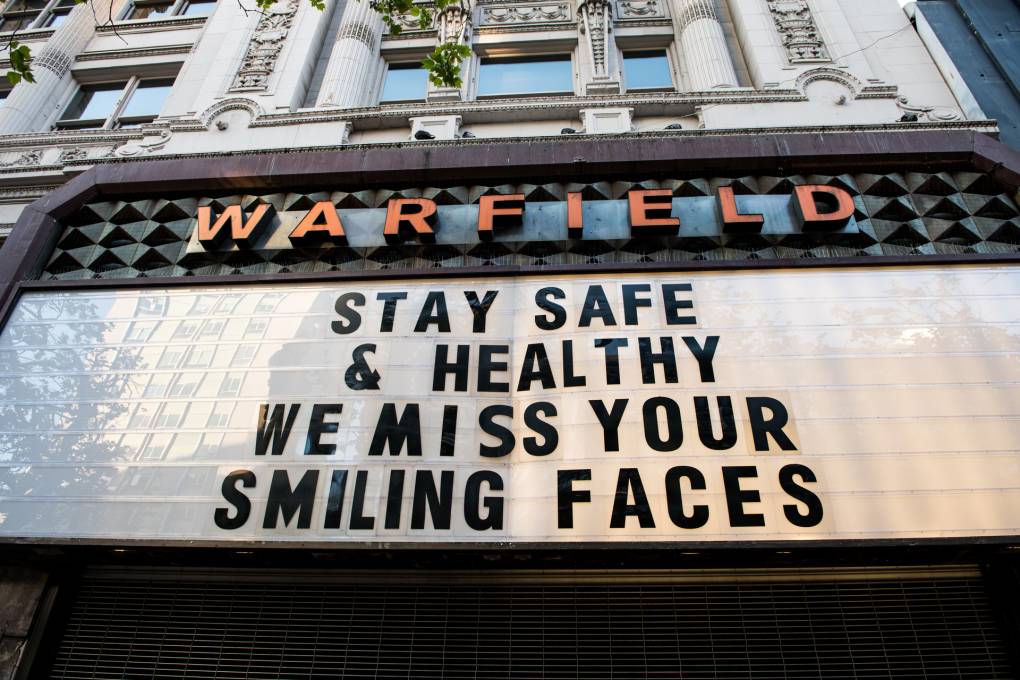
"caption": "The marquee for the Warfield reads, 'Stay Safe & Healthy. We Miss Your Smiling Faces,' on Market Street in San Francisco on April 7, 2020.",
"description": null,
"title": "RS42591_008_KQED_SanFrancisco_Businesses_04072020-qut",
"credit": "Beth LaBerge/KQED",
"status": "inherit",
"altTag": null,
"isLoading": false,
"fetchFailed": false
},
"news_11849837": {
"type": "attachments",
"id": "news_11849837",
"meta": {
"index": "attachments_1716263798",
"site": "news",
"id": "11849837",
"found": true
},
"parent": 11849825,
"imgSizes": {
"apple_news_ca_landscape_5_5": {
"file": "https://ww2.kqed.org/app/uploads/sites/10/2020/12/MARQUEE-809C-1044x720.jpg",
"width": 1044,
"mimeType": "image/jpeg",
"height": 720
},
"apple_news_ca_square_4_0": {
"file": "https://ww2.kqed.org/app/uploads/sites/10/2020/12/MARQUEE-809C-470x470.jpg",
"width": 470,
"mimeType": "image/jpeg",
"height": 470
},
"twentyfourteen-full-width": {
"file": "https://ww2.kqed.org/app/uploads/sites/10/2020/12/MARQUEE-809C-1038x576.jpg",
"width": 1038,
"mimeType": "image/jpeg",
"height": 576
},
"thumbnail": {
"file": "https://ww2.kqed.org/app/uploads/sites/10/2020/12/MARQUEE-809C-160x90.jpg",
"width": 160,
"mimeType": "image/jpeg",
"height": 90
},
"post-thumbnail": {
"file": "https://ww2.kqed.org/app/uploads/sites/10/2020/12/MARQUEE-809C-672x372.jpg",
"width": 672,
"mimeType": "image/jpeg",
"height": 372
},
"kqedFullSize": {
"file": "https://ww2.kqed.org/app/uploads/sites/10/2020/12/MARQUEE-809C.jpg",
"width": 1280,
"height": 720
},
"apple_news_ca_landscape_4_7": {
"file": "https://ww2.kqed.org/app/uploads/sites/10/2020/12/MARQUEE-809C-632x474.jpg",
"width": 632,
"mimeType": "image/jpeg",
"height": 474
},
"large": {
"file": "https://ww2.kqed.org/app/uploads/sites/10/2020/12/MARQUEE-809C-1020x574.jpg",
"width": 1020,
"mimeType": "image/jpeg",
"height": 574
},
"apple_news_ca_landscape_4_0": {
"file": "https://ww2.kqed.org/app/uploads/sites/10/2020/12/MARQUEE-809C-536x402.jpg",
"width": 536,
"mimeType": "image/jpeg",
"height": 402
},
"apple_news_ca_portrait_12_9": {
"file": "https://ww2.kqed.org/app/uploads/sites/10/2020/12/MARQUEE-809C-1122x720.jpg",
"width": 1122,
"mimeType": "image/jpeg",
"height": 720
},
"medium": {
"file": "https://ww2.kqed.org/app/uploads/sites/10/2020/12/MARQUEE-809C-800x450.jpg",
"width": 800,
"mimeType": "image/jpeg",
"height": 450
},
"apple_news_ca_portrait_4_0": {
"file": "https://ww2.kqed.org/app/uploads/sites/10/2020/12/MARQUEE-809C-354x472.jpg",
"width": 354,
"mimeType": "image/jpeg",
"height": 472
},
"apple_news_ca_portrait_9_7": {
"file": "https://ww2.kqed.org/app/uploads/sites/10/2020/12/MARQUEE-809C-840x720.jpg",
"width": 840,
"mimeType": "image/jpeg",
"height": 720
},
"apple_news_ca_square_9_7": {
"file": "https://ww2.kqed.org/app/uploads/sites/10/2020/12/MARQUEE-809C-1104x720.jpg",
"width": 1104,
"mimeType": "image/jpeg",
"height": 720
},
"apple_news_ca_portrait_4_7": {
"file": "https://ww2.kqed.org/app/uploads/sites/10/2020/12/MARQUEE-809C-414x552.jpg",
"width": 414,
"mimeType": "image/jpeg",
"height": 552
},
"apple_news_ca_portrait_5_5": {
"file": "https://ww2.kqed.org/app/uploads/sites/10/2020/12/MARQUEE-809C-687x720.jpg",
"width": 687,
"mimeType": "image/jpeg",
"height": 720
},
"apple_news_ca_square_4_7": {
"file": "https://ww2.kqed.org/app/uploads/sites/10/2020/12/MARQUEE-809C-550x550.jpg",
"width": 550,
"mimeType": "image/jpeg",
"height": 550
},
"apple_news_ca_square_5_5": {
"file": "https://ww2.kqed.org/app/uploads/sites/10/2020/12/MARQUEE-809C-912x720.jpg",
"width": 912,
"mimeType": "image/jpeg",
"height": 720
}
},
"publishDate": 1607128763,
"modified": 1607128763,
"caption": null,
"description": null,
"title": "MARQUEE 809C",
"credit": null,
"status": "inherit",
"altTag": null,
"isLoading": false,
"fetchFailed": false
},
"news_11849578": {
"type": "attachments",
"id": "news_11849578",
"meta": {
"index": "attachments_1716263798",
"site": "news",
"id": "11849578",
"found": true
},
"parent": 11849568,
"imgSizes": {
"apple_news_ca_landscape_5_5": {
"file": "https://ww2.kqed.org/app/uploads/sites/10/2020/12/again_120320_final-1044x783.png",
"width": 1044,
"mimeType": "image/png",
"height": 783
},
"apple_news_ca_square_4_0": {
"file": "https://ww2.kqed.org/app/uploads/sites/10/2020/12/again_120320_final-470x470.png",
"width": 470,
"mimeType": "image/png",
"height": 470
},
"twentyfourteen-full-width": {
"file": "https://ww2.kqed.org/app/uploads/sites/10/2020/12/again_120320_final-1038x576.png",
"width": 1038,
"mimeType": "image/png",
"height": 576
},
"thumbnail": {
"file": "https://ww2.kqed.org/app/uploads/sites/10/2020/12/again_120320_final-160x102.png",
"width": 160,
"mimeType": "image/png",
"height": 102
},
"post-thumbnail": {
"file": "https://ww2.kqed.org/app/uploads/sites/10/2020/12/again_120320_final-672x372.png",
"width": 672,
"mimeType": "image/png",
"height": 372
},
"kqedFullSize": {
"file": "https://ww2.kqed.org/app/uploads/sites/10/2020/12/again_120320_final.png",
"width": 1920,
"height": 1221
},
"apple_news_ca_landscape_4_7": {
"file": "https://ww2.kqed.org/app/uploads/sites/10/2020/12/again_120320_final-632x474.png",
"width": 632,
"mimeType": "image/png",
"height": 474
},
"large": {
"file": "https://ww2.kqed.org/app/uploads/sites/10/2020/12/again_120320_final-1020x649.png",
"width": 1020,
"mimeType": "image/png",
"height": 649
},
"apple_news_ca_landscape_4_0": {
"file": "https://ww2.kqed.org/app/uploads/sites/10/2020/12/again_120320_final-536x402.png",
"width": 536,
"mimeType": "image/png",
"height": 402
},
"apple_news_ca_portrait_12_9": {
"file": "https://ww2.kqed.org/app/uploads/sites/10/2020/12/again_120320_final-1122x1221.png",
"width": 1122,
"mimeType": "image/png",
"height": 1221
},
"medium": {
"file": "https://ww2.kqed.org/app/uploads/sites/10/2020/12/again_120320_final-800x509.png",
"width": 800,
"mimeType": "image/png",
"height": 509
},
"apple_news_ca_portrait_4_0": {
"file": "https://ww2.kqed.org/app/uploads/sites/10/2020/12/again_120320_final-354x472.png",
"width": 354,
"mimeType": "image/png",
"height": 472
},
"apple_news_ca_portrait_9_7": {
"file": "https://ww2.kqed.org/app/uploads/sites/10/2020/12/again_120320_final-840x1120.png",
"width": 840,
"mimeType": "image/png",
"height": 1120
},
"apple_news_ca_landscape_12_9": {
"file": "https://ww2.kqed.org/app/uploads/sites/10/2020/12/again_120320_final-1832x1221.png",
"width": 1832,
"mimeType": "image/png",
"height": 1221
},
"apple_news_ca_square_9_7": {
"file": "https://ww2.kqed.org/app/uploads/sites/10/2020/12/again_120320_final-1104x1104.png",
"width": 1104,
"mimeType": "image/png",
"height": 1104
},
"1536x1536": {
"file": "https://ww2.kqed.org/app/uploads/sites/10/2020/12/again_120320_final-1536x977.png",
"width": 1536,
"mimeType": "image/png",
"height": 977
},
"apple_news_ca_portrait_4_7": {
"file": "https://ww2.kqed.org/app/uploads/sites/10/2020/12/again_120320_final-414x552.png",
"width": 414,
"mimeType": "image/png",
"height": 552
},
"apple_news_ca_square_12_9": {
"file": "https://ww2.kqed.org/app/uploads/sites/10/2020/12/again_120320_final-1472x1221.png",
"width": 1472,
"mimeType": "image/png",
"height": 1221
},
"apple_news_ca_portrait_5_5": {
"file": "https://ww2.kqed.org/app/uploads/sites/10/2020/12/again_120320_final-687x916.png",
"width": 687,
"mimeType": "image/png",
"height": 916
},
"apple_news_ca_square_4_7": {
"file": "https://ww2.kqed.org/app/uploads/sites/10/2020/12/again_120320_final-550x550.png",
"width": 550,
"mimeType": "image/png",
"height": 550
},
"apple_news_ca_landscape_9_7": {
"file": "https://ww2.kqed.org/app/uploads/sites/10/2020/12/again_120320_final-1376x1032.png",
"width": 1376,
"mimeType": "image/png",
"height": 1032
},
"apple_news_ca_square_5_5": {
"file": "https://ww2.kqed.org/app/uploads/sites/10/2020/12/again_120320_final-912x912.png",
"width": 912,
"mimeType": "image/png",
"height": 912
}
},
"publishDate": 1607041039,
"modified": 1607041118,
"caption": null,
"description": null,
"title": "again_120320_final",
"credit": null,
"status": "inherit",
"altTag": "A Mark Fiore cartoon featuring the \"Home Sweet Home\" classic needlepoint sign as \"Home Stay Home Again\" as new stay-at-home orders are issued by Gov. Newsom",
"isLoading": false,
"fetchFailed": false
},
"news_11849488": {
"type": "attachments",
"id": "news_11849488",
"meta": {
"index": "attachments_1716263798",
"site": "news",
"id": "11849488",
"found": true
},
"parent": 11849487,
"imgSizes": {
"apple_news_ca_landscape_5_5": {
"file": "https://ww2.kqed.org/app/uploads/sites/10/2020/12/RS46154_063_KQED_SanFrancisco_COVIDTesting_11302020-qut-1044x783.jpg",
"width": 1044,
"mimeType": "image/jpeg",
"height": 783
},
"apple_news_ca_square_4_0": {
"file": "https://ww2.kqed.org/app/uploads/sites/10/2020/12/RS46154_063_KQED_SanFrancisco_COVIDTesting_11302020-qut-470x470.jpg",
"width": 470,
"mimeType": "image/jpeg",
"height": 470
},
"twentyfourteen-full-width": {
"file": "https://ww2.kqed.org/app/uploads/sites/10/2020/12/RS46154_063_KQED_SanFrancisco_COVIDTesting_11302020-qut-1038x576.jpg",
"width": 1038,
"mimeType": "image/jpeg",
"height": 576
},
"thumbnail": {
"file": "https://ww2.kqed.org/app/uploads/sites/10/2020/12/RS46154_063_KQED_SanFrancisco_COVIDTesting_11302020-qut-160x107.jpg",
"width": 160,
"mimeType": "image/jpeg",
"height": 107
},
"post-thumbnail": {
"file": "https://ww2.kqed.org/app/uploads/sites/10/2020/12/RS46154_063_KQED_SanFrancisco_COVIDTesting_11302020-qut-672x372.jpg",
"width": 672,
"mimeType": "image/jpeg",
"height": 372
},
"kqedFullSize": {
"file": "https://ww2.kqed.org/app/uploads/sites/10/2020/12/RS46154_063_KQED_SanFrancisco_COVIDTesting_11302020-qut.jpg",
"width": 1920,
"height": 1280
},
"apple_news_ca_landscape_4_7": {
"file": "https://ww2.kqed.org/app/uploads/sites/10/2020/12/RS46154_063_KQED_SanFrancisco_COVIDTesting_11302020-qut-632x474.jpg",
"width": 632,
"mimeType": "image/jpeg",
"height": 474
},
"large": {
"file": "https://ww2.kqed.org/app/uploads/sites/10/2020/12/RS46154_063_KQED_SanFrancisco_COVIDTesting_11302020-qut-1020x680.jpg",
"width": 1020,
"mimeType": "image/jpeg",
"height": 680
},
"apple_news_ca_landscape_4_0": {
"file": "https://ww2.kqed.org/app/uploads/sites/10/2020/12/RS46154_063_KQED_SanFrancisco_COVIDTesting_11302020-qut-536x402.jpg",
"width": 536,
"mimeType": "image/jpeg",
"height": 402
},
"apple_news_ca_portrait_12_9": {
"file": "https://ww2.kqed.org/app/uploads/sites/10/2020/12/RS46154_063_KQED_SanFrancisco_COVIDTesting_11302020-qut-1122x1280.jpg",
"width": 1122,
"mimeType": "image/jpeg",
"height": 1280
},
"medium": {
"file": "https://ww2.kqed.org/app/uploads/sites/10/2020/12/RS46154_063_KQED_SanFrancisco_COVIDTesting_11302020-qut-800x533.jpg",
"width": 800,
"mimeType": "image/jpeg",
"height": 533
},
"apple_news_ca_portrait_4_0": {
"file": "https://ww2.kqed.org/app/uploads/sites/10/2020/12/RS46154_063_KQED_SanFrancisco_COVIDTesting_11302020-qut-354x472.jpg",
"width": 354,
"mimeType": "image/jpeg",
"height": 472
},
"apple_news_ca_portrait_9_7": {
"file": "https://ww2.kqed.org/app/uploads/sites/10/2020/12/RS46154_063_KQED_SanFrancisco_COVIDTesting_11302020-qut-840x1120.jpg",
"width": 840,
"mimeType": "image/jpeg",
"height": 1120
},
"apple_news_ca_landscape_12_9": {
"file": "https://ww2.kqed.org/app/uploads/sites/10/2020/12/RS46154_063_KQED_SanFrancisco_COVIDTesting_11302020-qut-1832x1280.jpg",
"width": 1832,
"mimeType": "image/jpeg",
"height": 1280
},
"apple_news_ca_square_9_7": {
"file": "https://ww2.kqed.org/app/uploads/sites/10/2020/12/RS46154_063_KQED_SanFrancisco_COVIDTesting_11302020-qut-1104x1104.jpg",
"width": 1104,
"mimeType": "image/jpeg",
"height": 1104
},
"1536x1536": {
"file": "https://ww2.kqed.org/app/uploads/sites/10/2020/12/RS46154_063_KQED_SanFrancisco_COVIDTesting_11302020-qut-1536x1024.jpg",
"width": 1536,
"mimeType": "image/jpeg",
"height": 1024
},
"apple_news_ca_portrait_4_7": {
"file": "https://ww2.kqed.org/app/uploads/sites/10/2020/12/RS46154_063_KQED_SanFrancisco_COVIDTesting_11302020-qut-414x552.jpg",
"width": 414,
"mimeType": "image/jpeg",
"height": 552
},
"apple_news_ca_square_12_9": {
"file": "https://ww2.kqed.org/app/uploads/sites/10/2020/12/RS46154_063_KQED_SanFrancisco_COVIDTesting_11302020-qut-1472x1280.jpg",
"width": 1472,
"mimeType": "image/jpeg",
"height": 1280
},
"apple_news_ca_portrait_5_5": {
"file": "https://ww2.kqed.org/app/uploads/sites/10/2020/12/RS46154_063_KQED_SanFrancisco_COVIDTesting_11302020-qut-687x916.jpg",
"width": 687,
"mimeType": "image/jpeg",
"height": 916
},
"apple_news_ca_square_4_7": {
"file": "https://ww2.kqed.org/app/uploads/sites/10/2020/12/RS46154_063_KQED_SanFrancisco_COVIDTesting_11302020-qut-550x550.jpg",
"width": 550,
"mimeType": "image/jpeg",
"height": 550
},
"apple_news_ca_landscape_9_7": {
"file": "https://ww2.kqed.org/app/uploads/sites/10/2020/12/RS46154_063_KQED_SanFrancisco_COVIDTesting_11302020-qut-1376x1032.jpg",
"width": 1376,
"mimeType": "image/jpeg",
"height": 1032
},
"apple_news_ca_square_5_5": {
"file": "https://ww2.kqed.org/app/uploads/sites/10/2020/12/RS46154_063_KQED_SanFrancisco_COVIDTesting_11302020-qut-912x912.jpg",
"width": 912,
"mimeType": "image/jpeg",
"height": 912
}
},
"publishDate": 1607018940,
"modified": 1659985571,
"caption": "A pop-up COVID-19 testing site near the BART station on 24th and Mission streets in San Francisco on Nov. 30, 2020. The site is part of the Unidos En Salud initiative, a collaboration between UCSF and the city's Latino Task Force.",
"description": null,
"title": "RS46154_063_KQED_SanFrancisco_COVIDTesting_11302020-qut",
"credit": "Beth LaBerge/KQED",
"status": "inherit",
"altTag": "A family gets ready to receive a COVID-19 test in a large plaza.",
"isLoading": false,
"fetchFailed": false
},
"news_11849403": {
"type": "attachments",
"id": "news_11849403",
"meta": {
"index": "attachments_1716263798",
"site": "news",
"id": "11849403",
"found": true
},
"parent": 11849397,
"imgSizes": {
"apple_news_ca_landscape_5_5": {
"file": "https://ww2.kqed.org/app/uploads/sites/10/2020/12/menu_120220_final-1044x783.png",
"width": 1044,
"mimeType": "image/png",
"height": 783
},
"apple_news_ca_square_4_0": {
"file": "https://ww2.kqed.org/app/uploads/sites/10/2020/12/menu_120220_final-470x470.png",
"width": 470,
"mimeType": "image/png",
"height": 470
},
"twentyfourteen-full-width": {
"file": "https://ww2.kqed.org/app/uploads/sites/10/2020/12/menu_120220_final-1038x576.png",
"width": 1038,
"mimeType": "image/png",
"height": 576
},
"thumbnail": {
"file": "https://ww2.kqed.org/app/uploads/sites/10/2020/12/menu_120220_final-160x101.png",
"width": 160,
"mimeType": "image/png",
"height": 101
},
"post-thumbnail": {
"file": "https://ww2.kqed.org/app/uploads/sites/10/2020/12/menu_120220_final-672x372.png",
"width": 672,
"mimeType": "image/png",
"height": 372
},
"kqedFullSize": {
"file": "https://ww2.kqed.org/app/uploads/sites/10/2020/12/menu_120220_final.png",
"width": 1920,
"height": 1206
},
"apple_news_ca_landscape_4_7": {
"file": "https://ww2.kqed.org/app/uploads/sites/10/2020/12/menu_120220_final-632x474.png",
"width": 632,
"mimeType": "image/png",
"height": 474
},
"large": {
"file": "https://ww2.kqed.org/app/uploads/sites/10/2020/12/menu_120220_final-1020x641.png",
"width": 1020,
"mimeType": "image/png",
"height": 641
},
"apple_news_ca_landscape_4_0": {
"file": "https://ww2.kqed.org/app/uploads/sites/10/2020/12/menu_120220_final-536x402.png",
"width": 536,
"mimeType": "image/png",
"height": 402
},
"apple_news_ca_portrait_12_9": {
"file": "https://ww2.kqed.org/app/uploads/sites/10/2020/12/menu_120220_final-1122x1206.png",
"width": 1122,
"mimeType": "image/png",
"height": 1206
},
"medium": {
"file": "https://ww2.kqed.org/app/uploads/sites/10/2020/12/menu_120220_final-800x503.png",
"width": 800,
"mimeType": "image/png",
"height": 503
},
"apple_news_ca_portrait_4_0": {
"file": "https://ww2.kqed.org/app/uploads/sites/10/2020/12/menu_120220_final-354x472.png",
"width": 354,
"mimeType": "image/png",
"height": 472
},
"apple_news_ca_portrait_9_7": {
"file": "https://ww2.kqed.org/app/uploads/sites/10/2020/12/menu_120220_final-840x1120.png",
"width": 840,
"mimeType": "image/png",
"height": 1120
},
"apple_news_ca_landscape_12_9": {
"file": "https://ww2.kqed.org/app/uploads/sites/10/2020/12/menu_120220_final-1832x1206.png",
"width": 1832,
"mimeType": "image/png",
"height": 1206
},
"apple_news_ca_square_9_7": {
"file": "https://ww2.kqed.org/app/uploads/sites/10/2020/12/menu_120220_final-1104x1104.png",
"width": 1104,
"mimeType": "image/png",
"height": 1104
},
"1536x1536": {
"file": "https://ww2.kqed.org/app/uploads/sites/10/2020/12/menu_120220_final-1536x965.png",
"width": 1536,
"mimeType": "image/png",
"height": 965
},
"apple_news_ca_portrait_4_7": {
"file": "https://ww2.kqed.org/app/uploads/sites/10/2020/12/menu_120220_final-414x552.png",
"width": 414,
"mimeType": "image/png",
"height": 552
},
"apple_news_ca_square_12_9": {
"file": "https://ww2.kqed.org/app/uploads/sites/10/2020/12/menu_120220_final-1472x1206.png",
"width": 1472,
"mimeType": "image/png",
"height": 1206
},
"apple_news_ca_portrait_5_5": {
"file": "https://ww2.kqed.org/app/uploads/sites/10/2020/12/menu_120220_final-687x916.png",
"width": 687,
"mimeType": "image/png",
"height": 916
},
"apple_news_ca_square_4_7": {
"file": "https://ww2.kqed.org/app/uploads/sites/10/2020/12/menu_120220_final-550x550.png",
"width": 550,
"mimeType": "image/png",
"height": 550
},
"apple_news_ca_landscape_9_7": {
"file": "https://ww2.kqed.org/app/uploads/sites/10/2020/12/menu_120220_final-1376x1032.png",
"width": 1376,
"mimeType": "image/png",
"height": 1032
},
"apple_news_ca_square_5_5": {
"file": "https://ww2.kqed.org/app/uploads/sites/10/2020/12/menu_120220_final-912x912.png",
"width": 912,
"mimeType": "image/png",
"height": 912
}
},
"publishDate": 1606948986,
"modified": 1606949037,
"caption": null,
"description": null,
"title": "menu_120220_final",
"credit": null,
"status": "inherit",
"altTag": "A Mark Fiore cartoon about Gov. Gavin Newsom and Mayor London Breed's dining at the French Laundry amid COVID-19 restrictions.",
"isLoading": false,
"fetchFailed": false
},
"news_11849384": {
"type": "attachments",
"id": "news_11849384",
"meta": {
"index": "attachments_1716263798",
"site": "news",
"id": "11849384",
"found": true
},
"parent": 11849372,
"imgSizes": {
"apple_news_ca_landscape_5_5": {
"file": "https://ww2.kqed.org/app/uploads/sites/10/2020/12/RS42420_065_KQED_BethLaBerge_BloomEnergy_Newsom_03282020-qut-1044x783.jpg",
"width": 1044,
"mimeType": "image/jpeg",
"height": 783
},
"apple_news_ca_square_4_0": {
"file": "https://ww2.kqed.org/app/uploads/sites/10/2020/12/RS42420_065_KQED_BethLaBerge_BloomEnergy_Newsom_03282020-qut-470x470.jpg",
"width": 470,
"mimeType": "image/jpeg",
"height": 470
},
"twentyfourteen-full-width": {
"file": "https://ww2.kqed.org/app/uploads/sites/10/2020/12/RS42420_065_KQED_BethLaBerge_BloomEnergy_Newsom_03282020-qut-1038x576.jpg",
"width": 1038,
"mimeType": "image/jpeg",
"height": 576
},
"thumbnail": {
"file": "https://ww2.kqed.org/app/uploads/sites/10/2020/12/RS42420_065_KQED_BethLaBerge_BloomEnergy_Newsom_03282020-qut-160x107.jpg",
"width": 160,
"mimeType": "image/jpeg",
"height": 107
},
"post-thumbnail": {
"file": "https://ww2.kqed.org/app/uploads/sites/10/2020/12/RS42420_065_KQED_BethLaBerge_BloomEnergy_Newsom_03282020-qut-672x372.jpg",
"width": 672,
"mimeType": "image/jpeg",
"height": 372
},
"kqedFullSize": {
"file": "https://ww2.kqed.org/app/uploads/sites/10/2020/12/RS42420_065_KQED_BethLaBerge_BloomEnergy_Newsom_03282020-qut.jpg",
"width": 1920,
"height": 1280
},
"apple_news_ca_landscape_4_7": {
"file": "https://ww2.kqed.org/app/uploads/sites/10/2020/12/RS42420_065_KQED_BethLaBerge_BloomEnergy_Newsom_03282020-qut-632x474.jpg",
"width": 632,
"mimeType": "image/jpeg",
"height": 474
},
"large": {
"file": "https://ww2.kqed.org/app/uploads/sites/10/2020/12/RS42420_065_KQED_BethLaBerge_BloomEnergy_Newsom_03282020-qut-1020x680.jpg",
"width": 1020,
"mimeType": "image/jpeg",
"height": 680
},
"apple_news_ca_landscape_4_0": {
"file": "https://ww2.kqed.org/app/uploads/sites/10/2020/12/RS42420_065_KQED_BethLaBerge_BloomEnergy_Newsom_03282020-qut-536x402.jpg",
"width": 536,
"mimeType": "image/jpeg",
"height": 402
},
"apple_news_ca_portrait_12_9": {
"file": "https://ww2.kqed.org/app/uploads/sites/10/2020/12/RS42420_065_KQED_BethLaBerge_BloomEnergy_Newsom_03282020-qut-1122x1280.jpg",
"width": 1122,
"mimeType": "image/jpeg",
"height": 1280
},
"medium": {
"file": "https://ww2.kqed.org/app/uploads/sites/10/2020/12/RS42420_065_KQED_BethLaBerge_BloomEnergy_Newsom_03282020-qut-800x533.jpg",
"width": 800,
"mimeType": "image/jpeg",
"height": 533
},
"apple_news_ca_portrait_4_0": {
"file": "https://ww2.kqed.org/app/uploads/sites/10/2020/12/RS42420_065_KQED_BethLaBerge_BloomEnergy_Newsom_03282020-qut-354x472.jpg",
"width": 354,
"mimeType": "image/jpeg",
"height": 472
},
"apple_news_ca_portrait_9_7": {
"file": "https://ww2.kqed.org/app/uploads/sites/10/2020/12/RS42420_065_KQED_BethLaBerge_BloomEnergy_Newsom_03282020-qut-840x1120.jpg",
"width": 840,
"mimeType": "image/jpeg",
"height": 1120
},
"apple_news_ca_landscape_12_9": {
"file": "https://ww2.kqed.org/app/uploads/sites/10/2020/12/RS42420_065_KQED_BethLaBerge_BloomEnergy_Newsom_03282020-qut-1832x1280.jpg",
"width": 1832,
"mimeType": "image/jpeg",
"height": 1280
},
"apple_news_ca_square_9_7": {
"file": "https://ww2.kqed.org/app/uploads/sites/10/2020/12/RS42420_065_KQED_BethLaBerge_BloomEnergy_Newsom_03282020-qut-1104x1104.jpg",
"width": 1104,
"mimeType": "image/jpeg",
"height": 1104
},
"1536x1536": {
"file": "https://ww2.kqed.org/app/uploads/sites/10/2020/12/RS42420_065_KQED_BethLaBerge_BloomEnergy_Newsom_03282020-qut-1536x1024.jpg",
"width": 1536,
"mimeType": "image/jpeg",
"height": 1024
},
"apple_news_ca_portrait_4_7": {
"file": "https://ww2.kqed.org/app/uploads/sites/10/2020/12/RS42420_065_KQED_BethLaBerge_BloomEnergy_Newsom_03282020-qut-414x552.jpg",
"width": 414,
"mimeType": "image/jpeg",
"height": 552
},
"apple_news_ca_square_12_9": {
"file": "https://ww2.kqed.org/app/uploads/sites/10/2020/12/RS42420_065_KQED_BethLaBerge_BloomEnergy_Newsom_03282020-qut-1472x1280.jpg",
"width": 1472,
"mimeType": "image/jpeg",
"height": 1280
},
"apple_news_ca_portrait_5_5": {
"file": "https://ww2.kqed.org/app/uploads/sites/10/2020/12/RS42420_065_KQED_BethLaBerge_BloomEnergy_Newsom_03282020-qut-687x916.jpg",
"width": 687,
"mimeType": "image/jpeg",
"height": 916
},
"apple_news_ca_square_4_7": {
"file": "https://ww2.kqed.org/app/uploads/sites/10/2020/12/RS42420_065_KQED_BethLaBerge_BloomEnergy_Newsom_03282020-qut-550x550.jpg",
"width": 550,
"mimeType": "image/jpeg",
"height": 550
},
"apple_news_ca_landscape_9_7": {
"file": "https://ww2.kqed.org/app/uploads/sites/10/2020/12/RS42420_065_KQED_BethLaBerge_BloomEnergy_Newsom_03282020-qut-1376x1032.jpg",
"width": 1376,
"mimeType": "image/jpeg",
"height": 1032
},
"apple_news_ca_square_5_5": {
"file": "https://ww2.kqed.org/app/uploads/sites/10/2020/12/RS42420_065_KQED_BethLaBerge_BloomEnergy_Newsom_03282020-qut-912x912.jpg",
"width": 912,
"mimeType": "image/jpeg",
"height": 912
}
},
"publishDate": 1606945874,
"modified": 1606945965,
"caption": "San Jose Mayor Sam Liccardo speaks during a press conference in front of Gov. Gavin Newsom on March 28, 2020. Both men have come under fire for recent dinners out.",
"description": null,
"title": "RS42420_065_KQED_BethLaBerge_BloomEnergy_Newsom_03282020-qut",
"credit": "Beth LaBerge/KQED",
"status": "inherit",
"altTag": null,
"isLoading": false,
"fetchFailed": false
},
"news_11849364": {
"type": "attachments",
"id": "news_11849364",
"meta": {
"index": "attachments_1716263798",
"site": "news",
"id": "11849364",
"found": true
},
"parent": 11849340,
"imgSizes": {
"apple_news_ca_square_4_0": {
"file": "https://ww2.kqed.org/app/uploads/sites/10/2020/12/GettyImages-1249031192-470x470.jpg",
"width": 470,
"mimeType": "image/jpeg",
"height": 470
},
"twentyfourteen-full-width": {
"file": "https://ww2.kqed.org/app/uploads/sites/10/2020/12/GettyImages-1249031192-1024x576.jpg",
"width": 1024,
"mimeType": "image/jpeg",
"height": 576
},
"thumbnail": {
"file": "https://ww2.kqed.org/app/uploads/sites/10/2020/12/GettyImages-1249031192-160x107.jpg",
"width": 160,
"mimeType": "image/jpeg",
"height": 107
},
"post-thumbnail": {
"file": "https://ww2.kqed.org/app/uploads/sites/10/2020/12/GettyImages-1249031192-672x372.jpg",
"width": 672,
"mimeType": "image/jpeg",
"height": 372
},
"kqedFullSize": {
"file": "https://ww2.kqed.org/app/uploads/sites/10/2020/12/GettyImages-1249031192.jpg",
"width": 1024,
"height": 683
},
"apple_news_ca_landscape_4_7": {
"file": "https://ww2.kqed.org/app/uploads/sites/10/2020/12/GettyImages-1249031192-632x474.jpg",
"width": 632,
"mimeType": "image/jpeg",
"height": 474
},
"large": {
"file": "https://ww2.kqed.org/app/uploads/sites/10/2020/12/GettyImages-1249031192-1020x680.jpg",
"width": 1020,
"mimeType": "image/jpeg",
"height": 680
},
"apple_news_ca_landscape_4_0": {
"file": "https://ww2.kqed.org/app/uploads/sites/10/2020/12/GettyImages-1249031192-536x402.jpg",
"width": 536,
"mimeType": "image/jpeg",
"height": 402
},
"medium": {
"file": "https://ww2.kqed.org/app/uploads/sites/10/2020/12/GettyImages-1249031192-800x534.jpg",
"width": 800,
"mimeType": "image/jpeg",
"height": 534
},
"apple_news_ca_portrait_4_0": {
"file": "https://ww2.kqed.org/app/uploads/sites/10/2020/12/GettyImages-1249031192-354x472.jpg",
"width": 354,
"mimeType": "image/jpeg",
"height": 472
},
"apple_news_ca_portrait_9_7": {
"file": "https://ww2.kqed.org/app/uploads/sites/10/2020/12/GettyImages-1249031192-840x683.jpg",
"width": 840,
"mimeType": "image/jpeg",
"height": 683
},
"apple_news_ca_portrait_4_7": {
"file": "https://ww2.kqed.org/app/uploads/sites/10/2020/12/GettyImages-1249031192-414x552.jpg",
"width": 414,
"mimeType": "image/jpeg",
"height": 552
},
"apple_news_ca_portrait_5_5": {
"file": "https://ww2.kqed.org/app/uploads/sites/10/2020/12/GettyImages-1249031192-687x683.jpg",
"width": 687,
"mimeType": "image/jpeg",
"height": 683
},
"apple_news_ca_square_4_7": {
"file": "https://ww2.kqed.org/app/uploads/sites/10/2020/12/GettyImages-1249031192-550x550.jpg",
"width": 550,
"mimeType": "image/jpeg",
"height": 550
},
"apple_news_ca_square_5_5": {
"file": "https://ww2.kqed.org/app/uploads/sites/10/2020/12/GettyImages-1249031192-912x683.jpg",
"width": 912,
"mimeType": "image/jpeg",
"height": 683
}
},
"publishDate": 1606942900,
"modified": 1606952407,
"caption": "A boarded up Macy's store on June 11, 2020 near San Francisco's normally bustling Union Square.",
"description": null,
"title": "Economic Worries Continue As Additional 1.5 Million Seek Jobless Benefits And Dow Falls",
"credit": "Justin Sullivan/Getty Images",
"status": "inherit",
"altTag": "A boarded up Macy's store",
"isLoading": false,
"fetchFailed": false
},
"news_11849082": {
"type": "attachments",
"id": "news_11849082",
"meta": {
"index": "attachments_1716263798",
"site": "news",
"id": "11849082",
"found": true
},
"parent": 11849051,
"imgSizes": {
"apple_news_ca_square_4_0": {
"file": "https://ww2.kqed.org/app/uploads/sites/10/2020/11/GettyImages-1229660105-470x470.jpg",
"width": 470,
"mimeType": "image/jpeg",
"height": 470
},
"twentyfourteen-full-width": {
"file": "https://ww2.kqed.org/app/uploads/sites/10/2020/11/GettyImages-1229660105-1024x576.jpg",
"width": 1024,
"mimeType": "image/jpeg",
"height": 576
},
"thumbnail": {
"file": "https://ww2.kqed.org/app/uploads/sites/10/2020/11/GettyImages-1229660105-160x107.jpg",
"width": 160,
"mimeType": "image/jpeg",
"height": 107
},
"post-thumbnail": {
"file": "https://ww2.kqed.org/app/uploads/sites/10/2020/11/GettyImages-1229660105-672x372.jpg",
"width": 672,
"mimeType": "image/jpeg",
"height": 372
},
"kqedFullSize": {
"file": "https://ww2.kqed.org/app/uploads/sites/10/2020/11/GettyImages-1229660105.jpg",
"width": 1024,
"height": 683
},
"apple_news_ca_landscape_4_7": {
"file": "https://ww2.kqed.org/app/uploads/sites/10/2020/11/GettyImages-1229660105-632x474.jpg",
"width": 632,
"mimeType": "image/jpeg",
"height": 474
},
"large": {
"file": "https://ww2.kqed.org/app/uploads/sites/10/2020/11/GettyImages-1229660105-1020x680.jpg",
"width": 1020,
"mimeType": "image/jpeg",
"height": 680
},
"apple_news_ca_landscape_4_0": {
"file": "https://ww2.kqed.org/app/uploads/sites/10/2020/11/GettyImages-1229660105-536x402.jpg",
"width": 536,
"mimeType": "image/jpeg",
"height": 402
},
"medium": {
"file": "https://ww2.kqed.org/app/uploads/sites/10/2020/11/GettyImages-1229660105-800x534.jpg",
"width": 800,
"mimeType": "image/jpeg",
"height": 534
},
"apple_news_ca_portrait_4_0": {
"file": "https://ww2.kqed.org/app/uploads/sites/10/2020/11/GettyImages-1229660105-354x472.jpg",
"width": 354,
"mimeType": "image/jpeg",
"height": 472
},
"apple_news_ca_portrait_9_7": {
"file": "https://ww2.kqed.org/app/uploads/sites/10/2020/11/GettyImages-1229660105-840x683.jpg",
"width": 840,
"mimeType": "image/jpeg",
"height": 683
},
"apple_news_ca_portrait_4_7": {
"file": "https://ww2.kqed.org/app/uploads/sites/10/2020/11/GettyImages-1229660105-414x552.jpg",
"width": 414,
"mimeType": "image/jpeg",
"height": 552
},
"apple_news_ca_portrait_5_5": {
"file": "https://ww2.kqed.org/app/uploads/sites/10/2020/11/GettyImages-1229660105-687x683.jpg",
"width": 687,
"mimeType": "image/jpeg",
"height": 683
},
"apple_news_ca_square_4_7": {
"file": "https://ww2.kqed.org/app/uploads/sites/10/2020/11/GettyImages-1229660105-550x550.jpg",
"width": 550,
"mimeType": "image/jpeg",
"height": 550
},
"apple_news_ca_square_5_5": {
"file": "https://ww2.kqed.org/app/uploads/sites/10/2020/11/GettyImages-1229660105-912x683.jpg",
"width": 912,
"mimeType": "image/jpeg",
"height": 683
}
},
"publishDate": 1606777791,
"modified": 1606780314,
"caption": "Rachel Thorlund, manager at The Den Cafe, clears an outdoor table following reimposed restrictions on indoor dining in Orange County due to COVID-19 in Santa Ana on Nov. 17, 2020.",
"description": null,
"title": "US-HEALTH-VIRUS",
"credit": "Patrick T. Fallon/AFP via Getty Images",
"status": "inherit",
"isLoading": false,
"fetchFailed": false
},
"news_11848828": {
"type": "attachments",
"id": "news_11848828",
"meta": {
"index": "attachments_1716263798",
"site": "news",
"id": "11848828",
"found": true
},
"parent": 11848758,
"imgSizes": {
"apple_news_ca_landscape_5_5": {
"file": "https://ww2.kqed.org/app/uploads/sites/10/2020/11/RS42582_002_KQED_SanFrancisco_Businesses_04072020-qut-1044x783.jpg",
"width": 1044,
"mimeType": "image/jpeg",
"height": 783
},
"apple_news_ca_square_4_0": {
"file": "https://ww2.kqed.org/app/uploads/sites/10/2020/11/RS42582_002_KQED_SanFrancisco_Businesses_04072020-qut-470x470.jpg",
"width": 470,
"mimeType": "image/jpeg",
"height": 470
},
"twentyfourteen-full-width": {
"file": "https://ww2.kqed.org/app/uploads/sites/10/2020/11/RS42582_002_KQED_SanFrancisco_Businesses_04072020-qut-1038x576.jpg",
"width": 1038,
"mimeType": "image/jpeg",
"height": 576
},
"thumbnail": {
"file": "https://ww2.kqed.org/app/uploads/sites/10/2020/11/RS42582_002_KQED_SanFrancisco_Businesses_04072020-qut-160x107.jpg",
"width": 160,
"mimeType": "image/jpeg",
"height": 107
},
"post-thumbnail": {
"file": "https://ww2.kqed.org/app/uploads/sites/10/2020/11/RS42582_002_KQED_SanFrancisco_Businesses_04072020-qut-672x372.jpg",
"width": 672,
"mimeType": "image/jpeg",
"height": 372
},
"kqedFullSize": {
"file": "https://ww2.kqed.org/app/uploads/sites/10/2020/11/RS42582_002_KQED_SanFrancisco_Businesses_04072020-qut.jpg",
"width": 1920,
"height": 1280
},
"apple_news_ca_landscape_4_7": {
"file": "https://ww2.kqed.org/app/uploads/sites/10/2020/11/RS42582_002_KQED_SanFrancisco_Businesses_04072020-qut-632x474.jpg",
"width": 632,
"mimeType": "image/jpeg",
"height": 474
},
"large": {
"file": "https://ww2.kqed.org/app/uploads/sites/10/2020/11/RS42582_002_KQED_SanFrancisco_Businesses_04072020-qut-1020x680.jpg",
"width": 1020,
"mimeType": "image/jpeg",
"height": 680
},
"apple_news_ca_landscape_4_0": {
"file": "https://ww2.kqed.org/app/uploads/sites/10/2020/11/RS42582_002_KQED_SanFrancisco_Businesses_04072020-qut-536x402.jpg",
"width": 536,
"mimeType": "image/jpeg",
"height": 402
},
"apple_news_ca_portrait_12_9": {
"file": "https://ww2.kqed.org/app/uploads/sites/10/2020/11/RS42582_002_KQED_SanFrancisco_Businesses_04072020-qut-1122x1280.jpg",
"width": 1122,
"mimeType": "image/jpeg",
"height": 1280
},
"medium": {
"file": "https://ww2.kqed.org/app/uploads/sites/10/2020/11/RS42582_002_KQED_SanFrancisco_Businesses_04072020-qut-800x533.jpg",
"width": 800,
"mimeType": "image/jpeg",
"height": 533
},
"apple_news_ca_portrait_4_0": {
"file": "https://ww2.kqed.org/app/uploads/sites/10/2020/11/RS42582_002_KQED_SanFrancisco_Businesses_04072020-qut-354x472.jpg",
"width": 354,
"mimeType": "image/jpeg",
"height": 472
},
"apple_news_ca_portrait_9_7": {
"file": "https://ww2.kqed.org/app/uploads/sites/10/2020/11/RS42582_002_KQED_SanFrancisco_Businesses_04072020-qut-840x1120.jpg",
"width": 840,
"mimeType": "image/jpeg",
"height": 1120
},
"apple_news_ca_landscape_12_9": {
"file": "https://ww2.kqed.org/app/uploads/sites/10/2020/11/RS42582_002_KQED_SanFrancisco_Businesses_04072020-qut-1832x1280.jpg",
"width": 1832,
"mimeType": "image/jpeg",
"height": 1280
},
"apple_news_ca_square_9_7": {
"file": "https://ww2.kqed.org/app/uploads/sites/10/2020/11/RS42582_002_KQED_SanFrancisco_Businesses_04072020-qut-1104x1104.jpg",
"width": 1104,
"mimeType": "image/jpeg",
"height": 1104
},
"1536x1536": {
"file": "https://ww2.kqed.org/app/uploads/sites/10/2020/11/RS42582_002_KQED_SanFrancisco_Businesses_04072020-qut-1536x1024.jpg",
"width": 1536,
"mimeType": "image/jpeg",
"height": 1024
},
"apple_news_ca_portrait_4_7": {
"file": "https://ww2.kqed.org/app/uploads/sites/10/2020/11/RS42582_002_KQED_SanFrancisco_Businesses_04072020-qut-414x552.jpg",
"width": 414,
"mimeType": "image/jpeg",
"height": 552
},
"apple_news_ca_square_12_9": {
"file": "https://ww2.kqed.org/app/uploads/sites/10/2020/11/RS42582_002_KQED_SanFrancisco_Businesses_04072020-qut-1472x1280.jpg",
"width": 1472,
"mimeType": "image/jpeg",
"height": 1280
},
"apple_news_ca_portrait_5_5": {
"file": "https://ww2.kqed.org/app/uploads/sites/10/2020/11/RS42582_002_KQED_SanFrancisco_Businesses_04072020-qut-687x916.jpg",
"width": 687,
"mimeType": "image/jpeg",
"height": 916
},
"apple_news_ca_square_4_7": {
"file": "https://ww2.kqed.org/app/uploads/sites/10/2020/11/RS42582_002_KQED_SanFrancisco_Businesses_04072020-qut-550x550.jpg",
"width": 550,
"mimeType": "image/jpeg",
"height": 550
},
"apple_news_ca_landscape_9_7": {
"file": "https://ww2.kqed.org/app/uploads/sites/10/2020/11/RS42582_002_KQED_SanFrancisco_Businesses_04072020-qut-1376x1032.jpg",
"width": 1376,
"mimeType": "image/jpeg",
"height": 1032
},
"apple_news_ca_square_5_5": {
"file": "https://ww2.kqed.org/app/uploads/sites/10/2020/11/RS42582_002_KQED_SanFrancisco_Businesses_04072020-qut-912x912.jpg",
"width": 912,
"mimeType": "image/jpeg",
"height": 912
}
},
"publishDate": 1606338198,
"modified": 1606763270,
"caption": "Una familia camina a lado de un cartel de 'Food to Go' en The Napper Tandy en la calle 24 en San Francisco el 7 de abril del 2020.",
"description": "Una familia camina junto a un cartel de 'Food to Go' en The Napper Tandy en la calle 24 en San Francisco el 7 de abril del 2020.",
"title": "RS42582_002_KQED_SanFrancisco_Businesses_04072020-qut",
"credit": "Beth LaBerge",
"status": "inherit",
"isLoading": false,
"fetchFailed": false
},
"news_11848518": {
"type": "attachments",
"id": "news_11848518",
"meta": {
"index": "attachments_1716263798",
"site": "news",
"id": "11848518",
"found": true
},
"parent": 11848464,
"imgSizes": {
"apple_news_ca_square_4_0": {
"file": "https://ww2.kqed.org/app/uploads/sites/10/2020/11/GettyImages-1229723834-470x470.jpg",
"width": 470,
"mimeType": "image/jpeg",
"height": 470
},
"twentyfourteen-full-width": {
"file": "https://ww2.kqed.org/app/uploads/sites/10/2020/11/GettyImages-1229723834-1024x576.jpg",
"width": 1024,
"mimeType": "image/jpeg",
"height": 576
},
"thumbnail": {
"file": "https://ww2.kqed.org/app/uploads/sites/10/2020/11/GettyImages-1229723834-160x107.jpg",
"width": 160,
"mimeType": "image/jpeg",
"height": 107
},
"post-thumbnail": {
"file": "https://ww2.kqed.org/app/uploads/sites/10/2020/11/GettyImages-1229723834-672x372.jpg",
"width": 672,
"mimeType": "image/jpeg",
"height": 372
},
"kqedFullSize": {
"file": "https://ww2.kqed.org/app/uploads/sites/10/2020/11/GettyImages-1229723834.jpg",
"width": 1024,
"height": 683
},
"apple_news_ca_landscape_4_7": {
"file": "https://ww2.kqed.org/app/uploads/sites/10/2020/11/GettyImages-1229723834-632x474.jpg",
"width": 632,
"mimeType": "image/jpeg",
"height": 474
},
"large": {
"file": "https://ww2.kqed.org/app/uploads/sites/10/2020/11/GettyImages-1229723834-1020x680.jpg",
"width": 1020,
"mimeType": "image/jpeg",
"height": 680
},
"apple_news_ca_landscape_4_0": {
"file": "https://ww2.kqed.org/app/uploads/sites/10/2020/11/GettyImages-1229723834-536x402.jpg",
"width": 536,
"mimeType": "image/jpeg",
"height": 402
},
"medium": {
"file": "https://ww2.kqed.org/app/uploads/sites/10/2020/11/GettyImages-1229723834-800x534.jpg",
"width": 800,
"mimeType": "image/jpeg",
"height": 534
},
"apple_news_ca_portrait_4_0": {
"file": "https://ww2.kqed.org/app/uploads/sites/10/2020/11/GettyImages-1229723834-354x472.jpg",
"width": 354,
"mimeType": "image/jpeg",
"height": 472
},
"apple_news_ca_portrait_9_7": {
"file": "https://ww2.kqed.org/app/uploads/sites/10/2020/11/GettyImages-1229723834-840x683.jpg",
"width": 840,
"mimeType": "image/jpeg",
"height": 683
},
"apple_news_ca_portrait_4_7": {
"file": "https://ww2.kqed.org/app/uploads/sites/10/2020/11/GettyImages-1229723834-414x552.jpg",
"width": 414,
"mimeType": "image/jpeg",
"height": 552
},
"apple_news_ca_portrait_5_5": {
"file": "https://ww2.kqed.org/app/uploads/sites/10/2020/11/GettyImages-1229723834-687x683.jpg",
"width": 687,
"mimeType": "image/jpeg",
"height": 683
},
"apple_news_ca_square_4_7": {
"file": "https://ww2.kqed.org/app/uploads/sites/10/2020/11/GettyImages-1229723834-550x550.jpg",
"width": 550,
"mimeType": "image/jpeg",
"height": 550
},
"apple_news_ca_square_5_5": {
"file": "https://ww2.kqed.org/app/uploads/sites/10/2020/11/GettyImages-1229723834-912x683.jpg",
"width": 912,
"mimeType": "image/jpeg",
"height": 683
}
},
"publishDate": 1606166462,
"modified": 1606166556,
"caption": "A generally empty 5th Avenue in San Diego's Gaslamp Quarter just before an imposed curfew on Nov. 21, 2020.",
"description": null,
"title": "California Sets Curfew After A New Surge In COVID-19 Cases",
"credit": "Sandy Huffaker/Getty Images",
"status": "inherit",
"isLoading": false,
"fetchFailed": false
},
"news_11848398": {
"type": "attachments",
"id": "news_11848398",
"meta": {
"index": "attachments_1716263798",
"site": "news",
"id": "11848398",
"found": true
},
"parent": 11848262,
"imgSizes": {
"apple_news_ca_landscape_5_5": {
"file": "https://ww2.kqed.org/app/uploads/sites/10/2020/11/marquee_FINAL-1044x720.jpg",
"width": 1044,
"mimeType": "image/jpeg",
"height": 720
},
"apple_news_ca_square_4_0": {
"file": "https://ww2.kqed.org/app/uploads/sites/10/2020/11/marquee_FINAL-470x470.jpg",
"width": 470,
"mimeType": "image/jpeg",
"height": 470
},
"twentyfourteen-full-width": {
"file": "https://ww2.kqed.org/app/uploads/sites/10/2020/11/marquee_FINAL-1038x576.jpg",
"width": 1038,
"mimeType": "image/jpeg",
"height": 576
},
"thumbnail": {
"file": "https://ww2.kqed.org/app/uploads/sites/10/2020/11/marquee_FINAL-160x90.jpg",
"width": 160,
"mimeType": "image/jpeg",
"height": 90
},
"post-thumbnail": {
"file": "https://ww2.kqed.org/app/uploads/sites/10/2020/11/marquee_FINAL-672x372.jpg",
"width": 672,
"mimeType": "image/jpeg",
"height": 372
},
"kqedFullSize": {
"file": "https://ww2.kqed.org/app/uploads/sites/10/2020/11/marquee_FINAL.jpg",
"width": 1280,
"height": 720
},
"apple_news_ca_landscape_4_7": {
"file": "https://ww2.kqed.org/app/uploads/sites/10/2020/11/marquee_FINAL-632x474.jpg",
"width": 632,
"mimeType": "image/jpeg",
"height": 474
},
"large": {
"file": "https://ww2.kqed.org/app/uploads/sites/10/2020/11/marquee_FINAL-1020x574.jpg",
"width": 1020,
"mimeType": "image/jpeg",
"height": 574
},
"apple_news_ca_landscape_4_0": {
"file": "https://ww2.kqed.org/app/uploads/sites/10/2020/11/marquee_FINAL-536x402.jpg",
"width": 536,
"mimeType": "image/jpeg",
"height": 402
},
"apple_news_ca_portrait_12_9": {
"file": "https://ww2.kqed.org/app/uploads/sites/10/2020/11/marquee_FINAL-1122x720.jpg",
"width": 1122,
"mimeType": "image/jpeg",
"height": 720
},
"medium": {
"file": "https://ww2.kqed.org/app/uploads/sites/10/2020/11/marquee_FINAL-800x450.jpg",
"width": 800,
"mimeType": "image/jpeg",
"height": 450
},
"apple_news_ca_portrait_4_0": {
"file": "https://ww2.kqed.org/app/uploads/sites/10/2020/11/marquee_FINAL-354x472.jpg",
"width": 354,
"mimeType": "image/jpeg",
"height": 472
},
"apple_news_ca_portrait_9_7": {
"file": "https://ww2.kqed.org/app/uploads/sites/10/2020/11/marquee_FINAL-840x720.jpg",
"width": 840,
"mimeType": "image/jpeg",
"height": 720
},
"apple_news_ca_square_9_7": {
"file": "https://ww2.kqed.org/app/uploads/sites/10/2020/11/marquee_FINAL-1104x720.jpg",
"width": 1104,
"mimeType": "image/jpeg",
"height": 720
},
"apple_news_ca_portrait_4_7": {
"file": "https://ww2.kqed.org/app/uploads/sites/10/2020/11/marquee_FINAL-414x552.jpg",
"width": 414,
"mimeType": "image/jpeg",
"height": 552
},
"apple_news_ca_portrait_5_5": {
"file": "https://ww2.kqed.org/app/uploads/sites/10/2020/11/marquee_FINAL-687x720.jpg",
"width": 687,
"mimeType": "image/jpeg",
"height": 720
},
"apple_news_ca_square_4_7": {
"file": "https://ww2.kqed.org/app/uploads/sites/10/2020/11/marquee_FINAL-550x550.jpg",
"width": 550,
"mimeType": "image/jpeg",
"height": 550
},
"apple_news_ca_square_5_5": {
"file": "https://ww2.kqed.org/app/uploads/sites/10/2020/11/marquee_FINAL-912x720.jpg",
"width": 912,
"mimeType": "image/jpeg",
"height": 720
}
},
"publishDate": 1605920398,
"modified": 1605920398,
"caption": null,
"description": null,
"title": "marquee_FINAL",
"credit": null,
"status": "inherit",
"isLoading": false,
"fetchFailed": false
},
"news_11848305": {
"type": "attachments",
"id": "news_11848305",
"meta": {
"index": "attachments_1716263798",
"site": "news",
"id": "11848305",
"found": true
},
"parent": 11848292,
"imgSizes": {
"apple_news_ca_landscape_5_5": {
"file": "https://ww2.kqed.org/app/uploads/sites/10/2020/11/thankyoufor_112020_final-1044x783.png",
"width": 1044,
"mimeType": "image/png",
"height": 783
},
"apple_news_ca_square_4_0": {
"file": "https://ww2.kqed.org/app/uploads/sites/10/2020/11/thankyoufor_112020_final-470x470.png",
"width": 470,
"mimeType": "image/png",
"height": 470
},
"twentyfourteen-full-width": {
"file": "https://ww2.kqed.org/app/uploads/sites/10/2020/11/thankyoufor_112020_final-1038x576.png",
"width": 1038,
"mimeType": "image/png",
"height": 576
},
"thumbnail": {
"file": "https://ww2.kqed.org/app/uploads/sites/10/2020/11/thankyoufor_112020_final-160x109.png",
"width": 160,
"mimeType": "image/png",
"height": 109
},
"post-thumbnail": {
"file": "https://ww2.kqed.org/app/uploads/sites/10/2020/11/thankyoufor_112020_final-672x372.png",
"width": 672,
"mimeType": "image/png",
"height": 372
},
"kqedFullSize": {
"file": "https://ww2.kqed.org/app/uploads/sites/10/2020/11/thankyoufor_112020_final.png",
"width": 1920,
"height": 1308
},
"apple_news_ca_landscape_4_7": {
"file": "https://ww2.kqed.org/app/uploads/sites/10/2020/11/thankyoufor_112020_final-632x474.png",
"width": 632,
"mimeType": "image/png",
"height": 474
},
"large": {
"file": "https://ww2.kqed.org/app/uploads/sites/10/2020/11/thankyoufor_112020_final-1020x695.png",
"width": 1020,
"mimeType": "image/png",
"height": 695
},
"apple_news_ca_landscape_4_0": {
"file": "https://ww2.kqed.org/app/uploads/sites/10/2020/11/thankyoufor_112020_final-536x402.png",
"width": 536,
"mimeType": "image/png",
"height": 402
},
"apple_news_ca_portrait_12_9": {
"file": "https://ww2.kqed.org/app/uploads/sites/10/2020/11/thankyoufor_112020_final-1122x1308.png",
"width": 1122,
"mimeType": "image/png",
"height": 1308
},
"medium": {
"file": "https://ww2.kqed.org/app/uploads/sites/10/2020/11/thankyoufor_112020_final-800x545.png",
"width": 800,
"mimeType": "image/png",
"height": 545
},
"apple_news_ca_portrait_4_0": {
"file": "https://ww2.kqed.org/app/uploads/sites/10/2020/11/thankyoufor_112020_final-354x472.png",
"width": 354,
"mimeType": "image/png",
"height": 472
},
"apple_news_ca_portrait_9_7": {
"file": "https://ww2.kqed.org/app/uploads/sites/10/2020/11/thankyoufor_112020_final-840x1120.png",
"width": 840,
"mimeType": "image/png",
"height": 1120
},
"apple_news_ca_landscape_12_9": {
"file": "https://ww2.kqed.org/app/uploads/sites/10/2020/11/thankyoufor_112020_final-1832x1308.png",
"width": 1832,
"mimeType": "image/png",
"height": 1308
},
"apple_news_ca_square_9_7": {
"file": "https://ww2.kqed.org/app/uploads/sites/10/2020/11/thankyoufor_112020_final-1104x1104.png",
"width": 1104,
"mimeType": "image/png",
"height": 1104
},
"1536x1536": {
"file": "https://ww2.kqed.org/app/uploads/sites/10/2020/11/thankyoufor_112020_final-1536x1046.png",
"width": 1536,
"mimeType": "image/png",
"height": 1046
},
"apple_news_ca_portrait_4_7": {
"file": "https://ww2.kqed.org/app/uploads/sites/10/2020/11/thankyoufor_112020_final-414x552.png",
"width": 414,
"mimeType": "image/png",
"height": 552
},
"apple_news_ca_square_12_9": {
"file": "https://ww2.kqed.org/app/uploads/sites/10/2020/11/thankyoufor_112020_final-1472x1308.png",
"width": 1472,
"mimeType": "image/png",
"height": 1308
},
"apple_news_ca_portrait_5_5": {
"file": "https://ww2.kqed.org/app/uploads/sites/10/2020/11/thankyoufor_112020_final-687x916.png",
"width": 687,
"mimeType": "image/png",
"height": 916
},
"apple_news_ca_square_4_7": {
"file": "https://ww2.kqed.org/app/uploads/sites/10/2020/11/thankyoufor_112020_final-550x550.png",
"width": 550,
"mimeType": "image/png",
"height": 550
},
"apple_news_ca_landscape_9_7": {
"file": "https://ww2.kqed.org/app/uploads/sites/10/2020/11/thankyoufor_112020_final-1376x1032.png",
"width": 1376,
"mimeType": "image/png",
"height": 1032
},
"apple_news_ca_square_5_5": {
"file": "https://ww2.kqed.org/app/uploads/sites/10/2020/11/thankyoufor_112020_final-912x912.png",
"width": 912,
"mimeType": "image/png",
"height": 912
}
},
"publishDate": 1605907738,
"modified": 1605907786,
"caption": null,
"description": null,
"title": "thankyoufor_112020_final",
"credit": null,
"status": "inherit",
"isLoading": false,
"fetchFailed": false
}
},
"audioPlayerReducer": {
"postId": "stream_live",
"isPaused": true,
"isPlaying": false,
"pfsActive": false,
"pledgeModalIsOpen": true,
"playerDrawerIsOpen": false,
"liveAudioPlayStartedAt": 0,
"liveAudioPlayContext": ""
},
"authorsReducer": {
"byline_news_11849950": {
"type": "authors",
"id": "byline_news_11849950",
"meta": {
"override": true
},
"slug": "byline_news_11849950",
"name": "Jocelyn Gecker \u003cbr> Associated Press",
"isLoading": false
},
"byline_news_11849372": {
"type": "authors",
"id": "byline_news_11849372",
"meta": {
"override": true
},
"slug": "byline_news_11849372",
"name": "\u003ca href=\"https://twitter.com/JWilliamsAP?ref_src=twsrc%5Egoogle%7Ctwcamp%5Eserp%7Ctwgr%5Eauthor\">Juliet Williams\u003c/a>, Associated Press",
"isLoading": false
},
"kqed": {
"type": "authors",
"id": "236",
"meta": {
"index": "authors_1716337520",
"id": "236",
"found": true
},
"name": "KQED News Staff",
"firstName": "KQED News Staff",
"lastName": null,
"slug": "kqed",
"email": "faq@kqed.org",
"display_author_email": false,
"staff_mastheads": [],
"title": null,
"bio": null,
"avatar": "https://secure.gravatar.com/avatar/ef0e801a68c4c54afa9180db14084167?s=600&d=blank&r=g",
"twitter": null,
"facebook": null,
"instagram": null,
"linkedin": null,
"sites": [
{
"site": "arts",
"roles": [
"contributor"
]
},
{
"site": "news",
"roles": [
"editor"
]
},
{
"site": "futureofyou",
"roles": [
"author"
]
}
],
"headData": {
"title": "KQED News Staff | KQED",
"description": null,
"ogImgSrc": "https://secure.gravatar.com/avatar/ef0e801a68c4c54afa9180db14084167?s=600&d=blank&r=g",
"twImgSrc": "https://secure.gravatar.com/avatar/ef0e801a68c4c54afa9180db14084167?s=600&d=blank&r=g"
},
"isLoading": false,
"link": "/author/kqed"
},
"matthewgreen": {
"type": "authors",
"id": "1263",
"meta": {
"index": "authors_1716337520",
"id": "1263",
"found": true
},
"name": "Matthew Green",
"firstName": "Matthew",
"lastName": "Green",
"slug": "matthewgreen",
"email": "mgreen@kqed.org",
"display_author_email": false,
"staff_mastheads": [],
"title": "KQED Editor/Reporter",
"bio": "Matthew Green is a digital media producer for KQED News. He previously produced \u003ca href=\"http://www.kqed.org/lowdown\">The Lowdown\u003c/a>, KQED’s multimedia news education blog. Matthew's written for numerous Bay Area publications, including the Oakland Tribune and San Francisco Chronicle. He also taught journalism classes at Fremont High School in East Oakland.\r\n\r\nEmail: mgreen@kqed.org; Twitter: @MGreenKQED",
"avatar": "https://secure.gravatar.com/avatar/3bf498d1267ca02c8494f33d8cfc575e?s=600&d=blank&r=g",
"twitter": "MGreenKQED",
"facebook": null,
"instagram": null,
"linkedin": null,
"sites": [
{
"site": "news",
"roles": []
},
{
"site": "lowdown",
"roles": []
},
{
"site": "science",
"roles": []
},
{
"site": "education",
"roles": []
},
{
"site": "quest",
"roles": []
},
{
"site": "liveblog",
"roles": []
}
],
"headData": {
"title": "Matthew Green | KQED",
"description": "KQED Editor/Reporter",
"ogImgSrc": "https://secure.gravatar.com/avatar/3bf498d1267ca02c8494f33d8cfc575e?s=600&d=blank&r=g",
"twImgSrc": "https://secure.gravatar.com/avatar/3bf498d1267ca02c8494f33d8cfc575e?s=600&d=blank&r=g"
},
"isLoading": false,
"link": "/author/matthewgreen"
},
"markfiore": {
"type": "authors",
"id": "3236",
"meta": {
"index": "authors_1716337520",
"id": "3236",
"found": true
},
"name": "Mark Fiore",
"firstName": "Mark",
"lastName": "Fiore",
"slug": "markfiore",
"email": "mark@markfiore.com",
"display_author_email": false,
"staff_mastheads": [
"news"
],
"title": "KQED News Cartoonist",
"bio": "\u003ca href=\"http://www.MarkFiore.com\">MarkFiore.com\u003c/a> | \u003ca href=\"https://twitter.com/markfiore\">Follow on Twitter\u003c/a> | \u003ca href=\"https://www.facebook.com/pages/Mark-Fiore-Animated-Political-Cartoons/94451707396?ref=bookmarks\">Facebook\u003c/a> | \u003ca href=\"mailto:mark@markfiore.com\">email\u003c/a>\r\n\r\nPulitzer Prize-winner, Mark Fiore, who the Wall Street Journal has called “the undisputed guru of the form,” creates animated political cartoons in San Francisco, where his work has been featured regularly on the San Francisco Chronicle’s web site, SFGate.com. His work has appeared on Newsweek.com, Slate.com, CBSNews.com, MotherJones.com, DailyKos.com and NPR’s web site. Fiore’s political animation has appeared on CNN, Frontline, Bill Moyers Journal, Salon.com and cable and broadcast outlets across the globe.\r\n\r\nBeginning his professional life by drawing traditional political cartoons for newspapers, Fiore’s work appeared in publications ranging from the Washington Post to the Los Angeles Times. In the late 1990s, he began to experiment with animating political cartoons and, after a short stint at the San Jose Mercury News as their staff cartoonist, Fiore devoted all his energies to animation.\r\nGrowing up in California, Fiore also spent a good portion of his life in the backwoods of Idaho. It was this combination that shaped him politically. Mark majored in political science at Colorado College, where, in a perfect send-off for a cartoonist, he received his diploma in 1991 as commencement speaker Dick Cheney smiled approvingly.\r\nMark Fiore was awarded the Pulitzer Prize for political cartooning in 2010, a Robert F. Kennedy Journalism Award in 2004 and has twice received an Online Journalism Award for commentary from the Online News Association (2002, 2008). Fiore has received two awards for his work in new media from the National Cartoonists Society (2001, 2002), and in 2006 received The James Madison Freedom of Information Award from The Society of Professional Journalists.",
"avatar": "https://secure.gravatar.com/avatar/fc4e2a612b15b67bad0c6f0e1db4ca9b?s=600&d=blank&r=g",
"twitter": "MarkFiore",
"facebook": null,
"instagram": "https://www.instagram.com/markfiore/?hl=en",
"linkedin": null,
"sites": [
{
"site": "arts",
"roles": [
"contributor"
]
},
{
"site": "news",
"roles": [
"editor"
]
},
{
"site": "futureofyou",
"roles": [
"editor"
]
},
{
"site": "science",
"roles": [
"editor"
]
}
],
"headData": {
"title": "Mark Fiore | KQED",
"description": "KQED News Cartoonist",
"ogImgSrc": "https://secure.gravatar.com/avatar/fc4e2a612b15b67bad0c6f0e1db4ca9b?s=600&d=blank&r=g",
"twImgSrc": "https://secure.gravatar.com/avatar/fc4e2a612b15b67bad0c6f0e1db4ca9b?s=600&d=blank&r=g"
},
"isLoading": false,
"link": "/author/markfiore"
},
"korr": {
"type": "authors",
"id": "11200",
"meta": {
"index": "authors_1716337520",
"id": "11200",
"found": true
},
"name": "Katie Orr",
"firstName": "Katie",
"lastName": "Orr",
"slug": "korr",
"email": "korr@kqed.org",
"display_author_email": false,
"staff_mastheads": [],
"title": "KQED Contributor",
"bio": "Katie Orr was a Sacramento-based reporter for KQED's Politics and Government Desk, covering the state Capitol and a variety of issues including women in politics, voting and elections and legislation. Prior to joining KQED in 2016, Katie was state government reporter for Capital Public Radio in Sacramento. She's also worked for KPBS in San Diego, where she covered City Hall.\r\n\r\nKatie received her masters degree in political science from San Diego State University and holds a Bachelors degree in broadcast journalism from Arizona State University.\r\n\r\nIn 2015 Katie won a national Clarion Award for a series of stories she did on women in California politics. She's been honored by the Society for Professional Journalists and, in 2013, was named by \u003cem>The Washington Post\u003c/em> as one of the country's top state Capitol reporters. She's also reported for the award-winning documentary series \u003cem>The View from Here \u003c/em>and was part of the team that won national PRNDI and Gabriel Awards in 2015. She lives in Sacramento with her husband. Twitter: @1KatieOrr",
"avatar": "https://secure.gravatar.com/avatar/41a40b25845adc78f50808670860449e?s=600&d=blank&r=g",
"twitter": "1katieorr",
"facebook": null,
"instagram": null,
"linkedin": null,
"sites": [
{
"site": "news",
"roles": [
"subscriber"
]
},
{
"site": "stateofhealth",
"roles": [
"author"
]
},
{
"site": "forum",
"roles": [
"author"
]
}
],
"headData": {
"title": "Katie Orr | KQED",
"description": "KQED Contributor",
"ogImgSrc": "https://secure.gravatar.com/avatar/41a40b25845adc78f50808670860449e?s=600&d=blank&r=g",
"twImgSrc": "https://secure.gravatar.com/avatar/41a40b25845adc78f50808670860449e?s=600&d=blank&r=g"
},
"isLoading": false,
"link": "/author/korr"
},
"jrodriguez": {
"type": "authors",
"id": "11690",
"meta": {
"index": "authors_1716337520",
"id": "11690",
"found": true
},
"name": "Joe Fitzgerald Rodriguez",
"firstName": "Joe",
"lastName": "Fitzgerald Rodriguez",
"slug": "jrodriguez",
"email": "jrodriguez@kqed.org",
"display_author_email": true,
"staff_mastheads": [
"news"
],
"title": "Reporter and Producer",
"bio": "Joe Fitzgerald Rodriguez is a reporter and digital producer for KQED covering politics. Joe most recently wrote for the \u003cem>San Francisco Examiner\u003c/em> as a political columnist covering The City. He was raised in San Francisco and has spent his reporting career in his beloved, foggy, city by the bay. Joe was 12-years-old when he conducted his first interview in journalism, grilling former San Francisco Mayor Willie Brown for the Marina Middle School newspaper, \u003cem>The Penguin Press, \u003c/em>and he continues to report on the San Francisco Bay Area to this day.",
"avatar": "https://secure.gravatar.com/avatar/2247beb0564c1e9c62228d5649d2edac?s=600&d=blank&r=g",
"twitter": "FitztheReporter",
"facebook": null,
"instagram": "https://www.instagram.com/fitzthereporter/",
"linkedin": null,
"sites": [
{
"site": "",
"roles": [
"editor"
]
},
{
"site": "arts",
"roles": [
"editor"
]
},
{
"site": "news",
"roles": [
"editor"
]
},
{
"site": "science",
"roles": [
"editor"
]
},
{
"site": "elections",
"roles": [
"editor"
]
},
{
"site": "liveblog",
"roles": [
"editor"
]
}
],
"headData": {
"title": "Joe Fitzgerald Rodriguez | KQED",
"description": "Reporter and Producer",
"ogImgSrc": "https://secure.gravatar.com/avatar/2247beb0564c1e9c62228d5649d2edac?s=600&d=blank&r=g",
"twImgSrc": "https://secure.gravatar.com/avatar/2247beb0564c1e9c62228d5649d2edac?s=600&d=blank&r=g"
},
"isLoading": false,
"link": "/author/jrodriguez"
}
},
"pagesReducer": {
"news_tag_gavin-newsom": {
"type": "terms",
"id": "news_16",
"meta": {
"index": "terms_1716263798",
"site": "news",
"id": "16",
"score": 8.936995
},
"featImg": null,
"name": "Gavin Newsom",
"description": null,
"taxonomy": "tag",
"headData": {
"twImgId": null,
"twTitle": null,
"ogTitle": null,
"ogImgId": null,
"twDescription": null,
"description": null,
"title": "Gavin Newsom Archives | KQED News",
"ogDescription": null
},
"ttid": 16,
"slug": "gavin-newsom",
"isLoading": false,
"title": "Gavin Newsom",
"pageMeta": {
"site": "news",
"WpPageTemplate": "page-topic-editorial",
"currentPage": 66
},
"blocks": [
{
"blockName": "kqed/post-list",
"attrs": {
"layout": "cardArticle2",
"query": "posts/news?tag=gavin-newsom",
"seeMore": false,
"paginated": true,
"page": 66
}
},
{
"blockName": "kqed/ad"
}
]
}
},
"pfsSessionReducer": {},
"postsReducer": {
"stream_live": {
"type": "live",
"id": "stream_live",
"audioUrl": "https://streams.kqed.org/kqedradio",
"title": "Live Stream",
"excerpt": "Live Stream information currently unavailable.",
"link": "/radio",
"featImg": "",
"label": {
"name": "KQED Live",
"link": "/"
}
},
"stream_kqedNewscast": {
"type": "posts",
"id": "stream_kqedNewscast",
"audioUrl": "https://www.kqed.org/.stream/anon/radio/RDnews/newscast.mp3?_=1",
"title": "KQED Newscast",
"featImg": "",
"label": {
"name": "88.5 FM",
"link": "/"
}
},
"news_11849950": {
"type": "posts",
"id": "news_11849950",
"meta": {
"index": "posts_1716263798",
"site": "news",
"id": "11849950",
"score": null,
"sort": [
1607290301000
]
},
"guestAuthors": [],
"slug": "to-prevent-a-coronavirus-surge-most-of-california-to-enter-new-stay-at-home-orders",
"title": "To Prevent a Coronavirus Surge, Most of California to Enter New Stay-at-Home Orders",
"publishDate": 1607290301,
"format": "standard",
"headTitle": "To Prevent a Coronavirus Surge, Most of California to Enter New Stay-at-Home Orders | KQED",
"labelTerm": {
"site": "news"
},
"content": "\u003cp>Bay Area health officials from five counties announced Friday that they’re implementing a new stay-at-home order ahead of the state’s timeline announced by Gov. Gavin Newsom on Thursday.\u003c/p>\n\u003cp>Health officers in five of the Bay Area region’s 11 counties didn’t want to wait. On Friday, they adopted the state’s stay-at-home order. The changes begin to take effect Sunday night in San Francisco, Santa Clara, Marin, Alameda and Contra Costa counties, as well as the city of Berkeley.\u003c/p>\n\u003cp>“We don’t think we can wait for the state’s new restrictions to go into effect. … This is an emergency,” Contra Costa Health Officer Chris Farnitano said.\u003c/p>\n\u003cp>“Our biggest fear all along — that we won’t have a bed for you or your mother or your grandmother or grandfather when they get sick — is the reality we’ll be facing unless we slow the spread,” San Francisco Mayor London Breed said.\u003c/p>\n\u003cp>The Bay Area order will last at least through Jan. 4, a week longer than the state’s timeline, and came as the state recorded another daily record number of new cases with 22,018. Hospitalizations topped 9,000 for first time, and ICU patients were at a record 2,152.\u003c/p>\n\u003cp>[ad fullwidth]\u003c/p>\n\u003cp>In addition, the vast region of Southern California, much of the San Francisco Bay area and a large swath of the Central Valley are about to be placed under a sweeping new lockdown in an urgent attempt to slow the rapid rise of coronavirus cases.\u003c/p>\n\u003cp>The California Department of Public Health said Saturday the intensive care unit capacity in Southern California and Central Valley hospitals had fallen below a 15% threshold that triggers the new measures, which include strict closures for businesses and a ban on gathering with anyone outside of your own household. The new measures will take effect Sunday evening and remain in place for at least three weeks, meaning the lockdown will cover the Christmas holiday.\u003c/p>\n\u003cp>Much of the state is on the brink of the same restrictions. Some counties have opted to impose them even before the mandate kicks in, including five San Francisco Bay Area counties where the measures also take effect starting Sunday.\u003c/p>\n\u003cp>With a new lockdown looming, many rushed out to supermarkets Saturday and lined up outside salons to squeeze in a haircut before the orders kicked in.\u003c/p>\n\u003cp>San Francisco resident Michael Duranceau rushed to a market to load up on supplies.\u003c/p>\n\u003cp>“I’m just stocking up before Sunday — the basics, bread, eggs,” he told KGO-TV, clutching a heavy grocery bag and a baguette.\u003c/p>\n\u003cp>Gov. Gavin Newsom announced the new plan Thursday. It is the most restrictive order since he imposed the country’s first statewide stay-at-home rule in March. But the situation is bleaker than in March.\u003c/p>\n\u003cp>“The risk of contracting COVID in the community now is higher now than it has ever been,” Dr. Eric McDonald, the medical director for San Diego County, told reporters Saturday. He and other officials urged the public to bear down, heed the rules and help the state get through the latest and worst wave of cases the state has seen.\u003c/p>\n\u003cp>California has tallied a staggering total of 1.3 million COVID-19 cases since the pandemic started, setting a new daily record on Friday when 25,068 confirmed cases were recorded.\u003c/p>\n\u003cp>The new order divides the state into five regions and uses ICU capacity as the trigger for closures.\u003c/p>\n\u003cp>The measures bar all on-site restaurant dining and close hair and nail salons, movie theaters and many other businesses, as well as museums and playgrounds. It says people may not congregate with anyone outside their household and must always wear masks when they go outside.\u003c/p>\n\u003cp>Under the new order, schools that are currently open can continue to provide in-person instruction; retailers including supermarkets and shopping centers can operate with just 20% customer capacity.\u003c/p>\n\u003cp>The 11-county Southern California region, which includes the cities of Los Angeles and San Diego, had only 12.5% of its ICU beds available, the California Department of Public Health reported Saturday. The figure was 8.6% for the San Joaquin Valley region, composed of a dozen counties in the agricultural Central Valley and rural areas of the Sierra Nevada.\u003c/p>\n\u003cp>Together the two regions are home to more than half of California’s population of 40 million.\u003c/p>\n\u003cp>“We are at a point where surging cases and hospitalizations are not letting up,” said Dr. Salvador Sandoval, public health officer for the Central Valley city of Merced. “I can’t emphasize this enough – everyone must take personal steps to protect themselves and protect others.”\u003c/p>\n\u003cp>The other three regions — Greater Sacramento, Northern California and San Francisco Bay Area — were all around 21% capacity.\u003c/p>\n\u003cp>The new shutdowns were a gut-wrenching move for small businesses that have struggled to survive over nearly a year in which they were repeatedly ordered to close, then allowed to reopen but with complex safety precautions.\u003c/p>\n\u003cp>Michelle Saunders James was in tears Friday at the thought of closing down her Oakland nail salon just five weeks after reopening it.\u003c/p>\n\u003cp>“We wear (face) shields. We take temperatures. We do everything we are told to do so everyone feels safe, including our staff and team,” she told KGO-TV. “So I don’t understand why it’s not enough, and I’m terribly sad and afraid.”\u003c/p>\n\u003cp>Critics say the broad statewide order unfairly lumps too many disparate counties together into regions.\u003c/p>\n\u003cp>“I feel like it’s absurd. That’s how I feel. It’s a joke. I mean, first of all we are 220 miles away from Los Angeles. And we are geographically isolated and we have no problem … with overfilled ICU beds,” said Assemblyman Jordan Cunningham, a Republican who represents San Luis Obispo.\u003c/p>\n\u003cp>He asked why his county should be lumped in with Southern California counties like Los Angeles and Riverside when the San Luis Obispo hospital has just one COVID patient in the ICU. The effect on business has already been devastating, he said. “We’ve got small businesses that are losing everything, everything they have.”\u003c/p>\n\u003cp>The explosive rise in COVID-19 infections that began in October is being blamed largely on people ignoring safety measures and socializing with others.\u003c/p>\n\u003cp>Berkeley Health Officer Lisa Hernandez said people should not meet in person with anyone they don’t live with, “even in a small group, and even outdoors with precautions.”\u003c/p>\n\u003cp>“If you have a social bubble, it is now popped,” Hernandez said. “Do not let this be the last holiday with your family.”\u003c/p>\n\u003cp>In the inland Central Valley, Fresno County had just 10 of its 150 ICU beds available. Health officials described a grim picture with hospitals struggling to stay staffed because of coronavirus infections and exposures. One hospital is holding ICU patients in the emergency department until beds open up, Emergency Medical Services Director Daniel Lynch said Friday.\u003c/p>\n\u003cp>The county has requested help from the state with staffing for a couple of weeks. But so far only one or two additional workers have shown up at three local hospitals as the whole state struggles with staffing.\u003c/p>\n\u003cp>___\u003c/p>\n\u003cp>[ad floatright]\u003c/p>\n\u003cp>\u003cem>Associated Press writers Olga R. Rodriguez and Juliet Williams in San Francisco, Robert Jablon and Brian Melley in Los Angeles and Adam Beam in Sacramento contributed.\u003c/em>\u003c/p>\n\n",
"blocks": [],
"excerpt": "Much of the state is on the brink of restrictions. Some counties have opted to impose them even before the mandate kicks in, including five Bay Area counties.",
"status": "publish",
"parent": 0,
"modified": 1723498435,
"stats": {
"hasAudio": false,
"hasVideo": false,
"hasChartOrMap": false,
"iframeSrcs": [],
"hasGoogleForm": false,
"hasGallery": false,
"hasHearkenModule": false,
"hasPolis": false,
"paragraphCount": 36,
"wordCount": 1276
},
"headData": {
"title": "To Prevent a Coronavirus Surge, Most of California to Enter New Stay-at-Home Orders | KQED",
"description": "Much of the state is on the brink of restrictions. Some counties have opted to impose them even before the mandate kicks in, including five Bay Area counties.",
"ogTitle": "",
"ogDescription": "",
"ogImgId": "",
"twTitle": "",
"twDescription": "",
"twImgId": "",
"schema": {
"@context": "https://schema.org",
"@type": "NewsArticle",
"headline": "To Prevent a Coronavirus Surge, Most of California to Enter New Stay-at-Home Orders",
"datePublished": "2020-12-06T13:31:41-08:00",
"dateModified": "2024-08-12T14:33:55-07:00",
"image": "https://cdn.kqed.org/wp-content/uploads/2020/02/KQED-OG-Image@1x.png",
"isAccessibleForFree": "True",
"publisher": {
"@type": "NewsMediaOrganization",
"@id": "https://www.kqed.org/#organization",
"name": "KQED",
"logo": "https://cdn.kqed.org/wp-content/uploads/2020/02/KQED-OG-Image@1x.png",
"url": "https://www.kqed.org",
"sameAs": [
"https://www.facebook.com/KQED",
"https://twitter.com/KQED",
"https://www.instagram.com/kqed/",
"https://www.tiktok.com/@kqedofficial",
"https://www.linkedin.com/company/kqed",
"https://www.youtube.com/channel/UCeC0IOo7i1P_61zVUWbJ4nw"
]
}
}
},
"sticky": false,
"nprByline": "Jocelyn Gecker \u003cbr> Associated Press",
"path": "/news/11849950/to-prevent-a-coronavirus-surge-most-of-california-to-enter-new-stay-at-home-orders",
"audioTrackLength": null,
"parsedContent": [
{
"type": "contentString",
"content": "\u003cdiv class=\"post-body\">\u003cp>\u003cp>Bay Area health officials from five counties announced Friday that they’re implementing a new stay-at-home order ahead of the state’s timeline announced by Gov. Gavin Newsom on Thursday.\u003c/p>\n\u003cp>Health officers in five of the Bay Area region’s 11 counties didn’t want to wait. On Friday, they adopted the state’s stay-at-home order. The changes begin to take effect Sunday night in San Francisco, Santa Clara, Marin, Alameda and Contra Costa counties, as well as the city of Berkeley.\u003c/p>\n\u003cp>“We don’t think we can wait for the state’s new restrictions to go into effect. … This is an emergency,” Contra Costa Health Officer Chris Farnitano said.\u003c/p>\n\u003cp>“Our biggest fear all along — that we won’t have a bed for you or your mother or your grandmother or grandfather when they get sick — is the reality we’ll be facing unless we slow the spread,” San Francisco Mayor London Breed said.\u003c/p>\n\u003cp>The Bay Area order will last at least through Jan. 4, a week longer than the state’s timeline, and came as the state recorded another daily record number of new cases with 22,018. Hospitalizations topped 9,000 for first time, and ICU patients were at a record 2,152.\u003c/p>\n\u003cp>\u003c/p>\u003c/div>",
"attributes": {
"named": {},
"numeric": []
}
},
{
"type": "component",
"content": "",
"name": "ad",
"attributes": {
"named": {
"label": "fullwidth"
},
"numeric": [
"fullwidth"
]
}
},
{
"type": "contentString",
"content": "\u003cdiv class=\"post-body\">\u003cp>\u003c/p>\n\u003cp>In addition, the vast region of Southern California, much of the San Francisco Bay area and a large swath of the Central Valley are about to be placed under a sweeping new lockdown in an urgent attempt to slow the rapid rise of coronavirus cases.\u003c/p>\n\u003cp>The California Department of Public Health said Saturday the intensive care unit capacity in Southern California and Central Valley hospitals had fallen below a 15% threshold that triggers the new measures, which include strict closures for businesses and a ban on gathering with anyone outside of your own household. The new measures will take effect Sunday evening and remain in place for at least three weeks, meaning the lockdown will cover the Christmas holiday.\u003c/p>\n\u003cp>Much of the state is on the brink of the same restrictions. Some counties have opted to impose them even before the mandate kicks in, including five San Francisco Bay Area counties where the measures also take effect starting Sunday.\u003c/p>\n\u003cp>With a new lockdown looming, many rushed out to supermarkets Saturday and lined up outside salons to squeeze in a haircut before the orders kicked in.\u003c/p>\n\u003cp>San Francisco resident Michael Duranceau rushed to a market to load up on supplies.\u003c/p>\n\u003cp>“I’m just stocking up before Sunday — the basics, bread, eggs,” he told KGO-TV, clutching a heavy grocery bag and a baguette.\u003c/p>\n\u003cp>Gov. Gavin Newsom announced the new plan Thursday. It is the most restrictive order since he imposed the country’s first statewide stay-at-home rule in March. But the situation is bleaker than in March.\u003c/p>\n\u003cp>“The risk of contracting COVID in the community now is higher now than it has ever been,” Dr. Eric McDonald, the medical director for San Diego County, told reporters Saturday. He and other officials urged the public to bear down, heed the rules and help the state get through the latest and worst wave of cases the state has seen.\u003c/p>\n\u003cp>California has tallied a staggering total of 1.3 million COVID-19 cases since the pandemic started, setting a new daily record on Friday when 25,068 confirmed cases were recorded.\u003c/p>\n\u003cp>The new order divides the state into five regions and uses ICU capacity as the trigger for closures.\u003c/p>\n\u003cp>The measures bar all on-site restaurant dining and close hair and nail salons, movie theaters and many other businesses, as well as museums and playgrounds. It says people may not congregate with anyone outside their household and must always wear masks when they go outside.\u003c/p>\n\u003cp>Under the new order, schools that are currently open can continue to provide in-person instruction; retailers including supermarkets and shopping centers can operate with just 20% customer capacity.\u003c/p>\n\u003cp>The 11-county Southern California region, which includes the cities of Los Angeles and San Diego, had only 12.5% of its ICU beds available, the California Department of Public Health reported Saturday. The figure was 8.6% for the San Joaquin Valley region, composed of a dozen counties in the agricultural Central Valley and rural areas of the Sierra Nevada.\u003c/p>\n\u003cp>Together the two regions are home to more than half of California’s population of 40 million.\u003c/p>\n\u003cp>“We are at a point where surging cases and hospitalizations are not letting up,” said Dr. Salvador Sandoval, public health officer for the Central Valley city of Merced. “I can’t emphasize this enough – everyone must take personal steps to protect themselves and protect others.”\u003c/p>\n\u003cp>The other three regions — Greater Sacramento, Northern California and San Francisco Bay Area — were all around 21% capacity.\u003c/p>\n\u003cp>The new shutdowns were a gut-wrenching move for small businesses that have struggled to survive over nearly a year in which they were repeatedly ordered to close, then allowed to reopen but with complex safety precautions.\u003c/p>\n\u003cp>Michelle Saunders James was in tears Friday at the thought of closing down her Oakland nail salon just five weeks after reopening it.\u003c/p>\n\u003cp>“We wear (face) shields. We take temperatures. We do everything we are told to do so everyone feels safe, including our staff and team,” she told KGO-TV. “So I don’t understand why it’s not enough, and I’m terribly sad and afraid.”\u003c/p>\n\u003cp>Critics say the broad statewide order unfairly lumps too many disparate counties together into regions.\u003c/p>\n\u003cp>“I feel like it’s absurd. That’s how I feel. It’s a joke. I mean, first of all we are 220 miles away from Los Angeles. And we are geographically isolated and we have no problem … with overfilled ICU beds,” said Assemblyman Jordan Cunningham, a Republican who represents San Luis Obispo.\u003c/p>\n\u003cp>He asked why his county should be lumped in with Southern California counties like Los Angeles and Riverside when the San Luis Obispo hospital has just one COVID patient in the ICU. The effect on business has already been devastating, he said. “We’ve got small businesses that are losing everything, everything they have.”\u003c/p>\n\u003cp>The explosive rise in COVID-19 infections that began in October is being blamed largely on people ignoring safety measures and socializing with others.\u003c/p>\n\u003cp>Berkeley Health Officer Lisa Hernandez said people should not meet in person with anyone they don’t live with, “even in a small group, and even outdoors with precautions.”\u003c/p>\n\u003cp>“If you have a social bubble, it is now popped,” Hernandez said. “Do not let this be the last holiday with your family.”\u003c/p>\n\u003cp>In the inland Central Valley, Fresno County had just 10 of its 150 ICU beds available. Health officials described a grim picture with hospitals struggling to stay staffed because of coronavirus infections and exposures. One hospital is holding ICU patients in the emergency department until beds open up, Emergency Medical Services Director Daniel Lynch said Friday.\u003c/p>\n\u003cp>The county has requested help from the state with staffing for a couple of weeks. But so far only one or two additional workers have shown up at three local hospitals as the whole state struggles with staffing.\u003c/p>\n\u003cp>___\u003c/p>\n\u003cp>\u003c/p>\u003c/div>",
"attributes": {
"named": {},
"numeric": []
}
},
{
"type": "component",
"content": "",
"name": "ad",
"attributes": {
"named": {
"label": "floatright"
},
"numeric": [
"floatright"
]
}
},
{
"type": "contentString",
"content": "\u003cdiv class=\"post-body\">\u003cp>\u003c/p>\n\u003cp>\u003cem>Associated Press writers Olga R. Rodriguez and Juliet Williams in San Francisco, Robert Jablon and Brian Melley in Los Angeles and Adam Beam in Sacramento contributed.\u003c/em>\u003c/p>\n\n\u003c/div>\u003c/p>",
"attributes": {
"named": {},
"numeric": []
}
}
],
"link": "/news/11849950/to-prevent-a-coronavirus-surge-most-of-california-to-enter-new-stay-at-home-orders",
"authors": [
"byline_news_11849950"
],
"categories": [
"news_8"
],
"tags": [
"news_18538",
"news_27350",
"news_27504",
"news_16",
"news_4937",
"news_27879"
],
"featImg": "news_11849962",
"label": "news"
},
"news_11849825": {
"type": "posts",
"id": "news_11849825",
"meta": {
"index": "posts_1716263798",
"site": "news",
"id": "11849825",
"score": null,
"sort": [
1607129323000
]
},
"guestAuthors": [],
"slug": "california-surgeon-general-dr-nadine-burke-harris-churches-fight-to-stay-open",
"title": "California Surgeon General Dr. Nadine Burke Harris, Churches Fight to Stay Open",
"publishDate": 1607129323,
"format": "video",
"headTitle": "California Surgeon General Dr. Nadine Burke Harris, Churches Fight to Stay Open | KQED",
"labelTerm": {
"term": 7052,
"site": "news"
},
"content": "\u003cp>\u003cb>California Surgeon General Dr. Nadine Burke Harris\u003cbr>\n\u003c/b>\u003cspan style=\"font-weight: 400\">Regional and state leaders this week imposed strict new stay-at-home orders in an effort to curb rapidly rising rates of infection — even as the promise of not just one, but potentially two, COVID-19 vaccines offer glimmers of a light at the end of the tunnel. California’s first-ever surgeon general, Dr. Nadine Burke Harris, was recently appointed to chair the state’s Community Vaccine Advisory Committee to help ensure that the vaccine is distributed in an equitable manner, especially among communities that have faced historic injustice. She also weighs in on the new public health orders.\u003c/span>\u003c/p>\n\u003cp>\u003cspan style=\"font-weight: 400\">Guest:\u003c/span>\u003c/p>\n\u003cul>\n\u003cli style=\"font-weight: 400\">\u003cspan style=\"font-weight: 400\">Dr. Nadine Burke Harris, California surgeon general\u003c/span>\u003c/li>\n\u003c/ul>\n\u003cp>\u003cb>California Churches Fight to Stay Open\u003cbr>\n\u003c/b>\u003cspan style=\"font-weight: 400\">The U.S. Supreme Court intervened Thursday on behalf of several California churches who are petitioning to be allowed to hold indoor services despite Gov. Gavin Newsom’s public health orders limiting them during the pandemic. With tighter restrictions looming statewide this month, we talk to church leaders about why they believe conducting indoor services is important.\u003c/span>\u003c/p>\n\u003cp>\u003cspan style=\"font-weight: 400\">Guests: \u003c/span>\u003c/p>\n\u003cul>\n\u003cli style=\"font-weight: 400\">\u003cspan style=\"font-weight: 400\">Bishop Arthur Hodges, South Bay United Pentecostal Church\u003c/span>\u003c/li>\n\u003cli style=\"font-weight: 400\">\u003cspan style=\"font-weight: 400\">Archbishop Salvatore Cordileone, Roman Catholic Archdiocese of San Francisco\u003c/span>\u003c/li>\n\u003c/ul>\n\u003cp>\u003cb>Something Beautiful: Marin County Civic Center\u003cbr>\n\u003c/b>\u003cspan style=\"font-weight: 400\">The Marin County Civic Center was designed by Frank Lloyd Wright in the late 1950s. However, the architect did not live to see the completion of the structure, which eventually received the honor of being both a California and a national historic landmark.\u003c/span>\u003c/p>\n\u003cp>[ad fullwidth]\u003c/p>\u003cp>\u003c/p>\n",
"blocks": [],
"excerpt": null,
"status": "publish",
"parent": 0,
"modified": 1721149706,
"stats": {
"hasAudio": false,
"hasVideo": false,
"hasChartOrMap": false,
"iframeSrcs": [],
"hasGoogleForm": false,
"hasGallery": false,
"hasHearkenModule": false,
"hasPolis": false,
"paragraphCount": 7,
"wordCount": 252
},
"headData": {
"title": "California Surgeon General Dr. Nadine Burke Harris, Churches Fight to Stay Open | KQED",
"description": "California Surgeon General Dr. Nadine Burke Harris Regional and state leaders this week imposed strict new stay-at-home orders in an effort to curb rapidly rising rates of infection — even as the promise of not just one, but potentially two, COVID-19 vaccines offer glimmers of a light at the end of the tunnel. California’s first-ever",
"ogTitle": "",
"ogDescription": "",
"ogImgId": "",
"twTitle": "",
"twDescription": "",
"twImgId": "",
"schema": {
"@context": "https://schema.org",
"@type": "NewsArticle",
"headline": "California Surgeon General Dr. Nadine Burke Harris, Churches Fight to Stay Open",
"datePublished": "2020-12-04T16:48:43-08:00",
"dateModified": "2024-07-16T10:08:26-07:00",
"image": "https://cdn.kqed.org/wp-content/uploads/2020/02/KQED-OG-Image@1x.png",
"isAccessibleForFree": "True",
"publisher": {
"@type": "NewsMediaOrganization",
"@id": "https://www.kqed.org/#organization",
"name": "KQED",
"logo": "https://cdn.kqed.org/wp-content/uploads/2020/02/KQED-OG-Image@1x.png",
"url": "https://www.kqed.org",
"sameAs": [
"https://www.facebook.com/KQED",
"https://twitter.com/KQED",
"https://www.instagram.com/kqed/",
"https://www.tiktok.com/@kqedofficial",
"https://www.linkedin.com/company/kqed",
"https://www.youtube.com/channel/UCeC0IOo7i1P_61zVUWbJ4nw"
]
}
}
},
"videoEmbed": "https://youtu.be/tmro6AADR6A",
"sticky": false,
"path": "/news/11849825/california-surgeon-general-dr-nadine-burke-harris-churches-fight-to-stay-open",
"audioTrackLength": null,
"parsedContent": [
{
"type": "contentString",
"content": "\u003cdiv class=\"post-body\">\u003cp>\u003cp>\u003cb>California Surgeon General Dr. Nadine Burke Harris\u003cbr>\n\u003c/b>\u003cspan style=\"font-weight: 400\">Regional and state leaders this week imposed strict new stay-at-home orders in an effort to curb rapidly rising rates of infection — even as the promise of not just one, but potentially two, COVID-19 vaccines offer glimmers of a light at the end of the tunnel. California’s first-ever surgeon general, Dr. Nadine Burke Harris, was recently appointed to chair the state’s Community Vaccine Advisory Committee to help ensure that the vaccine is distributed in an equitable manner, especially among communities that have faced historic injustice. She also weighs in on the new public health orders.\u003c/span>\u003c/p>\n\u003cp>\u003cspan style=\"font-weight: 400\">Guest:\u003c/span>\u003c/p>\n\u003cul>\n\u003cli style=\"font-weight: 400\">\u003cspan style=\"font-weight: 400\">Dr. Nadine Burke Harris, California surgeon general\u003c/span>\u003c/li>\n\u003c/ul>\n\u003cp>\u003cb>California Churches Fight to Stay Open\u003cbr>\n\u003c/b>\u003cspan style=\"font-weight: 400\">The U.S. Supreme Court intervened Thursday on behalf of several California churches who are petitioning to be allowed to hold indoor services despite Gov. Gavin Newsom’s public health orders limiting them during the pandemic. With tighter restrictions looming statewide this month, we talk to church leaders about why they believe conducting indoor services is important.\u003c/span>\u003c/p>\n\u003cp>\u003cspan style=\"font-weight: 400\">Guests: \u003c/span>\u003c/p>\n\u003cul>\n\u003cli style=\"font-weight: 400\">\u003cspan style=\"font-weight: 400\">Bishop Arthur Hodges, South Bay United Pentecostal Church\u003c/span>\u003c/li>\n\u003cli style=\"font-weight: 400\">\u003cspan style=\"font-weight: 400\">Archbishop Salvatore Cordileone, Roman Catholic Archdiocese of San Francisco\u003c/span>\u003c/li>\n\u003c/ul>\n\u003cp>\u003cb>Something Beautiful: Marin County Civic Center\u003cbr>\n\u003c/b>\u003cspan style=\"font-weight: 400\">The Marin County Civic Center was designed by Frank Lloyd Wright in the late 1950s. However, the architect did not live to see the completion of the structure, which eventually received the honor of being both a California and a national historic landmark.\u003c/span>\u003c/p>\n\u003cp>\u003c/p>\u003c/div>",
"attributes": {
"named": {},
"numeric": []
}
},
{
"type": "component",
"content": "",
"name": "ad",
"attributes": {
"named": {
"label": "fullwidth"
},
"numeric": [
"fullwidth"
]
}
},
{
"type": "contentString",
"content": "\u003cdiv class=\"post-body\">\u003cp>\u003c/p>\u003cp>\u003c/p>\n\u003c/div>\u003c/p>",
"attributes": {
"named": {},
"numeric": []
}
}
],
"link": "/news/11849825/california-surgeon-general-dr-nadine-burke-harris-churches-fight-to-stay-open",
"authors": [
"236"
],
"programs": [
"news_7052"
],
"categories": [
"news_223",
"news_457",
"news_6188",
"news_28250",
"news_8",
"news_13",
"news_356"
],
"tags": [
"news_27504",
"news_22148",
"news_16",
"news_20297",
"news_19177",
"news_2826",
"news_201"
],
"featImg": "news_11849837",
"label": "news_7052"
},
"news_11849568": {
"type": "posts",
"id": "news_11849568",
"meta": {
"index": "posts_1716263798",
"site": "news",
"id": "11849568",
"score": null,
"sort": [
1607043978000
]
},
"parent": 0,
"labelTerm": {
"site": "news",
"term": 18515
},
"blocks": [],
"publishDate": 1607043978,
"format": "standard",
"disqusTitle": "The Hunkering-Down Continues",
"title": "The Hunkering-Down Continues",
"headTitle": "Mark Fiore: Drawn to the Bay | KQED News",
"content": "\u003cp>Amid surging COVID-19 rates, Gov. Gavin Newsom \u003ca href=\"https://www.kqed.org/news/11849487/newsom-to-impose-sweeping-new-stay-at-home-order-as-covid-19-rates-soar\">announced a new stay-at-home order\u003c/a> that will go into effect for specific regions of the state if their ICU capacity drops below 15%.\u003c/p>\n\u003cp>It looks like the Bay Area will fall under the new order in a few weeks if the data remains on the current track.\u003c/p>\n\u003cp>On the bright side, vaccines are on the way and even the (\u003ca href=\"https://www.kqed.org/news/11849397/next-time-order-in\">almost\u003c/a>) ever-cautious Newsom said, \"this is the final surge in this pandemic.\"\u003c/p>\n\u003cp>I sure hope he's right.\u003c/p>\n\u003cp>[ad fullwidth]\u003c/p>\n\u003cp>\u003c/p>\n",
"disqusIdentifier": "11849568 https://ww2.kqed.org/news/?p=11849568",
"disqusUrl": "https://ww2.kqed.org/news/2020/12/03/the-hunkering-down-continues/",
"stats": {
"hasVideo": false,
"hasChartOrMap": false,
"hasAudio": false,
"hasPolis": false,
"wordCount": 90,
"hasGoogleForm": false,
"hasGallery": false,
"hasHearkenModule": false,
"iframeSrcs": [],
"paragraphCount": 6
},
"modified": 1607043978,
"excerpt": "Amid surging COVID-19 rates, Gov. Gavin Newsom announced a new stay-at-home order that will go into effect for specific regions of the state if their ICU capacity drops below 15%.",
"headData": {
"twImgId": "",
"twTitle": "",
"ogTitle": "",
"ogImgId": "",
"twDescription": "",
"description": "Amid surging COVID-19 rates, Gov. Gavin Newsom announced a new stay-at-home order that will go into effect for specific regions of the state if their ICU capacity drops below 15%.",
"title": "The Hunkering-Down Continues | KQED",
"ogDescription": "",
"schema": {
"@context": "https://schema.org",
"@type": "NewsArticle",
"headline": "The Hunkering-Down Continues",
"datePublished": "2020-12-03T17:06:18-08:00",
"dateModified": "2020-12-03T17:06:18-08:00",
"image": "https://cdn.kqed.org/wp-content/uploads/2020/02/KQED-OG-Image@1x.png",
"isAccessibleForFree": "True",
"publisher": {
"@type": "NewsMediaOrganization",
"@id": "https://www.kqed.org/#organization",
"name": "KQED",
"logo": "https://cdn.kqed.org/wp-content/uploads/2020/02/KQED-OG-Image@1x.png",
"url": "https://www.kqed.org",
"sameAs": [
"https://www.facebook.com/KQED",
"https://twitter.com/KQED",
"https://www.instagram.com/kqed/",
"https://www.tiktok.com/@kqedofficial",
"https://www.linkedin.com/company/kqed",
"https://www.youtube.com/channel/UCeC0IOo7i1P_61zVUWbJ4nw"
]
}
}
},
"guestAuthors": [],
"slug": "the-hunkering-down-continues",
"status": "publish",
"path": "/news/11849568/the-hunkering-down-continues",
"audioTrackLength": null,
"parsedContent": [
{
"type": "contentString",
"content": "\u003cdiv class=\"post-body\">\u003cp>\u003cp>Amid surging COVID-19 rates, Gov. Gavin Newsom \u003ca href=\"https://www.kqed.org/news/11849487/newsom-to-impose-sweeping-new-stay-at-home-order-as-covid-19-rates-soar\">announced a new stay-at-home order\u003c/a> that will go into effect for specific regions of the state if their ICU capacity drops below 15%.\u003c/p>\n\u003cp>It looks like the Bay Area will fall under the new order in a few weeks if the data remains on the current track.\u003c/p>\n\u003cp>On the bright side, vaccines are on the way and even the (\u003ca href=\"https://www.kqed.org/news/11849397/next-time-order-in\">almost\u003c/a>) ever-cautious Newsom said, \"this is the final surge in this pandemic.\"\u003c/p>\n\u003cp>I sure hope he's right.\u003c/p>\n\u003cp>\u003c/p>\u003c/div>",
"attributes": {
"named": {},
"numeric": []
}
},
{
"type": "component",
"content": "",
"name": "ad",
"attributes": {
"named": {
"label": "fullwidth"
},
"numeric": [
"fullwidth"
]
}
},
{
"type": "contentString",
"content": "\u003cdiv class=\"post-body\">\u003cp>\u003c/p>\n\u003cp>\u003c/p>\n\u003c/div>\u003c/p>",
"attributes": {
"named": {},
"numeric": []
}
}
],
"link": "/news/11849568/the-hunkering-down-continues",
"authors": [
"3236"
],
"series": [
"news_18515"
],
"categories": [
"news_457",
"news_13"
],
"tags": [
"news_27350",
"news_28801",
"news_27504",
"news_16",
"news_20949",
"news_27660",
"news_27879",
"news_28862"
],
"featImg": "news_11849578",
"label": "news_18515"
},
"news_11849487": {
"type": "posts",
"id": "news_11849487",
"meta": {
"index": "posts_1716263798",
"site": "news",
"id": "11849487",
"score": null,
"sort": [
1607042503000
]
},
"parent": 0,
"labelTerm": {
"site": "news"
},
"blocks": [],
"publishDate": 1607042503,
"format": "standard",
"disqusTitle": "Newsom to Impose Sweeping New Stay-at-Home Order as COVID-19 Rates Soar",
"title": "Newsom to Impose Sweeping New Stay-at-Home Order as COVID-19 Rates Soar",
"headTitle": "KQED News",
"content": "\u003cp>\u003cstrong>Update, 5 p.m. Friday:\u003c/strong>\u003c/p>\n\u003cp>Bay Area health officials from five counties announced Friday that they're implementing a new stay-at-home order ahead of the state's timeline announced by Gov. Gavin Newsom on Thursday.\u003c/p>\n\u003cp>The restrictions will affect residents and businesses in Alameda, Contra Costa, Marin, San Francisco and Santa Clara counties. The order will last until Jan. 4, 2021.\u003c/p>\n\u003cp>Indoor and outdoor playgrounds, personal care services, hair salons, movie theaters, museums and bars must close. Gathering with anyone outside of your household is not allowed, even outside. All non-essential travel is not allowed.\u003c/p>\n\u003cp>Indoor retail and grocery stores can operate at 20% capacity, and restaurants can stay open for take-out, delivery and pick-up.\u003c/p>\n\u003cp>The stay-at-home order will go into effect on the following days:\u003c/p>\n\u003cul>\n\u003cli>Contra Costa County: Sunday, Dec. 6\u003c/li>\n\u003cli>Santa Clara County: Sunday, Dec. 6\u003c/li>\n\u003cli>San Francisco County: Monday, Dec. 7\u003c/li>\n\u003cli>Alameda County: Monday, Dec. 7\u003c/li>\n\u003cli>Marin County: Tuesday, Dec. 8\u003c/li>\n\u003c/ul>\n\u003cp>See more information about \u003ca href=\"https://www.kqed.org/news/11849792/5-bay-area-counties-implement-strict-new-stay-at-home-orders-ahead-of-schedule\">what the new stay-at-home order means\u003c/a>.\u003c/p>\n\u003cp>\u003cstrong>Original post:\u003c/strong>\u003cbr />\nGov. Gavin Newsom on Thursday announced a sweeping new regional stay-at-home order that will force the shutdown of many businesses and activities in vast regions across California where hospital intensive care units are nearing capacity due to soaring COVID-19 rates.[pullquote align=\"right\" size=\"medium\" citation=\"Gov. Gavin Newsom\"]'If we don't act now, we'll continue to see the death rate climb — more lives lost. And that's why today ... we are pulling that emergency brake.'[/pullquote]Health officials, Newsom said, will track ICU capacity in five regions, designated as the Bay Area, Northern California, the greater Sacramento region, the San Joaquin Valley and Southern California.\u003c/p>\n\u003cp>The order will go into effect for an entire region — for at least three weeks — when its ICU beds are more than 85% full.\u003c/p>\n\u003cp>\"The bottom line is, if we don't act now, our hospital system will be overwhelmed,\" Newsom said at a press briefing. \"If we don't act now, we'll continue to see the death rate climb — more lives lost. And that's why today ... we are pulling that emergency brake.\"\u003c/p>\n\u003cp>Residents in regions where the order is imposed will technically be required to stay at home as much as possible in an effort to reduce transmission of the virus. The order also mandates the closure, within 48 hours, of a wide swath of businesses and activities, akin to those forced to close during the first statewide shutdown in March. Businesses that must close when the order is triggered include:\u003c/p>\n\u003cul>\n\u003cli>Hair salons\u003c/li>\n\u003cli>Indoor recreation centers\u003c/li>\n\u003cli>Movie theaters\u003c/li>\n\u003cli>Bars and wineries\u003c/li>\n\u003cli>Personal care services\u003c/li>\n\u003cli>Museums\u003c/li>\n\u003cli>Indoor and outdoor playgrounds\u003c/li>\n\u003c/ul>\n\u003cp>Restaurants will only be allowed to offer take-out and delivery service – even outdoor dining will be prohibited – and occupancy at grocery stores and other retail outlets will be reduced to 20% capacity. Additionally, the order restricts all nonessential travel, and requires that hotels and other lodging be reserved for essential workers. Houses of worship must also cease all indoor operations.\u003c/p>\n\u003cp>As the order currently stands, K-12 schools and day care centers that are already offering in-person learning can continue to do so.\u003c/p>\n\u003cp>https://twitter.com/CAgovernor/status/1334641978730921985\u003c/p>\n\u003cp>None of the five regions currently meet the threshold to trigger the order, Newsom said, but most are projected to reach it within days. In the Bay Area, the order will likely take effect by mid- to late-December.\u003c/p>\n\u003cp>The announcement comes just two weeks after Newsom implemented a \u003ca href=\"https://www.kqed.org/news/11848109/new-california-curfew-applies-to-most-bay-area-counties\">more limited curfew\u003c/a> restricting many nonessential activities and business operations across much of the state between 10 p.m. and 5 a.m. Similar to that action, and the first shutdown order in March, enforcement of this newest mandate will remain largely in the hands of local authorities. Newsom warned, though, as he did repeatedly in the spring, that the state would withhold money from counties that refused to enforce the rules.\u003c/p>\n\u003cp>Individual counties will be eligible to emerge from their regional order after three weeks if their hospital ICU capacity, projected 4 weeks out — increases to at least 15%, at which point they will go back to the \u003ca href=\"https://covid19.ca.gov/safer-economy/#county-status\">color-coded reopening tier system\u003c/a> the state has been using. But the chances of that happening anytime soon is slim, Newsom said, anticipating that the entire state will likely remain under the order into early 2021. \"Not just three weeks, but likely next month, month and a half, maybe as much as two months,\" he said.\u003c/p>\n\u003cp>Unlike the order in March, this newest directive allows parks and beaches to remain open.\u003c/p>\n\u003cp>\"I'm not naive about the pressure and stress that you’re under,\" Newsom said, urging people to participate in outside activities to the extent they safely can. \"We encourage you to take your dog for a walk. We want you to exercise and go on a run with a partner within your household. ... Take a bike ride. Go fishing.\"\u003c/p>\n\u003cp>https://twitter.com/passantino/status/1334598768642183173?ref_src=twsrc%5Egoogle%7Ctwcamp%5Eserp%7Ctwgr%5Etweet\u003c/p>\n\u003cp>The announcement comes amid an alarming new surge of COVID-19 cases in California — along with the rest of the country — that threaten to overwhelm the health care system.\u003c/p>\n\u003cp>Over the last seven days, there has been an average of more than 15,000 new, daily infections reported statewide, far outpacing the rate during previous surges. And those figures, Newsom noted, don't account for the impacts of Thanksgiving travel and gatherings. Roughly 12% of new cases will likely require hospitalization over a two-week period, which could cause a spike in new hospital admissions across the state and quickly strain intensive care units, he said.\u003c/p>\n\u003cp>Deaths from the virus in California have also shot up in recent weeks.\u003c/p>\n\u003cp>[aside label=\"related coverage\" tag=\"stay-at-home\"]\"A month ago, on Nov. 2, we reported the tragic loss of 14 lives related to this pandemic,\" Newsom said. \"In the last 24 hours, similar to the previous 24 hours, we reported back-to-back days with 113 deaths.\" The virus, he noted, has already claimed the lives of more than 19,400 Californians since March.\u003c/p>\n\u003cp>The nation’s leading infectious disease specialist threw his support behind Newsom's order.\u003c/p>\n\u003cp>Dr. Anthony Fauci, director of the National Institute of Allergies and Infectious Diseases, told KQED’s Political Breakdown podcast Thursday that he consulted with California health authorities ahead of the announcement. He called it “a prudent and correct decision.”\u003c/p>\n\u003cp>“The reason is that you are all on a brink, literally on the threshold of the almost unimaginable situation of getting the health care system overrun,\" Fauci said. \"You just can’t let that happen. That is unimaginable and unacceptable.\u003c/p>\n\u003cp>“I spoke to some of [Newsom's] health people, and I said I would back them in that decision. So I certainly back what the governor is doing.”\u003c/p>\n\u003cp>Fauci warned that while hospitals across the nation are already filling up, we have not “seen the full brunt of what we expect to be yet again, another surge ... Hopefully a mini-surge, as opposed to a major one.”\u003c/p>\n\u003cp>Acknowledging the heavy financial and emotional burden the new order places on scores of Californians, Newsom urged small businesses to take advantage of a series of new \u003ca href=\"https://covid19.ca.gov/business-and-employers/\">tax relief measures\u003c/a> intended to help soften the blow of the restrictions, including an automatic three-month extension for taxpayers filing less than $1 million in sales tax, and interest-free payment agreements to larger companies that have up to $5 million in taxable sales.\u003c/p>\n\u003cp>Newsom said the state was also dipping into reserve accounts to make half a billion dollars of additional funds available to small businesses, cultural institutions and nonprofits, offering individual cash grants of up to $25,000. It is also offering a new hiring tax credit — of up to $1,000 per employee and $100,000 per employer, he said.\u003c/p>\n\u003cp>[pullquote size=\"medium\" align=\"right\" citation=\"Dr. Anthony Fauci\"]'[The order is] a prudent and correct decision. You are all on a brink ... of the almost unimaginable situation of getting the health care system overrun. You just can’t let that happen.'[/pullquote]\"Take advantage of the moment,\" Newsom said. \"Utilize those dollars.\"\u003c/p>\n\u003cp>Newsom also said the state would continue making hotel rooms available for agriculture and health care workers, as well as the homeless, and provide additional funding to food banks.\u003c/p>\n\u003cp>Newsom also spelled out the distribution plan for the 327,000 doses of COVID-19 vaccine the state expects to receive by mid-December. That vaccine, produced by drugmaker Pfizer, \u003ca href=\"https://www.statnews.com/2020/11/18/pfizer-biontech-covid19-vaccine-fda-data/\">has been shown to be\u003c/a> 95% effective in preventing new infections, but requires two doses, and must be stored at \u003ca href=\"https://www.wired.com/story/physics-of-materials-minus-80-degrees-celsius/\">extremely low temperatures\u003c/a> — far below the capability of standard freezers.\u003c/p>\n\u003cp>[ad fullwidth]\u003c/p>\n\u003cp>Under the prioritization plan, the first batch of that vaccine — enough for less than 1% of California's population — will be distributed to the state's most vulnerable workers in three different groups. Workers in hospitals, assisted living facilities and dialysis centers, as well as paramedics and emergency medical technicians, will be first in line, Newsom said.\u003c/p>\n\u003cp>Up next will be workers in home health and supportive services, correctional institutions, community health clinics and urgent care facilities.\u003c/p>\n\u003cp>Workers in other health care settings, including lab, dental and pharmacy employees, will round out the final tier of initial recipients.\u003c/p>\n\u003cp>\"We will be very aggressive in making sure that those with means, those with influence, are not crowding out those that are most deserving of the vaccines,\" Newsom said. “We will prioritize, and we will expect that everyone in the health care delivery system is held to the same ethical standard of prioritizing truly those that are most in need.\"\u003c/p>\n\u003cp>Newsom said he expected the state to also soon receive vaccines from some of the other drug producers, and would expand distribution plans based on those supplies.\u003c/p>\n\u003cp>\"This is not a permanent state. This is what many had projected,\" Newsom said. “There is light at the end of the tunnel. We are a few months away from truly seeing real progress with the vaccine, real distribution, real accessibility, real availability. We do not anticipate having to do this once again.\"\u003c/p>\n\u003cp>But he underscored the critical urgency of the moment.\u003c/p>\n\u003cp>\"We really all need to step up,\" he added. \"We need to do everything we can to stem the tide, to bend the curve and give us the time necessary to get those vaccines in the hands of all Californians all across the state.\"\u003c/p>\n\u003cp>\u003cem>KQED's Marisa Lagos contributed to this report.\u003c/em>\u003c/p>\n",
"disqusIdentifier": "11849487 https://ww2.kqed.org/news/?p=11849487",
"disqusUrl": "https://ww2.kqed.org/news/2020/12/03/newsom-to-impose-sweeping-new-stay-at-home-order-as-covid-19-rates-soar/",
"stats": {
"hasVideo": false,
"hasChartOrMap": false,
"hasAudio": false,
"hasPolis": false,
"wordCount": 1759,
"hasGoogleForm": false,
"hasGallery": false,
"hasHearkenModule": false,
"iframeSrcs": [],
"paragraphCount": 42
},
"modified": 1607149674,
"excerpt": "The order, which will force the shutdown of many businesses and activities, will be triggered for at least three weeks when a region's ICU capacity reaches 85%. But Newsom also detailed plans for distributing the first batch of vaccine, saying, \"There is light at the end of the tunnel.\" ",
"headData": {
"twImgId": "",
"twTitle": "",
"ogTitle": "",
"ogImgId": "",
"twDescription": "",
"description": "The order, which will force the shutdown of many businesses and activities, will be triggered for at least three weeks when a region's ICU capacity reaches 85%. But Newsom also detailed plans for distributing the first batch of vaccine, saying, "There is light at the end of the tunnel." ",
"title": "Newsom to Impose Sweeping New Stay-at-Home Order as COVID-19 Rates Soar | KQED",
"ogDescription": "",
"schema": {
"@context": "https://schema.org",
"@type": "NewsArticle",
"headline": "Newsom to Impose Sweeping New Stay-at-Home Order as COVID-19 Rates Soar",
"datePublished": "2020-12-03T16:41:43-08:00",
"dateModified": "2020-12-04T22:27:54-08:00",
"image": "https://cdn.kqed.org/wp-content/uploads/2020/02/KQED-OG-Image@1x.png",
"isAccessibleForFree": "True",
"publisher": {
"@type": "NewsMediaOrganization",
"@id": "https://www.kqed.org/#organization",
"name": "KQED",
"logo": "https://cdn.kqed.org/wp-content/uploads/2020/02/KQED-OG-Image@1x.png",
"url": "https://www.kqed.org",
"sameAs": [
"https://www.facebook.com/KQED",
"https://twitter.com/KQED",
"https://www.instagram.com/kqed/",
"https://www.tiktok.com/@kqedofficial",
"https://www.linkedin.com/company/kqed",
"https://www.youtube.com/channel/UCeC0IOo7i1P_61zVUWbJ4nw"
]
}
}
},
"guestAuthors": [],
"slug": "newsom-to-impose-sweeping-new-stay-at-home-order-as-covid-19-rates-soar",
"status": "publish",
"audioUrl": "https://www.kqed.org/.stream/anon/radio/RDnews/2020/12/SilerDemboskyStayHome2way.mp3",
"path": "/news/11849487/newsom-to-impose-sweeping-new-stay-at-home-order-as-covid-19-rates-soar",
"audioTrackLength": null,
"parsedContent": [
{
"type": "contentString",
"content": "\u003cdiv class=\"post-body\">\u003cp>\u003cp>\u003cstrong>Update, 5 p.m. Friday:\u003c/strong>\u003c/p>\n\u003cp>Bay Area health officials from five counties announced Friday that they're implementing a new stay-at-home order ahead of the state's timeline announced by Gov. Gavin Newsom on Thursday.\u003c/p>\n\u003cp>The restrictions will affect residents and businesses in Alameda, Contra Costa, Marin, San Francisco and Santa Clara counties. The order will last until Jan. 4, 2021.\u003c/p>\n\u003cp>Indoor and outdoor playgrounds, personal care services, hair salons, movie theaters, museums and bars must close. Gathering with anyone outside of your household is not allowed, even outside. All non-essential travel is not allowed.\u003c/p>\n\u003cp>Indoor retail and grocery stores can operate at 20% capacity, and restaurants can stay open for take-out, delivery and pick-up.\u003c/p>\n\u003cp>The stay-at-home order will go into effect on the following days:\u003c/p>\n\u003cul>\n\u003cli>Contra Costa County: Sunday, Dec. 6\u003c/li>\n\u003cli>Santa Clara County: Sunday, Dec. 6\u003c/li>\n\u003cli>San Francisco County: Monday, Dec. 7\u003c/li>\n\u003cli>Alameda County: Monday, Dec. 7\u003c/li>\n\u003cli>Marin County: Tuesday, Dec. 8\u003c/li>\n\u003c/ul>\n\u003cp>See more information about \u003ca href=\"https://www.kqed.org/news/11849792/5-bay-area-counties-implement-strict-new-stay-at-home-orders-ahead-of-schedule\">what the new stay-at-home order means\u003c/a>.\u003c/p>\n\u003cp>\u003cstrong>Original post:\u003c/strong>\u003cbr />\nGov. Gavin Newsom on Thursday announced a sweeping new regional stay-at-home order that will force the shutdown of many businesses and activities in vast regions across California where hospital intensive care units are nearing capacity due to soaring COVID-19 rates.\u003c/p>\u003c/div>",
"attributes": {
"named": {},
"numeric": []
}
},
{
"type": "component",
"content": "'If we don't act now, we'll continue to see the death rate climb — more lives lost. And that's why today ... we are pulling that emergency brake.'",
"name": "pullquote",
"attributes": {
"named": {
"align": "right",
"size": "medium",
"citation": "Gov. Gavin Newsom",
"label": ""
},
"numeric": []
}
},
{
"type": "contentString",
"content": "\u003cdiv class=\"post-body\">\u003cp>Health officials, Newsom said, will track ICU capacity in five regions, designated as the Bay Area, Northern California, the greater Sacramento region, the San Joaquin Valley and Southern California.\u003c/p>\n\u003cp>The order will go into effect for an entire region — for at least three weeks — when its ICU beds are more than 85% full.\u003c/p>\n\u003cp>\"The bottom line is, if we don't act now, our hospital system will be overwhelmed,\" Newsom said at a press briefing. \"If we don't act now, we'll continue to see the death rate climb — more lives lost. And that's why today ... we are pulling that emergency brake.\"\u003c/p>\n\u003cp>Residents in regions where the order is imposed will technically be required to stay at home as much as possible in an effort to reduce transmission of the virus. The order also mandates the closure, within 48 hours, of a wide swath of businesses and activities, akin to those forced to close during the first statewide shutdown in March. Businesses that must close when the order is triggered include:\u003c/p>\n\u003cul>\n\u003cli>Hair salons\u003c/li>\n\u003cli>Indoor recreation centers\u003c/li>\n\u003cli>Movie theaters\u003c/li>\n\u003cli>Bars and wineries\u003c/li>\n\u003cli>Personal care services\u003c/li>\n\u003cli>Museums\u003c/li>\n\u003cli>Indoor and outdoor playgrounds\u003c/li>\n\u003c/ul>\n\u003cp>Restaurants will only be allowed to offer take-out and delivery service – even outdoor dining will be prohibited – and occupancy at grocery stores and other retail outlets will be reduced to 20% capacity. Additionally, the order restricts all nonessential travel, and requires that hotels and other lodging be reserved for essential workers. Houses of worship must also cease all indoor operations.\u003c/p>\n\u003cp>As the order currently stands, K-12 schools and day care centers that are already offering in-person learning can continue to do so.\u003c/p>\u003c/p>\u003c/div>",
"attributes": {
"named": {},
"numeric": []
}
},
{
"type": "component",
"content": "",
"name": "singleTwitterStatus",
"attributes": {
"named": {
"id": "1334641978730921985"
},
"numeric": []
}
},
{
"type": "contentString",
"content": "\u003cdiv class=\"post-body\">\u003cp>\n\u003cp>None of the five regions currently meet the threshold to trigger the order, Newsom said, but most are projected to reach it within days. In the Bay Area, the order will likely take effect by mid- to late-December.\u003c/p>\n\u003cp>The announcement comes just two weeks after Newsom implemented a \u003ca href=\"https://www.kqed.org/news/11848109/new-california-curfew-applies-to-most-bay-area-counties\">more limited curfew\u003c/a> restricting many nonessential activities and business operations across much of the state between 10 p.m. and 5 a.m. Similar to that action, and the first shutdown order in March, enforcement of this newest mandate will remain largely in the hands of local authorities. Newsom warned, though, as he did repeatedly in the spring, that the state would withhold money from counties that refused to enforce the rules.\u003c/p>\n\u003cp>Individual counties will be eligible to emerge from their regional order after three weeks if their hospital ICU capacity, projected 4 weeks out — increases to at least 15%, at which point they will go back to the \u003ca href=\"https://covid19.ca.gov/safer-economy/#county-status\">color-coded reopening tier system\u003c/a> the state has been using. But the chances of that happening anytime soon is slim, Newsom said, anticipating that the entire state will likely remain under the order into early 2021. \"Not just three weeks, but likely next month, month and a half, maybe as much as two months,\" he said.\u003c/p>\n\u003cp>Unlike the order in March, this newest directive allows parks and beaches to remain open.\u003c/p>\n\u003cp>\"I'm not naive about the pressure and stress that you’re under,\" Newsom said, urging people to participate in outside activities to the extent they safely can. \"We encourage you to take your dog for a walk. We want you to exercise and go on a run with a partner within your household. ... Take a bike ride. Go fishing.\"\u003c/p>\u003c/p>\u003c/div>",
"attributes": {
"named": {},
"numeric": []
}
},
{
"type": "component",
"content": "",
"name": "singleTwitterStatus",
"attributes": {
"named": {
"id": "1334598768642183173"
},
"numeric": []
}
},
{
"type": "contentString",
"content": "\u003cdiv class=\"post-body\">\u003cp>\n\u003cp>The announcement comes amid an alarming new surge of COVID-19 cases in California — along with the rest of the country — that threaten to overwhelm the health care system.\u003c/p>\n\u003cp>Over the last seven days, there has been an average of more than 15,000 new, daily infections reported statewide, far outpacing the rate during previous surges. And those figures, Newsom noted, don't account for the impacts of Thanksgiving travel and gatherings. Roughly 12% of new cases will likely require hospitalization over a two-week period, which could cause a spike in new hospital admissions across the state and quickly strain intensive care units, he said.\u003c/p>\n\u003cp>Deaths from the virus in California have also shot up in recent weeks.\u003c/p>\n\u003cp>\u003c/p>\u003c/div>",
"attributes": {
"named": {},
"numeric": []
}
},
{
"type": "component",
"content": "",
"name": "aside",
"attributes": {
"named": {
"label": "related coverage ",
"tag": "stay-at-home"
},
"numeric": []
}
},
{
"type": "contentString",
"content": "\u003cdiv class=\"post-body\">\u003cp>\"A month ago, on Nov. 2, we reported the tragic loss of 14 lives related to this pandemic,\" Newsom said. \"In the last 24 hours, similar to the previous 24 hours, we reported back-to-back days with 113 deaths.\" The virus, he noted, has already claimed the lives of more than 19,400 Californians since March.\u003c/p>\n\u003cp>The nation’s leading infectious disease specialist threw his support behind Newsom's order.\u003c/p>\n\u003cp>Dr. Anthony Fauci, director of the National Institute of Allergies and Infectious Diseases, told KQED’s Political Breakdown podcast Thursday that he consulted with California health authorities ahead of the announcement. He called it “a prudent and correct decision.”\u003c/p>\n\u003cp>“The reason is that you are all on a brink, literally on the threshold of the almost unimaginable situation of getting the health care system overrun,\" Fauci said. \"You just can’t let that happen. That is unimaginable and unacceptable.\u003c/p>\n\u003cp>“I spoke to some of [Newsom's] health people, and I said I would back them in that decision. So I certainly back what the governor is doing.”\u003c/p>\n\u003cp>Fauci warned that while hospitals across the nation are already filling up, we have not “seen the full brunt of what we expect to be yet again, another surge ... Hopefully a mini-surge, as opposed to a major one.”\u003c/p>\n\u003cp>Acknowledging the heavy financial and emotional burden the new order places on scores of Californians, Newsom urged small businesses to take advantage of a series of new \u003ca href=\"https://covid19.ca.gov/business-and-employers/\">tax relief measures\u003c/a> intended to help soften the blow of the restrictions, including an automatic three-month extension for taxpayers filing less than $1 million in sales tax, and interest-free payment agreements to larger companies that have up to $5 million in taxable sales.\u003c/p>\n\u003cp>Newsom said the state was also dipping into reserve accounts to make half a billion dollars of additional funds available to small businesses, cultural institutions and nonprofits, offering individual cash grants of up to $25,000. It is also offering a new hiring tax credit — of up to $1,000 per employee and $100,000 per employer, he said.\u003c/p>\n\u003cp>\u003c/p>\u003c/div>",
"attributes": {
"named": {},
"numeric": []
}
},
{
"type": "component",
"content": "'[The order is] a prudent and correct decision. You are all on a brink ... of the almost unimaginable situation of getting the health care system overrun. You just can’t let that happen.'",
"name": "pullquote",
"attributes": {
"named": {
"size": "medium",
"align": "right",
"citation": "Dr. Anthony Fauci",
"label": ""
},
"numeric": []
}
},
{
"type": "contentString",
"content": "\u003cdiv class=\"post-body\">\u003cp>\"Take advantage of the moment,\" Newsom said. \"Utilize those dollars.\"\u003c/p>\n\u003cp>Newsom also said the state would continue making hotel rooms available for agriculture and health care workers, as well as the homeless, and provide additional funding to food banks.\u003c/p>\n\u003cp>Newsom also spelled out the distribution plan for the 327,000 doses of COVID-19 vaccine the state expects to receive by mid-December. That vaccine, produced by drugmaker Pfizer, \u003ca href=\"https://www.statnews.com/2020/11/18/pfizer-biontech-covid19-vaccine-fda-data/\">has been shown to be\u003c/a> 95% effective in preventing new infections, but requires two doses, and must be stored at \u003ca href=\"https://www.wired.com/story/physics-of-materials-minus-80-degrees-celsius/\">extremely low temperatures\u003c/a> — far below the capability of standard freezers.\u003c/p>\n\u003cp>\u003c/p>\u003c/div>",
"attributes": {
"named": {},
"numeric": []
}
},
{
"type": "component",
"content": "",
"name": "ad",
"attributes": {
"named": {
"label": "fullwidth"
},
"numeric": [
"fullwidth"
]
}
},
{
"type": "contentString",
"content": "\u003cdiv class=\"post-body\">\u003cp>\u003c/p>\n\u003cp>Under the prioritization plan, the first batch of that vaccine — enough for less than 1% of California's population — will be distributed to the state's most vulnerable workers in three different groups. Workers in hospitals, assisted living facilities and dialysis centers, as well as paramedics and emergency medical technicians, will be first in line, Newsom said.\u003c/p>\n\u003cp>Up next will be workers in home health and supportive services, correctional institutions, community health clinics and urgent care facilities.\u003c/p>\n\u003cp>Workers in other health care settings, including lab, dental and pharmacy employees, will round out the final tier of initial recipients.\u003c/p>\n\u003cp>\"We will be very aggressive in making sure that those with means, those with influence, are not crowding out those that are most deserving of the vaccines,\" Newsom said. “We will prioritize, and we will expect that everyone in the health care delivery system is held to the same ethical standard of prioritizing truly those that are most in need.\"\u003c/p>\n\u003cp>Newsom said he expected the state to also soon receive vaccines from some of the other drug producers, and would expand distribution plans based on those supplies.\u003c/p>\n\u003cp>\"This is not a permanent state. This is what many had projected,\" Newsom said. “There is light at the end of the tunnel. We are a few months away from truly seeing real progress with the vaccine, real distribution, real accessibility, real availability. We do not anticipate having to do this once again.\"\u003c/p>\n\u003cp>But he underscored the critical urgency of the moment.\u003c/p>\n\u003cp>\"We really all need to step up,\" he added. \"We need to do everything we can to stem the tide, to bend the curve and give us the time necessary to get those vaccines in the hands of all Californians all across the state.\"\u003c/p>\n\u003cp>\u003cem>KQED's Marisa Lagos contributed to this report.\u003c/em>\u003c/p>\n\u003c/div>\u003c/p>",
"attributes": {
"named": {},
"numeric": []
}
}
],
"link": "/news/11849487/newsom-to-impose-sweeping-new-stay-at-home-order-as-covid-19-rates-soar",
"authors": [
"1263"
],
"categories": [
"news_457",
"news_8"
],
"tags": [
"news_18538",
"news_27350",
"news_27504",
"news_27626",
"news_16",
"news_17968",
"news_27879",
"news_28862"
],
"featImg": "news_11849488",
"label": "news"
},
"news_11849397": {
"type": "posts",
"id": "news_11849397",
"meta": {
"index": "posts_1716263798",
"site": "news",
"id": "11849397",
"score": null,
"sort": [
1606953648000
]
},
"parent": 0,
"labelTerm": {
"site": "news",
"term": 18515
},
"blocks": [],
"publishDate": 1606953648,
"format": "standard",
"disqusTitle": "Next Time Order In",
"title": "Next Time Order In",
"headTitle": "Mark Fiore: Drawn to the Bay | KQED News",
"content": "\u003cp>Dinner parties at the pricey French Laundry have caused credibility problems for Gov. Gavin Newsom and San Francisco Mayor London Breed, but they're not the only politicians \u003ca href=\"https://bit.ly/fiorefrenchlaundrypols\">facing scrutiny\u003c/a>.\u003c/p>\n\u003cp>Of course \u003ca href=\"https://www.foxnews.com/opinion/tucker-carlson-gavin-newsom-french-laundry-dinner-coronavirus-hypocrisy\">Tucker Carlson\u003c/a> and the anti-mask set are reveling in the screw-up, but this shouldn't be a \"gotcha'\" moment that justifies gathering in groups and ignoring public health advice.\u003c/p>\n\u003cp>Let's use this as an opportunity to redouble our efforts, stay safe and realize that, yes, even savvy political pros can make stupid choices.\u003c/p>\n\u003cp>[ad fullwidth]\u003c/p>\u003cp>\u003c/p>\n",
"disqusIdentifier": "11849397 https://ww2.kqed.org/news/?p=11849397",
"disqusUrl": "https://ww2.kqed.org/news/2020/12/02/next-time-order-in/",
"stats": {
"hasVideo": false,
"hasChartOrMap": false,
"hasAudio": false,
"hasPolis": false,
"wordCount": 90,
"hasGoogleForm": false,
"hasGallery": false,
"hasHearkenModule": false,
"iframeSrcs": [],
"paragraphCount": 5
},
"modified": 1606953648,
"excerpt": "Dinner parties at the pricey French Laundry have caused credibility problems for Gov. Gavin Newsom and San Francisco Mayor London Breed, but they're not the only politicians facing scrutiny. ",
"headData": {
"twImgId": "",
"twTitle": "",
"ogTitle": "",
"ogImgId": "",
"twDescription": "",
"description": "Dinner parties at the pricey French Laundry have caused credibility problems for Gov. Gavin Newsom and San Francisco Mayor London Breed, but they're not the only politicians facing scrutiny. ",
"title": "Next Time Order In | KQED",
"ogDescription": "",
"schema": {
"@context": "https://schema.org",
"@type": "NewsArticle",
"headline": "Next Time Order In",
"datePublished": "2020-12-02T16:00:48-08:00",
"dateModified": "2020-12-02T16:00:48-08:00",
"image": "https://cdn.kqed.org/wp-content/uploads/2020/02/KQED-OG-Image@1x.png",
"isAccessibleForFree": "True",
"publisher": {
"@type": "NewsMediaOrganization",
"@id": "https://www.kqed.org/#organization",
"name": "KQED",
"logo": "https://cdn.kqed.org/wp-content/uploads/2020/02/KQED-OG-Image@1x.png",
"url": "https://www.kqed.org",
"sameAs": [
"https://www.facebook.com/KQED",
"https://twitter.com/KQED",
"https://www.instagram.com/kqed/",
"https://www.tiktok.com/@kqedofficial",
"https://www.linkedin.com/company/kqed",
"https://www.youtube.com/channel/UCeC0IOo7i1P_61zVUWbJ4nw"
]
}
}
},
"guestAuthors": [],
"slug": "next-time-order-in",
"status": "publish",
"path": "/news/11849397/next-time-order-in",
"audioTrackLength": null,
"parsedContent": [
{
"type": "contentString",
"content": "\u003cdiv class=\"post-body\">\u003cp>\u003cp>Dinner parties at the pricey French Laundry have caused credibility problems for Gov. Gavin Newsom and San Francisco Mayor London Breed, but they're not the only politicians \u003ca href=\"https://bit.ly/fiorefrenchlaundrypols\">facing scrutiny\u003c/a>.\u003c/p>\n\u003cp>Of course \u003ca href=\"https://www.foxnews.com/opinion/tucker-carlson-gavin-newsom-french-laundry-dinner-coronavirus-hypocrisy\">Tucker Carlson\u003c/a> and the anti-mask set are reveling in the screw-up, but this shouldn't be a \"gotcha'\" moment that justifies gathering in groups and ignoring public health advice.\u003c/p>\n\u003cp>Let's use this as an opportunity to redouble our efforts, stay safe and realize that, yes, even savvy political pros can make stupid choices.\u003c/p>\n\u003cp>\u003c/p>\u003c/div>",
"attributes": {
"named": {},
"numeric": []
}
},
{
"type": "component",
"content": "",
"name": "ad",
"attributes": {
"named": {
"label": "fullwidth"
},
"numeric": [
"fullwidth"
]
}
},
{
"type": "contentString",
"content": "\u003cdiv class=\"post-body\">\u003cp>\u003c/p>\u003cp>\u003c/p>\n\u003c/div>\u003c/p>",
"attributes": {
"named": {},
"numeric": []
}
}
],
"link": "/news/11849397/next-time-order-in",
"authors": [
"3236"
],
"series": [
"news_18515"
],
"categories": [
"news_1758",
"news_24114",
"news_457",
"news_13"
],
"tags": [
"news_27350",
"news_27504",
"news_28873",
"news_16",
"news_6931",
"news_20949",
"news_27660"
],
"featImg": "news_11849403",
"label": "news_18515"
},
"news_11849372": {
"type": "posts",
"id": "news_11849372",
"meta": {
"index": "posts_1716263798",
"site": "news",
"id": "11849372",
"score": null,
"sort": [
1606946001000
]
},
"parent": 0,
"labelTerm": {
"site": "news"
},
"blocks": [],
"publishDate": 1606946001,
"format": "standard",
"disqusTitle": "Restaurant Jaunts Create Credibility Issue for Politicians",
"title": "Restaurant Jaunts Create Credibility Issue for Politicians",
"headTitle": "KQED News",
"content": "\u003cp>Their messaging has been clear: wear a mask, stay 6 feet apart from others, and most importantly: stay home!\u003c/p>\n\u003cp>But their actions aren’t living up to the rhetoric, creating a real political problem for some of the most vocal leaders in California’s fight to contain the coronavirus.\u003c/p>\n\u003cp>First came \u003ca href=\"https://www.kqed.org/forum/2010101880890/as-newsom-tightens-restrictions-new-questions-emerge-about-his-french-laundry-visit\">Gov. Gavin Newsom\u003c/a>, who won plaudits for issuing the first statewide stay-at-home order in the U.S. back in March. He broke the state rules when he and his wife were caught dining with 10 others at the posh French Laundry restaurant in Napa in early November with lobbyists and others from numerous different households, sitting close together, maskless.\u003c/p>\n\u003cp>[aside tag=\"covid-19\" label=\"More Coronavirus Coverage\"]\u003ca href=\"https://www.sfchronicle.com/bayarea/heatherknight/article/S-F-Mayor-London-Breed-had-her-own-French-15767506.php\">San Francisco’s mayor, London Breed\u003c/a>, was at the same $350-a-plate restaurant a day later, dining with a San Francisco socialite and six others. Breed has also won accolades for imposing some of the strictest rules in California, keeping coronavirus rates relatively low. Her spokespeople haven’t responded to queries about how many households were there — state rules cap those at three. Her spokesman rubbed salt in the wound by saying she has been trying to support local restaurants. The French Laundry is 60 miles outside of town.\u003c/p>\n\u003cp>\u003ca href=\"https://www.mercurynews.com/2020/12/01/san-jose-mayor-liccardo-admits-he-violated-public-health-guidance-for-thanksgiving-dinner/\">San Jose Mayor Sam Liccardo\u003c/a> on Tuesday fessed up to an outdoor Thanksgiving dinner at his parents’ home with people from five different households after tweeting that everyone should just stay home this Thanksgiving. And a Los Angeles County supervisor headed to dinner at an outdoor restaurant hours after she voted to ban outdoor dining, calling it “a most dangerous situation.”\u003c/p>\n\u003cp>[ad fullwidth]\u003c/p>\n\u003cp>“We’re all really feeling the strain of this, but there is really that element of hypocrisy. So many who are struggling right now, and then you see them going to these very fancy social affairs and mixing with folks outside their immediate bubble,” said Melinda Jackson, a political science professor at San Jose State University.\u003c/p>\n\u003ch2>Leaders Who Don't Follow the Rules Can Lose Credibility\u003c/h2>\n\u003cp>The revelations come at a critical time as the nation deals with a dramatic spike in case rates, hospitalizations and deaths. It’s more important than ever that we follow the rules, the public is told. But when the same leaders aren’t following the guidelines themselves, their credibility is shattered and it makes it harder to trust that their guidance is solid.\u003c/p>\n\u003cp>Kim Elsbach, a professor of management at the UC Davis and Newberry chair in leadership, said consistency is critical to believing someone has integrity.\u003c/p>\n\u003cp>“One of the primary reasons people choose the leaders they do is because they believe they have ideals they can count on,” she said. “People are really stressed out by what they call uncertainty — not knowing what’s going to happen today, tomorrow or yesterday. When we choose leaders, we really want them to be consistent over time, especially in their values, their morals or their ideals.”\u003c/p>\n\u003ch2>The Importance of an Apology\u003c/h2>\n\u003cp>The mea culpas have been across the board, or not at all.\u003c/p>\n\u003cp>Newsom quickly apologized, saying he “made a bad mistake,” but noting the gathering was outdoors. Within days, photos emerged showing the group in a room that was enclosed on three sides with a sliding glass door on the other, maybe meeting the technical definition of outdoors, but perhaps not the spirit.\u003c/p>\n\u003cp>Breed’s dinner was apparently in the same kind of room, the San Francisco Chronicle reported, which her spokesman noted was allowed in Napa County at that time, though she shuttered indoor dining in her own city three days later. She never rescinded the pandemic rule of six people per table. But there has not been an apology.\u003c/p>\n\u003cp>Liccardo, in San Jose, apologized quickly and pledged “to do better.”\u003c/p>\n\u003cp>While a spokesperson for L.A. County Supervisor Sheila Kuehl acknowledged her outdoor dinner, there was no “I’m sorry” either. And earlier in the pandemic, when surveillance cameras showed U.S. House Speaker Nancy Pelosi getting a blowout when San Francisco hair salons were closed, she declined to apologize, too, arguing she was set up by the conservative salon owner.\u003c/p>\n\u003cp>Experts said that acknowledging your mistake and apologizing quickly are key to moving on from a political crisis.\u003c/p>\n\u003cp>“It’s better to just say 'I screwed up, it was dumb, I’m sorry, and it’s important that we follow these guidelines,' ” Elsbach said. “It only takes one event to lose that trust, that inconsistency, and it takes a long time to regain it.”\u003c/p>\n\u003cp>How can they move on in the midst of a crisis?\u003c/p>\n\u003cp>\u003c/p>\n\u003cp>“I would say to absolutely be on their best behavior from now on,” Jackson said.\u003c/p>\n\n",
"disqusIdentifier": "11849372 https://ww2.kqed.org/news/?p=11849372",
"disqusUrl": "https://ww2.kqed.org/news/2020/12/02/restaurant-jaunts-create-credibility-issue-for-politicians/",
"stats": {
"hasVideo": false,
"hasChartOrMap": false,
"hasAudio": false,
"hasPolis": false,
"wordCount": 817,
"hasGoogleForm": false,
"hasGallery": false,
"hasHearkenModule": false,
"iframeSrcs": [],
"paragraphCount": 20
},
"modified": 1606950037,
"excerpt": "Gov. Gavin Newsom and mayors London Breed and Sam Liccardo have all recently dined out, against their own advice to stay home.",
"headData": {
"twImgId": "",
"twTitle": "",
"ogTitle": "",
"ogImgId": "",
"twDescription": "",
"description": "Gov. Gavin Newsom and mayors London Breed and Sam Liccardo have all recently dined out, against their own advice to stay home.",
"title": "Restaurant Jaunts Create Credibility Issue for Politicians | KQED",
"ogDescription": "",
"schema": {
"@context": "https://schema.org",
"@type": "NewsArticle",
"headline": "Restaurant Jaunts Create Credibility Issue for Politicians",
"datePublished": "2020-12-02T13:53:21-08:00",
"dateModified": "2020-12-02T15:00:37-08:00",
"image": "https://cdn.kqed.org/wp-content/uploads/2020/02/KQED-OG-Image@1x.png",
"isAccessibleForFree": "True",
"publisher": {
"@type": "NewsMediaOrganization",
"@id": "https://www.kqed.org/#organization",
"name": "KQED",
"logo": "https://cdn.kqed.org/wp-content/uploads/2020/02/KQED-OG-Image@1x.png",
"url": "https://www.kqed.org",
"sameAs": [
"https://www.facebook.com/KQED",
"https://twitter.com/KQED",
"https://www.instagram.com/kqed/",
"https://www.tiktok.com/@kqedofficial",
"https://www.linkedin.com/company/kqed",
"https://www.youtube.com/channel/UCeC0IOo7i1P_61zVUWbJ4nw"
]
}
}
},
"guestAuthors": [],
"slug": "restaurant-jaunts-create-credibility-issue-for-politicians",
"status": "publish",
"nprByline": "\u003ca href=\"https://twitter.com/JWilliamsAP?ref_src=twsrc%5Egoogle%7Ctwcamp%5Eserp%7Ctwgr%5Eauthor\">Juliet Williams\u003c/a>, Associated Press",
"path": "/news/11849372/restaurant-jaunts-create-credibility-issue-for-politicians",
"audioTrackLength": null,
"parsedContent": [
{
"type": "contentString",
"content": "\u003cdiv class=\"post-body\">\u003cp>\u003cp>Their messaging has been clear: wear a mask, stay 6 feet apart from others, and most importantly: stay home!\u003c/p>\n\u003cp>But their actions aren’t living up to the rhetoric, creating a real political problem for some of the most vocal leaders in California’s fight to contain the coronavirus.\u003c/p>\n\u003cp>First came \u003ca href=\"https://www.kqed.org/forum/2010101880890/as-newsom-tightens-restrictions-new-questions-emerge-about-his-french-laundry-visit\">Gov. Gavin Newsom\u003c/a>, who won plaudits for issuing the first statewide stay-at-home order in the U.S. back in March. He broke the state rules when he and his wife were caught dining with 10 others at the posh French Laundry restaurant in Napa in early November with lobbyists and others from numerous different households, sitting close together, maskless.\u003c/p>\n\u003cp>\u003c/p>\u003c/div>",
"attributes": {
"named": {},
"numeric": []
}
},
{
"type": "component",
"content": "",
"name": "aside",
"attributes": {
"named": {
"tag": "covid-19",
"label": "More Coronavirus Coverage "
},
"numeric": []
}
},
{
"type": "contentString",
"content": "\u003cdiv class=\"post-body\">\u003cp>\u003ca href=\"https://www.sfchronicle.com/bayarea/heatherknight/article/S-F-Mayor-London-Breed-had-her-own-French-15767506.php\">San Francisco’s mayor, London Breed\u003c/a>, was at the same $350-a-plate restaurant a day later, dining with a San Francisco socialite and six others. Breed has also won accolades for imposing some of the strictest rules in California, keeping coronavirus rates relatively low. Her spokespeople haven’t responded to queries about how many households were there — state rules cap those at three. Her spokesman rubbed salt in the wound by saying she has been trying to support local restaurants. The French Laundry is 60 miles outside of town.\u003c/p>\n\u003cp>\u003ca href=\"https://www.mercurynews.com/2020/12/01/san-jose-mayor-liccardo-admits-he-violated-public-health-guidance-for-thanksgiving-dinner/\">San Jose Mayor Sam Liccardo\u003c/a> on Tuesday fessed up to an outdoor Thanksgiving dinner at his parents’ home with people from five different households after tweeting that everyone should just stay home this Thanksgiving. And a Los Angeles County supervisor headed to dinner at an outdoor restaurant hours after she voted to ban outdoor dining, calling it “a most dangerous situation.”\u003c/p>\n\u003cp>\u003c/p>\u003c/div>",
"attributes": {
"named": {},
"numeric": []
}
},
{
"type": "component",
"content": "",
"name": "ad",
"attributes": {
"named": {
"label": "fullwidth"
},
"numeric": [
"fullwidth"
]
}
},
{
"type": "contentString",
"content": "\u003cdiv class=\"post-body\">\u003cp>\u003c/p>\n\u003cp>“We’re all really feeling the strain of this, but there is really that element of hypocrisy. So many who are struggling right now, and then you see them going to these very fancy social affairs and mixing with folks outside their immediate bubble,” said Melinda Jackson, a political science professor at San Jose State University.\u003c/p>\n\u003ch2>Leaders Who Don't Follow the Rules Can Lose Credibility\u003c/h2>\n\u003cp>The revelations come at a critical time as the nation deals with a dramatic spike in case rates, hospitalizations and deaths. It’s more important than ever that we follow the rules, the public is told. But when the same leaders aren’t following the guidelines themselves, their credibility is shattered and it makes it harder to trust that their guidance is solid.\u003c/p>\n\u003cp>Kim Elsbach, a professor of management at the UC Davis and Newberry chair in leadership, said consistency is critical to believing someone has integrity.\u003c/p>\n\u003cp>“One of the primary reasons people choose the leaders they do is because they believe they have ideals they can count on,” she said. “People are really stressed out by what they call uncertainty — not knowing what’s going to happen today, tomorrow or yesterday. When we choose leaders, we really want them to be consistent over time, especially in their values, their morals or their ideals.”\u003c/p>\n\u003ch2>The Importance of an Apology\u003c/h2>\n\u003cp>The mea culpas have been across the board, or not at all.\u003c/p>\n\u003cp>Newsom quickly apologized, saying he “made a bad mistake,” but noting the gathering was outdoors. Within days, photos emerged showing the group in a room that was enclosed on three sides with a sliding glass door on the other, maybe meeting the technical definition of outdoors, but perhaps not the spirit.\u003c/p>\n\u003cp>Breed’s dinner was apparently in the same kind of room, the San Francisco Chronicle reported, which her spokesman noted was allowed in Napa County at that time, though she shuttered indoor dining in her own city three days later. She never rescinded the pandemic rule of six people per table. But there has not been an apology.\u003c/p>\n\u003cp>Liccardo, in San Jose, apologized quickly and pledged “to do better.”\u003c/p>\n\u003cp>While a spokesperson for L.A. County Supervisor Sheila Kuehl acknowledged her outdoor dinner, there was no “I’m sorry” either. And earlier in the pandemic, when surveillance cameras showed U.S. House Speaker Nancy Pelosi getting a blowout when San Francisco hair salons were closed, she declined to apologize, too, arguing she was set up by the conservative salon owner.\u003c/p>\n\u003cp>Experts said that acknowledging your mistake and apologizing quickly are key to moving on from a political crisis.\u003c/p>\n\u003cp>“It’s better to just say 'I screwed up, it was dumb, I’m sorry, and it’s important that we follow these guidelines,' ” Elsbach said. “It only takes one event to lose that trust, that inconsistency, and it takes a long time to regain it.”\u003c/p>\n\u003cp>How can they move on in the midst of a crisis?\u003c/p>\n\u003cp>\u003c/p>\n\u003cp>“I would say to absolutely be on their best behavior from now on,” Jackson said.\u003c/p>\n\n\u003c/div>\u003c/p>",
"attributes": {
"named": {},
"numeric": []
}
}
],
"link": "/news/11849372/restaurant-jaunts-create-credibility-issue-for-politicians",
"authors": [
"byline_news_11849372"
],
"categories": [
"news_8",
"news_13"
],
"tags": [
"news_27504",
"news_16",
"news_6931",
"news_6413"
],
"featImg": "news_11849384",
"label": "news"
},
"news_11849340": {
"type": "posts",
"id": "news_11849340",
"meta": {
"index": "posts_1716263798",
"site": "news",
"id": "11849340",
"score": null,
"sort": [
1606943413000
]
},
"parent": 0,
"labelTerm": {
"site": "news"
},
"blocks": [],
"publishDate": 1606943413,
"format": "standard",
"disqusTitle": "Businesses on Edge as California Considers Stricter Stay-at-Home Order",
"title": "Businesses on Edge as California Considers Stricter Stay-at-Home Order",
"headTitle": "KQED News",
"content": "\u003cp>Word that Gov. Gavin Newsom is considering implementing a \u003ca href=\"https://www.kqed.org/news/11849051/california-could-soon-impose-new-stay-at-home-order-if-coronavirus-trends-continue\">stricter stay-at-home-order\u003c/a> amid skyrocketing COVID-19 cases and hospitalizations has business leaders very nervous at the height of the holiday shopping season.\u003c/p>\n\u003cp>Notes obtained by KQED of a Dec. 1 phone call between representatives of the Newsom administration and state business leaders reflect uncertainty about how specific industries will be affected and how hard the state is going to crack down.\u003c/p>\n\u003cp>\"We obviously had to learn that there will have to be an amplified stay at home order for California businesses. And that's grim news, especially as we head into the holiday season,\" said John Kabateck, the California director of the National Federation of Independent Business, who was on the call.\u003cbr>\n[ad fullwidth]\u003cbr>\nKabateck acknowledges that rising COVID-19 rates must be addressed. But he said that has to happen in a way that lets businesses stay open safely.\u003c/p>\n\u003cp>\"We can't let the brick and mortar shut down,\" he said. \"Our economy will crumble. People will be out of jobs and we will see more devastation before 2021 even arrives.\"\u003c/p>\n\u003cp>[aside label=\"Related Stories\" postID=news_11849051,forum_2010101881013,news_11849224]According to notes from the call, the Newsom administration said it had to act fast, explaining that the longer it waited to implement a shutdown, the longer the shutdown would last.\u003c/p>\n\u003cp>Jesse Melgar, Newsom's communications director, said multiple options are being explored to help curb the rapid spread of the virus.\u003c/p>\n\u003cp>\"While no final decision has been made, the administration is engaging with stakeholders and leaders to land on the best possible action moving forward that will save lives,\" Melgar said.\u003c/p>\n\u003cp>Data from the state's COVID-19 website shows nearly 21,000 positive cases recorded on Dec. 1 alone, and 113 additional deaths. Of California's 58 counties, 52 are now operating under the state's most restrictive coronavirus rules, comprising more than 99% of the population.\u003c/p>\n\u003cp>\u003c/p>\n",
"disqusIdentifier": "11849340 https://ww2.kqed.org/news/?p=11849340",
"disqusUrl": "https://ww2.kqed.org/news/2020/12/02/businesses-on-edge-as-california-contemplates-stricter-stay-at-home-order/",
"stats": {
"hasVideo": false,
"hasChartOrMap": false,
"hasAudio": false,
"hasPolis": false,
"wordCount": 321,
"hasGoogleForm": false,
"hasGallery": false,
"hasHearkenModule": false,
"iframeSrcs": [],
"paragraphCount": 9
},
"modified": 1606946399,
"excerpt": "Business leaders say the state needs to address the rising number of coronavirus cases while also keeping retailers safely open.",
"headData": {
"twImgId": "",
"twTitle": "",
"ogTitle": "",
"ogImgId": "",
"twDescription": "",
"description": "Business leaders say the state needs to address the rising number of coronavirus cases while also keeping retailers safely open.",
"title": "Businesses on Edge as California Considers Stricter Stay-at-Home Order | KQED",
"ogDescription": "",
"schema": {
"@context": "https://schema.org",
"@type": "NewsArticle",
"headline": "Businesses on Edge as California Considers Stricter Stay-at-Home Order",
"datePublished": "2020-12-02T13:10:13-08:00",
"dateModified": "2020-12-02T13:59:59-08:00",
"image": "https://cdn.kqed.org/wp-content/uploads/2020/02/KQED-OG-Image@1x.png",
"isAccessibleForFree": "True",
"publisher": {
"@type": "NewsMediaOrganization",
"@id": "https://www.kqed.org/#organization",
"name": "KQED",
"logo": "https://cdn.kqed.org/wp-content/uploads/2020/02/KQED-OG-Image@1x.png",
"url": "https://www.kqed.org",
"sameAs": [
"https://www.facebook.com/KQED",
"https://twitter.com/KQED",
"https://www.instagram.com/kqed/",
"https://www.tiktok.com/@kqedofficial",
"https://www.linkedin.com/company/kqed",
"https://www.youtube.com/channel/UCeC0IOo7i1P_61zVUWbJ4nw"
]
}
}
},
"guestAuthors": [],
"slug": "businesses-on-edge-as-california-contemplates-stricter-stay-at-home-order",
"status": "publish",
"path": "/news/11849340/businesses-on-edge-as-california-contemplates-stricter-stay-at-home-order",
"audioTrackLength": null,
"parsedContent": [
{
"type": "contentString",
"content": "\u003cdiv class=\"post-body\">\u003cp>\u003cp>Word that Gov. Gavin Newsom is considering implementing a \u003ca href=\"https://www.kqed.org/news/11849051/california-could-soon-impose-new-stay-at-home-order-if-coronavirus-trends-continue\">stricter stay-at-home-order\u003c/a> amid skyrocketing COVID-19 cases and hospitalizations has business leaders very nervous at the height of the holiday shopping season.\u003c/p>\n\u003cp>Notes obtained by KQED of a Dec. 1 phone call between representatives of the Newsom administration and state business leaders reflect uncertainty about how specific industries will be affected and how hard the state is going to crack down.\u003c/p>\n\u003cp>\"We obviously had to learn that there will have to be an amplified stay at home order for California businesses. And that's grim news, especially as we head into the holiday season,\" said John Kabateck, the California director of the National Federation of Independent Business, who was on the call.\u003cbr>\n\u003c/p>\u003c/div>",
"attributes": {
"named": {},
"numeric": []
}
},
{
"type": "component",
"content": "",
"name": "ad",
"attributes": {
"named": {
"label": "fullwidth"
},
"numeric": [
"fullwidth"
]
}
},
{
"type": "contentString",
"content": "\u003cdiv class=\"post-body\">\u003cp>\u003cbr>\nKabateck acknowledges that rising COVID-19 rates must be addressed. But he said that has to happen in a way that lets businesses stay open safely.\u003c/p>\n\u003cp>\"We can't let the brick and mortar shut down,\" he said. \"Our economy will crumble. People will be out of jobs and we will see more devastation before 2021 even arrives.\"\u003c/p>\n\u003cp>\u003c/p>\u003c/div>",
"attributes": {
"named": {},
"numeric": []
}
},
{
"type": "component",
"content": "",
"name": "aside",
"attributes": {
"named": {
"label": "Related Stories ",
"postid": "news_11849051,forum_2010101881013,news_11849224"
},
"numeric": []
}
},
{
"type": "contentString",
"content": "\u003cdiv class=\"post-body\">\u003cp>According to notes from the call, the Newsom administration said it had to act fast, explaining that the longer it waited to implement a shutdown, the longer the shutdown would last.\u003c/p>\n\u003cp>Jesse Melgar, Newsom's communications director, said multiple options are being explored to help curb the rapid spread of the virus.\u003c/p>\n\u003cp>\"While no final decision has been made, the administration is engaging with stakeholders and leaders to land on the best possible action moving forward that will save lives,\" Melgar said.\u003c/p>\n\u003cp>Data from the state's COVID-19 website shows nearly 21,000 positive cases recorded on Dec. 1 alone, and 113 additional deaths. Of California's 58 counties, 52 are now operating under the state's most restrictive coronavirus rules, comprising more than 99% of the population.\u003c/p>\n\u003cp>\u003c/p>\n\u003c/div>\u003c/p>",
"attributes": {
"named": {},
"numeric": []
}
}
],
"link": "/news/11849340/businesses-on-edge-as-california-contemplates-stricter-stay-at-home-order",
"authors": [
"11200"
],
"categories": [
"news_8",
"news_13"
],
"tags": [
"news_27350",
"news_27504",
"news_16",
"news_28862"
],
"featImg": "news_11849364",
"label": "news"
},
"news_11849051": {
"type": "posts",
"id": "news_11849051",
"meta": {
"index": "posts_1716263798",
"site": "news",
"id": "11849051",
"score": null,
"sort": [
1606781530000
]
},
"parent": 0,
"labelTerm": {
"site": "news"
},
"blocks": [],
"publishDate": 1606781530,
"format": "standard",
"disqusTitle": "California May Soon Issue New Stay-at-Home Order If Coronavirus Rates Keep Climbing",
"title": "California May Soon Issue New Stay-at-Home Order If Coronavirus Rates Keep Climbing",
"headTitle": "KQED News",
"content": "\u003cp>If current trends continue, California may impose another sweeping stay-at-home order across the vast majority of the state, Gov. Gavin Newsom said Monday, due to rapidly rising COVID-19 cases and hospitalization rates.\u003c/p>\n\u003cp>The potential order would apply to the \u003ca href=\"https://covid19.ca.gov/safer-economy/\">51 California counties\u003c/a> that are now in the most restrictive, reopening \"purple\" tier, where transmission is considered widespread, Newsom said. That would place roughly 99% of the state's population under shutdown restrictions similar to those imposed in mid-March, at the beginning of the pandemic, when the state barred nearly all nonessential workers and other residents from leaving their homes except for essential tasks and exercise.\u003c/p>\n\u003cp>[pullquote size='medium' align='right' citation='Gov. Gavin Newsom']'If these trends continue, we’re going to have to take much more dramatic, arguably drastic, action.'[/pullquote]\u003c/p>\n\u003cp>\"The red flags are flying in terms of the trajectory in our projections of growth,\" Newsom, who is currently quarantining at home, said at a virtual news conference. \"If these trends continue, we’re going to have to take much more dramatic, arguably drastic, action.\"\u003c/p>\n\u003cp>With an average of nearly 15,000 new, daily infections reported over the last week, caseloads are now far outpacing the previous surge during the summer, Newsom said. Roughly 12% of new cases will likely require hospitalization over a two-week period. That could cause a spike in new admissions across the state and quickly strain intensive care units, he said.\u003c/p>\n\u003cp>\"We're not now just looking at case rates; we are now looking in real time at hospitalization numbers and ICU capacity in those regions,\" Newsom said. Within the next day or two, he said, state health officials will determine whether to mandate a new set of restrictions in purple-tiered counties that is \"more in line with the stay-at-home order that folks were familiar with in the beginning of this year.\"\u003c/p>\n\u003cp>Referring to the potential order as a \"deep purple\" measure, Newsom said it could include modifications for some businesses to continue operating under certain conditions, but did not elaborate on what those would be.\u003c/p>\n\u003cp>\"We anticipate, based upon what occurred over the course of the last number of days, that within the next number of weeks, one to two weeks, based upon Thanksgiving activities and all the efforts to educate people against those activities and gatherings, that we will see an increase in cases,\" he said.\u003c/p>\n\u003cp>https://twitter.com/GavinNewsom/status/1333516194662342661\u003c/p>\n\u003cp>Hospitalizations across the state have increased 89% over the past 14 days and nearly 7,800 coronavirus patients were hospitalized as of Monday, Newsom said.\u003c/p>\n\u003cp>The biggest concern is intensive care cases, which have increased 67% in the past two weeks, he said. If that continues, it would push ICU beds to 112% of capacity by mid-December.\u003c/p>\n\u003cp>It's that statistic that is most likely to drive state-mandated stay-at-home orders in 51 of California’s 58 counties that already are seeing the most restrictions on business activities, said Dr. Mark Ghaly, the secretary of California Health and Human Services.\u003c/p>\n\u003cp>\"I'll remind you that the high case numbers that we've seen in the last week and 10 days have not even begun to impact hospitals yet. We know that it takes about two weeks,\" he said.\u003c/p>\n\u003cp>[aside label=\"related coverage\" tag=\"stay-at-home\"]ICU hospitalization rates vary by county and region, he said, and are of greater concern than overall hospital capacity.\u003c/p>\n\u003cp>\"Bottom line is we are looking at intensive care unit capacity as the primary trigger for deeper, more restrictive actions,\" Ghaly said.\u003c/p>\n\u003cp>By the second half of December, California \"could be pushing the limits in some areas,\" he said, adding that \"we want to act sooner than that so we can get transmission down and we can handle those potential high ICU surges.\"\u003c/p>\n\u003cp>As coronavirus cases surge, another six counties — including San Francisco and San Mateo — were moved into the purple tier over the weekend. The state's \u003ca href=\"https://covid19.ca.gov/state-dashboard/\">total number of cases\u003c/a> since March has topped 1.2 million, and the death toll from the virus is now more than 19,100.\u003c/p>\n\u003cp>California, Newsom noted, is currently faring better than most other states in terms of infection rates, ranking 39th lowest, with 34.5 cases per 100,000.\u003c/p>\n\u003cp>\"But that said, the alarming concern — not just for our state, but you're seeing this in other states — is the rate of growth,\" he said.\u003c/p>\n\u003cp>Newsom reinforced that these potential new measures were not inevitable, and could be avoided if people step up their vigilance.\u003c/p>\n\u003cp>\"This is in the absence of making better decisions,\" he said. \"If we just sit back and we are bystanders at this moment and we don't subsequently improve upon our existing efforts, this is what we project might occur.\"\u003c/p>\n\u003cp>Additionally, Newsom said California expects to receive by mid-December about 327,000 doses of the COVID-19 vaccine produced by drugmaker Pfizer, and said his office would release a detailed distribution plan later this week to determine who gets the first round. That vaccine, which \u003ca href=\"https://www.statnews.com/2020/11/18/pfizer-biontech-covid19-vaccine-fda-data/\">has shown to be\u003c/a> 95% effective in preventing new infections, requires two doses, and must be stored at \u003ca href=\"https://www.wired.com/story/physics-of-materials-minus-80-degrees-celsius/\">extremely low temperatures\u003c/a> — far below the capability of standard freezers.\u003c/p>\n\u003cp>https://twitter.com/lauraklivans/status/1333519547559657472\u003c/p>\n\u003cp>During the briefing, Newsom also announced a series of \u003ca href=\"https://covid19.ca.gov/business-and-employers/\">new tax relief measures\u003c/a> intended to help small businesses, which have been battered particularly hard by COVID-19 restrictions. Those actions include an automatic three-month extension for taxpayers filing less than $1 million in sales tax, as well as interest-free payment agreements to larger companies that have up to $5 million in taxable sales.\u003c/p>\n\u003cp>\"You can hold that money. You can use that money to float any obligations you have,\" he said.\u003c/p>\n\u003cp>Newsom said the state was also dipping into reserve accounts to make half a billion dollars of additional funds available to small businesses, cultural institutions and nonprofits, offering individual cash grants of up to $25,000. The program, he said, will serve as \"a bridge\" over the next month until the Legislature works out a more comprehensive package when it reconvenes in January.\u003c/p>\n\u003cp>But, he added, \"We can't do this alone, even though we are the fifth-largest economy in the world.\" He implored Congress to quickly approve a new federal relief bill, noting that 248 days have gone by since the first package was offered. Those funds are \"drying up,\" he said.\u003c/p>\n\u003cp>\"We need Congress to act with urgency. Urgency is not January, February, March and April of next year. Urgency is today,\" Newsom said.\u003c/p>\n",
"disqusIdentifier": "11849051 https://ww2.kqed.org/news/?p=11849051",
"disqusUrl": "https://ww2.kqed.org/news/2020/11/30/california-could-soon-impose-new-stay-at-home-order-if-coronavirus-trends-continue/",
"stats": {
"hasVideo": false,
"hasChartOrMap": false,
"hasAudio": false,
"hasPolis": false,
"wordCount": 1100,
"hasGoogleForm": false,
"hasGallery": false,
"hasHearkenModule": false,
"iframeSrcs": [],
"paragraphCount": 26
},
"modified": 1607019303,
"excerpt": "The potential order would apply to the 51 California counties that are now in the purple, most restrictive, reopening tier, where transmission is most widespread, Newsom said. That would place roughly 99% of the state's population under shutdown restrictions similar to those imposed in mid-March.",
"headData": {
"twImgId": "",
"twTitle": "",
"ogTitle": "",
"ogImgId": "",
"twDescription": "",
"description": "The potential order would apply to the 51 California counties that are now in the purple, most restrictive, reopening tier, where transmission is most widespread, Newsom said. That would place roughly 99% of the state's population under shutdown restrictions similar to those imposed in mid-March.",
"title": "California May Soon Issue New Stay-at-Home Order If Coronavirus Rates Keep Climbing | KQED",
"ogDescription": "",
"schema": {
"@context": "https://schema.org",
"@type": "NewsArticle",
"headline": "California May Soon Issue New Stay-at-Home Order If Coronavirus Rates Keep Climbing",
"datePublished": "2020-11-30T16:12:10-08:00",
"dateModified": "2020-12-03T10:15:03-08:00",
"image": "https://cdn.kqed.org/wp-content/uploads/2020/02/KQED-OG-Image@1x.png",
"isAccessibleForFree": "True",
"publisher": {
"@type": "NewsMediaOrganization",
"@id": "https://www.kqed.org/#organization",
"name": "KQED",
"logo": "https://cdn.kqed.org/wp-content/uploads/2020/02/KQED-OG-Image@1x.png",
"url": "https://www.kqed.org",
"sameAs": [
"https://www.facebook.com/KQED",
"https://twitter.com/KQED",
"https://www.instagram.com/kqed/",
"https://www.tiktok.com/@kqedofficial",
"https://www.linkedin.com/company/kqed",
"https://www.youtube.com/channel/UCeC0IOo7i1P_61zVUWbJ4nw"
]
}
}
},
"guestAuthors": [],
"slug": "california-could-soon-impose-new-stay-at-home-order-if-coronavirus-trends-continue",
"status": "publish",
"path": "/news/11849051/california-could-soon-impose-new-stay-at-home-order-if-coronavirus-trends-continue",
"audioTrackLength": null,
"parsedContent": [
{
"type": "contentString",
"content": "\u003cdiv class=\"post-body\">\u003cp>\u003cp>If current trends continue, California may impose another sweeping stay-at-home order across the vast majority of the state, Gov. Gavin Newsom said Monday, due to rapidly rising COVID-19 cases and hospitalization rates.\u003c/p>\n\u003cp>The potential order would apply to the \u003ca href=\"https://covid19.ca.gov/safer-economy/\">51 California counties\u003c/a> that are now in the most restrictive, reopening \"purple\" tier, where transmission is considered widespread, Newsom said. That would place roughly 99% of the state's population under shutdown restrictions similar to those imposed in mid-March, at the beginning of the pandemic, when the state barred nearly all nonessential workers and other residents from leaving their homes except for essential tasks and exercise.\u003c/p>\n\u003cp>\u003c/p>\u003c/div>",
"attributes": {
"named": {},
"numeric": []
}
},
{
"type": "component",
"content": "'If these trends continue, we’re going to have to take much more dramatic, arguably drastic, action.'",
"name": "pullquote",
"attributes": {
"named": {
"size": "medium",
"align": "right",
"citation": "Gov. Gavin Newsom",
"label": ""
},
"numeric": []
}
},
{
"type": "contentString",
"content": "\u003cdiv class=\"post-body\">\u003cp>\u003c/p>\n\u003cp>\"The red flags are flying in terms of the trajectory in our projections of growth,\" Newsom, who is currently quarantining at home, said at a virtual news conference. \"If these trends continue, we’re going to have to take much more dramatic, arguably drastic, action.\"\u003c/p>\n\u003cp>With an average of nearly 15,000 new, daily infections reported over the last week, caseloads are now far outpacing the previous surge during the summer, Newsom said. Roughly 12% of new cases will likely require hospitalization over a two-week period. That could cause a spike in new admissions across the state and quickly strain intensive care units, he said.\u003c/p>\n\u003cp>\"We're not now just looking at case rates; we are now looking in real time at hospitalization numbers and ICU capacity in those regions,\" Newsom said. Within the next day or two, he said, state health officials will determine whether to mandate a new set of restrictions in purple-tiered counties that is \"more in line with the stay-at-home order that folks were familiar with in the beginning of this year.\"\u003c/p>\n\u003cp>Referring to the potential order as a \"deep purple\" measure, Newsom said it could include modifications for some businesses to continue operating under certain conditions, but did not elaborate on what those would be.\u003c/p>\n\u003cp>\"We anticipate, based upon what occurred over the course of the last number of days, that within the next number of weeks, one to two weeks, based upon Thanksgiving activities and all the efforts to educate people against those activities and gatherings, that we will see an increase in cases,\" he said.\u003c/p>\u003c/p>\u003c/div>",
"attributes": {
"named": {},
"numeric": []
}
},
{
"type": "component",
"content": "",
"name": "singleTwitterStatus",
"attributes": {
"named": {
"id": "1333516194662342661"
},
"numeric": []
}
},
{
"type": "contentString",
"content": "\u003cdiv class=\"post-body\">\u003cp>\n\u003cp>Hospitalizations across the state have increased 89% over the past 14 days and nearly 7,800 coronavirus patients were hospitalized as of Monday, Newsom said.\u003c/p>\n\u003cp>The biggest concern is intensive care cases, which have increased 67% in the past two weeks, he said. If that continues, it would push ICU beds to 112% of capacity by mid-December.\u003c/p>\n\u003cp>It's that statistic that is most likely to drive state-mandated stay-at-home orders in 51 of California’s 58 counties that already are seeing the most restrictions on business activities, said Dr. Mark Ghaly, the secretary of California Health and Human Services.\u003c/p>\n\u003cp>\"I'll remind you that the high case numbers that we've seen in the last week and 10 days have not even begun to impact hospitals yet. We know that it takes about two weeks,\" he said.\u003c/p>\n\u003cp>\u003c/p>\u003c/div>",
"attributes": {
"named": {},
"numeric": []
}
},
{
"type": "component",
"content": "",
"name": "aside",
"attributes": {
"named": {
"label": "related coverage ",
"tag": "stay-at-home"
},
"numeric": []
}
},
{
"type": "contentString",
"content": "\u003cdiv class=\"post-body\">\u003cp>ICU hospitalization rates vary by county and region, he said, and are of greater concern than overall hospital capacity.\u003c/p>\n\u003cp>\"Bottom line is we are looking at intensive care unit capacity as the primary trigger for deeper, more restrictive actions,\" Ghaly said.\u003c/p>\n\u003cp>By the second half of December, California \"could be pushing the limits in some areas,\" he said, adding that \"we want to act sooner than that so we can get transmission down and we can handle those potential high ICU surges.\"\u003c/p>\n\u003cp>As coronavirus cases surge, another six counties — including San Francisco and San Mateo — were moved into the purple tier over the weekend. The state's \u003ca href=\"https://covid19.ca.gov/state-dashboard/\">total number of cases\u003c/a> since March has topped 1.2 million, and the death toll from the virus is now more than 19,100.\u003c/p>\n\u003cp>California, Newsom noted, is currently faring better than most other states in terms of infection rates, ranking 39th lowest, with 34.5 cases per 100,000.\u003c/p>\n\u003cp>\"But that said, the alarming concern — not just for our state, but you're seeing this in other states — is the rate of growth,\" he said.\u003c/p>\n\u003cp>Newsom reinforced that these potential new measures were not inevitable, and could be avoided if people step up their vigilance.\u003c/p>\n\u003cp>\"This is in the absence of making better decisions,\" he said. \"If we just sit back and we are bystanders at this moment and we don't subsequently improve upon our existing efforts, this is what we project might occur.\"\u003c/p>\n\u003cp>Additionally, Newsom said California expects to receive by mid-December about 327,000 doses of the COVID-19 vaccine produced by drugmaker Pfizer, and said his office would release a detailed distribution plan later this week to determine who gets the first round. That vaccine, which \u003ca href=\"https://www.statnews.com/2020/11/18/pfizer-biontech-covid19-vaccine-fda-data/\">has shown to be\u003c/a> 95% effective in preventing new infections, requires two doses, and must be stored at \u003ca href=\"https://www.wired.com/story/physics-of-materials-minus-80-degrees-celsius/\">extremely low temperatures\u003c/a> — far below the capability of standard freezers.\u003c/p>\u003c/p>\u003c/div>",
"attributes": {
"named": {},
"numeric": []
}
},
{
"type": "component",
"content": "",
"name": "singleTwitterStatus",
"attributes": {
"named": {
"id": "1333519547559657472"
},
"numeric": []
}
},
{
"type": "contentString",
"content": "\u003cdiv class=\"post-body\">\u003cp>\n\u003cp>During the briefing, Newsom also announced a series of \u003ca href=\"https://covid19.ca.gov/business-and-employers/\">new tax relief measures\u003c/a> intended to help small businesses, which have been battered particularly hard by COVID-19 restrictions. Those actions include an automatic three-month extension for taxpayers filing less than $1 million in sales tax, as well as interest-free payment agreements to larger companies that have up to $5 million in taxable sales.\u003c/p>\n\u003cp>\"You can hold that money. You can use that money to float any obligations you have,\" he said.\u003c/p>\n\u003cp>Newsom said the state was also dipping into reserve accounts to make half a billion dollars of additional funds available to small businesses, cultural institutions and nonprofits, offering individual cash grants of up to $25,000. The program, he said, will serve as \"a bridge\" over the next month until the Legislature works out a more comprehensive package when it reconvenes in January.\u003c/p>\n\u003cp>But, he added, \"We can't do this alone, even though we are the fifth-largest economy in the world.\" He implored Congress to quickly approve a new federal relief bill, noting that 248 days have gone by since the first package was offered. Those funds are \"drying up,\" he said.\u003c/p>\n\u003cp>\"We need Congress to act with urgency. Urgency is not January, February, March and April of next year. Urgency is today,\" Newsom said.\u003c/p>\n\u003c/div>\u003c/p>",
"attributes": {
"named": {},
"numeric": []
}
}
],
"link": "/news/11849051/california-could-soon-impose-new-stay-at-home-order-if-coronavirus-trends-continue",
"authors": [
"1263"
],
"categories": [
"news_457",
"news_8"
],
"tags": [
"news_27350",
"news_27504",
"news_27626",
"news_16",
"news_27879",
"news_28862"
],
"featImg": "news_11849082",
"label": "news"
},
"news_11848758": {
"type": "posts",
"id": "news_11848758",
"meta": {
"index": "posts_1716263798",
"site": "news",
"id": "11848758",
"score": null,
"sort": [
1606332198000
]
},
"parent": 0,
"labelTerm": {
"site": "news"
},
"blocks": [],
"publishDate": 1606332198,
"format": "standard",
"disqusTitle": "Recuerde, no es un toque de queda: La nueva orden de quedarse en casa sigue provocando polémica",
"title": "Recuerde, no es un toque de queda: La nueva orden de quedarse en casa sigue provocando polémica",
"headTitle": "KQED News",
"content": "\u003cp>\u003ca href=\"https://www.kqed.org/news/11848464/dont-call-it-a-curfew-californias-new-less-restrictive-stay-at-home-order-still-draws-backlash\">\u003cem>Read in English\u003c/em>\u003c/a>\u003c/p>\n\u003cp>¿Quién se cree el gobernador Gavin Newsom para decirme que tengo que quedarme en casa? A lo largo y ancho de California, varios residentes se enfurecieron al saber de la nueva orden de quedarse en casa del mandatario estatal.\u003c/p>\n\u003cp>Cientos de personas se reunieron \u003ca href=\"https://www.usatoday.com/story/news/nation/2020/11/22/covid-19-hundreds-protest-new-california-curfew-cases-spike/6383728002/\">en la ciudad de Huntington Beach\u003c/a> el sábado pasado para protestar en contra de la orden, la cual prohíbe viajes y actividades no esenciales entre las 10 p.m. y 5 a.m. Una manifestación también se realizó \u003ca href=\"https://www.fresnobee.com/news/local/article247352614.html\">en Fresno\u003c/a>, pero más chica, con alrededor de 50 personas presentes.\u003c/p>\n\u003cp>Hasta algunas autoridades han dicho que no van a enforzar la orden.\u003c/p>\n\u003cp>El hecho de que Newsom \u003ca href=\"https://www.kqed.org/news/11847570/gov-newsom-went-to-party-violated-own-virus-rules\">asistiera a una fiesta\u003c/a> en el restaurante French Laundry, algo que va en contra de las pautas de salud de su propio gobierno, es tan solo una razón porque algunos funcionarios siguen indecisos de aceptar esta nueva restricción. Mientras que para otros, tan sólo la orden por sí sola los molesta.\u003c/p>\n\u003cblockquote class=\"twitter-tweet\" data-lang=\"es\">\n\u003cp dir=\"ltr\" lang=\"en\">.\u003ca href=\"https://twitter.com/Bob_Wachter?ref_src=twsrc%5Etfw\">@Bob_Wachter\u003c/a> on \u003ca href=\"https://twitter.com/GavinNewsom?ref_src=twsrc%5Etfw\">@GavinNewsom\u003c/a> French Laundry-gate: \"It was a mistake ... but we're not doing this for him, we are doing this for us, so we don't kill our loved ones and can open the economy at some point\"\u003c/p>\n\u003cp>— Marisa Lagos (@mlagos) \u003ca href=\"https://twitter.com/mlagos/status/1329614936004194305?ref_src=twsrc%5Etfw\">20 de noviembre de 2020\u003c/a>\u003c/p>\u003c/blockquote>\n\u003cp>\u003cem>Marisa Lagos, la corresponsal de política de KQED compartió a través de Twitter partes de lo que el Dr. Robert Wachter, director de la facultad de medicina de UCSF, dijo a KQED Newsroom al respecto la presencia del gobernador Gavin Newsom en una fiesta la semana pasada: \"Era un error…no estamos haciendo esto por él, lo estamos haciendo por nosotros mismos, para que no matemos a nuestros seres queridos y que la economía pueda reabrir de nuevo en el futuro cercano\".\u003c/em>\u003c/p>\n\u003cp>Otros líderes comunitarios señalan que la frase \"toque de queda\" no refleja lo que en verdad consiste la orden, ya que existen varias excepciones. Según ellos, el gobierno estatal debe de mejorar la manera en que presenta su mensaje.\u003c/p>\n\u003cp>Jon Jacobo es uno de los líderes de la iniciativa comunitaria 'Latino Task Force' de San Francisco, la cual está ayudando a contener \u003ca href=\"https://www.kqed.org/news/11814139/los-latinos-del-area-de-la-bahia-se-ven-desproporcionadamente-afectados-por-covid-19\">la pandemia dentro de la comunidad Latina\u003c/a>.\u003c/p>\n\u003cp>\"La Ciudad y el Estado a veces enfrentan este reto, poder comunicar sus planes de manera que las personas normales entiendan\", dijo Jacobo. \"En verdad, no es como si la ciudad fuera a reclutar a un equipo especial para poner orden\".\u003c/p>\n\u003cp>Durante una rueda de prensa \u003ca href=\"https://www.youtube.com/watch?v=gCb8XOe4X2I\">el pasado 16 de noviembre\u003c/a>, Newsom dijo repetidamente que estaba considerando un \"toque de queda\" pero \u003ca href=\"https://www.gov.ca.gov/2020/11/19/state-issues-limited-stay-at-home-order-to-slow-spread-of-covid-19/\">los comunicados del Estado\u003c/a> que fueron publicados después del anuncio usaban la frase \"orden limitada de quedarse en casa\".\u003c/p>\n\u003cp>\"El mensaje debe de ser claro\", dijo Jacobo.\u003c/p>\n\u003cp>[aside postID=\"news_11847712\" label=\"Más sobre la orden de quedarse en casa\"]La orden de quedarse en casa estará vigente hasta diciembre 21, pero existe la posibilidad de que sea extendida. Personas que violan la orden podrán ser multados o hasta enfrentar cargos menores mientras que comercios que no cumplan podrían hasta perder su permiso de negocio.\u003c/p>\n\u003cp>Para ser más claros, la orden tiene muchas excepciones:\u003c/p>\n\u003cul>\n\u003cli>Las personas todavía pueden ir de compras al supermercado o a la farmacia y también realizar actividades al exterior, siempre y cuando estén solos o acompañados por personas que vivan en el mismo domicilio, como salir a correr o sacar a caminar a su mascota.\u003c/li>\n\u003cli>Los restaurantes pueden permanecer abiertos después de las 10 p.m. para atender órdenes de pedidos a domicilio.\u003c/li>\n\u003cli>Los trabajadores pueden ir o regresar de sus lugares de trabajo.\u003c/li>\n\u003cli>La orden no afecta a trabajadores e infraestructura que el Estado considera \"esencial\", lo que incluye cuidado de salud, trabajadores de emergencia, industrias alimenticias y agrícolas, los sectores de drenaje y agua, transporte, energía, comunicaciones, gobierno, manufactura y servicios financieros.\u003c/li>\n\u003cli>Adem\u003cspan style=\"font-weight: 400\">ás, l\u003c/span>a orden no aplica a cualquier persona sin techo.\u003c/li>\n\u003c/ul>\n\u003cp>El senador estatal Scott Weiner (D-San Francisco) dice que la manera más precisa para entender la orden es que es una forma de \"restringir reuniones\".\u003c/p>\n\u003cp>\"Como lo veo yo, tenemos un problema en el estado con fiestas que ocurren tarde de noche. Esta medida está diseñada para prevenir esto\", dijo él. \"No es un verdadero toque de queda\".\u003c/p>\n\u003cp>La nueva orden propone reducir el impacto de la reciente ola de contagios de coronavirus. En California, el promedio diario de casos nuevos por todo el estado ha llegado a más de 11,450 contagios, lo que representa un aumento de casi 105% de lo que era hace dos semanas, \u003ca href=\"https://www.latimes.com/projects/california-coronavirus-cases-tracking-outbreak/\">según cifras presentadas por \u003cem>Los Angeles Times\u003c/em>\u003c/a>.\u003c/p>\n\u003cp>[ad fullwidth]\u003c/p>\n\u003ch3>Este no es el \"toque de queda\" que conocemos\u003c/h3>\n\u003cp>La orden de quedarse en casa aplica a 41 condados del estado que actualmente están en la fase púrpura, la etapa más restrictiva de la reapertura económica del estado. Esto incluye a casi 94% de los 40 millones californianos.\u003c/p>\n\u003cp>Pero aún así, esta orden afecta a menos personas que \u003ca href=\"https://www.gov.ca.gov/wp-content/uploads/2020/03/3.19.20-attested-EO-N-33-20-COVID-19-HEALTH-ORDER.pdf\">el toque de queda\u003c/a> que se hizo cumplir por toda California durante la primeras semanas de la pandemia el marzo pasado.\u003c/p>\n\u003cp>Esta nueva orden también es menos restrictiva que el toque de queda ordenado por la alcaldesa de San Francisco London Breed el mayo pasado luego de que se reportaron actos de vandalismo durante las protestas en contra la muerte de George Floyd en las manos de la policía.\u003c/p>\n\u003cp>Funcionarios de la ciudad en ese entonces sí llamaban a esa restricción como un \"toque de queda\" y exigían que las personas se quedaran en sus casas desde las 8 p.m. hasta las 5 p.m. por un periodo de dos días. Si alguien salía de la casa, tenía que comprobar a un oficial que ellos iban en camino a casa o a su lugar de trabajo, aparte de otras excepciones.\u003c/p>\n\u003cp>[pullquote size=\"medium\" align=\"right\" citation=\"Jon Jacobo, líder del comité de salud de 'Latino Task Force' de San Francisco\"]'La Ciudad y el Estado a veces enfrentan este reto, poder comunicar sus planes de manera que las personas normales entiendan'.[/pullquote]\u003c/p>\n\u003cp>A pesar de que esta orden de quedarse en casa no es tan estricta que medidas pasadas, sigue siendo algo necesario, dijo el Dr. Robert Wachter, director de la facultad de medicina de UCSF, \u003ca href=\"https://www.kqed.org/news/11848262/covid-19-updates-from-fresno-and-san-jose-staying-safe-this-thanksgiving\">a KQED Newsroom el viernes pasado\u003c/a>.\u003c/p>\n\u003cp>\"El virus está apareciendo por todas partes\", dijo él.\u003c/p>\n\u003cp>Wachter comparó la pauta actual a un regulador de voltaje, una metáfora que Newsom ha utilizado con gran frecuencia para explicar cómo el gobierno estatal está aumentando las restricciones sin retomar un toque de queda completo.\u003c/p>\n\u003cp>\"Es algo razonable confirmar que no vamos a cancelar todas las reuniones. Pero lo que sí diremos es de que si vas a la casa de tu amigo para tomar un trago, eso es un verdadero riesgo\", dijo Wachter.\u003c/p>\n\u003ch3>El problema para hacer cumplir las restricciones\u003c/h3>\n\u003cp>Sin embargo, varios funcionarios ya han declarado públicamente que no tienen ninguna intención de hacer cumplir la orden de quedarse en casa.\u003c/p>\n\u003cp>Esta lista incluye funcionarios de los condados de El Dorado, Fresno, Los Ángeles, Orange, Placer, Sacramento, San Bernardino y Stanislaus. Algunos hasta han criticado fuertemente la medida.\u003c/p>\n\u003cblockquote class=\"twitter-tweet\" data-lang=\"es\">\n\u003cp dir=\"ltr\" lang=\"en\">Here is our position on the curfew and stay-at-home orders issued yesterday by Governor Newsom: \u003ca href=\"https://t.co/QBdraCTLmY\">pic.twitter.com/QBdraCTLmY\u003c/a>\u003c/p>\n\u003cp>— Ventura Co. Sheriff (@VENTURASHERIFF) \u003ca href=\"https://twitter.com/VENTURASHERIFF/status/1329843468458332161?ref_src=twsrc%5Etfw\">20 de noviembre de 2020\u003c/a>\u003c/p>\u003c/blockquote>\n\u003cp>\u003cem>La Oficina del alguacil del Condado de Ventura declaró a través de Twitter su posición al respecto la nueva orden del gobernador Newsom: \"La Oficina del alguacil del Condado de Ventura está consciente de la orden de quedarse en casa y el toque de queda que entrarán en vigor el 21 de noviembre del 2020. En resumen, no estaremos exigiendo al público que siga esta orden de toque de queda. Sin embargo, continuaremos respondiendo a llamadas sobre asuntos de la seguridad pública y proveeremos servicios para hacer cumplir la ley cuando se necesiten. Le pedimos a todos que hagan de su parte y eviten situaciones que puedan contribuir a la propagación de covid-19\".\u003c/em>\u003c/p>\n\u003cp>\"Estamos hablando de un toque de queda que es bastante difícil de enforzar. Nuestros agentes de la ley ya no pueden con más\", le dijo el alcalde de Fresno, Lee Brand, a KQED Newsroom este viernes. \"No estoy impulsando a otros a que desafíen la orden, pero hay que depender de que la gente cumpla con la pauta de manera voluntaria\".\u003c/p>\n\u003cp>Otras ciudades están tomando un camino distinto.\u003c/p>\n\u003cp>Se espera que San Francisco baje al nivel púrpura, la fase más estricta, durante los fines de noviembre. Si esto pasa, la ciudad tendría que acatar la orden de quedarse en casa.\u003c/p>\n\u003cp>El Departamento de Policía declaró que si llegara esa situación, la dependencia usaría una \"estrategia de cumplimiento progresista\", como se refirió Matt Dorsey, vocero de la Policía.\u003c/p>\n\u003cp>Esto quiere decir que la Policía educaría primero a individuos y negocios sobre las restricciones, luego pedir que estos obedezcan de una manera voluntaria, y después presentar una advertencia a quienes sigan desobedeciendo las órdenes.\u003c/p>\n\u003cp>Si aún así una persona sigue violando las restricciones, el oficial en esa situación emitirá una citación.\u003c/p>\n\u003cp>https://www.youtube.com/watch?v=US7w1JaDfPw&feature=emb_title\u003c/p>\n\u003cp>Por su parte, el Estado podría aumentar las restricciones si no se logra controlar la segunda ola de contagios.\u003c/p>\n\u003cp>\"Si las cosas no mejoran, creo que veremos más [restricciones]\", dijo Wachter.\u003c/p>\n\u003cp>Wachter planea celebrar el Día de Acción de Gracias con su familiares cercanos con quien vive: su esposa y sus hijos ya adultos en una mesa muy, pero muy grande.\u003c/p>\n\u003cp>\u003cem>La agencia Prensa Asociada contribuyó a este reporte.\u003c/em>\u003c/p>\n\u003cp>\u003cem>Este artículo fue traducido por el periodista, \u003ca href=\"https://www.kqed.org/author/ccabreralomel%C3%AD\" target=\"_blank\" rel=\"noopener noreferrer\">Carlos Cabrera-Lomelí\u003c/a>.\u003c/em>\u003c/p>\n\u003cp>[ad floatright]\u003c/p>\n",
"disqusIdentifier": "11848758 https://ww2.kqed.org/news/?p=11848758",
"disqusUrl": "https://ww2.kqed.org/news/2020/11/25/recuerde-no-es-un-toque-de-queda-la-nueva-orden-de-quedarse-en-casa-sigue-provocando-polemica/",
"stats": {
"hasVideo": true,
"hasChartOrMap": false,
"hasAudio": false,
"hasPolis": false,
"wordCount": 1782,
"hasGoogleForm": false,
"hasGallery": false,
"hasHearkenModule": false,
"iframeSrcs": [],
"paragraphCount": 43
},
"modified": 1606763828,
"excerpt": "Funcionarios de California han llamado las nuevas restricciones varios nombres, incluyendo 'toque de queda' y también 'orden de quedarse en casa.' Algunos líderes comuntarios se preocupan que esta discrepancia provoque confusión y rechazo entre el público.",
"headData": {
"twImgId": "",
"twTitle": "",
"ogTitle": "",
"ogImgId": "",
"twDescription": "",
"description": "Funcionarios de California han llamado las nuevas restricciones varios nombres, incluyendo 'toque de queda' y también 'orden de quedarse en casa.' Algunos líderes comuntarios se preocupan que esta discrepancia provoque confusión y rechazo entre el público.",
"title": "Recuerde, no es un toque de queda: La nueva orden de quedarse en casa sigue provocando polémica | KQED",
"ogDescription": "",
"schema": {
"@context": "https://schema.org",
"@type": "NewsArticle",
"headline": "Recuerde, no es un toque de queda: La nueva orden de quedarse en casa sigue provocando polémica",
"datePublished": "2020-11-25T11:23:18-08:00",
"dateModified": "2020-11-30T11:17:08-08:00",
"image": "https://cdn.kqed.org/wp-content/uploads/2020/02/KQED-OG-Image@1x.png",
"isAccessibleForFree": "True",
"publisher": {
"@type": "NewsMediaOrganization",
"@id": "https://www.kqed.org/#organization",
"name": "KQED",
"logo": "https://cdn.kqed.org/wp-content/uploads/2020/02/KQED-OG-Image@1x.png",
"url": "https://www.kqed.org",
"sameAs": [
"https://www.facebook.com/KQED",
"https://twitter.com/KQED",
"https://www.instagram.com/kqed/",
"https://www.tiktok.com/@kqedofficial",
"https://www.linkedin.com/company/kqed",
"https://www.youtube.com/channel/UCeC0IOo7i1P_61zVUWbJ4nw"
]
}
}
},
"guestAuthors": [],
"slug": "recuerde-no-es-un-toque-de-queda-la-nueva-orden-de-quedarse-en-casa-sigue-provocando-polemica",
"status": "publish",
"path": "/news/11848758/recuerde-no-es-un-toque-de-queda-la-nueva-orden-de-quedarse-en-casa-sigue-provocando-polemica",
"audioTrackLength": null,
"parsedContent": [
{
"type": "contentString",
"content": "\u003cdiv class=\"post-body\">\u003cp>\u003cp>\u003ca href=\"https://www.kqed.org/news/11848464/dont-call-it-a-curfew-californias-new-less-restrictive-stay-at-home-order-still-draws-backlash\">\u003cem>Read in English\u003c/em>\u003c/a>\u003c/p>\n\u003cp>¿Quién se cree el gobernador Gavin Newsom para decirme que tengo que quedarme en casa? A lo largo y ancho de California, varios residentes se enfurecieron al saber de la nueva orden de quedarse en casa del mandatario estatal.\u003c/p>\n\u003cp>Cientos de personas se reunieron \u003ca href=\"https://www.usatoday.com/story/news/nation/2020/11/22/covid-19-hundreds-protest-new-california-curfew-cases-spike/6383728002/\">en la ciudad de Huntington Beach\u003c/a> el sábado pasado para protestar en contra de la orden, la cual prohíbe viajes y actividades no esenciales entre las 10 p.m. y 5 a.m. Una manifestación también se realizó \u003ca href=\"https://www.fresnobee.com/news/local/article247352614.html\">en Fresno\u003c/a>, pero más chica, con alrededor de 50 personas presentes.\u003c/p>\n\u003cp>Hasta algunas autoridades han dicho que no van a enforzar la orden.\u003c/p>\n\u003cp>El hecho de que Newsom \u003ca href=\"https://www.kqed.org/news/11847570/gov-newsom-went-to-party-violated-own-virus-rules\">asistiera a una fiesta\u003c/a> en el restaurante French Laundry, algo que va en contra de las pautas de salud de su propio gobierno, es tan solo una razón porque algunos funcionarios siguen indecisos de aceptar esta nueva restricción. Mientras que para otros, tan sólo la orden por sí sola los molesta.\u003c/p>\n\u003cblockquote class=\"twitter-tweet\" data-lang=\"es\">\n\u003cp dir=\"ltr\" lang=\"en\">.\u003ca href=\"https://twitter.com/Bob_Wachter?ref_src=twsrc%5Etfw\">@Bob_Wachter\u003c/a> on \u003ca href=\"https://twitter.com/GavinNewsom?ref_src=twsrc%5Etfw\">@GavinNewsom\u003c/a> French Laundry-gate: \"It was a mistake ... but we're not doing this for him, we are doing this for us, so we don't kill our loved ones and can open the economy at some point\"\u003c/p>\n\u003cp>— Marisa Lagos (@mlagos) \u003ca href=\"https://twitter.com/mlagos/status/1329614936004194305?ref_src=twsrc%5Etfw\">20 de noviembre de 2020\u003c/a>\u003c/p>\u003c/blockquote>\n\u003cp>\u003cem>Marisa Lagos, la corresponsal de política de KQED compartió a través de Twitter partes de lo que el Dr. Robert Wachter, director de la facultad de medicina de UCSF, dijo a KQED Newsroom al respecto la presencia del gobernador Gavin Newsom en una fiesta la semana pasada: \"Era un error…no estamos haciendo esto por él, lo estamos haciendo por nosotros mismos, para que no matemos a nuestros seres queridos y que la economía pueda reabrir de nuevo en el futuro cercano\".\u003c/em>\u003c/p>\n\u003cp>Otros líderes comunitarios señalan que la frase \"toque de queda\" no refleja lo que en verdad consiste la orden, ya que existen varias excepciones. Según ellos, el gobierno estatal debe de mejorar la manera en que presenta su mensaje.\u003c/p>\n\u003cp>Jon Jacobo es uno de los líderes de la iniciativa comunitaria 'Latino Task Force' de San Francisco, la cual está ayudando a contener \u003ca href=\"https://www.kqed.org/news/11814139/los-latinos-del-area-de-la-bahia-se-ven-desproporcionadamente-afectados-por-covid-19\">la pandemia dentro de la comunidad Latina\u003c/a>.\u003c/p>\n\u003cp>\"La Ciudad y el Estado a veces enfrentan este reto, poder comunicar sus planes de manera que las personas normales entiendan\", dijo Jacobo. \"En verdad, no es como si la ciudad fuera a reclutar a un equipo especial para poner orden\".\u003c/p>\n\u003cp>Durante una rueda de prensa \u003ca href=\"https://www.youtube.com/watch?v=gCb8XOe4X2I\">el pasado 16 de noviembre\u003c/a>, Newsom dijo repetidamente que estaba considerando un \"toque de queda\" pero \u003ca href=\"https://www.gov.ca.gov/2020/11/19/state-issues-limited-stay-at-home-order-to-slow-spread-of-covid-19/\">los comunicados del Estado\u003c/a> que fueron publicados después del anuncio usaban la frase \"orden limitada de quedarse en casa\".\u003c/p>\n\u003cp>\"El mensaje debe de ser claro\", dijo Jacobo.\u003c/p>\n\u003cp>\u003c/p>\u003c/div>",
"attributes": {
"named": {},
"numeric": []
}
},
{
"type": "component",
"content": "",
"name": "aside",
"attributes": {
"named": {
"postid": "news_11847712",
"label": "Más sobre la orden de quedarse en casa "
},
"numeric": []
}
},
{
"type": "contentString",
"content": "\u003cdiv class=\"post-body\">\u003cp>La orden de quedarse en casa estará vigente hasta diciembre 21, pero existe la posibilidad de que sea extendida. Personas que violan la orden podrán ser multados o hasta enfrentar cargos menores mientras que comercios que no cumplan podrían hasta perder su permiso de negocio.\u003c/p>\n\u003cp>Para ser más claros, la orden tiene muchas excepciones:\u003c/p>\n\u003cul>\n\u003cli>Las personas todavía pueden ir de compras al supermercado o a la farmacia y también realizar actividades al exterior, siempre y cuando estén solos o acompañados por personas que vivan en el mismo domicilio, como salir a correr o sacar a caminar a su mascota.\u003c/li>\n\u003cli>Los restaurantes pueden permanecer abiertos después de las 10 p.m. para atender órdenes de pedidos a domicilio.\u003c/li>\n\u003cli>Los trabajadores pueden ir o regresar de sus lugares de trabajo.\u003c/li>\n\u003cli>La orden no afecta a trabajadores e infraestructura que el Estado considera \"esencial\", lo que incluye cuidado de salud, trabajadores de emergencia, industrias alimenticias y agrícolas, los sectores de drenaje y agua, transporte, energía, comunicaciones, gobierno, manufactura y servicios financieros.\u003c/li>\n\u003cli>Adem\u003cspan style=\"font-weight: 400\">ás, l\u003c/span>a orden no aplica a cualquier persona sin techo.\u003c/li>\n\u003c/ul>\n\u003cp>El senador estatal Scott Weiner (D-San Francisco) dice que la manera más precisa para entender la orden es que es una forma de \"restringir reuniones\".\u003c/p>\n\u003cp>\"Como lo veo yo, tenemos un problema en el estado con fiestas que ocurren tarde de noche. Esta medida está diseñada para prevenir esto\", dijo él. \"No es un verdadero toque de queda\".\u003c/p>\n\u003cp>La nueva orden propone reducir el impacto de la reciente ola de contagios de coronavirus. En California, el promedio diario de casos nuevos por todo el estado ha llegado a más de 11,450 contagios, lo que representa un aumento de casi 105% de lo que era hace dos semanas, \u003ca href=\"https://www.latimes.com/projects/california-coronavirus-cases-tracking-outbreak/\">según cifras presentadas por \u003cem>Los Angeles Times\u003c/em>\u003c/a>.\u003c/p>\n\u003cp>\u003c/p>\u003c/div>",
"attributes": {
"named": {},
"numeric": []
}
},
{
"type": "component",
"content": "",
"name": "ad",
"attributes": {
"named": {
"label": "fullwidth"
},
"numeric": [
"fullwidth"
]
}
},
{
"type": "contentString",
"content": "\u003cdiv class=\"post-body\">\u003cp>\u003c/p>\n\u003ch3>Este no es el \"toque de queda\" que conocemos\u003c/h3>\n\u003cp>La orden de quedarse en casa aplica a 41 condados del estado que actualmente están en la fase púrpura, la etapa más restrictiva de la reapertura económica del estado. Esto incluye a casi 94% de los 40 millones californianos.\u003c/p>\n\u003cp>Pero aún así, esta orden afecta a menos personas que \u003ca href=\"https://www.gov.ca.gov/wp-content/uploads/2020/03/3.19.20-attested-EO-N-33-20-COVID-19-HEALTH-ORDER.pdf\">el toque de queda\u003c/a> que se hizo cumplir por toda California durante la primeras semanas de la pandemia el marzo pasado.\u003c/p>\n\u003cp>Esta nueva orden también es menos restrictiva que el toque de queda ordenado por la alcaldesa de San Francisco London Breed el mayo pasado luego de que se reportaron actos de vandalismo durante las protestas en contra la muerte de George Floyd en las manos de la policía.\u003c/p>\n\u003cp>Funcionarios de la ciudad en ese entonces sí llamaban a esa restricción como un \"toque de queda\" y exigían que las personas se quedaran en sus casas desde las 8 p.m. hasta las 5 p.m. por un periodo de dos días. Si alguien salía de la casa, tenía que comprobar a un oficial que ellos iban en camino a casa o a su lugar de trabajo, aparte de otras excepciones.\u003c/p>\n\u003cp>\u003c/p>\u003c/div>",
"attributes": {
"named": {},
"numeric": []
}
},
{
"type": "component",
"content": "'La Ciudad y el Estado a veces enfrentan este reto, poder comunicar sus planes de manera que las personas normales entiendan'.",
"name": "pullquote",
"attributes": {
"named": {
"size": "medium",
"align": "right",
"citation": "Jon Jacobo, líder del comité de salud de 'Latino Task Force' de San Francisco",
"label": ""
},
"numeric": []
}
},
{
"type": "contentString",
"content": "\u003cdiv class=\"post-body\">\u003cp>\u003c/p>\n\u003cp>A pesar de que esta orden de quedarse en casa no es tan estricta que medidas pasadas, sigue siendo algo necesario, dijo el Dr. Robert Wachter, director de la facultad de medicina de UCSF, \u003ca href=\"https://www.kqed.org/news/11848262/covid-19-updates-from-fresno-and-san-jose-staying-safe-this-thanksgiving\">a KQED Newsroom el viernes pasado\u003c/a>.\u003c/p>\n\u003cp>\"El virus está apareciendo por todas partes\", dijo él.\u003c/p>\n\u003cp>Wachter comparó la pauta actual a un regulador de voltaje, una metáfora que Newsom ha utilizado con gran frecuencia para explicar cómo el gobierno estatal está aumentando las restricciones sin retomar un toque de queda completo.\u003c/p>\n\u003cp>\"Es algo razonable confirmar que no vamos a cancelar todas las reuniones. Pero lo que sí diremos es de que si vas a la casa de tu amigo para tomar un trago, eso es un verdadero riesgo\", dijo Wachter.\u003c/p>\n\u003ch3>El problema para hacer cumplir las restricciones\u003c/h3>\n\u003cp>Sin embargo, varios funcionarios ya han declarado públicamente que no tienen ninguna intención de hacer cumplir la orden de quedarse en casa.\u003c/p>\n\u003cp>Esta lista incluye funcionarios de los condados de El Dorado, Fresno, Los Ángeles, Orange, Placer, Sacramento, San Bernardino y Stanislaus. Algunos hasta han criticado fuertemente la medida.\u003c/p>\n\u003cblockquote class=\"twitter-tweet\" data-lang=\"es\">\n\u003cp dir=\"ltr\" lang=\"en\">Here is our position on the curfew and stay-at-home orders issued yesterday by Governor Newsom: \u003ca href=\"https://t.co/QBdraCTLmY\">pic.twitter.com/QBdraCTLmY\u003c/a>\u003c/p>\n\u003cp>— Ventura Co. Sheriff (@VENTURASHERIFF) \u003ca href=\"https://twitter.com/VENTURASHERIFF/status/1329843468458332161?ref_src=twsrc%5Etfw\">20 de noviembre de 2020\u003c/a>\u003c/p>\u003c/blockquote>\n\u003cp>\u003cem>La Oficina del alguacil del Condado de Ventura declaró a través de Twitter su posición al respecto la nueva orden del gobernador Newsom: \"La Oficina del alguacil del Condado de Ventura está consciente de la orden de quedarse en casa y el toque de queda que entrarán en vigor el 21 de noviembre del 2020. En resumen, no estaremos exigiendo al público que siga esta orden de toque de queda. Sin embargo, continuaremos respondiendo a llamadas sobre asuntos de la seguridad pública y proveeremos servicios para hacer cumplir la ley cuando se necesiten. Le pedimos a todos que hagan de su parte y eviten situaciones que puedan contribuir a la propagación de covid-19\".\u003c/em>\u003c/p>\n\u003cp>\"Estamos hablando de un toque de queda que es bastante difícil de enforzar. Nuestros agentes de la ley ya no pueden con más\", le dijo el alcalde de Fresno, Lee Brand, a KQED Newsroom este viernes. \"No estoy impulsando a otros a que desafíen la orden, pero hay que depender de que la gente cumpla con la pauta de manera voluntaria\".\u003c/p>\n\u003cp>Otras ciudades están tomando un camino distinto.\u003c/p>\n\u003cp>Se espera que San Francisco baje al nivel púrpura, la fase más estricta, durante los fines de noviembre. Si esto pasa, la ciudad tendría que acatar la orden de quedarse en casa.\u003c/p>\n\u003cp>El Departamento de Policía declaró que si llegara esa situación, la dependencia usaría una \"estrategia de cumplimiento progresista\", como se refirió Matt Dorsey, vocero de la Policía.\u003c/p>\n\u003cp>Esto quiere decir que la Policía educaría primero a individuos y negocios sobre las restricciones, luego pedir que estos obedezcan de una manera voluntaria, y después presentar una advertencia a quienes sigan desobedeciendo las órdenes.\u003c/p>\n\u003cp>Si aún así una persona sigue violando las restricciones, el oficial en esa situación emitirá una citación.\u003c/p>\u003c/p>\u003cp>\u003cspan class='utils-parseShortcode-shortcodes-__youtubeShortcode__embedYoutube'>\n \u003cspan class='utils-parseShortcode-shortcodes-__youtubeShortcode__embedYoutubeInside'>\n \u003ciframe\n loading='lazy'\n class='utils-parseShortcode-shortcodes-__youtubeShortcode__youtubePlayer'\n type='text/html'\n src='//www.youtube.com/embed/US7w1JaDfPw'\n title='//www.youtube.com/embed/US7w1JaDfPw'\n allowfullscreen='true'\n style='border:0;'>\u003c/iframe>\n \u003c/span>\n \u003c/span>\u003c/p>\u003cp>\u003cp>Por su parte, el Estado podría aumentar las restricciones si no se logra controlar la segunda ola de contagios.\u003c/p>\n\u003cp>\"Si las cosas no mejoran, creo que veremos más [restricciones]\", dijo Wachter.\u003c/p>\n\u003cp>Wachter planea celebrar el Día de Acción de Gracias con su familiares cercanos con quien vive: su esposa y sus hijos ya adultos en una mesa muy, pero muy grande.\u003c/p>\n\u003cp>\u003cem>La agencia Prensa Asociada contribuyó a este reporte.\u003c/em>\u003c/p>\n\u003cp>\u003cem>Este artículo fue traducido por el periodista, \u003ca href=\"https://www.kqed.org/author/ccabreralomel%C3%AD\" target=\"_blank\" rel=\"noopener noreferrer\">Carlos Cabrera-Lomelí\u003c/a>.\u003c/em>\u003c/p>\n\u003cp>\u003c/p>\u003c/div>",
"attributes": {
"named": {},
"numeric": []
}
},
{
"type": "component",
"content": "",
"name": "ad",
"attributes": {
"named": {
"label": "floatright"
},
"numeric": [
"floatright"
]
}
},
{
"type": "contentString",
"content": "\u003cdiv class=\"post-body\">\u003cp>\u003c/p>\n\u003c/div>\u003c/p>",
"attributes": {
"named": {},
"numeric": []
}
}
],
"link": "/news/11848758/recuerde-no-es-un-toque-de-queda-la-nueva-orden-de-quedarse-en-casa-sigue-provocando-polemica",
"authors": [
"11690"
],
"categories": [
"news_28523"
],
"tags": [
"news_18538",
"news_27735",
"news_28586",
"news_16",
"news_27775",
"news_28444",
"news_28852",
"news_28853"
],
"featImg": "news_11848828",
"label": "news"
},
"news_11848464": {
"type": "posts",
"id": "news_11848464",
"meta": {
"index": "posts_1716263798",
"site": "news",
"id": "11848464",
"score": null,
"sort": [
1606170960000
]
},
"parent": 0,
"labelTerm": {
"site": "news"
},
"blocks": [],
"publishDate": 1606170960,
"format": "standard",
"title": "Don’t Call It a Curfew: California's New, Less Restrictive Stay-at-Home Order Still Draws Backlash",
"headTitle": "Don’t Call It a Curfew: California’s New, Less Restrictive Stay-at-Home Order Still Draws Backlash | KQED",
"content": "\u003cp>\u003ca href=\"https://www.kqed.org/news/11848758/recuerde-no-es-un-toque-de-queda-la-nueva-orden-de-quedarse-en-casa-sigue-provocando-polemica\">\u003cem>Leer en español\u003c/em>\u003c/a>\u003c/p>\n\u003cp>\u003cstrong>Update, Monday, Nov. 30:\u003c/strong> As coronavirus trends worsen in California — and across the country — \u003ca href=\"https://covid19.ca.gov/safer-economy/\">the state over the weekend downgraded\u003c/a> another nine counties to stricter reopening tiers. They include include San Francisco, San Mateo, Calaveras, Modoc and Plumas counties, which were all moved to the most restrictive purple tier, signifying widespread transmission rates.\u003c/p>\n\u003cp>That puts a total of 51 of California’s 58 counties in the purple tier, accounting for 99% of the state’s population, or 38.8 million of its 39.1 million residents. Those counties are now all required to adhere to the state’s stay-at-home order and must also close indoor operations of restaurants, gyms, houses of worship, movie theaters and a host of other indoor entertainment venues.\u003c/p>\n\u003cp>\u003cstrong>Original post, Nov. 23:\u003c/strong> Gov. Gavin Newsom telling \u003cem>me\u003c/em> to stay at home? Across California, some residents are bristling at the thought.\u003c/p>\n\u003cp>Hundreds of people gathered on the Saturday before Thanksgiving \u003ca href=\"https://www.usatoday.com/story/news/nation/2020/11/22/covid-19-hundreds-protest-new-california-curfew-cases-spike/6383728002/\">in Huntington Beach\u003c/a> to protest the state’s recent stay-at-home order, which prohibits nonessential trips between the hours of 10 p.m. and 5 a.m. A smaller protest \u003ca href=\"https://www.fresnobee.com/news/local/article247352614.html\">in Fresno\u003c/a> drew about 50 disgruntled residents.\u003c/p>\n\u003cp>[ad fullwidth]\u003c/p>\n\u003cp>Some local law enforcement officials have even said they won’t enforce the order.\u003c/p>\n\u003cp>Newsom’s\u003ca href=\"https://www.kqed.org/news/11847570/gov-newsom-went-to-party-violated-own-virus-rules\"> recent political black eye\u003c/a> — a $450-per-person French Laundry dinner he attended in violation of his own guidelines — is just one reason some have publicly said they are hesitant to embrace the new stay-at-home orders, while others say the order itself is the sticking point.\u003c/p>\n\u003cp>Other community leaders and lawmakers, however, say one word in particular — “curfew” — isn’t accurate due to the number of exceptions in the order, contending that the state needs to brush up on its messaging.\u003c/p>\n\u003cp>Jon Jacobo is the health committee chair of San Francisco’s Latino Task Force, which is helping to tackle the pandemic in the city’s \u003ca href=\"https://www.kqed.org/news/11813696/latinos-around-the-bay-area-are-disproportionately-affected-by-covid-19\">hard-hit\u003c/a> Latinx community.\u003c/p>\n\u003cp>“The city and state have that problem sometimes, putting things in regular-people terms,” Jacobo said. “It’s not like we’re going to send people in for a crackdown, the A-Team and all this.”\u003c/p>\n\u003cp>\u003ca href=\"https://www.youtube.com/watch?v=gCb8XOe4X2I\">In a Nov. 16 press conference\u003c/a>, Newsom repeatedly said he was mulling a statewide “curfew,” \u003ca href=\"https://www.gov.ca.gov/2020/11/19/state-issues-limited-stay-at-home-order-to-slow-spread-of-covid-19/\">but the state’s subsequent messaging\u003c/a> refers to it as a “limited stay-at-home order.”\u003c/p>\n\u003cp>“The message has to be clear,” Jacobo said.\u003c/p>\n\u003cp>[aside postID=\"news_11848109\" label=\"More on the stay-at-home order\"]The state’s stay-at-home order is effective through at least Dec. 21. Individual violators are subject to fines or misdemeanor charges, and businesses not in compliance could have their licenses revoked.\u003c/p>\n\u003cp>To be clear, though, the order comes with multiple exceptions:\u003c/p>\n\u003cul>\n\u003cli>People are still allowed to run “essential” errands, like going to a grocery store or pharmacy, and can partake in outdoor activities alone or with immediate household members — like jogging or walking a pet\u003c/li>\n\u003cli>Restaurants can still remain open for takeout and delivery after 10 p.m.\u003c/li>\n\u003cli>Workers can continue to commute to or from their workplaces\u003c/li>\n\u003cli>The order exempts what the state defines as “essential workforce and critical infrastructure,” including health care and emergency workers, and various workers in the food and agriculture, water and sewage, transportation, energy, communications, government, manufacturing and financial services sectors\u003c/li>\n\u003cli>Anyone homeless is also exempted\u003c/li>\n\u003c/ul>\n\u003cp>State Sen. Scott Wiener, D-San Francisco, says it’s best to think of it as “a way of restricting gatherings.”\u003c/p>\n\u003cp>“As I understand, we’ve had problems in the state with parties happening late at night. And this is designed to get to that,” he said. “It’s not an actual curfew.”\u003c/p>\n\u003cp>The new order is an effort to slow a striking surge in coronavirus cases in recent weeks. Over the last seven days, California has averaged 13,937 cases per day, a 74.5% increase from two weeks ago, \u003ca href=\"https://www.latimes.com/projects/california-coronavirus-cases-tracking-outbreak/\">according to data\u003c/a> collected by the Los Angeles Times. Roughly 6.2% of tests this past week have come back positive.\u003c/p>\n\u003ch3>Not the ‘Curfew’ You’re Looking For\u003c/h3>\n\u003cp>The stay-at-home order applies to 51 of the state’s 58 counties that are in the “purple” tier, the most restrictive of four tiers guiding various stages of economic reopening. That encompasses roughly 99% — or 38.8 million — of California’s 39.1 million residents. Those counties are also now required to close down indoor operations of restaurants, gyms, houses of worship, movie theaters and most other indoor entertainment venues.\u003c/p>\n\u003cp>But it’s still less restrictive than California’s first-in-the-nation, \u003ca href=\"https://www.gov.ca.gov/wp-content/uploads/2020/03/3.19.20-attested-EO-N-33-20-COVID-19-HEALTH-ORDER.pdf\">around-the-clock lockdown in March\u003c/a>, which covered the entire state.\u003c/p>\n\u003cp>https://twitter.com/mlagos/status/1329614936004194305\u003c/p>\n\u003cp>The new order is also far less restrictive than the curfew order instituted by San Francisco Mayor London Breed in late May, amid protests and some acts of vandalism stemming from the police killing of George Floyd.\u003c/p>\n\u003cp>That time, city officials actually \u003cem>did\u003c/em> call it a “curfew,” and required people to stay indoors from 8 p.m. until 5 a.m. for two days. If they left the house, residents had to “establish to the satisfaction of a peace officer” that they were traveling home or to a workplace, with few other exemptions.\u003c/p>\n\u003cp>[pullquote size=\"medium\" align=\"right\" citation=\"Jon Jacobo, health chair of the San Francisco Latino Task Force\"]‘The city and state have that problem sometimes, putting things in regular-people terms.’[/pullquote]\u003c/p>\n\u003cp>Even though the stay-at-home order isn’t as restrictive as past efforts, it’s a necessary ask, Dr. Robert Wachter, chair of UCSF’s Department of Medicine, \u003ca href=\"https://www.kqed.org/news/11848262/covid-19-updates-from-fresno-and-san-jose-staying-safe-this-thanksgiving\">told KQED Newsroom\u003c/a> on Friday.\u003c/p>\n\u003cp>“The virus is skyrocketing everywhere,” he said.\u003c/p>\n\u003cp>Wachter likened the current order to a “dimmer switch” — a metaphor Newsom has frequently used — ramping up restrictions without moving to a full lockdown.\u003c/p>\n\u003cp>“It’s a reasonable thing to say we won’t shut down all gatherings,” Wachter said, “but we are going to say if you’re going to a friend’s house to drink, that’s a pretty risky thing to do.”\u003c/p>\n\u003ch3>The Issue of Enforcement\u003c/h3>\n\u003cp>But that hasn’t stopped some officials from saying publicly that they have no intention of enforcing the order.\u003c/p>\n\u003cp>Officials in a number of counties, including El Dorado, Fresno, Los Angeles, Orange, Placer, Sacramento, San Bernardino and Stanislaus, were among those saying they would not enforce the curfew, with some voicing particularly strong opposition.\u003c/p>\n\u003cp>https://twitter.com/VENTURASHERIFF/status/1329843468458332161\u003c/p>\n\u003cp>“We’re looking at a curfew that’s extremely difficult to enforce. Our law enforcement has been stretched,” Fresno Mayor Lee Brand told KQED Newsroom on Friday. “I’m not advocating people openly rebel, but we have to depend on voluntary compliance.”\u003c/p>\n\u003cp>Other cities are striking a different balance.\u003c/p>\n\u003cp>San Francisco, for one, is expected to enter the purple tier — the state’s most restrictive pandemic classification — sometime in late November, which would place it under the stay-at-home order.\u003c/p>\n\u003cp>Should that happen, the city’s Police Department said it would employ a “progressive enforcement strategy,” said SFPD spokesman Matt Dorsey. As it does with other public health orders, the department would first educate individuals and businesses on the restrictions, then ask for voluntary compliance, and failing that, issue warnings to violators.\u003c/p>\n\u003cp>Only after that would police issue a citation.\u003c/p>\n\u003cp>https://www.youtube.com/watch?v=US7w1JaDfPw&feature=emb_title\u003c/p>\n\u003cp>And if the surge doesn’t abate, it’s likely the state will ramp up restrictions even further.\u003c/p>\n\u003cp>“If things don’t turn around quickly, I think we will see more [restrictions],” Wachter, from UCSF, said.\u003c/p>\n\u003cp>For his part, Wachter said he is celebrating Thanksgiving just with his immediate family: his wife and their adult children sitting across a very, \u003cem>very\u003c/em> big table.\u003c/p>\n\u003cp>[ad floatright]\u003c/p>\n\u003cp>\u003cem>The Associated Press contributed to this report.\u003c/em>\u003c/p>\n\n",
"stats": {
"hasVideo": true,
"hasChartOrMap": false,
"hasAudio": false,
"hasPolis": false,
"wordCount": 1399,
"hasGoogleForm": false,
"hasGallery": false,
"hasHearkenModule": false,
"iframeSrcs": [],
"paragraphCount": 39
},
"modified": 1687302076,
"excerpt": "California officials have called the recent stay-at-home restrictions — which now apply to about 99% of the state — both a 'curfew' and a 'stay-at-home order,' with some communities concerned the mixed messages are causing confusion and spurring defiance.",
"headData": {
"twImgId": "",
"twTitle": "",
"ogTitle": "",
"ogImgId": "",
"twDescription": "",
"description": "California officials have called the recent stay-at-home restrictions — which now apply to about 99% of the state — both a 'curfew' and a 'stay-at-home order,' with some communities concerned the mixed messages are causing confusion and spurring defiance.",
"title": "Don’t Call It a Curfew: California's New, Less Restrictive Stay-at-Home Order Still Draws Backlash | KQED",
"ogDescription": "",
"schema": {
"@context": "https://schema.org",
"@type": "NewsArticle",
"headline": "Don’t Call It a Curfew: California's New, Less Restrictive Stay-at-Home Order Still Draws Backlash",
"datePublished": "2020-11-23T14:36:00-08:00",
"dateModified": "2023-06-20T16:01:16-07:00",
"image": "https://cdn.kqed.org/wp-content/uploads/2020/02/KQED-OG-Image@1x.png",
"isAccessibleForFree": "True",
"publisher": {
"@type": "NewsMediaOrganization",
"@id": "https://www.kqed.org/#organization",
"name": "KQED",
"logo": "https://cdn.kqed.org/wp-content/uploads/2020/02/KQED-OG-Image@1x.png",
"url": "https://www.kqed.org",
"sameAs": [
"https://www.facebook.com/KQED",
"https://twitter.com/KQED",
"https://www.instagram.com/kqed/",
"https://www.tiktok.com/@kqedofficial",
"https://www.linkedin.com/company/kqed",
"https://www.youtube.com/channel/UCeC0IOo7i1P_61zVUWbJ4nw"
]
}
}
},
"guestAuthors": [],
"slug": "dont-call-it-a-curfew-californias-new-less-restrictive-stay-at-home-order-still-draws-backlash",
"status": "publish",
"excludeFromSiteSearch": "Include",
"articleAge": "0",
"path": "/news/11848464/dont-call-it-a-curfew-californias-new-less-restrictive-stay-at-home-order-still-draws-backlash",
"audioTrackLength": null,
"parsedContent": [
{
"type": "contentString",
"content": "\u003cdiv class=\"post-body\">\u003cp>\u003cp>\u003ca href=\"https://www.kqed.org/news/11848758/recuerde-no-es-un-toque-de-queda-la-nueva-orden-de-quedarse-en-casa-sigue-provocando-polemica\">\u003cem>Leer en español\u003c/em>\u003c/a>\u003c/p>\n\u003cp>\u003cstrong>Update, Monday, Nov. 30:\u003c/strong> As coronavirus trends worsen in California — and across the country — \u003ca href=\"https://covid19.ca.gov/safer-economy/\">the state over the weekend downgraded\u003c/a> another nine counties to stricter reopening tiers. They include include San Francisco, San Mateo, Calaveras, Modoc and Plumas counties, which were all moved to the most restrictive purple tier, signifying widespread transmission rates.\u003c/p>\n\u003cp>That puts a total of 51 of California’s 58 counties in the purple tier, accounting for 99% of the state’s population, or 38.8 million of its 39.1 million residents. Those counties are now all required to adhere to the state’s stay-at-home order and must also close indoor operations of restaurants, gyms, houses of worship, movie theaters and a host of other indoor entertainment venues.\u003c/p>\n\u003cp>\u003cstrong>Original post, Nov. 23:\u003c/strong> Gov. Gavin Newsom telling \u003cem>me\u003c/em> to stay at home? Across California, some residents are bristling at the thought.\u003c/p>\n\u003cp>Hundreds of people gathered on the Saturday before Thanksgiving \u003ca href=\"https://www.usatoday.com/story/news/nation/2020/11/22/covid-19-hundreds-protest-new-california-curfew-cases-spike/6383728002/\">in Huntington Beach\u003c/a> to protest the state’s recent stay-at-home order, which prohibits nonessential trips between the hours of 10 p.m. and 5 a.m. A smaller protest \u003ca href=\"https://www.fresnobee.com/news/local/article247352614.html\">in Fresno\u003c/a> drew about 50 disgruntled residents.\u003c/p>\n\u003cp>\u003c/p>\u003c/div>",
"attributes": {
"named": {},
"numeric": []
}
},
{
"type": "component",
"content": "",
"name": "ad",
"attributes": {
"named": {
"label": "fullwidth"
},
"numeric": [
"fullwidth"
]
}
},
{
"type": "contentString",
"content": "\u003cdiv class=\"post-body\">\u003cp>\u003c/p>\n\u003cp>Some local law enforcement officials have even said they won’t enforce the order.\u003c/p>\n\u003cp>Newsom’s\u003ca href=\"https://www.kqed.org/news/11847570/gov-newsom-went-to-party-violated-own-virus-rules\"> recent political black eye\u003c/a> — a $450-per-person French Laundry dinner he attended in violation of his own guidelines — is just one reason some have publicly said they are hesitant to embrace the new stay-at-home orders, while others say the order itself is the sticking point.\u003c/p>\n\u003cp>Other community leaders and lawmakers, however, say one word in particular — “curfew” — isn’t accurate due to the number of exceptions in the order, contending that the state needs to brush up on its messaging.\u003c/p>\n\u003cp>Jon Jacobo is the health committee chair of San Francisco’s Latino Task Force, which is helping to tackle the pandemic in the city’s \u003ca href=\"https://www.kqed.org/news/11813696/latinos-around-the-bay-area-are-disproportionately-affected-by-covid-19\">hard-hit\u003c/a> Latinx community.\u003c/p>\n\u003cp>“The city and state have that problem sometimes, putting things in regular-people terms,” Jacobo said. “It’s not like we’re going to send people in for a crackdown, the A-Team and all this.”\u003c/p>\n\u003cp>\u003ca href=\"https://www.youtube.com/watch?v=gCb8XOe4X2I\">In a Nov. 16 press conference\u003c/a>, Newsom repeatedly said he was mulling a statewide “curfew,” \u003ca href=\"https://www.gov.ca.gov/2020/11/19/state-issues-limited-stay-at-home-order-to-slow-spread-of-covid-19/\">but the state’s subsequent messaging\u003c/a> refers to it as a “limited stay-at-home order.”\u003c/p>\n\u003cp>“The message has to be clear,” Jacobo said.\u003c/p>\n\u003cp>\u003c/p>\u003c/div>",
"attributes": {
"named": {},
"numeric": []
}
},
{
"type": "component",
"content": "",
"name": "aside",
"attributes": {
"named": {
"postid": "news_11848109",
"label": "More on the stay-at-home order "
},
"numeric": []
}
},
{
"type": "contentString",
"content": "\u003cdiv class=\"post-body\">\u003cp>The state’s stay-at-home order is effective through at least Dec. 21. Individual violators are subject to fines or misdemeanor charges, and businesses not in compliance could have their licenses revoked.\u003c/p>\n\u003cp>To be clear, though, the order comes with multiple exceptions:\u003c/p>\n\u003cul>\n\u003cli>People are still allowed to run “essential” errands, like going to a grocery store or pharmacy, and can partake in outdoor activities alone or with immediate household members — like jogging or walking a pet\u003c/li>\n\u003cli>Restaurants can still remain open for takeout and delivery after 10 p.m.\u003c/li>\n\u003cli>Workers can continue to commute to or from their workplaces\u003c/li>\n\u003cli>The order exempts what the state defines as “essential workforce and critical infrastructure,” including health care and emergency workers, and various workers in the food and agriculture, water and sewage, transportation, energy, communications, government, manufacturing and financial services sectors\u003c/li>\n\u003cli>Anyone homeless is also exempted\u003c/li>\n\u003c/ul>\n\u003cp>State Sen. Scott Wiener, D-San Francisco, says it’s best to think of it as “a way of restricting gatherings.”\u003c/p>\n\u003cp>“As I understand, we’ve had problems in the state with parties happening late at night. And this is designed to get to that,” he said. “It’s not an actual curfew.”\u003c/p>\n\u003cp>The new order is an effort to slow a striking surge in coronavirus cases in recent weeks. Over the last seven days, California has averaged 13,937 cases per day, a 74.5% increase from two weeks ago, \u003ca href=\"https://www.latimes.com/projects/california-coronavirus-cases-tracking-outbreak/\">according to data\u003c/a> collected by the Los Angeles Times. Roughly 6.2% of tests this past week have come back positive.\u003c/p>\n\u003ch3>Not the ‘Curfew’ You’re Looking For\u003c/h3>\n\u003cp>The stay-at-home order applies to 51 of the state’s 58 counties that are in the “purple” tier, the most restrictive of four tiers guiding various stages of economic reopening. That encompasses roughly 99% — or 38.8 million — of California’s 39.1 million residents. Those counties are also now required to close down indoor operations of restaurants, gyms, houses of worship, movie theaters and most other indoor entertainment venues.\u003c/p>\n\u003cp>But it’s still less restrictive than California’s first-in-the-nation, \u003ca href=\"https://www.gov.ca.gov/wp-content/uploads/2020/03/3.19.20-attested-EO-N-33-20-COVID-19-HEALTH-ORDER.pdf\">around-the-clock lockdown in March\u003c/a>, which covered the entire state.\u003c/p>\u003c/p>\u003c/div>",
"attributes": {
"named": {},
"numeric": []
}
},
{
"type": "component",
"content": "",
"name": "singleTwitterStatus",
"attributes": {
"named": {
"id": "1329614936004194305"
},
"numeric": []
}
},
{
"type": "contentString",
"content": "\u003cdiv class=\"post-body\">\u003cp>\n\u003cp>The new order is also far less restrictive than the curfew order instituted by San Francisco Mayor London Breed in late May, amid protests and some acts of vandalism stemming from the police killing of George Floyd.\u003c/p>\n\u003cp>That time, city officials actually \u003cem>did\u003c/em> call it a “curfew,” and required people to stay indoors from 8 p.m. until 5 a.m. for two days. If they left the house, residents had to “establish to the satisfaction of a peace officer” that they were traveling home or to a workplace, with few other exemptions.\u003c/p>\n\u003cp>\u003c/p>\u003c/div>",
"attributes": {
"named": {},
"numeric": []
}
},
{
"type": "component",
"content": "‘The city and state have that problem sometimes, putting things in regular-people terms.’",
"name": "pullquote",
"attributes": {
"named": {
"size": "medium",
"align": "right",
"citation": "Jon Jacobo, health chair of the San Francisco Latino Task Force",
"label": ""
},
"numeric": []
}
},
{
"type": "contentString",
"content": "\u003cdiv class=\"post-body\">\u003cp>\u003c/p>\n\u003cp>Even though the stay-at-home order isn’t as restrictive as past efforts, it’s a necessary ask, Dr. Robert Wachter, chair of UCSF’s Department of Medicine, \u003ca href=\"https://www.kqed.org/news/11848262/covid-19-updates-from-fresno-and-san-jose-staying-safe-this-thanksgiving\">told KQED Newsroom\u003c/a> on Friday.\u003c/p>\n\u003cp>“The virus is skyrocketing everywhere,” he said.\u003c/p>\n\u003cp>Wachter likened the current order to a “dimmer switch” — a metaphor Newsom has frequently used — ramping up restrictions without moving to a full lockdown.\u003c/p>\n\u003cp>“It’s a reasonable thing to say we won’t shut down all gatherings,” Wachter said, “but we are going to say if you’re going to a friend’s house to drink, that’s a pretty risky thing to do.”\u003c/p>\n\u003ch3>The Issue of Enforcement\u003c/h3>\n\u003cp>But that hasn’t stopped some officials from saying publicly that they have no intention of enforcing the order.\u003c/p>\n\u003cp>Officials in a number of counties, including El Dorado, Fresno, Los Angeles, Orange, Placer, Sacramento, San Bernardino and Stanislaus, were among those saying they would not enforce the curfew, with some voicing particularly strong opposition.\u003c/p>\u003c/p>\u003c/div>",
"attributes": {
"named": {},
"numeric": []
}
},
{
"type": "component",
"content": "",
"name": "singleTwitterStatus",
"attributes": {
"named": {
"id": "1329843468458332161"
},
"numeric": []
}
},
{
"type": "contentString",
"content": "\u003cdiv class=\"post-body\">\u003cp>\n\u003cp>“We’re looking at a curfew that’s extremely difficult to enforce. Our law enforcement has been stretched,” Fresno Mayor Lee Brand told KQED Newsroom on Friday. “I’m not advocating people openly rebel, but we have to depend on voluntary compliance.”\u003c/p>\n\u003cp>Other cities are striking a different balance.\u003c/p>\n\u003cp>San Francisco, for one, is expected to enter the purple tier — the state’s most restrictive pandemic classification — sometime in late November, which would place it under the stay-at-home order.\u003c/p>\n\u003cp>Should that happen, the city’s Police Department said it would employ a “progressive enforcement strategy,” said SFPD spokesman Matt Dorsey. As it does with other public health orders, the department would first educate individuals and businesses on the restrictions, then ask for voluntary compliance, and failing that, issue warnings to violators.\u003c/p>\n\u003cp>Only after that would police issue a citation.\u003c/p>\u003c/p>\u003cp>\u003cspan class='utils-parseShortcode-shortcodes-__youtubeShortcode__embedYoutube'>\n \u003cspan class='utils-parseShortcode-shortcodes-__youtubeShortcode__embedYoutubeInside'>\n \u003ciframe\n loading='lazy'\n class='utils-parseShortcode-shortcodes-__youtubeShortcode__youtubePlayer'\n type='text/html'\n src='//www.youtube.com/embed/US7w1JaDfPw'\n title='//www.youtube.com/embed/US7w1JaDfPw'\n allowfullscreen='true'\n style='border:0;'>\u003c/iframe>\n \u003c/span>\n \u003c/span>\u003c/p>\u003cp>\u003cp>And if the surge doesn’t abate, it’s likely the state will ramp up restrictions even further.\u003c/p>\n\u003cp>“If things don’t turn around quickly, I think we will see more [restrictions],” Wachter, from UCSF, said.\u003c/p>\n\u003cp>For his part, Wachter said he is celebrating Thanksgiving just with his immediate family: his wife and their adult children sitting across a very, \u003cem>very\u003c/em> big table.\u003c/p>\n\u003cp>\u003c/p>\u003c/div>",
"attributes": {
"named": {},
"numeric": []
}
},
{
"type": "component",
"content": "",
"name": "ad",
"attributes": {
"named": {
"label": "floatright"
},
"numeric": [
"floatright"
]
}
},
{
"type": "contentString",
"content": "\u003cdiv class=\"post-body\">\u003cp>\u003c/p>\n\u003cp>\u003cem>The Associated Press contributed to this report.\u003c/em>\u003c/p>\n\n\u003c/div>\u003c/p>",
"attributes": {
"named": {},
"numeric": []
}
}
],
"link": "/news/11848464/dont-call-it-a-curfew-californias-new-less-restrictive-stay-at-home-order-still-draws-backlash",
"authors": [
"11690"
],
"categories": [
"news_8",
"news_13"
],
"tags": [
"news_27350",
"news_27504",
"news_27626",
"news_16",
"news_27660",
"news_27879"
],
"featImg": "news_11848518",
"label": "news"
},
"news_11848262": {
"type": "posts",
"id": "news_11848262",
"meta": {
"index": "posts_1716263798",
"site": "news",
"id": "11848262",
"score": null,
"sort": [
1605920496000
]
},
"guestAuthors": [],
"slug": "covid-19-updates-from-fresno-and-san-jose-staying-safe-this-thanksgiving",
"title": "COVID-19 Updates From Fresno and San Jose, Staying Safe This Thanksgiving",
"publishDate": 1605920496,
"format": "video",
"headTitle": "COVID-19 Updates From Fresno and San Jose, Staying Safe This Thanksgiving | KQED",
"labelTerm": {
"term": 7052,
"site": "news"
},
"content": "\u003cp>\u003cb>Staying Safe This Thanksgiving\u003cbr>\n\u003c/b>\u003cspan style=\"font-weight: 400\">The Centers for Disease Control and Prevention has advised Americans not to travel for the Thanksgiving holiday, as the country logged more than 1 million new cases of COVID-19 in the past week alone. Still, with a vaccine likely to be approved in the coming weeks, there may be light at the end of the tunnel. Public health expert Dr. Robert Wachter likens the situation to watching a split-screen movie with horror on one side and hope on the other. \u003c/span>\u003c/p>\n\u003cp>\u003cb>Guests:\u003c/b>\u003c/p>\n\u003cul>\n\u003cli style=\"font-weight: 400\">\u003cspan style=\"font-weight: 400\">Dr. Robert Wachter, chair, UCSF Department of Medicine\u003c/span>\u003c/li>\n\u003c/ul>\n\u003cp>\u003cb>COVID-19 Updates From Santa Clara and Fresno\u003cbr>\n\u003c/b>\u003cspan style=\"font-weight: 400\">This week, Gov. Gavin Newsom said he was pulling the “emergency brake” and imposing a curfew prohibiting most nonessential work and activities between 10 p.m. and 5 a.m. The curfew applies to 41 counties in the “purple tier,” the state’s most restrictive category indicating “widespread risk” of COVID-19 transmission. We get reaction from the mayors of San Jose and Fresno.\u003c/span>\u003c/p>\n\u003cp>\u003cb>Guests:\u003c/b>\u003c/p>\n\u003cul>\n\u003cli style=\"font-weight: 400\">\u003cspan style=\"font-weight: 400\">Sam Liccardo, mayor of San Jose\u003c/span>\u003c/li>\n\u003cli style=\"font-weight: 400\">\u003cspan style=\"font-weight: 400\">Lee Brand, mayor of Fresno\u003c/span>\u003c/li>\n\u003c/ul>\n\u003cp>\u003cb>Something Beautiful: Mosaic Steps of San Francisco\u003cbr>\n\u003c/b>\u003cspan style=\"font-weight: 400\">Take a walk with us up some of San Francisco’s tiled staircases, including one boasting a mosaic of the sea and the stars.\u003c/span>\u003c/p>\n\u003cp>[ad fullwidth]\u003c/p>\u003cp>\u003c/p>\n",
"blocks": [],
"excerpt": null,
"status": "publish",
"parent": 0,
"modified": 1726006841,
"stats": {
"hasAudio": false,
"hasVideo": false,
"hasChartOrMap": false,
"iframeSrcs": [],
"hasGoogleForm": false,
"hasGallery": false,
"hasHearkenModule": false,
"hasPolis": false,
"paragraphCount": 7,
"wordCount": 221
},
"headData": {
"title": "COVID-19 Updates From Fresno and San Jose, Staying Safe This Thanksgiving | KQED",
"description": "Staying Safe This Thanksgiving The Centers for Disease Control and Prevention has advised Americans not to travel for the Thanksgiving holiday, as the country logged more than 1 million new cases of COVID-19 in the past week alone. Still, with a vaccine likely to be approved in the coming weeks, there may be light at the end of the tunnel. Public health expert Dr. Robert Wachter likens the situation to watching a split-screen movie with horror on one side and hope on the other. Guests: Dr. Robert Wachter, chair, UCSF Department of Medicine COVID-19 Updates From Santa Clara and Fresno",
"ogTitle": "",
"ogDescription": "",
"ogImgId": "",
"twTitle": "",
"twDescription": "",
"twImgId": "",
"schema": {
"@context": "https://schema.org",
"@type": "NewsArticle",
"headline": "COVID-19 Updates From Fresno and San Jose, Staying Safe This Thanksgiving",
"datePublished": "2020-11-20T17:01:36-08:00",
"dateModified": "2024-09-10T15:20:41-07:00",
"image": "https://cdn.kqed.org/wp-content/uploads/2020/02/KQED-OG-Image@1x.png",
"isAccessibleForFree": "True",
"publisher": {
"@type": "NewsMediaOrganization",
"@id": "https://www.kqed.org/#organization",
"name": "KQED",
"logo": "https://cdn.kqed.org/wp-content/uploads/2020/02/KQED-OG-Image@1x.png",
"url": "https://www.kqed.org",
"sameAs": [
"https://www.facebook.com/KQED",
"https://twitter.com/KQED",
"https://www.instagram.com/kqed/",
"https://www.tiktok.com/@kqedofficial",
"https://www.linkedin.com/company/kqed",
"https://www.youtube.com/channel/UCeC0IOo7i1P_61zVUWbJ4nw"
]
}
}
},
"videoEmbed": "https://youtu.be/US7w1JaDfPw ",
"sticky": false,
"path": "/news/11848262/covid-19-updates-from-fresno-and-san-jose-staying-safe-this-thanksgiving",
"audioTrackLength": null,
"parsedContent": [
{
"type": "contentString",
"content": "\u003cdiv class=\"post-body\">\u003cp>\u003cp>\u003cb>Staying Safe This Thanksgiving\u003cbr>\n\u003c/b>\u003cspan style=\"font-weight: 400\">The Centers for Disease Control and Prevention has advised Americans not to travel for the Thanksgiving holiday, as the country logged more than 1 million new cases of COVID-19 in the past week alone. Still, with a vaccine likely to be approved in the coming weeks, there may be light at the end of the tunnel. Public health expert Dr. Robert Wachter likens the situation to watching a split-screen movie with horror on one side and hope on the other. \u003c/span>\u003c/p>\n\u003cp>\u003cb>Guests:\u003c/b>\u003c/p>\n\u003cul>\n\u003cli style=\"font-weight: 400\">\u003cspan style=\"font-weight: 400\">Dr. Robert Wachter, chair, UCSF Department of Medicine\u003c/span>\u003c/li>\n\u003c/ul>\n\u003cp>\u003cb>COVID-19 Updates From Santa Clara and Fresno\u003cbr>\n\u003c/b>\u003cspan style=\"font-weight: 400\">This week, Gov. Gavin Newsom said he was pulling the “emergency brake” and imposing a curfew prohibiting most nonessential work and activities between 10 p.m. and 5 a.m. The curfew applies to 41 counties in the “purple tier,” the state’s most restrictive category indicating “widespread risk” of COVID-19 transmission. We get reaction from the mayors of San Jose and Fresno.\u003c/span>\u003c/p>\n\u003cp>\u003cb>Guests:\u003c/b>\u003c/p>\n\u003cul>\n\u003cli style=\"font-weight: 400\">\u003cspan style=\"font-weight: 400\">Sam Liccardo, mayor of San Jose\u003c/span>\u003c/li>\n\u003cli style=\"font-weight: 400\">\u003cspan style=\"font-weight: 400\">Lee Brand, mayor of Fresno\u003c/span>\u003c/li>\n\u003c/ul>\n\u003cp>\u003cb>Something Beautiful: Mosaic Steps of San Francisco\u003cbr>\n\u003c/b>\u003cspan style=\"font-weight: 400\">Take a walk with us up some of San Francisco’s tiled staircases, including one boasting a mosaic of the sea and the stars.\u003c/span>\u003c/p>\n\u003cp>\u003c/p>\u003c/div>",
"attributes": {
"named": {},
"numeric": []
}
},
{
"type": "component",
"content": "",
"name": "ad",
"attributes": {
"named": {
"label": "fullwidth"
},
"numeric": [
"fullwidth"
]
}
},
{
"type": "contentString",
"content": "\u003cdiv class=\"post-body\">\u003cp>\u003c/p>\u003cp>\u003c/p>\n\u003c/div>\u003c/p>",
"attributes": {
"named": {},
"numeric": []
}
}
],
"link": "/news/11848262/covid-19-updates-from-fresno-and-san-jose-staying-safe-this-thanksgiving",
"authors": [
"236"
],
"programs": [
"news_7052"
],
"categories": [
"news_223",
"news_457",
"news_28250",
"news_8",
"news_13",
"news_356"
],
"tags": [
"news_27504",
"news_28046",
"news_37",
"news_16",
"news_18543",
"news_20297",
"news_19177",
"news_6413",
"news_38",
"news_18541",
"news_293",
"news_922"
],
"featImg": "news_11848398",
"label": "news_7052"
},
"news_11848292": {
"type": "posts",
"id": "news_11848292",
"meta": {
"index": "posts_1716263798",
"site": "news",
"id": "11848292",
"score": null,
"sort": [
1605909175000
]
},
"guestAuthors": [],
"slug": "fire-and-ice",
"title": "Fire and ICE",
"publishDate": 1605909175,
"format": "standard",
"headTitle": "Fire and ICE | KQED",
"labelTerm": {
"term": 18515,
"site": "news"
},
"content": "\u003cp>An incarcerated firefighter fought six major wildfires in California this season, and was seriously injured while battling one of them. Then when he was set to be released last month, prison officials \u003ca href=\"https://bit.ly/fiorefirefighterice\">turned him over to ICE\u003c/a>.\u003c/p>\n\u003cp>State law restricts local law enforcement agencies from cooperating with ICE, but the California Department of Corrections and Rehabilitation doesn’t hesitate to turn people over to federal immigration authorities at the end of their prison sentences.\u003c/p>\n\u003cp>You’d think incarcerated people who \u003ca href=\"https://www.kqed.org/news/11836399/how-two-men-went-from-prison-crew-to-professional-firefighting\">risk their lives to fight wildfires\u003c/a> would at very least be afforded the same protection from President Trump’s deportation apparatus as people in local jails.\u003c/p>\n\u003cp>[ad fullwidth]\u003c/p>\n\u003cp>\u003c/p>\n",
"blocks": [],
"excerpt": "An incarcerated firefighter fought six major wildfires in California this season. Then when he was set to be released, prison officials turned him over to ICE.",
"status": "publish",
"parent": 0,
"modified": 1721127792,
"stats": {
"hasAudio": false,
"hasVideo": false,
"hasChartOrMap": false,
"iframeSrcs": [],
"hasGoogleForm": false,
"hasGallery": false,
"hasHearkenModule": false,
"hasPolis": false,
"paragraphCount": 5,
"wordCount": 111
},
"headData": {
"title": "Fire and ICE | KQED",
"description": "An incarcerated firefighter fought six major wildfires in California this season. Then when he was set to be released, prison officials turned him over to ICE.",
"ogTitle": "",
"ogDescription": "",
"ogImgId": "",
"twTitle": "",
"twDescription": "",
"twImgId": "",
"schema": {
"@context": "https://schema.org",
"@type": "NewsArticle",
"headline": "Fire and ICE",
"datePublished": "2020-11-20T13:52:55-08:00",
"dateModified": "2024-07-16T04:03:12-07:00",
"image": "https://cdn.kqed.org/wp-content/uploads/2020/02/KQED-OG-Image@1x.png",
"isAccessibleForFree": "True",
"publisher": {
"@type": "NewsMediaOrganization",
"@id": "https://www.kqed.org/#organization",
"name": "KQED",
"logo": "https://cdn.kqed.org/wp-content/uploads/2020/02/KQED-OG-Image@1x.png",
"url": "https://www.kqed.org",
"sameAs": [
"https://www.facebook.com/KQED",
"https://twitter.com/KQED",
"https://www.instagram.com/kqed/",
"https://www.tiktok.com/@kqedofficial",
"https://www.linkedin.com/company/kqed",
"https://www.youtube.com/channel/UCeC0IOo7i1P_61zVUWbJ4nw"
]
}
}
},
"sticky": false,
"path": "/news/11848292/fire-and-ice",
"audioTrackLength": null,
"parsedContent": [
{
"type": "contentString",
"content": "\u003cdiv class=\"post-body\">\u003cp>\u003cp>An incarcerated firefighter fought six major wildfires in California this season, and was seriously injured while battling one of them. Then when he was set to be released last month, prison officials \u003ca href=\"https://bit.ly/fiorefirefighterice\">turned him over to ICE\u003c/a>.\u003c/p>\n\u003cp>State law restricts local law enforcement agencies from cooperating with ICE, but the California Department of Corrections and Rehabilitation doesn’t hesitate to turn people over to federal immigration authorities at the end of their prison sentences.\u003c/p>\n\u003cp>You’d think incarcerated people who \u003ca href=\"https://www.kqed.org/news/11836399/how-two-men-went-from-prison-crew-to-professional-firefighting\">risk their lives to fight wildfires\u003c/a> would at very least be afforded the same protection from President Trump’s deportation apparatus as people in local jails.\u003c/p>\n\u003cp>\u003c/p>\u003c/div>",
"attributes": {
"named": {},
"numeric": []
}
},
{
"type": "component",
"content": "",
"name": "ad",
"attributes": {
"named": {
"label": "fullwidth"
},
"numeric": [
"fullwidth"
]
}
},
{
"type": "contentString",
"content": "\u003cdiv class=\"post-body\">\u003cp>\u003c/p>\n\u003cp>\u003c/p>\n\u003c/div>\u003c/p>",
"attributes": {
"named": {},
"numeric": []
}
}
],
"link": "/news/11848292/fire-and-ice",
"authors": [
"3236"
],
"series": [
"news_18515"
],
"categories": [
"news_19906",
"news_6188",
"news_13"
],
"tags": [
"news_26658",
"news_1323",
"news_18512",
"news_16",
"news_21241",
"news_20949"
],
"featImg": "news_11848305",
"label": "news_18515"
}
},
"podcastsReducer": {
"isFetching": false,
"fetchFailed": false,
"hasFetched": false,
"podcasts": {}
},
"radioProgramsReducer": {
"isFetching": false,
"fetchFailed": false,
"hasFetched": false,
"radioPrograms": {}
},
"radioSearchSegmentsReducer": {},
"programsReducer": {
"all-things-considered": {
"id": "all-things-considered",
"title": "All Things Considered",
"info": "Every weekday, \u003cem>All Things Considered\u003c/em> hosts Robert Siegel, Audie Cornish, Ari Shapiro, and Kelly McEvers present the program's trademark mix of news, interviews, commentaries, reviews, and offbeat features. Michel Martin hosts on the weekends.",
"airtime": "MON-FRI 1pm-2pm, 4:30pm-6:30pm\u003cbr />SAT-SUN 5pm-6pm",
"imageSrc": "https://cdn.kqed.org/wp-content/uploads/2024/04/All-Things-Considered-Podcast-Tile-360x360-1.jpg",
"officialWebsiteLink": "https://www.npr.org/programs/all-things-considered/",
"meta": {
"site": "news",
"source": "npr"
},
"link": "/radio/program/all-things-considered"
},
"american-suburb-podcast": {
"id": "american-suburb-podcast",
"title": "American Suburb: The Podcast",
"tagline": "The flip side of gentrification, told through one town",
"info": "Gentrification is changing cities across America, forcing people from neighborhoods they have long called home. Call them the displaced. Now those priced out of the Bay Area are looking for a better life in an unlikely place. American Suburb follows this migration to one California town along the Delta, 45 miles from San Francisco. But is this once sleepy suburb ready for them?",
"imageSrc": "https://cdn.kqed.org/wp-content/uploads/2024/04/American-Suburb-Podcast-Tile-703x703-1.jpg",
"officialWebsiteLink": "/news/series/american-suburb-podcast",
"meta": {
"site": "news",
"source": "kqed",
"order": 19
},
"link": "/news/series/american-suburb-podcast/",
"subscribe": {
"npr": "https://rpb3r.app.goo.gl/RBrW",
"apple": "https://itunes.apple.com/WebObjects/MZStore.woa/wa/viewPodcast?mt=2&id=1287748328",
"tuneIn": "https://tunein.com/radio/American-Suburb-p1086805/",
"rss": "https://ww2.kqed.org/news/series/american-suburb-podcast/feed/podcast",
"google": "https://podcasts.google.com/feed/aHR0cHM6Ly9mZWVkcy5tZWdhcGhvbmUuZm0vS1FJTkMzMDExODgxNjA5"
}
},
"baycurious": {
"id": "baycurious",
"title": "Bay Curious",
"tagline": "Exploring the Bay Area, one question at a time",
"info": "KQED’s new podcast, Bay Curious, gets to the bottom of the mysteries — both profound and peculiar — that give the Bay Area its unique identity. And we’ll do it with your help! You ask the questions. You decide what Bay Curious investigates. And you join us on the journey to find the answers.",
"imageSrc": "https://cdn.kqed.org/wp-content/uploads/2024/04/Bay-Curious-Podcast-Tile-703x703-1.jpg",
"imageAlt": "KQED Bay Curious",
"officialWebsiteLink": "/news/series/baycurious",
"meta": {
"site": "news",
"source": "kqed",
"order": 3
},
"link": "/podcasts/baycurious",
"subscribe": {
"apple": "https://podcasts.apple.com/us/podcast/bay-curious/id1172473406",
"npr": "https://www.npr.org/podcasts/500557090/bay-curious",
"rss": "https://ww2.kqed.org/news/category/bay-curious-podcast/feed/podcast",
"amazon": "https://music.amazon.com/podcasts/9a90d476-aa04-455d-9a4c-0871ed6216d4/bay-curious",
"stitcher": "https://www.stitcher.com/podcast/kqed/bay-curious",
"spotify": "https://open.spotify.com/show/6O76IdmhixfijmhTZLIJ8k"
}
},
"bbc-world-service": {
"id": "bbc-world-service",
"title": "BBC World Service",
"info": "The day's top stories from BBC News compiled twice daily in the week, once at weekends.",
"airtime": "MON-FRI 9pm-10pm, TUE-FRI 1am-2am",
"imageSrc": "https://cdn.kqed.org/wp-content/uploads/2024/04/BBC-World-Service-Podcast-Tile-360x360-1.jpg",
"officialWebsiteLink": "https://www.bbc.co.uk/sounds/play/live:bbc_world_service",
"meta": {
"site": "news",
"source": "BBC World Service"
},
"link": "/radio/program/bbc-world-service",
"subscribe": {
"apple": "https://itunes.apple.com/us/podcast/global-news-podcast/id135067274?mt=2",
"tuneIn": "https://tunein.com/radio/BBC-World-Service-p455581/",
"rss": "https://podcasts.files.bbci.co.uk/p02nq0gn.rss"
}
},
"californiareport": {
"id": "californiareport",
"title": "The California Report",
"tagline": "California, day by day",
"info": "KQED’s statewide radio news program providing daily coverage of issues, trends and public policy decisions.",
"imageSrc": "https://cdn.kqed.org/wp-content/uploads/2024/04/The-California-Report-Podcast-Tile-703x703-1.jpg",
"imageAlt": "KQED The California Report",
"officialWebsiteLink": "/californiareport",
"meta": {
"site": "news",
"source": "kqed",
"order": 8
},
"link": "/californiareport",
"subscribe": {
"apple": "https://podcasts.apple.com/us/podcast/kqeds-the-california-report/id79681292",
"amazon": "https://music.amazon.com/podcasts/26099305-72af-4542-9dde-ac1807fe36d5/kqed-s-the-california-report",
"npr": "https://www.npr.org/podcasts/432285393/the-california-report",
"stitcher": "https://www.stitcher.com/podcast/kqedfm-kqeds-the-california-report-podcast-8838",
"rss": "https://ww2.kqed.org/news/tag/tcram/feed/podcast"
}
},
"californiareportmagazine": {
"id": "californiareportmagazine",
"title": "The California Report Magazine",
"tagline": "Your state, your stories",
"info": "Every week, The California Report Magazine takes you on a road trip for the ears: to visit the places and meet the people who make California unique. The in-depth storytelling podcast from the California Report.",
"airtime": "FRI 4:30pm-5pm, 6:30pm-7pm, 11pm-11:30pm",
"imageSrc": "https://cdn.kqed.org/wp-content/uploads/2024/04/The-California-Report-Magazine-Podcast-Tile-703x703-1.jpg",
"imageAlt": "KQED The California Report Magazine",
"officialWebsiteLink": "/californiareportmagazine",
"meta": {
"site": "news",
"source": "kqed",
"order": 10
},
"link": "/californiareportmagazine",
"subscribe": {
"apple": "https://podcasts.apple.com/us/podcast/the-california-report-magazine/id1314750545",
"google": "https://podcasts.google.com/feed/aHR0cHM6Ly9mZWVkcy5tZWdhcGhvbmUuZm0vS1FJTkM3NjkwNjk1OTAz",
"npr": "https://www.npr.org/podcasts/564733126/the-california-report-magazine",
"stitcher": "https://www.stitcher.com/podcast/kqed/the-california-report-magazine",
"rss": "https://ww2.kqed.org/news/tag/tcrmag/feed/podcast"
}
},
"city-arts": {
"id": "city-arts",
"title": "City Arts & Lectures",
"info": "A one-hour radio program to hear celebrated writers, artists and thinkers address contemporary ideas and values, often discussing the creative process. Please note: tapes or transcripts are not available",
"imageSrc": "https://ww2.kqed.org/radio/wp-content/uploads/sites/50/2018/05/cityartsandlecture-300x300.jpg",
"officialWebsiteLink": "https://www.cityarts.net/",
"airtime": "SUN 1pm-2pm, TUE 10pm, WED 1am",
"meta": {
"site": "news",
"source": "City Arts & Lectures"
},
"link": "https://www.cityarts.net",
"subscribe": {
"tuneIn": "https://tunein.com/radio/City-Arts-and-Lectures-p692/",
"rss": "https://www.cityarts.net/feed/"
}
},
"closealltabs": {
"id": "closealltabs",
"title": "Close All Tabs",
"tagline": "Your irreverent guide to the trends redefining our world",
"info": "Close All Tabs breaks down how digital culture shapes our world through thoughtful insights and irreverent humor.",
"imageSrc": "https://cdn.kqed.org/wp-content/uploads/2025/02/CAT_2_Tile-scaled.jpg",
"imageAlt": "KQED Close All Tabs",
"officialWebsiteLink": "/podcasts/closealltabs",
"meta": {
"site": "news",
"source": "kqed",
"order": 1
},
"link": "/podcasts/closealltabs",
"subscribe": {
"apple": "https://podcasts.apple.com/us/podcast/close-all-tabs/id214663465",
"rss": "https://feeds.megaphone.fm/KQINC6993880386",
"amazon": "https://music.amazon.com/podcasts/92d9d4ac-67a3-4eed-b10a-fb45d45b1ef2/close-all-tabs",
"spotify": "https://open.spotify.com/show/6LAJFHnGK1pYXYzv6SIol6?si=deb0cae19813417c"
}
},
"code-switch-life-kit": {
"id": "code-switch-life-kit",
"title": "Code Switch / Life Kit",
"info": "\u003cem>Code Switch\u003c/em>, which listeners will hear in the first part of the hour, has fearless and much-needed conversations about race. Hosted by journalists of color, the show tackles the subject of race head-on, exploring how it impacts every part of society — from politics and pop culture to history, sports and more.\u003cbr />\u003cbr />\u003cem>Life Kit\u003c/em>, which will be in the second part of the hour, guides you through spaces and feelings no one prepares you for — from finances to mental health, from workplace microaggressions to imposter syndrome, from relationships to parenting. The show features experts with real world experience and shares their knowledge. Because everyone needs a little help being human.\u003cbr />\u003cbr />\u003ca href=\"https://www.npr.org/podcasts/510312/codeswitch\">\u003cem>Code Switch\u003c/em> offical site and podcast\u003c/a>\u003cbr />\u003ca href=\"https://www.npr.org/lifekit\">\u003cem>Life Kit\u003c/em> offical site and podcast\u003c/a>\u003cbr />",
"airtime": "SUN 9pm-10pm",
"imageSrc": "https://cdn.kqed.org/wp-content/uploads/2024/04/Code-Switch-Life-Kit-Podcast-Tile-360x360-1.jpg",
"meta": {
"site": "radio",
"source": "npr"
},
"link": "/radio/program/code-switch-life-kit",
"subscribe": {
"apple": "https://podcasts.apple.com/podcast/1112190608?mt=2&at=11l79Y&ct=nprdirectory",
"google": "https://podcasts.google.com/feed/aHR0cHM6Ly93d3cubnByLm9yZy9yc3MvcG9kY2FzdC5waHA_aWQ9NTEwMzEy",
"spotify": "https://open.spotify.com/show/3bExJ9JQpkwNhoHvaIIuyV",
"rss": "https://feeds.npr.org/510312/podcast.xml"
}
},
"commonwealth-club": {
"id": "commonwealth-club",
"title": "Commonwealth Club of California Podcast",
"info": "The Commonwealth Club of California is the nation's oldest and largest public affairs forum. As a non-partisan forum, The Club brings to the public airwaves diverse viewpoints on important topics. The Club's weekly radio broadcast - the oldest in the U.S., dating back to 1924 - is carried across the nation on public radio stations and is now podcasting. Our website archive features audio of our recent programs, as well as selected speeches from our long and distinguished history. This podcast feed is usually updated twice a week and is always un-edited.",
"airtime": "THU 10pm, FRI 1am",
"imageSrc": "https://cdn.kqed.org/wp-content/uploads/2024/04/Commonwealth-Club-Podcast-Tile-360x360-1.jpg",
"officialWebsiteLink": "https://www.commonwealthclub.org/podcasts",
"meta": {
"site": "news",
"source": "Commonwealth Club of California"
},
"link": "/radio/program/commonwealth-club",
"subscribe": {
"apple": "https://itunes.apple.com/us/podcast/commonwealth-club-of-california-podcast/id976334034?mt=2",
"google": "https://podcasts.google.com/feed/aHR0cDovL3d3dy5jb21tb253ZWFsdGhjbHViLm9yZy9hdWRpby9wb2RjYXN0L3dlZWtseS54bWw",
"tuneIn": "https://tunein.com/radio/Commonwealth-Club-of-California-p1060/"
}
},
"forum": {
"id": "forum",
"title": "Forum",
"tagline": "The conversation starts here",
"info": "KQED’s live call-in program discussing local, state, national and international issues, as well as in-depth interviews.",
"airtime": "MON-FRI 9am-11am, 10pm-11pm",
"imageSrc": "https://cdn.kqed.org/wp-content/uploads/2024/04/Forum-Podcast-Tile-703x703-1.jpg",
"imageAlt": "KQED Forum with Mina Kim and Alexis Madrigal",
"officialWebsiteLink": "/forum",
"meta": {
"site": "news",
"source": "kqed",
"order": 9
},
"link": "/forum",
"subscribe": {
"apple": "https://podcasts.apple.com/us/podcast/kqeds-forum/id73329719",
"google": "https://podcasts.google.com/feed/aHR0cHM6Ly9mZWVkcy5tZWdhcGhvbmUuZm0vS1FJTkM5NTU3MzgxNjMz",
"npr": "https://www.npr.org/podcasts/432307980/forum",
"stitcher": "https://www.stitcher.com/podcast/kqedfm-kqeds-forum-podcast",
"rss": "https://feeds.megaphone.fm/KQINC9557381633"
}
},
"freakonomics-radio": {
"id": "freakonomics-radio",
"title": "Freakonomics Radio",
"info": "Freakonomics Radio is a one-hour award-winning podcast and public-radio project hosted by Stephen Dubner, with co-author Steve Levitt as a regular guest. It is produced in partnership with WNYC.",
"imageSrc": "https://ww2.kqed.org/news/wp-content/uploads/sites/10/2018/05/freakonomicsRadio.png",
"officialWebsiteLink": "http://freakonomics.com/",
"airtime": "SUN 1am-2am, SAT 3pm-4pm",
"meta": {
"site": "radio",
"source": "WNYC"
},
"link": "/radio/program/freakonomics-radio",
"subscribe": {
"npr": "https://rpb3r.app.goo.gl/4s8b",
"apple": "https://itunes.apple.com/us/podcast/freakonomics-radio/id354668519",
"tuneIn": "https://tunein.com/podcasts/WNYC-Podcasts/Freakonomics-Radio-p272293/",
"rss": "https://feeds.feedburner.com/freakonomicsradio"
}
},
"fresh-air": {
"id": "fresh-air",
"title": "Fresh Air",
"info": "Hosted by Terry Gross, \u003cem>Fresh Air from WHYY\u003c/em> is the Peabody Award-winning weekday magazine of contemporary arts and issues. One of public radio's most popular programs, Fresh Air features intimate conversations with today's biggest luminaries.",
"airtime": "MON-FRI 7pm-8pm",
"imageSrc": "https://cdn.kqed.org/wp-content/uploads/2024/04/Fresh-Air-Podcast-Tile-360x360-1.jpg",
"officialWebsiteLink": "https://www.npr.org/programs/fresh-air/",
"meta": {
"site": "radio",
"source": "npr"
},
"link": "/radio/program/fresh-air",
"subscribe": {
"npr": "https://rpb3r.app.goo.gl/4s8b",
"apple": "https://itunes.apple.com/WebObjects/MZStore.woa/wa/viewPodcast?s=143441&mt=2&id=214089682&at=11l79Y&ct=nprdirectory",
"tuneIn": "https://tunein.com/radio/Fresh-Air-p17/",
"rss": "https://feeds.npr.org/381444908/podcast.xml"
}
},
"here-and-now": {
"id": "here-and-now",
"title": "Here & Now",
"info": "A live production of NPR and WBUR Boston, in collaboration with stations across the country, Here & Now reflects the fluid world of news as it's happening in the middle of the day, with timely, in-depth news, interviews and conversation. Hosted by Robin Young, Jeremy Hobson and Tonya Mosley.",
"airtime": "MON-THU 11am-12pm",
"imageSrc": "https://cdn.kqed.org/wp-content/uploads/2024/04/Here-And-Now-Podcast-Tile-360x360-1.jpg",
"officialWebsiteLink": "http://www.wbur.org/hereandnow",
"meta": {
"site": "news",
"source": "npr"
},
"link": "/radio/program/here-and-now",
"subsdcribe": {
"apple": "https://itunes.apple.com/WebObjects/MZStore.woa/wa/viewPodcast?mt=2&id=426698661",
"tuneIn": "https://tunein.com/radio/Here--Now-p211/",
"rss": "https://feeds.npr.org/510051/podcast.xml"
}
},
"hidden-brain": {
"id": "hidden-brain",
"title": "Hidden Brain",
"info": "Shankar Vedantam uses science and storytelling to reveal the unconscious patterns that drive human behavior, shape our choices and direct our relationships.",
"imageSrc": "https://ww2.kqed.org/radio/wp-content/uploads/sites/50/2018/05/hiddenbrain.jpg",
"officialWebsiteLink": "https://www.npr.org/series/423302056/hidden-brain",
"airtime": "SUN 7pm-8pm",
"meta": {
"site": "news",
"source": "NPR"
},
"link": "/radio/program/hidden-brain",
"subscribe": {
"apple": "https://itunes.apple.com/us/podcast/hidden-brain/id1028908750?mt=2",
"tuneIn": "https://tunein.com/podcasts/Science-Podcasts/Hidden-Brain-p787503/",
"rss": "https://feeds.npr.org/510308/podcast.xml"
}
},
"how-i-built-this": {
"id": "how-i-built-this",
"title": "How I Built This with Guy Raz",
"info": "Guy Raz dives into the stories behind some of the world's best known companies. How I Built This weaves a narrative journey about innovators, entrepreneurs and idealists—and the movements they built.",
"imageSrc": "https://ww2.kqed.org/news/wp-content/uploads/sites/10/2018/05/howIBuiltThis.png",
"officialWebsiteLink": "https://www.npr.org/podcasts/510313/how-i-built-this",
"airtime": "SUN 7:30pm-8pm",
"meta": {
"site": "news",
"source": "npr"
},
"link": "/radio/program/how-i-built-this",
"subscribe": {
"npr": "https://rpb3r.app.goo.gl/3zxy",
"apple": "https://itunes.apple.com/us/podcast/how-i-built-this-with-guy-raz/id1150510297?mt=2",
"tuneIn": "https://tunein.com/podcasts/Arts--Culture-Podcasts/How-I-Built-This-p910896/",
"rss": "https://feeds.npr.org/510313/podcast.xml"
}
},
"hyphenacion": {
"id": "hyphenacion",
"title": "Hyphenación",
"tagline": "Where conversation and cultura meet",
"info": "What kind of no sabo word is Hyphenación? For us, it’s about living within a hyphenation. Like being a third-gen Mexican-American from the Texas border now living that Bay Area Chicano life. Like Xorje! Each week we bring together a couple of hyphenated Latinos to talk all about personal life choices: family, careers, relationships, belonging … everything is on the table. ",
"imageSrc": "https://cdn.kqed.org/wp-content/uploads/2025/03/Hyphenacion_FinalAssets_PodcastTile.png",
"imageAlt": "KQED Hyphenación",
"officialWebsiteLink": "/podcasts/hyphenacion",
"meta": {
"site": "news",
"source": "kqed",
"order": 15
},
"link": "/podcasts/hyphenacion",
"subscribe": {
"apple": "https://podcasts.apple.com/us/podcast/hyphenaci%C3%B3n/id1191591838",
"spotify": "https://open.spotify.com/show/2p3Fifq96nw9BPcmFdIq0o?si=39209f7b25774f38",
"youtube": "https://www.youtube.com/c/kqedarts",
"amazon": "https://music.amazon.com/podcasts/6c3dd23c-93fb-4aab-97ba-1725fa6315f1/hyphenaci%C3%B3n",
"rss": "https://feeds.megaphone.fm/KQINC2275451163"
}
},
"jerrybrown": {
"id": "jerrybrown",
"title": "The Political Mind of Jerry Brown",
"tagline": "Lessons from a lifetime in politics",
"info": "The Political Mind of Jerry Brown brings listeners the wisdom of the former Governor, Mayor, and presidential candidate. Scott Shafer interviewed Brown for more than 40 hours, covering the former governor's life and half-century in the political game – and Brown has some lessons he'd like to share. ",
"imageSrc": "https://cdn.kqed.org/wp-content/uploads/2024/04/The-Political-Mind-of-Jerry-Brown-Podcast-Tile-703x703-1.jpg",
"imageAlt": "KQED The Political Mind of Jerry Brown",
"officialWebsiteLink": "/podcasts/jerrybrown",
"meta": {
"site": "news",
"source": "kqed",
"order": 18
},
"link": "/podcasts/jerrybrown",
"subscribe": {
"npr": "https://www.npr.org/podcasts/790253322/the-political-mind-of-jerry-brown",
"apple": "https://itunes.apple.com/us/podcast/id1492194549",
"rss": "https://ww2.kqed.org/news/series/jerrybrown/feed/podcast/",
"tuneIn": "http://tun.in/pjGcK",
"stitcher": "https://www.stitcher.com/podcast/kqed/the-political-mind-of-jerry-brown",
"spotify": "https://open.spotify.com/show/54C1dmuyFyKMFttY6X2j6r?si=K8SgRCoISNK6ZbjpXrX5-w",
"amazon": "https://music.amazon.com/podcasts/44420f75-3b0e-4301-ab3b-16da6b09e543/the-political-mind-of-jerry-brown"
}
},
"latino-usa": {
"id": "latino-usa",
"title": "Latino USA",
"airtime": "MON 1am-2am, SUN 6pm-7pm",
"info": "Latino USA, the radio journal of news and culture, is the only national, English-language radio program produced from a Latino perspective.",
"imageSrc": "https://ww2.kqed.org/radio/wp-content/uploads/sites/50/2018/04/latinoUsa.jpg",
"officialWebsiteLink": "http://latinousa.org/",
"meta": {
"site": "news",
"source": "npr"
},
"link": "/radio/program/latino-usa",
"subscribe": {
"npr": "https://rpb3r.app.goo.gl/xtTd",
"apple": "https://itunes.apple.com/WebObjects/MZStore.woa/wa/viewPodcast?s=143441&mt=2&id=79681317&at=11l79Y&ct=nprdirectory",
"tuneIn": "https://tunein.com/radio/Latino-USA-p621/",
"rss": "https://feeds.npr.org/510016/podcast.xml"
}
},
"marketplace": {
"id": "marketplace",
"title": "Marketplace",
"info": "Our flagship program, helmed by Kai Ryssdal, examines what the day in money delivered, through stories, conversations, newsworthy numbers and more. Updated Monday through Friday at about 3:30 p.m. PT.",
"airtime": "MON-FRI 4pm-4:30pm, MON-WED 6:30pm-7pm",
"imageSrc": "https://cdn.kqed.org/wp-content/uploads/2024/04/Marketplace-Podcast-Tile-360x360-1.jpg",
"officialWebsiteLink": "https://www.marketplace.org/",
"meta": {
"site": "news",
"source": "American Public Media"
},
"link": "/radio/program/marketplace",
"subscribe": {
"apple": "https://itunes.apple.com/WebObjects/MZStore.woa/wa/viewPodcast?s=143441&mt=2&id=201853034&at=11l79Y&ct=nprdirectory",
"tuneIn": "https://tunein.com/radio/APM-Marketplace-p88/",
"rss": "https://feeds.publicradio.org/public_feeds/marketplace-pm/rss/rss"
}
},
"masters-of-scale": {
"id": "masters-of-scale",
"title": "Masters of Scale",
"info": "Masters of Scale is an original podcast in which LinkedIn co-founder and Greylock Partner Reid Hoffman sets out to describe and prove theories that explain how great entrepreneurs take their companies from zero to a gazillion in ingenious fashion.",
"airtime": "Every other Wednesday June 12 through October 16 at 8pm (repeats Thursdays at 2am)",
"imageSrc": "https://cdn.kqed.org/wp-content/uploads/2024/04/Masters-of-Scale-Podcast-Tile-360x360-1.jpg",
"officialWebsiteLink": "https://mastersofscale.com/",
"meta": {
"site": "radio",
"source": "WaitWhat"
},
"link": "/radio/program/masters-of-scale",
"subscribe": {
"apple": "http://mastersofscale.app.link/",
"rss": "https://rss.art19.com/masters-of-scale"
}
},
"mindshift": {
"id": "mindshift",
"title": "MindShift",
"tagline": "A podcast about the future of learning and how we raise our kids",
"info": "The MindShift podcast explores the innovations in education that are shaping how kids learn. Hosts Ki Sung and Katrina Schwartz introduce listeners to educators, researchers, parents and students who are developing effective ways to improve how kids learn. We cover topics like how fed-up administrators are developing surprising tactics to deal with classroom disruptions; how listening to podcasts are helping kids develop reading skills; the consequences of overparenting; and why interdisciplinary learning can engage students on all ends of the traditional achievement spectrum. This podcast is part of the MindShift education site, a division of KQED News. KQED is an NPR/PBS member station based in San Francisco. You can also visit the MindShift website for episodes and supplemental blog posts or tweet us \u003ca href=\"https://twitter.com/MindShiftKQED\">@MindShiftKQED\u003c/a> or visit us at \u003ca href=\"/mindshift\">MindShift.KQED.org\u003c/a>",
"imageSrc": "https://cdn.kqed.org/wp-content/uploads/2024/04/Mindshift-Podcast-Tile-703x703-1.jpg",
"imageAlt": "KQED MindShift: How We Will Learn",
"officialWebsiteLink": "/mindshift/",
"meta": {
"site": "news",
"source": "kqed",
"order": 12
},
"link": "/podcasts/mindshift",
"subscribe": {
"apple": "https://podcasts.apple.com/us/podcast/mindshift-podcast/id1078765985",
"google": "https://podcasts.google.com/feed/aHR0cHM6Ly9mZWVkcy5tZWdhcGhvbmUuZm0vS1FJTkM1NzY0NjAwNDI5",
"npr": "https://www.npr.org/podcasts/464615685/mind-shift-podcast",
"stitcher": "https://www.stitcher.com/podcast/kqed/stories-teachers-share",
"spotify": "https://open.spotify.com/show/0MxSpNYZKNprFLCl7eEtyx"
}
},
"morning-edition": {
"id": "morning-edition",
"title": "Morning Edition",
"info": "\u003cem>Morning Edition\u003c/em> takes listeners around the country and the world with multi-faceted stories and commentaries every weekday. Hosts Steve Inskeep, David Greene and Rachel Martin bring you the latest breaking news and features to prepare you for the day.",
"airtime": "MON-FRI 3am-9am",
"imageSrc": "https://cdn.kqed.org/wp-content/uploads/2024/04/Morning-Edition-Podcast-Tile-360x360-1.jpg",
"officialWebsiteLink": "https://www.npr.org/programs/morning-edition/",
"meta": {
"site": "news",
"source": "npr"
},
"link": "/radio/program/morning-edition"
},
"onourwatch": {
"id": "onourwatch",
"title": "On Our Watch",
"tagline": "Deeply-reported investigative journalism",
"info": "For decades, the process for how police police themselves has been inconsistent – if not opaque. In some states, like California, these proceedings were completely hidden. After a new police transparency law unsealed scores of internal affairs files, our reporters set out to examine these cases and the shadow world of police discipline. On Our Watch brings listeners into the rooms where officers are questioned and witnesses are interrogated to find out who this system is really protecting. Is it the officers, or the public they've sworn to serve?",
"imageSrc": "https://cdn.kqed.org/wp-content/uploads/2024/04/On-Our-Watch-Podcast-Tile-703x703-1.jpg",
"imageAlt": "On Our Watch from NPR and KQED",
"officialWebsiteLink": "/podcasts/onourwatch",
"meta": {
"site": "news",
"source": "kqed",
"order": 11
},
"link": "/podcasts/onourwatch",
"subscribe": {
"apple": "https://podcasts.apple.com/podcast/id1567098962",
"google": "https://podcasts.google.com/feed/aHR0cHM6Ly9mZWVkcy5ucHIub3JnLzUxMDM2MC9wb2RjYXN0LnhtbD9zYz1nb29nbGVwb2RjYXN0cw",
"npr": "https://rpb3r.app.goo.gl/onourwatch",
"spotify": "https://open.spotify.com/show/0OLWoyizopu6tY1XiuX70x",
"tuneIn": "https://tunein.com/radio/On-Our-Watch-p1436229/",
"stitcher": "https://www.stitcher.com/show/on-our-watch",
"rss": "https://feeds.npr.org/510360/podcast.xml"
}
},
"on-the-media": {
"id": "on-the-media",
"title": "On The Media",
"info": "Our weekly podcast explores how the media 'sausage' is made, casts an incisive eye on fluctuations in the marketplace of ideas, and examines threats to the freedom of information and expression in America and abroad. For one hour a week, the show tries to lift the veil from the process of \"making media,\" especially news media, because it's through that lens that we see the world and the world sees us",
"airtime": "SUN 2pm-3pm, MON 12am-1am",
"imageSrc": "https://ww2.kqed.org/radio/wp-content/uploads/sites/50/2018/04/onTheMedia.png",
"officialWebsiteLink": "https://www.wnycstudios.org/shows/otm",
"meta": {
"site": "news",
"source": "wnyc"
},
"link": "/radio/program/on-the-media",
"subscribe": {
"apple": "https://itunes.apple.com/us/podcast/on-the-media/id73330715?mt=2",
"tuneIn": "https://tunein.com/radio/On-the-Media-p69/",
"rss": "http://feeds.wnyc.org/onthemedia"
}
},
"pbs-newshour": {
"id": "pbs-newshour",
"title": "PBS NewsHour",
"info": "Analysis, background reports and updates from the PBS NewsHour putting today's news in context.",
"airtime": "MON-FRI 3pm-4pm",
"imageSrc": "https://cdn.kqed.org/wp-content/uploads/2024/04/PBS-News-Hour-Podcast-Tile-360x360-1.jpg",
"officialWebsiteLink": "https://www.pbs.org/newshour/",
"meta": {
"site": "news",
"source": "pbs"
},
"link": "/radio/program/pbs-newshour",
"subscribe": {
"apple": "https://itunes.apple.com/us/podcast/pbs-newshour-full-show/id394432287?mt=2",
"tuneIn": "https://tunein.com/radio/PBS-NewsHour---Full-Show-p425698/",
"rss": "https://www.pbs.org/newshour/feeds/rss/podcasts/show"
}
},
"perspectives": {
"id": "perspectives",
"title": "Perspectives",
"tagline": "KQED's series of daily listener commentaries since 1991",
"info": "KQED's series of daily listener commentaries since 1991.",
"imageSrc": "https://cdn.kqed.org/wp-content/uploads/2025/01/Perspectives_Tile_Final.jpg",
"imageAlt": "KQED Perspectives",
"officialWebsiteLink": "/perspectives/",
"meta": {
"site": "radio",
"source": "kqed",
"order": 14
},
"link": "/perspectives",
"subscribe": {
"apple": "https://podcasts.apple.com/us/podcast/id73801135",
"npr": "https://www.npr.org/podcasts/432309616/perspectives",
"rss": "https://ww2.kqed.org/perspectives/category/perspectives/feed/",
"google": "https://podcasts.google.com/feed/aHR0cHM6Ly93dzIua3FlZC5vcmcvcGVyc3BlY3RpdmVzL2NhdGVnb3J5L3BlcnNwZWN0aXZlcy9mZWVkLw"
}
},
"planet-money": {
"id": "planet-money",
"title": "Planet Money",
"info": "The economy explained. Imagine you could call up a friend and say, Meet me at the bar and tell me what's going on with the economy. Now imagine that's actually a fun evening.",
"airtime": "SUN 3pm-4pm",
"imageSrc": "https://ww2.kqed.org/radio/wp-content/uploads/sites/50/2018/04/planetmoney.jpg",
"officialWebsiteLink": "https://www.npr.org/sections/money/",
"meta": {
"site": "news",
"source": "npr"
},
"link": "/radio/program/planet-money",
"subscribe": {
"npr": "https://rpb3r.app.goo.gl/M4f5",
"apple": "https://itunes.apple.com/us/podcast/planet-money/id290783428?mt=2",
"tuneIn": "https://tunein.com/podcasts/Business--Economics-Podcasts/Planet-Money-p164680/",
"rss": "https://feeds.npr.org/510289/podcast.xml"
}
},
"politicalbreakdown": {
"id": "politicalbreakdown",
"title": "Political Breakdown",
"tagline": "Politics from a personal perspective",
"info": "Political Breakdown is a new series that explores the political intersection of California and the nation. Each week hosts Scott Shafer and Marisa Lagos are joined with a new special guest to unpack politics -- with personality — and offer an insider’s glimpse at how politics happens.",
"airtime": "THU 6:30pm-7pm",
"imageSrc": "https://cdn.kqed.org/wp-content/uploads/2024/04/Political-Breakdown-2024-Podcast-Tile-703x703-1.jpg",
"imageAlt": "KQED Political Breakdown",
"officialWebsiteLink": "/podcasts/politicalbreakdown",
"meta": {
"site": "radio",
"source": "kqed",
"order": 5
},
"link": "/podcasts/politicalbreakdown",
"subscribe": {
"apple": "https://podcasts.apple.com/us/podcast/political-breakdown/id1327641087",
"amazon": "https://music.amazon.com/podcasts/e0c2d153-ad36-4c8d-901d-f1da6a724824/political-breakdown",
"npr": "https://www.npr.org/podcasts/572155894/political-breakdown",
"stitcher": "https://www.stitcher.com/podcast/kqed/political-breakdown",
"spotify": "https://open.spotify.com/show/07RVyIjIdk2WDuVehvBMoN",
"rss": "https://ww2.kqed.org/news/tag/political-breakdown/feed/podcast"
}
},
"possible": {
"id": "possible",
"title": "Possible",
"info": "Possible is hosted by entrepreneur Reid Hoffman and writer Aria Finger. Together in Possible, Hoffman and Finger lead enlightening discussions about building a brighter collective future. The show features interviews with visionary guests like Trevor Noah, Sam Altman and Janette Sadik-Khan. Possible paints an optimistic portrait of the world we can create through science, policy, business, art and our shared humanity. It asks: What if everything goes right for once? How can we get there? Each episode also includes a short fiction story generated by advanced AI GPT-4, serving as a thought-provoking springboard to speculate how humanity could leverage technology for good.",
"airtime": "SUN 2pm",
"imageSrc": "https://cdn.kqed.org/wp-content/uploads/2024/04/Possible-Podcast-Tile-360x360-1.jpg",
"officialWebsiteLink": "https://www.possible.fm/",
"meta": {
"site": "news",
"source": "Possible"
},
"link": "/radio/program/possible",
"subscribe": {
"apple": "https://podcasts.apple.com/us/podcast/possible/id1677184070",
"spotify": "https://open.spotify.com/show/730YpdUSNlMyPQwNnyjp4k"
}
},
"pri-the-world": {
"id": "pri-the-world",
"title": "PRI's The World: Latest Edition",
"info": "Each weekday, host Marco Werman and his team of producers bring you the world's most interesting stories in an hour of radio that reminds us just how small our planet really is.",
"airtime": "MON-FRI 2pm-3pm",
"imageSrc": "https://cdn.kqed.org/wp-content/uploads/2024/04/The-World-Podcast-Tile-360x360-1.jpg",
"officialWebsiteLink": "https://www.pri.org/programs/the-world",
"meta": {
"site": "news",
"source": "PRI"
},
"link": "/radio/program/pri-the-world",
"subscribe": {
"apple": "https://itunes.apple.com/us/podcast/pris-the-world-latest-edition/id278196007?mt=2",
"tuneIn": "https://tunein.com/podcasts/News--Politics-Podcasts/PRIs-The-World-p24/",
"rss": "http://feeds.feedburner.com/pri/theworld"
}
},
"radiolab": {
"id": "radiolab",
"title": "Radiolab",
"info": "A two-time Peabody Award-winner, Radiolab is an investigation told through sounds and stories, and centered around one big idea. In the Radiolab world, information sounds like music and science and culture collide. Hosted by Jad Abumrad and Robert Krulwich, the show is designed for listeners who demand skepticism, but appreciate wonder. WNYC Studios is the producer of other leading podcasts including Freakonomics Radio, Death, Sex & Money, On the Media and many more.",
"airtime": "SUN 12am-1am, SAT 2pm-3pm",
"imageSrc": "https://ww2.kqed.org/radio/wp-content/uploads/sites/50/2018/04/radiolab1400.png",
"officialWebsiteLink": "https://www.wnycstudios.org/shows/radiolab/",
"meta": {
"site": "science",
"source": "WNYC"
},
"link": "/radio/program/radiolab",
"subscribe": {
"apple": "https://itunes.apple.com/us/podcast/radiolab/id152249110?mt=2",
"tuneIn": "https://tunein.com/radio/RadioLab-p68032/",
"rss": "https://feeds.wnyc.org/radiolab"
}
},
"reveal": {
"id": "reveal",
"title": "Reveal",
"info": "Created by The Center for Investigative Reporting and PRX, Reveal is public radios first one-hour weekly radio show and podcast dedicated to investigative reporting. Credible, fact based and without a partisan agenda, Reveal combines the power and artistry of driveway moment storytelling with data-rich reporting on critically important issues. The result is stories that inform and inspire, arming our listeners with information to right injustices, hold the powerful accountable and improve lives.Reveal is hosted by Al Letson and showcases the award-winning work of CIR and newsrooms large and small across the nation. In a radio and podcast market crowded with choices, Reveal focuses on important and often surprising stories that illuminate the world for our listeners.",
"airtime": "SAT 4pm-5pm",
"imageSrc": "https://ww2.kqed.org/radio/wp-content/uploads/sites/50/2018/04/reveal300px.png",
"officialWebsiteLink": "https://www.revealnews.org/episodes/",
"meta": {
"site": "news",
"source": "npr"
},
"link": "/radio/program/reveal",
"subscribe": {
"apple": "https://itunes.apple.com/us/podcast/reveal/id886009669",
"tuneIn": "https://tunein.com/radio/Reveal-p679597/",
"rss": "http://feeds.revealradio.org/revealpodcast"
}
},
"rightnowish": {
"id": "rightnowish",
"title": "Rightnowish",
"tagline": "Art is where you find it",
"info": "Rightnowish digs into life in the Bay Area right now… ish. Journalist Pendarvis Harshaw takes us to galleries painted on the sides of liquor stores in West Oakland. We'll dance in warehouses in the Bayview, make smoothies with kids in South Berkeley, and listen to classical music in a 1984 Cutlass Supreme in Richmond. Every week, Pen talks to movers and shakers about how the Bay Area shapes what they create, and how they shape the place we call home.",
"imageSrc": "https://cdn.kqed.org/wp-content/uploads/2024/04/Rightnowish-Podcast-Tile-500x500-1.jpg",
"imageAlt": "KQED Rightnowish with Pendarvis Harshaw",
"officialWebsiteLink": "/podcasts/rightnowish",
"meta": {
"site": "arts",
"source": "kqed",
"order": 16
},
"link": "/podcasts/rightnowish",
"subscribe": {
"npr": "https://www.npr.org/podcasts/721590300/rightnowish",
"rss": "https://ww2.kqed.org/arts/programs/rightnowish/feed/podcast",
"apple": "https://podcasts.apple.com/us/podcast/rightnowish/id1482187648",
"stitcher": "https://www.stitcher.com/podcast/kqed/rightnowish",
"google": "https://podcasts.google.com/feed/aHR0cHM6Ly9mZWVkcy5tZWdhcGhvbmUuZm0vS1FJTkMxMjU5MTY3NDc4",
"spotify": "https://open.spotify.com/show/7kEJuafTzTVan7B78ttz1I"
}
},
"science-friday": {
"id": "science-friday",
"title": "Science Friday",
"info": "Science Friday is a weekly science talk show, broadcast live over public radio stations nationwide. Each week, the show focuses on science topics that are in the news and tries to bring an educated, balanced discussion to bear on the scientific issues at hand. Panels of expert guests join host Ira Flatow, a veteran science journalist, to discuss science and to take questions from listeners during the call-in portion of the program.",
"airtime": "FRI 11am-1pm",
"imageSrc": "https://cdn.kqed.org/wp-content/uploads/2024/04/Science-Friday-Podcast-Tile-360x360-1.jpg",
"officialWebsiteLink": "https://www.wnycstudios.org/shows/science-friday",
"meta": {
"site": "news",
"source": "npr"
},
"link": "/radio/program/science-friday",
"subscribe": {
"apple": "https://itunes.apple.com/WebObjects/MZStore.woa/wa/viewPodcast?s=143441&mt=2&id=73329284&at=11l79Y&ct=nprdirectory",
"tuneIn": "https://tunein.com/radio/Science-Friday-p394/",
"rss": "http://feeds.wnyc.org/science-friday"
}
},
"snap-judgment": {
"id": "snap-judgment",
"title": "Snap Judgment",
"tagline": "Real stories with killer beats",
"info": "The Snap Judgment radio show and podcast mixes real stories with killer beats to produce cinematic, dramatic radio. Snap's musical brand of storytelling dares listeners to see the world through the eyes of another. This is storytelling... with a BEAT!! Snap first aired on public radio stations nationwide in July 2010. Today, Snap Judgment airs on over 450 public radio stations and is brought to the airwaves by KQED & PRX.",
"airtime": "SAT 1pm-2pm, 9pm-10pm",
"imageSrc": "https://cdn.kqed.org/wp-content/uploads/2024/05/Snap-Judgment-Podcast-Tile-703x703-1.jpg",
"imageAlt": "KQED Snap Judgment",
"officialWebsiteLink": "https://snapjudgment.org",
"meta": {
"site": "arts",
"source": "kqed",
"order": 4
},
"link": "https://snapjudgment.org",
"subscribe": {
"apple": "https://podcasts.apple.com/us/podcast/snap-judgment/id283657561",
"npr": "https://www.npr.org/podcasts/449018144/snap-judgment",
"stitcher": "https://www.pandora.com/podcast/snap-judgment/PC:241?source=stitcher-sunset",
"spotify": "https://open.spotify.com/show/3Cct7ZWmxHNAtLgBTqjC5v",
"rss": "https://snap.feed.snapjudgment.org/"
}
},
"soldout": {
"id": "soldout",
"title": "SOLD OUT: Rethinking Housing in America",
"tagline": "A new future for housing",
"info": "Sold Out: Rethinking Housing in America",
"imageSrc": "https://cdn.kqed.org/wp-content/uploads/2024/04/Sold-Out-Podcast-Tile-703x703-1.jpg",
"imageAlt": "KQED Sold Out: Rethinking Housing in America",
"officialWebsiteLink": "/podcasts/soldout",
"meta": {
"site": "news",
"source": "kqed",
"order": 13
},
"link": "/podcasts/soldout",
"subscribe": {
"npr": "https://www.npr.org/podcasts/911586047/s-o-l-d-o-u-t-a-new-future-for-housing",
"apple": "https://podcasts.apple.com/us/podcast/introducing-sold-out-rethinking-housing-in-america/id1531354937",
"rss": "https://feeds.megaphone.fm/soldout",
"spotify": "https://open.spotify.com/show/38dTBSk2ISFoPiyYNoKn1X",
"stitcher": "https://www.stitcher.com/podcast/kqed/sold-out-rethinking-housing-in-america",
"tunein": "https://tunein.com/radio/SOLD-OUT-Rethinking-Housing-in-America-p1365871/"
}
},
"spooked": {
"id": "spooked",
"title": "Spooked",
"tagline": "True-life supernatural stories",
"info": "",
"imageSrc": "https://cdn.kqed.org/wp-content/uploads/2024/10/Spooked-Podcast-Tile-703x703-1.jpg",
"imageAlt": "KQED Spooked",
"officialWebsiteLink": "https://spookedpodcast.org/",
"meta": {
"site": "news",
"source": "kqed",
"order": 7
},
"link": "https://spookedpodcast.org/",
"subscribe": {
"apple": "https://podcasts.apple.com/us/podcast/spooked/id1279361017",
"npr": "https://www.npr.org/podcasts/549547848/snap-judgment-presents-spooked",
"spotify": "https://open.spotify.com/show/76571Rfl3m7PLJQZKQIGCT",
"rss": "https://feeds.simplecast.com/TBotaapn"
}
},
"tech-nation": {
"id": "tech-nation",
"title": "Tech Nation Radio Podcast",
"info": "Tech Nation is a weekly public radio program, hosted by Dr. Moira Gunn. Founded in 1993, it has grown from a simple interview show to a multi-faceted production, featuring conversations with noted technology and science leaders, and a weekly science and technology-related commentary.",
"airtime": "FRI 10pm",
"imageSrc": "https://cdn.kqed.org/wp-content/uploads/2024/04/Tech-Nation-Radio-Podcast-Tile-360x360-1.jpg",
"officialWebsiteLink": "http://technation.podomatic.com/",
"meta": {
"site": "science",
"source": "Tech Nation Media"
},
"link": "/radio/program/tech-nation",
"subscribe": {
"rss": "https://technation.podomatic.com/rss2.xml"
}
},
"ted-radio-hour": {
"id": "ted-radio-hour",
"title": "TED Radio Hour",
"info": "The TED Radio Hour is a journey through fascinating ideas, astonishing inventions, fresh approaches to old problems, and new ways to think and create.",
"airtime": "SUN 3pm-4pm, SAT 10pm-11pm",
"imageSrc": "https://ww2.kqed.org/radio/wp-content/uploads/sites/50/2018/04/tedRadioHour.jpg",
"officialWebsiteLink": "https://www.npr.org/programs/ted-radio-hour/?showDate=2018-06-22",
"meta": {
"site": "news",
"source": "npr"
},
"link": "/radio/program/ted-radio-hour",
"subscribe": {
"npr": "https://rpb3r.app.goo.gl/8vsS",
"apple": "https://itunes.apple.com/WebObjects/MZStore.woa/wa/viewPodcast?s=143441&mt=2&id=523121474&at=11l79Y&ct=nprdirectory",
"tuneIn": "https://tunein.com/radio/TED-Radio-Hour-p418021/",
"rss": "https://feeds.npr.org/510298/podcast.xml"
}
},
"thebay": {
"id": "thebay",
"title": "The Bay",
"tagline": "Local news to keep you rooted",
"info": "Host Devin Katayama walks you through the biggest story of the day with reporters and newsmakers.",
"imageSrc": "https://cdn.kqed.org/wp-content/uploads/2024/04/The-Bay-Podcast-Tile-703x703-1.jpg",
"imageAlt": "KQED The Bay",
"officialWebsiteLink": "/podcasts/thebay",
"meta": {
"site": "radio",
"source": "kqed",
"order": 2
},
"link": "/podcasts/thebay",
"subscribe": {
"apple": "https://podcasts.apple.com/us/podcast/the-bay/id1350043452",
"amazon": "https://music.amazon.com/podcasts/d800ea4c-7a2c-42f2-b861-edaf78a5db0b/the-bay",
"npr": "https://www.npr.org/podcasts/586725995/the-bay",
"stitcher": "https://www.stitcher.com/podcast/kqed/the-bay",
"spotify": "https://open.spotify.com/show/4BIKBKIujizLHlIlBNaAqQ",
"rss": "https://feeds.megaphone.fm/KQINC8259786327"
}
},
"thelatest": {
"id": "thelatest",
"title": "The Latest",
"tagline": "Trusted local news in real time",
"info": "",
"imageSrc": "https://cdn.kqed.org/wp-content/uploads/2025/05/The-Latest-2025-Podcast-Tile-703x703-1.jpg",
"imageAlt": "KQED The Latest",
"officialWebsiteLink": "/thelatest",
"meta": {
"site": "news",
"source": "kqed",
"order": 6
},
"link": "/thelatest",
"subscribe": {
"apple": "https://podcasts.apple.com/us/podcast/the-latest-from-kqed/id1197721799",
"npr": "https://www.npr.org/podcasts/1257949365/the-latest-from-k-q-e-d",
"spotify": "https://open.spotify.com/show/5KIIXMgM9GTi5AepwOYvIZ?si=bd3053fec7244dba",
"rss": "https://feeds.megaphone.fm/KQINC9137121918"
}
},
"theleap": {
"id": "theleap",
"title": "The Leap",
"tagline": "What if you closed your eyes, and jumped?",
"info": "Stories about people making dramatic, risky changes, told by award-winning public radio reporter Judy Campbell.",
"imageSrc": "https://cdn.kqed.org/wp-content/uploads/2024/04/The-Leap-Podcast-Tile-703x703-1.jpg",
"imageAlt": "KQED The Leap",
"officialWebsiteLink": "/podcasts/theleap",
"meta": {
"site": "news",
"source": "kqed",
"order": 17
},
"link": "/podcasts/theleap",
"subscribe": {
"apple": "https://podcasts.apple.com/us/podcast/the-leap/id1046668171",
"npr": "https://www.npr.org/podcasts/447248267/the-leap",
"stitcher": "https://www.stitcher.com/podcast/kqed/the-leap",
"spotify": "https://open.spotify.com/show/3sSlVHHzU0ytLwuGs1SD1U",
"rss": "https://ww2.kqed.org/news/programs/the-leap/feed/podcast"
}
},
"the-moth-radio-hour": {
"id": "the-moth-radio-hour",
"title": "The Moth Radio Hour",
"info": "Since its launch in 1997, The Moth has presented thousands of true stories, told live and without notes, to standing-room-only crowds worldwide. Moth storytellers stand alone, under a spotlight, with only a microphone and a roomful of strangers. The storyteller and the audience embark on a high-wire act of shared experience which is both terrifying and exhilarating. Since 2008, The Moth podcast has featured many of our favorite stories told live on Moth stages around the country. For information on all of our programs and live events, visit themoth.org.",
"airtime": "SAT 8pm-9pm and SUN 11am-12pm",
"imageSrc": "https://ww2.kqed.org/radio/wp-content/uploads/sites/50/2018/04/theMoth.jpg",
"officialWebsiteLink": "https://themoth.org/",
"meta": {
"site": "arts",
"source": "prx"
},
"link": "/radio/program/the-moth-radio-hour",
"subscribe": {
"apple": "https://itunes.apple.com/us/podcast/the-moth-podcast/id275699983?mt=2",
"tuneIn": "https://tunein.com/radio/The-Moth-p273888/",
"rss": "http://feeds.themoth.org/themothpodcast"
}
},
"the-new-yorker-radio-hour": {
"id": "the-new-yorker-radio-hour",
"title": "The New Yorker Radio Hour",
"info": "The New Yorker Radio Hour is a weekly program presented by the magazine's editor, David Remnick, and produced by WNYC Studios and The New Yorker. Each episode features a diverse mix of interviews, profiles, storytelling, and an occasional burst of humor inspired by the magazine, and shaped by its writers, artists, and editors. This isn't a radio version of a magazine, but something all its own, reflecting the rich possibilities of audio storytelling and conversation. Theme music for the show was composed and performed by Merrill Garbus of tUnE-YArDs.",
"airtime": "SAT 10am-11am",
"imageSrc": "https://cdn.kqed.org/wp-content/uploads/2024/04/The-New-Yorker-Podcast-Tile-360x360-1.jpg",
"officialWebsiteLink": "https://www.wnycstudios.org/shows/tnyradiohour",
"meta": {
"site": "arts",
"source": "WNYC"
},
"link": "/radio/program/the-new-yorker-radio-hour",
"subscribe": {
"apple": "https://itunes.apple.com/us/podcast/id1050430296",
"tuneIn": "https://tunein.com/podcasts/WNYC-Podcasts/New-Yorker-Radio-Hour-p803804/",
"rss": "https://feeds.feedburner.com/newyorkerradiohour"
}
},
"the-sam-sanders-show": {
"id": "the-sam-sanders-show",
"title": "The Sam Sanders Show",
"info": "One of public radio's most dynamic voices, Sam Sanders helped launch The NPR Politics Podcast and hosted NPR's hit show It's Been A Minute. Now, the award-winning host returns with something brand new, The Sam Sanders Show. Every week, Sam Sanders and friends dig into the culture that shapes our lives: what's driving the biggest trends, how artists really think, and even the memes you can't stop scrolling past. Sam is beloved for his way of unpacking the world and bringing you up close to fresh currents and engaging conversations. The Sam Sanders Show is smart, funny and always a good time.",
"airtime": "FRI 12-1pm AND SAT 11am-12pm",
"imageSrc": "https://cdn.kqed.org/wp-content/uploads/2025/11/The-Sam-Sanders-Show-Podcast-Tile-400x400-1.jpg",
"officialWebsiteLink": "https://www.kcrw.com/shows/the-sam-sanders-show/latest",
"meta": {
"site": "arts",
"source": "KCRW"
},
"link": "https://www.kcrw.com/shows/the-sam-sanders-show/latest",
"subscribe": {
"rss": "https://feed.cdnstream1.com/zjb/feed/download/ac/28/59/ac28594c-e1d0-4231-8728-61865cdc80e8.xml"
}
},
"the-splendid-table": {
"id": "the-splendid-table",
"title": "The Splendid Table",
"info": "\u003cem>The Splendid Table\u003c/em> hosts our nation's conversations about cooking, sustainability and food culture.",
"imageSrc": "https://cdn.kqed.org/wp-content/uploads/2024/04/The-Splendid-Table-Podcast-Tile-360x360-1.jpg",
"officialWebsiteLink": "https://www.splendidtable.org/",
"airtime": "SUN 10-11 pm",
"meta": {
"site": "radio",
"source": "npr"
},
"link": "/radio/program/the-splendid-table"
},
"this-american-life": {
"id": "this-american-life",
"title": "This American Life",
"info": "This American Life is a weekly public radio show, heard by 2.2 million people on more than 500 stations. Another 2.5 million people download the weekly podcast. It is hosted by Ira Glass, produced in collaboration with Chicago Public Media, delivered to stations by PRX The Public Radio Exchange, and has won all of the major broadcasting awards.",
"airtime": "SAT 12pm-1pm, 7pm-8pm",
"imageSrc": "https://ww2.kqed.org/radio/wp-content/uploads/sites/50/2018/04/thisAmericanLife.png",
"officialWebsiteLink": "https://www.thisamericanlife.org/",
"meta": {
"site": "news",
"source": "wbez"
},
"link": "/radio/program/this-american-life",
"subscribe": {
"apple": "https://itunes.apple.com/WebObjects/MZStore.woa/wa/viewPodcast?s=143441&mt=2&id=201671138&at=11l79Y&ct=nprdirectory",
"rss": "https://www.thisamericanlife.org/podcast/rss.xml"
}
},
"tinydeskradio": {
"id": "tinydeskradio",
"title": "Tiny Desk Radio",
"info": "We're bringing the best of Tiny Desk to the airwaves, only on public radio.",
"airtime": "SUN 8pm and SAT 9pm",
"imageSrc": "https://cdn.kqed.org/wp-content/uploads/2025/04/300x300-For-Member-Station-Logo-Tiny-Desk-Radio-@2x.png",
"officialWebsiteLink": "https://www.npr.org/series/g-s1-52030/tiny-desk-radio",
"meta": {
"site": "news",
"source": "npr"
},
"link": "/radio/program/tinydeskradio",
"subscribe": {
"rss": "https://feeds.npr.org/g-s1-52030/rss.xml"
}
},
"wait-wait-dont-tell-me": {
"id": "wait-wait-dont-tell-me",
"title": "Wait Wait... Don't Tell Me!",
"info": "Peter Sagal and Bill Kurtis host the weekly NPR News quiz show alongside some of the best and brightest news and entertainment personalities.",
"airtime": "SUN 10am-11am, SAT 11am-12pm, SAT 6pm-7pm",
"imageSrc": "https://cdn.kqed.org/wp-content/uploads/2024/04/Wait-Wait-Podcast-Tile-300x300-1.jpg",
"officialWebsiteLink": "https://www.npr.org/programs/wait-wait-dont-tell-me/",
"meta": {
"site": "news",
"source": "npr"
},
"link": "/radio/program/wait-wait-dont-tell-me",
"subscribe": {
"npr": "https://rpb3r.app.goo.gl/Xogv",
"apple": "https://itunes.apple.com/WebObjects/MZStore.woa/wa/viewPodcast?s=143441&mt=2&id=121493804&at=11l79Y&ct=nprdirectory",
"tuneIn": "https://tunein.com/radio/Wait-Wait-Dont-Tell-Me-p46/",
"rss": "https://feeds.npr.org/344098539/podcast.xml"
}
},
"weekend-edition-saturday": {
"id": "weekend-edition-saturday",
"title": "Weekend Edition Saturday",
"info": "Weekend Edition Saturday wraps up the week's news and offers a mix of analysis and features on a wide range of topics, including arts, sports, entertainment, and human interest stories. The two-hour program is hosted by NPR's Peabody Award-winning Scott Simon.",
"airtime": "SAT 5am-10am",
"imageSrc": "https://cdn.kqed.org/wp-content/uploads/2024/04/Weekend-Edition-Podcast-Tile-360x360-1.jpg",
"officialWebsiteLink": "https://www.npr.org/programs/weekend-edition-saturday/",
"meta": {
"site": "news",
"source": "npr"
},
"link": "/radio/program/weekend-edition-saturday"
},
"weekend-edition-sunday": {
"id": "weekend-edition-sunday",
"title": "Weekend Edition Sunday",
"info": "Weekend Edition Sunday features interviews with newsmakers, artists, scientists, politicians, musicians, writers, theologians and historians. The program has covered news events from Nelson Mandela's 1990 release from a South African prison to the capture of Saddam Hussein.",
"airtime": "SUN 5am-10am",
"imageSrc": "https://cdn.kqed.org/wp-content/uploads/2024/04/Weekend-Edition-Podcast-Tile-360x360-1.jpg",
"officialWebsiteLink": "https://www.npr.org/programs/weekend-edition-sunday/",
"meta": {
"site": "news",
"source": "npr"
},
"link": "/radio/program/weekend-edition-sunday"
}
},
"racesReducer": {},
"racesGenElectionReducer": {},
"racesGenElection2026Reducer": {},
"radioSchedulesReducer": {},
"listsReducer": {
"posts/news?tag=gavin-newsom": {
"isFetching": false,
"latestQuery": {
"from": 780,
"size": 12
},
"vitalsOnly": false,
"totalRequested": 12,
"isLoading": false,
"isLoadingMore": true,
"total": {
"value": 1221,
"relation": "eq"
},
"items": [
"news_11849950",
"news_11849825",
"news_11849568",
"news_11849487",
"news_11849397",
"news_11849372",
"news_11849340",
"news_11849051",
"news_11848758",
"news_11848464",
"news_11848262",
"news_11848292"
],
"complete": true
}
},
"recallGuideReducer": {
"intros": {},
"policy": {},
"candidates": {}
},
"savedArticleReducer": {
"articles": [],
"status": {}
},
"newslettersReducer": {
"isFetching": false,
"fetchFailed": false,
"hasFetched": false,
"newsletters": {},
"isSubscribing": false,
"isUnsubscribing": false,
"subscribedNewsletters": {}
},
"termsReducer": {
"about": {
"name": "About",
"type": "terms",
"id": "about",
"slug": "about",
"link": "/about",
"taxonomy": "site"
},
"arts": {
"name": "Arts & Culture",
"grouping": [
"arts",
"pop",
"trulyca"
],
"description": "KQED Arts provides daily in-depth coverage of the Bay Area's music, art, film, performing arts, literature and arts news, as well as cultural commentary and criticism.",
"type": "terms",
"id": "arts",
"slug": "arts",
"link": "/arts",
"taxonomy": "site"
},
"artschool": {
"name": "Art School",
"parent": "arts",
"type": "terms",
"id": "artschool",
"slug": "artschool",
"link": "/artschool",
"taxonomy": "site"
},
"bayareabites": {
"name": "KQED food",
"grouping": [
"food",
"bayareabites",
"checkplease"
],
"parent": "food",
"type": "terms",
"id": "bayareabites",
"slug": "bayareabites",
"link": "/food",
"taxonomy": "site"
},
"bayareahiphop": {
"name": "Bay Area Hiphop",
"type": "terms",
"id": "bayareahiphop",
"slug": "bayareahiphop",
"link": "/bayareahiphop",
"taxonomy": "site"
},
"campaign21": {
"name": "Campaign 21",
"type": "terms",
"id": "campaign21",
"slug": "campaign21",
"link": "/campaign21",
"taxonomy": "site"
},
"careers": {
"name": "Careers",
"type": "terms",
"id": "careers",
"slug": "careers",
"link": "/careers",
"taxonomy": "site"
},
"checkplease": {
"name": "KQED food",
"grouping": [
"food",
"bayareabites",
"checkplease"
],
"parent": "food",
"type": "terms",
"id": "checkplease",
"slug": "checkplease",
"link": "/food",
"taxonomy": "site"
},
"education": {
"name": "Education",
"grouping": [
"education"
],
"type": "terms",
"id": "education",
"slug": "education",
"link": "/education",
"taxonomy": "site"
},
"elections": {
"name": "Elections",
"type": "terms",
"id": "elections",
"slug": "elections",
"link": "/elections",
"taxonomy": "site"
},
"events": {
"name": "Events",
"type": "terms",
"id": "events",
"slug": "events",
"link": "/events",
"taxonomy": "site"
},
"event": {
"name": "Event",
"alias": "events",
"type": "terms",
"id": "event",
"slug": "event",
"link": "/event",
"taxonomy": "site"
},
"filmschoolshorts": {
"name": "Film School Shorts",
"type": "terms",
"id": "filmschoolshorts",
"slug": "filmschoolshorts",
"link": "/filmschoolshorts",
"taxonomy": "site"
},
"food": {
"name": "KQED food",
"grouping": [
"food",
"bayareabites",
"checkplease"
],
"type": "terms",
"id": "food",
"slug": "food",
"link": "/food",
"taxonomy": "site"
},
"forum": {
"name": "Forum",
"relatedContentQuery": "posts/forum?",
"parent": "news",
"type": "terms",
"id": "forum",
"slug": "forum",
"link": "/forum",
"taxonomy": "site"
},
"futureofyou": {
"name": "Future of You",
"grouping": [
"science",
"futureofyou"
],
"parent": "science",
"type": "terms",
"id": "futureofyou",
"slug": "futureofyou",
"link": "/futureofyou",
"taxonomy": "site"
},
"jpepinheart": {
"name": "KQED food",
"relatedContentQuery": "posts/food,bayareabites,checkplease",
"parent": "food",
"type": "terms",
"id": "jpepinheart",
"slug": "jpepinheart",
"link": "/food",
"taxonomy": "site"
},
"liveblog": {
"name": "Live Blog",
"type": "terms",
"id": "liveblog",
"slug": "liveblog",
"link": "/liveblog",
"taxonomy": "site"
},
"livetv": {
"name": "Live TV",
"parent": "tv",
"type": "terms",
"id": "livetv",
"slug": "livetv",
"link": "/livetv",
"taxonomy": "site"
},
"lowdown": {
"name": "The Lowdown",
"relatedContentQuery": "posts/lowdown?",
"parent": "news",
"type": "terms",
"id": "lowdown",
"slug": "lowdown",
"link": "/lowdown",
"taxonomy": "site"
},
"mindshift": {
"name": "Mindshift",
"parent": "news",
"description": "MindShift explores the future of education by highlighting the innovative – and sometimes counterintuitive – ways educators and parents are helping all children succeed.",
"type": "terms",
"id": "mindshift",
"slug": "mindshift",
"link": "/mindshift",
"taxonomy": "site"
},
"news": {
"name": "News",
"grouping": [
"news",
"forum"
],
"type": "terms",
"id": "news",
"slug": "news",
"link": "/news",
"taxonomy": "site"
},
"newsletters": {
"name": "newsletters",
"type": "terms",
"id": "newsletters",
"slug": "newsletters",
"link": "/newsletters",
"taxonomy": "site"
},
"perspectives": {
"name": "Perspectives",
"parent": "radio",
"type": "terms",
"id": "perspectives",
"slug": "perspectives",
"link": "/perspectives",
"taxonomy": "site"
},
"podcasts": {
"name": "Podcasts",
"type": "terms",
"id": "podcasts",
"slug": "podcasts",
"link": "/podcasts",
"taxonomy": "site"
},
"pop": {
"name": "Pop",
"parent": "arts",
"type": "terms",
"id": "pop",
"slug": "pop",
"link": "/pop",
"taxonomy": "site"
},
"pressroom": {
"name": "Pressroom",
"type": "terms",
"id": "pressroom",
"slug": "pressroom",
"link": "/pressroom",
"taxonomy": "site"
},
"quest": {
"name": "Quest",
"parent": "science",
"type": "terms",
"id": "quest",
"slug": "quest",
"link": "/quest",
"taxonomy": "site"
},
"radio": {
"name": "Radio",
"grouping": [
"forum",
"perspectives"
],
"description": "Listen to KQED Public Radio – home of Forum and The California Report – on 88.5 FM in San Francisco, 89.3 FM in Sacramento, 88.3 FM in Santa Rosa and 88.1 FM in Martinez.",
"type": "terms",
"id": "radio",
"slug": "radio",
"link": "/radio",
"taxonomy": "site"
},
"root": {
"name": "KQED",
"image": "https://ww2.kqed.org/app/uploads/2020/02/KQED-OG-Image@1x.png",
"imageWidth": 1200,
"imageHeight": 630,
"headData": {
"title": "KQED | News, Radio, Podcasts, TV | Public Media for Northern California",
"description": "KQED provides public radio, television, and independent reporting on issues that matter to the Bay Area. We’re the NPR and PBS member station for Northern California."
},
"type": "terms",
"id": "root",
"slug": "root",
"link": "/root",
"taxonomy": "site"
},
"science": {
"name": "Science",
"grouping": [
"science",
"futureofyou"
],
"description": "KQED Science brings you award-winning science and environment coverage from the Bay Area and beyond.",
"type": "terms",
"id": "science",
"slug": "science",
"link": "/science",
"taxonomy": "site"
},
"stateofhealth": {
"name": "State of Health",
"parent": "science",
"type": "terms",
"id": "stateofhealth",
"slug": "stateofhealth",
"link": "/stateofhealth",
"taxonomy": "site"
},
"support": {
"name": "Support",
"type": "terms",
"id": "support",
"slug": "support",
"link": "/support",
"taxonomy": "site"
},
"thedolist": {
"name": "The Do List",
"parent": "arts",
"type": "terms",
"id": "thedolist",
"slug": "thedolist",
"link": "/thedolist",
"taxonomy": "site"
},
"trulyca": {
"name": "Truly CA",
"grouping": [
"arts",
"pop",
"trulyca"
],
"parent": "arts",
"type": "terms",
"id": "trulyca",
"slug": "trulyca",
"link": "/trulyca",
"taxonomy": "site"
},
"tv": {
"name": "TV",
"type": "terms",
"id": "tv",
"slug": "tv",
"link": "/tv",
"taxonomy": "site"
},
"voterguide": {
"name": "Voter Guide",
"parent": "elections",
"alias": "elections",
"type": "terms",
"id": "voterguide",
"slug": "voterguide",
"link": "/voterguide",
"taxonomy": "site"
},
"guiaelectoral": {
"name": "Guia Electoral",
"parent": "elections",
"alias": "elections",
"type": "terms",
"id": "guiaelectoral",
"slug": "guiaelectoral",
"link": "/guiaelectoral",
"taxonomy": "site"
},
"news_tag_gavin-newsom": {
"isLoading": true
},
"news_16": {
"type": "terms",
"id": "news_16",
"meta": {
"index": "terms_1716263798",
"site": "news",
"id": "16",
"found": true
},
"relationships": {},
"featImg": null,
"name": "Gavin Newsom",
"description": null,
"taxonomy": "tag",
"headData": {
"twImgId": null,
"twTitle": null,
"ogTitle": null,
"ogImgId": null,
"twDescription": null,
"description": null,
"title": "Gavin Newsom Archives | KQED News",
"ogDescription": null
},
"ttid": 16,
"slug": "gavin-newsom",
"isLoading": false,
"link": "/news/tag/gavin-newsom"
},
"news_8": {
"type": "terms",
"id": "news_8",
"meta": {
"index": "terms_1716263798",
"site": "news",
"id": "8",
"found": true
},
"relationships": {},
"featImg": null,
"name": "News",
"description": null,
"taxonomy": "category",
"headData": {
"twImgId": null,
"twTitle": null,
"ogTitle": null,
"ogImgId": null,
"twDescription": null,
"description": null,
"title": "News Archives | KQED News",
"ogDescription": null
},
"ttid": 8,
"slug": "news",
"isLoading": false,
"link": "/news/category/news"
},
"news_18538": {
"type": "terms",
"id": "news_18538",
"meta": {
"index": "terms_1716263798",
"site": "news",
"id": "18538",
"found": true
},
"relationships": {},
"featImg": null,
"name": "California",
"description": null,
"taxonomy": "tag",
"headData": {
"twImgId": null,
"twTitle": null,
"ogTitle": null,
"ogImgId": null,
"twDescription": null,
"description": null,
"title": "California Archives | KQED News",
"ogDescription": null
},
"ttid": 31,
"slug": "california",
"isLoading": false,
"link": "/news/tag/california"
},
"news_27350": {
"type": "terms",
"id": "news_27350",
"meta": {
"index": "terms_1716263798",
"site": "news",
"id": "27350",
"found": true
},
"relationships": {},
"featImg": null,
"name": "coronavirus",
"description": null,
"taxonomy": "tag",
"headData": {
"twImgId": null,
"twTitle": null,
"ogTitle": null,
"ogImgId": null,
"twDescription": null,
"description": null,
"title": "coronavirus Archives | KQED News",
"ogDescription": null
},
"ttid": 27367,
"slug": "coronavirus",
"isLoading": false,
"link": "/news/tag/coronavirus"
},
"news_27504": {
"type": "terms",
"id": "news_27504",
"meta": {
"index": "terms_1716263798",
"site": "news",
"id": "27504",
"found": true
},
"relationships": {},
"featImg": null,
"name": "covid-19",
"description": null,
"taxonomy": "tag",
"headData": {
"twImgId": null,
"twTitle": null,
"ogTitle": null,
"ogImgId": null,
"twDescription": null,
"description": null,
"title": "covid-19 Archives | KQED News",
"ogDescription": null
},
"ttid": 27521,
"slug": "covid-19",
"isLoading": false,
"link": "/news/tag/covid-19"
},
"news_4937": {
"type": "terms",
"id": "news_4937",
"meta": {
"index": "terms_1716263798",
"site": "news",
"id": "4937",
"found": true
},
"relationships": {},
"featImg": null,
"name": "shutdown",
"description": null,
"taxonomy": "tag",
"headData": {
"twImgId": null,
"twTitle": null,
"ogTitle": null,
"ogImgId": null,
"twDescription": null,
"description": null,
"title": "shutdown Archives | KQED News",
"ogDescription": null
},
"ttid": 4956,
"slug": "shutdown",
"isLoading": false,
"link": "/news/tag/shutdown"
},
"news_27879": {
"type": "terms",
"id": "news_27879",
"meta": {
"index": "terms_1716263798",
"site": "news",
"id": "27879",
"found": true
},
"relationships": {},
"featImg": null,
"name": "stay-at-home",
"description": null,
"taxonomy": "tag",
"headData": {
"twImgId": null,
"twTitle": null,
"ogTitle": null,
"ogImgId": null,
"twDescription": null,
"description": null,
"title": "stay-at-home Archives | KQED News",
"ogDescription": null
},
"ttid": 27896,
"slug": "stay-at-home",
"isLoading": false,
"link": "/news/tag/stay-at-home"
},
"news_7052": {
"type": "terms",
"id": "news_7052",
"meta": {
"index": "terms_1716263798",
"site": "news",
"id": "7052",
"found": true
},
"relationships": {
"ogImgId": {
"data": {
"type": "attachments",
"id": "news_117396"
}
}
},
"featImg": "https://ww2.kqed.org/app/uploads/sites/10/2014/10/KQED-Newsroom-Logo-Web-Banners-051.png",
"name": "KQED Newsroom",
"description": null,
"taxonomy": "program",
"headData": {
"twImgId": null,
"twTitle": null,
"ogTitle": "KQED Newsroom",
"ogImgId": "news_117396",
"twDescription": null,
"description": "KQED Newsroom airs every Friday on KQED-9",
"title": "KQED Newsroom | KQED Arts",
"ogDescription": "KQED Newsroom is our weekly show highlighting the issues that matter most to the people of Northern California."
},
"ttid": 7078,
"slug": "kqed-newsroom",
"isLoading": false,
"link": "/news/program/kqed-newsroom"
},
"news_223": {
"type": "terms",
"id": "news_223",
"meta": {
"index": "terms_1716263798",
"site": "news",
"id": "223",
"found": true
},
"relationships": {},
"featImg": null,
"name": "Arts and Culture",
"description": null,
"taxonomy": "category",
"headData": {
"twImgId": null,
"twTitle": null,
"ogTitle": null,
"ogImgId": null,
"twDescription": null,
"description": null,
"title": "Arts and Culture Archives | KQED News",
"ogDescription": null
},
"ttid": 231,
"slug": "arts-and-culture",
"isLoading": false,
"link": "/news/category/arts-and-culture"
},
"news_457": {
"type": "terms",
"id": "news_457",
"meta": {
"index": "terms_1716263798",
"site": "news",
"id": "457",
"found": true
},
"relationships": {},
"featImg": null,
"name": "Health",
"description": null,
"taxonomy": "category",
"headData": {
"twImgId": null,
"twTitle": null,
"ogTitle": null,
"ogImgId": null,
"twDescription": null,
"description": null,
"title": "Health Archives | KQED News",
"ogDescription": null
},
"ttid": 16998,
"slug": "health",
"isLoading": false,
"link": "/news/category/health"
},
"news_6188": {
"type": "terms",
"id": "news_6188",
"meta": {
"index": "terms_1716263798",
"site": "news",
"id": "6188",
"found": true
},
"relationships": {},
"featImg": null,
"name": "Law and Justice",
"description": null,
"taxonomy": "category",
"headData": {
"twImgId": null,
"twTitle": null,
"ogTitle": null,
"ogImgId": null,
"twDescription": null,
"description": null,
"title": "Law and Justice Archives | KQED News",
"ogDescription": null
},
"ttid": 6212,
"slug": "law-and-justice",
"isLoading": false,
"link": "/news/category/law-and-justice"
},
"news_28250": {
"type": "terms",
"id": "news_28250",
"meta": {
"index": "terms_1716263798",
"site": "news",
"id": "28250",
"found": true
},
"relationships": {},
"featImg": null,
"name": "Local",
"description": null,
"taxonomy": "category",
"headData": {
"twImgId": null,
"twTitle": null,
"ogTitle": null,
"ogImgId": null,
"twDescription": null,
"description": null,
"title": "Local Archives | KQED News",
"ogDescription": null
},
"ttid": 28267,
"slug": "local",
"isLoading": false,
"link": "/news/category/local"
},
"news_13": {
"type": "terms",
"id": "news_13",
"meta": {
"index": "terms_1716263798",
"site": "news",
"id": "13",
"found": true
},
"relationships": {},
"name": "Politics",
"slug": "politics",
"taxonomy": "category",
"description": null,
"featImg": null,
"headData": {
"title": "Politics | KQED News",
"description": null,
"ogTitle": null,
"ogDescription": null,
"ogImgId": null,
"twTitle": null,
"twDescription": null,
"twImgId": null
},
"ttid": 13,
"isLoading": false,
"link": "/news/category/politics"
},
"news_356": {
"type": "terms",
"id": "news_356",
"meta": {
"index": "terms_1716263798",
"site": "news",
"id": "356",
"found": true
},
"relationships": {},
"featImg": null,
"name": "Science",
"description": null,
"taxonomy": "category",
"headData": {
"twImgId": null,
"twTitle": null,
"ogTitle": null,
"ogImgId": null,
"twDescription": null,
"description": null,
"title": "Science Archives | KQED News",
"ogDescription": null
},
"ttid": 364,
"slug": "science",
"isLoading": false,
"link": "/news/category/science"
},
"news_22148": {
"type": "terms",
"id": "news_22148",
"meta": {
"index": "terms_1716263798",
"site": "news",
"id": "22148",
"found": true
},
"relationships": {},
"name": "Frank Lloyd Wright",
"slug": "frank-lloyd-wright",
"taxonomy": "tag",
"description": null,
"featImg": null,
"headData": {
"title": "Frank Lloyd Wright | KQED News",
"description": null,
"ogTitle": null,
"ogDescription": null,
"ogImgId": null,
"twTitle": null,
"twDescription": null,
"twImgId": null,
"metaRobotsNoIndex": "noindex"
},
"ttid": 22165,
"isLoading": false,
"link": "/news/tag/frank-lloyd-wright"
},
"news_20297": {
"type": "terms",
"id": "news_20297",
"meta": {
"index": "terms_1716263798",
"site": "news",
"id": "20297",
"found": true
},
"relationships": {},
"featImg": "https://ww2.kqed.org/app/uploads/sites/10/2014/10/KQED-Newsroom-Logo-Web-Banners-051.png",
"name": "KQED Newsroom Full Episodes",
"description": null,
"taxonomy": "tag",
"headData": {
"twImgId": null,
"twTitle": null,
"ogTitle": null,
"ogImgId": null,
"twDescription": null,
"description": null,
"title": "KQED Newsroom Full Episodes Archives | KQED News",
"ogDescription": null
},
"ttid": 20314,
"slug": "kqed-newsroom-episode",
"isLoading": false,
"link": "/news/tag/kqed-newsroom-episode"
},
"news_19177": {
"type": "terms",
"id": "news_19177",
"meta": {
"index": "terms_1716263798",
"site": "news",
"id": "19177",
"found": true
},
"relationships": {},
"featImg": null,
"name": "kqed-newsroom-featured",
"description": null,
"taxonomy": "tag",
"headData": {
"twImgId": null,
"twTitle": null,
"ogTitle": null,
"ogImgId": null,
"twDescription": null,
"description": null,
"title": "kqed-newsroom-featured Archives | KQED News",
"ogDescription": null
},
"ttid": 19194,
"slug": "kqed-newsroom-featured",
"isLoading": false,
"link": "/news/tag/kqed-newsroom-featured"
},
"news_2826": {
"type": "terms",
"id": "news_2826",
"meta": {
"index": "terms_1716263798",
"site": "news",
"id": "2826",
"found": true
},
"relationships": {},
"featImg": null,
"name": "Salvatore Cordileone",
"description": null,
"taxonomy": "tag",
"headData": {
"twImgId": null,
"twTitle": null,
"ogTitle": null,
"ogImgId": null,
"twDescription": null,
"description": null,
"title": "Salvatore Cordileone Archives | KQED News",
"ogDescription": null
},
"ttid": 2844,
"slug": "salvatore-cordileone",
"isLoading": false,
"link": "/news/tag/salvatore-cordileone"
},
"news_201": {
"type": "terms",
"id": "news_201",
"meta": {
"index": "terms_1716263798",
"site": "news",
"id": "201",
"found": true
},
"relationships": {},
"featImg": null,
"name": "SCOTUS",
"description": null,
"taxonomy": "tag",
"headData": {
"twImgId": null,
"twTitle": null,
"ogTitle": null,
"ogImgId": null,
"twDescription": null,
"description": null,
"title": "SCOTUS Archives | KQED News",
"ogDescription": null
},
"ttid": 209,
"slug": "scotus",
"isLoading": false,
"link": "/news/tag/scotus"
},
"news_18515": {
"type": "terms",
"id": "news_18515",
"meta": {
"index": "terms_1716263798",
"site": "news",
"id": "18515",
"found": true
},
"relationships": {},
"featImg": "https://ww2.kqed.org/app/uploads/sites/10/2015/09/DrawnBayHeader.jpg",
"name": "Mark Fiore: Drawn to the Bay",
"description": "\"Mark Fiore: Drawn to the Bay\" is a look at the Bay Area through the eyes of a longtime local cartoonist. Sometimes current, sometimes quirky, always interesting and engaging, you can find Drawn to the Bay here and on KQED’s Facebook, Twitter and Instagram feeds Monday through Friday. Mark Fiore is a Pulitzer Prize-winning political animator and cartoonist who hatched in California before the Intertubes were even invented.\r\n",
"taxonomy": "series",
"headData": {
"twImgId": null,
"twTitle": null,
"ogTitle": null,
"ogImgId": null,
"twDescription": null,
"description": "\"Mark Fiore: Drawn to the Bay\" is a look at the Bay Area through the eyes of a longtime local cartoonist. Sometimes current, sometimes quirky, always interesting and engaging, you can find Drawn to the Bay here and on KQED’s Facebook, Twitter and Instagram feeds Monday through Friday. Mark Fiore is a Pulitzer Prize-winning political animator and cartoonist who hatched in California before the Intertubes were even invented.",
"title": "Mark Fiore: Drawn to the Bay Archives | KQED News",
"ogDescription": null
},
"ttid": 18549,
"slug": "mark-fiore-drawn-to-the-bay",
"isLoading": false,
"link": "/news/series/mark-fiore-drawn-to-the-bay"
},
"news_28801": {
"type": "terms",
"id": "news_28801",
"meta": {
"index": "terms_1716263798",
"site": "news",
"id": "28801",
"found": true
},
"relationships": {},
"name": "COVID vaccines",
"slug": "covid-vaccines",
"taxonomy": "tag",
"description": null,
"featImg": null,
"headData": {
"title": "COVID vaccines | KQED News",
"description": null,
"ogTitle": null,
"ogDescription": null,
"ogImgId": null,
"twTitle": null,
"twDescription": null,
"twImgId": null
},
"ttid": 28818,
"isLoading": false,
"link": "/news/tag/covid-vaccines"
},
"news_20949": {
"type": "terms",
"id": "news_20949",
"meta": {
"index": "terms_1716263798",
"site": "news",
"id": "20949",
"found": true
},
"relationships": {},
"featImg": null,
"name": "mark-fiore-drawn-to-the-bay-featured",
"description": null,
"taxonomy": "tag",
"headData": {
"twImgId": null,
"twTitle": null,
"ogTitle": null,
"ogImgId": null,
"twDescription": null,
"description": null,
"title": "mark-fiore-drawn-to-the-bay-featured Archives | KQED News",
"ogDescription": null
},
"ttid": 20966,
"slug": "mark-fiore-drawn-to-the-bay-featured",
"isLoading": false,
"link": "/news/tag/mark-fiore-drawn-to-the-bay-featured"
},
"news_27660": {
"type": "terms",
"id": "news_27660",
"meta": {
"index": "terms_1716263798",
"site": "news",
"id": "27660",
"found": true
},
"relationships": {},
"featImg": null,
"name": "pandemic",
"description": null,
"taxonomy": "tag",
"headData": {
"twImgId": null,
"twTitle": null,
"ogTitle": null,
"ogImgId": null,
"twDescription": null,
"description": null,
"title": "pandemic Archives | KQED News",
"ogDescription": null
},
"ttid": 27677,
"slug": "pandemic",
"isLoading": false,
"link": "/news/tag/pandemic"
},
"news_28862": {
"type": "terms",
"id": "news_28862",
"meta": {
"index": "terms_1716263798",
"site": "news",
"id": "28862",
"found": true
},
"relationships": {},
"featImg": null,
"name": "stay-at-home order",
"description": null,
"taxonomy": "tag",
"headData": {
"twImgId": null,
"twTitle": null,
"ogTitle": null,
"ogImgId": null,
"twDescription": null,
"description": null,
"title": "stay-at-home order Archives | KQED News",
"ogDescription": null
},
"ttid": 28879,
"slug": "stay-at-home-order",
"isLoading": false,
"link": "/news/tag/stay-at-home-order"
},
"news_27626": {
"type": "terms",
"id": "news_27626",
"meta": {
"index": "terms_1716263798",
"site": "news",
"id": "27626",
"found": true
},
"relationships": {},
"featImg": null,
"name": "featured-news",
"description": null,
"taxonomy": "tag",
"headData": {
"twImgId": null,
"twTitle": null,
"ogTitle": null,
"ogImgId": null,
"twDescription": null,
"description": null,
"title": "featured-news Archives | KQED News",
"ogDescription": null
},
"ttid": 27643,
"slug": "featured-news",
"isLoading": false,
"link": "/news/tag/featured-news"
},
"news_17968": {
"type": "terms",
"id": "news_17968",
"meta": {
"index": "terms_1716263798",
"site": "news",
"id": "17968",
"found": true
},
"relationships": {},
"name": "Politics",
"slug": "politics",
"taxonomy": "tag",
"description": null,
"featImg": null,
"headData": {
"title": "Politics | KQED News",
"description": null,
"ogTitle": null,
"ogDescription": null,
"ogImgId": null,
"twTitle": null,
"twDescription": null,
"twImgId": null
},
"ttid": 18002,
"isLoading": false,
"link": "/news/tag/politics"
},
"news_1758": {
"type": "terms",
"id": "news_1758",
"meta": {
"index": "terms_1716263798",
"site": "news",
"id": "1758",
"found": true
},
"relationships": {},
"featImg": null,
"name": "Economy",
"description": null,
"taxonomy": "category",
"headData": {
"twImgId": null,
"twTitle": null,
"ogTitle": null,
"ogImgId": null,
"twDescription": null,
"description": "Full coverage of the economy",
"title": "Economy Archives | KQED News",
"ogDescription": null
},
"ttid": 2648,
"slug": "economy",
"isLoading": false,
"link": "/news/category/economy"
},
"news_24114": {
"type": "terms",
"id": "news_24114",
"meta": {
"index": "terms_1716263798",
"site": "news",
"id": "24114",
"found": true
},
"relationships": {},
"featImg": null,
"name": "Food",
"description": null,
"taxonomy": "category",
"headData": {
"twImgId": null,
"twTitle": null,
"ogTitle": null,
"ogImgId": null,
"twDescription": null,
"description": null,
"title": "Food Archives | KQED News",
"ogDescription": null
},
"ttid": 24131,
"slug": "food",
"isLoading": false,
"link": "/news/category/food"
},
"news_6931": {
"type": "terms",
"id": "news_6931",
"meta": {
"index": "terms_1716263798",
"site": "news",
"id": "6931",
"found": true
},
"relationships": {},
"featImg": null,
"name": "London Breed",
"description": null,
"taxonomy": "tag",
"headData": {
"twImgId": null,
"twTitle": null,
"ogTitle": null,
"ogImgId": null,
"twDescription": null,
"description": null,
"title": "London Breed Archives | KQED News",
"ogDescription": null
},
"ttid": 6955,
"slug": "london-breed",
"isLoading": false,
"link": "/news/tag/london-breed"
},
"news_6413": {
"type": "terms",
"id": "news_6413",
"meta": {
"index": "terms_1716263798",
"site": "news",
"id": "6413",
"found": true
},
"relationships": {},
"featImg": null,
"name": "Sam Liccardo",
"description": null,
"taxonomy": "tag",
"headData": {
"twImgId": null,
"twTitle": null,
"ogTitle": null,
"ogImgId": null,
"twDescription": null,
"description": null,
"title": "Sam Liccardo Archives | KQED News",
"ogDescription": null
},
"ttid": 6437,
"slug": "sam-liccardo",
"isLoading": false,
"link": "/news/tag/sam-liccardo"
},
"news_28523": {
"type": "terms",
"id": "news_28523",
"meta": {
"index": "terms_1716263798",
"site": "news",
"id": "28523",
"found": true
},
"relationships": {},
"featImg": null,
"name": "KQED en Español",
"description": null,
"taxonomy": "category",
"headData": {
"twImgId": null,
"twTitle": null,
"ogTitle": null,
"ogImgId": null,
"twDescription": null,
"description": null,
"title": "KQED en Español Archives | KQED News",
"ogDescription": null
},
"ttid": 28540,
"slug": "kqed-en-espanol",
"isLoading": false,
"link": "/news/category/kqed-en-espanol"
},
"news_27735": {
"type": "terms",
"id": "news_27735",
"meta": {
"index": "terms_1716263798",
"site": "news",
"id": "27735",
"found": true
},
"relationships": {},
"featImg": null,
"name": "elcoronavirus",
"description": null,
"taxonomy": "tag",
"headData": {
"twImgId": null,
"twTitle": null,
"ogTitle": null,
"ogImgId": null,
"twDescription": null,
"description": null,
"title": "elcoronavirus Archives | KQED News",
"ogDescription": null
},
"ttid": 27752,
"slug": "elcoronavirus",
"isLoading": false,
"link": "/news/tag/elcoronavirus"
},
"news_28586": {
"type": "terms",
"id": "news_28586",
"meta": {
"index": "terms_1716263798",
"site": "news",
"id": "28586",
"found": true
},
"relationships": {},
"featImg": null,
"name": "en español",
"description": null,
"taxonomy": "tag",
"headData": {
"twImgId": null,
"twTitle": null,
"ogTitle": null,
"ogImgId": null,
"twDescription": null,
"description": null,
"title": "en español Archives | KQED News",
"ogDescription": null
},
"ttid": 28603,
"slug": "en-espanol",
"isLoading": false,
"link": "/news/tag/en-espanol"
},
"news_27775": {
"type": "terms",
"id": "news_27775",
"meta": {
"index": "terms_1716263798",
"site": "news",
"id": "27775",
"found": true
},
"relationships": {},
"featImg": null,
"name": "kqed en español",
"description": null,
"taxonomy": "tag",
"headData": {
"twImgId": null,
"twTitle": null,
"ogTitle": null,
"ogImgId": null,
"twDescription": null,
"description": null,
"title": "kqed en español Archives | KQED News",
"ogDescription": null
},
"ttid": 27792,
"slug": "kqed-en-espanol",
"isLoading": false,
"link": "/news/tag/kqed-en-espanol"
},
"news_28444": {
"type": "terms",
"id": "news_28444",
"meta": {
"index": "terms_1716263798",
"site": "news",
"id": "28444",
"found": true
},
"relationships": {},
"featImg": null,
"name": "kqedenespanol",
"description": null,
"taxonomy": "tag",
"headData": {
"twImgId": null,
"twTitle": null,
"ogTitle": null,
"ogImgId": null,
"twDescription": null,
"description": null,
"title": "kqedenespanol Archives | KQED News",
"ogDescription": null
},
"ttid": 28461,
"slug": "kqedenespanol",
"isLoading": false,
"link": "/news/tag/kqedenespanol"
},
"news_28046": {
"type": "terms",
"id": "news_28046",
"meta": {
"index": "terms_1716263798",
"site": "news",
"id": "28046",
"found": true
},
"relationships": {},
"featImg": null,
"name": "curfews",
"description": null,
"taxonomy": "tag",
"headData": {
"twImgId": null,
"twTitle": null,
"ogTitle": null,
"ogImgId": null,
"twDescription": null,
"description": null,
"title": "curfews Archives | KQED News",
"ogDescription": null
},
"ttid": 28063,
"slug": "curfews",
"isLoading": false,
"link": "/news/tag/curfews"
},
"news_37": {
"type": "terms",
"id": "news_37",
"meta": {
"index": "terms_1716263798",
"site": "news",
"id": "37",
"found": true
},
"relationships": {},
"featImg": null,
"name": "Fresno",
"description": null,
"taxonomy": "tag",
"headData": {
"twImgId": null,
"twTitle": null,
"ogTitle": null,
"ogImgId": null,
"twDescription": null,
"description": null,
"title": "Fresno Archives | KQED News",
"ogDescription": null
},
"ttid": 37,
"slug": "fresno",
"isLoading": false,
"link": "/news/tag/fresno"
},
"news_18543": {
"type": "terms",
"id": "news_18543",
"meta": {
"index": "terms_1716263798",
"site": "news",
"id": "18543",
"found": true
},
"relationships": {},
"featImg": null,
"name": "Health",
"description": null,
"taxonomy": "tag",
"headData": {
"twImgId": null,
"twTitle": null,
"ogTitle": null,
"ogImgId": null,
"twDescription": null,
"description": null,
"title": "Health Archives | KQED News",
"ogDescription": null
},
"ttid": 466,
"slug": "health",
"isLoading": false,
"link": "/news/tag/health"
},
"news_38": {
"type": "terms",
"id": "news_38",
"meta": {
"index": "terms_1716263798",
"site": "news",
"id": "38",
"found": true
},
"relationships": {},
"featImg": null,
"name": "San Francisco",
"description": null,
"taxonomy": "tag",
"headData": {
"twImgId": null,
"twTitle": null,
"ogTitle": null,
"ogImgId": null,
"twDescription": null,
"description": null,
"title": "San Francisco Archives | KQED News",
"ogDescription": null
},
"ttid": 58,
"slug": "san-francisco",
"isLoading": false,
"link": "/news/tag/san-francisco"
},
"news_18541": {
"type": "terms",
"id": "news_18541",
"meta": {
"index": "terms_1716263798",
"site": "news",
"id": "18541",
"found": true
},
"relationships": {},
"featImg": null,
"name": "San Jose",
"description": null,
"taxonomy": "tag",
"headData": {
"twImgId": null,
"twTitle": null,
"ogTitle": null,
"ogImgId": null,
"twDescription": null,
"description": null,
"title": "San Jose Archives | KQED News",
"ogDescription": null
},
"ttid": 91,
"slug": "san-jose",
"isLoading": false,
"link": "/news/tag/san-jose"
},
"news_293": {
"type": "terms",
"id": "news_293",
"meta": {
"index": "terms_1716263798",
"site": "news",
"id": "293",
"found": true
},
"relationships": {},
"featImg": null,
"name": "Thanksgiving",
"description": null,
"taxonomy": "tag",
"headData": {
"twImgId": null,
"twTitle": null,
"ogTitle": null,
"ogImgId": null,
"twDescription": null,
"description": null,
"title": "Thanksgiving Archives | KQED News",
"ogDescription": null
},
"ttid": 301,
"slug": "thanksgiving",
"isLoading": false,
"link": "/news/tag/thanksgiving"
},
"news_922": {
"type": "terms",
"id": "news_922",
"meta": {
"index": "terms_1716263798",
"site": "news",
"id": "922",
"found": true
},
"relationships": {},
"featImg": null,
"name": "ucsf",
"description": null,
"taxonomy": "tag",
"headData": {
"twImgId": null,
"twTitle": null,
"ogTitle": null,
"ogImgId": null,
"twDescription": null,
"description": null,
"title": "ucsf Archives | KQED News",
"ogDescription": null
},
"ttid": 932,
"slug": "ucsf",
"isLoading": false,
"link": "/news/tag/ucsf"
},
"news_19906": {
"type": "terms",
"id": "news_19906",
"meta": {
"index": "terms_1716263798",
"site": "news",
"id": "19906",
"found": true
},
"relationships": {},
"featImg": null,
"name": "Environment",
"description": null,
"taxonomy": "category",
"headData": {
"twImgId": null,
"twTitle": null,
"ogTitle": null,
"ogImgId": null,
"twDescription": null,
"description": null,
"title": "Environment Archives | KQED News",
"ogDescription": null
},
"ttid": 19923,
"slug": "environment",
"isLoading": false,
"link": "/news/category/environment"
},
"news_26658": {
"type": "terms",
"id": "news_26658",
"meta": {
"index": "terms_1716263798",
"site": "news",
"id": "26658",
"found": true
},
"relationships": {},
"featImg": null,
"name": "California Department of Correction and Rehabilitation",
"description": null,
"taxonomy": "tag",
"headData": {
"twImgId": null,
"twTitle": null,
"ogTitle": null,
"ogImgId": null,
"twDescription": null,
"description": null,
"title": "California Department of Correction and Rehabilitation Archives | KQED News",
"ogDescription": null
},
"ttid": 26675,
"slug": "california-department-of-correction-and-rehabilitation",
"isLoading": false,
"link": "/news/tag/california-department-of-correction-and-rehabilitation"
},
"news_1323": {
"type": "terms",
"id": "news_1323",
"meta": {
"index": "terms_1716263798",
"site": "news",
"id": "1323",
"found": true
},
"relationships": {},
"featImg": null,
"name": "Donald Trump",
"description": null,
"taxonomy": "tag",
"headData": {
"twImgId": null,
"twTitle": null,
"ogTitle": null,
"ogImgId": null,
"twDescription": null,
"description": null,
"title": "Donald Trump Archives | KQED News",
"ogDescription": null
},
"ttid": 1335,
"slug": "donald-trump",
"isLoading": false,
"link": "/news/tag/donald-trump"
},
"news_18512": {
"type": "terms",
"id": "news_18512",
"meta": {
"index": "terms_1716263798",
"site": "news",
"id": "18512",
"found": true
},
"relationships": {},
"featImg": null,
"name": "firefighters",
"description": null,
"taxonomy": "tag",
"headData": {
"twImgId": null,
"twTitle": null,
"ogTitle": null,
"ogImgId": null,
"twDescription": null,
"description": null,
"title": "firefighters Archives | KQED News",
"ogDescription": null
},
"ttid": 18546,
"slug": "firefighters",
"isLoading": false,
"link": "/news/tag/firefighters"
},
"news_21241": {
"type": "terms",
"id": "news_21241",
"meta": {
"index": "terms_1716263798",
"site": "news",
"id": "21241",
"found": true
},
"relationships": {},
"featImg": null,
"name": "Inmate firefighters",
"description": null,
"taxonomy": "tag",
"headData": {
"twImgId": null,
"twTitle": null,
"ogTitle": null,
"ogImgId": null,
"twDescription": null,
"description": null,
"title": "Inmate firefighters Archives | KQED News",
"ogDescription": null
},
"ttid": 21258,
"slug": "inmate-firefighters",
"isLoading": false,
"link": "/news/tag/inmate-firefighters"
}
},
"userPermissionsReducer": {
"wpLoggedIn": false
},
"eventsReducer": {},
"fssReducer": {},
"tvDailyScheduleReducer": {},
"tvWeeklyScheduleReducer": {},
"tvPrimetimeScheduleReducer": {},
"tvMonthlyScheduleReducer": {},
"userAccountReducer": {
"user": {
"email": null,
"emailStatus": "EMAIL_UNVALIDATED",
"loggedStatus": "LOGGED_OUT",
"loggingChecked": false,
"articles": [],
"firstName": null,
"lastName": null,
"phoneNumber": null,
"fetchingMembership": false,
"membershipError": false,
"memberships": [
{
"id": null,
"startDate": null,
"firstName": null,
"lastName": null,
"familyNumber": null,
"memberNumber": null,
"memberSince": null,
"expirationDate": null,
"pfsEligible": false,
"isSustaining": false,
"membershipLevel": "Prospect",
"membershipStatus": "Non Member",
"lastGiftDate": null,
"renewalDate": null,
"lastDonationAmount": null
}
]
},
"authModal": {
"isOpen": false,
"view": "LANDING_VIEW"
},
"error": null
},
"youthMediaReducer": {},
"checkPleaseReducer": {
"filterData": {
"region": {
"key": "Restaurant Region",
"filters": [
"Any Region"
]
},
"cuisine": {
"key": "Restaurant Cuisine",
"filters": [
"Any Cuisine"
]
}
},
"restaurantDataById": {},
"restaurantIdsSorted": [],
"error": null
},
"userAgentReducer": {
"userAgent": "Mozilla/5.0 AppleWebKit/537.36 (KHTML, like Gecko; compatible; ClaudeBot/1.0; +claudebot@anthropic.com)",
"isBot": true
},
"requestOutcomesReducer": {
"notFound": []
}
}