window.__IS_SSR__=true
window.__INITIAL_STATE__={
"attachmentsReducer": {
"audio_0": {
"type": "attachments",
"id": "audio_0",
"imgSizes": {
"kqedFullSize": {
"file": "https://ww2.kqed.org/news/wp-content/themes/KQED-unified/img/audio_bgs/background0.jpg"
}
}
},
"audio_1": {
"type": "attachments",
"id": "audio_1",
"imgSizes": {
"kqedFullSize": {
"file": "https://ww2.kqed.org/news/wp-content/themes/KQED-unified/img/audio_bgs/background1.jpg"
}
}
},
"audio_2": {
"type": "attachments",
"id": "audio_2",
"imgSizes": {
"kqedFullSize": {
"file": "https://ww2.kqed.org/news/wp-content/themes/KQED-unified/img/audio_bgs/background2.jpg"
}
}
},
"audio_3": {
"type": "attachments",
"id": "audio_3",
"imgSizes": {
"kqedFullSize": {
"file": "https://ww2.kqed.org/news/wp-content/themes/KQED-unified/img/audio_bgs/background3.jpg"
}
}
},
"audio_4": {
"type": "attachments",
"id": "audio_4",
"imgSizes": {
"kqedFullSize": {
"file": "https://ww2.kqed.org/news/wp-content/themes/KQED-unified/img/audio_bgs/background4.jpg"
}
}
},
"placeholder": {
"type": "attachments",
"id": "placeholder",
"imgSizes": {
"thumbnail": {
"file": "https://cdn.kqed.org/wp-content/uploads/2024/12/KQED-Default-Image-816638274-2000x1333-1-160x107.jpg",
"width": 160,
"height": 107,
"mimeType": "image/jpeg"
},
"medium": {
"file": "https://cdn.kqed.org/wp-content/uploads/2024/12/KQED-Default-Image-816638274-2000x1333-1-800x533.jpg",
"width": 800,
"height": 533,
"mimeType": "image/jpeg"
},
"medium_large": {
"file": "https://cdn.kqed.org/wp-content/uploads/2024/12/KQED-Default-Image-816638274-2000x1333-1-768x512.jpg",
"width": 768,
"height": 512,
"mimeType": "image/jpeg"
},
"large": {
"file": "https://cdn.kqed.org/wp-content/uploads/2024/12/KQED-Default-Image-816638274-2000x1333-1-1020x680.jpg",
"width": 1020,
"height": 680,
"mimeType": "image/jpeg"
},
"1536x1536": {
"file": "https://cdn.kqed.org/wp-content/uploads/2024/12/KQED-Default-Image-816638274-2000x1333-1-1536x1024.jpg",
"width": 1536,
"height": 1024,
"mimeType": "image/jpeg"
},
"fd-lrg": {
"file": "https://cdn.kqed.org/wp-content/uploads/2024/12/KQED-Default-Image-816638274-2000x1333-1-1536x1024.jpg",
"width": 1536,
"height": 1024,
"mimeType": "image/jpeg"
},
"fd-med": {
"file": "https://cdn.kqed.org/wp-content/uploads/2024/12/KQED-Default-Image-816638274-2000x1333-1-1020x680.jpg",
"width": 1020,
"height": 680,
"mimeType": "image/jpeg"
},
"fd-sm": {
"file": "https://cdn.kqed.org/wp-content/uploads/2024/12/KQED-Default-Image-816638274-2000x1333-1-800x533.jpg",
"width": 800,
"height": 533,
"mimeType": "image/jpeg"
},
"post-thumbnail": {
"file": "https://cdn.kqed.org/wp-content/uploads/2024/12/KQED-Default-Image-816638274-2000x1333-1-672x372.jpg",
"width": 672,
"height": 372,
"mimeType": "image/jpeg"
},
"twentyfourteen-full-width": {
"file": "https://cdn.kqed.org/wp-content/uploads/2024/12/KQED-Default-Image-816638274-2000x1333-1-1038x576.jpg",
"width": 1038,
"height": 576,
"mimeType": "image/jpeg"
},
"xxsmall": {
"file": "https://cdn.kqed.org/wp-content/uploads/2024/12/KQED-Default-Image-816638274-2000x1333-1-160x107.jpg",
"width": 160,
"height": 107,
"mimeType": "image/jpeg"
},
"xsmall": {
"file": "https://cdn.kqed.org/wp-content/uploads/2024/12/KQED-Default-Image-816638274-2000x1333-1-672x372.jpg",
"width": 672,
"height": 372,
"mimeType": "image/jpeg"
},
"small": {
"file": "https://cdn.kqed.org/wp-content/uploads/2024/12/KQED-Default-Image-816638274-2000x1333-1-672x372.jpg",
"width": 672,
"height": 372,
"mimeType": "image/jpeg"
},
"xlarge": {
"file": "https://cdn.kqed.org/wp-content/uploads/2024/12/KQED-Default-Image-816638274-2000x1333-1-1020x680.jpg",
"width": 1020,
"height": 680,
"mimeType": "image/jpeg"
},
"full-width": {
"file": "https://cdn.kqed.org/wp-content/uploads/2024/12/KQED-Default-Image-816638274-2000x1333-1-1920x1280.jpg",
"width": 1920,
"height": 1280,
"mimeType": "image/jpeg"
},
"guest-author-32": {
"file": "https://cdn.kqed.org/wp-content/uploads/2025/01/KQED-Default-Image-816638274-1333x1333-1-160x160.jpg",
"width": 32,
"height": 32,
"mimeType": "image/jpeg"
},
"guest-author-50": {
"file": "https://cdn.kqed.org/wp-content/uploads/2025/01/KQED-Default-Image-816638274-1333x1333-1-160x160.jpg",
"width": 50,
"height": 50,
"mimeType": "image/jpeg"
},
"guest-author-64": {
"file": "https://cdn.kqed.org/wp-content/uploads/2025/01/KQED-Default-Image-816638274-1333x1333-1-160x160.jpg",
"width": 64,
"height": 64,
"mimeType": "image/jpeg"
},
"guest-author-96": {
"file": "https://cdn.kqed.org/wp-content/uploads/2025/01/KQED-Default-Image-816638274-1333x1333-1-160x160.jpg",
"width": 96,
"height": 96,
"mimeType": "image/jpeg"
},
"guest-author-128": {
"file": "https://cdn.kqed.org/wp-content/uploads/2025/01/KQED-Default-Image-816638274-1333x1333-1-160x160.jpg",
"width": 128,
"height": 128,
"mimeType": "image/jpeg"
},
"detail": {
"file": "https://cdn.kqed.org/wp-content/uploads/2025/01/KQED-Default-Image-816638274-1333x1333-1-160x160.jpg",
"width": 160,
"height": 160,
"mimeType": "image/jpeg"
},
"kqedFullSize": {
"file": "https://cdn.kqed.org/wp-content/uploads/2024/12/KQED-Default-Image-816638274-2000x1333-1.jpg",
"width": 2000,
"height": 1333
}
}
},
"news_11829883": {
"type": "attachments",
"id": "news_11829883",
"meta": {
"index": "attachments_1716263798",
"site": "news",
"id": "11829883",
"found": true
},
"parent": 11829806,
"imgSizes": {
"apple_news_ca_landscape_5_5": {
"file": "https://ww2.kqed.org/app/uploads/sites/10/2020/07/RS44017_020_KQED_Oakland_McDonaldsStrike_07202020-qut-1044x783.jpg",
"width": 1044,
"mimeType": "image/jpeg",
"height": 783
},
"apple_news_ca_square_4_0": {
"file": "https://ww2.kqed.org/app/uploads/sites/10/2020/07/RS44017_020_KQED_Oakland_McDonaldsStrike_07202020-qut-470x470.jpg",
"width": 470,
"mimeType": "image/jpeg",
"height": 470
},
"twentyfourteen-full-width": {
"file": "https://ww2.kqed.org/app/uploads/sites/10/2020/07/RS44017_020_KQED_Oakland_McDonaldsStrike_07202020-qut-1038x576.jpg",
"width": 1038,
"mimeType": "image/jpeg",
"height": 576
},
"thumbnail": {
"file": "https://ww2.kqed.org/app/uploads/sites/10/2020/07/RS44017_020_KQED_Oakland_McDonaldsStrike_07202020-qut-160x107.jpg",
"width": 160,
"mimeType": "image/jpeg",
"height": 107
},
"post-thumbnail": {
"file": "https://ww2.kqed.org/app/uploads/sites/10/2020/07/RS44017_020_KQED_Oakland_McDonaldsStrike_07202020-qut-672x372.jpg",
"width": 672,
"mimeType": "image/jpeg",
"height": 372
},
"kqedFullSize": {
"file": "https://ww2.kqed.org/app/uploads/sites/10/2020/07/RS44017_020_KQED_Oakland_McDonaldsStrike_07202020-qut.jpg",
"width": 1920,
"height": 1280
},
"apple_news_ca_landscape_4_7": {
"file": "https://ww2.kqed.org/app/uploads/sites/10/2020/07/RS44017_020_KQED_Oakland_McDonaldsStrike_07202020-qut-632x474.jpg",
"width": 632,
"mimeType": "image/jpeg",
"height": 474
},
"large": {
"file": "https://ww2.kqed.org/app/uploads/sites/10/2020/07/RS44017_020_KQED_Oakland_McDonaldsStrike_07202020-qut-1020x680.jpg",
"width": 1020,
"mimeType": "image/jpeg",
"height": 680
},
"apple_news_ca_landscape_4_0": {
"file": "https://ww2.kqed.org/app/uploads/sites/10/2020/07/RS44017_020_KQED_Oakland_McDonaldsStrike_07202020-qut-536x402.jpg",
"width": 536,
"mimeType": "image/jpeg",
"height": 402
},
"apple_news_ca_portrait_12_9": {
"file": "https://ww2.kqed.org/app/uploads/sites/10/2020/07/RS44017_020_KQED_Oakland_McDonaldsStrike_07202020-qut-1122x1280.jpg",
"width": 1122,
"mimeType": "image/jpeg",
"height": 1280
},
"medium": {
"file": "https://ww2.kqed.org/app/uploads/sites/10/2020/07/RS44017_020_KQED_Oakland_McDonaldsStrike_07202020-qut-800x533.jpg",
"width": 800,
"mimeType": "image/jpeg",
"height": 533
},
"apple_news_ca_portrait_4_0": {
"file": "https://ww2.kqed.org/app/uploads/sites/10/2020/07/RS44017_020_KQED_Oakland_McDonaldsStrike_07202020-qut-354x472.jpg",
"width": 354,
"mimeType": "image/jpeg",
"height": 472
},
"apple_news_ca_portrait_9_7": {
"file": "https://ww2.kqed.org/app/uploads/sites/10/2020/07/RS44017_020_KQED_Oakland_McDonaldsStrike_07202020-qut-840x1120.jpg",
"width": 840,
"mimeType": "image/jpeg",
"height": 1120
},
"apple_news_ca_landscape_12_9": {
"file": "https://ww2.kqed.org/app/uploads/sites/10/2020/07/RS44017_020_KQED_Oakland_McDonaldsStrike_07202020-qut-1832x1280.jpg",
"width": 1832,
"mimeType": "image/jpeg",
"height": 1280
},
"apple_news_ca_square_9_7": {
"file": "https://ww2.kqed.org/app/uploads/sites/10/2020/07/RS44017_020_KQED_Oakland_McDonaldsStrike_07202020-qut-1104x1104.jpg",
"width": 1104,
"mimeType": "image/jpeg",
"height": 1104
},
"1536x1536": {
"file": "https://ww2.kqed.org/app/uploads/sites/10/2020/07/RS44017_020_KQED_Oakland_McDonaldsStrike_07202020-qut-1536x1024.jpg",
"width": 1536,
"mimeType": "image/jpeg",
"height": 1024
},
"apple_news_ca_portrait_4_7": {
"file": "https://ww2.kqed.org/app/uploads/sites/10/2020/07/RS44017_020_KQED_Oakland_McDonaldsStrike_07202020-qut-414x552.jpg",
"width": 414,
"mimeType": "image/jpeg",
"height": 552
},
"apple_news_ca_square_12_9": {
"file": "https://ww2.kqed.org/app/uploads/sites/10/2020/07/RS44017_020_KQED_Oakland_McDonaldsStrike_07202020-qut-1472x1280.jpg",
"width": 1472,
"mimeType": "image/jpeg",
"height": 1280
},
"apple_news_ca_portrait_5_5": {
"file": "https://ww2.kqed.org/app/uploads/sites/10/2020/07/RS44017_020_KQED_Oakland_McDonaldsStrike_07202020-qut-687x916.jpg",
"width": 687,
"mimeType": "image/jpeg",
"height": 916
},
"apple_news_ca_square_4_7": {
"file": "https://ww2.kqed.org/app/uploads/sites/10/2020/07/RS44017_020_KQED_Oakland_McDonaldsStrike_07202020-qut-550x550.jpg",
"width": 550,
"mimeType": "image/jpeg",
"height": 550
},
"apple_news_ca_landscape_9_7": {
"file": "https://ww2.kqed.org/app/uploads/sites/10/2020/07/RS44017_020_KQED_Oakland_McDonaldsStrike_07202020-qut-1376x1032.jpg",
"width": 1376,
"mimeType": "image/jpeg",
"height": 1032
},
"apple_news_ca_square_5_5": {
"file": "https://ww2.kqed.org/app/uploads/sites/10/2020/07/RS44017_020_KQED_Oakland_McDonaldsStrike_07202020-qut-912x912.jpg",
"width": 912,
"mimeType": "image/jpeg",
"height": 912
}
},
"publishDate": 1595295868,
"modified": 1595295899,
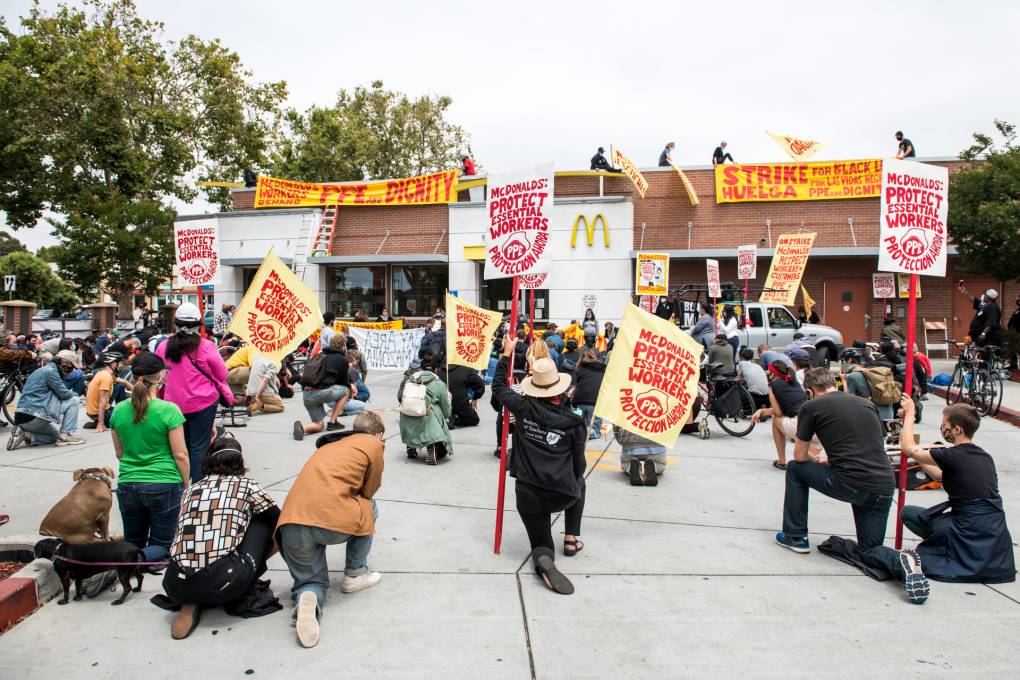
"caption": "Demonstrators take a knee for eight minutes and 46 seconds, the time prosecutors say a Minneapolis police officer knelt on the neck of George Floyd, during a 'Strike for Black Lives' rally outside of a McDonalds on Telegraph Avenue in Oakland on July 20, 2020.",
"description": null,
"title": "RS44017_020_KQED_Oakland_McDonaldsStrike_07202020-qut",
"credit": "Beth LaBerge/KQED",
"status": "inherit",
"isLoading": false,
"fetchFailed": false
},
"news_11823867": {
"type": "attachments",
"id": "news_11823867",
"meta": {
"index": "attachments_1716263798",
"site": "news",
"id": "11823867",
"found": true
},
"parent": 11823859,
"imgSizes": {
"apple_news_ca_landscape_5_5": {
"file": "https://ww2.kqed.org/app/uploads/sites/10/2020/06/George-Floyd-Oakland-protests-1044x783.jpg",
"width": 1044,
"mimeType": "image/jpeg",
"height": 783
},
"apple_news_ca_square_4_0": {
"file": "https://ww2.kqed.org/app/uploads/sites/10/2020/06/George-Floyd-Oakland-protests-470x470.jpg",
"width": 470,
"mimeType": "image/jpeg",
"height": 470
},
"twentyfourteen-full-width": {
"file": "https://ww2.kqed.org/app/uploads/sites/10/2020/06/George-Floyd-Oakland-protests-1038x576.jpg",
"width": 1038,
"mimeType": "image/jpeg",
"height": 576
},
"thumbnail": {
"file": "https://ww2.kqed.org/app/uploads/sites/10/2020/06/George-Floyd-Oakland-protests-160x107.jpg",
"width": 160,
"mimeType": "image/jpeg",
"height": 107
},
"post-thumbnail": {
"file": "https://ww2.kqed.org/app/uploads/sites/10/2020/06/George-Floyd-Oakland-protests-672x372.jpg",
"width": 672,
"mimeType": "image/jpeg",
"height": 372
},
"kqedFullSize": {
"file": "https://ww2.kqed.org/app/uploads/sites/10/2020/06/George-Floyd-Oakland-protests.jpg",
"width": 1920,
"height": 1280
},
"apple_news_ca_landscape_4_7": {
"file": "https://ww2.kqed.org/app/uploads/sites/10/2020/06/George-Floyd-Oakland-protests-632x474.jpg",
"width": 632,
"mimeType": "image/jpeg",
"height": 474
},
"large": {
"file": "https://ww2.kqed.org/app/uploads/sites/10/2020/06/George-Floyd-Oakland-protests-1020x680.jpg",
"width": 1020,
"mimeType": "image/jpeg",
"height": 680
},
"apple_news_ca_landscape_4_0": {
"file": "https://ww2.kqed.org/app/uploads/sites/10/2020/06/George-Floyd-Oakland-protests-536x402.jpg",
"width": 536,
"mimeType": "image/jpeg",
"height": 402
},
"apple_news_ca_portrait_12_9": {
"file": "https://ww2.kqed.org/app/uploads/sites/10/2020/06/George-Floyd-Oakland-protests-1122x1280.jpg",
"width": 1122,
"mimeType": "image/jpeg",
"height": 1280
},
"medium": {
"file": "https://ww2.kqed.org/app/uploads/sites/10/2020/06/George-Floyd-Oakland-protests-800x533.jpg",
"width": 800,
"mimeType": "image/jpeg",
"height": 533
},
"apple_news_ca_portrait_4_0": {
"file": "https://ww2.kqed.org/app/uploads/sites/10/2020/06/George-Floyd-Oakland-protests-354x472.jpg",
"width": 354,
"mimeType": "image/jpeg",
"height": 472
},
"apple_news_ca_portrait_9_7": {
"file": "https://ww2.kqed.org/app/uploads/sites/10/2020/06/George-Floyd-Oakland-protests-840x1120.jpg",
"width": 840,
"mimeType": "image/jpeg",
"height": 1120
},
"apple_news_ca_landscape_12_9": {
"file": "https://ww2.kqed.org/app/uploads/sites/10/2020/06/George-Floyd-Oakland-protests-1832x1280.jpg",
"width": 1832,
"mimeType": "image/jpeg",
"height": 1280
},
"apple_news_ca_square_9_7": {
"file": "https://ww2.kqed.org/app/uploads/sites/10/2020/06/George-Floyd-Oakland-protests-1104x1104.jpg",
"width": 1104,
"mimeType": "image/jpeg",
"height": 1104
},
"apple_news_ca_portrait_4_7": {
"file": "https://ww2.kqed.org/app/uploads/sites/10/2020/06/George-Floyd-Oakland-protests-414x552.jpg",
"width": 414,
"mimeType": "image/jpeg",
"height": 552
},
"apple_news_ca_square_12_9": {
"file": "https://ww2.kqed.org/app/uploads/sites/10/2020/06/George-Floyd-Oakland-protests-1472x1280.jpg",
"width": 1472,
"mimeType": "image/jpeg",
"height": 1280
},
"apple_news_ca_portrait_5_5": {
"file": "https://ww2.kqed.org/app/uploads/sites/10/2020/06/George-Floyd-Oakland-protests-687x916.jpg",
"width": 687,
"mimeType": "image/jpeg",
"height": 916
},
"full-width": {
"file": "https://ww2.kqed.org/app/uploads/sites/10/2020/06/George-Floyd-Oakland-protests-1920x1280.jpg",
"width": 1920,
"mimeType": "image/jpeg",
"height": 1280
},
"apple_news_ca_square_4_7": {
"file": "https://ww2.kqed.org/app/uploads/sites/10/2020/06/George-Floyd-Oakland-protests-550x550.jpg",
"width": 550,
"mimeType": "image/jpeg",
"height": 550
},
"apple_news_ca_landscape_9_7": {
"file": "https://ww2.kqed.org/app/uploads/sites/10/2020/06/George-Floyd-Oakland-protests-1376x1032.jpg",
"width": 1376,
"mimeType": "image/jpeg",
"height": 1032
},
"apple_news_ca_square_5_5": {
"file": "https://ww2.kqed.org/app/uploads/sites/10/2020/06/George-Floyd-Oakland-protests-912x912.jpg",
"width": 912,
"mimeType": "image/jpeg",
"height": 912
}
},
"publishDate": 1591833433,
"modified": 1595292398,
"caption": "Tear gas is fired by the police on Broadway near Oakland Police headquarters on May 29, 2020 during a protest over the Minneapolis police killing of George Floyd.",
"description": null,
"title": "George-Floyd-Oakland-protests",
"credit": "Beth LaBerge/KQED",
"status": "inherit",
"isLoading": false,
"fetchFailed": false
},
"news_11828590": {
"type": "attachments",
"id": "news_11828590",
"meta": {
"index": "attachments_1716263798",
"site": "news",
"id": "11828590",
"found": true
},
"parent": 11828585,
"imgSizes": {
"apple_news_ca_landscape_5_5": {
"file": "https://ww2.kqed.org/app/uploads/sites/10/2020/07/RS43921_GettyImages-1226007165-qut-1044x783.jpg",
"width": 1044,
"mimeType": "image/jpeg",
"height": 783
},
"apple_news_ca_square_4_0": {
"file": "https://ww2.kqed.org/app/uploads/sites/10/2020/07/RS43921_GettyImages-1226007165-qut-470x470.jpg",
"width": 470,
"mimeType": "image/jpeg",
"height": 470
},
"twentyfourteen-full-width": {
"file": "https://ww2.kqed.org/app/uploads/sites/10/2020/07/RS43921_GettyImages-1226007165-qut-1038x576.jpg",
"width": 1038,
"mimeType": "image/jpeg",
"height": 576
},
"thumbnail": {
"file": "https://ww2.kqed.org/app/uploads/sites/10/2020/07/RS43921_GettyImages-1226007165-qut-160x98.jpg",
"width": 160,
"mimeType": "image/jpeg",
"height": 98
},
"post-thumbnail": {
"file": "https://ww2.kqed.org/app/uploads/sites/10/2020/07/RS43921_GettyImages-1226007165-qut-672x372.jpg",
"width": 672,
"mimeType": "image/jpeg",
"height": 372
},
"kqedFullSize": {
"file": "https://ww2.kqed.org/app/uploads/sites/10/2020/07/RS43921_GettyImages-1226007165-qut.jpg",
"width": 1920,
"height": 1171
},
"apple_news_ca_landscape_4_7": {
"file": "https://ww2.kqed.org/app/uploads/sites/10/2020/07/RS43921_GettyImages-1226007165-qut-632x474.jpg",
"width": 632,
"mimeType": "image/jpeg",
"height": 474
},
"large": {
"file": "https://ww2.kqed.org/app/uploads/sites/10/2020/07/RS43921_GettyImages-1226007165-qut-1020x622.jpg",
"width": 1020,
"mimeType": "image/jpeg",
"height": 622
},
"apple_news_ca_landscape_4_0": {
"file": "https://ww2.kqed.org/app/uploads/sites/10/2020/07/RS43921_GettyImages-1226007165-qut-536x402.jpg",
"width": 536,
"mimeType": "image/jpeg",
"height": 402
},
"apple_news_ca_portrait_12_9": {
"file": "https://ww2.kqed.org/app/uploads/sites/10/2020/07/RS43921_GettyImages-1226007165-qut-1122x1171.jpg",
"width": 1122,
"mimeType": "image/jpeg",
"height": 1171
},
"medium": {
"file": "https://ww2.kqed.org/app/uploads/sites/10/2020/07/RS43921_GettyImages-1226007165-qut-800x488.jpg",
"width": 800,
"mimeType": "image/jpeg",
"height": 488
},
"apple_news_ca_portrait_4_0": {
"file": "https://ww2.kqed.org/app/uploads/sites/10/2020/07/RS43921_GettyImages-1226007165-qut-354x472.jpg",
"width": 354,
"mimeType": "image/jpeg",
"height": 472
},
"apple_news_ca_portrait_9_7": {
"file": "https://ww2.kqed.org/app/uploads/sites/10/2020/07/RS43921_GettyImages-1226007165-qut-840x1120.jpg",
"width": 840,
"mimeType": "image/jpeg",
"height": 1120
},
"apple_news_ca_landscape_12_9": {
"file": "https://ww2.kqed.org/app/uploads/sites/10/2020/07/RS43921_GettyImages-1226007165-qut-1832x1171.jpg",
"width": 1832,
"mimeType": "image/jpeg",
"height": 1171
},
"apple_news_ca_square_9_7": {
"file": "https://ww2.kqed.org/app/uploads/sites/10/2020/07/RS43921_GettyImages-1226007165-qut-1104x1104.jpg",
"width": 1104,
"mimeType": "image/jpeg",
"height": 1104
},
"1536x1536": {
"file": "https://ww2.kqed.org/app/uploads/sites/10/2020/07/RS43921_GettyImages-1226007165-qut-1536x937.jpg",
"width": 1536,
"mimeType": "image/jpeg",
"height": 937
},
"apple_news_ca_portrait_4_7": {
"file": "https://ww2.kqed.org/app/uploads/sites/10/2020/07/RS43921_GettyImages-1226007165-qut-414x552.jpg",
"width": 414,
"mimeType": "image/jpeg",
"height": 552
},
"apple_news_ca_square_12_9": {
"file": "https://ww2.kqed.org/app/uploads/sites/10/2020/07/RS43921_GettyImages-1226007165-qut-1472x1171.jpg",
"width": 1472,
"mimeType": "image/jpeg",
"height": 1171
},
"apple_news_ca_portrait_5_5": {
"file": "https://ww2.kqed.org/app/uploads/sites/10/2020/07/RS43921_GettyImages-1226007165-qut-687x916.jpg",
"width": 687,
"mimeType": "image/jpeg",
"height": 916
},
"apple_news_ca_square_4_7": {
"file": "https://ww2.kqed.org/app/uploads/sites/10/2020/07/RS43921_GettyImages-1226007165-qut-550x550.jpg",
"width": 550,
"mimeType": "image/jpeg",
"height": 550
},
"apple_news_ca_landscape_9_7": {
"file": "https://ww2.kqed.org/app/uploads/sites/10/2020/07/RS43921_GettyImages-1226007165-qut-1376x1032.jpg",
"width": 1376,
"mimeType": "image/jpeg",
"height": 1032
},
"apple_news_ca_square_5_5": {
"file": "https://ww2.kqed.org/app/uploads/sites/10/2020/07/RS43921_GettyImages-1226007165-qut-912x912.jpg",
"width": 912,
"mimeType": "image/jpeg",
"height": 912
}
},
"publishDate": 1594436181,
"modified": 1649715943,
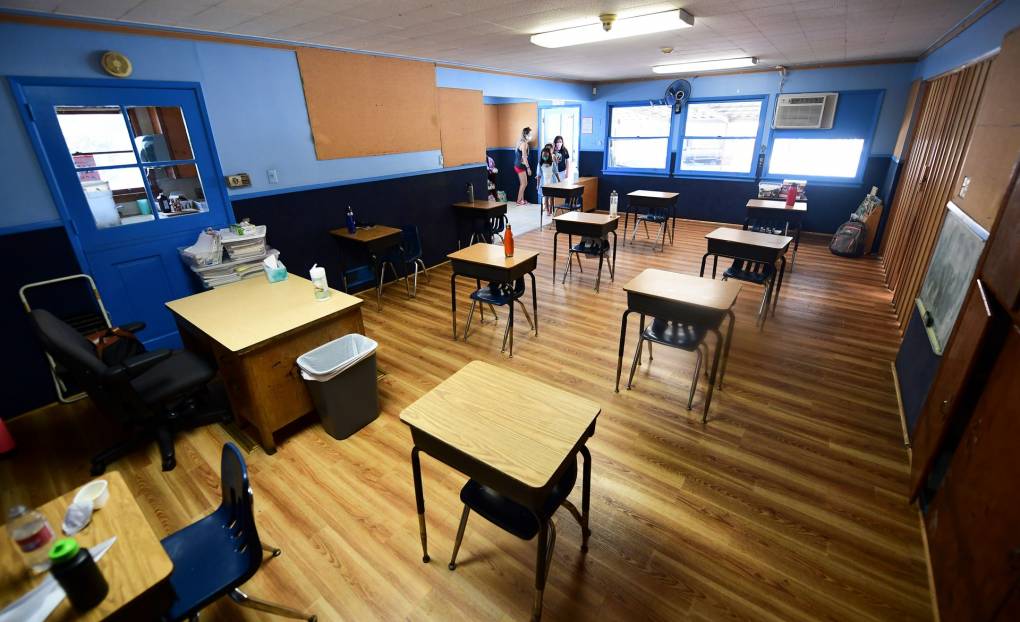
"caption": "Children wearing face masks enter an elementary school classroom during summer school sessions at Happy Day School in Monterey Park on July 9, 2020.",
"description": "Children in an elementary school class wearing masks enter the classroom with desks spaced apart as per the coronavirus guidelines during summer school sessions at Happy Day School in Monterey Park, California on July 9, 2020.",
"title": "US-HEALTH-VIRUS-EDUCATION",
"credit": "Frederic J. Brown/AFP via Getty Images",
"status": "inherit",
"altTag": "Children wearing masks enter a classroom",
"isLoading": false,
"fetchFailed": false
},
"news_11829275": {
"type": "attachments",
"id": "news_11829275",
"meta": {
"index": "attachments_1716263798",
"site": "news",
"id": "11829275",
"found": true
},
"parent": 11829180,
"imgSizes": {
"apple_news_ca_landscape_5_5": {
"file": "https://ww2.kqed.org/app/uploads/sites/10/2020/07/RS43909_001_KQED_Oakland_REACH_07092020-qut-1044x783.jpg",
"width": 1044,
"mimeType": "image/jpeg",
"height": 783
},
"apple_news_ca_square_4_0": {
"file": "https://ww2.kqed.org/app/uploads/sites/10/2020/07/RS43909_001_KQED_Oakland_REACH_07092020-qut-470x470.jpg",
"width": 470,
"mimeType": "image/jpeg",
"height": 470
},
"twentyfourteen-full-width": {
"file": "https://ww2.kqed.org/app/uploads/sites/10/2020/07/RS43909_001_KQED_Oakland_REACH_07092020-qut-1038x576.jpg",
"width": 1038,
"mimeType": "image/jpeg",
"height": 576
},
"thumbnail": {
"file": "https://ww2.kqed.org/app/uploads/sites/10/2020/07/RS43909_001_KQED_Oakland_REACH_07092020-qut-160x107.jpg",
"width": 160,
"mimeType": "image/jpeg",
"height": 107
},
"post-thumbnail": {
"file": "https://ww2.kqed.org/app/uploads/sites/10/2020/07/RS43909_001_KQED_Oakland_REACH_07092020-qut-672x372.jpg",
"width": 672,
"mimeType": "image/jpeg",
"height": 372
},
"kqedFullSize": {
"file": "https://ww2.kqed.org/app/uploads/sites/10/2020/07/RS43909_001_KQED_Oakland_REACH_07092020-qut.jpg",
"width": 1920,
"height": 1280
},
"apple_news_ca_landscape_4_7": {
"file": "https://ww2.kqed.org/app/uploads/sites/10/2020/07/RS43909_001_KQED_Oakland_REACH_07092020-qut-632x474.jpg",
"width": 632,
"mimeType": "image/jpeg",
"height": 474
},
"large": {
"file": "https://ww2.kqed.org/app/uploads/sites/10/2020/07/RS43909_001_KQED_Oakland_REACH_07092020-qut-1020x680.jpg",
"width": 1020,
"mimeType": "image/jpeg",
"height": 680
},
"apple_news_ca_landscape_4_0": {
"file": "https://ww2.kqed.org/app/uploads/sites/10/2020/07/RS43909_001_KQED_Oakland_REACH_07092020-qut-536x402.jpg",
"width": 536,
"mimeType": "image/jpeg",
"height": 402
},
"apple_news_ca_portrait_12_9": {
"file": "https://ww2.kqed.org/app/uploads/sites/10/2020/07/RS43909_001_KQED_Oakland_REACH_07092020-qut-1122x1280.jpg",
"width": 1122,
"mimeType": "image/jpeg",
"height": 1280
},
"medium": {
"file": "https://ww2.kqed.org/app/uploads/sites/10/2020/07/RS43909_001_KQED_Oakland_REACH_07092020-qut-800x533.jpg",
"width": 800,
"mimeType": "image/jpeg",
"height": 533
},
"apple_news_ca_portrait_4_0": {
"file": "https://ww2.kqed.org/app/uploads/sites/10/2020/07/RS43909_001_KQED_Oakland_REACH_07092020-qut-354x472.jpg",
"width": 354,
"mimeType": "image/jpeg",
"height": 472
},
"apple_news_ca_portrait_9_7": {
"file": "https://ww2.kqed.org/app/uploads/sites/10/2020/07/RS43909_001_KQED_Oakland_REACH_07092020-qut-840x1120.jpg",
"width": 840,
"mimeType": "image/jpeg",
"height": 1120
},
"apple_news_ca_landscape_12_9": {
"file": "https://ww2.kqed.org/app/uploads/sites/10/2020/07/RS43909_001_KQED_Oakland_REACH_07092020-qut-1832x1280.jpg",
"width": 1832,
"mimeType": "image/jpeg",
"height": 1280
},
"apple_news_ca_square_9_7": {
"file": "https://ww2.kqed.org/app/uploads/sites/10/2020/07/RS43909_001_KQED_Oakland_REACH_07092020-qut-1104x1104.jpg",
"width": 1104,
"mimeType": "image/jpeg",
"height": 1104
},
"1536x1536": {
"file": "https://ww2.kqed.org/app/uploads/sites/10/2020/07/RS43909_001_KQED_Oakland_REACH_07092020-qut-1536x1024.jpg",
"width": 1536,
"mimeType": "image/jpeg",
"height": 1024
},
"apple_news_ca_portrait_4_7": {
"file": "https://ww2.kqed.org/app/uploads/sites/10/2020/07/RS43909_001_KQED_Oakland_REACH_07092020-qut-414x552.jpg",
"width": 414,
"mimeType": "image/jpeg",
"height": 552
},
"apple_news_ca_square_12_9": {
"file": "https://ww2.kqed.org/app/uploads/sites/10/2020/07/RS43909_001_KQED_Oakland_REACH_07092020-qut-1472x1280.jpg",
"width": 1472,
"mimeType": "image/jpeg",
"height": 1280
},
"apple_news_ca_portrait_5_5": {
"file": "https://ww2.kqed.org/app/uploads/sites/10/2020/07/RS43909_001_KQED_Oakland_REACH_07092020-qut-687x916.jpg",
"width": 687,
"mimeType": "image/jpeg",
"height": 916
},
"apple_news_ca_square_4_7": {
"file": "https://ww2.kqed.org/app/uploads/sites/10/2020/07/RS43909_001_KQED_Oakland_REACH_07092020-qut-550x550.jpg",
"width": 550,
"mimeType": "image/jpeg",
"height": 550
},
"apple_news_ca_landscape_9_7": {
"file": "https://ww2.kqed.org/app/uploads/sites/10/2020/07/RS43909_001_KQED_Oakland_REACH_07092020-qut-1376x1032.jpg",
"width": 1376,
"mimeType": "image/jpeg",
"height": 1032
},
"apple_news_ca_square_5_5": {
"file": "https://ww2.kqed.org/app/uploads/sites/10/2020/07/RS43909_001_KQED_Oakland_REACH_07092020-qut-912x912.jpg",
"width": 912,
"mimeType": "image/jpeg",
"height": 912
}
},
"publishDate": 1594935590,
"modified": 1594935682,
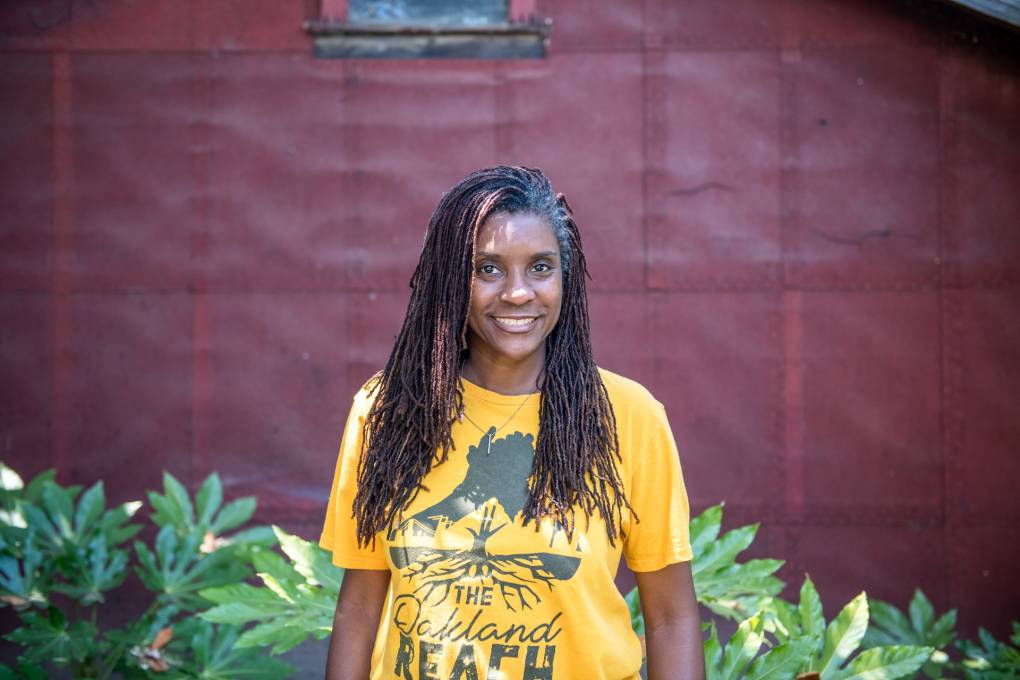
"caption": "Lakisha Young, co-founder and executive director Oakland REACH, on July 9, 2020.",
"description": null,
"title": "RS43909_001_KQED_Oakland_REACH_07092020-qut",
"credit": "Beth LaBerge/KQED",
"status": "inherit",
"isLoading": false,
"fetchFailed": false
},
"news_11828152": {
"type": "attachments",
"id": "news_11828152",
"meta": {
"index": "attachments_1716263798",
"site": "news",
"id": "11828152",
"found": true
},
"parent": 11827750,
"imgSizes": {
"apple_news_ca_square_4_0": {
"file": "https://ww2.kqed.org/app/uploads/sites/10/2020/07/lumpen_stage-470x363.jpg",
"width": 470,
"mimeType": "image/jpeg",
"height": 363
},
"thumbnail": {
"file": "https://ww2.kqed.org/app/uploads/sites/10/2020/07/lumpen_stage-160x105.jpg",
"width": 160,
"mimeType": "image/jpeg",
"height": 105
},
"kqedFullSize": {
"file": "https://ww2.kqed.org/app/uploads/sites/10/2020/07/lumpen_stage.jpg",
"width": 555,
"height": 363
},
"apple_news_ca_portrait_4_7": {
"file": "https://ww2.kqed.org/app/uploads/sites/10/2020/07/lumpen_stage-414x363.jpg",
"width": 414,
"mimeType": "image/jpeg",
"height": 363
},
"apple_news_ca_square_4_7": {
"file": "https://ww2.kqed.org/app/uploads/sites/10/2020/07/lumpen_stage-550x363.jpg",
"width": 550,
"mimeType": "image/jpeg",
"height": 363
},
"apple_news_ca_landscape_4_0": {
"file": "https://ww2.kqed.org/app/uploads/sites/10/2020/07/lumpen_stage-536x363.jpg",
"width": 536,
"mimeType": "image/jpeg",
"height": 363
},
"apple_news_ca_portrait_4_0": {
"file": "https://ww2.kqed.org/app/uploads/sites/10/2020/07/lumpen_stage-354x363.jpg",
"width": 354,
"mimeType": "image/jpeg",
"height": 363
}
},
"publishDate": 1594322289,
"modified": 1594424112,
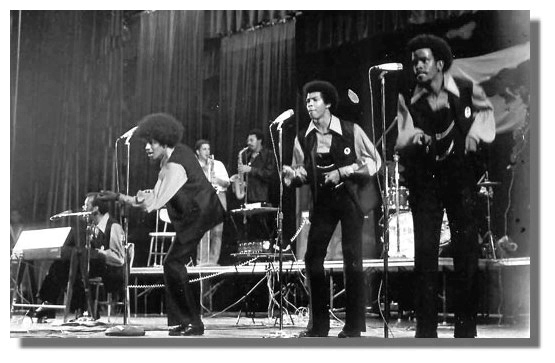
"caption": "In 1970, an unlikely R&B group evolved out of the Oakland chapter of the Black Panther Party.",
"description": "In 1970, an unlikely R&B group evolved out of the Oakland chapter of the Black Panther Party.",
"title": "lumpen_stage",
"credit": "Courtesy of It's About Time Black Panther Party Legacy & Alumni",
"status": "inherit",
"isLoading": false,
"fetchFailed": false
},
"news_11828297": {
"type": "attachments",
"id": "news_11828297",
"meta": {
"index": "attachments_1716263798",
"site": "news",
"id": "11828297",
"found": true
},
"parent": 11828243,
"imgSizes": {
"apple_news_ca_landscape_5_5": {
"file": "https://ww2.kqed.org/app/uploads/sites/10/2020/07/RS43901_014_KQED_Oakland_WarriorsHouse_07092020-qut-1044x783.jpg",
"width": 1044,
"mimeType": "image/jpeg",
"height": 783
},
"apple_news_ca_square_4_0": {
"file": "https://ww2.kqed.org/app/uploads/sites/10/2020/07/RS43901_014_KQED_Oakland_WarriorsHouse_07092020-qut-470x470.jpg",
"width": 470,
"mimeType": "image/jpeg",
"height": 470
},
"twentyfourteen-full-width": {
"file": "https://ww2.kqed.org/app/uploads/sites/10/2020/07/RS43901_014_KQED_Oakland_WarriorsHouse_07092020-qut-1038x576.jpg",
"width": 1038,
"mimeType": "image/jpeg",
"height": 576
},
"thumbnail": {
"file": "https://ww2.kqed.org/app/uploads/sites/10/2020/07/RS43901_014_KQED_Oakland_WarriorsHouse_07092020-qut-160x107.jpg",
"width": 160,
"mimeType": "image/jpeg",
"height": 107
},
"post-thumbnail": {
"file": "https://ww2.kqed.org/app/uploads/sites/10/2020/07/RS43901_014_KQED_Oakland_WarriorsHouse_07092020-qut-672x372.jpg",
"width": 672,
"mimeType": "image/jpeg",
"height": 372
},
"kqedFullSize": {
"file": "https://ww2.kqed.org/app/uploads/sites/10/2020/07/RS43901_014_KQED_Oakland_WarriorsHouse_07092020-qut.jpg",
"width": 1920,
"height": 1280
},
"apple_news_ca_landscape_4_7": {
"file": "https://ww2.kqed.org/app/uploads/sites/10/2020/07/RS43901_014_KQED_Oakland_WarriorsHouse_07092020-qut-632x474.jpg",
"width": 632,
"mimeType": "image/jpeg",
"height": 474
},
"large": {
"file": "https://ww2.kqed.org/app/uploads/sites/10/2020/07/RS43901_014_KQED_Oakland_WarriorsHouse_07092020-qut-1020x680.jpg",
"width": 1020,
"mimeType": "image/jpeg",
"height": 680
},
"apple_news_ca_landscape_4_0": {
"file": "https://ww2.kqed.org/app/uploads/sites/10/2020/07/RS43901_014_KQED_Oakland_WarriorsHouse_07092020-qut-536x402.jpg",
"width": 536,
"mimeType": "image/jpeg",
"height": 402
},
"apple_news_ca_portrait_12_9": {
"file": "https://ww2.kqed.org/app/uploads/sites/10/2020/07/RS43901_014_KQED_Oakland_WarriorsHouse_07092020-qut-1122x1280.jpg",
"width": 1122,
"mimeType": "image/jpeg",
"height": 1280
},
"medium": {
"file": "https://ww2.kqed.org/app/uploads/sites/10/2020/07/RS43901_014_KQED_Oakland_WarriorsHouse_07092020-qut-800x533.jpg",
"width": 800,
"mimeType": "image/jpeg",
"height": 533
},
"apple_news_ca_portrait_4_0": {
"file": "https://ww2.kqed.org/app/uploads/sites/10/2020/07/RS43901_014_KQED_Oakland_WarriorsHouse_07092020-qut-354x472.jpg",
"width": 354,
"mimeType": "image/jpeg",
"height": 472
},
"apple_news_ca_portrait_9_7": {
"file": "https://ww2.kqed.org/app/uploads/sites/10/2020/07/RS43901_014_KQED_Oakland_WarriorsHouse_07092020-qut-840x1120.jpg",
"width": 840,
"mimeType": "image/jpeg",
"height": 1120
},
"apple_news_ca_landscape_12_9": {
"file": "https://ww2.kqed.org/app/uploads/sites/10/2020/07/RS43901_014_KQED_Oakland_WarriorsHouse_07092020-qut-1832x1280.jpg",
"width": 1832,
"mimeType": "image/jpeg",
"height": 1280
},
"apple_news_ca_square_9_7": {
"file": "https://ww2.kqed.org/app/uploads/sites/10/2020/07/RS43901_014_KQED_Oakland_WarriorsHouse_07092020-qut-1104x1104.jpg",
"width": 1104,
"mimeType": "image/jpeg",
"height": 1104
},
"1536x1536": {
"file": "https://ww2.kqed.org/app/uploads/sites/10/2020/07/RS43901_014_KQED_Oakland_WarriorsHouse_07092020-qut-1536x1024.jpg",
"width": 1536,
"mimeType": "image/jpeg",
"height": 1024
},
"apple_news_ca_portrait_4_7": {
"file": "https://ww2.kqed.org/app/uploads/sites/10/2020/07/RS43901_014_KQED_Oakland_WarriorsHouse_07092020-qut-414x552.jpg",
"width": 414,
"mimeType": "image/jpeg",
"height": 552
},
"apple_news_ca_square_12_9": {
"file": "https://ww2.kqed.org/app/uploads/sites/10/2020/07/RS43901_014_KQED_Oakland_WarriorsHouse_07092020-qut-1472x1280.jpg",
"width": 1472,
"mimeType": "image/jpeg",
"height": 1280
},
"apple_news_ca_portrait_5_5": {
"file": "https://ww2.kqed.org/app/uploads/sites/10/2020/07/RS43901_014_KQED_Oakland_WarriorsHouse_07092020-qut-687x916.jpg",
"width": 687,
"mimeType": "image/jpeg",
"height": 916
},
"apple_news_ca_square_4_7": {
"file": "https://ww2.kqed.org/app/uploads/sites/10/2020/07/RS43901_014_KQED_Oakland_WarriorsHouse_07092020-qut-550x550.jpg",
"width": 550,
"mimeType": "image/jpeg",
"height": 550
},
"apple_news_ca_landscape_9_7": {
"file": "https://ww2.kqed.org/app/uploads/sites/10/2020/07/RS43901_014_KQED_Oakland_WarriorsHouse_07092020-qut-1376x1032.jpg",
"width": 1376,
"mimeType": "image/jpeg",
"height": 1032
},
"apple_news_ca_square_5_5": {
"file": "https://ww2.kqed.org/app/uploads/sites/10/2020/07/RS43901_014_KQED_Oakland_WarriorsHouse_07092020-qut-912x912.jpg",
"width": 912,
"mimeType": "image/jpeg",
"height": 912
}
},
"publishDate": 1594353386,
"modified": 1594353496,
"caption": "Lloyd Canamore poses for a portrait outside of his home, known as the Warriors House, in West Oakland on July 9, 2020.",
"description": null,
"title": "RS43901_014_KQED_Oakland_WarriorsHouse_07092020-qut",
"credit": "Beth LaBerge/KQED",
"status": "inherit",
"isLoading": false,
"fetchFailed": false
},
"news_11827826": {
"type": "attachments",
"id": "news_11827826",
"meta": {
"index": "attachments_1716263798",
"site": "news",
"id": "11827826",
"found": true
},
"parent": 11827758,
"imgSizes": {
"apple_news_ca_landscape_5_5": {
"file": "https://ww2.kqed.org/app/uploads/sites/10/2020/07/RS43867_GettyImages-1225879541-qut-1044x783.jpg",
"width": 1044,
"mimeType": "image/jpeg",
"height": 783
},
"apple_news_ca_square_4_0": {
"file": "https://ww2.kqed.org/app/uploads/sites/10/2020/07/RS43867_GettyImages-1225879541-qut-470x470.jpg",
"width": 470,
"mimeType": "image/jpeg",
"height": 470
},
"twentyfourteen-full-width": {
"file": "https://ww2.kqed.org/app/uploads/sites/10/2020/07/RS43867_GettyImages-1225879541-qut-1038x576.jpg",
"width": 1038,
"mimeType": "image/jpeg",
"height": 576
},
"thumbnail": {
"file": "https://ww2.kqed.org/app/uploads/sites/10/2020/07/RS43867_GettyImages-1225879541-qut-160x107.jpg",
"width": 160,
"mimeType": "image/jpeg",
"height": 107
},
"post-thumbnail": {
"file": "https://ww2.kqed.org/app/uploads/sites/10/2020/07/RS43867_GettyImages-1225879541-qut-672x372.jpg",
"width": 672,
"mimeType": "image/jpeg",
"height": 372
},
"kqedFullSize": {
"file": "https://ww2.kqed.org/app/uploads/sites/10/2020/07/RS43867_GettyImages-1225879541-qut.jpg",
"width": 1920,
"height": 1280
},
"apple_news_ca_landscape_4_7": {
"file": "https://ww2.kqed.org/app/uploads/sites/10/2020/07/RS43867_GettyImages-1225879541-qut-632x474.jpg",
"width": 632,
"mimeType": "image/jpeg",
"height": 474
},
"large": {
"file": "https://ww2.kqed.org/app/uploads/sites/10/2020/07/RS43867_GettyImages-1225879541-qut-1020x680.jpg",
"width": 1020,
"mimeType": "image/jpeg",
"height": 680
},
"apple_news_ca_landscape_4_0": {
"file": "https://ww2.kqed.org/app/uploads/sites/10/2020/07/RS43867_GettyImages-1225879541-qut-536x402.jpg",
"width": 536,
"mimeType": "image/jpeg",
"height": 402
},
"apple_news_ca_portrait_12_9": {
"file": "https://ww2.kqed.org/app/uploads/sites/10/2020/07/RS43867_GettyImages-1225879541-qut-1122x1280.jpg",
"width": 1122,
"mimeType": "image/jpeg",
"height": 1280
},
"medium": {
"file": "https://ww2.kqed.org/app/uploads/sites/10/2020/07/RS43867_GettyImages-1225879541-qut-800x533.jpg",
"width": 800,
"mimeType": "image/jpeg",
"height": 533
},
"apple_news_ca_portrait_4_0": {
"file": "https://ww2.kqed.org/app/uploads/sites/10/2020/07/RS43867_GettyImages-1225879541-qut-354x472.jpg",
"width": 354,
"mimeType": "image/jpeg",
"height": 472
},
"apple_news_ca_portrait_9_7": {
"file": "https://ww2.kqed.org/app/uploads/sites/10/2020/07/RS43867_GettyImages-1225879541-qut-840x1120.jpg",
"width": 840,
"mimeType": "image/jpeg",
"height": 1120
},
"apple_news_ca_landscape_12_9": {
"file": "https://ww2.kqed.org/app/uploads/sites/10/2020/07/RS43867_GettyImages-1225879541-qut-1832x1280.jpg",
"width": 1832,
"mimeType": "image/jpeg",
"height": 1280
},
"apple_news_ca_square_9_7": {
"file": "https://ww2.kqed.org/app/uploads/sites/10/2020/07/RS43867_GettyImages-1225879541-qut-1104x1104.jpg",
"width": 1104,
"mimeType": "image/jpeg",
"height": 1104
},
"1536x1536": {
"file": "https://ww2.kqed.org/app/uploads/sites/10/2020/07/RS43867_GettyImages-1225879541-qut-1536x1024.jpg",
"width": 1536,
"mimeType": "image/jpeg",
"height": 1024
},
"apple_news_ca_portrait_4_7": {
"file": "https://ww2.kqed.org/app/uploads/sites/10/2020/07/RS43867_GettyImages-1225879541-qut-414x552.jpg",
"width": 414,
"mimeType": "image/jpeg",
"height": 552
},
"apple_news_ca_square_12_9": {
"file": "https://ww2.kqed.org/app/uploads/sites/10/2020/07/RS43867_GettyImages-1225879541-qut-1472x1280.jpg",
"width": 1472,
"mimeType": "image/jpeg",
"height": 1280
},
"apple_news_ca_portrait_5_5": {
"file": "https://ww2.kqed.org/app/uploads/sites/10/2020/07/RS43867_GettyImages-1225879541-qut-687x916.jpg",
"width": 687,
"mimeType": "image/jpeg",
"height": 916
},
"apple_news_ca_square_4_7": {
"file": "https://ww2.kqed.org/app/uploads/sites/10/2020/07/RS43867_GettyImages-1225879541-qut-550x550.jpg",
"width": 550,
"mimeType": "image/jpeg",
"height": 550
},
"apple_news_ca_landscape_9_7": {
"file": "https://ww2.kqed.org/app/uploads/sites/10/2020/07/RS43867_GettyImages-1225879541-qut-1376x1032.jpg",
"width": 1376,
"mimeType": "image/jpeg",
"height": 1032
},
"apple_news_ca_square_5_5": {
"file": "https://ww2.kqed.org/app/uploads/sites/10/2020/07/RS43867_GettyImages-1225879541-qut-912x912.jpg",
"width": 912,
"mimeType": "image/jpeg",
"height": 912
}
},
"publishDate": 1594169498,
"modified": 1594170487,
"caption": "Attorney General Xavier Becerra joins four other states in a lawsuit against the U.S. Department of Education, which names Education Secretary Betsy DeVos as a defendant.",
"description": "Attorney General Xavier Becerra joins four other states in a lawsuit against the U.S. Department of Education, which names Education Secretary Betsy DeVos as a defendant.",
"title": "President Trump Meets With His Cabinet At The White House",
"credit": "Alex Wong/Getty Images",
"status": "inherit",
"isLoading": false,
"fetchFailed": false
},
"news_11826677": {
"type": "attachments",
"id": "news_11826677",
"meta": {
"index": "attachments_1716263798",
"site": "news",
"id": "11826677",
"found": true
},
"parent": 11826632,
"imgSizes": {
"apple_news_ca_landscape_5_5": {
"file": "https://ww2.kqed.org/app/uploads/sites/10/2020/06/RS43831_010_KQED_Oakland_Evictions_06262020-qut-1044x783.jpg",
"width": 1044,
"mimeType": "image/jpeg",
"height": 783
},
"apple_news_ca_square_4_0": {
"file": "https://ww2.kqed.org/app/uploads/sites/10/2020/06/RS43831_010_KQED_Oakland_Evictions_06262020-qut-470x470.jpg",
"width": 470,
"mimeType": "image/jpeg",
"height": 470
},
"twentyfourteen-full-width": {
"file": "https://ww2.kqed.org/app/uploads/sites/10/2020/06/RS43831_010_KQED_Oakland_Evictions_06262020-qut-1038x576.jpg",
"width": 1038,
"mimeType": "image/jpeg",
"height": 576
},
"thumbnail": {
"file": "https://ww2.kqed.org/app/uploads/sites/10/2020/06/RS43831_010_KQED_Oakland_Evictions_06262020-qut-160x107.jpg",
"width": 160,
"mimeType": "image/jpeg",
"height": 107
},
"post-thumbnail": {
"file": "https://ww2.kqed.org/app/uploads/sites/10/2020/06/RS43831_010_KQED_Oakland_Evictions_06262020-qut-672x372.jpg",
"width": 672,
"mimeType": "image/jpeg",
"height": 372
},
"kqedFullSize": {
"file": "https://ww2.kqed.org/app/uploads/sites/10/2020/06/RS43831_010_KQED_Oakland_Evictions_06262020-qut.jpg",
"width": 1920,
"height": 1280
},
"apple_news_ca_landscape_4_7": {
"file": "https://ww2.kqed.org/app/uploads/sites/10/2020/06/RS43831_010_KQED_Oakland_Evictions_06262020-qut-632x474.jpg",
"width": 632,
"mimeType": "image/jpeg",
"height": 474
},
"large": {
"file": "https://ww2.kqed.org/app/uploads/sites/10/2020/06/RS43831_010_KQED_Oakland_Evictions_06262020-qut-1020x680.jpg",
"width": 1020,
"mimeType": "image/jpeg",
"height": 680
},
"apple_news_ca_landscape_4_0": {
"file": "https://ww2.kqed.org/app/uploads/sites/10/2020/06/RS43831_010_KQED_Oakland_Evictions_06262020-qut-536x402.jpg",
"width": 536,
"mimeType": "image/jpeg",
"height": 402
},
"apple_news_ca_portrait_12_9": {
"file": "https://ww2.kqed.org/app/uploads/sites/10/2020/06/RS43831_010_KQED_Oakland_Evictions_06262020-qut-1122x1280.jpg",
"width": 1122,
"mimeType": "image/jpeg",
"height": 1280
},
"medium": {
"file": "https://ww2.kqed.org/app/uploads/sites/10/2020/06/RS43831_010_KQED_Oakland_Evictions_06262020-qut-800x533.jpg",
"width": 800,
"mimeType": "image/jpeg",
"height": 533
},
"apple_news_ca_portrait_4_0": {
"file": "https://ww2.kqed.org/app/uploads/sites/10/2020/06/RS43831_010_KQED_Oakland_Evictions_06262020-qut-354x472.jpg",
"width": 354,
"mimeType": "image/jpeg",
"height": 472
},
"apple_news_ca_portrait_9_7": {
"file": "https://ww2.kqed.org/app/uploads/sites/10/2020/06/RS43831_010_KQED_Oakland_Evictions_06262020-qut-840x1120.jpg",
"width": 840,
"mimeType": "image/jpeg",
"height": 1120
},
"apple_news_ca_landscape_12_9": {
"file": "https://ww2.kqed.org/app/uploads/sites/10/2020/06/RS43831_010_KQED_Oakland_Evictions_06262020-qut-1832x1280.jpg",
"width": 1832,
"mimeType": "image/jpeg",
"height": 1280
},
"apple_news_ca_square_9_7": {
"file": "https://ww2.kqed.org/app/uploads/sites/10/2020/06/RS43831_010_KQED_Oakland_Evictions_06262020-qut-1104x1104.jpg",
"width": 1104,
"mimeType": "image/jpeg",
"height": 1104
},
"1536x1536": {
"file": "https://ww2.kqed.org/app/uploads/sites/10/2020/06/RS43831_010_KQED_Oakland_Evictions_06262020-qut-1536x1024.jpg",
"width": 1536,
"mimeType": "image/jpeg",
"height": 1024
},
"apple_news_ca_portrait_4_7": {
"file": "https://ww2.kqed.org/app/uploads/sites/10/2020/06/RS43831_010_KQED_Oakland_Evictions_06262020-qut-414x552.jpg",
"width": 414,
"mimeType": "image/jpeg",
"height": 552
},
"apple_news_ca_square_12_9": {
"file": "https://ww2.kqed.org/app/uploads/sites/10/2020/06/RS43831_010_KQED_Oakland_Evictions_06262020-qut-1472x1280.jpg",
"width": 1472,
"mimeType": "image/jpeg",
"height": 1280
},
"apple_news_ca_portrait_5_5": {
"file": "https://ww2.kqed.org/app/uploads/sites/10/2020/06/RS43831_010_KQED_Oakland_Evictions_06262020-qut-687x916.jpg",
"width": 687,
"mimeType": "image/jpeg",
"height": 916
},
"apple_news_ca_square_4_7": {
"file": "https://ww2.kqed.org/app/uploads/sites/10/2020/06/RS43831_010_KQED_Oakland_Evictions_06262020-qut-550x550.jpg",
"width": 550,
"mimeType": "image/jpeg",
"height": 550
},
"apple_news_ca_landscape_9_7": {
"file": "https://ww2.kqed.org/app/uploads/sites/10/2020/06/RS43831_010_KQED_Oakland_Evictions_06262020-qut-1376x1032.jpg",
"width": 1376,
"mimeType": "image/jpeg",
"height": 1032
},
"apple_news_ca_square_5_5": {
"file": "https://ww2.kqed.org/app/uploads/sites/10/2020/06/RS43831_010_KQED_Oakland_Evictions_06262020-qut-912x912.jpg",
"width": 912,
"mimeType": "image/jpeg",
"height": 912
}
},
"publishDate": 1593461435,
"modified": 1593478318,
"caption": "The Castillo-Gutierréz family at their home in Oakland on June 26, 2020.",
"description": "The Castillo-Gutierréz family at their home in Oakland on June 26, 2020.",
"title": "The Castillo Gutierréz family at their home in Oakland on June 26, 2020.",
"credit": "Beth LaBerge/KQED",
"status": "inherit",
"isLoading": false,
"fetchFailed": false
},
"news_11826580": {
"type": "attachments",
"id": "news_11826580",
"meta": {
"index": "attachments_1716263798",
"site": "news",
"id": "11826580",
"found": true
},
"parent": 0,
"imgSizes": {
"apple_news_ca_landscape_5_5": {
"file": "https://ww2.kqed.org/app/uploads/sites/10/2020/06/Pride-Protest-3-1044x783.jpg",
"width": 1044,
"mimeType": "image/jpeg",
"height": 783
},
"apple_news_ca_square_4_0": {
"file": "https://ww2.kqed.org/app/uploads/sites/10/2020/06/Pride-Protest-3-470x470.jpg",
"width": 470,
"mimeType": "image/jpeg",
"height": 470
},
"twentyfourteen-full-width": {
"file": "https://ww2.kqed.org/app/uploads/sites/10/2020/06/Pride-Protest-3-1038x576.jpg",
"width": 1038,
"mimeType": "image/jpeg",
"height": 576
},
"thumbnail": {
"file": "https://ww2.kqed.org/app/uploads/sites/10/2020/06/Pride-Protest-3-160x120.jpg",
"width": 160,
"mimeType": "image/jpeg",
"height": 120
},
"post-thumbnail": {
"file": "https://ww2.kqed.org/app/uploads/sites/10/2020/06/Pride-Protest-3-672x372.jpg",
"width": 672,
"mimeType": "image/jpeg",
"height": 372
},
"kqedFullSize": {
"file": "https://ww2.kqed.org/app/uploads/sites/10/2020/06/Pride-Protest-3-scaled.jpg",
"width": 2560,
"height": 1920
},
"2048x2048": {
"file": "https://ww2.kqed.org/app/uploads/sites/10/2020/06/Pride-Protest-3-2048x1536.jpg",
"width": 2048,
"mimeType": "image/jpeg",
"height": 1536
},
"apple_news_ca_landscape_4_7": {
"file": "https://ww2.kqed.org/app/uploads/sites/10/2020/06/Pride-Protest-3-632x474.jpg",
"width": 632,
"mimeType": "image/jpeg",
"height": 474
},
"large": {
"file": "https://ww2.kqed.org/app/uploads/sites/10/2020/06/Pride-Protest-3-1020x765.jpg",
"width": 1020,
"mimeType": "image/jpeg",
"height": 765
},
"apple_news_ca_landscape_4_0": {
"file": "https://ww2.kqed.org/app/uploads/sites/10/2020/06/Pride-Protest-3-536x402.jpg",
"width": 536,
"mimeType": "image/jpeg",
"height": 402
},
"apple_news_ca_portrait_12_9": {
"file": "https://ww2.kqed.org/app/uploads/sites/10/2020/06/Pride-Protest-3-1122x1496.jpg",
"width": 1122,
"mimeType": "image/jpeg",
"height": 1496
},
"medium": {
"file": "https://ww2.kqed.org/app/uploads/sites/10/2020/06/Pride-Protest-3-800x600.jpg",
"width": 800,
"mimeType": "image/jpeg",
"height": 600
},
"apple_news_ca_portrait_4_0": {
"file": "https://ww2.kqed.org/app/uploads/sites/10/2020/06/Pride-Protest-3-354x472.jpg",
"width": 354,
"mimeType": "image/jpeg",
"height": 472
},
"apple_news_ca_portrait_9_7": {
"file": "https://ww2.kqed.org/app/uploads/sites/10/2020/06/Pride-Protest-3-840x1120.jpg",
"width": 840,
"mimeType": "image/jpeg",
"height": 1120
},
"apple_news_ca_landscape_12_9": {
"file": "https://ww2.kqed.org/app/uploads/sites/10/2020/06/Pride-Protest-3-1832x1374.jpg",
"width": 1832,
"mimeType": "image/jpeg",
"height": 1374
},
"apple_news_ca_square_9_7": {
"file": "https://ww2.kqed.org/app/uploads/sites/10/2020/06/Pride-Protest-3-1104x1104.jpg",
"width": 1104,
"mimeType": "image/jpeg",
"height": 1104
},
"1536x1536": {
"file": "https://ww2.kqed.org/app/uploads/sites/10/2020/06/Pride-Protest-3-1536x1152.jpg",
"width": 1536,
"mimeType": "image/jpeg",
"height": 1152
},
"apple_news_ca_portrait_4_7": {
"file": "https://ww2.kqed.org/app/uploads/sites/10/2020/06/Pride-Protest-3-414x552.jpg",
"width": 414,
"mimeType": "image/jpeg",
"height": 552
},
"apple_news_ca_square_12_9": {
"file": "https://ww2.kqed.org/app/uploads/sites/10/2020/06/Pride-Protest-3-1472x1472.jpg",
"width": 1472,
"mimeType": "image/jpeg",
"height": 1472
},
"apple_news_ca_portrait_5_5": {
"file": "https://ww2.kqed.org/app/uploads/sites/10/2020/06/Pride-Protest-3-687x916.jpg",
"width": 687,
"mimeType": "image/jpeg",
"height": 916
},
"full-width": {
"file": "https://ww2.kqed.org/app/uploads/sites/10/2020/06/Pride-Protest-3-1920x1440.jpg",
"width": 1920,
"mimeType": "image/jpeg",
"height": 1440
},
"apple_news_ca_square_4_7": {
"file": "https://ww2.kqed.org/app/uploads/sites/10/2020/06/Pride-Protest-3-550x550.jpg",
"width": 550,
"mimeType": "image/jpeg",
"height": 550
},
"apple_news_ca_landscape_9_7": {
"file": "https://ww2.kqed.org/app/uploads/sites/10/2020/06/Pride-Protest-3-1376x1032.jpg",
"width": 1376,
"mimeType": "image/jpeg",
"height": 1032
},
"apple_news_ca_square_5_5": {
"file": "https://ww2.kqed.org/app/uploads/sites/10/2020/06/Pride-Protest-3-912x912.jpg",
"width": 912,
"mimeType": "image/jpeg",
"height": 912
}
},
"publishDate": 1593386563,
"modified": 1593454212,
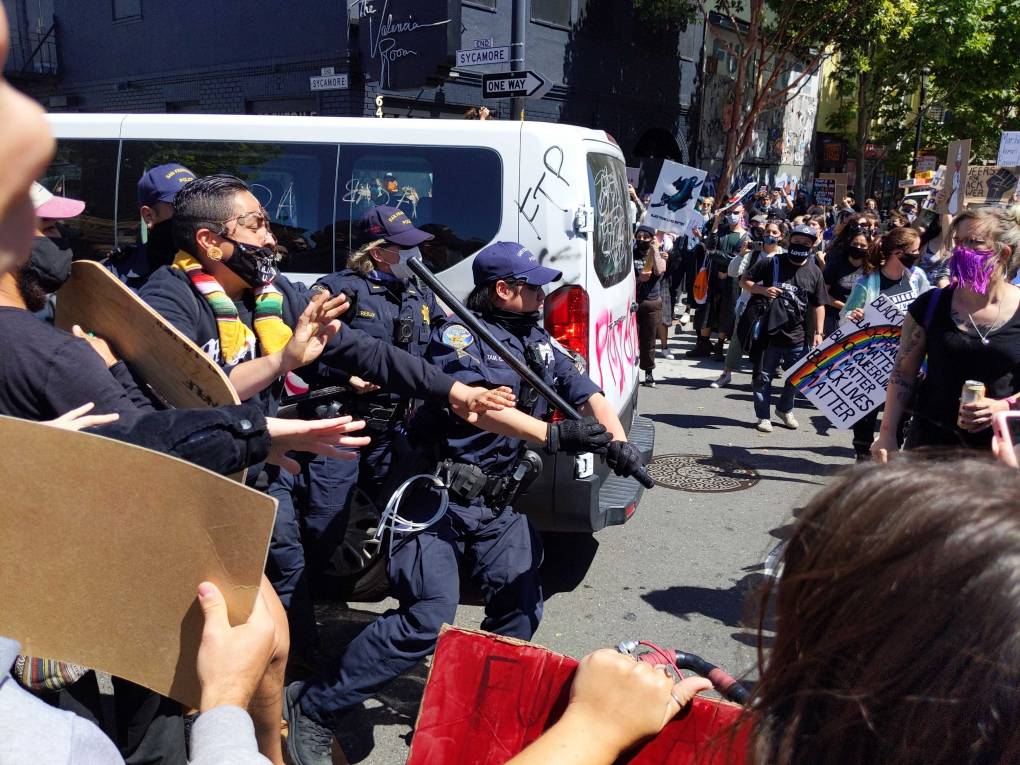
"caption": "A San Francisco police officer raises a baton at a crowd near a police van at the 'Pride is a Riot' march Sunday in San Francisco, which was organized by an anonymous group.",
"description": "A San Francisco police officer raises a baton at a crowd near a police van at the 'Pride is a Riot' march Sunday in San Francisco, which was organized by an anonymous group.",
"title": "Pride Protest 3",
"credit": "Anna Vignet/KQED",
"status": "inherit",
"isLoading": false,
"fetchFailed": false
},
"news_11825499": {
"type": "attachments",
"id": "news_11825499",
"meta": {
"index": "attachments_1716263798",
"site": "news",
"id": "11825499",
"found": true
},
"parent": 11824642,
"imgSizes": {
"apple_news_ca_landscape_5_5": {
"file": "https://ww2.kqed.org/app/uploads/sites/10/2020/06/RS43701_IMG_2103_v2-qut-1044x783.jpg",
"width": 1044,
"mimeType": "image/jpeg",
"height": 783
},
"apple_news_ca_square_4_0": {
"file": "https://ww2.kqed.org/app/uploads/sites/10/2020/06/RS43701_IMG_2103_v2-qut-470x470.jpg",
"width": 470,
"mimeType": "image/jpeg",
"height": 470
},
"twentyfourteen-full-width": {
"file": "https://ww2.kqed.org/app/uploads/sites/10/2020/06/RS43701_IMG_2103_v2-qut-1038x576.jpg",
"width": 1038,
"mimeType": "image/jpeg",
"height": 576
},
"thumbnail": {
"file": "https://ww2.kqed.org/app/uploads/sites/10/2020/06/RS43701_IMG_2103_v2-qut-160x98.jpg",
"width": 160,
"mimeType": "image/jpeg",
"height": 98
},
"post-thumbnail": {
"file": "https://ww2.kqed.org/app/uploads/sites/10/2020/06/RS43701_IMG_2103_v2-qut-672x372.jpg",
"width": 672,
"mimeType": "image/jpeg",
"height": 372
},
"kqedFullSize": {
"file": "https://ww2.kqed.org/app/uploads/sites/10/2020/06/RS43701_IMG_2103_v2-qut.jpg",
"width": 1920,
"height": 1170
},
"apple_news_ca_landscape_4_7": {
"file": "https://ww2.kqed.org/app/uploads/sites/10/2020/06/RS43701_IMG_2103_v2-qut-632x474.jpg",
"width": 632,
"mimeType": "image/jpeg",
"height": 474
},
"large": {
"file": "https://ww2.kqed.org/app/uploads/sites/10/2020/06/RS43701_IMG_2103_v2-qut-1020x622.jpg",
"width": 1020,
"mimeType": "image/jpeg",
"height": 622
},
"apple_news_ca_landscape_4_0": {
"file": "https://ww2.kqed.org/app/uploads/sites/10/2020/06/RS43701_IMG_2103_v2-qut-536x402.jpg",
"width": 536,
"mimeType": "image/jpeg",
"height": 402
},
"apple_news_ca_portrait_12_9": {
"file": "https://ww2.kqed.org/app/uploads/sites/10/2020/06/RS43701_IMG_2103_v2-qut-1122x1170.jpg",
"width": 1122,
"mimeType": "image/jpeg",
"height": 1170
},
"medium": {
"file": "https://ww2.kqed.org/app/uploads/sites/10/2020/06/RS43701_IMG_2103_v2-qut-800x488.jpg",
"width": 800,
"mimeType": "image/jpeg",
"height": 488
},
"apple_news_ca_portrait_4_0": {
"file": "https://ww2.kqed.org/app/uploads/sites/10/2020/06/RS43701_IMG_2103_v2-qut-354x472.jpg",
"width": 354,
"mimeType": "image/jpeg",
"height": 472
},
"apple_news_ca_portrait_9_7": {
"file": "https://ww2.kqed.org/app/uploads/sites/10/2020/06/RS43701_IMG_2103_v2-qut-840x1120.jpg",
"width": 840,
"mimeType": "image/jpeg",
"height": 1120
},
"apple_news_ca_landscape_12_9": {
"file": "https://ww2.kqed.org/app/uploads/sites/10/2020/06/RS43701_IMG_2103_v2-qut-1832x1170.jpg",
"width": 1832,
"mimeType": "image/jpeg",
"height": 1170
},
"apple_news_ca_square_9_7": {
"file": "https://ww2.kqed.org/app/uploads/sites/10/2020/06/RS43701_IMG_2103_v2-qut-1104x1104.jpg",
"width": 1104,
"mimeType": "image/jpeg",
"height": 1104
},
"apple_news_ca_portrait_4_7": {
"file": "https://ww2.kqed.org/app/uploads/sites/10/2020/06/RS43701_IMG_2103_v2-qut-414x552.jpg",
"width": 414,
"mimeType": "image/jpeg",
"height": 552
},
"apple_news_ca_square_12_9": {
"file": "https://ww2.kqed.org/app/uploads/sites/10/2020/06/RS43701_IMG_2103_v2-qut-1472x1170.jpg",
"width": 1472,
"mimeType": "image/jpeg",
"height": 1170
},
"apple_news_ca_portrait_5_5": {
"file": "https://ww2.kqed.org/app/uploads/sites/10/2020/06/RS43701_IMG_2103_v2-qut-687x916.jpg",
"width": 687,
"mimeType": "image/jpeg",
"height": 916
},
"full-width": {
"file": "https://ww2.kqed.org/app/uploads/sites/10/2020/06/RS43701_IMG_2103_v2-qut-1920x1170.jpg",
"width": 1920,
"mimeType": "image/jpeg",
"height": 1170
},
"apple_news_ca_square_4_7": {
"file": "https://ww2.kqed.org/app/uploads/sites/10/2020/06/RS43701_IMG_2103_v2-qut-550x550.jpg",
"width": 550,
"mimeType": "image/jpeg",
"height": 550
},
"apple_news_ca_landscape_9_7": {
"file": "https://ww2.kqed.org/app/uploads/sites/10/2020/06/RS43701_IMG_2103_v2-qut-1376x1032.jpg",
"width": 1376,
"mimeType": "image/jpeg",
"height": 1032
},
"apple_news_ca_square_5_5": {
"file": "https://ww2.kqed.org/app/uploads/sites/10/2020/06/RS43701_IMG_2103_v2-qut-912x912.jpg",
"width": 912,
"mimeType": "image/jpeg",
"height": 912
}
},
"publishDate": 1592612889,
"modified": 1592613505,
"caption": "Students under 12 years of age are not required to wear masks, according to the Marin Health and Human Services, even while attending an in-person pilot program at Bayside Martin Luther King Jr. Academy.",
"description": "Students under 12 years of age are not required to wear masks, according to the Marin Health and Human Services, even while attending an in-person pilot program at Bayside Martin Luther King Jr. Academy.",
"title": "RS43701_IMG_2103_v2-qut",
"credit": "Julia McEvoy/KQED",
"status": "inherit",
"isLoading": false,
"fetchFailed": false
},
"news_11825347": {
"type": "attachments",
"id": "news_11825347",
"meta": {
"index": "attachments_1716263798",
"site": "news",
"id": "11825347",
"found": true
},
"parent": 11825327,
"imgSizes": {
"apple_news_ca_landscape_5_5": {
"file": "https://ww2.kqed.org/app/uploads/sites/10/2020/06/RS43696_IMG_20200618_161733-qut-1044x783.jpg",
"width": 1044,
"mimeType": "image/jpeg",
"height": 783
},
"apple_news_ca_square_4_0": {
"file": "https://ww2.kqed.org/app/uploads/sites/10/2020/06/RS43696_IMG_20200618_161733-qut-470x470.jpg",
"width": 470,
"mimeType": "image/jpeg",
"height": 470
},
"twentyfourteen-full-width": {
"file": "https://ww2.kqed.org/app/uploads/sites/10/2020/06/RS43696_IMG_20200618_161733-qut-1038x576.jpg",
"width": 1038,
"mimeType": "image/jpeg",
"height": 576
},
"thumbnail": {
"file": "https://ww2.kqed.org/app/uploads/sites/10/2020/06/RS43696_IMG_20200618_161733-qut-160x120.jpg",
"width": 160,
"mimeType": "image/jpeg",
"height": 120
},
"post-thumbnail": {
"file": "https://ww2.kqed.org/app/uploads/sites/10/2020/06/RS43696_IMG_20200618_161733-qut-672x372.jpg",
"width": 672,
"mimeType": "image/jpeg",
"height": 372
},
"kqedFullSize": {
"file": "https://ww2.kqed.org/app/uploads/sites/10/2020/06/RS43696_IMG_20200618_161733-qut.jpg",
"width": 1920,
"height": 1440
},
"apple_news_ca_landscape_4_7": {
"file": "https://ww2.kqed.org/app/uploads/sites/10/2020/06/RS43696_IMG_20200618_161733-qut-632x474.jpg",
"width": 632,
"mimeType": "image/jpeg",
"height": 474
},
"large": {
"file": "https://ww2.kqed.org/app/uploads/sites/10/2020/06/RS43696_IMG_20200618_161733-qut-1020x765.jpg",
"width": 1020,
"mimeType": "image/jpeg",
"height": 765
},
"apple_news_ca_landscape_4_0": {
"file": "https://ww2.kqed.org/app/uploads/sites/10/2020/06/RS43696_IMG_20200618_161733-qut-536x402.jpg",
"width": 536,
"mimeType": "image/jpeg",
"height": 402
},
"apple_news_ca_portrait_12_9": {
"file": "https://ww2.kqed.org/app/uploads/sites/10/2020/06/RS43696_IMG_20200618_161733-qut-1122x1440.jpg",
"width": 1122,
"mimeType": "image/jpeg",
"height": 1440
},
"medium": {
"file": "https://ww2.kqed.org/app/uploads/sites/10/2020/06/RS43696_IMG_20200618_161733-qut-800x600.jpg",
"width": 800,
"mimeType": "image/jpeg",
"height": 600
},
"apple_news_ca_portrait_4_0": {
"file": "https://ww2.kqed.org/app/uploads/sites/10/2020/06/RS43696_IMG_20200618_161733-qut-354x472.jpg",
"width": 354,
"mimeType": "image/jpeg",
"height": 472
},
"apple_news_ca_portrait_9_7": {
"file": "https://ww2.kqed.org/app/uploads/sites/10/2020/06/RS43696_IMG_20200618_161733-qut-840x1120.jpg",
"width": 840,
"mimeType": "image/jpeg",
"height": 1120
},
"apple_news_ca_landscape_12_9": {
"file": "https://ww2.kqed.org/app/uploads/sites/10/2020/06/RS43696_IMG_20200618_161733-qut-1832x1374.jpg",
"width": 1832,
"mimeType": "image/jpeg",
"height": 1374
},
"apple_news_ca_square_9_7": {
"file": "https://ww2.kqed.org/app/uploads/sites/10/2020/06/RS43696_IMG_20200618_161733-qut-1104x1104.jpg",
"width": 1104,
"mimeType": "image/jpeg",
"height": 1104
},
"apple_news_ca_portrait_4_7": {
"file": "https://ww2.kqed.org/app/uploads/sites/10/2020/06/RS43696_IMG_20200618_161733-qut-414x552.jpg",
"width": 414,
"mimeType": "image/jpeg",
"height": 552
},
"apple_news_ca_square_12_9": {
"file": "https://ww2.kqed.org/app/uploads/sites/10/2020/06/RS43696_IMG_20200618_161733-qut-1472x1440.jpg",
"width": 1472,
"mimeType": "image/jpeg",
"height": 1440
},
"apple_news_ca_portrait_5_5": {
"file": "https://ww2.kqed.org/app/uploads/sites/10/2020/06/RS43696_IMG_20200618_161733-qut-687x916.jpg",
"width": 687,
"mimeType": "image/jpeg",
"height": 916
},
"full-width": {
"file": "https://ww2.kqed.org/app/uploads/sites/10/2020/06/RS43696_IMG_20200618_161733-qut-1920x1440.jpg",
"width": 1920,
"mimeType": "image/jpeg",
"height": 1440
},
"apple_news_ca_square_4_7": {
"file": "https://ww2.kqed.org/app/uploads/sites/10/2020/06/RS43696_IMG_20200618_161733-qut-550x550.jpg",
"width": 550,
"mimeType": "image/jpeg",
"height": 550
},
"apple_news_ca_landscape_9_7": {
"file": "https://ww2.kqed.org/app/uploads/sites/10/2020/06/RS43696_IMG_20200618_161733-qut-1376x1032.jpg",
"width": 1376,
"mimeType": "image/jpeg",
"height": 1032
},
"apple_news_ca_square_5_5": {
"file": "https://ww2.kqed.org/app/uploads/sites/10/2020/06/RS43696_IMG_20200618_161733-qut-912x912.jpg",
"width": 912,
"mimeType": "image/jpeg",
"height": 912
}
},
"publishDate": 1592543162,
"modified": 1592545022,
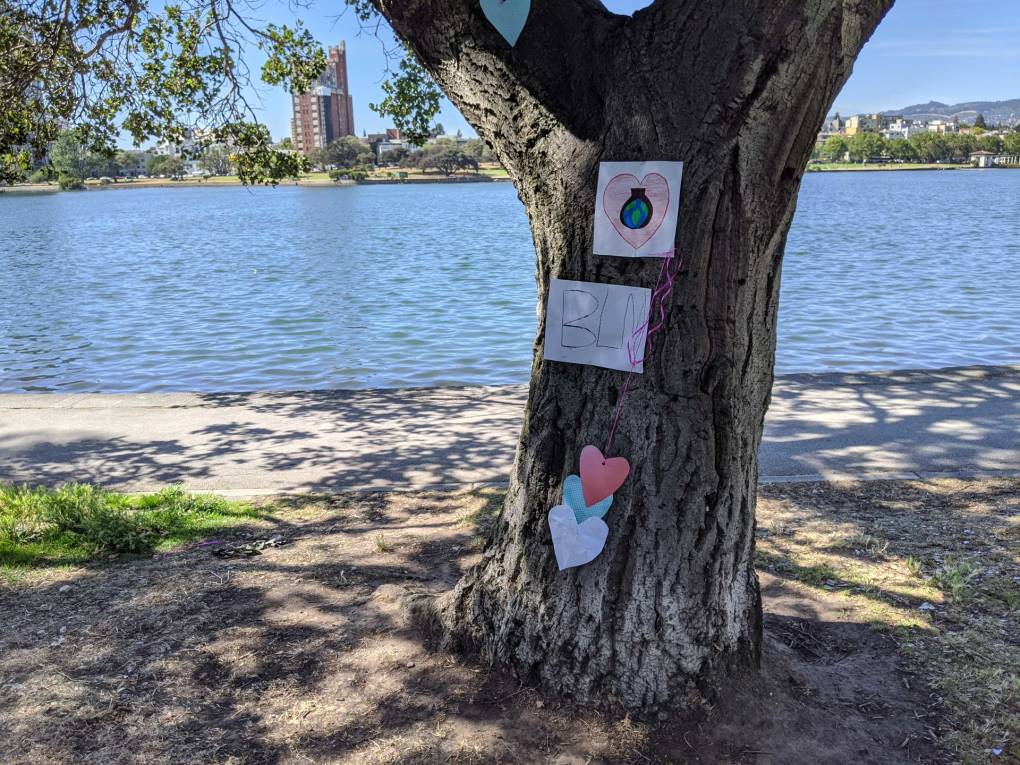
"caption": "A tree at Lake Merritt decorated with Black Lives Matter art on June 18, 2020.",
"description": "A tree at Lake Merritt decorated with Black Lives Matter art on June 18, 2020.",
"title": "RS43696_IMG_20200618_161733-qut",
"credit": "Lakshmi Sarah/KQED",
"status": "inherit",
"isLoading": false,
"fetchFailed": false
},
"news_11825049": {
"type": "attachments",
"id": "news_11825049",
"meta": {
"index": "attachments_1716263798",
"site": "news",
"id": "11825049",
"found": true
},
"parent": 11825006,
"imgSizes": {
"apple_news_ca_landscape_5_5": {
"file": "https://ww2.kqed.org/app/uploads/sites/10/2020/06/RS43689_GettyImages-907162942-qut-1044x783.jpg",
"width": 1044,
"mimeType": "image/jpeg",
"height": 783
},
"apple_news_ca_square_4_0": {
"file": "https://ww2.kqed.org/app/uploads/sites/10/2020/06/RS43689_GettyImages-907162942-qut-470x470.jpg",
"width": 470,
"mimeType": "image/jpeg",
"height": 470
},
"twentyfourteen-full-width": {
"file": "https://ww2.kqed.org/app/uploads/sites/10/2020/06/RS43689_GettyImages-907162942-qut-1038x576.jpg",
"width": 1038,
"mimeType": "image/jpeg",
"height": 576
},
"thumbnail": {
"file": "https://ww2.kqed.org/app/uploads/sites/10/2020/06/RS43689_GettyImages-907162942-qut-160x107.jpg",
"width": 160,
"mimeType": "image/jpeg",
"height": 107
},
"post-thumbnail": {
"file": "https://ww2.kqed.org/app/uploads/sites/10/2020/06/RS43689_GettyImages-907162942-qut-672x372.jpg",
"width": 672,
"mimeType": "image/jpeg",
"height": 372
},
"kqedFullSize": {
"file": "https://ww2.kqed.org/app/uploads/sites/10/2020/06/RS43689_GettyImages-907162942-qut.jpg",
"width": 1920,
"height": 1280
},
"apple_news_ca_landscape_4_7": {
"file": "https://ww2.kqed.org/app/uploads/sites/10/2020/06/RS43689_GettyImages-907162942-qut-632x474.jpg",
"width": 632,
"mimeType": "image/jpeg",
"height": 474
},
"large": {
"file": "https://ww2.kqed.org/app/uploads/sites/10/2020/06/RS43689_GettyImages-907162942-qut-1020x680.jpg",
"width": 1020,
"mimeType": "image/jpeg",
"height": 680
},
"apple_news_ca_landscape_4_0": {
"file": "https://ww2.kqed.org/app/uploads/sites/10/2020/06/RS43689_GettyImages-907162942-qut-536x402.jpg",
"width": 536,
"mimeType": "image/jpeg",
"height": 402
},
"apple_news_ca_portrait_12_9": {
"file": "https://ww2.kqed.org/app/uploads/sites/10/2020/06/RS43689_GettyImages-907162942-qut-1122x1280.jpg",
"width": 1122,
"mimeType": "image/jpeg",
"height": 1280
},
"medium": {
"file": "https://ww2.kqed.org/app/uploads/sites/10/2020/06/RS43689_GettyImages-907162942-qut-800x533.jpg",
"width": 800,
"mimeType": "image/jpeg",
"height": 533
},
"apple_news_ca_portrait_4_0": {
"file": "https://ww2.kqed.org/app/uploads/sites/10/2020/06/RS43689_GettyImages-907162942-qut-354x472.jpg",
"width": 354,
"mimeType": "image/jpeg",
"height": 472
},
"apple_news_ca_portrait_9_7": {
"file": "https://ww2.kqed.org/app/uploads/sites/10/2020/06/RS43689_GettyImages-907162942-qut-840x1120.jpg",
"width": 840,
"mimeType": "image/jpeg",
"height": 1120
},
"apple_news_ca_landscape_12_9": {
"file": "https://ww2.kqed.org/app/uploads/sites/10/2020/06/RS43689_GettyImages-907162942-qut-1832x1280.jpg",
"width": 1832,
"mimeType": "image/jpeg",
"height": 1280
},
"apple_news_ca_square_9_7": {
"file": "https://ww2.kqed.org/app/uploads/sites/10/2020/06/RS43689_GettyImages-907162942-qut-1104x1104.jpg",
"width": 1104,
"mimeType": "image/jpeg",
"height": 1104
},
"apple_news_ca_portrait_4_7": {
"file": "https://ww2.kqed.org/app/uploads/sites/10/2020/06/RS43689_GettyImages-907162942-qut-414x552.jpg",
"width": 414,
"mimeType": "image/jpeg",
"height": 552
},
"apple_news_ca_square_12_9": {
"file": "https://ww2.kqed.org/app/uploads/sites/10/2020/06/RS43689_GettyImages-907162942-qut-1472x1280.jpg",
"width": 1472,
"mimeType": "image/jpeg",
"height": 1280
},
"apple_news_ca_portrait_5_5": {
"file": "https://ww2.kqed.org/app/uploads/sites/10/2020/06/RS43689_GettyImages-907162942-qut-687x916.jpg",
"width": 687,
"mimeType": "image/jpeg",
"height": 916
},
"full-width": {
"file": "https://ww2.kqed.org/app/uploads/sites/10/2020/06/RS43689_GettyImages-907162942-qut-1920x1280.jpg",
"width": 1920,
"mimeType": "image/jpeg",
"height": 1280
},
"apple_news_ca_square_4_7": {
"file": "https://ww2.kqed.org/app/uploads/sites/10/2020/06/RS43689_GettyImages-907162942-qut-550x550.jpg",
"width": 550,
"mimeType": "image/jpeg",
"height": 550
},
"apple_news_ca_landscape_9_7": {
"file": "https://ww2.kqed.org/app/uploads/sites/10/2020/06/RS43689_GettyImages-907162942-qut-1376x1032.jpg",
"width": 1376,
"mimeType": "image/jpeg",
"height": 1032
},
"apple_news_ca_square_5_5": {
"file": "https://ww2.kqed.org/app/uploads/sites/10/2020/06/RS43689_GettyImages-907162942-qut-912x912.jpg",
"width": 912,
"mimeType": "image/jpeg",
"height": 912
}
},
"publishDate": 1592449752,
"modified": 1592516163,
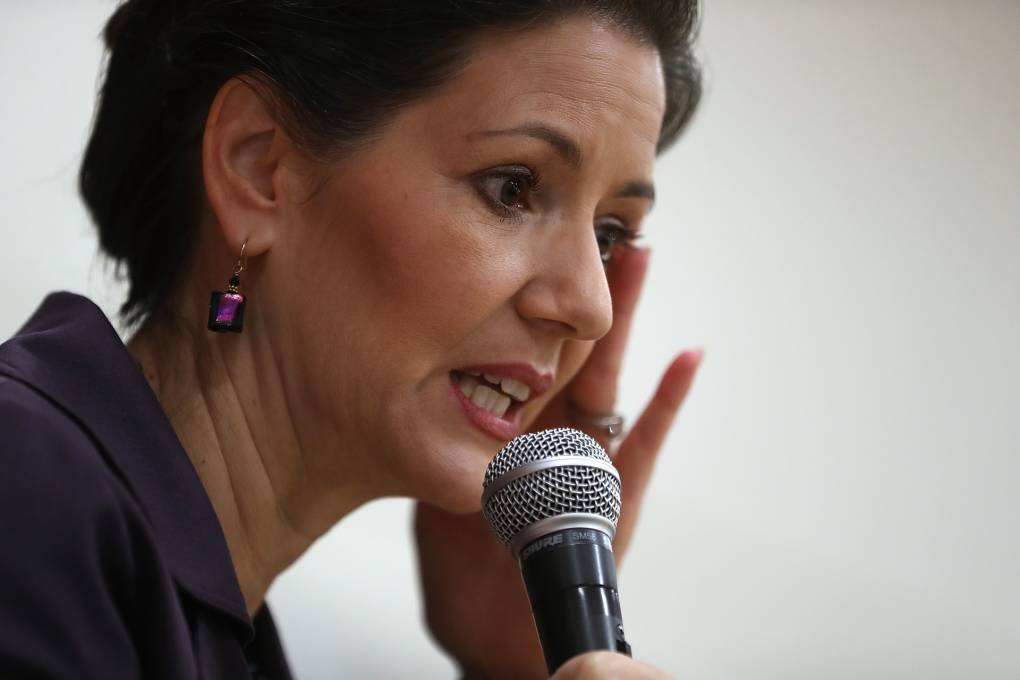
"caption": "\"The incidents of the last few weeks, but frankly the last few centuries, is the backdrop upon which we must make these decisions today. Enough is enough. And again, the intentions do not matter, because the harm is real,” said Oakland Mayor Libby Schaaf on Wednesday.",
"description": "\"The incidents of the last few weeks, but frankly the last few centuries, is the backdrop upon which we must make these decisions today. Enough is enough. And again, the intentions do not matter, because the harm is real,” said Oakland Mayor Libby Schaaf on Wednesday.",
"title": "Oakland Mayor Libby Schaaf Discusses U.S. Constitution With School Children",
"credit": "Justin Sullivan/Getty Images",
"status": "inherit",
"isLoading": false,
"fetchFailed": false
}
},
"audioPlayerReducer": {
"postId": "stream_live",
"isPaused": true,
"isPlaying": false,
"pfsActive": false,
"pledgeModalIsOpen": true,
"playerDrawerIsOpen": false,
"liveAudioPlayStartedAt": 0,
"liveAudioPlayContext": ""
},
"authorsReducer": {
"jmcevoy": {
"type": "authors",
"id": "231",
"meta": {
"index": "authors_1716337520",
"id": "231",
"found": true
},
"name": "Julia McEvoy",
"firstName": "Julia",
"lastName": "McEvoy",
"slug": "jmcevoy",
"email": "jmcevoy@KQED.org",
"display_author_email": true,
"staff_mastheads": [
"news"
],
"title": "KQED Senior Editor",
"bio": "Julia McEvoy is KQED's Senior Editor, Education Equity.\r\n\r\nJulia heads KQED’s education coverage examining inequities students face in Bay Area and California schools, and reports on what it will take to educate the next generation.\r\n\r\nJulia's editorial work has received a Peabody Award, a Casey Medal for Coverage of Children and Families, several Edward R. Murrow awards, as well as awards from the Public Radio News Directors Inc. and the Society for Professional Journalists.",
"avatar": "https://secure.gravatar.com/avatar/aec3ce21abe02b302fd33638abd56a22?s=600&d=blank&r=g",
"twitter": "juliamcevoy1",
"facebook": null,
"instagram": null,
"linkedin": null,
"sites": [
{
"site": "news",
"roles": []
},
{
"site": "stateofhealth",
"roles": [
"author"
]
}
],
"headData": {
"title": "Julia McEvoy | KQED",
"description": "KQED Senior Editor",
"ogImgSrc": "https://secure.gravatar.com/avatar/aec3ce21abe02b302fd33638abd56a22?s=600&d=blank&r=g",
"twImgSrc": "https://secure.gravatar.com/avatar/aec3ce21abe02b302fd33638abd56a22?s=600&d=blank&r=g"
},
"isLoading": false,
"link": "/author/jmcevoy"
},
"kqednewsstaffandwires": {
"type": "authors",
"id": "237",
"meta": {
"index": "authors_1716337520",
"id": "237",
"found": true
},
"name": "KQED News Staff and Wires",
"firstName": "KQED News Staff and Wires",
"lastName": null,
"slug": "kqednewsstaffandwires",
"email": "onlinenewsstaff@kqed.org",
"display_author_email": false,
"staff_mastheads": [],
"title": null,
"bio": null,
"avatar": "https://secure.gravatar.com/avatar/72295af8ebbfbd19a4948f5271285664?s=600&d=blank&r=g",
"twitter": null,
"facebook": null,
"instagram": null,
"linkedin": null,
"sites": [
{
"site": "arts",
"roles": [
"contributor"
]
},
{
"site": "news",
"roles": [
"contributor"
]
},
{
"site": "lowdown",
"roles": [
"author"
]
},
{
"site": "stateofhealth",
"roles": [
"contributor"
]
},
{
"site": "food",
"roles": [
"author"
]
}
],
"headData": {
"title": "KQED News Staff and Wires | KQED",
"description": null,
"ogImgSrc": "https://secure.gravatar.com/avatar/72295af8ebbfbd19a4948f5271285664?s=600&d=blank&r=g",
"twImgSrc": "https://secure.gravatar.com/avatar/72295af8ebbfbd19a4948f5271285664?s=600&d=blank&r=g"
},
"isLoading": false,
"link": "/author/kqednewsstaffandwires"
},
"samharnett": {
"type": "authors",
"id": "253",
"meta": {
"index": "authors_1716337520",
"id": "253",
"found": true
},
"name": "Sam Harnett",
"firstName": "Sam",
"lastName": "Harnett",
"slug": "samharnett",
"email": "samharnett@gmail.com",
"display_author_email": false,
"staff_mastheads": [],
"title": "KQED Contributor",
"bio": "Sam Harnett covered tech and work at KQED. He is the co-creator of \u003cem>\u003ca href=\"http://www.theworldaccordingtosound.org\">The World According to Sound\u003c/a>,\u003c/em> a 90-second podcast that features different sounds and the stories behind them.\r\n\r\nBefore coming to KQED, Sam worked as an independent reporter who contributed regularly to \u003cem>The California Report, Marketplace,\u003c/em> \u003cem>The World \u003c/em>and NPR.",
"avatar": "https://secure.gravatar.com/avatar/2538b972ac02f2b9546c7a6c59a0f3d0?s=600&d=blank&r=g",
"twitter": "Samwharnett",
"facebook": null,
"instagram": null,
"linkedin": null,
"sites": [
{
"site": "news",
"roles": [
"edit_others_posts",
"subscriber"
]
},
{
"site": "stateofhealth",
"roles": [
"author"
]
},
{
"site": "science",
"roles": [
"editor"
]
},
{
"site": "quest",
"roles": [
"subscriber"
]
}
],
"headData": {
"title": "Sam Harnett | KQED",
"description": "KQED Contributor",
"ogImgSrc": "https://secure.gravatar.com/avatar/2538b972ac02f2b9546c7a6c59a0f3d0?s=600&d=blank&r=g",
"twImgSrc": "https://secure.gravatar.com/avatar/2538b972ac02f2b9546c7a6c59a0f3d0?s=600&d=blank&r=g"
},
"isLoading": false,
"link": "/author/samharnett"
},
"tarasiler": {
"type": "authors",
"id": "257",
"meta": {
"index": "authors_1716337520",
"id": "257",
"found": true
},
"name": "Tara Siler",
"firstName": "Tara",
"lastName": "Siler",
"slug": "tarasiler",
"email": "tsiler@kqed.org",
"display_author_email": false,
"staff_mastheads": [
"news"
],
"title": "KQED Contributor",
"bio": "Tara reports and anchors for KQED news. She covers a range of issues from community-police relations to local politics. Tara started out in community radio in the Bay Area, where she was raised. She eventually moved to Washington DC where she covered Congress for eight years for Pacifica and Monitor Radio. Her stories have also been heard on NPR's All Things Considered, Morning Edition and The World.\r\n\r\nTara lives with her husband in Oakland-- where they raised their two sons. She enjoys spending time with her family, gardening and hiking in the Oakland hills... and keeping up with the news.",
"avatar": "https://secure.gravatar.com/avatar/99802f9746fb80b65fd8ec6c57954450?s=600&d=blank&r=g",
"twitter": null,
"facebook": null,
"instagram": null,
"linkedin": null,
"sites": [
{
"site": "news",
"roles": [
"contributor",
"edit_others_posts"
]
},
{
"site": "stateofhealth",
"roles": [
"author"
]
}
],
"headData": {
"title": "Tara Siler | KQED",
"description": "KQED Contributor",
"ogImgSrc": "https://secure.gravatar.com/avatar/99802f9746fb80b65fd8ec6c57954450?s=600&d=blank&r=g",
"twImgSrc": "https://secure.gravatar.com/avatar/99802f9746fb80b65fd8ec6c57954450?s=600&d=blank&r=g"
},
"isLoading": false,
"link": "/author/tarasiler"
},
"matthewgreen": {
"type": "authors",
"id": "1263",
"meta": {
"index": "authors_1716337520",
"id": "1263",
"found": true
},
"name": "Matthew Green",
"firstName": "Matthew",
"lastName": "Green",
"slug": "matthewgreen",
"email": "mgreen@kqed.org",
"display_author_email": false,
"staff_mastheads": [],
"title": "KQED Editor/Reporter",
"bio": "Matthew Green is a digital media producer for KQED News. He previously produced \u003ca href=\"http://www.kqed.org/lowdown\">The Lowdown\u003c/a>, KQED’s multimedia news education blog. Matthew's written for numerous Bay Area publications, including the Oakland Tribune and San Francisco Chronicle. He also taught journalism classes at Fremont High School in East Oakland.\r\n\r\nEmail: mgreen@kqed.org; Twitter: @MGreenKQED",
"avatar": "https://secure.gravatar.com/avatar/3bf498d1267ca02c8494f33d8cfc575e?s=600&d=blank&r=g",
"twitter": "MGreenKQED",
"facebook": null,
"instagram": null,
"linkedin": null,
"sites": [
{
"site": "news",
"roles": []
},
{
"site": "lowdown",
"roles": []
},
{
"site": "science",
"roles": []
},
{
"site": "education",
"roles": []
},
{
"site": "quest",
"roles": []
},
{
"site": "liveblog",
"roles": []
}
],
"headData": {
"title": "Matthew Green | KQED",
"description": "KQED Editor/Reporter",
"ogImgSrc": "https://secure.gravatar.com/avatar/3bf498d1267ca02c8494f33d8cfc575e?s=600&d=blank&r=g",
"twImgSrc": "https://secure.gravatar.com/avatar/3bf498d1267ca02c8494f33d8cfc575e?s=600&d=blank&r=g"
},
"isLoading": false,
"link": "/author/matthewgreen"
},
"aemslie": {
"type": "authors",
"id": "3206",
"meta": {
"index": "authors_1716337520",
"id": "3206",
"found": true
},
"name": "Alex Emslie",
"firstName": "Alex",
"lastName": "Emslie",
"slug": "aemslie",
"email": "aemslie@kqed.org",
"display_author_email": true,
"staff_mastheads": [
"news"
],
"title": "KQED Senior Editor",
"bio": "Alex Emslie is senior editor of talent and development at KQED, where he manages dozens of early career journalists and oversees news department internships.\r\n\r\nHe is a former carpenter and proud graduate of City College of San Francisco and San Francisco State University, where he studied journalism and criminal justice before joining KQED in 2013.\r\n\r\nAlex produced investigative journalism focused on \u003ca href=\"https://www.kqed.org/news/11667594/the-trials-of-marvin-mutch-video\">criminal justice\u003c/a> and policing for most of a decade. He has broken major stories about \u003ca href=\"https://www.kqed.org/news/135682/amid-a-series-of-vallejo-police-shootings-one-officers-name-stands-out\">police use of deadly force\u003c/a>, \u003ca href=\"https://www.kqed.org/news/10454955/racist-texts-prompt-sfpd-internal-investigation\">officer misconduct\u003c/a> and \u003ca href=\"https://www.kqed.org/news/11712239/terrorist-or-troll-judge-to-weigh-whether-oakland-man-really-intended-to-attack-bay-area\">other\u003c/a> \u003ca href=\"https://www.kqed.org/news/11221414/hayward-paid-159000-to-husband-of-retired-police-chief-documents-show\">high\u003c/a>-\u003ca href=\"https://www.kqed.org/news/10622762/the-forgotten-tracking-two-homicides-in-san-francisco-public-housing\">profile\u003c/a> \u003ca href=\"https://www.kqed.org/news/11624516/federal-agency-promoted-ranger-just-months-after-his-gun-was-stolen-and-used-in-steinle-killing\">cases\u003c/a>. He co-founded the \u003ca href=\"https://projects.scpr.org/california-reporting-project/\">California Reporting Project\u003c/a> in 2019 to obtain and report on previously confidential police internal investigations. The effort produced well over 100 original stories and changed the course of multiple criminal cases.\r\n\r\nHis work has been recognized with numerous journalism awards, including a national Edward R. Murrow award for several years of \u003ca href=\"https://www.kqed.org/news/11688481/sfpd-officers-in-mario-woods-case-recount-shooting-in-newly-filed-depositions\">reporting\u003c/a> on the San Francisco Police shooting of Mario Woods. His \u003ca href=\"https://www.kqed.org/news/147854/half-of-those-killed-by-san-francisco-police-are-mentally-ill\">reporting\u003c/a> on police killings of people in psychiatric crisis was cited in amicus briefs before the U.S. Supreme Court.\r\n\r\nAlex now enjoys mentoring the next generation of journalists at KQED.",
"avatar": "https://secure.gravatar.com/avatar/e691e65209f20e9da202bd730ead5663?s=600&d=blank&r=g",
"twitter": "SFNewsReporter",
"facebook": null,
"instagram": null,
"linkedin": null,
"sites": [
{
"site": "arts",
"roles": [
"editor"
]
},
{
"site": "news",
"roles": [
"editor"
]
},
{
"site": "mindshift",
"roles": [
"editor"
]
},
{
"site": "stateofhealth",
"roles": [
"editor"
]
},
{
"site": "science",
"roles": [
"administrator"
]
}
],
"headData": {
"title": "Alex Emslie | KQED",
"description": "KQED Senior Editor",
"ogImgSrc": "https://secure.gravatar.com/avatar/e691e65209f20e9da202bd730ead5663?s=600&d=blank&r=g",
"twImgSrc": "https://secure.gravatar.com/avatar/e691e65209f20e9da202bd730ead5663?s=600&d=blank&r=g"
},
"isLoading": false,
"link": "/author/aemslie"
},
"pgilstrap": {
"type": "authors",
"id": "11275",
"meta": {
"index": "authors_1716337520",
"id": "11275",
"found": true
},
"name": "Peter Gilstrap",
"firstName": "Peter",
"lastName": "Gilstrap",
"slug": "pgilstrap",
"email": "pgilstrap@sbcglobal.net",
"display_author_email": false,
"staff_mastheads": [],
"title": null,
"bio": null,
"avatar": "https://secure.gravatar.com/avatar/2bf93e4a8c1e35493845045175273916?s=600&d=blank&r=g",
"twitter": null,
"facebook": null,
"instagram": null,
"linkedin": null,
"sites": [
{
"site": "news",
"roles": [
"author"
]
}
],
"headData": {
"title": "Peter Gilstrap | KQED",
"description": null,
"ogImgSrc": "https://secure.gravatar.com/avatar/2bf93e4a8c1e35493845045175273916?s=600&d=blank&r=g",
"twImgSrc": "https://secure.gravatar.com/avatar/2bf93e4a8c1e35493845045175273916?s=600&d=blank&r=g"
},
"isLoading": false,
"link": "/author/pgilstrap"
},
"vrancano": {
"type": "authors",
"id": "11276",
"meta": {
"index": "authors_1716337520",
"id": "11276",
"found": true
},
"name": "Vanessa Rancaño",
"firstName": "Vanessa",
"lastName": "Rancaño",
"slug": "vrancano",
"email": "vrancano@kqed.org",
"display_author_email": false,
"staff_mastheads": [
"news"
],
"title": "Reporter",
"bio": "Vanessa Rancaño is a features reporter for KQED. She’s also covered homelessness and education for the station and reported from the Central Valley. Her work has aired across public radio, from flagship national news shows to longform narrative podcasts. Before taking up a mic, she worked as a freelance print journalist. She’s been recognized with a number of national and regional awards. Vanessa grew up in California's Central Valley. She's a former NPR Kroc Fellow, and a graduate of the UC Berkeley Graduate School of Journalism.",
"avatar": "https://secure.gravatar.com/avatar/b3a383dfb0e7ee1c17568f2cf067904ab654d6e3de9743fc661f3c788ade1bed?s=600&d=blank&r=g",
"twitter": "vanessarancano",
"bluesky": null,
"facebook": null,
"instagram": null,
"linkedin": null,
"sites": [
{
"site": "arts",
"roles": [
"editor"
]
},
{
"site": "news",
"roles": [
"editor"
]
},
{
"site": "liveblog",
"roles": [
"contributor"
]
}
],
"headData": {
"title": "Vanessa Rancaño | KQED",
"description": "Reporter",
"ogImgSrc": "https://secure.gravatar.com/avatar/b3a383dfb0e7ee1c17568f2cf067904ab654d6e3de9743fc661f3c788ade1bed?s=600&d=blank&r=g",
"twImgSrc": "https://secure.gravatar.com/avatar/b3a383dfb0e7ee1c17568f2cf067904ab654d6e3de9743fc661f3c788ade1bed?s=600&d=blank&r=g"
},
"isLoading": false,
"link": "/author/vrancano"
},
"lsarah": {
"type": "authors",
"id": "11626",
"meta": {
"index": "authors_1716337520",
"id": "11626",
"found": true
},
"name": "Lakshmi Sarah",
"firstName": "Lakshmi",
"lastName": "Sarah",
"slug": "lsarah",
"email": "lsarah@kqed.org",
"display_author_email": false,
"staff_mastheads": [],
"title": "Digital Producer",
"bio": "Lakshmi Sarah is an educator, author and journalist with a focus on innovative storytelling. She has worked with newspapers, radio and magazines from Ahmedabad, India to Los Angeles, California. She has written and produced for Die Zeit, Global Voices, AJ+, KQED, Fusion Media Group and the New York Times.",
"avatar": "https://secure.gravatar.com/avatar/652dcaecd8b28826fc17a8b2d6bb4e93?s=600&d=blank&r=g",
"twitter": "lakitalki",
"facebook": null,
"instagram": "https://www.instagram.com/laki.talki/",
"linkedin": "https://www.linkedin.com/in/lakisarah/",
"sites": [
{
"site": "arts",
"roles": []
},
{
"site": "news",
"roles": []
},
{
"site": "bayareabites",
"roles": []
},
{
"site": "science",
"roles": []
}
],
"headData": {
"title": "Lakshmi Sarah | KQED",
"description": "Digital Producer",
"ogImgSrc": "https://secure.gravatar.com/avatar/652dcaecd8b28826fc17a8b2d6bb4e93?s=600&d=blank&r=g",
"twImgSrc": "https://secure.gravatar.com/avatar/652dcaecd8b28826fc17a8b2d6bb4e93?s=600&d=blank&r=g"
},
"isLoading": false,
"link": "/author/lsarah"
},
"jchang": {
"type": "authors",
"id": "11642",
"meta": {
"index": "authors_1716337520",
"id": "11642",
"found": true
},
"name": "Julie Chang",
"firstName": "Julie",
"lastName": "Chang",
"slug": "jchang",
"email": "jchang@kqed.org",
"display_author_email": false,
"staff_mastheads": [
"news"
],
"title": "KQED Contributor",
"bio": "Julie Chang is a reporter and producer (and occasional anchor) with the radio and digital teams at KQED. Before KQED, she worked at WAMU 88.5 in Washington D.C. and 89.3 KPCC in Los Angeles County. Her work has been featured on NPR’s Morning Edition and All Things Considered, Here & Now, the New York Times, and more. Julie graduated from UC Berkeley’s Graduate School of Journalism. She previously taught English at Pasadena City College, Fullerton College and Cal Poly Pomona. Julie earned her M.A. in English from Cal Poly Pomona and her B.A. in English from UCI with a minor in criminology.",
"avatar": "https://secure.gravatar.com/avatar/a7afce94ef127082c5475116b4a3b77d?s=600&d=blank&r=g",
"twitter": "BayAreaJulie",
"facebook": null,
"instagram": null,
"linkedin": "https://www.linkedin.com/in/julieyc/",
"sites": [
{
"site": "",
"roles": [
"editor"
]
},
{
"site": "news",
"roles": [
"author"
]
},
{
"site": "science",
"roles": [
"editor"
]
}
],
"headData": {
"title": "Julie Chang | KQED",
"description": "KQED Contributor",
"ogImgSrc": "https://secure.gravatar.com/avatar/a7afce94ef127082c5475116b4a3b77d?s=600&d=blank&r=g",
"twImgSrc": "https://secure.gravatar.com/avatar/a7afce94ef127082c5475116b4a3b77d?s=600&d=blank&r=g"
},
"isLoading": false,
"link": "/author/jchang"
},
"mgonzalessiler": {
"type": "authors",
"id": "11657",
"meta": {
"index": "authors_1716337520",
"id": "11657",
"found": true
},
"name": "Marco Siler-Gonzales",
"firstName": "Marco",
"lastName": "Siler-Gonzales",
"slug": "mgonzalessiler",
"email": "mgonzalessiler@kqed.org",
"display_author_email": false,
"staff_mastheads": [],
"title": "KQED Contributor",
"bio": null,
"avatar": "https://secure.gravatar.com/avatar/e960972bbaa44ee0e051b1f68c97753c?s=600&d=blank&r=g",
"twitter": null,
"facebook": null,
"instagram": null,
"linkedin": null,
"sites": [
{
"site": "news",
"roles": [
"author"
]
}
],
"headData": {
"title": "Marco Siler-Gonzales | KQED",
"description": "KQED Contributor",
"ogImgSrc": "https://secure.gravatar.com/avatar/e960972bbaa44ee0e051b1f68c97753c?s=600&d=blank&r=g",
"twImgSrc": "https://secure.gravatar.com/avatar/e960972bbaa44ee0e051b1f68c97753c?s=600&d=blank&r=g"
},
"isLoading": false,
"link": "/author/mgonzalessiler"
},
"slin": {
"type": "authors",
"id": "11680",
"meta": {
"index": "authors_1716337520",
"id": "11680",
"found": true
},
"name": "Shannon Lin",
"firstName": "Shannon",
"lastName": "Lin",
"slug": "slin",
"email": "slin@KQED.org",
"display_author_email": false,
"staff_mastheads": [
"news"
],
"title": "KQED Contributor",
"bio": null,
"avatar": "https://secure.gravatar.com/avatar/933be81059ee104afe4b7976547cf552?s=600&d=blank&r=g",
"twitter": null,
"facebook": null,
"instagram": null,
"linkedin": null,
"sites": [
{
"site": "news",
"roles": [
"subscriber"
]
},
{
"site": "forum",
"roles": [
"editor"
]
}
],
"headData": {
"title": "Shannon Lin | KQED",
"description": "KQED Contributor",
"ogImgSrc": "https://secure.gravatar.com/avatar/933be81059ee104afe4b7976547cf552?s=600&d=blank&r=g",
"twImgSrc": "https://secure.gravatar.com/avatar/933be81059ee104afe4b7976547cf552?s=600&d=blank&r=g"
},
"isLoading": false,
"link": "/author/slin"
},
"avignet": {
"type": "authors",
"id": "11683",
"meta": {
"index": "authors_1716337520",
"id": "11683",
"found": true
},
"name": "Anna Vignet",
"firstName": "Anna",
"lastName": "Vignet",
"slug": "avignet",
"email": "avignet@kqed.org",
"display_author_email": false,
"staff_mastheads": [
"news"
],
"title": "KQED Contributor",
"bio": null,
"avatar": "https://secure.gravatar.com/avatar/75b1c67fd0f5915bc8c1514aca495240?s=600&d=blank&r=g",
"twitter": null,
"facebook": null,
"instagram": null,
"linkedin": null,
"sites": [
{
"site": "arts",
"roles": [
"author"
]
},
{
"site": "news",
"roles": [
"editor"
]
}
],
"headData": {
"title": "Anna Vignet | KQED",
"description": "KQED Contributor",
"ogImgSrc": "https://secure.gravatar.com/avatar/75b1c67fd0f5915bc8c1514aca495240?s=600&d=blank&r=g",
"twImgSrc": "https://secure.gravatar.com/avatar/75b1c67fd0f5915bc8c1514aca495240?s=600&d=blank&r=g"
},
"isLoading": false,
"link": "/author/avignet"
},
"jrodriguez": {
"type": "authors",
"id": "11690",
"meta": {
"index": "authors_1716337520",
"id": "11690",
"found": true
},
"name": "Joe Fitzgerald Rodriguez",
"firstName": "Joe",
"lastName": "Fitzgerald Rodriguez",
"slug": "jrodriguez",
"email": "jrodriguez@kqed.org",
"display_author_email": true,
"staff_mastheads": [
"news"
],
"title": "Reporter and Producer",
"bio": "Joe Fitzgerald Rodriguez is a reporter and digital producer for KQED covering politics. Joe most recently wrote for the \u003cem>San Francisco Examiner\u003c/em> as a political columnist covering The City. He was raised in San Francisco and has spent his reporting career in his beloved, foggy, city by the bay. Joe was 12-years-old when he conducted his first interview in journalism, grilling former San Francisco Mayor Willie Brown for the Marina Middle School newspaper, \u003cem>The Penguin Press, \u003c/em>and he continues to report on the San Francisco Bay Area to this day.",
"avatar": "https://secure.gravatar.com/avatar/2247beb0564c1e9c62228d5649d2edac?s=600&d=blank&r=g",
"twitter": "FitztheReporter",
"facebook": null,
"instagram": "https://www.instagram.com/fitzthereporter/",
"linkedin": null,
"sites": [
{
"site": "",
"roles": [
"editor"
]
},
{
"site": "arts",
"roles": [
"editor"
]
},
{
"site": "news",
"roles": [
"editor"
]
},
{
"site": "science",
"roles": [
"editor"
]
},
{
"site": "elections",
"roles": [
"editor"
]
},
{
"site": "liveblog",
"roles": [
"editor"
]
}
],
"headData": {
"title": "Joe Fitzgerald Rodriguez | KQED",
"description": "Reporter and Producer",
"ogImgSrc": "https://secure.gravatar.com/avatar/2247beb0564c1e9c62228d5649d2edac?s=600&d=blank&r=g",
"twImgSrc": "https://secure.gravatar.com/avatar/2247beb0564c1e9c62228d5649d2edac?s=600&d=blank&r=g"
},
"isLoading": false,
"link": "/author/jrodriguez"
}
},
"pagesReducer": {
"news_tag_education": {
"type": "terms",
"id": "news_20013",
"meta": {
"index": "terms_1716263798",
"site": "news",
"id": "20013",
"score": 6.9701543
},
"featImg": null,
"name": "education",
"description": null,
"taxonomy": "tag",
"headData": {
"twImgId": null,
"twTitle": null,
"ogTitle": null,
"ogImgId": null,
"twDescription": null,
"description": null,
"title": "education Archives | KQED News",
"ogDescription": null
},
"ttid": 20030,
"slug": "education",
"isLoading": false,
"title": "education",
"pageMeta": {
"site": "news",
"WpPageTemplate": "page-topic-editorial",
"currentPage": 88
},
"blocks": [
{
"blockName": "kqed/post-list",
"attrs": {
"layout": "cardArticle2",
"query": "posts/news?tag=education",
"seeMore": false,
"paginated": true,
"page": 88
}
},
{
"blockName": "kqed/ad"
}
]
}
},
"pfsSessionReducer": {},
"postsReducer": {
"stream_live": {
"type": "live",
"id": "stream_live",
"audioUrl": "https://streams.kqed.org/kqedradio",
"title": "Live Stream",
"excerpt": "Live Stream information currently unavailable.",
"link": "/radio",
"featImg": "",
"label": {
"name": "KQED Live",
"link": "/"
}
},
"stream_kqedNewscast": {
"type": "posts",
"id": "stream_kqedNewscast",
"audioUrl": "https://www.kqed.org/.stream/anon/radio/RDnews/newscast.mp3?_=1",
"title": "KQED Newscast",
"featImg": "",
"label": {
"name": "88.5 FM",
"link": "/"
}
},
"news_11829806": {
"type": "posts",
"id": "news_11829806",
"meta": {
"index": "posts_1716263798",
"site": "news",
"id": "11829806",
"score": null,
"sort": [
1595297435000
]
},
"guestAuthors": [],
"slug": "unions-join-black-lives-matter-protesters-in-walk-out-for-economic-justice",
"title": "Unions Join Black Lives Matter Protesters in Walk Out for Economic Justice",
"publishDate": 1595297435,
"format": "audio",
"headTitle": "Unions Join Black Lives Matter Protesters in Walk Out for Economic Justice | KQED",
"labelTerm": {
"term": 72,
"site": "news"
},
"content": "\u003cp>Workers in 25 cities across the country protested economic and racial injustice on Monday by walking off the job for eight minutes and 46 seconds, the amount of time that Minneapolis police officer Derek Chauvin reportedly knelt on George Floyd’s neck.\u003c/p>\n\u003cp>In Oakland, Black Lives Matter and union protesters started at a McDonald’s location on Telegraph Avenue, where the owner allegedly told employees to make COVID-19 masks out of coffee filters and unused dog diapers.\u003c/p>\n\u003cp>Four workers there have since filed a \u003ca href=\"https://www.kqed.org/news/11824634/oakland-mcdonalds-workers-sue-management-over-covid-19-outbreak\">public nuisance lawsuit\u003c/a>, alleging that management failed to provide protective equipment, forced workers to continue working while showing virus symptoms and discouraged workers from using paid sick leave.\u003c/p>\n\u003cfigure id=\"attachment_11829885\" class=\"wp-caption aligncenter\" style=\"max-width: 1920px\">\u003cimg loading=\"lazy\" decoding=\"async\" class=\"size-full wp-image-11829885\" src=\"https://ww2.kqed.org/app/uploads/sites/10/2020/07/RS44002_005_KQED_Oakland_McDonaldsStrike_07202020-qut.jpg\" alt=\"\" width=\"1920\" height=\"1278\" srcset=\"https://cdn.kqed.org/wp-content/uploads/sites/10/2020/07/RS44002_005_KQED_Oakland_McDonaldsStrike_07202020-qut.jpg 1920w, https://cdn.kqed.org/wp-content/uploads/sites/10/2020/07/RS44002_005_KQED_Oakland_McDonaldsStrike_07202020-qut-800x533.jpg 800w, https://cdn.kqed.org/wp-content/uploads/sites/10/2020/07/RS44002_005_KQED_Oakland_McDonaldsStrike_07202020-qut-1020x679.jpg 1020w, https://cdn.kqed.org/wp-content/uploads/sites/10/2020/07/RS44002_005_KQED_Oakland_McDonaldsStrike_07202020-qut-160x107.jpg 160w, https://cdn.kqed.org/wp-content/uploads/sites/10/2020/07/RS44002_005_KQED_Oakland_McDonaldsStrike_07202020-qut-1536x1022.jpg 1536w\" sizes=\"(max-width: 1920px) 100vw, 1920px\">\u003cfigcaption class=\"wp-caption-text\">Cherri Murphy, a minister at Speak Life Ministries, speaks during a ‘Strike for Black Lives’ rally at a McDonald’s restaurant on Telegraph Avenue in Oakland on July 20, 2020. \u003ccite>(Beth LaBerge/KQED)\u003c/cite>\u003c/figcaption>\u003c/figure>\n\u003cp>At the protest, Cherri Murphy, a minister at Speak Life Ministries, said corporations are hypocritical for running advertising campaigns that profess support for the Black Lives Matter movement, while at the same time they keep profits instead of raising wages or providing adequate protective equipment.\u003c/p>\n\u003cp>“It’s easy for corporations to point the finger at police. What they should do is point the fingers at themselves as well, because racial justice is economic justice. Those things are linked together,” Murphy said. “The same conditions that exploit and harm and cause the killing of Black and brown lives are the same conditions that exploit and harm black and brown folks who want to earn a livable wage.”\u003c/p>\n\u003cfigure id=\"attachment_11829888\" class=\"wp-caption aligncenter\" style=\"max-width: 1920px\">\u003cimg loading=\"lazy\" decoding=\"async\" class=\"size-full wp-image-11829888\" src=\"https://ww2.kqed.org/app/uploads/sites/10/2020/07/RS44014_017_KQED_Oakland_McDonaldsStrike_07202020-qut.jpg\" alt=\"\" width=\"1920\" height=\"1280\" srcset=\"https://cdn.kqed.org/wp-content/uploads/sites/10/2020/07/RS44014_017_KQED_Oakland_McDonaldsStrike_07202020-qut.jpg 1920w, https://cdn.kqed.org/wp-content/uploads/sites/10/2020/07/RS44014_017_KQED_Oakland_McDonaldsStrike_07202020-qut-800x533.jpg 800w, https://cdn.kqed.org/wp-content/uploads/sites/10/2020/07/RS44014_017_KQED_Oakland_McDonaldsStrike_07202020-qut-1020x680.jpg 1020w, https://cdn.kqed.org/wp-content/uploads/sites/10/2020/07/RS44014_017_KQED_Oakland_McDonaldsStrike_07202020-qut-160x107.jpg 160w, https://cdn.kqed.org/wp-content/uploads/sites/10/2020/07/RS44014_017_KQED_Oakland_McDonaldsStrike_07202020-qut-1536x1024.jpg 1536w\" sizes=\"(max-width: 1920px) 100vw, 1920px\">\u003cfigcaption class=\"wp-caption-text\">Bonnie Alexander (left) and Jacob Klein hold signs saying that the McDonald’s is closed during a ‘Strike for Black Lives’ rally at a McDonalds on Telegraph Avenue in Oakland on July 20, 2020. \u003ccite>(Beth LaBerge/KQED)\u003c/cite>\u003c/figcaption>\u003c/figure>\n\u003cp>One of the biggest issues at the protest was how corporations use stock buybacks and dividends to enrich shareholders. McDonald’s in particular has been criticised for paying dividends to shareholders during the pandemic. In just the last 5 years, the company has spent over 40 billion in stock buybacks and dividends to enrich shareholders.\u003c/p>\n\u003cfigure id=\"attachment_11829892\" class=\"wp-caption aligncenter\" style=\"max-width: 1920px\">\u003cimg loading=\"lazy\" decoding=\"async\" class=\"size-full wp-image-11829892\" src=\"https://ww2.kqed.org/app/uploads/sites/10/2020/07/RS44019_022_KQED_Oakland_McDonaldsStrike_07202020-qut.jpg\" alt=\"\" width=\"1920\" height=\"1278\" srcset=\"https://cdn.kqed.org/wp-content/uploads/sites/10/2020/07/RS44019_022_KQED_Oakland_McDonaldsStrike_07202020-qut.jpg 1920w, https://cdn.kqed.org/wp-content/uploads/sites/10/2020/07/RS44019_022_KQED_Oakland_McDonaldsStrike_07202020-qut-800x533.jpg 800w, https://cdn.kqed.org/wp-content/uploads/sites/10/2020/07/RS44019_022_KQED_Oakland_McDonaldsStrike_07202020-qut-1020x679.jpg 1020w, https://cdn.kqed.org/wp-content/uploads/sites/10/2020/07/RS44019_022_KQED_Oakland_McDonaldsStrike_07202020-qut-160x107.jpg 160w, https://cdn.kqed.org/wp-content/uploads/sites/10/2020/07/RS44019_022_KQED_Oakland_McDonaldsStrike_07202020-qut-1536x1022.jpg 1536w\" sizes=\"(max-width: 1920px) 100vw, 1920px\">\u003cfigcaption class=\"wp-caption-text\">Demonstrators take a knee for eight minutes and 46 seconds, the time prosecutors say a Minneapolis police officer knelt on the neck of George Floyd, during a ‘Strike for Black Lives’ rally outside of a McDonalds on Telegraph Avenue in Oakland on July 20, 2020. \u003ccite>(Beth LaBerge/KQED)\u003c/cite>\u003c/figcaption>\u003c/figure>\n\u003cp>SEIU president Mary Kay Henry was at the rally. She says some of those profits over the years should have been used to pay workers a living wage, “McDonald’s employs overwhelmingly majority Black, brown, asian workers and pays them poverty wages.”\u003c/p>\n\u003cp>In a statement, McDonald’s says “it is our responsibility to continue to listen and learn and push for a more equitable and inclusive society.”\u003c/p>\n\u003cp>[ad fullwidth]\u003c/p>\n\u003cp>\u003c/p>\n",
"blocks": [],
"excerpt": "Monday's protest in Oakland started at a McDonald's that has faced legal trouble for lacking COVID-19 protective equipment for employees.",
"status": "publish",
"parent": 0,
"modified": 1721125338,
"stats": {
"hasAudio": false,
"hasVideo": false,
"hasChartOrMap": false,
"iframeSrcs": [],
"hasGoogleForm": false,
"hasGallery": false,
"hasHearkenModule": false,
"hasPolis": false,
"paragraphCount": 10,
"wordCount": 494
},
"headData": {
"title": "Unions Join Black Lives Matter Protesters in Walk Out for Economic Justice | KQED",
"description": "Monday's protest in Oakland started at a McDonald's that has faced legal trouble for lacking COVID-19 protective equipment for employees.",
"ogTitle": "",
"ogDescription": "",
"ogImgId": "",
"twTitle": "",
"twDescription": "",
"twImgId": "",
"schema": {
"@context": "https://schema.org",
"@type": "NewsArticle",
"headline": "Unions Join Black Lives Matter Protesters in Walk Out for Economic Justice",
"datePublished": "2020-07-20T19:10:35-07:00",
"dateModified": "2024-07-16T03:22:18-07:00",
"image": "https://cdn.kqed.org/wp-content/uploads/2020/02/KQED-OG-Image@1x.png",
"isAccessibleForFree": "True",
"publisher": {
"@type": "NewsMediaOrganization",
"@id": "https://www.kqed.org/#organization",
"name": "KQED",
"logo": "https://cdn.kqed.org/wp-content/uploads/2020/02/KQED-OG-Image@1x.png",
"url": "https://www.kqed.org",
"sameAs": [
"https://www.facebook.com/KQED",
"https://twitter.com/KQED",
"https://www.instagram.com/kqed/",
"https://www.tiktok.com/@kqedofficial",
"https://www.linkedin.com/company/kqed",
"https://www.youtube.com/channel/UCeC0IOo7i1P_61zVUWbJ4nw"
]
}
}
},
"audioUrl": "https://traffic.omny.fm/d/clips/0af137ef-751e-4b19-a055-aaef00d2d578/ffca7e9f-6831-41c5-bcaf-aaef00f5a073/aa8bbc49-eec3-4c1a-912c-abff010ed849/audio.mp3",
"sticky": false,
"path": "/news/11829806/unions-join-black-lives-matter-protesters-in-walk-out-for-economic-justice",
"audioDuration": 68000,
"audioTrackLength": null,
"parsedContent": [
{
"type": "contentString",
"content": "\u003cdiv class=\"post-body\">\u003cp>\u003cp>Workers in 25 cities across the country protested economic and racial injustice on Monday by walking off the job for eight minutes and 46 seconds, the amount of time that Minneapolis police officer Derek Chauvin reportedly knelt on George Floyd’s neck.\u003c/p>\n\u003cp>In Oakland, Black Lives Matter and union protesters started at a McDonald’s location on Telegraph Avenue, where the owner allegedly told employees to make COVID-19 masks out of coffee filters and unused dog diapers.\u003c/p>\n\u003cp>Four workers there have since filed a \u003ca href=\"https://www.kqed.org/news/11824634/oakland-mcdonalds-workers-sue-management-over-covid-19-outbreak\">public nuisance lawsuit\u003c/a>, alleging that management failed to provide protective equipment, forced workers to continue working while showing virus symptoms and discouraged workers from using paid sick leave.\u003c/p>\n\u003cfigure id=\"attachment_11829885\" class=\"wp-caption aligncenter\" style=\"max-width: 1920px\">\u003cimg loading=\"lazy\" decoding=\"async\" class=\"size-full wp-image-11829885\" src=\"https://ww2.kqed.org/app/uploads/sites/10/2020/07/RS44002_005_KQED_Oakland_McDonaldsStrike_07202020-qut.jpg\" alt=\"\" width=\"1920\" height=\"1278\" srcset=\"https://cdn.kqed.org/wp-content/uploads/sites/10/2020/07/RS44002_005_KQED_Oakland_McDonaldsStrike_07202020-qut.jpg 1920w, https://cdn.kqed.org/wp-content/uploads/sites/10/2020/07/RS44002_005_KQED_Oakland_McDonaldsStrike_07202020-qut-800x533.jpg 800w, https://cdn.kqed.org/wp-content/uploads/sites/10/2020/07/RS44002_005_KQED_Oakland_McDonaldsStrike_07202020-qut-1020x679.jpg 1020w, https://cdn.kqed.org/wp-content/uploads/sites/10/2020/07/RS44002_005_KQED_Oakland_McDonaldsStrike_07202020-qut-160x107.jpg 160w, https://cdn.kqed.org/wp-content/uploads/sites/10/2020/07/RS44002_005_KQED_Oakland_McDonaldsStrike_07202020-qut-1536x1022.jpg 1536w\" sizes=\"(max-width: 1920px) 100vw, 1920px\">\u003cfigcaption class=\"wp-caption-text\">Cherri Murphy, a minister at Speak Life Ministries, speaks during a ‘Strike for Black Lives’ rally at a McDonald’s restaurant on Telegraph Avenue in Oakland on July 20, 2020. \u003ccite>(Beth LaBerge/KQED)\u003c/cite>\u003c/figcaption>\u003c/figure>\n\u003cp>At the protest, Cherri Murphy, a minister at Speak Life Ministries, said corporations are hypocritical for running advertising campaigns that profess support for the Black Lives Matter movement, while at the same time they keep profits instead of raising wages or providing adequate protective equipment.\u003c/p>\n\u003cp>“It’s easy for corporations to point the finger at police. What they should do is point the fingers at themselves as well, because racial justice is economic justice. Those things are linked together,” Murphy said. “The same conditions that exploit and harm and cause the killing of Black and brown lives are the same conditions that exploit and harm black and brown folks who want to earn a livable wage.”\u003c/p>\n\u003cfigure id=\"attachment_11829888\" class=\"wp-caption aligncenter\" style=\"max-width: 1920px\">\u003cimg loading=\"lazy\" decoding=\"async\" class=\"size-full wp-image-11829888\" src=\"https://ww2.kqed.org/app/uploads/sites/10/2020/07/RS44014_017_KQED_Oakland_McDonaldsStrike_07202020-qut.jpg\" alt=\"\" width=\"1920\" height=\"1280\" srcset=\"https://cdn.kqed.org/wp-content/uploads/sites/10/2020/07/RS44014_017_KQED_Oakland_McDonaldsStrike_07202020-qut.jpg 1920w, https://cdn.kqed.org/wp-content/uploads/sites/10/2020/07/RS44014_017_KQED_Oakland_McDonaldsStrike_07202020-qut-800x533.jpg 800w, https://cdn.kqed.org/wp-content/uploads/sites/10/2020/07/RS44014_017_KQED_Oakland_McDonaldsStrike_07202020-qut-1020x680.jpg 1020w, https://cdn.kqed.org/wp-content/uploads/sites/10/2020/07/RS44014_017_KQED_Oakland_McDonaldsStrike_07202020-qut-160x107.jpg 160w, https://cdn.kqed.org/wp-content/uploads/sites/10/2020/07/RS44014_017_KQED_Oakland_McDonaldsStrike_07202020-qut-1536x1024.jpg 1536w\" sizes=\"(max-width: 1920px) 100vw, 1920px\">\u003cfigcaption class=\"wp-caption-text\">Bonnie Alexander (left) and Jacob Klein hold signs saying that the McDonald’s is closed during a ‘Strike for Black Lives’ rally at a McDonalds on Telegraph Avenue in Oakland on July 20, 2020. \u003ccite>(Beth LaBerge/KQED)\u003c/cite>\u003c/figcaption>\u003c/figure>\n\u003cp>One of the biggest issues at the protest was how corporations use stock buybacks and dividends to enrich shareholders. McDonald’s in particular has been criticised for paying dividends to shareholders during the pandemic. In just the last 5 years, the company has spent over 40 billion in stock buybacks and dividends to enrich shareholders.\u003c/p>\n\u003cfigure id=\"attachment_11829892\" class=\"wp-caption aligncenter\" style=\"max-width: 1920px\">\u003cimg loading=\"lazy\" decoding=\"async\" class=\"size-full wp-image-11829892\" src=\"https://ww2.kqed.org/app/uploads/sites/10/2020/07/RS44019_022_KQED_Oakland_McDonaldsStrike_07202020-qut.jpg\" alt=\"\" width=\"1920\" height=\"1278\" srcset=\"https://cdn.kqed.org/wp-content/uploads/sites/10/2020/07/RS44019_022_KQED_Oakland_McDonaldsStrike_07202020-qut.jpg 1920w, https://cdn.kqed.org/wp-content/uploads/sites/10/2020/07/RS44019_022_KQED_Oakland_McDonaldsStrike_07202020-qut-800x533.jpg 800w, https://cdn.kqed.org/wp-content/uploads/sites/10/2020/07/RS44019_022_KQED_Oakland_McDonaldsStrike_07202020-qut-1020x679.jpg 1020w, https://cdn.kqed.org/wp-content/uploads/sites/10/2020/07/RS44019_022_KQED_Oakland_McDonaldsStrike_07202020-qut-160x107.jpg 160w, https://cdn.kqed.org/wp-content/uploads/sites/10/2020/07/RS44019_022_KQED_Oakland_McDonaldsStrike_07202020-qut-1536x1022.jpg 1536w\" sizes=\"(max-width: 1920px) 100vw, 1920px\">\u003cfigcaption class=\"wp-caption-text\">Demonstrators take a knee for eight minutes and 46 seconds, the time prosecutors say a Minneapolis police officer knelt on the neck of George Floyd, during a ‘Strike for Black Lives’ rally outside of a McDonalds on Telegraph Avenue in Oakland on July 20, 2020. \u003ccite>(Beth LaBerge/KQED)\u003c/cite>\u003c/figcaption>\u003c/figure>\n\u003cp>SEIU president Mary Kay Henry was at the rally. She says some of those profits over the years should have been used to pay workers a living wage, “McDonald’s employs overwhelmingly majority Black, brown, asian workers and pays them poverty wages.”\u003c/p>\n\u003cp>In a statement, McDonald’s says “it is our responsibility to continue to listen and learn and push for a more equitable and inclusive society.”\u003c/p>\n\u003cp>\u003c/p>\u003c/div>",
"attributes": {
"named": {},
"numeric": []
}
},
{
"type": "component",
"content": "",
"name": "ad",
"attributes": {
"named": {
"label": "fullwidth"
},
"numeric": [
"fullwidth"
]
}
},
{
"type": "contentString",
"content": "\u003cdiv class=\"post-body\">\u003cp>\u003c/p>\n\u003cp>\u003c/p>\n\u003c/div>\u003c/p>",
"attributes": {
"named": {},
"numeric": []
}
}
],
"link": "/news/11829806/unions-join-black-lives-matter-protesters-in-walk-out-for-economic-justice",
"authors": [
"253"
],
"programs": [
"news_72"
],
"categories": [
"news_1758",
"news_457",
"news_6188",
"news_8"
],
"tags": [
"news_19971",
"news_20013",
"news_27698",
"news_19904",
"news_28120"
],
"featImg": "news_11829883",
"label": "news_72"
},
"news_11829763": {
"type": "posts",
"id": "news_11829763",
"meta": {
"index": "posts_1716263798",
"site": "news",
"id": "11829763",
"score": null,
"sort": [
1595295042000
]
},
"guestAuthors": [],
"slug": "federal-agents-to-police-oakland-protests-plans-unclear-despite-trumps-remarks",
"title": "After Portland, Trump Threatens to Send Federal Agents to Oakland and Other Cities 'Run by Liberal Democrats'",
"publishDate": 1595295042,
"format": "audio",
"headTitle": "After Portland, Trump Threatens to Send Federal Agents to Oakland and Other Cities ‘Run by Liberal Democrats’ | KQED",
"labelTerm": {
"site": "news"
},
"content": "\u003cp>Oakland was among the half dozen major U.S. cities that President Trump said Monday would soon see “more federal law enforcement,” while lauding the recent deployment of federal agents in Portland, Oregon.\u003c/p>\n\u003cp>The Hill \u003ca href=\"https://thehill.com/homenews/administration/508138-trump-signals-he-will-send-federal-agents-to-major-cities\">posted the comments\u003c/a> Trump made to reporters from the Oval Office.\u003c/p>\n\u003cp>“We’re not going to let New York and Chicago and Philadelphia and Detroit and Baltimore and all of these — Oakland is a mess. We’re not going to let this happen in our country,” Trump said, before noting that all of those cities are “run by liberal Democrats.”\u003c/p>\n\u003cp>[pullquote align=\"right\" size=\"medium\" citation=\"Oakland Mayor Libby Schaaf\"]‘We are not experiencing any civil unrest right now. But I can think of nothing more likely to incite it than the presence of Trump-ordered military troops into Oakland.’[/pullquote]\u003c/p>\n\u003cp>Trump went on to say that federal officers have done a “fantastic job” in Portland. “No problem,” he said. “They grab ’em — a lot of people in jail. Their leaders — these are anarchists, these are not protesters.”\u003c/p>\n\u003cp>Unsurprisingly, the response from Oakland leaders has been fast and furious.\u003c/p>\n\u003cp>“People have a constitutional right to protest,” East Bay Democratic Rep. Barbara Lee responded on Twitter. “Stay away from Oakland.”\u003c/p>\n\u003cp>In a quickly issued statement, Oakland Mayor Libby Schaaf said, “Oakland needs COVID relief — not troops — from our President. He should stop slandering diverse, progressive cities like Oakland in his racist dog whistles and divisive campaign tactics.”\u003c/p>\n\u003cp>Trump’s comments come after Oregon Public Broadcasting last week reported unidentified \u003ca href=\"https://www.npr.org/2020/07/17/892277592/federal-officers-use-unmarked-vehicles-to-grab-protesters-in-portland\">federal agents in camouflage and tactical gear\u003c/a> firing tear gas and non-lethal rounds at demonstrators in Portland, and pulling some protesters into unmarked vans, in an effort to quell the city’s more than 50 consecutive nights of protests against racism and police brutality.\u003c/p>\n\u003cp>https://twitter.com/RepBarbaraLee/status/1285317749170896899?s=20\u003c/p>\n\u003cp>Following outcry from Portland city officials and the governor, Oregon’s attorney general \u003ca href=\"https://www.npr.org/2020/07/18/892617402/oregon-to-sue-federal-agencies-over-protest-enforcement\" target=\"_blank\" rel=\"noopener noreferrer\">filed a lawsuit\u003c/a> Friday accusing officers from U.S. Customs and Border Protection and other federal agencies of violating the constitutional right of protesters, \u003ca href=\"https://www.opb.org/news/article/federal-law-enforcement-unmarked-vehicles-portland-protesters/\" target=\"_blank\" rel=\"noopener noreferrer\">OPB\u003c/a> reported.\u003c/p>\n\u003cp>“Ordinarily, a person exercising his right to walk through the streets of Portland who is confronted by anonymous men in military-type fatigues and ordered into an unmarked van can reasonably assume that he is being kidnapped and is the victim of a crime,” the \u003ca href=\"http://opb-imgserve-production.s3-website-us-west-2.amazonaws.com/original/ag_rosenblum_xxxx_updated_complaint_1595086491349.pdf\" target=\"_blank\" rel=\"noopener noreferrer\">lawsuit\u003c/a> states.\u003c/p>\n\u003cp>The U.S. Justice and Homeland Security departments did not respond to requests for comment. But a recent \u003ca href=\"https://www.dhs.gov/news/2020/07/19/backgrounder-day-50-continued-violence-portland\" target=\"_blank\" rel=\"noopener noreferrer\">DHS press release\u003c/a> accused “violent anarchists” of laying siege to a federal courthouse over the weekend and shooting fireworks at the building, “attempting to injure or kill federal officers.” The perpetrators also “attempted to blind federal officers by targeting their eyes with laser weapons,” according to DHS statement.\u003c/p>\n\u003cp>[ad fullwidth]\u003c/p>\n\u003cp>Unlike in Portland, Bay Area demonstrations against police violence have subsided in recent weeks.\u003c/p>\n\u003cp>“We are not experiencing any civil unrest right now,” Schaaf said in her statement. “But I can think of nothing more likely to incite it than the presence of Trump-ordered military troops into Oakland.”\u003c/p>\n\u003cp>The Oakland Police Department “has not, nor would we, request federal assistance to address crowd management within our city,” a department spokeswoman said in an emailed response.\u003c/p>\n\u003cp>[aside label=\"more protest coverage\" tag=\"george-floyd\"]But the exact role of the\u003ca href=\"https://thehill.com/homenews/administration/508138-trump-signals-he-will-send-federal-agents-to-major-cities\" target=\"_blank\" rel=\"noopener noreferrer\"> 175 federal agents\u003c/a> that Trump threatened to deploy is unclear. In his remarks Monday, Trump cited spikes in violent crime in New York and Chicago. Oakland, too, has seen a rise in homicides and shootings compared to this time last year, according to the Police Department.\u003c/p>\n\u003cp>Federal assistance for violent crime investigations is nothing new. The FBI, for example, has long assisted OPD with homicide investigations. But that’s a different role than crowd management, and arresting people for vandalism is unlikely to affect murder rates.\u003c/p>\n\u003cp>California Democratic Sen. Kamala Harris was among seven U.S. lawmakers who introduced legislation Monday to curtail some of the federal enforcement tactics seen in Portland.\u003c/p>\n\u003cp>The legislation, introduced as an amendment to the National Defense Authorization Act, would require federal officers to be clearly identified and limit their crowd control activities to federal property. It would also require public notice within 24 hours when agents are deployed, including the reason for their deployment.\u003c/p>\n\u003cp>“Donald Trump is ordering unidentified law enforcement to violate Americans’ civil rights,” Harris said in a statement. “These actions are those of an authoritarian regime and do not represent who we are as a nation. I call on my colleagues in the Senate to pass this measure immediately — we are better than this.”\u003c/p>\n\u003cp>\u003c/p>\n",
"blocks": [],
"excerpt": "Trump included Oakland in a list of cities he said would soon see 'more federal law enforcement,' while praising the controversial tactics of federal officers in Portland.",
"status": "publish",
"parent": 0,
"modified": 1721155966,
"stats": {
"hasAudio": false,
"hasVideo": false,
"hasChartOrMap": false,
"iframeSrcs": [],
"hasGoogleForm": false,
"hasGallery": false,
"hasHearkenModule": false,
"hasPolis": false,
"paragraphCount": 22,
"wordCount": 815
},
"headData": {
"title": "After Portland, Trump Threatens to Send Federal Agents to Oakland and Other Cities 'Run by Liberal Democrats' | KQED",
"description": "Trump included Oakland in a list of cities he said would soon see 'more federal law enforcement,' while praising the controversial tactics of federal officers in Portland.",
"ogTitle": "",
"ogDescription": "",
"ogImgId": "",
"twTitle": "",
"twDescription": "",
"twImgId": "",
"schema": {
"@context": "https://schema.org",
"@type": "NewsArticle",
"headline": "After Portland, Trump Threatens to Send Federal Agents to Oakland and Other Cities 'Run by Liberal Democrats'",
"datePublished": "2020-07-20T18:30:42-07:00",
"dateModified": "2024-07-16T11:52:46-07:00",
"image": "https://cdn.kqed.org/wp-content/uploads/2020/02/KQED-OG-Image@1x.png",
"isAccessibleForFree": "True",
"publisher": {
"@type": "NewsMediaOrganization",
"@id": "https://www.kqed.org/#organization",
"name": "KQED",
"logo": "https://cdn.kqed.org/wp-content/uploads/2020/02/KQED-OG-Image@1x.png",
"url": "https://www.kqed.org",
"sameAs": [
"https://www.facebook.com/KQED",
"https://twitter.com/KQED",
"https://www.instagram.com/kqed/",
"https://www.tiktok.com/@kqedofficial",
"https://www.linkedin.com/company/kqed",
"https://www.youtube.com/channel/UCeC0IOo7i1P_61zVUWbJ4nw"
]
}
}
},
"audioUrl": "https://traffic.omny.fm/d/clips/0af137ef-751e-4b19-a055-aaef00d2d578/ffca7e9f-6831-41c5-bcaf-aaef00f5a073/1d0a73fb-c2e5-4ea7-a6b2-abff011446f3/audio.mp3",
"sticky": false,
"path": "/news/11829763/federal-agents-to-police-oakland-protests-plans-unclear-despite-trumps-remarks",
"audioDuration": 68000,
"audioTrackLength": null,
"parsedContent": [
{
"type": "contentString",
"content": "\u003cdiv class=\"post-body\">\u003cp>\u003cp>Oakland was among the half dozen major U.S. cities that President Trump said Monday would soon see “more federal law enforcement,” while lauding the recent deployment of federal agents in Portland, Oregon.\u003c/p>\n\u003cp>The Hill \u003ca href=\"https://thehill.com/homenews/administration/508138-trump-signals-he-will-send-federal-agents-to-major-cities\">posted the comments\u003c/a> Trump made to reporters from the Oval Office.\u003c/p>\n\u003cp>“We’re not going to let New York and Chicago and Philadelphia and Detroit and Baltimore and all of these — Oakland is a mess. We’re not going to let this happen in our country,” Trump said, before noting that all of those cities are “run by liberal Democrats.”\u003c/p>\n\u003cp>\u003c/p>\u003c/div>",
"attributes": {
"named": {},
"numeric": []
}
},
{
"type": "component",
"content": "‘We are not experiencing any civil unrest right now. But I can think of nothing more likely to incite it than the presence of Trump-ordered military troops into Oakland.’",
"name": "pullquote",
"attributes": {
"named": {
"align": "right",
"size": "medium",
"citation": "Oakland Mayor Libby Schaaf",
"label": ""
},
"numeric": []
}
},
{
"type": "contentString",
"content": "\u003cdiv class=\"post-body\">\u003cp>\u003c/p>\n\u003cp>Trump went on to say that federal officers have done a “fantastic job” in Portland. “No problem,” he said. “They grab ’em — a lot of people in jail. Their leaders — these are anarchists, these are not protesters.”\u003c/p>\n\u003cp>Unsurprisingly, the response from Oakland leaders has been fast and furious.\u003c/p>\n\u003cp>“People have a constitutional right to protest,” East Bay Democratic Rep. Barbara Lee responded on Twitter. “Stay away from Oakland.”\u003c/p>\n\u003cp>In a quickly issued statement, Oakland Mayor Libby Schaaf said, “Oakland needs COVID relief — not troops — from our President. He should stop slandering diverse, progressive cities like Oakland in his racist dog whistles and divisive campaign tactics.”\u003c/p>\n\u003cp>Trump’s comments come after Oregon Public Broadcasting last week reported unidentified \u003ca href=\"https://www.npr.org/2020/07/17/892277592/federal-officers-use-unmarked-vehicles-to-grab-protesters-in-portland\">federal agents in camouflage and tactical gear\u003c/a> firing tear gas and non-lethal rounds at demonstrators in Portland, and pulling some protesters into unmarked vans, in an effort to quell the city’s more than 50 consecutive nights of protests against racism and police brutality.\u003c/p>\u003c/p>\u003c/div>",
"attributes": {
"named": {},
"numeric": []
}
},
{
"type": "component",
"content": "",
"name": "singleTwitterStatus",
"attributes": {
"named": {
"id": "1285317749170896899"
},
"numeric": []
}
},
{
"type": "contentString",
"content": "\u003cdiv class=\"post-body\">\u003cp>\n\u003cp>Following outcry from Portland city officials and the governor, Oregon’s attorney general \u003ca href=\"https://www.npr.org/2020/07/18/892617402/oregon-to-sue-federal-agencies-over-protest-enforcement\" target=\"_blank\" rel=\"noopener noreferrer\">filed a lawsuit\u003c/a> Friday accusing officers from U.S. Customs and Border Protection and other federal agencies of violating the constitutional right of protesters, \u003ca href=\"https://www.opb.org/news/article/federal-law-enforcement-unmarked-vehicles-portland-protesters/\" target=\"_blank\" rel=\"noopener noreferrer\">OPB\u003c/a> reported.\u003c/p>\n\u003cp>“Ordinarily, a person exercising his right to walk through the streets of Portland who is confronted by anonymous men in military-type fatigues and ordered into an unmarked van can reasonably assume that he is being kidnapped and is the victim of a crime,” the \u003ca href=\"http://opb-imgserve-production.s3-website-us-west-2.amazonaws.com/original/ag_rosenblum_xxxx_updated_complaint_1595086491349.pdf\" target=\"_blank\" rel=\"noopener noreferrer\">lawsuit\u003c/a> states.\u003c/p>\n\u003cp>The U.S. Justice and Homeland Security departments did not respond to requests for comment. But a recent \u003ca href=\"https://www.dhs.gov/news/2020/07/19/backgrounder-day-50-continued-violence-portland\" target=\"_blank\" rel=\"noopener noreferrer\">DHS press release\u003c/a> accused “violent anarchists” of laying siege to a federal courthouse over the weekend and shooting fireworks at the building, “attempting to injure or kill federal officers.” The perpetrators also “attempted to blind federal officers by targeting their eyes with laser weapons,” according to DHS statement.\u003c/p>\n\u003cp>\u003c/p>\u003c/div>",
"attributes": {
"named": {},
"numeric": []
}
},
{
"type": "component",
"content": "",
"name": "ad",
"attributes": {
"named": {
"label": "fullwidth"
},
"numeric": [
"fullwidth"
]
}
},
{
"type": "contentString",
"content": "\u003cdiv class=\"post-body\">\u003cp>\u003c/p>\n\u003cp>Unlike in Portland, Bay Area demonstrations against police violence have subsided in recent weeks.\u003c/p>\n\u003cp>“We are not experiencing any civil unrest right now,” Schaaf said in her statement. “But I can think of nothing more likely to incite it than the presence of Trump-ordered military troops into Oakland.”\u003c/p>\n\u003cp>The Oakland Police Department “has not, nor would we, request federal assistance to address crowd management within our city,” a department spokeswoman said in an emailed response.\u003c/p>\n\u003cp>\u003c/p>\u003c/div>",
"attributes": {
"named": {},
"numeric": []
}
},
{
"type": "component",
"content": "",
"name": "aside",
"attributes": {
"named": {
"label": "more protest coverage ",
"tag": "george-floyd"
},
"numeric": []
}
},
{
"type": "contentString",
"content": "\u003cdiv class=\"post-body\">\u003cp>But the exact role of the\u003ca href=\"https://thehill.com/homenews/administration/508138-trump-signals-he-will-send-federal-agents-to-major-cities\" target=\"_blank\" rel=\"noopener noreferrer\"> 175 federal agents\u003c/a> that Trump threatened to deploy is unclear. In his remarks Monday, Trump cited spikes in violent crime in New York and Chicago. Oakland, too, has seen a rise in homicides and shootings compared to this time last year, according to the Police Department.\u003c/p>\n\u003cp>Federal assistance for violent crime investigations is nothing new. The FBI, for example, has long assisted OPD with homicide investigations. But that’s a different role than crowd management, and arresting people for vandalism is unlikely to affect murder rates.\u003c/p>\n\u003cp>California Democratic Sen. Kamala Harris was among seven U.S. lawmakers who introduced legislation Monday to curtail some of the federal enforcement tactics seen in Portland.\u003c/p>\n\u003cp>The legislation, introduced as an amendment to the National Defense Authorization Act, would require federal officers to be clearly identified and limit their crowd control activities to federal property. It would also require public notice within 24 hours when agents are deployed, including the reason for their deployment.\u003c/p>\n\u003cp>“Donald Trump is ordering unidentified law enforcement to violate Americans’ civil rights,” Harris said in a statement. “These actions are those of an authoritarian regime and do not represent who we are as a nation. I call on my colleagues in the Senate to pass this measure immediately — we are better than this.”\u003c/p>\n\u003cp>\u003c/p>\n\u003c/div>\u003c/p>",
"attributes": {
"named": {},
"numeric": []
}
}
],
"link": "/news/11829763/federal-agents-to-police-oakland-protests-plans-unclear-despite-trumps-remarks",
"authors": [
"3206"
],
"categories": [
"news_6188",
"news_8"
],
"tags": [
"news_22185",
"news_17725",
"news_1323",
"news_20013",
"news_27626",
"news_28031",
"news_6905",
"news_416",
"news_22226",
"news_20058"
],
"featImg": "news_11823867",
"label": "news"
},
"news_11829438": {
"type": "posts",
"id": "news_11829438",
"meta": {
"index": "posts_1716263798",
"site": "news",
"id": "11829438",
"score": null,
"sort": [
1595018032000
]
},
"parent": 0,
"labelTerm": {
"site": "news"
},
"blocks": [],
"publishDate": 1595018032,
"format": "audio",
"disqusTitle": "Most California Schools Will Start Online Under New Newsom Order",
"title": "Most California Schools Will Start Online Under New Newsom Order",
"headTitle": "KQED News",
"content": "\u003cp>Gov. Gavin Newsom laid out strict new criteria Friday for school reopenings in California, making it unlikely that the vast majority of public and private K-12 schools throughout the state, serving millions of students, will be able to start the academic year with in-person classroom instruction, amid surging cases of the coronavirus.\u003c/p>\n\u003cp>Under Newsom's order, schools located in counties on the state’s “\u003ca href=\"https://covid19.ca.gov/roadmap-counties/#track-data\">watchlist\u003c/a>” for high per capita infection and hospitalization rates, among other indicators, are not allowed to hold in-person classes until they have been off the list for at least 14 days. Currently, 33 counties — home to more than 80% of the state — are on that list, including every county in the Bay Area except San Mateo.\u003c/p>\n\u003cp>[pullquote align=\"right\" size=\"medium\" citation=\"Gov. Gavin Newsom\"]'Our students, our teachers, staff and certainly parents, we all prefer in-classroom instruction for all the obvious reasons, but only if it can be done safely.'[/pullquote]\u003c/p>\n\u003cp>“If you are not on that monitoring list you can move forward as a county if you choose to physically open your campus, physically open your schools,” Newsom said at a noon press briefing. “However schools that don’t meet this requirement — they must begin the school year this fall through distance learning.”\u003c/p>\n\u003cp>The strict new regulations marked a dramatic shift from Newsom’s earlier position that it was up to local school districts and boards to decide when and how to reopen. The announcement, which follows \u003ca href=\"https://www.nytimes.com/2020/07/14/us/california-counties-reopening.html\">his sweeping rollback\u003c/a> Monday of plans to reopen businesses, comes just weeks before many of the state’s more than 1,000 school districts are set to resume instruction in mid-to-late August.\u003c/p>\n\u003cp>As school districts wrestle with the decision, teachers unions, parents and school officials have urged state leaders to provide more direction on whether it is safe to go back to school.\u003c/p>\n\u003cp>California this week reported its second-highest one-day totals in new infections and deaths since the start of the pandemic, with an average of 8,838 positive cases a day over the last week and a 22% increase in hospitalizations in the past 14 days. More than 7,500 people in California have died from COVID-19 since the start of the pandemic, including over 1,100 in just the last two weeks.\u003c/p>\n\u003cp>A father of four young children, Newsom acknowledged the difficulty this situation will create for scores of schools, students and working parents.\u003c/p>\n\u003cp>“Our students, our teachers, staff and certainly parents, we all prefer in-classroom instruction for all the obvious reasons, but only if it can be done safely,” Newsom said, noting the more than 6 million students and 625,000 teachers and other staff members in California’s public schools. “But safety is foundational and safety will ultimately make the determination of how we go about educating our kids as we move into the fall.”\u003c/p>\n\u003cp>The \u003ca href=\"https://files.covid19.ca.gov/pdf/guidance-schools.pdf\">updated guidance\u003c/a> from the state Department of Public Health lays out in detail the rules that both public and private schools throughout the state must follow when they reopen. It requires all school staff and all students in third through 12th grades to wear face coverings. Younger students are also encouraged to wear them.\u003c/p>\n\u003cp>All adults in schools will also be required to stay six feet away from one another and six feet away from children, while students should be encouraged to maintain that same distance from each other whenever possible.\u003c/p>\n\u003cp>Anyone entering a school must be temperature checked, and any teachers or students with a fever or other symptoms have to be sent home immediately. Staff members must also be tested for the virus on a rotating basis, with school sites required to make ample hand-washing stations available and implement other ”deep sanitation, deep disinfection” measures Newsom said.\u003c/p>\n\u003cp>The state guidance also spells out when classrooms and schools would be required to close if there is a local outbreak. If a student or educator tests positive for the virus, all students and staff exposed to that person should be quarantined for 14 days.\u003c/p>\n\u003cp>Meanwhile, an entire school would have to revert to distance learning if multiple cases are reported, or if 5% percent of students and staff test positive within a 14-day period. And an entire district would have to revert to distance learning if 25% or more of its schools have been physically closed due to COVID-19 within a 14-day period.\u003c/p>\n\u003cp>“The one thing we have the power to do to get our kids back into school? Wear a mask, physically distance, wash your hands,\" Newsom said.\u003c/p>\n\u003cp>Newsom emphasized that schools “must provide meaningful instruction during the pandemic, whether they are physically opened or not.” He called for “rigorous online and distance learning,” while also noting the formidable challenges many schools faced in the spring, particularly in regard to technology resources and internet connectivity issues.\u003c/p>\n\u003cp>“Access to devices is one thing, and connectivity, it's foundational,” Newsom said, pointing to funds still available from a $5.3 billion package passed last spring that districts could access to \"address this yawning gap as it relates to the digital divide.\"\u003c/p>\n\u003cp>“We want daily live interaction with teachers and other students, students connecting peer-to-peer with other students, teachers connecting daily and an interactive frame to advance our distance learning efforts,” Newsom said. Schools, he added, must also make specific remote learning accommodations for students with special needs, including homeless and foster care students, those with learning disabilities and English language learners.\u003c/p>\n\u003cp>“I think we’re going to see a lot more capacity this school year than we were able to have in all districts last school year, to really respond to both classrooms as a whole and the needs of particular students,” State Board of Education President Linda Darling-Hammond said.\u003c/p>\n\u003cp>Newsom’s administration and the state Department of Education had released guidelines in early June for districts to follow when reopening, including implementing temperature checks for students, remaking activities such as lunch and recess and recommending cloth face coverings for students and teachers. But at that time, California had managed to keep its COVID-19 case count under control.\u003c/p>\n\u003cp>“Since we’ve issued our guidance, conditions have changed dramatically,” State Superintendent of Public Instruction Tony Thurmond said during a media briefing Wednesday.\u003c/p>\n\u003cp>Republican Assemblyman Kevin Kiley from Sacramento accused the governor of listening to “special interests, not science\" in laying out the rules.\u003c/p>\n\u003cp>“Rather than adopting a balanced approach that provides California families options for classroom-based and home-based learning, the governor is shutting down the vast majority of schools across the state,\" Kiley said.\u003c/p>\n\u003cp>[aside label=\"more education coverage\" tag=\"education\"]A growing number of large school districts have already said their schools will begin the new term remotely, including Los Angeles and San Diego, the state’s two largest districts, with a combined enrollment of 720,000 K-12 students. San Francisco, Oakland, Berkeley, Sacramento, Long Beach, Santa Ana and San Bernardino are among the other districts that recently announced they would not immediately return to classrooms for the fall semester.\u003c/p>\n\u003cp>Education officials in a growing number of cities nationwide, including Atlanta, Nashville and Houston, have also recently announced plans to start the academic year remotely, despite ongoing pressure from President Trump and some Republican governors to open up classrooms.\u003c/p>\n\u003cp>“I'm generally happy with this. What the governor did today was establish a consistent set of criteria across local health jurisdictions that will lead, I think, to more consistent decision making across the state,” said Berkeley Unified Superintendent Brent Stephens. He expressed concern, though, that there would not be nearly enough state and federal funding available to provide districts with the necessary resources for effective distance learning and ongoing COVID-19 testing of school staff.\u003c/p>\n\u003cp>Jeff Freitas, president of the the California Federation of Teachers, which has urged Newsom to delay the physical reopening of all schools this fall, said the order doesn't go far enough in protecting teachers.\u003c/p>\n\u003cp>“The guidance allows for millions of students, teachers, and classified education professionals to remain in harm’s way,” he said in a statement. “Unfortunately, (it) allows for some districts to continue to operate in dangerous conditions.”\u003c/p>\n\u003cp>[ad fullwidth]\u003c/p>\n\u003cp>Ashley Jones, a fifth-grade teacher in the Twin Rivers Unified School District outside Sacramento, said she was relieved to find out the school year will start with distance learning.\u003c/p>\n\u003cp>“People don’t quite understand that schools and classrooms are honestly a cesspool of germs,” said Jones, who has Type 1 diabetes and is considered high risk. “It’s not like you’re in the office with a bunch of adults who know not to sneeze on each other.”\u003c/p>\n\u003cp>\u003cem>This article includes additional reporting from the Associated Press and KQED's Vanessa Rancaño and Julia McEvoy.\u003c/em>\u003c/p>\n\u003cp>[ad floatright]\u003c/p>\n",
"disqusIdentifier": "11829438 https://ww2.kqed.org/news/?p=11829438",
"disqusUrl": "https://ww2.kqed.org/news/2020/07/17/newsom-outlines-strict-new-reopening-rules-for-california-schools/",
"stats": {
"hasVideo": false,
"hasChartOrMap": false,
"hasAudio": false,
"hasPolis": false,
"wordCount": 1525,
"hasGoogleForm": false,
"hasGallery": false,
"hasHearkenModule": false,
"iframeSrcs": [],
"paragraphCount": 33
},
"modified": 1595287528,
"excerpt": "The strict new criteria for school reopenings make it unlikely that the vast majority of school districts in California will be able to offer in-person classroom instruction in the fall.",
"headData": {
"twImgId": "",
"twTitle": "",
"ogTitle": "",
"ogImgId": "",
"twDescription": "",
"description": "The strict new criteria for school reopenings make it unlikely that the vast majority of school districts in California will be able to offer in-person classroom instruction in the fall.",
"title": "Most California Schools Will Start Online Under New Newsom Order | KQED",
"ogDescription": "",
"schema": {
"@context": "https://schema.org",
"@type": "NewsArticle",
"headline": "Most California Schools Will Start Online Under New Newsom Order",
"datePublished": "2020-07-17T13:33:52-07:00",
"dateModified": "2020-07-20T16:25:28-07:00",
"image": "https://cdn.kqed.org/wp-content/uploads/2020/02/KQED-OG-Image@1x.png",
"isAccessibleForFree": "True",
"publisher": {
"@type": "NewsMediaOrganization",
"@id": "https://www.kqed.org/#organization",
"name": "KQED",
"logo": "https://cdn.kqed.org/wp-content/uploads/2020/02/KQED-OG-Image@1x.png",
"url": "https://www.kqed.org",
"sameAs": [
"https://www.facebook.com/KQED",
"https://twitter.com/KQED",
"https://www.instagram.com/kqed/",
"https://www.tiktok.com/@kqedofficial",
"https://www.linkedin.com/company/kqed",
"https://www.youtube.com/channel/UCeC0IOo7i1P_61zVUWbJ4nw"
]
}
}
},
"guestAuthors": [],
"slug": "newsom-outlines-strict-new-reopening-rules-for-california-schools",
"status": "publish",
"audioUrl": "https://www.kqed.org/.stream/anon/radio/RDnews/2020/07/McEvoyMyrowSchoolRules2Way.mp3",
"path": "/news/11829438/newsom-outlines-strict-new-reopening-rules-for-california-schools",
"audioDuration": 233000,
"audioTrackLength": null,
"parsedContent": [
{
"type": "contentString",
"content": "\u003cdiv class=\"post-body\">\u003cp>\u003cp>Gov. Gavin Newsom laid out strict new criteria Friday for school reopenings in California, making it unlikely that the vast majority of public and private K-12 schools throughout the state, serving millions of students, will be able to start the academic year with in-person classroom instruction, amid surging cases of the coronavirus.\u003c/p>\n\u003cp>Under Newsom's order, schools located in counties on the state’s “\u003ca href=\"https://covid19.ca.gov/roadmap-counties/#track-data\">watchlist\u003c/a>” for high per capita infection and hospitalization rates, among other indicators, are not allowed to hold in-person classes until they have been off the list for at least 14 days. Currently, 33 counties — home to more than 80% of the state — are on that list, including every county in the Bay Area except San Mateo.\u003c/p>\n\u003cp>\u003c/p>\u003c/div>",
"attributes": {
"named": {},
"numeric": []
}
},
{
"type": "component",
"content": "'Our students, our teachers, staff and certainly parents, we all prefer in-classroom instruction for all the obvious reasons, but only if it can be done safely.'",
"name": "pullquote",
"attributes": {
"named": {
"align": "right",
"size": "medium",
"citation": "Gov. Gavin Newsom",
"label": ""
},
"numeric": []
}
},
{
"type": "contentString",
"content": "\u003cdiv class=\"post-body\">\u003cp>\u003c/p>\n\u003cp>“If you are not on that monitoring list you can move forward as a county if you choose to physically open your campus, physically open your schools,” Newsom said at a noon press briefing. “However schools that don’t meet this requirement — they must begin the school year this fall through distance learning.”\u003c/p>\n\u003cp>The strict new regulations marked a dramatic shift from Newsom’s earlier position that it was up to local school districts and boards to decide when and how to reopen. The announcement, which follows \u003ca href=\"https://www.nytimes.com/2020/07/14/us/california-counties-reopening.html\">his sweeping rollback\u003c/a> Monday of plans to reopen businesses, comes just weeks before many of the state’s more than 1,000 school districts are set to resume instruction in mid-to-late August.\u003c/p>\n\u003cp>As school districts wrestle with the decision, teachers unions, parents and school officials have urged state leaders to provide more direction on whether it is safe to go back to school.\u003c/p>\n\u003cp>California this week reported its second-highest one-day totals in new infections and deaths since the start of the pandemic, with an average of 8,838 positive cases a day over the last week and a 22% increase in hospitalizations in the past 14 days. More than 7,500 people in California have died from COVID-19 since the start of the pandemic, including over 1,100 in just the last two weeks.\u003c/p>\n\u003cp>A father of four young children, Newsom acknowledged the difficulty this situation will create for scores of schools, students and working parents.\u003c/p>\n\u003cp>“Our students, our teachers, staff and certainly parents, we all prefer in-classroom instruction for all the obvious reasons, but only if it can be done safely,” Newsom said, noting the more than 6 million students and 625,000 teachers and other staff members in California’s public schools. “But safety is foundational and safety will ultimately make the determination of how we go about educating our kids as we move into the fall.”\u003c/p>\n\u003cp>The \u003ca href=\"https://files.covid19.ca.gov/pdf/guidance-schools.pdf\">updated guidance\u003c/a> from the state Department of Public Health lays out in detail the rules that both public and private schools throughout the state must follow when they reopen. It requires all school staff and all students in third through 12th grades to wear face coverings. Younger students are also encouraged to wear them.\u003c/p>\n\u003cp>All adults in schools will also be required to stay six feet away from one another and six feet away from children, while students should be encouraged to maintain that same distance from each other whenever possible.\u003c/p>\n\u003cp>Anyone entering a school must be temperature checked, and any teachers or students with a fever or other symptoms have to be sent home immediately. Staff members must also be tested for the virus on a rotating basis, with school sites required to make ample hand-washing stations available and implement other ”deep sanitation, deep disinfection” measures Newsom said.\u003c/p>\n\u003cp>The state guidance also spells out when classrooms and schools would be required to close if there is a local outbreak. If a student or educator tests positive for the virus, all students and staff exposed to that person should be quarantined for 14 days.\u003c/p>\n\u003cp>Meanwhile, an entire school would have to revert to distance learning if multiple cases are reported, or if 5% percent of students and staff test positive within a 14-day period. And an entire district would have to revert to distance learning if 25% or more of its schools have been physically closed due to COVID-19 within a 14-day period.\u003c/p>\n\u003cp>“The one thing we have the power to do to get our kids back into school? Wear a mask, physically distance, wash your hands,\" Newsom said.\u003c/p>\n\u003cp>Newsom emphasized that schools “must provide meaningful instruction during the pandemic, whether they are physically opened or not.” He called for “rigorous online and distance learning,” while also noting the formidable challenges many schools faced in the spring, particularly in regard to technology resources and internet connectivity issues.\u003c/p>\n\u003cp>“Access to devices is one thing, and connectivity, it's foundational,” Newsom said, pointing to funds still available from a $5.3 billion package passed last spring that districts could access to \"address this yawning gap as it relates to the digital divide.\"\u003c/p>\n\u003cp>“We want daily live interaction with teachers and other students, students connecting peer-to-peer with other students, teachers connecting daily and an interactive frame to advance our distance learning efforts,” Newsom said. Schools, he added, must also make specific remote learning accommodations for students with special needs, including homeless and foster care students, those with learning disabilities and English language learners.\u003c/p>\n\u003cp>“I think we’re going to see a lot more capacity this school year than we were able to have in all districts last school year, to really respond to both classrooms as a whole and the needs of particular students,” State Board of Education President Linda Darling-Hammond said.\u003c/p>\n\u003cp>Newsom’s administration and the state Department of Education had released guidelines in early June for districts to follow when reopening, including implementing temperature checks for students, remaking activities such as lunch and recess and recommending cloth face coverings for students and teachers. But at that time, California had managed to keep its COVID-19 case count under control.\u003c/p>\n\u003cp>“Since we’ve issued our guidance, conditions have changed dramatically,” State Superintendent of Public Instruction Tony Thurmond said during a media briefing Wednesday.\u003c/p>\n\u003cp>Republican Assemblyman Kevin Kiley from Sacramento accused the governor of listening to “special interests, not science\" in laying out the rules.\u003c/p>\n\u003cp>“Rather than adopting a balanced approach that provides California families options for classroom-based and home-based learning, the governor is shutting down the vast majority of schools across the state,\" Kiley said.\u003c/p>\n\u003cp>\u003c/p>\u003c/div>",
"attributes": {
"named": {},
"numeric": []
}
},
{
"type": "component",
"content": "",
"name": "aside",
"attributes": {
"named": {
"label": "more education coverage ",
"tag": "education"
},
"numeric": []
}
},
{
"type": "contentString",
"content": "\u003cdiv class=\"post-body\">\u003cp>A growing number of large school districts have already said their schools will begin the new term remotely, including Los Angeles and San Diego, the state’s two largest districts, with a combined enrollment of 720,000 K-12 students. San Francisco, Oakland, Berkeley, Sacramento, Long Beach, Santa Ana and San Bernardino are among the other districts that recently announced they would not immediately return to classrooms for the fall semester.\u003c/p>\n\u003cp>Education officials in a growing number of cities nationwide, including Atlanta, Nashville and Houston, have also recently announced plans to start the academic year remotely, despite ongoing pressure from President Trump and some Republican governors to open up classrooms.\u003c/p>\n\u003cp>“I'm generally happy with this. What the governor did today was establish a consistent set of criteria across local health jurisdictions that will lead, I think, to more consistent decision making across the state,” said Berkeley Unified Superintendent Brent Stephens. He expressed concern, though, that there would not be nearly enough state and federal funding available to provide districts with the necessary resources for effective distance learning and ongoing COVID-19 testing of school staff.\u003c/p>\n\u003cp>Jeff Freitas, president of the the California Federation of Teachers, which has urged Newsom to delay the physical reopening of all schools this fall, said the order doesn't go far enough in protecting teachers.\u003c/p>\n\u003cp>“The guidance allows for millions of students, teachers, and classified education professionals to remain in harm’s way,” he said in a statement. “Unfortunately, (it) allows for some districts to continue to operate in dangerous conditions.”\u003c/p>\n\u003cp>\u003c/p>\u003c/div>",
"attributes": {
"named": {},
"numeric": []
}
},
{
"type": "component",
"content": "",
"name": "ad",
"attributes": {
"named": {
"label": "fullwidth"
},
"numeric": [
"fullwidth"
]
}
},
{
"type": "contentString",
"content": "\u003cdiv class=\"post-body\">\u003cp>\u003c/p>\n\u003cp>Ashley Jones, a fifth-grade teacher in the Twin Rivers Unified School District outside Sacramento, said she was relieved to find out the school year will start with distance learning.\u003c/p>\n\u003cp>“People don’t quite understand that schools and classrooms are honestly a cesspool of germs,” said Jones, who has Type 1 diabetes and is considered high risk. “It’s not like you’re in the office with a bunch of adults who know not to sneeze on each other.”\u003c/p>\n\u003cp>\u003cem>This article includes additional reporting from the Associated Press and KQED's Vanessa Rancaño and Julia McEvoy.\u003c/em>\u003c/p>\n\u003cp>\u003c/p>\u003c/div>",
"attributes": {
"named": {},
"numeric": []
}
},
{
"type": "component",
"content": "",
"name": "ad",
"attributes": {
"named": {
"label": "floatright"
},
"numeric": [
"floatright"
]
}
},
{
"type": "contentString",
"content": "\u003cdiv class=\"post-body\">\u003cp>\u003c/p>\n\u003c/div>\u003c/p>",
"attributes": {
"named": {},
"numeric": []
}
}
],
"link": "/news/11829438/newsom-outlines-strict-new-reopening-rules-for-california-schools",
"authors": [
"1263"
],
"categories": [
"news_18540",
"news_8",
"news_13"
],
"tags": [
"news_25612",
"news_27350",
"news_27504",
"news_20013",
"news_27626",
"news_16",
"news_28267",
"news_23313"
],
"featImg": "news_11828590",
"label": "news"
},
"news_11829180": {
"type": "posts",
"id": "news_11829180",
"meta": {
"index": "posts_1716263798",
"site": "news",
"id": "11829180",
"score": null,
"sort": [
1594942649000
]
},
"guestAuthors": [],
"slug": "how-an-oakland-parent-advocate-group-is-making-distance-learning-possible-this-summer",
"title": "How an Oakland Parent Advocate Group Is Making Distance Learning Possible This Summer",
"publishDate": 1594942649,
"format": "standard",
"headTitle": "How an Oakland Parent Advocate Group Is Making Distance Learning Possible This Summer | KQED",
"labelTerm": {
"site": "news"
},
"content": "\u003cp>When the COVID-19 pandemic forced schools to close this spring, and about half of Oakland Unified students didn’t have the tools they needed for online learning, computer shop owner Yakpasua Zazaboi’s phone started ringing off the hook.\u003c/p>\n\u003cp>[pullquote align=\"right\" size=\"medium\" citation=\"Lakisha Young, Oakland REACH\"]‘We didn’t set out to start a summer school, but a summer school is what’s needed.’[/pullquote]\u003c/p>\n\u003cp>“Our voicemail is still full of people trying to get a hold of computers,” says Zazaboi, the owner of \u003ca href=\"https://www.facebook.com/SydewayzCafe/\">Sydewayz Cafe \u003c/a>in East Oakland, an internet cafe and tech repair shop that has been closed since shelter-in-place orders in March. “They’re waiting for somebody to say we have the solution. But as we’ve seen, it’s been months. That hasn’t happened.”\u003c/p>\n\u003cp>Despite an \u003ca href=\"https://www.eastbaytimes.com/2020/05/14/ousd-oakland-announce-12-5-million-campaign-to-make-computers-internet-available-to-all-students/\">OUSD campaign\u003c/a> this spring that had raised $13 million for devices and WiFi hotspots, about 5,000 students still lacked the basic technology they needed for distance learning as the end of the school year approached.\u003c/p>\n\u003cp>That prompted Zazaboi and a group of Oakland parents to take matters into their own hands. They have since launched a summer school program in an effort to help provide those students with the necessary technology and make up for lost learning since schools closed.\u003c/p>\n\u003cfigure id=\"attachment_11829276\" class=\"wp-caption alignnone\" style=\"max-width: 1920px\">\u003cimg loading=\"lazy\" decoding=\"async\" class=\"size-full wp-image-11829276\" src=\"https://ww2.kqed.org/app/uploads/sites/10/2020/07/RS43911_004_KQED_Oakland_REACH_07092020-qut.jpg\" alt=\"\" width=\"1920\" height=\"1280\" srcset=\"https://cdn.kqed.org/wp-content/uploads/sites/10/2020/07/RS43911_004_KQED_Oakland_REACH_07092020-qut.jpg 1920w, https://cdn.kqed.org/wp-content/uploads/sites/10/2020/07/RS43911_004_KQED_Oakland_REACH_07092020-qut-800x533.jpg 800w, https://cdn.kqed.org/wp-content/uploads/sites/10/2020/07/RS43911_004_KQED_Oakland_REACH_07092020-qut-1020x680.jpg 1020w, https://cdn.kqed.org/wp-content/uploads/sites/10/2020/07/RS43911_004_KQED_Oakland_REACH_07092020-qut-160x107.jpg 160w, https://cdn.kqed.org/wp-content/uploads/sites/10/2020/07/RS43911_004_KQED_Oakland_REACH_07092020-qut-1536x1024.jpg 1536w\" sizes=\"(max-width: 1920px) 100vw, 1920px\">\u003cfigcaption class=\"wp-caption-text\">Yakpasua Zazaboi, owner of Sydewayz Cafe, a computer repair shop and internet cafe, answers tech support calls on July 9, 2020. The shop has been closed since shelter-in-place orders went into effect in March, but Zazaboi now works with Oakland REACH to help make remote learning more accessible for students and their families. \u003ccite>(Beth LaBerge/KQED)\u003c/cite>\u003c/figcaption>\u003c/figure>\n\u003cp>“We didn’t set out to start a summer school, but a summer school is what’s needed,” says Lakisha Young, who runs The Oakland REACH, the parent advocacy group leading the effort.\u003c/p>\n\u003cp>In the wake of the pandemic, Young says, the organization raised more than $300,000 from foundations and individual donations, and distributed small grants of up to $550 to students’ families for basic needs like food and rent\u003cb>. \u003c/b>\u003c/p>\n\u003cp>In the process, Young heard how worried parents were about their kids falling behind in school.\u003c/p>\n\u003cp>“Immediately, when COVID hit, you heard so many people saying like, ‘Oh my God, it’s just going to get worse for Black and brown kids,’” she says. “Well, then what are you going to do about it?”\u003c/p>\n\u003cp>Young recruited 14 Oakland teachers from district and charter schools to run summer school classes for K-8 students, beginning in June, using curriculum and mentorship resources available through the National Summer School Initiative to help guide the project. Supplies were distributed from Zazaboi’s storefront and he will be on hand throughout the summer to provide tech support to families as they learn to navigate distance learning.\u003c/p>\n\u003cp>To help run the summer school program, Young hired Omar Wandera, who until recently worked as director of African American Student Achievement at the West Contra Costa Unified School District.\u003c/p>\n\u003cfigure id=\"attachment_11829281\" class=\"wp-caption alignnone\" style=\"max-width: 1920px\">\u003cimg loading=\"lazy\" decoding=\"async\" class=\"wp-image-11829281 size-full\" src=\"https://ww2.kqed.org/app/uploads/sites/10/2020/07/RS43885_IMG_2893-qut.jpg\" alt=\"\" width=\"1920\" height=\"1440\" srcset=\"https://cdn.kqed.org/wp-content/uploads/sites/10/2020/07/RS43885_IMG_2893-qut.jpg 1920w, https://cdn.kqed.org/wp-content/uploads/sites/10/2020/07/RS43885_IMG_2893-qut-800x600.jpg 800w, https://cdn.kqed.org/wp-content/uploads/sites/10/2020/07/RS43885_IMG_2893-qut-1020x765.jpg 1020w, https://cdn.kqed.org/wp-content/uploads/sites/10/2020/07/RS43885_IMG_2893-qut-160x120.jpg 160w, https://cdn.kqed.org/wp-content/uploads/sites/10/2020/07/RS43885_IMG_2893-qut-1536x1152.jpg 1536w, https://cdn.kqed.org/wp-content/uploads/sites/10/2020/07/RS43885_IMG_2893-qut-1832x1374.jpg 1832w, https://cdn.kqed.org/wp-content/uploads/sites/10/2020/07/RS43885_IMG_2893-qut-1376x1032.jpg 1376w, https://cdn.kqed.org/wp-content/uploads/sites/10/2020/07/RS43885_IMG_2893-qut-1044x783.jpg 1044w, https://cdn.kqed.org/wp-content/uploads/sites/10/2020/07/RS43885_IMG_2893-qut-632x474.jpg 632w, https://cdn.kqed.org/wp-content/uploads/sites/10/2020/07/RS43885_IMG_2893-qut-536x402.jpg 536w\" sizes=\"(max-width: 1920px) 100vw, 1920px\">\u003cfigcaption class=\"wp-caption-text\">Oakland REACH founder Lakisha Young outside Sydewayz Cafe in East Oakland, greeting parents arriving to pick up computers and other summer school supplies. \u003ccite>(Vanessa Rancaño/KQED)\u003c/cite>\u003c/figcaption>\u003c/figure>\n\u003cp>For Wandera, the effort was an opportunity to experiment with an educational model that puts parents center stage. “A lot of schools across the country have tried to figure out ways to bring parents in,” he says. “This is a unique opportunity for parents to really take control of their own students’ lives and their own students’ education.”\u003c/p>\n\u003cp>As Wandera describes it, his job this summer is to work with teachers to ensure kids get high quality English and math instruction — “Something that they haven’t gotten in many, many months,” he says — to help make up for any losses that occurred during distance learning at the end of the school year.\u003c/p>\n\u003cp>[aside label=\"more education coverage\" tag=\"education\"]“This is one of those things that could be a positive reaction to a very negative situation,” he says. “It could be a huge opportunity. We might learn a lot about how to do distance learning really well.”\u003c/p>\n\u003cp>Deprece Bonilla’s second- and fourth-grade children are among the 200 OUSD students signed up for Oakland REACH’s summer school program. “The challenge with my family was that we did not have internet at all,” she says, noting that was an intentional choice because she wanted her kids playing outside, not glued to screens.\u003c/p>\n\u003cp>“I wanted to do something for them for summer,” Bonilla adds. But both she and her husband were out of work, and money for a summer program was tight. “So when I heard about this, I was like, ‘Perfect.’”\u003c/p>\n\u003cp>Before the pandemic, Bonilla’s kids were on track in school and she doesn’t want them to fall behind. She says having to adjust to unfamiliar digital devices, and navigate platforms like Zoom and Google Classroom, has made the transition to distance learning rough.\u003c/p>\n\u003cp>Bonilla’s family received two laptops through the program, which they will get to keep, so her kids won’t have to continue taking turns using the single tablet borrowed from the school district.\u003c/p>\n\u003cfigure id=\"attachment_11829280\" class=\"wp-caption alignnone\" style=\"max-width: 1920px\">\u003cimg loading=\"lazy\" decoding=\"async\" class=\"wp-image-11829280 size-full\" src=\"https://ww2.kqed.org/app/uploads/sites/10/2020/07/RS43884_IMG_2889-qut.jpg\" alt=\"\" width=\"1920\" height=\"1440\" srcset=\"https://cdn.kqed.org/wp-content/uploads/sites/10/2020/07/RS43884_IMG_2889-qut.jpg 1920w, https://cdn.kqed.org/wp-content/uploads/sites/10/2020/07/RS43884_IMG_2889-qut-800x600.jpg 800w, https://cdn.kqed.org/wp-content/uploads/sites/10/2020/07/RS43884_IMG_2889-qut-1020x765.jpg 1020w, https://cdn.kqed.org/wp-content/uploads/sites/10/2020/07/RS43884_IMG_2889-qut-160x120.jpg 160w, https://cdn.kqed.org/wp-content/uploads/sites/10/2020/07/RS43884_IMG_2889-qut-1536x1152.jpg 1536w, https://cdn.kqed.org/wp-content/uploads/sites/10/2020/07/RS43884_IMG_2889-qut-1832x1374.jpg 1832w, https://cdn.kqed.org/wp-content/uploads/sites/10/2020/07/RS43884_IMG_2889-qut-1376x1032.jpg 1376w, https://cdn.kqed.org/wp-content/uploads/sites/10/2020/07/RS43884_IMG_2889-qut-1044x783.jpg 1044w, https://cdn.kqed.org/wp-content/uploads/sites/10/2020/07/RS43884_IMG_2889-qut-632x474.jpg 632w, https://cdn.kqed.org/wp-content/uploads/sites/10/2020/07/RS43884_IMG_2889-qut-536x402.jpg 536w\" sizes=\"(max-width: 1920px) 100vw, 1920px\">\u003cfigcaption class=\"wp-caption-text\">Oakland REACH organizers in East Oakland last month handing out laptops and other summer school supplies to the families of Oakland students. \u003ccite>(Vanessa Rancaño/KQED)\u003c/cite>\u003c/figcaption>\u003c/figure>\n\u003cp>The summer school program is part of Oakland REACH’s broader \u003ca href=\"https://oaklandreach.org/the-oakland-reach-city-wide-virtual-hub/\">City-Wide Virtual Hub initiative,\u003c/a> which pairs families with liaisons to help them navigate the educational supports and “create a culture of distance learning” at home, Young says.\u003c/p>\n\u003cp>The liaisons are also trained to help connect parents to housing and employment services. “Our families are sometimes stressed with two critical pieces of life — disrupting intergenerational poverty and the school-to-prison pipeline for their children and trying to just survive,” Young says. “This solution has to integrate both.”\u003c/p>\n\u003cp>[ad fullwidth]\u003c/p>\n\u003cp>Parents will also receive $250 to $500 stipends for participating.\u003c/p>\n\u003cp>Young says she hopes to expand the hub initiative in the fall to continue supporting families as kids return to distance learning through their schools.\u003c/p>\n\u003cp>“These issues are not new issues,” Young says, “but we have a new opportunity to do something.”\u003c/p>\n\u003cp>\u003cem>This story has been updated to reflect that Omar Wandera left his role with WCCUSD since the piece was reported. \u003c/em>\u003c/p>\n\u003cp>[ad floatright]\u003c/p>\n",
"blocks": [],
"excerpt": "An Oakland parent advocacy group is leading an effort to equip about 200 students and their families with the technology and support they need for distance learning. ",
"status": "publish",
"parent": 0,
"modified": 1721125682,
"stats": {
"hasAudio": false,
"hasVideo": false,
"hasChartOrMap": false,
"iframeSrcs": [],
"hasGoogleForm": false,
"hasGallery": false,
"hasHearkenModule": false,
"hasPolis": false,
"paragraphCount": 26,
"wordCount": 1120
},
"headData": {
"title": "How an Oakland Parent Advocate Group Is Making Distance Learning Possible This Summer | KQED",
"description": "An Oakland parent advocacy group is leading an effort to equip about 200 students and their families with the technology and support they need for distance learning. ",
"ogTitle": "",
"ogDescription": "",
"ogImgId": "",
"twTitle": "",
"twDescription": "",
"twImgId": "",
"schema": {
"@context": "https://schema.org",
"@type": "NewsArticle",
"headline": "How an Oakland Parent Advocate Group Is Making Distance Learning Possible This Summer",
"datePublished": "2020-07-16T16:37:29-07:00",
"dateModified": "2024-07-16T03:28:02-07:00",
"image": "https://cdn.kqed.org/wp-content/uploads/2020/02/KQED-OG-Image@1x.png",
"isAccessibleForFree": "True",
"publisher": {
"@type": "NewsMediaOrganization",
"@id": "https://www.kqed.org/#organization",
"name": "KQED",
"logo": "https://cdn.kqed.org/wp-content/uploads/2020/02/KQED-OG-Image@1x.png",
"url": "https://www.kqed.org",
"sameAs": [
"https://www.facebook.com/KQED",
"https://twitter.com/KQED",
"https://www.instagram.com/kqed/",
"https://www.tiktok.com/@kqedofficial",
"https://www.linkedin.com/company/kqed",
"https://www.youtube.com/channel/UCeC0IOo7i1P_61zVUWbJ4nw"
]
}
}
},
"audioUrl": "https://traffic.omny.fm/d/clips/0af137ef-751e-4b19-a055-aaef00d2d578/ffca7e9f-6831-41c5-bcaf-aaef00f5a073/1b2d3242-3de5-4b04-b7c0-abf80121c0ed/audio.mp3",
"sticky": false,
"WpOldSlug": "homespun-tech-how-an-oakland-parent-advocate-group-is-making-distance-learning-possible-this-summer",
"path": "/news/11829180/how-an-oakland-parent-advocate-group-is-making-distance-learning-possible-this-summer",
"audioTrackLength": null,
"parsedContent": [
{
"type": "contentString",
"content": "\u003cdiv class=\"post-body\">\u003cp>\u003cp>When the COVID-19 pandemic forced schools to close this spring, and about half of Oakland Unified students didn’t have the tools they needed for online learning, computer shop owner Yakpasua Zazaboi’s phone started ringing off the hook.\u003c/p>\n\u003cp>\u003c/p>\u003c/div>",
"attributes": {
"named": {},
"numeric": []
}
},
{
"type": "component",
"content": "‘We didn’t set out to start a summer school, but a summer school is what’s needed.’",
"name": "pullquote",
"attributes": {
"named": {
"align": "right",
"size": "medium",
"citation": "Lakisha Young, Oakland REACH",
"label": ""
},
"numeric": []
}
},
{
"type": "contentString",
"content": "\u003cdiv class=\"post-body\">\u003cp>\u003c/p>\n\u003cp>“Our voicemail is still full of people trying to get a hold of computers,” says Zazaboi, the owner of \u003ca href=\"https://www.facebook.com/SydewayzCafe/\">Sydewayz Cafe \u003c/a>in East Oakland, an internet cafe and tech repair shop that has been closed since shelter-in-place orders in March. “They’re waiting for somebody to say we have the solution. But as we’ve seen, it’s been months. That hasn’t happened.”\u003c/p>\n\u003cp>Despite an \u003ca href=\"https://www.eastbaytimes.com/2020/05/14/ousd-oakland-announce-12-5-million-campaign-to-make-computers-internet-available-to-all-students/\">OUSD campaign\u003c/a> this spring that had raised $13 million for devices and WiFi hotspots, about 5,000 students still lacked the basic technology they needed for distance learning as the end of the school year approached.\u003c/p>\n\u003cp>That prompted Zazaboi and a group of Oakland parents to take matters into their own hands. They have since launched a summer school program in an effort to help provide those students with the necessary technology and make up for lost learning since schools closed.\u003c/p>\n\u003cfigure id=\"attachment_11829276\" class=\"wp-caption alignnone\" style=\"max-width: 1920px\">\u003cimg loading=\"lazy\" decoding=\"async\" class=\"size-full wp-image-11829276\" src=\"https://ww2.kqed.org/app/uploads/sites/10/2020/07/RS43911_004_KQED_Oakland_REACH_07092020-qut.jpg\" alt=\"\" width=\"1920\" height=\"1280\" srcset=\"https://cdn.kqed.org/wp-content/uploads/sites/10/2020/07/RS43911_004_KQED_Oakland_REACH_07092020-qut.jpg 1920w, https://cdn.kqed.org/wp-content/uploads/sites/10/2020/07/RS43911_004_KQED_Oakland_REACH_07092020-qut-800x533.jpg 800w, https://cdn.kqed.org/wp-content/uploads/sites/10/2020/07/RS43911_004_KQED_Oakland_REACH_07092020-qut-1020x680.jpg 1020w, https://cdn.kqed.org/wp-content/uploads/sites/10/2020/07/RS43911_004_KQED_Oakland_REACH_07092020-qut-160x107.jpg 160w, https://cdn.kqed.org/wp-content/uploads/sites/10/2020/07/RS43911_004_KQED_Oakland_REACH_07092020-qut-1536x1024.jpg 1536w\" sizes=\"(max-width: 1920px) 100vw, 1920px\">\u003cfigcaption class=\"wp-caption-text\">Yakpasua Zazaboi, owner of Sydewayz Cafe, a computer repair shop and internet cafe, answers tech support calls on July 9, 2020. The shop has been closed since shelter-in-place orders went into effect in March, but Zazaboi now works with Oakland REACH to help make remote learning more accessible for students and their families. \u003ccite>(Beth LaBerge/KQED)\u003c/cite>\u003c/figcaption>\u003c/figure>\n\u003cp>“We didn’t set out to start a summer school, but a summer school is what’s needed,” says Lakisha Young, who runs The Oakland REACH, the parent advocacy group leading the effort.\u003c/p>\n\u003cp>In the wake of the pandemic, Young says, the organization raised more than $300,000 from foundations and individual donations, and distributed small grants of up to $550 to students’ families for basic needs like food and rent\u003cb>. \u003c/b>\u003c/p>\n\u003cp>In the process, Young heard how worried parents were about their kids falling behind in school.\u003c/p>\n\u003cp>“Immediately, when COVID hit, you heard so many people saying like, ‘Oh my God, it’s just going to get worse for Black and brown kids,’” she says. “Well, then what are you going to do about it?”\u003c/p>\n\u003cp>Young recruited 14 Oakland teachers from district and charter schools to run summer school classes for K-8 students, beginning in June, using curriculum and mentorship resources available through the National Summer School Initiative to help guide the project. Supplies were distributed from Zazaboi’s storefront and he will be on hand throughout the summer to provide tech support to families as they learn to navigate distance learning.\u003c/p>\n\u003cp>To help run the summer school program, Young hired Omar Wandera, who until recently worked as director of African American Student Achievement at the West Contra Costa Unified School District.\u003c/p>\n\u003cfigure id=\"attachment_11829281\" class=\"wp-caption alignnone\" style=\"max-width: 1920px\">\u003cimg loading=\"lazy\" decoding=\"async\" class=\"wp-image-11829281 size-full\" src=\"https://ww2.kqed.org/app/uploads/sites/10/2020/07/RS43885_IMG_2893-qut.jpg\" alt=\"\" width=\"1920\" height=\"1440\" srcset=\"https://cdn.kqed.org/wp-content/uploads/sites/10/2020/07/RS43885_IMG_2893-qut.jpg 1920w, https://cdn.kqed.org/wp-content/uploads/sites/10/2020/07/RS43885_IMG_2893-qut-800x600.jpg 800w, https://cdn.kqed.org/wp-content/uploads/sites/10/2020/07/RS43885_IMG_2893-qut-1020x765.jpg 1020w, https://cdn.kqed.org/wp-content/uploads/sites/10/2020/07/RS43885_IMG_2893-qut-160x120.jpg 160w, https://cdn.kqed.org/wp-content/uploads/sites/10/2020/07/RS43885_IMG_2893-qut-1536x1152.jpg 1536w, https://cdn.kqed.org/wp-content/uploads/sites/10/2020/07/RS43885_IMG_2893-qut-1832x1374.jpg 1832w, https://cdn.kqed.org/wp-content/uploads/sites/10/2020/07/RS43885_IMG_2893-qut-1376x1032.jpg 1376w, https://cdn.kqed.org/wp-content/uploads/sites/10/2020/07/RS43885_IMG_2893-qut-1044x783.jpg 1044w, https://cdn.kqed.org/wp-content/uploads/sites/10/2020/07/RS43885_IMG_2893-qut-632x474.jpg 632w, https://cdn.kqed.org/wp-content/uploads/sites/10/2020/07/RS43885_IMG_2893-qut-536x402.jpg 536w\" sizes=\"(max-width: 1920px) 100vw, 1920px\">\u003cfigcaption class=\"wp-caption-text\">Oakland REACH founder Lakisha Young outside Sydewayz Cafe in East Oakland, greeting parents arriving to pick up computers and other summer school supplies. \u003ccite>(Vanessa Rancaño/KQED)\u003c/cite>\u003c/figcaption>\u003c/figure>\n\u003cp>For Wandera, the effort was an opportunity to experiment with an educational model that puts parents center stage. “A lot of schools across the country have tried to figure out ways to bring parents in,” he says. “This is a unique opportunity for parents to really take control of their own students’ lives and their own students’ education.”\u003c/p>\n\u003cp>As Wandera describes it, his job this summer is to work with teachers to ensure kids get high quality English and math instruction — “Something that they haven’t gotten in many, many months,” he says — to help make up for any losses that occurred during distance learning at the end of the school year.\u003c/p>\n\u003cp>\u003c/p>\u003c/div>",
"attributes": {
"named": {},
"numeric": []
}
},
{
"type": "component",
"content": "",
"name": "aside",
"attributes": {
"named": {
"label": "more education coverage ",
"tag": "education"
},
"numeric": []
}
},
{
"type": "contentString",
"content": "\u003cdiv class=\"post-body\">\u003cp>“This is one of those things that could be a positive reaction to a very negative situation,” he says. “It could be a huge opportunity. We might learn a lot about how to do distance learning really well.”\u003c/p>\n\u003cp>Deprece Bonilla’s second- and fourth-grade children are among the 200 OUSD students signed up for Oakland REACH’s summer school program. “The challenge with my family was that we did not have internet at all,” she says, noting that was an intentional choice because she wanted her kids playing outside, not glued to screens.\u003c/p>\n\u003cp>“I wanted to do something for them for summer,” Bonilla adds. But both she and her husband were out of work, and money for a summer program was tight. “So when I heard about this, I was like, ‘Perfect.’”\u003c/p>\n\u003cp>Before the pandemic, Bonilla’s kids were on track in school and she doesn’t want them to fall behind. She says having to adjust to unfamiliar digital devices, and navigate platforms like Zoom and Google Classroom, has made the transition to distance learning rough.\u003c/p>\n\u003cp>Bonilla’s family received two laptops through the program, which they will get to keep, so her kids won’t have to continue taking turns using the single tablet borrowed from the school district.\u003c/p>\n\u003cfigure id=\"attachment_11829280\" class=\"wp-caption alignnone\" style=\"max-width: 1920px\">\u003cimg loading=\"lazy\" decoding=\"async\" class=\"wp-image-11829280 size-full\" src=\"https://ww2.kqed.org/app/uploads/sites/10/2020/07/RS43884_IMG_2889-qut.jpg\" alt=\"\" width=\"1920\" height=\"1440\" srcset=\"https://cdn.kqed.org/wp-content/uploads/sites/10/2020/07/RS43884_IMG_2889-qut.jpg 1920w, https://cdn.kqed.org/wp-content/uploads/sites/10/2020/07/RS43884_IMG_2889-qut-800x600.jpg 800w, https://cdn.kqed.org/wp-content/uploads/sites/10/2020/07/RS43884_IMG_2889-qut-1020x765.jpg 1020w, https://cdn.kqed.org/wp-content/uploads/sites/10/2020/07/RS43884_IMG_2889-qut-160x120.jpg 160w, https://cdn.kqed.org/wp-content/uploads/sites/10/2020/07/RS43884_IMG_2889-qut-1536x1152.jpg 1536w, https://cdn.kqed.org/wp-content/uploads/sites/10/2020/07/RS43884_IMG_2889-qut-1832x1374.jpg 1832w, https://cdn.kqed.org/wp-content/uploads/sites/10/2020/07/RS43884_IMG_2889-qut-1376x1032.jpg 1376w, https://cdn.kqed.org/wp-content/uploads/sites/10/2020/07/RS43884_IMG_2889-qut-1044x783.jpg 1044w, https://cdn.kqed.org/wp-content/uploads/sites/10/2020/07/RS43884_IMG_2889-qut-632x474.jpg 632w, https://cdn.kqed.org/wp-content/uploads/sites/10/2020/07/RS43884_IMG_2889-qut-536x402.jpg 536w\" sizes=\"(max-width: 1920px) 100vw, 1920px\">\u003cfigcaption class=\"wp-caption-text\">Oakland REACH organizers in East Oakland last month handing out laptops and other summer school supplies to the families of Oakland students. \u003ccite>(Vanessa Rancaño/KQED)\u003c/cite>\u003c/figcaption>\u003c/figure>\n\u003cp>The summer school program is part of Oakland REACH’s broader \u003ca href=\"https://oaklandreach.org/the-oakland-reach-city-wide-virtual-hub/\">City-Wide Virtual Hub initiative,\u003c/a> which pairs families with liaisons to help them navigate the educational supports and “create a culture of distance learning” at home, Young says.\u003c/p>\n\u003cp>The liaisons are also trained to help connect parents to housing and employment services. “Our families are sometimes stressed with two critical pieces of life — disrupting intergenerational poverty and the school-to-prison pipeline for their children and trying to just survive,” Young says. “This solution has to integrate both.”\u003c/p>\n\u003cp>\u003c/p>\u003c/div>",
"attributes": {
"named": {},
"numeric": []
}
},
{
"type": "component",
"content": "",
"name": "ad",
"attributes": {
"named": {
"label": "fullwidth"
},
"numeric": [
"fullwidth"
]
}
},
{
"type": "contentString",
"content": "\u003cdiv class=\"post-body\">\u003cp>\u003c/p>\n\u003cp>Parents will also receive $250 to $500 stipends for participating.\u003c/p>\n\u003cp>Young says she hopes to expand the hub initiative in the fall to continue supporting families as kids return to distance learning through their schools.\u003c/p>\n\u003cp>“These issues are not new issues,” Young says, “but we have a new opportunity to do something.”\u003c/p>\n\u003cp>\u003cem>This story has been updated to reflect that Omar Wandera left his role with WCCUSD since the piece was reported. \u003c/em>\u003c/p>\n\u003cp>\u003c/p>\u003c/div>",
"attributes": {
"named": {},
"numeric": []
}
},
{
"type": "component",
"content": "",
"name": "ad",
"attributes": {
"named": {
"label": "floatright"
},
"numeric": [
"floatright"
]
}
},
{
"type": "contentString",
"content": "\u003cdiv class=\"post-body\">\u003cp>\u003c/p>\n\u003c/div>\u003c/p>",
"attributes": {
"named": {},
"numeric": []
}
}
],
"link": "/news/11829180/how-an-oakland-parent-advocate-group-is-making-distance-learning-possible-this-summer",
"authors": [
"11276"
],
"categories": [
"news_18540",
"news_8"
],
"tags": [
"news_27989",
"news_27504",
"news_20013",
"news_24471",
"news_1826",
"news_3366"
],
"featImg": "news_11829275",
"label": "news"
},
"news_11827750": {
"type": "posts",
"id": "news_11827750",
"meta": {
"index": "posts_1716263798",
"site": "news",
"id": "11827750",
"score": null,
"sort": [
1594425032000
]
},
"guestAuthors": [],
"slug": "a-trojan-horse-of-funk-and-soul-the-story-of-the-black-panthers-house-band",
"title": "A Trojan Horse of Funk and Soul: The Story of the Black Panthers House Band",
"publishDate": 1594425032,
"format": "audio",
"headTitle": "A Trojan Horse of Funk and Soul: The Story of the Black Panthers House Band | KQED",
"labelTerm": {
"term": 26731,
"site": "news"
},
"content": "\u003cp>Fifty years ago, an unlikely musical group evolved out of the Oakland chapter of the Black Panther Party. They were called the Lumpen. And although they quickly gained a following for their air-tight funk and striking lyrics, they were always meant to be much more than mere entertainment.\u003c/p>\n\u003cp>Where other bands of their era were content to coast on good vibes, the Lumpen\u003cstrong> \u003c/strong>were out to preach a message of revolution in places where that message wasn’t always wanted. They were a musical cadre whose mission was to spread the seed of social revolution, armed with funk, attitude and matching outfits.\u003c/p>\n\u003cp>In 1973, Michael Torrence is a 22-year-old Black Panther. He’s dedicated himself to the cause and obeyed every command. He’s a true soldier.\u003c/p>\n\u003cp>“We were definitely as hardcore as anybody cause we dropped everything to come,” says Torrence. “We didn’t join to sing. We joined to be revolutionaries. We joined to make the revolution. We joined … to be Panthers!”\u003c/p>\n\u003cp>But five years of complete devotion to the Panthers has taken a toll. Now, Torrence is desperate to focus on his personal life, just for a while.\u003c/p>\n\u003cp>But to do this, he needs to get permission and it’s got to come from the top.\u003c/p>\n\u003cfigure id=\"attachment_11730261\" class=\"wp-caption alignnone\" style=\"max-width: 800px\">\u003cimg loading=\"lazy\" decoding=\"async\" class=\"size-medium wp-image-11730261\" src=\"https://ww2.kqed.org/app/uploads/sites/10/2019/03/lumpen_hangin-800x475.jpg\" alt=\"When the Black Panthers needed a funk band to help galvanize the masses, the Lumpen didn't miss a beat.\" width=\"800\" height=\"475\" srcset=\"https://cdn.kqed.org/wp-content/uploads/sites/10/2019/03/lumpen_hangin-800x475.jpg 800w, https://cdn.kqed.org/wp-content/uploads/sites/10/2019/03/lumpen_hangin-160x95.jpg 160w, https://cdn.kqed.org/wp-content/uploads/sites/10/2019/03/lumpen_hangin-1020x605.jpg 1020w, https://cdn.kqed.org/wp-content/uploads/sites/10/2019/03/lumpen_hangin-1200x712.jpg 1200w, https://cdn.kqed.org/wp-content/uploads/sites/10/2019/03/lumpen_hangin.jpg 1920w\" sizes=\"(max-width: 800px) 100vw, 800px\">\u003cfigcaption class=\"wp-caption-text\">When the Black Panthers needed a funk band to help galvanize the masses, the Lumpen didn’t miss a beat. \u003ccite>(Courtesy of It's About Time Black Panther Party Legacy & Alumni)\u003c/cite>\u003c/figcaption>\u003c/figure>\n\u003cp>Torrence shows up at the Lamp Post — it’s a bar in West Oakland — where Panther leader Bobby Seale is having a birthday party. The two men huddle in a corner and talk for a while, but it’s all good.\u003c/p>\n\u003cp>Seale gives Torrence his blessing for some leave time.\u003c/p>\n\u003cp>Torrence is relieved. But as he’s making his way out of the bar, someone tells him that Huey Newton wants to see him. And he wants to see him now.\u003c/p>\n\u003cp>Newton is Seale’s comrade and co-founder of the Panthers. For years, Newton has been a strong and charismatic leader. But recently his moods have been unstable. Tonight, for whatever reason, he’s agitated.\u003c/p>\n\u003cp>Torrence is ushered into a chair in a back room. And there, flanked by a couple enforcers, is Newton.\u003c/p>\n\u003cp>“And he says, ‘Comrade, I hear you want to leave us. Well, do you want to leave bad enough to die? Do you really want to leave bad enough to die?’ I don’t understand the question,” Torrence says. “And [Newton’s enforcer] June takes a gun and puts it to my head. ‘Oh no, comrade, I don’t want to die.'”\u003c/p>\n\u003cp>“He say, ‘Okay. So this is what’s going to happen, you say…’”\u003c/p>\n\u003cp>Torrence starts to object. Newton isn’t having it.\u003c/p>\n\u003cp>“Would you tell this brother not to talk when I’m talking?”\u003c/p>\n\u003cp>Torrence gets a swift kick in the mouth.\u003c/p>\n\u003cp>Newton begins again, “Okay then. So. You say, all power to the people.”\u003c/p>\n\u003cp>“All power to the people,” mumbles Torrence.\u003c/p>\n\u003cp>Michael Torrence has just been persuaded to rethink his request for some time off — a pistol to the head is hard to argue with.\u003c/p>\n\u003cfigure id=\"attachment_11828362\" class=\"wp-caption alignnone\" style=\"max-width: 800px\">\u003cimg loading=\"lazy\" decoding=\"async\" class=\"size-medium wp-image-11828362\" src=\"https://ww2.kqed.org/app/uploads/sites/10/2020/07/RS43861_Michael-Torrence-qut-800x600.jpg\" alt=\"\" width=\"800\" height=\"600\" srcset=\"https://cdn.kqed.org/wp-content/uploads/sites/10/2020/07/RS43861_Michael-Torrence-qut-800x600.jpg 800w, https://cdn.kqed.org/wp-content/uploads/sites/10/2020/07/RS43861_Michael-Torrence-qut-1020x765.jpg 1020w, https://cdn.kqed.org/wp-content/uploads/sites/10/2020/07/RS43861_Michael-Torrence-qut-160x120.jpg 160w, https://cdn.kqed.org/wp-content/uploads/sites/10/2020/07/RS43861_Michael-Torrence-qut-1536x1152.jpg 1536w, https://cdn.kqed.org/wp-content/uploads/sites/10/2020/07/RS43861_Michael-Torrence-qut-1832x1374.jpg 1832w, https://cdn.kqed.org/wp-content/uploads/sites/10/2020/07/RS43861_Michael-Torrence-qut-1376x1032.jpg 1376w, https://cdn.kqed.org/wp-content/uploads/sites/10/2020/07/RS43861_Michael-Torrence-qut-1044x783.jpg 1044w, https://cdn.kqed.org/wp-content/uploads/sites/10/2020/07/RS43861_Michael-Torrence-qut-632x474.jpg 632w, https://cdn.kqed.org/wp-content/uploads/sites/10/2020/07/RS43861_Michael-Torrence-qut-536x402.jpg 536w, https://cdn.kqed.org/wp-content/uploads/sites/10/2020/07/RS43861_Michael-Torrence-qut.jpg 1920w\" sizes=\"(max-width: 800px) 100vw, 800px\">\u003cfigcaption class=\"wp-caption-text\">Former Black Panther and Lumpen member Michael Torrence. \u003ccite>(Peter Gilstrap/KQED)\u003c/cite>\u003c/figcaption>\u003c/figure>\n\u003ch3>People Get Ready\u003c/h3>\n\u003cp>By 1973, Torrence’s years with the Panthers have been a rollercoaster life of extremes. Many times he’s picked up a gun.\u003c/p>\n\u003cp>But he’s also picked up a microphone.\u003c/p>\n\u003cp>Though Torrence did not join the Panthers to sing, the movement’s Minister of Culture gave him and three other young soldiers a special assignment for the cause. It was an R&B group called the Lumpen.\u003c/p>\n\u003cp>[pullquote size=\"medium\" align=\"right\" citation=\"Michael Torrence, former member of the Lumpen\"]‘You could really feel the energy, particularly among younger people, that we felt we could really make a change. Not only could we make a change, we were going to make a change. ‘[/pullquote]\u003c/p>\n\u003cp>When it all began in 1970, the Lumpen’s music was explosive. The band was powerful, and so was the message.\u003c/p>\n\u003cp>The Lumpen worked nonstop for the cause, killing it wherever they performed: San Francisco, Los Angeles, New York, Philadelphia and the Midwest.\u003c/p>\n\u003cp>But it only lasted 11 months. Then things in the Black Panther Party began to implode.\u003c/p>\n\u003cp>This is the story of the rise and fall of an unlikely R&B group born out of social upheaval. The Lumpen weren’t out to make hit records, they were out to change American culture.\u003c/p>\n\u003cp>It’s a journey unlike that of any other band.\u003c/p>\n\u003cp>And Michael Torrence was at the center of it.\u003c/p>\n\u003ch3>Rise of the Panthers\u003c/h3>\n\u003cp>In 1966, Huey Newton and Bobby Seale co-found the Black Panther Party. They’re both students at Merritt Community College in Oakland.\u003c/p>\n\u003cp>Within a few years, the Party offers educational programs, food service, free medical care and drug rehab to the Black community. And the Panthers are leading the fight against rampant police brutality.\u003c/p>\n\u003cp>By the end of the ‘60s, change is in the air, and the Bay Area is ground zero.\u003c/p>\n\u003cp>“[In] San Francisco at that time, we were in the Fillmore District,” Torrence says. “It was very high-tension. Police were riding, you know, four or five deep. If you were out selling your papers they would come and harass you, snatch your papers, maybe arrest you, threaten you. But at the same time there was a lot of energy. That’s the best thing about it. You could really feel the energy, particularly among younger people, that we felt we could really make a change. Not only could we make a change, we were going to make a change. There was this commitment to die if necessary.”\u003c/p>\n\u003cp>Those papers are the weekly bible of party information, a publication called The Black Panther. And the Howard Quinn Printing Company on Alabama Street is where the Lumpen story begins.\u003c/p>\n\u003cfigure id=\"attachment_11828364\" class=\"wp-caption alignnone\" style=\"max-width: 800px\">\u003cimg loading=\"lazy\" decoding=\"async\" class=\"size-medium wp-image-11828364\" src=\"https://ww2.kqed.org/app/uploads/sites/10/2020/07/RS43863_James-Mott-qut-800x600.jpg\" alt=\"\" width=\"800\" height=\"600\" srcset=\"https://cdn.kqed.org/wp-content/uploads/sites/10/2020/07/RS43863_James-Mott-qut-800x600.jpg 800w, https://cdn.kqed.org/wp-content/uploads/sites/10/2020/07/RS43863_James-Mott-qut-1020x765.jpg 1020w, https://cdn.kqed.org/wp-content/uploads/sites/10/2020/07/RS43863_James-Mott-qut-160x120.jpg 160w, https://cdn.kqed.org/wp-content/uploads/sites/10/2020/07/RS43863_James-Mott-qut-1536x1152.jpg 1536w, https://cdn.kqed.org/wp-content/uploads/sites/10/2020/07/RS43863_James-Mott-qut-1832x1374.jpg 1832w, https://cdn.kqed.org/wp-content/uploads/sites/10/2020/07/RS43863_James-Mott-qut-1376x1032.jpg 1376w, https://cdn.kqed.org/wp-content/uploads/sites/10/2020/07/RS43863_James-Mott-qut-1044x783.jpg 1044w, https://cdn.kqed.org/wp-content/uploads/sites/10/2020/07/RS43863_James-Mott-qut-632x474.jpg 632w, https://cdn.kqed.org/wp-content/uploads/sites/10/2020/07/RS43863_James-Mott-qut-536x402.jpg 536w, https://cdn.kqed.org/wp-content/uploads/sites/10/2020/07/RS43863_James-Mott-qut.jpg 1920w\" sizes=\"(max-width: 800px) 100vw, 800px\">\u003cfigcaption class=\"wp-caption-text\">Lumpen singer and former Black Panther James Mott, aka Saturu Ned. \u003ccite>(Peter Gilstrap/KQED)\u003c/cite>\u003c/figcaption>\u003c/figure>\n\u003cp>Former Lumpen singer James Mott, now known as Saturu Ned, takes up the story.\u003c/p>\n\u003cp>“Wednesday night was distribution night, where we would get out the paper. Everybody would come,” he said.\u003c/p>\n\u003cp>That’s in 1970: He’s newly arrived from the Sacramento Panther chapter.\u003c/p>\n\u003cp>All the future members of the Lumpen are in attendance that Wednesday night: Torrence, Mott — now Saturu, William Calhoun and Clark “Santa Rita” Bailey. They all have musical backgrounds ranging from church choirs to professional-level experience, but when they meet, they’re just loyal young soldiers taking orders along with everybody else.\u003c/p>\n\u003cp>“It was a community gathering in Fillmore,” Saturu says. “At that time, Fillmore is not like it is now, changed, and the gentrification. It was … Fillmore.”\u003c/p>\n\u003cp>“And on those distribution nights when various chapters would all come together from the Bay Area to get the paper out, we would sing,” Torrence says.\u003c/p>\n\u003cp>“And we would sing, at that point, just doo-wop songs,” Saturu recalls. “So one night I went over there and the three of us sang and I joined in. And we started harmonizing. We just blended in so cool!”\u003c/p>\n\u003cp>[pullquote size=\"medium\" align=\"right\" citation=\"Michael Torrence, former member of the Lumpen\"]‘If this is how we can be helpful, if this is how we can be useful, if this will advance the cause, this is what we’ll do.’[/pullquote]\u003c/p>\n\u003cp>“And then what we began to do was, we’d just put other words to the popular songs. Because we would be singing what we called revolutionary songs to encourage us in the struggle. In terms of the Lumpen, it kinda grew out of that. Just us singing together. Part of, I guess, the tradition of just singin’ while you work,” Torrence says.\u003c/p>\n\u003cp>It’s a typical Wednesday. The four Panthers are at the print shop, stacking and racking and harmonizing into the night. But this time, there’s someone listening: Emory Douglas, the party’s Minister of Culture.\u003c/p>\n\u003cp>“So after I got back to Central [headquarters], Emory comes in and says, ‘Hey brother, comrade James, you know, everybody relates to music.’ I say, ‘Yeah Emory, they do.’ He says, ‘You guys sound good. We could create a group and the group could be part of the Ministry of Culture, where we could be able to get that message out in the music.’”\u003c/p>\n\u003cp>Emory Douglas is the brilliant style guru and visual artist whose iconic posters and flyers helped brand the movement.\u003c/p>\n\u003cp>“I just would make suggestions,” Douglas says. “Possibly adding some social justice context to the lyrics.”\u003c/p>\n\u003cp>At this point, Bobby Seale and Huey Newton are both behind bars. So Douglas approaches Panthers Chief of Staff David Hilliard. He understands the value of spreading the word through music, and he greenlights the project. He also gives the group a name: The Lumpen.\u003c/p>\n\u003cp>It’s a play on Karl Marx’s idea of the lumpenproletariat: the lower class that would rise up to crush the capitalist power structure.\u003c/p>\n\u003cfigure id=\"attachment_11828363\" class=\"wp-caption alignnone\" style=\"max-width: 800px\">\u003cimg loading=\"lazy\" decoding=\"async\" class=\"size-medium wp-image-11828363\" src=\"https://ww2.kqed.org/app/uploads/sites/10/2020/07/RS43862_Billy-Jennings-qut-800x600.jpg\" alt=\"\" width=\"800\" height=\"600\" srcset=\"https://cdn.kqed.org/wp-content/uploads/sites/10/2020/07/RS43862_Billy-Jennings-qut-800x600.jpg 800w, https://cdn.kqed.org/wp-content/uploads/sites/10/2020/07/RS43862_Billy-Jennings-qut-1020x765.jpg 1020w, https://cdn.kqed.org/wp-content/uploads/sites/10/2020/07/RS43862_Billy-Jennings-qut-160x120.jpg 160w, https://cdn.kqed.org/wp-content/uploads/sites/10/2020/07/RS43862_Billy-Jennings-qut-1536x1152.jpg 1536w, https://cdn.kqed.org/wp-content/uploads/sites/10/2020/07/RS43862_Billy-Jennings-qut-1832x1374.jpg 1832w, https://cdn.kqed.org/wp-content/uploads/sites/10/2020/07/RS43862_Billy-Jennings-qut-1376x1032.jpg 1376w, https://cdn.kqed.org/wp-content/uploads/sites/10/2020/07/RS43862_Billy-Jennings-qut-1044x783.jpg 1044w, https://cdn.kqed.org/wp-content/uploads/sites/10/2020/07/RS43862_Billy-Jennings-qut-632x474.jpg 632w, https://cdn.kqed.org/wp-content/uploads/sites/10/2020/07/RS43862_Billy-Jennings-qut-536x402.jpg 536w, https://cdn.kqed.org/wp-content/uploads/sites/10/2020/07/RS43862_Billy-Jennings-qut.jpg 1920w\" sizes=\"(max-width: 800px) 100vw, 800px\">\u003cfigcaption class=\"wp-caption-text\">Former Black Panther Billy X Jennings, friend of the Lumpen members, and fan of the band. \u003ccite>(Peter Gilstrap/KQED)\u003c/cite>\u003c/figcaption>\u003c/figure>\n\u003cp>“At the time the party was coming about, political education, political awareness, was growing tremendously,” says Billy X Jennings. He’s a former Panther and the party’s long time historian. He was tight with the Lumpen members fifty years ago, and still is to this day.\u003c/p>\n\u003cp>“In 1968, James Brown put out a song that really changed everything, because Black people, prior to that time, referred to themselves as Negro,” Jennings continues. “James Brown came out and said, ‘We’re Black and we’re proud.’ And once that record come out, you could never go back and say you’re a Negro. You could never go back! James Brown couldn’t have did that in ‘68 if there wasn’t a group like the Black Panther Party that had set up a foundation of knowledge already.”\u003c/p>\n\u003cp>“Emory was recognizing the role of music historically in Black people’s struggle and part of our culture period,” Torrence says. “He began to say, we can do something with this! You guys sound decent together anyway, because we just clicked like that. And so he encouraged us to put something together.\u003c/p>\n\u003cp>“Whatever rehearsal we would do, we would have to do after whatever other assignments or duties we had,” Torrence continues. “So we had to go sell the papers, we had to do the breakfast program, we’d have to do the garbage run, we’d have to do security. We’d have to do whatever it is that any other Panther would do.”\u003c/p>\n\u003cp>From the Panthers’ perspective, The Lumpen was not about show business. It was about contributing to the revolution.\u003c/p>\n\u003cp>[ad fullwidth]\u003c/p>\n\u003cp>“Singing for us was just political work,” Torrence clarifies. “And if they said the next day, ‘Okay, that’s it,’ fine. Cause we didn’t join for that. If I was really about that, I could have been trying to do it out there in the world. I could have been out there trying to get paid. We never got paid, it was just, if this is how we can be helpful, if this is how we can be useful, if this will advance the cause, this is what we’ll do. But it was always, we follow orders.”\u003c/p>\n\u003cp>And now, only a few months since they were harmonizing to the oldies at the printing plant, their orders are to get onstage and get to work: Educate the people, spread the word and earn money for the party.\u003c/p>\n\u003cp>The Lumpen assemble a six-piece interracial backing band from local players sympathetic to the cause. They’re called the Freedom Messengers.\u003c/p>\n\u003cp>By the summer of 1970, the group is performing at rallies, community gatherings and Panther events around the Bay Area.\u003c/p>\n\u003cp>And they’re good. They’re tight. It’s a professional show on par with almost any act. They’ve got the energy of James Brown, and the dance moves and harmonies of the Temptations. But the lyrics are all about what the Panthers are all about.\u003c/p>\n\u003cp>https://www.youtube.com/watch?v=G2llXaUMMqc\u003c/p>\n\u003cp>Bobby Seale has just been arrested in New Haven. The first and only single the group makes is “Free Bobby Now.” It’s written by Bill Calhoun, recorded at Tiki Studios in San Jose in August of 1970. Calhoun’s song “No More” is on the flip side.\u003c/p>\n\u003cp>The record is released on the Panthers’ own Seize the Time label, with credit to Black Panther Party Productions. It’s promoted in the Party newspaper, and sold at live shows and Panther events. Any profits are funneled back into the party.\u003c/p>\n\u003cp>The Lumpen take the single around to Bay Area radio stations, but the lyrics are considered too provocative for airplay. But no one questions the quality of what they’re hearing.\u003c/p>\n\u003cp>“They took the craft seriously,” says Rickey Vincent. He’s the author of “Party Time: The Inside Story of the Black Panthers’ Band” and “How Black Power Transformed Soul Music”. It’s a subject he knows well. His mother was an early Panther.\u003c/p>\n\u003cp>“When they did ‘People Get Ready’ by Curtis Mayfield and The Impressions, they hit those notes that you had to hit that show respect for those aspirations that were in that song in 1964-65. The Lumpen flipped the lyrics, obviously. Instead of saying ‘People get ready there’s a train a’comin’,’ they said, ‘People get ready, the revolution’s comin’, you don’t need a ticket, you need a loaded gun.’ And it was like, wait a minute, that’s soul music the way it’s supposed to be sung, but those are not lyrics the way we’ve heard them before.”\u003c/p>\n\u003cfigure id=\"attachment_11828372\" class=\"wp-caption alignright\" style=\"max-width: 800px\">\u003cimg loading=\"lazy\" decoding=\"async\" class=\"size-medium wp-image-11828372\" src=\"https://ww2.kqed.org/app/uploads/sites/10/2020/07/Lumpen_seize_the_time_benefit-800x1100.jpg\" alt=\"\" width=\"800\" height=\"1100\" srcset=\"https://cdn.kqed.org/wp-content/uploads/sites/10/2020/07/Lumpen_seize_the_time_benefit-800x1100.jpg 800w, https://cdn.kqed.org/wp-content/uploads/sites/10/2020/07/Lumpen_seize_the_time_benefit-1020x1402.jpg 1020w, https://cdn.kqed.org/wp-content/uploads/sites/10/2020/07/Lumpen_seize_the_time_benefit-160x220.jpg 160w, https://cdn.kqed.org/wp-content/uploads/sites/10/2020/07/Lumpen_seize_the_time_benefit-1117x1536.jpg 1117w, https://cdn.kqed.org/wp-content/uploads/sites/10/2020/07/Lumpen_seize_the_time_benefit.jpg 1276w\" sizes=\"(max-width: 800px) 100vw, 800px\">\u003cfigcaption class=\"wp-caption-text\">The Lumpen performed a benefit show in Oakland on Oct. 11, 1970. \u003ccite>(Courtesy of It's About Time Black Panther Party Legacy & Alumni)\u003c/cite>\u003c/figcaption>\u003c/figure>\n\u003cp>The Lumpen start headlining shows. They’re gigging weekly, doing benefits and playing college campuses up and down the West Coast. And when they’re not headlining, they’re on bills with the Grateful Dead, Carla Thomas and Curtis Mayfield.\u003c/p>\n\u003cp>And not only is the music on fire, but the live show takes choreography to a whole ‘nother level.\u003c/p>\n\u003cp>“Once we hit the stage, [it was] nonstop,” Torrence says. “Even mixed in a dance routine where we would act out brothers on the block playing dice, and James Mott would be a cop. He’d come and harass one and he’d be beating this brother up, and he’d be beating him with a club and I’m watching it, and then I’d finally get disgusted and I’d jump on the cop and Clark and I together, we’d beat the cop down. So it wasn’t just the singing, it was the choreography. The whole experience was something they hadn’t seen before.”\u003c/p>\n\u003cp>In the winter of 1970, the band hits the road for a tour of the Midwest and East Coast. The crowds are enthusiastic. But tensions are running high.\u003c/p>\n\u003cp>David Levinson is the Freedom Messengers’ 19-year-old sax player. After a show at the University of Minnesota, a snowstorm is kicking in. The band is packing up their gear when they’re approached by members of the Black Student Union.\u003c/p>\n\u003cp>“I’ll never forget this,” Levinson says. “They invited the Black members of the band to stay with them, but they didn’t want the white members of the band, of which there were two of us.”\u003c/p>\n\u003cp>“These guys from the student group come out and they look like a military junta,” says Saturu Ned. “[They] got on the black berets and the black boots. I’m like, ‘What are you guys doing?’ ‘Oh, uh, who are those white guys?’ ‘Excuse me? They’re a part of the Lumpen band.’ ‘Well, they can’t stay!’ We told ’em, ‘Look you motherfuckers, we’re not staying if they’re not staying.’ I said, ‘This is a people’s revolution and these are our brothers that we stand behind.’”\u003c/p>\n\u003cp>Levinson is still close with Saturu and the other former band members. “That’s just a small example of the kind of camaraderie and unity we felt. There never was any racism promoted for or practiced by the Black Panther Party at all.”\u003c/p>\n\u003cfigure id=\"attachment_11828371\" class=\"wp-caption alignright\" style=\"max-width: 800px\">\u003cimg loading=\"lazy\" decoding=\"async\" class=\"size-medium wp-image-11828371\" src=\"https://ww2.kqed.org/app/uploads/sites/10/2020/07/Lumpen_4-800x1092.jpg\" alt=\"\" width=\"800\" height=\"1092\" srcset=\"https://cdn.kqed.org/wp-content/uploads/sites/10/2020/07/Lumpen_4-800x1092.jpg 800w, https://cdn.kqed.org/wp-content/uploads/sites/10/2020/07/Lumpen_4-1020x1393.jpg 1020w, https://cdn.kqed.org/wp-content/uploads/sites/10/2020/07/Lumpen_4-160x218.jpg 160w, https://cdn.kqed.org/wp-content/uploads/sites/10/2020/07/Lumpen_4-1125x1536.jpg 1125w, https://cdn.kqed.org/wp-content/uploads/sites/10/2020/07/Lumpen_4.jpg 1294w\" sizes=\"(max-width: 800px) 100vw, 800px\">\u003cfigcaption class=\"wp-caption-text\">The Lumpen performed at Stanford University on Feb. 17, 1971. \u003ccite>(Courtesy of It's About Time Black Panther Party Legacy & Alumni)\u003c/cite>\u003c/figcaption>\u003c/figure>\n\u003cp>The Lumpen are also in the crosshairs of the cops wherever they go. Late one night after a college show in New Jersey, the police follow the band down an empty road heading out of town.\u003c/p>\n\u003cp>“They made us get out the car,” Saturu says. “They knew who we were and it was pitch dark where they pulled us over. We were like, this is it. They gonna kill us. There was a general rule back then, go to a lighted area. What they did was, one car got in front of us, slowed down. The other one got right behind us. And they waited for that real dark area to pull us over — this is part of the intimidation, right?\u003c/p>\n\u003cp>“There were four of’em. They was grinnin’. ‘Sing for us!’ So we started singing—what was that song? ‘As we stroll along together…’ They would harass us to let us know, we watching you. We know who you are.”\u003c/p>\n\u003cp>But the Lumpen are battling another force besides the authorities. And it’s coming from within the party.\u003c/p>\n\u003cp>“There were people in the party, some in leadership, some in the rank and file that said, ‘Yeah, these guys [in the Lumpen] think they’re something special,'” Torrence says.\u003c/p>\n\u003cp>“If it wasn’t for Emory, I don’t think the Lumpen would have came about because Emory is the one who had the juice,” Billy X Jennings emphasizes. “And there was people that wasn’t into the Lumpen. They didn’t think revolutionaries should be doing that kind of thing. But they were older people too, there weren’t R&B people, they were blues people, and during that time there was a difference. Most of the leadership was southern guys. Southern guys like blues. We are young guys, we like R&B. So that’s why [the Lumpen] never really got any more higher than they were because they were always related to as Panthers first.”\u003c/p>\n\u003cp>But that didn’t stop them.\u003c/p>\n\u003ch3>On Fire in Oakland\u003c/h3>\n\u003cp>It’s Nov. 10, 1970, at Merritt College in Oakland. It’s the alma mater of Huey Newton and Bobby Seale. The birthplace of the Black Panther Party. Tonight, to a packed auditorium, the Lumpen will get the message out.\u003c/p>\n\u003cp>Bear in mind: this group has been together for less than a year.\u003c/p>\n\u003cp>While almost everybody else in the San Francisco music scene has been getting high and jamming, the Lumpen have been working as full time revolutionaries, pursued by the police and the FBI.\u003c/p>\n\u003cp>And they still find time to get this group together.\u003c/p>\n\u003cp>[pullquote size=\"medium\" align=\"right\" citation=\"Billy X Jennings, a former Black Panther and the party’s historian\"]‘It was one of the best shows in my life because the audience was electrified. … We were thinking about the same thing — revolution.’[/pullquote]\u003c/p>\n\u003cp>And tonight is special. The show is being recorded for a live album, and the group pulls out all the stops. Billy X Jennings is there with his fist in the air.\u003c/p>\n\u003cp>“It was one of the best shows in my life because the audience was electrified. Once the Lumpen came on and the band start playing, you would hear them repeat something to the crowd and the crowd would throw it back. Like when they say, ‘All power to the people,’ the crowd would say, ‘All power to the people!’ with a force! And when they’d say, ‘Death to the Fascist pigs,’ they’d say, ‘Death to fascist pigs!’ If you just listen to the people’s feedback alone, you could get high on that. They were killin’ me boy! And even to this day when I hear that, it gives me that revolutionary enthusiasm cause everybody was on the one that night. We were thinking about the same thing — revolution.”\u003c/p>\n\u003cp>The show was an undeniable success… but no album ever appeared.\u003c/p>\n\u003cp>The master tapes made that night went missing, and have never been found. Some have suggested that they were confiscated by the FBI. It’s also possible that they were mislabeled and disappeared in the chaos and discord of the time period. Or they could be decaying in an attic somewhere, long forgotten.\u003c/p>\n\u003cp>Only a grainy, multi-generation cassette of the show has ever surfaced, but it captures the raw power of the band.\u003c/p>\n\u003cfigure id=\"attachment_11828149\" class=\"wp-caption alignnone\" style=\"max-width: 582px\">\u003cimg loading=\"lazy\" decoding=\"async\" class=\"size-full wp-image-11828149\" src=\"https://ww2.kqed.org/app/uploads/sites/10/2020/07/The_Lumpen_DC_2.jpg\" alt=\"\" width=\"582\" height=\"391\" srcset=\"https://cdn.kqed.org/wp-content/uploads/sites/10/2020/07/The_Lumpen_DC_2.jpg 582w, https://cdn.kqed.org/wp-content/uploads/sites/10/2020/07/The_Lumpen_DC_2-160x107.jpg 160w\" sizes=\"(max-width: 582px) 100vw, 582px\">\u003cfigcaption class=\"wp-caption-text\">The Lumpen’s mission was to spread the seed of social revolution. \u003ccite>(Courtesy of It's About Time Black Panther Party Legacy & Alumni)\u003c/cite>\u003c/figcaption>\u003c/figure>\n\u003cp>As 1971 arrives, the Panther Party leadership is in chaos. Bobby Seale is still in prison in New Haven. Eldridge Cleaver, the Minister of Information, has fled to Algeria to escape an attempted murder charge on an Oakland cop. The FBI is working to weaken and target the party through a secret \u003ca href=\"https://www.history.com/topics/civil-rights-movement/black-panthers#section_4\">counterintelligence program.\u003c/a>\u003c/p>\n\u003cp>The party is factionalizing.\u003c/p>\n\u003cp>“Huey’s come back out with some different ideas about how things should go,” Torrence says. “In some cases you got Panther against Panther, whether you with Eldridge division or National Headquarters.”\u003c/p>\n\u003cp>At this point, Eldridge is strongly promoting violence.\u003c/p>\n\u003cp>“Right,” Torrence says, but “Huey and Bobby were moving toward a survival program. Even we had to change because all of our original songs was about picking up the gun. There was some other things going on internally, in terms of some of the things being done by Huey that I didn’t agree with, I didn’t join for. And it wasn’t about the police. That was the thing that was bad about it. I was never scared about the police. It’s a bad thing when you get more concerned about the people that you work with than you do with the cops.”\u003c/p>\n\u003cp>As the atmosphere within the Party becomes more desperate, interest in the group from those in power dwindles to nothing. The Lumpen members are reassigned. They’re taken off R&B duty and put on security detail. Their days as a group are numbered.\u003c/p>\n\u003cp>“No, it wasn’t justified,” says Emory Douglas of the group’s demise. “It could have been worked out, but you know we had people who wanted to exercise their position, as far as being in charge. All those things played into it, petty spitefulness. All that.”\u003c/p>\n\u003cp>As Torrence said earlier, if the day came when the singing had to stop, fine. That day finally came.\u003c/p>\n\u003cp>[pullquote size=\"medium\" align=\"right\" citation=\"Michael Torrence, former member of the Lumpen\"]‘We never did it to get famous, we never did it to get rich. We did it because we really wanted to do something for our people, and make a change.’[/pullquote]\u003c/p>\n\u003cp>“We never thought of ourselves as anything other than Panthers. And the Lumpen was a cadre, a unit for a cultural purpose. We loved it, we enjoyed it, but in the big picture, it’s just another assignment. And so when the situation and circumstances change, then you move on to the next assignment. And we didn’t really have time to mourn about it. Because that’s exactly what happened.”\u003c/p>\n\u003cp>On May 23, 1971, in Sacramento, the Lumpen play their last gig. A few days later, Bill Calhoun decides to leave the party. He was the group’s songwriter. So only 11 months after it began, the band is done.\u003c/p>\n\u003cp>But the Panther Party is still Michael Torrence’s life. It’s all he’s known since he was a teenager. Which brings us back to that night in 1973 at the bar in West Oakland: The night Torrence talked to Bobby Seale and asked for some time off from the Panthers.\u003c/p>\n\u003cp>“So anyway, I go to Bobby at his birthday party at the Lamp Post and I said, ‘Well, Chairman, I have a daughter. She needs some support. Plus, I’m having these little anxiety attacks that’s affecting my work, it’s affecting my effectiveness. I don’t wanna quit, I don’t wanna leave, but I need some time. Get myself back together, and then I’m coming back. I’m coming back.’ And Bobby was real cool with me on it, you know. And I’m crying. I’m shedding tears.”\u003c/p>\n\u003cp>Torrence is leaving the bar when Huey Newton calls him back upstairs. He says the Party will contribute $50 a month for to support Torrence’s daughter. Then Newton puts a gun to Torrence’s head and says this:\u003c/p>\n\u003cp>“’Okay then,’” Torrence recalls. “’We send fifty dollars, but you say: All power to the people.’ All power to the people. So I stuck around.\u003c/p>\n\u003cp>“And about six months later, one of the guys from Chicago comes by, says, ‘You still wanna go? Cause we can’t afford to pay for your kid no more. So you can go, you can leave now.’ OK. Well, all right then. Power to the people now.”\u003c/p>\n\u003cp>And that’s it. Michael Torrence is out of the Black Panthers.\u003c/p>\n\u003cp>[aside tag=\"black-panthers\" label=\"Related coverage\"]\u003c/p>\n\u003cp>“And it was traumatic,” he says. “What was traumatic for me was leaving. What was traumatic was what it had become.”\u003c/p>\n\u003cp>Did he feel betrayed?\u003c/p>\n\u003cp>“Yes! Absolutely. Betrayed, angry, bitter, frustrated. Yes. It took me a while to get back to what they call livin’ in the world. ‘Cause the Party was my world. You ask me what I was, I was a Panther. That’s what I was and who I was. And then to lose that … and try and adjust to out being here, and get a job. What am I gonna put on my resume? Where you been the last five years?”\u003c/p>\n\u003cp>But Torrence did have something on his resume that worked outside of the revolution: The Lumpen. It got him a job.\u003c/p>\n\u003cp>Torrence wound up singing behind Marvin Gaye, and he appeared on the singer’s 1974 album, “Marvin Gaye Live!” It was recorded just a few miles away from where the Lumpen recorded their own live album just four years earlier, in Oakland.\u003c/p>\n\u003cp>Torrence went on to write, produce and sing for other artists for the rest of the 1970s.\u003c/p>\n\u003cp>Though he parted ways with the Panthers almost 50 years ago, it’s still part of him.\u003c/p>\n\u003cp>“As far as the Black Panther Party’s concerned, I don’t regret anything,” he says. “I was with people, [and] these things last a lifetime … and I wouldn’t take that back for anything. Did we make some mistakes? Yeah. But at the time, for what it was, it was right on time. I was just glad to be a part of it. Like I said, we never did it to get famous, we never did it to get rich. We did it because we really wanted to do something for our people, and make a change.”\u003c/p>\n\u003cp>[ad floatright]\u003c/p>\n",
"blocks": [],
"excerpt": "Fifty years ago, an unlikely R&B group evolved out of the Oakland chapter of the Black Panther Party. The Lumpen weren’t out to make hit records, they were out to change American culture.",
"status": "publish",
"parent": 0,
"modified": 1721151784,
"stats": {
"hasAudio": false,
"hasVideo": true,
"hasChartOrMap": false,
"iframeSrcs": [],
"hasGoogleForm": false,
"hasGallery": false,
"hasHearkenModule": false,
"hasPolis": false,
"paragraphCount": 117,
"wordCount": 4912
},
"headData": {
"title": "A Trojan Horse of Funk and Soul: The Story of the Black Panthers House Band | KQED",
"description": "Fifty years ago, an unlikely R&B group evolved out of the Oakland chapter of the Black Panther Party. The Lumpen weren’t out to make hit records, they were out to change American culture.",
"ogTitle": "",
"ogDescription": "",
"ogImgId": "",
"twTitle": "",
"twDescription": "",
"twImgId": "",
"schema": {
"@context": "https://schema.org",
"@type": "NewsArticle",
"headline": "A Trojan Horse of Funk and Soul: The Story of the Black Panthers House Band",
"datePublished": "2020-07-10T16:50:32-07:00",
"dateModified": "2024-07-16T10:43:04-07:00",
"image": "https://cdn.kqed.org/wp-content/uploads/2020/02/KQED-OG-Image@1x.png",
"isAccessibleForFree": "True",
"publisher": {
"@type": "NewsMediaOrganization",
"@id": "https://www.kqed.org/#organization",
"name": "KQED",
"logo": "https://cdn.kqed.org/wp-content/uploads/2020/02/KQED-OG-Image@1x.png",
"url": "https://www.kqed.org",
"sameAs": [
"https://www.facebook.com/KQED",
"https://twitter.com/KQED",
"https://www.instagram.com/kqed/",
"https://www.tiktok.com/@kqedofficial",
"https://www.linkedin.com/company/kqed",
"https://www.youtube.com/channel/UCeC0IOo7i1P_61zVUWbJ4nw"
]
}
}
},
"audioUrl": "https://www.kqed.org/.stream/anon/radio/tcrmag/2020/07/TCRPM20200710.mp3",
"sticky": false,
"path": "/news/11827750/a-trojan-horse-of-funk-and-soul-the-story-of-the-black-panthers-house-band",
"audioDuration": 1720000,
"audioTrackLength": null,
"parsedContent": [
{
"type": "contentString",
"content": "\u003cdiv class=\"post-body\">\u003cp>\u003cp>Fifty years ago, an unlikely musical group evolved out of the Oakland chapter of the Black Panther Party. They were called the Lumpen. And although they quickly gained a following for their air-tight funk and striking lyrics, they were always meant to be much more than mere entertainment.\u003c/p>\n\u003cp>Where other bands of their era were content to coast on good vibes, the Lumpen\u003cstrong> \u003c/strong>were out to preach a message of revolution in places where that message wasn’t always wanted. They were a musical cadre whose mission was to spread the seed of social revolution, armed with funk, attitude and matching outfits.\u003c/p>\n\u003cp>In 1973, Michael Torrence is a 22-year-old Black Panther. He’s dedicated himself to the cause and obeyed every command. He’s a true soldier.\u003c/p>\n\u003cp>“We were definitely as hardcore as anybody cause we dropped everything to come,” says Torrence. “We didn’t join to sing. We joined to be revolutionaries. We joined to make the revolution. We joined … to be Panthers!”\u003c/p>\n\u003cp>But five years of complete devotion to the Panthers has taken a toll. Now, Torrence is desperate to focus on his personal life, just for a while.\u003c/p>\n\u003cp>But to do this, he needs to get permission and it’s got to come from the top.\u003c/p>\n\u003cfigure id=\"attachment_11730261\" class=\"wp-caption alignnone\" style=\"max-width: 800px\">\u003cimg loading=\"lazy\" decoding=\"async\" class=\"size-medium wp-image-11730261\" src=\"https://ww2.kqed.org/app/uploads/sites/10/2019/03/lumpen_hangin-800x475.jpg\" alt=\"When the Black Panthers needed a funk band to help galvanize the masses, the Lumpen didn't miss a beat.\" width=\"800\" height=\"475\" srcset=\"https://cdn.kqed.org/wp-content/uploads/sites/10/2019/03/lumpen_hangin-800x475.jpg 800w, https://cdn.kqed.org/wp-content/uploads/sites/10/2019/03/lumpen_hangin-160x95.jpg 160w, https://cdn.kqed.org/wp-content/uploads/sites/10/2019/03/lumpen_hangin-1020x605.jpg 1020w, https://cdn.kqed.org/wp-content/uploads/sites/10/2019/03/lumpen_hangin-1200x712.jpg 1200w, https://cdn.kqed.org/wp-content/uploads/sites/10/2019/03/lumpen_hangin.jpg 1920w\" sizes=\"(max-width: 800px) 100vw, 800px\">\u003cfigcaption class=\"wp-caption-text\">When the Black Panthers needed a funk band to help galvanize the masses, the Lumpen didn’t miss a beat. \u003ccite>(Courtesy of It's About Time Black Panther Party Legacy & Alumni)\u003c/cite>\u003c/figcaption>\u003c/figure>\n\u003cp>Torrence shows up at the Lamp Post — it’s a bar in West Oakland — where Panther leader Bobby Seale is having a birthday party. The two men huddle in a corner and talk for a while, but it’s all good.\u003c/p>\n\u003cp>Seale gives Torrence his blessing for some leave time.\u003c/p>\n\u003cp>Torrence is relieved. But as he’s making his way out of the bar, someone tells him that Huey Newton wants to see him. And he wants to see him now.\u003c/p>\n\u003cp>Newton is Seale’s comrade and co-founder of the Panthers. For years, Newton has been a strong and charismatic leader. But recently his moods have been unstable. Tonight, for whatever reason, he’s agitated.\u003c/p>\n\u003cp>Torrence is ushered into a chair in a back room. And there, flanked by a couple enforcers, is Newton.\u003c/p>\n\u003cp>“And he says, ‘Comrade, I hear you want to leave us. Well, do you want to leave bad enough to die? Do you really want to leave bad enough to die?’ I don’t understand the question,” Torrence says. “And [Newton’s enforcer] June takes a gun and puts it to my head. ‘Oh no, comrade, I don’t want to die.'”\u003c/p>\n\u003cp>“He say, ‘Okay. So this is what’s going to happen, you say…’”\u003c/p>\n\u003cp>Torrence starts to object. Newton isn’t having it.\u003c/p>\n\u003cp>“Would you tell this brother not to talk when I’m talking?”\u003c/p>\n\u003cp>Torrence gets a swift kick in the mouth.\u003c/p>\n\u003cp>Newton begins again, “Okay then. So. You say, all power to the people.”\u003c/p>\n\u003cp>“All power to the people,” mumbles Torrence.\u003c/p>\n\u003cp>Michael Torrence has just been persuaded to rethink his request for some time off — a pistol to the head is hard to argue with.\u003c/p>\n\u003cfigure id=\"attachment_11828362\" class=\"wp-caption alignnone\" style=\"max-width: 800px\">\u003cimg loading=\"lazy\" decoding=\"async\" class=\"size-medium wp-image-11828362\" src=\"https://ww2.kqed.org/app/uploads/sites/10/2020/07/RS43861_Michael-Torrence-qut-800x600.jpg\" alt=\"\" width=\"800\" height=\"600\" srcset=\"https://cdn.kqed.org/wp-content/uploads/sites/10/2020/07/RS43861_Michael-Torrence-qut-800x600.jpg 800w, https://cdn.kqed.org/wp-content/uploads/sites/10/2020/07/RS43861_Michael-Torrence-qut-1020x765.jpg 1020w, https://cdn.kqed.org/wp-content/uploads/sites/10/2020/07/RS43861_Michael-Torrence-qut-160x120.jpg 160w, https://cdn.kqed.org/wp-content/uploads/sites/10/2020/07/RS43861_Michael-Torrence-qut-1536x1152.jpg 1536w, https://cdn.kqed.org/wp-content/uploads/sites/10/2020/07/RS43861_Michael-Torrence-qut-1832x1374.jpg 1832w, https://cdn.kqed.org/wp-content/uploads/sites/10/2020/07/RS43861_Michael-Torrence-qut-1376x1032.jpg 1376w, https://cdn.kqed.org/wp-content/uploads/sites/10/2020/07/RS43861_Michael-Torrence-qut-1044x783.jpg 1044w, https://cdn.kqed.org/wp-content/uploads/sites/10/2020/07/RS43861_Michael-Torrence-qut-632x474.jpg 632w, https://cdn.kqed.org/wp-content/uploads/sites/10/2020/07/RS43861_Michael-Torrence-qut-536x402.jpg 536w, https://cdn.kqed.org/wp-content/uploads/sites/10/2020/07/RS43861_Michael-Torrence-qut.jpg 1920w\" sizes=\"(max-width: 800px) 100vw, 800px\">\u003cfigcaption class=\"wp-caption-text\">Former Black Panther and Lumpen member Michael Torrence. \u003ccite>(Peter Gilstrap/KQED)\u003c/cite>\u003c/figcaption>\u003c/figure>\n\u003ch3>People Get Ready\u003c/h3>\n\u003cp>By 1973, Torrence’s years with the Panthers have been a rollercoaster life of extremes. Many times he’s picked up a gun.\u003c/p>\n\u003cp>But he’s also picked up a microphone.\u003c/p>\n\u003cp>Though Torrence did not join the Panthers to sing, the movement’s Minister of Culture gave him and three other young soldiers a special assignment for the cause. It was an R&B group called the Lumpen.\u003c/p>\n\u003cp>\u003c/p>\u003c/div>",
"attributes": {
"named": {},
"numeric": []
}
},
{
"type": "component",
"content": "‘You could really feel the energy, particularly among younger people, that we felt we could really make a change. Not only could we make a change, we were going to make a change. ‘",
"name": "pullquote",
"attributes": {
"named": {
"size": "medium",
"align": "right",
"citation": "Michael Torrence, former member of the Lumpen",
"label": ""
},
"numeric": []
}
},
{
"type": "contentString",
"content": "\u003cdiv class=\"post-body\">\u003cp>\u003c/p>\n\u003cp>When it all began in 1970, the Lumpen’s music was explosive. The band was powerful, and so was the message.\u003c/p>\n\u003cp>The Lumpen worked nonstop for the cause, killing it wherever they performed: San Francisco, Los Angeles, New York, Philadelphia and the Midwest.\u003c/p>\n\u003cp>But it only lasted 11 months. Then things in the Black Panther Party began to implode.\u003c/p>\n\u003cp>This is the story of the rise and fall of an unlikely R&B group born out of social upheaval. The Lumpen weren’t out to make hit records, they were out to change American culture.\u003c/p>\n\u003cp>It’s a journey unlike that of any other band.\u003c/p>\n\u003cp>And Michael Torrence was at the center of it.\u003c/p>\n\u003ch3>Rise of the Panthers\u003c/h3>\n\u003cp>In 1966, Huey Newton and Bobby Seale co-found the Black Panther Party. They’re both students at Merritt Community College in Oakland.\u003c/p>\n\u003cp>Within a few years, the Party offers educational programs, food service, free medical care and drug rehab to the Black community. And the Panthers are leading the fight against rampant police brutality.\u003c/p>\n\u003cp>By the end of the ‘60s, change is in the air, and the Bay Area is ground zero.\u003c/p>\n\u003cp>“[In] San Francisco at that time, we were in the Fillmore District,” Torrence says. “It was very high-tension. Police were riding, you know, four or five deep. If you were out selling your papers they would come and harass you, snatch your papers, maybe arrest you, threaten you. But at the same time there was a lot of energy. That’s the best thing about it. You could really feel the energy, particularly among younger people, that we felt we could really make a change. Not only could we make a change, we were going to make a change. There was this commitment to die if necessary.”\u003c/p>\n\u003cp>Those papers are the weekly bible of party information, a publication called The Black Panther. And the Howard Quinn Printing Company on Alabama Street is where the Lumpen story begins.\u003c/p>\n\u003cfigure id=\"attachment_11828364\" class=\"wp-caption alignnone\" style=\"max-width: 800px\">\u003cimg loading=\"lazy\" decoding=\"async\" class=\"size-medium wp-image-11828364\" src=\"https://ww2.kqed.org/app/uploads/sites/10/2020/07/RS43863_James-Mott-qut-800x600.jpg\" alt=\"\" width=\"800\" height=\"600\" srcset=\"https://cdn.kqed.org/wp-content/uploads/sites/10/2020/07/RS43863_James-Mott-qut-800x600.jpg 800w, https://cdn.kqed.org/wp-content/uploads/sites/10/2020/07/RS43863_James-Mott-qut-1020x765.jpg 1020w, https://cdn.kqed.org/wp-content/uploads/sites/10/2020/07/RS43863_James-Mott-qut-160x120.jpg 160w, https://cdn.kqed.org/wp-content/uploads/sites/10/2020/07/RS43863_James-Mott-qut-1536x1152.jpg 1536w, https://cdn.kqed.org/wp-content/uploads/sites/10/2020/07/RS43863_James-Mott-qut-1832x1374.jpg 1832w, https://cdn.kqed.org/wp-content/uploads/sites/10/2020/07/RS43863_James-Mott-qut-1376x1032.jpg 1376w, https://cdn.kqed.org/wp-content/uploads/sites/10/2020/07/RS43863_James-Mott-qut-1044x783.jpg 1044w, https://cdn.kqed.org/wp-content/uploads/sites/10/2020/07/RS43863_James-Mott-qut-632x474.jpg 632w, https://cdn.kqed.org/wp-content/uploads/sites/10/2020/07/RS43863_James-Mott-qut-536x402.jpg 536w, https://cdn.kqed.org/wp-content/uploads/sites/10/2020/07/RS43863_James-Mott-qut.jpg 1920w\" sizes=\"(max-width: 800px) 100vw, 800px\">\u003cfigcaption class=\"wp-caption-text\">Lumpen singer and former Black Panther James Mott, aka Saturu Ned. \u003ccite>(Peter Gilstrap/KQED)\u003c/cite>\u003c/figcaption>\u003c/figure>\n\u003cp>Former Lumpen singer James Mott, now known as Saturu Ned, takes up the story.\u003c/p>\n\u003cp>“Wednesday night was distribution night, where we would get out the paper. Everybody would come,” he said.\u003c/p>\n\u003cp>That’s in 1970: He’s newly arrived from the Sacramento Panther chapter.\u003c/p>\n\u003cp>All the future members of the Lumpen are in attendance that Wednesday night: Torrence, Mott — now Saturu, William Calhoun and Clark “Santa Rita” Bailey. They all have musical backgrounds ranging from church choirs to professional-level experience, but when they meet, they’re just loyal young soldiers taking orders along with everybody else.\u003c/p>\n\u003cp>“It was a community gathering in Fillmore,” Saturu says. “At that time, Fillmore is not like it is now, changed, and the gentrification. It was … Fillmore.”\u003c/p>\n\u003cp>“And on those distribution nights when various chapters would all come together from the Bay Area to get the paper out, we would sing,” Torrence says.\u003c/p>\n\u003cp>“And we would sing, at that point, just doo-wop songs,” Saturu recalls. “So one night I went over there and the three of us sang and I joined in. And we started harmonizing. We just blended in so cool!”\u003c/p>\n\u003cp>\u003c/p>\u003c/div>",
"attributes": {
"named": {},
"numeric": []
}
},
{
"type": "component",
"content": "‘If this is how we can be helpful, if this is how we can be useful, if this will advance the cause, this is what we’ll do.’",
"name": "pullquote",
"attributes": {
"named": {
"size": "medium",
"align": "right",
"citation": "Michael Torrence, former member of the Lumpen",
"label": ""
},
"numeric": []
}
},
{
"type": "contentString",
"content": "\u003cdiv class=\"post-body\">\u003cp>\u003c/p>\n\u003cp>“And then what we began to do was, we’d just put other words to the popular songs. Because we would be singing what we called revolutionary songs to encourage us in the struggle. In terms of the Lumpen, it kinda grew out of that. Just us singing together. Part of, I guess, the tradition of just singin’ while you work,” Torrence says.\u003c/p>\n\u003cp>It’s a typical Wednesday. The four Panthers are at the print shop, stacking and racking and harmonizing into the night. But this time, there’s someone listening: Emory Douglas, the party’s Minister of Culture.\u003c/p>\n\u003cp>“So after I got back to Central [headquarters], Emory comes in and says, ‘Hey brother, comrade James, you know, everybody relates to music.’ I say, ‘Yeah Emory, they do.’ He says, ‘You guys sound good. We could create a group and the group could be part of the Ministry of Culture, where we could be able to get that message out in the music.’”\u003c/p>\n\u003cp>Emory Douglas is the brilliant style guru and visual artist whose iconic posters and flyers helped brand the movement.\u003c/p>\n\u003cp>“I just would make suggestions,” Douglas says. “Possibly adding some social justice context to the lyrics.”\u003c/p>\n\u003cp>At this point, Bobby Seale and Huey Newton are both behind bars. So Douglas approaches Panthers Chief of Staff David Hilliard. He understands the value of spreading the word through music, and he greenlights the project. He also gives the group a name: The Lumpen.\u003c/p>\n\u003cp>It’s a play on Karl Marx’s idea of the lumpenproletariat: the lower class that would rise up to crush the capitalist power structure.\u003c/p>\n\u003cfigure id=\"attachment_11828363\" class=\"wp-caption alignnone\" style=\"max-width: 800px\">\u003cimg loading=\"lazy\" decoding=\"async\" class=\"size-medium wp-image-11828363\" src=\"https://ww2.kqed.org/app/uploads/sites/10/2020/07/RS43862_Billy-Jennings-qut-800x600.jpg\" alt=\"\" width=\"800\" height=\"600\" srcset=\"https://cdn.kqed.org/wp-content/uploads/sites/10/2020/07/RS43862_Billy-Jennings-qut-800x600.jpg 800w, https://cdn.kqed.org/wp-content/uploads/sites/10/2020/07/RS43862_Billy-Jennings-qut-1020x765.jpg 1020w, https://cdn.kqed.org/wp-content/uploads/sites/10/2020/07/RS43862_Billy-Jennings-qut-160x120.jpg 160w, https://cdn.kqed.org/wp-content/uploads/sites/10/2020/07/RS43862_Billy-Jennings-qut-1536x1152.jpg 1536w, https://cdn.kqed.org/wp-content/uploads/sites/10/2020/07/RS43862_Billy-Jennings-qut-1832x1374.jpg 1832w, https://cdn.kqed.org/wp-content/uploads/sites/10/2020/07/RS43862_Billy-Jennings-qut-1376x1032.jpg 1376w, https://cdn.kqed.org/wp-content/uploads/sites/10/2020/07/RS43862_Billy-Jennings-qut-1044x783.jpg 1044w, https://cdn.kqed.org/wp-content/uploads/sites/10/2020/07/RS43862_Billy-Jennings-qut-632x474.jpg 632w, https://cdn.kqed.org/wp-content/uploads/sites/10/2020/07/RS43862_Billy-Jennings-qut-536x402.jpg 536w, https://cdn.kqed.org/wp-content/uploads/sites/10/2020/07/RS43862_Billy-Jennings-qut.jpg 1920w\" sizes=\"(max-width: 800px) 100vw, 800px\">\u003cfigcaption class=\"wp-caption-text\">Former Black Panther Billy X Jennings, friend of the Lumpen members, and fan of the band. \u003ccite>(Peter Gilstrap/KQED)\u003c/cite>\u003c/figcaption>\u003c/figure>\n\u003cp>“At the time the party was coming about, political education, political awareness, was growing tremendously,” says Billy X Jennings. He’s a former Panther and the party’s long time historian. He was tight with the Lumpen members fifty years ago, and still is to this day.\u003c/p>\n\u003cp>“In 1968, James Brown put out a song that really changed everything, because Black people, prior to that time, referred to themselves as Negro,” Jennings continues. “James Brown came out and said, ‘We’re Black and we’re proud.’ And once that record come out, you could never go back and say you’re a Negro. You could never go back! James Brown couldn’t have did that in ‘68 if there wasn’t a group like the Black Panther Party that had set up a foundation of knowledge already.”\u003c/p>\n\u003cp>“Emory was recognizing the role of music historically in Black people’s struggle and part of our culture period,” Torrence says. “He began to say, we can do something with this! You guys sound decent together anyway, because we just clicked like that. And so he encouraged us to put something together.\u003c/p>\n\u003cp>“Whatever rehearsal we would do, we would have to do after whatever other assignments or duties we had,” Torrence continues. “So we had to go sell the papers, we had to do the breakfast program, we’d have to do the garbage run, we’d have to do security. We’d have to do whatever it is that any other Panther would do.”\u003c/p>\n\u003cp>From the Panthers’ perspective, The Lumpen was not about show business. It was about contributing to the revolution.\u003c/p>\n\u003cp>\u003c/p>\u003c/div>",
"attributes": {
"named": {},
"numeric": []
}
},
{
"type": "component",
"content": "",
"name": "ad",
"attributes": {
"named": {
"label": "fullwidth"
},
"numeric": [
"fullwidth"
]
}
},
{
"type": "contentString",
"content": "\u003cdiv class=\"post-body\">\u003cp>\u003c/p>\n\u003cp>“Singing for us was just political work,” Torrence clarifies. “And if they said the next day, ‘Okay, that’s it,’ fine. Cause we didn’t join for that. If I was really about that, I could have been trying to do it out there in the world. I could have been out there trying to get paid. We never got paid, it was just, if this is how we can be helpful, if this is how we can be useful, if this will advance the cause, this is what we’ll do. But it was always, we follow orders.”\u003c/p>\n\u003cp>And now, only a few months since they were harmonizing to the oldies at the printing plant, their orders are to get onstage and get to work: Educate the people, spread the word and earn money for the party.\u003c/p>\n\u003cp>The Lumpen assemble a six-piece interracial backing band from local players sympathetic to the cause. They’re called the Freedom Messengers.\u003c/p>\n\u003cp>By the summer of 1970, the group is performing at rallies, community gatherings and Panther events around the Bay Area.\u003c/p>\n\u003cp>And they’re good. They’re tight. It’s a professional show on par with almost any act. They’ve got the energy of James Brown, and the dance moves and harmonies of the Temptations. But the lyrics are all about what the Panthers are all about.\u003c/p>\u003c/p>\u003cp>\u003cspan class='utils-parseShortcode-shortcodes-__youtubeShortcode__embedYoutube'>\n \u003cspan class='utils-parseShortcode-shortcodes-__youtubeShortcode__embedYoutubeInside'>\n \u003ciframe\n loading='lazy'\n class='utils-parseShortcode-shortcodes-__youtubeShortcode__youtubePlayer'\n type='text/html'\n src='//www.youtube.com/embed/G2llXaUMMqc'\n title='//www.youtube.com/embed/G2llXaUMMqc'\n allowfullscreen='true'\n style='border:0;'>\u003c/iframe>\n \u003c/span>\n \u003c/span>\u003c/p>\u003cp>\u003cp>Bobby Seale has just been arrested in New Haven. The first and only single the group makes is “Free Bobby Now.” It’s written by Bill Calhoun, recorded at Tiki Studios in San Jose in August of 1970. Calhoun’s song “No More” is on the flip side.\u003c/p>\n\u003cp>The record is released on the Panthers’ own Seize the Time label, with credit to Black Panther Party Productions. It’s promoted in the Party newspaper, and sold at live shows and Panther events. Any profits are funneled back into the party.\u003c/p>\n\u003cp>The Lumpen take the single around to Bay Area radio stations, but the lyrics are considered too provocative for airplay. But no one questions the quality of what they’re hearing.\u003c/p>\n\u003cp>“They took the craft seriously,” says Rickey Vincent. He’s the author of “Party Time: The Inside Story of the Black Panthers’ Band” and “How Black Power Transformed Soul Music”. It’s a subject he knows well. His mother was an early Panther.\u003c/p>\n\u003cp>“When they did ‘People Get Ready’ by Curtis Mayfield and The Impressions, they hit those notes that you had to hit that show respect for those aspirations that were in that song in 1964-65. The Lumpen flipped the lyrics, obviously. Instead of saying ‘People get ready there’s a train a’comin’,’ they said, ‘People get ready, the revolution’s comin’, you don’t need a ticket, you need a loaded gun.’ And it was like, wait a minute, that’s soul music the way it’s supposed to be sung, but those are not lyrics the way we’ve heard them before.”\u003c/p>\n\u003cfigure id=\"attachment_11828372\" class=\"wp-caption alignright\" style=\"max-width: 800px\">\u003cimg loading=\"lazy\" decoding=\"async\" class=\"size-medium wp-image-11828372\" src=\"https://ww2.kqed.org/app/uploads/sites/10/2020/07/Lumpen_seize_the_time_benefit-800x1100.jpg\" alt=\"\" width=\"800\" height=\"1100\" srcset=\"https://cdn.kqed.org/wp-content/uploads/sites/10/2020/07/Lumpen_seize_the_time_benefit-800x1100.jpg 800w, https://cdn.kqed.org/wp-content/uploads/sites/10/2020/07/Lumpen_seize_the_time_benefit-1020x1402.jpg 1020w, https://cdn.kqed.org/wp-content/uploads/sites/10/2020/07/Lumpen_seize_the_time_benefit-160x220.jpg 160w, https://cdn.kqed.org/wp-content/uploads/sites/10/2020/07/Lumpen_seize_the_time_benefit-1117x1536.jpg 1117w, https://cdn.kqed.org/wp-content/uploads/sites/10/2020/07/Lumpen_seize_the_time_benefit.jpg 1276w\" sizes=\"(max-width: 800px) 100vw, 800px\">\u003cfigcaption class=\"wp-caption-text\">The Lumpen performed a benefit show in Oakland on Oct. 11, 1970. \u003ccite>(Courtesy of It's About Time Black Panther Party Legacy & Alumni)\u003c/cite>\u003c/figcaption>\u003c/figure>\n\u003cp>The Lumpen start headlining shows. They’re gigging weekly, doing benefits and playing college campuses up and down the West Coast. And when they’re not headlining, they’re on bills with the Grateful Dead, Carla Thomas and Curtis Mayfield.\u003c/p>\n\u003cp>And not only is the music on fire, but the live show takes choreography to a whole ‘nother level.\u003c/p>\n\u003cp>“Once we hit the stage, [it was] nonstop,” Torrence says. “Even mixed in a dance routine where we would act out brothers on the block playing dice, and James Mott would be a cop. He’d come and harass one and he’d be beating this brother up, and he’d be beating him with a club and I’m watching it, and then I’d finally get disgusted and I’d jump on the cop and Clark and I together, we’d beat the cop down. So it wasn’t just the singing, it was the choreography. The whole experience was something they hadn’t seen before.”\u003c/p>\n\u003cp>In the winter of 1970, the band hits the road for a tour of the Midwest and East Coast. The crowds are enthusiastic. But tensions are running high.\u003c/p>\n\u003cp>David Levinson is the Freedom Messengers’ 19-year-old sax player. After a show at the University of Minnesota, a snowstorm is kicking in. The band is packing up their gear when they’re approached by members of the Black Student Union.\u003c/p>\n\u003cp>“I’ll never forget this,” Levinson says. “They invited the Black members of the band to stay with them, but they didn’t want the white members of the band, of which there were two of us.”\u003c/p>\n\u003cp>“These guys from the student group come out and they look like a military junta,” says Saturu Ned. “[They] got on the black berets and the black boots. I’m like, ‘What are you guys doing?’ ‘Oh, uh, who are those white guys?’ ‘Excuse me? They’re a part of the Lumpen band.’ ‘Well, they can’t stay!’ We told ’em, ‘Look you motherfuckers, we’re not staying if they’re not staying.’ I said, ‘This is a people’s revolution and these are our brothers that we stand behind.’”\u003c/p>\n\u003cp>Levinson is still close with Saturu and the other former band members. “That’s just a small example of the kind of camaraderie and unity we felt. There never was any racism promoted for or practiced by the Black Panther Party at all.”\u003c/p>\n\u003cfigure id=\"attachment_11828371\" class=\"wp-caption alignright\" style=\"max-width: 800px\">\u003cimg loading=\"lazy\" decoding=\"async\" class=\"size-medium wp-image-11828371\" src=\"https://ww2.kqed.org/app/uploads/sites/10/2020/07/Lumpen_4-800x1092.jpg\" alt=\"\" width=\"800\" height=\"1092\" srcset=\"https://cdn.kqed.org/wp-content/uploads/sites/10/2020/07/Lumpen_4-800x1092.jpg 800w, https://cdn.kqed.org/wp-content/uploads/sites/10/2020/07/Lumpen_4-1020x1393.jpg 1020w, https://cdn.kqed.org/wp-content/uploads/sites/10/2020/07/Lumpen_4-160x218.jpg 160w, https://cdn.kqed.org/wp-content/uploads/sites/10/2020/07/Lumpen_4-1125x1536.jpg 1125w, https://cdn.kqed.org/wp-content/uploads/sites/10/2020/07/Lumpen_4.jpg 1294w\" sizes=\"(max-width: 800px) 100vw, 800px\">\u003cfigcaption class=\"wp-caption-text\">The Lumpen performed at Stanford University on Feb. 17, 1971. \u003ccite>(Courtesy of It's About Time Black Panther Party Legacy & Alumni)\u003c/cite>\u003c/figcaption>\u003c/figure>\n\u003cp>The Lumpen are also in the crosshairs of the cops wherever they go. Late one night after a college show in New Jersey, the police follow the band down an empty road heading out of town.\u003c/p>\n\u003cp>“They made us get out the car,” Saturu says. “They knew who we were and it was pitch dark where they pulled us over. We were like, this is it. They gonna kill us. There was a general rule back then, go to a lighted area. What they did was, one car got in front of us, slowed down. The other one got right behind us. And they waited for that real dark area to pull us over — this is part of the intimidation, right?\u003c/p>\n\u003cp>“There were four of’em. They was grinnin’. ‘Sing for us!’ So we started singing—what was that song? ‘As we stroll along together…’ They would harass us to let us know, we watching you. We know who you are.”\u003c/p>\n\u003cp>But the Lumpen are battling another force besides the authorities. And it’s coming from within the party.\u003c/p>\n\u003cp>“There were people in the party, some in leadership, some in the rank and file that said, ‘Yeah, these guys [in the Lumpen] think they’re something special,'” Torrence says.\u003c/p>\n\u003cp>“If it wasn’t for Emory, I don’t think the Lumpen would have came about because Emory is the one who had the juice,” Billy X Jennings emphasizes. “And there was people that wasn’t into the Lumpen. They didn’t think revolutionaries should be doing that kind of thing. But they were older people too, there weren’t R&B people, they were blues people, and during that time there was a difference. Most of the leadership was southern guys. Southern guys like blues. We are young guys, we like R&B. So that’s why [the Lumpen] never really got any more higher than they were because they were always related to as Panthers first.”\u003c/p>\n\u003cp>But that didn’t stop them.\u003c/p>\n\u003ch3>On Fire in Oakland\u003c/h3>\n\u003cp>It’s Nov. 10, 1970, at Merritt College in Oakland. It’s the alma mater of Huey Newton and Bobby Seale. The birthplace of the Black Panther Party. Tonight, to a packed auditorium, the Lumpen will get the message out.\u003c/p>\n\u003cp>Bear in mind: this group has been together for less than a year.\u003c/p>\n\u003cp>While almost everybody else in the San Francisco music scene has been getting high and jamming, the Lumpen have been working as full time revolutionaries, pursued by the police and the FBI.\u003c/p>\n\u003cp>And they still find time to get this group together.\u003c/p>\n\u003cp>\u003c/p>\u003c/div>",
"attributes": {
"named": {},
"numeric": []
}
},
{
"type": "component",
"content": "‘It was one of the best shows in my life because the audience was electrified. … We were thinking about the same thing — revolution.’",
"name": "pullquote",
"attributes": {
"named": {
"size": "medium",
"align": "right",
"citation": "Billy X Jennings, a former Black Panther and the party’s historian",
"label": ""
},
"numeric": []
}
},
{
"type": "contentString",
"content": "\u003cdiv class=\"post-body\">\u003cp>\u003c/p>\n\u003cp>And tonight is special. The show is being recorded for a live album, and the group pulls out all the stops. Billy X Jennings is there with his fist in the air.\u003c/p>\n\u003cp>“It was one of the best shows in my life because the audience was electrified. Once the Lumpen came on and the band start playing, you would hear them repeat something to the crowd and the crowd would throw it back. Like when they say, ‘All power to the people,’ the crowd would say, ‘All power to the people!’ with a force! And when they’d say, ‘Death to the Fascist pigs,’ they’d say, ‘Death to fascist pigs!’ If you just listen to the people’s feedback alone, you could get high on that. They were killin’ me boy! And even to this day when I hear that, it gives me that revolutionary enthusiasm cause everybody was on the one that night. We were thinking about the same thing — revolution.”\u003c/p>\n\u003cp>The show was an undeniable success… but no album ever appeared.\u003c/p>\n\u003cp>The master tapes made that night went missing, and have never been found. Some have suggested that they were confiscated by the FBI. It’s also possible that they were mislabeled and disappeared in the chaos and discord of the time period. Or they could be decaying in an attic somewhere, long forgotten.\u003c/p>\n\u003cp>Only a grainy, multi-generation cassette of the show has ever surfaced, but it captures the raw power of the band.\u003c/p>\n\u003cfigure id=\"attachment_11828149\" class=\"wp-caption alignnone\" style=\"max-width: 582px\">\u003cimg loading=\"lazy\" decoding=\"async\" class=\"size-full wp-image-11828149\" src=\"https://ww2.kqed.org/app/uploads/sites/10/2020/07/The_Lumpen_DC_2.jpg\" alt=\"\" width=\"582\" height=\"391\" srcset=\"https://cdn.kqed.org/wp-content/uploads/sites/10/2020/07/The_Lumpen_DC_2.jpg 582w, https://cdn.kqed.org/wp-content/uploads/sites/10/2020/07/The_Lumpen_DC_2-160x107.jpg 160w\" sizes=\"(max-width: 582px) 100vw, 582px\">\u003cfigcaption class=\"wp-caption-text\">The Lumpen’s mission was to spread the seed of social revolution. \u003ccite>(Courtesy of It's About Time Black Panther Party Legacy & Alumni)\u003c/cite>\u003c/figcaption>\u003c/figure>\n\u003cp>As 1971 arrives, the Panther Party leadership is in chaos. Bobby Seale is still in prison in New Haven. Eldridge Cleaver, the Minister of Information, has fled to Algeria to escape an attempted murder charge on an Oakland cop. The FBI is working to weaken and target the party through a secret \u003ca href=\"https://www.history.com/topics/civil-rights-movement/black-panthers#section_4\">counterintelligence program.\u003c/a>\u003c/p>\n\u003cp>The party is factionalizing.\u003c/p>\n\u003cp>“Huey’s come back out with some different ideas about how things should go,” Torrence says. “In some cases you got Panther against Panther, whether you with Eldridge division or National Headquarters.”\u003c/p>\n\u003cp>At this point, Eldridge is strongly promoting violence.\u003c/p>\n\u003cp>“Right,” Torrence says, but “Huey and Bobby were moving toward a survival program. Even we had to change because all of our original songs was about picking up the gun. There was some other things going on internally, in terms of some of the things being done by Huey that I didn’t agree with, I didn’t join for. And it wasn’t about the police. That was the thing that was bad about it. I was never scared about the police. It’s a bad thing when you get more concerned about the people that you work with than you do with the cops.”\u003c/p>\n\u003cp>As the atmosphere within the Party becomes more desperate, interest in the group from those in power dwindles to nothing. The Lumpen members are reassigned. They’re taken off R&B duty and put on security detail. Their days as a group are numbered.\u003c/p>\n\u003cp>“No, it wasn’t justified,” says Emory Douglas of the group’s demise. “It could have been worked out, but you know we had people who wanted to exercise their position, as far as being in charge. All those things played into it, petty spitefulness. All that.”\u003c/p>\n\u003cp>As Torrence said earlier, if the day came when the singing had to stop, fine. That day finally came.\u003c/p>\n\u003cp>\u003c/p>\u003c/div>",
"attributes": {
"named": {},
"numeric": []
}
},
{
"type": "component",
"content": "‘We never did it to get famous, we never did it to get rich. We did it because we really wanted to do something for our people, and make a change.’",
"name": "pullquote",
"attributes": {
"named": {
"size": "medium",
"align": "right",
"citation": "Michael Torrence, former member of the Lumpen",
"label": ""
},
"numeric": []
}
},
{
"type": "contentString",
"content": "\u003cdiv class=\"post-body\">\u003cp>\u003c/p>\n\u003cp>“We never thought of ourselves as anything other than Panthers. And the Lumpen was a cadre, a unit for a cultural purpose. We loved it, we enjoyed it, but in the big picture, it’s just another assignment. And so when the situation and circumstances change, then you move on to the next assignment. And we didn’t really have time to mourn about it. Because that’s exactly what happened.”\u003c/p>\n\u003cp>On May 23, 1971, in Sacramento, the Lumpen play their last gig. A few days later, Bill Calhoun decides to leave the party. He was the group’s songwriter. So only 11 months after it began, the band is done.\u003c/p>\n\u003cp>But the Panther Party is still Michael Torrence’s life. It’s all he’s known since he was a teenager. Which brings us back to that night in 1973 at the bar in West Oakland: The night Torrence talked to Bobby Seale and asked for some time off from the Panthers.\u003c/p>\n\u003cp>“So anyway, I go to Bobby at his birthday party at the Lamp Post and I said, ‘Well, Chairman, I have a daughter. She needs some support. Plus, I’m having these little anxiety attacks that’s affecting my work, it’s affecting my effectiveness. I don’t wanna quit, I don’t wanna leave, but I need some time. Get myself back together, and then I’m coming back. I’m coming back.’ And Bobby was real cool with me on it, you know. And I’m crying. I’m shedding tears.”\u003c/p>\n\u003cp>Torrence is leaving the bar when Huey Newton calls him back upstairs. He says the Party will contribute $50 a month for to support Torrence’s daughter. Then Newton puts a gun to Torrence’s head and says this:\u003c/p>\n\u003cp>“’Okay then,’” Torrence recalls. “’We send fifty dollars, but you say: All power to the people.’ All power to the people. So I stuck around.\u003c/p>\n\u003cp>“And about six months later, one of the guys from Chicago comes by, says, ‘You still wanna go? Cause we can’t afford to pay for your kid no more. So you can go, you can leave now.’ OK. Well, all right then. Power to the people now.”\u003c/p>\n\u003cp>And that’s it. Michael Torrence is out of the Black Panthers.\u003c/p>\n\u003cp>\u003c/p>\u003c/div>",
"attributes": {
"named": {},
"numeric": []
}
},
{
"type": "component",
"content": "",
"name": "aside",
"attributes": {
"named": {
"tag": "black-panthers",
"label": "Related coverage "
},
"numeric": []
}
},
{
"type": "contentString",
"content": "\u003cdiv class=\"post-body\">\u003cp>\u003c/p>\n\u003cp>“And it was traumatic,” he says. “What was traumatic for me was leaving. What was traumatic was what it had become.”\u003c/p>\n\u003cp>Did he feel betrayed?\u003c/p>\n\u003cp>“Yes! Absolutely. Betrayed, angry, bitter, frustrated. Yes. It took me a while to get back to what they call livin’ in the world. ‘Cause the Party was my world. You ask me what I was, I was a Panther. That’s what I was and who I was. And then to lose that … and try and adjust to out being here, and get a job. What am I gonna put on my resume? Where you been the last five years?”\u003c/p>\n\u003cp>But Torrence did have something on his resume that worked outside of the revolution: The Lumpen. It got him a job.\u003c/p>\n\u003cp>Torrence wound up singing behind Marvin Gaye, and he appeared on the singer’s 1974 album, “Marvin Gaye Live!” It was recorded just a few miles away from where the Lumpen recorded their own live album just four years earlier, in Oakland.\u003c/p>\n\u003cp>Torrence went on to write, produce and sing for other artists for the rest of the 1970s.\u003c/p>\n\u003cp>Though he parted ways with the Panthers almost 50 years ago, it’s still part of him.\u003c/p>\n\u003cp>“As far as the Black Panther Party’s concerned, I don’t regret anything,” he says. “I was with people, [and] these things last a lifetime … and I wouldn’t take that back for anything. Did we make some mistakes? Yeah. But at the time, for what it was, it was right on time. I was just glad to be a part of it. Like I said, we never did it to get famous, we never did it to get rich. We did it because we really wanted to do something for our people, and make a change.”\u003c/p>\n\u003cp>\u003c/p>\u003c/div>",
"attributes": {
"named": {},
"numeric": []
}
},
{
"type": "component",
"content": "",
"name": "ad",
"attributes": {
"named": {
"label": "floatright"
},
"numeric": [
"floatright"
]
}
},
{
"type": "contentString",
"content": "\u003cdiv class=\"post-body\">\u003cp>\u003c/p>\n\u003c/div>\u003c/p>",
"attributes": {
"named": {},
"numeric": []
}
}
],
"link": "/news/11827750/a-trojan-horse-of-funk-and-soul-the-story-of-the-black-panthers-house-band",
"authors": [
"11275"
],
"programs": [
"news_72",
"news_26731"
],
"categories": [
"news_223",
"news_8"
],
"tags": [
"news_22590",
"news_19129",
"news_20013",
"news_1425"
],
"featImg": "news_11828152",
"label": "news_26731"
},
"news_11828243": {
"type": "posts",
"id": "news_11828243",
"meta": {
"index": "posts_1716263798",
"site": "news",
"id": "11828243",
"score": null,
"sort": [
1594386600000
]
},
"guestAuthors": [],
"slug": "neighbors-rally-to-help-warriors-fan-keep-his-iconic-home",
"title": "Neighbors and Big Names Rally to Help Warriors Fan Keep His Iconic Oakland Home",
"publishDate": 1594386600,
"format": "audio",
"headTitle": "Neighbors and Big Names Rally to Help Warriors Fan Keep His Iconic Oakland Home | KQED",
"labelTerm": {},
"content": "\u003cp>The man who lives in the unofficial Warriors House of Oakland says he is at risk of losing the home to mortgage lenders who are seeking to collect a massive debt.\u003c/p>\n\u003cp>Lloyd Canamore has lived in the home, painted bright blue and gold, for more than half a century. With Golden State Warriors banners hanging out front, the home on 35th Street and adjacent to an Interstate 580 on-ramp has become an icon for fans and neighbors.\u003c/p>\n\u003cp>“The house is my locker room. When I come out of the house, here comes the Warrior man,” Canamore said.\u003c/p>\n\u003cp>His connection with the Warriors goes back to high school, when he took a job as a food vendor at the Oakland Coliseum, selling peanuts and hot dogs.\u003c/p>\n\u003cp>“I was comfortable (at the Coliseum), it was like being at home — after the games I was able to play on the court,” he said.\u003c/p>\n\u003cp>[ad fullwidth]\u003c/p>\n\u003cp>His childhood fandom has carried through to his adult life and has helped him through tough times. He lost one of his sons to cancer in the late ’90s. Since then, he’s lost all three of his brothers.\u003c/p>\n\u003cfigure id=\"attachment_11828304\" class=\"wp-caption alignnone\" style=\"max-width: 800px\">\u003cimg loading=\"lazy\" decoding=\"async\" class=\"size-medium wp-image-11828304\" src=\"https://ww2.kqed.org/app/uploads/sites/10/2020/07/RS43892_002_KQED_Oakland_WarriorsHouse_07092020-qut-800x533.jpg\" alt=\"\" width=\"800\" height=\"533\" srcset=\"https://cdn.kqed.org/wp-content/uploads/sites/10/2020/07/RS43892_002_KQED_Oakland_WarriorsHouse_07092020-qut-800x533.jpg 800w, https://cdn.kqed.org/wp-content/uploads/sites/10/2020/07/RS43892_002_KQED_Oakland_WarriorsHouse_07092020-qut-1020x680.jpg 1020w, https://cdn.kqed.org/wp-content/uploads/sites/10/2020/07/RS43892_002_KQED_Oakland_WarriorsHouse_07092020-qut-160x107.jpg 160w, https://cdn.kqed.org/wp-content/uploads/sites/10/2020/07/RS43892_002_KQED_Oakland_WarriorsHouse_07092020-qut-1536x1024.jpg 1536w, https://cdn.kqed.org/wp-content/uploads/sites/10/2020/07/RS43892_002_KQED_Oakland_WarriorsHouse_07092020-qut.jpg 1920w\" sizes=\"(max-width: 800px) 100vw, 800px\">\u003cfigcaption class=\"wp-caption-text\">Lloyd Canamore holds a photo of his mother, who passed away last year, outside of his home in West Oakland on July 9, 2020. He lived in the house with his mother until her passing. \u003ccite>(Beth LaBerge/KQED)\u003c/cite>\u003c/figcaption>\u003c/figure>\n\u003cp>For Canamore, the colors blue and gold are therapeutic. They represent a Warriors mentality to get through grief.\u003c/p>\n\u003cp>Now, the 58-year-old faces another set of hurdles. Just after his mother died last year, Canamore discovered that she had taken out a reverse mortgage, and now the $350,000 debt has fallen to him. [aside tag=\"housing, inequality\" label=\"More Related Stories\"]\u003c/p>\n\u003cp>“What is the world coming to? Now I gotta sell the house? Now I gotta live in the tents? … I know I can’t live in no apartments, ’cause I got too many dogs,” he said.\u003c/p>\n\u003cp>Canamore suspects that a caretaker who was in charge of his mother’s finances might have coerced her into a reverse mortgage back in 2005. Unbeknownst to Canamore, that debt had been racking up for 15 years.\u003c/p>\n\u003cp>“(She) tricked my momma doing that … and where all that money went then? I know that $350,000 didn’t come through here,” Canamore said.\u003c/p>\n\u003cp>A reverse mortgage is an arrangement where a homeowner can receive payments in exchange for giving up some of the equity in their home. Leah Simon-Weisberg, the legal director for Alliance for Californians For Community Empowerment Action (ACCE), an Oakland-based tenants’ rights group, said the loans can be predatory schemes that banks deploy in Black and brown communities.\u003c/p>\n\u003cp>“What’s troubling about this situation is that none of the family members were aware that this had happened and that it is from a company that most people have never heard of,” Simon said.\u003c/p>\n\u003cp>Canamore’s neighbor, Ali Roth, created a \u003ca href=\"https://www.gofundme.com/f/warriors-house\" target=\"_blank\" rel=\"noopener noreferrer\">GoFundMe\u003c/a> page in an effort to save the house.\u003c/p>\n\u003cp>“I posted it at night, and by the time I woke up, it already had $10,000,” Roth said.\u003c/p>\n\u003cfigure id=\"attachment_11828309\" class=\"wp-caption alignnone\" style=\"max-width: 800px\">\u003cimg loading=\"lazy\" decoding=\"async\" class=\"size-medium wp-image-11828309\" src=\"https://ww2.kqed.org/app/uploads/sites/10/2020/07/RS43899_011_KQED_Oakland_WarriorsHouse_07092020-qut-800x533.jpg\" alt=\"\" width=\"800\" height=\"533\" srcset=\"https://cdn.kqed.org/wp-content/uploads/sites/10/2020/07/RS43899_011_KQED_Oakland_WarriorsHouse_07092020-qut-800x533.jpg 800w, https://cdn.kqed.org/wp-content/uploads/sites/10/2020/07/RS43899_011_KQED_Oakland_WarriorsHouse_07092020-qut-1020x680.jpg 1020w, https://cdn.kqed.org/wp-content/uploads/sites/10/2020/07/RS43899_011_KQED_Oakland_WarriorsHouse_07092020-qut-160x107.jpg 160w, https://cdn.kqed.org/wp-content/uploads/sites/10/2020/07/RS43899_011_KQED_Oakland_WarriorsHouse_07092020-qut-1536x1024.jpg 1536w, https://cdn.kqed.org/wp-content/uploads/sites/10/2020/07/RS43899_011_KQED_Oakland_WarriorsHouse_07092020-qut.jpg 1920w\" sizes=\"(max-width: 800px) 100vw, 800px\">\u003cfigcaption class=\"wp-caption-text\">Lloyd Canamore walks into his home, known as the Warriors House, in West Oakland on July 9, 2020. \u003ccite>(Beth LaBerge/KQED)\u003c/cite>\u003c/figcaption>\u003c/figure>\n\u003cp>The page has raised over $170,000 in two days, with more than 4,000 donations. Big names like Golden State Warriors star Stephen Curry and Bay Area resident and comedian W. Kamau Bell have reposted Roth’s fundraising page on their Instagram accounts.\u003c/p>\n\u003cp>\u003c/p>\n\u003cp>ACCE said it’s willing to fight to save Canamore’s house if the fundraising effort falls short.\u003c/p>\n\n",
"blocks": [],
"excerpt": "The man who lives in the unofficial Warriors House in Oakland said he's at risk of losing his home to mortgage lenders who are seeking to collect a massive debt.",
"status": "publish",
"parent": 0,
"modified": 1721121285,
"stats": {
"hasAudio": false,
"hasVideo": false,
"hasChartOrMap": false,
"iframeSrcs": [],
"hasGoogleForm": false,
"hasGallery": false,
"hasHearkenModule": false,
"hasPolis": false,
"paragraphCount": 19,
"wordCount": 631
},
"headData": {
"title": "Neighbors and Big Names Rally to Help Warriors Fan Keep His Iconic Oakland Home | KQED",
"description": "The man who lives in the unofficial Warriors House in Oakland said he's at risk of losing his home to mortgage lenders who are seeking to collect a massive debt.",
"ogTitle": "",
"ogDescription": "",
"ogImgId": "",
"twTitle": "",
"twDescription": "",
"twImgId": "",
"schema": {
"@context": "https://schema.org",
"@type": "NewsArticle",
"headline": "Neighbors and Big Names Rally to Help Warriors Fan Keep His Iconic Oakland Home",
"datePublished": "2020-07-10T06:10:00-07:00",
"dateModified": "2024-07-16T02:14:45-07:00",
"image": "https://cdn.kqed.org/wp-content/uploads/2020/02/KQED-OG-Image@1x.png",
"isAccessibleForFree": "True",
"publisher": {
"@type": "NewsMediaOrganization",
"@id": "https://www.kqed.org/#organization",
"name": "KQED",
"logo": "https://cdn.kqed.org/wp-content/uploads/2020/02/KQED-OG-Image@1x.png",
"url": "https://www.kqed.org",
"sameAs": [
"https://www.facebook.com/KQED",
"https://twitter.com/KQED",
"https://www.instagram.com/kqed/",
"https://www.tiktok.com/@kqedofficial",
"https://www.linkedin.com/company/kqed",
"https://www.youtube.com/channel/UCeC0IOo7i1P_61zVUWbJ4nw"
]
}
}
},
"source": "News",
"sourceUrl": "kqed.org",
"audioUrl": "https://www.kqed.org/.stream/anon/radio/RDnews/2020/07/SilerGonzalesWarriorsHouseFolo.mp3",
"sticky": false,
"templateType": "standard",
"featuredImageType": "standard",
"path": "/news/11828243/neighbors-rally-to-help-warriors-fan-keep-his-iconic-home",
"audioDuration": 105000,
"audioTrackLength": null,
"parsedContent": [
{
"type": "contentString",
"content": "\u003cdiv class=\"post-body\">\u003cp>\u003cp>The man who lives in the unofficial Warriors House of Oakland says he is at risk of losing the home to mortgage lenders who are seeking to collect a massive debt.\u003c/p>\n\u003cp>Lloyd Canamore has lived in the home, painted bright blue and gold, for more than half a century. With Golden State Warriors banners hanging out front, the home on 35th Street and adjacent to an Interstate 580 on-ramp has become an icon for fans and neighbors.\u003c/p>\n\u003cp>“The house is my locker room. When I come out of the house, here comes the Warrior man,” Canamore said.\u003c/p>\n\u003cp>His connection with the Warriors goes back to high school, when he took a job as a food vendor at the Oakland Coliseum, selling peanuts and hot dogs.\u003c/p>\n\u003cp>“I was comfortable (at the Coliseum), it was like being at home — after the games I was able to play on the court,” he said.\u003c/p>\n\u003cp>\u003c/p>\u003c/div>",
"attributes": {
"named": {},
"numeric": []
}
},
{
"type": "component",
"content": "",
"name": "ad",
"attributes": {
"named": {
"label": "fullwidth"
},
"numeric": [
"fullwidth"
]
}
},
{
"type": "contentString",
"content": "\u003cdiv class=\"post-body\">\u003cp>\u003c/p>\n\u003cp>His childhood fandom has carried through to his adult life and has helped him through tough times. He lost one of his sons to cancer in the late ’90s. Since then, he’s lost all three of his brothers.\u003c/p>\n\u003cfigure id=\"attachment_11828304\" class=\"wp-caption alignnone\" style=\"max-width: 800px\">\u003cimg loading=\"lazy\" decoding=\"async\" class=\"size-medium wp-image-11828304\" src=\"https://ww2.kqed.org/app/uploads/sites/10/2020/07/RS43892_002_KQED_Oakland_WarriorsHouse_07092020-qut-800x533.jpg\" alt=\"\" width=\"800\" height=\"533\" srcset=\"https://cdn.kqed.org/wp-content/uploads/sites/10/2020/07/RS43892_002_KQED_Oakland_WarriorsHouse_07092020-qut-800x533.jpg 800w, https://cdn.kqed.org/wp-content/uploads/sites/10/2020/07/RS43892_002_KQED_Oakland_WarriorsHouse_07092020-qut-1020x680.jpg 1020w, https://cdn.kqed.org/wp-content/uploads/sites/10/2020/07/RS43892_002_KQED_Oakland_WarriorsHouse_07092020-qut-160x107.jpg 160w, https://cdn.kqed.org/wp-content/uploads/sites/10/2020/07/RS43892_002_KQED_Oakland_WarriorsHouse_07092020-qut-1536x1024.jpg 1536w, https://cdn.kqed.org/wp-content/uploads/sites/10/2020/07/RS43892_002_KQED_Oakland_WarriorsHouse_07092020-qut.jpg 1920w\" sizes=\"(max-width: 800px) 100vw, 800px\">\u003cfigcaption class=\"wp-caption-text\">Lloyd Canamore holds a photo of his mother, who passed away last year, outside of his home in West Oakland on July 9, 2020. He lived in the house with his mother until her passing. \u003ccite>(Beth LaBerge/KQED)\u003c/cite>\u003c/figcaption>\u003c/figure>\n\u003cp>For Canamore, the colors blue and gold are therapeutic. They represent a Warriors mentality to get through grief.\u003c/p>\n\u003cp>Now, the 58-year-old faces another set of hurdles. Just after his mother died last year, Canamore discovered that she had taken out a reverse mortgage, and now the $350,000 debt has fallen to him. \u003c/p>\u003c/div>",
"attributes": {
"named": {},
"numeric": []
}
},
{
"type": "component",
"content": "",
"name": "aside",
"attributes": {
"named": {
"tag": "housing, inequality",
"label": "More Related Stories "
},
"numeric": []
}
},
{
"type": "contentString",
"content": "\u003cdiv class=\"post-body\">\u003cp>\u003c/p>\n\u003cp>“What is the world coming to? Now I gotta sell the house? Now I gotta live in the tents? … I know I can’t live in no apartments, ’cause I got too many dogs,” he said.\u003c/p>\n\u003cp>Canamore suspects that a caretaker who was in charge of his mother’s finances might have coerced her into a reverse mortgage back in 2005. Unbeknownst to Canamore, that debt had been racking up for 15 years.\u003c/p>\n\u003cp>“(She) tricked my momma doing that … and where all that money went then? I know that $350,000 didn’t come through here,” Canamore said.\u003c/p>\n\u003cp>A reverse mortgage is an arrangement where a homeowner can receive payments in exchange for giving up some of the equity in their home. Leah Simon-Weisberg, the legal director for Alliance for Californians For Community Empowerment Action (ACCE), an Oakland-based tenants’ rights group, said the loans can be predatory schemes that banks deploy in Black and brown communities.\u003c/p>\n\u003cp>“What’s troubling about this situation is that none of the family members were aware that this had happened and that it is from a company that most people have never heard of,” Simon said.\u003c/p>\n\u003cp>Canamore’s neighbor, Ali Roth, created a \u003ca href=\"https://www.gofundme.com/f/warriors-house\" target=\"_blank\" rel=\"noopener noreferrer\">GoFundMe\u003c/a> page in an effort to save the house.\u003c/p>\n\u003cp>“I posted it at night, and by the time I woke up, it already had $10,000,” Roth said.\u003c/p>\n\u003cfigure id=\"attachment_11828309\" class=\"wp-caption alignnone\" style=\"max-width: 800px\">\u003cimg loading=\"lazy\" decoding=\"async\" class=\"size-medium wp-image-11828309\" src=\"https://ww2.kqed.org/app/uploads/sites/10/2020/07/RS43899_011_KQED_Oakland_WarriorsHouse_07092020-qut-800x533.jpg\" alt=\"\" width=\"800\" height=\"533\" srcset=\"https://cdn.kqed.org/wp-content/uploads/sites/10/2020/07/RS43899_011_KQED_Oakland_WarriorsHouse_07092020-qut-800x533.jpg 800w, https://cdn.kqed.org/wp-content/uploads/sites/10/2020/07/RS43899_011_KQED_Oakland_WarriorsHouse_07092020-qut-1020x680.jpg 1020w, https://cdn.kqed.org/wp-content/uploads/sites/10/2020/07/RS43899_011_KQED_Oakland_WarriorsHouse_07092020-qut-160x107.jpg 160w, https://cdn.kqed.org/wp-content/uploads/sites/10/2020/07/RS43899_011_KQED_Oakland_WarriorsHouse_07092020-qut-1536x1024.jpg 1536w, https://cdn.kqed.org/wp-content/uploads/sites/10/2020/07/RS43899_011_KQED_Oakland_WarriorsHouse_07092020-qut.jpg 1920w\" sizes=\"(max-width: 800px) 100vw, 800px\">\u003cfigcaption class=\"wp-caption-text\">Lloyd Canamore walks into his home, known as the Warriors House, in West Oakland on July 9, 2020. \u003ccite>(Beth LaBerge/KQED)\u003c/cite>\u003c/figcaption>\u003c/figure>\n\u003cp>The page has raised over $170,000 in two days, with more than 4,000 donations. Big names like Golden State Warriors star Stephen Curry and Bay Area resident and comedian W. Kamau Bell have reposted Roth’s fundraising page on their Instagram accounts.\u003c/p>\n\u003cp>\u003c/p>\n\u003cp>ACCE said it’s willing to fight to save Canamore’s house if the fundraising effort falls short.\u003c/p>\n\n\u003c/div>\u003c/p>",
"attributes": {
"named": {},
"numeric": []
}
}
],
"link": "/news/11828243/neighbors-rally-to-help-warriors-fan-keep-his-iconic-home",
"authors": [
"11657"
],
"categories": [
"news_6266",
"news_28250",
"news_8"
],
"tags": [
"news_3921",
"news_20013",
"news_935",
"news_1775",
"news_21358",
"news_18185"
],
"featImg": "news_11828297",
"label": "source_news_11828243"
},
"news_11827758": {
"type": "posts",
"id": "news_11827758",
"meta": {
"index": "posts_1716263798",
"site": "news",
"id": "11827758",
"score": null,
"sort": [
1594169832000
]
},
"parent": 0,
"labelTerm": {},
"blocks": [],
"publishDate": 1594169832,
"format": "standard",
"disqusTitle": "California Sues Trump Administration Over COVID-19 Relief Funds for Public Schools",
"title": "California Sues Trump Administration Over COVID-19 Relief Funds for Public Schools",
"headTitle": "KQED News",
"content": "\u003cp>California Attorney General Xavier Becerra is suing the U.S. Department of Education for a policy that he says “siphons” away pandemic relief funds from public schools to private ones, in a lawsuit filed Tuesday.\u003c/p>\n\u003cp>Becerra is joined by Michigan’s Attorney General Dana Nessel in leading four other states and the District of Columbia in their suit, which names Education Secretary Betsy DeVos as a defendant.\u003c/p>\n\u003cp>Under the education department’s rule released last week, school districts would be allowed to choose how to spend funds from the federal Coronavirus Aid, Relief and Economic Security (CARES) Act, giving them the option to divert more money to local private schools.\u003c/p>\n\u003cp>When the relief package was issued on March 26, public schools were allocated more than $13 billion to cover pandemic-related costs, with the state of California receiving around $1.5 billion in aid.\u003c/p>\n\u003cp>[pullquote size=\"medium\" align=\"right\" citation=\"California Attorney General Xavier Becerra\"]'This pandemic is hurting all of our schools. But those with the fewest resources have less ways to confront the challenges.'[/pullquote]\u003c/p>\n\u003cp>The Department of Education argued that federal funding should be given to all students attending both public and private institutions.\u003c/p>\n\u003cp>In a statement, California Superintendent of Public Instruction Tony Thurmond called the department’s rule “unconscionable” for attempting to divert funds from low-income students.\u003c/p>\n\u003cp>The Department of Education did not immediately respond to requests for comment.\u003c/p>\n\u003cp>“Secretary DeVos will argue that it's about providing equitable services, but that couldn't be further from the truth,\" Becerra said at a press conference Tuesday. \"This pandemic is hurting all of our schools. But those with the fewest resources have less ways to confront the challenges.”\u003c/p>\n\u003cp>Under the rule issued by DeVos, school districts are ordered to set aside a portion of their aid for private schools using a formula based on the total number of private school students in the district.\u003cbr>\n[ad fullwidth]\u003c/p>\n\u003cp>The policy has been contested by public school officials who say the funding should be shared based on the number of low-income students at local private schools, rather than their total enrollments. That’s how funding is shared with private schools under other federal rules that Congress referenced in the legislation creating the relief aid.\u003c/p>\n\u003cp>But DeVos has said the funding is separate from other federal aid and was meant to support all students.\u003c/p>\n\u003cp>[aside tag=\"education\" label=\"related coverage\"]\u003c/p>\n\u003cp>The rule “creates a false choice where school districts must include private schools on the basis of their total population or be forced to jump through unnecessary hoops to do what Congress intended and make sure the funds get to schools that are hurting the most,” Becerra said.\u003c/p>\n\u003cp>He said the rule undermines the intent of Congress and violates the separation of powers as established by the U.S. Constitution.\u003c/p>\n\u003cp>Becerra said it is not that private schools are ineligible for relief funds, but that Congress called for those funds to be distributed on the basis of need.\u003c/p>\n\u003cp>“Some of those private schools have already been able to access hundreds of billions of dollars from the CARES Act Paycheck Protection Program, unlike California public schools that can’t,” he said.\u003c/p>\n\u003cp>Becerra said it could cost California public schools $1.5 billion in funding.\u003c/p>\n\u003cp>\u003cem>The Associated Press contributed reporting to this story.\u003c/em>\u003c/p>\n\u003cp>\u003c/p>\n",
"disqusIdentifier": "11827758 https://ww2.kqed.org/news/?p=11827758",
"disqusUrl": "https://ww2.kqed.org/news/2020/07/07/california-sues-trump-administration-over-covid-19-relief-funds-for-public-schools/",
"stats": {
"hasVideo": false,
"hasChartOrMap": false,
"hasAudio": false,
"hasPolis": false,
"wordCount": 567,
"hasGoogleForm": false,
"hasGallery": false,
"hasHearkenModule": false,
"iframeSrcs": [],
"paragraphCount": 20
},
"modified": 1594170502,
"excerpt": "Attorney General Xavier Becerra joins four other states in a lawsuit that says the U.S. Department of Education's policies would \"siphon away\" funding for public schools.",
"headData": {
"twImgId": "",
"twTitle": "",
"ogTitle": "",
"ogImgId": "",
"twDescription": "",
"description": "Attorney General Xavier Becerra joins four other states in a lawsuit that says the U.S. Department of Education's policies would "siphon away" funding for public schools.",
"title": "California Sues Trump Administration Over COVID-19 Relief Funds for Public Schools | KQED",
"ogDescription": "",
"schema": {
"@context": "https://schema.org",
"@type": "NewsArticle",
"headline": "California Sues Trump Administration Over COVID-19 Relief Funds for Public Schools",
"datePublished": "2020-07-07T17:57:12-07:00",
"dateModified": "2020-07-07T18:08:22-07:00",
"image": "https://cdn.kqed.org/wp-content/uploads/2020/02/KQED-OG-Image@1x.png",
"isAccessibleForFree": "True",
"publisher": {
"@type": "NewsMediaOrganization",
"@id": "https://www.kqed.org/#organization",
"name": "KQED",
"logo": "https://cdn.kqed.org/wp-content/uploads/2020/02/KQED-OG-Image@1x.png",
"url": "https://www.kqed.org",
"sameAs": [
"https://www.facebook.com/KQED",
"https://twitter.com/KQED",
"https://www.instagram.com/kqed/",
"https://www.tiktok.com/@kqedofficial",
"https://www.linkedin.com/company/kqed",
"https://www.youtube.com/channel/UCeC0IOo7i1P_61zVUWbJ4nw"
]
}
}
},
"guestAuthors": [],
"slug": "california-sues-trump-administration-over-covid-19-relief-funds-for-public-schools",
"status": "publish",
"sourceUrl": "https://www.kqed.org/coronavirus",
"source": "Coronavirus",
"path": "/news/11827758/california-sues-trump-administration-over-covid-19-relief-funds-for-public-schools",
"audioTrackLength": null,
"parsedContent": [
{
"type": "contentString",
"content": "\u003cdiv class=\"post-body\">\u003cp>\u003cp>California Attorney General Xavier Becerra is suing the U.S. Department of Education for a policy that he says “siphons” away pandemic relief funds from public schools to private ones, in a lawsuit filed Tuesday.\u003c/p>\n\u003cp>Becerra is joined by Michigan’s Attorney General Dana Nessel in leading four other states and the District of Columbia in their suit, which names Education Secretary Betsy DeVos as a defendant.\u003c/p>\n\u003cp>Under the education department’s rule released last week, school districts would be allowed to choose how to spend funds from the federal Coronavirus Aid, Relief and Economic Security (CARES) Act, giving them the option to divert more money to local private schools.\u003c/p>\n\u003cp>When the relief package was issued on March 26, public schools were allocated more than $13 billion to cover pandemic-related costs, with the state of California receiving around $1.5 billion in aid.\u003c/p>\n\u003cp>\u003c/p>\u003c/div>",
"attributes": {
"named": {},
"numeric": []
}
},
{
"type": "component",
"content": "'This pandemic is hurting all of our schools. But those with the fewest resources have less ways to confront the challenges.'",
"name": "pullquote",
"attributes": {
"named": {
"size": "medium",
"align": "right",
"citation": "California Attorney General Xavier Becerra",
"label": ""
},
"numeric": []
}
},
{
"type": "contentString",
"content": "\u003cdiv class=\"post-body\">\u003cp>\u003c/p>\n\u003cp>The Department of Education argued that federal funding should be given to all students attending both public and private institutions.\u003c/p>\n\u003cp>In a statement, California Superintendent of Public Instruction Tony Thurmond called the department’s rule “unconscionable” for attempting to divert funds from low-income students.\u003c/p>\n\u003cp>The Department of Education did not immediately respond to requests for comment.\u003c/p>\n\u003cp>“Secretary DeVos will argue that it's about providing equitable services, but that couldn't be further from the truth,\" Becerra said at a press conference Tuesday. \"This pandemic is hurting all of our schools. But those with the fewest resources have less ways to confront the challenges.”\u003c/p>\n\u003cp>Under the rule issued by DeVos, school districts are ordered to set aside a portion of their aid for private schools using a formula based on the total number of private school students in the district.\u003cbr>\n\u003c/p>\u003c/div>",
"attributes": {
"named": {},
"numeric": []
}
},
{
"type": "component",
"content": "",
"name": "ad",
"attributes": {
"named": {
"label": "fullwidth"
},
"numeric": [
"fullwidth"
]
}
},
{
"type": "contentString",
"content": "\u003cdiv class=\"post-body\">\u003cp>\u003c/p>\n\u003cp>The policy has been contested by public school officials who say the funding should be shared based on the number of low-income students at local private schools, rather than their total enrollments. That’s how funding is shared with private schools under other federal rules that Congress referenced in the legislation creating the relief aid.\u003c/p>\n\u003cp>But DeVos has said the funding is separate from other federal aid and was meant to support all students.\u003c/p>\n\u003cp>\u003c/p>\u003c/div>",
"attributes": {
"named": {},
"numeric": []
}
},
{
"type": "component",
"content": "",
"name": "aside",
"attributes": {
"named": {
"tag": "education",
"label": "related coverage "
},
"numeric": []
}
},
{
"type": "contentString",
"content": "\u003cdiv class=\"post-body\">\u003cp>\u003c/p>\n\u003cp>The rule “creates a false choice where school districts must include private schools on the basis of their total population or be forced to jump through unnecessary hoops to do what Congress intended and make sure the funds get to schools that are hurting the most,” Becerra said.\u003c/p>\n\u003cp>He said the rule undermines the intent of Congress and violates the separation of powers as established by the U.S. Constitution.\u003c/p>\n\u003cp>Becerra said it is not that private schools are ineligible for relief funds, but that Congress called for those funds to be distributed on the basis of need.\u003c/p>\n\u003cp>“Some of those private schools have already been able to access hundreds of billions of dollars from the CARES Act Paycheck Protection Program, unlike California public schools that can’t,” he said.\u003c/p>\n\u003cp>Becerra said it could cost California public schools $1.5 billion in funding.\u003c/p>\n\u003cp>\u003cem>The Associated Press contributed reporting to this story.\u003c/em>\u003c/p>\n\u003cp>\u003c/p>\n\u003c/div>\u003c/p>",
"attributes": {
"named": {},
"numeric": []
}
}
],
"link": "/news/11827758/california-sues-trump-administration-over-covid-19-relief-funds-for-public-schools",
"authors": [
"11680",
"237"
],
"categories": [
"news_18540",
"news_6188",
"news_8",
"news_13"
],
"tags": [
"news_20504",
"news_27350",
"news_20013",
"news_25717",
"news_23313",
"news_20378"
],
"featImg": "news_11827826",
"label": "source_news_11827758"
},
"news_11826632": {
"type": "posts",
"id": "news_11826632",
"meta": {
"index": "posts_1716263798",
"site": "news",
"id": "11826632",
"score": null,
"sort": [
1593470583000
]
},
"guestAuthors": [],
"slug": "renegade-landlords-despite-bay-area-moratoriums-tenants-still-face-evictions",
"title": "Renegade Landlords: Despite Bay Area Moratoriums, Tenants Still Face Evictions",
"publishDate": 1593470583,
"format": "standard",
"headTitle": "Renegade Landlords: Despite Bay Area Moratoriums, Tenants Still Face Evictions | KQED",
"labelTerm": {
"site": "news"
},
"content": "\u003cp>The Castillo-Gutierréz family came to Oakland five years ago, by way of Los Angeles, for the reason many people move anywhere: Work.\u003c/p>\n\u003cp>Anastacio Castillo, 47, the patriarch of the family, started out selling tamales and corn not in a shop, not at a stand, but by hand, person to person, hitting the streets eager to earn for his wife and three children. Eventually, he found a job as a handyman.\u003c/p>\n\u003cp>The Castillo-Gutierréz’s earn their living and reside in a single-family home in Oakland. But Anastacio lost work just before the pandemic shelter-in-place orders hit, making it doubly hard to recover.\u003c/p>\n\u003cp>The family fell behind on their rent, and now their landlord is trying to evict them, despite an Oakland eviction moratorium barring exactly that.\u003c/p>\n\u003cp>“Since the beginning, since my dad didn’t pay two months, [they] started asking for the house,” 16-year-old Gisselle Castillo said, translating for her father, who speaks Spanish. “He said he’s starting to get a [new] job already, but he’s scared because he doesn’t know what will happen.”\u003c/p>\n\u003cp>[ad fullwidth]\u003c/p>\n\u003cp>The Castillo-Gutierréz family is far from alone.\u003c/p>\n\u003cp>Bay Area tenants groups and a prominent San Francisco tenants law firm say they’ve seen a surge in evictions, or high pressure from landlords meant to squeeze tenants out, as people across California file for unemployment in droves.\u003c/p>\n\u003cp>“We get 200 calls a week at our firm, new client calls, and a lot of them are [landlords] taking this into their own hands,” said Joe Tobener, a partner at Tobener Ravenscroft, a tenants law firm. And \u003ca href=\"https://www.kqed.org/news/11823891/california-courts-halt-plan-to-lift-eviction-moratorium-in-august\">as KQED previously reported\u003c/a>, The Law Foundation of Silicon Valley fielded roughly 1,400 calls from renters by early June related to the pandemic.\u003c/p>\n\u003cfigure id=\"attachment_11826680\" class=\"wp-caption alignnone\" style=\"max-width: 800px\">\u003cimg loading=\"lazy\" decoding=\"async\" class=\"size-medium wp-image-11826680\" src=\"https://ww2.kqed.org/app/uploads/sites/10/2020/06/RS43828_007_KQED_Oakland_Evictions_06262020-qut-800x533.jpg\" alt=\"\" width=\"800\" height=\"533\" srcset=\"https://cdn.kqed.org/wp-content/uploads/sites/10/2020/06/RS43828_007_KQED_Oakland_Evictions_06262020-qut-800x533.jpg 800w, https://cdn.kqed.org/wp-content/uploads/sites/10/2020/06/RS43828_007_KQED_Oakland_Evictions_06262020-qut-1020x680.jpg 1020w, https://cdn.kqed.org/wp-content/uploads/sites/10/2020/06/RS43828_007_KQED_Oakland_Evictions_06262020-qut-160x107.jpg 160w, https://cdn.kqed.org/wp-content/uploads/sites/10/2020/06/RS43828_007_KQED_Oakland_Evictions_06262020-qut-1536x1024.jpg 1536w, https://cdn.kqed.org/wp-content/uploads/sites/10/2020/06/RS43828_007_KQED_Oakland_Evictions_06262020-qut.jpg 1920w\" sizes=\"(max-width: 800px) 100vw, 800px\">\u003cfigcaption class=\"wp-caption-text\">The Castillo-Gutierréz home in Oakland on June 26, 2020. \u003ccite>(Beth LaBerge/KQED)\u003c/cite>\u003c/figcaption>\u003c/figure>\n\u003cp>The California Employment Development Department has processed more than 6.7 million unemployment claims since the beginning of the pandemic, perhaps pushing many tenants into the same situation as the Castillo-Gutierréz family.\u003c/p>\n\u003cp>There is a\u003ca href=\"https://www.kqed.org/news/11823891/california-courts-halt-plan-to-lift-eviction-moratorium-in-august\"> statewide eviction moratorium\u003c/a> in place, and many cities and counties across the Bay Area have passed their own renter protections, including Alameda, Marin, San Mateo, San Francisco, Solano and Sonoma.\u003c/p>\n\u003cp>But that hasn’t stopped landlords from pushing ahead with evictions anyhow.\u003c/p>\n\u003ch3>\u003cstrong>‘Grave Violations’\u003c/strong>\u003c/h3>\n\u003cp>On March 27, the Oakland City Council passed an eviction moratorium. Not paying your rent in Oakland could no longer prompt a landlord to evict you during the coronavirus pandemic.\u003c/p>\n\u003cp>Also on March 27, Christina and Ramiro Nava, who own the single family home the Castillo-Gutierréz’s live in, issued a 60-day notice to vacate for not paying their rent. The Nava’s declined to comment.\u003c/p>\n\u003cp>While the family explored their options, Christina Nava allegedly told the family the locks on their home needed to be changed. By May, the Nava’s tried to enforce their 60-day notice, now expired, by force — they tried to lock the Castillo-Gutierréz’s front gate, barring them from their home.\u003c/p>\n\u003cp>When the family got into the home anyhow and changed the lock again, the Nava’s tried a new tactic to regain access to the house: They removed the Castillo-Gutierréz’s fence, which the family recorded on video. When the Castillo-Gutierréz ’s put up boards to replace that fence, the Nava’s came back, this time flanked by two men on motorcycles.\u003c/p>\n\u003cp>[pullquote size=\"medium\" align=\"right\" citation=\"Jackie Zaneri, an attorney with ACCE, the group representing the Castillo-Gutierréz family\"]‘Harassment and lockouts seem to have dramatically increased during the pandemic.’[/pullquote]\u003c/p>\n\u003cp>“They were staring at us,” Anastacio said.\u003c/p>\n\u003cp>The unknown men sat atop their motorcycles, engines thrumming, as other men tore down the boards around the family’s rented home. They chained the remaining pieces of the fence together, so the landlords could have unrestricted access.\u003c/p>\n\u003cp>After intervention from the Alliance of Californians for Community Empowerment (ACCE), a tenants group, the Oakland City Attorney’s Office stepped in to help.\u003c/p>\n\u003cp>In a June 24 letter to Christina and Ramiro Nava, Oakland City Attorney Barbara Parker and the office’s Neighborhood Law Corps Attorney Axell Hernandez wrote that the allegations against the Nava’s, “if true, constitute grave violations of local and state law.”\u003c/p>\n\u003cp>The 60-day eviction notice the Nava’s filed was “invalid,” the incident with the motorcycles was “an effort to intimidate the tenants into leaving” and statements that the Nava’s intend to sell the property support the idea that the Nava’s were attempting to “harass and intimidate your tenants into giving up their right to possession,” the City Attorney’s Office wrote.\u003c/p>\n\u003cp>While such high-stakes intervention may help the Castillo-Gutierréz’s win out in the end, they said their landlords’ efforts to oust them have mounted their stress, stunted their sleep and stoked their fears.\u003c/p>\n\u003ch3>\u003cstrong>Desperate Times\u003c/strong>\u003c/h3>\n\u003cp>Joshua Howard, executive vice president in local government affairs for the California Apartment Association, which represents landlords, noted COVID-19 has impacted tenants and landlords alike. And the economic plight of tenants ripples. Mortgages, property taxes and employee payroll for larger landlords all go unpaid.\u003c/p>\n\u003cp>“That’s a situation that’s tough for everybody,” Howard said.\u003c/p>\n\u003cp>It’s also a situation that has turned the California Apartment Association, usually viewed as a political opponent of tenants, into their unlikely ally.\u003c/p>\n\u003cp>Howard said the association is “working closely” with the state legislature on a bill that would prompt the California government to assume the financial risks of tenants who owe back rent. That only makes sense — it helps landlords too.\u003c/p>\n\u003cfigure id=\"attachment_11826678\" class=\"wp-caption alignnone\" style=\"max-width: 800px\">\u003cimg loading=\"lazy\" decoding=\"async\" class=\"size-medium wp-image-11826678\" src=\"https://ww2.kqed.org/app/uploads/sites/10/2020/06/RS43823_002_KQED_Oakland_Evictions_06262020-qut-800x533.jpg\" alt=\"\" width=\"800\" height=\"533\" srcset=\"https://cdn.kqed.org/wp-content/uploads/sites/10/2020/06/RS43823_002_KQED_Oakland_Evictions_06262020-qut-800x533.jpg 800w, https://cdn.kqed.org/wp-content/uploads/sites/10/2020/06/RS43823_002_KQED_Oakland_Evictions_06262020-qut-1020x680.jpg 1020w, https://cdn.kqed.org/wp-content/uploads/sites/10/2020/06/RS43823_002_KQED_Oakland_Evictions_06262020-qut-160x107.jpg 160w, https://cdn.kqed.org/wp-content/uploads/sites/10/2020/06/RS43823_002_KQED_Oakland_Evictions_06262020-qut-1536x1024.jpg 1536w, https://cdn.kqed.org/wp-content/uploads/sites/10/2020/06/RS43823_002_KQED_Oakland_Evictions_06262020-qut.jpg 1920w\" sizes=\"(max-width: 800px) 100vw, 800px\">\u003cfigcaption class=\"wp-caption-text\">A makeshift fence that Anastacio Castillo built after the landlord of their building took down the front fence that enclosed their house from the street, in Oakland on June 26, 2020. \u003ccite>(Bath LaBerge/KQED)\u003c/cite>\u003c/figcaption>\u003c/figure>\n\u003cp>State Senate Bill 1410 would give tenants 10 years to pay landlords back. If for some reason the tenant is unable to do so, landlords would then receive tax credits backed by California in equal amounts to any unpaid rent.\u003c/p>\n\u003cp>In the meantime, if there’s a case where a resident is unable to pay their rent due to COVID-19, “we would hope the owner works with the resident to form a payment plan or a resolution that benefits all parties,” Howard said.\u003c/p>\n\u003cp>Not everyone is heeding that advice. Tobener, the tenants attorney, had a simple explanation as to why.\u003c/p>\n\u003cp>“Landlords are feeling desperate,” he said.\u003c/p>\n\u003cp>The Judicial Council of California postponed a vote in early June to remove the statewide eviction moratorium, but court closures prompted the council to delay.\u003c/p>\n\u003ch3>\u003cstrong>Consequences Multiply\u003c/strong>\u003c/h3>\n\u003cp>Jackie Zaneri, an attorney with ACCE, the group representing the Castillo-Gutierréz family, said their story is far from unique.\u003c/p>\n\u003cp>“Harassment and lockouts seem to have dramatically increased during the pandemic,” Zaneri said. “Unfortunately, it seems a lot of landlords are resorting to extralegal means to try and remove tenants from their homes [amid the pandemic].”\u003c/p>\n\u003cp>[aside tag=\"eviction-moratorium\" label=\"related coverage\"]\u003c/p>\n\u003cp>And those means are not always as obvious as an eviction notice.\u003c/p>\n\u003cp>Tobener said he’s seen cases across the Bay Area where landlords tell tenants they have to vacate for construction, try to lock them out completely or tell them to vacate “without just cause.” All of these methods are “trying to get them out through de facto means.”\u003c/p>\n\u003cp>But under many of the local eviction moratorium rules, those extralegal evictions, and even straightforward evictions, carry incredible consequences for landlords, Tobener said in some cities, like Oakland and San Francisco, damages awarded to tenants may triple that of normal.\u003c/p>\n\u003cp>That includes a return of rent “for having to live with the harassment,” emotional distress damages also awarded for harassment, damages awarded for the stress of having to move, the moving costs themselves and the cost of rent for having lost a rent controlled unit — plus attorneys fees.\u003c/p>\n\u003cp>In the case of the Castillo-Gutierréz family, the landlords may end up owing hundreds of thousands of dollars, Tobener said.\u003c/p>\n\u003cp>[ad floatright]\u003c/p>\n\u003cp>“This landlord,” he added, “has made a huge mistake.”\u003c/p>\n\n",
"blocks": [],
"excerpt": "Bay Area tenants groups and a prominent San Francisco tenants law firm say they’ve seen a surge in evictions, or high pressure from landlords meant to squeeze tenants out, as people across California file for unemployment in droves.",
"status": "publish",
"parent": 0,
"modified": 1725922928,
"stats": {
"hasAudio": false,
"hasVideo": false,
"hasChartOrMap": false,
"iframeSrcs": [],
"hasGoogleForm": false,
"hasGallery": false,
"hasHearkenModule": false,
"hasPolis": false,
"paragraphCount": 42,
"wordCount": 1447
},
"headData": {
"title": "Renegade Landlords: Despite Bay Area Moratoriums, Tenants Still Face Evictions | KQED",
"description": "Bay Area tenants groups and a prominent San Francisco tenants law firm say they’ve seen a surge in evictions, or high pressure from landlords meant to squeeze tenants out, as people across California file for unemployment in droves.",
"ogTitle": "",
"ogDescription": "",
"ogImgId": "",
"twTitle": "",
"twDescription": "",
"twImgId": "",
"schema": {
"@context": "https://schema.org",
"@type": "NewsArticle",
"headline": "Renegade Landlords: Despite Bay Area Moratoriums, Tenants Still Face Evictions",
"datePublished": "2020-06-29T15:43:03-07:00",
"dateModified": "2024-09-09T16:02:08-07:00",
"image": "https://cdn.kqed.org/wp-content/uploads/2020/02/KQED-OG-Image@1x.png",
"isAccessibleForFree": "True",
"publisher": {
"@type": "NewsMediaOrganization",
"@id": "https://www.kqed.org/#organization",
"name": "KQED",
"logo": "https://cdn.kqed.org/wp-content/uploads/2020/02/KQED-OG-Image@1x.png",
"url": "https://www.kqed.org",
"sameAs": [
"https://www.facebook.com/KQED",
"https://twitter.com/KQED",
"https://www.instagram.com/kqed/",
"https://www.tiktok.com/@kqedofficial",
"https://www.linkedin.com/company/kqed",
"https://www.youtube.com/channel/UCeC0IOo7i1P_61zVUWbJ4nw"
]
}
}
},
"sticky": false,
"path": "/news/11826632/renegade-landlords-despite-bay-area-moratoriums-tenants-still-face-evictions",
"audioTrackLength": null,
"parsedContent": [
{
"type": "contentString",
"content": "\u003cdiv class=\"post-body\">\u003cp>\u003cp>The Castillo-Gutierréz family came to Oakland five years ago, by way of Los Angeles, for the reason many people move anywhere: Work.\u003c/p>\n\u003cp>Anastacio Castillo, 47, the patriarch of the family, started out selling tamales and corn not in a shop, not at a stand, but by hand, person to person, hitting the streets eager to earn for his wife and three children. Eventually, he found a job as a handyman.\u003c/p>\n\u003cp>The Castillo-Gutierréz’s earn their living and reside in a single-family home in Oakland. But Anastacio lost work just before the pandemic shelter-in-place orders hit, making it doubly hard to recover.\u003c/p>\n\u003cp>The family fell behind on their rent, and now their landlord is trying to evict them, despite an Oakland eviction moratorium barring exactly that.\u003c/p>\n\u003cp>“Since the beginning, since my dad didn’t pay two months, [they] started asking for the house,” 16-year-old Gisselle Castillo said, translating for her father, who speaks Spanish. “He said he’s starting to get a [new] job already, but he’s scared because he doesn’t know what will happen.”\u003c/p>\n\u003cp>\u003c/p>\u003c/div>",
"attributes": {
"named": {},
"numeric": []
}
},
{
"type": "component",
"content": "",
"name": "ad",
"attributes": {
"named": {
"label": "fullwidth"
},
"numeric": [
"fullwidth"
]
}
},
{
"type": "contentString",
"content": "\u003cdiv class=\"post-body\">\u003cp>\u003c/p>\n\u003cp>The Castillo-Gutierréz family is far from alone.\u003c/p>\n\u003cp>Bay Area tenants groups and a prominent San Francisco tenants law firm say they’ve seen a surge in evictions, or high pressure from landlords meant to squeeze tenants out, as people across California file for unemployment in droves.\u003c/p>\n\u003cp>“We get 200 calls a week at our firm, new client calls, and a lot of them are [landlords] taking this into their own hands,” said Joe Tobener, a partner at Tobener Ravenscroft, a tenants law firm. And \u003ca href=\"https://www.kqed.org/news/11823891/california-courts-halt-plan-to-lift-eviction-moratorium-in-august\">as KQED previously reported\u003c/a>, The Law Foundation of Silicon Valley fielded roughly 1,400 calls from renters by early June related to the pandemic.\u003c/p>\n\u003cfigure id=\"attachment_11826680\" class=\"wp-caption alignnone\" style=\"max-width: 800px\">\u003cimg loading=\"lazy\" decoding=\"async\" class=\"size-medium wp-image-11826680\" src=\"https://ww2.kqed.org/app/uploads/sites/10/2020/06/RS43828_007_KQED_Oakland_Evictions_06262020-qut-800x533.jpg\" alt=\"\" width=\"800\" height=\"533\" srcset=\"https://cdn.kqed.org/wp-content/uploads/sites/10/2020/06/RS43828_007_KQED_Oakland_Evictions_06262020-qut-800x533.jpg 800w, https://cdn.kqed.org/wp-content/uploads/sites/10/2020/06/RS43828_007_KQED_Oakland_Evictions_06262020-qut-1020x680.jpg 1020w, https://cdn.kqed.org/wp-content/uploads/sites/10/2020/06/RS43828_007_KQED_Oakland_Evictions_06262020-qut-160x107.jpg 160w, https://cdn.kqed.org/wp-content/uploads/sites/10/2020/06/RS43828_007_KQED_Oakland_Evictions_06262020-qut-1536x1024.jpg 1536w, https://cdn.kqed.org/wp-content/uploads/sites/10/2020/06/RS43828_007_KQED_Oakland_Evictions_06262020-qut.jpg 1920w\" sizes=\"(max-width: 800px) 100vw, 800px\">\u003cfigcaption class=\"wp-caption-text\">The Castillo-Gutierréz home in Oakland on June 26, 2020. \u003ccite>(Beth LaBerge/KQED)\u003c/cite>\u003c/figcaption>\u003c/figure>\n\u003cp>The California Employment Development Department has processed more than 6.7 million unemployment claims since the beginning of the pandemic, perhaps pushing many tenants into the same situation as the Castillo-Gutierréz family.\u003c/p>\n\u003cp>There is a\u003ca href=\"https://www.kqed.org/news/11823891/california-courts-halt-plan-to-lift-eviction-moratorium-in-august\"> statewide eviction moratorium\u003c/a> in place, and many cities and counties across the Bay Area have passed their own renter protections, including Alameda, Marin, San Mateo, San Francisco, Solano and Sonoma.\u003c/p>\n\u003cp>But that hasn’t stopped landlords from pushing ahead with evictions anyhow.\u003c/p>\n\u003ch3>\u003cstrong>‘Grave Violations’\u003c/strong>\u003c/h3>\n\u003cp>On March 27, the Oakland City Council passed an eviction moratorium. Not paying your rent in Oakland could no longer prompt a landlord to evict you during the coronavirus pandemic.\u003c/p>\n\u003cp>Also on March 27, Christina and Ramiro Nava, who own the single family home the Castillo-Gutierréz’s live in, issued a 60-day notice to vacate for not paying their rent. The Nava’s declined to comment.\u003c/p>\n\u003cp>While the family explored their options, Christina Nava allegedly told the family the locks on their home needed to be changed. By May, the Nava’s tried to enforce their 60-day notice, now expired, by force — they tried to lock the Castillo-Gutierréz’s front gate, barring them from their home.\u003c/p>\n\u003cp>When the family got into the home anyhow and changed the lock again, the Nava’s tried a new tactic to regain access to the house: They removed the Castillo-Gutierréz’s fence, which the family recorded on video. When the Castillo-Gutierréz ’s put up boards to replace that fence, the Nava’s came back, this time flanked by two men on motorcycles.\u003c/p>\n\u003cp>\u003c/p>\u003c/div>",
"attributes": {
"named": {},
"numeric": []
}
},
{
"type": "component",
"content": "‘Harassment and lockouts seem to have dramatically increased during the pandemic.’",
"name": "pullquote",
"attributes": {
"named": {
"size": "medium",
"align": "right",
"citation": "Jackie Zaneri, an attorney with ACCE, the group representing the Castillo-Gutierréz family",
"label": ""
},
"numeric": []
}
},
{
"type": "contentString",
"content": "\u003cdiv class=\"post-body\">\u003cp>\u003c/p>\n\u003cp>“They were staring at us,” Anastacio said.\u003c/p>\n\u003cp>The unknown men sat atop their motorcycles, engines thrumming, as other men tore down the boards around the family’s rented home. They chained the remaining pieces of the fence together, so the landlords could have unrestricted access.\u003c/p>\n\u003cp>After intervention from the Alliance of Californians for Community Empowerment (ACCE), a tenants group, the Oakland City Attorney’s Office stepped in to help.\u003c/p>\n\u003cp>In a June 24 letter to Christina and Ramiro Nava, Oakland City Attorney Barbara Parker and the office’s Neighborhood Law Corps Attorney Axell Hernandez wrote that the allegations against the Nava’s, “if true, constitute grave violations of local and state law.”\u003c/p>\n\u003cp>The 60-day eviction notice the Nava’s filed was “invalid,” the incident with the motorcycles was “an effort to intimidate the tenants into leaving” and statements that the Nava’s intend to sell the property support the idea that the Nava’s were attempting to “harass and intimidate your tenants into giving up their right to possession,” the City Attorney’s Office wrote.\u003c/p>\n\u003cp>While such high-stakes intervention may help the Castillo-Gutierréz’s win out in the end, they said their landlords’ efforts to oust them have mounted their stress, stunted their sleep and stoked their fears.\u003c/p>\n\u003ch3>\u003cstrong>Desperate Times\u003c/strong>\u003c/h3>\n\u003cp>Joshua Howard, executive vice president in local government affairs for the California Apartment Association, which represents landlords, noted COVID-19 has impacted tenants and landlords alike. And the economic plight of tenants ripples. Mortgages, property taxes and employee payroll for larger landlords all go unpaid.\u003c/p>\n\u003cp>“That’s a situation that’s tough for everybody,” Howard said.\u003c/p>\n\u003cp>It’s also a situation that has turned the California Apartment Association, usually viewed as a political opponent of tenants, into their unlikely ally.\u003c/p>\n\u003cp>Howard said the association is “working closely” with the state legislature on a bill that would prompt the California government to assume the financial risks of tenants who owe back rent. That only makes sense — it helps landlords too.\u003c/p>\n\u003cfigure id=\"attachment_11826678\" class=\"wp-caption alignnone\" style=\"max-width: 800px\">\u003cimg loading=\"lazy\" decoding=\"async\" class=\"size-medium wp-image-11826678\" src=\"https://ww2.kqed.org/app/uploads/sites/10/2020/06/RS43823_002_KQED_Oakland_Evictions_06262020-qut-800x533.jpg\" alt=\"\" width=\"800\" height=\"533\" srcset=\"https://cdn.kqed.org/wp-content/uploads/sites/10/2020/06/RS43823_002_KQED_Oakland_Evictions_06262020-qut-800x533.jpg 800w, https://cdn.kqed.org/wp-content/uploads/sites/10/2020/06/RS43823_002_KQED_Oakland_Evictions_06262020-qut-1020x680.jpg 1020w, https://cdn.kqed.org/wp-content/uploads/sites/10/2020/06/RS43823_002_KQED_Oakland_Evictions_06262020-qut-160x107.jpg 160w, https://cdn.kqed.org/wp-content/uploads/sites/10/2020/06/RS43823_002_KQED_Oakland_Evictions_06262020-qut-1536x1024.jpg 1536w, https://cdn.kqed.org/wp-content/uploads/sites/10/2020/06/RS43823_002_KQED_Oakland_Evictions_06262020-qut.jpg 1920w\" sizes=\"(max-width: 800px) 100vw, 800px\">\u003cfigcaption class=\"wp-caption-text\">A makeshift fence that Anastacio Castillo built after the landlord of their building took down the front fence that enclosed their house from the street, in Oakland on June 26, 2020. \u003ccite>(Bath LaBerge/KQED)\u003c/cite>\u003c/figcaption>\u003c/figure>\n\u003cp>State Senate Bill 1410 would give tenants 10 years to pay landlords back. If for some reason the tenant is unable to do so, landlords would then receive tax credits backed by California in equal amounts to any unpaid rent.\u003c/p>\n\u003cp>In the meantime, if there’s a case where a resident is unable to pay their rent due to COVID-19, “we would hope the owner works with the resident to form a payment plan or a resolution that benefits all parties,” Howard said.\u003c/p>\n\u003cp>Not everyone is heeding that advice. Tobener, the tenants attorney, had a simple explanation as to why.\u003c/p>\n\u003cp>“Landlords are feeling desperate,” he said.\u003c/p>\n\u003cp>The Judicial Council of California postponed a vote in early June to remove the statewide eviction moratorium, but court closures prompted the council to delay.\u003c/p>\n\u003ch3>\u003cstrong>Consequences Multiply\u003c/strong>\u003c/h3>\n\u003cp>Jackie Zaneri, an attorney with ACCE, the group representing the Castillo-Gutierréz family, said their story is far from unique.\u003c/p>\n\u003cp>“Harassment and lockouts seem to have dramatically increased during the pandemic,” Zaneri said. “Unfortunately, it seems a lot of landlords are resorting to extralegal means to try and remove tenants from their homes [amid the pandemic].”\u003c/p>\n\u003cp>\u003c/p>\u003c/div>",
"attributes": {
"named": {},
"numeric": []
}
},
{
"type": "component",
"content": "",
"name": "aside",
"attributes": {
"named": {
"tag": "eviction-moratorium",
"label": "related coverage "
},
"numeric": []
}
},
{
"type": "contentString",
"content": "\u003cdiv class=\"post-body\">\u003cp>\u003c/p>\n\u003cp>And those means are not always as obvious as an eviction notice.\u003c/p>\n\u003cp>Tobener said he’s seen cases across the Bay Area where landlords tell tenants they have to vacate for construction, try to lock them out completely or tell them to vacate “without just cause.” All of these methods are “trying to get them out through de facto means.”\u003c/p>\n\u003cp>But under many of the local eviction moratorium rules, those extralegal evictions, and even straightforward evictions, carry incredible consequences for landlords, Tobener said in some cities, like Oakland and San Francisco, damages awarded to tenants may triple that of normal.\u003c/p>\n\u003cp>That includes a return of rent “for having to live with the harassment,” emotional distress damages also awarded for harassment, damages awarded for the stress of having to move, the moving costs themselves and the cost of rent for having lost a rent controlled unit — plus attorneys fees.\u003c/p>\n\u003cp>In the case of the Castillo-Gutierréz family, the landlords may end up owing hundreds of thousands of dollars, Tobener said.\u003c/p>\n\u003cp>\u003c/p>\u003c/div>",
"attributes": {
"named": {},
"numeric": []
}
},
{
"type": "component",
"content": "",
"name": "ad",
"attributes": {
"named": {
"label": "floatright"
},
"numeric": [
"floatright"
]
}
},
{
"type": "contentString",
"content": "\u003cdiv class=\"post-body\">\u003cp>\u003c/p>\n\u003cp>“This landlord,” he added, “has made a huge mistake.”\u003c/p>\n\n\u003c/div>\u003c/p>",
"attributes": {
"named": {},
"numeric": []
}
}
],
"link": "/news/11826632/renegade-landlords-despite-bay-area-moratoriums-tenants-still-face-evictions",
"authors": [
"11690"
],
"categories": [
"news_6266",
"news_8"
],
"tags": [
"news_27350",
"news_27504",
"news_20013",
"news_27701",
"news_1775"
],
"featImg": "news_11826677",
"label": "news"
},
"news_11826511": {
"type": "posts",
"id": "news_11826511",
"meta": {
"index": "posts_1716263798",
"site": "news",
"id": "11826511",
"score": null,
"sort": [
1593387424000
]
},
"guestAuthors": [],
"slug": "police-raise-batons-at-sf-pride-marchers-oakland-passes-torch-in-solidarity",
"title": "Police Raise Batons at SF Pride Marchers, Oakland Passes Torch in Solidarity",
"publishDate": 1593387424,
"format": "standard",
"headTitle": "Police Raise Batons at SF Pride Marchers, Oakland Passes Torch in Solidarity | KQED",
"labelTerm": {
"site": "news"
},
"content": "\u003cp>\u003cspan style=\"font-weight: 400\">At an impromptu San Francisco Pride protest march, demonstrators called for solidarity between the LGBTQ community and the Black Lives Matter movement, drawing parallels between decades-long police violence to both communities.\u003c/span>\u003c/p>\n\u003cp>\u003cspan style=\"font-weight: 400\">Carrying echoes of those cries, police wielded batons at San Francisco Pride marchers in a tense clash, Sunday afternoon.\u003c/span>\u003c/p>\n\u003cp>\u003cspan style=\"font-weight: 400\">While the city’s official 50th annual Pride celebration went virtual due to the COVID-19 pandemic, in-person celebrations sparked a gathering at Mission Dolores Park, with hundreds taking to the streets for a “Pride is a Riot” march.\u003c/span>\u003c/p>\n\u003cp>\u003cspan style=\"font-weight: 400\">An anonymous group of organizers came together to put on the decentralized protest, which called back the anarchist roots of Pride in solidarity with the recent nationwide protests against police violence.\u003c/span>\u003c/p>\n\u003cp>https://twitter.com/KQEDnews/status/1277457603728007170\u003c/p>\n\u003cp>[ad fullwidth]\u003c/p>\n\u003cp>\u003cspan style=\"font-weight: 400\">But, when Pride demonstrators marched from Dolores Park and tried to turn left onto Valencia from 18th Street, a white police van drove south down Valencia Street and parked across it. That lone police van and roughly a half dozen police officers formed a line to try and stop hundreds of marchers from heading up Valencia.\u003c/span>\u003c/p>\n\u003cp>\u003cspan style=\"font-weight: 400\">Protesters shouted “quit your job!” and “you’re killing black people.” The officers then tried to leave and inch forward, but could not exit the crowd, which surrounded them. Pride marchers spray painted the van. Officers exited the van again, as demonstrators kicked the van and hit it with their fists. Officers rushed towards them with batons raised and pushed members of the crowd away. \u003c/span>\u003c/p>\n\u003cp>\u003cspan style=\"font-weight: 400\">One marcher spray painted an officer in the face with red paint. Eventually, the van exited the crowd to an alleyway. San Francisco Police Department spokespeople said they were “not aware” of any injuries or arrests, but said “we are aware that bottles were thrown at officers who were at Mission Station” and officers were also “assaulted” with “improvised wooden shields.” \u003c/span>\u003c/p>\n\u003cp>\u003cspan style=\"font-weight: 400\">The march continued towards Market Street. By evening, the protesters reached the Castro and started a dance party.\u003c/span>\u003c/p>\n\u003cp>\u003cspan style=\"font-weight: 400\">Before the incident, speakers at the Pride celebration drew a parallel between the criminalization of being gay and transgender and the recent police violence and protests across the country.\u003c/span>\u003c/p>\n\u003cp>\u003cspan style=\"font-weight: 400\">Local activist Norma Gallegos was there and said she feels over the last decade, Pride has been “gentrified, corporatized and commercialized.”\u003c/span>\u003c/p>\n\u003cp>\u003cspan style=\"font-weight: 400\">“Stonewall was the historical movement in New York, where Marsha P. Johnson, the Black trans woman, threw the first rock in the Stonewall Inn,” Gallegos said, “but here in San Francisco, we have Compton’s Cafeteria where it’s also about fighting the police brutality that was happening in the trans community at the time in the late 60s and early 70s.”\u003c/span>\u003c/p>\n\u003cp>\u003cspan style=\"font-weight: 400\">Gallegos said she wants to see systemic change and Pride return to its roots. She said \u003c/span>\u003cspan style=\"font-weight: 400\">Pride has historically been anti-capitalist, queer and militant with the issues that have plagued and created barriers for Black, Indigenous, People of Color.\u003c/span>\u003c/p>\n\u003cp>\u003cspan style=\"font-weight: 400\">Last year’s San Francisco Pride march also saw police arresting activists from the transgender community, leading to harsh critique from the community. \u003ca href=\"https://www.sfexaminer.com/news/sf-police-chief-apologizes-for-historic-abuse-against-transgender-community/\">SFPD Police Chief Bill Scott later publicly apologized\u003c/a> for decades of “past actions” against the transgender community. \u003c/span>\u003c/p>\n\u003cp>“We want to listen to you and want to truly hear you,” Scott said, publicly. “We will atone for our past.”\u003c/p>\n\u003cp>\u003cb>Uniting of Two Cities and Two Prides\u003c/b>\u003c/p>\n\u003cp>\u003cspan style=\"font-weight: 400\">On Saturday, the Bay Area community passed a pink torch from Oakland to San Francisco in a first ever joint-city Pride event.\u003c/span>\u003c/p>\n\u003cp>\u003cspan style=\"font-weight: 400\">Over a dozen people gathered outside Oakland City Hall where mayor Libby Schaaf kicked off the celebration by passing a pink torch to Joe Hawkins, the founder of Oakland Pride and CEO of the Oakland LGBTQ Community Center.\u003c/span>\u003c/p>\n\u003cfigure id=\"attachment_11826569\" class=\"wp-caption alignnone\" style=\"max-width: 800px\">\u003cimg loading=\"lazy\" decoding=\"async\" class=\"size-medium wp-image-11826569\" src=\"https://ww2.kqed.org/app/uploads/sites/10/2020/06/Pink-Torch-1-800x600.jpg\" alt=\"Oakland mayor Libby Schaaf and Joe Hawkins, founder of Oakland Pride and CEO of the Oakland LGBTQ Community Center, hold up the Pink Torch as they kick off the procession outside Oakland City Hall.\" width=\"800\" height=\"600\" srcset=\"https://cdn.kqed.org/wp-content/uploads/sites/10/2020/06/Pink-Torch-1-800x600.jpg 800w, https://cdn.kqed.org/wp-content/uploads/sites/10/2020/06/Pink-Torch-1-1020x765.jpg 1020w, https://cdn.kqed.org/wp-content/uploads/sites/10/2020/06/Pink-Torch-1-160x120.jpg 160w, https://cdn.kqed.org/wp-content/uploads/sites/10/2020/06/Pink-Torch-1-1044x783.jpg 1044w, https://cdn.kqed.org/wp-content/uploads/sites/10/2020/06/Pink-Torch-1-632x474.jpg 632w, https://cdn.kqed.org/wp-content/uploads/sites/10/2020/06/Pink-Torch-1-536x402.jpg 536w, https://cdn.kqed.org/wp-content/uploads/sites/10/2020/06/Pink-Torch-1.jpg 1160w\" sizes=\"(max-width: 800px) 100vw, 800px\">\u003cfigcaption class=\"wp-caption-text\">Oakland mayor Libby Schaaf and Joe Hawkins, founder of Oakland Pride and CEO of the Oakland LGBTQ Community Center, hold up the Pink Torch as they kick off the procession outside Oakland City Hall. \u003ccite>(Julie Chang/KQED)\u003c/cite>\u003c/figcaption>\u003c/figure>\n\u003cp>\u003cspan style=\"font-weight: 400\">“You are such a leader in our city,” Schaaf told Hawkins, “You create a space of love and joy for our LGBTQI community, our family. And you have been doing that for years, even before you had a physical space, you were creating that space.”\u003c/span>\u003c/p>\n\u003cp>\u003cspan style=\"font-weight: 400\">Hawkins took the torch from Schaaf and addressed the Black Lives Matter movement.\u003c/span>\u003c/p>\n\u003cp>\u003cspan style=\"font-weight: 400\">“Black people in this country were enslaved for longer than we have been free,” Hawkins said. “And Black LGBTQ lives matter, too. We have, for a very long time, been the targets and in between pillars of hate: homophobia from our own community — of Black people — and racism from white queer people and white heterosexual people. Today, this symbolic uniting of the Bay Area is hopefully a step forward,” he added.\u003c/span>\u003c/p>\n\u003cp>\u003cspan style=\"font-weight: 400\">Hawkins told KQED that in the past there has been a division between Oakland and San Francisco, but this event would help bring them together at a time when everyone is locked down and sheltering in place. “It brings us all together \u003c/span>\u003ci>\u003cspan style=\"font-weight: 400\">finally\u003c/span>\u003c/i>\u003cspan style=\"font-weight: 400\">, like this has never happened. So we’re very grateful, and we’re so happy to have this pink torch to help carry us into the future,” he said.\u003c/span>\u003c/p>\n\u003cp>\u003cspan style=\"font-weight: 400\">Hawkins walked over to Feelmore, a sex toy shop in downtown Oakland, and passed the torch over to Nenna Joiner, owner of the shop.\u003c/span>\u003c/p>\n\u003cfigure id=\"attachment_11826572\" class=\"wp-caption alignnone\" style=\"max-width: 800px\">\u003cimg loading=\"lazy\" decoding=\"async\" class=\"size-medium wp-image-11826572\" src=\"https://ww2.kqed.org/app/uploads/sites/10/2020/06/Pink-Torch-4-800x600.jpg\" alt=\"Joe Hawkins, founder of Oakland Pride and CEO of the Oakland LGBTQ Community Center, passes off the Pink Torch to Nenna Joiner, owner of sex toy shop Feelmore in downtown Oakland.\" width=\"800\" height=\"600\" srcset=\"https://cdn.kqed.org/wp-content/uploads/sites/10/2020/06/Pink-Torch-4-800x600.jpg 800w, https://cdn.kqed.org/wp-content/uploads/sites/10/2020/06/Pink-Torch-4-1020x765.jpg 1020w, https://cdn.kqed.org/wp-content/uploads/sites/10/2020/06/Pink-Torch-4-160x120.jpg 160w, https://cdn.kqed.org/wp-content/uploads/sites/10/2020/06/Pink-Torch-4-1044x783.jpg 1044w, https://cdn.kqed.org/wp-content/uploads/sites/10/2020/06/Pink-Torch-4-632x474.jpg 632w, https://cdn.kqed.org/wp-content/uploads/sites/10/2020/06/Pink-Torch-4-536x402.jpg 536w, https://cdn.kqed.org/wp-content/uploads/sites/10/2020/06/Pink-Torch-4.jpg 1160w\" sizes=\"(max-width: 800px) 100vw, 800px\">\u003cfigcaption class=\"wp-caption-text\">Joe Hawkins, founder of Oakland Pride and CEO of the Oakland LGBTQ Community Center, passes off the pink torch to Nenna Joiner, owner of sex toy shop Feelmore in downtown Oakland. \u003ccite>(Julie Chang/KQED)\u003c/cite>\u003c/figcaption>\u003c/figure>\n\u003cp>\u003cspan style=\"font-weight: 400\">The pink torch continued its journey as it circled Lake Merritt, with torchbearers passing it from one person to the next at locations significant to the LGBTQ and black community, including the Oakland LGBTQ Community Center, the site of the infamous “BBQ Becky” incident and a historic Black Panthers site.\u003c/span>\u003c/p>\n\u003cp>\u003cspan style=\"font-weight: 400\">The torch eventually made its way across the Bay Bridge and was handed off for a final time at Twin Peaks, where it was used to symbolically light an art installation of a massive pink triangle made of LED lights.\u003c/span>\u003c/p>\n\u003cp>https://twitter.com/karlmondon/status/1277096289470038018\u003c/p>\n\u003cp>\u003cspan style=\"font-weight: 400\">This is the first time the Pink Triangle was made with lights instead of fabric since its debut 25 years ago. The creator of the annual Pink Triangle ritual, Patrick Carney, said the canvas used for the triangle would typically be laid out with the help of hundreds of volunteers, but due to social distancing restrictions amid the pandemic, they wouldn’t be able to do that this year.\u003c/span>\u003c/p>\n\u003cp>\u003cspan style=\"font-weight: 400\">Carney teamed up with Illuminate, the group responsible for the dancing lights on the San Francisco-Oakland Bay Bridge known as the Bay Lights, to turn the Triangle into an art installation which features 2,700 hot pink LED lights and covers nearly an acre of ground.\u003c/span>\u003c/p>\n\u003cp>\u003cspan style=\"font-weight: 400\">The Triangle will stay illuminated until July 10.\u003c/span>\u003c/p>\n\u003cp>\u003cspan style=\"font-weight: 400\">The pink triangle was used as a symbol of hate during the Holocaust when gay men were forced to wear it on their chest as an identifier, but organizers say it has been embraced by the gay community as a symbol of empowerment and pride.\u003c/span>\u003c/p>\n\u003cp>\u003cb>Vandalism\u003c/b> \u003cb>strikes Pride\u003c/b>\u003c/p>\n\u003cp>\u003cspan style=\"font-weight: 400\">Just hours before the torch procession took place, Hawkin’s LGBTQ Center was attacked.\u003c/span>\u003c/p>\n\u003cfigure id=\"attachment_11826589\" class=\"wp-caption alignnone\" style=\"max-width: 800px\">\u003cimg loading=\"lazy\" decoding=\"async\" class=\"size-medium wp-image-11826589\" src=\"https://ww2.kqed.org/app/uploads/sites/10/2020/06/Oakland-LGBTQ-Center-vandalized-800x800.jpg\" alt=\"Oakland LGBTQ Community Center vandalized. Witnesses say a man approached the building Saturday morning and shattered its windows with a golf club while yelling racist and homophobic comments. The Oakland Police Department is investigating the incident.\" width=\"800\" height=\"800\" srcset=\"https://cdn.kqed.org/wp-content/uploads/sites/10/2020/06/Oakland-LGBTQ-Center-vandalized-800x800.jpg 800w, https://cdn.kqed.org/wp-content/uploads/sites/10/2020/06/Oakland-LGBTQ-Center-vandalized-1020x1020.jpg 1020w, https://cdn.kqed.org/wp-content/uploads/sites/10/2020/06/Oakland-LGBTQ-Center-vandalized-160x160.jpg 160w, https://cdn.kqed.org/wp-content/uploads/sites/10/2020/06/Oakland-LGBTQ-Center-vandalized-1104x1104.jpg 1104w, https://cdn.kqed.org/wp-content/uploads/sites/10/2020/06/Oakland-LGBTQ-Center-vandalized-912x912.jpg 912w, https://cdn.kqed.org/wp-content/uploads/sites/10/2020/06/Oakland-LGBTQ-Center-vandalized-550x550.jpg 550w, https://cdn.kqed.org/wp-content/uploads/sites/10/2020/06/Oakland-LGBTQ-Center-vandalized-470x470.jpg 470w, https://cdn.kqed.org/wp-content/uploads/sites/10/2020/06/Oakland-LGBTQ-Center-vandalized.jpg 1200w\" sizes=\"(max-width: 800px) 100vw, 800px\">\u003cfigcaption class=\"wp-caption-text\">Oakland LGBTQ Community Center vandalized. Witnesses say a man approached the building Saturday morning and shattered its windows with a golf club while yelling racist and homophobic comments. The Oakland Police Department is investigating the incident. \u003ccite>(Courtesy of the Oakland LGBTQ Community Center)\u003c/cite>\u003c/figcaption>\u003c/figure>\n\u003cp>\u003cspan style=\"font-weight: 400\">Witnesses say a man approached the building around 10 a.m. Saturday and shattered its windows with a golf club while yelling racist and homophobic comments.\u003c/span>\u003c/p>\n\u003cp>\u003cspan style=\"font-weight: 400\">“I was crushed like the glass, but I was also more determined to keep our center open and to encourage people and tell them we are not broken,” Hawkins said.\u003c/span>\u003c/p>\n\u003cp>\u003cspan style=\"font-weight: 400\">The center will be up-and-running shortly and plans on opening a LGBTQ health clinic in September.\u003c/span>\u003c/p>\n\u003cp>[ad floatright]\u003c/p>\n\u003cp>\u003cspan style=\"font-weight: 400\">The Oakland Police Department says it’s investigating the incident.\u003c/span>\u003c/p>\n\n",
"blocks": [],
"excerpt": "Police wielded batons at San Francisco Pride marchers in a tense clash, Sunday afternoon. A Pride gathering at Dolores Park saw hundreds taking to the streets for a 'Pride is a Riot' march.",
"status": "publish",
"parent": 0,
"modified": 1721125468,
"stats": {
"hasAudio": false,
"hasVideo": false,
"hasChartOrMap": false,
"iframeSrcs": [],
"hasGoogleForm": false,
"hasGallery": false,
"hasHearkenModule": false,
"hasPolis": false,
"paragraphCount": 36,
"wordCount": 1373
},
"headData": {
"title": "Police Raise Batons at SF Pride Marchers, Oakland Passes Torch in Solidarity | KQED",
"description": "Police wielded batons at San Francisco Pride marchers in a tense clash, Sunday afternoon. A Pride gathering at Dolores Park saw hundreds taking to the streets for a 'Pride is a Riot' march.",
"ogTitle": "",
"ogDescription": "",
"ogImgId": "",
"twTitle": "",
"twDescription": "",
"twImgId": "",
"schema": {
"@context": "https://schema.org",
"@type": "NewsArticle",
"headline": "Police Raise Batons at SF Pride Marchers, Oakland Passes Torch in Solidarity",
"datePublished": "2020-06-28T16:37:04-07:00",
"dateModified": "2024-07-16T03:24:28-07:00",
"image": "https://cdn.kqed.org/wp-content/uploads/2020/02/KQED-OG-Image@1x.png",
"isAccessibleForFree": "True",
"publisher": {
"@type": "NewsMediaOrganization",
"@id": "https://www.kqed.org/#organization",
"name": "KQED",
"logo": "https://cdn.kqed.org/wp-content/uploads/2020/02/KQED-OG-Image@1x.png",
"url": "https://www.kqed.org",
"sameAs": [
"https://www.facebook.com/KQED",
"https://twitter.com/KQED",
"https://www.instagram.com/kqed/",
"https://www.tiktok.com/@kqedofficial",
"https://www.linkedin.com/company/kqed",
"https://www.youtube.com/channel/UCeC0IOo7i1P_61zVUWbJ4nw"
]
}
}
},
"sticky": false,
"path": "/news/11826511/police-raise-batons-at-sf-pride-marchers-oakland-passes-torch-in-solidarity",
"audioTrackLength": null,
"parsedContent": [
{
"type": "contentString",
"content": "\u003cdiv class=\"post-body\">\u003cp>\u003cp>\u003cspan style=\"font-weight: 400\">At an impromptu San Francisco Pride protest march, demonstrators called for solidarity between the LGBTQ community and the Black Lives Matter movement, drawing parallels between decades-long police violence to both communities.\u003c/span>\u003c/p>\n\u003cp>\u003cspan style=\"font-weight: 400\">Carrying echoes of those cries, police wielded batons at San Francisco Pride marchers in a tense clash, Sunday afternoon.\u003c/span>\u003c/p>\n\u003cp>\u003cspan style=\"font-weight: 400\">While the city’s official 50th annual Pride celebration went virtual due to the COVID-19 pandemic, in-person celebrations sparked a gathering at Mission Dolores Park, with hundreds taking to the streets for a “Pride is a Riot” march.\u003c/span>\u003c/p>\n\u003cp>\u003cspan style=\"font-weight: 400\">An anonymous group of organizers came together to put on the decentralized protest, which called back the anarchist roots of Pride in solidarity with the recent nationwide protests against police violence.\u003c/span>\u003c/p>\u003c/p>\u003c/div>",
"attributes": {
"named": {},
"numeric": []
}
},
{
"type": "component",
"content": "",
"name": "singleTwitterStatus",
"attributes": {
"named": {
"id": "1277457603728007170"
},
"numeric": []
}
},
{
"type": "contentString",
"content": "\u003cdiv class=\"post-body\">\u003cp>\n\u003cp>\u003c/p>\u003c/div>",
"attributes": {
"named": {},
"numeric": []
}
},
{
"type": "component",
"content": "",
"name": "ad",
"attributes": {
"named": {
"label": "fullwidth"
},
"numeric": [
"fullwidth"
]
}
},
{
"type": "contentString",
"content": "\u003cdiv class=\"post-body\">\u003cp>\u003c/p>\n\u003cp>\u003cspan style=\"font-weight: 400\">But, when Pride demonstrators marched from Dolores Park and tried to turn left onto Valencia from 18th Street, a white police van drove south down Valencia Street and parked across it. That lone police van and roughly a half dozen police officers formed a line to try and stop hundreds of marchers from heading up Valencia.\u003c/span>\u003c/p>\n\u003cp>\u003cspan style=\"font-weight: 400\">Protesters shouted “quit your job!” and “you’re killing black people.” The officers then tried to leave and inch forward, but could not exit the crowd, which surrounded them. Pride marchers spray painted the van. Officers exited the van again, as demonstrators kicked the van and hit it with their fists. Officers rushed towards them with batons raised and pushed members of the crowd away. \u003c/span>\u003c/p>\n\u003cp>\u003cspan style=\"font-weight: 400\">One marcher spray painted an officer in the face with red paint. Eventually, the van exited the crowd to an alleyway. San Francisco Police Department spokespeople said they were “not aware” of any injuries or arrests, but said “we are aware that bottles were thrown at officers who were at Mission Station” and officers were also “assaulted” with “improvised wooden shields.” \u003c/span>\u003c/p>\n\u003cp>\u003cspan style=\"font-weight: 400\">The march continued towards Market Street. By evening, the protesters reached the Castro and started a dance party.\u003c/span>\u003c/p>\n\u003cp>\u003cspan style=\"font-weight: 400\">Before the incident, speakers at the Pride celebration drew a parallel between the criminalization of being gay and transgender and the recent police violence and protests across the country.\u003c/span>\u003c/p>\n\u003cp>\u003cspan style=\"font-weight: 400\">Local activist Norma Gallegos was there and said she feels over the last decade, Pride has been “gentrified, corporatized and commercialized.”\u003c/span>\u003c/p>\n\u003cp>\u003cspan style=\"font-weight: 400\">“Stonewall was the historical movement in New York, where Marsha P. Johnson, the Black trans woman, threw the first rock in the Stonewall Inn,” Gallegos said, “but here in San Francisco, we have Compton’s Cafeteria where it’s also about fighting the police brutality that was happening in the trans community at the time in the late 60s and early 70s.”\u003c/span>\u003c/p>\n\u003cp>\u003cspan style=\"font-weight: 400\">Gallegos said she wants to see systemic change and Pride return to its roots. She said \u003c/span>\u003cspan style=\"font-weight: 400\">Pride has historically been anti-capitalist, queer and militant with the issues that have plagued and created barriers for Black, Indigenous, People of Color.\u003c/span>\u003c/p>\n\u003cp>\u003cspan style=\"font-weight: 400\">Last year’s San Francisco Pride march also saw police arresting activists from the transgender community, leading to harsh critique from the community. \u003ca href=\"https://www.sfexaminer.com/news/sf-police-chief-apologizes-for-historic-abuse-against-transgender-community/\">SFPD Police Chief Bill Scott later publicly apologized\u003c/a> for decades of “past actions” against the transgender community. \u003c/span>\u003c/p>\n\u003cp>“We want to listen to you and want to truly hear you,” Scott said, publicly. “We will atone for our past.”\u003c/p>\n\u003cp>\u003cb>Uniting of Two Cities and Two Prides\u003c/b>\u003c/p>\n\u003cp>\u003cspan style=\"font-weight: 400\">On Saturday, the Bay Area community passed a pink torch from Oakland to San Francisco in a first ever joint-city Pride event.\u003c/span>\u003c/p>\n\u003cp>\u003cspan style=\"font-weight: 400\">Over a dozen people gathered outside Oakland City Hall where mayor Libby Schaaf kicked off the celebration by passing a pink torch to Joe Hawkins, the founder of Oakland Pride and CEO of the Oakland LGBTQ Community Center.\u003c/span>\u003c/p>\n\u003cfigure id=\"attachment_11826569\" class=\"wp-caption alignnone\" style=\"max-width: 800px\">\u003cimg loading=\"lazy\" decoding=\"async\" class=\"size-medium wp-image-11826569\" src=\"https://ww2.kqed.org/app/uploads/sites/10/2020/06/Pink-Torch-1-800x600.jpg\" alt=\"Oakland mayor Libby Schaaf and Joe Hawkins, founder of Oakland Pride and CEO of the Oakland LGBTQ Community Center, hold up the Pink Torch as they kick off the procession outside Oakland City Hall.\" width=\"800\" height=\"600\" srcset=\"https://cdn.kqed.org/wp-content/uploads/sites/10/2020/06/Pink-Torch-1-800x600.jpg 800w, https://cdn.kqed.org/wp-content/uploads/sites/10/2020/06/Pink-Torch-1-1020x765.jpg 1020w, https://cdn.kqed.org/wp-content/uploads/sites/10/2020/06/Pink-Torch-1-160x120.jpg 160w, https://cdn.kqed.org/wp-content/uploads/sites/10/2020/06/Pink-Torch-1-1044x783.jpg 1044w, https://cdn.kqed.org/wp-content/uploads/sites/10/2020/06/Pink-Torch-1-632x474.jpg 632w, https://cdn.kqed.org/wp-content/uploads/sites/10/2020/06/Pink-Torch-1-536x402.jpg 536w, https://cdn.kqed.org/wp-content/uploads/sites/10/2020/06/Pink-Torch-1.jpg 1160w\" sizes=\"(max-width: 800px) 100vw, 800px\">\u003cfigcaption class=\"wp-caption-text\">Oakland mayor Libby Schaaf and Joe Hawkins, founder of Oakland Pride and CEO of the Oakland LGBTQ Community Center, hold up the Pink Torch as they kick off the procession outside Oakland City Hall. \u003ccite>(Julie Chang/KQED)\u003c/cite>\u003c/figcaption>\u003c/figure>\n\u003cp>\u003cspan style=\"font-weight: 400\">“You are such a leader in our city,” Schaaf told Hawkins, “You create a space of love and joy for our LGBTQI community, our family. And you have been doing that for years, even before you had a physical space, you were creating that space.”\u003c/span>\u003c/p>\n\u003cp>\u003cspan style=\"font-weight: 400\">Hawkins took the torch from Schaaf and addressed the Black Lives Matter movement.\u003c/span>\u003c/p>\n\u003cp>\u003cspan style=\"font-weight: 400\">“Black people in this country were enslaved for longer than we have been free,” Hawkins said. “And Black LGBTQ lives matter, too. We have, for a very long time, been the targets and in between pillars of hate: homophobia from our own community — of Black people — and racism from white queer people and white heterosexual people. Today, this symbolic uniting of the Bay Area is hopefully a step forward,” he added.\u003c/span>\u003c/p>\n\u003cp>\u003cspan style=\"font-weight: 400\">Hawkins told KQED that in the past there has been a division between Oakland and San Francisco, but this event would help bring them together at a time when everyone is locked down and sheltering in place. “It brings us all together \u003c/span>\u003ci>\u003cspan style=\"font-weight: 400\">finally\u003c/span>\u003c/i>\u003cspan style=\"font-weight: 400\">, like this has never happened. So we’re very grateful, and we’re so happy to have this pink torch to help carry us into the future,” he said.\u003c/span>\u003c/p>\n\u003cp>\u003cspan style=\"font-weight: 400\">Hawkins walked over to Feelmore, a sex toy shop in downtown Oakland, and passed the torch over to Nenna Joiner, owner of the shop.\u003c/span>\u003c/p>\n\u003cfigure id=\"attachment_11826572\" class=\"wp-caption alignnone\" style=\"max-width: 800px\">\u003cimg loading=\"lazy\" decoding=\"async\" class=\"size-medium wp-image-11826572\" src=\"https://ww2.kqed.org/app/uploads/sites/10/2020/06/Pink-Torch-4-800x600.jpg\" alt=\"Joe Hawkins, founder of Oakland Pride and CEO of the Oakland LGBTQ Community Center, passes off the Pink Torch to Nenna Joiner, owner of sex toy shop Feelmore in downtown Oakland.\" width=\"800\" height=\"600\" srcset=\"https://cdn.kqed.org/wp-content/uploads/sites/10/2020/06/Pink-Torch-4-800x600.jpg 800w, https://cdn.kqed.org/wp-content/uploads/sites/10/2020/06/Pink-Torch-4-1020x765.jpg 1020w, https://cdn.kqed.org/wp-content/uploads/sites/10/2020/06/Pink-Torch-4-160x120.jpg 160w, https://cdn.kqed.org/wp-content/uploads/sites/10/2020/06/Pink-Torch-4-1044x783.jpg 1044w, https://cdn.kqed.org/wp-content/uploads/sites/10/2020/06/Pink-Torch-4-632x474.jpg 632w, https://cdn.kqed.org/wp-content/uploads/sites/10/2020/06/Pink-Torch-4-536x402.jpg 536w, https://cdn.kqed.org/wp-content/uploads/sites/10/2020/06/Pink-Torch-4.jpg 1160w\" sizes=\"(max-width: 800px) 100vw, 800px\">\u003cfigcaption class=\"wp-caption-text\">Joe Hawkins, founder of Oakland Pride and CEO of the Oakland LGBTQ Community Center, passes off the pink torch to Nenna Joiner, owner of sex toy shop Feelmore in downtown Oakland. \u003ccite>(Julie Chang/KQED)\u003c/cite>\u003c/figcaption>\u003c/figure>\n\u003cp>\u003cspan style=\"font-weight: 400\">The pink torch continued its journey as it circled Lake Merritt, with torchbearers passing it from one person to the next at locations significant to the LGBTQ and black community, including the Oakland LGBTQ Community Center, the site of the infamous “BBQ Becky” incident and a historic Black Panthers site.\u003c/span>\u003c/p>\n\u003cp>\u003cspan style=\"font-weight: 400\">The torch eventually made its way across the Bay Bridge and was handed off for a final time at Twin Peaks, where it was used to symbolically light an art installation of a massive pink triangle made of LED lights.\u003c/span>\u003c/p>\u003c/p>\u003c/div>",
"attributes": {
"named": {},
"numeric": []
}
},
{
"type": "component",
"content": "",
"name": "singleTwitterStatus",
"attributes": {
"named": {
"id": "1277096289470038018"
},
"numeric": []
}
},
{
"type": "contentString",
"content": "\u003cdiv class=\"post-body\">\u003cp>\n\u003cp>\u003cspan style=\"font-weight: 400\">This is the first time the Pink Triangle was made with lights instead of fabric since its debut 25 years ago. The creator of the annual Pink Triangle ritual, Patrick Carney, said the canvas used for the triangle would typically be laid out with the help of hundreds of volunteers, but due to social distancing restrictions amid the pandemic, they wouldn’t be able to do that this year.\u003c/span>\u003c/p>\n\u003cp>\u003cspan style=\"font-weight: 400\">Carney teamed up with Illuminate, the group responsible for the dancing lights on the San Francisco-Oakland Bay Bridge known as the Bay Lights, to turn the Triangle into an art installation which features 2,700 hot pink LED lights and covers nearly an acre of ground.\u003c/span>\u003c/p>\n\u003cp>\u003cspan style=\"font-weight: 400\">The Triangle will stay illuminated until July 10.\u003c/span>\u003c/p>\n\u003cp>\u003cspan style=\"font-weight: 400\">The pink triangle was used as a symbol of hate during the Holocaust when gay men were forced to wear it on their chest as an identifier, but organizers say it has been embraced by the gay community as a symbol of empowerment and pride.\u003c/span>\u003c/p>\n\u003cp>\u003cb>Vandalism\u003c/b> \u003cb>strikes Pride\u003c/b>\u003c/p>\n\u003cp>\u003cspan style=\"font-weight: 400\">Just hours before the torch procession took place, Hawkin’s LGBTQ Center was attacked.\u003c/span>\u003c/p>\n\u003cfigure id=\"attachment_11826589\" class=\"wp-caption alignnone\" style=\"max-width: 800px\">\u003cimg loading=\"lazy\" decoding=\"async\" class=\"size-medium wp-image-11826589\" src=\"https://ww2.kqed.org/app/uploads/sites/10/2020/06/Oakland-LGBTQ-Center-vandalized-800x800.jpg\" alt=\"Oakland LGBTQ Community Center vandalized. Witnesses say a man approached the building Saturday morning and shattered its windows with a golf club while yelling racist and homophobic comments. The Oakland Police Department is investigating the incident.\" width=\"800\" height=\"800\" srcset=\"https://cdn.kqed.org/wp-content/uploads/sites/10/2020/06/Oakland-LGBTQ-Center-vandalized-800x800.jpg 800w, https://cdn.kqed.org/wp-content/uploads/sites/10/2020/06/Oakland-LGBTQ-Center-vandalized-1020x1020.jpg 1020w, https://cdn.kqed.org/wp-content/uploads/sites/10/2020/06/Oakland-LGBTQ-Center-vandalized-160x160.jpg 160w, https://cdn.kqed.org/wp-content/uploads/sites/10/2020/06/Oakland-LGBTQ-Center-vandalized-1104x1104.jpg 1104w, https://cdn.kqed.org/wp-content/uploads/sites/10/2020/06/Oakland-LGBTQ-Center-vandalized-912x912.jpg 912w, https://cdn.kqed.org/wp-content/uploads/sites/10/2020/06/Oakland-LGBTQ-Center-vandalized-550x550.jpg 550w, https://cdn.kqed.org/wp-content/uploads/sites/10/2020/06/Oakland-LGBTQ-Center-vandalized-470x470.jpg 470w, https://cdn.kqed.org/wp-content/uploads/sites/10/2020/06/Oakland-LGBTQ-Center-vandalized.jpg 1200w\" sizes=\"(max-width: 800px) 100vw, 800px\">\u003cfigcaption class=\"wp-caption-text\">Oakland LGBTQ Community Center vandalized. Witnesses say a man approached the building Saturday morning and shattered its windows with a golf club while yelling racist and homophobic comments. The Oakland Police Department is investigating the incident. \u003ccite>(Courtesy of the Oakland LGBTQ Community Center)\u003c/cite>\u003c/figcaption>\u003c/figure>\n\u003cp>\u003cspan style=\"font-weight: 400\">Witnesses say a man approached the building around 10 a.m. Saturday and shattered its windows with a golf club while yelling racist and homophobic comments.\u003c/span>\u003c/p>\n\u003cp>\u003cspan style=\"font-weight: 400\">“I was crushed like the glass, but I was also more determined to keep our center open and to encourage people and tell them we are not broken,” Hawkins said.\u003c/span>\u003c/p>\n\u003cp>\u003cspan style=\"font-weight: 400\">The center will be up-and-running shortly and plans on opening a LGBTQ health clinic in September.\u003c/span>\u003c/p>\n\u003cp>\u003c/p>\u003c/div>",
"attributes": {
"named": {},
"numeric": []
}
},
{
"type": "component",
"content": "",
"name": "ad",
"attributes": {
"named": {
"label": "floatright"
},
"numeric": [
"floatright"
]
}
},
{
"type": "contentString",
"content": "\u003cdiv class=\"post-body\">\u003cp>\u003c/p>\n\u003cp>\u003cspan style=\"font-weight: 400\">The Oakland Police Department says it’s investigating the incident.\u003c/span>\u003c/p>\n\n\u003c/div>\u003c/p>",
"attributes": {
"named": {},
"numeric": []
}
}
],
"link": "/news/11826511/police-raise-batons-at-sf-pride-marchers-oakland-passes-torch-in-solidarity",
"authors": [
"11642",
"11683",
"11690"
],
"categories": [
"news_6188",
"news_8"
],
"tags": [
"news_19971",
"news_20013",
"news_27626",
"news_28031",
"news_6905",
"news_116",
"news_3123",
"news_38",
"news_20331"
],
"featImg": "news_11826580",
"label": "news"
},
"news_11824642": {
"type": "posts",
"id": "news_11824642",
"meta": {
"index": "posts_1716263798",
"site": "news",
"id": "11824642",
"score": null,
"sort": [
1592838026000
]
},
"guestAuthors": [],
"slug": "a-sausalito-school-reopened-during-the-pandemic-heres-what-they-learned",
"title": "A Sausalito School Reopened During the Pandemic. Here's What They Learned",
"publishDate": 1592838026,
"format": "audio",
"headTitle": "A Sausalito School Reopened During the Pandemic. Here’s What They Learned | KQED",
"labelTerm": {},
"content": "\u003cp>Every day that Kim Lewis headed out the door to her job at a nursing home in San Rafael, she left her husband, Robert Lewis, to keep track of their first- and third-graders’ homeschooling, while he also watched their 4 year old.\u003c/p>\n\u003cp>Lewis said their kids’ teachers had been pretty good at communicating and tracking progress, but she said sometimes the kids would be “sneaky.”\u003c/p>\n\u003cp>“They pretend they’re doing their homework, but they don’t,” she said, laughing. “They think it’s vacation.”\u003c/p>\n\u003cp>Then one day, school principal David Finnane knocked on their door.\u003c/p>\n\u003cp>“He was so funny. He said, ‘What’s going on? Where’s my kids?'” said Lewis. “And then my husband was like, ‘Oh, they didn’t do their homework today.’”\u003c/p>\n\u003cp>[ad fullwidth]\u003c/p>\n\u003cp>Shortly after Marin County issued shelter-in-place orders in mid-March, Bayside Martin Luther King Jr. Academy realized a small number of its 120 students were having a hard time learning from home.\u003c/p>\n\u003cp>Superintendent of the Sausalito Marin City School District, Itoco Garcia, said staff came together as a team and began calling families at home.\u003c/p>\n\u003cp>“Part of the reason some of our kids were struggling to get their distance learning done is that their parents are essential workers and they’re still working,” said Garcia, adding that he could relate, with kids of his own at home.\u003c/p>\n\u003cp>But the phone calls weren’t enough, so the school decided to offer 35 parents the option of sending their children to school from 9 a.m. to 11 a.m. to learn in class with a teacher.\u003c/p>\n\u003cfigure id=\"attachment_11825498\" class=\"wp-caption alignnone\" style=\"max-width: 800px\">\u003cimg loading=\"lazy\" decoding=\"async\" class=\"size-medium wp-image-11825498\" src=\"https://ww2.kqed.org/app/uploads/sites/10/2020/06/RS43702_IMG_2099_v2-qut-800x501.jpg\" alt=\"Kim Lewis said she signed a school waiver so that her two children could attend an in-person pilot program at Bayside Martin Luther King Jr. Academy.\" width=\"800\" height=\"501\" srcset=\"https://cdn.kqed.org/wp-content/uploads/sites/10/2020/06/RS43702_IMG_2099_v2-qut-800x501.jpg 800w, https://cdn.kqed.org/wp-content/uploads/sites/10/2020/06/RS43702_IMG_2099_v2-qut-160x100.jpg 160w, https://cdn.kqed.org/wp-content/uploads/sites/10/2020/06/RS43702_IMG_2099_v2-qut-1020x639.jpg 1020w, https://cdn.kqed.org/wp-content/uploads/sites/10/2020/06/RS43702_IMG_2099_v2-qut.jpg 1500w\" sizes=\"(max-width: 800px) 100vw, 800px\">\u003cfigcaption class=\"wp-caption-text\">Kim Lewis said she signed a school waiver so that her two children could attend an in-person pilot program at Bayside Martin Luther King Jr. Academy. \u003ccite>(Julia McEvoy/KQED)\u003c/cite>\u003c/figcaption>\u003c/figure>\n\u003cp>Lewis said that after learning about the safety procedures the school would put in place, she felt comfortable signing the school’s waiver and agreed to send in her children, Cameron and Camora.\u003c/p>\n\u003cp>“I trust the school,” she said. “It was a relief.”\u003c/p>\n\u003cp>The three-week pilot began May 20 and ended on the last day of school, June 4. Twenty-seven students from the K-8 school, which is near the border of Marin City and Sausalito, consistently attended school in the building as part of a limited test run of how things could work this summer and in the fall. The school took guidance from the county health department.\u003c/p>\n\u003cfigure id=\"attachment_11825497\" class=\"wp-caption aligncenter\" style=\"max-width: 800px\">\u003cimg loading=\"lazy\" decoding=\"async\" class=\"wp-image-11825497 size-medium\" src=\"https://ww2.kqed.org/app/uploads/sites/10/2020/06/RS43703_IMG_2092_v2-qut-800x853.jpg\" alt=\"Administrative assistant Julius Holtzclaw checks a kindergartner's temperature when she arrives at school.\" width=\"800\" height=\"853\" srcset=\"https://cdn.kqed.org/wp-content/uploads/sites/10/2020/06/RS43703_IMG_2092_v2-qut-800x853.jpg 800w, https://cdn.kqed.org/wp-content/uploads/sites/10/2020/06/RS43703_IMG_2092_v2-qut-160x171.jpg 160w, https://cdn.kqed.org/wp-content/uploads/sites/10/2020/06/RS43703_IMG_2092_v2-qut-1020x1088.jpg 1020w, https://cdn.kqed.org/wp-content/uploads/sites/10/2020/06/RS43703_IMG_2092_v2-qut.jpg 1500w\" sizes=\"(max-width: 800px) 100vw, 800px\">\u003cfigcaption class=\"wp-caption-text\">Administrative assistant Julius Holtzclaw checks a kindergartner’s temperature when she arrives at school. \u003ccite>(Julia McEvoy/KQED)\u003c/cite>\u003c/figcaption>\u003c/figure>\n\u003cp>Protocol during the three weeks required families to drop their children off outside the school at staggered times in 10 to 15 minute intervals and by grade level or cohort; if students arrived in groups, they were directed to stand on taped marks 6 feet apart outside.\u003c/p>\n\u003cp>At the school doorway, administrative assistant Julius Holtzclaw checked each student, making sure they had masks on, got their temperature checked, and received a big squirt of hand sanitizer and rubbed while he counted to 20. He asked them whether they had had any diarrhea or vomiting the night before.\u003c/p>\n\u003cp>Superintendent Garcia said county public health officials had advised that students in the pilot program under the age of 12 didn’t need to wear masks, but the school still encouraged it. Teachers had to wear masks, and inside each classroom was a desk holding extra masks and hand sanitizer.\u003c/p>\n\u003cp>As fifth grader Roderick Bradley arrived, Holtzclaw reminded him to put on his mask\u003c/p>\n\u003cp>“Yeah, a little bit, it bothers me,” said Roderick. But he said he was glad to be back in class with his friend Bairon Puertas.\u003c/p>\n\u003cp>“This was a good idea,” said Bairon. “Because if I don’t get something, the teacher is there. I could just ask for help.”\u003c/p>\n\u003cp>The boys sat at desks 6 feet apart, and the maximum class size during the pilot was 10.\u003c/p>\n\u003cfigure id=\"attachment_11825495\" class=\"wp-caption alignnone\" style=\"max-width: 800px\">\u003cimg loading=\"lazy\" decoding=\"async\" class=\"size-medium wp-image-11825495\" src=\"https://ww2.kqed.org/app/uploads/sites/10/2020/06/RS43705_IMG_2114_v2-qut-800x450.jpg\" alt=\"Fifth grade teacher Brandon Culley makes a point of getting his in-person class of six students out on a walk during the school day.\" width=\"800\" height=\"450\" srcset=\"https://cdn.kqed.org/wp-content/uploads/sites/10/2020/06/RS43705_IMG_2114_v2-qut-800x450.jpg 800w, https://cdn.kqed.org/wp-content/uploads/sites/10/2020/06/RS43705_IMG_2114_v2-qut-160x90.jpg 160w, https://cdn.kqed.org/wp-content/uploads/sites/10/2020/06/RS43705_IMG_2114_v2-qut-1020x573.jpg 1020w, https://cdn.kqed.org/wp-content/uploads/sites/10/2020/06/RS43705_IMG_2114_v2-qut.jpg 1599w\" sizes=\"(max-width: 800px) 100vw, 800px\">\u003cfigcaption class=\"wp-caption-text\">Fifth grade teacher Brandon Culley makes a point of getting his in-person class of six students out on a walk during the school day. \u003ccite>(Julia McEvoy/KQED)\u003c/cite>\u003c/figcaption>\u003c/figure>\n\u003cp>Fifth grade teacher Brandon Culley is one of several teachers who volunteered to return to Bayside MLK. He figured he could run his virtual classes from inside the school for the majority of his students who were doing fine learning from home, while at the same time provide in-person instruction for six of his students for whom virtual learning was not working.\u003c/p>\n\u003cp>“I just really wanted to come back to work,” said Culley. “I’m a person-to-person kind of teacher. It was just really odd, trying to get it all done through Zoom.”\u003c/p>\n\u003cp>However, it’s not lost on Culley that reopening school campuses is a risk. As shelter-in-place orders ease up, California is seeing a rise in the number of COVID-19 infections. The virus can spread from an adult to a child who then, potentially asymptomatic, can spread it to others.\u003c/p>\n\u003cp>“I’m questioning myself as to how close do I get? When is the last time I washed my hands or used hand sanitizer? There’s a lot of filtering going on that is hard to get used to,” Culley said. “I’m constantly worried about kids being human beings in the sense of being close and talking and touching, and that’s been challenging.”\u003c/p>\n\u003cfigure id=\"attachment_11825496\" class=\"wp-caption alignnone\" style=\"max-width: 800px\">\u003cimg loading=\"lazy\" decoding=\"async\" class=\"size-medium wp-image-11825496\" src=\"https://ww2.kqed.org/app/uploads/sites/10/2020/06/RS43704_IMG_2101_v2-qut-800x450.jpg\" alt=\"Sausalito Marin City schools superintendent Itoco Garcia drops in on a pilot program class, where desks are spaced 6 feet apart.\" width=\"800\" height=\"450\" srcset=\"https://cdn.kqed.org/wp-content/uploads/sites/10/2020/06/RS43704_IMG_2101_v2-qut-800x450.jpg 800w, https://cdn.kqed.org/wp-content/uploads/sites/10/2020/06/RS43704_IMG_2101_v2-qut-160x90.jpg 160w, https://cdn.kqed.org/wp-content/uploads/sites/10/2020/06/RS43704_IMG_2101_v2-qut-1020x574.jpg 1020w, https://cdn.kqed.org/wp-content/uploads/sites/10/2020/06/RS43704_IMG_2101_v2-qut.jpg 1500w\" sizes=\"(max-width: 800px) 100vw, 800px\">\u003cfigcaption class=\"wp-caption-text\">Sausalito Marin City schools superintendent Itoco Garcia drops in on a pilot program class, where desks are spaced 6 feet apart. \u003ccite>(Julia McEvoy/KQED)\u003c/cite>\u003c/figcaption>\u003c/figure>\n\u003cp>Garcia said the pilot program proved that this school community can reopen classrooms safely. But he said it will take more investment by the state to achieve smaller class sizes in the fall.\u003c/p>\n\u003cp>Garcia said he will need to hire three more teachers in the fall to keep students in groups of 12, as recommended by public health and state guidelines for schools. Yet, he is facing a 10% budget reduction.\u003c/p>\n\u003cp>The state Legislature just passed a budget that rejected the deep cuts to education proposed by Gov. Gavin Newsom. However, it won’t be until July that state tax revenues will be tallied and word on whether any further COVID-19 relief is on its way from the federal government.\u003c/p>\n\u003cp>Some 80 families dropped their children off Monday at Bayside MLK for summer school. Summer school is when many students who need to catch up on learning can do so — and with the pandemic, this year there are plenty of takers.\u003c/p>\n\u003cp>[ad floatright]\u003c/p>\n\u003cp>Lewis said she signed up her children to attend.\u003c/p>\n\n",
"blocks": [],
"excerpt": "A Marin County elementary school experimented with a small three-week pilot program to offer in-person instruction with adjustments for social distancing and health protocols.",
"status": "publish",
"parent": 0,
"modified": 1721155793,
"stats": {
"hasAudio": false,
"hasVideo": false,
"hasChartOrMap": false,
"iframeSrcs": [],
"hasGoogleForm": false,
"hasGallery": false,
"hasHearkenModule": false,
"hasPolis": false,
"paragraphCount": 30,
"wordCount": 1144
},
"headData": {
"title": "A Sausalito School Reopened During the Pandemic. Here's What They Learned | KQED",
"description": "A Marin County elementary school experimented with a small three-week pilot program to offer in-person instruction with adjustments for social distancing and health protocols.",
"ogTitle": "",
"ogDescription": "",
"ogImgId": "",
"twTitle": "",
"twDescription": "",
"twImgId": "",
"schema": {
"@context": "https://schema.org",
"@type": "NewsArticle",
"headline": "A Sausalito School Reopened During the Pandemic. Here's What They Learned",
"datePublished": "2020-06-22T08:00:26-07:00",
"dateModified": "2024-07-16T11:49:53-07:00",
"image": "https://cdn.kqed.org/wp-content/uploads/2020/02/KQED-OG-Image@1x.png",
"isAccessibleForFree": "True",
"publisher": {
"@type": "NewsMediaOrganization",
"@id": "https://www.kqed.org/#organization",
"name": "KQED",
"logo": "https://cdn.kqed.org/wp-content/uploads/2020/02/KQED-OG-Image@1x.png",
"url": "https://www.kqed.org",
"sameAs": [
"https://www.facebook.com/KQED",
"https://twitter.com/KQED",
"https://www.instagram.com/kqed/",
"https://www.tiktok.com/@kqedofficial",
"https://www.linkedin.com/company/kqed",
"https://www.youtube.com/channel/UCeC0IOo7i1P_61zVUWbJ4nw"
]
}
}
},
"source": "coronavirus",
"sourceUrl": "https://www.kqed.org/coronavirus",
"audioUrl": "https://traffic.omny.fm/d/clips/0af137ef-751e-4b19-a055-aaef00d2d578/ffca7e9f-6831-41c5-bcaf-aaef00f5a073/afdd3510-f5d1-4b3d-8b9f-abdc01321b39/audio.mp3",
"sticky": false,
"path": "/news/11824642/a-sausalito-school-reopened-during-the-pandemic-heres-what-they-learned",
"audioDuration": 435000,
"audioTrackLength": null,
"parsedContent": [
{
"type": "contentString",
"content": "\u003cdiv class=\"post-body\">\u003cp>\u003cp>Every day that Kim Lewis headed out the door to her job at a nursing home in San Rafael, she left her husband, Robert Lewis, to keep track of their first- and third-graders’ homeschooling, while he also watched their 4 year old.\u003c/p>\n\u003cp>Lewis said their kids’ teachers had been pretty good at communicating and tracking progress, but she said sometimes the kids would be “sneaky.”\u003c/p>\n\u003cp>“They pretend they’re doing their homework, but they don’t,” she said, laughing. “They think it’s vacation.”\u003c/p>\n\u003cp>Then one day, school principal David Finnane knocked on their door.\u003c/p>\n\u003cp>“He was so funny. He said, ‘What’s going on? Where’s my kids?'” said Lewis. “And then my husband was like, ‘Oh, they didn’t do their homework today.’”\u003c/p>\n\u003cp>\u003c/p>\u003c/div>",
"attributes": {
"named": {},
"numeric": []
}
},
{
"type": "component",
"content": "",
"name": "ad",
"attributes": {
"named": {
"label": "fullwidth"
},
"numeric": [
"fullwidth"
]
}
},
{
"type": "contentString",
"content": "\u003cdiv class=\"post-body\">\u003cp>\u003c/p>\n\u003cp>Shortly after Marin County issued shelter-in-place orders in mid-March, Bayside Martin Luther King Jr. Academy realized a small number of its 120 students were having a hard time learning from home.\u003c/p>\n\u003cp>Superintendent of the Sausalito Marin City School District, Itoco Garcia, said staff came together as a team and began calling families at home.\u003c/p>\n\u003cp>“Part of the reason some of our kids were struggling to get their distance learning done is that their parents are essential workers and they’re still working,” said Garcia, adding that he could relate, with kids of his own at home.\u003c/p>\n\u003cp>But the phone calls weren’t enough, so the school decided to offer 35 parents the option of sending their children to school from 9 a.m. to 11 a.m. to learn in class with a teacher.\u003c/p>\n\u003cfigure id=\"attachment_11825498\" class=\"wp-caption alignnone\" style=\"max-width: 800px\">\u003cimg loading=\"lazy\" decoding=\"async\" class=\"size-medium wp-image-11825498\" src=\"https://ww2.kqed.org/app/uploads/sites/10/2020/06/RS43702_IMG_2099_v2-qut-800x501.jpg\" alt=\"Kim Lewis said she signed a school waiver so that her two children could attend an in-person pilot program at Bayside Martin Luther King Jr. Academy.\" width=\"800\" height=\"501\" srcset=\"https://cdn.kqed.org/wp-content/uploads/sites/10/2020/06/RS43702_IMG_2099_v2-qut-800x501.jpg 800w, https://cdn.kqed.org/wp-content/uploads/sites/10/2020/06/RS43702_IMG_2099_v2-qut-160x100.jpg 160w, https://cdn.kqed.org/wp-content/uploads/sites/10/2020/06/RS43702_IMG_2099_v2-qut-1020x639.jpg 1020w, https://cdn.kqed.org/wp-content/uploads/sites/10/2020/06/RS43702_IMG_2099_v2-qut.jpg 1500w\" sizes=\"(max-width: 800px) 100vw, 800px\">\u003cfigcaption class=\"wp-caption-text\">Kim Lewis said she signed a school waiver so that her two children could attend an in-person pilot program at Bayside Martin Luther King Jr. Academy. \u003ccite>(Julia McEvoy/KQED)\u003c/cite>\u003c/figcaption>\u003c/figure>\n\u003cp>Lewis said that after learning about the safety procedures the school would put in place, she felt comfortable signing the school’s waiver and agreed to send in her children, Cameron and Camora.\u003c/p>\n\u003cp>“I trust the school,” she said. “It was a relief.”\u003c/p>\n\u003cp>The three-week pilot began May 20 and ended on the last day of school, June 4. Twenty-seven students from the K-8 school, which is near the border of Marin City and Sausalito, consistently attended school in the building as part of a limited test run of how things could work this summer and in the fall. The school took guidance from the county health department.\u003c/p>\n\u003cfigure id=\"attachment_11825497\" class=\"wp-caption aligncenter\" style=\"max-width: 800px\">\u003cimg loading=\"lazy\" decoding=\"async\" class=\"wp-image-11825497 size-medium\" src=\"https://ww2.kqed.org/app/uploads/sites/10/2020/06/RS43703_IMG_2092_v2-qut-800x853.jpg\" alt=\"Administrative assistant Julius Holtzclaw checks a kindergartner's temperature when she arrives at school.\" width=\"800\" height=\"853\" srcset=\"https://cdn.kqed.org/wp-content/uploads/sites/10/2020/06/RS43703_IMG_2092_v2-qut-800x853.jpg 800w, https://cdn.kqed.org/wp-content/uploads/sites/10/2020/06/RS43703_IMG_2092_v2-qut-160x171.jpg 160w, https://cdn.kqed.org/wp-content/uploads/sites/10/2020/06/RS43703_IMG_2092_v2-qut-1020x1088.jpg 1020w, https://cdn.kqed.org/wp-content/uploads/sites/10/2020/06/RS43703_IMG_2092_v2-qut.jpg 1500w\" sizes=\"(max-width: 800px) 100vw, 800px\">\u003cfigcaption class=\"wp-caption-text\">Administrative assistant Julius Holtzclaw checks a kindergartner’s temperature when she arrives at school. \u003ccite>(Julia McEvoy/KQED)\u003c/cite>\u003c/figcaption>\u003c/figure>\n\u003cp>Protocol during the three weeks required families to drop their children off outside the school at staggered times in 10 to 15 minute intervals and by grade level or cohort; if students arrived in groups, they were directed to stand on taped marks 6 feet apart outside.\u003c/p>\n\u003cp>At the school doorway, administrative assistant Julius Holtzclaw checked each student, making sure they had masks on, got their temperature checked, and received a big squirt of hand sanitizer and rubbed while he counted to 20. He asked them whether they had had any diarrhea or vomiting the night before.\u003c/p>\n\u003cp>Superintendent Garcia said county public health officials had advised that students in the pilot program under the age of 12 didn’t need to wear masks, but the school still encouraged it. Teachers had to wear masks, and inside each classroom was a desk holding extra masks and hand sanitizer.\u003c/p>\n\u003cp>As fifth grader Roderick Bradley arrived, Holtzclaw reminded him to put on his mask\u003c/p>\n\u003cp>“Yeah, a little bit, it bothers me,” said Roderick. But he said he was glad to be back in class with his friend Bairon Puertas.\u003c/p>\n\u003cp>“This was a good idea,” said Bairon. “Because if I don’t get something, the teacher is there. I could just ask for help.”\u003c/p>\n\u003cp>The boys sat at desks 6 feet apart, and the maximum class size during the pilot was 10.\u003c/p>\n\u003cfigure id=\"attachment_11825495\" class=\"wp-caption alignnone\" style=\"max-width: 800px\">\u003cimg loading=\"lazy\" decoding=\"async\" class=\"size-medium wp-image-11825495\" src=\"https://ww2.kqed.org/app/uploads/sites/10/2020/06/RS43705_IMG_2114_v2-qut-800x450.jpg\" alt=\"Fifth grade teacher Brandon Culley makes a point of getting his in-person class of six students out on a walk during the school day.\" width=\"800\" height=\"450\" srcset=\"https://cdn.kqed.org/wp-content/uploads/sites/10/2020/06/RS43705_IMG_2114_v2-qut-800x450.jpg 800w, https://cdn.kqed.org/wp-content/uploads/sites/10/2020/06/RS43705_IMG_2114_v2-qut-160x90.jpg 160w, https://cdn.kqed.org/wp-content/uploads/sites/10/2020/06/RS43705_IMG_2114_v2-qut-1020x573.jpg 1020w, https://cdn.kqed.org/wp-content/uploads/sites/10/2020/06/RS43705_IMG_2114_v2-qut.jpg 1599w\" sizes=\"(max-width: 800px) 100vw, 800px\">\u003cfigcaption class=\"wp-caption-text\">Fifth grade teacher Brandon Culley makes a point of getting his in-person class of six students out on a walk during the school day. \u003ccite>(Julia McEvoy/KQED)\u003c/cite>\u003c/figcaption>\u003c/figure>\n\u003cp>Fifth grade teacher Brandon Culley is one of several teachers who volunteered to return to Bayside MLK. He figured he could run his virtual classes from inside the school for the majority of his students who were doing fine learning from home, while at the same time provide in-person instruction for six of his students for whom virtual learning was not working.\u003c/p>\n\u003cp>“I just really wanted to come back to work,” said Culley. “I’m a person-to-person kind of teacher. It was just really odd, trying to get it all done through Zoom.”\u003c/p>\n\u003cp>However, it’s not lost on Culley that reopening school campuses is a risk. As shelter-in-place orders ease up, California is seeing a rise in the number of COVID-19 infections. The virus can spread from an adult to a child who then, potentially asymptomatic, can spread it to others.\u003c/p>\n\u003cp>“I’m questioning myself as to how close do I get? When is the last time I washed my hands or used hand sanitizer? There’s a lot of filtering going on that is hard to get used to,” Culley said. “I’m constantly worried about kids being human beings in the sense of being close and talking and touching, and that’s been challenging.”\u003c/p>\n\u003cfigure id=\"attachment_11825496\" class=\"wp-caption alignnone\" style=\"max-width: 800px\">\u003cimg loading=\"lazy\" decoding=\"async\" class=\"size-medium wp-image-11825496\" src=\"https://ww2.kqed.org/app/uploads/sites/10/2020/06/RS43704_IMG_2101_v2-qut-800x450.jpg\" alt=\"Sausalito Marin City schools superintendent Itoco Garcia drops in on a pilot program class, where desks are spaced 6 feet apart.\" width=\"800\" height=\"450\" srcset=\"https://cdn.kqed.org/wp-content/uploads/sites/10/2020/06/RS43704_IMG_2101_v2-qut-800x450.jpg 800w, https://cdn.kqed.org/wp-content/uploads/sites/10/2020/06/RS43704_IMG_2101_v2-qut-160x90.jpg 160w, https://cdn.kqed.org/wp-content/uploads/sites/10/2020/06/RS43704_IMG_2101_v2-qut-1020x574.jpg 1020w, https://cdn.kqed.org/wp-content/uploads/sites/10/2020/06/RS43704_IMG_2101_v2-qut.jpg 1500w\" sizes=\"(max-width: 800px) 100vw, 800px\">\u003cfigcaption class=\"wp-caption-text\">Sausalito Marin City schools superintendent Itoco Garcia drops in on a pilot program class, where desks are spaced 6 feet apart. \u003ccite>(Julia McEvoy/KQED)\u003c/cite>\u003c/figcaption>\u003c/figure>\n\u003cp>Garcia said the pilot program proved that this school community can reopen classrooms safely. But he said it will take more investment by the state to achieve smaller class sizes in the fall.\u003c/p>\n\u003cp>Garcia said he will need to hire three more teachers in the fall to keep students in groups of 12, as recommended by public health and state guidelines for schools. Yet, he is facing a 10% budget reduction.\u003c/p>\n\u003cp>The state Legislature just passed a budget that rejected the deep cuts to education proposed by Gov. Gavin Newsom. However, it won’t be until July that state tax revenues will be tallied and word on whether any further COVID-19 relief is on its way from the federal government.\u003c/p>\n\u003cp>Some 80 families dropped their children off Monday at Bayside MLK for summer school. Summer school is when many students who need to catch up on learning can do so — and with the pandemic, this year there are plenty of takers.\u003c/p>\n\u003cp>\u003c/p>\u003c/div>",
"attributes": {
"named": {},
"numeric": []
}
},
{
"type": "component",
"content": "",
"name": "ad",
"attributes": {
"named": {
"label": "floatright"
},
"numeric": [
"floatright"
]
}
},
{
"type": "contentString",
"content": "\u003cdiv class=\"post-body\">\u003cp>\u003c/p>\n\u003cp>Lewis said she signed up her children to attend.\u003c/p>\n\n\u003c/div>\u003c/p>",
"attributes": {
"named": {},
"numeric": []
}
}
],
"link": "/news/11824642/a-sausalito-school-reopened-during-the-pandemic-heres-what-they-learned",
"authors": [
"231"
],
"categories": [
"news_18540",
"news_457",
"news_8"
],
"tags": [
"news_27350",
"news_27504",
"news_20013",
"news_27626",
"news_24539",
"news_3729",
"news_2998"
],
"featImg": "news_11825499",
"label": "source_news_11824642"
},
"news_11825327": {
"type": "posts",
"id": "news_11825327",
"meta": {
"index": "posts_1716263798",
"site": "news",
"id": "11825327",
"score": null,
"sort": [
1592568019000
]
},
"guestAuthors": [],
"slug": "oakland-community-responds-to-effigy-found-at-lake-merritt",
"title": "After Lake Merritt Effigy Discovery, Oaklanders Say It's Time for a 'Righteous Conversation'",
"publishDate": 1592568019,
"format": "standard",
"headTitle": "After Lake Merritt Effigy Discovery, Oaklanders Say It’s Time for a ‘Righteous Conversation’ | KQED",
"labelTerm": {},
"content": "\u003cp>The Oakland Police Department and the FBI have launched investigations into the source of what appears to be a hate crime. This comes just one day after Oakland Mayor Libby Schaaf \u003ca href=\"https://www.kqed.org/news/11825006/intentions-do-not-matter-the-harm-is-real-says-schaaf-on-ropes-found-hanging-from-oakland-trees\" target=\"_blank\" rel=\"noopener noreferrer\">made a statement on ropes found hanging from trees around the lake\u003c/a>.\u003c/p>\n\u003cp>A caller made a report about finding an effigy hanging from a tree Thursday, which they say they removed and set on the ground. In a statement, Oakland police said they found “material stuffed in the shape of a human body with a rope tied around the torso and neck, laying on the ground next to a tree with an American flag lying next to it.”[pullquote size=\"medium\" align=\"right\" citation=\"John Johnson, Oakland resident\"]‘I think the moment is static-charged and it’s a good energy. It’s the perfect storm for a righteous conversation for good.’[/pullquote]\u003c/p>\n\u003cp>Under California state law, it is \u003ca href=\"https://oag.ca.gov/sites/all/files/agweb/pdfs/info_bulletins/2020-dle-06.pdf\" target=\"_blank\" rel=\"noopener noreferrer\">a misdemeanor to hang a noose\u003c/a>, “knowing it to be a symbol representing a threat to life.”\u003c/p>\n\u003cp>The \u003ca href=\"https://www.fbi.gov/investigate/civil-rights/hate-crimes\">FBI defines a hate crime\u003c/a> as a “criminal offense against a person or property motivated in whole or in part by an offender’s bias against a race, religion, disability, sexual orientation, ethnicity, gender, or gender identity.” If this act is determined to be a hate crime, the perpetrator could face imprisonment or jail time and a monetary fine.\u003c/p>\n\u003cp>Symbolically, Lake Merritt is a special place for many Oakland residents and is the home for many community events.\u003c/p>\n\u003cp>“The lake is like the community — everyone comes here. It’s the heart of Oakland,” said resident Topher Francia.\u003c/p>\n\u003cp>But the lake has also drawn controversy. \u003ca href=\"https://www.kqed.org/arts/13832886/were-still-here-bbqn-while-black-draws-out-oaklanders-in-force\" target=\"_blank\" rel=\"noopener noreferrer\">In 2018\u003c/a>, the lake was the backdrop of a viral video that showed a white woman calling the police on two Black men barbecuing. The term “BBQ Becky” was coined, and used to refer to this incident, as a concerning trend.\u003c/p>\n\u003cp>Francia was sitting with Gabriel Alcaraz, who said that nooses have also been found on the campus of Mills College in Oakland. Alcaraz, who has studied ethnic studies and art, said the noose is “meant to terrorize and recall people being publicly murdered.”\u003c/p>\n\u003cp>While some in the community were surprised by the effigy, others saw it as a tool of opportunists attempting to spark fear. Retiree Floyd Johnson said he was shocked, but also wondered if someone was trying to instigate something.\u003c/p>\n\u003cp>“I thought we’d come a whole lot farther than that,” Johnson said. “I would suggest people focus on themselves, forget about that and continue to love people.”\u003c/p>\n\u003cfigure id=\"attachment_11825346\" class=\"wp-caption alignnone\" style=\"max-width: 800px\">\u003cimg loading=\"lazy\" decoding=\"async\" class=\"size-medium wp-image-11825346\" src=\"https://ww2.kqed.org/app/uploads/sites/10/2020/06/RS43698_MVIMG_20200618_172901-qut-800x600.jpg\" alt=\"\" width=\"800\" height=\"600\" srcset=\"https://cdn.kqed.org/wp-content/uploads/sites/10/2020/06/RS43698_MVIMG_20200618_172901-qut-800x600.jpg 800w, https://cdn.kqed.org/wp-content/uploads/sites/10/2020/06/RS43698_MVIMG_20200618_172901-qut-160x120.jpg 160w, https://cdn.kqed.org/wp-content/uploads/sites/10/2020/06/RS43698_MVIMG_20200618_172901-qut-1020x765.jpg 1020w, https://cdn.kqed.org/wp-content/uploads/sites/10/2020/06/RS43698_MVIMG_20200618_172901-qut.jpg 1920w, https://cdn.kqed.org/wp-content/uploads/sites/10/2020/06/RS43698_MVIMG_20200618_172901-qut-1832x1374.jpg 1832w, https://cdn.kqed.org/wp-content/uploads/sites/10/2020/06/RS43698_MVIMG_20200618_172901-qut-1376x1032.jpg 1376w, https://cdn.kqed.org/wp-content/uploads/sites/10/2020/06/RS43698_MVIMG_20200618_172901-qut-1044x783.jpg 1044w, https://cdn.kqed.org/wp-content/uploads/sites/10/2020/06/RS43698_MVIMG_20200618_172901-qut-632x474.jpg 632w, https://cdn.kqed.org/wp-content/uploads/sites/10/2020/06/RS43698_MVIMG_20200618_172901-qut-536x402.jpg 536w\" sizes=\"(max-width: 800px) 100vw, 800px\">\u003cfigcaption class=\"wp-caption-text\">“I would suggest people focus on themselves, forget about that and continue to love people,” said Floyd Johnson on June 18, 2020. \u003ccite>(Lakshmi Sarah/KQED)\u003c/cite>\u003c/figcaption>\u003c/figure>\n\u003cp>Esteban Samayoa, an Oakland-based artist who sat by the lake with his dog and friend Tiernan Nguyen, said he was surprised by the incident.\u003c/p>\n\u003cp>Nguyen said incidents like these have made his friends nervous, but acknowledged that “this isn’t new at all, it’s been happening.”\u003c/p>\n\u003cp>John Johnson found out about the incident when a white woman came by to ask if a nearby tree was where the effigy was found. After his conversation with the woman, he looked it up on social media. Johnson said, as a Black man, he wasn’t surprised.\u003c/p>\n\u003cp>“I’m kind of happy the ugliness appeared as it did. I think it will make us come together even more. The more the hate rears its ugly head … then we’ll continue to fight, unify and speak truth to power,” said Johnson, who works with \u003ca href=\"https://choose1.org\">CHOOSE1\u003c/a>, a nonprofit dedicated to criminal justice reform.\u003c/p>\n\u003cfigure id=\"attachment_11825345\" class=\"wp-caption aligncenter\" style=\"max-width: 800px\">\u003cimg loading=\"lazy\" decoding=\"async\" class=\"size-medium wp-image-11825345\" src=\"https://ww2.kqed.org/app/uploads/sites/10/2020/06/RS43694_MVIMG_20200618_170451-qut-800x600.jpg\" alt=\"\" width=\"800\" height=\"600\" srcset=\"https://cdn.kqed.org/wp-content/uploads/sites/10/2020/06/RS43694_MVIMG_20200618_170451-qut-800x600.jpg 800w, https://cdn.kqed.org/wp-content/uploads/sites/10/2020/06/RS43694_MVIMG_20200618_170451-qut-160x120.jpg 160w, https://cdn.kqed.org/wp-content/uploads/sites/10/2020/06/RS43694_MVIMG_20200618_170451-qut-1020x765.jpg 1020w, https://cdn.kqed.org/wp-content/uploads/sites/10/2020/06/RS43694_MVIMG_20200618_170451-qut.jpg 1920w, https://cdn.kqed.org/wp-content/uploads/sites/10/2020/06/RS43694_MVIMG_20200618_170451-qut-1832x1374.jpg 1832w, https://cdn.kqed.org/wp-content/uploads/sites/10/2020/06/RS43694_MVIMG_20200618_170451-qut-1376x1032.jpg 1376w, https://cdn.kqed.org/wp-content/uploads/sites/10/2020/06/RS43694_MVIMG_20200618_170451-qut-1044x783.jpg 1044w, https://cdn.kqed.org/wp-content/uploads/sites/10/2020/06/RS43694_MVIMG_20200618_170451-qut-632x474.jpg 632w, https://cdn.kqed.org/wp-content/uploads/sites/10/2020/06/RS43694_MVIMG_20200618_170451-qut-536x402.jpg 536w\" sizes=\"(max-width: 800px) 100vw, 800px\">\u003cfigcaption class=\"wp-caption-text\">‘The more the hate rears its ugly head … then we’ll continue to fight, unify and speak truth to power,’ said John Johnson on June 18, 2020. \u003ccite>(Lakshmi Sarah/KQED)\u003c/cite>\u003c/figcaption>\u003c/figure>\n\u003cp>“I think the moment is static-charged and it’s a good energy. It’s the perfect storm for a righteous conversation for good,” Johnson said. He showed the book he was reading on complex PTSD, and said racism also impacts those who perpetrate it.\u003c/p>\n\u003cp>Despite the initial shock, Esther Melton voiced the sentiment of many enjoying a sunny afternoon at the lake.\u003c/p>\n\u003cp>“Everybody enjoys this space. We’re still out here,” Melton said. “I still feel like this is our space. We’re still gonna have our joy.” [ad fullwidth]\u003c/p>\n\u003ch3>What to Do If You Witness a Hate Crime\u003c/h3>\n\u003cp>If you believe you’ve seen or been the victim of a hate crime or incident, the \u003ca href=\"https://oag.ca.gov/hatecrimes\">California Attorney General\u003c/a>‘s Office recommends that you call the local sheriff or police department immediately to make a report. It’s also suggested that you \u003ca href=\"https://www.justice.gov/hatecrimes/get-help-now\">make a report to the FBI\u003c/a>, so it can be investigated as a federal crime.\u003c/p>\n\u003cp>You can also report hate crimes to the \u003ca href=\"https://www.splcenter.org/reporthate\" target=\"_blank\" rel=\"noopener noreferrer\">Southern Poverty Law Center\u003c/a>. SPLC, however, recommends you report to local law enforcement first.\u003c/p>\n\u003cp>Additionally, law enforcement officials recommend that you also take notes and save evidence from the incident to aid law enforcement in their investigation.\u003c/p>\n\u003cp>Several Bay Area cities have their own processes of reporting hate crimes, including \u003ca href=\"https://www.oaklandca.gov/news/2018/opd-hate-crime-hotline\">Oakland\u003c/a>, \u003ca href=\"https://www.sjpd.org/reportingcrime/hatecrimes.html\">San Jose\u003c/a> and \u003ca href=\"https://sf-hrc.org/san-francisco-coalition-against-hate-violence-cahv\">San Francisco\u003c/a>.\u003c/p>\n\u003cp>\u003c/p>\n",
"blocks": [],
"excerpt": "In a statement, Oakland police said they found 'material stuffed in the shape of a human body with a rope tied around the torso and neck, laying on the ground next to a tree with an American flag lying next to it.'",
"status": "publish",
"parent": 0,
"modified": 1730493381,
"stats": {
"hasAudio": false,
"hasVideo": false,
"hasChartOrMap": false,
"iframeSrcs": [],
"hasGoogleForm": false,
"hasGallery": false,
"hasHearkenModule": false,
"hasPolis": false,
"paragraphCount": 22,
"wordCount": 904
},
"headData": {
"title": "After Lake Merritt Effigy Discovery, Oaklanders Say It's Time for a 'Righteous Conversation' | KQED",
"description": "In a statement, Oakland police said they found 'material stuffed in the shape of a human body with a rope tied around the torso and neck, laying on the ground next to a tree with an American flag lying next to it.'",
"ogTitle": "",
"ogDescription": "",
"ogImgId": "",
"twTitle": "",
"twDescription": "",
"twImgId": "",
"schema": {
"@context": "https://schema.org",
"@type": "NewsArticle",
"headline": "After Lake Merritt Effigy Discovery, Oaklanders Say It's Time for a 'Righteous Conversation'",
"datePublished": "2020-06-19T05:00:19-07:00",
"dateModified": "2024-11-01T13:36:21-07:00",
"image": "https://cdn.kqed.org/wp-content/uploads/2020/02/KQED-OG-Image@1x.png",
"isAccessibleForFree": "True",
"publisher": {
"@type": "NewsMediaOrganization",
"@id": "https://www.kqed.org/#organization",
"name": "KQED",
"logo": "https://cdn.kqed.org/wp-content/uploads/2020/02/KQED-OG-Image@1x.png",
"url": "https://www.kqed.org",
"sameAs": [
"https://www.facebook.com/KQED",
"https://twitter.com/KQED",
"https://www.instagram.com/kqed/",
"https://www.tiktok.com/@kqedofficial",
"https://www.linkedin.com/company/kqed",
"https://www.youtube.com/channel/UCeC0IOo7i1P_61zVUWbJ4nw"
]
}
}
},
"source": "News",
"sourceUrl": "https://www.kqed.org/news",
"sticky": false,
"path": "/news/11825327/oakland-community-responds-to-effigy-found-at-lake-merritt",
"audioTrackLength": null,
"parsedContent": [
{
"type": "contentString",
"content": "\u003cdiv class=\"post-body\">\u003cp>\u003cp>The Oakland Police Department and the FBI have launched investigations into the source of what appears to be a hate crime. This comes just one day after Oakland Mayor Libby Schaaf \u003ca href=\"https://www.kqed.org/news/11825006/intentions-do-not-matter-the-harm-is-real-says-schaaf-on-ropes-found-hanging-from-oakland-trees\" target=\"_blank\" rel=\"noopener noreferrer\">made a statement on ropes found hanging from trees around the lake\u003c/a>.\u003c/p>\n\u003cp>A caller made a report about finding an effigy hanging from a tree Thursday, which they say they removed and set on the ground. In a statement, Oakland police said they found “material stuffed in the shape of a human body with a rope tied around the torso and neck, laying on the ground next to a tree with an American flag lying next to it.”\u003c/p>\u003c/div>",
"attributes": {
"named": {},
"numeric": []
}
},
{
"type": "component",
"content": "‘I think the moment is static-charged and it’s a good energy. It’s the perfect storm for a righteous conversation for good.’",
"name": "pullquote",
"attributes": {
"named": {
"size": "medium",
"align": "right",
"citation": "John Johnson, Oakland resident",
"label": ""
},
"numeric": []
}
},
{
"type": "contentString",
"content": "\u003cdiv class=\"post-body\">\u003cp>\u003c/p>\n\u003cp>Under California state law, it is \u003ca href=\"https://oag.ca.gov/sites/all/files/agweb/pdfs/info_bulletins/2020-dle-06.pdf\" target=\"_blank\" rel=\"noopener noreferrer\">a misdemeanor to hang a noose\u003c/a>, “knowing it to be a symbol representing a threat to life.”\u003c/p>\n\u003cp>The \u003ca href=\"https://www.fbi.gov/investigate/civil-rights/hate-crimes\">FBI defines a hate crime\u003c/a> as a “criminal offense against a person or property motivated in whole or in part by an offender’s bias against a race, religion, disability, sexual orientation, ethnicity, gender, or gender identity.” If this act is determined to be a hate crime, the perpetrator could face imprisonment or jail time and a monetary fine.\u003c/p>\n\u003cp>Symbolically, Lake Merritt is a special place for many Oakland residents and is the home for many community events.\u003c/p>\n\u003cp>“The lake is like the community — everyone comes here. It’s the heart of Oakland,” said resident Topher Francia.\u003c/p>\n\u003cp>But the lake has also drawn controversy. \u003ca href=\"https://www.kqed.org/arts/13832886/were-still-here-bbqn-while-black-draws-out-oaklanders-in-force\" target=\"_blank\" rel=\"noopener noreferrer\">In 2018\u003c/a>, the lake was the backdrop of a viral video that showed a white woman calling the police on two Black men barbecuing. The term “BBQ Becky” was coined, and used to refer to this incident, as a concerning trend.\u003c/p>\n\u003cp>Francia was sitting with Gabriel Alcaraz, who said that nooses have also been found on the campus of Mills College in Oakland. Alcaraz, who has studied ethnic studies and art, said the noose is “meant to terrorize and recall people being publicly murdered.”\u003c/p>\n\u003cp>While some in the community were surprised by the effigy, others saw it as a tool of opportunists attempting to spark fear. Retiree Floyd Johnson said he was shocked, but also wondered if someone was trying to instigate something.\u003c/p>\n\u003cp>“I thought we’d come a whole lot farther than that,” Johnson said. “I would suggest people focus on themselves, forget about that and continue to love people.”\u003c/p>\n\u003cfigure id=\"attachment_11825346\" class=\"wp-caption alignnone\" style=\"max-width: 800px\">\u003cimg loading=\"lazy\" decoding=\"async\" class=\"size-medium wp-image-11825346\" src=\"https://ww2.kqed.org/app/uploads/sites/10/2020/06/RS43698_MVIMG_20200618_172901-qut-800x600.jpg\" alt=\"\" width=\"800\" height=\"600\" srcset=\"https://cdn.kqed.org/wp-content/uploads/sites/10/2020/06/RS43698_MVIMG_20200618_172901-qut-800x600.jpg 800w, https://cdn.kqed.org/wp-content/uploads/sites/10/2020/06/RS43698_MVIMG_20200618_172901-qut-160x120.jpg 160w, https://cdn.kqed.org/wp-content/uploads/sites/10/2020/06/RS43698_MVIMG_20200618_172901-qut-1020x765.jpg 1020w, https://cdn.kqed.org/wp-content/uploads/sites/10/2020/06/RS43698_MVIMG_20200618_172901-qut.jpg 1920w, https://cdn.kqed.org/wp-content/uploads/sites/10/2020/06/RS43698_MVIMG_20200618_172901-qut-1832x1374.jpg 1832w, https://cdn.kqed.org/wp-content/uploads/sites/10/2020/06/RS43698_MVIMG_20200618_172901-qut-1376x1032.jpg 1376w, https://cdn.kqed.org/wp-content/uploads/sites/10/2020/06/RS43698_MVIMG_20200618_172901-qut-1044x783.jpg 1044w, https://cdn.kqed.org/wp-content/uploads/sites/10/2020/06/RS43698_MVIMG_20200618_172901-qut-632x474.jpg 632w, https://cdn.kqed.org/wp-content/uploads/sites/10/2020/06/RS43698_MVIMG_20200618_172901-qut-536x402.jpg 536w\" sizes=\"(max-width: 800px) 100vw, 800px\">\u003cfigcaption class=\"wp-caption-text\">“I would suggest people focus on themselves, forget about that and continue to love people,” said Floyd Johnson on June 18, 2020. \u003ccite>(Lakshmi Sarah/KQED)\u003c/cite>\u003c/figcaption>\u003c/figure>\n\u003cp>Esteban Samayoa, an Oakland-based artist who sat by the lake with his dog and friend Tiernan Nguyen, said he was surprised by the incident.\u003c/p>\n\u003cp>Nguyen said incidents like these have made his friends nervous, but acknowledged that “this isn’t new at all, it’s been happening.”\u003c/p>\n\u003cp>John Johnson found out about the incident when a white woman came by to ask if a nearby tree was where the effigy was found. After his conversation with the woman, he looked it up on social media. Johnson said, as a Black man, he wasn’t surprised.\u003c/p>\n\u003cp>“I’m kind of happy the ugliness appeared as it did. I think it will make us come together even more. The more the hate rears its ugly head … then we’ll continue to fight, unify and speak truth to power,” said Johnson, who works with \u003ca href=\"https://choose1.org\">CHOOSE1\u003c/a>, a nonprofit dedicated to criminal justice reform.\u003c/p>\n\u003cfigure id=\"attachment_11825345\" class=\"wp-caption aligncenter\" style=\"max-width: 800px\">\u003cimg loading=\"lazy\" decoding=\"async\" class=\"size-medium wp-image-11825345\" src=\"https://ww2.kqed.org/app/uploads/sites/10/2020/06/RS43694_MVIMG_20200618_170451-qut-800x600.jpg\" alt=\"\" width=\"800\" height=\"600\" srcset=\"https://cdn.kqed.org/wp-content/uploads/sites/10/2020/06/RS43694_MVIMG_20200618_170451-qut-800x600.jpg 800w, https://cdn.kqed.org/wp-content/uploads/sites/10/2020/06/RS43694_MVIMG_20200618_170451-qut-160x120.jpg 160w, https://cdn.kqed.org/wp-content/uploads/sites/10/2020/06/RS43694_MVIMG_20200618_170451-qut-1020x765.jpg 1020w, https://cdn.kqed.org/wp-content/uploads/sites/10/2020/06/RS43694_MVIMG_20200618_170451-qut.jpg 1920w, https://cdn.kqed.org/wp-content/uploads/sites/10/2020/06/RS43694_MVIMG_20200618_170451-qut-1832x1374.jpg 1832w, https://cdn.kqed.org/wp-content/uploads/sites/10/2020/06/RS43694_MVIMG_20200618_170451-qut-1376x1032.jpg 1376w, https://cdn.kqed.org/wp-content/uploads/sites/10/2020/06/RS43694_MVIMG_20200618_170451-qut-1044x783.jpg 1044w, https://cdn.kqed.org/wp-content/uploads/sites/10/2020/06/RS43694_MVIMG_20200618_170451-qut-632x474.jpg 632w, https://cdn.kqed.org/wp-content/uploads/sites/10/2020/06/RS43694_MVIMG_20200618_170451-qut-536x402.jpg 536w\" sizes=\"(max-width: 800px) 100vw, 800px\">\u003cfigcaption class=\"wp-caption-text\">‘The more the hate rears its ugly head … then we’ll continue to fight, unify and speak truth to power,’ said John Johnson on June 18, 2020. \u003ccite>(Lakshmi Sarah/KQED)\u003c/cite>\u003c/figcaption>\u003c/figure>\n\u003cp>“I think the moment is static-charged and it’s a good energy. It’s the perfect storm for a righteous conversation for good,” Johnson said. He showed the book he was reading on complex PTSD, and said racism also impacts those who perpetrate it.\u003c/p>\n\u003cp>Despite the initial shock, Esther Melton voiced the sentiment of many enjoying a sunny afternoon at the lake.\u003c/p>\n\u003cp>“Everybody enjoys this space. We’re still out here,” Melton said. “I still feel like this is our space. We’re still gonna have our joy.” \u003c/p>\u003c/div>",
"attributes": {
"named": {},
"numeric": []
}
},
{
"type": "component",
"content": "",
"name": "ad",
"attributes": {
"named": {
"label": "fullwidth"
},
"numeric": [
"fullwidth"
]
}
},
{
"type": "contentString",
"content": "\u003cdiv class=\"post-body\">\u003cp>\u003c/p>\n\u003ch3>What to Do If You Witness a Hate Crime\u003c/h3>\n\u003cp>If you believe you’ve seen or been the victim of a hate crime or incident, the \u003ca href=\"https://oag.ca.gov/hatecrimes\">California Attorney General\u003c/a>‘s Office recommends that you call the local sheriff or police department immediately to make a report. It’s also suggested that you \u003ca href=\"https://www.justice.gov/hatecrimes/get-help-now\">make a report to the FBI\u003c/a>, so it can be investigated as a federal crime.\u003c/p>\n\u003cp>You can also report hate crimes to the \u003ca href=\"https://www.splcenter.org/reporthate\" target=\"_blank\" rel=\"noopener noreferrer\">Southern Poverty Law Center\u003c/a>. SPLC, however, recommends you report to local law enforcement first.\u003c/p>\n\u003cp>Additionally, law enforcement officials recommend that you also take notes and save evidence from the incident to aid law enforcement in their investigation.\u003c/p>\n\u003cp>Several Bay Area cities have their own processes of reporting hate crimes, including \u003ca href=\"https://www.oaklandca.gov/news/2018/opd-hate-crime-hotline\">Oakland\u003c/a>, \u003ca href=\"https://www.sjpd.org/reportingcrime/hatecrimes.html\">San Jose\u003c/a> and \u003ca href=\"https://sf-hrc.org/san-francisco-coalition-against-hate-violence-cahv\">San Francisco\u003c/a>.\u003c/p>\n\u003cp>\u003c/p>\n\u003c/div>\u003c/p>",
"attributes": {
"named": {},
"numeric": []
}
}
],
"link": "/news/11825327/oakland-community-responds-to-effigy-found-at-lake-merritt",
"authors": [
"11626"
],
"categories": [
"news_18540",
"news_8"
],
"tags": [
"news_20013",
"news_4273",
"news_2997",
"news_1604",
"news_19216"
],
"featImg": "news_11825347",
"label": "source_news_11825327"
},
"news_11825006": {
"type": "posts",
"id": "news_11825006",
"meta": {
"index": "posts_1716263798",
"site": "news",
"id": "11825006",
"score": null,
"sort": [
1592452231000
]
},
"guestAuthors": [],
"slug": "intentions-do-not-matter-the-harm-is-real-says-schaaf-on-ropes-found-hanging-from-oakland-trees",
"title": "'Intentions Do Not Matter, the Harm is Real,' Says Schaaf on Ropes Found Hanging From Oakland Trees",
"publishDate": 1592452231,
"format": "standard",
"headTitle": "‘Intentions Do Not Matter, the Harm is Real,’ Says Schaaf on Ropes Found Hanging From Oakland Trees | KQED",
"labelTerm": {},
"content": "\u003cp>Oakland Mayor Libby Schaaf said ropes found hanging from trees at Lake Merritt have been turned over to the FBI to be investigated as a possible hate crime.\u003c/p>\n\u003cp>Some in the public who saw the ropes said they looked like \u003ca href=\"https://www.splcenter.org/fighting-hate/intelligence-report/2008/banning-noose\" target=\"_blank\" rel=\"noopener noreferrer\">nooses\u003c/a>, long a racist symbol associated with the lynching of Black people in the United States.\u003c/p>\n\u003cp>The development comes as federal authorities are investigating the hanging \u003ca href=\"https://www.kqed.org/news/11824444/palmdale-residents-demand-answers-after-black-man-found-hanging-from-tree\" target=\"_blank\" rel=\"noopener noreferrer\">deaths of two Black men in Southern California\u003c/a>. Those deaths were ruled suicides, but the cases are being reviewed following objections by family members.\u003c/p>\n\u003cp>“What a privilege for those of us that don’t feel complete fear and terror when we see a rope in a tree,” Schaaf said. “That is a privilege that so many of our African American residents do not enjoy.”\u003c/p>\n\u003cp>[ad fullwidth]\u003c/p>\n\u003cp>Theo Williams, a member of the Oakland Arts Commission, who attended the mayor’s press briefing, called the appearance of the ropes “devastating.”\u003c/p>\n\u003cp>Lake Merritt is supposed to be a safe space for families, he said, adding, “Everyone throughout the community is hurt.”\u003c/p>\n\u003cfigure id=\"attachment_11825052\" class=\"wp-caption alignright\" style=\"max-width: 480px\">\u003cimg loading=\"lazy\" decoding=\"async\" class=\"size-full wp-image-11825052\" src=\"https://ww2.kqed.org/app/uploads/sites/10/2020/06/IMG_2054-e1592450694481.jpg\" alt=\"\" width=\"480\" height=\"640\" srcset=\"https://cdn.kqed.org/wp-content/uploads/sites/10/2020/06/IMG_2054-e1592450694481.jpg 480w, https://cdn.kqed.org/wp-content/uploads/sites/10/2020/06/IMG_2054-e1592450694481-160x213.jpg 160w, https://cdn.kqed.org/wp-content/uploads/sites/10/2020/06/IMG_2054-e1592450694481-414x552.jpg 414w, https://cdn.kqed.org/wp-content/uploads/sites/10/2020/06/IMG_2054-e1592450694481-354x472.jpg 354w\" sizes=\"(max-width: 480px) 100vw, 480px\">\u003cfigcaption class=\"wp-caption-text\">One of the images of the ropes obtained by Oakland police. \u003ccite>(Courtesy of OPD)\u003c/cite>\u003c/figcaption>\u003c/figure>\n\u003cp>In a statement, the Oakland Police Department said officers found five ropes attached to various trees in the area of Staten and Bellevue avenues after being alerted by social media postings identifying the ropes as nooses.\u003c/p>\n\u003cp>The department said it’s investigating the incident, recognizing “especially at this time, that any ropes on or attached to trees, limbs or other objects can be associated with hate crimes and racial violence.”\u003c/p>\n\u003cp>The statement also said that several community members reported the ropes were used for exercise, with one person saying he had “intentionally” put the ropes there several months ago for that reason.\u003c/p>\n\u003cp>Victor Sengbe of Oakland told reporters that the ropes were part of a makeshift swing system meant for exercise and intended as “a genuine gesture of just wanting to create a good time.”\u003c/p>\n\u003cp>“Out of the dozens and hundreds and thousands of people that have walked by, no one has thought that it looked anyway close to a noose,” he said.\u003c/p>\n\u003cp>https://twitter.com/melissacolorado/status/1273393641403199490?s=20\u003c/p>\n\u003cp>[aside tag=\"racism\" label=\"More Related Stories\"]\u003c/p>\n\u003cp>Schaaf said regardless of Sengbe’s statement, the ropes still need to be investigated as a hate crime. “The incidents of the last few weeks, but frankly the last few centuries, is the backdrop upon which we must make these decisions today. Enough is enough. And again, the intentions do not matter, because the harm is real.”\u003c/p>\n\u003cp>Oakland City Councilwoman Nikki Fortunato Bas, who represents part of the Lake Merritt area, said with the recent killing of George Floyd by Minneapolis police, and the two Southern California incidents in which Black men were found hanged, “people really want to feel safe in our communities and seeing something that looks like a noose is incredibly disturbing.”\u003c/p>\n\u003cp>The ropes have since been taken down and police said extra patrols have been assigned to Lake Merritt.\u003c/p>\n\u003cp>\u003c/p>\n",
"blocks": [],
"excerpt": "Oakland Mayor Libby Schaaf said ropes found hanging from trees Tuesday at Lake Merritt will be investigated as a hate crime. A nearby resident said the ropes were for exercise. ",
"status": "publish",
"parent": 0,
"modified": 1730493389,
"stats": {
"hasAudio": false,
"hasVideo": false,
"hasChartOrMap": false,
"iframeSrcs": [],
"hasGoogleForm": false,
"hasGallery": false,
"hasHearkenModule": false,
"hasPolis": false,
"paragraphCount": 17,
"wordCount": 525
},
"headData": {
"title": "'Intentions Do Not Matter, the Harm is Real,' Says Schaaf on Ropes Found Hanging From Oakland Trees | KQED",
"description": "Oakland Mayor Libby Schaaf said ropes found hanging from trees Tuesday at Lake Merritt will be investigated as a hate crime. A nearby resident said the ropes were for exercise. ",
"ogTitle": "",
"ogDescription": "",
"ogImgId": "",
"twTitle": "",
"twDescription": "",
"twImgId": "",
"schema": {
"@context": "https://schema.org",
"@type": "NewsArticle",
"headline": "'Intentions Do Not Matter, the Harm is Real,' Says Schaaf on Ropes Found Hanging From Oakland Trees",
"datePublished": "2020-06-17T20:50:31-07:00",
"dateModified": "2024-11-01T13:36:29-07:00",
"image": "https://cdn.kqed.org/wp-content/uploads/2020/02/KQED-OG-Image@1x.png",
"isAccessibleForFree": "True",
"publisher": {
"@type": "NewsMediaOrganization",
"@id": "https://www.kqed.org/#organization",
"name": "KQED",
"logo": "https://cdn.kqed.org/wp-content/uploads/2020/02/KQED-OG-Image@1x.png",
"url": "https://www.kqed.org",
"sameAs": [
"https://www.facebook.com/KQED",
"https://twitter.com/KQED",
"https://www.instagram.com/kqed/",
"https://www.tiktok.com/@kqedofficial",
"https://www.linkedin.com/company/kqed",
"https://www.youtube.com/channel/UCeC0IOo7i1P_61zVUWbJ4nw"
]
}
}
},
"source": "News",
"sourceUrl": "https://www.kqed.org/",
"sticky": false,
"path": "/news/11825006/intentions-do-not-matter-the-harm-is-real-says-schaaf-on-ropes-found-hanging-from-oakland-trees",
"audioTrackLength": null,
"parsedContent": [
{
"type": "contentString",
"content": "\u003cdiv class=\"post-body\">\u003cp>\u003cp>Oakland Mayor Libby Schaaf said ropes found hanging from trees at Lake Merritt have been turned over to the FBI to be investigated as a possible hate crime.\u003c/p>\n\u003cp>Some in the public who saw the ropes said they looked like \u003ca href=\"https://www.splcenter.org/fighting-hate/intelligence-report/2008/banning-noose\" target=\"_blank\" rel=\"noopener noreferrer\">nooses\u003c/a>, long a racist symbol associated with the lynching of Black people in the United States.\u003c/p>\n\u003cp>The development comes as federal authorities are investigating the hanging \u003ca href=\"https://www.kqed.org/news/11824444/palmdale-residents-demand-answers-after-black-man-found-hanging-from-tree\" target=\"_blank\" rel=\"noopener noreferrer\">deaths of two Black men in Southern California\u003c/a>. Those deaths were ruled suicides, but the cases are being reviewed following objections by family members.\u003c/p>\n\u003cp>“What a privilege for those of us that don’t feel complete fear and terror when we see a rope in a tree,” Schaaf said. “That is a privilege that so many of our African American residents do not enjoy.”\u003c/p>\n\u003cp>\u003c/p>\u003c/div>",
"attributes": {
"named": {},
"numeric": []
}
},
{
"type": "component",
"content": "",
"name": "ad",
"attributes": {
"named": {
"label": "fullwidth"
},
"numeric": [
"fullwidth"
]
}
},
{
"type": "contentString",
"content": "\u003cdiv class=\"post-body\">\u003cp>\u003c/p>\n\u003cp>Theo Williams, a member of the Oakland Arts Commission, who attended the mayor’s press briefing, called the appearance of the ropes “devastating.”\u003c/p>\n\u003cp>Lake Merritt is supposed to be a safe space for families, he said, adding, “Everyone throughout the community is hurt.”\u003c/p>\n\u003cfigure id=\"attachment_11825052\" class=\"wp-caption alignright\" style=\"max-width: 480px\">\u003cimg loading=\"lazy\" decoding=\"async\" class=\"size-full wp-image-11825052\" src=\"https://ww2.kqed.org/app/uploads/sites/10/2020/06/IMG_2054-e1592450694481.jpg\" alt=\"\" width=\"480\" height=\"640\" srcset=\"https://cdn.kqed.org/wp-content/uploads/sites/10/2020/06/IMG_2054-e1592450694481.jpg 480w, https://cdn.kqed.org/wp-content/uploads/sites/10/2020/06/IMG_2054-e1592450694481-160x213.jpg 160w, https://cdn.kqed.org/wp-content/uploads/sites/10/2020/06/IMG_2054-e1592450694481-414x552.jpg 414w, https://cdn.kqed.org/wp-content/uploads/sites/10/2020/06/IMG_2054-e1592450694481-354x472.jpg 354w\" sizes=\"(max-width: 480px) 100vw, 480px\">\u003cfigcaption class=\"wp-caption-text\">One of the images of the ropes obtained by Oakland police. \u003ccite>(Courtesy of OPD)\u003c/cite>\u003c/figcaption>\u003c/figure>\n\u003cp>In a statement, the Oakland Police Department said officers found five ropes attached to various trees in the area of Staten and Bellevue avenues after being alerted by social media postings identifying the ropes as nooses.\u003c/p>\n\u003cp>The department said it’s investigating the incident, recognizing “especially at this time, that any ropes on or attached to trees, limbs or other objects can be associated with hate crimes and racial violence.”\u003c/p>\n\u003cp>The statement also said that several community members reported the ropes were used for exercise, with one person saying he had “intentionally” put the ropes there several months ago for that reason.\u003c/p>\n\u003cp>Victor Sengbe of Oakland told reporters that the ropes were part of a makeshift swing system meant for exercise and intended as “a genuine gesture of just wanting to create a good time.”\u003c/p>\n\u003cp>“Out of the dozens and hundreds and thousands of people that have walked by, no one has thought that it looked anyway close to a noose,” he said.\u003c/p>\u003c/p>\u003c/div>",
"attributes": {
"named": {},
"numeric": []
}
},
{
"type": "component",
"content": "",
"name": "singleTwitterStatus",
"attributes": {
"named": {
"id": "1273393641403199490"
},
"numeric": []
}
},
{
"type": "contentString",
"content": "\u003cdiv class=\"post-body\">\u003cp>\n\u003cp>\u003c/p>\u003c/div>",
"attributes": {
"named": {},
"numeric": []
}
},
{
"type": "component",
"content": "",
"name": "aside",
"attributes": {
"named": {
"tag": "racism",
"label": "More Related Stories "
},
"numeric": []
}
},
{
"type": "contentString",
"content": "\u003cdiv class=\"post-body\">\u003cp>\u003c/p>\n\u003cp>Schaaf said regardless of Sengbe’s statement, the ropes still need to be investigated as a hate crime. “The incidents of the last few weeks, but frankly the last few centuries, is the backdrop upon which we must make these decisions today. Enough is enough. And again, the intentions do not matter, because the harm is real.”\u003c/p>\n\u003cp>Oakland City Councilwoman Nikki Fortunato Bas, who represents part of the Lake Merritt area, said with the recent killing of George Floyd by Minneapolis police, and the two Southern California incidents in which Black men were found hanged, “people really want to feel safe in our communities and seeing something that looks like a noose is incredibly disturbing.”\u003c/p>\n\u003cp>The ropes have since been taken down and police said extra patrols have been assigned to Lake Merritt.\u003c/p>\n\u003cp>\u003c/p>\n\u003c/div>\u003c/p>",
"attributes": {
"named": {},
"numeric": []
}
}
],
"link": "/news/11825006/intentions-do-not-matter-the-harm-is-real-says-schaaf-on-ropes-found-hanging-from-oakland-trees",
"authors": [
"257"
],
"categories": [
"news_18540",
"news_8"
],
"tags": [
"news_20013",
"news_425",
"news_4273",
"news_1604",
"news_6905"
],
"featImg": "news_11825049",
"label": "source_news_11825006"
}
},
"podcastsReducer": {
"isFetching": false,
"fetchFailed": false,
"hasFetched": false,
"podcasts": {}
},
"radioProgramsReducer": {
"isFetching": false,
"fetchFailed": false,
"hasFetched": false,
"radioPrograms": {}
},
"radioSearchSegmentsReducer": {},
"programsReducer": {
"all-things-considered": {
"id": "all-things-considered",
"title": "All Things Considered",
"info": "Every weekday, \u003cem>All Things Considered\u003c/em> hosts Robert Siegel, Audie Cornish, Ari Shapiro, and Kelly McEvers present the program's trademark mix of news, interviews, commentaries, reviews, and offbeat features. Michel Martin hosts on the weekends.",
"airtime": "MON-FRI 1pm-2pm, 4:30pm-6:30pm\u003cbr />SAT-SUN 5pm-6pm",
"imageSrc": "https://cdn.kqed.org/wp-content/uploads/2024/04/All-Things-Considered-Podcast-Tile-360x360-1.jpg",
"officialWebsiteLink": "https://www.npr.org/programs/all-things-considered/",
"meta": {
"site": "news",
"source": "npr"
},
"link": "/radio/program/all-things-considered"
},
"american-suburb-podcast": {
"id": "american-suburb-podcast",
"title": "American Suburb: The Podcast",
"tagline": "The flip side of gentrification, told through one town",
"info": "Gentrification is changing cities across America, forcing people from neighborhoods they have long called home. Call them the displaced. Now those priced out of the Bay Area are looking for a better life in an unlikely place. American Suburb follows this migration to one California town along the Delta, 45 miles from San Francisco. But is this once sleepy suburb ready for them?",
"imageSrc": "https://cdn.kqed.org/wp-content/uploads/2024/04/American-Suburb-Podcast-Tile-703x703-1.jpg",
"officialWebsiteLink": "/news/series/american-suburb-podcast",
"meta": {
"site": "news",
"source": "kqed",
"order": 19
},
"link": "/news/series/american-suburb-podcast/",
"subscribe": {
"npr": "https://rpb3r.app.goo.gl/RBrW",
"apple": "https://itunes.apple.com/WebObjects/MZStore.woa/wa/viewPodcast?mt=2&id=1287748328",
"tuneIn": "https://tunein.com/radio/American-Suburb-p1086805/",
"rss": "https://ww2.kqed.org/news/series/american-suburb-podcast/feed/podcast",
"google": "https://podcasts.google.com/feed/aHR0cHM6Ly9mZWVkcy5tZWdhcGhvbmUuZm0vS1FJTkMzMDExODgxNjA5"
}
},
"baycurious": {
"id": "baycurious",
"title": "Bay Curious",
"tagline": "Exploring the Bay Area, one question at a time",
"info": "KQED’s new podcast, Bay Curious, gets to the bottom of the mysteries — both profound and peculiar — that give the Bay Area its unique identity. And we’ll do it with your help! You ask the questions. You decide what Bay Curious investigates. And you join us on the journey to find the answers.",
"imageSrc": "https://cdn.kqed.org/wp-content/uploads/2024/04/Bay-Curious-Podcast-Tile-703x703-1.jpg",
"imageAlt": "KQED Bay Curious",
"officialWebsiteLink": "/news/series/baycurious",
"meta": {
"site": "news",
"source": "kqed",
"order": 3
},
"link": "/podcasts/baycurious",
"subscribe": {
"apple": "https://podcasts.apple.com/us/podcast/bay-curious/id1172473406",
"npr": "https://www.npr.org/podcasts/500557090/bay-curious",
"rss": "https://ww2.kqed.org/news/category/bay-curious-podcast/feed/podcast",
"amazon": "https://music.amazon.com/podcasts/9a90d476-aa04-455d-9a4c-0871ed6216d4/bay-curious",
"stitcher": "https://www.stitcher.com/podcast/kqed/bay-curious",
"spotify": "https://open.spotify.com/show/6O76IdmhixfijmhTZLIJ8k"
}
},
"bbc-world-service": {
"id": "bbc-world-service",
"title": "BBC World Service",
"info": "The day's top stories from BBC News compiled twice daily in the week, once at weekends.",
"airtime": "MON-FRI 9pm-10pm, TUE-FRI 1am-2am",
"imageSrc": "https://cdn.kqed.org/wp-content/uploads/2024/04/BBC-World-Service-Podcast-Tile-360x360-1.jpg",
"officialWebsiteLink": "https://www.bbc.co.uk/sounds/play/live:bbc_world_service",
"meta": {
"site": "news",
"source": "BBC World Service"
},
"link": "/radio/program/bbc-world-service",
"subscribe": {
"apple": "https://itunes.apple.com/us/podcast/global-news-podcast/id135067274?mt=2",
"tuneIn": "https://tunein.com/radio/BBC-World-Service-p455581/",
"rss": "https://podcasts.files.bbci.co.uk/p02nq0gn.rss"
}
},
"californiareport": {
"id": "californiareport",
"title": "The California Report",
"tagline": "California, day by day",
"info": "KQED’s statewide radio news program providing daily coverage of issues, trends and public policy decisions.",
"imageSrc": "https://cdn.kqed.org/wp-content/uploads/2024/04/The-California-Report-Podcast-Tile-703x703-1.jpg",
"imageAlt": "KQED The California Report",
"officialWebsiteLink": "/californiareport",
"meta": {
"site": "news",
"source": "kqed",
"order": 8
},
"link": "/californiareport",
"subscribe": {
"apple": "https://podcasts.apple.com/us/podcast/kqeds-the-california-report/id79681292",
"amazon": "https://music.amazon.com/podcasts/26099305-72af-4542-9dde-ac1807fe36d5/kqed-s-the-california-report",
"npr": "https://www.npr.org/podcasts/432285393/the-california-report",
"stitcher": "https://www.stitcher.com/podcast/kqedfm-kqeds-the-california-report-podcast-8838",
"rss": "https://ww2.kqed.org/news/tag/tcram/feed/podcast"
}
},
"californiareportmagazine": {
"id": "californiareportmagazine",
"title": "The California Report Magazine",
"tagline": "Your state, your stories",
"info": "Every week, The California Report Magazine takes you on a road trip for the ears: to visit the places and meet the people who make California unique. The in-depth storytelling podcast from the California Report.",
"airtime": "FRI 4:30pm-5pm, 6:30pm-7pm, 11pm-11:30pm",
"imageSrc": "https://cdn.kqed.org/wp-content/uploads/2024/04/The-California-Report-Magazine-Podcast-Tile-703x703-1.jpg",
"imageAlt": "KQED The California Report Magazine",
"officialWebsiteLink": "/californiareportmagazine",
"meta": {
"site": "news",
"source": "kqed",
"order": 10
},
"link": "/californiareportmagazine",
"subscribe": {
"apple": "https://podcasts.apple.com/us/podcast/the-california-report-magazine/id1314750545",
"google": "https://podcasts.google.com/feed/aHR0cHM6Ly9mZWVkcy5tZWdhcGhvbmUuZm0vS1FJTkM3NjkwNjk1OTAz",
"npr": "https://www.npr.org/podcasts/564733126/the-california-report-magazine",
"stitcher": "https://www.stitcher.com/podcast/kqed/the-california-report-magazine",
"rss": "https://ww2.kqed.org/news/tag/tcrmag/feed/podcast"
}
},
"city-arts": {
"id": "city-arts",
"title": "City Arts & Lectures",
"info": "A one-hour radio program to hear celebrated writers, artists and thinkers address contemporary ideas and values, often discussing the creative process. Please note: tapes or transcripts are not available",
"imageSrc": "https://ww2.kqed.org/radio/wp-content/uploads/sites/50/2018/05/cityartsandlecture-300x300.jpg",
"officialWebsiteLink": "https://www.cityarts.net/",
"airtime": "SUN 1pm-2pm, TUE 10pm, WED 1am",
"meta": {
"site": "news",
"source": "City Arts & Lectures"
},
"link": "https://www.cityarts.net",
"subscribe": {
"tuneIn": "https://tunein.com/radio/City-Arts-and-Lectures-p692/",
"rss": "https://www.cityarts.net/feed/"
}
},
"closealltabs": {
"id": "closealltabs",
"title": "Close All Tabs",
"tagline": "Your irreverent guide to the trends redefining our world",
"info": "Close All Tabs breaks down how digital culture shapes our world through thoughtful insights and irreverent humor.",
"imageSrc": "https://cdn.kqed.org/wp-content/uploads/2025/02/CAT_2_Tile-scaled.jpg",
"imageAlt": "KQED Close All Tabs",
"officialWebsiteLink": "/podcasts/closealltabs",
"meta": {
"site": "news",
"source": "kqed",
"order": 1
},
"link": "/podcasts/closealltabs",
"subscribe": {
"apple": "https://podcasts.apple.com/us/podcast/close-all-tabs/id214663465",
"rss": "https://feeds.megaphone.fm/KQINC6993880386",
"amazon": "https://music.amazon.com/podcasts/92d9d4ac-67a3-4eed-b10a-fb45d45b1ef2/close-all-tabs",
"spotify": "https://open.spotify.com/show/6LAJFHnGK1pYXYzv6SIol6?si=deb0cae19813417c"
}
},
"code-switch-life-kit": {
"id": "code-switch-life-kit",
"title": "Code Switch / Life Kit",
"info": "\u003cem>Code Switch\u003c/em>, which listeners will hear in the first part of the hour, has fearless and much-needed conversations about race. Hosted by journalists of color, the show tackles the subject of race head-on, exploring how it impacts every part of society — from politics and pop culture to history, sports and more.\u003cbr />\u003cbr />\u003cem>Life Kit\u003c/em>, which will be in the second part of the hour, guides you through spaces and feelings no one prepares you for — from finances to mental health, from workplace microaggressions to imposter syndrome, from relationships to parenting. The show features experts with real world experience and shares their knowledge. Because everyone needs a little help being human.\u003cbr />\u003cbr />\u003ca href=\"https://www.npr.org/podcasts/510312/codeswitch\">\u003cem>Code Switch\u003c/em> offical site and podcast\u003c/a>\u003cbr />\u003ca href=\"https://www.npr.org/lifekit\">\u003cem>Life Kit\u003c/em> offical site and podcast\u003c/a>\u003cbr />",
"airtime": "SUN 9pm-10pm",
"imageSrc": "https://cdn.kqed.org/wp-content/uploads/2024/04/Code-Switch-Life-Kit-Podcast-Tile-360x360-1.jpg",
"meta": {
"site": "radio",
"source": "npr"
},
"link": "/radio/program/code-switch-life-kit",
"subscribe": {
"apple": "https://podcasts.apple.com/podcast/1112190608?mt=2&at=11l79Y&ct=nprdirectory",
"google": "https://podcasts.google.com/feed/aHR0cHM6Ly93d3cubnByLm9yZy9yc3MvcG9kY2FzdC5waHA_aWQ9NTEwMzEy",
"spotify": "https://open.spotify.com/show/3bExJ9JQpkwNhoHvaIIuyV",
"rss": "https://feeds.npr.org/510312/podcast.xml"
}
},
"commonwealth-club": {
"id": "commonwealth-club",
"title": "Commonwealth Club of California Podcast",
"info": "The Commonwealth Club of California is the nation's oldest and largest public affairs forum. As a non-partisan forum, The Club brings to the public airwaves diverse viewpoints on important topics. The Club's weekly radio broadcast - the oldest in the U.S., dating back to 1924 - is carried across the nation on public radio stations and is now podcasting. Our website archive features audio of our recent programs, as well as selected speeches from our long and distinguished history. This podcast feed is usually updated twice a week and is always un-edited.",
"airtime": "THU 10pm, FRI 1am",
"imageSrc": "https://cdn.kqed.org/wp-content/uploads/2024/04/Commonwealth-Club-Podcast-Tile-360x360-1.jpg",
"officialWebsiteLink": "https://www.commonwealthclub.org/podcasts",
"meta": {
"site": "news",
"source": "Commonwealth Club of California"
},
"link": "/radio/program/commonwealth-club",
"subscribe": {
"apple": "https://itunes.apple.com/us/podcast/commonwealth-club-of-california-podcast/id976334034?mt=2",
"google": "https://podcasts.google.com/feed/aHR0cDovL3d3dy5jb21tb253ZWFsdGhjbHViLm9yZy9hdWRpby9wb2RjYXN0L3dlZWtseS54bWw",
"tuneIn": "https://tunein.com/radio/Commonwealth-Club-of-California-p1060/"
}
},
"forum": {
"id": "forum",
"title": "Forum",
"tagline": "The conversation starts here",
"info": "KQED’s live call-in program discussing local, state, national and international issues, as well as in-depth interviews.",
"airtime": "MON-FRI 9am-11am, 10pm-11pm",
"imageSrc": "https://cdn.kqed.org/wp-content/uploads/2024/04/Forum-Podcast-Tile-703x703-1.jpg",
"imageAlt": "KQED Forum with Mina Kim and Alexis Madrigal",
"officialWebsiteLink": "/forum",
"meta": {
"site": "news",
"source": "kqed",
"order": 9
},
"link": "/forum",
"subscribe": {
"apple": "https://podcasts.apple.com/us/podcast/kqeds-forum/id73329719",
"google": "https://podcasts.google.com/feed/aHR0cHM6Ly9mZWVkcy5tZWdhcGhvbmUuZm0vS1FJTkM5NTU3MzgxNjMz",
"npr": "https://www.npr.org/podcasts/432307980/forum",
"stitcher": "https://www.stitcher.com/podcast/kqedfm-kqeds-forum-podcast",
"rss": "https://feeds.megaphone.fm/KQINC9557381633"
}
},
"freakonomics-radio": {
"id": "freakonomics-radio",
"title": "Freakonomics Radio",
"info": "Freakonomics Radio is a one-hour award-winning podcast and public-radio project hosted by Stephen Dubner, with co-author Steve Levitt as a regular guest. It is produced in partnership with WNYC.",
"imageSrc": "https://ww2.kqed.org/news/wp-content/uploads/sites/10/2018/05/freakonomicsRadio.png",
"officialWebsiteLink": "http://freakonomics.com/",
"airtime": "SUN 1am-2am, SAT 3pm-4pm",
"meta": {
"site": "radio",
"source": "WNYC"
},
"link": "/radio/program/freakonomics-radio",
"subscribe": {
"npr": "https://rpb3r.app.goo.gl/4s8b",
"apple": "https://itunes.apple.com/us/podcast/freakonomics-radio/id354668519",
"tuneIn": "https://tunein.com/podcasts/WNYC-Podcasts/Freakonomics-Radio-p272293/",
"rss": "https://feeds.feedburner.com/freakonomicsradio"
}
},
"fresh-air": {
"id": "fresh-air",
"title": "Fresh Air",
"info": "Hosted by Terry Gross, \u003cem>Fresh Air from WHYY\u003c/em> is the Peabody Award-winning weekday magazine of contemporary arts and issues. One of public radio's most popular programs, Fresh Air features intimate conversations with today's biggest luminaries.",
"airtime": "MON-FRI 7pm-8pm",
"imageSrc": "https://cdn.kqed.org/wp-content/uploads/2024/04/Fresh-Air-Podcast-Tile-360x360-1.jpg",
"officialWebsiteLink": "https://www.npr.org/programs/fresh-air/",
"meta": {
"site": "radio",
"source": "npr"
},
"link": "/radio/program/fresh-air",
"subscribe": {
"npr": "https://rpb3r.app.goo.gl/4s8b",
"apple": "https://itunes.apple.com/WebObjects/MZStore.woa/wa/viewPodcast?s=143441&mt=2&id=214089682&at=11l79Y&ct=nprdirectory",
"tuneIn": "https://tunein.com/radio/Fresh-Air-p17/",
"rss": "https://feeds.npr.org/381444908/podcast.xml"
}
},
"here-and-now": {
"id": "here-and-now",
"title": "Here & Now",
"info": "A live production of NPR and WBUR Boston, in collaboration with stations across the country, Here & Now reflects the fluid world of news as it's happening in the middle of the day, with timely, in-depth news, interviews and conversation. Hosted by Robin Young, Jeremy Hobson and Tonya Mosley.",
"airtime": "MON-THU 11am-12pm",
"imageSrc": "https://cdn.kqed.org/wp-content/uploads/2024/04/Here-And-Now-Podcast-Tile-360x360-1.jpg",
"officialWebsiteLink": "http://www.wbur.org/hereandnow",
"meta": {
"site": "news",
"source": "npr"
},
"link": "/radio/program/here-and-now",
"subsdcribe": {
"apple": "https://itunes.apple.com/WebObjects/MZStore.woa/wa/viewPodcast?mt=2&id=426698661",
"tuneIn": "https://tunein.com/radio/Here--Now-p211/",
"rss": "https://feeds.npr.org/510051/podcast.xml"
}
},
"hidden-brain": {
"id": "hidden-brain",
"title": "Hidden Brain",
"info": "Shankar Vedantam uses science and storytelling to reveal the unconscious patterns that drive human behavior, shape our choices and direct our relationships.",
"imageSrc": "https://ww2.kqed.org/radio/wp-content/uploads/sites/50/2018/05/hiddenbrain.jpg",
"officialWebsiteLink": "https://www.npr.org/series/423302056/hidden-brain",
"airtime": "SUN 7pm-8pm",
"meta": {
"site": "news",
"source": "NPR"
},
"link": "/radio/program/hidden-brain",
"subscribe": {
"apple": "https://itunes.apple.com/us/podcast/hidden-brain/id1028908750?mt=2",
"tuneIn": "https://tunein.com/podcasts/Science-Podcasts/Hidden-Brain-p787503/",
"rss": "https://feeds.npr.org/510308/podcast.xml"
}
},
"how-i-built-this": {
"id": "how-i-built-this",
"title": "How I Built This with Guy Raz",
"info": "Guy Raz dives into the stories behind some of the world's best known companies. How I Built This weaves a narrative journey about innovators, entrepreneurs and idealists—and the movements they built.",
"imageSrc": "https://ww2.kqed.org/news/wp-content/uploads/sites/10/2018/05/howIBuiltThis.png",
"officialWebsiteLink": "https://www.npr.org/podcasts/510313/how-i-built-this",
"airtime": "SUN 7:30pm-8pm",
"meta": {
"site": "news",
"source": "npr"
},
"link": "/radio/program/how-i-built-this",
"subscribe": {
"npr": "https://rpb3r.app.goo.gl/3zxy",
"apple": "https://itunes.apple.com/us/podcast/how-i-built-this-with-guy-raz/id1150510297?mt=2",
"tuneIn": "https://tunein.com/podcasts/Arts--Culture-Podcasts/How-I-Built-This-p910896/",
"rss": "https://feeds.npr.org/510313/podcast.xml"
}
},
"hyphenacion": {
"id": "hyphenacion",
"title": "Hyphenación",
"tagline": "Where conversation and cultura meet",
"info": "What kind of no sabo word is Hyphenación? For us, it’s about living within a hyphenation. Like being a third-gen Mexican-American from the Texas border now living that Bay Area Chicano life. Like Xorje! Each week we bring together a couple of hyphenated Latinos to talk all about personal life choices: family, careers, relationships, belonging … everything is on the table. ",
"imageSrc": "https://cdn.kqed.org/wp-content/uploads/2025/03/Hyphenacion_FinalAssets_PodcastTile.png",
"imageAlt": "KQED Hyphenación",
"officialWebsiteLink": "/podcasts/hyphenacion",
"meta": {
"site": "news",
"source": "kqed",
"order": 15
},
"link": "/podcasts/hyphenacion",
"subscribe": {
"apple": "https://podcasts.apple.com/us/podcast/hyphenaci%C3%B3n/id1191591838",
"spotify": "https://open.spotify.com/show/2p3Fifq96nw9BPcmFdIq0o?si=39209f7b25774f38",
"youtube": "https://www.youtube.com/c/kqedarts",
"amazon": "https://music.amazon.com/podcasts/6c3dd23c-93fb-4aab-97ba-1725fa6315f1/hyphenaci%C3%B3n",
"rss": "https://feeds.megaphone.fm/KQINC2275451163"
}
},
"jerrybrown": {
"id": "jerrybrown",
"title": "The Political Mind of Jerry Brown",
"tagline": "Lessons from a lifetime in politics",
"info": "The Political Mind of Jerry Brown brings listeners the wisdom of the former Governor, Mayor, and presidential candidate. Scott Shafer interviewed Brown for more than 40 hours, covering the former governor's life and half-century in the political game – and Brown has some lessons he'd like to share. ",
"imageSrc": "https://cdn.kqed.org/wp-content/uploads/2024/04/The-Political-Mind-of-Jerry-Brown-Podcast-Tile-703x703-1.jpg",
"imageAlt": "KQED The Political Mind of Jerry Brown",
"officialWebsiteLink": "/podcasts/jerrybrown",
"meta": {
"site": "news",
"source": "kqed",
"order": 18
},
"link": "/podcasts/jerrybrown",
"subscribe": {
"npr": "https://www.npr.org/podcasts/790253322/the-political-mind-of-jerry-brown",
"apple": "https://itunes.apple.com/us/podcast/id1492194549",
"rss": "https://ww2.kqed.org/news/series/jerrybrown/feed/podcast/",
"tuneIn": "http://tun.in/pjGcK",
"stitcher": "https://www.stitcher.com/podcast/kqed/the-political-mind-of-jerry-brown",
"spotify": "https://open.spotify.com/show/54C1dmuyFyKMFttY6X2j6r?si=K8SgRCoISNK6ZbjpXrX5-w",
"amazon": "https://music.amazon.com/podcasts/44420f75-3b0e-4301-ab3b-16da6b09e543/the-political-mind-of-jerry-brown"
}
},
"latino-usa": {
"id": "latino-usa",
"title": "Latino USA",
"airtime": "MON 1am-2am, SUN 6pm-7pm",
"info": "Latino USA, the radio journal of news and culture, is the only national, English-language radio program produced from a Latino perspective.",
"imageSrc": "https://ww2.kqed.org/radio/wp-content/uploads/sites/50/2018/04/latinoUsa.jpg",
"officialWebsiteLink": "http://latinousa.org/",
"meta": {
"site": "news",
"source": "npr"
},
"link": "/radio/program/latino-usa",
"subscribe": {
"npr": "https://rpb3r.app.goo.gl/xtTd",
"apple": "https://itunes.apple.com/WebObjects/MZStore.woa/wa/viewPodcast?s=143441&mt=2&id=79681317&at=11l79Y&ct=nprdirectory",
"tuneIn": "https://tunein.com/radio/Latino-USA-p621/",
"rss": "https://feeds.npr.org/510016/podcast.xml"
}
},
"marketplace": {
"id": "marketplace",
"title": "Marketplace",
"info": "Our flagship program, helmed by Kai Ryssdal, examines what the day in money delivered, through stories, conversations, newsworthy numbers and more. Updated Monday through Friday at about 3:30 p.m. PT.",
"airtime": "MON-FRI 4pm-4:30pm, MON-WED 6:30pm-7pm",
"imageSrc": "https://cdn.kqed.org/wp-content/uploads/2024/04/Marketplace-Podcast-Tile-360x360-1.jpg",
"officialWebsiteLink": "https://www.marketplace.org/",
"meta": {
"site": "news",
"source": "American Public Media"
},
"link": "/radio/program/marketplace",
"subscribe": {
"apple": "https://itunes.apple.com/WebObjects/MZStore.woa/wa/viewPodcast?s=143441&mt=2&id=201853034&at=11l79Y&ct=nprdirectory",
"tuneIn": "https://tunein.com/radio/APM-Marketplace-p88/",
"rss": "https://feeds.publicradio.org/public_feeds/marketplace-pm/rss/rss"
}
},
"masters-of-scale": {
"id": "masters-of-scale",
"title": "Masters of Scale",
"info": "Masters of Scale is an original podcast in which LinkedIn co-founder and Greylock Partner Reid Hoffman sets out to describe and prove theories that explain how great entrepreneurs take their companies from zero to a gazillion in ingenious fashion.",
"airtime": "Every other Wednesday June 12 through October 16 at 8pm (repeats Thursdays at 2am)",
"imageSrc": "https://cdn.kqed.org/wp-content/uploads/2024/04/Masters-of-Scale-Podcast-Tile-360x360-1.jpg",
"officialWebsiteLink": "https://mastersofscale.com/",
"meta": {
"site": "radio",
"source": "WaitWhat"
},
"link": "/radio/program/masters-of-scale",
"subscribe": {
"apple": "http://mastersofscale.app.link/",
"rss": "https://rss.art19.com/masters-of-scale"
}
},
"mindshift": {
"id": "mindshift",
"title": "MindShift",
"tagline": "A podcast about the future of learning and how we raise our kids",
"info": "The MindShift podcast explores the innovations in education that are shaping how kids learn. Hosts Ki Sung and Katrina Schwartz introduce listeners to educators, researchers, parents and students who are developing effective ways to improve how kids learn. We cover topics like how fed-up administrators are developing surprising tactics to deal with classroom disruptions; how listening to podcasts are helping kids develop reading skills; the consequences of overparenting; and why interdisciplinary learning can engage students on all ends of the traditional achievement spectrum. This podcast is part of the MindShift education site, a division of KQED News. KQED is an NPR/PBS member station based in San Francisco. You can also visit the MindShift website for episodes and supplemental blog posts or tweet us \u003ca href=\"https://twitter.com/MindShiftKQED\">@MindShiftKQED\u003c/a> or visit us at \u003ca href=\"/mindshift\">MindShift.KQED.org\u003c/a>",
"imageSrc": "https://cdn.kqed.org/wp-content/uploads/2024/04/Mindshift-Podcast-Tile-703x703-1.jpg",
"imageAlt": "KQED MindShift: How We Will Learn",
"officialWebsiteLink": "/mindshift/",
"meta": {
"site": "news",
"source": "kqed",
"order": 12
},
"link": "/podcasts/mindshift",
"subscribe": {
"apple": "https://podcasts.apple.com/us/podcast/mindshift-podcast/id1078765985",
"google": "https://podcasts.google.com/feed/aHR0cHM6Ly9mZWVkcy5tZWdhcGhvbmUuZm0vS1FJTkM1NzY0NjAwNDI5",
"npr": "https://www.npr.org/podcasts/464615685/mind-shift-podcast",
"stitcher": "https://www.stitcher.com/podcast/kqed/stories-teachers-share",
"spotify": "https://open.spotify.com/show/0MxSpNYZKNprFLCl7eEtyx"
}
},
"morning-edition": {
"id": "morning-edition",
"title": "Morning Edition",
"info": "\u003cem>Morning Edition\u003c/em> takes listeners around the country and the world with multi-faceted stories and commentaries every weekday. Hosts Steve Inskeep, David Greene and Rachel Martin bring you the latest breaking news and features to prepare you for the day.",
"airtime": "MON-FRI 3am-9am",
"imageSrc": "https://cdn.kqed.org/wp-content/uploads/2024/04/Morning-Edition-Podcast-Tile-360x360-1.jpg",
"officialWebsiteLink": "https://www.npr.org/programs/morning-edition/",
"meta": {
"site": "news",
"source": "npr"
},
"link": "/radio/program/morning-edition"
},
"onourwatch": {
"id": "onourwatch",
"title": "On Our Watch",
"tagline": "Deeply-reported investigative journalism",
"info": "For decades, the process for how police police themselves has been inconsistent – if not opaque. In some states, like California, these proceedings were completely hidden. After a new police transparency law unsealed scores of internal affairs files, our reporters set out to examine these cases and the shadow world of police discipline. On Our Watch brings listeners into the rooms where officers are questioned and witnesses are interrogated to find out who this system is really protecting. Is it the officers, or the public they've sworn to serve?",
"imageSrc": "https://cdn.kqed.org/wp-content/uploads/2024/04/On-Our-Watch-Podcast-Tile-703x703-1.jpg",
"imageAlt": "On Our Watch from NPR and KQED",
"officialWebsiteLink": "/podcasts/onourwatch",
"meta": {
"site": "news",
"source": "kqed",
"order": 11
},
"link": "/podcasts/onourwatch",
"subscribe": {
"apple": "https://podcasts.apple.com/podcast/id1567098962",
"google": "https://podcasts.google.com/feed/aHR0cHM6Ly9mZWVkcy5ucHIub3JnLzUxMDM2MC9wb2RjYXN0LnhtbD9zYz1nb29nbGVwb2RjYXN0cw",
"npr": "https://rpb3r.app.goo.gl/onourwatch",
"spotify": "https://open.spotify.com/show/0OLWoyizopu6tY1XiuX70x",
"tuneIn": "https://tunein.com/radio/On-Our-Watch-p1436229/",
"stitcher": "https://www.stitcher.com/show/on-our-watch",
"rss": "https://feeds.npr.org/510360/podcast.xml"
}
},
"on-the-media": {
"id": "on-the-media",
"title": "On The Media",
"info": "Our weekly podcast explores how the media 'sausage' is made, casts an incisive eye on fluctuations in the marketplace of ideas, and examines threats to the freedom of information and expression in America and abroad. For one hour a week, the show tries to lift the veil from the process of \"making media,\" especially news media, because it's through that lens that we see the world and the world sees us",
"airtime": "SUN 2pm-3pm, MON 12am-1am",
"imageSrc": "https://ww2.kqed.org/radio/wp-content/uploads/sites/50/2018/04/onTheMedia.png",
"officialWebsiteLink": "https://www.wnycstudios.org/shows/otm",
"meta": {
"site": "news",
"source": "wnyc"
},
"link": "/radio/program/on-the-media",
"subscribe": {
"apple": "https://itunes.apple.com/us/podcast/on-the-media/id73330715?mt=2",
"tuneIn": "https://tunein.com/radio/On-the-Media-p69/",
"rss": "http://feeds.wnyc.org/onthemedia"
}
},
"pbs-newshour": {
"id": "pbs-newshour",
"title": "PBS NewsHour",
"info": "Analysis, background reports and updates from the PBS NewsHour putting today's news in context.",
"airtime": "MON-FRI 3pm-4pm",
"imageSrc": "https://cdn.kqed.org/wp-content/uploads/2024/04/PBS-News-Hour-Podcast-Tile-360x360-1.jpg",
"officialWebsiteLink": "https://www.pbs.org/newshour/",
"meta": {
"site": "news",
"source": "pbs"
},
"link": "/radio/program/pbs-newshour",
"subscribe": {
"apple": "https://itunes.apple.com/us/podcast/pbs-newshour-full-show/id394432287?mt=2",
"tuneIn": "https://tunein.com/radio/PBS-NewsHour---Full-Show-p425698/",
"rss": "https://www.pbs.org/newshour/feeds/rss/podcasts/show"
}
},
"perspectives": {
"id": "perspectives",
"title": "Perspectives",
"tagline": "KQED's series of daily listener commentaries since 1991",
"info": "KQED's series of daily listener commentaries since 1991.",
"imageSrc": "https://cdn.kqed.org/wp-content/uploads/2025/01/Perspectives_Tile_Final.jpg",
"imageAlt": "KQED Perspectives",
"officialWebsiteLink": "/perspectives/",
"meta": {
"site": "radio",
"source": "kqed",
"order": 14
},
"link": "/perspectives",
"subscribe": {
"apple": "https://podcasts.apple.com/us/podcast/id73801135",
"npr": "https://www.npr.org/podcasts/432309616/perspectives",
"rss": "https://ww2.kqed.org/perspectives/category/perspectives/feed/",
"google": "https://podcasts.google.com/feed/aHR0cHM6Ly93dzIua3FlZC5vcmcvcGVyc3BlY3RpdmVzL2NhdGVnb3J5L3BlcnNwZWN0aXZlcy9mZWVkLw"
}
},
"planet-money": {
"id": "planet-money",
"title": "Planet Money",
"info": "The economy explained. Imagine you could call up a friend and say, Meet me at the bar and tell me what's going on with the economy. Now imagine that's actually a fun evening.",
"airtime": "SUN 3pm-4pm",
"imageSrc": "https://ww2.kqed.org/radio/wp-content/uploads/sites/50/2018/04/planetmoney.jpg",
"officialWebsiteLink": "https://www.npr.org/sections/money/",
"meta": {
"site": "news",
"source": "npr"
},
"link": "/radio/program/planet-money",
"subscribe": {
"npr": "https://rpb3r.app.goo.gl/M4f5",
"apple": "https://itunes.apple.com/us/podcast/planet-money/id290783428?mt=2",
"tuneIn": "https://tunein.com/podcasts/Business--Economics-Podcasts/Planet-Money-p164680/",
"rss": "https://feeds.npr.org/510289/podcast.xml"
}
},
"politicalbreakdown": {
"id": "politicalbreakdown",
"title": "Political Breakdown",
"tagline": "Politics from a personal perspective",
"info": "Political Breakdown is a new series that explores the political intersection of California and the nation. Each week hosts Scott Shafer and Marisa Lagos are joined with a new special guest to unpack politics -- with personality — and offer an insider’s glimpse at how politics happens.",
"airtime": "THU 6:30pm-7pm",
"imageSrc": "https://cdn.kqed.org/wp-content/uploads/2024/04/Political-Breakdown-2024-Podcast-Tile-703x703-1.jpg",
"imageAlt": "KQED Political Breakdown",
"officialWebsiteLink": "/podcasts/politicalbreakdown",
"meta": {
"site": "radio",
"source": "kqed",
"order": 5
},
"link": "/podcasts/politicalbreakdown",
"subscribe": {
"apple": "https://podcasts.apple.com/us/podcast/political-breakdown/id1327641087",
"amazon": "https://music.amazon.com/podcasts/e0c2d153-ad36-4c8d-901d-f1da6a724824/political-breakdown",
"npr": "https://www.npr.org/podcasts/572155894/political-breakdown",
"stitcher": "https://www.stitcher.com/podcast/kqed/political-breakdown",
"spotify": "https://open.spotify.com/show/07RVyIjIdk2WDuVehvBMoN",
"rss": "https://ww2.kqed.org/news/tag/political-breakdown/feed/podcast"
}
},
"possible": {
"id": "possible",
"title": "Possible",
"info": "Possible is hosted by entrepreneur Reid Hoffman and writer Aria Finger. Together in Possible, Hoffman and Finger lead enlightening discussions about building a brighter collective future. The show features interviews with visionary guests like Trevor Noah, Sam Altman and Janette Sadik-Khan. Possible paints an optimistic portrait of the world we can create through science, policy, business, art and our shared humanity. It asks: What if everything goes right for once? How can we get there? Each episode also includes a short fiction story generated by advanced AI GPT-4, serving as a thought-provoking springboard to speculate how humanity could leverage technology for good.",
"airtime": "SUN 2pm",
"imageSrc": "https://cdn.kqed.org/wp-content/uploads/2024/04/Possible-Podcast-Tile-360x360-1.jpg",
"officialWebsiteLink": "https://www.possible.fm/",
"meta": {
"site": "news",
"source": "Possible"
},
"link": "/radio/program/possible",
"subscribe": {
"apple": "https://podcasts.apple.com/us/podcast/possible/id1677184070",
"spotify": "https://open.spotify.com/show/730YpdUSNlMyPQwNnyjp4k"
}
},
"pri-the-world": {
"id": "pri-the-world",
"title": "PRI's The World: Latest Edition",
"info": "Each weekday, host Marco Werman and his team of producers bring you the world's most interesting stories in an hour of radio that reminds us just how small our planet really is.",
"airtime": "MON-FRI 2pm-3pm",
"imageSrc": "https://cdn.kqed.org/wp-content/uploads/2024/04/The-World-Podcast-Tile-360x360-1.jpg",
"officialWebsiteLink": "https://www.pri.org/programs/the-world",
"meta": {
"site": "news",
"source": "PRI"
},
"link": "/radio/program/pri-the-world",
"subscribe": {
"apple": "https://itunes.apple.com/us/podcast/pris-the-world-latest-edition/id278196007?mt=2",
"tuneIn": "https://tunein.com/podcasts/News--Politics-Podcasts/PRIs-The-World-p24/",
"rss": "http://feeds.feedburner.com/pri/theworld"
}
},
"radiolab": {
"id": "radiolab",
"title": "Radiolab",
"info": "A two-time Peabody Award-winner, Radiolab is an investigation told through sounds and stories, and centered around one big idea. In the Radiolab world, information sounds like music and science and culture collide. Hosted by Jad Abumrad and Robert Krulwich, the show is designed for listeners who demand skepticism, but appreciate wonder. WNYC Studios is the producer of other leading podcasts including Freakonomics Radio, Death, Sex & Money, On the Media and many more.",
"airtime": "SUN 12am-1am, SAT 2pm-3pm",
"imageSrc": "https://ww2.kqed.org/radio/wp-content/uploads/sites/50/2018/04/radiolab1400.png",
"officialWebsiteLink": "https://www.wnycstudios.org/shows/radiolab/",
"meta": {
"site": "science",
"source": "WNYC"
},
"link": "/radio/program/radiolab",
"subscribe": {
"apple": "https://itunes.apple.com/us/podcast/radiolab/id152249110?mt=2",
"tuneIn": "https://tunein.com/radio/RadioLab-p68032/",
"rss": "https://feeds.wnyc.org/radiolab"
}
},
"reveal": {
"id": "reveal",
"title": "Reveal",
"info": "Created by The Center for Investigative Reporting and PRX, Reveal is public radios first one-hour weekly radio show and podcast dedicated to investigative reporting. Credible, fact based and without a partisan agenda, Reveal combines the power and artistry of driveway moment storytelling with data-rich reporting on critically important issues. The result is stories that inform and inspire, arming our listeners with information to right injustices, hold the powerful accountable and improve lives.Reveal is hosted by Al Letson and showcases the award-winning work of CIR and newsrooms large and small across the nation. In a radio and podcast market crowded with choices, Reveal focuses on important and often surprising stories that illuminate the world for our listeners.",
"airtime": "SAT 4pm-5pm",
"imageSrc": "https://ww2.kqed.org/radio/wp-content/uploads/sites/50/2018/04/reveal300px.png",
"officialWebsiteLink": "https://www.revealnews.org/episodes/",
"meta": {
"site": "news",
"source": "npr"
},
"link": "/radio/program/reveal",
"subscribe": {
"apple": "https://itunes.apple.com/us/podcast/reveal/id886009669",
"tuneIn": "https://tunein.com/radio/Reveal-p679597/",
"rss": "http://feeds.revealradio.org/revealpodcast"
}
},
"rightnowish": {
"id": "rightnowish",
"title": "Rightnowish",
"tagline": "Art is where you find it",
"info": "Rightnowish digs into life in the Bay Area right now… ish. Journalist Pendarvis Harshaw takes us to galleries painted on the sides of liquor stores in West Oakland. We'll dance in warehouses in the Bayview, make smoothies with kids in South Berkeley, and listen to classical music in a 1984 Cutlass Supreme in Richmond. Every week, Pen talks to movers and shakers about how the Bay Area shapes what they create, and how they shape the place we call home.",
"imageSrc": "https://cdn.kqed.org/wp-content/uploads/2024/04/Rightnowish-Podcast-Tile-500x500-1.jpg",
"imageAlt": "KQED Rightnowish with Pendarvis Harshaw",
"officialWebsiteLink": "/podcasts/rightnowish",
"meta": {
"site": "arts",
"source": "kqed",
"order": 16
},
"link": "/podcasts/rightnowish",
"subscribe": {
"npr": "https://www.npr.org/podcasts/721590300/rightnowish",
"rss": "https://ww2.kqed.org/arts/programs/rightnowish/feed/podcast",
"apple": "https://podcasts.apple.com/us/podcast/rightnowish/id1482187648",
"stitcher": "https://www.stitcher.com/podcast/kqed/rightnowish",
"google": "https://podcasts.google.com/feed/aHR0cHM6Ly9mZWVkcy5tZWdhcGhvbmUuZm0vS1FJTkMxMjU5MTY3NDc4",
"spotify": "https://open.spotify.com/show/7kEJuafTzTVan7B78ttz1I"
}
},
"science-friday": {
"id": "science-friday",
"title": "Science Friday",
"info": "Science Friday is a weekly science talk show, broadcast live over public radio stations nationwide. Each week, the show focuses on science topics that are in the news and tries to bring an educated, balanced discussion to bear on the scientific issues at hand. Panels of expert guests join host Ira Flatow, a veteran science journalist, to discuss science and to take questions from listeners during the call-in portion of the program.",
"airtime": "FRI 11am-1pm",
"imageSrc": "https://cdn.kqed.org/wp-content/uploads/2024/04/Science-Friday-Podcast-Tile-360x360-1.jpg",
"officialWebsiteLink": "https://www.wnycstudios.org/shows/science-friday",
"meta": {
"site": "news",
"source": "npr"
},
"link": "/radio/program/science-friday",
"subscribe": {
"apple": "https://itunes.apple.com/WebObjects/MZStore.woa/wa/viewPodcast?s=143441&mt=2&id=73329284&at=11l79Y&ct=nprdirectory",
"tuneIn": "https://tunein.com/radio/Science-Friday-p394/",
"rss": "http://feeds.wnyc.org/science-friday"
}
},
"snap-judgment": {
"id": "snap-judgment",
"title": "Snap Judgment",
"tagline": "Real stories with killer beats",
"info": "The Snap Judgment radio show and podcast mixes real stories with killer beats to produce cinematic, dramatic radio. Snap's musical brand of storytelling dares listeners to see the world through the eyes of another. This is storytelling... with a BEAT!! Snap first aired on public radio stations nationwide in July 2010. Today, Snap Judgment airs on over 450 public radio stations and is brought to the airwaves by KQED & PRX.",
"airtime": "SAT 1pm-2pm, 9pm-10pm",
"imageSrc": "https://cdn.kqed.org/wp-content/uploads/2024/05/Snap-Judgment-Podcast-Tile-703x703-1.jpg",
"imageAlt": "KQED Snap Judgment",
"officialWebsiteLink": "https://snapjudgment.org",
"meta": {
"site": "arts",
"source": "kqed",
"order": 4
},
"link": "https://snapjudgment.org",
"subscribe": {
"apple": "https://podcasts.apple.com/us/podcast/snap-judgment/id283657561",
"npr": "https://www.npr.org/podcasts/449018144/snap-judgment",
"stitcher": "https://www.pandora.com/podcast/snap-judgment/PC:241?source=stitcher-sunset",
"spotify": "https://open.spotify.com/show/3Cct7ZWmxHNAtLgBTqjC5v",
"rss": "https://snap.feed.snapjudgment.org/"
}
},
"soldout": {
"id": "soldout",
"title": "SOLD OUT: Rethinking Housing in America",
"tagline": "A new future for housing",
"info": "Sold Out: Rethinking Housing in America",
"imageSrc": "https://cdn.kqed.org/wp-content/uploads/2024/04/Sold-Out-Podcast-Tile-703x703-1.jpg",
"imageAlt": "KQED Sold Out: Rethinking Housing in America",
"officialWebsiteLink": "/podcasts/soldout",
"meta": {
"site": "news",
"source": "kqed",
"order": 13
},
"link": "/podcasts/soldout",
"subscribe": {
"npr": "https://www.npr.org/podcasts/911586047/s-o-l-d-o-u-t-a-new-future-for-housing",
"apple": "https://podcasts.apple.com/us/podcast/introducing-sold-out-rethinking-housing-in-america/id1531354937",
"rss": "https://feeds.megaphone.fm/soldout",
"spotify": "https://open.spotify.com/show/38dTBSk2ISFoPiyYNoKn1X",
"stitcher": "https://www.stitcher.com/podcast/kqed/sold-out-rethinking-housing-in-america",
"tunein": "https://tunein.com/radio/SOLD-OUT-Rethinking-Housing-in-America-p1365871/"
}
},
"spooked": {
"id": "spooked",
"title": "Spooked",
"tagline": "True-life supernatural stories",
"info": "",
"imageSrc": "https://cdn.kqed.org/wp-content/uploads/2024/10/Spooked-Podcast-Tile-703x703-1.jpg",
"imageAlt": "KQED Spooked",
"officialWebsiteLink": "https://spookedpodcast.org/",
"meta": {
"site": "news",
"source": "kqed",
"order": 7
},
"link": "https://spookedpodcast.org/",
"subscribe": {
"apple": "https://podcasts.apple.com/us/podcast/spooked/id1279361017",
"npr": "https://www.npr.org/podcasts/549547848/snap-judgment-presents-spooked",
"spotify": "https://open.spotify.com/show/76571Rfl3m7PLJQZKQIGCT",
"rss": "https://feeds.simplecast.com/TBotaapn"
}
},
"tech-nation": {
"id": "tech-nation",
"title": "Tech Nation Radio Podcast",
"info": "Tech Nation is a weekly public radio program, hosted by Dr. Moira Gunn. Founded in 1993, it has grown from a simple interview show to a multi-faceted production, featuring conversations with noted technology and science leaders, and a weekly science and technology-related commentary.",
"airtime": "FRI 10pm",
"imageSrc": "https://cdn.kqed.org/wp-content/uploads/2024/04/Tech-Nation-Radio-Podcast-Tile-360x360-1.jpg",
"officialWebsiteLink": "http://technation.podomatic.com/",
"meta": {
"site": "science",
"source": "Tech Nation Media"
},
"link": "/radio/program/tech-nation",
"subscribe": {
"rss": "https://technation.podomatic.com/rss2.xml"
}
},
"ted-radio-hour": {
"id": "ted-radio-hour",
"title": "TED Radio Hour",
"info": "The TED Radio Hour is a journey through fascinating ideas, astonishing inventions, fresh approaches to old problems, and new ways to think and create.",
"airtime": "SUN 3pm-4pm, SAT 10pm-11pm",
"imageSrc": "https://ww2.kqed.org/radio/wp-content/uploads/sites/50/2018/04/tedRadioHour.jpg",
"officialWebsiteLink": "https://www.npr.org/programs/ted-radio-hour/?showDate=2018-06-22",
"meta": {
"site": "news",
"source": "npr"
},
"link": "/radio/program/ted-radio-hour",
"subscribe": {
"npr": "https://rpb3r.app.goo.gl/8vsS",
"apple": "https://itunes.apple.com/WebObjects/MZStore.woa/wa/viewPodcast?s=143441&mt=2&id=523121474&at=11l79Y&ct=nprdirectory",
"tuneIn": "https://tunein.com/radio/TED-Radio-Hour-p418021/",
"rss": "https://feeds.npr.org/510298/podcast.xml"
}
},
"thebay": {
"id": "thebay",
"title": "The Bay",
"tagline": "Local news to keep you rooted",
"info": "Host Devin Katayama walks you through the biggest story of the day with reporters and newsmakers.",
"imageSrc": "https://cdn.kqed.org/wp-content/uploads/2024/04/The-Bay-Podcast-Tile-703x703-1.jpg",
"imageAlt": "KQED The Bay",
"officialWebsiteLink": "/podcasts/thebay",
"meta": {
"site": "radio",
"source": "kqed",
"order": 2
},
"link": "/podcasts/thebay",
"subscribe": {
"apple": "https://podcasts.apple.com/us/podcast/the-bay/id1350043452",
"amazon": "https://music.amazon.com/podcasts/d800ea4c-7a2c-42f2-b861-edaf78a5db0b/the-bay",
"npr": "https://www.npr.org/podcasts/586725995/the-bay",
"stitcher": "https://www.stitcher.com/podcast/kqed/the-bay",
"spotify": "https://open.spotify.com/show/4BIKBKIujizLHlIlBNaAqQ",
"rss": "https://feeds.megaphone.fm/KQINC8259786327"
}
},
"thelatest": {
"id": "thelatest",
"title": "The Latest",
"tagline": "Trusted local news in real time",
"info": "",
"imageSrc": "https://cdn.kqed.org/wp-content/uploads/2025/05/The-Latest-2025-Podcast-Tile-703x703-1.jpg",
"imageAlt": "KQED The Latest",
"officialWebsiteLink": "/thelatest",
"meta": {
"site": "news",
"source": "kqed",
"order": 6
},
"link": "/thelatest",
"subscribe": {
"apple": "https://podcasts.apple.com/us/podcast/the-latest-from-kqed/id1197721799",
"npr": "https://www.npr.org/podcasts/1257949365/the-latest-from-k-q-e-d",
"spotify": "https://open.spotify.com/show/5KIIXMgM9GTi5AepwOYvIZ?si=bd3053fec7244dba",
"rss": "https://feeds.megaphone.fm/KQINC9137121918"
}
},
"theleap": {
"id": "theleap",
"title": "The Leap",
"tagline": "What if you closed your eyes, and jumped?",
"info": "Stories about people making dramatic, risky changes, told by award-winning public radio reporter Judy Campbell.",
"imageSrc": "https://cdn.kqed.org/wp-content/uploads/2024/04/The-Leap-Podcast-Tile-703x703-1.jpg",
"imageAlt": "KQED The Leap",
"officialWebsiteLink": "/podcasts/theleap",
"meta": {
"site": "news",
"source": "kqed",
"order": 17
},
"link": "/podcasts/theleap",
"subscribe": {
"apple": "https://podcasts.apple.com/us/podcast/the-leap/id1046668171",
"npr": "https://www.npr.org/podcasts/447248267/the-leap",
"stitcher": "https://www.stitcher.com/podcast/kqed/the-leap",
"spotify": "https://open.spotify.com/show/3sSlVHHzU0ytLwuGs1SD1U",
"rss": "https://ww2.kqed.org/news/programs/the-leap/feed/podcast"
}
},
"the-moth-radio-hour": {
"id": "the-moth-radio-hour",
"title": "The Moth Radio Hour",
"info": "Since its launch in 1997, The Moth has presented thousands of true stories, told live and without notes, to standing-room-only crowds worldwide. Moth storytellers stand alone, under a spotlight, with only a microphone and a roomful of strangers. The storyteller and the audience embark on a high-wire act of shared experience which is both terrifying and exhilarating. Since 2008, The Moth podcast has featured many of our favorite stories told live on Moth stages around the country. For information on all of our programs and live events, visit themoth.org.",
"airtime": "SAT 8pm-9pm and SUN 11am-12pm",
"imageSrc": "https://ww2.kqed.org/radio/wp-content/uploads/sites/50/2018/04/theMoth.jpg",
"officialWebsiteLink": "https://themoth.org/",
"meta": {
"site": "arts",
"source": "prx"
},
"link": "/radio/program/the-moth-radio-hour",
"subscribe": {
"apple": "https://itunes.apple.com/us/podcast/the-moth-podcast/id275699983?mt=2",
"tuneIn": "https://tunein.com/radio/The-Moth-p273888/",
"rss": "http://feeds.themoth.org/themothpodcast"
}
},
"the-new-yorker-radio-hour": {
"id": "the-new-yorker-radio-hour",
"title": "The New Yorker Radio Hour",
"info": "The New Yorker Radio Hour is a weekly program presented by the magazine's editor, David Remnick, and produced by WNYC Studios and The New Yorker. Each episode features a diverse mix of interviews, profiles, storytelling, and an occasional burst of humor inspired by the magazine, and shaped by its writers, artists, and editors. This isn't a radio version of a magazine, but something all its own, reflecting the rich possibilities of audio storytelling and conversation. Theme music for the show was composed and performed by Merrill Garbus of tUnE-YArDs.",
"airtime": "SAT 10am-11am",
"imageSrc": "https://cdn.kqed.org/wp-content/uploads/2024/04/The-New-Yorker-Podcast-Tile-360x360-1.jpg",
"officialWebsiteLink": "https://www.wnycstudios.org/shows/tnyradiohour",
"meta": {
"site": "arts",
"source": "WNYC"
},
"link": "/radio/program/the-new-yorker-radio-hour",
"subscribe": {
"apple": "https://itunes.apple.com/us/podcast/id1050430296",
"tuneIn": "https://tunein.com/podcasts/WNYC-Podcasts/New-Yorker-Radio-Hour-p803804/",
"rss": "https://feeds.feedburner.com/newyorkerradiohour"
}
},
"the-sam-sanders-show": {
"id": "the-sam-sanders-show",
"title": "The Sam Sanders Show",
"info": "One of public radio's most dynamic voices, Sam Sanders helped launch The NPR Politics Podcast and hosted NPR's hit show It's Been A Minute. Now, the award-winning host returns with something brand new, The Sam Sanders Show. Every week, Sam Sanders and friends dig into the culture that shapes our lives: what's driving the biggest trends, how artists really think, and even the memes you can't stop scrolling past. Sam is beloved for his way of unpacking the world and bringing you up close to fresh currents and engaging conversations. The Sam Sanders Show is smart, funny and always a good time.",
"airtime": "FRI 12-1pm AND SAT 11am-12pm",
"imageSrc": "https://cdn.kqed.org/wp-content/uploads/2025/11/The-Sam-Sanders-Show-Podcast-Tile-400x400-1.jpg",
"officialWebsiteLink": "https://www.kcrw.com/shows/the-sam-sanders-show/latest",
"meta": {
"site": "arts",
"source": "KCRW"
},
"link": "https://www.kcrw.com/shows/the-sam-sanders-show/latest",
"subscribe": {
"rss": "https://feed.cdnstream1.com/zjb/feed/download/ac/28/59/ac28594c-e1d0-4231-8728-61865cdc80e8.xml"
}
},
"the-splendid-table": {
"id": "the-splendid-table",
"title": "The Splendid Table",
"info": "\u003cem>The Splendid Table\u003c/em> hosts our nation's conversations about cooking, sustainability and food culture.",
"imageSrc": "https://cdn.kqed.org/wp-content/uploads/2024/04/The-Splendid-Table-Podcast-Tile-360x360-1.jpg",
"officialWebsiteLink": "https://www.splendidtable.org/",
"airtime": "SUN 10-11 pm",
"meta": {
"site": "radio",
"source": "npr"
},
"link": "/radio/program/the-splendid-table"
},
"this-american-life": {
"id": "this-american-life",
"title": "This American Life",
"info": "This American Life is a weekly public radio show, heard by 2.2 million people on more than 500 stations. Another 2.5 million people download the weekly podcast. It is hosted by Ira Glass, produced in collaboration with Chicago Public Media, delivered to stations by PRX The Public Radio Exchange, and has won all of the major broadcasting awards.",
"airtime": "SAT 12pm-1pm, 7pm-8pm",
"imageSrc": "https://ww2.kqed.org/radio/wp-content/uploads/sites/50/2018/04/thisAmericanLife.png",
"officialWebsiteLink": "https://www.thisamericanlife.org/",
"meta": {
"site": "news",
"source": "wbez"
},
"link": "/radio/program/this-american-life",
"subscribe": {
"apple": "https://itunes.apple.com/WebObjects/MZStore.woa/wa/viewPodcast?s=143441&mt=2&id=201671138&at=11l79Y&ct=nprdirectory",
"rss": "https://www.thisamericanlife.org/podcast/rss.xml"
}
},
"tinydeskradio": {
"id": "tinydeskradio",
"title": "Tiny Desk Radio",
"info": "We're bringing the best of Tiny Desk to the airwaves, only on public radio.",
"airtime": "SUN 8pm and SAT 9pm",
"imageSrc": "https://cdn.kqed.org/wp-content/uploads/2025/04/300x300-For-Member-Station-Logo-Tiny-Desk-Radio-@2x.png",
"officialWebsiteLink": "https://www.npr.org/series/g-s1-52030/tiny-desk-radio",
"meta": {
"site": "news",
"source": "npr"
},
"link": "/radio/program/tinydeskradio",
"subscribe": {
"rss": "https://feeds.npr.org/g-s1-52030/rss.xml"
}
},
"wait-wait-dont-tell-me": {
"id": "wait-wait-dont-tell-me",
"title": "Wait Wait... Don't Tell Me!",
"info": "Peter Sagal and Bill Kurtis host the weekly NPR News quiz show alongside some of the best and brightest news and entertainment personalities.",
"airtime": "SUN 10am-11am, SAT 11am-12pm, SAT 6pm-7pm",
"imageSrc": "https://cdn.kqed.org/wp-content/uploads/2024/04/Wait-Wait-Podcast-Tile-300x300-1.jpg",
"officialWebsiteLink": "https://www.npr.org/programs/wait-wait-dont-tell-me/",
"meta": {
"site": "news",
"source": "npr"
},
"link": "/radio/program/wait-wait-dont-tell-me",
"subscribe": {
"npr": "https://rpb3r.app.goo.gl/Xogv",
"apple": "https://itunes.apple.com/WebObjects/MZStore.woa/wa/viewPodcast?s=143441&mt=2&id=121493804&at=11l79Y&ct=nprdirectory",
"tuneIn": "https://tunein.com/radio/Wait-Wait-Dont-Tell-Me-p46/",
"rss": "https://feeds.npr.org/344098539/podcast.xml"
}
},
"weekend-edition-saturday": {
"id": "weekend-edition-saturday",
"title": "Weekend Edition Saturday",
"info": "Weekend Edition Saturday wraps up the week's news and offers a mix of analysis and features on a wide range of topics, including arts, sports, entertainment, and human interest stories. The two-hour program is hosted by NPR's Peabody Award-winning Scott Simon.",
"airtime": "SAT 5am-10am",
"imageSrc": "https://cdn.kqed.org/wp-content/uploads/2024/04/Weekend-Edition-Podcast-Tile-360x360-1.jpg",
"officialWebsiteLink": "https://www.npr.org/programs/weekend-edition-saturday/",
"meta": {
"site": "news",
"source": "npr"
},
"link": "/radio/program/weekend-edition-saturday"
},
"weekend-edition-sunday": {
"id": "weekend-edition-sunday",
"title": "Weekend Edition Sunday",
"info": "Weekend Edition Sunday features interviews with newsmakers, artists, scientists, politicians, musicians, writers, theologians and historians. The program has covered news events from Nelson Mandela's 1990 release from a South African prison to the capture of Saddam Hussein.",
"airtime": "SUN 5am-10am",
"imageSrc": "https://cdn.kqed.org/wp-content/uploads/2024/04/Weekend-Edition-Podcast-Tile-360x360-1.jpg",
"officialWebsiteLink": "https://www.npr.org/programs/weekend-edition-sunday/",
"meta": {
"site": "news",
"source": "npr"
},
"link": "/radio/program/weekend-edition-sunday"
}
},
"racesReducer": {},
"racesGenElectionReducer": {},
"racesGenElection2026Reducer": {},
"racesGenElection2026PresidentialReducer": {},
"radioSchedulesReducer": {},
"listsReducer": {
"posts/news?tag=education": {
"isFetching": false,
"latestQuery": {
"from": 1044,
"size": 12
},
"vitalsOnly": false,
"totalRequested": 12,
"isLoading": false,
"isLoadingMore": true,
"total": {
"value": 1523,
"relation": "eq"
},
"items": [
"news_11829806",
"news_11829763",
"news_11829438",
"news_11829180",
"news_11827750",
"news_11828243",
"news_11827758",
"news_11826632",
"news_11826511",
"news_11824642",
"news_11825327",
"news_11825006"
],
"complete": true
}
},
"recallGuideReducer": {
"intros": {},
"policy": {},
"candidates": {}
},
"savedArticleReducer": {
"articles": [],
"status": {}
},
"newslettersReducer": {
"isFetching": false,
"fetchFailed": false,
"hasFetched": false,
"newsletters": {},
"isSubscribing": false,
"isUnsubscribing": false,
"subscribedNewsletters": {}
},
"termsReducer": {
"about": {
"name": "About",
"type": "terms",
"id": "about",
"slug": "about",
"link": "/about",
"taxonomy": "site"
},
"arts": {
"name": "Arts & Culture",
"grouping": [
"arts",
"pop",
"trulyca"
],
"description": "KQED Arts provides daily in-depth coverage of the Bay Area's music, art, film, performing arts, literature and arts news, as well as cultural commentary and criticism.",
"type": "terms",
"id": "arts",
"slug": "arts",
"link": "/arts",
"taxonomy": "site"
},
"artschool": {
"name": "Art School",
"parent": "arts",
"type": "terms",
"id": "artschool",
"slug": "artschool",
"link": "/artschool",
"taxonomy": "site"
},
"bayareabites": {
"name": "KQED food",
"grouping": [
"food",
"bayareabites",
"checkplease"
],
"parent": "food",
"type": "terms",
"id": "bayareabites",
"slug": "bayareabites",
"link": "/food",
"taxonomy": "site"
},
"bayareahiphop": {
"name": "Bay Area Hiphop",
"type": "terms",
"id": "bayareahiphop",
"slug": "bayareahiphop",
"link": "/bayareahiphop",
"taxonomy": "site"
},
"campaign21": {
"name": "Campaign 21",
"type": "terms",
"id": "campaign21",
"slug": "campaign21",
"link": "/campaign21",
"taxonomy": "site"
},
"careers": {
"name": "Careers",
"type": "terms",
"id": "careers",
"slug": "careers",
"link": "/careers",
"taxonomy": "site"
},
"checkplease": {
"name": "KQED food",
"grouping": [
"food",
"bayareabites",
"checkplease"
],
"parent": "food",
"type": "terms",
"id": "checkplease",
"slug": "checkplease",
"link": "/food",
"taxonomy": "site"
},
"education": {
"name": "Education",
"grouping": [
"education"
],
"type": "terms",
"id": "education",
"slug": "education",
"link": "/education",
"taxonomy": "site"
},
"elections": {
"name": "Elections",
"type": "terms",
"id": "elections",
"slug": "elections",
"link": "/elections",
"taxonomy": "site"
},
"events": {
"name": "Events",
"type": "terms",
"id": "events",
"slug": "events",
"link": "/events",
"taxonomy": "site"
},
"event": {
"name": "Event",
"alias": "events",
"type": "terms",
"id": "event",
"slug": "event",
"link": "/event",
"taxonomy": "site"
},
"filmschoolshorts": {
"name": "Film School Shorts",
"type": "terms",
"id": "filmschoolshorts",
"slug": "filmschoolshorts",
"link": "/filmschoolshorts",
"taxonomy": "site"
},
"food": {
"name": "KQED food",
"grouping": [
"food",
"bayareabites",
"checkplease"
],
"type": "terms",
"id": "food",
"slug": "food",
"link": "/food",
"taxonomy": "site"
},
"forum": {
"name": "Forum",
"relatedContentQuery": "posts/forum?",
"parent": "news",
"type": "terms",
"id": "forum",
"slug": "forum",
"link": "/forum",
"taxonomy": "site"
},
"futureofyou": {
"name": "Future of You",
"grouping": [
"science",
"futureofyou"
],
"parent": "science",
"type": "terms",
"id": "futureofyou",
"slug": "futureofyou",
"link": "/futureofyou",
"taxonomy": "site"
},
"jpepinheart": {
"name": "KQED food",
"relatedContentQuery": "posts/food,bayareabites,checkplease",
"parent": "food",
"type": "terms",
"id": "jpepinheart",
"slug": "jpepinheart",
"link": "/food",
"taxonomy": "site"
},
"liveblog": {
"name": "Live Blog",
"type": "terms",
"id": "liveblog",
"slug": "liveblog",
"link": "/liveblog",
"taxonomy": "site"
},
"livetv": {
"name": "Live TV",
"parent": "tv",
"type": "terms",
"id": "livetv",
"slug": "livetv",
"link": "/livetv",
"taxonomy": "site"
},
"lowdown": {
"name": "The Lowdown",
"relatedContentQuery": "posts/lowdown?",
"parent": "news",
"type": "terms",
"id": "lowdown",
"slug": "lowdown",
"link": "/lowdown",
"taxonomy": "site"
},
"mindshift": {
"name": "Mindshift",
"parent": "news",
"description": "MindShift explores the future of education by highlighting the innovative – and sometimes counterintuitive – ways educators and parents are helping all children succeed.",
"type": "terms",
"id": "mindshift",
"slug": "mindshift",
"link": "/mindshift",
"taxonomy": "site"
},
"news": {
"name": "News",
"grouping": [
"news",
"forum"
],
"type": "terms",
"id": "news",
"slug": "news",
"link": "/news",
"taxonomy": "site"
},
"newsletters": {
"name": "newsletters",
"type": "terms",
"id": "newsletters",
"slug": "newsletters",
"link": "/newsletters",
"taxonomy": "site"
},
"perspectives": {
"name": "Perspectives",
"parent": "radio",
"type": "terms",
"id": "perspectives",
"slug": "perspectives",
"link": "/perspectives",
"taxonomy": "site"
},
"podcasts": {
"name": "Podcasts",
"type": "terms",
"id": "podcasts",
"slug": "podcasts",
"link": "/podcasts",
"taxonomy": "site"
},
"pop": {
"name": "Pop",
"parent": "arts",
"type": "terms",
"id": "pop",
"slug": "pop",
"link": "/pop",
"taxonomy": "site"
},
"pressroom": {
"name": "Pressroom",
"type": "terms",
"id": "pressroom",
"slug": "pressroom",
"link": "/pressroom",
"taxonomy": "site"
},
"quest": {
"name": "Quest",
"parent": "science",
"type": "terms",
"id": "quest",
"slug": "quest",
"link": "/quest",
"taxonomy": "site"
},
"radio": {
"name": "Radio",
"grouping": [
"forum",
"perspectives"
],
"description": "Listen to KQED Public Radio – home of Forum and The California Report – on 88.5 FM in San Francisco, 89.3 FM in Sacramento, 88.3 FM in Santa Rosa and 88.1 FM in Martinez.",
"type": "terms",
"id": "radio",
"slug": "radio",
"link": "/radio",
"taxonomy": "site"
},
"root": {
"name": "KQED",
"image": "https://ww2.kqed.org/app/uploads/2020/02/KQED-OG-Image@1x.png",
"imageWidth": 1200,
"imageHeight": 630,
"headData": {
"title": "KQED | News, Radio, Podcasts, TV | Public Media for Northern California",
"description": "KQED provides public radio, television, and independent reporting on issues that matter to the Bay Area. We’re the NPR and PBS member station for Northern California."
},
"type": "terms",
"id": "root",
"slug": "root",
"link": "/root",
"taxonomy": "site"
},
"science": {
"name": "Science",
"grouping": [
"science",
"futureofyou"
],
"description": "KQED Science brings you award-winning science and environment coverage from the Bay Area and beyond.",
"type": "terms",
"id": "science",
"slug": "science",
"link": "/science",
"taxonomy": "site"
},
"stateofhealth": {
"name": "State of Health",
"parent": "science",
"type": "terms",
"id": "stateofhealth",
"slug": "stateofhealth",
"link": "/stateofhealth",
"taxonomy": "site"
},
"support": {
"name": "Support",
"type": "terms",
"id": "support",
"slug": "support",
"link": "/support",
"taxonomy": "site"
},
"thedolist": {
"name": "The Do List",
"parent": "arts",
"type": "terms",
"id": "thedolist",
"slug": "thedolist",
"link": "/thedolist",
"taxonomy": "site"
},
"trulyca": {
"name": "Truly CA",
"grouping": [
"arts",
"pop",
"trulyca"
],
"parent": "arts",
"type": "terms",
"id": "trulyca",
"slug": "trulyca",
"link": "/trulyca",
"taxonomy": "site"
},
"tv": {
"name": "TV",
"type": "terms",
"id": "tv",
"slug": "tv",
"link": "/tv",
"taxonomy": "site"
},
"voterguide": {
"name": "Voter Guide",
"parent": "elections",
"alias": "elections",
"type": "terms",
"id": "voterguide",
"slug": "voterguide",
"link": "/voterguide",
"taxonomy": "site"
},
"guiaelectoral": {
"name": "Guia Electoral",
"parent": "elections",
"alias": "elections",
"type": "terms",
"id": "guiaelectoral",
"slug": "guiaelectoral",
"link": "/guiaelectoral",
"taxonomy": "site"
},
"news_tag_education": {
"isLoading": true
},
"news_20013": {
"type": "terms",
"id": "news_20013",
"meta": {
"index": "terms_1716263798",
"site": "news",
"id": "20013",
"found": true
},
"relationships": {},
"featImg": null,
"name": "education",
"description": null,
"taxonomy": "tag",
"headData": {
"twImgId": null,
"twTitle": null,
"ogTitle": null,
"ogImgId": null,
"twDescription": null,
"description": null,
"title": "education Archives | KQED News",
"ogDescription": null
},
"ttid": 20030,
"slug": "education",
"isLoading": false,
"link": "/news/tag/education"
},
"source_news_11828243": {
"type": "terms",
"id": "source_news_11828243",
"meta": {
"override": true
},
"name": "News",
"link": "kqed.org",
"isLoading": false
},
"source_news_11827758": {
"type": "terms",
"id": "source_news_11827758",
"meta": {
"override": true
},
"name": "Coronavirus",
"link": "https://www.kqed.org/coronavirus",
"isLoading": false
},
"source_news_11824642": {
"type": "terms",
"id": "source_news_11824642",
"meta": {
"override": true
},
"name": "coronavirus",
"link": "https://www.kqed.org/coronavirus",
"isLoading": false
},
"source_news_11825327": {
"type": "terms",
"id": "source_news_11825327",
"meta": {
"override": true
},
"name": "News",
"link": "https://www.kqed.org/news",
"isLoading": false
},
"source_news_11825006": {
"type": "terms",
"id": "source_news_11825006",
"meta": {
"override": true
},
"name": "News",
"link": "https://www.kqed.org/",
"isLoading": false
},
"news_72": {
"type": "terms",
"id": "news_72",
"meta": {
"index": "terms_1716263798",
"site": "news",
"id": "72",
"found": true
},
"relationships": {},
"featImg": "https://ww2.kqed.org/app/uploads/sites/10/2014/10/TCR-2-Logo-Web-Banners-03.png",
"name": "The California Report",
"description": null,
"taxonomy": "program",
"headData": {
"twImgId": null,
"twTitle": null,
"ogTitle": null,
"ogImgId": null,
"twDescription": null,
"description": null,
"title": "The California Report Archives | KQED News",
"ogDescription": null
},
"ttid": 6969,
"slug": "the-california-report",
"isLoading": false,
"link": "/news/program/the-california-report"
},
"news_1758": {
"type": "terms",
"id": "news_1758",
"meta": {
"index": "terms_1716263798",
"site": "news",
"id": "1758",
"found": true
},
"relationships": {},
"featImg": null,
"name": "Economy",
"description": null,
"taxonomy": "category",
"headData": {
"twImgId": null,
"twTitle": null,
"ogTitle": null,
"ogImgId": null,
"twDescription": null,
"description": "Full coverage of the economy",
"title": "Economy Archives | KQED News",
"ogDescription": null
},
"ttid": 2648,
"slug": "economy",
"isLoading": false,
"link": "/news/category/economy"
},
"news_457": {
"type": "terms",
"id": "news_457",
"meta": {
"index": "terms_1716263798",
"site": "news",
"id": "457",
"found": true
},
"relationships": {},
"featImg": null,
"name": "Health",
"description": null,
"taxonomy": "category",
"headData": {
"twImgId": null,
"twTitle": null,
"ogTitle": null,
"ogImgId": null,
"twDescription": null,
"description": null,
"title": "Health Archives | KQED News",
"ogDescription": null
},
"ttid": 16998,
"slug": "health",
"isLoading": false,
"link": "/news/category/health"
},
"news_6188": {
"type": "terms",
"id": "news_6188",
"meta": {
"index": "terms_1716263798",
"site": "news",
"id": "6188",
"found": true
},
"relationships": {},
"featImg": null,
"name": "Law and Justice",
"description": null,
"taxonomy": "category",
"headData": {
"twImgId": null,
"twTitle": null,
"ogTitle": null,
"ogImgId": null,
"twDescription": null,
"description": null,
"title": "Law and Justice Archives | KQED News",
"ogDescription": null
},
"ttid": 6212,
"slug": "law-and-justice",
"isLoading": false,
"link": "/news/category/law-and-justice"
},
"news_8": {
"type": "terms",
"id": "news_8",
"meta": {
"index": "terms_1716263798",
"site": "news",
"id": "8",
"found": true
},
"relationships": {},
"featImg": null,
"name": "News",
"description": null,
"taxonomy": "category",
"headData": {
"twImgId": null,
"twTitle": null,
"ogTitle": null,
"ogImgId": null,
"twDescription": null,
"description": null,
"title": "News Archives | KQED News",
"ogDescription": null
},
"ttid": 8,
"slug": "news",
"isLoading": false,
"link": "/news/category/news"
},
"news_19971": {
"type": "terms",
"id": "news_19971",
"meta": {
"index": "terms_1716263798",
"site": "news",
"id": "19971",
"found": true
},
"relationships": {},
"featImg": null,
"name": "black lives matter",
"description": null,
"taxonomy": "tag",
"headData": {
"twImgId": null,
"twTitle": null,
"ogTitle": null,
"ogImgId": null,
"twDescription": null,
"description": null,
"title": "black lives matter Archives | KQED News",
"ogDescription": null
},
"ttid": 19988,
"slug": "black-lives-matter",
"isLoading": false,
"link": "/news/tag/black-lives-matter"
},
"news_27698": {
"type": "terms",
"id": "news_27698",
"meta": {
"index": "terms_1716263798",
"site": "news",
"id": "27698",
"found": true
},
"relationships": {},
"featImg": null,
"name": "essential workers",
"description": null,
"taxonomy": "tag",
"headData": {
"twImgId": null,
"twTitle": null,
"ogTitle": null,
"ogImgId": null,
"twDescription": null,
"description": null,
"title": "essential workers Archives | KQED News",
"ogDescription": null
},
"ttid": 27715,
"slug": "essential-workers",
"isLoading": false,
"link": "/news/tag/essential-workers"
},
"news_19904": {
"type": "terms",
"id": "news_19904",
"meta": {
"index": "terms_1716263798",
"site": "news",
"id": "19904",
"found": true
},
"relationships": {},
"name": "Labor",
"slug": "labor",
"taxonomy": "tag",
"description": null,
"featImg": null,
"headData": {
"title": "Labor | KQED News",
"description": null,
"ogTitle": null,
"ogDescription": null,
"ogImgId": null,
"twTitle": null,
"twDescription": null,
"twImgId": null
},
"ttid": 19921,
"isLoading": false,
"link": "/news/tag/labor"
},
"news_28120": {
"type": "terms",
"id": "news_28120",
"meta": {
"index": "terms_1716263798",
"site": "news",
"id": "28120",
"found": true
},
"relationships": {},
"featImg": null,
"name": "McDonald's",
"description": null,
"taxonomy": "tag",
"headData": {
"twImgId": null,
"twTitle": null,
"ogTitle": null,
"ogImgId": null,
"twDescription": null,
"description": null,
"title": "McDonald's Archives | KQED News",
"ogDescription": null
},
"ttid": 28137,
"slug": "mcdonalds",
"isLoading": false,
"link": "/news/tag/mcdonalds"
},
"news_22185": {
"type": "terms",
"id": "news_22185",
"meta": {
"index": "terms_1716263798",
"site": "news",
"id": "22185",
"found": true
},
"relationships": {},
"featImg": null,
"name": "Barbara Lee",
"description": null,
"taxonomy": "tag",
"headData": {
"twImgId": null,
"twTitle": null,
"ogTitle": null,
"ogImgId": null,
"twDescription": null,
"description": null,
"title": "Barbara Lee Archives | KQED News",
"ogDescription": null
},
"ttid": 22202,
"slug": "barbara-lee",
"isLoading": false,
"link": "/news/tag/barbara-lee"
},
"news_17725": {
"type": "terms",
"id": "news_17725",
"meta": {
"index": "terms_1716263798",
"site": "news",
"id": "17725",
"found": true
},
"relationships": {},
"featImg": null,
"name": "criminal justice",
"description": null,
"taxonomy": "tag",
"headData": {
"twImgId": null,
"twTitle": null,
"ogTitle": null,
"ogImgId": null,
"twDescription": null,
"description": null,
"title": "criminal justice Archives | KQED News",
"ogDescription": null
},
"ttid": 17759,
"slug": "criminal-justice",
"isLoading": false,
"link": "/news/tag/criminal-justice"
},
"news_1323": {
"type": "terms",
"id": "news_1323",
"meta": {
"index": "terms_1716263798",
"site": "news",
"id": "1323",
"found": true
},
"relationships": {},
"featImg": null,
"name": "Donald Trump",
"description": null,
"taxonomy": "tag",
"headData": {
"twImgId": null,
"twTitle": null,
"ogTitle": null,
"ogImgId": null,
"twDescription": null,
"description": null,
"title": "Donald Trump Archives | KQED News",
"ogDescription": null
},
"ttid": 1335,
"slug": "donald-trump",
"isLoading": false,
"link": "/news/tag/donald-trump"
},
"news_27626": {
"type": "terms",
"id": "news_27626",
"meta": {
"index": "terms_1716263798",
"site": "news",
"id": "27626",
"found": true
},
"relationships": {},
"featImg": null,
"name": "featured-news",
"description": null,
"taxonomy": "tag",
"headData": {
"twImgId": null,
"twTitle": null,
"ogTitle": null,
"ogImgId": null,
"twDescription": null,
"description": null,
"title": "featured-news Archives | KQED News",
"ogDescription": null
},
"ttid": 27643,
"slug": "featured-news",
"isLoading": false,
"link": "/news/tag/featured-news"
},
"news_28031": {
"type": "terms",
"id": "news_28031",
"meta": {
"index": "terms_1716263798",
"site": "news",
"id": "28031",
"found": true
},
"relationships": {},
"featImg": null,
"name": "George Floyd",
"description": null,
"taxonomy": "tag",
"headData": {
"twImgId": null,
"twTitle": null,
"ogTitle": null,
"ogImgId": null,
"twDescription": null,
"description": null,
"title": "George Floyd Archives | KQED News",
"ogDescription": null
},
"ttid": 28048,
"slug": "george-floyd",
"isLoading": false,
"link": "/news/tag/george-floyd"
},
"news_6905": {
"type": "terms",
"id": "news_6905",
"meta": {
"index": "terms_1716263798",
"site": "news",
"id": "6905",
"found": true
},
"relationships": {},
"featImg": null,
"name": "Libby Schaaf",
"description": null,
"taxonomy": "tag",
"headData": {
"twImgId": null,
"twTitle": null,
"ogTitle": null,
"ogImgId": null,
"twDescription": null,
"description": null,
"title": "Libby Schaaf Archives | KQED News",
"ogDescription": null
},
"ttid": 6929,
"slug": "libby-schaaf",
"isLoading": false,
"link": "/news/tag/libby-schaaf"
},
"news_416": {
"type": "terms",
"id": "news_416",
"meta": {
"index": "terms_1716263798",
"site": "news",
"id": "416",
"found": true
},
"relationships": {},
"featImg": null,
"name": "Oakland Police Department",
"description": null,
"taxonomy": "tag",
"headData": {
"twImgId": null,
"twTitle": null,
"ogTitle": null,
"ogImgId": null,
"twDescription": null,
"description": null,
"title": "Oakland Police Department Archives | KQED News",
"ogDescription": null
},
"ttid": 425,
"slug": "oakland-police-department",
"isLoading": false,
"link": "/news/tag/oakland-police-department"
},
"news_22226": {
"type": "terms",
"id": "news_22226",
"meta": {
"index": "terms_1716263798",
"site": "news",
"id": "22226",
"found": true
},
"relationships": {},
"featImg": null,
"name": "U.S. Department of Homeland Security",
"description": null,
"taxonomy": "tag",
"headData": {
"twImgId": null,
"twTitle": null,
"ogTitle": null,
"ogImgId": null,
"twDescription": null,
"description": null,
"title": "U.S. Department of Homeland Security Archives | KQED News",
"ogDescription": null
},
"ttid": 22243,
"slug": "u-s-department-of-homeland-security",
"isLoading": false,
"link": "/news/tag/u-s-department-of-homeland-security"
},
"news_20058": {
"type": "terms",
"id": "news_20058",
"meta": {
"index": "terms_1716263798",
"site": "news",
"id": "20058",
"found": true
},
"relationships": {},
"featImg": null,
"name": "U.S. Department of Justice",
"description": null,
"taxonomy": "tag",
"headData": {
"twImgId": null,
"twTitle": null,
"ogTitle": null,
"ogImgId": null,
"twDescription": null,
"description": null,
"title": "U.S. Department of Justice Archives | KQED News",
"ogDescription": null
},
"ttid": 20075,
"slug": "u-s-department-of-justice",
"isLoading": false,
"link": "/news/tag/u-s-department-of-justice"
},
"news_18540": {
"type": "terms",
"id": "news_18540",
"meta": {
"index": "terms_1716263798",
"site": "news",
"id": "18540",
"found": true
},
"relationships": {},
"featImg": null,
"name": "Education",
"description": null,
"taxonomy": "category",
"headData": {
"twImgId": null,
"twTitle": null,
"ogTitle": null,
"ogImgId": null,
"twDescription": null,
"description": null,
"title": "Education Archives | KQED News",
"ogDescription": null
},
"ttid": 2595,
"slug": "education",
"isLoading": false,
"link": "/news/category/education"
},
"news_13": {
"type": "terms",
"id": "news_13",
"meta": {
"index": "terms_1716263798",
"site": "news",
"id": "13",
"found": true
},
"relationships": {},
"name": "Politics",
"slug": "politics",
"taxonomy": "category",
"description": null,
"featImg": null,
"headData": {
"title": "Politics | KQED News",
"description": null,
"ogTitle": null,
"ogDescription": null,
"ogImgId": null,
"twTitle": null,
"twDescription": null,
"twImgId": null
},
"ttid": 13,
"isLoading": false,
"link": "/news/category/politics"
},
"news_25612": {
"type": "terms",
"id": "news_25612",
"meta": {
"index": "terms_1716263798",
"site": "news",
"id": "25612",
"found": true
},
"relationships": {},
"featImg": null,
"name": "California Department of Education",
"description": null,
"taxonomy": "tag",
"headData": {
"twImgId": null,
"twTitle": null,
"ogTitle": null,
"ogImgId": null,
"twDescription": null,
"description": null,
"title": "California Department of Education Archives | KQED News",
"ogDescription": null
},
"ttid": 25629,
"slug": "california-department-of-education",
"isLoading": false,
"link": "/news/tag/california-department-of-education"
},
"news_27350": {
"type": "terms",
"id": "news_27350",
"meta": {
"index": "terms_1716263798",
"site": "news",
"id": "27350",
"found": true
},
"relationships": {},
"featImg": null,
"name": "coronavirus",
"description": null,
"taxonomy": "tag",
"headData": {
"twImgId": null,
"twTitle": null,
"ogTitle": null,
"ogImgId": null,
"twDescription": null,
"description": null,
"title": "coronavirus Archives | KQED News",
"ogDescription": null
},
"ttid": 27367,
"slug": "coronavirus",
"isLoading": false,
"link": "/news/tag/coronavirus"
},
"news_27504": {
"type": "terms",
"id": "news_27504",
"meta": {
"index": "terms_1716263798",
"site": "news",
"id": "27504",
"found": true
},
"relationships": {},
"featImg": null,
"name": "covid-19",
"description": null,
"taxonomy": "tag",
"headData": {
"twImgId": null,
"twTitle": null,
"ogTitle": null,
"ogImgId": null,
"twDescription": null,
"description": null,
"title": "covid-19 Archives | KQED News",
"ogDescription": null
},
"ttid": 27521,
"slug": "covid-19",
"isLoading": false,
"link": "/news/tag/covid-19"
},
"news_16": {
"type": "terms",
"id": "news_16",
"meta": {
"index": "terms_1716263798",
"site": "news",
"id": "16",
"found": true
},
"relationships": {},
"featImg": null,
"name": "Gavin Newsom",
"description": null,
"taxonomy": "tag",
"headData": {
"twImgId": null,
"twTitle": null,
"ogTitle": null,
"ogImgId": null,
"twDescription": null,
"description": null,
"title": "Gavin Newsom Archives | KQED News",
"ogDescription": null
},
"ttid": 16,
"slug": "gavin-newsom",
"isLoading": false,
"link": "/news/tag/gavin-newsom"
},
"news_28267": {
"type": "terms",
"id": "news_28267",
"meta": {
"index": "terms_1716263798",
"site": "news",
"id": "28267",
"found": true
},
"relationships": {},
"featImg": null,
"name": "school reopening",
"description": null,
"taxonomy": "tag",
"headData": {
"twImgId": null,
"twTitle": null,
"ogTitle": null,
"ogImgId": null,
"twDescription": null,
"description": null,
"title": "school reopening Archives | KQED News",
"ogDescription": null
},
"ttid": 28284,
"slug": "school-reopening",
"isLoading": false,
"link": "/news/tag/school-reopening"
},
"news_23313": {
"type": "terms",
"id": "news_23313",
"meta": {
"index": "terms_1716263798",
"site": "news",
"id": "23313",
"found": true
},
"relationships": {},
"featImg": null,
"name": "Tony Thurmond",
"description": null,
"taxonomy": "tag",
"headData": {
"twImgId": null,
"twTitle": null,
"ogTitle": null,
"ogImgId": null,
"twDescription": null,
"description": null,
"title": "Tony Thurmond Archives | KQED News",
"ogDescription": null
},
"ttid": 23330,
"slug": "tony-thurmond",
"isLoading": false,
"link": "/news/tag/tony-thurmond"
},
"news_27989": {
"type": "terms",
"id": "news_27989",
"meta": {
"index": "terms_1716263798",
"site": "news",
"id": "27989",
"found": true
},
"relationships": {},
"featImg": null,
"name": "covid",
"description": null,
"taxonomy": "tag",
"headData": {
"twImgId": null,
"twTitle": null,
"ogTitle": null,
"ogImgId": null,
"twDescription": null,
"description": null,
"title": "covid Archives | KQED News",
"ogDescription": null
},
"ttid": 28006,
"slug": "covid",
"isLoading": false,
"link": "/news/tag/covid"
},
"news_24471": {
"type": "terms",
"id": "news_24471",
"meta": {
"index": "terms_1716263798",
"site": "news",
"id": "24471",
"found": true
},
"relationships": {},
"featImg": null,
"name": "Oakland Reach",
"description": null,
"taxonomy": "tag",
"headData": {
"twImgId": null,
"twTitle": null,
"ogTitle": null,
"ogImgId": null,
"twDescription": null,
"description": null,
"title": "Oakland Reach Archives | KQED News",
"ogDescription": null
},
"ttid": 24488,
"slug": "oakland-reach",
"isLoading": false,
"link": "/news/tag/oakland-reach"
},
"news_1826": {
"type": "terms",
"id": "news_1826",
"meta": {
"index": "terms_1716263798",
"site": "news",
"id": "1826",
"found": true
},
"relationships": {},
"featImg": null,
"name": "Oakland Unified School District",
"description": null,
"taxonomy": "tag",
"headData": {
"twImgId": null,
"twTitle": null,
"ogTitle": null,
"ogImgId": null,
"twDescription": null,
"description": null,
"title": "Oakland Unified School District Archives | KQED News",
"ogDescription": null
},
"ttid": 1841,
"slug": "oakland-unified-school-district",
"isLoading": false,
"link": "/news/tag/oakland-unified-school-district"
},
"news_3366": {
"type": "terms",
"id": "news_3366",
"meta": {
"index": "terms_1716263798",
"site": "news",
"id": "3366",
"found": true
},
"relationships": {},
"featImg": null,
"name": "OUSD",
"description": null,
"taxonomy": "tag",
"headData": {
"twImgId": null,
"twTitle": null,
"ogTitle": null,
"ogImgId": null,
"twDescription": null,
"description": null,
"title": "OUSD Archives | KQED News",
"ogDescription": null
},
"ttid": 3384,
"slug": "ousd",
"isLoading": false,
"link": "/news/tag/ousd"
},
"news_26731": {
"type": "terms",
"id": "news_26731",
"meta": {
"index": "terms_1716263798",
"site": "news",
"id": "26731",
"found": true
},
"relationships": {},
"featImg": null,
"name": "The California Report Magazine",
"description": null,
"taxonomy": "program",
"headData": {
"twImgId": null,
"twTitle": null,
"ogTitle": null,
"ogImgId": null,
"twDescription": null,
"description": null,
"title": "The California Report Magazine Archives | KQED News",
"ogDescription": null
},
"ttid": 26748,
"slug": "the-california-report-magazine",
"isLoading": false,
"link": "/news/program/the-california-report-magazine"
},
"news_223": {
"type": "terms",
"id": "news_223",
"meta": {
"index": "terms_1716263798",
"site": "news",
"id": "223",
"found": true
},
"relationships": {},
"featImg": null,
"name": "Arts and Culture",
"description": null,
"taxonomy": "category",
"headData": {
"twImgId": null,
"twTitle": null,
"ogTitle": null,
"ogImgId": null,
"twDescription": null,
"description": null,
"title": "Arts and Culture Archives | KQED News",
"ogDescription": null
},
"ttid": 231,
"slug": "arts-and-culture",
"isLoading": false,
"link": "/news/category/arts-and-culture"
},
"news_22590": {
"type": "terms",
"id": "news_22590",
"meta": {
"index": "terms_1716263798",
"site": "news",
"id": "22590",
"found": true
},
"relationships": {},
"featImg": null,
"name": "Black Panther Party",
"description": null,
"taxonomy": "tag",
"headData": {
"twImgId": null,
"twTitle": null,
"ogTitle": null,
"ogImgId": null,
"twDescription": null,
"description": null,
"title": "Black Panther Party Archives | KQED News",
"ogDescription": null
},
"ttid": 22607,
"slug": "black-panther-party",
"isLoading": false,
"link": "/news/tag/black-panther-party"
},
"news_19129": {
"type": "terms",
"id": "news_19129",
"meta": {
"index": "terms_1716263798",
"site": "news",
"id": "19129",
"found": true
},
"relationships": {},
"featImg": null,
"name": "Black Panthers",
"description": null,
"taxonomy": "tag",
"headData": {
"twImgId": null,
"twTitle": null,
"ogTitle": null,
"ogImgId": null,
"twDescription": null,
"description": null,
"title": "Black Panthers Archives | KQED News",
"ogDescription": null
},
"ttid": 19146,
"slug": "black-panthers",
"isLoading": false,
"link": "/news/tag/black-panthers"
},
"news_1425": {
"type": "terms",
"id": "news_1425",
"meta": {
"index": "terms_1716263798",
"site": "news",
"id": "1425",
"found": true
},
"relationships": {},
"featImg": null,
"name": "music",
"description": null,
"taxonomy": "tag",
"headData": {
"twImgId": null,
"twTitle": null,
"ogTitle": null,
"ogImgId": null,
"twDescription": null,
"description": null,
"title": "music Archives | KQED News",
"ogDescription": null
},
"ttid": 1437,
"slug": "music",
"isLoading": false,
"link": "/news/tag/music"
},
"news_6266": {
"type": "terms",
"id": "news_6266",
"meta": {
"index": "terms_1716263798",
"site": "news",
"id": "6266",
"found": true
},
"relationships": {},
"featImg": null,
"name": "Housing",
"description": null,
"taxonomy": "category",
"headData": {
"twImgId": null,
"twTitle": null,
"ogTitle": null,
"ogImgId": null,
"twDescription": null,
"description": null,
"title": "Housing Archives | KQED News",
"ogDescription": null
},
"ttid": 6290,
"slug": "housing",
"isLoading": false,
"link": "/news/category/housing"
},
"news_28250": {
"type": "terms",
"id": "news_28250",
"meta": {
"index": "terms_1716263798",
"site": "news",
"id": "28250",
"found": true
},
"relationships": {},
"featImg": null,
"name": "Local",
"description": null,
"taxonomy": "category",
"headData": {
"twImgId": null,
"twTitle": null,
"ogTitle": null,
"ogImgId": null,
"twDescription": null,
"description": null,
"title": "Local Archives | KQED News",
"ogDescription": null
},
"ttid": 28267,
"slug": "local",
"isLoading": false,
"link": "/news/category/local"
},
"news_3921": {
"type": "terms",
"id": "news_3921",
"meta": {
"index": "terms_1716263798",
"site": "news",
"id": "3921",
"found": true
},
"relationships": {},
"featImg": null,
"name": "affordable housing",
"description": null,
"taxonomy": "tag",
"headData": {
"twImgId": null,
"twTitle": null,
"ogTitle": null,
"ogImgId": null,
"twDescription": null,
"description": null,
"title": "affordable housing Archives | KQED News",
"ogDescription": null
},
"ttid": 3940,
"slug": "affordable-housing",
"isLoading": false,
"link": "/news/tag/affordable-housing"
},
"news_935": {
"type": "terms",
"id": "news_935",
"meta": {
"index": "terms_1716263798",
"site": "news",
"id": "935",
"found": true
},
"relationships": {},
"featImg": null,
"name": "golden state warriors",
"description": null,
"taxonomy": "tag",
"headData": {
"twImgId": null,
"twTitle": null,
"ogTitle": null,
"ogImgId": null,
"twDescription": null,
"description": null,
"title": "golden state warriors Archives | KQED News",
"ogDescription": null
},
"ttid": 945,
"slug": "golden-state-warriors",
"isLoading": false,
"link": "/news/tag/golden-state-warriors"
},
"news_1775": {
"type": "terms",
"id": "news_1775",
"meta": {
"index": "terms_1716263798",
"site": "news",
"id": "1775",
"found": true
},
"relationships": {},
"featImg": null,
"name": "housing",
"description": null,
"taxonomy": "tag",
"headData": {
"twImgId": null,
"twTitle": null,
"ogTitle": null,
"ogImgId": null,
"twDescription": null,
"description": null,
"title": "housing Archives | KQED News",
"ogDescription": null
},
"ttid": 1790,
"slug": "housing",
"isLoading": false,
"link": "/news/tag/housing"
},
"news_21358": {
"type": "terms",
"id": "news_21358",
"meta": {
"index": "terms_1716263798",
"site": "news",
"id": "21358",
"found": true
},
"relationships": {},
"featImg": null,
"name": "housing crisis",
"description": null,
"taxonomy": "tag",
"headData": {
"twImgId": null,
"twTitle": null,
"ogTitle": null,
"ogImgId": null,
"twDescription": null,
"description": null,
"title": "housing crisis Archives | KQED News",
"ogDescription": null
},
"ttid": 21375,
"slug": "housing-crisis",
"isLoading": false,
"link": "/news/tag/housing-crisis"
},
"news_18185": {
"type": "terms",
"id": "news_18185",
"meta": {
"index": "terms_1716263798",
"site": "news",
"id": "18185",
"found": true
},
"relationships": {},
"featImg": null,
"name": "Warriors",
"description": null,
"taxonomy": "tag",
"headData": {
"twImgId": null,
"twTitle": null,
"ogTitle": null,
"ogImgId": null,
"twDescription": null,
"description": null,
"title": "Warriors Archives | KQED News",
"ogDescription": null
},
"ttid": 18219,
"slug": "warriors",
"isLoading": false,
"link": "/news/tag/warriors"
},
"news_20504": {
"type": "terms",
"id": "news_20504",
"meta": {
"index": "terms_1716263798",
"site": "news",
"id": "20504",
"found": true
},
"relationships": {},
"featImg": null,
"name": "Betsy DeVos",
"description": null,
"taxonomy": "tag",
"headData": {
"twImgId": null,
"twTitle": null,
"ogTitle": null,
"ogImgId": null,
"twDescription": null,
"description": null,
"title": "Betsy DeVos Archives | KQED News",
"ogDescription": null
},
"ttid": 20521,
"slug": "betsy-devos",
"isLoading": false,
"link": "/news/tag/betsy-devos"
},
"news_25717": {
"type": "terms",
"id": "news_25717",
"meta": {
"index": "terms_1716263798",
"site": "news",
"id": "25717",
"found": true
},
"relationships": {},
"featImg": null,
"name": "public education",
"description": null,
"taxonomy": "tag",
"headData": {
"twImgId": null,
"twTitle": null,
"ogTitle": null,
"ogImgId": null,
"twDescription": null,
"description": null,
"title": "public education Archives | KQED News",
"ogDescription": null
},
"ttid": 25734,
"slug": "public-education",
"isLoading": false,
"link": "/news/tag/public-education"
},
"news_20378": {
"type": "terms",
"id": "news_20378",
"meta": {
"index": "terms_1716263798",
"site": "news",
"id": "20378",
"found": true
},
"relationships": {},
"featImg": null,
"name": "Xavier Becerra",
"description": null,
"taxonomy": "tag",
"headData": {
"twImgId": null,
"twTitle": null,
"ogTitle": null,
"ogImgId": null,
"twDescription": null,
"description": null,
"title": "Xavier Becerra Archives | KQED News",
"ogDescription": null
},
"ttid": 20395,
"slug": "xavier-becerra",
"isLoading": false,
"link": "/news/tag/xavier-becerra"
},
"news_27701": {
"type": "terms",
"id": "news_27701",
"meta": {
"index": "terms_1716263798",
"site": "news",
"id": "27701",
"found": true
},
"relationships": {},
"featImg": null,
"name": "eviction moratorium",
"description": null,
"taxonomy": "tag",
"headData": {
"twImgId": null,
"twTitle": null,
"ogTitle": null,
"ogImgId": null,
"twDescription": null,
"description": null,
"title": "eviction moratorium Archives | KQED News",
"ogDescription": null
},
"ttid": 27718,
"slug": "eviction-moratorium",
"isLoading": false,
"link": "/news/tag/eviction-moratorium"
},
"news_116": {
"type": "terms",
"id": "news_116",
"meta": {
"index": "terms_1716263798",
"site": "news",
"id": "116",
"found": true
},
"relationships": {},
"featImg": null,
"name": "police",
"description": null,
"taxonomy": "tag",
"headData": {
"twImgId": null,
"twTitle": null,
"ogTitle": null,
"ogImgId": null,
"twDescription": null,
"description": null,
"title": "police Archives | KQED News",
"ogDescription": null
},
"ttid": 120,
"slug": "police",
"isLoading": false,
"link": "/news/tag/police"
},
"news_3123": {
"type": "terms",
"id": "news_3123",
"meta": {
"index": "terms_1716263798",
"site": "news",
"id": "3123",
"found": true
},
"relationships": {},
"featImg": null,
"name": "pride",
"description": null,
"taxonomy": "tag",
"headData": {
"twImgId": null,
"twTitle": null,
"ogTitle": null,
"ogImgId": null,
"twDescription": null,
"description": null,
"title": "pride Archives | KQED News",
"ogDescription": null
},
"ttid": 3141,
"slug": "pride",
"isLoading": false,
"link": "/news/tag/pride"
},
"news_38": {
"type": "terms",
"id": "news_38",
"meta": {
"index": "terms_1716263798",
"site": "news",
"id": "38",
"found": true
},
"relationships": {},
"featImg": null,
"name": "San Francisco",
"description": null,
"taxonomy": "tag",
"headData": {
"twImgId": null,
"twTitle": null,
"ogTitle": null,
"ogImgId": null,
"twDescription": null,
"description": null,
"title": "San Francisco Archives | KQED News",
"ogDescription": null
},
"ttid": 58,
"slug": "san-francisco",
"isLoading": false,
"link": "/news/tag/san-francisco"
},
"news_20331": {
"type": "terms",
"id": "news_20331",
"meta": {
"index": "terms_1716263798",
"site": "news",
"id": "20331",
"found": true
},
"relationships": {},
"featImg": null,
"name": "SFPD",
"description": null,
"taxonomy": "tag",
"headData": {
"twImgId": null,
"twTitle": null,
"ogTitle": null,
"ogImgId": null,
"twDescription": null,
"description": null,
"title": "SFPD Archives | KQED News",
"ogDescription": null
},
"ttid": 20348,
"slug": "sfpd",
"isLoading": false,
"link": "/news/tag/sfpd"
},
"news_24539": {
"type": "terms",
"id": "news_24539",
"meta": {
"index": "terms_1716263798",
"site": "news",
"id": "24539",
"found": true
},
"relationships": {},
"featImg": null,
"name": "Julia McEvoy",
"description": null,
"taxonomy": "tag",
"headData": {
"twImgId": null,
"twTitle": null,
"ogTitle": null,
"ogImgId": null,
"twDescription": null,
"description": null,
"title": "Julia McEvoy Archives | KQED News",
"ogDescription": null
},
"ttid": 24556,
"slug": "julia-mcevoy",
"isLoading": false,
"link": "/news/tag/julia-mcevoy"
},
"news_3729": {
"type": "terms",
"id": "news_3729",
"meta": {
"index": "terms_1716263798",
"site": "news",
"id": "3729",
"found": true
},
"relationships": {},
"featImg": null,
"name": "Marin County",
"description": null,
"taxonomy": "tag",
"headData": {
"twImgId": null,
"twTitle": null,
"ogTitle": null,
"ogImgId": null,
"twDescription": null,
"description": null,
"title": "Marin County Archives | KQED News",
"ogDescription": null
},
"ttid": 3747,
"slug": "marin-county",
"isLoading": false,
"link": "/news/tag/marin-county"
},
"news_2998": {
"type": "terms",
"id": "news_2998",
"meta": {
"index": "terms_1716263798",
"site": "news",
"id": "2998",
"found": true
},
"relationships": {},
"featImg": null,
"name": "schools",
"description": null,
"taxonomy": "tag",
"headData": {
"twImgId": null,
"twTitle": null,
"ogTitle": null,
"ogImgId": null,
"twDescription": null,
"description": null,
"title": "schools Archives | KQED News",
"ogDescription": null
},
"ttid": 3016,
"slug": "schools",
"isLoading": false,
"link": "/news/tag/schools"
},
"news_4273": {
"type": "terms",
"id": "news_4273",
"meta": {
"index": "terms_1716263798",
"site": "news",
"id": "4273",
"found": true
},
"relationships": {},
"featImg": null,
"name": "hate crimes",
"description": null,
"taxonomy": "tag",
"headData": {
"twImgId": null,
"twTitle": null,
"ogTitle": null,
"ogImgId": null,
"twDescription": null,
"description": null,
"title": "hate crimes Archives | KQED News",
"ogDescription": null
},
"ttid": 4292,
"slug": "hate-crimes",
"isLoading": false,
"link": "/news/tag/hate-crimes"
},
"news_2997": {
"type": "terms",
"id": "news_2997",
"meta": {
"index": "terms_1716263798",
"site": "news",
"id": "2997",
"found": true
},
"relationships": {},
"featImg": null,
"name": "justice",
"description": null,
"taxonomy": "tag",
"headData": {
"twImgId": null,
"twTitle": null,
"ogTitle": null,
"ogImgId": null,
"twDescription": null,
"description": null,
"title": "justice Archives | KQED News",
"ogDescription": null
},
"ttid": 3015,
"slug": "justice",
"isLoading": false,
"link": "/news/tag/justice"
},
"news_1604": {
"type": "terms",
"id": "news_1604",
"meta": {
"index": "terms_1716263798",
"site": "news",
"id": "1604",
"found": true
},
"relationships": {},
"featImg": null,
"name": "Lake Merritt",
"description": null,
"taxonomy": "tag",
"headData": {
"twImgId": null,
"twTitle": null,
"ogTitle": null,
"ogImgId": null,
"twDescription": null,
"description": null,
"title": "Lake Merritt Archives | KQED News",
"ogDescription": null
},
"ttid": 1616,
"slug": "lake-merritt",
"isLoading": false,
"link": "/news/tag/lake-merritt"
},
"news_19216": {
"type": "terms",
"id": "news_19216",
"meta": {
"index": "terms_1716263798",
"site": "news",
"id": "19216",
"found": true
},
"relationships": {},
"featImg": null,
"name": "racism",
"description": null,
"taxonomy": "tag",
"headData": {
"twImgId": null,
"twTitle": null,
"ogTitle": null,
"ogImgId": null,
"twDescription": null,
"description": null,
"title": "racism Archives | KQED News",
"ogDescription": null
},
"ttid": 19233,
"slug": "racism",
"isLoading": false,
"link": "/news/tag/racism"
},
"news_425": {
"type": "terms",
"id": "news_425",
"meta": {
"index": "terms_1716263798",
"site": "news",
"id": "425",
"found": true
},
"relationships": {},
"featImg": null,
"name": "FBI",
"description": null,
"taxonomy": "tag",
"headData": {
"twImgId": null,
"twTitle": null,
"ogTitle": null,
"ogImgId": null,
"twDescription": null,
"description": null,
"title": "FBI Archives | KQED News",
"ogDescription": null
},
"ttid": 434,
"slug": "fbi",
"isLoading": false,
"link": "/news/tag/fbi"
}
},
"userPermissionsReducer": {
"wpLoggedIn": false
},
"eventsReducer": {},
"fssReducer": {},
"tvDailyScheduleReducer": {},
"tvWeeklyScheduleReducer": {},
"tvPrimetimeScheduleReducer": {},
"tvMonthlyScheduleReducer": {},
"userAccountReducer": {
"user": {
"email": null,
"emailStatus": "EMAIL_UNVALIDATED",
"loggedStatus": "LOGGED_OUT",
"loggingChecked": false,
"articles": [],
"firstName": null,
"lastName": null,
"phoneNumber": null,
"fetchingMembership": false,
"membershipError": false,
"memberships": [
{
"id": null,
"startDate": null,
"firstName": null,
"lastName": null,
"familyNumber": null,
"memberNumber": null,
"memberSince": null,
"expirationDate": null,
"pfsEligible": false,
"isSustaining": false,
"membershipLevel": "Prospect",
"membershipStatus": "Non Member",
"lastGiftDate": null,
"renewalDate": null,
"lastDonationAmount": null
}
]
},
"authModal": {
"isOpen": false,
"view": "LANDING_VIEW"
},
"error": null
},
"youthMediaReducer": {},
"checkPleaseReducer": {
"filterData": {
"region": {
"key": "Restaurant Region",
"filters": [
"Any Region"
]
},
"cuisine": {
"key": "Restaurant Cuisine",
"filters": [
"Any Cuisine"
]
}
},
"restaurantDataById": {},
"restaurantIdsSorted": [],
"error": null
},
"userAgentReducer": {
"userAgent": "Mozilla/5.0 AppleWebKit/537.36 (KHTML, like Gecko; compatible; ClaudeBot/1.0; +claudebot@anthropic.com)",
"isBot": true
},
"requestOutcomesReducer": {
"notFound": []
}
}