window.__IS_SSR__=true
window.__INITIAL_STATE__={
"attachmentsReducer": {
"audio_0": {
"type": "attachments",
"id": "audio_0",
"imgSizes": {
"kqedFullSize": {
"file": "https://ww2.kqed.org/news/wp-content/themes/KQED-unified/img/audio_bgs/background0.jpg"
}
}
},
"audio_1": {
"type": "attachments",
"id": "audio_1",
"imgSizes": {
"kqedFullSize": {
"file": "https://ww2.kqed.org/news/wp-content/themes/KQED-unified/img/audio_bgs/background1.jpg"
}
}
},
"audio_2": {
"type": "attachments",
"id": "audio_2",
"imgSizes": {
"kqedFullSize": {
"file": "https://ww2.kqed.org/news/wp-content/themes/KQED-unified/img/audio_bgs/background2.jpg"
}
}
},
"audio_3": {
"type": "attachments",
"id": "audio_3",
"imgSizes": {
"kqedFullSize": {
"file": "https://ww2.kqed.org/news/wp-content/themes/KQED-unified/img/audio_bgs/background3.jpg"
}
}
},
"audio_4": {
"type": "attachments",
"id": "audio_4",
"imgSizes": {
"kqedFullSize": {
"file": "https://ww2.kqed.org/news/wp-content/themes/KQED-unified/img/audio_bgs/background4.jpg"
}
}
},
"placeholder": {
"type": "attachments",
"id": "placeholder",
"imgSizes": {
"thumbnail": {
"file": "https://cdn.kqed.org/wp-content/uploads/2024/12/KQED-Default-Image-816638274-2000x1333-1-160x107.jpg",
"width": 160,
"height": 107,
"mimeType": "image/jpeg"
},
"medium": {
"file": "https://cdn.kqed.org/wp-content/uploads/2024/12/KQED-Default-Image-816638274-2000x1333-1-800x533.jpg",
"width": 800,
"height": 533,
"mimeType": "image/jpeg"
},
"medium_large": {
"file": "https://cdn.kqed.org/wp-content/uploads/2024/12/KQED-Default-Image-816638274-2000x1333-1-768x512.jpg",
"width": 768,
"height": 512,
"mimeType": "image/jpeg"
},
"large": {
"file": "https://cdn.kqed.org/wp-content/uploads/2024/12/KQED-Default-Image-816638274-2000x1333-1-1020x680.jpg",
"width": 1020,
"height": 680,
"mimeType": "image/jpeg"
},
"1536x1536": {
"file": "https://cdn.kqed.org/wp-content/uploads/2024/12/KQED-Default-Image-816638274-2000x1333-1-1536x1024.jpg",
"width": 1536,
"height": 1024,
"mimeType": "image/jpeg"
},
"fd-lrg": {
"file": "https://cdn.kqed.org/wp-content/uploads/2024/12/KQED-Default-Image-816638274-2000x1333-1-1536x1024.jpg",
"width": 1536,
"height": 1024,
"mimeType": "image/jpeg"
},
"fd-med": {
"file": "https://cdn.kqed.org/wp-content/uploads/2024/12/KQED-Default-Image-816638274-2000x1333-1-1020x680.jpg",
"width": 1020,
"height": 680,
"mimeType": "image/jpeg"
},
"fd-sm": {
"file": "https://cdn.kqed.org/wp-content/uploads/2024/12/KQED-Default-Image-816638274-2000x1333-1-800x533.jpg",
"width": 800,
"height": 533,
"mimeType": "image/jpeg"
},
"post-thumbnail": {
"file": "https://cdn.kqed.org/wp-content/uploads/2024/12/KQED-Default-Image-816638274-2000x1333-1-672x372.jpg",
"width": 672,
"height": 372,
"mimeType": "image/jpeg"
},
"twentyfourteen-full-width": {
"file": "https://cdn.kqed.org/wp-content/uploads/2024/12/KQED-Default-Image-816638274-2000x1333-1-1038x576.jpg",
"width": 1038,
"height": 576,
"mimeType": "image/jpeg"
},
"xxsmall": {
"file": "https://cdn.kqed.org/wp-content/uploads/2024/12/KQED-Default-Image-816638274-2000x1333-1-160x107.jpg",
"width": 160,
"height": 107,
"mimeType": "image/jpeg"
},
"xsmall": {
"file": "https://cdn.kqed.org/wp-content/uploads/2024/12/KQED-Default-Image-816638274-2000x1333-1-672x372.jpg",
"width": 672,
"height": 372,
"mimeType": "image/jpeg"
},
"small": {
"file": "https://cdn.kqed.org/wp-content/uploads/2024/12/KQED-Default-Image-816638274-2000x1333-1-672x372.jpg",
"width": 672,
"height": 372,
"mimeType": "image/jpeg"
},
"xlarge": {
"file": "https://cdn.kqed.org/wp-content/uploads/2024/12/KQED-Default-Image-816638274-2000x1333-1-1020x680.jpg",
"width": 1020,
"height": 680,
"mimeType": "image/jpeg"
},
"full-width": {
"file": "https://cdn.kqed.org/wp-content/uploads/2024/12/KQED-Default-Image-816638274-2000x1333-1-1920x1280.jpg",
"width": 1920,
"height": 1280,
"mimeType": "image/jpeg"
},
"guest-author-32": {
"file": "https://cdn.kqed.org/wp-content/uploads/2025/01/KQED-Default-Image-816638274-1333x1333-1-160x160.jpg",
"width": 32,
"height": 32,
"mimeType": "image/jpeg"
},
"guest-author-50": {
"file": "https://cdn.kqed.org/wp-content/uploads/2025/01/KQED-Default-Image-816638274-1333x1333-1-160x160.jpg",
"width": 50,
"height": 50,
"mimeType": "image/jpeg"
},
"guest-author-64": {
"file": "https://cdn.kqed.org/wp-content/uploads/2025/01/KQED-Default-Image-816638274-1333x1333-1-160x160.jpg",
"width": 64,
"height": 64,
"mimeType": "image/jpeg"
},
"guest-author-96": {
"file": "https://cdn.kqed.org/wp-content/uploads/2025/01/KQED-Default-Image-816638274-1333x1333-1-160x160.jpg",
"width": 96,
"height": 96,
"mimeType": "image/jpeg"
},
"guest-author-128": {
"file": "https://cdn.kqed.org/wp-content/uploads/2025/01/KQED-Default-Image-816638274-1333x1333-1-160x160.jpg",
"width": 128,
"height": 128,
"mimeType": "image/jpeg"
},
"detail": {
"file": "https://cdn.kqed.org/wp-content/uploads/2025/01/KQED-Default-Image-816638274-1333x1333-1-160x160.jpg",
"width": 160,
"height": 160,
"mimeType": "image/jpeg"
},
"kqedFullSize": {
"file": "https://cdn.kqed.org/wp-content/uploads/2024/12/KQED-Default-Image-816638274-2000x1333-1.jpg",
"width": 2000,
"height": 1333
}
}
},
"news_11935699": {
"type": "attachments",
"id": "news_11935699",
"meta": {
"index": "attachments_1716263798",
"site": "news",
"id": "11935699",
"found": true
},
"parent": 11935695,
"imgSizes": {
"twentyfourteen-full-width": {
"file": "https://ww2.kqed.org/app/uploads/sites/10/2022/12/Untitled-design-1038x576.png",
"width": 1038,
"mimeType": "image/png",
"height": 576
},
"thumbnail": {
"file": "https://ww2.kqed.org/app/uploads/sites/10/2022/12/Untitled-design-160x90.png",
"width": 160,
"mimeType": "image/png",
"height": 90
},
"post-thumbnail": {
"file": "https://ww2.kqed.org/app/uploads/sites/10/2022/12/Untitled-design-672x372.png",
"width": 672,
"mimeType": "image/png",
"height": 372
},
"kqedFullSize": {
"file": "https://ww2.kqed.org/app/uploads/sites/10/2022/12/Untitled-design.png",
"width": 1920,
"height": 1080
},
"large": {
"file": "https://ww2.kqed.org/app/uploads/sites/10/2022/12/Untitled-design-1020x574.png",
"width": 1020,
"mimeType": "image/png",
"height": 574
},
"1536x1536": {
"file": "https://ww2.kqed.org/app/uploads/sites/10/2022/12/Untitled-design-1536x864.png",
"width": 1536,
"mimeType": "image/png",
"height": 864
},
"medium": {
"file": "https://ww2.kqed.org/app/uploads/sites/10/2022/12/Untitled-design-800x450.png",
"width": 800,
"mimeType": "image/png",
"height": 450
}
},
"publishDate": 1671298276,
"modified": 1671470364,
"caption": "Piper Kerman (top left), Leola Davis (top right), Preeti Mistry (bottom left) and Mia Birdsong (bottom right) show off their tattoos. Cedre Csillagi (center) at work.",
"description": null,
"title": "1000 Pansies Project - Collage",
"credit": "Photos courtesy of Cedre Csillagi/Collage created on Dec. 17, 2022",
"status": "inherit",
"altTag": "A collage of five images: Center image a tattoo artist tattoos a pansy. Four other images show people displaying their tattoos.",
"isLoading": false,
"fetchFailed": false
},
"news_11934951": {
"type": "attachments",
"id": "news_11934951",
"meta": {
"index": "attachments_1716263798",
"site": "news",
"id": "11934951",
"found": true
},
"parent": 11934949,
"imgSizes": {
"twentyfourteen-full-width": {
"file": "https://ww2.kqed.org/app/uploads/sites/10/2022/12/trans-couple-1020x576.jpg",
"width": 1020,
"mimeType": "image/jpeg",
"height": 576
},
"thumbnail": {
"file": "https://ww2.kqed.org/app/uploads/sites/10/2022/12/trans-couple-160x107.jpg",
"width": 160,
"mimeType": "image/jpeg",
"height": 107
},
"post-thumbnail": {
"file": "https://ww2.kqed.org/app/uploads/sites/10/2022/12/trans-couple-672x372.jpg",
"width": 672,
"mimeType": "image/jpeg",
"height": 372
},
"kqedFullSize": {
"file": "https://ww2.kqed.org/app/uploads/sites/10/2022/12/trans-couple.jpg",
"width": 1020,
"height": 680
},
"medium": {
"file": "https://ww2.kqed.org/app/uploads/sites/10/2022/12/trans-couple-800x533.jpg",
"width": 800,
"mimeType": "image/jpeg",
"height": 533
}
},
"publishDate": 1670781030,
"modified": 1670781198,
"caption": "Las solicitudes para GIFT se cierran el 15 de diciembre.",
"description": null,
"title": "trans couple",
"credit": "The Gender Spectrum Collection",
"status": "inherit",
"altTag": null,
"isLoading": false,
"fetchFailed": false
},
"news_11934874": {
"type": "attachments",
"id": "news_11934874",
"meta": {
"index": "attachments_1716263798",
"site": "news",
"id": "11934874",
"found": true
},
"parent": 11934848,
"imgSizes": {
"twentyfourteen-full-width": {
"file": "https://ww2.kqed.org/app/uploads/sites/10/2022/12/IMG_4544-1038x576.jpg",
"width": 1038,
"mimeType": "image/jpeg",
"height": 576
},
"thumbnail": {
"file": "https://ww2.kqed.org/app/uploads/sites/10/2022/12/IMG_4544-160x120.jpg",
"width": 160,
"mimeType": "image/jpeg",
"height": 120
},
"post-thumbnail": {
"file": "https://ww2.kqed.org/app/uploads/sites/10/2022/12/IMG_4544-672x372.jpg",
"width": 672,
"mimeType": "image/jpeg",
"height": 372
},
"kqedFullSize": {
"file": "https://ww2.kqed.org/app/uploads/sites/10/2022/12/IMG_4544-scaled.jpg",
"width": 2560,
"height": 1920
},
"2048x2048": {
"file": "https://ww2.kqed.org/app/uploads/sites/10/2022/12/IMG_4544-2048x1536.jpg",
"width": 2048,
"mimeType": "image/jpeg",
"height": 1536
},
"large": {
"file": "https://ww2.kqed.org/app/uploads/sites/10/2022/12/IMG_4544-1020x765.jpg",
"width": 1020,
"mimeType": "image/jpeg",
"height": 765
},
"1536x1536": {
"file": "https://ww2.kqed.org/app/uploads/sites/10/2022/12/IMG_4544-1536x1152.jpg",
"width": 1536,
"mimeType": "image/jpeg",
"height": 1152
},
"full-width": {
"file": "https://ww2.kqed.org/app/uploads/sites/10/2022/12/IMG_4544-1920x1440.jpg",
"width": 1920,
"mimeType": "image/jpeg",
"height": 1440
},
"medium": {
"file": "https://ww2.kqed.org/app/uploads/sites/10/2022/12/IMG_4544-800x600.jpg",
"width": 800,
"mimeType": "image/jpeg",
"height": 600
}
},
"publishDate": 1670629331,
"modified": 1670629578,
"caption": "San Francisco Mayor London Breed, KQED Newsroom Host Priya David Clemens, and U.S. Rep Jackie Speier.",
"description": null,
"title": "IMG_4544",
"credit": null,
"status": "inherit",
"altTag": null,
"isLoading": false,
"fetchFailed": false
},
"news_11933261": {
"type": "attachments",
"id": "news_11933261",
"meta": {
"index": "attachments_1716263798",
"site": "news",
"id": "11933261",
"found": true
},
"parent": 11933259,
"imgSizes": {
"twentyfourteen-full-width": {
"file": "https://ww2.kqed.org/app/uploads/sites/10/2022/11/nov270sunday-ouida-1038x576.png",
"width": 1038,
"mimeType": "image/png",
"height": 576
},
"thumbnail": {
"file": "https://ww2.kqed.org/app/uploads/sites/10/2022/11/nov270sunday-ouida-160x90.png",
"width": 160,
"mimeType": "image/png",
"height": 90
},
"post-thumbnail": {
"file": "https://ww2.kqed.org/app/uploads/sites/10/2022/11/nov270sunday-ouida-672x372.png",
"width": 672,
"mimeType": "image/png",
"height": 372
},
"kqedFullSize": {
"file": "https://ww2.kqed.org/app/uploads/sites/10/2022/11/nov270sunday-ouida.png",
"width": 1920,
"height": 1080
},
"large": {
"file": "https://ww2.kqed.org/app/uploads/sites/10/2022/11/nov270sunday-ouida-1020x574.png",
"width": 1020,
"mimeType": "image/png",
"height": 574
},
"1536x1536": {
"file": "https://ww2.kqed.org/app/uploads/sites/10/2022/11/nov270sunday-ouida-1536x864.png",
"width": 1536,
"mimeType": "image/png",
"height": 864
},
"medium": {
"file": "https://ww2.kqed.org/app/uploads/sites/10/2022/11/nov270sunday-ouida-800x450.png",
"width": 800,
"mimeType": "image/png",
"height": 450
}
},
"publishDate": 1669575683,
"modified": 1674587670,
"caption": "San Francisco musician Ouida, styled by Mey Saechao.",
"description": null,
"title": "nov270sunday-ouida",
"credit": "Courtesy of Mark Chua/Collage by Lakshmi Sarah, KQED",
"status": "inherit",
"altTag": "A collage of Ouida in what appears to be a grocery store",
"isLoading": false,
"fetchFailed": false
},
"news_11932694": {
"type": "attachments",
"id": "news_11932694",
"meta": {
"index": "attachments_1716263798",
"site": "news",
"id": "11932694",
"found": true
},
"title": "Rockridge-BART-cropped",
"publishDate": 1668796508,
"status": "inherit",
"parent": 11932690,
"modified": 1746835406,
"caption": "A Bay Area Rapid Transit (BART) train pulls away from Oakland's Rockridge station on Aug. 2, 2013.",
"credit": "Justin Sullivan/Getty Images",
"altTag": "A BART train pulls out of an above-ground station. Cars whiz by alongside and the city of San Francisco looms in the background.",
"description": null,
"imgSizes": {
"medium": {
"file": "https://cdn.kqed.org/wp-content/uploads/sites/10/2022/11/Rockridge-BART-cropped-800x492.jpg",
"width": 800,
"height": 492,
"mimeType": "image/jpeg"
},
"large": {
"file": "https://cdn.kqed.org/wp-content/uploads/sites/10/2022/11/Rockridge-BART-cropped-1020x627.jpg",
"width": 1020,
"height": 627,
"mimeType": "image/jpeg"
},
"thumbnail": {
"file": "https://cdn.kqed.org/wp-content/uploads/sites/10/2022/11/Rockridge-BART-cropped-160x98.jpg",
"width": 160,
"height": 98,
"mimeType": "image/jpeg"
},
"1536x1536": {
"file": "https://cdn.kqed.org/wp-content/uploads/sites/10/2022/11/Rockridge-BART-cropped-1536x944.jpg",
"width": 1536,
"height": 944,
"mimeType": "image/jpeg"
},
"post-thumbnail": {
"file": "https://cdn.kqed.org/wp-content/uploads/sites/10/2022/11/Rockridge-BART-cropped-672x372.jpg",
"width": 672,
"height": 372,
"mimeType": "image/jpeg"
},
"twentyfourteen-full-width": {
"file": "https://cdn.kqed.org/wp-content/uploads/sites/10/2022/11/Rockridge-BART-cropped-1038x576.jpg",
"width": 1038,
"height": 576,
"mimeType": "image/jpeg"
},
"kqedFullSize": {
"file": "https://cdn.kqed.org/wp-content/uploads/sites/10/2022/11/Rockridge-BART-cropped.jpg",
"width": 1920,
"height": 1180
}
},
"isLoading": false,
"fetchFailed": false
},
"news_11933256": {
"type": "attachments",
"id": "news_11933256",
"meta": {
"index": "attachments_1716263798",
"site": "news",
"id": "11933256",
"found": true
},
"parent": 11932862,
"imgSizes": {
"twentyfourteen-full-width": {
"file": "https://ww2.kqed.org/app/uploads/sites/10/2022/11/nov20-sunday-1038x576.png",
"width": 1038,
"mimeType": "image/png",
"height": 576
},
"thumbnail": {
"file": "https://ww2.kqed.org/app/uploads/sites/10/2022/11/nov20-sunday-160x90.png",
"width": 160,
"mimeType": "image/png",
"height": 90
},
"post-thumbnail": {
"file": "https://ww2.kqed.org/app/uploads/sites/10/2022/11/nov20-sunday-672x372.png",
"width": 672,
"mimeType": "image/png",
"height": 372
},
"kqedFullSize": {
"file": "https://ww2.kqed.org/app/uploads/sites/10/2022/11/nov20-sunday.png",
"width": 1920,
"height": 1080
},
"large": {
"file": "https://ww2.kqed.org/app/uploads/sites/10/2022/11/nov20-sunday-1020x574.png",
"width": 1020,
"mimeType": "image/png",
"height": 574
},
"1536x1536": {
"file": "https://ww2.kqed.org/app/uploads/sites/10/2022/11/nov20-sunday-1536x864.png",
"width": 1536,
"mimeType": "image/png",
"height": 864
},
"medium": {
"file": "https://ww2.kqed.org/app/uploads/sites/10/2022/11/nov20-sunday-800x450.png",
"width": 800,
"mimeType": "image/png",
"height": 450
}
},
"publishDate": 1669566771,
"modified": 1674587706,
"caption": "Christelle Durandy sings at an event.",
"description": null,
"title": "nov20-sunday",
"credit": "Courtesy of Christelle Durandy/Collage by Lakshmi Sarah, KQED",
"status": "inherit",
"altTag": "An Afro-Caribbean woman with a shaved head, wearing a white tunic shirt with a multicolored neckline, hoop earrings, and bracelets on one wrist, sings into a microphone she holds up to her mouth, eyes closed.",
"isLoading": false,
"fetchFailed": false
},
"news_11932676": {
"type": "attachments",
"id": "news_11932676",
"meta": {
"index": "attachments_1716263798",
"site": "news",
"id": "11932676",
"found": true
},
"title": "DSC06399_KQED_ArykCopley",
"publishDate": 1668738679,
"status": "inherit",
"parent": 11931436,
"modified": 1730331453,
"caption": "Alameda County District Attorney Pamela Price speaks with supporters at her election night party at Q's Lounge in Oakland on Nov. 8, 2022.",
"credit": "Aryk Copley/KQED",
"altTag": "A Black woman smiles, surrounded by supporters.",
"description": null,
"imgSizes": {
"medium": {
"file": "https://cdn.kqed.org/wp-content/uploads/sites/10/2023/11/DSC06399_KQED_ArykCopley-800x535.jpg",
"width": 800,
"height": 535,
"mimeType": "image/jpeg"
},
"large": {
"file": "https://cdn.kqed.org/wp-content/uploads/sites/10/2023/11/DSC06399_KQED_ArykCopley-1020x682.jpg",
"width": 1020,
"height": 682,
"mimeType": "image/jpeg"
},
"thumbnail": {
"file": "https://cdn.kqed.org/wp-content/uploads/sites/10/2023/11/DSC06399_KQED_ArykCopley-160x107.jpg",
"width": 160,
"height": 107,
"mimeType": "image/jpeg"
},
"1536x1536": {
"file": "https://cdn.kqed.org/wp-content/uploads/sites/10/2023/11/DSC06399_KQED_ArykCopley-1536x1026.jpg",
"width": 1536,
"height": 1026,
"mimeType": "image/jpeg"
},
"post-thumbnail": {
"file": "https://cdn.kqed.org/wp-content/uploads/sites/10/2023/11/DSC06399_KQED_ArykCopley-672x372.jpg",
"width": 672,
"height": 372,
"mimeType": "image/jpeg"
},
"twentyfourteen-full-width": {
"file": "https://cdn.kqed.org/wp-content/uploads/sites/10/2023/11/DSC06399_KQED_ArykCopley-1038x576.jpg",
"width": 1038,
"height": 576,
"mimeType": "image/jpeg"
},
"kqedFullSize": {
"file": "https://cdn.kqed.org/wp-content/uploads/sites/10/2023/11/DSC06399_KQED_ArykCopley.jpg",
"width": 1920,
"height": 1283
}
},
"isLoading": false,
"fetchFailed": false
},
"news_11932065": {
"type": "attachments",
"id": "news_11932065",
"meta": {
"index": "attachments_1716263798",
"site": "news",
"id": "11932065",
"found": true
},
"parent": 11932057,
"imgSizes": {
"twentyfourteen-full-width": {
"file": "https://ww2.kqed.org/app/uploads/sites/10/2022/11/49240467171_e53092cf91_b-1-1038x576.jpg",
"width": 1038,
"mimeType": "image/jpeg",
"height": 576
},
"thumbnail": {
"file": "https://ww2.kqed.org/app/uploads/sites/10/2022/11/49240467171_e53092cf91_b-1-160x107.jpg",
"width": 160,
"mimeType": "image/jpeg",
"height": 107
},
"post-thumbnail": {
"file": "https://ww2.kqed.org/app/uploads/sites/10/2022/11/49240467171_e53092cf91_b-1-672x372.jpg",
"width": 672,
"mimeType": "image/jpeg",
"height": 372
},
"kqedFullSize": {
"file": "https://ww2.kqed.org/app/uploads/sites/10/2022/11/49240467171_e53092cf91_b-1.jpg",
"width": 1920,
"height": 1281
},
"large": {
"file": "https://ww2.kqed.org/app/uploads/sites/10/2022/11/49240467171_e53092cf91_b-1-1020x681.jpg",
"width": 1020,
"mimeType": "image/jpeg",
"height": 681
},
"1536x1536": {
"file": "https://ww2.kqed.org/app/uploads/sites/10/2022/11/49240467171_e53092cf91_b-1-1536x1025.jpg",
"width": 1536,
"mimeType": "image/jpeg",
"height": 1025
},
"medium": {
"file": "https://ww2.kqed.org/app/uploads/sites/10/2022/11/49240467171_e53092cf91_b-1-800x534.jpg",
"width": 800,
"mimeType": "image/jpeg",
"height": 534
}
},
"publishDate": 1668219176,
"modified": 1668453907,
"caption": "Twitter employees cater food to veterans at an annual luncheon co-hosted by Swords to Plowshares and Del Seymour, director of Code Tenderloin, in 2019.",
"description": null,
"title": "49240467171_e53092cf91_b (1)",
"credit": "Courtesy of Swords to Plowshares",
"status": "inherit",
"altTag": "People stand in two lines facing each other with a table in the middle. On the left, three people stand holding paper plates in front of them. One wears a Santa Claus hat. On the right, three people scoop food onto the outstretched plates.",
"isLoading": false,
"fetchFailed": false
},
"news_11932052": {
"type": "attachments",
"id": "news_11932052",
"meta": {
"index": "attachments_1716263798",
"site": "news",
"id": "11932052",
"found": true
},
"parent": 11932051,
"imgSizes": {
"twentyfourteen-full-width": {
"file": "https://ww2.kqed.org/app/uploads/sites/10/2022/11/Tech-1038x576.png",
"width": 1038,
"mimeType": "image/png",
"height": 576
},
"thumbnail": {
"file": "https://ww2.kqed.org/app/uploads/sites/10/2022/11/Tech-160x90.png",
"width": 160,
"mimeType": "image/png",
"height": 90
},
"post-thumbnail": {
"file": "https://ww2.kqed.org/app/uploads/sites/10/2022/11/Tech-672x372.png",
"width": 672,
"mimeType": "image/png",
"height": 372
},
"kqedFullSize": {
"file": "https://ww2.kqed.org/app/uploads/sites/10/2022/11/Tech.png",
"width": 1920,
"height": 1080
},
"large": {
"file": "https://ww2.kqed.org/app/uploads/sites/10/2022/11/Tech-1020x574.png",
"width": 1020,
"mimeType": "image/png",
"height": 574
},
"1536x1536": {
"file": "https://ww2.kqed.org/app/uploads/sites/10/2022/11/Tech-1536x864.png",
"width": 1536,
"mimeType": "image/png",
"height": 864
},
"medium": {
"file": "https://ww2.kqed.org/app/uploads/sites/10/2022/11/Tech-800x450.png",
"width": 800,
"mimeType": "image/png",
"height": 450
}
},
"publishDate": 1668204111,
"modified": 1668204111,
"caption": null,
"description": null,
"title": "Tech",
"credit": null,
"status": "inherit",
"altTag": null,
"isLoading": false,
"fetchFailed": false
},
"news_11931252": {
"type": "attachments",
"id": "news_11931252",
"meta": {
"index": "attachments_1716263798",
"site": "news",
"id": "11931252",
"found": true
},
"parent": 11931179,
"imgSizes": {
"twentyfourteen-full-width": {
"file": "https://ww2.kqed.org/app/uploads/sites/10/2022/11/image-1038x576.jpg",
"width": 1038,
"mimeType": "image/jpeg",
"height": 576
},
"thumbnail": {
"file": "https://ww2.kqed.org/app/uploads/sites/10/2022/11/image-160x120.jpg",
"width": 160,
"mimeType": "image/jpeg",
"height": 120
},
"post-thumbnail": {
"file": "https://ww2.kqed.org/app/uploads/sites/10/2022/11/image-672x372.jpg",
"width": 672,
"mimeType": "image/jpeg",
"height": 372
},
"kqedFullSize": {
"file": "https://ww2.kqed.org/app/uploads/sites/10/2022/11/image.jpg",
"width": 1600,
"height": 1200
},
"large": {
"file": "https://ww2.kqed.org/app/uploads/sites/10/2022/11/image-1020x765.jpg",
"width": 1020,
"mimeType": "image/jpeg",
"height": 765
},
"1536x1536": {
"file": "https://ww2.kqed.org/app/uploads/sites/10/2022/11/image-1536x1152.jpg",
"width": 1536,
"mimeType": "image/jpeg",
"height": 1152
},
"medium": {
"file": "https://ww2.kqed.org/app/uploads/sites/10/2022/11/image-800x600.jpg",
"width": 800,
"mimeType": "image/jpeg",
"height": 600
}
},
"publishDate": 1667605784,
"modified": 1667606126,
"caption": "Oakland residents pose for photos in the weeks before Election Day.",
"description": null,
"title": "image",
"credit": "Beth LaBerge/KQED",
"status": "inherit",
"altTag": "A collage of the five portraits included in this story",
"isLoading": false,
"fetchFailed": false
},
"news_11931257": {
"type": "attachments",
"id": "news_11931257",
"meta": {
"index": "attachments_1716263798",
"site": "news",
"id": "11931257",
"found": true
},
"parent": 11931255,
"imgSizes": {
"twentyfourteen-full-width": {
"file": "https://ww2.kqed.org/app/uploads/sites/10/2022/11/RS59793_008_KQED_IranMuralClarionAlley_11022022-qut-1038x576.jpg",
"width": 1038,
"mimeType": "image/jpeg",
"height": 576
},
"thumbnail": {
"file": "https://ww2.kqed.org/app/uploads/sites/10/2022/11/RS59793_008_KQED_IranMuralClarionAlley_11022022-qut-160x107.jpg",
"width": 160,
"mimeType": "image/jpeg",
"height": 107
},
"post-thumbnail": {
"file": "https://ww2.kqed.org/app/uploads/sites/10/2022/11/RS59793_008_KQED_IranMuralClarionAlley_11022022-qut-672x372.jpg",
"width": 672,
"mimeType": "image/jpeg",
"height": 372
},
"kqedFullSize": {
"file": "https://ww2.kqed.org/app/uploads/sites/10/2022/11/RS59793_008_KQED_IranMuralClarionAlley_11022022-qut.jpg",
"width": 1920,
"height": 1280
},
"large": {
"file": "https://ww2.kqed.org/app/uploads/sites/10/2022/11/RS59793_008_KQED_IranMuralClarionAlley_11022022-qut-1020x680.jpg",
"width": 1020,
"mimeType": "image/jpeg",
"height": 680
},
"1536x1536": {
"file": "https://ww2.kqed.org/app/uploads/sites/10/2022/11/RS59793_008_KQED_IranMuralClarionAlley_11022022-qut-1536x1024.jpg",
"width": 1536,
"mimeType": "image/jpeg",
"height": 1024
},
"medium": {
"file": "https://ww2.kqed.org/app/uploads/sites/10/2022/11/RS59793_008_KQED_IranMuralClarionAlley_11022022-qut-800x533.jpg",
"width": 800,
"mimeType": "image/jpeg",
"height": 533
}
},
"publishDate": 1667607421,
"modified": 1667847094,
"caption": "Farnaz Zabetian and Roshanak Rahimi painted this mural, the second in a Bay Area series, in solidarity with the Iranian people, in Clarion Alley in San Francisco on Nov. 2, 2022.",
"description": null,
"title": "RS59793_008_KQED_IranMuralClarionAlley_11022022-qut",
"credit": "Beth LaBerge/KQED",
"status": "inherit",
"altTag": "Mural of a silhouette of a woman with the Iranian flag in the background. And the words ' women, life, freedom' at the top.",
"isLoading": false,
"fetchFailed": false
},
"news_11931181": {
"type": "attachments",
"id": "news_11931181",
"meta": {
"index": "attachments_1716263798",
"site": "news",
"id": "11931181",
"found": true
},
"parent": 11931148,
"imgSizes": {
"twentyfourteen-full-width": {
"file": "https://ww2.kqed.org/app/uploads/sites/10/2022/11/Election2022_white-1038x576.png",
"width": 1038,
"mimeType": "image/png",
"height": 576
},
"thumbnail": {
"file": "https://ww2.kqed.org/app/uploads/sites/10/2022/11/Election2022_white-160x90.png",
"width": 160,
"mimeType": "image/png",
"height": 90
},
"post-thumbnail": {
"file": "https://ww2.kqed.org/app/uploads/sites/10/2022/11/Election2022_white-672x372.png",
"width": 672,
"mimeType": "image/png",
"height": 372
},
"kqedFullSize": {
"file": "https://ww2.kqed.org/app/uploads/sites/10/2022/11/Election2022_white.png",
"width": 1920,
"height": 1080
},
"large": {
"file": "https://ww2.kqed.org/app/uploads/sites/10/2022/11/Election2022_white-1020x574.png",
"width": 1020,
"mimeType": "image/png",
"height": 574
},
"1536x1536": {
"file": "https://ww2.kqed.org/app/uploads/sites/10/2022/11/Election2022_white-1536x864.png",
"width": 1536,
"mimeType": "image/png",
"height": 864
},
"medium": {
"file": "https://ww2.kqed.org/app/uploads/sites/10/2022/11/Election2022_white-800x450.png",
"width": 800,
"mimeType": "image/png",
"height": 450
}
},
"publishDate": 1667594442,
"modified": 1667594442,
"caption": null,
"description": null,
"title": "Election2022_white",
"credit": null,
"status": "inherit",
"altTag": null,
"isLoading": false,
"fetchFailed": false
}
},
"audioPlayerReducer": {
"postId": "stream_live",
"isPaused": true,
"isPlaying": false,
"pfsActive": false,
"pledgeModalIsOpen": true,
"playerDrawerIsOpen": false,
"liveAudioPlayStartedAt": 0,
"liveAudioPlayContext": ""
},
"authorsReducer": {
"danbrekke": {
"type": "authors",
"id": "222",
"meta": {
"index": "authors_1716337520",
"id": "222",
"found": true
},
"name": "Dan Brekke",
"firstName": "Dan",
"lastName": "Brekke",
"slug": "danbrekke",
"email": "dbrekke@kqed.org",
"display_author_email": true,
"staff_mastheads": [
"news",
"science"
],
"title": "KQED Editor and Reporter",
"bio": "Dan Brekke is a reporter and editor for KQED News, responsible for coverage of topics ranging from California water issues to the Bay Area's transportation challenges. In a newsroom career that began in Chicago in 1972, Dan has worked for \u003cem>The San Francisco Examiner,\u003c/em> Wired and TechTV and has been published in The New York Times, The New York Times Magazine, Business 2.0, Salon and elsewhere.\r\n\r\nSince joining KQED in 2007, Dan has reported, edited and produced both radio and online features and breaking news pieces. He has shared as both editor and reporter in four Society of Professional Journalists Norcal Excellence in Journalism awards and one Edward R. Murrow regional award. He was chosen for a spring 2017 residency at the Mesa Refuge to advance his research on California salmon.\r\n\r\nEmail Dan at: \u003ca href=\"mailto:dbrekke@kqed.org\">dbrekke@kqed.org\u003c/a>\r\n\r\n\u003cstrong>Twitter:\u003c/strong> \u003ca href=\"https://twitter.com/danbrekke\" rel=\"noopener noreferrer\">twitter.com/danbrekke\u003c/a>\r\n\u003cstrong>Facebook:\u003c/strong> \u003ca href=\"https://www.facebook.com/danbrekke\" rel=\"noopener noreferrer\">www.facebook.com/danbrekke\u003c/a>\r\n\u003cstrong>LinkedIn:\u003c/strong> \u003ca href=\"https://www.linkedin.com/in/danbrekke\" rel=\"noopener noreferrer\">www.linkedin.com/in/danbrekke\u003c/a>",
"avatar": "https://secure.gravatar.com/avatar/8f1f0d2a978fb3b23426c922c7e2af558fa36905b49c4ce76a97dc3c72d27226?s=600&d=mm&r=g",
"twitter": "danbrekke",
"bluesky": null,
"facebook": null,
"instagram": "https://www.instagram.com/dan.brekke/",
"linkedin": "https://www.linkedin.com/in/danbrekke/",
"sites": [
{
"site": "news",
"roles": [
"administrator",
"create_posts"
]
},
{
"site": "stateofhealth",
"roles": [
"editor"
]
},
{
"site": "science",
"roles": [
"editor"
]
},
{
"site": "quest",
"roles": [
"contributor"
]
},
{
"site": "food",
"roles": [
"contributor"
]
},
{
"site": "forum",
"roles": [
"contributor"
]
},
{
"site": "elections",
"roles": [
"editor"
]
},
{
"site": "liveblog",
"roles": [
"editor"
]
}
],
"headData": {
"title": "Dan Brekke | KQED",
"description": "KQED Editor and Reporter",
"ogImgSrc": "https://secure.gravatar.com/avatar/8f1f0d2a978fb3b23426c922c7e2af558fa36905b49c4ce76a97dc3c72d27226?s=600&d=mm&r=g",
"twImgSrc": "https://secure.gravatar.com/avatar/8f1f0d2a978fb3b23426c922c7e2af558fa36905b49c4ce76a97dc3c72d27226?s=600&d=mm&r=g"
},
"isLoading": false,
"link": "/author/danbrekke"
},
"kqed": {
"type": "authors",
"id": "236",
"meta": {
"index": "authors_1716337520",
"id": "236",
"found": true
},
"name": "KQED News Staff",
"firstName": "KQED News Staff",
"lastName": null,
"slug": "kqed",
"email": "faq@kqed.org",
"display_author_email": false,
"staff_mastheads": [],
"title": null,
"bio": null,
"avatar": "https://secure.gravatar.com/avatar/ef0e801a68c4c54afa9180db14084167?s=600&d=blank&r=g",
"twitter": null,
"facebook": null,
"instagram": null,
"linkedin": null,
"sites": [
{
"site": "arts",
"roles": [
"contributor"
]
},
{
"site": "news",
"roles": [
"editor"
]
},
{
"site": "futureofyou",
"roles": [
"author"
]
}
],
"headData": {
"title": "KQED News Staff | KQED",
"description": null,
"ogImgSrc": "https://secure.gravatar.com/avatar/ef0e801a68c4c54afa9180db14084167?s=600&d=blank&r=g",
"twImgSrc": "https://secure.gravatar.com/avatar/ef0e801a68c4c54afa9180db14084167?s=600&d=blank&r=g"
},
"isLoading": false,
"link": "/author/kqed"
},
"bwatt": {
"type": "authors",
"id": "11238",
"meta": {
"index": "authors_1716337520",
"id": "11238",
"found": true
},
"name": "Brian Watt",
"firstName": "Brian",
"lastName": "Watt",
"slug": "bwatt",
"email": "bwatt@KQED.org",
"display_author_email": false,
"staff_mastheads": [
"news"
],
"title": "Morning News Anchor",
"bio": "Brian Watt is KQED's morning radio news anchor. He joined the KQED News team in April of 2016. Prior to that, he worked as a Reporter for KPCC in Los Angeles and a producer at \u003cem>Marketplace.\u003c/em>\r\n\r\nDuring eight years at KPCC, Brian covered business and economics, and his work won several awards. In 2008, he won the Los Angeles Press Club’s first-place award for Business and Financial Reporting, Broadcast. He’s also received honorable mention and been first runner up for the Press Club’s Radio Journalist of the Year. He won two Golden Mike awards from the Radio and TV News Association of Southern California.\r\n\r\nBrian holds degrees in theater from Yale University and the Sorbonne, and has worked as an actor in France, Italy, Brazil, Hungary and . . . Hollywood. He appeared in a few television shows, including \u003cem>The West Wing, Judging Amy\u003c/em> and \u003cem>The District.\u003c/em>\r\n\r\nEmail: bwatt@KQED.org Twitter: @RadioBWatt",
"avatar": "https://secure.gravatar.com/avatar/55393ff57ed34e2be773ba4789dd6a19?s=600&d=blank&r=g",
"twitter": "@RadioBWatt",
"facebook": null,
"instagram": null,
"linkedin": null,
"sites": [
{
"site": "arts",
"roles": [
"contributor"
]
},
{
"site": "news",
"roles": [
"editor"
]
}
],
"headData": {
"title": "Brian Watt | KQED",
"description": "Morning News Anchor",
"ogImgSrc": "https://secure.gravatar.com/avatar/55393ff57ed34e2be773ba4789dd6a19?s=600&d=blank&r=g",
"twImgSrc": "https://secure.gravatar.com/avatar/55393ff57ed34e2be773ba4789dd6a19?s=600&d=blank&r=g"
},
"isLoading": false,
"link": "/author/bwatt"
},
"cmorizono": {
"type": "authors",
"id": "11503",
"meta": {
"index": "authors_1716337520",
"id": "11503",
"found": true
},
"name": "Chloe Morizono",
"firstName": "Chloe",
"lastName": "Morizono",
"slug": "cmorizono",
"email": "cmorizono@kqed.org",
"display_author_email": false,
"staff_mastheads": [],
"title": "KQED Contributor",
"bio": null,
"avatar": "https://secure.gravatar.com/avatar/589de970d4696c868de7f4dc180e0289?s=600&d=blank&r=g",
"twitter": null,
"facebook": null,
"instagram": null,
"linkedin": null,
"sites": [
{
"site": "news",
"roles": []
},
{
"site": "perspectives",
"roles": [
"editor"
]
}
],
"headData": {
"title": "Chloe Morizono | KQED",
"description": "KQED Contributor",
"ogImgSrc": "https://secure.gravatar.com/avatar/589de970d4696c868de7f4dc180e0289?s=600&d=blank&r=g",
"twImgSrc": "https://secure.gravatar.com/avatar/589de970d4696c868de7f4dc180e0289?s=600&d=blank&r=g"
},
"isLoading": false,
"link": "/author/cmorizono"
},
"lsarah": {
"type": "authors",
"id": "11626",
"meta": {
"index": "authors_1716337520",
"id": "11626",
"found": true
},
"name": "Lakshmi Sarah",
"firstName": "Lakshmi",
"lastName": "Sarah",
"slug": "lsarah",
"email": "lsarah@kqed.org",
"display_author_email": false,
"staff_mastheads": [],
"title": "Digital Producer",
"bio": "Lakshmi Sarah is an educator, author and journalist with a focus on innovative storytelling. She has worked with newspapers, radio and magazines from Ahmedabad, India to Los Angeles, California. She has written and produced for Die Zeit, Global Voices, AJ+, KQED, Fusion Media Group and the New York Times.",
"avatar": "https://secure.gravatar.com/avatar/652dcaecd8b28826fc17a8b2d6bb4e93?s=600&d=blank&r=g",
"twitter": "lakitalki",
"facebook": null,
"instagram": "https://www.instagram.com/laki.talki/",
"linkedin": "https://www.linkedin.com/in/lakisarah/",
"sites": [
{
"site": "arts",
"roles": []
},
{
"site": "news",
"roles": []
},
{
"site": "bayareabites",
"roles": []
},
{
"site": "science",
"roles": []
}
],
"headData": {
"title": "Lakshmi Sarah | KQED",
"description": "Digital Producer",
"ogImgSrc": "https://secure.gravatar.com/avatar/652dcaecd8b28826fc17a8b2d6bb4e93?s=600&d=blank&r=g",
"twImgSrc": "https://secure.gravatar.com/avatar/652dcaecd8b28826fc17a8b2d6bb4e93?s=600&d=blank&r=g"
},
"isLoading": false,
"link": "/author/lsarah"
},
"jrodriguez": {
"type": "authors",
"id": "11690",
"meta": {
"index": "authors_1716337520",
"id": "11690",
"found": true
},
"name": "Joe Fitzgerald Rodriguez",
"firstName": "Joe",
"lastName": "Fitzgerald Rodriguez",
"slug": "jrodriguez",
"email": "jrodriguez@kqed.org",
"display_author_email": true,
"staff_mastheads": [
"news"
],
"title": "Reporter and Producer",
"bio": "Joe Fitzgerald Rodriguez is a reporter and digital producer for KQED covering politics. Joe most recently wrote for the \u003cem>San Francisco Examiner\u003c/em> as a political columnist covering The City. He was raised in San Francisco and has spent his reporting career in his beloved, foggy, city by the bay. Joe was 12-years-old when he conducted his first interview in journalism, grilling former San Francisco Mayor Willie Brown for the Marina Middle School newspaper, \u003cem>The Penguin Press, \u003c/em>and he continues to report on the San Francisco Bay Area to this day.",
"avatar": "https://secure.gravatar.com/avatar/2247beb0564c1e9c62228d5649d2edac?s=600&d=blank&r=g",
"twitter": "FitztheReporter",
"facebook": null,
"instagram": "https://www.instagram.com/fitzthereporter/",
"linkedin": null,
"sites": [
{
"site": "",
"roles": [
"editor"
]
},
{
"site": "arts",
"roles": [
"editor"
]
},
{
"site": "news",
"roles": [
"editor"
]
},
{
"site": "science",
"roles": [
"editor"
]
},
{
"site": "elections",
"roles": [
"editor"
]
},
{
"site": "liveblog",
"roles": [
"editor"
]
}
],
"headData": {
"title": "Joe Fitzgerald Rodriguez | KQED",
"description": "Reporter and Producer",
"ogImgSrc": "https://secure.gravatar.com/avatar/2247beb0564c1e9c62228d5649d2edac?s=600&d=blank&r=g",
"twImgSrc": "https://secure.gravatar.com/avatar/2247beb0564c1e9c62228d5649d2edac?s=600&d=blank&r=g"
},
"isLoading": false,
"link": "/author/jrodriguez"
},
"ccabreralomeli": {
"type": "authors",
"id": "11708",
"meta": {
"index": "authors_1716337520",
"id": "11708",
"found": true
},
"name": "Carlos Cabrera-Lomelí",
"firstName": "Carlos",
"lastName": "Cabrera-Lomelí",
"slug": "ccabreralomeli",
"email": "ccabreralomeli@KQED.org",
"display_author_email": true,
"staff_mastheads": [
"news"
],
"title": "Community Reporter",
"bio": "Carlos Cabrera-Lomelí is a community reporter with KQED's digital engagement team. He also reports and co-produces for KQED's bilingual news hub KQED en Español. He grew up in San Francisco's Mission District and has previously worked with Univision, 48 Hills and REFORMA in Mexico City.",
"avatar": "https://secure.gravatar.com/avatar/c309be9665e484f887b818c89e273ecc673004f426f36b24d00a4d813a2e0518?s=600&d=blank&r=g",
"twitter": "@LomeliCabrera",
"bluesky": null,
"facebook": null,
"instagram": null,
"linkedin": null,
"sites": [
{
"site": "arts",
"roles": [
"editor"
]
},
{
"site": "news",
"roles": [
"editor"
]
},
{
"site": "about",
"roles": [
"editor"
]
},
{
"site": "science",
"roles": [
"editor"
]
},
{
"site": "perspectives",
"roles": [
"editor"
]
},
{
"site": "elections",
"roles": [
"editor"
]
},
{
"site": "liveblog",
"roles": [
"contributor"
]
}
],
"headData": {
"title": "Carlos Cabrera-Lomelí | KQED",
"description": "Community Reporter",
"ogImgSrc": "https://secure.gravatar.com/avatar/c309be9665e484f887b818c89e273ecc673004f426f36b24d00a4d813a2e0518?s=600&d=blank&r=g",
"twImgSrc": "https://secure.gravatar.com/avatar/c309be9665e484f887b818c89e273ecc673004f426f36b24d00a4d813a2e0518?s=600&d=blank&r=g"
},
"isLoading": false,
"link": "/author/ccabreralomeli"
},
"agonzalez": {
"type": "authors",
"id": "11724",
"meta": {
"index": "authors_1716337520",
"id": "11724",
"found": true
},
"name": "Alexander Gonzalez",
"firstName": "Alexander",
"lastName": "Gonzalez",
"slug": "agonzalez",
"email": "AlexanderGonzalez@KQED.org",
"display_author_email": false,
"staff_mastheads": [
"news"
],
"title": "KQED Contributor",
"bio": null,
"avatar": "https://secure.gravatar.com/avatar/9e291ed34e154df4c662edf858b641d70b4859939bfe40be478408f9dfd057d2?s=600&d=blank&r=g",
"twitter": null,
"bluesky": null,
"facebook": null,
"instagram": null,
"linkedin": null,
"sites": [
{
"site": "arts",
"roles": [
"editor"
]
},
{
"site": "news",
"roles": [
"editor"
]
},
{
"site": "science",
"roles": [
"editor"
]
}
],
"headData": {
"title": "Alexander Gonzalez | KQED",
"description": "KQED Contributor",
"ogImgSrc": "https://secure.gravatar.com/avatar/9e291ed34e154df4c662edf858b641d70b4859939bfe40be478408f9dfd057d2?s=600&d=blank&r=g",
"twImgSrc": "https://secure.gravatar.com/avatar/9e291ed34e154df4c662edf858b641d70b4859939bfe40be478408f9dfd057d2?s=600&d=blank&r=g"
},
"isLoading": false,
"link": "/author/agonzalez"
},
"afinney": {
"type": "authors",
"id": "11772",
"meta": {
"index": "authors_1716337520",
"id": "11772",
"found": true
},
"name": "Annelise Finney",
"firstName": "Annelise",
"lastName": "Finney",
"slug": "afinney",
"email": "afinney@kqed.org",
"display_author_email": false,
"staff_mastheads": [],
"title": "Reporter",
"bio": "Annelise reports on reparations in California and East Bay politics. She co-produced the Sunday Music Drop, a limited-term radio series featuring Bay Area musicians that aired between Sept 2022 and Oct 2024. She joined KQED in 2021 as a general assignment reporter and is an alumna of KALW's Audio Academy. She was born and raised in the East Bay. She is currently away from KQED completing a year-long reporting project in Berlin, Germany as a Alexander Von Humboldt German Chancellor Fellow.",
"avatar": "https://secure.gravatar.com/avatar/b439010ea6540bec1060ee74b3c94314480991106a4a84e774fe5a0fd6605878?s=600&d=mm&r=g",
"twitter": null,
"bluesky": null,
"facebook": null,
"instagram": null,
"linkedin": null,
"sites": [
{
"site": "news",
"roles": [
"subscriber"
]
},
{
"site": "liveblog",
"roles": [
"subscriber"
]
}
],
"headData": {
"title": "Annelise Finney | KQED",
"description": "Reporter",
"ogImgSrc": "https://secure.gravatar.com/avatar/b439010ea6540bec1060ee74b3c94314480991106a4a84e774fe5a0fd6605878?s=600&d=mm&r=g",
"twImgSrc": "https://secure.gravatar.com/avatar/b439010ea6540bec1060ee74b3c94314480991106a4a84e774fe5a0fd6605878?s=600&d=mm&r=g"
},
"isLoading": false,
"link": "/author/afinney"
}
},
"pagesReducer": {
"news_category_local": {
"type": "terms",
"id": "news_28250",
"meta": {
"index": "terms_1716263798",
"site": "news",
"id": "28250",
"score": 12.940872
},
"featImg": null,
"name": "Local",
"description": null,
"taxonomy": "category",
"headData": {
"twImgId": null,
"twTitle": null,
"ogTitle": null,
"ogImgId": null,
"twDescription": null,
"description": null,
"title": "Local Archives | KQED News",
"ogDescription": null
},
"ttid": 28267,
"slug": "local",
"isLoading": false,
"title": "Local",
"pageMeta": {
"site": "news",
"WpPageTemplate": "page-topic-editorial",
"currentPage": 147
},
"blocks": [
{
"blockName": "kqed/post-list",
"attrs": {
"layout": "cardArticle2",
"query": "posts/news?category=local",
"seeMore": false,
"paginated": true,
"page": 147
}
},
{
"blockName": "kqed/ad"
}
]
}
},
"pfsSessionReducer": {},
"postsReducer": {
"stream_live": {
"type": "live",
"id": "stream_live",
"audioUrl": "https://streams.kqed.org/kqedradio",
"title": "Live Stream",
"excerpt": "Live Stream information currently unavailable.",
"link": "/radio",
"featImg": "",
"label": {
"name": "KQED Live",
"link": "/"
}
},
"stream_kqedNewscast": {
"type": "posts",
"id": "stream_kqedNewscast",
"audioUrl": "https://www.kqed.org/.stream/anon/radio/RDnews/newscast.mp3?_=1",
"title": "KQED Newscast",
"featImg": "",
"label": {
"name": "88.5 FM",
"link": "/"
}
},
"news_11935695": {
"type": "posts",
"id": "news_11935695",
"meta": {
"index": "posts_1716263798",
"site": "news",
"id": "11935695",
"score": null,
"sort": [
1671307008000
]
},
"guestAuthors": [],
"slug": "oakland-tattoo-artist-starts-a-movement-to-ink-pansies-in-support-of-trans-rights",
"title": "Oakland Tattoo Artist Starts a Movement to Ink Pansies in Support of Trans Rights",
"publishDate": 1671307008,
"format": "standard",
"headTitle": "Oakland Tattoo Artist Starts a Movement to Ink Pansies in Support of Trans Rights | KQED",
"labelTerm": {
"site": "news"
},
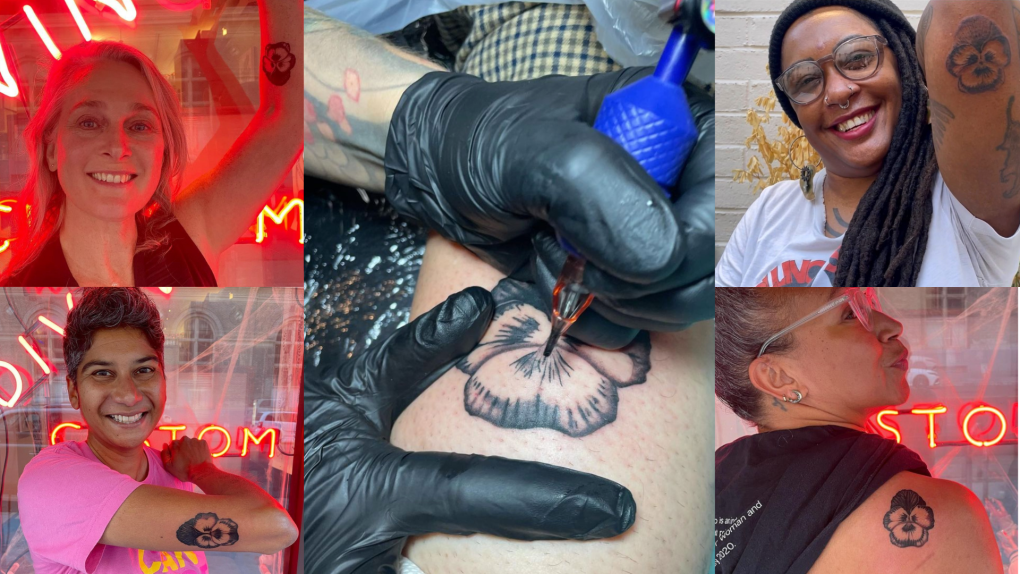
"content": "\u003cp>The pansy is a delicate flower — but it’s more than just a flower, it’s also a symbol of trans solidarity. Oakland-based tattoo artist Cedre Csillagi started the \u003ca href=\"https://www.instagram.com/a1000pansies/\">A Thousand Pansies project\u003c/a> as a way to dedicate their art to something bigger, and also raise money for a Black-led trans organization in Alabama called \u003ca href=\"https://www.tkosociety.org/\">The Knights and Orchid Society\u003c/a> (TKO). Thus far, over 18 people have received matching pansy tattoos, and, as of today, the project has raised nearly $15,000 dollars.\u003c/p>\n\u003cp>“I think that it’s a beautiful project and an example of how to show up for grassroot organizations,” said TC Caldwell, director of community engagement for the Alabama-based organization. They added that Black trans-led organizations in the South don’t see the same funding opportunities as others. The needs of their clients range from assistance with name/gender marker changes on IDs to food and stable housing.\u003c/p>\n\u003cp>“We can’t do this work without community. This is critical life-saving work,” Caldwell said. Solidarity is key to their work, which can “look like fighting anti-trans legislation, making sure trans youth have safe places/spaces to exist whole, making sure that there are jobs for trans folks, and allowing trans people to lead the work,” they said.\u003c/p>\n\u003cp>Piper Kerman echoed the importance of ensuring Black trans people are financially supported, in an interview with KQED while she got her pansy tattoo.[pullquote align=\"right\" size=\"medium\" citation=\"Cedre Csillagi\"]‘I feel more and more connected to the image every time I do it. Which is really beautiful to just do it over and over. It’s like I’m reiterating on my own ideals and my own politics around this.’[/pullquote]“Black trans people need love and support and resources, and that’s what the project is going to bring,” she said. Kerman is a Bay Area resident and author of \u003cem>Orange Is the New Black\u003c/em>, the book on which the hit Netflix series is based, chronicling her experience with incarceration.\u003c/p>\n\u003cp>Kerman said that when she was incarcerated, she had a Black trans neighbor who was an important figure in her life. In the Netflix series, that figure is played by Laverne Cox.\u003c/p>\n\u003cp>Kerman said she also has an aunt named Pansy, and that one of her great-grandmothers was named Pansy.\u003c/p>\n\u003cp>Csillagi, co-owner of \u003ca href=\"https://www.divingswallow.com/\">Diving Swallow Tattoo\u003c/a> in downtown Oakland, explained that the word “pansy” used to be a derogatory term and that the choice of this flower is also a nod to the work of another artist, Paul Harfleet, who began planting pansies at the sites of homophobic incidents he experienced in Manchester, England. “The species of plant was of course vitally important and the pansy instantly seemed perfect,” Harfleet wrote, explaining the project on his website. “The name of the flower originates from the French verb; penser (to think), as the bowing head of the flower was seen to visually echo a person in deep thought.”\u003c/p>\n\u003cp>For Csillagi, care and thought in action is what the A Thousand Pansies project is all about. It’s a way to connect their own politics to something bigger. The custom-designed tattoo is part of a vision to spread a physical symbol of “love, alliance and protection.”\u003c/p>\n\u003cp>Csillagi grew up in the South and has seen the impact of homophobia firsthand. For them, it’s solidified the importance of creating a shared symbol in the Bay Area and beyond.\u003c/p>\n\u003cp>“I just started to feel like I needed to do something, anything to help,” Csillagi said.\u003c/p>\n\u003cp>“Being a tattoo artist is [an] incredibly beautiful profession, but it is often very individualized. It’s like one person’s journey through grief or transition … I wanted to open up my job and my skills to be more community-minded.”\u003c/p>\n\u003cp>Csillagi, a highly sought tattoo artist, is booked until 2024, but they will be creating a weekly time slot for those looking to get inked with a pansy tattoo. And they are also sharing the design so other tattoo artists can participate.\u003c/p>\n\u003cp>“I feel more and more connected to the image every time I do it,” Csillagi said. “Which is really beautiful to just do it over and over. It’s like I’m reiterating on my own ideals and my own politics around this.”\u003c/p>\n\u003cp>[ad fullwidth]\u003c/p>\n\u003cp>\u003c/p>\n",
"blocks": [],
"excerpt": "The custom-designed tattoo is part of a vision to spread a physical symbol of 'love, alliance, and protection,' Cedre Csillagi said. ",
"status": "publish",
"parent": 0,
"modified": 1721135397,
"stats": {
"hasAudio": false,
"hasVideo": false,
"hasChartOrMap": false,
"iframeSrcs": [],
"hasGoogleForm": false,
"hasGallery": false,
"hasHearkenModule": false,
"hasPolis": false,
"paragraphCount": 15,
"wordCount": 764
},
"headData": {
"title": "Oakland Tattoo Artist Starts a Movement to Ink Pansies in Support of Trans Rights | KQED",
"description": "The custom-designed tattoo is part of a vision to spread a physical symbol of 'love, alliance, and protection,' Cedre Csillagi said. ",
"ogTitle": "",
"ogDescription": "",
"ogImgId": "",
"twTitle": "",
"twDescription": "",
"twImgId": "",
"schema": {
"@context": "https://schema.org",
"@type": "NewsArticle",
"headline": "Oakland Tattoo Artist Starts a Movement to Ink Pansies in Support of Trans Rights",
"datePublished": "2022-12-17T11:56:48-08:00",
"dateModified": "2024-07-16T06:09:57-07:00",
"image": "https://cdn.kqed.org/wp-content/uploads/2020/02/KQED-OG-Image@1x.png",
"isAccessibleForFree": "True",
"publisher": {
"@type": "NewsMediaOrganization",
"@id": "https://www.kqed.org/#organization",
"name": "KQED",
"logo": "https://cdn.kqed.org/wp-content/uploads/2020/02/KQED-OG-Image@1x.png",
"url": "https://www.kqed.org",
"sameAs": [
"https://www.facebook.com/KQED",
"https://twitter.com/KQED",
"https://www.instagram.com/kqed/",
"https://www.tiktok.com/@kqedofficial",
"https://www.linkedin.com/company/kqed",
"https://www.youtube.com/channel/UCeC0IOo7i1P_61zVUWbJ4nw"
]
}
}
},
"sticky": false,
"excludeFromSiteSearch": "Include",
"articleAge": "0",
"path": "/news/11935695/oakland-tattoo-artist-starts-a-movement-to-ink-pansies-in-support-of-trans-rights",
"audioTrackLength": null,
"parsedContent": [
{
"type": "contentString",
"content": "\u003cdiv class=\"post-body\">\u003cp>\u003cp>The pansy is a delicate flower — but it’s more than just a flower, it’s also a symbol of trans solidarity. Oakland-based tattoo artist Cedre Csillagi started the \u003ca href=\"https://www.instagram.com/a1000pansies/\">A Thousand Pansies project\u003c/a> as a way to dedicate their art to something bigger, and also raise money for a Black-led trans organization in Alabama called \u003ca href=\"https://www.tkosociety.org/\">The Knights and Orchid Society\u003c/a> (TKO). Thus far, over 18 people have received matching pansy tattoos, and, as of today, the project has raised nearly $15,000 dollars.\u003c/p>\n\u003cp>“I think that it’s a beautiful project and an example of how to show up for grassroot organizations,” said TC Caldwell, director of community engagement for the Alabama-based organization. They added that Black trans-led organizations in the South don’t see the same funding opportunities as others. The needs of their clients range from assistance with name/gender marker changes on IDs to food and stable housing.\u003c/p>\n\u003cp>“We can’t do this work without community. This is critical life-saving work,” Caldwell said. Solidarity is key to their work, which can “look like fighting anti-trans legislation, making sure trans youth have safe places/spaces to exist whole, making sure that there are jobs for trans folks, and allowing trans people to lead the work,” they said.\u003c/p>\n\u003cp>Piper Kerman echoed the importance of ensuring Black trans people are financially supported, in an interview with KQED while she got her pansy tattoo.\u003c/p>\u003c/div>",
"attributes": {
"named": {},
"numeric": []
}
},
{
"type": "component",
"content": "‘I feel more and more connected to the image every time I do it. Which is really beautiful to just do it over and over. It’s like I’m reiterating on my own ideals and my own politics around this.’",
"name": "pullquote",
"attributes": {
"named": {
"align": "right",
"size": "medium",
"citation": "Cedre Csillagi",
"label": ""
},
"numeric": []
}
},
{
"type": "contentString",
"content": "\u003cdiv class=\"post-body\">\u003cp>“Black trans people need love and support and resources, and that’s what the project is going to bring,” she said. Kerman is a Bay Area resident and author of \u003cem>Orange Is the New Black\u003c/em>, the book on which the hit Netflix series is based, chronicling her experience with incarceration.\u003c/p>\n\u003cp>Kerman said that when she was incarcerated, she had a Black trans neighbor who was an important figure in her life. In the Netflix series, that figure is played by Laverne Cox.\u003c/p>\n\u003cp>Kerman said she also has an aunt named Pansy, and that one of her great-grandmothers was named Pansy.\u003c/p>\n\u003cp>Csillagi, co-owner of \u003ca href=\"https://www.divingswallow.com/\">Diving Swallow Tattoo\u003c/a> in downtown Oakland, explained that the word “pansy” used to be a derogatory term and that the choice of this flower is also a nod to the work of another artist, Paul Harfleet, who began planting pansies at the sites of homophobic incidents he experienced in Manchester, England. “The species of plant was of course vitally important and the pansy instantly seemed perfect,” Harfleet wrote, explaining the project on his website. “The name of the flower originates from the French verb; penser (to think), as the bowing head of the flower was seen to visually echo a person in deep thought.”\u003c/p>\n\u003cp>For Csillagi, care and thought in action is what the A Thousand Pansies project is all about. It’s a way to connect their own politics to something bigger. The custom-designed tattoo is part of a vision to spread a physical symbol of “love, alliance and protection.”\u003c/p>\n\u003cp>Csillagi grew up in the South and has seen the impact of homophobia firsthand. For them, it’s solidified the importance of creating a shared symbol in the Bay Area and beyond.\u003c/p>\n\u003cp>“I just started to feel like I needed to do something, anything to help,” Csillagi said.\u003c/p>\n\u003cp>“Being a tattoo artist is [an] incredibly beautiful profession, but it is often very individualized. It’s like one person’s journey through grief or transition … I wanted to open up my job and my skills to be more community-minded.”\u003c/p>\n\u003cp>Csillagi, a highly sought tattoo artist, is booked until 2024, but they will be creating a weekly time slot for those looking to get inked with a pansy tattoo. And they are also sharing the design so other tattoo artists can participate.\u003c/p>\n\u003cp>“I feel more and more connected to the image every time I do it,” Csillagi said. “Which is really beautiful to just do it over and over. It’s like I’m reiterating on my own ideals and my own politics around this.”\u003c/p>\n\u003cp>\u003c/p>\u003c/div>",
"attributes": {
"named": {},
"numeric": []
}
},
{
"type": "component",
"content": "",
"name": "ad",
"attributes": {
"named": {
"label": "fullwidth"
},
"numeric": [
"fullwidth"
]
}
},
{
"type": "contentString",
"content": "\u003cdiv class=\"post-body\">\u003cp>\u003c/p>\n\u003cp>\u003c/p>\n\u003c/div>\u003c/p>",
"attributes": {
"named": {},
"numeric": []
}
}
],
"link": "/news/11935695/oakland-tattoo-artist-starts-a-movement-to-ink-pansies-in-support-of-trans-rights",
"authors": [
"11626"
],
"categories": [
"news_223",
"news_28250",
"news_8"
],
"tags": [
"news_20257",
"news_19133",
"news_27626",
"news_5438",
"news_22681",
"news_2486"
],
"featImg": "news_11935699",
"label": "news"
},
"news_11934949": {
"type": "posts",
"id": "news_11934949",
"meta": {
"index": "posts_1716263798",
"site": "news",
"id": "11934949",
"score": null,
"sort": [
1670882413000
]
},
"guestAuthors": [],
"slug": "gift-el-programa-de-san-francisco-que-otorgara-1200-al-mes-a-personas-transgenero",
"title": "'GIFT', el programa de San Francisco que otorgará $1,200 al mes a personas transgénero",
"publishDate": 1670882413,
"format": "image",
"headTitle": "‘GIFT’, el programa de San Francisco que otorgará $1,200 al mes a personas transgénero | KQED",
"labelTerm": {},
"content": "\u003cp>\u003ca href=\"https://www.kqed.org/news/11934613/gift-is-san-franciscos-guaranteed-income-program-for-transgender-people-heres-how-to-apply\">\u003cem>Read in English\u003c/em>\u003c/a>\u003c/p>\n\u003cp>El programa \u003ca href=\"https://www.giftincome.org/es/apply\">GIFT de San Francisco proporcionará a 55 personas trans que viven en la ciudad $1,200 dólares al mes\u003c/a> durante un máximo de 18 meses, y la fecha límite para solicitarlo se acerca rápidamente.\u003c/p>\n\u003cp>GIFT (por sus siglas en inglés), que significa Ingresos Garantizados para Personas Transgénero, \u003ca href=\"https://www.giftincome.org/es/faq\">es el primer programa de ingresos garantizados del Área de la Bahía que se centra exclusivamente en atender a las personas trans\u003c/a>. Este fue creado por la ciudad en colaboración con el centro comunitario de salud Lyon-Martin, el cual proporciona atención médica a las personas trans, no binarias e intersexuales, junto con las mujeres cisgénero que forman parte de la comunidad LGBTQA+, y el Distrito Transgénero de San Francisco, que trabaja para empoderar y visibilizar a las personas trans.\u003c/p>\n\u003cp>La fecha límite para \u003ca href=\"https://www.giftincome.org/es/apply\">solicitar GIFT\u003c/a> es el jueves 15 de diciembre. La aplicación de GIFT \u003ca href=\"https://www.giftincome.org/apply\">ya está disponible en línea\u003c/a> y en la misma página, puedes subir todos los documentos requeridos. \u003ca href=\"https://www.giftincome.org/es/apply\">El sitio de GIFT también está disponible en español\u003c/a>.\u003c/p>\n\u003cp>\u003ca href=\"https://www.giftincome.org/es/faq\">El sitio de GIFT incluye una sección de preguntas frecuentes\u003c/a>, y también hemos creado esta guía para responder a preguntas adicionales que el público ha hecho a KQED sobre el programa.\u003c/p>\n\u003cp>\u003cstrong>Ir a:\u003c/strong>\u003c/p>\n\u003cul>\n\u003cli>\u003ca href=\"#GIFT\">\u003cstrong>¿Quién puede solicitar la ayuda GIFT?\u003c/strong>\u003c/a>\u003c/li>\n\u003cli>\u003ca href=\"#impuestos\">\u003cstrong>¿Cómo funciona GIFT con mis impuestos o con otras prestaciones que esté recibiendo?\u003c/strong>\u003c/a>\u003c/li>\n\u003cli>\u003ca href=\"#vivienda\">\u003cstrong>¿Cómo puedo demostrar que vivo en San Francisco si mi situación de vivienda es complicada?\u003c/strong>\u003c/a>\u003c/li>\n\u003cli>\u003ca href=\"#encuestas\">\u003cstrong>¿Qué son las encuestas que los participantes tienen que hacer cada tres meses?\u003c/strong>\u003c/a>\u003c/li>\n\u003cli>\u003ca href=\"#puedo\">\u003cstrong>¿Dónde puedo hablar con alguien que me ayude a solicitar GIFT?\u003c/strong>\u003c/a>\u003c/li>\n\u003c/ul>\n\u003ch3>¿Qué es GIFT y para qué sirve el programa?\u003c/h3>\n\u003cp>El programa GIFT ofrecerá a 55 personas trans de San Francisco $1,200 dólares al mes durante 18 meses, desde enero de 2023 hasta junio de 2024. Los fondos se entregarán a los participantes a través de una tarjeta Visa de débito que el programa recargará con la misma cantidad cada mes.\u003c/p>\n\u003cp>Aubrey Davis, asociada ejecutiva del Distrito Transgénero, señala que muchas personas trans de San Francisco siguen teniendo dificultades para hacer alcanzar el dinero debido a la situación económica, pero también a causa de la intolerancia y discriminación.\u003c/p>\n\u003cp>Dice que algunas personas trans también se enfrentan a la falta de hogar y a la inseguridad de la vivienda después de haber sido expulsadas por la familia.\u003c/p>\n\u003cp>“Este programa propone mejorar este tipo de situación, hacer posible que las personas puedan mantenerse a sí mismas, que tengan un poco más de tranquilidad con sus finanzas”, dijo Davis. Añadió que no es fácil vivir en una de las ciudades más caras del país y la ayuda económica que ofrecería GIFT sería como una especie de salvavidas para cubrir algunos gastos esenciales.\u003cbr>\n[ad fullwidth]\u003c/p>\n\u003ch3>\u003ca id=\"GIFT\">\u003c/a>¿Quién puede aplicar a GIFT?\u003c/h3>\n\u003cp>Para poder solicitar GIFT, debe:\u003c/p>\n\u003cul>\n\u003cli>Tener 18 años o más\u003c/li>\n\u003cli>No percibir ingresos superiores a $600 dólares al mes\u003c/li>\n\u003cli>Vivir en la ciudad de San Francisco\u003c/li>\n\u003cli>Hablar con los organizadores de GIFT cada tres meses durante el programa para llenar una encuesta\u003c/li>\n\u003c/ul>\n\u003cp>Debe de completar y entregar su solicitud \u003cstrong>antes de la fecha límite del 15 de diciembre\u003c/strong>. Recuerde que sólo se seleccionarán 55 beneficiarios para este programa piloto.\u003c/p>\n\u003cp>Dado que la financiación procede de la ciudad de San Francisco, sólo los residentes de San Francisco podrán participar en el programa, y aquellos participantes inscritos si abandonan la ciudad también tendrán que abandonar el programa GIFT.\u003c/p>\n\u003ch3>\u003ca id=\"impuestos\">\u003c/a>¿Cómo incluyo GIFT en mis impuestos o en otras prestaciones que esté recibiendo?\u003c/h3>\n\u003cp>Tendrá que declarar a la Oficina de Impuestos sobre la Renta (IRS, por sus siglas en inglés) lo que ha recibido de GIFT cuando presente sus impuestos del 2023 en el 2024.\u003c/p>\n\u003cp>Otros organismos públicos, como la Administración del Seguro Social, también considerarán el GIFT como un ingreso, lo que podría afectar a otras prestaciones, como la Seguridad de Ingreso Suplementario (SSI por sus siglas en inglés).\u003c/p>\n\u003cp>“A veces se tarda décadas en conseguir la SSI y cuando por fin se recibe, sólo se puede ganar hasta cierto punto”, dijo Samuel Favela, asociado del programa en el Distrito Transgénero. El SSI y otros programas de ayuda del gobierno, como CalFresh, tienen estrictos límites de ingresos. Favela señala la posibilidad de que alguien pueda perder estas prestaciones si supera el límite de ingresos al recibir los fondos de GIFT.\u003c/p>\n\u003cp>Si es elegido para participar en GIFT y también recibe prestaciones estatales como CalFresh o CalWorks, Favela recomienda notificar a ese organismo de la existencia de GIFT antes de empezar a recibir dinero. “Si no lo comunica, le pasarán factura al final del programa”, dice Favela.\u003c/p>\n\u003cp>Sin embargo, Favela afirma que el equipo del Distrito Transexual se compromete a ayudar a la gente en estas situaciones delicadas, ya que la organización cree que alguien no debería tener que elegir entre dos salvavidas cuando se trata de sobrevivir.\u003c/p>\n\u003cp>“Hay exenciones a las que pueden acogerse y vamos a trabajar con ellos en eso también”, dijo Favela.\u003c/p>\n\u003cp>Pero lo más importante que puede hacer si recibe prestaciones del gobierno y está avanzando en el proceso de solicitud de GIFT es ser lo más transparente posible, tanto con los organizadores de GIFT, como con los organismos gubernamentales. “Su trabajador social es probablemente la mejor persona con la que debe ponerse en contacto, y quien también puede ponerse en contacto con nosotros”, añadió Favela.\u003c/p>\n\u003ch3>Trabajo de manera informal. ¿Qué puedo hacer para demostrar mis ingresos?\u003c/h3>\n\u003cp>En la página web de GIFT puede \u003ca href=\"https://www.giftincome.org/es/apply\">cargar diversos documentos para acompañar su solicitud\u003c/a> y comprobar sus ingresos. Puede incluir formularios W-2, talones de pago o incluso extractos bancarios. Las personas que sólo reciben ingresos del SSI o del SSDI pueden compartir las cartas que reciben de la Administración del Seguro Social confirmando que reciben estas prestaciones. También se aceptan las cartas de ayuda financiera de universidades o escuelas.\u003c/p>\n\u003cp>Pero si trabaja de manera informal y no dispone de documentación que acredite sus ingresos, puede presentar una carta de autocertificación. Este \u003ca href=\"https://www.giftincome.org/_files/ugd/40a234_33ab30018f9c4a53bc75aee82f583dcb.pdf\">formulario de declaración de ingresos está disponible en PDF\u003c/a> en el sitio web de GIFT, junto con otros documentos para descargar y utilizar, y le permite compartir cuántos ingresos tiene al mes, cuántas personas viven con usted y por qué no puede aportar pruebas de sus ingresos.\u003c/p>\n\u003cp>“Confiamos en que la gente nos facilite la información correcta y tenga buenas intenciones”, explica Favela, quien añade que son muy comprensivos con el hecho de que la gente tenga muchas formas distintas de ganarse la visa. “Así que si quieren hacernos saber que son trabajadores sexuales, y esto es lo que ganan al mes, sólo tienen que escribir un correo electrónico y llenar esa sección de esa manera”, dijo Favela.\u003c/p>\n\u003cfigure id=\"attachment_11934956\" class=\"wp-caption aligncenter\" style=\"max-width: 1920px\">\u003cimg loading=\"lazy\" decoding=\"async\" class=\"size-full wp-image-11934956\" src=\"https://ww2.kqed.org/app/uploads/sites/10/2022/12/HAND-ON-LAPTOP-ON-DESK-NEXT-TO-WINDOW-HERE.jpg\" alt=\"\" width=\"1920\" height=\"1280\" srcset=\"https://cdn.kqed.org/wp-content/uploads/sites/10/2022/12/HAND-ON-LAPTOP-ON-DESK-NEXT-TO-WINDOW-HERE.jpg 1920w, https://cdn.kqed.org/wp-content/uploads/sites/10/2022/12/HAND-ON-LAPTOP-ON-DESK-NEXT-TO-WINDOW-HERE-800x533.jpg 800w, https://cdn.kqed.org/wp-content/uploads/sites/10/2022/12/HAND-ON-LAPTOP-ON-DESK-NEXT-TO-WINDOW-HERE-1020x680.jpg 1020w, https://cdn.kqed.org/wp-content/uploads/sites/10/2022/12/HAND-ON-LAPTOP-ON-DESK-NEXT-TO-WINDOW-HERE-160x107.jpg 160w, https://cdn.kqed.org/wp-content/uploads/sites/10/2022/12/HAND-ON-LAPTOP-ON-DESK-NEXT-TO-WINDOW-HERE-1536x1024.jpg 1536w\" sizes=\"auto, (max-width: 1920px) 100vw, 1920px\">\u003cfigcaption class=\"wp-caption-text\">En el sitio web de GIFT, puede subir una serie de documentos para acompañar su solicitud y comprobar cuánto gana. \u003ccite>(Cottonbro/Pexels)\u003c/cite>\u003c/figcaption>\u003c/figure>\n\u003ch3>\u003ca id=\"vivienda\">\u003c/a>Mi situación de vivienda es complicada, o estoy entre dos alojamientos en este momento. ¿Cómo puedo demostrar que vivo en San Francisco?\u003c/h3>\n\u003cp>Al igual que para verificar sus ingresos, hay muchas formas de confirmar que vive actualmente en San Francisco. Si no tiene ningún recibo de PG&E o de una compañía telefónica que incluya su nombre y dirección actual, puede pedir a un trabajador social o proveedor de atención sanitaria o agencia con la que esté trabajando, que escriba una carta que confirme que vive en la ciudad.\u003c/p>\n\u003cp>Si se aloja en un albergue, puede solicitar una carta de verificación a la gerencia del albergue. Pero si eso tampoco es una opción, puede llenar otro \u003ca href=\"https://www.giftincome.org/_files/ugd/40a234_e495477cb1df47319fab57e3b20f314e.pdf\">formulario de autocertificación de residencia (PDF) disponible en el sitio web de GIFT\u003c/a>.\u003c/p>\n\u003cp>En el formulario de declaración de residencia, tendrá que confirmar que actualmente no tiene vivienda y que no hay ningún organismo u organización que pueda facilitarle una carta que confirme su situación de alojamiento. Una vez completado, \u003ca href=\"https://www.giftincome.org/es/apply\">puede subirlo al portal en línea con el resto de sus documentos\u003c/a>.\u003c/p>\n\u003ch3>\u003ca id=\"encuestas\">\u003c/a>¿Qué hay de esas encuestas de seguimiento que los participantes en GIFT tienen que hacer cada tres meses?\u003c/h3>\n\u003cp>Aubrey Davis, asociada ejecutiva del Distrito Transgénero, confirma que el objetivo de estos controles es saber cómo les va a la gente desde que inició el programa. “No estamos vigilando cómo gastan el dinero”, afirma Davis. “Pero nos gustaría saber cómo está mejorando su vida”.\u003c/p>\n\u003cp>La clínica Lyon-Martin y el Distrito Transgénero participarán en estos seguimientos, los cuales también verán si han cambiado las rutinas diarias y las responsabilidades de los participantes. Por ejemplo, explica Davis, “¿Están recibiendo la atención de salud mental que necesitan? ¿Pueden pagar la comida? ¿Pueden pagar el seguro? ¿Pueden acudir a las citas con el médico o conseguir recetas médicas?\u003c/p>\n\u003cp>En estas conversaciones, si un participante dice que necesita servicios de atención de salud, se le puede poner en contacto con los Servicios Comunitarios de Salud Lyon-Martin para que reciba tratamiento. Algunos de estos datos también se compartirán con la Oficina de Iniciativas Transgénero del Ayuntamiento. Sin embargo, el equipo del Distrito Transgénero aclaró que estos datos se utilizarán para comprender mejor el impacto del programa.\u003c/p>\n\u003cp>También es importante mencionar que las agencias de la ciudad no comparten información sobre el estatus migratorio de nadie con las agencias federales.\u003c/p>\n\u003ch3>¿Puedo participar en este programa si estoy indocumentado?\u003c/h3>\n\u003cp>Sí, y no necesita un número del Seguro Social para recibir los ingresos de GIFT.\u003c/p>\n\u003cp>\u003cstrong>Los organizadores dicen que las personas hispanohablantes monolingües, y los inmigrantes indocumentados tienen prioridad de inscripción.\u003c/strong>\u003c/p>\n\u003ch3>¿Cómo se elegirá exactamente a los participantes?\u003c/h3>\n\u003cp>El centro de Servicios Comunitarios de Salud Lyon-Martin y el Distrito Transgénero seleccionarán a los participantes al azar. Y en cuanto al público trans de San Francisco al que se quiere llegar, el programa todavía tiene “datos demográficos que estamos tratando de concretar”, dijo Favela.\u003c/p>\n\u003cp>\u003cstrong>“El 60% de las personas que vamos a intentar que participen en el programa son personas trans negras”, explicaron.\u003c/strong> “Así que en esa selección al azar, al menos el 60% van a ser [personas trans negras]”.\u003c/p>\n\u003cp>“Los clasificaremos según la categoría en la que se encuentren y luego simplemente haremos una selección al azar dentro de cada categoría”, añadió Davis.\u003c/p>\n\u003ch3>\u003ca id=\"puedo\">\u003c/a>¿Dónde puedo dirigirme?\u003c/h3>\n\u003cp>\u003ca href=\"https://www.giftincome.org/es/apply\">Dado que la solicitud GIFT sólo está disponible en línea\u003c/a>, puede resultar difícil presentarla para las personas que no tienen acceso regular a una computadora o una conexión estable a Internet.\u003c/p>\n\u003cp>Para ofrecer un asesoramiento más personalizado, el equipo del centro de Servicios Comunitarios de Salud Lyon-Martin está aceptando ayudar a personas interesadas sin cita previa a presentar su solicitud, o que tengan preguntas al respecto. Puede hablar en persona con el equipo en la clínica ubicada en el 1735 de la calle Mission, cerca de las líneas 14 y 49 de Muni. También puede llamarles al (415) 565-7667.\u003c/p>\n\u003cp>Davis, del Distrito Transgénero, también recomienda que acuda a su trabajador social si lo tiene. Si usted o alguien que usted conoce necesita más ayuda en español, Davis recomienda contactar a \u003ca href=\"https://ellaparatranslatinas.org/es/home\">El/La Para TransLatinas\u003c/a>, una organización que se centra en servir y abogar por las personas trans Latinx en el Área de la Bahía. Puede ponerse en contacto llamando al (415) 864-7278.\u003c/p>\n\u003cp>\u003cstrong>¿Quiere solicitar GIFT pero se siente inseguro o incluso nervioso por hacerlo?\u003c/strong>\u003c/p>\n\u003cp>“No tenga dudas”, exhorta Davis, añadiendo que, al tratarse de un programa piloto, este puede influir en lo que se pueda hacer en San Francisco, y potencialmente otras ciudades más.\u003c/p>\n\u003cp>“Por el momento, es una oportunidad única en la vida, y esto ayudará a muchas más personas trans, jóvenes trans y personas mayores trans en el futuro”, dijo.\u003c/p>\n\u003chr>\n\u003cp>\u003cem>Este artículo fue traducido por la periodista \u003ca href=\"https://www.kqed.org/author/mpena/\">María Peña\u003c/a> y editado por el periodista \u003ca href=\"https://www.kqed.org/author/ccabreralomeli\">Carlos Cabrera-Lomelí\u003c/a>.\u003c/em>\u003cbr>\n[ad fullwidth]\u003c/p>\n\u003cp>[ad floatright]\u003c/p>\n",
"blocks": [],
"excerpt": "El programa GIFT de San Francisco proporcionará a 55 personas trans que viven en la ciudad $1,200 dólares al mes durante un máximo de 18 meses. La fecha límite para aplicar es el 15 de diciembre.",
"status": "publish",
"parent": 0,
"modified": 1738777485,
"stats": {
"hasAudio": false,
"hasVideo": false,
"hasChartOrMap": false,
"iframeSrcs": [],
"hasGoogleForm": false,
"hasGallery": false,
"hasHearkenModule": false,
"hasPolis": false,
"paragraphCount": 43,
"wordCount": 2369
},
"headData": {
"title": "'GIFT', el programa de San Francisco que otorgará $1,200 al mes a personas transgénero | KQED",
"description": "El programa GIFT de San Francisco proporcionará a 55 personas trans que viven en la ciudad $1,200 dólares al mes durante un máximo de 18 meses. La fecha límite para aplicar es el 15 de diciembre.",
"ogTitle": "",
"ogDescription": "",
"ogImgId": "",
"twTitle": "",
"twDescription": "",
"twImgId": "",
"schema": {
"@context": "https://schema.org",
"@type": "NewsArticle",
"headline": "'GIFT', el programa de San Francisco que otorgará $1,200 al mes a personas transgénero",
"datePublished": "2022-12-12T14:00:13-08:00",
"dateModified": "2025-02-05T09:44:45-08:00",
"image": "https://cdn.kqed.org/wp-content/uploads/2020/02/KQED-OG-Image@1x.png",
"isAccessibleForFree": "True",
"publisher": {
"@type": "NewsMediaOrganization",
"@id": "https://www.kqed.org/#organization",
"name": "KQED",
"logo": "https://cdn.kqed.org/wp-content/uploads/2020/02/KQED-OG-Image@1x.png",
"url": "https://www.kqed.org",
"sameAs": [
"https://www.facebook.com/KQED",
"https://twitter.com/KQED",
"https://www.instagram.com/kqed/",
"https://www.tiktok.com/@kqedofficial",
"https://www.linkedin.com/company/kqed",
"https://www.youtube.com/channel/UCeC0IOo7i1P_61zVUWbJ4nw"
]
}
}
},
"source": "KQED en Español",
"sourceUrl": "https://www.kqed.org/kqedenespanol",
"sticky": false,
"excludeFromSiteSearch": "Include",
"path": "/news/11934949/gift-el-programa-de-san-francisco-que-otorgara-1200-al-mes-a-personas-transgenero",
"audioTrackLength": null,
"parsedContent": [
{
"type": "contentString",
"content": "\u003cdiv class=\"post-body\">\u003cp>\u003cp>\u003ca href=\"https://www.kqed.org/news/11934613/gift-is-san-franciscos-guaranteed-income-program-for-transgender-people-heres-how-to-apply\">\u003cem>Read in English\u003c/em>\u003c/a>\u003c/p>\n\u003cp>El programa \u003ca href=\"https://www.giftincome.org/es/apply\">GIFT de San Francisco proporcionará a 55 personas trans que viven en la ciudad $1,200 dólares al mes\u003c/a> durante un máximo de 18 meses, y la fecha límite para solicitarlo se acerca rápidamente.\u003c/p>\n\u003cp>GIFT (por sus siglas en inglés), que significa Ingresos Garantizados para Personas Transgénero, \u003ca href=\"https://www.giftincome.org/es/faq\">es el primer programa de ingresos garantizados del Área de la Bahía que se centra exclusivamente en atender a las personas trans\u003c/a>. Este fue creado por la ciudad en colaboración con el centro comunitario de salud Lyon-Martin, el cual proporciona atención médica a las personas trans, no binarias e intersexuales, junto con las mujeres cisgénero que forman parte de la comunidad LGBTQA+, y el Distrito Transgénero de San Francisco, que trabaja para empoderar y visibilizar a las personas trans.\u003c/p>\n\u003cp>La fecha límite para \u003ca href=\"https://www.giftincome.org/es/apply\">solicitar GIFT\u003c/a> es el jueves 15 de diciembre. La aplicación de GIFT \u003ca href=\"https://www.giftincome.org/apply\">ya está disponible en línea\u003c/a> y en la misma página, puedes subir todos los documentos requeridos. \u003ca href=\"https://www.giftincome.org/es/apply\">El sitio de GIFT también está disponible en español\u003c/a>.\u003c/p>\n\u003cp>\u003ca href=\"https://www.giftincome.org/es/faq\">El sitio de GIFT incluye una sección de preguntas frecuentes\u003c/a>, y también hemos creado esta guía para responder a preguntas adicionales que el público ha hecho a KQED sobre el programa.\u003c/p>\n\u003cp>\u003cstrong>Ir a:\u003c/strong>\u003c/p>\n\u003cul>\n\u003cli>\u003ca href=\"#GIFT\">\u003cstrong>¿Quién puede solicitar la ayuda GIFT?\u003c/strong>\u003c/a>\u003c/li>\n\u003cli>\u003ca href=\"#impuestos\">\u003cstrong>¿Cómo funciona GIFT con mis impuestos o con otras prestaciones que esté recibiendo?\u003c/strong>\u003c/a>\u003c/li>\n\u003cli>\u003ca href=\"#vivienda\">\u003cstrong>¿Cómo puedo demostrar que vivo en San Francisco si mi situación de vivienda es complicada?\u003c/strong>\u003c/a>\u003c/li>\n\u003cli>\u003ca href=\"#encuestas\">\u003cstrong>¿Qué son las encuestas que los participantes tienen que hacer cada tres meses?\u003c/strong>\u003c/a>\u003c/li>\n\u003cli>\u003ca href=\"#puedo\">\u003cstrong>¿Dónde puedo hablar con alguien que me ayude a solicitar GIFT?\u003c/strong>\u003c/a>\u003c/li>\n\u003c/ul>\n\u003ch3>¿Qué es GIFT y para qué sirve el programa?\u003c/h3>\n\u003cp>El programa GIFT ofrecerá a 55 personas trans de San Francisco $1,200 dólares al mes durante 18 meses, desde enero de 2023 hasta junio de 2024. Los fondos se entregarán a los participantes a través de una tarjeta Visa de débito que el programa recargará con la misma cantidad cada mes.\u003c/p>\n\u003cp>Aubrey Davis, asociada ejecutiva del Distrito Transgénero, señala que muchas personas trans de San Francisco siguen teniendo dificultades para hacer alcanzar el dinero debido a la situación económica, pero también a causa de la intolerancia y discriminación.\u003c/p>\n\u003cp>Dice que algunas personas trans también se enfrentan a la falta de hogar y a la inseguridad de la vivienda después de haber sido expulsadas por la familia.\u003c/p>\n\u003cp>“Este programa propone mejorar este tipo de situación, hacer posible que las personas puedan mantenerse a sí mismas, que tengan un poco más de tranquilidad con sus finanzas”, dijo Davis. Añadió que no es fácil vivir en una de las ciudades más caras del país y la ayuda económica que ofrecería GIFT sería como una especie de salvavidas para cubrir algunos gastos esenciales.\u003cbr>\n\u003c/p>\u003c/div>",
"attributes": {
"named": {},
"numeric": []
}
},
{
"type": "component",
"content": "",
"name": "ad",
"attributes": {
"named": {
"label": "fullwidth"
},
"numeric": [
"fullwidth"
]
}
},
{
"type": "contentString",
"content": "\u003cdiv class=\"post-body\">\u003cp>\u003c/p>\n\u003ch3>\u003ca id=\"GIFT\">\u003c/a>¿Quién puede aplicar a GIFT?\u003c/h3>\n\u003cp>Para poder solicitar GIFT, debe:\u003c/p>\n\u003cul>\n\u003cli>Tener 18 años o más\u003c/li>\n\u003cli>No percibir ingresos superiores a $600 dólares al mes\u003c/li>\n\u003cli>Vivir en la ciudad de San Francisco\u003c/li>\n\u003cli>Hablar con los organizadores de GIFT cada tres meses durante el programa para llenar una encuesta\u003c/li>\n\u003c/ul>\n\u003cp>Debe de completar y entregar su solicitud \u003cstrong>antes de la fecha límite del 15 de diciembre\u003c/strong>. Recuerde que sólo se seleccionarán 55 beneficiarios para este programa piloto.\u003c/p>\n\u003cp>Dado que la financiación procede de la ciudad de San Francisco, sólo los residentes de San Francisco podrán participar en el programa, y aquellos participantes inscritos si abandonan la ciudad también tendrán que abandonar el programa GIFT.\u003c/p>\n\u003ch3>\u003ca id=\"impuestos\">\u003c/a>¿Cómo incluyo GIFT en mis impuestos o en otras prestaciones que esté recibiendo?\u003c/h3>\n\u003cp>Tendrá que declarar a la Oficina de Impuestos sobre la Renta (IRS, por sus siglas en inglés) lo que ha recibido de GIFT cuando presente sus impuestos del 2023 en el 2024.\u003c/p>\n\u003cp>Otros organismos públicos, como la Administración del Seguro Social, también considerarán el GIFT como un ingreso, lo que podría afectar a otras prestaciones, como la Seguridad de Ingreso Suplementario (SSI por sus siglas en inglés).\u003c/p>\n\u003cp>“A veces se tarda décadas en conseguir la SSI y cuando por fin se recibe, sólo se puede ganar hasta cierto punto”, dijo Samuel Favela, asociado del programa en el Distrito Transgénero. El SSI y otros programas de ayuda del gobierno, como CalFresh, tienen estrictos límites de ingresos. Favela señala la posibilidad de que alguien pueda perder estas prestaciones si supera el límite de ingresos al recibir los fondos de GIFT.\u003c/p>\n\u003cp>Si es elegido para participar en GIFT y también recibe prestaciones estatales como CalFresh o CalWorks, Favela recomienda notificar a ese organismo de la existencia de GIFT antes de empezar a recibir dinero. “Si no lo comunica, le pasarán factura al final del programa”, dice Favela.\u003c/p>\n\u003cp>Sin embargo, Favela afirma que el equipo del Distrito Transexual se compromete a ayudar a la gente en estas situaciones delicadas, ya que la organización cree que alguien no debería tener que elegir entre dos salvavidas cuando se trata de sobrevivir.\u003c/p>\n\u003cp>“Hay exenciones a las que pueden acogerse y vamos a trabajar con ellos en eso también”, dijo Favela.\u003c/p>\n\u003cp>Pero lo más importante que puede hacer si recibe prestaciones del gobierno y está avanzando en el proceso de solicitud de GIFT es ser lo más transparente posible, tanto con los organizadores de GIFT, como con los organismos gubernamentales. “Su trabajador social es probablemente la mejor persona con la que debe ponerse en contacto, y quien también puede ponerse en contacto con nosotros”, añadió Favela.\u003c/p>\n\u003ch3>Trabajo de manera informal. ¿Qué puedo hacer para demostrar mis ingresos?\u003c/h3>\n\u003cp>En la página web de GIFT puede \u003ca href=\"https://www.giftincome.org/es/apply\">cargar diversos documentos para acompañar su solicitud\u003c/a> y comprobar sus ingresos. Puede incluir formularios W-2, talones de pago o incluso extractos bancarios. Las personas que sólo reciben ingresos del SSI o del SSDI pueden compartir las cartas que reciben de la Administración del Seguro Social confirmando que reciben estas prestaciones. También se aceptan las cartas de ayuda financiera de universidades o escuelas.\u003c/p>\n\u003cp>Pero si trabaja de manera informal y no dispone de documentación que acredite sus ingresos, puede presentar una carta de autocertificación. Este \u003ca href=\"https://www.giftincome.org/_files/ugd/40a234_33ab30018f9c4a53bc75aee82f583dcb.pdf\">formulario de declaración de ingresos está disponible en PDF\u003c/a> en el sitio web de GIFT, junto con otros documentos para descargar y utilizar, y le permite compartir cuántos ingresos tiene al mes, cuántas personas viven con usted y por qué no puede aportar pruebas de sus ingresos.\u003c/p>\n\u003cp>“Confiamos en que la gente nos facilite la información correcta y tenga buenas intenciones”, explica Favela, quien añade que son muy comprensivos con el hecho de que la gente tenga muchas formas distintas de ganarse la visa. “Así que si quieren hacernos saber que son trabajadores sexuales, y esto es lo que ganan al mes, sólo tienen que escribir un correo electrónico y llenar esa sección de esa manera”, dijo Favela.\u003c/p>\n\u003cfigure id=\"attachment_11934956\" class=\"wp-caption aligncenter\" style=\"max-width: 1920px\">\u003cimg loading=\"lazy\" decoding=\"async\" class=\"size-full wp-image-11934956\" src=\"https://ww2.kqed.org/app/uploads/sites/10/2022/12/HAND-ON-LAPTOP-ON-DESK-NEXT-TO-WINDOW-HERE.jpg\" alt=\"\" width=\"1920\" height=\"1280\" srcset=\"https://cdn.kqed.org/wp-content/uploads/sites/10/2022/12/HAND-ON-LAPTOP-ON-DESK-NEXT-TO-WINDOW-HERE.jpg 1920w, https://cdn.kqed.org/wp-content/uploads/sites/10/2022/12/HAND-ON-LAPTOP-ON-DESK-NEXT-TO-WINDOW-HERE-800x533.jpg 800w, https://cdn.kqed.org/wp-content/uploads/sites/10/2022/12/HAND-ON-LAPTOP-ON-DESK-NEXT-TO-WINDOW-HERE-1020x680.jpg 1020w, https://cdn.kqed.org/wp-content/uploads/sites/10/2022/12/HAND-ON-LAPTOP-ON-DESK-NEXT-TO-WINDOW-HERE-160x107.jpg 160w, https://cdn.kqed.org/wp-content/uploads/sites/10/2022/12/HAND-ON-LAPTOP-ON-DESK-NEXT-TO-WINDOW-HERE-1536x1024.jpg 1536w\" sizes=\"auto, (max-width: 1920px) 100vw, 1920px\">\u003cfigcaption class=\"wp-caption-text\">En el sitio web de GIFT, puede subir una serie de documentos para acompañar su solicitud y comprobar cuánto gana. \u003ccite>(Cottonbro/Pexels)\u003c/cite>\u003c/figcaption>\u003c/figure>\n\u003ch3>\u003ca id=\"vivienda\">\u003c/a>Mi situación de vivienda es complicada, o estoy entre dos alojamientos en este momento. ¿Cómo puedo demostrar que vivo en San Francisco?\u003c/h3>\n\u003cp>Al igual que para verificar sus ingresos, hay muchas formas de confirmar que vive actualmente en San Francisco. Si no tiene ningún recibo de PG&E o de una compañía telefónica que incluya su nombre y dirección actual, puede pedir a un trabajador social o proveedor de atención sanitaria o agencia con la que esté trabajando, que escriba una carta que confirme que vive en la ciudad.\u003c/p>\n\u003cp>Si se aloja en un albergue, puede solicitar una carta de verificación a la gerencia del albergue. Pero si eso tampoco es una opción, puede llenar otro \u003ca href=\"https://www.giftincome.org/_files/ugd/40a234_e495477cb1df47319fab57e3b20f314e.pdf\">formulario de autocertificación de residencia (PDF) disponible en el sitio web de GIFT\u003c/a>.\u003c/p>\n\u003cp>En el formulario de declaración de residencia, tendrá que confirmar que actualmente no tiene vivienda y que no hay ningún organismo u organización que pueda facilitarle una carta que confirme su situación de alojamiento. Una vez completado, \u003ca href=\"https://www.giftincome.org/es/apply\">puede subirlo al portal en línea con el resto de sus documentos\u003c/a>.\u003c/p>\n\u003ch3>\u003ca id=\"encuestas\">\u003c/a>¿Qué hay de esas encuestas de seguimiento que los participantes en GIFT tienen que hacer cada tres meses?\u003c/h3>\n\u003cp>Aubrey Davis, asociada ejecutiva del Distrito Transgénero, confirma que el objetivo de estos controles es saber cómo les va a la gente desde que inició el programa. “No estamos vigilando cómo gastan el dinero”, afirma Davis. “Pero nos gustaría saber cómo está mejorando su vida”.\u003c/p>\n\u003cp>La clínica Lyon-Martin y el Distrito Transgénero participarán en estos seguimientos, los cuales también verán si han cambiado las rutinas diarias y las responsabilidades de los participantes. Por ejemplo, explica Davis, “¿Están recibiendo la atención de salud mental que necesitan? ¿Pueden pagar la comida? ¿Pueden pagar el seguro? ¿Pueden acudir a las citas con el médico o conseguir recetas médicas?\u003c/p>\n\u003cp>En estas conversaciones, si un participante dice que necesita servicios de atención de salud, se le puede poner en contacto con los Servicios Comunitarios de Salud Lyon-Martin para que reciba tratamiento. Algunos de estos datos también se compartirán con la Oficina de Iniciativas Transgénero del Ayuntamiento. Sin embargo, el equipo del Distrito Transgénero aclaró que estos datos se utilizarán para comprender mejor el impacto del programa.\u003c/p>\n\u003cp>También es importante mencionar que las agencias de la ciudad no comparten información sobre el estatus migratorio de nadie con las agencias federales.\u003c/p>\n\u003ch3>¿Puedo participar en este programa si estoy indocumentado?\u003c/h3>\n\u003cp>Sí, y no necesita un número del Seguro Social para recibir los ingresos de GIFT.\u003c/p>\n\u003cp>\u003cstrong>Los organizadores dicen que las personas hispanohablantes monolingües, y los inmigrantes indocumentados tienen prioridad de inscripción.\u003c/strong>\u003c/p>\n\u003ch3>¿Cómo se elegirá exactamente a los participantes?\u003c/h3>\n\u003cp>El centro de Servicios Comunitarios de Salud Lyon-Martin y el Distrito Transgénero seleccionarán a los participantes al azar. Y en cuanto al público trans de San Francisco al que se quiere llegar, el programa todavía tiene “datos demográficos que estamos tratando de concretar”, dijo Favela.\u003c/p>\n\u003cp>\u003cstrong>“El 60% de las personas que vamos a intentar que participen en el programa son personas trans negras”, explicaron.\u003c/strong> “Así que en esa selección al azar, al menos el 60% van a ser [personas trans negras]”.\u003c/p>\n\u003cp>“Los clasificaremos según la categoría en la que se encuentren y luego simplemente haremos una selección al azar dentro de cada categoría”, añadió Davis.\u003c/p>\n\u003ch3>\u003ca id=\"puedo\">\u003c/a>¿Dónde puedo dirigirme?\u003c/h3>\n\u003cp>\u003ca href=\"https://www.giftincome.org/es/apply\">Dado que la solicitud GIFT sólo está disponible en línea\u003c/a>, puede resultar difícil presentarla para las personas que no tienen acceso regular a una computadora o una conexión estable a Internet.\u003c/p>\n\u003cp>Para ofrecer un asesoramiento más personalizado, el equipo del centro de Servicios Comunitarios de Salud Lyon-Martin está aceptando ayudar a personas interesadas sin cita previa a presentar su solicitud, o que tengan preguntas al respecto. Puede hablar en persona con el equipo en la clínica ubicada en el 1735 de la calle Mission, cerca de las líneas 14 y 49 de Muni. También puede llamarles al (415) 565-7667.\u003c/p>\n\u003cp>Davis, del Distrito Transgénero, también recomienda que acuda a su trabajador social si lo tiene. Si usted o alguien que usted conoce necesita más ayuda en español, Davis recomienda contactar a \u003ca href=\"https://ellaparatranslatinas.org/es/home\">El/La Para TransLatinas\u003c/a>, una organización que se centra en servir y abogar por las personas trans Latinx en el Área de la Bahía. Puede ponerse en contacto llamando al (415) 864-7278.\u003c/p>\n\u003cp>\u003cstrong>¿Quiere solicitar GIFT pero se siente inseguro o incluso nervioso por hacerlo?\u003c/strong>\u003c/p>\n\u003cp>“No tenga dudas”, exhorta Davis, añadiendo que, al tratarse de un programa piloto, este puede influir en lo que se pueda hacer en San Francisco, y potencialmente otras ciudades más.\u003c/p>\n\u003cp>“Por el momento, es una oportunidad única en la vida, y esto ayudará a muchas más personas trans, jóvenes trans y personas mayores trans en el futuro”, dijo.\u003c/p>\n\u003chr>\n\u003cp>\u003cem>Este artículo fue traducido por la periodista \u003ca href=\"https://www.kqed.org/author/mpena/\">María Peña\u003c/a> y editado por el periodista \u003ca href=\"https://www.kqed.org/author/ccabreralomeli\">Carlos Cabrera-Lomelí\u003c/a>.\u003c/em>\u003cbr>\n\u003c/p>\u003c/div>",
"attributes": {
"named": {},
"numeric": []
}
},
{
"type": "component",
"content": "",
"name": "ad",
"attributes": {
"named": {
"label": "fullwidth"
},
"numeric": [
"fullwidth"
]
}
},
{
"type": "contentString",
"content": "\u003cdiv class=\"post-body\">\u003cp>\u003c/p>\n\u003cp>\u003c/p>\u003c/div>",
"attributes": {
"named": {},
"numeric": []
}
},
{
"type": "component",
"content": "",
"name": "ad",
"attributes": {
"named": {
"label": "floatright"
},
"numeric": [
"floatright"
]
}
},
{
"type": "contentString",
"content": "\u003cdiv class=\"post-body\">\u003cp>\u003c/p>\n\u003c/div>\u003c/p>",
"attributes": {
"named": {},
"numeric": []
}
}
],
"link": "/news/11934949/gift-el-programa-de-san-francisco-que-otorgara-1200-al-mes-a-personas-transgenero",
"authors": [
"11708"
],
"categories": [
"news_1169",
"news_28523",
"news_34551",
"news_28250",
"news_8"
],
"tags": [
"news_28586",
"news_21405",
"news_30152",
"news_27775",
"news_28444",
"news_19904",
"news_20004",
"news_20003",
"news_38",
"news_2486"
],
"featImg": "news_11934951",
"label": "source_news_11934949"
},
"news_11934848": {
"type": "posts",
"id": "news_11934848",
"meta": {
"index": "posts_1716263798",
"site": "news",
"id": "11934848",
"score": null,
"sort": [
1670632063000
]
},
"guestAuthors": [],
"slug": "mayor-london-breed-representative-jackie-speier",
"title": "Mayor London Breed | Representative Jackie Speier",
"publishDate": 1670632063,
"format": "video",
"headTitle": "Mayor London Breed | Representative Jackie Speier | KQED",
"labelTerm": {
"term": 7052,
"site": "news"
},
"content": "\u003cp>\u003cb>Mayor London Breed\u003cbr>\n\u003c/b>\u003cspan style=\"font-weight: 400\">San Francisco \u003c/span>\u003cb>Mayor London Breed\u003c/b>\u003cspan style=\"font-weight: 400\"> has been in charge of the city for almost five years now. Like many leaders across the state, her tenure has been marked by homelessness and crime. \u003c/span>\u003c/p>\n\u003cp>\u003cspan style=\"font-weight: 400\">She has called for a more conservative approach to addressing these problems while continuing to encourage compassion. With many of our urgent social problems remaining, and some getting worse, she joins us to discuss her plans for the year ahead.\u003c/span>\u003c/p>\n\u003cp>\u003cb>U.S. Rep. Jackie Speier\u003cbr>\n\u003c/b>\u003cspan style=\"font-weight: 400\">San Franciscan and \u003c/span>\u003cb>U.S. Rep. Jackie Speier\u003c/b>\u003cspan style=\"font-weight: 400\"> (D-California) entered the limelight at just 28 years old as one of a handful of survivors of the Jonestown Massacre. Following the ordeal, she went on to a long career in politics, serving on the San Mateo County Board of Supervisors, in the California State Assembly and Senate, and later in the U.S. House of Representatives. Just last year, she announced her retirement from politics. So what’s next for the Congress member, and what is her political legacy?\u003c/span>\u003c/p>\n\u003cp>\u003cb>Something Beautiful: San Francisco Civic Center Tree Lighting\u003cbr>\n\u003c/b>\u003cspan style=\"font-weight: 400\">As holiday lights begin to pop up across our Bay Area neighborhoods, the city of San Francisco joined the festivities on Wednesday. This week’s Something Beautiful is the Civic Center tree-lighting event complete with carols, a dancing Christmas tree, a toy drive and even a few snowflakes! \u003c/span>\u003c/p>\n\u003cp> \u003c/p>\n\u003cp>[ad fullwidth]\u003c/p>\u003cp>\u003c/p>\n",
"blocks": [],
"excerpt": null,
"status": "publish",
"parent": 0,
"modified": 1722986842,
"stats": {
"hasAudio": false,
"hasVideo": false,
"hasChartOrMap": false,
"iframeSrcs": [],
"hasGoogleForm": false,
"hasGallery": false,
"hasHearkenModule": false,
"hasPolis": false,
"paragraphCount": 6,
"wordCount": 233
},
"headData": {
"title": "Mayor London Breed | Representative Jackie Speier | KQED",
"description": "Mayor London Breed San Francisco Mayor London Breed has been in charge of the city for almost five years now. Like many leaders across the state, her tenure has been marked by homelessness and crime. She has called for a more conservative approach to addressing these problems while continuing to encourage compassion. With many of our urgent social problems remaining, and some getting worse, she joins us to discuss her plans for the year ahead. U.S. Rep. Jackie Speier San Franciscan and U.S. Rep. Jackie Speier (D-California) entered the limelight at just 28 years old as one of a handful",
"ogTitle": "",
"ogDescription": "",
"ogImgId": "",
"twTitle": "",
"twDescription": "",
"twImgId": "",
"schema": {
"@context": "https://schema.org",
"@type": "NewsArticle",
"headline": "Mayor London Breed | Representative Jackie Speier",
"datePublished": "2022-12-09T16:27:43-08:00",
"dateModified": "2024-08-06T16:27:22-07:00",
"image": "https://cdn.kqed.org/wp-content/uploads/2020/02/KQED-OG-Image@1x.png",
"isAccessibleForFree": "True",
"publisher": {
"@type": "NewsMediaOrganization",
"@id": "https://www.kqed.org/#organization",
"name": "KQED",
"logo": "https://cdn.kqed.org/wp-content/uploads/2020/02/KQED-OG-Image@1x.png",
"url": "https://www.kqed.org",
"sameAs": [
"https://www.facebook.com/KQED",
"https://twitter.com/KQED",
"https://www.instagram.com/kqed/",
"https://www.tiktok.com/@kqedofficial",
"https://www.linkedin.com/company/kqed",
"https://www.youtube.com/channel/UCeC0IOo7i1P_61zVUWbJ4nw"
]
}
}
},
"videoEmbed": "https://youtu.be/BN0teQ7t8FY",
"sticky": false,
"excludeFromSiteSearch": "Include",
"path": "/news/11934848/mayor-london-breed-representative-jackie-speier",
"audioTrackLength": null,
"parsedContent": [
{
"type": "contentString",
"content": "\u003cdiv class=\"post-body\">\u003cp>\u003cp>\u003cb>Mayor London Breed\u003cbr>\n\u003c/b>\u003cspan style=\"font-weight: 400\">San Francisco \u003c/span>\u003cb>Mayor London Breed\u003c/b>\u003cspan style=\"font-weight: 400\"> has been in charge of the city for almost five years now. Like many leaders across the state, her tenure has been marked by homelessness and crime. \u003c/span>\u003c/p>\n\u003cp>\u003cspan style=\"font-weight: 400\">She has called for a more conservative approach to addressing these problems while continuing to encourage compassion. With many of our urgent social problems remaining, and some getting worse, she joins us to discuss her plans for the year ahead.\u003c/span>\u003c/p>\n\u003cp>\u003cb>U.S. Rep. Jackie Speier\u003cbr>\n\u003c/b>\u003cspan style=\"font-weight: 400\">San Franciscan and \u003c/span>\u003cb>U.S. Rep. Jackie Speier\u003c/b>\u003cspan style=\"font-weight: 400\"> (D-California) entered the limelight at just 28 years old as one of a handful of survivors of the Jonestown Massacre. Following the ordeal, she went on to a long career in politics, serving on the San Mateo County Board of Supervisors, in the California State Assembly and Senate, and later in the U.S. House of Representatives. Just last year, she announced her retirement from politics. So what’s next for the Congress member, and what is her political legacy?\u003c/span>\u003c/p>\n\u003cp>\u003cb>Something Beautiful: San Francisco Civic Center Tree Lighting\u003cbr>\n\u003c/b>\u003cspan style=\"font-weight: 400\">As holiday lights begin to pop up across our Bay Area neighborhoods, the city of San Francisco joined the festivities on Wednesday. This week’s Something Beautiful is the Civic Center tree-lighting event complete with carols, a dancing Christmas tree, a toy drive and even a few snowflakes! \u003c/span>\u003c/p>\n\u003cp> \u003c/p>\n\u003cp>\u003c/p>\u003c/div>",
"attributes": {
"named": {},
"numeric": []
}
},
{
"type": "component",
"content": "",
"name": "ad",
"attributes": {
"named": {
"label": "fullwidth"
},
"numeric": [
"fullwidth"
]
}
},
{
"type": "contentString",
"content": "\u003cdiv class=\"post-body\">\u003cp>\u003c/p>\u003cp>\u003c/p>\n\u003c/div>\u003c/p>",
"attributes": {
"named": {},
"numeric": []
}
}
],
"link": "/news/11934848/mayor-london-breed-representative-jackie-speier",
"authors": [
"236"
],
"programs": [
"news_7052"
],
"categories": [
"news_28250",
"news_8",
"news_13"
],
"tags": [
"news_20149",
"news_602",
"news_6931",
"news_17968",
"news_30740",
"news_38"
],
"featImg": "news_11934874",
"label": "news_7052"
},
"news_11933259": {
"type": "posts",
"id": "news_11933259",
"meta": {
"index": "posts_1716263798",
"site": "news",
"id": "11933259",
"score": null,
"sort": [
1669599287000
]
},
"guestAuthors": [],
"slug": "ouida-belong-with-you",
"title": "Ouida: 'Belong With You'",
"publishDate": 1669599287,
"format": "audio",
"headTitle": "Ouida: ‘Belong With You’ | KQED",
"labelTerm": {},
"content": "\u003cp>\u003cem>\u003ca href=\"https://www.kqed.org/sundaymusicdrop\">The Sunday Music Drop is a weekly radio series hosted by the KQED weekend news team.\u003c/a> In each segment, we feature a song from a local musician or band with an upcoming show and hear about what inspires their music.\u003c/em>\u003c/p>\n\u003cp>In this episode of The Sunday Music Drop, San Francisco’s Ouida shares her song “Belong With You.”\u003c/p>\n\u003cp>Ouida says that, growing up in the Bay Area, she’s been influenced by R&B and jazz, in addition to hip-hop, “just gritty, self-affirming language,” she said. Her sound has also been compared to that of artists like Amy Winehouse and Lana Del Rey.\u003c/p>\n\u003cp>She grew up in a musical household with her sister playing piano, her brother playing viola and her dad singing in their church. “Growing up in San Francisco, you’re just exposed to many genres of music, many different cultures and opportunities to experience music from different places and perspectives,” she said.\u003c/p>\n\u003cp>When she first started releasing music again in 2020, she was going through her own cultural reckoning with her identity as a person of Filipina and Irish heritage.\u003c/p>\n\u003cp>“I’m mixed Filipina, so I’m half Irish and half Filipina. And that sense of belonging and not belonging to two separate worlds, was always a point of contention for me … I think I used music growing up as a way to just create a safe space for myself where everything made sense in a way I couldn’t explain,” she said.\u003c/p>\n\u003cp>She told KQED that her more recent music has been part of a healing experience. The song “Belong With You” is about a long-distance relationship.\u003c/p>\n\u003cp>“There’s so much unraveling that happens in a long-distance relationship, especially if you come from two different cultures,” she said. Though she and her partner spoke the same language, she said, there are still things that can get lost in translation ”across distance.”\u003c/p>\n\u003cp>She wrote the song after returning to the Bay Area from visiting her partner. “There is no substitute for unspoken comfort, a sense of reassurance and togetherness that you can’t replicate with a screen,” she said. “If you really want to be with somebody, you just do it … Maybe that’s not true for everybody, but that was true for me.”\u003c/p>\n\u003cp>She says she hopes that when people listen to “Belong With You,” they have a renewed sense of being OK to be shamefully vulnerable.\u003c/p>\n\u003cp>“I think it’s OK to just recognize that we’re all a little messy. And it’s important to just acknowledge it and then move on from there,” she said.\u003c/p>\n\u003cp>“Belong With You” features JyellowL.\u003c/p>\n\u003cp>Ouida will be performing on Dec. 1, 2022, at 7 p.m. as part of \u003ca href=\"https://www.kqed.org/event/2461\" target=\"_blank\" rel=\"noopener noreferrer\">KQED’s Filipinx Arts Night\u003c/a> with Balay Kreative. She also has an \u003ca href=\"https://balaykreative.com/event-calendar/ouida\" target=\"_blank\" rel=\"noopener noreferrer\">EP release listening party\u003c/a> on Dec. 16, 2022, at 7 p.m. at the CAST building in San Francisco.\u003c/p>\n\u003cp>Find Ouida on Instagram at \u003ca href=\"https://www.instagram.com/sfduchess\" target=\"_blank\" rel=\"noopener noreferrer\">sfduchess\u003c/a>.\u003c/p>\n\u003cp>[ad fullwidth]\u003c/p>\n\u003cp>\u003c/p>\n",
"blocks": [],
"excerpt": "In this episode of The Sunday Music Drop, Ouida shares her song 'Belong With You.'",
"status": "publish",
"parent": 0,
"modified": 1727137229,
"stats": {
"hasAudio": false,
"hasVideo": false,
"hasChartOrMap": false,
"iframeSrcs": [],
"hasGoogleForm": false,
"hasGallery": false,
"hasHearkenModule": false,
"hasPolis": false,
"paragraphCount": 16,
"wordCount": 536
},
"headData": {
"title": "Ouida: 'Belong With You' | KQED",
"description": "In this episode of The Sunday Music Drop, Ouida shares her song 'Belong With You.'",
"ogTitle": "",
"ogDescription": "",
"ogImgId": "",
"twTitle": "",
"twDescription": "",
"twImgId": "",
"schema": {
"@context": "https://schema.org",
"@type": "NewsArticle",
"headline": "Ouida: 'Belong With You'",
"datePublished": "2022-11-27T17:34:47-08:00",
"dateModified": "2024-09-23T17:20:29-07:00",
"image": "https://cdn.kqed.org/wp-content/uploads/2020/02/KQED-OG-Image@1x.png",
"isAccessibleForFree": "True",
"publisher": {
"@type": "NewsMediaOrganization",
"@id": "https://www.kqed.org/#organization",
"name": "KQED",
"logo": "https://cdn.kqed.org/wp-content/uploads/2020/02/KQED-OG-Image@1x.png",
"url": "https://www.kqed.org",
"sameAs": [
"https://www.facebook.com/KQED",
"https://twitter.com/KQED",
"https://www.instagram.com/kqed/",
"https://www.tiktok.com/@kqedofficial",
"https://www.linkedin.com/company/kqed",
"https://www.youtube.com/channel/UCeC0IOo7i1P_61zVUWbJ4nw"
]
}
}
},
"source": "Sunday Music Drop",
"sourceUrl": "https://www.kqed.org/sundaymusicdrop",
"audioUrl": "https://ww2.kqed.org/app/uploads/sites/10/2022/11/SMD_Ouida_221127.mp3",
"sticky": false,
"excludeFromSiteSearch": "Include",
"articleAge": "0",
"path": "/news/11933259/ouida-belong-with-you",
"audioTrackLength": null,
"parsedContent": [
{
"type": "contentString",
"content": "\u003cdiv class=\"post-body\">\u003cp>\u003cp>\u003cem>\u003ca href=\"https://www.kqed.org/sundaymusicdrop\">The Sunday Music Drop is a weekly radio series hosted by the KQED weekend news team.\u003c/a> In each segment, we feature a song from a local musician or band with an upcoming show and hear about what inspires their music.\u003c/em>\u003c/p>\n\u003cp>In this episode of The Sunday Music Drop, San Francisco’s Ouida shares her song “Belong With You.”\u003c/p>\n\u003cp>Ouida says that, growing up in the Bay Area, she’s been influenced by R&B and jazz, in addition to hip-hop, “just gritty, self-affirming language,” she said. Her sound has also been compared to that of artists like Amy Winehouse and Lana Del Rey.\u003c/p>\n\u003cp>She grew up in a musical household with her sister playing piano, her brother playing viola and her dad singing in their church. “Growing up in San Francisco, you’re just exposed to many genres of music, many different cultures and opportunities to experience music from different places and perspectives,” she said.\u003c/p>\n\u003cp>When she first started releasing music again in 2020, she was going through her own cultural reckoning with her identity as a person of Filipina and Irish heritage.\u003c/p>\n\u003cp>“I’m mixed Filipina, so I’m half Irish and half Filipina. And that sense of belonging and not belonging to two separate worlds, was always a point of contention for me … I think I used music growing up as a way to just create a safe space for myself where everything made sense in a way I couldn’t explain,” she said.\u003c/p>\n\u003cp>She told KQED that her more recent music has been part of a healing experience. The song “Belong With You” is about a long-distance relationship.\u003c/p>\n\u003cp>“There’s so much unraveling that happens in a long-distance relationship, especially if you come from two different cultures,” she said. Though she and her partner spoke the same language, she said, there are still things that can get lost in translation ”across distance.”\u003c/p>\n\u003cp>She wrote the song after returning to the Bay Area from visiting her partner. “There is no substitute for unspoken comfort, a sense of reassurance and togetherness that you can’t replicate with a screen,” she said. “If you really want to be with somebody, you just do it … Maybe that’s not true for everybody, but that was true for me.”\u003c/p>\n\u003cp>She says she hopes that when people listen to “Belong With You,” they have a renewed sense of being OK to be shamefully vulnerable.\u003c/p>\n\u003cp>“I think it’s OK to just recognize that we’re all a little messy. And it’s important to just acknowledge it and then move on from there,” she said.\u003c/p>\n\u003cp>“Belong With You” features JyellowL.\u003c/p>\n\u003cp>Ouida will be performing on Dec. 1, 2022, at 7 p.m. as part of \u003ca href=\"https://www.kqed.org/event/2461\" target=\"_blank\" rel=\"noopener noreferrer\">KQED’s Filipinx Arts Night\u003c/a> with Balay Kreative. She also has an \u003ca href=\"https://balaykreative.com/event-calendar/ouida\" target=\"_blank\" rel=\"noopener noreferrer\">EP release listening party\u003c/a> on Dec. 16, 2022, at 7 p.m. at the CAST building in San Francisco.\u003c/p>\n\u003cp>Find Ouida on Instagram at \u003ca href=\"https://www.instagram.com/sfduchess\" target=\"_blank\" rel=\"noopener noreferrer\">sfduchess\u003c/a>.\u003c/p>\n\u003cp>\u003c/p>\u003c/div>",
"attributes": {
"named": {},
"numeric": []
}
},
{
"type": "component",
"content": "",
"name": "ad",
"attributes": {
"named": {
"label": "fullwidth"
},
"numeric": [
"fullwidth"
]
}
},
{
"type": "contentString",
"content": "\u003cdiv class=\"post-body\">\u003cp>\u003c/p>\n\u003cp>\u003c/p>\n\u003c/div>\u003c/p>",
"attributes": {
"named": {},
"numeric": []
}
}
],
"link": "/news/11933259/ouida-belong-with-you",
"authors": [
"11503",
"11626"
],
"programs": [
"news_34370"
],
"categories": [
"news_29992",
"news_28250",
"news_8"
],
"tags": [
"news_31662",
"news_31663"
],
"featImg": "news_11933261",
"label": "source_news_11933259"
},
"news_11932690": {
"type": "posts",
"id": "news_11932690",
"meta": {
"index": "posts_1716263798",
"site": "news",
"id": "11932690",
"score": null,
"sort": [
1669035719000
]
},
"parent": 0,
"labelTerm": {},
"blocks": [],
"publishDate": 1669035719,
"format": "standard",
"title": "Why Doesn't BART Go More Places?",
"headTitle": "Why Doesn’t BART Go More Places? | KQED",
"content": "\u003cp>\u003ca href=\"https://bit.ly/3AlGTIB\">\u003cem>Read a transcript of this episode here.\u003c/em>\u003c/a>\u003c/p>\n\u003cp>UC Berkeley doctoral candidate Ziad Shafi has lived in several parts of the U.S. and in Europe. In Washington, D.C., he was impressed with the metro system, which took him most places he wanted to go. Same thing in many European cities. So, when he moved to the Bay Area and started riding BART, he was a little confused. Look at any BART map and you’ll see lines converging from Contra Costa and Alameda counties on a single corridor through the Transbay Tube across San Francisco and down the Peninsula to San Francisco International Airport and Millbrae.\u003c/p>\n\u003cp>“Metros and subways in European cities tend to be spread out, hitting every city corner,” Ziad said. “Why do four of the five BART lines (red, yellow, green, blue) go all the way from West Oakland to Daly City? It seems like a mistake.”\u003c/p>\n\u003cp>Ziad submitted his question to Bay Curious and it won \u003ca href=\"https://www.kqed.org/podcasts/baycurious/\">a voting round\u003c/a>, so a lot of people have been wondering why BART was designed this way.\u003c/p>\n\u003cp>[baycuriouspodcastinfo]\u003c/p>\n\u003cp>Of course, what one person sees as a mistake can be another’s very deliberate strategy. And in this case, BART’s route is the product of what public officials, business interests and planners in the 1950s thought a rapid transit system should be. They planned BART as a system with a single main line on its route down to the Peninsula. (Yes, BART was originally envisioned as a system that would also run west through northern and parts of western San Francisco to the Golden Gate Bridge and beyond, but that plan died in 1962 when Marin County officials opted out of the system.)\u003c/p>\n\u003cp>[ad fullwidth]\u003c/p>\n\u003cp>The growing dominance of the automobile — and the massive highway construction that went along with it — lay behind the choice of a main line system whose central mission was to get commuters and shoppers from outlying areas to and from downtown San Francisco and Oakland.\u003c/p>\n\u003cp>A \u003ca href=\"https://s3.documentcloud.org/documents/23314106/redundancy-in-public-transit-1980-adler-chapter-ix.pdf\">1955 status report (PDF)\u003c/a> prepared for the commission overseeing BART planning argued that the only way a regional rapid transit system would persuade drivers to get out of their cars was if service was fast, frequent and comfortable. Patronage would depend on having widely spaced stations, each with a huge parking lot or easy bus access.\u003c/p>\n\u003cp>[aside label=\"More Bay Curious BART Episodes\" link1=\"https://podcasts.apple.com/us/podcast/why-are-bart-trains-so-loud/id1172473406?i=1000392016987&ign-itscg=30200S&ign-itsct=podcast_box,Why Are BART Trains So Loud?\" link2=\"https://podcasts.apple.com/us/podcast/youre-really-really-curious-about-bart/id1172473406?i=1000464113096&ign-itscg=30200S&ign-itsct=podcast_box,You're Really Really Curious About BART\"]Planners contrasted that with what they termed a “neighborhood system,” one that would be within walking distance of most Bay Area homes, and which would require lots of train lines and lots of stops. While that kind of service might be accessible, the frequency of stops and longer waits between trains would mean it was slower — and thus unlikely to woo drivers who were believed to value speed and personal convenience above all.\u003c/p>\n\u003cp>“The foregoing considerations compel in our minds a recommendation for a main line, trunk system, even without taking into account its much lower capital and operating costs as compared to a neighborhood system,” the 1955 memo said.\u003c/p>\n\u003cfigure id=\"attachment_11932714\" class=\"wp-caption alignnone\" style=\"max-width: 800px\">\u003ca href=\"https://ww2.kqed.org/app/uploads/sites/10/2022/11/GettyImages-1318535223-scaled.jpg\">\u003cimg decoding=\"async\" loading=\"lazy\" class=\"size-medium wp-image-11932714\" src=\"https://ww2.kqed.org/app/uploads/sites/10/2022/11/GettyImages-1318535223-800x997.jpg\" alt=\"A 1970 aerial view of freeway and rapid transit construction in Oakland, California.\" width=\"800\" height=\"997\" srcset=\"https://ww2.kqed.org/app/uploads/sites/10/2022/11/GettyImages-1318535223-800x997.jpg 800w, https://ww2.kqed.org/app/uploads/sites/10/2022/11/GettyImages-1318535223-1020x1271.jpg 1020w, https://ww2.kqed.org/app/uploads/sites/10/2022/11/GettyImages-1318535223-160x199.jpg 160w, https://ww2.kqed.org/app/uploads/sites/10/2022/11/GettyImages-1318535223-1233x1536.jpg 1233w, https://ww2.kqed.org/app/uploads/sites/10/2022/11/GettyImages-1318535223-1644x2048.jpg 1644w, https://ww2.kqed.org/app/uploads/sites/10/2022/11/GettyImages-1318535223-1920x2392.jpg 1920w\" sizes=\"(max-width: 800px) 100vw, 800px\">\u003c/a>\u003cfigcaption class=\"wp-caption-text\">Aerial view of the Grove-Shafter Freeway and Bay Area Rapid Transit MacArthur Station construction on Aug. 29, 1970, in Oakland. \u003ccite>(Russ Reed, from plane flown by Warren Boggess/MediaNews Group-Oakland Tribune via Getty Images)\u003c/cite>\u003c/figcaption>\u003c/figure>\n\u003cp>Now, one shouldn’t forget that there was — and is — transit that ties into BART on both sides of the bay. In San Francisco, we’re talking about Muni, mostly. And in the East Bay, we’re talking about AC Transit. If you add those network maps to the rather skeletal BART system, transit looks much more robust — though yes, you’re required to jump from one operator to another to get to your destination.\u003c/p>\n\u003cp>There are a couple of important historical notes to touch upon regarding Muni and the possibility of more rapid transit in San Francisco.\u003c/p>\n\u003ch2>San Francisco rejects new subway lines\u003c/h2>\n\u003cp>City officials had started touting the possibility of citywide subway service as far back as the first decade of the 20th century. Those initiatives were moved to the back burner several times — by “no” votes from the electorate, World War II and, later, by the belief that with BART on the way, such a system might be redundant. The last serious attempt to turn that idea into reality came in 1966.\u003c/p>\n\u003cp>Proposition B on the city’s November ballot that year included a $96.5 million bond issue that would help pay for construction of three new rapid transit subways across the city. The new routes — one to the Richmond District, one to the Sunset, one to the San Francisco State neighborhood by way of Twin Peaks — would take advantage of BART’s two-level subway tunnel under Market Street and make it possible to reach downtown in 20 minutes from anywhere along the line.\u003c/p>\n\u003cp>The measure, which would require tax increases, needed a two-thirds vote to pass. It garnered only a 57% “yes” vote. The plan was never revived.\u003c/p>\n\u003cfigure id=\"attachment_11932710\" class=\"wp-caption alignnone\" style=\"max-width: 800px\">\u003ca href=\"https://ww2.kqed.org/app/uploads/sites/10/2022/11/Screen-Shot-2022-11-17-at-3.35.12-PM.png\">\u003cimg decoding=\"async\" loading=\"lazy\" class=\"size-medium wp-image-11932710\" src=\"https://ww2.kqed.org/app/uploads/sites/10/2022/11/Screen-Shot-2022-11-17-at-3.35.12-PM-800x613.png\" alt=\"A 1966 newspaper map showing proposed routes for San Francisco rapid transit.\" width=\"800\" height=\"613\" srcset=\"https://ww2.kqed.org/app/uploads/sites/10/2022/11/Screen-Shot-2022-11-17-at-3.35.12-PM-800x613.png 800w, https://ww2.kqed.org/app/uploads/sites/10/2022/11/Screen-Shot-2022-11-17-at-3.35.12-PM-1020x782.png 1020w, https://ww2.kqed.org/app/uploads/sites/10/2022/11/Screen-Shot-2022-11-17-at-3.35.12-PM-160x123.png 160w, https://ww2.kqed.org/app/uploads/sites/10/2022/11/Screen-Shot-2022-11-17-at-3.35.12-PM-1536x1177.png 1536w, https://ww2.kqed.org/app/uploads/sites/10/2022/11/Screen-Shot-2022-11-17-at-3.35.12-PM.png 1730w\" sizes=\"(max-width: 800px) 100vw, 800px\">\u003c/a>\u003cfigcaption class=\"wp-caption-text\">A map the San Francisco Examiner printed just before the November 1966 vote on a bond issue to fund a Muni rapid transit network in San Francisco. The caption read: “Here’s a look at the overall transit plan showing the six major high-speed subways and bus lines. Routes 1, 4 and 6 would be financed by Proposition B. Passage of Proposition B at the Nov. 8 elections qualify the Muni for federal aid to build No. 2 and No. 2. BART is building No. 5.” \u003ccite>(San Francisco Examiner via Newspapers.com)\u003c/cite>\u003c/figcaption>\u003c/figure>\n\u003cp>Jason Henderson, a San Francisco State University professor of geography who has written extensively on the city’s transportation politics, said in his 2013 book “\u003ca href=\"https://geog.sfsu.edu/publication/street-fight-politics-mobility-san-francisco\">Street Fight\u003c/a>” that the measure failed for a variety of reasons: a distaste for higher taxes and fear that the new subways would spur unwanted dense development. Voters were unconvinced the new transit plan, which would scrap the existing J, K, L, M and N streetcar lines, would be an improvement on Muni’s existing network. Henderson wrote:\u003c/p>\n\u003cblockquote>\u003cp>“Some neighborhood groups were opposed to the proposal because the plan included restructuring of the bus routes so that the buses fed into the rapid transit trunk lines. … Passengers’ actual travel times would be higher with the transfer and restructuring of routes. The transit plan of 1966 discontinued almost all electric trolley bus service, replacing it with a diesel bus fleet. Some neighborhood groups opposed the proposal on these grounds because in San Francisco, with its many hills, diesel buses performed especially poorly and were extremely noisy compared to electric buses.”\u003c/p>\u003c/blockquote>\n\u003cp>But that’s the past. Is a denser, more efficient transit system — the kind our question-asker Ziad talked about — in our future?\u003c/p>\n\u003cp>In an interview with Bay Curious, Henderson said that in order to “decarbonize” rapidly enough to head off the worst effects of climate change, staggering levels of new investment will be necessary to build a regional rail system and interim systems like busways where it might be too expensive or time-consuming to build train lines.\u003c/p>\n\u003cp>“In Northern California, we’re a region that should be tied together by a train system that rivals or exceeds the freeway system we have,” Henderson said. “I think we could spend the next generation building that. And yes, it would cost hundreds of billions of dollars, but that’s what we’ve got to spend to address the climate issue.”\u003c/p>\n\u003ch2>Making current system more efficient\u003c/h2>\n\u003cp>A regional rail system is coming — eventually. BART and other agencies are working on \u003ca href=\"https://link21program.org/en\">Link21\u003c/a>, an effort to refine a plan for a second transbay rail crossing, and building out improved train service for the “megaregion” stretching to Sacramento and the northern San Joaquin Valley.\u003c/p>\n\u003cfigure id=\"attachment_11932707\" class=\"wp-caption alignnone\" style=\"max-width: 800px\">\u003ca href=\"https://ww2.kqed.org/app/uploads/sites/10/2022/11/Capitol-Corridor-Alviso.jpeg\">\u003cimg decoding=\"async\" loading=\"lazy\" class=\"size-medium wp-image-11932707\" src=\"https://ww2.kqed.org/app/uploads/sites/10/2022/11/Capitol-Corridor-Alviso-800x533.jpeg\" alt=\"A passenger train reflected in a trackside puddle at sunset.\" width=\"800\" height=\"533\" srcset=\"https://ww2.kqed.org/app/uploads/sites/10/2022/11/Capitol-Corridor-Alviso-800x533.jpeg 800w, https://ww2.kqed.org/app/uploads/sites/10/2022/11/Capitol-Corridor-Alviso-1020x680.jpeg 1020w, https://ww2.kqed.org/app/uploads/sites/10/2022/11/Capitol-Corridor-Alviso-160x107.jpeg 160w, https://ww2.kqed.org/app/uploads/sites/10/2022/11/Capitol-Corridor-Alviso-1536x1024.jpeg 1536w, https://ww2.kqed.org/app/uploads/sites/10/2022/11/Capitol-Corridor-Alviso-1920x1280.jpeg 1920w, https://ww2.kqed.org/app/uploads/sites/10/2022/11/Capitol-Corridor-Alviso.jpeg 2000w\" sizes=\"(max-width: 800px) 100vw, 800px\">\u003c/a>\u003cfigcaption class=\"wp-caption-text\">Amtrak California’s Capitol Corridor — seen here at Alviso on the south end of San Francisco Bay — is among the partners in the Link21 program to create improved regional rail service. \u003ccite>(Max Camden/Link21-BART)\u003c/cite>\u003c/figcaption>\u003c/figure>\n\u003cp>But like other big transportation projects in our region — \u003ca href=\"https://omny.fm/shows/kqed-segmented-audio/san-franciscos-central-subway-opens-for-limited-se\" target=\"_blank\" rel=\"noreferrer noopener\">San Francisco’s Central Subway\u003c/a>, BART’s planned extension through downtown San José to Santa Clara, the planned extension of Caltrain to the Salesforce Transit Center, among others — a second transbay crossing promises to be not only expensive, but very slow in moving from plan to reality. Link21’s estimated date for completion is 2039.\u003c/p>\n\u003cp>Given the urgency of climate change and the role that clean transportation can play in providing a solution, Henderson is one of many people impatient to see progress.\u003c/p>\n\u003cp>“We gotta move fast,” he said. “We’ve got to be scaling up and rolling this stuff out this decade and in the early part of the ’30s if we’re gonna really seriously take on this climate issue. And we need to be inspiring the rest of the country.”\u003c/p>\n\u003cp>[ad floatright]\u003c/p>\n\u003cp>[baycuriousquestion]\u003c/p>\n\n",
"stats": {
"hasVideo": false,
"hasChartOrMap": false,
"hasAudio": false,
"hasPolis": false,
"wordCount": 1596,
"hasGoogleForm": false,
"hasGallery": false,
"hasHearkenModule": true,
"iframeSrcs": [],
"paragraphCount": 27
},
"modified": 1700531939,
"excerpt": "The Bay Area Rapid Transit System (BART) was designed from the beginning to be a 'trunk line' that would bring commuters and shoppers into Oakland and San Francisco from the suburbs.",
"headData": {
"twImgId": "",
"twTitle": "",
"ogTitle": "",
"ogImgId": "",
"twDescription": "",
"description": "The Bay Area Rapid Transit System (BART) was designed from the beginning to be a 'trunk line' that would bring commuters and shoppers into Oakland and San Francisco from the suburbs.",
"title": "Why Doesn't BART Go More Places? | KQED",
"ogDescription": "",
"schema": {
"@context": "https://schema.org",
"@type": "NewsArticle",
"headline": "Why Doesn't BART Go More Places?",
"datePublished": "2022-11-21T05:01:59-08:00",
"dateModified": "2023-11-20T17:58:59-08:00",
"image": "https://cdn.kqed.org/wp-content/uploads/2020/02/KQED-OG-Image@1x.png",
"isAccessibleForFree": "True",
"publisher": {
"@type": "NewsMediaOrganization",
"@id": "https://www.kqed.org/#organization",
"name": "KQED",
"logo": "https://cdn.kqed.org/wp-content/uploads/2020/02/KQED-OG-Image@1x.png",
"url": "https://www.kqed.org",
"sameAs": [
"https://www.facebook.com/KQED",
"https://twitter.com/KQED",
"https://www.instagram.com/kqed/",
"https://www.tiktok.com/@kqedofficial",
"https://www.linkedin.com/company/kqed",
"https://www.youtube.com/channel/UCeC0IOo7i1P_61zVUWbJ4nw"
]
}
}
},
"guestAuthors": [],
"slug": "why-doesnt-bart-go-more-places",
"status": "publish",
"sourceUrl": "https://www.kqed.org/podcasts/baycurious",
"audioUrl": "https://www.podtrac.com/pts/redirect.mp3/traffic.megaphone.fm/KQINC6753928462.mp3?updated=1668636444",
"excludeFromSiteSearch": "Include",
"source": "Bay Curious",
"path": "/news/11932690/why-doesnt-bart-go-more-places",
"audioTrackLength": null,
"parsedContent": [
{
"type": "contentString",
"content": "\u003cdiv class=\"post-body\">\u003cp>\u003cp>\u003ca href=\"https://bit.ly/3AlGTIB\">\u003cem>Read a transcript of this episode here.\u003c/em>\u003c/a>\u003c/p>\n\u003cp>UC Berkeley doctoral candidate Ziad Shafi has lived in several parts of the U.S. and in Europe. In Washington, D.C., he was impressed with the metro system, which took him most places he wanted to go. Same thing in many European cities. So, when he moved to the Bay Area and started riding BART, he was a little confused. Look at any BART map and you’ll see lines converging from Contra Costa and Alameda counties on a single corridor through the Transbay Tube across San Francisco and down the Peninsula to San Francisco International Airport and Millbrae.\u003c/p>\n\u003cp>“Metros and subways in European cities tend to be spread out, hitting every city corner,” Ziad said. “Why do four of the five BART lines (red, yellow, green, blue) go all the way from West Oakland to Daly City? It seems like a mistake.”\u003c/p>\n\u003cp>Ziad submitted his question to Bay Curious and it won \u003ca href=\"https://www.kqed.org/podcasts/baycurious/\">a voting round\u003c/a>, so a lot of people have been wondering why BART was designed this way.\u003c/p>\n\u003cp>\u003c/p>\u003cp>\u003caside class=\"alignleft utils-parseShortcode-shortcodes-__bayCuriousPodcastShortcode__bayCurious\">\u003cimg src=https://cdn.kqed.org/wp-content/uploads/2023/02/bayCuriousLogo.png alt=\"Bay Curious Podcast\" loading=\"lazy\" />\n \u003ca href=\"/news/series/baycurious\">Bay Curious\u003c/a> is a podcast that answers your questions about the Bay Area.\n Subscribe on \u003ca href=\"https://itunes.apple.com/us/podcast/bay-curious/id1172473406\" target=\"_blank\" rel=\"noopener noreferrer\">Apple Podcasts\u003c/a>,\n \u003ca href=\"http://www.npr.org/podcasts/500557090/bay-curious\" target=\"_blank\" rel=\"noopener noreferrer\">NPR One\u003c/a> or your favorite podcast platform.\u003c/aside>\u003c/p>\u003cp>\u003c/p>\n\u003cp>Of course, what one person sees as a mistake can be another’s very deliberate strategy. And in this case, BART’s route is the product of what public officials, business interests and planners in the 1950s thought a rapid transit system should be. They planned BART as a system with a single main line on its route down to the Peninsula. (Yes, BART was originally envisioned as a system that would also run west through northern and parts of western San Francisco to the Golden Gate Bridge and beyond, but that plan died in 1962 when Marin County officials opted out of the system.)\u003c/p>\n\u003cp>\u003c/p>\u003c/div>",
"attributes": {
"named": {},
"numeric": []
}
},
{
"type": "component",
"content": "",
"name": "ad",
"attributes": {
"named": {
"label": "fullwidth"
},
"numeric": [
"fullwidth"
]
}
},
{
"type": "contentString",
"content": "\u003cdiv class=\"post-body\">\u003cp>\u003c/p>\n\u003cp>The growing dominance of the automobile — and the massive highway construction that went along with it — lay behind the choice of a main line system whose central mission was to get commuters and shoppers from outlying areas to and from downtown San Francisco and Oakland.\u003c/p>\n\u003cp>A \u003ca href=\"https://s3.documentcloud.org/documents/23314106/redundancy-in-public-transit-1980-adler-chapter-ix.pdf\">1955 status report (PDF)\u003c/a> prepared for the commission overseeing BART planning argued that the only way a regional rapid transit system would persuade drivers to get out of their cars was if service was fast, frequent and comfortable. Patronage would depend on having widely spaced stations, each with a huge parking lot or easy bus access.\u003c/p>\n\u003cp>\u003c/p>\u003c/div>",
"attributes": {
"named": {},
"numeric": []
}
},
{
"type": "component",
"content": "",
"name": "aside",
"attributes": {
"named": {
"label": "More Bay Curious BART Episodes ",
"link1": "https://podcasts.apple.com/us/podcast/why-are-bart-trains-so-loud/id1172473406?i=1000392016987&ign-itscg=30200S&ign-itsct=podcast_box,Why Are BART Trains So Loud?",
"link2": "https://podcasts.apple.com/us/podcast/youre-really-really-curious-about-bart/id1172473406?i=1000464113096&ign-itscg=30200S&ign-itsct=podcast_box,You're Really Really Curious About BART"
},
"numeric": []
}
},
{
"type": "contentString",
"content": "\u003cdiv class=\"post-body\">\u003cp>Planners contrasted that with what they termed a “neighborhood system,” one that would be within walking distance of most Bay Area homes, and which would require lots of train lines and lots of stops. While that kind of service might be accessible, the frequency of stops and longer waits between trains would mean it was slower — and thus unlikely to woo drivers who were believed to value speed and personal convenience above all.\u003c/p>\n\u003cp>“The foregoing considerations compel in our minds a recommendation for a main line, trunk system, even without taking into account its much lower capital and operating costs as compared to a neighborhood system,” the 1955 memo said.\u003c/p>\n\u003cfigure id=\"attachment_11932714\" class=\"wp-caption alignnone\" style=\"max-width: 800px\">\u003ca href=\"https://ww2.kqed.org/app/uploads/sites/10/2022/11/GettyImages-1318535223-scaled.jpg\">\u003cimg decoding=\"async\" loading=\"lazy\" class=\"size-medium wp-image-11932714\" src=\"https://ww2.kqed.org/app/uploads/sites/10/2022/11/GettyImages-1318535223-800x997.jpg\" alt=\"A 1970 aerial view of freeway and rapid transit construction in Oakland, California.\" width=\"800\" height=\"997\" srcset=\"https://ww2.kqed.org/app/uploads/sites/10/2022/11/GettyImages-1318535223-800x997.jpg 800w, https://ww2.kqed.org/app/uploads/sites/10/2022/11/GettyImages-1318535223-1020x1271.jpg 1020w, https://ww2.kqed.org/app/uploads/sites/10/2022/11/GettyImages-1318535223-160x199.jpg 160w, https://ww2.kqed.org/app/uploads/sites/10/2022/11/GettyImages-1318535223-1233x1536.jpg 1233w, https://ww2.kqed.org/app/uploads/sites/10/2022/11/GettyImages-1318535223-1644x2048.jpg 1644w, https://ww2.kqed.org/app/uploads/sites/10/2022/11/GettyImages-1318535223-1920x2392.jpg 1920w\" sizes=\"(max-width: 800px) 100vw, 800px\">\u003c/a>\u003cfigcaption class=\"wp-caption-text\">Aerial view of the Grove-Shafter Freeway and Bay Area Rapid Transit MacArthur Station construction on Aug. 29, 1970, in Oakland. \u003ccite>(Russ Reed, from plane flown by Warren Boggess/MediaNews Group-Oakland Tribune via Getty Images)\u003c/cite>\u003c/figcaption>\u003c/figure>\n\u003cp>Now, one shouldn’t forget that there was — and is — transit that ties into BART on both sides of the bay. In San Francisco, we’re talking about Muni, mostly. And in the East Bay, we’re talking about AC Transit. If you add those network maps to the rather skeletal BART system, transit looks much more robust — though yes, you’re required to jump from one operator to another to get to your destination.\u003c/p>\n\u003cp>There are a couple of important historical notes to touch upon regarding Muni and the possibility of more rapid transit in San Francisco.\u003c/p>\n\u003ch2>San Francisco rejects new subway lines\u003c/h2>\n\u003cp>City officials had started touting the possibility of citywide subway service as far back as the first decade of the 20th century. Those initiatives were moved to the back burner several times — by “no” votes from the electorate, World War II and, later, by the belief that with BART on the way, such a system might be redundant. The last serious attempt to turn that idea into reality came in 1966.\u003c/p>\n\u003cp>Proposition B on the city’s November ballot that year included a $96.5 million bond issue that would help pay for construction of three new rapid transit subways across the city. The new routes — one to the Richmond District, one to the Sunset, one to the San Francisco State neighborhood by way of Twin Peaks — would take advantage of BART’s two-level subway tunnel under Market Street and make it possible to reach downtown in 20 minutes from anywhere along the line.\u003c/p>\n\u003cp>The measure, which would require tax increases, needed a two-thirds vote to pass. It garnered only a 57% “yes” vote. The plan was never revived.\u003c/p>\n\u003cfigure id=\"attachment_11932710\" class=\"wp-caption alignnone\" style=\"max-width: 800px\">\u003ca href=\"https://ww2.kqed.org/app/uploads/sites/10/2022/11/Screen-Shot-2022-11-17-at-3.35.12-PM.png\">\u003cimg decoding=\"async\" loading=\"lazy\" class=\"size-medium wp-image-11932710\" src=\"https://ww2.kqed.org/app/uploads/sites/10/2022/11/Screen-Shot-2022-11-17-at-3.35.12-PM-800x613.png\" alt=\"A 1966 newspaper map showing proposed routes for San Francisco rapid transit.\" width=\"800\" height=\"613\" srcset=\"https://ww2.kqed.org/app/uploads/sites/10/2022/11/Screen-Shot-2022-11-17-at-3.35.12-PM-800x613.png 800w, https://ww2.kqed.org/app/uploads/sites/10/2022/11/Screen-Shot-2022-11-17-at-3.35.12-PM-1020x782.png 1020w, https://ww2.kqed.org/app/uploads/sites/10/2022/11/Screen-Shot-2022-11-17-at-3.35.12-PM-160x123.png 160w, https://ww2.kqed.org/app/uploads/sites/10/2022/11/Screen-Shot-2022-11-17-at-3.35.12-PM-1536x1177.png 1536w, https://ww2.kqed.org/app/uploads/sites/10/2022/11/Screen-Shot-2022-11-17-at-3.35.12-PM.png 1730w\" sizes=\"(max-width: 800px) 100vw, 800px\">\u003c/a>\u003cfigcaption class=\"wp-caption-text\">A map the San Francisco Examiner printed just before the November 1966 vote on a bond issue to fund a Muni rapid transit network in San Francisco. The caption read: “Here’s a look at the overall transit plan showing the six major high-speed subways and bus lines. Routes 1, 4 and 6 would be financed by Proposition B. Passage of Proposition B at the Nov. 8 elections qualify the Muni for federal aid to build No. 2 and No. 2. BART is building No. 5.” \u003ccite>(San Francisco Examiner via Newspapers.com)\u003c/cite>\u003c/figcaption>\u003c/figure>\n\u003cp>Jason Henderson, a San Francisco State University professor of geography who has written extensively on the city’s transportation politics, said in his 2013 book “\u003ca href=\"https://geog.sfsu.edu/publication/street-fight-politics-mobility-san-francisco\">Street Fight\u003c/a>” that the measure failed for a variety of reasons: a distaste for higher taxes and fear that the new subways would spur unwanted dense development. Voters were unconvinced the new transit plan, which would scrap the existing J, K, L, M and N streetcar lines, would be an improvement on Muni’s existing network. Henderson wrote:\u003c/p>\n\u003cblockquote>\u003cp>“Some neighborhood groups were opposed to the proposal because the plan included restructuring of the bus routes so that the buses fed into the rapid transit trunk lines. … Passengers’ actual travel times would be higher with the transfer and restructuring of routes. The transit plan of 1966 discontinued almost all electric trolley bus service, replacing it with a diesel bus fleet. Some neighborhood groups opposed the proposal on these grounds because in San Francisco, with its many hills, diesel buses performed especially poorly and were extremely noisy compared to electric buses.”\u003c/p>\u003c/blockquote>\n\u003cp>But that’s the past. Is a denser, more efficient transit system — the kind our question-asker Ziad talked about — in our future?\u003c/p>\n\u003cp>In an interview with Bay Curious, Henderson said that in order to “decarbonize” rapidly enough to head off the worst effects of climate change, staggering levels of new investment will be necessary to build a regional rail system and interim systems like busways where it might be too expensive or time-consuming to build train lines.\u003c/p>\n\u003cp>“In Northern California, we’re a region that should be tied together by a train system that rivals or exceeds the freeway system we have,” Henderson said. “I think we could spend the next generation building that. And yes, it would cost hundreds of billions of dollars, but that’s what we’ve got to spend to address the climate issue.”\u003c/p>\n\u003ch2>Making current system more efficient\u003c/h2>\n\u003cp>A regional rail system is coming — eventually. BART and other agencies are working on \u003ca href=\"https://link21program.org/en\">Link21\u003c/a>, an effort to refine a plan for a second transbay rail crossing, and building out improved train service for the “megaregion” stretching to Sacramento and the northern San Joaquin Valley.\u003c/p>\n\u003cfigure id=\"attachment_11932707\" class=\"wp-caption alignnone\" style=\"max-width: 800px\">\u003ca href=\"https://ww2.kqed.org/app/uploads/sites/10/2022/11/Capitol-Corridor-Alviso.jpeg\">\u003cimg decoding=\"async\" loading=\"lazy\" class=\"size-medium wp-image-11932707\" src=\"https://ww2.kqed.org/app/uploads/sites/10/2022/11/Capitol-Corridor-Alviso-800x533.jpeg\" alt=\"A passenger train reflected in a trackside puddle at sunset.\" width=\"800\" height=\"533\" srcset=\"https://ww2.kqed.org/app/uploads/sites/10/2022/11/Capitol-Corridor-Alviso-800x533.jpeg 800w, https://ww2.kqed.org/app/uploads/sites/10/2022/11/Capitol-Corridor-Alviso-1020x680.jpeg 1020w, https://ww2.kqed.org/app/uploads/sites/10/2022/11/Capitol-Corridor-Alviso-160x107.jpeg 160w, https://ww2.kqed.org/app/uploads/sites/10/2022/11/Capitol-Corridor-Alviso-1536x1024.jpeg 1536w, https://ww2.kqed.org/app/uploads/sites/10/2022/11/Capitol-Corridor-Alviso-1920x1280.jpeg 1920w, https://ww2.kqed.org/app/uploads/sites/10/2022/11/Capitol-Corridor-Alviso.jpeg 2000w\" sizes=\"(max-width: 800px) 100vw, 800px\">\u003c/a>\u003cfigcaption class=\"wp-caption-text\">Amtrak California’s Capitol Corridor — seen here at Alviso on the south end of San Francisco Bay — is among the partners in the Link21 program to create improved regional rail service. \u003ccite>(Max Camden/Link21-BART)\u003c/cite>\u003c/figcaption>\u003c/figure>\n\u003cp>But like other big transportation projects in our region — \u003ca href=\"https://omny.fm/shows/kqed-segmented-audio/san-franciscos-central-subway-opens-for-limited-se\" target=\"_blank\" rel=\"noreferrer noopener\">San Francisco’s Central Subway\u003c/a>, BART’s planned extension through downtown San José to Santa Clara, the planned extension of Caltrain to the Salesforce Transit Center, among others — a second transbay crossing promises to be not only expensive, but very slow in moving from plan to reality. Link21’s estimated date for completion is 2039.\u003c/p>\n\u003cp>Given the urgency of climate change and the role that clean transportation can play in providing a solution, Henderson is one of many people impatient to see progress.\u003c/p>\n\u003cp>“We gotta move fast,” he said. “We’ve got to be scaling up and rolling this stuff out this decade and in the early part of the ’30s if we’re gonna really seriously take on this climate issue. And we need to be inspiring the rest of the country.”\u003c/p>\n\u003cp>\u003c/p>\u003c/div>",
"attributes": {
"named": {},
"numeric": []
}
},
{
"type": "component",
"content": "",
"name": "ad",
"attributes": {
"named": {
"label": "floatright"
},
"numeric": [
"floatright"
]
}
},
{
"type": "contentString",
"content": "\u003cdiv class=\"post-body\">\u003cp>\u003c/p>\n\u003cp>\u003c/p>\u003c/div>",
"attributes": {
"named": {},
"numeric": []
}
},
{
"type": "component",
"content": "",
"name": "baycuriousquestion",
"attributes": {
"named": {
"label": ""
},
"numeric": []
}
},
{
"type": "contentString",
"content": "\u003cdiv class=\"post-body\">\u003cp>\u003c/p>\n\n\u003c/div>\u003c/p>",
"attributes": {
"named": {},
"numeric": []
}
}
],
"link": "/news/11932690/why-doesnt-bart-go-more-places",
"authors": [
"222"
],
"programs": [
"news_33523"
],
"series": [
"news_17986"
],
"categories": [
"news_28250",
"news_8",
"news_33520",
"news_1397"
],
"tags": [
"news_269",
"news_3631",
"news_1764"
],
"featImg": "news_11932694",
"label": "source_news_11932690"
},
"news_11932862": {
"type": "posts",
"id": "news_11932862",
"meta": {
"index": "posts_1716263798",
"site": "news",
"id": "11932862",
"score": null,
"sort": [
1668994220000
]
},
"guestAuthors": [],
"slug": "christelle-durandy-il-faut-me-jurer-de-maimer",
"title": "Christelle Durandy: 'Il Faut Me Jurer De M'aimer'",
"publishDate": 1668994220,
"format": "standard",
"headTitle": "Christelle Durandy: ‘Il Faut Me Jurer De M’aimer’ | KQED",
"labelTerm": {},
"content": "\u003cp>\u003cem>\u003ca href=\"https://www.kqed.org/sundaymusicdrop\">The Sunday Music Drop is a weekly radio series hosted by the KQED weekend news team.\u003c/a> In each segment, we feature a song from a local musician or band with an upcoming show and hear about what inspires their music.\u003c/em>\u003c/p>\n\u003cp>In this episode of The Sunday Music Drop, Oakland vocalist Christelle Durandy discusses her song “Il Faut Me Jurer De M’aimer,” performed with her band Christelle Durandy Sanktet.\u003c/p>\n\u003cp>“This song is a poem that was written by Boris Vian. He is a writer, poet and songwriter from France,” said Durandy. “He was born in the 1920s, died in 1959, and my mother introduced me to his poetry.”\u003c/p>\n\u003cp>The band name is \u003cspan style=\"font-weight: 400\">a play on words with the number 5, which is “cinq” in French, because there are five members in the ensemble.\u003c/span>\u003c/p>\n\u003cp>Durandy says she started playing with her father’s band at age 6, and the band would tour all around France and beyond. Her father is from Guadeloupe and played traditional music from the archipelago that incorporated drumming, dancing and vocals.\u003c/p>\n\u003cp>“What I would love for the audience to get, is to just be transported by the words, even if they don’t understand it,” said Durandy.\u003c/p>\n\u003cp>The band’s members also include Isaac Schwartz, Steve Hogan, Mena Ramos and Nathan Bickart.\u003c/p>\n\u003cp>Christelle Durandy Sanktet will be performing at the Lakehouse in San Francisco on Dec. 9, 2022, at 7:30 p.m. and will be in residency at Keys Jazz Bistro in San Francisco at the end of January.\u003c/p>\n\u003cp>[ad fullwidth]\u003c/p>\n\u003cp>\u003c/p>\n",
"blocks": [],
"excerpt": "In this episode of The Sunday Music Drop, Oakland vocalist Christelle Durandy discusses her song 'Il Faut Me Jurer De M'aimer,' performed with her band Christelle Durandy Sanktet.",
"status": "publish",
"parent": 0,
"modified": 1727137236,
"stats": {
"hasAudio": false,
"hasVideo": false,
"hasChartOrMap": false,
"iframeSrcs": [],
"hasGoogleForm": false,
"hasGallery": false,
"hasHearkenModule": false,
"hasPolis": false,
"paragraphCount": 10,
"wordCount": 270
},
"headData": {
"title": "Christelle Durandy: 'Il Faut Me Jurer De M'aimer' | KQED",
"description": "In this episode of The Sunday Music Drop, Oakland vocalist Christelle Durandy discusses her song 'Il Faut Me Jurer De M'aimer,' performed with her band Christelle Durandy Sanktet.",
"ogTitle": "",
"ogDescription": "",
"ogImgId": "",
"twTitle": "",
"twDescription": "",
"twImgId": "",
"schema": {
"@context": "https://schema.org",
"@type": "NewsArticle",
"headline": "Christelle Durandy: 'Il Faut Me Jurer De M'aimer'",
"datePublished": "2022-11-20T17:30:20-08:00",
"dateModified": "2024-09-23T17:20:36-07:00",
"image": "https://cdn.kqed.org/wp-content/uploads/2020/02/KQED-OG-Image@1x.png",
"isAccessibleForFree": "True",
"publisher": {
"@type": "NewsMediaOrganization",
"@id": "https://www.kqed.org/#organization",
"name": "KQED",
"logo": "https://cdn.kqed.org/wp-content/uploads/2020/02/KQED-OG-Image@1x.png",
"url": "https://www.kqed.org",
"sameAs": [
"https://www.facebook.com/KQED",
"https://twitter.com/KQED",
"https://www.instagram.com/kqed/",
"https://www.tiktok.com/@kqedofficial",
"https://www.linkedin.com/company/kqed",
"https://www.youtube.com/channel/UCeC0IOo7i1P_61zVUWbJ4nw"
]
}
}
},
"source": "Sunday Music Drop",
"sourceUrl": "https://www.kqed.org/sundaymusicdrop",
"audioUrl": "https://ww2.kqed.org/app/uploads/sites/10/2022/11/SMD_Christelle-Durandy_-221120-.mp3",
"sticky": false,
"excludeFromSiteSearch": "Include",
"articleAge": "0",
"path": "/news/11932862/christelle-durandy-il-faut-me-jurer-de-maimer",
"audioTrackLength": null,
"parsedContent": [
{
"type": "contentString",
"content": "\u003cdiv class=\"post-body\">\u003cp>\u003cp>\u003cem>\u003ca href=\"https://www.kqed.org/sundaymusicdrop\">The Sunday Music Drop is a weekly radio series hosted by the KQED weekend news team.\u003c/a> In each segment, we feature a song from a local musician or band with an upcoming show and hear about what inspires their music.\u003c/em>\u003c/p>\n\u003cp>In this episode of The Sunday Music Drop, Oakland vocalist Christelle Durandy discusses her song “Il Faut Me Jurer De M’aimer,” performed with her band Christelle Durandy Sanktet.\u003c/p>\n\u003cp>“This song is a poem that was written by Boris Vian. He is a writer, poet and songwriter from France,” said Durandy. “He was born in the 1920s, died in 1959, and my mother introduced me to his poetry.”\u003c/p>\n\u003cp>The band name is \u003cspan style=\"font-weight: 400\">a play on words with the number 5, which is “cinq” in French, because there are five members in the ensemble.\u003c/span>\u003c/p>\n\u003cp>Durandy says she started playing with her father’s band at age 6, and the band would tour all around France and beyond. Her father is from Guadeloupe and played traditional music from the archipelago that incorporated drumming, dancing and vocals.\u003c/p>\n\u003cp>“What I would love for the audience to get, is to just be transported by the words, even if they don’t understand it,” said Durandy.\u003c/p>\n\u003cp>The band’s members also include Isaac Schwartz, Steve Hogan, Mena Ramos and Nathan Bickart.\u003c/p>\n\u003cp>Christelle Durandy Sanktet will be performing at the Lakehouse in San Francisco on Dec. 9, 2022, at 7:30 p.m. and will be in residency at Keys Jazz Bistro in San Francisco at the end of January.\u003c/p>\n\u003cp>\u003c/p>\u003c/div>",
"attributes": {
"named": {},
"numeric": []
}
},
{
"type": "component",
"content": "",
"name": "ad",
"attributes": {
"named": {
"label": "fullwidth"
},
"numeric": [
"fullwidth"
]
}
},
{
"type": "contentString",
"content": "\u003cdiv class=\"post-body\">\u003cp>\u003c/p>\n\u003cp>\u003c/p>\n\u003c/div>\u003c/p>",
"attributes": {
"named": {},
"numeric": []
}
}
],
"link": "/news/11932862/christelle-durandy-il-faut-me-jurer-de-maimer",
"authors": [
"11772"
],
"programs": [
"news_34370"
],
"categories": [
"news_28250",
"news_8"
],
"tags": [
"news_1386",
"news_1425",
"news_31662",
"news_31663"
],
"featImg": "news_11933256",
"label": "source_news_11932862"
},
"news_11931436": {
"type": "posts",
"id": "news_11931436",
"meta": {
"index": "posts_1716263798",
"site": "news",
"id": "11931436",
"score": null,
"sort": [
1668885035000
]
},
"parent": 0,
"labelTerm": {
"site": "news"
},
"blocks": [],
"publishDate": 1668885035,
"format": "standard",
"disqusTitle": "Pamela Price Becomes First African American DA of Alameda County",
"title": "Pamela Price Becomes First African American DA of Alameda County",
"headTitle": "KQED News",
"content": "\u003cp>\u003cem>Updated 6:30 p.m. Saturday\u003c/em>\u003c/p>\n\u003cp>Pamela Price has won the closely watched and closely contested Alameda County district attorney’s race, with opponent Terry Wiley conceding the race late Saturday.\u003c/p>\n\u003cp>“I want to thank my family and everyone who supported me in my campaign, including my volunteers and everyone who voted for me,” Wiley said Saturday. “Although I expected a different result, I’m grateful for everyone’s support. I congratulate Pamela Price on becoming Alameda County’s first-ever African American District Attorney. I look forward to working with Pamela in her transition to District Attorney.”\u003c/p>\n\u003cp>Price, a progressive civil-rights attorney, had over 53% of the vote in the latest results Saturday, and Wiley — the county’s chief assistant district attorney under retiring DA Nancy O'Malley — had just under 47%, a difference of nearly 27,000 votes. Price had already \u003ca href=\"https://twitter.com/PPriceCares/status/1593818402992308225\">declared herself the victor on Friday\u003c/a> with a tweet that said “WE DID IT!”\u003c/p>\n\u003cp>The hotly contested race reflected two starkly different approaches to crime, which Alameda County voters consistently named a top priority — the increase in gun violence in Oakland, in particular — during the months leading up to the election. Price's win seems to reflect East Bay voters' appetite for progressive criminal justice reform: Her campaign offered voters a vision for a district attorney who proposed bold stances to eliminate racial inequity in the criminal legal system and provide alternatives to incarceration focused on healing.\u003c/p>\n\u003cp>Wiley, a career prosecutor, offered a more moderate approach, calling for flexibility and arguing that pretrial detention and life-without-parole sentencing — things that Price spoke out against using — are sometimes necessary to protect public safety. Among other campaign promises, Wiley proposed to focus his office's work on what he called \"the 2,000 repeat offenders who commit the majority of crime in Alameda County,\" and increasing referrals from the court system to the county's drug and mental health care treatment programs. A win for Wiley would have preserved much of the status quo with the Alameda district attorney's office, whose work he defended on the campaign trail.\u003c/p>\n\u003cp>In the June primary, Price was the favorite, taking 40% of the vote over Terry Wiley, who garnered slightly less than 30%.\u003c/p>\n\u003cfigure id=\"attachment_11932395\" class=\"wp-caption aligncenter\" style=\"max-width: 800px\">\u003ca href=\"https://ww2.kqed.org/app/uploads/sites/10/2023/11/IMG_9030-1020x765-1.jpg\">\u003cimg class=\"size-medium wp-image-11932395\" src=\"https://ww2.kqed.org/app/uploads/sites/10/2023/11/IMG_9030-1020x765-1-800x600.jpg\" alt=\"a young Black man in a black coat smiles in a portrait at the library\" width=\"800\" height=\"600\" srcset=\"https://ww2.kqed.org/app/uploads/sites/10/2023/11/IMG_9030-1020x765-1-800x600.jpg 800w, https://ww2.kqed.org/app/uploads/sites/10/2023/11/IMG_9030-1020x765-1-160x120.jpg 160w, https://ww2.kqed.org/app/uploads/sites/10/2023/11/IMG_9030-1020x765-1.jpg 1020w\" sizes=\"(max-width: 800px) 100vw, 800px\">\u003c/a>\u003cfigcaption class=\"wp-caption-text\">Leron Garret voted at the Oakland Public Library on Nov. 8, 2022. \u003ccite>(Annelise Finney/KQED)\u003c/cite>\u003c/figcaption>\u003c/figure>\n\u003cp>On Election Day, voters at the Oakland Public Library on 14th Street said they had been closely following the candidates' campaigns. Oakland resident Leron Garret didn’t share whom he voted for, but said he felt like crime had gotten worse in the city, and he wanted a DA who would thoughtfully address it — within reason.\u003c/p>\n\u003cp>“It’s very nuanced, especially when you consider the deleterious effects of long sentences and what it can do to someone’s life long-term,” he said.\u003c/p>\n\u003cp>Another voter, teacher Erin Hartfield, said voting for a Black candidate was important to her. Both Wiley and Price are Black. But Price, who opposes cash bail and charging youths as adults, won Hartfield's support.\u003c/p>\n\u003cp>“She actually thinks about the youth and is very strategic about saying that,” said Hartfield.\u003c/p>\n\u003cfigure id=\"attachment_11931624\" class=\"wp-caption aligncenter\" style=\"max-width: 800px\">\u003ca href=\"https://ww2.kqed.org/app/uploads/sites/10/2023/11/TerryWiley.THUMBNAIL.jpg\">\u003cimg class=\"wp-image-11931624 size-medium\" src=\"https://ww2.kqed.org/app/uploads/sites/10/2023/11/TerryWiley.THUMBNAIL-800x450.jpg\" alt=\"A Black man smiling broadly and looking directly at the camera, with a bald head and wire-rimmed glasses, dressed in a dark gray suit, a light dress shirt, and a tie with diagonal blue and red stripes.\" width=\"800\" height=\"450\" srcset=\"https://ww2.kqed.org/app/uploads/sites/10/2023/11/TerryWiley.THUMBNAIL-800x450.jpg 800w, https://ww2.kqed.org/app/uploads/sites/10/2023/11/TerryWiley.THUMBNAIL-1020x574.jpg 1020w, https://ww2.kqed.org/app/uploads/sites/10/2023/11/TerryWiley.THUMBNAIL-160x90.jpg 160w, https://ww2.kqed.org/app/uploads/sites/10/2023/11/TerryWiley.THUMBNAIL-1536x864.jpg 1536w, https://ww2.kqed.org/app/uploads/sites/10/2023/11/TerryWiley.THUMBNAIL-2048x1152.jpg 2048w, https://ww2.kqed.org/app/uploads/sites/10/2023/11/TerryWiley.THUMBNAIL-1920x1080.jpg 1920w\" sizes=\"(max-width: 800px) 100vw, 800px\">\u003c/a>\u003cfigcaption class=\"wp-caption-text\">Terry Wiley is seen among supporters at a campaign party held at Mimosa 2 in Oakland on Nov. 8, 2022. \u003ccite>(Annelise Finney/KQED)\u003c/cite>\u003c/figcaption>\u003c/figure>\n\u003cp>Wiley was widely endorsed by elected officials including the mayors of several Alameda County cities, California Attorney General Rob Bonta and U.S. Representative Eric Swalwell. He also had the support of local and state district attorneys’ associations and police and sheriffs’ associations.\u003c/p>\n\u003cp>Wiley's campaign often took aim at his competitor’s lack of prosecutorial and managerial experience. Price’s detractors were also quick to draw parallels between her and San Francisco’s recently recalled former District Attorney Chesa Boudin — including at Wiley's election night party.\u003c/p>\n\u003cp>\"The Chesa Boudin experiment was tried in San Francisco and it failed,\" Deputy District Attorney Butch Ford told the crowd, referring to the former DA across the bay whose tenure was marked by efforts to end cash bail, reduce jail time, and criminally charge police accused of misconduct. Ford continued, saying that Wiley \"made it real clear he'd be damned that the 'Pamela Price experiment' be tried here.\"\u003c/p>\n\u003cp>Price shares Boudin's opposition to cash bail and to charging youths as adults, put forth ambitious plans to combat sex trafficking, and sought to expand the role the DA plays in advocating for mental health care services and affordable housing.\u003c/p>\n\u003cp>Price’s campaign, her second for Alameda DA after an unsuccessful run in 2018, was widely endorsed by local Democratic clubs, progressive labor unions and justice reform advocacy groups including Oakland’s Anti Police-Terror Project and the Ella Baker Center for Human Rights.\u003c/p>\n\u003cfigure id=\"attachment_11931593\" class=\"wp-caption aligncenter\" style=\"max-width: 1616px\">\u003cimg class=\"wp-image-11931593 size-full\" src=\"https://ww2.kqed.org/app/uploads/sites/10/2022/11/IMG_0519.jpg\" alt=\"A Black woman with long, curly black hair dressed in a purple sequin dress smiles among people smiling at her.\" width=\"1616\" height=\"1080\" srcset=\"https://ww2.kqed.org/app/uploads/sites/10/2022/11/IMG_0519.jpg 1616w, https://ww2.kqed.org/app/uploads/sites/10/2022/11/IMG_0519-800x535.jpg 800w, https://ww2.kqed.org/app/uploads/sites/10/2022/11/IMG_0519-1020x682.jpg 1020w, https://ww2.kqed.org/app/uploads/sites/10/2022/11/IMG_0519-160x107.jpg 160w, https://ww2.kqed.org/app/uploads/sites/10/2022/11/IMG_0519-1536x1027.jpg 1536w\" sizes=\"(max-width: 1616px) 100vw, 1616px\">\u003cfigcaption class=\"wp-caption-text\">Alameda county district attorney candidate Pamela Price greets guests at her election night party at Q's Lounge in Oakland on Nov. 8, 2022. \u003ccite>(Aryk Copley/KQED)\u003c/cite>\u003c/figcaption>\u003c/figure>\n\u003cp>Unsurprisingly, campaign funding flowed to the candidates from different sides of the courtroom. Current attorneys and inspectors for the Alameda County district attorney’s office contributed heavily to Wiley’s campaign, both individually and collectively, including a $75,000 donation from the Alameda County Prosecutors’ Association. Over the course of his two-year campaign, Wiley raised more than $1 million.\u003c/p>\n\u003cp>Price received numerous individual donations from attorneys in the Alameda County Public Defender’s office. Price began fundraising for her 2022 campaign in 2018, and though she pulled in money more slowly, her fundraising for this election surpassed the $1 million mark as well.\u003c/p>\n\u003cp>Separately, the California Correctional Peace Officers Association and the Fremont Police Department funded attack ads through the Golden State Communities Project targeting Price and hyperbolizing about crime in the Bay Area, which, though perhaps unsolicited by Wiley, certainly benefited him.\u003c/p>\n\u003cp>Price will be the first Black district attorney in Alameda County history. Aside from gun violence in Oakland, she inherits issues such as accusations of misconduct within the current DA’s office and a growing number of deaths at the county jail, where at least two people have died in the last four weeks.\u003c/p>\n\u003cp>[ad fullwidth]\u003c/p>\n\u003cp>\u003c/p>\n",
"disqusIdentifier": "11931436 https://ww2.kqed.org/news/?p=11931436",
"disqusUrl": "https://ww2.kqed.org/news/2022/11/19/alameda-county-da/",
"stats": {
"hasVideo": false,
"hasChartOrMap": false,
"hasAudio": false,
"hasPolis": false,
"wordCount": 1053,
"hasGoogleForm": false,
"hasGallery": false,
"hasHearkenModule": false,
"iframeSrcs": [],
"paragraphCount": 22
},
"modified": 1669053539,
"excerpt": "Price wins a closely fought race against Terry Wiley that drew national attention as a test of Bay Area voters' appetite for progressive criminal justice reform policies.",
"headData": {
"twImgId": "",
"twTitle": "",
"ogTitle": "",
"ogImgId": "",
"twDescription": "",
"description": "Price wins a closely fought race against Terry Wiley that drew national attention as a test of Bay Area voters' appetite for progressive criminal justice reform policies.",
"title": "Pamela Price Becomes First African American DA of Alameda County | KQED",
"ogDescription": "",
"schema": {
"@context": "https://schema.org",
"@type": "NewsArticle",
"headline": "Pamela Price Becomes First African American DA of Alameda County",
"datePublished": "2022-11-19T11:10:35-08:00",
"dateModified": "2022-11-21T09:58:59-08:00",
"image": "https://cdn.kqed.org/wp-content/uploads/2020/02/KQED-OG-Image@1x.png",
"isAccessibleForFree": "True",
"publisher": {
"@type": "NewsMediaOrganization",
"@id": "https://www.kqed.org/#organization",
"name": "KQED",
"logo": "https://cdn.kqed.org/wp-content/uploads/2020/02/KQED-OG-Image@1x.png",
"url": "https://www.kqed.org",
"sameAs": [
"https://www.facebook.com/KQED",
"https://twitter.com/KQED",
"https://www.instagram.com/kqed/",
"https://www.tiktok.com/@kqedofficial",
"https://www.linkedin.com/company/kqed",
"https://www.youtube.com/channel/UCeC0IOo7i1P_61zVUWbJ4nw"
]
}
}
},
"guestAuthors": [],
"slug": "alameda-county-da",
"status": "publish",
"templateType": "standard",
"excludeFromSiteSearch": "Include",
"featuredImageType": "standard",
"WpOldSlug": "elex-pre-write-alameda-county-da",
"path": "/news/11931436/alameda-county-da",
"audioTrackLength": null,
"parsedContent": [
{
"type": "contentString",
"content": "\u003cdiv class=\"post-body\">\u003cp>\u003cp>\u003cem>Updated 6:30 p.m. Saturday\u003c/em>\u003c/p>\n\u003cp>Pamela Price has won the closely watched and closely contested Alameda County district attorney’s race, with opponent Terry Wiley conceding the race late Saturday.\u003c/p>\n\u003cp>“I want to thank my family and everyone who supported me in my campaign, including my volunteers and everyone who voted for me,” Wiley said Saturday. “Although I expected a different result, I’m grateful for everyone’s support. I congratulate Pamela Price on becoming Alameda County’s first-ever African American District Attorney. I look forward to working with Pamela in her transition to District Attorney.”\u003c/p>\n\u003cp>Price, a progressive civil-rights attorney, had over 53% of the vote in the latest results Saturday, and Wiley — the county’s chief assistant district attorney under retiring DA Nancy O'Malley — had just under 47%, a difference of nearly 27,000 votes. Price had already \u003ca href=\"https://twitter.com/PPriceCares/status/1593818402992308225\">declared herself the victor on Friday\u003c/a> with a tweet that said “WE DID IT!”\u003c/p>\n\u003cp>The hotly contested race reflected two starkly different approaches to crime, which Alameda County voters consistently named a top priority — the increase in gun violence in Oakland, in particular — during the months leading up to the election. Price's win seems to reflect East Bay voters' appetite for progressive criminal justice reform: Her campaign offered voters a vision for a district attorney who proposed bold stances to eliminate racial inequity in the criminal legal system and provide alternatives to incarceration focused on healing.\u003c/p>\n\u003cp>Wiley, a career prosecutor, offered a more moderate approach, calling for flexibility and arguing that pretrial detention and life-without-parole sentencing — things that Price spoke out against using — are sometimes necessary to protect public safety. Among other campaign promises, Wiley proposed to focus his office's work on what he called \"the 2,000 repeat offenders who commit the majority of crime in Alameda County,\" and increasing referrals from the court system to the county's drug and mental health care treatment programs. A win for Wiley would have preserved much of the status quo with the Alameda district attorney's office, whose work he defended on the campaign trail.\u003c/p>\n\u003cp>In the June primary, Price was the favorite, taking 40% of the vote over Terry Wiley, who garnered slightly less than 30%.\u003c/p>\n\u003cfigure id=\"attachment_11932395\" class=\"wp-caption aligncenter\" style=\"max-width: 800px\">\u003ca href=\"https://ww2.kqed.org/app/uploads/sites/10/2023/11/IMG_9030-1020x765-1.jpg\">\u003cimg class=\"size-medium wp-image-11932395\" src=\"https://ww2.kqed.org/app/uploads/sites/10/2023/11/IMG_9030-1020x765-1-800x600.jpg\" alt=\"a young Black man in a black coat smiles in a portrait at the library\" width=\"800\" height=\"600\" srcset=\"https://ww2.kqed.org/app/uploads/sites/10/2023/11/IMG_9030-1020x765-1-800x600.jpg 800w, https://ww2.kqed.org/app/uploads/sites/10/2023/11/IMG_9030-1020x765-1-160x120.jpg 160w, https://ww2.kqed.org/app/uploads/sites/10/2023/11/IMG_9030-1020x765-1.jpg 1020w\" sizes=\"(max-width: 800px) 100vw, 800px\">\u003c/a>\u003cfigcaption class=\"wp-caption-text\">Leron Garret voted at the Oakland Public Library on Nov. 8, 2022. \u003ccite>(Annelise Finney/KQED)\u003c/cite>\u003c/figcaption>\u003c/figure>\n\u003cp>On Election Day, voters at the Oakland Public Library on 14th Street said they had been closely following the candidates' campaigns. Oakland resident Leron Garret didn’t share whom he voted for, but said he felt like crime had gotten worse in the city, and he wanted a DA who would thoughtfully address it — within reason.\u003c/p>\n\u003cp>“It’s very nuanced, especially when you consider the deleterious effects of long sentences and what it can do to someone’s life long-term,” he said.\u003c/p>\n\u003cp>Another voter, teacher Erin Hartfield, said voting for a Black candidate was important to her. Both Wiley and Price are Black. But Price, who opposes cash bail and charging youths as adults, won Hartfield's support.\u003c/p>\n\u003cp>“She actually thinks about the youth and is very strategic about saying that,” said Hartfield.\u003c/p>\n\u003cfigure id=\"attachment_11931624\" class=\"wp-caption aligncenter\" style=\"max-width: 800px\">\u003ca href=\"https://ww2.kqed.org/app/uploads/sites/10/2023/11/TerryWiley.THUMBNAIL.jpg\">\u003cimg class=\"wp-image-11931624 size-medium\" src=\"https://ww2.kqed.org/app/uploads/sites/10/2023/11/TerryWiley.THUMBNAIL-800x450.jpg\" alt=\"A Black man smiling broadly and looking directly at the camera, with a bald head and wire-rimmed glasses, dressed in a dark gray suit, a light dress shirt, and a tie with diagonal blue and red stripes.\" width=\"800\" height=\"450\" srcset=\"https://ww2.kqed.org/app/uploads/sites/10/2023/11/TerryWiley.THUMBNAIL-800x450.jpg 800w, https://ww2.kqed.org/app/uploads/sites/10/2023/11/TerryWiley.THUMBNAIL-1020x574.jpg 1020w, https://ww2.kqed.org/app/uploads/sites/10/2023/11/TerryWiley.THUMBNAIL-160x90.jpg 160w, https://ww2.kqed.org/app/uploads/sites/10/2023/11/TerryWiley.THUMBNAIL-1536x864.jpg 1536w, https://ww2.kqed.org/app/uploads/sites/10/2023/11/TerryWiley.THUMBNAIL-2048x1152.jpg 2048w, https://ww2.kqed.org/app/uploads/sites/10/2023/11/TerryWiley.THUMBNAIL-1920x1080.jpg 1920w\" sizes=\"(max-width: 800px) 100vw, 800px\">\u003c/a>\u003cfigcaption class=\"wp-caption-text\">Terry Wiley is seen among supporters at a campaign party held at Mimosa 2 in Oakland on Nov. 8, 2022. \u003ccite>(Annelise Finney/KQED)\u003c/cite>\u003c/figcaption>\u003c/figure>\n\u003cp>Wiley was widely endorsed by elected officials including the mayors of several Alameda County cities, California Attorney General Rob Bonta and U.S. Representative Eric Swalwell. He also had the support of local and state district attorneys’ associations and police and sheriffs’ associations.\u003c/p>\n\u003cp>Wiley's campaign often took aim at his competitor’s lack of prosecutorial and managerial experience. Price’s detractors were also quick to draw parallels between her and San Francisco’s recently recalled former District Attorney Chesa Boudin — including at Wiley's election night party.\u003c/p>\n\u003cp>\"The Chesa Boudin experiment was tried in San Francisco and it failed,\" Deputy District Attorney Butch Ford told the crowd, referring to the former DA across the bay whose tenure was marked by efforts to end cash bail, reduce jail time, and criminally charge police accused of misconduct. Ford continued, saying that Wiley \"made it real clear he'd be damned that the 'Pamela Price experiment' be tried here.\"\u003c/p>\n\u003cp>Price shares Boudin's opposition to cash bail and to charging youths as adults, put forth ambitious plans to combat sex trafficking, and sought to expand the role the DA plays in advocating for mental health care services and affordable housing.\u003c/p>\n\u003cp>Price’s campaign, her second for Alameda DA after an unsuccessful run in 2018, was widely endorsed by local Democratic clubs, progressive labor unions and justice reform advocacy groups including Oakland’s Anti Police-Terror Project and the Ella Baker Center for Human Rights.\u003c/p>\n\u003cfigure id=\"attachment_11931593\" class=\"wp-caption aligncenter\" style=\"max-width: 1616px\">\u003cimg class=\"wp-image-11931593 size-full\" src=\"https://ww2.kqed.org/app/uploads/sites/10/2022/11/IMG_0519.jpg\" alt=\"A Black woman with long, curly black hair dressed in a purple sequin dress smiles among people smiling at her.\" width=\"1616\" height=\"1080\" srcset=\"https://ww2.kqed.org/app/uploads/sites/10/2022/11/IMG_0519.jpg 1616w, https://ww2.kqed.org/app/uploads/sites/10/2022/11/IMG_0519-800x535.jpg 800w, https://ww2.kqed.org/app/uploads/sites/10/2022/11/IMG_0519-1020x682.jpg 1020w, https://ww2.kqed.org/app/uploads/sites/10/2022/11/IMG_0519-160x107.jpg 160w, https://ww2.kqed.org/app/uploads/sites/10/2022/11/IMG_0519-1536x1027.jpg 1536w\" sizes=\"(max-width: 1616px) 100vw, 1616px\">\u003cfigcaption class=\"wp-caption-text\">Alameda county district attorney candidate Pamela Price greets guests at her election night party at Q's Lounge in Oakland on Nov. 8, 2022. \u003ccite>(Aryk Copley/KQED)\u003c/cite>\u003c/figcaption>\u003c/figure>\n\u003cp>Unsurprisingly, campaign funding flowed to the candidates from different sides of the courtroom. Current attorneys and inspectors for the Alameda County district attorney’s office contributed heavily to Wiley’s campaign, both individually and collectively, including a $75,000 donation from the Alameda County Prosecutors’ Association. Over the course of his two-year campaign, Wiley raised more than $1 million.\u003c/p>\n\u003cp>Price received numerous individual donations from attorneys in the Alameda County Public Defender’s office. Price began fundraising for her 2022 campaign in 2018, and though she pulled in money more slowly, her fundraising for this election surpassed the $1 million mark as well.\u003c/p>\n\u003cp>Separately, the California Correctional Peace Officers Association and the Fremont Police Department funded attack ads through the Golden State Communities Project targeting Price and hyperbolizing about crime in the Bay Area, which, though perhaps unsolicited by Wiley, certainly benefited him.\u003c/p>\n\u003cp>Price will be the first Black district attorney in Alameda County history. Aside from gun violence in Oakland, she inherits issues such as accusations of misconduct within the current DA’s office and a growing number of deaths at the county jail, where at least two people have died in the last four weeks.\u003c/p>\n\u003cp>\u003c/p>\u003c/div>",
"attributes": {
"named": {},
"numeric": []
}
},
{
"type": "component",
"content": "",
"name": "ad",
"attributes": {
"named": {
"label": "fullwidth"
},
"numeric": [
"fullwidth"
]
}
},
{
"type": "contentString",
"content": "\u003cdiv class=\"post-body\">\u003cp>\u003c/p>\n\u003cp>\u003c/p>\n\u003c/div>\u003c/p>",
"attributes": {
"named": {},
"numeric": []
}
}
],
"link": "/news/11931436/alameda-county-da",
"authors": [
"11772"
],
"categories": [
"news_6188",
"news_28250",
"news_8",
"news_13"
],
"tags": [
"news_260",
"news_17626",
"news_17725",
"news_30879",
"news_27626",
"news_18",
"news_24461",
"news_31959"
],
"featImg": "news_11932676",
"label": "news"
},
"news_11932057": {
"type": "posts",
"id": "news_11932057",
"meta": {
"index": "posts_1716263798",
"site": "news",
"id": "11932057",
"score": null,
"sort": [
1668268806000
]
},
"guestAuthors": [],
"slug": "thousands-of-dollars-in-grants-to-veterans-homeless-may-be-the-latest-victims-of-elon-musks-twitter-takeover",
"title": "Thousands of Dollars in Donations to Veterans, Unhoused People May Be the Latest Victims of Elon Musk's Twitter Takeover",
"publishDate": 1668268806,
"format": "standard",
"headTitle": "Thousands of Dollars in Donations to Veterans, Unhoused People May Be the Latest Victims of Elon Musk’s Twitter Takeover | KQED",
"labelTerm": {
"site": "news"
},
"content": "\u003cp>Twitter’s speedy implosion under the leadership of new CEO Elon Musk has affected people across the globe, from investors in \u003ca href=\"https://www.investors.com/news/technology/lly-stock-dives-taking-novo-sanofi-with-it-after-fake-twitter-account-promises-free-insulin/#:~:text=Eli%20Lilly%20Dives%20After%20Fake,Novo%20Nordisk%2C%20Sanofi%20With%20It&text=Elon%20Musk's%20new%20pay%2Dfor,%22insulin%20is%20free%20now.%22\">the plummeting stocks of pharmaceutical companies who have been impersonated on the platform, to the thousands of company staff he laid off\u003c/a>.\u003c/p>\n\u003cp>Now one more group can be added to the list: veterans.\u003c/p>\n\u003cp>Just two days before Veterans Day, Twitter emailed San Francisco-based nonprofit Swords to Plowshares to tell them they’d no longer be sending a $10,000 donation they’d pledged to give “until the new leadership provides guidance,” KQED has learned.[pullquote size=\"medium\" align=\"right\" citation=\"Colleen Murakami, chief development officer, Swords to Plowshares\"]‘This is a first and it just feels unethical and wrong. And that’s why we wanted to raise the issue, not because we care about the $10,000.’[/pullquote]\u003c/p>\n\u003cp>Twitter has “paused indefinitely” all of its donations, according to the email.\u003c/p>\n\u003cp>That could affect as many as 30 organizations, primarily in San Francisco, but also across the Bay Area. One group serving unhoused people is in the dark over whether a $175,000 program to help families learn digital skills will move forward.\u003c/p>\n\u003cp>While the total amount Twitter donates to local nonprofits currently isn’t known, \u003ca href=\"https://blog.twitter.com/en_us/a/2015/our-commitment-to-san-francisco\">a 2015 Twitter blog post projected donations of more than $900,000 annually by 2018\u003c/a>.\u003c/p>\n\u003cp>Twitter has publicly committed to being a good neighbor in San Francisco, concentrating both philanthropy and volunteerism on people who live in, and groups serving, the Tenderloin and South of Market neighborhoods.\u003c/p>\n\u003cp>Colleen Murakami, chief development officer of Swords to Plowshares, said their organization has the financial means to take the $10,000 hit, \u003ca href=\"https://www.globenewswire.com/news-release/2022/11/08/2551246/0/en/Swords-to-Plowshares-Hosts-26th-Annual-Veterans-Day-Concert-Reception.html\">which was intended to help pay for a Veterans Day gala this week\u003c/a>. But, she said, she’s never seen an abrupt cancellation of a sizable donation in her years of nonprofit work — even during the Great Recession.\u003c/p>\n\u003cp>“This is a first and it just feels unethical and wrong. And that’s why we wanted to raise the issue, not because we care about the $10,000,” she said.\u003c/p>\n\u003cp>There are \u003ca href=\"https://hsh.sfgov.org/wp-content/uploads/2022/08/PIT-Key-Findings-Briefing-Deck-web.pdf\">605 unhoused veterans in San Francisco (PDF)\u003c/a>, according to the latest annual point-in-time count.\u003c/p>\n\u003cp>https://twitter.com/vetshelpingvets/status/1590800711834832896\u003c/p>\n\u003cp>Murakami said their organization honored Twitter for their donation at a Veterans Day gala on Wednesday. San Francisco Mayor London Breed spoke at the event, and more than $400,000 was raised to \u003ca href=\"https://www.sfchronicle.com/sf/article/homeless-veterans-apartments-17575222.php\">further the organization’s efforts to house and comfort veterans, particularly unhoused veterans\u003c/a>.\u003c/p>\n\u003cp>The next day, the organization received this email from a member of the Twitter for Good team describing an “indefinite pause”:\u003c/p>\n\u003cp style=\"padding-left: 40px\">\u003cem>I hope this email finds you well. I am so glad to hear that yesterday’s event went well. I wish I could have been with you all.\u003c/em>\u003c/p>\n\u003cp style=\"padding-left: 40px\">\u003cem>I am very sorry to share that all Twitter philanthropic activities are paused indefinitely until the new leadership provides guidance.\u003c/em>\u003c/p>\n\u003cp style=\"padding-left: 40px\">\u003cem>Unfortunately, this includes the $10K donation we were trying to process prior the official change of hands. I am sorry.\u003c/em>\u003c/p>\n\u003cp style=\"padding-left: 40px\">\u003cem>Thank you for your understanding and commitment to the community in the work that you and your team do everyday.\u003c/em>\u003c/p>\n\u003cp style=\"padding-left: 40px\">\u003cem>Wishing you and the team all the best. Happy Veterans Day.\u003c/em>\u003c/p>\n\u003cp>In another email, Twitter referred to the action as a “cancellation notice.”\u003c/p>\n\u003cp>Twitter did not return a request for comment, nor did they clarify whether the cessation of the $10,000 donation is temporary or permanent.\u003c/p>\n\u003cp>\u003ca href=\"https://www.theverge.com/2022/11/4/23439790/elon-musk-twitter-layoffs-trust-and-safety-teams-severance\">Twitter has laid off most, if not all, of its communications team\u003c/a>, according to news reports. The philanthropy-focused Twitter for Good team itself may also be gone, save for its lead, according to multiple nonprofit organizations who have spoken to former employees.\u003c/p>\n\u003cp>Twitter did not confirm those layoffs.\u003c/p>\n\u003cp>https://twitter.com/TwitterForGood/status/1578209835350269953\u003c/p>\n\u003cp>Tesla founder Elon Musk completed his purchase of Twitter in late October to much fanfare and worry. While Musk promised to make Twitter a bastion of free speech, the platform was quickly met with mounting woes: wary advertisers backing away from the company, mass layoffs, and concern from President Joe Biden that Musk’s takeover is “worthy of being looked at” \u003ca href=\"https://sfstandard.com/business/musks-twitter-buyout-could-be-looked-at-as-national-security-risk-says-biden/\">as a national security risk\u003c/a>.\u003c/p>\n\u003cp>But while Twitter’s new boss has generated international ripples, the epicenter of the disruption is in San Francisco, where it is headquartered.\u003c/p>\n\u003cp>Some of San Francisco’s most impoverished people live in the proverbial shadow of the Twitter building in the mid-Market neighborhood, and the neighborhoods around it. And now Musk’s new direction for the company may imperil funds meant to help them.\u003c/p>\n\u003cp>Organizations tackling homelessness to those training marginalized youth in tech-sector skills have all been past recipients of Twitter help. These include Compass Family Services, Glide, Dev/Mission, Catholic Charities, Code Tenderloin, the Bay Area Video Coalition and the San Francisco General Hospital Foundation.\u003c/p>\n\u003cp>https://twitter.com/satanjeev/status/997531639327612929?ref_src=twsrc%5Etfw%7Ctwcamp%5Etweetembed%7Ctwterm%5E997531639327612929%7Ctwgr%5E6c8761003561ed85fc5551c3ac4e13c194d04b26%7Ctwcon%5Es1_&ref_url=https%3A%2F%2Fwww.glide.org%2Fdata-for-good-glide-and-twitter-team-up-on-a-skills-based-volunteering-journey%2F\u003c/p>\n\u003cp>Swords to Plowshares’ Murakami is worried that other San Francisco groups may see their donations from Twitter evaporate, since the email sent to her organization from Twitter mentioned additional donations being affected, as well.\u003c/p>\n\u003cp>\u003cspan style=\"font-weight: 400\">“I’m concerned about all the other agreements that Twitter has with the community, particularly those in the Tenderloin and, you know, all the housing providers,” Murakami said. \u003c/span>\u003c/p>\n\u003cp>\u003cspan style=\"font-weight: 400\">Compass Family services is one such group. The mission of the more-than-100-year-old organization is to help unhoused and housing-insecure families, and with Twitter they did so through an annual “Twitter NeighborNest” program. \u003c/span>\u003c/p>\n\u003cp>Families have made over 17,000 visits to the program since 2015, according to Compass, learning technology skills like digital literacy in both English and Spanish. Child care was provided, and parents at risk of losing their housing were also taught how to search for much-needed housing online.\u003c/p>\n\u003cp>It was also a way for the technology workers of Twitter to reach out and interact with their neighbors, some of whom could use their help, said Madeleine Lemos, a spokesperson for Compass Family Services.\u003c/p>\n\u003cp>“Every Twitter employee that I’ve ever talked to after a volunteer event told me how much they loved getting to meet our families, getting to meet our children and getting to take part in that,” she said. “So in addition to just the actual tangible skills and technology access it gave our family, it really was a place of community for everyone.”\u003c/p>\n\u003cp>\u003cspan style=\"font-weight: 400\">On hiatus since the pandemic, \u003c/span>\u003ca href=\"https://www.compass-sf.org/neighbornest\">\u003cspan style=\"font-weight: 400\">Twitter NeighborNest\u003c/span>\u003c/a>\u003cspan style=\"font-weight: 400\"> was slated to reopen next week. Now, the $175,000 program — not counting Twitter’s in-kind donations of a facility and staff volunteer hours — is in limbo. \u003c/span>\u003c/p>\n\u003cp>The Twitter staff who normally communicate with Compass Family Services on the program have apparently been laid off, and no one else has reached out in their place. Lemos said the organization has been grateful to Twitter for its past support.\u003c/p>\n\u003cp>“As of now, we aren’t really sure who to have a conversation with about the future of the nest,” Lemos said. “We are really hoping that this program can continue, that it can serve our families as both a space where they can have computer access, workforce development and job training, as well as child care. It’s a really wonderful space for our clients and our families to be able to use. And we’d love to see a good future with Twitter in the space.”\u003c/p>\n\u003cp>She added, “As of now, unfortunately, we don’t know what that future is.”\u003c/p>\n\u003cp>\u003cspan style=\"font-weight: 400\">At least one other recent event was affected: an annual holiday lunch for veterans held in mid-December, which has served the Tenderloin, Mission and South of Market areas for about 40 years. It’s co-hosted by Del Seymour, the noted executive director of \u003ca href=\"https://www.codetenderloin.org/team\">Code Tenderloin\u003c/a>, in conjunction with Swords to Plowshares.\u003c/span>\u003c/p>\n\u003cp>Twitter was set to pay for catering the event, but now that commitment is in question.\u003c/p>\n\u003cp>“It’s unfortunate,” Seymour said. “The holiday time is when veterans suffer the most, where all our unhoused people suffer the most. These vets look forward to the event. We do it every year.”\u003c/p>\n\u003cp>\u003cspan style=\"font-weight: 400\">Not every organization has seen a direct impact to their bottom line yet. Just a week ago, Leo Sosa, founder of Dev/Mission, \u003ca href=\"https://twitter.com/TwitterForGood/status/1585738824830722048\">handed out laptops\u003c/a> to San Francisco families that were donated by Twitter for Good. \u003c/span>\u003c/p>\n\u003cp>\u003cspan style=\"font-weight: 400\">But that event was October 27, a week before the staffing layoffs, and subsequent maelstrom, hit Twitter.\u003c/span>\u003c/p>\n\u003cfigure id=\"attachment_11932066\" class=\"wp-caption alignnone\" style=\"max-width: 1920px\">\u003cimg loading=\"lazy\" decoding=\"async\" class=\"wp-image-11932066 size-full\" src=\"https://ww2.kqed.org/app/uploads/sites/10/2022/11/52353533308_f8bb634a2b_k.jpg\" alt=\"A group of people almost all wearing black stand behind a long counter preparing food to serve. \" width=\"1920\" height=\"1280\" srcset=\"https://cdn.kqed.org/wp-content/uploads/sites/10/2022/11/52353533308_f8bb634a2b_k.jpg 1920w, https://cdn.kqed.org/wp-content/uploads/sites/10/2022/11/52353533308_f8bb634a2b_k-800x533.jpg 800w, https://cdn.kqed.org/wp-content/uploads/sites/10/2022/11/52353533308_f8bb634a2b_k-1020x680.jpg 1020w, https://cdn.kqed.org/wp-content/uploads/sites/10/2022/11/52353533308_f8bb634a2b_k-160x107.jpg 160w, https://cdn.kqed.org/wp-content/uploads/sites/10/2022/11/52353533308_f8bb634a2b_k-1536x1024.jpg 1536w\" sizes=\"auto, (max-width: 1920px) 100vw, 1920px\">\u003cfigcaption class=\"wp-caption-text\">Twitter employees cater food to veterans at the Edwin M. Lee Apartments with Swords to Plowshares in September this year. \u003ccite>(Courtesy of Swords to Plowshares)\u003c/cite>\u003c/figcaption>\u003c/figure>\n\u003cp>\u003cspan style=\"font-weight: 400\">Seymour said Tw\u003c/span>\u003cspan style=\"font-weight: 400\">itter is usually a generous neighbor. Twitter co-founder Jack Dorsey gave Seymour $1 million, which Seymour will use to help buy a building for the organization. \u003c/span>\u003c/p>\n\u003cp>“Twitter has been a wonderful community partner,” he said.\u003c/p>\n\u003cp>That track record may end under the recent Musk takeover, however.\u003c/p>\n\u003cp>Seymour, who is a veteran himself, put Twitter’s lack of follow-through on philanthropic donations this way: “Whether it’s a dollar or a million dollars, I think it’s pretty chickenshit.”\u003c/p>\n\u003cp>[ad fullwidth]\u003c/p>\n\u003cp>[ad floatright]\u003c/p>\n",
"blocks": [],
"excerpt": "A San Francisco-based nonprofit honored Twitter for their donation at a Veterans Day gala on Wednesday, a member of the organization said. The next day, they saw an email from a member of the Twitter for Good team describing an 'indefinite pause.'",
"status": "publish",
"parent": 0,
"modified": 1740516726,
"stats": {
"hasAudio": false,
"hasVideo": false,
"hasChartOrMap": false,
"iframeSrcs": [],
"hasGoogleForm": false,
"hasGallery": false,
"hasHearkenModule": false,
"hasPolis": false,
"paragraphCount": 41,
"wordCount": 1608
},
"headData": {
"title": "Thousands of Dollars in Donations to Veterans, Unhoused People May Be the Latest Victims of Elon Musk's Twitter Takeover | KQED",
"description": "A San Francisco-based nonprofit honored Twitter for their donation at a Veterans Day gala on Wednesday, a member of the organization said. The next day, they saw an email from a member of the Twitter for Good team describing an 'indefinite pause.'",
"ogTitle": "",
"ogDescription": "",
"ogImgId": "",
"twTitle": "",
"twDescription": "",
"twImgId": "",
"schema": {
"@context": "https://schema.org",
"@type": "NewsArticle",
"headline": "Thousands of Dollars in Donations to Veterans, Unhoused People May Be the Latest Victims of Elon Musk's Twitter Takeover",
"datePublished": "2022-11-12T08:00:06-08:00",
"dateModified": "2025-02-25T12:52:06-08:00",
"image": "https://cdn.kqed.org/wp-content/uploads/2020/02/KQED-OG-Image@1x.png",
"isAccessibleForFree": "True",
"publisher": {
"@type": "NewsMediaOrganization",
"@id": "https://www.kqed.org/#organization",
"name": "KQED",
"logo": "https://cdn.kqed.org/wp-content/uploads/2020/02/KQED-OG-Image@1x.png",
"url": "https://www.kqed.org",
"sameAs": [
"https://www.facebook.com/KQED",
"https://twitter.com/KQED",
"https://www.instagram.com/kqed/",
"https://www.tiktok.com/@kqedofficial",
"https://www.linkedin.com/company/kqed",
"https://www.youtube.com/channel/UCeC0IOo7i1P_61zVUWbJ4nw"
]
}
}
},
"sticky": false,
"excludeFromSiteSearch": "Include",
"path": "/news/11932057/thousands-of-dollars-in-grants-to-veterans-homeless-may-be-the-latest-victims-of-elon-musks-twitter-takeover",
"audioTrackLength": null,
"parsedContent": [
{
"type": "contentString",
"content": "\u003cdiv class=\"post-body\">\u003cp>\u003cp>Twitter’s speedy implosion under the leadership of new CEO Elon Musk has affected people across the globe, from investors in \u003ca href=\"https://www.investors.com/news/technology/lly-stock-dives-taking-novo-sanofi-with-it-after-fake-twitter-account-promises-free-insulin/#:~:text=Eli%20Lilly%20Dives%20After%20Fake,Novo%20Nordisk%2C%20Sanofi%20With%20It&text=Elon%20Musk's%20new%20pay%2Dfor,%22insulin%20is%20free%20now.%22\">the plummeting stocks of pharmaceutical companies who have been impersonated on the platform, to the thousands of company staff he laid off\u003c/a>.\u003c/p>\n\u003cp>Now one more group can be added to the list: veterans.\u003c/p>\n\u003cp>Just two days before Veterans Day, Twitter emailed San Francisco-based nonprofit Swords to Plowshares to tell them they’d no longer be sending a $10,000 donation they’d pledged to give “until the new leadership provides guidance,” KQED has learned.\u003c/p>\u003c/div>",
"attributes": {
"named": {},
"numeric": []
}
},
{
"type": "component",
"content": "‘This is a first and it just feels unethical and wrong. And that’s why we wanted to raise the issue, not because we care about the $10,000.’",
"name": "pullquote",
"attributes": {
"named": {
"size": "medium",
"align": "right",
"citation": "Colleen Murakami, chief development officer, Swords to Plowshares",
"label": ""
},
"numeric": []
}
},
{
"type": "contentString",
"content": "\u003cdiv class=\"post-body\">\u003cp>\u003c/p>\n\u003cp>Twitter has “paused indefinitely” all of its donations, according to the email.\u003c/p>\n\u003cp>That could affect as many as 30 organizations, primarily in San Francisco, but also across the Bay Area. One group serving unhoused people is in the dark over whether a $175,000 program to help families learn digital skills will move forward.\u003c/p>\n\u003cp>While the total amount Twitter donates to local nonprofits currently isn’t known, \u003ca href=\"https://blog.twitter.com/en_us/a/2015/our-commitment-to-san-francisco\">a 2015 Twitter blog post projected donations of more than $900,000 annually by 2018\u003c/a>.\u003c/p>\n\u003cp>Twitter has publicly committed to being a good neighbor in San Francisco, concentrating both philanthropy and volunteerism on people who live in, and groups serving, the Tenderloin and South of Market neighborhoods.\u003c/p>\n\u003cp>Colleen Murakami, chief development officer of Swords to Plowshares, said their organization has the financial means to take the $10,000 hit, \u003ca href=\"https://www.globenewswire.com/news-release/2022/11/08/2551246/0/en/Swords-to-Plowshares-Hosts-26th-Annual-Veterans-Day-Concert-Reception.html\">which was intended to help pay for a Veterans Day gala this week\u003c/a>. But, she said, she’s never seen an abrupt cancellation of a sizable donation in her years of nonprofit work — even during the Great Recession.\u003c/p>\n\u003cp>“This is a first and it just feels unethical and wrong. And that’s why we wanted to raise the issue, not because we care about the $10,000,” she said.\u003c/p>\n\u003cp>There are \u003ca href=\"https://hsh.sfgov.org/wp-content/uploads/2022/08/PIT-Key-Findings-Briefing-Deck-web.pdf\">605 unhoused veterans in San Francisco (PDF)\u003c/a>, according to the latest annual point-in-time count.\u003c/p>\u003c/p>\u003c/div>",
"attributes": {
"named": {},
"numeric": []
}
},
{
"type": "component",
"content": "",
"name": "singleTwitterStatus",
"attributes": {
"named": {
"id": "1590800711834832896"
},
"numeric": []
}
},
{
"type": "contentString",
"content": "\u003cdiv class=\"post-body\">\u003cp>\n\u003cp>Murakami said their organization honored Twitter for their donation at a Veterans Day gala on Wednesday. San Francisco Mayor London Breed spoke at the event, and more than $400,000 was raised to \u003ca href=\"https://www.sfchronicle.com/sf/article/homeless-veterans-apartments-17575222.php\">further the organization’s efforts to house and comfort veterans, particularly unhoused veterans\u003c/a>.\u003c/p>\n\u003cp>The next day, the organization received this email from a member of the Twitter for Good team describing an “indefinite pause”:\u003c/p>\n\u003cp style=\"padding-left: 40px\">\u003cem>I hope this email finds you well. I am so glad to hear that yesterday’s event went well. I wish I could have been with you all.\u003c/em>\u003c/p>\n\u003cp style=\"padding-left: 40px\">\u003cem>I am very sorry to share that all Twitter philanthropic activities are paused indefinitely until the new leadership provides guidance.\u003c/em>\u003c/p>\n\u003cp style=\"padding-left: 40px\">\u003cem>Unfortunately, this includes the $10K donation we were trying to process prior the official change of hands. I am sorry.\u003c/em>\u003c/p>\n\u003cp style=\"padding-left: 40px\">\u003cem>Thank you for your understanding and commitment to the community in the work that you and your team do everyday.\u003c/em>\u003c/p>\n\u003cp style=\"padding-left: 40px\">\u003cem>Wishing you and the team all the best. Happy Veterans Day.\u003c/em>\u003c/p>\n\u003cp>In another email, Twitter referred to the action as a “cancellation notice.”\u003c/p>\n\u003cp>Twitter did not return a request for comment, nor did they clarify whether the cessation of the $10,000 donation is temporary or permanent.\u003c/p>\n\u003cp>\u003ca href=\"https://www.theverge.com/2022/11/4/23439790/elon-musk-twitter-layoffs-trust-and-safety-teams-severance\">Twitter has laid off most, if not all, of its communications team\u003c/a>, according to news reports. The philanthropy-focused Twitter for Good team itself may also be gone, save for its lead, according to multiple nonprofit organizations who have spoken to former employees.\u003c/p>\n\u003cp>Twitter did not confirm those layoffs.\u003c/p>\u003c/p>\u003c/div>",
"attributes": {
"named": {},
"numeric": []
}
},
{
"type": "component",
"content": "",
"name": "singleTwitterStatus",
"attributes": {
"named": {
"id": "1578209835350269953"
},
"numeric": []
}
},
{
"type": "contentString",
"content": "\u003cdiv class=\"post-body\">\u003cp>\n\u003cp>Tesla founder Elon Musk completed his purchase of Twitter in late October to much fanfare and worry. While Musk promised to make Twitter a bastion of free speech, the platform was quickly met with mounting woes: wary advertisers backing away from the company, mass layoffs, and concern from President Joe Biden that Musk’s takeover is “worthy of being looked at” \u003ca href=\"https://sfstandard.com/business/musks-twitter-buyout-could-be-looked-at-as-national-security-risk-says-biden/\">as a national security risk\u003c/a>.\u003c/p>\n\u003cp>But while Twitter’s new boss has generated international ripples, the epicenter of the disruption is in San Francisco, where it is headquartered.\u003c/p>\n\u003cp>Some of San Francisco’s most impoverished people live in the proverbial shadow of the Twitter building in the mid-Market neighborhood, and the neighborhoods around it. And now Musk’s new direction for the company may imperil funds meant to help them.\u003c/p>\n\u003cp>Organizations tackling homelessness to those training marginalized youth in tech-sector skills have all been past recipients of Twitter help. These include Compass Family Services, Glide, Dev/Mission, Catholic Charities, Code Tenderloin, the Bay Area Video Coalition and the San Francisco General Hospital Foundation.\u003c/p>\u003c/p>\u003c/div>",
"attributes": {
"named": {},
"numeric": []
}
},
{
"type": "component",
"content": "",
"name": "singleTwitterStatus",
"attributes": {
"named": {
"id": "997531639327612929"
},
"numeric": []
}
},
{
"type": "contentString",
"content": "\u003cdiv class=\"post-body\">\u003cp>\n\u003cp>Swords to Plowshares’ Murakami is worried that other San Francisco groups may see their donations from Twitter evaporate, since the email sent to her organization from Twitter mentioned additional donations being affected, as well.\u003c/p>\n\u003cp>\u003cspan style=\"font-weight: 400\">“I’m concerned about all the other agreements that Twitter has with the community, particularly those in the Tenderloin and, you know, all the housing providers,” Murakami said. \u003c/span>\u003c/p>\n\u003cp>\u003cspan style=\"font-weight: 400\">Compass Family services is one such group. The mission of the more-than-100-year-old organization is to help unhoused and housing-insecure families, and with Twitter they did so through an annual “Twitter NeighborNest” program. \u003c/span>\u003c/p>\n\u003cp>Families have made over 17,000 visits to the program since 2015, according to Compass, learning technology skills like digital literacy in both English and Spanish. Child care was provided, and parents at risk of losing their housing were also taught how to search for much-needed housing online.\u003c/p>\n\u003cp>It was also a way for the technology workers of Twitter to reach out and interact with their neighbors, some of whom could use their help, said Madeleine Lemos, a spokesperson for Compass Family Services.\u003c/p>\n\u003cp>“Every Twitter employee that I’ve ever talked to after a volunteer event told me how much they loved getting to meet our families, getting to meet our children and getting to take part in that,” she said. “So in addition to just the actual tangible skills and technology access it gave our family, it really was a place of community for everyone.”\u003c/p>\n\u003cp>\u003cspan style=\"font-weight: 400\">On hiatus since the pandemic, \u003c/span>\u003ca href=\"https://www.compass-sf.org/neighbornest\">\u003cspan style=\"font-weight: 400\">Twitter NeighborNest\u003c/span>\u003c/a>\u003cspan style=\"font-weight: 400\"> was slated to reopen next week. Now, the $175,000 program — not counting Twitter’s in-kind donations of a facility and staff volunteer hours — is in limbo. \u003c/span>\u003c/p>\n\u003cp>The Twitter staff who normally communicate with Compass Family Services on the program have apparently been laid off, and no one else has reached out in their place. Lemos said the organization has been grateful to Twitter for its past support.\u003c/p>\n\u003cp>“As of now, we aren’t really sure who to have a conversation with about the future of the nest,” Lemos said. “We are really hoping that this program can continue, that it can serve our families as both a space where they can have computer access, workforce development and job training, as well as child care. It’s a really wonderful space for our clients and our families to be able to use. And we’d love to see a good future with Twitter in the space.”\u003c/p>\n\u003cp>She added, “As of now, unfortunately, we don’t know what that future is.”\u003c/p>\n\u003cp>\u003cspan style=\"font-weight: 400\">At least one other recent event was affected: an annual holiday lunch for veterans held in mid-December, which has served the Tenderloin, Mission and South of Market areas for about 40 years. It’s co-hosted by Del Seymour, the noted executive director of \u003ca href=\"https://www.codetenderloin.org/team\">Code Tenderloin\u003c/a>, in conjunction with Swords to Plowshares.\u003c/span>\u003c/p>\n\u003cp>Twitter was set to pay for catering the event, but now that commitment is in question.\u003c/p>\n\u003cp>“It’s unfortunate,” Seymour said. “The holiday time is when veterans suffer the most, where all our unhoused people suffer the most. These vets look forward to the event. We do it every year.”\u003c/p>\n\u003cp>\u003cspan style=\"font-weight: 400\">Not every organization has seen a direct impact to their bottom line yet. Just a week ago, Leo Sosa, founder of Dev/Mission, \u003ca href=\"https://twitter.com/TwitterForGood/status/1585738824830722048\">handed out laptops\u003c/a> to San Francisco families that were donated by Twitter for Good. \u003c/span>\u003c/p>\n\u003cp>\u003cspan style=\"font-weight: 400\">But that event was October 27, a week before the staffing layoffs, and subsequent maelstrom, hit Twitter.\u003c/span>\u003c/p>\n\u003cfigure id=\"attachment_11932066\" class=\"wp-caption alignnone\" style=\"max-width: 1920px\">\u003cimg loading=\"lazy\" decoding=\"async\" class=\"wp-image-11932066 size-full\" src=\"https://ww2.kqed.org/app/uploads/sites/10/2022/11/52353533308_f8bb634a2b_k.jpg\" alt=\"A group of people almost all wearing black stand behind a long counter preparing food to serve. \" width=\"1920\" height=\"1280\" srcset=\"https://cdn.kqed.org/wp-content/uploads/sites/10/2022/11/52353533308_f8bb634a2b_k.jpg 1920w, https://cdn.kqed.org/wp-content/uploads/sites/10/2022/11/52353533308_f8bb634a2b_k-800x533.jpg 800w, https://cdn.kqed.org/wp-content/uploads/sites/10/2022/11/52353533308_f8bb634a2b_k-1020x680.jpg 1020w, https://cdn.kqed.org/wp-content/uploads/sites/10/2022/11/52353533308_f8bb634a2b_k-160x107.jpg 160w, https://cdn.kqed.org/wp-content/uploads/sites/10/2022/11/52353533308_f8bb634a2b_k-1536x1024.jpg 1536w\" sizes=\"auto, (max-width: 1920px) 100vw, 1920px\">\u003cfigcaption class=\"wp-caption-text\">Twitter employees cater food to veterans at the Edwin M. Lee Apartments with Swords to Plowshares in September this year. \u003ccite>(Courtesy of Swords to Plowshares)\u003c/cite>\u003c/figcaption>\u003c/figure>\n\u003cp>\u003cspan style=\"font-weight: 400\">Seymour said Tw\u003c/span>\u003cspan style=\"font-weight: 400\">itter is usually a generous neighbor. Twitter co-founder Jack Dorsey gave Seymour $1 million, which Seymour will use to help buy a building for the organization. \u003c/span>\u003c/p>\n\u003cp>“Twitter has been a wonderful community partner,” he said.\u003c/p>\n\u003cp>That track record may end under the recent Musk takeover, however.\u003c/p>\n\u003cp>Seymour, who is a veteran himself, put Twitter’s lack of follow-through on philanthropic donations this way: “Whether it’s a dollar or a million dollars, I think it’s pretty chickenshit.”\u003c/p>\n\u003cp>\u003c/p>\u003c/div>",
"attributes": {
"named": {},
"numeric": []
}
},
{
"type": "component",
"content": "",
"name": "ad",
"attributes": {
"named": {
"label": "fullwidth"
},
"numeric": [
"fullwidth"
]
}
},
{
"type": "contentString",
"content": "\u003cdiv class=\"post-body\">\u003cp>\u003c/p>\n\u003cp>\u003c/p>\u003c/div>",
"attributes": {
"named": {},
"numeric": []
}
},
{
"type": "component",
"content": "",
"name": "ad",
"attributes": {
"named": {
"label": "floatright"
},
"numeric": [
"floatright"
]
}
},
{
"type": "contentString",
"content": "\u003cdiv class=\"post-body\">\u003cp>\u003c/p>\n\u003c/div>\u003c/p>",
"attributes": {
"named": {},
"numeric": []
}
}
],
"link": "/news/11932057/thousands-of-dollars-in-grants-to-veterans-homeless-may-be-the-latest-victims-of-elon-musks-twitter-takeover",
"authors": [
"11690"
],
"categories": [
"news_1758",
"news_6266",
"news_28250",
"news_8"
],
"tags": [
"news_3897",
"news_27626",
"news_4020",
"news_3424",
"news_346",
"news_29607"
],
"featImg": "news_11932065",
"label": "news"
},
"news_11932051": {
"type": "posts",
"id": "news_11932051",
"meta": {
"index": "posts_1716263798",
"site": "news",
"id": "11932051",
"score": null,
"sort": [
1668211815000
]
},
"guestAuthors": [],
"slug": "2022-midterm-elections-tech-layoffs",
"title": "2022 Midterm Elections | Tech Layoffs",
"publishDate": 1668211815,
"format": "video",
"headTitle": "2022 Midterm Elections | Tech Layoffs | KQED",
"labelTerm": {
"term": 7052,
"site": "news"
},
"content": "\u003cp>\u003cb>Midterm Elections 2022\u003cbr>\n\u003c/b>\u003cspan style=\"font-weight: 400\">We look at the confirmed winners and losers of California’s election results, and what hangs in the balance as the final votes are counted. Plus, one of the top issues across the state was housing. Which measures passed? Which failed? We breakdown what Californians voted for and what it says about the future of housing in the golden state. \u003c/span>\u003c/p>\n\u003cp>\u003cspan style=\"font-weight: 400\">Guests:\u003c/span>\u003c/p>\n\u003cul>\n\u003cli style=\"font-weight: 400\">\u003cb>Erin Baldassari\u003c/b>\u003cspan style=\"font-weight: 400\">, KQED housing affordability reporter\u003c/span>\u003cspan style=\"font-weight: 400\">\u003cbr>\n\u003c/span>\u003c/li>\n\u003cli style=\"font-weight: 400\">\u003cb>Guy Marzorati\u003c/b>\u003cspan style=\"font-weight: 400\">, KQED politics reporter and producer\u003c/span>\u003c/li>\n\u003c/ul>\n\u003cp>\u003cb>This Week in Tech News\u003cbr>\n\u003c/b>\u003cspan style=\"font-weight: 400\">As massive layoffs hit technology companies, and the crypto finance world implodes, we take a look at our economic outlook with MarketWatch senior reporter \u003c/span>\u003cb>Levi Sumagaysay\u003c/b>\u003cspan style=\"font-weight: 400\">. \u003c/span>\u003c/p>\n\u003cp>\u003cb>Something Beautiful: Lake Merritt\u003cbr>\n\u003c/b>\u003cspan style=\"font-weight: 400\">150 years ago Lake Merritt became the nation’s first wildlife refuge. It is also home to large breeding populations of herons, egrets, geese and ducks. \u003c/span>\u003c/p>\n\u003cp>[ad fullwidth]\u003c/p>\u003cp>\u003c/p>\n",
"blocks": [],
"excerpt": null,
"status": "publish",
"parent": 0,
"modified": 1727130425,
"stats": {
"hasAudio": false,
"hasVideo": false,
"hasChartOrMap": false,
"iframeSrcs": [],
"hasGoogleForm": false,
"hasGallery": false,
"hasHearkenModule": false,
"hasPolis": false,
"paragraphCount": 6,
"wordCount": 146
},
"headData": {
"title": "2022 Midterm Elections | Tech Layoffs | KQED",
"description": "Midterm Elections 2022 We look at the confirmed winners and losers of California’s election results, and what hangs in the balance as the final votes are counted. Plus, one of the top issues across the state was housing. Which measures passed? Which failed? We breakdown what Californians voted for and what it says about the future of housing in the golden state. Guests: Erin Baldassari, KQED housing affordability reporter Guy Marzorati, KQED politics reporter and producer This Week in Tech News As massive layoffs hit technology companies, and the crypto finance world implodes, we take a look at our economic",
"ogTitle": "",
"ogDescription": "",
"ogImgId": "",
"twTitle": "",
"twDescription": "",
"twImgId": "",
"schema": {
"@context": "https://schema.org",
"@type": "NewsArticle",
"headline": "2022 Midterm Elections | Tech Layoffs",
"datePublished": "2022-11-11T16:10:15-08:00",
"dateModified": "2024-09-23T15:27:05-07:00",
"image": "https://cdn.kqed.org/wp-content/uploads/2020/02/KQED-OG-Image@1x.png",
"isAccessibleForFree": "True",
"publisher": {
"@type": "NewsMediaOrganization",
"@id": "https://www.kqed.org/#organization",
"name": "KQED",
"logo": "https://cdn.kqed.org/wp-content/uploads/2020/02/KQED-OG-Image@1x.png",
"url": "https://www.kqed.org",
"sameAs": [
"https://www.facebook.com/KQED",
"https://twitter.com/KQED",
"https://www.instagram.com/kqed/",
"https://www.tiktok.com/@kqedofficial",
"https://www.linkedin.com/company/kqed",
"https://www.youtube.com/channel/UCeC0IOo7i1P_61zVUWbJ4nw"
]
}
}
},
"videoEmbed": "https://youtu.be/82tf6XZqkeM",
"sticky": false,
"excludeFromSiteSearch": "Include",
"path": "/news/11932051/2022-midterm-elections-tech-layoffs",
"audioTrackLength": null,
"parsedContent": [
{
"type": "contentString",
"content": "\u003cdiv class=\"post-body\">\u003cp>\u003cp>\u003cb>Midterm Elections 2022\u003cbr>\n\u003c/b>\u003cspan style=\"font-weight: 400\">We look at the confirmed winners and losers of California’s election results, and what hangs in the balance as the final votes are counted. Plus, one of the top issues across the state was housing. Which measures passed? Which failed? We breakdown what Californians voted for and what it says about the future of housing in the golden state. \u003c/span>\u003c/p>\n\u003cp>\u003cspan style=\"font-weight: 400\">Guests:\u003c/span>\u003c/p>\n\u003cul>\n\u003cli style=\"font-weight: 400\">\u003cb>Erin Baldassari\u003c/b>\u003cspan style=\"font-weight: 400\">, KQED housing affordability reporter\u003c/span>\u003cspan style=\"font-weight: 400\">\u003cbr>\n\u003c/span>\u003c/li>\n\u003cli style=\"font-weight: 400\">\u003cb>Guy Marzorati\u003c/b>\u003cspan style=\"font-weight: 400\">, KQED politics reporter and producer\u003c/span>\u003c/li>\n\u003c/ul>\n\u003cp>\u003cb>This Week in Tech News\u003cbr>\n\u003c/b>\u003cspan style=\"font-weight: 400\">As massive layoffs hit technology companies, and the crypto finance world implodes, we take a look at our economic outlook with MarketWatch senior reporter \u003c/span>\u003cb>Levi Sumagaysay\u003c/b>\u003cspan style=\"font-weight: 400\">. \u003c/span>\u003c/p>\n\u003cp>\u003cb>Something Beautiful: Lake Merritt\u003cbr>\n\u003c/b>\u003cspan style=\"font-weight: 400\">150 years ago Lake Merritt became the nation’s first wildlife refuge. It is also home to large breeding populations of herons, egrets, geese and ducks. \u003c/span>\u003c/p>\n\u003cp>\u003c/p>\u003c/div>",
"attributes": {
"named": {},
"numeric": []
}
},
{
"type": "component",
"content": "",
"name": "ad",
"attributes": {
"named": {
"label": "fullwidth"
},
"numeric": [
"fullwidth"
]
}
},
{
"type": "contentString",
"content": "\u003cdiv class=\"post-body\">\u003cp>\u003c/p>\u003cp>\u003c/p>\n\u003c/div>\u003c/p>",
"attributes": {
"named": {},
"numeric": []
}
}
],
"link": "/news/11932051/2022-midterm-elections-tech-layoffs",
"authors": [
"236"
],
"programs": [
"news_7052"
],
"categories": [
"news_31795",
"news_1758",
"news_6266",
"news_28250",
"news_8",
"news_13",
"news_248"
],
"tags": [
"news_30452",
"news_23394",
"news_23289",
"news_4593",
"news_1604",
"news_31981",
"news_31214",
"news_23969",
"news_30632",
"news_472"
],
"featImg": "news_11932052",
"label": "news_7052"
},
"news_11931179": {
"type": "posts",
"id": "news_11931179",
"meta": {
"index": "posts_1716263798",
"site": "news",
"id": "11931179",
"score": null,
"sort": [
1667851252000
]
},
"guestAuthors": [],
"slug": "we-can-make-some-real-change-oakland-voters-weigh-in-on-the-issues-candidates-ahead-of-election-day",
"title": "'We Can Make Some Real Change': Oakland Voters Weigh In on the Issues, Candidates",
"publishDate": 1667851252,
"format": "standard",
"headTitle": "‘We Can Make Some Real Change’: Oakland Voters Weigh In on the Issues, Candidates | KQED",
"labelTerm": {
"site": "news"
},
"content": "\u003cp>It’s the home stretch in the race for Oakland’s next mayor.\u003c/p>\n\u003cp>Ten candidates have been making their final pitches to voters, addressing some of the city’s ongoing issues — which are detailed in \u003ca href=\"https://us02web.zoom.us/rec/play/pn7DqNK8c99egH39YZ0FpENJSYjgDq5Qj8jl1xbGz0w8dLNjT-3pRWYxwaPxuyxFNqKtTDTm9OYjVauA.3gow6b_LGUNOej5J?continueMode=true&_x_zm_rtaid=JDp3t45MQSmH02CXJCHtfw.1667417570063.10c1e7fb2f5a1d82eb7d85bd392fffe6&_x_zm_rhtaid=727\">a recent poll\u003c/a> by the Oakland Chamber of Commerce. The findings show that 97% of 604 likely voters surveyed think homelessness and gun violence are among the top problems the city faces.\u003c/p>\n\u003cp>The same poll also shows the likely front-runners: City Councilmembers Sheng Thao and Loren Taylor, and Ignacio de la Fuente, a former councilmember. (\u003ca href=\"https://www.kqed.org/voterguide/alameda#oakland-mayor\">Find more information about all the candidates here.\u003c/a>)\u003c/p>\n\u003cp>Oakland voters are using \u003ca href=\"https://www.kqed.org/news/11930836/heres-everything-you-need-to-know-about-ranked-choice-voting\">ranked choice voting\u003c/a> to choose their next mayor. When the system first rolled out during the 2010 mayoral race, \u003ca href=\"https://www.kqed.org/news/44028/why-politicos-hate-ranked-choice-voting\">it helped Oakland City Councilmember Jean Quan\u003c/a> beat former state Sen. Don Perata. Two candidates, Taylor and Treva Reid, also a current councilmember, have teamed up, urging voters to choose them as their top two picks.\u003c/p>\n\u003cp>So as Election Day approaches, KQED’s Brian Watt talked with some voters to find out more about the candidates and issues that are motivating them. Here’s a snapshot of their conversations.[ad fullwidth]\u003c/p>\n\u003ch2>Linda Handy, 72, Maxwell Park\u003c/h2>\n\u003cfigure id=\"attachment_11931206\" class=\"wp-caption alignnone\" style=\"max-width: 1920px\">\u003cimg loading=\"lazy\" decoding=\"async\" class=\"wp-image-11931206 size-full\" src=\"https://ww2.kqed.org/app/uploads/sites/10/2022/11/RS59682_002_KQED_OaklandVoterLindaHandy_10262022-qut.jpg\" alt=\"A woman wearing a teal button down shift stands right of frame looking into the camera. A sunny day illuminates an out of focus house and yard behind her. \" width=\"1920\" height=\"1280\" srcset=\"https://cdn.kqed.org/wp-content/uploads/sites/10/2022/11/RS59682_002_KQED_OaklandVoterLindaHandy_10262022-qut.jpg 1920w, https://cdn.kqed.org/wp-content/uploads/sites/10/2022/11/RS59682_002_KQED_OaklandVoterLindaHandy_10262022-qut-800x533.jpg 800w, https://cdn.kqed.org/wp-content/uploads/sites/10/2022/11/RS59682_002_KQED_OaklandVoterLindaHandy_10262022-qut-1020x680.jpg 1020w, https://cdn.kqed.org/wp-content/uploads/sites/10/2022/11/RS59682_002_KQED_OaklandVoterLindaHandy_10262022-qut-160x107.jpg 160w, https://cdn.kqed.org/wp-content/uploads/sites/10/2022/11/RS59682_002_KQED_OaklandVoterLindaHandy_10262022-qut-1536x1024.jpg 1536w\" sizes=\"(max-width: 1920px) 100vw, 1920px\">\u003cfigcaption class=\"wp-caption-text\">Linda Handy poses for a portrait in Oakland on Oct. 26, 2022. \u003ccite>(Beth LaBerge/KQED)\u003c/cite>\u003c/figcaption>\u003c/figure>\n\u003cp>Retiring soon from a long tenure as an elected member of the Board of Trustees of the Peralta Community College District, Handy said she isn’t drawn to the name recognition that some mayoral candidates appear to have cultivated.\u003c/p>\n\u003cp>Instead, she is focused on the candidates who have several years of experience in public service. For her, the choice for mayor is between Greg Hodge, who served on the Oakland Unified school board in the early 2000s, and Ignacio de la Fuente, whose service on the City Council goes back to 1992.\u003c/p>\n\u003cblockquote>\u003cp>‘You’ve got three City Council members sitting there, saying, If I move from this seat as a councilmember to the end seat as the mayor, things are going to be different. Sometimes you need to find out the direction to the bathrooms in the office that you’re in before you want to move on to the next top office. They haven’t cut their teeth in their roles [on the] City Council. We need someone who is knowledgeable.’\u003c/p>\u003c/blockquote>\n\u003cp>\u003ca href=\"https://omny.fm/shows/kqed-segmented-audio/one-oakland-voter-on-how-shes-choosing-the-next-ma\">\u003cem>Listen here for the full radio interview.\u003c/em>\u003c/a>\u003c/p>\n\u003ch2>Miya Saika Chen, 41, Lake Merritt\u003c/h2>\n\u003cfigure id=\"attachment_11931208\" class=\"wp-caption alignnone\" style=\"max-width: 1920px\">\u003cimg loading=\"lazy\" decoding=\"async\" class=\"wp-image-11931208 size-full\" src=\"https://ww2.kqed.org/app/uploads/sites/10/2022/11/RS59739_004_KQED_MiyaChenOaklandVoter_11012022-qut.jpg\" alt=\"A woman sits right of frame looking left, smiling. She appears to be at a window sill looking out, while wearing a wool cardigan.\" width=\"1920\" height=\"1280\" srcset=\"https://cdn.kqed.org/wp-content/uploads/sites/10/2022/11/RS59739_004_KQED_MiyaChenOaklandVoter_11012022-qut.jpg 1920w, https://cdn.kqed.org/wp-content/uploads/sites/10/2022/11/RS59739_004_KQED_MiyaChenOaklandVoter_11012022-qut-800x533.jpg 800w, https://cdn.kqed.org/wp-content/uploads/sites/10/2022/11/RS59739_004_KQED_MiyaChenOaklandVoter_11012022-qut-1020x680.jpg 1020w, https://cdn.kqed.org/wp-content/uploads/sites/10/2022/11/RS59739_004_KQED_MiyaChenOaklandVoter_11012022-qut-160x107.jpg 160w, https://cdn.kqed.org/wp-content/uploads/sites/10/2022/11/RS59739_004_KQED_MiyaChenOaklandVoter_11012022-qut-1536x1024.jpg 1536w\" sizes=\"(max-width: 1920px) 100vw, 1920px\">\u003cfigcaption class=\"wp-caption-text\">Miya Chen poses for a photo at Alkali Rye — Oakland’s Beverage Shop, a business co-owned by her brother Kori Saika Chen, in Oakland on Nov. 1, 2022. \u003ccite>(Beth LaBerge/KQED)\u003c/cite>\u003c/figcaption>\u003c/figure>\n\u003cp>Chen, a lifelong Oakland resident, worked for three years for Nikki Fortunato Bas, who represents District 2 and is the current City Council president (and who is running for reelection in her district). Seeing closely how city government works, Chen said public safety and homelessness are among the top issues for her this election.\u003c/p>\n\u003cblockquote>\u003cp>‘I’m inspired by leaders who are really thoughtful and thinking about not just Band-Aid solutions for the problems we have right here. I’m thinking about my parents being able to walk around at night. I want a safe city. But I don’t want political leaders to just tell me what I want to hear. I want thoughtful safety solutions that think through and address the root causes of the problems that we have here and prevent a lot of this stuff from happening in the first place on our streets.’\u003c/p>\u003c/blockquote>\n\u003cp>\u003ca href=\"https://omny.fm/shows/kqed-segmented-audio/oakland-voter-with-city-government-experience-weig\">\u003cem>Listen here for the full radio interview.\u003c/em>\u003c/a>\u003c/p>\n\u003ch2>Romero Wesson, 21, downtown Oakland\u003c/h2>\n\u003cfigure id=\"attachment_11931209\" class=\"wp-caption alignnone\" style=\"max-width: 1920px\">\u003cimg loading=\"lazy\" decoding=\"async\" class=\"wp-image-11931209 size-full\" src=\"https://ww2.kqed.org/app/uploads/sites/10/2022/11/RS59775_001_KQED_RomeroMessonOaklandVoter_11022022-qut.jpg\" alt=\"A man in a suit stands center frame looking left. Behind him, a white building and small courtyard. \" width=\"1920\" height=\"1280\" srcset=\"https://cdn.kqed.org/wp-content/uploads/sites/10/2022/11/RS59775_001_KQED_RomeroMessonOaklandVoter_11022022-qut.jpg 1920w, https://cdn.kqed.org/wp-content/uploads/sites/10/2022/11/RS59775_001_KQED_RomeroMessonOaklandVoter_11022022-qut-800x533.jpg 800w, https://cdn.kqed.org/wp-content/uploads/sites/10/2022/11/RS59775_001_KQED_RomeroMessonOaklandVoter_11022022-qut-1020x680.jpg 1020w, https://cdn.kqed.org/wp-content/uploads/sites/10/2022/11/RS59775_001_KQED_RomeroMessonOaklandVoter_11022022-qut-160x107.jpg 160w, https://cdn.kqed.org/wp-content/uploads/sites/10/2022/11/RS59775_001_KQED_RomeroMessonOaklandVoter_11022022-qut-1536x1024.jpg 1536w\" sizes=\"(max-width: 1920px) 100vw, 1920px\">\u003cfigcaption class=\"wp-caption-text\">Romero Messon stands outside Oakland City Hall on Nov. 2, 2022. \u003ccite>(Beth LaBerge/KQED)\u003c/cite>\u003c/figcaption>\u003c/figure>\n\u003cp>Wesson, who grew up near the Eastmont Town Center, said he’s committed to Black leadership and is supporting Councilmembers Loren Taylor and Treva Reid. A member of the city’s Youth Commission, he added he’s invested in making sure young people are prioritized in policymaking.\u003c/p>\n\u003cblockquote>\u003cp>‘If we look at a lot of the movements in Oakland, a lot of them are youth-led charges and movements. It’s really indescribable what I can see Oakland doing when it partners with the young people — instead of being on opposing sides of the young people. So once adults get out of ‘adult-ism,’ which is oppression of youth, once they really step out of themselves and see youth are capable, we can make some real change.’\u003c/p>\u003c/blockquote>\n\u003cp>\u003ca href=\"https://omny.fm/shows/kqed-segmented-audio/talking-with-oakland-voters-romero-wesson\">\u003cem>Listen here for the full radio interview.\u003c/em>\u003c/a>\u003c/p>\n\u003ch2>Eurydice Manning, 41, Lake Merritt\u003c/h2>\n\u003cfigure id=\"attachment_11931212\" class=\"wp-caption alignnone\" style=\"max-width: 1920px\">\u003cimg loading=\"lazy\" decoding=\"async\" class=\"wp-image-11931212 size-full\" src=\"https://ww2.kqed.org/app/uploads/sites/10/2022/11/RS59753_001_KQED_EurydiceManningOaklandVoter_11012022-qut.jpg\" alt=\"A woman sits left of frame looking right. She sits at a small pink table and wears a black button down top with bright red cherries on it. Behind her is a bakery display. \" width=\"1920\" height=\"1280\" srcset=\"https://cdn.kqed.org/wp-content/uploads/sites/10/2022/11/RS59753_001_KQED_EurydiceManningOaklandVoter_11012022-qut.jpg 1920w, https://cdn.kqed.org/wp-content/uploads/sites/10/2022/11/RS59753_001_KQED_EurydiceManningOaklandVoter_11012022-qut-800x533.jpg 800w, https://cdn.kqed.org/wp-content/uploads/sites/10/2022/11/RS59753_001_KQED_EurydiceManningOaklandVoter_11012022-qut-1020x680.jpg 1020w, https://cdn.kqed.org/wp-content/uploads/sites/10/2022/11/RS59753_001_KQED_EurydiceManningOaklandVoter_11012022-qut-160x107.jpg 160w, https://cdn.kqed.org/wp-content/uploads/sites/10/2022/11/RS59753_001_KQED_EurydiceManningOaklandVoter_11012022-qut-1536x1024.jpg 1536w\" sizes=\"(max-width: 1920px) 100vw, 1920px\">\u003cfigcaption class=\"wp-caption-text\">Eurydice Manning, owner of James and the Giant Cupcake, at her shop in Jack London Square in Oakland on Nov. 1, 2022. \u003ccite>(Beth LaBerge/KQED)\u003c/cite>\u003c/figcaption>\u003c/figure>\n\u003cp>A few months before the pandemic hit, Manning, owner of James and the Giant Cupcake, opened a second shop in the Jack London Square area. She said she had to furlough many of her employees while balancing demands at home: raising her daughter, who was navigating kindergarten over Zoom. Still, she said she continued fighting to keep her businesses running — and that spirit persists as she reflects on the politics of reproductive rights and \u003ca href=\"https://www.kqed.org/news/11927521/questions-raised-about-whether-proposition-1-will-actually-expand-abortion-rights\">Proposition 1\u003c/a>, which would enshrine abortion access in California’s constitution.\u003c/p>\n\u003cblockquote>\u003cp>‘At this point, a lot of other personal things are on the line. This is an all-female staff — not by choice, but by gravitation of how people feel comfortable in the spaces they want to be in, and it’s just one of those human rights that you just don’t question. When something gets taken away from you, you have to think about what that would look like without something that’s necessary to the lives of the people that I’m working with.’\u003c/p>\u003c/blockquote>\n\u003cp>\u003ca href=\"https://omny.fm/shows/kqed-segmented-audio/talking-with-oakland-voters-eurydice-manning-owner\">\u003cem>Listen here for the full radio interview.\u003c/em>\u003c/a>\u003c/p>\n\u003ch2>Kaliyah Tillman, 18, East Oakland\u003c/h2>\n\u003cfigure id=\"attachment_11931213\" class=\"wp-caption alignnone\" style=\"max-width: 1920px\">\u003cimg loading=\"lazy\" decoding=\"async\" class=\"wp-image-11931213 size-full\" src=\"https://ww2.kqed.org/app/uploads/sites/10/2022/11/RS59649_005_KQED_OaklandVoterKaliyahTillman_10252022-qut.jpg\" alt=\"A woman sits center frame wearing a green tshirt. She sits with sunlight on her face but the room behind her is covered in shadow. Out of focus shelves can be seen behind her but not much else can be made out.\" width=\"1920\" height=\"1280\" srcset=\"https://cdn.kqed.org/wp-content/uploads/sites/10/2022/11/RS59649_005_KQED_OaklandVoterKaliyahTillman_10252022-qut.jpg 1920w, https://cdn.kqed.org/wp-content/uploads/sites/10/2022/11/RS59649_005_KQED_OaklandVoterKaliyahTillman_10252022-qut-800x533.jpg 800w, https://cdn.kqed.org/wp-content/uploads/sites/10/2022/11/RS59649_005_KQED_OaklandVoterKaliyahTillman_10252022-qut-1020x680.jpg 1020w, https://cdn.kqed.org/wp-content/uploads/sites/10/2022/11/RS59649_005_KQED_OaklandVoterKaliyahTillman_10252022-qut-160x107.jpg 160w, https://cdn.kqed.org/wp-content/uploads/sites/10/2022/11/RS59649_005_KQED_OaklandVoterKaliyahTillman_10252022-qut-1536x1024.jpg 1536w\" sizes=\"(max-width: 1920px) 100vw, 1920px\">\u003cfigcaption class=\"wp-caption-text\">Kaliyah Tillman at the East Oakland Youth Development Center on Oct. 25, 2022. \u003ccite>(Beth LaBerge/KQED)\u003c/cite>\u003c/figcaption>\u003c/figure>\n\u003cp>Tillman, an intern at the East Oakland Youth Development Center, has a few tattoos on her left arm: the Gemini sign; “2004” for the year she was born; and angel wings honoring her older brother, Corey Clay, and her cousin, Aaron Pryor. Both were shot and killed in recent years. So as she gets ready to vote for the first time, she’s thinking about the issue of gun violence; the city saw one of the \u003ca href=\"https://www.kqed.org/news/11906253/violent-crime-soared-during-the-pandemic-but-does-the-political-debate-reflect-the-data\">biggest spikes in homicides\u003c/a> in the Bay Area over the past couple years.\u003c/p>\n\u003cblockquote>\u003cp>‘I’m not sure what they can do, because I’m not going to say that they need to take more accountability. But I just feel like they put this picture on it as, well, “This is Oakland and this is how Oakland is.” I don’t feel like that’s how Oakland is. It has a lot more good things about it. I know that there’s a lot of bad things going on. But instead of just saying Oakland is a tragic place right now, say, Oakland is going through a hard time.’\u003c/p>\u003c/blockquote>\n\u003cp>\u003ca href=\"https://omny.fm/shows/kqed-segmented-audio/talking-with-a-first-time-voter-in-alameda-county\">\u003cem>Listen here for the full radio interview.\u003c/em>\u003c/a>\u003c/p>\n\u003cp>[ad floatright]\u003c/p>\n",
"blocks": [],
"excerpt": "Ten candidates have been making their final pitches to voters, addressing some of the city's ongoing issues — which are detailed in a recent poll by the Oakland Chamber of Commerce. The findings show that 97% of 604 likely voters surveyed think homelessness and gun violence are among the top problems the city faces.",
"status": "publish",
"parent": 0,
"modified": 1728429911,
"stats": {
"hasAudio": false,
"hasVideo": false,
"hasChartOrMap": false,
"iframeSrcs": [],
"hasGoogleForm": false,
"hasGallery": false,
"hasHearkenModule": false,
"hasPolis": false,
"paragraphCount": 22,
"wordCount": 1208
},
"headData": {
"title": "'We Can Make Some Real Change': Oakland Voters Weigh In on the Issues, Candidates | KQED",
"description": "Ten candidates have been making their final pitches to voters, addressing some of the city's ongoing issues — which are detailed in a recent poll by the Oakland Chamber of Commerce. The findings show that 97% of 604 likely voters surveyed think homelessness and gun violence are among the top problems the city faces.",
"ogTitle": "",
"ogDescription": "",
"ogImgId": "",
"twTitle": "",
"twDescription": "",
"twImgId": "",
"schema": {
"@context": "https://schema.org",
"@type": "NewsArticle",
"headline": "'We Can Make Some Real Change': Oakland Voters Weigh In on the Issues, Candidates",
"datePublished": "2022-11-07T12:00:52-08:00",
"dateModified": "2024-10-08T16:25:11-07:00",
"image": "https://cdn.kqed.org/wp-content/uploads/2020/02/KQED-OG-Image@1x.png",
"isAccessibleForFree": "True",
"publisher": {
"@type": "NewsMediaOrganization",
"@id": "https://www.kqed.org/#organization",
"name": "KQED",
"logo": "https://cdn.kqed.org/wp-content/uploads/2020/02/KQED-OG-Image@1x.png",
"url": "https://www.kqed.org",
"sameAs": [
"https://www.facebook.com/KQED",
"https://twitter.com/KQED",
"https://www.instagram.com/kqed/",
"https://www.tiktok.com/@kqedofficial",
"https://www.linkedin.com/company/kqed",
"https://www.youtube.com/channel/UCeC0IOo7i1P_61zVUWbJ4nw"
]
}
}
},
"sticky": false,
"excludeFromSiteSearch": "Include",
"path": "/news/11931179/we-can-make-some-real-change-oakland-voters-weigh-in-on-the-issues-candidates-ahead-of-election-day",
"audioTrackLength": null,
"parsedContent": [
{
"type": "contentString",
"content": "\u003cdiv class=\"post-body\">\u003cp>\u003cp>It’s the home stretch in the race for Oakland’s next mayor.\u003c/p>\n\u003cp>Ten candidates have been making their final pitches to voters, addressing some of the city’s ongoing issues — which are detailed in \u003ca href=\"https://us02web.zoom.us/rec/play/pn7DqNK8c99egH39YZ0FpENJSYjgDq5Qj8jl1xbGz0w8dLNjT-3pRWYxwaPxuyxFNqKtTDTm9OYjVauA.3gow6b_LGUNOej5J?continueMode=true&_x_zm_rtaid=JDp3t45MQSmH02CXJCHtfw.1667417570063.10c1e7fb2f5a1d82eb7d85bd392fffe6&_x_zm_rhtaid=727\">a recent poll\u003c/a> by the Oakland Chamber of Commerce. The findings show that 97% of 604 likely voters surveyed think homelessness and gun violence are among the top problems the city faces.\u003c/p>\n\u003cp>The same poll also shows the likely front-runners: City Councilmembers Sheng Thao and Loren Taylor, and Ignacio de la Fuente, a former councilmember. (\u003ca href=\"https://www.kqed.org/voterguide/alameda#oakland-mayor\">Find more information about all the candidates here.\u003c/a>)\u003c/p>\n\u003cp>Oakland voters are using \u003ca href=\"https://www.kqed.org/news/11930836/heres-everything-you-need-to-know-about-ranked-choice-voting\">ranked choice voting\u003c/a> to choose their next mayor. When the system first rolled out during the 2010 mayoral race, \u003ca href=\"https://www.kqed.org/news/44028/why-politicos-hate-ranked-choice-voting\">it helped Oakland City Councilmember Jean Quan\u003c/a> beat former state Sen. Don Perata. Two candidates, Taylor and Treva Reid, also a current councilmember, have teamed up, urging voters to choose them as their top two picks.\u003c/p>\n\u003cp>So as Election Day approaches, KQED’s Brian Watt talked with some voters to find out more about the candidates and issues that are motivating them. Here’s a snapshot of their conversations.\u003c/p>\u003c/div>",
"attributes": {
"named": {},
"numeric": []
}
},
{
"type": "component",
"content": "",
"name": "ad",
"attributes": {
"named": {
"label": "fullwidth"
},
"numeric": [
"fullwidth"
]
}
},
{
"type": "contentString",
"content": "\u003cdiv class=\"post-body\">\u003cp>\u003c/p>\n\u003ch2>Linda Handy, 72, Maxwell Park\u003c/h2>\n\u003cfigure id=\"attachment_11931206\" class=\"wp-caption alignnone\" style=\"max-width: 1920px\">\u003cimg loading=\"lazy\" decoding=\"async\" class=\"wp-image-11931206 size-full\" src=\"https://ww2.kqed.org/app/uploads/sites/10/2022/11/RS59682_002_KQED_OaklandVoterLindaHandy_10262022-qut.jpg\" alt=\"A woman wearing a teal button down shift stands right of frame looking into the camera. A sunny day illuminates an out of focus house and yard behind her. \" width=\"1920\" height=\"1280\" srcset=\"https://cdn.kqed.org/wp-content/uploads/sites/10/2022/11/RS59682_002_KQED_OaklandVoterLindaHandy_10262022-qut.jpg 1920w, https://cdn.kqed.org/wp-content/uploads/sites/10/2022/11/RS59682_002_KQED_OaklandVoterLindaHandy_10262022-qut-800x533.jpg 800w, https://cdn.kqed.org/wp-content/uploads/sites/10/2022/11/RS59682_002_KQED_OaklandVoterLindaHandy_10262022-qut-1020x680.jpg 1020w, https://cdn.kqed.org/wp-content/uploads/sites/10/2022/11/RS59682_002_KQED_OaklandVoterLindaHandy_10262022-qut-160x107.jpg 160w, https://cdn.kqed.org/wp-content/uploads/sites/10/2022/11/RS59682_002_KQED_OaklandVoterLindaHandy_10262022-qut-1536x1024.jpg 1536w\" sizes=\"(max-width: 1920px) 100vw, 1920px\">\u003cfigcaption class=\"wp-caption-text\">Linda Handy poses for a portrait in Oakland on Oct. 26, 2022. \u003ccite>(Beth LaBerge/KQED)\u003c/cite>\u003c/figcaption>\u003c/figure>\n\u003cp>Retiring soon from a long tenure as an elected member of the Board of Trustees of the Peralta Community College District, Handy said she isn’t drawn to the name recognition that some mayoral candidates appear to have cultivated.\u003c/p>\n\u003cp>Instead, she is focused on the candidates who have several years of experience in public service. For her, the choice for mayor is between Greg Hodge, who served on the Oakland Unified school board in the early 2000s, and Ignacio de la Fuente, whose service on the City Council goes back to 1992.\u003c/p>\n\u003cblockquote>\u003cp>‘You’ve got three City Council members sitting there, saying, If I move from this seat as a councilmember to the end seat as the mayor, things are going to be different. Sometimes you need to find out the direction to the bathrooms in the office that you’re in before you want to move on to the next top office. They haven’t cut their teeth in their roles [on the] City Council. We need someone who is knowledgeable.’\u003c/p>\u003c/blockquote>\n\u003cp>\u003ca href=\"https://omny.fm/shows/kqed-segmented-audio/one-oakland-voter-on-how-shes-choosing-the-next-ma\">\u003cem>Listen here for the full radio interview.\u003c/em>\u003c/a>\u003c/p>\n\u003ch2>Miya Saika Chen, 41, Lake Merritt\u003c/h2>\n\u003cfigure id=\"attachment_11931208\" class=\"wp-caption alignnone\" style=\"max-width: 1920px\">\u003cimg loading=\"lazy\" decoding=\"async\" class=\"wp-image-11931208 size-full\" src=\"https://ww2.kqed.org/app/uploads/sites/10/2022/11/RS59739_004_KQED_MiyaChenOaklandVoter_11012022-qut.jpg\" alt=\"A woman sits right of frame looking left, smiling. She appears to be at a window sill looking out, while wearing a wool cardigan.\" width=\"1920\" height=\"1280\" srcset=\"https://cdn.kqed.org/wp-content/uploads/sites/10/2022/11/RS59739_004_KQED_MiyaChenOaklandVoter_11012022-qut.jpg 1920w, https://cdn.kqed.org/wp-content/uploads/sites/10/2022/11/RS59739_004_KQED_MiyaChenOaklandVoter_11012022-qut-800x533.jpg 800w, https://cdn.kqed.org/wp-content/uploads/sites/10/2022/11/RS59739_004_KQED_MiyaChenOaklandVoter_11012022-qut-1020x680.jpg 1020w, https://cdn.kqed.org/wp-content/uploads/sites/10/2022/11/RS59739_004_KQED_MiyaChenOaklandVoter_11012022-qut-160x107.jpg 160w, https://cdn.kqed.org/wp-content/uploads/sites/10/2022/11/RS59739_004_KQED_MiyaChenOaklandVoter_11012022-qut-1536x1024.jpg 1536w\" sizes=\"(max-width: 1920px) 100vw, 1920px\">\u003cfigcaption class=\"wp-caption-text\">Miya Chen poses for a photo at Alkali Rye — Oakland’s Beverage Shop, a business co-owned by her brother Kori Saika Chen, in Oakland on Nov. 1, 2022. \u003ccite>(Beth LaBerge/KQED)\u003c/cite>\u003c/figcaption>\u003c/figure>\n\u003cp>Chen, a lifelong Oakland resident, worked for three years for Nikki Fortunato Bas, who represents District 2 and is the current City Council president (and who is running for reelection in her district). Seeing closely how city government works, Chen said public safety and homelessness are among the top issues for her this election.\u003c/p>\n\u003cblockquote>\u003cp>‘I’m inspired by leaders who are really thoughtful and thinking about not just Band-Aid solutions for the problems we have right here. I’m thinking about my parents being able to walk around at night. I want a safe city. But I don’t want political leaders to just tell me what I want to hear. I want thoughtful safety solutions that think through and address the root causes of the problems that we have here and prevent a lot of this stuff from happening in the first place on our streets.’\u003c/p>\u003c/blockquote>\n\u003cp>\u003ca href=\"https://omny.fm/shows/kqed-segmented-audio/oakland-voter-with-city-government-experience-weig\">\u003cem>Listen here for the full radio interview.\u003c/em>\u003c/a>\u003c/p>\n\u003ch2>Romero Wesson, 21, downtown Oakland\u003c/h2>\n\u003cfigure id=\"attachment_11931209\" class=\"wp-caption alignnone\" style=\"max-width: 1920px\">\u003cimg loading=\"lazy\" decoding=\"async\" class=\"wp-image-11931209 size-full\" src=\"https://ww2.kqed.org/app/uploads/sites/10/2022/11/RS59775_001_KQED_RomeroMessonOaklandVoter_11022022-qut.jpg\" alt=\"A man in a suit stands center frame looking left. Behind him, a white building and small courtyard. \" width=\"1920\" height=\"1280\" srcset=\"https://cdn.kqed.org/wp-content/uploads/sites/10/2022/11/RS59775_001_KQED_RomeroMessonOaklandVoter_11022022-qut.jpg 1920w, https://cdn.kqed.org/wp-content/uploads/sites/10/2022/11/RS59775_001_KQED_RomeroMessonOaklandVoter_11022022-qut-800x533.jpg 800w, https://cdn.kqed.org/wp-content/uploads/sites/10/2022/11/RS59775_001_KQED_RomeroMessonOaklandVoter_11022022-qut-1020x680.jpg 1020w, https://cdn.kqed.org/wp-content/uploads/sites/10/2022/11/RS59775_001_KQED_RomeroMessonOaklandVoter_11022022-qut-160x107.jpg 160w, https://cdn.kqed.org/wp-content/uploads/sites/10/2022/11/RS59775_001_KQED_RomeroMessonOaklandVoter_11022022-qut-1536x1024.jpg 1536w\" sizes=\"(max-width: 1920px) 100vw, 1920px\">\u003cfigcaption class=\"wp-caption-text\">Romero Messon stands outside Oakland City Hall on Nov. 2, 2022. \u003ccite>(Beth LaBerge/KQED)\u003c/cite>\u003c/figcaption>\u003c/figure>\n\u003cp>Wesson, who grew up near the Eastmont Town Center, said he’s committed to Black leadership and is supporting Councilmembers Loren Taylor and Treva Reid. A member of the city’s Youth Commission, he added he’s invested in making sure young people are prioritized in policymaking.\u003c/p>\n\u003cblockquote>\u003cp>‘If we look at a lot of the movements in Oakland, a lot of them are youth-led charges and movements. It’s really indescribable what I can see Oakland doing when it partners with the young people — instead of being on opposing sides of the young people. So once adults get out of ‘adult-ism,’ which is oppression of youth, once they really step out of themselves and see youth are capable, we can make some real change.’\u003c/p>\u003c/blockquote>\n\u003cp>\u003ca href=\"https://omny.fm/shows/kqed-segmented-audio/talking-with-oakland-voters-romero-wesson\">\u003cem>Listen here for the full radio interview.\u003c/em>\u003c/a>\u003c/p>\n\u003ch2>Eurydice Manning, 41, Lake Merritt\u003c/h2>\n\u003cfigure id=\"attachment_11931212\" class=\"wp-caption alignnone\" style=\"max-width: 1920px\">\u003cimg loading=\"lazy\" decoding=\"async\" class=\"wp-image-11931212 size-full\" src=\"https://ww2.kqed.org/app/uploads/sites/10/2022/11/RS59753_001_KQED_EurydiceManningOaklandVoter_11012022-qut.jpg\" alt=\"A woman sits left of frame looking right. She sits at a small pink table and wears a black button down top with bright red cherries on it. Behind her is a bakery display. \" width=\"1920\" height=\"1280\" srcset=\"https://cdn.kqed.org/wp-content/uploads/sites/10/2022/11/RS59753_001_KQED_EurydiceManningOaklandVoter_11012022-qut.jpg 1920w, https://cdn.kqed.org/wp-content/uploads/sites/10/2022/11/RS59753_001_KQED_EurydiceManningOaklandVoter_11012022-qut-800x533.jpg 800w, https://cdn.kqed.org/wp-content/uploads/sites/10/2022/11/RS59753_001_KQED_EurydiceManningOaklandVoter_11012022-qut-1020x680.jpg 1020w, https://cdn.kqed.org/wp-content/uploads/sites/10/2022/11/RS59753_001_KQED_EurydiceManningOaklandVoter_11012022-qut-160x107.jpg 160w, https://cdn.kqed.org/wp-content/uploads/sites/10/2022/11/RS59753_001_KQED_EurydiceManningOaklandVoter_11012022-qut-1536x1024.jpg 1536w\" sizes=\"(max-width: 1920px) 100vw, 1920px\">\u003cfigcaption class=\"wp-caption-text\">Eurydice Manning, owner of James and the Giant Cupcake, at her shop in Jack London Square in Oakland on Nov. 1, 2022. \u003ccite>(Beth LaBerge/KQED)\u003c/cite>\u003c/figcaption>\u003c/figure>\n\u003cp>A few months before the pandemic hit, Manning, owner of James and the Giant Cupcake, opened a second shop in the Jack London Square area. She said she had to furlough many of her employees while balancing demands at home: raising her daughter, who was navigating kindergarten over Zoom. Still, she said she continued fighting to keep her businesses running — and that spirit persists as she reflects on the politics of reproductive rights and \u003ca href=\"https://www.kqed.org/news/11927521/questions-raised-about-whether-proposition-1-will-actually-expand-abortion-rights\">Proposition 1\u003c/a>, which would enshrine abortion access in California’s constitution.\u003c/p>\n\u003cblockquote>\u003cp>‘At this point, a lot of other personal things are on the line. This is an all-female staff — not by choice, but by gravitation of how people feel comfortable in the spaces they want to be in, and it’s just one of those human rights that you just don’t question. When something gets taken away from you, you have to think about what that would look like without something that’s necessary to the lives of the people that I’m working with.’\u003c/p>\u003c/blockquote>\n\u003cp>\u003ca href=\"https://omny.fm/shows/kqed-segmented-audio/talking-with-oakland-voters-eurydice-manning-owner\">\u003cem>Listen here for the full radio interview.\u003c/em>\u003c/a>\u003c/p>\n\u003ch2>Kaliyah Tillman, 18, East Oakland\u003c/h2>\n\u003cfigure id=\"attachment_11931213\" class=\"wp-caption alignnone\" style=\"max-width: 1920px\">\u003cimg loading=\"lazy\" decoding=\"async\" class=\"wp-image-11931213 size-full\" src=\"https://ww2.kqed.org/app/uploads/sites/10/2022/11/RS59649_005_KQED_OaklandVoterKaliyahTillman_10252022-qut.jpg\" alt=\"A woman sits center frame wearing a green tshirt. She sits with sunlight on her face but the room behind her is covered in shadow. Out of focus shelves can be seen behind her but not much else can be made out.\" width=\"1920\" height=\"1280\" srcset=\"https://cdn.kqed.org/wp-content/uploads/sites/10/2022/11/RS59649_005_KQED_OaklandVoterKaliyahTillman_10252022-qut.jpg 1920w, https://cdn.kqed.org/wp-content/uploads/sites/10/2022/11/RS59649_005_KQED_OaklandVoterKaliyahTillman_10252022-qut-800x533.jpg 800w, https://cdn.kqed.org/wp-content/uploads/sites/10/2022/11/RS59649_005_KQED_OaklandVoterKaliyahTillman_10252022-qut-1020x680.jpg 1020w, https://cdn.kqed.org/wp-content/uploads/sites/10/2022/11/RS59649_005_KQED_OaklandVoterKaliyahTillman_10252022-qut-160x107.jpg 160w, https://cdn.kqed.org/wp-content/uploads/sites/10/2022/11/RS59649_005_KQED_OaklandVoterKaliyahTillman_10252022-qut-1536x1024.jpg 1536w\" sizes=\"(max-width: 1920px) 100vw, 1920px\">\u003cfigcaption class=\"wp-caption-text\">Kaliyah Tillman at the East Oakland Youth Development Center on Oct. 25, 2022. \u003ccite>(Beth LaBerge/KQED)\u003c/cite>\u003c/figcaption>\u003c/figure>\n\u003cp>Tillman, an intern at the East Oakland Youth Development Center, has a few tattoos on her left arm: the Gemini sign; “2004” for the year she was born; and angel wings honoring her older brother, Corey Clay, and her cousin, Aaron Pryor. Both were shot and killed in recent years. So as she gets ready to vote for the first time, she’s thinking about the issue of gun violence; the city saw one of the \u003ca href=\"https://www.kqed.org/news/11906253/violent-crime-soared-during-the-pandemic-but-does-the-political-debate-reflect-the-data\">biggest spikes in homicides\u003c/a> in the Bay Area over the past couple years.\u003c/p>\n\u003cblockquote>\u003cp>‘I’m not sure what they can do, because I’m not going to say that they need to take more accountability. But I just feel like they put this picture on it as, well, “This is Oakland and this is how Oakland is.” I don’t feel like that’s how Oakland is. It has a lot more good things about it. I know that there’s a lot of bad things going on. But instead of just saying Oakland is a tragic place right now, say, Oakland is going through a hard time.’\u003c/p>\u003c/blockquote>\n\u003cp>\u003ca href=\"https://omny.fm/shows/kqed-segmented-audio/talking-with-a-first-time-voter-in-alameda-county\">\u003cem>Listen here for the full radio interview.\u003c/em>\u003c/a>\u003c/p>\n\u003cp>\u003c/p>\u003c/div>",
"attributes": {
"named": {},
"numeric": []
}
},
{
"type": "component",
"content": "",
"name": "ad",
"attributes": {
"named": {
"label": "floatright"
},
"numeric": [
"floatright"
]
}
},
{
"type": "contentString",
"content": "\u003cdiv class=\"post-body\">\u003cp>\u003c/p>\n\u003c/div>\u003c/p>",
"attributes": {
"named": {},
"numeric": []
}
}
],
"link": "/news/11931179/we-can-make-some-real-change-oakland-voters-weigh-in-on-the-issues-candidates-ahead-of-election-day",
"authors": [
"11238",
"11724"
],
"categories": [
"news_18540",
"news_28250",
"news_8",
"news_13"
],
"tags": [
"news_20013",
"news_30879",
"news_27626",
"news_210"
],
"featImg": "news_11931252",
"label": "news"
},
"news_11931255": {
"type": "posts",
"id": "news_11931255",
"meta": {
"index": "posts_1716263798",
"site": "news",
"id": "11931255",
"score": null,
"sort": [
1667692705000
]
},
"guestAuthors": [],
"slug": "clarion-alley-women-life-freedom-mural-keeps-focus-on-iran",
"title": "Clarion Alley 'Women, Life, Freedom' Mural Keeps Focus on Iran",
"publishDate": 1667692705,
"format": "standard",
"headTitle": "Clarion Alley ‘Women, Life, Freedom’ Mural Keeps Focus on Iran | KQED",
"labelTerm": {
"site": "news"
},
"content": "\u003cp>Earlier this week, after a brief rain in San Francisco’s Mission District, the sun appeared on Clarion Alley where a small team of women were brushing green paint on the top of a “Women, Life, Freedom” mural. The green, red and white of Iran’s flag served as the backdrop to the drawing of a woman cutting her ponytail with scissors — one of the many iconic images emerging from Iran in the past several weeks.\u003c/p>\n\u003cp>This is the second of at least three planned murals in solidarity with Iran. The first was completed in Albany at the end of October.\u003c/p>\n\u003cp>“The first mural in Albany shows a woman who is burning her headscarf, which is a symbol of oppression in Iran,” said Leva Zand, the executive director of \u003ca href=\"https://www.artogether.org/iranmurals/\">ARTogether\u003c/a>, a Bay Area nonprofit that uses arts for community building. Zand clarifies that when Iranian women burn their headscarves, they are not necessarily opposing the religious aspect, but rather what they see as an oppressive government.\u003c/p>\n\u003cp>The Iranian people are calling for regime change following the death of Mahsa Amini, a 22-year-old woman who died in Iran after being arrested by Iranian morality police in mid-September for not properly wearing the hijab. Security forces, \u003ca href=\"https://apnews.com/article/iran-middle-east-577c596775fb9a78d78107004d29d0f9\" target=\"_blank\" rel=\"noopener noreferrer\">including paramilitary volunteers with the Revolutionary Guard\u003c/a>, have violently cracked down on demonstrations, \u003ca href=\"https://www.pbs.org/newshour/world/iranian-protestors-clash-with-police-near-capital-more-deaths-reported\" target=\"_blank\" rel=\"noopener noreferrer\">killing over 300 people and arresting more than 14,000\u003c/a>, according to human rights groups.\u003c/p>\n\u003cp>Artists in Iran also are under fire. Recently, family members of Iranian rapper Toomaj Salehi expressed concern for his health \u003ca href=\"https://www.rferl.org/a/iran-rapper-health-concerns-arrest-prison-torture/32112464.html\" target=\"_blank\" rel=\"noopener noreferrer\">after he was arrested during ongoing protests\u003c/a>. Salehi’s lyrics speak against corruption, poverty and the killing of protesters in Iran.\u003c/p>\n\u003cp>The Clarion Alley mural was finished earlier this week, and at least one more mural is planned for Oakland. The Oakland mural will take up a larger wall; be a collaboration between Iranian and non-Iranian artists; and require additional fundraising — so far, ARTogether has raised $1,500 of their goal of $15,000 for the final mural.\u003c/p>\n\u003cp>Zand says the mural series has two main goals: raising awareness about what’s happening in Iran, and showing solidarity with Iranians inside the country.\u003c/p>\n\u003cp>“It’s just heartwarming to me that my family and friends know that they are not alone and [that] we are thinking about them,” she said. Zand is a refugee from Iran, having left in 2003. She is also a scholar in feminist studies, so the fact that the current revolution is woman-led is important to her.\u003c/p>\n\u003cp>“We believe in [the] healing aspect of art and also [in the] community-building aspects of art,” she said. ARTogether programs support refugee and immigrant artists in different stages of their careers.\u003c/p>\n\u003cp>Zand sent pictures of the first mural to family in Iran, and received multiple messages from different people expressing thanks.\u003c/p>\n\u003cfigure id=\"attachment_11931263\" class=\"wp-caption alignnone\" style=\"max-width: 800px\">\u003cimg loading=\"lazy\" decoding=\"async\" class=\"size-medium wp-image-11931263\" src=\"https://ww2.kqed.org/app/uploads/sites/10/2022/11/RS59787_001_KQED_IranMuralClarionAlley_11022022-800x533.jpg\" alt=\"Two women paint a wall in Clarion Alley\" width=\"800\" height=\"533\" srcset=\"https://cdn.kqed.org/wp-content/uploads/sites/10/2022/11/RS59787_001_KQED_IranMuralClarionAlley_11022022-800x533.jpg 800w, https://cdn.kqed.org/wp-content/uploads/sites/10/2022/11/RS59787_001_KQED_IranMuralClarionAlley_11022022-1020x680.jpg 1020w, https://cdn.kqed.org/wp-content/uploads/sites/10/2022/11/RS59787_001_KQED_IranMuralClarionAlley_11022022-160x107.jpg 160w, https://cdn.kqed.org/wp-content/uploads/sites/10/2022/11/RS59787_001_KQED_IranMuralClarionAlley_11022022-1536x1024.jpg 1536w, https://cdn.kqed.org/wp-content/uploads/sites/10/2022/11/RS59787_001_KQED_IranMuralClarionAlley_11022022-2048x1365.jpg 2048w, https://cdn.kqed.org/wp-content/uploads/sites/10/2022/11/RS59787_001_KQED_IranMuralClarionAlley_11022022-1920x1280.jpg 1920w\" sizes=\"(max-width: 800px) 100vw, 800px\">\u003cfigcaption class=\"wp-caption-text\">Artists Roshanak Rahimi (left) and Farnaz Zabetian paint a mural in solidarity with the Iranian people on Clarion Alley, in San Francisco on Nov. 2, 2022. \u003ccite>(Beth LaBerge/KQED)\u003c/cite>\u003c/figcaption>\u003c/figure>\n\u003cp>The murals are already serving as a point of discussion and collaboration in San Francisco. On a recent morning, a school group walked by and took photos. Keyvan Behnia, who lives in the area, stopped by after seeing posts on Instagram and brought grapes for the artists. A few minutes later, Sahba Aminikia, a local Iranian American musician and composer based in SOMA, stopped by on his morning run.\u003c/p>\n\u003cp>“I feel proud,” he said, seeing the mural on Clarion Alley. “I feel proud of the women in Iran and how democracy is evolving in Iran into something far more better.”\u003c/p>\n\u003cp>Behnia said one way of keeping what’s happening in Iran in everybody’s consciousness is through art.\u003c/p>\n\u003cblockquote class=\"twitter-tweet\" data-width=\"500\" data-dnt=\"true\">\n\u003cp lang=\"en\" dir=\"ltr\">There's a new mural on Solano Ave in Albany created in solidarity with the people of Iran. \u003c/p>\n\u003cp>Mural art by Farnaz Zabetian\u003ca href=\"https://twitter.com/hashtag/IranProtests2022?src=hash&ref_src=twsrc%5Etfw\">#IranProtests2022\u003c/a>\u003c/p>\n\u003cp>Coordinated by \u003ca href=\"https://twitter.com/ARTogetherCA?ref_src=twsrc%5Etfw\">@ARTogetherCA\u003c/a> \u003ca href=\"https://t.co/DTKOQC7XWa\">pic.twitter.com/DTKOQC7XWa\u003c/a>\u003c/p>\n\u003cp>— KQED News (@KQEDnews) \u003ca href=\"https://twitter.com/KQEDnews/status/1583901176340570112?ref_src=twsrc%5Etfw\">October 22, 2022\u003c/a>\u003c/p>\u003c/blockquote>\n\u003cp>\u003cscript async src=\"https://platform.twitter.com/widgets.js\" charset=\"utf-8\">\u003c/script>\u003c/p>\n\u003cp>Painter Farnaz Zabetian, lead artist on the project, was born in Tehran. Her art is inspired by poetry, colors and everyday women. In her online artist statement, she says she is invested in finding a “shared space” between poetry and colors to illustrate her work. Zabetian left Iran for Paris in 2012 and moved to San Francisco shortly thereafter. In addition to murals, she has had solo exhibitions in the Bay Area and a book of poetry published in Iran in 2017.\u003c/p>\n\u003cp>Zabetian said she hopes her work supports the women and people of Iran, “to be the voice that has been taken from them.”\u003c/p>\n\u003cp>Zand also said in addition to supporting the murals, she has been calling senators to let them know what’s happening and to make sure attention continues to be kept on Iran. Anytime she feels tired, she reminds herself that this moment is about something larger than herself.\u003c/p>\n\u003cp>“We are not in a place to be tired, while people inside Iran are in front of the bullet,” she said. “I think this is the least we can do.”\u003c/p>\n\u003cp>[ad fullwidth]\u003c/p>\n\u003cp>\u003c/p>\n",
"blocks": [],
"excerpt": "'To be the voice that has been taken from them': Artist and muralist Farnaz Zabetian hopes her new murals continue to bring attention to the current moment in Iran. ",
"status": "publish",
"parent": 0,
"modified": 1721134907,
"stats": {
"hasAudio": false,
"hasVideo": false,
"hasChartOrMap": false,
"iframeSrcs": [],
"hasGoogleForm": false,
"hasGallery": false,
"hasHearkenModule": false,
"hasPolis": false,
"paragraphCount": 23,
"wordCount": 869
},
"headData": {
"title": "Clarion Alley 'Women, Life, Freedom' Mural Keeps Focus on Iran | KQED",
"description": "'To be the voice that has been taken from them': Artist and muralist Farnaz Zabetian hopes her new murals continue to bring attention to the current moment in Iran. ",
"ogTitle": "",
"ogDescription": "",
"ogImgId": "",
"twTitle": "",
"twDescription": "",
"twImgId": "",
"schema": {
"@context": "https://schema.org",
"@type": "NewsArticle",
"headline": "Clarion Alley 'Women, Life, Freedom' Mural Keeps Focus on Iran",
"datePublished": "2022-11-05T16:58:25-07:00",
"dateModified": "2024-07-16T06:01:47-07:00",
"image": "https://cdn.kqed.org/wp-content/uploads/2020/02/KQED-OG-Image@1x.png",
"isAccessibleForFree": "True",
"publisher": {
"@type": "NewsMediaOrganization",
"@id": "https://www.kqed.org/#organization",
"name": "KQED",
"logo": "https://cdn.kqed.org/wp-content/uploads/2020/02/KQED-OG-Image@1x.png",
"url": "https://www.kqed.org",
"sameAs": [
"https://www.facebook.com/KQED",
"https://twitter.com/KQED",
"https://www.instagram.com/kqed/",
"https://www.tiktok.com/@kqedofficial",
"https://www.linkedin.com/company/kqed",
"https://www.youtube.com/channel/UCeC0IOo7i1P_61zVUWbJ4nw"
]
}
}
},
"sticky": false,
"excludeFromSiteSearch": "Include",
"path": "/news/11931255/clarion-alley-women-life-freedom-mural-keeps-focus-on-iran",
"audioTrackLength": null,
"parsedContent": [
{
"type": "contentString",
"content": "\u003cdiv class=\"post-body\">\u003cp>\u003cp>Earlier this week, after a brief rain in San Francisco’s Mission District, the sun appeared on Clarion Alley where a small team of women were brushing green paint on the top of a “Women, Life, Freedom” mural. The green, red and white of Iran’s flag served as the backdrop to the drawing of a woman cutting her ponytail with scissors — one of the many iconic images emerging from Iran in the past several weeks.\u003c/p>\n\u003cp>This is the second of at least three planned murals in solidarity with Iran. The first was completed in Albany at the end of October.\u003c/p>\n\u003cp>“The first mural in Albany shows a woman who is burning her headscarf, which is a symbol of oppression in Iran,” said Leva Zand, the executive director of \u003ca href=\"https://www.artogether.org/iranmurals/\">ARTogether\u003c/a>, a Bay Area nonprofit that uses arts for community building. Zand clarifies that when Iranian women burn their headscarves, they are not necessarily opposing the religious aspect, but rather what they see as an oppressive government.\u003c/p>\n\u003cp>The Iranian people are calling for regime change following the death of Mahsa Amini, a 22-year-old woman who died in Iran after being arrested by Iranian morality police in mid-September for not properly wearing the hijab. Security forces, \u003ca href=\"https://apnews.com/article/iran-middle-east-577c596775fb9a78d78107004d29d0f9\" target=\"_blank\" rel=\"noopener noreferrer\">including paramilitary volunteers with the Revolutionary Guard\u003c/a>, have violently cracked down on demonstrations, \u003ca href=\"https://www.pbs.org/newshour/world/iranian-protestors-clash-with-police-near-capital-more-deaths-reported\" target=\"_blank\" rel=\"noopener noreferrer\">killing over 300 people and arresting more than 14,000\u003c/a>, according to human rights groups.\u003c/p>\n\u003cp>Artists in Iran also are under fire. Recently, family members of Iranian rapper Toomaj Salehi expressed concern for his health \u003ca href=\"https://www.rferl.org/a/iran-rapper-health-concerns-arrest-prison-torture/32112464.html\" target=\"_blank\" rel=\"noopener noreferrer\">after he was arrested during ongoing protests\u003c/a>. Salehi’s lyrics speak against corruption, poverty and the killing of protesters in Iran.\u003c/p>\n\u003cp>The Clarion Alley mural was finished earlier this week, and at least one more mural is planned for Oakland. The Oakland mural will take up a larger wall; be a collaboration between Iranian and non-Iranian artists; and require additional fundraising — so far, ARTogether has raised $1,500 of their goal of $15,000 for the final mural.\u003c/p>\n\u003cp>Zand says the mural series has two main goals: raising awareness about what’s happening in Iran, and showing solidarity with Iranians inside the country.\u003c/p>\n\u003cp>“It’s just heartwarming to me that my family and friends know that they are not alone and [that] we are thinking about them,” she said. Zand is a refugee from Iran, having left in 2003. She is also a scholar in feminist studies, so the fact that the current revolution is woman-led is important to her.\u003c/p>\n\u003cp>“We believe in [the] healing aspect of art and also [in the] community-building aspects of art,” she said. ARTogether programs support refugee and immigrant artists in different stages of their careers.\u003c/p>\n\u003cp>Zand sent pictures of the first mural to family in Iran, and received multiple messages from different people expressing thanks.\u003c/p>\n\u003cfigure id=\"attachment_11931263\" class=\"wp-caption alignnone\" style=\"max-width: 800px\">\u003cimg loading=\"lazy\" decoding=\"async\" class=\"size-medium wp-image-11931263\" src=\"https://ww2.kqed.org/app/uploads/sites/10/2022/11/RS59787_001_KQED_IranMuralClarionAlley_11022022-800x533.jpg\" alt=\"Two women paint a wall in Clarion Alley\" width=\"800\" height=\"533\" srcset=\"https://cdn.kqed.org/wp-content/uploads/sites/10/2022/11/RS59787_001_KQED_IranMuralClarionAlley_11022022-800x533.jpg 800w, https://cdn.kqed.org/wp-content/uploads/sites/10/2022/11/RS59787_001_KQED_IranMuralClarionAlley_11022022-1020x680.jpg 1020w, https://cdn.kqed.org/wp-content/uploads/sites/10/2022/11/RS59787_001_KQED_IranMuralClarionAlley_11022022-160x107.jpg 160w, https://cdn.kqed.org/wp-content/uploads/sites/10/2022/11/RS59787_001_KQED_IranMuralClarionAlley_11022022-1536x1024.jpg 1536w, https://cdn.kqed.org/wp-content/uploads/sites/10/2022/11/RS59787_001_KQED_IranMuralClarionAlley_11022022-2048x1365.jpg 2048w, https://cdn.kqed.org/wp-content/uploads/sites/10/2022/11/RS59787_001_KQED_IranMuralClarionAlley_11022022-1920x1280.jpg 1920w\" sizes=\"(max-width: 800px) 100vw, 800px\">\u003cfigcaption class=\"wp-caption-text\">Artists Roshanak Rahimi (left) and Farnaz Zabetian paint a mural in solidarity with the Iranian people on Clarion Alley, in San Francisco on Nov. 2, 2022. \u003ccite>(Beth LaBerge/KQED)\u003c/cite>\u003c/figcaption>\u003c/figure>\n\u003cp>The murals are already serving as a point of discussion and collaboration in San Francisco. On a recent morning, a school group walked by and took photos. Keyvan Behnia, who lives in the area, stopped by after seeing posts on Instagram and brought grapes for the artists. A few minutes later, Sahba Aminikia, a local Iranian American musician and composer based in SOMA, stopped by on his morning run.\u003c/p>\n\u003cp>“I feel proud,” he said, seeing the mural on Clarion Alley. “I feel proud of the women in Iran and how democracy is evolving in Iran into something far more better.”\u003c/p>\n\u003cp>Behnia said one way of keeping what’s happening in Iran in everybody’s consciousness is through art.\u003c/p>\n\u003cblockquote class=\"twitter-tweet\" data-width=\"500\" data-dnt=\"true\">\n\u003cp lang=\"en\" dir=\"ltr\">There's a new mural on Solano Ave in Albany created in solidarity with the people of Iran. \u003c/p>\n\u003cp>Mural art by Farnaz Zabetian\u003ca href=\"https://twitter.com/hashtag/IranProtests2022?src=hash&ref_src=twsrc%5Etfw\">#IranProtests2022\u003c/a>\u003c/p>\n\u003cp>Coordinated by \u003ca href=\"https://twitter.com/ARTogetherCA?ref_src=twsrc%5Etfw\">@ARTogetherCA\u003c/a> \u003ca href=\"https://t.co/DTKOQC7XWa\">pic.twitter.com/DTKOQC7XWa\u003c/a>\u003c/p>\n\u003cp>— KQED News (@KQEDnews) \u003ca href=\"https://twitter.com/KQEDnews/status/1583901176340570112?ref_src=twsrc%5Etfw\">October 22, 2022\u003c/a>\u003c/p>\u003c/blockquote>\n\u003cp>\u003cscript async src=\"https://platform.twitter.com/widgets.js\" charset=\"utf-8\">\u003c/script>\u003c/p>\n\u003cp>Painter Farnaz Zabetian, lead artist on the project, was born in Tehran. Her art is inspired by poetry, colors and everyday women. In her online artist statement, she says she is invested in finding a “shared space” between poetry and colors to illustrate her work. Zabetian left Iran for Paris in 2012 and moved to San Francisco shortly thereafter. In addition to murals, she has had solo exhibitions in the Bay Area and a book of poetry published in Iran in 2017.\u003c/p>\n\u003cp>Zabetian said she hopes her work supports the women and people of Iran, “to be the voice that has been taken from them.”\u003c/p>\n\u003cp>Zand also said in addition to supporting the murals, she has been calling senators to let them know what’s happening and to make sure attention continues to be kept on Iran. Anytime she feels tired, she reminds herself that this moment is about something larger than herself.\u003c/p>\n\u003cp>“We are not in a place to be tired, while people inside Iran are in front of the bullet,” she said. “I think this is the least we can do.”\u003c/p>\n\u003cp>\u003c/p>\u003c/div>",
"attributes": {
"named": {},
"numeric": []
}
},
{
"type": "component",
"content": "",
"name": "ad",
"attributes": {
"named": {
"label": "fullwidth"
},
"numeric": [
"fullwidth"
]
}
},
{
"type": "contentString",
"content": "\u003cdiv class=\"post-body\">\u003cp>\u003c/p>\n\u003cp>\u003c/p>\n\u003c/div>\u003c/p>",
"attributes": {
"named": {},
"numeric": []
}
}
],
"link": "/news/11931255/clarion-alley-women-life-freedom-mural-keeps-focus-on-iran",
"authors": [
"11626"
],
"categories": [
"news_29992",
"news_28250",
"news_8"
],
"tags": [
"news_339",
"news_31688",
"news_745"
],
"featImg": "news_11931257",
"label": "news"
},
"news_11931148": {
"type": "posts",
"id": "news_11931148",
"meta": {
"index": "posts_1716263798",
"site": "news",
"id": "11931148",
"score": null,
"sort": [
1667600670000
]
},
"guestAuthors": [],
"slug": "shirley-weber-midterm-elections-2022",
"title": "Shirley Weber | Midterm Elections 2022",
"publishDate": 1667600670,
"format": "video",
"headTitle": "Shirley Weber | Midterm Elections 2022 | KQED",
"labelTerm": {
"term": 7052,
"site": "news"
},
"content": "\u003cp>\u003cb>Midterm Elections 2022\u003cbr>\n\u003c/b>\u003cspan style=\"font-weight: 400\">With Election Day less than a week away, we look at some of the \u003c/span>\u003cspan style=\"font-weight: 400\">candidates and issues vying for your vote\u003c/span>\u003cspan style=\"font-weight: 400\"> locally and statewide. How will Californians choose to shape the future of the Golden State, and the nation? We welcome our panel of experts to help break it down. \u003c/span>\u003c/p>\n\u003cp>\u003cspan style=\"font-weight: 400\">Guests:\u003c/span>\u003c/p>\n\u003cul>\n\u003cli style=\"font-weight: 400\">\u003cspan style=\"font-weight: 400\">Marisa Lagos, KQED politics and government correspondent\u003c/span>\u003c/li>\n\u003cli style=\"font-weight: 400\">\u003cspan style=\"font-weight: 400\">Joe Fitzgerald Rodriguez, KQED politics and government reporter\u003c/span>\u003c/li>\n\u003cli style=\"font-weight: 400\">\u003cspan style=\"font-weight: 400\">Scott Shafer, KQED politics and government senior editor\u003c/span>\u003c/li>\n\u003c/ul>\n\u003cp>\u003cb>Secretary of State Shirley Weber\u003cbr>\n\u003c/b>\u003cspan style=\"font-weight: 400\">Shirley Weber\u003c/span>\u003cspan style=\"font-weight: 400\"> was appointed \u003c/span>\u003cspan style=\"font-weight: 400\">secretary of state \u003c/span>\u003cspan style=\"font-weight: 400\">by Gov. Gavin Newsom in January 2021 when Alex Padilla vacated his office to take Vice President Kamala Harris’ U.S. Senate seat.\u003c/span>\u003c/p>\n\u003cp>\u003cspan style=\"font-weight: 400\">Weber\u003c/span>\u003cspan style=\"font-weight: 400\"> joins us to offer insights on how the state has prepared for this election and what we can expect to see in the days ahead.\u003c/span>\u003c/p>\n\u003cp>\u003cb>Something Beautiful: West Marin\u003cbr>\n\u003c/b>\u003cspan style=\"font-weight: 400\">We all need a little break from politics, so take a trip with us to visit rolling hills, coastline and farms. This week’s Something Beautiful is the bounty and beauty of West Marin.\u003c/span>\u003c/p>\n\u003cp>[ad fullwidth]\u003c/p>\u003cp>\u003c/p>\n",
"blocks": [],
"excerpt": null,
"status": "publish",
"parent": 0,
"modified": 1727130431,
"stats": {
"hasAudio": false,
"hasVideo": false,
"hasChartOrMap": false,
"iframeSrcs": [],
"hasGoogleForm": false,
"hasGallery": false,
"hasHearkenModule": false,
"hasPolis": false,
"paragraphCount": 7,
"wordCount": 181
},
"headData": {
"title": "Shirley Weber | Midterm Elections 2022 | KQED",
"description": "Midterm Elections 2022 With Election Day less than a week away, we look at some of the candidates and issues vying for your vote locally and statewide. How will Californians choose to shape the future of the Golden State, and the nation? We welcome our panel of experts to help break it down. Guests: Marisa Lagos, KQED politics and government correspondent Joe Fitzgerald Rodriguez, KQED politics and government reporter Scott Shafer, KQED politics and government senior editor Secretary of State Shirley Weber Shirley Weber was appointed secretary of state by Gov. Gavin Newsom in January 2021 when Alex Padilla vacated",
"ogTitle": "",
"ogDescription": "",
"ogImgId": "",
"twTitle": "",
"twDescription": "",
"twImgId": "",
"schema": {
"@context": "https://schema.org",
"@type": "NewsArticle",
"headline": "Shirley Weber | Midterm Elections 2022",
"datePublished": "2022-11-04T15:24:30-07:00",
"dateModified": "2024-09-23T15:27:11-07:00",
"image": "https://cdn.kqed.org/wp-content/uploads/2020/02/KQED-OG-Image@1x.png",
"isAccessibleForFree": "True",
"publisher": {
"@type": "NewsMediaOrganization",
"@id": "https://www.kqed.org/#organization",
"name": "KQED",
"logo": "https://cdn.kqed.org/wp-content/uploads/2020/02/KQED-OG-Image@1x.png",
"url": "https://www.kqed.org",
"sameAs": [
"https://www.facebook.com/KQED",
"https://twitter.com/KQED",
"https://www.instagram.com/kqed/",
"https://www.tiktok.com/@kqedofficial",
"https://www.linkedin.com/company/kqed",
"https://www.youtube.com/channel/UCeC0IOo7i1P_61zVUWbJ4nw"
]
}
}
},
"videoEmbed": "https://youtu.be/HXwbhAt49CQ",
"sticky": false,
"excludeFromSiteSearch": "Include",
"path": "/news/11931148/shirley-weber-midterm-elections-2022",
"audioTrackLength": null,
"parsedContent": [
{
"type": "contentString",
"content": "\u003cdiv class=\"post-body\">\u003cp>\u003cp>\u003cb>Midterm Elections 2022\u003cbr>\n\u003c/b>\u003cspan style=\"font-weight: 400\">With Election Day less than a week away, we look at some of the \u003c/span>\u003cspan style=\"font-weight: 400\">candidates and issues vying for your vote\u003c/span>\u003cspan style=\"font-weight: 400\"> locally and statewide. How will Californians choose to shape the future of the Golden State, and the nation? We welcome our panel of experts to help break it down. \u003c/span>\u003c/p>\n\u003cp>\u003cspan style=\"font-weight: 400\">Guests:\u003c/span>\u003c/p>\n\u003cul>\n\u003cli style=\"font-weight: 400\">\u003cspan style=\"font-weight: 400\">Marisa Lagos, KQED politics and government correspondent\u003c/span>\u003c/li>\n\u003cli style=\"font-weight: 400\">\u003cspan style=\"font-weight: 400\">Joe Fitzgerald Rodriguez, KQED politics and government reporter\u003c/span>\u003c/li>\n\u003cli style=\"font-weight: 400\">\u003cspan style=\"font-weight: 400\">Scott Shafer, KQED politics and government senior editor\u003c/span>\u003c/li>\n\u003c/ul>\n\u003cp>\u003cb>Secretary of State Shirley Weber\u003cbr>\n\u003c/b>\u003cspan style=\"font-weight: 400\">Shirley Weber\u003c/span>\u003cspan style=\"font-weight: 400\"> was appointed \u003c/span>\u003cspan style=\"font-weight: 400\">secretary of state \u003c/span>\u003cspan style=\"font-weight: 400\">by Gov. Gavin Newsom in January 2021 when Alex Padilla vacated his office to take Vice President Kamala Harris’ U.S. Senate seat.\u003c/span>\u003c/p>\n\u003cp>\u003cspan style=\"font-weight: 400\">Weber\u003c/span>\u003cspan style=\"font-weight: 400\"> joins us to offer insights on how the state has prepared for this election and what we can expect to see in the days ahead.\u003c/span>\u003c/p>\n\u003cp>\u003cb>Something Beautiful: West Marin\u003cbr>\n\u003c/b>\u003cspan style=\"font-weight: 400\">We all need a little break from politics, so take a trip with us to visit rolling hills, coastline and farms. This week’s Something Beautiful is the bounty and beauty of West Marin.\u003c/span>\u003c/p>\n\u003cp>\u003c/p>\u003c/div>",
"attributes": {
"named": {},
"numeric": []
}
},
{
"type": "component",
"content": "",
"name": "ad",
"attributes": {
"named": {
"label": "fullwidth"
},
"numeric": [
"fullwidth"
]
}
},
{
"type": "contentString",
"content": "\u003cdiv class=\"post-body\">\u003cp>\u003c/p>\u003cp>\u003c/p>\n\u003c/div>\u003c/p>",
"attributes": {
"named": {},
"numeric": []
}
}
],
"link": "/news/11931148/shirley-weber-midterm-elections-2022",
"authors": [
"236"
],
"programs": [
"news_7052"
],
"categories": [
"news_31795",
"news_28250"
],
"tags": [
"news_18538",
"news_20562",
"news_17968",
"news_30740",
"news_163",
"news_25419"
],
"featImg": "news_11931181",
"label": "news_7052"
}
},
"podcastsReducer": {
"isFetching": false,
"fetchFailed": false,
"hasFetched": false,
"podcasts": {}
},
"radioProgramsReducer": {
"isFetching": false,
"fetchFailed": false,
"hasFetched": false,
"radioPrograms": {}
},
"radioSearchSegmentsReducer": {},
"programsReducer": {
"all-things-considered": {
"id": "all-things-considered",
"title": "All Things Considered",
"info": "Every weekday, \u003cem>All Things Considered\u003c/em> hosts Robert Siegel, Audie Cornish, Ari Shapiro, and Kelly McEvers present the program's trademark mix of news, interviews, commentaries, reviews, and offbeat features. Michel Martin hosts on the weekends.",
"airtime": "MON-FRI 1pm-2pm, 4:30pm-6:30pm\u003cbr />SAT-SUN 5pm-6pm",
"imageSrc": "https://cdn.kqed.org/wp-content/uploads/2024/04/All-Things-Considered-Podcast-Tile-360x360-1.jpg",
"officialWebsiteLink": "https://www.npr.org/programs/all-things-considered/",
"meta": {
"site": "news",
"source": "npr"
},
"link": "/radio/program/all-things-considered"
},
"american-suburb-podcast": {
"id": "american-suburb-podcast",
"title": "American Suburb: The Podcast",
"tagline": "The flip side of gentrification, told through one town",
"info": "Gentrification is changing cities across America, forcing people from neighborhoods they have long called home. Call them the displaced. Now those priced out of the Bay Area are looking for a better life in an unlikely place. American Suburb follows this migration to one California town along the Delta, 45 miles from San Francisco. But is this once sleepy suburb ready for them?",
"imageSrc": "https://cdn.kqed.org/wp-content/uploads/2024/04/American-Suburb-Podcast-Tile-703x703-1.jpg",
"officialWebsiteLink": "/news/series/american-suburb-podcast",
"meta": {
"site": "news",
"source": "kqed",
"order": 19
},
"link": "/news/series/american-suburb-podcast/",
"subscribe": {
"npr": "https://rpb3r.app.goo.gl/RBrW",
"apple": "https://itunes.apple.com/WebObjects/MZStore.woa/wa/viewPodcast?mt=2&id=1287748328",
"tuneIn": "https://tunein.com/radio/American-Suburb-p1086805/",
"rss": "https://ww2.kqed.org/news/series/american-suburb-podcast/feed/podcast",
"google": "https://podcasts.google.com/feed/aHR0cHM6Ly9mZWVkcy5tZWdhcGhvbmUuZm0vS1FJTkMzMDExODgxNjA5"
}
},
"baycurious": {
"id": "baycurious",
"title": "Bay Curious",
"tagline": "Exploring the Bay Area, one question at a time",
"info": "KQED’s new podcast, Bay Curious, gets to the bottom of the mysteries — both profound and peculiar — that give the Bay Area its unique identity. And we’ll do it with your help! You ask the questions. You decide what Bay Curious investigates. And you join us on the journey to find the answers.",
"imageSrc": "https://cdn.kqed.org/wp-content/uploads/2024/04/Bay-Curious-Podcast-Tile-703x703-1.jpg",
"imageAlt": "KQED Bay Curious",
"officialWebsiteLink": "/news/series/baycurious",
"meta": {
"site": "news",
"source": "kqed",
"order": 3
},
"link": "/podcasts/baycurious",
"subscribe": {
"apple": "https://podcasts.apple.com/us/podcast/bay-curious/id1172473406",
"npr": "https://www.npr.org/podcasts/500557090/bay-curious",
"rss": "https://ww2.kqed.org/news/category/bay-curious-podcast/feed/podcast",
"amazon": "https://music.amazon.com/podcasts/9a90d476-aa04-455d-9a4c-0871ed6216d4/bay-curious",
"stitcher": "https://www.stitcher.com/podcast/kqed/bay-curious",
"spotify": "https://open.spotify.com/show/6O76IdmhixfijmhTZLIJ8k"
}
},
"bbc-world-service": {
"id": "bbc-world-service",
"title": "BBC World Service",
"info": "The day's top stories from BBC News compiled twice daily in the week, once at weekends.",
"airtime": "MON-FRI 9pm-10pm, TUE-FRI 1am-2am",
"imageSrc": "https://cdn.kqed.org/wp-content/uploads/2024/04/BBC-World-Service-Podcast-Tile-360x360-1.jpg",
"officialWebsiteLink": "https://www.bbc.co.uk/sounds/play/live:bbc_world_service",
"meta": {
"site": "news",
"source": "BBC World Service"
},
"link": "/radio/program/bbc-world-service",
"subscribe": {
"apple": "https://itunes.apple.com/us/podcast/global-news-podcast/id135067274?mt=2",
"tuneIn": "https://tunein.com/radio/BBC-World-Service-p455581/",
"rss": "https://podcasts.files.bbci.co.uk/p02nq0gn.rss"
}
},
"californiareport": {
"id": "californiareport",
"title": "The California Report",
"tagline": "California, day by day",
"info": "KQED’s statewide radio news program providing daily coverage of issues, trends and public policy decisions.",
"imageSrc": "https://cdn.kqed.org/wp-content/uploads/2024/04/The-California-Report-Podcast-Tile-703x703-1.jpg",
"imageAlt": "KQED The California Report",
"officialWebsiteLink": "/californiareport",
"meta": {
"site": "news",
"source": "kqed",
"order": 8
},
"link": "/californiareport",
"subscribe": {
"apple": "https://podcasts.apple.com/us/podcast/kqeds-the-california-report/id79681292",
"amazon": "https://music.amazon.com/podcasts/26099305-72af-4542-9dde-ac1807fe36d5/kqed-s-the-california-report",
"npr": "https://www.npr.org/podcasts/432285393/the-california-report",
"stitcher": "https://www.stitcher.com/podcast/kqedfm-kqeds-the-california-report-podcast-8838",
"rss": "https://ww2.kqed.org/news/tag/tcram/feed/podcast"
}
},
"californiareportmagazine": {
"id": "californiareportmagazine",
"title": "The California Report Magazine",
"tagline": "Your state, your stories",
"info": "Every week, The California Report Magazine takes you on a road trip for the ears: to visit the places and meet the people who make California unique. The in-depth storytelling podcast from the California Report.",
"airtime": "FRI 4:30pm-5pm, 6:30pm-7pm, 11pm-11:30pm",
"imageSrc": "https://cdn.kqed.org/wp-content/uploads/2024/04/The-California-Report-Magazine-Podcast-Tile-703x703-1.jpg",
"imageAlt": "KQED The California Report Magazine",
"officialWebsiteLink": "/californiareportmagazine",
"meta": {
"site": "news",
"source": "kqed",
"order": 10
},
"link": "/californiareportmagazine",
"subscribe": {
"apple": "https://podcasts.apple.com/us/podcast/the-california-report-magazine/id1314750545",
"google": "https://podcasts.google.com/feed/aHR0cHM6Ly9mZWVkcy5tZWdhcGhvbmUuZm0vS1FJTkM3NjkwNjk1OTAz",
"npr": "https://www.npr.org/podcasts/564733126/the-california-report-magazine",
"stitcher": "https://www.stitcher.com/podcast/kqed/the-california-report-magazine",
"rss": "https://ww2.kqed.org/news/tag/tcrmag/feed/podcast"
}
},
"city-arts": {
"id": "city-arts",
"title": "City Arts & Lectures",
"info": "A one-hour radio program to hear celebrated writers, artists and thinkers address contemporary ideas and values, often discussing the creative process. Please note: tapes or transcripts are not available",
"imageSrc": "https://ww2.kqed.org/radio/wp-content/uploads/sites/50/2018/05/cityartsandlecture-300x300.jpg",
"officialWebsiteLink": "https://www.cityarts.net/",
"airtime": "SUN 1pm-2pm, TUE 10pm, WED 1am",
"meta": {
"site": "news",
"source": "City Arts & Lectures"
},
"link": "https://www.cityarts.net",
"subscribe": {
"tuneIn": "https://tunein.com/radio/City-Arts-and-Lectures-p692/",
"rss": "https://www.cityarts.net/feed/"
}
},
"closealltabs": {
"id": "closealltabs",
"title": "Close All Tabs",
"tagline": "Your irreverent guide to the trends redefining our world",
"info": "Close All Tabs breaks down how digital culture shapes our world through thoughtful insights and irreverent humor.",
"imageSrc": "https://cdn.kqed.org/wp-content/uploads/2025/02/CAT_2_Tile-scaled.jpg",
"imageAlt": "KQED Close All Tabs",
"officialWebsiteLink": "/podcasts/closealltabs",
"meta": {
"site": "news",
"source": "kqed",
"order": 1
},
"link": "/podcasts/closealltabs",
"subscribe": {
"apple": "https://podcasts.apple.com/us/podcast/close-all-tabs/id214663465",
"rss": "https://feeds.megaphone.fm/KQINC6993880386",
"amazon": "https://music.amazon.com/podcasts/92d9d4ac-67a3-4eed-b10a-fb45d45b1ef2/close-all-tabs",
"spotify": "https://open.spotify.com/show/6LAJFHnGK1pYXYzv6SIol6?si=deb0cae19813417c"
}
},
"code-switch-life-kit": {
"id": "code-switch-life-kit",
"title": "Code Switch / Life Kit",
"info": "\u003cem>Code Switch\u003c/em>, which listeners will hear in the first part of the hour, has fearless and much-needed conversations about race. Hosted by journalists of color, the show tackles the subject of race head-on, exploring how it impacts every part of society — from politics and pop culture to history, sports and more.\u003cbr />\u003cbr />\u003cem>Life Kit\u003c/em>, which will be in the second part of the hour, guides you through spaces and feelings no one prepares you for — from finances to mental health, from workplace microaggressions to imposter syndrome, from relationships to parenting. The show features experts with real world experience and shares their knowledge. Because everyone needs a little help being human.\u003cbr />\u003cbr />\u003ca href=\"https://www.npr.org/podcasts/510312/codeswitch\">\u003cem>Code Switch\u003c/em> offical site and podcast\u003c/a>\u003cbr />\u003ca href=\"https://www.npr.org/lifekit\">\u003cem>Life Kit\u003c/em> offical site and podcast\u003c/a>\u003cbr />",
"airtime": "SUN 9pm-10pm",
"imageSrc": "https://cdn.kqed.org/wp-content/uploads/2024/04/Code-Switch-Life-Kit-Podcast-Tile-360x360-1.jpg",
"meta": {
"site": "radio",
"source": "npr"
},
"link": "/radio/program/code-switch-life-kit",
"subscribe": {
"apple": "https://podcasts.apple.com/podcast/1112190608?mt=2&at=11l79Y&ct=nprdirectory",
"google": "https://podcasts.google.com/feed/aHR0cHM6Ly93d3cubnByLm9yZy9yc3MvcG9kY2FzdC5waHA_aWQ9NTEwMzEy",
"spotify": "https://open.spotify.com/show/3bExJ9JQpkwNhoHvaIIuyV",
"rss": "https://feeds.npr.org/510312/podcast.xml"
}
},
"commonwealth-club": {
"id": "commonwealth-club",
"title": "Commonwealth Club of California Podcast",
"info": "The Commonwealth Club of California is the nation's oldest and largest public affairs forum. As a non-partisan forum, The Club brings to the public airwaves diverse viewpoints on important topics. The Club's weekly radio broadcast - the oldest in the U.S., dating back to 1924 - is carried across the nation on public radio stations and is now podcasting. Our website archive features audio of our recent programs, as well as selected speeches from our long and distinguished history. This podcast feed is usually updated twice a week and is always un-edited.",
"airtime": "THU 10pm, FRI 1am",
"imageSrc": "https://cdn.kqed.org/wp-content/uploads/2024/04/Commonwealth-Club-Podcast-Tile-360x360-1.jpg",
"officialWebsiteLink": "https://www.commonwealthclub.org/podcasts",
"meta": {
"site": "news",
"source": "Commonwealth Club of California"
},
"link": "/radio/program/commonwealth-club",
"subscribe": {
"apple": "https://itunes.apple.com/us/podcast/commonwealth-club-of-california-podcast/id976334034?mt=2",
"google": "https://podcasts.google.com/feed/aHR0cDovL3d3dy5jb21tb253ZWFsdGhjbHViLm9yZy9hdWRpby9wb2RjYXN0L3dlZWtseS54bWw",
"tuneIn": "https://tunein.com/radio/Commonwealth-Club-of-California-p1060/"
}
},
"forum": {
"id": "forum",
"title": "Forum",
"tagline": "The conversation starts here",
"info": "KQED’s live call-in program discussing local, state, national and international issues, as well as in-depth interviews.",
"airtime": "MON-FRI 9am-11am, 10pm-11pm",
"imageSrc": "https://cdn.kqed.org/wp-content/uploads/2024/04/Forum-Podcast-Tile-703x703-1.jpg",
"imageAlt": "KQED Forum with Mina Kim and Alexis Madrigal",
"officialWebsiteLink": "/forum",
"meta": {
"site": "news",
"source": "kqed",
"order": 9
},
"link": "/forum",
"subscribe": {
"apple": "https://podcasts.apple.com/us/podcast/kqeds-forum/id73329719",
"google": "https://podcasts.google.com/feed/aHR0cHM6Ly9mZWVkcy5tZWdhcGhvbmUuZm0vS1FJTkM5NTU3MzgxNjMz",
"npr": "https://www.npr.org/podcasts/432307980/forum",
"stitcher": "https://www.stitcher.com/podcast/kqedfm-kqeds-forum-podcast",
"rss": "https://feeds.megaphone.fm/KQINC9557381633"
}
},
"freakonomics-radio": {
"id": "freakonomics-radio",
"title": "Freakonomics Radio",
"info": "Freakonomics Radio is a one-hour award-winning podcast and public-radio project hosted by Stephen Dubner, with co-author Steve Levitt as a regular guest. It is produced in partnership with WNYC.",
"imageSrc": "https://ww2.kqed.org/news/wp-content/uploads/sites/10/2018/05/freakonomicsRadio.png",
"officialWebsiteLink": "http://freakonomics.com/",
"airtime": "SUN 1am-2am, SAT 3pm-4pm",
"meta": {
"site": "radio",
"source": "WNYC"
},
"link": "/radio/program/freakonomics-radio",
"subscribe": {
"npr": "https://rpb3r.app.goo.gl/4s8b",
"apple": "https://itunes.apple.com/us/podcast/freakonomics-radio/id354668519",
"tuneIn": "https://tunein.com/podcasts/WNYC-Podcasts/Freakonomics-Radio-p272293/",
"rss": "https://feeds.feedburner.com/freakonomicsradio"
}
},
"fresh-air": {
"id": "fresh-air",
"title": "Fresh Air",
"info": "Hosted by Terry Gross, \u003cem>Fresh Air from WHYY\u003c/em> is the Peabody Award-winning weekday magazine of contemporary arts and issues. One of public radio's most popular programs, Fresh Air features intimate conversations with today's biggest luminaries.",
"airtime": "MON-FRI 7pm-8pm",
"imageSrc": "https://cdn.kqed.org/wp-content/uploads/2024/04/Fresh-Air-Podcast-Tile-360x360-1.jpg",
"officialWebsiteLink": "https://www.npr.org/programs/fresh-air/",
"meta": {
"site": "radio",
"source": "npr"
},
"link": "/radio/program/fresh-air",
"subscribe": {
"npr": "https://rpb3r.app.goo.gl/4s8b",
"apple": "https://itunes.apple.com/WebObjects/MZStore.woa/wa/viewPodcast?s=143441&mt=2&id=214089682&at=11l79Y&ct=nprdirectory",
"tuneIn": "https://tunein.com/radio/Fresh-Air-p17/",
"rss": "https://feeds.npr.org/381444908/podcast.xml"
}
},
"here-and-now": {
"id": "here-and-now",
"title": "Here & Now",
"info": "A live production of NPR and WBUR Boston, in collaboration with stations across the country, Here & Now reflects the fluid world of news as it's happening in the middle of the day, with timely, in-depth news, interviews and conversation. Hosted by Robin Young, Jeremy Hobson and Tonya Mosley.",
"airtime": "MON-THU 11am-12pm",
"imageSrc": "https://cdn.kqed.org/wp-content/uploads/2024/04/Here-And-Now-Podcast-Tile-360x360-1.jpg",
"officialWebsiteLink": "http://www.wbur.org/hereandnow",
"meta": {
"site": "news",
"source": "npr"
},
"link": "/radio/program/here-and-now",
"subsdcribe": {
"apple": "https://itunes.apple.com/WebObjects/MZStore.woa/wa/viewPodcast?mt=2&id=426698661",
"tuneIn": "https://tunein.com/radio/Here--Now-p211/",
"rss": "https://feeds.npr.org/510051/podcast.xml"
}
},
"hidden-brain": {
"id": "hidden-brain",
"title": "Hidden Brain",
"info": "Shankar Vedantam uses science and storytelling to reveal the unconscious patterns that drive human behavior, shape our choices and direct our relationships.",
"imageSrc": "https://ww2.kqed.org/radio/wp-content/uploads/sites/50/2018/05/hiddenbrain.jpg",
"officialWebsiteLink": "https://www.npr.org/series/423302056/hidden-brain",
"airtime": "SUN 7pm-8pm",
"meta": {
"site": "news",
"source": "NPR"
},
"link": "/radio/program/hidden-brain",
"subscribe": {
"apple": "https://itunes.apple.com/us/podcast/hidden-brain/id1028908750?mt=2",
"tuneIn": "https://tunein.com/podcasts/Science-Podcasts/Hidden-Brain-p787503/",
"rss": "https://feeds.npr.org/510308/podcast.xml"
}
},
"how-i-built-this": {
"id": "how-i-built-this",
"title": "How I Built This with Guy Raz",
"info": "Guy Raz dives into the stories behind some of the world's best known companies. How I Built This weaves a narrative journey about innovators, entrepreneurs and idealists—and the movements they built.",
"imageSrc": "https://ww2.kqed.org/news/wp-content/uploads/sites/10/2018/05/howIBuiltThis.png",
"officialWebsiteLink": "https://www.npr.org/podcasts/510313/how-i-built-this",
"airtime": "SUN 7:30pm-8pm",
"meta": {
"site": "news",
"source": "npr"
},
"link": "/radio/program/how-i-built-this",
"subscribe": {
"npr": "https://rpb3r.app.goo.gl/3zxy",
"apple": "https://itunes.apple.com/us/podcast/how-i-built-this-with-guy-raz/id1150510297?mt=2",
"tuneIn": "https://tunein.com/podcasts/Arts--Culture-Podcasts/How-I-Built-This-p910896/",
"rss": "https://feeds.npr.org/510313/podcast.xml"
}
},
"hyphenacion": {
"id": "hyphenacion",
"title": "Hyphenación",
"tagline": "Where conversation and cultura meet",
"info": "What kind of no sabo word is Hyphenación? For us, it’s about living within a hyphenation. Like being a third-gen Mexican-American from the Texas border now living that Bay Area Chicano life. Like Xorje! Each week we bring together a couple of hyphenated Latinos to talk all about personal life choices: family, careers, relationships, belonging … everything is on the table. ",
"imageSrc": "https://cdn.kqed.org/wp-content/uploads/2025/03/Hyphenacion_FinalAssets_PodcastTile.png",
"imageAlt": "KQED Hyphenación",
"officialWebsiteLink": "/podcasts/hyphenacion",
"meta": {
"site": "news",
"source": "kqed",
"order": 15
},
"link": "/podcasts/hyphenacion",
"subscribe": {
"apple": "https://podcasts.apple.com/us/podcast/hyphenaci%C3%B3n/id1191591838",
"spotify": "https://open.spotify.com/show/2p3Fifq96nw9BPcmFdIq0o?si=39209f7b25774f38",
"youtube": "https://www.youtube.com/c/kqedarts",
"amazon": "https://music.amazon.com/podcasts/6c3dd23c-93fb-4aab-97ba-1725fa6315f1/hyphenaci%C3%B3n",
"rss": "https://feeds.megaphone.fm/KQINC2275451163"
}
},
"jerrybrown": {
"id": "jerrybrown",
"title": "The Political Mind of Jerry Brown",
"tagline": "Lessons from a lifetime in politics",
"info": "The Political Mind of Jerry Brown brings listeners the wisdom of the former Governor, Mayor, and presidential candidate. Scott Shafer interviewed Brown for more than 40 hours, covering the former governor's life and half-century in the political game – and Brown has some lessons he'd like to share. ",
"imageSrc": "https://cdn.kqed.org/wp-content/uploads/2024/04/The-Political-Mind-of-Jerry-Brown-Podcast-Tile-703x703-1.jpg",
"imageAlt": "KQED The Political Mind of Jerry Brown",
"officialWebsiteLink": "/podcasts/jerrybrown",
"meta": {
"site": "news",
"source": "kqed",
"order": 18
},
"link": "/podcasts/jerrybrown",
"subscribe": {
"npr": "https://www.npr.org/podcasts/790253322/the-political-mind-of-jerry-brown",
"apple": "https://itunes.apple.com/us/podcast/id1492194549",
"rss": "https://ww2.kqed.org/news/series/jerrybrown/feed/podcast/",
"tuneIn": "http://tun.in/pjGcK",
"stitcher": "https://www.stitcher.com/podcast/kqed/the-political-mind-of-jerry-brown",
"spotify": "https://open.spotify.com/show/54C1dmuyFyKMFttY6X2j6r?si=K8SgRCoISNK6ZbjpXrX5-w",
"amazon": "https://music.amazon.com/podcasts/44420f75-3b0e-4301-ab3b-16da6b09e543/the-political-mind-of-jerry-brown"
}
},
"latino-usa": {
"id": "latino-usa",
"title": "Latino USA",
"airtime": "MON 1am-2am, SUN 6pm-7pm",
"info": "Latino USA, the radio journal of news and culture, is the only national, English-language radio program produced from a Latino perspective.",
"imageSrc": "https://ww2.kqed.org/radio/wp-content/uploads/sites/50/2018/04/latinoUsa.jpg",
"officialWebsiteLink": "http://latinousa.org/",
"meta": {
"site": "news",
"source": "npr"
},
"link": "/radio/program/latino-usa",
"subscribe": {
"npr": "https://rpb3r.app.goo.gl/xtTd",
"apple": "https://itunes.apple.com/WebObjects/MZStore.woa/wa/viewPodcast?s=143441&mt=2&id=79681317&at=11l79Y&ct=nprdirectory",
"tuneIn": "https://tunein.com/radio/Latino-USA-p621/",
"rss": "https://feeds.npr.org/510016/podcast.xml"
}
},
"marketplace": {
"id": "marketplace",
"title": "Marketplace",
"info": "Our flagship program, helmed by Kai Ryssdal, examines what the day in money delivered, through stories, conversations, newsworthy numbers and more. Updated Monday through Friday at about 3:30 p.m. PT.",
"airtime": "MON-FRI 4pm-4:30pm, MON-WED 6:30pm-7pm",
"imageSrc": "https://cdn.kqed.org/wp-content/uploads/2024/04/Marketplace-Podcast-Tile-360x360-1.jpg",
"officialWebsiteLink": "https://www.marketplace.org/",
"meta": {
"site": "news",
"source": "American Public Media"
},
"link": "/radio/program/marketplace",
"subscribe": {
"apple": "https://itunes.apple.com/WebObjects/MZStore.woa/wa/viewPodcast?s=143441&mt=2&id=201853034&at=11l79Y&ct=nprdirectory",
"tuneIn": "https://tunein.com/radio/APM-Marketplace-p88/",
"rss": "https://feeds.publicradio.org/public_feeds/marketplace-pm/rss/rss"
}
},
"masters-of-scale": {
"id": "masters-of-scale",
"title": "Masters of Scale",
"info": "Masters of Scale is an original podcast in which LinkedIn co-founder and Greylock Partner Reid Hoffman sets out to describe and prove theories that explain how great entrepreneurs take their companies from zero to a gazillion in ingenious fashion.",
"airtime": "Every other Wednesday June 12 through October 16 at 8pm (repeats Thursdays at 2am)",
"imageSrc": "https://cdn.kqed.org/wp-content/uploads/2024/04/Masters-of-Scale-Podcast-Tile-360x360-1.jpg",
"officialWebsiteLink": "https://mastersofscale.com/",
"meta": {
"site": "radio",
"source": "WaitWhat"
},
"link": "/radio/program/masters-of-scale",
"subscribe": {
"apple": "http://mastersofscale.app.link/",
"rss": "https://rss.art19.com/masters-of-scale"
}
},
"mindshift": {
"id": "mindshift",
"title": "MindShift",
"tagline": "A podcast about the future of learning and how we raise our kids",
"info": "The MindShift podcast explores the innovations in education that are shaping how kids learn. Hosts Ki Sung and Katrina Schwartz introduce listeners to educators, researchers, parents and students who are developing effective ways to improve how kids learn. We cover topics like how fed-up administrators are developing surprising tactics to deal with classroom disruptions; how listening to podcasts are helping kids develop reading skills; the consequences of overparenting; and why interdisciplinary learning can engage students on all ends of the traditional achievement spectrum. This podcast is part of the MindShift education site, a division of KQED News. KQED is an NPR/PBS member station based in San Francisco. You can also visit the MindShift website for episodes and supplemental blog posts or tweet us \u003ca href=\"https://twitter.com/MindShiftKQED\">@MindShiftKQED\u003c/a> or visit us at \u003ca href=\"/mindshift\">MindShift.KQED.org\u003c/a>",
"imageSrc": "https://cdn.kqed.org/wp-content/uploads/2024/04/Mindshift-Podcast-Tile-703x703-1.jpg",
"imageAlt": "KQED MindShift: How We Will Learn",
"officialWebsiteLink": "/mindshift/",
"meta": {
"site": "news",
"source": "kqed",
"order": 12
},
"link": "/podcasts/mindshift",
"subscribe": {
"apple": "https://podcasts.apple.com/us/podcast/mindshift-podcast/id1078765985",
"google": "https://podcasts.google.com/feed/aHR0cHM6Ly9mZWVkcy5tZWdhcGhvbmUuZm0vS1FJTkM1NzY0NjAwNDI5",
"npr": "https://www.npr.org/podcasts/464615685/mind-shift-podcast",
"stitcher": "https://www.stitcher.com/podcast/kqed/stories-teachers-share",
"spotify": "https://open.spotify.com/show/0MxSpNYZKNprFLCl7eEtyx"
}
},
"morning-edition": {
"id": "morning-edition",
"title": "Morning Edition",
"info": "\u003cem>Morning Edition\u003c/em> takes listeners around the country and the world with multi-faceted stories and commentaries every weekday. Hosts Steve Inskeep, David Greene and Rachel Martin bring you the latest breaking news and features to prepare you for the day.",
"airtime": "MON-FRI 3am-9am",
"imageSrc": "https://cdn.kqed.org/wp-content/uploads/2024/04/Morning-Edition-Podcast-Tile-360x360-1.jpg",
"officialWebsiteLink": "https://www.npr.org/programs/morning-edition/",
"meta": {
"site": "news",
"source": "npr"
},
"link": "/radio/program/morning-edition"
},
"onourwatch": {
"id": "onourwatch",
"title": "On Our Watch",
"tagline": "Deeply-reported investigative journalism",
"info": "For decades, the process for how police police themselves has been inconsistent – if not opaque. In some states, like California, these proceedings were completely hidden. After a new police transparency law unsealed scores of internal affairs files, our reporters set out to examine these cases and the shadow world of police discipline. On Our Watch brings listeners into the rooms where officers are questioned and witnesses are interrogated to find out who this system is really protecting. Is it the officers, or the public they've sworn to serve?",
"imageSrc": "https://cdn.kqed.org/wp-content/uploads/2024/04/On-Our-Watch-Podcast-Tile-703x703-1.jpg",
"imageAlt": "On Our Watch from NPR and KQED",
"officialWebsiteLink": "/podcasts/onourwatch",
"meta": {
"site": "news",
"source": "kqed",
"order": 11
},
"link": "/podcasts/onourwatch",
"subscribe": {
"apple": "https://podcasts.apple.com/podcast/id1567098962",
"google": "https://podcasts.google.com/feed/aHR0cHM6Ly9mZWVkcy5ucHIub3JnLzUxMDM2MC9wb2RjYXN0LnhtbD9zYz1nb29nbGVwb2RjYXN0cw",
"npr": "https://rpb3r.app.goo.gl/onourwatch",
"spotify": "https://open.spotify.com/show/0OLWoyizopu6tY1XiuX70x",
"tuneIn": "https://tunein.com/radio/On-Our-Watch-p1436229/",
"stitcher": "https://www.stitcher.com/show/on-our-watch",
"rss": "https://feeds.npr.org/510360/podcast.xml"
}
},
"on-the-media": {
"id": "on-the-media",
"title": "On The Media",
"info": "Our weekly podcast explores how the media 'sausage' is made, casts an incisive eye on fluctuations in the marketplace of ideas, and examines threats to the freedom of information and expression in America and abroad. For one hour a week, the show tries to lift the veil from the process of \"making media,\" especially news media, because it's through that lens that we see the world and the world sees us",
"airtime": "SUN 2pm-3pm, MON 12am-1am",
"imageSrc": "https://ww2.kqed.org/radio/wp-content/uploads/sites/50/2018/04/onTheMedia.png",
"officialWebsiteLink": "https://www.wnycstudios.org/shows/otm",
"meta": {
"site": "news",
"source": "wnyc"
},
"link": "/radio/program/on-the-media",
"subscribe": {
"apple": "https://itunes.apple.com/us/podcast/on-the-media/id73330715?mt=2",
"tuneIn": "https://tunein.com/radio/On-the-Media-p69/",
"rss": "http://feeds.wnyc.org/onthemedia"
}
},
"pbs-newshour": {
"id": "pbs-newshour",
"title": "PBS NewsHour",
"info": "Analysis, background reports and updates from the PBS NewsHour putting today's news in context.",
"airtime": "MON-FRI 3pm-4pm",
"imageSrc": "https://cdn.kqed.org/wp-content/uploads/2024/04/PBS-News-Hour-Podcast-Tile-360x360-1.jpg",
"officialWebsiteLink": "https://www.pbs.org/newshour/",
"meta": {
"site": "news",
"source": "pbs"
},
"link": "/radio/program/pbs-newshour",
"subscribe": {
"apple": "https://itunes.apple.com/us/podcast/pbs-newshour-full-show/id394432287?mt=2",
"tuneIn": "https://tunein.com/radio/PBS-NewsHour---Full-Show-p425698/",
"rss": "https://www.pbs.org/newshour/feeds/rss/podcasts/show"
}
},
"perspectives": {
"id": "perspectives",
"title": "Perspectives",
"tagline": "KQED's series of daily listener commentaries since 1991",
"info": "KQED's series of daily listener commentaries since 1991.",
"imageSrc": "https://cdn.kqed.org/wp-content/uploads/2025/01/Perspectives_Tile_Final.jpg",
"imageAlt": "KQED Perspectives",
"officialWebsiteLink": "/perspectives/",
"meta": {
"site": "radio",
"source": "kqed",
"order": 14
},
"link": "/perspectives",
"subscribe": {
"apple": "https://podcasts.apple.com/us/podcast/id73801135",
"npr": "https://www.npr.org/podcasts/432309616/perspectives",
"rss": "https://ww2.kqed.org/perspectives/category/perspectives/feed/",
"google": "https://podcasts.google.com/feed/aHR0cHM6Ly93dzIua3FlZC5vcmcvcGVyc3BlY3RpdmVzL2NhdGVnb3J5L3BlcnNwZWN0aXZlcy9mZWVkLw"
}
},
"planet-money": {
"id": "planet-money",
"title": "Planet Money",
"info": "The economy explained. Imagine you could call up a friend and say, Meet me at the bar and tell me what's going on with the economy. Now imagine that's actually a fun evening.",
"airtime": "SUN 3pm-4pm",
"imageSrc": "https://ww2.kqed.org/radio/wp-content/uploads/sites/50/2018/04/planetmoney.jpg",
"officialWebsiteLink": "https://www.npr.org/sections/money/",
"meta": {
"site": "news",
"source": "npr"
},
"link": "/radio/program/planet-money",
"subscribe": {
"npr": "https://rpb3r.app.goo.gl/M4f5",
"apple": "https://itunes.apple.com/us/podcast/planet-money/id290783428?mt=2",
"tuneIn": "https://tunein.com/podcasts/Business--Economics-Podcasts/Planet-Money-p164680/",
"rss": "https://feeds.npr.org/510289/podcast.xml"
}
},
"politicalbreakdown": {
"id": "politicalbreakdown",
"title": "Political Breakdown",
"tagline": "Politics from a personal perspective",
"info": "Political Breakdown is a new series that explores the political intersection of California and the nation. Each week hosts Scott Shafer and Marisa Lagos are joined with a new special guest to unpack politics -- with personality — and offer an insider’s glimpse at how politics happens.",
"airtime": "THU 6:30pm-7pm",
"imageSrc": "https://cdn.kqed.org/wp-content/uploads/2024/04/Political-Breakdown-2024-Podcast-Tile-703x703-1.jpg",
"imageAlt": "KQED Political Breakdown",
"officialWebsiteLink": "/podcasts/politicalbreakdown",
"meta": {
"site": "radio",
"source": "kqed",
"order": 5
},
"link": "/podcasts/politicalbreakdown",
"subscribe": {
"apple": "https://podcasts.apple.com/us/podcast/political-breakdown/id1327641087",
"amazon": "https://music.amazon.com/podcasts/e0c2d153-ad36-4c8d-901d-f1da6a724824/political-breakdown",
"npr": "https://www.npr.org/podcasts/572155894/political-breakdown",
"stitcher": "https://www.stitcher.com/podcast/kqed/political-breakdown",
"spotify": "https://open.spotify.com/show/07RVyIjIdk2WDuVehvBMoN",
"rss": "https://ww2.kqed.org/news/tag/political-breakdown/feed/podcast"
}
},
"possible": {
"id": "possible",
"title": "Possible",
"info": "Possible is hosted by entrepreneur Reid Hoffman and writer Aria Finger. Together in Possible, Hoffman and Finger lead enlightening discussions about building a brighter collective future. The show features interviews with visionary guests like Trevor Noah, Sam Altman and Janette Sadik-Khan. Possible paints an optimistic portrait of the world we can create through science, policy, business, art and our shared humanity. It asks: What if everything goes right for once? How can we get there? Each episode also includes a short fiction story generated by advanced AI GPT-4, serving as a thought-provoking springboard to speculate how humanity could leverage technology for good.",
"airtime": "SUN 2pm",
"imageSrc": "https://cdn.kqed.org/wp-content/uploads/2024/04/Possible-Podcast-Tile-360x360-1.jpg",
"officialWebsiteLink": "https://www.possible.fm/",
"meta": {
"site": "news",
"source": "Possible"
},
"link": "/radio/program/possible",
"subscribe": {
"apple": "https://podcasts.apple.com/us/podcast/possible/id1677184070",
"spotify": "https://open.spotify.com/show/730YpdUSNlMyPQwNnyjp4k"
}
},
"pri-the-world": {
"id": "pri-the-world",
"title": "PRI's The World: Latest Edition",
"info": "Each weekday, host Marco Werman and his team of producers bring you the world's most interesting stories in an hour of radio that reminds us just how small our planet really is.",
"airtime": "MON-FRI 2pm-3pm",
"imageSrc": "https://cdn.kqed.org/wp-content/uploads/2024/04/The-World-Podcast-Tile-360x360-1.jpg",
"officialWebsiteLink": "https://www.pri.org/programs/the-world",
"meta": {
"site": "news",
"source": "PRI"
},
"link": "/radio/program/pri-the-world",
"subscribe": {
"apple": "https://itunes.apple.com/us/podcast/pris-the-world-latest-edition/id278196007?mt=2",
"tuneIn": "https://tunein.com/podcasts/News--Politics-Podcasts/PRIs-The-World-p24/",
"rss": "http://feeds.feedburner.com/pri/theworld"
}
},
"radiolab": {
"id": "radiolab",
"title": "Radiolab",
"info": "A two-time Peabody Award-winner, Radiolab is an investigation told through sounds and stories, and centered around one big idea. In the Radiolab world, information sounds like music and science and culture collide. Hosted by Jad Abumrad and Robert Krulwich, the show is designed for listeners who demand skepticism, but appreciate wonder. WNYC Studios is the producer of other leading podcasts including Freakonomics Radio, Death, Sex & Money, On the Media and many more.",
"airtime": "SUN 12am-1am, SAT 2pm-3pm",
"imageSrc": "https://ww2.kqed.org/radio/wp-content/uploads/sites/50/2018/04/radiolab1400.png",
"officialWebsiteLink": "https://www.wnycstudios.org/shows/radiolab/",
"meta": {
"site": "science",
"source": "WNYC"
},
"link": "/radio/program/radiolab",
"subscribe": {
"apple": "https://itunes.apple.com/us/podcast/radiolab/id152249110?mt=2",
"tuneIn": "https://tunein.com/radio/RadioLab-p68032/",
"rss": "https://feeds.wnyc.org/radiolab"
}
},
"reveal": {
"id": "reveal",
"title": "Reveal",
"info": "Created by The Center for Investigative Reporting and PRX, Reveal is public radios first one-hour weekly radio show and podcast dedicated to investigative reporting. Credible, fact based and without a partisan agenda, Reveal combines the power and artistry of driveway moment storytelling with data-rich reporting on critically important issues. The result is stories that inform and inspire, arming our listeners with information to right injustices, hold the powerful accountable and improve lives.Reveal is hosted by Al Letson and showcases the award-winning work of CIR and newsrooms large and small across the nation. In a radio and podcast market crowded with choices, Reveal focuses on important and often surprising stories that illuminate the world for our listeners.",
"airtime": "SAT 4pm-5pm",
"imageSrc": "https://ww2.kqed.org/radio/wp-content/uploads/sites/50/2018/04/reveal300px.png",
"officialWebsiteLink": "https://www.revealnews.org/episodes/",
"meta": {
"site": "news",
"source": "npr"
},
"link": "/radio/program/reveal",
"subscribe": {
"apple": "https://itunes.apple.com/us/podcast/reveal/id886009669",
"tuneIn": "https://tunein.com/radio/Reveal-p679597/",
"rss": "http://feeds.revealradio.org/revealpodcast"
}
},
"rightnowish": {
"id": "rightnowish",
"title": "Rightnowish",
"tagline": "Art is where you find it",
"info": "Rightnowish digs into life in the Bay Area right now… ish. Journalist Pendarvis Harshaw takes us to galleries painted on the sides of liquor stores in West Oakland. We'll dance in warehouses in the Bayview, make smoothies with kids in South Berkeley, and listen to classical music in a 1984 Cutlass Supreme in Richmond. Every week, Pen talks to movers and shakers about how the Bay Area shapes what they create, and how they shape the place we call home.",
"imageSrc": "https://cdn.kqed.org/wp-content/uploads/2024/04/Rightnowish-Podcast-Tile-500x500-1.jpg",
"imageAlt": "KQED Rightnowish with Pendarvis Harshaw",
"officialWebsiteLink": "/podcasts/rightnowish",
"meta": {
"site": "arts",
"source": "kqed",
"order": 16
},
"link": "/podcasts/rightnowish",
"subscribe": {
"npr": "https://www.npr.org/podcasts/721590300/rightnowish",
"rss": "https://ww2.kqed.org/arts/programs/rightnowish/feed/podcast",
"apple": "https://podcasts.apple.com/us/podcast/rightnowish/id1482187648",
"stitcher": "https://www.stitcher.com/podcast/kqed/rightnowish",
"google": "https://podcasts.google.com/feed/aHR0cHM6Ly9mZWVkcy5tZWdhcGhvbmUuZm0vS1FJTkMxMjU5MTY3NDc4",
"spotify": "https://open.spotify.com/show/7kEJuafTzTVan7B78ttz1I"
}
},
"science-friday": {
"id": "science-friday",
"title": "Science Friday",
"info": "Science Friday is a weekly science talk show, broadcast live over public radio stations nationwide. Each week, the show focuses on science topics that are in the news and tries to bring an educated, balanced discussion to bear on the scientific issues at hand. Panels of expert guests join host Ira Flatow, a veteran science journalist, to discuss science and to take questions from listeners during the call-in portion of the program.",
"airtime": "FRI 11am-1pm",
"imageSrc": "https://cdn.kqed.org/wp-content/uploads/2024/04/Science-Friday-Podcast-Tile-360x360-1.jpg",
"officialWebsiteLink": "https://www.wnycstudios.org/shows/science-friday",
"meta": {
"site": "news",
"source": "npr"
},
"link": "/radio/program/science-friday",
"subscribe": {
"apple": "https://itunes.apple.com/WebObjects/MZStore.woa/wa/viewPodcast?s=143441&mt=2&id=73329284&at=11l79Y&ct=nprdirectory",
"tuneIn": "https://tunein.com/radio/Science-Friday-p394/",
"rss": "http://feeds.wnyc.org/science-friday"
}
},
"snap-judgment": {
"id": "snap-judgment",
"title": "Snap Judgment",
"tagline": "Real stories with killer beats",
"info": "The Snap Judgment radio show and podcast mixes real stories with killer beats to produce cinematic, dramatic radio. Snap's musical brand of storytelling dares listeners to see the world through the eyes of another. This is storytelling... with a BEAT!! Snap first aired on public radio stations nationwide in July 2010. Today, Snap Judgment airs on over 450 public radio stations and is brought to the airwaves by KQED & PRX.",
"airtime": "SAT 1pm-2pm, 9pm-10pm",
"imageSrc": "https://cdn.kqed.org/wp-content/uploads/2024/05/Snap-Judgment-Podcast-Tile-703x703-1.jpg",
"imageAlt": "KQED Snap Judgment",
"officialWebsiteLink": "https://snapjudgment.org",
"meta": {
"site": "arts",
"source": "kqed",
"order": 4
},
"link": "https://snapjudgment.org",
"subscribe": {
"apple": "https://podcasts.apple.com/us/podcast/snap-judgment/id283657561",
"npr": "https://www.npr.org/podcasts/449018144/snap-judgment",
"stitcher": "https://www.pandora.com/podcast/snap-judgment/PC:241?source=stitcher-sunset",
"spotify": "https://open.spotify.com/show/3Cct7ZWmxHNAtLgBTqjC5v",
"rss": "https://snap.feed.snapjudgment.org/"
}
},
"soldout": {
"id": "soldout",
"title": "SOLD OUT: Rethinking Housing in America",
"tagline": "A new future for housing",
"info": "Sold Out: Rethinking Housing in America",
"imageSrc": "https://cdn.kqed.org/wp-content/uploads/2024/04/Sold-Out-Podcast-Tile-703x703-1.jpg",
"imageAlt": "KQED Sold Out: Rethinking Housing in America",
"officialWebsiteLink": "/podcasts/soldout",
"meta": {
"site": "news",
"source": "kqed",
"order": 13
},
"link": "/podcasts/soldout",
"subscribe": {
"npr": "https://www.npr.org/podcasts/911586047/s-o-l-d-o-u-t-a-new-future-for-housing",
"apple": "https://podcasts.apple.com/us/podcast/introducing-sold-out-rethinking-housing-in-america/id1531354937",
"rss": "https://feeds.megaphone.fm/soldout",
"spotify": "https://open.spotify.com/show/38dTBSk2ISFoPiyYNoKn1X",
"stitcher": "https://www.stitcher.com/podcast/kqed/sold-out-rethinking-housing-in-america",
"tunein": "https://tunein.com/radio/SOLD-OUT-Rethinking-Housing-in-America-p1365871/"
}
},
"spooked": {
"id": "spooked",
"title": "Spooked",
"tagline": "True-life supernatural stories",
"info": "",
"imageSrc": "https://cdn.kqed.org/wp-content/uploads/2024/10/Spooked-Podcast-Tile-703x703-1.jpg",
"imageAlt": "KQED Spooked",
"officialWebsiteLink": "https://spookedpodcast.org/",
"meta": {
"site": "news",
"source": "kqed",
"order": 7
},
"link": "https://spookedpodcast.org/",
"subscribe": {
"apple": "https://podcasts.apple.com/us/podcast/spooked/id1279361017",
"npr": "https://www.npr.org/podcasts/549547848/snap-judgment-presents-spooked",
"spotify": "https://open.spotify.com/show/76571Rfl3m7PLJQZKQIGCT",
"rss": "https://feeds.simplecast.com/TBotaapn"
}
},
"tech-nation": {
"id": "tech-nation",
"title": "Tech Nation Radio Podcast",
"info": "Tech Nation is a weekly public radio program, hosted by Dr. Moira Gunn. Founded in 1993, it has grown from a simple interview show to a multi-faceted production, featuring conversations with noted technology and science leaders, and a weekly science and technology-related commentary.",
"airtime": "FRI 10pm",
"imageSrc": "https://cdn.kqed.org/wp-content/uploads/2024/04/Tech-Nation-Radio-Podcast-Tile-360x360-1.jpg",
"officialWebsiteLink": "http://technation.podomatic.com/",
"meta": {
"site": "science",
"source": "Tech Nation Media"
},
"link": "/radio/program/tech-nation",
"subscribe": {
"rss": "https://technation.podomatic.com/rss2.xml"
}
},
"ted-radio-hour": {
"id": "ted-radio-hour",
"title": "TED Radio Hour",
"info": "The TED Radio Hour is a journey through fascinating ideas, astonishing inventions, fresh approaches to old problems, and new ways to think and create.",
"airtime": "SUN 3pm-4pm, SAT 10pm-11pm",
"imageSrc": "https://ww2.kqed.org/radio/wp-content/uploads/sites/50/2018/04/tedRadioHour.jpg",
"officialWebsiteLink": "https://www.npr.org/programs/ted-radio-hour/?showDate=2018-06-22",
"meta": {
"site": "news",
"source": "npr"
},
"link": "/radio/program/ted-radio-hour",
"subscribe": {
"npr": "https://rpb3r.app.goo.gl/8vsS",
"apple": "https://itunes.apple.com/WebObjects/MZStore.woa/wa/viewPodcast?s=143441&mt=2&id=523121474&at=11l79Y&ct=nprdirectory",
"tuneIn": "https://tunein.com/radio/TED-Radio-Hour-p418021/",
"rss": "https://feeds.npr.org/510298/podcast.xml"
}
},
"thebay": {
"id": "thebay",
"title": "The Bay",
"tagline": "Local news to keep you rooted",
"info": "Host Devin Katayama walks you through the biggest story of the day with reporters and newsmakers.",
"imageSrc": "https://cdn.kqed.org/wp-content/uploads/2024/04/The-Bay-Podcast-Tile-703x703-1.jpg",
"imageAlt": "KQED The Bay",
"officialWebsiteLink": "/podcasts/thebay",
"meta": {
"site": "radio",
"source": "kqed",
"order": 2
},
"link": "/podcasts/thebay",
"subscribe": {
"apple": "https://podcasts.apple.com/us/podcast/the-bay/id1350043452",
"amazon": "https://music.amazon.com/podcasts/d800ea4c-7a2c-42f2-b861-edaf78a5db0b/the-bay",
"npr": "https://www.npr.org/podcasts/586725995/the-bay",
"stitcher": "https://www.stitcher.com/podcast/kqed/the-bay",
"spotify": "https://open.spotify.com/show/4BIKBKIujizLHlIlBNaAqQ",
"rss": "https://feeds.megaphone.fm/KQINC8259786327"
}
},
"thelatest": {
"id": "thelatest",
"title": "The Latest",
"tagline": "Trusted local news in real time",
"info": "",
"imageSrc": "https://cdn.kqed.org/wp-content/uploads/2025/05/The-Latest-2025-Podcast-Tile-703x703-1.jpg",
"imageAlt": "KQED The Latest",
"officialWebsiteLink": "/thelatest",
"meta": {
"site": "news",
"source": "kqed",
"order": 6
},
"link": "/thelatest",
"subscribe": {
"apple": "https://podcasts.apple.com/us/podcast/the-latest-from-kqed/id1197721799",
"npr": "https://www.npr.org/podcasts/1257949365/the-latest-from-k-q-e-d",
"spotify": "https://open.spotify.com/show/5KIIXMgM9GTi5AepwOYvIZ?si=bd3053fec7244dba",
"rss": "https://feeds.megaphone.fm/KQINC9137121918"
}
},
"theleap": {
"id": "theleap",
"title": "The Leap",
"tagline": "What if you closed your eyes, and jumped?",
"info": "Stories about people making dramatic, risky changes, told by award-winning public radio reporter Judy Campbell.",
"imageSrc": "https://cdn.kqed.org/wp-content/uploads/2024/04/The-Leap-Podcast-Tile-703x703-1.jpg",
"imageAlt": "KQED The Leap",
"officialWebsiteLink": "/podcasts/theleap",
"meta": {
"site": "news",
"source": "kqed",
"order": 17
},
"link": "/podcasts/theleap",
"subscribe": {
"apple": "https://podcasts.apple.com/us/podcast/the-leap/id1046668171",
"npr": "https://www.npr.org/podcasts/447248267/the-leap",
"stitcher": "https://www.stitcher.com/podcast/kqed/the-leap",
"spotify": "https://open.spotify.com/show/3sSlVHHzU0ytLwuGs1SD1U",
"rss": "https://ww2.kqed.org/news/programs/the-leap/feed/podcast"
}
},
"the-moth-radio-hour": {
"id": "the-moth-radio-hour",
"title": "The Moth Radio Hour",
"info": "Since its launch in 1997, The Moth has presented thousands of true stories, told live and without notes, to standing-room-only crowds worldwide. Moth storytellers stand alone, under a spotlight, with only a microphone and a roomful of strangers. The storyteller and the audience embark on a high-wire act of shared experience which is both terrifying and exhilarating. Since 2008, The Moth podcast has featured many of our favorite stories told live on Moth stages around the country. For information on all of our programs and live events, visit themoth.org.",
"airtime": "SAT 8pm-9pm and SUN 11am-12pm",
"imageSrc": "https://ww2.kqed.org/radio/wp-content/uploads/sites/50/2018/04/theMoth.jpg",
"officialWebsiteLink": "https://themoth.org/",
"meta": {
"site": "arts",
"source": "prx"
},
"link": "/radio/program/the-moth-radio-hour",
"subscribe": {
"apple": "https://itunes.apple.com/us/podcast/the-moth-podcast/id275699983?mt=2",
"tuneIn": "https://tunein.com/radio/The-Moth-p273888/",
"rss": "http://feeds.themoth.org/themothpodcast"
}
},
"the-new-yorker-radio-hour": {
"id": "the-new-yorker-radio-hour",
"title": "The New Yorker Radio Hour",
"info": "The New Yorker Radio Hour is a weekly program presented by the magazine's editor, David Remnick, and produced by WNYC Studios and The New Yorker. Each episode features a diverse mix of interviews, profiles, storytelling, and an occasional burst of humor inspired by the magazine, and shaped by its writers, artists, and editors. This isn't a radio version of a magazine, but something all its own, reflecting the rich possibilities of audio storytelling and conversation. Theme music for the show was composed and performed by Merrill Garbus of tUnE-YArDs.",
"airtime": "SAT 10am-11am",
"imageSrc": "https://cdn.kqed.org/wp-content/uploads/2024/04/The-New-Yorker-Podcast-Tile-360x360-1.jpg",
"officialWebsiteLink": "https://www.wnycstudios.org/shows/tnyradiohour",
"meta": {
"site": "arts",
"source": "WNYC"
},
"link": "/radio/program/the-new-yorker-radio-hour",
"subscribe": {
"apple": "https://itunes.apple.com/us/podcast/id1050430296",
"tuneIn": "https://tunein.com/podcasts/WNYC-Podcasts/New-Yorker-Radio-Hour-p803804/",
"rss": "https://feeds.feedburner.com/newyorkerradiohour"
}
},
"the-sam-sanders-show": {
"id": "the-sam-sanders-show",
"title": "The Sam Sanders Show",
"info": "One of public radio's most dynamic voices, Sam Sanders helped launch The NPR Politics Podcast and hosted NPR's hit show It's Been A Minute. Now, the award-winning host returns with something brand new, The Sam Sanders Show. Every week, Sam Sanders and friends dig into the culture that shapes our lives: what's driving the biggest trends, how artists really think, and even the memes you can't stop scrolling past. Sam is beloved for his way of unpacking the world and bringing you up close to fresh currents and engaging conversations. The Sam Sanders Show is smart, funny and always a good time.",
"airtime": "FRI 12-1pm AND SAT 11am-12pm",
"imageSrc": "https://cdn.kqed.org/wp-content/uploads/2025/11/The-Sam-Sanders-Show-Podcast-Tile-400x400-1.jpg",
"officialWebsiteLink": "https://www.kcrw.com/shows/the-sam-sanders-show/latest",
"meta": {
"site": "arts",
"source": "KCRW"
},
"link": "https://www.kcrw.com/shows/the-sam-sanders-show/latest",
"subscribe": {
"rss": "https://feed.cdnstream1.com/zjb/feed/download/ac/28/59/ac28594c-e1d0-4231-8728-61865cdc80e8.xml"
}
},
"the-splendid-table": {
"id": "the-splendid-table",
"title": "The Splendid Table",
"info": "\u003cem>The Splendid Table\u003c/em> hosts our nation's conversations about cooking, sustainability and food culture.",
"imageSrc": "https://cdn.kqed.org/wp-content/uploads/2024/04/The-Splendid-Table-Podcast-Tile-360x360-1.jpg",
"officialWebsiteLink": "https://www.splendidtable.org/",
"airtime": "SUN 10-11 pm",
"meta": {
"site": "radio",
"source": "npr"
},
"link": "/radio/program/the-splendid-table"
},
"this-american-life": {
"id": "this-american-life",
"title": "This American Life",
"info": "This American Life is a weekly public radio show, heard by 2.2 million people on more than 500 stations. Another 2.5 million people download the weekly podcast. It is hosted by Ira Glass, produced in collaboration with Chicago Public Media, delivered to stations by PRX The Public Radio Exchange, and has won all of the major broadcasting awards.",
"airtime": "SAT 12pm-1pm, 7pm-8pm",
"imageSrc": "https://ww2.kqed.org/radio/wp-content/uploads/sites/50/2018/04/thisAmericanLife.png",
"officialWebsiteLink": "https://www.thisamericanlife.org/",
"meta": {
"site": "news",
"source": "wbez"
},
"link": "/radio/program/this-american-life",
"subscribe": {
"apple": "https://itunes.apple.com/WebObjects/MZStore.woa/wa/viewPodcast?s=143441&mt=2&id=201671138&at=11l79Y&ct=nprdirectory",
"rss": "https://www.thisamericanlife.org/podcast/rss.xml"
}
},
"tinydeskradio": {
"id": "tinydeskradio",
"title": "Tiny Desk Radio",
"info": "We're bringing the best of Tiny Desk to the airwaves, only on public radio.",
"airtime": "SUN 8pm and SAT 9pm",
"imageSrc": "https://cdn.kqed.org/wp-content/uploads/2025/04/300x300-For-Member-Station-Logo-Tiny-Desk-Radio-@2x.png",
"officialWebsiteLink": "https://www.npr.org/series/g-s1-52030/tiny-desk-radio",
"meta": {
"site": "news",
"source": "npr"
},
"link": "/radio/program/tinydeskradio",
"subscribe": {
"rss": "https://feeds.npr.org/g-s1-52030/rss.xml"
}
},
"wait-wait-dont-tell-me": {
"id": "wait-wait-dont-tell-me",
"title": "Wait Wait... Don't Tell Me!",
"info": "Peter Sagal and Bill Kurtis host the weekly NPR News quiz show alongside some of the best and brightest news and entertainment personalities.",
"airtime": "SUN 10am-11am, SAT 11am-12pm, SAT 6pm-7pm",
"imageSrc": "https://cdn.kqed.org/wp-content/uploads/2024/04/Wait-Wait-Podcast-Tile-300x300-1.jpg",
"officialWebsiteLink": "https://www.npr.org/programs/wait-wait-dont-tell-me/",
"meta": {
"site": "news",
"source": "npr"
},
"link": "/radio/program/wait-wait-dont-tell-me",
"subscribe": {
"npr": "https://rpb3r.app.goo.gl/Xogv",
"apple": "https://itunes.apple.com/WebObjects/MZStore.woa/wa/viewPodcast?s=143441&mt=2&id=121493804&at=11l79Y&ct=nprdirectory",
"tuneIn": "https://tunein.com/radio/Wait-Wait-Dont-Tell-Me-p46/",
"rss": "https://feeds.npr.org/344098539/podcast.xml"
}
},
"weekend-edition-saturday": {
"id": "weekend-edition-saturday",
"title": "Weekend Edition Saturday",
"info": "Weekend Edition Saturday wraps up the week's news and offers a mix of analysis and features on a wide range of topics, including arts, sports, entertainment, and human interest stories. The two-hour program is hosted by NPR's Peabody Award-winning Scott Simon.",
"airtime": "SAT 5am-10am",
"imageSrc": "https://cdn.kqed.org/wp-content/uploads/2024/04/Weekend-Edition-Podcast-Tile-360x360-1.jpg",
"officialWebsiteLink": "https://www.npr.org/programs/weekend-edition-saturday/",
"meta": {
"site": "news",
"source": "npr"
},
"link": "/radio/program/weekend-edition-saturday"
},
"weekend-edition-sunday": {
"id": "weekend-edition-sunday",
"title": "Weekend Edition Sunday",
"info": "Weekend Edition Sunday features interviews with newsmakers, artists, scientists, politicians, musicians, writers, theologians and historians. The program has covered news events from Nelson Mandela's 1990 release from a South African prison to the capture of Saddam Hussein.",
"airtime": "SUN 5am-10am",
"imageSrc": "https://cdn.kqed.org/wp-content/uploads/2024/04/Weekend-Edition-Podcast-Tile-360x360-1.jpg",
"officialWebsiteLink": "https://www.npr.org/programs/weekend-edition-sunday/",
"meta": {
"site": "news",
"source": "npr"
},
"link": "/radio/program/weekend-edition-sunday"
}
},
"racesReducer": {},
"racesGenElectionReducer": {},
"racesGenElection2026Reducer": {},
"racesGenElection2026PresidentialReducer": {},
"radioSchedulesReducer": {},
"listsReducer": {
"posts/news?category=local": {
"isFetching": false,
"latestQuery": {
"from": 1752,
"size": 12
},
"vitalsOnly": false,
"totalRequested": 12,
"isLoading": false,
"isLoadingMore": true,
"total": {
"value": 1998,
"relation": "eq"
},
"items": [
"news_11935695",
"news_11934949",
"news_11934848",
"news_11933259",
"news_11932690",
"news_11932862",
"news_11931436",
"news_11932057",
"news_11932051",
"news_11931179",
"news_11931255",
"news_11931148"
],
"complete": true
}
},
"recallGuideReducer": {
"intros": {},
"policy": {},
"candidates": {}
},
"savedArticleReducer": {
"articles": [],
"status": {}
},
"newslettersReducer": {
"isFetching": false,
"fetchFailed": false,
"hasFetched": false,
"newsletters": {},
"isSubscribing": false,
"isUnsubscribing": false,
"subscribedNewsletters": {}
},
"termsReducer": {
"about": {
"name": "About",
"type": "terms",
"id": "about",
"slug": "about",
"link": "/about",
"taxonomy": "site"
},
"arts": {
"name": "Arts & Culture",
"grouping": [
"arts",
"pop",
"trulyca"
],
"description": "KQED Arts provides daily in-depth coverage of the Bay Area's music, art, film, performing arts, literature and arts news, as well as cultural commentary and criticism.",
"type": "terms",
"id": "arts",
"slug": "arts",
"link": "/arts",
"taxonomy": "site"
},
"artschool": {
"name": "Art School",
"parent": "arts",
"type": "terms",
"id": "artschool",
"slug": "artschool",
"link": "/artschool",
"taxonomy": "site"
},
"bayareabites": {
"name": "KQED food",
"grouping": [
"food",
"bayareabites",
"checkplease"
],
"parent": "food",
"type": "terms",
"id": "bayareabites",
"slug": "bayareabites",
"link": "/food",
"taxonomy": "site"
},
"bayareahiphop": {
"name": "Bay Area Hiphop",
"type": "terms",
"id": "bayareahiphop",
"slug": "bayareahiphop",
"link": "/bayareahiphop",
"taxonomy": "site"
},
"campaign21": {
"name": "Campaign 21",
"type": "terms",
"id": "campaign21",
"slug": "campaign21",
"link": "/campaign21",
"taxonomy": "site"
},
"careers": {
"name": "Careers",
"type": "terms",
"id": "careers",
"slug": "careers",
"link": "/careers",
"taxonomy": "site"
},
"checkplease": {
"name": "KQED food",
"grouping": [
"food",
"bayareabites",
"checkplease"
],
"parent": "food",
"type": "terms",
"id": "checkplease",
"slug": "checkplease",
"link": "/food",
"taxonomy": "site"
},
"education": {
"name": "Education",
"grouping": [
"education"
],
"type": "terms",
"id": "education",
"slug": "education",
"link": "/education",
"taxonomy": "site"
},
"elections": {
"name": "Elections",
"type": "terms",
"id": "elections",
"slug": "elections",
"link": "/elections",
"taxonomy": "site"
},
"events": {
"name": "Events",
"type": "terms",
"id": "events",
"slug": "events",
"link": "/events",
"taxonomy": "site"
},
"event": {
"name": "Event",
"alias": "events",
"type": "terms",
"id": "event",
"slug": "event",
"link": "/event",
"taxonomy": "site"
},
"filmschoolshorts": {
"name": "Film School Shorts",
"type": "terms",
"id": "filmschoolshorts",
"slug": "filmschoolshorts",
"link": "/filmschoolshorts",
"taxonomy": "site"
},
"food": {
"name": "KQED food",
"grouping": [
"food",
"bayareabites",
"checkplease"
],
"type": "terms",
"id": "food",
"slug": "food",
"link": "/food",
"taxonomy": "site"
},
"forum": {
"name": "Forum",
"relatedContentQuery": "posts/forum?",
"parent": "news",
"type": "terms",
"id": "forum",
"slug": "forum",
"link": "/forum",
"taxonomy": "site"
},
"futureofyou": {
"name": "Future of You",
"grouping": [
"science",
"futureofyou"
],
"parent": "science",
"type": "terms",
"id": "futureofyou",
"slug": "futureofyou",
"link": "/futureofyou",
"taxonomy": "site"
},
"jpepinheart": {
"name": "KQED food",
"relatedContentQuery": "posts/food,bayareabites,checkplease",
"parent": "food",
"type": "terms",
"id": "jpepinheart",
"slug": "jpepinheart",
"link": "/food",
"taxonomy": "site"
},
"liveblog": {
"name": "Live Blog",
"type": "terms",
"id": "liveblog",
"slug": "liveblog",
"link": "/liveblog",
"taxonomy": "site"
},
"livetv": {
"name": "Live TV",
"parent": "tv",
"type": "terms",
"id": "livetv",
"slug": "livetv",
"link": "/livetv",
"taxonomy": "site"
},
"lowdown": {
"name": "The Lowdown",
"relatedContentQuery": "posts/lowdown?",
"parent": "news",
"type": "terms",
"id": "lowdown",
"slug": "lowdown",
"link": "/lowdown",
"taxonomy": "site"
},
"mindshift": {
"name": "Mindshift",
"parent": "news",
"description": "MindShift explores the future of education by highlighting the innovative – and sometimes counterintuitive – ways educators and parents are helping all children succeed.",
"type": "terms",
"id": "mindshift",
"slug": "mindshift",
"link": "/mindshift",
"taxonomy": "site"
},
"news": {
"name": "News",
"grouping": [
"news",
"forum"
],
"type": "terms",
"id": "news",
"slug": "news",
"link": "/news",
"taxonomy": "site"
},
"newsletters": {
"name": "newsletters",
"type": "terms",
"id": "newsletters",
"slug": "newsletters",
"link": "/newsletters",
"taxonomy": "site"
},
"perspectives": {
"name": "Perspectives",
"parent": "radio",
"type": "terms",
"id": "perspectives",
"slug": "perspectives",
"link": "/perspectives",
"taxonomy": "site"
},
"podcasts": {
"name": "Podcasts",
"type": "terms",
"id": "podcasts",
"slug": "podcasts",
"link": "/podcasts",
"taxonomy": "site"
},
"pop": {
"name": "Pop",
"parent": "arts",
"type": "terms",
"id": "pop",
"slug": "pop",
"link": "/pop",
"taxonomy": "site"
},
"pressroom": {
"name": "Pressroom",
"type": "terms",
"id": "pressroom",
"slug": "pressroom",
"link": "/pressroom",
"taxonomy": "site"
},
"quest": {
"name": "Quest",
"parent": "science",
"type": "terms",
"id": "quest",
"slug": "quest",
"link": "/quest",
"taxonomy": "site"
},
"radio": {
"name": "Radio",
"grouping": [
"forum",
"perspectives"
],
"description": "Listen to KQED Public Radio – home of Forum and The California Report – on 88.5 FM in San Francisco, 89.3 FM in Sacramento, 88.3 FM in Santa Rosa and 88.1 FM in Martinez.",
"type": "terms",
"id": "radio",
"slug": "radio",
"link": "/radio",
"taxonomy": "site"
},
"root": {
"name": "KQED",
"image": "https://ww2.kqed.org/app/uploads/2020/02/KQED-OG-Image@1x.png",
"imageWidth": 1200,
"imageHeight": 630,
"headData": {
"title": "KQED | News, Radio, Podcasts, TV | Public Media for Northern California",
"description": "KQED provides public radio, television, and independent reporting on issues that matter to the Bay Area. We’re the NPR and PBS member station for Northern California."
},
"type": "terms",
"id": "root",
"slug": "root",
"link": "/root",
"taxonomy": "site"
},
"science": {
"name": "Science",
"grouping": [
"science",
"futureofyou"
],
"description": "KQED Science brings you award-winning science and environment coverage from the Bay Area and beyond.",
"type": "terms",
"id": "science",
"slug": "science",
"link": "/science",
"taxonomy": "site"
},
"stateofhealth": {
"name": "State of Health",
"parent": "science",
"type": "terms",
"id": "stateofhealth",
"slug": "stateofhealth",
"link": "/stateofhealth",
"taxonomy": "site"
},
"support": {
"name": "Support",
"type": "terms",
"id": "support",
"slug": "support",
"link": "/support",
"taxonomy": "site"
},
"thedolist": {
"name": "The Do List",
"parent": "arts",
"type": "terms",
"id": "thedolist",
"slug": "thedolist",
"link": "/thedolist",
"taxonomy": "site"
},
"trulyca": {
"name": "Truly CA",
"grouping": [
"arts",
"pop",
"trulyca"
],
"parent": "arts",
"type": "terms",
"id": "trulyca",
"slug": "trulyca",
"link": "/trulyca",
"taxonomy": "site"
},
"tv": {
"name": "TV",
"type": "terms",
"id": "tv",
"slug": "tv",
"link": "/tv",
"taxonomy": "site"
},
"voterguide": {
"name": "Voter Guide",
"parent": "elections",
"alias": "elections",
"type": "terms",
"id": "voterguide",
"slug": "voterguide",
"link": "/voterguide",
"taxonomy": "site"
},
"guiaelectoral": {
"name": "Guia Electoral",
"parent": "elections",
"alias": "elections",
"type": "terms",
"id": "guiaelectoral",
"slug": "guiaelectoral",
"link": "/guiaelectoral",
"taxonomy": "site"
},
"news_category_local": {
"isLoading": true
},
"news_28250": {
"type": "terms",
"id": "news_28250",
"meta": {
"index": "terms_1716263798",
"site": "news",
"id": "28250",
"found": true
},
"relationships": {},
"featImg": null,
"name": "Local",
"description": null,
"taxonomy": "category",
"headData": {
"twImgId": null,
"twTitle": null,
"ogTitle": null,
"ogImgId": null,
"twDescription": null,
"description": null,
"title": "Local Archives | KQED News",
"ogDescription": null
},
"ttid": 28267,
"slug": "local",
"isLoading": false,
"link": "/news/category/local"
},
"source_news_11934949": {
"type": "terms",
"id": "source_news_11934949",
"meta": {
"override": true
},
"name": "KQED en Español",
"link": "https://www.kqed.org/kqedenespanol",
"isLoading": false
},
"source_news_11933259": {
"type": "terms",
"id": "source_news_11933259",
"meta": {
"override": true
},
"name": "Sunday Music Drop",
"link": "https://www.kqed.org/sundaymusicdrop",
"isLoading": false
},
"source_news_11932690": {
"type": "terms",
"id": "source_news_11932690",
"meta": {
"override": true
},
"name": "Bay Curious",
"link": "https://www.kqed.org/podcasts/baycurious",
"isLoading": false
},
"source_news_11932862": {
"type": "terms",
"id": "source_news_11932862",
"meta": {
"override": true
},
"name": "Sunday Music Drop",
"link": "https://www.kqed.org/sundaymusicdrop",
"isLoading": false
},
"news_223": {
"type": "terms",
"id": "news_223",
"meta": {
"index": "terms_1716263798",
"site": "news",
"id": "223",
"found": true
},
"relationships": {},
"featImg": null,
"name": "Arts and Culture",
"description": null,
"taxonomy": "category",
"headData": {
"twImgId": null,
"twTitle": null,
"ogTitle": null,
"ogImgId": null,
"twDescription": null,
"description": null,
"title": "Arts and Culture Archives | KQED News",
"ogDescription": null
},
"ttid": 231,
"slug": "arts-and-culture",
"isLoading": false,
"link": "/news/category/arts-and-culture"
},
"news_8": {
"type": "terms",
"id": "news_8",
"meta": {
"index": "terms_1716263798",
"site": "news",
"id": "8",
"found": true
},
"relationships": {},
"featImg": null,
"name": "News",
"description": null,
"taxonomy": "category",
"headData": {
"twImgId": null,
"twTitle": null,
"ogTitle": null,
"ogImgId": null,
"twDescription": null,
"description": null,
"title": "News Archives | KQED News",
"ogDescription": null
},
"ttid": 8,
"slug": "news",
"isLoading": false,
"link": "/news/category/news"
},
"news_20257": {
"type": "terms",
"id": "news_20257",
"meta": {
"index": "terms_1716263798",
"site": "news",
"id": "20257",
"found": true
},
"relationships": {},
"featImg": null,
"name": "art",
"description": null,
"taxonomy": "tag",
"headData": {
"twImgId": null,
"twTitle": null,
"ogTitle": null,
"ogImgId": null,
"twDescription": null,
"description": null,
"title": "art Archives | KQED News",
"ogDescription": null
},
"ttid": 20274,
"slug": "art",
"isLoading": false,
"link": "/news/tag/art"
},
"news_19133": {
"type": "terms",
"id": "news_19133",
"meta": {
"index": "terms_1716263798",
"site": "news",
"id": "19133",
"found": true
},
"relationships": {},
"featImg": null,
"name": "Arts",
"description": null,
"taxonomy": "tag",
"headData": {
"twImgId": null,
"twTitle": null,
"ogTitle": null,
"ogImgId": null,
"twDescription": null,
"description": null,
"title": "Arts Archives | KQED News",
"ogDescription": null
},
"ttid": 19150,
"slug": "arts",
"isLoading": false,
"link": "/news/tag/arts"
},
"news_27626": {
"type": "terms",
"id": "news_27626",
"meta": {
"index": "terms_1716263798",
"site": "news",
"id": "27626",
"found": true
},
"relationships": {},
"featImg": null,
"name": "featured-news",
"description": null,
"taxonomy": "tag",
"headData": {
"twImgId": null,
"twTitle": null,
"ogTitle": null,
"ogImgId": null,
"twDescription": null,
"description": null,
"title": "featured-news Archives | KQED News",
"ogDescription": null
},
"ttid": 27643,
"slug": "featured-news",
"isLoading": false,
"link": "/news/tag/featured-news"
},
"news_5438": {
"type": "terms",
"id": "news_5438",
"meta": {
"index": "terms_1716263798",
"site": "news",
"id": "5438",
"found": true
},
"relationships": {},
"featImg": null,
"name": "gay rights",
"description": null,
"taxonomy": "tag",
"headData": {
"twImgId": null,
"twTitle": null,
"ogTitle": null,
"ogImgId": null,
"twDescription": null,
"description": null,
"title": "gay rights Archives | KQED News",
"ogDescription": null
},
"ttid": 5461,
"slug": "gay-rights",
"isLoading": false,
"link": "/news/tag/gay-rights"
},
"news_22681": {
"type": "terms",
"id": "news_22681",
"meta": {
"index": "terms_1716263798",
"site": "news",
"id": "22681",
"found": true
},
"relationships": {},
"featImg": null,
"name": "homophobia",
"description": null,
"taxonomy": "tag",
"headData": {
"twImgId": null,
"twTitle": null,
"ogTitle": null,
"ogImgId": null,
"twDescription": null,
"description": null,
"title": "homophobia Archives | KQED News",
"ogDescription": null
},
"ttid": 22698,
"slug": "homophobia",
"isLoading": false,
"link": "/news/tag/homophobia"
},
"news_2486": {
"type": "terms",
"id": "news_2486",
"meta": {
"index": "terms_1716263798",
"site": "news",
"id": "2486",
"found": true
},
"relationships": {},
"featImg": null,
"name": "transgender",
"description": null,
"taxonomy": "tag",
"headData": {
"twImgId": null,
"twTitle": null,
"ogTitle": null,
"ogImgId": null,
"twDescription": null,
"description": null,
"title": "transgender Archives | KQED News",
"ogDescription": null
},
"ttid": 2501,
"slug": "transgender",
"isLoading": false,
"link": "/news/tag/transgender"
},
"news_1169": {
"type": "terms",
"id": "news_1169",
"meta": {
"index": "terms_1716263798",
"site": "news",
"id": "1169",
"found": true
},
"relationships": {},
"featImg": null,
"name": "Immigration",
"description": null,
"taxonomy": "category",
"headData": {
"twImgId": null,
"twTitle": null,
"ogTitle": null,
"ogImgId": null,
"twDescription": null,
"description": null,
"title": "Immigration Archives | KQED News",
"ogDescription": null
},
"ttid": 1180,
"slug": "immigration",
"isLoading": false,
"link": "/news/category/immigration"
},
"news_28523": {
"type": "terms",
"id": "news_28523",
"meta": {
"index": "terms_1716263798",
"site": "news",
"id": "28523",
"found": true
},
"relationships": {},
"featImg": null,
"name": "KQED en Español",
"description": null,
"taxonomy": "category",
"headData": {
"twImgId": null,
"twTitle": null,
"ogTitle": null,
"ogImgId": null,
"twDescription": null,
"description": null,
"title": "KQED en Español Archives | KQED News",
"ogDescription": null
},
"ttid": 28540,
"slug": "kqed-en-espanol",
"isLoading": false,
"link": "/news/category/kqed-en-espanol"
},
"news_34551": {
"type": "terms",
"id": "news_34551",
"meta": {
"index": "terms_1716263798",
"site": "news",
"id": "34551",
"found": true
},
"relationships": {},
"name": "Labor",
"slug": "labor",
"taxonomy": "category",
"description": "We examine worker safety, workplace regulation, employment trends and union organizing.",
"featImg": null,
"headData": {
"title": "Labor | KQED News",
"description": "We examine worker safety, workplace regulation, employment trends and union organizing.",
"ogTitle": null,
"ogDescription": null,
"ogImgId": null,
"twTitle": null,
"twDescription": null,
"twImgId": null
},
"ttid": 34568,
"isLoading": false,
"link": "/news/category/labor"
},
"news_28586": {
"type": "terms",
"id": "news_28586",
"meta": {
"index": "terms_1716263798",
"site": "news",
"id": "28586",
"found": true
},
"relationships": {},
"featImg": null,
"name": "en español",
"description": null,
"taxonomy": "tag",
"headData": {
"twImgId": null,
"twTitle": null,
"ogTitle": null,
"ogImgId": null,
"twDescription": null,
"description": null,
"title": "en español Archives | KQED News",
"ogDescription": null
},
"ttid": 28603,
"slug": "en-espanol",
"isLoading": false,
"link": "/news/tag/en-espanol"
},
"news_21405": {
"type": "terms",
"id": "news_21405",
"meta": {
"index": "terms_1716263798",
"site": "news",
"id": "21405",
"found": true
},
"relationships": {},
"featImg": null,
"name": "equity",
"description": null,
"taxonomy": "tag",
"headData": {
"twImgId": null,
"twTitle": null,
"ogTitle": null,
"ogImgId": null,
"twDescription": null,
"description": null,
"title": "equity Archives | KQED News",
"ogDescription": null
},
"ttid": 21422,
"slug": "equity",
"isLoading": false,
"link": "/news/tag/equity"
},
"news_30152": {
"type": "terms",
"id": "news_30152",
"meta": {
"index": "terms_1716263798",
"site": "news",
"id": "30152",
"found": true
},
"relationships": {},
"featImg": null,
"name": "guías de KQED",
"description": null,
"taxonomy": "tag",
"headData": {
"twImgId": null,
"twTitle": null,
"ogTitle": null,
"ogImgId": null,
"twDescription": null,
"description": null,
"title": "guías de KQED Archives | KQED News",
"ogDescription": null
},
"ttid": 30169,
"slug": "guias-de-kqed",
"isLoading": false,
"link": "/news/tag/guias-de-kqed"
},
"news_27775": {
"type": "terms",
"id": "news_27775",
"meta": {
"index": "terms_1716263798",
"site": "news",
"id": "27775",
"found": true
},
"relationships": {},
"featImg": null,
"name": "kqed en español",
"description": null,
"taxonomy": "tag",
"headData": {
"twImgId": null,
"twTitle": null,
"ogTitle": null,
"ogImgId": null,
"twDescription": null,
"description": null,
"title": "kqed en español Archives | KQED News",
"ogDescription": null
},
"ttid": 27792,
"slug": "kqed-en-espanol",
"isLoading": false,
"link": "/news/tag/kqed-en-espanol"
},
"news_28444": {
"type": "terms",
"id": "news_28444",
"meta": {
"index": "terms_1716263798",
"site": "news",
"id": "28444",
"found": true
},
"relationships": {},
"featImg": null,
"name": "kqedenespanol",
"description": null,
"taxonomy": "tag",
"headData": {
"twImgId": null,
"twTitle": null,
"ogTitle": null,
"ogImgId": null,
"twDescription": null,
"description": null,
"title": "kqedenespanol Archives | KQED News",
"ogDescription": null
},
"ttid": 28461,
"slug": "kqedenespanol",
"isLoading": false,
"link": "/news/tag/kqedenespanol"
},
"news_19904": {
"type": "terms",
"id": "news_19904",
"meta": {
"index": "terms_1716263798",
"site": "news",
"id": "19904",
"found": true
},
"relationships": {},
"name": "Labor",
"slug": "labor",
"taxonomy": "tag",
"description": null,
"featImg": null,
"headData": {
"title": "Labor | KQED News",
"description": null,
"ogTitle": null,
"ogDescription": null,
"ogImgId": null,
"twTitle": null,
"twDescription": null,
"twImgId": null
},
"ttid": 19921,
"isLoading": false,
"link": "/news/tag/labor"
},
"news_20004": {
"type": "terms",
"id": "news_20004",
"meta": {
"index": "terms_1716263798",
"site": "news",
"id": "20004",
"found": true
},
"relationships": {},
"featImg": null,
"name": "LGBTQ",
"description": null,
"taxonomy": "tag",
"headData": {
"twImgId": null,
"twTitle": null,
"ogTitle": null,
"ogImgId": null,
"twDescription": null,
"description": null,
"title": "LGBTQ Archives | KQED News",
"ogDescription": null
},
"ttid": 20021,
"slug": "lgbtq",
"isLoading": false,
"link": "/news/tag/lgbtq"
},
"news_20003": {
"type": "terms",
"id": "news_20003",
"meta": {
"index": "terms_1716263798",
"site": "news",
"id": "20003",
"found": true
},
"relationships": {},
"featImg": null,
"name": "LGBTQ community",
"description": null,
"taxonomy": "tag",
"headData": {
"twImgId": null,
"twTitle": null,
"ogTitle": null,
"ogImgId": null,
"twDescription": null,
"description": null,
"title": "LGBTQ community Archives | KQED News",
"ogDescription": null
},
"ttid": 20020,
"slug": "lgbtq-community",
"isLoading": false,
"link": "/news/tag/lgbtq-community"
},
"news_38": {
"type": "terms",
"id": "news_38",
"meta": {
"index": "terms_1716263798",
"site": "news",
"id": "38",
"found": true
},
"relationships": {},
"featImg": null,
"name": "San Francisco",
"description": null,
"taxonomy": "tag",
"headData": {
"twImgId": null,
"twTitle": null,
"ogTitle": null,
"ogImgId": null,
"twDescription": null,
"description": null,
"title": "San Francisco Archives | KQED News",
"ogDescription": null
},
"ttid": 58,
"slug": "san-francisco",
"isLoading": false,
"link": "/news/tag/san-francisco"
},
"news_7052": {
"type": "terms",
"id": "news_7052",
"meta": {
"index": "terms_1716263798",
"site": "news",
"id": "7052",
"found": true
},
"relationships": {
"ogImgId": {
"data": {
"type": "attachments",
"id": "news_117396"
}
}
},
"featImg": "https://ww2.kqed.org/app/uploads/sites/10/2014/10/KQED-Newsroom-Logo-Web-Banners-051.png",
"name": "KQED Newsroom",
"description": null,
"taxonomy": "program",
"headData": {
"twImgId": null,
"twTitle": null,
"ogTitle": "KQED Newsroom",
"ogImgId": "news_117396",
"twDescription": null,
"description": "KQED Newsroom airs every Friday on KQED-9",
"title": "KQED Newsroom | KQED Arts",
"ogDescription": "KQED Newsroom is our weekly show highlighting the issues that matter most to the people of Northern California."
},
"ttid": 7078,
"slug": "kqed-newsroom",
"isLoading": false,
"link": "/news/program/kqed-newsroom"
},
"news_13": {
"type": "terms",
"id": "news_13",
"meta": {
"index": "terms_1716263798",
"site": "news",
"id": "13",
"found": true
},
"relationships": {},
"name": "Politics",
"slug": "politics",
"taxonomy": "category",
"description": null,
"featImg": null,
"headData": {
"title": "Politics | KQED News",
"description": null,
"ogTitle": null,
"ogDescription": null,
"ogImgId": null,
"twTitle": null,
"twDescription": null,
"twImgId": null
},
"ttid": 13,
"isLoading": false,
"link": "/news/category/politics"
},
"news_20149": {
"type": "terms",
"id": "news_20149",
"meta": {
"index": "terms_1716263798",
"site": "news",
"id": "20149",
"found": true
},
"relationships": {},
"featImg": null,
"name": "Congress",
"description": null,
"taxonomy": "tag",
"headData": {
"twImgId": null,
"twTitle": null,
"ogTitle": null,
"ogImgId": null,
"twDescription": null,
"description": null,
"title": "Congress Archives | KQED News",
"ogDescription": null
},
"ttid": 20166,
"slug": "congress",
"isLoading": false,
"link": "/news/tag/congress"
},
"news_602": {
"type": "terms",
"id": "news_602",
"meta": {
"index": "terms_1716263798",
"site": "news",
"id": "602",
"found": true
},
"relationships": {},
"featImg": null,
"name": "Jackie Speier",
"description": null,
"taxonomy": "tag",
"headData": {
"twImgId": null,
"twTitle": null,
"ogTitle": null,
"ogImgId": null,
"twDescription": null,
"description": null,
"title": "Jackie Speier Archives | KQED News",
"ogDescription": null
},
"ttid": 611,
"slug": "jackie-speier",
"isLoading": false,
"link": "/news/tag/jackie-speier"
},
"news_6931": {
"type": "terms",
"id": "news_6931",
"meta": {
"index": "terms_1716263798",
"site": "news",
"id": "6931",
"found": true
},
"relationships": {},
"featImg": null,
"name": "London Breed",
"description": null,
"taxonomy": "tag",
"headData": {
"twImgId": null,
"twTitle": null,
"ogTitle": null,
"ogImgId": null,
"twDescription": null,
"description": null,
"title": "London Breed Archives | KQED News",
"ogDescription": null
},
"ttid": 6955,
"slug": "london-breed",
"isLoading": false,
"link": "/news/tag/london-breed"
},
"news_17968": {
"type": "terms",
"id": "news_17968",
"meta": {
"index": "terms_1716263798",
"site": "news",
"id": "17968",
"found": true
},
"relationships": {},
"name": "Politics",
"slug": "politics",
"taxonomy": "tag",
"description": null,
"featImg": null,
"headData": {
"title": "Politics | KQED News",
"description": null,
"ogTitle": null,
"ogDescription": null,
"ogImgId": null,
"twTitle": null,
"twDescription": null,
"twImgId": null
},
"ttid": 18002,
"isLoading": false,
"link": "/news/tag/politics"
},
"news_30740": {
"type": "terms",
"id": "news_30740",
"meta": {
"index": "terms_1716263798",
"site": "news",
"id": "30740",
"found": true
},
"relationships": {},
"featImg": null,
"name": "Priya David Clemens",
"description": null,
"taxonomy": "tag",
"headData": {
"twImgId": null,
"twTitle": null,
"ogTitle": null,
"ogImgId": null,
"twDescription": null,
"description": null,
"title": "Priya David Clemens Archives | KQED News",
"ogDescription": null
},
"ttid": 30757,
"slug": "priya-david-clemens",
"isLoading": false,
"link": "/news/tag/priya-david-clemens"
},
"news_34370": {
"type": "terms",
"id": "news_34370",
"meta": {
"index": "terms_1716263798",
"site": "news",
"id": "34370",
"found": true
},
"relationships": {},
"name": "Sunday Music Drop",
"slug": "sunday-music-drop",
"taxonomy": "program",
"description": "\u003cdiv id=\"message-list_1746471329.235059\" class=\"c-virtual_list__item\" role=\"listitem\" data-qa=\"virtual-list-item\" data-item-key=\"1746471329.235059\">\r\n\u003cdiv class=\"c-message_kit__background c-message_kit__background--hovered p-message_pane_message__message c-message_kit__message\" role=\"presentation\" data-qa=\"message_container\" data-qa-unprocessed=\"false\" data-qa-placeholder=\"false\">\r\n\u003cdiv class=\"c-message_kit__hover c-message_kit__hover--hovered\" role=\"document\" data-qa-hover=\"true\">\r\n\u003cdiv class=\"c-message_kit__actions c-message_kit__actions--default\">\r\n\u003cdiv class=\"c-message_kit__gutter\">\r\n\u003cdiv class=\"c-message_kit__gutter__right\" role=\"presentation\" data-qa=\"message_content\">\r\n\u003cdiv class=\"c-message_kit__blocks c-message_kit__blocks--rich_text\">\r\n\u003cdiv class=\"c-message__message_blocks c-message__message_blocks--rich_text\" data-qa=\"message-text\">\r\n\u003cdiv class=\"p-block_kit_renderer\" data-qa=\"block-kit-renderer\">\r\n\u003cdiv class=\"p-block_kit_renderer__block_wrapper p-block_kit_renderer__block_wrapper--first\">\r\n\u003cdiv class=\"p-rich_text_block\" dir=\"auto\">\r\n\u003cdiv class=\"p-rich_text_section\">The Sunday Music Drop is a weekly radio series hosted by the KQED News team that airs on Sunday evenings. In each segment, we feature a song from a local musician with an upcoming show or new song and hear about what inspires their music. Do you or somebody you know want to be featured? Fill out \u003ca class=\"c-link\" href=\"https://docs.google.com/forms/d/e/1FAIpQLSeaF8UqQVzcPqHf1yTwFoWwdHjn59CJErrGf9KHQ_W3acjMfQ/viewform?usp=header\" target=\"_blank\" rel=\"noopener noreferrer\" data-stringify-link=\"https://docs.google.com/forms/d/e/1FAIpQLSeaF8UqQVzcPqHf1yTwFoWwdHjn59CJErrGf9KHQ_W3acjMfQ/viewform?usp=header\" data-sk=\"tooltip_parent\">this form\u003c/a> and our team will contact you if it’s a good fit!\u003c/div>\r\n\u003c/div>\r\n\u003c/div>\r\n\u003c/div>\r\n\u003c/div>\r\n\u003c/div>\r\n\u003c/div>\r\n\u003c/div>\r\n\u003c/div>\r\n\u003c/div>\r\n\u003c/div>\r\n\u003c/div>",
"featImg": null,
"headData": {
"title": "Sunday Music Drop | KQED News",
"description": "The Sunday Music Drop is a weekly radio series hosted by the KQED News team that airs on Sunday evenings. In each segment, we feature a song from a local musician with an upcoming show or new song and hear about what inspires their music. Do you or somebody you know want to be featured? Fill out this form and our team will contact you if it’s a good fit!",
"ogTitle": null,
"ogDescription": null,
"ogImgId": null,
"twTitle": null,
"twDescription": null,
"twImgId": null
},
"ttid": 34387,
"isLoading": false,
"link": "/news/program/sunday-music-drop"
},
"news_29992": {
"type": "terms",
"id": "news_29992",
"meta": {
"index": "terms_1716263798",
"site": "news",
"id": "29992",
"found": true
},
"relationships": {},
"featImg": null,
"name": "Arts",
"description": null,
"taxonomy": "category",
"headData": {
"twImgId": null,
"twTitle": null,
"ogTitle": null,
"ogImgId": null,
"twDescription": null,
"description": null,
"title": "Arts Archives | KQED News",
"ogDescription": null
},
"ttid": 30009,
"slug": "arts",
"isLoading": false,
"link": "/news/category/arts"
},
"news_31662": {
"type": "terms",
"id": "news_31662",
"meta": {
"index": "terms_1716263798",
"site": "news",
"id": "31662",
"found": true
},
"relationships": {},
"featImg": null,
"name": "Sunday Music Drop",
"description": null,
"taxonomy": "tag",
"headData": {
"twImgId": null,
"twTitle": null,
"ogTitle": null,
"ogImgId": null,
"twDescription": null,
"description": null,
"title": "Sunday Music Drop Archives | KQED News",
"ogDescription": null
},
"ttid": 31679,
"slug": "sunday-music-drop",
"isLoading": false,
"link": "/news/tag/sunday-music-drop"
},
"news_31663": {
"type": "terms",
"id": "news_31663",
"meta": {
"index": "terms_1716263798",
"site": "news",
"id": "31663",
"found": true
},
"relationships": {},
"featImg": null,
"name": "sundaymusicdrop",
"description": null,
"taxonomy": "tag",
"headData": {
"twImgId": null,
"twTitle": null,
"ogTitle": null,
"ogImgId": null,
"twDescription": null,
"description": null,
"title": "sundaymusicdrop Archives | KQED News",
"ogDescription": null
},
"ttid": 31680,
"slug": "sundaymusicdrop",
"isLoading": false,
"link": "/news/tag/sundaymusicdrop"
},
"news_33523": {
"type": "terms",
"id": "news_33523",
"meta": {
"index": "terms_1716263798",
"site": "news",
"id": "33523",
"found": true
},
"relationships": {},
"featImg": null,
"name": "Bay Curious",
"description": null,
"taxonomy": "program",
"headData": {
"twImgId": null,
"twTitle": null,
"ogTitle": null,
"ogImgId": null,
"twDescription": null,
"description": null,
"title": "Bay Curious Archives | KQED News",
"ogDescription": null
},
"ttid": 33540,
"slug": "bay-curious",
"isLoading": false,
"link": "/news/program/bay-curious"
},
"news_17986": {
"type": "terms",
"id": "news_17986",
"meta": {
"index": "terms_1716263798",
"site": "news",
"id": "17986",
"found": true
},
"relationships": {},
"featImg": "https://ww2.kqed.org/app/uploads/sites/10/2016/11/BayCuriousLogoFinal01-e1493662037229.png",
"name": "Bay Curious",
"description": "\u003ch2>A podcast exploring the Bay Area one question at a time\u003c/h2>\r\n\r\n\u003caside>\r\n\u003cdiv style=\"width: 100%; padding-right: 20px;\">\r\n\r\nKQED’s \u003cstrong>Bay Curious\u003c/strong> gets to the bottom of the mysteries — both profound and peculiar — that give the Bay Area its unique identity. And we’ll do it with your help! You ask the questions. You decide what Bay Curious investigates. And you join us on the journey to find the answers.\r\n\u003cbr />\r\n\u003cspan class=\"alignleft\">\u003ca href=\"https://itunes.apple.com/us/podcast/id1172473406\">\u003cimg width=\"75px\" src=\"https://ww2.kqed.org/news/wp-content/uploads/sites/10/2016/11/DownloadOniTunes_100x100.png\">\u003c/a> \u003ca href=\"https://goo.gl/app/playmusic?ibi=com.google.PlayMusic&isi=691797987&ius=googleplaymusic&link=https://play.google.com/music/m/Ipi2mc5aqfen4nr2daayiziiyuy?t%3DBay_Curious\">\u003cimg width=\"75px\" src=\"https://ww2.kqed.org/news/wp-content/uploads/sites/10/2016/11/Google_Play_100x100.png\">\u003c/a>\u003c/span>\u003c/div>\r\n\u003c/aside> \r\n\u003ch2>What's your question?\u003c/h2>\r\n\u003cdiv id=\"huxq6\" class=\"curiosity-module\" data-pym-src=\"//modules.wearehearken.com/kqed/curiosity_modules/133\">\u003c/div>\r\n\u003cscript src=\"//assets.wearehearken.com/production/thirdparty/p.m.js\">\u003c/script>\r\n\u003ch2>Bay Curious monthly newsletter\u003c/h2>\r\nWe're launching it soon! \u003ca href=\"https://docs.google.com/forms/d/e/1FAIpQLSdEtzbyNbSQkRHCCAkKhoGiAl3Bd0zWxhk0ZseJ1KH_o_ZDjQ/viewform\" target=\"_blank\">Sign up\u003c/a> so you don't miss it when it drops.\r\n",
"taxonomy": "series",
"headData": {
"twImgId": null,
"twTitle": null,
"ogTitle": null,
"ogImgId": null,
"twDescription": null,
"description": "A podcast exploring the Bay Area one question at a time KQED’s Bay Curious gets to the bottom of the mysteries — both profound and peculiar — that give the Bay Area its unique identity. And we’ll do it with your help! You ask the questions. You decide what Bay Curious investigates. And you join us on the journey to find the answers. What's your question? Bay Curious monthly newsletter We're launching it soon! Sign up so you don't miss it when it drops.",
"title": "Bay Curious Archives | KQED News",
"ogDescription": null
},
"ttid": 18020,
"slug": "baycurious",
"isLoading": false,
"link": "/news/series/baycurious"
},
"news_33520": {
"type": "terms",
"id": "news_33520",
"meta": {
"index": "terms_1716263798",
"site": "news",
"id": "33520",
"found": true
},
"relationships": {},
"featImg": null,
"name": "Podcast",
"description": null,
"taxonomy": "category",
"headData": {
"twImgId": null,
"twTitle": null,
"ogTitle": null,
"ogImgId": null,
"twDescription": null,
"description": null,
"title": "Podcast Archives | KQED News",
"ogDescription": null
},
"ttid": 33537,
"slug": "podcast",
"isLoading": false,
"link": "/news/category/podcast"
},
"news_1397": {
"type": "terms",
"id": "news_1397",
"meta": {
"index": "terms_1716263798",
"site": "news",
"id": "1397",
"found": true
},
"relationships": {},
"featImg": null,
"name": "Transportation",
"description": null,
"taxonomy": "category",
"headData": {
"twImgId": null,
"twTitle": null,
"ogTitle": null,
"ogImgId": null,
"twDescription": null,
"description": null,
"title": "Transportation Archives | KQED News",
"ogDescription": null
},
"ttid": 1409,
"slug": "transportation",
"isLoading": false,
"link": "/news/category/transportation"
},
"news_269": {
"type": "terms",
"id": "news_269",
"meta": {
"index": "terms_1716263798",
"site": "news",
"id": "269",
"found": true
},
"relationships": {},
"featImg": null,
"name": "BART",
"description": null,
"taxonomy": "tag",
"headData": {
"twImgId": null,
"twTitle": null,
"ogTitle": null,
"ogImgId": null,
"twDescription": null,
"description": null,
"title": "BART Archives | KQED News",
"ogDescription": null
},
"ttid": 277,
"slug": "bart",
"isLoading": false,
"link": "/news/tag/bart"
},
"news_3631": {
"type": "terms",
"id": "news_3631",
"meta": {
"index": "terms_1716263798",
"site": "news",
"id": "3631",
"found": true
},
"relationships": {},
"featImg": null,
"name": "Bay Area History",
"description": null,
"taxonomy": "tag",
"headData": {
"twImgId": null,
"twTitle": null,
"ogTitle": null,
"ogImgId": null,
"twDescription": null,
"description": null,
"title": "Bay Area History Archives | KQED News",
"ogDescription": null
},
"ttid": 3649,
"slug": "bay-area-history",
"isLoading": false,
"link": "/news/tag/bay-area-history"
},
"news_1764": {
"type": "terms",
"id": "news_1764",
"meta": {
"index": "terms_1716263798",
"site": "news",
"id": "1764",
"found": true
},
"relationships": {},
"featImg": null,
"name": "public transit",
"description": null,
"taxonomy": "tag",
"headData": {
"twImgId": null,
"twTitle": null,
"ogTitle": null,
"ogImgId": null,
"twDescription": null,
"description": null,
"title": "public transit Archives | KQED News",
"ogDescription": null
},
"ttid": 1777,
"slug": "public-transit",
"isLoading": false,
"link": "/news/tag/public-transit"
},
"news_1386": {
"type": "terms",
"id": "news_1386",
"meta": {
"index": "terms_1716263798",
"site": "news",
"id": "1386",
"found": true
},
"relationships": {},
"featImg": null,
"name": "Bay Area",
"description": null,
"taxonomy": "tag",
"headData": {
"twImgId": null,
"twTitle": null,
"ogTitle": null,
"ogImgId": null,
"twDescription": null,
"description": null,
"title": "Bay Area Archives | KQED News",
"ogDescription": null
},
"ttid": 1398,
"slug": "bay-area",
"isLoading": false,
"link": "/news/tag/bay-area"
},
"news_1425": {
"type": "terms",
"id": "news_1425",
"meta": {
"index": "terms_1716263798",
"site": "news",
"id": "1425",
"found": true
},
"relationships": {},
"featImg": null,
"name": "music",
"description": null,
"taxonomy": "tag",
"headData": {
"twImgId": null,
"twTitle": null,
"ogTitle": null,
"ogImgId": null,
"twDescription": null,
"description": null,
"title": "music Archives | KQED News",
"ogDescription": null
},
"ttid": 1437,
"slug": "music",
"isLoading": false,
"link": "/news/tag/music"
},
"news_6188": {
"type": "terms",
"id": "news_6188",
"meta": {
"index": "terms_1716263798",
"site": "news",
"id": "6188",
"found": true
},
"relationships": {},
"featImg": null,
"name": "Law and Justice",
"description": null,
"taxonomy": "category",
"headData": {
"twImgId": null,
"twTitle": null,
"ogTitle": null,
"ogImgId": null,
"twDescription": null,
"description": null,
"title": "Law and Justice Archives | KQED News",
"ogDescription": null
},
"ttid": 6212,
"slug": "law-and-justice",
"isLoading": false,
"link": "/news/category/law-and-justice"
},
"news_260": {
"type": "terms",
"id": "news_260",
"meta": {
"index": "terms_1716263798",
"site": "news",
"id": "260",
"found": true
},
"relationships": {},
"featImg": null,
"name": "Alameda County",
"description": null,
"taxonomy": "tag",
"headData": {
"twImgId": null,
"twTitle": null,
"ogTitle": null,
"ogImgId": null,
"twDescription": null,
"description": null,
"title": "Alameda County Archives | KQED News",
"ogDescription": null
},
"ttid": 268,
"slug": "alameda-county",
"isLoading": false,
"link": "/news/tag/alameda-county"
},
"news_17626": {
"type": "terms",
"id": "news_17626",
"meta": {
"index": "terms_1716263798",
"site": "news",
"id": "17626",
"found": true
},
"relationships": {},
"featImg": null,
"name": "crime",
"description": null,
"taxonomy": "tag",
"headData": {
"twImgId": null,
"twTitle": null,
"ogTitle": null,
"ogImgId": null,
"twDescription": null,
"description": null,
"title": "crime Archives | KQED News",
"ogDescription": null
},
"ttid": 17660,
"slug": "crime",
"isLoading": false,
"link": "/news/tag/crime"
},
"news_17725": {
"type": "terms",
"id": "news_17725",
"meta": {
"index": "terms_1716263798",
"site": "news",
"id": "17725",
"found": true
},
"relationships": {},
"featImg": null,
"name": "criminal justice",
"description": null,
"taxonomy": "tag",
"headData": {
"twImgId": null,
"twTitle": null,
"ogTitle": null,
"ogImgId": null,
"twDescription": null,
"description": null,
"title": "criminal justice Archives | KQED News",
"ogDescription": null
},
"ttid": 17759,
"slug": "criminal-justice",
"isLoading": false,
"link": "/news/tag/criminal-justice"
},
"news_30879": {
"type": "terms",
"id": "news_30879",
"meta": {
"index": "terms_1716263798",
"site": "news",
"id": "30879",
"found": true
},
"relationships": {},
"name": "Election 2022",
"slug": "election-2022",
"taxonomy": "tag",
"description": null,
"featImg": null,
"headData": {
"title": "Election 2022 | KQED News",
"description": null,
"ogTitle": null,
"ogDescription": null,
"ogImgId": null,
"twTitle": null,
"twDescription": null,
"twImgId": null
},
"ttid": 30896,
"isLoading": false,
"link": "/news/tag/election-2022"
},
"news_24461": {
"type": "terms",
"id": "news_24461",
"meta": {
"index": "terms_1716263798",
"site": "news",
"id": "24461",
"found": true
},
"relationships": {},
"name": "Pamela Price",
"slug": "pamela-price",
"taxonomy": "tag",
"description": null,
"featImg": null,
"headData": {
"title": "Pamela Price | KQED News",
"description": null,
"ogTitle": null,
"ogDescription": null,
"ogImgId": null,
"twTitle": null,
"twDescription": null,
"twImgId": null
},
"ttid": 24478,
"isLoading": false,
"link": "/news/tag/pamela-price"
},
"news_1758": {
"type": "terms",
"id": "news_1758",
"meta": {
"index": "terms_1716263798",
"site": "news",
"id": "1758",
"found": true
},
"relationships": {},
"featImg": null,
"name": "Economy",
"description": null,
"taxonomy": "category",
"headData": {
"twImgId": null,
"twTitle": null,
"ogTitle": null,
"ogImgId": null,
"twDescription": null,
"description": "Full coverage of the economy",
"title": "Economy Archives | KQED News",
"ogDescription": null
},
"ttid": 2648,
"slug": "economy",
"isLoading": false,
"link": "/news/category/economy"
},
"news_6266": {
"type": "terms",
"id": "news_6266",
"meta": {
"index": "terms_1716263798",
"site": "news",
"id": "6266",
"found": true
},
"relationships": {},
"featImg": null,
"name": "Housing",
"description": null,
"taxonomy": "category",
"headData": {
"twImgId": null,
"twTitle": null,
"ogTitle": null,
"ogImgId": null,
"twDescription": null,
"description": null,
"title": "Housing Archives | KQED News",
"ogDescription": null
},
"ttid": 6290,
"slug": "housing",
"isLoading": false,
"link": "/news/category/housing"
},
"news_3897": {
"type": "terms",
"id": "news_3897",
"meta": {
"index": "terms_1716263798",
"site": "news",
"id": "3897",
"found": true
},
"relationships": {},
"featImg": null,
"name": "Elon Musk",
"description": null,
"taxonomy": "tag",
"headData": {
"twImgId": null,
"twTitle": null,
"ogTitle": null,
"ogImgId": null,
"twDescription": null,
"description": null,
"title": "Elon Musk Archives | KQED News",
"ogDescription": null
},
"ttid": 3916,
"slug": "elon-musk",
"isLoading": false,
"link": "/news/tag/elon-musk"
},
"news_4020": {
"type": "terms",
"id": "news_4020",
"meta": {
"index": "terms_1716263798",
"site": "news",
"id": "4020",
"found": true
},
"relationships": {},
"name": "Homelessness",
"slug": "homelessness",
"taxonomy": "tag",
"description": null,
"featImg": null,
"headData": {
"title": "Homelessness | KQED News",
"description": null,
"ogTitle": null,
"ogDescription": null,
"ogImgId": null,
"twTitle": null,
"twDescription": null,
"twImgId": null,
"metaRobotsNoIndex": "index"
},
"ttid": 4039,
"isLoading": false,
"link": "/news/tag/homelessness"
},
"news_3424": {
"type": "terms",
"id": "news_3424",
"meta": {
"index": "terms_1716263798",
"site": "news",
"id": "3424",
"found": true
},
"relationships": {},
"featImg": null,
"name": "nonprofits",
"description": null,
"taxonomy": "tag",
"headData": {
"twImgId": null,
"twTitle": null,
"ogTitle": null,
"ogImgId": null,
"twDescription": null,
"description": null,
"title": "nonprofits Archives | KQED News",
"ogDescription": null
},
"ttid": 3442,
"slug": "nonprofits",
"isLoading": false,
"link": "/news/tag/nonprofits"
},
"news_346": {
"type": "terms",
"id": "news_346",
"meta": {
"index": "terms_1716263798",
"site": "news",
"id": "346",
"found": true
},
"relationships": {},
"featImg": null,
"name": "Twitter",
"description": null,
"taxonomy": "tag",
"headData": {
"twImgId": null,
"twTitle": null,
"ogTitle": null,
"ogImgId": null,
"twDescription": null,
"description": null,
"title": "Twitter Archives | KQED News",
"ogDescription": null
},
"ttid": 354,
"slug": "twitter",
"isLoading": false,
"link": "/news/tag/twitter"
},
"news_29607": {
"type": "terms",
"id": "news_29607",
"meta": {
"index": "terms_1716263798",
"site": "news",
"id": "29607",
"found": true
},
"relationships": {},
"featImg": null,
"name": "unhoused",
"description": null,
"taxonomy": "tag",
"headData": {
"twImgId": null,
"twTitle": null,
"ogTitle": null,
"ogImgId": null,
"twDescription": null,
"description": null,
"title": "unhoused Archives | KQED News",
"ogDescription": null
},
"ttid": 29624,
"slug": "unhoused",
"isLoading": false,
"link": "/news/tag/unhoused"
},
"news_31795": {
"type": "terms",
"id": "news_31795",
"meta": {
"index": "terms_1716263798",
"site": "news",
"id": "31795",
"found": true
},
"relationships": {},
"featImg": null,
"name": "California",
"description": null,
"taxonomy": "category",
"headData": {
"twImgId": null,
"twTitle": null,
"ogTitle": null,
"ogImgId": null,
"twDescription": null,
"description": null,
"title": "California Archives | KQED News",
"ogDescription": null
},
"ttid": 31812,
"slug": "california",
"isLoading": false,
"link": "/news/category/california"
},
"news_248": {
"type": "terms",
"id": "news_248",
"meta": {
"index": "terms_1716263798",
"site": "news",
"id": "248",
"found": true
},
"relationships": {},
"featImg": null,
"name": "Technology",
"description": null,
"taxonomy": "category",
"headData": {
"twImgId": null,
"twTitle": null,
"ogTitle": null,
"ogImgId": null,
"twDescription": null,
"description": null,
"title": "Technology Archives | KQED News",
"ogDescription": null
},
"ttid": 256,
"slug": "technology",
"isLoading": false,
"link": "/news/category/technology"
},
"news_30452": {
"type": "terms",
"id": "news_30452",
"meta": {
"index": "terms_1716263798",
"site": "news",
"id": "30452",
"found": true
},
"relationships": {},
"name": "2022",
"slug": "2022",
"taxonomy": "tag",
"description": null,
"featImg": null,
"headData": {
"title": "2022 | KQED News",
"description": null,
"ogTitle": null,
"ogDescription": null,
"ogImgId": null,
"twTitle": null,
"twDescription": null,
"twImgId": null,
"metaRobotsNoIndex": "noindex"
},
"ttid": 30469,
"isLoading": false,
"link": "/news/tag/2022"
},
"news_23394": {
"type": "terms",
"id": "news_23394",
"meta": {
"index": "terms_1716263798",
"site": "news",
"id": "23394",
"found": true
},
"relationships": {},
"featImg": null,
"name": "elections",
"description": null,
"taxonomy": "tag",
"headData": {
"twImgId": null,
"twTitle": null,
"ogTitle": null,
"ogImgId": null,
"twDescription": null,
"description": null,
"title": "elections Archives | KQED News",
"ogDescription": null
},
"ttid": 23411,
"slug": "elections",
"isLoading": false,
"link": "/news/tag/elections"
},
"news_23289": {
"type": "terms",
"id": "news_23289",
"meta": {
"index": "terms_1716263798",
"site": "news",
"id": "23289",
"found": true
},
"relationships": {},
"featImg": null,
"name": "Guy Marzorati",
"description": null,
"taxonomy": "tag",
"headData": {
"twImgId": null,
"twTitle": null,
"ogTitle": null,
"ogImgId": null,
"twDescription": null,
"description": null,
"title": "Guy Marzorati Archives | KQED News",
"ogDescription": null
},
"ttid": 23306,
"slug": "guy-marzorati",
"isLoading": false,
"link": "/news/tag/guy-marzorati"
},
"news_4593": {
"type": "terms",
"id": "news_4593",
"meta": {
"index": "terms_1716263798",
"site": "news",
"id": "4593",
"found": true
},
"relationships": {},
"featImg": null,
"name": "KQED newsroom",
"description": null,
"taxonomy": "tag",
"headData": {
"twImgId": null,
"twTitle": null,
"ogTitle": null,
"ogImgId": null,
"twDescription": null,
"description": null,
"title": "KQED newsroom Archives | KQED News",
"ogDescription": null
},
"ttid": 4612,
"slug": "newsroom-kqed",
"isLoading": false,
"link": "/news/tag/newsroom-kqed"
},
"news_1604": {
"type": "terms",
"id": "news_1604",
"meta": {
"index": "terms_1716263798",
"site": "news",
"id": "1604",
"found": true
},
"relationships": {},
"featImg": null,
"name": "Lake Merritt",
"description": null,
"taxonomy": "tag",
"headData": {
"twImgId": null,
"twTitle": null,
"ogTitle": null,
"ogImgId": null,
"twDescription": null,
"description": null,
"title": "Lake Merritt Archives | KQED News",
"ogDescription": null
},
"ttid": 1616,
"slug": "lake-merritt",
"isLoading": false,
"link": "/news/tag/lake-merritt"
},
"news_31981": {
"type": "terms",
"id": "news_31981",
"meta": {
"index": "terms_1716263798",
"site": "news",
"id": "31981",
"found": true
},
"relationships": {},
"name": "Levi Sumagaysay",
"slug": "levi-sumagaysay",
"taxonomy": "tag",
"description": null,
"featImg": null,
"headData": {
"title": "Levi Sumagaysay | KQED News",
"description": null,
"ogTitle": null,
"ogDescription": null,
"ogImgId": null,
"twTitle": null,
"twDescription": null,
"twImgId": null,
"metaRobotsNoIndex": "noindex"
},
"ttid": 31998,
"isLoading": false,
"link": "/news/tag/levi-sumagaysay"
},
"news_31214": {
"type": "terms",
"id": "news_31214",
"meta": {
"index": "terms_1716263798",
"site": "news",
"id": "31214",
"found": true
},
"relationships": {},
"featImg": null,
"name": "MarketWatch",
"description": null,
"taxonomy": "tag",
"headData": {
"twImgId": null,
"twTitle": null,
"ogTitle": null,
"ogImgId": null,
"twDescription": null,
"description": null,
"title": "MarketWatch Archives | KQED News",
"ogDescription": null
},
"ttid": 31231,
"slug": "marketwatch",
"isLoading": false,
"link": "/news/tag/marketwatch"
},
"news_23969": {
"type": "terms",
"id": "news_23969",
"meta": {
"index": "terms_1716263798",
"site": "news",
"id": "23969",
"found": true
},
"relationships": {},
"featImg": null,
"name": "midterms",
"description": null,
"taxonomy": "tag",
"headData": {
"twImgId": null,
"twTitle": null,
"ogTitle": null,
"ogImgId": null,
"twDescription": null,
"description": null,
"title": "midterms Archives | KQED News",
"ogDescription": null
},
"ttid": 23986,
"slug": "midterms",
"isLoading": false,
"link": "/news/tag/midterms"
},
"news_30632": {
"type": "terms",
"id": "news_30632",
"meta": {
"index": "terms_1716263798",
"site": "news",
"id": "30632",
"found": true
},
"relationships": {},
"featImg": null,
"name": "Something Beautiful",
"description": null,
"taxonomy": "tag",
"headData": {
"twImgId": null,
"twTitle": null,
"ogTitle": null,
"ogImgId": null,
"twDescription": null,
"description": null,
"title": "Something Beautiful Archives | KQED News",
"ogDescription": null
},
"ttid": 30649,
"slug": "something-beautiful",
"isLoading": false,
"link": "/news/tag/something-beautiful"
},
"news_472": {
"type": "terms",
"id": "news_472",
"meta": {
"index": "terms_1716263798",
"site": "news",
"id": "472",
"found": true
},
"relationships": {},
"featImg": null,
"name": "television",
"description": null,
"taxonomy": "tag",
"headData": {
"twImgId": null,
"twTitle": null,
"ogTitle": null,
"ogImgId": null,
"twDescription": null,
"description": null,
"title": "television Archives | KQED News",
"ogDescription": null
},
"ttid": 481,
"slug": "television",
"isLoading": false,
"link": "/news/tag/television"
},
"news_18540": {
"type": "terms",
"id": "news_18540",
"meta": {
"index": "terms_1716263798",
"site": "news",
"id": "18540",
"found": true
},
"relationships": {},
"featImg": null,
"name": "Education",
"description": null,
"taxonomy": "category",
"headData": {
"twImgId": null,
"twTitle": null,
"ogTitle": null,
"ogImgId": null,
"twDescription": null,
"description": null,
"title": "Education Archives | KQED News",
"ogDescription": null
},
"ttid": 2595,
"slug": "education",
"isLoading": false,
"link": "/news/category/education"
},
"news_20013": {
"type": "terms",
"id": "news_20013",
"meta": {
"index": "terms_1716263798",
"site": "news",
"id": "20013",
"found": true
},
"relationships": {},
"featImg": null,
"name": "education",
"description": null,
"taxonomy": "tag",
"headData": {
"twImgId": null,
"twTitle": null,
"ogTitle": null,
"ogImgId": null,
"twDescription": null,
"description": null,
"title": "education Archives | KQED News",
"ogDescription": null
},
"ttid": 20030,
"slug": "education",
"isLoading": false,
"link": "/news/tag/education"
},
"news_210": {
"type": "terms",
"id": "news_210",
"meta": {
"index": "terms_1716263798",
"site": "news",
"id": "210",
"found": true
},
"relationships": {},
"name": "Oakland Mayor Election",
"slug": "oakland-mayor-election",
"taxonomy": "tag",
"description": null,
"featImg": null,
"headData": {
"title": "Oakland Mayor Election | KQED News",
"description": null,
"ogTitle": null,
"ogDescription": null,
"ogImgId": null,
"twTitle": null,
"twDescription": null,
"twImgId": null
},
"ttid": 218,
"isLoading": false,
"link": "/news/tag/oakland-mayor-election"
},
"news_339": {
"type": "terms",
"id": "news_339",
"meta": {
"index": "terms_1716263798",
"site": "news",
"id": "339",
"found": true
},
"relationships": {},
"featImg": null,
"name": "Iran",
"description": null,
"taxonomy": "tag",
"headData": {
"twImgId": null,
"twTitle": null,
"ogTitle": null,
"ogImgId": null,
"twDescription": null,
"description": null,
"title": "Iran Archives | KQED News",
"ogDescription": null
},
"ttid": 347,
"slug": "iran",
"isLoading": false,
"link": "/news/tag/iran"
},
"news_31688": {
"type": "terms",
"id": "news_31688",
"meta": {
"index": "terms_1716263798",
"site": "news",
"id": "31688",
"found": true
},
"relationships": {},
"name": "Mahsa Amini",
"slug": "mahsa-amini",
"taxonomy": "tag",
"description": null,
"featImg": null,
"headData": {
"title": "Mahsa Amini | KQED News",
"description": null,
"ogTitle": null,
"ogDescription": null,
"ogImgId": null,
"twTitle": null,
"twDescription": null,
"twImgId": null,
"metaRobotsNoIndex": "noindex"
},
"ttid": 31705,
"isLoading": false,
"link": "/news/tag/mahsa-amini"
},
"news_745": {
"type": "terms",
"id": "news_745",
"meta": {
"index": "terms_1716263798",
"site": "news",
"id": "745",
"found": true
},
"relationships": {},
"featImg": null,
"name": "protests",
"description": null,
"taxonomy": "tag",
"headData": {
"twImgId": null,
"twTitle": null,
"ogTitle": null,
"ogImgId": null,
"twDescription": null,
"description": null,
"title": "protests Archives | KQED News",
"ogDescription": null
},
"ttid": 754,
"slug": "protests",
"isLoading": false,
"link": "/news/tag/protests"
},
"news_18538": {
"type": "terms",
"id": "news_18538",
"meta": {
"index": "terms_1716263798",
"site": "news",
"id": "18538",
"found": true
},
"relationships": {},
"featImg": null,
"name": "California",
"description": null,
"taxonomy": "tag",
"headData": {
"twImgId": null,
"twTitle": null,
"ogTitle": null,
"ogImgId": null,
"twDescription": null,
"description": null,
"title": "California Archives | KQED News",
"ogDescription": null
},
"ttid": 31,
"slug": "california",
"isLoading": false,
"link": "/news/tag/california"
},
"news_20562": {
"type": "terms",
"id": "news_20562",
"meta": {
"index": "terms_1716263798",
"site": "news",
"id": "20562",
"found": true
},
"relationships": {},
"featImg": null,
"name": "Marisa Lagos",
"description": null,
"taxonomy": "tag",
"headData": {
"twImgId": null,
"twTitle": null,
"ogTitle": null,
"ogImgId": null,
"twDescription": null,
"description": null,
"title": "Marisa Lagos Archives | KQED News",
"ogDescription": null
},
"ttid": 20579,
"slug": "marisa-lagos",
"isLoading": false,
"link": "/news/tag/marisa-lagos"
},
"news_163": {
"type": "terms",
"id": "news_163",
"meta": {
"index": "terms_1716263798",
"site": "news",
"id": "163",
"found": true
},
"relationships": {},
"featImg": null,
"name": "Scott Shafer",
"description": null,
"taxonomy": "tag",
"headData": {
"twImgId": null,
"twTitle": null,
"ogTitle": null,
"ogImgId": null,
"twDescription": null,
"description": null,
"title": "Scott Shafer Archives | KQED News",
"ogDescription": null
},
"ttid": 170,
"slug": "scott-shafer",
"isLoading": false,
"link": "/news/tag/scott-shafer"
},
"news_25419": {
"type": "terms",
"id": "news_25419",
"meta": {
"index": "terms_1716263798",
"site": "news",
"id": "25419",
"found": true
},
"relationships": {},
"featImg": null,
"name": "Shirley Weber",
"description": null,
"taxonomy": "tag",
"headData": {
"twImgId": null,
"twTitle": null,
"ogTitle": null,
"ogImgId": null,
"twDescription": null,
"description": null,
"title": "Shirley Weber Archives | KQED News",
"ogDescription": null
},
"ttid": 25436,
"slug": "shirley-weber",
"isLoading": false,
"link": "/news/tag/shirley-weber"
}
},
"userPermissionsReducer": {
"wpLoggedIn": false
},
"eventsReducer": {},
"fssReducer": {},
"tvDailyScheduleReducer": {},
"tvWeeklyScheduleReducer": {},
"tvPrimetimeScheduleReducer": {},
"tvMonthlyScheduleReducer": {},
"userAccountReducer": {
"user": {
"email": null,
"emailStatus": "EMAIL_UNVALIDATED",
"loggedStatus": "LOGGED_OUT",
"loggingChecked": false,
"articles": [],
"firstName": null,
"lastName": null,
"phoneNumber": null,
"fetchingMembership": false,
"membershipError": false,
"memberships": [
{
"id": null,
"startDate": null,
"firstName": null,
"lastName": null,
"familyNumber": null,
"memberNumber": null,
"memberSince": null,
"expirationDate": null,
"pfsEligible": false,
"isSustaining": false,
"membershipLevel": "Prospect",
"membershipStatus": "Non Member",
"lastGiftDate": null,
"renewalDate": null,
"lastDonationAmount": null
}
]
},
"authModal": {
"isOpen": false,
"view": "LANDING_VIEW"
},
"error": null
},
"youthMediaReducer": {},
"checkPleaseReducer": {
"filterData": {
"region": {
"key": "Restaurant Region",
"filters": [
"Any Region"
]
},
"cuisine": {
"key": "Restaurant Cuisine",
"filters": [
"Any Cuisine"
]
}
},
"restaurantDataById": {},
"restaurantIdsSorted": [],
"error": null
},
"userAgentReducer": {
"userAgent": "Mozilla/5.0 AppleWebKit/537.36 (KHTML, like Gecko; compatible; ClaudeBot/1.0; +claudebot@anthropic.com)",
"isBot": true
},
"requestOutcomesReducer": {
"notFound": []
}
}