window.__IS_SSR__=true
window.__INITIAL_STATE__={
"attachmentsReducer": {
"audio_0": {
"type": "attachments",
"id": "audio_0",
"imgSizes": {
"kqedFullSize": {
"file": "https://ww2.kqed.org/news/wp-content/themes/KQED-unified/img/audio_bgs/background0.jpg"
}
}
},
"audio_1": {
"type": "attachments",
"id": "audio_1",
"imgSizes": {
"kqedFullSize": {
"file": "https://ww2.kqed.org/news/wp-content/themes/KQED-unified/img/audio_bgs/background1.jpg"
}
}
},
"audio_2": {
"type": "attachments",
"id": "audio_2",
"imgSizes": {
"kqedFullSize": {
"file": "https://ww2.kqed.org/news/wp-content/themes/KQED-unified/img/audio_bgs/background2.jpg"
}
}
},
"audio_3": {
"type": "attachments",
"id": "audio_3",
"imgSizes": {
"kqedFullSize": {
"file": "https://ww2.kqed.org/news/wp-content/themes/KQED-unified/img/audio_bgs/background3.jpg"
}
}
},
"audio_4": {
"type": "attachments",
"id": "audio_4",
"imgSizes": {
"kqedFullSize": {
"file": "https://ww2.kqed.org/news/wp-content/themes/KQED-unified/img/audio_bgs/background4.jpg"
}
}
},
"placeholder": {
"type": "attachments",
"id": "placeholder",
"imgSizes": {
"thumbnail": {
"file": "https://cdn.kqed.org/wp-content/uploads/2024/12/KQED-Default-Image-816638274-2000x1333-1-160x107.jpg",
"width": 160,
"height": 107,
"mimeType": "image/jpeg"
},
"medium": {
"file": "https://cdn.kqed.org/wp-content/uploads/2024/12/KQED-Default-Image-816638274-2000x1333-1-800x533.jpg",
"width": 800,
"height": 533,
"mimeType": "image/jpeg"
},
"medium_large": {
"file": "https://cdn.kqed.org/wp-content/uploads/2024/12/KQED-Default-Image-816638274-2000x1333-1-768x512.jpg",
"width": 768,
"height": 512,
"mimeType": "image/jpeg"
},
"large": {
"file": "https://cdn.kqed.org/wp-content/uploads/2024/12/KQED-Default-Image-816638274-2000x1333-1-1020x680.jpg",
"width": 1020,
"height": 680,
"mimeType": "image/jpeg"
},
"1536x1536": {
"file": "https://cdn.kqed.org/wp-content/uploads/2024/12/KQED-Default-Image-816638274-2000x1333-1-1536x1024.jpg",
"width": 1536,
"height": 1024,
"mimeType": "image/jpeg"
},
"fd-lrg": {
"file": "https://cdn.kqed.org/wp-content/uploads/2024/12/KQED-Default-Image-816638274-2000x1333-1-1536x1024.jpg",
"width": 1536,
"height": 1024,
"mimeType": "image/jpeg"
},
"fd-med": {
"file": "https://cdn.kqed.org/wp-content/uploads/2024/12/KQED-Default-Image-816638274-2000x1333-1-1020x680.jpg",
"width": 1020,
"height": 680,
"mimeType": "image/jpeg"
},
"fd-sm": {
"file": "https://cdn.kqed.org/wp-content/uploads/2024/12/KQED-Default-Image-816638274-2000x1333-1-800x533.jpg",
"width": 800,
"height": 533,
"mimeType": "image/jpeg"
},
"post-thumbnail": {
"file": "https://cdn.kqed.org/wp-content/uploads/2024/12/KQED-Default-Image-816638274-2000x1333-1-672x372.jpg",
"width": 672,
"height": 372,
"mimeType": "image/jpeg"
},
"twentyfourteen-full-width": {
"file": "https://cdn.kqed.org/wp-content/uploads/2024/12/KQED-Default-Image-816638274-2000x1333-1-1038x576.jpg",
"width": 1038,
"height": 576,
"mimeType": "image/jpeg"
},
"xxsmall": {
"file": "https://cdn.kqed.org/wp-content/uploads/2024/12/KQED-Default-Image-816638274-2000x1333-1-160x107.jpg",
"width": 160,
"height": 107,
"mimeType": "image/jpeg"
},
"xsmall": {
"file": "https://cdn.kqed.org/wp-content/uploads/2024/12/KQED-Default-Image-816638274-2000x1333-1-672x372.jpg",
"width": 672,
"height": 372,
"mimeType": "image/jpeg"
},
"small": {
"file": "https://cdn.kqed.org/wp-content/uploads/2024/12/KQED-Default-Image-816638274-2000x1333-1-672x372.jpg",
"width": 672,
"height": 372,
"mimeType": "image/jpeg"
},
"xlarge": {
"file": "https://cdn.kqed.org/wp-content/uploads/2024/12/KQED-Default-Image-816638274-2000x1333-1-1020x680.jpg",
"width": 1020,
"height": 680,
"mimeType": "image/jpeg"
},
"full-width": {
"file": "https://cdn.kqed.org/wp-content/uploads/2024/12/KQED-Default-Image-816638274-2000x1333-1-1920x1280.jpg",
"width": 1920,
"height": 1280,
"mimeType": "image/jpeg"
},
"guest-author-32": {
"file": "https://cdn.kqed.org/wp-content/uploads/2025/01/KQED-Default-Image-816638274-1333x1333-1-160x160.jpg",
"width": 32,
"height": 32,
"mimeType": "image/jpeg"
},
"guest-author-50": {
"file": "https://cdn.kqed.org/wp-content/uploads/2025/01/KQED-Default-Image-816638274-1333x1333-1-160x160.jpg",
"width": 50,
"height": 50,
"mimeType": "image/jpeg"
},
"guest-author-64": {
"file": "https://cdn.kqed.org/wp-content/uploads/2025/01/KQED-Default-Image-816638274-1333x1333-1-160x160.jpg",
"width": 64,
"height": 64,
"mimeType": "image/jpeg"
},
"guest-author-96": {
"file": "https://cdn.kqed.org/wp-content/uploads/2025/01/KQED-Default-Image-816638274-1333x1333-1-160x160.jpg",
"width": 96,
"height": 96,
"mimeType": "image/jpeg"
},
"guest-author-128": {
"file": "https://cdn.kqed.org/wp-content/uploads/2025/01/KQED-Default-Image-816638274-1333x1333-1-160x160.jpg",
"width": 128,
"height": 128,
"mimeType": "image/jpeg"
},
"detail": {
"file": "https://cdn.kqed.org/wp-content/uploads/2025/01/KQED-Default-Image-816638274-1333x1333-1-160x160.jpg",
"width": 160,
"height": 160,
"mimeType": "image/jpeg"
},
"kqedFullSize": {
"file": "https://cdn.kqed.org/wp-content/uploads/2024/12/KQED-Default-Image-816638274-2000x1333-1.jpg",
"width": 2000,
"height": 1333
}
}
},
"news_11767833": {
"type": "attachments",
"id": "news_11767833",
"meta": {
"index": "attachments_1716263798",
"site": "news",
"id": "11767833",
"found": true
},
"parent": 11767538,
"imgSizes": {
"apple_news_ca_landscape_5_5": {
"file": "https://ww2.kqed.org/app/uploads/sites/10/2019/08/RS37792__DSC0921-qut-1044x783.jpg",
"width": 1044,
"mimeType": "image/jpeg",
"height": 783
},
"apple_news_ca_square_4_0": {
"file": "https://ww2.kqed.org/app/uploads/sites/10/2019/08/RS37792__DSC0921-qut-470x470.jpg",
"width": 470,
"mimeType": "image/jpeg",
"height": 470
},
"twentyfourteen-full-width": {
"file": "https://ww2.kqed.org/app/uploads/sites/10/2019/08/RS37792__DSC0921-qut-1038x576.jpg",
"width": 1038,
"mimeType": "image/jpeg",
"height": 576
},
"thumbnail": {
"file": "https://ww2.kqed.org/app/uploads/sites/10/2019/08/RS37792__DSC0921-qut-160x107.jpg",
"width": 160,
"mimeType": "image/jpeg",
"height": 107
},
"post-thumbnail": {
"file": "https://ww2.kqed.org/app/uploads/sites/10/2019/08/RS37792__DSC0921-qut-672x372.jpg",
"width": 672,
"mimeType": "image/jpeg",
"height": 372
},
"kqedFullSize": {
"file": "https://ww2.kqed.org/app/uploads/sites/10/2019/08/RS37792__DSC0921-qut.jpg",
"width": 1920,
"height": 1281
},
"apple_news_ca_landscape_4_7": {
"file": "https://ww2.kqed.org/app/uploads/sites/10/2019/08/RS37792__DSC0921-qut-632x474.jpg",
"width": 632,
"mimeType": "image/jpeg",
"height": 474
},
"large": {
"file": "https://ww2.kqed.org/app/uploads/sites/10/2019/08/RS37792__DSC0921-qut-1020x681.jpg",
"width": 1020,
"mimeType": "image/jpeg",
"height": 681
},
"complete_open_graph": {
"file": "https://ww2.kqed.org/app/uploads/sites/10/2019/08/RS37792__DSC0921-qut-1200x801.jpg",
"width": 1200,
"mimeType": "image/jpeg",
"height": 801
},
"apple_news_ca_landscape_4_0": {
"file": "https://ww2.kqed.org/app/uploads/sites/10/2019/08/RS37792__DSC0921-qut-536x402.jpg",
"width": 536,
"mimeType": "image/jpeg",
"height": 402
},
"apple_news_ca_portrait_12_9": {
"file": "https://ww2.kqed.org/app/uploads/sites/10/2019/08/RS37792__DSC0921-qut-1122x1281.jpg",
"width": 1122,
"mimeType": "image/jpeg",
"height": 1281
},
"medium": {
"file": "https://ww2.kqed.org/app/uploads/sites/10/2019/08/RS37792__DSC0921-qut-800x534.jpg",
"width": 800,
"mimeType": "image/jpeg",
"height": 534
},
"apple_news_ca_portrait_4_0": {
"file": "https://ww2.kqed.org/app/uploads/sites/10/2019/08/RS37792__DSC0921-qut-354x472.jpg",
"width": 354,
"mimeType": "image/jpeg",
"height": 472
},
"apple_news_ca_portrait_9_7": {
"file": "https://ww2.kqed.org/app/uploads/sites/10/2019/08/RS37792__DSC0921-qut-840x1120.jpg",
"width": 840,
"mimeType": "image/jpeg",
"height": 1120
},
"apple_news_ca_landscape_12_9": {
"file": "https://ww2.kqed.org/app/uploads/sites/10/2019/08/RS37792__DSC0921-qut-1832x1281.jpg",
"width": 1832,
"mimeType": "image/jpeg",
"height": 1281
},
"apple_news_ca_square_9_7": {
"file": "https://ww2.kqed.org/app/uploads/sites/10/2019/08/RS37792__DSC0921-qut-1104x1104.jpg",
"width": 1104,
"mimeType": "image/jpeg",
"height": 1104
},
"apple_news_ca_portrait_4_7": {
"file": "https://ww2.kqed.org/app/uploads/sites/10/2019/08/RS37792__DSC0921-qut-414x552.jpg",
"width": 414,
"mimeType": "image/jpeg",
"height": 552
},
"apple_news_ca_square_12_9": {
"file": "https://ww2.kqed.org/app/uploads/sites/10/2019/08/RS37792__DSC0921-qut-1472x1281.jpg",
"width": 1472,
"mimeType": "image/jpeg",
"height": 1281
},
"apple_news_ca_portrait_5_5": {
"file": "https://ww2.kqed.org/app/uploads/sites/10/2019/08/RS37792__DSC0921-qut-687x916.jpg",
"width": 687,
"mimeType": "image/jpeg",
"height": 916
},
"full-width": {
"file": "https://ww2.kqed.org/app/uploads/sites/10/2019/08/RS37792__DSC0921-qut-1920x1281.jpg",
"width": 1920,
"mimeType": "image/jpeg",
"height": 1281
},
"apple_news_ca_square_4_7": {
"file": "https://ww2.kqed.org/app/uploads/sites/10/2019/08/RS37792__DSC0921-qut-550x550.jpg",
"width": 550,
"mimeType": "image/jpeg",
"height": 550
},
"apple_news_ca_landscape_9_7": {
"file": "https://ww2.kqed.org/app/uploads/sites/10/2019/08/RS37792__DSC0921-qut-1376x1032.jpg",
"width": 1376,
"mimeType": "image/jpeg",
"height": 1032
},
"apple_news_ca_square_5_5": {
"file": "https://ww2.kqed.org/app/uploads/sites/10/2019/08/RS37792__DSC0921-qut-912x912.jpg",
"width": 912,
"mimeType": "image/jpeg",
"height": 912
}
},
"publishDate": 1565905060,
"modified": 1566516388,
"caption": "Julieta Aquino and her daughter, Alexys, in front of their new home in Fremont, which they moved into in June. Aquino helped build the housing complex as a participant in an East Bay-Silicon Valley Habitat for Humanity program. \n",
"description": null,
"title": "RS37792__DSC0921-qut",
"credit": "Stephanie Lister/KQED",
"status": "inherit",
"isLoading": false,
"fetchFailed": false
},
"news_11768379": {
"type": "attachments",
"id": "news_11768379",
"meta": {
"index": "attachments_1716263798",
"site": "news",
"id": "11768379",
"found": true
},
"parent": 11768378,
"imgSizes": {
"apple_news_ca_landscape_5_5": {
"file": "https://ww2.kqed.org/app/uploads/sites/10/2019/08/homeless-rvs-15089198d53106c852ba1808d794398cd3f95ebd-1044x783.jpg",
"width": 1044,
"mimeType": "image/jpeg",
"height": 783
},
"apple_news_ca_square_4_0": {
"file": "https://ww2.kqed.org/app/uploads/sites/10/2019/08/homeless-rvs-15089198d53106c852ba1808d794398cd3f95ebd-470x470.jpg",
"width": 470,
"mimeType": "image/jpeg",
"height": 470
},
"twentyfourteen-full-width": {
"file": "https://ww2.kqed.org/app/uploads/sites/10/2019/08/homeless-rvs-15089198d53106c852ba1808d794398cd3f95ebd-1038x576.jpg",
"width": 1038,
"mimeType": "image/jpeg",
"height": 576
},
"thumbnail": {
"file": "https://ww2.kqed.org/app/uploads/sites/10/2019/08/homeless-rvs-15089198d53106c852ba1808d794398cd3f95ebd-160x120.jpg",
"width": 160,
"mimeType": "image/jpeg",
"height": 120
},
"post-thumbnail": {
"file": "https://ww2.kqed.org/app/uploads/sites/10/2019/08/homeless-rvs-15089198d53106c852ba1808d794398cd3f95ebd-672x372.jpg",
"width": 672,
"mimeType": "image/jpeg",
"height": 372
},
"kqedFullSize": {
"file": "https://ww2.kqed.org/app/uploads/sites/10/2019/08/homeless-rvs-15089198d53106c852ba1808d794398cd3f95ebd-e1566226447414.jpg",
"width": 1920,
"height": 1440
},
"apple_news_ca_landscape_4_7": {
"file": "https://ww2.kqed.org/app/uploads/sites/10/2019/08/homeless-rvs-15089198d53106c852ba1808d794398cd3f95ebd-632x474.jpg",
"width": 632,
"mimeType": "image/jpeg",
"height": 474
},
"large": {
"file": "https://ww2.kqed.org/app/uploads/sites/10/2019/08/homeless-rvs-15089198d53106c852ba1808d794398cd3f95ebd-1020x765.jpg",
"width": 1020,
"mimeType": "image/jpeg",
"height": 765
},
"complete_open_graph": {
"file": "https://ww2.kqed.org/app/uploads/sites/10/2019/08/homeless-rvs-15089198d53106c852ba1808d794398cd3f95ebd-1200x900.jpg",
"width": 1200,
"mimeType": "image/jpeg",
"height": 900
},
"apple_news_ca_landscape_4_0": {
"file": "https://ww2.kqed.org/app/uploads/sites/10/2019/08/homeless-rvs-15089198d53106c852ba1808d794398cd3f95ebd-536x402.jpg",
"width": 536,
"mimeType": "image/jpeg",
"height": 402
},
"apple_news_ca_portrait_12_9": {
"file": "https://ww2.kqed.org/app/uploads/sites/10/2019/08/homeless-rvs-15089198d53106c852ba1808d794398cd3f95ebd-1122x1496.jpg",
"width": 1122,
"mimeType": "image/jpeg",
"height": 1496
},
"medium": {
"file": "https://ww2.kqed.org/app/uploads/sites/10/2019/08/homeless-rvs-15089198d53106c852ba1808d794398cd3f95ebd-800x600.jpg",
"width": 800,
"mimeType": "image/jpeg",
"height": 600
},
"apple_news_ca_portrait_4_0": {
"file": "https://ww2.kqed.org/app/uploads/sites/10/2019/08/homeless-rvs-15089198d53106c852ba1808d794398cd3f95ebd-354x472.jpg",
"width": 354,
"mimeType": "image/jpeg",
"height": 472
},
"apple_news_ca_portrait_9_7": {
"file": "https://ww2.kqed.org/app/uploads/sites/10/2019/08/homeless-rvs-15089198d53106c852ba1808d794398cd3f95ebd-840x1120.jpg",
"width": 840,
"mimeType": "image/jpeg",
"height": 1120
},
"apple_news_ca_landscape_12_9": {
"file": "https://ww2.kqed.org/app/uploads/sites/10/2019/08/homeless-rvs-15089198d53106c852ba1808d794398cd3f95ebd-1832x1374.jpg",
"width": 1832,
"mimeType": "image/jpeg",
"height": 1374
},
"apple_news_ca_square_9_7": {
"file": "https://ww2.kqed.org/app/uploads/sites/10/2019/08/homeless-rvs-15089198d53106c852ba1808d794398cd3f95ebd-1104x1104.jpg",
"width": 1104,
"mimeType": "image/jpeg",
"height": 1104
},
"apple_news_ca_portrait_4_7": {
"file": "https://ww2.kqed.org/app/uploads/sites/10/2019/08/homeless-rvs-15089198d53106c852ba1808d794398cd3f95ebd-414x552.jpg",
"width": 414,
"mimeType": "image/jpeg",
"height": 552
},
"apple_news_ca_square_12_9": {
"file": "https://ww2.kqed.org/app/uploads/sites/10/2019/08/homeless-rvs-15089198d53106c852ba1808d794398cd3f95ebd-1472x1472.jpg",
"width": 1472,
"mimeType": "image/jpeg",
"height": 1472
},
"apple_news_ca_portrait_5_5": {
"file": "https://ww2.kqed.org/app/uploads/sites/10/2019/08/homeless-rvs-15089198d53106c852ba1808d794398cd3f95ebd-687x916.jpg",
"width": 687,
"mimeType": "image/jpeg",
"height": 916
},
"full-width": {
"file": "https://ww2.kqed.org/app/uploads/sites/10/2019/08/homeless-rvs-15089198d53106c852ba1808d794398cd3f95ebd-1920x1440.jpg",
"width": 1920,
"mimeType": "image/jpeg",
"height": 1440
},
"apple_news_ca_square_4_7": {
"file": "https://ww2.kqed.org/app/uploads/sites/10/2019/08/homeless-rvs-15089198d53106c852ba1808d794398cd3f95ebd-550x550.jpg",
"width": 550,
"mimeType": "image/jpeg",
"height": 550
},
"apple_news_ca_landscape_9_7": {
"file": "https://ww2.kqed.org/app/uploads/sites/10/2019/08/homeless-rvs-15089198d53106c852ba1808d794398cd3f95ebd-1376x1032.jpg",
"width": 1376,
"mimeType": "image/jpeg",
"height": 1032
},
"apple_news_ca_square_5_5": {
"file": "https://ww2.kqed.org/app/uploads/sites/10/2019/08/homeless-rvs-15089198d53106c852ba1808d794398cd3f95ebd-912x912.jpg",
"width": 912,
"mimeType": "image/jpeg",
"height": 912
}
},
"publishDate": 1566226356,
"modified": 1566226440,
"caption": "RVs line neighborhood streets in Los Angeles, where nearly 10,000 people live in vehicles.",
"description": "RVs line neighborhood streets in Los Angeles, where nearly 10,000 people live in vehicles.",
"title": "RVs line neighborhood streets in Los Angeles, where nearly 10,000 people live in vehicles.",
"credit": "Anna Scott/KCRW",
"status": "inherit",
"isLoading": false,
"fetchFailed": false
},
"news_11768320": {
"type": "attachments",
"id": "news_11768320",
"meta": {
"index": "attachments_1716263798",
"site": "news",
"id": "11768320",
"found": true
},
"parent": 11768261,
"imgSizes": {
"apple_news_ca_landscape_5_5": {
"file": "https://ww2.kqed.org/app/uploads/sites/10/2019/08/IMG_7728-1044x783.jpg",
"width": 1044,
"mimeType": "image/jpeg",
"height": 783
},
"apple_news_ca_square_4_0": {
"file": "https://ww2.kqed.org/app/uploads/sites/10/2019/08/IMG_7728-470x470.jpg",
"width": 470,
"mimeType": "image/jpeg",
"height": 470
},
"twentyfourteen-full-width": {
"file": "https://ww2.kqed.org/app/uploads/sites/10/2019/08/IMG_7728-1038x576.jpg",
"width": 1038,
"mimeType": "image/jpeg",
"height": 576
},
"thumbnail": {
"file": "https://ww2.kqed.org/app/uploads/sites/10/2019/08/IMG_7728-160x107.jpg",
"width": 160,
"mimeType": "image/jpeg",
"height": 107
},
"post-thumbnail": {
"file": "https://ww2.kqed.org/app/uploads/sites/10/2019/08/IMG_7728-672x372.jpg",
"width": 672,
"mimeType": "image/jpeg",
"height": 372
},
"kqedFullSize": {
"file": "https://ww2.kqed.org/app/uploads/sites/10/2019/08/IMG_7728-e1566159751750.jpg",
"width": 1920,
"height": 1280
},
"apple_news_ca_landscape_4_7": {
"file": "https://ww2.kqed.org/app/uploads/sites/10/2019/08/IMG_7728-632x474.jpg",
"width": 632,
"mimeType": "image/jpeg",
"height": 474
},
"large": {
"file": "https://ww2.kqed.org/app/uploads/sites/10/2019/08/IMG_7728-1020x680.jpg",
"width": 1020,
"mimeType": "image/jpeg",
"height": 680
},
"complete_open_graph": {
"file": "https://ww2.kqed.org/app/uploads/sites/10/2019/08/IMG_7728-1200x800.jpg",
"width": 1200,
"mimeType": "image/jpeg",
"height": 800
},
"apple_news_ca_landscape_4_0": {
"file": "https://ww2.kqed.org/app/uploads/sites/10/2019/08/IMG_7728-536x402.jpg",
"width": 536,
"mimeType": "image/jpeg",
"height": 402
},
"apple_news_ca_portrait_12_9": {
"file": "https://ww2.kqed.org/app/uploads/sites/10/2019/08/IMG_7728-1122x1496.jpg",
"width": 1122,
"mimeType": "image/jpeg",
"height": 1496
},
"medium": {
"file": "https://ww2.kqed.org/app/uploads/sites/10/2019/08/IMG_7728-800x533.jpg",
"width": 800,
"mimeType": "image/jpeg",
"height": 533
},
"apple_news_ca_portrait_4_0": {
"file": "https://ww2.kqed.org/app/uploads/sites/10/2019/08/IMG_7728-354x472.jpg",
"width": 354,
"mimeType": "image/jpeg",
"height": 472
},
"apple_news_ca_portrait_9_7": {
"file": "https://ww2.kqed.org/app/uploads/sites/10/2019/08/IMG_7728-840x1120.jpg",
"width": 840,
"mimeType": "image/jpeg",
"height": 1120
},
"apple_news_ca_landscape_12_9": {
"file": "https://ww2.kqed.org/app/uploads/sites/10/2019/08/IMG_7728-1832x1374.jpg",
"width": 1832,
"mimeType": "image/jpeg",
"height": 1374
},
"apple_news_ca_square_9_7": {
"file": "https://ww2.kqed.org/app/uploads/sites/10/2019/08/IMG_7728-1104x1104.jpg",
"width": 1104,
"mimeType": "image/jpeg",
"height": 1104
},
"apple_news_ca_portrait_4_7": {
"file": "https://ww2.kqed.org/app/uploads/sites/10/2019/08/IMG_7728-414x552.jpg",
"width": 414,
"mimeType": "image/jpeg",
"height": 552
},
"apple_news_ca_square_12_9": {
"file": "https://ww2.kqed.org/app/uploads/sites/10/2019/08/IMG_7728-1472x1472.jpg",
"width": 1472,
"mimeType": "image/jpeg",
"height": 1472
},
"apple_news_ca_portrait_5_5": {
"file": "https://ww2.kqed.org/app/uploads/sites/10/2019/08/IMG_7728-687x916.jpg",
"width": 687,
"mimeType": "image/jpeg",
"height": 916
},
"full-width": {
"file": "https://ww2.kqed.org/app/uploads/sites/10/2019/08/IMG_7728-1920x1280.jpg",
"width": 1920,
"mimeType": "image/jpeg",
"height": 1280
},
"apple_news_ca_square_4_7": {
"file": "https://ww2.kqed.org/app/uploads/sites/10/2019/08/IMG_7728-550x550.jpg",
"width": 550,
"mimeType": "image/jpeg",
"height": 550
},
"apple_news_ca_landscape_9_7": {
"file": "https://ww2.kqed.org/app/uploads/sites/10/2019/08/IMG_7728-1376x1032.jpg",
"width": 1376,
"mimeType": "image/jpeg",
"height": 1032
},
"apple_news_ca_square_5_5": {
"file": "https://ww2.kqed.org/app/uploads/sites/10/2019/08/IMG_7728-912x912.jpg",
"width": 912,
"mimeType": "image/jpeg",
"height": 912
}
},
"publishDate": 1566159725,
"modified": 1566159813,
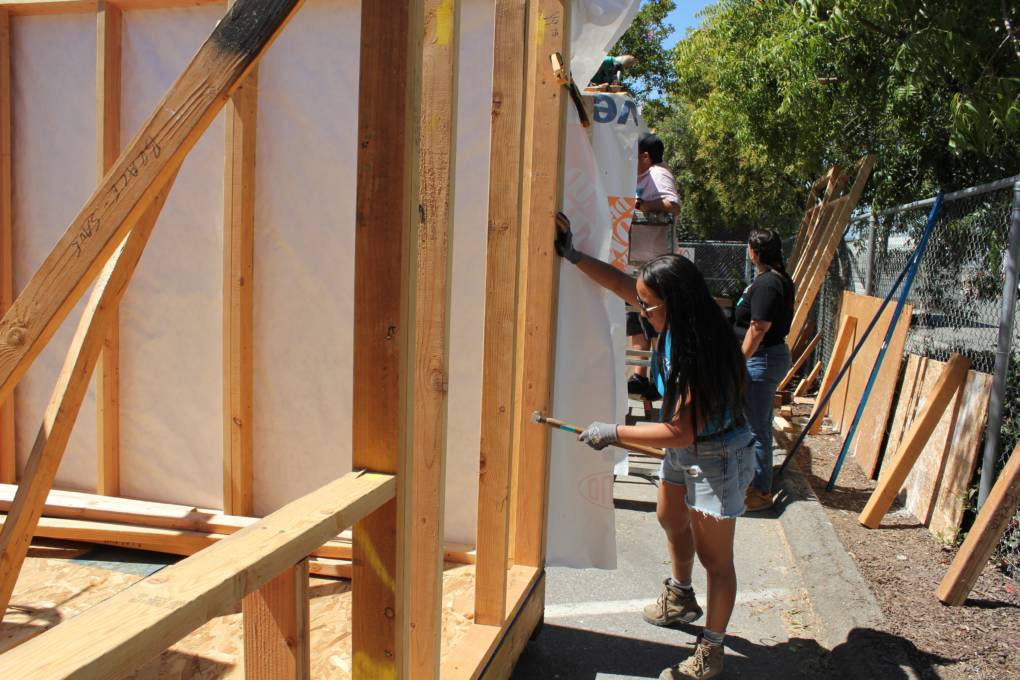
"caption": "Patti Wang Cross, with Habitat for Humanity, helps build a tiny home in San Jose, California on Aug. 17, 2019.",
"description": null,
"title": "IMG_7728",
"credit": "Sara Hossaini/KQED",
"status": "inherit",
"isLoading": false,
"fetchFailed": false
},
"news_11768137": {
"type": "attachments",
"id": "news_11768137",
"meta": {
"index": "attachments_1716263798",
"site": "news",
"id": "11768137",
"found": true
},
"parent": 11768015,
"imgSizes": {
"apple_news_ca_landscape_5_5": {
"file": "https://ww2.kqed.org/app/uploads/sites/10/2019/08/Block-Party-WeHo-1044x783.jpg",
"width": 1044,
"mimeType": "image/jpeg",
"height": 783
},
"apple_news_ca_square_4_0": {
"file": "https://ww2.kqed.org/app/uploads/sites/10/2019/08/Block-Party-WeHo-470x470.jpg",
"width": 470,
"mimeType": "image/jpeg",
"height": 470
},
"twentyfourteen-full-width": {
"file": "https://ww2.kqed.org/app/uploads/sites/10/2019/08/Block-Party-WeHo-1038x576.jpg",
"width": 1038,
"mimeType": "image/jpeg",
"height": 576
},
"thumbnail": {
"file": "https://ww2.kqed.org/app/uploads/sites/10/2019/08/Block-Party-WeHo-160x95.jpg",
"width": 160,
"mimeType": "image/jpeg",
"height": 95
},
"post-thumbnail": {
"file": "https://ww2.kqed.org/app/uploads/sites/10/2019/08/Block-Party-WeHo-672x372.jpg",
"width": 672,
"mimeType": "image/jpeg",
"height": 372
},
"kqedFullSize": {
"file": "https://ww2.kqed.org/app/uploads/sites/10/2019/08/Block-Party-WeHo.jpg",
"width": 1920,
"height": 1137
},
"apple_news_ca_landscape_4_7": {
"file": "https://ww2.kqed.org/app/uploads/sites/10/2019/08/Block-Party-WeHo-632x474.jpg",
"width": 632,
"mimeType": "image/jpeg",
"height": 474
},
"large": {
"file": "https://ww2.kqed.org/app/uploads/sites/10/2019/08/Block-Party-WeHo-1020x604.jpg",
"width": 1020,
"mimeType": "image/jpeg",
"height": 604
},
"complete_open_graph": {
"file": "https://ww2.kqed.org/app/uploads/sites/10/2019/08/Block-Party-WeHo-1200x711.jpg",
"width": 1200,
"mimeType": "image/jpeg",
"height": 711
},
"apple_news_ca_landscape_4_0": {
"file": "https://ww2.kqed.org/app/uploads/sites/10/2019/08/Block-Party-WeHo-536x402.jpg",
"width": 536,
"mimeType": "image/jpeg",
"height": 402
},
"apple_news_ca_portrait_12_9": {
"file": "https://ww2.kqed.org/app/uploads/sites/10/2019/08/Block-Party-WeHo-1122x1137.jpg",
"width": 1122,
"mimeType": "image/jpeg",
"height": 1137
},
"medium": {
"file": "https://ww2.kqed.org/app/uploads/sites/10/2019/08/Block-Party-WeHo-800x474.jpg",
"width": 800,
"mimeType": "image/jpeg",
"height": 474
},
"apple_news_ca_portrait_4_0": {
"file": "https://ww2.kqed.org/app/uploads/sites/10/2019/08/Block-Party-WeHo-354x472.jpg",
"width": 354,
"mimeType": "image/jpeg",
"height": 472
},
"apple_news_ca_portrait_9_7": {
"file": "https://ww2.kqed.org/app/uploads/sites/10/2019/08/Block-Party-WeHo-840x1120.jpg",
"width": 840,
"mimeType": "image/jpeg",
"height": 1120
},
"apple_news_ca_landscape_12_9": {
"file": "https://ww2.kqed.org/app/uploads/sites/10/2019/08/Block-Party-WeHo-1832x1137.jpg",
"width": 1832,
"mimeType": "image/jpeg",
"height": 1137
},
"apple_news_ca_square_9_7": {
"file": "https://ww2.kqed.org/app/uploads/sites/10/2019/08/Block-Party-WeHo-1104x1104.jpg",
"width": 1104,
"mimeType": "image/jpeg",
"height": 1104
},
"apple_news_ca_portrait_4_7": {
"file": "https://ww2.kqed.org/app/uploads/sites/10/2019/08/Block-Party-WeHo-414x552.jpg",
"width": 414,
"mimeType": "image/jpeg",
"height": 552
},
"apple_news_ca_square_12_9": {
"file": "https://ww2.kqed.org/app/uploads/sites/10/2019/08/Block-Party-WeHo-1472x1137.jpg",
"width": 1472,
"mimeType": "image/jpeg",
"height": 1137
},
"apple_news_ca_portrait_5_5": {
"file": "https://ww2.kqed.org/app/uploads/sites/10/2019/08/Block-Party-WeHo-687x916.jpg",
"width": 687,
"mimeType": "image/jpeg",
"height": 916
},
"full-width": {
"file": "https://ww2.kqed.org/app/uploads/sites/10/2019/08/Block-Party-WeHo-1920x1137.jpg",
"width": 1920,
"mimeType": "image/jpeg",
"height": 1137
},
"apple_news_ca_square_4_7": {
"file": "https://ww2.kqed.org/app/uploads/sites/10/2019/08/Block-Party-WeHo-550x550.jpg",
"width": 550,
"mimeType": "image/jpeg",
"height": 550
},
"apple_news_ca_landscape_9_7": {
"file": "https://ww2.kqed.org/app/uploads/sites/10/2019/08/Block-Party-WeHo-1376x1032.jpg",
"width": 1376,
"mimeType": "image/jpeg",
"height": 1032
},
"apple_news_ca_square_5_5": {
"file": "https://ww2.kqed.org/app/uploads/sites/10/2019/08/Block-Party-WeHo-912x912.jpg",
"width": 912,
"mimeType": "image/jpeg",
"height": 912
}
},
"publishDate": 1565998064,
"modified": 1565998199,
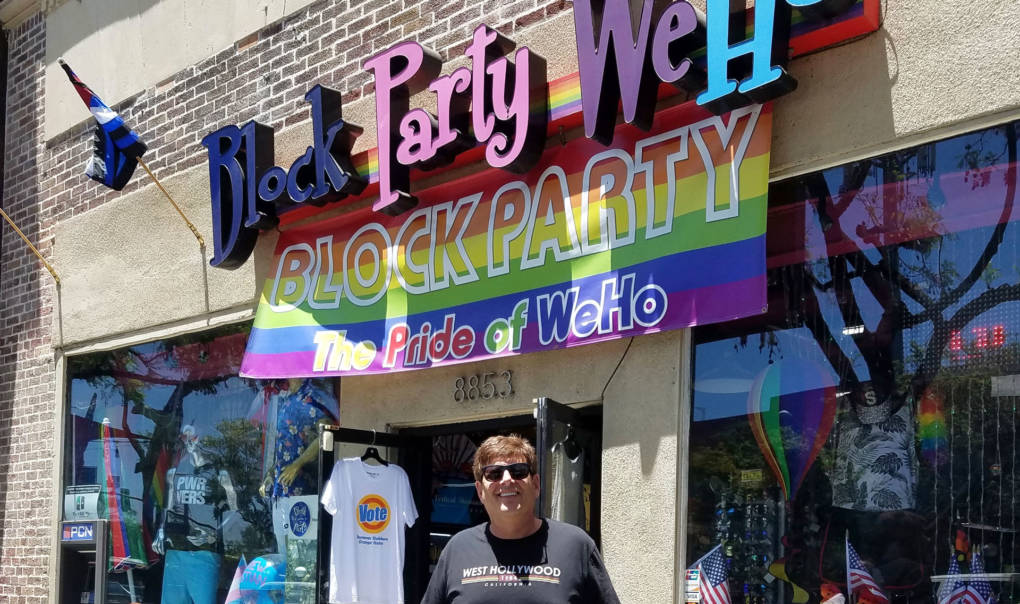
"caption": "Larry Block owns Block Party, one of a handful of gay-owned and gay-centric shops left on Santa Monica Blvd in West Hollywood. He worries the neighborhood is changing too much with all of the new mainstream businesses coming in. He’s lived in WeHo since 1985.",
"description": "Larry Block owns Block Party, one of a handful of gay-owned and gay-centric shops left on Santa Monica Blvd in West Hollywood. He worries the neighborhood is changing too much with all of the new mainstream businesses coming in. He’s lived in WeHo since 1985.",
"title": "Block-Party-WeHo",
"credit": "Elizabeth Aguilera/KPCC",
"status": "inherit",
"isLoading": false,
"fetchFailed": false
},
"news_11767473": {
"type": "attachments",
"id": "news_11767473",
"meta": {
"index": "attachments_1716263798",
"site": "news",
"id": "11767473",
"found": true
},
"parent": 11767064,
"imgSizes": {
"apple_news_ca_landscape_5_5": {
"file": "https://ww2.kqed.org/app/uploads/sites/10/2019/08/GettyImages-88900792-1044x783.jpg",
"width": 1044,
"mimeType": "image/jpeg",
"height": 783
},
"apple_news_ca_square_4_0": {
"file": "https://ww2.kqed.org/app/uploads/sites/10/2019/08/GettyImages-88900792-470x470.jpg",
"width": 470,
"mimeType": "image/jpeg",
"height": 470
},
"twentyfourteen-full-width": {
"file": "https://ww2.kqed.org/app/uploads/sites/10/2019/08/GettyImages-88900792-1038x576.jpg",
"width": 1038,
"mimeType": "image/jpeg",
"height": 576
},
"thumbnail": {
"file": "https://ww2.kqed.org/app/uploads/sites/10/2019/08/GettyImages-88900792-160x101.jpg",
"width": 160,
"mimeType": "image/jpeg",
"height": 101
},
"post-thumbnail": {
"file": "https://ww2.kqed.org/app/uploads/sites/10/2019/08/GettyImages-88900792-672x372.jpg",
"width": 672,
"mimeType": "image/jpeg",
"height": 372
},
"kqedFullSize": {
"file": "https://ww2.kqed.org/app/uploads/sites/10/2019/08/GettyImages-88900792-e1565757744408.jpg",
"width": 1920,
"height": 1217
},
"apple_news_ca_landscape_4_7": {
"file": "https://ww2.kqed.org/app/uploads/sites/10/2019/08/GettyImages-88900792-632x474.jpg",
"width": 632,
"mimeType": "image/jpeg",
"height": 474
},
"large": {
"file": "https://ww2.kqed.org/app/uploads/sites/10/2019/08/GettyImages-88900792-1020x646.jpg",
"width": 1020,
"mimeType": "image/jpeg",
"height": 646
},
"complete_open_graph": {
"file": "https://ww2.kqed.org/app/uploads/sites/10/2019/08/GettyImages-88900792-1200x760.jpg",
"width": 1200,
"mimeType": "image/jpeg",
"height": 760
},
"apple_news_ca_landscape_4_0": {
"file": "https://ww2.kqed.org/app/uploads/sites/10/2019/08/GettyImages-88900792-536x402.jpg",
"width": 536,
"mimeType": "image/jpeg",
"height": 402
},
"apple_news_ca_portrait_12_9": {
"file": "https://ww2.kqed.org/app/uploads/sites/10/2019/08/GettyImages-88900792-1122x1496.jpg",
"width": 1122,
"mimeType": "image/jpeg",
"height": 1496
},
"medium": {
"file": "https://ww2.kqed.org/app/uploads/sites/10/2019/08/GettyImages-88900792-800x507.jpg",
"width": 800,
"mimeType": "image/jpeg",
"height": 507
},
"apple_news_ca_portrait_4_0": {
"file": "https://ww2.kqed.org/app/uploads/sites/10/2019/08/GettyImages-88900792-354x472.jpg",
"width": 354,
"mimeType": "image/jpeg",
"height": 472
},
"apple_news_ca_portrait_9_7": {
"file": "https://ww2.kqed.org/app/uploads/sites/10/2019/08/GettyImages-88900792-840x1120.jpg",
"width": 840,
"mimeType": "image/jpeg",
"height": 1120
},
"apple_news_ca_landscape_12_9": {
"file": "https://ww2.kqed.org/app/uploads/sites/10/2019/08/GettyImages-88900792-1832x1374.jpg",
"width": 1832,
"mimeType": "image/jpeg",
"height": 1374
},
"apple_news_ca_square_9_7": {
"file": "https://ww2.kqed.org/app/uploads/sites/10/2019/08/GettyImages-88900792-1104x1104.jpg",
"width": 1104,
"mimeType": "image/jpeg",
"height": 1104
},
"apple_news_ca_portrait_4_7": {
"file": "https://ww2.kqed.org/app/uploads/sites/10/2019/08/GettyImages-88900792-414x552.jpg",
"width": 414,
"mimeType": "image/jpeg",
"height": 552
},
"apple_news_ca_square_12_9": {
"file": "https://ww2.kqed.org/app/uploads/sites/10/2019/08/GettyImages-88900792-1472x1472.jpg",
"width": 1472,
"mimeType": "image/jpeg",
"height": 1472
},
"apple_news_ca_portrait_5_5": {
"file": "https://ww2.kqed.org/app/uploads/sites/10/2019/08/GettyImages-88900792-687x916.jpg",
"width": 687,
"mimeType": "image/jpeg",
"height": 916
},
"full-width": {
"file": "https://ww2.kqed.org/app/uploads/sites/10/2019/08/GettyImages-88900792-1920x1217.jpg",
"width": 1920,
"mimeType": "image/jpeg",
"height": 1217
},
"apple_news_ca_square_4_7": {
"file": "https://ww2.kqed.org/app/uploads/sites/10/2019/08/GettyImages-88900792-550x550.jpg",
"width": 550,
"mimeType": "image/jpeg",
"height": 550
},
"apple_news_ca_landscape_9_7": {
"file": "https://ww2.kqed.org/app/uploads/sites/10/2019/08/GettyImages-88900792-1376x1032.jpg",
"width": 1376,
"mimeType": "image/jpeg",
"height": 1032
},
"apple_news_ca_square_5_5": {
"file": "https://ww2.kqed.org/app/uploads/sites/10/2019/08/GettyImages-88900792-912x912.jpg",
"width": 912,
"mimeType": "image/jpeg",
"height": 912
}
},
"publishDate": 1565757631,
"modified": 1565757738,
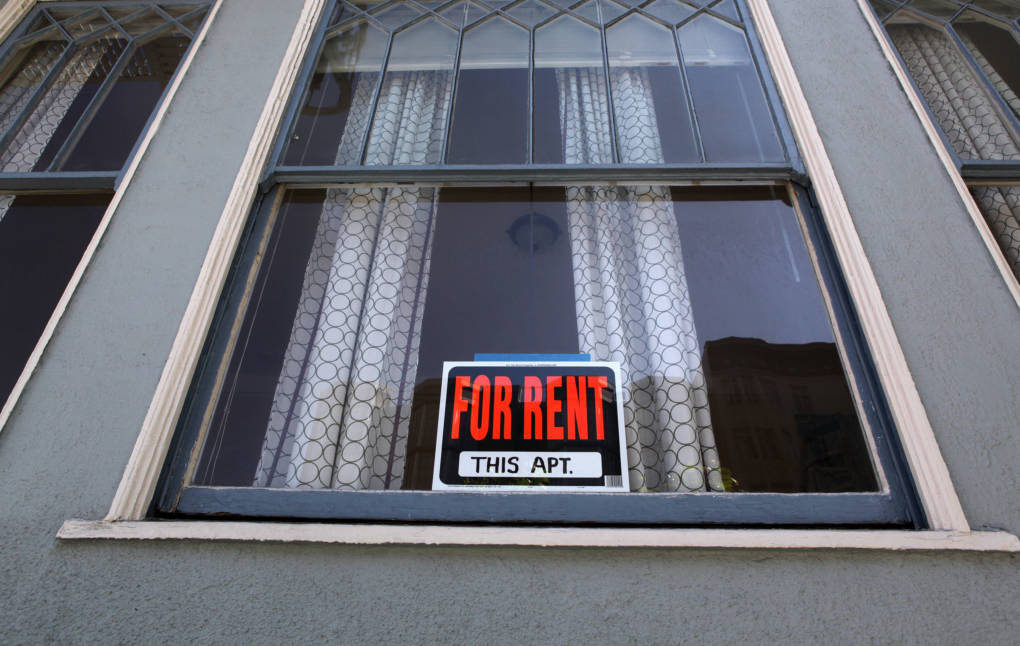
"caption": "Under a new law, landlords in San Jose cannot discriminate against potential renters who have housing vouchers, like Section 8. ",
"description": null,
"title": "Vacancy Rate For U.S. Apartments Reaches Highest Rate In 20 Years",
"credit": "Justin Sullivan/Getty Images",
"status": "inherit",
"isLoading": false,
"fetchFailed": false
},
"news_11767405": {
"type": "attachments",
"id": "news_11767405",
"meta": {
"index": "attachments_1716263798",
"site": "news",
"id": "11767405",
"found": true
},
"parent": 11767274,
"imgSizes": {
"apple_news_ca_landscape_5_5": {
"file": "https://ww2.kqed.org/app/uploads/sites/10/2019/08/GettyImages-1130581731-1044x783.jpg",
"width": 1044,
"mimeType": "image/jpeg",
"height": 783
},
"apple_news_ca_square_4_0": {
"file": "https://ww2.kqed.org/app/uploads/sites/10/2019/08/GettyImages-1130581731-470x470.jpg",
"width": 470,
"mimeType": "image/jpeg",
"height": 470
},
"twentyfourteen-full-width": {
"file": "https://ww2.kqed.org/app/uploads/sites/10/2019/08/GettyImages-1130581731-1038x576.jpg",
"width": 1038,
"mimeType": "image/jpeg",
"height": 576
},
"thumbnail": {
"file": "https://ww2.kqed.org/app/uploads/sites/10/2019/08/GettyImages-1130581731-160x111.jpg",
"width": 160,
"mimeType": "image/jpeg",
"height": 111
},
"post-thumbnail": {
"file": "https://ww2.kqed.org/app/uploads/sites/10/2019/08/GettyImages-1130581731-672x372.jpg",
"width": 672,
"mimeType": "image/jpeg",
"height": 372
},
"kqedFullSize": {
"file": "https://ww2.kqed.org/app/uploads/sites/10/2019/08/GettyImages-1130581731-e1565738201563.jpg",
"width": 1920,
"height": 1332
},
"apple_news_ca_landscape_4_7": {
"file": "https://ww2.kqed.org/app/uploads/sites/10/2019/08/GettyImages-1130581731-632x474.jpg",
"width": 632,
"mimeType": "image/jpeg",
"height": 474
},
"large": {
"file": "https://ww2.kqed.org/app/uploads/sites/10/2019/08/GettyImages-1130581731-1020x708.jpg",
"width": 1020,
"mimeType": "image/jpeg",
"height": 708
},
"complete_open_graph": {
"file": "https://ww2.kqed.org/app/uploads/sites/10/2019/08/GettyImages-1130581731-1200x832.jpg",
"width": 1200,
"mimeType": "image/jpeg",
"height": 832
},
"apple_news_ca_landscape_4_0": {
"file": "https://ww2.kqed.org/app/uploads/sites/10/2019/08/GettyImages-1130581731-536x402.jpg",
"width": 536,
"mimeType": "image/jpeg",
"height": 402
},
"apple_news_ca_portrait_12_9": {
"file": "https://ww2.kqed.org/app/uploads/sites/10/2019/08/GettyImages-1130581731-1122x1496.jpg",
"width": 1122,
"mimeType": "image/jpeg",
"height": 1496
},
"medium": {
"file": "https://ww2.kqed.org/app/uploads/sites/10/2019/08/GettyImages-1130581731-800x555.jpg",
"width": 800,
"mimeType": "image/jpeg",
"height": 555
},
"apple_news_ca_portrait_4_0": {
"file": "https://ww2.kqed.org/app/uploads/sites/10/2019/08/GettyImages-1130581731-354x472.jpg",
"width": 354,
"mimeType": "image/jpeg",
"height": 472
},
"apple_news_ca_portrait_9_7": {
"file": "https://ww2.kqed.org/app/uploads/sites/10/2019/08/GettyImages-1130581731-840x1120.jpg",
"width": 840,
"mimeType": "image/jpeg",
"height": 1120
},
"apple_news_ca_landscape_12_9": {
"file": "https://ww2.kqed.org/app/uploads/sites/10/2019/08/GettyImages-1130581731-1832x1374.jpg",
"width": 1832,
"mimeType": "image/jpeg",
"height": 1374
},
"apple_news_ca_square_9_7": {
"file": "https://ww2.kqed.org/app/uploads/sites/10/2019/08/GettyImages-1130581731-1104x1104.jpg",
"width": 1104,
"mimeType": "image/jpeg",
"height": 1104
},
"apple_news_ca_portrait_4_7": {
"file": "https://ww2.kqed.org/app/uploads/sites/10/2019/08/GettyImages-1130581731-414x552.jpg",
"width": 414,
"mimeType": "image/jpeg",
"height": 552
},
"apple_news_ca_square_12_9": {
"file": "https://ww2.kqed.org/app/uploads/sites/10/2019/08/GettyImages-1130581731-1472x1472.jpg",
"width": 1472,
"mimeType": "image/jpeg",
"height": 1472
},
"apple_news_ca_portrait_5_5": {
"file": "https://ww2.kqed.org/app/uploads/sites/10/2019/08/GettyImages-1130581731-687x916.jpg",
"width": 687,
"mimeType": "image/jpeg",
"height": 916
},
"full-width": {
"file": "https://ww2.kqed.org/app/uploads/sites/10/2019/08/GettyImages-1130581731-1920x1332.jpg",
"width": 1920,
"mimeType": "image/jpeg",
"height": 1332
},
"apple_news_ca_square_4_7": {
"file": "https://ww2.kqed.org/app/uploads/sites/10/2019/08/GettyImages-1130581731-550x550.jpg",
"width": 550,
"mimeType": "image/jpeg",
"height": 550
},
"apple_news_ca_landscape_9_7": {
"file": "https://ww2.kqed.org/app/uploads/sites/10/2019/08/GettyImages-1130581731-1376x1032.jpg",
"width": 1376,
"mimeType": "image/jpeg",
"height": 1032
},
"apple_news_ca_square_5_5": {
"file": "https://ww2.kqed.org/app/uploads/sites/10/2019/08/GettyImages-1130581731-912x912.jpg",
"width": 912,
"mimeType": "image/jpeg",
"height": 912
}
},
"publishDate": 1565737823,
"modified": 1565738852,
"caption": "Salesforce Tower from above in downtown San Francisco, California on February 6, 2019. If successful, a new effort to block commercial property owners from continuing to receive Proposition 13 tax benefits could generate billions of dollars for local governments. ",
"description": null,
"title": "US-CALIFORNIA-HOMELESSNESS-TECH-SANFRANCISCO",
"credit": "Josh Edelson/AFP/Getty Images",
"status": "inherit",
"isLoading": false,
"fetchFailed": false
},
"news_11764346": {
"type": "attachments",
"id": "news_11764346",
"meta": {
"index": "attachments_1716263798",
"site": "news",
"id": "11764346",
"found": true
},
"parent": 11764275,
"imgSizes": {
"apple_news_ca_landscape_5_5": {
"file": "https://ww2.kqed.org/app/uploads/sites/10/2019/07/RS38248_Corey-qut-1044x783.jpg",
"width": 1044,
"mimeType": "image/jpeg",
"height": 783
},
"apple_news_ca_square_4_0": {
"file": "https://ww2.kqed.org/app/uploads/sites/10/2019/07/RS38248_Corey-qut-470x470.jpg",
"width": 470,
"mimeType": "image/jpeg",
"height": 470
},
"twentyfourteen-full-width": {
"file": "https://ww2.kqed.org/app/uploads/sites/10/2019/07/RS38248_Corey-qut-1038x576.jpg",
"width": 1038,
"mimeType": "image/jpeg",
"height": 576
},
"thumbnail": {
"file": "https://ww2.kqed.org/app/uploads/sites/10/2019/07/RS38248_Corey-qut-160x104.jpg",
"width": 160,
"mimeType": "image/jpeg",
"height": 104
},
"post-thumbnail": {
"file": "https://ww2.kqed.org/app/uploads/sites/10/2019/07/RS38248_Corey-qut-672x372.jpg",
"width": 672,
"mimeType": "image/jpeg",
"height": 372
},
"kqedFullSize": {
"file": "https://ww2.kqed.org/app/uploads/sites/10/2019/07/RS38248_Corey-qut.jpg",
"width": 1920,
"height": 1246
},
"apple_news_ca_landscape_4_7": {
"file": "https://ww2.kqed.org/app/uploads/sites/10/2019/07/RS38248_Corey-qut-632x474.jpg",
"width": 632,
"mimeType": "image/jpeg",
"height": 474
},
"large": {
"file": "https://ww2.kqed.org/app/uploads/sites/10/2019/07/RS38248_Corey-qut-1020x662.jpg",
"width": 1020,
"mimeType": "image/jpeg",
"height": 662
},
"complete_open_graph": {
"file": "https://ww2.kqed.org/app/uploads/sites/10/2019/07/RS38248_Corey-qut-1200x779.jpg",
"width": 1200,
"mimeType": "image/jpeg",
"height": 779
},
"apple_news_ca_landscape_4_0": {
"file": "https://ww2.kqed.org/app/uploads/sites/10/2019/07/RS38248_Corey-qut-536x402.jpg",
"width": 536,
"mimeType": "image/jpeg",
"height": 402
},
"apple_news_ca_portrait_12_9": {
"file": "https://ww2.kqed.org/app/uploads/sites/10/2019/07/RS38248_Corey-qut-1122x1246.jpg",
"width": 1122,
"mimeType": "image/jpeg",
"height": 1246
},
"medium": {
"file": "https://ww2.kqed.org/app/uploads/sites/10/2019/07/RS38248_Corey-qut-800x519.jpg",
"width": 800,
"mimeType": "image/jpeg",
"height": 519
},
"apple_news_ca_portrait_4_0": {
"file": "https://ww2.kqed.org/app/uploads/sites/10/2019/07/RS38248_Corey-qut-354x472.jpg",
"width": 354,
"mimeType": "image/jpeg",
"height": 472
},
"apple_news_ca_portrait_9_7": {
"file": "https://ww2.kqed.org/app/uploads/sites/10/2019/07/RS38248_Corey-qut-840x1120.jpg",
"width": 840,
"mimeType": "image/jpeg",
"height": 1120
},
"apple_news_ca_landscape_12_9": {
"file": "https://ww2.kqed.org/app/uploads/sites/10/2019/07/RS38248_Corey-qut-1832x1246.jpg",
"width": 1832,
"mimeType": "image/jpeg",
"height": 1246
},
"apple_news_ca_square_9_7": {
"file": "https://ww2.kqed.org/app/uploads/sites/10/2019/07/RS38248_Corey-qut-1104x1104.jpg",
"width": 1104,
"mimeType": "image/jpeg",
"height": 1104
},
"apple_news_ca_portrait_4_7": {
"file": "https://ww2.kqed.org/app/uploads/sites/10/2019/07/RS38248_Corey-qut-414x552.jpg",
"width": 414,
"mimeType": "image/jpeg",
"height": 552
},
"apple_news_ca_square_12_9": {
"file": "https://ww2.kqed.org/app/uploads/sites/10/2019/07/RS38248_Corey-qut-1472x1246.jpg",
"width": 1472,
"mimeType": "image/jpeg",
"height": 1246
},
"apple_news_ca_portrait_5_5": {
"file": "https://ww2.kqed.org/app/uploads/sites/10/2019/07/RS38248_Corey-qut-687x916.jpg",
"width": 687,
"mimeType": "image/jpeg",
"height": 916
},
"full-width": {
"file": "https://ww2.kqed.org/app/uploads/sites/10/2019/07/RS38248_Corey-qut-1920x1246.jpg",
"width": 1920,
"mimeType": "image/jpeg",
"height": 1246
},
"apple_news_ca_square_4_7": {
"file": "https://ww2.kqed.org/app/uploads/sites/10/2019/07/RS38248_Corey-qut-550x550.jpg",
"width": 550,
"mimeType": "image/jpeg",
"height": 550
},
"apple_news_ca_landscape_9_7": {
"file": "https://ww2.kqed.org/app/uploads/sites/10/2019/07/RS38248_Corey-qut-1376x1032.jpg",
"width": 1376,
"mimeType": "image/jpeg",
"height": 1032
},
"apple_news_ca_square_5_5": {
"file": "https://ww2.kqed.org/app/uploads/sites/10/2019/07/RS38248_Corey-qut-912x912.jpg",
"width": 912,
"mimeType": "image/jpeg",
"height": 912
}
},
"publishDate": 1564523211,
"modified": 1564523245,
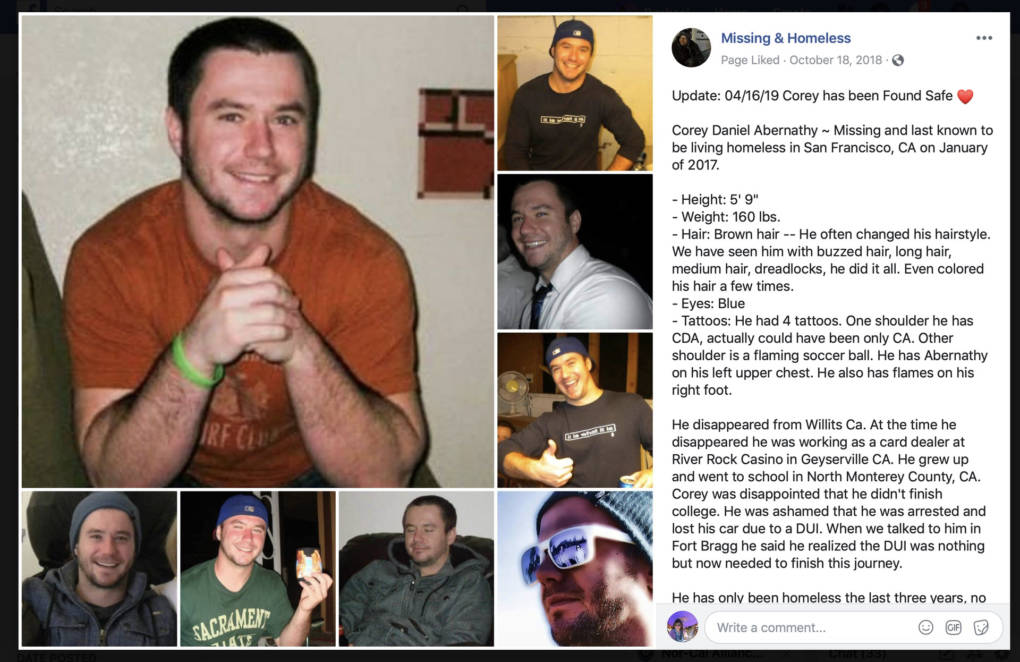
"caption": "A former workmate of Corey Abernathy's asked his parents for permission to post this on the Facebook group \"Missing & Homeless.\" That's how a housemate of Abernathy's in San Francisco spotted it, and told him, and he called his parents after a radio silence of two years.",
"description": "A former workmate of Corey Abernathy's asked his parents for permission to post this on the Facebook group \"Missing & Homeless.\" That's how a housemate of Abernathy's in San Francisco spotted it, and told him, and he called his parents after a radio silence of two years.",
"title": "RS38248_Corey-qut",
"credit": "Courtesy of Corey Abernathy",
"status": "inherit",
"isLoading": false,
"fetchFailed": false
},
"news_11765109": {
"type": "attachments",
"id": "news_11765109",
"meta": {
"index": "attachments_1716263798",
"site": "news",
"id": "11765109",
"found": true
},
"parent": 11765107,
"imgSizes": {
"apple_news_ca_landscape_5_5": {
"file": "https://ww2.kqed.org/app/uploads/sites/10/2019/08/Magic-Castle-Day-1044x783.jpg",
"width": 1044,
"mimeType": "image/jpeg",
"height": 783
},
"apple_news_ca_square_4_0": {
"file": "https://ww2.kqed.org/app/uploads/sites/10/2019/08/Magic-Castle-Day-470x470.jpg",
"width": 470,
"mimeType": "image/jpeg",
"height": 470
},
"twentyfourteen-full-width": {
"file": "https://ww2.kqed.org/app/uploads/sites/10/2019/08/Magic-Castle-Day-1038x576.jpg",
"width": 1038,
"mimeType": "image/jpeg",
"height": 576
},
"thumbnail": {
"file": "https://ww2.kqed.org/app/uploads/sites/10/2019/08/Magic-Castle-Day-160x107.jpg",
"width": 160,
"mimeType": "image/jpeg",
"height": 107
},
"post-thumbnail": {
"file": "https://ww2.kqed.org/app/uploads/sites/10/2019/08/Magic-Castle-Day-672x372.jpg",
"width": 672,
"mimeType": "image/jpeg",
"height": 372
},
"kqedFullSize": {
"file": "https://ww2.kqed.org/app/uploads/sites/10/2019/08/Magic-Castle-Day-e1565376098262.jpg",
"width": 1920,
"height": 1282
},
"apple_news_ca_landscape_4_7": {
"file": "https://ww2.kqed.org/app/uploads/sites/10/2019/08/Magic-Castle-Day-632x474.jpg",
"width": 632,
"mimeType": "image/jpeg",
"height": 474
},
"large": {
"file": "https://ww2.kqed.org/app/uploads/sites/10/2019/08/Magic-Castle-Day-1020x681.jpg",
"width": 1020,
"mimeType": "image/jpeg",
"height": 681
},
"complete_open_graph": {
"file": "https://ww2.kqed.org/app/uploads/sites/10/2019/08/Magic-Castle-Day-1200x801.jpg",
"width": 1200,
"mimeType": "image/jpeg",
"height": 801
},
"apple_news_ca_landscape_4_0": {
"file": "https://ww2.kqed.org/app/uploads/sites/10/2019/08/Magic-Castle-Day-536x402.jpg",
"width": 536,
"mimeType": "image/jpeg",
"height": 402
},
"apple_news_ca_portrait_12_9": {
"file": "https://ww2.kqed.org/app/uploads/sites/10/2019/08/Magic-Castle-Day-1122x1496.jpg",
"width": 1122,
"mimeType": "image/jpeg",
"height": 1496
},
"medium": {
"file": "https://ww2.kqed.org/app/uploads/sites/10/2019/08/Magic-Castle-Day-800x534.jpg",
"width": 800,
"mimeType": "image/jpeg",
"height": 534
},
"apple_news_ca_portrait_4_0": {
"file": "https://ww2.kqed.org/app/uploads/sites/10/2019/08/Magic-Castle-Day-354x472.jpg",
"width": 354,
"mimeType": "image/jpeg",
"height": 472
},
"apple_news_ca_portrait_9_7": {
"file": "https://ww2.kqed.org/app/uploads/sites/10/2019/08/Magic-Castle-Day-840x1120.jpg",
"width": 840,
"mimeType": "image/jpeg",
"height": 1120
},
"apple_news_ca_landscape_12_9": {
"file": "https://ww2.kqed.org/app/uploads/sites/10/2019/08/Magic-Castle-Day-1832x1374.jpg",
"width": 1832,
"mimeType": "image/jpeg",
"height": 1374
},
"apple_news_ca_square_9_7": {
"file": "https://ww2.kqed.org/app/uploads/sites/10/2019/08/Magic-Castle-Day-1104x1104.jpg",
"width": 1104,
"mimeType": "image/jpeg",
"height": 1104
},
"apple_news_ca_portrait_4_7": {
"file": "https://ww2.kqed.org/app/uploads/sites/10/2019/08/Magic-Castle-Day-414x552.jpg",
"width": 414,
"mimeType": "image/jpeg",
"height": 552
},
"apple_news_ca_square_12_9": {
"file": "https://ww2.kqed.org/app/uploads/sites/10/2019/08/Magic-Castle-Day-1472x1472.jpg",
"width": 1472,
"mimeType": "image/jpeg",
"height": 1472
},
"apple_news_ca_portrait_5_5": {
"file": "https://ww2.kqed.org/app/uploads/sites/10/2019/08/Magic-Castle-Day-687x916.jpg",
"width": 687,
"mimeType": "image/jpeg",
"height": 916
},
"full-width": {
"file": "https://ww2.kqed.org/app/uploads/sites/10/2019/08/Magic-Castle-Day-1920x1282.jpg",
"width": 1920,
"mimeType": "image/jpeg",
"height": 1282
},
"apple_news_ca_square_4_7": {
"file": "https://ww2.kqed.org/app/uploads/sites/10/2019/08/Magic-Castle-Day-550x550.jpg",
"width": 550,
"mimeType": "image/jpeg",
"height": 550
},
"apple_news_ca_landscape_9_7": {
"file": "https://ww2.kqed.org/app/uploads/sites/10/2019/08/Magic-Castle-Day-1376x1032.jpg",
"width": 1376,
"mimeType": "image/jpeg",
"height": 1032
},
"apple_news_ca_square_5_5": {
"file": "https://ww2.kqed.org/app/uploads/sites/10/2019/08/Magic-Castle-Day-912x912.jpg",
"width": 912,
"mimeType": "image/jpeg",
"height": 912
}
},
"publishDate": 1564707546,
"modified": 1564707627,
"caption": "An exterior of the Magic Castle, a club for magicians.",
"description": "An exterior of the Magic Castle, a club for magicians.",
"title": "An exterior of the Magic Castle, a club for magicians.",
"credit": "Courtesy of the Magic Castle",
"status": "inherit",
"isLoading": false,
"fetchFailed": false
},
"news_11766447": {
"type": "attachments",
"id": "news_11766447",
"meta": {
"index": "attachments_1716263798",
"site": "news",
"id": "11766447",
"found": true
},
"parent": 11766434,
"imgSizes": {
"apple_news_ca_landscape_5_5": {
"file": "https://ww2.kqed.org/app/uploads/sites/10/2019/08/GettyImages-1021414774-1044x783.jpg",
"width": 1044,
"mimeType": "image/jpeg",
"height": 783
},
"apple_news_ca_square_4_0": {
"file": "https://ww2.kqed.org/app/uploads/sites/10/2019/08/GettyImages-1021414774-470x470.jpg",
"width": 470,
"mimeType": "image/jpeg",
"height": 470
},
"twentyfourteen-full-width": {
"file": "https://ww2.kqed.org/app/uploads/sites/10/2019/08/GettyImages-1021414774-1038x576.jpg",
"width": 1038,
"mimeType": "image/jpeg",
"height": 576
},
"thumbnail": {
"file": "https://ww2.kqed.org/app/uploads/sites/10/2019/08/GettyImages-1021414774-160x113.jpg",
"width": 160,
"mimeType": "image/jpeg",
"height": 113
},
"post-thumbnail": {
"file": "https://ww2.kqed.org/app/uploads/sites/10/2019/08/GettyImages-1021414774-672x372.jpg",
"width": 672,
"mimeType": "image/jpeg",
"height": 372
},
"kqedFullSize": {
"file": "https://ww2.kqed.org/app/uploads/sites/10/2019/08/GettyImages-1021414774-e1565292822667.jpg",
"width": 1920,
"height": 1351
},
"apple_news_ca_landscape_4_7": {
"file": "https://ww2.kqed.org/app/uploads/sites/10/2019/08/GettyImages-1021414774-632x474.jpg",
"width": 632,
"mimeType": "image/jpeg",
"height": 474
},
"large": {
"file": "https://ww2.kqed.org/app/uploads/sites/10/2019/08/GettyImages-1021414774-1020x718.jpg",
"width": 1020,
"mimeType": "image/jpeg",
"height": 718
},
"complete_open_graph": {
"file": "https://ww2.kqed.org/app/uploads/sites/10/2019/08/GettyImages-1021414774-1200x844.jpg",
"width": 1200,
"mimeType": "image/jpeg",
"height": 844
},
"apple_news_ca_landscape_4_0": {
"file": "https://ww2.kqed.org/app/uploads/sites/10/2019/08/GettyImages-1021414774-536x402.jpg",
"width": 536,
"mimeType": "image/jpeg",
"height": 402
},
"apple_news_ca_portrait_12_9": {
"file": "https://ww2.kqed.org/app/uploads/sites/10/2019/08/GettyImages-1021414774-1122x1496.jpg",
"width": 1122,
"mimeType": "image/jpeg",
"height": 1496
},
"medium": {
"file": "https://ww2.kqed.org/app/uploads/sites/10/2019/08/GettyImages-1021414774-800x563.jpg",
"width": 800,
"mimeType": "image/jpeg",
"height": 563
},
"apple_news_ca_portrait_4_0": {
"file": "https://ww2.kqed.org/app/uploads/sites/10/2019/08/GettyImages-1021414774-354x472.jpg",
"width": 354,
"mimeType": "image/jpeg",
"height": 472
},
"apple_news_ca_portrait_9_7": {
"file": "https://ww2.kqed.org/app/uploads/sites/10/2019/08/GettyImages-1021414774-840x1120.jpg",
"width": 840,
"mimeType": "image/jpeg",
"height": 1120
},
"apple_news_ca_landscape_12_9": {
"file": "https://ww2.kqed.org/app/uploads/sites/10/2019/08/GettyImages-1021414774-1832x1374.jpg",
"width": 1832,
"mimeType": "image/jpeg",
"height": 1374
},
"apple_news_ca_square_9_7": {
"file": "https://ww2.kqed.org/app/uploads/sites/10/2019/08/GettyImages-1021414774-1104x1104.jpg",
"width": 1104,
"mimeType": "image/jpeg",
"height": 1104
},
"apple_news_ca_portrait_4_7": {
"file": "https://ww2.kqed.org/app/uploads/sites/10/2019/08/GettyImages-1021414774-414x552.jpg",
"width": 414,
"mimeType": "image/jpeg",
"height": 552
},
"apple_news_ca_square_12_9": {
"file": "https://ww2.kqed.org/app/uploads/sites/10/2019/08/GettyImages-1021414774-1472x1472.jpg",
"width": 1472,
"mimeType": "image/jpeg",
"height": 1472
},
"apple_news_ca_portrait_5_5": {
"file": "https://ww2.kqed.org/app/uploads/sites/10/2019/08/GettyImages-1021414774-687x916.jpg",
"width": 687,
"mimeType": "image/jpeg",
"height": 916
},
"full-width": {
"file": "https://ww2.kqed.org/app/uploads/sites/10/2019/08/GettyImages-1021414774-1920x1351.jpg",
"width": 1920,
"mimeType": "image/jpeg",
"height": 1351
},
"apple_news_ca_square_4_7": {
"file": "https://ww2.kqed.org/app/uploads/sites/10/2019/08/GettyImages-1021414774-550x550.jpg",
"width": 550,
"mimeType": "image/jpeg",
"height": 550
},
"apple_news_ca_landscape_9_7": {
"file": "https://ww2.kqed.org/app/uploads/sites/10/2019/08/GettyImages-1021414774-1376x1032.jpg",
"width": 1376,
"mimeType": "image/jpeg",
"height": 1032
},
"apple_news_ca_square_5_5": {
"file": "https://ww2.kqed.org/app/uploads/sites/10/2019/08/GettyImages-1021414774-912x912.jpg",
"width": 912,
"mimeType": "image/jpeg",
"height": 912
}
},
"publishDate": 1565292783,
"modified": 1565293095,
"caption": "As a gubernatorial candidate, then-Lt. Gov. Gavin Newsom toured the Alice Griffith Apartments, a San Francisco low-income housing complex, with San Francisco Mayor London Breed on Aug. 22, 2018.",
"description": null,
"title": "California Gubernatorial Candidate Gavin Newsom Tours Low-Income Apartment Complex With SF Mayor London Breed",
"credit": "Justin Sullivan/Getty Images",
"status": "inherit",
"isLoading": false,
"fetchFailed": false
},
"news_11764368": {
"type": "attachments",
"id": "news_11764368",
"meta": {
"index": "attachments_1716263798",
"site": "news",
"id": "11764368",
"found": true
},
"parent": 11764275,
"imgSizes": {
"apple_news_ca_square_4_0": {
"file": "https://ww2.kqed.org/app/uploads/sites/10/2019/07/FB_IMG_1558461841538-470x470.jpg",
"width": 470,
"mimeType": "image/jpeg",
"height": 470
},
"thumbnail": {
"file": "https://ww2.kqed.org/app/uploads/sites/10/2019/07/FB_IMG_1558461841538-160x120.jpg",
"width": 160,
"mimeType": "image/jpeg",
"height": 120
},
"post-thumbnail": {
"file": "https://ww2.kqed.org/app/uploads/sites/10/2019/07/FB_IMG_1558461841538-672x372.jpg",
"width": 672,
"mimeType": "image/jpeg",
"height": 372
},
"kqedFullSize": {
"file": "https://ww2.kqed.org/app/uploads/sites/10/2019/07/FB_IMG_1558461841538.jpg",
"width": 720,
"height": 540
},
"apple_news_ca_landscape_4_7": {
"file": "https://ww2.kqed.org/app/uploads/sites/10/2019/07/FB_IMG_1558461841538-632x474.jpg",
"width": 632,
"mimeType": "image/jpeg",
"height": 474
},
"apple_news_ca_portrait_4_7": {
"file": "https://ww2.kqed.org/app/uploads/sites/10/2019/07/FB_IMG_1558461841538-414x540.jpg",
"width": 414,
"mimeType": "image/jpeg",
"height": 540
},
"apple_news_ca_portrait_5_5": {
"file": "https://ww2.kqed.org/app/uploads/sites/10/2019/07/FB_IMG_1558461841538-687x540.jpg",
"width": 687,
"mimeType": "image/jpeg",
"height": 540
},
"apple_news_ca_square_4_7": {
"file": "https://ww2.kqed.org/app/uploads/sites/10/2019/07/FB_IMG_1558461841538-550x540.jpg",
"width": 550,
"mimeType": "image/jpeg",
"height": 540
},
"apple_news_ca_landscape_4_0": {
"file": "https://ww2.kqed.org/app/uploads/sites/10/2019/07/FB_IMG_1558461841538-536x402.jpg",
"width": 536,
"mimeType": "image/jpeg",
"height": 402
},
"apple_news_ca_portrait_4_0": {
"file": "https://ww2.kqed.org/app/uploads/sites/10/2019/07/FB_IMG_1558461841538-354x472.jpg",
"width": 354,
"mimeType": "image/jpeg",
"height": 472
}
},
"publishDate": 1564524099,
"modified": 1564524170,
"caption": "A rare family photo of young Robin Burton with her mother, Cloudia Leslie Wells.",
"description": "A rare family photo of young Robin Burton with her mother, Cloudia Leslie Wells.",
"title": "FB_IMG_1558461841538",
"credit": "Courtesy of Robin Burton",
"status": "inherit",
"isLoading": false,
"fetchFailed": false
},
"news_11765085": {
"type": "attachments",
"id": "news_11765085",
"meta": {
"index": "attachments_1716263798",
"site": "news",
"id": "11765085",
"found": true
},
"parent": 11765010,
"imgSizes": {
"apple_news_ca_landscape_5_5": {
"file": "https://ww2.kqed.org/app/uploads/sites/10/2019/08/homeless-1044x783.jpg",
"width": 1044,
"mimeType": "image/jpeg",
"height": 783
},
"apple_news_ca_square_4_0": {
"file": "https://ww2.kqed.org/app/uploads/sites/10/2019/08/homeless-470x470.jpg",
"width": 470,
"mimeType": "image/jpeg",
"height": 470
},
"twentyfourteen-full-width": {
"file": "https://ww2.kqed.org/app/uploads/sites/10/2019/08/homeless-1038x576.jpg",
"width": 1038,
"mimeType": "image/jpeg",
"height": 576
},
"thumbnail": {
"file": "https://ww2.kqed.org/app/uploads/sites/10/2019/08/homeless-160x104.jpg",
"width": 160,
"mimeType": "image/jpeg",
"height": 104
},
"post-thumbnail": {
"file": "https://ww2.kqed.org/app/uploads/sites/10/2019/08/homeless-672x372.jpg",
"width": 672,
"mimeType": "image/jpeg",
"height": 372
},
"kqedFullSize": {
"file": "https://ww2.kqed.org/app/uploads/sites/10/2019/08/homeless.jpg",
"width": 1920,
"height": 1248
},
"apple_news_ca_landscape_4_7": {
"file": "https://ww2.kqed.org/app/uploads/sites/10/2019/08/homeless-632x474.jpg",
"width": 632,
"mimeType": "image/jpeg",
"height": 474
},
"large": {
"file": "https://ww2.kqed.org/app/uploads/sites/10/2019/08/homeless-1020x663.jpg",
"width": 1020,
"mimeType": "image/jpeg",
"height": 663
},
"complete_open_graph": {
"file": "https://ww2.kqed.org/app/uploads/sites/10/2019/08/homeless-1200x780.jpg",
"width": 1200,
"mimeType": "image/jpeg",
"height": 780
},
"apple_news_ca_landscape_4_0": {
"file": "https://ww2.kqed.org/app/uploads/sites/10/2019/08/homeless-536x402.jpg",
"width": 536,
"mimeType": "image/jpeg",
"height": 402
},
"apple_news_ca_portrait_12_9": {
"file": "https://ww2.kqed.org/app/uploads/sites/10/2019/08/homeless-1122x1248.jpg",
"width": 1122,
"mimeType": "image/jpeg",
"height": 1248
},
"medium": {
"file": "https://ww2.kqed.org/app/uploads/sites/10/2019/08/homeless-800x520.jpg",
"width": 800,
"mimeType": "image/jpeg",
"height": 520
},
"apple_news_ca_portrait_4_0": {
"file": "https://ww2.kqed.org/app/uploads/sites/10/2019/08/homeless-354x472.jpg",
"width": 354,
"mimeType": "image/jpeg",
"height": 472
},
"apple_news_ca_portrait_9_7": {
"file": "https://ww2.kqed.org/app/uploads/sites/10/2019/08/homeless-840x1120.jpg",
"width": 840,
"mimeType": "image/jpeg",
"height": 1120
},
"apple_news_ca_landscape_12_9": {
"file": "https://ww2.kqed.org/app/uploads/sites/10/2019/08/homeless-1832x1248.jpg",
"width": 1832,
"mimeType": "image/jpeg",
"height": 1248
},
"apple_news_ca_square_9_7": {
"file": "https://ww2.kqed.org/app/uploads/sites/10/2019/08/homeless-1104x1104.jpg",
"width": 1104,
"mimeType": "image/jpeg",
"height": 1104
},
"apple_news_ca_portrait_4_7": {
"file": "https://ww2.kqed.org/app/uploads/sites/10/2019/08/homeless-414x552.jpg",
"width": 414,
"mimeType": "image/jpeg",
"height": 552
},
"apple_news_ca_square_12_9": {
"file": "https://ww2.kqed.org/app/uploads/sites/10/2019/08/homeless-1472x1248.jpg",
"width": 1472,
"mimeType": "image/jpeg",
"height": 1248
},
"apple_news_ca_portrait_5_5": {
"file": "https://ww2.kqed.org/app/uploads/sites/10/2019/08/homeless-687x916.jpg",
"width": 687,
"mimeType": "image/jpeg",
"height": 916
},
"full-width": {
"file": "https://ww2.kqed.org/app/uploads/sites/10/2019/08/homeless-1920x1248.jpg",
"width": 1920,
"mimeType": "image/jpeg",
"height": 1248
},
"apple_news_ca_square_4_7": {
"file": "https://ww2.kqed.org/app/uploads/sites/10/2019/08/homeless-550x550.jpg",
"width": 550,
"mimeType": "image/jpeg",
"height": 550
},
"apple_news_ca_landscape_9_7": {
"file": "https://ww2.kqed.org/app/uploads/sites/10/2019/08/homeless-1376x1032.jpg",
"width": 1376,
"mimeType": "image/jpeg",
"height": 1032
},
"apple_news_ca_square_5_5": {
"file": "https://ww2.kqed.org/app/uploads/sites/10/2019/08/homeless-912x912.jpg",
"width": 912,
"mimeType": "image/jpeg",
"height": 912
}
},
"publishDate": 1564703814,
"modified": 1564703851,
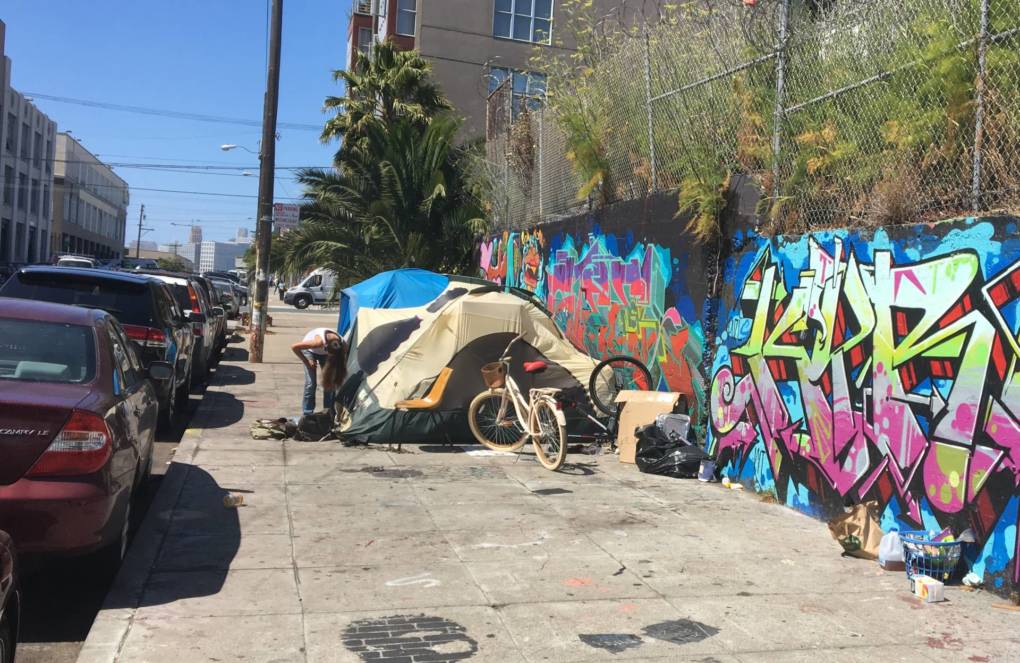
"caption": "A small homeless encampment on Florida Street in the Mission.",
"description": null,
"title": "homeless",
"credit": "Matthew Green/KQED",
"status": "inherit",
"isLoading": false,
"fetchFailed": false
},
"news_11764542": {
"type": "attachments",
"id": "news_11764542",
"meta": {
"index": "attachments_1716263798",
"site": "news",
"id": "11764542",
"found": true
},
"parent": 11763861,
"imgSizes": {
"apple_news_ca_landscape_5_5": {
"file": "https://ww2.kqed.org/app/uploads/sites/10/2019/07/Image-from-iOS-13-1044x783.jpg",
"width": 1044,
"mimeType": "image/jpeg",
"height": 783
},
"apple_news_ca_square_4_0": {
"file": "https://ww2.kqed.org/app/uploads/sites/10/2019/07/Image-from-iOS-13-470x470.jpg",
"width": 470,
"mimeType": "image/jpeg",
"height": 470
},
"twentyfourteen-full-width": {
"file": "https://ww2.kqed.org/app/uploads/sites/10/2019/07/Image-from-iOS-13-1038x576.jpg",
"width": 1038,
"mimeType": "image/jpeg",
"height": 576
},
"thumbnail": {
"file": "https://ww2.kqed.org/app/uploads/sites/10/2019/07/Image-from-iOS-13-160x120.jpg",
"width": 160,
"mimeType": "image/jpeg",
"height": 120
},
"post-thumbnail": {
"file": "https://ww2.kqed.org/app/uploads/sites/10/2019/07/Image-from-iOS-13-672x372.jpg",
"width": 672,
"mimeType": "image/jpeg",
"height": 372
},
"kqedFullSize": {
"file": "https://ww2.kqed.org/app/uploads/sites/10/2019/07/Image-from-iOS-13-e1564596615475.jpg",
"width": 1920,
"height": 1440
},
"apple_news_ca_landscape_4_7": {
"file": "https://ww2.kqed.org/app/uploads/sites/10/2019/07/Image-from-iOS-13-632x474.jpg",
"width": 632,
"mimeType": "image/jpeg",
"height": 474
},
"large": {
"file": "https://ww2.kqed.org/app/uploads/sites/10/2019/07/Image-from-iOS-13-1020x765.jpg",
"width": 1020,
"mimeType": "image/jpeg",
"height": 765
},
"complete_open_graph": {
"file": "https://ww2.kqed.org/app/uploads/sites/10/2019/07/Image-from-iOS-13-1200x900.jpg",
"width": 1200,
"mimeType": "image/jpeg",
"height": 900
},
"apple_news_ca_landscape_4_0": {
"file": "https://ww2.kqed.org/app/uploads/sites/10/2019/07/Image-from-iOS-13-536x402.jpg",
"width": 536,
"mimeType": "image/jpeg",
"height": 402
},
"apple_news_ca_portrait_12_9": {
"file": "https://ww2.kqed.org/app/uploads/sites/10/2019/07/Image-from-iOS-13-1122x1496.jpg",
"width": 1122,
"mimeType": "image/jpeg",
"height": 1496
},
"medium": {
"file": "https://ww2.kqed.org/app/uploads/sites/10/2019/07/Image-from-iOS-13-800x600.jpg",
"width": 800,
"mimeType": "image/jpeg",
"height": 600
},
"apple_news_ca_portrait_4_0": {
"file": "https://ww2.kqed.org/app/uploads/sites/10/2019/07/Image-from-iOS-13-354x472.jpg",
"width": 354,
"mimeType": "image/jpeg",
"height": 472
},
"apple_news_ca_portrait_9_7": {
"file": "https://ww2.kqed.org/app/uploads/sites/10/2019/07/Image-from-iOS-13-840x1120.jpg",
"width": 840,
"mimeType": "image/jpeg",
"height": 1120
},
"apple_news_ca_landscape_12_9": {
"file": "https://ww2.kqed.org/app/uploads/sites/10/2019/07/Image-from-iOS-13-1832x1374.jpg",
"width": 1832,
"mimeType": "image/jpeg",
"height": 1374
},
"apple_news_ca_square_9_7": {
"file": "https://ww2.kqed.org/app/uploads/sites/10/2019/07/Image-from-iOS-13-1104x1104.jpg",
"width": 1104,
"mimeType": "image/jpeg",
"height": 1104
},
"apple_news_ca_portrait_4_7": {
"file": "https://ww2.kqed.org/app/uploads/sites/10/2019/07/Image-from-iOS-13-414x552.jpg",
"width": 414,
"mimeType": "image/jpeg",
"height": 552
},
"apple_news_ca_square_12_9": {
"file": "https://ww2.kqed.org/app/uploads/sites/10/2019/07/Image-from-iOS-13-1472x1472.jpg",
"width": 1472,
"mimeType": "image/jpeg",
"height": 1472
},
"apple_news_ca_portrait_5_5": {
"file": "https://ww2.kqed.org/app/uploads/sites/10/2019/07/Image-from-iOS-13-687x916.jpg",
"width": 687,
"mimeType": "image/jpeg",
"height": 916
},
"full-width": {
"file": "https://ww2.kqed.org/app/uploads/sites/10/2019/07/Image-from-iOS-13-1920x1440.jpg",
"width": 1920,
"mimeType": "image/jpeg",
"height": 1440
},
"apple_news_ca_square_4_7": {
"file": "https://ww2.kqed.org/app/uploads/sites/10/2019/07/Image-from-iOS-13-550x550.jpg",
"width": 550,
"mimeType": "image/jpeg",
"height": 550
},
"apple_news_ca_landscape_9_7": {
"file": "https://ww2.kqed.org/app/uploads/sites/10/2019/07/Image-from-iOS-13-1376x1032.jpg",
"width": 1376,
"mimeType": "image/jpeg",
"height": 1032
},
"apple_news_ca_square_5_5": {
"file": "https://ww2.kqed.org/app/uploads/sites/10/2019/07/Image-from-iOS-13-912x912.jpg",
"width": 912,
"mimeType": "image/jpeg",
"height": 912
}
},
"publishDate": 1564596577,
"modified": 1564614447,
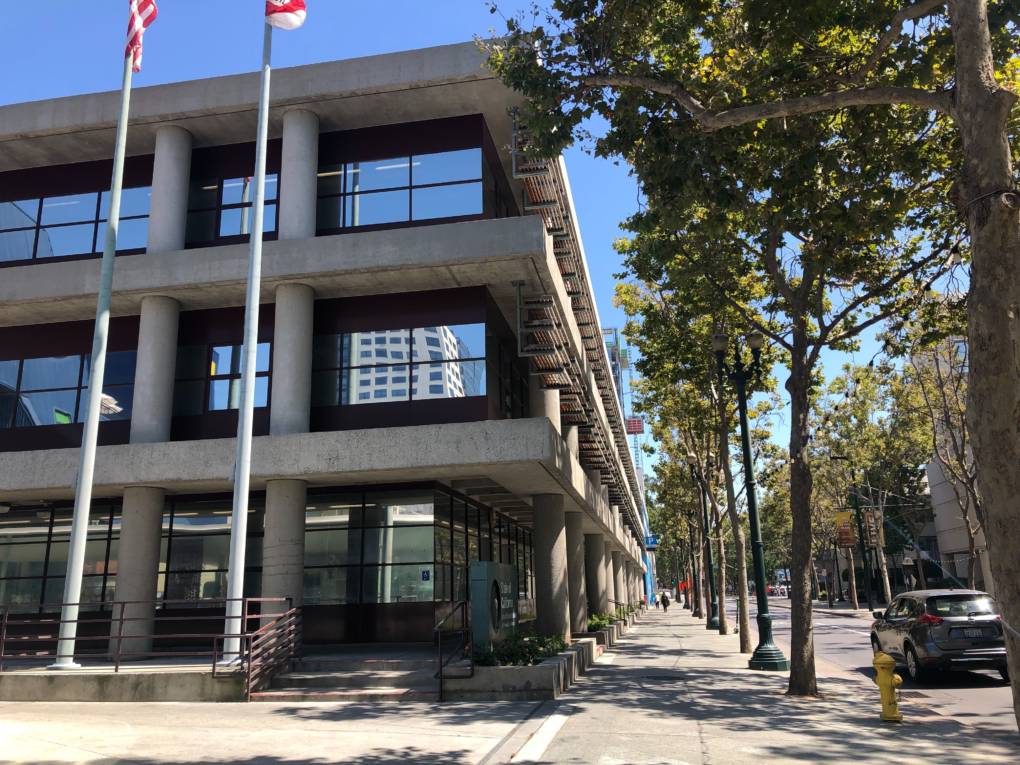
"caption": "The state-owned Alfred E. Alquist Building near San Jose State University may be converted into parking, retail and new residential housing.",
"description": "The state-owned Alfred E. Alquist office building near San Jose State University may be converted into parking, retail and new residential housing.",
"title": "Image from iOS (13)",
"credit": "Sonja Hutson/KQED",
"status": "inherit",
"isLoading": false,
"fetchFailed": false
}
},
"audioPlayerReducer": {
"postId": "stream_live",
"isPaused": true,
"isPlaying": false,
"pfsActive": false,
"pledgeModalIsOpen": true,
"playerDrawerIsOpen": false,
"liveAudioPlayStartedAt": 0,
"liveAudioPlayContext": ""
},
"authorsReducer": {
"byline_news_11768378": {
"type": "authors",
"id": "byline_news_11768378",
"meta": {
"override": true
},
"slug": "byline_news_11768378",
"name": "\u003cstrong>Anna Scott\u003cbr/>KCRW\u003c/strong>",
"isLoading": false
},
"byline_news_11768015": {
"type": "authors",
"id": "byline_news_11768015",
"meta": {
"override": true
},
"slug": "byline_news_11768015",
"name": "\u003ca href= \"https://calmatters.org/author/elizabeth-aguilera/\"> Elizabeth Aguilera \u003ca/>",
"isLoading": false
},
"byline_news_11766434": {
"type": "authors",
"id": "byline_news_11766434",
"meta": {
"override": true
},
"slug": "byline_news_11766434",
"name": "Associated Press",
"isLoading": false
},
"kqed": {
"type": "authors",
"id": "236",
"meta": {
"index": "authors_1716337520",
"id": "236",
"found": true
},
"name": "KQED News Staff",
"firstName": "KQED News Staff",
"lastName": null,
"slug": "kqed",
"email": "faq@kqed.org",
"display_author_email": false,
"staff_mastheads": [],
"title": null,
"bio": null,
"avatar": "https://secure.gravatar.com/avatar/ef0e801a68c4c54afa9180db14084167?s=600&d=blank&r=g",
"twitter": null,
"facebook": null,
"instagram": null,
"linkedin": null,
"sites": [
{
"site": "arts",
"roles": [
"contributor"
]
},
{
"site": "news",
"roles": [
"editor"
]
},
{
"site": "futureofyou",
"roles": [
"author"
]
}
],
"headData": {
"title": "KQED News Staff | KQED",
"description": null,
"ogImgSrc": "https://secure.gravatar.com/avatar/ef0e801a68c4c54afa9180db14084167?s=600&d=blank&r=g",
"twImgSrc": "https://secure.gravatar.com/avatar/ef0e801a68c4c54afa9180db14084167?s=600&d=blank&r=g"
},
"isLoading": false,
"link": "/author/kqed"
},
"rachael-myrow": {
"type": "authors",
"id": "251",
"meta": {
"index": "authors_1716337520",
"id": "251",
"found": true
},
"name": "Rachael Myrow",
"firstName": "Rachael",
"lastName": "Myrow",
"slug": "rachael-myrow",
"email": "rmyrow@kqed.org",
"display_author_email": true,
"staff_mastheads": [
"news"
],
"title": "Senior Editor of KQED's Silicon Valley News Desk",
"bio": "• I write and edit stories about how Silicon Valley power and policies shape everyday life in California. I’m also passionate about making Bay Area history and culture more accessible to a broad public. • I’ve been a journalist for most of my life, starting in high school with The Franklin Press in Los Angeles, where I grew up. While earning my first degree in English at UC Berkeley, I got my start in public radio at KALX-FM. After completing a second degree in journalism at Cal, I landed my first professional job at Marketplace, then moved on to KPCC (now LAist), and then KQED, where I hosted The California Report for more than seven years. • My reporting has appeared on NPR, The World, WBUR’s \u003ci>Here & Now\u003c/i>, and the BBC. I also guest host for KQED’s \u003ci>Forum\u003c/i>, as well as the Commonwealth Club in San Francisco. • I speak periodically on media, democracy and technology issues, and do voiceover work for documentaries and educational video projects. • Outside of the studio, you'll find me hiking Bay Area trails and whipping up Insta-ready meals in my kitchen. • I do not accept gifts, money, or favors from anyone connected to my reporting, I don't pay people for information, and I do not support or donate to political causes. • I strive to treat the people I report on with fairness, honesty, and respect. I also recognize there are often multiple sides to a story and work to verify information through multiple sources and documentation. If I get something wrong, I correct it.",
"avatar": "https://secure.gravatar.com/avatar/3ed8a3c5f26025e4a805ba634cda8cd764906b97438a6d9ce216b044e340da4e?s=600&d=blank&r=g",
"twitter": "rachaelmyrow",
"bluesky": null,
"facebook": null,
"instagram": null,
"linkedin": "https://www.linkedin.com/in/rachaelmyrow/",
"sites": [
{
"site": "arts",
"roles": [
"administrator"
]
},
{
"site": "news",
"roles": [
"edit_others_posts",
"editor"
]
},
{
"site": "futureofyou",
"roles": [
"editor"
]
},
{
"site": "bayareabites",
"roles": [
"editor"
]
},
{
"site": "stateofhealth",
"roles": [
"editor"
]
},
{
"site": "science",
"roles": [
"editor"
]
},
{
"site": "food",
"roles": [
"editor"
]
},
{
"site": "forum",
"roles": [
"editor"
]
},
{
"site": "liveblog",
"roles": [
"author"
]
}
],
"headData": {
"title": "Rachael Myrow | KQED",
"description": "Senior Editor of KQED's Silicon Valley News Desk",
"ogImgSrc": "https://secure.gravatar.com/avatar/3ed8a3c5f26025e4a805ba634cda8cd764906b97438a6d9ce216b044e340da4e?s=600&d=blank&r=g",
"twImgSrc": "https://secure.gravatar.com/avatar/3ed8a3c5f26025e4a805ba634cda8cd764906b97438a6d9ce216b044e340da4e?s=600&d=blank&r=g"
},
"isLoading": false,
"link": "/author/rachael-myrow"
},
"scottshafer": {
"type": "authors",
"id": "255",
"meta": {
"index": "authors_1716337520",
"id": "255",
"found": true
},
"name": "Scott Shafer",
"firstName": "Scott",
"lastName": "Shafer",
"slug": "scottshafer",
"email": "sshafer@kqed.org",
"display_author_email": false,
"staff_mastheads": [
"news"
],
"title": "KQED Contributor",
"bio": "Scott Shafer is a senior editor with the KQED Politics and Government desk. He is co-host of Political Breakdown, the award-winning radio show and podcast with a personal take on the world of politics. Scott came to KQED in 1998 to host the statewide\u003cem> California Report\u003c/em>. Prior to that he had extended stints in politics and government\u003cem>.\u003c/em> He uses that inside experience at KQED in his, reporting, hosting and analysis for the politics desk. Scott collaborated \u003cem>Political Breakdown a\u003c/em>nd on \u003cem>The Political Mind of Jerry Brown, \u003c/em>an eight-part series about the life and extraordinary political career of the former governor. For fun, he plays water polo with the San Francisco Tsunami.",
"avatar": "https://secure.gravatar.com/avatar/a62ebae45b79d7aed1a39a0e3bf68104?s=600&d=blank&r=g",
"twitter": "scottshafer",
"bluesky": null,
"facebook": null,
"instagram": null,
"linkedin": null,
"sites": [
{
"site": "news",
"roles": [
"editor"
]
},
{
"site": "stateofhealth",
"roles": [
"author"
]
},
{
"site": "science",
"roles": [
"author"
]
},
{
"site": "forum",
"roles": [
"subscriber"
]
},
{
"site": "liveblog",
"roles": [
"author"
]
}
],
"headData": {
"title": "Scott Shafer | KQED",
"description": "KQED Contributor",
"ogImgSrc": "https://secure.gravatar.com/avatar/a62ebae45b79d7aed1a39a0e3bf68104?s=600&d=blank&r=g",
"twImgSrc": "https://secure.gravatar.com/avatar/a62ebae45b79d7aed1a39a0e3bf68104?s=600&d=blank&r=g"
},
"isLoading": false,
"link": "/author/scottshafer"
},
"matthewgreen": {
"type": "authors",
"id": "1263",
"meta": {
"index": "authors_1716337520",
"id": "1263",
"found": true
},
"name": "Matthew Green",
"firstName": "Matthew",
"lastName": "Green",
"slug": "matthewgreen",
"email": "mgreen@kqed.org",
"display_author_email": false,
"staff_mastheads": [],
"title": "KQED Editor/Reporter",
"bio": "Matthew Green is a digital media producer for KQED News. He previously produced \u003ca href=\"http://www.kqed.org/lowdown\">The Lowdown\u003c/a>, KQED’s multimedia news education blog. Matthew's written for numerous Bay Area publications, including the Oakland Tribune and San Francisco Chronicle. He also taught journalism classes at Fremont High School in East Oakland.\r\n\r\nEmail: mgreen@kqed.org; Twitter: @MGreenKQED",
"avatar": "https://secure.gravatar.com/avatar/3bf498d1267ca02c8494f33d8cfc575e?s=600&d=blank&r=g",
"twitter": "MGreenKQED",
"facebook": null,
"instagram": null,
"linkedin": null,
"sites": [
{
"site": "news",
"roles": []
},
{
"site": "lowdown",
"roles": []
},
{
"site": "science",
"roles": []
},
{
"site": "education",
"roles": []
},
{
"site": "quest",
"roles": []
},
{
"site": "liveblog",
"roles": []
}
],
"headData": {
"title": "Matthew Green | KQED",
"description": "KQED Editor/Reporter",
"ogImgSrc": "https://secure.gravatar.com/avatar/3bf498d1267ca02c8494f33d8cfc575e?s=600&d=blank&r=g",
"twImgSrc": "https://secure.gravatar.com/avatar/3bf498d1267ca02c8494f33d8cfc575e?s=600&d=blank&r=g"
},
"isLoading": false,
"link": "/author/matthewgreen"
},
"shossaini": {
"type": "authors",
"id": "3214",
"meta": {
"index": "authors_1716337520",
"id": "3214",
"found": true
},
"name": "Sara Hossaini",
"firstName": "Sara",
"lastName": "Hossaini",
"slug": "shossaini",
"email": "shossaini@kqed.org",
"display_author_email": true,
"staff_mastheads": [
"news"
],
"title": "KQED Reporter",
"bio": "Sara Hossaini came to general assignment reporting at KQED in 2013 after two winters reporting at Wyoming Public Radio. She holds a bachelor's degree in broadcast journalism from the University of Nebraska-Lincoln. Her radio romance began after a bitter breakup with documentary film (Ok, maybe it's still complicated). Her first simultaneous jobs in San Francisco were as Associate Producer on a PBS film series through the Center for Asian American Media and as a butler. She likes to trot, plot and make things with her hands.",
"avatar": "https://secure.gravatar.com/avatar/060e9f56b9554e17942e89f413242774?s=600&d=blank&r=g",
"twitter": "mshossaini",
"facebook": null,
"instagram": null,
"linkedin": null,
"sites": [
{
"site": "news",
"roles": [
"author"
]
},
{
"site": "stateofhealth",
"roles": [
"author"
]
}
],
"headData": {
"title": "Sara Hossaini | KQED",
"description": "KQED Reporter",
"ogImgSrc": "https://secure.gravatar.com/avatar/060e9f56b9554e17942e89f413242774?s=600&d=blank&r=g",
"twImgSrc": "https://secure.gravatar.com/avatar/060e9f56b9554e17942e89f413242774?s=600&d=blank&r=g"
},
"isLoading": false,
"link": "/author/shossaini"
},
"ecruzguevarra": {
"type": "authors",
"id": "8654",
"meta": {
"index": "authors_1716337520",
"id": "8654",
"found": true
},
"name": "Ericka Cruz Guevarra",
"firstName": "Ericka",
"lastName": "Cruz Guevarra",
"slug": "ecruzguevarra",
"email": "ecruzguevarra@kqed.org",
"display_author_email": true,
"staff_mastheads": [
"news"
],
"title": "Producer, The Bay Podcast",
"bio": "Ericka Cruz Guevarra is host of \u003ca href=\"https://www.kqed.org/podcasts/thebay\">\u003cem>The Bay\u003c/em>\u003c/a> podcast at KQED. Before host, she was the show’s producer. Her work in that capacity includes a three-part reported series on policing in Vallejo, which won a 2020 excellence in journalism award from the Society of Professional Journalists. Ericka has worked as a breaking news reporter at Oregon Public Broadcasting, helped produce the Code Switch podcast, and was KQED’s inaugural Raul Ramirez Diversity Fund intern. She’s also an alumna of NPR’s Next Generation Radio program. Send her an email if you have strong feelings about whether Fairfield and Suisun City are the Bay. Ericka is represented by SAG-AFTRA.",
"avatar": "https://secure.gravatar.com/avatar/accefc1de4bafc7e234b69bcb9b6f6536c130fd84709bc3069ef11a78787e1bb?s=600&d=blank&r=g",
"twitter": "NotoriousECG",
"bluesky": null,
"facebook": null,
"instagram": null,
"linkedin": null,
"sites": [
{
"site": "arts",
"roles": [
"subscriber"
]
},
{
"site": "news",
"roles": [
"editor",
"manage_categories"
]
},
{
"site": "futureofyou",
"roles": [
"subscriber"
]
},
{
"site": "stateofhealth",
"roles": [
"subscriber"
]
},
{
"site": "science",
"roles": [
"editor"
]
},
{
"site": "forum",
"roles": [
"subscriber"
]
}
],
"headData": {
"title": "Ericka Cruz Guevarra | KQED",
"description": "Producer, The Bay Podcast",
"ogImgSrc": "https://secure.gravatar.com/avatar/accefc1de4bafc7e234b69bcb9b6f6536c130fd84709bc3069ef11a78787e1bb?s=600&d=blank&r=g",
"twImgSrc": "https://secure.gravatar.com/avatar/accefc1de4bafc7e234b69bcb9b6f6536c130fd84709bc3069ef11a78787e1bb?s=600&d=blank&r=g"
},
"isLoading": false,
"link": "/author/ecruzguevarra"
},
"shutson": {
"type": "authors",
"id": "11216",
"meta": {
"index": "authors_1716337520",
"id": "11216",
"found": true
},
"name": "Sonja Hutson",
"firstName": "Sonja",
"lastName": "Hutson",
"slug": "shutson",
"email": "shutson@kqed.org",
"display_author_email": false,
"staff_mastheads": [],
"title": "KQED Contributor",
"bio": "Sonja Hutson is a former reporter for KQED's Silicon Valley desk and weekend newscasts. She primarily covers tech and housing. Sonja is a Bay Area native and now lives in San Francisco. When she's not working, you can find her camping, skiing, scuba diving, and struggling with the New York Times Crossword. Email: \u003ca href=\"mailto:shutson@kqed.org\">shutson@kqed.org. \u003c/a>Twitter: \u003ca href=\"https://twitter.com/SonjaHutson\">@SonjaHutson\u003c/a>",
"avatar": "https://secure.gravatar.com/avatar/7537c5e36818614e599b6c0f41d72b7a?s=600&d=blank&r=g",
"twitter": "SonjaHutson",
"facebook": null,
"instagram": null,
"linkedin": null,
"sites": [
{
"site": "arts",
"roles": [
"author"
]
},
{
"site": "news",
"roles": [
"subscriber"
]
}
],
"headData": {
"title": "Sonja Hutson | KQED",
"description": "KQED Contributor",
"ogImgSrc": "https://secure.gravatar.com/avatar/7537c5e36818614e599b6c0f41d72b7a?s=600&d=blank&r=g",
"twImgSrc": "https://secure.gravatar.com/avatar/7537c5e36818614e599b6c0f41d72b7a?s=600&d=blank&r=g"
},
"isLoading": false,
"link": "/author/shutson"
}
},
"pagesReducer": {
"news_category_housing": {
"type": "terms",
"id": "news_6266",
"meta": {
"index": "terms_1716263798",
"site": "news",
"id": "6266",
"score": 11.039955
},
"featImg": null,
"name": "Housing",
"description": null,
"taxonomy": "category",
"headData": {
"twImgId": null,
"twTitle": null,
"ogTitle": null,
"ogImgId": null,
"twDescription": null,
"description": null,
"title": "Housing Archives | KQED News",
"ogDescription": null
},
"ttid": 6290,
"slug": "housing",
"isLoading": false,
"title": "Housing",
"pageMeta": {
"site": "news",
"WpPageTemplate": "page-topic-editorial",
"currentPage": 96
},
"blocks": [
{
"blockName": "kqed/post-list",
"attrs": {
"layout": "cardArticle2",
"query": "posts/news?category=housing",
"seeMore": false,
"paginated": true,
"page": 96
}
},
{
"blockName": "kqed/ad"
}
]
}
},
"pfsSessionReducer": {},
"postsReducer": {
"stream_live": {
"type": "live",
"id": "stream_live",
"audioUrl": "https://streams.kqed.org/kqedradio",
"title": "Live Stream",
"excerpt": "Live Stream information currently unavailable.",
"link": "/radio",
"featImg": "",
"label": {
"name": "KQED Live",
"link": "/"
}
},
"stream_kqedNewscast": {
"type": "posts",
"id": "stream_kqedNewscast",
"audioUrl": "https://www.kqed.org/.stream/anon/radio/RDnews/newscast.mp3?_=1",
"title": "KQED Newscast",
"featImg": "",
"label": {
"name": "88.5 FM",
"link": "/"
}
},
"news_11767538": {
"type": "posts",
"id": "news_11767538",
"meta": {
"index": "posts_1716263798",
"site": "news",
"id": "11767538",
"score": null,
"sort": [
1566334878000
]
},
"guestAuthors": [],
"slug": "it-felt-like-i-won-the-lottery-how-a-bay-area-woman-helped-build-her-own-affordable-home",
"title": "'It Felt Like I Won the Lottery': How a Bay Area Mom Helped Build Her Own Affordable Home",
"publishDate": 1566334878,
"format": "standard",
"headTitle": "‘It Felt Like I Won the Lottery’: How a Bay Area Mom Helped Build Her Own Affordable Home | KQED",
"labelTerm": {},
"content": "\u003cp>[dropcap]J[/dropcap]ulieta Aquino strolls proudly through her gleaming new home, a modest split-level condo on a busy thoroughfare in Fremont. With her 14-year-old daughter in tow, she scans the still-sparsely furnished, open floor plan living room-kitchen, pointing out the glistening, stainless steel fixtures and laminate countertops.\u003c/p>\n\u003cp>“It’s a pretty decent-sized kitchen, considering it’s just two of us,” said Aquino. “I’m going for a farmhouse style.”\u003c/p>\n\u003cp>A 31-year-old single mom with a limited income and no college degree, Aquino has done the seemingly impossible: become a homeowner in one of the most brutally expensive housing markets in the country.\u003c/p>\n\u003cp>And all she had to do was help build it herself.\u003c/p>\n\u003cp>[pullquote size='medium' align='right' citation=\"Julieta Aquino\"]‘It was never a thought in my mind to be a homeowner because that just seemed so far away.’[/pullquote]\u003c/p>\n\u003cp>This summer, Aquino and her daughter, Alexys, were among 11 low-income families who received keys to their new homes in Central Commons, a small development they all helped build over the past two years as participants in a \u003ca href=\"https://www.habitatebsv.org/\" target=\"_blank\" rel=\"noopener\">Habitat for Humanity East Bay-Silicon Valley\u003c/a> project. Like all future homeowners in the Habitat program, each family was required to put in 500 hours of so-called sweat equity, pounding nails and pouring concrete alongside project managers and volunteer work crews on the construction site.\u003c/p>\n\u003cp>“It was my first time using a hammer,” Aquino admitted, noting the steep learning curve, one that exposed her to everything from fundamental carpentry skills to a basic understanding of California’s building codes.\u003c/p>\n\u003cp>“It’s really neat because even while we were building, we were signing our names on the studs. [My daughter] would come around and just trace her hand, so she knew that behind the Sheetrock and the wall there was her imprint there. It’s cool to know that we left a little piece of us by building the home.”\u003c/p>\n\u003cp>Aquino opens the sliding doors in the living room, stepping onto a small balcony with a table and gas grill. Below us, a construction crew is building a set of adjacent units, where 19 other families are expected to move within the year.\u003c/p>\n\u003cp>“I’m really excited about my grill,” she says, amid the screeching of circular saws and nail guns. “I look forward to summer cookouts, and having breakfast out here. Brunches with family and friends.”\u003c/p>\n\u003cfigure id=\"attachment_11767831\" class=\"wp-caption alignnone\" style=\"max-width: 1920px\">\u003ca href=\"https://ww2.kqed.org/news/wp-content/uploads/sites/10/2019/08/DSC0871-e1565915186695.jpg\">\u003cimg loading=\"lazy\" decoding=\"async\" class=\"size-full wp-image-11767831\" src=\"https://ww2.kqed.org/news/wp-content/uploads/sites/10/2019/08/DSC0871-e1565915186695.jpg\" alt=\"\" width=\"1920\" height=\"1282\">\u003c/a>\u003cfigcaption class=\"wp-caption-text\">Julieta Aquino in her bedroom at the new condo she owns in Fremont. \u003ccite>(Stephanie Lister/KQED)\u003c/cite>\u003c/figcaption>\u003c/figure>\n\u003ch3>‘Definitely Within My Budget’\u003c/h3>\n\u003cp>Although Habitat still owns the property that the development sits on, Aquino and her new neighbors are the legal owners of their individual units. In addition to their sweat equity hours, each family pays a 30-year low-interest mortgage guaranteed to never exceed 35% of their monthly income. That, along with no down payment and minimal closing costs, puts the prospect of homeownership squarely within the realm of possibility for low-income families like Aquino’s, who make between 30-80% of the area median income, in a region where average home prices easily bubble over $1 million.\u003c/p>\n\u003cp>“It’s definitely within my budget,” she said, noting that the program requires every participant to be on a monitored savings plan from the minute they’re selected. “I can assure you there is no other place in the Bay Area that I would be able to afford for the amount of money that I’m paying for this monthly. And it’s new. I helped build it. I helped create it. So it’s definitely a unique situation.”\u003c/p>\n\u003cp>The 33-year-old local Habitat program, which annually serves more than 1,200 residents in Alameda, Contra Costa and Santa Clara counties, is by no means a panacea for the Bay Area’s formidable housing crisis. But it does offer a glimmer of hope in what can be a grim and daunting housing landscape.\u003c/p>\n\u003cp>Aquino steps back into her new living room, closing the double-paned glass doors, which impressively mask the noise outside. She heads up a flight of stairs to Alexys’ bedroom, explaining that it’s the first real personal space her daughter has ever had.\u003c/p>\n\u003ch3>Personal Space\u003c/h3>\n\u003cp>For years after she and Alexys’ father split up, mother and daughter shared a room — and a bed — in her parents’ cramped two-bedroom house in San Jose, where Aquino’s brother, his girlfriend and their newborn son were also staying.\u003c/p>\n\u003cp>“I thought, ‘Oh, I’ll be there for a year or two and then we’ll move back out.’ But that didn’t happen as quickly as I thought it would,” she said. “It got really crowded at times. And so I was desperate to find a place for Alexys and I to just move out and have some quiet, some space.”\u003c/p>\n\u003cp>The stay at her parents’ house stretched to more than five years, she said.\u003c/p>\n\u003cp>“My initial thought was I want to go to the low-income housing areas for the rental market,” she added. “It was never a thought in my mind to be a homeowner because that just seemed so far away.”\u003c/p>\n\u003cp>Alexys also has asthma and the house in San Jose had a serious mold problem, one that resulted in multiple trips to the emergency room.\u003c/p>\n\u003cp>Even though Aquino’s bedroom is now just a few feet down the hall from her daughter’s, she admits that sleeping in separate rooms for the first time in years has been a harder transition than she’d anticipated.\u003c/p>\n\u003cp>“I’m so used to her just sleeping with me that it’s going to take some time for me to fully let go,” Aquino said. “But she’s really excited to have her own room and have her own space.”\u003c/p>\n\u003cp>“It’s a different experience,” said Alexys, a thoughtful and soft-spoken teen, of her new room. “It’s your own space, your own privacy.”\u003c/p>\n\u003cp>But despite being only 30 miles north of San Jose, she added, she felt far away from her old life.\u003c/p>\n\u003cp>“I cried last night because I don’t get to see my friends,” she said. “But I think Fremont will be a good fresh start.”\u003c/p>\n\u003cfigure id=\"attachment_11768701\" class=\"wp-caption aligncenter\" style=\"max-width: 800px\">\u003cimg loading=\"lazy\" decoding=\"async\" class=\"size-medium wp-image-11768701\" src=\"https://ww2.kqed.org/news/wp-content/uploads/sites/10/2019/08/Alexys-at-home-800x522.jpg\" alt=\"Julieta Aquino's daughter Alexys in her new room, the first personal space she's ever had.\" width=\"800\" height=\"522\" srcset=\"https://cdn.kqed.org/wp-content/uploads/sites/10/2019/08/Alexys-at-home-800x522.jpg 800w, https://cdn.kqed.org/wp-content/uploads/sites/10/2019/08/Alexys-at-home-160x104.jpg 160w, https://cdn.kqed.org/wp-content/uploads/sites/10/2019/08/Alexys-at-home-1020x666.jpg 1020w, https://cdn.kqed.org/wp-content/uploads/sites/10/2019/08/Alexys-at-home-1200x783.jpg 1200w, https://cdn.kqed.org/wp-content/uploads/sites/10/2019/08/Alexys-at-home.jpg 1920w\" sizes=\"(max-width: 800px) 100vw, 800px\">\u003cfigcaption class=\"wp-caption-text\">Julieta Aquino’s daughter, Alexys, in her new room, the first personal space she’s ever had. \u003ccite>(Stephanie Lister/KQED)\u003c/cite>\u003c/figcaption>\u003c/figure>\n\u003cp>Alexys had been too young to participate in the construction process but became a fixture on the work site over the last two years, decorating signs to place around the grounds while watching her mom help build their future home.\u003c/p>\n\u003cp>“It was interesting because you pass by these buildings every day, and you never really know all the hard work that goes into them. So seeing it from behind the scenes, and how you have to put Sheetrock in certain areas and studs between the walls,” she said. “But it did take some time. It was a process.”\u003c/p>\n\u003cp>[aside label=\"related stories\" tag=\"affordable-housing\"]\u003c/p>\n\u003ch3>Long Waiting Game\u003c/h3>\n\u003cp>Aquino, who works full time in the accounting department of a medical device company, found out about the program roughly five years ago. She immediately applied, but was initially rejected because of her poor credit history. A Habitat financial counselor, she said, worked with her to improve her credit score, and when she reapplied a year later, she was approved and put on a housing waitlist with scores of other applicants.\u003c/p>\n\u003cp>It wasn’t until 2½ years later that she received a call informing her that Habitat had secured a piece of land in Fremont, in partnership with the city.\u003c/p>\n\u003cp>“Then another year passed by and I was anxious,” she said. “I was constantly emailing my rep at Habitat. It felt like it was just never gonna happen.”\u003c/p>\n\u003cp>In November 2017 — more than three years after she’d first applied — Aquino was told the project was finally ready to break ground. She entered a final elimination process, in which program staff visited her parents’ San Jose home to assess her current living conditions and confirm her need to move elsewhere.\u003c/p>\n\u003cp>Shortly after that, Aquino found out that she and her daughter were one of the 11 families — out of the hundreds in the selection pool — chosen to move into the first set of still-to-be-built units.\u003c/p>\n\u003cp>“I couldn’t believe it,” she said. “I felt like it was a miracle, like I had just won the lottery.”\u003c/p>\n\u003cfigure id=\"attachment_11768704\" class=\"wp-caption aligncenter\" style=\"max-width: 800px\">\u003cimg loading=\"lazy\" decoding=\"async\" class=\"size-medium wp-image-11768704\" src=\"https://ww2.kqed.org/news/wp-content/uploads/sites/10/2019/08/Julieta-Aquino-kitchen-800x534.jpg\" alt=\"Julieta Aquino in her spotless new kitchen.\" width=\"800\" height=\"534\" srcset=\"https://cdn.kqed.org/wp-content/uploads/sites/10/2019/08/Julieta-Aquino-kitchen-800x534.jpg 800w, https://cdn.kqed.org/wp-content/uploads/sites/10/2019/08/Julieta-Aquino-kitchen-160x107.jpg 160w, https://cdn.kqed.org/wp-content/uploads/sites/10/2019/08/Julieta-Aquino-kitchen-1020x681.jpg 1020w, https://cdn.kqed.org/wp-content/uploads/sites/10/2019/08/Julieta-Aquino-kitchen-1200x801.jpg 1200w, https://cdn.kqed.org/wp-content/uploads/sites/10/2019/08/Julieta-Aquino-kitchen.jpg 1920w\" sizes=\"(max-width: 800px) 100vw, 800px\">\u003cfigcaption class=\"wp-caption-text\">Julieta Aquino in her spotless new kitchen. \u003ccite>(Stephanie Lister/KQED)\u003c/cite>\u003c/figcaption>\u003c/figure>\n\u003ch3>Sweat Equity\u003c/h3>\n\u003cp>Homeownership, though, still seemed elusive, in no small part because there wasn’t any physical structure yet and she still needed to put in her sweat equity.\u003c/p>\n\u003cp>“It was overwhelming to think that I was going to have to do 500 community service hours alone, knowing that I’m a full-time mom and full-time employee and it was 30 miles away from where I lived at the time,” said Aquino. But the program offered some flexibility, allowing her friends and family to contribute up to 200 hours of the required time, and giving her the option to work some hours off the construction site, helping out with Habitat fundraising projects.\u003c/p>\n\u003cp>Over the next year, Aquino slowly fulfilled her work requirements, putting in time on weekday evenings after picking up her daughter from school, and spending every weekend getting her hands dirty at the construction site.\u003c/p>\n\u003cp>“So it was possible, but it was a lot,” she said. “I think as long as you really want it, you’ll find a way.”\u003c/p>\n\u003cp>[pullquote size='medium' align='right' citation=\"Julieta Aquino\"]‘I think as long as you really want it, you’ll find a way.’[/pullquote]\u003c/p>\n\u003cp>But she acknowledges that if she hadn’t had the option to stay with her parents, she might not have been able to swing it.\u003c/p>\n\u003ch3>‘Blessed’\u003c/h3>\n\u003cp>Aquino estimates that roughly 30% of the family and friends she grew up with in San Jose have now moved away. “Not just out of the Bay Area to go to Central Valley or to Sacramento,” she said. “No, it’s just moving completely out of state. … It’s completely impossible for them to own their own home in the Bay Area.”\u003c/p>\n\u003cp>The region’s skyrocketing land and construction costs have also placed significant strain on the Habitat’s ability to find affordable building opportunities. The group, which relies on land partnerships with the cities it operates in, recently decided to offer the additional 19 units under construction in the Central Commons complex to families with more moderate incomes, earning 80-120% of the area median income, rather than the low-income families, like Aquino’s, who moved into the first 11 homes.\u003c/p>\n\u003cp>\u003ca href=\"https://ww2.kqed.org/news/wp-content/uploads/sites/10/2019/08/RS37791__DSC0888-qut.jpg\">\u003cimg loading=\"lazy\" decoding=\"async\" class=\"alignnone size-full wp-image-11767898\" src=\"https://ww2.kqed.org/news/wp-content/uploads/sites/10/2019/08/RS37791__DSC0888-qut.jpg\" alt=\"\" width=\"1920\" height=\"1281\" srcset=\"https://cdn.kqed.org/wp-content/uploads/sites/10/2019/08/RS37791__DSC0888-qut.jpg 1920w, https://cdn.kqed.org/wp-content/uploads/sites/10/2019/08/RS37791__DSC0888-qut-160x107.jpg 160w, https://cdn.kqed.org/wp-content/uploads/sites/10/2019/08/RS37791__DSC0888-qut-800x534.jpg 800w, https://cdn.kqed.org/wp-content/uploads/sites/10/2019/08/RS37791__DSC0888-qut-1020x681.jpg 1020w, https://cdn.kqed.org/wp-content/uploads/sites/10/2019/08/RS37791__DSC0888-qut-1200x801.jpg 1200w\" sizes=\"(max-width: 1920px) 100vw, 1920px\">\u003c/a>\u003c/p>\n\u003cp>“These homes are still affordable, being sold significantly below market rate with mortgages affordable for a moderate-income family,” Patti Wang Cross, a spokeswoman for Habitat for Humanity East Bay-Silicon Valley, said in an email, noting that the organization’s decision was furthered by a recent decline in funding sources. “It’s a population of families severely impacted by the housing crisis, too often priced out of the homeownership market but seldom served by affordable housing initiatives.”\u003c/p>\n\u003cp>The new higher-income requirement is yet another reason Aquino is so quick to acknowledge how fortunate she and her daughter are. “Blessed” is an adjective she uses frequently to describe the situation.\u003c/p>\n\u003cp>“I had my daughter when I was 16 and it’s been quite a journey,” she said. “And being able to say that I’m a homeowner at the age of 31, and she’s 14, I feel like I’ve come a long way. I definitely feel blessed, but I feel like everything that I do, I do because I want to set a good example for her and show her that although we might make different choices, or in this case sometimes not the wisest choices, I feel like we can still turn things around and make our future different.”\u003c/p>\n\u003cp>\u003cem>The California Dream series is a statewide media collaboration of CalMatters, KPBS, KPCC, KQED and Capital Public Radio, with support from the Corporation for Public Broadcasting, the James Irvine Foundation and the College Futures Foundation.\u003c/em>\u003c/p>\n\u003cp>\u003ca href=\"https://ww2.kqed.org/news/wp-content/uploads/sites/10/2019/08/CADreamBanner-1-800x219.jpg\">\u003cimg loading=\"lazy\" decoding=\"async\" class=\"alignnone size-full wp-image-11768052\" src=\"https://ww2.kqed.org/news/wp-content/uploads/sites/10/2019/08/CADreamBanner-1-800x219.jpg\" alt=\"\" width=\"800\" height=\"219\" srcset=\"https://cdn.kqed.org/wp-content/uploads/sites/10/2019/08/CADreamBanner-1-800x219.jpg 800w, https://cdn.kqed.org/wp-content/uploads/sites/10/2019/08/CADreamBanner-1-800x219-160x44.jpg 160w\" sizes=\"(max-width: 800px) 100vw, 800px\">\u003c/a>\u003c/p>\n\u003cp>[ad fullwidth]\u003c/p>\n\u003cp>[ad floatright]\u003c/p>\n",
"blocks": [],
"excerpt": "Julieta Aquino and her daughter are among a group of 11 low-income families who recently became homeowners in a Fremont housing development, one they helped build over the past two years as participants in a Habitat for Humanity project.",
"status": "publish",
"parent": 0,
"modified": 1721119354,
"stats": {
"hasAudio": false,
"hasVideo": false,
"hasChartOrMap": false,
"iframeSrcs": [],
"hasGoogleForm": false,
"hasGallery": false,
"hasHearkenModule": false,
"hasPolis": false,
"paragraphCount": 49,
"wordCount": 2182
},
"headData": {
"title": "'It Felt Like I Won the Lottery': How a Bay Area Mom Helped Build Her Own Affordable Home | KQED",
"description": "Julieta Aquino and her daughter are among a group of 11 low-income families who recently became homeowners in a Fremont housing development, one they helped build over the past two years as participants in a Habitat for Humanity project.",
"ogTitle": "",
"ogDescription": "",
"ogImgId": "",
"twTitle": "",
"twDescription": "",
"twImgId": "",
"schema": {
"@context": "https://schema.org",
"@type": "NewsArticle",
"headline": "'It Felt Like I Won the Lottery': How a Bay Area Mom Helped Build Her Own Affordable Home",
"datePublished": "2019-08-20T14:01:18-07:00",
"dateModified": "2024-07-16T01:42:34-07:00",
"image": "https://cdn.kqed.org/wp-content/uploads/2020/02/KQED-OG-Image@1x.png",
"isAccessibleForFree": "True",
"publisher": {
"@type": "NewsMediaOrganization",
"@id": "https://www.kqed.org/#organization",
"name": "KQED",
"logo": "https://cdn.kqed.org/wp-content/uploads/2020/02/KQED-OG-Image@1x.png",
"url": "https://www.kqed.org",
"sameAs": [
"https://www.facebook.com/KQED",
"https://twitter.com/KQED",
"https://www.instagram.com/kqed/",
"https://www.tiktok.com/@kqedofficial",
"https://www.linkedin.com/company/kqed",
"https://www.youtube.com/channel/UCeC0IOo7i1P_61zVUWbJ4nw"
]
}
}
},
"source": "News",
"sourceUrl": "http://www.kqed.org/news/",
"audioUrl": "https://ww2.kqed.org/news/wp-content/uploads/sites/10/2019/08/HabitatHousing-online-audio-converter.com_.mp3",
"sticky": false,
"audioTrackLength": 166,
"path": "/news/11767538/it-felt-like-i-won-the-lottery-how-a-bay-area-woman-helped-build-her-own-affordable-home",
"audioDuration": 166000,
"parsedContent": [
{
"type": "contentString",
"content": "\u003cdiv class=\"post-body\">\u003cp>\u003cp>\u003c/p>\u003cp>\u003cspan class=\"utils-parseShortcode-shortcodes-__dropcapShortcode__dropcap\">J\u003c/span>\u003c/p>\u003cp>ulieta Aquino strolls proudly through her gleaming new home, a modest split-level condo on a busy thoroughfare in Fremont. With her 14-year-old daughter in tow, she scans the still-sparsely furnished, open floor plan living room-kitchen, pointing out the glistening, stainless steel fixtures and laminate countertops.\u003c/p>\n\u003cp>“It’s a pretty decent-sized kitchen, considering it’s just two of us,” said Aquino. “I’m going for a farmhouse style.”\u003c/p>\n\u003cp>A 31-year-old single mom with a limited income and no college degree, Aquino has done the seemingly impossible: become a homeowner in one of the most brutally expensive housing markets in the country.\u003c/p>\n\u003cp>And all she had to do was help build it herself.\u003c/p>\n\u003cp>\u003c/p>\u003c/div>",
"attributes": {
"named": {},
"numeric": []
}
},
{
"type": "component",
"content": "‘It was never a thought in my mind to be a homeowner because that just seemed so far away.’",
"name": "pullquote",
"attributes": {
"named": {
"size": "medium",
"align": "right",
"citation": "Julieta Aquino",
"label": ""
},
"numeric": []
}
},
{
"type": "contentString",
"content": "\u003cdiv class=\"post-body\">\u003cp>\u003c/p>\n\u003cp>This summer, Aquino and her daughter, Alexys, were among 11 low-income families who received keys to their new homes in Central Commons, a small development they all helped build over the past two years as participants in a \u003ca href=\"https://www.habitatebsv.org/\" target=\"_blank\" rel=\"noopener\">Habitat for Humanity East Bay-Silicon Valley\u003c/a> project. Like all future homeowners in the Habitat program, each family was required to put in 500 hours of so-called sweat equity, pounding nails and pouring concrete alongside project managers and volunteer work crews on the construction site.\u003c/p>\n\u003cp>“It was my first time using a hammer,” Aquino admitted, noting the steep learning curve, one that exposed her to everything from fundamental carpentry skills to a basic understanding of California’s building codes.\u003c/p>\n\u003cp>“It’s really neat because even while we were building, we were signing our names on the studs. [My daughter] would come around and just trace her hand, so she knew that behind the Sheetrock and the wall there was her imprint there. It’s cool to know that we left a little piece of us by building the home.”\u003c/p>\n\u003cp>Aquino opens the sliding doors in the living room, stepping onto a small balcony with a table and gas grill. Below us, a construction crew is building a set of adjacent units, where 19 other families are expected to move within the year.\u003c/p>\n\u003cp>“I’m really excited about my grill,” she says, amid the screeching of circular saws and nail guns. “I look forward to summer cookouts, and having breakfast out here. Brunches with family and friends.”\u003c/p>\n\u003cfigure id=\"attachment_11767831\" class=\"wp-caption alignnone\" style=\"max-width: 1920px\">\u003ca href=\"https://ww2.kqed.org/news/wp-content/uploads/sites/10/2019/08/DSC0871-e1565915186695.jpg\">\u003cimg loading=\"lazy\" decoding=\"async\" class=\"size-full wp-image-11767831\" src=\"https://ww2.kqed.org/news/wp-content/uploads/sites/10/2019/08/DSC0871-e1565915186695.jpg\" alt=\"\" width=\"1920\" height=\"1282\">\u003c/a>\u003cfigcaption class=\"wp-caption-text\">Julieta Aquino in her bedroom at the new condo she owns in Fremont. \u003ccite>(Stephanie Lister/KQED)\u003c/cite>\u003c/figcaption>\u003c/figure>\n\u003ch3>‘Definitely Within My Budget’\u003c/h3>\n\u003cp>Although Habitat still owns the property that the development sits on, Aquino and her new neighbors are the legal owners of their individual units. In addition to their sweat equity hours, each family pays a 30-year low-interest mortgage guaranteed to never exceed 35% of their monthly income. That, along with no down payment and minimal closing costs, puts the prospect of homeownership squarely within the realm of possibility for low-income families like Aquino’s, who make between 30-80% of the area median income, in a region where average home prices easily bubble over $1 million.\u003c/p>\n\u003cp>“It’s definitely within my budget,” she said, noting that the program requires every participant to be on a monitored savings plan from the minute they’re selected. “I can assure you there is no other place in the Bay Area that I would be able to afford for the amount of money that I’m paying for this monthly. And it’s new. I helped build it. I helped create it. So it’s definitely a unique situation.”\u003c/p>\n\u003cp>The 33-year-old local Habitat program, which annually serves more than 1,200 residents in Alameda, Contra Costa and Santa Clara counties, is by no means a panacea for the Bay Area’s formidable housing crisis. But it does offer a glimmer of hope in what can be a grim and daunting housing landscape.\u003c/p>\n\u003cp>Aquino steps back into her new living room, closing the double-paned glass doors, which impressively mask the noise outside. She heads up a flight of stairs to Alexys’ bedroom, explaining that it’s the first real personal space her daughter has ever had.\u003c/p>\n\u003ch3>Personal Space\u003c/h3>\n\u003cp>For years after she and Alexys’ father split up, mother and daughter shared a room — and a bed — in her parents’ cramped two-bedroom house in San Jose, where Aquino’s brother, his girlfriend and their newborn son were also staying.\u003c/p>\n\u003cp>“I thought, ‘Oh, I’ll be there for a year or two and then we’ll move back out.’ But that didn’t happen as quickly as I thought it would,” she said. “It got really crowded at times. And so I was desperate to find a place for Alexys and I to just move out and have some quiet, some space.”\u003c/p>\n\u003cp>The stay at her parents’ house stretched to more than five years, she said.\u003c/p>\n\u003cp>“My initial thought was I want to go to the low-income housing areas for the rental market,” she added. “It was never a thought in my mind to be a homeowner because that just seemed so far away.”\u003c/p>\n\u003cp>Alexys also has asthma and the house in San Jose had a serious mold problem, one that resulted in multiple trips to the emergency room.\u003c/p>\n\u003cp>Even though Aquino’s bedroom is now just a few feet down the hall from her daughter’s, she admits that sleeping in separate rooms for the first time in years has been a harder transition than she’d anticipated.\u003c/p>\n\u003cp>“I’m so used to her just sleeping with me that it’s going to take some time for me to fully let go,” Aquino said. “But she’s really excited to have her own room and have her own space.”\u003c/p>\n\u003cp>“It’s a different experience,” said Alexys, a thoughtful and soft-spoken teen, of her new room. “It’s your own space, your own privacy.”\u003c/p>\n\u003cp>But despite being only 30 miles north of San Jose, she added, she felt far away from her old life.\u003c/p>\n\u003cp>“I cried last night because I don’t get to see my friends,” she said. “But I think Fremont will be a good fresh start.”\u003c/p>\n\u003cfigure id=\"attachment_11768701\" class=\"wp-caption aligncenter\" style=\"max-width: 800px\">\u003cimg loading=\"lazy\" decoding=\"async\" class=\"size-medium wp-image-11768701\" src=\"https://ww2.kqed.org/news/wp-content/uploads/sites/10/2019/08/Alexys-at-home-800x522.jpg\" alt=\"Julieta Aquino's daughter Alexys in her new room, the first personal space she's ever had.\" width=\"800\" height=\"522\" srcset=\"https://cdn.kqed.org/wp-content/uploads/sites/10/2019/08/Alexys-at-home-800x522.jpg 800w, https://cdn.kqed.org/wp-content/uploads/sites/10/2019/08/Alexys-at-home-160x104.jpg 160w, https://cdn.kqed.org/wp-content/uploads/sites/10/2019/08/Alexys-at-home-1020x666.jpg 1020w, https://cdn.kqed.org/wp-content/uploads/sites/10/2019/08/Alexys-at-home-1200x783.jpg 1200w, https://cdn.kqed.org/wp-content/uploads/sites/10/2019/08/Alexys-at-home.jpg 1920w\" sizes=\"(max-width: 800px) 100vw, 800px\">\u003cfigcaption class=\"wp-caption-text\">Julieta Aquino’s daughter, Alexys, in her new room, the first personal space she’s ever had. \u003ccite>(Stephanie Lister/KQED)\u003c/cite>\u003c/figcaption>\u003c/figure>\n\u003cp>Alexys had been too young to participate in the construction process but became a fixture on the work site over the last two years, decorating signs to place around the grounds while watching her mom help build their future home.\u003c/p>\n\u003cp>“It was interesting because you pass by these buildings every day, and you never really know all the hard work that goes into them. So seeing it from behind the scenes, and how you have to put Sheetrock in certain areas and studs between the walls,” she said. “But it did take some time. It was a process.”\u003c/p>\n\u003cp>\u003c/p>\u003c/div>",
"attributes": {
"named": {},
"numeric": []
}
},
{
"type": "component",
"content": "",
"name": "aside",
"attributes": {
"named": {
"label": "related stories ",
"tag": "affordable-housing"
},
"numeric": []
}
},
{
"type": "contentString",
"content": "\u003cdiv class=\"post-body\">\u003cp>\u003c/p>\n\u003ch3>Long Waiting Game\u003c/h3>\n\u003cp>Aquino, who works full time in the accounting department of a medical device company, found out about the program roughly five years ago. She immediately applied, but was initially rejected because of her poor credit history. A Habitat financial counselor, she said, worked with her to improve her credit score, and when she reapplied a year later, she was approved and put on a housing waitlist with scores of other applicants.\u003c/p>\n\u003cp>It wasn’t until 2½ years later that she received a call informing her that Habitat had secured a piece of land in Fremont, in partnership with the city.\u003c/p>\n\u003cp>“Then another year passed by and I was anxious,” she said. “I was constantly emailing my rep at Habitat. It felt like it was just never gonna happen.”\u003c/p>\n\u003cp>In November 2017 — more than three years after she’d first applied — Aquino was told the project was finally ready to break ground. She entered a final elimination process, in which program staff visited her parents’ San Jose home to assess her current living conditions and confirm her need to move elsewhere.\u003c/p>\n\u003cp>Shortly after that, Aquino found out that she and her daughter were one of the 11 families — out of the hundreds in the selection pool — chosen to move into the first set of still-to-be-built units.\u003c/p>\n\u003cp>“I couldn’t believe it,” she said. “I felt like it was a miracle, like I had just won the lottery.”\u003c/p>\n\u003cfigure id=\"attachment_11768704\" class=\"wp-caption aligncenter\" style=\"max-width: 800px\">\u003cimg loading=\"lazy\" decoding=\"async\" class=\"size-medium wp-image-11768704\" src=\"https://ww2.kqed.org/news/wp-content/uploads/sites/10/2019/08/Julieta-Aquino-kitchen-800x534.jpg\" alt=\"Julieta Aquino in her spotless new kitchen.\" width=\"800\" height=\"534\" srcset=\"https://cdn.kqed.org/wp-content/uploads/sites/10/2019/08/Julieta-Aquino-kitchen-800x534.jpg 800w, https://cdn.kqed.org/wp-content/uploads/sites/10/2019/08/Julieta-Aquino-kitchen-160x107.jpg 160w, https://cdn.kqed.org/wp-content/uploads/sites/10/2019/08/Julieta-Aquino-kitchen-1020x681.jpg 1020w, https://cdn.kqed.org/wp-content/uploads/sites/10/2019/08/Julieta-Aquino-kitchen-1200x801.jpg 1200w, https://cdn.kqed.org/wp-content/uploads/sites/10/2019/08/Julieta-Aquino-kitchen.jpg 1920w\" sizes=\"(max-width: 800px) 100vw, 800px\">\u003cfigcaption class=\"wp-caption-text\">Julieta Aquino in her spotless new kitchen. \u003ccite>(Stephanie Lister/KQED)\u003c/cite>\u003c/figcaption>\u003c/figure>\n\u003ch3>Sweat Equity\u003c/h3>\n\u003cp>Homeownership, though, still seemed elusive, in no small part because there wasn’t any physical structure yet and she still needed to put in her sweat equity.\u003c/p>\n\u003cp>“It was overwhelming to think that I was going to have to do 500 community service hours alone, knowing that I’m a full-time mom and full-time employee and it was 30 miles away from where I lived at the time,” said Aquino. But the program offered some flexibility, allowing her friends and family to contribute up to 200 hours of the required time, and giving her the option to work some hours off the construction site, helping out with Habitat fundraising projects.\u003c/p>\n\u003cp>Over the next year, Aquino slowly fulfilled her work requirements, putting in time on weekday evenings after picking up her daughter from school, and spending every weekend getting her hands dirty at the construction site.\u003c/p>\n\u003cp>“So it was possible, but it was a lot,” she said. “I think as long as you really want it, you’ll find a way.”\u003c/p>\n\u003cp>\u003c/p>\u003c/div>",
"attributes": {
"named": {},
"numeric": []
}
},
{
"type": "component",
"content": "‘I think as long as you really want it, you’ll find a way.’",
"name": "pullquote",
"attributes": {
"named": {
"size": "medium",
"align": "right",
"citation": "Julieta Aquino",
"label": ""
},
"numeric": []
}
},
{
"type": "contentString",
"content": "\u003cdiv class=\"post-body\">\u003cp>\u003c/p>\n\u003cp>But she acknowledges that if she hadn’t had the option to stay with her parents, she might not have been able to swing it.\u003c/p>\n\u003ch3>‘Blessed’\u003c/h3>\n\u003cp>Aquino estimates that roughly 30% of the family and friends she grew up with in San Jose have now moved away. “Not just out of the Bay Area to go to Central Valley or to Sacramento,” she said. “No, it’s just moving completely out of state. … It’s completely impossible for them to own their own home in the Bay Area.”\u003c/p>\n\u003cp>The region’s skyrocketing land and construction costs have also placed significant strain on the Habitat’s ability to find affordable building opportunities. The group, which relies on land partnerships with the cities it operates in, recently decided to offer the additional 19 units under construction in the Central Commons complex to families with more moderate incomes, earning 80-120% of the area median income, rather than the low-income families, like Aquino’s, who moved into the first 11 homes.\u003c/p>\n\u003cp>\u003ca href=\"https://ww2.kqed.org/news/wp-content/uploads/sites/10/2019/08/RS37791__DSC0888-qut.jpg\">\u003cimg loading=\"lazy\" decoding=\"async\" class=\"alignnone size-full wp-image-11767898\" src=\"https://ww2.kqed.org/news/wp-content/uploads/sites/10/2019/08/RS37791__DSC0888-qut.jpg\" alt=\"\" width=\"1920\" height=\"1281\" srcset=\"https://cdn.kqed.org/wp-content/uploads/sites/10/2019/08/RS37791__DSC0888-qut.jpg 1920w, https://cdn.kqed.org/wp-content/uploads/sites/10/2019/08/RS37791__DSC0888-qut-160x107.jpg 160w, https://cdn.kqed.org/wp-content/uploads/sites/10/2019/08/RS37791__DSC0888-qut-800x534.jpg 800w, https://cdn.kqed.org/wp-content/uploads/sites/10/2019/08/RS37791__DSC0888-qut-1020x681.jpg 1020w, https://cdn.kqed.org/wp-content/uploads/sites/10/2019/08/RS37791__DSC0888-qut-1200x801.jpg 1200w\" sizes=\"(max-width: 1920px) 100vw, 1920px\">\u003c/a>\u003c/p>\n\u003cp>“These homes are still affordable, being sold significantly below market rate with mortgages affordable for a moderate-income family,” Patti Wang Cross, a spokeswoman for Habitat for Humanity East Bay-Silicon Valley, said in an email, noting that the organization’s decision was furthered by a recent decline in funding sources. “It’s a population of families severely impacted by the housing crisis, too often priced out of the homeownership market but seldom served by affordable housing initiatives.”\u003c/p>\n\u003cp>The new higher-income requirement is yet another reason Aquino is so quick to acknowledge how fortunate she and her daughter are. “Blessed” is an adjective she uses frequently to describe the situation.\u003c/p>\n\u003cp>“I had my daughter when I was 16 and it’s been quite a journey,” she said. “And being able to say that I’m a homeowner at the age of 31, and she’s 14, I feel like I’ve come a long way. I definitely feel blessed, but I feel like everything that I do, I do because I want to set a good example for her and show her that although we might make different choices, or in this case sometimes not the wisest choices, I feel like we can still turn things around and make our future different.”\u003c/p>\n\u003cp>\u003cem>The California Dream series is a statewide media collaboration of CalMatters, KPBS, KPCC, KQED and Capital Public Radio, with support from the Corporation for Public Broadcasting, the James Irvine Foundation and the College Futures Foundation.\u003c/em>\u003c/p>\n\u003cp>\u003ca href=\"https://ww2.kqed.org/news/wp-content/uploads/sites/10/2019/08/CADreamBanner-1-800x219.jpg\">\u003cimg loading=\"lazy\" decoding=\"async\" class=\"alignnone size-full wp-image-11768052\" src=\"https://ww2.kqed.org/news/wp-content/uploads/sites/10/2019/08/CADreamBanner-1-800x219.jpg\" alt=\"\" width=\"800\" height=\"219\" srcset=\"https://cdn.kqed.org/wp-content/uploads/sites/10/2019/08/CADreamBanner-1-800x219.jpg 800w, https://cdn.kqed.org/wp-content/uploads/sites/10/2019/08/CADreamBanner-1-800x219-160x44.jpg 160w\" sizes=\"(max-width: 800px) 100vw, 800px\">\u003c/a>\u003c/p>\n\u003cp>\u003c/p>\u003c/div>",
"attributes": {
"named": {},
"numeric": []
}
},
{
"type": "component",
"content": "",
"name": "ad",
"attributes": {
"named": {
"label": "fullwidth"
},
"numeric": [
"fullwidth"
]
}
},
{
"type": "contentString",
"content": "\u003cdiv class=\"post-body\">\u003cp>\u003c/p>\n\u003cp>\u003c/p>\u003c/div>",
"attributes": {
"named": {},
"numeric": []
}
},
{
"type": "component",
"content": "",
"name": "ad",
"attributes": {
"named": {
"label": "floatright"
},
"numeric": [
"floatright"
]
}
},
{
"type": "contentString",
"content": "\u003cdiv class=\"post-body\">\u003cp>\u003c/p>\n\u003c/div>\u003c/p>",
"attributes": {
"named": {},
"numeric": []
}
}
],
"link": "/news/11767538/it-felt-like-i-won-the-lottery-how-a-bay-area-woman-helped-build-her-own-affordable-home",
"authors": [
"1263"
],
"programs": [
"news_72"
],
"series": [
"news_21879"
],
"categories": [
"news_1758",
"news_6266",
"news_8"
],
"tags": [
"news_3921",
"news_21840",
"news_19542",
"news_66",
"news_1775"
],
"featImg": "news_11767833",
"label": "source_news_11767538"
},
"news_11768378": {
"type": "posts",
"id": "news_11768378",
"meta": {
"index": "posts_1716263798",
"site": "news",
"id": "11768378",
"score": null,
"sort": [
1566228630000
]
},
"parent": 0,
"labelTerm": {},
"blocks": [],
"publishDate": 1566228630,
"format": "standard",
"disqusTitle": "Amid Homelessness Crisis, Los Angeles Restricts Living in Vehicles",
"title": "Amid Homelessness Crisis, Los Angeles Restricts Living in Vehicles",
"headTitle": "The California Report | KQED News",
"content": "\u003cp>Along a big, commercial street in Los Angeles' North Hollywood area, near a row of empty storefronts, about half a dozen motor homes sat parked on a recent morning. Inside one of them, 67-year-old Edith Grays and her husband watched TV with the door open. Grays said they'd been there a few days, despite a two-hour parking limit. \u003c/p>\n\u003cp>\"Thank God they're not bothering us right now,\" she said.\u003c/p>\n\u003cp>It's not unusual to see clusters of campers around the city. Grays is one of the nearly 10,000 people who live in vehicles inside L.A.'s city limits. Some take shelter in cars, others in vans or trucks, but RVs are the most visible. They're also the most difficult to park — especially now.\u003c/p>\n\u003cp>The Los Angeles City Council recently reinstated an ordinance that bans sleeping overnight in vehicles in residential areas. The law also forbids living in a vehicle within a block of a park, school or day care. Tickets for violating the rules start at $25 for a first offense, $50 the second time and $75 after that.\u003c/p>\n\u003cp>\u003cstrong>Neighborhoods divided\u003c/strong>\u003c/p>\n\u003cp>Residents who support the restrictions say vehicle encampments have caused parking shortages and sanitation issues. Critics say that without alternatives to parking on the street, the rules are inhumane.\u003c/p>\n\u003cp>\"This is a stupid law,\" Mel Tillekeratne, executive director of a homelessness nonprofit called The Shower of Hope, said during a recent public meeting. \"This law ... is going to directly contribute to these people being on the street.\"\u003c/p>\n\u003cp>For Edith Grays, who ran a window-washing business with her husband until he had a series of strokes and couldn't work, losing their motor home is a big fear. She said they moved into it after not being able to afford rent anymore, and she takes care to avoid being ticketed or towed. When asked how much of her time is spent looking for parking or planning where to park next, Grays replied: \"All of it.\"\u003c/p>\n\u003cp>[aside tag=\"homeless-project\" label=\"Coverage of Homelessness in the Bay Area\"]\u003c/p>\n\u003cp>\"It's very difficult,\" she said. \"It causes a lot of stress in my life.\" \u003c/p>\n\u003cp>Just a couple of miles away, however, homeowner Walter Hall says RV encampments have choked major streets and that public urination by people living in vehicles has been a problem for at least one local park. \"That's the kind of thing we would prefer not to see,\" he said.\u003c/p>\n\u003cp>Hall supports the city having rules around vehicle dwelling but said enforcement should be tougher. A \u003ca href=\"http://clkrep.lacity.org/onlinedocs/2014/14-1057-S2_misc_09-06-2018.pdf\">2018 report\u003c/a> from the Los Angeles Police Department said that officers issued about 10 citations a month, partly because it's difficult to confirm when people are living in vehicles.\u003c/p>\n\u003cp>One result, Hall said, is that the restrictions mostly just shuffle people from one location to another.\u003c/p>\n\u003cp>\"They disappear one place only to reappear someplace else,\" he said. \u003c/p>\n\u003cp>\u003cstrong>A national problem\u003c/strong>\u003c/p>\n\u003cp>Los Angeles isn't the only city struggling to balance the rights of those with and those without homes. Over the past decade, municipalities around the country with large homeless populations have passed laws banning activities such as panhandling or sleeping in public areas. \u003c/p>\n\u003cp>Ordinances limiting where people can live in vehicles are now the fastest-growing type of such restrictions, according to the National Law Center on Homelessness and Poverty.\u003c/p>\n\u003cp>For decades it was completely illegal to live in a vehicle in L.A. But in 2014, as homelessness swelled, that policy was struck down in federal court. The city then came up with the current ordinance, but it expired in July, so the City Council had to vote on renewing it for another six months.\u003c/p>\n\u003cp>[aside postID=\"news_11764545\" label=\"Related Coverage\"]\u003c/p>\n\u003cp>One reason it had lapsed is that it was intended to be a stop-gap while the city expanded its safe parking program, which provides after-hours lots specifically designated for overnight vehicle camping. The program also provides security and bathroom access. But that plan has lagged, partly due to budget issues, and L.A. has only about 100 safe parking spaces for more than 5,000 vehicles in which people live. \u003c/p>\n\u003cp>The day of the City Council vote on extending the parking restrictions, dozens of opponents showed up at City Hall to argue that the policy is cruel without safe parking options.\u003c/p>\n\u003cp>\"Several of the families at my children's elementary school are struggling with homelessness,\" said Erika Feresten. \"It's unconscionable that they would be criminalized.\"\u003c/p>\n\u003cp>[ad fullwidth]\u003c/p>\n\u003cp>After hearing nearly an hour of solid opposition, the City Council voted 13 to 0 to reinstate the rules, prompting the crowd to start chanting, \"Shame on you!\" \u003c/p>\n\u003cp>Los Angeles Mayor Eric Garcetti says he expects to add another 200 safe parking spaces in the next few months. In the meantime, he said, the city has homeless outreach teams dedicated to finding people in vehicles and connecting them with social services.\u003c/p>\n\u003cp>\"We want to make it easier\" for people living in vehicles, Garcetti said, \"but we also have to have that balance ... making sure that it's not going to be chaos out there.\"\u003c/p>\n\u003cp>The parking restrictions will go to the City Council again early next year. \u003c/p>\n\u003cp>Copyright 2019 KCRW. To see more, visit \u003ca href=\"http://www.kcrw.com\">KCRW\u003c/a>.\u003c/p>\n\u003cp>\u003c/p>\n",
"disqusIdentifier": "11768378 https://ww2.kqed.org/news/?p=11768378",
"disqusUrl": "https://ww2.kqed.org/news/2019/08/19/amid-homelessness-crisis-los-angeles-restricts-living-in-vehicles/",
"stats": {
"hasVideo": false,
"hasChartOrMap": false,
"hasAudio": false,
"hasPolis": false,
"wordCount": 875,
"hasGoogleForm": false,
"hasGallery": false,
"hasHearkenModule": false,
"iframeSrcs": [],
"paragraphCount": 29
},
"modified": 1566228630,
"excerpt": "Nearly 10,000 people in Los Angeles live in vehicles. The City Council recently extended a ban on sleeping overnight in cars, vans or RVs in residential areas and near parks or schools.",
"headData": {
"twImgId": "",
"twTitle": "",
"ogTitle": "",
"ogImgId": "",
"twDescription": "",
"description": "Nearly 10,000 people in Los Angeles live in vehicles. The City Council recently extended a ban on sleeping overnight in cars, vans or RVs in residential areas and near parks or schools.",
"title": "Amid Homelessness Crisis, Los Angeles Restricts Living in Vehicles | KQED",
"ogDescription": "",
"schema": {
"@context": "https://schema.org",
"@type": "NewsArticle",
"headline": "Amid Homelessness Crisis, Los Angeles Restricts Living in Vehicles",
"datePublished": "2019-08-19T08:30:30-07:00",
"dateModified": "2019-08-19T08:30:30-07:00",
"image": "https://cdn.kqed.org/wp-content/uploads/2020/02/KQED-OG-Image@1x.png",
"isAccessibleForFree": "True",
"publisher": {
"@type": "NewsMediaOrganization",
"@id": "https://www.kqed.org/#organization",
"name": "KQED",
"logo": "https://cdn.kqed.org/wp-content/uploads/2020/02/KQED-OG-Image@1x.png",
"url": "https://www.kqed.org",
"sameAs": [
"https://www.facebook.com/KQED",
"https://twitter.com/KQED",
"https://www.instagram.com/kqed/",
"https://www.tiktok.com/@kqedofficial",
"https://www.linkedin.com/company/kqed",
"https://www.youtube.com/channel/UCeC0IOo7i1P_61zVUWbJ4nw"
]
}
}
},
"guestAuthors": [],
"slug": "amid-homelessness-crisis-los-angeles-restricts-living-in-vehicles",
"status": "publish",
"nprApiLink": "http://api.npr.org/query?id=751802740&apiKey=MDAxOTAwOTE4MDEyMTkxMDAzNjczZDljZA004",
"nprStoryDate": "Mon, 19 Aug 2019 05:04:00 -0400",
"nprLastModifiedDate": "Mon, 19 Aug 2019 10:42:39 -0400",
"nprHtmlLink": "https://www.npr.org/2019/08/19/751802740/amid-homelessness-crisis-los-angeles-restricts-living-in-vehicles?ft=nprml&f=751802740",
"nprAudio": "https://ondemand.npr.org/anon.npr-mp3/npr/me/2019/08/20190819_me_amid_homelessness_crisis_los_angeles_restricts_living_in_vehicles.mp3?orgId=55&topicId=1003&d=224&p=3&story=751802740&ft=nprml&f=751802740",
"nprImageAgency": "KCRW",
"source": "NPR",
"nprAudioM3u": "http://api.npr.org/m3u/1752292595-d4bf47.m3u?orgId=55&topicId=1003&d=224&p=3&story=751802740&ft=nprml&f=751802740",
"nprStoryId": "751802740",
"sourceUrl": "https://www.npr.org/",
"nprByline": "\u003cstrong>Anna Scott\u003cbr/>KCRW\u003c/strong>",
"audioTrackLength": 225,
"nprImageCredit": "Anna Scott",
"nprRetrievedStory": "1",
"nprPubDate": "Mon, 19 Aug 2019 10:42:00 -0400",
"path": "/news/11768378/amid-homelessness-crisis-los-angeles-restricts-living-in-vehicles",
"audioUrl": "https://ondemand.npr.org/anon.npr-mp3/npr/me/2019/08/20190819_me_amid_homelessness_crisis_los_angeles_restricts_living_in_vehicles.mp3?orgId=55&topicId=1003&d=224&p=3&story=751802740&ft=nprml&f=751802740",
"parsedContent": [
{
"type": "contentString",
"content": "\u003cdiv class=\"post-body\">\u003cp>\u003cp>Along a big, commercial street in Los Angeles' North Hollywood area, near a row of empty storefronts, about half a dozen motor homes sat parked on a recent morning. Inside one of them, 67-year-old Edith Grays and her husband watched TV with the door open. Grays said they'd been there a few days, despite a two-hour parking limit. \u003c/p>\n\u003cp>\"Thank God they're not bothering us right now,\" she said.\u003c/p>\n\u003cp>It's not unusual to see clusters of campers around the city. Grays is one of the nearly 10,000 people who live in vehicles inside L.A.'s city limits. Some take shelter in cars, others in vans or trucks, but RVs are the most visible. They're also the most difficult to park — especially now.\u003c/p>\n\u003cp>The Los Angeles City Council recently reinstated an ordinance that bans sleeping overnight in vehicles in residential areas. The law also forbids living in a vehicle within a block of a park, school or day care. Tickets for violating the rules start at $25 for a first offense, $50 the second time and $75 after that.\u003c/p>\n\u003cp>\u003cstrong>Neighborhoods divided\u003c/strong>\u003c/p>\n\u003cp>Residents who support the restrictions say vehicle encampments have caused parking shortages and sanitation issues. Critics say that without alternatives to parking on the street, the rules are inhumane.\u003c/p>\n\u003cp>\"This is a stupid law,\" Mel Tillekeratne, executive director of a homelessness nonprofit called The Shower of Hope, said during a recent public meeting. \"This law ... is going to directly contribute to these people being on the street.\"\u003c/p>\n\u003cp>For Edith Grays, who ran a window-washing business with her husband until he had a series of strokes and couldn't work, losing their motor home is a big fear. She said they moved into it after not being able to afford rent anymore, and she takes care to avoid being ticketed or towed. When asked how much of her time is spent looking for parking or planning where to park next, Grays replied: \"All of it.\"\u003c/p>\n\u003cp>\u003c/p>\u003c/div>",
"attributes": {
"named": {},
"numeric": []
}
},
{
"type": "component",
"content": "",
"name": "aside",
"attributes": {
"named": {
"tag": "homeless-project",
"label": "Coverage of Homelessness in the Bay Area "
},
"numeric": []
}
},
{
"type": "contentString",
"content": "\u003cdiv class=\"post-body\">\u003cp>\u003c/p>\n\u003cp>\"It's very difficult,\" she said. \"It causes a lot of stress in my life.\" \u003c/p>\n\u003cp>Just a couple of miles away, however, homeowner Walter Hall says RV encampments have choked major streets and that public urination by people living in vehicles has been a problem for at least one local park. \"That's the kind of thing we would prefer not to see,\" he said.\u003c/p>\n\u003cp>Hall supports the city having rules around vehicle dwelling but said enforcement should be tougher. A \u003ca href=\"http://clkrep.lacity.org/onlinedocs/2014/14-1057-S2_misc_09-06-2018.pdf\">2018 report\u003c/a> from the Los Angeles Police Department said that officers issued about 10 citations a month, partly because it's difficult to confirm when people are living in vehicles.\u003c/p>\n\u003cp>One result, Hall said, is that the restrictions mostly just shuffle people from one location to another.\u003c/p>\n\u003cp>\"They disappear one place only to reappear someplace else,\" he said. \u003c/p>\n\u003cp>\u003cstrong>A national problem\u003c/strong>\u003c/p>\n\u003cp>Los Angeles isn't the only city struggling to balance the rights of those with and those without homes. Over the past decade, municipalities around the country with large homeless populations have passed laws banning activities such as panhandling or sleeping in public areas. \u003c/p>\n\u003cp>Ordinances limiting where people can live in vehicles are now the fastest-growing type of such restrictions, according to the National Law Center on Homelessness and Poverty.\u003c/p>\n\u003cp>For decades it was completely illegal to live in a vehicle in L.A. But in 2014, as homelessness swelled, that policy was struck down in federal court. The city then came up with the current ordinance, but it expired in July, so the City Council had to vote on renewing it for another six months.\u003c/p>\n\u003cp>\u003c/p>\u003c/div>",
"attributes": {
"named": {},
"numeric": []
}
},
{
"type": "component",
"content": "",
"name": "aside",
"attributes": {
"named": {
"postid": "news_11764545",
"label": "Related Coverage "
},
"numeric": []
}
},
{
"type": "contentString",
"content": "\u003cdiv class=\"post-body\">\u003cp>\u003c/p>\n\u003cp>One reason it had lapsed is that it was intended to be a stop-gap while the city expanded its safe parking program, which provides after-hours lots specifically designated for overnight vehicle camping. The program also provides security and bathroom access. But that plan has lagged, partly due to budget issues, and L.A. has only about 100 safe parking spaces for more than 5,000 vehicles in which people live. \u003c/p>\n\u003cp>The day of the City Council vote on extending the parking restrictions, dozens of opponents showed up at City Hall to argue that the policy is cruel without safe parking options.\u003c/p>\n\u003cp>\"Several of the families at my children's elementary school are struggling with homelessness,\" said Erika Feresten. \"It's unconscionable that they would be criminalized.\"\u003c/p>\n\u003cp>\u003c/p>\u003c/div>",
"attributes": {
"named": {},
"numeric": []
}
},
{
"type": "component",
"content": "",
"name": "ad",
"attributes": {
"named": {
"label": "fullwidth"
},
"numeric": [
"fullwidth"
]
}
},
{
"type": "contentString",
"content": "\u003cdiv class=\"post-body\">\u003cp>\u003c/p>\n\u003cp>After hearing nearly an hour of solid opposition, the City Council voted 13 to 0 to reinstate the rules, prompting the crowd to start chanting, \"Shame on you!\" \u003c/p>\n\u003cp>Los Angeles Mayor Eric Garcetti says he expects to add another 200 safe parking spaces in the next few months. In the meantime, he said, the city has homeless outreach teams dedicated to finding people in vehicles and connecting them with social services.\u003c/p>\n\u003cp>\"We want to make it easier\" for people living in vehicles, Garcetti said, \"but we also have to have that balance ... making sure that it's not going to be chaos out there.\"\u003c/p>\n\u003cp>The parking restrictions will go to the City Council again early next year. \u003c/p>\n\u003cp>Copyright 2019 KCRW. To see more, visit \u003ca href=\"http://www.kcrw.com\">KCRW\u003c/a>.\u003c/p>\n\u003cp>\u003c/p>\n\u003c/div>\u003c/p>",
"attributes": {
"named": {},
"numeric": []
}
}
],
"link": "/news/11768378/amid-homelessness-crisis-los-angeles-restricts-living-in-vehicles",
"authors": [
"byline_news_11768378"
],
"programs": [
"news_72"
],
"categories": [
"news_6266",
"news_8",
"news_13"
],
"tags": [
"news_4020",
"news_4"
],
"featImg": "news_11768379",
"label": "source_news_11768378"
},
"news_11768261": {
"type": "posts",
"id": "news_11768261",
"meta": {
"index": "posts_1716263798",
"site": "news",
"id": "11768261",
"score": null,
"sort": [
1566160924000
]
},
"guestAuthors": [],
"slug": "san-jose-builds-its-first-ever-tiny-homes-for-the-homeless",
"title": "San Jose Builds Its First-Ever Tiny Homes for the Homeless",
"publishDate": 1566160924,
"format": "standard",
"headTitle": "San Jose Builds Its First-Ever Tiny Homes for the Homeless | KQED",
"labelTerm": {
"term": 72,
"site": "news"
},
"content": "\u003cp>On Saturday, San Jose Mayor\u003ca href=\"https://www.kqed.org/forum/2010101872776/ask-the-mayor-san-joses-sam-liccardo\" target=\"_blank\" rel=\"noopener\"> Sam Liccardo\u003c/a> was just another volunteer building the city’s first-ever tiny homes for the homeless.\u003c/p>\n\u003cp>Inside a small but lofty white structure, complete with a window, a proper wooden door and a slanted roof, Liccardo is attempting to put up the finishing touches — a shelf.\u003c/p>\n\u003cfigure id=\"attachment_11768324\" class=\"wp-caption alignnone\" style=\"max-width: 1920px\">\u003ca href=\"https://ww2.kqed.org/news/wp-content/uploads/sites/10/2019/08/IMG_7725-e1566160123797.jpg\">\u003cimg loading=\"lazy\" decoding=\"async\" class=\"size-full wp-image-11768324\" src=\"https://ww2.kqed.org/news/wp-content/uploads/sites/10/2019/08/IMG_7725-e1566160123797.jpg\" alt=\"\" width=\"1920\" height=\"1280\">\u003c/a>\u003cfigcaption class=\"wp-caption-text\">Volunteers are helping to build San Jose’s first 80 tiny homes for the homeless.\u003c/figcaption>\u003c/figure>\n\u003cfigure id=\"attachment_11768342\" class=\"wp-caption alignnone\" style=\"max-width: 1920px\">\u003ca href=\"https://ww2.kqed.org/news/wp-content/uploads/sites/10/2019/08/IMG_19421-e1566170146552.jpg\">\u003cimg loading=\"lazy\" decoding=\"async\" class=\"size-full wp-image-11768342\" src=\"https://ww2.kqed.org/news/wp-content/uploads/sites/10/2019/08/IMG_19421-e1566170146552.jpg\" alt=\"\" width=\"1920\" height=\"1440\">\u003c/a>\u003cfigcaption class=\"wp-caption-text\">Patti Wang Cross and San Jose Mayor Sam Liccardo spent the morning working in San Jose, California. \u003ccite>(Sara Hossaini/KQED)\u003c/cite>\u003c/figcaption>\u003c/figure>\n\u003cp>“First lesson, put nails in the nail gun,” he said.\u003c/p>\n\u003cp>Lots of learning is going on, both here at this staging area for San Jose’s first 80 tiny homes, but also for the city — which during its most recent count, saw its homeless population spike more than 40% to over 6,200 in one year, even after managing to find housing for nearly as many over the past few.\u003c/p>\n\u003cp>“I talked to mayors up and down the West Coast routinely and this is always the first issue that’s brought up in any conversation. ‘Hey what’s working. What are you trying?'” Liccardo said. “And we’re exchanging best practices constantly.”\u003c/p>\n\u003cfigure id=\"attachment_11768323\" class=\"wp-caption alignnone\" style=\"max-width: 1920px\">\u003ca href=\"https://ww2.kqed.org/news/wp-content/uploads/sites/10/2019/08/IMG_7731-e1566159958524.jpg\">\u003cimg loading=\"lazy\" decoding=\"async\" class=\"size-full wp-image-11768323\" src=\"https://ww2.kqed.org/news/wp-content/uploads/sites/10/2019/08/IMG_7731-e1566159958524.jpg\" alt=\"\" width=\"1920\" height=\"1280\">\u003c/a>\u003cfigcaption class=\"wp-caption-text\">Volunteers Eric Larsen (right) and Jared Slaybaugh measure wood in San Jose, California. \u003ccite>(Sara Hossaini/KQED)\u003c/cite>\u003c/figcaption>\u003c/figure>\n\u003cp>Other cities, like Oakland and Richmond, are doing small pre-fabricated and modular dwellings. San Jose’s got its own take —custom constructions, thanks to four million dollars in city funds and the help of its partner Habitat for Humanity, an international organization that helps build homes at no cost.\u003c/p>\n\u003cp>“It’s pretty aesthetically pleasing. I love that there was some thought put into the design here. It’s a simple but habitable way for people to make that transition into permanent housing,” said Patti Wang Cross, the group’s spokesperson.\u003c/p>\n\u003cp>The first of two tiny home sites expect to start welcoming their inhabitants by October.\u003c/p>\n\u003cp>[ad fullwidth]\u003c/p>\n\u003cp> \u003c/p>\n\u003cp>\u003c/p>\n",
"blocks": [],
"excerpt": "The first of two tiny home sites expect to start welcoming their inhabitants by October.",
"status": "publish",
"parent": 0,
"modified": 1740517428,
"stats": {
"hasAudio": false,
"hasVideo": false,
"hasChartOrMap": false,
"iframeSrcs": [],
"hasGoogleForm": false,
"hasGallery": false,
"hasHearkenModule": false,
"hasPolis": false,
"paragraphCount": 10,
"wordCount": 349
},
"headData": {
"title": "San Jose Builds Its First-Ever Tiny Homes for the Homeless | KQED",
"description": "The first of two tiny home sites expect to start welcoming their inhabitants by October.",
"ogTitle": "",
"ogDescription": "",
"ogImgId": "",
"twTitle": "",
"twDescription": "",
"twImgId": "",
"schema": {
"@context": "https://schema.org",
"@type": "NewsArticle",
"headline": "San Jose Builds Its First-Ever Tiny Homes for the Homeless",
"datePublished": "2019-08-18T13:42:04-07:00",
"dateModified": "2025-02-25T13:03:48-08:00",
"image": "https://cdn.kqed.org/wp-content/uploads/2020/02/KQED-OG-Image@1x.png",
"isAccessibleForFree": "True",
"publisher": {
"@type": "NewsMediaOrganization",
"@id": "https://www.kqed.org/#organization",
"name": "KQED",
"logo": "https://cdn.kqed.org/wp-content/uploads/2020/02/KQED-OG-Image@1x.png",
"url": "https://www.kqed.org",
"sameAs": [
"https://www.facebook.com/KQED",
"https://twitter.com/KQED",
"https://www.instagram.com/kqed/",
"https://www.tiktok.com/@kqedofficial",
"https://www.linkedin.com/company/kqed",
"https://www.youtube.com/channel/UCeC0IOo7i1P_61zVUWbJ4nw"
]
}
}
},
"sticky": false,
"path": "/news/11768261/san-jose-builds-its-first-ever-tiny-homes-for-the-homeless",
"audioTrackLength": null,
"parsedContent": [
{
"type": "contentString",
"content": "\u003cdiv class=\"post-body\">\u003cp>\u003cp>On Saturday, San Jose Mayor\u003ca href=\"https://www.kqed.org/forum/2010101872776/ask-the-mayor-san-joses-sam-liccardo\" target=\"_blank\" rel=\"noopener\"> Sam Liccardo\u003c/a> was just another volunteer building the city’s first-ever tiny homes for the homeless.\u003c/p>\n\u003cp>Inside a small but lofty white structure, complete with a window, a proper wooden door and a slanted roof, Liccardo is attempting to put up the finishing touches — a shelf.\u003c/p>\n\u003cfigure id=\"attachment_11768324\" class=\"wp-caption alignnone\" style=\"max-width: 1920px\">\u003ca href=\"https://ww2.kqed.org/news/wp-content/uploads/sites/10/2019/08/IMG_7725-e1566160123797.jpg\">\u003cimg loading=\"lazy\" decoding=\"async\" class=\"size-full wp-image-11768324\" src=\"https://ww2.kqed.org/news/wp-content/uploads/sites/10/2019/08/IMG_7725-e1566160123797.jpg\" alt=\"\" width=\"1920\" height=\"1280\">\u003c/a>\u003cfigcaption class=\"wp-caption-text\">Volunteers are helping to build San Jose’s first 80 tiny homes for the homeless.\u003c/figcaption>\u003c/figure>\n\u003cfigure id=\"attachment_11768342\" class=\"wp-caption alignnone\" style=\"max-width: 1920px\">\u003ca href=\"https://ww2.kqed.org/news/wp-content/uploads/sites/10/2019/08/IMG_19421-e1566170146552.jpg\">\u003cimg loading=\"lazy\" decoding=\"async\" class=\"size-full wp-image-11768342\" src=\"https://ww2.kqed.org/news/wp-content/uploads/sites/10/2019/08/IMG_19421-e1566170146552.jpg\" alt=\"\" width=\"1920\" height=\"1440\">\u003c/a>\u003cfigcaption class=\"wp-caption-text\">Patti Wang Cross and San Jose Mayor Sam Liccardo spent the morning working in San Jose, California. \u003ccite>(Sara Hossaini/KQED)\u003c/cite>\u003c/figcaption>\u003c/figure>\n\u003cp>“First lesson, put nails in the nail gun,” he said.\u003c/p>\n\u003cp>Lots of learning is going on, both here at this staging area for San Jose’s first 80 tiny homes, but also for the city — which during its most recent count, saw its homeless population spike more than 40% to over 6,200 in one year, even after managing to find housing for nearly as many over the past few.\u003c/p>\n\u003cp>“I talked to mayors up and down the West Coast routinely and this is always the first issue that’s brought up in any conversation. ‘Hey what’s working. What are you trying?'” Liccardo said. “And we’re exchanging best practices constantly.”\u003c/p>\n\u003cfigure id=\"attachment_11768323\" class=\"wp-caption alignnone\" style=\"max-width: 1920px\">\u003ca href=\"https://ww2.kqed.org/news/wp-content/uploads/sites/10/2019/08/IMG_7731-e1566159958524.jpg\">\u003cimg loading=\"lazy\" decoding=\"async\" class=\"size-full wp-image-11768323\" src=\"https://ww2.kqed.org/news/wp-content/uploads/sites/10/2019/08/IMG_7731-e1566159958524.jpg\" alt=\"\" width=\"1920\" height=\"1280\">\u003c/a>\u003cfigcaption class=\"wp-caption-text\">Volunteers Eric Larsen (right) and Jared Slaybaugh measure wood in San Jose, California. \u003ccite>(Sara Hossaini/KQED)\u003c/cite>\u003c/figcaption>\u003c/figure>\n\u003cp>Other cities, like Oakland and Richmond, are doing small pre-fabricated and modular dwellings. San Jose’s got its own take —custom constructions, thanks to four million dollars in city funds and the help of its partner Habitat for Humanity, an international organization that helps build homes at no cost.\u003c/p>\n\u003cp>“It’s pretty aesthetically pleasing. I love that there was some thought put into the design here. It’s a simple but habitable way for people to make that transition into permanent housing,” said Patti Wang Cross, the group’s spokesperson.\u003c/p>\n\u003cp>The first of two tiny home sites expect to start welcoming their inhabitants by October.\u003c/p>\n\u003cp>\u003c/p>\u003c/div>",
"attributes": {
"named": {},
"numeric": []
}
},
{
"type": "component",
"content": "",
"name": "ad",
"attributes": {
"named": {
"label": "fullwidth"
},
"numeric": [
"fullwidth"
]
}
},
{
"type": "contentString",
"content": "\u003cdiv class=\"post-body\">\u003cp>\u003c/p>\n\u003cp> \u003c/p>\n\u003cp>\u003c/p>\n\u003c/div>\u003c/p>",
"attributes": {
"named": {},
"numeric": []
}
}
],
"link": "/news/11768261/san-jose-builds-its-first-ever-tiny-homes-for-the-homeless",
"authors": [
"3214"
],
"programs": [
"news_72"
],
"categories": [
"news_6266",
"news_8",
"news_33520"
],
"tags": [
"news_19542",
"news_4020",
"news_6413",
"news_18541",
"news_22864",
"news_19083"
],
"featImg": "news_11768320",
"label": "news_72"
},
"news_11768015": {
"type": "posts",
"id": "news_11768015",
"meta": {
"index": "posts_1716263798",
"site": "news",
"id": "11768015",
"score": null,
"sort": [
1566046865000
]
},
"parent": 0,
"labelTerm": {},
"blocks": [],
"publishDate": 1566046865,
"format": "standard",
"disqusTitle": "Gentrification is Changing Iconic Gay Neighborhoods in L.A. and S.F.",
"title": "Gentrification is Changing Iconic Gay Neighborhoods in L.A. and S.F.",
"headTitle": "The California Dream | The California Report | KQED News",
"content": "\u003cp>Wedged snugly between two of the most popular gay bars on Santa Monica Boulevard is Block Party, the “gayest” store in West Hollywood, selling men’s tank tops, swimwear and short shorts, party-themed cowboy hats and everything Pride from rainbow beanie babies to vivid striped jumpsuits.\u003c/p>\n\u003cp>On this stretch of what is loosely considered Boystown in the historically gay city, these three doors are some of the last gay-owned and gay-oriented businesses after a steady march of mainstream restaurants, bars and other retail have moved in.\u003c/p>\n\u003cp>[aside postID=\"news_11634601\" label=\"Bay Curious: A Changing Castro\" heroLink=\"https://ww2.kqed.org/wp-content/uploads/sites/10/2017/12/iStock-183834678-1180x882.jpg\"]\u003c/p>\n\u003cp>“We lost our community in the last three or four years,” said Larry Block from the sidewalk in front of his shop. Most of the other gay-owned clothing and retail owners have closed. Block opened Block Party in 2009 and has had retail businesses in West Hollywood for more than three decades.\u003c/p>\n\u003cp>He points to new restaurants and bars up and down the street that operate out of the former sites of gay men’s clothing stores. One of the oldest shops, Los Angeles Athletic Club, is having its final closing sale. Block places part of the blame on the city for freely issuing liquor licenses.\u003c/p>\n\u003cp>“This was the community in which the guys would come to shop. You know, gays like things a little tighter, a little shorter, a little skimpy or a little shearer. They like it a little sexier,” Block said. “Now, we’re just becoming a kind of big city. Money comes in, developments come in, restaurants come in.”\u003c/p>\n\u003cp>Experts say gay neighborhoods, once a haven for mainly gay men, have been shifting for more than a decade, driven by gentrification and other social factors including a wider acceptance of LGBTQ community. To make matters even more complicated, and expensive, Zillow released research in May showing that gay neighborhoods are so popular that buyers pay a premium to get in, sometimes hundreds of thousands of dollars.\u003c/p>\n\u003ch3>California’s Biggest Enclave: West Hollywood\u003c/h3>\n\u003cp>In California’s biggest enclave – the city of West Hollywood – change is afoot too, but it looks different, and the city is working hard to maintain much of its gay population and continues to keep them front and center in civic activities and benefits. The California dream many young gay people found there in the ’70s and ’80s, to be able to be themselves, to be safe and to be part of a community, is still alive albeit more expensive.\u003c/p>\n\u003cp>[pullquote size='medium' align='right' citation='Terry Beswick, executive director of the GLBT Historical Society']'There’s less necessity to move into gay neighborhoods for safety. We have more apps and online communities to find each other and find support for each other as we move into the post gay marriage era.'[/pullquote]\u003c/p>\n\u003cp>“California has long sought to make itself a place to welcome people who would feel more marginalized in other places,” said Gary Gates, a retired UCLA professor who spent his career studying LGBT communities. “Apart from the Brady Bunch version of the California dream, it’s been one about people going to a new place to feel more free, open and accepted.”\u003c/p>\n\u003cp>And that is still true in West Hollywood where longtime LGBTQ residents and younger people just arriving or visiting find a sense of community even with all of the change.\u003c/p>\n\u003cp>“West Hollywood is still our paradise,” Block said. “This is our Jerusalem.”\u003c/p>\n\u003cfigure id=\"attachment_11768058\" class=\"wp-caption alignnone\" style=\"max-width: 1920px\">\u003ca href=\"https://ww2.kqed.org/news/wp-content/uploads/sites/10/2019/08/38600_transform-e1565988560246.jpg\">\u003cimg class=\"size-full wp-image-11768058\" src=\"https://ww2.kqed.org/news/wp-content/uploads/sites/10/2019/08/38600_transform-e1565988560246.jpg\" alt=\"\" width=\"1920\" height=\"1440\">\u003c/a>\u003cfigcaption class=\"wp-caption-text\">Manny Lopez tries on a sparkly sequined top at Block Party in West Hollywood. He's looking for the perfect tank to wear to the pride celebration in San Diego. He lives in San Bernardino but he treks to WeHo as often as he can for the “community” he feels from being a gay neighborhood. \u003ccite>(Elizabeth Aguilera/CALMatters)\u003c/cite>\u003c/figcaption>\u003c/figure>\n\u003ch3>A Hollowed-Out Castro\u003c/h3>\n\u003cp>What is nipping at the edges of the gay community in West Hollywood has already swept through other gay neighborhoods across the country including Chelsea in New York, Dupont Circle in Washington, D.C. and The Castro in San Francisco.\u003c/p>\n\u003cp>High prices aren’t the only drivers of the change, said Alex Bitterman, professor and chair of architecture and design at Alfred State College in Upstate New York. Bitterman is co-writing a book about the evolution of gay neighborhoods and what factors are at play.\u003c/p>\n\u003cp>[aside postID=\"news_11758014\" label=\"Through a Neighborhood Fixture's Eyes\"]\u003c/p>\n\u003cp>These neighborhoods that have beckoned LGBTQ youth for decades have also been impacted by technology which makes it easier to find community and relationships online, broader social acceptance and whether young people feel the need or desire to live in enclave neighborhoods.\u003c/p>\n\u003cp>“The need to band together and to bolster one another is changing,” Bitterman said. “I don’t think it’s going away but the way we, as an isolated or ostracized community, gather is changing.”\u003c/p>\n\u003cp>In San Francisco’s Castro district, Terry Beswick, executive director of the GLBT Historical Society, sees the high housing prices and the greater acceptance across society as the biggest factors for the hollowing out of the Castro.\u003c/p>\n\u003cp>“There’s less necessity to move into gay neighborhoods for safety,” he said. “We have more apps and online communities to find each other and find support for each other as we move into the post gay marriage era.”\u003c/p>\n\u003cfigure id=\"attachment_11634607\" class=\"wp-caption aligncenter\" style=\"max-width: 800px\">\u003cimg src=\"https://ww2.kqed.org/news/wp-content/uploads/sites/10/2017/12/RS28194_Castro-2-qut-800x530.jpg\" alt=\"San Francisco's Castro District on Oct. 27, 2017. Many of the neighborhood's gay residents have been priced out in recent years.\" width=\"800\" height=\"530\" class=\"size-medium wp-image-11634607\" srcset=\"https://ww2.kqed.org/app/uploads/sites/10/2017/12/RS28194_Castro-2-qut-800x530.jpg 800w, https://ww2.kqed.org/app/uploads/sites/10/2017/12/RS28194_Castro-2-qut-160x106.jpg 160w, https://ww2.kqed.org/app/uploads/sites/10/2017/12/RS28194_Castro-2-qut-1020x676.jpg 1020w, https://ww2.kqed.org/app/uploads/sites/10/2017/12/RS28194_Castro-2-qut.jpg 1920w, https://ww2.kqed.org/app/uploads/sites/10/2017/12/RS28194_Castro-2-qut-1180x782.jpg 1180w, https://ww2.kqed.org/app/uploads/sites/10/2017/12/RS28194_Castro-2-qut-960x636.jpg 960w, https://ww2.kqed.org/app/uploads/sites/10/2017/12/RS28194_Castro-2-qut-240x159.jpg 240w, https://ww2.kqed.org/app/uploads/sites/10/2017/12/RS28194_Castro-2-qut-375x248.jpg 375w, https://ww2.kqed.org/app/uploads/sites/10/2017/12/RS28194_Castro-2-qut-520x345.jpg 520w\" sizes=\"(max-width: 800px) 100vw, 800px\">\u003cfigcaption class=\"wp-caption-text\">San Francisco's Castro District on Oct. 27, 2017. Many of the neighborhood's gay residents have been priced out in recent years. \u003ccite>(Ryan Levi/KQED)\u003c/cite>\u003c/figcaption>\u003c/figure>\n\u003ch3>Change With a New Generation\u003c/h3>\n\u003cp>But there is a generational difference, experts say.\u003c/p>\n\u003cp>Baby boomers and Gen Xer’s who created and flocked to gay neighborhoods grew up in a time when it was taboo to be gay and sometimes dangerous to reveal their sexual identity, even to family and friends.\u003c/p>\n\u003cp>“Young people are coming out in a different way, and what it means to them and how they live and the opportunities they have are different than previous generations. So their desire for exclusive gay options may be different than past generations,” said Gates. “They are growing up in a world that is quite different.”\u003c/p>\n\u003cp>Unlike other places, West Hollywood has been able to maintain a healthy gay population and is committed to its mission as an LGBTQ city, said Mayor John D’Amico.\u003c/p>\n\u003cp>[aside postID=\"news_11717648\" label=\"S.F.'s Tenderloin Establishes Trans District\"]\u003c/p>\n\u003cp>According to city surveys, its population remains about 45% LGBTQ – mainly gay men. By and large gay neighborhoods were established by gay men and are home to very few lesbians, transgender folks and gays of color.\u003c/p>\n\u003cp>West Hollywood is different because of its cityhood and that may be its saving grace, Gates said. It is able to do what bigger cities can’t, focus on the LGBTQ residents by providing services, support and events. The city is known for its gay-centric focus. It started the first registry of domestic partners, offers health services and has a HIV zero campaign to stop the transmission of the virus.\u003c/p>\n\u003cp>“It was founded to be an LGBT haven,” Gates said. “It is unique among LGBT enclaves”\u003c/p>\n\u003cp>Before it became a city, the 1.9 square-mile area was unincorporated and had been home to mobsters who served alcohol during the Prohibition, the first movie studio and, eventually, gay nightlife.\u003c/p>\n\u003cp>In 1984 it was incorporated as West Hollywood, home to more than 37,000 residents, many of them gay. It continues to be a beacon for LGBTQ folks, though it is much more expensive to move in than when D’Amico or councilwoman Lauren Meister arrived decades ago.\u003c/p>\n\u003cp>“They want to be here either to live or to work,” said Meister, who is not LGBTQ. “We have that edge. But I think it’s changing, and it’s changing partly because of the housing; and I think it’s also changing partly because of acceptance.”\u003c/p>\n\u003cp>For West Hollywood, where gay couples, who can now marry and have families, may be leaving for more suburban environs and some seniors may be retiring elsewhere there are still many aging gay residents who plan to stay.\u003c/p>\n\u003cp>That is creating a new moment in the city, said D’Amico.\u003c/p>\n\u003ch3>'We Got You'\u003c/h3>\n\u003cp>“We haven’t lost our identify as an LGBTQ center for Los Angeles,” he said.\u003c/p>\n\u003cp>[aside tag=\"lgbtq\" label=\"More related coverage\"]\u003c/p>\n\u003cp>D’Amico said there’s an assumption that the city isn’t as gay as it used to be but he says it’s just that younger, straight professionals who pull up a bar stool are more visible than the senior immigrants who have lived in the community previously.\u003c/p>\n\u003cp>Block is skeptical about the numbers the city touts. He has seen friends and neighbors move away – many to the latest gay mecca of Palm Springs – or to other parts of the city that are more affordable.\u003c/p>\n\u003cp>It’s important, Block said, because there are still young people, who like him, show up to come out or to find a safe place. That’s true even if the city can’t provide cheap housing anymore.\u003c/p>\n\u003cp>“We got you,” he said. “I mean, you’re amongst your own. I think that’s the most beautiful part of the community is that we are able to do that.”\u003c/p>\n\u003cp>[ad fullwidth]\u003c/p>\n\u003cp>\u003cem>The California Dream series is a statewide media collaboration of CALmatters, KPBS, KPCC, KQED and Capital Public Radio, with support from the Corporation for Public Broadcasting, the James Irvine Foundation and the College Futures Foundation.\u003c/em>\u003c/p>\n\u003cp>\u003ca href=\"https://ww2.kqed.org/news/wp-content/uploads/sites/10/2019/08/CADreamBanner-1-800x219.jpg\">\u003cimg class=\"alignnone size-full wp-image-11768052\" src=\"https://ww2.kqed.org/news/wp-content/uploads/sites/10/2019/08/CADreamBanner-1-800x219.jpg\" alt=\"\" width=\"800\" height=\"219\" srcset=\"https://ww2.kqed.org/app/uploads/sites/10/2019/08/CADreamBanner-1-800x219.jpg 800w, https://ww2.kqed.org/app/uploads/sites/10/2019/08/CADreamBanner-1-800x219-160x44.jpg 160w\" sizes=\"(max-width: 800px) 100vw, 800px\">\u003c/a>\u003c/p>\n\u003cp>[ad floatright]\u003c/p>\n",
"disqusIdentifier": "11768015 https://ww2.kqed.org/news/?p=11768015",
"disqusUrl": "https://ww2.kqed.org/news/2019/08/17/gentrification-is-changing-iconic-gay-neighborhoods-in-l-a-and-s-f/",
"stats": {
"hasVideo": false,
"hasChartOrMap": false,
"hasAudio": false,
"hasPolis": false,
"wordCount": 1673,
"hasGoogleForm": false,
"hasGallery": false,
"hasHearkenModule": false,
"iframeSrcs": [],
"paragraphCount": 42
},
"modified": 1565999008,
"excerpt": "Experts say gay neighborhoods, like S.F.'s Castro District, have been changing as home prices rise and cultural norms shift.",
"headData": {
"twImgId": "",
"twTitle": "",
"ogTitle": "",
"ogImgId": "",
"twDescription": "",
"description": "Experts say gay neighborhoods, like S.F.'s Castro District, have been changing as home prices rise and cultural norms shift.",
"title": "Gentrification is Changing Iconic Gay Neighborhoods in L.A. and S.F. | KQED",
"ogDescription": "",
"schema": {
"@context": "https://schema.org",
"@type": "NewsArticle",
"headline": "Gentrification is Changing Iconic Gay Neighborhoods in L.A. and S.F.",
"datePublished": "2019-08-17T06:01:05-07:00",
"dateModified": "2019-08-16T16:43:28-07:00",
"image": "https://cdn.kqed.org/wp-content/uploads/2020/02/KQED-OG-Image@1x.png",
"isAccessibleForFree": "True",
"publisher": {
"@type": "NewsMediaOrganization",
"@id": "https://www.kqed.org/#organization",
"name": "KQED",
"logo": "https://cdn.kqed.org/wp-content/uploads/2020/02/KQED-OG-Image@1x.png",
"url": "https://www.kqed.org",
"sameAs": [
"https://www.facebook.com/KQED",
"https://twitter.com/KQED",
"https://www.instagram.com/kqed/",
"https://www.tiktok.com/@kqedofficial",
"https://www.linkedin.com/company/kqed",
"https://www.youtube.com/channel/UCeC0IOo7i1P_61zVUWbJ4nw"
]
}
}
},
"guestAuthors": [],
"slug": "gentrification-is-changing-iconic-gay-neighborhoods-in-l-a-and-s-f",
"status": "publish",
"sourceUrl": "https://calmatters.org/",
"nprByline": "\u003ca href= \"https://calmatters.org/author/elizabeth-aguilera/\"> Elizabeth Aguilera \u003ca/>",
"source": "CALmatters",
"path": "/news/11768015/gentrification-is-changing-iconic-gay-neighborhoods-in-l-a-and-s-f",
"audioTrackLength": null,
"parsedContent": [
{
"type": "contentString",
"content": "\u003cdiv class=\"post-body\">\u003cp>\u003cp>Wedged snugly between two of the most popular gay bars on Santa Monica Boulevard is Block Party, the “gayest” store in West Hollywood, selling men’s tank tops, swimwear and short shorts, party-themed cowboy hats and everything Pride from rainbow beanie babies to vivid striped jumpsuits.\u003c/p>\n\u003cp>On this stretch of what is loosely considered Boystown in the historically gay city, these three doors are some of the last gay-owned and gay-oriented businesses after a steady march of mainstream restaurants, bars and other retail have moved in.\u003c/p>\n\u003cp>\u003c/p>\u003c/div>",
"attributes": {
"named": {},
"numeric": []
}
},
{
"type": "component",
"content": "",
"name": "aside",
"attributes": {
"named": {
"postid": "news_11634601",
"label": "Bay Curious: A Changing Castro ",
"herolink": "https://ww2.kqed.org/wp-content/uploads/sites/10/2017/12/iStock-183834678-1180x882.jpg"
},
"numeric": []
}
},
{
"type": "contentString",
"content": "\u003cdiv class=\"post-body\">\u003cp>\u003c/p>\n\u003cp>“We lost our community in the last three or four years,” said Larry Block from the sidewalk in front of his shop. Most of the other gay-owned clothing and retail owners have closed. Block opened Block Party in 2009 and has had retail businesses in West Hollywood for more than three decades.\u003c/p>\n\u003cp>He points to new restaurants and bars up and down the street that operate out of the former sites of gay men’s clothing stores. One of the oldest shops, Los Angeles Athletic Club, is having its final closing sale. Block places part of the blame on the city for freely issuing liquor licenses.\u003c/p>\n\u003cp>“This was the community in which the guys would come to shop. You know, gays like things a little tighter, a little shorter, a little skimpy or a little shearer. They like it a little sexier,” Block said. “Now, we’re just becoming a kind of big city. Money comes in, developments come in, restaurants come in.”\u003c/p>\n\u003cp>Experts say gay neighborhoods, once a haven for mainly gay men, have been shifting for more than a decade, driven by gentrification and other social factors including a wider acceptance of LGBTQ community. To make matters even more complicated, and expensive, Zillow released research in May showing that gay neighborhoods are so popular that buyers pay a premium to get in, sometimes hundreds of thousands of dollars.\u003c/p>\n\u003ch3>California’s Biggest Enclave: West Hollywood\u003c/h3>\n\u003cp>In California’s biggest enclave – the city of West Hollywood – change is afoot too, but it looks different, and the city is working hard to maintain much of its gay population and continues to keep them front and center in civic activities and benefits. The California dream many young gay people found there in the ’70s and ’80s, to be able to be themselves, to be safe and to be part of a community, is still alive albeit more expensive.\u003c/p>\n\u003cp>\u003c/p>\u003c/div>",
"attributes": {
"named": {},
"numeric": []
}
},
{
"type": "component",
"content": "'There’s less necessity to move into gay neighborhoods for safety. We have more apps and online communities to find each other and find support for each other as we move into the post gay marriage era.'",
"name": "pullquote",
"attributes": {
"named": {
"size": "medium",
"align": "right",
"citation": "Terry Beswick, executive director of the GLBT Historical Society",
"label": ""
},
"numeric": []
}
},
{
"type": "contentString",
"content": "\u003cdiv class=\"post-body\">\u003cp>\u003c/p>\n\u003cp>“California has long sought to make itself a place to welcome people who would feel more marginalized in other places,” said Gary Gates, a retired UCLA professor who spent his career studying LGBT communities. “Apart from the Brady Bunch version of the California dream, it’s been one about people going to a new place to feel more free, open and accepted.”\u003c/p>\n\u003cp>And that is still true in West Hollywood where longtime LGBTQ residents and younger people just arriving or visiting find a sense of community even with all of the change.\u003c/p>\n\u003cp>“West Hollywood is still our paradise,” Block said. “This is our Jerusalem.”\u003c/p>\n\u003cfigure id=\"attachment_11768058\" class=\"wp-caption alignnone\" style=\"max-width: 1920px\">\u003ca href=\"https://ww2.kqed.org/news/wp-content/uploads/sites/10/2019/08/38600_transform-e1565988560246.jpg\">\u003cimg class=\"size-full wp-image-11768058\" src=\"https://ww2.kqed.org/news/wp-content/uploads/sites/10/2019/08/38600_transform-e1565988560246.jpg\" alt=\"\" width=\"1920\" height=\"1440\">\u003c/a>\u003cfigcaption class=\"wp-caption-text\">Manny Lopez tries on a sparkly sequined top at Block Party in West Hollywood. He's looking for the perfect tank to wear to the pride celebration in San Diego. He lives in San Bernardino but he treks to WeHo as often as he can for the “community” he feels from being a gay neighborhood. \u003ccite>(Elizabeth Aguilera/CALMatters)\u003c/cite>\u003c/figcaption>\u003c/figure>\n\u003ch3>A Hollowed-Out Castro\u003c/h3>\n\u003cp>What is nipping at the edges of the gay community in West Hollywood has already swept through other gay neighborhoods across the country including Chelsea in New York, Dupont Circle in Washington, D.C. and The Castro in San Francisco.\u003c/p>\n\u003cp>High prices aren’t the only drivers of the change, said Alex Bitterman, professor and chair of architecture and design at Alfred State College in Upstate New York. Bitterman is co-writing a book about the evolution of gay neighborhoods and what factors are at play.\u003c/p>\n\u003cp>\u003c/p>\u003c/div>",
"attributes": {
"named": {},
"numeric": []
}
},
{
"type": "component",
"content": "",
"name": "aside",
"attributes": {
"named": {
"postid": "news_11758014",
"label": "Through a Neighborhood Fixture's Eyes "
},
"numeric": []
}
},
{
"type": "contentString",
"content": "\u003cdiv class=\"post-body\">\u003cp>\u003c/p>\n\u003cp>These neighborhoods that have beckoned LGBTQ youth for decades have also been impacted by technology which makes it easier to find community and relationships online, broader social acceptance and whether young people feel the need or desire to live in enclave neighborhoods.\u003c/p>\n\u003cp>“The need to band together and to bolster one another is changing,” Bitterman said. “I don’t think it’s going away but the way we, as an isolated or ostracized community, gather is changing.”\u003c/p>\n\u003cp>In San Francisco’s Castro district, Terry Beswick, executive director of the GLBT Historical Society, sees the high housing prices and the greater acceptance across society as the biggest factors for the hollowing out of the Castro.\u003c/p>\n\u003cp>“There’s less necessity to move into gay neighborhoods for safety,” he said. “We have more apps and online communities to find each other and find support for each other as we move into the post gay marriage era.”\u003c/p>\n\u003cfigure id=\"attachment_11634607\" class=\"wp-caption aligncenter\" style=\"max-width: 800px\">\u003cimg src=\"https://ww2.kqed.org/news/wp-content/uploads/sites/10/2017/12/RS28194_Castro-2-qut-800x530.jpg\" alt=\"San Francisco's Castro District on Oct. 27, 2017. Many of the neighborhood's gay residents have been priced out in recent years.\" width=\"800\" height=\"530\" class=\"size-medium wp-image-11634607\" srcset=\"https://ww2.kqed.org/app/uploads/sites/10/2017/12/RS28194_Castro-2-qut-800x530.jpg 800w, https://ww2.kqed.org/app/uploads/sites/10/2017/12/RS28194_Castro-2-qut-160x106.jpg 160w, https://ww2.kqed.org/app/uploads/sites/10/2017/12/RS28194_Castro-2-qut-1020x676.jpg 1020w, https://ww2.kqed.org/app/uploads/sites/10/2017/12/RS28194_Castro-2-qut.jpg 1920w, https://ww2.kqed.org/app/uploads/sites/10/2017/12/RS28194_Castro-2-qut-1180x782.jpg 1180w, https://ww2.kqed.org/app/uploads/sites/10/2017/12/RS28194_Castro-2-qut-960x636.jpg 960w, https://ww2.kqed.org/app/uploads/sites/10/2017/12/RS28194_Castro-2-qut-240x159.jpg 240w, https://ww2.kqed.org/app/uploads/sites/10/2017/12/RS28194_Castro-2-qut-375x248.jpg 375w, https://ww2.kqed.org/app/uploads/sites/10/2017/12/RS28194_Castro-2-qut-520x345.jpg 520w\" sizes=\"(max-width: 800px) 100vw, 800px\">\u003cfigcaption class=\"wp-caption-text\">San Francisco's Castro District on Oct. 27, 2017. Many of the neighborhood's gay residents have been priced out in recent years. \u003ccite>(Ryan Levi/KQED)\u003c/cite>\u003c/figcaption>\u003c/figure>\n\u003ch3>Change With a New Generation\u003c/h3>\n\u003cp>But there is a generational difference, experts say.\u003c/p>\n\u003cp>Baby boomers and Gen Xer’s who created and flocked to gay neighborhoods grew up in a time when it was taboo to be gay and sometimes dangerous to reveal their sexual identity, even to family and friends.\u003c/p>\n\u003cp>“Young people are coming out in a different way, and what it means to them and how they live and the opportunities they have are different than previous generations. So their desire for exclusive gay options may be different than past generations,” said Gates. “They are growing up in a world that is quite different.”\u003c/p>\n\u003cp>Unlike other places, West Hollywood has been able to maintain a healthy gay population and is committed to its mission as an LGBTQ city, said Mayor John D’Amico.\u003c/p>\n\u003cp>\u003c/p>\u003c/div>",
"attributes": {
"named": {},
"numeric": []
}
},
{
"type": "component",
"content": "",
"name": "aside",
"attributes": {
"named": {
"postid": "news_11717648",
"label": "S.F.'s Tenderloin Establishes Trans District "
},
"numeric": []
}
},
{
"type": "contentString",
"content": "\u003cdiv class=\"post-body\">\u003cp>\u003c/p>\n\u003cp>According to city surveys, its population remains about 45% LGBTQ – mainly gay men. By and large gay neighborhoods were established by gay men and are home to very few lesbians, transgender folks and gays of color.\u003c/p>\n\u003cp>West Hollywood is different because of its cityhood and that may be its saving grace, Gates said. It is able to do what bigger cities can’t, focus on the LGBTQ residents by providing services, support and events. The city is known for its gay-centric focus. It started the first registry of domestic partners, offers health services and has a HIV zero campaign to stop the transmission of the virus.\u003c/p>\n\u003cp>“It was founded to be an LGBT haven,” Gates said. “It is unique among LGBT enclaves”\u003c/p>\n\u003cp>Before it became a city, the 1.9 square-mile area was unincorporated and had been home to mobsters who served alcohol during the Prohibition, the first movie studio and, eventually, gay nightlife.\u003c/p>\n\u003cp>In 1984 it was incorporated as West Hollywood, home to more than 37,000 residents, many of them gay. It continues to be a beacon for LGBTQ folks, though it is much more expensive to move in than when D’Amico or councilwoman Lauren Meister arrived decades ago.\u003c/p>\n\u003cp>“They want to be here either to live or to work,” said Meister, who is not LGBTQ. “We have that edge. But I think it’s changing, and it’s changing partly because of the housing; and I think it’s also changing partly because of acceptance.”\u003c/p>\n\u003cp>For West Hollywood, where gay couples, who can now marry and have families, may be leaving for more suburban environs and some seniors may be retiring elsewhere there are still many aging gay residents who plan to stay.\u003c/p>\n\u003cp>That is creating a new moment in the city, said D’Amico.\u003c/p>\n\u003ch3>'We Got You'\u003c/h3>\n\u003cp>“We haven’t lost our identify as an LGBTQ center for Los Angeles,” he said.\u003c/p>\n\u003cp>\u003c/p>\u003c/div>",
"attributes": {
"named": {},
"numeric": []
}
},
{
"type": "component",
"content": "",
"name": "aside",
"attributes": {
"named": {
"tag": "lgbtq",
"label": "More related coverage "
},
"numeric": []
}
},
{
"type": "contentString",
"content": "\u003cdiv class=\"post-body\">\u003cp>\u003c/p>\n\u003cp>D’Amico said there’s an assumption that the city isn’t as gay as it used to be but he says it’s just that younger, straight professionals who pull up a bar stool are more visible than the senior immigrants who have lived in the community previously.\u003c/p>\n\u003cp>Block is skeptical about the numbers the city touts. He has seen friends and neighbors move away – many to the latest gay mecca of Palm Springs – or to other parts of the city that are more affordable.\u003c/p>\n\u003cp>It’s important, Block said, because there are still young people, who like him, show up to come out or to find a safe place. That’s true even if the city can’t provide cheap housing anymore.\u003c/p>\n\u003cp>“We got you,” he said. “I mean, you’re amongst your own. I think that’s the most beautiful part of the community is that we are able to do that.”\u003c/p>\n\u003cp>\u003c/p>\u003c/div>",
"attributes": {
"named": {},
"numeric": []
}
},
{
"type": "component",
"content": "",
"name": "ad",
"attributes": {
"named": {
"label": "fullwidth"
},
"numeric": [
"fullwidth"
]
}
},
{
"type": "contentString",
"content": "\u003cdiv class=\"post-body\">\u003cp>\u003c/p>\n\u003cp>\u003cem>The California Dream series is a statewide media collaboration of CALmatters, KPBS, KPCC, KQED and Capital Public Radio, with support from the Corporation for Public Broadcasting, the James Irvine Foundation and the College Futures Foundation.\u003c/em>\u003c/p>\n\u003cp>\u003ca href=\"https://ww2.kqed.org/news/wp-content/uploads/sites/10/2019/08/CADreamBanner-1-800x219.jpg\">\u003cimg class=\"alignnone size-full wp-image-11768052\" src=\"https://ww2.kqed.org/news/wp-content/uploads/sites/10/2019/08/CADreamBanner-1-800x219.jpg\" alt=\"\" width=\"800\" height=\"219\" srcset=\"https://ww2.kqed.org/app/uploads/sites/10/2019/08/CADreamBanner-1-800x219.jpg 800w, https://ww2.kqed.org/app/uploads/sites/10/2019/08/CADreamBanner-1-800x219-160x44.jpg 160w\" sizes=\"(max-width: 800px) 100vw, 800px\">\u003c/a>\u003c/p>\n\u003cp>\u003c/p>\u003c/div>",
"attributes": {
"named": {},
"numeric": []
}
},
{
"type": "component",
"content": "",
"name": "ad",
"attributes": {
"named": {
"label": "floatright"
},
"numeric": [
"floatright"
]
}
},
{
"type": "contentString",
"content": "\u003cdiv class=\"post-body\">\u003cp>\u003c/p>\n\u003c/div>\u003c/p>",
"attributes": {
"named": {},
"numeric": []
}
}
],
"link": "/news/11768015/gentrification-is-changing-iconic-gay-neighborhoods-in-l-a-and-s-f",
"authors": [
"byline_news_11768015"
],
"programs": [
"news_72"
],
"series": [
"news_21879"
],
"categories": [
"news_223",
"news_1758",
"news_6266",
"news_8"
],
"tags": [
"news_21840",
"news_21534",
"news_3252",
"news_4613",
"news_82",
"news_20004",
"news_20003"
],
"affiliates": [
"news_18481"
],
"featImg": "news_11768137",
"label": "source_news_11768015"
},
"news_11767064": {
"type": "posts",
"id": "news_11767064",
"meta": {
"index": "posts_1716263798",
"site": "news",
"id": "11767064",
"score": null,
"sort": [
1565809803000
]
},
"parent": 0,
"labelTerm": {
"site": "news"
},
"blocks": [],
"publishDate": 1565809803,
"format": "audio",
"disqusTitle": "San Jose Bans Discrimination Against Renters With Housing Vouchers",
"title": "San Jose Bans Discrimination Against Renters With Housing Vouchers",
"headTitle": "KQED News",
"content": "\u003cp>Following hours of debate, the San Jose City Council voted unanimously Tuesday evening to block landlords from discriminating against would-be tenants who use housing vouchers, like Section 8, to subsidize rent.\u003c/p>\n\u003cp>The ordinance prevents landlords from refusing to rent units based on an applicant's legitimate source of income, including government housing vouchers. It also prevents landlords from including any prohibitive language in their apartment listings.\u003c/p>\n\u003caside class=\"pullquote alignright\">'This is an opportunity for Section 8 voucher holders to be right in front of a landlord and have that person-to-person interaction, and I think that’s where we’re gonna make a difference.'\u003ccite>San Jose Councilwoman Sylvia Arenas\u003c/cite>\u003c/aside>\n\u003cp>\"This is an opportunity for Section 8 voucher holders to be right in front of a landlord and have that person-to-person interaction, and I think that’s where we’re gonna make a difference,\" said Councilwoman Sylvia Arenas. \"And hopefully we’ll see an increase in those vouchers. You’re not accepting a Section 8 voucher, you’re accepting a person.\"\u003c/p>\n\u003cp>San Jose, one of the least affordable housing markets in the nation, joins a spate of other cities that have introduced source-of-income legislation. Most recently, Los Angeles passed a similar measure in June, and a statewide bill is currently being considered in the Legislature.\u003c/p>\n\u003cp>The ordinance offers renewed hope to voucher holders like Demetria Spikes, a San Jose resident who can't afford to rent anything at market rate in the city's brutal housing market, and has for years been unable to find a landlord who accepts Section 8 vouchers. As a result, she said, she's been homeless for the past five years, and often sleeps on buses.\u003c/p>\n\u003cp>According to a 2018 \u003ca href=\"http://sanjose.legistar.com/gateway.aspx?M=F&ID=f08f7c8a-da73-448d-b2f4-6691b1b98f15.pdf\" target=\"_blank\" rel=\"noopener\">survey\u003c/a> conducted by San Jose's Housing Department, housing vouchers were not accepted at about two-thirds of all rental units listed on Craigslist.\u003c/p>\n\u003cp>Spikes said the constant rejection makes her \"feel like a loser at life.\" Sleeping on the bus every night, she added, can be a scary and unsettling experience.\u003c/p>\n\u003cp>\"You don't know who's gonna sit by you or what kind of mood they're gonna be in,\" she said. \"Some of them get on the bus with knives.\"\u003c/p>\n\u003cfigure id=\"attachment_11767133\" class=\"wp-caption aligncenter\" style=\"max-width: 640px\">\u003cimg src=\"https://ww2.kqed.org/news/wp-content/uploads/sites/10/2019/08/RS38495_IMG_2134-qut-1020x765.jpg\" alt=\"\" width=\"640\" height=\"480\">\u003cfigcaption class=\"wp-caption-text\">Demetria Spikes said she's been trying to use her Section 8 voucher for the past five years. She is currently homeless. \u003ccite>(Sonja Hutson/KQED)\u003c/cite>\u003c/figcaption>\u003c/figure>\n\u003cp>Spikes said she usually only sleeps about three hours a night. That, combined with ongoing depression and anxiety, makes it even harder for her to find a job and a place to live.\u003c/p>\n\u003cp>Research shows Section 8 non-discrimination laws are effective at helping voucher holders like Spikes. In cities that have passed such measures, voucher-rejection rates are 42% lower than elsewhere, according to a \u003ca href=\"https://www.cbpp.org/fewer-landlords-reject-vouchers-in-areas-blocking-voucher-discrimination\">study\u003c/a> by the U.S. Department of Housing and Urban Development.\u003c/p>\n\u003cp>\"It really shows you that if we have some intentionality about the laws that we pass in trying to prevent discrimination, that we can make an impact for families and their access to housing,\" said Peggy Bailey, a housing policy expert at the nonpartisan Center on Budget and Policy Priorities.\u003c/p>\n\u003cp>The numbers are less clear, however, on whether these laws help voucher holders move into wealthier, more desirable neighborhoods. Landlords in low-poverty areas in most cities have higher-than-average rejection rates, regardless of non-discrimination laws, according to the HUD \u003ca href=\"https://www.huduser.gov/portal/sites/default/files/pdf/Landlord-Acceptance-of-Housing-Choice-Vouchers.pdf\">study\u003c/a>.\u003c/p>\n\u003cp>\"It's leading to families being overly concentrated in communities that have high crime rates, high poverty and see poor outcomes for children,\" Bailey said. \"They're typically low-income areas and they're also typically places that have a higher percentage of people of color living in them.\"\u003c/p>\n\u003cp>That trend flies in the face of the Section 8 program's original goals: to help reduce residential segregation.\u003c/p>\n\u003cp>[ad fullwidth]\u003c/p>\n\u003cp>Housing advocates also argue that rejecting Section 8 vouchers has become a proxy for landlords to discriminate based on race and class. Nationwide, most voucher holders are racial minorities, according to \u003ca href=\"https://www.huduser.gov/portal/sites/default/files/pdf/Landlord-Acceptance-of-Housing-Choice-Vouchers.pdf\">HUD\u003c/a>. In \u003ca href=\"https://egis.hud.gov/arcgis/rest/directories/arcgisjobs/affh/affhtreports_gpserver/j5b9359955437490e9d1bd27db5d0215b/scratch/AFFHT_Table6_Version_AFFHT0004.xlsx\">San Jose\u003c/a>, roughly 86% are people of color.\u003c/p>\n\u003cp>\"For someone's racism basically to lead to a family being unable to be have a place to live should be unacceptable,\" Bailey said.\u003c/p>\n\u003cp>Landlords, however, dispute this contention.\u003c/p>\n\u003cp>[aside label=\"related coverage\" tag=\"housing-discrimination\"]\u003c/p>\n\u003cp>\"That whole argument about discrimination is so old,\" said Debra Carlton, a spokeswoman for the California Apartment Association. \"I mean, we're not in the 1960s anymore. You know, we have laws against that kind of discrimination.\"\u003c/p>\n\u003cp>Renting to Section 8 tenants also comes with additional hurdles for landlords. Units first have to be inspected by a local housing authority. A landlord must then sign a lease with a tenant as well as a separate agreement with the housing authority. The approval process can take up to two months, per federal guidelines.\u003c/p>\n\u003cp>\"The biggest issues with the program are more procedural,\" said Michael Pierce, president of Prodesse Property Group, which manages almost 500 units in San Jose. \"That's one of the biggest issues when you've got a smaller owner who doesn't have a lot of units. They may not be able to afford to wait two months because they've got mortgage payments and other things that they've got to make for their property.\"\u003c/p>\n\u003cp>San Jose Mayor Sam Liccardo acknowledges the bureaucracy and red tape can be a major deterrent for landlords.\u003c/p>\n\u003cp>\"The housing authority is working with us on trying to iron out some of those challenges to make it as easy as possible,\" he said. \"I'm hopeful that we're able to get to that place where we're able to tell every landlord: 'Yes you can do it. It's easy.' \"\u003c/p>\n\u003cp>According to Bailey, educating landlords about Section 8 non-discrimination laws is key to ensuring the new laws are effective. The City Council also approved funding Tuesday for a new full-time position dedicated to educating landlords about the program.\u003c/p>\n\u003cp>The city also plans to monitor rental listings for violations. Under the new law, it could sue repeat offenders for up to $10,000 or hit them with hefty fines.\u003c/p>\n\u003cp>Landlords can still reject tenants based on credit scores or rental history. They can also raise their rents above the maximum rent allowed by the Section 8 program in order to sidestep the ordinance altogether.\u003c/p>\n\u003cp>\"None of our strategies are silver bullets,\" said San Jose Director of Housing Jacky Morales-Ferrand. \"They're all taken together. They help us move the needle and get more people housed.\"\u003c/p>\n\u003cp>[ad floatright]\u003c/p>\n",
"disqusIdentifier": "11767064 https://ww2.kqed.org/news/?p=11767064",
"disqusUrl": "https://ww2.kqed.org/news/2019/08/14/san-jose-approves-measure-barring-landlords-from-rejecting-renters-with-housing-vouchers/",
"stats": {
"hasVideo": false,
"hasChartOrMap": false,
"hasAudio": false,
"hasPolis": false,
"wordCount": 1101,
"hasGoogleForm": false,
"hasGallery": false,
"hasHearkenModule": false,
"iframeSrcs": [],
"paragraphCount": 29
},
"modified": 1565830366,
"excerpt": "The measure prevents landlords from refusing to rent units based on an applicant's legitimate source of income, including government-issued housing vouchers, like Section 8.",
"headData": {
"twImgId": "",
"twTitle": "",
"ogTitle": "",
"ogImgId": "",
"twDescription": "",
"description": "The measure prevents landlords from refusing to rent units based on an applicant's legitimate source of income, including government-issued housing vouchers, like Section 8.",
"title": "San Jose Bans Discrimination Against Renters With Housing Vouchers | KQED",
"ogDescription": "",
"schema": {
"@context": "https://schema.org",
"@type": "NewsArticle",
"headline": "San Jose Bans Discrimination Against Renters With Housing Vouchers",
"datePublished": "2019-08-14T12:10:03-07:00",
"dateModified": "2019-08-14T17:52:46-07:00",
"image": "https://cdn.kqed.org/wp-content/uploads/2020/02/KQED-OG-Image@1x.png",
"isAccessibleForFree": "True",
"publisher": {
"@type": "NewsMediaOrganization",
"@id": "https://www.kqed.org/#organization",
"name": "KQED",
"logo": "https://cdn.kqed.org/wp-content/uploads/2020/02/KQED-OG-Image@1x.png",
"url": "https://www.kqed.org",
"sameAs": [
"https://www.facebook.com/KQED",
"https://twitter.com/KQED",
"https://www.instagram.com/kqed/",
"https://www.tiktok.com/@kqedofficial",
"https://www.linkedin.com/company/kqed",
"https://www.youtube.com/channel/UCeC0IOo7i1P_61zVUWbJ4nw"
]
}
}
},
"guestAuthors": [],
"slug": "san-jose-approves-measure-barring-landlords-from-rejecting-renters-with-housing-vouchers",
"status": "publish",
"audioUrl": "https://www.kqed.org/.stream/anon/radio/RDnews/2019/08/Hutson2waySec8SanJose.mp3",
"audioTrackLength": 157,
"path": "/news/11767064/san-jose-approves-measure-barring-landlords-from-rejecting-renters-with-housing-vouchers",
"audioDuration": 248000,
"parsedContent": [
{
"type": "contentString",
"content": "\u003cdiv class=\"post-body\">\u003cp>\u003cp>Following hours of debate, the San Jose City Council voted unanimously Tuesday evening to block landlords from discriminating against would-be tenants who use housing vouchers, like Section 8, to subsidize rent.\u003c/p>\n\u003cp>The ordinance prevents landlords from refusing to rent units based on an applicant's legitimate source of income, including government housing vouchers. It also prevents landlords from including any prohibitive language in their apartment listings.\u003c/p>\n\u003caside class=\"pullquote alignright\">'This is an opportunity for Section 8 voucher holders to be right in front of a landlord and have that person-to-person interaction, and I think that’s where we’re gonna make a difference.'\u003ccite>San Jose Councilwoman Sylvia Arenas\u003c/cite>\u003c/aside>\n\u003cp>\"This is an opportunity for Section 8 voucher holders to be right in front of a landlord and have that person-to-person interaction, and I think that’s where we’re gonna make a difference,\" said Councilwoman Sylvia Arenas. \"And hopefully we’ll see an increase in those vouchers. You’re not accepting a Section 8 voucher, you’re accepting a person.\"\u003c/p>\n\u003cp>San Jose, one of the least affordable housing markets in the nation, joins a spate of other cities that have introduced source-of-income legislation. Most recently, Los Angeles passed a similar measure in June, and a statewide bill is currently being considered in the Legislature.\u003c/p>\n\u003cp>The ordinance offers renewed hope to voucher holders like Demetria Spikes, a San Jose resident who can't afford to rent anything at market rate in the city's brutal housing market, and has for years been unable to find a landlord who accepts Section 8 vouchers. As a result, she said, she's been homeless for the past five years, and often sleeps on buses.\u003c/p>\n\u003cp>According to a 2018 \u003ca href=\"http://sanjose.legistar.com/gateway.aspx?M=F&ID=f08f7c8a-da73-448d-b2f4-6691b1b98f15.pdf\" target=\"_blank\" rel=\"noopener\">survey\u003c/a> conducted by San Jose's Housing Department, housing vouchers were not accepted at about two-thirds of all rental units listed on Craigslist.\u003c/p>\n\u003cp>Spikes said the constant rejection makes her \"feel like a loser at life.\" Sleeping on the bus every night, she added, can be a scary and unsettling experience.\u003c/p>\n\u003cp>\"You don't know who's gonna sit by you or what kind of mood they're gonna be in,\" she said. \"Some of them get on the bus with knives.\"\u003c/p>\n\u003cfigure id=\"attachment_11767133\" class=\"wp-caption aligncenter\" style=\"max-width: 640px\">\u003cimg src=\"https://ww2.kqed.org/news/wp-content/uploads/sites/10/2019/08/RS38495_IMG_2134-qut-1020x765.jpg\" alt=\"\" width=\"640\" height=\"480\">\u003cfigcaption class=\"wp-caption-text\">Demetria Spikes said she's been trying to use her Section 8 voucher for the past five years. She is currently homeless. \u003ccite>(Sonja Hutson/KQED)\u003c/cite>\u003c/figcaption>\u003c/figure>\n\u003cp>Spikes said she usually only sleeps about three hours a night. That, combined with ongoing depression and anxiety, makes it even harder for her to find a job and a place to live.\u003c/p>\n\u003cp>Research shows Section 8 non-discrimination laws are effective at helping voucher holders like Spikes. In cities that have passed such measures, voucher-rejection rates are 42% lower than elsewhere, according to a \u003ca href=\"https://www.cbpp.org/fewer-landlords-reject-vouchers-in-areas-blocking-voucher-discrimination\">study\u003c/a> by the U.S. Department of Housing and Urban Development.\u003c/p>\n\u003cp>\"It really shows you that if we have some intentionality about the laws that we pass in trying to prevent discrimination, that we can make an impact for families and their access to housing,\" said Peggy Bailey, a housing policy expert at the nonpartisan Center on Budget and Policy Priorities.\u003c/p>\n\u003cp>The numbers are less clear, however, on whether these laws help voucher holders move into wealthier, more desirable neighborhoods. Landlords in low-poverty areas in most cities have higher-than-average rejection rates, regardless of non-discrimination laws, according to the HUD \u003ca href=\"https://www.huduser.gov/portal/sites/default/files/pdf/Landlord-Acceptance-of-Housing-Choice-Vouchers.pdf\">study\u003c/a>.\u003c/p>\n\u003cp>\"It's leading to families being overly concentrated in communities that have high crime rates, high poverty and see poor outcomes for children,\" Bailey said. \"They're typically low-income areas and they're also typically places that have a higher percentage of people of color living in them.\"\u003c/p>\n\u003cp>That trend flies in the face of the Section 8 program's original goals: to help reduce residential segregation.\u003c/p>\n\u003cp>\u003c/p>\u003c/div>",
"attributes": {
"named": {},
"numeric": []
}
},
{
"type": "component",
"content": "",
"name": "ad",
"attributes": {
"named": {
"label": "fullwidth"
},
"numeric": [
"fullwidth"
]
}
},
{
"type": "contentString",
"content": "\u003cdiv class=\"post-body\">\u003cp>\u003c/p>\n\u003cp>Housing advocates also argue that rejecting Section 8 vouchers has become a proxy for landlords to discriminate based on race and class. Nationwide, most voucher holders are racial minorities, according to \u003ca href=\"https://www.huduser.gov/portal/sites/default/files/pdf/Landlord-Acceptance-of-Housing-Choice-Vouchers.pdf\">HUD\u003c/a>. In \u003ca href=\"https://egis.hud.gov/arcgis/rest/directories/arcgisjobs/affh/affhtreports_gpserver/j5b9359955437490e9d1bd27db5d0215b/scratch/AFFHT_Table6_Version_AFFHT0004.xlsx\">San Jose\u003c/a>, roughly 86% are people of color.\u003c/p>\n\u003cp>\"For someone's racism basically to lead to a family being unable to be have a place to live should be unacceptable,\" Bailey said.\u003c/p>\n\u003cp>Landlords, however, dispute this contention.\u003c/p>\n\u003cp>\u003c/p>\u003c/div>",
"attributes": {
"named": {},
"numeric": []
}
},
{
"type": "component",
"content": "",
"name": "aside",
"attributes": {
"named": {
"label": "related coverage ",
"tag": "housing-discrimination"
},
"numeric": []
}
},
{
"type": "contentString",
"content": "\u003cdiv class=\"post-body\">\u003cp>\u003c/p>\n\u003cp>\"That whole argument about discrimination is so old,\" said Debra Carlton, a spokeswoman for the California Apartment Association. \"I mean, we're not in the 1960s anymore. You know, we have laws against that kind of discrimination.\"\u003c/p>\n\u003cp>Renting to Section 8 tenants also comes with additional hurdles for landlords. Units first have to be inspected by a local housing authority. A landlord must then sign a lease with a tenant as well as a separate agreement with the housing authority. The approval process can take up to two months, per federal guidelines.\u003c/p>\n\u003cp>\"The biggest issues with the program are more procedural,\" said Michael Pierce, president of Prodesse Property Group, which manages almost 500 units in San Jose. \"That's one of the biggest issues when you've got a smaller owner who doesn't have a lot of units. They may not be able to afford to wait two months because they've got mortgage payments and other things that they've got to make for their property.\"\u003c/p>\n\u003cp>San Jose Mayor Sam Liccardo acknowledges the bureaucracy and red tape can be a major deterrent for landlords.\u003c/p>\n\u003cp>\"The housing authority is working with us on trying to iron out some of those challenges to make it as easy as possible,\" he said. \"I'm hopeful that we're able to get to that place where we're able to tell every landlord: 'Yes you can do it. It's easy.' \"\u003c/p>\n\u003cp>According to Bailey, educating landlords about Section 8 non-discrimination laws is key to ensuring the new laws are effective. The City Council also approved funding Tuesday for a new full-time position dedicated to educating landlords about the program.\u003c/p>\n\u003cp>The city also plans to monitor rental listings for violations. Under the new law, it could sue repeat offenders for up to $10,000 or hit them with hefty fines.\u003c/p>\n\u003cp>Landlords can still reject tenants based on credit scores or rental history. They can also raise their rents above the maximum rent allowed by the Section 8 program in order to sidestep the ordinance altogether.\u003c/p>\n\u003cp>\"None of our strategies are silver bullets,\" said San Jose Director of Housing Jacky Morales-Ferrand. \"They're all taken together. They help us move the needle and get more people housed.\"\u003c/p>\n\u003cp>\u003c/p>\u003c/div>",
"attributes": {
"named": {},
"numeric": []
}
},
{
"type": "component",
"content": "",
"name": "ad",
"attributes": {
"named": {
"label": "floatright"
},
"numeric": [
"floatright"
]
}
},
{
"type": "contentString",
"content": "\u003cdiv class=\"post-body\">\u003cp>\u003c/p>\n\u003c/div>\u003c/p>",
"attributes": {
"named": {},
"numeric": []
}
}
],
"link": "/news/11767064/san-jose-approves-measure-barring-landlords-from-rejecting-renters-with-housing-vouchers",
"authors": [
"11216"
],
"categories": [
"news_6266",
"news_8",
"news_13"
],
"tags": [
"news_4020",
"news_1775",
"news_25329",
"news_18541",
"news_20809"
],
"featImg": "news_11767473",
"label": "news"
},
"news_11767274": {
"type": "posts",
"id": "news_11767274",
"meta": {
"index": "posts_1716263798",
"site": "news",
"id": "11767274",
"score": null,
"sort": [
1565740617000
]
},
"guestAuthors": [],
"slug": "backers-of-proposition-13-split-roll-ballot-measure-hit-reset-button",
"title": "Backers of Effort to Strip Tax Protections for California’s Commercial Property Owners Pull Measure From 2020 Ballot, Draft New Version",
"publishDate": 1565740617,
"format": "standard",
"headTitle": "Backers of Effort to Strip Tax Protections for California’s Commercial Property Owners Pull Measure From 2020 Ballot, Draft New Version | KQED",
"labelTerm": {
"term": 72,
"site": "news"
},
"content": "\u003cp style=\"text-align: left\">Critics of Proposition 13, California’s landmark property tax-limiting measure, have long sought to remove commercial property owners from the law’s long list of beneficiaries.\u003c/p>\n\u003cp>A measure that would do just that already qualified for the November 2020 ballot. But now, its backers say they’re planning to replace it in favor of a new version, once the new version clears all hurdles for qualification.\u003c/p>\n\u003cp>Tyler Law, spokesman for the ballot measure, said the new proposition will address some of the concerns raised about the previous version.\u003c/p>\n\u003cp>In a statement, Law said supporters are re-filing the initiative and essentially starting from scratch to “substantively strengthen the measure, including expansive new small business tax relief, and widen the path to victory in November 2020.”\u003c/p>\n\u003cp>The revised version also pushes back implementation of the proposed changes by two years — to 2023 — giving local assessors and commercial property owners more time to prepare.\u003c/p>\n\u003cp>[aside label=\"related coverage\" tag=\"proposition-13\"]\u003c/p>\n\u003cp>In 1978, in a so-called “taxpayer revolt,” California voters overwhelmingly approved Proposition 13, essentially freezing property tax rates and \u003ca href=\"https://www.kqed.org/news/11701044/how-proposition-13-transformed-neighborhood-public-schools-throughout-california\" target=\"_blank\" rel=\"noopener\">upending the ability of local governments to fund K-12 schools\u003c/a>. Until then, county assessors could reassess the value of residential and commercial properties as needed to raise additional tax revenue.\u003c/p>\n\u003cp>Proposition 13 was largely sold to voters as a way stem the increase in residential property taxes in order to prevent seniors and other residents on fixed incomes from losing their homes. But it locked in commercial property tax rates as well — a provision some consider a major loophole that has allowed corporations to escape property reassessments for decades and helped to keep their tax burdens far below what market value would dictate.\u003c/p>\n\u003cp>The group opposing the change, called \u003ca href=\"https://stophigherpropertytaxes.org/\" target=\"_blank\" rel=\"noopener\">Californians to Stop Higher Property Taxes\u003c/a>, says that now is not the time to create a “split roll,” arguing that it would only increase the already-high tax burden in California at a time when the state has a massive revenue surplus.\u003c/p>\n\u003cp>In a statement, Rob Lapsley, president of the California Business Roundtable and co-chair of the group opposing the reform measure, called the effort “fatally flawed,” adding that “there are no tweaks or amendments that can be made to this ‘split roll’ measure that will prevent it from being a major, multibillion dollar tax on all Californians.”\u003c/p>\n\u003cp>But backers of the so-called “split roll” argue that removing commercial property from such tax protections would block corporations from continuing to shield their investments from legitimate tax increases, and force them to begin paying their fair share to help fund schools and other services provided by local governments.\u003c/p>\n\u003cp>[ad fullwidth]\u003c/p>\n\u003cp>With financial backing from some of California’s largest public employee unions, a coalition of tax reform groups successfully collected signatures for what they called “The California Schools and Local Communities Funding Act of 2018.” With the proposed changes, the coalition now has to restart that expensive signature-gathering process in time to qualify for next year’s ballot.\u003c/p>\n\u003cp>Both sides are now gearing up for a very expensive, high-profile fight over the most significant revision of Proposition 13 since it passed more than 40 years ago.\u003c/p>\n\u003cp>A \u003ca href=\"https://www.ppic.org/publication/proposition-13-40-years-later/\" target=\"_blank\" rel=\"noopener\">poll\u003c/a> last year from the Public Policy Institute of California found that 65% of likely voters thought Proposition 13 had turned out to be “mostly a good thing” for California. But various polls in recent years suggest voters may be receptive to removing commercial property from the measure’s protections, although they are in no way yet sold on that idea.\u003c/p>\n\u003cp>A \u003ca href=\"https://lao.ca.gov/BallotAnalysis/Initiative/2017-055\" target=\"_blank\" rel=\"noopener\">2018 report\u003c/a> from the nonpartisan Legislative Analyst’s Office on the coalition’s original ballot measure — the one now being pulled — found that basing commercial and industrial property taxes on market value rather than purchase price “would increase annual property taxes paid for these properties by $7 to $11 billion in most years.”\u003c/p>\n\u003cp>\u003c/p>\n",
"blocks": [],
"excerpt": "Supporters say the new version will strengthen protections for small businesses while addressing concerns among some opponents.",
"status": "publish",
"parent": 0,
"modified": 1721122526,
"stats": {
"hasAudio": false,
"hasVideo": false,
"hasChartOrMap": false,
"iframeSrcs": [],
"hasGoogleForm": false,
"hasGallery": false,
"hasHearkenModule": false,
"hasPolis": false,
"paragraphCount": 16,
"wordCount": 678
},
"headData": {
"title": "Backers of Effort to Strip Tax Protections for California’s Commercial Property Owners Pull Measure From 2020 Ballot, Draft New Version | KQED",
"description": "Supporters say the new version will strengthen protections for small businesses while addressing concerns among some opponents.",
"ogTitle": "",
"ogDescription": "",
"ogImgId": "",
"twTitle": "",
"twDescription": "",
"twImgId": "",
"schema": {
"@context": "https://schema.org",
"@type": "NewsArticle",
"headline": "Backers of Effort to Strip Tax Protections for California’s Commercial Property Owners Pull Measure From 2020 Ballot, Draft New Version",
"datePublished": "2019-08-13T16:56:57-07:00",
"dateModified": "2024-07-16T02:35:26-07:00",
"image": "https://cdn.kqed.org/wp-content/uploads/2020/02/KQED-OG-Image@1x.png",
"isAccessibleForFree": "True",
"publisher": {
"@type": "NewsMediaOrganization",
"@id": "https://www.kqed.org/#organization",
"name": "KQED",
"logo": "https://cdn.kqed.org/wp-content/uploads/2020/02/KQED-OG-Image@1x.png",
"url": "https://www.kqed.org",
"sameAs": [
"https://www.facebook.com/KQED",
"https://twitter.com/KQED",
"https://www.instagram.com/kqed/",
"https://www.tiktok.com/@kqedofficial",
"https://www.linkedin.com/company/kqed",
"https://www.youtube.com/channel/UCeC0IOo7i1P_61zVUWbJ4nw"
]
}
}
},
"sticky": false,
"path": "/news/11767274/backers-of-proposition-13-split-roll-ballot-measure-hit-reset-button",
"audioTrackLength": null,
"parsedContent": [
{
"type": "contentString",
"content": "\u003cdiv class=\"post-body\">\u003cp>\u003cp style=\"text-align: left\">Critics of Proposition 13, California’s landmark property tax-limiting measure, have long sought to remove commercial property owners from the law’s long list of beneficiaries.\u003c/p>\n\u003cp>A measure that would do just that already qualified for the November 2020 ballot. But now, its backers say they’re planning to replace it in favor of a new version, once the new version clears all hurdles for qualification.\u003c/p>\n\u003cp>Tyler Law, spokesman for the ballot measure, said the new proposition will address some of the concerns raised about the previous version.\u003c/p>\n\u003cp>In a statement, Law said supporters are re-filing the initiative and essentially starting from scratch to “substantively strengthen the measure, including expansive new small business tax relief, and widen the path to victory in November 2020.”\u003c/p>\n\u003cp>The revised version also pushes back implementation of the proposed changes by two years — to 2023 — giving local assessors and commercial property owners more time to prepare.\u003c/p>\n\u003cp>\u003c/p>\u003c/div>",
"attributes": {
"named": {},
"numeric": []
}
},
{
"type": "component",
"content": "",
"name": "aside",
"attributes": {
"named": {
"label": "related coverage ",
"tag": "proposition-13"
},
"numeric": []
}
},
{
"type": "contentString",
"content": "\u003cdiv class=\"post-body\">\u003cp>\u003c/p>\n\u003cp>In 1978, in a so-called “taxpayer revolt,” California voters overwhelmingly approved Proposition 13, essentially freezing property tax rates and \u003ca href=\"https://www.kqed.org/news/11701044/how-proposition-13-transformed-neighborhood-public-schools-throughout-california\" target=\"_blank\" rel=\"noopener\">upending the ability of local governments to fund K-12 schools\u003c/a>. Until then, county assessors could reassess the value of residential and commercial properties as needed to raise additional tax revenue.\u003c/p>\n\u003cp>Proposition 13 was largely sold to voters as a way stem the increase in residential property taxes in order to prevent seniors and other residents on fixed incomes from losing their homes. But it locked in commercial property tax rates as well — a provision some consider a major loophole that has allowed corporations to escape property reassessments for decades and helped to keep their tax burdens far below what market value would dictate.\u003c/p>\n\u003cp>The group opposing the change, called \u003ca href=\"https://stophigherpropertytaxes.org/\" target=\"_blank\" rel=\"noopener\">Californians to Stop Higher Property Taxes\u003c/a>, says that now is not the time to create a “split roll,” arguing that it would only increase the already-high tax burden in California at a time when the state has a massive revenue surplus.\u003c/p>\n\u003cp>In a statement, Rob Lapsley, president of the California Business Roundtable and co-chair of the group opposing the reform measure, called the effort “fatally flawed,” adding that “there are no tweaks or amendments that can be made to this ‘split roll’ measure that will prevent it from being a major, multibillion dollar tax on all Californians.”\u003c/p>\n\u003cp>But backers of the so-called “split roll” argue that removing commercial property from such tax protections would block corporations from continuing to shield their investments from legitimate tax increases, and force them to begin paying their fair share to help fund schools and other services provided by local governments.\u003c/p>\n\u003cp>\u003c/p>\u003c/div>",
"attributes": {
"named": {},
"numeric": []
}
},
{
"type": "component",
"content": "",
"name": "ad",
"attributes": {
"named": {
"label": "fullwidth"
},
"numeric": [
"fullwidth"
]
}
},
{
"type": "contentString",
"content": "\u003cdiv class=\"post-body\">\u003cp>\u003c/p>\n\u003cp>With financial backing from some of California’s largest public employee unions, a coalition of tax reform groups successfully collected signatures for what they called “The California Schools and Local Communities Funding Act of 2018.” With the proposed changes, the coalition now has to restart that expensive signature-gathering process in time to qualify for next year’s ballot.\u003c/p>\n\u003cp>Both sides are now gearing up for a very expensive, high-profile fight over the most significant revision of Proposition 13 since it passed more than 40 years ago.\u003c/p>\n\u003cp>A \u003ca href=\"https://www.ppic.org/publication/proposition-13-40-years-later/\" target=\"_blank\" rel=\"noopener\">poll\u003c/a> last year from the Public Policy Institute of California found that 65% of likely voters thought Proposition 13 had turned out to be “mostly a good thing” for California. But various polls in recent years suggest voters may be receptive to removing commercial property from the measure’s protections, although they are in no way yet sold on that idea.\u003c/p>\n\u003cp>A \u003ca href=\"https://lao.ca.gov/BallotAnalysis/Initiative/2017-055\" target=\"_blank\" rel=\"noopener\">2018 report\u003c/a> from the nonpartisan Legislative Analyst’s Office on the coalition’s original ballot measure — the one now being pulled — found that basing commercial and industrial property taxes on market value rather than purchase price “would increase annual property taxes paid for these properties by $7 to $11 billion in most years.”\u003c/p>\n\u003cp>\u003c/p>\n\u003c/div>\u003c/p>",
"attributes": {
"named": {},
"numeric": []
}
}
],
"link": "/news/11767274/backers-of-proposition-13-split-roll-ballot-measure-hit-reset-button",
"authors": [
"255"
],
"programs": [
"news_72"
],
"categories": [
"news_1758",
"news_6266",
"news_6188",
"news_8",
"news_13"
],
"tags": [
"news_23484",
"news_725",
"news_423"
],
"featImg": "news_11767405",
"label": "news_72"
},
"news_11766896": {
"type": "posts",
"id": "news_11766896",
"meta": {
"index": "posts_1716263798",
"site": "news",
"id": "11766896",
"score": null,
"sort": [
1565604053000
]
},
"guestAuthors": [],
"slug": "the-long-hard-search-for-a-missing-and-homeless-loved-one",
"title": "The Long, Hard Search for a Missing and Homeless Loved One",
"publishDate": 1565604053,
"format": "audio",
"headTitle": "The Long, Hard Search for a Missing and Homeless Loved One | KQED",
"labelTerm": {},
"content": "\u003cp>More than 34,000 people are homeless in the Bay Area, according to this year’s annual point-in-time count. There’s not enough housing or resources to help them all. Some have friends or family who have been searching for their loved ones to bring them home, but finding someone who is homeless is very challenging. They’re always on the move. They don’t often have access to a phone. And even after finding that person, they might not be ready to go home because there are many reasons, sometimes invisible, emotional ones, that keep people trapped in homelessness.\u003c/p>\n\u003cp>In this podcast episode of \u003cem>The Bay\u003c/em>, we’ll hear from a woman who, through her long search for her mother, started a Facebook group to help others search for their relatives and friends that are missing and homeless.\u003c/p>\n\u003cp>“Our homeless deserves a voice,” says Robin Burton who started the \u003ca href=\"https://www.facebook.com/MissingHomelessOrg/\">Missing & Homeless Facebook group page\u003c/a>. “And the families that are related to the homeless \u003cstrong>—\u003c/strong> the mothers, and the brothers and sisters, and the cousins \u003cstrong>—\u003c/strong> they deserve a voice, too. Their loved one deserves to be looked for just like anyone’s loved one that is missing.”\u003c/p>\n\u003cp>The group helped a Northern California family find their son who was homeless in San Francisco but not before learning that supporting him meant practicing unconditional love, patience, persistence and even letting him go.\u003c/p>\n\u003cp>To hear more of this story, click on the “listen” button above in this post to hear the full episode.\u003c/p>\n\u003cp>[ad fullwidth]\u003c/p>\n\u003cp>Interview guest: \u003ca href=\"https://twitter.com/rachaelmyrow\">Rachael Myrow\u003c/a>, KQED’s Acting Silicon Valley Bureau Chief\u003c/p>\n\u003cp>\u003c/p>\n\u003cp>You can \u003ca href=\"https://www.kqed.org/news/11764275/how-one-womans-search-for-her-homeless-mother-became-a-mission-to-help-others\">read Rachel’s story\u003c/a> about the challenges of searching for missing homeless family and friends and see photos of the families featured in her story.\u003c/p>\n\u003cdiv class=\"post-body\">\n\u003cp style=\"text-align: center\">\u003cem>Subscribe to \u003ca href=\"https://www.kqed.org/news/tag/the-bay\">The Bay\u003c/a> to hear more local, Bay Area stories like this one. New episodes are released Monday, Wednesday and Friday at 3 a.m. Find The Bay on \u003ca href=\"https://podcasts.apple.com/us/podcast/the-bay/id1350043452?mt=2\">Apple Podcasts\u003c/a>, \u003ca href=\"https://open.spotify.com/show/4BIKBKIujizLHlIlBNaAqQ\">Spotify\u003c/a>, \u003ca href=\"https://www.stitcher.com/podcast/kqed/the-bay\">Stitcher\u003c/a>, NPR One, or via \u003ca href=\"https://www.amazon.com/KQED-The-Bay-Flash-Briefing/dp/B07H6YYV23\">Alexa\u003c/a>. \u003c/em>\u003c/p>\n\u003c/div>\n\u003cdiv class=\"routes-Site-routes-Post-components-Post-components-PostMinisite-___PostMinisite__mpost_Column\">\n\u003cdiv class=\"routes-Site-routes-Post-components-Post-components-PostEmailSignup-___PostEmailSignup__postEmailSignup\">\n\u003cdiv class=\"components-EmailSignup-components-SignupOld-___SignupOld__signup\">\n\u003cdiv class=\"components-EmailSignup-components-SignupOld-___SignupOld__signup_Image\">\n\u003cdiv class=\"components-EmailSignup-components-SignupOld-___SignupOld__signup_Header\">\u003c/div>\n\u003c/div>\n\u003c/div>\n\u003c/div>\n\u003c/div>\n\n",
"blocks": [],
"excerpt": null,
"status": "publish",
"parent": 0,
"modified": 1740612080,
"stats": {
"hasAudio": false,
"hasVideo": false,
"hasChartOrMap": false,
"iframeSrcs": [],
"hasGoogleForm": false,
"hasGallery": false,
"hasHearkenModule": false,
"hasPolis": false,
"paragraphCount": 9,
"wordCount": 359
},
"headData": {
"title": "The Long, Hard Search for a Missing and Homeless Loved One | KQED",
"description": "More than 34,000 people are homeless in the Bay Area, according to this year's annual point-in-time count. There's not enough housing or resources to help them all. Some have friends or family who have been searching for their loved ones to bring them home, but finding someone who is homeless is very challenging. They're always on the move. They don't often have access to a phone. And even after finding that person, they might not be ready to go home because there are many reasons, sometimes invisible, emotional ones, that keep people trapped in homelessness. In this podcast episode of The",
"ogTitle": "",
"ogDescription": "",
"ogImgId": "",
"twTitle": "",
"twDescription": "",
"twImgId": "",
"schema": {
"@context": "https://schema.org",
"@type": "NewsArticle",
"headline": "The Long, Hard Search for a Missing and Homeless Loved One",
"datePublished": "2019-08-12T03:00:53-07:00",
"dateModified": "2025-02-26T15:21:20-08:00",
"image": "https://cdn.kqed.org/wp-content/uploads/2020/02/KQED-OG-Image@1x.png",
"isAccessibleForFree": "True",
"publisher": {
"@type": "NewsMediaOrganization",
"@id": "https://www.kqed.org/#organization",
"name": "KQED",
"logo": "https://cdn.kqed.org/wp-content/uploads/2020/02/KQED-OG-Image@1x.png",
"url": "https://www.kqed.org",
"sameAs": [
"https://www.facebook.com/KQED",
"https://twitter.com/KQED",
"https://www.instagram.com/kqed/",
"https://www.tiktok.com/@kqedofficial",
"https://www.linkedin.com/company/kqed",
"https://www.youtube.com/channel/UCeC0IOo7i1P_61zVUWbJ4nw"
]
}
}
},
"source": "The Bay",
"sourceUrl": "https://www.kqed.org/news/tag/the-bay/",
"audioUrl": "https://www.kqed.org/.stream/anon/radio/thebay/2019/08/FBHomelessMIX1MASTER1.mp3",
"sticky": false,
"audioTrackLength": 855,
"path": "/news/11766896/the-long-hard-search-for-a-missing-and-homeless-loved-one",
"audioDuration": 853000,
"parsedContent": [
{
"type": "contentString",
"content": "\u003cdiv class=\"post-body\">\u003cp>\u003cp>More than 34,000 people are homeless in the Bay Area, according to this year’s annual point-in-time count. There’s not enough housing or resources to help them all. Some have friends or family who have been searching for their loved ones to bring them home, but finding someone who is homeless is very challenging. They’re always on the move. They don’t often have access to a phone. And even after finding that person, they might not be ready to go home because there are many reasons, sometimes invisible, emotional ones, that keep people trapped in homelessness.\u003c/p>\n\u003cp>In this podcast episode of \u003cem>The Bay\u003c/em>, we’ll hear from a woman who, through her long search for her mother, started a Facebook group to help others search for their relatives and friends that are missing and homeless.\u003c/p>\n\u003cp>“Our homeless deserves a voice,” says Robin Burton who started the \u003ca href=\"https://www.facebook.com/MissingHomelessOrg/\">Missing & Homeless Facebook group page\u003c/a>. “And the families that are related to the homeless \u003cstrong>—\u003c/strong> the mothers, and the brothers and sisters, and the cousins \u003cstrong>—\u003c/strong> they deserve a voice, too. Their loved one deserves to be looked for just like anyone’s loved one that is missing.”\u003c/p>\n\u003cp>The group helped a Northern California family find their son who was homeless in San Francisco but not before learning that supporting him meant practicing unconditional love, patience, persistence and even letting him go.\u003c/p>\n\u003cp>To hear more of this story, click on the “listen” button above in this post to hear the full episode.\u003c/p>\n\u003cp>\u003c/p>\u003c/div>",
"attributes": {
"named": {},
"numeric": []
}
},
{
"type": "component",
"content": "",
"name": "ad",
"attributes": {
"named": {
"label": "fullwidth"
},
"numeric": [
"fullwidth"
]
}
},
{
"type": "contentString",
"content": "\u003cdiv class=\"post-body\">\u003cp>\u003c/p>\n\u003cp>Interview guest: \u003ca href=\"https://twitter.com/rachaelmyrow\">Rachael Myrow\u003c/a>, KQED’s Acting Silicon Valley Bureau Chief\u003c/p>\n\u003cp>\u003c/p>\n\u003cp>You can \u003ca href=\"https://www.kqed.org/news/11764275/how-one-womans-search-for-her-homeless-mother-became-a-mission-to-help-others\">read Rachel’s story\u003c/a> about the challenges of searching for missing homeless family and friends and see photos of the families featured in her story.\u003c/p>\n\u003cdiv class=\"post-body\">\n\u003cp style=\"text-align: center\">\u003cem>Subscribe to \u003ca href=\"https://www.kqed.org/news/tag/the-bay\">The Bay\u003c/a> to hear more local, Bay Area stories like this one. New episodes are released Monday, Wednesday and Friday at 3 a.m. Find The Bay on \u003ca href=\"https://podcasts.apple.com/us/podcast/the-bay/id1350043452?mt=2\">Apple Podcasts\u003c/a>, \u003ca href=\"https://open.spotify.com/show/4BIKBKIujizLHlIlBNaAqQ\">Spotify\u003c/a>, \u003ca href=\"https://www.stitcher.com/podcast/kqed/the-bay\">Stitcher\u003c/a>, NPR One, or via \u003ca href=\"https://www.amazon.com/KQED-The-Bay-Flash-Briefing/dp/B07H6YYV23\">Alexa\u003c/a>. \u003c/em>\u003c/p>\n\u003c/div>\n\u003cdiv class=\"routes-Site-routes-Post-components-Post-components-PostMinisite-___PostMinisite__mpost_Column\">\n\u003cdiv class=\"routes-Site-routes-Post-components-Post-components-PostEmailSignup-___PostEmailSignup__postEmailSignup\">\n\u003cdiv class=\"components-EmailSignup-components-SignupOld-___SignupOld__signup\">\n\u003cdiv class=\"components-EmailSignup-components-SignupOld-___SignupOld__signup_Image\">\n\u003cdiv class=\"components-EmailSignup-components-SignupOld-___SignupOld__signup_Header\">\u003c/div>\n\u003c/div>\n\u003c/div>\n\u003c/div>\n\u003c/div>\n\n\u003c/div>\u003c/p>",
"attributes": {
"named": {},
"numeric": []
}
}
],
"link": "/news/11766896/the-long-hard-search-for-a-missing-and-homeless-loved-one",
"authors": [
"8654",
"251"
],
"programs": [
"news_28779"
],
"categories": [
"news_6266",
"news_8",
"news_33520"
],
"tags": [
"news_4020",
"news_22598",
"news_27852"
],
"featImg": "news_11764346",
"label": "source_news_11766896"
},
"news_11766663": {
"type": "posts",
"id": "news_11766663",
"meta": {
"index": "posts_1716263798",
"site": "news",
"id": "11766663",
"score": null,
"sort": [
1565396416000
]
},
"parent": 0,
"labelTerm": {},
"blocks": [],
"publishDate": 1565396416,
"format": "audio",
"disqusTitle": "A Road Trip to Some of California’s Hidden Gems",
"title": "A Road Trip to Some of California’s Hidden Gems",
"headTitle": "KQED News",
"content": "\u003cp>This week is our Hidden Gems show! This summer, forget the tourist traps and come along with us on a sonic journey to explore some of California’s out-of-the-way, cool spots that make this place we call home so unique.\u003c/p>\n\u003ch2>\u003ca href=\"https://www.kqed.org/news/11763985/underground-lakes-and-a-vanished-church-await-in-california-cavern\" rel=\"noopener noreferrer\" target=\"_blank\">Underground Lakes and a Vanished Church Await in California Cavern\u003c/a>\u003c/h2>\n\u003cp>For you adventurous souls who like to get your sightseeing thrills underground, California has a surprising wealth of caves open to the public — offering everything from walking tours to mud-caked spelunking. But subterranean tourism isn’t as new a concept as you might think. The very first California cave to open to the public, back during the Gold Rush, was in the Sierra Nevada foothills. And 170 years later, its unique sights are still as impressive as they were to those first candle-clutching visitors. Reporter Carly Severn was lucky enough to get a private tour.\u003c/p>\n\u003ch2>\u003ca href=\"https://www.kqed.org/news/11765982/an-apple-pancake-as-big-as-a-pie-at-this-50s-l-a-diner-its-true\" rel=\"noopener noreferrer\" target=\"_blank\">An Apple Pancake as Big as a Pie? At This ’50s L.A. Diner, It’s True\u003c/a>\u003c/h2>\n\u003cp>The California Report Magazine’s host Sasha Khokha grew up in L.A., just a mile from LAX, and she takes us to one of her family’s favorite neighborhood spots. Dinah’s Family Restaurant has been serving up American comfort food for 60 years. Diners come for the fried chicken, liver and onions, and one-of-a-kind apple pancakes. With its “Googie” architecture — think The Jetsons: big red and blue stucco orbs jutting from the ceiling, rock walls, and vinyl booths — this quintessential LA diner has also been used as a backdrop for Hollywood.\u003c/p>\n\u003ch2>\u003ca href=\"https://www.kqed.org/news/11765107/what-happens-inside-this-victorian-mansion-in-l-a-magic-literally\" rel=\"noopener noreferrer\" target=\"_blank\">What Happens Inside This Victorian Mansion in L.A.? Magic! Literally\u003c/a>\u003c/h2>\n\u003cp>The Magic Castle is a Los Angeles landmark, but it’s one that not everyone gets to visit. Since 1963, this ornate mansion has served as an exclusive clubhouse for magicians, illusionists and Hollywood celebrities…but KQED’s Jessica Placzek said the magic words to give us a peek inside.\u003c/p>\n\u003ch2>\u003ca href=\"https://www.kqed.org/news/11765699/santa-cruz-museum-shines-light-on-the-history-of-surfing\" rel=\"noopener noreferrer\" target=\"_blank\">Santa Cruz Museum Shines Light on the History of Surfing\u003c/a>\u003c/h2>\n\u003cp>The Santa Cruz Surfing Museum doesn't look like your typical museum — because it’s a working lighthouse. It’s also one of the first — and smallest — surf museums on the West Coast. Bianca Taylor takes us there.\u003c/p>\n\u003ch2>\u003ca href=\"https://www.kqed.org/news/11764589/take-a-ride-through-gold-country-aboard-the-amador-central-railroad\" rel=\"noopener noreferrer\" target=\"_blank\">Journey Back In Time With a Ride Aboard The Amador Central Railroad\u003c/a>\u003c/h2>\n\u003cp>Last stop on our hidden gems tour: Ione, a small Gold Rush town in Amador County 30 miles East of Sacramento. Tourists come here for the wineries and casinos, but on the second Saturday of most months, you can take a trip back in time. From Ione’s Main Street, we head South on Highway 104, following signs for Lane’s Station. That’s where reporter Asal Ehsanipour’s journey aboard The Amador Central Railroad begins.\u003c/p>\n\u003cp>[ad fullwidth]\u003c/p>\u003cp>\u003c/p>\n",
"disqusIdentifier": "11766663 https://ww2.kqed.org/news/?p=11766663",
"disqusUrl": "https://ww2.kqed.org/news/2019/08/09/a-road-trip-to-some-of-californias-hidden-gems/",
"stats": {
"hasVideo": false,
"hasChartOrMap": false,
"hasAudio": false,
"hasPolis": false,
"wordCount": 486,
"hasGoogleForm": false,
"hasGallery": false,
"hasHearkenModule": false,
"iframeSrcs": [],
"paragraphCount": 8
},
"modified": 1594421052,
"excerpt": "This summer, forget the tourist traps and come along with us on a sonic journey to explore some of California’s out-of-the-way, cool spots that make this place we call home so unique.",
"headData": {
"twImgId": "",
"twTitle": "",
"ogTitle": "",
"ogImgId": "",
"twDescription": "",
"description": "This summer, forget the tourist traps and come along with us on a sonic journey to explore some of California’s out-of-the-way, cool spots that make this place we call home so unique.",
"title": "A Road Trip to Some of California’s Hidden Gems | KQED",
"ogDescription": "",
"schema": {
"@context": "https://schema.org",
"@type": "NewsArticle",
"headline": "A Road Trip to Some of California’s Hidden Gems",
"datePublished": "2019-08-09T17:20:16-07:00",
"dateModified": "2020-07-10T15:44:12-07:00",
"image": "https://cdn.kqed.org/wp-content/uploads/2020/02/KQED-OG-Image@1x.png",
"isAccessibleForFree": "True",
"publisher": {
"@type": "NewsMediaOrganization",
"@id": "https://www.kqed.org/#organization",
"name": "KQED",
"logo": "https://cdn.kqed.org/wp-content/uploads/2020/02/KQED-OG-Image@1x.png",
"url": "https://www.kqed.org",
"sameAs": [
"https://www.facebook.com/KQED",
"https://twitter.com/KQED",
"https://www.instagram.com/kqed/",
"https://www.tiktok.com/@kqedofficial",
"https://www.linkedin.com/company/kqed",
"https://www.youtube.com/channel/UCeC0IOo7i1P_61zVUWbJ4nw"
]
}
}
},
"guestAuthors": [],
"slug": "a-road-trip-to-some-of-californias-hidden-gems",
"status": "publish",
"sourceUrl": "https://www.kqed.org/news/tag/tcrmag/",
"audioUrl": "https://www.kqed.org/.stream/anon/radio/tcrmag/2019/08/tcrmag20190809.mp3",
"audioTrackLength": 1755,
"source": "The California Report Magazine",
"path": "/news/11766663/a-road-trip-to-some-of-californias-hidden-gems",
"audioDuration": 1755000,
"parsedContent": [
{
"type": "contentString",
"content": "\u003cdiv class=\"post-body\">\u003cp>\u003cp>This week is our Hidden Gems show! This summer, forget the tourist traps and come along with us on a sonic journey to explore some of California’s out-of-the-way, cool spots that make this place we call home so unique.\u003c/p>\n\u003ch2>\u003ca href=\"https://www.kqed.org/news/11763985/underground-lakes-and-a-vanished-church-await-in-california-cavern\" rel=\"noopener noreferrer\" target=\"_blank\">Underground Lakes and a Vanished Church Await in California Cavern\u003c/a>\u003c/h2>\n\u003cp>For you adventurous souls who like to get your sightseeing thrills underground, California has a surprising wealth of caves open to the public — offering everything from walking tours to mud-caked spelunking. But subterranean tourism isn’t as new a concept as you might think. The very first California cave to open to the public, back during the Gold Rush, was in the Sierra Nevada foothills. And 170 years later, its unique sights are still as impressive as they were to those first candle-clutching visitors. Reporter Carly Severn was lucky enough to get a private tour.\u003c/p>\n\u003ch2>\u003ca href=\"https://www.kqed.org/news/11765982/an-apple-pancake-as-big-as-a-pie-at-this-50s-l-a-diner-its-true\" rel=\"noopener noreferrer\" target=\"_blank\">An Apple Pancake as Big as a Pie? At This ’50s L.A. Diner, It’s True\u003c/a>\u003c/h2>\n\u003cp>The California Report Magazine’s host Sasha Khokha grew up in L.A., just a mile from LAX, and she takes us to one of her family’s favorite neighborhood spots. Dinah’s Family Restaurant has been serving up American comfort food for 60 years. Diners come for the fried chicken, liver and onions, and one-of-a-kind apple pancakes. With its “Googie” architecture — think The Jetsons: big red and blue stucco orbs jutting from the ceiling, rock walls, and vinyl booths — this quintessential LA diner has also been used as a backdrop for Hollywood.\u003c/p>\n\u003ch2>\u003ca href=\"https://www.kqed.org/news/11765107/what-happens-inside-this-victorian-mansion-in-l-a-magic-literally\" rel=\"noopener noreferrer\" target=\"_blank\">What Happens Inside This Victorian Mansion in L.A.? Magic! Literally\u003c/a>\u003c/h2>\n\u003cp>The Magic Castle is a Los Angeles landmark, but it’s one that not everyone gets to visit. Since 1963, this ornate mansion has served as an exclusive clubhouse for magicians, illusionists and Hollywood celebrities…but KQED’s Jessica Placzek said the magic words to give us a peek inside.\u003c/p>\n\u003ch2>\u003ca href=\"https://www.kqed.org/news/11765699/santa-cruz-museum-shines-light-on-the-history-of-surfing\" rel=\"noopener noreferrer\" target=\"_blank\">Santa Cruz Museum Shines Light on the History of Surfing\u003c/a>\u003c/h2>\n\u003cp>The Santa Cruz Surfing Museum doesn't look like your typical museum — because it’s a working lighthouse. It’s also one of the first — and smallest — surf museums on the West Coast. Bianca Taylor takes us there.\u003c/p>\n\u003ch2>\u003ca href=\"https://www.kqed.org/news/11764589/take-a-ride-through-gold-country-aboard-the-amador-central-railroad\" rel=\"noopener noreferrer\" target=\"_blank\">Journey Back In Time With a Ride Aboard The Amador Central Railroad\u003c/a>\u003c/h2>\n\u003cp>Last stop on our hidden gems tour: Ione, a small Gold Rush town in Amador County 30 miles East of Sacramento. Tourists come here for the wineries and casinos, but on the second Saturday of most months, you can take a trip back in time. From Ione’s Main Street, we head South on Highway 104, following signs for Lane’s Station. That’s where reporter Asal Ehsanipour’s journey aboard The Amador Central Railroad begins.\u003c/p>\n\u003cp>\u003c/p>\u003c/div>",
"attributes": {
"named": {},
"numeric": []
}
},
{
"type": "component",
"content": "",
"name": "ad",
"attributes": {
"named": {
"label": "fullwidth"
},
"numeric": [
"fullwidth"
]
}
},
{
"type": "contentString",
"content": "\u003cdiv class=\"post-body\">\u003cp>\u003c/p>\u003cp>\u003c/p>\n\u003c/div>\u003c/p>",
"attributes": {
"named": {},
"numeric": []
}
}
],
"link": "/news/11766663/a-road-trip-to-some-of-californias-hidden-gems",
"authors": [
"236"
],
"categories": [
"news_6266"
],
"tags": [
"news_19623",
"news_21268",
"news_22018",
"news_28233"
],
"featImg": "news_11765109",
"label": "source_news_11766663"
},
"news_11766434": {
"type": "posts",
"id": "news_11766434",
"meta": {
"index": "posts_1716263798",
"site": "news",
"id": "11766434",
"score": null,
"sort": [
1565293164000
]
},
"guestAuthors": [],
"slug": "newsom-proposes-331-million-for-housing-legal-assistance",
"title": "Newsom Proposes $331 Million for Housing Legal Assistance",
"publishDate": 1565293164,
"format": "standard",
"headTitle": "Newsom Proposes $331 Million for Housing Legal Assistance | KQED",
"labelTerm": {
"site": "news"
},
"content": "\u003cp>California Gov. Gavin Newsom said Wednesday he wants to spend $331 million from a settlement with mortgage lenders on legal aid for homeowners and renters.\u003c/p>\n\u003cp>“The middle class, and those that aspire to get in it, are being slammed because we have been unable to produce enough housing, to prevent evictions and foreclosures,” Newsom said as he presented his plan at a legal aid clinic in Los Angeles.\u003c/p>\n\u003cp>Newsom’s proposal repurposes most of California’s share of a 2012 settlement between states and five large lenders related to the 2008 mortgage crisis. He still needs approval from the Legislature.\u003c/p>\n\u003cp>Orange County Democratic congresswoman Katie Porter, who joined Newsom at the event, said that along with building new housing, it is critical for the state to protect people who already have shelter.\u003c/p>\n\u003cp>“As we’re building these new homes and new apartments and people are getting into them, it doesn’t do any good if we’re not enforcing fair housing laws, so that we’re not giving everyone an equal opportunity to get into that housing,” she said. “It doesn’t do any good if we’re not enforcing the rules regarding eviction, the rules regarding ability to repay loans. Because people will just be cycling back out of those homes.”\u003c/p>\n\u003cp>[ad fullwidth]\u003c/p>\n\u003cp>Lawmakers had previously tried to put the money toward paying back housing bonds and other expenses in the state’s general fund budget. But courts repeatedly said the state had to spend the money as it was intended, on housing assistance and consumer protection programs.\u003c/p>\n\u003cp>Newsom’s plan aims to put the state in line with the court’s decision by giving the money to nonprofits that help Californians facing foreclosure or evictions.\u003c/p>\n\u003cp>California is in the midst of a housing crisis, with rising rents and far fewer homes available than are needed for the state’s nearly 40 million residents.\u003c/p>\n\u003cp>Newsom said he wants to keep a rent control bill off the ballot in 2020. Instead, he said he hopes lawmakers send him a bill that would cap maximum rent increases. The bill has been working its way through the Legislature despite opposition from the California Association of Realtors.\u003c/p>\n\u003cp>\u003c/p>\n\u003cp>\u003cem>KQED’s Saul Gonzalez contributed reporting to this post.\u003c/em>\u003c/p>\n\n",
"blocks": [],
"excerpt": "Newsom's proposal repurposes most of California's share of a 2012 settlement between states and five large lenders related to the 2008 mortgage crisis.",
"status": "publish",
"parent": 0,
"modified": 1721119359,
"stats": {
"hasAudio": false,
"hasVideo": false,
"hasChartOrMap": false,
"iframeSrcs": [],
"hasGoogleForm": false,
"hasGallery": false,
"hasHearkenModule": false,
"hasPolis": false,
"paragraphCount": 12,
"wordCount": 392
},
"headData": {
"title": "Newsom Proposes $331 Million for Housing Legal Assistance | KQED",
"description": "Newsom's proposal repurposes most of California's share of a 2012 settlement between states and five large lenders related to the 2008 mortgage crisis.",
"ogTitle": "",
"ogDescription": "",
"ogImgId": "",
"twTitle": "",
"twDescription": "",
"twImgId": "",
"schema": {
"@context": "https://schema.org",
"@type": "NewsArticle",
"headline": "Newsom Proposes $331 Million for Housing Legal Assistance",
"datePublished": "2019-08-08T12:39:24-07:00",
"dateModified": "2024-07-16T01:42:39-07:00",
"image": "https://cdn.kqed.org/wp-content/uploads/2020/02/KQED-OG-Image@1x.png",
"isAccessibleForFree": "True",
"publisher": {
"@type": "NewsMediaOrganization",
"@id": "https://www.kqed.org/#organization",
"name": "KQED",
"logo": "https://cdn.kqed.org/wp-content/uploads/2020/02/KQED-OG-Image@1x.png",
"url": "https://www.kqed.org",
"sameAs": [
"https://www.facebook.com/KQED",
"https://twitter.com/KQED",
"https://www.instagram.com/kqed/",
"https://www.tiktok.com/@kqedofficial",
"https://www.linkedin.com/company/kqed",
"https://www.youtube.com/channel/UCeC0IOo7i1P_61zVUWbJ4nw"
]
}
}
},
"audioUrl": "https://www.kqed.org/.stream/anon/radio/tcr/2019/08/279740NewsomHousingonlineaudioconverter.mp3",
"sticky": false,
"nprByline": "Associated Press",
"audioTrackLength": 59,
"path": "/news/11766434/newsom-proposes-331-million-for-housing-legal-assistance",
"audioDuration": 59000,
"parsedContent": [
{
"type": "contentString",
"content": "\u003cdiv class=\"post-body\">\u003cp>\u003cp>California Gov. Gavin Newsom said Wednesday he wants to spend $331 million from a settlement with mortgage lenders on legal aid for homeowners and renters.\u003c/p>\n\u003cp>“The middle class, and those that aspire to get in it, are being slammed because we have been unable to produce enough housing, to prevent evictions and foreclosures,” Newsom said as he presented his plan at a legal aid clinic in Los Angeles.\u003c/p>\n\u003cp>Newsom’s proposal repurposes most of California’s share of a 2012 settlement between states and five large lenders related to the 2008 mortgage crisis. He still needs approval from the Legislature.\u003c/p>\n\u003cp>Orange County Democratic congresswoman Katie Porter, who joined Newsom at the event, said that along with building new housing, it is critical for the state to protect people who already have shelter.\u003c/p>\n\u003cp>“As we’re building these new homes and new apartments and people are getting into them, it doesn’t do any good if we’re not enforcing fair housing laws, so that we’re not giving everyone an equal opportunity to get into that housing,” she said. “It doesn’t do any good if we’re not enforcing the rules regarding eviction, the rules regarding ability to repay loans. Because people will just be cycling back out of those homes.”\u003c/p>\n\u003cp>\u003c/p>\u003c/div>",
"attributes": {
"named": {},
"numeric": []
}
},
{
"type": "component",
"content": "",
"name": "ad",
"attributes": {
"named": {
"label": "fullwidth"
},
"numeric": [
"fullwidth"
]
}
},
{
"type": "contentString",
"content": "\u003cdiv class=\"post-body\">\u003cp>\u003c/p>\n\u003cp>Lawmakers had previously tried to put the money toward paying back housing bonds and other expenses in the state’s general fund budget. But courts repeatedly said the state had to spend the money as it was intended, on housing assistance and consumer protection programs.\u003c/p>\n\u003cp>Newsom’s plan aims to put the state in line with the court’s decision by giving the money to nonprofits that help Californians facing foreclosure or evictions.\u003c/p>\n\u003cp>California is in the midst of a housing crisis, with rising rents and far fewer homes available than are needed for the state’s nearly 40 million residents.\u003c/p>\n\u003cp>Newsom said he wants to keep a rent control bill off the ballot in 2020. Instead, he said he hopes lawmakers send him a bill that would cap maximum rent increases. The bill has been working its way through the Legislature despite opposition from the California Association of Realtors.\u003c/p>\n\u003cp>\u003c/p>\n\u003cp>\u003cem>KQED’s Saul Gonzalez contributed reporting to this post.\u003c/em>\u003c/p>\n\n\u003c/div>\u003c/p>",
"attributes": {
"named": {},
"numeric": []
}
}
],
"link": "/news/11766434/newsom-proposes-331-million-for-housing-legal-assistance",
"authors": [
"byline_news_11766434"
],
"categories": [
"news_6266",
"news_8",
"news_13"
],
"tags": [
"news_3921",
"news_16",
"news_1775",
"news_24206"
],
"featImg": "news_11766447",
"label": "news"
},
"news_11765273": {
"type": "posts",
"id": "news_11765273",
"meta": {
"index": "posts_1716263798",
"site": "news",
"id": "11765273",
"score": null,
"sort": [
1564788659000
]
},
"parent": 0,
"labelTerm": {},
"blocks": [],
"publishDate": 1564788659,
"format": "audio",
"disqusTitle": "Missing and Homeless: How a Woman's Search for Her Mother Became a Mission to Help Others",
"title": "Missing and Homeless: How a Woman's Search for Her Mother Became a Mission to Help Others",
"headTitle": "KQED News",
"content": "\u003cp>\u003cem>\u003ca href=\"http://itunes.apple.com/us/podcast/the-california-report-magazine/id1314750545?mt=2\" rel=\"noopener noreferrer\" target=\"_blank\">Listen to this and more in-depth storytelling by subscribing to The California Report Magazine podcast.\u003c/a>\u003c/em>\u003c/p>\n\u003cp>This week, as part of \u003ca href=\"https://www.kqed.org/news/tag/homeless-project\" rel=\"noopener noreferrer\" target=\"_blank\">KQED’s ongoing reporting on the homelessness and housing affordability crisis\u003c/a>, The California Report Magazine brings you the story of one woman trying to connect homeless people with their loved ones.\u003c/p>\n\u003ch2>\u003ca href=\"https://www.kqed.org/news/11764275/how-one-womans-search-for-her-homeless-mother-became-a-mission-to-help-others\" rel=\"noopener noreferrer\" target=\"_blank\">Read the Full Story\u003c/a>\u003c/h2>\n\u003cp>Our state is struggling with the worst homelessness crisis in living memory. Tens of thousands of people are living in vehicles, creek beds and on the streets. Some of us will remind ourselves we’re looking at people who are friends and family members of someone, somewhere. \u003c/p>\n\u003cp>We devote today’s show to the story of one woman looking for her mother after she disappeared onto the streets 24 years ago. Robin Burton may never succeed, but she's made quite a few new friends along the way. That's because she launched a Facebook group called \"Missing & Homeless\" that now has more than 63,000 members.\u003c/p>\n\u003cp>[ad fullwidth]\u003c/p>\u003cp>\u003c/p>\n",
"disqusIdentifier": "11765273 https://ww2.kqed.org/news/?p=11765273",
"disqusUrl": "https://ww2.kqed.org/news/2019/08/02/missing-and-homeless-how-a-womans-search-for-her-mother-became-a-mission-to-help-others/",
"stats": {
"hasVideo": false,
"hasChartOrMap": false,
"hasAudio": false,
"hasPolis": false,
"wordCount": 169,
"hasGoogleForm": false,
"hasGallery": false,
"hasHearkenModule": false,
"iframeSrcs": [],
"paragraphCount": 6
},
"modified": 1594421062,
"excerpt": "Robin Burton may never find her mother, but she’s made quite a few friends during her search. That's because she launched a Facebook group called 'Missing & Homeless' that now has more than 63,000 members.",
"headData": {
"twImgId": "",
"twTitle": "",
"ogTitle": "",
"ogImgId": "",
"twDescription": "",
"description": "Robin Burton may never find her mother, but she’s made quite a few friends during her search. That's because she launched a Facebook group called 'Missing & Homeless' that now has more than 63,000 members.",
"title": "Missing and Homeless: How a Woman's Search for Her Mother Became a Mission to Help Others | KQED",
"ogDescription": "",
"schema": {
"@context": "https://schema.org",
"@type": "NewsArticle",
"headline": "Missing and Homeless: How a Woman's Search for Her Mother Became a Mission to Help Others",
"datePublished": "2019-08-02T16:30:59-07:00",
"dateModified": "2020-07-10T15:44:22-07:00",
"image": "https://cdn.kqed.org/wp-content/uploads/2020/02/KQED-OG-Image@1x.png",
"isAccessibleForFree": "True",
"publisher": {
"@type": "NewsMediaOrganization",
"@id": "https://www.kqed.org/#organization",
"name": "KQED",
"logo": "https://cdn.kqed.org/wp-content/uploads/2020/02/KQED-OG-Image@1x.png",
"url": "https://www.kqed.org",
"sameAs": [
"https://www.facebook.com/KQED",
"https://twitter.com/KQED",
"https://www.instagram.com/kqed/",
"https://www.tiktok.com/@kqedofficial",
"https://www.linkedin.com/company/kqed",
"https://www.youtube.com/channel/UCeC0IOo7i1P_61zVUWbJ4nw"
]
}
}
},
"guestAuthors": [],
"slug": "missing-and-homeless-how-a-womans-search-for-her-mother-became-a-mission-to-help-others",
"status": "publish",
"sourceUrl": "https://www.kqed.org/news/tag/tcrmag/",
"audioUrl": "https://www.kqed.org/.stream/anon/radio/tcrmag/2019/08/TCRMAG20190802.mp3",
"audioTrackLength": 1713,
"source": "The California Report Magazine",
"path": "/news/11765273/missing-and-homeless-how-a-womans-search-for-her-mother-became-a-mission-to-help-others",
"audioDuration": 1711000,
"parsedContent": [
{
"type": "contentString",
"content": "\u003cdiv class=\"post-body\">\u003cp>\u003cp>\u003cem>\u003ca href=\"http://itunes.apple.com/us/podcast/the-california-report-magazine/id1314750545?mt=2\" rel=\"noopener noreferrer\" target=\"_blank\">Listen to this and more in-depth storytelling by subscribing to The California Report Magazine podcast.\u003c/a>\u003c/em>\u003c/p>\n\u003cp>This week, as part of \u003ca href=\"https://www.kqed.org/news/tag/homeless-project\" rel=\"noopener noreferrer\" target=\"_blank\">KQED’s ongoing reporting on the homelessness and housing affordability crisis\u003c/a>, The California Report Magazine brings you the story of one woman trying to connect homeless people with their loved ones.\u003c/p>\n\u003ch2>\u003ca href=\"https://www.kqed.org/news/11764275/how-one-womans-search-for-her-homeless-mother-became-a-mission-to-help-others\" rel=\"noopener noreferrer\" target=\"_blank\">Read the Full Story\u003c/a>\u003c/h2>\n\u003cp>Our state is struggling with the worst homelessness crisis in living memory. Tens of thousands of people are living in vehicles, creek beds and on the streets. Some of us will remind ourselves we’re looking at people who are friends and family members of someone, somewhere. \u003c/p>\n\u003cp>We devote today’s show to the story of one woman looking for her mother after she disappeared onto the streets 24 years ago. Robin Burton may never succeed, but she's made quite a few new friends along the way. That's because she launched a Facebook group called \"Missing & Homeless\" that now has more than 63,000 members.\u003c/p>\n\u003cp>\u003c/p>\u003c/div>",
"attributes": {
"named": {},
"numeric": []
}
},
{
"type": "component",
"content": "",
"name": "ad",
"attributes": {
"named": {
"label": "fullwidth"
},
"numeric": [
"fullwidth"
]
}
},
{
"type": "contentString",
"content": "\u003cdiv class=\"post-body\">\u003cp>\u003c/p>\u003cp>\u003c/p>\n\u003c/div>\u003c/p>",
"attributes": {
"named": {},
"numeric": []
}
}
],
"link": "/news/11765273/missing-and-homeless-how-a-womans-search-for-her-mother-became-a-mission-to-help-others",
"authors": [
"236"
],
"categories": [
"news_6266"
],
"tags": [
"news_21268",
"news_22018",
"news_28233"
],
"featImg": "news_11764368",
"label": "source_news_11765273"
},
"news_11765010": {
"type": "posts",
"id": "news_11765010",
"meta": {
"index": "posts_1716263798",
"site": "news",
"id": "11765010",
"score": null,
"sort": [
1564778293000
]
},
"guestAuthors": [],
"slug": "timeline-the-frustrating-political-history-of-homelessness-in-san-francisco",
"title": "TIMELINE: The Frustrating Political History of Homelessness in San Francisco",
"publishDate": 1564778293,
"format": "standard",
"headTitle": "TIMELINE: The Frustrating Political History of Homelessness in San Francisco | KQED",
"labelTerm": {
"site": "news"
},
"content": "\u003cp>It has vexed San Francisco’s leaders for more than three decades.\u003c/p>\n\u003cp>The last seven mayors — from Dianne Feinstein to London Breed — have all tried to tackle the city’s persistent homelessness, introducing scores of different plans and task forces, each of which has ultimately failed to markedly reduce the sheer number of people living on the streets. Consistently ranked among the most pressing concerns for San Francisco’s residents, homelessness has proved to be a political lightning rod in a city known for its progressive views, innovative spirit and enormous income gaps.\u003c/p>\n\u003cp>There have, of course, been some successes along the way, though progress has often been hard to notice. Over the last 15 years, the city estimates that it has housed more than \u003ca href=\"https://projects.sfchronicle.com/sf-homeless/2018-state-of-homelessness/#\" target=\"_blank\" rel=\"noopener\">26,000 homeless people\u003c/a>. But that’s come at tremendous cost: The city spent more than $300 million on homeless prevention services in 2018, and yet the day-to-day population didn’t dip. It actually grew, to more than 8,000, \u003ca href=\"http://hsh.sfgov.org/research-reports/san-francisco-homeless-point-in-time-count-reports/\" target=\"_blank\" rel=\"noopener\">according to city’s latest point-in-time count\u003c/a> (and that didn’t include the nearly 1,800 additional homeless people who were counted in jails, hospitals and rehabilitation facilities).\u003c/p>\n\u003cp>The following timeline describes the various ways each of the city’s last seven mayors has tried to tackle this intractable issue. View it interactively or in text format below.\u003c/p>\n\u003cp>\u003cem>Photos used with permission from the \u003ca href=\"http://projects.sfchronicle.com/sf-homeless/\" target=\"_blank\" rel=\"noopener noreferrer\">San Francisco Chronicle\u003c/a>.\u003c/em>\u003c/p>\n\u003cdiv style=\"width: 100%;\">\n\u003cp>\u003c!-- iframe plugin v.4.3 wordpress.org/plugins/iframe/ -->\u003cbr>\n\u003ciframe loading=\"lazy\" src=\"https://cdn.knightlab.com/libs/timeline3/latest/embed/index.html?source=1LbAvhax2McC2llFgIX7zWBHbX2rVDBhPITnNCUhuSBQ&font=Default&lang=en&initial_zoom=2&height=750\" width=\"1300\" height=\"750\" frameborder=\"0\" scrolling=\"yes\" class=\"iframe-class\">\u003c/iframe>\u003c/p>\n\u003c/div>\n\u003cp>\u003cb>1975-1982: A Perfect Storm\u003c/b>\u003c/p>\n\u003cp>San Francisco’s long-term homeless population remained relatively small through the 1970s. “We didn’t even call them homeless people,” recalls journalist Steve Talbot, a longtime city resident. In the early 1980s, though, homelessness became a full-blown crisis throughout the country.\u003c/p>\n\u003cp>The crisis was a decade in the making — the result of a combination of massive state and federal cuts to mental health services and public housing, a wave of Vietnam veterans in need of help, skyrocketing home prices and a spike in unemployment caused by the national recession. San Francisco was hit particularly hard, especially in the Tenderloin and other downtown neighborhoods.\u003c/p>\n\u003cp>\u003cb>1982-1988: Feinstein’s Muni Bus Shelters\u003c/b>\u003c/p>\n\u003cfigure id=\"attachment_11765203\" class=\"wp-caption alignnone\" style=\"max-width: 800px\">\u003ca href=\"https://ww2.kqed.org/news/wp-content/uploads/sites/10/2019/08/fidi-2.jpg\">\u003cimg loading=\"lazy\" decoding=\"async\" class=\"size-medium wp-image-11765203\" src=\"https://ww2.kqed.org/news/wp-content/uploads/sites/10/2019/08/fidi-2-800x561.jpg\" alt=\"\" width=\"800\" height=\"561\" srcset=\"https://cdn.kqed.org/wp-content/uploads/sites/10/2019/08/fidi-2-800x561.jpg 800w, https://cdn.kqed.org/wp-content/uploads/sites/10/2019/08/fidi-2-160x112.jpg 160w, https://cdn.kqed.org/wp-content/uploads/sites/10/2019/08/fidi-2-1020x715.jpg 1020w, https://cdn.kqed.org/wp-content/uploads/sites/10/2019/08/fidi-2.jpg 1024w\" sizes=\"auto, (max-width: 800px) 100vw, 800px\">\u003c/a>\u003cfigcaption class=\"wp-caption-text\">Mayor Dianne Feinstein and members of her administration walk through a shantytown slated to be dismantled, near Seventh and Berry streets, on Jan. 28, 1986. \u003ccite>(Steve Ringman/SF Chronicle)\u003c/cite>\u003c/figcaption>\u003c/figure>\n\u003cp>Mayor Dianne Feinstein approached the homeless issue as a passing phenomenon. Rather than creating permanent housing and long-term services, her administration relied primarily on church-based emergency shelters, soup kitchens and city-funded overnight stays in cheap, private hotels.\u003c/p>\n\u003cp>The strategy proved costly and ultimately unsuccessful. Many of the shelters were poorly managed and underfunded, and fell quickly into disrepair. In one notorious instance, the city converted a set of old Muni buses into temporary shelters.\u003c/p>\n\u003cp>But after the city failed to provide adequate supervision, the facilities were vandalized and Feinstein ordered them evacuated and towed away. Contrary to the predictions of officials, the city’s homeless population continued to grow.\u003c/p>\n\u003cp>\u003cb>1988-1992: ‘Camp Agnos’\u003c/b>\u003c/p>\n\u003cfigure id=\"attachment_11765137\" class=\"wp-caption alignnone\" style=\"max-width: 800px\">\u003ca href=\"https://ww2.kqed.org/news/wp-content/uploads/sites/10/2019/08/agnos2.jpg\">\u003cimg loading=\"lazy\" decoding=\"async\" class=\"size-medium wp-image-11765137\" src=\"https://ww2.kqed.org/news/wp-content/uploads/sites/10/2019/08/agnos2-800x586.jpg\" alt=\"\" width=\"800\" height=\"586\" srcset=\"https://cdn.kqed.org/wp-content/uploads/sites/10/2019/08/agnos2-800x586.jpg 800w, https://cdn.kqed.org/wp-content/uploads/sites/10/2019/08/agnos2-160x117.jpg 160w, https://cdn.kqed.org/wp-content/uploads/sites/10/2019/08/agnos2.jpg 1000w\" sizes=\"auto, (max-width: 800px) 100vw, 800px\">\u003c/a>\u003cfigcaption class=\"wp-caption-text\">Mayor Art Agnos fields questions during a news conference in 1989 announcing the city’s master plan on homelessness. \u003ccite>(Sam Forencich/SF Chronicle)\u003c/cite>\u003c/figcaption>\u003c/figure>\n\u003cp>During his first year in office, Mayor Art Agnos, a social worker, unveiled his “beyond shelter” strategy, a sweeping initiative to provide services to the city’s homeless that he claimed would be a model for the nation. The plan called for building two centers — the first city-owned shelters — where homeless clients could be assessed and receive health and counseling services.\u003c/p>\n\u003cp>Agnos’s reputation, though, took a hit that summer when hundreds of homeless people set up camp in Civic Center Plaza. The press dubbed it “Camp Agnos.” For months, he allowed the camp and its residents to remain, but under mounting pressure, eventually ordered police to dismantle it. His string of shelters opened hastily in 1990 to accommodate victims of the October 1989 Loma Prieta earthquake, but lacking adequate resources, they soon became overcrowded and understaffed.\u003c/p>\n\u003cp>The following year, Agnos was unseated by Frank Jordan, his former police chief, who pledged to dramatically change tack and deal with homelessness through a law-and-order approach.\u003c/p>\n\u003cp>\u003cb>1992-1996: Jordan’s ‘Matrix’\u003c/b>\u003c/p>\n\u003cfigure id=\"attachment_11765136\" class=\"wp-caption alignnone\" style=\"max-width: 800px\">\u003ca href=\"https://ww2.kqed.org/news/wp-content/uploads/sites/10/2019/08/jordan1.jpg\">\u003cimg loading=\"lazy\" decoding=\"async\" class=\"size-medium wp-image-11765136\" src=\"https://ww2.kqed.org/news/wp-content/uploads/sites/10/2019/08/jordan1-800x623.jpg\" alt=\"\" width=\"800\" height=\"623\" srcset=\"https://cdn.kqed.org/wp-content/uploads/sites/10/2019/08/jordan1-800x623.jpg 800w, https://cdn.kqed.org/wp-content/uploads/sites/10/2019/08/jordan1-160x125.jpg 160w, https://cdn.kqed.org/wp-content/uploads/sites/10/2019/08/jordan1.jpg 1000w\" sizes=\"auto, (max-width: 800px) 100vw, 800px\">\u003c/a>\u003cfigcaption class=\"wp-caption-text\">Frank Jordan, who was San Francisco’s police chief before becoming mayor, tells a homeless man where he can find shelter for the night. \u003ccite>(Brant Ward/SF Chronicle)\u003c/cite>\u003c/figcaption>\u003c/figure>\n\u003cp>Soon after taking office, Mayor Frank Jordan instituted his Matrix program, an enforcement-based strategy using police to forcibly clear homeless people from the streets and steer them into health and housing services. During the first six months of the program, police issued 6,000 citations for quality-of-life misdemeanors.\u003c/p>\n\u003cp>Critics said the approach criminalized the poor and merely managed homelessness rather than doing anything to prevent it. But many residents and businesses, weary of deteriorating street conditions, supported the plan. In 1994, voters approved Jordan’s measures to ban loitering near ATMs and to replace part of city welfare checks with housing vouchers.\u003c/p>\n\u003cp>Without enough services in place to handle the uptick in numbers, though, little progress was made in preventing the homeless from returning to the streets. Similar to the fate of his predecessor, Jordan’s poorly performing homeless policies — used as ammunition by his challenger, Willie Brown — contributed to his failed re-election bid.\u003c/p>\n\u003cp>\u003cb>1996-2004: Brown’s Grand Vision\u003c/b>\u003c/p>\n\u003cfigure id=\"attachment_11765135\" class=\"wp-caption alignnone\" style=\"max-width: 800px\">\u003ca href=\"https://ww2.kqed.org/news/wp-content/uploads/sites/10/2019/08/brown3.jpg\">\u003cimg loading=\"lazy\" decoding=\"async\" class=\"size-medium wp-image-11765135\" src=\"https://ww2.kqed.org/news/wp-content/uploads/sites/10/2019/08/brown3-800x530.jpg\" alt=\"\" width=\"800\" height=\"530\" srcset=\"https://cdn.kqed.org/wp-content/uploads/sites/10/2019/08/brown3-800x530.jpg 800w, https://cdn.kqed.org/wp-content/uploads/sites/10/2019/08/brown3-160x106.jpg 160w, https://cdn.kqed.org/wp-content/uploads/sites/10/2019/08/brown3.jpg 1000w\" sizes=\"auto, (max-width: 800px) 100vw, 800px\">\u003c/a>\u003cfigcaption class=\"wp-caption-text\">Mayor Willie Brown wields a broom as part of his litter-removal program, while neighborhood youth look on. Brown says his “only option was to manage” homelessness. \u003ccite>(Lea Suzuki/SF Chronicle)\u003c/cite>\u003c/figcaption>\u003c/figure>\n\u003cp>Mayor Willie Brown pledged to bring in outside government funding to expand social services and develop a regional plan with other Bay Area cities. But during the subsequent period of economic expansion and gentrification, fueled by the late 1990s dot-com boom, those plans fell short.\u003c/p>\n\u003cp>Brown did lead a successful increase in the city’s affordable housing stock, creating thousands of new units and beds by leasing and renovating cheap residential hotels and heavily subsidizing the rent. But he also took a number of controversial pro-development actions, such as increasing quality-of-life citations and closing the Mission Rock homeless shelter to build a parking lot adjacent to Oracle Park (then called SBC Park).\u003c/p>\n\u003cp>During his second term, Brown took little leadership on the issue, famously declaring homelessness a problem “that may not be solvable.” In 2002, the San Francisco’s homeless population spiked at more than 8,600, as the city became gripped by a housing shortage and skyrocketing costs amid the economic boom.\u003c/p>\n\u003cp>\u003cb>2004-2010: Newsom’s Supportive Housing\u003c/b>\u003c/p>\n\u003cfigure id=\"attachment_11765134\" class=\"wp-caption alignnone\" style=\"max-width: 800px\">\u003ca href=\"https://ww2.kqed.org/news/wp-content/uploads/sites/10/2019/08/newsom1.jpg\">\u003cimg loading=\"lazy\" decoding=\"async\" class=\"size-medium wp-image-11765134\" src=\"https://ww2.kqed.org/news/wp-content/uploads/sites/10/2019/08/newsom1-800x520.jpg\" alt=\"\" width=\"800\" height=\"520\" srcset=\"https://cdn.kqed.org/wp-content/uploads/sites/10/2019/08/newsom1-800x520.jpg 800w, https://cdn.kqed.org/wp-content/uploads/sites/10/2019/08/newsom1-160x104.jpg 160w, https://cdn.kqed.org/wp-content/uploads/sites/10/2019/08/newsom1.jpg 1000w\" sizes=\"auto, (max-width: 800px) 100vw, 800px\">\u003c/a>\u003cfigcaption class=\"wp-caption-text\">Mayor Gavin Newsom at the McAllister Hotel on April 30, 2004, where rooms were being made available to the homeless. \u003ccite>(Brant Ward/SF Chronicle)\u003c/cite>\u003c/figcaption>\u003c/figure>\n\u003cp>As a city supervisor, Gavin Newsom championed the controversial “Care Not Cash” measure, slashing cash payments to the homeless and redirecting funds toward housing. In his first year as mayor, he introduced an ambitious 10-year plan to end chronic homelessness by creating 3,000 housing units with supportive services and replacing emergency shelter beds with 24-hour clinics. Although the plan fell short of its goal, it did move thousands of homeless people off the streets over the next decade.\u003c/p>\n\u003cp>After the program’s first year, homelessness in the city dropped by nearly 30% from its 2002 high. But then the numbers froze — at over 6,000 people — through the remainder of his tenure. As mayor, Newsom also sponsored a measure approved by voters in 2010 that restricted sitting or lying on sidewalks. Homelessness, he later claimed, is the “manifestation of complete, abject failure as a society. We’ll never solve this at City Hall.”\u003c/p>\n\u003cp>\u003cb>2011-2017: Lee’s Department of Homelessness\u003c/b>\u003c/p>\n\u003cfigure id=\"attachment_11765133\" class=\"wp-caption alignnone\" style=\"max-width: 800px\">\u003ca href=\"https://ww2.kqed.org/news/wp-content/uploads/sites/10/2019/08/lee.jpg\">\u003cimg loading=\"lazy\" decoding=\"async\" class=\"wp-image-11765133 size-medium\" src=\"https://ww2.kqed.org/news/wp-content/uploads/sites/10/2019/08/lee-800x573.jpg\" alt=\"\" width=\"800\" height=\"573\" srcset=\"https://cdn.kqed.org/wp-content/uploads/sites/10/2019/08/lee-800x573.jpg 800w, https://cdn.kqed.org/wp-content/uploads/sites/10/2019/08/lee-160x115.jpg 160w, https://cdn.kqed.org/wp-content/uploads/sites/10/2019/08/lee.jpg 920w\" sizes=\"auto, (max-width: 800px) 100vw, 800px\">\u003c/a>\u003cfigcaption class=\"wp-caption-text\">Mayor Ed Lee stops to talk with residents of the Raman Hotel on Howard Street, a supportive housing facility. \u003ccite>(Brant Ward/SF Chronicle)\u003c/cite>\u003c/figcaption>\u003c/figure>\n\u003cp>Mayor Ed Lee, who was appointed after Newsom became lieutenant governor, initially devoted significantly less attention than his predecessor to homelessness. In an effort to woo major tech companies, Lee cleared areas in the Mid-Market district and nearby neighborhoods, and ordered large homeless camps dismantled. Criticized for avoiding the issue, Lee opened the city’s first navigation center in 2015, a 24-hour multiservice homeless shelter providing housing assistance and drug abuse rehabilitation.\u003c/p>\n\u003cp>A month into his second full term, Lee announced a new citywide homeless department, an effort to group all services under one roof and spend at least $1 billion over the following four years to help thousands of people find supportive housing. The department launched in July 2016. A year later, it reported a double-digit decrease in family and youth homelessness, but a slight rise in the number of single homeless adults.\u003c/p>\n\u003cp>Lee then launched a “coordinated entry” initiative to consolidate the dozens of city-funded homeless service groups under one system and have a shared database. Meanwhile, public complaints about encampments, human waste and needles increased sharply, from about 6,300 in 2011 to more than 44,000 in 2016, according to the \u003ca href=\"http://www.sfchronicle.com/bayarea/article/Despite-money-and-work-homelessness-in-SF-as-bad-11242946.php\" target=\"_blank\" rel=\"noopener\">San Francisco Chronicle\u003c/a>.\u003c/p>\n\u003cp>\u003cb>2018-Today: Breed’s ‘Housing First’ Push\u003c/b>\u003c/p>\n\u003cfigure id=\"attachment_11765218\" class=\"wp-caption alignnone\" style=\"max-width: 800px\">\u003ca href=\"https://ww2.kqed.org/news/wp-content/uploads/sites/10/2019/08/breed.jpeg\">\u003cimg loading=\"lazy\" decoding=\"async\" class=\"wp-image-11765218 size-medium\" src=\"https://ww2.kqed.org/news/wp-content/uploads/sites/10/2019/08/breed-e1564774445173-800x551.jpeg\" alt=\"\" width=\"800\" height=\"551\" srcset=\"https://cdn.kqed.org/wp-content/uploads/sites/10/2019/08/breed-e1564774445173-800x551.jpeg 800w, https://cdn.kqed.org/wp-content/uploads/sites/10/2019/08/breed-e1564774445173-160x110.jpeg 160w, https://cdn.kqed.org/wp-content/uploads/sites/10/2019/08/breed-e1564774445173-1020x703.jpeg 1020w, https://cdn.kqed.org/wp-content/uploads/sites/10/2019/08/breed-e1564774445173-1200x827.jpeg 1200w, https://cdn.kqed.org/wp-content/uploads/sites/10/2019/08/breed-e1564774445173-1920x1323.jpeg 1920w, https://cdn.kqed.org/wp-content/uploads/sites/10/2019/08/breed-e1564774445173.jpeg 1960w\" sizes=\"auto, (max-width: 800px) 100vw, 800px\">\u003c/a>\u003cfigcaption class=\"wp-caption-text\">Mayor London Breed, flanked by city officials, at the official groundbreaking on July 9, 2019, of a new Broadway development, which is expected to provide 178 new units of affordable housing for families, seniors and formerly homeless seniors. \u003ccite>(\u003ca href=\"https://twitter.com/LondonBreed/status/1148710274699948032\">Courtesy of Mayor Breed's office (via Twitter)\u003c/a>)\u003c/cite>\u003c/figcaption>\u003c/figure>\n\u003cp>Mayor London Breed entered office pledging to further the reach of programs established by her predecessor. Early on, she committed to adding at least 1,000 new shelter beds by 2020 and upheld Lee’s promise of building 5,000 units of housing annually, significantly expanding the city’s affordable housing stock and protecting existing affordable units.\u003c/p>\n\u003cp>Breed has also proposed expanding the number of navigation centers throughout the city — including a recent proposal to open a \u003ca href=\"https://www.sfchronicle.com/politics/article/SF-proposes-first-safe-parking-lot-for-homeless-14096895.php\" target=\"_blank\" rel=\"noopener\">safe parking site\u003c/a> for people living in their vehicles — and strongly \u003ca href=\"https://www.sfchronicle.com/bayarea/heatherknight/article/Breed-says-fight-for-safe-injection-sites-in-SF-13273455.php\">supports safe injection sites \u003c/a>for drug users.\u003c/p>\n\u003cp>Since October 2018, her administration has added nearly 300 shelter beds, with proposals for about 500 more, and helped move \u003ca href=\"https://www.sfchronicle.com/politics/article/Mayor-angered-it-takes-so-damn-long-to-14097717.php\" target=\"_blank\" rel=\"noopener\">some 1,500 people off the streets\u003c/a> since she took office, with drops in veteran and youth homelessness.\u003c/p>\n\u003cp>Nevertheless, a one-night homeless count in January identified nearly 9,800 homeless people in San Francisco (including those in jails, hospitals and rehabilitation facilities) — \u003ca href=\"http://hsh.sfgov.org/wp-content/uploads/FINAL-PIT-Report-2019-San-Francisco.pdf\" target=\"_blank\" rel=\"noopener\">more than half of them unsheltered \u003c/a>— a 30% increase since 2017.\u003c/p>\n\u003cp>Additionally, some of Breed’s efforts to build new shelters have hit major roadblocks. Most notably, her plan to build a 200-bed navigation center on the Embarcadero this summer is \u003ca href=\"https://www.kqed.org/news/11760996/opponents-of-navigation-center-say-city-taking-big-risk-in-starting-to-prep-site\" target=\"_blank\" rel=\"noopener\">now tied up in litigation \u003c/a>after a neighborhood group sued to halt construction.\u003c/p>\n\u003cp>And despite Breed’s ongoing efforts to expedite the construction of affordable housing, the city \u003ca href=\"http://commissions.sfplanning.org/cpcpackets/1996.0013CWP_2018.pdf\" target=\"_blank\" rel=\"noopener\">netted just over 2,500 new units\u003c/a> in 2018, a 42% decrease since 2017, marking the lowest gain in five years. Breed is now pushing the \u003ca href=\"https://www.sfchronicle.com/bayarea/article/Largest-affordable-housing-bond-in-SF-s-history-14083614.php?psid=6rEnl\">biggest affordable housing bond in San Francisco’s history,\u003c/a> which would yield $600 million and up to 2,800 units if approved by voters in November.\u003c/p>\n\u003cp>Breed also angered key homeless advocates when she opposed Proposition C, which she said lacked proper accountability provisions. The measure, which voters decisively approved in November 2018, creates a new tax on large corporations, and is expected to bring in as much as $300 million annually for homeless services.\u003c/p>\n\u003cp>[ad fullwidth]\u003c/p>\n\u003cp>[ad floatright]\u003c/p>\n",
"blocks": [],
"excerpt": "San Francisco's last seven mayors have each pledged, in their own ways, to solve the city's intractable homeless crisis. But to date, each administration has fallen short of its goals.",
"status": "publish",
"parent": 0,
"modified": 1740612086,
"stats": {
"hasAudio": false,
"hasVideo": false,
"hasChartOrMap": true,
"iframeSrcs": [
"https://cdn.knightlab.com/libs/timeline3/latest/embed/index.html"
],
"hasGoogleForm": false,
"hasGallery": false,
"hasHearkenModule": false,
"hasPolis": false,
"paragraphCount": 42,
"wordCount": 1966
},
"headData": {
"title": "TIMELINE: The Frustrating Political History of Homelessness in San Francisco | KQED",
"description": "San Francisco's last seven mayors have each pledged, in their own ways, to solve the city's intractable homeless crisis. But to date, each administration has fallen short of its goals.",
"ogTitle": "",
"ogDescription": "",
"ogImgId": "",
"twTitle": "",
"twDescription": "",
"twImgId": "",
"schema": {
"@context": "https://schema.org",
"@type": "NewsArticle",
"headline": "TIMELINE: The Frustrating Political History of Homelessness in San Francisco",
"datePublished": "2019-08-02T13:38:13-07:00",
"dateModified": "2025-02-26T15:21:26-08:00",
"image": "https://cdn.kqed.org/wp-content/uploads/2020/02/KQED-OG-Image@1x.png",
"isAccessibleForFree": "True",
"publisher": {
"@type": "NewsMediaOrganization",
"@id": "https://www.kqed.org/#organization",
"name": "KQED",
"logo": "https://cdn.kqed.org/wp-content/uploads/2020/02/KQED-OG-Image@1x.png",
"url": "https://www.kqed.org",
"sameAs": [
"https://www.facebook.com/KQED",
"https://twitter.com/KQED",
"https://www.instagram.com/kqed/",
"https://www.tiktok.com/@kqedofficial",
"https://www.linkedin.com/company/kqed",
"https://www.youtube.com/channel/UCeC0IOo7i1P_61zVUWbJ4nw"
]
}
}
},
"sticky": false,
"path": "/news/11765010/timeline-the-frustrating-political-history-of-homelessness-in-san-francisco",
"audioTrackLength": null,
"parsedContent": [
{
"type": "contentString",
"content": "\u003cdiv class=\"post-body\">\u003cp>\u003cp>It has vexed San Francisco’s leaders for more than three decades.\u003c/p>\n\u003cp>The last seven mayors — from Dianne Feinstein to London Breed — have all tried to tackle the city’s persistent homelessness, introducing scores of different plans and task forces, each of which has ultimately failed to markedly reduce the sheer number of people living on the streets. Consistently ranked among the most pressing concerns for San Francisco’s residents, homelessness has proved to be a political lightning rod in a city known for its progressive views, innovative spirit and enormous income gaps.\u003c/p>\n\u003cp>There have, of course, been some successes along the way, though progress has often been hard to notice. Over the last 15 years, the city estimates that it has housed more than \u003ca href=\"https://projects.sfchronicle.com/sf-homeless/2018-state-of-homelessness/#\" target=\"_blank\" rel=\"noopener\">26,000 homeless people\u003c/a>. But that’s come at tremendous cost: The city spent more than $300 million on homeless prevention services in 2018, and yet the day-to-day population didn’t dip. It actually grew, to more than 8,000, \u003ca href=\"http://hsh.sfgov.org/research-reports/san-francisco-homeless-point-in-time-count-reports/\" target=\"_blank\" rel=\"noopener\">according to city’s latest point-in-time count\u003c/a> (and that didn’t include the nearly 1,800 additional homeless people who were counted in jails, hospitals and rehabilitation facilities).\u003c/p>\n\u003cp>The following timeline describes the various ways each of the city’s last seven mayors has tried to tackle this intractable issue. View it interactively or in text format below.\u003c/p>\n\u003cp>\u003cem>Photos used with permission from the \u003ca href=\"http://projects.sfchronicle.com/sf-homeless/\" target=\"_blank\" rel=\"noopener noreferrer\">San Francisco Chronicle\u003c/a>.\u003c/em>\u003c/p>\n\u003cdiv style=\"width: 100%;\">\n\u003cp>\u003c!-- iframe plugin v.4.3 wordpress.org/plugins/iframe/ -->\u003cbr>\n\u003ciframe loading=\"lazy\" src=\"https://cdn.knightlab.com/libs/timeline3/latest/embed/index.html?source=1LbAvhax2McC2llFgIX7zWBHbX2rVDBhPITnNCUhuSBQ&font=Default&lang=en&initial_zoom=2&height=750\" width=\"1300\" height=\"750\" frameborder=\"0\" scrolling=\"yes\" class=\"iframe-class\">\u003c/iframe>\u003c/p>\n\u003c/div>\n\u003cp>\u003cb>1975-1982: A Perfect Storm\u003c/b>\u003c/p>\n\u003cp>San Francisco’s long-term homeless population remained relatively small through the 1970s. “We didn’t even call them homeless people,” recalls journalist Steve Talbot, a longtime city resident. In the early 1980s, though, homelessness became a full-blown crisis throughout the country.\u003c/p>\n\u003cp>The crisis was a decade in the making — the result of a combination of massive state and federal cuts to mental health services and public housing, a wave of Vietnam veterans in need of help, skyrocketing home prices and a spike in unemployment caused by the national recession. San Francisco was hit particularly hard, especially in the Tenderloin and other downtown neighborhoods.\u003c/p>\n\u003cp>\u003cb>1982-1988: Feinstein’s Muni Bus Shelters\u003c/b>\u003c/p>\n\u003cfigure id=\"attachment_11765203\" class=\"wp-caption alignnone\" style=\"max-width: 800px\">\u003ca href=\"https://ww2.kqed.org/news/wp-content/uploads/sites/10/2019/08/fidi-2.jpg\">\u003cimg loading=\"lazy\" decoding=\"async\" class=\"size-medium wp-image-11765203\" src=\"https://ww2.kqed.org/news/wp-content/uploads/sites/10/2019/08/fidi-2-800x561.jpg\" alt=\"\" width=\"800\" height=\"561\" srcset=\"https://cdn.kqed.org/wp-content/uploads/sites/10/2019/08/fidi-2-800x561.jpg 800w, https://cdn.kqed.org/wp-content/uploads/sites/10/2019/08/fidi-2-160x112.jpg 160w, https://cdn.kqed.org/wp-content/uploads/sites/10/2019/08/fidi-2-1020x715.jpg 1020w, https://cdn.kqed.org/wp-content/uploads/sites/10/2019/08/fidi-2.jpg 1024w\" sizes=\"auto, (max-width: 800px) 100vw, 800px\">\u003c/a>\u003cfigcaption class=\"wp-caption-text\">Mayor Dianne Feinstein and members of her administration walk through a shantytown slated to be dismantled, near Seventh and Berry streets, on Jan. 28, 1986. \u003ccite>(Steve Ringman/SF Chronicle)\u003c/cite>\u003c/figcaption>\u003c/figure>\n\u003cp>Mayor Dianne Feinstein approached the homeless issue as a passing phenomenon. Rather than creating permanent housing and long-term services, her administration relied primarily on church-based emergency shelters, soup kitchens and city-funded overnight stays in cheap, private hotels.\u003c/p>\n\u003cp>The strategy proved costly and ultimately unsuccessful. Many of the shelters were poorly managed and underfunded, and fell quickly into disrepair. In one notorious instance, the city converted a set of old Muni buses into temporary shelters.\u003c/p>\n\u003cp>But after the city failed to provide adequate supervision, the facilities were vandalized and Feinstein ordered them evacuated and towed away. Contrary to the predictions of officials, the city’s homeless population continued to grow.\u003c/p>\n\u003cp>\u003cb>1988-1992: ‘Camp Agnos’\u003c/b>\u003c/p>\n\u003cfigure id=\"attachment_11765137\" class=\"wp-caption alignnone\" style=\"max-width: 800px\">\u003ca href=\"https://ww2.kqed.org/news/wp-content/uploads/sites/10/2019/08/agnos2.jpg\">\u003cimg loading=\"lazy\" decoding=\"async\" class=\"size-medium wp-image-11765137\" src=\"https://ww2.kqed.org/news/wp-content/uploads/sites/10/2019/08/agnos2-800x586.jpg\" alt=\"\" width=\"800\" height=\"586\" srcset=\"https://cdn.kqed.org/wp-content/uploads/sites/10/2019/08/agnos2-800x586.jpg 800w, https://cdn.kqed.org/wp-content/uploads/sites/10/2019/08/agnos2-160x117.jpg 160w, https://cdn.kqed.org/wp-content/uploads/sites/10/2019/08/agnos2.jpg 1000w\" sizes=\"auto, (max-width: 800px) 100vw, 800px\">\u003c/a>\u003cfigcaption class=\"wp-caption-text\">Mayor Art Agnos fields questions during a news conference in 1989 announcing the city’s master plan on homelessness. \u003ccite>(Sam Forencich/SF Chronicle)\u003c/cite>\u003c/figcaption>\u003c/figure>\n\u003cp>During his first year in office, Mayor Art Agnos, a social worker, unveiled his “beyond shelter” strategy, a sweeping initiative to provide services to the city’s homeless that he claimed would be a model for the nation. The plan called for building two centers — the first city-owned shelters — where homeless clients could be assessed and receive health and counseling services.\u003c/p>\n\u003cp>Agnos’s reputation, though, took a hit that summer when hundreds of homeless people set up camp in Civic Center Plaza. The press dubbed it “Camp Agnos.” For months, he allowed the camp and its residents to remain, but under mounting pressure, eventually ordered police to dismantle it. His string of shelters opened hastily in 1990 to accommodate victims of the October 1989 Loma Prieta earthquake, but lacking adequate resources, they soon became overcrowded and understaffed.\u003c/p>\n\u003cp>The following year, Agnos was unseated by Frank Jordan, his former police chief, who pledged to dramatically change tack and deal with homelessness through a law-and-order approach.\u003c/p>\n\u003cp>\u003cb>1992-1996: Jordan’s ‘Matrix’\u003c/b>\u003c/p>\n\u003cfigure id=\"attachment_11765136\" class=\"wp-caption alignnone\" style=\"max-width: 800px\">\u003ca href=\"https://ww2.kqed.org/news/wp-content/uploads/sites/10/2019/08/jordan1.jpg\">\u003cimg loading=\"lazy\" decoding=\"async\" class=\"size-medium wp-image-11765136\" src=\"https://ww2.kqed.org/news/wp-content/uploads/sites/10/2019/08/jordan1-800x623.jpg\" alt=\"\" width=\"800\" height=\"623\" srcset=\"https://cdn.kqed.org/wp-content/uploads/sites/10/2019/08/jordan1-800x623.jpg 800w, https://cdn.kqed.org/wp-content/uploads/sites/10/2019/08/jordan1-160x125.jpg 160w, https://cdn.kqed.org/wp-content/uploads/sites/10/2019/08/jordan1.jpg 1000w\" sizes=\"auto, (max-width: 800px) 100vw, 800px\">\u003c/a>\u003cfigcaption class=\"wp-caption-text\">Frank Jordan, who was San Francisco’s police chief before becoming mayor, tells a homeless man where he can find shelter for the night. \u003ccite>(Brant Ward/SF Chronicle)\u003c/cite>\u003c/figcaption>\u003c/figure>\n\u003cp>Soon after taking office, Mayor Frank Jordan instituted his Matrix program, an enforcement-based strategy using police to forcibly clear homeless people from the streets and steer them into health and housing services. During the first six months of the program, police issued 6,000 citations for quality-of-life misdemeanors.\u003c/p>\n\u003cp>Critics said the approach criminalized the poor and merely managed homelessness rather than doing anything to prevent it. But many residents and businesses, weary of deteriorating street conditions, supported the plan. In 1994, voters approved Jordan’s measures to ban loitering near ATMs and to replace part of city welfare checks with housing vouchers.\u003c/p>\n\u003cp>Without enough services in place to handle the uptick in numbers, though, little progress was made in preventing the homeless from returning to the streets. Similar to the fate of his predecessor, Jordan’s poorly performing homeless policies — used as ammunition by his challenger, Willie Brown — contributed to his failed re-election bid.\u003c/p>\n\u003cp>\u003cb>1996-2004: Brown’s Grand Vision\u003c/b>\u003c/p>\n\u003cfigure id=\"attachment_11765135\" class=\"wp-caption alignnone\" style=\"max-width: 800px\">\u003ca href=\"https://ww2.kqed.org/news/wp-content/uploads/sites/10/2019/08/brown3.jpg\">\u003cimg loading=\"lazy\" decoding=\"async\" class=\"size-medium wp-image-11765135\" src=\"https://ww2.kqed.org/news/wp-content/uploads/sites/10/2019/08/brown3-800x530.jpg\" alt=\"\" width=\"800\" height=\"530\" srcset=\"https://cdn.kqed.org/wp-content/uploads/sites/10/2019/08/brown3-800x530.jpg 800w, https://cdn.kqed.org/wp-content/uploads/sites/10/2019/08/brown3-160x106.jpg 160w, https://cdn.kqed.org/wp-content/uploads/sites/10/2019/08/brown3.jpg 1000w\" sizes=\"auto, (max-width: 800px) 100vw, 800px\">\u003c/a>\u003cfigcaption class=\"wp-caption-text\">Mayor Willie Brown wields a broom as part of his litter-removal program, while neighborhood youth look on. Brown says his “only option was to manage” homelessness. \u003ccite>(Lea Suzuki/SF Chronicle)\u003c/cite>\u003c/figcaption>\u003c/figure>\n\u003cp>Mayor Willie Brown pledged to bring in outside government funding to expand social services and develop a regional plan with other Bay Area cities. But during the subsequent period of economic expansion and gentrification, fueled by the late 1990s dot-com boom, those plans fell short.\u003c/p>\n\u003cp>Brown did lead a successful increase in the city’s affordable housing stock, creating thousands of new units and beds by leasing and renovating cheap residential hotels and heavily subsidizing the rent. But he also took a number of controversial pro-development actions, such as increasing quality-of-life citations and closing the Mission Rock homeless shelter to build a parking lot adjacent to Oracle Park (then called SBC Park).\u003c/p>\n\u003cp>During his second term, Brown took little leadership on the issue, famously declaring homelessness a problem “that may not be solvable.” In 2002, the San Francisco’s homeless population spiked at more than 8,600, as the city became gripped by a housing shortage and skyrocketing costs amid the economic boom.\u003c/p>\n\u003cp>\u003cb>2004-2010: Newsom’s Supportive Housing\u003c/b>\u003c/p>\n\u003cfigure id=\"attachment_11765134\" class=\"wp-caption alignnone\" style=\"max-width: 800px\">\u003ca href=\"https://ww2.kqed.org/news/wp-content/uploads/sites/10/2019/08/newsom1.jpg\">\u003cimg loading=\"lazy\" decoding=\"async\" class=\"size-medium wp-image-11765134\" src=\"https://ww2.kqed.org/news/wp-content/uploads/sites/10/2019/08/newsom1-800x520.jpg\" alt=\"\" width=\"800\" height=\"520\" srcset=\"https://cdn.kqed.org/wp-content/uploads/sites/10/2019/08/newsom1-800x520.jpg 800w, https://cdn.kqed.org/wp-content/uploads/sites/10/2019/08/newsom1-160x104.jpg 160w, https://cdn.kqed.org/wp-content/uploads/sites/10/2019/08/newsom1.jpg 1000w\" sizes=\"auto, (max-width: 800px) 100vw, 800px\">\u003c/a>\u003cfigcaption class=\"wp-caption-text\">Mayor Gavin Newsom at the McAllister Hotel on April 30, 2004, where rooms were being made available to the homeless. \u003ccite>(Brant Ward/SF Chronicle)\u003c/cite>\u003c/figcaption>\u003c/figure>\n\u003cp>As a city supervisor, Gavin Newsom championed the controversial “Care Not Cash” measure, slashing cash payments to the homeless and redirecting funds toward housing. In his first year as mayor, he introduced an ambitious 10-year plan to end chronic homelessness by creating 3,000 housing units with supportive services and replacing emergency shelter beds with 24-hour clinics. Although the plan fell short of its goal, it did move thousands of homeless people off the streets over the next decade.\u003c/p>\n\u003cp>After the program’s first year, homelessness in the city dropped by nearly 30% from its 2002 high. But then the numbers froze — at over 6,000 people — through the remainder of his tenure. As mayor, Newsom also sponsored a measure approved by voters in 2010 that restricted sitting or lying on sidewalks. Homelessness, he later claimed, is the “manifestation of complete, abject failure as a society. We’ll never solve this at City Hall.”\u003c/p>\n\u003cp>\u003cb>2011-2017: Lee’s Department of Homelessness\u003c/b>\u003c/p>\n\u003cfigure id=\"attachment_11765133\" class=\"wp-caption alignnone\" style=\"max-width: 800px\">\u003ca href=\"https://ww2.kqed.org/news/wp-content/uploads/sites/10/2019/08/lee.jpg\">\u003cimg loading=\"lazy\" decoding=\"async\" class=\"wp-image-11765133 size-medium\" src=\"https://ww2.kqed.org/news/wp-content/uploads/sites/10/2019/08/lee-800x573.jpg\" alt=\"\" width=\"800\" height=\"573\" srcset=\"https://cdn.kqed.org/wp-content/uploads/sites/10/2019/08/lee-800x573.jpg 800w, https://cdn.kqed.org/wp-content/uploads/sites/10/2019/08/lee-160x115.jpg 160w, https://cdn.kqed.org/wp-content/uploads/sites/10/2019/08/lee.jpg 920w\" sizes=\"auto, (max-width: 800px) 100vw, 800px\">\u003c/a>\u003cfigcaption class=\"wp-caption-text\">Mayor Ed Lee stops to talk with residents of the Raman Hotel on Howard Street, a supportive housing facility. \u003ccite>(Brant Ward/SF Chronicle)\u003c/cite>\u003c/figcaption>\u003c/figure>\n\u003cp>Mayor Ed Lee, who was appointed after Newsom became lieutenant governor, initially devoted significantly less attention than his predecessor to homelessness. In an effort to woo major tech companies, Lee cleared areas in the Mid-Market district and nearby neighborhoods, and ordered large homeless camps dismantled. Criticized for avoiding the issue, Lee opened the city’s first navigation center in 2015, a 24-hour multiservice homeless shelter providing housing assistance and drug abuse rehabilitation.\u003c/p>\n\u003cp>A month into his second full term, Lee announced a new citywide homeless department, an effort to group all services under one roof and spend at least $1 billion over the following four years to help thousands of people find supportive housing. The department launched in July 2016. A year later, it reported a double-digit decrease in family and youth homelessness, but a slight rise in the number of single homeless adults.\u003c/p>\n\u003cp>Lee then launched a “coordinated entry” initiative to consolidate the dozens of city-funded homeless service groups under one system and have a shared database. Meanwhile, public complaints about encampments, human waste and needles increased sharply, from about 6,300 in 2011 to more than 44,000 in 2016, according to the \u003ca href=\"http://www.sfchronicle.com/bayarea/article/Despite-money-and-work-homelessness-in-SF-as-bad-11242946.php\" target=\"_blank\" rel=\"noopener\">San Francisco Chronicle\u003c/a>.\u003c/p>\n\u003cp>\u003cb>2018-Today: Breed’s ‘Housing First’ Push\u003c/b>\u003c/p>\n\u003cfigure id=\"attachment_11765218\" class=\"wp-caption alignnone\" style=\"max-width: 800px\">\u003ca href=\"https://ww2.kqed.org/news/wp-content/uploads/sites/10/2019/08/breed.jpeg\">\u003cimg loading=\"lazy\" decoding=\"async\" class=\"wp-image-11765218 size-medium\" src=\"https://ww2.kqed.org/news/wp-content/uploads/sites/10/2019/08/breed-e1564774445173-800x551.jpeg\" alt=\"\" width=\"800\" height=\"551\" srcset=\"https://cdn.kqed.org/wp-content/uploads/sites/10/2019/08/breed-e1564774445173-800x551.jpeg 800w, https://cdn.kqed.org/wp-content/uploads/sites/10/2019/08/breed-e1564774445173-160x110.jpeg 160w, https://cdn.kqed.org/wp-content/uploads/sites/10/2019/08/breed-e1564774445173-1020x703.jpeg 1020w, https://cdn.kqed.org/wp-content/uploads/sites/10/2019/08/breed-e1564774445173-1200x827.jpeg 1200w, https://cdn.kqed.org/wp-content/uploads/sites/10/2019/08/breed-e1564774445173-1920x1323.jpeg 1920w, https://cdn.kqed.org/wp-content/uploads/sites/10/2019/08/breed-e1564774445173.jpeg 1960w\" sizes=\"auto, (max-width: 800px) 100vw, 800px\">\u003c/a>\u003cfigcaption class=\"wp-caption-text\">Mayor London Breed, flanked by city officials, at the official groundbreaking on July 9, 2019, of a new Broadway development, which is expected to provide 178 new units of affordable housing for families, seniors and formerly homeless seniors. \u003ccite>(\u003ca href=\"https://twitter.com/LondonBreed/status/1148710274699948032\">Courtesy of Mayor Breed's office (via Twitter)\u003c/a>)\u003c/cite>\u003c/figcaption>\u003c/figure>\n\u003cp>Mayor London Breed entered office pledging to further the reach of programs established by her predecessor. Early on, she committed to adding at least 1,000 new shelter beds by 2020 and upheld Lee’s promise of building 5,000 units of housing annually, significantly expanding the city’s affordable housing stock and protecting existing affordable units.\u003c/p>\n\u003cp>Breed has also proposed expanding the number of navigation centers throughout the city — including a recent proposal to open a \u003ca href=\"https://www.sfchronicle.com/politics/article/SF-proposes-first-safe-parking-lot-for-homeless-14096895.php\" target=\"_blank\" rel=\"noopener\">safe parking site\u003c/a> for people living in their vehicles — and strongly \u003ca href=\"https://www.sfchronicle.com/bayarea/heatherknight/article/Breed-says-fight-for-safe-injection-sites-in-SF-13273455.php\">supports safe injection sites \u003c/a>for drug users.\u003c/p>\n\u003cp>Since October 2018, her administration has added nearly 300 shelter beds, with proposals for about 500 more, and helped move \u003ca href=\"https://www.sfchronicle.com/politics/article/Mayor-angered-it-takes-so-damn-long-to-14097717.php\" target=\"_blank\" rel=\"noopener\">some 1,500 people off the streets\u003c/a> since she took office, with drops in veteran and youth homelessness.\u003c/p>\n\u003cp>Nevertheless, a one-night homeless count in January identified nearly 9,800 homeless people in San Francisco (including those in jails, hospitals and rehabilitation facilities) — \u003ca href=\"http://hsh.sfgov.org/wp-content/uploads/FINAL-PIT-Report-2019-San-Francisco.pdf\" target=\"_blank\" rel=\"noopener\">more than half of them unsheltered \u003c/a>— a 30% increase since 2017.\u003c/p>\n\u003cp>Additionally, some of Breed’s efforts to build new shelters have hit major roadblocks. Most notably, her plan to build a 200-bed navigation center on the Embarcadero this summer is \u003ca href=\"https://www.kqed.org/news/11760996/opponents-of-navigation-center-say-city-taking-big-risk-in-starting-to-prep-site\" target=\"_blank\" rel=\"noopener\">now tied up in litigation \u003c/a>after a neighborhood group sued to halt construction.\u003c/p>\n\u003cp>And despite Breed’s ongoing efforts to expedite the construction of affordable housing, the city \u003ca href=\"http://commissions.sfplanning.org/cpcpackets/1996.0013CWP_2018.pdf\" target=\"_blank\" rel=\"noopener\">netted just over 2,500 new units\u003c/a> in 2018, a 42% decrease since 2017, marking the lowest gain in five years. Breed is now pushing the \u003ca href=\"https://www.sfchronicle.com/bayarea/article/Largest-affordable-housing-bond-in-SF-s-history-14083614.php?psid=6rEnl\">biggest affordable housing bond in San Francisco’s history,\u003c/a> which would yield $600 million and up to 2,800 units if approved by voters in November.\u003c/p>\n\u003cp>Breed also angered key homeless advocates when she opposed Proposition C, which she said lacked proper accountability provisions. The measure, which voters decisively approved in November 2018, creates a new tax on large corporations, and is expected to bring in as much as $300 million annually for homeless services.\u003c/p>\n\u003cp>\u003c/p>\u003c/div>",
"attributes": {
"named": {},
"numeric": []
}
},
{
"type": "component",
"content": "",
"name": "ad",
"attributes": {
"named": {
"label": "fullwidth"
},
"numeric": [
"fullwidth"
]
}
},
{
"type": "contentString",
"content": "\u003cdiv class=\"post-body\">\u003cp>\u003c/p>\n\u003cp>\u003c/p>\u003c/div>",
"attributes": {
"named": {},
"numeric": []
}
},
{
"type": "component",
"content": "",
"name": "ad",
"attributes": {
"named": {
"label": "floatright"
},
"numeric": [
"floatright"
]
}
},
{
"type": "contentString",
"content": "\u003cdiv class=\"post-body\">\u003cp>\u003c/p>\n\u003c/div>\u003c/p>",
"attributes": {
"named": {},
"numeric": []
}
}
],
"link": "/news/11765010/timeline-the-frustrating-political-history-of-homelessness-in-san-francisco",
"authors": [
"1263"
],
"categories": [
"news_6266",
"news_8",
"news_13"
],
"tags": [
"news_3921",
"news_4020"
],
"featImg": "news_11765085",
"label": "news"
},
"news_11763861": {
"type": "posts",
"id": "news_11763861",
"meta": {
"index": "posts_1716263798",
"site": "news",
"id": "11763861",
"score": null,
"sort": [
1564774764000
]
},
"guestAuthors": [],
"slug": "san-jose-state-could-turn-this-building-into-housing-but-who-should-get-to-live-there",
"title": "San Jose State Could Turn This Building Into Housing – But Who Should Get to Live There?",
"publishDate": 1564774764,
"format": "audio",
"headTitle": "San Jose State Could Turn This Building Into Housing – But Who Should Get to Live There? | KQED",
"labelTerm": {},
"content": "\u003cp>In the midst of the Bay Area’s housing crisis, San Jose State University may get a gift it could never afford today: an office building near campus, ripe for razing and replacing with apartments.\u003c/p>\n\u003cp>In the heart of downtown San Jose, a block from SJSU’s campus, sits the state-owned Alfred E. Alquist Building. From a design standpoint, it’s fair to say few people give it a second look.\u003c/p>\n\u003cp>[pullquote size='medium' align='right' citation='Charlie Faas, SJSU senior vice president of administration and finance']‘If we don’t solve the faculty staff housing issue, it’s going to be really hard to have classes and educate students.’[/pullquote]\u003c/p>\n\u003cp>“This building is ugly,” said Charlie Faas, SJSU’s senior vice president of administration and finance. “This building is a three-story concrete pillar-type building that has a lot of open spaces inside, a lot of less-than-good utilization of the space, and it’s short.”\u003c/p>\n\u003cp>The state agrees. In fact, California’s real estate division recommended that current tenants — like the Department of Public Health — move elsewhere so that the Alquist Building can be transferred to another state agency free of charge.\u003c/p>\n\u003cp>San Jose State wants to be that agency.\u003c/p>\n\u003cp>[ad fullwidth]\u003c/p>\n\u003ch2>Housing Help for Faculty Feeling the Squeeze\u003c/h2>\n\u003cp>Faas has big plans: parking, retail and several new residential towers, with up to 1,000 below-market-rate apartments for faculty and graduate students.\u003c/p>\n\u003cp>[pullquote size='medium' align='right' citation=\"William Armaline, professor of sociology at SJSU\"]‘You work very hard on a professional degree … I’m a tenured professor. You expect at least to not live a fully precarious existence in terms of, you know, housing and food.’[/pullquote]\u003c/p>\n\u003cp>“If we don’t solve the faculty staff housing issue, it’s going to be really hard to have classes and educate students, and at the end of the day that’s what we’re about,” Faas said.\u003c/p>\n\u003cp>The city has been named the hottest housing market in the country by Zillow two years in a row. The median rent is \u003ca href=\"https://www.zillow.com/san-jose-ca/home-values/\" target=\"_blank\" rel=\"noopener\">$3,500\u003c/a>. It can be difficult even for tenured professors to compete in that housing market.\u003c/p>\n\u003cp>“You work very hard on a professional degree or a doctorate and you work very hard to establish your career,” said SJSU sociology professor William Armaline. “I’m a tenured professor. You expect at least to not live a fully precarious existence in terms of, you know, housing and food.”\u003c/p>\n\u003cp>Armaline and his wife, who works as a social worker, can’t afford to buy a house in San Jose. They rent a condo about 2 miles from campus. They got a good deal on the rent, and the landlord hasn’t asked for market rate in seven years. But it’s a tight squeeze for the couple, their foster daughter and their foster grandkid. And it’s in need of some serious updates.\u003c/p>\n\u003cp>“When you’re in the kind of situation that we’re in, and I think many others are in, you basically start fixing everything yourself and seeing which you can live with,” Armaline said. “Because, you know, you’re really only living at the generosity of that landlord, who quite frankly has a great deal more interest in getting rid of you.”\u003c/p>\n\u003ch2>But What About Homeless Students?\u003c/h2>\n\u003cp>But faculty and staff should not be the school’s only priority, according to Mayra Bernabe of the \u003ca href=\"https://www.facebook.com/shasjsu/\" target=\"_blank\" rel=\"noopener\">Student Homeless Alliance\u003c/a>. \u003c/p>\n\u003cp>[aside label=\"Student Homelessness\" tag=\"student-homelessness\"]\u003c/p>\n\u003cp>\u003ca href=\"https://www2.calstate.edu/impact-of-the-csu/student-success/basic-needs-initiative/Documents/BasicNeedsStudy_phaseII_withAccessibilityComments.pdf\" target=\"_blank\" rel=\"noopener\">A 2018 survey\u003c/a> found that roughly 13 percent of San Jose State students experienced homelessness in the past year.\u003c/p>\n\u003cp>“Our students cannot go through their four years plus without the basic needs. And that’s, you know, food and housing,” Bernabe said.\u003c/p>\n\u003cp>Some homeless students spend the night in San Jose State’s 24-hour library. Juan Marrufo, who just graduated from San Jose State, used to sleep there sometimes between shifts at his part-time job and classes. He says you don’t get good sleep there.\u003c/p>\n\u003cp>“I would have my backpack around my arms because I was afraid that somebody might steal my backpack or my information,” Marrufo said.\u003c/p>\n\u003cp>The Alliance is asking that 20 percent of Faas’ planned units be affordable for very low-income and extremely low-income students. But even if he agrees, it would be several years before anyone gets a door key.\u003c/p>\n\u003cp>Assemblyman Ash Kalra helped put a $250,000 allocation to San Jose State into the California general budget to help the university create a development plan. It would need to be approved by the state.\u003c/p>\n\u003cp>“I think it’s a win for the state, a win for San Jose State University and certainly a win for the city of San Jose, ultimately benefiting students in need,” Kalra said.\u003c/p>\n\u003ch2>What Happens Next?\u003c/h2>\n\u003cp>San Jose State will deliver its plans for the project to the state. California’s Department of General Services will evaluate SJSU’s plans, and make a decision on the Alquist building’s fate.\u003c/p>\n\u003cp>“[The] decision would be guided by what is in the state’s best interest,” said Jennifer Lida, a Dept. of General Services spokesperson in an email to KQED. \u003c/p>\n\u003cp>“But it’s a balance of any number of factors, including: our authority; state needs, such as housing; our fiduciary responsibility; the tenant department’s needs; the constituents of the tenant departments and other state agency needs.”\u003c/p>\n\u003cp>\u003c/p>\n",
"blocks": [],
"excerpt": "San Jose State University is in the process of applying to take over an old state building near campus and replace it with up to 1,000 below-market-rate apartments.",
"status": "publish",
"parent": 0,
"modified": 1740612089,
"stats": {
"hasAudio": false,
"hasVideo": false,
"hasChartOrMap": false,
"iframeSrcs": [],
"hasGoogleForm": false,
"hasGallery": false,
"hasHearkenModule": false,
"hasPolis": false,
"paragraphCount": 27,
"wordCount": 966
},
"headData": {
"title": "San Jose State Could Turn This Building Into Housing – But Who Should Get to Live There? | KQED",
"description": "San Jose State University is in the process of applying to take over an old state building near campus and replace it with up to 1,000 below-market-rate apartments.",
"ogTitle": "",
"ogDescription": "",
"ogImgId": "",
"twTitle": "",
"twDescription": "",
"twImgId": "",
"schema": {
"@context": "https://schema.org",
"@type": "NewsArticle",
"headline": "San Jose State Could Turn This Building Into Housing – But Who Should Get to Live There?",
"datePublished": "2019-08-02T12:39:24-07:00",
"dateModified": "2025-02-26T15:21:29-08:00",
"image": "https://cdn.kqed.org/wp-content/uploads/2020/02/KQED-OG-Image@1x.png",
"isAccessibleForFree": "True",
"publisher": {
"@type": "NewsMediaOrganization",
"@id": "https://www.kqed.org/#organization",
"name": "KQED",
"logo": "https://cdn.kqed.org/wp-content/uploads/2020/02/KQED-OG-Image@1x.png",
"url": "https://www.kqed.org",
"sameAs": [
"https://www.facebook.com/KQED",
"https://twitter.com/KQED",
"https://www.instagram.com/kqed/",
"https://www.tiktok.com/@kqedofficial",
"https://www.linkedin.com/company/kqed",
"https://www.youtube.com/channel/UCeC0IOo7i1P_61zVUWbJ4nw"
]
}
}
},
"source": "News",
"sourceUrl": "https://www.kqed.org/news/",
"audioUrl": "https://www.kqed.org/.stream/anon/radio/tcr/2019/07/227754HutsonHousing.mp3",
"sticky": false,
"audioTrackLength": 139,
"path": "/news/11763861/san-jose-state-could-turn-this-building-into-housing-but-who-should-get-to-live-there",
"parsedContent": [
{
"type": "contentString",
"content": "\u003cdiv class=\"post-body\">\u003cp>\u003cp>In the midst of the Bay Area’s housing crisis, San Jose State University may get a gift it could never afford today: an office building near campus, ripe for razing and replacing with apartments.\u003c/p>\n\u003cp>In the heart of downtown San Jose, a block from SJSU’s campus, sits the state-owned Alfred E. Alquist Building. From a design standpoint, it’s fair to say few people give it a second look.\u003c/p>\n\u003cp>\u003c/p>\u003c/div>",
"attributes": {
"named": {},
"numeric": []
}
},
{
"type": "component",
"content": "‘If we don’t solve the faculty staff housing issue, it’s going to be really hard to have classes and educate students.’",
"name": "pullquote",
"attributes": {
"named": {
"size": "medium",
"align": "right",
"citation": "Charlie Faas, SJSU senior vice president of administration and finance",
"label": ""
},
"numeric": []
}
},
{
"type": "contentString",
"content": "\u003cdiv class=\"post-body\">\u003cp>\u003c/p>\n\u003cp>“This building is ugly,” said Charlie Faas, SJSU’s senior vice president of administration and finance. “This building is a three-story concrete pillar-type building that has a lot of open spaces inside, a lot of less-than-good utilization of the space, and it’s short.”\u003c/p>\n\u003cp>The state agrees. In fact, California’s real estate division recommended that current tenants — like the Department of Public Health — move elsewhere so that the Alquist Building can be transferred to another state agency free of charge.\u003c/p>\n\u003cp>San Jose State wants to be that agency.\u003c/p>\n\u003cp>\u003c/p>\u003c/div>",
"attributes": {
"named": {},
"numeric": []
}
},
{
"type": "component",
"content": "",
"name": "ad",
"attributes": {
"named": {
"label": "fullwidth"
},
"numeric": [
"fullwidth"
]
}
},
{
"type": "contentString",
"content": "\u003cdiv class=\"post-body\">\u003cp>\u003c/p>\n\u003ch2>Housing Help for Faculty Feeling the Squeeze\u003c/h2>\n\u003cp>Faas has big plans: parking, retail and several new residential towers, with up to 1,000 below-market-rate apartments for faculty and graduate students.\u003c/p>\n\u003cp>\u003c/p>\u003c/div>",
"attributes": {
"named": {},
"numeric": []
}
},
{
"type": "component",
"content": "‘You work very hard on a professional degree … I’m a tenured professor. You expect at least to not live a fully precarious existence in terms of, you know, housing and food.’",
"name": "pullquote",
"attributes": {
"named": {
"size": "medium",
"align": "right",
"citation": "William Armaline, professor of sociology at SJSU",
"label": ""
},
"numeric": []
}
},
{
"type": "contentString",
"content": "\u003cdiv class=\"post-body\">\u003cp>\u003c/p>\n\u003cp>“If we don’t solve the faculty staff housing issue, it’s going to be really hard to have classes and educate students, and at the end of the day that’s what we’re about,” Faas said.\u003c/p>\n\u003cp>The city has been named the hottest housing market in the country by Zillow two years in a row. The median rent is \u003ca href=\"https://www.zillow.com/san-jose-ca/home-values/\" target=\"_blank\" rel=\"noopener\">$3,500\u003c/a>. It can be difficult even for tenured professors to compete in that housing market.\u003c/p>\n\u003cp>“You work very hard on a professional degree or a doctorate and you work very hard to establish your career,” said SJSU sociology professor William Armaline. “I’m a tenured professor. You expect at least to not live a fully precarious existence in terms of, you know, housing and food.”\u003c/p>\n\u003cp>Armaline and his wife, who works as a social worker, can’t afford to buy a house in San Jose. They rent a condo about 2 miles from campus. They got a good deal on the rent, and the landlord hasn’t asked for market rate in seven years. But it’s a tight squeeze for the couple, their foster daughter and their foster grandkid. And it’s in need of some serious updates.\u003c/p>\n\u003cp>“When you’re in the kind of situation that we’re in, and I think many others are in, you basically start fixing everything yourself and seeing which you can live with,” Armaline said. “Because, you know, you’re really only living at the generosity of that landlord, who quite frankly has a great deal more interest in getting rid of you.”\u003c/p>\n\u003ch2>But What About Homeless Students?\u003c/h2>\n\u003cp>But faculty and staff should not be the school’s only priority, according to Mayra Bernabe of the \u003ca href=\"https://www.facebook.com/shasjsu/\" target=\"_blank\" rel=\"noopener\">Student Homeless Alliance\u003c/a>. \u003c/p>\n\u003cp>\u003c/p>\u003c/div>",
"attributes": {
"named": {},
"numeric": []
}
},
{
"type": "component",
"content": "",
"name": "aside",
"attributes": {
"named": {
"label": "Student Homelessness ",
"tag": "student-homelessness"
},
"numeric": []
}
},
{
"type": "contentString",
"content": "\u003cdiv class=\"post-body\">\u003cp>\u003c/p>\n\u003cp>\u003ca href=\"https://www2.calstate.edu/impact-of-the-csu/student-success/basic-needs-initiative/Documents/BasicNeedsStudy_phaseII_withAccessibilityComments.pdf\" target=\"_blank\" rel=\"noopener\">A 2018 survey\u003c/a> found that roughly 13 percent of San Jose State students experienced homelessness in the past year.\u003c/p>\n\u003cp>“Our students cannot go through their four years plus without the basic needs. And that’s, you know, food and housing,” Bernabe said.\u003c/p>\n\u003cp>Some homeless students spend the night in San Jose State’s 24-hour library. Juan Marrufo, who just graduated from San Jose State, used to sleep there sometimes between shifts at his part-time job and classes. He says you don’t get good sleep there.\u003c/p>\n\u003cp>“I would have my backpack around my arms because I was afraid that somebody might steal my backpack or my information,” Marrufo said.\u003c/p>\n\u003cp>The Alliance is asking that 20 percent of Faas’ planned units be affordable for very low-income and extremely low-income students. But even if he agrees, it would be several years before anyone gets a door key.\u003c/p>\n\u003cp>Assemblyman Ash Kalra helped put a $250,000 allocation to San Jose State into the California general budget to help the university create a development plan. It would need to be approved by the state.\u003c/p>\n\u003cp>“I think it’s a win for the state, a win for San Jose State University and certainly a win for the city of San Jose, ultimately benefiting students in need,” Kalra said.\u003c/p>\n\u003ch2>What Happens Next?\u003c/h2>\n\u003cp>San Jose State will deliver its plans for the project to the state. California’s Department of General Services will evaluate SJSU’s plans, and make a decision on the Alquist building’s fate.\u003c/p>\n\u003cp>“[The] decision would be guided by what is in the state’s best interest,” said Jennifer Lida, a Dept. of General Services spokesperson in an email to KQED. \u003c/p>\n\u003cp>“But it’s a balance of any number of factors, including: our authority; state needs, such as housing; our fiduciary responsibility; the tenant department’s needs; the constituents of the tenant departments and other state agency needs.”\u003c/p>\n\u003cp>\u003c/p>\n\u003c/div>\u003c/p>",
"attributes": {
"named": {},
"numeric": []
}
}
],
"link": "/news/11763861/san-jose-state-could-turn-this-building-into-housing-but-who-should-get-to-live-there",
"authors": [
"11216"
],
"programs": [
"news_72"
],
"categories": [
"news_18540",
"news_6266",
"news_8",
"news_33520",
"news_13"
],
"tags": [
"news_4020",
"news_17968",
"news_18541",
"news_1405",
"news_5711",
"news_1394"
],
"featImg": "news_11764542",
"label": "source_news_11763861"
}
},
"podcastsReducer": {
"isFetching": false,
"fetchFailed": false,
"hasFetched": false,
"podcasts": {}
},
"radioProgramsReducer": {
"isFetching": false,
"fetchFailed": false,
"hasFetched": false,
"radioPrograms": {}
},
"radioSearchSegmentsReducer": {},
"programsReducer": {
"all-things-considered": {
"id": "all-things-considered",
"title": "All Things Considered",
"info": "Every weekday, \u003cem>All Things Considered\u003c/em> hosts Robert Siegel, Audie Cornish, Ari Shapiro, and Kelly McEvers present the program's trademark mix of news, interviews, commentaries, reviews, and offbeat features. Michel Martin hosts on the weekends.",
"airtime": "MON-FRI 1pm-2pm, 4:30pm-6:30pm\u003cbr />SAT-SUN 5pm-6pm",
"imageSrc": "https://cdn.kqed.org/wp-content/uploads/2024/04/All-Things-Considered-Podcast-Tile-360x360-1.jpg",
"officialWebsiteLink": "https://www.npr.org/programs/all-things-considered/",
"meta": {
"site": "news",
"source": "npr"
},
"link": "/radio/program/all-things-considered"
},
"american-suburb-podcast": {
"id": "american-suburb-podcast",
"title": "American Suburb: The Podcast",
"tagline": "The flip side of gentrification, told through one town",
"info": "Gentrification is changing cities across America, forcing people from neighborhoods they have long called home. Call them the displaced. Now those priced out of the Bay Area are looking for a better life in an unlikely place. American Suburb follows this migration to one California town along the Delta, 45 miles from San Francisco. But is this once sleepy suburb ready for them?",
"imageSrc": "https://cdn.kqed.org/wp-content/uploads/2024/04/American-Suburb-Podcast-Tile-703x703-1.jpg",
"officialWebsiteLink": "/news/series/american-suburb-podcast",
"meta": {
"site": "news",
"source": "kqed",
"order": 19
},
"link": "/news/series/american-suburb-podcast/",
"subscribe": {
"npr": "https://rpb3r.app.goo.gl/RBrW",
"apple": "https://itunes.apple.com/WebObjects/MZStore.woa/wa/viewPodcast?mt=2&id=1287748328",
"tuneIn": "https://tunein.com/radio/American-Suburb-p1086805/",
"rss": "https://ww2.kqed.org/news/series/american-suburb-podcast/feed/podcast",
"google": "https://podcasts.google.com/feed/aHR0cHM6Ly9mZWVkcy5tZWdhcGhvbmUuZm0vS1FJTkMzMDExODgxNjA5"
}
},
"baycurious": {
"id": "baycurious",
"title": "Bay Curious",
"tagline": "Exploring the Bay Area, one question at a time",
"info": "KQED’s new podcast, Bay Curious, gets to the bottom of the mysteries — both profound and peculiar — that give the Bay Area its unique identity. And we’ll do it with your help! You ask the questions. You decide what Bay Curious investigates. And you join us on the journey to find the answers.",
"imageSrc": "https://cdn.kqed.org/wp-content/uploads/2024/04/Bay-Curious-Podcast-Tile-703x703-1.jpg",
"imageAlt": "KQED Bay Curious",
"officialWebsiteLink": "/news/series/baycurious",
"meta": {
"site": "news",
"source": "kqed",
"order": 3
},
"link": "/podcasts/baycurious",
"subscribe": {
"apple": "https://podcasts.apple.com/us/podcast/bay-curious/id1172473406",
"npr": "https://www.npr.org/podcasts/500557090/bay-curious",
"rss": "https://ww2.kqed.org/news/category/bay-curious-podcast/feed/podcast",
"amazon": "https://music.amazon.com/podcasts/9a90d476-aa04-455d-9a4c-0871ed6216d4/bay-curious",
"stitcher": "https://www.stitcher.com/podcast/kqed/bay-curious",
"spotify": "https://open.spotify.com/show/6O76IdmhixfijmhTZLIJ8k"
}
},
"bbc-world-service": {
"id": "bbc-world-service",
"title": "BBC World Service",
"info": "The day's top stories from BBC News compiled twice daily in the week, once at weekends.",
"airtime": "MON-FRI 9pm-10pm, TUE-FRI 1am-2am",
"imageSrc": "https://cdn.kqed.org/wp-content/uploads/2024/04/BBC-World-Service-Podcast-Tile-360x360-1.jpg",
"officialWebsiteLink": "https://www.bbc.co.uk/sounds/play/live:bbc_world_service",
"meta": {
"site": "news",
"source": "BBC World Service"
},
"link": "/radio/program/bbc-world-service",
"subscribe": {
"apple": "https://itunes.apple.com/us/podcast/global-news-podcast/id135067274?mt=2",
"tuneIn": "https://tunein.com/radio/BBC-World-Service-p455581/",
"rss": "https://podcasts.files.bbci.co.uk/p02nq0gn.rss"
}
},
"californiareport": {
"id": "californiareport",
"title": "The California Report",
"tagline": "California, day by day",
"info": "KQED’s statewide radio news program providing daily coverage of issues, trends and public policy decisions.",
"imageSrc": "https://cdn.kqed.org/wp-content/uploads/2024/04/The-California-Report-Podcast-Tile-703x703-1.jpg",
"imageAlt": "KQED The California Report",
"officialWebsiteLink": "/californiareport",
"meta": {
"site": "news",
"source": "kqed",
"order": 8
},
"link": "/californiareport",
"subscribe": {
"apple": "https://podcasts.apple.com/us/podcast/kqeds-the-california-report/id79681292",
"amazon": "https://music.amazon.com/podcasts/26099305-72af-4542-9dde-ac1807fe36d5/kqed-s-the-california-report",
"npr": "https://www.npr.org/podcasts/432285393/the-california-report",
"stitcher": "https://www.stitcher.com/podcast/kqedfm-kqeds-the-california-report-podcast-8838",
"rss": "https://ww2.kqed.org/news/tag/tcram/feed/podcast"
}
},
"californiareportmagazine": {
"id": "californiareportmagazine",
"title": "The California Report Magazine",
"tagline": "Your state, your stories",
"info": "Every week, The California Report Magazine takes you on a road trip for the ears: to visit the places and meet the people who make California unique. The in-depth storytelling podcast from the California Report.",
"airtime": "FRI 4:30pm-5pm, 6:30pm-7pm, 11pm-11:30pm",
"imageSrc": "https://cdn.kqed.org/wp-content/uploads/2024/04/The-California-Report-Magazine-Podcast-Tile-703x703-1.jpg",
"imageAlt": "KQED The California Report Magazine",
"officialWebsiteLink": "/californiareportmagazine",
"meta": {
"site": "news",
"source": "kqed",
"order": 10
},
"link": "/californiareportmagazine",
"subscribe": {
"apple": "https://podcasts.apple.com/us/podcast/the-california-report-magazine/id1314750545",
"google": "https://podcasts.google.com/feed/aHR0cHM6Ly9mZWVkcy5tZWdhcGhvbmUuZm0vS1FJTkM3NjkwNjk1OTAz",
"npr": "https://www.npr.org/podcasts/564733126/the-california-report-magazine",
"stitcher": "https://www.stitcher.com/podcast/kqed/the-california-report-magazine",
"rss": "https://ww2.kqed.org/news/tag/tcrmag/feed/podcast"
}
},
"city-arts": {
"id": "city-arts",
"title": "City Arts & Lectures",
"info": "A one-hour radio program to hear celebrated writers, artists and thinkers address contemporary ideas and values, often discussing the creative process. Please note: tapes or transcripts are not available",
"imageSrc": "https://ww2.kqed.org/radio/wp-content/uploads/sites/50/2018/05/cityartsandlecture-300x300.jpg",
"officialWebsiteLink": "https://www.cityarts.net/",
"airtime": "SUN 1pm-2pm, TUE 10pm, WED 1am",
"meta": {
"site": "news",
"source": "City Arts & Lectures"
},
"link": "https://www.cityarts.net",
"subscribe": {
"tuneIn": "https://tunein.com/radio/City-Arts-and-Lectures-p692/",
"rss": "https://www.cityarts.net/feed/"
}
},
"closealltabs": {
"id": "closealltabs",
"title": "Close All Tabs",
"tagline": "Your irreverent guide to the trends redefining our world",
"info": "Close All Tabs breaks down how digital culture shapes our world through thoughtful insights and irreverent humor.",
"imageSrc": "https://cdn.kqed.org/wp-content/uploads/2025/02/CAT_2_Tile-scaled.jpg",
"imageAlt": "KQED Close All Tabs",
"officialWebsiteLink": "/podcasts/closealltabs",
"meta": {
"site": "news",
"source": "kqed",
"order": 1
},
"link": "/podcasts/closealltabs",
"subscribe": {
"apple": "https://podcasts.apple.com/us/podcast/close-all-tabs/id214663465",
"rss": "https://feeds.megaphone.fm/KQINC6993880386",
"amazon": "https://music.amazon.com/podcasts/92d9d4ac-67a3-4eed-b10a-fb45d45b1ef2/close-all-tabs",
"spotify": "https://open.spotify.com/show/6LAJFHnGK1pYXYzv6SIol6?si=deb0cae19813417c"
}
},
"code-switch-life-kit": {
"id": "code-switch-life-kit",
"title": "Code Switch / Life Kit",
"info": "\u003cem>Code Switch\u003c/em>, which listeners will hear in the first part of the hour, has fearless and much-needed conversations about race. Hosted by journalists of color, the show tackles the subject of race head-on, exploring how it impacts every part of society — from politics and pop culture to history, sports and more.\u003cbr />\u003cbr />\u003cem>Life Kit\u003c/em>, which will be in the second part of the hour, guides you through spaces and feelings no one prepares you for — from finances to mental health, from workplace microaggressions to imposter syndrome, from relationships to parenting. The show features experts with real world experience and shares their knowledge. Because everyone needs a little help being human.\u003cbr />\u003cbr />\u003ca href=\"https://www.npr.org/podcasts/510312/codeswitch\">\u003cem>Code Switch\u003c/em> offical site and podcast\u003c/a>\u003cbr />\u003ca href=\"https://www.npr.org/lifekit\">\u003cem>Life Kit\u003c/em> offical site and podcast\u003c/a>\u003cbr />",
"airtime": "SUN 9pm-10pm",
"imageSrc": "https://cdn.kqed.org/wp-content/uploads/2024/04/Code-Switch-Life-Kit-Podcast-Tile-360x360-1.jpg",
"meta": {
"site": "radio",
"source": "npr"
},
"link": "/radio/program/code-switch-life-kit",
"subscribe": {
"apple": "https://podcasts.apple.com/podcast/1112190608?mt=2&at=11l79Y&ct=nprdirectory",
"google": "https://podcasts.google.com/feed/aHR0cHM6Ly93d3cubnByLm9yZy9yc3MvcG9kY2FzdC5waHA_aWQ9NTEwMzEy",
"spotify": "https://open.spotify.com/show/3bExJ9JQpkwNhoHvaIIuyV",
"rss": "https://feeds.npr.org/510312/podcast.xml"
}
},
"commonwealth-club": {
"id": "commonwealth-club",
"title": "Commonwealth Club of California Podcast",
"info": "The Commonwealth Club of California is the nation's oldest and largest public affairs forum. As a non-partisan forum, The Club brings to the public airwaves diverse viewpoints on important topics. The Club's weekly radio broadcast - the oldest in the U.S., dating back to 1924 - is carried across the nation on public radio stations and is now podcasting. Our website archive features audio of our recent programs, as well as selected speeches from our long and distinguished history. This podcast feed is usually updated twice a week and is always un-edited.",
"airtime": "THU 10pm, FRI 1am",
"imageSrc": "https://cdn.kqed.org/wp-content/uploads/2024/04/Commonwealth-Club-Podcast-Tile-360x360-1.jpg",
"officialWebsiteLink": "https://www.commonwealthclub.org/podcasts",
"meta": {
"site": "news",
"source": "Commonwealth Club of California"
},
"link": "/radio/program/commonwealth-club",
"subscribe": {
"apple": "https://itunes.apple.com/us/podcast/commonwealth-club-of-california-podcast/id976334034?mt=2",
"google": "https://podcasts.google.com/feed/aHR0cDovL3d3dy5jb21tb253ZWFsdGhjbHViLm9yZy9hdWRpby9wb2RjYXN0L3dlZWtseS54bWw",
"tuneIn": "https://tunein.com/radio/Commonwealth-Club-of-California-p1060/"
}
},
"forum": {
"id": "forum",
"title": "Forum",
"tagline": "The conversation starts here",
"info": "KQED’s live call-in program discussing local, state, national and international issues, as well as in-depth interviews.",
"airtime": "MON-FRI 9am-11am, 10pm-11pm",
"imageSrc": "https://cdn.kqed.org/wp-content/uploads/2024/04/Forum-Podcast-Tile-703x703-1.jpg",
"imageAlt": "KQED Forum with Mina Kim and Alexis Madrigal",
"officialWebsiteLink": "/forum",
"meta": {
"site": "news",
"source": "kqed",
"order": 9
},
"link": "/forum",
"subscribe": {
"apple": "https://podcasts.apple.com/us/podcast/kqeds-forum/id73329719",
"google": "https://podcasts.google.com/feed/aHR0cHM6Ly9mZWVkcy5tZWdhcGhvbmUuZm0vS1FJTkM5NTU3MzgxNjMz",
"npr": "https://www.npr.org/podcasts/432307980/forum",
"stitcher": "https://www.stitcher.com/podcast/kqedfm-kqeds-forum-podcast",
"rss": "https://feeds.megaphone.fm/KQINC9557381633"
}
},
"freakonomics-radio": {
"id": "freakonomics-radio",
"title": "Freakonomics Radio",
"info": "Freakonomics Radio is a one-hour award-winning podcast and public-radio project hosted by Stephen Dubner, with co-author Steve Levitt as a regular guest. It is produced in partnership with WNYC.",
"imageSrc": "https://ww2.kqed.org/news/wp-content/uploads/sites/10/2018/05/freakonomicsRadio.png",
"officialWebsiteLink": "http://freakonomics.com/",
"airtime": "SUN 1am-2am, SAT 3pm-4pm",
"meta": {
"site": "radio",
"source": "WNYC"
},
"link": "/radio/program/freakonomics-radio",
"subscribe": {
"npr": "https://rpb3r.app.goo.gl/4s8b",
"apple": "https://itunes.apple.com/us/podcast/freakonomics-radio/id354668519",
"tuneIn": "https://tunein.com/podcasts/WNYC-Podcasts/Freakonomics-Radio-p272293/",
"rss": "https://feeds.feedburner.com/freakonomicsradio"
}
},
"fresh-air": {
"id": "fresh-air",
"title": "Fresh Air",
"info": "Hosted by Terry Gross, \u003cem>Fresh Air from WHYY\u003c/em> is the Peabody Award-winning weekday magazine of contemporary arts and issues. One of public radio's most popular programs, Fresh Air features intimate conversations with today's biggest luminaries.",
"airtime": "MON-FRI 7pm-8pm",
"imageSrc": "https://cdn.kqed.org/wp-content/uploads/2024/04/Fresh-Air-Podcast-Tile-360x360-1.jpg",
"officialWebsiteLink": "https://www.npr.org/programs/fresh-air/",
"meta": {
"site": "radio",
"source": "npr"
},
"link": "/radio/program/fresh-air",
"subscribe": {
"npr": "https://rpb3r.app.goo.gl/4s8b",
"apple": "https://itunes.apple.com/WebObjects/MZStore.woa/wa/viewPodcast?s=143441&mt=2&id=214089682&at=11l79Y&ct=nprdirectory",
"tuneIn": "https://tunein.com/radio/Fresh-Air-p17/",
"rss": "https://feeds.npr.org/381444908/podcast.xml"
}
},
"here-and-now": {
"id": "here-and-now",
"title": "Here & Now",
"info": "A live production of NPR and WBUR Boston, in collaboration with stations across the country, Here & Now reflects the fluid world of news as it's happening in the middle of the day, with timely, in-depth news, interviews and conversation. Hosted by Robin Young, Jeremy Hobson and Tonya Mosley.",
"airtime": "MON-THU 11am-12pm",
"imageSrc": "https://cdn.kqed.org/wp-content/uploads/2024/04/Here-And-Now-Podcast-Tile-360x360-1.jpg",
"officialWebsiteLink": "http://www.wbur.org/hereandnow",
"meta": {
"site": "news",
"source": "npr"
},
"link": "/radio/program/here-and-now",
"subsdcribe": {
"apple": "https://itunes.apple.com/WebObjects/MZStore.woa/wa/viewPodcast?mt=2&id=426698661",
"tuneIn": "https://tunein.com/radio/Here--Now-p211/",
"rss": "https://feeds.npr.org/510051/podcast.xml"
}
},
"hidden-brain": {
"id": "hidden-brain",
"title": "Hidden Brain",
"info": "Shankar Vedantam uses science and storytelling to reveal the unconscious patterns that drive human behavior, shape our choices and direct our relationships.",
"imageSrc": "https://ww2.kqed.org/radio/wp-content/uploads/sites/50/2018/05/hiddenbrain.jpg",
"officialWebsiteLink": "https://www.npr.org/series/423302056/hidden-brain",
"airtime": "SUN 7pm-8pm",
"meta": {
"site": "news",
"source": "NPR"
},
"link": "/radio/program/hidden-brain",
"subscribe": {
"apple": "https://itunes.apple.com/us/podcast/hidden-brain/id1028908750?mt=2",
"tuneIn": "https://tunein.com/podcasts/Science-Podcasts/Hidden-Brain-p787503/",
"rss": "https://feeds.npr.org/510308/podcast.xml"
}
},
"how-i-built-this": {
"id": "how-i-built-this",
"title": "How I Built This with Guy Raz",
"info": "Guy Raz dives into the stories behind some of the world's best known companies. How I Built This weaves a narrative journey about innovators, entrepreneurs and idealists—and the movements they built.",
"imageSrc": "https://ww2.kqed.org/news/wp-content/uploads/sites/10/2018/05/howIBuiltThis.png",
"officialWebsiteLink": "https://www.npr.org/podcasts/510313/how-i-built-this",
"airtime": "SUN 7:30pm-8pm",
"meta": {
"site": "news",
"source": "npr"
},
"link": "/radio/program/how-i-built-this",
"subscribe": {
"npr": "https://rpb3r.app.goo.gl/3zxy",
"apple": "https://itunes.apple.com/us/podcast/how-i-built-this-with-guy-raz/id1150510297?mt=2",
"tuneIn": "https://tunein.com/podcasts/Arts--Culture-Podcasts/How-I-Built-This-p910896/",
"rss": "https://feeds.npr.org/510313/podcast.xml"
}
},
"hyphenacion": {
"id": "hyphenacion",
"title": "Hyphenación",
"tagline": "Where conversation and cultura meet",
"info": "What kind of no sabo word is Hyphenación? For us, it’s about living within a hyphenation. Like being a third-gen Mexican-American from the Texas border now living that Bay Area Chicano life. Like Xorje! Each week we bring together a couple of hyphenated Latinos to talk all about personal life choices: family, careers, relationships, belonging … everything is on the table. ",
"imageSrc": "https://cdn.kqed.org/wp-content/uploads/2025/03/Hyphenacion_FinalAssets_PodcastTile.png",
"imageAlt": "KQED Hyphenación",
"officialWebsiteLink": "/podcasts/hyphenacion",
"meta": {
"site": "news",
"source": "kqed",
"order": 15
},
"link": "/podcasts/hyphenacion",
"subscribe": {
"apple": "https://podcasts.apple.com/us/podcast/hyphenaci%C3%B3n/id1191591838",
"spotify": "https://open.spotify.com/show/2p3Fifq96nw9BPcmFdIq0o?si=39209f7b25774f38",
"youtube": "https://www.youtube.com/c/kqedarts",
"amazon": "https://music.amazon.com/podcasts/6c3dd23c-93fb-4aab-97ba-1725fa6315f1/hyphenaci%C3%B3n",
"rss": "https://feeds.megaphone.fm/KQINC2275451163"
}
},
"jerrybrown": {
"id": "jerrybrown",
"title": "The Political Mind of Jerry Brown",
"tagline": "Lessons from a lifetime in politics",
"info": "The Political Mind of Jerry Brown brings listeners the wisdom of the former Governor, Mayor, and presidential candidate. Scott Shafer interviewed Brown for more than 40 hours, covering the former governor's life and half-century in the political game – and Brown has some lessons he'd like to share. ",
"imageSrc": "https://cdn.kqed.org/wp-content/uploads/2024/04/The-Political-Mind-of-Jerry-Brown-Podcast-Tile-703x703-1.jpg",
"imageAlt": "KQED The Political Mind of Jerry Brown",
"officialWebsiteLink": "/podcasts/jerrybrown",
"meta": {
"site": "news",
"source": "kqed",
"order": 18
},
"link": "/podcasts/jerrybrown",
"subscribe": {
"npr": "https://www.npr.org/podcasts/790253322/the-political-mind-of-jerry-brown",
"apple": "https://itunes.apple.com/us/podcast/id1492194549",
"rss": "https://ww2.kqed.org/news/series/jerrybrown/feed/podcast/",
"tuneIn": "http://tun.in/pjGcK",
"stitcher": "https://www.stitcher.com/podcast/kqed/the-political-mind-of-jerry-brown",
"spotify": "https://open.spotify.com/show/54C1dmuyFyKMFttY6X2j6r?si=K8SgRCoISNK6ZbjpXrX5-w",
"amazon": "https://music.amazon.com/podcasts/44420f75-3b0e-4301-ab3b-16da6b09e543/the-political-mind-of-jerry-brown"
}
},
"latino-usa": {
"id": "latino-usa",
"title": "Latino USA",
"airtime": "MON 1am-2am, SUN 6pm-7pm",
"info": "Latino USA, the radio journal of news and culture, is the only national, English-language radio program produced from a Latino perspective.",
"imageSrc": "https://ww2.kqed.org/radio/wp-content/uploads/sites/50/2018/04/latinoUsa.jpg",
"officialWebsiteLink": "http://latinousa.org/",
"meta": {
"site": "news",
"source": "npr"
},
"link": "/radio/program/latino-usa",
"subscribe": {
"npr": "https://rpb3r.app.goo.gl/xtTd",
"apple": "https://itunes.apple.com/WebObjects/MZStore.woa/wa/viewPodcast?s=143441&mt=2&id=79681317&at=11l79Y&ct=nprdirectory",
"tuneIn": "https://tunein.com/radio/Latino-USA-p621/",
"rss": "https://feeds.npr.org/510016/podcast.xml"
}
},
"marketplace": {
"id": "marketplace",
"title": "Marketplace",
"info": "Our flagship program, helmed by Kai Ryssdal, examines what the day in money delivered, through stories, conversations, newsworthy numbers and more. Updated Monday through Friday at about 3:30 p.m. PT.",
"airtime": "MON-FRI 4pm-4:30pm, MON-WED 6:30pm-7pm",
"imageSrc": "https://cdn.kqed.org/wp-content/uploads/2024/04/Marketplace-Podcast-Tile-360x360-1.jpg",
"officialWebsiteLink": "https://www.marketplace.org/",
"meta": {
"site": "news",
"source": "American Public Media"
},
"link": "/radio/program/marketplace",
"subscribe": {
"apple": "https://itunes.apple.com/WebObjects/MZStore.woa/wa/viewPodcast?s=143441&mt=2&id=201853034&at=11l79Y&ct=nprdirectory",
"tuneIn": "https://tunein.com/radio/APM-Marketplace-p88/",
"rss": "https://feeds.publicradio.org/public_feeds/marketplace-pm/rss/rss"
}
},
"masters-of-scale": {
"id": "masters-of-scale",
"title": "Masters of Scale",
"info": "Masters of Scale is an original podcast in which LinkedIn co-founder and Greylock Partner Reid Hoffman sets out to describe and prove theories that explain how great entrepreneurs take their companies from zero to a gazillion in ingenious fashion.",
"airtime": "Every other Wednesday June 12 through October 16 at 8pm (repeats Thursdays at 2am)",
"imageSrc": "https://cdn.kqed.org/wp-content/uploads/2024/04/Masters-of-Scale-Podcast-Tile-360x360-1.jpg",
"officialWebsiteLink": "https://mastersofscale.com/",
"meta": {
"site": "radio",
"source": "WaitWhat"
},
"link": "/radio/program/masters-of-scale",
"subscribe": {
"apple": "http://mastersofscale.app.link/",
"rss": "https://rss.art19.com/masters-of-scale"
}
},
"mindshift": {
"id": "mindshift",
"title": "MindShift",
"tagline": "A podcast about the future of learning and how we raise our kids",
"info": "The MindShift podcast explores the innovations in education that are shaping how kids learn. Hosts Ki Sung and Katrina Schwartz introduce listeners to educators, researchers, parents and students who are developing effective ways to improve how kids learn. We cover topics like how fed-up administrators are developing surprising tactics to deal with classroom disruptions; how listening to podcasts are helping kids develop reading skills; the consequences of overparenting; and why interdisciplinary learning can engage students on all ends of the traditional achievement spectrum. This podcast is part of the MindShift education site, a division of KQED News. KQED is an NPR/PBS member station based in San Francisco. You can also visit the MindShift website for episodes and supplemental blog posts or tweet us \u003ca href=\"https://twitter.com/MindShiftKQED\">@MindShiftKQED\u003c/a> or visit us at \u003ca href=\"/mindshift\">MindShift.KQED.org\u003c/a>",
"imageSrc": "https://cdn.kqed.org/wp-content/uploads/2024/04/Mindshift-Podcast-Tile-703x703-1.jpg",
"imageAlt": "KQED MindShift: How We Will Learn",
"officialWebsiteLink": "/mindshift/",
"meta": {
"site": "news",
"source": "kqed",
"order": 12
},
"link": "/podcasts/mindshift",
"subscribe": {
"apple": "https://podcasts.apple.com/us/podcast/mindshift-podcast/id1078765985",
"google": "https://podcasts.google.com/feed/aHR0cHM6Ly9mZWVkcy5tZWdhcGhvbmUuZm0vS1FJTkM1NzY0NjAwNDI5",
"npr": "https://www.npr.org/podcasts/464615685/mind-shift-podcast",
"stitcher": "https://www.stitcher.com/podcast/kqed/stories-teachers-share",
"spotify": "https://open.spotify.com/show/0MxSpNYZKNprFLCl7eEtyx"
}
},
"morning-edition": {
"id": "morning-edition",
"title": "Morning Edition",
"info": "\u003cem>Morning Edition\u003c/em> takes listeners around the country and the world with multi-faceted stories and commentaries every weekday. Hosts Steve Inskeep, David Greene and Rachel Martin bring you the latest breaking news and features to prepare you for the day.",
"airtime": "MON-FRI 3am-9am",
"imageSrc": "https://cdn.kqed.org/wp-content/uploads/2024/04/Morning-Edition-Podcast-Tile-360x360-1.jpg",
"officialWebsiteLink": "https://www.npr.org/programs/morning-edition/",
"meta": {
"site": "news",
"source": "npr"
},
"link": "/radio/program/morning-edition"
},
"onourwatch": {
"id": "onourwatch",
"title": "On Our Watch",
"tagline": "Deeply-reported investigative journalism",
"info": "For decades, the process for how police police themselves has been inconsistent – if not opaque. In some states, like California, these proceedings were completely hidden. After a new police transparency law unsealed scores of internal affairs files, our reporters set out to examine these cases and the shadow world of police discipline. On Our Watch brings listeners into the rooms where officers are questioned and witnesses are interrogated to find out who this system is really protecting. Is it the officers, or the public they've sworn to serve?",
"imageSrc": "https://cdn.kqed.org/wp-content/uploads/2024/04/On-Our-Watch-Podcast-Tile-703x703-1.jpg",
"imageAlt": "On Our Watch from NPR and KQED",
"officialWebsiteLink": "/podcasts/onourwatch",
"meta": {
"site": "news",
"source": "kqed",
"order": 11
},
"link": "/podcasts/onourwatch",
"subscribe": {
"apple": "https://podcasts.apple.com/podcast/id1567098962",
"google": "https://podcasts.google.com/feed/aHR0cHM6Ly9mZWVkcy5ucHIub3JnLzUxMDM2MC9wb2RjYXN0LnhtbD9zYz1nb29nbGVwb2RjYXN0cw",
"npr": "https://rpb3r.app.goo.gl/onourwatch",
"spotify": "https://open.spotify.com/show/0OLWoyizopu6tY1XiuX70x",
"tuneIn": "https://tunein.com/radio/On-Our-Watch-p1436229/",
"stitcher": "https://www.stitcher.com/show/on-our-watch",
"rss": "https://feeds.npr.org/510360/podcast.xml"
}
},
"on-the-media": {
"id": "on-the-media",
"title": "On The Media",
"info": "Our weekly podcast explores how the media 'sausage' is made, casts an incisive eye on fluctuations in the marketplace of ideas, and examines threats to the freedom of information and expression in America and abroad. For one hour a week, the show tries to lift the veil from the process of \"making media,\" especially news media, because it's through that lens that we see the world and the world sees us",
"airtime": "SUN 2pm-3pm, MON 12am-1am",
"imageSrc": "https://ww2.kqed.org/radio/wp-content/uploads/sites/50/2018/04/onTheMedia.png",
"officialWebsiteLink": "https://www.wnycstudios.org/shows/otm",
"meta": {
"site": "news",
"source": "wnyc"
},
"link": "/radio/program/on-the-media",
"subscribe": {
"apple": "https://itunes.apple.com/us/podcast/on-the-media/id73330715?mt=2",
"tuneIn": "https://tunein.com/radio/On-the-Media-p69/",
"rss": "http://feeds.wnyc.org/onthemedia"
}
},
"pbs-newshour": {
"id": "pbs-newshour",
"title": "PBS NewsHour",
"info": "Analysis, background reports and updates from the PBS NewsHour putting today's news in context.",
"airtime": "MON-FRI 3pm-4pm",
"imageSrc": "https://cdn.kqed.org/wp-content/uploads/2024/04/PBS-News-Hour-Podcast-Tile-360x360-1.jpg",
"officialWebsiteLink": "https://www.pbs.org/newshour/",
"meta": {
"site": "news",
"source": "pbs"
},
"link": "/radio/program/pbs-newshour",
"subscribe": {
"apple": "https://itunes.apple.com/us/podcast/pbs-newshour-full-show/id394432287?mt=2",
"tuneIn": "https://tunein.com/radio/PBS-NewsHour---Full-Show-p425698/",
"rss": "https://www.pbs.org/newshour/feeds/rss/podcasts/show"
}
},
"perspectives": {
"id": "perspectives",
"title": "Perspectives",
"tagline": "KQED's series of daily listener commentaries since 1991",
"info": "KQED's series of daily listener commentaries since 1991.",
"imageSrc": "https://cdn.kqed.org/wp-content/uploads/2025/01/Perspectives_Tile_Final.jpg",
"imageAlt": "KQED Perspectives",
"officialWebsiteLink": "/perspectives/",
"meta": {
"site": "radio",
"source": "kqed",
"order": 14
},
"link": "/perspectives",
"subscribe": {
"apple": "https://podcasts.apple.com/us/podcast/id73801135",
"npr": "https://www.npr.org/podcasts/432309616/perspectives",
"rss": "https://ww2.kqed.org/perspectives/category/perspectives/feed/",
"google": "https://podcasts.google.com/feed/aHR0cHM6Ly93dzIua3FlZC5vcmcvcGVyc3BlY3RpdmVzL2NhdGVnb3J5L3BlcnNwZWN0aXZlcy9mZWVkLw"
}
},
"planet-money": {
"id": "planet-money",
"title": "Planet Money",
"info": "The economy explained. Imagine you could call up a friend and say, Meet me at the bar and tell me what's going on with the economy. Now imagine that's actually a fun evening.",
"airtime": "SUN 3pm-4pm",
"imageSrc": "https://ww2.kqed.org/radio/wp-content/uploads/sites/50/2018/04/planetmoney.jpg",
"officialWebsiteLink": "https://www.npr.org/sections/money/",
"meta": {
"site": "news",
"source": "npr"
},
"link": "/radio/program/planet-money",
"subscribe": {
"npr": "https://rpb3r.app.goo.gl/M4f5",
"apple": "https://itunes.apple.com/us/podcast/planet-money/id290783428?mt=2",
"tuneIn": "https://tunein.com/podcasts/Business--Economics-Podcasts/Planet-Money-p164680/",
"rss": "https://feeds.npr.org/510289/podcast.xml"
}
},
"politicalbreakdown": {
"id": "politicalbreakdown",
"title": "Political Breakdown",
"tagline": "Politics from a personal perspective",
"info": "Political Breakdown is a new series that explores the political intersection of California and the nation. Each week hosts Scott Shafer and Marisa Lagos are joined with a new special guest to unpack politics -- with personality — and offer an insider’s glimpse at how politics happens.",
"airtime": "THU 6:30pm-7pm",
"imageSrc": "https://cdn.kqed.org/wp-content/uploads/2024/04/Political-Breakdown-2024-Podcast-Tile-703x703-1.jpg",
"imageAlt": "KQED Political Breakdown",
"officialWebsiteLink": "/podcasts/politicalbreakdown",
"meta": {
"site": "radio",
"source": "kqed",
"order": 5
},
"link": "/podcasts/politicalbreakdown",
"subscribe": {
"apple": "https://podcasts.apple.com/us/podcast/political-breakdown/id1327641087",
"amazon": "https://music.amazon.com/podcasts/e0c2d153-ad36-4c8d-901d-f1da6a724824/political-breakdown",
"npr": "https://www.npr.org/podcasts/572155894/political-breakdown",
"stitcher": "https://www.stitcher.com/podcast/kqed/political-breakdown",
"spotify": "https://open.spotify.com/show/07RVyIjIdk2WDuVehvBMoN",
"rss": "https://ww2.kqed.org/news/tag/political-breakdown/feed/podcast"
}
},
"possible": {
"id": "possible",
"title": "Possible",
"info": "Possible is hosted by entrepreneur Reid Hoffman and writer Aria Finger. Together in Possible, Hoffman and Finger lead enlightening discussions about building a brighter collective future. The show features interviews with visionary guests like Trevor Noah, Sam Altman and Janette Sadik-Khan. Possible paints an optimistic portrait of the world we can create through science, policy, business, art and our shared humanity. It asks: What if everything goes right for once? How can we get there? Each episode also includes a short fiction story generated by advanced AI GPT-4, serving as a thought-provoking springboard to speculate how humanity could leverage technology for good.",
"airtime": "SUN 2pm",
"imageSrc": "https://cdn.kqed.org/wp-content/uploads/2024/04/Possible-Podcast-Tile-360x360-1.jpg",
"officialWebsiteLink": "https://www.possible.fm/",
"meta": {
"site": "news",
"source": "Possible"
},
"link": "/radio/program/possible",
"subscribe": {
"apple": "https://podcasts.apple.com/us/podcast/possible/id1677184070",
"spotify": "https://open.spotify.com/show/730YpdUSNlMyPQwNnyjp4k"
}
},
"pri-the-world": {
"id": "pri-the-world",
"title": "PRI's The World: Latest Edition",
"info": "Each weekday, host Marco Werman and his team of producers bring you the world's most interesting stories in an hour of radio that reminds us just how small our planet really is.",
"airtime": "MON-FRI 2pm-3pm",
"imageSrc": "https://cdn.kqed.org/wp-content/uploads/2024/04/The-World-Podcast-Tile-360x360-1.jpg",
"officialWebsiteLink": "https://www.pri.org/programs/the-world",
"meta": {
"site": "news",
"source": "PRI"
},
"link": "/radio/program/pri-the-world",
"subscribe": {
"apple": "https://itunes.apple.com/us/podcast/pris-the-world-latest-edition/id278196007?mt=2",
"tuneIn": "https://tunein.com/podcasts/News--Politics-Podcasts/PRIs-The-World-p24/",
"rss": "http://feeds.feedburner.com/pri/theworld"
}
},
"radiolab": {
"id": "radiolab",
"title": "Radiolab",
"info": "A two-time Peabody Award-winner, Radiolab is an investigation told through sounds and stories, and centered around one big idea. In the Radiolab world, information sounds like music and science and culture collide. Hosted by Jad Abumrad and Robert Krulwich, the show is designed for listeners who demand skepticism, but appreciate wonder. WNYC Studios is the producer of other leading podcasts including Freakonomics Radio, Death, Sex & Money, On the Media and many more.",
"airtime": "SUN 12am-1am, SAT 2pm-3pm",
"imageSrc": "https://ww2.kqed.org/radio/wp-content/uploads/sites/50/2018/04/radiolab1400.png",
"officialWebsiteLink": "https://www.wnycstudios.org/shows/radiolab/",
"meta": {
"site": "science",
"source": "WNYC"
},
"link": "/radio/program/radiolab",
"subscribe": {
"apple": "https://itunes.apple.com/us/podcast/radiolab/id152249110?mt=2",
"tuneIn": "https://tunein.com/radio/RadioLab-p68032/",
"rss": "https://feeds.wnyc.org/radiolab"
}
},
"reveal": {
"id": "reveal",
"title": "Reveal",
"info": "Created by The Center for Investigative Reporting and PRX, Reveal is public radios first one-hour weekly radio show and podcast dedicated to investigative reporting. Credible, fact based and without a partisan agenda, Reveal combines the power and artistry of driveway moment storytelling with data-rich reporting on critically important issues. The result is stories that inform and inspire, arming our listeners with information to right injustices, hold the powerful accountable and improve lives.Reveal is hosted by Al Letson and showcases the award-winning work of CIR and newsrooms large and small across the nation. In a radio and podcast market crowded with choices, Reveal focuses on important and often surprising stories that illuminate the world for our listeners.",
"airtime": "SAT 4pm-5pm",
"imageSrc": "https://ww2.kqed.org/radio/wp-content/uploads/sites/50/2018/04/reveal300px.png",
"officialWebsiteLink": "https://www.revealnews.org/episodes/",
"meta": {
"site": "news",
"source": "npr"
},
"link": "/radio/program/reveal",
"subscribe": {
"apple": "https://itunes.apple.com/us/podcast/reveal/id886009669",
"tuneIn": "https://tunein.com/radio/Reveal-p679597/",
"rss": "http://feeds.revealradio.org/revealpodcast"
}
},
"rightnowish": {
"id": "rightnowish",
"title": "Rightnowish",
"tagline": "Art is where you find it",
"info": "Rightnowish digs into life in the Bay Area right now… ish. Journalist Pendarvis Harshaw takes us to galleries painted on the sides of liquor stores in West Oakland. We'll dance in warehouses in the Bayview, make smoothies with kids in South Berkeley, and listen to classical music in a 1984 Cutlass Supreme in Richmond. Every week, Pen talks to movers and shakers about how the Bay Area shapes what they create, and how they shape the place we call home.",
"imageSrc": "https://cdn.kqed.org/wp-content/uploads/2024/04/Rightnowish-Podcast-Tile-500x500-1.jpg",
"imageAlt": "KQED Rightnowish with Pendarvis Harshaw",
"officialWebsiteLink": "/podcasts/rightnowish",
"meta": {
"site": "arts",
"source": "kqed",
"order": 16
},
"link": "/podcasts/rightnowish",
"subscribe": {
"npr": "https://www.npr.org/podcasts/721590300/rightnowish",
"rss": "https://ww2.kqed.org/arts/programs/rightnowish/feed/podcast",
"apple": "https://podcasts.apple.com/us/podcast/rightnowish/id1482187648",
"stitcher": "https://www.stitcher.com/podcast/kqed/rightnowish",
"google": "https://podcasts.google.com/feed/aHR0cHM6Ly9mZWVkcy5tZWdhcGhvbmUuZm0vS1FJTkMxMjU5MTY3NDc4",
"spotify": "https://open.spotify.com/show/7kEJuafTzTVan7B78ttz1I"
}
},
"science-friday": {
"id": "science-friday",
"title": "Science Friday",
"info": "Science Friday is a weekly science talk show, broadcast live over public radio stations nationwide. Each week, the show focuses on science topics that are in the news and tries to bring an educated, balanced discussion to bear on the scientific issues at hand. Panels of expert guests join host Ira Flatow, a veteran science journalist, to discuss science and to take questions from listeners during the call-in portion of the program.",
"airtime": "FRI 11am-1pm",
"imageSrc": "https://cdn.kqed.org/wp-content/uploads/2024/04/Science-Friday-Podcast-Tile-360x360-1.jpg",
"officialWebsiteLink": "https://www.wnycstudios.org/shows/science-friday",
"meta": {
"site": "news",
"source": "npr"
},
"link": "/radio/program/science-friday",
"subscribe": {
"apple": "https://itunes.apple.com/WebObjects/MZStore.woa/wa/viewPodcast?s=143441&mt=2&id=73329284&at=11l79Y&ct=nprdirectory",
"tuneIn": "https://tunein.com/radio/Science-Friday-p394/",
"rss": "http://feeds.wnyc.org/science-friday"
}
},
"snap-judgment": {
"id": "snap-judgment",
"title": "Snap Judgment",
"tagline": "Real stories with killer beats",
"info": "The Snap Judgment radio show and podcast mixes real stories with killer beats to produce cinematic, dramatic radio. Snap's musical brand of storytelling dares listeners to see the world through the eyes of another. This is storytelling... with a BEAT!! Snap first aired on public radio stations nationwide in July 2010. Today, Snap Judgment airs on over 450 public radio stations and is brought to the airwaves by KQED & PRX.",
"airtime": "SAT 1pm-2pm, 9pm-10pm",
"imageSrc": "https://cdn.kqed.org/wp-content/uploads/2024/05/Snap-Judgment-Podcast-Tile-703x703-1.jpg",
"imageAlt": "KQED Snap Judgment",
"officialWebsiteLink": "https://snapjudgment.org",
"meta": {
"site": "arts",
"source": "kqed",
"order": 4
},
"link": "https://snapjudgment.org",
"subscribe": {
"apple": "https://podcasts.apple.com/us/podcast/snap-judgment/id283657561",
"npr": "https://www.npr.org/podcasts/449018144/snap-judgment",
"stitcher": "https://www.pandora.com/podcast/snap-judgment/PC:241?source=stitcher-sunset",
"spotify": "https://open.spotify.com/show/3Cct7ZWmxHNAtLgBTqjC5v",
"rss": "https://snap.feed.snapjudgment.org/"
}
},
"soldout": {
"id": "soldout",
"title": "SOLD OUT: Rethinking Housing in America",
"tagline": "A new future for housing",
"info": "Sold Out: Rethinking Housing in America",
"imageSrc": "https://cdn.kqed.org/wp-content/uploads/2024/04/Sold-Out-Podcast-Tile-703x703-1.jpg",
"imageAlt": "KQED Sold Out: Rethinking Housing in America",
"officialWebsiteLink": "/podcasts/soldout",
"meta": {
"site": "news",
"source": "kqed",
"order": 13
},
"link": "/podcasts/soldout",
"subscribe": {
"npr": "https://www.npr.org/podcasts/911586047/s-o-l-d-o-u-t-a-new-future-for-housing",
"apple": "https://podcasts.apple.com/us/podcast/introducing-sold-out-rethinking-housing-in-america/id1531354937",
"rss": "https://feeds.megaphone.fm/soldout",
"spotify": "https://open.spotify.com/show/38dTBSk2ISFoPiyYNoKn1X",
"stitcher": "https://www.stitcher.com/podcast/kqed/sold-out-rethinking-housing-in-america",
"tunein": "https://tunein.com/radio/SOLD-OUT-Rethinking-Housing-in-America-p1365871/"
}
},
"spooked": {
"id": "spooked",
"title": "Spooked",
"tagline": "True-life supernatural stories",
"info": "",
"imageSrc": "https://cdn.kqed.org/wp-content/uploads/2024/10/Spooked-Podcast-Tile-703x703-1.jpg",
"imageAlt": "KQED Spooked",
"officialWebsiteLink": "https://spookedpodcast.org/",
"meta": {
"site": "news",
"source": "kqed",
"order": 7
},
"link": "https://spookedpodcast.org/",
"subscribe": {
"apple": "https://podcasts.apple.com/us/podcast/spooked/id1279361017",
"npr": "https://www.npr.org/podcasts/549547848/snap-judgment-presents-spooked",
"spotify": "https://open.spotify.com/show/76571Rfl3m7PLJQZKQIGCT",
"rss": "https://feeds.simplecast.com/TBotaapn"
}
},
"tech-nation": {
"id": "tech-nation",
"title": "Tech Nation Radio Podcast",
"info": "Tech Nation is a weekly public radio program, hosted by Dr. Moira Gunn. Founded in 1993, it has grown from a simple interview show to a multi-faceted production, featuring conversations with noted technology and science leaders, and a weekly science and technology-related commentary.",
"airtime": "FRI 10pm",
"imageSrc": "https://cdn.kqed.org/wp-content/uploads/2024/04/Tech-Nation-Radio-Podcast-Tile-360x360-1.jpg",
"officialWebsiteLink": "http://technation.podomatic.com/",
"meta": {
"site": "science",
"source": "Tech Nation Media"
},
"link": "/radio/program/tech-nation",
"subscribe": {
"rss": "https://technation.podomatic.com/rss2.xml"
}
},
"ted-radio-hour": {
"id": "ted-radio-hour",
"title": "TED Radio Hour",
"info": "The TED Radio Hour is a journey through fascinating ideas, astonishing inventions, fresh approaches to old problems, and new ways to think and create.",
"airtime": "SUN 3pm-4pm, SAT 10pm-11pm",
"imageSrc": "https://ww2.kqed.org/radio/wp-content/uploads/sites/50/2018/04/tedRadioHour.jpg",
"officialWebsiteLink": "https://www.npr.org/programs/ted-radio-hour/?showDate=2018-06-22",
"meta": {
"site": "news",
"source": "npr"
},
"link": "/radio/program/ted-radio-hour",
"subscribe": {
"npr": "https://rpb3r.app.goo.gl/8vsS",
"apple": "https://itunes.apple.com/WebObjects/MZStore.woa/wa/viewPodcast?s=143441&mt=2&id=523121474&at=11l79Y&ct=nprdirectory",
"tuneIn": "https://tunein.com/radio/TED-Radio-Hour-p418021/",
"rss": "https://feeds.npr.org/510298/podcast.xml"
}
},
"thebay": {
"id": "thebay",
"title": "The Bay",
"tagline": "Local news to keep you rooted",
"info": "Host Devin Katayama walks you through the biggest story of the day with reporters and newsmakers.",
"imageSrc": "https://cdn.kqed.org/wp-content/uploads/2024/04/The-Bay-Podcast-Tile-703x703-1.jpg",
"imageAlt": "KQED The Bay",
"officialWebsiteLink": "/podcasts/thebay",
"meta": {
"site": "radio",
"source": "kqed",
"order": 2
},
"link": "/podcasts/thebay",
"subscribe": {
"apple": "https://podcasts.apple.com/us/podcast/the-bay/id1350043452",
"amazon": "https://music.amazon.com/podcasts/d800ea4c-7a2c-42f2-b861-edaf78a5db0b/the-bay",
"npr": "https://www.npr.org/podcasts/586725995/the-bay",
"stitcher": "https://www.stitcher.com/podcast/kqed/the-bay",
"spotify": "https://open.spotify.com/show/4BIKBKIujizLHlIlBNaAqQ",
"rss": "https://feeds.megaphone.fm/KQINC8259786327"
}
},
"thelatest": {
"id": "thelatest",
"title": "The Latest",
"tagline": "Trusted local news in real time",
"info": "",
"imageSrc": "https://cdn.kqed.org/wp-content/uploads/2025/05/The-Latest-2025-Podcast-Tile-703x703-1.jpg",
"imageAlt": "KQED The Latest",
"officialWebsiteLink": "/thelatest",
"meta": {
"site": "news",
"source": "kqed",
"order": 6
},
"link": "/thelatest",
"subscribe": {
"apple": "https://podcasts.apple.com/us/podcast/the-latest-from-kqed/id1197721799",
"npr": "https://www.npr.org/podcasts/1257949365/the-latest-from-k-q-e-d",
"spotify": "https://open.spotify.com/show/5KIIXMgM9GTi5AepwOYvIZ?si=bd3053fec7244dba",
"rss": "https://feeds.megaphone.fm/KQINC9137121918"
}
},
"theleap": {
"id": "theleap",
"title": "The Leap",
"tagline": "What if you closed your eyes, and jumped?",
"info": "Stories about people making dramatic, risky changes, told by award-winning public radio reporter Judy Campbell.",
"imageSrc": "https://cdn.kqed.org/wp-content/uploads/2024/04/The-Leap-Podcast-Tile-703x703-1.jpg",
"imageAlt": "KQED The Leap",
"officialWebsiteLink": "/podcasts/theleap",
"meta": {
"site": "news",
"source": "kqed",
"order": 17
},
"link": "/podcasts/theleap",
"subscribe": {
"apple": "https://podcasts.apple.com/us/podcast/the-leap/id1046668171",
"npr": "https://www.npr.org/podcasts/447248267/the-leap",
"stitcher": "https://www.stitcher.com/podcast/kqed/the-leap",
"spotify": "https://open.spotify.com/show/3sSlVHHzU0ytLwuGs1SD1U",
"rss": "https://ww2.kqed.org/news/programs/the-leap/feed/podcast"
}
},
"the-moth-radio-hour": {
"id": "the-moth-radio-hour",
"title": "The Moth Radio Hour",
"info": "Since its launch in 1997, The Moth has presented thousands of true stories, told live and without notes, to standing-room-only crowds worldwide. Moth storytellers stand alone, under a spotlight, with only a microphone and a roomful of strangers. The storyteller and the audience embark on a high-wire act of shared experience which is both terrifying and exhilarating. Since 2008, The Moth podcast has featured many of our favorite stories told live on Moth stages around the country. For information on all of our programs and live events, visit themoth.org.",
"airtime": "SAT 8pm-9pm and SUN 11am-12pm",
"imageSrc": "https://ww2.kqed.org/radio/wp-content/uploads/sites/50/2018/04/theMoth.jpg",
"officialWebsiteLink": "https://themoth.org/",
"meta": {
"site": "arts",
"source": "prx"
},
"link": "/radio/program/the-moth-radio-hour",
"subscribe": {
"apple": "https://itunes.apple.com/us/podcast/the-moth-podcast/id275699983?mt=2",
"tuneIn": "https://tunein.com/radio/The-Moth-p273888/",
"rss": "http://feeds.themoth.org/themothpodcast"
}
},
"the-new-yorker-radio-hour": {
"id": "the-new-yorker-radio-hour",
"title": "The New Yorker Radio Hour",
"info": "The New Yorker Radio Hour is a weekly program presented by the magazine's editor, David Remnick, and produced by WNYC Studios and The New Yorker. Each episode features a diverse mix of interviews, profiles, storytelling, and an occasional burst of humor inspired by the magazine, and shaped by its writers, artists, and editors. This isn't a radio version of a magazine, but something all its own, reflecting the rich possibilities of audio storytelling and conversation. Theme music for the show was composed and performed by Merrill Garbus of tUnE-YArDs.",
"airtime": "SAT 10am-11am",
"imageSrc": "https://cdn.kqed.org/wp-content/uploads/2024/04/The-New-Yorker-Podcast-Tile-360x360-1.jpg",
"officialWebsiteLink": "https://www.wnycstudios.org/shows/tnyradiohour",
"meta": {
"site": "arts",
"source": "WNYC"
},
"link": "/radio/program/the-new-yorker-radio-hour",
"subscribe": {
"apple": "https://itunes.apple.com/us/podcast/id1050430296",
"tuneIn": "https://tunein.com/podcasts/WNYC-Podcasts/New-Yorker-Radio-Hour-p803804/",
"rss": "https://feeds.feedburner.com/newyorkerradiohour"
}
},
"the-sam-sanders-show": {
"id": "the-sam-sanders-show",
"title": "The Sam Sanders Show",
"info": "One of public radio's most dynamic voices, Sam Sanders helped launch The NPR Politics Podcast and hosted NPR's hit show It's Been A Minute. Now, the award-winning host returns with something brand new, The Sam Sanders Show. Every week, Sam Sanders and friends dig into the culture that shapes our lives: what's driving the biggest trends, how artists really think, and even the memes you can't stop scrolling past. Sam is beloved for his way of unpacking the world and bringing you up close to fresh currents and engaging conversations. The Sam Sanders Show is smart, funny and always a good time.",
"airtime": "FRI 12-1pm AND SAT 11am-12pm",
"imageSrc": "https://cdn.kqed.org/wp-content/uploads/2025/11/The-Sam-Sanders-Show-Podcast-Tile-400x400-1.jpg",
"officialWebsiteLink": "https://www.kcrw.com/shows/the-sam-sanders-show/latest",
"meta": {
"site": "arts",
"source": "KCRW"
},
"link": "https://www.kcrw.com/shows/the-sam-sanders-show/latest",
"subscribe": {
"rss": "https://feed.cdnstream1.com/zjb/feed/download/ac/28/59/ac28594c-e1d0-4231-8728-61865cdc80e8.xml"
}
},
"the-splendid-table": {
"id": "the-splendid-table",
"title": "The Splendid Table",
"info": "\u003cem>The Splendid Table\u003c/em> hosts our nation's conversations about cooking, sustainability and food culture.",
"imageSrc": "https://cdn.kqed.org/wp-content/uploads/2024/04/The-Splendid-Table-Podcast-Tile-360x360-1.jpg",
"officialWebsiteLink": "https://www.splendidtable.org/",
"airtime": "SUN 10-11 pm",
"meta": {
"site": "radio",
"source": "npr"
},
"link": "/radio/program/the-splendid-table"
},
"this-american-life": {
"id": "this-american-life",
"title": "This American Life",
"info": "This American Life is a weekly public radio show, heard by 2.2 million people on more than 500 stations. Another 2.5 million people download the weekly podcast. It is hosted by Ira Glass, produced in collaboration with Chicago Public Media, delivered to stations by PRX The Public Radio Exchange, and has won all of the major broadcasting awards.",
"airtime": "SAT 12pm-1pm, 7pm-8pm",
"imageSrc": "https://ww2.kqed.org/radio/wp-content/uploads/sites/50/2018/04/thisAmericanLife.png",
"officialWebsiteLink": "https://www.thisamericanlife.org/",
"meta": {
"site": "news",
"source": "wbez"
},
"link": "/radio/program/this-american-life",
"subscribe": {
"apple": "https://itunes.apple.com/WebObjects/MZStore.woa/wa/viewPodcast?s=143441&mt=2&id=201671138&at=11l79Y&ct=nprdirectory",
"rss": "https://www.thisamericanlife.org/podcast/rss.xml"
}
},
"tinydeskradio": {
"id": "tinydeskradio",
"title": "Tiny Desk Radio",
"info": "We're bringing the best of Tiny Desk to the airwaves, only on public radio.",
"airtime": "SUN 8pm and SAT 9pm",
"imageSrc": "https://cdn.kqed.org/wp-content/uploads/2025/04/300x300-For-Member-Station-Logo-Tiny-Desk-Radio-@2x.png",
"officialWebsiteLink": "https://www.npr.org/series/g-s1-52030/tiny-desk-radio",
"meta": {
"site": "news",
"source": "npr"
},
"link": "/radio/program/tinydeskradio",
"subscribe": {
"rss": "https://feeds.npr.org/g-s1-52030/rss.xml"
}
},
"wait-wait-dont-tell-me": {
"id": "wait-wait-dont-tell-me",
"title": "Wait Wait... Don't Tell Me!",
"info": "Peter Sagal and Bill Kurtis host the weekly NPR News quiz show alongside some of the best and brightest news and entertainment personalities.",
"airtime": "SUN 10am-11am, SAT 11am-12pm, SAT 6pm-7pm",
"imageSrc": "https://cdn.kqed.org/wp-content/uploads/2024/04/Wait-Wait-Podcast-Tile-300x300-1.jpg",
"officialWebsiteLink": "https://www.npr.org/programs/wait-wait-dont-tell-me/",
"meta": {
"site": "news",
"source": "npr"
},
"link": "/radio/program/wait-wait-dont-tell-me",
"subscribe": {
"npr": "https://rpb3r.app.goo.gl/Xogv",
"apple": "https://itunes.apple.com/WebObjects/MZStore.woa/wa/viewPodcast?s=143441&mt=2&id=121493804&at=11l79Y&ct=nprdirectory",
"tuneIn": "https://tunein.com/radio/Wait-Wait-Dont-Tell-Me-p46/",
"rss": "https://feeds.npr.org/344098539/podcast.xml"
}
},
"weekend-edition-saturday": {
"id": "weekend-edition-saturday",
"title": "Weekend Edition Saturday",
"info": "Weekend Edition Saturday wraps up the week's news and offers a mix of analysis and features on a wide range of topics, including arts, sports, entertainment, and human interest stories. The two-hour program is hosted by NPR's Peabody Award-winning Scott Simon.",
"airtime": "SAT 5am-10am",
"imageSrc": "https://cdn.kqed.org/wp-content/uploads/2024/04/Weekend-Edition-Podcast-Tile-360x360-1.jpg",
"officialWebsiteLink": "https://www.npr.org/programs/weekend-edition-saturday/",
"meta": {
"site": "news",
"source": "npr"
},
"link": "/radio/program/weekend-edition-saturday"
},
"weekend-edition-sunday": {
"id": "weekend-edition-sunday",
"title": "Weekend Edition Sunday",
"info": "Weekend Edition Sunday features interviews with newsmakers, artists, scientists, politicians, musicians, writers, theologians and historians. The program has covered news events from Nelson Mandela's 1990 release from a South African prison to the capture of Saddam Hussein.",
"airtime": "SUN 5am-10am",
"imageSrc": "https://cdn.kqed.org/wp-content/uploads/2024/04/Weekend-Edition-Podcast-Tile-360x360-1.jpg",
"officialWebsiteLink": "https://www.npr.org/programs/weekend-edition-sunday/",
"meta": {
"site": "news",
"source": "npr"
},
"link": "/radio/program/weekend-edition-sunday"
}
},
"racesReducer": {},
"racesGenElectionReducer": {},
"racesGenElection2026Reducer": {},
"racesGenElection2026PresidentialReducer": {},
"radioSchedulesReducer": {},
"listsReducer": {
"posts/news?category=housing": {
"isFetching": false,
"latestQuery": {
"from": 1140,
"size": 12
},
"vitalsOnly": false,
"totalRequested": 12,
"isLoading": false,
"isLoadingMore": true,
"total": {
"value": 2339,
"relation": "eq"
},
"items": [
"news_11767538",
"news_11768378",
"news_11768261",
"news_11768015",
"news_11767064",
"news_11767274",
"news_11766896",
"news_11766663",
"news_11766434",
"news_11765273",
"news_11765010",
"news_11763861"
],
"complete": true
}
},
"recallGuideReducer": {
"intros": {},
"policy": {},
"candidates": {}
},
"savedArticleReducer": {
"articles": [],
"status": {}
},
"newslettersReducer": {
"isFetching": false,
"fetchFailed": false,
"hasFetched": false,
"newsletters": {},
"isSubscribing": false,
"isUnsubscribing": false,
"subscribedNewsletters": {}
},
"termsReducer": {
"about": {
"name": "About",
"type": "terms",
"id": "about",
"slug": "about",
"link": "/about",
"taxonomy": "site"
},
"arts": {
"name": "Arts & Culture",
"grouping": [
"arts",
"pop",
"trulyca"
],
"description": "KQED Arts provides daily in-depth coverage of the Bay Area's music, art, film, performing arts, literature and arts news, as well as cultural commentary and criticism.",
"type": "terms",
"id": "arts",
"slug": "arts",
"link": "/arts",
"taxonomy": "site"
},
"artschool": {
"name": "Art School",
"parent": "arts",
"type": "terms",
"id": "artschool",
"slug": "artschool",
"link": "/artschool",
"taxonomy": "site"
},
"bayareabites": {
"name": "KQED food",
"grouping": [
"food",
"bayareabites",
"checkplease"
],
"parent": "food",
"type": "terms",
"id": "bayareabites",
"slug": "bayareabites",
"link": "/food",
"taxonomy": "site"
},
"bayareahiphop": {
"name": "Bay Area Hiphop",
"type": "terms",
"id": "bayareahiphop",
"slug": "bayareahiphop",
"link": "/bayareahiphop",
"taxonomy": "site"
},
"campaign21": {
"name": "Campaign 21",
"type": "terms",
"id": "campaign21",
"slug": "campaign21",
"link": "/campaign21",
"taxonomy": "site"
},
"careers": {
"name": "Careers",
"type": "terms",
"id": "careers",
"slug": "careers",
"link": "/careers",
"taxonomy": "site"
},
"checkplease": {
"name": "KQED food",
"grouping": [
"food",
"bayareabites",
"checkplease"
],
"parent": "food",
"type": "terms",
"id": "checkplease",
"slug": "checkplease",
"link": "/food",
"taxonomy": "site"
},
"education": {
"name": "Education",
"grouping": [
"education"
],
"type": "terms",
"id": "education",
"slug": "education",
"link": "/education",
"taxonomy": "site"
},
"elections": {
"name": "Elections",
"type": "terms",
"id": "elections",
"slug": "elections",
"link": "/elections",
"taxonomy": "site"
},
"events": {
"name": "Events",
"type": "terms",
"id": "events",
"slug": "events",
"link": "/events",
"taxonomy": "site"
},
"event": {
"name": "Event",
"alias": "events",
"type": "terms",
"id": "event",
"slug": "event",
"link": "/event",
"taxonomy": "site"
},
"filmschoolshorts": {
"name": "Film School Shorts",
"type": "terms",
"id": "filmschoolshorts",
"slug": "filmschoolshorts",
"link": "/filmschoolshorts",
"taxonomy": "site"
},
"food": {
"name": "KQED food",
"grouping": [
"food",
"bayareabites",
"checkplease"
],
"type": "terms",
"id": "food",
"slug": "food",
"link": "/food",
"taxonomy": "site"
},
"forum": {
"name": "Forum",
"relatedContentQuery": "posts/forum?",
"parent": "news",
"type": "terms",
"id": "forum",
"slug": "forum",
"link": "/forum",
"taxonomy": "site"
},
"futureofyou": {
"name": "Future of You",
"grouping": [
"science",
"futureofyou"
],
"parent": "science",
"type": "terms",
"id": "futureofyou",
"slug": "futureofyou",
"link": "/futureofyou",
"taxonomy": "site"
},
"jpepinheart": {
"name": "KQED food",
"relatedContentQuery": "posts/food,bayareabites,checkplease",
"parent": "food",
"type": "terms",
"id": "jpepinheart",
"slug": "jpepinheart",
"link": "/food",
"taxonomy": "site"
},
"liveblog": {
"name": "Live Blog",
"type": "terms",
"id": "liveblog",
"slug": "liveblog",
"link": "/liveblog",
"taxonomy": "site"
},
"livetv": {
"name": "Live TV",
"parent": "tv",
"type": "terms",
"id": "livetv",
"slug": "livetv",
"link": "/livetv",
"taxonomy": "site"
},
"lowdown": {
"name": "The Lowdown",
"relatedContentQuery": "posts/lowdown?",
"parent": "news",
"type": "terms",
"id": "lowdown",
"slug": "lowdown",
"link": "/lowdown",
"taxonomy": "site"
},
"mindshift": {
"name": "Mindshift",
"parent": "news",
"description": "MindShift explores the future of education by highlighting the innovative – and sometimes counterintuitive – ways educators and parents are helping all children succeed.",
"type": "terms",
"id": "mindshift",
"slug": "mindshift",
"link": "/mindshift",
"taxonomy": "site"
},
"news": {
"name": "News",
"grouping": [
"news",
"forum"
],
"type": "terms",
"id": "news",
"slug": "news",
"link": "/news",
"taxonomy": "site"
},
"newsletters": {
"name": "newsletters",
"type": "terms",
"id": "newsletters",
"slug": "newsletters",
"link": "/newsletters",
"taxonomy": "site"
},
"perspectives": {
"name": "Perspectives",
"parent": "radio",
"type": "terms",
"id": "perspectives",
"slug": "perspectives",
"link": "/perspectives",
"taxonomy": "site"
},
"podcasts": {
"name": "Podcasts",
"type": "terms",
"id": "podcasts",
"slug": "podcasts",
"link": "/podcasts",
"taxonomy": "site"
},
"pop": {
"name": "Pop",
"parent": "arts",
"type": "terms",
"id": "pop",
"slug": "pop",
"link": "/pop",
"taxonomy": "site"
},
"pressroom": {
"name": "Pressroom",
"type": "terms",
"id": "pressroom",
"slug": "pressroom",
"link": "/pressroom",
"taxonomy": "site"
},
"quest": {
"name": "Quest",
"parent": "science",
"type": "terms",
"id": "quest",
"slug": "quest",
"link": "/quest",
"taxonomy": "site"
},
"radio": {
"name": "Radio",
"grouping": [
"forum",
"perspectives"
],
"description": "Listen to KQED Public Radio – home of Forum and The California Report – on 88.5 FM in San Francisco, 89.3 FM in Sacramento, 88.3 FM in Santa Rosa and 88.1 FM in Martinez.",
"type": "terms",
"id": "radio",
"slug": "radio",
"link": "/radio",
"taxonomy": "site"
},
"root": {
"name": "KQED",
"image": "https://ww2.kqed.org/app/uploads/2020/02/KQED-OG-Image@1x.png",
"imageWidth": 1200,
"imageHeight": 630,
"headData": {
"title": "KQED | News, Radio, Podcasts, TV | Public Media for Northern California",
"description": "KQED provides public radio, television, and independent reporting on issues that matter to the Bay Area. We’re the NPR and PBS member station for Northern California."
},
"type": "terms",
"id": "root",
"slug": "root",
"link": "/root",
"taxonomy": "site"
},
"science": {
"name": "Science",
"grouping": [
"science",
"futureofyou"
],
"description": "KQED Science brings you award-winning science and environment coverage from the Bay Area and beyond.",
"type": "terms",
"id": "science",
"slug": "science",
"link": "/science",
"taxonomy": "site"
},
"stateofhealth": {
"name": "State of Health",
"parent": "science",
"type": "terms",
"id": "stateofhealth",
"slug": "stateofhealth",
"link": "/stateofhealth",
"taxonomy": "site"
},
"support": {
"name": "Support",
"type": "terms",
"id": "support",
"slug": "support",
"link": "/support",
"taxonomy": "site"
},
"thedolist": {
"name": "The Do List",
"parent": "arts",
"type": "terms",
"id": "thedolist",
"slug": "thedolist",
"link": "/thedolist",
"taxonomy": "site"
},
"trulyca": {
"name": "Truly CA",
"grouping": [
"arts",
"pop",
"trulyca"
],
"parent": "arts",
"type": "terms",
"id": "trulyca",
"slug": "trulyca",
"link": "/trulyca",
"taxonomy": "site"
},
"tv": {
"name": "TV",
"type": "terms",
"id": "tv",
"slug": "tv",
"link": "/tv",
"taxonomy": "site"
},
"voterguide": {
"name": "Voter Guide",
"parent": "elections",
"alias": "elections",
"type": "terms",
"id": "voterguide",
"slug": "voterguide",
"link": "/voterguide",
"taxonomy": "site"
},
"guiaelectoral": {
"name": "Guia Electoral",
"parent": "elections",
"alias": "elections",
"type": "terms",
"id": "guiaelectoral",
"slug": "guiaelectoral",
"link": "/guiaelectoral",
"taxonomy": "site"
},
"news_category_housing": {
"isLoading": true
},
"news_6266": {
"type": "terms",
"id": "news_6266",
"meta": {
"index": "terms_1716263798",
"site": "news",
"id": "6266",
"found": true
},
"relationships": {},
"featImg": null,
"name": "Housing",
"description": null,
"taxonomy": "category",
"headData": {
"twImgId": null,
"twTitle": null,
"ogTitle": null,
"ogImgId": null,
"twDescription": null,
"description": null,
"title": "Housing Archives | KQED News",
"ogDescription": null
},
"ttid": 6290,
"slug": "housing",
"isLoading": false,
"link": "/news/category/housing"
},
"source_news_11767538": {
"type": "terms",
"id": "source_news_11767538",
"meta": {
"override": true
},
"name": "News",
"link": "http://www.kqed.org/news/",
"isLoading": false
},
"source_news_11768378": {
"type": "terms",
"id": "source_news_11768378",
"meta": {
"override": true
},
"name": "NPR",
"link": "https://www.npr.org/",
"isLoading": false
},
"source_news_11768015": {
"type": "terms",
"id": "source_news_11768015",
"meta": {
"override": true
},
"name": "CALmatters",
"link": "https://calmatters.org/",
"isLoading": false
},
"source_news_11766896": {
"type": "terms",
"id": "source_news_11766896",
"meta": {
"override": true
},
"name": "The Bay",
"link": "https://www.kqed.org/news/tag/the-bay/",
"isLoading": false
},
"source_news_11766663": {
"type": "terms",
"id": "source_news_11766663",
"meta": {
"override": true
},
"name": "The California Report Magazine",
"link": "https://www.kqed.org/news/tag/tcrmag/",
"isLoading": false
},
"source_news_11765273": {
"type": "terms",
"id": "source_news_11765273",
"meta": {
"override": true
},
"name": "The California Report Magazine",
"link": "https://www.kqed.org/news/tag/tcrmag/",
"isLoading": false
},
"source_news_11763861": {
"type": "terms",
"id": "source_news_11763861",
"meta": {
"override": true
},
"name": "News",
"link": "https://www.kqed.org/news/",
"isLoading": false
},
"news_72": {
"type": "terms",
"id": "news_72",
"meta": {
"index": "terms_1716263798",
"site": "news",
"id": "72",
"found": true
},
"relationships": {},
"featImg": "https://ww2.kqed.org/app/uploads/sites/10/2014/10/TCR-2-Logo-Web-Banners-03.png",
"name": "The California Report",
"description": null,
"taxonomy": "program",
"headData": {
"twImgId": null,
"twTitle": null,
"ogTitle": null,
"ogImgId": null,
"twDescription": null,
"description": null,
"title": "The California Report Archives | KQED News",
"ogDescription": null
},
"ttid": 6969,
"slug": "the-california-report",
"isLoading": false,
"link": "/news/program/the-california-report"
},
"news_21879": {
"type": "terms",
"id": "news_21879",
"meta": {
"index": "terms_1716263798",
"site": "news",
"id": "21879",
"found": true
},
"relationships": {},
"featImg": "https://ww2.kqed.org/app/uploads/sites/10/2017/10/interstate-1920x1080-tight-crop.jpg",
"name": "The California Dream",
"description": "\u003ch1>The California Dream\u003c/h1>\r\nYou became a Californian because someone in your family believed in a dream. A strong public education. The promise of a job. The weather. (Ahhh, the weather.) In its long history, the California Dream has meant different things to different people. Today, the state’s identity is in marked contrast to the rest of the country. The dream may still be alive, but it’s challenged at every corner.\r\n\r\nWhat does it mean today?\r\n\r\nKQED and mission-driven media organizations around the state will explore the California Dream starting this year. Reporters and producers will tell the personal stories and discuss the ideas that make up the history, future and current state of the California Dream.\r\n\r\nIs the dream still attainable for most people who live here? \u003ca href=\"https://www.kqed.org/news/11671006/what-was-your-familys-california-dream\">\u003cstrong>Tell us your California Dream story\u003c/strong>\u003c/a>.\r\n\r\n\u003ca href=\"https://www.kqed.org/news/11671006/what-was-your-familys-california-dream\">\u003cimg class=\"aligncenter size-medium wp-image-11660152\" src=\"https://ww2.kqed.org/news/wp-content/uploads/sites/10/2018/04/CADreamBanner-1-800x219.jpg\" alt=\"\" width=\"800\" height=\"219\" />\u003c/a>",
"taxonomy": "series",
"headData": {
"twImgId": null,
"twTitle": null,
"ogTitle": null,
"ogImgId": null,
"twDescription": null,
"description": "The California Dream You became a Californian because someone in your family believed in a dream. A strong public education. The promise of a job. The weather. (Ahhh, the weather.) In its long history, the California Dream has meant different things to different people. Today, the state’s identity is in marked contrast to the rest of the country. The dream may still be alive, but it’s challenged at every corner. What does it mean today? KQED and mission-driven media organizations around the state will explore the California Dream starting this year. Reporters and producers will tell the personal stories and discuss the ideas that make up the history, future and current state of the California Dream. Is the dream still attainable for most people who live here? Tell us your California Dream story.",
"title": "The California Dream Archives | KQED News",
"ogDescription": null
},
"ttid": 21896,
"slug": "californiadream",
"isLoading": false,
"link": "/news/series/californiadream"
},
"news_1758": {
"type": "terms",
"id": "news_1758",
"meta": {
"index": "terms_1716263798",
"site": "news",
"id": "1758",
"found": true
},
"relationships": {},
"featImg": null,
"name": "Economy",
"description": null,
"taxonomy": "category",
"headData": {
"twImgId": null,
"twTitle": null,
"ogTitle": null,
"ogImgId": null,
"twDescription": null,
"description": "Full coverage of the economy",
"title": "Economy Archives | KQED News",
"ogDescription": null
},
"ttid": 2648,
"slug": "economy",
"isLoading": false,
"link": "/news/category/economy"
},
"news_8": {
"type": "terms",
"id": "news_8",
"meta": {
"index": "terms_1716263798",
"site": "news",
"id": "8",
"found": true
},
"relationships": {},
"featImg": null,
"name": "News",
"description": null,
"taxonomy": "category",
"headData": {
"twImgId": null,
"twTitle": null,
"ogTitle": null,
"ogImgId": null,
"twDescription": null,
"description": null,
"title": "News Archives | KQED News",
"ogDescription": null
},
"ttid": 8,
"slug": "news",
"isLoading": false,
"link": "/news/category/news"
},
"news_3921": {
"type": "terms",
"id": "news_3921",
"meta": {
"index": "terms_1716263798",
"site": "news",
"id": "3921",
"found": true
},
"relationships": {},
"featImg": null,
"name": "affordable housing",
"description": null,
"taxonomy": "tag",
"headData": {
"twImgId": null,
"twTitle": null,
"ogTitle": null,
"ogImgId": null,
"twDescription": null,
"description": null,
"title": "affordable housing Archives | KQED News",
"ogDescription": null
},
"ttid": 3940,
"slug": "affordable-housing",
"isLoading": false,
"link": "/news/tag/affordable-housing"
},
"news_21840": {
"type": "terms",
"id": "news_21840",
"meta": {
"index": "terms_1716263798",
"site": "news",
"id": "21840",
"found": true
},
"relationships": {},
"featImg": null,
"name": "California Dream",
"description": null,
"taxonomy": "tag",
"headData": {
"twImgId": null,
"twTitle": null,
"ogTitle": null,
"ogImgId": null,
"twDescription": null,
"description": null,
"title": "California Dream Archives | KQED News",
"ogDescription": null
},
"ttid": 21857,
"slug": "california-dream",
"isLoading": false,
"link": "/news/tag/california-dream"
},
"news_19542": {
"type": "terms",
"id": "news_19542",
"meta": {
"index": "terms_1716263798",
"site": "news",
"id": "19542",
"found": true
},
"relationships": {},
"featImg": null,
"name": "featured",
"description": null,
"taxonomy": "tag",
"headData": {
"twImgId": null,
"twTitle": null,
"ogTitle": null,
"ogImgId": null,
"twDescription": null,
"description": null,
"title": "featured Archives | KQED News",
"ogDescription": null
},
"ttid": 19559,
"slug": "featured",
"isLoading": false,
"link": "/news/tag/featured"
},
"news_66": {
"type": "terms",
"id": "news_66",
"meta": {
"index": "terms_1716263798",
"site": "news",
"id": "66",
"found": true
},
"relationships": {},
"featImg": null,
"name": "Fremont",
"description": null,
"taxonomy": "tag",
"headData": {
"twImgId": null,
"twTitle": null,
"ogTitle": null,
"ogImgId": null,
"twDescription": null,
"description": null,
"title": "Fremont Archives | KQED News",
"ogDescription": null
},
"ttid": 67,
"slug": "fremont",
"isLoading": false,
"link": "/news/tag/fremont"
},
"news_1775": {
"type": "terms",
"id": "news_1775",
"meta": {
"index": "terms_1716263798",
"site": "news",
"id": "1775",
"found": true
},
"relationships": {},
"featImg": null,
"name": "housing",
"description": null,
"taxonomy": "tag",
"headData": {
"twImgId": null,
"twTitle": null,
"ogTitle": null,
"ogImgId": null,
"twDescription": null,
"description": null,
"title": "housing Archives | KQED News",
"ogDescription": null
},
"ttid": 1790,
"slug": "housing",
"isLoading": false,
"link": "/news/tag/housing"
},
"news_13": {
"type": "terms",
"id": "news_13",
"meta": {
"index": "terms_1716263798",
"site": "news",
"id": "13",
"found": true
},
"relationships": {},
"name": "Politics",
"slug": "politics",
"taxonomy": "category",
"description": null,
"featImg": null,
"headData": {
"title": "Politics | KQED News",
"description": null,
"ogTitle": null,
"ogDescription": null,
"ogImgId": null,
"twTitle": null,
"twDescription": null,
"twImgId": null
},
"ttid": 13,
"isLoading": false,
"link": "/news/category/politics"
},
"news_4020": {
"type": "terms",
"id": "news_4020",
"meta": {
"index": "terms_1716263798",
"site": "news",
"id": "4020",
"found": true
},
"relationships": {},
"name": "Homelessness",
"slug": "homelessness",
"taxonomy": "tag",
"description": null,
"featImg": null,
"headData": {
"title": "Homelessness | KQED News",
"description": null,
"ogTitle": null,
"ogDescription": null,
"ogImgId": null,
"twTitle": null,
"twDescription": null,
"twImgId": null,
"metaRobotsNoIndex": "index"
},
"ttid": 4039,
"isLoading": false,
"link": "/news/tag/homelessness"
},
"news_4": {
"type": "terms",
"id": "news_4",
"meta": {
"index": "terms_1716263798",
"site": "news",
"id": "4",
"found": true
},
"relationships": {},
"featImg": null,
"name": "los angeles",
"description": null,
"taxonomy": "tag",
"headData": {
"twImgId": null,
"twTitle": null,
"ogTitle": null,
"ogImgId": null,
"twDescription": null,
"description": null,
"title": "los angeles Archives | KQED News",
"ogDescription": null
},
"ttid": 4,
"slug": "los-angeles",
"isLoading": false,
"link": "/news/tag/los-angeles"
},
"news_33520": {
"type": "terms",
"id": "news_33520",
"meta": {
"index": "terms_1716263798",
"site": "news",
"id": "33520",
"found": true
},
"relationships": {},
"featImg": null,
"name": "Podcast",
"description": null,
"taxonomy": "category",
"headData": {
"twImgId": null,
"twTitle": null,
"ogTitle": null,
"ogImgId": null,
"twDescription": null,
"description": null,
"title": "Podcast Archives | KQED News",
"ogDescription": null
},
"ttid": 33537,
"slug": "podcast",
"isLoading": false,
"link": "/news/category/podcast"
},
"news_6413": {
"type": "terms",
"id": "news_6413",
"meta": {
"index": "terms_1716263798",
"site": "news",
"id": "6413",
"found": true
},
"relationships": {},
"featImg": null,
"name": "Sam Liccardo",
"description": null,
"taxonomy": "tag",
"headData": {
"twImgId": null,
"twTitle": null,
"ogTitle": null,
"ogImgId": null,
"twDescription": null,
"description": null,
"title": "Sam Liccardo Archives | KQED News",
"ogDescription": null
},
"ttid": 6437,
"slug": "sam-liccardo",
"isLoading": false,
"link": "/news/tag/sam-liccardo"
},
"news_18541": {
"type": "terms",
"id": "news_18541",
"meta": {
"index": "terms_1716263798",
"site": "news",
"id": "18541",
"found": true
},
"relationships": {},
"featImg": null,
"name": "San Jose",
"description": null,
"taxonomy": "tag",
"headData": {
"twImgId": null,
"twTitle": null,
"ogTitle": null,
"ogImgId": null,
"twDescription": null,
"description": null,
"title": "San Jose Archives | KQED News",
"ogDescription": null
},
"ttid": 91,
"slug": "san-jose",
"isLoading": false,
"link": "/news/tag/san-jose"
},
"news_22864": {
"type": "terms",
"id": "news_22864",
"meta": {
"index": "terms_1716263798",
"site": "news",
"id": "22864",
"found": true
},
"relationships": {},
"featImg": null,
"name": "Tiny Homes",
"description": null,
"taxonomy": "tag",
"headData": {
"twImgId": null,
"twTitle": null,
"ogTitle": null,
"ogImgId": null,
"twDescription": null,
"description": null,
"title": "Tiny Homes Archives | KQED News",
"ogDescription": null
},
"ttid": 22881,
"slug": "tiny-homes",
"isLoading": false,
"link": "/news/tag/tiny-homes"
},
"news_19083": {
"type": "terms",
"id": "news_19083",
"meta": {
"index": "terms_1716263798",
"site": "news",
"id": "19083",
"found": true
},
"relationships": {},
"featImg": null,
"name": "Tiny Houses",
"description": null,
"taxonomy": "tag",
"headData": {
"twImgId": null,
"twTitle": null,
"ogTitle": null,
"ogImgId": null,
"twDescription": null,
"description": null,
"title": "Tiny Houses Archives | KQED News",
"ogDescription": null
},
"ttid": 19100,
"slug": "tiny-houses",
"isLoading": false,
"link": "/news/tag/tiny-houses"
},
"news_223": {
"type": "terms",
"id": "news_223",
"meta": {
"index": "terms_1716263798",
"site": "news",
"id": "223",
"found": true
},
"relationships": {},
"featImg": null,
"name": "Arts and Culture",
"description": null,
"taxonomy": "category",
"headData": {
"twImgId": null,
"twTitle": null,
"ogTitle": null,
"ogImgId": null,
"twDescription": null,
"description": null,
"title": "Arts and Culture Archives | KQED News",
"ogDescription": null
},
"ttid": 231,
"slug": "arts-and-culture",
"isLoading": false,
"link": "/news/category/arts-and-culture"
},
"news_21534": {
"type": "terms",
"id": "news_21534",
"meta": {
"index": "terms_1716263798",
"site": "news",
"id": "21534",
"found": true
},
"relationships": {},
"featImg": null,
"name": "Castro",
"description": null,
"taxonomy": "tag",
"headData": {
"twImgId": null,
"twTitle": null,
"ogTitle": null,
"ogImgId": null,
"twDescription": null,
"description": null,
"title": "Castro Archives | KQED News",
"ogDescription": null
},
"ttid": 21551,
"slug": "castro",
"isLoading": false,
"link": "/news/tag/castro"
},
"news_3252": {
"type": "terms",
"id": "news_3252",
"meta": {
"index": "terms_1716263798",
"site": "news",
"id": "3252",
"found": true
},
"relationships": {},
"featImg": null,
"name": "Castro district",
"description": null,
"taxonomy": "tag",
"headData": {
"twImgId": null,
"twTitle": null,
"ogTitle": null,
"ogImgId": null,
"twDescription": null,
"description": null,
"title": "Castro district Archives | KQED News",
"ogDescription": null
},
"ttid": 3270,
"slug": "castro-district",
"isLoading": false,
"link": "/news/tag/castro-district"
},
"news_4613": {
"type": "terms",
"id": "news_4613",
"meta": {
"index": "terms_1716263798",
"site": "news",
"id": "4613",
"found": true
},
"relationships": {},
"featImg": null,
"name": "gentrification",
"description": null,
"taxonomy": "tag",
"headData": {
"twImgId": null,
"twTitle": null,
"ogTitle": null,
"ogImgId": null,
"twDescription": null,
"description": null,
"title": "gentrification Archives | KQED News",
"ogDescription": null
},
"ttid": 4632,
"slug": "gentrification",
"isLoading": false,
"link": "/news/tag/gentrification"
},
"news_82": {
"type": "terms",
"id": "news_82",
"meta": {
"index": "terms_1716263798",
"site": "news",
"id": "82",
"found": true
},
"relationships": {},
"featImg": null,
"name": "LGBT",
"description": null,
"taxonomy": "tag",
"headData": {
"twImgId": null,
"twTitle": null,
"ogTitle": null,
"ogImgId": null,
"twDescription": null,
"description": null,
"title": "LGBT Archives | KQED News",
"ogDescription": null
},
"ttid": 83,
"slug": "lgbt",
"isLoading": false,
"link": "/news/tag/lgbt"
},
"news_20004": {
"type": "terms",
"id": "news_20004",
"meta": {
"index": "terms_1716263798",
"site": "news",
"id": "20004",
"found": true
},
"relationships": {},
"featImg": null,
"name": "LGBTQ",
"description": null,
"taxonomy": "tag",
"headData": {
"twImgId": null,
"twTitle": null,
"ogTitle": null,
"ogImgId": null,
"twDescription": null,
"description": null,
"title": "LGBTQ Archives | KQED News",
"ogDescription": null
},
"ttid": 20021,
"slug": "lgbtq",
"isLoading": false,
"link": "/news/tag/lgbtq"
},
"news_20003": {
"type": "terms",
"id": "news_20003",
"meta": {
"index": "terms_1716263798",
"site": "news",
"id": "20003",
"found": true
},
"relationships": {},
"featImg": null,
"name": "LGBTQ community",
"description": null,
"taxonomy": "tag",
"headData": {
"twImgId": null,
"twTitle": null,
"ogTitle": null,
"ogImgId": null,
"twDescription": null,
"description": null,
"title": "LGBTQ community Archives | KQED News",
"ogDescription": null
},
"ttid": 20020,
"slug": "lgbtq-community",
"isLoading": false,
"link": "/news/tag/lgbtq-community"
},
"news_18481": {
"type": "terms",
"id": "news_18481",
"meta": {
"index": "terms_1716263798",
"site": "news",
"id": "18481",
"found": true
},
"relationships": {},
"featImg": null,
"name": "CALmatters",
"description": null,
"taxonomy": "affiliate",
"headData": {
"twImgId": null,
"twTitle": null,
"ogTitle": null,
"ogImgId": null,
"twDescription": null,
"description": null,
"title": "CALmatters Archives | KQED Arts",
"ogDescription": null
},
"ttid": 18515,
"slug": "calmatters",
"isLoading": false,
"link": "/news/affiliate/calmatters"
},
"news_25329": {
"type": "terms",
"id": "news_25329",
"meta": {
"index": "terms_1716263798",
"site": "news",
"id": "25329",
"found": true
},
"relationships": {},
"featImg": null,
"name": "housing discrimination",
"description": null,
"taxonomy": "tag",
"headData": {
"twImgId": null,
"twTitle": null,
"ogTitle": null,
"ogImgId": null,
"twDescription": null,
"description": null,
"title": "housing discrimination Archives | KQED News",
"ogDescription": null
},
"ttid": 25346,
"slug": "housing-discrimination",
"isLoading": false,
"link": "/news/tag/housing-discrimination"
},
"news_20809": {
"type": "terms",
"id": "news_20809",
"meta": {
"index": "terms_1716263798",
"site": "news",
"id": "20809",
"found": true
},
"relationships": {},
"featImg": null,
"name": "Section 8",
"description": null,
"taxonomy": "tag",
"headData": {
"twImgId": null,
"twTitle": null,
"ogTitle": null,
"ogImgId": null,
"twDescription": null,
"description": null,
"title": "Section 8 Archives | KQED News",
"ogDescription": null
},
"ttid": 20826,
"slug": "section-8",
"isLoading": false,
"link": "/news/tag/section-8"
},
"news_6188": {
"type": "terms",
"id": "news_6188",
"meta": {
"index": "terms_1716263798",
"site": "news",
"id": "6188",
"found": true
},
"relationships": {},
"featImg": null,
"name": "Law and Justice",
"description": null,
"taxonomy": "category",
"headData": {
"twImgId": null,
"twTitle": null,
"ogTitle": null,
"ogImgId": null,
"twDescription": null,
"description": null,
"title": "Law and Justice Archives | KQED News",
"ogDescription": null
},
"ttid": 6212,
"slug": "law-and-justice",
"isLoading": false,
"link": "/news/category/law-and-justice"
},
"news_23484": {
"type": "terms",
"id": "news_23484",
"meta": {
"index": "terms_1716263798",
"site": "news",
"id": "23484",
"found": true
},
"relationships": {},
"featImg": null,
"name": "Prop 13",
"description": null,
"taxonomy": "tag",
"headData": {
"twImgId": null,
"twTitle": null,
"ogTitle": null,
"ogImgId": null,
"twDescription": null,
"description": null,
"title": "Prop 13 Archives | KQED News",
"ogDescription": null
},
"ttid": 23501,
"slug": "prop-13",
"isLoading": false,
"link": "/news/tag/prop-13"
},
"news_725": {
"type": "terms",
"id": "news_725",
"meta": {
"index": "terms_1716263798",
"site": "news",
"id": "725",
"found": true
},
"relationships": {},
"featImg": null,
"name": "Proposition 13",
"description": null,
"taxonomy": "tag",
"headData": {
"twImgId": null,
"twTitle": null,
"ogTitle": null,
"ogImgId": null,
"twDescription": null,
"description": null,
"title": "Proposition 13 Archives | KQED News",
"ogDescription": null
},
"ttid": 734,
"slug": "proposition-13",
"isLoading": false,
"link": "/news/tag/proposition-13"
},
"news_423": {
"type": "terms",
"id": "news_423",
"meta": {
"index": "terms_1716263798",
"site": "news",
"id": "423",
"found": true
},
"relationships": {},
"featImg": null,
"name": "taxes",
"description": null,
"taxonomy": "tag",
"headData": {
"twImgId": null,
"twTitle": null,
"ogTitle": null,
"ogImgId": null,
"twDescription": null,
"description": null,
"title": "taxes Archives | KQED News",
"ogDescription": null
},
"ttid": 432,
"slug": "taxes",
"isLoading": false,
"link": "/news/tag/taxes"
},
"news_28779": {
"type": "terms",
"id": "news_28779",
"meta": {
"index": "terms_1716263798",
"site": "news",
"id": "28779",
"found": true
},
"relationships": {},
"featImg": null,
"name": "The Bay",
"description": null,
"taxonomy": "program",
"headData": {
"twImgId": null,
"twTitle": null,
"ogTitle": null,
"ogImgId": null,
"twDescription": null,
"description": "The Bay is a daily news and culture program from KQED that covers the latest headlines, trends, and stories that matter to the Bay Area.",
"title": "The Bay Area Archives | KQED",
"ogDescription": null
},
"ttid": 28796,
"slug": "the-bay",
"isLoading": false,
"link": "/news/program/the-bay"
},
"news_22598": {
"type": "terms",
"id": "news_22598",
"meta": {
"index": "terms_1716263798",
"site": "news",
"id": "22598",
"found": true
},
"relationships": {},
"featImg": null,
"name": "The Bay",
"description": "\u003cimg class=\"alignnone size-medium wp-image-11638190\" src=\"https://ww2.kqed.org/news/wp-content/uploads/sites/10/2018/02/TheBay_1200x6301.png\" alt=\"\" />\r\n\u003cbr/>\r\n\r\nEvery good story starts local. So that’s where we start. \u003ci>The Bay\u003c/i> is storytelling for daily news. KQED host Devin Katayama talks with reporters to help us make sense of what’s happening in the Bay Area. One story. One conversation. One idea.\r\n\r\n\u003cstrong>Subscribe to The Bay:\u003c/strong>\r\n\r\n\u003ca href=\"https://itunes.apple.com/us/podcast/the-bay/id1350043452?mt=2\">\u003cimg src=\"https://ww2.kqed.org/news/wp-content/uploads/sites/10/2018/01/Listen_on_Apple_Podcasts_sRGB_US-e1515635079510.png\" />\u003c/a>",
"taxonomy": "tag",
"headData": {
"twImgId": null,
"twTitle": null,
"ogTitle": null,
"ogImgId": null,
"twDescription": null,
"description": "Every good story starts local. So that’s where we start. The Bay is storytelling for daily news. KQED host Devin Katayama talks with reporters to help us make sense of what’s happening in the Bay Area. One story. One conversation. One idea. Subscribe to The Bay:",
"title": "The Bay Archives | KQED News",
"ogDescription": null
},
"ttid": 22615,
"slug": "the-bay",
"isLoading": false,
"link": "/news/tag/the-bay"
},
"news_27852": {
"type": "terms",
"id": "news_27852",
"meta": {
"index": "terms_1716263798",
"site": "news",
"id": "27852",
"found": true
},
"relationships": {},
"featImg": null,
"name": "thebay1b",
"description": null,
"taxonomy": "tag",
"headData": {
"twImgId": null,
"twTitle": null,
"ogTitle": null,
"ogImgId": null,
"twDescription": null,
"description": null,
"title": "thebay1b Archives | KQED News",
"ogDescription": null
},
"ttid": 27869,
"slug": "thebay1b",
"isLoading": false,
"link": "/news/tag/thebay1b"
},
"news_19623": {
"type": "terms",
"id": "news_19623",
"meta": {
"index": "terms_1716263798",
"site": "news",
"id": "19623",
"found": true
},
"relationships": {},
"featImg": "https://ww2.kqed.org/app/uploads/sites/10/2016/07/Ten-Commandments.jpg",
"name": "Hidden Gems",
"description": "A roller skating rink in a church, a Prohibition-era bowling alley, and a movie set tucked into dunes along the Central Coast. We’ve put together a list of hidden gems in California. ",
"taxonomy": "tag",
"headData": {
"twImgId": null,
"twTitle": null,
"ogTitle": null,
"ogImgId": null,
"twDescription": null,
"description": "A roller skating rink in a church, a Prohibition-era bowling alley, and a movie set tucked into dunes along the Central Coast. We’ve put together a list of hidden gems in California.",
"title": "Hidden Gems Archives | KQED News",
"ogDescription": null
},
"ttid": 19640,
"slug": "hidden-gems",
"isLoading": false,
"link": "/news/tag/hidden-gems"
},
"news_21268": {
"type": "terms",
"id": "news_21268",
"meta": {
"index": "terms_1716263798",
"site": "news",
"id": "21268",
"found": true
},
"relationships": {},
"featImg": null,
"name": "tcrarchive",
"description": null,
"taxonomy": "tag",
"headData": {
"twImgId": null,
"twTitle": null,
"ogTitle": null,
"ogImgId": null,
"twDescription": null,
"description": null,
"title": "tcrarchive Archives | KQED News",
"ogDescription": null
},
"ttid": 21285,
"slug": "tcrarchive",
"isLoading": false,
"link": "/news/tag/tcrarchive"
},
"news_22018": {
"type": "terms",
"id": "news_22018",
"meta": {
"index": "terms_1716263798",
"site": "news",
"id": "22018",
"found": true
},
"relationships": {},
"featImg": null,
"name": "TCRMag",
"description": null,
"taxonomy": "tag",
"headData": {
"twImgId": null,
"twTitle": null,
"ogTitle": null,
"ogImgId": null,
"twDescription": null,
"description": null,
"title": "TCRMag Archives | KQED News",
"ogDescription": null
},
"ttid": 22035,
"slug": "tcrmag",
"isLoading": false,
"link": "/news/tag/tcrmag"
},
"news_28233": {
"type": "terms",
"id": "news_28233",
"meta": {
"index": "terms_1716263798",
"site": "news",
"id": "28233",
"found": true
},
"relationships": {},
"featImg": null,
"name": "tcrmag2",
"description": null,
"taxonomy": "tag",
"headData": {
"twImgId": null,
"twTitle": null,
"ogTitle": null,
"ogImgId": null,
"twDescription": null,
"description": null,
"title": "tcrmag2 Archives | KQED News",
"ogDescription": null
},
"ttid": 28250,
"slug": "tcrmag2",
"isLoading": false,
"link": "/news/tag/tcrmag2"
},
"news_16": {
"type": "terms",
"id": "news_16",
"meta": {
"index": "terms_1716263798",
"site": "news",
"id": "16",
"found": true
},
"relationships": {},
"featImg": null,
"name": "Gavin Newsom",
"description": null,
"taxonomy": "tag",
"headData": {
"twImgId": null,
"twTitle": null,
"ogTitle": null,
"ogImgId": null,
"twDescription": null,
"description": null,
"title": "Gavin Newsom Archives | KQED News",
"ogDescription": null
},
"ttid": 16,
"slug": "gavin-newsom",
"isLoading": false,
"link": "/news/tag/gavin-newsom"
},
"news_24206": {
"type": "terms",
"id": "news_24206",
"meta": {
"index": "terms_1716263798",
"site": "news",
"id": "24206",
"found": true
},
"relationships": {},
"featImg": null,
"name": "Katie Porter",
"description": null,
"taxonomy": "tag",
"headData": {
"twImgId": null,
"twTitle": null,
"ogTitle": null,
"ogImgId": null,
"twDescription": null,
"description": null,
"title": "Katie Porter Archives | KQED News",
"ogDescription": null
},
"ttid": 24223,
"slug": "katie-porter",
"isLoading": false,
"link": "/news/tag/katie-porter"
},
"news_18540": {
"type": "terms",
"id": "news_18540",
"meta": {
"index": "terms_1716263798",
"site": "news",
"id": "18540",
"found": true
},
"relationships": {},
"featImg": null,
"name": "Education",
"description": null,
"taxonomy": "category",
"headData": {
"twImgId": null,
"twTitle": null,
"ogTitle": null,
"ogImgId": null,
"twDescription": null,
"description": null,
"title": "Education Archives | KQED News",
"ogDescription": null
},
"ttid": 2595,
"slug": "education",
"isLoading": false,
"link": "/news/category/education"
},
"news_17968": {
"type": "terms",
"id": "news_17968",
"meta": {
"index": "terms_1716263798",
"site": "news",
"id": "17968",
"found": true
},
"relationships": {},
"name": "Politics",
"slug": "politics",
"taxonomy": "tag",
"description": null,
"featImg": null,
"headData": {
"title": "Politics | KQED News",
"description": null,
"ogTitle": null,
"ogDescription": null,
"ogImgId": null,
"twTitle": null,
"twDescription": null,
"twImgId": null
},
"ttid": 18002,
"isLoading": false,
"link": "/news/tag/politics"
},
"news_1405": {
"type": "terms",
"id": "news_1405",
"meta": {
"index": "terms_1716263798",
"site": "news",
"id": "1405",
"found": true
},
"relationships": {},
"featImg": null,
"name": "San Jose State",
"description": null,
"taxonomy": "tag",
"headData": {
"twImgId": null,
"twTitle": null,
"ogTitle": null,
"ogImgId": null,
"twDescription": null,
"description": null,
"title": "San Jose State Archives | KQED News",
"ogDescription": null
},
"ttid": 1417,
"slug": "san-jose-state",
"isLoading": false,
"link": "/news/tag/san-jose-state"
},
"news_5711": {
"type": "terms",
"id": "news_5711",
"meta": {
"index": "terms_1716263798",
"site": "news",
"id": "5711",
"found": true
},
"relationships": {},
"featImg": null,
"name": "San Jose State University",
"description": null,
"taxonomy": "tag",
"headData": {
"twImgId": null,
"twTitle": null,
"ogTitle": null,
"ogImgId": null,
"twDescription": null,
"description": null,
"title": "San Jose State University Archives | KQED News",
"ogDescription": null
},
"ttid": 5735,
"slug": "san-jose-state-university",
"isLoading": false,
"link": "/news/tag/san-jose-state-university"
},
"news_1394": {
"type": "terms",
"id": "news_1394",
"meta": {
"index": "terms_1716263798",
"site": "news",
"id": "1394",
"found": true
},
"relationships": {},
"featImg": null,
"name": "SJSU",
"description": null,
"taxonomy": "tag",
"headData": {
"twImgId": null,
"twTitle": null,
"ogTitle": null,
"ogImgId": null,
"twDescription": null,
"description": null,
"title": "SJSU Archives | KQED News",
"ogDescription": null
},
"ttid": 1406,
"slug": "sjsu",
"isLoading": false,
"link": "/news/tag/sjsu"
}
},
"userPermissionsReducer": {
"wpLoggedIn": false
},
"eventsReducer": {},
"fssReducer": {},
"tvDailyScheduleReducer": {},
"tvWeeklyScheduleReducer": {},
"tvPrimetimeScheduleReducer": {},
"tvMonthlyScheduleReducer": {},
"userAccountReducer": {
"user": {
"email": null,
"emailStatus": "EMAIL_UNVALIDATED",
"loggedStatus": "LOGGED_OUT",
"loggingChecked": false,
"articles": [],
"firstName": null,
"lastName": null,
"phoneNumber": null,
"fetchingMembership": false,
"membershipError": false,
"memberships": [
{
"id": null,
"startDate": null,
"firstName": null,
"lastName": null,
"familyNumber": null,
"memberNumber": null,
"memberSince": null,
"expirationDate": null,
"pfsEligible": false,
"isSustaining": false,
"membershipLevel": "Prospect",
"membershipStatus": "Non Member",
"lastGiftDate": null,
"renewalDate": null,
"lastDonationAmount": null
}
]
},
"authModal": {
"isOpen": false,
"view": "LANDING_VIEW"
},
"error": null
},
"youthMediaReducer": {},
"checkPleaseReducer": {
"filterData": {
"region": {
"key": "Restaurant Region",
"filters": [
"Any Region"
]
},
"cuisine": {
"key": "Restaurant Cuisine",
"filters": [
"Any Cuisine"
]
}
},
"restaurantDataById": {},
"restaurantIdsSorted": [],
"error": null
},
"userAgentReducer": {
"userAgent": "Mozilla/5.0 AppleWebKit/537.36 (KHTML, like Gecko; compatible; ClaudeBot/1.0; +claudebot@anthropic.com)",
"isBot": true
},
"requestOutcomesReducer": {
"notFound": []
}
}