window.__IS_SSR__=true
window.__INITIAL_STATE__={
"attachmentsReducer": {
"audio_0": {
"type": "attachments",
"id": "audio_0",
"imgSizes": {
"kqedFullSize": {
"file": "https://ww2.kqed.org/news/wp-content/themes/KQED-unified/img/audio_bgs/background0.jpg"
}
}
},
"audio_1": {
"type": "attachments",
"id": "audio_1",
"imgSizes": {
"kqedFullSize": {
"file": "https://ww2.kqed.org/news/wp-content/themes/KQED-unified/img/audio_bgs/background1.jpg"
}
}
},
"audio_2": {
"type": "attachments",
"id": "audio_2",
"imgSizes": {
"kqedFullSize": {
"file": "https://ww2.kqed.org/news/wp-content/themes/KQED-unified/img/audio_bgs/background2.jpg"
}
}
},
"audio_3": {
"type": "attachments",
"id": "audio_3",
"imgSizes": {
"kqedFullSize": {
"file": "https://ww2.kqed.org/news/wp-content/themes/KQED-unified/img/audio_bgs/background3.jpg"
}
}
},
"audio_4": {
"type": "attachments",
"id": "audio_4",
"imgSizes": {
"kqedFullSize": {
"file": "https://ww2.kqed.org/news/wp-content/themes/KQED-unified/img/audio_bgs/background4.jpg"
}
}
},
"placeholder": {
"type": "attachments",
"id": "placeholder",
"imgSizes": {
"thumbnail": {
"file": "https://cdn.kqed.org/wp-content/uploads/2024/12/KQED-Default-Image-816638274-2000x1333-1-160x107.jpg",
"width": 160,
"height": 107,
"mimeType": "image/jpeg"
},
"medium": {
"file": "https://cdn.kqed.org/wp-content/uploads/2024/12/KQED-Default-Image-816638274-2000x1333-1-800x533.jpg",
"width": 800,
"height": 533,
"mimeType": "image/jpeg"
},
"medium_large": {
"file": "https://cdn.kqed.org/wp-content/uploads/2024/12/KQED-Default-Image-816638274-2000x1333-1-768x512.jpg",
"width": 768,
"height": 512,
"mimeType": "image/jpeg"
},
"large": {
"file": "https://cdn.kqed.org/wp-content/uploads/2024/12/KQED-Default-Image-816638274-2000x1333-1-1020x680.jpg",
"width": 1020,
"height": 680,
"mimeType": "image/jpeg"
},
"1536x1536": {
"file": "https://cdn.kqed.org/wp-content/uploads/2024/12/KQED-Default-Image-816638274-2000x1333-1-1536x1024.jpg",
"width": 1536,
"height": 1024,
"mimeType": "image/jpeg"
},
"fd-lrg": {
"file": "https://cdn.kqed.org/wp-content/uploads/2024/12/KQED-Default-Image-816638274-2000x1333-1-1536x1024.jpg",
"width": 1536,
"height": 1024,
"mimeType": "image/jpeg"
},
"fd-med": {
"file": "https://cdn.kqed.org/wp-content/uploads/2024/12/KQED-Default-Image-816638274-2000x1333-1-1020x680.jpg",
"width": 1020,
"height": 680,
"mimeType": "image/jpeg"
},
"fd-sm": {
"file": "https://cdn.kqed.org/wp-content/uploads/2024/12/KQED-Default-Image-816638274-2000x1333-1-800x533.jpg",
"width": 800,
"height": 533,
"mimeType": "image/jpeg"
},
"post-thumbnail": {
"file": "https://cdn.kqed.org/wp-content/uploads/2024/12/KQED-Default-Image-816638274-2000x1333-1-672x372.jpg",
"width": 672,
"height": 372,
"mimeType": "image/jpeg"
},
"twentyfourteen-full-width": {
"file": "https://cdn.kqed.org/wp-content/uploads/2024/12/KQED-Default-Image-816638274-2000x1333-1-1038x576.jpg",
"width": 1038,
"height": 576,
"mimeType": "image/jpeg"
},
"xxsmall": {
"file": "https://cdn.kqed.org/wp-content/uploads/2024/12/KQED-Default-Image-816638274-2000x1333-1-160x107.jpg",
"width": 160,
"height": 107,
"mimeType": "image/jpeg"
},
"xsmall": {
"file": "https://cdn.kqed.org/wp-content/uploads/2024/12/KQED-Default-Image-816638274-2000x1333-1-672x372.jpg",
"width": 672,
"height": 372,
"mimeType": "image/jpeg"
},
"small": {
"file": "https://cdn.kqed.org/wp-content/uploads/2024/12/KQED-Default-Image-816638274-2000x1333-1-672x372.jpg",
"width": 672,
"height": 372,
"mimeType": "image/jpeg"
},
"xlarge": {
"file": "https://cdn.kqed.org/wp-content/uploads/2024/12/KQED-Default-Image-816638274-2000x1333-1-1020x680.jpg",
"width": 1020,
"height": 680,
"mimeType": "image/jpeg"
},
"full-width": {
"file": "https://cdn.kqed.org/wp-content/uploads/2024/12/KQED-Default-Image-816638274-2000x1333-1-1920x1280.jpg",
"width": 1920,
"height": 1280,
"mimeType": "image/jpeg"
},
"guest-author-32": {
"file": "https://cdn.kqed.org/wp-content/uploads/2025/01/KQED-Default-Image-816638274-1333x1333-1-160x160.jpg",
"width": 32,
"height": 32,
"mimeType": "image/jpeg"
},
"guest-author-50": {
"file": "https://cdn.kqed.org/wp-content/uploads/2025/01/KQED-Default-Image-816638274-1333x1333-1-160x160.jpg",
"width": 50,
"height": 50,
"mimeType": "image/jpeg"
},
"guest-author-64": {
"file": "https://cdn.kqed.org/wp-content/uploads/2025/01/KQED-Default-Image-816638274-1333x1333-1-160x160.jpg",
"width": 64,
"height": 64,
"mimeType": "image/jpeg"
},
"guest-author-96": {
"file": "https://cdn.kqed.org/wp-content/uploads/2025/01/KQED-Default-Image-816638274-1333x1333-1-160x160.jpg",
"width": 96,
"height": 96,
"mimeType": "image/jpeg"
},
"guest-author-128": {
"file": "https://cdn.kqed.org/wp-content/uploads/2025/01/KQED-Default-Image-816638274-1333x1333-1-160x160.jpg",
"width": 128,
"height": 128,
"mimeType": "image/jpeg"
},
"detail": {
"file": "https://cdn.kqed.org/wp-content/uploads/2025/01/KQED-Default-Image-816638274-1333x1333-1-160x160.jpg",
"width": 160,
"height": 160,
"mimeType": "image/jpeg"
},
"kqedFullSize": {
"file": "https://cdn.kqed.org/wp-content/uploads/2024/12/KQED-Default-Image-816638274-2000x1333-1.jpg",
"width": 2000,
"height": 1333
}
}
},
"news_11802984": {
"type": "attachments",
"id": "news_11802984",
"meta": {
"index": "attachments_1716263798",
"site": "news",
"id": "11802984",
"found": true
},
"parent": 11802971,
"imgSizes": {
"apple_news_ca_landscape_5_5": {
"file": "https://ww2.kqed.org/app/uploads/sites/10/2020/02/RS41390_012_KQED_RVs_MountainView_02192020_3287-qut-1044x783.jpg",
"width": 1044,
"mimeType": "image/jpeg",
"height": 783
},
"apple_news_ca_square_4_0": {
"file": "https://ww2.kqed.org/app/uploads/sites/10/2020/02/RS41390_012_KQED_RVs_MountainView_02192020_3287-qut-470x470.jpg",
"width": 470,
"mimeType": "image/jpeg",
"height": 470
},
"twentyfourteen-full-width": {
"file": "https://ww2.kqed.org/app/uploads/sites/10/2020/02/RS41390_012_KQED_RVs_MountainView_02192020_3287-qut-1038x576.jpg",
"width": 1038,
"mimeType": "image/jpeg",
"height": 576
},
"thumbnail": {
"file": "https://ww2.kqed.org/app/uploads/sites/10/2020/02/RS41390_012_KQED_RVs_MountainView_02192020_3287-qut-160x107.jpg",
"width": 160,
"mimeType": "image/jpeg",
"height": 107
},
"post-thumbnail": {
"file": "https://ww2.kqed.org/app/uploads/sites/10/2020/02/RS41390_012_KQED_RVs_MountainView_02192020_3287-qut-672x372.jpg",
"width": 672,
"mimeType": "image/jpeg",
"height": 372
},
"kqedFullSize": {
"file": "https://ww2.kqed.org/app/uploads/sites/10/2020/02/RS41390_012_KQED_RVs_MountainView_02192020_3287-qut.jpg",
"width": 1920,
"height": 1280
},
"apple_news_ca_landscape_4_7": {
"file": "https://ww2.kqed.org/app/uploads/sites/10/2020/02/RS41390_012_KQED_RVs_MountainView_02192020_3287-qut-632x474.jpg",
"width": 632,
"mimeType": "image/jpeg",
"height": 474
},
"large": {
"file": "https://ww2.kqed.org/app/uploads/sites/10/2020/02/RS41390_012_KQED_RVs_MountainView_02192020_3287-qut-1020x680.jpg",
"width": 1020,
"mimeType": "image/jpeg",
"height": 680
},
"apple_news_ca_landscape_4_0": {
"file": "https://ww2.kqed.org/app/uploads/sites/10/2020/02/RS41390_012_KQED_RVs_MountainView_02192020_3287-qut-536x402.jpg",
"width": 536,
"mimeType": "image/jpeg",
"height": 402
},
"apple_news_ca_portrait_12_9": {
"file": "https://ww2.kqed.org/app/uploads/sites/10/2020/02/RS41390_012_KQED_RVs_MountainView_02192020_3287-qut-1122x1280.jpg",
"width": 1122,
"mimeType": "image/jpeg",
"height": 1280
},
"medium": {
"file": "https://ww2.kqed.org/app/uploads/sites/10/2020/02/RS41390_012_KQED_RVs_MountainView_02192020_3287-qut-800x533.jpg",
"width": 800,
"mimeType": "image/jpeg",
"height": 533
},
"apple_news_ca_portrait_4_0": {
"file": "https://ww2.kqed.org/app/uploads/sites/10/2020/02/RS41390_012_KQED_RVs_MountainView_02192020_3287-qut-354x472.jpg",
"width": 354,
"mimeType": "image/jpeg",
"height": 472
},
"apple_news_ca_portrait_9_7": {
"file": "https://ww2.kqed.org/app/uploads/sites/10/2020/02/RS41390_012_KQED_RVs_MountainView_02192020_3287-qut-840x1120.jpg",
"width": 840,
"mimeType": "image/jpeg",
"height": 1120
},
"apple_news_ca_landscape_12_9": {
"file": "https://ww2.kqed.org/app/uploads/sites/10/2020/02/RS41390_012_KQED_RVs_MountainView_02192020_3287-qut-1832x1280.jpg",
"width": 1832,
"mimeType": "image/jpeg",
"height": 1280
},
"apple_news_ca_square_9_7": {
"file": "https://ww2.kqed.org/app/uploads/sites/10/2020/02/RS41390_012_KQED_RVs_MountainView_02192020_3287-qut-1104x1104.jpg",
"width": 1104,
"mimeType": "image/jpeg",
"height": 1104
},
"apple_news_ca_portrait_4_7": {
"file": "https://ww2.kqed.org/app/uploads/sites/10/2020/02/RS41390_012_KQED_RVs_MountainView_02192020_3287-qut-414x552.jpg",
"width": 414,
"mimeType": "image/jpeg",
"height": 552
},
"apple_news_ca_square_12_9": {
"file": "https://ww2.kqed.org/app/uploads/sites/10/2020/02/RS41390_012_KQED_RVs_MountainView_02192020_3287-qut-1472x1280.jpg",
"width": 1472,
"mimeType": "image/jpeg",
"height": 1280
},
"apple_news_ca_portrait_5_5": {
"file": "https://ww2.kqed.org/app/uploads/sites/10/2020/02/RS41390_012_KQED_RVs_MountainView_02192020_3287-qut-687x916.jpg",
"width": 687,
"mimeType": "image/jpeg",
"height": 916
},
"full-width": {
"file": "https://ww2.kqed.org/app/uploads/sites/10/2020/02/RS41390_012_KQED_RVs_MountainView_02192020_3287-qut-1920x1280.jpg",
"width": 1920,
"mimeType": "image/jpeg",
"height": 1280
},
"apple_news_ca_square_4_7": {
"file": "https://ww2.kqed.org/app/uploads/sites/10/2020/02/RS41390_012_KQED_RVs_MountainView_02192020_3287-qut-550x550.jpg",
"width": 550,
"mimeType": "image/jpeg",
"height": 550
},
"apple_news_ca_landscape_9_7": {
"file": "https://ww2.kqed.org/app/uploads/sites/10/2020/02/RS41390_012_KQED_RVs_MountainView_02192020_3287-qut-1376x1032.jpg",
"width": 1376,
"mimeType": "image/jpeg",
"height": 1032
},
"apple_news_ca_square_5_5": {
"file": "https://ww2.kqed.org/app/uploads/sites/10/2020/02/RS41390_012_KQED_RVs_MountainView_02192020_3287-qut-912x912.jpg",
"width": 912,
"mimeType": "image/jpeg",
"height": 912
}
},
"publishDate": 1582335600,
"modified": 1582336056,
"caption": "Measure D on Mountain View's Super Tuesday ballot deals with rent control, but the city is divided on whether it strengthens or weakens protections for renters.",
"description": "Measure D on Mountain View's Super Tuesday ballot deals with rent control, but the city is divided on whether it strengthens or weakens protections for renters.",
"title": "RS41390_012_KQED_RVs_MountainView_02192020_3287-qut",
"credit": "Beth LaBerge/KQED",
"status": "inherit",
"isLoading": false,
"fetchFailed": false
},
"news_10596087": {
"type": "attachments",
"id": "news_10596087",
"meta": {
"index": "attachments_1716263798",
"site": "news",
"id": "10596087",
"found": true
},
"parent": 10595829,
"imgSizes": {
"twentyfourteen-full-width": {
"file": "https://ww2.kqed.org/app/uploads/sites/10/2015/07/Mission-2-1038x576.jpg",
"width": 1038,
"mimeType": "image/jpeg",
"height": 576
},
"thumbnail": {
"file": "https://ww2.kqed.org/app/uploads/sites/10/2015/07/Mission-2-400x267.jpg",
"width": 400,
"mimeType": "image/jpeg",
"height": 267
},
"fd-sm": {
"file": "https://ww2.kqed.org/app/uploads/sites/10/2015/07/Mission-2-960x640.jpg",
"width": 960,
"mimeType": "image/jpeg",
"height": 640
},
"post-thumbnail": {
"file": "https://ww2.kqed.org/app/uploads/sites/10/2015/07/Mission-2-672x372.jpg",
"width": 672,
"mimeType": "image/jpeg",
"height": 372
},
"kqedFullSize": {
"file": "https://ww2.kqed.org/app/uploads/sites/10/2015/07/Mission-2-e1436569741507.jpg",
"width": 1920,
"height": 1280
},
"large": {
"file": "https://ww2.kqed.org/app/uploads/sites/10/2015/07/Mission-2-1440x960.jpg",
"width": 1440,
"mimeType": "image/jpeg",
"height": 960
},
"guest-author-96": {
"file": "https://ww2.kqed.org/app/uploads/sites/10/2015/07/Mission-2-96x96.jpg",
"width": 96,
"mimeType": "image/jpeg",
"height": 96
},
"medium": {
"file": "https://ww2.kqed.org/app/uploads/sites/10/2015/07/Mission-2-800x533.jpg",
"width": 800,
"mimeType": "image/jpeg",
"height": 533
},
"guest-author-64": {
"file": "https://ww2.kqed.org/app/uploads/sites/10/2015/07/Mission-2-64x64.jpg",
"width": 64,
"mimeType": "image/jpeg",
"height": 64
},
"guest-author-32": {
"file": "https://ww2.kqed.org/app/uploads/sites/10/2015/07/Mission-2-32x32.jpg",
"width": 32,
"mimeType": "image/jpeg",
"height": 32
},
"jmtc-small-thumb": {
"file": "https://ww2.kqed.org/app/uploads/sites/10/2015/07/Mission-2-280x150.jpg",
"width": 280,
"mimeType": "image/jpeg",
"height": 150
},
"fd-med": {
"file": "https://ww2.kqed.org/app/uploads/sites/10/2015/07/Mission-2-1180x787.jpg",
"width": 1180,
"mimeType": "image/jpeg",
"height": 787
},
"detail": {
"file": "https://ww2.kqed.org/app/uploads/sites/10/2015/07/Mission-2-75x75.jpg",
"width": 75,
"mimeType": "image/jpeg",
"height": 75
},
"guest-author-128": {
"file": "https://ww2.kqed.org/app/uploads/sites/10/2015/07/Mission-2-128x128.jpg",
"width": 128,
"mimeType": "image/jpeg",
"height": 128
}
},
"publishDate": 1436569728,
"modified": 1582242631,
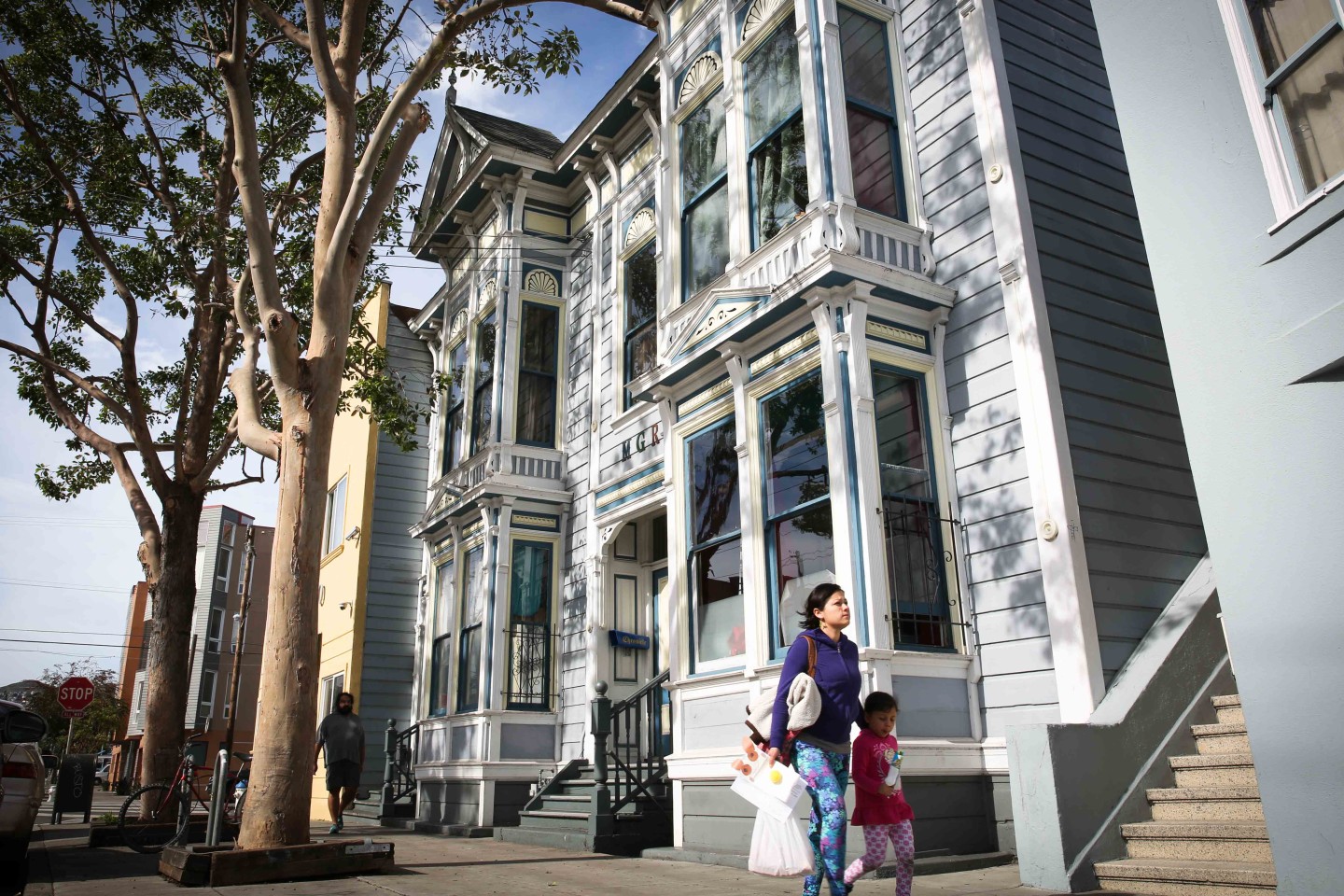
"caption": "A home in San Francisco's Mission District.",
"description": "A home in San Francisco's Mission District.",
"title": "Mission (2)",
"credit": "Jeremey Raff/KQED",
"status": "inherit",
"isLoading": false,
"fetchFailed": false
},
"news_11802607": {
"type": "attachments",
"id": "news_11802607",
"meta": {
"index": "attachments_1716263798",
"site": "news",
"id": "11802607",
"found": true
},
"parent": 11802601,
"imgSizes": {
"apple_news_ca_landscape_5_5": {
"file": "https://ww2.kqed.org/app/uploads/sites/10/2020/02/stateofthestate_022020_final-1044x783.png",
"width": 1044,
"mimeType": "image/png",
"height": 783
},
"apple_news_ca_square_4_0": {
"file": "https://ww2.kqed.org/app/uploads/sites/10/2020/02/stateofthestate_022020_final-470x470.png",
"width": 470,
"mimeType": "image/png",
"height": 470
},
"twentyfourteen-full-width": {
"file": "https://ww2.kqed.org/app/uploads/sites/10/2020/02/stateofthestate_022020_final-1038x576.png",
"width": 1038,
"mimeType": "image/png",
"height": 576
},
"thumbnail": {
"file": "https://ww2.kqed.org/app/uploads/sites/10/2020/02/stateofthestate_022020_final-160x103.png",
"width": 160,
"mimeType": "image/png",
"height": 103
},
"post-thumbnail": {
"file": "https://ww2.kqed.org/app/uploads/sites/10/2020/02/stateofthestate_022020_final-672x372.png",
"width": 672,
"mimeType": "image/png",
"height": 372
},
"kqedFullSize": {
"file": "https://ww2.kqed.org/app/uploads/sites/10/2020/02/stateofthestate_022020_final.png",
"width": 1920,
"height": 1234
},
"apple_news_ca_landscape_4_7": {
"file": "https://ww2.kqed.org/app/uploads/sites/10/2020/02/stateofthestate_022020_final-632x474.png",
"width": 632,
"mimeType": "image/png",
"height": 474
},
"large": {
"file": "https://ww2.kqed.org/app/uploads/sites/10/2020/02/stateofthestate_022020_final-1020x656.png",
"width": 1020,
"mimeType": "image/png",
"height": 656
},
"apple_news_ca_landscape_4_0": {
"file": "https://ww2.kqed.org/app/uploads/sites/10/2020/02/stateofthestate_022020_final-536x402.png",
"width": 536,
"mimeType": "image/png",
"height": 402
},
"apple_news_ca_portrait_12_9": {
"file": "https://ww2.kqed.org/app/uploads/sites/10/2020/02/stateofthestate_022020_final-1122x1234.png",
"width": 1122,
"mimeType": "image/png",
"height": 1234
},
"medium": {
"file": "https://ww2.kqed.org/app/uploads/sites/10/2020/02/stateofthestate_022020_final-800x514.png",
"width": 800,
"mimeType": "image/png",
"height": 514
},
"apple_news_ca_portrait_4_0": {
"file": "https://ww2.kqed.org/app/uploads/sites/10/2020/02/stateofthestate_022020_final-354x472.png",
"width": 354,
"mimeType": "image/png",
"height": 472
},
"apple_news_ca_portrait_9_7": {
"file": "https://ww2.kqed.org/app/uploads/sites/10/2020/02/stateofthestate_022020_final-840x1120.png",
"width": 840,
"mimeType": "image/png",
"height": 1120
},
"apple_news_ca_landscape_12_9": {
"file": "https://ww2.kqed.org/app/uploads/sites/10/2020/02/stateofthestate_022020_final-1832x1234.png",
"width": 1832,
"mimeType": "image/png",
"height": 1234
},
"apple_news_ca_square_9_7": {
"file": "https://ww2.kqed.org/app/uploads/sites/10/2020/02/stateofthestate_022020_final-1104x1104.png",
"width": 1104,
"mimeType": "image/png",
"height": 1104
},
"apple_news_ca_portrait_4_7": {
"file": "https://ww2.kqed.org/app/uploads/sites/10/2020/02/stateofthestate_022020_final-414x552.png",
"width": 414,
"mimeType": "image/png",
"height": 552
},
"apple_news_ca_square_12_9": {
"file": "https://ww2.kqed.org/app/uploads/sites/10/2020/02/stateofthestate_022020_final-1472x1234.png",
"width": 1472,
"mimeType": "image/png",
"height": 1234
},
"apple_news_ca_portrait_5_5": {
"file": "https://ww2.kqed.org/app/uploads/sites/10/2020/02/stateofthestate_022020_final-687x916.png",
"width": 687,
"mimeType": "image/png",
"height": 916
},
"full-width": {
"file": "https://ww2.kqed.org/app/uploads/sites/10/2020/02/stateofthestate_022020_final-1920x1234.png",
"width": 1920,
"mimeType": "image/png",
"height": 1234
},
"apple_news_ca_square_4_7": {
"file": "https://ww2.kqed.org/app/uploads/sites/10/2020/02/stateofthestate_022020_final-550x550.png",
"width": 550,
"mimeType": "image/png",
"height": 550
},
"apple_news_ca_landscape_9_7": {
"file": "https://ww2.kqed.org/app/uploads/sites/10/2020/02/stateofthestate_022020_final-1376x1032.png",
"width": 1376,
"mimeType": "image/png",
"height": 1032
},
"apple_news_ca_square_5_5": {
"file": "https://ww2.kqed.org/app/uploads/sites/10/2020/02/stateofthestate_022020_final-912x912.png",
"width": 912,
"mimeType": "image/png",
"height": 912
}
},
"publishDate": 1582229226,
"modified": 1582229259,
"caption": null,
"description": null,
"title": "stateofthestate_022020_final",
"credit": null,
"status": "inherit",
"isLoading": false,
"fetchFailed": false
},
"news_11802361": {
"type": "attachments",
"id": "news_11802361",
"meta": {
"index": "attachments_1716263798",
"site": "news",
"id": "11802361",
"found": true
},
"parent": 11802346,
"imgSizes": {
"apple_news_ca_landscape_5_5": {
"file": "https://ww2.kqed.org/app/uploads/sites/10/2020/02/GavinNewsom-1044x738.jpg",
"width": 1044,
"mimeType": "image/jpeg",
"height": 738
},
"apple_news_ca_square_4_0": {
"file": "https://ww2.kqed.org/app/uploads/sites/10/2020/02/GavinNewsom-470x470.jpg",
"width": 470,
"mimeType": "image/jpeg",
"height": 470
},
"twentyfourteen-full-width": {
"file": "https://ww2.kqed.org/app/uploads/sites/10/2020/02/GavinNewsom-1038x576.jpg",
"width": 1038,
"mimeType": "image/jpeg",
"height": 576
},
"thumbnail": {
"file": "https://ww2.kqed.org/app/uploads/sites/10/2020/02/GavinNewsom-160x102.jpg",
"width": 160,
"mimeType": "image/jpeg",
"height": 102
},
"post-thumbnail": {
"file": "https://ww2.kqed.org/app/uploads/sites/10/2020/02/GavinNewsom-672x372.jpg",
"width": 672,
"mimeType": "image/jpeg",
"height": 372
},
"kqedFullSize": {
"file": "https://ww2.kqed.org/app/uploads/sites/10/2020/02/GavinNewsom.jpg",
"width": 1158,
"height": 738
},
"apple_news_ca_landscape_4_7": {
"file": "https://ww2.kqed.org/app/uploads/sites/10/2020/02/GavinNewsom-632x474.jpg",
"width": 632,
"mimeType": "image/jpeg",
"height": 474
},
"large": {
"file": "https://ww2.kqed.org/app/uploads/sites/10/2020/02/GavinNewsom-1020x650.jpg",
"width": 1020,
"mimeType": "image/jpeg",
"height": 650
},
"apple_news_ca_landscape_4_0": {
"file": "https://ww2.kqed.org/app/uploads/sites/10/2020/02/GavinNewsom-536x402.jpg",
"width": 536,
"mimeType": "image/jpeg",
"height": 402
},
"apple_news_ca_portrait_12_9": {
"file": "https://ww2.kqed.org/app/uploads/sites/10/2020/02/GavinNewsom-1122x738.jpg",
"width": 1122,
"mimeType": "image/jpeg",
"height": 738
},
"medium": {
"file": "https://ww2.kqed.org/app/uploads/sites/10/2020/02/GavinNewsom-800x510.jpg",
"width": 800,
"mimeType": "image/jpeg",
"height": 510
},
"apple_news_ca_portrait_4_0": {
"file": "https://ww2.kqed.org/app/uploads/sites/10/2020/02/GavinNewsom-354x472.jpg",
"width": 354,
"mimeType": "image/jpeg",
"height": 472
},
"apple_news_ca_portrait_9_7": {
"file": "https://ww2.kqed.org/app/uploads/sites/10/2020/02/GavinNewsom-840x738.jpg",
"width": 840,
"mimeType": "image/jpeg",
"height": 738
},
"apple_news_ca_square_9_7": {
"file": "https://ww2.kqed.org/app/uploads/sites/10/2020/02/GavinNewsom-1104x738.jpg",
"width": 1104,
"mimeType": "image/jpeg",
"height": 738
},
"apple_news_ca_portrait_4_7": {
"file": "https://ww2.kqed.org/app/uploads/sites/10/2020/02/GavinNewsom-414x552.jpg",
"width": 414,
"mimeType": "image/jpeg",
"height": 552
},
"apple_news_ca_portrait_5_5": {
"file": "https://ww2.kqed.org/app/uploads/sites/10/2020/02/GavinNewsom-687x738.jpg",
"width": 687,
"mimeType": "image/jpeg",
"height": 738
},
"apple_news_ca_square_4_7": {
"file": "https://ww2.kqed.org/app/uploads/sites/10/2020/02/GavinNewsom-550x550.jpg",
"width": 550,
"mimeType": "image/jpeg",
"height": 550
},
"apple_news_ca_square_5_5": {
"file": "https://ww2.kqed.org/app/uploads/sites/10/2020/02/GavinNewsom-912x738.jpg",
"width": 912,
"mimeType": "image/jpeg",
"height": 738
}
},
"publishDate": 1582137625,
"modified": 1582140764,
"caption": "Gov. Gavin Newsom prepares to give his State of the State speech on Feb. 19, 2020.",
"description": "Gov. Gavin Newsom prepares to give his State of the State speech on Feb. 19, 2020.",
"title": "GavinNewsom",
"credit": "Andrew Nixon/CapRadio",
"status": "inherit",
"isLoading": false,
"fetchFailed": false
},
"news_11802366": {
"type": "attachments",
"id": "news_11802366",
"meta": {
"index": "attachments_1716263798",
"site": "news",
"id": "11802366",
"found": true
},
"parent": 11802346,
"imgSizes": {
"apple_news_ca_landscape_5_5": {
"file": "https://ww2.kqed.org/app/uploads/sites/10/2020/02/SF-Homeless-Man-1044x783.jpg",
"width": 1044,
"mimeType": "image/jpeg",
"height": 783
},
"apple_news_ca_square_4_0": {
"file": "https://ww2.kqed.org/app/uploads/sites/10/2020/02/SF-Homeless-Man-470x470.jpg",
"width": 470,
"mimeType": "image/jpeg",
"height": 470
},
"twentyfourteen-full-width": {
"file": "https://ww2.kqed.org/app/uploads/sites/10/2020/02/SF-Homeless-Man-1038x576.jpg",
"width": 1038,
"mimeType": "image/jpeg",
"height": 576
},
"thumbnail": {
"file": "https://ww2.kqed.org/app/uploads/sites/10/2020/02/SF-Homeless-Man-160x106.jpg",
"width": 160,
"mimeType": "image/jpeg",
"height": 106
},
"post-thumbnail": {
"file": "https://ww2.kqed.org/app/uploads/sites/10/2020/02/SF-Homeless-Man-672x372.jpg",
"width": 672,
"mimeType": "image/jpeg",
"height": 372
},
"kqedFullSize": {
"file": "https://ww2.kqed.org/app/uploads/sites/10/2020/02/SF-Homeless-Man.jpg",
"width": 1920,
"height": 1277
},
"apple_news_ca_landscape_4_7": {
"file": "https://ww2.kqed.org/app/uploads/sites/10/2020/02/SF-Homeless-Man-632x474.jpg",
"width": 632,
"mimeType": "image/jpeg",
"height": 474
},
"large": {
"file": "https://ww2.kqed.org/app/uploads/sites/10/2020/02/SF-Homeless-Man-1020x678.jpg",
"width": 1020,
"mimeType": "image/jpeg",
"height": 678
},
"apple_news_ca_landscape_4_0": {
"file": "https://ww2.kqed.org/app/uploads/sites/10/2020/02/SF-Homeless-Man-536x402.jpg",
"width": 536,
"mimeType": "image/jpeg",
"height": 402
},
"apple_news_ca_portrait_12_9": {
"file": "https://ww2.kqed.org/app/uploads/sites/10/2020/02/SF-Homeless-Man-1122x1277.jpg",
"width": 1122,
"mimeType": "image/jpeg",
"height": 1277
},
"medium": {
"file": "https://ww2.kqed.org/app/uploads/sites/10/2020/02/SF-Homeless-Man-800x532.jpg",
"width": 800,
"mimeType": "image/jpeg",
"height": 532
},
"apple_news_ca_portrait_4_0": {
"file": "https://ww2.kqed.org/app/uploads/sites/10/2020/02/SF-Homeless-Man-354x472.jpg",
"width": 354,
"mimeType": "image/jpeg",
"height": 472
},
"apple_news_ca_portrait_9_7": {
"file": "https://ww2.kqed.org/app/uploads/sites/10/2020/02/SF-Homeless-Man-840x1120.jpg",
"width": 840,
"mimeType": "image/jpeg",
"height": 1120
},
"apple_news_ca_landscape_12_9": {
"file": "https://ww2.kqed.org/app/uploads/sites/10/2020/02/SF-Homeless-Man-1832x1277.jpg",
"width": 1832,
"mimeType": "image/jpeg",
"height": 1277
},
"apple_news_ca_square_9_7": {
"file": "https://ww2.kqed.org/app/uploads/sites/10/2020/02/SF-Homeless-Man-1104x1104.jpg",
"width": 1104,
"mimeType": "image/jpeg",
"height": 1104
},
"apple_news_ca_portrait_4_7": {
"file": "https://ww2.kqed.org/app/uploads/sites/10/2020/02/SF-Homeless-Man-414x552.jpg",
"width": 414,
"mimeType": "image/jpeg",
"height": 552
},
"apple_news_ca_square_12_9": {
"file": "https://ww2.kqed.org/app/uploads/sites/10/2020/02/SF-Homeless-Man-1472x1277.jpg",
"width": 1472,
"mimeType": "image/jpeg",
"height": 1277
},
"apple_news_ca_portrait_5_5": {
"file": "https://ww2.kqed.org/app/uploads/sites/10/2020/02/SF-Homeless-Man-687x916.jpg",
"width": 687,
"mimeType": "image/jpeg",
"height": 916
},
"full-width": {
"file": "https://ww2.kqed.org/app/uploads/sites/10/2020/02/SF-Homeless-Man-1920x1277.jpg",
"width": 1920,
"mimeType": "image/jpeg",
"height": 1277
},
"apple_news_ca_square_4_7": {
"file": "https://ww2.kqed.org/app/uploads/sites/10/2020/02/SF-Homeless-Man-550x550.jpg",
"width": 550,
"mimeType": "image/jpeg",
"height": 550
},
"apple_news_ca_landscape_9_7": {
"file": "https://ww2.kqed.org/app/uploads/sites/10/2020/02/SF-Homeless-Man-1376x1032.jpg",
"width": 1376,
"mimeType": "image/jpeg",
"height": 1032
},
"apple_news_ca_square_5_5": {
"file": "https://ww2.kqed.org/app/uploads/sites/10/2020/02/SF-Homeless-Man-912x912.jpg",
"width": 912,
"mimeType": "image/jpeg",
"height": 912
}
},
"publishDate": 1582138344,
"modified": 1582138383,
"caption": "A homeless man sleeps on the sidewalk on Dec. 05, 2019 in San Francisco.",
"description": "A homeless man sleeps on the sidewalk on Dec. 05, 2019 in San Francisco.",
"title": "SF-Homeless-Man",
"credit": "Justin Sullivan/Getty Images",
"status": "inherit",
"isLoading": false,
"fetchFailed": false
},
"news_11802250": {
"type": "attachments",
"id": "news_11802250",
"meta": {
"index": "attachments_1716263798",
"site": "news",
"id": "11802250",
"found": true
},
"parent": 11802241,
"imgSizes": {
"apple_news_ca_landscape_5_5": {
"file": "https://ww2.kqed.org/app/uploads/sites/10/2020/02/UCSCProtestersStrikers_web-1044x783.jpg",
"width": 1044,
"mimeType": "image/jpeg",
"height": 783
},
"apple_news_ca_square_4_0": {
"file": "https://ww2.kqed.org/app/uploads/sites/10/2020/02/UCSCProtestersStrikers_web-470x470.jpg",
"width": 470,
"mimeType": "image/jpeg",
"height": 470
},
"twentyfourteen-full-width": {
"file": "https://ww2.kqed.org/app/uploads/sites/10/2020/02/UCSCProtestersStrikers_web-1038x576.jpg",
"width": 1038,
"mimeType": "image/jpeg",
"height": 576
},
"thumbnail": {
"file": "https://ww2.kqed.org/app/uploads/sites/10/2020/02/UCSCProtestersStrikers_web-160x120.jpg",
"width": 160,
"mimeType": "image/jpeg",
"height": 120
},
"post-thumbnail": {
"file": "https://ww2.kqed.org/app/uploads/sites/10/2020/02/UCSCProtestersStrikers_web-672x372.jpg",
"width": 672,
"mimeType": "image/jpeg",
"height": 372
},
"kqedFullSize": {
"file": "https://ww2.kqed.org/app/uploads/sites/10/2020/02/UCSCProtestersStrikers_web.jpg",
"width": 1290,
"height": 967
},
"apple_news_ca_landscape_4_7": {
"file": "https://ww2.kqed.org/app/uploads/sites/10/2020/02/UCSCProtestersStrikers_web-632x474.jpg",
"width": 632,
"mimeType": "image/jpeg",
"height": 474
},
"large": {
"file": "https://ww2.kqed.org/app/uploads/sites/10/2020/02/UCSCProtestersStrikers_web-1020x765.jpg",
"width": 1020,
"mimeType": "image/jpeg",
"height": 765
},
"apple_news_ca_landscape_4_0": {
"file": "https://ww2.kqed.org/app/uploads/sites/10/2020/02/UCSCProtestersStrikers_web-536x402.jpg",
"width": 536,
"mimeType": "image/jpeg",
"height": 402
},
"apple_news_ca_portrait_12_9": {
"file": "https://ww2.kqed.org/app/uploads/sites/10/2020/02/UCSCProtestersStrikers_web-1122x967.jpg",
"width": 1122,
"mimeType": "image/jpeg",
"height": 967
},
"medium": {
"file": "https://ww2.kqed.org/app/uploads/sites/10/2020/02/UCSCProtestersStrikers_web-800x600.jpg",
"width": 800,
"mimeType": "image/jpeg",
"height": 600
},
"apple_news_ca_portrait_4_0": {
"file": "https://ww2.kqed.org/app/uploads/sites/10/2020/02/UCSCProtestersStrikers_web-354x472.jpg",
"width": 354,
"mimeType": "image/jpeg",
"height": 472
},
"apple_news_ca_portrait_9_7": {
"file": "https://ww2.kqed.org/app/uploads/sites/10/2020/02/UCSCProtestersStrikers_web-840x967.jpg",
"width": 840,
"mimeType": "image/jpeg",
"height": 967
},
"apple_news_ca_square_9_7": {
"file": "https://ww2.kqed.org/app/uploads/sites/10/2020/02/UCSCProtestersStrikers_web-1104x967.jpg",
"width": 1104,
"mimeType": "image/jpeg",
"height": 967
},
"apple_news_ca_portrait_4_7": {
"file": "https://ww2.kqed.org/app/uploads/sites/10/2020/02/UCSCProtestersStrikers_web-414x552.jpg",
"width": 414,
"mimeType": "image/jpeg",
"height": 552
},
"apple_news_ca_portrait_5_5": {
"file": "https://ww2.kqed.org/app/uploads/sites/10/2020/02/UCSCProtestersStrikers_web-687x916.jpg",
"width": 687,
"mimeType": "image/jpeg",
"height": 916
},
"apple_news_ca_square_4_7": {
"file": "https://ww2.kqed.org/app/uploads/sites/10/2020/02/UCSCProtestersStrikers_web-550x550.jpg",
"width": 550,
"mimeType": "image/jpeg",
"height": 550
},
"apple_news_ca_square_5_5": {
"file": "https://ww2.kqed.org/app/uploads/sites/10/2020/02/UCSCProtestersStrikers_web-912x912.jpg",
"width": 912,
"mimeType": "image/jpeg",
"height": 912
}
},
"publishDate": 1582072332,
"modified": 1583170479,
"caption": null,
"description": null,
"title": "UCSCProtestersStrikers_web",
"credit": "Erika Mahoney/KAZU",
"status": "inherit",
"isLoading": false,
"fetchFailed": false
},
"news_11801580": {
"type": "attachments",
"id": "news_11801580",
"meta": {
"index": "attachments_1716263798",
"site": "news",
"id": "11801580",
"found": true
},
"parent": 11801074,
"imgSizes": {
"apple_news_ca_landscape_5_5": {
"file": "https://ww2.kqed.org/app/uploads/sites/10/2020/02/RS40994_001_KQED_EmbarcaderoNavigationCenter_01302020_7813-qut-1044x783.jpg",
"width": 1044,
"mimeType": "image/jpeg",
"height": 783
},
"apple_news_ca_square_4_0": {
"file": "https://ww2.kqed.org/app/uploads/sites/10/2020/02/RS40994_001_KQED_EmbarcaderoNavigationCenter_01302020_7813-qut-470x470.jpg",
"width": 470,
"mimeType": "image/jpeg",
"height": 470
},
"twentyfourteen-full-width": {
"file": "https://ww2.kqed.org/app/uploads/sites/10/2020/02/RS40994_001_KQED_EmbarcaderoNavigationCenter_01302020_7813-qut-1038x576.jpg",
"width": 1038,
"mimeType": "image/jpeg",
"height": 576
},
"thumbnail": {
"file": "https://ww2.kqed.org/app/uploads/sites/10/2020/02/RS40994_001_KQED_EmbarcaderoNavigationCenter_01302020_7813-qut-160x107.jpg",
"width": 160,
"mimeType": "image/jpeg",
"height": 107
},
"post-thumbnail": {
"file": "https://ww2.kqed.org/app/uploads/sites/10/2020/02/RS40994_001_KQED_EmbarcaderoNavigationCenter_01302020_7813-qut-672x372.jpg",
"width": 672,
"mimeType": "image/jpeg",
"height": 372
},
"kqedFullSize": {
"file": "https://ww2.kqed.org/app/uploads/sites/10/2020/02/RS40994_001_KQED_EmbarcaderoNavigationCenter_01302020_7813-qut.jpg",
"width": 1920,
"height": 1278
},
"apple_news_ca_landscape_4_7": {
"file": "https://ww2.kqed.org/app/uploads/sites/10/2020/02/RS40994_001_KQED_EmbarcaderoNavigationCenter_01302020_7813-qut-632x474.jpg",
"width": 632,
"mimeType": "image/jpeg",
"height": 474
},
"large": {
"file": "https://ww2.kqed.org/app/uploads/sites/10/2020/02/RS40994_001_KQED_EmbarcaderoNavigationCenter_01302020_7813-qut-1020x679.jpg",
"width": 1020,
"mimeType": "image/jpeg",
"height": 679
},
"apple_news_ca_landscape_4_0": {
"file": "https://ww2.kqed.org/app/uploads/sites/10/2020/02/RS40994_001_KQED_EmbarcaderoNavigationCenter_01302020_7813-qut-536x402.jpg",
"width": 536,
"mimeType": "image/jpeg",
"height": 402
},
"apple_news_ca_portrait_12_9": {
"file": "https://ww2.kqed.org/app/uploads/sites/10/2020/02/RS40994_001_KQED_EmbarcaderoNavigationCenter_01302020_7813-qut-1122x1278.jpg",
"width": 1122,
"mimeType": "image/jpeg",
"height": 1278
},
"medium": {
"file": "https://ww2.kqed.org/app/uploads/sites/10/2020/02/RS40994_001_KQED_EmbarcaderoNavigationCenter_01302020_7813-qut-800x533.jpg",
"width": 800,
"mimeType": "image/jpeg",
"height": 533
},
"apple_news_ca_portrait_4_0": {
"file": "https://ww2.kqed.org/app/uploads/sites/10/2020/02/RS40994_001_KQED_EmbarcaderoNavigationCenter_01302020_7813-qut-354x472.jpg",
"width": 354,
"mimeType": "image/jpeg",
"height": 472
},
"apple_news_ca_portrait_9_7": {
"file": "https://ww2.kqed.org/app/uploads/sites/10/2020/02/RS40994_001_KQED_EmbarcaderoNavigationCenter_01302020_7813-qut-840x1120.jpg",
"width": 840,
"mimeType": "image/jpeg",
"height": 1120
},
"apple_news_ca_landscape_12_9": {
"file": "https://ww2.kqed.org/app/uploads/sites/10/2020/02/RS40994_001_KQED_EmbarcaderoNavigationCenter_01302020_7813-qut-1832x1278.jpg",
"width": 1832,
"mimeType": "image/jpeg",
"height": 1278
},
"apple_news_ca_square_9_7": {
"file": "https://ww2.kqed.org/app/uploads/sites/10/2020/02/RS40994_001_KQED_EmbarcaderoNavigationCenter_01302020_7813-qut-1104x1104.jpg",
"width": 1104,
"mimeType": "image/jpeg",
"height": 1104
},
"apple_news_ca_portrait_4_7": {
"file": "https://ww2.kqed.org/app/uploads/sites/10/2020/02/RS40994_001_KQED_EmbarcaderoNavigationCenter_01302020_7813-qut-414x552.jpg",
"width": 414,
"mimeType": "image/jpeg",
"height": 552
},
"apple_news_ca_square_12_9": {
"file": "https://ww2.kqed.org/app/uploads/sites/10/2020/02/RS40994_001_KQED_EmbarcaderoNavigationCenter_01302020_7813-qut-1472x1278.jpg",
"width": 1472,
"mimeType": "image/jpeg",
"height": 1278
},
"apple_news_ca_portrait_5_5": {
"file": "https://ww2.kqed.org/app/uploads/sites/10/2020/02/RS40994_001_KQED_EmbarcaderoNavigationCenter_01302020_7813-qut-687x916.jpg",
"width": 687,
"mimeType": "image/jpeg",
"height": 916
},
"full-width": {
"file": "https://ww2.kqed.org/app/uploads/sites/10/2020/02/RS40994_001_KQED_EmbarcaderoNavigationCenter_01302020_7813-qut-1920x1278.jpg",
"width": 1920,
"mimeType": "image/jpeg",
"height": 1278
},
"apple_news_ca_square_4_7": {
"file": "https://ww2.kqed.org/app/uploads/sites/10/2020/02/RS40994_001_KQED_EmbarcaderoNavigationCenter_01302020_7813-qut-550x550.jpg",
"width": 550,
"mimeType": "image/jpeg",
"height": 550
},
"apple_news_ca_landscape_9_7": {
"file": "https://ww2.kqed.org/app/uploads/sites/10/2020/02/RS40994_001_KQED_EmbarcaderoNavigationCenter_01302020_7813-qut-1376x1032.jpg",
"width": 1376,
"mimeType": "image/jpeg",
"height": 1032
},
"apple_news_ca_square_5_5": {
"file": "https://ww2.kqed.org/app/uploads/sites/10/2020/02/RS40994_001_KQED_EmbarcaderoNavigationCenter_01302020_7813-qut-912x912.jpg",
"width": 912,
"mimeType": "image/jpeg",
"height": 912
}
},
"publishDate": 1581637308,
"modified": 1581637470,
"caption": "The Embarcadero SAFE Navigation Center at the corner of Embarcadero and Beale streets in San Francisco's South Beach neighborhood. The 200-bed multiservice shelter opened at the end of December.",
"description": null,
"title": "RS40994_001_KQED_EmbarcaderoNavigationCenter_01302020_7813-qut",
"credit": "Beth LaBerge/KQED",
"status": "inherit",
"isLoading": false,
"fetchFailed": false
},
"news_11801369": {
"type": "attachments",
"id": "news_11801369",
"meta": {
"index": "attachments_1716263798",
"site": "news",
"id": "11801369",
"found": true
},
"parent": 11801176,
"imgSizes": {
"apple_news_ca_landscape_5_5": {
"file": "https://ww2.kqed.org/app/uploads/sites/10/2020/02/M4H-protest-1044x783.jpg",
"width": 1044,
"mimeType": "image/jpeg",
"height": 783
},
"apple_news_ca_square_4_0": {
"file": "https://ww2.kqed.org/app/uploads/sites/10/2020/02/M4H-protest-470x470.jpg",
"width": 470,
"mimeType": "image/jpeg",
"height": 470
},
"twentyfourteen-full-width": {
"file": "https://ww2.kqed.org/app/uploads/sites/10/2020/02/M4H-protest-1038x576.jpg",
"width": 1038,
"mimeType": "image/jpeg",
"height": 576
},
"thumbnail": {
"file": "https://ww2.kqed.org/app/uploads/sites/10/2020/02/M4H-protest-160x120.jpg",
"width": 160,
"mimeType": "image/jpeg",
"height": 120
},
"post-thumbnail": {
"file": "https://ww2.kqed.org/app/uploads/sites/10/2020/02/M4H-protest-672x372.jpg",
"width": 672,
"mimeType": "image/jpeg",
"height": 372
},
"kqedFullSize": {
"file": "https://ww2.kqed.org/app/uploads/sites/10/2020/02/M4H-protest-e1581548044810.jpg",
"width": 1920,
"height": 1440
},
"apple_news_ca_landscape_4_7": {
"file": "https://ww2.kqed.org/app/uploads/sites/10/2020/02/M4H-protest-632x474.jpg",
"width": 632,
"mimeType": "image/jpeg",
"height": 474
},
"large": {
"file": "https://ww2.kqed.org/app/uploads/sites/10/2020/02/M4H-protest-1020x765.jpg",
"width": 1020,
"mimeType": "image/jpeg",
"height": 765
},
"apple_news_ca_landscape_4_0": {
"file": "https://ww2.kqed.org/app/uploads/sites/10/2020/02/M4H-protest-536x402.jpg",
"width": 536,
"mimeType": "image/jpeg",
"height": 402
},
"apple_news_ca_portrait_12_9": {
"file": "https://ww2.kqed.org/app/uploads/sites/10/2020/02/M4H-protest-1122x1496.jpg",
"width": 1122,
"mimeType": "image/jpeg",
"height": 1496
},
"medium": {
"file": "https://ww2.kqed.org/app/uploads/sites/10/2020/02/M4H-protest-800x600.jpg",
"width": 800,
"mimeType": "image/jpeg",
"height": 600
},
"apple_news_ca_portrait_4_0": {
"file": "https://ww2.kqed.org/app/uploads/sites/10/2020/02/M4H-protest-354x472.jpg",
"width": 354,
"mimeType": "image/jpeg",
"height": 472
},
"apple_news_ca_portrait_9_7": {
"file": "https://ww2.kqed.org/app/uploads/sites/10/2020/02/M4H-protest-840x1120.jpg",
"width": 840,
"mimeType": "image/jpeg",
"height": 1120
},
"apple_news_ca_landscape_12_9": {
"file": "https://ww2.kqed.org/app/uploads/sites/10/2020/02/M4H-protest-1832x1374.jpg",
"width": 1832,
"mimeType": "image/jpeg",
"height": 1374
},
"apple_news_ca_square_9_7": {
"file": "https://ww2.kqed.org/app/uploads/sites/10/2020/02/M4H-protest-1104x1104.jpg",
"width": 1104,
"mimeType": "image/jpeg",
"height": 1104
},
"apple_news_ca_portrait_4_7": {
"file": "https://ww2.kqed.org/app/uploads/sites/10/2020/02/M4H-protest-414x552.jpg",
"width": 414,
"mimeType": "image/jpeg",
"height": 552
},
"apple_news_ca_square_12_9": {
"file": "https://ww2.kqed.org/app/uploads/sites/10/2020/02/M4H-protest-1472x1472.jpg",
"width": 1472,
"mimeType": "image/jpeg",
"height": 1472
},
"apple_news_ca_portrait_5_5": {
"file": "https://ww2.kqed.org/app/uploads/sites/10/2020/02/M4H-protest-687x916.jpg",
"width": 687,
"mimeType": "image/jpeg",
"height": 916
},
"full-width": {
"file": "https://ww2.kqed.org/app/uploads/sites/10/2020/02/M4H-protest-1920x1440.jpg",
"width": 1920,
"mimeType": "image/jpeg",
"height": 1440
},
"apple_news_ca_square_4_7": {
"file": "https://ww2.kqed.org/app/uploads/sites/10/2020/02/M4H-protest-550x550.jpg",
"width": 550,
"mimeType": "image/jpeg",
"height": 550
},
"apple_news_ca_landscape_9_7": {
"file": "https://ww2.kqed.org/app/uploads/sites/10/2020/02/M4H-protest-1376x1032.jpg",
"width": 1376,
"mimeType": "image/jpeg",
"height": 1032
},
"apple_news_ca_square_5_5": {
"file": "https://ww2.kqed.org/app/uploads/sites/10/2020/02/M4H-protest-912x912.jpg",
"width": 912,
"mimeType": "image/jpeg",
"height": 912
}
},
"publishDate": 1581548002,
"modified": 1581633779,
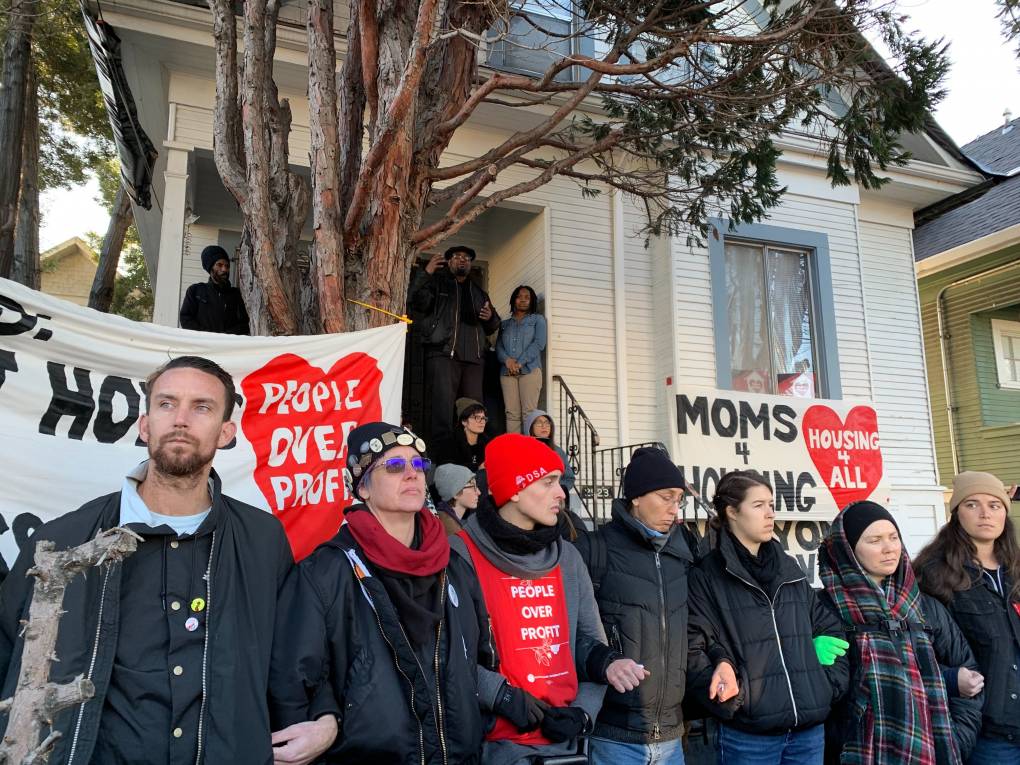
"caption": "Supporters of Moms 4 Housing rally in front of the West Oakland house the group occupied for several months before being forcefully evicted in January. A community land trust has since agreed to purchase the house and allow the women move back in.",
"description": "Supporters of Moms 4 Housing rally in front of the West Oakland house the group occupied for several months before being forcefully evicted in January. A community land trust has since agreed to purchase the house and allow the women move back in.",
"title": "M4H protest",
"credit": "Molly Solomon/KQED",
"status": "inherit",
"isLoading": false,
"fetchFailed": false
},
"news_11801331": {
"type": "attachments",
"id": "news_11801331",
"meta": {
"index": "attachments_1716263798",
"site": "news",
"id": "11801331",
"found": true
},
"parent": 11801313,
"imgSizes": {
"apple_news_ca_landscape_5_5": {
"file": "https://ww2.kqed.org/app/uploads/sites/10/2020/02/RS41318_STATE-SHELTERS-photo-3-qut-1044x783.jpg",
"width": 1044,
"mimeType": "image/jpeg",
"height": 783
},
"apple_news_ca_square_4_0": {
"file": "https://ww2.kqed.org/app/uploads/sites/10/2020/02/RS41318_STATE-SHELTERS-photo-3-qut-470x470.jpg",
"width": 470,
"mimeType": "image/jpeg",
"height": 470
},
"twentyfourteen-full-width": {
"file": "https://ww2.kqed.org/app/uploads/sites/10/2020/02/RS41318_STATE-SHELTERS-photo-3-qut-1038x576.jpg",
"width": 1038,
"mimeType": "image/jpeg",
"height": 576
},
"thumbnail": {
"file": "https://ww2.kqed.org/app/uploads/sites/10/2020/02/RS41318_STATE-SHELTERS-photo-3-qut-160x107.jpg",
"width": 160,
"mimeType": "image/jpeg",
"height": 107
},
"post-thumbnail": {
"file": "https://ww2.kqed.org/app/uploads/sites/10/2020/02/RS41318_STATE-SHELTERS-photo-3-qut-672x372.jpg",
"width": 672,
"mimeType": "image/jpeg",
"height": 372
},
"kqedFullSize": {
"file": "https://ww2.kqed.org/app/uploads/sites/10/2020/02/RS41318_STATE-SHELTERS-photo-3-qut.jpg",
"width": 1920,
"height": 1280
},
"apple_news_ca_landscape_4_7": {
"file": "https://ww2.kqed.org/app/uploads/sites/10/2020/02/RS41318_STATE-SHELTERS-photo-3-qut-632x474.jpg",
"width": 632,
"mimeType": "image/jpeg",
"height": 474
},
"large": {
"file": "https://ww2.kqed.org/app/uploads/sites/10/2020/02/RS41318_STATE-SHELTERS-photo-3-qut-1020x680.jpg",
"width": 1020,
"mimeType": "image/jpeg",
"height": 680
},
"apple_news_ca_landscape_4_0": {
"file": "https://ww2.kqed.org/app/uploads/sites/10/2020/02/RS41318_STATE-SHELTERS-photo-3-qut-536x402.jpg",
"width": 536,
"mimeType": "image/jpeg",
"height": 402
},
"apple_news_ca_portrait_12_9": {
"file": "https://ww2.kqed.org/app/uploads/sites/10/2020/02/RS41318_STATE-SHELTERS-photo-3-qut-1122x1280.jpg",
"width": 1122,
"mimeType": "image/jpeg",
"height": 1280
},
"medium": {
"file": "https://ww2.kqed.org/app/uploads/sites/10/2020/02/RS41318_STATE-SHELTERS-photo-3-qut-800x533.jpg",
"width": 800,
"mimeType": "image/jpeg",
"height": 533
},
"apple_news_ca_portrait_4_0": {
"file": "https://ww2.kqed.org/app/uploads/sites/10/2020/02/RS41318_STATE-SHELTERS-photo-3-qut-354x472.jpg",
"width": 354,
"mimeType": "image/jpeg",
"height": 472
},
"apple_news_ca_portrait_9_7": {
"file": "https://ww2.kqed.org/app/uploads/sites/10/2020/02/RS41318_STATE-SHELTERS-photo-3-qut-840x1120.jpg",
"width": 840,
"mimeType": "image/jpeg",
"height": 1120
},
"apple_news_ca_landscape_12_9": {
"file": "https://ww2.kqed.org/app/uploads/sites/10/2020/02/RS41318_STATE-SHELTERS-photo-3-qut-1832x1280.jpg",
"width": 1832,
"mimeType": "image/jpeg",
"height": 1280
},
"apple_news_ca_square_9_7": {
"file": "https://ww2.kqed.org/app/uploads/sites/10/2020/02/RS41318_STATE-SHELTERS-photo-3-qut-1104x1104.jpg",
"width": 1104,
"mimeType": "image/jpeg",
"height": 1104
},
"apple_news_ca_portrait_4_7": {
"file": "https://ww2.kqed.org/app/uploads/sites/10/2020/02/RS41318_STATE-SHELTERS-photo-3-qut-414x552.jpg",
"width": 414,
"mimeType": "image/jpeg",
"height": 552
},
"apple_news_ca_square_12_9": {
"file": "https://ww2.kqed.org/app/uploads/sites/10/2020/02/RS41318_STATE-SHELTERS-photo-3-qut-1472x1280.jpg",
"width": 1472,
"mimeType": "image/jpeg",
"height": 1280
},
"apple_news_ca_portrait_5_5": {
"file": "https://ww2.kqed.org/app/uploads/sites/10/2020/02/RS41318_STATE-SHELTERS-photo-3-qut-687x916.jpg",
"width": 687,
"mimeType": "image/jpeg",
"height": 916
},
"full-width": {
"file": "https://ww2.kqed.org/app/uploads/sites/10/2020/02/RS41318_STATE-SHELTERS-photo-3-qut-1920x1280.jpg",
"width": 1920,
"mimeType": "image/jpeg",
"height": 1280
},
"apple_news_ca_square_4_7": {
"file": "https://ww2.kqed.org/app/uploads/sites/10/2020/02/RS41318_STATE-SHELTERS-photo-3-qut-550x550.jpg",
"width": 550,
"mimeType": "image/jpeg",
"height": 550
},
"apple_news_ca_landscape_9_7": {
"file": "https://ww2.kqed.org/app/uploads/sites/10/2020/02/RS41318_STATE-SHELTERS-photo-3-qut-1376x1032.jpg",
"width": 1376,
"mimeType": "image/jpeg",
"height": 1032
},
"apple_news_ca_square_5_5": {
"file": "https://ww2.kqed.org/app/uploads/sites/10/2020/02/RS41318_STATE-SHELTERS-photo-3-qut-912x912.jpg",
"width": 912,
"mimeType": "image/jpeg",
"height": 912
}
},
"publishDate": 1581541956,
"modified": 1581544056,
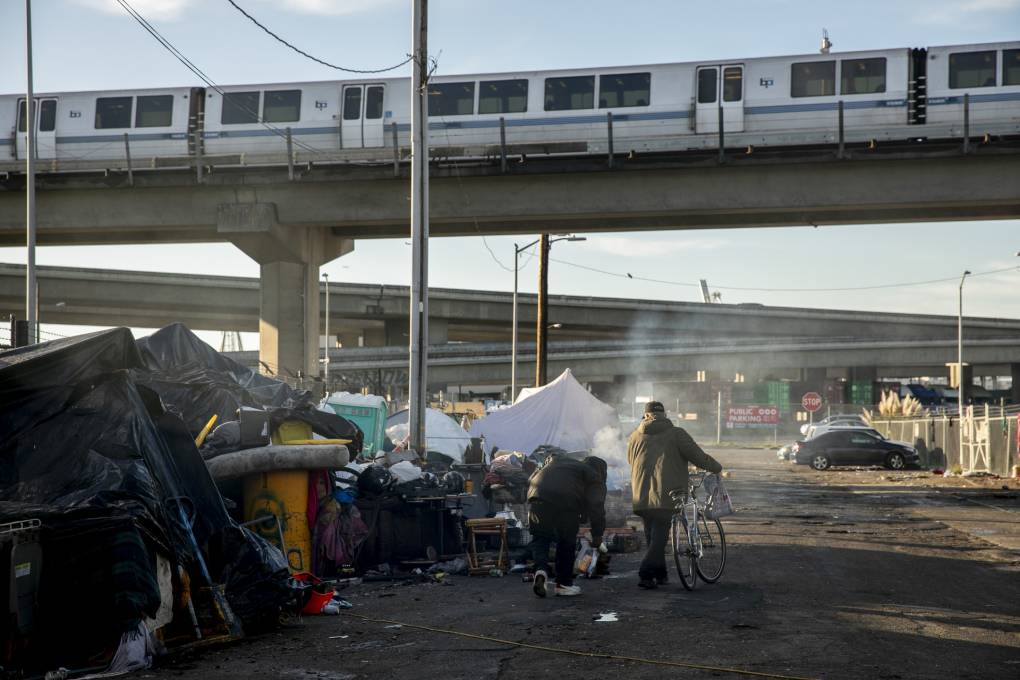
"caption": "A ten encampment has formed under BART tracks in West Oakland. ",
"description": "A tent encampment in West Oakland. ",
"title": "A tent encampment in West Oakland. Photo by Anne Wernikoff for CalMatters",
"credit": "Anne Wernikoff/CalMatters",
"status": "inherit",
"isLoading": false,
"fetchFailed": false
},
"news_11800728": {
"type": "attachments",
"id": "news_11800728",
"meta": {
"index": "attachments_1716263798",
"site": "news",
"id": "11800728",
"found": true
},
"parent": 11800722,
"imgSizes": {
"apple_news_ca_landscape_5_5": {
"file": "https://ww2.kqed.org/app/uploads/sites/10/2020/02/layoffs_020720_final_MF-1044x783.png",
"width": 1044,
"mimeType": "image/png",
"height": 783
},
"apple_news_ca_square_4_0": {
"file": "https://ww2.kqed.org/app/uploads/sites/10/2020/02/layoffs_020720_final_MF-470x470.png",
"width": 470,
"mimeType": "image/png",
"height": 470
},
"twentyfourteen-full-width": {
"file": "https://ww2.kqed.org/app/uploads/sites/10/2020/02/layoffs_020720_final_MF-1038x576.png",
"width": 1038,
"mimeType": "image/png",
"height": 576
},
"thumbnail": {
"file": "https://ww2.kqed.org/app/uploads/sites/10/2020/02/layoffs_020720_final_MF-160x102.png",
"width": 160,
"mimeType": "image/png",
"height": 102
},
"post-thumbnail": {
"file": "https://ww2.kqed.org/app/uploads/sites/10/2020/02/layoffs_020720_final_MF-672x372.png",
"width": 672,
"mimeType": "image/png",
"height": 372
},
"kqedFullSize": {
"file": "https://ww2.kqed.org/app/uploads/sites/10/2020/02/layoffs_020720_final_MF.png",
"width": 1920,
"height": 1222
},
"apple_news_ca_landscape_4_7": {
"file": "https://ww2.kqed.org/app/uploads/sites/10/2020/02/layoffs_020720_final_MF-632x474.png",
"width": 632,
"mimeType": "image/png",
"height": 474
},
"large": {
"file": "https://ww2.kqed.org/app/uploads/sites/10/2020/02/layoffs_020720_final_MF-1020x649.png",
"width": 1020,
"mimeType": "image/png",
"height": 649
},
"apple_news_ca_landscape_4_0": {
"file": "https://ww2.kqed.org/app/uploads/sites/10/2020/02/layoffs_020720_final_MF-536x402.png",
"width": 536,
"mimeType": "image/png",
"height": 402
},
"apple_news_ca_portrait_12_9": {
"file": "https://ww2.kqed.org/app/uploads/sites/10/2020/02/layoffs_020720_final_MF-1122x1222.png",
"width": 1122,
"mimeType": "image/png",
"height": 1222
},
"medium": {
"file": "https://ww2.kqed.org/app/uploads/sites/10/2020/02/layoffs_020720_final_MF-800x509.png",
"width": 800,
"mimeType": "image/png",
"height": 509
},
"apple_news_ca_portrait_4_0": {
"file": "https://ww2.kqed.org/app/uploads/sites/10/2020/02/layoffs_020720_final_MF-354x472.png",
"width": 354,
"mimeType": "image/png",
"height": 472
},
"apple_news_ca_portrait_9_7": {
"file": "https://ww2.kqed.org/app/uploads/sites/10/2020/02/layoffs_020720_final_MF-840x1120.png",
"width": 840,
"mimeType": "image/png",
"height": 1120
},
"apple_news_ca_landscape_12_9": {
"file": "https://ww2.kqed.org/app/uploads/sites/10/2020/02/layoffs_020720_final_MF-1832x1222.png",
"width": 1832,
"mimeType": "image/png",
"height": 1222
},
"apple_news_ca_square_9_7": {
"file": "https://ww2.kqed.org/app/uploads/sites/10/2020/02/layoffs_020720_final_MF-1104x1104.png",
"width": 1104,
"mimeType": "image/png",
"height": 1104
},
"apple_news_ca_portrait_4_7": {
"file": "https://ww2.kqed.org/app/uploads/sites/10/2020/02/layoffs_020720_final_MF-414x552.png",
"width": 414,
"mimeType": "image/png",
"height": 552
},
"apple_news_ca_square_12_9": {
"file": "https://ww2.kqed.org/app/uploads/sites/10/2020/02/layoffs_020720_final_MF-1472x1222.png",
"width": 1472,
"mimeType": "image/png",
"height": 1222
},
"apple_news_ca_portrait_5_5": {
"file": "https://ww2.kqed.org/app/uploads/sites/10/2020/02/layoffs_020720_final_MF-687x916.png",
"width": 687,
"mimeType": "image/png",
"height": 916
},
"full-width": {
"file": "https://ww2.kqed.org/app/uploads/sites/10/2020/02/layoffs_020720_final_MF-1920x1222.png",
"width": 1920,
"mimeType": "image/png",
"height": 1222
},
"apple_news_ca_square_4_7": {
"file": "https://ww2.kqed.org/app/uploads/sites/10/2020/02/layoffs_020720_final_MF-550x550.png",
"width": 550,
"mimeType": "image/png",
"height": 550
},
"apple_news_ca_landscape_9_7": {
"file": "https://ww2.kqed.org/app/uploads/sites/10/2020/02/layoffs_020720_final_MF-1376x1032.png",
"width": 1376,
"mimeType": "image/png",
"height": 1032
},
"apple_news_ca_square_5_5": {
"file": "https://ww2.kqed.org/app/uploads/sites/10/2020/02/layoffs_020720_final_MF-912x912.png",
"width": 912,
"mimeType": "image/png",
"height": 912
}
},
"publishDate": 1581120438,
"modified": 1581120493,
"caption": null,
"description": null,
"title": "layoffs_020720_final_MF",
"credit": null,
"status": "inherit",
"isLoading": false,
"fetchFailed": false
},
"news_11799836": {
"type": "attachments",
"id": "news_11799836",
"meta": {
"index": "attachments_1716263798",
"site": "news",
"id": "11799836",
"found": true
},
"parent": 11799833,
"imgSizes": {
"apple_news_ca_landscape_5_5": {
"file": "https://ww2.kqed.org/app/uploads/sites/10/2020/02/RS41101_HOMELESS-COUNT-photo-qut-1044x783.jpg",
"width": 1044,
"mimeType": "image/jpeg",
"height": 783
},
"apple_news_ca_square_4_0": {
"file": "https://ww2.kqed.org/app/uploads/sites/10/2020/02/RS41101_HOMELESS-COUNT-photo-qut-470x470.jpg",
"width": 470,
"mimeType": "image/jpeg",
"height": 470
},
"twentyfourteen-full-width": {
"file": "https://ww2.kqed.org/app/uploads/sites/10/2020/02/RS41101_HOMELESS-COUNT-photo-qut-1038x576.jpg",
"width": 1038,
"mimeType": "image/jpeg",
"height": 576
},
"thumbnail": {
"file": "https://ww2.kqed.org/app/uploads/sites/10/2020/02/RS41101_HOMELESS-COUNT-photo-qut-160x90.jpg",
"width": 160,
"mimeType": "image/jpeg",
"height": 90
},
"post-thumbnail": {
"file": "https://ww2.kqed.org/app/uploads/sites/10/2020/02/RS41101_HOMELESS-COUNT-photo-qut-672x372.jpg",
"width": 672,
"mimeType": "image/jpeg",
"height": 372
},
"kqedFullSize": {
"file": "https://ww2.kqed.org/app/uploads/sites/10/2020/02/RS41101_HOMELESS-COUNT-photo-qut.jpg",
"width": 1920,
"height": 1080
},
"apple_news_ca_landscape_4_7": {
"file": "https://ww2.kqed.org/app/uploads/sites/10/2020/02/RS41101_HOMELESS-COUNT-photo-qut-632x474.jpg",
"width": 632,
"mimeType": "image/jpeg",
"height": 474
},
"large": {
"file": "https://ww2.kqed.org/app/uploads/sites/10/2020/02/RS41101_HOMELESS-COUNT-photo-qut-1020x574.jpg",
"width": 1020,
"mimeType": "image/jpeg",
"height": 574
},
"apple_news_ca_landscape_4_0": {
"file": "https://ww2.kqed.org/app/uploads/sites/10/2020/02/RS41101_HOMELESS-COUNT-photo-qut-536x402.jpg",
"width": 536,
"mimeType": "image/jpeg",
"height": 402
},
"apple_news_ca_portrait_12_9": {
"file": "https://ww2.kqed.org/app/uploads/sites/10/2020/02/RS41101_HOMELESS-COUNT-photo-qut-1122x1080.jpg",
"width": 1122,
"mimeType": "image/jpeg",
"height": 1080
},
"medium": {
"file": "https://ww2.kqed.org/app/uploads/sites/10/2020/02/RS41101_HOMELESS-COUNT-photo-qut-800x450.jpg",
"width": 800,
"mimeType": "image/jpeg",
"height": 450
},
"apple_news_ca_portrait_4_0": {
"file": "https://ww2.kqed.org/app/uploads/sites/10/2020/02/RS41101_HOMELESS-COUNT-photo-qut-354x472.jpg",
"width": 354,
"mimeType": "image/jpeg",
"height": 472
},
"apple_news_ca_portrait_9_7": {
"file": "https://ww2.kqed.org/app/uploads/sites/10/2020/02/RS41101_HOMELESS-COUNT-photo-qut-840x1080.jpg",
"width": 840,
"mimeType": "image/jpeg",
"height": 1080
},
"apple_news_ca_landscape_12_9": {
"file": "https://ww2.kqed.org/app/uploads/sites/10/2020/02/RS41101_HOMELESS-COUNT-photo-qut-1832x1080.jpg",
"width": 1832,
"mimeType": "image/jpeg",
"height": 1080
},
"apple_news_ca_square_9_7": {
"file": "https://ww2.kqed.org/app/uploads/sites/10/2020/02/RS41101_HOMELESS-COUNT-photo-qut-1104x1080.jpg",
"width": 1104,
"mimeType": "image/jpeg",
"height": 1080
},
"apple_news_ca_portrait_4_7": {
"file": "https://ww2.kqed.org/app/uploads/sites/10/2020/02/RS41101_HOMELESS-COUNT-photo-qut-414x552.jpg",
"width": 414,
"mimeType": "image/jpeg",
"height": 552
},
"apple_news_ca_square_12_9": {
"file": "https://ww2.kqed.org/app/uploads/sites/10/2020/02/RS41101_HOMELESS-COUNT-photo-qut-1472x1080.jpg",
"width": 1472,
"mimeType": "image/jpeg",
"height": 1080
},
"apple_news_ca_portrait_5_5": {
"file": "https://ww2.kqed.org/app/uploads/sites/10/2020/02/RS41101_HOMELESS-COUNT-photo-qut-687x916.jpg",
"width": 687,
"mimeType": "image/jpeg",
"height": 916
},
"full-width": {
"file": "https://ww2.kqed.org/app/uploads/sites/10/2020/02/RS41101_HOMELESS-COUNT-photo-qut-1920x1080.jpg",
"width": 1920,
"mimeType": "image/jpeg",
"height": 1080
},
"apple_news_ca_square_4_7": {
"file": "https://ww2.kqed.org/app/uploads/sites/10/2020/02/RS41101_HOMELESS-COUNT-photo-qut-550x550.jpg",
"width": 550,
"mimeType": "image/jpeg",
"height": 550
},
"apple_news_ca_landscape_9_7": {
"file": "https://ww2.kqed.org/app/uploads/sites/10/2020/02/RS41101_HOMELESS-COUNT-photo-qut-1376x1032.jpg",
"width": 1376,
"mimeType": "image/jpeg",
"height": 1032
},
"apple_news_ca_square_5_5": {
"file": "https://ww2.kqed.org/app/uploads/sites/10/2020/02/RS41101_HOMELESS-COUNT-photo-qut-912x912.jpg",
"width": 912,
"mimeType": "image/jpeg",
"height": 912
}
},
"publishDate": 1580766267,
"modified": 1580766319,
"caption": "Homeless survey volunteers, from right, Joe Hinojosa, Charlen Smith, Zee Patel and Aimee Bird, gather survey information from a couple of homeless people living in the Lowell neighborhood of Fresno during the Point-in-Time homeless count hosted by the Fresno Madera Continuum of Care, on Wednesday, Jan. 29, 2020.",
"description": "Homeless survey volunteers, from right, Joe Hinojosa, Charlen Smith, Zee Patel and Aimee Bird, gather survey information from a couple of homeless people living in the Lowell neighborhood of Fresno during the Point-in-Time homeless count hosted by the Fresno Madera Continuum of Care, on Wednesday, Jan. 29, 2020.",
"title": "Point in Time count",
"credit": "Craig Kohlruss/Fresno Bee",
"status": "inherit",
"isLoading": false,
"fetchFailed": false
},
"news_11710765": {
"type": "attachments",
"id": "news_11710765",
"meta": {
"index": "attachments_1716263798",
"site": "news",
"id": "11710765",
"found": true
},
"parent": 11710655,
"imgSizes": {
"twentyfourteen-full-width": {
"file": "https://ww2.kqed.org/app/uploads/sites/10/2018/12/Richmond-Triangle-Court-e1544208502790-1038x576.jpg",
"width": 1038,
"mimeType": "image/jpeg",
"height": 576
},
"thumbnail": {
"file": "https://ww2.kqed.org/app/uploads/sites/10/2018/12/Richmond-Triangle-Court-e1544208502790-160x90.jpg",
"width": 160,
"mimeType": "image/jpeg",
"height": 90
},
"post-thumbnail": {
"file": "https://ww2.kqed.org/app/uploads/sites/10/2018/12/Richmond-Triangle-Court-e1544208502790-672x372.jpg",
"width": 672,
"mimeType": "image/jpeg",
"height": 372
},
"kqedFullSize": {
"file": "https://ww2.kqed.org/app/uploads/sites/10/2018/12/Richmond-Triangle-Court-e1544208502790.jpg",
"width": 1920,
"height": 1084
},
"large": {
"file": "https://ww2.kqed.org/app/uploads/sites/10/2018/12/Richmond-Triangle-Court-e1544208502790-1020x576.jpg",
"width": 1020,
"mimeType": "image/jpeg",
"height": 576
},
"complete_open_graph": {
"file": "https://ww2.kqed.org/app/uploads/sites/10/2018/12/Richmond-Triangle-Court-e1544208502790-1200x678.jpg",
"width": 1200,
"mimeType": "image/jpeg",
"height": 678
},
"guest-author-50": {
"file": "https://ww2.kqed.org/app/uploads/sites/10/2018/12/Richmond-Triangle-Court-e1544208502790-50x50.jpg",
"width": 50,
"mimeType": "image/jpeg",
"height": 50
},
"guest-author-96": {
"file": "https://ww2.kqed.org/app/uploads/sites/10/2018/12/Richmond-Triangle-Court-e1544208502790-96x96.jpg",
"width": 96,
"mimeType": "image/jpeg",
"height": 96
},
"medium": {
"file": "https://ww2.kqed.org/app/uploads/sites/10/2018/12/Richmond-Triangle-Court-e1544208502790-800x452.jpg",
"width": 800,
"mimeType": "image/jpeg",
"height": 452
},
"guest-author-64": {
"file": "https://ww2.kqed.org/app/uploads/sites/10/2018/12/Richmond-Triangle-Court-e1544208502790-64x64.jpg",
"width": 64,
"mimeType": "image/jpeg",
"height": 64
},
"guest-author-32": {
"file": "https://ww2.kqed.org/app/uploads/sites/10/2018/12/Richmond-Triangle-Court-e1544208502790-32x32.jpg",
"width": 32,
"mimeType": "image/jpeg",
"height": 32
},
"full-width": {
"file": "https://ww2.kqed.org/app/uploads/sites/10/2018/12/Richmond-Triangle-Court-e1544208502790-1920x1084.jpg",
"width": 1920,
"mimeType": "image/jpeg",
"height": 1084
},
"detail": {
"file": "https://ww2.kqed.org/app/uploads/sites/10/2018/12/Richmond-Triangle-Court-e1544208502790-150x150.jpg",
"width": 150,
"mimeType": "image/jpeg",
"height": 150
},
"guest-author-128": {
"file": "https://ww2.kqed.org/app/uploads/sites/10/2018/12/Richmond-Triangle-Court-e1544208502790-128x128.jpg",
"width": 128,
"mimeType": "image/jpeg",
"height": 128
}
},
"publishDate": 1544203927,
"modified": 1559072817,
"caption": "SB 50 would have forced much of California to accommodate a lot more housing construction by reducing local zoning control.",
"description": "Triangle Court housing development, a public housing site in Richmond that was converted to Section 8 and is managed by a third party.",
"title": "Triangle Court housing development which is a public housing site that was converted to Section 8 and is managed by a third party.",
"credit": "City of Richmond ",
"status": "inherit",
"isLoading": false,
"fetchFailed": false
}
},
"audioPlayerReducer": {
"postId": "stream_live",
"isPaused": true,
"isPlaying": false,
"pfsActive": false,
"pledgeModalIsOpen": true,
"playerDrawerIsOpen": false,
"liveAudioPlayStartedAt": 0,
"liveAudioPlayContext": ""
},
"authorsReducer": {
"byline_news_11801313": {
"type": "authors",
"id": "byline_news_11801313",
"meta": {
"override": true
},
"slug": "byline_news_11801313",
"name": "\u003ca href=\"https://calmatters.org/author/nigelduara/\"> Nigel Duara \u003ca />",
"isLoading": false
},
"byline_news_11799833": {
"type": "authors",
"id": "byline_news_11799833",
"meta": {
"override": true
},
"slug": "byline_news_11799833",
"name": "\u003ca href=\"https://calmatters.org/author/manuela-tobias/\">Manuela Tobias\u003c/a>, The Fresno Bee\u003cbr />\u003ca href=\"https://calmatters.org/author/matt-levin/\">Matt Levin\u003c/a>, CALmatters",
"isLoading": false
},
"matthewgreen": {
"type": "authors",
"id": "1263",
"meta": {
"index": "authors_1716337520",
"id": "1263",
"found": true
},
"name": "Matthew Green",
"firstName": "Matthew",
"lastName": "Green",
"slug": "matthewgreen",
"email": "mgreen@kqed.org",
"display_author_email": false,
"staff_mastheads": [],
"title": "KQED Editor/Reporter",
"bio": "Matthew Green is a digital media producer for KQED News. He previously produced \u003ca href=\"http://www.kqed.org/lowdown\">The Lowdown\u003c/a>, KQED’s multimedia news education blog. Matthew's written for numerous Bay Area publications, including the Oakland Tribune and San Francisco Chronicle. He also taught journalism classes at Fremont High School in East Oakland.\r\n\r\nEmail: mgreen@kqed.org; Twitter: @MGreenKQED",
"avatar": "https://secure.gravatar.com/avatar/3bf498d1267ca02c8494f33d8cfc575e?s=600&d=blank&r=g",
"twitter": "MGreenKQED",
"facebook": null,
"instagram": null,
"linkedin": null,
"sites": [
{
"site": "news",
"roles": []
},
{
"site": "lowdown",
"roles": []
},
{
"site": "science",
"roles": []
},
{
"site": "education",
"roles": []
},
{
"site": "quest",
"roles": []
},
{
"site": "liveblog",
"roles": []
}
],
"headData": {
"title": "Matthew Green | KQED",
"description": "KQED Editor/Reporter",
"ogImgSrc": "https://secure.gravatar.com/avatar/3bf498d1267ca02c8494f33d8cfc575e?s=600&d=blank&r=g",
"twImgSrc": "https://secure.gravatar.com/avatar/3bf498d1267ca02c8494f33d8cfc575e?s=600&d=blank&r=g"
},
"isLoading": false,
"link": "/author/matthewgreen"
},
"shossaini": {
"type": "authors",
"id": "3214",
"meta": {
"index": "authors_1716337520",
"id": "3214",
"found": true
},
"name": "Sara Hossaini",
"firstName": "Sara",
"lastName": "Hossaini",
"slug": "shossaini",
"email": "shossaini@kqed.org",
"display_author_email": true,
"staff_mastheads": [
"news"
],
"title": "KQED Reporter",
"bio": "Sara Hossaini came to general assignment reporting at KQED in 2013 after two winters reporting at Wyoming Public Radio. She holds a bachelor's degree in broadcast journalism from the University of Nebraska-Lincoln. Her radio romance began after a bitter breakup with documentary film (Ok, maybe it's still complicated). Her first simultaneous jobs in San Francisco were as Associate Producer on a PBS film series through the Center for Asian American Media and as a butler. She likes to trot, plot and make things with her hands.",
"avatar": "https://secure.gravatar.com/avatar/060e9f56b9554e17942e89f413242774?s=600&d=blank&r=g",
"twitter": "mshossaini",
"facebook": null,
"instagram": null,
"linkedin": null,
"sites": [
{
"site": "news",
"roles": [
"author"
]
},
{
"site": "stateofhealth",
"roles": [
"author"
]
}
],
"headData": {
"title": "Sara Hossaini | KQED",
"description": "KQED Reporter",
"ogImgSrc": "https://secure.gravatar.com/avatar/060e9f56b9554e17942e89f413242774?s=600&d=blank&r=g",
"twImgSrc": "https://secure.gravatar.com/avatar/060e9f56b9554e17942e89f413242774?s=600&d=blank&r=g"
},
"isLoading": false,
"link": "/author/shossaini"
},
"markfiore": {
"type": "authors",
"id": "3236",
"meta": {
"index": "authors_1716337520",
"id": "3236",
"found": true
},
"name": "Mark Fiore",
"firstName": "Mark",
"lastName": "Fiore",
"slug": "markfiore",
"email": "mark@markfiore.com",
"display_author_email": false,
"staff_mastheads": [
"news"
],
"title": "KQED News Cartoonist",
"bio": "\u003ca href=\"http://www.MarkFiore.com\">MarkFiore.com\u003c/a> | \u003ca href=\"https://twitter.com/markfiore\">Follow on Twitter\u003c/a> | \u003ca href=\"https://www.facebook.com/pages/Mark-Fiore-Animated-Political-Cartoons/94451707396?ref=bookmarks\">Facebook\u003c/a> | \u003ca href=\"mailto:mark@markfiore.com\">email\u003c/a>\r\n\r\nPulitzer Prize-winner, Mark Fiore, who the Wall Street Journal has called “the undisputed guru of the form,” creates animated political cartoons in San Francisco, where his work has been featured regularly on the San Francisco Chronicle’s web site, SFGate.com. His work has appeared on Newsweek.com, Slate.com, CBSNews.com, MotherJones.com, DailyKos.com and NPR’s web site. Fiore’s political animation has appeared on CNN, Frontline, Bill Moyers Journal, Salon.com and cable and broadcast outlets across the globe.\r\n\r\nBeginning his professional life by drawing traditional political cartoons for newspapers, Fiore’s work appeared in publications ranging from the Washington Post to the Los Angeles Times. In the late 1990s, he began to experiment with animating political cartoons and, after a short stint at the San Jose Mercury News as their staff cartoonist, Fiore devoted all his energies to animation.\r\nGrowing up in California, Fiore also spent a good portion of his life in the backwoods of Idaho. It was this combination that shaped him politically. Mark majored in political science at Colorado College, where, in a perfect send-off for a cartoonist, he received his diploma in 1991 as commencement speaker Dick Cheney smiled approvingly.\r\nMark Fiore was awarded the Pulitzer Prize for political cartooning in 2010, a Robert F. Kennedy Journalism Award in 2004 and has twice received an Online Journalism Award for commentary from the Online News Association (2002, 2008). Fiore has received two awards for his work in new media from the National Cartoonists Society (2001, 2002), and in 2006 received The James Madison Freedom of Information Award from The Society of Professional Journalists.",
"avatar": "https://secure.gravatar.com/avatar/fc4e2a612b15b67bad0c6f0e1db4ca9b?s=600&d=blank&r=g",
"twitter": "MarkFiore",
"facebook": null,
"instagram": "https://www.instagram.com/markfiore/?hl=en",
"linkedin": null,
"sites": [
{
"site": "arts",
"roles": [
"contributor"
]
},
{
"site": "news",
"roles": [
"editor"
]
},
{
"site": "futureofyou",
"roles": [
"editor"
]
},
{
"site": "science",
"roles": [
"editor"
]
}
],
"headData": {
"title": "Mark Fiore | KQED",
"description": "KQED News Cartoonist",
"ogImgSrc": "https://secure.gravatar.com/avatar/fc4e2a612b15b67bad0c6f0e1db4ca9b?s=600&d=blank&r=g",
"twImgSrc": "https://secure.gravatar.com/avatar/fc4e2a612b15b67bad0c6f0e1db4ca9b?s=600&d=blank&r=g"
},
"isLoading": false,
"link": "/author/markfiore"
},
"mlagos": {
"type": "authors",
"id": "3239",
"meta": {
"index": "authors_1716337520",
"id": "3239",
"found": true
},
"name": "Marisa Lagos",
"firstName": "Marisa",
"lastName": "Lagos",
"slug": "mlagos",
"email": "mlagos@kqed.org",
"display_author_email": false,
"staff_mastheads": [
"news"
],
"title": "KQED Contributor",
"bio": "Marisa Lagos is a correspondent for KQED’s California Politics and Government Desk and co-hosts the award-winning show and podcast, Political Breakdown. At KQED, Lagos also conducts reporting, analysis and investigations into state, local and national politics for radio, TV, online and onstage. In 2022, she and co-host, Scott Shafer, moderated the only gubernatorial debate in California. In 2020, the \u003ci>Washington Post\u003c/i> named her one of the top political journalists in California; she was nominated for a Peabody and won several other awards for her work investigating the 2017 California wildfires. She has worked at the \u003ci>San Francisco Chronicle\u003c/i>, \u003ci>San Francisco Examiner\u003c/i> and \u003ci>Los Angeles Times\u003c/i>. A UC Santa Barbara graduate, she lives in San Francisco with her two sons and husband.",
"avatar": "https://secure.gravatar.com/avatar/a261a0d3696fc066871ef96b85b5e7d2?s=600&d=blank&r=g",
"twitter": "@mlagos",
"facebook": null,
"instagram": null,
"linkedin": null,
"sites": [
{
"site": "arts",
"roles": [
"author"
]
},
{
"site": "news",
"roles": [
"editor"
]
},
{
"site": "science",
"roles": [
"editor"
]
},
{
"site": "forum",
"roles": [
"author"
]
},
{
"site": "liveblog",
"roles": [
"author"
]
}
],
"headData": {
"title": "Marisa Lagos | KQED",
"description": "KQED Contributor",
"ogImgSrc": "https://secure.gravatar.com/avatar/a261a0d3696fc066871ef96b85b5e7d2?s=600&d=blank&r=g",
"twImgSrc": "https://secure.gravatar.com/avatar/a261a0d3696fc066871ef96b85b5e7d2?s=600&d=blank&r=g"
},
"isLoading": false,
"link": "/author/mlagos"
},
"dkatayama": {
"type": "authors",
"id": "7240",
"meta": {
"index": "authors_1716337520",
"id": "7240",
"found": true
},
"name": "Devin Katayama",
"firstName": "Devin",
"lastName": "Katayama",
"slug": "dkatayama",
"email": "dkatayama@kqed.org",
"display_author_email": true,
"staff_mastheads": [
"news"
],
"title": "Editor of Talent and Development",
"bio": "Devin Katayama is former Editor of Talent and Development for KQED. He supported our internship program and on-call staff by looking for equitable opportunities to improve the newsroom.\r\n\r\nHe previously hosted The Bay and American Suburb podcasts from KQED News. Prior to returning to the Bay Area in 2015, Devin was the education reporter for WFPL in Louisville and worked as a producer with radio stations in Chicago and Portland, OR. His work has appeared on NPR’s \u003cem>Morning Edition, All Things Considered, The Takeaway\u003c/em> and \u003cem>Here and Now.\u003c/em>\r\n\r\nDevin earned his MA in Journalism from Columbia College Chicago, where he was a Follett Fellow and the recipient of the 2011 Studs Terkel Community Media Workshop Scholarship for his story on Chicago's homeless youth. He won WBUR's 2014 Daniel Schorr award and a regional RTNDA Edward R. Murrow Award for his documentary \"At Risk\" that looked at issues facing some of Louisville's students. Devin has also received numerous local awards from the Associated Press and the Society of Professional Journalists.",
"avatar": "https://secure.gravatar.com/avatar/d0d2978a31002fb2de107921a8e18405?s=600&d=blank&r=g",
"twitter": "RadioDevin",
"facebook": null,
"instagram": null,
"linkedin": null,
"sites": [
{
"site": "arts",
"roles": []
},
{
"site": "news",
"roles": [
"author"
]
},
{
"site": "stateofhealth",
"roles": [
"author"
]
},
{
"site": "forum",
"roles": [
"editor"
]
},
{
"site": "perspectives",
"roles": [
"editor"
]
}
],
"headData": {
"title": "Devin Katayama | KQED",
"description": "Editor of Talent and Development",
"ogImgSrc": "https://secure.gravatar.com/avatar/d0d2978a31002fb2de107921a8e18405?s=600&d=blank&r=g",
"twImgSrc": "https://secure.gravatar.com/avatar/d0d2978a31002fb2de107921a8e18405?s=600&d=blank&r=g"
},
"isLoading": false,
"link": "/author/dkatayama"
},
"ecruzguevarra": {
"type": "authors",
"id": "8654",
"meta": {
"index": "authors_1716337520",
"id": "8654",
"found": true
},
"name": "Ericka Cruz Guevarra",
"firstName": "Ericka",
"lastName": "Cruz Guevarra",
"slug": "ecruzguevarra",
"email": "ecruzguevarra@kqed.org",
"display_author_email": true,
"staff_mastheads": [
"news"
],
"title": "Producer, The Bay Podcast",
"bio": "Ericka Cruz Guevarra is host of \u003ca href=\"https://www.kqed.org/podcasts/thebay\">\u003cem>The Bay\u003c/em>\u003c/a> podcast at KQED. Before host, she was the show’s producer. Her work in that capacity includes a three-part reported series on policing in Vallejo, which won a 2020 excellence in journalism award from the Society of Professional Journalists. Ericka has worked as a breaking news reporter at Oregon Public Broadcasting, helped produce the Code Switch podcast, and was KQED’s inaugural Raul Ramirez Diversity Fund intern. She’s also an alumna of NPR’s Next Generation Radio program. Send her an email if you have strong feelings about whether Fairfield and Suisun City are the Bay. Ericka is represented by SAG-AFTRA.",
"avatar": "https://secure.gravatar.com/avatar/accefc1de4bafc7e234b69bcb9b6f6536c130fd84709bc3069ef11a78787e1bb?s=600&d=blank&r=g",
"twitter": "NotoriousECG",
"bluesky": null,
"facebook": null,
"instagram": null,
"linkedin": null,
"sites": [
{
"site": "arts",
"roles": [
"subscriber"
]
},
{
"site": "news",
"roles": [
"editor",
"manage_categories"
]
},
{
"site": "futureofyou",
"roles": [
"subscriber"
]
},
{
"site": "stateofhealth",
"roles": [
"subscriber"
]
},
{
"site": "science",
"roles": [
"editor"
]
},
{
"site": "forum",
"roles": [
"subscriber"
]
}
],
"headData": {
"title": "Ericka Cruz Guevarra | KQED",
"description": "Producer, The Bay Podcast",
"ogImgSrc": "https://secure.gravatar.com/avatar/accefc1de4bafc7e234b69bcb9b6f6536c130fd84709bc3069ef11a78787e1bb?s=600&d=blank&r=g",
"twImgSrc": "https://secure.gravatar.com/avatar/accefc1de4bafc7e234b69bcb9b6f6536c130fd84709bc3069ef11a78787e1bb?s=600&d=blank&r=g"
},
"isLoading": false,
"link": "/author/ecruzguevarra"
},
"eaguilar": {
"type": "authors",
"id": "11382",
"meta": {
"index": "authors_1716337520",
"id": "11382",
"found": true
},
"name": "Erika Aguilar",
"firstName": "Erika",
"lastName": "Aguilar",
"slug": "eaguilar",
"email": "eaa712@gmail.com",
"display_author_email": false,
"staff_mastheads": [],
"title": "KQED Contributor",
"bio": "Erika Aguilar was the director of podcasts at KQED. She was in charge of KQED's portfolio of original podcasts and teams, and sets strategic plans for production and engagement.\r\n\r\nErika helped establish KQED's new housing affordability desk as senior editor. She was also a producer and editor for KQED's local news podcast called \u003cem>The Bay, \u003c/em>and wrote stories about housing in the Bay Area as a reporter for KQED News.\r\n\r\nErika joined KQED in 2017 after producing independent audio projects and podcasts in Southern California. She spent more than a dozen years reporting stories about law enforcement, breaking news, homelessness, government and the environment for KPCC in Los Angeles and KUT in Austin. She also volunteers as an editor and mentor for various journalism training programs.\r\n\r\nErika Aguilar is a proud Tejana from San Antonio. She believes in compromise, optimism and Selena.",
"avatar": "https://secure.gravatar.com/avatar/85bf7bb8dd9af4136525d94cef00f026?s=600&d=blank&r=g",
"twitter": "erikaaaguilar",
"facebook": null,
"instagram": null,
"linkedin": null,
"sites": [
{
"site": "",
"roles": [
"editor"
]
},
{
"site": "news",
"roles": [
"subscriber"
]
},
{
"site": "podcasts",
"roles": [
"editor"
]
}
],
"headData": {
"title": "Erika Aguilar | KQED",
"description": "KQED Contributor",
"ogImgSrc": "https://secure.gravatar.com/avatar/85bf7bb8dd9af4136525d94cef00f026?s=600&d=blank&r=g",
"twImgSrc": "https://secure.gravatar.com/avatar/85bf7bb8dd9af4136525d94cef00f026?s=600&d=blank&r=g"
},
"isLoading": false,
"link": "/author/eaguilar"
},
"mfederis": {
"type": "authors",
"id": "11509",
"meta": {
"index": "authors_1716337520",
"id": "11509",
"found": true
},
"name": "Marnette Federis",
"firstName": "Marnette",
"lastName": "Federis",
"slug": "mfederis",
"email": "mfederis@kqed.org",
"display_author_email": false,
"staff_mastheads": [],
"title": "KQED Contributor",
"bio": null,
"avatar": "https://secure.gravatar.com/avatar/4e22db56276fd54eaeb4ec94c12662c6c695a321a263331af03448665369ad7f?s=600&d=mm&r=g",
"twitter": null,
"bluesky": null,
"facebook": null,
"instagram": null,
"linkedin": null,
"sites": [
{
"site": "arts",
"roles": [
"editor"
]
},
{
"site": "news",
"roles": [
"editor"
]
},
{
"site": "mindshift",
"roles": [
"editor"
]
},
{
"site": "science",
"roles": [
"editor"
]
},
{
"site": "forum",
"roles": [
"editor"
]
},
{
"site": "podcasts",
"roles": [
"editor"
]
},
{
"site": "elections",
"roles": [
"editor"
]
}
],
"headData": {
"title": "Marnette Federis | KQED",
"description": "KQED Contributor",
"ogImgSrc": "https://secure.gravatar.com/avatar/4e22db56276fd54eaeb4ec94c12662c6c695a321a263331af03448665369ad7f?s=600&d=mm&r=g",
"twImgSrc": "https://secure.gravatar.com/avatar/4e22db56276fd54eaeb4ec94c12662c6c695a321a263331af03448665369ad7f?s=600&d=mm&r=g"
},
"isLoading": false,
"link": "/author/mfederis"
},
"amontecillo": {
"type": "authors",
"id": "11649",
"meta": {
"index": "authors_1716337520",
"id": "11649",
"found": true
},
"name": "Alan Montecillo",
"firstName": "Alan",
"lastName": "Montecillo",
"slug": "amontecillo",
"email": "amontecillo@kqed.org",
"display_author_email": false,
"staff_mastheads": [
"news"
],
"title": "KQED Contributor",
"bio": "Alan Montecillo is the senior editor of \u003cem>\u003ca href=\"http://kqed.org/thebay\">The Bay\u003c/a>, \u003c/em> KQED's local news podcast. Before moving to the Bay Area, he worked as a senior talk show producer for WILL in Champaign-Urbana, Illinois and at Oregon Public Broadcasting in Portland, Oregon. He has won journalism awards from the Society of Professional Journalists Northern California, the Public Media Journalists Association, The Signal Awards, and has also received a regional Edward R. Murrow award. Alan is a Filipino American from Hong Kong and a graduate of Reed College.",
"avatar": "https://secure.gravatar.com/avatar/268f53a2066899ea9efdd8a5900218b17c822d9862cbc9326cccec53ef41d349?s=600&d=blank&r=g",
"twitter": "alanmontecillo",
"bluesky": null,
"facebook": null,
"instagram": null,
"linkedin": null,
"sites": [
{
"site": "",
"roles": [
"editor"
]
},
{
"site": "news",
"roles": [
"editor",
"manage_categories"
]
}
],
"headData": {
"title": "Alan Montecillo | KQED",
"description": "KQED Contributor",
"ogImgSrc": "https://secure.gravatar.com/avatar/268f53a2066899ea9efdd8a5900218b17c822d9862cbc9326cccec53ef41d349?s=600&d=blank&r=g",
"twImgSrc": "https://secure.gravatar.com/avatar/268f53a2066899ea9efdd8a5900218b17c822d9862cbc9326cccec53ef41d349?s=600&d=blank&r=g"
},
"isLoading": false,
"link": "/author/amontecillo"
},
"msolomon": {
"type": "authors",
"id": "11651",
"meta": {
"index": "authors_1716337520",
"id": "11651",
"found": true
},
"name": "Molly Solomon",
"firstName": "Molly",
"lastName": "Solomon",
"slug": "msolomon",
"email": "msolomon@KQED.org",
"display_author_email": false,
"staff_mastheads": [
"news"
],
"title": "Senior Editor",
"bio": "Molly Solomon is the senior editor of KQED's California Politics and Government Desk. Previously, she was the station's editor-at-large, with a focus on editing early childhood education, politics, and criminal justice. Before that, she managed and edited statewide election coverage for The California Newsroom, a collaboration of local public radio stations, CalMatters and NPR. Molly joined KQED in 2019 to launch the station’s housing affordability desk, where she reported on homelessness, evictions and is the co-host of KQED’s housing podcast, SOLD OUT: Rethinking Housing in America. Before that, she was the Southwest Washington Bureau Chief for Oregon Public Broadcasting and a reporter at Hawaii Public Radio. Her stories have aired on NPR’s \u003cem>Morning Edition\u003c/em>, \u003cem>All Things Considered\u003c/em>, \u003cem>Here & Now\u003c/em>, \u003cem>Science Friday\u003c/em> and \u003cem>Marketplace\u003c/em>. Molly's award-winning reporting has been honored by the Best of the West, Edward R. Murrow awards, Society of Professional Journalists, National Headliner Awards, and the Asian American Journalists Association. Born and raised in Berkeley, Molly is a big fan of burritos and her scruffy terrier, Ollie.",
"avatar": "https://secure.gravatar.com/avatar/9ad9794616923d81c9a79897161545bd?s=600&d=blank&r=g",
"twitter": "solomonout",
"facebook": null,
"instagram": null,
"linkedin": null,
"sites": [
{
"site": "news",
"roles": [
"editor"
]
},
{
"site": "science",
"roles": [
"editor"
]
}
],
"headData": {
"title": "Molly Solomon | KQED",
"description": "Senior Editor",
"ogImgSrc": "https://secure.gravatar.com/avatar/9ad9794616923d81c9a79897161545bd?s=600&d=blank&r=g",
"twImgSrc": "https://secure.gravatar.com/avatar/9ad9794616923d81c9a79897161545bd?s=600&d=blank&r=g"
},
"isLoading": false,
"link": "/author/msolomon"
},
"ebaldassari": {
"type": "authors",
"id": "11652",
"meta": {
"index": "authors_1716337520",
"id": "11652",
"found": true
},
"name": "Erin Baldassari",
"firstName": "Erin",
"lastName": "Baldassari",
"slug": "ebaldassari",
"email": "ebaldassari@KQED.org",
"display_author_email": true,
"staff_mastheads": [
"news"
],
"title": "Staff Writer",
"bio": "Erin Baldassari covers housing for KQED. She's a former print journalist and most recently worked as the transportation reporter for the \u003cem>Mercury News\u003c/em> and \u003cem>East Bay Times. \u003c/em>There, she focused on how the Bay Area’s housing shortage has changed the way people move around the region. She also served on the \u003cem>East Bay Times\u003c/em>’ 2017 Pulitzer Prize-winning team for coverage of the Ghost Ship Fire in Oakland. Prior to that, Erin worked as a breaking news and general assignment reporter for a variety of outlets in the Bay Area and the greater Boston area. A Tufts University alumna, Erin grew up in the foothills of the Sierra Nevada mountains and in Sonoma County. She is a life-long KQED listener.",
"avatar": "https://secure.gravatar.com/avatar/5e95cad64a8ca08288082212e199d2b0cbeb4fd8e8ef5339395f361032bbe005?s=600&d=blank&r=g",
"twitter": "e_baldi",
"bluesky": null,
"facebook": null,
"instagram": null,
"linkedin": null,
"sites": [
{
"site": "news",
"roles": [
"edit_others_posts",
"editor"
]
},
{
"site": "science",
"roles": [
"editor"
]
},
{
"site": "liveblog",
"roles": [
"editor"
]
}
],
"headData": {
"title": "Erin Baldassari | KQED",
"description": "Staff Writer",
"ogImgSrc": "https://secure.gravatar.com/avatar/5e95cad64a8ca08288082212e199d2b0cbeb4fd8e8ef5339395f361032bbe005?s=600&d=blank&r=g",
"twImgSrc": "https://secure.gravatar.com/avatar/5e95cad64a8ca08288082212e199d2b0cbeb4fd8e8ef5339395f361032bbe005?s=600&d=blank&r=g"
},
"isLoading": false,
"link": "/author/ebaldassari"
},
"abandlamudi": {
"type": "authors",
"id": "11672",
"meta": {
"index": "authors_1716337520",
"id": "11672",
"found": true
},
"name": "Adhiti Bandlamudi",
"firstName": "Adhiti",
"lastName": "Bandlamudi",
"slug": "abandlamudi",
"email": "abandlamudi@kqed.org",
"display_author_email": false,
"staff_mastheads": [
"news"
],
"title": "KQED Housing Reporter",
"bio": "Adhiti Bandlamudi reports for KQED's Housing desk. She focuses on how housing gets built across the Bay Area. Before joining KQED in 2020, she reported for WUNC in Durham, North Carolina, WABE in Atlanta, Georgia and Capital Public Radio in Sacramento. In 2017, she was awarded a Kroc Fellowship at NPR where she reported on everything from sprinkles to the Golden State Killer's arrest. When she's not reporting, she's baking new recipes in her kitchen or watching movies with friends and family. She's originally from Georgia and has strong opinions about Great British Bake Off.",
"avatar": "https://secure.gravatar.com/avatar/868129c8b257bb99a3500e2c86a65400?s=600&d=mm&r=g",
"twitter": "oddity_adhiti",
"facebook": null,
"instagram": null,
"linkedin": null,
"sites": [
{
"site": "arts",
"roles": [
"author"
]
},
{
"site": "news",
"roles": [
"editor"
]
},
{
"site": "liveblog",
"roles": [
"author"
]
}
],
"headData": {
"title": "Adhiti Bandlamudi | KQED",
"description": "KQED Housing Reporter",
"ogImgSrc": "https://secure.gravatar.com/avatar/868129c8b257bb99a3500e2c86a65400?s=600&d=mm&r=g",
"twImgSrc": "https://secure.gravatar.com/avatar/868129c8b257bb99a3500e2c86a65400?s=600&d=mm&r=g"
},
"isLoading": false,
"link": "/author/abandlamudi"
}
},
"pagesReducer": {
"news_category_housing": {
"type": "terms",
"id": "news_6266",
"meta": {
"index": "terms_1716263798",
"site": "news",
"id": "6266",
"score": 11.039913
},
"featImg": null,
"name": "Housing",
"description": null,
"taxonomy": "category",
"headData": {
"twImgId": null,
"twTitle": null,
"ogTitle": null,
"ogImgId": null,
"twDescription": null,
"description": null,
"title": "Housing Archives | KQED News",
"ogDescription": null
},
"ttid": 6290,
"slug": "housing",
"isLoading": false,
"title": "Housing",
"pageMeta": {
"site": "news",
"WpPageTemplate": "page-topic-editorial",
"currentPage": 84
},
"blocks": [
{
"blockName": "kqed/post-list",
"attrs": {
"layout": "cardArticle2",
"query": "posts/news?category=housing",
"seeMore": false,
"paginated": true,
"page": 84
}
},
{
"blockName": "kqed/ad"
}
]
}
},
"pfsSessionReducer": {},
"postsReducer": {
"stream_live": {
"type": "live",
"id": "stream_live",
"audioUrl": "https://streams.kqed.org/kqedradio",
"title": "Live Stream",
"excerpt": "Live Stream information currently unavailable.",
"link": "/radio",
"featImg": "",
"label": {
"name": "KQED Live",
"link": "/"
}
},
"stream_kqedNewscast": {
"type": "posts",
"id": "stream_kqedNewscast",
"audioUrl": "https://www.kqed.org/.stream/anon/radio/RDnews/newscast.mp3?_=1",
"title": "KQED Newscast",
"featImg": "",
"label": {
"name": "88.5 FM",
"link": "/"
}
},
"news_11802971": {
"type": "posts",
"id": "news_11802971",
"meta": {
"index": "posts_1716263798",
"site": "news",
"id": "11802971",
"score": null,
"sort": [
1582589594000
]
},
"guestAuthors": [],
"slug": "reasonable-rent-control-measure-actually-isnt-some-mountain-view-renters-say",
"title": "'Reasonable' Rent Control Measure Actually Isn't, Some Mountain View Renters Say",
"publishDate": 1582589594,
"format": "audio",
"headTitle": "‘Reasonable’ Rent Control Measure Actually Isn’t, Some Mountain View Renters Say | KQED",
"labelTerm": {},
"content": "\u003cp>Ahead of California’s Super Tuesday election on March 3, the residents of Mountain View are debating over a popular topic in the Bay Area: rent control. Proponents of \u003ca href=\"https://www.mountainview.gov/depts/clerk/election/default.asp\" rel=\"noopener noreferrer\">Measure D\u003c/a> say it will protect renters, but not all renters agree.\u003c/p>\n\u003ch3>Measure D’s Rent Cap\u003c/h3>\n\u003cp>For now, rent hikes in Mountain View are directly tied to the Consumer Price Index (CPI), also known as the rate of inflation. It typically fluctuates between 2 to 5%, but for now, it’s at 3.5%. One of Measure D’s main features is that it would cap annual rent increases at 4%. Mountain View Mayor Margaret Abe-Koga supports this.\u003c/p>\n\u003cp>“There’s more predictability on both sides, frankly — from the landlords’ side and the tenants’ side,” Abe-Koga said.\u003c/p>\n\u003cp>She called it “reasonable rent control.” She argues that, even if landlords increase rents by 0.5% to 4%, a Google employee making over $100,000 a year should be able to afford that compromise.\u003c/p>\n\u003cp>Former Mountain View Mayor Lenny Siegel doesn’t agree. As an outspoken advocate for affordable housing, Siegel said a 0.5% increase to the rent cap could price out people already living paycheck to paycheck.\u003c/p>\n\u003cp>“We have a lot of software engineers who moved here to work for Google and other places. Well, they have cafeteria workers to feed them. If there’s no place for the cafeteria workers [to live], who’s going to feed the Google employees?” Siegel said. “If teachers can’t afford to live here, how’re the kids of the more affluent residents — how’re they going to be taught?”\u003c/p>\n\u003cfigure id=\"attachment_11803168\" class=\"wp-caption alignnone\" style=\"max-width: 1920px\">\u003cimg loading=\"lazy\" decoding=\"async\" class=\"size-full wp-image-11803168\" src=\"https://ww2.kqed.org/app/uploads/sites/10/2020/02/RS41395_002_KQED_Housing_MountainView_02192020_3308-qut.jpg\" alt=\"mountain view housing\" width=\"1920\" height=\"1280\" srcset=\"https://cdn.kqed.org/wp-content/uploads/sites/10/2020/02/RS41395_002_KQED_Housing_MountainView_02192020_3308-qut.jpg 1920w, https://cdn.kqed.org/wp-content/uploads/sites/10/2020/02/RS41395_002_KQED_Housing_MountainView_02192020_3308-qut-160x107.jpg 160w, https://cdn.kqed.org/wp-content/uploads/sites/10/2020/02/RS41395_002_KQED_Housing_MountainView_02192020_3308-qut-800x533.jpg 800w, https://cdn.kqed.org/wp-content/uploads/sites/10/2020/02/RS41395_002_KQED_Housing_MountainView_02192020_3308-qut-1020x680.jpg 1020w\" sizes=\"(max-width: 1920px) 100vw, 1920px\">\u003cfigcaption class=\"wp-caption-text\">Housing being built in Mountain View, California on Feb. 19, 2020. \u003ccite>(Beth LaBerge/KQED)\u003c/cite>\u003c/figcaption>\u003c/figure>\n\u003ch3>The Price of Upgrading an Apartment\u003c/h3>\n\u003cp>You can be an affluent renter and still feel that high rents can make living in Mountain View tenuous. Sabah Munawar moved to Mountain View about three years ago when her husband got a job at Nokia. They landed in a cozy, sunlit one bedroom apartment downtown they pay about $3,100 each month for.\u003c/p>\n\u003cp>Munawar’s apartment is across from City Hall, downtown and the public library, which was a big selling point for her.\u003c/p>\n\u003cp>“All of my apartments or my parents’ house has been walking distance from the library. That’s how it’s supposed to be,” Munawar said.\u003c/p>\n\u003cp>Munawar has been politically active since high school, but for the first time, she’s been knocking on doors campaigning against Measure D. The rent cap isn’t her main concern — she is more nervous about another part of the measure which allows landlords to pass along the cost of improving a unit up to a 10% hike on the annual rent.\u003c/p>\n\u003cp>“We would be displaced,” Munawar said. “We’d have to actually think about either moving or looking for other jobs.”\u003c/p>\n\u003cp>Despite\u003ca href=\"https://protect-us.mimecast.com/s/Eg2VCn5zDjCGyrwzh9UTXd?domain=jointventure.org\" rel=\"noopener noreferrer\"> historically high rents\u003c/a> in Silicon Valley, many landlords have dragged their feet upgrading the properties they own. For example, hundreds of soft-story apartment buildings remain \u003ca href=\"https://www.mountainview.gov/civicax/filebank/blobdload.aspx?BlobID=15284\" rel=\"noopener noreferrer\">seismically unfit\u003c/a> to withstand an earthquake.\u003c/p>\n\u003cp>“We’ve heard from tenants who want upgrades who have been told ‘no’ because property owners don’t have a guarantee of cost recovery,” Mayor Abe-Koga said. She believes this provision in Measure D might encourage landlords to make these adjustments if they know they can pass along some of the cost to the renter.\u003c/p>\n\u003cfigure id=\"attachment_11803169\" class=\"wp-caption alignnone\" style=\"max-width: 1920px\">\u003cimg loading=\"lazy\" decoding=\"async\" class=\"size-full wp-image-11803169\" src=\"https://ww2.kqed.org/app/uploads/sites/10/2020/02/RS41398_005_KQED_Housing_MountainView_02192020_3321-qut.jpg\" alt=\"\" width=\"1920\" height=\"1280\" srcset=\"https://cdn.kqed.org/wp-content/uploads/sites/10/2020/02/RS41398_005_KQED_Housing_MountainView_02192020_3321-qut.jpg 1920w, https://cdn.kqed.org/wp-content/uploads/sites/10/2020/02/RS41398_005_KQED_Housing_MountainView_02192020_3321-qut-160x107.jpg 160w, https://cdn.kqed.org/wp-content/uploads/sites/10/2020/02/RS41398_005_KQED_Housing_MountainView_02192020_3321-qut-800x533.jpg 800w, https://cdn.kqed.org/wp-content/uploads/sites/10/2020/02/RS41398_005_KQED_Housing_MountainView_02192020_3321-qut-1020x680.jpg 1020w\" sizes=\"(max-width: 1920px) 100vw, 1920px\">\u003cfigcaption class=\"wp-caption-text\">Measure D would exclude mobile home renters from the proposed rent cap. \u003ccite>(Beth LaBerge/KQED)\u003c/cite>\u003c/figcaption>\u003c/figure>\n\u003ch3>Mobile Home Protections, or Lack Thereof\u003c/h3>\n\u003cp>Then there’s one group that is caught in the middle of this battle: mobile home renters. Right now, rent hikes for mobile homes aren’t covered under rent control and remain unregulated.\u003c/p>\n\u003cp>Bee Hanson moved to Santiago Villa, a large mobile home community near Google’s campus, more than 20 years ago.\u003c/p>\n\u003cp>[aside tag=\"affordable-housing\" label=\"related coverage\"]\u003c/p>\n\u003cp>“A lot of people in this park are seniors or disabled people that came in years and years ago in the ’60s when it was just a really low-cost place to live,” Hanson said. “And they’re kind of stuck now because they’re on fixed incomes and once they get a raise on rent, Social Security is not keeping up.”\u003c/p>\n\u003cp>Measure D specifically excludes mobile home renters from the rent cap. Abe-Koga plans to create a separate ordinance that would regulate rent hikes on mobile homes, but Alex Brown, another renter in Santiago Villa, is nervous that the eventual ordinance will offer weak protections against mobile home park owners. Brown wants mobile home parks to be included in the rent cap Measure D provides.\u003c/p>\n\u003cp>“It would close off an opportunity to get the protections offered to apartment residents in units built before 1995 in all of Mountain View,” Brown said. “And that’s tough because we have no other protections that are guaranteed or that look likely yet.”\u003c/p>\n\u003cp>[ad fullwidth]\u003c/p>\n\u003ch3>Campaign Spending: A David vs. Goliath Fight\u003c/h3>\n\u003cp>The optics on who supports Measure D versus who doesn’t might look skewed as many local tenants rights groups have come out against the measure, compared to the California Apartment Association (CAA) and other landlord-backed organizations that support it. The CAA has raised \u003ca href=\"https://public.netfile.com/pub2/RequestPDF.aspx?id=187077226\" rel=\"noopener noreferrer\">$193,000\u003c/a> since the start of the year to back to “Yes On Measure D” campaign, while the opposition had been largely funded by Mountain View residents, totaling about $7,500.\u003c/p>\n\u003cp>That was until \u003ca href=\"https://mv-voice.com/news/2020/02/20/mobile-home-park-owner-raises-94k-to-fight-measure-d\" rel=\"noopener noreferrer\">Feb.\u003c/a>\u003ca href=\"https://mv-voice.com/news/2020/02/20/mobile-home-park-owner-raises-94k-to-fight-measure-d\" rel=\"noopener noreferrer\"> 20\u003c/a> when the “No on Measure D” campaign got a $94,000 contribution. John Vidovich, owner of Santiago Villa, where Bee Hanson and Alex Brown live, is listed as a partner in VG Investments and VO Limited Partners, the two companies from which the contribution came.\u003c/p>\n\u003cp>Alex Brown is still suspicious of the mobile home park owner, despite the contribution. He has many theories but believes that, if Measure D passes and the city council creates a separate ordinance regulating mobile home rents, Vidovich and other mobile home park owners won’t be able to charge whatever they want in rent.\u003c/p>\n\u003cp>\u003c/p>\n",
"blocks": [],
"excerpt": "Measure D on Mountain View’s ballot has the city divided. Some say it’s a compromise between renters and landlords, while others say it’s no compromise at all. ",
"status": "publish",
"parent": 0,
"modified": 1728430909,
"stats": {
"hasAudio": false,
"hasVideo": false,
"hasChartOrMap": false,
"iframeSrcs": [],
"hasGoogleForm": false,
"hasGallery": false,
"hasHearkenModule": false,
"hasPolis": false,
"paragraphCount": 24,
"wordCount": 1066
},
"headData": {
"title": "'Reasonable' Rent Control Measure Actually Isn't, Some Mountain View Renters Say | KQED",
"description": "Measure D on Mountain View’s ballot has the city divided. Some say it’s a compromise between renters and landlords, while others say it’s no compromise at all. ",
"ogTitle": "",
"ogDescription": "",
"ogImgId": "",
"twTitle": "",
"twDescription": "",
"twImgId": "",
"schema": {
"@context": "https://schema.org",
"@type": "NewsArticle",
"headline": "'Reasonable' Rent Control Measure Actually Isn't, Some Mountain View Renters Say",
"datePublished": "2020-02-24T16:13:14-08:00",
"dateModified": "2024-10-08T16:41:49-07:00",
"image": "https://cdn.kqed.org/wp-content/uploads/2020/02/KQED-OG-Image@1x.png",
"isAccessibleForFree": "True",
"publisher": {
"@type": "NewsMediaOrganization",
"@id": "https://www.kqed.org/#organization",
"name": "KQED",
"logo": "https://cdn.kqed.org/wp-content/uploads/2020/02/KQED-OG-Image@1x.png",
"url": "https://www.kqed.org",
"sameAs": [
"https://www.facebook.com/KQED",
"https://twitter.com/KQED",
"https://www.instagram.com/kqed/",
"https://www.tiktok.com/@kqedofficial",
"https://www.linkedin.com/company/kqed",
"https://www.youtube.com/channel/UCeC0IOo7i1P_61zVUWbJ4nw"
]
}
}
},
"source": "Election 2020",
"sourceUrl": "https://www.kqed.org/elections",
"audioUrl": "https://traffic.omny.fm/d/clips/0af137ef-751e-4b19-a055-aaef00d2d578/ffca7e9f-6831-41c5-bcaf-aaef00f5a073/cf5b875a-1a7b-4aa8-ba69-ab6b015e4e79/audio.mp3",
"sticky": false,
"path": "/news/11802971/reasonable-rent-control-measure-actually-isnt-some-mountain-view-renters-say",
"audioTrackLength": null,
"parsedContent": [
{
"type": "contentString",
"content": "\u003cdiv class=\"post-body\">\u003cp>\u003cp>Ahead of California’s Super Tuesday election on March 3, the residents of Mountain View are debating over a popular topic in the Bay Area: rent control. Proponents of \u003ca href=\"https://www.mountainview.gov/depts/clerk/election/default.asp\" rel=\"noopener noreferrer\">Measure D\u003c/a> say it will protect renters, but not all renters agree.\u003c/p>\n\u003ch3>Measure D’s Rent Cap\u003c/h3>\n\u003cp>For now, rent hikes in Mountain View are directly tied to the Consumer Price Index (CPI), also known as the rate of inflation. It typically fluctuates between 2 to 5%, but for now, it’s at 3.5%. One of Measure D’s main features is that it would cap annual rent increases at 4%. Mountain View Mayor Margaret Abe-Koga supports this.\u003c/p>\n\u003cp>“There’s more predictability on both sides, frankly — from the landlords’ side and the tenants’ side,” Abe-Koga said.\u003c/p>\n\u003cp>She called it “reasonable rent control.” She argues that, even if landlords increase rents by 0.5% to 4%, a Google employee making over $100,000 a year should be able to afford that compromise.\u003c/p>\n\u003cp>Former Mountain View Mayor Lenny Siegel doesn’t agree. As an outspoken advocate for affordable housing, Siegel said a 0.5% increase to the rent cap could price out people already living paycheck to paycheck.\u003c/p>\n\u003cp>“We have a lot of software engineers who moved here to work for Google and other places. Well, they have cafeteria workers to feed them. If there’s no place for the cafeteria workers [to live], who’s going to feed the Google employees?” Siegel said. “If teachers can’t afford to live here, how’re the kids of the more affluent residents — how’re they going to be taught?”\u003c/p>\n\u003cfigure id=\"attachment_11803168\" class=\"wp-caption alignnone\" style=\"max-width: 1920px\">\u003cimg loading=\"lazy\" decoding=\"async\" class=\"size-full wp-image-11803168\" src=\"https://ww2.kqed.org/app/uploads/sites/10/2020/02/RS41395_002_KQED_Housing_MountainView_02192020_3308-qut.jpg\" alt=\"mountain view housing\" width=\"1920\" height=\"1280\" srcset=\"https://cdn.kqed.org/wp-content/uploads/sites/10/2020/02/RS41395_002_KQED_Housing_MountainView_02192020_3308-qut.jpg 1920w, https://cdn.kqed.org/wp-content/uploads/sites/10/2020/02/RS41395_002_KQED_Housing_MountainView_02192020_3308-qut-160x107.jpg 160w, https://cdn.kqed.org/wp-content/uploads/sites/10/2020/02/RS41395_002_KQED_Housing_MountainView_02192020_3308-qut-800x533.jpg 800w, https://cdn.kqed.org/wp-content/uploads/sites/10/2020/02/RS41395_002_KQED_Housing_MountainView_02192020_3308-qut-1020x680.jpg 1020w\" sizes=\"(max-width: 1920px) 100vw, 1920px\">\u003cfigcaption class=\"wp-caption-text\">Housing being built in Mountain View, California on Feb. 19, 2020. \u003ccite>(Beth LaBerge/KQED)\u003c/cite>\u003c/figcaption>\u003c/figure>\n\u003ch3>The Price of Upgrading an Apartment\u003c/h3>\n\u003cp>You can be an affluent renter and still feel that high rents can make living in Mountain View tenuous. Sabah Munawar moved to Mountain View about three years ago when her husband got a job at Nokia. They landed in a cozy, sunlit one bedroom apartment downtown they pay about $3,100 each month for.\u003c/p>\n\u003cp>Munawar’s apartment is across from City Hall, downtown and the public library, which was a big selling point for her.\u003c/p>\n\u003cp>“All of my apartments or my parents’ house has been walking distance from the library. That’s how it’s supposed to be,” Munawar said.\u003c/p>\n\u003cp>Munawar has been politically active since high school, but for the first time, she’s been knocking on doors campaigning against Measure D. The rent cap isn’t her main concern — she is more nervous about another part of the measure which allows landlords to pass along the cost of improving a unit up to a 10% hike on the annual rent.\u003c/p>\n\u003cp>“We would be displaced,” Munawar said. “We’d have to actually think about either moving or looking for other jobs.”\u003c/p>\n\u003cp>Despite\u003ca href=\"https://protect-us.mimecast.com/s/Eg2VCn5zDjCGyrwzh9UTXd?domain=jointventure.org\" rel=\"noopener noreferrer\"> historically high rents\u003c/a> in Silicon Valley, many landlords have dragged their feet upgrading the properties they own. For example, hundreds of soft-story apartment buildings remain \u003ca href=\"https://www.mountainview.gov/civicax/filebank/blobdload.aspx?BlobID=15284\" rel=\"noopener noreferrer\">seismically unfit\u003c/a> to withstand an earthquake.\u003c/p>\n\u003cp>“We’ve heard from tenants who want upgrades who have been told ‘no’ because property owners don’t have a guarantee of cost recovery,” Mayor Abe-Koga said. She believes this provision in Measure D might encourage landlords to make these adjustments if they know they can pass along some of the cost to the renter.\u003c/p>\n\u003cfigure id=\"attachment_11803169\" class=\"wp-caption alignnone\" style=\"max-width: 1920px\">\u003cimg loading=\"lazy\" decoding=\"async\" class=\"size-full wp-image-11803169\" src=\"https://ww2.kqed.org/app/uploads/sites/10/2020/02/RS41398_005_KQED_Housing_MountainView_02192020_3321-qut.jpg\" alt=\"\" width=\"1920\" height=\"1280\" srcset=\"https://cdn.kqed.org/wp-content/uploads/sites/10/2020/02/RS41398_005_KQED_Housing_MountainView_02192020_3321-qut.jpg 1920w, https://cdn.kqed.org/wp-content/uploads/sites/10/2020/02/RS41398_005_KQED_Housing_MountainView_02192020_3321-qut-160x107.jpg 160w, https://cdn.kqed.org/wp-content/uploads/sites/10/2020/02/RS41398_005_KQED_Housing_MountainView_02192020_3321-qut-800x533.jpg 800w, https://cdn.kqed.org/wp-content/uploads/sites/10/2020/02/RS41398_005_KQED_Housing_MountainView_02192020_3321-qut-1020x680.jpg 1020w\" sizes=\"(max-width: 1920px) 100vw, 1920px\">\u003cfigcaption class=\"wp-caption-text\">Measure D would exclude mobile home renters from the proposed rent cap. \u003ccite>(Beth LaBerge/KQED)\u003c/cite>\u003c/figcaption>\u003c/figure>\n\u003ch3>Mobile Home Protections, or Lack Thereof\u003c/h3>\n\u003cp>Then there’s one group that is caught in the middle of this battle: mobile home renters. Right now, rent hikes for mobile homes aren’t covered under rent control and remain unregulated.\u003c/p>\n\u003cp>Bee Hanson moved to Santiago Villa, a large mobile home community near Google’s campus, more than 20 years ago.\u003c/p>\n\u003cp>\u003c/p>\u003c/div>",
"attributes": {
"named": {},
"numeric": []
}
},
{
"type": "component",
"content": "",
"name": "aside",
"attributes": {
"named": {
"tag": "affordable-housing",
"label": "related coverage "
},
"numeric": []
}
},
{
"type": "contentString",
"content": "\u003cdiv class=\"post-body\">\u003cp>\u003c/p>\n\u003cp>“A lot of people in this park are seniors or disabled people that came in years and years ago in the ’60s when it was just a really low-cost place to live,” Hanson said. “And they’re kind of stuck now because they’re on fixed incomes and once they get a raise on rent, Social Security is not keeping up.”\u003c/p>\n\u003cp>Measure D specifically excludes mobile home renters from the rent cap. Abe-Koga plans to create a separate ordinance that would regulate rent hikes on mobile homes, but Alex Brown, another renter in Santiago Villa, is nervous that the eventual ordinance will offer weak protections against mobile home park owners. Brown wants mobile home parks to be included in the rent cap Measure D provides.\u003c/p>\n\u003cp>“It would close off an opportunity to get the protections offered to apartment residents in units built before 1995 in all of Mountain View,” Brown said. “And that’s tough because we have no other protections that are guaranteed or that look likely yet.”\u003c/p>\n\u003cp>\u003c/p>\u003c/div>",
"attributes": {
"named": {},
"numeric": []
}
},
{
"type": "component",
"content": "",
"name": "ad",
"attributes": {
"named": {
"label": "fullwidth"
},
"numeric": [
"fullwidth"
]
}
},
{
"type": "contentString",
"content": "\u003cdiv class=\"post-body\">\u003cp>\u003c/p>\n\u003ch3>Campaign Spending: A David vs. Goliath Fight\u003c/h3>\n\u003cp>The optics on who supports Measure D versus who doesn’t might look skewed as many local tenants rights groups have come out against the measure, compared to the California Apartment Association (CAA) and other landlord-backed organizations that support it. The CAA has raised \u003ca href=\"https://public.netfile.com/pub2/RequestPDF.aspx?id=187077226\" rel=\"noopener noreferrer\">$193,000\u003c/a> since the start of the year to back to “Yes On Measure D” campaign, while the opposition had been largely funded by Mountain View residents, totaling about $7,500.\u003c/p>\n\u003cp>That was until \u003ca href=\"https://mv-voice.com/news/2020/02/20/mobile-home-park-owner-raises-94k-to-fight-measure-d\" rel=\"noopener noreferrer\">Feb.\u003c/a>\u003ca href=\"https://mv-voice.com/news/2020/02/20/mobile-home-park-owner-raises-94k-to-fight-measure-d\" rel=\"noopener noreferrer\"> 20\u003c/a> when the “No on Measure D” campaign got a $94,000 contribution. John Vidovich, owner of Santiago Villa, where Bee Hanson and Alex Brown live, is listed as a partner in VG Investments and VO Limited Partners, the two companies from which the contribution came.\u003c/p>\n\u003cp>Alex Brown is still suspicious of the mobile home park owner, despite the contribution. He has many theories but believes that, if Measure D passes and the city council creates a separate ordinance regulating mobile home rents, Vidovich and other mobile home park owners won’t be able to charge whatever they want in rent.\u003c/p>\n\u003cp>\u003c/p>\n\u003c/div>\u003c/p>",
"attributes": {
"named": {},
"numeric": []
}
}
],
"link": "/news/11802971/reasonable-rent-control-measure-actually-isnt-some-mountain-view-renters-say",
"authors": [
"11672"
],
"categories": [
"news_6266",
"news_8",
"news_248"
],
"tags": [
"news_3921",
"news_24805",
"news_28756",
"news_1775",
"news_4652",
"news_638",
"news_3924",
"news_21285"
],
"featImg": "news_11802984",
"label": "source_news_11802971"
},
"news_11799349": {
"type": "posts",
"id": "news_11799349",
"meta": {
"index": "posts_1716263798",
"site": "news",
"id": "11799349",
"score": null,
"sort": [
1582242936000
]
},
"guestAuthors": [],
"slug": "california-property-taxes-how-would-you-change-things",
"title": "Tell Us: Could Property Taxes Be More Fair in California?",
"publishDate": 1582242936,
"format": "standard",
"headTitle": "Tell Us: Could Property Taxes Be More Fair in California? | KQED",
"labelTerm": {},
"content": "\u003cp>TELL US BELOW: How can our property tax system be more fair to all Californians?\u003c/p>\n\u003cp>KQED wants to hear your views on California’s state property tax system that was set by Proposition 13 back in 1978. \u003c/p>\n\u003cp>Vote on your peers’ statements about how they would make the law more fair, or submit your own idea. The more you speak, the better we can understand where we find agreement. Give it a try. Join the conversation. Need more background on Proposition 13? Keep scrolling. \u003c/p>\n\u003cp>[polis id=”2r5dcbp4ky”]\u003c/p>\n\u003cp>How much people pay in property taxes is a question some in California might consider taboo.\u003c/p>\n\u003cp>Last year, \u003ca href=\"https://www.kqed.org/news/11711689/40-years-on-how-does-proposition-13-impact-the-california-dream\">KQED gathered neighbors from a single block in Oakland\u003c/a> to ask them just that, and the answers were striking.\u003c/p>\n\u003cp>For one man who bought his house in 1976, the answer was $1,800. For a woman who bought her house in 2016? It was $13,000.\u003c/p>\n\u003cp>The reason for this variance: \u003ca href=\"https://www.kqed.org/news/11792662/walking-tour-attempts-to-explain-proposed-changes-to-prop-13\">Proposition 13\u003c/a>. That’s the voter-led initiative passed in 1978, which tied property tax rates to the purchase price of a home or business, and limited how much tax bills could grow. It substantially changed California by slashing revenue that cities, counties and school districts use to operate.\u003c/p>\n\u003cp>This is all timely, because in November, you and other California voters will decide whether the tax cap should be lifted for certain commercial properties. This is called the “split roll” initiative and, if approved, it would deliver revenue for cities, counties and school districts.\u003c/p>\n\u003cp>Still, many believe Proposition 13 would continue to create unequal tax burdens, even if the split roll initiative passes. Others say it protects people on fixed incomes who bought their homes decades ago, and who would be financially incapable of paying current property tax rates.\u003c/p>\n\u003cp>So… how do you think our property tax system could be more fair to all Californians?\u003c/p>\n\u003cp>\u003cem>KQED journalists will moderate the submissions. They will read each statement submitted and use journalistic ethical standards to offer quality control and civility for the experiment. Offensive and racist language will not be tolerated.\u003c/em>\u003c/p>\n\u003cp>[ad fullwidth]\u003c/p>\n\u003cp>\u003c/p>\n",
"blocks": [],
"excerpt": "Proposition 13 slashed property tax rates for a generation of homeowners and businesses. What's your suggestion for making the state property tax system more fair to all Californians?",
"status": "publish",
"parent": 0,
"modified": 1728430921,
"stats": {
"hasAudio": false,
"hasVideo": false,
"hasChartOrMap": false,
"iframeSrcs": [],
"hasGoogleForm": false,
"hasGallery": false,
"hasHearkenModule": false,
"hasPolis": true,
"paragraphCount": 14,
"wordCount": 355
},
"headData": {
"title": "Tell Us: Could Property Taxes Be More Fair in California? | KQED",
"description": "Proposition 13 slashed property tax rates for a generation of homeowners and businesses. What's your suggestion for making the state property tax system more fair to all Californians?",
"ogTitle": "",
"ogDescription": "",
"ogImgId": "",
"twTitle": "",
"twDescription": "",
"twImgId": "",
"schema": {
"@context": "https://schema.org",
"@type": "NewsArticle",
"headline": "Tell Us: Could Property Taxes Be More Fair in California?",
"datePublished": "2020-02-20T15:55:36-08:00",
"dateModified": "2024-10-08T16:42:01-07:00",
"image": "https://cdn.kqed.org/wp-content/uploads/2020/02/KQED-OG-Image@1x.png",
"isAccessibleForFree": "True",
"publisher": {
"@type": "NewsMediaOrganization",
"@id": "https://www.kqed.org/#organization",
"name": "KQED",
"logo": "https://cdn.kqed.org/wp-content/uploads/2020/02/KQED-OG-Image@1x.png",
"url": "https://www.kqed.org",
"sameAs": [
"https://www.facebook.com/KQED",
"https://twitter.com/KQED",
"https://www.instagram.com/kqed/",
"https://www.tiktok.com/@kqedofficial",
"https://www.linkedin.com/company/kqed",
"https://www.youtube.com/channel/UCeC0IOo7i1P_61zVUWbJ4nw"
]
}
}
},
"source": "Election 2020",
"sourceUrl": "https://www.kqed.org/elections",
"sticky": false,
"path": "/news/11799349/california-property-taxes-how-would-you-change-things",
"audioTrackLength": null,
"parsedContent": [
{
"type": "contentString",
"content": "\u003cdiv class=\"post-body\">\u003cp>\u003cp>TELL US BELOW: How can our property tax system be more fair to all Californians?\u003c/p>\n\u003cp>KQED wants to hear your views on California’s state property tax system that was set by Proposition 13 back in 1978. \u003c/p>\n\u003cp>Vote on your peers’ statements about how they would make the law more fair, or submit your own idea. The more you speak, the better we can understand where we find agreement. Give it a try. Join the conversation. Need more background on Proposition 13? Keep scrolling. \u003c/p>\n\u003cp>\u003c/p>\u003c/div>",
"attributes": {
"named": {},
"numeric": []
}
},
{
"type": "component",
"content": "",
"name": "polis",
"attributes": {
"named": {
"id": "”2r5dcbp4ky”",
"label": ""
},
"numeric": []
}
},
{
"type": "contentString",
"content": "\u003cdiv class=\"post-body\">\u003cp>\u003c/p>\n\u003cp>How much people pay in property taxes is a question some in California might consider taboo.\u003c/p>\n\u003cp>Last year, \u003ca href=\"https://www.kqed.org/news/11711689/40-years-on-how-does-proposition-13-impact-the-california-dream\">KQED gathered neighbors from a single block in Oakland\u003c/a> to ask them just that, and the answers were striking.\u003c/p>\n\u003cp>For one man who bought his house in 1976, the answer was $1,800. For a woman who bought her house in 2016? It was $13,000.\u003c/p>\n\u003cp>The reason for this variance: \u003ca href=\"https://www.kqed.org/news/11792662/walking-tour-attempts-to-explain-proposed-changes-to-prop-13\">Proposition 13\u003c/a>. That’s the voter-led initiative passed in 1978, which tied property tax rates to the purchase price of a home or business, and limited how much tax bills could grow. It substantially changed California by slashing revenue that cities, counties and school districts use to operate.\u003c/p>\n\u003cp>This is all timely, because in November, you and other California voters will decide whether the tax cap should be lifted for certain commercial properties. This is called the “split roll” initiative and, if approved, it would deliver revenue for cities, counties and school districts.\u003c/p>\n\u003cp>Still, many believe Proposition 13 would continue to create unequal tax burdens, even if the split roll initiative passes. Others say it protects people on fixed incomes who bought their homes decades ago, and who would be financially incapable of paying current property tax rates.\u003c/p>\n\u003cp>So… how do you think our property tax system could be more fair to all Californians?\u003c/p>\n\u003cp>\u003cem>KQED journalists will moderate the submissions. They will read each statement submitted and use journalistic ethical standards to offer quality control and civility for the experiment. Offensive and racist language will not be tolerated.\u003c/em>\u003c/p>\n\u003cp>\u003c/p>\u003c/div>",
"attributes": {
"named": {},
"numeric": []
}
},
{
"type": "component",
"content": "",
"name": "ad",
"attributes": {
"named": {
"label": "fullwidth"
},
"numeric": [
"fullwidth"
]
}
},
{
"type": "contentString",
"content": "\u003cdiv class=\"post-body\">\u003cp>\u003c/p>\n\u003cp>\u003c/p>\n\u003c/div>\u003c/p>",
"attributes": {
"named": {},
"numeric": []
}
}
],
"link": "/news/11799349/california-property-taxes-how-would-you-change-things",
"authors": [
"11382"
],
"programs": [
"news_72"
],
"categories": [
"news_6266",
"news_8",
"news_33520",
"news_13"
],
"tags": [
"news_3921",
"news_20472",
"news_28756",
"news_1775",
"news_17968",
"news_23484",
"news_725",
"news_423"
],
"featImg": "news_10596087",
"label": "source_news_11799349"
},
"news_11802601": {
"type": "posts",
"id": "news_11802601",
"meta": {
"index": "posts_1716263798",
"site": "news",
"id": "11802601",
"score": null,
"sort": [
1582233479000
]
},
"guestAuthors": [],
"slug": "gov-newsom-highlights-californias-disgrace",
"title": "Gov. Newsom Highlights California's 'Disgrace'",
"publishDate": 1582233479,
"format": "standard",
"headTitle": "Gov. Newsom Highlights California’s ‘Disgrace’ | KQED",
"labelTerm": {
"term": 18515,
"site": "news"
},
"content": "\u003cp>“The richest state in the richest nation” is failing to properly address homelessness, said Gov. Gavin Newsom in his second \u003ca href=\"http://bit.ly/fiorehomelesssots\">state of the state speech\u003c/a> on Wednesday.\u003c/p>\n\u003cp>Newsom put California’s inequity on full display in a singularly focused speech that put homelessness and the state’s housing crisis front and center.\u003c/p>\n\u003cp>The world’s fifth largest economy can surely do much more to get an estimated 151,000 homeless people off the streets.\u003c/p>\n\u003cp>It’s encouraging that Newsom devoted so much attention to homelessness – I sure hope that focus remains and turns into results.\u003c/p>\n\u003cp>[ad fullwidth]\u003c/p>\n\u003cp>\u003c/p>\n",
"blocks": [],
"excerpt": "'The richest state in the richest nation' is failing to properly address homelessness, said Gov. Gavin Newsom in his second state of the state speech on Wednesday.",
"status": "publish",
"parent": 0,
"modified": 1740517297,
"stats": {
"hasAudio": false,
"hasVideo": false,
"hasChartOrMap": false,
"iframeSrcs": [],
"hasGoogleForm": false,
"hasGallery": false,
"hasHearkenModule": false,
"hasPolis": false,
"paragraphCount": 6,
"wordCount": 104
},
"headData": {
"title": "Gov. Newsom Highlights California's 'Disgrace' | KQED",
"description": "'The richest state in the richest nation' is failing to properly address homelessness, said Gov. Gavin Newsom in his second state of the state speech on Wednesday.",
"ogTitle": "",
"ogDescription": "",
"ogImgId": "",
"twTitle": "",
"twDescription": "",
"twImgId": "",
"schema": {
"@context": "https://schema.org",
"@type": "NewsArticle",
"headline": "Gov. Newsom Highlights California's 'Disgrace'",
"datePublished": "2020-02-20T13:17:59-08:00",
"dateModified": "2025-02-25T13:01:37-08:00",
"image": "https://cdn.kqed.org/wp-content/uploads/2020/02/KQED-OG-Image@1x.png",
"isAccessibleForFree": "True",
"publisher": {
"@type": "NewsMediaOrganization",
"@id": "https://www.kqed.org/#organization",
"name": "KQED",
"logo": "https://cdn.kqed.org/wp-content/uploads/2020/02/KQED-OG-Image@1x.png",
"url": "https://www.kqed.org",
"sameAs": [
"https://www.facebook.com/KQED",
"https://twitter.com/KQED",
"https://www.instagram.com/kqed/",
"https://www.tiktok.com/@kqedofficial",
"https://www.linkedin.com/company/kqed",
"https://www.youtube.com/channel/UCeC0IOo7i1P_61zVUWbJ4nw"
]
}
}
},
"sticky": false,
"path": "/news/11802601/gov-newsom-highlights-californias-disgrace",
"audioTrackLength": null,
"parsedContent": [
{
"type": "contentString",
"content": "\u003cdiv class=\"post-body\">\u003cp>\u003cp>“The richest state in the richest nation” is failing to properly address homelessness, said Gov. Gavin Newsom in his second \u003ca href=\"http://bit.ly/fiorehomelesssots\">state of the state speech\u003c/a> on Wednesday.\u003c/p>\n\u003cp>Newsom put California’s inequity on full display in a singularly focused speech that put homelessness and the state’s housing crisis front and center.\u003c/p>\n\u003cp>The world’s fifth largest economy can surely do much more to get an estimated 151,000 homeless people off the streets.\u003c/p>\n\u003cp>It’s encouraging that Newsom devoted so much attention to homelessness – I sure hope that focus remains and turns into results.\u003c/p>\n\u003cp>\u003c/p>\u003c/div>",
"attributes": {
"named": {},
"numeric": []
}
},
{
"type": "component",
"content": "",
"name": "ad",
"attributes": {
"named": {
"label": "fullwidth"
},
"numeric": [
"fullwidth"
]
}
},
{
"type": "contentString",
"content": "\u003cdiv class=\"post-body\">\u003cp>\u003c/p>\n\u003cp>\u003c/p>\n\u003c/div>\u003c/p>",
"attributes": {
"named": {},
"numeric": []
}
}
],
"link": "/news/11802601/gov-newsom-highlights-californias-disgrace",
"authors": [
"3236"
],
"series": [
"news_18515"
],
"categories": [
"news_1758",
"news_6266",
"news_8",
"news_13"
],
"tags": [
"news_3921",
"news_756",
"news_16",
"news_4020",
"news_27208",
"news_21358",
"news_20949",
"news_2109",
"news_17968",
"news_720"
],
"featImg": "news_11802607",
"label": "news_18515"
},
"news_11802334": {
"type": "posts",
"id": "news_11802334",
"meta": {
"index": "posts_1716263798",
"site": "news",
"id": "11802334",
"score": null,
"sort": [
1582140596000
]
},
"guestAuthors": [],
"slug": "gov-newsom-focuses-singularly-on-homelessness-in-state-of-the-state",
"title": "Gov. Newsom Focuses Singularly On Homelessness in State of the State",
"publishDate": 1582140596,
"format": "standard",
"headTitle": "Gov. Newsom Focuses Singularly On Homelessness in State of the State | KQED",
"labelTerm": {
"site": "news"
},
"content": "\u003cp>In a departure from tradition and a sign of how all-consuming the crisis has become, Gov. Gavin Newsom made a single issue the focus of his second state of the state speech Wednesday morning: homelessness.\u003c/p>\n\u003cp>After spending the first few minutes before the Legislature playing up California’s economic accomplishments, Newsom pivoted to an issue he said represents an “institutional failure,” one that disproportionally impacts black and Latino Californians — and one that he said must be the top priority of state government.\u003c/p>\n\u003cp>“No amount of progress can camouflage the most pernicious crisis in our midst, the ultimate manifestation of poverty, screaming for our attention: homelessness,” he said. “Let’s call it what it is — a disgrace — that the richest state in the richest nation, succeeding across so many sectors, is failing to properly house, heal and humanely treat so many of its own people.”\u003c/p>\n\u003cp>Newsom’s focus underscores both the magnitude of the crisis and the potential political consequences if he doesn’t tackle it. \u003ca href=\"https://www.ppic.org/blog/interactive-californians-views-on-homelessness/\" target=\"_blank\" rel=\"noopener noreferrer\">Recent polling \u003c/a>shows homelessness as one of the top concerns among Californians. At \u003ca href=\"https://calmatters.org/explainers/californias-homelessness-crisis-explained/\" target=\"_blank\" rel=\"noopener noreferrer\">last official count\u003c/a>, there were over 151,000 homeless people in California, more than 108,000 of whom were living in unsheltered conditions.\u003c/p>\n\u003cp>[pullquote size=\"medium\" align=\"right\" citation=\"Gov. Gavin Newsom\"]‘Let’s call it what it is — a disgrace — that the richest state in the richest nation, succeeding across so many sectors, is failing to properly house, heal and humanely treat so many of its own people.’[/pullquote]\u003c/p>\n\u003cp>In stark words, Newsom laid out the stakes and victims of the homeless crisis, asserting that there is nothing compassionate about allowing fellow Californians to live on the streets, huddled in cars or makeshift encampments.”\u003c/p>\n\u003cp>The governor used the address to lay out a framework for tackling the crisis, saying the state needs to use emergency actions to reduce homelessness “quickly and humanely.” He said government must be “laser-focused” on getting mentally ill people off the streets and into treatment by providing stable funding to ensure long term results, and aggressively addressing the “underproduction of affordable housing in California.”\u003c/p>\n\u003cp>Newsom proposed a new $750 million fund that he said will only pay for projects and services proven to work.\u003c/p>\n\u003cp>He also called for emergency measures to help cities and counties address immediate needs, and more sweeping reforms to mental health treatment and behavioral health laws to make it easier to compel people into treatment.\u003c/p>\n\u003cp>Newsom also called out other public officials, noting that “too often, no one wants to take responsibility,” and that he has “even heard local officials proclaim: ‘It’s not my problem.’ ”\u003c/p>\n\u003cp>He called that response “shameful,” and laid out proposals that take direct aim at local communities who have fought the construction of shelters and housing of all stripes. Newsom said he wants to expand on laws implemented last year to streamline the permitting and review process for navigation centers statewide, and exempt shelters and homeless housing from environmental review.\u003c/p>\n\u003cp>This year, the governor said, lawmakers should expand those exemptions to include all homeless shelters and supportive housing statewide. He also called for more accountability when it comes to how — or if — counties spend state money aimed at helping the mentally ill and building more housing.\u003c/p>\n\u003cp>“The public has lost patience, you have all lost patience and so have I,” he said, noting that 40 counties have left $160 million in mental health funds just sitting in the bank, unspent.\u003c/p>\n\u003cp>“My message is this: Spend your mental health dollars by June 30th or we’ll make sure they get spent for you,” he said.\u003c/p>\n\u003cp>[ad fullwidth]\u003c/p>\n\u003cp>It was a theme he returned to throughout the speech: holding cities and counties to account, while calling for partnerships between localities and state government.\u003c/p>\n\u003cp>“Right now, our imperative must be bringing governments together as working partners, not sparring partners in a court of law. So instead we are proposing strict accountability, comprehensive audits and a ‘do-it-or-lose-it’ policy to hold local governments responsible for results,” he said. “Take action or lose access to this new funding.”\u003c/p>\n\u003cp>The governor also tried to put the crisis in historical context, particularly around the issue of chronically homeless people who have what he called “complex behavioral health needs.”\u003c/p>\n\u003cp>[aside label=\"related coverage\" tag=\"homelessness\"]Newsom noted that while federal and state governments shut down mental health institutions en masse five decades ago, there was never adequate investment in community mental health needs, and that changes in law made it more difficult for government to compel mental health treatment.\u003c/p>\n\u003cp>“Patients and their families were left with inadequate options to get the mental health care they needed,” he said. “In a politically polarized world, liberals and conservatives blame one another for these failures. Historically speaking, both are right. It’s time to stop pointing fingers and join hands in a transformational solution.”\u003c/p>\n\u003cp>Newsom called for a more integrative health care approach — one that links health care to housing.\u003c/p>\n\u003cp>“Health care and housing can no longer be divorced. After all, what’s more fundamental to a person’s well-being than a roof over their head?” he asked.\u003c/p>\n\u003cp>Some of the specific proposals Newsom laid out:\u003c/p>\n\u003cul>\n\u003cli>Making 286 state properties available to local governments for free to be used for homeless solutions\u003c/li>\n\u003cli>Sending more trailers to five municipalities — the city of Stockton and counties of Santa Clara, Riverside, Contra Costa and Sonoma — to be used for emergency housing (Oakland and Los Angeles County were already sent trailers earlier this year).\u003c/li>\n\u003cli>Massively increasing housing production by “cutting red tape”\u003c/li>\n\u003c/ul>\n\u003cp>Newsom said he understands that cities need to match housing production to their community, but that “doing nothing is no longer an option.”\u003c/p>\n\u003cp>“I respect local control but not at the cost of creating a two-class California. Not at the cost of imperiling the California Dream,” he said. “It’s time for California to say yes to housing. We cannot wait.”\u003c/p>\n\u003cp>\u003c/p>\n",
"blocks": [],
"excerpt": "Newsom's explicit focus on homelessness underscores both the magnitude of the crisis and the potential political consequences if he doesn't effectively tackle it.",
"status": "publish",
"parent": 0,
"modified": 1725928177,
"stats": {
"hasAudio": false,
"hasVideo": false,
"hasChartOrMap": false,
"iframeSrcs": [],
"hasGoogleForm": false,
"hasGallery": false,
"hasHearkenModule": false,
"hasPolis": false,
"paragraphCount": 26,
"wordCount": 1059
},
"headData": {
"title": "Gov. Newsom Focuses Singularly On Homelessness in State of the State | KQED",
"description": "Newsom's explicit focus on homelessness underscores both the magnitude of the crisis and the potential political consequences if he doesn't effectively tackle it.",
"ogTitle": "",
"ogDescription": "",
"ogImgId": "",
"twTitle": "",
"twDescription": "",
"twImgId": "",
"schema": {
"@context": "https://schema.org",
"@type": "NewsArticle",
"headline": "Gov. Newsom Focuses Singularly On Homelessness in State of the State",
"datePublished": "2020-02-19T11:29:56-08:00",
"dateModified": "2024-09-09T17:29:37-07:00",
"image": "https://cdn.kqed.org/wp-content/uploads/2020/02/KQED-OG-Image@1x.png",
"isAccessibleForFree": "True",
"publisher": {
"@type": "NewsMediaOrganization",
"@id": "https://www.kqed.org/#organization",
"name": "KQED",
"logo": "https://cdn.kqed.org/wp-content/uploads/2020/02/KQED-OG-Image@1x.png",
"url": "https://www.kqed.org",
"sameAs": [
"https://www.facebook.com/KQED",
"https://twitter.com/KQED",
"https://www.instagram.com/kqed/",
"https://www.tiktok.com/@kqedofficial",
"https://www.linkedin.com/company/kqed",
"https://www.youtube.com/channel/UCeC0IOo7i1P_61zVUWbJ4nw"
]
}
}
},
"sticky": false,
"audioTrackLength": 87,
"path": "/news/11802334/gov-newsom-focuses-singularly-on-homelessness-in-state-of-the-state",
"audioUrl": "https://traffic.omny.fm/d/clips/0af137ef-751e-4b19-a055-aaef00d2d578/ffca7e9f-6831-41c5-bcaf-aaef00f5a073/d2fe13ed-bab3-4732-9148-ab670132c4cc/audio.mp3",
"audioDuration": 87000,
"parsedContent": [
{
"type": "contentString",
"content": "\u003cdiv class=\"post-body\">\u003cp>\u003cp>In a departure from tradition and a sign of how all-consuming the crisis has become, Gov. Gavin Newsom made a single issue the focus of his second state of the state speech Wednesday morning: homelessness.\u003c/p>\n\u003cp>After spending the first few minutes before the Legislature playing up California’s economic accomplishments, Newsom pivoted to an issue he said represents an “institutional failure,” one that disproportionally impacts black and Latino Californians — and one that he said must be the top priority of state government.\u003c/p>\n\u003cp>“No amount of progress can camouflage the most pernicious crisis in our midst, the ultimate manifestation of poverty, screaming for our attention: homelessness,” he said. “Let’s call it what it is — a disgrace — that the richest state in the richest nation, succeeding across so many sectors, is failing to properly house, heal and humanely treat so many of its own people.”\u003c/p>\n\u003cp>Newsom’s focus underscores both the magnitude of the crisis and the potential political consequences if he doesn’t tackle it. \u003ca href=\"https://www.ppic.org/blog/interactive-californians-views-on-homelessness/\" target=\"_blank\" rel=\"noopener noreferrer\">Recent polling \u003c/a>shows homelessness as one of the top concerns among Californians. At \u003ca href=\"https://calmatters.org/explainers/californias-homelessness-crisis-explained/\" target=\"_blank\" rel=\"noopener noreferrer\">last official count\u003c/a>, there were over 151,000 homeless people in California, more than 108,000 of whom were living in unsheltered conditions.\u003c/p>\n\u003cp>\u003c/p>\u003c/div>",
"attributes": {
"named": {},
"numeric": []
}
},
{
"type": "component",
"content": "‘Let’s call it what it is — a disgrace — that the richest state in the richest nation, succeeding across so many sectors, is failing to properly house, heal and humanely treat so many of its own people.’",
"name": "pullquote",
"attributes": {
"named": {
"size": "medium",
"align": "right",
"citation": "Gov. Gavin Newsom",
"label": ""
},
"numeric": []
}
},
{
"type": "contentString",
"content": "\u003cdiv class=\"post-body\">\u003cp>\u003c/p>\n\u003cp>In stark words, Newsom laid out the stakes and victims of the homeless crisis, asserting that there is nothing compassionate about allowing fellow Californians to live on the streets, huddled in cars or makeshift encampments.”\u003c/p>\n\u003cp>The governor used the address to lay out a framework for tackling the crisis, saying the state needs to use emergency actions to reduce homelessness “quickly and humanely.” He said government must be “laser-focused” on getting mentally ill people off the streets and into treatment by providing stable funding to ensure long term results, and aggressively addressing the “underproduction of affordable housing in California.”\u003c/p>\n\u003cp>Newsom proposed a new $750 million fund that he said will only pay for projects and services proven to work.\u003c/p>\n\u003cp>He also called for emergency measures to help cities and counties address immediate needs, and more sweeping reforms to mental health treatment and behavioral health laws to make it easier to compel people into treatment.\u003c/p>\n\u003cp>Newsom also called out other public officials, noting that “too often, no one wants to take responsibility,” and that he has “even heard local officials proclaim: ‘It’s not my problem.’ ”\u003c/p>\n\u003cp>He called that response “shameful,” and laid out proposals that take direct aim at local communities who have fought the construction of shelters and housing of all stripes. Newsom said he wants to expand on laws implemented last year to streamline the permitting and review process for navigation centers statewide, and exempt shelters and homeless housing from environmental review.\u003c/p>\n\u003cp>This year, the governor said, lawmakers should expand those exemptions to include all homeless shelters and supportive housing statewide. He also called for more accountability when it comes to how — or if — counties spend state money aimed at helping the mentally ill and building more housing.\u003c/p>\n\u003cp>“The public has lost patience, you have all lost patience and so have I,” he said, noting that 40 counties have left $160 million in mental health funds just sitting in the bank, unspent.\u003c/p>\n\u003cp>“My message is this: Spend your mental health dollars by June 30th or we’ll make sure they get spent for you,” he said.\u003c/p>\n\u003cp>\u003c/p>\u003c/div>",
"attributes": {
"named": {},
"numeric": []
}
},
{
"type": "component",
"content": "",
"name": "ad",
"attributes": {
"named": {
"label": "fullwidth"
},
"numeric": [
"fullwidth"
]
}
},
{
"type": "contentString",
"content": "\u003cdiv class=\"post-body\">\u003cp>\u003c/p>\n\u003cp>It was a theme he returned to throughout the speech: holding cities and counties to account, while calling for partnerships between localities and state government.\u003c/p>\n\u003cp>“Right now, our imperative must be bringing governments together as working partners, not sparring partners in a court of law. So instead we are proposing strict accountability, comprehensive audits and a ‘do-it-or-lose-it’ policy to hold local governments responsible for results,” he said. “Take action or lose access to this new funding.”\u003c/p>\n\u003cp>The governor also tried to put the crisis in historical context, particularly around the issue of chronically homeless people who have what he called “complex behavioral health needs.”\u003c/p>\n\u003cp>\u003c/p>\u003c/div>",
"attributes": {
"named": {},
"numeric": []
}
},
{
"type": "component",
"content": "",
"name": "aside",
"attributes": {
"named": {
"label": "related coverage ",
"tag": "homelessness"
},
"numeric": []
}
},
{
"type": "contentString",
"content": "\u003cdiv class=\"post-body\">\u003cp>Newsom noted that while federal and state governments shut down mental health institutions en masse five decades ago, there was never adequate investment in community mental health needs, and that changes in law made it more difficult for government to compel mental health treatment.\u003c/p>\n\u003cp>“Patients and their families were left with inadequate options to get the mental health care they needed,” he said. “In a politically polarized world, liberals and conservatives blame one another for these failures. Historically speaking, both are right. It’s time to stop pointing fingers and join hands in a transformational solution.”\u003c/p>\n\u003cp>Newsom called for a more integrative health care approach — one that links health care to housing.\u003c/p>\n\u003cp>“Health care and housing can no longer be divorced. After all, what’s more fundamental to a person’s well-being than a roof over their head?” he asked.\u003c/p>\n\u003cp>Some of the specific proposals Newsom laid out:\u003c/p>\n\u003cul>\n\u003cli>Making 286 state properties available to local governments for free to be used for homeless solutions\u003c/li>\n\u003cli>Sending more trailers to five municipalities — the city of Stockton and counties of Santa Clara, Riverside, Contra Costa and Sonoma — to be used for emergency housing (Oakland and Los Angeles County were already sent trailers earlier this year).\u003c/li>\n\u003cli>Massively increasing housing production by “cutting red tape”\u003c/li>\n\u003c/ul>\n\u003cp>Newsom said he understands that cities need to match housing production to their community, but that “doing nothing is no longer an option.”\u003c/p>\n\u003cp>“I respect local control but not at the cost of creating a two-class California. Not at the cost of imperiling the California Dream,” he said. “It’s time for California to say yes to housing. We cannot wait.”\u003c/p>\n\u003cp>\u003c/p>\n\u003c/div>\u003c/p>",
"attributes": {
"named": {},
"numeric": []
}
}
],
"link": "/news/11802334/gov-newsom-focuses-singularly-on-homelessness-in-state-of-the-state",
"authors": [
"3239"
],
"categories": [
"news_6266",
"news_8",
"news_13"
],
"tags": [
"news_756",
"news_16",
"news_4020",
"news_27208",
"news_17968"
],
"featImg": "news_11802361",
"label": "news"
},
"news_11802346": {
"type": "posts",
"id": "news_11802346",
"meta": {
"index": "posts_1716263798",
"site": "news",
"id": "11802346",
"score": null,
"sort": [
1582138877000
]
},
"guestAuthors": [],
"slug": "gov-newsom-once-again-takes-on-homelessness-this-time-statewide",
"title": "Gov. Newsom, Once Again, Takes on Homelessness — This Time Statewide",
"publishDate": 1582138877,
"format": "audio",
"headTitle": "Gov. Newsom, Once Again, Takes on Homelessness — This Time Statewide | KQED",
"labelTerm": {
"term": 72,
"site": "news"
},
"content": "\u003cp>Gov. Gavin Newsom made homelessness the focus of his State of the State address Wednesday, reflecting not only \u003ca href=\"https://www.ppic.org/press-release/sanders-biden-and-warren-lead-in-californias-primary/\" target=\"_blank\" rel=\"noopener noreferrer\">Californians’ top concern\u003c/a> but also nearly 20 years of wrangling on an issue that’s followed him from San Francisco City Hall to the Capitol.\u003c/p>\n\u003cp>“No amount of progress can camouflage the most pernicious crisis in our midst,” Newsom said, “the ultimate manifestation of poverty: homelessness.”\u003c/p>\n\u003cp>A \u003ca href=\"https://priceschool.usc.edu/wp-content/uploads/2020/02/Press-Release-USC-Price-USC-Schwarzenegger-Institute-Homelessness-Poll.pdf\">recent statewide poll\u003c/a> showed homelessness and housing are top of mind for likely California voters ahead of the state’s March 3 primary election. About 42% of those surveyed said they see many tents and encampments in the public places and streets where they live.\u003c/p>\n\u003cp>In his address, Newsom called for new and ongoing revenue sources to pay for homeless services and new housing. He warned that cities and counties would be held accountable to ensure they spend state health care dollars on homeless people suffering from mental illnesses.\u003c/p>\n\u003cp>Social services advocate Jennifer Friedenbach with the San Francisco Coalition on Homelessness said she’s thrilled Newsom is taking the issue seriously, but that the state must focus deeply on investment or else these will only be temporary fixes.\u003c/p>\n\u003cp>“Folks with severe mental health issues that are out on the streets are victims of a system,” she said. “They feel that the system is resistant to helping them.”\u003c/p>\n\u003cp>As a San Francisco supervisor in 2002, Newsom drew national attention with his “Care Not Cash” ballot initiative that diverted public assistance from homeless residents to pay landlords for shelter, instead. The program rankled advocates and challenged the city’s status as a progressive stronghold. It also helped get him elected mayor.\u003c/p>\n\u003cp>Seventeen years later, Newsom has again made homelessness one of his top priorities as the number of people experiencing homelessness in California \u003ca href=\"https://files.hudexchange.info/resources/documents/2019-AHAR-Part-1.pdf\" target=\"_blank\" rel=\"noopener noreferrer\">grew to more than 151,000\u003c/a>.\u003c/p>\n\u003cp>While some people who followed Newsom’s early career are optimistic about his willingness to attach his name to such a thorny issue — going so far as to say he’ll “own homelessness” in California, a state with more than a quarter of the nation’s unhoused people — others aren’t sure he’ll focus on the kind of solutions needed to right this societal wrong.\u003c/p>\n\u003cp>[ad fullwidth]\u003c/p>\n\u003ch3>Care Not Cash\u003c/h3>\n\u003cp>When Care Not Cash went to the ballot in 2002, homelessness had reached peak levels. There were 8,640 residents without homes on a given night in San Francisco, \u003ca href=\"http://hsh.sfgov.org/wp-content/uploads/2017/02/San_Francisco_Homeless_Count_2005_Final_Report.pdf\" target=\"_blank\" rel=\"noopener noreferrer\">according to a biennial survey\u003c/a> for the Department of Housing and Urban Development. That’s about 8 percent more than the 8,011 homeless residents counted during the \u003ca href=\"https://sfgov.org/scorecards/safety-net/homeless-population\" target=\"_blank\" rel=\"noopener noreferrer\">same survey in 2019\u003c/a>.\u003c/p>\n\u003cp>At the start of the decade, Dot-Com companies were swarming San Francisco’s South of Market neighborhood, while elsewhere in the city, rents rose and evictions spiked. The average two-bedroom apartment in 2001 was going for about $3,500 in today’s dollars, \u003ca href=\"https://sfrb.org/sites/default/files/FileCenter/Documents/1862-sfhousingdatabook.pdf\" target=\"_blank\" rel=\"noopener noreferrer\">according to a 2002 report\u003c/a>.\u003c/p>\n\u003cp>A majority of progressive politicians, many without prior political experience, had swept the Board of Supervisors in 2000 — a citizen revolt to the pro-development Mayor Willie Brown, said Richard DeLeon, professor emeritus of political science at San Francisco State University. Newsom was seen then as somewhat of a pariah, DeLeon said, a centrist who had been hand-picked by Brown to fill a mid-term vacancy on the board in 1997.\u003c/p>\n\u003cp>Then the Dot Com bubble burst and office spaces in the city’s South of Market neighborhood started becoming vacant. Care Not Cash, Newsom’s signature issue, became a test of the city’s values.\u003c/p>\n\u003cp>Newsom and other city officials claimed out-of-towners were coming into San Francisco to get public assistance checks. And those that were here were \u003ca href=\"https://www.youtube.com/watch?v=FM-ewEmPwhY\" target=\"_blank\" rel=\"noopener noreferrer\">likely using that money for drugs and alcohol\u003c/a>. In one \u003ca href=\"https://www.youtube.com/watch?v=Usyn5yg6ejk\" target=\"_blank\" rel=\"noopener noreferrer\">television ad\u003c/a> for Care Not Cash, a series of disheveled men speak directly into the camera.\u003c/p>\n\u003cp>“I take your cash, and I buy drugs,” the commercial begins, “crack, heroin, alcohol.”\u003c/p>\n\u003cp>https://www.youtube.com/watch?v=Usyn5yg6ejk\u003c/p>\n\u003cp>“That was pretty harmful to public sentiment around supporting real solutions,” said Jennifer Friedenbach, executive director of the Coalition on Homelessness.\u003c/p>\n\u003cp>Voters sided with Newsom, and the measure won with \u003ca href=\"http://www.smartvoter.org/2002/11/05/ca/sf/meas/N/\" target=\"_blank\" rel=\"noopener noreferrer\">60 percent\u003c/a> approval. It was the boost Newsom needed to launch his mayoral campaign a few months later, De Leon said.\u003c/p>\n\u003cp>“It put him on the map, politically,” DeLeon said. “It certainly put a spotlight on him.”\u003c/p>\n\u003cp>Trent Rhorer, who has served as the executive director of San Francisco’s Human Services Agency since 2000 and oversaw the implementation of Care Not Cash, remembers a young supervisor and later mayor who seemed to genuinely care about the plight of homeless residents.\u003c/p>\n\u003cp>Rhorer received so many requests for information from Supervisor Newsom that he set up weekly meetings. Reports that Rhorer gave him would return dog-eared and highlighted.\u003c/p>\n\u003cp>“We would have these two-hour sessions … and the meetings would just go on and on and on,” Rhorer recalled. “When he left the office, [Newsom] knew more about homelessness than I did, honestly.”\u003c/p>\n\u003cfigure id=\"attachment_11802395\" class=\"wp-caption aligncenter\" style=\"max-width: 800px\">\u003cimg loading=\"lazy\" decoding=\"async\" class=\"size-medium wp-image-11802395\" src=\"https://ww2.kqed.org/app/uploads/sites/10/2020/02/SF-Homeless-2002-800x528.jpg\" alt=\"Dozens of homeless people line up for a meal at St. Anthony's Church on Dec. 6, 2002 in San Francisco.\" width=\"800\" height=\"528\" srcset=\"https://cdn.kqed.org/wp-content/uploads/sites/10/2020/02/SF-Homeless-2002-800x528.jpg 800w, https://cdn.kqed.org/wp-content/uploads/sites/10/2020/02/SF-Homeless-2002-160x106.jpg 160w, https://cdn.kqed.org/wp-content/uploads/sites/10/2020/02/SF-Homeless-2002-1020x673.jpg 1020w, https://cdn.kqed.org/wp-content/uploads/sites/10/2020/02/SF-Homeless-2002.jpg 1920w\" sizes=\"auto, (max-width: 800px) 100vw, 800px\">\u003cfigcaption class=\"wp-caption-text\">Dozens of homeless people line up for a meal at St. Anthony’s Church on Dec. 6, 2002 in San Francisco. \u003ccite>(Justin Sullivan/Getty Images)\u003c/cite>\u003c/figcaption>\u003c/figure>\n\u003cp>Care Not Cash officially launched in May 2004, reducing the amount of money homeless residents received from a maximum of $410 per month to $59. In exchange, program enrollees got food and a guaranteed bed at a shelter or in a single-room occupancy hotel.\u003c/p>\n\u003cp>When the city updated its homeless survey in 2005, it saw a 2\u003ca href=\"http://hsh.sfgov.org/wp-content/uploads/2017/02/San_Francisco_Homeless_Count_2005_Final_Report.pdf\" target=\"_blank\" rel=\"noopener noreferrer\">8 percent reduction\u003c/a> in the number of homeless people compared to 2002. Friedenbach believes it’s unlikely Care Not Cash contributed to that reduction since the program didn’t create any new housing. Newsom’s predecessor, Mayor Brown, approved \u003ca href=\"https://www.kqed.org/news/11765010/timeline-the-frustrating-political-history-of-homelessness-in-san-francisco\" target=\"_blank\" rel=\"noopener noreferrer\">thousands of new affordable housing units\u003c/a>, which Friedenbach said had just finished construction around that time and probably made more of a difference.\u003c/p>\n\u003cp>But Rhorer says ending homelessness was never the goal.\u003c/p>\n\u003cp>“It was about welfare reform,” Rhorer said. And in that way, it worked.\u003c/p>\n\u003cp>Once Care Not Cash began in the spring of 2004, the city immediately saw a reduction in the number of homeless people claiming benefits. In December 2003, there were 2,632 people who received assistance, which dropped to 642 in December 2007.\u003c/p>\n\u003ch3>In Newsom’s Wake\u003c/h3>\n\u003cp>The number of people experiencing homelessness then remained relatively stable during Newsom’s tenure until it began to increase again in 2011, right around the time he left to become lieutenant governor, growing from nearly 5,700 people to more than 8,000 in 2019.\u003c/p>\n\u003cp>Whether Newsom’s leadership would have helped stem the increase is impossible to know, but Bevan Dufty thinks it would have helped. Dufty, now a BART board director, served on San Francisco’s Board of Supervisors with Newsom. He later served as Mayor Ed Lee’s head of homeless policy.[aside label='Related Coverage' postID=news_11801313,news_11796428,news_11795888 ]\u003c/p>\n\u003cp>“Gavin was mayor during a lot of years when the cupboard was dry,” when the Great Recession hit, Dufty said. “I think San Francisco’s homeless problem would seem very different because he wouldn’t be afraid, if he had had the resources, to put them to use to house people.”\u003c/p>\n\u003cp>Not much has changed about Care Not Cash since its inception, Rhorer said, except that now, the city uses a more sophisticated screening matrix to prioritize people who are disabled, chronically homeless or have other special needs — and the amount of public assistance has grown.\u003c/p>\n\u003cp>As mayor, Newsom had also launched an ambitious 10-year plan in 2004 to end chronic homelessness and pledged to build 3,000 new units of supportive housing. By 2014, San Francisco built 2,669 of the units that Newsom pledged as mayor but homelessness still rose — climbing to 6,775 people by 2015.\u003c/p>\n\u003cp>And it continues to grow.\u003c/p>\n\u003cp>A decade after Newsom left the mayor’s office, homelessness is a bigger issue than ever, with solutions seeming more out of reach than ever before.\u003c/p>\n\u003cp>He kicked off the year with a proposal to direct \u003ca href=\"https://www.npr.org/2020/01/08/794687084/california-governor-pushes-1-4-billion-plan-to-tackle-homelessness\" target=\"_blank\" rel=\"noopener noreferrer\">$1.4 billion of the state budget\u003c/a> to pay for rent subsidies, board and care homes, health services and affordable housing, and then went on a statewide tour of emergency shelters and mental health care centers. And he started distributing the first two dozen of 100 former \u003ca href=\"https://www.kqed.org/news/11796428/newsom-to-unveil-travel-trailers-for-homeless-in-oakland\" target=\"_blank\" rel=\"noopener noreferrer\">FEMA trailers and tents\u003c/a> to provide immediate housing for people experiencing homelessness.\u003c/p>\n\u003cp>On Wednesday, Newsom said the state would make available 286 state-owed properties such as vacant lots, fairgrounds, armories and other state buildings for potential shelter options that local governments can use for free.\u003c/p>\n\u003cp>To speed up construction of affordable housing and shelters, Newsom said he would like to bypass state environmental reviews, which are sometimes used to block and delay projects. He also urged the Legislature to reform land use laws to eliminate delays on affordable housing projects around transit hubs and downtown areas.\u003c/p>\n\u003cp>“I respect local control, but not at the cost of creating a two-class California,” he said.\u003c/p>\n\u003cp>Friedenbach, a staunch critic of Newsom’s tenure in San Francisco, is hopeful. She was pleased to see Newsom’s executive order to \u003ca href=\"https://www.kqed.org/news/11801313/newsom-offers-vacant-land-for-homeless-shelters-but-local-officials-worry-who-will-pay\" target=\"_blank\" rel=\"noopener noreferrer\">use surplus state land for emergency shelters\u003c/a> and his push to provide significant one-time funds to address homelessness.\u003c/p>\n\u003cp>“I’m a big believer in redemption,” she said.\u003c/p>\n\u003cp>[ad floatright]\u003c/p>\n",
"blocks": [],
"excerpt": "Gov. Gavin Newsom has made homelessness a top priority. It’s an issue that’s followed him since the start of his political career in San Francisco.",
"status": "publish",
"parent": 0,
"modified": 1740518045,
"stats": {
"hasAudio": false,
"hasVideo": true,
"hasChartOrMap": false,
"iframeSrcs": [],
"hasGoogleForm": false,
"hasGallery": false,
"hasHearkenModule": false,
"hasPolis": false,
"paragraphCount": 41,
"wordCount": 1632
},
"headData": {
"title": "Gov. Newsom, Once Again, Takes on Homelessness — This Time Statewide | KQED",
"description": "Gov. Gavin Newsom has made homelessness a top priority. It’s an issue that’s followed him since the start of his political career in San Francisco.",
"ogTitle": "",
"ogDescription": "",
"ogImgId": "",
"twTitle": "",
"twDescription": "",
"twImgId": "",
"schema": {
"@context": "https://schema.org",
"@type": "NewsArticle",
"headline": "Gov. Newsom, Once Again, Takes on Homelessness — This Time Statewide",
"datePublished": "2020-02-19T11:01:17-08:00",
"dateModified": "2025-02-25T13:14:05-08:00",
"image": "https://cdn.kqed.org/wp-content/uploads/2020/02/KQED-OG-Image@1x.png",
"isAccessibleForFree": "True",
"publisher": {
"@type": "NewsMediaOrganization",
"@id": "https://www.kqed.org/#organization",
"name": "KQED",
"logo": "https://cdn.kqed.org/wp-content/uploads/2020/02/KQED-OG-Image@1x.png",
"url": "https://www.kqed.org",
"sameAs": [
"https://www.facebook.com/KQED",
"https://twitter.com/KQED",
"https://www.instagram.com/kqed/",
"https://www.tiktok.com/@kqedofficial",
"https://www.linkedin.com/company/kqed",
"https://www.youtube.com/channel/UCeC0IOo7i1P_61zVUWbJ4nw"
]
}
}
},
"audioUrl": "https://traffic.omny.fm/d/clips/0af137ef-751e-4b19-a055-aaef00d2d578/ffca7e9f-6831-41c5-bcaf-aaef00f5a073/67cdae0c-c135-4c93-88cd-ab660115b8d0/audio.mp3",
"sticky": false,
"audioTrackLength": 203,
"path": "/news/11802346/gov-newsom-once-again-takes-on-homelessness-this-time-statewide",
"audioDuration": 203000,
"parsedContent": [
{
"type": "contentString",
"content": "\u003cdiv class=\"post-body\">\u003cp>\u003cp>Gov. Gavin Newsom made homelessness the focus of his State of the State address Wednesday, reflecting not only \u003ca href=\"https://www.ppic.org/press-release/sanders-biden-and-warren-lead-in-californias-primary/\" target=\"_blank\" rel=\"noopener noreferrer\">Californians’ top concern\u003c/a> but also nearly 20 years of wrangling on an issue that’s followed him from San Francisco City Hall to the Capitol.\u003c/p>\n\u003cp>“No amount of progress can camouflage the most pernicious crisis in our midst,” Newsom said, “the ultimate manifestation of poverty: homelessness.”\u003c/p>\n\u003cp>A \u003ca href=\"https://priceschool.usc.edu/wp-content/uploads/2020/02/Press-Release-USC-Price-USC-Schwarzenegger-Institute-Homelessness-Poll.pdf\">recent statewide poll\u003c/a> showed homelessness and housing are top of mind for likely California voters ahead of the state’s March 3 primary election. About 42% of those surveyed said they see many tents and encampments in the public places and streets where they live.\u003c/p>\n\u003cp>In his address, Newsom called for new and ongoing revenue sources to pay for homeless services and new housing. He warned that cities and counties would be held accountable to ensure they spend state health care dollars on homeless people suffering from mental illnesses.\u003c/p>\n\u003cp>Social services advocate Jennifer Friedenbach with the San Francisco Coalition on Homelessness said she’s thrilled Newsom is taking the issue seriously, but that the state must focus deeply on investment or else these will only be temporary fixes.\u003c/p>\n\u003cp>“Folks with severe mental health issues that are out on the streets are victims of a system,” she said. “They feel that the system is resistant to helping them.”\u003c/p>\n\u003cp>As a San Francisco supervisor in 2002, Newsom drew national attention with his “Care Not Cash” ballot initiative that diverted public assistance from homeless residents to pay landlords for shelter, instead. The program rankled advocates and challenged the city’s status as a progressive stronghold. It also helped get him elected mayor.\u003c/p>\n\u003cp>Seventeen years later, Newsom has again made homelessness one of his top priorities as the number of people experiencing homelessness in California \u003ca href=\"https://files.hudexchange.info/resources/documents/2019-AHAR-Part-1.pdf\" target=\"_blank\" rel=\"noopener noreferrer\">grew to more than 151,000\u003c/a>.\u003c/p>\n\u003cp>While some people who followed Newsom’s early career are optimistic about his willingness to attach his name to such a thorny issue — going so far as to say he’ll “own homelessness” in California, a state with more than a quarter of the nation’s unhoused people — others aren’t sure he’ll focus on the kind of solutions needed to right this societal wrong.\u003c/p>\n\u003cp>\u003c/p>\u003c/div>",
"attributes": {
"named": {},
"numeric": []
}
},
{
"type": "component",
"content": "",
"name": "ad",
"attributes": {
"named": {
"label": "fullwidth"
},
"numeric": [
"fullwidth"
]
}
},
{
"type": "contentString",
"content": "\u003cdiv class=\"post-body\">\u003cp>\u003c/p>\n\u003ch3>Care Not Cash\u003c/h3>\n\u003cp>When Care Not Cash went to the ballot in 2002, homelessness had reached peak levels. There were 8,640 residents without homes on a given night in San Francisco, \u003ca href=\"http://hsh.sfgov.org/wp-content/uploads/2017/02/San_Francisco_Homeless_Count_2005_Final_Report.pdf\" target=\"_blank\" rel=\"noopener noreferrer\">according to a biennial survey\u003c/a> for the Department of Housing and Urban Development. That’s about 8 percent more than the 8,011 homeless residents counted during the \u003ca href=\"https://sfgov.org/scorecards/safety-net/homeless-population\" target=\"_blank\" rel=\"noopener noreferrer\">same survey in 2019\u003c/a>.\u003c/p>\n\u003cp>At the start of the decade, Dot-Com companies were swarming San Francisco’s South of Market neighborhood, while elsewhere in the city, rents rose and evictions spiked. The average two-bedroom apartment in 2001 was going for about $3,500 in today’s dollars, \u003ca href=\"https://sfrb.org/sites/default/files/FileCenter/Documents/1862-sfhousingdatabook.pdf\" target=\"_blank\" rel=\"noopener noreferrer\">according to a 2002 report\u003c/a>.\u003c/p>\n\u003cp>A majority of progressive politicians, many without prior political experience, had swept the Board of Supervisors in 2000 — a citizen revolt to the pro-development Mayor Willie Brown, said Richard DeLeon, professor emeritus of political science at San Francisco State University. Newsom was seen then as somewhat of a pariah, DeLeon said, a centrist who had been hand-picked by Brown to fill a mid-term vacancy on the board in 1997.\u003c/p>\n\u003cp>Then the Dot Com bubble burst and office spaces in the city’s South of Market neighborhood started becoming vacant. Care Not Cash, Newsom’s signature issue, became a test of the city’s values.\u003c/p>\n\u003cp>Newsom and other city officials claimed out-of-towners were coming into San Francisco to get public assistance checks. And those that were here were \u003ca href=\"https://www.youtube.com/watch?v=FM-ewEmPwhY\" target=\"_blank\" rel=\"noopener noreferrer\">likely using that money for drugs and alcohol\u003c/a>. In one \u003ca href=\"https://www.youtube.com/watch?v=Usyn5yg6ejk\" target=\"_blank\" rel=\"noopener noreferrer\">television ad\u003c/a> for Care Not Cash, a series of disheveled men speak directly into the camera.\u003c/p>\n\u003cp>“I take your cash, and I buy drugs,” the commercial begins, “crack, heroin, alcohol.”\u003c/p>\u003c/p>\u003cp>\u003cspan class='utils-parseShortcode-shortcodes-__youtubeShortcode__embedYoutube'>\n \u003cspan class='utils-parseShortcode-shortcodes-__youtubeShortcode__embedYoutubeInside'>\n \u003ciframe\n loading='lazy'\n class='utils-parseShortcode-shortcodes-__youtubeShortcode__youtubePlayer'\n type='text/html'\n src='//www.youtube.com/embed/Usyn5yg6ejk'\n title='//www.youtube.com/embed/Usyn5yg6ejk'\n allowfullscreen='true'\n style='border:0;'>\u003c/iframe>\n \u003c/span>\n \u003c/span>\u003c/p>\u003cp>\u003cp>“That was pretty harmful to public sentiment around supporting real solutions,” said Jennifer Friedenbach, executive director of the Coalition on Homelessness.\u003c/p>\n\u003cp>Voters sided with Newsom, and the measure won with \u003ca href=\"http://www.smartvoter.org/2002/11/05/ca/sf/meas/N/\" target=\"_blank\" rel=\"noopener noreferrer\">60 percent\u003c/a> approval. It was the boost Newsom needed to launch his mayoral campaign a few months later, De Leon said.\u003c/p>\n\u003cp>“It put him on the map, politically,” DeLeon said. “It certainly put a spotlight on him.”\u003c/p>\n\u003cp>Trent Rhorer, who has served as the executive director of San Francisco’s Human Services Agency since 2000 and oversaw the implementation of Care Not Cash, remembers a young supervisor and later mayor who seemed to genuinely care about the plight of homeless residents.\u003c/p>\n\u003cp>Rhorer received so many requests for information from Supervisor Newsom that he set up weekly meetings. Reports that Rhorer gave him would return dog-eared and highlighted.\u003c/p>\n\u003cp>“We would have these two-hour sessions … and the meetings would just go on and on and on,” Rhorer recalled. “When he left the office, [Newsom] knew more about homelessness than I did, honestly.”\u003c/p>\n\u003cfigure id=\"attachment_11802395\" class=\"wp-caption aligncenter\" style=\"max-width: 800px\">\u003cimg loading=\"lazy\" decoding=\"async\" class=\"size-medium wp-image-11802395\" src=\"https://ww2.kqed.org/app/uploads/sites/10/2020/02/SF-Homeless-2002-800x528.jpg\" alt=\"Dozens of homeless people line up for a meal at St. Anthony's Church on Dec. 6, 2002 in San Francisco.\" width=\"800\" height=\"528\" srcset=\"https://cdn.kqed.org/wp-content/uploads/sites/10/2020/02/SF-Homeless-2002-800x528.jpg 800w, https://cdn.kqed.org/wp-content/uploads/sites/10/2020/02/SF-Homeless-2002-160x106.jpg 160w, https://cdn.kqed.org/wp-content/uploads/sites/10/2020/02/SF-Homeless-2002-1020x673.jpg 1020w, https://cdn.kqed.org/wp-content/uploads/sites/10/2020/02/SF-Homeless-2002.jpg 1920w\" sizes=\"auto, (max-width: 800px) 100vw, 800px\">\u003cfigcaption class=\"wp-caption-text\">Dozens of homeless people line up for a meal at St. Anthony’s Church on Dec. 6, 2002 in San Francisco. \u003ccite>(Justin Sullivan/Getty Images)\u003c/cite>\u003c/figcaption>\u003c/figure>\n\u003cp>Care Not Cash officially launched in May 2004, reducing the amount of money homeless residents received from a maximum of $410 per month to $59. In exchange, program enrollees got food and a guaranteed bed at a shelter or in a single-room occupancy hotel.\u003c/p>\n\u003cp>When the city updated its homeless survey in 2005, it saw a 2\u003ca href=\"http://hsh.sfgov.org/wp-content/uploads/2017/02/San_Francisco_Homeless_Count_2005_Final_Report.pdf\" target=\"_blank\" rel=\"noopener noreferrer\">8 percent reduction\u003c/a> in the number of homeless people compared to 2002. Friedenbach believes it’s unlikely Care Not Cash contributed to that reduction since the program didn’t create any new housing. Newsom’s predecessor, Mayor Brown, approved \u003ca href=\"https://www.kqed.org/news/11765010/timeline-the-frustrating-political-history-of-homelessness-in-san-francisco\" target=\"_blank\" rel=\"noopener noreferrer\">thousands of new affordable housing units\u003c/a>, which Friedenbach said had just finished construction around that time and probably made more of a difference.\u003c/p>\n\u003cp>But Rhorer says ending homelessness was never the goal.\u003c/p>\n\u003cp>“It was about welfare reform,” Rhorer said. And in that way, it worked.\u003c/p>\n\u003cp>Once Care Not Cash began in the spring of 2004, the city immediately saw a reduction in the number of homeless people claiming benefits. In December 2003, there were 2,632 people who received assistance, which dropped to 642 in December 2007.\u003c/p>\n\u003ch3>In Newsom’s Wake\u003c/h3>\n\u003cp>The number of people experiencing homelessness then remained relatively stable during Newsom’s tenure until it began to increase again in 2011, right around the time he left to become lieutenant governor, growing from nearly 5,700 people to more than 8,000 in 2019.\u003c/p>\n\u003cp>Whether Newsom’s leadership would have helped stem the increase is impossible to know, but Bevan Dufty thinks it would have helped. Dufty, now a BART board director, served on San Francisco’s Board of Supervisors with Newsom. He later served as Mayor Ed Lee’s head of homeless policy.\u003c/p>\u003c/div>",
"attributes": {
"named": {},
"numeric": []
}
},
{
"type": "component",
"content": "",
"name": "aside",
"attributes": {
"named": {
"label": "Related Coverage ",
"postid": "news_11801313,news_11796428,news_11795888"
},
"numeric": []
}
},
{
"type": "contentString",
"content": "\u003cdiv class=\"post-body\">\u003cp>\u003c/p>\n\u003cp>“Gavin was mayor during a lot of years when the cupboard was dry,” when the Great Recession hit, Dufty said. “I think San Francisco’s homeless problem would seem very different because he wouldn’t be afraid, if he had had the resources, to put them to use to house people.”\u003c/p>\n\u003cp>Not much has changed about Care Not Cash since its inception, Rhorer said, except that now, the city uses a more sophisticated screening matrix to prioritize people who are disabled, chronically homeless or have other special needs — and the amount of public assistance has grown.\u003c/p>\n\u003cp>As mayor, Newsom had also launched an ambitious 10-year plan in 2004 to end chronic homelessness and pledged to build 3,000 new units of supportive housing. By 2014, San Francisco built 2,669 of the units that Newsom pledged as mayor but homelessness still rose — climbing to 6,775 people by 2015.\u003c/p>\n\u003cp>And it continues to grow.\u003c/p>\n\u003cp>A decade after Newsom left the mayor’s office, homelessness is a bigger issue than ever, with solutions seeming more out of reach than ever before.\u003c/p>\n\u003cp>He kicked off the year with a proposal to direct \u003ca href=\"https://www.npr.org/2020/01/08/794687084/california-governor-pushes-1-4-billion-plan-to-tackle-homelessness\" target=\"_blank\" rel=\"noopener noreferrer\">$1.4 billion of the state budget\u003c/a> to pay for rent subsidies, board and care homes, health services and affordable housing, and then went on a statewide tour of emergency shelters and mental health care centers. And he started distributing the first two dozen of 100 former \u003ca href=\"https://www.kqed.org/news/11796428/newsom-to-unveil-travel-trailers-for-homeless-in-oakland\" target=\"_blank\" rel=\"noopener noreferrer\">FEMA trailers and tents\u003c/a> to provide immediate housing for people experiencing homelessness.\u003c/p>\n\u003cp>On Wednesday, Newsom said the state would make available 286 state-owed properties such as vacant lots, fairgrounds, armories and other state buildings for potential shelter options that local governments can use for free.\u003c/p>\n\u003cp>To speed up construction of affordable housing and shelters, Newsom said he would like to bypass state environmental reviews, which are sometimes used to block and delay projects. He also urged the Legislature to reform land use laws to eliminate delays on affordable housing projects around transit hubs and downtown areas.\u003c/p>\n\u003cp>“I respect local control, but not at the cost of creating a two-class California,” he said.\u003c/p>\n\u003cp>Friedenbach, a staunch critic of Newsom’s tenure in San Francisco, is hopeful. She was pleased to see Newsom’s executive order to \u003ca href=\"https://www.kqed.org/news/11801313/newsom-offers-vacant-land-for-homeless-shelters-but-local-officials-worry-who-will-pay\" target=\"_blank\" rel=\"noopener noreferrer\">use surplus state land for emergency shelters\u003c/a> and his push to provide significant one-time funds to address homelessness.\u003c/p>\n\u003cp>“I’m a big believer in redemption,” she said.\u003c/p>\n\u003cp>\u003c/p>\u003c/div>",
"attributes": {
"named": {},
"numeric": []
}
},
{
"type": "component",
"content": "",
"name": "ad",
"attributes": {
"named": {
"label": "floatright"
},
"numeric": [
"floatright"
]
}
},
{
"type": "contentString",
"content": "\u003cdiv class=\"post-body\">\u003cp>\u003c/p>\n\u003c/div>\u003c/p>",
"attributes": {
"named": {},
"numeric": []
}
}
],
"link": "/news/11802346/gov-newsom-once-again-takes-on-homelessness-this-time-statewide",
"authors": [
"11652"
],
"programs": [
"news_72"
],
"categories": [
"news_6266",
"news_8",
"news_33520",
"news_13"
],
"tags": [
"news_3921",
"news_16",
"news_4020",
"news_1775",
"news_17968",
"news_17041"
],
"featImg": "news_11802366",
"label": "news_72"
},
"news_11802241": {
"type": "posts",
"id": "news_11802241",
"meta": {
"index": "posts_1716263798",
"site": "news",
"id": "11802241",
"score": null,
"sort": [
1582117256000
]
},
"guestAuthors": [],
"slug": "uc-santa-cruz-graduate-student-labor-strike-stretches-into-second-week",
"title": "UC Santa Cruz Graduate Student Labor Strike Stretches Into Second Week",
"publishDate": 1582117256,
"format": "standard",
"headTitle": "UC Santa Cruz Graduate Student Labor Strike Stretches Into Second Week | KQED",
"labelTerm": {
"site": "news"
},
"content": "\u003cp>A strike held by University of California, Santa Cruz graduate students who work as teaching assistants is now in its second week, as protesters continued to picket on Tuesday in a bid for higher wages, despite warnings by university officials that their jobs could be in peril.\u003c/p>\n\u003cp>Arguing they do not make enough to be able to afford the steep cost of living in Santa Cruz, students have refused to teach, hold office hours or conduct research and, since December, have withheld grades for the classes they teach.\u003c/p>\n\u003cp>Tensions flared on Feb. 12, after striking students and their supporters linked arms at an intersection at the main entrance to campus and refused police orders to disperse. Multiple \u003ca href=\"https://www.kqed.org/news/11801554/striking-uc-santa-cruz-graduate-students-hold-picket-lines-after-police-arrest-17\" target=\"_blank\" rel=\"noopener noreferrer\">protesters were arrested\u003c/a>, with several reporting injuries.\u003c/p>\n\u003cp>[aside tag=\"uc-santa-cruz\" label=\"related coverage\"]Considered a so-called wildcat strike, the work stoppage has not been sanctioned by UAW Local 2865, the state union that represents graduate students.\u003c/p>\n\u003cp>\u003ca href=\"https://news.ucsc.edu/2020/02/letter-president-unsanctioned-strike.html\" target=\"_blank\" rel=\"noopener noreferrer\">In a letter\u003c/a> issued on Friday, University of California President Janet Napolitano said she was not willing to reopen the UC system’s existing contract with the union, as it would undercut the bargaining agreement. In effect through June 2022, the agreement includes a 3% annual wage increase, child care subsidies, a signing bonus and health care benefits.\u003c/p>\n\u003cp>“In exchange for these guaranteed benefits, the University received a contractual promise that the TAs would not strike while the collective bargaining agreement was in effect,” Napolitano said.\u003c/p>\n\u003cp>“Consequently, the wildcat strike by UC Santa Cruz TAs, where a number of TAs have withheld or deleted fall grades and are refusing to teach classes, is unauthorized and in direct violation of the existing collective bargaining agreement.”\u003c/p>\n\u003cp>Following the release of the letter, UCSC officials notified teaching assistants that they must enter final grades by this coming Friday or face dismissal.\u003c/p>\n\u003cp>https://twitter.com/payusmoreucsc/status/1229911492247592962?s=20\u003c/p>\n\u003cp>At a student press conference Tuesday, strike leaders urged officials to work toward a resolution rather than with “intimidation, police violence and threats.”\u003c/p>\n\u003cp>“The current threat to fire graduate students en masse is the wrong move on the part of the administration,” said Veronica Hamilton, an official with the UCSC Graduate Students Association.\u003c/p>\n\u003cp>Hamilton said firing hundreds of graduate students participating in the strikes would “jeopardize the university’s own mission to provide quality education and innovative research.”\u003c/p>\n\u003cp>On Saturday, UCSC’s International Student Advising Team warned students that participation in the strike could result in discipline or arrest and impact enrollment, potentially jeopardizing their immigration status.\u003c/p>\n\u003cp>[ad fullwidth]\u003c/p>\n\u003cp>Yulia Gilichinskaya, co-president of the graduate student association, said international students who are dismissed from their teaching positions would have to pay out-of-pocket for tuition, health care and other expenses without being able to earn an income.\u003c/p>\n\u003cp>“Effectively losing employment for international students means we cannot stay here,” said Gilichinskaya, an international student pursuing a Ph.D in film and digital media.\u003c/p>\n\u003cp>Still, she and other students said they were undeterred by the warnings, and planned to meet Tuesday evening to discuss next steps.\u003c/p>\n\u003cp>“International students are an active and vital part of this campaign,” said Gilichinskaya during Tuesday’s student press conference. “We know the risks of striking and [we’re] doing it nonetheless to make it clear we are in a crisis and it needs to be resolved now.”\u003c/p>\n\u003cp>Sohum Banerjea, an international graduate student who studies computer science, also criticized the university’s tactics.\u003c/p>\n\u003cp>“They’re using this power that they have constructed over us in order to try and force us to bend to their will,” said Banerjea. “That is not what I think a public university should be in the business of doing.”\u003c/p>\n\u003cp>UCSC officials said in a followup statement that the message to international students was meant to give fair notice about possible repercussions of the strike but regretted inadvertently creating unnecessary anxiety.\u003c/p>\n\u003cp>In a \u003ca href=\"https://news.ucsc.edu/2020/02/cpevc-graduate-student-strike-update.html\" target=\"_blank\" rel=\"noopener noreferrer\">letter to faculty on Friday\u003c/a>, Executive Vice Chancellor Lori Kletzer said graduate students had already been offered additional support packages starting in the fall, as well as a need-based annual housing supplement of $2,500.\u003c/p>\n\u003cp>“Despite this overture that provides significant improvement in financial support, the grading strike did not come to an end, but escalated to a full teaching strike,” she said. “And while I understand the drivers, I do not support the approach. Moreover, and more importantly, the approach taken by our striking graduate student employees is having a significant negative impact on the emotional well-being and academic success of our undergraduate students, our dedicated staff who have gone above and beyond to mitigate the consequences, and the very mission of our campus.”\u003c/p>\n\u003cp>Students are demanding $1,412 more per month. Currently, graduate students who work as teaching assistants earn about $2,434 before taxes, according to the graduate student association.\u003c/p>\n\u003cp>Students like Gilichinskaya insist the 3% annual cost of living increases in the current contract are not enough to be able to afford the increasing cost of housing in Santa Cruz, where monthly rents often exceed $2,000 . Roughly 70% of her salary currently goes to rent, she said.\u003c/p>\n\u003cp>\u003cem>KAZU’s Erika Mahoney contributed to this report.\u003c/em>\u003c/p>\n\u003cp>\u003c/p>\n",
"blocks": [],
"excerpt": "Arguing they do not make enough to be able to afford the steep cost of living in Santa Cruz, students have refused to teach, hold office hours or conduct research and, since December, have withheld grades for the classes they teach.",
"status": "publish",
"parent": 0,
"modified": 1740612738,
"stats": {
"hasAudio": false,
"hasVideo": false,
"hasChartOrMap": false,
"iframeSrcs": [],
"hasGoogleForm": false,
"hasGallery": false,
"hasHearkenModule": false,
"hasPolis": false,
"paragraphCount": 26,
"wordCount": 889
},
"headData": {
"title": "UC Santa Cruz Graduate Student Labor Strike Stretches Into Second Week | KQED",
"description": "Arguing they do not make enough to be able to afford the steep cost of living in Santa Cruz, students have refused to teach, hold office hours or conduct research and, since December, have withheld grades for the classes they teach.",
"ogTitle": "",
"ogDescription": "",
"ogImgId": "",
"twTitle": "",
"twDescription": "",
"twImgId": "",
"schema": {
"@context": "https://schema.org",
"@type": "NewsArticle",
"headline": "UC Santa Cruz Graduate Student Labor Strike Stretches Into Second Week",
"datePublished": "2020-02-19T05:00:56-08:00",
"dateModified": "2025-02-26T15:32:18-08:00",
"image": "https://cdn.kqed.org/wp-content/uploads/2020/02/KQED-OG-Image@1x.png",
"isAccessibleForFree": "True",
"publisher": {
"@type": "NewsMediaOrganization",
"@id": "https://www.kqed.org/#organization",
"name": "KQED",
"logo": "https://cdn.kqed.org/wp-content/uploads/2020/02/KQED-OG-Image@1x.png",
"url": "https://www.kqed.org",
"sameAs": [
"https://www.facebook.com/KQED",
"https://twitter.com/KQED",
"https://www.instagram.com/kqed/",
"https://www.tiktok.com/@kqedofficial",
"https://www.linkedin.com/company/kqed",
"https://www.youtube.com/channel/UCeC0IOo7i1P_61zVUWbJ4nw"
]
}
}
},
"sticky": false,
"path": "/news/11802241/uc-santa-cruz-graduate-student-labor-strike-stretches-into-second-week",
"audioTrackLength": null,
"parsedContent": [
{
"type": "contentString",
"content": "\u003cdiv class=\"post-body\">\u003cp>\u003cp>A strike held by University of California, Santa Cruz graduate students who work as teaching assistants is now in its second week, as protesters continued to picket on Tuesday in a bid for higher wages, despite warnings by university officials that their jobs could be in peril.\u003c/p>\n\u003cp>Arguing they do not make enough to be able to afford the steep cost of living in Santa Cruz, students have refused to teach, hold office hours or conduct research and, since December, have withheld grades for the classes they teach.\u003c/p>\n\u003cp>Tensions flared on Feb. 12, after striking students and their supporters linked arms at an intersection at the main entrance to campus and refused police orders to disperse. Multiple \u003ca href=\"https://www.kqed.org/news/11801554/striking-uc-santa-cruz-graduate-students-hold-picket-lines-after-police-arrest-17\" target=\"_blank\" rel=\"noopener noreferrer\">protesters were arrested\u003c/a>, with several reporting injuries.\u003c/p>\n\u003cp>\u003c/p>\u003c/div>",
"attributes": {
"named": {},
"numeric": []
}
},
{
"type": "component",
"content": "",
"name": "aside",
"attributes": {
"named": {
"tag": "uc-santa-cruz",
"label": "related coverage "
},
"numeric": []
}
},
{
"type": "contentString",
"content": "\u003cdiv class=\"post-body\">\u003cp>Considered a so-called wildcat strike, the work stoppage has not been sanctioned by UAW Local 2865, the state union that represents graduate students.\u003c/p>\n\u003cp>\u003ca href=\"https://news.ucsc.edu/2020/02/letter-president-unsanctioned-strike.html\" target=\"_blank\" rel=\"noopener noreferrer\">In a letter\u003c/a> issued on Friday, University of California President Janet Napolitano said she was not willing to reopen the UC system’s existing contract with the union, as it would undercut the bargaining agreement. In effect through June 2022, the agreement includes a 3% annual wage increase, child care subsidies, a signing bonus and health care benefits.\u003c/p>\n\u003cp>“In exchange for these guaranteed benefits, the University received a contractual promise that the TAs would not strike while the collective bargaining agreement was in effect,” Napolitano said.\u003c/p>\n\u003cp>“Consequently, the wildcat strike by UC Santa Cruz TAs, where a number of TAs have withheld or deleted fall grades and are refusing to teach classes, is unauthorized and in direct violation of the existing collective bargaining agreement.”\u003c/p>\n\u003cp>Following the release of the letter, UCSC officials notified teaching assistants that they must enter final grades by this coming Friday or face dismissal.\u003c/p>\u003c/p>\u003c/div>",
"attributes": {
"named": {},
"numeric": []
}
},
{
"type": "component",
"content": "",
"name": "singleTwitterStatus",
"attributes": {
"named": {
"id": "1229911492247592962"
},
"numeric": []
}
},
{
"type": "contentString",
"content": "\u003cdiv class=\"post-body\">\u003cp>\n\u003cp>At a student press conference Tuesday, strike leaders urged officials to work toward a resolution rather than with “intimidation, police violence and threats.”\u003c/p>\n\u003cp>“The current threat to fire graduate students en masse is the wrong move on the part of the administration,” said Veronica Hamilton, an official with the UCSC Graduate Students Association.\u003c/p>\n\u003cp>Hamilton said firing hundreds of graduate students participating in the strikes would “jeopardize the university’s own mission to provide quality education and innovative research.”\u003c/p>\n\u003cp>On Saturday, UCSC’s International Student Advising Team warned students that participation in the strike could result in discipline or arrest and impact enrollment, potentially jeopardizing their immigration status.\u003c/p>\n\u003cp>\u003c/p>\u003c/div>",
"attributes": {
"named": {},
"numeric": []
}
},
{
"type": "component",
"content": "",
"name": "ad",
"attributes": {
"named": {
"label": "fullwidth"
},
"numeric": [
"fullwidth"
]
}
},
{
"type": "contentString",
"content": "\u003cdiv class=\"post-body\">\u003cp>\u003c/p>\n\u003cp>Yulia Gilichinskaya, co-president of the graduate student association, said international students who are dismissed from their teaching positions would have to pay out-of-pocket for tuition, health care and other expenses without being able to earn an income.\u003c/p>\n\u003cp>“Effectively losing employment for international students means we cannot stay here,” said Gilichinskaya, an international student pursuing a Ph.D in film and digital media.\u003c/p>\n\u003cp>Still, she and other students said they were undeterred by the warnings, and planned to meet Tuesday evening to discuss next steps.\u003c/p>\n\u003cp>“International students are an active and vital part of this campaign,” said Gilichinskaya during Tuesday’s student press conference. “We know the risks of striking and [we’re] doing it nonetheless to make it clear we are in a crisis and it needs to be resolved now.”\u003c/p>\n\u003cp>Sohum Banerjea, an international graduate student who studies computer science, also criticized the university’s tactics.\u003c/p>\n\u003cp>“They’re using this power that they have constructed over us in order to try and force us to bend to their will,” said Banerjea. “That is not what I think a public university should be in the business of doing.”\u003c/p>\n\u003cp>UCSC officials said in a followup statement that the message to international students was meant to give fair notice about possible repercussions of the strike but regretted inadvertently creating unnecessary anxiety.\u003c/p>\n\u003cp>In a \u003ca href=\"https://news.ucsc.edu/2020/02/cpevc-graduate-student-strike-update.html\" target=\"_blank\" rel=\"noopener noreferrer\">letter to faculty on Friday\u003c/a>, Executive Vice Chancellor Lori Kletzer said graduate students had already been offered additional support packages starting in the fall, as well as a need-based annual housing supplement of $2,500.\u003c/p>\n\u003cp>“Despite this overture that provides significant improvement in financial support, the grading strike did not come to an end, but escalated to a full teaching strike,” she said. “And while I understand the drivers, I do not support the approach. Moreover, and more importantly, the approach taken by our striking graduate student employees is having a significant negative impact on the emotional well-being and academic success of our undergraduate students, our dedicated staff who have gone above and beyond to mitigate the consequences, and the very mission of our campus.”\u003c/p>\n\u003cp>Students are demanding $1,412 more per month. Currently, graduate students who work as teaching assistants earn about $2,434 before taxes, according to the graduate student association.\u003c/p>\n\u003cp>Students like Gilichinskaya insist the 3% annual cost of living increases in the current contract are not enough to be able to afford the increasing cost of housing in Santa Cruz, where monthly rents often exceed $2,000 . Roughly 70% of her salary currently goes to rent, she said.\u003c/p>\n\u003cp>\u003cem>KAZU’s Erika Mahoney contributed to this report.\u003c/em>\u003c/p>\n\u003cp>\u003c/p>\n\u003c/div>\u003c/p>",
"attributes": {
"named": {},
"numeric": []
}
}
],
"link": "/news/11802241/uc-santa-cruz-graduate-student-labor-strike-stretches-into-second-week",
"authors": [
"3214",
"11509"
],
"categories": [
"news_18540",
"news_6266",
"news_8"
],
"tags": [
"news_3921",
"news_24805",
"news_20013",
"news_19904",
"news_721",
"news_25682"
],
"featImg": "news_11802250",
"label": "news"
},
"news_11801074": {
"type": "posts",
"id": "news_11801074",
"meta": {
"index": "posts_1716263798",
"site": "news",
"id": "11801074",
"score": null,
"sort": [
1581688806000
]
},
"parent": 0,
"labelTerm": {
"site": "news"
},
"blocks": [],
"publishDate": 1581688806,
"format": "standard",
"disqusTitle": "Inside San Francisco's Newest, Hotly Contested Navigation Center",
"title": "Inside San Francisco's Newest, Hotly Contested Navigation Center",
"headTitle": "KQED News",
"content": "\u003cp>On a recent, unusually balmy winter morning, Jerry Womack ambles slowly across the spacious courtyard that separates the dining hall and dormitories of San Francisco’s newest navigation center.\u003c/p>\n\u003cp>With a back badly hunched from years of hard living on the street, Womack eases himself slowly into one of the colorful chairs spread across the yard and flashes a largely toothless grin.\u003c/p>\n\u003cp>\"This is one of the best places I have ever stayed in since being a homeless person,\" he said. \"The staff here really shows concern about your well-being.\"\u003c/p>\n\u003cp>Womack has been living on San Francisco’s streets for the past 10 years, a consequence, he said, of his longtime struggle with drug addiction. About a month ago, the city’s Homeless Outreach Team found him sleeping in a doorway near Van Ness Avenue and Market Street and encouraged him to come here.\u003c/p>\n\u003cp>\"They came back every day for about two or three weeks to check on me,\" he said. \"I didn’t even know this place existed.\"\u003c/p>\n\u003cp>[ad fullwidth]\u003c/p>\n\u003cp>Womack is among the first group of \"guests\" — as they're called — to stay at the Embarcadero SAFE Navigation Center, a gleaming new multiservice homeless shelter on San Francisco's tourist-heavy Embarcadero. Improbably located in the shadow of a glistening glass condominium at the mouth of Bryant Street, the spacious fenced-in compound of three long fabric tent frames opened at the end of December\u003ca href=\"https://www.sfexaminer.com/news/hotly-contested-embarcadero-navigation-center-opens-with-more-to-come/\" target=\"_blank\" rel=\"noopener noreferrer\"> to much fanfare among city officials\u003c/a>, despite fierce opposition from neighbors.\u003c/p>\n\u003cfigure id=\"attachment_11801543\" class=\"wp-caption alignnone\" style=\"max-width: 1920px\">\u003ca href=\"https://ww2.kqed.org/app/uploads/sites/10/2020/02/RS41014_026_KQED_EmbarcaderoNavigationCenter_01302020_7922.jpg\">\u003cimg class=\"size-full wp-image-11801543\" src=\"https://ww2.kqed.org/app/uploads/sites/10/2020/02/RS41014_026_KQED_EmbarcaderoNavigationCenter_01302020_7922.jpg\" alt=\"\" width=\"1920\" height=\"1278\" srcset=\"https://ww2.kqed.org/app/uploads/sites/10/2020/02/RS41014_026_KQED_EmbarcaderoNavigationCenter_01302020_7922.jpg 1920w, https://ww2.kqed.org/app/uploads/sites/10/2020/02/RS41014_026_KQED_EmbarcaderoNavigationCenter_01302020_7922-160x107.jpg 160w, https://ww2.kqed.org/app/uploads/sites/10/2020/02/RS41014_026_KQED_EmbarcaderoNavigationCenter_01302020_7922-800x533.jpg 800w, https://ww2.kqed.org/app/uploads/sites/10/2020/02/RS41014_026_KQED_EmbarcaderoNavigationCenter_01302020_7922-1020x679.jpg 1020w\" sizes=\"(max-width: 1920px) 100vw, 1920px\">\u003c/a>\u003cfigcaption class=\"wp-caption-text\">Jerry Womack, among the first 'guests' at the Embarcadero navigation center, says he's been living on the street for 10 years. \u003ccite>(Beth LaBerge/KQED)\u003c/cite>\u003c/figcaption>\u003c/figure>\n\u003cp>With 200 beds, it's the city's largest navigation center, built from scratch at a cost of nearly $12.5 million. Only about 90 of the beds are currently being used, with plans to ramp up to full capacity by June.\u003c/p>\n\u003cp>In contrast to most city shelters, navigation centers are open around-the-clock and accommodate families and pets. All guests are brought in by the city's Homeless Outreach Team — they can't just show up on their own. Along with beds, showers and storage bins for personal items, the centers offer a range of supportive services, including medical and mental health care and drug rehabilitation, with the overarching goal of fast-tracking people into stable housing situations.\u003c/p>\n\u003cp>[pullquote size=\"medium\" align=\"right\" citation=\"Jerry Womack, Embarcadero navigation center guest\"]'I don't got no Social Security, I don't have no [public] assistance, I don't even have my ID.'[/pullquote]\u003c/p>\n\u003cp>And similar to the San Francisco's six other navigation centers, the Embarcadero site is designed to be temporary: The city is leasing the primely located lot from the San Francisco Port Commission for two years, with the option to extend for another two if things go smoothly before the site is permanently developed.\u003c/p>\n\u003cp>Navigation centers are just one of the many strategies the city has deployed — including supportive housing programs and its extensive conventional shelter network — to tackle a seemingly intractable homeless crisis. But despite spending \u003ca href=\"https://projects.sfchronicle.com/sf-homeless/24-hours-homelessness/\" target=\"_blank\" rel=\"noopener noreferrer\">upward of $300 million\u003c/a> a year on the issue, the homeless population has continued to grow, topping 8,000 \u003ca href=\"http://hsh.sfgov.org/wp-content/uploads/2019HIRDReport_SanFrancisco_FinalDraft.pdf\" target=\"_blank\" rel=\"noopener noreferrer\">at last count\u003c/a>, nearly 5,200 of whom live in unsheltered conditions.\u003c/p>\n\u003cp>San Francisco unveiled its \u003ca href=\"https://www.sfgate.com/news/article/SF-s-first-Navigation-Center-which-spawned-13359221.php\" target=\"_blank\" rel=\"noopener noreferrer\">inaugural navigation center\u003c/a> — the first of its kind in the country — in March 2015, shutting it down, as planned, three years later. Of the more than 5,000 homeless residents that have passed through the city's navigation centers, \u003ca href=\"http://hsh.sfgov.org/services/emergencyshelter/navigation-centers/\">nearly half\u003c/a> have been placed in permanent housing or reunified with family or friends, according to the Department of Homelessness and Supportive Housing, which oversees most of the sites.\u003c/p>\n\u003cp>\"We want to have them come in and meet them where they are, help them figure out what their pathway is [to] housing, what their solution to homelessness is and then work with them so that they can stay here while they exit homelessness,\" said Abigail Stewart-Kahn, director of strategy and external affairs with DHSH. \"It's not always perfect, but that is the intent.\"\u003c/p>\n\u003cfigure id=\"attachment_11801581\" class=\"wp-caption alignnone\" style=\"max-width: 1920px\">\u003ca href=\"https://ww2.kqed.org/app/uploads/sites/10/2020/02/RS40997_005_KQED_EmbarcaderoNavigationCenter_01302020_7827-qut.jpg\">\u003cimg class=\"size-full wp-image-11801581\" src=\"https://ww2.kqed.org/app/uploads/sites/10/2020/02/RS40997_005_KQED_EmbarcaderoNavigationCenter_01302020_7827-qut.jpg\" alt=\"\" width=\"1920\" height=\"1278\" srcset=\"https://ww2.kqed.org/app/uploads/sites/10/2020/02/RS40997_005_KQED_EmbarcaderoNavigationCenter_01302020_7827-qut.jpg 1920w, https://ww2.kqed.org/app/uploads/sites/10/2020/02/RS40997_005_KQED_EmbarcaderoNavigationCenter_01302020_7827-qut-160x107.jpg 160w, https://ww2.kqed.org/app/uploads/sites/10/2020/02/RS40997_005_KQED_EmbarcaderoNavigationCenter_01302020_7827-qut-800x533.jpg 800w, https://ww2.kqed.org/app/uploads/sites/10/2020/02/RS40997_005_KQED_EmbarcaderoNavigationCenter_01302020_7827-qut-1020x679.jpg 1020w\" sizes=\"(max-width: 1920px) 100vw, 1920px\">\u003c/a>\u003cfigcaption class=\"wp-caption-text\">The courtyard between the Embarcadero navigation center's two dormitories. \u003ccite>(Beth LaBerge/KQED)\u003c/cite>\u003c/figcaption>\u003c/figure>\n\u003cp>When Womack arrived at the Embarcadero center nearly two weeks ago, he, like all guests, was scanned with a wand for weapons before being interviewed by a caseworker to determine his specific needs.\u003c/p>\n\u003cp>At 70, getting back on his feet after a decade on the street means essentially re-enrolling in society, a formidable task that he says case managers here are working to guide him through.\u003c/p>\n\u003cp>\"I don't got no Social Security, I don't have no [public] assistance, I don't even have my ID,\" Womack said. \"I have two meetings today where they're going to take me to get some of these things.\"\u003c/p>\n\u003cp>The standard length of stay here is 30 days, but staff insist that residents won't be pushed out unless another shelter bed or housing option is available. The goal, however ambitious, is for these centers to be a springboard out of homelessness.\u003c/p>\n\u003cp>\"We don't want to put people back on the street,\" said center director Tony Chase of Five Keys, a nonprofit charter school operator contracted by the city to operate the site. \"So we always work to have another place for a person to go if they can't stay here.\"\u003c/p>\n\u003cp>The campus is spare but cheerful, with scattered plantings and an outdoor patio space. That morning, residents wandered freely around the facility, some resting in one of the two sprawling dormitories or lounging in front of a large flat-screen TV in the dining area. A few used the handful of desktop computers available: one writing what appeared to be computer code.\u003c/p>\n\u003cfigure id=\"attachment_11801542\" class=\"wp-caption alignnone\" style=\"max-width: 1920px\">\u003ca href=\"https://ww2.kqed.org/app/uploads/sites/10/2020/02/RS41007_017_KQED_EmbarcaderoNavigationCenter_01302020_7862.jpg\">\u003cimg class=\"size-full wp-image-11801542\" src=\"https://ww2.kqed.org/app/uploads/sites/10/2020/02/RS41007_017_KQED_EmbarcaderoNavigationCenter_01302020_7862.jpg\" alt=\"\" width=\"1920\" height=\"1278\" srcset=\"https://ww2.kqed.org/app/uploads/sites/10/2020/02/RS41007_017_KQED_EmbarcaderoNavigationCenter_01302020_7862.jpg 1920w, https://ww2.kqed.org/app/uploads/sites/10/2020/02/RS41007_017_KQED_EmbarcaderoNavigationCenter_01302020_7862-160x107.jpg 160w, https://ww2.kqed.org/app/uploads/sites/10/2020/02/RS41007_017_KQED_EmbarcaderoNavigationCenter_01302020_7862-800x533.jpg 800w, https://ww2.kqed.org/app/uploads/sites/10/2020/02/RS41007_017_KQED_EmbarcaderoNavigationCenter_01302020_7862-1020x679.jpg 1020w\" sizes=\"(max-width: 1920px) 100vw, 1920px\">\u003c/a>\u003cfigcaption class=\"wp-caption-text\">One of the Embarcadero navigation center's two dormitories, which together offer 200 beds. Unlike most traditional shelters, guests can sleep with their families and bring pets and personal belongings. \u003ccite>(Beth LaBerge/KQED)\u003c/cite>\u003c/figcaption>\u003c/figure>\n\u003cp>The calmness of the space belies the heated community battle that preceded it, and the political capital Mayor London Breed has invested in ensuring its success.\u003c/p>\n\u003cp>Tensions flared immediately after Breed first proposed the center last March as part of her goal of creating 1,000 new shelter beds by the end of 2020. A group of neighbors, calling themselves Safe Embarcadero for All, quickly mobilized against the project, claiming it would bring blight and crime to a neighborhood that it said didn't have much of a homeless problem to begin with.\u003c/p>\n\u003cp>Following a monthslong succession of rancorous community meetings that pitted neighbors against homeless advocates and the mayor, the group appealed to the city's Board of Supervisors to block the project. In a last-ditch effort to halt construction, the group then \u003ca href=\"https://www.kqed.org/news/11788571/judge-rules-again-against-opponents-of-embarcadero-navigation-center-allowing-construction-to-proceed\" target=\"_blank\" rel=\"noopener noreferrer\">unsuccessfully sued\u003c/a> the city, alleging it had failed to get the necessary permissions from the state or conduct appropriate public outreach and environmental review.\u003c/p>\n\u003cp>As a concession, the city agreed to initially fill only about 50 beds, leaving more than three-quarters of the facility empty, and gradually ramp up to full capacity by June. It also pledged to patrol the surrounding area to keep it clean and free of encampments, and give longtime homeless residents in the vicinity first access to the center.\u003c/p>\n\u003cfigure id=\"attachment_11801547\" class=\"wp-caption alignnone\" style=\"max-width: 1920px\">\u003ca href=\"https://ww2.kqed.org/app/uploads/sites/10/2020/02/RS41022_036_KQED_EmbarcaderoNavigationCenter_01302020_7967-qut.jpg\">\u003cimg class=\"size-full wp-image-11801547\" src=\"https://ww2.kqed.org/app/uploads/sites/10/2020/02/RS41022_036_KQED_EmbarcaderoNavigationCenter_01302020_7967-qut.jpg\" alt=\"\" width=\"1920\" height=\"1278\" srcset=\"https://ww2.kqed.org/app/uploads/sites/10/2020/02/RS41022_036_KQED_EmbarcaderoNavigationCenter_01302020_7967-qut.jpg 1920w, https://ww2.kqed.org/app/uploads/sites/10/2020/02/RS41022_036_KQED_EmbarcaderoNavigationCenter_01302020_7967-qut-160x107.jpg 160w, https://ww2.kqed.org/app/uploads/sites/10/2020/02/RS41022_036_KQED_EmbarcaderoNavigationCenter_01302020_7967-qut-800x533.jpg 800w, https://ww2.kqed.org/app/uploads/sites/10/2020/02/RS41022_036_KQED_EmbarcaderoNavigationCenter_01302020_7967-qut-1020x679.jpg 1020w\" sizes=\"(max-width: 1920px) 100vw, 1920px\">\u003c/a>\u003cfigcaption class=\"wp-caption-text\">The covered entrance to the Embarcadero navigation center. All guests have to be brought in by the Homeless Outreach Team — walk-ins aren't allowed. \u003ccite>(Beth LaBerge/KQED)\u003c/cite>\u003c/figcaption>\u003c/figure>\n\u003cp>Stewart-Kahn stressed that nearly all the center's current occupants had been found living on the streets in the surrounding neighborhood, (although that was apparently not the case for Womack), and said concerns that the center would attract homeless people from other areas were unfounded.\u003c/p>\n\u003cp>“Our experience is that [navigation centers] don't become magnets,\" Stewart-Kahn said. \"You're not allowed to kind of be around the perimeter here. If you're camping outside, it's not going to get you access to the navigation center. And people who are homeless know that.\"\u003c/p>\n\u003cp>[aside label=\"More homeless coverage\" tag=\"homelessness\"]But Wallace Lee, who lives a block and a half from the center and leads Safe Embarcadero for All, said that doesn't square with some of the recent changes he's seen in the neighborhood as the center has begun to expand its capacity. That includes a handful of new encampments, the occasional pile of syringes and an increase in the number of \"distressed people,\" he said.\u003c/p>\n\u003cp>\"The idea that there are no additional encampments because of the navigation center is clearly preposterous,\" Lee said. \"To give the people at the navigation center credit, they do respond and come out to clean it. But to pretend the problems aren't there is disingenuous.\"\u003c/p>\n\u003cp>At the last monthly neighborhood advisory group meeting in late January, Lee added, city officials even admitted they had reached the \"point of diminishing returns\" in their outreach efforts in the neighborhood and had started inviting homeless residents in other parts of the city to come here.\u003c/p>\n\u003cp>\"At this point, we want to hold the city accountable to its promises and bring attention to these problems,\" he said.\u003c/p>\n\u003cfigure id=\"attachment_11801584\" class=\"wp-caption alignnone\" style=\"max-width: 1920px\">\u003ca href=\"https://ww2.kqed.org/app/uploads/sites/10/2020/02/RS41059_038_KQED_EmbarcaderoNavigationCenter_01302020_7951-qut.jpg\">\u003cimg class=\"size-full wp-image-11801584\" src=\"https://ww2.kqed.org/app/uploads/sites/10/2020/02/RS41059_038_KQED_EmbarcaderoNavigationCenter_01302020_7951-qut.jpg\" alt=\"\" width=\"1920\" height=\"1278\" srcset=\"https://ww2.kqed.org/app/uploads/sites/10/2020/02/RS41059_038_KQED_EmbarcaderoNavigationCenter_01302020_7951-qut.jpg 1920w, https://ww2.kqed.org/app/uploads/sites/10/2020/02/RS41059_038_KQED_EmbarcaderoNavigationCenter_01302020_7951-qut-160x107.jpg 160w, https://ww2.kqed.org/app/uploads/sites/10/2020/02/RS41059_038_KQED_EmbarcaderoNavigationCenter_01302020_7951-qut-800x533.jpg 800w, https://ww2.kqed.org/app/uploads/sites/10/2020/02/RS41059_038_KQED_EmbarcaderoNavigationCenter_01302020_7951-qut-1020x679.jpg 1020w\" sizes=\"(max-width: 1920px) 100vw, 1920px\">\u003c/a>\u003cfigcaption class=\"wp-caption-text\">Guests use computers provided in the Embarcadero navigation center's lounge and intake area. \u003ccite>(Beth LaBerge/KQED)\u003c/cite>\u003c/figcaption>\u003c/figure>\n\u003cp>In touring the new facility, it's understandable why some neighbors are concerned about it drawing homeless people from other areas: As shelters go, it's a pretty plum destination, a safe, comfortable refuge from the street, flush with resources and amenities.\u003c/p>\n\u003cp>“I’ve been eating like a king,\" said Womack, noting that the kitchen is open 23 hours a day. \"Anytime, day or night, you can go in and get yourself something to eat.\"\u003c/p>\n\u003cp>There's also a laundry room where residents can drop off bags of dirty clothes and pick them up clean and folded.\u003c/p>\n\u003cp>\"We literally want to treat the guests here like they're coming into a hotel,\" said Steve Goode, the head of Five Keys. \"Because if we don't treat them appropriately and treat them with dignity and respect, offer them something to eat and drink when they come in, they're not going to want to stay here.\"\u003c/p>\n\u003cfigure id=\"attachment_11801544\" class=\"wp-caption alignnone\" style=\"max-width: 1920px\">\u003ca href=\"https://ww2.kqed.org/app/uploads/sites/10/2020/02/RS41017_029_KQED_EmbarcaderoNavigationCenter_01302020_7933-qut.jpg\">\u003cimg class=\"size-full wp-image-11801544\" src=\"https://ww2.kqed.org/app/uploads/sites/10/2020/02/RS41017_029_KQED_EmbarcaderoNavigationCenter_01302020_7933-qut.jpg\" alt=\"\" width=\"1920\" height=\"1278\" srcset=\"https://ww2.kqed.org/app/uploads/sites/10/2020/02/RS41017_029_KQED_EmbarcaderoNavigationCenter_01302020_7933-qut.jpg 1920w, https://ww2.kqed.org/app/uploads/sites/10/2020/02/RS41017_029_KQED_EmbarcaderoNavigationCenter_01302020_7933-qut-160x107.jpg 160w, https://ww2.kqed.org/app/uploads/sites/10/2020/02/RS41017_029_KQED_EmbarcaderoNavigationCenter_01302020_7933-qut-800x533.jpg 800w, https://ww2.kqed.org/app/uploads/sites/10/2020/02/RS41017_029_KQED_EmbarcaderoNavigationCenter_01302020_7933-qut-1020x679.jpg 1020w\" sizes=\"(max-width: 1920px) 100vw, 1920px\">\u003c/a>\u003cfigcaption class=\"wp-caption-text\">Navigation center staff Steve Hawkins (left) and James Bess help fold guests' laundry, a service that's offered daily. \u003ccite>(Beth LaBerge/KQED)\u003c/cite>\u003c/figcaption>\u003c/figure>\n\u003cp>But that, of course, comes with a hefty price tag. The city spends more than $6 million, on average, to build each of its navigation centers and over $4 million per site on annual operating costs, according to \u003ca href=\"http://hsh.sfgov.org/wp-content/uploads/2019HIRDReport_SanFrancisco_FinalDraft.pdf\" target=\"_blank\" rel=\"noopener noreferrer\">a report\u003c/a> by the city's Budget and Legislative Analyst's Office.\u003c/p>\n\u003cp>Breed and the Department of Homeless and Supportive Housing have both championed navigation centers as an effective way to get people off the streets and into housing and \u003ca href=\"https://www.sfchronicle.com/bayarea/article/S-F-mayor-poised-to-meet-1-000-shelter-bed-goal-14975392.php\" target=\"_blank\" rel=\"noopener noreferrer\">recently proposed\u003c/a> opening two new ones at 33 Gough and 888 Post streets. But in an interesting twist, the department balked at \u003ca href=\"//www.sfchronicle.com/bayarea/article/The-city-needs-to-be-pushed-SF-supe-wants-14911273.php\">\"proposed legislation\u003c/a> to open eight new centers in the next 2½ years, one in each of districts that don’t currently have any.\u003c/p>\n\u003cp>All seven navigation centers are clustered in just three of the city's 11 districts, and the plan, introduced by Supervisor Matt Haney, whose district includes the Embarcadero site and two others, is intended to share the burden citywide.\u003c/p>\n\u003cp>[pullquote size=\"medium\" align=\"right\" citation=\"Abigail Stewart-Kahn, Department of Homeless and Supportive Housing\"]'We want to have them come in and meet them where they are, help them figure out what their pathway is [to] housing, what their solution to homelessness is.'[/pullquote]\u003c/p>\n\u003cp>\"The proposed ordinance forces time, political capital, financial and personnel resources on expanding one component of our homelessness response,” Stewart-Kahn said at a recent hearing on the measure. “And it does this at the cost of [building more] housing.\"\u003c/p>\n\u003cp>Back at the Embarcadero navigation center, resident Joanna Shober said she had been camping near the Ferry Building before she came here.\u003c/p>\n\u003cp>\"I was homeless, living on the street, and I got tired of it,\" she said. \"The first week they opened [the center], they started taking all of my homeless buddies down by the [Ferry Building]. So I know a lot of people here.\"\u003c/p>\n\u003cp>Shober said she got laid off from her long-time job about a decade ago and has been living on and off the streets since then. She now works seasonally for the Giants in guest services and as an occasional coat checker during events at the Moscone and Chase centers.\u003c/p>\n\u003cp>\"When I got that job, I tried to pay rent, but I didn't make enough, and I made too much for GA,\" she said, referring to the state General Assistance Program. \"So I got cut off from GA and then I fell behind on rent, and it just spiraled down, and so I ended up on the street again.\"\u003c/p>\n\u003cp>Prior to her most recent stint on the street, Shober had stayed for 30 days at the Bayshore Navigation Center — also run by Five Keys — and when no housing materialized was offered a 90-day spot in a traditional shelter.\u003c/p>\n\u003cp>\"[The shelter] was so bad that I actually had to leave,\" she said. \"I said, I'd rather be homeless than be in this place.\"\u003c/p>\n\u003cfigure id=\"attachment_11801546\" class=\"wp-caption alignnone\" style=\"max-width: 1920px\">\u003ca href=\"https://ww2.kqed.org/app/uploads/sites/10/2020/02/RS41019_031_KQED_EmbarcaderoNavigationCenter_01302020_7945-qut.jpg\">\u003cimg class=\"size-full wp-image-11801546\" src=\"https://ww2.kqed.org/app/uploads/sites/10/2020/02/RS41019_031_KQED_EmbarcaderoNavigationCenter_01302020_7945-qut.jpg\" alt=\"\" width=\"1920\" height=\"1278\" srcset=\"https://ww2.kqed.org/app/uploads/sites/10/2020/02/RS41019_031_KQED_EmbarcaderoNavigationCenter_01302020_7945-qut.jpg 1920w, https://ww2.kqed.org/app/uploads/sites/10/2020/02/RS41019_031_KQED_EmbarcaderoNavigationCenter_01302020_7945-qut-160x107.jpg 160w, https://ww2.kqed.org/app/uploads/sites/10/2020/02/RS41019_031_KQED_EmbarcaderoNavigationCenter_01302020_7945-qut-800x533.jpg 800w, https://ww2.kqed.org/app/uploads/sites/10/2020/02/RS41019_031_KQED_EmbarcaderoNavigationCenter_01302020_7945-qut-1020x679.jpg 1020w\" sizes=\"(max-width: 1920px) 100vw, 1920px\">\u003c/a>\u003cfigcaption class=\"wp-caption-text\">Joanna Shober, a guest at the Embarcadero navigation center, said she works three part-time jobs, including guest services for the Giants, but still can't afford to pay rent in the city. \u003ccite>(Beth LaBerge/KQED)\u003c/cite>\u003c/figcaption>\u003c/figure>\n\u003cp>Shober has been impressed with this place so far, she said, and is optimistic things will be different this time around. She is even considering applying for a job here as a homeless ambassador.\u003c/p>\n\u003cp>\"They give you all information of what to do, where to go, who to see,\" she said.\u003c/p>\n\u003cp>Homeless people are often given a bad rap, she said, but many just need an opportunity to get back on their feet.\u003c/p>\n\u003cp>[ad floatright]\u003c/p>\n\u003cp>\"I have a problem with people that have not been homeless and then they talk about how bad the homeless are,\" she said. \"There's good homeless people out there. So, you know, they just need to give some people a chance.\"\u003c/p>\n\n",
"disqusIdentifier": "11801074 https://ww2.kqed.org/news/?p=11801074",
"disqusUrl": "https://ww2.kqed.org/news/2020/02/14/inside-san-franciscos-newest-hotly-contested-navigation-center/",
"stats": {
"hasVideo": false,
"hasChartOrMap": false,
"hasAudio": false,
"hasPolis": false,
"wordCount": 2383,
"hasGoogleForm": false,
"hasGallery": false,
"hasHearkenModule": false,
"iframeSrcs": [],
"paragraphCount": 50
},
"modified": 1581706889,
"excerpt": "The 24-hour multiservice facility on the Embarcadero, spearheaded by Mayor London Breed, opened at the end of December despite a monthslong legal battle waged by neighbors to stop it.",
"headData": {
"twImgId": "",
"twTitle": "",
"ogTitle": "",
"ogImgId": "",
"twDescription": "",
"description": "The 24-hour multiservice facility on the Embarcadero, spearheaded by Mayor London Breed, opened at the end of December despite a monthslong legal battle waged by neighbors to stop it.",
"title": "Inside San Francisco's Newest, Hotly Contested Navigation Center | KQED",
"ogDescription": "",
"schema": {
"@context": "https://schema.org",
"@type": "NewsArticle",
"headline": "Inside San Francisco's Newest, Hotly Contested Navigation Center",
"datePublished": "2020-02-14T06:00:06-08:00",
"dateModified": "2020-02-14T11:01:29-08:00",
"image": "https://cdn.kqed.org/wp-content/uploads/2020/02/KQED-OG-Image@1x.png",
"isAccessibleForFree": "True",
"publisher": {
"@type": "NewsMediaOrganization",
"@id": "https://www.kqed.org/#organization",
"name": "KQED",
"logo": "https://cdn.kqed.org/wp-content/uploads/2020/02/KQED-OG-Image@1x.png",
"url": "https://www.kqed.org",
"sameAs": [
"https://www.facebook.com/KQED",
"https://twitter.com/KQED",
"https://www.instagram.com/kqed/",
"https://www.tiktok.com/@kqedofficial",
"https://www.linkedin.com/company/kqed",
"https://www.youtube.com/channel/UCeC0IOo7i1P_61zVUWbJ4nw"
]
}
}
},
"guestAuthors": [],
"slug": "inside-san-franciscos-newest-hotly-contested-navigation-center",
"status": "publish",
"audioUrl": "https://www.kqed.org/.stream/anon/radio/RDnews/2020/02/GreenNavCenterOpposition.mp3",
"audioTrackLength": 61,
"path": "/news/11801074/inside-san-franciscos-newest-hotly-contested-navigation-center",
"audioDuration": 58000,
"parsedContent": [
{
"type": "contentString",
"content": "\u003cdiv class=\"post-body\">\u003cp>\u003cp>On a recent, unusually balmy winter morning, Jerry Womack ambles slowly across the spacious courtyard that separates the dining hall and dormitories of San Francisco’s newest navigation center.\u003c/p>\n\u003cp>With a back badly hunched from years of hard living on the street, Womack eases himself slowly into one of the colorful chairs spread across the yard and flashes a largely toothless grin.\u003c/p>\n\u003cp>\"This is one of the best places I have ever stayed in since being a homeless person,\" he said. \"The staff here really shows concern about your well-being.\"\u003c/p>\n\u003cp>Womack has been living on San Francisco’s streets for the past 10 years, a consequence, he said, of his longtime struggle with drug addiction. About a month ago, the city’s Homeless Outreach Team found him sleeping in a doorway near Van Ness Avenue and Market Street and encouraged him to come here.\u003c/p>\n\u003cp>\"They came back every day for about two or three weeks to check on me,\" he said. \"I didn’t even know this place existed.\"\u003c/p>\n\u003cp>\u003c/p>\u003c/div>",
"attributes": {
"named": {},
"numeric": []
}
},
{
"type": "component",
"content": "",
"name": "ad",
"attributes": {
"named": {
"label": "fullwidth"
},
"numeric": [
"fullwidth"
]
}
},
{
"type": "contentString",
"content": "\u003cdiv class=\"post-body\">\u003cp>\u003c/p>\n\u003cp>Womack is among the first group of \"guests\" — as they're called — to stay at the Embarcadero SAFE Navigation Center, a gleaming new multiservice homeless shelter on San Francisco's tourist-heavy Embarcadero. Improbably located in the shadow of a glistening glass condominium at the mouth of Bryant Street, the spacious fenced-in compound of three long fabric tent frames opened at the end of December\u003ca href=\"https://www.sfexaminer.com/news/hotly-contested-embarcadero-navigation-center-opens-with-more-to-come/\" target=\"_blank\" rel=\"noopener noreferrer\"> to much fanfare among city officials\u003c/a>, despite fierce opposition from neighbors.\u003c/p>\n\u003cfigure id=\"attachment_11801543\" class=\"wp-caption alignnone\" style=\"max-width: 1920px\">\u003ca href=\"https://ww2.kqed.org/app/uploads/sites/10/2020/02/RS41014_026_KQED_EmbarcaderoNavigationCenter_01302020_7922.jpg\">\u003cimg class=\"size-full wp-image-11801543\" src=\"https://ww2.kqed.org/app/uploads/sites/10/2020/02/RS41014_026_KQED_EmbarcaderoNavigationCenter_01302020_7922.jpg\" alt=\"\" width=\"1920\" height=\"1278\" srcset=\"https://ww2.kqed.org/app/uploads/sites/10/2020/02/RS41014_026_KQED_EmbarcaderoNavigationCenter_01302020_7922.jpg 1920w, https://ww2.kqed.org/app/uploads/sites/10/2020/02/RS41014_026_KQED_EmbarcaderoNavigationCenter_01302020_7922-160x107.jpg 160w, https://ww2.kqed.org/app/uploads/sites/10/2020/02/RS41014_026_KQED_EmbarcaderoNavigationCenter_01302020_7922-800x533.jpg 800w, https://ww2.kqed.org/app/uploads/sites/10/2020/02/RS41014_026_KQED_EmbarcaderoNavigationCenter_01302020_7922-1020x679.jpg 1020w\" sizes=\"(max-width: 1920px) 100vw, 1920px\">\u003c/a>\u003cfigcaption class=\"wp-caption-text\">Jerry Womack, among the first 'guests' at the Embarcadero navigation center, says he's been living on the street for 10 years. \u003ccite>(Beth LaBerge/KQED)\u003c/cite>\u003c/figcaption>\u003c/figure>\n\u003cp>With 200 beds, it's the city's largest navigation center, built from scratch at a cost of nearly $12.5 million. Only about 90 of the beds are currently being used, with plans to ramp up to full capacity by June.\u003c/p>\n\u003cp>In contrast to most city shelters, navigation centers are open around-the-clock and accommodate families and pets. All guests are brought in by the city's Homeless Outreach Team — they can't just show up on their own. Along with beds, showers and storage bins for personal items, the centers offer a range of supportive services, including medical and mental health care and drug rehabilitation, with the overarching goal of fast-tracking people into stable housing situations.\u003c/p>\n\u003cp>\u003c/p>\u003c/div>",
"attributes": {
"named": {},
"numeric": []
}
},
{
"type": "component",
"content": "'I don't got no Social Security, I don't have no [public] assistance, I don't even have my ID.'",
"name": "pullquote",
"attributes": {
"named": {
"size": "medium",
"align": "right",
"citation": "Jerry Womack, Embarcadero navigation center guest",
"label": ""
},
"numeric": []
}
},
{
"type": "contentString",
"content": "\u003cdiv class=\"post-body\">\u003cp>\u003c/p>\n\u003cp>And similar to the San Francisco's six other navigation centers, the Embarcadero site is designed to be temporary: The city is leasing the primely located lot from the San Francisco Port Commission for two years, with the option to extend for another two if things go smoothly before the site is permanently developed.\u003c/p>\n\u003cp>Navigation centers are just one of the many strategies the city has deployed — including supportive housing programs and its extensive conventional shelter network — to tackle a seemingly intractable homeless crisis. But despite spending \u003ca href=\"https://projects.sfchronicle.com/sf-homeless/24-hours-homelessness/\" target=\"_blank\" rel=\"noopener noreferrer\">upward of $300 million\u003c/a> a year on the issue, the homeless population has continued to grow, topping 8,000 \u003ca href=\"http://hsh.sfgov.org/wp-content/uploads/2019HIRDReport_SanFrancisco_FinalDraft.pdf\" target=\"_blank\" rel=\"noopener noreferrer\">at last count\u003c/a>, nearly 5,200 of whom live in unsheltered conditions.\u003c/p>\n\u003cp>San Francisco unveiled its \u003ca href=\"https://www.sfgate.com/news/article/SF-s-first-Navigation-Center-which-spawned-13359221.php\" target=\"_blank\" rel=\"noopener noreferrer\">inaugural navigation center\u003c/a> — the first of its kind in the country — in March 2015, shutting it down, as planned, three years later. Of the more than 5,000 homeless residents that have passed through the city's navigation centers, \u003ca href=\"http://hsh.sfgov.org/services/emergencyshelter/navigation-centers/\">nearly half\u003c/a> have been placed in permanent housing or reunified with family or friends, according to the Department of Homelessness and Supportive Housing, which oversees most of the sites.\u003c/p>\n\u003cp>\"We want to have them come in and meet them where they are, help them figure out what their pathway is [to] housing, what their solution to homelessness is and then work with them so that they can stay here while they exit homelessness,\" said Abigail Stewart-Kahn, director of strategy and external affairs with DHSH. \"It's not always perfect, but that is the intent.\"\u003c/p>\n\u003cfigure id=\"attachment_11801581\" class=\"wp-caption alignnone\" style=\"max-width: 1920px\">\u003ca href=\"https://ww2.kqed.org/app/uploads/sites/10/2020/02/RS40997_005_KQED_EmbarcaderoNavigationCenter_01302020_7827-qut.jpg\">\u003cimg class=\"size-full wp-image-11801581\" src=\"https://ww2.kqed.org/app/uploads/sites/10/2020/02/RS40997_005_KQED_EmbarcaderoNavigationCenter_01302020_7827-qut.jpg\" alt=\"\" width=\"1920\" height=\"1278\" srcset=\"https://ww2.kqed.org/app/uploads/sites/10/2020/02/RS40997_005_KQED_EmbarcaderoNavigationCenter_01302020_7827-qut.jpg 1920w, https://ww2.kqed.org/app/uploads/sites/10/2020/02/RS40997_005_KQED_EmbarcaderoNavigationCenter_01302020_7827-qut-160x107.jpg 160w, https://ww2.kqed.org/app/uploads/sites/10/2020/02/RS40997_005_KQED_EmbarcaderoNavigationCenter_01302020_7827-qut-800x533.jpg 800w, https://ww2.kqed.org/app/uploads/sites/10/2020/02/RS40997_005_KQED_EmbarcaderoNavigationCenter_01302020_7827-qut-1020x679.jpg 1020w\" sizes=\"(max-width: 1920px) 100vw, 1920px\">\u003c/a>\u003cfigcaption class=\"wp-caption-text\">The courtyard between the Embarcadero navigation center's two dormitories. \u003ccite>(Beth LaBerge/KQED)\u003c/cite>\u003c/figcaption>\u003c/figure>\n\u003cp>When Womack arrived at the Embarcadero center nearly two weeks ago, he, like all guests, was scanned with a wand for weapons before being interviewed by a caseworker to determine his specific needs.\u003c/p>\n\u003cp>At 70, getting back on his feet after a decade on the street means essentially re-enrolling in society, a formidable task that he says case managers here are working to guide him through.\u003c/p>\n\u003cp>\"I don't got no Social Security, I don't have no [public] assistance, I don't even have my ID,\" Womack said. \"I have two meetings today where they're going to take me to get some of these things.\"\u003c/p>\n\u003cp>The standard length of stay here is 30 days, but staff insist that residents won't be pushed out unless another shelter bed or housing option is available. The goal, however ambitious, is for these centers to be a springboard out of homelessness.\u003c/p>\n\u003cp>\"We don't want to put people back on the street,\" said center director Tony Chase of Five Keys, a nonprofit charter school operator contracted by the city to operate the site. \"So we always work to have another place for a person to go if they can't stay here.\"\u003c/p>\n\u003cp>The campus is spare but cheerful, with scattered plantings and an outdoor patio space. That morning, residents wandered freely around the facility, some resting in one of the two sprawling dormitories or lounging in front of a large flat-screen TV in the dining area. A few used the handful of desktop computers available: one writing what appeared to be computer code.\u003c/p>\n\u003cfigure id=\"attachment_11801542\" class=\"wp-caption alignnone\" style=\"max-width: 1920px\">\u003ca href=\"https://ww2.kqed.org/app/uploads/sites/10/2020/02/RS41007_017_KQED_EmbarcaderoNavigationCenter_01302020_7862.jpg\">\u003cimg class=\"size-full wp-image-11801542\" src=\"https://ww2.kqed.org/app/uploads/sites/10/2020/02/RS41007_017_KQED_EmbarcaderoNavigationCenter_01302020_7862.jpg\" alt=\"\" width=\"1920\" height=\"1278\" srcset=\"https://ww2.kqed.org/app/uploads/sites/10/2020/02/RS41007_017_KQED_EmbarcaderoNavigationCenter_01302020_7862.jpg 1920w, https://ww2.kqed.org/app/uploads/sites/10/2020/02/RS41007_017_KQED_EmbarcaderoNavigationCenter_01302020_7862-160x107.jpg 160w, https://ww2.kqed.org/app/uploads/sites/10/2020/02/RS41007_017_KQED_EmbarcaderoNavigationCenter_01302020_7862-800x533.jpg 800w, https://ww2.kqed.org/app/uploads/sites/10/2020/02/RS41007_017_KQED_EmbarcaderoNavigationCenter_01302020_7862-1020x679.jpg 1020w\" sizes=\"(max-width: 1920px) 100vw, 1920px\">\u003c/a>\u003cfigcaption class=\"wp-caption-text\">One of the Embarcadero navigation center's two dormitories, which together offer 200 beds. Unlike most traditional shelters, guests can sleep with their families and bring pets and personal belongings. \u003ccite>(Beth LaBerge/KQED)\u003c/cite>\u003c/figcaption>\u003c/figure>\n\u003cp>The calmness of the space belies the heated community battle that preceded it, and the political capital Mayor London Breed has invested in ensuring its success.\u003c/p>\n\u003cp>Tensions flared immediately after Breed first proposed the center last March as part of her goal of creating 1,000 new shelter beds by the end of 2020. A group of neighbors, calling themselves Safe Embarcadero for All, quickly mobilized against the project, claiming it would bring blight and crime to a neighborhood that it said didn't have much of a homeless problem to begin with.\u003c/p>\n\u003cp>Following a monthslong succession of rancorous community meetings that pitted neighbors against homeless advocates and the mayor, the group appealed to the city's Board of Supervisors to block the project. In a last-ditch effort to halt construction, the group then \u003ca href=\"https://www.kqed.org/news/11788571/judge-rules-again-against-opponents-of-embarcadero-navigation-center-allowing-construction-to-proceed\" target=\"_blank\" rel=\"noopener noreferrer\">unsuccessfully sued\u003c/a> the city, alleging it had failed to get the necessary permissions from the state or conduct appropriate public outreach and environmental review.\u003c/p>\n\u003cp>As a concession, the city agreed to initially fill only about 50 beds, leaving more than three-quarters of the facility empty, and gradually ramp up to full capacity by June. It also pledged to patrol the surrounding area to keep it clean and free of encampments, and give longtime homeless residents in the vicinity first access to the center.\u003c/p>\n\u003cfigure id=\"attachment_11801547\" class=\"wp-caption alignnone\" style=\"max-width: 1920px\">\u003ca href=\"https://ww2.kqed.org/app/uploads/sites/10/2020/02/RS41022_036_KQED_EmbarcaderoNavigationCenter_01302020_7967-qut.jpg\">\u003cimg class=\"size-full wp-image-11801547\" src=\"https://ww2.kqed.org/app/uploads/sites/10/2020/02/RS41022_036_KQED_EmbarcaderoNavigationCenter_01302020_7967-qut.jpg\" alt=\"\" width=\"1920\" height=\"1278\" srcset=\"https://ww2.kqed.org/app/uploads/sites/10/2020/02/RS41022_036_KQED_EmbarcaderoNavigationCenter_01302020_7967-qut.jpg 1920w, https://ww2.kqed.org/app/uploads/sites/10/2020/02/RS41022_036_KQED_EmbarcaderoNavigationCenter_01302020_7967-qut-160x107.jpg 160w, https://ww2.kqed.org/app/uploads/sites/10/2020/02/RS41022_036_KQED_EmbarcaderoNavigationCenter_01302020_7967-qut-800x533.jpg 800w, https://ww2.kqed.org/app/uploads/sites/10/2020/02/RS41022_036_KQED_EmbarcaderoNavigationCenter_01302020_7967-qut-1020x679.jpg 1020w\" sizes=\"(max-width: 1920px) 100vw, 1920px\">\u003c/a>\u003cfigcaption class=\"wp-caption-text\">The covered entrance to the Embarcadero navigation center. All guests have to be brought in by the Homeless Outreach Team — walk-ins aren't allowed. \u003ccite>(Beth LaBerge/KQED)\u003c/cite>\u003c/figcaption>\u003c/figure>\n\u003cp>Stewart-Kahn stressed that nearly all the center's current occupants had been found living on the streets in the surrounding neighborhood, (although that was apparently not the case for Womack), and said concerns that the center would attract homeless people from other areas were unfounded.\u003c/p>\n\u003cp>“Our experience is that [navigation centers] don't become magnets,\" Stewart-Kahn said. \"You're not allowed to kind of be around the perimeter here. If you're camping outside, it's not going to get you access to the navigation center. And people who are homeless know that.\"\u003c/p>\n\u003cp>\u003c/p>\u003c/div>",
"attributes": {
"named": {},
"numeric": []
}
},
{
"type": "component",
"content": "",
"name": "aside",
"attributes": {
"named": {
"label": "More homeless coverage ",
"tag": "homelessness"
},
"numeric": []
}
},
{
"type": "contentString",
"content": "\u003cdiv class=\"post-body\">\u003cp>But Wallace Lee, who lives a block and a half from the center and leads Safe Embarcadero for All, said that doesn't square with some of the recent changes he's seen in the neighborhood as the center has begun to expand its capacity. That includes a handful of new encampments, the occasional pile of syringes and an increase in the number of \"distressed people,\" he said.\u003c/p>\n\u003cp>\"The idea that there are no additional encampments because of the navigation center is clearly preposterous,\" Lee said. \"To give the people at the navigation center credit, they do respond and come out to clean it. But to pretend the problems aren't there is disingenuous.\"\u003c/p>\n\u003cp>At the last monthly neighborhood advisory group meeting in late January, Lee added, city officials even admitted they had reached the \"point of diminishing returns\" in their outreach efforts in the neighborhood and had started inviting homeless residents in other parts of the city to come here.\u003c/p>\n\u003cp>\"At this point, we want to hold the city accountable to its promises and bring attention to these problems,\" he said.\u003c/p>\n\u003cfigure id=\"attachment_11801584\" class=\"wp-caption alignnone\" style=\"max-width: 1920px\">\u003ca href=\"https://ww2.kqed.org/app/uploads/sites/10/2020/02/RS41059_038_KQED_EmbarcaderoNavigationCenter_01302020_7951-qut.jpg\">\u003cimg class=\"size-full wp-image-11801584\" src=\"https://ww2.kqed.org/app/uploads/sites/10/2020/02/RS41059_038_KQED_EmbarcaderoNavigationCenter_01302020_7951-qut.jpg\" alt=\"\" width=\"1920\" height=\"1278\" srcset=\"https://ww2.kqed.org/app/uploads/sites/10/2020/02/RS41059_038_KQED_EmbarcaderoNavigationCenter_01302020_7951-qut.jpg 1920w, https://ww2.kqed.org/app/uploads/sites/10/2020/02/RS41059_038_KQED_EmbarcaderoNavigationCenter_01302020_7951-qut-160x107.jpg 160w, https://ww2.kqed.org/app/uploads/sites/10/2020/02/RS41059_038_KQED_EmbarcaderoNavigationCenter_01302020_7951-qut-800x533.jpg 800w, https://ww2.kqed.org/app/uploads/sites/10/2020/02/RS41059_038_KQED_EmbarcaderoNavigationCenter_01302020_7951-qut-1020x679.jpg 1020w\" sizes=\"(max-width: 1920px) 100vw, 1920px\">\u003c/a>\u003cfigcaption class=\"wp-caption-text\">Guests use computers provided in the Embarcadero navigation center's lounge and intake area. \u003ccite>(Beth LaBerge/KQED)\u003c/cite>\u003c/figcaption>\u003c/figure>\n\u003cp>In touring the new facility, it's understandable why some neighbors are concerned about it drawing homeless people from other areas: As shelters go, it's a pretty plum destination, a safe, comfortable refuge from the street, flush with resources and amenities.\u003c/p>\n\u003cp>“I’ve been eating like a king,\" said Womack, noting that the kitchen is open 23 hours a day. \"Anytime, day or night, you can go in and get yourself something to eat.\"\u003c/p>\n\u003cp>There's also a laundry room where residents can drop off bags of dirty clothes and pick them up clean and folded.\u003c/p>\n\u003cp>\"We literally want to treat the guests here like they're coming into a hotel,\" said Steve Goode, the head of Five Keys. \"Because if we don't treat them appropriately and treat them with dignity and respect, offer them something to eat and drink when they come in, they're not going to want to stay here.\"\u003c/p>\n\u003cfigure id=\"attachment_11801544\" class=\"wp-caption alignnone\" style=\"max-width: 1920px\">\u003ca href=\"https://ww2.kqed.org/app/uploads/sites/10/2020/02/RS41017_029_KQED_EmbarcaderoNavigationCenter_01302020_7933-qut.jpg\">\u003cimg class=\"size-full wp-image-11801544\" src=\"https://ww2.kqed.org/app/uploads/sites/10/2020/02/RS41017_029_KQED_EmbarcaderoNavigationCenter_01302020_7933-qut.jpg\" alt=\"\" width=\"1920\" height=\"1278\" srcset=\"https://ww2.kqed.org/app/uploads/sites/10/2020/02/RS41017_029_KQED_EmbarcaderoNavigationCenter_01302020_7933-qut.jpg 1920w, https://ww2.kqed.org/app/uploads/sites/10/2020/02/RS41017_029_KQED_EmbarcaderoNavigationCenter_01302020_7933-qut-160x107.jpg 160w, https://ww2.kqed.org/app/uploads/sites/10/2020/02/RS41017_029_KQED_EmbarcaderoNavigationCenter_01302020_7933-qut-800x533.jpg 800w, https://ww2.kqed.org/app/uploads/sites/10/2020/02/RS41017_029_KQED_EmbarcaderoNavigationCenter_01302020_7933-qut-1020x679.jpg 1020w\" sizes=\"(max-width: 1920px) 100vw, 1920px\">\u003c/a>\u003cfigcaption class=\"wp-caption-text\">Navigation center staff Steve Hawkins (left) and James Bess help fold guests' laundry, a service that's offered daily. \u003ccite>(Beth LaBerge/KQED)\u003c/cite>\u003c/figcaption>\u003c/figure>\n\u003cp>But that, of course, comes with a hefty price tag. The city spends more than $6 million, on average, to build each of its navigation centers and over $4 million per site on annual operating costs, according to \u003ca href=\"http://hsh.sfgov.org/wp-content/uploads/2019HIRDReport_SanFrancisco_FinalDraft.pdf\" target=\"_blank\" rel=\"noopener noreferrer\">a report\u003c/a> by the city's Budget and Legislative Analyst's Office.\u003c/p>\n\u003cp>Breed and the Department of Homeless and Supportive Housing have both championed navigation centers as an effective way to get people off the streets and into housing and \u003ca href=\"https://www.sfchronicle.com/bayarea/article/S-F-mayor-poised-to-meet-1-000-shelter-bed-goal-14975392.php\" target=\"_blank\" rel=\"noopener noreferrer\">recently proposed\u003c/a> opening two new ones at 33 Gough and 888 Post streets. But in an interesting twist, the department balked at \u003ca href=\"//www.sfchronicle.com/bayarea/article/The-city-needs-to-be-pushed-SF-supe-wants-14911273.php\">\"proposed legislation\u003c/a> to open eight new centers in the next 2½ years, one in each of districts that don’t currently have any.\u003c/p>\n\u003cp>All seven navigation centers are clustered in just three of the city's 11 districts, and the plan, introduced by Supervisor Matt Haney, whose district includes the Embarcadero site and two others, is intended to share the burden citywide.\u003c/p>\n\u003cp>\u003c/p>\u003c/div>",
"attributes": {
"named": {},
"numeric": []
}
},
{
"type": "component",
"content": "'We want to have them come in and meet them where they are, help them figure out what their pathway is [to] housing, what their solution to homelessness is.'",
"name": "pullquote",
"attributes": {
"named": {
"size": "medium",
"align": "right",
"citation": "Abigail Stewart-Kahn, Department of Homeless and Supportive Housing",
"label": ""
},
"numeric": []
}
},
{
"type": "contentString",
"content": "\u003cdiv class=\"post-body\">\u003cp>\u003c/p>\n\u003cp>\"The proposed ordinance forces time, political capital, financial and personnel resources on expanding one component of our homelessness response,” Stewart-Kahn said at a recent hearing on the measure. “And it does this at the cost of [building more] housing.\"\u003c/p>\n\u003cp>Back at the Embarcadero navigation center, resident Joanna Shober said she had been camping near the Ferry Building before she came here.\u003c/p>\n\u003cp>\"I was homeless, living on the street, and I got tired of it,\" she said. \"The first week they opened [the center], they started taking all of my homeless buddies down by the [Ferry Building]. So I know a lot of people here.\"\u003c/p>\n\u003cp>Shober said she got laid off from her long-time job about a decade ago and has been living on and off the streets since then. She now works seasonally for the Giants in guest services and as an occasional coat checker during events at the Moscone and Chase centers.\u003c/p>\n\u003cp>\"When I got that job, I tried to pay rent, but I didn't make enough, and I made too much for GA,\" she said, referring to the state General Assistance Program. \"So I got cut off from GA and then I fell behind on rent, and it just spiraled down, and so I ended up on the street again.\"\u003c/p>\n\u003cp>Prior to her most recent stint on the street, Shober had stayed for 30 days at the Bayshore Navigation Center — also run by Five Keys — and when no housing materialized was offered a 90-day spot in a traditional shelter.\u003c/p>\n\u003cp>\"[The shelter] was so bad that I actually had to leave,\" she said. \"I said, I'd rather be homeless than be in this place.\"\u003c/p>\n\u003cfigure id=\"attachment_11801546\" class=\"wp-caption alignnone\" style=\"max-width: 1920px\">\u003ca href=\"https://ww2.kqed.org/app/uploads/sites/10/2020/02/RS41019_031_KQED_EmbarcaderoNavigationCenter_01302020_7945-qut.jpg\">\u003cimg class=\"size-full wp-image-11801546\" src=\"https://ww2.kqed.org/app/uploads/sites/10/2020/02/RS41019_031_KQED_EmbarcaderoNavigationCenter_01302020_7945-qut.jpg\" alt=\"\" width=\"1920\" height=\"1278\" srcset=\"https://ww2.kqed.org/app/uploads/sites/10/2020/02/RS41019_031_KQED_EmbarcaderoNavigationCenter_01302020_7945-qut.jpg 1920w, https://ww2.kqed.org/app/uploads/sites/10/2020/02/RS41019_031_KQED_EmbarcaderoNavigationCenter_01302020_7945-qut-160x107.jpg 160w, https://ww2.kqed.org/app/uploads/sites/10/2020/02/RS41019_031_KQED_EmbarcaderoNavigationCenter_01302020_7945-qut-800x533.jpg 800w, https://ww2.kqed.org/app/uploads/sites/10/2020/02/RS41019_031_KQED_EmbarcaderoNavigationCenter_01302020_7945-qut-1020x679.jpg 1020w\" sizes=\"(max-width: 1920px) 100vw, 1920px\">\u003c/a>\u003cfigcaption class=\"wp-caption-text\">Joanna Shober, a guest at the Embarcadero navigation center, said she works three part-time jobs, including guest services for the Giants, but still can't afford to pay rent in the city. \u003ccite>(Beth LaBerge/KQED)\u003c/cite>\u003c/figcaption>\u003c/figure>\n\u003cp>Shober has been impressed with this place so far, she said, and is optimistic things will be different this time around. She is even considering applying for a job here as a homeless ambassador.\u003c/p>\n\u003cp>\"They give you all information of what to do, where to go, who to see,\" she said.\u003c/p>\n\u003cp>Homeless people are often given a bad rap, she said, but many just need an opportunity to get back on their feet.\u003c/p>\n\u003cp>\u003c/p>\u003c/div>",
"attributes": {
"named": {},
"numeric": []
}
},
{
"type": "component",
"content": "",
"name": "ad",
"attributes": {
"named": {
"label": "floatright"
},
"numeric": [
"floatright"
]
}
},
{
"type": "contentString",
"content": "\u003cdiv class=\"post-body\">\u003cp>\u003c/p>\n\u003cp>\"I have a problem with people that have not been homeless and then they talk about how bad the homeless are,\" she said. \"There's good homeless people out there. So, you know, they just need to give some people a chance.\"\u003c/p>\n\n\u003c/div>\u003c/p>",
"attributes": {
"named": {},
"numeric": []
}
}
],
"link": "/news/11801074/inside-san-franciscos-newest-hotly-contested-navigation-center",
"authors": [
"1263"
],
"categories": [
"news_6266",
"news_8",
"news_13"
],
"tags": [
"news_3921",
"news_19542",
"news_4020",
"news_18229"
],
"featImg": "news_11801580",
"label": "news"
},
"news_11801176": {
"type": "posts",
"id": "news_11801176",
"meta": {
"index": "posts_1716263798",
"site": "news",
"id": "11801176",
"score": null,
"sort": [
1581549057000
]
},
"parent": 0,
"labelTerm": {
"site": "news"
},
"blocks": [],
"publishDate": 1581549057,
"format": "standard",
"disqusTitle": "What Would 'Housing as a Human Right' Look Like in California?",
"title": "What Would 'Housing as a Human Right' Look Like in California?",
"headTitle": "KQED News",
"content": "\u003cp>Activists with a group of women that took over a vacant house in Oakland want to make the protest chant, ‘housing is a human right’ a reality by changing the California constitution.\u003c/p>\n\u003cp>The group, Moms 4 Housing, is having preliminary conversations with East Bay Democratic Assemblyman Rob Bonta to introduce legislation that would “establish a fundamental human right to housing,” said Leah Simon-Weisberg, an attorney representing the group. Details about what exactly would be in the proposed legislation or when it would be introduced are still being worked out, she said.\u003c/p>\n\u003cp>[pullquote size=\"medium\" align=\"right\" citation=\"Dominique Walker, cofounder of Moms 4 Housing\"]'We believe that housing is a human right and we’re going to fight for that.'[/pullquote]\u003c/p>\n\u003cp>The phrase has recently been on the lips of housing justice activists and some local lawmakers, especially after Dominique Walker and other mothers facing homelessness in November occupied the West Oakland house, which is owned by a Southern California-based real estate investment firm.\u003c/p>\n\u003cp>“We believe that housing is a human right and we’re going to fight for that,” said Walker, a founder of the group Moms 4 Housing.\u003c/p>\n\u003cp>The rallying cry is both protest and petition in a bid to urge government leaders and corporations to address the widening equity gap in housing and provide for people forced to live in shelters, on the streets or in overcrowded homes.\u003c/p>\n\u003ch3>What Does 'Housing as a Human Right' Mean?\u003c/h3>\n\u003cp>Most advocates for tenants rights and homeless people believe housing is essential, much like food or water. “It has to begin with the recognition of what it takes to be a human being,” said Osha Neumann, an attorney with the East Bay Community Law Center and longtime defender of people experiencing homelessness.\u003c/p>\n\u003cp>“If someone has a right to life, someone has a right to what is required to live that life,” Neumann said. “And housing, shelter is certainly one of those things.”\u003c/p>\n\u003cp>The United Nations identifies adequate housing as a fundamental human right, defining it as “the right to live somewhere in security, peace and dignity.” It further clarifies these rights to include security of tenure, adequate conditions, protection against forced evictions and access to affordable housing, according to the UN's \u003ca href=\"https://www.ohchr.org/en/professionalinterest/pages/cescr.aspx\">International Covenant on Economic, Social and Cultural Rights\u003c/a>.\u003c/p>\n\u003cp>A right to adequate housing is not a requirement that states build free housing for the entire population, said Eric Tars, legal director at the National Law Center on Homelessness and Poverty. Rather, he said, it devotes resources and protective measures to prevent homelessness, discrimination and promote permanent stable housing. That could take the form of more public housing and vouchers, incentives to develop affordable housing, rent control and inclusionary zoning.\u003c/p>\n\u003cp>“What that looks like at the local level is a lot of things that our country is doing already, but it needs to be brought to a fuller scale,” Tars said.\u003c/p>\n\u003cp>Tars has spent most of his career researching housing and human rights law, and said it will take a bold move, like a legal right to housing, to address the country’s affordability crisis and growing homeless population. And time and political pressure is needed to shift housing policy at a local and national level toward a rights-based paradigm.\u003c/p>\n\u003cp>[aside label=\"related coverage\" tag=\"affordable-housing\"]“I'm hopeful that we're laying the rhetorical framework to envision housing as a right so that we can then build the political momentum to actually implement it,” Tars said.\u003c/p>\n\u003cp>Recognizing a legal or human right to housing could give advocates, tenants and people experiencing homelessness a tool to hold landlords legally responsible for spiking rents high or to sue cities that are not building sufficient affordable housing.\u003c/p>\n\u003cp>But enforcing a right to housing would also be difficult given the high cost of affordable housing production, especially in a region as pricey as the San Francisco Bay Area. And it also runs contrary to America's longstanding capitalist approach to using housing and property as a market-influenced commodity.\u003c/p>\n\u003cp>“The right to housing in this society comes when you have the money,” Neumann said. “If you don't show them the money, you don't have a right to housing.”\u003c/p>\n\u003ch3>Is This a New Idea?\u003c/h3>\n\u003cp>Although it might seem like a new idea, the concept of housing as a human right was actually considered as federal policy in the aftermath of the Great Depression. In his 1944 State of the Union address, with the world still at war, President Franklin D. Roosevelt introduced a “Second Bill of Rights,” an effort to further address the rampant poverty and income inequality that still besieged millions of Americans. That included the right for every American, regardless of “station, race, or creed” to have “a decent home.”\u003c/p>\n\u003cp>https://www.youtube.com/watch?v=XmXVCGMfkKI\u003c/p>\n\u003cp>Roosevelt made the case for these economic rights not just as a matter of fairness, but also one of national security.\u003c/p>\n\u003cp>“All of these rights spell security,” said Roosevelt in his address. “America’s own rightful place in the world depends in large part upon how fully these and similar rights have been carried into practice for our citizens. For unless there is security here at home, there cannot be lasting peace in the world.”\u003c/p>\n\u003cp>“He recognized even back then that the national security and economic security were intimately integrated,” Tars said.\u003c/p>\n\u003cp>First Lady Eleanor Roosevelt was appointed to lead the Commission on Human Rights and played a key role in drafting the adoption of the United Nations' 1948 \u003ca href=\"https://www.un.org/en/universal-declaration-human-rights/\" target=\"_blank\" rel=\"noopener noreferrer\">Universal Declaration of Human Rights\u003c/a>.\u003c/p>\n\u003cp>But in the landmark \u003ca href=\"https://www.loc.gov/law/help/statutes-at-large/81st-congress/session-1/c81s1ch338.pdf\" target=\"_blank\" rel=\"noopener noreferrer\">1949 Housing Act\u003c/a>, part of President Harry S. Truman’s Fair Deal, the notion of housing as a right was framed only as a goal, not a mandate.\u003c/p>\n\u003cp>[ad fullwidth]\u003c/p>\n\u003cp>Housing rights' policy discussions went dark for years during the Cold War when discussion of economic and social justice issues could get someone branded as a communist, said Tars. Later, during the civil rights movement, groups like the NAACP began using a universal human rights framework as a tool to fight Jim Crow racism, violence and segregation against African Americans.\u003c/p>\n\u003cp>“That's part of why we want to use the language of human rights and the human rights framework to talk about this,” Tars said. “These are our fellow human beings and everybody deserves to be able to live with dignity.”\u003c/p>\n\u003ch3>Have Any Countries Adopted Right to Housing Policies?\u003c/h3>\n\u003cp>France, Scotland and \u003ca href=\"https://www.sahrc.org.za/home/21/files/Fact%20Sheet%20on%20the%20right%20to%20adequate%20housing.pdf\">South Africa\u003c/a> have all included a right to housing in their constitutions or enacted similar legislation. In 2003, \u003ca href=\"https://nlchp.org/wp-content/uploads/2018/10/Great_Scot.pdf\">Scotland passed a comprehensive housing law\u003c/a> that mandated local governments to find permanent housing for all homeless individuals within 90 days.\u003c/p>\n\u003cp>A handful of small local governments in the U.S. have also adopted related measures, including Dane County in Wisconsin, where \u003ca href=\"http://www.forwardlookout.com/wp-content/uploads/2013/04/res292.clean-2.pdf\" target=\"_blank\" rel=\"noopener noreferrer\">a resolution\u003c/a> was passed in 2012 acknowledging a right to housing.\u003c/p>\n\u003cp>Dane County Supervisor Heidi Wegleitner says the board has used this language to budget for homeless services, create an affordable housing fund and open the county’s first homeless navigation system. “If we don't say it in that language, if we don't frame it in that way, it really loses a sense of urgency,” she said.\u003c/p>\n\u003cp>[pullquote size=\"medium\" align=\"right\" citation=\"Osha Neumann, attorney with the East Bay Law Center\"]'The right to housing in this society comes when you have the money. If you don't show them the money, you don't have a right to housing.'[/pullquote]\u003c/p>\n\u003cp>But right to housing laws in the U.S. are rare; some local governments have instead adopted a “right to shelter,” including Massachusetts, \u003ca href=\"https://wamu.org/story/17/12/27/weather-gets-frigid-d-c-guarantees-shelter-people-need/\" target=\"_blank\" rel=\"noopener noreferrer\">Washington, D.C.\u003c/a> and \u003ca href=\"https://www.marketplace.org/2015/09/30/wealth-poverty/behind-new-yorks-right-shelter-policy/\" target=\"_blank\" rel=\"noopener noreferrer\">New York\u003c/a>. Critics, however, say a right to shelter doesn’t go far enough and simply brings homeless people indoors to stay in temporary shelters.\u003c/p>\n\u003ch3>How Might it Work in California?\u003c/h3>\n\u003cp>California lawmakers are considering potential policies, including amending the state Constitution that would create a legally enforceable mandate to reduce the state’s massive unsheltered homeless population of more than 108,000.\u003c/p>\n\u003cp>“It’s the number one political and quality-of-life issue in our state, and yet everything we do is optional,” said Sacramento Mayor Darrell Steinberg, co-chair of the Council of Regional Homeless Advisors, a 13-member task force appointed by Gov. Gavin Newsom.\u003c/p>\n\u003cp>In \u003ca href=\"https://cheac.org/wp-content/uploads/2020/01/Homeless-TF-Letter.pdf\" target=\"_blank\" rel=\"noopener noreferrer\">a report\u003c/a> released last month, the task force urged the governor to consider legally obligating cities and counties to make progress toward housing their unsheltered residents or face a penalty. Steinberg said he personally believes that housing is a human right, but said the state will have to do something beyond a declaration.\u003c/p>\n\u003cp>“Symbolism is important. It can help drive the debate and it can help change the agenda,” he said. “But if it isn't accompanied by an actual law that makes it so, then housing might be a human right in California, but in name only.”\u003c/p>\n\u003cp>Earlier this year, an effort led by Assemblywoman Autumn Burke, D-Inglewood, to adopt legislation that would mandate a right to housing for California children and families \u003ca href=\"https://www.sacbee.com/news/politics-government/capitol-alert/article239576043.html\" target=\"_blank\" rel=\"noopener noreferrer\">died in committee \u003c/a>in January. Burke said she plans to reintroduce a similar bill by the end of this month.\u003c/p>\n\u003cp>In their monthslong occupation of the West Oakland home, Moms 4 Housing activists effectively amplified the concept of housing as a human right, using it as a \u003ca href=\"https://www.kqed.org/news/11793704/west-oakland-housing-human-right-moms4housing\">moral argument\u003c/a> for why they should be allowed to live there.\u003c/p>\n\u003cp>Shortly after being \u003ca href=\"https://www.kqed.org/news/11795944/moms-4-housing-members-evicted-from-oakland-home-4-arrested\" target=\"_blank\" rel=\"noopener noreferrer\">evicted\u003c/a> by heavily armed sheriff's deputies in January, the group announced it had reached an agreement with the property owner, Wedgewood Inc., to \u003ca href=\"https://www.npr.org/2020/01/22/798392207/moms-4-housing-celebrate-win-in-battle-over-vacant-house\" target=\"_blank\" rel=\"noopener noreferrer\">purchase the home\u003c/a> through a local land trust.\u003c/p>\n\u003cp>But members of the group argue that saving one house is not enough; they want to use the momentum they’ve built to start a larger movement, such as changing the state Constitution to include housing as a human right.\u003c/p>\n\u003cp>A constitutional amendment would require approval from two-thirds of both legislative houses by June 25 to be placed on the November ballot. If approved by voters, California would make history as the first state to declare housing as a human right.\u003c/p>\n\u003cp>[ad floatright]\u003c/p>\n",
"disqusIdentifier": "11801176 https://ww2.kqed.org/news/?p=11801176",
"disqusUrl": "https://ww2.kqed.org/news/2020/02/12/what-would-housing-as-a-human-right-look-like-in-california/",
"stats": {
"hasVideo": true,
"hasChartOrMap": false,
"hasAudio": false,
"hasPolis": false,
"wordCount": 1741,
"hasGoogleForm": false,
"hasGallery": false,
"hasHearkenModule": false,
"iframeSrcs": [],
"paragraphCount": 40
},
"modified": 1581640259,
"excerpt": "In California, where the cost of housing squeezes residents, housing justice activists say housing as a human right should be legally mandated. ",
"headData": {
"twImgId": "",
"twTitle": "",
"ogTitle": "",
"ogImgId": "",
"twDescription": "",
"description": "In California, where the cost of housing squeezes residents, housing justice activists say housing as a human right should be legally mandated. ",
"title": "What Would 'Housing as a Human Right' Look Like in California? | KQED",
"ogDescription": "",
"schema": {
"@context": "https://schema.org",
"@type": "NewsArticle",
"headline": "What Would 'Housing as a Human Right' Look Like in California?",
"datePublished": "2020-02-12T15:10:57-08:00",
"dateModified": "2020-02-13T16:30:59-08:00",
"image": "https://cdn.kqed.org/wp-content/uploads/2020/02/KQED-OG-Image@1x.png",
"isAccessibleForFree": "True",
"publisher": {
"@type": "NewsMediaOrganization",
"@id": "https://www.kqed.org/#organization",
"name": "KQED",
"logo": "https://cdn.kqed.org/wp-content/uploads/2020/02/KQED-OG-Image@1x.png",
"url": "https://www.kqed.org",
"sameAs": [
"https://www.facebook.com/KQED",
"https://twitter.com/KQED",
"https://www.instagram.com/kqed/",
"https://www.tiktok.com/@kqedofficial",
"https://www.linkedin.com/company/kqed",
"https://www.youtube.com/channel/UCeC0IOo7i1P_61zVUWbJ4nw"
]
}
}
},
"guestAuthors": [],
"slug": "what-would-housing-as-a-human-right-look-like-in-california",
"status": "publish",
"audioUrl": "https://www.kqed.org/.stream/anon/radio/RDnews/2020/02/HousingasaHumanRightSolomon200207.mp3",
"audioTrackLength": 246,
"path": "/news/11801176/what-would-housing-as-a-human-right-look-like-in-california",
"audioDuration": 249000,
"parsedContent": [
{
"type": "contentString",
"content": "\u003cdiv class=\"post-body\">\u003cp>\u003cp>Activists with a group of women that took over a vacant house in Oakland want to make the protest chant, ‘housing is a human right’ a reality by changing the California constitution.\u003c/p>\n\u003cp>The group, Moms 4 Housing, is having preliminary conversations with East Bay Democratic Assemblyman Rob Bonta to introduce legislation that would “establish a fundamental human right to housing,” said Leah Simon-Weisberg, an attorney representing the group. Details about what exactly would be in the proposed legislation or when it would be introduced are still being worked out, she said.\u003c/p>\n\u003cp>\u003c/p>\u003c/div>",
"attributes": {
"named": {},
"numeric": []
}
},
{
"type": "component",
"content": "'We believe that housing is a human right and we’re going to fight for that.'",
"name": "pullquote",
"attributes": {
"named": {
"size": "medium",
"align": "right",
"citation": "Dominique Walker, cofounder of Moms 4 Housing",
"label": ""
},
"numeric": []
}
},
{
"type": "contentString",
"content": "\u003cdiv class=\"post-body\">\u003cp>\u003c/p>\n\u003cp>The phrase has recently been on the lips of housing justice activists and some local lawmakers, especially after Dominique Walker and other mothers facing homelessness in November occupied the West Oakland house, which is owned by a Southern California-based real estate investment firm.\u003c/p>\n\u003cp>“We believe that housing is a human right and we’re going to fight for that,” said Walker, a founder of the group Moms 4 Housing.\u003c/p>\n\u003cp>The rallying cry is both protest and petition in a bid to urge government leaders and corporations to address the widening equity gap in housing and provide for people forced to live in shelters, on the streets or in overcrowded homes.\u003c/p>\n\u003ch3>What Does 'Housing as a Human Right' Mean?\u003c/h3>\n\u003cp>Most advocates for tenants rights and homeless people believe housing is essential, much like food or water. “It has to begin with the recognition of what it takes to be a human being,” said Osha Neumann, an attorney with the East Bay Community Law Center and longtime defender of people experiencing homelessness.\u003c/p>\n\u003cp>“If someone has a right to life, someone has a right to what is required to live that life,” Neumann said. “And housing, shelter is certainly one of those things.”\u003c/p>\n\u003cp>The United Nations identifies adequate housing as a fundamental human right, defining it as “the right to live somewhere in security, peace and dignity.” It further clarifies these rights to include security of tenure, adequate conditions, protection against forced evictions and access to affordable housing, according to the UN's \u003ca href=\"https://www.ohchr.org/en/professionalinterest/pages/cescr.aspx\">International Covenant on Economic, Social and Cultural Rights\u003c/a>.\u003c/p>\n\u003cp>A right to adequate housing is not a requirement that states build free housing for the entire population, said Eric Tars, legal director at the National Law Center on Homelessness and Poverty. Rather, he said, it devotes resources and protective measures to prevent homelessness, discrimination and promote permanent stable housing. That could take the form of more public housing and vouchers, incentives to develop affordable housing, rent control and inclusionary zoning.\u003c/p>\n\u003cp>“What that looks like at the local level is a lot of things that our country is doing already, but it needs to be brought to a fuller scale,” Tars said.\u003c/p>\n\u003cp>Tars has spent most of his career researching housing and human rights law, and said it will take a bold move, like a legal right to housing, to address the country’s affordability crisis and growing homeless population. And time and political pressure is needed to shift housing policy at a local and national level toward a rights-based paradigm.\u003c/p>\n\u003cp>\u003c/p>\u003c/div>",
"attributes": {
"named": {},
"numeric": []
}
},
{
"type": "component",
"content": "",
"name": "aside",
"attributes": {
"named": {
"label": "related coverage ",
"tag": "affordable-housing"
},
"numeric": []
}
},
{
"type": "contentString",
"content": "\u003cdiv class=\"post-body\">\u003cp>“I'm hopeful that we're laying the rhetorical framework to envision housing as a right so that we can then build the political momentum to actually implement it,” Tars said.\u003c/p>\n\u003cp>Recognizing a legal or human right to housing could give advocates, tenants and people experiencing homelessness a tool to hold landlords legally responsible for spiking rents high or to sue cities that are not building sufficient affordable housing.\u003c/p>\n\u003cp>But enforcing a right to housing would also be difficult given the high cost of affordable housing production, especially in a region as pricey as the San Francisco Bay Area. And it also runs contrary to America's longstanding capitalist approach to using housing and property as a market-influenced commodity.\u003c/p>\n\u003cp>“The right to housing in this society comes when you have the money,” Neumann said. “If you don't show them the money, you don't have a right to housing.”\u003c/p>\n\u003ch3>Is This a New Idea?\u003c/h3>\n\u003cp>Although it might seem like a new idea, the concept of housing as a human right was actually considered as federal policy in the aftermath of the Great Depression. In his 1944 State of the Union address, with the world still at war, President Franklin D. Roosevelt introduced a “Second Bill of Rights,” an effort to further address the rampant poverty and income inequality that still besieged millions of Americans. That included the right for every American, regardless of “station, race, or creed” to have “a decent home.”\u003c/p>\u003c/p>\u003cp>\u003cspan class='utils-parseShortcode-shortcodes-__youtubeShortcode__embedYoutube'>\n \u003cspan class='utils-parseShortcode-shortcodes-__youtubeShortcode__embedYoutubeInside'>\n \u003ciframe\n loading='lazy'\n class='utils-parseShortcode-shortcodes-__youtubeShortcode__youtubePlayer'\n type='text/html'\n src='//www.youtube.com/embed/XmXVCGMfkKI'\n title='//www.youtube.com/embed/XmXVCGMfkKI'\n allowfullscreen='true'\n style='border:0;'>\u003c/iframe>\n \u003c/span>\n \u003c/span>\u003c/p>\u003cp>\u003cp>Roosevelt made the case for these economic rights not just as a matter of fairness, but also one of national security.\u003c/p>\n\u003cp>“All of these rights spell security,” said Roosevelt in his address. “America’s own rightful place in the world depends in large part upon how fully these and similar rights have been carried into practice for our citizens. For unless there is security here at home, there cannot be lasting peace in the world.”\u003c/p>\n\u003cp>“He recognized even back then that the national security and economic security were intimately integrated,” Tars said.\u003c/p>\n\u003cp>First Lady Eleanor Roosevelt was appointed to lead the Commission on Human Rights and played a key role in drafting the adoption of the United Nations' 1948 \u003ca href=\"https://www.un.org/en/universal-declaration-human-rights/\" target=\"_blank\" rel=\"noopener noreferrer\">Universal Declaration of Human Rights\u003c/a>.\u003c/p>\n\u003cp>But in the landmark \u003ca href=\"https://www.loc.gov/law/help/statutes-at-large/81st-congress/session-1/c81s1ch338.pdf\" target=\"_blank\" rel=\"noopener noreferrer\">1949 Housing Act\u003c/a>, part of President Harry S. Truman’s Fair Deal, the notion of housing as a right was framed only as a goal, not a mandate.\u003c/p>\n\u003cp>\u003c/p>\u003c/div>",
"attributes": {
"named": {},
"numeric": []
}
},
{
"type": "component",
"content": "",
"name": "ad",
"attributes": {
"named": {
"label": "fullwidth"
},
"numeric": [
"fullwidth"
]
}
},
{
"type": "contentString",
"content": "\u003cdiv class=\"post-body\">\u003cp>\u003c/p>\n\u003cp>Housing rights' policy discussions went dark for years during the Cold War when discussion of economic and social justice issues could get someone branded as a communist, said Tars. Later, during the civil rights movement, groups like the NAACP began using a universal human rights framework as a tool to fight Jim Crow racism, violence and segregation against African Americans.\u003c/p>\n\u003cp>“That's part of why we want to use the language of human rights and the human rights framework to talk about this,” Tars said. “These are our fellow human beings and everybody deserves to be able to live with dignity.”\u003c/p>\n\u003ch3>Have Any Countries Adopted Right to Housing Policies?\u003c/h3>\n\u003cp>France, Scotland and \u003ca href=\"https://www.sahrc.org.za/home/21/files/Fact%20Sheet%20on%20the%20right%20to%20adequate%20housing.pdf\">South Africa\u003c/a> have all included a right to housing in their constitutions or enacted similar legislation. In 2003, \u003ca href=\"https://nlchp.org/wp-content/uploads/2018/10/Great_Scot.pdf\">Scotland passed a comprehensive housing law\u003c/a> that mandated local governments to find permanent housing for all homeless individuals within 90 days.\u003c/p>\n\u003cp>A handful of small local governments in the U.S. have also adopted related measures, including Dane County in Wisconsin, where \u003ca href=\"http://www.forwardlookout.com/wp-content/uploads/2013/04/res292.clean-2.pdf\" target=\"_blank\" rel=\"noopener noreferrer\">a resolution\u003c/a> was passed in 2012 acknowledging a right to housing.\u003c/p>\n\u003cp>Dane County Supervisor Heidi Wegleitner says the board has used this language to budget for homeless services, create an affordable housing fund and open the county’s first homeless navigation system. “If we don't say it in that language, if we don't frame it in that way, it really loses a sense of urgency,” she said.\u003c/p>\n\u003cp>\u003c/p>\u003c/div>",
"attributes": {
"named": {},
"numeric": []
}
},
{
"type": "component",
"content": "'The right to housing in this society comes when you have the money. If you don't show them the money, you don't have a right to housing.'",
"name": "pullquote",
"attributes": {
"named": {
"size": "medium",
"align": "right",
"citation": "Osha Neumann, attorney with the East Bay Law Center",
"label": ""
},
"numeric": []
}
},
{
"type": "contentString",
"content": "\u003cdiv class=\"post-body\">\u003cp>\u003c/p>\n\u003cp>But right to housing laws in the U.S. are rare; some local governments have instead adopted a “right to shelter,” including Massachusetts, \u003ca href=\"https://wamu.org/story/17/12/27/weather-gets-frigid-d-c-guarantees-shelter-people-need/\" target=\"_blank\" rel=\"noopener noreferrer\">Washington, D.C.\u003c/a> and \u003ca href=\"https://www.marketplace.org/2015/09/30/wealth-poverty/behind-new-yorks-right-shelter-policy/\" target=\"_blank\" rel=\"noopener noreferrer\">New York\u003c/a>. Critics, however, say a right to shelter doesn’t go far enough and simply brings homeless people indoors to stay in temporary shelters.\u003c/p>\n\u003ch3>How Might it Work in California?\u003c/h3>\n\u003cp>California lawmakers are considering potential policies, including amending the state Constitution that would create a legally enforceable mandate to reduce the state’s massive unsheltered homeless population of more than 108,000.\u003c/p>\n\u003cp>“It’s the number one political and quality-of-life issue in our state, and yet everything we do is optional,” said Sacramento Mayor Darrell Steinberg, co-chair of the Council of Regional Homeless Advisors, a 13-member task force appointed by Gov. Gavin Newsom.\u003c/p>\n\u003cp>In \u003ca href=\"https://cheac.org/wp-content/uploads/2020/01/Homeless-TF-Letter.pdf\" target=\"_blank\" rel=\"noopener noreferrer\">a report\u003c/a> released last month, the task force urged the governor to consider legally obligating cities and counties to make progress toward housing their unsheltered residents or face a penalty. Steinberg said he personally believes that housing is a human right, but said the state will have to do something beyond a declaration.\u003c/p>\n\u003cp>“Symbolism is important. It can help drive the debate and it can help change the agenda,” he said. “But if it isn't accompanied by an actual law that makes it so, then housing might be a human right in California, but in name only.”\u003c/p>\n\u003cp>Earlier this year, an effort led by Assemblywoman Autumn Burke, D-Inglewood, to adopt legislation that would mandate a right to housing for California children and families \u003ca href=\"https://www.sacbee.com/news/politics-government/capitol-alert/article239576043.html\" target=\"_blank\" rel=\"noopener noreferrer\">died in committee \u003c/a>in January. Burke said she plans to reintroduce a similar bill by the end of this month.\u003c/p>\n\u003cp>In their monthslong occupation of the West Oakland home, Moms 4 Housing activists effectively amplified the concept of housing as a human right, using it as a \u003ca href=\"https://www.kqed.org/news/11793704/west-oakland-housing-human-right-moms4housing\">moral argument\u003c/a> for why they should be allowed to live there.\u003c/p>\n\u003cp>Shortly after being \u003ca href=\"https://www.kqed.org/news/11795944/moms-4-housing-members-evicted-from-oakland-home-4-arrested\" target=\"_blank\" rel=\"noopener noreferrer\">evicted\u003c/a> by heavily armed sheriff's deputies in January, the group announced it had reached an agreement with the property owner, Wedgewood Inc., to \u003ca href=\"https://www.npr.org/2020/01/22/798392207/moms-4-housing-celebrate-win-in-battle-over-vacant-house\" target=\"_blank\" rel=\"noopener noreferrer\">purchase the home\u003c/a> through a local land trust.\u003c/p>\n\u003cp>But members of the group argue that saving one house is not enough; they want to use the momentum they’ve built to start a larger movement, such as changing the state Constitution to include housing as a human right.\u003c/p>\n\u003cp>A constitutional amendment would require approval from two-thirds of both legislative houses by June 25 to be placed on the November ballot. If approved by voters, California would make history as the first state to declare housing as a human right.\u003c/p>\n\u003cp>\u003c/p>\u003c/div>",
"attributes": {
"named": {},
"numeric": []
}
},
{
"type": "component",
"content": "",
"name": "ad",
"attributes": {
"named": {
"label": "floatright"
},
"numeric": [
"floatright"
]
}
},
{
"type": "contentString",
"content": "\u003cdiv class=\"post-body\">\u003cp>\u003c/p>\n\u003c/div>\u003c/p>",
"attributes": {
"named": {},
"numeric": []
}
}
],
"link": "/news/11801176/what-would-housing-as-a-human-right-look-like-in-california",
"authors": [
"11651"
],
"categories": [
"news_6266",
"news_8",
"news_13"
],
"tags": [
"news_3921",
"news_19542",
"news_4691",
"news_27233",
"news_17041"
],
"featImg": "news_11801369",
"label": "news"
},
"news_11801313": {
"type": "posts",
"id": "news_11801313",
"meta": {
"index": "posts_1716263798",
"site": "news",
"id": "11801313",
"score": null,
"sort": [
1581544678000
]
},
"guestAuthors": [],
"slug": "newsom-offers-vacant-land-for-homeless-shelters-but-local-officials-worry-who-will-pay",
"title": "Newsom Offers Vacant Land for Homeless Shelters, but Local Officials Worry: Who Will Pay?",
"publishDate": 1581544678,
"format": "standard",
"headTitle": "Newsom Offers Vacant Land for Homeless Shelters, but Local Officials Worry: Who Will Pay? | KQED",
"labelTerm": {},
"content": "\u003cp>It was two hours after dusk in Santa Ana, and the temperature had dropped 10 degrees since sundown. A line of men and women bundled against the chill curled past the National Guard Armory’s entrance, around the side of the building and into the parking lot, about 150 in all.\u003c/p>\n\u003cp>Inside, the layout looked like something provided to evacuees after a disaster: row after row of black sleeping pads, lined up edge to edge. But for the people staying here, this is not temporary shelter: Each year for the last decade, from mid-December until the funding runs out in April or May, the same group calls the concrete floor and five bathrooms home.\u003c/p>\n\u003cp>This is Orange County’s answer to its growing, highly concentrated homeless population. On this day in January, the elderly, people with disabilities and a family were let in early and picked out their sleeping mats first. A trio of men, lined up at least an hour before the shelter doors opened, trickled in with camping gear.\u003c/p>\n\u003cp>Every December, when the shelter opens, “I’m always amazed. It’s like the first day of school,” said Larry Haynes, executive director of Mercy House, the nonprofit that operates the 10,000-square foot armory shelter. “Everyone says hello like they’re old friends.”\u003c/p>\n\u003cp>This shelter — on state land, run by a nonprofit agency — should serve as the basic model of what Gov. Gavin Newsom has called for across the state.\u003c/p>\n\u003cp>[ad fullwidth]\u003c/p>\n\u003cp>On Jan. 8, \u003ca href=\"https://www.gov.ca.gov/wp-content/uploads/2020/01/EO-N-23-20-Homelessness-Crisis-01.08.2020.pdf\" target=\"_blank\" rel=\"noopener noreferrer\">Newsom issued an executive order\u003c/a> that tasked state agencies with evaluating excess land for use as possible emergency homeless shelters. A state \u003ca href=\"https://cadgs.maps.arcgis.com/apps/webappviewer/index.html?id=392e5e687e9041bb8f20e3acc5b211c7\" target=\"_blank\" rel=\"noopener noreferrer\">map \u003c/a>created last year shows more than 1,000 parcels, ranging from a quarter-acre near a San Diego freeway to 70 acres next to a minimum-security prison in Chino.\u003c/p>\n\u003cp>But the Santa Ana armory has become a harbinger of the problems that mayors and county executives foresee with new emergency shelters in their backyards.\u003c/p>\n\u003ch3>\u003cstrong>Pushback from Local Leaders\u003c/strong>\u003c/h3>\n\u003cp>Last summer, a federal judge lauded Orange County for a cooperative plan to avoid arresting homeless people while directing them toward county housing and health services. The judge called the agreement between the county and homeless activists a model for the rest of the state, if not the nation.\u003c/p>\n\u003cp>The peace barely lasted into the new year. Santa Ana, the county’s poorest city, \u003ca href=\"https://local.nixle.com/alert/7760866/\" target=\"_blank\" rel=\"noopener noreferrer\">filed suit in January,\u003c/a> alleging that three other Orange County cities are dropping off their homeless population at the armory in a community that already has a disproportionate amount of shelters. The county has a 400-bed shelter in downtown Santa Ana, with plans to expand it, and the city has a 200-bed shelter.\u003c/p>\n\u003cp>“In recent years, the city of Santa Ana has been compelled to spend millions of dollars from its general fund to address health and safety concerns attributable to the homeless population now living here,” the city said in the lawsuit. “That money would otherwise have been spent on providing core services to residents.”\u003c/p>\n\u003cp>In several cities and counties contacted by CalMatters, local leaders expressed concern about the governor’s plan to open land for shelters in their jurisdictions. Some see it as ineffective and unfair — offering state land but not paying for the costs associated with a shelter.\u003c/p>\n\u003cp>[pullquote size=\"medium\" align=\"right\" citation=\"Richmond Mayor Tom Butt\"]‘The governor’s task force on homelessness decided that cities and counties should be responsible for this. I think that’s just wrong.’[/pullquote]\u003c/p>\n\u003cp>The elected leaders say they’ve received little information about how the shelters will operate or who will operate them. They don’t know how people will get to and from the sites. They don’t know how neighbors might react. And they’re still unclear who will pay for it all.\u003c/p>\n\u003cp>“It’s unlikely the governor is going to come to the city of Oceanside and say, here’s several million dollars to go build a new sobering center, or a new shelter. Just because the governor orders something doesn’t mean anything’s going to happen,” said Peter Weiss, mayor of Oceanside, in northern San Diego County.\u003c/p>\n\u003cp>The governor’s goals may run into the same not-in-my-backyard resistance that faces nearly every local plan for homeless shelters.\u003c/p>\n\u003cp>Caltrans identified a small piece of excess land in the Bay Area city of Richmond, next to Interstate 80, that could be an emergency shelter. But Richmond Mayor Tom Butt said he’s “not optimistic.”\u003c/p>\n\u003cp>“The governor’s task force on homelessness decided that cities and counties should be responsible for this,” Butt said. “I think that’s just wrong.”\u003c/p>\n\u003cp>The state expects to make 100 parcels available this year to governments that apply to use the sites.\u003c/p>\n\u003cfigure id=\"attachment_11801334\" class=\"wp-caption alignnone\" style=\"max-width: 1920px\">\u003cimg loading=\"lazy\" decoding=\"async\" class=\"size-full wp-image-11801334\" src=\"https://ww2.kqed.org/app/uploads/sites/10/2020/02/RS41320_STATE-SHELTERS-photo-1-qut.jpg\" alt=\"Will, who provided his first name only, sits on the sidewalk across the street from LAC+USC Medical Center to panhandle for money until he has enough to go to McDonalds down the block. Will has been homeless since he arrived in Los Angeles from Chicago in 1982. \" width=\"1920\" height=\"1364\" srcset=\"https://cdn.kqed.org/wp-content/uploads/sites/10/2020/02/RS41320_STATE-SHELTERS-photo-1-qut.jpg 1920w, https://cdn.kqed.org/wp-content/uploads/sites/10/2020/02/RS41320_STATE-SHELTERS-photo-1-qut-160x114.jpg 160w, https://cdn.kqed.org/wp-content/uploads/sites/10/2020/02/RS41320_STATE-SHELTERS-photo-1-qut-800x568.jpg 800w, https://cdn.kqed.org/wp-content/uploads/sites/10/2020/02/RS41320_STATE-SHELTERS-photo-1-qut-1020x725.jpg 1020w\" sizes=\"(max-width: 1920px) 100vw, 1920px\">\u003cfigcaption class=\"wp-caption-text\">Will, who provided his first name only, sits on the sidewalk across the street from LAC+USC Medical Center to panhandle for money until he has enough to go to McDonalds down the block. Will has been homeless since he arrived in Los Angeles from Chicago in 1982. \u003ccite>(Anne Wernikoff/CalMatters)\u003c/cite>\u003c/figcaption>\u003c/figure>\n\u003ch3>\u003cstrong>State Land, Local Burden\u003c/strong>:\u003cstrong> Each Shelter Costs Millions\u003c/strong>\u003c/h3>\n\u003cp>Nothing can compel a city or county to use the state land as a shelter; they would have to apply for permission to use the land. But if they do, the burden of operating it falls on their own shoulders. That includes food, bedding and transportation, liability arising from fire or violence and the cost of administrators and security.\u003c/p>\n\u003cp>The Newsom administration says the excess land plan will help offset shelter costs for cities and counties — at least, those willing to seek the help.\u003c/p>\n\u003cp>“Local government has a responsibility to put their hands up and be part of the solution,” said Jason Elliott, Newsom’s senior counselor on housing and homelessness. “A good number at the county and city level are answering the call by leaning forward and embracing solutions.”\u003c/p>\n\u003cp>Some state funding is available to local governments, and more is on the way.\u003c/p>\n\u003cp>[pullquote size=\"medium\" align=\"right\" citation=\"Jason Elliott, Gov. Gavin Newsom’s senior counselor on housing and homelessness\"]‘The governor has made available a historic amount of resources, in addition to the money that naturally goes to cities and counties for homelessness and mental health resources.’[/pullquote]\u003c/p>\n\u003cp>Last year, Newsom pledged $650 million to cities, counties and regional associations called Continuums of Care to fight homelessness. Of that, Newsom has made \u003ca href=\"https://www.bcsh.ca.gov/hcfc/documents/hhap_allocations.pdf\" target=\"_blank\" rel=\"noopener noreferrer\">$500 million\u003c/a> available; the other $150 million will be disbursed once the U.S. Department of Housing and Urban Development certifies the 2019 “point in time” count of homeless people. Newsom is asking the Legislature for another $750 million in this year’s budget, some of which would go to shelters.\u003c/p>\n\u003cp>“The governor has made available a historic amount of resources, in addition to the money that naturally goes to cities and counties for homelessness and mental health resources,” Elliott said.\u003c/p>\n\u003cp>But opening and running a homeless shelter for even just a short time can cost millions. A\u003ca href=\"https://www.modbee.com/news/local/article235394812.html\" target=\"_blank\" rel=\"noopener noreferrer\"> tent shelter underneath a bridge\u003c/a> for 420 people cost Modesto $1.6 million during the 10 months it was open. \u003ca href=\"https://www.sacbee.com/news/local/article230135694.html\" target=\"_blank\" rel=\"noopener noreferrer\">A shelter in Sacramento\u003c/a> with services focused on finding temporary or permanent housing cost the city $5 million in public and private money over 17 months, raising hackles on the City Council.\u003c/p>\n\u003cp>Homeless advocates say that the shelters will reduce the cost of jails, emergency room visits and other services that would result from people living outdoors.\u003c/p>\n\u003cp>“We’ve got to bring people indoors,” said Sacramento Mayor Darrell Steinberg, who is co-chair of the governor’s council on homelessness. “I view this as all new opportunity. Land is costly, and if the state’s willing to partner with us and provide land, I only have two words: thank you.”\u003c/p>\n\u003cp>But reducing homelessness and its associated issues, including mental health, are big challenges, said Weiss, mayor of Oceanside. Many residents have negative perceptions of homeless people because of crime, litter and frequent calls for police, so they may oppose a shelter.\u003c/p>\n\u003cp>Weiss said he would welcome a new shelter — but not the associated costs.\u003c/p>\n\u003cp>Caltrans identified a 17-acre parcel of excess land south of State Route 76 in Oceanside, but Weiss said he doesn’t know how the city or county would pay for a shelter there.\u003c/p>\n\u003cp>A \u003ca href=\"https://cchealth.org/h3/coc/pdf/2015-CoC-Application.pdf\">Richmond and Contra Costa County homeless coalition\u003c/a> will be allocated one-time funding of up to $2.7 million in emergency homeless aid from the state, along with another $2.5 million that’s available directly to the county as part of the state’s $650 million going directly to cities, counties and regional care associations.\u003c/p>\n\u003cp>However, Richmond’s mayor says that’s not nearly enough when counts show his city alone has at least 400 unsheltered people at any point.\u003c/p>\n\u003cp>“We’re either gonna continue to put Band-Aids on it and push these people into shelters and Tuff Sheds and that, or the state is going to pay up. California’s rich enough to afford it, the United States is rich enough to afford it,” Butt said.\u003c/p>\n\u003cp>“When I read this thing that the problem’s gonna get pushed down to cities and counties, that’s just crazy and it makes no sense. We’re either gonna solve it or we’re gonna keep pushing it down.”\u003c/p>\n\u003ch3>\u003cstrong>Whatever-It-Takes Mode\u003c/strong>\u003c/h3>\n\u003cp>Steinberg, Sacramento’s mayor, said the counties and regions could work together to solve the homeless crisis, but they haven’t.\u003c/p>\n\u003cp>“No one would ask the counties or cities to do what they can’t do, but we are in whatever-it-takes mode,” Steinberg said.\u003c/p>\n\u003cp>James Gore, a Sonoma County supervisor and first vice president of the California State Association of Counties, said there could be electoral consequences for officials that push forward with shelter plans. “Diving into homelessness and affordable housing is a good way for elected officials to get voted out of office in a world run by NIMBYs (Not In My Back Yard),” he said.\u003c/p>\n\u003cp>Nevertheless, Gore said the governor’s shelter plan is urgently necessary, especially since local efforts haven’t been effective.\u003c/p>\n\u003cp>“I would look at my colleagues who are criticizing the governor and say the time for criticism is over. There was local control, and there haven’t been results,” he said. “For cities and counties that think they don’t have enough money, they have a reckoning coming.”\u003c/p>\n\u003cp>Part of the problem, Steinberg said, is how Californians think about the word “shelter.”\u003c/p>\n\u003cp>“Shelter has been and in many ways continues to be a pejorative term,” Steinberg said. “It implies to people who are skeptics that the only kind of shelter is a long-term, dusty, mis-run facility where people are helpless without the ability to get long-term housing.\u003c/p>\n\u003cp>“That’s a stereotype and it may have been an accurate stereotype at one point. But now, when we say shelter, we’re talking about navigation centers, where the point is to gain stability to get off the streets permanently.”\u003c/p>\n\u003cfigure id=\"attachment_11801333\" class=\"wp-caption alignnone\" style=\"max-width: 1920px\">\u003cimg loading=\"lazy\" decoding=\"async\" class=\"size-full wp-image-11801333\" src=\"https://ww2.kqed.org/app/uploads/sites/10/2020/02/RS41319_STATE-SHELTERS-photo-2-qut.jpg\" alt=\"Esteban Gonzalez keeps watch over a dozen shopping carts full of personal items belonging to a group of homeless individuals across the street from Los Angeles City Hall on August 7, 2019. According to Gonzalez, someone must stay with the shopping carts at all times to avoid having their items taken away by authorities so he and the other participants take turns throughout the day never leaving the carts unattended. \" width=\"1920\" height=\"1393\" srcset=\"https://cdn.kqed.org/wp-content/uploads/sites/10/2020/02/RS41319_STATE-SHELTERS-photo-2-qut.jpg 1920w, https://cdn.kqed.org/wp-content/uploads/sites/10/2020/02/RS41319_STATE-SHELTERS-photo-2-qut-160x116.jpg 160w, https://cdn.kqed.org/wp-content/uploads/sites/10/2020/02/RS41319_STATE-SHELTERS-photo-2-qut-800x580.jpg 800w, https://cdn.kqed.org/wp-content/uploads/sites/10/2020/02/RS41319_STATE-SHELTERS-photo-2-qut-1020x740.jpg 1020w\" sizes=\"(max-width: 1920px) 100vw, 1920px\">\u003cfigcaption class=\"wp-caption-text\">Esteban Gonzalez keeps watch over a dozen shopping carts full of personal items belonging to a group of homeless individuals across the street from Los Angeles City Hall on Aug. 7, 2019. According to Gonzalez, someone must stay with the shopping carts at all times to avoid having their items taken away by authorities so he and the other participants take turns throughout the day never leaving the carts unattended. \u003ccite>(Anne Wernikoff/CalMatters)\u003c/cite>\u003c/figcaption>\u003c/figure>\n\u003cp>It’s unclear what kind of shelters would be built on excess state land. The governor’s office has mandated that they all have “service provisions” such as housing assistance and medical care.\u003c/p>\n\u003cp>Nothing yet compels cities and counties to work together to resolve their homelessness crises, but the Steinberg-led governor’s coalition wants to change that. \u003ca href=\"https://calmatters.org/housing/2020/01/gavin-newsom-homelessness-task-force/\" target=\"_blank\" rel=\"noopener noreferrer\">Under a coalition proposal,\u003c/a> the state could sue cities and counties that fail to house the majority of their homeless population. The Legislature would have to design the plan, and it would have to go before voters.\u003c/p>\n\u003cp>In the meantime, Newsom is pushing even further with the idea of turning government land into shelter space. On Jan. 21, \u003ca href=\"https://www.sfchronicle.com/politics/amp/Newsom-asks-to-have-surplus-federal-land-used-for-14995834.php\" target=\"_blank\" rel=\"noopener noreferrer\">the governor asked \u003c/a>U.S. Housing and Urban Development Secretary Ben Carson to “match our commitment by similarly providing surplus federal land to local governments across the state so they can build housing for the homeless.”\u003c/p>\n\u003ch3>\u003cstrong>Shelter 1.0: A Roof and a Bathroom\u003c/strong>\u003c/h3>\n\u003cp>Haynes, who runs the National Guard Armory shelter in Santa Ana, describes it as a “shelter 1.0,” which are deliberately temporary. “Here’s a roof, here’s a door, here’s a bathroom, do the best you can,” he said.\u003c/p>\n\u003cp>[aside tag=\"homelessness\" label=\"related coverage\"]\u003c/p>\n\u003cp>Since the armories are used by the Guard during the day, everything has to be picked up — and cleaned to military standards — by 8 a.m. daily. That means a predawn wake-up call for the people laid out elbow-to-elbow on the floor of the building.\u003c/p>\n\u003cp>“Is it difficult to get them up? It’s \u003cem>awful\u003c/em>,” Haynes said. “But that’s not our call. It’s got to be mopped, broomed, like no one was ever here.\u003c/p>\n\u003cp>“I think it’s time for this model [of shelter] to sunset. There are a lot of options out there. I think there’s a growing frustration with the lack of space, the lack of privacy, and as someone who operates this shelter, I can say, I get it.”\u003c/p>\n\u003cp>Shelters of more recent vintage, or in more permanent locations, afford better privileges. Some have bunk beds instead of mats. People have a designated spot so they don’t have to line up before the shelter opens. Some have housing assistance programs and a medical clinic.\u003c/p>\n\u003cp>Haynes gazed around at the 150 people inside the armory, shuffling from dinner — that day it was chicken noodle soup, bread and a salad — to the tightly packed mats on the concrete floor.\u003c/p>\n\u003cp>“At the end of the day, whether there’s going to be legal persuasion or not, at some point in time a policymaker — whether it’s a councilmember, a board of [supervisors] member, a governor, whatever — is going to have to take the heat for making the decision to have a shelter sited.”\u003c/p>\n\u003cp>[ad floatright]\u003c/p>\n\u003cp>\u003cem>Nigel Duara is a reporter at CalMatters. This article is part of\u003ca href=\"https://calmatters.org/divide/\" target=\"_blank\" rel=\"noopener noreferrer\"> The California Divide\u003c/a>, a collaboration among newsrooms examining income inequity and economic survival in California.\u003c/em>\u003c/p>\n\n",
"blocks": [],
"excerpt": "Gov. Gavin Newsom issued an executive order that tasks state agencies with evaluating excess land for use as possible emergency homeless shelters. But the governor's plan puts much of the burden on cities and counties. ",
"status": "publish",
"parent": 0,
"modified": 1721123789,
"stats": {
"hasAudio": false,
"hasVideo": false,
"hasChartOrMap": false,
"iframeSrcs": [],
"hasGoogleForm": false,
"hasGallery": false,
"hasHearkenModule": false,
"hasPolis": false,
"paragraphCount": 57,
"wordCount": 2541
},
"headData": {
"title": "Newsom Offers Vacant Land for Homeless Shelters, but Local Officials Worry: Who Will Pay? | KQED",
"description": "Gov. Gavin Newsom issued an executive order that tasks state agencies with evaluating excess land for use as possible emergency homeless shelters. But the governor's plan puts much of the burden on cities and counties. ",
"ogTitle": "",
"ogDescription": "",
"ogImgId": "",
"twTitle": "",
"twDescription": "",
"twImgId": "",
"schema": {
"@context": "https://schema.org",
"@type": "NewsArticle",
"headline": "Newsom Offers Vacant Land for Homeless Shelters, but Local Officials Worry: Who Will Pay?",
"datePublished": "2020-02-12T13:57:58-08:00",
"dateModified": "2024-07-16T02:56:29-07:00",
"image": "https://cdn.kqed.org/wp-content/uploads/2020/02/KQED-OG-Image@1x.png",
"isAccessibleForFree": "True",
"publisher": {
"@type": "NewsMediaOrganization",
"@id": "https://www.kqed.org/#organization",
"name": "KQED",
"logo": "https://cdn.kqed.org/wp-content/uploads/2020/02/KQED-OG-Image@1x.png",
"url": "https://www.kqed.org",
"sameAs": [
"https://www.facebook.com/KQED",
"https://twitter.com/KQED",
"https://www.instagram.com/kqed/",
"https://www.tiktok.com/@kqedofficial",
"https://www.linkedin.com/company/kqed",
"https://www.youtube.com/channel/UCeC0IOo7i1P_61zVUWbJ4nw"
]
}
}
},
"source": "CalMatters",
"sourceUrl": "calmatters.org",
"audioUrl": "https://traffic.omny.fm/d/clips/0af137ef-751e-4b19-a055-aaef00d2d578/ffca7e9f-6831-41c5-bcaf-aaef00f5a073/35f81a1b-af34-459f-ac99-ab5f01365648/audio.mp3",
"sticky": false,
"nprByline": "\u003ca href=\"https://calmatters.org/author/nigelduara/\"> Nigel Duara \u003ca />",
"audioTrackLength": 78,
"path": "/news/11801313/newsom-offers-vacant-land-for-homeless-shelters-but-local-officials-worry-who-will-pay",
"parsedContent": [
{
"type": "contentString",
"content": "\u003cdiv class=\"post-body\">\u003cp>\u003cp>It was two hours after dusk in Santa Ana, and the temperature had dropped 10 degrees since sundown. A line of men and women bundled against the chill curled past the National Guard Armory’s entrance, around the side of the building and into the parking lot, about 150 in all.\u003c/p>\n\u003cp>Inside, the layout looked like something provided to evacuees after a disaster: row after row of black sleeping pads, lined up edge to edge. But for the people staying here, this is not temporary shelter: Each year for the last decade, from mid-December until the funding runs out in April or May, the same group calls the concrete floor and five bathrooms home.\u003c/p>\n\u003cp>This is Orange County’s answer to its growing, highly concentrated homeless population. On this day in January, the elderly, people with disabilities and a family were let in early and picked out their sleeping mats first. A trio of men, lined up at least an hour before the shelter doors opened, trickled in with camping gear.\u003c/p>\n\u003cp>Every December, when the shelter opens, “I’m always amazed. It’s like the first day of school,” said Larry Haynes, executive director of Mercy House, the nonprofit that operates the 10,000-square foot armory shelter. “Everyone says hello like they’re old friends.”\u003c/p>\n\u003cp>This shelter — on state land, run by a nonprofit agency — should serve as the basic model of what Gov. Gavin Newsom has called for across the state.\u003c/p>\n\u003cp>\u003c/p>\u003c/div>",
"attributes": {
"named": {},
"numeric": []
}
},
{
"type": "component",
"content": "",
"name": "ad",
"attributes": {
"named": {
"label": "fullwidth"
},
"numeric": [
"fullwidth"
]
}
},
{
"type": "contentString",
"content": "\u003cdiv class=\"post-body\">\u003cp>\u003c/p>\n\u003cp>On Jan. 8, \u003ca href=\"https://www.gov.ca.gov/wp-content/uploads/2020/01/EO-N-23-20-Homelessness-Crisis-01.08.2020.pdf\" target=\"_blank\" rel=\"noopener noreferrer\">Newsom issued an executive order\u003c/a> that tasked state agencies with evaluating excess land for use as possible emergency homeless shelters. A state \u003ca href=\"https://cadgs.maps.arcgis.com/apps/webappviewer/index.html?id=392e5e687e9041bb8f20e3acc5b211c7\" target=\"_blank\" rel=\"noopener noreferrer\">map \u003c/a>created last year shows more than 1,000 parcels, ranging from a quarter-acre near a San Diego freeway to 70 acres next to a minimum-security prison in Chino.\u003c/p>\n\u003cp>But the Santa Ana armory has become a harbinger of the problems that mayors and county executives foresee with new emergency shelters in their backyards.\u003c/p>\n\u003ch3>\u003cstrong>Pushback from Local Leaders\u003c/strong>\u003c/h3>\n\u003cp>Last summer, a federal judge lauded Orange County for a cooperative plan to avoid arresting homeless people while directing them toward county housing and health services. The judge called the agreement between the county and homeless activists a model for the rest of the state, if not the nation.\u003c/p>\n\u003cp>The peace barely lasted into the new year. Santa Ana, the county’s poorest city, \u003ca href=\"https://local.nixle.com/alert/7760866/\" target=\"_blank\" rel=\"noopener noreferrer\">filed suit in January,\u003c/a> alleging that three other Orange County cities are dropping off their homeless population at the armory in a community that already has a disproportionate amount of shelters. The county has a 400-bed shelter in downtown Santa Ana, with plans to expand it, and the city has a 200-bed shelter.\u003c/p>\n\u003cp>“In recent years, the city of Santa Ana has been compelled to spend millions of dollars from its general fund to address health and safety concerns attributable to the homeless population now living here,” the city said in the lawsuit. “That money would otherwise have been spent on providing core services to residents.”\u003c/p>\n\u003cp>In several cities and counties contacted by CalMatters, local leaders expressed concern about the governor’s plan to open land for shelters in their jurisdictions. Some see it as ineffective and unfair — offering state land but not paying for the costs associated with a shelter.\u003c/p>\n\u003cp>\u003c/p>\u003c/div>",
"attributes": {
"named": {},
"numeric": []
}
},
{
"type": "component",
"content": "‘The governor’s task force on homelessness decided that cities and counties should be responsible for this. I think that’s just wrong.’",
"name": "pullquote",
"attributes": {
"named": {
"size": "medium",
"align": "right",
"citation": "Richmond Mayor Tom Butt",
"label": ""
},
"numeric": []
}
},
{
"type": "contentString",
"content": "\u003cdiv class=\"post-body\">\u003cp>\u003c/p>\n\u003cp>The elected leaders say they’ve received little information about how the shelters will operate or who will operate them. They don’t know how people will get to and from the sites. They don’t know how neighbors might react. And they’re still unclear who will pay for it all.\u003c/p>\n\u003cp>“It’s unlikely the governor is going to come to the city of Oceanside and say, here’s several million dollars to go build a new sobering center, or a new shelter. Just because the governor orders something doesn’t mean anything’s going to happen,” said Peter Weiss, mayor of Oceanside, in northern San Diego County.\u003c/p>\n\u003cp>The governor’s goals may run into the same not-in-my-backyard resistance that faces nearly every local plan for homeless shelters.\u003c/p>\n\u003cp>Caltrans identified a small piece of excess land in the Bay Area city of Richmond, next to Interstate 80, that could be an emergency shelter. But Richmond Mayor Tom Butt said he’s “not optimistic.”\u003c/p>\n\u003cp>“The governor’s task force on homelessness decided that cities and counties should be responsible for this,” Butt said. “I think that’s just wrong.”\u003c/p>\n\u003cp>The state expects to make 100 parcels available this year to governments that apply to use the sites.\u003c/p>\n\u003cfigure id=\"attachment_11801334\" class=\"wp-caption alignnone\" style=\"max-width: 1920px\">\u003cimg loading=\"lazy\" decoding=\"async\" class=\"size-full wp-image-11801334\" src=\"https://ww2.kqed.org/app/uploads/sites/10/2020/02/RS41320_STATE-SHELTERS-photo-1-qut.jpg\" alt=\"Will, who provided his first name only, sits on the sidewalk across the street from LAC+USC Medical Center to panhandle for money until he has enough to go to McDonalds down the block. Will has been homeless since he arrived in Los Angeles from Chicago in 1982. \" width=\"1920\" height=\"1364\" srcset=\"https://cdn.kqed.org/wp-content/uploads/sites/10/2020/02/RS41320_STATE-SHELTERS-photo-1-qut.jpg 1920w, https://cdn.kqed.org/wp-content/uploads/sites/10/2020/02/RS41320_STATE-SHELTERS-photo-1-qut-160x114.jpg 160w, https://cdn.kqed.org/wp-content/uploads/sites/10/2020/02/RS41320_STATE-SHELTERS-photo-1-qut-800x568.jpg 800w, https://cdn.kqed.org/wp-content/uploads/sites/10/2020/02/RS41320_STATE-SHELTERS-photo-1-qut-1020x725.jpg 1020w\" sizes=\"(max-width: 1920px) 100vw, 1920px\">\u003cfigcaption class=\"wp-caption-text\">Will, who provided his first name only, sits on the sidewalk across the street from LAC+USC Medical Center to panhandle for money until he has enough to go to McDonalds down the block. Will has been homeless since he arrived in Los Angeles from Chicago in 1982. \u003ccite>(Anne Wernikoff/CalMatters)\u003c/cite>\u003c/figcaption>\u003c/figure>\n\u003ch3>\u003cstrong>State Land, Local Burden\u003c/strong>:\u003cstrong> Each Shelter Costs Millions\u003c/strong>\u003c/h3>\n\u003cp>Nothing can compel a city or county to use the state land as a shelter; they would have to apply for permission to use the land. But if they do, the burden of operating it falls on their own shoulders. That includes food, bedding and transportation, liability arising from fire or violence and the cost of administrators and security.\u003c/p>\n\u003cp>The Newsom administration says the excess land plan will help offset shelter costs for cities and counties — at least, those willing to seek the help.\u003c/p>\n\u003cp>“Local government has a responsibility to put their hands up and be part of the solution,” said Jason Elliott, Newsom’s senior counselor on housing and homelessness. “A good number at the county and city level are answering the call by leaning forward and embracing solutions.”\u003c/p>\n\u003cp>Some state funding is available to local governments, and more is on the way.\u003c/p>\n\u003cp>\u003c/p>\u003c/div>",
"attributes": {
"named": {},
"numeric": []
}
},
{
"type": "component",
"content": "‘The governor has made available a historic amount of resources, in addition to the money that naturally goes to cities and counties for homelessness and mental health resources.’",
"name": "pullquote",
"attributes": {
"named": {
"size": "medium",
"align": "right",
"citation": "Jason Elliott, Gov. Gavin Newsom’s senior counselor on housing and homelessness",
"label": ""
},
"numeric": []
}
},
{
"type": "contentString",
"content": "\u003cdiv class=\"post-body\">\u003cp>\u003c/p>\n\u003cp>Last year, Newsom pledged $650 million to cities, counties and regional associations called Continuums of Care to fight homelessness. Of that, Newsom has made \u003ca href=\"https://www.bcsh.ca.gov/hcfc/documents/hhap_allocations.pdf\" target=\"_blank\" rel=\"noopener noreferrer\">$500 million\u003c/a> available; the other $150 million will be disbursed once the U.S. Department of Housing and Urban Development certifies the 2019 “point in time” count of homeless people. Newsom is asking the Legislature for another $750 million in this year’s budget, some of which would go to shelters.\u003c/p>\n\u003cp>“The governor has made available a historic amount of resources, in addition to the money that naturally goes to cities and counties for homelessness and mental health resources,” Elliott said.\u003c/p>\n\u003cp>But opening and running a homeless shelter for even just a short time can cost millions. A\u003ca href=\"https://www.modbee.com/news/local/article235394812.html\" target=\"_blank\" rel=\"noopener noreferrer\"> tent shelter underneath a bridge\u003c/a> for 420 people cost Modesto $1.6 million during the 10 months it was open. \u003ca href=\"https://www.sacbee.com/news/local/article230135694.html\" target=\"_blank\" rel=\"noopener noreferrer\">A shelter in Sacramento\u003c/a> with services focused on finding temporary or permanent housing cost the city $5 million in public and private money over 17 months, raising hackles on the City Council.\u003c/p>\n\u003cp>Homeless advocates say that the shelters will reduce the cost of jails, emergency room visits and other services that would result from people living outdoors.\u003c/p>\n\u003cp>“We’ve got to bring people indoors,” said Sacramento Mayor Darrell Steinberg, who is co-chair of the governor’s council on homelessness. “I view this as all new opportunity. Land is costly, and if the state’s willing to partner with us and provide land, I only have two words: thank you.”\u003c/p>\n\u003cp>But reducing homelessness and its associated issues, including mental health, are big challenges, said Weiss, mayor of Oceanside. Many residents have negative perceptions of homeless people because of crime, litter and frequent calls for police, so they may oppose a shelter.\u003c/p>\n\u003cp>Weiss said he would welcome a new shelter — but not the associated costs.\u003c/p>\n\u003cp>Caltrans identified a 17-acre parcel of excess land south of State Route 76 in Oceanside, but Weiss said he doesn’t know how the city or county would pay for a shelter there.\u003c/p>\n\u003cp>A \u003ca href=\"https://cchealth.org/h3/coc/pdf/2015-CoC-Application.pdf\">Richmond and Contra Costa County homeless coalition\u003c/a> will be allocated one-time funding of up to $2.7 million in emergency homeless aid from the state, along with another $2.5 million that’s available directly to the county as part of the state’s $650 million going directly to cities, counties and regional care associations.\u003c/p>\n\u003cp>However, Richmond’s mayor says that’s not nearly enough when counts show his city alone has at least 400 unsheltered people at any point.\u003c/p>\n\u003cp>“We’re either gonna continue to put Band-Aids on it and push these people into shelters and Tuff Sheds and that, or the state is going to pay up. California’s rich enough to afford it, the United States is rich enough to afford it,” Butt said.\u003c/p>\n\u003cp>“When I read this thing that the problem’s gonna get pushed down to cities and counties, that’s just crazy and it makes no sense. We’re either gonna solve it or we’re gonna keep pushing it down.”\u003c/p>\n\u003ch3>\u003cstrong>Whatever-It-Takes Mode\u003c/strong>\u003c/h3>\n\u003cp>Steinberg, Sacramento’s mayor, said the counties and regions could work together to solve the homeless crisis, but they haven’t.\u003c/p>\n\u003cp>“No one would ask the counties or cities to do what they can’t do, but we are in whatever-it-takes mode,” Steinberg said.\u003c/p>\n\u003cp>James Gore, a Sonoma County supervisor and first vice president of the California State Association of Counties, said there could be electoral consequences for officials that push forward with shelter plans. “Diving into homelessness and affordable housing is a good way for elected officials to get voted out of office in a world run by NIMBYs (Not In My Back Yard),” he said.\u003c/p>\n\u003cp>Nevertheless, Gore said the governor’s shelter plan is urgently necessary, especially since local efforts haven’t been effective.\u003c/p>\n\u003cp>“I would look at my colleagues who are criticizing the governor and say the time for criticism is over. There was local control, and there haven’t been results,” he said. “For cities and counties that think they don’t have enough money, they have a reckoning coming.”\u003c/p>\n\u003cp>Part of the problem, Steinberg said, is how Californians think about the word “shelter.”\u003c/p>\n\u003cp>“Shelter has been and in many ways continues to be a pejorative term,” Steinberg said. “It implies to people who are skeptics that the only kind of shelter is a long-term, dusty, mis-run facility where people are helpless without the ability to get long-term housing.\u003c/p>\n\u003cp>“That’s a stereotype and it may have been an accurate stereotype at one point. But now, when we say shelter, we’re talking about navigation centers, where the point is to gain stability to get off the streets permanently.”\u003c/p>\n\u003cfigure id=\"attachment_11801333\" class=\"wp-caption alignnone\" style=\"max-width: 1920px\">\u003cimg loading=\"lazy\" decoding=\"async\" class=\"size-full wp-image-11801333\" src=\"https://ww2.kqed.org/app/uploads/sites/10/2020/02/RS41319_STATE-SHELTERS-photo-2-qut.jpg\" alt=\"Esteban Gonzalez keeps watch over a dozen shopping carts full of personal items belonging to a group of homeless individuals across the street from Los Angeles City Hall on August 7, 2019. According to Gonzalez, someone must stay with the shopping carts at all times to avoid having their items taken away by authorities so he and the other participants take turns throughout the day never leaving the carts unattended. \" width=\"1920\" height=\"1393\" srcset=\"https://cdn.kqed.org/wp-content/uploads/sites/10/2020/02/RS41319_STATE-SHELTERS-photo-2-qut.jpg 1920w, https://cdn.kqed.org/wp-content/uploads/sites/10/2020/02/RS41319_STATE-SHELTERS-photo-2-qut-160x116.jpg 160w, https://cdn.kqed.org/wp-content/uploads/sites/10/2020/02/RS41319_STATE-SHELTERS-photo-2-qut-800x580.jpg 800w, https://cdn.kqed.org/wp-content/uploads/sites/10/2020/02/RS41319_STATE-SHELTERS-photo-2-qut-1020x740.jpg 1020w\" sizes=\"(max-width: 1920px) 100vw, 1920px\">\u003cfigcaption class=\"wp-caption-text\">Esteban Gonzalez keeps watch over a dozen shopping carts full of personal items belonging to a group of homeless individuals across the street from Los Angeles City Hall on Aug. 7, 2019. According to Gonzalez, someone must stay with the shopping carts at all times to avoid having their items taken away by authorities so he and the other participants take turns throughout the day never leaving the carts unattended. \u003ccite>(Anne Wernikoff/CalMatters)\u003c/cite>\u003c/figcaption>\u003c/figure>\n\u003cp>It’s unclear what kind of shelters would be built on excess state land. The governor’s office has mandated that they all have “service provisions” such as housing assistance and medical care.\u003c/p>\n\u003cp>Nothing yet compels cities and counties to work together to resolve their homelessness crises, but the Steinberg-led governor’s coalition wants to change that. \u003ca href=\"https://calmatters.org/housing/2020/01/gavin-newsom-homelessness-task-force/\" target=\"_blank\" rel=\"noopener noreferrer\">Under a coalition proposal,\u003c/a> the state could sue cities and counties that fail to house the majority of their homeless population. The Legislature would have to design the plan, and it would have to go before voters.\u003c/p>\n\u003cp>In the meantime, Newsom is pushing even further with the idea of turning government land into shelter space. On Jan. 21, \u003ca href=\"https://www.sfchronicle.com/politics/amp/Newsom-asks-to-have-surplus-federal-land-used-for-14995834.php\" target=\"_blank\" rel=\"noopener noreferrer\">the governor asked \u003c/a>U.S. Housing and Urban Development Secretary Ben Carson to “match our commitment by similarly providing surplus federal land to local governments across the state so they can build housing for the homeless.”\u003c/p>\n\u003ch3>\u003cstrong>Shelter 1.0: A Roof and a Bathroom\u003c/strong>\u003c/h3>\n\u003cp>Haynes, who runs the National Guard Armory shelter in Santa Ana, describes it as a “shelter 1.0,” which are deliberately temporary. “Here’s a roof, here’s a door, here’s a bathroom, do the best you can,” he said.\u003c/p>\n\u003cp>\u003c/p>\u003c/div>",
"attributes": {
"named": {},
"numeric": []
}
},
{
"type": "component",
"content": "",
"name": "aside",
"attributes": {
"named": {
"tag": "homelessness",
"label": "related coverage "
},
"numeric": []
}
},
{
"type": "contentString",
"content": "\u003cdiv class=\"post-body\">\u003cp>\u003c/p>\n\u003cp>Since the armories are used by the Guard during the day, everything has to be picked up — and cleaned to military standards — by 8 a.m. daily. That means a predawn wake-up call for the people laid out elbow-to-elbow on the floor of the building.\u003c/p>\n\u003cp>“Is it difficult to get them up? It’s \u003cem>awful\u003c/em>,” Haynes said. “But that’s not our call. It’s got to be mopped, broomed, like no one was ever here.\u003c/p>\n\u003cp>“I think it’s time for this model [of shelter] to sunset. There are a lot of options out there. I think there’s a growing frustration with the lack of space, the lack of privacy, and as someone who operates this shelter, I can say, I get it.”\u003c/p>\n\u003cp>Shelters of more recent vintage, or in more permanent locations, afford better privileges. Some have bunk beds instead of mats. People have a designated spot so they don’t have to line up before the shelter opens. Some have housing assistance programs and a medical clinic.\u003c/p>\n\u003cp>Haynes gazed around at the 150 people inside the armory, shuffling from dinner — that day it was chicken noodle soup, bread and a salad — to the tightly packed mats on the concrete floor.\u003c/p>\n\u003cp>“At the end of the day, whether there’s going to be legal persuasion or not, at some point in time a policymaker — whether it’s a councilmember, a board of [supervisors] member, a governor, whatever — is going to have to take the heat for making the decision to have a shelter sited.”\u003c/p>\n\u003cp>\u003c/p>\u003c/div>",
"attributes": {
"named": {},
"numeric": []
}
},
{
"type": "component",
"content": "",
"name": "ad",
"attributes": {
"named": {
"label": "floatright"
},
"numeric": [
"floatright"
]
}
},
{
"type": "contentString",
"content": "\u003cdiv class=\"post-body\">\u003cp>\u003c/p>\n\u003cp>\u003cem>Nigel Duara is a reporter at CalMatters. This article is part of\u003ca href=\"https://calmatters.org/divide/\" target=\"_blank\" rel=\"noopener noreferrer\"> The California Divide\u003c/a>, a collaboration among newsrooms examining income inequity and economic survival in California.\u003c/em>\u003c/p>\n\n\u003c/div>\u003c/p>",
"attributes": {
"named": {},
"numeric": []
}
}
],
"link": "/news/11801313/newsom-offers-vacant-land-for-homeless-shelters-but-local-officials-worry-who-will-pay",
"authors": [
"byline_news_11801313"
],
"programs": [
"news_72"
],
"categories": [
"news_6266",
"news_8",
"news_13"
],
"tags": [
"news_27017",
"news_16",
"news_4020",
"news_18371",
"news_20583",
"news_17041"
],
"affiliates": [
"news_18481"
],
"featImg": "news_11801331",
"label": "source_news_11801313"
},
"news_11800722": {
"type": "posts",
"id": "news_11800722",
"meta": {
"index": "posts_1716263798",
"site": "news",
"id": "11800722",
"score": null,
"sort": [
1581123293000
]
},
"parent": 0,
"labelTerm": {
"site": "news",
"term": 18515
},
"blocks": [],
"publishDate": 1581123293,
"format": "standard",
"disqusTitle": "Layoffs and Budget Cuts Amid the Boom?",
"title": "Layoffs and Budget Cuts Amid the Boom?",
"headTitle": "Mark Fiore: Drawn to the Bay | KQED News",
"content": "\u003cp>250 teachers in the West Contra Costa Unified School District \u003ca href=\"http://bit.ly/fioreteacherlayoffs\" target=\"_blank\" rel=\"noopener noreferrer\">may be laid off\u003c/a> as part of a plan to close a $32 million budget shortfall.\u003c/p>\n\u003cp>Wait, what?\u003c/p>\n\u003cp>In this time of \u003ca href=\"https://www.bizjournals.com/sanfrancisco/news/2019/05/06/pacific-heights-mansion-most-expensive-sold-2019.html\" target=\"_blank\" rel=\"noopener noreferrer\">glory\u003c/a>, \u003ca href=\"https://abc.xyz/investor/static/pdf/2019Q4_alphabet_earnings_release.pdf?cache=05bd9fe\" target=\"_blank\" rel=\"noopener noreferrer\">wealth\u003c/a> and \u003ca href=\"https://www.bizjournals.com/sanjose/news/2019/12/18/bay-area-venture-funding-report-crunchbase.html\" target=\"_blank\" rel=\"noopener noreferrer\">abundance\u003c/a>, we're actually talking about laying off teachers in the Richmond-based district?\u003c/p>\n\u003cp>The president of the United Teachers of Richmond union said that, after non-teaching staff is included, the district may lay off a total of 400 people.\u003c/p>\n\u003cp>Class sizes may increase and millions more may be cut from school budgets.\u003c/p>\n\u003cp>Isn't this the kind of thing that happens in a recession, not when the economy is going bonkers?\u003c/p>\n\u003cp>[ad fullwidth]\u003c/p>\n\u003cp>\u003c/p>\n",
"disqusIdentifier": "11800722 https://ww2.kqed.org/news/?p=11800722",
"disqusUrl": "https://ww2.kqed.org/news/2020/02/07/layoffs-and-budget-cuts-amid-the-boom/",
"stats": {
"hasVideo": false,
"hasChartOrMap": false,
"hasAudio": false,
"hasPolis": false,
"wordCount": 111,
"hasGoogleForm": false,
"hasGallery": false,
"hasHearkenModule": false,
"iframeSrcs": [],
"paragraphCount": 8
},
"modified": 1582144478,
"excerpt": "250 teachers in an East Bay school district may be laid off as part of a plan to close a $32 million budget shortfall.",
"headData": {
"twImgId": "",
"twTitle": "",
"ogTitle": "",
"ogImgId": "",
"twDescription": "",
"description": "250 teachers in an East Bay school district may be laid off as part of a plan to close a $32 million budget shortfall.",
"title": "Layoffs and Budget Cuts Amid the Boom? | KQED",
"ogDescription": "",
"schema": {
"@context": "https://schema.org",
"@type": "NewsArticle",
"headline": "Layoffs and Budget Cuts Amid the Boom?",
"datePublished": "2020-02-07T16:54:53-08:00",
"dateModified": "2020-02-19T12:34:38-08:00",
"image": "https://cdn.kqed.org/wp-content/uploads/2020/02/KQED-OG-Image@1x.png",
"isAccessibleForFree": "True",
"publisher": {
"@type": "NewsMediaOrganization",
"@id": "https://www.kqed.org/#organization",
"name": "KQED",
"logo": "https://cdn.kqed.org/wp-content/uploads/2020/02/KQED-OG-Image@1x.png",
"url": "https://www.kqed.org",
"sameAs": [
"https://www.facebook.com/KQED",
"https://twitter.com/KQED",
"https://www.instagram.com/kqed/",
"https://www.tiktok.com/@kqedofficial",
"https://www.linkedin.com/company/kqed",
"https://www.youtube.com/channel/UCeC0IOo7i1P_61zVUWbJ4nw"
]
}
}
},
"guestAuthors": [],
"slug": "layoffs-and-budget-cuts-amid-the-boom",
"status": "publish",
"path": "/news/11800722/layoffs-and-budget-cuts-amid-the-boom",
"audioTrackLength": null,
"parsedContent": [
{
"type": "contentString",
"content": "\u003cdiv class=\"post-body\">\u003cp>\u003cp>250 teachers in the West Contra Costa Unified School District \u003ca href=\"http://bit.ly/fioreteacherlayoffs\" target=\"_blank\" rel=\"noopener noreferrer\">may be laid off\u003c/a> as part of a plan to close a $32 million budget shortfall.\u003c/p>\n\u003cp>Wait, what?\u003c/p>\n\u003cp>In this time of \u003ca href=\"https://www.bizjournals.com/sanfrancisco/news/2019/05/06/pacific-heights-mansion-most-expensive-sold-2019.html\" target=\"_blank\" rel=\"noopener noreferrer\">glory\u003c/a>, \u003ca href=\"https://abc.xyz/investor/static/pdf/2019Q4_alphabet_earnings_release.pdf?cache=05bd9fe\" target=\"_blank\" rel=\"noopener noreferrer\">wealth\u003c/a> and \u003ca href=\"https://www.bizjournals.com/sanjose/news/2019/12/18/bay-area-venture-funding-report-crunchbase.html\" target=\"_blank\" rel=\"noopener noreferrer\">abundance\u003c/a>, we're actually talking about laying off teachers in the Richmond-based district?\u003c/p>\n\u003cp>The president of the United Teachers of Richmond union said that, after non-teaching staff is included, the district may lay off a total of 400 people.\u003c/p>\n\u003cp>Class sizes may increase and millions more may be cut from school budgets.\u003c/p>\n\u003cp>Isn't this the kind of thing that happens in a recession, not when the economy is going bonkers?\u003c/p>\n\u003cp>\u003c/p>\u003c/div>",
"attributes": {
"named": {},
"numeric": []
}
},
{
"type": "component",
"content": "",
"name": "ad",
"attributes": {
"named": {
"label": "fullwidth"
},
"numeric": [
"fullwidth"
]
}
},
{
"type": "contentString",
"content": "\u003cdiv class=\"post-body\">\u003cp>\u003c/p>\n\u003cp>\u003c/p>\n\u003c/div>\u003c/p>",
"attributes": {
"named": {},
"numeric": []
}
}
],
"link": "/news/11800722/layoffs-and-budget-cuts-amid-the-boom",
"authors": [
"3236"
],
"series": [
"news_18515"
],
"categories": [
"news_1758",
"news_18540",
"news_6266",
"news_8",
"news_248"
],
"tags": [
"news_20013",
"news_22285",
"news_1468",
"news_1775",
"news_352",
"news_20949",
"news_26225",
"news_579",
"news_23011",
"news_2044",
"news_27458"
],
"featImg": "news_11800728",
"label": "news_18515"
},
"news_11799833": {
"type": "posts",
"id": "news_11799833",
"meta": {
"index": "posts_1716263798",
"site": "news",
"id": "11799833",
"score": null,
"sort": [
1580768006000
]
},
"guestAuthors": [],
"slug": "california-just-finished-counting-its-homeless-a-tally-sure-to-be-inaccurate-and-politically-weaponized",
"title": "California Just Finished Counting Its Homeless — A Tally Sure to Be Inaccurate, and Politically Weaponized",
"publishDate": 1580768006,
"format": "standard",
"headTitle": "California Just Finished Counting Its Homeless — A Tally Sure to Be Inaccurate, and Politically Weaponized | KQED",
"labelTerm": {},
"content": "\u003cp>With yellow vests and flashlights, over 200 volunteers fanned out across Fresno to count homeless people this past Tuesday night. Along the railway, one group walked by a freight container with a mattress and shoes inside, and past a dirt cot enclosed in a tarp pegged to a bush.\u003c/p>\n\u003cp>The people who likely slept there the night before were no longer present, and thus not counted.\u003c/p>\n\u003cp>Continuing on, BNSF Railway agent Adam Garza led volunteers to where he last week spotted at least a half-dozen people living. Now there were none. “It’s kind of funny,” he said. “CHP cleared out everybody in the areas that we have problems with in these last few weeks.”\u003c/p>\n\u003cp>[aside tag=\"homelessness\" label=\"more coverage\"]The Fresno area, by last year’s count, had the highest percentage of unsheltered people anywhere in the country. This year, volunteers are counting again — joining Los Angeles, San Diego and hundreds of cities and counties nationwide that will report their homeless counts to the U.S. Department of Housing and Urban Development. These “one night count” numbers will translate to state and federal dollars aimed at alleviating the problem.\u003c/p>\n\u003cp>Last year, California’s cities and counties tallied more than 150,000 people living on the streets or in emergency shelters — a 17% uptick from the previous year.\u003c/p>\n\u003cp>But as important as that 150,000 figure is, nearly everyone involved in one-night counts acknowledges that the volunteer-led process significantly underestimates the actual number of people without a safe place to call home.\u003c/p>\n\u003cp>“If we don’t use the right numbers for the homeless population, the political class are placing themselves in a situation where they are most likely going to fail,” said Christopher Weare, a UC Berkeley lecturer who researches homelessness. “They can spend billions of dollars, have very effective programs, get a lot of people housed, and we’re still going to have this very large [homeless] population.”\u003c/p>\n\u003cp>Advocates complain that the federal definition of homelessness is far too narrow — it excludes people who are doubled-up or couch surfing with relatives or friends, or paying for a cheap motel room. Even those living outdoors can be easily missed, especially if law enforcement has recently cleared encampments. Weare, who’s refining a more comprehensive point-in-time counting method, produced a Sacramento number nearly six times greater than the number of homeless people in the federal count.\u003c/p>\n\u003cp>Amid all the uncertainties about the accuracy of the count, one thing seems certain: California’s numbers will be big — and weaponized, politically.\u003c/p>\n\u003cp>The Trump administration used the 2019 count to assail the state’s Democratic lawmakers and Gov. Gavin Newsom for what the president described as a tremendous failure. Last month, U.S. Department of Housing and Urban Development Secretary Ben Carson singled out California no fewer than \u003ca href=\"https://www.hud.gov/press/press_releases_media_advisories/HUD_No_19_177\" target=\"_blank\" rel=\"noopener noreferrer\">nine times\u003c/a> in his press release announcing national homelessness figures.\u003c/p>\n\u003cp>If it wasn’t for California and Oregon, the administration noted, the country could boast a nationwide decline.\u003c/p>\n\u003cp>Every community in California is required by HUD to conduct a one-night count every other year, but some places such as Fresno and Los Angeles County opt to conduct theirs every year. The tabulations made this month will form the basis for the certified annual U.S. count that HUD will release next December.\u003c/p>\n\u003cp>Newsom and other California mayors and legislators will be on the hook to show improvement — but that time lag is likely to work against them, and could spell real political problems for the governor.\u003c/p>\n\u003cp>Most of the $650 million in emergency homelessness funding he approved last year won’t materialize in shelters or emergency rental assistance until well after the one-night counts are concluded. The earliest this year’s $750 million proposal could be accessed by homeless service providers would be July, and that would require a two-thirds vote of state lawmakers.\u003c/p>\n\u003cp>Technically, statewide homeless counts should only be compared every other year, as communities are required to conduct one night counts only in odd years.\u003c/p>\n\u003cp>[ad fullwidth]\u003c/p>\n\u003ch3>Why the count will fall short\u003c/h3>\n\u003cp>Only a handful of cities and counties across California actually try to send volunteers to every corner of their jurisdiction. Most send counters only to homeless “hot spots” — places known to service providers to have lots of unhoused residents sleeping outdoors.\u003c/p>\n\u003cp>It’s also difficult for volunteers to identify on sight who is homeless and who isn’t.\u003c/p>\n\u003cp>“If someone is just walking the street at night and doesn’t have a shopping cart, they may not be recognized as homeless, when they in fact have nowhere to go,” said Weare, the UC Berkeley lecturer.\u003c/p>\n\u003cp>And encampment cleanups pose “a huge challenge,” said Jody Ketcheside, vice chair of the Fresno-Madera Continuum of Care, who coordinates the Fresno count. “Sometimes those will happen the day before, or the day of, and people are displaced and we can’t find them again, because we do our outreach during [the week prior] to determine where the encampments are.”\u003c/p>\n\u003cp>Another limitation of the one-night-count: timing. The snapshots don’t capture the much larger number of Californians who fall into homelessness over the course of an entire year. [pullquote size='medium' align='right' citation='Christopher Weare, UC Berkeley']‘If someone is just walking the street at night and doesn’t have a shopping cart, they may not be recognized as homeless, when they in fact have nowhere to go’[/pullquote]\u003c/p>\n\u003cp>Nonetheless, Ketcheside said she thinks the counts are getting more accurate, in part because of more volunteers. Over 300 people signed up to count heads or conduct surveys in Fresno this year, a record.\u003c/p>\n\u003cp>But a more comprehensive count now could distort how well homelessness can be tracked over time. Ironically, more volunteers identifying more people experiencing homelessness could overstate how much homelessness has grown significantly, when perhaps it was simply undercounted in the past.\u003c/p>\n\u003cp>“Although a lot of us don’t like it, HUD doesn’t have another way right now,” said Doreen Eley, assisted housing manager at Fresno Housing Authority. “This is what they have, so this is what we do.”\u003c/p>\n\u003ch3>How the numbers matter\u003c/h3>\n\u003cp>Point-in-time counts have guided much of the emergency funding state lawmakers have approved in recent years to fight homelessness — \u003ca href=\"https://bcsh.ca.gov/hcfc/documents/heap_overview.pdf\" target=\"_blank\" rel=\"noopener noreferrer\">$500 million distributed in 2018\u003c/a> and \u003ca href=\"https://www.bcsh.ca.gov/hcfc/documents/hhap_allocations.pdf\" target=\"_blank\" rel=\"noopener noreferrer\">$650 million distributed this year\u003c/a>.\u003c/p>\n\u003cp>The more people counted in Los Angeles than Fresno, the larger the share Los Angeles got of that overall funding, according to Russ Heimerich, a spokesman for the Business, Consumer Services and Housing Agency.\u003c/p>\n\u003cp>Federal funding is also tied to point-in-time counts, although that funding is set to maintain current local spending, according to Eley.\u003c/p>\n\u003cp>Newsom has asked the Legislature for an additional \u003ca href=\"https://www.sacbee.com/news/politics-government/capitol-alert/article239063373.html\" target=\"_blank\" rel=\"noopener noreferrer\">$750 million in state emergency funds\u003c/a> for homelessness. Whether that money will also be allotted using the new point-in-time numbers remains up in the air, according to Alicia Sutton, deputy secretary for homelessness at the state Business, Consumer Services and Housing Agency. But there’s no better option in sight.\u003c/p>\n\u003cp>“We’re all aware it’s not a perfect measure but it’s an agreed upon best measure for understanding the current scope of the problem,” Sutton said. “We’re using HUD’s system. They understand the limitations and we’re in conversations with them, but it’s really their system.”\u003c/p>\n\u003ch3>Is there a better way to do this?\u003c/h3>\n\u003cp>“Everybody uses these numbers as if they actually tell us something,” said Paul Boden, executive director of the \u003ca href=\"https://wraphome.org/\" target=\"_blank\" rel=\"noopener noreferrer\">Western Regional Advocacy Project\u003c/a>. “And what they’re telling us lately is the numbers are going up, which means in reality, it’s probably 10 times worse — because they’re using a system that was artificially created to keep the numbers as low as possible.”\u003c/p>\n\u003cp>For a more comprehensive count, Boden points to data from the U.S. Education Department. It includes kids who live doubled-up with other families and stay in motels, regardless of who funds their stay.\u003c/p>\n\u003cp>Statewide, nearly 246,000 students from kindergarten through high school were homeless in 2018, according to the Department of Education’s more expansive definition. That’s nearly 100,000 more than California’s official homeless count of people of all ages last year and doesn’t include those homeless children’s parents, or children under age 5. [pullquote size='medium' align='right' citation='Paul Boden, executive director of the Western Regional Advocacy Project']‘Everybody uses these numbers as if they actually tell us something.’[/pullquote]\u003c/p>\n\u003cp>Advocates also suggest a gaps analysis, which looks at how many people have tried to access a service and how many were accommodated in order to determine funding.\u003c/p>\n\u003cp>In Fresno, where new shelter beds that opened last year fill within hours, \u003ca href=\"https://www.fresnobee.com/news/local/article234085097.html\" target=\"_blank\" rel=\"noopener noreferrer\">the gap between supply and demand for homeless services is high\u003c/a>.\u003c/p>\n\u003cp>“The other thing that’s really hard when you do the count and surveys is, you’re counting more people than you can actually help today. That gets tough because it kind of makes our homeless population numb to the questions,” said Shawn Jenkins, vice chair of the Fresno-Madera Continuum of Care.\u003c/p>\n\u003cp>For now, the state’s tallies are done, the numbers will wend their way to Washington D.C., and untold tens of thousands of Californians will remain without shelter.\u003c/p>\n\u003cp>“I’ve been blessed by God, and Fresno police have been pretty understanding. They haven’t impounded my truck,” said one such man counted in his vehicle by Fresno volunteers, as a woman slept in the passenger seat. “You know, if they do, I’ll probably end up cuddling with that guy,” he quipped about his friend leaning on the other side of the truck.\u003c/p>\n\u003cp>“But I’ll probably freeze to death.”\u003c/p>\n\u003cp>\u003cem>Manuela Tobias is a reporter with the Fresno Bee and Matt Levin is the housing reporter at CalMatters. This article is done with \u003ca href=\"https://calmatters.org/category/california-divide/\" target=\"_blank\" rel=\"noopener noreferrer\">The California Divide\u003c/a>, a collaboration among newsrooms examining income inequity and economic survival in California.\u003c/em>\u003c/p>\n\u003cp>[ad floatright]\u003c/p>\n",
"blocks": [],
"excerpt": "Nearly everyone involved in count acknowledges that the process significantly underestimates the actual number of people without a safe place to call home.",
"status": "publish",
"parent": 0,
"modified": 1740520272,
"stats": {
"hasAudio": false,
"hasVideo": false,
"hasChartOrMap": false,
"iframeSrcs": [],
"hasGoogleForm": false,
"hasGallery": false,
"hasHearkenModule": false,
"hasPolis": false,
"paragraphCount": 40,
"wordCount": 1765
},
"headData": {
"title": "California Just Finished Counting Its Homeless — A Tally Sure to Be Inaccurate, and Politically Weaponized | KQED",
"description": "Nearly everyone involved in count acknowledges that the process significantly underestimates the actual number of people without a safe place to call home.",
"ogTitle": "",
"ogDescription": "",
"ogImgId": "",
"twTitle": "",
"twDescription": "",
"twImgId": "",
"schema": {
"@context": "https://schema.org",
"@type": "NewsArticle",
"headline": "California Just Finished Counting Its Homeless — A Tally Sure to Be Inaccurate, and Politically Weaponized",
"datePublished": "2020-02-03T14:13:26-08:00",
"dateModified": "2025-02-25T13:51:12-08:00",
"image": "https://cdn.kqed.org/wp-content/uploads/2020/02/KQED-OG-Image@1x.png",
"isAccessibleForFree": "True",
"publisher": {
"@type": "NewsMediaOrganization",
"@id": "https://www.kqed.org/#organization",
"name": "KQED",
"logo": "https://cdn.kqed.org/wp-content/uploads/2020/02/KQED-OG-Image@1x.png",
"url": "https://www.kqed.org",
"sameAs": [
"https://www.facebook.com/KQED",
"https://twitter.com/KQED",
"https://www.instagram.com/kqed/",
"https://www.tiktok.com/@kqedofficial",
"https://www.linkedin.com/company/kqed",
"https://www.youtube.com/channel/UCeC0IOo7i1P_61zVUWbJ4nw"
]
}
}
},
"source": "Calmatters",
"sourceUrl": "https://calmatters.org",
"sticky": false,
"nprByline": "\u003ca href=\"https://calmatters.org/author/manuela-tobias/\">Manuela Tobias\u003c/a>, The Fresno Bee\u003cbr />\u003ca href=\"https://calmatters.org/author/matt-levin/\">Matt Levin\u003c/a>, CALmatters",
"path": "/news/11799833/california-just-finished-counting-its-homeless-a-tally-sure-to-be-inaccurate-and-politically-weaponized",
"audioTrackLength": null,
"parsedContent": [
{
"type": "contentString",
"content": "\u003cdiv class=\"post-body\">\u003cp>\u003cp>With yellow vests and flashlights, over 200 volunteers fanned out across Fresno to count homeless people this past Tuesday night. Along the railway, one group walked by a freight container with a mattress and shoes inside, and past a dirt cot enclosed in a tarp pegged to a bush.\u003c/p>\n\u003cp>The people who likely slept there the night before were no longer present, and thus not counted.\u003c/p>\n\u003cp>Continuing on, BNSF Railway agent Adam Garza led volunteers to where he last week spotted at least a half-dozen people living. Now there were none. “It’s kind of funny,” he said. “CHP cleared out everybody in the areas that we have problems with in these last few weeks.”\u003c/p>\n\u003cp>\u003c/p>\u003c/div>",
"attributes": {
"named": {},
"numeric": []
}
},
{
"type": "component",
"content": "",
"name": "aside",
"attributes": {
"named": {
"tag": "homelessness",
"label": "more coverage "
},
"numeric": []
}
},
{
"type": "contentString",
"content": "\u003cdiv class=\"post-body\">\u003cp>The Fresno area, by last year’s count, had the highest percentage of unsheltered people anywhere in the country. This year, volunteers are counting again — joining Los Angeles, San Diego and hundreds of cities and counties nationwide that will report their homeless counts to the U.S. Department of Housing and Urban Development. These “one night count” numbers will translate to state and federal dollars aimed at alleviating the problem.\u003c/p>\n\u003cp>Last year, California’s cities and counties tallied more than 150,000 people living on the streets or in emergency shelters — a 17% uptick from the previous year.\u003c/p>\n\u003cp>But as important as that 150,000 figure is, nearly everyone involved in one-night counts acknowledges that the volunteer-led process significantly underestimates the actual number of people without a safe place to call home.\u003c/p>\n\u003cp>“If we don’t use the right numbers for the homeless population, the political class are placing themselves in a situation where they are most likely going to fail,” said Christopher Weare, a UC Berkeley lecturer who researches homelessness. “They can spend billions of dollars, have very effective programs, get a lot of people housed, and we’re still going to have this very large [homeless] population.”\u003c/p>\n\u003cp>Advocates complain that the federal definition of homelessness is far too narrow — it excludes people who are doubled-up or couch surfing with relatives or friends, or paying for a cheap motel room. Even those living outdoors can be easily missed, especially if law enforcement has recently cleared encampments. Weare, who’s refining a more comprehensive point-in-time counting method, produced a Sacramento number nearly six times greater than the number of homeless people in the federal count.\u003c/p>\n\u003cp>Amid all the uncertainties about the accuracy of the count, one thing seems certain: California’s numbers will be big — and weaponized, politically.\u003c/p>\n\u003cp>The Trump administration used the 2019 count to assail the state’s Democratic lawmakers and Gov. Gavin Newsom for what the president described as a tremendous failure. Last month, U.S. Department of Housing and Urban Development Secretary Ben Carson singled out California no fewer than \u003ca href=\"https://www.hud.gov/press/press_releases_media_advisories/HUD_No_19_177\" target=\"_blank\" rel=\"noopener noreferrer\">nine times\u003c/a> in his press release announcing national homelessness figures.\u003c/p>\n\u003cp>If it wasn’t for California and Oregon, the administration noted, the country could boast a nationwide decline.\u003c/p>\n\u003cp>Every community in California is required by HUD to conduct a one-night count every other year, but some places such as Fresno and Los Angeles County opt to conduct theirs every year. The tabulations made this month will form the basis for the certified annual U.S. count that HUD will release next December.\u003c/p>\n\u003cp>Newsom and other California mayors and legislators will be on the hook to show improvement — but that time lag is likely to work against them, and could spell real political problems for the governor.\u003c/p>\n\u003cp>Most of the $650 million in emergency homelessness funding he approved last year won’t materialize in shelters or emergency rental assistance until well after the one-night counts are concluded. The earliest this year’s $750 million proposal could be accessed by homeless service providers would be July, and that would require a two-thirds vote of state lawmakers.\u003c/p>\n\u003cp>Technically, statewide homeless counts should only be compared every other year, as communities are required to conduct one night counts only in odd years.\u003c/p>\n\u003cp>\u003c/p>\u003c/div>",
"attributes": {
"named": {},
"numeric": []
}
},
{
"type": "component",
"content": "",
"name": "ad",
"attributes": {
"named": {
"label": "fullwidth"
},
"numeric": [
"fullwidth"
]
}
},
{
"type": "contentString",
"content": "\u003cdiv class=\"post-body\">\u003cp>\u003c/p>\n\u003ch3>Why the count will fall short\u003c/h3>\n\u003cp>Only a handful of cities and counties across California actually try to send volunteers to every corner of their jurisdiction. Most send counters only to homeless “hot spots” — places known to service providers to have lots of unhoused residents sleeping outdoors.\u003c/p>\n\u003cp>It’s also difficult for volunteers to identify on sight who is homeless and who isn’t.\u003c/p>\n\u003cp>“If someone is just walking the street at night and doesn’t have a shopping cart, they may not be recognized as homeless, when they in fact have nowhere to go,” said Weare, the UC Berkeley lecturer.\u003c/p>\n\u003cp>And encampment cleanups pose “a huge challenge,” said Jody Ketcheside, vice chair of the Fresno-Madera Continuum of Care, who coordinates the Fresno count. “Sometimes those will happen the day before, or the day of, and people are displaced and we can’t find them again, because we do our outreach during [the week prior] to determine where the encampments are.”\u003c/p>\n\u003cp>Another limitation of the one-night-count: timing. The snapshots don’t capture the much larger number of Californians who fall into homelessness over the course of an entire year. \u003c/p>\u003c/div>",
"attributes": {
"named": {},
"numeric": []
}
},
{
"type": "component",
"content": "‘If someone is just walking the street at night and doesn’t have a shopping cart, they may not be recognized as homeless, when they in fact have nowhere to go’",
"name": "pullquote",
"attributes": {
"named": {
"size": "medium",
"align": "right",
"citation": "Christopher Weare, UC Berkeley",
"label": ""
},
"numeric": []
}
},
{
"type": "contentString",
"content": "\u003cdiv class=\"post-body\">\u003cp>\u003c/p>\n\u003cp>Nonetheless, Ketcheside said she thinks the counts are getting more accurate, in part because of more volunteers. Over 300 people signed up to count heads or conduct surveys in Fresno this year, a record.\u003c/p>\n\u003cp>But a more comprehensive count now could distort how well homelessness can be tracked over time. Ironically, more volunteers identifying more people experiencing homelessness could overstate how much homelessness has grown significantly, when perhaps it was simply undercounted in the past.\u003c/p>\n\u003cp>“Although a lot of us don’t like it, HUD doesn’t have another way right now,” said Doreen Eley, assisted housing manager at Fresno Housing Authority. “This is what they have, so this is what we do.”\u003c/p>\n\u003ch3>How the numbers matter\u003c/h3>\n\u003cp>Point-in-time counts have guided much of the emergency funding state lawmakers have approved in recent years to fight homelessness — \u003ca href=\"https://bcsh.ca.gov/hcfc/documents/heap_overview.pdf\" target=\"_blank\" rel=\"noopener noreferrer\">$500 million distributed in 2018\u003c/a> and \u003ca href=\"https://www.bcsh.ca.gov/hcfc/documents/hhap_allocations.pdf\" target=\"_blank\" rel=\"noopener noreferrer\">$650 million distributed this year\u003c/a>.\u003c/p>\n\u003cp>The more people counted in Los Angeles than Fresno, the larger the share Los Angeles got of that overall funding, according to Russ Heimerich, a spokesman for the Business, Consumer Services and Housing Agency.\u003c/p>\n\u003cp>Federal funding is also tied to point-in-time counts, although that funding is set to maintain current local spending, according to Eley.\u003c/p>\n\u003cp>Newsom has asked the Legislature for an additional \u003ca href=\"https://www.sacbee.com/news/politics-government/capitol-alert/article239063373.html\" target=\"_blank\" rel=\"noopener noreferrer\">$750 million in state emergency funds\u003c/a> for homelessness. Whether that money will also be allotted using the new point-in-time numbers remains up in the air, according to Alicia Sutton, deputy secretary for homelessness at the state Business, Consumer Services and Housing Agency. But there’s no better option in sight.\u003c/p>\n\u003cp>“We’re all aware it’s not a perfect measure but it’s an agreed upon best measure for understanding the current scope of the problem,” Sutton said. “We’re using HUD’s system. They understand the limitations and we’re in conversations with them, but it’s really their system.”\u003c/p>\n\u003ch3>Is there a better way to do this?\u003c/h3>\n\u003cp>“Everybody uses these numbers as if they actually tell us something,” said Paul Boden, executive director of the \u003ca href=\"https://wraphome.org/\" target=\"_blank\" rel=\"noopener noreferrer\">Western Regional Advocacy Project\u003c/a>. “And what they’re telling us lately is the numbers are going up, which means in reality, it’s probably 10 times worse — because they’re using a system that was artificially created to keep the numbers as low as possible.”\u003c/p>\n\u003cp>For a more comprehensive count, Boden points to data from the U.S. Education Department. It includes kids who live doubled-up with other families and stay in motels, regardless of who funds their stay.\u003c/p>\n\u003cp>Statewide, nearly 246,000 students from kindergarten through high school were homeless in 2018, according to the Department of Education’s more expansive definition. That’s nearly 100,000 more than California’s official homeless count of people of all ages last year and doesn’t include those homeless children’s parents, or children under age 5. \u003c/p>\u003c/div>",
"attributes": {
"named": {},
"numeric": []
}
},
{
"type": "component",
"content": "‘Everybody uses these numbers as if they actually tell us something.’",
"name": "pullquote",
"attributes": {
"named": {
"size": "medium",
"align": "right",
"citation": "Paul Boden, executive director of the Western Regional Advocacy Project",
"label": ""
},
"numeric": []
}
},
{
"type": "contentString",
"content": "\u003cdiv class=\"post-body\">\u003cp>\u003c/p>\n\u003cp>Advocates also suggest a gaps analysis, which looks at how many people have tried to access a service and how many were accommodated in order to determine funding.\u003c/p>\n\u003cp>In Fresno, where new shelter beds that opened last year fill within hours, \u003ca href=\"https://www.fresnobee.com/news/local/article234085097.html\" target=\"_blank\" rel=\"noopener noreferrer\">the gap between supply and demand for homeless services is high\u003c/a>.\u003c/p>\n\u003cp>“The other thing that’s really hard when you do the count and surveys is, you’re counting more people than you can actually help today. That gets tough because it kind of makes our homeless population numb to the questions,” said Shawn Jenkins, vice chair of the Fresno-Madera Continuum of Care.\u003c/p>\n\u003cp>For now, the state’s tallies are done, the numbers will wend their way to Washington D.C., and untold tens of thousands of Californians will remain without shelter.\u003c/p>\n\u003cp>“I’ve been blessed by God, and Fresno police have been pretty understanding. They haven’t impounded my truck,” said one such man counted in his vehicle by Fresno volunteers, as a woman slept in the passenger seat. “You know, if they do, I’ll probably end up cuddling with that guy,” he quipped about his friend leaning on the other side of the truck.\u003c/p>\n\u003cp>“But I’ll probably freeze to death.”\u003c/p>\n\u003cp>\u003cem>Manuela Tobias is a reporter with the Fresno Bee and Matt Levin is the housing reporter at CalMatters. This article is done with \u003ca href=\"https://calmatters.org/category/california-divide/\" target=\"_blank\" rel=\"noopener noreferrer\">The California Divide\u003c/a>, a collaboration among newsrooms examining income inequity and economic survival in California.\u003c/em>\u003c/p>\n\u003cp>\u003c/p>\u003c/div>",
"attributes": {
"named": {},
"numeric": []
}
},
{
"type": "component",
"content": "",
"name": "ad",
"attributes": {
"named": {
"label": "floatright"
},
"numeric": [
"floatright"
]
}
},
{
"type": "contentString",
"content": "\u003cdiv class=\"post-body\">\u003cp>\u003c/p>\n\u003c/div>\u003c/p>",
"attributes": {
"named": {},
"numeric": []
}
}
],
"link": "/news/11799833/california-just-finished-counting-its-homeless-a-tally-sure-to-be-inaccurate-and-politically-weaponized",
"authors": [
"byline_news_11799833"
],
"programs": [
"news_72"
],
"categories": [
"news_6266",
"news_8",
"news_33520",
"news_13"
],
"tags": [
"news_22772",
"news_4020",
"news_1775"
],
"featImg": "news_11799836",
"label": "source_news_11799833"
},
"news_11799492": {
"type": "posts",
"id": "news_11799492",
"meta": {
"index": "posts_1716263798",
"site": "news",
"id": "11799492",
"score": null,
"sort": [
1580727651000
]
},
"guestAuthors": [],
"slug": "why-one-of-californias-biggest-housing-bills-failed",
"title": "Why One of California's Biggest Housing Bills Failed",
"publishDate": 1580727651,
"format": "audio",
"headTitle": "Why One of California’s Biggest Housing Bills Failed | KQED",
"labelTerm": {},
"content": "\u003cp>Senate Bill 50 was one of California’s most controversial and closely watched housing bills. The bill would’ve opened the door for more housing construction around transit and in certain single-family home neighborhoods. Many saw it as one of the most significant statewide responses to the housing crisis. So why did SB 50 fail?\u003c/p>\n\u003cp>Guest: \u003ca href=\"https://twitter.com/e_baldi\">Erin Baldassari\u003c/a>, KQED housing affordability reporter\u003c/p>\n\u003cp>[ad fullwidth]\u003c/p>\u003cp>\u003c/p>\n",
"blocks": [],
"excerpt": "SB 50 would have made big changes to the way housing in California gets built. So why did it fail?",
"status": "publish",
"parent": 0,
"modified": 1725927566,
"stats": {
"hasAudio": false,
"hasVideo": false,
"hasChartOrMap": false,
"iframeSrcs": [],
"hasGoogleForm": false,
"hasGallery": false,
"hasHearkenModule": false,
"hasPolis": false,
"paragraphCount": 4,
"wordCount": 67
},
"headData": {
"title": "Why One of California's Biggest Housing Bills Failed | KQED",
"description": "SB 50 would have made big changes to the way housing in California gets built. So why did it fail?",
"ogTitle": "",
"ogDescription": "",
"ogImgId": "",
"twTitle": "",
"twDescription": "",
"twImgId": "",
"schema": {
"@context": "https://schema.org",
"@type": "NewsArticle",
"headline": "Why One of California's Biggest Housing Bills Failed",
"datePublished": "2020-02-03T03:00:51-08:00",
"dateModified": "2024-09-09T17:19:26-07:00",
"image": "https://cdn.kqed.org/wp-content/uploads/2020/02/KQED-OG-Image@1x.png",
"isAccessibleForFree": "True",
"publisher": {
"@type": "NewsMediaOrganization",
"@id": "https://www.kqed.org/#organization",
"name": "KQED",
"logo": "https://cdn.kqed.org/wp-content/uploads/2020/02/KQED-OG-Image@1x.png",
"url": "https://www.kqed.org",
"sameAs": [
"https://www.facebook.com/KQED",
"https://twitter.com/KQED",
"https://www.instagram.com/kqed/",
"https://www.tiktok.com/@kqedofficial",
"https://www.linkedin.com/company/kqed",
"https://www.youtube.com/channel/UCeC0IOo7i1P_61zVUWbJ4nw"
]
}
}
},
"source": "The Bay ",
"sourceUrl": "https://www.kqed.org/news/tag/the-bay/",
"audioUrl": "https://www.kqed.org/.stream/anon/radio/thebay/2020/02/WhySB50Failed6mixdown.mp3",
"sticky": false,
"audioTrackLength": 680,
"path": "/news/11799492/why-one-of-californias-biggest-housing-bills-failed",
"audioDuration": 680000,
"parsedContent": [
{
"type": "contentString",
"content": "\u003cdiv class=\"post-body\">\u003cp>\u003cp>Senate Bill 50 was one of California’s most controversial and closely watched housing bills. The bill would’ve opened the door for more housing construction around transit and in certain single-family home neighborhoods. Many saw it as one of the most significant statewide responses to the housing crisis. So why did SB 50 fail?\u003c/p>\n\u003cp>Guest: \u003ca href=\"https://twitter.com/e_baldi\">Erin Baldassari\u003c/a>, KQED housing affordability reporter\u003c/p>\n\u003cp>\u003c/p>\u003c/div>",
"attributes": {
"named": {},
"numeric": []
}
},
{
"type": "component",
"content": "",
"name": "ad",
"attributes": {
"named": {
"label": "fullwidth"
},
"numeric": [
"fullwidth"
]
}
},
{
"type": "contentString",
"content": "\u003cdiv class=\"post-body\">\u003cp>\u003c/p>\u003cp>\u003c/p>\n\u003c/div>\u003c/p>",
"attributes": {
"named": {},
"numeric": []
}
}
],
"link": "/news/11799492/why-one-of-californias-biggest-housing-bills-failed",
"authors": [
"7240",
"11652",
"8654",
"11649"
],
"programs": [
"news_28779"
],
"categories": [
"news_6266",
"news_8",
"news_33520"
],
"tags": [
"news_3921",
"news_24601",
"news_22598"
],
"featImg": "news_11710765",
"label": "source_news_11799492"
}
},
"podcastsReducer": {
"isFetching": false,
"fetchFailed": false,
"hasFetched": false,
"podcasts": {}
},
"radioProgramsReducer": {
"isFetching": false,
"fetchFailed": false,
"hasFetched": false,
"radioPrograms": {}
},
"radioSearchSegmentsReducer": {},
"programsReducer": {
"all-things-considered": {
"id": "all-things-considered",
"title": "All Things Considered",
"info": "Every weekday, \u003cem>All Things Considered\u003c/em> hosts Robert Siegel, Audie Cornish, Ari Shapiro, and Kelly McEvers present the program's trademark mix of news, interviews, commentaries, reviews, and offbeat features. Michel Martin hosts on the weekends.",
"airtime": "MON-FRI 1pm-2pm, 4:30pm-6:30pm\u003cbr />SAT-SUN 5pm-6pm",
"imageSrc": "https://cdn.kqed.org/wp-content/uploads/2024/04/All-Things-Considered-Podcast-Tile-360x360-1.jpg",
"officialWebsiteLink": "https://www.npr.org/programs/all-things-considered/",
"meta": {
"site": "news",
"source": "npr"
},
"link": "/radio/program/all-things-considered"
},
"american-suburb-podcast": {
"id": "american-suburb-podcast",
"title": "American Suburb: The Podcast",
"tagline": "The flip side of gentrification, told through one town",
"info": "Gentrification is changing cities across America, forcing people from neighborhoods they have long called home. Call them the displaced. Now those priced out of the Bay Area are looking for a better life in an unlikely place. American Suburb follows this migration to one California town along the Delta, 45 miles from San Francisco. But is this once sleepy suburb ready for them?",
"imageSrc": "https://cdn.kqed.org/wp-content/uploads/2024/04/American-Suburb-Podcast-Tile-703x703-1.jpg",
"officialWebsiteLink": "/news/series/american-suburb-podcast",
"meta": {
"site": "news",
"source": "kqed",
"order": 19
},
"link": "/news/series/american-suburb-podcast/",
"subscribe": {
"npr": "https://rpb3r.app.goo.gl/RBrW",
"apple": "https://itunes.apple.com/WebObjects/MZStore.woa/wa/viewPodcast?mt=2&id=1287748328",
"tuneIn": "https://tunein.com/radio/American-Suburb-p1086805/",
"rss": "https://ww2.kqed.org/news/series/american-suburb-podcast/feed/podcast",
"google": "https://podcasts.google.com/feed/aHR0cHM6Ly9mZWVkcy5tZWdhcGhvbmUuZm0vS1FJTkMzMDExODgxNjA5"
}
},
"baycurious": {
"id": "baycurious",
"title": "Bay Curious",
"tagline": "Exploring the Bay Area, one question at a time",
"info": "KQED’s new podcast, Bay Curious, gets to the bottom of the mysteries — both profound and peculiar — that give the Bay Area its unique identity. And we’ll do it with your help! You ask the questions. You decide what Bay Curious investigates. And you join us on the journey to find the answers.",
"imageSrc": "https://cdn.kqed.org/wp-content/uploads/2024/04/Bay-Curious-Podcast-Tile-703x703-1.jpg",
"imageAlt": "KQED Bay Curious",
"officialWebsiteLink": "/news/series/baycurious",
"meta": {
"site": "news",
"source": "kqed",
"order": 3
},
"link": "/podcasts/baycurious",
"subscribe": {
"apple": "https://podcasts.apple.com/us/podcast/bay-curious/id1172473406",
"npr": "https://www.npr.org/podcasts/500557090/bay-curious",
"rss": "https://ww2.kqed.org/news/category/bay-curious-podcast/feed/podcast",
"amazon": "https://music.amazon.com/podcasts/9a90d476-aa04-455d-9a4c-0871ed6216d4/bay-curious",
"stitcher": "https://www.stitcher.com/podcast/kqed/bay-curious",
"spotify": "https://open.spotify.com/show/6O76IdmhixfijmhTZLIJ8k"
}
},
"bbc-world-service": {
"id": "bbc-world-service",
"title": "BBC World Service",
"info": "The day's top stories from BBC News compiled twice daily in the week, once at weekends.",
"airtime": "MON-FRI 9pm-10pm, TUE-FRI 1am-2am",
"imageSrc": "https://cdn.kqed.org/wp-content/uploads/2024/04/BBC-World-Service-Podcast-Tile-360x360-1.jpg",
"officialWebsiteLink": "https://www.bbc.co.uk/sounds/play/live:bbc_world_service",
"meta": {
"site": "news",
"source": "BBC World Service"
},
"link": "/radio/program/bbc-world-service",
"subscribe": {
"apple": "https://itunes.apple.com/us/podcast/global-news-podcast/id135067274?mt=2",
"tuneIn": "https://tunein.com/radio/BBC-World-Service-p455581/",
"rss": "https://podcasts.files.bbci.co.uk/p02nq0gn.rss"
}
},
"californiareport": {
"id": "californiareport",
"title": "The California Report",
"tagline": "California, day by day",
"info": "KQED’s statewide radio news program providing daily coverage of issues, trends and public policy decisions.",
"imageSrc": "https://cdn.kqed.org/wp-content/uploads/2024/04/The-California-Report-Podcast-Tile-703x703-1.jpg",
"imageAlt": "KQED The California Report",
"officialWebsiteLink": "/californiareport",
"meta": {
"site": "news",
"source": "kqed",
"order": 8
},
"link": "/californiareport",
"subscribe": {
"apple": "https://podcasts.apple.com/us/podcast/kqeds-the-california-report/id79681292",
"amazon": "https://music.amazon.com/podcasts/26099305-72af-4542-9dde-ac1807fe36d5/kqed-s-the-california-report",
"npr": "https://www.npr.org/podcasts/432285393/the-california-report",
"stitcher": "https://www.stitcher.com/podcast/kqedfm-kqeds-the-california-report-podcast-8838",
"rss": "https://ww2.kqed.org/news/tag/tcram/feed/podcast"
}
},
"californiareportmagazine": {
"id": "californiareportmagazine",
"title": "The California Report Magazine",
"tagline": "Your state, your stories",
"info": "Every week, The California Report Magazine takes you on a road trip for the ears: to visit the places and meet the people who make California unique. The in-depth storytelling podcast from the California Report.",
"airtime": "FRI 4:30pm-5pm, 6:30pm-7pm, 11pm-11:30pm",
"imageSrc": "https://cdn.kqed.org/wp-content/uploads/2024/04/The-California-Report-Magazine-Podcast-Tile-703x703-1.jpg",
"imageAlt": "KQED The California Report Magazine",
"officialWebsiteLink": "/californiareportmagazine",
"meta": {
"site": "news",
"source": "kqed",
"order": 10
},
"link": "/californiareportmagazine",
"subscribe": {
"apple": "https://podcasts.apple.com/us/podcast/the-california-report-magazine/id1314750545",
"google": "https://podcasts.google.com/feed/aHR0cHM6Ly9mZWVkcy5tZWdhcGhvbmUuZm0vS1FJTkM3NjkwNjk1OTAz",
"npr": "https://www.npr.org/podcasts/564733126/the-california-report-magazine",
"stitcher": "https://www.stitcher.com/podcast/kqed/the-california-report-magazine",
"rss": "https://ww2.kqed.org/news/tag/tcrmag/feed/podcast"
}
},
"city-arts": {
"id": "city-arts",
"title": "City Arts & Lectures",
"info": "A one-hour radio program to hear celebrated writers, artists and thinkers address contemporary ideas and values, often discussing the creative process. Please note: tapes or transcripts are not available",
"imageSrc": "https://ww2.kqed.org/radio/wp-content/uploads/sites/50/2018/05/cityartsandlecture-300x300.jpg",
"officialWebsiteLink": "https://www.cityarts.net/",
"airtime": "SUN 1pm-2pm, TUE 10pm, WED 1am",
"meta": {
"site": "news",
"source": "City Arts & Lectures"
},
"link": "https://www.cityarts.net",
"subscribe": {
"tuneIn": "https://tunein.com/radio/City-Arts-and-Lectures-p692/",
"rss": "https://www.cityarts.net/feed/"
}
},
"closealltabs": {
"id": "closealltabs",
"title": "Close All Tabs",
"tagline": "Your irreverent guide to the trends redefining our world",
"info": "Close All Tabs breaks down how digital culture shapes our world through thoughtful insights and irreverent humor.",
"imageSrc": "https://cdn.kqed.org/wp-content/uploads/2025/02/CAT_2_Tile-scaled.jpg",
"imageAlt": "KQED Close All Tabs",
"officialWebsiteLink": "/podcasts/closealltabs",
"meta": {
"site": "news",
"source": "kqed",
"order": 1
},
"link": "/podcasts/closealltabs",
"subscribe": {
"apple": "https://podcasts.apple.com/us/podcast/close-all-tabs/id214663465",
"rss": "https://feeds.megaphone.fm/KQINC6993880386",
"amazon": "https://music.amazon.com/podcasts/92d9d4ac-67a3-4eed-b10a-fb45d45b1ef2/close-all-tabs",
"spotify": "https://open.spotify.com/show/6LAJFHnGK1pYXYzv6SIol6?si=deb0cae19813417c"
}
},
"code-switch-life-kit": {
"id": "code-switch-life-kit",
"title": "Code Switch / Life Kit",
"info": "\u003cem>Code Switch\u003c/em>, which listeners will hear in the first part of the hour, has fearless and much-needed conversations about race. Hosted by journalists of color, the show tackles the subject of race head-on, exploring how it impacts every part of society — from politics and pop culture to history, sports and more.\u003cbr />\u003cbr />\u003cem>Life Kit\u003c/em>, which will be in the second part of the hour, guides you through spaces and feelings no one prepares you for — from finances to mental health, from workplace microaggressions to imposter syndrome, from relationships to parenting. The show features experts with real world experience and shares their knowledge. Because everyone needs a little help being human.\u003cbr />\u003cbr />\u003ca href=\"https://www.npr.org/podcasts/510312/codeswitch\">\u003cem>Code Switch\u003c/em> offical site and podcast\u003c/a>\u003cbr />\u003ca href=\"https://www.npr.org/lifekit\">\u003cem>Life Kit\u003c/em> offical site and podcast\u003c/a>\u003cbr />",
"airtime": "SUN 9pm-10pm",
"imageSrc": "https://cdn.kqed.org/wp-content/uploads/2024/04/Code-Switch-Life-Kit-Podcast-Tile-360x360-1.jpg",
"meta": {
"site": "radio",
"source": "npr"
},
"link": "/radio/program/code-switch-life-kit",
"subscribe": {
"apple": "https://podcasts.apple.com/podcast/1112190608?mt=2&at=11l79Y&ct=nprdirectory",
"google": "https://podcasts.google.com/feed/aHR0cHM6Ly93d3cubnByLm9yZy9yc3MvcG9kY2FzdC5waHA_aWQ9NTEwMzEy",
"spotify": "https://open.spotify.com/show/3bExJ9JQpkwNhoHvaIIuyV",
"rss": "https://feeds.npr.org/510312/podcast.xml"
}
},
"commonwealth-club": {
"id": "commonwealth-club",
"title": "Commonwealth Club of California Podcast",
"info": "The Commonwealth Club of California is the nation's oldest and largest public affairs forum. As a non-partisan forum, The Club brings to the public airwaves diverse viewpoints on important topics. The Club's weekly radio broadcast - the oldest in the U.S., dating back to 1924 - is carried across the nation on public radio stations and is now podcasting. Our website archive features audio of our recent programs, as well as selected speeches from our long and distinguished history. This podcast feed is usually updated twice a week and is always un-edited.",
"airtime": "THU 10pm, FRI 1am",
"imageSrc": "https://cdn.kqed.org/wp-content/uploads/2024/04/Commonwealth-Club-Podcast-Tile-360x360-1.jpg",
"officialWebsiteLink": "https://www.commonwealthclub.org/podcasts",
"meta": {
"site": "news",
"source": "Commonwealth Club of California"
},
"link": "/radio/program/commonwealth-club",
"subscribe": {
"apple": "https://itunes.apple.com/us/podcast/commonwealth-club-of-california-podcast/id976334034?mt=2",
"google": "https://podcasts.google.com/feed/aHR0cDovL3d3dy5jb21tb253ZWFsdGhjbHViLm9yZy9hdWRpby9wb2RjYXN0L3dlZWtseS54bWw",
"tuneIn": "https://tunein.com/radio/Commonwealth-Club-of-California-p1060/"
}
},
"forum": {
"id": "forum",
"title": "Forum",
"tagline": "The conversation starts here",
"info": "KQED’s live call-in program discussing local, state, national and international issues, as well as in-depth interviews.",
"airtime": "MON-FRI 9am-11am, 10pm-11pm",
"imageSrc": "https://cdn.kqed.org/wp-content/uploads/2024/04/Forum-Podcast-Tile-703x703-1.jpg",
"imageAlt": "KQED Forum with Mina Kim and Alexis Madrigal",
"officialWebsiteLink": "/forum",
"meta": {
"site": "news",
"source": "kqed",
"order": 9
},
"link": "/forum",
"subscribe": {
"apple": "https://podcasts.apple.com/us/podcast/kqeds-forum/id73329719",
"google": "https://podcasts.google.com/feed/aHR0cHM6Ly9mZWVkcy5tZWdhcGhvbmUuZm0vS1FJTkM5NTU3MzgxNjMz",
"npr": "https://www.npr.org/podcasts/432307980/forum",
"stitcher": "https://www.stitcher.com/podcast/kqedfm-kqeds-forum-podcast",
"rss": "https://feeds.megaphone.fm/KQINC9557381633"
}
},
"freakonomics-radio": {
"id": "freakonomics-radio",
"title": "Freakonomics Radio",
"info": "Freakonomics Radio is a one-hour award-winning podcast and public-radio project hosted by Stephen Dubner, with co-author Steve Levitt as a regular guest. It is produced in partnership with WNYC.",
"imageSrc": "https://ww2.kqed.org/news/wp-content/uploads/sites/10/2018/05/freakonomicsRadio.png",
"officialWebsiteLink": "http://freakonomics.com/",
"airtime": "SUN 1am-2am, SAT 3pm-4pm",
"meta": {
"site": "radio",
"source": "WNYC"
},
"link": "/radio/program/freakonomics-radio",
"subscribe": {
"npr": "https://rpb3r.app.goo.gl/4s8b",
"apple": "https://itunes.apple.com/us/podcast/freakonomics-radio/id354668519",
"tuneIn": "https://tunein.com/podcasts/WNYC-Podcasts/Freakonomics-Radio-p272293/",
"rss": "https://feeds.feedburner.com/freakonomicsradio"
}
},
"fresh-air": {
"id": "fresh-air",
"title": "Fresh Air",
"info": "Hosted by Terry Gross, \u003cem>Fresh Air from WHYY\u003c/em> is the Peabody Award-winning weekday magazine of contemporary arts and issues. One of public radio's most popular programs, Fresh Air features intimate conversations with today's biggest luminaries.",
"airtime": "MON-FRI 7pm-8pm",
"imageSrc": "https://cdn.kqed.org/wp-content/uploads/2024/04/Fresh-Air-Podcast-Tile-360x360-1.jpg",
"officialWebsiteLink": "https://www.npr.org/programs/fresh-air/",
"meta": {
"site": "radio",
"source": "npr"
},
"link": "/radio/program/fresh-air",
"subscribe": {
"npr": "https://rpb3r.app.goo.gl/4s8b",
"apple": "https://itunes.apple.com/WebObjects/MZStore.woa/wa/viewPodcast?s=143441&mt=2&id=214089682&at=11l79Y&ct=nprdirectory",
"tuneIn": "https://tunein.com/radio/Fresh-Air-p17/",
"rss": "https://feeds.npr.org/381444908/podcast.xml"
}
},
"here-and-now": {
"id": "here-and-now",
"title": "Here & Now",
"info": "A live production of NPR and WBUR Boston, in collaboration with stations across the country, Here & Now reflects the fluid world of news as it's happening in the middle of the day, with timely, in-depth news, interviews and conversation. Hosted by Robin Young, Jeremy Hobson and Tonya Mosley.",
"airtime": "MON-THU 11am-12pm",
"imageSrc": "https://cdn.kqed.org/wp-content/uploads/2024/04/Here-And-Now-Podcast-Tile-360x360-1.jpg",
"officialWebsiteLink": "http://www.wbur.org/hereandnow",
"meta": {
"site": "news",
"source": "npr"
},
"link": "/radio/program/here-and-now",
"subsdcribe": {
"apple": "https://itunes.apple.com/WebObjects/MZStore.woa/wa/viewPodcast?mt=2&id=426698661",
"tuneIn": "https://tunein.com/radio/Here--Now-p211/",
"rss": "https://feeds.npr.org/510051/podcast.xml"
}
},
"hidden-brain": {
"id": "hidden-brain",
"title": "Hidden Brain",
"info": "Shankar Vedantam uses science and storytelling to reveal the unconscious patterns that drive human behavior, shape our choices and direct our relationships.",
"imageSrc": "https://ww2.kqed.org/radio/wp-content/uploads/sites/50/2018/05/hiddenbrain.jpg",
"officialWebsiteLink": "https://www.npr.org/series/423302056/hidden-brain",
"airtime": "SUN 7pm-8pm",
"meta": {
"site": "news",
"source": "NPR"
},
"link": "/radio/program/hidden-brain",
"subscribe": {
"apple": "https://itunes.apple.com/us/podcast/hidden-brain/id1028908750?mt=2",
"tuneIn": "https://tunein.com/podcasts/Science-Podcasts/Hidden-Brain-p787503/",
"rss": "https://feeds.npr.org/510308/podcast.xml"
}
},
"how-i-built-this": {
"id": "how-i-built-this",
"title": "How I Built This with Guy Raz",
"info": "Guy Raz dives into the stories behind some of the world's best known companies. How I Built This weaves a narrative journey about innovators, entrepreneurs and idealists—and the movements they built.",
"imageSrc": "https://ww2.kqed.org/news/wp-content/uploads/sites/10/2018/05/howIBuiltThis.png",
"officialWebsiteLink": "https://www.npr.org/podcasts/510313/how-i-built-this",
"airtime": "SUN 7:30pm-8pm",
"meta": {
"site": "news",
"source": "npr"
},
"link": "/radio/program/how-i-built-this",
"subscribe": {
"npr": "https://rpb3r.app.goo.gl/3zxy",
"apple": "https://itunes.apple.com/us/podcast/how-i-built-this-with-guy-raz/id1150510297?mt=2",
"tuneIn": "https://tunein.com/podcasts/Arts--Culture-Podcasts/How-I-Built-This-p910896/",
"rss": "https://feeds.npr.org/510313/podcast.xml"
}
},
"hyphenacion": {
"id": "hyphenacion",
"title": "Hyphenación",
"tagline": "Where conversation and cultura meet",
"info": "What kind of no sabo word is Hyphenación? For us, it’s about living within a hyphenation. Like being a third-gen Mexican-American from the Texas border now living that Bay Area Chicano life. Like Xorje! Each week we bring together a couple of hyphenated Latinos to talk all about personal life choices: family, careers, relationships, belonging … everything is on the table. ",
"imageSrc": "https://cdn.kqed.org/wp-content/uploads/2025/03/Hyphenacion_FinalAssets_PodcastTile.png",
"imageAlt": "KQED Hyphenación",
"officialWebsiteLink": "/podcasts/hyphenacion",
"meta": {
"site": "news",
"source": "kqed",
"order": 15
},
"link": "/podcasts/hyphenacion",
"subscribe": {
"apple": "https://podcasts.apple.com/us/podcast/hyphenaci%C3%B3n/id1191591838",
"spotify": "https://open.spotify.com/show/2p3Fifq96nw9BPcmFdIq0o?si=39209f7b25774f38",
"youtube": "https://www.youtube.com/c/kqedarts",
"amazon": "https://music.amazon.com/podcasts/6c3dd23c-93fb-4aab-97ba-1725fa6315f1/hyphenaci%C3%B3n",
"rss": "https://feeds.megaphone.fm/KQINC2275451163"
}
},
"jerrybrown": {
"id": "jerrybrown",
"title": "The Political Mind of Jerry Brown",
"tagline": "Lessons from a lifetime in politics",
"info": "The Political Mind of Jerry Brown brings listeners the wisdom of the former Governor, Mayor, and presidential candidate. Scott Shafer interviewed Brown for more than 40 hours, covering the former governor's life and half-century in the political game – and Brown has some lessons he'd like to share. ",
"imageSrc": "https://cdn.kqed.org/wp-content/uploads/2024/04/The-Political-Mind-of-Jerry-Brown-Podcast-Tile-703x703-1.jpg",
"imageAlt": "KQED The Political Mind of Jerry Brown",
"officialWebsiteLink": "/podcasts/jerrybrown",
"meta": {
"site": "news",
"source": "kqed",
"order": 18
},
"link": "/podcasts/jerrybrown",
"subscribe": {
"npr": "https://www.npr.org/podcasts/790253322/the-political-mind-of-jerry-brown",
"apple": "https://itunes.apple.com/us/podcast/id1492194549",
"rss": "https://ww2.kqed.org/news/series/jerrybrown/feed/podcast/",
"tuneIn": "http://tun.in/pjGcK",
"stitcher": "https://www.stitcher.com/podcast/kqed/the-political-mind-of-jerry-brown",
"spotify": "https://open.spotify.com/show/54C1dmuyFyKMFttY6X2j6r?si=K8SgRCoISNK6ZbjpXrX5-w",
"amazon": "https://music.amazon.com/podcasts/44420f75-3b0e-4301-ab3b-16da6b09e543/the-political-mind-of-jerry-brown"
}
},
"latino-usa": {
"id": "latino-usa",
"title": "Latino USA",
"airtime": "MON 1am-2am, SUN 6pm-7pm",
"info": "Latino USA, the radio journal of news and culture, is the only national, English-language radio program produced from a Latino perspective.",
"imageSrc": "https://ww2.kqed.org/radio/wp-content/uploads/sites/50/2018/04/latinoUsa.jpg",
"officialWebsiteLink": "http://latinousa.org/",
"meta": {
"site": "news",
"source": "npr"
},
"link": "/radio/program/latino-usa",
"subscribe": {
"npr": "https://rpb3r.app.goo.gl/xtTd",
"apple": "https://itunes.apple.com/WebObjects/MZStore.woa/wa/viewPodcast?s=143441&mt=2&id=79681317&at=11l79Y&ct=nprdirectory",
"tuneIn": "https://tunein.com/radio/Latino-USA-p621/",
"rss": "https://feeds.npr.org/510016/podcast.xml"
}
},
"marketplace": {
"id": "marketplace",
"title": "Marketplace",
"info": "Our flagship program, helmed by Kai Ryssdal, examines what the day in money delivered, through stories, conversations, newsworthy numbers and more. Updated Monday through Friday at about 3:30 p.m. PT.",
"airtime": "MON-FRI 4pm-4:30pm, MON-WED 6:30pm-7pm",
"imageSrc": "https://cdn.kqed.org/wp-content/uploads/2024/04/Marketplace-Podcast-Tile-360x360-1.jpg",
"officialWebsiteLink": "https://www.marketplace.org/",
"meta": {
"site": "news",
"source": "American Public Media"
},
"link": "/radio/program/marketplace",
"subscribe": {
"apple": "https://itunes.apple.com/WebObjects/MZStore.woa/wa/viewPodcast?s=143441&mt=2&id=201853034&at=11l79Y&ct=nprdirectory",
"tuneIn": "https://tunein.com/radio/APM-Marketplace-p88/",
"rss": "https://feeds.publicradio.org/public_feeds/marketplace-pm/rss/rss"
}
},
"masters-of-scale": {
"id": "masters-of-scale",
"title": "Masters of Scale",
"info": "Masters of Scale is an original podcast in which LinkedIn co-founder and Greylock Partner Reid Hoffman sets out to describe and prove theories that explain how great entrepreneurs take their companies from zero to a gazillion in ingenious fashion.",
"airtime": "Every other Wednesday June 12 through October 16 at 8pm (repeats Thursdays at 2am)",
"imageSrc": "https://cdn.kqed.org/wp-content/uploads/2024/04/Masters-of-Scale-Podcast-Tile-360x360-1.jpg",
"officialWebsiteLink": "https://mastersofscale.com/",
"meta": {
"site": "radio",
"source": "WaitWhat"
},
"link": "/radio/program/masters-of-scale",
"subscribe": {
"apple": "http://mastersofscale.app.link/",
"rss": "https://rss.art19.com/masters-of-scale"
}
},
"mindshift": {
"id": "mindshift",
"title": "MindShift",
"tagline": "A podcast about the future of learning and how we raise our kids",
"info": "The MindShift podcast explores the innovations in education that are shaping how kids learn. Hosts Ki Sung and Katrina Schwartz introduce listeners to educators, researchers, parents and students who are developing effective ways to improve how kids learn. We cover topics like how fed-up administrators are developing surprising tactics to deal with classroom disruptions; how listening to podcasts are helping kids develop reading skills; the consequences of overparenting; and why interdisciplinary learning can engage students on all ends of the traditional achievement spectrum. This podcast is part of the MindShift education site, a division of KQED News. KQED is an NPR/PBS member station based in San Francisco. You can also visit the MindShift website for episodes and supplemental blog posts or tweet us \u003ca href=\"https://twitter.com/MindShiftKQED\">@MindShiftKQED\u003c/a> or visit us at \u003ca href=\"/mindshift\">MindShift.KQED.org\u003c/a>",
"imageSrc": "https://cdn.kqed.org/wp-content/uploads/2024/04/Mindshift-Podcast-Tile-703x703-1.jpg",
"imageAlt": "KQED MindShift: How We Will Learn",
"officialWebsiteLink": "/mindshift/",
"meta": {
"site": "news",
"source": "kqed",
"order": 12
},
"link": "/podcasts/mindshift",
"subscribe": {
"apple": "https://podcasts.apple.com/us/podcast/mindshift-podcast/id1078765985",
"google": "https://podcasts.google.com/feed/aHR0cHM6Ly9mZWVkcy5tZWdhcGhvbmUuZm0vS1FJTkM1NzY0NjAwNDI5",
"npr": "https://www.npr.org/podcasts/464615685/mind-shift-podcast",
"stitcher": "https://www.stitcher.com/podcast/kqed/stories-teachers-share",
"spotify": "https://open.spotify.com/show/0MxSpNYZKNprFLCl7eEtyx"
}
},
"morning-edition": {
"id": "morning-edition",
"title": "Morning Edition",
"info": "\u003cem>Morning Edition\u003c/em> takes listeners around the country and the world with multi-faceted stories and commentaries every weekday. Hosts Steve Inskeep, David Greene and Rachel Martin bring you the latest breaking news and features to prepare you for the day.",
"airtime": "MON-FRI 3am-9am",
"imageSrc": "https://cdn.kqed.org/wp-content/uploads/2024/04/Morning-Edition-Podcast-Tile-360x360-1.jpg",
"officialWebsiteLink": "https://www.npr.org/programs/morning-edition/",
"meta": {
"site": "news",
"source": "npr"
},
"link": "/radio/program/morning-edition"
},
"onourwatch": {
"id": "onourwatch",
"title": "On Our Watch",
"tagline": "Deeply-reported investigative journalism",
"info": "For decades, the process for how police police themselves has been inconsistent – if not opaque. In some states, like California, these proceedings were completely hidden. After a new police transparency law unsealed scores of internal affairs files, our reporters set out to examine these cases and the shadow world of police discipline. On Our Watch brings listeners into the rooms where officers are questioned and witnesses are interrogated to find out who this system is really protecting. Is it the officers, or the public they've sworn to serve?",
"imageSrc": "https://cdn.kqed.org/wp-content/uploads/2024/04/On-Our-Watch-Podcast-Tile-703x703-1.jpg",
"imageAlt": "On Our Watch from NPR and KQED",
"officialWebsiteLink": "/podcasts/onourwatch",
"meta": {
"site": "news",
"source": "kqed",
"order": 11
},
"link": "/podcasts/onourwatch",
"subscribe": {
"apple": "https://podcasts.apple.com/podcast/id1567098962",
"google": "https://podcasts.google.com/feed/aHR0cHM6Ly9mZWVkcy5ucHIub3JnLzUxMDM2MC9wb2RjYXN0LnhtbD9zYz1nb29nbGVwb2RjYXN0cw",
"npr": "https://rpb3r.app.goo.gl/onourwatch",
"spotify": "https://open.spotify.com/show/0OLWoyizopu6tY1XiuX70x",
"tuneIn": "https://tunein.com/radio/On-Our-Watch-p1436229/",
"stitcher": "https://www.stitcher.com/show/on-our-watch",
"rss": "https://feeds.npr.org/510360/podcast.xml"
}
},
"on-the-media": {
"id": "on-the-media",
"title": "On The Media",
"info": "Our weekly podcast explores how the media 'sausage' is made, casts an incisive eye on fluctuations in the marketplace of ideas, and examines threats to the freedom of information and expression in America and abroad. For one hour a week, the show tries to lift the veil from the process of \"making media,\" especially news media, because it's through that lens that we see the world and the world sees us",
"airtime": "SUN 2pm-3pm, MON 12am-1am",
"imageSrc": "https://ww2.kqed.org/radio/wp-content/uploads/sites/50/2018/04/onTheMedia.png",
"officialWebsiteLink": "https://www.wnycstudios.org/shows/otm",
"meta": {
"site": "news",
"source": "wnyc"
},
"link": "/radio/program/on-the-media",
"subscribe": {
"apple": "https://itunes.apple.com/us/podcast/on-the-media/id73330715?mt=2",
"tuneIn": "https://tunein.com/radio/On-the-Media-p69/",
"rss": "http://feeds.wnyc.org/onthemedia"
}
},
"pbs-newshour": {
"id": "pbs-newshour",
"title": "PBS NewsHour",
"info": "Analysis, background reports and updates from the PBS NewsHour putting today's news in context.",
"airtime": "MON-FRI 3pm-4pm",
"imageSrc": "https://cdn.kqed.org/wp-content/uploads/2024/04/PBS-News-Hour-Podcast-Tile-360x360-1.jpg",
"officialWebsiteLink": "https://www.pbs.org/newshour/",
"meta": {
"site": "news",
"source": "pbs"
},
"link": "/radio/program/pbs-newshour",
"subscribe": {
"apple": "https://itunes.apple.com/us/podcast/pbs-newshour-full-show/id394432287?mt=2",
"tuneIn": "https://tunein.com/radio/PBS-NewsHour---Full-Show-p425698/",
"rss": "https://www.pbs.org/newshour/feeds/rss/podcasts/show"
}
},
"perspectives": {
"id": "perspectives",
"title": "Perspectives",
"tagline": "KQED's series of daily listener commentaries since 1991",
"info": "KQED's series of daily listener commentaries since 1991.",
"imageSrc": "https://cdn.kqed.org/wp-content/uploads/2025/01/Perspectives_Tile_Final.jpg",
"imageAlt": "KQED Perspectives",
"officialWebsiteLink": "/perspectives/",
"meta": {
"site": "radio",
"source": "kqed",
"order": 14
},
"link": "/perspectives",
"subscribe": {
"apple": "https://podcasts.apple.com/us/podcast/id73801135",
"npr": "https://www.npr.org/podcasts/432309616/perspectives",
"rss": "https://ww2.kqed.org/perspectives/category/perspectives/feed/",
"google": "https://podcasts.google.com/feed/aHR0cHM6Ly93dzIua3FlZC5vcmcvcGVyc3BlY3RpdmVzL2NhdGVnb3J5L3BlcnNwZWN0aXZlcy9mZWVkLw"
}
},
"planet-money": {
"id": "planet-money",
"title": "Planet Money",
"info": "The economy explained. Imagine you could call up a friend and say, Meet me at the bar and tell me what's going on with the economy. Now imagine that's actually a fun evening.",
"airtime": "SUN 3pm-4pm",
"imageSrc": "https://ww2.kqed.org/radio/wp-content/uploads/sites/50/2018/04/planetmoney.jpg",
"officialWebsiteLink": "https://www.npr.org/sections/money/",
"meta": {
"site": "news",
"source": "npr"
},
"link": "/radio/program/planet-money",
"subscribe": {
"npr": "https://rpb3r.app.goo.gl/M4f5",
"apple": "https://itunes.apple.com/us/podcast/planet-money/id290783428?mt=2",
"tuneIn": "https://tunein.com/podcasts/Business--Economics-Podcasts/Planet-Money-p164680/",
"rss": "https://feeds.npr.org/510289/podcast.xml"
}
},
"politicalbreakdown": {
"id": "politicalbreakdown",
"title": "Political Breakdown",
"tagline": "Politics from a personal perspective",
"info": "Political Breakdown is a new series that explores the political intersection of California and the nation. Each week hosts Scott Shafer and Marisa Lagos are joined with a new special guest to unpack politics -- with personality — and offer an insider’s glimpse at how politics happens.",
"airtime": "THU 6:30pm-7pm",
"imageSrc": "https://cdn.kqed.org/wp-content/uploads/2024/04/Political-Breakdown-2024-Podcast-Tile-703x703-1.jpg",
"imageAlt": "KQED Political Breakdown",
"officialWebsiteLink": "/podcasts/politicalbreakdown",
"meta": {
"site": "radio",
"source": "kqed",
"order": 5
},
"link": "/podcasts/politicalbreakdown",
"subscribe": {
"apple": "https://podcasts.apple.com/us/podcast/political-breakdown/id1327641087",
"amazon": "https://music.amazon.com/podcasts/e0c2d153-ad36-4c8d-901d-f1da6a724824/political-breakdown",
"npr": "https://www.npr.org/podcasts/572155894/political-breakdown",
"stitcher": "https://www.stitcher.com/podcast/kqed/political-breakdown",
"spotify": "https://open.spotify.com/show/07RVyIjIdk2WDuVehvBMoN",
"rss": "https://ww2.kqed.org/news/tag/political-breakdown/feed/podcast"
}
},
"possible": {
"id": "possible",
"title": "Possible",
"info": "Possible is hosted by entrepreneur Reid Hoffman and writer Aria Finger. Together in Possible, Hoffman and Finger lead enlightening discussions about building a brighter collective future. The show features interviews with visionary guests like Trevor Noah, Sam Altman and Janette Sadik-Khan. Possible paints an optimistic portrait of the world we can create through science, policy, business, art and our shared humanity. It asks: What if everything goes right for once? How can we get there? Each episode also includes a short fiction story generated by advanced AI GPT-4, serving as a thought-provoking springboard to speculate how humanity could leverage technology for good.",
"airtime": "SUN 2pm",
"imageSrc": "https://cdn.kqed.org/wp-content/uploads/2024/04/Possible-Podcast-Tile-360x360-1.jpg",
"officialWebsiteLink": "https://www.possible.fm/",
"meta": {
"site": "news",
"source": "Possible"
},
"link": "/radio/program/possible",
"subscribe": {
"apple": "https://podcasts.apple.com/us/podcast/possible/id1677184070",
"spotify": "https://open.spotify.com/show/730YpdUSNlMyPQwNnyjp4k"
}
},
"pri-the-world": {
"id": "pri-the-world",
"title": "PRI's The World: Latest Edition",
"info": "Each weekday, host Marco Werman and his team of producers bring you the world's most interesting stories in an hour of radio that reminds us just how small our planet really is.",
"airtime": "MON-FRI 2pm-3pm",
"imageSrc": "https://cdn.kqed.org/wp-content/uploads/2024/04/The-World-Podcast-Tile-360x360-1.jpg",
"officialWebsiteLink": "https://www.pri.org/programs/the-world",
"meta": {
"site": "news",
"source": "PRI"
},
"link": "/radio/program/pri-the-world",
"subscribe": {
"apple": "https://itunes.apple.com/us/podcast/pris-the-world-latest-edition/id278196007?mt=2",
"tuneIn": "https://tunein.com/podcasts/News--Politics-Podcasts/PRIs-The-World-p24/",
"rss": "http://feeds.feedburner.com/pri/theworld"
}
},
"radiolab": {
"id": "radiolab",
"title": "Radiolab",
"info": "A two-time Peabody Award-winner, Radiolab is an investigation told through sounds and stories, and centered around one big idea. In the Radiolab world, information sounds like music and science and culture collide. Hosted by Jad Abumrad and Robert Krulwich, the show is designed for listeners who demand skepticism, but appreciate wonder. WNYC Studios is the producer of other leading podcasts including Freakonomics Radio, Death, Sex & Money, On the Media and many more.",
"airtime": "SUN 12am-1am, SAT 2pm-3pm",
"imageSrc": "https://ww2.kqed.org/radio/wp-content/uploads/sites/50/2018/04/radiolab1400.png",
"officialWebsiteLink": "https://www.wnycstudios.org/shows/radiolab/",
"meta": {
"site": "science",
"source": "WNYC"
},
"link": "/radio/program/radiolab",
"subscribe": {
"apple": "https://itunes.apple.com/us/podcast/radiolab/id152249110?mt=2",
"tuneIn": "https://tunein.com/radio/RadioLab-p68032/",
"rss": "https://feeds.wnyc.org/radiolab"
}
},
"reveal": {
"id": "reveal",
"title": "Reveal",
"info": "Created by The Center for Investigative Reporting and PRX, Reveal is public radios first one-hour weekly radio show and podcast dedicated to investigative reporting. Credible, fact based and without a partisan agenda, Reveal combines the power and artistry of driveway moment storytelling with data-rich reporting on critically important issues. The result is stories that inform and inspire, arming our listeners with information to right injustices, hold the powerful accountable and improve lives.Reveal is hosted by Al Letson and showcases the award-winning work of CIR and newsrooms large and small across the nation. In a radio and podcast market crowded with choices, Reveal focuses on important and often surprising stories that illuminate the world for our listeners.",
"airtime": "SAT 4pm-5pm",
"imageSrc": "https://ww2.kqed.org/radio/wp-content/uploads/sites/50/2018/04/reveal300px.png",
"officialWebsiteLink": "https://www.revealnews.org/episodes/",
"meta": {
"site": "news",
"source": "npr"
},
"link": "/radio/program/reveal",
"subscribe": {
"apple": "https://itunes.apple.com/us/podcast/reveal/id886009669",
"tuneIn": "https://tunein.com/radio/Reveal-p679597/",
"rss": "http://feeds.revealradio.org/revealpodcast"
}
},
"rightnowish": {
"id": "rightnowish",
"title": "Rightnowish",
"tagline": "Art is where you find it",
"info": "Rightnowish digs into life in the Bay Area right now… ish. Journalist Pendarvis Harshaw takes us to galleries painted on the sides of liquor stores in West Oakland. We'll dance in warehouses in the Bayview, make smoothies with kids in South Berkeley, and listen to classical music in a 1984 Cutlass Supreme in Richmond. Every week, Pen talks to movers and shakers about how the Bay Area shapes what they create, and how they shape the place we call home.",
"imageSrc": "https://cdn.kqed.org/wp-content/uploads/2024/04/Rightnowish-Podcast-Tile-500x500-1.jpg",
"imageAlt": "KQED Rightnowish with Pendarvis Harshaw",
"officialWebsiteLink": "/podcasts/rightnowish",
"meta": {
"site": "arts",
"source": "kqed",
"order": 16
},
"link": "/podcasts/rightnowish",
"subscribe": {
"npr": "https://www.npr.org/podcasts/721590300/rightnowish",
"rss": "https://ww2.kqed.org/arts/programs/rightnowish/feed/podcast",
"apple": "https://podcasts.apple.com/us/podcast/rightnowish/id1482187648",
"stitcher": "https://www.stitcher.com/podcast/kqed/rightnowish",
"google": "https://podcasts.google.com/feed/aHR0cHM6Ly9mZWVkcy5tZWdhcGhvbmUuZm0vS1FJTkMxMjU5MTY3NDc4",
"spotify": "https://open.spotify.com/show/7kEJuafTzTVan7B78ttz1I"
}
},
"science-friday": {
"id": "science-friday",
"title": "Science Friday",
"info": "Science Friday is a weekly science talk show, broadcast live over public radio stations nationwide. Each week, the show focuses on science topics that are in the news and tries to bring an educated, balanced discussion to bear on the scientific issues at hand. Panels of expert guests join host Ira Flatow, a veteran science journalist, to discuss science and to take questions from listeners during the call-in portion of the program.",
"airtime": "FRI 11am-1pm",
"imageSrc": "https://cdn.kqed.org/wp-content/uploads/2024/04/Science-Friday-Podcast-Tile-360x360-1.jpg",
"officialWebsiteLink": "https://www.wnycstudios.org/shows/science-friday",
"meta": {
"site": "news",
"source": "npr"
},
"link": "/radio/program/science-friday",
"subscribe": {
"apple": "https://itunes.apple.com/WebObjects/MZStore.woa/wa/viewPodcast?s=143441&mt=2&id=73329284&at=11l79Y&ct=nprdirectory",
"tuneIn": "https://tunein.com/radio/Science-Friday-p394/",
"rss": "http://feeds.wnyc.org/science-friday"
}
},
"snap-judgment": {
"id": "snap-judgment",
"title": "Snap Judgment",
"tagline": "Real stories with killer beats",
"info": "The Snap Judgment radio show and podcast mixes real stories with killer beats to produce cinematic, dramatic radio. Snap's musical brand of storytelling dares listeners to see the world through the eyes of another. This is storytelling... with a BEAT!! Snap first aired on public radio stations nationwide in July 2010. Today, Snap Judgment airs on over 450 public radio stations and is brought to the airwaves by KQED & PRX.",
"airtime": "SAT 1pm-2pm, 9pm-10pm",
"imageSrc": "https://cdn.kqed.org/wp-content/uploads/2024/05/Snap-Judgment-Podcast-Tile-703x703-1.jpg",
"imageAlt": "KQED Snap Judgment",
"officialWebsiteLink": "https://snapjudgment.org",
"meta": {
"site": "arts",
"source": "kqed",
"order": 4
},
"link": "https://snapjudgment.org",
"subscribe": {
"apple": "https://podcasts.apple.com/us/podcast/snap-judgment/id283657561",
"npr": "https://www.npr.org/podcasts/449018144/snap-judgment",
"stitcher": "https://www.pandora.com/podcast/snap-judgment/PC:241?source=stitcher-sunset",
"spotify": "https://open.spotify.com/show/3Cct7ZWmxHNAtLgBTqjC5v",
"rss": "https://snap.feed.snapjudgment.org/"
}
},
"soldout": {
"id": "soldout",
"title": "SOLD OUT: Rethinking Housing in America",
"tagline": "A new future for housing",
"info": "Sold Out: Rethinking Housing in America",
"imageSrc": "https://cdn.kqed.org/wp-content/uploads/2024/04/Sold-Out-Podcast-Tile-703x703-1.jpg",
"imageAlt": "KQED Sold Out: Rethinking Housing in America",
"officialWebsiteLink": "/podcasts/soldout",
"meta": {
"site": "news",
"source": "kqed",
"order": 13
},
"link": "/podcasts/soldout",
"subscribe": {
"npr": "https://www.npr.org/podcasts/911586047/s-o-l-d-o-u-t-a-new-future-for-housing",
"apple": "https://podcasts.apple.com/us/podcast/introducing-sold-out-rethinking-housing-in-america/id1531354937",
"rss": "https://feeds.megaphone.fm/soldout",
"spotify": "https://open.spotify.com/show/38dTBSk2ISFoPiyYNoKn1X",
"stitcher": "https://www.stitcher.com/podcast/kqed/sold-out-rethinking-housing-in-america",
"tunein": "https://tunein.com/radio/SOLD-OUT-Rethinking-Housing-in-America-p1365871/"
}
},
"spooked": {
"id": "spooked",
"title": "Spooked",
"tagline": "True-life supernatural stories",
"info": "",
"imageSrc": "https://cdn.kqed.org/wp-content/uploads/2024/10/Spooked-Podcast-Tile-703x703-1.jpg",
"imageAlt": "KQED Spooked",
"officialWebsiteLink": "https://spookedpodcast.org/",
"meta": {
"site": "news",
"source": "kqed",
"order": 7
},
"link": "https://spookedpodcast.org/",
"subscribe": {
"apple": "https://podcasts.apple.com/us/podcast/spooked/id1279361017",
"npr": "https://www.npr.org/podcasts/549547848/snap-judgment-presents-spooked",
"spotify": "https://open.spotify.com/show/76571Rfl3m7PLJQZKQIGCT",
"rss": "https://feeds.simplecast.com/TBotaapn"
}
},
"tech-nation": {
"id": "tech-nation",
"title": "Tech Nation Radio Podcast",
"info": "Tech Nation is a weekly public radio program, hosted by Dr. Moira Gunn. Founded in 1993, it has grown from a simple interview show to a multi-faceted production, featuring conversations with noted technology and science leaders, and a weekly science and technology-related commentary.",
"airtime": "FRI 10pm",
"imageSrc": "https://cdn.kqed.org/wp-content/uploads/2024/04/Tech-Nation-Radio-Podcast-Tile-360x360-1.jpg",
"officialWebsiteLink": "http://technation.podomatic.com/",
"meta": {
"site": "science",
"source": "Tech Nation Media"
},
"link": "/radio/program/tech-nation",
"subscribe": {
"rss": "https://technation.podomatic.com/rss2.xml"
}
},
"ted-radio-hour": {
"id": "ted-radio-hour",
"title": "TED Radio Hour",
"info": "The TED Radio Hour is a journey through fascinating ideas, astonishing inventions, fresh approaches to old problems, and new ways to think and create.",
"airtime": "SUN 3pm-4pm, SAT 10pm-11pm",
"imageSrc": "https://ww2.kqed.org/radio/wp-content/uploads/sites/50/2018/04/tedRadioHour.jpg",
"officialWebsiteLink": "https://www.npr.org/programs/ted-radio-hour/?showDate=2018-06-22",
"meta": {
"site": "news",
"source": "npr"
},
"link": "/radio/program/ted-radio-hour",
"subscribe": {
"npr": "https://rpb3r.app.goo.gl/8vsS",
"apple": "https://itunes.apple.com/WebObjects/MZStore.woa/wa/viewPodcast?s=143441&mt=2&id=523121474&at=11l79Y&ct=nprdirectory",
"tuneIn": "https://tunein.com/radio/TED-Radio-Hour-p418021/",
"rss": "https://feeds.npr.org/510298/podcast.xml"
}
},
"thebay": {
"id": "thebay",
"title": "The Bay",
"tagline": "Local news to keep you rooted",
"info": "Host Devin Katayama walks you through the biggest story of the day with reporters and newsmakers.",
"imageSrc": "https://cdn.kqed.org/wp-content/uploads/2024/04/The-Bay-Podcast-Tile-703x703-1.jpg",
"imageAlt": "KQED The Bay",
"officialWebsiteLink": "/podcasts/thebay",
"meta": {
"site": "radio",
"source": "kqed",
"order": 2
},
"link": "/podcasts/thebay",
"subscribe": {
"apple": "https://podcasts.apple.com/us/podcast/the-bay/id1350043452",
"amazon": "https://music.amazon.com/podcasts/d800ea4c-7a2c-42f2-b861-edaf78a5db0b/the-bay",
"npr": "https://www.npr.org/podcasts/586725995/the-bay",
"stitcher": "https://www.stitcher.com/podcast/kqed/the-bay",
"spotify": "https://open.spotify.com/show/4BIKBKIujizLHlIlBNaAqQ",
"rss": "https://feeds.megaphone.fm/KQINC8259786327"
}
},
"thelatest": {
"id": "thelatest",
"title": "The Latest",
"tagline": "Trusted local news in real time",
"info": "",
"imageSrc": "https://cdn.kqed.org/wp-content/uploads/2025/05/The-Latest-2025-Podcast-Tile-703x703-1.jpg",
"imageAlt": "KQED The Latest",
"officialWebsiteLink": "/thelatest",
"meta": {
"site": "news",
"source": "kqed",
"order": 6
},
"link": "/thelatest",
"subscribe": {
"apple": "https://podcasts.apple.com/us/podcast/the-latest-from-kqed/id1197721799",
"npr": "https://www.npr.org/podcasts/1257949365/the-latest-from-k-q-e-d",
"spotify": "https://open.spotify.com/show/5KIIXMgM9GTi5AepwOYvIZ?si=bd3053fec7244dba",
"rss": "https://feeds.megaphone.fm/KQINC9137121918"
}
},
"theleap": {
"id": "theleap",
"title": "The Leap",
"tagline": "What if you closed your eyes, and jumped?",
"info": "Stories about people making dramatic, risky changes, told by award-winning public radio reporter Judy Campbell.",
"imageSrc": "https://cdn.kqed.org/wp-content/uploads/2024/04/The-Leap-Podcast-Tile-703x703-1.jpg",
"imageAlt": "KQED The Leap",
"officialWebsiteLink": "/podcasts/theleap",
"meta": {
"site": "news",
"source": "kqed",
"order": 17
},
"link": "/podcasts/theleap",
"subscribe": {
"apple": "https://podcasts.apple.com/us/podcast/the-leap/id1046668171",
"npr": "https://www.npr.org/podcasts/447248267/the-leap",
"stitcher": "https://www.stitcher.com/podcast/kqed/the-leap",
"spotify": "https://open.spotify.com/show/3sSlVHHzU0ytLwuGs1SD1U",
"rss": "https://ww2.kqed.org/news/programs/the-leap/feed/podcast"
}
},
"the-moth-radio-hour": {
"id": "the-moth-radio-hour",
"title": "The Moth Radio Hour",
"info": "Since its launch in 1997, The Moth has presented thousands of true stories, told live and without notes, to standing-room-only crowds worldwide. Moth storytellers stand alone, under a spotlight, with only a microphone and a roomful of strangers. The storyteller and the audience embark on a high-wire act of shared experience which is both terrifying and exhilarating. Since 2008, The Moth podcast has featured many of our favorite stories told live on Moth stages around the country. For information on all of our programs and live events, visit themoth.org.",
"airtime": "SAT 8pm-9pm and SUN 11am-12pm",
"imageSrc": "https://ww2.kqed.org/radio/wp-content/uploads/sites/50/2018/04/theMoth.jpg",
"officialWebsiteLink": "https://themoth.org/",
"meta": {
"site": "arts",
"source": "prx"
},
"link": "/radio/program/the-moth-radio-hour",
"subscribe": {
"apple": "https://itunes.apple.com/us/podcast/the-moth-podcast/id275699983?mt=2",
"tuneIn": "https://tunein.com/radio/The-Moth-p273888/",
"rss": "http://feeds.themoth.org/themothpodcast"
}
},
"the-new-yorker-radio-hour": {
"id": "the-new-yorker-radio-hour",
"title": "The New Yorker Radio Hour",
"info": "The New Yorker Radio Hour is a weekly program presented by the magazine's editor, David Remnick, and produced by WNYC Studios and The New Yorker. Each episode features a diverse mix of interviews, profiles, storytelling, and an occasional burst of humor inspired by the magazine, and shaped by its writers, artists, and editors. This isn't a radio version of a magazine, but something all its own, reflecting the rich possibilities of audio storytelling and conversation. Theme music for the show was composed and performed by Merrill Garbus of tUnE-YArDs.",
"airtime": "SAT 10am-11am",
"imageSrc": "https://cdn.kqed.org/wp-content/uploads/2024/04/The-New-Yorker-Podcast-Tile-360x360-1.jpg",
"officialWebsiteLink": "https://www.wnycstudios.org/shows/tnyradiohour",
"meta": {
"site": "arts",
"source": "WNYC"
},
"link": "/radio/program/the-new-yorker-radio-hour",
"subscribe": {
"apple": "https://itunes.apple.com/us/podcast/id1050430296",
"tuneIn": "https://tunein.com/podcasts/WNYC-Podcasts/New-Yorker-Radio-Hour-p803804/",
"rss": "https://feeds.feedburner.com/newyorkerradiohour"
}
},
"the-sam-sanders-show": {
"id": "the-sam-sanders-show",
"title": "The Sam Sanders Show",
"info": "One of public radio's most dynamic voices, Sam Sanders helped launch The NPR Politics Podcast and hosted NPR's hit show It's Been A Minute. Now, the award-winning host returns with something brand new, The Sam Sanders Show. Every week, Sam Sanders and friends dig into the culture that shapes our lives: what's driving the biggest trends, how artists really think, and even the memes you can't stop scrolling past. Sam is beloved for his way of unpacking the world and bringing you up close to fresh currents and engaging conversations. The Sam Sanders Show is smart, funny and always a good time.",
"airtime": "FRI 12-1pm AND SAT 11am-12pm",
"imageSrc": "https://cdn.kqed.org/wp-content/uploads/2025/11/The-Sam-Sanders-Show-Podcast-Tile-400x400-1.jpg",
"officialWebsiteLink": "https://www.kcrw.com/shows/the-sam-sanders-show/latest",
"meta": {
"site": "arts",
"source": "KCRW"
},
"link": "https://www.kcrw.com/shows/the-sam-sanders-show/latest",
"subscribe": {
"rss": "https://feed.cdnstream1.com/zjb/feed/download/ac/28/59/ac28594c-e1d0-4231-8728-61865cdc80e8.xml"
}
},
"the-splendid-table": {
"id": "the-splendid-table",
"title": "The Splendid Table",
"info": "\u003cem>The Splendid Table\u003c/em> hosts our nation's conversations about cooking, sustainability and food culture.",
"imageSrc": "https://cdn.kqed.org/wp-content/uploads/2024/04/The-Splendid-Table-Podcast-Tile-360x360-1.jpg",
"officialWebsiteLink": "https://www.splendidtable.org/",
"airtime": "SUN 10-11 pm",
"meta": {
"site": "radio",
"source": "npr"
},
"link": "/radio/program/the-splendid-table"
},
"this-american-life": {
"id": "this-american-life",
"title": "This American Life",
"info": "This American Life is a weekly public radio show, heard by 2.2 million people on more than 500 stations. Another 2.5 million people download the weekly podcast. It is hosted by Ira Glass, produced in collaboration with Chicago Public Media, delivered to stations by PRX The Public Radio Exchange, and has won all of the major broadcasting awards.",
"airtime": "SAT 12pm-1pm, 7pm-8pm",
"imageSrc": "https://ww2.kqed.org/radio/wp-content/uploads/sites/50/2018/04/thisAmericanLife.png",
"officialWebsiteLink": "https://www.thisamericanlife.org/",
"meta": {
"site": "news",
"source": "wbez"
},
"link": "/radio/program/this-american-life",
"subscribe": {
"apple": "https://itunes.apple.com/WebObjects/MZStore.woa/wa/viewPodcast?s=143441&mt=2&id=201671138&at=11l79Y&ct=nprdirectory",
"rss": "https://www.thisamericanlife.org/podcast/rss.xml"
}
},
"tinydeskradio": {
"id": "tinydeskradio",
"title": "Tiny Desk Radio",
"info": "We're bringing the best of Tiny Desk to the airwaves, only on public radio.",
"airtime": "SUN 8pm and SAT 9pm",
"imageSrc": "https://cdn.kqed.org/wp-content/uploads/2025/04/300x300-For-Member-Station-Logo-Tiny-Desk-Radio-@2x.png",
"officialWebsiteLink": "https://www.npr.org/series/g-s1-52030/tiny-desk-radio",
"meta": {
"site": "news",
"source": "npr"
},
"link": "/radio/program/tinydeskradio",
"subscribe": {
"rss": "https://feeds.npr.org/g-s1-52030/rss.xml"
}
},
"wait-wait-dont-tell-me": {
"id": "wait-wait-dont-tell-me",
"title": "Wait Wait... Don't Tell Me!",
"info": "Peter Sagal and Bill Kurtis host the weekly NPR News quiz show alongside some of the best and brightest news and entertainment personalities.",
"airtime": "SUN 10am-11am, SAT 11am-12pm, SAT 6pm-7pm",
"imageSrc": "https://cdn.kqed.org/wp-content/uploads/2024/04/Wait-Wait-Podcast-Tile-300x300-1.jpg",
"officialWebsiteLink": "https://www.npr.org/programs/wait-wait-dont-tell-me/",
"meta": {
"site": "news",
"source": "npr"
},
"link": "/radio/program/wait-wait-dont-tell-me",
"subscribe": {
"npr": "https://rpb3r.app.goo.gl/Xogv",
"apple": "https://itunes.apple.com/WebObjects/MZStore.woa/wa/viewPodcast?s=143441&mt=2&id=121493804&at=11l79Y&ct=nprdirectory",
"tuneIn": "https://tunein.com/radio/Wait-Wait-Dont-Tell-Me-p46/",
"rss": "https://feeds.npr.org/344098539/podcast.xml"
}
},
"weekend-edition-saturday": {
"id": "weekend-edition-saturday",
"title": "Weekend Edition Saturday",
"info": "Weekend Edition Saturday wraps up the week's news and offers a mix of analysis and features on a wide range of topics, including arts, sports, entertainment, and human interest stories. The two-hour program is hosted by NPR's Peabody Award-winning Scott Simon.",
"airtime": "SAT 5am-10am",
"imageSrc": "https://cdn.kqed.org/wp-content/uploads/2024/04/Weekend-Edition-Podcast-Tile-360x360-1.jpg",
"officialWebsiteLink": "https://www.npr.org/programs/weekend-edition-saturday/",
"meta": {
"site": "news",
"source": "npr"
},
"link": "/radio/program/weekend-edition-saturday"
},
"weekend-edition-sunday": {
"id": "weekend-edition-sunday",
"title": "Weekend Edition Sunday",
"info": "Weekend Edition Sunday features interviews with newsmakers, artists, scientists, politicians, musicians, writers, theologians and historians. The program has covered news events from Nelson Mandela's 1990 release from a South African prison to the capture of Saddam Hussein.",
"airtime": "SUN 5am-10am",
"imageSrc": "https://cdn.kqed.org/wp-content/uploads/2024/04/Weekend-Edition-Podcast-Tile-360x360-1.jpg",
"officialWebsiteLink": "https://www.npr.org/programs/weekend-edition-sunday/",
"meta": {
"site": "news",
"source": "npr"
},
"link": "/radio/program/weekend-edition-sunday"
}
},
"racesReducer": {},
"racesGenElectionReducer": {},
"racesGenElection2026Reducer": {},
"racesGenElection2026PresidentialReducer": {},
"radioSchedulesReducer": {},
"listsReducer": {
"posts/news?category=housing": {
"isFetching": false,
"latestQuery": {
"from": 996,
"size": 12
},
"vitalsOnly": false,
"totalRequested": 12,
"isLoading": false,
"isLoadingMore": true,
"total": {
"value": 2339,
"relation": "eq"
},
"items": [
"news_11802971",
"news_11799349",
"news_11802601",
"news_11802334",
"news_11802346",
"news_11802241",
"news_11801074",
"news_11801176",
"news_11801313",
"news_11800722",
"news_11799833",
"news_11799492"
],
"complete": true
}
},
"recallGuideReducer": {
"intros": {},
"policy": {},
"candidates": {}
},
"savedArticleReducer": {
"articles": [],
"status": {}
},
"newslettersReducer": {
"isFetching": false,
"fetchFailed": false,
"hasFetched": false,
"newsletters": {},
"isSubscribing": false,
"isUnsubscribing": false,
"subscribedNewsletters": {}
},
"termsReducer": {
"about": {
"name": "About",
"type": "terms",
"id": "about",
"slug": "about",
"link": "/about",
"taxonomy": "site"
},
"arts": {
"name": "Arts & Culture",
"grouping": [
"arts",
"pop",
"trulyca"
],
"description": "KQED Arts provides daily in-depth coverage of the Bay Area's music, art, film, performing arts, literature and arts news, as well as cultural commentary and criticism.",
"type": "terms",
"id": "arts",
"slug": "arts",
"link": "/arts",
"taxonomy": "site"
},
"artschool": {
"name": "Art School",
"parent": "arts",
"type": "terms",
"id": "artschool",
"slug": "artschool",
"link": "/artschool",
"taxonomy": "site"
},
"bayareabites": {
"name": "KQED food",
"grouping": [
"food",
"bayareabites",
"checkplease"
],
"parent": "food",
"type": "terms",
"id": "bayareabites",
"slug": "bayareabites",
"link": "/food",
"taxonomy": "site"
},
"bayareahiphop": {
"name": "Bay Area Hiphop",
"type": "terms",
"id": "bayareahiphop",
"slug": "bayareahiphop",
"link": "/bayareahiphop",
"taxonomy": "site"
},
"campaign21": {
"name": "Campaign 21",
"type": "terms",
"id": "campaign21",
"slug": "campaign21",
"link": "/campaign21",
"taxonomy": "site"
},
"careers": {
"name": "Careers",
"type": "terms",
"id": "careers",
"slug": "careers",
"link": "/careers",
"taxonomy": "site"
},
"checkplease": {
"name": "KQED food",
"grouping": [
"food",
"bayareabites",
"checkplease"
],
"parent": "food",
"type": "terms",
"id": "checkplease",
"slug": "checkplease",
"link": "/food",
"taxonomy": "site"
},
"education": {
"name": "Education",
"grouping": [
"education"
],
"type": "terms",
"id": "education",
"slug": "education",
"link": "/education",
"taxonomy": "site"
},
"elections": {
"name": "Elections",
"type": "terms",
"id": "elections",
"slug": "elections",
"link": "/elections",
"taxonomy": "site"
},
"events": {
"name": "Events",
"type": "terms",
"id": "events",
"slug": "events",
"link": "/events",
"taxonomy": "site"
},
"event": {
"name": "Event",
"alias": "events",
"type": "terms",
"id": "event",
"slug": "event",
"link": "/event",
"taxonomy": "site"
},
"filmschoolshorts": {
"name": "Film School Shorts",
"type": "terms",
"id": "filmschoolshorts",
"slug": "filmschoolshorts",
"link": "/filmschoolshorts",
"taxonomy": "site"
},
"food": {
"name": "KQED food",
"grouping": [
"food",
"bayareabites",
"checkplease"
],
"type": "terms",
"id": "food",
"slug": "food",
"link": "/food",
"taxonomy": "site"
},
"forum": {
"name": "Forum",
"relatedContentQuery": "posts/forum?",
"parent": "news",
"type": "terms",
"id": "forum",
"slug": "forum",
"link": "/forum",
"taxonomy": "site"
},
"futureofyou": {
"name": "Future of You",
"grouping": [
"science",
"futureofyou"
],
"parent": "science",
"type": "terms",
"id": "futureofyou",
"slug": "futureofyou",
"link": "/futureofyou",
"taxonomy": "site"
},
"jpepinheart": {
"name": "KQED food",
"relatedContentQuery": "posts/food,bayareabites,checkplease",
"parent": "food",
"type": "terms",
"id": "jpepinheart",
"slug": "jpepinheart",
"link": "/food",
"taxonomy": "site"
},
"liveblog": {
"name": "Live Blog",
"type": "terms",
"id": "liveblog",
"slug": "liveblog",
"link": "/liveblog",
"taxonomy": "site"
},
"livetv": {
"name": "Live TV",
"parent": "tv",
"type": "terms",
"id": "livetv",
"slug": "livetv",
"link": "/livetv",
"taxonomy": "site"
},
"lowdown": {
"name": "The Lowdown",
"relatedContentQuery": "posts/lowdown?",
"parent": "news",
"type": "terms",
"id": "lowdown",
"slug": "lowdown",
"link": "/lowdown",
"taxonomy": "site"
},
"mindshift": {
"name": "Mindshift",
"parent": "news",
"description": "MindShift explores the future of education by highlighting the innovative – and sometimes counterintuitive – ways educators and parents are helping all children succeed.",
"type": "terms",
"id": "mindshift",
"slug": "mindshift",
"link": "/mindshift",
"taxonomy": "site"
},
"news": {
"name": "News",
"grouping": [
"news",
"forum"
],
"type": "terms",
"id": "news",
"slug": "news",
"link": "/news",
"taxonomy": "site"
},
"newsletters": {
"name": "newsletters",
"type": "terms",
"id": "newsletters",
"slug": "newsletters",
"link": "/newsletters",
"taxonomy": "site"
},
"perspectives": {
"name": "Perspectives",
"parent": "radio",
"type": "terms",
"id": "perspectives",
"slug": "perspectives",
"link": "/perspectives",
"taxonomy": "site"
},
"podcasts": {
"name": "Podcasts",
"type": "terms",
"id": "podcasts",
"slug": "podcasts",
"link": "/podcasts",
"taxonomy": "site"
},
"pop": {
"name": "Pop",
"parent": "arts",
"type": "terms",
"id": "pop",
"slug": "pop",
"link": "/pop",
"taxonomy": "site"
},
"pressroom": {
"name": "Pressroom",
"type": "terms",
"id": "pressroom",
"slug": "pressroom",
"link": "/pressroom",
"taxonomy": "site"
},
"quest": {
"name": "Quest",
"parent": "science",
"type": "terms",
"id": "quest",
"slug": "quest",
"link": "/quest",
"taxonomy": "site"
},
"radio": {
"name": "Radio",
"grouping": [
"forum",
"perspectives"
],
"description": "Listen to KQED Public Radio – home of Forum and The California Report – on 88.5 FM in San Francisco, 89.3 FM in Sacramento, 88.3 FM in Santa Rosa and 88.1 FM in Martinez.",
"type": "terms",
"id": "radio",
"slug": "radio",
"link": "/radio",
"taxonomy": "site"
},
"root": {
"name": "KQED",
"image": "https://ww2.kqed.org/app/uploads/2020/02/KQED-OG-Image@1x.png",
"imageWidth": 1200,
"imageHeight": 630,
"headData": {
"title": "KQED | News, Radio, Podcasts, TV | Public Media for Northern California",
"description": "KQED provides public radio, television, and independent reporting on issues that matter to the Bay Area. We’re the NPR and PBS member station for Northern California."
},
"type": "terms",
"id": "root",
"slug": "root",
"link": "/root",
"taxonomy": "site"
},
"science": {
"name": "Science",
"grouping": [
"science",
"futureofyou"
],
"description": "KQED Science brings you award-winning science and environment coverage from the Bay Area and beyond.",
"type": "terms",
"id": "science",
"slug": "science",
"link": "/science",
"taxonomy": "site"
},
"stateofhealth": {
"name": "State of Health",
"parent": "science",
"type": "terms",
"id": "stateofhealth",
"slug": "stateofhealth",
"link": "/stateofhealth",
"taxonomy": "site"
},
"support": {
"name": "Support",
"type": "terms",
"id": "support",
"slug": "support",
"link": "/support",
"taxonomy": "site"
},
"thedolist": {
"name": "The Do List",
"parent": "arts",
"type": "terms",
"id": "thedolist",
"slug": "thedolist",
"link": "/thedolist",
"taxonomy": "site"
},
"trulyca": {
"name": "Truly CA",
"grouping": [
"arts",
"pop",
"trulyca"
],
"parent": "arts",
"type": "terms",
"id": "trulyca",
"slug": "trulyca",
"link": "/trulyca",
"taxonomy": "site"
},
"tv": {
"name": "TV",
"type": "terms",
"id": "tv",
"slug": "tv",
"link": "/tv",
"taxonomy": "site"
},
"voterguide": {
"name": "Voter Guide",
"parent": "elections",
"alias": "elections",
"type": "terms",
"id": "voterguide",
"slug": "voterguide",
"link": "/voterguide",
"taxonomy": "site"
},
"guiaelectoral": {
"name": "Guia Electoral",
"parent": "elections",
"alias": "elections",
"type": "terms",
"id": "guiaelectoral",
"slug": "guiaelectoral",
"link": "/guiaelectoral",
"taxonomy": "site"
},
"news_category_housing": {
"isLoading": true
},
"news_6266": {
"type": "terms",
"id": "news_6266",
"meta": {
"index": "terms_1716263798",
"site": "news",
"id": "6266",
"found": true
},
"relationships": {},
"featImg": null,
"name": "Housing",
"description": null,
"taxonomy": "category",
"headData": {
"twImgId": null,
"twTitle": null,
"ogTitle": null,
"ogImgId": null,
"twDescription": null,
"description": null,
"title": "Housing Archives | KQED News",
"ogDescription": null
},
"ttid": 6290,
"slug": "housing",
"isLoading": false,
"link": "/news/category/housing"
},
"source_news_11802971": {
"type": "terms",
"id": "source_news_11802971",
"meta": {
"override": true
},
"name": "Election 2020",
"link": "https://www.kqed.org/elections",
"isLoading": false
},
"source_news_11799349": {
"type": "terms",
"id": "source_news_11799349",
"meta": {
"override": true
},
"name": "Election 2020",
"link": "https://www.kqed.org/elections",
"isLoading": false
},
"source_news_11801313": {
"type": "terms",
"id": "source_news_11801313",
"meta": {
"override": true
},
"name": "CalMatters",
"link": "calmatters.org",
"isLoading": false
},
"source_news_11799833": {
"type": "terms",
"id": "source_news_11799833",
"meta": {
"override": true
},
"name": "Calmatters",
"link": "https://calmatters.org",
"isLoading": false
},
"source_news_11799492": {
"type": "terms",
"id": "source_news_11799492",
"meta": {
"override": true
},
"name": "The Bay ",
"link": "https://www.kqed.org/news/tag/the-bay/",
"isLoading": false
},
"news_8": {
"type": "terms",
"id": "news_8",
"meta": {
"index": "terms_1716263798",
"site": "news",
"id": "8",
"found": true
},
"relationships": {},
"featImg": null,
"name": "News",
"description": null,
"taxonomy": "category",
"headData": {
"twImgId": null,
"twTitle": null,
"ogTitle": null,
"ogImgId": null,
"twDescription": null,
"description": null,
"title": "News Archives | KQED News",
"ogDescription": null
},
"ttid": 8,
"slug": "news",
"isLoading": false,
"link": "/news/category/news"
},
"news_248": {
"type": "terms",
"id": "news_248",
"meta": {
"index": "terms_1716263798",
"site": "news",
"id": "248",
"found": true
},
"relationships": {},
"featImg": null,
"name": "Technology",
"description": null,
"taxonomy": "category",
"headData": {
"twImgId": null,
"twTitle": null,
"ogTitle": null,
"ogImgId": null,
"twDescription": null,
"description": null,
"title": "Technology Archives | KQED News",
"ogDescription": null
},
"ttid": 256,
"slug": "technology",
"isLoading": false,
"link": "/news/category/technology"
},
"news_3921": {
"type": "terms",
"id": "news_3921",
"meta": {
"index": "terms_1716263798",
"site": "news",
"id": "3921",
"found": true
},
"relationships": {},
"featImg": null,
"name": "affordable housing",
"description": null,
"taxonomy": "tag",
"headData": {
"twImgId": null,
"twTitle": null,
"ogTitle": null,
"ogImgId": null,
"twDescription": null,
"description": null,
"title": "affordable housing Archives | KQED News",
"ogDescription": null
},
"ttid": 3940,
"slug": "affordable-housing",
"isLoading": false,
"link": "/news/tag/affordable-housing"
},
"news_24805": {
"type": "terms",
"id": "news_24805",
"meta": {
"index": "terms_1716263798",
"site": "news",
"id": "24805",
"found": true
},
"relationships": {},
"featImg": null,
"name": "affordable housing crisis",
"description": null,
"taxonomy": "tag",
"headData": {
"twImgId": null,
"twTitle": null,
"ogTitle": null,
"ogImgId": null,
"twDescription": null,
"description": null,
"title": "affordable housing crisis Archives | KQED News",
"ogDescription": null
},
"ttid": 24822,
"slug": "affordable-housing-crisis",
"isLoading": false,
"link": "/news/tag/affordable-housing-crisis"
},
"news_28756": {
"type": "terms",
"id": "news_28756",
"meta": {
"index": "terms_1716263798",
"site": "news",
"id": "28756",
"found": true
},
"relationships": {},
"name": "Election 2020",
"slug": "election-2020",
"taxonomy": "tag",
"description": null,
"featImg": null,
"headData": {
"title": "Election 2020 | KQED News",
"description": null,
"ogTitle": null,
"ogDescription": null,
"ogImgId": null,
"twTitle": null,
"twDescription": null,
"twImgId": null
},
"ttid": 28773,
"isLoading": false,
"link": "/news/tag/election-2020"
},
"news_1775": {
"type": "terms",
"id": "news_1775",
"meta": {
"index": "terms_1716263798",
"site": "news",
"id": "1775",
"found": true
},
"relationships": {},
"featImg": null,
"name": "housing",
"description": null,
"taxonomy": "tag",
"headData": {
"twImgId": null,
"twTitle": null,
"ogTitle": null,
"ogImgId": null,
"twDescription": null,
"description": null,
"title": "housing Archives | KQED News",
"ogDescription": null
},
"ttid": 1790,
"slug": "housing",
"isLoading": false,
"link": "/news/tag/housing"
},
"news_4652": {
"type": "terms",
"id": "news_4652",
"meta": {
"index": "terms_1716263798",
"site": "news",
"id": "4652",
"found": true
},
"relationships": {},
"featImg": null,
"name": "mobile homes",
"description": null,
"taxonomy": "tag",
"headData": {
"twImgId": null,
"twTitle": null,
"ogTitle": null,
"ogImgId": null,
"twDescription": null,
"description": null,
"title": "mobile homes Archives | KQED News",
"ogDescription": null
},
"ttid": 4671,
"slug": "mobile-homes",
"isLoading": false,
"link": "/news/tag/mobile-homes"
},
"news_638": {
"type": "terms",
"id": "news_638",
"meta": {
"index": "terms_1716263798",
"site": "news",
"id": "638",
"found": true
},
"relationships": {},
"featImg": null,
"name": "Mountain View",
"description": null,
"taxonomy": "tag",
"headData": {
"twImgId": null,
"twTitle": null,
"ogTitle": null,
"ogImgId": null,
"twDescription": null,
"description": null,
"title": "Mountain View Archives | KQED News",
"ogDescription": null
},
"ttid": 647,
"slug": "mountain-view",
"isLoading": false,
"link": "/news/tag/mountain-view"
},
"news_3924": {
"type": "terms",
"id": "news_3924",
"meta": {
"index": "terms_1716263798",
"site": "news",
"id": "3924",
"found": true
},
"relationships": {},
"name": "Rent Control",
"slug": "rent-control",
"taxonomy": "tag",
"description": null,
"featImg": null,
"headData": {
"title": "Rent Control | KQED News",
"description": null,
"ogTitle": null,
"ogDescription": null,
"ogImgId": null,
"twTitle": null,
"twDescription": null,
"twImgId": null
},
"ttid": 3943,
"isLoading": false,
"link": "/news/tag/rent-control"
},
"news_21285": {
"type": "terms",
"id": "news_21285",
"meta": {
"index": "terms_1716263798",
"site": "news",
"id": "21285",
"found": true
},
"relationships": {},
"featImg": null,
"name": "South Bay",
"description": null,
"taxonomy": "tag",
"headData": {
"twImgId": null,
"twTitle": null,
"ogTitle": null,
"ogImgId": null,
"twDescription": null,
"description": null,
"title": "South Bay Archives | KQED News",
"ogDescription": null
},
"ttid": 21302,
"slug": "south-bay",
"isLoading": false,
"link": "/news/tag/south-bay"
},
"news_72": {
"type": "terms",
"id": "news_72",
"meta": {
"index": "terms_1716263798",
"site": "news",
"id": "72",
"found": true
},
"relationships": {},
"featImg": "https://ww2.kqed.org/app/uploads/sites/10/2014/10/TCR-2-Logo-Web-Banners-03.png",
"name": "The California Report",
"description": null,
"taxonomy": "program",
"headData": {
"twImgId": null,
"twTitle": null,
"ogTitle": null,
"ogImgId": null,
"twDescription": null,
"description": null,
"title": "The California Report Archives | KQED News",
"ogDescription": null
},
"ttid": 6969,
"slug": "the-california-report",
"isLoading": false,
"link": "/news/program/the-california-report"
},
"news_33520": {
"type": "terms",
"id": "news_33520",
"meta": {
"index": "terms_1716263798",
"site": "news",
"id": "33520",
"found": true
},
"relationships": {},
"featImg": null,
"name": "Podcast",
"description": null,
"taxonomy": "category",
"headData": {
"twImgId": null,
"twTitle": null,
"ogTitle": null,
"ogImgId": null,
"twDescription": null,
"description": null,
"title": "Podcast Archives | KQED News",
"ogDescription": null
},
"ttid": 33537,
"slug": "podcast",
"isLoading": false,
"link": "/news/category/podcast"
},
"news_13": {
"type": "terms",
"id": "news_13",
"meta": {
"index": "terms_1716263798",
"site": "news",
"id": "13",
"found": true
},
"relationships": {},
"name": "Politics",
"slug": "politics",
"taxonomy": "category",
"description": null,
"featImg": null,
"headData": {
"title": "Politics | KQED News",
"description": null,
"ogTitle": null,
"ogDescription": null,
"ogImgId": null,
"twTitle": null,
"twDescription": null,
"twImgId": null
},
"ttid": 13,
"isLoading": false,
"link": "/news/category/politics"
},
"news_20472": {
"type": "terms",
"id": "news_20472",
"meta": {
"index": "terms_1716263798",
"site": "news",
"id": "20472",
"found": true
},
"relationships": {},
"featImg": null,
"name": "california housing",
"description": null,
"taxonomy": "tag",
"headData": {
"twImgId": null,
"twTitle": null,
"ogTitle": null,
"ogImgId": null,
"twDescription": null,
"description": null,
"title": "california housing Archives | KQED News",
"ogDescription": null
},
"ttid": 20489,
"slug": "california-housing",
"isLoading": false,
"link": "/news/tag/california-housing"
},
"news_17968": {
"type": "terms",
"id": "news_17968",
"meta": {
"index": "terms_1716263798",
"site": "news",
"id": "17968",
"found": true
},
"relationships": {},
"name": "Politics",
"slug": "politics",
"taxonomy": "tag",
"description": null,
"featImg": null,
"headData": {
"title": "Politics | KQED News",
"description": null,
"ogTitle": null,
"ogDescription": null,
"ogImgId": null,
"twTitle": null,
"twDescription": null,
"twImgId": null
},
"ttid": 18002,
"isLoading": false,
"link": "/news/tag/politics"
},
"news_23484": {
"type": "terms",
"id": "news_23484",
"meta": {
"index": "terms_1716263798",
"site": "news",
"id": "23484",
"found": true
},
"relationships": {},
"featImg": null,
"name": "Prop 13",
"description": null,
"taxonomy": "tag",
"headData": {
"twImgId": null,
"twTitle": null,
"ogTitle": null,
"ogImgId": null,
"twDescription": null,
"description": null,
"title": "Prop 13 Archives | KQED News",
"ogDescription": null
},
"ttid": 23501,
"slug": "prop-13",
"isLoading": false,
"link": "/news/tag/prop-13"
},
"news_725": {
"type": "terms",
"id": "news_725",
"meta": {
"index": "terms_1716263798",
"site": "news",
"id": "725",
"found": true
},
"relationships": {},
"featImg": null,
"name": "Proposition 13",
"description": null,
"taxonomy": "tag",
"headData": {
"twImgId": null,
"twTitle": null,
"ogTitle": null,
"ogImgId": null,
"twDescription": null,
"description": null,
"title": "Proposition 13 Archives | KQED News",
"ogDescription": null
},
"ttid": 734,
"slug": "proposition-13",
"isLoading": false,
"link": "/news/tag/proposition-13"
},
"news_423": {
"type": "terms",
"id": "news_423",
"meta": {
"index": "terms_1716263798",
"site": "news",
"id": "423",
"found": true
},
"relationships": {},
"featImg": null,
"name": "taxes",
"description": null,
"taxonomy": "tag",
"headData": {
"twImgId": null,
"twTitle": null,
"ogTitle": null,
"ogImgId": null,
"twDescription": null,
"description": null,
"title": "taxes Archives | KQED News",
"ogDescription": null
},
"ttid": 432,
"slug": "taxes",
"isLoading": false,
"link": "/news/tag/taxes"
},
"news_18515": {
"type": "terms",
"id": "news_18515",
"meta": {
"index": "terms_1716263798",
"site": "news",
"id": "18515",
"found": true
},
"relationships": {},
"featImg": "https://ww2.kqed.org/app/uploads/sites/10/2015/09/DrawnBayHeader.jpg",
"name": "Mark Fiore: Drawn to the Bay",
"description": "\"Mark Fiore: Drawn to the Bay\" is a look at the Bay Area through the eyes of a longtime local cartoonist. Sometimes current, sometimes quirky, always interesting and engaging, you can find Drawn to the Bay here and on KQED’s Facebook, Twitter and Instagram feeds Monday through Friday. Mark Fiore is a Pulitzer Prize-winning political animator and cartoonist who hatched in California before the Intertubes were even invented.\r\n",
"taxonomy": "series",
"headData": {
"twImgId": null,
"twTitle": null,
"ogTitle": null,
"ogImgId": null,
"twDescription": null,
"description": "\"Mark Fiore: Drawn to the Bay\" is a look at the Bay Area through the eyes of a longtime local cartoonist. Sometimes current, sometimes quirky, always interesting and engaging, you can find Drawn to the Bay here and on KQED’s Facebook, Twitter and Instagram feeds Monday through Friday. Mark Fiore is a Pulitzer Prize-winning political animator and cartoonist who hatched in California before the Intertubes were even invented.",
"title": "Mark Fiore: Drawn to the Bay Archives | KQED News",
"ogDescription": null
},
"ttid": 18549,
"slug": "mark-fiore-drawn-to-the-bay",
"isLoading": false,
"link": "/news/series/mark-fiore-drawn-to-the-bay"
},
"news_1758": {
"type": "terms",
"id": "news_1758",
"meta": {
"index": "terms_1716263798",
"site": "news",
"id": "1758",
"found": true
},
"relationships": {},
"featImg": null,
"name": "Economy",
"description": null,
"taxonomy": "category",
"headData": {
"twImgId": null,
"twTitle": null,
"ogTitle": null,
"ogImgId": null,
"twDescription": null,
"description": "Full coverage of the economy",
"title": "Economy Archives | KQED News",
"ogDescription": null
},
"ttid": 2648,
"slug": "economy",
"isLoading": false,
"link": "/news/category/economy"
},
"news_756": {
"type": "terms",
"id": "news_756",
"meta": {
"index": "terms_1716263798",
"site": "news",
"id": "756",
"found": true
},
"relationships": {},
"featImg": null,
"name": "California State of the State",
"description": null,
"taxonomy": "tag",
"headData": {
"twImgId": null,
"twTitle": null,
"ogTitle": null,
"ogImgId": null,
"twDescription": null,
"description": null,
"title": "California State of the State Archives | KQED News",
"ogDescription": null
},
"ttid": 765,
"slug": "california-state-of-the-state",
"isLoading": false,
"link": "/news/tag/california-state-of-the-state"
},
"news_16": {
"type": "terms",
"id": "news_16",
"meta": {
"index": "terms_1716263798",
"site": "news",
"id": "16",
"found": true
},
"relationships": {},
"featImg": null,
"name": "Gavin Newsom",
"description": null,
"taxonomy": "tag",
"headData": {
"twImgId": null,
"twTitle": null,
"ogTitle": null,
"ogImgId": null,
"twDescription": null,
"description": null,
"title": "Gavin Newsom Archives | KQED News",
"ogDescription": null
},
"ttid": 16,
"slug": "gavin-newsom",
"isLoading": false,
"link": "/news/tag/gavin-newsom"
},
"news_4020": {
"type": "terms",
"id": "news_4020",
"meta": {
"index": "terms_1716263798",
"site": "news",
"id": "4020",
"found": true
},
"relationships": {},
"name": "Homelessness",
"slug": "homelessness",
"taxonomy": "tag",
"description": null,
"featImg": null,
"headData": {
"title": "Homelessness | KQED News",
"description": null,
"ogTitle": null,
"ogDescription": null,
"ogImgId": null,
"twTitle": null,
"twDescription": null,
"twImgId": null,
"metaRobotsNoIndex": "index"
},
"ttid": 4039,
"isLoading": false,
"link": "/news/tag/homelessness"
},
"news_27208": {
"type": "terms",
"id": "news_27208",
"meta": {
"index": "terms_1716263798",
"site": "news",
"id": "27208",
"found": true
},
"relationships": {},
"featImg": null,
"name": "housing affordability",
"description": null,
"taxonomy": "tag",
"headData": {
"twImgId": null,
"twTitle": null,
"ogTitle": null,
"ogImgId": null,
"twDescription": null,
"description": null,
"title": "housing affordability Archives | KQED News",
"ogDescription": null
},
"ttid": 27225,
"slug": "housing-affordability",
"isLoading": false,
"link": "/news/tag/housing-affordability"
},
"news_21358": {
"type": "terms",
"id": "news_21358",
"meta": {
"index": "terms_1716263798",
"site": "news",
"id": "21358",
"found": true
},
"relationships": {},
"featImg": null,
"name": "housing crisis",
"description": null,
"taxonomy": "tag",
"headData": {
"twImgId": null,
"twTitle": null,
"ogTitle": null,
"ogImgId": null,
"twDescription": null,
"description": null,
"title": "housing crisis Archives | KQED News",
"ogDescription": null
},
"ttid": 21375,
"slug": "housing-crisis",
"isLoading": false,
"link": "/news/tag/housing-crisis"
},
"news_20949": {
"type": "terms",
"id": "news_20949",
"meta": {
"index": "terms_1716263798",
"site": "news",
"id": "20949",
"found": true
},
"relationships": {},
"featImg": null,
"name": "mark-fiore-drawn-to-the-bay-featured",
"description": null,
"taxonomy": "tag",
"headData": {
"twImgId": null,
"twTitle": null,
"ogTitle": null,
"ogImgId": null,
"twDescription": null,
"description": null,
"title": "mark-fiore-drawn-to-the-bay-featured Archives | KQED News",
"ogDescription": null
},
"ttid": 20966,
"slug": "mark-fiore-drawn-to-the-bay-featured",
"isLoading": false,
"link": "/news/tag/mark-fiore-drawn-to-the-bay-featured"
},
"news_2109": {
"type": "terms",
"id": "news_2109",
"meta": {
"index": "terms_1716263798",
"site": "news",
"id": "2109",
"found": true
},
"relationships": {},
"featImg": null,
"name": "mental health",
"description": null,
"taxonomy": "tag",
"headData": {
"twImgId": null,
"twTitle": null,
"ogTitle": null,
"ogImgId": null,
"twDescription": null,
"description": null,
"title": "mental health Archives | KQED News",
"ogDescription": null
},
"ttid": 2124,
"slug": "mental-health",
"isLoading": false,
"link": "/news/tag/mental-health"
},
"news_720": {
"type": "terms",
"id": "news_720",
"meta": {
"index": "terms_1716263798",
"site": "news",
"id": "720",
"found": true
},
"relationships": {},
"featImg": null,
"name": "State of the State",
"description": null,
"taxonomy": "tag",
"headData": {
"twImgId": null,
"twTitle": null,
"ogTitle": null,
"ogImgId": null,
"twDescription": null,
"description": null,
"title": "State of the State Archives | KQED News",
"ogDescription": null
},
"ttid": 729,
"slug": "state-of-the-state",
"isLoading": false,
"link": "/news/tag/state-of-the-state"
},
"news_17041": {
"type": "terms",
"id": "news_17041",
"meta": {
"index": "terms_1716263798",
"site": "news",
"id": "17041",
"found": true
},
"relationships": {},
"featImg": null,
"name": "the-california-report-featured",
"description": null,
"taxonomy": "tag",
"headData": {
"twImgId": null,
"twTitle": null,
"ogTitle": null,
"ogImgId": null,
"twDescription": null,
"description": null,
"title": "the-california-report-featured Archives | KQED News",
"ogDescription": null
},
"ttid": 17067,
"slug": "the-california-report-featured",
"isLoading": false,
"link": "/news/tag/the-california-report-featured"
},
"news_18540": {
"type": "terms",
"id": "news_18540",
"meta": {
"index": "terms_1716263798",
"site": "news",
"id": "18540",
"found": true
},
"relationships": {},
"featImg": null,
"name": "Education",
"description": null,
"taxonomy": "category",
"headData": {
"twImgId": null,
"twTitle": null,
"ogTitle": null,
"ogImgId": null,
"twDescription": null,
"description": null,
"title": "Education Archives | KQED News",
"ogDescription": null
},
"ttid": 2595,
"slug": "education",
"isLoading": false,
"link": "/news/category/education"
},
"news_20013": {
"type": "terms",
"id": "news_20013",
"meta": {
"index": "terms_1716263798",
"site": "news",
"id": "20013",
"found": true
},
"relationships": {},
"featImg": null,
"name": "education",
"description": null,
"taxonomy": "tag",
"headData": {
"twImgId": null,
"twTitle": null,
"ogTitle": null,
"ogImgId": null,
"twDescription": null,
"description": null,
"title": "education Archives | KQED News",
"ogDescription": null
},
"ttid": 20030,
"slug": "education",
"isLoading": false,
"link": "/news/tag/education"
},
"news_19904": {
"type": "terms",
"id": "news_19904",
"meta": {
"index": "terms_1716263798",
"site": "news",
"id": "19904",
"found": true
},
"relationships": {},
"name": "Labor",
"slug": "labor",
"taxonomy": "tag",
"description": null,
"featImg": null,
"headData": {
"title": "Labor | KQED News",
"description": null,
"ogTitle": null,
"ogDescription": null,
"ogImgId": null,
"twTitle": null,
"twDescription": null,
"twImgId": null
},
"ttid": 19921,
"isLoading": false,
"link": "/news/tag/labor"
},
"news_721": {
"type": "terms",
"id": "news_721",
"meta": {
"index": "terms_1716263798",
"site": "news",
"id": "721",
"found": true
},
"relationships": {},
"featImg": null,
"name": "Santa Cruz",
"description": null,
"taxonomy": "tag",
"headData": {
"twImgId": null,
"twTitle": null,
"ogTitle": null,
"ogImgId": null,
"twDescription": null,
"description": null,
"title": "Santa Cruz Archives | KQED News",
"ogDescription": null
},
"ttid": 730,
"slug": "santa-cruz",
"isLoading": false,
"link": "/news/tag/santa-cruz"
},
"news_25682": {
"type": "terms",
"id": "news_25682",
"meta": {
"index": "terms_1716263798",
"site": "news",
"id": "25682",
"found": true
},
"relationships": {},
"featImg": null,
"name": "UC Santa Cruz",
"description": null,
"taxonomy": "tag",
"headData": {
"twImgId": null,
"twTitle": null,
"ogTitle": null,
"ogImgId": null,
"twDescription": null,
"description": null,
"title": "UC Santa Cruz Archives | KQED News",
"ogDescription": null
},
"ttid": 25699,
"slug": "uc-santa-cruz",
"isLoading": false,
"link": "/news/tag/uc-santa-cruz"
},
"news_19542": {
"type": "terms",
"id": "news_19542",
"meta": {
"index": "terms_1716263798",
"site": "news",
"id": "19542",
"found": true
},
"relationships": {},
"featImg": null,
"name": "featured",
"description": null,
"taxonomy": "tag",
"headData": {
"twImgId": null,
"twTitle": null,
"ogTitle": null,
"ogImgId": null,
"twDescription": null,
"description": null,
"title": "featured Archives | KQED News",
"ogDescription": null
},
"ttid": 19559,
"slug": "featured",
"isLoading": false,
"link": "/news/tag/featured"
},
"news_18229": {
"type": "terms",
"id": "news_18229",
"meta": {
"index": "terms_1716263798",
"site": "news",
"id": "18229",
"found": true
},
"relationships": {},
"featImg": null,
"name": "Navigation Center",
"description": null,
"taxonomy": "tag",
"headData": {
"twImgId": null,
"twTitle": null,
"ogTitle": null,
"ogImgId": null,
"twDescription": null,
"description": null,
"title": "Navigation Center Archives | KQED News",
"ogDescription": null
},
"ttid": 18263,
"slug": "navigation-center",
"isLoading": false,
"link": "/news/tag/navigation-center"
},
"news_4691": {
"type": "terms",
"id": "news_4691",
"meta": {
"index": "terms_1716263798",
"site": "news",
"id": "4691",
"found": true
},
"relationships": {},
"featImg": null,
"name": "human rights",
"description": null,
"taxonomy": "tag",
"headData": {
"twImgId": null,
"twTitle": null,
"ogTitle": null,
"ogImgId": null,
"twDescription": null,
"description": null,
"title": "human rights Archives | KQED News",
"ogDescription": null
},
"ttid": 4710,
"slug": "human-rights-2",
"isLoading": false,
"link": "/news/tag/human-rights-2"
},
"news_27233": {
"type": "terms",
"id": "news_27233",
"meta": {
"index": "terms_1716263798",
"site": "news",
"id": "27233",
"found": true
},
"relationships": {},
"featImg": null,
"name": "moms 4 housing",
"description": null,
"taxonomy": "tag",
"headData": {
"twImgId": null,
"twTitle": null,
"ogTitle": null,
"ogImgId": null,
"twDescription": null,
"description": null,
"title": "moms 4 housing Archives | KQED News",
"ogDescription": null
},
"ttid": 27250,
"slug": "moms-4-housing",
"isLoading": false,
"link": "/news/tag/moms-4-housing"
},
"news_27017": {
"type": "terms",
"id": "news_27017",
"meta": {
"index": "terms_1716263798",
"site": "news",
"id": "27017",
"found": true
},
"relationships": {},
"featImg": null,
"name": "emergency preparedness",
"description": null,
"taxonomy": "tag",
"headData": {
"twImgId": null,
"twTitle": null,
"ogTitle": null,
"ogImgId": null,
"twDescription": null,
"description": null,
"title": "emergency preparedness Archives | KQED News",
"ogDescription": null
},
"ttid": 27034,
"slug": "emergency-preparedness",
"isLoading": false,
"link": "/news/tag/emergency-preparedness"
},
"news_18371": {
"type": "terms",
"id": "news_18371",
"meta": {
"index": "terms_1716263798",
"site": "news",
"id": "18371",
"found": true
},
"relationships": {},
"featImg": null,
"name": "orange county",
"description": null,
"taxonomy": "tag",
"headData": {
"twImgId": null,
"twTitle": null,
"ogTitle": null,
"ogImgId": null,
"twDescription": null,
"description": null,
"title": "orange county Archives | KQED News",
"ogDescription": null
},
"ttid": 18405,
"slug": "orange-county",
"isLoading": false,
"link": "/news/tag/orange-county"
},
"news_20583": {
"type": "terms",
"id": "news_20583",
"meta": {
"index": "terms_1716263798",
"site": "news",
"id": "20583",
"found": true
},
"relationships": {},
"featImg": null,
"name": "Santa Ana",
"description": null,
"taxonomy": "tag",
"headData": {
"twImgId": null,
"twTitle": null,
"ogTitle": null,
"ogImgId": null,
"twDescription": null,
"description": null,
"title": "Santa Ana Archives | KQED News",
"ogDescription": null
},
"ttid": 20600,
"slug": "santa-ana",
"isLoading": false,
"link": "/news/tag/santa-ana"
},
"news_18481": {
"type": "terms",
"id": "news_18481",
"meta": {
"index": "terms_1716263798",
"site": "news",
"id": "18481",
"found": true
},
"relationships": {},
"featImg": null,
"name": "CALmatters",
"description": null,
"taxonomy": "affiliate",
"headData": {
"twImgId": null,
"twTitle": null,
"ogTitle": null,
"ogImgId": null,
"twDescription": null,
"description": null,
"title": "CALmatters Archives | KQED Arts",
"ogDescription": null
},
"ttid": 18515,
"slug": "calmatters",
"isLoading": false,
"link": "/news/affiliate/calmatters"
},
"news_22285": {
"type": "terms",
"id": "news_22285",
"meta": {
"index": "terms_1716263798",
"site": "news",
"id": "22285",
"found": true
},
"relationships": {},
"featImg": null,
"name": "El Cerrito",
"description": null,
"taxonomy": "tag",
"headData": {
"twImgId": null,
"twTitle": null,
"ogTitle": null,
"ogImgId": null,
"twDescription": null,
"description": null,
"title": "El Cerrito Archives | KQED News",
"ogDescription": null
},
"ttid": 22302,
"slug": "el-cerrito",
"isLoading": false,
"link": "/news/tag/el-cerrito"
},
"news_1468": {
"type": "terms",
"id": "news_1468",
"meta": {
"index": "terms_1716263798",
"site": "news",
"id": "1468",
"found": true
},
"relationships": {},
"name": "hercules",
"slug": "hercules",
"taxonomy": "tag",
"description": null,
"featImg": null,
"headData": {
"title": "hercules | KQED News",
"description": null,
"ogTitle": null,
"ogDescription": null,
"ogImgId": null,
"twTitle": null,
"twDescription": null,
"twImgId": null,
"metaRobotsNoIndex": "noindex"
},
"ttid": 1480,
"isLoading": false,
"link": "/news/tag/hercules"
},
"news_352": {
"type": "terms",
"id": "news_352",
"meta": {
"index": "terms_1716263798",
"site": "news",
"id": "352",
"found": true
},
"relationships": {},
"featImg": null,
"name": "layoffs",
"description": null,
"taxonomy": "tag",
"headData": {
"twImgId": null,
"twTitle": null,
"ogTitle": null,
"ogImgId": null,
"twDescription": null,
"description": null,
"title": "layoffs Archives | KQED News",
"ogDescription": null
},
"ttid": 360,
"slug": "layoffs",
"isLoading": false,
"link": "/news/tag/layoffs"
},
"news_26225": {
"type": "terms",
"id": "news_26225",
"meta": {
"index": "terms_1716263798",
"site": "news",
"id": "26225",
"found": true
},
"relationships": {},
"name": "Pinole",
"slug": "pinole",
"taxonomy": "tag",
"description": null,
"featImg": null,
"headData": {
"title": "Pinole | KQED News",
"description": null,
"ogTitle": null,
"ogDescription": null,
"ogImgId": null,
"twTitle": null,
"twDescription": null,
"twImgId": null,
"metaRobotsNoIndex": "noindex"
},
"ttid": 26242,
"isLoading": false,
"link": "/news/tag/pinole"
},
"news_579": {
"type": "terms",
"id": "news_579",
"meta": {
"index": "terms_1716263798",
"site": "news",
"id": "579",
"found": true
},
"relationships": {},
"featImg": null,
"name": "Richmond",
"description": null,
"taxonomy": "tag",
"headData": {
"twImgId": null,
"twTitle": null,
"ogTitle": null,
"ogImgId": null,
"twDescription": null,
"description": null,
"title": "Richmond Archives | KQED News",
"ogDescription": null
},
"ttid": 2717,
"slug": "richmond",
"isLoading": false,
"link": "/news/tag/richmond"
},
"news_23011": {
"type": "terms",
"id": "news_23011",
"meta": {
"index": "terms_1716263798",
"site": "news",
"id": "23011",
"found": true
},
"relationships": {},
"featImg": null,
"name": "San Pablo",
"description": null,
"taxonomy": "tag",
"headData": {
"twImgId": null,
"twTitle": null,
"ogTitle": null,
"ogImgId": null,
"twDescription": null,
"description": null,
"title": "San Pablo Archives | KQED News",
"ogDescription": null
},
"ttid": 23028,
"slug": "san-pablo",
"isLoading": false,
"link": "/news/tag/san-pablo"
},
"news_2044": {
"type": "terms",
"id": "news_2044",
"meta": {
"index": "terms_1716263798",
"site": "news",
"id": "2044",
"found": true
},
"relationships": {},
"featImg": null,
"name": "teachers",
"description": null,
"taxonomy": "tag",
"headData": {
"twImgId": null,
"twTitle": null,
"ogTitle": null,
"ogImgId": null,
"twDescription": null,
"description": null,
"title": "teachers Archives | KQED News",
"ogDescription": null
},
"ttid": 2059,
"slug": "teachers",
"isLoading": false,
"link": "/news/tag/teachers"
},
"news_27458": {
"type": "terms",
"id": "news_27458",
"meta": {
"index": "terms_1716263798",
"site": "news",
"id": "27458",
"found": true
},
"relationships": {},
"featImg": null,
"name": "West Contra Costa Unified School District",
"description": null,
"taxonomy": "tag",
"headData": {
"twImgId": null,
"twTitle": null,
"ogTitle": null,
"ogImgId": null,
"twDescription": null,
"description": null,
"title": "West Contra Costa Unified School District Archives | KQED News",
"ogDescription": null
},
"ttid": 27475,
"slug": "west-contra-costa-unified-school-district",
"isLoading": false,
"link": "/news/tag/west-contra-costa-unified-school-district"
},
"news_22772": {
"type": "terms",
"id": "news_22772",
"meta": {
"index": "terms_1716263798",
"site": "news",
"id": "22772",
"found": true
},
"relationships": {},
"featImg": null,
"name": "CALmatters",
"description": null,
"taxonomy": "tag",
"headData": {
"twImgId": null,
"twTitle": null,
"ogTitle": null,
"ogImgId": null,
"twDescription": null,
"description": null,
"title": "CALmatters Archives | KQED News",
"ogDescription": null
},
"ttid": 22789,
"slug": "calmatters",
"isLoading": false,
"link": "/news/tag/calmatters"
},
"news_28779": {
"type": "terms",
"id": "news_28779",
"meta": {
"index": "terms_1716263798",
"site": "news",
"id": "28779",
"found": true
},
"relationships": {},
"featImg": null,
"name": "The Bay",
"description": null,
"taxonomy": "program",
"headData": {
"twImgId": null,
"twTitle": null,
"ogTitle": null,
"ogImgId": null,
"twDescription": null,
"description": "The Bay is a daily news and culture program from KQED that covers the latest headlines, trends, and stories that matter to the Bay Area.",
"title": "The Bay Area Archives | KQED",
"ogDescription": null
},
"ttid": 28796,
"slug": "the-bay",
"isLoading": false,
"link": "/news/program/the-bay"
},
"news_24601": {
"type": "terms",
"id": "news_24601",
"meta": {
"index": "terms_1716263798",
"site": "news",
"id": "24601",
"found": true
},
"relationships": {},
"featImg": null,
"name": "SB 50",
"description": null,
"taxonomy": "tag",
"headData": {
"twImgId": null,
"twTitle": null,
"ogTitle": null,
"ogImgId": null,
"twDescription": null,
"description": null,
"title": "SB 50 Archives | KQED News",
"ogDescription": null
},
"ttid": 24618,
"slug": "sb-50",
"isLoading": false,
"link": "/news/tag/sb-50"
},
"news_22598": {
"type": "terms",
"id": "news_22598",
"meta": {
"index": "terms_1716263798",
"site": "news",
"id": "22598",
"found": true
},
"relationships": {},
"featImg": null,
"name": "The Bay",
"description": "\u003cimg class=\"alignnone size-medium wp-image-11638190\" src=\"https://ww2.kqed.org/news/wp-content/uploads/sites/10/2018/02/TheBay_1200x6301.png\" alt=\"\" />\r\n\u003cbr/>\r\n\r\nEvery good story starts local. So that’s where we start. \u003ci>The Bay\u003c/i> is storytelling for daily news. KQED host Devin Katayama talks with reporters to help us make sense of what’s happening in the Bay Area. One story. One conversation. One idea.\r\n\r\n\u003cstrong>Subscribe to The Bay:\u003c/strong>\r\n\r\n\u003ca href=\"https://itunes.apple.com/us/podcast/the-bay/id1350043452?mt=2\">\u003cimg src=\"https://ww2.kqed.org/news/wp-content/uploads/sites/10/2018/01/Listen_on_Apple_Podcasts_sRGB_US-e1515635079510.png\" />\u003c/a>",
"taxonomy": "tag",
"headData": {
"twImgId": null,
"twTitle": null,
"ogTitle": null,
"ogImgId": null,
"twDescription": null,
"description": "Every good story starts local. So that’s where we start. The Bay is storytelling for daily news. KQED host Devin Katayama talks with reporters to help us make sense of what’s happening in the Bay Area. One story. One conversation. One idea. Subscribe to The Bay:",
"title": "The Bay Archives | KQED News",
"ogDescription": null
},
"ttid": 22615,
"slug": "the-bay",
"isLoading": false,
"link": "/news/tag/the-bay"
}
},
"userPermissionsReducer": {
"wpLoggedIn": false
},
"eventsReducer": {},
"fssReducer": {},
"tvDailyScheduleReducer": {},
"tvWeeklyScheduleReducer": {},
"tvPrimetimeScheduleReducer": {},
"tvMonthlyScheduleReducer": {},
"userAccountReducer": {
"user": {
"email": null,
"emailStatus": "EMAIL_UNVALIDATED",
"loggedStatus": "LOGGED_OUT",
"loggingChecked": false,
"articles": [],
"firstName": null,
"lastName": null,
"phoneNumber": null,
"fetchingMembership": false,
"membershipError": false,
"memberships": [
{
"id": null,
"startDate": null,
"firstName": null,
"lastName": null,
"familyNumber": null,
"memberNumber": null,
"memberSince": null,
"expirationDate": null,
"pfsEligible": false,
"isSustaining": false,
"membershipLevel": "Prospect",
"membershipStatus": "Non Member",
"lastGiftDate": null,
"renewalDate": null,
"lastDonationAmount": null
}
]
},
"authModal": {
"isOpen": false,
"view": "LANDING_VIEW"
},
"error": null
},
"youthMediaReducer": {},
"checkPleaseReducer": {
"filterData": {
"region": {
"key": "Restaurant Region",
"filters": [
"Any Region"
]
},
"cuisine": {
"key": "Restaurant Cuisine",
"filters": [
"Any Cuisine"
]
}
},
"restaurantDataById": {},
"restaurantIdsSorted": [],
"error": null
},
"userAgentReducer": {
"userAgent": "Mozilla/5.0 AppleWebKit/537.36 (KHTML, like Gecko; compatible; ClaudeBot/1.0; +claudebot@anthropic.com)",
"isBot": true
},
"requestOutcomesReducer": {
"notFound": []
}
}