window.__IS_SSR__=true
window.__INITIAL_STATE__={
"attachmentsReducer": {
"audio_0": {
"type": "attachments",
"id": "audio_0",
"imgSizes": {
"kqedFullSize": {
"file": "https://ww2.kqed.org/news/wp-content/themes/KQED-unified/img/audio_bgs/background0.jpg"
}
}
},
"audio_1": {
"type": "attachments",
"id": "audio_1",
"imgSizes": {
"kqedFullSize": {
"file": "https://ww2.kqed.org/news/wp-content/themes/KQED-unified/img/audio_bgs/background1.jpg"
}
}
},
"audio_2": {
"type": "attachments",
"id": "audio_2",
"imgSizes": {
"kqedFullSize": {
"file": "https://ww2.kqed.org/news/wp-content/themes/KQED-unified/img/audio_bgs/background2.jpg"
}
}
},
"audio_3": {
"type": "attachments",
"id": "audio_3",
"imgSizes": {
"kqedFullSize": {
"file": "https://ww2.kqed.org/news/wp-content/themes/KQED-unified/img/audio_bgs/background3.jpg"
}
}
},
"audio_4": {
"type": "attachments",
"id": "audio_4",
"imgSizes": {
"kqedFullSize": {
"file": "https://ww2.kqed.org/news/wp-content/themes/KQED-unified/img/audio_bgs/background4.jpg"
}
}
},
"placeholder": {
"type": "attachments",
"id": "placeholder",
"imgSizes": {
"thumbnail": {
"file": "https://cdn.kqed.org/wp-content/uploads/2024/12/KQED-Default-Image-816638274-2000x1333-1-160x107.jpg",
"width": 160,
"height": 107,
"mimeType": "image/jpeg"
},
"medium": {
"file": "https://cdn.kqed.org/wp-content/uploads/2024/12/KQED-Default-Image-816638274-2000x1333-1-800x533.jpg",
"width": 800,
"height": 533,
"mimeType": "image/jpeg"
},
"medium_large": {
"file": "https://cdn.kqed.org/wp-content/uploads/2024/12/KQED-Default-Image-816638274-2000x1333-1-768x512.jpg",
"width": 768,
"height": 512,
"mimeType": "image/jpeg"
},
"large": {
"file": "https://cdn.kqed.org/wp-content/uploads/2024/12/KQED-Default-Image-816638274-2000x1333-1-1020x680.jpg",
"width": 1020,
"height": 680,
"mimeType": "image/jpeg"
},
"1536x1536": {
"file": "https://cdn.kqed.org/wp-content/uploads/2024/12/KQED-Default-Image-816638274-2000x1333-1-1536x1024.jpg",
"width": 1536,
"height": 1024,
"mimeType": "image/jpeg"
},
"fd-lrg": {
"file": "https://cdn.kqed.org/wp-content/uploads/2024/12/KQED-Default-Image-816638274-2000x1333-1-1536x1024.jpg",
"width": 1536,
"height": 1024,
"mimeType": "image/jpeg"
},
"fd-med": {
"file": "https://cdn.kqed.org/wp-content/uploads/2024/12/KQED-Default-Image-816638274-2000x1333-1-1020x680.jpg",
"width": 1020,
"height": 680,
"mimeType": "image/jpeg"
},
"fd-sm": {
"file": "https://cdn.kqed.org/wp-content/uploads/2024/12/KQED-Default-Image-816638274-2000x1333-1-800x533.jpg",
"width": 800,
"height": 533,
"mimeType": "image/jpeg"
},
"post-thumbnail": {
"file": "https://cdn.kqed.org/wp-content/uploads/2024/12/KQED-Default-Image-816638274-2000x1333-1-672x372.jpg",
"width": 672,
"height": 372,
"mimeType": "image/jpeg"
},
"twentyfourteen-full-width": {
"file": "https://cdn.kqed.org/wp-content/uploads/2024/12/KQED-Default-Image-816638274-2000x1333-1-1038x576.jpg",
"width": 1038,
"height": 576,
"mimeType": "image/jpeg"
},
"xxsmall": {
"file": "https://cdn.kqed.org/wp-content/uploads/2024/12/KQED-Default-Image-816638274-2000x1333-1-160x107.jpg",
"width": 160,
"height": 107,
"mimeType": "image/jpeg"
},
"xsmall": {
"file": "https://cdn.kqed.org/wp-content/uploads/2024/12/KQED-Default-Image-816638274-2000x1333-1-672x372.jpg",
"width": 672,
"height": 372,
"mimeType": "image/jpeg"
},
"small": {
"file": "https://cdn.kqed.org/wp-content/uploads/2024/12/KQED-Default-Image-816638274-2000x1333-1-672x372.jpg",
"width": 672,
"height": 372,
"mimeType": "image/jpeg"
},
"xlarge": {
"file": "https://cdn.kqed.org/wp-content/uploads/2024/12/KQED-Default-Image-816638274-2000x1333-1-1020x680.jpg",
"width": 1020,
"height": 680,
"mimeType": "image/jpeg"
},
"full-width": {
"file": "https://cdn.kqed.org/wp-content/uploads/2024/12/KQED-Default-Image-816638274-2000x1333-1-1920x1280.jpg",
"width": 1920,
"height": 1280,
"mimeType": "image/jpeg"
},
"guest-author-32": {
"file": "https://cdn.kqed.org/wp-content/uploads/2025/01/KQED-Default-Image-816638274-1333x1333-1-160x160.jpg",
"width": 32,
"height": 32,
"mimeType": "image/jpeg"
},
"guest-author-50": {
"file": "https://cdn.kqed.org/wp-content/uploads/2025/01/KQED-Default-Image-816638274-1333x1333-1-160x160.jpg",
"width": 50,
"height": 50,
"mimeType": "image/jpeg"
},
"guest-author-64": {
"file": "https://cdn.kqed.org/wp-content/uploads/2025/01/KQED-Default-Image-816638274-1333x1333-1-160x160.jpg",
"width": 64,
"height": 64,
"mimeType": "image/jpeg"
},
"guest-author-96": {
"file": "https://cdn.kqed.org/wp-content/uploads/2025/01/KQED-Default-Image-816638274-1333x1333-1-160x160.jpg",
"width": 96,
"height": 96,
"mimeType": "image/jpeg"
},
"guest-author-128": {
"file": "https://cdn.kqed.org/wp-content/uploads/2025/01/KQED-Default-Image-816638274-1333x1333-1-160x160.jpg",
"width": 128,
"height": 128,
"mimeType": "image/jpeg"
},
"detail": {
"file": "https://cdn.kqed.org/wp-content/uploads/2025/01/KQED-Default-Image-816638274-1333x1333-1-160x160.jpg",
"width": 160,
"height": 160,
"mimeType": "image/jpeg"
},
"kqedFullSize": {
"file": "https://cdn.kqed.org/wp-content/uploads/2024/12/KQED-Default-Image-816638274-2000x1333-1.jpg",
"width": 2000,
"height": 1333
}
}
},
"news_11863671": {
"type": "attachments",
"id": "news_11863671",
"meta": {
"index": "attachments_1716263798",
"site": "news",
"id": "11863671",
"found": true
},
"title": "Schools Across The U.S. Close To Help Stop Spread Of Coronavirus",
"publishDate": 1615158264,
"status": "inherit",
"parent": 11863665,
"modified": 1761869191,
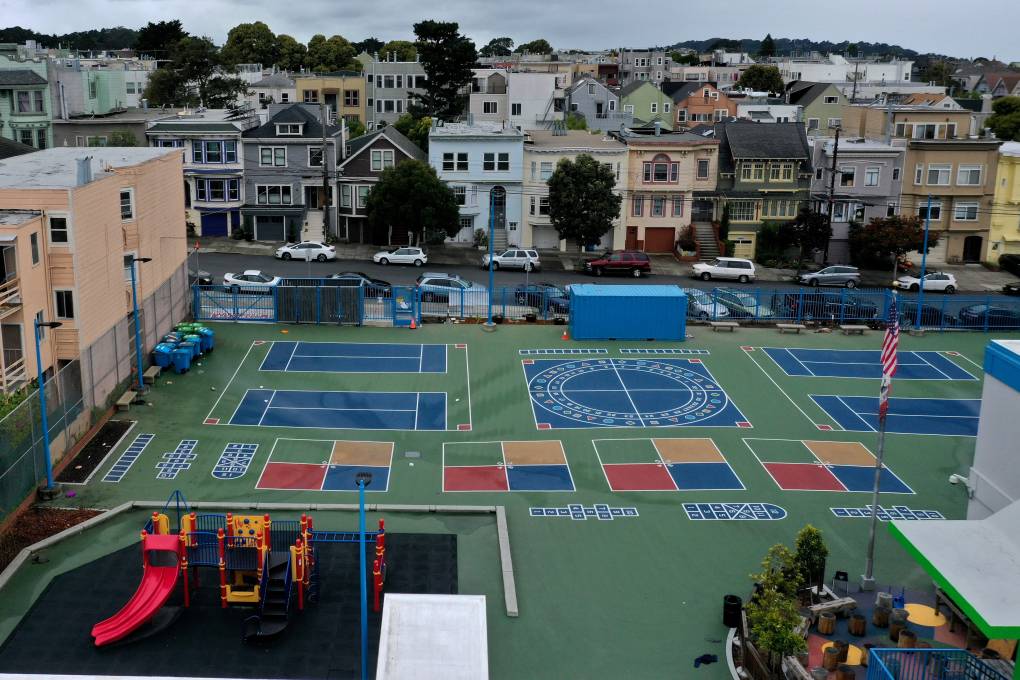
"caption": "An aerial view of the schoolyard at Frank McCoppin Elementary School on March 18, 2020 in San Francisco. ",
"credit": "Justin Sullivan/Getty Images",
"altTag": null,
"description": "An aerial view of the schoolyard at Frank McCoppin Elementary School on March 18, 2020 in San Francisco. ",
"imgSizes": {
"medium": {
"file": "https://cdn.kqed.org/wp-content/uploads/sites/10/2021/03/GettyImages-1213355350-800x533.jpg",
"width": 800,
"height": 533,
"mimeType": "image/jpeg"
},
"large": {
"file": "https://cdn.kqed.org/wp-content/uploads/sites/10/2021/03/GettyImages-1213355350-1020x680.jpg",
"width": 1020,
"height": 680,
"mimeType": "image/jpeg"
},
"thumbnail": {
"file": "https://cdn.kqed.org/wp-content/uploads/sites/10/2021/03/GettyImages-1213355350-160x107.jpg",
"width": 160,
"height": 107,
"mimeType": "image/jpeg"
},
"1536x1536": {
"file": "https://cdn.kqed.org/wp-content/uploads/sites/10/2021/03/GettyImages-1213355350-1536x1024.jpg",
"width": 1536,
"height": 1024,
"mimeType": "image/jpeg"
},
"2048x2048": {
"file": "https://cdn.kqed.org/wp-content/uploads/sites/10/2021/03/GettyImages-1213355350-2048x1366.jpg",
"width": 2048,
"height": 1366,
"mimeType": "image/jpeg"
},
"post-thumbnail": {
"file": "https://cdn.kqed.org/wp-content/uploads/sites/10/2021/03/GettyImages-1213355350-672x372.jpg",
"width": 672,
"height": 372,
"mimeType": "image/jpeg"
},
"twentyfourteen-full-width": {
"file": "https://cdn.kqed.org/wp-content/uploads/sites/10/2021/03/GettyImages-1213355350-1038x576.jpg",
"width": 1038,
"height": 576,
"mimeType": "image/jpeg"
},
"full-width": {
"file": "https://cdn.kqed.org/wp-content/uploads/sites/10/2021/03/GettyImages-1213355350-1920x1280.jpg",
"width": 1920,
"height": 1280,
"mimeType": "image/jpeg"
},
"apple_news_ca_landscape_12_9": {
"file": "https://cdn.kqed.org/wp-content/uploads/sites/10/2021/03/GettyImages-1213355350-1832x1374.jpg",
"width": 1832,
"height": 1374,
"mimeType": "image/jpeg"
},
"apple_news_ca_landscape_9_7": {
"file": "https://cdn.kqed.org/wp-content/uploads/sites/10/2021/03/GettyImages-1213355350-1376x1032.jpg",
"width": 1376,
"height": 1032,
"mimeType": "image/jpeg"
},
"apple_news_ca_landscape_5_5": {
"file": "https://cdn.kqed.org/wp-content/uploads/sites/10/2021/03/GettyImages-1213355350-1044x783.jpg",
"width": 1044,
"height": 783,
"mimeType": "image/jpeg"
},
"apple_news_ca_landscape_4_7": {
"file": "https://cdn.kqed.org/wp-content/uploads/sites/10/2021/03/GettyImages-1213355350-632x474.jpg",
"width": 632,
"height": 474,
"mimeType": "image/jpeg"
},
"apple_news_ca_landscape_4_0": {
"file": "https://cdn.kqed.org/wp-content/uploads/sites/10/2021/03/GettyImages-1213355350-536x402.jpg",
"width": 536,
"height": 402,
"mimeType": "image/jpeg"
},
"apple_news_ca_portrait_12_9": {
"file": "https://cdn.kqed.org/wp-content/uploads/sites/10/2021/03/GettyImages-1213355350-1122x1496.jpg",
"width": 1122,
"height": 1496,
"mimeType": "image/jpeg"
},
"apple_news_ca_portrait_9_7": {
"file": "https://cdn.kqed.org/wp-content/uploads/sites/10/2021/03/GettyImages-1213355350-840x1120.jpg",
"width": 840,
"height": 1120,
"mimeType": "image/jpeg"
},
"apple_news_ca_portrait_5_5": {
"file": "https://cdn.kqed.org/wp-content/uploads/sites/10/2021/03/GettyImages-1213355350-687x916.jpg",
"width": 687,
"height": 916,
"mimeType": "image/jpeg"
},
"apple_news_ca_portrait_4_7": {
"file": "https://cdn.kqed.org/wp-content/uploads/sites/10/2021/03/GettyImages-1213355350-414x552.jpg",
"width": 414,
"height": 552,
"mimeType": "image/jpeg"
},
"apple_news_ca_portrait_4_0": {
"file": "https://cdn.kqed.org/wp-content/uploads/sites/10/2021/03/GettyImages-1213355350-354x472.jpg",
"width": 354,
"height": 472,
"mimeType": "image/jpeg"
},
"apple_news_ca_square_12_9": {
"file": "https://cdn.kqed.org/wp-content/uploads/sites/10/2021/03/GettyImages-1213355350-1472x1472.jpg",
"width": 1472,
"height": 1472,
"mimeType": "image/jpeg"
},
"apple_news_ca_square_9_7": {
"file": "https://cdn.kqed.org/wp-content/uploads/sites/10/2021/03/GettyImages-1213355350-1104x1104.jpg",
"width": 1104,
"height": 1104,
"mimeType": "image/jpeg"
},
"apple_news_ca_square_5_5": {
"file": "https://cdn.kqed.org/wp-content/uploads/sites/10/2021/03/GettyImages-1213355350-912x912.jpg",
"width": 912,
"height": 912,
"mimeType": "image/jpeg"
},
"apple_news_ca_square_4_7": {
"file": "https://cdn.kqed.org/wp-content/uploads/sites/10/2021/03/GettyImages-1213355350-550x550.jpg",
"width": 550,
"height": 550,
"mimeType": "image/jpeg"
},
"apple_news_ca_square_4_0": {
"file": "https://cdn.kqed.org/wp-content/uploads/sites/10/2021/03/GettyImages-1213355350-470x470.jpg",
"width": 470,
"height": 470,
"mimeType": "image/jpeg"
},
"kqedFullSize": {
"file": "https://cdn.kqed.org/wp-content/uploads/sites/10/2021/03/GettyImages-1213355350-scaled-e1761869574699.jpg",
"width": 2000,
"height": 1334
}
},
"isLoading": false,
"fetchFailed": false
},
"news_11863596": {
"type": "attachments",
"id": "news_11863596",
"meta": {
"index": "attachments_1716263798",
"site": "news",
"id": "11863596",
"found": true
},
"parent": 11863374,
"imgSizes": {
"apple_news_ca_landscape_5_5": {
"file": "https://ww2.kqed.org/app/uploads/sites/10/2020/03/WhitneyDwyer_01292021-qut-1044x783.jpg",
"width": 1044,
"mimeType": "image/jpeg",
"height": 783
},
"apple_news_ca_square_4_0": {
"file": "https://ww2.kqed.org/app/uploads/sites/10/2020/03/WhitneyDwyer_01292021-qut-470x470.jpg",
"width": 470,
"mimeType": "image/jpeg",
"height": 470
},
"twentyfourteen-full-width": {
"file": "https://ww2.kqed.org/app/uploads/sites/10/2020/03/WhitneyDwyer_01292021-qut-1038x576.jpg",
"width": 1038,
"mimeType": "image/jpeg",
"height": 576
},
"thumbnail": {
"file": "https://ww2.kqed.org/app/uploads/sites/10/2020/03/WhitneyDwyer_01292021-qut-160x107.jpg",
"width": 160,
"mimeType": "image/jpeg",
"height": 107
},
"post-thumbnail": {
"file": "https://ww2.kqed.org/app/uploads/sites/10/2020/03/WhitneyDwyer_01292021-qut-672x372.jpg",
"width": 672,
"mimeType": "image/jpeg",
"height": 372
},
"kqedFullSize": {
"file": "https://ww2.kqed.org/app/uploads/sites/10/2020/03/WhitneyDwyer_01292021-qut.jpg",
"width": 1920,
"height": 1280
},
"apple_news_ca_landscape_4_7": {
"file": "https://ww2.kqed.org/app/uploads/sites/10/2020/03/WhitneyDwyer_01292021-qut-632x474.jpg",
"width": 632,
"mimeType": "image/jpeg",
"height": 474
},
"large": {
"file": "https://ww2.kqed.org/app/uploads/sites/10/2020/03/WhitneyDwyer_01292021-qut-1020x680.jpg",
"width": 1020,
"mimeType": "image/jpeg",
"height": 680
},
"apple_news_ca_landscape_4_0": {
"file": "https://ww2.kqed.org/app/uploads/sites/10/2020/03/WhitneyDwyer_01292021-qut-536x402.jpg",
"width": 536,
"mimeType": "image/jpeg",
"height": 402
},
"apple_news_ca_portrait_12_9": {
"file": "https://ww2.kqed.org/app/uploads/sites/10/2020/03/WhitneyDwyer_01292021-qut-1122x1280.jpg",
"width": 1122,
"mimeType": "image/jpeg",
"height": 1280
},
"medium": {
"file": "https://ww2.kqed.org/app/uploads/sites/10/2020/03/WhitneyDwyer_01292021-qut-800x533.jpg",
"width": 800,
"mimeType": "image/jpeg",
"height": 533
},
"apple_news_ca_portrait_4_0": {
"file": "https://ww2.kqed.org/app/uploads/sites/10/2020/03/WhitneyDwyer_01292021-qut-354x472.jpg",
"width": 354,
"mimeType": "image/jpeg",
"height": 472
},
"apple_news_ca_portrait_9_7": {
"file": "https://ww2.kqed.org/app/uploads/sites/10/2020/03/WhitneyDwyer_01292021-qut-840x1120.jpg",
"width": 840,
"mimeType": "image/jpeg",
"height": 1120
},
"apple_news_ca_landscape_12_9": {
"file": "https://ww2.kqed.org/app/uploads/sites/10/2020/03/WhitneyDwyer_01292021-qut-1832x1280.jpg",
"width": 1832,
"mimeType": "image/jpeg",
"height": 1280
},
"apple_news_ca_square_9_7": {
"file": "https://ww2.kqed.org/app/uploads/sites/10/2020/03/WhitneyDwyer_01292021-qut-1104x1104.jpg",
"width": 1104,
"mimeType": "image/jpeg",
"height": 1104
},
"1536x1536": {
"file": "https://ww2.kqed.org/app/uploads/sites/10/2020/03/WhitneyDwyer_01292021-qut-1536x1024.jpg",
"width": 1536,
"mimeType": "image/jpeg",
"height": 1024
},
"apple_news_ca_portrait_4_7": {
"file": "https://ww2.kqed.org/app/uploads/sites/10/2020/03/WhitneyDwyer_01292021-qut-414x552.jpg",
"width": 414,
"mimeType": "image/jpeg",
"height": 552
},
"apple_news_ca_square_12_9": {
"file": "https://ww2.kqed.org/app/uploads/sites/10/2020/03/WhitneyDwyer_01292021-qut-1472x1280.jpg",
"width": 1472,
"mimeType": "image/jpeg",
"height": 1280
},
"apple_news_ca_portrait_5_5": {
"file": "https://ww2.kqed.org/app/uploads/sites/10/2020/03/WhitneyDwyer_01292021-qut-687x916.jpg",
"width": 687,
"mimeType": "image/jpeg",
"height": 916
},
"apple_news_ca_square_4_7": {
"file": "https://ww2.kqed.org/app/uploads/sites/10/2020/03/WhitneyDwyer_01292021-qut-550x550.jpg",
"width": 550,
"mimeType": "image/jpeg",
"height": 550
},
"apple_news_ca_landscape_9_7": {
"file": "https://ww2.kqed.org/app/uploads/sites/10/2020/03/WhitneyDwyer_01292021-qut-1376x1032.jpg",
"width": 1376,
"mimeType": "image/jpeg",
"height": 1032
},
"apple_news_ca_square_5_5": {
"file": "https://ww2.kqed.org/app/uploads/sites/10/2020/03/WhitneyDwyer_01292021-qut-912x912.jpg",
"width": 912,
"mimeType": "image/jpeg",
"height": 912
}
},
"publishDate": 1614990835,
"modified": 1614994300,
"caption": "Oakland Unified School District teacher Whitney Dwyer grades student's work in her backyard in Oakland on Jan. 29, 2021.",
"description": null,
"title": "WhitneyDwyer_01292021-qut",
"credit": "Beth LaBerge/KQED",
"status": "inherit",
"altTag": null,
"isLoading": false,
"fetchFailed": false
},
"news_11863381": {
"type": "attachments",
"id": "news_11863381",
"meta": {
"index": "attachments_1716263798",
"site": "news",
"id": "11863381",
"found": true
},
"parent": 11863374,
"imgSizes": {
"apple_news_ca_landscape_5_5": {
"file": "https://ww2.kqed.org/app/uploads/sites/10/2029/03/2Oakland_OUSDTeacherWhitneyDwyer_01292021-qut-1044x783.jpg",
"width": 1044,
"mimeType": "image/jpeg",
"height": 783
},
"apple_news_ca_square_4_0": {
"file": "https://ww2.kqed.org/app/uploads/sites/10/2029/03/2Oakland_OUSDTeacherWhitneyDwyer_01292021-qut-470x470.jpg",
"width": 470,
"mimeType": "image/jpeg",
"height": 470
},
"twentyfourteen-full-width": {
"file": "https://ww2.kqed.org/app/uploads/sites/10/2029/03/2Oakland_OUSDTeacherWhitneyDwyer_01292021-qut-1038x576.jpg",
"width": 1038,
"mimeType": "image/jpeg",
"height": 576
},
"thumbnail": {
"file": "https://ww2.kqed.org/app/uploads/sites/10/2029/03/2Oakland_OUSDTeacherWhitneyDwyer_01292021-qut-160x107.jpg",
"width": 160,
"mimeType": "image/jpeg",
"height": 107
},
"post-thumbnail": {
"file": "https://ww2.kqed.org/app/uploads/sites/10/2029/03/2Oakland_OUSDTeacherWhitneyDwyer_01292021-qut-672x372.jpg",
"width": 672,
"mimeType": "image/jpeg",
"height": 372
},
"kqedFullSize": {
"file": "https://ww2.kqed.org/app/uploads/sites/10/2029/03/2Oakland_OUSDTeacherWhitneyDwyer_01292021-qut.jpg",
"width": 1920,
"height": 1280
},
"apple_news_ca_landscape_4_7": {
"file": "https://ww2.kqed.org/app/uploads/sites/10/2029/03/2Oakland_OUSDTeacherWhitneyDwyer_01292021-qut-632x474.jpg",
"width": 632,
"mimeType": "image/jpeg",
"height": 474
},
"large": {
"file": "https://ww2.kqed.org/app/uploads/sites/10/2029/03/2Oakland_OUSDTeacherWhitneyDwyer_01292021-qut-1020x680.jpg",
"width": 1020,
"mimeType": "image/jpeg",
"height": 680
},
"apple_news_ca_landscape_4_0": {
"file": "https://ww2.kqed.org/app/uploads/sites/10/2029/03/2Oakland_OUSDTeacherWhitneyDwyer_01292021-qut-536x402.jpg",
"width": 536,
"mimeType": "image/jpeg",
"height": 402
},
"apple_news_ca_portrait_12_9": {
"file": "https://ww2.kqed.org/app/uploads/sites/10/2029/03/2Oakland_OUSDTeacherWhitneyDwyer_01292021-qut-1122x1280.jpg",
"width": 1122,
"mimeType": "image/jpeg",
"height": 1280
},
"medium": {
"file": "https://ww2.kqed.org/app/uploads/sites/10/2029/03/2Oakland_OUSDTeacherWhitneyDwyer_01292021-qut-800x533.jpg",
"width": 800,
"mimeType": "image/jpeg",
"height": 533
},
"apple_news_ca_portrait_4_0": {
"file": "https://ww2.kqed.org/app/uploads/sites/10/2029/03/2Oakland_OUSDTeacherWhitneyDwyer_01292021-qut-354x472.jpg",
"width": 354,
"mimeType": "image/jpeg",
"height": 472
},
"apple_news_ca_portrait_9_7": {
"file": "https://ww2.kqed.org/app/uploads/sites/10/2029/03/2Oakland_OUSDTeacherWhitneyDwyer_01292021-qut-840x1120.jpg",
"width": 840,
"mimeType": "image/jpeg",
"height": 1120
},
"apple_news_ca_landscape_12_9": {
"file": "https://ww2.kqed.org/app/uploads/sites/10/2029/03/2Oakland_OUSDTeacherWhitneyDwyer_01292021-qut-1832x1280.jpg",
"width": 1832,
"mimeType": "image/jpeg",
"height": 1280
},
"apple_news_ca_square_9_7": {
"file": "https://ww2.kqed.org/app/uploads/sites/10/2029/03/2Oakland_OUSDTeacherWhitneyDwyer_01292021-qut-1104x1104.jpg",
"width": 1104,
"mimeType": "image/jpeg",
"height": 1104
},
"1536x1536": {
"file": "https://ww2.kqed.org/app/uploads/sites/10/2029/03/2Oakland_OUSDTeacherWhitneyDwyer_01292021-qut-1536x1024.jpg",
"width": 1536,
"mimeType": "image/jpeg",
"height": 1024
},
"apple_news_ca_portrait_4_7": {
"file": "https://ww2.kqed.org/app/uploads/sites/10/2029/03/2Oakland_OUSDTeacherWhitneyDwyer_01292021-qut-414x552.jpg",
"width": 414,
"mimeType": "image/jpeg",
"height": 552
},
"apple_news_ca_square_12_9": {
"file": "https://ww2.kqed.org/app/uploads/sites/10/2029/03/2Oakland_OUSDTeacherWhitneyDwyer_01292021-qut-1472x1280.jpg",
"width": 1472,
"mimeType": "image/jpeg",
"height": 1280
},
"apple_news_ca_portrait_5_5": {
"file": "https://ww2.kqed.org/app/uploads/sites/10/2029/03/2Oakland_OUSDTeacherWhitneyDwyer_01292021-qut-687x916.jpg",
"width": 687,
"mimeType": "image/jpeg",
"height": 916
},
"apple_news_ca_square_4_7": {
"file": "https://ww2.kqed.org/app/uploads/sites/10/2029/03/2Oakland_OUSDTeacherWhitneyDwyer_01292021-qut-550x550.jpg",
"width": 550,
"mimeType": "image/jpeg",
"height": 550
},
"apple_news_ca_landscape_9_7": {
"file": "https://ww2.kqed.org/app/uploads/sites/10/2029/03/2Oakland_OUSDTeacherWhitneyDwyer_01292021-qut-1376x1032.jpg",
"width": 1376,
"mimeType": "image/jpeg",
"height": 1032
},
"apple_news_ca_square_5_5": {
"file": "https://ww2.kqed.org/app/uploads/sites/10/2029/03/2Oakland_OUSDTeacherWhitneyDwyer_01292021-qut-912x912.jpg",
"width": 912,
"mimeType": "image/jpeg",
"height": 912
}
},
"publishDate": 1614902348,
"modified": 1614902380,
"caption": "Whitney Dwyer at her home office in Oakland on Jan. 29, 2021, where she teaches Oakland Unified School District students through Zoom classes.",
"description": null,
"title": "2Oakland_OUSDTeacherWhitneyDwyer_01292021-qut",
"credit": "Beth LaBerge/KQED",
"status": "inherit",
"altTag": null,
"isLoading": false,
"fetchFailed": false
},
"news_11863574": {
"type": "attachments",
"id": "news_11863574",
"meta": {
"index": "attachments_1716263798",
"site": "news",
"id": "11863574",
"found": true
},
"parent": 11863567,
"imgSizes": {
"apple_news_ca_landscape_5_5": {
"file": "https://ww2.kqed.org/app/uploads/sites/10/2021/03/readjustment_030521_final-1044x783.png",
"width": 1044,
"mimeType": "image/png",
"height": 783
},
"apple_news_ca_square_4_0": {
"file": "https://ww2.kqed.org/app/uploads/sites/10/2021/03/readjustment_030521_final-470x470.png",
"width": 470,
"mimeType": "image/png",
"height": 470
},
"twentyfourteen-full-width": {
"file": "https://ww2.kqed.org/app/uploads/sites/10/2021/03/readjustment_030521_final-1038x576.png",
"width": 1038,
"mimeType": "image/png",
"height": 576
},
"thumbnail": {
"file": "https://ww2.kqed.org/app/uploads/sites/10/2021/03/readjustment_030521_final-160x108.png",
"width": 160,
"mimeType": "image/png",
"height": 108
},
"post-thumbnail": {
"file": "https://ww2.kqed.org/app/uploads/sites/10/2021/03/readjustment_030521_final-672x372.png",
"width": 672,
"mimeType": "image/png",
"height": 372
},
"kqedFullSize": {
"file": "https://ww2.kqed.org/app/uploads/sites/10/2021/03/readjustment_030521_final.png",
"width": 1920,
"height": 1292
},
"apple_news_ca_landscape_4_7": {
"file": "https://ww2.kqed.org/app/uploads/sites/10/2021/03/readjustment_030521_final-632x474.png",
"width": 632,
"mimeType": "image/png",
"height": 474
},
"large": {
"file": "https://ww2.kqed.org/app/uploads/sites/10/2021/03/readjustment_030521_final-1020x686.png",
"width": 1020,
"mimeType": "image/png",
"height": 686
},
"apple_news_ca_landscape_4_0": {
"file": "https://ww2.kqed.org/app/uploads/sites/10/2021/03/readjustment_030521_final-536x402.png",
"width": 536,
"mimeType": "image/png",
"height": 402
},
"apple_news_ca_portrait_12_9": {
"file": "https://ww2.kqed.org/app/uploads/sites/10/2021/03/readjustment_030521_final-1122x1292.png",
"width": 1122,
"mimeType": "image/png",
"height": 1292
},
"medium": {
"file": "https://ww2.kqed.org/app/uploads/sites/10/2021/03/readjustment_030521_final-800x538.png",
"width": 800,
"mimeType": "image/png",
"height": 538
},
"apple_news_ca_portrait_4_0": {
"file": "https://ww2.kqed.org/app/uploads/sites/10/2021/03/readjustment_030521_final-354x472.png",
"width": 354,
"mimeType": "image/png",
"height": 472
},
"apple_news_ca_portrait_9_7": {
"file": "https://ww2.kqed.org/app/uploads/sites/10/2021/03/readjustment_030521_final-840x1120.png",
"width": 840,
"mimeType": "image/png",
"height": 1120
},
"apple_news_ca_landscape_12_9": {
"file": "https://ww2.kqed.org/app/uploads/sites/10/2021/03/readjustment_030521_final-1832x1292.png",
"width": 1832,
"mimeType": "image/png",
"height": 1292
},
"apple_news_ca_square_9_7": {
"file": "https://ww2.kqed.org/app/uploads/sites/10/2021/03/readjustment_030521_final-1104x1104.png",
"width": 1104,
"mimeType": "image/png",
"height": 1104
},
"1536x1536": {
"file": "https://ww2.kqed.org/app/uploads/sites/10/2021/03/readjustment_030521_final-1536x1034.png",
"width": 1536,
"mimeType": "image/png",
"height": 1034
},
"apple_news_ca_portrait_4_7": {
"file": "https://ww2.kqed.org/app/uploads/sites/10/2021/03/readjustment_030521_final-414x552.png",
"width": 414,
"mimeType": "image/png",
"height": 552
},
"apple_news_ca_square_12_9": {
"file": "https://ww2.kqed.org/app/uploads/sites/10/2021/03/readjustment_030521_final-1472x1292.png",
"width": 1472,
"mimeType": "image/png",
"height": 1292
},
"apple_news_ca_portrait_5_5": {
"file": "https://ww2.kqed.org/app/uploads/sites/10/2021/03/readjustment_030521_final-687x916.png",
"width": 687,
"mimeType": "image/png",
"height": 916
},
"apple_news_ca_square_4_7": {
"file": "https://ww2.kqed.org/app/uploads/sites/10/2021/03/readjustment_030521_final-550x550.png",
"width": 550,
"mimeType": "image/png",
"height": 550
},
"apple_news_ca_landscape_9_7": {
"file": "https://ww2.kqed.org/app/uploads/sites/10/2021/03/readjustment_030521_final-1376x1032.png",
"width": 1376,
"mimeType": "image/png",
"height": 1032
},
"apple_news_ca_square_5_5": {
"file": "https://ww2.kqed.org/app/uploads/sites/10/2021/03/readjustment_030521_final-912x912.png",
"width": 912,
"mimeType": "image/png",
"height": 912
}
},
"publishDate": 1614988852,
"modified": 1614988942,
"caption": null,
"description": null,
"title": "readjustment_030521_final",
"credit": null,
"status": "inherit",
"altTag": "A Mark Fiore cartoon about schools reopening, showing a classroom with two teachers talking about students readjusting from online learning as students all have glowing computer eyes.",
"isLoading": false,
"fetchFailed": false
},
"news_11863328": {
"type": "attachments",
"id": "news_11863328",
"meta": {
"index": "attachments_1716263798",
"site": "news",
"id": "11863328",
"found": true
},
"parent": 11863282,
"imgSizes": {
"apple_news_ca_portrait_9_7": {
"file": "https://ww2.kqed.org/app/uploads/sites/10/2021/03/IMG_2629_Resized2-840x499.jpg",
"width": 840,
"mimeType": "image/jpeg",
"height": 499
},
"apple_news_ca_square_4_0": {
"file": "https://ww2.kqed.org/app/uploads/sites/10/2021/03/IMG_2629_Resized2-470x470.jpg",
"width": 470,
"mimeType": "image/jpeg",
"height": 470
},
"thumbnail": {
"file": "https://ww2.kqed.org/app/uploads/sites/10/2021/03/IMG_2629_Resized2-160x93.jpg",
"width": 160,
"mimeType": "image/jpeg",
"height": 93
},
"post-thumbnail": {
"file": "https://ww2.kqed.org/app/uploads/sites/10/2021/03/IMG_2629_Resized2-672x372.jpg",
"width": 672,
"mimeType": "image/jpeg",
"height": 372
},
"kqedFullSize": {
"file": "https://ww2.kqed.org/app/uploads/sites/10/2021/03/IMG_2629_Resized2.jpg",
"width": 861,
"height": 499
},
"apple_news_ca_landscape_4_7": {
"file": "https://ww2.kqed.org/app/uploads/sites/10/2021/03/IMG_2629_Resized2-632x474.jpg",
"width": 632,
"mimeType": "image/jpeg",
"height": 474
},
"apple_news_ca_portrait_4_7": {
"file": "https://ww2.kqed.org/app/uploads/sites/10/2021/03/IMG_2629_Resized2-414x499.jpg",
"width": 414,
"mimeType": "image/jpeg",
"height": 499
},
"apple_news_ca_portrait_5_5": {
"file": "https://ww2.kqed.org/app/uploads/sites/10/2021/03/IMG_2629_Resized2-687x499.jpg",
"width": 687,
"mimeType": "image/jpeg",
"height": 499
},
"apple_news_ca_square_4_7": {
"file": "https://ww2.kqed.org/app/uploads/sites/10/2021/03/IMG_2629_Resized2-550x499.jpg",
"width": 550,
"mimeType": "image/jpeg",
"height": 499
},
"apple_news_ca_landscape_4_0": {
"file": "https://ww2.kqed.org/app/uploads/sites/10/2021/03/IMG_2629_Resized2-536x402.jpg",
"width": 536,
"mimeType": "image/jpeg",
"height": 402
},
"medium": {
"file": "https://ww2.kqed.org/app/uploads/sites/10/2021/03/IMG_2629_Resized2-800x464.jpg",
"width": 800,
"mimeType": "image/jpeg",
"height": 464
},
"apple_news_ca_portrait_4_0": {
"file": "https://ww2.kqed.org/app/uploads/sites/10/2021/03/IMG_2629_Resized2-354x472.jpg",
"width": 354,
"mimeType": "image/jpeg",
"height": 472
}
},
"publishDate": 1614896445,
"modified": 1615589964,
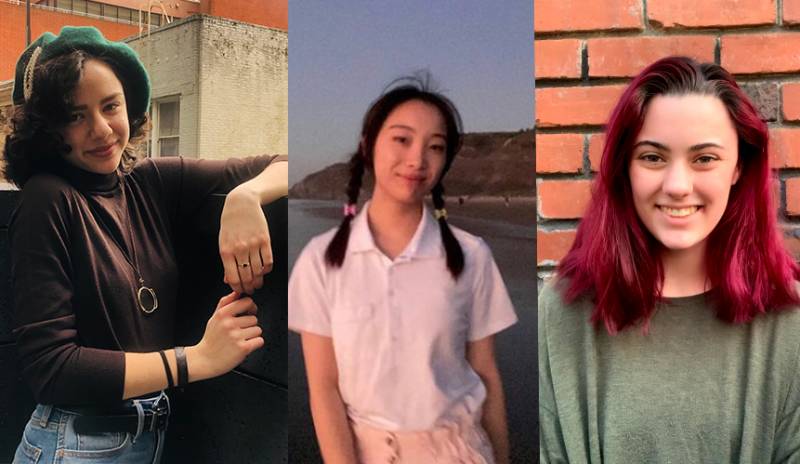
"caption": "(Left to right) Melina Kritikopoulos, Joy Cheng and Isabella Brenneman are all students at Bay Area high schools. They're all nervous about returning to in-person classes.",
"description": null,
"title": "IMG_2629_Resized2",
"credit": "KQED News",
"status": "inherit",
"altTag": null,
"isLoading": false,
"fetchFailed": false
},
"news_11863288": {
"type": "attachments",
"id": "news_11863288",
"meta": {
"index": "attachments_1716263798",
"site": "news",
"id": "11863288",
"found": true
},
"parent": 11863208,
"imgSizes": {
"apple_news_ca_landscape_5_5": {
"file": "https://ww2.kqed.org/app/uploads/sites/10/2021/03/RS47516_GettyImages-1229643858-qut-1044x783.jpg",
"width": 1044,
"mimeType": "image/jpeg",
"height": 783
},
"apple_news_ca_square_4_0": {
"file": "https://ww2.kqed.org/app/uploads/sites/10/2021/03/RS47516_GettyImages-1229643858-qut-470x470.jpg",
"width": 470,
"mimeType": "image/jpeg",
"height": 470
},
"twentyfourteen-full-width": {
"file": "https://ww2.kqed.org/app/uploads/sites/10/2021/03/RS47516_GettyImages-1229643858-qut-1038x576.jpg",
"width": 1038,
"mimeType": "image/jpeg",
"height": 576
},
"thumbnail": {
"file": "https://ww2.kqed.org/app/uploads/sites/10/2021/03/RS47516_GettyImages-1229643858-qut-160x90.jpg",
"width": 160,
"mimeType": "image/jpeg",
"height": 90
},
"post-thumbnail": {
"file": "https://ww2.kqed.org/app/uploads/sites/10/2021/03/RS47516_GettyImages-1229643858-qut-672x372.jpg",
"width": 672,
"mimeType": "image/jpeg",
"height": 372
},
"kqedFullSize": {
"file": "https://ww2.kqed.org/app/uploads/sites/10/2021/03/RS47516_GettyImages-1229643858-qut.jpg",
"width": 1920,
"height": 1075
},
"apple_news_ca_landscape_4_7": {
"file": "https://ww2.kqed.org/app/uploads/sites/10/2021/03/RS47516_GettyImages-1229643858-qut-632x474.jpg",
"width": 632,
"mimeType": "image/jpeg",
"height": 474
},
"large": {
"file": "https://ww2.kqed.org/app/uploads/sites/10/2021/03/RS47516_GettyImages-1229643858-qut-1020x571.jpg",
"width": 1020,
"mimeType": "image/jpeg",
"height": 571
},
"apple_news_ca_landscape_4_0": {
"file": "https://ww2.kqed.org/app/uploads/sites/10/2021/03/RS47516_GettyImages-1229643858-qut-536x402.jpg",
"width": 536,
"mimeType": "image/jpeg",
"height": 402
},
"apple_news_ca_portrait_12_9": {
"file": "https://ww2.kqed.org/app/uploads/sites/10/2021/03/RS47516_GettyImages-1229643858-qut-1122x1075.jpg",
"width": 1122,
"mimeType": "image/jpeg",
"height": 1075
},
"medium": {
"file": "https://ww2.kqed.org/app/uploads/sites/10/2021/03/RS47516_GettyImages-1229643858-qut-800x448.jpg",
"width": 800,
"mimeType": "image/jpeg",
"height": 448
},
"apple_news_ca_portrait_4_0": {
"file": "https://ww2.kqed.org/app/uploads/sites/10/2021/03/RS47516_GettyImages-1229643858-qut-354x472.jpg",
"width": 354,
"mimeType": "image/jpeg",
"height": 472
},
"apple_news_ca_portrait_9_7": {
"file": "https://ww2.kqed.org/app/uploads/sites/10/2021/03/RS47516_GettyImages-1229643858-qut-840x1075.jpg",
"width": 840,
"mimeType": "image/jpeg",
"height": 1075
},
"apple_news_ca_landscape_12_9": {
"file": "https://ww2.kqed.org/app/uploads/sites/10/2021/03/RS47516_GettyImages-1229643858-qut-1832x1075.jpg",
"width": 1832,
"mimeType": "image/jpeg",
"height": 1075
},
"apple_news_ca_square_9_7": {
"file": "https://ww2.kqed.org/app/uploads/sites/10/2021/03/RS47516_GettyImages-1229643858-qut-1104x1075.jpg",
"width": 1104,
"mimeType": "image/jpeg",
"height": 1075
},
"1536x1536": {
"file": "https://ww2.kqed.org/app/uploads/sites/10/2021/03/RS47516_GettyImages-1229643858-qut-1536x860.jpg",
"width": 1536,
"mimeType": "image/jpeg",
"height": 860
},
"apple_news_ca_portrait_4_7": {
"file": "https://ww2.kqed.org/app/uploads/sites/10/2021/03/RS47516_GettyImages-1229643858-qut-414x552.jpg",
"width": 414,
"mimeType": "image/jpeg",
"height": 552
},
"apple_news_ca_square_12_9": {
"file": "https://ww2.kqed.org/app/uploads/sites/10/2021/03/RS47516_GettyImages-1229643858-qut-1472x1075.jpg",
"width": 1472,
"mimeType": "image/jpeg",
"height": 1075
},
"apple_news_ca_portrait_5_5": {
"file": "https://ww2.kqed.org/app/uploads/sites/10/2021/03/RS47516_GettyImages-1229643858-qut-687x916.jpg",
"width": 687,
"mimeType": "image/jpeg",
"height": 916
},
"apple_news_ca_square_4_7": {
"file": "https://ww2.kqed.org/app/uploads/sites/10/2021/03/RS47516_GettyImages-1229643858-qut-550x550.jpg",
"width": 550,
"mimeType": "image/jpeg",
"height": 550
},
"apple_news_ca_landscape_9_7": {
"file": "https://ww2.kqed.org/app/uploads/sites/10/2021/03/RS47516_GettyImages-1229643858-qut-1376x1032.jpg",
"width": 1376,
"mimeType": "image/jpeg",
"height": 1032
},
"apple_news_ca_square_5_5": {
"file": "https://ww2.kqed.org/app/uploads/sites/10/2021/03/RS47516_GettyImages-1229643858-qut-912x912.jpg",
"width": 912,
"mimeType": "image/jpeg",
"height": 912
}
},
"publishDate": 1614891270,
"modified": 1614895161,
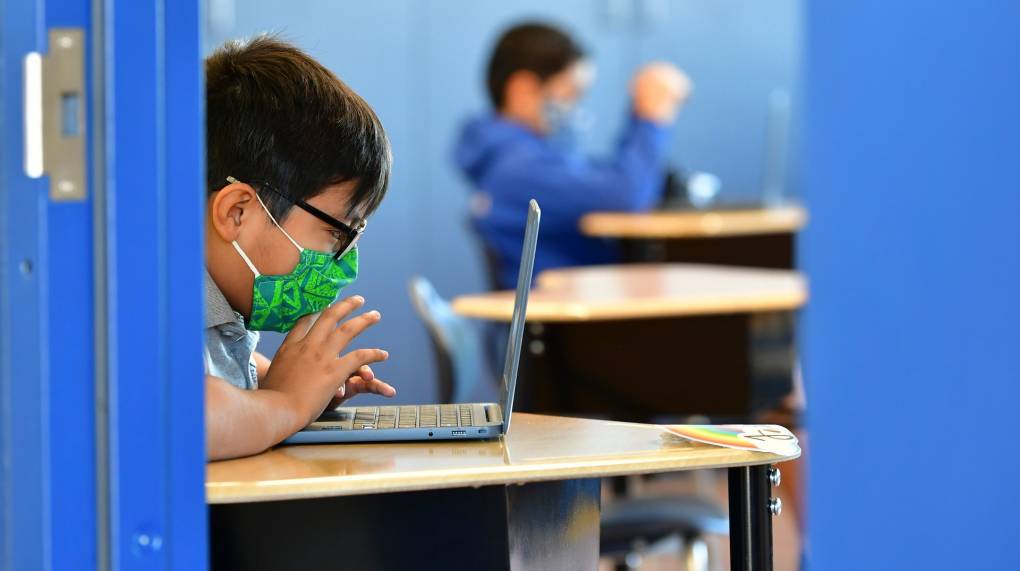
"caption": "Students work on their laptop computers at St. Joseph Catholic School in La Puente, California, on Nov. 16, 2020, where pre-kindergarten to second grade students in need of special services returned to the classroom for in-person instruction. ",
"description": "Students work on their laptop computers at St. Joseph Catholic School in La Puente, California on November 16, 2020, where pre-kindergarten to Second Grade students in need of special services returned to the classroom for in-person instruction. ",
"title": "US-HEALTH-VIRUS-epidemic",
"credit": "Frederic J. Brown/AFP via Getty Images",
"status": "inherit",
"altTag": null,
"isLoading": false,
"fetchFailed": false
},
"news_11863062": {
"type": "attachments",
"id": "news_11863062",
"meta": {
"index": "attachments_1716263798",
"site": "news",
"id": "11863062",
"found": true
},
"parent": 11863031,
"imgSizes": {
"apple_news_ca_landscape_5_5": {
"file": "https://ww2.kqed.org/app/uploads/sites/10/2021/03/RS46588_006_KQED_Berkeley_SchoolSitIn_01132021-qut-1044x783.jpg",
"width": 1044,
"mimeType": "image/jpeg",
"height": 783
},
"apple_news_ca_square_4_0": {
"file": "https://ww2.kqed.org/app/uploads/sites/10/2021/03/RS46588_006_KQED_Berkeley_SchoolSitIn_01132021-qut-470x470.jpg",
"width": 470,
"mimeType": "image/jpeg",
"height": 470
},
"twentyfourteen-full-width": {
"file": "https://ww2.kqed.org/app/uploads/sites/10/2021/03/RS46588_006_KQED_Berkeley_SchoolSitIn_01132021-qut-1038x576.jpg",
"width": 1038,
"mimeType": "image/jpeg",
"height": 576
},
"thumbnail": {
"file": "https://ww2.kqed.org/app/uploads/sites/10/2021/03/RS46588_006_KQED_Berkeley_SchoolSitIn_01132021-qut-160x101.jpg",
"width": 160,
"mimeType": "image/jpeg",
"height": 101
},
"post-thumbnail": {
"file": "https://ww2.kqed.org/app/uploads/sites/10/2021/03/RS46588_006_KQED_Berkeley_SchoolSitIn_01132021-qut-672x372.jpg",
"width": 672,
"mimeType": "image/jpeg",
"height": 372
},
"kqedFullSize": {
"file": "https://ww2.kqed.org/app/uploads/sites/10/2021/03/RS46588_006_KQED_Berkeley_SchoolSitIn_01132021-qut.jpg",
"width": 1920,
"height": 1212
},
"apple_news_ca_landscape_4_7": {
"file": "https://ww2.kqed.org/app/uploads/sites/10/2021/03/RS46588_006_KQED_Berkeley_SchoolSitIn_01132021-qut-632x474.jpg",
"width": 632,
"mimeType": "image/jpeg",
"height": 474
},
"large": {
"file": "https://ww2.kqed.org/app/uploads/sites/10/2021/03/RS46588_006_KQED_Berkeley_SchoolSitIn_01132021-qut-1020x644.jpg",
"width": 1020,
"mimeType": "image/jpeg",
"height": 644
},
"apple_news_ca_landscape_4_0": {
"file": "https://ww2.kqed.org/app/uploads/sites/10/2021/03/RS46588_006_KQED_Berkeley_SchoolSitIn_01132021-qut-536x402.jpg",
"width": 536,
"mimeType": "image/jpeg",
"height": 402
},
"apple_news_ca_portrait_12_9": {
"file": "https://ww2.kqed.org/app/uploads/sites/10/2021/03/RS46588_006_KQED_Berkeley_SchoolSitIn_01132021-qut-1122x1212.jpg",
"width": 1122,
"mimeType": "image/jpeg",
"height": 1212
},
"medium": {
"file": "https://ww2.kqed.org/app/uploads/sites/10/2021/03/RS46588_006_KQED_Berkeley_SchoolSitIn_01132021-qut-800x505.jpg",
"width": 800,
"mimeType": "image/jpeg",
"height": 505
},
"apple_news_ca_portrait_4_0": {
"file": "https://ww2.kqed.org/app/uploads/sites/10/2021/03/RS46588_006_KQED_Berkeley_SchoolSitIn_01132021-qut-354x472.jpg",
"width": 354,
"mimeType": "image/jpeg",
"height": 472
},
"apple_news_ca_portrait_9_7": {
"file": "https://ww2.kqed.org/app/uploads/sites/10/2021/03/RS46588_006_KQED_Berkeley_SchoolSitIn_01132021-qut-840x1120.jpg",
"width": 840,
"mimeType": "image/jpeg",
"height": 1120
},
"apple_news_ca_landscape_12_9": {
"file": "https://ww2.kqed.org/app/uploads/sites/10/2021/03/RS46588_006_KQED_Berkeley_SchoolSitIn_01132021-qut-1832x1212.jpg",
"width": 1832,
"mimeType": "image/jpeg",
"height": 1212
},
"apple_news_ca_square_9_7": {
"file": "https://ww2.kqed.org/app/uploads/sites/10/2021/03/RS46588_006_KQED_Berkeley_SchoolSitIn_01132021-qut-1104x1104.jpg",
"width": 1104,
"mimeType": "image/jpeg",
"height": 1104
},
"1536x1536": {
"file": "https://ww2.kqed.org/app/uploads/sites/10/2021/03/RS46588_006_KQED_Berkeley_SchoolSitIn_01132021-qut-1536x970.jpg",
"width": 1536,
"mimeType": "image/jpeg",
"height": 970
},
"apple_news_ca_portrait_4_7": {
"file": "https://ww2.kqed.org/app/uploads/sites/10/2021/03/RS46588_006_KQED_Berkeley_SchoolSitIn_01132021-qut-414x552.jpg",
"width": 414,
"mimeType": "image/jpeg",
"height": 552
},
"apple_news_ca_square_12_9": {
"file": "https://ww2.kqed.org/app/uploads/sites/10/2021/03/RS46588_006_KQED_Berkeley_SchoolSitIn_01132021-qut-1472x1212.jpg",
"width": 1472,
"mimeType": "image/jpeg",
"height": 1212
},
"apple_news_ca_portrait_5_5": {
"file": "https://ww2.kqed.org/app/uploads/sites/10/2021/03/RS46588_006_KQED_Berkeley_SchoolSitIn_01132021-qut-687x916.jpg",
"width": 687,
"mimeType": "image/jpeg",
"height": 916
},
"apple_news_ca_square_4_7": {
"file": "https://ww2.kqed.org/app/uploads/sites/10/2021/03/RS46588_006_KQED_Berkeley_SchoolSitIn_01132021-qut-550x550.jpg",
"width": 550,
"mimeType": "image/jpeg",
"height": 550
},
"apple_news_ca_landscape_9_7": {
"file": "https://ww2.kqed.org/app/uploads/sites/10/2021/03/RS46588_006_KQED_Berkeley_SchoolSitIn_01132021-qut-1376x1032.jpg",
"width": 1376,
"mimeType": "image/jpeg",
"height": 1032
},
"apple_news_ca_square_5_5": {
"file": "https://ww2.kqed.org/app/uploads/sites/10/2021/03/RS46588_006_KQED_Berkeley_SchoolSitIn_01132021-qut-912x912.jpg",
"width": 912,
"mimeType": "image/jpeg",
"height": 912
}
},
"publishDate": 1614809449,
"modified": 1614809524,
"caption": "Parents and students hold up signs in support of reopening schools at Thousand Oaks Elementary School in Berkeley on Jan. 13, 2021.",
"description": "Parents and students hold up signs in support of reopening schools at Thousand Oaks Elementary School in Berkeley on Jan. 13, 2021.",
"title": "RS46588_006_KQED_Berkeley_SchoolSitIn_01132021-qut",
"credit": "Anna Vignet/KQED",
"status": "inherit",
"altTag": null,
"isLoading": false,
"fetchFailed": false
},
"news_11862602": {
"type": "attachments",
"id": "news_11862602",
"meta": {
"index": "attachments_1716263798",
"site": "news",
"id": "11862602",
"found": true
},
"parent": 11877048,
"imgSizes": {
"apple_news_ca_landscape_5_5": {
"file": "https://ww2.kqed.org/app/uploads/sites/10/2021/03/GettyImages-1231222911-1044x783.jpg",
"width": 1044,
"mimeType": "image/jpeg",
"height": 783
},
"apple_news_ca_square_4_0": {
"file": "https://ww2.kqed.org/app/uploads/sites/10/2021/03/GettyImages-1231222911-470x470.jpg",
"width": 470,
"mimeType": "image/jpeg",
"height": 470
},
"twentyfourteen-full-width": {
"file": "https://ww2.kqed.org/app/uploads/sites/10/2021/03/GettyImages-1231222911-1038x576.jpg",
"width": 1038,
"mimeType": "image/jpeg",
"height": 576
},
"thumbnail": {
"file": "https://ww2.kqed.org/app/uploads/sites/10/2021/03/GettyImages-1231222911-160x107.jpg",
"width": 160,
"mimeType": "image/jpeg",
"height": 107
},
"post-thumbnail": {
"file": "https://ww2.kqed.org/app/uploads/sites/10/2021/03/GettyImages-1231222911-672x372.jpg",
"width": 672,
"mimeType": "image/jpeg",
"height": 372
},
"kqedFullSize": {
"file": "https://ww2.kqed.org/app/uploads/sites/10/2021/03/GettyImages-1231222911-scaled.jpg",
"width": 2560,
"height": 1707
},
"2048x2048": {
"file": "https://ww2.kqed.org/app/uploads/sites/10/2021/03/GettyImages-1231222911-2048x1365.jpg",
"width": 2048,
"mimeType": "image/jpeg",
"height": 1365
},
"apple_news_ca_landscape_4_7": {
"file": "https://ww2.kqed.org/app/uploads/sites/10/2021/03/GettyImages-1231222911-632x474.jpg",
"width": 632,
"mimeType": "image/jpeg",
"height": 474
},
"large": {
"file": "https://ww2.kqed.org/app/uploads/sites/10/2021/03/GettyImages-1231222911-1020x680.jpg",
"width": 1020,
"mimeType": "image/jpeg",
"height": 680
},
"apple_news_ca_landscape_4_0": {
"file": "https://ww2.kqed.org/app/uploads/sites/10/2021/03/GettyImages-1231222911-536x402.jpg",
"width": 536,
"mimeType": "image/jpeg",
"height": 402
},
"apple_news_ca_portrait_12_9": {
"file": "https://ww2.kqed.org/app/uploads/sites/10/2021/03/GettyImages-1231222911-1122x1496.jpg",
"width": 1122,
"mimeType": "image/jpeg",
"height": 1496
},
"medium": {
"file": "https://ww2.kqed.org/app/uploads/sites/10/2021/03/GettyImages-1231222911-800x533.jpg",
"width": 800,
"mimeType": "image/jpeg",
"height": 533
},
"apple_news_ca_portrait_4_0": {
"file": "https://ww2.kqed.org/app/uploads/sites/10/2021/03/GettyImages-1231222911-354x472.jpg",
"width": 354,
"mimeType": "image/jpeg",
"height": 472
},
"apple_news_ca_portrait_9_7": {
"file": "https://ww2.kqed.org/app/uploads/sites/10/2021/03/GettyImages-1231222911-840x1120.jpg",
"width": 840,
"mimeType": "image/jpeg",
"height": 1120
},
"apple_news_ca_landscape_12_9": {
"file": "https://ww2.kqed.org/app/uploads/sites/10/2021/03/GettyImages-1231222911-1832x1374.jpg",
"width": 1832,
"mimeType": "image/jpeg",
"height": 1374
},
"apple_news_ca_square_9_7": {
"file": "https://ww2.kqed.org/app/uploads/sites/10/2021/03/GettyImages-1231222911-1104x1104.jpg",
"width": 1104,
"mimeType": "image/jpeg",
"height": 1104
},
"1536x1536": {
"file": "https://ww2.kqed.org/app/uploads/sites/10/2021/03/GettyImages-1231222911-1536x1024.jpg",
"width": 1536,
"mimeType": "image/jpeg",
"height": 1024
},
"apple_news_ca_portrait_4_7": {
"file": "https://ww2.kqed.org/app/uploads/sites/10/2021/03/GettyImages-1231222911-414x552.jpg",
"width": 414,
"mimeType": "image/jpeg",
"height": 552
},
"apple_news_ca_square_12_9": {
"file": "https://ww2.kqed.org/app/uploads/sites/10/2021/03/GettyImages-1231222911-1472x1472.jpg",
"width": 1472,
"mimeType": "image/jpeg",
"height": 1472
},
"apple_news_ca_portrait_5_5": {
"file": "https://ww2.kqed.org/app/uploads/sites/10/2021/03/GettyImages-1231222911-687x916.jpg",
"width": 687,
"mimeType": "image/jpeg",
"height": 916
},
"full-width": {
"file": "https://ww2.kqed.org/app/uploads/sites/10/2021/03/GettyImages-1231222911-1920x1280.jpg",
"width": 1920,
"mimeType": "image/jpeg",
"height": 1280
},
"apple_news_ca_square_4_7": {
"file": "https://ww2.kqed.org/app/uploads/sites/10/2021/03/GettyImages-1231222911-550x550.jpg",
"width": 550,
"mimeType": "image/jpeg",
"height": 550
},
"apple_news_ca_landscape_9_7": {
"file": "https://ww2.kqed.org/app/uploads/sites/10/2021/03/GettyImages-1231222911-1376x1032.jpg",
"width": 1376,
"mimeType": "image/jpeg",
"height": 1032
},
"apple_news_ca_square_5_5": {
"file": "https://ww2.kqed.org/app/uploads/sites/10/2021/03/GettyImages-1231222911-912x912.jpg",
"width": 912,
"mimeType": "image/jpeg",
"height": 912
}
},
"publishDate": 1614630924,
"modified": 1623255773,
"caption": "Children attend online classes at a learning hub inside the Crenshaw Family YMCA on Feb. 17, 2021 in Los Angeles.",
"description": null,
"title": "US-HEALTH-VIRUS-SCHOOLS",
"credit": "Patrick T. Fallon/AFP via Getty Images",
"status": "inherit",
"altTag": null,
"isLoading": false,
"fetchFailed": false
},
"news_11862471": {
"type": "attachments",
"id": "news_11862471",
"meta": {
"index": "attachments_1716263798",
"site": "news",
"id": "11862471",
"found": true
},
"parent": 11862469,
"imgSizes": {
"apple_news_ca_landscape_5_5": {
"file": "https://ww2.kqed.org/app/uploads/sites/10/2021/02/Berk_MattMeyer-1044x783.jpg",
"width": 1044,
"mimeType": "image/jpeg",
"height": 783
},
"apple_news_ca_square_4_0": {
"file": "https://ww2.kqed.org/app/uploads/sites/10/2021/02/Berk_MattMeyer-470x470.jpg",
"width": 470,
"mimeType": "image/jpeg",
"height": 470
},
"twentyfourteen-full-width": {
"file": "https://ww2.kqed.org/app/uploads/sites/10/2021/02/Berk_MattMeyer-1038x576.jpg",
"width": 1038,
"mimeType": "image/jpeg",
"height": 576
},
"thumbnail": {
"file": "https://ww2.kqed.org/app/uploads/sites/10/2021/02/Berk_MattMeyer-160x91.jpg",
"width": 160,
"mimeType": "image/jpeg",
"height": 91
},
"post-thumbnail": {
"file": "https://ww2.kqed.org/app/uploads/sites/10/2021/02/Berk_MattMeyer-672x372.jpg",
"width": 672,
"mimeType": "image/jpeg",
"height": 372
},
"kqedFullSize": {
"file": "https://ww2.kqed.org/app/uploads/sites/10/2021/02/Berk_MattMeyer.jpg",
"width": 1920,
"height": 1090
},
"apple_news_ca_landscape_4_7": {
"file": "https://ww2.kqed.org/app/uploads/sites/10/2021/02/Berk_MattMeyer-632x474.jpg",
"width": 632,
"mimeType": "image/jpeg",
"height": 474
},
"large": {
"file": "https://ww2.kqed.org/app/uploads/sites/10/2021/02/Berk_MattMeyer-1020x579.jpg",
"width": 1020,
"mimeType": "image/jpeg",
"height": 579
},
"apple_news_ca_landscape_4_0": {
"file": "https://ww2.kqed.org/app/uploads/sites/10/2021/02/Berk_MattMeyer-536x402.jpg",
"width": 536,
"mimeType": "image/jpeg",
"height": 402
},
"apple_news_ca_portrait_12_9": {
"file": "https://ww2.kqed.org/app/uploads/sites/10/2021/02/Berk_MattMeyer-1122x1090.jpg",
"width": 1122,
"mimeType": "image/jpeg",
"height": 1090
},
"medium": {
"file": "https://ww2.kqed.org/app/uploads/sites/10/2021/02/Berk_MattMeyer-800x454.jpg",
"width": 800,
"mimeType": "image/jpeg",
"height": 454
},
"apple_news_ca_portrait_4_0": {
"file": "https://ww2.kqed.org/app/uploads/sites/10/2021/02/Berk_MattMeyer-354x472.jpg",
"width": 354,
"mimeType": "image/jpeg",
"height": 472
},
"apple_news_ca_portrait_9_7": {
"file": "https://ww2.kqed.org/app/uploads/sites/10/2021/02/Berk_MattMeyer-840x1090.jpg",
"width": 840,
"mimeType": "image/jpeg",
"height": 1090
},
"apple_news_ca_landscape_12_9": {
"file": "https://ww2.kqed.org/app/uploads/sites/10/2021/02/Berk_MattMeyer-1832x1090.jpg",
"width": 1832,
"mimeType": "image/jpeg",
"height": 1090
},
"apple_news_ca_square_9_7": {
"file": "https://ww2.kqed.org/app/uploads/sites/10/2021/02/Berk_MattMeyer-1104x1090.jpg",
"width": 1104,
"mimeType": "image/jpeg",
"height": 1090
},
"1536x1536": {
"file": "https://ww2.kqed.org/app/uploads/sites/10/2021/02/Berk_MattMeyer-1536x872.jpg",
"width": 1536,
"mimeType": "image/jpeg",
"height": 872
},
"apple_news_ca_portrait_4_7": {
"file": "https://ww2.kqed.org/app/uploads/sites/10/2021/02/Berk_MattMeyer-414x552.jpg",
"width": 414,
"mimeType": "image/jpeg",
"height": 552
},
"apple_news_ca_square_12_9": {
"file": "https://ww2.kqed.org/app/uploads/sites/10/2021/02/Berk_MattMeyer-1472x1090.jpg",
"width": 1472,
"mimeType": "image/jpeg",
"height": 1090
},
"apple_news_ca_portrait_5_5": {
"file": "https://ww2.kqed.org/app/uploads/sites/10/2021/02/Berk_MattMeyer-687x916.jpg",
"width": 687,
"mimeType": "image/jpeg",
"height": 916
},
"apple_news_ca_square_4_7": {
"file": "https://ww2.kqed.org/app/uploads/sites/10/2021/02/Berk_MattMeyer-550x550.jpg",
"width": 550,
"mimeType": "image/jpeg",
"height": 550
},
"apple_news_ca_landscape_9_7": {
"file": "https://ww2.kqed.org/app/uploads/sites/10/2021/02/Berk_MattMeyer-1376x1032.jpg",
"width": 1376,
"mimeType": "image/jpeg",
"height": 1032
},
"apple_news_ca_square_5_5": {
"file": "https://ww2.kqed.org/app/uploads/sites/10/2021/02/Berk_MattMeyer-912x912.jpg",
"width": 912,
"mimeType": "image/jpeg",
"height": 912
}
},
"publishDate": 1614542705,
"modified": 1614730000,
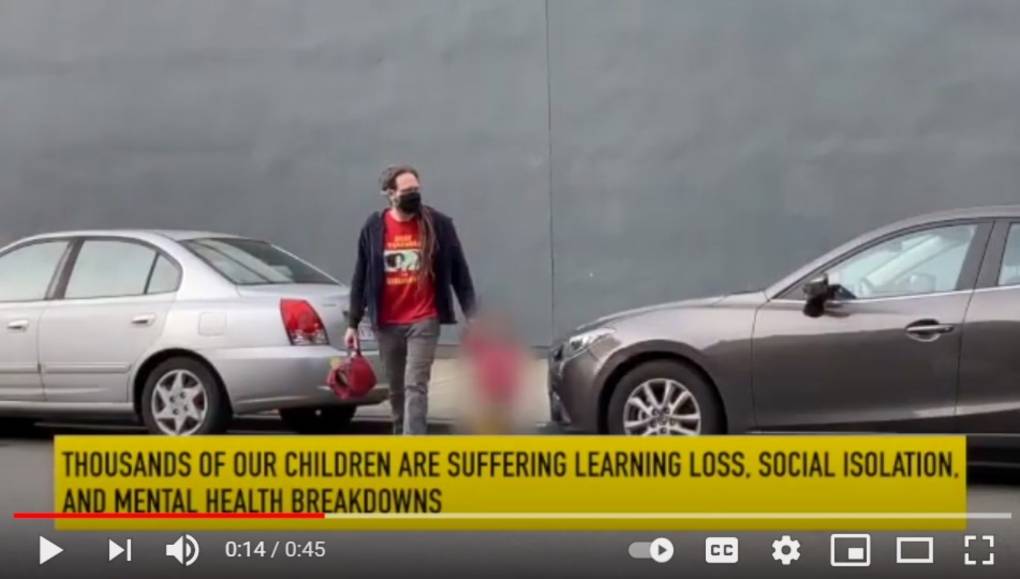
"caption": "A screengrab of a video posted to YouTube by the 'Guerilla Momz' group showed Berkeley Federation of Teachers President Matt Meyer dropping his daughter off at an in-person preschool.",
"description": "A screengrab of a video posted to YouTube by the 'Guerilla Momz' group showed Berkeley Federation of Teachers President Matt Meyer dropping his daughter off at an in-person preschool.",
"title": "Berk_MattMeyer",
"credit": "Courtesy Guerilla Momz via YouTube",
"status": "inherit",
"altTag": null,
"isLoading": false,
"fetchFailed": false
},
"news_11862423": {
"type": "attachments",
"id": "news_11862423",
"meta": {
"index": "attachments_1716263798",
"site": "news",
"id": "11862423",
"found": true
},
"parent": 11862295,
"imgSizes": {
"apple_news_ca_landscape_5_5": {
"file": "https://ww2.kqed.org/app/uploads/sites/10/2021/02/MARQUEE-818-1044x720.jpg",
"width": 1044,
"mimeType": "image/jpeg",
"height": 720
},
"apple_news_ca_square_4_0": {
"file": "https://ww2.kqed.org/app/uploads/sites/10/2021/02/MARQUEE-818-470x470.jpg",
"width": 470,
"mimeType": "image/jpeg",
"height": 470
},
"twentyfourteen-full-width": {
"file": "https://ww2.kqed.org/app/uploads/sites/10/2021/02/MARQUEE-818-1038x576.jpg",
"width": 1038,
"mimeType": "image/jpeg",
"height": 576
},
"thumbnail": {
"file": "https://ww2.kqed.org/app/uploads/sites/10/2021/02/MARQUEE-818-160x90.jpg",
"width": 160,
"mimeType": "image/jpeg",
"height": 90
},
"post-thumbnail": {
"file": "https://ww2.kqed.org/app/uploads/sites/10/2021/02/MARQUEE-818-672x372.jpg",
"width": 672,
"mimeType": "image/jpeg",
"height": 372
},
"kqedFullSize": {
"file": "https://ww2.kqed.org/app/uploads/sites/10/2021/02/MARQUEE-818.jpg",
"width": 1280,
"height": 720
},
"apple_news_ca_landscape_4_7": {
"file": "https://ww2.kqed.org/app/uploads/sites/10/2021/02/MARQUEE-818-632x474.jpg",
"width": 632,
"mimeType": "image/jpeg",
"height": 474
},
"large": {
"file": "https://ww2.kqed.org/app/uploads/sites/10/2021/02/MARQUEE-818-1020x574.jpg",
"width": 1020,
"mimeType": "image/jpeg",
"height": 574
},
"apple_news_ca_landscape_4_0": {
"file": "https://ww2.kqed.org/app/uploads/sites/10/2021/02/MARQUEE-818-536x402.jpg",
"width": 536,
"mimeType": "image/jpeg",
"height": 402
},
"apple_news_ca_portrait_12_9": {
"file": "https://ww2.kqed.org/app/uploads/sites/10/2021/02/MARQUEE-818-1122x720.jpg",
"width": 1122,
"mimeType": "image/jpeg",
"height": 720
},
"medium": {
"file": "https://ww2.kqed.org/app/uploads/sites/10/2021/02/MARQUEE-818-800x450.jpg",
"width": 800,
"mimeType": "image/jpeg",
"height": 450
},
"apple_news_ca_portrait_4_0": {
"file": "https://ww2.kqed.org/app/uploads/sites/10/2021/02/MARQUEE-818-354x472.jpg",
"width": 354,
"mimeType": "image/jpeg",
"height": 472
},
"apple_news_ca_portrait_9_7": {
"file": "https://ww2.kqed.org/app/uploads/sites/10/2021/02/MARQUEE-818-840x720.jpg",
"width": 840,
"mimeType": "image/jpeg",
"height": 720
},
"apple_news_ca_square_9_7": {
"file": "https://ww2.kqed.org/app/uploads/sites/10/2021/02/MARQUEE-818-1104x720.jpg",
"width": 1104,
"mimeType": "image/jpeg",
"height": 720
},
"apple_news_ca_portrait_4_7": {
"file": "https://ww2.kqed.org/app/uploads/sites/10/2021/02/MARQUEE-818-414x552.jpg",
"width": 414,
"mimeType": "image/jpeg",
"height": 552
},
"apple_news_ca_portrait_5_5": {
"file": "https://ww2.kqed.org/app/uploads/sites/10/2021/02/MARQUEE-818-687x720.jpg",
"width": 687,
"mimeType": "image/jpeg",
"height": 720
},
"apple_news_ca_square_4_7": {
"file": "https://ww2.kqed.org/app/uploads/sites/10/2021/02/MARQUEE-818-550x550.jpg",
"width": 550,
"mimeType": "image/jpeg",
"height": 550
},
"apple_news_ca_square_5_5": {
"file": "https://ww2.kqed.org/app/uploads/sites/10/2021/02/MARQUEE-818-912x720.jpg",
"width": 912,
"mimeType": "image/jpeg",
"height": 720
}
},
"publishDate": 1614389768,
"modified": 1614389768,
"caption": null,
"description": null,
"title": "MARQUEE 818",
"credit": null,
"status": "inherit",
"altTag": null,
"isLoading": false,
"fetchFailed": false
},
"news_11861987": {
"type": "attachments",
"id": "news_11861987",
"meta": {
"index": "attachments_1716263798",
"site": "news",
"id": "11861987",
"found": true
},
"parent": 11861840,
"imgSizes": {
"apple_news_ca_landscape_5_5": {
"file": "https://ww2.kqed.org/app/uploads/sites/10/2021/02/Sandobal-Tiny-House-1044x783.jpg",
"width": 1044,
"mimeType": "image/jpeg",
"height": 783
},
"apple_news_ca_square_4_0": {
"file": "https://ww2.kqed.org/app/uploads/sites/10/2021/02/Sandobal-Tiny-House-470x470.jpg",
"width": 470,
"mimeType": "image/jpeg",
"height": 470
},
"twentyfourteen-full-width": {
"file": "https://ww2.kqed.org/app/uploads/sites/10/2021/02/Sandobal-Tiny-House-1038x576.jpg",
"width": 1038,
"mimeType": "image/jpeg",
"height": 576
},
"thumbnail": {
"file": "https://ww2.kqed.org/app/uploads/sites/10/2021/02/Sandobal-Tiny-House-160x109.jpg",
"width": 160,
"mimeType": "image/jpeg",
"height": 109
},
"post-thumbnail": {
"file": "https://ww2.kqed.org/app/uploads/sites/10/2021/02/Sandobal-Tiny-House-672x372.jpg",
"width": 672,
"mimeType": "image/jpeg",
"height": 372
},
"kqedFullSize": {
"file": "https://ww2.kqed.org/app/uploads/sites/10/2021/02/Sandobal-Tiny-House.jpg",
"width": 1920,
"height": 1305
},
"apple_news_ca_landscape_4_7": {
"file": "https://ww2.kqed.org/app/uploads/sites/10/2021/02/Sandobal-Tiny-House-632x474.jpg",
"width": 632,
"mimeType": "image/jpeg",
"height": 474
},
"large": {
"file": "https://ww2.kqed.org/app/uploads/sites/10/2021/02/Sandobal-Tiny-House-1020x693.jpg",
"width": 1020,
"mimeType": "image/jpeg",
"height": 693
},
"apple_news_ca_landscape_4_0": {
"file": "https://ww2.kqed.org/app/uploads/sites/10/2021/02/Sandobal-Tiny-House-536x402.jpg",
"width": 536,
"mimeType": "image/jpeg",
"height": 402
},
"apple_news_ca_portrait_12_9": {
"file": "https://ww2.kqed.org/app/uploads/sites/10/2021/02/Sandobal-Tiny-House-1122x1305.jpg",
"width": 1122,
"mimeType": "image/jpeg",
"height": 1305
},
"medium": {
"file": "https://ww2.kqed.org/app/uploads/sites/10/2021/02/Sandobal-Tiny-House-800x544.jpg",
"width": 800,
"mimeType": "image/jpeg",
"height": 544
},
"apple_news_ca_portrait_4_0": {
"file": "https://ww2.kqed.org/app/uploads/sites/10/2021/02/Sandobal-Tiny-House-354x472.jpg",
"width": 354,
"mimeType": "image/jpeg",
"height": 472
},
"apple_news_ca_portrait_9_7": {
"file": "https://ww2.kqed.org/app/uploads/sites/10/2021/02/Sandobal-Tiny-House-840x1120.jpg",
"width": 840,
"mimeType": "image/jpeg",
"height": 1120
},
"apple_news_ca_landscape_12_9": {
"file": "https://ww2.kqed.org/app/uploads/sites/10/2021/02/Sandobal-Tiny-House-1832x1305.jpg",
"width": 1832,
"mimeType": "image/jpeg",
"height": 1305
},
"apple_news_ca_square_9_7": {
"file": "https://ww2.kqed.org/app/uploads/sites/10/2021/02/Sandobal-Tiny-House-1104x1104.jpg",
"width": 1104,
"mimeType": "image/jpeg",
"height": 1104
},
"1536x1536": {
"file": "https://ww2.kqed.org/app/uploads/sites/10/2021/02/Sandobal-Tiny-House-1536x1044.jpg",
"width": 1536,
"mimeType": "image/jpeg",
"height": 1044
},
"apple_news_ca_portrait_4_7": {
"file": "https://ww2.kqed.org/app/uploads/sites/10/2021/02/Sandobal-Tiny-House-414x552.jpg",
"width": 414,
"mimeType": "image/jpeg",
"height": 552
},
"apple_news_ca_square_12_9": {
"file": "https://ww2.kqed.org/app/uploads/sites/10/2021/02/Sandobal-Tiny-House-1472x1305.jpg",
"width": 1472,
"mimeType": "image/jpeg",
"height": 1305
},
"apple_news_ca_portrait_5_5": {
"file": "https://ww2.kqed.org/app/uploads/sites/10/2021/02/Sandobal-Tiny-House-687x916.jpg",
"width": 687,
"mimeType": "image/jpeg",
"height": 916
},
"apple_news_ca_square_4_7": {
"file": "https://ww2.kqed.org/app/uploads/sites/10/2021/02/Sandobal-Tiny-House-550x550.jpg",
"width": 550,
"mimeType": "image/jpeg",
"height": 550
},
"apple_news_ca_landscape_9_7": {
"file": "https://ww2.kqed.org/app/uploads/sites/10/2021/02/Sandobal-Tiny-House-1376x1032.jpg",
"width": 1376,
"mimeType": "image/jpeg",
"height": 1032
},
"apple_news_ca_square_5_5": {
"file": "https://ww2.kqed.org/app/uploads/sites/10/2021/02/Sandobal-Tiny-House-912x912.jpg",
"width": 912,
"mimeType": "image/jpeg",
"height": 912
}
},
"publishDate": 1614208973,
"modified": 1614212711,
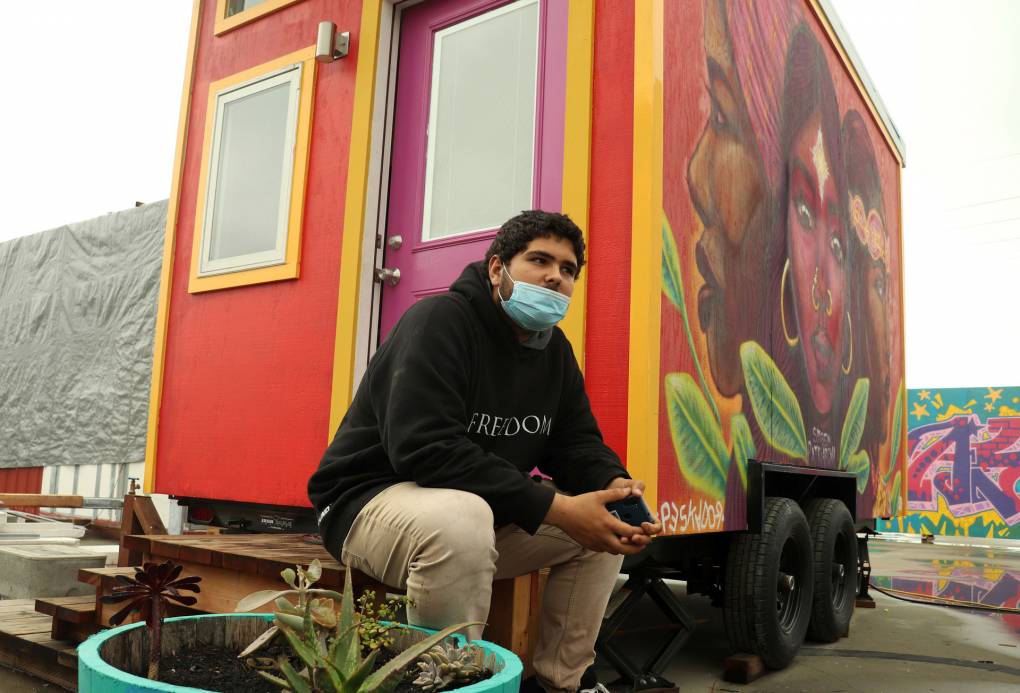
"caption": "Ernie Sandobal, who said he hasn't had a stable place to live in three years, moved into the new Tiny House Empowerment Village for unhoused youth on Feb. 19, 2021 in Oakland.",
"description": "Ernie Sandobal, who said he hasn't had a stable place to live in three years, moved into the new Tiny House Empowerment Village for unhoused youth on Feb. 19, 2021 in Oakland.",
"title": "Sandobal-Tiny-House",
"credit": "MJ Johnson/KQED",
"status": "inherit",
"altTag": null,
"isLoading": false,
"fetchFailed": false
},
"news_11861981": {
"type": "attachments",
"id": "news_11861981",
"meta": {
"index": "attachments_1716263798",
"site": "news",
"id": "11861981",
"found": true
},
"parent": 11861972,
"imgSizes": {
"apple_news_ca_landscape_5_5": {
"file": "https://ww2.kqed.org/app/uploads/sites/10/2021/02/tierbridge_022421_final-1044x783.png",
"width": 1044,
"mimeType": "image/png",
"height": 783
},
"apple_news_ca_square_4_0": {
"file": "https://ww2.kqed.org/app/uploads/sites/10/2021/02/tierbridge_022421_final-470x470.png",
"width": 470,
"mimeType": "image/png",
"height": 470
},
"twentyfourteen-full-width": {
"file": "https://ww2.kqed.org/app/uploads/sites/10/2021/02/tierbridge_022421_final-1038x576.png",
"width": 1038,
"mimeType": "image/png",
"height": 576
},
"thumbnail": {
"file": "https://ww2.kqed.org/app/uploads/sites/10/2021/02/tierbridge_022421_final-160x109.png",
"width": 160,
"mimeType": "image/png",
"height": 109
},
"post-thumbnail": {
"file": "https://ww2.kqed.org/app/uploads/sites/10/2021/02/tierbridge_022421_final-672x372.png",
"width": 672,
"mimeType": "image/png",
"height": 372
},
"kqedFullSize": {
"file": "https://ww2.kqed.org/app/uploads/sites/10/2021/02/tierbridge_022421_final.png",
"width": 1920,
"height": 1313
},
"apple_news_ca_landscape_4_7": {
"file": "https://ww2.kqed.org/app/uploads/sites/10/2021/02/tierbridge_022421_final-632x474.png",
"width": 632,
"mimeType": "image/png",
"height": 474
},
"large": {
"file": "https://ww2.kqed.org/app/uploads/sites/10/2021/02/tierbridge_022421_final-1020x698.png",
"width": 1020,
"mimeType": "image/png",
"height": 698
},
"apple_news_ca_landscape_4_0": {
"file": "https://ww2.kqed.org/app/uploads/sites/10/2021/02/tierbridge_022421_final-536x402.png",
"width": 536,
"mimeType": "image/png",
"height": 402
},
"apple_news_ca_portrait_12_9": {
"file": "https://ww2.kqed.org/app/uploads/sites/10/2021/02/tierbridge_022421_final-1122x1313.png",
"width": 1122,
"mimeType": "image/png",
"height": 1313
},
"medium": {
"file": "https://ww2.kqed.org/app/uploads/sites/10/2021/02/tierbridge_022421_final-800x547.png",
"width": 800,
"mimeType": "image/png",
"height": 547
},
"apple_news_ca_portrait_4_0": {
"file": "https://ww2.kqed.org/app/uploads/sites/10/2021/02/tierbridge_022421_final-354x472.png",
"width": 354,
"mimeType": "image/png",
"height": 472
},
"apple_news_ca_portrait_9_7": {
"file": "https://ww2.kqed.org/app/uploads/sites/10/2021/02/tierbridge_022421_final-840x1120.png",
"width": 840,
"mimeType": "image/png",
"height": 1120
},
"apple_news_ca_landscape_12_9": {
"file": "https://ww2.kqed.org/app/uploads/sites/10/2021/02/tierbridge_022421_final-1832x1313.png",
"width": 1832,
"mimeType": "image/png",
"height": 1313
},
"apple_news_ca_square_9_7": {
"file": "https://ww2.kqed.org/app/uploads/sites/10/2021/02/tierbridge_022421_final-1104x1104.png",
"width": 1104,
"mimeType": "image/png",
"height": 1104
},
"1536x1536": {
"file": "https://ww2.kqed.org/app/uploads/sites/10/2021/02/tierbridge_022421_final-1536x1050.png",
"width": 1536,
"mimeType": "image/png",
"height": 1050
},
"apple_news_ca_portrait_4_7": {
"file": "https://ww2.kqed.org/app/uploads/sites/10/2021/02/tierbridge_022421_final-414x552.png",
"width": 414,
"mimeType": "image/png",
"height": 552
},
"apple_news_ca_square_12_9": {
"file": "https://ww2.kqed.org/app/uploads/sites/10/2021/02/tierbridge_022421_final-1472x1313.png",
"width": 1472,
"mimeType": "image/png",
"height": 1313
},
"apple_news_ca_portrait_5_5": {
"file": "https://ww2.kqed.org/app/uploads/sites/10/2021/02/tierbridge_022421_final-687x916.png",
"width": 687,
"mimeType": "image/png",
"height": 916
},
"apple_news_ca_square_4_7": {
"file": "https://ww2.kqed.org/app/uploads/sites/10/2021/02/tierbridge_022421_final-550x550.png",
"width": 550,
"mimeType": "image/png",
"height": 550
},
"apple_news_ca_landscape_9_7": {
"file": "https://ww2.kqed.org/app/uploads/sites/10/2021/02/tierbridge_022421_final-1376x1032.png",
"width": 1376,
"mimeType": "image/png",
"height": 1032
},
"apple_news_ca_square_5_5": {
"file": "https://ww2.kqed.org/app/uploads/sites/10/2021/02/tierbridge_022421_final-912x912.png",
"width": 912,
"mimeType": "image/png",
"height": 912
}
},
"publishDate": 1614207522,
"modified": 1614207684,
"caption": null,
"description": null,
"title": "tierbridge_022421_final",
"credit": null,
"status": "inherit",
"altTag": "A Mark Fiore cartoon showing the Golden Gate Bridge, half purple and half red to reflect the current reopening color tiers for COVID-19 restrictions.",
"isLoading": false,
"fetchFailed": false
}
},
"audioPlayerReducer": {
"postId": "stream_live",
"isPaused": true,
"isPlaying": false,
"pfsActive": false,
"pledgeModalIsOpen": true,
"playerDrawerIsOpen": false,
"liveAudioPlayStartedAt": 0,
"liveAudioPlayContext": ""
},
"authorsReducer": {
"gmarzorati": {
"type": "authors",
"id": "227",
"meta": {
"index": "authors_1716337520",
"id": "227",
"found": true
},
"name": "Guy Marzorati",
"firstName": "Guy",
"lastName": "Marzorati",
"slug": "gmarzorati",
"email": "gmarzorati@KQED.org",
"display_author_email": true,
"staff_mastheads": [
"news"
],
"title": "Correspondent",
"bio": "Guy Marzorati is a correspondent on KQED's California Politics and Government Desk, based in San Jose. A graduate of Santa Clara University, Guy joined KQED in 2013. He reports on state and local politics and produces KQED's digital voter guide.",
"avatar": "https://secure.gravatar.com/avatar/e7038b8dbfd55b104369b76b1cd0b9de?s=600&d=blank&r=g",
"twitter": "guymarzorati",
"facebook": null,
"instagram": null,
"linkedin": null,
"sites": [
{
"site": "",
"roles": [
"editor"
]
},
{
"site": "news",
"roles": [
"editor"
]
},
{
"site": "science",
"roles": [
"editor"
]
},
{
"site": "forum",
"roles": [
"editor"
]
},
{
"site": "elections",
"roles": [
"editor"
]
},
{
"site": "liveblog",
"roles": [
"editor"
]
}
],
"headData": {
"title": "Guy Marzorati | KQED",
"description": "Correspondent",
"ogImgSrc": "https://secure.gravatar.com/avatar/e7038b8dbfd55b104369b76b1cd0b9de?s=600&d=blank&r=g",
"twImgSrc": "https://secure.gravatar.com/avatar/e7038b8dbfd55b104369b76b1cd0b9de?s=600&d=blank&r=g"
},
"isLoading": false,
"link": "/author/gmarzorati"
},
"kqed": {
"type": "authors",
"id": "236",
"meta": {
"index": "authors_1716337520",
"id": "236",
"found": true
},
"name": "KQED News Staff",
"firstName": "KQED News Staff",
"lastName": null,
"slug": "kqed",
"email": "faq@kqed.org",
"display_author_email": false,
"staff_mastheads": [],
"title": null,
"bio": null,
"avatar": "https://secure.gravatar.com/avatar/ef0e801a68c4c54afa9180db14084167?s=600&d=blank&r=g",
"twitter": null,
"facebook": null,
"instagram": null,
"linkedin": null,
"sites": [
{
"site": "arts",
"roles": [
"contributor"
]
},
{
"site": "news",
"roles": [
"editor"
]
},
{
"site": "futureofyou",
"roles": [
"author"
]
}
],
"headData": {
"title": "KQED News Staff | KQED",
"description": null,
"ogImgSrc": "https://secure.gravatar.com/avatar/ef0e801a68c4c54afa9180db14084167?s=600&d=blank&r=g",
"twImgSrc": "https://secure.gravatar.com/avatar/ef0e801a68c4c54afa9180db14084167?s=600&d=blank&r=g"
},
"isLoading": false,
"link": "/author/kqed"
},
"markfiore": {
"type": "authors",
"id": "3236",
"meta": {
"index": "authors_1716337520",
"id": "3236",
"found": true
},
"name": "Mark Fiore",
"firstName": "Mark",
"lastName": "Fiore",
"slug": "markfiore",
"email": "mark@markfiore.com",
"display_author_email": false,
"staff_mastheads": [
"news"
],
"title": "KQED News Cartoonist",
"bio": "\u003ca href=\"http://www.MarkFiore.com\">MarkFiore.com\u003c/a> | \u003ca href=\"https://twitter.com/markfiore\">Follow on Twitter\u003c/a> | \u003ca href=\"https://www.facebook.com/pages/Mark-Fiore-Animated-Political-Cartoons/94451707396?ref=bookmarks\">Facebook\u003c/a> | \u003ca href=\"mailto:mark@markfiore.com\">email\u003c/a>\r\n\r\nPulitzer Prize-winner, Mark Fiore, who the Wall Street Journal has called “the undisputed guru of the form,” creates animated political cartoons in San Francisco, where his work has been featured regularly on the San Francisco Chronicle’s web site, SFGate.com. His work has appeared on Newsweek.com, Slate.com, CBSNews.com, MotherJones.com, DailyKos.com and NPR’s web site. Fiore’s political animation has appeared on CNN, Frontline, Bill Moyers Journal, Salon.com and cable and broadcast outlets across the globe.\r\n\r\nBeginning his professional life by drawing traditional political cartoons for newspapers, Fiore’s work appeared in publications ranging from the Washington Post to the Los Angeles Times. In the late 1990s, he began to experiment with animating political cartoons and, after a short stint at the San Jose Mercury News as their staff cartoonist, Fiore devoted all his energies to animation.\r\nGrowing up in California, Fiore also spent a good portion of his life in the backwoods of Idaho. It was this combination that shaped him politically. Mark majored in political science at Colorado College, where, in a perfect send-off for a cartoonist, he received his diploma in 1991 as commencement speaker Dick Cheney smiled approvingly.\r\nMark Fiore was awarded the Pulitzer Prize for political cartooning in 2010, a Robert F. Kennedy Journalism Award in 2004 and has twice received an Online Journalism Award for commentary from the Online News Association (2002, 2008). Fiore has received two awards for his work in new media from the National Cartoonists Society (2001, 2002), and in 2006 received The James Madison Freedom of Information Award from The Society of Professional Journalists.",
"avatar": "https://secure.gravatar.com/avatar/fc4e2a612b15b67bad0c6f0e1db4ca9b?s=600&d=blank&r=g",
"twitter": "MarkFiore",
"facebook": null,
"instagram": "https://www.instagram.com/markfiore/?hl=en",
"linkedin": null,
"sites": [
{
"site": "arts",
"roles": [
"contributor"
]
},
{
"site": "news",
"roles": [
"editor"
]
},
{
"site": "futureofyou",
"roles": [
"editor"
]
},
{
"site": "science",
"roles": [
"editor"
]
}
],
"headData": {
"title": "Mark Fiore | KQED",
"description": "KQED News Cartoonist",
"ogImgSrc": "https://secure.gravatar.com/avatar/fc4e2a612b15b67bad0c6f0e1db4ca9b?s=600&d=blank&r=g",
"twImgSrc": "https://secure.gravatar.com/avatar/fc4e2a612b15b67bad0c6f0e1db4ca9b?s=600&d=blank&r=g"
},
"isLoading": false,
"link": "/author/markfiore"
},
"dkatayama": {
"type": "authors",
"id": "7240",
"meta": {
"index": "authors_1716337520",
"id": "7240",
"found": true
},
"name": "Devin Katayama",
"firstName": "Devin",
"lastName": "Katayama",
"slug": "dkatayama",
"email": "dkatayama@kqed.org",
"display_author_email": true,
"staff_mastheads": [
"news"
],
"title": "Editor of Talent and Development",
"bio": "Devin Katayama is former Editor of Talent and Development for KQED. He supported our internship program and on-call staff by looking for equitable opportunities to improve the newsroom.\r\n\r\nHe previously hosted The Bay and American Suburb podcasts from KQED News. Prior to returning to the Bay Area in 2015, Devin was the education reporter for WFPL in Louisville and worked as a producer with radio stations in Chicago and Portland, OR. His work has appeared on NPR’s \u003cem>Morning Edition, All Things Considered, The Takeaway\u003c/em> and \u003cem>Here and Now.\u003c/em>\r\n\r\nDevin earned his MA in Journalism from Columbia College Chicago, where he was a Follett Fellow and the recipient of the 2011 Studs Terkel Community Media Workshop Scholarship for his story on Chicago's homeless youth. He won WBUR's 2014 Daniel Schorr award and a regional RTNDA Edward R. Murrow Award for his documentary \"At Risk\" that looked at issues facing some of Louisville's students. Devin has also received numerous local awards from the Associated Press and the Society of Professional Journalists.",
"avatar": "https://secure.gravatar.com/avatar/d0d2978a31002fb2de107921a8e18405?s=600&d=blank&r=g",
"twitter": "RadioDevin",
"facebook": null,
"instagram": null,
"linkedin": null,
"sites": [
{
"site": "arts",
"roles": []
},
{
"site": "news",
"roles": [
"author"
]
},
{
"site": "stateofhealth",
"roles": [
"author"
]
},
{
"site": "forum",
"roles": [
"editor"
]
},
{
"site": "perspectives",
"roles": [
"editor"
]
}
],
"headData": {
"title": "Devin Katayama | KQED",
"description": "Editor of Talent and Development",
"ogImgSrc": "https://secure.gravatar.com/avatar/d0d2978a31002fb2de107921a8e18405?s=600&d=blank&r=g",
"twImgSrc": "https://secure.gravatar.com/avatar/d0d2978a31002fb2de107921a8e18405?s=600&d=blank&r=g"
},
"isLoading": false,
"link": "/author/dkatayama"
},
"ecruzguevarra": {
"type": "authors",
"id": "8654",
"meta": {
"index": "authors_1716337520",
"id": "8654",
"found": true
},
"name": "Ericka Cruz Guevarra",
"firstName": "Ericka",
"lastName": "Cruz Guevarra",
"slug": "ecruzguevarra",
"email": "ecruzguevarra@kqed.org",
"display_author_email": true,
"staff_mastheads": [
"news"
],
"title": "Producer, The Bay Podcast",
"bio": "Ericka Cruz Guevarra is host of \u003ca href=\"https://www.kqed.org/podcasts/thebay\">\u003cem>The Bay\u003c/em>\u003c/a> podcast at KQED. Before host, she was the show’s producer. Her work in that capacity includes a three-part reported series on policing in Vallejo, which won a 2020 excellence in journalism award from the Society of Professional Journalists. Ericka has worked as a breaking news reporter at Oregon Public Broadcasting, helped produce the Code Switch podcast, and was KQED’s inaugural Raul Ramirez Diversity Fund intern. She’s also an alumna of NPR’s Next Generation Radio program. Send her an email if you have strong feelings about whether Fairfield and Suisun City are the Bay. Ericka is represented by SAG-AFTRA.",
"avatar": "https://secure.gravatar.com/avatar/accefc1de4bafc7e234b69bcb9b6f6536c130fd84709bc3069ef11a78787e1bb?s=600&d=blank&r=g",
"twitter": "NotoriousECG",
"bluesky": null,
"facebook": null,
"instagram": null,
"linkedin": null,
"sites": [
{
"site": "arts",
"roles": [
"subscriber"
]
},
{
"site": "news",
"roles": [
"editor",
"manage_categories"
]
},
{
"site": "futureofyou",
"roles": [
"subscriber"
]
},
{
"site": "stateofhealth",
"roles": [
"subscriber"
]
},
{
"site": "science",
"roles": [
"editor"
]
},
{
"site": "forum",
"roles": [
"subscriber"
]
}
],
"headData": {
"title": "Ericka Cruz Guevarra | KQED",
"description": "Producer, The Bay Podcast",
"ogImgSrc": "https://secure.gravatar.com/avatar/accefc1de4bafc7e234b69bcb9b6f6536c130fd84709bc3069ef11a78787e1bb?s=600&d=blank&r=g",
"twImgSrc": "https://secure.gravatar.com/avatar/accefc1de4bafc7e234b69bcb9b6f6536c130fd84709bc3069ef11a78787e1bb?s=600&d=blank&r=g"
},
"isLoading": false,
"link": "/author/ecruzguevarra"
},
"vrancano": {
"type": "authors",
"id": "11276",
"meta": {
"index": "authors_1716337520",
"id": "11276",
"found": true
},
"name": "Vanessa Rancaño",
"firstName": "Vanessa",
"lastName": "Rancaño",
"slug": "vrancano",
"email": "vrancano@kqed.org",
"display_author_email": false,
"staff_mastheads": [
"news"
],
"title": "Reporter",
"bio": "Vanessa Rancaño is a features reporter for KQED. She’s also covered homelessness and education for the station and reported from the Central Valley. Her work has aired across public radio, from flagship national news shows to longform narrative podcasts. Before taking up a mic, she worked as a freelance print journalist. She’s been recognized with a number of national and regional awards. Vanessa grew up in California's Central Valley. She's a former NPR Kroc Fellow, and a graduate of the UC Berkeley Graduate School of Journalism.",
"avatar": "https://secure.gravatar.com/avatar/b3a383dfb0e7ee1c17568f2cf067904ab654d6e3de9743fc661f3c788ade1bed?s=600&d=blank&r=g",
"twitter": "vanessarancano",
"bluesky": null,
"facebook": null,
"instagram": null,
"linkedin": null,
"sites": [
{
"site": "arts",
"roles": [
"editor"
]
},
{
"site": "news",
"roles": [
"editor"
]
},
{
"site": "liveblog",
"roles": [
"contributor"
]
}
],
"headData": {
"title": "Vanessa Rancaño | KQED",
"description": "Reporter",
"ogImgSrc": "https://secure.gravatar.com/avatar/b3a383dfb0e7ee1c17568f2cf067904ab654d6e3de9743fc661f3c788ade1bed?s=600&d=blank&r=g",
"twImgSrc": "https://secure.gravatar.com/avatar/b3a383dfb0e7ee1c17568f2cf067904ab654d6e3de9743fc661f3c788ade1bed?s=600&d=blank&r=g"
},
"isLoading": false,
"link": "/author/vrancano"
},
"abandlamudi": {
"type": "authors",
"id": "11672",
"meta": {
"index": "authors_1716337520",
"id": "11672",
"found": true
},
"name": "Adhiti Bandlamudi",
"firstName": "Adhiti",
"lastName": "Bandlamudi",
"slug": "abandlamudi",
"email": "abandlamudi@kqed.org",
"display_author_email": false,
"staff_mastheads": [
"news"
],
"title": "KQED Housing Reporter",
"bio": "Adhiti Bandlamudi reports for KQED's Housing desk. She focuses on how housing gets built across the Bay Area. Before joining KQED in 2020, she reported for WUNC in Durham, North Carolina, WABE in Atlanta, Georgia and Capital Public Radio in Sacramento. In 2017, she was awarded a Kroc Fellowship at NPR where she reported on everything from sprinkles to the Golden State Killer's arrest. When she's not reporting, she's baking new recipes in her kitchen or watching movies with friends and family. She's originally from Georgia and has strong opinions about Great British Bake Off.",
"avatar": "https://secure.gravatar.com/avatar/868129c8b257bb99a3500e2c86a65400?s=600&d=mm&r=g",
"twitter": "oddity_adhiti",
"facebook": null,
"instagram": null,
"linkedin": null,
"sites": [
{
"site": "arts",
"roles": [
"author"
]
},
{
"site": "news",
"roles": [
"editor"
]
},
{
"site": "liveblog",
"roles": [
"author"
]
}
],
"headData": {
"title": "Adhiti Bandlamudi | KQED",
"description": "KQED Housing Reporter",
"ogImgSrc": "https://secure.gravatar.com/avatar/868129c8b257bb99a3500e2c86a65400?s=600&d=mm&r=g",
"twImgSrc": "https://secure.gravatar.com/avatar/868129c8b257bb99a3500e2c86a65400?s=600&d=mm&r=g"
},
"isLoading": false,
"link": "/author/abandlamudi"
},
"jrodriguez": {
"type": "authors",
"id": "11690",
"meta": {
"index": "authors_1716337520",
"id": "11690",
"found": true
},
"name": "Joe Fitzgerald Rodriguez",
"firstName": "Joe",
"lastName": "Fitzgerald Rodriguez",
"slug": "jrodriguez",
"email": "jrodriguez@kqed.org",
"display_author_email": true,
"staff_mastheads": [
"news"
],
"title": "Reporter and Producer",
"bio": "Joe Fitzgerald Rodriguez is a reporter and digital producer for KQED covering politics. Joe most recently wrote for the \u003cem>San Francisco Examiner\u003c/em> as a political columnist covering The City. He was raised in San Francisco and has spent his reporting career in his beloved, foggy, city by the bay. Joe was 12-years-old when he conducted his first interview in journalism, grilling former San Francisco Mayor Willie Brown for the Marina Middle School newspaper, \u003cem>The Penguin Press, \u003c/em>and he continues to report on the San Francisco Bay Area to this day.",
"avatar": "https://secure.gravatar.com/avatar/2247beb0564c1e9c62228d5649d2edac?s=600&d=blank&r=g",
"twitter": "FitztheReporter",
"facebook": null,
"instagram": "https://www.instagram.com/fitzthereporter/",
"linkedin": null,
"sites": [
{
"site": "",
"roles": [
"editor"
]
},
{
"site": "arts",
"roles": [
"editor"
]
},
{
"site": "news",
"roles": [
"editor"
]
},
{
"site": "science",
"roles": [
"editor"
]
},
{
"site": "elections",
"roles": [
"editor"
]
},
{
"site": "liveblog",
"roles": [
"editor"
]
}
],
"headData": {
"title": "Joe Fitzgerald Rodriguez | KQED",
"description": "Reporter and Producer",
"ogImgSrc": "https://secure.gravatar.com/avatar/2247beb0564c1e9c62228d5649d2edac?s=600&d=blank&r=g",
"twImgSrc": "https://secure.gravatar.com/avatar/2247beb0564c1e9c62228d5649d2edac?s=600&d=blank&r=g"
},
"isLoading": false,
"link": "/author/jrodriguez"
},
"ccabreralomeli": {
"type": "authors",
"id": "11708",
"meta": {
"index": "authors_1716337520",
"id": "11708",
"found": true
},
"name": "Carlos Cabrera-Lomelí",
"firstName": "Carlos",
"lastName": "Cabrera-Lomelí",
"slug": "ccabreralomeli",
"email": "ccabreralomeli@KQED.org",
"display_author_email": true,
"staff_mastheads": [
"news"
],
"title": "Community Reporter",
"bio": "Carlos Cabrera-Lomelí is a community reporter with KQED's digital engagement team. He also reports and co-produces for KQED's bilingual news hub KQED en Español. He grew up in San Francisco's Mission District and has previously worked with Univision, 48 Hills and REFORMA in Mexico City.",
"avatar": "https://secure.gravatar.com/avatar/c309be9665e484f887b818c89e273ecc673004f426f36b24d00a4d813a2e0518?s=600&d=blank&r=g",
"twitter": "@LomeliCabrera",
"bluesky": null,
"facebook": null,
"instagram": null,
"linkedin": null,
"sites": [
{
"site": "arts",
"roles": [
"editor"
]
},
{
"site": "news",
"roles": [
"editor"
]
},
{
"site": "about",
"roles": [
"editor"
]
},
{
"site": "science",
"roles": [
"editor"
]
},
{
"site": "perspectives",
"roles": [
"editor"
]
},
{
"site": "elections",
"roles": [
"editor"
]
},
{
"site": "liveblog",
"roles": [
"contributor"
]
}
],
"headData": {
"title": "Carlos Cabrera-Lomelí | KQED",
"description": "Community Reporter",
"ogImgSrc": "https://secure.gravatar.com/avatar/c309be9665e484f887b818c89e273ecc673004f426f36b24d00a4d813a2e0518?s=600&d=blank&r=g",
"twImgSrc": "https://secure.gravatar.com/avatar/c309be9665e484f887b818c89e273ecc673004f426f36b24d00a4d813a2e0518?s=600&d=blank&r=g"
},
"isLoading": false,
"link": "/author/ccabreralomeli"
},
"mjohnson": {
"type": "authors",
"id": "11729",
"meta": {
"index": "authors_1716337520",
"id": "11729",
"found": true
},
"name": "MJ Johnson",
"firstName": "MJ",
"lastName": "Johnson",
"slug": "mjohnson",
"email": "mjohnson@kqed.org",
"display_author_email": false,
"staff_mastheads": [],
"title": "KQED Contributor",
"bio": " \u003ci>MJ Johnson is a visual journalist and writer who was born and raised in Japan. She received her B.A. in Journalism from San Francisco State University and has worked as a local reporter for the San Francisco Examiner and the Golden Gate Xpress. Her interest in journalism comes from a desire to absorb and understand media through a multicultural lens, leading her to cover stories on race, identity and history. \u003c/i>",
"avatar": "https://secure.gravatar.com/avatar/62308b3d5f2db77681f1d24bbe76b6de?s=600&d=blank&r=g",
"twitter": null,
"facebook": null,
"instagram": null,
"linkedin": null,
"sites": [
{
"site": "news",
"roles": []
}
],
"headData": {
"title": "MJ Johnson | KQED",
"description": "KQED Contributor",
"ogImgSrc": "https://secure.gravatar.com/avatar/62308b3d5f2db77681f1d24bbe76b6de?s=600&d=blank&r=g",
"twImgSrc": "https://secure.gravatar.com/avatar/62308b3d5f2db77681f1d24bbe76b6de?s=600&d=blank&r=g"
},
"isLoading": false,
"link": "/author/mjohnson"
}
},
"pagesReducer": {
"news_category_education": {
"type": "terms",
"id": "news_18540",
"meta": {
"index": "terms_1716263798",
"site": "news",
"id": "18540",
"score": 10.973221
},
"featImg": null,
"name": "Education",
"description": null,
"taxonomy": "category",
"headData": {
"twImgId": null,
"twTitle": null,
"ogTitle": null,
"ogImgId": null,
"twDescription": null,
"description": null,
"title": "Education Archives | KQED News",
"ogDescription": null
},
"ttid": 2595,
"slug": "education",
"isLoading": false,
"title": "Education",
"pageMeta": {
"site": "news",
"WpPageTemplate": "page-topic-editorial",
"currentPage": 86
},
"blocks": [
{
"blockName": "kqed/post-list",
"attrs": {
"layout": "cardArticle2",
"query": "posts/news?category=education",
"seeMore": false,
"paginated": true,
"page": 86
}
},
{
"blockName": "kqed/ad"
}
]
}
},
"pfsSessionReducer": {},
"postsReducer": {
"stream_live": {
"type": "live",
"id": "stream_live",
"audioUrl": "https://streams.kqed.org/kqedradio",
"title": "Live Stream",
"excerpt": "Live Stream information currently unavailable.",
"link": "/radio",
"featImg": "",
"label": {
"name": "KQED Live",
"link": "/"
}
},
"stream_kqedNewscast": {
"type": "posts",
"id": "stream_kqedNewscast",
"audioUrl": "https://www.kqed.org/.stream/anon/radio/RDnews/newscast.mp3?_=1",
"title": "KQED Newscast",
"featImg": "",
"label": {
"name": "88.5 FM",
"link": "/"
}
},
"news_11863665": {
"type": "posts",
"id": "news_11863665",
"meta": {
"index": "posts_1716263798",
"site": "news",
"id": "11863665",
"score": null,
"sort": [
1615161566000
]
},
"parent": 0,
"labelTerm": {
"site": "news"
},
"blocks": [],
"publishDate": 1615161566,
"format": "standard",
"disqusTitle": "Questions Linger As San Francisco Schools Aim to Reopen Next Month",
"title": "Questions Linger As San Francisco Schools Aim to Reopen Next Month",
"headTitle": "KQED News",
"content": "\u003cp>It’s been a couple of days since the San Francisco Unified School District \u003ca href=\"https://www.sfusd.edu/about-sfusd/sfusd-news/current-news-sfusd/sfusd-preparing-offer-person-learning-some-schools-beginning-april-12\">announced a tentative agreement\u003c/a> with the teachers union to start reopening some schools for in-person learning on April 12 — but teachers and parents still say they don’t know the details.\u003c/p>\n\u003cp>María Quelx lives in the Mission District and has eight children. Four of them are in elementary school. On Saturday, she wasn’t aware that some schools would reopen and that SFUSD had presented a timeline.\u003c/p>\n\u003cp>“I would like for someone to let me know, for someone to tell me or my kids because I had no idea,” she said. Quelx doesn't use a computer or speak English so she has a hard time keeping up to date with every school development.\u003c/p>\n\u003cp>[pullquote align=\"right\" size=\"medium\" citation=\"Maureen Sullivan, teacher-librarian at Dolores Huerta Elementary School\"]'How will we be teaching distance learning students as well as in-person learning students at the same time?'[/pullquote]While the \u003ca href=\"https://uesf.org/\">United Educators of San Francisco\u003c/a> announced on Friday they’ve reached an agreement that outlines how hybrid learning will work, some teachers still don’t have the details, said Maureen Sullivan, a bilingual teacher-librarian at Dolores Huerta Elementary School.\u003c/p>\n\u003cp>“How will we be teaching distance learning students as well as in-person learning students at the same time?” Sullivan asked.\u003c/p>\n\u003cp>UESF plans to hold a meeting on Monday to give teachers more information. The union expects to roll out in-person learning in phases and is initially focusing on students in prekindergarten to second grade. The agreement still needs to be approved by union membership.\u003c/p>\n\u003cp>“It took a lot of hard work and a lot of time and compromise and back-and-forth,” said UESF President Susan Solomon. “The focus is on pre-K to second grade first and then expanding to fifth grade and then all students in special education programs.”\u003c/p>\n\u003cp>Teachers are expected to vote on the tentative agreement this week. It allows students to remain with the teacher they had for remote learning, and class sizes will continue to be 22 students in the primary grades. The deal also requires that face masks, hand sanitizer and personal protective equipment be available to all educators.\u003c/p>\n\u003cfigure id=\"attachment_11863674\" class=\"wp-caption alignnone\" style=\"max-width: 1208px\">\u003cimg class=\"size-full wp-image-11863674\" src=\"https://ww2.kqed.org/app/uploads/sites/10/2021/03/SFUSD-slide-layout.jpg\" alt=\"\" width=\"1208\" height=\"805\" srcset=\"https://ww2.kqed.org/app/uploads/sites/10/2021/03/SFUSD-slide-layout.jpg 1208w, https://ww2.kqed.org/app/uploads/sites/10/2021/03/SFUSD-slide-layout-800x533.jpg 800w, https://ww2.kqed.org/app/uploads/sites/10/2021/03/SFUSD-slide-layout-1020x680.jpg 1020w, https://ww2.kqed.org/app/uploads/sites/10/2021/03/SFUSD-slide-layout-160x107.jpg 160w\" sizes=\"(max-width: 1208px) 100vw, 1208px\">\u003cfigcaption class=\"wp-caption-text\">A screenshot from the SFUSD presentation 'Return to In-Person Learning Update,' published on Feb. 9, 2021, which shows what a typical classroom layout could look like in schools that are allowed to reopen. \u003ccite>(Courtesy of SFUSD)\u003c/cite>\u003c/figcaption>\u003c/figure>\n\u003cp>The school district also plans to install plexiglass partitions on each teacher’s desk. Additionally, each student will be offered a box with school supplies to avoid sharing.\u003c/p>\n\u003cp>The union hasn’t committed to providing in-person learning to students at the middle and high school level before the end of the semester.\u003c/p>\n\u003cp>“It does feel pretty unlikely,” Solomon said.\u003c/p>\n\u003cp>The union believes that these protections — in addition to increased ventilation, frequent testing of students and vaccinations for on-site staff — will keep teachers safe, said Solomon.\u003c/p>\n\u003cp>SFUSD said on Twitter it’s “on track to offer in-person learning options at a select number of schools for the District’s youngest students starting on April 12, 2021.”\u003c/p>\n\u003cblockquote class=\"twitter-tweet\">\n\u003cp dir=\"ltr\" lang=\"en\">We are pleased to let you know that \u003ca href=\"https://twitter.com/hashtag/SFUSD?src=hash&ref_src=twsrc%5Etfw\">#SFUSD\u003c/a> is on track to offer in-person learning options at a select number of schools for our youngest students starting on April 12, 2021. Additional students will be offered in-person options before the end of April.\u003ca href=\"https://t.co/J8c56yGP0R\">https://t.co/J8c56yGP0R\u003c/a> \u003ca href=\"https://t.co/TVMknb4XGL\">pic.twitter.com/TVMknb4XGL\u003c/a>\u003c/p>\n\u003cp>— SF public schools (@SFUnified) \u003ca href=\"https://twitter.com/SFUnified/status/1368065384650309632?ref_src=twsrc%5Etfw\">March 6, 2021\u003c/a>\u003c/p>\u003c/blockquote>\n\u003cp>On its website, the district stated not all elementary schools will open. Only \u003ca href=\"https://www.sfusd.edu/services/health-wellness/covid-19-coronavirus-resources-families-students/august-2020-fall-semester-learning-plans/phase-2-hybrid-model/phase-2a-small-cohortgroup-return/wave-1-schools\">six elementary schools are currently ready\u003c/a> to welcome back students: Alvarado, Cobb, Glen Park, Lawton, Muir and Sunset.\u003c/p>\n\u003cp>The school district is allowing families to choose whether to send their children back to their classrooms or continue with distance learning. They plan to offer every eligible student up to five days of in-person instruction per week.\u003c/p>\n\u003ch3>\u003cstrong>Unclear Daily Logistics\u003c/strong>\u003c/h3>\n\u003cp>According to the union, teachers at the selected schools will have two weeks to prepare their classrooms and lesson plans before they’re asked to return. Sullivan, the teacher-librarian at Dolores Huerta Elementary School, is relieved the union has reached a deal with the district, but still has a lot of questions.\u003c/p>\n\u003cp>“We still don’t have a clear understanding of what recess will be like and how lunchtime will work. And what the day-to-day schedule looks like,” she said.\u003c/p>\n\u003cp>[aside label ='Related Coverage' tag='education']Sullivan has two children — ages 9 and 13 — and her partner works as a nurse at San Francisco General Hospital. She wants the union and the district to explain what resources the agreement provides for teachers who have children that are still learning remotely. One solution she’d like is for the district to open its small in-person learning hubs to the children of teachers.\u003c/p>\n\u003cp>“I don’t feel comfortable leaving [my daughter] at home by herself all day,” Sullivan said. “I’d like to know what the plan is and if educators will have the chance to get their kids into learning hubs.”\u003c/p>\n\u003cp>Sullivan's school, Dolores Huerta Elementary, is on the border of Noe Valley and Bernal Heights. SFUSD has assigned it to reopen in the next wave of in-person learning. No official date has been given as to when that will begin.\u003c/p>\n\u003cp>More than 100 parents, teachers and community members from Dolores Huerta Elementary \u003ca href=\"https://docs.google.com/document/d/1SkF6GLVsoCCU_LEXv0FWb7owPIopJmuXn2GePcJtc_0/edit?fbclid=IwAR2xP9ExZKxn9ydZadaxbdjXICCbcytCbItT4zM5gVASLzppPim7SVmU2aI\">signed a letter\u003c/a> addressed to San Francisco Mayor London Breed and the Board of Supervisors asking that officials provide clearer information on issues like access to public transportation for parents when the school opens up again.\u003c/p>\n\u003cp>[ad fullwidth]\u003c/p>\n\u003ch3>\u003cstrong>A Sense of Urgency\u003c/strong>\u003c/h3>\n\u003cp>Parents like Quelx, who lives in the Mission, say the school district hasn’t done a good job communicating with parents who don’t speak English or don't have easy access to the internet.\u003c/p>\n\u003cp>While Quelx fears that schools may be reopening too quickly, she believes that the best place for her kids to learn is inside a classroom. She says it's been difficult for her them to participate in online learning at the same time. There are bandwidth issues, and also the noise. Her children wear headphones during their lessons.\u003c/p>\n\u003cp>[aside postID=\"news_11863208\" hero=\"https://ww2.kqed.org/app/uploads/sites/10/2021/03/RS47516_GettyImages-1229643858-qut-1020x571.jpg\"]And while she is trying to support them, Quelx says she can’t keep up with the various challenges, which range from the Wi-Fi dropping out, to keeping on top of her kids’ schedules.\u003c/p>\n\u003cp>“They’re still little, so it’s been hard for me,” she explained. “I really want my kids to go back to school.”\u003c/p>\n\u003cp>Quelx is worried about their health. A few months ago, she and some of her children got very sick with COVID-19. She doesn’t want to go through that again.\u003c/p>\n\u003cp>Quelx said her decision will be based on getting information about the protections the school district committed to putting in place. And she wants to know who will make sure the district keeps to the agreement. At the same time, she does feel a sense of urgency to get her kids back in school. She says keeping them at home grows more complicated every day.\u003c/p>\n\u003cp>“It’s been really difficult for me, there’s no other way to say it,” she said.\u003c/p>\n\u003cp>\u003cem>KQED's \u003ca href=\"https://www.kqed.org/author/hmcdede\">Holly McDede\u003c/a> contributed to this report.\u003c/em>\u003c/p>\n\u003cp>[ad fullwidth]\u003c/p>\n\u003cp>[ad floatright]\u003c/p>\n",
"disqusIdentifier": "11863665 https://ww2.kqed.org/news/?p=11863665",
"disqusUrl": "https://ww2.kqed.org/news/2021/03/07/questions-linger-as-san-francisco-schools-aim-to-reopen-next-month/",
"stats": {
"hasVideo": false,
"hasChartOrMap": false,
"hasAudio": false,
"hasPolis": false,
"wordCount": 1303,
"hasGoogleForm": false,
"hasGallery": false,
"hasHearkenModule": false,
"iframeSrcs": [],
"paragraphCount": 33
},
"modified": 1615230512,
"excerpt": "The San Francisco Unified School District and the United Educators of San Francisco reached a tentative agreement earlier this week, allowing some schools to reopen. However, parents and teachers still have questions about the plan.",
"headData": {
"twImgId": "",
"twTitle": "",
"ogTitle": "",
"ogImgId": "",
"twDescription": "",
"description": "The San Francisco Unified School District and the United Educators of San Francisco reached a tentative agreement earlier this week, allowing some schools to reopen. However, parents and teachers still have questions about the plan.",
"title": "Questions Linger As San Francisco Schools Aim to Reopen Next Month | KQED",
"ogDescription": "",
"schema": {
"@context": "https://schema.org",
"@type": "NewsArticle",
"headline": "Questions Linger As San Francisco Schools Aim to Reopen Next Month",
"datePublished": "2021-03-07T15:59:26-08:00",
"dateModified": "2021-03-08T11:08:32-08:00",
"image": "https://cdn.kqed.org/wp-content/uploads/2020/02/KQED-OG-Image@1x.png",
"isAccessibleForFree": "True",
"publisher": {
"@type": "NewsMediaOrganization",
"@id": "https://www.kqed.org/#organization",
"name": "KQED",
"logo": "https://cdn.kqed.org/wp-content/uploads/2020/02/KQED-OG-Image@1x.png",
"url": "https://www.kqed.org",
"sameAs": [
"https://www.facebook.com/KQED",
"https://twitter.com/KQED",
"https://www.instagram.com/kqed/",
"https://www.tiktok.com/@kqedofficial",
"https://www.linkedin.com/company/kqed",
"https://www.youtube.com/channel/UCeC0IOo7i1P_61zVUWbJ4nw"
]
}
}
},
"guestAuthors": [],
"slug": "questions-linger-as-san-francisco-schools-aim-to-reopen-next-month",
"status": "publish",
"path": "/news/11863665/questions-linger-as-san-francisco-schools-aim-to-reopen-next-month",
"audioTrackLength": null,
"parsedContent": [
{
"type": "contentString",
"content": "\u003cdiv class=\"post-body\">\u003cp>\u003cp>It’s been a couple of days since the San Francisco Unified School District \u003ca href=\"https://www.sfusd.edu/about-sfusd/sfusd-news/current-news-sfusd/sfusd-preparing-offer-person-learning-some-schools-beginning-april-12\">announced a tentative agreement\u003c/a> with the teachers union to start reopening some schools for in-person learning on April 12 — but teachers and parents still say they don’t know the details.\u003c/p>\n\u003cp>María Quelx lives in the Mission District and has eight children. Four of them are in elementary school. On Saturday, she wasn’t aware that some schools would reopen and that SFUSD had presented a timeline.\u003c/p>\n\u003cp>“I would like for someone to let me know, for someone to tell me or my kids because I had no idea,” she said. Quelx doesn't use a computer or speak English so she has a hard time keeping up to date with every school development.\u003c/p>\n\u003cp>\u003c/p>\u003c/div>",
"attributes": {
"named": {},
"numeric": []
}
},
{
"type": "component",
"content": "'How will we be teaching distance learning students as well as in-person learning students at the same time?'",
"name": "pullquote",
"attributes": {
"named": {
"align": "right",
"size": "medium",
"citation": "Maureen Sullivan, teacher-librarian at Dolores Huerta Elementary School",
"label": ""
},
"numeric": []
}
},
{
"type": "contentString",
"content": "\u003cdiv class=\"post-body\">\u003cp>While the \u003ca href=\"https://uesf.org/\">United Educators of San Francisco\u003c/a> announced on Friday they’ve reached an agreement that outlines how hybrid learning will work, some teachers still don’t have the details, said Maureen Sullivan, a bilingual teacher-librarian at Dolores Huerta Elementary School.\u003c/p>\n\u003cp>“How will we be teaching distance learning students as well as in-person learning students at the same time?” Sullivan asked.\u003c/p>\n\u003cp>UESF plans to hold a meeting on Monday to give teachers more information. The union expects to roll out in-person learning in phases and is initially focusing on students in prekindergarten to second grade. The agreement still needs to be approved by union membership.\u003c/p>\n\u003cp>“It took a lot of hard work and a lot of time and compromise and back-and-forth,” said UESF President Susan Solomon. “The focus is on pre-K to second grade first and then expanding to fifth grade and then all students in special education programs.”\u003c/p>\n\u003cp>Teachers are expected to vote on the tentative agreement this week. It allows students to remain with the teacher they had for remote learning, and class sizes will continue to be 22 students in the primary grades. The deal also requires that face masks, hand sanitizer and personal protective equipment be available to all educators.\u003c/p>\n\u003cfigure id=\"attachment_11863674\" class=\"wp-caption alignnone\" style=\"max-width: 1208px\">\u003cimg class=\"size-full wp-image-11863674\" src=\"https://ww2.kqed.org/app/uploads/sites/10/2021/03/SFUSD-slide-layout.jpg\" alt=\"\" width=\"1208\" height=\"805\" srcset=\"https://ww2.kqed.org/app/uploads/sites/10/2021/03/SFUSD-slide-layout.jpg 1208w, https://ww2.kqed.org/app/uploads/sites/10/2021/03/SFUSD-slide-layout-800x533.jpg 800w, https://ww2.kqed.org/app/uploads/sites/10/2021/03/SFUSD-slide-layout-1020x680.jpg 1020w, https://ww2.kqed.org/app/uploads/sites/10/2021/03/SFUSD-slide-layout-160x107.jpg 160w\" sizes=\"(max-width: 1208px) 100vw, 1208px\">\u003cfigcaption class=\"wp-caption-text\">A screenshot from the SFUSD presentation 'Return to In-Person Learning Update,' published on Feb. 9, 2021, which shows what a typical classroom layout could look like in schools that are allowed to reopen. \u003ccite>(Courtesy of SFUSD)\u003c/cite>\u003c/figcaption>\u003c/figure>\n\u003cp>The school district also plans to install plexiglass partitions on each teacher’s desk. Additionally, each student will be offered a box with school supplies to avoid sharing.\u003c/p>\n\u003cp>The union hasn’t committed to providing in-person learning to students at the middle and high school level before the end of the semester.\u003c/p>\n\u003cp>“It does feel pretty unlikely,” Solomon said.\u003c/p>\n\u003cp>The union believes that these protections — in addition to increased ventilation, frequent testing of students and vaccinations for on-site staff — will keep teachers safe, said Solomon.\u003c/p>\n\u003cp>SFUSD said on Twitter it’s “on track to offer in-person learning options at a select number of schools for the District’s youngest students starting on April 12, 2021.”\u003c/p>\n\u003cblockquote class=\"twitter-tweet\">\n\u003cp dir=\"ltr\" lang=\"en\">We are pleased to let you know that \u003ca href=\"https://twitter.com/hashtag/SFUSD?src=hash&ref_src=twsrc%5Etfw\">#SFUSD\u003c/a> is on track to offer in-person learning options at a select number of schools for our youngest students starting on April 12, 2021. Additional students will be offered in-person options before the end of April.\u003ca href=\"https://t.co/J8c56yGP0R\">https://t.co/J8c56yGP0R\u003c/a> \u003ca href=\"https://t.co/TVMknb4XGL\">pic.twitter.com/TVMknb4XGL\u003c/a>\u003c/p>\n\u003cp>— SF public schools (@SFUnified) \u003ca href=\"https://twitter.com/SFUnified/status/1368065384650309632?ref_src=twsrc%5Etfw\">March 6, 2021\u003c/a>\u003c/p>\u003c/blockquote>\n\u003cp>On its website, the district stated not all elementary schools will open. Only \u003ca href=\"https://www.sfusd.edu/services/health-wellness/covid-19-coronavirus-resources-families-students/august-2020-fall-semester-learning-plans/phase-2-hybrid-model/phase-2a-small-cohortgroup-return/wave-1-schools\">six elementary schools are currently ready\u003c/a> to welcome back students: Alvarado, Cobb, Glen Park, Lawton, Muir and Sunset.\u003c/p>\n\u003cp>The school district is allowing families to choose whether to send their children back to their classrooms or continue with distance learning. They plan to offer every eligible student up to five days of in-person instruction per week.\u003c/p>\n\u003ch3>\u003cstrong>Unclear Daily Logistics\u003c/strong>\u003c/h3>\n\u003cp>According to the union, teachers at the selected schools will have two weeks to prepare their classrooms and lesson plans before they’re asked to return. Sullivan, the teacher-librarian at Dolores Huerta Elementary School, is relieved the union has reached a deal with the district, but still has a lot of questions.\u003c/p>\n\u003cp>“We still don’t have a clear understanding of what recess will be like and how lunchtime will work. And what the day-to-day schedule looks like,” she said.\u003c/p>\n\u003cp>\u003c/p>\u003c/div>",
"attributes": {
"named": {},
"numeric": []
}
},
{
"type": "component",
"content": "",
"name": "aside",
"attributes": {
"named": {
"label": "Related Coverage ",
"tag": "education"
},
"numeric": []
}
},
{
"type": "contentString",
"content": "\u003cdiv class=\"post-body\">\u003cp>Sullivan has two children — ages 9 and 13 — and her partner works as a nurse at San Francisco General Hospital. She wants the union and the district to explain what resources the agreement provides for teachers who have children that are still learning remotely. One solution she’d like is for the district to open its small in-person learning hubs to the children of teachers.\u003c/p>\n\u003cp>“I don’t feel comfortable leaving [my daughter] at home by herself all day,” Sullivan said. “I’d like to know what the plan is and if educators will have the chance to get their kids into learning hubs.”\u003c/p>\n\u003cp>Sullivan's school, Dolores Huerta Elementary, is on the border of Noe Valley and Bernal Heights. SFUSD has assigned it to reopen in the next wave of in-person learning. No official date has been given as to when that will begin.\u003c/p>\n\u003cp>More than 100 parents, teachers and community members from Dolores Huerta Elementary \u003ca href=\"https://docs.google.com/document/d/1SkF6GLVsoCCU_LEXv0FWb7owPIopJmuXn2GePcJtc_0/edit?fbclid=IwAR2xP9ExZKxn9ydZadaxbdjXICCbcytCbItT4zM5gVASLzppPim7SVmU2aI\">signed a letter\u003c/a> addressed to San Francisco Mayor London Breed and the Board of Supervisors asking that officials provide clearer information on issues like access to public transportation for parents when the school opens up again.\u003c/p>\n\u003cp>\u003c/p>\u003c/div>",
"attributes": {
"named": {},
"numeric": []
}
},
{
"type": "component",
"content": "",
"name": "ad",
"attributes": {
"named": {
"label": "fullwidth"
},
"numeric": [
"fullwidth"
]
}
},
{
"type": "contentString",
"content": "\u003cdiv class=\"post-body\">\u003cp>\u003c/p>\n\u003ch3>\u003cstrong>A Sense of Urgency\u003c/strong>\u003c/h3>\n\u003cp>Parents like Quelx, who lives in the Mission, say the school district hasn’t done a good job communicating with parents who don’t speak English or don't have easy access to the internet.\u003c/p>\n\u003cp>While Quelx fears that schools may be reopening too quickly, she believes that the best place for her kids to learn is inside a classroom. She says it's been difficult for her them to participate in online learning at the same time. There are bandwidth issues, and also the noise. Her children wear headphones during their lessons.\u003c/p>\n\u003cp>\u003c/p>\u003c/div>",
"attributes": {
"named": {},
"numeric": []
}
},
{
"type": "component",
"content": "",
"name": "aside",
"attributes": {
"named": {
"postid": "news_11863208",
"hero": "https://ww2.kqed.org/app/uploads/sites/10/2021/03/RS47516_GettyImages-1229643858-qut-1020x571.jpg",
"label": ""
},
"numeric": []
}
},
{
"type": "contentString",
"content": "\u003cdiv class=\"post-body\">\u003cp>And while she is trying to support them, Quelx says she can’t keep up with the various challenges, which range from the Wi-Fi dropping out, to keeping on top of her kids’ schedules.\u003c/p>\n\u003cp>“They’re still little, so it’s been hard for me,” she explained. “I really want my kids to go back to school.”\u003c/p>\n\u003cp>Quelx is worried about their health. A few months ago, she and some of her children got very sick with COVID-19. She doesn’t want to go through that again.\u003c/p>\n\u003cp>Quelx said her decision will be based on getting information about the protections the school district committed to putting in place. And she wants to know who will make sure the district keeps to the agreement. At the same time, she does feel a sense of urgency to get her kids back in school. She says keeping them at home grows more complicated every day.\u003c/p>\n\u003cp>“It’s been really difficult for me, there’s no other way to say it,” she said.\u003c/p>\n\u003cp>\u003cem>KQED's \u003ca href=\"https://www.kqed.org/author/hmcdede\">Holly McDede\u003c/a> contributed to this report.\u003c/em>\u003c/p>\n\u003cp>\u003c/p>\u003c/div>",
"attributes": {
"named": {},
"numeric": []
}
},
{
"type": "component",
"content": "",
"name": "ad",
"attributes": {
"named": {
"label": "fullwidth"
},
"numeric": [
"fullwidth"
]
}
},
{
"type": "contentString",
"content": "\u003cdiv class=\"post-body\">\u003cp>\u003c/p>\n\u003cp>\u003c/p>\u003c/div>",
"attributes": {
"named": {},
"numeric": []
}
},
{
"type": "component",
"content": "",
"name": "ad",
"attributes": {
"named": {
"label": "floatright"
},
"numeric": [
"floatright"
]
}
},
{
"type": "contentString",
"content": "\u003cdiv class=\"post-body\">\u003cp>\u003c/p>\n\u003c/div>\u003c/p>",
"attributes": {
"named": {},
"numeric": []
}
}
],
"link": "/news/11863665/questions-linger-as-san-francisco-schools-aim-to-reopen-next-month",
"authors": [
"11708"
],
"categories": [
"news_18540",
"news_8"
],
"tags": [
"news_20013",
"news_27626",
"news_28373",
"news_38",
"news_28267",
"news_29223",
"news_1290"
],
"featImg": "news_11863671",
"label": "news"
},
"news_11863515": {
"type": "posts",
"id": "news_11863515",
"meta": {
"index": "posts_1716263798",
"site": "news",
"id": "11863515",
"score": null,
"sort": [
1614994248000
]
},
"guestAuthors": [],
"slug": "a-push-to-reopen-california-schools-and-a-day-in-the-pandemic-life-of-a-teacher",
"title": "A Push to Reopen California Schools and A Day in the Pandemic Life of a Teacher",
"publishDate": 1614994248,
"format": "audio",
"headTitle": "A Push to Reopen California Schools and A Day in the Pandemic Life of a Teacher | KQED",
"labelTerm": {
"term": 26731,
"site": "news"
},
"content": "\u003cp>\u003cem>\u003ca href=\"http://itunes.apple.com/us/podcast/the-california-report-magazine/id1314750545?mt=2\" target=\"_blank\" rel=\"noopener noreferrer\">Listen to this and more in-depth storytelling by subscribing to The California Report Magazine podcast.\u003c/a>\u003c/em>\u003c/p>\n\u003cp>We start the show with voices from California parents, teachers and students weighing in on the debate around schools reopening.\u003c/p>\n\u003ch2>\u003ca href=\"https://www.kqed.org/news/11863374/nightmares-of-black-zoom-boxes-a-day-in-the-life-of-an-oakland-remote-learning-teacher\">‘Nightmares’ of Black Zoom Boxes: A Day in the Life of an Oakland Remote Learning Teacher\u003c/a>\u003c/h2>\n\u003cp>It has been almost a year since schools shut down in-person classes, and distance learning is taking a toll on students and parents. It’s also taking a toll on teachers, especially those with their own kids at home. KQED’s Vanessa Rancaño asked one Oakland teacher to keep an audio diary for a day, documenting her every move.\u003c/p>\n\u003ch2>\u003ca href=\"https://www.kqed.org/news/11861142/hed-still-be-here-today-in-oakland-a-push-to-resume-school-sports-to-stem-rising-violence\">‘He’d Still Be Here Today’: In Oakland, a Push to Resume School Sports to Stem Rising Violence\u003c/a>\u003c/h2>\n\u003cp>California public health officials have given the green light for school sports to start up again, both outdoors and indoors, if they meet certain requirements. The pandemic had disrupted a lot of sports programs, some of which kept kids out of trouble. For some kids in Oakland, that sport was football. At the same time, 2020 marked one of the deadliest years on the streets of that city in the last decade. As KQED’s Marco Siler-Gonzales tells us, police officials and community activists say there’s a connection.\u003c/p>\n\u003ch2>\u003ca href=\"https://www.kqed.org/news/11861810/no-the-tuskegee-study-is-not-the-top-reason-some-black-americans-question-the-covid-19-vaccine\">No, the Tuskegee Study Is Not the Top Reason Some Black Americans Question the COVID-19 Vaccine\u003c/a>\u003c/h2>\n\u003cp>Surveys show that Black Californians are a lot more reluctant to get the coronavirus vaccine than white Californians. But most surveys don’t ask respondents why. The California Report’s health correspondent April Dembosky reports one hypothesis politicians and medical experts have widely embraced, may not be as widespread in the community.\u003c/p>\n\u003cp>[ad fullwidth]\u003c/p>\u003cp>\u003c/p>\n",
"blocks": [],
"excerpt": null,
"status": "publish",
"parent": 0,
"modified": 1738186559,
"stats": {
"hasAudio": false,
"hasVideo": false,
"hasChartOrMap": false,
"iframeSrcs": [],
"hasGoogleForm": false,
"hasGallery": false,
"hasHearkenModule": false,
"hasPolis": false,
"paragraphCount": 7,
"wordCount": 304
},
"headData": {
"title": "A Push to Reopen California Schools and A Day in the Pandemic Life of a Teacher | KQED",
"description": "Listen to this and more in-depth storytelling by subscribing to The California Report Magazine podcast. We start the show with voices from California parents, teachers and students weighing in on the debate around schools reopening. 'Nightmares' of Black Zoom Boxes: A Day in the Life of an Oakland Remote Learning Teacher It has been almost a year since schools shut down in-person classes, and distance learning is taking a toll on students and parents. It’s also taking a toll on teachers, especially those with their own kids at home. KQED’s Vanessa Rancaño asked one Oakland teacher to keep an audio",
"ogTitle": "",
"ogDescription": "",
"ogImgId": "",
"twTitle": "",
"twDescription": "",
"twImgId": "",
"schema": {
"@context": "https://schema.org",
"@type": "NewsArticle",
"headline": "A Push to Reopen California Schools and A Day in the Pandemic Life of a Teacher",
"datePublished": "2021-03-05T17:30:48-08:00",
"dateModified": "2025-01-29T13:35:59-08:00",
"image": "https://cdn.kqed.org/wp-content/uploads/2020/02/KQED-OG-Image@1x.png",
"isAccessibleForFree": "True",
"publisher": {
"@type": "NewsMediaOrganization",
"@id": "https://www.kqed.org/#organization",
"name": "KQED",
"logo": "https://cdn.kqed.org/wp-content/uploads/2020/02/KQED-OG-Image@1x.png",
"url": "https://www.kqed.org",
"sameAs": [
"https://www.facebook.com/KQED",
"https://twitter.com/KQED",
"https://www.instagram.com/kqed/",
"https://www.tiktok.com/@kqedofficial",
"https://www.linkedin.com/company/kqed",
"https://www.youtube.com/channel/UCeC0IOo7i1P_61zVUWbJ4nw"
]
}
}
},
"sourceUrl": "https://www.kqed.org/californiareportmagazine",
"audioUrl": "https://www.podtrac.com/pts/redirect.mp3/traffic.megaphone.fm/KQINC2759724221.mp3",
"sticky": false,
"path": "/news/11863515/a-push-to-reopen-california-schools-and-a-day-in-the-pandemic-life-of-a-teacher",
"audioTrackLength": null,
"parsedContent": [
{
"type": "contentString",
"content": "\u003cdiv class=\"post-body\">\u003cp>\u003cp>\u003cem>\u003ca href=\"http://itunes.apple.com/us/podcast/the-california-report-magazine/id1314750545?mt=2\" target=\"_blank\" rel=\"noopener noreferrer\">Listen to this and more in-depth storytelling by subscribing to The California Report Magazine podcast.\u003c/a>\u003c/em>\u003c/p>\n\u003cp>We start the show with voices from California parents, teachers and students weighing in on the debate around schools reopening.\u003c/p>\n\u003ch2>\u003ca href=\"https://www.kqed.org/news/11863374/nightmares-of-black-zoom-boxes-a-day-in-the-life-of-an-oakland-remote-learning-teacher\">‘Nightmares’ of Black Zoom Boxes: A Day in the Life of an Oakland Remote Learning Teacher\u003c/a>\u003c/h2>\n\u003cp>It has been almost a year since schools shut down in-person classes, and distance learning is taking a toll on students and parents. It’s also taking a toll on teachers, especially those with their own kids at home. KQED’s Vanessa Rancaño asked one Oakland teacher to keep an audio diary for a day, documenting her every move.\u003c/p>\n\u003ch2>\u003ca href=\"https://www.kqed.org/news/11861142/hed-still-be-here-today-in-oakland-a-push-to-resume-school-sports-to-stem-rising-violence\">‘He’d Still Be Here Today’: In Oakland, a Push to Resume School Sports to Stem Rising Violence\u003c/a>\u003c/h2>\n\u003cp>California public health officials have given the green light for school sports to start up again, both outdoors and indoors, if they meet certain requirements. The pandemic had disrupted a lot of sports programs, some of which kept kids out of trouble. For some kids in Oakland, that sport was football. At the same time, 2020 marked one of the deadliest years on the streets of that city in the last decade. As KQED’s Marco Siler-Gonzales tells us, police officials and community activists say there’s a connection.\u003c/p>\n\u003ch2>\u003ca href=\"https://www.kqed.org/news/11861810/no-the-tuskegee-study-is-not-the-top-reason-some-black-americans-question-the-covid-19-vaccine\">No, the Tuskegee Study Is Not the Top Reason Some Black Americans Question the COVID-19 Vaccine\u003c/a>\u003c/h2>\n\u003cp>Surveys show that Black Californians are a lot more reluctant to get the coronavirus vaccine than white Californians. But most surveys don’t ask respondents why. The California Report’s health correspondent April Dembosky reports one hypothesis politicians and medical experts have widely embraced, may not be as widespread in the community.\u003c/p>\n\u003cp>\u003c/p>\u003c/div>",
"attributes": {
"named": {},
"numeric": []
}
},
{
"type": "component",
"content": "",
"name": "ad",
"attributes": {
"named": {
"label": "fullwidth"
},
"numeric": [
"fullwidth"
]
}
},
{
"type": "contentString",
"content": "\u003cdiv class=\"post-body\">\u003cp>\u003c/p>\u003cp>\u003c/p>\n\u003c/div>\u003c/p>",
"attributes": {
"named": {},
"numeric": []
}
}
],
"link": "/news/11863515/a-push-to-reopen-california-schools-and-a-day-in-the-pandemic-life-of-a-teacher",
"authors": [
"236"
],
"programs": [
"news_72",
"news_26731"
],
"categories": [
"news_18540",
"news_33520",
"news_21291"
],
"tags": [
"news_2043",
"news_27504",
"news_20013",
"news_18543"
],
"featImg": "news_11863596",
"label": "news_26731"
},
"news_11863374": {
"type": "posts",
"id": "news_11863374",
"meta": {
"index": "posts_1716263798",
"site": "news",
"id": "11863374",
"score": null,
"sort": [
1614990302000
]
},
"parent": 0,
"labelTerm": {
"site": "news",
"term": 26731
},
"blocks": [],
"publishDate": 1614990302,
"format": "standard",
"disqusTitle": "'Nightmares' of Black Zoom Boxes: A Day in the Life of an Oakland Remote Learning Teacher",
"title": "'Nightmares' of Black Zoom Boxes: A Day in the Life of an Oakland Remote Learning Teacher",
"headTitle": "The California Report Magazine | KQED News",
"content": "\u003cp>Jan. 27, 2021 ...\u003c/p>\n\u003cp>\u003cstrong>6 a.m.\u003c/strong> Whitney Dwyer wakes up to a text from one of her students. The storm has knocked his power out, so he may not make it in. He probably won’t be the only one. No electricity, no computer, no Zoom ... so no class.\u003c/p>\n\u003cp>Whitney’s been teaching at MetWest High School, in Oakland, for a decade.\u003c/p>\n\u003cp>[pullquote]Conducting class exclusively online has robbed Oakland high school teacher Whitney Dwyer of almost everything she enjoys about teaching.[/pullquote]She’s been teaching out of her home, also in Oakland, since March.\u003c/p>\n\u003cp>She looks at the news, in case something comes up in class. Like another Oakland homicide. Sometimes she reads those stories just to make sure it’s not anyone she or her students know.\u003c/p>\n\u003cp>With two-and-a-half hours until start time, maybe a run to the grocery store — she can’t bring her three kids with her, and it’s less stressful if they’re still asleep so her husband doesn’t have to keep track of them.\u003c/p>\n\u003cp>Out she goes. Breakfast is a slice of leftover pizza in the car. On the way home she makes a list in her head of the stuff she has to do before 9 a.m.\u003c/p>\n\u003cp>Wake her kids, get them dressed, feed them — cereal — and make sure Maxwell uses the potty. He’s 2.\u003c/p>\n\u003cp>\u003cstrong>8:30 a.m.\u003c/strong> Time for Brenden, 9, and Grayson, 7, to get on their computers for school. Maxwell gets blocks and puzzles from her husband. Whitney heads to the guest room, her new office. She sets up two screens and the half-dozen browser tabs she needs to teach. Google Classroom, Drive, Pear Deck — the various tech tools that keep her virtual classroom going. At first, she had a hard time adjusting; after all, she’d never even heard of Zoom before March.\u003c/p>\n\u003cp>When class starts, she texts each of the 17 students who have shown up for class. Four are no-shows.\u003c/p>\n\u003cp>[ad fullwidth]\u003c/p>\n\u003cp>\u003cstrong>9 a.m.\u003c/strong> It’s go time, so she musters as much enthusiasm as she can.\u003c/p>\n\u003cp>“So our agenda for today: We are going to review with a lightning round,” she says.\u003c/p>\n\u003cp>She throws in a sound effect: “Pew! Pew! Pew!”\u003c/p>\n\u003cp>Nobody has their camera on.\u003c/p>\n\u003cp>[pullquote]As hard as it’s been to adapt, it’s the world students face outside the classroom that’s the biggest problem. That’s the thing she hasn’t been able to troubleshoot.[/pullquote]“Your participation credit goes up if your camera is on,” she offers. “I’m feeling a little lonely.”\u003c/p>\n\u003cp>Nothing.\u003c/p>\n\u003cp>She does get tired of sounding desperate. Like, can someone just turn their camera on? It doesn’t even have to be aimed at your face — it could be pointed at a window.\u003c/p>\n\u003cp>More silence. Another thing she’s had to get used to. Classroom chatter is reduced to text shorthand: lol, lmao, omg, ty, yw. And of course: ?\u003c/p>\n\u003cp>Answers to her questions arrive by chat, too, often in private messages.\u003c/p>\n\u003cp>“Thank you, Leilani,” she says in response to an answer only she can see.\u003c/p>\n\u003cp>Silence.\u003c/p>\n\u003cp>“Oh — I don’t know about all that.”\u003c/p>\n\u003cp>Silence.\u003c/p>\n\u003cp>For everybody else, they're hearing half a conversation.\u003c/p>\n\u003cp>Today’s topic is Venn diagrams — using them to compare and contrast the agriculture of the Aztecs and Mayans. That means learning a new digital tool, so Whitney toggles between describing ancient farming practices and troubleshooting.\u003c/p>\n\u003cp>Teach, group chat, private chat, text. Teach, group chat, private chat, text.\u003c/p>\n\u003cp>When the topic of slave labor among the Mayans comes up, something almost like a normal class discussion begins. Almost.\u003c/p>\n\u003cp>“Imagine being dependent on slave labor —”\u003cbr>\n“I mean one could argue —”\u003cbr>\n“There are really low wages —”\u003cbr>\n“People in jail are basically slaves —”\u003c/p>\n\u003cp>Zoom keeps cutting one person off when another one starts talking, so it’s all jumbled and fragmented.\u003c/p>\n\u003cp>Conducting class this way has robbed Whitney of almost everything she enjoys about teaching. For one, she no longer gets to see the confusion in her kids that’s often followed by light bulbs going off. What's left are nightmares of black boxes.\u003c/p>\n\u003cp>\u003cstrong>10 a.m.\u003c/strong> “Bye y’all! Have a nice rest of your hump day.”\u003c/p>\n\u003cp>Class is over, but 16-year-old Memo Martinez stays on to get advice. He even turns his camera on. At MetWest, all students are expected to take on internships. Memo’s having a hard time picking one.\u003c/p>\n\u003cp>“Let’s just say I have one interest and then I’m like, ‘Oh! Why don’t I do this?’ he says. “And then after that, another interest happens. What if I go into cooking? Then I’m like, ‘Yo, bro, I don’t wanna.’ Then I thought, what if I work in automotives?! It’s just a bunch of what-ifs. I dunno ...”\u003c/p>\n\u003cp>Whitney says, “That’s great, that’s wonderful, it’s beautiful. Don’t ever change; it sucks to just have one interest.”\u003c/p>\n\u003cp>Yeah. This is what she misses most about teaching. She loves how teenage brains work.\u003c/p>\n\u003cp>\u003cstrong>10:28 a.m.\u003c/strong> Just two minutes to get to the bathroom before her teacher planning meeting. Where she can get professional and emotional support for colleagues, where crucial collaborations on lessons and strategy-sharing take place. Not to mention a healthy dose of commiseration.\u003c/p>\n\u003cp>“I only had two brave souls today that were down to read out loud,” she tells her colleagues.\u003c/p>\n\u003cp>“It’s harder than in school, it's surprising,” says another teacher.\u003c/p>\n\u003cp>“It’s like pulling teeth!\" says yet a third. \"We were quiet for a good 30 seconds.”\u003c/p>\n\u003cp>This is the closest thing Whitney has to the staff room these days.\u003c/p>\n\u003cp>\u003cstrong>11:30 a.m.\u003c/strong> Time to take over parenting so her husband can go back to work. That means lunch, homework, and bathroom time for Maxwell.\u003c/p>\n\u003cp>“It’s time to go to the potty,” she informs him.\u003c/p>\n\u003cfigure id=\"attachment_11863596\" class=\"wp-caption alignright\" style=\"max-width: 800px\">\u003ca href=\"https://ww2.kqed.org/app/uploads/sites/10/2020/03/WhitneyDwyer_01292021-qut.jpg\">\u003cimg class=\"size-medium wp-image-11863596\" src=\"https://ww2.kqed.org/app/uploads/sites/10/2020/03/WhitneyDwyer_01292021-qut-800x533.jpg\" alt=\"\" width=\"800\" height=\"533\" srcset=\"https://ww2.kqed.org/app/uploads/sites/10/2020/03/WhitneyDwyer_01292021-qut-800x533.jpg 800w, https://ww2.kqed.org/app/uploads/sites/10/2020/03/WhitneyDwyer_01292021-qut-1020x680.jpg 1020w, https://ww2.kqed.org/app/uploads/sites/10/2020/03/WhitneyDwyer_01292021-qut-160x107.jpg 160w, https://ww2.kqed.org/app/uploads/sites/10/2020/03/WhitneyDwyer_01292021-qut-1536x1024.jpg 1536w, https://ww2.kqed.org/app/uploads/sites/10/2020/03/WhitneyDwyer_01292021-qut.jpg 1920w\" sizes=\"(max-width: 800px) 100vw, 800px\">\u003c/a>\u003cfigcaption class=\"wp-caption-text\">Oakland Unified School District teacher Whitney Dwyer grades student's work in her backyard in Oakland on Jan. 29, 2021. \u003cem>(Beth LaBerge/KQED)\u003c/em>\u003c/figcaption>\u003c/figure>\n\u003cp>“I’m going poop.”\u003c/p>\n\u003cp>“Even better!”\u003c/p>\n\u003cp>She checks her phone. Twenty-six text messages, plus a bunch more spread over 11 different Slack channels. Some of the messages are about students who didn’t come to class.\u003c/p>\n\u003cp>Usually, most of Whitney’s students do show up. Some are doing well, and their grades and reading levels have improved since school went virtual. But others are taking care of siblings, or don’t have stable housing. One student, she’s lost track of altogether.\u003c/p>\n\u003cp>And then there’s her own kids’ academic progress. They’re doing OK, but she needs to find the time to keep them on task with homework.\u003c/p>\n\u003cp>\u003cstrong>12 p.m.\u003c/strong> Brenden is back in Zoom class. Whitney bounces between watching Maxwell and helping Grayson with his homework.\u003c/p>\n\u003cp>“Come on, you got this. You do this every day,” Whitney tells her 7-year-old, who today is not cooperating.\u003c/p>\n\u003cp>“I don’t do this every day!” he says. “I read it with my teacher usually.”\u003c/p>\n\u003cp>Whitney is losing patience. “Stop pretending to stab yourself in the neck with your pencil! Not funny. Not funny at all.”\u003c/p>\n\u003cp>This is the hardest moment, the hardest part of distance learning: knowing some students need more than she can give, and that her own kids may, too.\u003c/p>\n\u003cp>\u003cstrong>2:45 p.m.\u003c/strong> After putting Maxwell down for a nap, Whitney pleads with her sons to keep quiet so she can meet with school leaders over Zoom.\u003c/p>\n\u003cp>“Brenden! What did I tell you? I don’t know what’s going on, but Grayson is crying and that’s not OK.”\u003c/p>\n\u003cp>“OK,” Brenden replies.\u003c/p>\n\u003cp>Now she’s presenting a proposal for teachers to get more training on how to support students and parents who are dealing with trauma.\u003c/p>\n\u003cp>Because it does feel like death is all around.\u003c/p>\n\u003cp>As hard as it’s been to adapt — new tech, reduced teaching time, a new way of relating to kids — it’s the world students face outside her classroom that’s the biggest problem. That’s the thing she hasn’t been able to troubleshoot.\u003c/p>\n\u003cp>Her students have a stronger relationship with her than with anyone else on staff, so it's difficult to imagine who is going to provide that support. If not her, who?\u003c/p>\n\u003cp>So what’s the solution? More financial resources for families? Better mental health services? She’ll keep exploring these questions with her colleagues. Even though it’s just one more thing.\u003c/p>\n\u003cp>\u003cstrong>4 p.m.\u003c/strong> Meeting over. She takes the kids for a walk around the neighborhood. Back home, she needs to make sure their homework is done.\u003c/p>\n\u003cp>\u003cstrong>5:30 p.m.\u003c/strong> Dinner.\u003c/p>\n\u003cp>\u003cstrong>9 p.m\u003c/strong>. After making the meal, after reading with the kids, after putting them to bed, Whitney sits down.\u003c/p>\n\u003cp>To send work emails.\u003c/p>\n\u003cp>At her computer, she falls asleep.\u003c/p>\n\u003cp>One more thing pushed to Sunday night, when she’s regularly up until 3 a.m., catching up on the week’s work.\u003c/p>\n\u003cp>[ad floatright]\u003c/p>\n",
"disqusIdentifier": "11863374 https://ww2.kqed.org/news/?p=11863374",
"disqusUrl": "https://ww2.kqed.org/news/2021/03/05/nightmares-of-black-zoom-boxes-a-day-in-the-life-of-an-oakland-remote-learning-teacher/",
"stats": {
"hasVideo": false,
"hasChartOrMap": false,
"hasAudio": false,
"hasPolis": false,
"wordCount": 1634,
"hasGoogleForm": false,
"hasGallery": false,
"hasHearkenModule": false,
"iframeSrcs": [],
"paragraphCount": 68
},
"modified": 1614994056,
"excerpt": "A year since schools shut down in-person classes, distance learning is not just taking a toll on kids — teachers have also had a hard time adapting.",
"headData": {
"twImgId": "",
"twTitle": "",
"ogTitle": "",
"ogImgId": "",
"twDescription": "",
"description": "A year since schools shut down in-person classes, distance learning is not just taking a toll on kids — teachers have also had a hard time adapting.",
"title": "'Nightmares' of Black Zoom Boxes: A Day in the Life of an Oakland Remote Learning Teacher | KQED",
"ogDescription": "",
"schema": {
"@context": "https://schema.org",
"@type": "NewsArticle",
"headline": "'Nightmares' of Black Zoom Boxes: A Day in the Life of an Oakland Remote Learning Teacher",
"datePublished": "2021-03-05T16:25:02-08:00",
"dateModified": "2021-03-05T17:27:36-08:00",
"image": "https://cdn.kqed.org/wp-content/uploads/2020/02/KQED-OG-Image@1x.png",
"isAccessibleForFree": "True",
"publisher": {
"@type": "NewsMediaOrganization",
"@id": "https://www.kqed.org/#organization",
"name": "KQED",
"logo": "https://cdn.kqed.org/wp-content/uploads/2020/02/KQED-OG-Image@1x.png",
"url": "https://www.kqed.org",
"sameAs": [
"https://www.facebook.com/KQED",
"https://twitter.com/KQED",
"https://www.instagram.com/kqed/",
"https://www.tiktok.com/@kqedofficial",
"https://www.linkedin.com/company/kqed",
"https://www.youtube.com/channel/UCeC0IOo7i1P_61zVUWbJ4nw"
]
}
}
},
"guestAuthors": [],
"slug": "nightmares-of-black-zoom-boxes-a-day-in-the-life-of-an-oakland-remote-learning-teacher",
"status": "publish",
"audioUrl": "https://traffic.omny.fm/d/clips/0af137ef-751e-4b19-a055-aaef00d2d578/ffca7e9f-6831-41c5-bcaf-aaef00f5a073/c246c03e-ac25-448f-903e-ace201878246/audio.mp3",
"path": "/news/11863374/nightmares-of-black-zoom-boxes-a-day-in-the-life-of-an-oakland-remote-learning-teacher",
"audioDuration": 577000,
"audioTrackLength": null,
"parsedContent": [
{
"type": "contentString",
"content": "\u003cdiv class=\"post-body\">\u003cp>\u003cp>Jan. 27, 2021 ...\u003c/p>\n\u003cp>\u003cstrong>6 a.m.\u003c/strong> Whitney Dwyer wakes up to a text from one of her students. The storm has knocked his power out, so he may not make it in. He probably won’t be the only one. No electricity, no computer, no Zoom ... so no class.\u003c/p>\n\u003cp>Whitney’s been teaching at MetWest High School, in Oakland, for a decade.\u003c/p>\n\u003cp>\u003c/p>\u003c/div>",
"attributes": {
"named": {},
"numeric": []
}
},
{
"type": "component",
"content": "Conducting class exclusively online has robbed Oakland high school teacher Whitney Dwyer of almost everything she enjoys about teaching.",
"name": "pullquote",
"attributes": {
"named": {
"label": ""
},
"numeric": []
}
},
{
"type": "contentString",
"content": "\u003cdiv class=\"post-body\">\u003cp>She’s been teaching out of her home, also in Oakland, since March.\u003c/p>\n\u003cp>She looks at the news, in case something comes up in class. Like another Oakland homicide. Sometimes she reads those stories just to make sure it’s not anyone she or her students know.\u003c/p>\n\u003cp>With two-and-a-half hours until start time, maybe a run to the grocery store — she can’t bring her three kids with her, and it’s less stressful if they’re still asleep so her husband doesn’t have to keep track of them.\u003c/p>\n\u003cp>Out she goes. Breakfast is a slice of leftover pizza in the car. On the way home she makes a list in her head of the stuff she has to do before 9 a.m.\u003c/p>\n\u003cp>Wake her kids, get them dressed, feed them — cereal — and make sure Maxwell uses the potty. He’s 2.\u003c/p>\n\u003cp>\u003cstrong>8:30 a.m.\u003c/strong> Time for Brenden, 9, and Grayson, 7, to get on their computers for school. Maxwell gets blocks and puzzles from her husband. Whitney heads to the guest room, her new office. She sets up two screens and the half-dozen browser tabs she needs to teach. Google Classroom, Drive, Pear Deck — the various tech tools that keep her virtual classroom going. At first, she had a hard time adjusting; after all, she’d never even heard of Zoom before March.\u003c/p>\n\u003cp>When class starts, she texts each of the 17 students who have shown up for class. Four are no-shows.\u003c/p>\n\u003cp>\u003c/p>\u003c/div>",
"attributes": {
"named": {},
"numeric": []
}
},
{
"type": "component",
"content": "",
"name": "ad",
"attributes": {
"named": {
"label": "fullwidth"
},
"numeric": [
"fullwidth"
]
}
},
{
"type": "contentString",
"content": "\u003cdiv class=\"post-body\">\u003cp>\u003c/p>\n\u003cp>\u003cstrong>9 a.m.\u003c/strong> It’s go time, so she musters as much enthusiasm as she can.\u003c/p>\n\u003cp>“So our agenda for today: We are going to review with a lightning round,” she says.\u003c/p>\n\u003cp>She throws in a sound effect: “Pew! Pew! Pew!”\u003c/p>\n\u003cp>Nobody has their camera on.\u003c/p>\n\u003cp>\u003c/p>\u003c/div>",
"attributes": {
"named": {},
"numeric": []
}
},
{
"type": "component",
"content": "As hard as it’s been to adapt, it’s the world students face outside the classroom that’s the biggest problem. That’s the thing she hasn’t been able to troubleshoot.",
"name": "pullquote",
"attributes": {
"named": {
"label": ""
},
"numeric": []
}
},
{
"type": "contentString",
"content": "\u003cdiv class=\"post-body\">\u003cp>“Your participation credit goes up if your camera is on,” she offers. “I’m feeling a little lonely.”\u003c/p>\n\u003cp>Nothing.\u003c/p>\n\u003cp>She does get tired of sounding desperate. Like, can someone just turn their camera on? It doesn’t even have to be aimed at your face — it could be pointed at a window.\u003c/p>\n\u003cp>More silence. Another thing she’s had to get used to. Classroom chatter is reduced to text shorthand: lol, lmao, omg, ty, yw. And of course: ?\u003c/p>\n\u003cp>Answers to her questions arrive by chat, too, often in private messages.\u003c/p>\n\u003cp>“Thank you, Leilani,” she says in response to an answer only she can see.\u003c/p>\n\u003cp>Silence.\u003c/p>\n\u003cp>“Oh — I don’t know about all that.”\u003c/p>\n\u003cp>Silence.\u003c/p>\n\u003cp>For everybody else, they're hearing half a conversation.\u003c/p>\n\u003cp>Today’s topic is Venn diagrams — using them to compare and contrast the agriculture of the Aztecs and Mayans. That means learning a new digital tool, so Whitney toggles between describing ancient farming practices and troubleshooting.\u003c/p>\n\u003cp>Teach, group chat, private chat, text. Teach, group chat, private chat, text.\u003c/p>\n\u003cp>When the topic of slave labor among the Mayans comes up, something almost like a normal class discussion begins. Almost.\u003c/p>\n\u003cp>“Imagine being dependent on slave labor —”\u003cbr>\n“I mean one could argue —”\u003cbr>\n“There are really low wages —”\u003cbr>\n“People in jail are basically slaves —”\u003c/p>\n\u003cp>Zoom keeps cutting one person off when another one starts talking, so it’s all jumbled and fragmented.\u003c/p>\n\u003cp>Conducting class this way has robbed Whitney of almost everything she enjoys about teaching. For one, she no longer gets to see the confusion in her kids that’s often followed by light bulbs going off. What's left are nightmares of black boxes.\u003c/p>\n\u003cp>\u003cstrong>10 a.m.\u003c/strong> “Bye y’all! Have a nice rest of your hump day.”\u003c/p>\n\u003cp>Class is over, but 16-year-old Memo Martinez stays on to get advice. He even turns his camera on. At MetWest, all students are expected to take on internships. Memo’s having a hard time picking one.\u003c/p>\n\u003cp>“Let’s just say I have one interest and then I’m like, ‘Oh! Why don’t I do this?’ he says. “And then after that, another interest happens. What if I go into cooking? Then I’m like, ‘Yo, bro, I don’t wanna.’ Then I thought, what if I work in automotives?! It’s just a bunch of what-ifs. I dunno ...”\u003c/p>\n\u003cp>Whitney says, “That’s great, that’s wonderful, it’s beautiful. Don’t ever change; it sucks to just have one interest.”\u003c/p>\n\u003cp>Yeah. This is what she misses most about teaching. She loves how teenage brains work.\u003c/p>\n\u003cp>\u003cstrong>10:28 a.m.\u003c/strong> Just two minutes to get to the bathroom before her teacher planning meeting. Where she can get professional and emotional support for colleagues, where crucial collaborations on lessons and strategy-sharing take place. Not to mention a healthy dose of commiseration.\u003c/p>\n\u003cp>“I only had two brave souls today that were down to read out loud,” she tells her colleagues.\u003c/p>\n\u003cp>“It’s harder than in school, it's surprising,” says another teacher.\u003c/p>\n\u003cp>“It’s like pulling teeth!\" says yet a third. \"We were quiet for a good 30 seconds.”\u003c/p>\n\u003cp>This is the closest thing Whitney has to the staff room these days.\u003c/p>\n\u003cp>\u003cstrong>11:30 a.m.\u003c/strong> Time to take over parenting so her husband can go back to work. That means lunch, homework, and bathroom time for Maxwell.\u003c/p>\n\u003cp>“It’s time to go to the potty,” she informs him.\u003c/p>\n\u003cfigure id=\"attachment_11863596\" class=\"wp-caption alignright\" style=\"max-width: 800px\">\u003ca href=\"https://ww2.kqed.org/app/uploads/sites/10/2020/03/WhitneyDwyer_01292021-qut.jpg\">\u003cimg class=\"size-medium wp-image-11863596\" src=\"https://ww2.kqed.org/app/uploads/sites/10/2020/03/WhitneyDwyer_01292021-qut-800x533.jpg\" alt=\"\" width=\"800\" height=\"533\" srcset=\"https://ww2.kqed.org/app/uploads/sites/10/2020/03/WhitneyDwyer_01292021-qut-800x533.jpg 800w, https://ww2.kqed.org/app/uploads/sites/10/2020/03/WhitneyDwyer_01292021-qut-1020x680.jpg 1020w, https://ww2.kqed.org/app/uploads/sites/10/2020/03/WhitneyDwyer_01292021-qut-160x107.jpg 160w, https://ww2.kqed.org/app/uploads/sites/10/2020/03/WhitneyDwyer_01292021-qut-1536x1024.jpg 1536w, https://ww2.kqed.org/app/uploads/sites/10/2020/03/WhitneyDwyer_01292021-qut.jpg 1920w\" sizes=\"(max-width: 800px) 100vw, 800px\">\u003c/a>\u003cfigcaption class=\"wp-caption-text\">Oakland Unified School District teacher Whitney Dwyer grades student's work in her backyard in Oakland on Jan. 29, 2021. \u003cem>(Beth LaBerge/KQED)\u003c/em>\u003c/figcaption>\u003c/figure>\n\u003cp>“I’m going poop.”\u003c/p>\n\u003cp>“Even better!”\u003c/p>\n\u003cp>She checks her phone. Twenty-six text messages, plus a bunch more spread over 11 different Slack channels. Some of the messages are about students who didn’t come to class.\u003c/p>\n\u003cp>Usually, most of Whitney’s students do show up. Some are doing well, and their grades and reading levels have improved since school went virtual. But others are taking care of siblings, or don’t have stable housing. One student, she’s lost track of altogether.\u003c/p>\n\u003cp>And then there’s her own kids’ academic progress. They’re doing OK, but she needs to find the time to keep them on task with homework.\u003c/p>\n\u003cp>\u003cstrong>12 p.m.\u003c/strong> Brenden is back in Zoom class. Whitney bounces between watching Maxwell and helping Grayson with his homework.\u003c/p>\n\u003cp>“Come on, you got this. You do this every day,” Whitney tells her 7-year-old, who today is not cooperating.\u003c/p>\n\u003cp>“I don’t do this every day!” he says. “I read it with my teacher usually.”\u003c/p>\n\u003cp>Whitney is losing patience. “Stop pretending to stab yourself in the neck with your pencil! Not funny. Not funny at all.”\u003c/p>\n\u003cp>This is the hardest moment, the hardest part of distance learning: knowing some students need more than she can give, and that her own kids may, too.\u003c/p>\n\u003cp>\u003cstrong>2:45 p.m.\u003c/strong> After putting Maxwell down for a nap, Whitney pleads with her sons to keep quiet so she can meet with school leaders over Zoom.\u003c/p>\n\u003cp>“Brenden! What did I tell you? I don’t know what’s going on, but Grayson is crying and that’s not OK.”\u003c/p>\n\u003cp>“OK,” Brenden replies.\u003c/p>\n\u003cp>Now she’s presenting a proposal for teachers to get more training on how to support students and parents who are dealing with trauma.\u003c/p>\n\u003cp>Because it does feel like death is all around.\u003c/p>\n\u003cp>As hard as it’s been to adapt — new tech, reduced teaching time, a new way of relating to kids — it’s the world students face outside her classroom that’s the biggest problem. That’s the thing she hasn’t been able to troubleshoot.\u003c/p>\n\u003cp>Her students have a stronger relationship with her than with anyone else on staff, so it's difficult to imagine who is going to provide that support. If not her, who?\u003c/p>\n\u003cp>So what’s the solution? More financial resources for families? Better mental health services? She’ll keep exploring these questions with her colleagues. Even though it’s just one more thing.\u003c/p>\n\u003cp>\u003cstrong>4 p.m.\u003c/strong> Meeting over. She takes the kids for a walk around the neighborhood. Back home, she needs to make sure their homework is done.\u003c/p>\n\u003cp>\u003cstrong>5:30 p.m.\u003c/strong> Dinner.\u003c/p>\n\u003cp>\u003cstrong>9 p.m\u003c/strong>. After making the meal, after reading with the kids, after putting them to bed, Whitney sits down.\u003c/p>\n\u003cp>To send work emails.\u003c/p>\n\u003cp>At her computer, she falls asleep.\u003c/p>\n\u003cp>One more thing pushed to Sunday night, when she’s regularly up until 3 a.m., catching up on the week’s work.\u003c/p>\n\u003cp>\u003c/p>\u003c/div>",
"attributes": {
"named": {},
"numeric": []
}
},
{
"type": "component",
"content": "",
"name": "ad",
"attributes": {
"named": {
"label": "floatright"
},
"numeric": [
"floatright"
]
}
},
{
"type": "contentString",
"content": "\u003cdiv class=\"post-body\">\u003cp>\u003c/p>\n\u003c/div>\u003c/p>",
"attributes": {
"named": {},
"numeric": []
}
}
],
"link": "/news/11863374/nightmares-of-black-zoom-boxes-a-day-in-the-life-of-an-oakland-remote-learning-teacher",
"authors": [
"11276"
],
"programs": [
"news_26731"
],
"categories": [
"news_18540",
"news_8"
],
"tags": [
"news_27666",
"news_27626"
],
"featImg": "news_11863381",
"label": "news_26731"
},
"news_11863567": {
"type": "posts",
"id": "news_11863567",
"meta": {
"index": "posts_1716263798",
"site": "news",
"id": "11863567",
"score": null,
"sort": [
1614989681000
]
},
"parent": 0,
"labelTerm": {
"site": "news",
"term": 18515
},
"blocks": [],
"publishDate": 1614989681,
"format": "standard",
"disqusTitle": "Readjusting to Reality",
"title": "Readjusting to Reality",
"headTitle": "Mark Fiore: Drawn to the Bay | KQED News",
"content": "\u003cp>Between vaccines for teachers and staff and the state Legislature's $6.6 billion plan to encourage in-person learning, all signs point to schools reopening.\u003c/p>\n\u003cp>The Bay's \u003ca href=\"http://bit.ly/fioreschoolsreopening\">Devin Katayama talked with three students\u003c/a> about what they think.\u003c/p>\n\u003cp>Vaccines combined with financial incentives are great steps to getting students learning more effectively in the classroom ... and getting these kids out of my house.\u003c/p>\n\u003cp>[ad fullwidth]\u003c/p>\n\u003cp>\u003c/p>\n",
"disqusIdentifier": "11863567 https://ww2.kqed.org/news/?p=11863567",
"disqusUrl": "https://ww2.kqed.org/news/2021/03/05/readjusting-to-reality/",
"stats": {
"hasVideo": false,
"hasChartOrMap": false,
"hasAudio": false,
"hasPolis": false,
"wordCount": 67,
"hasGoogleForm": false,
"hasGallery": false,
"hasHearkenModule": false,
"iframeSrcs": [],
"paragraphCount": 5
},
"modified": 1614989919,
"excerpt": "Between vaccines for teachers and staff and the Legislature's $6.6 billion plan to encourage in-person learning, all signs point to schools reopening. The Bay's Devin Katayama talked with three students about what they think.",
"headData": {
"twImgId": "",
"twTitle": "",
"ogTitle": "",
"ogImgId": "",
"twDescription": "",
"description": "Between vaccines for teachers and staff and the Legislature's $6.6 billion plan to encourage in-person learning, all signs point to schools reopening. The Bay's Devin Katayama talked with three students about what they think.",
"title": "Readjusting to Reality | KQED",
"ogDescription": "",
"schema": {
"@context": "https://schema.org",
"@type": "NewsArticle",
"headline": "Readjusting to Reality",
"datePublished": "2021-03-05T16:14:41-08:00",
"dateModified": "2021-03-05T16:18:39-08:00",
"image": "https://cdn.kqed.org/wp-content/uploads/2020/02/KQED-OG-Image@1x.png",
"isAccessibleForFree": "True",
"publisher": {
"@type": "NewsMediaOrganization",
"@id": "https://www.kqed.org/#organization",
"name": "KQED",
"logo": "https://cdn.kqed.org/wp-content/uploads/2020/02/KQED-OG-Image@1x.png",
"url": "https://www.kqed.org",
"sameAs": [
"https://www.facebook.com/KQED",
"https://twitter.com/KQED",
"https://www.instagram.com/kqed/",
"https://www.tiktok.com/@kqedofficial",
"https://www.linkedin.com/company/kqed",
"https://www.youtube.com/channel/UCeC0IOo7i1P_61zVUWbJ4nw"
]
}
}
},
"guestAuthors": [],
"slug": "readjusting-to-reality",
"status": "publish",
"path": "/news/11863567/readjusting-to-reality",
"audioTrackLength": null,
"parsedContent": [
{
"type": "contentString",
"content": "\u003cdiv class=\"post-body\">\u003cp>\u003cp>Between vaccines for teachers and staff and the state Legislature's $6.6 billion plan to encourage in-person learning, all signs point to schools reopening.\u003c/p>\n\u003cp>The Bay's \u003ca href=\"http://bit.ly/fioreschoolsreopening\">Devin Katayama talked with three students\u003c/a> about what they think.\u003c/p>\n\u003cp>Vaccines combined with financial incentives are great steps to getting students learning more effectively in the classroom ... and getting these kids out of my house.\u003c/p>\n\u003cp>\u003c/p>\u003c/div>",
"attributes": {
"named": {},
"numeric": []
}
},
{
"type": "component",
"content": "",
"name": "ad",
"attributes": {
"named": {
"label": "fullwidth"
},
"numeric": [
"fullwidth"
]
}
},
{
"type": "contentString",
"content": "\u003cdiv class=\"post-body\">\u003cp>\u003c/p>\n\u003cp>\u003c/p>\n\u003c/div>\u003c/p>",
"attributes": {
"named": {},
"numeric": []
}
}
],
"link": "/news/11863567/readjusting-to-reality",
"authors": [
"3236"
],
"series": [
"news_18515"
],
"categories": [
"news_18540",
"news_457"
],
"tags": [
"news_27350",
"news_27504",
"news_20013",
"news_20949",
"news_27660",
"news_28267",
"news_2998",
"news_29223"
],
"featImg": "news_11863574",
"label": "news_18515"
},
"news_11863282": {
"type": "posts",
"id": "news_11863282",
"meta": {
"index": "posts_1716263798",
"site": "news",
"id": "11863282",
"score": null,
"sort": [
1614942053000
]
},
"guestAuthors": [],
"slug": "what-students-think-about-reopening-schools-california-newsom",
"title": "What Students Think About Reopening Schools",
"publishDate": 1614942053,
"format": "audio",
"headTitle": "What Students Think About Reopening Schools | KQED",
"labelTerm": {},
"content": "\u003cp>On Thursday, the\u003ca href=\"https://www.kqed.org/news/11863208/california-legislature-approves-plan-to-reopen-schools\"> California state Legislature approved a $6.6 billion plan\u003c/a> to encourage school districts to resume in-person learning for the youngest public school students in the state. Meanwhile, some students have noticed their perspectives missing from the conversation about re-opening schools, even though many of these decisions will have a huge impact on their daily lives.\u003c/p>\n\u003cp>“It’s honestly really exhausting,” said Joy Cheng, a senior at Lowell High School in San Francisco. “Everyone seems to be very burnt out.”\u003c/p>\n\u003cp>Students agree online learning has been hard. Cheng says her online classes go for thirty-five minutes each, which means a lot material is now condensed into a much shorter school day.\u003c/p>\n\u003cp>\u003cspan style=\"font-weight: 400\">Melina Kritikopoulos, a senior at Santa Clara High School has classes that last eighty minutes.\u003c/span>\u003c/p>\n\u003cp>“That’s a whole different awfulness,” she said.\u003c/p>\n\u003cp>[ad fullwidth]\u003c/p>\n\u003cp>Still, students like \u003cspan style=\"font-weight: 400\"> Isabella Brenneman, a junior at Kit Carson International Academy in Sacramento, have concerns about reopening schools — though no one has really asked her or her peers what it’ll take for them to feel safe returning to school. \u003c/span>\u003c/p>\n\u003cp>“It feels like the people who aren’t being affected are the ones that are making all of the decisions,” Brenneman said.\u003c/p>\n\u003cp>\u003cspan style=\"font-weight: 400\">In this episode of The Bay, host Devin Katayama talks with three high schoolers about how distance learning is going, what it’ll take for them to feel safe going back to school, and how they’re coping in the meantime. Below are highlights from their conversation.\u003c/span>\u003c/p>\n\u003chr>\n\u003cp>\u003cstrong>Katayama: How does that feel to have a condensed form of classes in such a short period of time?\u003c/strong>\u003c/p>\n\u003cp>\u003cb>\u003c/b>\u003cstrong>Brenneman:\u003c/strong> It is really exhausting having to go and learn on a Zoom. I don’t know why it’s exhausting because you would think being in physical class would be more tiring, but I feel so much more exhausted and like burned out with homework and all of that. \u003cb>\u003c/b>It all kind of blends together. Like all my classwork just feels like homework. At the end of the day, it’s I’m usually scrambling to get it done because I have too much to do.\u003c/p>\n\u003cp>\u003cstrong>Katayama: Do you feel like you’re learning at all?\u003c/strong>\u003c/p>\n\u003cp>\u003cstrong>Cheng: \u003c/strong>\u003cb>\u003c/b>I think it’s really challenging, honestly, because there’s a lot of self studying going on\u003ci>.\u003c/i>\u003c/p>\n\u003cp>\u003cb>\u003c/b>\u003cstrong>Kritikopoulos: \u003c/strong>I definitely agree with the fact that I don’t feel like I’m learning. I feel bad for the teachers, so I have my camera on in every single class because I feel bad when it’s just a black screen. So I always get my camera on, but then it makes me hyper aware of what I look like, which means I’m not paying attention. My phone is always right there, which means I’m not paying attention. So it’s just really hard to have self control in a way. And on top of that, teachers are likely very tired. So I feel like they’re putting in less effort. It’s justified, but they’re putting in a little less effort, some of them.\u003c/p>\n\u003cp>\u003cstrong>Katayama: So there have been a lot of conversations about reopening schools lately. And I feel like a lot of the people who we’re hearing from are the governor or are the school district officials. And I’m just wondering, has anybody ever asked you your thoughts?\u003c/strong>\u003c/p>\n\u003cp>\u003cb>\u003c/b>\u003cstrong>Brenneman\u003c/strong>\u003cem>\u003cstrong>: \u003c/strong>\u003c/em>No, weirdly enough, no. I don’t think anybody has. My mom was a teacher for a while so she asked me personally how I was feeling about it.\u003c/p>\n\u003cp>\u003cb>\u003c/b>I haven’t heard a lot about at-risk students, how they’re feeling. I’m not at risk. I know my sister is, which is why I think about that a lot. But I haven’t heard any students who maybe have lung problems or autoimmune disorders, anything like that. I haven’t heard any voices from them, which I think it would be interesting to hear that from them.\u003c/p>\n\u003cp>\u003cb>\u003c/b>\u003cstrong>Kritikopoulos: \u003c/strong>We’ve all just kind of accepted our fate, that it’s up to the adults to figure out what’s happening. We don’t really have a say in it.\u003c/p>\n\u003cp>\u003cb>\u003c/b>\u003cstrong>Katayama: Well, let’s actually ask you then. How do you feel about reopening and going back to to school in person? Like, what are you thinking about? \u003c/strong>\u003c/p>\n\u003cp>\u003cb>\u003c/b>\u003cstrong>Kritikopoulos:\u003c/strong> We don’t trust our fellow classmates at all. We see on Instagram and Twitter or whatever every day. Nobody follows precautions who are our peers. We all follow each other on Instagram and there’s one group of friends who’s like in Santa Cruz every other weekend and we’re like, do you not go to school? And none of them are wearing masks ever, and they’re all posing next to each other. So we don’t trust our fellow classmates, even if they’re all wearing masks and socially distanced from us. We just don’t trust that.\u003c/p>\n\u003cp>\u003cb>\u003c/b>\u003cstrong>Brenneman: \u003c/strong>No, I’m definitely worried because none of us students are vaccinated or anything yet. And it seems like we won’t be getting vaccinated until the summer. I have a sister who’s at risk. So going to school is really scary for me and her going to school is really scary too, because I don’t want her to get anything.\u003c/p>\n\u003cp>\u003cb>\u003c/b>\u003cstrong>Katayama: W\u003c/strong>\u003cb>\u003c/b>\u003cstrong>hat do you want people to know about what you and your peers are going through right now? \u003c/strong>\u003c/p>\n\u003cp>\u003cb>\u003c/b>\u003cstrong>Kritikopoulos: \u003c/strong>Especially since we’re teens and people probably think ‘You’re already on a screen all day anyways. Like, how different is it?’ It is just as hard for us as it is for you, potentially even harder because a lot of teachers have not changed their curriculum to be more compatible with this system. They’re even doing more sometimes. And schoolwork is just as hard as whatever job you have.\u003c/p>\n\u003cp>\u003cb>\u003c/b>\u003cstrong>Brenneman: \u003c/strong>Mostly for parents, I wish they would understand how difficult it is to get up and get into your Zoom. They might think it’s really easy just because you can roll over in bed and get on it. But it’s just really tiring. It’s really difficult to have any motivation to do homework and that sort of thing. And I also wish teachers would understand that I’m trying my best and it is really difficult to get everything done whenever you want it. And I know it’s hard on them too. So I wish we would have some communication where we each understand that both of our jobs is really hard at the moment.\u003c/p>\n\u003cp>\u003cstrong>Cheng: \u003c/strong>A\u003cb>\u003c/b>bove all, I’d ask for understanding, especially for the seniors this year. A lot of us aren’t eighteen yet. And even if we are eighteen, that’s just a part of being a child and just becoming an adult. And I think having that year like having memorable times taken away from us, like prom, graduation, those things which are like keys to adulthood, I guess some would say we didn’t get. So I think it would be really nice if people could see that just beyond like us not liking online school. It’s also a part of our life.\u003c/p>\n\u003cp>[ad floatright]\u003c/p>\n\u003cp>\u003cem>Subscribe to our newsletter \u003c/em>\u003ca href=\"https://docs.google.com/forms/d/e/1FAIpQLSfeiQTfCnzwvOkxyTf8kUNPHsaoishgMkbMpQ25W5UpHOn9bw/viewform\" target=\"_blank\" rel=\"noopener noreferrer\">\u003cem>here\u003c/em>\u003c/a>\u003cem>. Episode transcript is \u003ca href=\"http://bit.ly/3sPLTPB\">here\u003c/a>.\u003c/em>\u003c/p>\n\n",
"blocks": [],
"excerpt": "On Thursday, the Legislature approved a $6.6 billion school reopening plan. Meanwhile, some students have said their perspectives are missing from the conversation about reopening, even though many of these decisions will have a huge impact on their daily lives.",
"status": "publish",
"parent": 0,
"modified": 1721128377,
"stats": {
"hasAudio": false,
"hasVideo": false,
"hasChartOrMap": false,
"iframeSrcs": [],
"hasGoogleForm": false,
"hasGallery": false,
"hasHearkenModule": false,
"hasPolis": false,
"paragraphCount": 27,
"wordCount": 1294
},
"headData": {
"title": "What Students Think About Reopening Schools | KQED",
"description": "On Thursday, the Legislature approved a $6.6 billion school reopening plan. Meanwhile, some students have said their perspectives are missing from the conversation about reopening, even though many of these decisions will have a huge impact on their daily lives.",
"ogTitle": "",
"ogDescription": "",
"ogImgId": "",
"twTitle": "",
"twDescription": "",
"twImgId": "",
"schema": {
"@context": "https://schema.org",
"@type": "NewsArticle",
"headline": "What Students Think About Reopening Schools",
"datePublished": "2021-03-05T03:00:53-08:00",
"dateModified": "2024-07-16T04:12:57-07:00",
"image": "https://cdn.kqed.org/wp-content/uploads/2020/02/KQED-OG-Image@1x.png",
"isAccessibleForFree": "True",
"publisher": {
"@type": "NewsMediaOrganization",
"@id": "https://www.kqed.org/#organization",
"name": "KQED",
"logo": "https://cdn.kqed.org/wp-content/uploads/2020/02/KQED-OG-Image@1x.png",
"url": "https://www.kqed.org",
"sameAs": [
"https://www.facebook.com/KQED",
"https://twitter.com/KQED",
"https://www.instagram.com/kqed/",
"https://www.tiktok.com/@kqedofficial",
"https://www.linkedin.com/company/kqed",
"https://www.youtube.com/channel/UCeC0IOo7i1P_61zVUWbJ4nw"
]
}
}
},
"source": "The Bay",
"sourceUrl": "https://www.kqed.org/podcasts/thebay",
"audioUrl": "https://www.podtrac.com/pts/redirect.mp3/traffic.megaphone.fm/KQINC4149698160.mp3",
"sticky": false,
"path": "/news/11863282/what-students-think-about-reopening-schools-california-newsom",
"audioTrackLength": null,
"parsedContent": [
{
"type": "contentString",
"content": "\u003cdiv class=\"post-body\">\u003cp>\u003cp>On Thursday, the\u003ca href=\"https://www.kqed.org/news/11863208/california-legislature-approves-plan-to-reopen-schools\"> California state Legislature approved a $6.6 billion plan\u003c/a> to encourage school districts to resume in-person learning for the youngest public school students in the state. Meanwhile, some students have noticed their perspectives missing from the conversation about re-opening schools, even though many of these decisions will have a huge impact on their daily lives.\u003c/p>\n\u003cp>“It’s honestly really exhausting,” said Joy Cheng, a senior at Lowell High School in San Francisco. “Everyone seems to be very burnt out.”\u003c/p>\n\u003cp>Students agree online learning has been hard. Cheng says her online classes go for thirty-five minutes each, which means a lot material is now condensed into a much shorter school day.\u003c/p>\n\u003cp>\u003cspan style=\"font-weight: 400\">Melina Kritikopoulos, a senior at Santa Clara High School has classes that last eighty minutes.\u003c/span>\u003c/p>\n\u003cp>“That’s a whole different awfulness,” she said.\u003c/p>\n\u003cp>\u003c/p>\u003c/div>",
"attributes": {
"named": {},
"numeric": []
}
},
{
"type": "component",
"content": "",
"name": "ad",
"attributes": {
"named": {
"label": "fullwidth"
},
"numeric": [
"fullwidth"
]
}
},
{
"type": "contentString",
"content": "\u003cdiv class=\"post-body\">\u003cp>\u003c/p>\n\u003cp>Still, students like \u003cspan style=\"font-weight: 400\"> Isabella Brenneman, a junior at Kit Carson International Academy in Sacramento, have concerns about reopening schools — though no one has really asked her or her peers what it’ll take for them to feel safe returning to school. \u003c/span>\u003c/p>\n\u003cp>“It feels like the people who aren’t being affected are the ones that are making all of the decisions,” Brenneman said.\u003c/p>\n\u003cp>\u003cspan style=\"font-weight: 400\">In this episode of The Bay, host Devin Katayama talks with three high schoolers about how distance learning is going, what it’ll take for them to feel safe going back to school, and how they’re coping in the meantime. Below are highlights from their conversation.\u003c/span>\u003c/p>\n\u003chr>\n\u003cp>\u003cstrong>Katayama: How does that feel to have a condensed form of classes in such a short period of time?\u003c/strong>\u003c/p>\n\u003cp>\u003cb>\u003c/b>\u003cstrong>Brenneman:\u003c/strong> It is really exhausting having to go and learn on a Zoom. I don’t know why it’s exhausting because you would think being in physical class would be more tiring, but I feel so much more exhausted and like burned out with homework and all of that. \u003cb>\u003c/b>It all kind of blends together. Like all my classwork just feels like homework. At the end of the day, it’s I’m usually scrambling to get it done because I have too much to do.\u003c/p>\n\u003cp>\u003cstrong>Katayama: Do you feel like you’re learning at all?\u003c/strong>\u003c/p>\n\u003cp>\u003cstrong>Cheng: \u003c/strong>\u003cb>\u003c/b>I think it’s really challenging, honestly, because there’s a lot of self studying going on\u003ci>.\u003c/i>\u003c/p>\n\u003cp>\u003cb>\u003c/b>\u003cstrong>Kritikopoulos: \u003c/strong>I definitely agree with the fact that I don’t feel like I’m learning. I feel bad for the teachers, so I have my camera on in every single class because I feel bad when it’s just a black screen. So I always get my camera on, but then it makes me hyper aware of what I look like, which means I’m not paying attention. My phone is always right there, which means I’m not paying attention. So it’s just really hard to have self control in a way. And on top of that, teachers are likely very tired. So I feel like they’re putting in less effort. It’s justified, but they’re putting in a little less effort, some of them.\u003c/p>\n\u003cp>\u003cstrong>Katayama: So there have been a lot of conversations about reopening schools lately. And I feel like a lot of the people who we’re hearing from are the governor or are the school district officials. And I’m just wondering, has anybody ever asked you your thoughts?\u003c/strong>\u003c/p>\n\u003cp>\u003cb>\u003c/b>\u003cstrong>Brenneman\u003c/strong>\u003cem>\u003cstrong>: \u003c/strong>\u003c/em>No, weirdly enough, no. I don’t think anybody has. My mom was a teacher for a while so she asked me personally how I was feeling about it.\u003c/p>\n\u003cp>\u003cb>\u003c/b>I haven’t heard a lot about at-risk students, how they’re feeling. I’m not at risk. I know my sister is, which is why I think about that a lot. But I haven’t heard any students who maybe have lung problems or autoimmune disorders, anything like that. I haven’t heard any voices from them, which I think it would be interesting to hear that from them.\u003c/p>\n\u003cp>\u003cb>\u003c/b>\u003cstrong>Kritikopoulos: \u003c/strong>We’ve all just kind of accepted our fate, that it’s up to the adults to figure out what’s happening. We don’t really have a say in it.\u003c/p>\n\u003cp>\u003cb>\u003c/b>\u003cstrong>Katayama: Well, let’s actually ask you then. How do you feel about reopening and going back to to school in person? Like, what are you thinking about? \u003c/strong>\u003c/p>\n\u003cp>\u003cb>\u003c/b>\u003cstrong>Kritikopoulos:\u003c/strong> We don’t trust our fellow classmates at all. We see on Instagram and Twitter or whatever every day. Nobody follows precautions who are our peers. We all follow each other on Instagram and there’s one group of friends who’s like in Santa Cruz every other weekend and we’re like, do you not go to school? And none of them are wearing masks ever, and they’re all posing next to each other. So we don’t trust our fellow classmates, even if they’re all wearing masks and socially distanced from us. We just don’t trust that.\u003c/p>\n\u003cp>\u003cb>\u003c/b>\u003cstrong>Brenneman: \u003c/strong>No, I’m definitely worried because none of us students are vaccinated or anything yet. And it seems like we won’t be getting vaccinated until the summer. I have a sister who’s at risk. So going to school is really scary for me and her going to school is really scary too, because I don’t want her to get anything.\u003c/p>\n\u003cp>\u003cb>\u003c/b>\u003cstrong>Katayama: W\u003c/strong>\u003cb>\u003c/b>\u003cstrong>hat do you want people to know about what you and your peers are going through right now? \u003c/strong>\u003c/p>\n\u003cp>\u003cb>\u003c/b>\u003cstrong>Kritikopoulos: \u003c/strong>Especially since we’re teens and people probably think ‘You’re already on a screen all day anyways. Like, how different is it?’ It is just as hard for us as it is for you, potentially even harder because a lot of teachers have not changed their curriculum to be more compatible with this system. They’re even doing more sometimes. And schoolwork is just as hard as whatever job you have.\u003c/p>\n\u003cp>\u003cb>\u003c/b>\u003cstrong>Brenneman: \u003c/strong>Mostly for parents, I wish they would understand how difficult it is to get up and get into your Zoom. They might think it’s really easy just because you can roll over in bed and get on it. But it’s just really tiring. It’s really difficult to have any motivation to do homework and that sort of thing. And I also wish teachers would understand that I’m trying my best and it is really difficult to get everything done whenever you want it. And I know it’s hard on them too. So I wish we would have some communication where we each understand that both of our jobs is really hard at the moment.\u003c/p>\n\u003cp>\u003cstrong>Cheng: \u003c/strong>A\u003cb>\u003c/b>bove all, I’d ask for understanding, especially for the seniors this year. A lot of us aren’t eighteen yet. And even if we are eighteen, that’s just a part of being a child and just becoming an adult. And I think having that year like having memorable times taken away from us, like prom, graduation, those things which are like keys to adulthood, I guess some would say we didn’t get. So I think it would be really nice if people could see that just beyond like us not liking online school. It’s also a part of our life.\u003c/p>\n\u003cp>\u003c/p>\u003c/div>",
"attributes": {
"named": {},
"numeric": []
}
},
{
"type": "component",
"content": "",
"name": "ad",
"attributes": {
"named": {
"label": "floatright"
},
"numeric": [
"floatright"
]
}
},
{
"type": "contentString",
"content": "\u003cdiv class=\"post-body\">\u003cp>\u003c/p>\n\u003cp>\u003cem>Subscribe to our newsletter \u003c/em>\u003ca href=\"https://docs.google.com/forms/d/e/1FAIpQLSfeiQTfCnzwvOkxyTf8kUNPHsaoishgMkbMpQ25W5UpHOn9bw/viewform\" target=\"_blank\" rel=\"noopener noreferrer\">\u003cem>here\u003c/em>\u003c/a>\u003cem>. Episode transcript is \u003ca href=\"http://bit.ly/3sPLTPB\">here\u003c/a>.\u003c/em>\u003c/p>\n\n\u003c/div>\u003c/p>",
"attributes": {
"named": {},
"numeric": []
}
}
],
"link": "/news/11863282/what-students-think-about-reopening-schools-california-newsom",
"authors": [
"7240",
"11672",
"8654"
],
"programs": [
"news_28779"
],
"categories": [
"news_18540",
"news_8",
"news_33520"
],
"tags": [
"news_29216",
"news_20013",
"news_27626",
"news_16",
"news_28267",
"news_22598",
"news_23013"
],
"featImg": "news_11863328",
"label": "source_news_11863282"
},
"news_11863208": {
"type": "posts",
"id": "news_11863208",
"meta": {
"index": "posts_1716263798",
"site": "news",
"id": "11863208",
"score": null,
"sort": [
1614891983000
]
},
"parent": 0,
"labelTerm": {
"site": "news"
},
"blocks": [],
"publishDate": 1614891983,
"format": "standard",
"disqusTitle": "California Legislature Approves Plan to Reopen In-Person Schooling",
"title": "California Legislature Approves Plan to Reopen In-Person Schooling",
"headTitle": "KQED News",
"content": "\u003cp>The California state Legislature approved a $6.6 billion plan on Thursday to \u003ca href=\"https://www.kqed.org/news/11862538/newsom-legislative-leaders-reach-deal-to-push-schools-to-reopen\" target=\"_blank\" rel=\"noopener noreferrer\">encourage school districts to resume in-person education\u003c/a> for the youngest public school students in the state.\u003c/p>\n\u003cp>\u003ca href=\"https://leginfo.legislature.ca.gov/faces/billTextClient.xhtml?bill_id=202120220AB86\">Assembly Bill 86\u003c/a> was the Legislature's most decisive action yet to reopen schools, in the face of \u003ca href=\"https://www.kqed.org/news/11861466/sfusd-isnt-alone-escalating-pressures-facing-lawmakers-in-school-reopening-debate-across-bay-area\" target=\"_blank\" rel=\"noopener noreferrer\">rising political pressure\u003c/a> from parents who have dealt with nearly a year of distance learning in many districts. But the legislation falls short of actually mandating a reopening; the decision of when and how to bring students and teachers back to class will now be decided in hundreds of local school districts across the state.\u003c/p>\n\u003cp>“[AB 86] really does provide an incentive for people to reopen. It really enables people to open,\" said state Sen. John Laird, D-Santa Cruz, who acknowledged that \"we let the school boards decide, we let the locals decide how it best works.\"\u003c/p>\n\u003cp>The bill cleared the state Senate on a 36-0 vote, followed by a 72-4 vote in the Assembly.\u003c/p>\n\u003cp>Gov. Gavin Newsom could sign the bill into law as soon as Friday.\u003c/p>\n\u003cp>[aside tag=\"education,school-reopening\" label=\"more coverage\"]\u003c/p>\n\u003cp>AB 86 sets a deadline of April 1 for districts to begin reopening their doors. Each day after that date that schools stay closed, districts will have to return a portion of the $2 billion in incentive grants, with a deadline of May 15.\u003c/p>\n\u003cp>The remaining $4.6 billion will be budgeted to help mitigate learning loss — through extra tutoring, counseling and potentially expanded summer school. Most of that money will only go to schools that return children to class.\u003c/p>\n\u003cp>To receive the money, districts will have to return grades K-2 to in-person instruction. And districts in counties with lower rates of COVID-19 spread — the \u003ca href=\"https://covid19.ca.gov/safer-economy/\">state's red tier\u003c/a> — will have to bring back all elementary school grades, and one grade of middle or high school.\u003c/p>\n\u003cp>Democrats defended the plan as a path of least resistance to resuming live classroom instruction.\u003c/p>\n\u003cp>By dropping \u003ca href=\"https://www.kqed.org/news/11860986/democratic-state-legislators-split-with-newsom-on-school-reopening\" target=\"_blank\" rel=\"noopener noreferrer\">previous ideas\u003c/a> to require vaccines for teachers, collective bargaining agreements and asymptomatic testing, the Legislature is \"creating a pathway for more in-person instruction,\" said state Sen. Nancy Skinner, D-Berkeley.\u003c/p>\n\u003cp>Instead, the bill sets aside 10% of the state's vaccine supply for education workers and only requires a testing regimen in schools located in the state's most restrictive purple tier that have not opened by April 1. [ad fullwidth]\u003c/p>\n\u003cp>In the Bay Area, most large districts have remained in distance learning since the pandemic began. 26 of 27 Democrats representing parts of the region voted to approve AB 86, while Jim Frazier, D-Fairfield, did not vote.\u003c/p>\n\u003cp>To many Republicans, however, the plan amounted to nothing more than a pricey plea to local districts, with no requirement to actually open schools.\u003c/p>\n\u003cp>\"I believe that with or without this bill, school districts that want to reopen will, and school districts that don't want to reopen won't,\" said Republican state Senate Leader Scott Wilk of Santa Clarita.\u003c/p>\n\u003cp>But after amendments offered by GOP lawmakers to speed up reopening were voted down, most Republicans went along with the only reopening option left on the table.\u003c/p>\n\u003cp>\"I will be reluctantly voting for AB 86 because my school districts need the funding to meet safety protocols and open schools safely,\" Wilk said before the vote.\u003c/p>\n\u003cp>[pullquote size='medium' align='right' citation='State Sen. Scott Wiener, D-San Francisco']'Now that we have done this, it is now up to the school districts to take the steps they need to deploy these resources, deploy the vaccines and to get the schools reopened quickly.'[/pullquote]\u003c/p>\n\u003cp>Republicans aimed their ire at Newsom, who they argued could have taken more aggressive executive action to force reopening.\u003c/p>\n\u003cp>\"Many other states have been open safely, their kids have been back in school, we haven't,\" said state Assemblyman James Gallagher, R-Yuba City. \"That is mostly on the governor, but it's also on us.\"\u003c/p>\n\u003cp>After the bill is enacted, pressure will turn to local districts, many of which have yet finalize plans for reopening. In large districts, school boards will still have to come to terms with the local teachers union on the reopening standards and a schedule of classroom instruction.\u003c/p>\n\u003cp>\"Now that we have done this, it is now up to the school districts to take the steps they need to deploy these resources, deploy the vaccines and to get the schools reopened quickly,\" said state Sen. Scott Wiener, D-San Francisco.\u003c/p>\n\u003cp>\u003c/p>\n",
"disqusIdentifier": "11863208 https://ww2.kqed.org/news/?p=11863208",
"disqusUrl": "https://ww2.kqed.org/news/2021/03/04/california-legislature-approves-plan-to-reopen-schools/",
"stats": {
"hasVideo": false,
"hasChartOrMap": false,
"hasAudio": false,
"hasPolis": false,
"wordCount": 754,
"hasGoogleForm": false,
"hasGallery": false,
"hasHearkenModule": false,
"iframeSrcs": [],
"paragraphCount": 23
},
"modified": 1614966207,
"excerpt": "The legislation earmarks $6.6 billion for local districts, but doesn't mandate a return to classroom instruction. ",
"headData": {
"twImgId": "",
"twTitle": "",
"ogTitle": "",
"ogImgId": "",
"twDescription": "",
"description": "The legislation earmarks $6.6 billion for local districts, but doesn't mandate a return to classroom instruction. ",
"title": "California Legislature Approves Plan to Reopen In-Person Schooling | KQED",
"ogDescription": "",
"schema": {
"@context": "https://schema.org",
"@type": "NewsArticle",
"headline": "California Legislature Approves Plan to Reopen In-Person Schooling",
"datePublished": "2021-03-04T13:06:23-08:00",
"dateModified": "2021-03-05T09:43:27-08:00",
"image": "https://cdn.kqed.org/wp-content/uploads/2020/02/KQED-OG-Image@1x.png",
"isAccessibleForFree": "True",
"publisher": {
"@type": "NewsMediaOrganization",
"@id": "https://www.kqed.org/#organization",
"name": "KQED",
"logo": "https://cdn.kqed.org/wp-content/uploads/2020/02/KQED-OG-Image@1x.png",
"url": "https://www.kqed.org",
"sameAs": [
"https://www.facebook.com/KQED",
"https://twitter.com/KQED",
"https://www.instagram.com/kqed/",
"https://www.tiktok.com/@kqedofficial",
"https://www.linkedin.com/company/kqed",
"https://www.youtube.com/channel/UCeC0IOo7i1P_61zVUWbJ4nw"
]
}
}
},
"guestAuthors": [],
"slug": "california-legislature-approves-plan-to-reopen-schools",
"status": "publish",
"path": "/news/11863208/california-legislature-approves-plan-to-reopen-schools",
"audioTrackLength": null,
"parsedContent": [
{
"type": "contentString",
"content": "\u003cdiv class=\"post-body\">\u003cp>\u003cp>The California state Legislature approved a $6.6 billion plan on Thursday to \u003ca href=\"https://www.kqed.org/news/11862538/newsom-legislative-leaders-reach-deal-to-push-schools-to-reopen\" target=\"_blank\" rel=\"noopener noreferrer\">encourage school districts to resume in-person education\u003c/a> for the youngest public school students in the state.\u003c/p>\n\u003cp>\u003ca href=\"https://leginfo.legislature.ca.gov/faces/billTextClient.xhtml?bill_id=202120220AB86\">Assembly Bill 86\u003c/a> was the Legislature's most decisive action yet to reopen schools, in the face of \u003ca href=\"https://www.kqed.org/news/11861466/sfusd-isnt-alone-escalating-pressures-facing-lawmakers-in-school-reopening-debate-across-bay-area\" target=\"_blank\" rel=\"noopener noreferrer\">rising political pressure\u003c/a> from parents who have dealt with nearly a year of distance learning in many districts. But the legislation falls short of actually mandating a reopening; the decision of when and how to bring students and teachers back to class will now be decided in hundreds of local school districts across the state.\u003c/p>\n\u003cp>“[AB 86] really does provide an incentive for people to reopen. It really enables people to open,\" said state Sen. John Laird, D-Santa Cruz, who acknowledged that \"we let the school boards decide, we let the locals decide how it best works.\"\u003c/p>\n\u003cp>The bill cleared the state Senate on a 36-0 vote, followed by a 72-4 vote in the Assembly.\u003c/p>\n\u003cp>Gov. Gavin Newsom could sign the bill into law as soon as Friday.\u003c/p>\n\u003cp>\u003c/p>\u003c/div>",
"attributes": {
"named": {},
"numeric": []
}
},
{
"type": "component",
"content": "",
"name": "aside",
"attributes": {
"named": {
"tag": "education,school-reopening",
"label": "more coverage "
},
"numeric": []
}
},
{
"type": "contentString",
"content": "\u003cdiv class=\"post-body\">\u003cp>\u003c/p>\n\u003cp>AB 86 sets a deadline of April 1 for districts to begin reopening their doors. Each day after that date that schools stay closed, districts will have to return a portion of the $2 billion in incentive grants, with a deadline of May 15.\u003c/p>\n\u003cp>The remaining $4.6 billion will be budgeted to help mitigate learning loss — through extra tutoring, counseling and potentially expanded summer school. Most of that money will only go to schools that return children to class.\u003c/p>\n\u003cp>To receive the money, districts will have to return grades K-2 to in-person instruction. And districts in counties with lower rates of COVID-19 spread — the \u003ca href=\"https://covid19.ca.gov/safer-economy/\">state's red tier\u003c/a> — will have to bring back all elementary school grades, and one grade of middle or high school.\u003c/p>\n\u003cp>Democrats defended the plan as a path of least resistance to resuming live classroom instruction.\u003c/p>\n\u003cp>By dropping \u003ca href=\"https://www.kqed.org/news/11860986/democratic-state-legislators-split-with-newsom-on-school-reopening\" target=\"_blank\" rel=\"noopener noreferrer\">previous ideas\u003c/a> to require vaccines for teachers, collective bargaining agreements and asymptomatic testing, the Legislature is \"creating a pathway for more in-person instruction,\" said state Sen. Nancy Skinner, D-Berkeley.\u003c/p>\n\u003cp>Instead, the bill sets aside 10% of the state's vaccine supply for education workers and only requires a testing regimen in schools located in the state's most restrictive purple tier that have not opened by April 1. \u003c/p>\u003c/div>",
"attributes": {
"named": {},
"numeric": []
}
},
{
"type": "component",
"content": "",
"name": "ad",
"attributes": {
"named": {
"label": "fullwidth"
},
"numeric": [
"fullwidth"
]
}
},
{
"type": "contentString",
"content": "\u003cdiv class=\"post-body\">\u003cp>\u003c/p>\n\u003cp>In the Bay Area, most large districts have remained in distance learning since the pandemic began. 26 of 27 Democrats representing parts of the region voted to approve AB 86, while Jim Frazier, D-Fairfield, did not vote.\u003c/p>\n\u003cp>To many Republicans, however, the plan amounted to nothing more than a pricey plea to local districts, with no requirement to actually open schools.\u003c/p>\n\u003cp>\"I believe that with or without this bill, school districts that want to reopen will, and school districts that don't want to reopen won't,\" said Republican state Senate Leader Scott Wilk of Santa Clarita.\u003c/p>\n\u003cp>But after amendments offered by GOP lawmakers to speed up reopening were voted down, most Republicans went along with the only reopening option left on the table.\u003c/p>\n\u003cp>\"I will be reluctantly voting for AB 86 because my school districts need the funding to meet safety protocols and open schools safely,\" Wilk said before the vote.\u003c/p>\n\u003cp>\u003c/p>\u003c/div>",
"attributes": {
"named": {},
"numeric": []
}
},
{
"type": "component",
"content": "'Now that we have done this, it is now up to the school districts to take the steps they need to deploy these resources, deploy the vaccines and to get the schools reopened quickly.'",
"name": "pullquote",
"attributes": {
"named": {
"size": "medium",
"align": "right",
"citation": "State Sen. Scott Wiener, D-San Francisco",
"label": ""
},
"numeric": []
}
},
{
"type": "contentString",
"content": "\u003cdiv class=\"post-body\">\u003cp>\u003c/p>\n\u003cp>Republicans aimed their ire at Newsom, who they argued could have taken more aggressive executive action to force reopening.\u003c/p>\n\u003cp>\"Many other states have been open safely, their kids have been back in school, we haven't,\" said state Assemblyman James Gallagher, R-Yuba City. \"That is mostly on the governor, but it's also on us.\"\u003c/p>\n\u003cp>After the bill is enacted, pressure will turn to local districts, many of which have yet finalize plans for reopening. In large districts, school boards will still have to come to terms with the local teachers union on the reopening standards and a schedule of classroom instruction.\u003c/p>\n\u003cp>\"Now that we have done this, it is now up to the school districts to take the steps they need to deploy these resources, deploy the vaccines and to get the schools reopened quickly,\" said state Sen. Scott Wiener, D-San Francisco.\u003c/p>\n\u003cp>\u003c/p>\n\u003c/div>\u003c/p>",
"attributes": {
"named": {},
"numeric": []
}
}
],
"link": "/news/11863208/california-legislature-approves-plan-to-reopen-schools",
"authors": [
"227"
],
"categories": [
"news_18540",
"news_8"
],
"tags": [
"news_20013",
"news_17968",
"news_28267"
],
"featImg": "news_11863288",
"label": "news"
},
"news_11863031": {
"type": "posts",
"id": "news_11863031",
"meta": {
"index": "posts_1716263798",
"site": "news",
"id": "11863031",
"score": null,
"sort": [
1614812420000
]
},
"guestAuthors": [],
"slug": "we-need-unity-berkeley-community-responds-to-viral-video-of-teachers-union-president",
"title": "'We Need Unity': Berkeley Community Responds to Viral Video of Teachers Union President",
"publishDate": 1614812420,
"format": "standard",
"headTitle": "‘We Need Unity’: Berkeley Community Responds to Viral Video of Teachers Union President | KQED",
"labelTerm": {
"site": "news"
},
"content": "\u003cp>Repulsive. Bullying. Disturbing.\u003c/p>\n\u003cp>These are the words Berkeley parents are using to describe an attack-style video posted over the weekend by a group calling itself “Guerilla Momz.” The video shows Berkeley Federation of Teachers President Matt Meyer dropping off his daughter at in-person preschool.\u003c/p>\n\u003cp>Berkeley Mayor Jesse Arreguín issued a statement about the video on Tuesday, calling to calm conflict and division.\u003c/p>\n\u003cp>“We all have the same goal and want what is best for our children,” he wrote. “Stalking the President of the Berkeley Teachers Federation and his young child unnecessarily stokes divisions and creates polarization at a time when we need unity.”\u003c/p>\n\u003cp>[aside postID=\"news_11862469\"]\u003c/p>\n\u003cp>The Guerilla Momz group claimed hypocrisy on the part of a union leader who fought for teacher vaccinations for safety reasons before returning his teachers to classrooms, and for publicly questioning how well kids could adhere to masking requirements. The video soon went viral. Local outlets like \u003ca href=\"https://www.kqed.org/news/11862469/after-leading-school-closures-berkeley-teachers-union-president-spotted-dropping-daughter-off-at-in-person-preschool\">KQED\u003c/a>, \u003ca href=\"https://www.sfchronicle.com/bayarea/article/Video-of-Berkeley-teachers-union-chief-taking-15990654.php\">the San Francisco Chronicle\u003c/a>, the \u003ca href=\"https://www.mercurynews.com/2021/03/01/video-berkeley-teachers-union-president-criticized-as-hypocrite-for-taking-kid-to-school/\">Mercury News\u003c/a>, \u003ca href=\"https://sanfrancisco.cbslocal.com/2021/03/01/covid-group-calls-berkeley-teachers-union-leader-a-hypocrite-for-taking-child-to-private-preschool/\">KPIX\u003c/a> and \u003ca href=\"https://www.nbcbayarea.com/news/coronavirus/berkeley-teachers-union-leader-criticized-after-video-surfaces/2480330/\">NBC Bay Area covered it\u003c/a>, splashing the video across television sets around the Bay Area.\u003c/p>\n\u003cp>It was also retweeted by Donald Trump Jr., and landed on the homepage of national outlets like \u003ca href=\"https://www.newsweek.com/fact-check-does-california-teachers-union-president-send-own-child-person-school-1572992\">Newsweek\u003c/a>, the \u003ca href=\"https://nypost.com/2021/03/01/california-teachers-union-head-slammed-for-taking-kid-to-school/\">New York Post\u003c/a>, Fox News and conservative websites like The Blaze and Breitbart, where it was derided by political conservatives. Soon, people across the nation furious over the pace of school reopenings set their sights on Berkeley, and its teachers.\u003c/p>\n\u003cp>[ad fullwidth]\u003c/p>\n\u003cp>But that fury took an emotional toll on some Berkeley teachers and parents. And some firmly disagreed with groups pushing for reopening schools that any “hypocrisy” had taken place at all.\u003c/p>\n\u003cp>\u003ca href=\"https://twitter.com/GuerillaMomz\">Guerilla Momz\u003c/a> seized specifically on one issue: a high-profile union official with the power over thousands of families’ futures who publicly argued teachers needed vaccines in order to safely mingle with children from varying households, and that schools could not be reopened until that criterion was met, but who then freely allowed his own child to mingle with other households and caregivers who may not necessarily have been vaccinated.\u003c/p>\n\u003cp>In other words, they argued his public statements did not meet his private life.\u003c/p>\n\u003cp>[pullquote size=\"medium\" align=\"right\" citation=\"Peter Ross, Berkeley Unified parent\"]‘Rather than attacking our teachers, community members should be advocating for more resources for them. What is at risk here is the community’s overall support of a healthy education system that serves all of our children.’[/pullquote]But many in the community instead seized on the idea of a public school versus private, and argued there are no public preschools for children the age of Meyer’s toddler, rendering the argument a nonissue. They also saw a union leader working hard to represent the voices of his union members, and did not believe his role in deciding school reopenings met the threshold to publicly debate his private choices. They said he was a parent who, like many parents, faced few good choices about how to provide child care for a toddler while balancing work and community life.\u003c/p>\n\u003cp>“If folks want to do something, the productive thing is to create a community dialogue where you bring together different stakeholders and you do it in a constructive, positive way, not hiding behind anonymous Twitter names,” said Peter Ross, a Berkeley parent. “Instead, put your name out there and do something productive, bring folks together.”\u003c/p>\n\u003cp>Parents and teachers alike also critiqued the reopening schools groups for amplifying the voices of predominantly white, affluent parents who were crying out for “equity” in the name of marginalized students while ignoring the needs and desires of those communities.\u003c/p>\n\u003cp>KQED heard from many who were disheartened and felt their voices were lost in the outcry of more privileged parents who have been the most vocal for reopenings.\u003c/p>\n\u003cp>We have collected some of the testimonials, here:\u003c/p>\n\u003cblockquote>\u003cp>“My heart is heavy. My community is falling apart. My instinct is to run away and hide. I don’t like that.” — Sara Hougan, Berkeley Unified parent\u003c/p>\n\u003cp>“It’s frankly revolting to attack teachers at this time, because every educator I know is working more hours with more stress to care for our children than they ever have before. Vilifying our teachers and their union is completely unproductive. Rather than attacking our teachers, community members should be advocating for more resources for them. What is at risk here is the community’s overall support of a healthy education system that serves all of our children well.” — Peter Ross, Berkeley Unified parent\u003c/p>\n\u003cp>“What exactly is the hypocrisy? …that some teachers have found private child care for their young children so that they can do their jobs while working tirelessly to figure out the incredibly complex issue surrounding school’s opening in person? Is the hypocrisy that there is a small, minority of parents who have used their privilege and power to create a public narrative which claims to speak for us all, but actually doesn’t?” — Allison Krasnow, Willard Middle School eighth grade math teacher, via her blog\u003c/p>\n\u003cp>“It’s really upsetting as a parent to sort of see the narrative building of parents versus teachers, because I don’t actually think that’s a fair representation of where we truly are as a community. I’m a parent volunteer and so I do a lot of work on the PTA working closely with the principals to find out exactly how parents can volunteer. Support is going to be the only way we can be actually helpful. I don’t see how fighting is going to be helpful. — Chaghig Walker, Berkeley Unified parent\u003c/p>\n\u003cp>“As someone who serves two elementary schools, I’m in touch with families every single day, I know that the sentiments and the concerns about returning to in-person school are there. They’re real and they’re complex.” — Laura Rivas, Berkeley Unified parent and a family engagement specialist for the district\u003c/p>\n\u003cp>“It’s just deeply distressing because it goes so far beyond the bounds of decency. And my fear is that it breaks a really important bond that we have with our teachers. We entrust them to teach our children, not just all of these subjects, but how to be good people and how to make friends and how to have a social consciousness … To bully them in this way is horrifying to me.” — Christine Staples, former Berkeley Unified parent and PTA leader\u003c/p>\u003c/blockquote>\n\u003cp>Taking note of the outcry of parents and teachers, Berkeley Unified School District Superintendent Brent Stephens addressed the video in a message to the school community, condemning the video as an invasion of privacy.\u003c/p>\n\u003cp>“Nothing is served by treating members of our community, including our teachers … as the enemy,” he wrote. “We compromise our collective well-being if we don’t respect one another and treat each other with compassion. We have a path forward. It’s one we have to walk together.”\u003c/p>\n\u003cp>[aside label='Related Coverage' tag='school-reopening']The group behind the video declined to identify its members for fear of retaliation, prompting others to criticize their unwillingness to extend the same courtesy to Meyer and his young daughter. Though the 2-year-old’s image is blurred in the video, Meyer told KQED being followed and filmed frightened her and other children in the vicinity.\u003c/p>\n\u003cp>On Sunday, \u003ca href=\"https://www.kqed.org/news/11862469/after-leading-school-closures-berkeley-teachers-union-president-spotted-dropping-daughter-off-at-in-person-preschool\">he told KQED\u003c/a> one of the self-identified moms following his family “scared my kid and the others in the vicinity. It was super inappropriate.”\u003c/p>\n\u003cp>Berkeley’s school district and teachers union announced a tentative agreement in February, saying teachers should be vaccinated to pave the way for a hybrid system of in-person and remote learning that is set to begin rollout in this month.\u003c/p>\n\u003cp>Because the Guerilla Momz did not identify themselves, and their message comes in a broader movement that some parents \u003ca href=\"https://www.kqed.org/news/11858457/as-battle-over-reopening-san-francisco-schools-turns-ugly-equity-emerges-as-fault-line\">are concerned about coming overwhelmingly from affluent white voices\u003c/a>, parents and teachers worry the voices of Black, Latino and Asian families are being lost.\u003c/p>\n\u003cp>Various Bay Area school district surveys in San Francisco and the East Bay show those communities are less enthusiastic about returning to in-person learning than white families, to various degrees.\u003c/p>\n\u003cp>[ad floatright]\u003c/p>\n",
"blocks": [],
"excerpt": "From parents to the mayor, the Berkeley community reacts to the tactics used to follow and record Berkeley Federation of Teachers President Matt Meyer in a bid to reveal a double standard on in-person instruction.",
"status": "publish",
"parent": 0,
"modified": 1721156940,
"stats": {
"hasAudio": false,
"hasVideo": false,
"hasChartOrMap": false,
"iframeSrcs": [],
"hasGoogleForm": false,
"hasGallery": false,
"hasHearkenModule": false,
"hasPolis": false,
"paragraphCount": 30,
"wordCount": 1419
},
"headData": {
"title": "'We Need Unity': Berkeley Community Responds to Viral Video of Teachers Union President | KQED",
"description": "From parents to the mayor, the Berkeley community reacts to the tactics used to follow and record Berkeley Federation of Teachers President Matt Meyer in a bid to reveal a double standard on in-person instruction.",
"ogTitle": "",
"ogDescription": "",
"ogImgId": "",
"twTitle": "",
"twDescription": "",
"twImgId": "",
"schema": {
"@context": "https://schema.org",
"@type": "NewsArticle",
"headline": "'We Need Unity': Berkeley Community Responds to Viral Video of Teachers Union President",
"datePublished": "2021-03-03T15:00:20-08:00",
"dateModified": "2024-07-16T12:09:00-07:00",
"image": "https://cdn.kqed.org/wp-content/uploads/2020/02/KQED-OG-Image@1x.png",
"isAccessibleForFree": "True",
"publisher": {
"@type": "NewsMediaOrganization",
"@id": "https://www.kqed.org/#organization",
"name": "KQED",
"logo": "https://cdn.kqed.org/wp-content/uploads/2020/02/KQED-OG-Image@1x.png",
"url": "https://www.kqed.org",
"sameAs": [
"https://www.facebook.com/KQED",
"https://twitter.com/KQED",
"https://www.instagram.com/kqed/",
"https://www.tiktok.com/@kqedofficial",
"https://www.linkedin.com/company/kqed",
"https://www.youtube.com/channel/UCeC0IOo7i1P_61zVUWbJ4nw"
]
}
}
},
"sticky": false,
"path": "/news/11863031/we-need-unity-berkeley-community-responds-to-viral-video-of-teachers-union-president",
"audioTrackLength": null,
"parsedContent": [
{
"type": "contentString",
"content": "\u003cdiv class=\"post-body\">\u003cp>\u003cp>Repulsive. Bullying. Disturbing.\u003c/p>\n\u003cp>These are the words Berkeley parents are using to describe an attack-style video posted over the weekend by a group calling itself “Guerilla Momz.” The video shows Berkeley Federation of Teachers President Matt Meyer dropping off his daughter at in-person preschool.\u003c/p>\n\u003cp>Berkeley Mayor Jesse Arreguín issued a statement about the video on Tuesday, calling to calm conflict and division.\u003c/p>\n\u003cp>“We all have the same goal and want what is best for our children,” he wrote. “Stalking the President of the Berkeley Teachers Federation and his young child unnecessarily stokes divisions and creates polarization at a time when we need unity.”\u003c/p>\n\u003cp>\u003c/p>\u003c/div>",
"attributes": {
"named": {},
"numeric": []
}
},
{
"type": "component",
"content": "",
"name": "aside",
"attributes": {
"named": {
"postid": "news_11862469",
"label": ""
},
"numeric": []
}
},
{
"type": "contentString",
"content": "\u003cdiv class=\"post-body\">\u003cp>\u003c/p>\n\u003cp>The Guerilla Momz group claimed hypocrisy on the part of a union leader who fought for teacher vaccinations for safety reasons before returning his teachers to classrooms, and for publicly questioning how well kids could adhere to masking requirements. The video soon went viral. Local outlets like \u003ca href=\"https://www.kqed.org/news/11862469/after-leading-school-closures-berkeley-teachers-union-president-spotted-dropping-daughter-off-at-in-person-preschool\">KQED\u003c/a>, \u003ca href=\"https://www.sfchronicle.com/bayarea/article/Video-of-Berkeley-teachers-union-chief-taking-15990654.php\">the San Francisco Chronicle\u003c/a>, the \u003ca href=\"https://www.mercurynews.com/2021/03/01/video-berkeley-teachers-union-president-criticized-as-hypocrite-for-taking-kid-to-school/\">Mercury News\u003c/a>, \u003ca href=\"https://sanfrancisco.cbslocal.com/2021/03/01/covid-group-calls-berkeley-teachers-union-leader-a-hypocrite-for-taking-child-to-private-preschool/\">KPIX\u003c/a> and \u003ca href=\"https://www.nbcbayarea.com/news/coronavirus/berkeley-teachers-union-leader-criticized-after-video-surfaces/2480330/\">NBC Bay Area covered it\u003c/a>, splashing the video across television sets around the Bay Area.\u003c/p>\n\u003cp>It was also retweeted by Donald Trump Jr., and landed on the homepage of national outlets like \u003ca href=\"https://www.newsweek.com/fact-check-does-california-teachers-union-president-send-own-child-person-school-1572992\">Newsweek\u003c/a>, the \u003ca href=\"https://nypost.com/2021/03/01/california-teachers-union-head-slammed-for-taking-kid-to-school/\">New York Post\u003c/a>, Fox News and conservative websites like The Blaze and Breitbart, where it was derided by political conservatives. Soon, people across the nation furious over the pace of school reopenings set their sights on Berkeley, and its teachers.\u003c/p>\n\u003cp>\u003c/p>\u003c/div>",
"attributes": {
"named": {},
"numeric": []
}
},
{
"type": "component",
"content": "",
"name": "ad",
"attributes": {
"named": {
"label": "fullwidth"
},
"numeric": [
"fullwidth"
]
}
},
{
"type": "contentString",
"content": "\u003cdiv class=\"post-body\">\u003cp>\u003c/p>\n\u003cp>But that fury took an emotional toll on some Berkeley teachers and parents. And some firmly disagreed with groups pushing for reopening schools that any “hypocrisy” had taken place at all.\u003c/p>\n\u003cp>\u003ca href=\"https://twitter.com/GuerillaMomz\">Guerilla Momz\u003c/a> seized specifically on one issue: a high-profile union official with the power over thousands of families’ futures who publicly argued teachers needed vaccines in order to safely mingle with children from varying households, and that schools could not be reopened until that criterion was met, but who then freely allowed his own child to mingle with other households and caregivers who may not necessarily have been vaccinated.\u003c/p>\n\u003cp>In other words, they argued his public statements did not meet his private life.\u003c/p>\n\u003cp>\u003c/p>\u003c/div>",
"attributes": {
"named": {},
"numeric": []
}
},
{
"type": "component",
"content": "‘Rather than attacking our teachers, community members should be advocating for more resources for them. What is at risk here is the community’s overall support of a healthy education system that serves all of our children.’",
"name": "pullquote",
"attributes": {
"named": {
"size": "medium",
"align": "right",
"citation": "Peter Ross, Berkeley Unified parent",
"label": ""
},
"numeric": []
}
},
{
"type": "contentString",
"content": "\u003cdiv class=\"post-body\">\u003cp>But many in the community instead seized on the idea of a public school versus private, and argued there are no public preschools for children the age of Meyer’s toddler, rendering the argument a nonissue. They also saw a union leader working hard to represent the voices of his union members, and did not believe his role in deciding school reopenings met the threshold to publicly debate his private choices. They said he was a parent who, like many parents, faced few good choices about how to provide child care for a toddler while balancing work and community life.\u003c/p>\n\u003cp>“If folks want to do something, the productive thing is to create a community dialogue where you bring together different stakeholders and you do it in a constructive, positive way, not hiding behind anonymous Twitter names,” said Peter Ross, a Berkeley parent. “Instead, put your name out there and do something productive, bring folks together.”\u003c/p>\n\u003cp>Parents and teachers alike also critiqued the reopening schools groups for amplifying the voices of predominantly white, affluent parents who were crying out for “equity” in the name of marginalized students while ignoring the needs and desires of those communities.\u003c/p>\n\u003cp>KQED heard from many who were disheartened and felt their voices were lost in the outcry of more privileged parents who have been the most vocal for reopenings.\u003c/p>\n\u003cp>We have collected some of the testimonials, here:\u003c/p>\n\u003cblockquote>\u003cp>“My heart is heavy. My community is falling apart. My instinct is to run away and hide. I don’t like that.” — Sara Hougan, Berkeley Unified parent\u003c/p>\n\u003cp>“It’s frankly revolting to attack teachers at this time, because every educator I know is working more hours with more stress to care for our children than they ever have before. Vilifying our teachers and their union is completely unproductive. Rather than attacking our teachers, community members should be advocating for more resources for them. What is at risk here is the community’s overall support of a healthy education system that serves all of our children well.” — Peter Ross, Berkeley Unified parent\u003c/p>\n\u003cp>“What exactly is the hypocrisy? …that some teachers have found private child care for their young children so that they can do their jobs while working tirelessly to figure out the incredibly complex issue surrounding school’s opening in person? Is the hypocrisy that there is a small, minority of parents who have used their privilege and power to create a public narrative which claims to speak for us all, but actually doesn’t?” — Allison Krasnow, Willard Middle School eighth grade math teacher, via her blog\u003c/p>\n\u003cp>“It’s really upsetting as a parent to sort of see the narrative building of parents versus teachers, because I don’t actually think that’s a fair representation of where we truly are as a community. I’m a parent volunteer and so I do a lot of work on the PTA working closely with the principals to find out exactly how parents can volunteer. Support is going to be the only way we can be actually helpful. I don’t see how fighting is going to be helpful. — Chaghig Walker, Berkeley Unified parent\u003c/p>\n\u003cp>“As someone who serves two elementary schools, I’m in touch with families every single day, I know that the sentiments and the concerns about returning to in-person school are there. They’re real and they’re complex.” — Laura Rivas, Berkeley Unified parent and a family engagement specialist for the district\u003c/p>\n\u003cp>“It’s just deeply distressing because it goes so far beyond the bounds of decency. And my fear is that it breaks a really important bond that we have with our teachers. We entrust them to teach our children, not just all of these subjects, but how to be good people and how to make friends and how to have a social consciousness … To bully them in this way is horrifying to me.” — Christine Staples, former Berkeley Unified parent and PTA leader\u003c/p>\u003c/blockquote>\n\u003cp>Taking note of the outcry of parents and teachers, Berkeley Unified School District Superintendent Brent Stephens addressed the video in a message to the school community, condemning the video as an invasion of privacy.\u003c/p>\n\u003cp>“Nothing is served by treating members of our community, including our teachers … as the enemy,” he wrote. “We compromise our collective well-being if we don’t respect one another and treat each other with compassion. We have a path forward. It’s one we have to walk together.”\u003c/p>\n\u003cp>\u003c/p>\u003c/div>",
"attributes": {
"named": {},
"numeric": []
}
},
{
"type": "component",
"content": "",
"name": "aside",
"attributes": {
"named": {
"label": "Related Coverage ",
"tag": "school-reopening"
},
"numeric": []
}
},
{
"type": "contentString",
"content": "\u003cdiv class=\"post-body\">\u003cp>The group behind the video declined to identify its members for fear of retaliation, prompting others to criticize their unwillingness to extend the same courtesy to Meyer and his young daughter. Though the 2-year-old’s image is blurred in the video, Meyer told KQED being followed and filmed frightened her and other children in the vicinity.\u003c/p>\n\u003cp>On Sunday, \u003ca href=\"https://www.kqed.org/news/11862469/after-leading-school-closures-berkeley-teachers-union-president-spotted-dropping-daughter-off-at-in-person-preschool\">he told KQED\u003c/a> one of the self-identified moms following his family “scared my kid and the others in the vicinity. It was super inappropriate.”\u003c/p>\n\u003cp>Berkeley’s school district and teachers union announced a tentative agreement in February, saying teachers should be vaccinated to pave the way for a hybrid system of in-person and remote learning that is set to begin rollout in this month.\u003c/p>\n\u003cp>Because the Guerilla Momz did not identify themselves, and their message comes in a broader movement that some parents \u003ca href=\"https://www.kqed.org/news/11858457/as-battle-over-reopening-san-francisco-schools-turns-ugly-equity-emerges-as-fault-line\">are concerned about coming overwhelmingly from affluent white voices\u003c/a>, parents and teachers worry the voices of Black, Latino and Asian families are being lost.\u003c/p>\n\u003cp>Various Bay Area school district surveys in San Francisco and the East Bay show those communities are less enthusiastic about returning to in-person learning than white families, to various degrees.\u003c/p>\n\u003cp>\u003c/p>\u003c/div>",
"attributes": {
"named": {},
"numeric": []
}
},
{
"type": "component",
"content": "",
"name": "ad",
"attributes": {
"named": {
"label": "floatright"
},
"numeric": [
"floatright"
]
}
},
{
"type": "contentString",
"content": "\u003cdiv class=\"post-body\">\u003cp>\u003c/p>\n\u003c/div>\u003c/p>",
"attributes": {
"named": {},
"numeric": []
}
}
],
"link": "/news/11863031/we-need-unity-berkeley-community-responds-to-viral-video-of-teachers-union-president",
"authors": [
"11690",
"11276"
],
"categories": [
"news_18540",
"news_8",
"news_13"
],
"tags": [
"news_129",
"news_26942",
"news_20013",
"news_27626",
"news_28267"
],
"featImg": "news_11863062",
"label": "news"
},
"news_11862538": {
"type": "posts",
"id": "news_11862538",
"meta": {
"index": "posts_1716263798",
"site": "news",
"id": "11862538",
"score": null,
"sort": [
1614630221000
]
},
"parent": 0,
"labelTerm": {
"site": "news"
},
"blocks": [],
"publishDate": 1614630221,
"format": "standard",
"disqusTitle": "Newsom, Legislative Leaders Reach Deal Encouraging Schools to Reopen",
"title": "Newsom, Legislative Leaders Reach Deal Encouraging Schools to Reopen",
"headTitle": "KQED News",
"content": "\u003cp>Gov. Gavin Newsom and state legislative leaders have agreed on a deal to resume in-person education for some California public school students, providing incentives — but not a mandate — for thousands of schools to open their doors by the end of March.\u003c/p>\n\u003cp>The legislation, announced Monday, comes after weeks of high-stakes negotiations between Newsom and top Democrats in the state Senate and Assembly. The two sides were tasked with \u003ca href=\"https://www.kqed.org/news/11861466/sfusd-isnt-alone-escalating-pressures-facing-lawmakers-in-school-reopening-debate-across-bay-area\" target=\"_blank\" rel=\"noopener noreferrer\">balancing the demands\u003c/a> of parents eager for their children to return to class and the hesitancy of powerful teachers unions who are demanding heightened COVID-19 protection measures for their members, including vaccination of teachers.\u003c/p>\n\u003cp>\"We all are united around coming back safely into the schools and helping with the social and emotional supports that our kids so desperately need,\" Newsom said at a press conference announcing the deal.\u003c/p>\n\u003cp>Newsom has faced daily questions about the progress of reopening talks, as his political opponents have made the school debate a centerpiece of their effort to recall him from office.\u003c/p>\n\u003cp>Under the agreement, the state is dangling $2 billion in incentives for school districts to open classrooms — without many of the hurdles contained in previous proposals.\u003c/p>\n\u003cp>[ad fullwidth]\u003c/p>\n\u003cp>“The Governor and Legislature clearly understood the obstacles to reopening expressed by local school leaders and their communities,\" said Alameda County Superintendent L. K. Monroe, the president of the California County Superintendents Educational Services Association, in a statement.\u003c/p>\n\u003cp>\"To their credit, this plan delivers the resources we need to teach more students in-person and it removes barriers that have previously slowed that process,\" Monroe added.\u003c/p>\n\u003cp>For one, children in kindergarten through second grade will be able to return to class if they are in a county in the\u003ca href=\"https://covid19.ca.gov/safer-economy/\" target=\"_blank\" rel=\"noopener noreferrer\"> purple, most restrictive, reopening tier\u003c/a> (with at least seven new daily coronavirus cases per 100,000 residents and a test positivity rate of 8%), which the vast majority of the state currently falls under.\u003c/p>\n\u003cp>An \u003ca href=\"https://www.kqed.org/news/11860986/democratic-state-legislators-split-with-newsom-on-school-reopening\" target=\"_blank\" rel=\"noopener noreferrer\">earlier proposal by legislative leaders\u003c/a> would have delayed reopening until counties fell into the state's red tier — of four to seven new daily cases per 100,000 residents — a position aligned with the demands of the California Teachers Association.\u003c/p>\n\u003cp>Now, districts in the red tier — including those in Marin and San Mateo counties — must bring back all elementary students, and at least one grade of middle or high school, if they opt into the plan.\u003c/p>\n\u003cp>Likewise, only districts falling in the purple tier will have to conduct asymptomatic testing of students and teachers, a requirement many smaller districts have criticized as too logistically challenging.\u003c/p>\n\u003cp>[aside label=\"related coverage\" tag=\"school-reopening\"]Gone, too, are previous proposed requirements for districts to send the state a ratified collective bargaining plan with local teachers unions before reopening — though those unions will still have a powerful voice in local decision making.\u003c/p>\n\u003cp>And in an effort to placate the unions, the legislation addresses their most controversial demand: that teachers receive vaccines before returning to class. The bill does not require school staff to be vaccinated or offered vaccines, but it does codify Newsom's promise that \u003ca href=\"https://www.kqed.org/coronavirusliveupdates/news/11862207/california-to-dedicate-75000-doses-per-week-for-teachers-education-staff\" target=\"_blank\" rel=\"noopener noreferrer\">10% of the state's doses\u003c/a> will be reserved for education workers.\u003c/p>\n\u003cp>\"Today’s proposed agreement includes the multi-tiered safety measures educators have been calling for,\" said California Teachers Association President E. Toby Boyd, in a statement. \"It recognizes community transmission rates and the importance of prioritizing educators for the COVID-19 vaccine before reopening for in-person instruction. We commend the governor and the Legislature for recognizing those concerns.\"\u003c/p>\n\u003cp>The deal also comes with a stricter timeline than those floated since December, when Newsom first unveiled a framework to resume in-person instruction.\u003c/p>\n\u003cp>If the deal is enacted, districts have three weeks to post a reopening plan. Then, starting April 1, each district's portion of the $2 billion will drop by 1% for each day that in-person instruction is not offered.\u003c/p>\n\u003cp>Districts that fail to open classrooms by May 15 will forfeit their share of the $2 billion.\u003c/p>\n\u003cp>It remains to be seen if the incentives will move the needle for districts that have so far eschewed a return to classroom instruction, as the plan places no direct requirement on districts to do so.\u003c/p>\n\u003cp>The San Francisco Unified School District is currently negotiating a return of grades K-2, but if the county moves into the state's red tier, they will be required to bring back older children or risk losing state funds.\u003c/p>\n\u003cp>\"Based on what they've currently agreed to, they don't meet the reopening guidelines,\" said Assemblyman Budget Chair Phil Ting, D-San Francisco. \"I'm hoping that this [deal] will spur them to do that.\"\u003c/p>\n\u003cp>Parents advocating for more widespread school openings were disappointed in the plan's narrow focus on elementary school students.\u003c/p>\n\u003cp>\"What's particularly disturbing to this mom of a middle schooler and a high schooler is it completely leaves those kids out,\" said Pat Reilly, a Democratic consultant and parent advocate for the group OpenSchoolsCA.\u003c/p>\n\u003cp>Reilly added, \"We are nearly two weeks away from being locked out of our schools for nearly a year, more than any other place in the United States and kids are suffering and parents are suffering, particularly women and moms.\"\u003c/p>\n\u003cp>Newsom and state lawmakers are betting that the windfall of cash available to schools (a reflection of how wealthy California taxpayers thrived during the pandemic) will loosen the schoolhouse doors.\u003c/p>\n\u003cp>Independent of the reopening grants, more than $4.5 billion will be available to districts across the state. That money will be apportioned based on enrollment and the state's local control funding formula, but 85% must be spent on in-person learning, potentially on initiatives like summer school to make up for learning loss.\u003c/p>\n\u003cp>\"We cannot turn the clock back and make up the time that our kids, our young people have lost,\" said Senate President Pro Tem Toni Atkins, D-San Diego. \"So we’re going to have to make up for that in a different way and that’s part of what some of this funding can do.\"\u003c/p>\n\u003cp>Superintendent Adam Clark of the Mount Diablo Unified School District applauded the funding for summer instruction that could help kids catch up after so many months out of the classroom.\u003c/p>\n\u003cp>\"To be able to do widespread summer school for students and provide interventions and to provide enrichment and counseling services, that is a plus, and that will do nothing but help our students,\" Clark said.\u003c/p>\n\u003cp>[ad floatright]\u003c/p>\n\u003cp>\u003cem>KQED's Vanessa Rancaño contributed to this report. \u003c/em>\u003c/p>\n\n",
"disqusIdentifier": "11862538 https://ww2.kqed.org/news/?p=11862538",
"disqusUrl": "https://ww2.kqed.org/news/2021/03/01/newsom-legislative-leaders-reach-deal-to-push-schools-to-reopen/",
"stats": {
"hasVideo": false,
"hasChartOrMap": false,
"hasAudio": false,
"hasPolis": false,
"wordCount": 1103,
"hasGoogleForm": false,
"hasGallery": false,
"hasHearkenModule": false,
"iframeSrcs": [],
"paragraphCount": 31
},
"modified": 1614658627,
"excerpt": "The state is dangling $2 billion for school districts to reopen classrooms, as part of a new plan that scraps many of the hurdles contained in previous proposals. ",
"headData": {
"twImgId": "",
"twTitle": "",
"ogTitle": "",
"ogImgId": "",
"twDescription": "",
"description": "The state is dangling $2 billion for school districts to reopen classrooms, as part of a new plan that scraps many of the hurdles contained in previous proposals. ",
"title": "Newsom, Legislative Leaders Reach Deal Encouraging Schools to Reopen | KQED",
"ogDescription": "",
"schema": {
"@context": "https://schema.org",
"@type": "NewsArticle",
"headline": "Newsom, Legislative Leaders Reach Deal Encouraging Schools to Reopen",
"datePublished": "2021-03-01T12:23:41-08:00",
"dateModified": "2021-03-01T20:17:07-08:00",
"image": "https://cdn.kqed.org/wp-content/uploads/2020/02/KQED-OG-Image@1x.png",
"isAccessibleForFree": "True",
"publisher": {
"@type": "NewsMediaOrganization",
"@id": "https://www.kqed.org/#organization",
"name": "KQED",
"logo": "https://cdn.kqed.org/wp-content/uploads/2020/02/KQED-OG-Image@1x.png",
"url": "https://www.kqed.org",
"sameAs": [
"https://www.facebook.com/KQED",
"https://twitter.com/KQED",
"https://www.instagram.com/kqed/",
"https://www.tiktok.com/@kqedofficial",
"https://www.linkedin.com/company/kqed",
"https://www.youtube.com/channel/UCeC0IOo7i1P_61zVUWbJ4nw"
]
}
}
},
"guestAuthors": [],
"slug": "newsom-legislative-leaders-reach-deal-to-push-schools-to-reopen",
"status": "publish",
"path": "/news/11862538/newsom-legislative-leaders-reach-deal-to-push-schools-to-reopen",
"audioTrackLength": null,
"parsedContent": [
{
"type": "contentString",
"content": "\u003cdiv class=\"post-body\">\u003cp>\u003cp>Gov. Gavin Newsom and state legislative leaders have agreed on a deal to resume in-person education for some California public school students, providing incentives — but not a mandate — for thousands of schools to open their doors by the end of March.\u003c/p>\n\u003cp>The legislation, announced Monday, comes after weeks of high-stakes negotiations between Newsom and top Democrats in the state Senate and Assembly. The two sides were tasked with \u003ca href=\"https://www.kqed.org/news/11861466/sfusd-isnt-alone-escalating-pressures-facing-lawmakers-in-school-reopening-debate-across-bay-area\" target=\"_blank\" rel=\"noopener noreferrer\">balancing the demands\u003c/a> of parents eager for their children to return to class and the hesitancy of powerful teachers unions who are demanding heightened COVID-19 protection measures for their members, including vaccination of teachers.\u003c/p>\n\u003cp>\"We all are united around coming back safely into the schools and helping with the social and emotional supports that our kids so desperately need,\" Newsom said at a press conference announcing the deal.\u003c/p>\n\u003cp>Newsom has faced daily questions about the progress of reopening talks, as his political opponents have made the school debate a centerpiece of their effort to recall him from office.\u003c/p>\n\u003cp>Under the agreement, the state is dangling $2 billion in incentives for school districts to open classrooms — without many of the hurdles contained in previous proposals.\u003c/p>\n\u003cp>\u003c/p>\u003c/div>",
"attributes": {
"named": {},
"numeric": []
}
},
{
"type": "component",
"content": "",
"name": "ad",
"attributes": {
"named": {
"label": "fullwidth"
},
"numeric": [
"fullwidth"
]
}
},
{
"type": "contentString",
"content": "\u003cdiv class=\"post-body\">\u003cp>\u003c/p>\n\u003cp>“The Governor and Legislature clearly understood the obstacles to reopening expressed by local school leaders and their communities,\" said Alameda County Superintendent L. K. Monroe, the president of the California County Superintendents Educational Services Association, in a statement.\u003c/p>\n\u003cp>\"To their credit, this plan delivers the resources we need to teach more students in-person and it removes barriers that have previously slowed that process,\" Monroe added.\u003c/p>\n\u003cp>For one, children in kindergarten through second grade will be able to return to class if they are in a county in the\u003ca href=\"https://covid19.ca.gov/safer-economy/\" target=\"_blank\" rel=\"noopener noreferrer\"> purple, most restrictive, reopening tier\u003c/a> (with at least seven new daily coronavirus cases per 100,000 residents and a test positivity rate of 8%), which the vast majority of the state currently falls under.\u003c/p>\n\u003cp>An \u003ca href=\"https://www.kqed.org/news/11860986/democratic-state-legislators-split-with-newsom-on-school-reopening\" target=\"_blank\" rel=\"noopener noreferrer\">earlier proposal by legislative leaders\u003c/a> would have delayed reopening until counties fell into the state's red tier — of four to seven new daily cases per 100,000 residents — a position aligned with the demands of the California Teachers Association.\u003c/p>\n\u003cp>Now, districts in the red tier — including those in Marin and San Mateo counties — must bring back all elementary students, and at least one grade of middle or high school, if they opt into the plan.\u003c/p>\n\u003cp>Likewise, only districts falling in the purple tier will have to conduct asymptomatic testing of students and teachers, a requirement many smaller districts have criticized as too logistically challenging.\u003c/p>\n\u003cp>\u003c/p>\u003c/div>",
"attributes": {
"named": {},
"numeric": []
}
},
{
"type": "component",
"content": "",
"name": "aside",
"attributes": {
"named": {
"label": "related coverage ",
"tag": "school-reopening"
},
"numeric": []
}
},
{
"type": "contentString",
"content": "\u003cdiv class=\"post-body\">\u003cp>Gone, too, are previous proposed requirements for districts to send the state a ratified collective bargaining plan with local teachers unions before reopening — though those unions will still have a powerful voice in local decision making.\u003c/p>\n\u003cp>And in an effort to placate the unions, the legislation addresses their most controversial demand: that teachers receive vaccines before returning to class. The bill does not require school staff to be vaccinated or offered vaccines, but it does codify Newsom's promise that \u003ca href=\"https://www.kqed.org/coronavirusliveupdates/news/11862207/california-to-dedicate-75000-doses-per-week-for-teachers-education-staff\" target=\"_blank\" rel=\"noopener noreferrer\">10% of the state's doses\u003c/a> will be reserved for education workers.\u003c/p>\n\u003cp>\"Today’s proposed agreement includes the multi-tiered safety measures educators have been calling for,\" said California Teachers Association President E. Toby Boyd, in a statement. \"It recognizes community transmission rates and the importance of prioritizing educators for the COVID-19 vaccine before reopening for in-person instruction. We commend the governor and the Legislature for recognizing those concerns.\"\u003c/p>\n\u003cp>The deal also comes with a stricter timeline than those floated since December, when Newsom first unveiled a framework to resume in-person instruction.\u003c/p>\n\u003cp>If the deal is enacted, districts have three weeks to post a reopening plan. Then, starting April 1, each district's portion of the $2 billion will drop by 1% for each day that in-person instruction is not offered.\u003c/p>\n\u003cp>Districts that fail to open classrooms by May 15 will forfeit their share of the $2 billion.\u003c/p>\n\u003cp>It remains to be seen if the incentives will move the needle for districts that have so far eschewed a return to classroom instruction, as the plan places no direct requirement on districts to do so.\u003c/p>\n\u003cp>The San Francisco Unified School District is currently negotiating a return of grades K-2, but if the county moves into the state's red tier, they will be required to bring back older children or risk losing state funds.\u003c/p>\n\u003cp>\"Based on what they've currently agreed to, they don't meet the reopening guidelines,\" said Assemblyman Budget Chair Phil Ting, D-San Francisco. \"I'm hoping that this [deal] will spur them to do that.\"\u003c/p>\n\u003cp>Parents advocating for more widespread school openings were disappointed in the plan's narrow focus on elementary school students.\u003c/p>\n\u003cp>\"What's particularly disturbing to this mom of a middle schooler and a high schooler is it completely leaves those kids out,\" said Pat Reilly, a Democratic consultant and parent advocate for the group OpenSchoolsCA.\u003c/p>\n\u003cp>Reilly added, \"We are nearly two weeks away from being locked out of our schools for nearly a year, more than any other place in the United States and kids are suffering and parents are suffering, particularly women and moms.\"\u003c/p>\n\u003cp>Newsom and state lawmakers are betting that the windfall of cash available to schools (a reflection of how wealthy California taxpayers thrived during the pandemic) will loosen the schoolhouse doors.\u003c/p>\n\u003cp>Independent of the reopening grants, more than $4.5 billion will be available to districts across the state. That money will be apportioned based on enrollment and the state's local control funding formula, but 85% must be spent on in-person learning, potentially on initiatives like summer school to make up for learning loss.\u003c/p>\n\u003cp>\"We cannot turn the clock back and make up the time that our kids, our young people have lost,\" said Senate President Pro Tem Toni Atkins, D-San Diego. \"So we’re going to have to make up for that in a different way and that’s part of what some of this funding can do.\"\u003c/p>\n\u003cp>Superintendent Adam Clark of the Mount Diablo Unified School District applauded the funding for summer instruction that could help kids catch up after so many months out of the classroom.\u003c/p>\n\u003cp>\"To be able to do widespread summer school for students and provide interventions and to provide enrichment and counseling services, that is a plus, and that will do nothing but help our students,\" Clark said.\u003c/p>\n\u003cp>\u003c/p>\u003c/div>",
"attributes": {
"named": {},
"numeric": []
}
},
{
"type": "component",
"content": "",
"name": "ad",
"attributes": {
"named": {
"label": "floatright"
},
"numeric": [
"floatright"
]
}
},
{
"type": "contentString",
"content": "\u003cdiv class=\"post-body\">\u003cp>\u003c/p>\n\u003cp>\u003cem>KQED's Vanessa Rancaño contributed to this report. \u003c/em>\u003c/p>\n\n\u003c/div>\u003c/p>",
"attributes": {
"named": {},
"numeric": []
}
}
],
"link": "/news/11862538/newsom-legislative-leaders-reach-deal-to-push-schools-to-reopen",
"authors": [
"227"
],
"categories": [
"news_18540",
"news_8"
],
"tags": [
"news_18538",
"news_27350",
"news_27504",
"news_20013",
"news_27626",
"news_16",
"news_17968",
"news_28267"
],
"featImg": "news_11862602",
"label": "news"
},
"news_11862469": {
"type": "posts",
"id": "news_11862469",
"meta": {
"index": "posts_1716263798",
"site": "news",
"id": "11862469",
"score": null,
"sort": [
1614552307000
]
},
"guestAuthors": [],
"slug": "after-leading-school-closures-berkeley-teachers-union-president-spotted-dropping-daughter-off-at-in-person-preschool",
"title": "After Leading School Closures, Berkeley Teachers Union President Spotted Dropping Daughter Off at In-Person Preschool",
"publishDate": 1614552307,
"format": "audio",
"headTitle": "After Leading School Closures, Berkeley Teachers Union President Spotted Dropping Daughter Off at In-Person Preschool | KQED",
"labelTerm": {
"site": "news"
},
"content": "\u003cp>\u003cem>Updated March 2\u003c/em>\u003c/p>\n\u003cp>\u003cem>\u003ca href=\"#statement\">Read a KQED editorial statement about this story\u003c/a>.\u003c/em>\u003c/p>\n\u003cp>Parent groups are crying “hypocrisy” after a \u003ca href=\"https://www.youtube.com/watch?v=LjfxgDx9xFA&feature=emb_title\">video\u003c/a> surfaced showing the president of the Berkeley teachers union dropping off his 2-year-old daughter at an in-person preschool.\u003c/p>\n\u003cp>Matt Meyer, president of the Berkeley Federation of Teachers, has fought for what he called the “\u003ca href=\"https://www.berkeleyside.com/2021/02/17/berkeley-unified-announces-tentative-plan-to-return-to-hybrid-learning-this-spring\">gold standard\u003c/a>” for the teachers he represents — saying Berkeley schools should only reopen to in-person learning when educators are vaccinated, among other criteria.\u003c/p>\n\u003cp>A tentative plan between the Berkeley Unified School District and Berkeley Federation of Teachers in mid-February would see preschoolers through second grade returning to class at the end of March and other grades staggering back to in-person learning through April, \u003ca href=\"https://www.berkeleyside.com/2021/02/17/berkeley-unified-announces-tentative-plan-to-return-to-hybrid-learning-this-spring\">according to Berkeleyside\u003c/a>.\u003c/p>\n\u003cp>But some Berkeley parents have claimed that the union is moving too slow and are pushing for earlier school reopenings. They have long argued — and the Centers for Disease Control and Prevention has agreed — that schools are safe to reopen without vaccinations for all teachers.\u003c/p>\n\u003cp>[pullquote align=\"right\" size=\"medium\" citation=\"Jonathan Zachreson, founder of Reopen California Schools\"]‘Why is that safe for him and those people who work there (at the preschool), but not for all of the kids in Berkeley Unified and the teachers? The answer is: It is safe.’[/pullquote]Looking to prove a double-standard by the Berkeley Federation of Teachers union president, they followed Meyer and his 2-year-old daughter to her preschool, camera in hand. The footage they captured has ignited the ire of parents groups fighting teachers unions — and Meyer in particular.\u003c/p>\n\u003cp>Dr. Shelene Stine treats COVID-19 patients at Highland Hospital’s Department of Internal Medicine, but she’s also a parent of 3-year-old twins who attend the same preschool as Meyer’s daughter. Stine also has a 5-year-old attending kindergarten at a Berkeley Unified School District school.\u003c/p>\n\u003cp>The divide between the quality in-person teaching her twins receive at the preschool — which includes “play-based learning” — compared to the senses-dulling video screens her 5-year-old looks at for distance learning is a yawning chasm, she said. She has spoken at rallies to reopen public schools and written public letters to the Berkeley Unified School District to push them to reopen safely.\u003c/p>\n\u003cp>Berkeley teachers have claimed that kids may not honor masking requirements, which Stine says her personal experience contradicts.\u003c/p>\n\u003cp>“I am a physician. It is definitively the scientific agreement that it is possible to deliver safe in-person education,” Stine said. “It’s infuriating to know Matt Meyer says kids can’t wear masks when kids in his preschool wear them all day long.”\u003c/p>\n\u003cp>Meyer, for his part, said the incident was an intrusion on his child’s privacy. While the group who filmed his family, who call themselves “Guerilla Momz,” did blur out his daughter in their video, they managed to spook her, he said.\u003c/p>\n\u003cp>“I have my two-year-old in preschool. Unfortunately, there are not public schools for kids her age. We are excited that we will be reopening soon with a plan that our members and the district supports,” Meyer said in a text message to KQED Sunday morning.\u003c/p>\n\u003cp>He added that of the people following him and his daughter, one “scared my kid and the others in the vicinity. It was super inappropriate.”\u003c/p>\n\u003cp>In an email addressed to the Berkeley Unified community on Monday, BUSD Superintendent Brent Stephens said the Guerilla Momz video “invade[d] the privacy of a family in our school community and target[ed] one of our educators.”\u003c/p>\n\u003cp>Stephens appealed to both parents and educators for calm and mutual respect as the district prepares for reopening.\u003c/p>\n\u003cp>“In less than a month, we will have the opportunity to be together again on our school campuses,” Stephens wrote. “We will need each other in order to stay safe. Looking to what’s ahead of us … nothing is served by treating members of our community, including our teachers – and the teacher who represents them as their union president – as the enemy. We compromise our collective well-being if we don’t respect one another and treat each other with compassion.”\u003c/p>\n\u003cp>The \u003ca href=\"https://twitter.com/GuerillaMomz\">@guerillaMomz\u003c/a> group declined to identify individual members by name, fearing retaliation against their kids at school. But they refuted that they scared his child, claiming they were walking quietly to avoid catching audio on the video they recorded.\u003c/p>\n\u003cp>“We’d heard for a while that he sent his kid to private preschool and we’ve been hearing him make crazy claims at the school board meetings — it was ‘too dangerous’ for schools to open because kids wouldn’t wear masks. Meanwhile, his kid is wearing a mask at school,” the group said in a written statement.\u003c/p>\n\u003cp>Though KQED is not identifying the preschool Meyer’s child was attending by name, the school’s website says for every one teacher there are four to five children.\u003c/p>\n\u003cp>The video has surfaced at a unique political moment. Groups representing parents have \u003ca href=\"https://www.kqed.org/news/11861466/sfusd-isnt-alone-escalating-pressures-facing-lawmakers-in-school-reopening-debate-across-bay-area\">emerged as a major political force in California\u003c/a> and are vehemently pushing for school reopenings putting them at odds with teachers unions who largely want vaccines before they feel safe restarting in-person instruction. Those parent groups have protested in Berkeley, called for the ouster of school board members in Oakley, California, and rallied against San Francisco Unified School District teachers.\u003c/p>\n\u003cp>[ad fullwidth]\u003c/p>\n\u003cp>Equity has emerged as a fault line in those discussions, with white parents overwhelmingly wishing for the return to in-person instruction \u003ca href=\"https://www.kqed.org/news/11858457/as-battle-over-reopening-san-francisco-schools-turns-ugly-equity-emerges-as-fault-line\">in SFUSD surveys\u003c/a>, while Black and brown parents show less enthusiasm about returning and Asian parents are on the opposite end of the spectrum, feeling cautious about the return to in-person instruction.\u003c/p>\n\u003cp>So in this environment, is Meyer’s move to bring his daughter into preschool truly hypocrisy?\u003c/p>\n\u003cp>[aside label ='More on Education' tag='education']Yalda Modabber thinks in-person preschool could pose more risks for those teachers. She’s the executive director of the El Cerrito nonprofit preschool and elementary school \u003ca href=\"https://golestankids.com/\">Golestan Education, \u003c/a>and its accompanying educational consultancy firm.\u003c/p>\n\u003cp>Before her career as an educator, Modabber spent 15 years as an immunologist. She is also the parent of two students, ages 14 and 17, in the Berkeley Unified School District. And she is on an advisory panel for Berkeley school reopening.\u003c/p>\n\u003cp>Modabber didn’t want to speak specifically about the preschool Meyer’s child is attending because she hasn’t looked into it. But in general, she is concerned about the safety of preschool teachers, even \u003cem>more so \u003c/em>than that of elementary school teachers.\u003c/p>\n\u003cp>“The older the children are, the more able they are to control their bodies and they need less physical comforting. So in a preschool setting, you have children that will throughout the day need to be comforted and held,” Modabber said. “And so there’s no way to maintain that proximity (like social distancing).”\u003c/p>\n\u003cp>She did caution that smaller children aren’t as likely to spread COVID-19 due to lower lung capacity and fewer of the cell receptors that make viral transmission more viable.\u003c/p>\n\u003cp>“So in seeing this video, I’m sort of torn,” she said.\u003c/p>\n\u003cp>[pullquote align=\"right\" size=\"medium\" citation=\"Dr. Shelene Stine, Highland Hospital, Department of Internal Medicine\"]‘It’s infuriating to know Matt Meyer says kids can’t wear masks when kids in his preschool wear them all day long.’[/pullquote]On the other hand, with Berkeley’s school district, “we’re talking about 10,000 students and the class sizes are large. So you have one teacher for 20 to 30 kids. It’s very different from a preschool or day care where they may have one teacher for six kids,” she said.\u003c/p>\n\u003cp>On the comparison of public schools with more children to private ones with fewer class sizes, Meyer agrees.\u003c/p>\n\u003cp>Meyer said that his job is to advocate for the will of the teachers in his union, and where he sends his own children is a “personal choice.” Preschools, he said, are “a completely different universe from an elementary school in terms of size, services provided, outside space and public health guidelines. I don’t have elementary school-aged children,” he said. “So I haven’t had to make those choices.”\u003c/p>\n\u003cp>But to many parents, those distinctions are a moot point.\u003c/p>\n\u003cp>“It’s completely opposite of what he’s pushing,” said Jonathan Zachreson, the founder of \u003ca href=\"https://twitter.com/ReopenCASchools/status/1365963005679181829\">Reopen California Schools\u003c/a>, which counts Berkeley parents among many of its members. “So why is that safe for him and those people who work there (at the preschool), but not for all of the kids in Berkeley Unified and the teachers? The answer is: It is safe.”\u003c/p>\n\u003cp>Berkeley parent Mara Kolesas, \u003ca href=\"https://marakolesas.medium.com/false-oppositions-unions-equity-and-education-as-a-public-good-7fe0731c592a\">a former PTA Berkeley Council president\u003c/a>, said while she understands the anger felt by parents — and agrees schools should be opened — following Meyer’s 2-year-old with a camera crosses a line.\u003c/p>\n\u003cp>“I do not agree with it at all,” Kolesas said. Conflating private preschools and public schools is one mistake, she said. Another is mixing the political with the personal, which to her dilutes the clearer message that most science agrees schools can reopen safely.\u003c/p>\n\u003cp>“For me, you don’t need to attack people personally, you need to address it politically. When you start getting personal, you mix up dimensions, and you don’t get to discuss the real thing,” Kolesas said. “Here, the real thing is (Meyer) put fear before science, and the right of teachers before the right of kids. That’s the issue.”\u003c/p>\n\u003cp>Zachreson, the founder of Reopen California Schools, said parents will view Meyer’s actions through the lens of their own experiences.\u003c/p>\n\u003cp>With smaller children “they’re probably interacting even more than you would at school,” Zachreson said. “So it’s the hypocrisy that’s really frustrating.”\u003c/p>\n\u003cp>\u003cem>This story was updated March 1 to incorporate remarks from Berkeley Unified Superintendent Brent Stephens.\u003c/em>\u003c/p>\n\u003cp>\u003cem>KQED reporters Vanessa Rancaño and Sara Hossaini contributed to this report.\u003c/em>\u003c/p>\n\u003cp>\u003cem>\u003ca id=\"statement\">\u003c/a>\u003cstrong>Editorial Statement\u003c/strong>:\u003cbr>\nKQED stands firmly behind the reporting from Joe Fitzgerald Rodriguez about the Berkeley teachers union president. However, we have decided to remove the embedded video from the story, and include a link instead. While the reporting added context to this issue — and to the video specifically — embedding the video didn’t add to the journalistic value of the story and we erred in embedding it in the first place.\u003c/em>\u003c/p>\n\u003cp>\u003cem>This story is about one of the core issues affecting the well-being of many families amid the pandemic, and it’s about someone who has power in the reopening conversation about Berkeley’s public school system. When a public figure is influential on an issue — and helping to shape the outcomes — the contrast between public and private behavior is newsworthy.\u003c/em>\u003c/p>\n\u003cp>[ad floatright]\u003c/p>\n",
"blocks": [],
"excerpt": "Parents shoot video of Matt Meyer, president of the Berkeley Federation of Teachers, dropping his 2-year-old off for in-person instruction even as he fights against in-person instruction for Berkeley public school teachers until they are all vaccinated, which the parents' groups view as hypocrisy. ",
"status": "publish",
"parent": 0,
"modified": 1721156945,
"stats": {
"hasAudio": false,
"hasVideo": false,
"hasChartOrMap": false,
"iframeSrcs": [],
"hasGoogleForm": false,
"hasGallery": false,
"hasHearkenModule": false,
"hasPolis": false,
"paragraphCount": 45,
"wordCount": 1913
},
"headData": {
"title": "After Leading School Closures, Berkeley Teachers Union President Spotted Dropping Daughter Off at In-Person Preschool | KQED",
"description": "Parents shoot video of Matt Meyer, president of the Berkeley Federation of Teachers, dropping his 2-year-old off for in-person instruction even as he fights against in-person instruction for Berkeley public school teachers until they are all vaccinated, which the parents' groups view as hypocrisy. ",
"ogTitle": "",
"ogDescription": "",
"ogImgId": "",
"twTitle": "",
"twDescription": "",
"twImgId": "",
"schema": {
"@context": "https://schema.org",
"@type": "NewsArticle",
"headline": "After Leading School Closures, Berkeley Teachers Union President Spotted Dropping Daughter Off at In-Person Preschool",
"datePublished": "2021-02-28T14:45:07-08:00",
"dateModified": "2024-07-16T12:09:05-07:00",
"image": "https://cdn.kqed.org/wp-content/uploads/2020/02/KQED-OG-Image@1x.png",
"isAccessibleForFree": "True",
"publisher": {
"@type": "NewsMediaOrganization",
"@id": "https://www.kqed.org/#organization",
"name": "KQED",
"logo": "https://cdn.kqed.org/wp-content/uploads/2020/02/KQED-OG-Image@1x.png",
"url": "https://www.kqed.org",
"sameAs": [
"https://www.facebook.com/KQED",
"https://twitter.com/KQED",
"https://www.instagram.com/kqed/",
"https://www.tiktok.com/@kqedofficial",
"https://www.linkedin.com/company/kqed",
"https://www.youtube.com/channel/UCeC0IOo7i1P_61zVUWbJ4nw"
]
}
}
},
"audioUrl": "https://www.kqed.org/.stream/anon/radio/RDnews/2021/03/FitzHossainiBerkeleyUnion20210301.mp3",
"sticky": false,
"path": "/news/11862469/after-leading-school-closures-berkeley-teachers-union-president-spotted-dropping-daughter-off-at-in-person-preschool",
"audioDuration": 119000,
"audioTrackLength": null,
"parsedContent": [
{
"type": "contentString",
"content": "\u003cdiv class=\"post-body\">\u003cp>\u003cp>\u003cem>Updated March 2\u003c/em>\u003c/p>\n\u003cp>\u003cem>\u003ca href=\"#statement\">Read a KQED editorial statement about this story\u003c/a>.\u003c/em>\u003c/p>\n\u003cp>Parent groups are crying “hypocrisy” after a \u003ca href=\"https://www.youtube.com/watch?v=LjfxgDx9xFA&feature=emb_title\">video\u003c/a> surfaced showing the president of the Berkeley teachers union dropping off his 2-year-old daughter at an in-person preschool.\u003c/p>\n\u003cp>Matt Meyer, president of the Berkeley Federation of Teachers, has fought for what he called the “\u003ca href=\"https://www.berkeleyside.com/2021/02/17/berkeley-unified-announces-tentative-plan-to-return-to-hybrid-learning-this-spring\">gold standard\u003c/a>” for the teachers he represents — saying Berkeley schools should only reopen to in-person learning when educators are vaccinated, among other criteria.\u003c/p>\n\u003cp>A tentative plan between the Berkeley Unified School District and Berkeley Federation of Teachers in mid-February would see preschoolers through second grade returning to class at the end of March and other grades staggering back to in-person learning through April, \u003ca href=\"https://www.berkeleyside.com/2021/02/17/berkeley-unified-announces-tentative-plan-to-return-to-hybrid-learning-this-spring\">according to Berkeleyside\u003c/a>.\u003c/p>\n\u003cp>But some Berkeley parents have claimed that the union is moving too slow and are pushing for earlier school reopenings. They have long argued — and the Centers for Disease Control and Prevention has agreed — that schools are safe to reopen without vaccinations for all teachers.\u003c/p>\n\u003cp>\u003c/p>\u003c/div>",
"attributes": {
"named": {},
"numeric": []
}
},
{
"type": "component",
"content": "‘Why is that safe for him and those people who work there (at the preschool), but not for all of the kids in Berkeley Unified and the teachers? The answer is: It is safe.’",
"name": "pullquote",
"attributes": {
"named": {
"align": "right",
"size": "medium",
"citation": "Jonathan Zachreson, founder of Reopen California Schools",
"label": ""
},
"numeric": []
}
},
{
"type": "contentString",
"content": "\u003cdiv class=\"post-body\">\u003cp>Looking to prove a double-standard by the Berkeley Federation of Teachers union president, they followed Meyer and his 2-year-old daughter to her preschool, camera in hand. The footage they captured has ignited the ire of parents groups fighting teachers unions — and Meyer in particular.\u003c/p>\n\u003cp>Dr. Shelene Stine treats COVID-19 patients at Highland Hospital’s Department of Internal Medicine, but she’s also a parent of 3-year-old twins who attend the same preschool as Meyer’s daughter. Stine also has a 5-year-old attending kindergarten at a Berkeley Unified School District school.\u003c/p>\n\u003cp>The divide between the quality in-person teaching her twins receive at the preschool — which includes “play-based learning” — compared to the senses-dulling video screens her 5-year-old looks at for distance learning is a yawning chasm, she said. She has spoken at rallies to reopen public schools and written public letters to the Berkeley Unified School District to push them to reopen safely.\u003c/p>\n\u003cp>Berkeley teachers have claimed that kids may not honor masking requirements, which Stine says her personal experience contradicts.\u003c/p>\n\u003cp>“I am a physician. It is definitively the scientific agreement that it is possible to deliver safe in-person education,” Stine said. “It’s infuriating to know Matt Meyer says kids can’t wear masks when kids in his preschool wear them all day long.”\u003c/p>\n\u003cp>Meyer, for his part, said the incident was an intrusion on his child’s privacy. While the group who filmed his family, who call themselves “Guerilla Momz,” did blur out his daughter in their video, they managed to spook her, he said.\u003c/p>\n\u003cp>“I have my two-year-old in preschool. Unfortunately, there are not public schools for kids her age. We are excited that we will be reopening soon with a plan that our members and the district supports,” Meyer said in a text message to KQED Sunday morning.\u003c/p>\n\u003cp>He added that of the people following him and his daughter, one “scared my kid and the others in the vicinity. It was super inappropriate.”\u003c/p>\n\u003cp>In an email addressed to the Berkeley Unified community on Monday, BUSD Superintendent Brent Stephens said the Guerilla Momz video “invade[d] the privacy of a family in our school community and target[ed] one of our educators.”\u003c/p>\n\u003cp>Stephens appealed to both parents and educators for calm and mutual respect as the district prepares for reopening.\u003c/p>\n\u003cp>“In less than a month, we will have the opportunity to be together again on our school campuses,” Stephens wrote. “We will need each other in order to stay safe. Looking to what’s ahead of us … nothing is served by treating members of our community, including our teachers – and the teacher who represents them as their union president – as the enemy. We compromise our collective well-being if we don’t respect one another and treat each other with compassion.”\u003c/p>\n\u003cp>The \u003ca href=\"https://twitter.com/GuerillaMomz\">@guerillaMomz\u003c/a> group declined to identify individual members by name, fearing retaliation against their kids at school. But they refuted that they scared his child, claiming they were walking quietly to avoid catching audio on the video they recorded.\u003c/p>\n\u003cp>“We’d heard for a while that he sent his kid to private preschool and we’ve been hearing him make crazy claims at the school board meetings — it was ‘too dangerous’ for schools to open because kids wouldn’t wear masks. Meanwhile, his kid is wearing a mask at school,” the group said in a written statement.\u003c/p>\n\u003cp>Though KQED is not identifying the preschool Meyer’s child was attending by name, the school’s website says for every one teacher there are four to five children.\u003c/p>\n\u003cp>The video has surfaced at a unique political moment. Groups representing parents have \u003ca href=\"https://www.kqed.org/news/11861466/sfusd-isnt-alone-escalating-pressures-facing-lawmakers-in-school-reopening-debate-across-bay-area\">emerged as a major political force in California\u003c/a> and are vehemently pushing for school reopenings putting them at odds with teachers unions who largely want vaccines before they feel safe restarting in-person instruction. Those parent groups have protested in Berkeley, called for the ouster of school board members in Oakley, California, and rallied against San Francisco Unified School District teachers.\u003c/p>\n\u003cp>\u003c/p>\u003c/div>",
"attributes": {
"named": {},
"numeric": []
}
},
{
"type": "component",
"content": "",
"name": "ad",
"attributes": {
"named": {
"label": "fullwidth"
},
"numeric": [
"fullwidth"
]
}
},
{
"type": "contentString",
"content": "\u003cdiv class=\"post-body\">\u003cp>\u003c/p>\n\u003cp>Equity has emerged as a fault line in those discussions, with white parents overwhelmingly wishing for the return to in-person instruction \u003ca href=\"https://www.kqed.org/news/11858457/as-battle-over-reopening-san-francisco-schools-turns-ugly-equity-emerges-as-fault-line\">in SFUSD surveys\u003c/a>, while Black and brown parents show less enthusiasm about returning and Asian parents are on the opposite end of the spectrum, feeling cautious about the return to in-person instruction.\u003c/p>\n\u003cp>So in this environment, is Meyer’s move to bring his daughter into preschool truly hypocrisy?\u003c/p>\n\u003cp>\u003c/p>\u003c/div>",
"attributes": {
"named": {},
"numeric": []
}
},
{
"type": "component",
"content": "",
"name": "aside",
"attributes": {
"named": {
"label": "More on Education ",
"tag": "education"
},
"numeric": []
}
},
{
"type": "contentString",
"content": "\u003cdiv class=\"post-body\">\u003cp>Yalda Modabber thinks in-person preschool could pose more risks for those teachers. She’s the executive director of the El Cerrito nonprofit preschool and elementary school \u003ca href=\"https://golestankids.com/\">Golestan Education, \u003c/a>and its accompanying educational consultancy firm.\u003c/p>\n\u003cp>Before her career as an educator, Modabber spent 15 years as an immunologist. She is also the parent of two students, ages 14 and 17, in the Berkeley Unified School District. And she is on an advisory panel for Berkeley school reopening.\u003c/p>\n\u003cp>Modabber didn’t want to speak specifically about the preschool Meyer’s child is attending because she hasn’t looked into it. But in general, she is concerned about the safety of preschool teachers, even \u003cem>more so \u003c/em>than that of elementary school teachers.\u003c/p>\n\u003cp>“The older the children are, the more able they are to control their bodies and they need less physical comforting. So in a preschool setting, you have children that will throughout the day need to be comforted and held,” Modabber said. “And so there’s no way to maintain that proximity (like social distancing).”\u003c/p>\n\u003cp>She did caution that smaller children aren’t as likely to spread COVID-19 due to lower lung capacity and fewer of the cell receptors that make viral transmission more viable.\u003c/p>\n\u003cp>“So in seeing this video, I’m sort of torn,” she said.\u003c/p>\n\u003cp>\u003c/p>\u003c/div>",
"attributes": {
"named": {},
"numeric": []
}
},
{
"type": "component",
"content": "‘It’s infuriating to know Matt Meyer says kids can’t wear masks when kids in his preschool wear them all day long.’",
"name": "pullquote",
"attributes": {
"named": {
"align": "right",
"size": "medium",
"citation": "Dr. Shelene Stine, Highland Hospital, Department of Internal Medicine",
"label": ""
},
"numeric": []
}
},
{
"type": "contentString",
"content": "\u003cdiv class=\"post-body\">\u003cp>On the other hand, with Berkeley’s school district, “we’re talking about 10,000 students and the class sizes are large. So you have one teacher for 20 to 30 kids. It’s very different from a preschool or day care where they may have one teacher for six kids,” she said.\u003c/p>\n\u003cp>On the comparison of public schools with more children to private ones with fewer class sizes, Meyer agrees.\u003c/p>\n\u003cp>Meyer said that his job is to advocate for the will of the teachers in his union, and where he sends his own children is a “personal choice.” Preschools, he said, are “a completely different universe from an elementary school in terms of size, services provided, outside space and public health guidelines. I don’t have elementary school-aged children,” he said. “So I haven’t had to make those choices.”\u003c/p>\n\u003cp>But to many parents, those distinctions are a moot point.\u003c/p>\n\u003cp>“It’s completely opposite of what he’s pushing,” said Jonathan Zachreson, the founder of \u003ca href=\"https://twitter.com/ReopenCASchools/status/1365963005679181829\">Reopen California Schools\u003c/a>, which counts Berkeley parents among many of its members. “So why is that safe for him and those people who work there (at the preschool), but not for all of the kids in Berkeley Unified and the teachers? The answer is: It is safe.”\u003c/p>\n\u003cp>Berkeley parent Mara Kolesas, \u003ca href=\"https://marakolesas.medium.com/false-oppositions-unions-equity-and-education-as-a-public-good-7fe0731c592a\">a former PTA Berkeley Council president\u003c/a>, said while she understands the anger felt by parents — and agrees schools should be opened — following Meyer’s 2-year-old with a camera crosses a line.\u003c/p>\n\u003cp>“I do not agree with it at all,” Kolesas said. Conflating private preschools and public schools is one mistake, she said. Another is mixing the political with the personal, which to her dilutes the clearer message that most science agrees schools can reopen safely.\u003c/p>\n\u003cp>“For me, you don’t need to attack people personally, you need to address it politically. When you start getting personal, you mix up dimensions, and you don’t get to discuss the real thing,” Kolesas said. “Here, the real thing is (Meyer) put fear before science, and the right of teachers before the right of kids. That’s the issue.”\u003c/p>\n\u003cp>Zachreson, the founder of Reopen California Schools, said parents will view Meyer’s actions through the lens of their own experiences.\u003c/p>\n\u003cp>With smaller children “they’re probably interacting even more than you would at school,” Zachreson said. “So it’s the hypocrisy that’s really frustrating.”\u003c/p>\n\u003cp>\u003cem>This story was updated March 1 to incorporate remarks from Berkeley Unified Superintendent Brent Stephens.\u003c/em>\u003c/p>\n\u003cp>\u003cem>KQED reporters Vanessa Rancaño and Sara Hossaini contributed to this report.\u003c/em>\u003c/p>\n\u003cp>\u003cem>\u003ca id=\"statement\">\u003c/a>\u003cstrong>Editorial Statement\u003c/strong>:\u003cbr>\nKQED stands firmly behind the reporting from Joe Fitzgerald Rodriguez about the Berkeley teachers union president. However, we have decided to remove the embedded video from the story, and include a link instead. While the reporting added context to this issue — and to the video specifically — embedding the video didn’t add to the journalistic value of the story and we erred in embedding it in the first place.\u003c/em>\u003c/p>\n\u003cp>\u003cem>This story is about one of the core issues affecting the well-being of many families amid the pandemic, and it’s about someone who has power in the reopening conversation about Berkeley’s public school system. When a public figure is influential on an issue — and helping to shape the outcomes — the contrast between public and private behavior is newsworthy.\u003c/em>\u003c/p>\n\u003cp>\u003c/p>\u003c/div>",
"attributes": {
"named": {},
"numeric": []
}
},
{
"type": "component",
"content": "",
"name": "ad",
"attributes": {
"named": {
"label": "floatright"
},
"numeric": [
"floatright"
]
}
},
{
"type": "contentString",
"content": "\u003cdiv class=\"post-body\">\u003cp>\u003c/p>\n\u003c/div>\u003c/p>",
"attributes": {
"named": {},
"numeric": []
}
}
],
"link": "/news/11862469/after-leading-school-closures-berkeley-teachers-union-president-spotted-dropping-daughter-off-at-in-person-preschool",
"authors": [
"11690"
],
"categories": [
"news_18540",
"news_8"
],
"tags": [
"news_129",
"news_20013",
"news_20516",
"news_27881",
"news_28267",
"news_2998"
],
"featImg": "news_11862471",
"label": "news"
},
"news_11862295": {
"type": "posts",
"id": "news_11862295",
"meta": {
"index": "posts_1716263798",
"site": "news",
"id": "11862295",
"score": null,
"sort": [
1614389995000
]
},
"guestAuthors": [],
"slug": "sf-da-chesa-boudin-california-schools-struggle-to-reopen",
"title": "SF DA Chesa Boudin, California Schools Struggle to Reopen",
"publishDate": 1614389995,
"format": "video",
"headTitle": "SF DA Chesa Boudin, California Schools Struggle to Reopen | KQED",
"labelTerm": {
"term": 7052,
"site": "news"
},
"content": "\u003cp>\u003cb>California Schools Struggle to Reopen\u003cbr>\n\u003c/b>\u003cspan style=\"font-weight: 400\">The pressure to reopen schools that have been shuttered for almost a year by the pandemic is reaching a boiling point. State lawmakers, the governor and powerful teachers unions have been wrangling over how to safely get kids back in classrooms, while some school boards are facing lawsuits and even recall campaigns over not moving quickly enough. This week, Gov. Gavin Newsom announced plans to further prioritize getting vaccines to teachers.\u003c/span>\u003c/p>\n\u003cp>\u003cb>Guests:\u003c/b>\u003c/p>\n\u003cul>\n\u003cli style=\"font-weight: 400\">\u003cspan style=\"font-weight: 400\">Julia McEvoy, KQED senior editor of education and equity \u003c/span>\u003c/li>\n\u003cli style=\"font-weight: 400\">\u003cspan style=\"font-weight: 400\">Ashley McBride, The Oaklandside education and equity reporter\u003c/span>\u003c/li>\n\u003c/ul>\n\u003cp>\u003cb>San Francisco District Attorney Chesa Boudin\u003cbr>\n\u003c/b>\u003cspan style=\"font-weight: 400\">Another elected official with a recall effort building against him is San Francisco District Attorney Chesa Boudin. Boudin was a deputy public defender before getting voted into this job in a narrow Election Day win. Over the past year, Boudin has made history as the first district attorney in modern history to charge a police officer with homicide. He was also the first in the nation to eliminate cash bail in criminal cases.\u003c/span>\u003c/p>\n\u003cp>\u003cb>Guest:\u003c/b>\u003c/p>\n\u003cul>\n\u003cli style=\"font-weight: 400\">\u003cspan style=\"font-weight: 400\">Chesa Boudin, San Francisco district attorney\u003c/span>\u003c/li>\n\u003c/ul>\n\u003cp>\u003cb>Something Beautiful: SF Mission District Murals\u003cbr>\n\u003c/b>\u003cspan style=\"font-weight: 400\">Murals have become part of our urban landscape, adding culture and history to streets and sidewalks. The murals of Clarion and Balmy alleys in San Francisco are in the spotlight in this week’s look at Something Beautiful.\u003c/span>\u003c/p>\n\u003cp>[ad fullwidth]\u003c/p>\u003cp>\u003c/p>\n",
"blocks": [],
"excerpt": null,
"status": "publish",
"parent": 0,
"modified": 1721128717,
"stats": {
"hasAudio": false,
"hasVideo": false,
"hasChartOrMap": false,
"iframeSrcs": [],
"hasGoogleForm": false,
"hasGallery": false,
"hasHearkenModule": false,
"hasPolis": false,
"paragraphCount": 7,
"wordCount": 228
},
"headData": {
"title": "SF DA Chesa Boudin, California Schools Struggle to Reopen | KQED",
"description": "California Schools Struggle to Reopen The pressure to reopen schools that have been shuttered for almost a year by the pandemic is reaching a boiling point. State lawmakers, the governor and powerful teachers unions have been wrangling over how to safely get kids back in classrooms, while some school boards are facing lawsuits and even",
"ogTitle": "",
"ogDescription": "",
"ogImgId": "",
"twTitle": "",
"twDescription": "",
"twImgId": "",
"schema": {
"@context": "https://schema.org",
"@type": "NewsArticle",
"headline": "SF DA Chesa Boudin, California Schools Struggle to Reopen",
"datePublished": "2021-02-26T17:39:55-08:00",
"dateModified": "2024-07-16T04:18:37-07:00",
"image": "https://cdn.kqed.org/wp-content/uploads/2020/02/KQED-OG-Image@1x.png",
"isAccessibleForFree": "True",
"publisher": {
"@type": "NewsMediaOrganization",
"@id": "https://www.kqed.org/#organization",
"name": "KQED",
"logo": "https://cdn.kqed.org/wp-content/uploads/2020/02/KQED-OG-Image@1x.png",
"url": "https://www.kqed.org",
"sameAs": [
"https://www.facebook.com/KQED",
"https://twitter.com/KQED",
"https://www.instagram.com/kqed/",
"https://www.tiktok.com/@kqedofficial",
"https://www.linkedin.com/company/kqed",
"https://www.youtube.com/channel/UCeC0IOo7i1P_61zVUWbJ4nw"
]
}
}
},
"videoEmbed": "https://youtu.be/pxemhAj6bm0 ",
"sticky": false,
"path": "/news/11862295/sf-da-chesa-boudin-california-schools-struggle-to-reopen",
"audioTrackLength": null,
"parsedContent": [
{
"type": "contentString",
"content": "\u003cdiv class=\"post-body\">\u003cp>\u003cp>\u003cb>California Schools Struggle to Reopen\u003cbr>\n\u003c/b>\u003cspan style=\"font-weight: 400\">The pressure to reopen schools that have been shuttered for almost a year by the pandemic is reaching a boiling point. State lawmakers, the governor and powerful teachers unions have been wrangling over how to safely get kids back in classrooms, while some school boards are facing lawsuits and even recall campaigns over not moving quickly enough. This week, Gov. Gavin Newsom announced plans to further prioritize getting vaccines to teachers.\u003c/span>\u003c/p>\n\u003cp>\u003cb>Guests:\u003c/b>\u003c/p>\n\u003cul>\n\u003cli style=\"font-weight: 400\">\u003cspan style=\"font-weight: 400\">Julia McEvoy, KQED senior editor of education and equity \u003c/span>\u003c/li>\n\u003cli style=\"font-weight: 400\">\u003cspan style=\"font-weight: 400\">Ashley McBride, The Oaklandside education and equity reporter\u003c/span>\u003c/li>\n\u003c/ul>\n\u003cp>\u003cb>San Francisco District Attorney Chesa Boudin\u003cbr>\n\u003c/b>\u003cspan style=\"font-weight: 400\">Another elected official with a recall effort building against him is San Francisco District Attorney Chesa Boudin. Boudin was a deputy public defender before getting voted into this job in a narrow Election Day win. Over the past year, Boudin has made history as the first district attorney in modern history to charge a police officer with homicide. He was also the first in the nation to eliminate cash bail in criminal cases.\u003c/span>\u003c/p>\n\u003cp>\u003cb>Guest:\u003c/b>\u003c/p>\n\u003cul>\n\u003cli style=\"font-weight: 400\">\u003cspan style=\"font-weight: 400\">Chesa Boudin, San Francisco district attorney\u003c/span>\u003c/li>\n\u003c/ul>\n\u003cp>\u003cb>Something Beautiful: SF Mission District Murals\u003cbr>\n\u003c/b>\u003cspan style=\"font-weight: 400\">Murals have become part of our urban landscape, adding culture and history to streets and sidewalks. The murals of Clarion and Balmy alleys in San Francisco are in the spotlight in this week’s look at Something Beautiful.\u003c/span>\u003c/p>\n\u003cp>\u003c/p>\u003c/div>",
"attributes": {
"named": {},
"numeric": []
}
},
{
"type": "component",
"content": "",
"name": "ad",
"attributes": {
"named": {
"label": "fullwidth"
},
"numeric": [
"fullwidth"
]
}
},
{
"type": "contentString",
"content": "\u003cdiv class=\"post-body\">\u003cp>\u003c/p>\u003cp>\u003c/p>\n\u003c/div>\u003c/p>",
"attributes": {
"named": {},
"numeric": []
}
}
],
"link": "/news/11862295/sf-da-chesa-boudin-california-schools-struggle-to-reopen",
"authors": [
"236"
],
"programs": [
"news_7052"
],
"categories": [
"news_223",
"news_18540",
"news_6188",
"news_28250",
"news_8",
"news_13"
],
"tags": [
"news_19133",
"news_24162",
"news_29204",
"news_24539",
"news_20297",
"news_19177",
"news_5270",
"news_1826",
"news_3946",
"news_28267"
],
"featImg": "news_11862423",
"label": "news_7052"
},
"news_11861840": {
"type": "posts",
"id": "news_11861840",
"meta": {
"index": "posts_1716263798",
"site": "news",
"id": "11861840",
"score": null,
"sort": [
1614284958000
]
},
"guestAuthors": [],
"slug": "a-beacon-of-light-unhoused-youth-move-into-oaklands-new-tiny-house-village",
"title": "'A Beacon of Light': Unhoused Youth Move Into Oakland's New Tiny House Village",
"publishDate": 1614284958,
"format": "audio",
"headTitle": "‘A Beacon of Light’: Unhoused Youth Move Into Oakland’s New Tiny House Village | KQED",
"labelTerm": {
"site": "news"
},
"content": "\u003cp>Ernie Sandoval was awestruck as he stared at a mural painted on the side of a brightly colored tiny house in East Oakland last Friday.\u003c/p>\n\u003cp>“That used to be me,” Sandoval said while taking in the dynamic city scene depicted in the mural. “I used to sleep on the bus, on abandoned roofs, sleeping behind the dumpster, that was my bed for the night.”\u003c/p>\n\u003cp>The tiny house is part of a new village of tiny homes for unhoused youth that welcomed Sandoval and 10 other residents on Feb. 19. The village will eventually house a total of 22 young residents from Oakland and Berkeley who are experiencing homelessness.\u003c/p>\n\u003cp>[pullquote size=\"medium\" align=\"right\" citation=\"Sean Williams-McCreary, community organizer and live-in resident assistant at Tiny House Empowerment Village\"]‘We’re trying to build a familial environment. So I have to be that backbone for them, I have to be that support that I wish I had.’[/pullquote]\u003c/p>\n\u003cp>This will be the first time the 22-year-old has had stable housing since he was kicked out of his home at age 18.\u003c/p>\n\u003cp>“There’s no words to describe how good it feels to be here,” Sandoval said.\u003c/p>\n\u003cp>The \u003ca href=\"https://youthspiritartworks.org/wp-content/uploads/2021/01/YSA_Overview.pdf\">Tiny House Empowerment Village\u003c/a> on Hegenberger Road just south of the Oakland Coliseum will operate as a transitional housing center for young people ages 18-25 in 26 tiny houses.\u003c/p>\n\u003cp>\u003ca href=\"https://youthspiritartworks.org/\">Youth Spirit Artworks\u003c/a>, a Berkeley-based nonprofit arts and job training program for low-income youth, spearheaded the tiny house project since planning began in 2017. Artists, activists and over 2,000 volunteers from the community and faith-based organizations built the village over two years.\u003c/p>\n\u003cfigure id=\"attachment_11862025\" class=\"wp-caption aligncenter\" style=\"max-width: 1702px\">\u003cimg loading=\"lazy\" decoding=\"async\" class=\"wp-image-11862025 size-full\" src=\"https://ww2.kqed.org/app/uploads/sites/10/2021/02/Sandobal-Tiny-House-2.jpg\" alt=\"\" width=\"1702\" height=\"1241\" srcset=\"https://cdn.kqed.org/wp-content/uploads/sites/10/2021/02/Sandobal-Tiny-House-2.jpg 1702w, https://cdn.kqed.org/wp-content/uploads/sites/10/2021/02/Sandobal-Tiny-House-2-800x583.jpg 800w, https://cdn.kqed.org/wp-content/uploads/sites/10/2021/02/Sandobal-Tiny-House-2-1020x744.jpg 1020w, https://cdn.kqed.org/wp-content/uploads/sites/10/2021/02/Sandobal-Tiny-House-2-160x117.jpg 160w, https://cdn.kqed.org/wp-content/uploads/sites/10/2021/02/Sandobal-Tiny-House-2-1536x1120.jpg 1536w\" sizes=\"auto, (max-width: 1702px) 100vw, 1702px\">\u003cfigcaption class=\"wp-caption-text\">‘That used to be me. I used to sleep on the bus, on abandoned roofs, sleeping behind the dumpster, that was my bed for the night,’ said Ernie Sandoval, who moved into the Tiny House Empowerment Village in Oakland on Feb. 19, 2021. \u003ccite>(MJ Johnson/KQED)\u003c/cite>\u003c/figcaption>\u003c/figure>\n\u003cp>Sean Williams-McCreary, 20, a community organizer for YSA, has been involved in the planning and building of the village since its inception. As someone who has faced homelessness and housing insecurity since he was 11 years old, he said finally seeing the village completed is overwhelming and cathartic.\u003c/p>\n\u003cp>“It’s like watching a seed grow, and people that care a whole lot water it,” said Williams-McCreary, who will live on-site at the village as a resident assistant.\u003c/p>\n\u003cp>“We’re trying to build a familial environment,” he said. “So I have to be that backbone for them, I have to be that support that I wish I had.”\u003c/p>\n\u003cfigure id=\"attachment_11862019\" class=\"wp-caption aligncenter\" style=\"max-width: 1920px\">\u003cimg loading=\"lazy\" decoding=\"async\" class=\"size-full wp-image-11862019\" src=\"https://ww2.kqed.org/app/uploads/sites/10/2021/02/MCreary.jpg\" alt=\"\" width=\"1920\" height=\"1323\" srcset=\"https://cdn.kqed.org/wp-content/uploads/sites/10/2021/02/MCreary.jpg 1920w, https://cdn.kqed.org/wp-content/uploads/sites/10/2021/02/MCreary-800x551.jpg 800w, https://cdn.kqed.org/wp-content/uploads/sites/10/2021/02/MCreary-1020x703.jpg 1020w, https://cdn.kqed.org/wp-content/uploads/sites/10/2021/02/MCreary-160x110.jpg 160w, https://cdn.kqed.org/wp-content/uploads/sites/10/2021/02/MCreary-1536x1058.jpg 1536w\" sizes=\"auto, (max-width: 1920px) 100vw, 1920px\">\u003cfigcaption class=\"wp-caption-text\">Sean Williams-McCreary, community organizer for Youth Spirit Artworks, stands outside the Tiny House Empowerment Village for unhoused youth on Feb. 19, 2021 in Oakland. \u003ccite>(MJ Johnson/KQED)\u003c/cite>\u003c/figcaption>\u003c/figure>\n\u003cp>Each tiny house measures 8 feet by 10 feet, and includes a pull-out bed, a desk and chair, closet space, electricity and heating. Shared bathrooms, communal kitchens, gardens and community spaces within the village are part of the services on-site.\u003c/p>\n\u003cp>The Bay Area Transportation Working Group donated bicycles for all the residents. Residents will be able to stay for up to two years and receive opportunities for employment and jobs training from YSA programs. Four resident assistants, including Williams-McCreary, will also live in the village.\u003c/p>\n\u003cp>https://twitter.com/its_mjj/status/1364732438878953472\u003c/p>\n\u003cp>Sandoval said his dream is to one day be a film editor, and that he spoke with a case manager from YSA about applying to film school. But his first priority is getting his basic needs met.\u003c/p>\n\u003cp>“A good night’s sleep, a place where I don’t have to hold onto my backpack, that’s what I’m actually really looking forward to,” he said.\u003c/p>\n\u003cp>\u003ca href=\"https://everyonehome.org/wp-content/uploads/2019/09/2019HIRDReport_Berkeley_2019-Final.pdf\">A 2019 study\u003c/a> on homelessness in Alameda County found that unhoused young people have a harder time accessing services including shelter, medical care and employment due to stigma and a lack of knowledge about available resources.\u003c/p>\n\u003cp>Of the 8,022 people experiencing homelessness in Alameda County, 9% are transition-age youth, 18-24 years old, according to the 2019 point-in-time count. Williams-McCreary said that number has dramatically increased in 2020 due to impacts of the COVID-19 pandemic, and said that he hopes the village can be a template for other cities looking to provide housing for unhoused youth.\u003c/p>\n\u003cp>[ad fullwidth]\u003c/p>\n\u003cp>The city of Oakland has \u003ca href=\"https://www.kqed.org/news/11677912/inside-one-of-oaklands-tuff-shed-homeless-communities\">pioneered tiny houses\u003c/a> as a solution to homelessness in the past, with two other sites that use Tuff Sheds as transitional homes. These tiny home communities prioritize those who have been living at nearby encampments for the longest period of time and therefore do not often house young people. The city provided YSA with $360,000 in grants to run the village and the group has raised over $210,000 in donations for construction costs.\u003c/p>\n\u003cp>“The village is a beacon of light for a lot of people,” said Reginald Gentry, assistant project manager for the village for YSA. “These tiny houses are affordable, they’re beautiful, they’re mobile and they’re innovative.”\u003c/p>\n\u003cp>[aside label='Related Coverage' tag='homelessness']YSA commissioned artists from around the Bay Area to paint murals on the side of each tiny house. The group also delivered planks to schools and churches to be decorated with uplifting messages and artwork. The colorful planks make up the fence that surrounds the village. Gentry said the village was designed to be colorful and eye-catching so it could be a positive and transformative place for underserved youth.\u003c/p>\n\u003cp>Ashley, a 23-year-old resident also moving into the village, said experiencing homelessness during the pandemic has been difficult for her mental health. She has been in shelters with restrictive guidelines that prevent her from staying inside during the day or keeping her dog.\u003c/p>\n\u003cp>“Everyone is so positive here and seeing bright colors every day can really brighten up your mood,” she said. Ashley also said she’s overjoyed that her dog will be able to join her in the tiny house.\u003c/p>\n\u003cp>“For younger people this is an opportunity to get our lives back on track,” she said.\u003c/p>\n\u003cp>\u003cem>This story has been updated to reflect the correct spelling of Ernie Sandoval’s name.\u003c/em>\u003c/p>\n\u003cp>\u003c/p>\n",
"blocks": [],
"excerpt": "The tiny homes, built by artists, activists and thousands of volunteers, will eventually house a total of 22 young residents from Oakland and Berkeley who are experiencing homelessness.",
"status": "publish",
"parent": 0,
"modified": 1740530037,
"stats": {
"hasAudio": false,
"hasVideo": false,
"hasChartOrMap": false,
"iframeSrcs": [],
"hasGoogleForm": false,
"hasGallery": false,
"hasHearkenModule": false,
"hasPolis": false,
"paragraphCount": 26,
"wordCount": 1071
},
"headData": {
"title": "'A Beacon of Light': Unhoused Youth Move Into Oakland's New Tiny House Village | KQED",
"description": "The tiny homes, built by artists, activists and thousands of volunteers, will eventually house a total of 22 young residents from Oakland and Berkeley who are experiencing homelessness.",
"ogTitle": "",
"ogDescription": "",
"ogImgId": "",
"twTitle": "",
"twDescription": "",
"twImgId": "",
"schema": {
"@context": "https://schema.org",
"@type": "NewsArticle",
"headline": "'A Beacon of Light': Unhoused Youth Move Into Oakland's New Tiny House Village",
"datePublished": "2021-02-25T12:29:18-08:00",
"dateModified": "2025-02-25T16:33:57-08:00",
"image": "https://cdn.kqed.org/wp-content/uploads/2020/02/KQED-OG-Image@1x.png",
"isAccessibleForFree": "True",
"publisher": {
"@type": "NewsMediaOrganization",
"@id": "https://www.kqed.org/#organization",
"name": "KQED",
"logo": "https://cdn.kqed.org/wp-content/uploads/2020/02/KQED-OG-Image@1x.png",
"url": "https://www.kqed.org",
"sameAs": [
"https://www.facebook.com/KQED",
"https://twitter.com/KQED",
"https://www.instagram.com/kqed/",
"https://www.tiktok.com/@kqedofficial",
"https://www.linkedin.com/company/kqed",
"https://www.youtube.com/channel/UCeC0IOo7i1P_61zVUWbJ4nw"
]
}
}
},
"audioUrl": "https://www.kqed.org/.stream/anon/radio/RDnews/2021/02/JohnsonTinyHomeVillage20210225.mp3",
"sticky": false,
"path": "/news/11861840/a-beacon-of-light-unhoused-youth-move-into-oaklands-new-tiny-house-village",
"audioDuration": 96000,
"audioTrackLength": null,
"parsedContent": [
{
"type": "contentString",
"content": "\u003cdiv class=\"post-body\">\u003cp>\u003cp>Ernie Sandoval was awestruck as he stared at a mural painted on the side of a brightly colored tiny house in East Oakland last Friday.\u003c/p>\n\u003cp>“That used to be me,” Sandoval said while taking in the dynamic city scene depicted in the mural. “I used to sleep on the bus, on abandoned roofs, sleeping behind the dumpster, that was my bed for the night.”\u003c/p>\n\u003cp>The tiny house is part of a new village of tiny homes for unhoused youth that welcomed Sandoval and 10 other residents on Feb. 19. The village will eventually house a total of 22 young residents from Oakland and Berkeley who are experiencing homelessness.\u003c/p>\n\u003cp>\u003c/p>\u003c/div>",
"attributes": {
"named": {},
"numeric": []
}
},
{
"type": "component",
"content": "‘We’re trying to build a familial environment. So I have to be that backbone for them, I have to be that support that I wish I had.’",
"name": "pullquote",
"attributes": {
"named": {
"size": "medium",
"align": "right",
"citation": "Sean Williams-McCreary, community organizer and live-in resident assistant at Tiny House Empowerment Village",
"label": ""
},
"numeric": []
}
},
{
"type": "contentString",
"content": "\u003cdiv class=\"post-body\">\u003cp>\u003c/p>\n\u003cp>This will be the first time the 22-year-old has had stable housing since he was kicked out of his home at age 18.\u003c/p>\n\u003cp>“There’s no words to describe how good it feels to be here,” Sandoval said.\u003c/p>\n\u003cp>The \u003ca href=\"https://youthspiritartworks.org/wp-content/uploads/2021/01/YSA_Overview.pdf\">Tiny House Empowerment Village\u003c/a> on Hegenberger Road just south of the Oakland Coliseum will operate as a transitional housing center for young people ages 18-25 in 26 tiny houses.\u003c/p>\n\u003cp>\u003ca href=\"https://youthspiritartworks.org/\">Youth Spirit Artworks\u003c/a>, a Berkeley-based nonprofit arts and job training program for low-income youth, spearheaded the tiny house project since planning began in 2017. Artists, activists and over 2,000 volunteers from the community and faith-based organizations built the village over two years.\u003c/p>\n\u003cfigure id=\"attachment_11862025\" class=\"wp-caption aligncenter\" style=\"max-width: 1702px\">\u003cimg loading=\"lazy\" decoding=\"async\" class=\"wp-image-11862025 size-full\" src=\"https://ww2.kqed.org/app/uploads/sites/10/2021/02/Sandobal-Tiny-House-2.jpg\" alt=\"\" width=\"1702\" height=\"1241\" srcset=\"https://cdn.kqed.org/wp-content/uploads/sites/10/2021/02/Sandobal-Tiny-House-2.jpg 1702w, https://cdn.kqed.org/wp-content/uploads/sites/10/2021/02/Sandobal-Tiny-House-2-800x583.jpg 800w, https://cdn.kqed.org/wp-content/uploads/sites/10/2021/02/Sandobal-Tiny-House-2-1020x744.jpg 1020w, https://cdn.kqed.org/wp-content/uploads/sites/10/2021/02/Sandobal-Tiny-House-2-160x117.jpg 160w, https://cdn.kqed.org/wp-content/uploads/sites/10/2021/02/Sandobal-Tiny-House-2-1536x1120.jpg 1536w\" sizes=\"auto, (max-width: 1702px) 100vw, 1702px\">\u003cfigcaption class=\"wp-caption-text\">‘That used to be me. I used to sleep on the bus, on abandoned roofs, sleeping behind the dumpster, that was my bed for the night,’ said Ernie Sandoval, who moved into the Tiny House Empowerment Village in Oakland on Feb. 19, 2021. \u003ccite>(MJ Johnson/KQED)\u003c/cite>\u003c/figcaption>\u003c/figure>\n\u003cp>Sean Williams-McCreary, 20, a community organizer for YSA, has been involved in the planning and building of the village since its inception. As someone who has faced homelessness and housing insecurity since he was 11 years old, he said finally seeing the village completed is overwhelming and cathartic.\u003c/p>\n\u003cp>“It’s like watching a seed grow, and people that care a whole lot water it,” said Williams-McCreary, who will live on-site at the village as a resident assistant.\u003c/p>\n\u003cp>“We’re trying to build a familial environment,” he said. “So I have to be that backbone for them, I have to be that support that I wish I had.”\u003c/p>\n\u003cfigure id=\"attachment_11862019\" class=\"wp-caption aligncenter\" style=\"max-width: 1920px\">\u003cimg loading=\"lazy\" decoding=\"async\" class=\"size-full wp-image-11862019\" src=\"https://ww2.kqed.org/app/uploads/sites/10/2021/02/MCreary.jpg\" alt=\"\" width=\"1920\" height=\"1323\" srcset=\"https://cdn.kqed.org/wp-content/uploads/sites/10/2021/02/MCreary.jpg 1920w, https://cdn.kqed.org/wp-content/uploads/sites/10/2021/02/MCreary-800x551.jpg 800w, https://cdn.kqed.org/wp-content/uploads/sites/10/2021/02/MCreary-1020x703.jpg 1020w, https://cdn.kqed.org/wp-content/uploads/sites/10/2021/02/MCreary-160x110.jpg 160w, https://cdn.kqed.org/wp-content/uploads/sites/10/2021/02/MCreary-1536x1058.jpg 1536w\" sizes=\"auto, (max-width: 1920px) 100vw, 1920px\">\u003cfigcaption class=\"wp-caption-text\">Sean Williams-McCreary, community organizer for Youth Spirit Artworks, stands outside the Tiny House Empowerment Village for unhoused youth on Feb. 19, 2021 in Oakland. \u003ccite>(MJ Johnson/KQED)\u003c/cite>\u003c/figcaption>\u003c/figure>\n\u003cp>Each tiny house measures 8 feet by 10 feet, and includes a pull-out bed, a desk and chair, closet space, electricity and heating. Shared bathrooms, communal kitchens, gardens and community spaces within the village are part of the services on-site.\u003c/p>\n\u003cp>The Bay Area Transportation Working Group donated bicycles for all the residents. Residents will be able to stay for up to two years and receive opportunities for employment and jobs training from YSA programs. Four resident assistants, including Williams-McCreary, will also live in the village.\u003c/p>\u003c/p>\u003c/div>",
"attributes": {
"named": {},
"numeric": []
}
},
{
"type": "component",
"content": "",
"name": "singleTwitterStatus",
"attributes": {
"named": {
"id": "1364732438878953472"
},
"numeric": []
}
},
{
"type": "contentString",
"content": "\u003cdiv class=\"post-body\">\u003cp>\n\u003cp>Sandoval said his dream is to one day be a film editor, and that he spoke with a case manager from YSA about applying to film school. But his first priority is getting his basic needs met.\u003c/p>\n\u003cp>“A good night’s sleep, a place where I don’t have to hold onto my backpack, that’s what I’m actually really looking forward to,” he said.\u003c/p>\n\u003cp>\u003ca href=\"https://everyonehome.org/wp-content/uploads/2019/09/2019HIRDReport_Berkeley_2019-Final.pdf\">A 2019 study\u003c/a> on homelessness in Alameda County found that unhoused young people have a harder time accessing services including shelter, medical care and employment due to stigma and a lack of knowledge about available resources.\u003c/p>\n\u003cp>Of the 8,022 people experiencing homelessness in Alameda County, 9% are transition-age youth, 18-24 years old, according to the 2019 point-in-time count. Williams-McCreary said that number has dramatically increased in 2020 due to impacts of the COVID-19 pandemic, and said that he hopes the village can be a template for other cities looking to provide housing for unhoused youth.\u003c/p>\n\u003cp>\u003c/p>\u003c/div>",
"attributes": {
"named": {},
"numeric": []
}
},
{
"type": "component",
"content": "",
"name": "ad",
"attributes": {
"named": {
"label": "fullwidth"
},
"numeric": [
"fullwidth"
]
}
},
{
"type": "contentString",
"content": "\u003cdiv class=\"post-body\">\u003cp>\u003c/p>\n\u003cp>The city of Oakland has \u003ca href=\"https://www.kqed.org/news/11677912/inside-one-of-oaklands-tuff-shed-homeless-communities\">pioneered tiny houses\u003c/a> as a solution to homelessness in the past, with two other sites that use Tuff Sheds as transitional homes. These tiny home communities prioritize those who have been living at nearby encampments for the longest period of time and therefore do not often house young people. The city provided YSA with $360,000 in grants to run the village and the group has raised over $210,000 in donations for construction costs.\u003c/p>\n\u003cp>“The village is a beacon of light for a lot of people,” said Reginald Gentry, assistant project manager for the village for YSA. “These tiny houses are affordable, they’re beautiful, they’re mobile and they’re innovative.”\u003c/p>\n\u003cp>\u003c/p>\u003c/div>",
"attributes": {
"named": {},
"numeric": []
}
},
{
"type": "component",
"content": "",
"name": "aside",
"attributes": {
"named": {
"label": "Related Coverage ",
"tag": "homelessness"
},
"numeric": []
}
},
{
"type": "contentString",
"content": "\u003cdiv class=\"post-body\">\u003cp>YSA commissioned artists from around the Bay Area to paint murals on the side of each tiny house. The group also delivered planks to schools and churches to be decorated with uplifting messages and artwork. The colorful planks make up the fence that surrounds the village. Gentry said the village was designed to be colorful and eye-catching so it could be a positive and transformative place for underserved youth.\u003c/p>\n\u003cp>Ashley, a 23-year-old resident also moving into the village, said experiencing homelessness during the pandemic has been difficult for her mental health. She has been in shelters with restrictive guidelines that prevent her from staying inside during the day or keeping her dog.\u003c/p>\n\u003cp>“Everyone is so positive here and seeing bright colors every day can really brighten up your mood,” she said. Ashley also said she’s overjoyed that her dog will be able to join her in the tiny house.\u003c/p>\n\u003cp>“For younger people this is an opportunity to get our lives back on track,” she said.\u003c/p>\n\u003cp>\u003cem>This story has been updated to reflect the correct spelling of Ernie Sandoval’s name.\u003c/em>\u003c/p>\n\u003cp>\u003c/p>\n\u003c/div>\u003c/p>",
"attributes": {
"named": {},
"numeric": []
}
}
],
"link": "/news/11861840/a-beacon-of-light-unhoused-youth-move-into-oaklands-new-tiny-house-village",
"authors": [
"11729"
],
"categories": [
"news_18540",
"news_6266",
"news_8"
],
"tags": [
"news_18066",
"news_20013",
"news_4020",
"news_22864",
"news_19083"
],
"featImg": "news_11861987",
"label": "news"
},
"news_11861972": {
"type": "posts",
"id": "news_11861972",
"meta": {
"index": "posts_1716263798",
"site": "news",
"id": "11861972",
"score": null,
"sort": [
1614208443000
]
},
"guestAuthors": [],
"slug": "not-quite-golden",
"title": "Not Quite Golden",
"publishDate": 1614208443,
"format": "standard",
"headTitle": "Not Quite Golden | KQED",
"labelTerm": {
"term": 18515,
"site": "news"
},
"content": "\u003cp>Color tiers are finally going in the right direction as two Bay Area counties \u003ca href=\"http://bit.ly/fiorepurpletored\">moved from the purple tier\u003c/a> to less restrictive red on Wednesday. \u003c/p>\n\u003cp>The California Department of Public Health moved Marin and San Mateo counties to the red tier, which indicates “moderate” spread of COVID-19.\u003c/p>\n\u003cp>Moderate spread still sounds bad but it sure beats “widespread” virus transmission designated in the purple tier.\u003c/p>\n\u003cp>San Francisco is still in that purple tier – but signs point to the city and county joining the red tier next week.\u003c/p>\n\u003cp>[ad fullwidth]\u003c/p>\n\u003cp>\u003c/p>\n",
"blocks": [],
"excerpt": "Color tiers are finally going in the right direction as two Bay Area counties moved from the purple tier to less-restrictive red on Wednesday.",
"status": "publish",
"parent": 0,
"modified": 1721156911,
"stats": {
"hasAudio": false,
"hasVideo": false,
"hasChartOrMap": false,
"iframeSrcs": [],
"hasGoogleForm": false,
"hasGallery": false,
"hasHearkenModule": false,
"hasPolis": false,
"paragraphCount": 6,
"wordCount": 94
},
"headData": {
"title": "Not Quite Golden | KQED",
"description": "Color tiers are finally going in the right direction as two Bay Area counties moved from the purple tier to less-restrictive red on Wednesday.",
"ogTitle": "",
"ogDescription": "",
"ogImgId": "",
"twTitle": "",
"twDescription": "",
"twImgId": "",
"schema": {
"@context": "https://schema.org",
"@type": "NewsArticle",
"headline": "Not Quite Golden",
"datePublished": "2021-02-24T15:14:03-08:00",
"dateModified": "2024-07-16T12:08:31-07:00",
"image": "https://cdn.kqed.org/wp-content/uploads/2020/02/KQED-OG-Image@1x.png",
"isAccessibleForFree": "True",
"publisher": {
"@type": "NewsMediaOrganization",
"@id": "https://www.kqed.org/#organization",
"name": "KQED",
"logo": "https://cdn.kqed.org/wp-content/uploads/2020/02/KQED-OG-Image@1x.png",
"url": "https://www.kqed.org",
"sameAs": [
"https://www.facebook.com/KQED",
"https://twitter.com/KQED",
"https://www.instagram.com/kqed/",
"https://www.tiktok.com/@kqedofficial",
"https://www.linkedin.com/company/kqed",
"https://www.youtube.com/channel/UCeC0IOo7i1P_61zVUWbJ4nw"
]
}
}
},
"sticky": false,
"path": "/news/11861972/not-quite-golden",
"audioTrackLength": null,
"parsedContent": [
{
"type": "contentString",
"content": "\u003cdiv class=\"post-body\">\u003cp>\u003cp>Color tiers are finally going in the right direction as two Bay Area counties \u003ca href=\"http://bit.ly/fiorepurpletored\">moved from the purple tier\u003c/a> to less restrictive red on Wednesday. \u003c/p>\n\u003cp>The California Department of Public Health moved Marin and San Mateo counties to the red tier, which indicates “moderate” spread of COVID-19.\u003c/p>\n\u003cp>Moderate spread still sounds bad but it sure beats “widespread” virus transmission designated in the purple tier.\u003c/p>\n\u003cp>San Francisco is still in that purple tier – but signs point to the city and county joining the red tier next week.\u003c/p>\n\u003cp>\u003c/p>\u003c/div>",
"attributes": {
"named": {},
"numeric": []
}
},
{
"type": "component",
"content": "",
"name": "ad",
"attributes": {
"named": {
"label": "fullwidth"
},
"numeric": [
"fullwidth"
]
}
},
{
"type": "contentString",
"content": "\u003cdiv class=\"post-body\">\u003cp>\u003c/p>\n\u003cp>\u003c/p>\n\u003c/div>\u003c/p>",
"attributes": {
"named": {},
"numeric": []
}
}
],
"link": "/news/11861972/not-quite-golden",
"authors": [
"3236"
],
"series": [
"news_18515"
],
"categories": [
"news_18540",
"news_457"
],
"tags": [
"news_27504",
"news_18543",
"news_20949",
"news_27881"
],
"featImg": "news_11861981",
"label": "news_18515"
}
},
"podcastsReducer": {
"isFetching": false,
"fetchFailed": false,
"hasFetched": false,
"podcasts": {}
},
"radioProgramsReducer": {
"isFetching": false,
"fetchFailed": false,
"hasFetched": false,
"radioPrograms": {}
},
"radioSearchSegmentsReducer": {},
"programsReducer": {
"all-things-considered": {
"id": "all-things-considered",
"title": "All Things Considered",
"info": "Every weekday, \u003cem>All Things Considered\u003c/em> hosts Robert Siegel, Audie Cornish, Ari Shapiro, and Kelly McEvers present the program's trademark mix of news, interviews, commentaries, reviews, and offbeat features. Michel Martin hosts on the weekends.",
"airtime": "MON-FRI 1pm-2pm, 4:30pm-6:30pm\u003cbr />SAT-SUN 5pm-6pm",
"imageSrc": "https://cdn.kqed.org/wp-content/uploads/2024/04/All-Things-Considered-Podcast-Tile-360x360-1.jpg",
"officialWebsiteLink": "https://www.npr.org/programs/all-things-considered/",
"meta": {
"site": "news",
"source": "npr"
},
"link": "/radio/program/all-things-considered"
},
"american-suburb-podcast": {
"id": "american-suburb-podcast",
"title": "American Suburb: The Podcast",
"tagline": "The flip side of gentrification, told through one town",
"info": "Gentrification is changing cities across America, forcing people from neighborhoods they have long called home. Call them the displaced. Now those priced out of the Bay Area are looking for a better life in an unlikely place. American Suburb follows this migration to one California town along the Delta, 45 miles from San Francisco. But is this once sleepy suburb ready for them?",
"imageSrc": "https://cdn.kqed.org/wp-content/uploads/2024/04/American-Suburb-Podcast-Tile-703x703-1.jpg",
"officialWebsiteLink": "/news/series/american-suburb-podcast",
"meta": {
"site": "news",
"source": "kqed",
"order": 19
},
"link": "/news/series/american-suburb-podcast/",
"subscribe": {
"npr": "https://rpb3r.app.goo.gl/RBrW",
"apple": "https://itunes.apple.com/WebObjects/MZStore.woa/wa/viewPodcast?mt=2&id=1287748328",
"tuneIn": "https://tunein.com/radio/American-Suburb-p1086805/",
"rss": "https://ww2.kqed.org/news/series/american-suburb-podcast/feed/podcast",
"google": "https://podcasts.google.com/feed/aHR0cHM6Ly9mZWVkcy5tZWdhcGhvbmUuZm0vS1FJTkMzMDExODgxNjA5"
}
},
"baycurious": {
"id": "baycurious",
"title": "Bay Curious",
"tagline": "Exploring the Bay Area, one question at a time",
"info": "KQED’s new podcast, Bay Curious, gets to the bottom of the mysteries — both profound and peculiar — that give the Bay Area its unique identity. And we’ll do it with your help! You ask the questions. You decide what Bay Curious investigates. And you join us on the journey to find the answers.",
"imageSrc": "https://cdn.kqed.org/wp-content/uploads/2024/04/Bay-Curious-Podcast-Tile-703x703-1.jpg",
"imageAlt": "KQED Bay Curious",
"officialWebsiteLink": "/news/series/baycurious",
"meta": {
"site": "news",
"source": "kqed",
"order": 3
},
"link": "/podcasts/baycurious",
"subscribe": {
"apple": "https://podcasts.apple.com/us/podcast/bay-curious/id1172473406",
"npr": "https://www.npr.org/podcasts/500557090/bay-curious",
"rss": "https://ww2.kqed.org/news/category/bay-curious-podcast/feed/podcast",
"amazon": "https://music.amazon.com/podcasts/9a90d476-aa04-455d-9a4c-0871ed6216d4/bay-curious",
"stitcher": "https://www.stitcher.com/podcast/kqed/bay-curious",
"spotify": "https://open.spotify.com/show/6O76IdmhixfijmhTZLIJ8k"
}
},
"bbc-world-service": {
"id": "bbc-world-service",
"title": "BBC World Service",
"info": "The day's top stories from BBC News compiled twice daily in the week, once at weekends.",
"airtime": "MON-FRI 9pm-10pm, TUE-FRI 1am-2am",
"imageSrc": "https://cdn.kqed.org/wp-content/uploads/2024/04/BBC-World-Service-Podcast-Tile-360x360-1.jpg",
"officialWebsiteLink": "https://www.bbc.co.uk/sounds/play/live:bbc_world_service",
"meta": {
"site": "news",
"source": "BBC World Service"
},
"link": "/radio/program/bbc-world-service",
"subscribe": {
"apple": "https://itunes.apple.com/us/podcast/global-news-podcast/id135067274?mt=2",
"tuneIn": "https://tunein.com/radio/BBC-World-Service-p455581/",
"rss": "https://podcasts.files.bbci.co.uk/p02nq0gn.rss"
}
},
"californiareport": {
"id": "californiareport",
"title": "The California Report",
"tagline": "California, day by day",
"info": "KQED’s statewide radio news program providing daily coverage of issues, trends and public policy decisions.",
"imageSrc": "https://cdn.kqed.org/wp-content/uploads/2024/04/The-California-Report-Podcast-Tile-703x703-1.jpg",
"imageAlt": "KQED The California Report",
"officialWebsiteLink": "/californiareport",
"meta": {
"site": "news",
"source": "kqed",
"order": 8
},
"link": "/californiareport",
"subscribe": {
"apple": "https://podcasts.apple.com/us/podcast/kqeds-the-california-report/id79681292",
"amazon": "https://music.amazon.com/podcasts/26099305-72af-4542-9dde-ac1807fe36d5/kqed-s-the-california-report",
"npr": "https://www.npr.org/podcasts/432285393/the-california-report",
"stitcher": "https://www.stitcher.com/podcast/kqedfm-kqeds-the-california-report-podcast-8838",
"rss": "https://ww2.kqed.org/news/tag/tcram/feed/podcast"
}
},
"californiareportmagazine": {
"id": "californiareportmagazine",
"title": "The California Report Magazine",
"tagline": "Your state, your stories",
"info": "Every week, The California Report Magazine takes you on a road trip for the ears: to visit the places and meet the people who make California unique. The in-depth storytelling podcast from the California Report.",
"airtime": "FRI 4:30pm-5pm, 6:30pm-7pm, 11pm-11:30pm",
"imageSrc": "https://cdn.kqed.org/wp-content/uploads/2024/04/The-California-Report-Magazine-Podcast-Tile-703x703-1.jpg",
"imageAlt": "KQED The California Report Magazine",
"officialWebsiteLink": "/californiareportmagazine",
"meta": {
"site": "news",
"source": "kqed",
"order": 10
},
"link": "/californiareportmagazine",
"subscribe": {
"apple": "https://podcasts.apple.com/us/podcast/the-california-report-magazine/id1314750545",
"google": "https://podcasts.google.com/feed/aHR0cHM6Ly9mZWVkcy5tZWdhcGhvbmUuZm0vS1FJTkM3NjkwNjk1OTAz",
"npr": "https://www.npr.org/podcasts/564733126/the-california-report-magazine",
"stitcher": "https://www.stitcher.com/podcast/kqed/the-california-report-magazine",
"rss": "https://ww2.kqed.org/news/tag/tcrmag/feed/podcast"
}
},
"city-arts": {
"id": "city-arts",
"title": "City Arts & Lectures",
"info": "A one-hour radio program to hear celebrated writers, artists and thinkers address contemporary ideas and values, often discussing the creative process. Please note: tapes or transcripts are not available",
"imageSrc": "https://ww2.kqed.org/radio/wp-content/uploads/sites/50/2018/05/cityartsandlecture-300x300.jpg",
"officialWebsiteLink": "https://www.cityarts.net/",
"airtime": "SUN 1pm-2pm, TUE 10pm, WED 1am",
"meta": {
"site": "news",
"source": "City Arts & Lectures"
},
"link": "https://www.cityarts.net",
"subscribe": {
"tuneIn": "https://tunein.com/radio/City-Arts-and-Lectures-p692/",
"rss": "https://www.cityarts.net/feed/"
}
},
"closealltabs": {
"id": "closealltabs",
"title": "Close All Tabs",
"tagline": "Your irreverent guide to the trends redefining our world",
"info": "Close All Tabs breaks down how digital culture shapes our world through thoughtful insights and irreverent humor.",
"imageSrc": "https://cdn.kqed.org/wp-content/uploads/2025/02/CAT_2_Tile-scaled.jpg",
"imageAlt": "KQED Close All Tabs",
"officialWebsiteLink": "/podcasts/closealltabs",
"meta": {
"site": "news",
"source": "kqed",
"order": 1
},
"link": "/podcasts/closealltabs",
"subscribe": {
"apple": "https://podcasts.apple.com/us/podcast/close-all-tabs/id214663465",
"rss": "https://feeds.megaphone.fm/KQINC6993880386",
"amazon": "https://music.amazon.com/podcasts/92d9d4ac-67a3-4eed-b10a-fb45d45b1ef2/close-all-tabs",
"spotify": "https://open.spotify.com/show/6LAJFHnGK1pYXYzv6SIol6?si=deb0cae19813417c"
}
},
"code-switch-life-kit": {
"id": "code-switch-life-kit",
"title": "Code Switch / Life Kit",
"info": "\u003cem>Code Switch\u003c/em>, which listeners will hear in the first part of the hour, has fearless and much-needed conversations about race. Hosted by journalists of color, the show tackles the subject of race head-on, exploring how it impacts every part of society — from politics and pop culture to history, sports and more.\u003cbr />\u003cbr />\u003cem>Life Kit\u003c/em>, which will be in the second part of the hour, guides you through spaces and feelings no one prepares you for — from finances to mental health, from workplace microaggressions to imposter syndrome, from relationships to parenting. The show features experts with real world experience and shares their knowledge. Because everyone needs a little help being human.\u003cbr />\u003cbr />\u003ca href=\"https://www.npr.org/podcasts/510312/codeswitch\">\u003cem>Code Switch\u003c/em> offical site and podcast\u003c/a>\u003cbr />\u003ca href=\"https://www.npr.org/lifekit\">\u003cem>Life Kit\u003c/em> offical site and podcast\u003c/a>\u003cbr />",
"airtime": "SUN 9pm-10pm",
"imageSrc": "https://cdn.kqed.org/wp-content/uploads/2024/04/Code-Switch-Life-Kit-Podcast-Tile-360x360-1.jpg",
"meta": {
"site": "radio",
"source": "npr"
},
"link": "/radio/program/code-switch-life-kit",
"subscribe": {
"apple": "https://podcasts.apple.com/podcast/1112190608?mt=2&at=11l79Y&ct=nprdirectory",
"google": "https://podcasts.google.com/feed/aHR0cHM6Ly93d3cubnByLm9yZy9yc3MvcG9kY2FzdC5waHA_aWQ9NTEwMzEy",
"spotify": "https://open.spotify.com/show/3bExJ9JQpkwNhoHvaIIuyV",
"rss": "https://feeds.npr.org/510312/podcast.xml"
}
},
"commonwealth-club": {
"id": "commonwealth-club",
"title": "Commonwealth Club of California Podcast",
"info": "The Commonwealth Club of California is the nation's oldest and largest public affairs forum. As a non-partisan forum, The Club brings to the public airwaves diverse viewpoints on important topics. The Club's weekly radio broadcast - the oldest in the U.S., dating back to 1924 - is carried across the nation on public radio stations and is now podcasting. Our website archive features audio of our recent programs, as well as selected speeches from our long and distinguished history. This podcast feed is usually updated twice a week and is always un-edited.",
"airtime": "THU 10pm, FRI 1am",
"imageSrc": "https://cdn.kqed.org/wp-content/uploads/2024/04/Commonwealth-Club-Podcast-Tile-360x360-1.jpg",
"officialWebsiteLink": "https://www.commonwealthclub.org/podcasts",
"meta": {
"site": "news",
"source": "Commonwealth Club of California"
},
"link": "/radio/program/commonwealth-club",
"subscribe": {
"apple": "https://itunes.apple.com/us/podcast/commonwealth-club-of-california-podcast/id976334034?mt=2",
"google": "https://podcasts.google.com/feed/aHR0cDovL3d3dy5jb21tb253ZWFsdGhjbHViLm9yZy9hdWRpby9wb2RjYXN0L3dlZWtseS54bWw",
"tuneIn": "https://tunein.com/radio/Commonwealth-Club-of-California-p1060/"
}
},
"forum": {
"id": "forum",
"title": "Forum",
"tagline": "The conversation starts here",
"info": "KQED’s live call-in program discussing local, state, national and international issues, as well as in-depth interviews.",
"airtime": "MON-FRI 9am-11am, 10pm-11pm",
"imageSrc": "https://cdn.kqed.org/wp-content/uploads/2024/04/Forum-Podcast-Tile-703x703-1.jpg",
"imageAlt": "KQED Forum with Mina Kim and Alexis Madrigal",
"officialWebsiteLink": "/forum",
"meta": {
"site": "news",
"source": "kqed",
"order": 9
},
"link": "/forum",
"subscribe": {
"apple": "https://podcasts.apple.com/us/podcast/kqeds-forum/id73329719",
"google": "https://podcasts.google.com/feed/aHR0cHM6Ly9mZWVkcy5tZWdhcGhvbmUuZm0vS1FJTkM5NTU3MzgxNjMz",
"npr": "https://www.npr.org/podcasts/432307980/forum",
"stitcher": "https://www.stitcher.com/podcast/kqedfm-kqeds-forum-podcast",
"rss": "https://feeds.megaphone.fm/KQINC9557381633"
}
},
"freakonomics-radio": {
"id": "freakonomics-radio",
"title": "Freakonomics Radio",
"info": "Freakonomics Radio is a one-hour award-winning podcast and public-radio project hosted by Stephen Dubner, with co-author Steve Levitt as a regular guest. It is produced in partnership with WNYC.",
"imageSrc": "https://ww2.kqed.org/news/wp-content/uploads/sites/10/2018/05/freakonomicsRadio.png",
"officialWebsiteLink": "http://freakonomics.com/",
"airtime": "SUN 1am-2am, SAT 3pm-4pm",
"meta": {
"site": "radio",
"source": "WNYC"
},
"link": "/radio/program/freakonomics-radio",
"subscribe": {
"npr": "https://rpb3r.app.goo.gl/4s8b",
"apple": "https://itunes.apple.com/us/podcast/freakonomics-radio/id354668519",
"tuneIn": "https://tunein.com/podcasts/WNYC-Podcasts/Freakonomics-Radio-p272293/",
"rss": "https://feeds.feedburner.com/freakonomicsradio"
}
},
"fresh-air": {
"id": "fresh-air",
"title": "Fresh Air",
"info": "Hosted by Terry Gross, \u003cem>Fresh Air from WHYY\u003c/em> is the Peabody Award-winning weekday magazine of contemporary arts and issues. One of public radio's most popular programs, Fresh Air features intimate conversations with today's biggest luminaries.",
"airtime": "MON-FRI 7pm-8pm",
"imageSrc": "https://cdn.kqed.org/wp-content/uploads/2024/04/Fresh-Air-Podcast-Tile-360x360-1.jpg",
"officialWebsiteLink": "https://www.npr.org/programs/fresh-air/",
"meta": {
"site": "radio",
"source": "npr"
},
"link": "/radio/program/fresh-air",
"subscribe": {
"npr": "https://rpb3r.app.goo.gl/4s8b",
"apple": "https://itunes.apple.com/WebObjects/MZStore.woa/wa/viewPodcast?s=143441&mt=2&id=214089682&at=11l79Y&ct=nprdirectory",
"tuneIn": "https://tunein.com/radio/Fresh-Air-p17/",
"rss": "https://feeds.npr.org/381444908/podcast.xml"
}
},
"here-and-now": {
"id": "here-and-now",
"title": "Here & Now",
"info": "A live production of NPR and WBUR Boston, in collaboration with stations across the country, Here & Now reflects the fluid world of news as it's happening in the middle of the day, with timely, in-depth news, interviews and conversation. Hosted by Robin Young, Jeremy Hobson and Tonya Mosley.",
"airtime": "MON-THU 11am-12pm",
"imageSrc": "https://cdn.kqed.org/wp-content/uploads/2024/04/Here-And-Now-Podcast-Tile-360x360-1.jpg",
"officialWebsiteLink": "http://www.wbur.org/hereandnow",
"meta": {
"site": "news",
"source": "npr"
},
"link": "/radio/program/here-and-now",
"subsdcribe": {
"apple": "https://itunes.apple.com/WebObjects/MZStore.woa/wa/viewPodcast?mt=2&id=426698661",
"tuneIn": "https://tunein.com/radio/Here--Now-p211/",
"rss": "https://feeds.npr.org/510051/podcast.xml"
}
},
"hidden-brain": {
"id": "hidden-brain",
"title": "Hidden Brain",
"info": "Shankar Vedantam uses science and storytelling to reveal the unconscious patterns that drive human behavior, shape our choices and direct our relationships.",
"imageSrc": "https://ww2.kqed.org/radio/wp-content/uploads/sites/50/2018/05/hiddenbrain.jpg",
"officialWebsiteLink": "https://www.npr.org/series/423302056/hidden-brain",
"airtime": "SUN 7pm-8pm",
"meta": {
"site": "news",
"source": "NPR"
},
"link": "/radio/program/hidden-brain",
"subscribe": {
"apple": "https://itunes.apple.com/us/podcast/hidden-brain/id1028908750?mt=2",
"tuneIn": "https://tunein.com/podcasts/Science-Podcasts/Hidden-Brain-p787503/",
"rss": "https://feeds.npr.org/510308/podcast.xml"
}
},
"how-i-built-this": {
"id": "how-i-built-this",
"title": "How I Built This with Guy Raz",
"info": "Guy Raz dives into the stories behind some of the world's best known companies. How I Built This weaves a narrative journey about innovators, entrepreneurs and idealists—and the movements they built.",
"imageSrc": "https://ww2.kqed.org/news/wp-content/uploads/sites/10/2018/05/howIBuiltThis.png",
"officialWebsiteLink": "https://www.npr.org/podcasts/510313/how-i-built-this",
"airtime": "SUN 7:30pm-8pm",
"meta": {
"site": "news",
"source": "npr"
},
"link": "/radio/program/how-i-built-this",
"subscribe": {
"npr": "https://rpb3r.app.goo.gl/3zxy",
"apple": "https://itunes.apple.com/us/podcast/how-i-built-this-with-guy-raz/id1150510297?mt=2",
"tuneIn": "https://tunein.com/podcasts/Arts--Culture-Podcasts/How-I-Built-This-p910896/",
"rss": "https://feeds.npr.org/510313/podcast.xml"
}
},
"hyphenacion": {
"id": "hyphenacion",
"title": "Hyphenación",
"tagline": "Where conversation and cultura meet",
"info": "What kind of no sabo word is Hyphenación? For us, it’s about living within a hyphenation. Like being a third-gen Mexican-American from the Texas border now living that Bay Area Chicano life. Like Xorje! Each week we bring together a couple of hyphenated Latinos to talk all about personal life choices: family, careers, relationships, belonging … everything is on the table. ",
"imageSrc": "https://cdn.kqed.org/wp-content/uploads/2025/03/Hyphenacion_FinalAssets_PodcastTile.png",
"imageAlt": "KQED Hyphenación",
"officialWebsiteLink": "/podcasts/hyphenacion",
"meta": {
"site": "news",
"source": "kqed",
"order": 15
},
"link": "/podcasts/hyphenacion",
"subscribe": {
"apple": "https://podcasts.apple.com/us/podcast/hyphenaci%C3%B3n/id1191591838",
"spotify": "https://open.spotify.com/show/2p3Fifq96nw9BPcmFdIq0o?si=39209f7b25774f38",
"youtube": "https://www.youtube.com/c/kqedarts",
"amazon": "https://music.amazon.com/podcasts/6c3dd23c-93fb-4aab-97ba-1725fa6315f1/hyphenaci%C3%B3n",
"rss": "https://feeds.megaphone.fm/KQINC2275451163"
}
},
"jerrybrown": {
"id": "jerrybrown",
"title": "The Political Mind of Jerry Brown",
"tagline": "Lessons from a lifetime in politics",
"info": "The Political Mind of Jerry Brown brings listeners the wisdom of the former Governor, Mayor, and presidential candidate. Scott Shafer interviewed Brown for more than 40 hours, covering the former governor's life and half-century in the political game – and Brown has some lessons he'd like to share. ",
"imageSrc": "https://cdn.kqed.org/wp-content/uploads/2024/04/The-Political-Mind-of-Jerry-Brown-Podcast-Tile-703x703-1.jpg",
"imageAlt": "KQED The Political Mind of Jerry Brown",
"officialWebsiteLink": "/podcasts/jerrybrown",
"meta": {
"site": "news",
"source": "kqed",
"order": 18
},
"link": "/podcasts/jerrybrown",
"subscribe": {
"npr": "https://www.npr.org/podcasts/790253322/the-political-mind-of-jerry-brown",
"apple": "https://itunes.apple.com/us/podcast/id1492194549",
"rss": "https://ww2.kqed.org/news/series/jerrybrown/feed/podcast/",
"tuneIn": "http://tun.in/pjGcK",
"stitcher": "https://www.stitcher.com/podcast/kqed/the-political-mind-of-jerry-brown",
"spotify": "https://open.spotify.com/show/54C1dmuyFyKMFttY6X2j6r?si=K8SgRCoISNK6ZbjpXrX5-w",
"amazon": "https://music.amazon.com/podcasts/44420f75-3b0e-4301-ab3b-16da6b09e543/the-political-mind-of-jerry-brown"
}
},
"latino-usa": {
"id": "latino-usa",
"title": "Latino USA",
"airtime": "MON 1am-2am, SUN 6pm-7pm",
"info": "Latino USA, the radio journal of news and culture, is the only national, English-language radio program produced from a Latino perspective.",
"imageSrc": "https://ww2.kqed.org/radio/wp-content/uploads/sites/50/2018/04/latinoUsa.jpg",
"officialWebsiteLink": "http://latinousa.org/",
"meta": {
"site": "news",
"source": "npr"
},
"link": "/radio/program/latino-usa",
"subscribe": {
"npr": "https://rpb3r.app.goo.gl/xtTd",
"apple": "https://itunes.apple.com/WebObjects/MZStore.woa/wa/viewPodcast?s=143441&mt=2&id=79681317&at=11l79Y&ct=nprdirectory",
"tuneIn": "https://tunein.com/radio/Latino-USA-p621/",
"rss": "https://feeds.npr.org/510016/podcast.xml"
}
},
"marketplace": {
"id": "marketplace",
"title": "Marketplace",
"info": "Our flagship program, helmed by Kai Ryssdal, examines what the day in money delivered, through stories, conversations, newsworthy numbers and more. Updated Monday through Friday at about 3:30 p.m. PT.",
"airtime": "MON-FRI 4pm-4:30pm, MON-WED 6:30pm-7pm",
"imageSrc": "https://cdn.kqed.org/wp-content/uploads/2024/04/Marketplace-Podcast-Tile-360x360-1.jpg",
"officialWebsiteLink": "https://www.marketplace.org/",
"meta": {
"site": "news",
"source": "American Public Media"
},
"link": "/radio/program/marketplace",
"subscribe": {
"apple": "https://itunes.apple.com/WebObjects/MZStore.woa/wa/viewPodcast?s=143441&mt=2&id=201853034&at=11l79Y&ct=nprdirectory",
"tuneIn": "https://tunein.com/radio/APM-Marketplace-p88/",
"rss": "https://feeds.publicradio.org/public_feeds/marketplace-pm/rss/rss"
}
},
"masters-of-scale": {
"id": "masters-of-scale",
"title": "Masters of Scale",
"info": "Masters of Scale is an original podcast in which LinkedIn co-founder and Greylock Partner Reid Hoffman sets out to describe and prove theories that explain how great entrepreneurs take their companies from zero to a gazillion in ingenious fashion.",
"airtime": "Every other Wednesday June 12 through October 16 at 8pm (repeats Thursdays at 2am)",
"imageSrc": "https://cdn.kqed.org/wp-content/uploads/2024/04/Masters-of-Scale-Podcast-Tile-360x360-1.jpg",
"officialWebsiteLink": "https://mastersofscale.com/",
"meta": {
"site": "radio",
"source": "WaitWhat"
},
"link": "/radio/program/masters-of-scale",
"subscribe": {
"apple": "http://mastersofscale.app.link/",
"rss": "https://rss.art19.com/masters-of-scale"
}
},
"mindshift": {
"id": "mindshift",
"title": "MindShift",
"tagline": "A podcast about the future of learning and how we raise our kids",
"info": "The MindShift podcast explores the innovations in education that are shaping how kids learn. Hosts Ki Sung and Katrina Schwartz introduce listeners to educators, researchers, parents and students who are developing effective ways to improve how kids learn. We cover topics like how fed-up administrators are developing surprising tactics to deal with classroom disruptions; how listening to podcasts are helping kids develop reading skills; the consequences of overparenting; and why interdisciplinary learning can engage students on all ends of the traditional achievement spectrum. This podcast is part of the MindShift education site, a division of KQED News. KQED is an NPR/PBS member station based in San Francisco. You can also visit the MindShift website for episodes and supplemental blog posts or tweet us \u003ca href=\"https://twitter.com/MindShiftKQED\">@MindShiftKQED\u003c/a> or visit us at \u003ca href=\"/mindshift\">MindShift.KQED.org\u003c/a>",
"imageSrc": "https://cdn.kqed.org/wp-content/uploads/2024/04/Mindshift-Podcast-Tile-703x703-1.jpg",
"imageAlt": "KQED MindShift: How We Will Learn",
"officialWebsiteLink": "/mindshift/",
"meta": {
"site": "news",
"source": "kqed",
"order": 12
},
"link": "/podcasts/mindshift",
"subscribe": {
"apple": "https://podcasts.apple.com/us/podcast/mindshift-podcast/id1078765985",
"google": "https://podcasts.google.com/feed/aHR0cHM6Ly9mZWVkcy5tZWdhcGhvbmUuZm0vS1FJTkM1NzY0NjAwNDI5",
"npr": "https://www.npr.org/podcasts/464615685/mind-shift-podcast",
"stitcher": "https://www.stitcher.com/podcast/kqed/stories-teachers-share",
"spotify": "https://open.spotify.com/show/0MxSpNYZKNprFLCl7eEtyx"
}
},
"morning-edition": {
"id": "morning-edition",
"title": "Morning Edition",
"info": "\u003cem>Morning Edition\u003c/em> takes listeners around the country and the world with multi-faceted stories and commentaries every weekday. Hosts Steve Inskeep, David Greene and Rachel Martin bring you the latest breaking news and features to prepare you for the day.",
"airtime": "MON-FRI 3am-9am",
"imageSrc": "https://cdn.kqed.org/wp-content/uploads/2024/04/Morning-Edition-Podcast-Tile-360x360-1.jpg",
"officialWebsiteLink": "https://www.npr.org/programs/morning-edition/",
"meta": {
"site": "news",
"source": "npr"
},
"link": "/radio/program/morning-edition"
},
"onourwatch": {
"id": "onourwatch",
"title": "On Our Watch",
"tagline": "Deeply-reported investigative journalism",
"info": "For decades, the process for how police police themselves has been inconsistent – if not opaque. In some states, like California, these proceedings were completely hidden. After a new police transparency law unsealed scores of internal affairs files, our reporters set out to examine these cases and the shadow world of police discipline. On Our Watch brings listeners into the rooms where officers are questioned and witnesses are interrogated to find out who this system is really protecting. Is it the officers, or the public they've sworn to serve?",
"imageSrc": "https://cdn.kqed.org/wp-content/uploads/2024/04/On-Our-Watch-Podcast-Tile-703x703-1.jpg",
"imageAlt": "On Our Watch from NPR and KQED",
"officialWebsiteLink": "/podcasts/onourwatch",
"meta": {
"site": "news",
"source": "kqed",
"order": 11
},
"link": "/podcasts/onourwatch",
"subscribe": {
"apple": "https://podcasts.apple.com/podcast/id1567098962",
"google": "https://podcasts.google.com/feed/aHR0cHM6Ly9mZWVkcy5ucHIub3JnLzUxMDM2MC9wb2RjYXN0LnhtbD9zYz1nb29nbGVwb2RjYXN0cw",
"npr": "https://rpb3r.app.goo.gl/onourwatch",
"spotify": "https://open.spotify.com/show/0OLWoyizopu6tY1XiuX70x",
"tuneIn": "https://tunein.com/radio/On-Our-Watch-p1436229/",
"stitcher": "https://www.stitcher.com/show/on-our-watch",
"rss": "https://feeds.npr.org/510360/podcast.xml"
}
},
"on-the-media": {
"id": "on-the-media",
"title": "On The Media",
"info": "Our weekly podcast explores how the media 'sausage' is made, casts an incisive eye on fluctuations in the marketplace of ideas, and examines threats to the freedom of information and expression in America and abroad. For one hour a week, the show tries to lift the veil from the process of \"making media,\" especially news media, because it's through that lens that we see the world and the world sees us",
"airtime": "SUN 2pm-3pm, MON 12am-1am",
"imageSrc": "https://ww2.kqed.org/radio/wp-content/uploads/sites/50/2018/04/onTheMedia.png",
"officialWebsiteLink": "https://www.wnycstudios.org/shows/otm",
"meta": {
"site": "news",
"source": "wnyc"
},
"link": "/radio/program/on-the-media",
"subscribe": {
"apple": "https://itunes.apple.com/us/podcast/on-the-media/id73330715?mt=2",
"tuneIn": "https://tunein.com/radio/On-the-Media-p69/",
"rss": "http://feeds.wnyc.org/onthemedia"
}
},
"pbs-newshour": {
"id": "pbs-newshour",
"title": "PBS NewsHour",
"info": "Analysis, background reports and updates from the PBS NewsHour putting today's news in context.",
"airtime": "MON-FRI 3pm-4pm",
"imageSrc": "https://cdn.kqed.org/wp-content/uploads/2024/04/PBS-News-Hour-Podcast-Tile-360x360-1.jpg",
"officialWebsiteLink": "https://www.pbs.org/newshour/",
"meta": {
"site": "news",
"source": "pbs"
},
"link": "/radio/program/pbs-newshour",
"subscribe": {
"apple": "https://itunes.apple.com/us/podcast/pbs-newshour-full-show/id394432287?mt=2",
"tuneIn": "https://tunein.com/radio/PBS-NewsHour---Full-Show-p425698/",
"rss": "https://www.pbs.org/newshour/feeds/rss/podcasts/show"
}
},
"perspectives": {
"id": "perspectives",
"title": "Perspectives",
"tagline": "KQED's series of daily listener commentaries since 1991",
"info": "KQED's series of daily listener commentaries since 1991.",
"imageSrc": "https://cdn.kqed.org/wp-content/uploads/2025/01/Perspectives_Tile_Final.jpg",
"imageAlt": "KQED Perspectives",
"officialWebsiteLink": "/perspectives/",
"meta": {
"site": "radio",
"source": "kqed",
"order": 14
},
"link": "/perspectives",
"subscribe": {
"apple": "https://podcasts.apple.com/us/podcast/id73801135",
"npr": "https://www.npr.org/podcasts/432309616/perspectives",
"rss": "https://ww2.kqed.org/perspectives/category/perspectives/feed/",
"google": "https://podcasts.google.com/feed/aHR0cHM6Ly93dzIua3FlZC5vcmcvcGVyc3BlY3RpdmVzL2NhdGVnb3J5L3BlcnNwZWN0aXZlcy9mZWVkLw"
}
},
"planet-money": {
"id": "planet-money",
"title": "Planet Money",
"info": "The economy explained. Imagine you could call up a friend and say, Meet me at the bar and tell me what's going on with the economy. Now imagine that's actually a fun evening.",
"airtime": "SUN 3pm-4pm",
"imageSrc": "https://ww2.kqed.org/radio/wp-content/uploads/sites/50/2018/04/planetmoney.jpg",
"officialWebsiteLink": "https://www.npr.org/sections/money/",
"meta": {
"site": "news",
"source": "npr"
},
"link": "/radio/program/planet-money",
"subscribe": {
"npr": "https://rpb3r.app.goo.gl/M4f5",
"apple": "https://itunes.apple.com/us/podcast/planet-money/id290783428?mt=2",
"tuneIn": "https://tunein.com/podcasts/Business--Economics-Podcasts/Planet-Money-p164680/",
"rss": "https://feeds.npr.org/510289/podcast.xml"
}
},
"politicalbreakdown": {
"id": "politicalbreakdown",
"title": "Political Breakdown",
"tagline": "Politics from a personal perspective",
"info": "Political Breakdown is a new series that explores the political intersection of California and the nation. Each week hosts Scott Shafer and Marisa Lagos are joined with a new special guest to unpack politics -- with personality — and offer an insider’s glimpse at how politics happens.",
"airtime": "THU 6:30pm-7pm",
"imageSrc": "https://cdn.kqed.org/wp-content/uploads/2024/04/Political-Breakdown-2024-Podcast-Tile-703x703-1.jpg",
"imageAlt": "KQED Political Breakdown",
"officialWebsiteLink": "/podcasts/politicalbreakdown",
"meta": {
"site": "radio",
"source": "kqed",
"order": 5
},
"link": "/podcasts/politicalbreakdown",
"subscribe": {
"apple": "https://podcasts.apple.com/us/podcast/political-breakdown/id1327641087",
"amazon": "https://music.amazon.com/podcasts/e0c2d153-ad36-4c8d-901d-f1da6a724824/political-breakdown",
"npr": "https://www.npr.org/podcasts/572155894/political-breakdown",
"stitcher": "https://www.stitcher.com/podcast/kqed/political-breakdown",
"spotify": "https://open.spotify.com/show/07RVyIjIdk2WDuVehvBMoN",
"rss": "https://ww2.kqed.org/news/tag/political-breakdown/feed/podcast"
}
},
"possible": {
"id": "possible",
"title": "Possible",
"info": "Possible is hosted by entrepreneur Reid Hoffman and writer Aria Finger. Together in Possible, Hoffman and Finger lead enlightening discussions about building a brighter collective future. The show features interviews with visionary guests like Trevor Noah, Sam Altman and Janette Sadik-Khan. Possible paints an optimistic portrait of the world we can create through science, policy, business, art and our shared humanity. It asks: What if everything goes right for once? How can we get there? Each episode also includes a short fiction story generated by advanced AI GPT-4, serving as a thought-provoking springboard to speculate how humanity could leverage technology for good.",
"airtime": "SUN 2pm",
"imageSrc": "https://cdn.kqed.org/wp-content/uploads/2024/04/Possible-Podcast-Tile-360x360-1.jpg",
"officialWebsiteLink": "https://www.possible.fm/",
"meta": {
"site": "news",
"source": "Possible"
},
"link": "/radio/program/possible",
"subscribe": {
"apple": "https://podcasts.apple.com/us/podcast/possible/id1677184070",
"spotify": "https://open.spotify.com/show/730YpdUSNlMyPQwNnyjp4k"
}
},
"pri-the-world": {
"id": "pri-the-world",
"title": "PRI's The World: Latest Edition",
"info": "Each weekday, host Marco Werman and his team of producers bring you the world's most interesting stories in an hour of radio that reminds us just how small our planet really is.",
"airtime": "MON-FRI 2pm-3pm",
"imageSrc": "https://cdn.kqed.org/wp-content/uploads/2024/04/The-World-Podcast-Tile-360x360-1.jpg",
"officialWebsiteLink": "https://www.pri.org/programs/the-world",
"meta": {
"site": "news",
"source": "PRI"
},
"link": "/radio/program/pri-the-world",
"subscribe": {
"apple": "https://itunes.apple.com/us/podcast/pris-the-world-latest-edition/id278196007?mt=2",
"tuneIn": "https://tunein.com/podcasts/News--Politics-Podcasts/PRIs-The-World-p24/",
"rss": "http://feeds.feedburner.com/pri/theworld"
}
},
"radiolab": {
"id": "radiolab",
"title": "Radiolab",
"info": "A two-time Peabody Award-winner, Radiolab is an investigation told through sounds and stories, and centered around one big idea. In the Radiolab world, information sounds like music and science and culture collide. Hosted by Jad Abumrad and Robert Krulwich, the show is designed for listeners who demand skepticism, but appreciate wonder. WNYC Studios is the producer of other leading podcasts including Freakonomics Radio, Death, Sex & Money, On the Media and many more.",
"airtime": "SUN 12am-1am, SAT 2pm-3pm",
"imageSrc": "https://ww2.kqed.org/radio/wp-content/uploads/sites/50/2018/04/radiolab1400.png",
"officialWebsiteLink": "https://www.wnycstudios.org/shows/radiolab/",
"meta": {
"site": "science",
"source": "WNYC"
},
"link": "/radio/program/radiolab",
"subscribe": {
"apple": "https://itunes.apple.com/us/podcast/radiolab/id152249110?mt=2",
"tuneIn": "https://tunein.com/radio/RadioLab-p68032/",
"rss": "https://feeds.wnyc.org/radiolab"
}
},
"reveal": {
"id": "reveal",
"title": "Reveal",
"info": "Created by The Center for Investigative Reporting and PRX, Reveal is public radios first one-hour weekly radio show and podcast dedicated to investigative reporting. Credible, fact based and without a partisan agenda, Reveal combines the power and artistry of driveway moment storytelling with data-rich reporting on critically important issues. The result is stories that inform and inspire, arming our listeners with information to right injustices, hold the powerful accountable and improve lives.Reveal is hosted by Al Letson and showcases the award-winning work of CIR and newsrooms large and small across the nation. In a radio and podcast market crowded with choices, Reveal focuses on important and often surprising stories that illuminate the world for our listeners.",
"airtime": "SAT 4pm-5pm",
"imageSrc": "https://ww2.kqed.org/radio/wp-content/uploads/sites/50/2018/04/reveal300px.png",
"officialWebsiteLink": "https://www.revealnews.org/episodes/",
"meta": {
"site": "news",
"source": "npr"
},
"link": "/radio/program/reveal",
"subscribe": {
"apple": "https://itunes.apple.com/us/podcast/reveal/id886009669",
"tuneIn": "https://tunein.com/radio/Reveal-p679597/",
"rss": "http://feeds.revealradio.org/revealpodcast"
}
},
"rightnowish": {
"id": "rightnowish",
"title": "Rightnowish",
"tagline": "Art is where you find it",
"info": "Rightnowish digs into life in the Bay Area right now… ish. Journalist Pendarvis Harshaw takes us to galleries painted on the sides of liquor stores in West Oakland. We'll dance in warehouses in the Bayview, make smoothies with kids in South Berkeley, and listen to classical music in a 1984 Cutlass Supreme in Richmond. Every week, Pen talks to movers and shakers about how the Bay Area shapes what they create, and how they shape the place we call home.",
"imageSrc": "https://cdn.kqed.org/wp-content/uploads/2024/04/Rightnowish-Podcast-Tile-500x500-1.jpg",
"imageAlt": "KQED Rightnowish with Pendarvis Harshaw",
"officialWebsiteLink": "/podcasts/rightnowish",
"meta": {
"site": "arts",
"source": "kqed",
"order": 16
},
"link": "/podcasts/rightnowish",
"subscribe": {
"npr": "https://www.npr.org/podcasts/721590300/rightnowish",
"rss": "https://ww2.kqed.org/arts/programs/rightnowish/feed/podcast",
"apple": "https://podcasts.apple.com/us/podcast/rightnowish/id1482187648",
"stitcher": "https://www.stitcher.com/podcast/kqed/rightnowish",
"google": "https://podcasts.google.com/feed/aHR0cHM6Ly9mZWVkcy5tZWdhcGhvbmUuZm0vS1FJTkMxMjU5MTY3NDc4",
"spotify": "https://open.spotify.com/show/7kEJuafTzTVan7B78ttz1I"
}
},
"science-friday": {
"id": "science-friday",
"title": "Science Friday",
"info": "Science Friday is a weekly science talk show, broadcast live over public radio stations nationwide. Each week, the show focuses on science topics that are in the news and tries to bring an educated, balanced discussion to bear on the scientific issues at hand. Panels of expert guests join host Ira Flatow, a veteran science journalist, to discuss science and to take questions from listeners during the call-in portion of the program.",
"airtime": "FRI 11am-1pm",
"imageSrc": "https://cdn.kqed.org/wp-content/uploads/2024/04/Science-Friday-Podcast-Tile-360x360-1.jpg",
"officialWebsiteLink": "https://www.wnycstudios.org/shows/science-friday",
"meta": {
"site": "news",
"source": "npr"
},
"link": "/radio/program/science-friday",
"subscribe": {
"apple": "https://itunes.apple.com/WebObjects/MZStore.woa/wa/viewPodcast?s=143441&mt=2&id=73329284&at=11l79Y&ct=nprdirectory",
"tuneIn": "https://tunein.com/radio/Science-Friday-p394/",
"rss": "http://feeds.wnyc.org/science-friday"
}
},
"snap-judgment": {
"id": "snap-judgment",
"title": "Snap Judgment",
"tagline": "Real stories with killer beats",
"info": "The Snap Judgment radio show and podcast mixes real stories with killer beats to produce cinematic, dramatic radio. Snap's musical brand of storytelling dares listeners to see the world through the eyes of another. This is storytelling... with a BEAT!! Snap first aired on public radio stations nationwide in July 2010. Today, Snap Judgment airs on over 450 public radio stations and is brought to the airwaves by KQED & PRX.",
"airtime": "SAT 1pm-2pm, 9pm-10pm",
"imageSrc": "https://cdn.kqed.org/wp-content/uploads/2024/05/Snap-Judgment-Podcast-Tile-703x703-1.jpg",
"imageAlt": "KQED Snap Judgment",
"officialWebsiteLink": "https://snapjudgment.org",
"meta": {
"site": "arts",
"source": "kqed",
"order": 4
},
"link": "https://snapjudgment.org",
"subscribe": {
"apple": "https://podcasts.apple.com/us/podcast/snap-judgment/id283657561",
"npr": "https://www.npr.org/podcasts/449018144/snap-judgment",
"stitcher": "https://www.pandora.com/podcast/snap-judgment/PC:241?source=stitcher-sunset",
"spotify": "https://open.spotify.com/show/3Cct7ZWmxHNAtLgBTqjC5v",
"rss": "https://snap.feed.snapjudgment.org/"
}
},
"soldout": {
"id": "soldout",
"title": "SOLD OUT: Rethinking Housing in America",
"tagline": "A new future for housing",
"info": "Sold Out: Rethinking Housing in America",
"imageSrc": "https://cdn.kqed.org/wp-content/uploads/2024/04/Sold-Out-Podcast-Tile-703x703-1.jpg",
"imageAlt": "KQED Sold Out: Rethinking Housing in America",
"officialWebsiteLink": "/podcasts/soldout",
"meta": {
"site": "news",
"source": "kqed",
"order": 13
},
"link": "/podcasts/soldout",
"subscribe": {
"npr": "https://www.npr.org/podcasts/911586047/s-o-l-d-o-u-t-a-new-future-for-housing",
"apple": "https://podcasts.apple.com/us/podcast/introducing-sold-out-rethinking-housing-in-america/id1531354937",
"rss": "https://feeds.megaphone.fm/soldout",
"spotify": "https://open.spotify.com/show/38dTBSk2ISFoPiyYNoKn1X",
"stitcher": "https://www.stitcher.com/podcast/kqed/sold-out-rethinking-housing-in-america",
"tunein": "https://tunein.com/radio/SOLD-OUT-Rethinking-Housing-in-America-p1365871/"
}
},
"spooked": {
"id": "spooked",
"title": "Spooked",
"tagline": "True-life supernatural stories",
"info": "",
"imageSrc": "https://cdn.kqed.org/wp-content/uploads/2024/10/Spooked-Podcast-Tile-703x703-1.jpg",
"imageAlt": "KQED Spooked",
"officialWebsiteLink": "https://spookedpodcast.org/",
"meta": {
"site": "news",
"source": "kqed",
"order": 7
},
"link": "https://spookedpodcast.org/",
"subscribe": {
"apple": "https://podcasts.apple.com/us/podcast/spooked/id1279361017",
"npr": "https://www.npr.org/podcasts/549547848/snap-judgment-presents-spooked",
"spotify": "https://open.spotify.com/show/76571Rfl3m7PLJQZKQIGCT",
"rss": "https://feeds.simplecast.com/TBotaapn"
}
},
"tech-nation": {
"id": "tech-nation",
"title": "Tech Nation Radio Podcast",
"info": "Tech Nation is a weekly public radio program, hosted by Dr. Moira Gunn. Founded in 1993, it has grown from a simple interview show to a multi-faceted production, featuring conversations with noted technology and science leaders, and a weekly science and technology-related commentary.",
"airtime": "FRI 10pm",
"imageSrc": "https://cdn.kqed.org/wp-content/uploads/2024/04/Tech-Nation-Radio-Podcast-Tile-360x360-1.jpg",
"officialWebsiteLink": "http://technation.podomatic.com/",
"meta": {
"site": "science",
"source": "Tech Nation Media"
},
"link": "/radio/program/tech-nation",
"subscribe": {
"rss": "https://technation.podomatic.com/rss2.xml"
}
},
"ted-radio-hour": {
"id": "ted-radio-hour",
"title": "TED Radio Hour",
"info": "The TED Radio Hour is a journey through fascinating ideas, astonishing inventions, fresh approaches to old problems, and new ways to think and create.",
"airtime": "SUN 3pm-4pm, SAT 10pm-11pm",
"imageSrc": "https://ww2.kqed.org/radio/wp-content/uploads/sites/50/2018/04/tedRadioHour.jpg",
"officialWebsiteLink": "https://www.npr.org/programs/ted-radio-hour/?showDate=2018-06-22",
"meta": {
"site": "news",
"source": "npr"
},
"link": "/radio/program/ted-radio-hour",
"subscribe": {
"npr": "https://rpb3r.app.goo.gl/8vsS",
"apple": "https://itunes.apple.com/WebObjects/MZStore.woa/wa/viewPodcast?s=143441&mt=2&id=523121474&at=11l79Y&ct=nprdirectory",
"tuneIn": "https://tunein.com/radio/TED-Radio-Hour-p418021/",
"rss": "https://feeds.npr.org/510298/podcast.xml"
}
},
"thebay": {
"id": "thebay",
"title": "The Bay",
"tagline": "Local news to keep you rooted",
"info": "Host Devin Katayama walks you through the biggest story of the day with reporters and newsmakers.",
"imageSrc": "https://cdn.kqed.org/wp-content/uploads/2024/04/The-Bay-Podcast-Tile-703x703-1.jpg",
"imageAlt": "KQED The Bay",
"officialWebsiteLink": "/podcasts/thebay",
"meta": {
"site": "radio",
"source": "kqed",
"order": 2
},
"link": "/podcasts/thebay",
"subscribe": {
"apple": "https://podcasts.apple.com/us/podcast/the-bay/id1350043452",
"amazon": "https://music.amazon.com/podcasts/d800ea4c-7a2c-42f2-b861-edaf78a5db0b/the-bay",
"npr": "https://www.npr.org/podcasts/586725995/the-bay",
"stitcher": "https://www.stitcher.com/podcast/kqed/the-bay",
"spotify": "https://open.spotify.com/show/4BIKBKIujizLHlIlBNaAqQ",
"rss": "https://feeds.megaphone.fm/KQINC8259786327"
}
},
"thelatest": {
"id": "thelatest",
"title": "The Latest",
"tagline": "Trusted local news in real time",
"info": "",
"imageSrc": "https://cdn.kqed.org/wp-content/uploads/2025/05/The-Latest-2025-Podcast-Tile-703x703-1.jpg",
"imageAlt": "KQED The Latest",
"officialWebsiteLink": "/thelatest",
"meta": {
"site": "news",
"source": "kqed",
"order": 6
},
"link": "/thelatest",
"subscribe": {
"apple": "https://podcasts.apple.com/us/podcast/the-latest-from-kqed/id1197721799",
"npr": "https://www.npr.org/podcasts/1257949365/the-latest-from-k-q-e-d",
"spotify": "https://open.spotify.com/show/5KIIXMgM9GTi5AepwOYvIZ?si=bd3053fec7244dba",
"rss": "https://feeds.megaphone.fm/KQINC9137121918"
}
},
"theleap": {
"id": "theleap",
"title": "The Leap",
"tagline": "What if you closed your eyes, and jumped?",
"info": "Stories about people making dramatic, risky changes, told by award-winning public radio reporter Judy Campbell.",
"imageSrc": "https://cdn.kqed.org/wp-content/uploads/2024/04/The-Leap-Podcast-Tile-703x703-1.jpg",
"imageAlt": "KQED The Leap",
"officialWebsiteLink": "/podcasts/theleap",
"meta": {
"site": "news",
"source": "kqed",
"order": 17
},
"link": "/podcasts/theleap",
"subscribe": {
"apple": "https://podcasts.apple.com/us/podcast/the-leap/id1046668171",
"npr": "https://www.npr.org/podcasts/447248267/the-leap",
"stitcher": "https://www.stitcher.com/podcast/kqed/the-leap",
"spotify": "https://open.spotify.com/show/3sSlVHHzU0ytLwuGs1SD1U",
"rss": "https://ww2.kqed.org/news/programs/the-leap/feed/podcast"
}
},
"the-moth-radio-hour": {
"id": "the-moth-radio-hour",
"title": "The Moth Radio Hour",
"info": "Since its launch in 1997, The Moth has presented thousands of true stories, told live and without notes, to standing-room-only crowds worldwide. Moth storytellers stand alone, under a spotlight, with only a microphone and a roomful of strangers. The storyteller and the audience embark on a high-wire act of shared experience which is both terrifying and exhilarating. Since 2008, The Moth podcast has featured many of our favorite stories told live on Moth stages around the country. For information on all of our programs and live events, visit themoth.org.",
"airtime": "SAT 8pm-9pm and SUN 11am-12pm",
"imageSrc": "https://ww2.kqed.org/radio/wp-content/uploads/sites/50/2018/04/theMoth.jpg",
"officialWebsiteLink": "https://themoth.org/",
"meta": {
"site": "arts",
"source": "prx"
},
"link": "/radio/program/the-moth-radio-hour",
"subscribe": {
"apple": "https://itunes.apple.com/us/podcast/the-moth-podcast/id275699983?mt=2",
"tuneIn": "https://tunein.com/radio/The-Moth-p273888/",
"rss": "http://feeds.themoth.org/themothpodcast"
}
},
"the-new-yorker-radio-hour": {
"id": "the-new-yorker-radio-hour",
"title": "The New Yorker Radio Hour",
"info": "The New Yorker Radio Hour is a weekly program presented by the magazine's editor, David Remnick, and produced by WNYC Studios and The New Yorker. Each episode features a diverse mix of interviews, profiles, storytelling, and an occasional burst of humor inspired by the magazine, and shaped by its writers, artists, and editors. This isn't a radio version of a magazine, but something all its own, reflecting the rich possibilities of audio storytelling and conversation. Theme music for the show was composed and performed by Merrill Garbus of tUnE-YArDs.",
"airtime": "SAT 10am-11am",
"imageSrc": "https://cdn.kqed.org/wp-content/uploads/2024/04/The-New-Yorker-Podcast-Tile-360x360-1.jpg",
"officialWebsiteLink": "https://www.wnycstudios.org/shows/tnyradiohour",
"meta": {
"site": "arts",
"source": "WNYC"
},
"link": "/radio/program/the-new-yorker-radio-hour",
"subscribe": {
"apple": "https://itunes.apple.com/us/podcast/id1050430296",
"tuneIn": "https://tunein.com/podcasts/WNYC-Podcasts/New-Yorker-Radio-Hour-p803804/",
"rss": "https://feeds.feedburner.com/newyorkerradiohour"
}
},
"the-sam-sanders-show": {
"id": "the-sam-sanders-show",
"title": "The Sam Sanders Show",
"info": "One of public radio's most dynamic voices, Sam Sanders helped launch The NPR Politics Podcast and hosted NPR's hit show It's Been A Minute. Now, the award-winning host returns with something brand new, The Sam Sanders Show. Every week, Sam Sanders and friends dig into the culture that shapes our lives: what's driving the biggest trends, how artists really think, and even the memes you can't stop scrolling past. Sam is beloved for his way of unpacking the world and bringing you up close to fresh currents and engaging conversations. The Sam Sanders Show is smart, funny and always a good time.",
"airtime": "FRI 12-1pm AND SAT 11am-12pm",
"imageSrc": "https://cdn.kqed.org/wp-content/uploads/2025/11/The-Sam-Sanders-Show-Podcast-Tile-400x400-1.jpg",
"officialWebsiteLink": "https://www.kcrw.com/shows/the-sam-sanders-show/latest",
"meta": {
"site": "arts",
"source": "KCRW"
},
"link": "https://www.kcrw.com/shows/the-sam-sanders-show/latest",
"subscribe": {
"rss": "https://feed.cdnstream1.com/zjb/feed/download/ac/28/59/ac28594c-e1d0-4231-8728-61865cdc80e8.xml"
}
},
"the-splendid-table": {
"id": "the-splendid-table",
"title": "The Splendid Table",
"info": "\u003cem>The Splendid Table\u003c/em> hosts our nation's conversations about cooking, sustainability and food culture.",
"imageSrc": "https://cdn.kqed.org/wp-content/uploads/2024/04/The-Splendid-Table-Podcast-Tile-360x360-1.jpg",
"officialWebsiteLink": "https://www.splendidtable.org/",
"airtime": "SUN 10-11 pm",
"meta": {
"site": "radio",
"source": "npr"
},
"link": "/radio/program/the-splendid-table"
},
"this-american-life": {
"id": "this-american-life",
"title": "This American Life",
"info": "This American Life is a weekly public radio show, heard by 2.2 million people on more than 500 stations. Another 2.5 million people download the weekly podcast. It is hosted by Ira Glass, produced in collaboration with Chicago Public Media, delivered to stations by PRX The Public Radio Exchange, and has won all of the major broadcasting awards.",
"airtime": "SAT 12pm-1pm, 7pm-8pm",
"imageSrc": "https://ww2.kqed.org/radio/wp-content/uploads/sites/50/2018/04/thisAmericanLife.png",
"officialWebsiteLink": "https://www.thisamericanlife.org/",
"meta": {
"site": "news",
"source": "wbez"
},
"link": "/radio/program/this-american-life",
"subscribe": {
"apple": "https://itunes.apple.com/WebObjects/MZStore.woa/wa/viewPodcast?s=143441&mt=2&id=201671138&at=11l79Y&ct=nprdirectory",
"rss": "https://www.thisamericanlife.org/podcast/rss.xml"
}
},
"tinydeskradio": {
"id": "tinydeskradio",
"title": "Tiny Desk Radio",
"info": "We're bringing the best of Tiny Desk to the airwaves, only on public radio.",
"airtime": "SUN 8pm and SAT 9pm",
"imageSrc": "https://cdn.kqed.org/wp-content/uploads/2025/04/300x300-For-Member-Station-Logo-Tiny-Desk-Radio-@2x.png",
"officialWebsiteLink": "https://www.npr.org/series/g-s1-52030/tiny-desk-radio",
"meta": {
"site": "news",
"source": "npr"
},
"link": "/radio/program/tinydeskradio",
"subscribe": {
"rss": "https://feeds.npr.org/g-s1-52030/rss.xml"
}
},
"wait-wait-dont-tell-me": {
"id": "wait-wait-dont-tell-me",
"title": "Wait Wait... Don't Tell Me!",
"info": "Peter Sagal and Bill Kurtis host the weekly NPR News quiz show alongside some of the best and brightest news and entertainment personalities.",
"airtime": "SUN 10am-11am, SAT 11am-12pm, SAT 6pm-7pm",
"imageSrc": "https://cdn.kqed.org/wp-content/uploads/2024/04/Wait-Wait-Podcast-Tile-300x300-1.jpg",
"officialWebsiteLink": "https://www.npr.org/programs/wait-wait-dont-tell-me/",
"meta": {
"site": "news",
"source": "npr"
},
"link": "/radio/program/wait-wait-dont-tell-me",
"subscribe": {
"npr": "https://rpb3r.app.goo.gl/Xogv",
"apple": "https://itunes.apple.com/WebObjects/MZStore.woa/wa/viewPodcast?s=143441&mt=2&id=121493804&at=11l79Y&ct=nprdirectory",
"tuneIn": "https://tunein.com/radio/Wait-Wait-Dont-Tell-Me-p46/",
"rss": "https://feeds.npr.org/344098539/podcast.xml"
}
},
"weekend-edition-saturday": {
"id": "weekend-edition-saturday",
"title": "Weekend Edition Saturday",
"info": "Weekend Edition Saturday wraps up the week's news and offers a mix of analysis and features on a wide range of topics, including arts, sports, entertainment, and human interest stories. The two-hour program is hosted by NPR's Peabody Award-winning Scott Simon.",
"airtime": "SAT 5am-10am",
"imageSrc": "https://cdn.kqed.org/wp-content/uploads/2024/04/Weekend-Edition-Podcast-Tile-360x360-1.jpg",
"officialWebsiteLink": "https://www.npr.org/programs/weekend-edition-saturday/",
"meta": {
"site": "news",
"source": "npr"
},
"link": "/radio/program/weekend-edition-saturday"
},
"weekend-edition-sunday": {
"id": "weekend-edition-sunday",
"title": "Weekend Edition Sunday",
"info": "Weekend Edition Sunday features interviews with newsmakers, artists, scientists, politicians, musicians, writers, theologians and historians. The program has covered news events from Nelson Mandela's 1990 release from a South African prison to the capture of Saddam Hussein.",
"airtime": "SUN 5am-10am",
"imageSrc": "https://cdn.kqed.org/wp-content/uploads/2024/04/Weekend-Edition-Podcast-Tile-360x360-1.jpg",
"officialWebsiteLink": "https://www.npr.org/programs/weekend-edition-sunday/",
"meta": {
"site": "news",
"source": "npr"
},
"link": "/radio/program/weekend-edition-sunday"
}
},
"racesReducer": {},
"racesGenElectionReducer": {},
"racesGenElection2026Reducer": {},
"racesGenElection2026PresidentialReducer": {},
"radioSchedulesReducer": {},
"listsReducer": {
"posts/news?category=education": {
"isFetching": false,
"latestQuery": {
"from": 1020,
"size": 12
},
"vitalsOnly": false,
"totalRequested": 12,
"isLoading": false,
"isLoadingMore": true,
"total": {
"value": 2621,
"relation": "eq"
},
"items": [
"news_11863665",
"news_11863515",
"news_11863374",
"news_11863567",
"news_11863282",
"news_11863208",
"news_11863031",
"news_11862538",
"news_11862469",
"news_11862295",
"news_11861840",
"news_11861972"
],
"complete": true
}
},
"recallGuideReducer": {
"intros": {},
"policy": {},
"candidates": {}
},
"savedArticleReducer": {
"articles": [],
"status": {}
},
"newslettersReducer": {
"isFetching": false,
"fetchFailed": false,
"hasFetched": false,
"newsletters": {},
"isSubscribing": false,
"isUnsubscribing": false,
"subscribedNewsletters": {}
},
"termsReducer": {
"about": {
"name": "About",
"type": "terms",
"id": "about",
"slug": "about",
"link": "/about",
"taxonomy": "site"
},
"arts": {
"name": "Arts & Culture",
"grouping": [
"arts",
"pop",
"trulyca"
],
"description": "KQED Arts provides daily in-depth coverage of the Bay Area's music, art, film, performing arts, literature and arts news, as well as cultural commentary and criticism.",
"type": "terms",
"id": "arts",
"slug": "arts",
"link": "/arts",
"taxonomy": "site"
},
"artschool": {
"name": "Art School",
"parent": "arts",
"type": "terms",
"id": "artschool",
"slug": "artschool",
"link": "/artschool",
"taxonomy": "site"
},
"bayareabites": {
"name": "KQED food",
"grouping": [
"food",
"bayareabites",
"checkplease"
],
"parent": "food",
"type": "terms",
"id": "bayareabites",
"slug": "bayareabites",
"link": "/food",
"taxonomy": "site"
},
"bayareahiphop": {
"name": "Bay Area Hiphop",
"type": "terms",
"id": "bayareahiphop",
"slug": "bayareahiphop",
"link": "/bayareahiphop",
"taxonomy": "site"
},
"campaign21": {
"name": "Campaign 21",
"type": "terms",
"id": "campaign21",
"slug": "campaign21",
"link": "/campaign21",
"taxonomy": "site"
},
"careers": {
"name": "Careers",
"type": "terms",
"id": "careers",
"slug": "careers",
"link": "/careers",
"taxonomy": "site"
},
"checkplease": {
"name": "KQED food",
"grouping": [
"food",
"bayareabites",
"checkplease"
],
"parent": "food",
"type": "terms",
"id": "checkplease",
"slug": "checkplease",
"link": "/food",
"taxonomy": "site"
},
"education": {
"name": "Education",
"grouping": [
"education"
],
"type": "terms",
"id": "education",
"slug": "education",
"link": "/education",
"taxonomy": "site"
},
"elections": {
"name": "Elections",
"type": "terms",
"id": "elections",
"slug": "elections",
"link": "/elections",
"taxonomy": "site"
},
"events": {
"name": "Events",
"type": "terms",
"id": "events",
"slug": "events",
"link": "/events",
"taxonomy": "site"
},
"event": {
"name": "Event",
"alias": "events",
"type": "terms",
"id": "event",
"slug": "event",
"link": "/event",
"taxonomy": "site"
},
"filmschoolshorts": {
"name": "Film School Shorts",
"type": "terms",
"id": "filmschoolshorts",
"slug": "filmschoolshorts",
"link": "/filmschoolshorts",
"taxonomy": "site"
},
"food": {
"name": "KQED food",
"grouping": [
"food",
"bayareabites",
"checkplease"
],
"type": "terms",
"id": "food",
"slug": "food",
"link": "/food",
"taxonomy": "site"
},
"forum": {
"name": "Forum",
"relatedContentQuery": "posts/forum?",
"parent": "news",
"type": "terms",
"id": "forum",
"slug": "forum",
"link": "/forum",
"taxonomy": "site"
},
"futureofyou": {
"name": "Future of You",
"grouping": [
"science",
"futureofyou"
],
"parent": "science",
"type": "terms",
"id": "futureofyou",
"slug": "futureofyou",
"link": "/futureofyou",
"taxonomy": "site"
},
"jpepinheart": {
"name": "KQED food",
"relatedContentQuery": "posts/food,bayareabites,checkplease",
"parent": "food",
"type": "terms",
"id": "jpepinheart",
"slug": "jpepinheart",
"link": "/food",
"taxonomy": "site"
},
"liveblog": {
"name": "Live Blog",
"type": "terms",
"id": "liveblog",
"slug": "liveblog",
"link": "/liveblog",
"taxonomy": "site"
},
"livetv": {
"name": "Live TV",
"parent": "tv",
"type": "terms",
"id": "livetv",
"slug": "livetv",
"link": "/livetv",
"taxonomy": "site"
},
"lowdown": {
"name": "The Lowdown",
"relatedContentQuery": "posts/lowdown?",
"parent": "news",
"type": "terms",
"id": "lowdown",
"slug": "lowdown",
"link": "/lowdown",
"taxonomy": "site"
},
"mindshift": {
"name": "Mindshift",
"parent": "news",
"description": "MindShift explores the future of education by highlighting the innovative – and sometimes counterintuitive – ways educators and parents are helping all children succeed.",
"type": "terms",
"id": "mindshift",
"slug": "mindshift",
"link": "/mindshift",
"taxonomy": "site"
},
"news": {
"name": "News",
"grouping": [
"news",
"forum"
],
"type": "terms",
"id": "news",
"slug": "news",
"link": "/news",
"taxonomy": "site"
},
"newsletters": {
"name": "newsletters",
"type": "terms",
"id": "newsletters",
"slug": "newsletters",
"link": "/newsletters",
"taxonomy": "site"
},
"perspectives": {
"name": "Perspectives",
"parent": "radio",
"type": "terms",
"id": "perspectives",
"slug": "perspectives",
"link": "/perspectives",
"taxonomy": "site"
},
"podcasts": {
"name": "Podcasts",
"type": "terms",
"id": "podcasts",
"slug": "podcasts",
"link": "/podcasts",
"taxonomy": "site"
},
"pop": {
"name": "Pop",
"parent": "arts",
"type": "terms",
"id": "pop",
"slug": "pop",
"link": "/pop",
"taxonomy": "site"
},
"pressroom": {
"name": "Pressroom",
"type": "terms",
"id": "pressroom",
"slug": "pressroom",
"link": "/pressroom",
"taxonomy": "site"
},
"quest": {
"name": "Quest",
"parent": "science",
"type": "terms",
"id": "quest",
"slug": "quest",
"link": "/quest",
"taxonomy": "site"
},
"radio": {
"name": "Radio",
"grouping": [
"forum",
"perspectives"
],
"description": "Listen to KQED Public Radio – home of Forum and The California Report – on 88.5 FM in San Francisco, 89.3 FM in Sacramento, 88.3 FM in Santa Rosa and 88.1 FM in Martinez.",
"type": "terms",
"id": "radio",
"slug": "radio",
"link": "/radio",
"taxonomy": "site"
},
"root": {
"name": "KQED",
"image": "https://ww2.kqed.org/app/uploads/2020/02/KQED-OG-Image@1x.png",
"imageWidth": 1200,
"imageHeight": 630,
"headData": {
"title": "KQED | News, Radio, Podcasts, TV | Public Media for Northern California",
"description": "KQED provides public radio, television, and independent reporting on issues that matter to the Bay Area. We’re the NPR and PBS member station for Northern California."
},
"type": "terms",
"id": "root",
"slug": "root",
"link": "/root",
"taxonomy": "site"
},
"science": {
"name": "Science",
"grouping": [
"science",
"futureofyou"
],
"description": "KQED Science brings you award-winning science and environment coverage from the Bay Area and beyond.",
"type": "terms",
"id": "science",
"slug": "science",
"link": "/science",
"taxonomy": "site"
},
"stateofhealth": {
"name": "State of Health",
"parent": "science",
"type": "terms",
"id": "stateofhealth",
"slug": "stateofhealth",
"link": "/stateofhealth",
"taxonomy": "site"
},
"support": {
"name": "Support",
"type": "terms",
"id": "support",
"slug": "support",
"link": "/support",
"taxonomy": "site"
},
"thedolist": {
"name": "The Do List",
"parent": "arts",
"type": "terms",
"id": "thedolist",
"slug": "thedolist",
"link": "/thedolist",
"taxonomy": "site"
},
"trulyca": {
"name": "Truly CA",
"grouping": [
"arts",
"pop",
"trulyca"
],
"parent": "arts",
"type": "terms",
"id": "trulyca",
"slug": "trulyca",
"link": "/trulyca",
"taxonomy": "site"
},
"tv": {
"name": "TV",
"type": "terms",
"id": "tv",
"slug": "tv",
"link": "/tv",
"taxonomy": "site"
},
"voterguide": {
"name": "Voter Guide",
"parent": "elections",
"alias": "elections",
"type": "terms",
"id": "voterguide",
"slug": "voterguide",
"link": "/voterguide",
"taxonomy": "site"
},
"guiaelectoral": {
"name": "Guia Electoral",
"parent": "elections",
"alias": "elections",
"type": "terms",
"id": "guiaelectoral",
"slug": "guiaelectoral",
"link": "/guiaelectoral",
"taxonomy": "site"
},
"news_category_education": {
"isLoading": true
},
"news_18540": {
"type": "terms",
"id": "news_18540",
"meta": {
"index": "terms_1716263798",
"site": "news",
"id": "18540",
"found": true
},
"relationships": {},
"featImg": null,
"name": "Education",
"description": null,
"taxonomy": "category",
"headData": {
"twImgId": null,
"twTitle": null,
"ogTitle": null,
"ogImgId": null,
"twDescription": null,
"description": null,
"title": "Education Archives | KQED News",
"ogDescription": null
},
"ttid": 2595,
"slug": "education",
"isLoading": false,
"link": "/news/category/education"
},
"source_news_11863282": {
"type": "terms",
"id": "source_news_11863282",
"meta": {
"override": true
},
"name": "The Bay",
"link": "https://www.kqed.org/podcasts/thebay",
"isLoading": false
},
"news_8": {
"type": "terms",
"id": "news_8",
"meta": {
"index": "terms_1716263798",
"site": "news",
"id": "8",
"found": true
},
"relationships": {},
"featImg": null,
"name": "News",
"description": null,
"taxonomy": "category",
"headData": {
"twImgId": null,
"twTitle": null,
"ogTitle": null,
"ogImgId": null,
"twDescription": null,
"description": null,
"title": "News Archives | KQED News",
"ogDescription": null
},
"ttid": 8,
"slug": "news",
"isLoading": false,
"link": "/news/category/news"
},
"news_20013": {
"type": "terms",
"id": "news_20013",
"meta": {
"index": "terms_1716263798",
"site": "news",
"id": "20013",
"found": true
},
"relationships": {},
"featImg": null,
"name": "education",
"description": null,
"taxonomy": "tag",
"headData": {
"twImgId": null,
"twTitle": null,
"ogTitle": null,
"ogImgId": null,
"twDescription": null,
"description": null,
"title": "education Archives | KQED News",
"ogDescription": null
},
"ttid": 20030,
"slug": "education",
"isLoading": false,
"link": "/news/tag/education"
},
"news_27626": {
"type": "terms",
"id": "news_27626",
"meta": {
"index": "terms_1716263798",
"site": "news",
"id": "27626",
"found": true
},
"relationships": {},
"featImg": null,
"name": "featured-news",
"description": null,
"taxonomy": "tag",
"headData": {
"twImgId": null,
"twTitle": null,
"ogTitle": null,
"ogImgId": null,
"twDescription": null,
"description": null,
"title": "featured-news Archives | KQED News",
"ogDescription": null
},
"ttid": 27643,
"slug": "featured-news",
"isLoading": false,
"link": "/news/tag/featured-news"
},
"news_28373": {
"type": "terms",
"id": "news_28373",
"meta": {
"index": "terms_1716263798",
"site": "news",
"id": "28373",
"found": true
},
"relationships": {},
"featImg": null,
"name": "parents",
"description": null,
"taxonomy": "tag",
"headData": {
"twImgId": null,
"twTitle": null,
"ogTitle": null,
"ogImgId": null,
"twDescription": null,
"description": null,
"title": "parents Archives | KQED News",
"ogDescription": null
},
"ttid": 28390,
"slug": "parents",
"isLoading": false,
"link": "/news/tag/parents"
},
"news_38": {
"type": "terms",
"id": "news_38",
"meta": {
"index": "terms_1716263798",
"site": "news",
"id": "38",
"found": true
},
"relationships": {},
"featImg": null,
"name": "San Francisco",
"description": null,
"taxonomy": "tag",
"headData": {
"twImgId": null,
"twTitle": null,
"ogTitle": null,
"ogImgId": null,
"twDescription": null,
"description": null,
"title": "San Francisco Archives | KQED News",
"ogDescription": null
},
"ttid": 58,
"slug": "san-francisco",
"isLoading": false,
"link": "/news/tag/san-francisco"
},
"news_28267": {
"type": "terms",
"id": "news_28267",
"meta": {
"index": "terms_1716263798",
"site": "news",
"id": "28267",
"found": true
},
"relationships": {},
"featImg": null,
"name": "school reopening",
"description": null,
"taxonomy": "tag",
"headData": {
"twImgId": null,
"twTitle": null,
"ogTitle": null,
"ogImgId": null,
"twDescription": null,
"description": null,
"title": "school reopening Archives | KQED News",
"ogDescription": null
},
"ttid": 28284,
"slug": "school-reopening",
"isLoading": false,
"link": "/news/tag/school-reopening"
},
"news_29223": {
"type": "terms",
"id": "news_29223",
"meta": {
"index": "terms_1716263798",
"site": "news",
"id": "29223",
"found": true
},
"relationships": {},
"featImg": null,
"name": "schools reopening",
"description": null,
"taxonomy": "tag",
"headData": {
"twImgId": null,
"twTitle": null,
"ogTitle": null,
"ogImgId": null,
"twDescription": null,
"description": null,
"title": "schools reopening Archives | KQED News",
"ogDescription": null
},
"ttid": 29240,
"slug": "schools-reopening",
"isLoading": false,
"link": "/news/tag/schools-reopening"
},
"news_1290": {
"type": "terms",
"id": "news_1290",
"meta": {
"index": "terms_1716263798",
"site": "news",
"id": "1290",
"found": true
},
"relationships": {},
"featImg": null,
"name": "SFUSD",
"description": null,
"taxonomy": "tag",
"headData": {
"twImgId": null,
"twTitle": null,
"ogTitle": null,
"ogImgId": null,
"twDescription": null,
"description": null,
"title": "SFUSD Archives | KQED News",
"ogDescription": null
},
"ttid": 1302,
"slug": "sfusd",
"isLoading": false,
"link": "/news/tag/sfusd"
},
"news_72": {
"type": "terms",
"id": "news_72",
"meta": {
"index": "terms_1716263798",
"site": "news",
"id": "72",
"found": true
},
"relationships": {},
"featImg": "https://ww2.kqed.org/app/uploads/sites/10/2014/10/TCR-2-Logo-Web-Banners-03.png",
"name": "The California Report",
"description": null,
"taxonomy": "program",
"headData": {
"twImgId": null,
"twTitle": null,
"ogTitle": null,
"ogImgId": null,
"twDescription": null,
"description": null,
"title": "The California Report Archives | KQED News",
"ogDescription": null
},
"ttid": 6969,
"slug": "the-california-report",
"isLoading": false,
"link": "/news/program/the-california-report"
},
"news_26731": {
"type": "terms",
"id": "news_26731",
"meta": {
"index": "terms_1716263798",
"site": "news",
"id": "26731",
"found": true
},
"relationships": {},
"featImg": null,
"name": "The California Report Magazine",
"description": null,
"taxonomy": "program",
"headData": {
"twImgId": null,
"twTitle": null,
"ogTitle": null,
"ogImgId": null,
"twDescription": null,
"description": null,
"title": "The California Report Magazine Archives | KQED News",
"ogDescription": null
},
"ttid": 26748,
"slug": "the-california-report-magazine",
"isLoading": false,
"link": "/news/program/the-california-report-magazine"
},
"news_33520": {
"type": "terms",
"id": "news_33520",
"meta": {
"index": "terms_1716263798",
"site": "news",
"id": "33520",
"found": true
},
"relationships": {},
"featImg": null,
"name": "Podcast",
"description": null,
"taxonomy": "category",
"headData": {
"twImgId": null,
"twTitle": null,
"ogTitle": null,
"ogImgId": null,
"twDescription": null,
"description": null,
"title": "Podcast Archives | KQED News",
"ogDescription": null
},
"ttid": 33537,
"slug": "podcast",
"isLoading": false,
"link": "/news/category/podcast"
},
"news_21291": {
"type": "terms",
"id": "news_21291",
"meta": {
"index": "terms_1716263798",
"site": "news",
"id": "21291",
"found": true
},
"relationships": {},
"featImg": null,
"name": "Uncategorized",
"description": null,
"taxonomy": "category",
"headData": {
"twImgId": null,
"twTitle": null,
"ogTitle": null,
"ogImgId": null,
"twDescription": null,
"description": null,
"title": "Uncategorized Archives | KQED News",
"ogDescription": null
},
"ttid": 21308,
"slug": "uncategorized",
"isLoading": false,
"link": "/news/category/uncategorized"
},
"news_2043": {
"type": "terms",
"id": "news_2043",
"meta": {
"index": "terms_1716263798",
"site": "news",
"id": "2043",
"found": true
},
"relationships": {},
"featImg": null,
"name": "children",
"description": null,
"taxonomy": "tag",
"headData": {
"twImgId": null,
"twTitle": null,
"ogTitle": null,
"ogImgId": null,
"twDescription": null,
"description": null,
"title": "children Archives | KQED News",
"ogDescription": null
},
"ttid": 2058,
"slug": "children",
"isLoading": false,
"link": "/news/tag/children"
},
"news_27504": {
"type": "terms",
"id": "news_27504",
"meta": {
"index": "terms_1716263798",
"site": "news",
"id": "27504",
"found": true
},
"relationships": {},
"featImg": null,
"name": "covid-19",
"description": null,
"taxonomy": "tag",
"headData": {
"twImgId": null,
"twTitle": null,
"ogTitle": null,
"ogImgId": null,
"twDescription": null,
"description": null,
"title": "covid-19 Archives | KQED News",
"ogDescription": null
},
"ttid": 27521,
"slug": "covid-19",
"isLoading": false,
"link": "/news/tag/covid-19"
},
"news_18543": {
"type": "terms",
"id": "news_18543",
"meta": {
"index": "terms_1716263798",
"site": "news",
"id": "18543",
"found": true
},
"relationships": {},
"featImg": null,
"name": "Health",
"description": null,
"taxonomy": "tag",
"headData": {
"twImgId": null,
"twTitle": null,
"ogTitle": null,
"ogImgId": null,
"twDescription": null,
"description": null,
"title": "Health Archives | KQED News",
"ogDescription": null
},
"ttid": 466,
"slug": "health",
"isLoading": false,
"link": "/news/tag/health"
},
"news_27666": {
"type": "terms",
"id": "news_27666",
"meta": {
"index": "terms_1716263798",
"site": "news",
"id": "27666",
"found": true
},
"relationships": {},
"featImg": null,
"name": "distance learning",
"description": null,
"taxonomy": "tag",
"headData": {
"twImgId": null,
"twTitle": null,
"ogTitle": null,
"ogImgId": null,
"twDescription": null,
"description": null,
"title": "distance learning Archives | KQED News",
"ogDescription": null
},
"ttid": 27683,
"slug": "distance-learning",
"isLoading": false,
"link": "/news/tag/distance-learning"
},
"news_18515": {
"type": "terms",
"id": "news_18515",
"meta": {
"index": "terms_1716263798",
"site": "news",
"id": "18515",
"found": true
},
"relationships": {},
"featImg": "https://ww2.kqed.org/app/uploads/sites/10/2015/09/DrawnBayHeader.jpg",
"name": "Mark Fiore: Drawn to the Bay",
"description": "\"Mark Fiore: Drawn to the Bay\" is a look at the Bay Area through the eyes of a longtime local cartoonist. Sometimes current, sometimes quirky, always interesting and engaging, you can find Drawn to the Bay here and on KQED’s Facebook, Twitter and Instagram feeds Monday through Friday. Mark Fiore is a Pulitzer Prize-winning political animator and cartoonist who hatched in California before the Intertubes were even invented.\r\n",
"taxonomy": "series",
"headData": {
"twImgId": null,
"twTitle": null,
"ogTitle": null,
"ogImgId": null,
"twDescription": null,
"description": "\"Mark Fiore: Drawn to the Bay\" is a look at the Bay Area through the eyes of a longtime local cartoonist. Sometimes current, sometimes quirky, always interesting and engaging, you can find Drawn to the Bay here and on KQED’s Facebook, Twitter and Instagram feeds Monday through Friday. Mark Fiore is a Pulitzer Prize-winning political animator and cartoonist who hatched in California before the Intertubes were even invented.",
"title": "Mark Fiore: Drawn to the Bay Archives | KQED News",
"ogDescription": null
},
"ttid": 18549,
"slug": "mark-fiore-drawn-to-the-bay",
"isLoading": false,
"link": "/news/series/mark-fiore-drawn-to-the-bay"
},
"news_457": {
"type": "terms",
"id": "news_457",
"meta": {
"index": "terms_1716263798",
"site": "news",
"id": "457",
"found": true
},
"relationships": {},
"featImg": null,
"name": "Health",
"description": null,
"taxonomy": "category",
"headData": {
"twImgId": null,
"twTitle": null,
"ogTitle": null,
"ogImgId": null,
"twDescription": null,
"description": null,
"title": "Health Archives | KQED News",
"ogDescription": null
},
"ttid": 16998,
"slug": "health",
"isLoading": false,
"link": "/news/category/health"
},
"news_27350": {
"type": "terms",
"id": "news_27350",
"meta": {
"index": "terms_1716263798",
"site": "news",
"id": "27350",
"found": true
},
"relationships": {},
"featImg": null,
"name": "coronavirus",
"description": null,
"taxonomy": "tag",
"headData": {
"twImgId": null,
"twTitle": null,
"ogTitle": null,
"ogImgId": null,
"twDescription": null,
"description": null,
"title": "coronavirus Archives | KQED News",
"ogDescription": null
},
"ttid": 27367,
"slug": "coronavirus",
"isLoading": false,
"link": "/news/tag/coronavirus"
},
"news_20949": {
"type": "terms",
"id": "news_20949",
"meta": {
"index": "terms_1716263798",
"site": "news",
"id": "20949",
"found": true
},
"relationships": {},
"featImg": null,
"name": "mark-fiore-drawn-to-the-bay-featured",
"description": null,
"taxonomy": "tag",
"headData": {
"twImgId": null,
"twTitle": null,
"ogTitle": null,
"ogImgId": null,
"twDescription": null,
"description": null,
"title": "mark-fiore-drawn-to-the-bay-featured Archives | KQED News",
"ogDescription": null
},
"ttid": 20966,
"slug": "mark-fiore-drawn-to-the-bay-featured",
"isLoading": false,
"link": "/news/tag/mark-fiore-drawn-to-the-bay-featured"
},
"news_27660": {
"type": "terms",
"id": "news_27660",
"meta": {
"index": "terms_1716263798",
"site": "news",
"id": "27660",
"found": true
},
"relationships": {},
"featImg": null,
"name": "pandemic",
"description": null,
"taxonomy": "tag",
"headData": {
"twImgId": null,
"twTitle": null,
"ogTitle": null,
"ogImgId": null,
"twDescription": null,
"description": null,
"title": "pandemic Archives | KQED News",
"ogDescription": null
},
"ttid": 27677,
"slug": "pandemic",
"isLoading": false,
"link": "/news/tag/pandemic"
},
"news_2998": {
"type": "terms",
"id": "news_2998",
"meta": {
"index": "terms_1716263798",
"site": "news",
"id": "2998",
"found": true
},
"relationships": {},
"featImg": null,
"name": "schools",
"description": null,
"taxonomy": "tag",
"headData": {
"twImgId": null,
"twTitle": null,
"ogTitle": null,
"ogImgId": null,
"twDescription": null,
"description": null,
"title": "schools Archives | KQED News",
"ogDescription": null
},
"ttid": 3016,
"slug": "schools",
"isLoading": false,
"link": "/news/tag/schools"
},
"news_28779": {
"type": "terms",
"id": "news_28779",
"meta": {
"index": "terms_1716263798",
"site": "news",
"id": "28779",
"found": true
},
"relationships": {},
"featImg": null,
"name": "The Bay",
"description": null,
"taxonomy": "program",
"headData": {
"twImgId": null,
"twTitle": null,
"ogTitle": null,
"ogImgId": null,
"twDescription": null,
"description": "The Bay is a daily news and culture program from KQED that covers the latest headlines, trends, and stories that matter to the Bay Area.",
"title": "The Bay Area Archives | KQED",
"ogDescription": null
},
"ttid": 28796,
"slug": "the-bay",
"isLoading": false,
"link": "/news/program/the-bay"
},
"news_29216": {
"type": "terms",
"id": "news_29216",
"meta": {
"index": "terms_1716263798",
"site": "news",
"id": "29216",
"found": true
},
"relationships": {},
"name": "A Year of COVID",
"slug": "a-year-of-covid",
"taxonomy": "tag",
"description": null,
"featImg": null,
"headData": {
"title": "A Year of COVID | KQED News",
"description": null,
"ogTitle": null,
"ogDescription": null,
"ogImgId": null,
"twTitle": null,
"twDescription": null,
"twImgId": null,
"metaRobotsNoIndex": "noindex"
},
"ttid": 29233,
"isLoading": false,
"link": "/news/tag/a-year-of-covid"
},
"news_16": {
"type": "terms",
"id": "news_16",
"meta": {
"index": "terms_1716263798",
"site": "news",
"id": "16",
"found": true
},
"relationships": {},
"featImg": null,
"name": "Gavin Newsom",
"description": null,
"taxonomy": "tag",
"headData": {
"twImgId": null,
"twTitle": null,
"ogTitle": null,
"ogImgId": null,
"twDescription": null,
"description": null,
"title": "Gavin Newsom Archives | KQED News",
"ogDescription": null
},
"ttid": 16,
"slug": "gavin-newsom",
"isLoading": false,
"link": "/news/tag/gavin-newsom"
},
"news_22598": {
"type": "terms",
"id": "news_22598",
"meta": {
"index": "terms_1716263798",
"site": "news",
"id": "22598",
"found": true
},
"relationships": {},
"featImg": null,
"name": "The Bay",
"description": "\u003cimg class=\"alignnone size-medium wp-image-11638190\" src=\"https://ww2.kqed.org/news/wp-content/uploads/sites/10/2018/02/TheBay_1200x6301.png\" alt=\"\" />\r\n\u003cbr/>\r\n\r\nEvery good story starts local. So that’s where we start. \u003ci>The Bay\u003c/i> is storytelling for daily news. KQED host Devin Katayama talks with reporters to help us make sense of what’s happening in the Bay Area. One story. One conversation. One idea.\r\n\r\n\u003cstrong>Subscribe to The Bay:\u003c/strong>\r\n\r\n\u003ca href=\"https://itunes.apple.com/us/podcast/the-bay/id1350043452?mt=2\">\u003cimg src=\"https://ww2.kqed.org/news/wp-content/uploads/sites/10/2018/01/Listen_on_Apple_Podcasts_sRGB_US-e1515635079510.png\" />\u003c/a>",
"taxonomy": "tag",
"headData": {
"twImgId": null,
"twTitle": null,
"ogTitle": null,
"ogImgId": null,
"twDescription": null,
"description": "Every good story starts local. So that’s where we start. The Bay is storytelling for daily news. KQED host Devin Katayama talks with reporters to help us make sense of what’s happening in the Bay Area. One story. One conversation. One idea. Subscribe to The Bay:",
"title": "The Bay Archives | KQED News",
"ogDescription": null
},
"ttid": 22615,
"slug": "the-bay",
"isLoading": false,
"link": "/news/tag/the-bay"
},
"news_23013": {
"type": "terms",
"id": "news_23013",
"meta": {
"index": "terms_1716263798",
"site": "news",
"id": "23013",
"found": true
},
"relationships": {},
"featImg": null,
"name": "Youth Takeover",
"description": null,
"taxonomy": "tag",
"headData": {
"twImgId": null,
"twTitle": null,
"ogTitle": null,
"ogImgId": null,
"twDescription": null,
"description": null,
"title": "Youth Takeover Archives | KQED News",
"ogDescription": null
},
"ttid": 23030,
"slug": "youth-takeover",
"isLoading": false,
"link": "/news/tag/youth-takeover"
},
"news_17968": {
"type": "terms",
"id": "news_17968",
"meta": {
"index": "terms_1716263798",
"site": "news",
"id": "17968",
"found": true
},
"relationships": {},
"name": "Politics",
"slug": "politics",
"taxonomy": "tag",
"description": null,
"featImg": null,
"headData": {
"title": "Politics | KQED News",
"description": null,
"ogTitle": null,
"ogDescription": null,
"ogImgId": null,
"twTitle": null,
"twDescription": null,
"twImgId": null
},
"ttid": 18002,
"isLoading": false,
"link": "/news/tag/politics"
},
"news_13": {
"type": "terms",
"id": "news_13",
"meta": {
"index": "terms_1716263798",
"site": "news",
"id": "13",
"found": true
},
"relationships": {},
"name": "Politics",
"slug": "politics",
"taxonomy": "category",
"description": null,
"featImg": null,
"headData": {
"title": "Politics | KQED News",
"description": null,
"ogTitle": null,
"ogDescription": null,
"ogImgId": null,
"twTitle": null,
"twDescription": null,
"twImgId": null
},
"ttid": 13,
"isLoading": false,
"link": "/news/category/politics"
},
"news_129": {
"type": "terms",
"id": "news_129",
"meta": {
"index": "terms_1716263798",
"site": "news",
"id": "129",
"found": true
},
"relationships": {},
"featImg": null,
"name": "Berkeley",
"description": null,
"taxonomy": "tag",
"headData": {
"twImgId": null,
"twTitle": null,
"ogTitle": null,
"ogImgId": null,
"twDescription": null,
"description": null,
"title": "Berkeley Archives | KQED News",
"ogDescription": null
},
"ttid": 133,
"slug": "berkeley",
"isLoading": false,
"link": "/news/tag/berkeley"
},
"news_26942": {
"type": "terms",
"id": "news_26942",
"meta": {
"index": "terms_1716263798",
"site": "news",
"id": "26942",
"found": true
},
"relationships": {},
"featImg": null,
"name": "Berkeley Unified School District",
"description": null,
"taxonomy": "tag",
"headData": {
"twImgId": null,
"twTitle": null,
"ogTitle": null,
"ogImgId": null,
"twDescription": null,
"description": null,
"title": "Berkeley Unified School District Archives | KQED News",
"ogDescription": null
},
"ttid": 26959,
"slug": "berkeley-unified-school-district",
"isLoading": false,
"link": "/news/tag/berkeley-unified-school-district"
},
"news_18538": {
"type": "terms",
"id": "news_18538",
"meta": {
"index": "terms_1716263798",
"site": "news",
"id": "18538",
"found": true
},
"relationships": {},
"featImg": null,
"name": "California",
"description": null,
"taxonomy": "tag",
"headData": {
"twImgId": null,
"twTitle": null,
"ogTitle": null,
"ogImgId": null,
"twDescription": null,
"description": null,
"title": "California Archives | KQED News",
"ogDescription": null
},
"ttid": 31,
"slug": "california",
"isLoading": false,
"link": "/news/tag/california"
},
"news_20516": {
"type": "terms",
"id": "news_20516",
"meta": {
"index": "terms_1716263798",
"site": "news",
"id": "20516",
"found": true
},
"relationships": {},
"featImg": null,
"name": "public schools",
"description": null,
"taxonomy": "tag",
"headData": {
"twImgId": null,
"twTitle": null,
"ogTitle": null,
"ogImgId": null,
"twDescription": null,
"description": null,
"title": "public schools Archives | KQED News",
"ogDescription": null
},
"ttid": 20533,
"slug": "public-schools",
"isLoading": false,
"link": "/news/tag/public-schools"
},
"news_27881": {
"type": "terms",
"id": "news_27881",
"meta": {
"index": "terms_1716263798",
"site": "news",
"id": "27881",
"found": true
},
"relationships": {},
"featImg": null,
"name": "reopening",
"description": null,
"taxonomy": "tag",
"headData": {
"twImgId": null,
"twTitle": null,
"ogTitle": null,
"ogImgId": null,
"twDescription": null,
"description": null,
"title": "reopening Archives | KQED News",
"ogDescription": null
},
"ttid": 27898,
"slug": "reopening",
"isLoading": false,
"link": "/news/tag/reopening"
},
"news_7052": {
"type": "terms",
"id": "news_7052",
"meta": {
"index": "terms_1716263798",
"site": "news",
"id": "7052",
"found": true
},
"relationships": {
"ogImgId": {
"data": {
"type": "attachments",
"id": "news_117396"
}
}
},
"featImg": "https://ww2.kqed.org/app/uploads/sites/10/2014/10/KQED-Newsroom-Logo-Web-Banners-051.png",
"name": "KQED Newsroom",
"description": null,
"taxonomy": "program",
"headData": {
"twImgId": null,
"twTitle": null,
"ogTitle": "KQED Newsroom",
"ogImgId": "news_117396",
"twDescription": null,
"description": "KQED Newsroom airs every Friday on KQED-9",
"title": "KQED Newsroom | KQED Arts",
"ogDescription": "KQED Newsroom is our weekly show highlighting the issues that matter most to the people of Northern California."
},
"ttid": 7078,
"slug": "kqed-newsroom",
"isLoading": false,
"link": "/news/program/kqed-newsroom"
},
"news_223": {
"type": "terms",
"id": "news_223",
"meta": {
"index": "terms_1716263798",
"site": "news",
"id": "223",
"found": true
},
"relationships": {},
"featImg": null,
"name": "Arts and Culture",
"description": null,
"taxonomy": "category",
"headData": {
"twImgId": null,
"twTitle": null,
"ogTitle": null,
"ogImgId": null,
"twDescription": null,
"description": null,
"title": "Arts and Culture Archives | KQED News",
"ogDescription": null
},
"ttid": 231,
"slug": "arts-and-culture",
"isLoading": false,
"link": "/news/category/arts-and-culture"
},
"news_6188": {
"type": "terms",
"id": "news_6188",
"meta": {
"index": "terms_1716263798",
"site": "news",
"id": "6188",
"found": true
},
"relationships": {},
"featImg": null,
"name": "Law and Justice",
"description": null,
"taxonomy": "category",
"headData": {
"twImgId": null,
"twTitle": null,
"ogTitle": null,
"ogImgId": null,
"twDescription": null,
"description": null,
"title": "Law and Justice Archives | KQED News",
"ogDescription": null
},
"ttid": 6212,
"slug": "law-and-justice",
"isLoading": false,
"link": "/news/category/law-and-justice"
},
"news_28250": {
"type": "terms",
"id": "news_28250",
"meta": {
"index": "terms_1716263798",
"site": "news",
"id": "28250",
"found": true
},
"relationships": {},
"featImg": null,
"name": "Local",
"description": null,
"taxonomy": "category",
"headData": {
"twImgId": null,
"twTitle": null,
"ogTitle": null,
"ogImgId": null,
"twDescription": null,
"description": null,
"title": "Local Archives | KQED News",
"ogDescription": null
},
"ttid": 28267,
"slug": "local",
"isLoading": false,
"link": "/news/category/local"
},
"news_19133": {
"type": "terms",
"id": "news_19133",
"meta": {
"index": "terms_1716263798",
"site": "news",
"id": "19133",
"found": true
},
"relationships": {},
"featImg": null,
"name": "Arts",
"description": null,
"taxonomy": "tag",
"headData": {
"twImgId": null,
"twTitle": null,
"ogTitle": null,
"ogImgId": null,
"twDescription": null,
"description": null,
"title": "Arts Archives | KQED News",
"ogDescription": null
},
"ttid": 19150,
"slug": "arts",
"isLoading": false,
"link": "/news/tag/arts"
},
"news_24162": {
"type": "terms",
"id": "news_24162",
"meta": {
"index": "terms_1716263798",
"site": "news",
"id": "24162",
"found": true
},
"relationships": {},
"featImg": null,
"name": "Chesa Boudin",
"description": null,
"taxonomy": "tag",
"headData": {
"twImgId": null,
"twTitle": null,
"ogTitle": null,
"ogImgId": null,
"twDescription": null,
"description": null,
"title": "Chesa Boudin Archives | KQED News",
"ogDescription": null
},
"ttid": 24179,
"slug": "chesa-boudin",
"isLoading": false,
"link": "/news/tag/chesa-boudin"
},
"news_29204": {
"type": "terms",
"id": "news_29204",
"meta": {
"index": "terms_1716263798",
"site": "news",
"id": "29204",
"found": true
},
"relationships": {},
"name": "Clarion Alley",
"slug": "clarion-alley",
"taxonomy": "tag",
"description": null,
"featImg": null,
"headData": {
"title": "Clarion Alley | KQED News",
"description": null,
"ogTitle": null,
"ogDescription": null,
"ogImgId": null,
"twTitle": null,
"twDescription": null,
"twImgId": null,
"metaRobotsNoIndex": "noindex"
},
"ttid": 29221,
"isLoading": false,
"link": "/news/tag/clarion-alley"
},
"news_24539": {
"type": "terms",
"id": "news_24539",
"meta": {
"index": "terms_1716263798",
"site": "news",
"id": "24539",
"found": true
},
"relationships": {},
"featImg": null,
"name": "Julia McEvoy",
"description": null,
"taxonomy": "tag",
"headData": {
"twImgId": null,
"twTitle": null,
"ogTitle": null,
"ogImgId": null,
"twDescription": null,
"description": null,
"title": "Julia McEvoy Archives | KQED News",
"ogDescription": null
},
"ttid": 24556,
"slug": "julia-mcevoy",
"isLoading": false,
"link": "/news/tag/julia-mcevoy"
},
"news_20297": {
"type": "terms",
"id": "news_20297",
"meta": {
"index": "terms_1716263798",
"site": "news",
"id": "20297",
"found": true
},
"relationships": {},
"featImg": "https://ww2.kqed.org/app/uploads/sites/10/2014/10/KQED-Newsroom-Logo-Web-Banners-051.png",
"name": "KQED Newsroom Full Episodes",
"description": null,
"taxonomy": "tag",
"headData": {
"twImgId": null,
"twTitle": null,
"ogTitle": null,
"ogImgId": null,
"twDescription": null,
"description": null,
"title": "KQED Newsroom Full Episodes Archives | KQED News",
"ogDescription": null
},
"ttid": 20314,
"slug": "kqed-newsroom-episode",
"isLoading": false,
"link": "/news/tag/kqed-newsroom-episode"
},
"news_19177": {
"type": "terms",
"id": "news_19177",
"meta": {
"index": "terms_1716263798",
"site": "news",
"id": "19177",
"found": true
},
"relationships": {},
"featImg": null,
"name": "kqed-newsroom-featured",
"description": null,
"taxonomy": "tag",
"headData": {
"twImgId": null,
"twTitle": null,
"ogTitle": null,
"ogImgId": null,
"twDescription": null,
"description": null,
"title": "kqed-newsroom-featured Archives | KQED News",
"ogDescription": null
},
"ttid": 19194,
"slug": "kqed-newsroom-featured",
"isLoading": false,
"link": "/news/tag/kqed-newsroom-featured"
},
"news_5270": {
"type": "terms",
"id": "news_5270",
"meta": {
"index": "terms_1716263798",
"site": "news",
"id": "5270",
"found": true
},
"relationships": {},
"featImg": null,
"name": "Mission District",
"description": null,
"taxonomy": "tag",
"headData": {
"twImgId": null,
"twTitle": null,
"ogTitle": null,
"ogImgId": null,
"twDescription": null,
"description": null,
"title": "Mission District Archives | KQED News",
"ogDescription": null
},
"ttid": 5292,
"slug": "mission-district",
"isLoading": false,
"link": "/news/tag/mission-district"
},
"news_1826": {
"type": "terms",
"id": "news_1826",
"meta": {
"index": "terms_1716263798",
"site": "news",
"id": "1826",
"found": true
},
"relationships": {},
"featImg": null,
"name": "Oakland Unified School District",
"description": null,
"taxonomy": "tag",
"headData": {
"twImgId": null,
"twTitle": null,
"ogTitle": null,
"ogImgId": null,
"twDescription": null,
"description": null,
"title": "Oakland Unified School District Archives | KQED News",
"ogDescription": null
},
"ttid": 1841,
"slug": "oakland-unified-school-district",
"isLoading": false,
"link": "/news/tag/oakland-unified-school-district"
},
"news_3946": {
"type": "terms",
"id": "news_3946",
"meta": {
"index": "terms_1716263798",
"site": "news",
"id": "3946",
"found": true
},
"relationships": {},
"featImg": null,
"name": "San Francisco Unified School District",
"description": null,
"taxonomy": "tag",
"headData": {
"twImgId": null,
"twTitle": null,
"ogTitle": null,
"ogImgId": null,
"twDescription": null,
"description": null,
"title": "San Francisco Unified School District Archives | KQED News",
"ogDescription": null
},
"ttid": 3965,
"slug": "san-francisco-unified-school-district",
"isLoading": false,
"link": "/news/tag/san-francisco-unified-school-district"
},
"news_6266": {
"type": "terms",
"id": "news_6266",
"meta": {
"index": "terms_1716263798",
"site": "news",
"id": "6266",
"found": true
},
"relationships": {},
"featImg": null,
"name": "Housing",
"description": null,
"taxonomy": "category",
"headData": {
"twImgId": null,
"twTitle": null,
"ogTitle": null,
"ogImgId": null,
"twDescription": null,
"description": null,
"title": "Housing Archives | KQED News",
"ogDescription": null
},
"ttid": 6290,
"slug": "housing",
"isLoading": false,
"link": "/news/category/housing"
},
"news_18066": {
"type": "terms",
"id": "news_18066",
"meta": {
"index": "terms_1716263798",
"site": "news",
"id": "18066",
"found": true
},
"relationships": {},
"featImg": null,
"name": "east oakland",
"description": null,
"taxonomy": "tag",
"headData": {
"twImgId": null,
"twTitle": null,
"ogTitle": null,
"ogImgId": null,
"twDescription": null,
"description": null,
"title": "east oakland Archives | KQED News",
"ogDescription": null
},
"ttid": 18100,
"slug": "east-oakland",
"isLoading": false,
"link": "/news/tag/east-oakland"
},
"news_4020": {
"type": "terms",
"id": "news_4020",
"meta": {
"index": "terms_1716263798",
"site": "news",
"id": "4020",
"found": true
},
"relationships": {},
"name": "Homelessness",
"slug": "homelessness",
"taxonomy": "tag",
"description": null,
"featImg": null,
"headData": {
"title": "Homelessness | KQED News",
"description": null,
"ogTitle": null,
"ogDescription": null,
"ogImgId": null,
"twTitle": null,
"twDescription": null,
"twImgId": null,
"metaRobotsNoIndex": "index"
},
"ttid": 4039,
"isLoading": false,
"link": "/news/tag/homelessness"
},
"news_22864": {
"type": "terms",
"id": "news_22864",
"meta": {
"index": "terms_1716263798",
"site": "news",
"id": "22864",
"found": true
},
"relationships": {},
"featImg": null,
"name": "Tiny Homes",
"description": null,
"taxonomy": "tag",
"headData": {
"twImgId": null,
"twTitle": null,
"ogTitle": null,
"ogImgId": null,
"twDescription": null,
"description": null,
"title": "Tiny Homes Archives | KQED News",
"ogDescription": null
},
"ttid": 22881,
"slug": "tiny-homes",
"isLoading": false,
"link": "/news/tag/tiny-homes"
},
"news_19083": {
"type": "terms",
"id": "news_19083",
"meta": {
"index": "terms_1716263798",
"site": "news",
"id": "19083",
"found": true
},
"relationships": {},
"featImg": null,
"name": "Tiny Houses",
"description": null,
"taxonomy": "tag",
"headData": {
"twImgId": null,
"twTitle": null,
"ogTitle": null,
"ogImgId": null,
"twDescription": null,
"description": null,
"title": "Tiny Houses Archives | KQED News",
"ogDescription": null
},
"ttid": 19100,
"slug": "tiny-houses",
"isLoading": false,
"link": "/news/tag/tiny-houses"
}
},
"userPermissionsReducer": {
"wpLoggedIn": false
},
"eventsReducer": {},
"fssReducer": {},
"tvDailyScheduleReducer": {},
"tvWeeklyScheduleReducer": {},
"tvPrimetimeScheduleReducer": {},
"tvMonthlyScheduleReducer": {},
"userAccountReducer": {
"user": {
"email": null,
"emailStatus": "EMAIL_UNVALIDATED",
"loggedStatus": "LOGGED_OUT",
"loggingChecked": false,
"articles": [],
"firstName": null,
"lastName": null,
"phoneNumber": null,
"fetchingMembership": false,
"membershipError": false,
"memberships": [
{
"id": null,
"startDate": null,
"firstName": null,
"lastName": null,
"familyNumber": null,
"memberNumber": null,
"memberSince": null,
"expirationDate": null,
"pfsEligible": false,
"isSustaining": false,
"membershipLevel": "Prospect",
"membershipStatus": "Non Member",
"lastGiftDate": null,
"renewalDate": null,
"lastDonationAmount": null
}
]
},
"authModal": {
"isOpen": false,
"view": "LANDING_VIEW"
},
"error": null
},
"youthMediaReducer": {},
"checkPleaseReducer": {
"filterData": {
"region": {
"key": "Restaurant Region",
"filters": [
"Any Region"
]
},
"cuisine": {
"key": "Restaurant Cuisine",
"filters": [
"Any Cuisine"
]
}
},
"restaurantDataById": {},
"restaurantIdsSorted": [],
"error": null
},
"userAgentReducer": {
"userAgent": "Mozilla/5.0 AppleWebKit/537.36 (KHTML, like Gecko; compatible; ClaudeBot/1.0; +claudebot@anthropic.com)",
"isBot": true
},
"requestOutcomesReducer": {
"notFound": []
}
}