window.__IS_SSR__=true
window.__INITIAL_STATE__={
"attachmentsReducer": {
"audio_0": {
"type": "attachments",
"id": "audio_0",
"imgSizes": {
"kqedFullSize": {
"file": "https://ww2.kqed.org/news/wp-content/themes/KQED-unified/img/audio_bgs/background0.jpg"
}
}
},
"audio_1": {
"type": "attachments",
"id": "audio_1",
"imgSizes": {
"kqedFullSize": {
"file": "https://ww2.kqed.org/news/wp-content/themes/KQED-unified/img/audio_bgs/background1.jpg"
}
}
},
"audio_2": {
"type": "attachments",
"id": "audio_2",
"imgSizes": {
"kqedFullSize": {
"file": "https://ww2.kqed.org/news/wp-content/themes/KQED-unified/img/audio_bgs/background2.jpg"
}
}
},
"audio_3": {
"type": "attachments",
"id": "audio_3",
"imgSizes": {
"kqedFullSize": {
"file": "https://ww2.kqed.org/news/wp-content/themes/KQED-unified/img/audio_bgs/background3.jpg"
}
}
},
"audio_4": {
"type": "attachments",
"id": "audio_4",
"imgSizes": {
"kqedFullSize": {
"file": "https://ww2.kqed.org/news/wp-content/themes/KQED-unified/img/audio_bgs/background4.jpg"
}
}
},
"placeholder": {
"type": "attachments",
"id": "placeholder",
"imgSizes": {
"thumbnail": {
"file": "https://cdn.kqed.org/wp-content/uploads/2024/12/KQED-Default-Image-816638274-2000x1333-1-160x107.jpg",
"width": 160,
"height": 107,
"mimeType": "image/jpeg"
},
"medium": {
"file": "https://cdn.kqed.org/wp-content/uploads/2024/12/KQED-Default-Image-816638274-2000x1333-1-800x533.jpg",
"width": 800,
"height": 533,
"mimeType": "image/jpeg"
},
"medium_large": {
"file": "https://cdn.kqed.org/wp-content/uploads/2024/12/KQED-Default-Image-816638274-2000x1333-1-768x512.jpg",
"width": 768,
"height": 512,
"mimeType": "image/jpeg"
},
"large": {
"file": "https://cdn.kqed.org/wp-content/uploads/2024/12/KQED-Default-Image-816638274-2000x1333-1-1020x680.jpg",
"width": 1020,
"height": 680,
"mimeType": "image/jpeg"
},
"1536x1536": {
"file": "https://cdn.kqed.org/wp-content/uploads/2024/12/KQED-Default-Image-816638274-2000x1333-1-1536x1024.jpg",
"width": 1536,
"height": 1024,
"mimeType": "image/jpeg"
},
"fd-lrg": {
"file": "https://cdn.kqed.org/wp-content/uploads/2024/12/KQED-Default-Image-816638274-2000x1333-1-1536x1024.jpg",
"width": 1536,
"height": 1024,
"mimeType": "image/jpeg"
},
"fd-med": {
"file": "https://cdn.kqed.org/wp-content/uploads/2024/12/KQED-Default-Image-816638274-2000x1333-1-1020x680.jpg",
"width": 1020,
"height": 680,
"mimeType": "image/jpeg"
},
"fd-sm": {
"file": "https://cdn.kqed.org/wp-content/uploads/2024/12/KQED-Default-Image-816638274-2000x1333-1-800x533.jpg",
"width": 800,
"height": 533,
"mimeType": "image/jpeg"
},
"post-thumbnail": {
"file": "https://cdn.kqed.org/wp-content/uploads/2024/12/KQED-Default-Image-816638274-2000x1333-1-672x372.jpg",
"width": 672,
"height": 372,
"mimeType": "image/jpeg"
},
"twentyfourteen-full-width": {
"file": "https://cdn.kqed.org/wp-content/uploads/2024/12/KQED-Default-Image-816638274-2000x1333-1-1038x576.jpg",
"width": 1038,
"height": 576,
"mimeType": "image/jpeg"
},
"xxsmall": {
"file": "https://cdn.kqed.org/wp-content/uploads/2024/12/KQED-Default-Image-816638274-2000x1333-1-160x107.jpg",
"width": 160,
"height": 107,
"mimeType": "image/jpeg"
},
"xsmall": {
"file": "https://cdn.kqed.org/wp-content/uploads/2024/12/KQED-Default-Image-816638274-2000x1333-1-672x372.jpg",
"width": 672,
"height": 372,
"mimeType": "image/jpeg"
},
"small": {
"file": "https://cdn.kqed.org/wp-content/uploads/2024/12/KQED-Default-Image-816638274-2000x1333-1-672x372.jpg",
"width": 672,
"height": 372,
"mimeType": "image/jpeg"
},
"xlarge": {
"file": "https://cdn.kqed.org/wp-content/uploads/2024/12/KQED-Default-Image-816638274-2000x1333-1-1020x680.jpg",
"width": 1020,
"height": 680,
"mimeType": "image/jpeg"
},
"full-width": {
"file": "https://cdn.kqed.org/wp-content/uploads/2024/12/KQED-Default-Image-816638274-2000x1333-1-1920x1280.jpg",
"width": 1920,
"height": 1280,
"mimeType": "image/jpeg"
},
"guest-author-32": {
"file": "https://cdn.kqed.org/wp-content/uploads/2025/01/KQED-Default-Image-816638274-1333x1333-1-160x160.jpg",
"width": 32,
"height": 32,
"mimeType": "image/jpeg"
},
"guest-author-50": {
"file": "https://cdn.kqed.org/wp-content/uploads/2025/01/KQED-Default-Image-816638274-1333x1333-1-160x160.jpg",
"width": 50,
"height": 50,
"mimeType": "image/jpeg"
},
"guest-author-64": {
"file": "https://cdn.kqed.org/wp-content/uploads/2025/01/KQED-Default-Image-816638274-1333x1333-1-160x160.jpg",
"width": 64,
"height": 64,
"mimeType": "image/jpeg"
},
"guest-author-96": {
"file": "https://cdn.kqed.org/wp-content/uploads/2025/01/KQED-Default-Image-816638274-1333x1333-1-160x160.jpg",
"width": 96,
"height": 96,
"mimeType": "image/jpeg"
},
"guest-author-128": {
"file": "https://cdn.kqed.org/wp-content/uploads/2025/01/KQED-Default-Image-816638274-1333x1333-1-160x160.jpg",
"width": 128,
"height": 128,
"mimeType": "image/jpeg"
},
"detail": {
"file": "https://cdn.kqed.org/wp-content/uploads/2025/01/KQED-Default-Image-816638274-1333x1333-1-160x160.jpg",
"width": 160,
"height": 160,
"mimeType": "image/jpeg"
},
"kqedFullSize": {
"file": "https://cdn.kqed.org/wp-content/uploads/2024/12/KQED-Default-Image-816638274-2000x1333-1.jpg",
"width": 2000,
"height": 1333
}
}
},
"arts_13911144": {
"type": "attachments",
"id": "arts_13911144",
"meta": {
"index": "attachments_1716263798",
"site": "arts",
"id": "13911144",
"found": true
},
"parent": 13910972,
"imgSizes": {
"twentyfourteen-full-width": {
"file": "https://ww2.kqed.org/app/uploads/sites/2/2022/03/DJShellheart.Thumbnail-1038x576.jpg",
"width": 1038,
"mimeType": "image/jpeg",
"height": 576
},
"thumbnail": {
"file": "https://ww2.kqed.org/app/uploads/sites/2/2022/03/DJShellheart.Thumbnail-160x90.jpg",
"width": 160,
"mimeType": "image/jpeg",
"height": 90
},
"post-thumbnail": {
"file": "https://ww2.kqed.org/app/uploads/sites/2/2022/03/DJShellheart.Thumbnail-672x372.jpg",
"width": 672,
"mimeType": "image/jpeg",
"height": 372
},
"kqedFullSize": {
"file": "https://ww2.kqed.org/app/uploads/sites/2/2022/03/DJShellheart.Thumbnail.jpg",
"width": 1920,
"height": 1080
},
"large": {
"file": "https://ww2.kqed.org/app/uploads/sites/2/2022/03/DJShellheart.Thumbnail-1020x574.jpg",
"width": 1020,
"mimeType": "image/jpeg",
"height": 574
},
"1536x1536": {
"file": "https://ww2.kqed.org/app/uploads/sites/2/2022/03/DJShellheart.Thumbnail-1536x864.jpg",
"width": 1536,
"mimeType": "image/jpeg",
"height": 864
},
"medium": {
"file": "https://ww2.kqed.org/app/uploads/sites/2/2022/03/DJShellheart.Thumbnail-800x450.jpg",
"width": 800,
"mimeType": "image/jpeg",
"height": 450
},
"medium_large": {
"file": "https://ww2.kqed.org/app/uploads/sites/2/2022/03/DJShellheart.Thumbnail-768x432.jpg",
"width": 768,
"mimeType": "image/jpeg",
"height": 432
}
},
"publishDate": 1648186159,
"modified": 1648186182,
"caption": null,
"description": null,
"title": "DJShellheart.Thumbnail",
"credit": "@mattdemise",
"status": "inherit",
"altTag": null,
"isLoading": false,
"fetchFailed": false
},
"arts_13848854": {
"type": "attachments",
"id": "arts_13848854",
"meta": {
"index": "attachments_1716263798",
"site": "arts",
"id": "13848854",
"found": true
},
"parent": 13848850,
"imgSizes": {
"small": {
"file": "https://ww2.kqed.org/app/uploads/sites/2/2019/01/Kronos_2014_a_creditWojciechWandzel-520x293.jpg",
"width": 520,
"mimeType": "image/jpeg",
"height": 293
},
"twentyfourteen-full-width": {
"file": "https://ww2.kqed.org/app/uploads/sites/2/2019/01/Kronos_2014_a_creditWojciechWandzel-1038x576.jpg",
"width": 1038,
"mimeType": "image/jpeg",
"height": 576
},
"thumbnail": {
"file": "https://ww2.kqed.org/app/uploads/sites/2/2019/01/Kronos_2014_a_creditWojciechWandzel-160x90.jpg",
"width": 160,
"mimeType": "image/jpeg",
"height": 90
},
"fd-sm": {
"file": "https://ww2.kqed.org/app/uploads/sites/2/2019/01/Kronos_2014_a_creditWojciechWandzel-960x540.jpg",
"width": 960,
"mimeType": "image/jpeg",
"height": 540
},
"post-thumbnail": {
"file": "https://ww2.kqed.org/app/uploads/sites/2/2019/01/Kronos_2014_a_creditWojciechWandzel-672x372.jpg",
"width": 672,
"mimeType": "image/jpeg",
"height": 372
},
"xsmall": {
"file": "https://ww2.kqed.org/app/uploads/sites/2/2019/01/Kronos_2014_a_creditWojciechWandzel-375x211.jpg",
"width": 375,
"mimeType": "image/jpeg",
"height": 211
},
"kqedFullSize": {
"file": "https://ww2.kqed.org/app/uploads/sites/2/2019/01/Kronos_2014_a_creditWojciechWandzel.jpg",
"width": 1920,
"height": 1080
},
"large": {
"file": "https://ww2.kqed.org/app/uploads/sites/2/2019/01/Kronos_2014_a_creditWojciechWandzel-1020x574.jpg",
"width": 1020,
"mimeType": "image/jpeg",
"height": 574
},
"xlarge": {
"file": "https://ww2.kqed.org/app/uploads/sites/2/2019/01/Kronos_2014_a_creditWojciechWandzel-1180x664.jpg",
"width": 1180,
"mimeType": "image/jpeg",
"height": 664
},
"complete_open_graph": {
"file": "https://ww2.kqed.org/app/uploads/sites/2/2019/01/Kronos_2014_a_creditWojciechWandzel-1200x675.jpg",
"width": 1200,
"mimeType": "image/jpeg",
"height": 675
},
"guest-author-50": {
"file": "https://ww2.kqed.org/app/uploads/sites/2/2019/01/Kronos_2014_a_creditWojciechWandzel-50x50.jpg",
"width": 50,
"mimeType": "image/jpeg",
"height": 50
},
"guest-author-96": {
"file": "https://ww2.kqed.org/app/uploads/sites/2/2019/01/Kronos_2014_a_creditWojciechWandzel-96x96.jpg",
"width": 96,
"mimeType": "image/jpeg",
"height": 96
},
"medium": {
"file": "https://ww2.kqed.org/app/uploads/sites/2/2019/01/Kronos_2014_a_creditWojciechWandzel-800x450.jpg",
"width": 800,
"mimeType": "image/jpeg",
"height": 450
},
"guest-author-64": {
"file": "https://ww2.kqed.org/app/uploads/sites/2/2019/01/Kronos_2014_a_creditWojciechWandzel-64x64.jpg",
"width": 64,
"mimeType": "image/jpeg",
"height": 64
},
"guest-author-32": {
"file": "https://ww2.kqed.org/app/uploads/sites/2/2019/01/Kronos_2014_a_creditWojciechWandzel-32x32.jpg",
"width": 32,
"mimeType": "image/jpeg",
"height": 32
},
"fd-lrg": {
"file": "https://ww2.kqed.org/app/uploads/sites/2/2019/01/Kronos_2014_a_creditWojciechWandzel-1920x1080.jpg",
"width": 1920,
"mimeType": "image/jpeg",
"height": 1080
},
"fd-med": {
"file": "https://ww2.kqed.org/app/uploads/sites/2/2019/01/Kronos_2014_a_creditWojciechWandzel-1180x664.jpg",
"width": 1180,
"mimeType": "image/jpeg",
"height": 664
},
"full-width": {
"file": "https://ww2.kqed.org/app/uploads/sites/2/2019/01/Kronos_2014_a_creditWojciechWandzel-1920x1080.jpg",
"width": 1920,
"mimeType": "image/jpeg",
"height": 1080
},
"detail": {
"file": "https://ww2.kqed.org/app/uploads/sites/2/2019/01/Kronos_2014_a_creditWojciechWandzel-150x150.jpg",
"width": 150,
"mimeType": "image/jpeg",
"height": 150
},
"medium_large": {
"file": "https://ww2.kqed.org/app/uploads/sites/2/2019/01/Kronos_2014_a_creditWojciechWandzel-768x432.jpg",
"width": 768,
"mimeType": "image/jpeg",
"height": 432
},
"guest-author-128": {
"file": "https://ww2.kqed.org/app/uploads/sites/2/2019/01/Kronos_2014_a_creditWojciechWandzel-128x128.jpg",
"width": 128,
"mimeType": "image/jpeg",
"height": 128
},
"xxsmall": {
"file": "https://ww2.kqed.org/app/uploads/sites/2/2019/01/Kronos_2014_a_creditWojciechWandzel-240x135.jpg",
"width": 240,
"mimeType": "image/jpeg",
"height": 135
}
},
"publishDate": 1547666906,
"modified": 1648152086,
"caption": "Kronos Quartet.",
"description": "Kronos Quartet. ",
"title": "Kronos_2014_a_creditWojciechWandzel",
"credit": "Wojciech Wandzel",
"status": "inherit",
"altTag": "Kronos Quartet.",
"isLoading": false,
"fetchFailed": false
},
"arts_13910966": {
"type": "attachments",
"id": "arts_13910966",
"meta": {
"index": "attachments_1716263798",
"site": "arts",
"id": "13910966",
"found": true
},
"parent": 13910958,
"imgSizes": {
"twentyfourteen-full-width": {
"file": "https://ww2.kqed.org/app/uploads/sites/2/2022/03/Screen-Shot-2022-03-22-at-3.16.14-PM-1038x576.png",
"width": 1038,
"mimeType": "image/png",
"height": 576
},
"thumbnail": {
"file": "https://ww2.kqed.org/app/uploads/sites/2/2022/03/Screen-Shot-2022-03-22-at-3.16.14-PM-160x104.png",
"width": 160,
"mimeType": "image/png",
"height": 104
},
"post-thumbnail": {
"file": "https://ww2.kqed.org/app/uploads/sites/2/2022/03/Screen-Shot-2022-03-22-at-3.16.14-PM-672x372.png",
"width": 672,
"mimeType": "image/png",
"height": 372
},
"kqedFullSize": {
"file": "https://ww2.kqed.org/app/uploads/sites/2/2022/03/Screen-Shot-2022-03-22-at-3.16.14-PM-e1647987438728.png",
"width": 1920,
"height": 1245
},
"2048x2048": {
"file": "https://ww2.kqed.org/app/uploads/sites/2/2022/03/Screen-Shot-2022-03-22-at-3.16.14-PM-2048x1328.png",
"width": 2048,
"mimeType": "image/png",
"height": 1328
},
"large": {
"file": "https://ww2.kqed.org/app/uploads/sites/2/2022/03/Screen-Shot-2022-03-22-at-3.16.14-PM-1020x662.png",
"width": 1020,
"mimeType": "image/png",
"height": 662
},
"1536x1536": {
"file": "https://ww2.kqed.org/app/uploads/sites/2/2022/03/Screen-Shot-2022-03-22-at-3.16.14-PM-1536x996.png",
"width": 1536,
"mimeType": "image/png",
"height": 996
},
"full-width": {
"file": "https://ww2.kqed.org/app/uploads/sites/2/2022/03/Screen-Shot-2022-03-22-at-3.16.14-PM-1920x1245.png",
"width": 1920,
"mimeType": "image/png",
"height": 1245
},
"medium": {
"file": "https://ww2.kqed.org/app/uploads/sites/2/2022/03/Screen-Shot-2022-03-22-at-3.16.14-PM-800x519.png",
"width": 800,
"mimeType": "image/png",
"height": 519
},
"medium_large": {
"file": "https://ww2.kqed.org/app/uploads/sites/2/2022/03/Screen-Shot-2022-03-22-at-3.16.14-PM-768x498.png",
"width": 768,
"mimeType": "image/png",
"height": 498
}
},
"publishDate": 1647987397,
"modified": 1647987506,
"caption": "Actress Jennifer Lopez, who plays Selena Quintanilla-Perez in the movie 'Selena', performs with her band in one of the scenes from the movie. ",
"description": null,
"title": "Actress Jennifer Lopez, who plays Selena Quintanilla-Perez in the movie 'Selena', performs with her band in one of the scenes from the movie.",
"credit": "RICCO TORRES/AFP via Getty Images",
"status": "inherit",
"altTag": null,
"isLoading": false,
"fetchFailed": false
},
"arts_13910955": {
"type": "attachments",
"id": "arts_13910955",
"meta": {
"index": "attachments_1716263798",
"site": "arts",
"id": "13910955",
"found": true
},
"parent": 13910893,
"imgSizes": {
"twentyfourteen-full-width": {
"file": "https://ww2.kqed.org/app/uploads/sites/2/2022/03/PhotoCredit_Briene_Lermitte_Schneider-2020-5-1038x576.jpg",
"width": 1038,
"mimeType": "image/jpeg",
"height": 576
},
"thumbnail": {
"file": "https://ww2.kqed.org/app/uploads/sites/2/2022/03/PhotoCredit_Briene_Lermitte_Schneider-2020-5-160x90.jpg",
"width": 160,
"mimeType": "image/jpeg",
"height": 90
},
"post-thumbnail": {
"file": "https://ww2.kqed.org/app/uploads/sites/2/2022/03/PhotoCredit_Briene_Lermitte_Schneider-2020-5-672x372.jpg",
"width": 672,
"mimeType": "image/jpeg",
"height": 372
},
"kqedFullSize": {
"file": "https://ww2.kqed.org/app/uploads/sites/2/2022/03/PhotoCredit_Briene_Lermitte_Schneider-2020-5-scaled.jpg",
"width": 2560,
"height": 1440
},
"2048x2048": {
"file": "https://ww2.kqed.org/app/uploads/sites/2/2022/03/PhotoCredit_Briene_Lermitte_Schneider-2020-5-2048x1152.jpg",
"width": 2048,
"mimeType": "image/jpeg",
"height": 1152
},
"large": {
"file": "https://ww2.kqed.org/app/uploads/sites/2/2022/03/PhotoCredit_Briene_Lermitte_Schneider-2020-5-1020x574.jpg",
"width": 1020,
"mimeType": "image/jpeg",
"height": 574
},
"1536x1536": {
"file": "https://ww2.kqed.org/app/uploads/sites/2/2022/03/PhotoCredit_Briene_Lermitte_Schneider-2020-5-1536x864.jpg",
"width": 1536,
"mimeType": "image/jpeg",
"height": 864
},
"full-width": {
"file": "https://ww2.kqed.org/app/uploads/sites/2/2022/03/PhotoCredit_Briene_Lermitte_Schneider-2020-5-1920x1080.jpg",
"width": 1920,
"mimeType": "image/jpeg",
"height": 1080
},
"medium": {
"file": "https://ww2.kqed.org/app/uploads/sites/2/2022/03/PhotoCredit_Briene_Lermitte_Schneider-2020-5-800x450.jpg",
"width": 800,
"mimeType": "image/jpeg",
"height": 450
},
"medium_large": {
"file": "https://ww2.kqed.org/app/uploads/sites/2/2022/03/PhotoCredit_Briene_Lermitte_Schneider-2020-5-768x432.jpg",
"width": 768,
"mimeType": "image/jpeg",
"height": 432
}
},
"publishDate": 1647985429,
"modified": 1647985572,
"caption": "Maria Schneider, Pulitzer Prize nominee and NEA Jazz Master, is a renowned bandleader and advocate for artists' rights in the digital age. ",
"description": null,
"title": "PhotoCredit_Briene_Lermitte_Schneider 2020 5",
"credit": "Briene Lermitte",
"status": "inherit",
"altTag": null,
"isLoading": false,
"fetchFailed": false
},
"arts_13910917": {
"type": "attachments",
"id": "arts_13910917",
"meta": {
"index": "attachments_1716263798",
"site": "arts",
"id": "13910917",
"found": true
},
"parent": 0,
"imgSizes": {
"thumbnail": {
"file": "https://ww2.kqed.org/app/uploads/sites/2/2022/03/Wayne.Randall.SFJAZZ.Thumbnail-160x90.jpg",
"width": 160,
"mimeType": "image/jpeg",
"height": 90
},
"post-thumbnail": {
"file": "https://ww2.kqed.org/app/uploads/sites/2/2022/03/Wayne.Randall.SFJAZZ.Thumbnail-672x372.jpg",
"width": 672,
"mimeType": "image/jpeg",
"height": 372
},
"kqedFullSize": {
"file": "https://ww2.kqed.org/app/uploads/sites/2/2022/03/Wayne.Randall.SFJAZZ.Thumbnail.jpg",
"width": 954,
"height": 537
},
"medium": {
"file": "https://ww2.kqed.org/app/uploads/sites/2/2022/03/Wayne.Randall.SFJAZZ.Thumbnail-800x450.jpg",
"width": 800,
"mimeType": "image/jpeg",
"height": 450
},
"medium_large": {
"file": "https://ww2.kqed.org/app/uploads/sites/2/2022/03/Wayne.Randall.SFJAZZ.Thumbnail-768x432.jpg",
"width": 768,
"mimeType": "image/jpeg",
"height": 432
}
},
"publishDate": 1647967327,
"modified": 1647967591,
"caption": "Wayne Shorter accepts the lifetime achievement award on behalf of Joni Mitchell from SFJAZZ founder and artistic director Randall Kline, in 2015.",
"description": null,
"title": "Wayne.Randall.SFJAZZ.Thumbnail",
"credit": "Drew Altizer Photography/KQED File Photo",
"status": "inherit",
"altTag": null,
"isLoading": false,
"fetchFailed": false
},
"arts_13910642": {
"type": "attachments",
"id": "arts_13910642",
"meta": {
"index": "attachments_1716263798",
"site": "arts",
"id": "13910642",
"found": true
},
"parent": 13910635,
"imgSizes": {
"twentyfourteen-full-width": {
"file": "https://ww2.kqed.org/app/uploads/sites/2/2022/03/Screen-Shot-2022-03-16-at-10.38.04-AM-1038x576.png",
"width": 1038,
"mimeType": "image/png",
"height": 576
},
"thumbnail": {
"file": "https://ww2.kqed.org/app/uploads/sites/2/2022/03/Screen-Shot-2022-03-16-at-10.38.04-AM-160x97.png",
"width": 160,
"mimeType": "image/png",
"height": 97
},
"post-thumbnail": {
"file": "https://ww2.kqed.org/app/uploads/sites/2/2022/03/Screen-Shot-2022-03-16-at-10.38.04-AM-672x372.png",
"width": 672,
"mimeType": "image/png",
"height": 372
},
"kqedFullSize": {
"file": "https://ww2.kqed.org/app/uploads/sites/2/2022/03/Screen-Shot-2022-03-16-at-10.38.04-AM.png",
"width": 2640,
"height": 1608
},
"2048x2048": {
"file": "https://ww2.kqed.org/app/uploads/sites/2/2022/03/Screen-Shot-2022-03-16-at-10.38.04-AM-2048x1247.png",
"width": 2048,
"mimeType": "image/png",
"height": 1247
},
"large": {
"file": "https://ww2.kqed.org/app/uploads/sites/2/2022/03/Screen-Shot-2022-03-16-at-10.38.04-AM-1020x621.png",
"width": 1020,
"mimeType": "image/png",
"height": 621
},
"1536x1536": {
"file": "https://ww2.kqed.org/app/uploads/sites/2/2022/03/Screen-Shot-2022-03-16-at-10.38.04-AM-1536x936.png",
"width": 1536,
"mimeType": "image/png",
"height": 936
},
"full-width": {
"file": "https://ww2.kqed.org/app/uploads/sites/2/2022/03/Screen-Shot-2022-03-16-at-10.38.04-AM-1920x1169.png",
"width": 1920,
"mimeType": "image/png",
"height": 1169
},
"medium": {
"file": "https://ww2.kqed.org/app/uploads/sites/2/2022/03/Screen-Shot-2022-03-16-at-10.38.04-AM-800x487.png",
"width": 800,
"mimeType": "image/png",
"height": 487
},
"medium_large": {
"file": "https://ww2.kqed.org/app/uploads/sites/2/2022/03/Screen-Shot-2022-03-16-at-10.38.04-AM-768x468.png",
"width": 768,
"mimeType": "image/png",
"height": 468
}
},
"publishDate": 1647452315,
"modified": 1647452406,
"caption": "Saweetie has been nominated for Best New Artist and Best Rap Song at this year's Grammy Awards.",
"description": null,
"title": "Saweetie has been nominated for Best New Artist and Best Rap Song at this year's Grammy Awards.",
"credit": "Jessica Pons for NPR",
"status": "inherit",
"altTag": "Saweetie sits elegantly, wearing an indigo gown, at a marble-topped bar. A chandelier hangs next to her.",
"isLoading": false,
"fetchFailed": false
},
"arts_13910020": {
"type": "attachments",
"id": "arts_13910020",
"meta": {
"index": "attachments_1716263798",
"site": "arts",
"id": "13910020",
"found": true
},
"parent": 13910010,
"imgSizes": {
"thumbnail": {
"file": "https://ww2.kqed.org/app/uploads/sites/2/2022/03/TraskTalk.AriMarcopoulos-160x102.jpg",
"width": 160,
"mimeType": "image/jpeg",
"height": 102
},
"post-thumbnail": {
"file": "https://ww2.kqed.org/app/uploads/sites/2/2022/03/TraskTalk.AriMarcopoulos-672x372.jpg",
"width": 672,
"mimeType": "image/jpeg",
"height": 372
},
"kqedFullSize": {
"file": "https://ww2.kqed.org/app/uploads/sites/2/2022/03/TraskTalk.AriMarcopoulos.jpg",
"width": 800,
"height": 508
},
"medium_large": {
"file": "https://ww2.kqed.org/app/uploads/sites/2/2022/03/TraskTalk.AriMarcopoulos-768x488.jpg",
"width": 768,
"mimeType": "image/jpeg",
"height": 488
}
},
"publishDate": 1646335226,
"modified": 1646337427,
"caption": "Trash Talk plays during Crybaby's opening weekend on Sunday, March 6, part of an eclectic, inclusive calendar of shows at the former Uptown Nightclub site in Oakland. ",
"description": null,
"title": "TraskTalk.AriMarcopoulos",
"credit": "Ari Marcopoulos",
"status": "inherit",
"altTag": "Four young men pose for the camera",
"isLoading": false,
"fetchFailed": false
},
"arts_13852783": {
"type": "attachments",
"id": "arts_13852783",
"meta": {
"index": "attachments_1716263798",
"site": "arts",
"id": "13852783",
"found": true
},
"parent": 13852770,
"imgSizes": {
"twentyfourteen-full-width": {
"file": "https://ww2.kqed.org/app/uploads/sites/2/2019/03/MTT-1920-c-Brandon-Patoc-1038x576.jpg",
"width": 1038,
"mimeType": "image/jpeg",
"height": 576
},
"thumbnail": {
"file": "https://ww2.kqed.org/app/uploads/sites/2/2019/03/MTT-1920-c-Brandon-Patoc-160x90.jpg",
"width": 160,
"mimeType": "image/jpeg",
"height": 90
},
"post-thumbnail": {
"file": "https://ww2.kqed.org/app/uploads/sites/2/2019/03/MTT-1920-c-Brandon-Patoc-672x372.jpg",
"width": 672,
"mimeType": "image/jpeg",
"height": 372
},
"kqedFullSize": {
"file": "https://ww2.kqed.org/app/uploads/sites/2/2019/03/MTT-1920-c-Brandon-Patoc.jpg",
"width": 1920,
"height": 1080
},
"large": {
"file": "https://ww2.kqed.org/app/uploads/sites/2/2019/03/MTT-1920-c-Brandon-Patoc-1020x574.jpg",
"width": 1020,
"mimeType": "image/jpeg",
"height": 574
},
"complete_open_graph": {
"file": "https://ww2.kqed.org/app/uploads/sites/2/2019/03/MTT-1920-c-Brandon-Patoc-1200x675.jpg",
"width": 1200,
"mimeType": "image/jpeg",
"height": 675
},
"guest-author-50": {
"file": "https://ww2.kqed.org/app/uploads/sites/2/2019/03/MTT-1920-c-Brandon-Patoc-50x50.jpg",
"width": 50,
"mimeType": "image/jpeg",
"height": 50
},
"guest-author-96": {
"file": "https://ww2.kqed.org/app/uploads/sites/2/2019/03/MTT-1920-c-Brandon-Patoc-96x96.jpg",
"width": 96,
"mimeType": "image/jpeg",
"height": 96
},
"medium": {
"file": "https://ww2.kqed.org/app/uploads/sites/2/2019/03/MTT-1920-c-Brandon-Patoc-800x450.jpg",
"width": 800,
"mimeType": "image/jpeg",
"height": 450
},
"guest-author-64": {
"file": "https://ww2.kqed.org/app/uploads/sites/2/2019/03/MTT-1920-c-Brandon-Patoc-64x64.jpg",
"width": 64,
"mimeType": "image/jpeg",
"height": 64
},
"guest-author-32": {
"file": "https://ww2.kqed.org/app/uploads/sites/2/2019/03/MTT-1920-c-Brandon-Patoc-32x32.jpg",
"width": 32,
"mimeType": "image/jpeg",
"height": 32
},
"full-width": {
"file": "https://ww2.kqed.org/app/uploads/sites/2/2019/03/MTT-1920-c-Brandon-Patoc-1920x1080.jpg",
"width": 1920,
"mimeType": "image/jpeg",
"height": 1080
},
"medium_large": {
"file": "https://ww2.kqed.org/app/uploads/sites/2/2019/03/MTT-1920-c-Brandon-Patoc-768x432.jpg",
"width": 768,
"mimeType": "image/jpeg",
"height": 432
},
"guest-author-128": {
"file": "https://ww2.kqed.org/app/uploads/sites/2/2019/03/MTT-1920-c-Brandon-Patoc-128x128.jpg",
"width": 128,
"mimeType": "image/jpeg",
"height": 128
}
},
"publishDate": 1552426422,
"modified": 1552426447,
"caption": "Michael Tilson Thomas.",
"description": "Michael Tilson Thomas.",
"title": "MTT & Orchestra Portraits",
"credit": "Brandon Patoc",
"status": "inherit",
"isLoading": false,
"fetchFailed": false
},
"arts_13909802": {
"type": "attachments",
"id": "arts_13909802",
"meta": {
"index": "attachments_1716263798",
"site": "arts",
"id": "13909802",
"found": true
},
"parent": 13909788,
"imgSizes": {
"twentyfourteen-full-width": {
"file": "https://ww2.kqed.org/app/uploads/sites/2/2022/02/GettyImages-1304052297-1038x576.jpg",
"width": 1038,
"mimeType": "image/jpeg",
"height": 576
},
"thumbnail": {
"file": "https://ww2.kqed.org/app/uploads/sites/2/2022/02/GettyImages-1304052297-160x126.jpg",
"width": 160,
"mimeType": "image/jpeg",
"height": 126
},
"post-thumbnail": {
"file": "https://ww2.kqed.org/app/uploads/sites/2/2022/02/GettyImages-1304052297-672x372.jpg",
"width": 672,
"mimeType": "image/jpeg",
"height": 372
},
"kqedFullSize": {
"file": "https://ww2.kqed.org/app/uploads/sites/2/2022/02/GettyImages-1304052297-scaled.jpg",
"width": 2560,
"height": 2021
},
"2048x2048": {
"file": "https://ww2.kqed.org/app/uploads/sites/2/2022/02/GettyImages-1304052297-2048x1617.jpg",
"width": 2048,
"mimeType": "image/jpeg",
"height": 1617
},
"large": {
"file": "https://ww2.kqed.org/app/uploads/sites/2/2022/02/GettyImages-1304052297-1020x805.jpg",
"width": 1020,
"mimeType": "image/jpeg",
"height": 805
},
"1536x1536": {
"file": "https://ww2.kqed.org/app/uploads/sites/2/2022/02/GettyImages-1304052297-1536x1212.jpg",
"width": 1536,
"mimeType": "image/jpeg",
"height": 1212
},
"full-width": {
"file": "https://ww2.kqed.org/app/uploads/sites/2/2022/02/GettyImages-1304052297-1920x1516.jpg",
"width": 1920,
"mimeType": "image/jpeg",
"height": 1516
},
"medium": {
"file": "https://ww2.kqed.org/app/uploads/sites/2/2022/02/GettyImages-1304052297-800x631.jpg",
"width": 800,
"mimeType": "image/jpeg",
"height": 631
},
"medium_large": {
"file": "https://ww2.kqed.org/app/uploads/sites/2/2022/02/GettyImages-1304052297-768x606.jpg",
"width": 768,
"mimeType": "image/jpeg",
"height": 606
}
},
"publishDate": 1645827330,
"modified": 1645827425,
"caption": "(L-R) Tupac Shakur, MC Hammer and Snoop Dogg at the American Music Awards in Los Angeles, 1996.",
"description": null,
"title": "(L-R) Tupac Shakur, MC Hammer and Snoop Dogg at the American Music Awards in Los Angeles, 1996.",
"credit": "Ron Galella, Ltd./Ron Galella Collection via Getty Images",
"status": "inherit",
"altTag": null,
"isLoading": false,
"fetchFailed": false
},
"arts_13922453": {
"type": "attachments",
"id": "arts_13922453",
"meta": {
"index": "attachments_1716263798",
"site": "arts",
"id": "13922453",
"found": true
},
"parent": 13922449,
"imgSizes": {
"twentyfourteen-full-width": {
"file": "https://ww2.kqed.org/app/uploads/sites/2/2022/12/GettyImages-53230147-1024x576.jpg",
"width": 1024,
"mimeType": "image/jpeg",
"height": 576
},
"thumbnail": {
"file": "https://ww2.kqed.org/app/uploads/sites/2/2022/12/GettyImages-53230147-160x105.jpg",
"width": 160,
"mimeType": "image/jpeg",
"height": 105
},
"post-thumbnail": {
"file": "https://ww2.kqed.org/app/uploads/sites/2/2022/12/GettyImages-53230147-672x372.jpg",
"width": 672,
"mimeType": "image/jpeg",
"height": 372
},
"kqedFullSize": {
"file": "https://ww2.kqed.org/app/uploads/sites/2/2022/12/GettyImages-53230147.jpg",
"width": 1024,
"height": 672
},
"large": {
"file": "https://ww2.kqed.org/app/uploads/sites/2/2022/12/GettyImages-53230147-1020x669.jpg",
"width": 1020,
"mimeType": "image/jpeg",
"height": 669
},
"medium": {
"file": "https://ww2.kqed.org/app/uploads/sites/2/2022/12/GettyImages-53230147-800x525.jpg",
"width": 800,
"mimeType": "image/jpeg",
"height": 525
},
"medium_large": {
"file": "https://ww2.kqed.org/app/uploads/sites/2/2022/12/GettyImages-53230147-768x504.jpg",
"width": 768,
"mimeType": "image/jpeg",
"height": 504
}
},
"publishDate": 1670456777,
"modified": 1670457014,
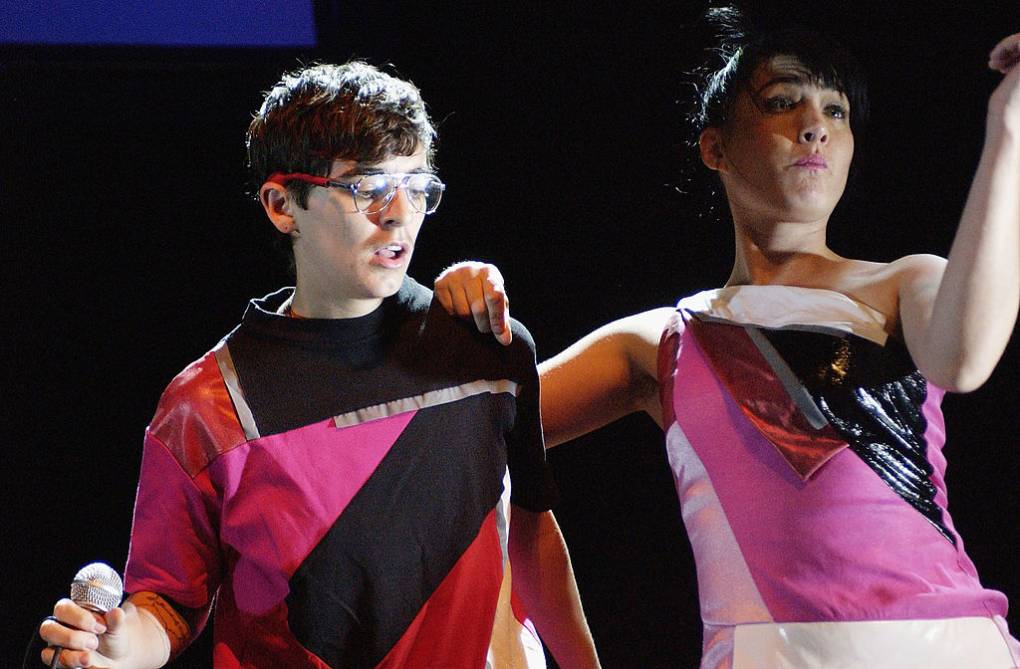
"caption": "JD Samson (left) and Kathleen Hanna of Le Tigre perform at the San Jose Civic Auditorium in July 2005. The band will play Mosswood Meltdown in Oakland July 4th weekend in 2023. ",
"description": null,
"title": "Le Tigre's, TKO Tour - San Jose CA",
"credit": "Tim Mosenfelder/Getty Images",
"status": "inherit",
"altTag": "two people in black white and pink outfits perform on a stage",
"isLoading": false,
"fetchFailed": false
},
"arts_13909624": {
"type": "attachments",
"id": "arts_13909624",
"meta": {
"index": "attachments_1716263798",
"site": "arts",
"id": "13909624",
"found": true
},
"parent": 13909587,
"imgSizes": {
"thumbnail": {
"file": "https://ww2.kqed.org/app/uploads/sites/2/2022/02/GettyImages-1046583758-1-160x90.jpg",
"width": 160,
"mimeType": "image/jpeg",
"height": 90
},
"post-thumbnail": {
"file": "https://ww2.kqed.org/app/uploads/sites/2/2022/02/GettyImages-1046583758-1-672x372.jpg",
"width": 672,
"mimeType": "image/jpeg",
"height": 372
},
"kqedFullSize": {
"file": "https://ww2.kqed.org/app/uploads/sites/2/2022/02/GettyImages-1046583758-1.jpg",
"width": 1024,
"height": 576
},
"large": {
"file": "https://ww2.kqed.org/app/uploads/sites/2/2022/02/GettyImages-1046583758-1-1020x574.jpg",
"width": 1020,
"mimeType": "image/jpeg",
"height": 574
},
"medium": {
"file": "https://ww2.kqed.org/app/uploads/sites/2/2022/02/GettyImages-1046583758-1-800x450.jpg",
"width": 800,
"mimeType": "image/jpeg",
"height": 450
},
"medium_large": {
"file": "https://ww2.kqed.org/app/uploads/sites/2/2022/02/GettyImages-1046583758-1-768x432.jpg",
"width": 768,
"mimeType": "image/jpeg",
"height": 432
}
},
"publishDate": 1645212313,
"modified": 1645212346,
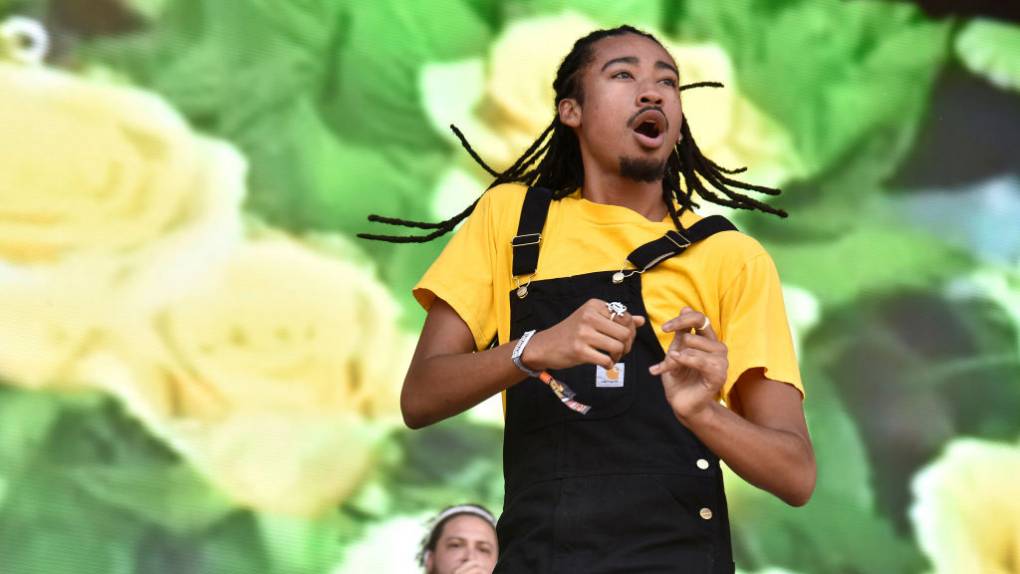
"caption": "Topaz Jones performs during the 2018 Austin City Limits Music Festival at Zilker Park on October 5, 2018 in Austin, Texas. ",
"description": null,
"title": "2018 Austin City Limits Music Festival - Weekend 1",
"credit": "Tim Mosenfelder/Getty Images",
"status": "inherit",
"altTag": null,
"isLoading": false,
"fetchFailed": false
},
"arts_13909611": {
"type": "attachments",
"id": "arts_13909611",
"meta": {
"index": "attachments_1716263798",
"site": "arts",
"id": "13909611",
"found": true
},
"parent": 13909610,
"imgSizes": {
"twentyfourteen-full-width": {
"file": "https://ww2.kqed.org/app/uploads/sites/2/2022/02/jeen_yuhs_kanye-in-coat-b3e76ac146506e8a52623bec0649ba73d4618d4c-1038x576.png",
"width": 1038,
"mimeType": "image/png",
"height": 576
},
"thumbnail": {
"file": "https://ww2.kqed.org/app/uploads/sites/2/2022/02/jeen_yuhs_kanye-in-coat-b3e76ac146506e8a52623bec0649ba73d4618d4c-160x120.png",
"width": 160,
"mimeType": "image/png",
"height": 120
},
"post-thumbnail": {
"file": "https://ww2.kqed.org/app/uploads/sites/2/2022/02/jeen_yuhs_kanye-in-coat-b3e76ac146506e8a52623bec0649ba73d4618d4c-672x372.png",
"width": 672,
"mimeType": "image/png",
"height": 372
},
"kqedFullSize": {
"file": "https://ww2.kqed.org/app/uploads/sites/2/2022/02/jeen_yuhs_kanye-in-coat-b3e76ac146506e8a52623bec0649ba73d4618d4c-e1645211292641.png",
"width": 1920,
"height": 1440
},
"large": {
"file": "https://ww2.kqed.org/app/uploads/sites/2/2022/02/jeen_yuhs_kanye-in-coat-b3e76ac146506e8a52623bec0649ba73d4618d4c-1020x765.png",
"width": 1020,
"mimeType": "image/png",
"height": 765
},
"1536x1536": {
"file": "https://ww2.kqed.org/app/uploads/sites/2/2022/02/jeen_yuhs_kanye-in-coat-b3e76ac146506e8a52623bec0649ba73d4618d4c-1536x1152.png",
"width": 1536,
"mimeType": "image/png",
"height": 1152
},
"full-width": {
"file": "https://ww2.kqed.org/app/uploads/sites/2/2022/02/jeen_yuhs_kanye-in-coat-b3e76ac146506e8a52623bec0649ba73d4618d4c-1920x1440.png",
"width": 1920,
"mimeType": "image/png",
"height": 1440
},
"medium": {
"file": "https://ww2.kqed.org/app/uploads/sites/2/2022/02/jeen_yuhs_kanye-in-coat-b3e76ac146506e8a52623bec0649ba73d4618d4c-800x600.png",
"width": 800,
"mimeType": "image/png",
"height": 600
},
"medium_large": {
"file": "https://ww2.kqed.org/app/uploads/sites/2/2022/02/jeen_yuhs_kanye-in-coat-b3e76ac146506e8a52623bec0649ba73d4618d4c-768x576.png",
"width": 768,
"mimeType": "image/png",
"height": 576
}
},
"publishDate": 1645210148,
"modified": 1645211360,
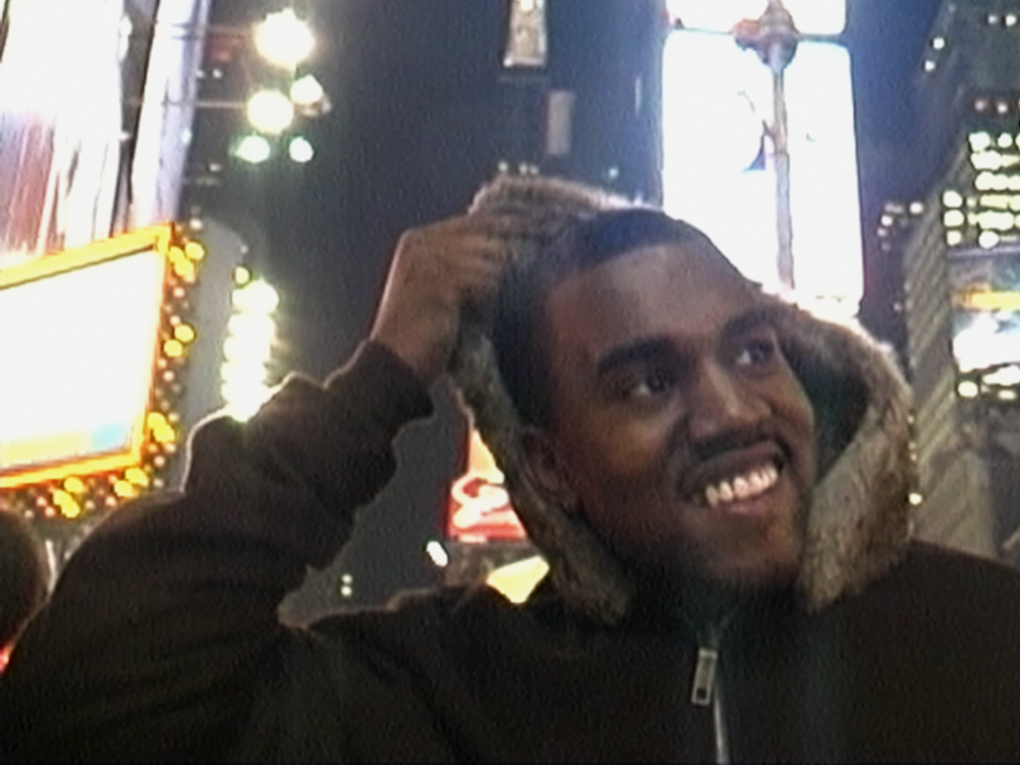
"caption": "Kanye West smiles under the lights in Times Square.",
"description": null,
"title": "Kanye West smiles under the lights in Times Square.",
"credit": "Netflix",
"status": "inherit",
"altTag": null,
"isLoading": false,
"fetchFailed": false
}
},
"audioPlayerReducer": {
"postId": "stream_live",
"isPaused": true,
"isPlaying": false,
"pfsActive": false,
"pledgeModalIsOpen": true,
"playerDrawerIsOpen": false,
"liveAudioPlayStartedAt": 0,
"liveAudioPlayContext": ""
},
"authorsReducer": {
"byline_arts_13910958": {
"type": "authors",
"id": "byline_arts_13910958",
"meta": {
"override": true
},
"slug": "byline_arts_13910958",
"name": "Jonathan Franklin",
"isLoading": false
},
"byline_arts_13910635": {
"type": "authors",
"id": "byline_arts_13910635",
"meta": {
"override": true
},
"slug": "byline_arts_13910635",
"name": "Christopher Intagliata",
"isLoading": false
},
"byline_arts_13909610": {
"type": "authors",
"id": "byline_arts_13909610",
"meta": {
"override": true
},
"slug": "byline_arts_13909610",
"name": "Eric Deggans",
"isLoading": false
},
"agilbert": {
"type": "authors",
"id": "86",
"meta": {
"index": "authors_1716337520",
"id": "86",
"found": true
},
"name": "Andrew Gilbert",
"firstName": "Andrew",
"lastName": "Gilbert",
"slug": "agilbert",
"email": "jazzscribe@aol.com",
"display_author_email": false,
"staff_mastheads": [],
"title": "KQED Contributor",
"bio": "A Los Angeles native based in the Berkeley area since 1996, Andrew Gilbert covers jazz, international music and dance for KQED's \u003ci>California Report, \u003c/i>the\u003ci> Mercury News\u003c/i>, \u003ci>San Francisco Chronicle\u003c/i>, \u003ci>Berkeleyside.com\u003c/i>, and other publications. He is available for weddings and bar and bat mitzvahs. #jazzscribe",
"avatar": "https://secure.gravatar.com/avatar/d7bcafdbefdd39e9a68f88724ca616eb4e7a5a6bff9cdfb62de652a1e1751471?s=600&d=blank&r=g",
"twitter": null,
"bluesky": null,
"facebook": null,
"instagram": null,
"linkedin": null,
"sites": [
{
"site": "arts",
"roles": [
"Contributor",
"author"
]
},
{
"site": "news",
"roles": [
"author"
]
}
],
"headData": {
"title": "Andrew Gilbert | KQED",
"description": "KQED Contributor",
"ogImgSrc": "https://secure.gravatar.com/avatar/d7bcafdbefdd39e9a68f88724ca616eb4e7a5a6bff9cdfb62de652a1e1751471?s=600&d=blank&r=g",
"twImgSrc": "https://secure.gravatar.com/avatar/d7bcafdbefdd39e9a68f88724ca616eb4e7a5a6bff9cdfb62de652a1e1751471?s=600&d=blank&r=g"
},
"isLoading": false,
"link": "/author/agilbert"
},
"gmeline": {
"type": "authors",
"id": "185",
"meta": {
"index": "authors_1716337520",
"id": "185",
"found": true
},
"name": "Gabe Meline",
"firstName": "Gabe",
"lastName": "Meline",
"slug": "gmeline",
"email": "gmeline@kqed.org",
"display_author_email": true,
"staff_mastheads": [
"arts"
],
"title": "Senior Editor, KQED Arts & Culture",
"bio": "Gabe Meline entered journalism at age 15 making photocopied zines, and has since earned awards from the Edward R. Murrow Awards, the Society for Professional Journalists, the Online Journalism Awards, the Association of Alternative Newsweeklies and the California Newspaper Publishers Association. Prior to KQED, he was the editor of the \u003cem>North Bay Bohemian\u003c/em> and a touring musician. He lives with his wife and daughter in his hometown of Santa Rosa, CA.",
"avatar": "https://secure.gravatar.com/avatar/5bebe57be0d8bc2dd318934feb47299e2d2d10cba28d09d8d7afb389a2ce2bdd?s=600&d=blank&r=g",
"twitter": null,
"bluesky": null,
"facebook": null,
"instagram": null,
"linkedin": null,
"sites": [
{
"site": "",
"roles": [
"editor"
]
},
{
"site": "arts",
"roles": [
"administrator"
]
},
{
"site": "artschool",
"roles": [
"editor"
]
},
{
"site": "news",
"roles": [
"author"
]
},
{
"site": "pop",
"roles": [
"editor"
]
},
{
"site": "bayareabites",
"roles": [
"editor"
]
},
{
"site": "food",
"roles": [
"editor"
]
},
{
"site": "forum",
"roles": [
"administrator"
]
},
{
"site": "liveblog",
"roles": [
"editor"
]
},
{
"site": "hiphop",
"roles": [
"editor"
]
}
],
"headData": {
"title": "Gabe Meline | KQED",
"description": "Senior Editor, KQED Arts & Culture",
"ogImgSrc": "https://secure.gravatar.com/avatar/5bebe57be0d8bc2dd318934feb47299e2d2d10cba28d09d8d7afb389a2ce2bdd?s=600&d=blank&r=g",
"twImgSrc": "https://secure.gravatar.com/avatar/5bebe57be0d8bc2dd318934feb47299e2d2d10cba28d09d8d7afb389a2ce2bdd?s=600&d=blank&r=g"
},
"isLoading": false,
"link": "/author/gmeline"
},
"cveltman": {
"type": "authors",
"id": "8608",
"meta": {
"index": "authors_1716337520",
"id": "8608",
"found": true
},
"name": "Chloe Veltman",
"firstName": "Chloe",
"lastName": "Veltman",
"slug": "cveltman",
"email": "cveltman@kqed.org",
"display_author_email": true,
"staff_mastheads": [],
"title": "Arts and Culture Reporter",
"bio": "Chloe Veltman is a former arts and culture reporter for KQED. Prior to joining the organization, she launched and led the arts bureau at Colorado Public Radio, served as the Bay Area's culture columnist for the New York Times, and was the founder, host and executive producer of VoiceBox, a national award-winning weekly podcast/radio show and live events series all about the human voice. Chloe is the recipient of numerous prizes, grants and fellowships including a Webby Award for her work on interactive storytelling, both the John S Knight Journalism Fellowship and Humanities Center Fellowship at Stanford University, the Sundance Arts Writing Fellowship and a Library of Congress Research Fellowship. She is the author of the book \"On Acting\" and has appeared as a guest lecturer at Yale University and the San Francisco Conservatory of Music among other institutions. She holds a BA in english literature from King's College, Cambridge, and a Masters in Dramaturgy from the Central School of Speech and Drama/Harvard Institute for Advanced Theater Training.\r\n\u003ca href=\"https://www.chloeveltman.com\">www.chloeveltman.com\u003c/a>",
"avatar": "https://secure.gravatar.com/avatar/55403394b00a1ddab683952c2eb2cf85?s=600&d=blank&r=g",
"twitter": "chloeveltman",
"facebook": null,
"instagram": null,
"linkedin": null,
"sites": [
{
"site": "arts",
"roles": []
},
{
"site": "news",
"roles": [
"author"
]
},
{
"site": "pop",
"roles": [
"editor"
]
},
{
"site": "science",
"roles": []
}
],
"headData": {
"title": "Chloe Veltman | KQED",
"description": "Arts and Culture Reporter",
"ogImgSrc": "https://secure.gravatar.com/avatar/55403394b00a1ddab683952c2eb2cf85?s=600&d=blank&r=g",
"twImgSrc": "https://secure.gravatar.com/avatar/55403394b00a1ddab683952c2eb2cf85?s=600&d=blank&r=g"
},
"isLoading": false,
"link": "/author/cveltman"
},
"ralexandra": {
"type": "authors",
"id": "11242",
"meta": {
"index": "authors_1716337520",
"id": "11242",
"found": true
},
"name": "Rae Alexandra",
"firstName": "Rae",
"lastName": "Alexandra",
"slug": "ralexandra",
"email": "ralexandra@kqed.org",
"display_author_email": true,
"staff_mastheads": [],
"title": "Reporter/Producer",
"bio": "Rae Alexandra is a Reporter/Producer for KQED Arts & Culture, and the creator/author of the \u003ca href=\"https://www.kqed.org/arts/program/rebel-girls-from-bay-area-history\">Rebel Girls From Bay Area History\u003c/a> and \u003ca href=\"https://www.kqed.org/bizarrebayarea\">Bizarre Bay Area\u003c/a> series. Her debut book, \u003ca href=\"https://citylights.com/politics-current-events-history/unsung-heroines35-women-who-changed/\">Unsung Heroines: 35 Women Who Changed the Bay Area\u003c/a> was published by City Lights in March 2026. In 2023, Rae was awarded an SPJ Excellence in Journalism Award for Arts & Culture. Rae was born and raised in Wales and subsequently — even after two decades in Northern California — still uses phrases that regularly baffle her coworkers.",
"avatar": "https://secure.gravatar.com/avatar/edfee8176c80cc0a382b051190f5341997df378a934a5774dcb0977732dfd401?s=600&d=blank&r=g",
"twitter": null,
"bluesky": null,
"facebook": null,
"instagram": null,
"linkedin": null,
"sites": [
{
"site": "arts",
"roles": [
"subscriber"
]
},
{
"site": "news",
"roles": [
"subscriber"
]
},
{
"site": "pop",
"roles": [
"subscriber"
]
},
{
"site": "bayareabites",
"roles": [
"subscriber"
]
},
{
"site": "science",
"roles": [
"subscriber"
]
}
],
"headData": {
"title": "Rae Alexandra | KQED",
"description": "Reporter/Producer",
"ogImgSrc": "https://secure.gravatar.com/avatar/edfee8176c80cc0a382b051190f5341997df378a934a5774dcb0977732dfd401?s=600&d=blank&r=g",
"twImgSrc": "https://secure.gravatar.com/avatar/edfee8176c80cc0a382b051190f5341997df378a934a5774dcb0977732dfd401?s=600&d=blank&r=g"
},
"isLoading": false,
"link": "/author/ralexandra"
},
"nvoynovskaya": {
"type": "authors",
"id": "11387",
"meta": {
"index": "authors_1716337520",
"id": "11387",
"found": true
},
"name": "Nastia Voynovskaya",
"firstName": "Nastia",
"lastName": "Voynovskaya",
"slug": "nvoynovskaya",
"email": "nvoynovskaya@kqed.org",
"display_author_email": false,
"staff_mastheads": [
"arts"
],
"title": "Editor and reporter",
"bio": "Nastia Voynovskaya is a reporter, editor and host at KQED Arts & Culture. She's been covering the arts in the Bay Area for over a decade, with a focus on music, queer culture, labor issues and grassroots organizing. She has edited KQED story series such as Trans Bay: A History of San Francisco's Gender-Diverse Community, and co-created KQED's Bay Area hip-hop history project, That's My Word. Nastia's work has been recognized by the Society of Professional Journalists and San Francisco Press Club. She regularly appears on podcasts and radio programs, including NPR's All Songs Considered, and hosts live events where music, culture and conversation meet.",
"avatar": "https://secure.gravatar.com/avatar/5025ee460e5a85d69ca20ea6c6f2f80d7e17795c828f61ea3aecfcd924e9042e?s=600&d=blank&r=g",
"twitter": null,
"bluesky": null,
"facebook": null,
"instagram": "https://www.instagram.com/nananastia/",
"linkedin": null,
"sites": [
{
"site": "",
"roles": [
"editor"
]
},
{
"site": "arts",
"roles": [
"administrator"
]
},
{
"site": "news",
"roles": [
"editor"
]
},
{
"site": "pop",
"roles": [
"administrator"
]
},
{
"site": "bayareabites",
"roles": [
"editor"
]
},
{
"site": "podcasts",
"roles": [
"editor"
]
},
{
"site": "hiphop",
"roles": [
"editor"
]
}
],
"headData": {
"title": "Nastia Voynovskaya | KQED",
"description": "Editor and reporter",
"ogImgSrc": "https://secure.gravatar.com/avatar/5025ee460e5a85d69ca20ea6c6f2f80d7e17795c828f61ea3aecfcd924e9042e?s=600&d=blank&r=g",
"twImgSrc": "https://secure.gravatar.com/avatar/5025ee460e5a85d69ca20ea6c6f2f80d7e17795c828f61ea3aecfcd924e9042e?s=600&d=blank&r=g"
},
"isLoading": false,
"link": "/author/nvoynovskaya"
},
"ogpenn": {
"type": "authors",
"id": "11491",
"meta": {
"index": "authors_1716337520",
"id": "11491",
"found": true
},
"name": "Pendarvis Harshaw",
"firstName": "Pendarvis",
"lastName": "Harshaw",
"slug": "ogpenn",
"email": "ogpenn@gmail.com",
"display_author_email": false,
"staff_mastheads": [
"arts"
],
"title": "Community Engagement Reporter",
"bio": "Pendarvis Harshaw is an educator, host and writer with KQED Arts.",
"avatar": "https://secure.gravatar.com/avatar/972b77ee8e3f346ae2b00622661187fbfabd059b5693bbdc1475ea7a722fd4cd?s=600&d=blank&r=g",
"twitter": null,
"bluesky": null,
"facebook": null,
"instagram": "ogpenn",
"linkedin": null,
"sites": [
{
"site": "arts",
"roles": [
"administrator"
]
},
{
"site": "news",
"roles": [
"editor"
]
},
{
"site": "bayareabites",
"roles": [
"author"
]
},
{
"site": "hiphop",
"roles": [
"editor"
]
}
],
"headData": {
"title": "Pendarvis Harshaw | KQED",
"description": "Community Engagement Reporter",
"ogImgSrc": "https://secure.gravatar.com/avatar/972b77ee8e3f346ae2b00622661187fbfabd059b5693bbdc1475ea7a722fd4cd?s=600&d=blank&r=g",
"twImgSrc": "https://secure.gravatar.com/avatar/972b77ee8e3f346ae2b00622661187fbfabd059b5693bbdc1475ea7a722fd4cd?s=600&d=blank&r=g"
},
"isLoading": false,
"link": "/author/ogpenn"
},
"ksong": {
"type": "authors",
"id": "11813",
"meta": {
"index": "authors_1716337520",
"id": "11813",
"found": true
},
"name": "Kristie Song",
"firstName": "Kristie",
"lastName": "Song",
"slug": "ksong",
"email": "ksong@kqed.org",
"display_author_email": false,
"staff_mastheads": [],
"title": "Editorial Intern ",
"bio": "Kristie Song is an Arts & Culture Intern at KQED. She is currently a graduate student at UC Berkeley, where she studies audio and multimedia journalism. Previously, she covered the local community for Oakland North, produced episodes for The Science of Happiness, and served as news director for KUCI, UC Irvine’s radio station. Outside of reporting, she likes drawing comics, listening to angsty rock, and practicing the guitar.",
"avatar": "https://secure.gravatar.com/avatar/c1149e78c3c44f92d4945a8ab0711af6?s=600&d=blank&r=g",
"twitter": null,
"facebook": null,
"instagram": null,
"linkedin": null,
"sites": [
{
"site": "arts",
"roles": [
"editor"
]
}
],
"headData": {
"title": "Kristie Song | KQED",
"description": "Editorial Intern ",
"ogImgSrc": "https://secure.gravatar.com/avatar/c1149e78c3c44f92d4945a8ab0711af6?s=600&d=blank&r=g",
"twImgSrc": "https://secure.gravatar.com/avatar/c1149e78c3c44f92d4945a8ab0711af6?s=600&d=blank&r=g"
},
"isLoading": false,
"link": "/author/ksong"
}
},
"pagesReducer": {
"arts_category_music": {
"type": "terms",
"id": "arts_69",
"meta": {
"index": "terms_1716263798",
"site": "arts",
"id": "69",
"score": 10.851818
},
"featImg": null,
"name": "Music",
"description": null,
"taxonomy": "category",
"headData": {
"twImgId": null,
"twTitle": null,
"ogTitle": null,
"ogImgId": null,
"twDescription": null,
"description": null,
"title": "Music Archives | KQED Arts",
"ogDescription": null
},
"ttid": 70,
"slug": "music",
"isLoading": false,
"title": "Music",
"pageMeta": {
"site": "arts",
"WpPageTemplate": "page-topic-editorial",
"currentPage": 97
},
"blocks": [
{
"blockName": "kqed/post-list",
"attrs": {
"layout": "cardArticle2",
"query": "posts/arts?category=music",
"seeMore": false,
"paginated": true,
"page": 97
}
},
{
"blockName": "kqed/ad"
}
]
}
},
"pfsSessionReducer": {},
"postsReducer": {
"stream_live": {
"type": "live",
"id": "stream_live",
"audioUrl": "https://streams.kqed.org/kqedradio",
"title": "Live Stream",
"excerpt": "Live Stream information currently unavailable.",
"link": "/radio",
"featImg": "",
"label": {
"name": "KQED Live",
"link": "/"
}
},
"stream_kqedNewscast": {
"type": "posts",
"id": "stream_kqedNewscast",
"audioUrl": "https://www.kqed.org/.stream/anon/radio/RDnews/newscast.mp3?_=1",
"title": "KQED Newscast",
"featImg": "",
"label": {
"name": "88.5 FM",
"link": "/"
}
},
"arts_13910972": {
"type": "posts",
"id": "arts_13910972",
"meta": {
"index": "posts_1716263798",
"site": "arts",
"id": "13910972",
"score": null,
"sort": [
1648226208000
]
},
"guestAuthors": [],
"slug": "dj-shellheart-bugzy-rexx-life-raj-dj",
"title": "DJ ShellHeart Can't Slow Down",
"publishDate": 1648226208,
"format": "aside",
"headTitle": "DJ ShellHeart Can’t Slow Down | KQED",
"labelTerm": {
"site": "arts"
},
"content": "\u003cfigure id=\"attachment_13910987\" class=\"wp-caption aligncenter\" style=\"max-width: 800px\">\u003cimg loading=\"lazy\" decoding=\"async\" class=\"size-medium wp-image-13910987\" src=\"https://ww2.kqed.org/app/uploads/sites/2/2022/03/DSCF1797-800x800.jpeg\" alt=\"DJ ShellHeart wears sunglasses as she poses next to a huge car rim of a classic car.\" width=\"800\" height=\"800\" srcset=\"https://cdn.kqed.org/wp-content/uploads/sites/2/2022/03/DSCF1797-800x800.jpeg 800w, https://cdn.kqed.org/wp-content/uploads/sites/2/2022/03/DSCF1797-1020x1020.jpeg 1020w, https://cdn.kqed.org/wp-content/uploads/sites/2/2022/03/DSCF1797-160x160.jpeg 160w, https://cdn.kqed.org/wp-content/uploads/sites/2/2022/03/DSCF1797-768x768.jpeg 768w, https://cdn.kqed.org/wp-content/uploads/sites/2/2022/03/DSCF1797-1536x1536.jpeg 1536w, https://cdn.kqed.org/wp-content/uploads/sites/2/2022/03/DSCF1797-2048x2048.jpeg 2048w, https://cdn.kqed.org/wp-content/uploads/sites/2/2022/03/DSCF1797-1920x1920.jpeg 1920w\" sizes=\"(max-width: 800px) 100vw, 800px\">\u003cfigcaption class=\"wp-caption-text\">DJ ShellHeart wears sunglasses as she poses next to a huge car rim of a classic car. \u003ccite>(@mattsdemise)\u003c/cite>\u003c/figcaption>\u003c/figure>\n\u003cp>\u003cspan style=\"font-size: 4.6875em;float: left;line-height: 0.733em;padding: 0.05em 0.1em 0 0;font-family: times, serif, georgia\">B\u003c/span>eing “outside” has grown into a term that signifies the amount of work put in, the battles you’ve survived and the love you’ve received. It’s a badge of honor.\u003c/p>\n\u003cp>When I think about people who’ve \u003cem>really been outside\u003c/em>, I think of folks who’ve turned human interaction into a lucrative business model and some sort of spiritual exchange. People like \u003ca href=\"https://www.instagram.com/djshellheart/\" target=\"_blank\" rel=\"noopener noreferrer\">DJ ShellHeart\u003c/a>.\u003c/p>\n\u003cp>\u003cimg loading=\"lazy\" decoding=\"async\" class=\"alignright size-thumbnail wp-image-13833985\" src=\"https://ww2.kqed.org/arts/wp-content/uploads/sites/2/2018/05/OGPenn.Cap_-160x184.jpg\" alt=\"\" width=\"160\" height=\"184\" srcset=\"https://cdn.kqed.org/wp-content/uploads/sites/2/2018/05/OGPenn.Cap_-160x184.jpg 160w, https://cdn.kqed.org/wp-content/uploads/sites/2/2018/05/OGPenn.Cap_.jpg 180w\" sizes=\"(max-width: 160px) 100vw, 160px\">Last week, she hosted a birthday party for East Oakland lyricist \u003ca href=\"https://www.instagram.com/whoisallblack/\" target=\"_blank\" rel=\"noopener noreferrer\">ALLBLACK\u003c/a>. A few days prior, I saw her dancing in the booth while DJing an event with visual artist \u003ca href=\"https://www.instagram.com/yanory_norwood/\" target=\"_blank\" rel=\"noopener noreferrer\">Yanory Norwood.\u003c/a> Last month I spotted her cutting up and spinning records with a bunch of fly sisters on the \u003ca href=\"https://www.instagram.com/tiptopshape_/\" target=\"_blank\" rel=\"noopener noreferrer\">Tip Top Shape\u003c/a> float at the \u003ca href=\"https://www.instagram.com/blackjoyparade/\" target=\"_blank\" rel=\"noopener noreferrer\">Black Joy Parade\u003c/a>.\u003c/p>\n\u003cp>And this Friday, March 25, ShellHeart DJs at the \u003ca href=\"https://www.instagram.com/turfinc/\" target=\"_blank\" rel=\"noopener noreferrer\">Turf Inc.\u003c/a>-hosted “Dance Your Style 2022” battle; she’s joined by \u003ca href=\"https://www.instagram.com/djladyryan/\" target=\"_blank\" rel=\"noopener noreferrer\">DJ Lady Ryan\u003c/a>, \u003ca href=\"https://www.instagram.com/djumami/\" target=\"_blank\" rel=\"noopener noreferrer\">DJ Umami\u003c/a>, \u003ca href=\"https://www.instagram.com/djredcorvette/\" target=\"_blank\" rel=\"noopener noreferrer\">DJ Red Corvette\u003c/a>, and \u003ca href=\"https://www.instagram.com/djmujie/\" target=\"_blank\" rel=\"noopener noreferrer\">DJ Mujie\u003c/a>.\u003c/p>\n\u003cp>As if that’s not enough, the next day, Saturday, March 26, Shell appears at the cannabis-themed brunch \u003ca href=\"https://www.eventbrite.com/e/welcome-to-the-blunch-tickets-269092662397\" target=\"_blank\" rel=\"noopener noreferrer\">Blunch\u003c/a>, organized and hosted by Oakland emcee and entrepreneur \u003ca href=\"https://www.instagram.com/p/CbY0hrILEue/\" target=\"_blank\" rel=\"noopener noreferrer\">Ally Cocaine\u003c/a> and her sister. And on Sunday, March 27, she’s at the \u003ca href=\"https://www.nba.com/warriors/news/warriors-announce-womens-empowerment-month-celebrations-20220307\" target=\"_blank\" rel=\"noopener noreferrer\">Thrive City Women’s Small Business Market\u003c/a> at the Chase Center, as part of the Golden State Warriors’ Women’s History Month festivities.\u003c/p>\n\u003cp>[ad fullwidth]\u003c/p>\n\u003cp>I’m laying out her itinerary to show you that’s she’s not only outside—pardon me, \u003cem>been outside\u003c/em>—but that’s it’s clearly paying off.\u003c/p>\n\u003cfigure id=\"attachment_13910988\" class=\"wp-caption aligncenter\" style=\"max-width: 800px\">\u003cimg loading=\"lazy\" decoding=\"async\" class=\"size-large wp-image-13910988\" src=\"https://ww2.kqed.org/app/uploads/sites/2/2022/03/DSCF1803-1020x1020.jpeg\" alt=\"DJ ShellHeart in front of the 16th Street Station in West Oakland. \" width=\"800\" height=\"800\" srcset=\"https://cdn.kqed.org/wp-content/uploads/sites/2/2022/03/DSCF1803-1020x1020.jpeg 1020w, https://cdn.kqed.org/wp-content/uploads/sites/2/2022/03/DSCF1803-800x800.jpeg 800w, https://cdn.kqed.org/wp-content/uploads/sites/2/2022/03/DSCF1803-160x160.jpeg 160w, https://cdn.kqed.org/wp-content/uploads/sites/2/2022/03/DSCF1803-768x768.jpeg 768w, https://cdn.kqed.org/wp-content/uploads/sites/2/2022/03/DSCF1803-1536x1536.jpeg 1536w, https://cdn.kqed.org/wp-content/uploads/sites/2/2022/03/DSCF1803-2048x2048.jpeg 2048w, https://cdn.kqed.org/wp-content/uploads/sites/2/2022/03/DSCF1803-1920x1920.jpeg 1920w\" sizes=\"(max-width: 800px) 100vw, 800px\">\u003cfigcaption class=\"wp-caption-text\">DJ ShellHeart in front of the 16th Street Station in West Oakland. \u003ccite>(@mattsdemise)\u003c/cite>\u003c/figcaption>\u003c/figure>\n\u003cp>\u003cspan style=\"font-size: 4.6875em;float: left;line-height: 0.733em;padding: 0.05em 0.1em 0 0;font-family: times, serif, georgia\">“I\u003c/span> been on the gas, OG Penn!” DJ ShellHeart tells me during a phone call last week, speaking in an audible smile as she runs down her current schedule, starting with her event series called \u003ca href=\"https://www.instagram.com/good_times_party/\" target=\"_blank\" rel=\"noopener noreferrer\">Good Times\u003c/a>.\u003c/p>\n\u003cp>Every first Sunday, ShellHeart along with other DJs host the day party that’s simply about coming together to appreciate each other. “A lot of people don’t get their flowers,” Shell says, in a tone that’s a 180-degree difference from how the call started. “A lot of people from where I’m from don’t get flowers until somebody is dead.”\u003c/p>\n\u003cp>So, before the event, Shell buys eight bouquets and passes individual flowers out to people “during the lit hours.” Shell says, “I pass them out to everybody, man or woman. That’s one thing that has been big for me for 2022: making sure people get their flowers.”\u003c/p>\n\u003cp>As of this writing, they’ve only thrown a few Good Times events. But each one has brought out hundreds of attendees. Now, they’re even considering a larger venue.\u003c/p>\n\u003cfigure id=\"attachment_13910991\" class=\"wp-caption aligncenter\" style=\"max-width: 600px\">\u003cimg loading=\"lazy\" decoding=\"async\" class=\"size-medium wp-image-13910991\" src=\"https://ww2.kqed.org/app/uploads/sites/2/2022/03/Screen-Shot-2022-03-24-at-1.25.44-AM-800x910.png\" alt=\"DJ ShellHeart holds a bouquet of flowers as she embraces rapper and entrepreneur Ally Cocaine.\" width=\"600\" height=\"683\" srcset=\"https://cdn.kqed.org/wp-content/uploads/sites/2/2022/03/Screen-Shot-2022-03-24-at-1.25.44-AM-800x910.png 800w, https://cdn.kqed.org/wp-content/uploads/sites/2/2022/03/Screen-Shot-2022-03-24-at-1.25.44-AM-160x182.png 160w, https://cdn.kqed.org/wp-content/uploads/sites/2/2022/03/Screen-Shot-2022-03-24-at-1.25.44-AM-768x873.png 768w, https://cdn.kqed.org/wp-content/uploads/sites/2/2022/03/Screen-Shot-2022-03-24-at-1.25.44-AM.png 978w\" sizes=\"(max-width: 600px) 100vw, 600px\">\u003cfigcaption class=\"wp-caption-text\">DJ ShellHeart holds a bouquet of flowers as she embraces rapper and entrepreneur Ally Cocaine. \u003ccite>(@tiz_og)\u003c/cite>\u003c/figcaption>\u003c/figure>\n\u003cp>Over the past two years the Bay Area has undergone some major nightlife shifts, but ShellHeart isn’t concerned. “It’s a lot of clubs that are closing,” says Shell. “But there are so many that are opening. And they’re willing to be open for the young DJs to throw parties.”\u003c/p>\n\u003cp>She credits \u003ca href=\"https://www.instagram.com/mrbadelle/?hl=en\" target=\"_blank\" rel=\"noopener noreferrer\">Brett Badelle\u003c/a>, owner of the \u003ca href=\"https://www.instagram.com/thegalleryartbar/?hl=en\" target=\"_blank\" rel=\"noopener noreferrer\">Gallery Art Bar\u003c/a>, as well as venues like \u003ca href=\"https://www.instagram.com/crybabyoakland/?hl=en\" target=\"_blank\" rel=\"noopener noreferrer\">CryBaby Oakland\u003c/a>, \u003ca href=\"https://www.instagram.com/zanzioakland/?hl=en\" target=\"_blank\" rel=\"noopener noreferrer\">Zanzi\u003c/a>, \u003ca href=\"https://www.instagram.com/811parliament/?hl=en\" target=\"_blank\" rel=\"noopener noreferrer\">Parliament\u003c/a>, \u003ca href=\"https://www.instagram.com/halftimesportsbar/\" target=\"_blank\" rel=\"noopener noreferrer\">Halftime Sports Bar\u003c/a> and \u003ca href=\"https://www.instagram.com/m2oak/?hl=en\" target=\"_blank\" rel=\"noopener noreferrer\">M2\u003c/a> as places where she can shine.\u003c/p>\n\u003cp>It’s a big difference from a few months ago, when her holiday DJ gig, Rexx Life Raj’s “Rexxmas,” was cancelled due to the fast-spreading Omicron COVID-19 variant–a wave that brought Shell back to the first shutdown in 2020.\u003c/p>\n\u003cp>“When the pandemic came, I felt like I lost everything. Well, I did. I didn’t have a booking in sight,” ShellHeart says, reminiscing on recent history. But that period gave her time to plan. “And now I’m doing it, and it’s amazing,” she adds, audibly smiling again.\u003c/p>\n\u003cp>Born in San Francisco and raised in South Richmond, ShellHeart, given name Michelle Miller, is truly from the soil. She attended school in Berkeley, and church in Vallejo. But it was her time spent in Sacramento that set her on her path.\u003c/p>\n\u003cp>After relocating to the 916 for a job at Sacramento Children’s Receiving Home in 2014, she decided to fill her idle time with a new hobby. So she purchased a mini DJ controller that she could attach to an iPad. It wasn’t her first rodeo: when she was in high school, her dad gave her some turntables, but it didn’t stick—Shell was too focused on running track.\u003c/p>\n\u003cp>A little older and a little deeper into music, it was time. She got connected with Sacramento’s \u003ca href=\"https://www.instagram.com/djmelimel_/\" target=\"_blank\" rel=\"noopener noreferrer\">DJ Meli Mel\u003c/a>, who gave Shell a real controller, a Numark NS7. “It was hella heavy!” Shell exclaims. “But I was like, ‘\u003cem>This\u003c/em> \u003cem>is what I want to do\u003c/em>.'”\u003c/p>\n\u003cp>So she did.\u003c/p>\n\u003cfigure id=\"attachment_13910984\" class=\"wp-caption aligncenter\" style=\"max-width: 800px\">\u003cimg loading=\"lazy\" decoding=\"async\" class=\"size-medium wp-image-13910984\" src=\"https://ww2.kqed.org/app/uploads/sites/2/2022/03/IMG_0389-800x533.jpg\" alt=\"RBC Bugzy and DJ ShellHeart pose for a photo in 2018 in Oakland.\" width=\"800\" height=\"533\" srcset=\"https://cdn.kqed.org/wp-content/uploads/sites/2/2022/03/IMG_0389-800x533.jpg 800w, https://cdn.kqed.org/wp-content/uploads/sites/2/2022/03/IMG_0389-1020x680.jpg 1020w, https://cdn.kqed.org/wp-content/uploads/sites/2/2022/03/IMG_0389-160x107.jpg 160w, https://cdn.kqed.org/wp-content/uploads/sites/2/2022/03/IMG_0389-768x512.jpg 768w, https://cdn.kqed.org/wp-content/uploads/sites/2/2022/03/IMG_0389-1536x1024.jpg 1536w, https://cdn.kqed.org/wp-content/uploads/sites/2/2022/03/IMG_0389-2048x1365.jpg 2048w, https://cdn.kqed.org/wp-content/uploads/sites/2/2022/03/IMG_0389-1920x1280.jpg 1920w\" sizes=\"(max-width: 800px) 100vw, 800px\">\u003cfigcaption class=\"wp-caption-text\">RBC Bugzy and DJ ShellHeart pose for a photo in 2018 in Oakland. \u003ccite>(Courtesy DJ ShellHeart)\u003c/cite>\u003c/figcaption>\u003c/figure>\n\u003cp>\u003cspan style=\"font-size: 4.6875em;float: left;line-height: 0.733em;padding: 0.05em 0.1em 0 0;font-family: times, serif, georgia\">B\u003c/span>ack home in Richmond, an artist by the name of \u003ca href=\"https://www.instagram.com/rbcbugzy/\" target=\"_blank\" rel=\"noopener noreferrer\">RBC Bugzy\u003c/a> was on the rise, having released his first mixtape, \u003ca href=\"https://www.thizzler.com/blog/2014/12/16/rbc-bugzy-richmen-mixtape.html\" target=\"_blank\" rel=\"noopener noreferrer\">\u003cem>Richmen\u003c/em>\u003c/a>. After a year in Sacramento, ShellHeart moved back to the Bay, living in Vallejo. That’s when she and Bugzy connected. “And we just kicked it off,” says Shell, matter-of-factly. “We already knew each other because we were both from Richmond, but once I became his DJ, we became a lot closer. That actually kicked off my DJ career.”\u003c/p>\n\u003cp>Bugzy was a goofy dude, Shell tells me. A happy family man who loved hard. They’d exchange early morning phone calls to check in, and often ride out together, driving around the Bay selling Bugzy’s RICHMEN line of shirts out of his trunk while playing his music and seeing people in traffic.\u003c/p>\n\u003cp>Bugzy was shot and killed in Georgia in late 2019, along with Atlanta’s \u003ca href=\"https://www.hip-hopvibe.com/news/rip-tuc-dolla-and-rbc-bugzy-twitter-mourns-the-loss-of-atl-figure-tucdolla-and-rapper-rbc-bugzy-who-were-killed-last-night-bugzy-was-the-brother-of-cj-anderson-of-the-denver-broncos/\" target=\"_blank\" rel=\"noopener noreferrer\">Tuc Dolla\u003c/a>. After his death, Bugzy’s brother, the retired NFL running back and current college coach \u003ca href=\"https://twitter.com/cjandersonb22/status/1212096306933579776\" target=\"_blank\" rel=\"noopener noreferrer\">C.J. Anderson\u003c/a>, made it clear that Bugzy was a stage name: “His name was Bryon Edwards,” he tweeted. “Today we lost my brother Bryon Edwards.” He was a real person who was taken from this world too soon, leaving behind family, friends, and fans.\u003c/p>\n\u003cp>Plenty of photos exist of ShellHeart performing in a baseball cap with “Bugzy” embroidered on the side. But the image that really speaks to their connection is one she keeps at the crib. “I have this picture of [Bugzy] and my mom in my room, and I look at it every morning,” Shell says, once again in a tone absent of a smile. “When I go outside, it’s for him, it’s for them.”\u003c/p>\n\u003cfigure id=\"attachment_13910985\" class=\"wp-caption aligncenter\" style=\"max-width: 800px\">\u003cimg loading=\"lazy\" decoding=\"async\" class=\"size-medium wp-image-13910985\" src=\"https://ww2.kqed.org/app/uploads/sites/2/2022/03/IMG_1036-800x533.jpg\" alt=\"DJ ShellHeart and Rexx Life Raj are caught off guard ahead of a performance in Los Angeles. \" width=\"800\" height=\"533\" srcset=\"https://cdn.kqed.org/wp-content/uploads/sites/2/2022/03/IMG_1036-800x533.jpg 800w, https://cdn.kqed.org/wp-content/uploads/sites/2/2022/03/IMG_1036-1020x680.jpg 1020w, https://cdn.kqed.org/wp-content/uploads/sites/2/2022/03/IMG_1036-160x107.jpg 160w, https://cdn.kqed.org/wp-content/uploads/sites/2/2022/03/IMG_1036-768x512.jpg 768w, https://cdn.kqed.org/wp-content/uploads/sites/2/2022/03/IMG_1036-1536x1023.jpg 1536w, https://cdn.kqed.org/wp-content/uploads/sites/2/2022/03/IMG_1036.jpg 1600w\" sizes=\"(max-width: 800px) 100vw, 800px\">\u003cfigcaption class=\"wp-caption-text\">DJ ShellHeart and Rexx Life Raj are caught off guard ahead of a performance in Los Angeles. \u003ccite>(Marco Alexander)\u003c/cite>\u003c/figcaption>\u003c/figure>\n\u003cp>\u003cspan style=\"font-size: 4.6875em;float: left;line-height: 0.733em;padding: 0.05em 0.1em 0 0;font-family: times, serif, georgia\">W\u003c/span>hen she’s outside, it’s not just in the Bay; in 2018, ShellHeart began touring as Rexx Life Raj’s DJ across the United States and Europe, hitting London, Paris, Berlin, Copenhagen and beyond.\u003c/p>\n\u003cp>Shell and Raj have known each other since their days at Berkeley High, back when Raj was a part of a group called the Goon Squad. “Me and Raj been connected, that’s what a lot of people don’t know,” Shell says, audible smile present again. “That’s really my friend. So, he just made me his DJ. And man, we been killing it… He changed my life, for real. He and Bugzy changed my life.”\u003c/p>\n\u003cp>Now, she’s at a point where she can support herself by doing what she loves. On any given night, you might catch her Milly Rocking in the DJ booth while giving shoutouts over the club’s sound system. She has events lined up for the summer. She released a line of hats last fall and has more clothing dropping in the coming months. That’s in addition to throwing parties, hosting events, going on tour again and possibly putting out her own music with some well-known Bay Area artists.\u003c/p>\n\u003cfigure id=\"attachment_13910986\" class=\"wp-caption aligncenter\" style=\"max-width: 640px\">\u003cimg loading=\"lazy\" decoding=\"async\" class=\"size-large wp-image-13910986\" src=\"https://ww2.kqed.org/app/uploads/sites/2/2022/03/IMG_9137-1020x1529.jpeg\" alt=\"DJ ShellHeart doing her thing on tour with Russ at a the Sacramento Memorial Auditorium.\" width=\"640\" height=\"959\" srcset=\"https://cdn.kqed.org/wp-content/uploads/sites/2/2022/03/IMG_9137-1020x1529.jpeg 1020w, https://cdn.kqed.org/wp-content/uploads/sites/2/2022/03/IMG_9137-800x1199.jpeg 800w, https://cdn.kqed.org/wp-content/uploads/sites/2/2022/03/IMG_9137-160x240.jpeg 160w, https://cdn.kqed.org/wp-content/uploads/sites/2/2022/03/IMG_9137-768x1151.jpeg 768w, https://cdn.kqed.org/wp-content/uploads/sites/2/2022/03/IMG_9137-1025x1536.jpeg 1025w, https://cdn.kqed.org/wp-content/uploads/sites/2/2022/03/IMG_9137-1366x2048.jpeg 1366w, https://cdn.kqed.org/wp-content/uploads/sites/2/2022/03/IMG_9137-1920x2879.jpeg 1920w, https://cdn.kqed.org/wp-content/uploads/sites/2/2022/03/IMG_9137-scaled.jpeg 1708w\" sizes=\"(max-width: 640px) 100vw, 640px\">\u003cfigcaption class=\"wp-caption-text\">DJ ShellHeart doing her thing on tour with Russ at a the Sacramento Memorial Auditorium. \u003ccite>(Courtesy DJ ShellHeart)\u003c/cite>\u003c/figcaption>\u003c/figure>\n\u003cp>It’s been a long journey from when she started, back when she was hitting events and shaking people’s hands, hoping to get to know them and to make sure they got to know her.\u003c/p>\n\u003cp>Aside from DJ Backside and the late Pam The Funkstress, ShellHeart says that in those early days of DJing, she didn’t see many women behind the boards.\u003c/p>\n\u003cp>“And being a gay female, it felt like a lot of people didn’t know how to approach me,” Shell explains. “I’d get a lot of brushed-off shoulders. But I made sure to go shake those hands: I don’t know you, you don’t know me, but imma make sure you remember me.”\u003c/p>\n\u003cp>When asked what it feels like to have this kind of momentum, DJ ShellHeart answers with a rhetorical question of her own: “Why am I outside on a fucking Monday?” she laughs.\u003c/p>\n\u003cp>“It trips me out: \u003cem>Damn, I’m outside again?\u003c/em>” she says. “But this is my job. This is my career.”\u003c/p>\n\u003cp>\u003cimg loading=\"lazy\" decoding=\"async\" class=\"aligncenter size-full wp-image-12904247\" src=\"https://ww2.kqed.org/app/uploads/sites/2/2017/03/Q.Logo_.Break_-400x39.jpg\" alt=\"\" width=\"400\" height=\"39\" srcset=\"https://cdn.kqed.org/wp-content/uploads/sites/2/2017/03/Q.Logo_.Break_-400x39.jpg 400w, https://cdn.kqed.org/wp-content/uploads/sites/2/2017/03/Q.Logo_.Break_-400x39-160x16.jpg 160w, https://cdn.kqed.org/wp-content/uploads/sites/2/2017/03/Q.Logo_.Break_-400x39-240x23.jpg 240w, https://cdn.kqed.org/wp-content/uploads/sites/2/2017/03/Q.Logo_.Break_-400x39-375x37.jpg 375w\" sizes=\"(max-width: 400px) 100vw, 400px\">\u003c/p>\n\u003cp>[ad floatright]\u003c/p>\n\u003cp>\u003cem>Keep up with DJ ShellHeart on her \u003ca href=\"https://www.instagram.com/djshellheart/\" target=\"_blank\" rel=\"noopener noreferrer\">on Instagram\u003c/a> and learn more at her \u003ca href=\"https://www.djshellheart.com/\" target=\"_blank\" rel=\"noopener noreferrer\">website\u003c/a>. \u003c/em>\u003c/p>\n\n",
"blocks": [],
"excerpt": "The Richmond-raised DJ for Rexx Life Raj and the late RBC Bugzy is all gas, ensuring people get their flowers.",
"status": "publish",
"parent": 0,
"modified": 1726759619,
"stats": {
"hasAudio": false,
"hasVideo": false,
"hasChartOrMap": false,
"iframeSrcs": [],
"hasGoogleForm": false,
"hasGallery": false,
"hasHearkenModule": false,
"hasPolis": false,
"paragraphCount": 34,
"wordCount": 1675
},
"headData": {
"title": "DJ ShellHeart Can't Slow Down | KQED",
"description": "The Richmond-raised DJ for Rexx Life Raj and the late RBC Bugzy is all gas, ensuring people get their flowers.",
"ogTitle": "",
"ogDescription": "",
"ogImgId": "",
"twTitle": "",
"twDescription": "",
"twImgId": "",
"schema": {
"@context": "https://schema.org",
"@type": "Article",
"headline": "DJ ShellHeart Can't Slow Down",
"datePublished": "2022-03-25T09:36:48-07:00",
"dateModified": "2024-09-19T08:26:59-07:00",
"image": "https://cdn.kqed.org/wp-content/uploads/2020/02/KQED-OG-Image@1x.png"
}
},
"sticky": false,
"templateType": "standard",
"featuredImageType": "standard",
"subhead": "All gas, no breaks. ",
"excludeFromSiteSearch": "Include",
"path": "/arts/13910972/dj-shellheart-bugzy-rexx-life-raj-dj",
"audioTrackLength": null,
"parsedContent": [
{
"type": "contentString",
"content": "\u003cdiv class=\"post-body\">\u003cp>\u003cfigure id=\"attachment_13910987\" class=\"wp-caption aligncenter\" style=\"max-width: 800px\">\u003cimg loading=\"lazy\" decoding=\"async\" class=\"size-medium wp-image-13910987\" src=\"https://ww2.kqed.org/app/uploads/sites/2/2022/03/DSCF1797-800x800.jpeg\" alt=\"DJ ShellHeart wears sunglasses as she poses next to a huge car rim of a classic car.\" width=\"800\" height=\"800\" srcset=\"https://cdn.kqed.org/wp-content/uploads/sites/2/2022/03/DSCF1797-800x800.jpeg 800w, https://cdn.kqed.org/wp-content/uploads/sites/2/2022/03/DSCF1797-1020x1020.jpeg 1020w, https://cdn.kqed.org/wp-content/uploads/sites/2/2022/03/DSCF1797-160x160.jpeg 160w, https://cdn.kqed.org/wp-content/uploads/sites/2/2022/03/DSCF1797-768x768.jpeg 768w, https://cdn.kqed.org/wp-content/uploads/sites/2/2022/03/DSCF1797-1536x1536.jpeg 1536w, https://cdn.kqed.org/wp-content/uploads/sites/2/2022/03/DSCF1797-2048x2048.jpeg 2048w, https://cdn.kqed.org/wp-content/uploads/sites/2/2022/03/DSCF1797-1920x1920.jpeg 1920w\" sizes=\"(max-width: 800px) 100vw, 800px\">\u003cfigcaption class=\"wp-caption-text\">DJ ShellHeart wears sunglasses as she poses next to a huge car rim of a classic car. \u003ccite>(@mattsdemise)\u003c/cite>\u003c/figcaption>\u003c/figure>\n\u003cp>\u003cspan style=\"font-size: 4.6875em;float: left;line-height: 0.733em;padding: 0.05em 0.1em 0 0;font-family: times, serif, georgia\">B\u003c/span>eing “outside” has grown into a term that signifies the amount of work put in, the battles you’ve survived and the love you’ve received. It’s a badge of honor.\u003c/p>\n\u003cp>When I think about people who’ve \u003cem>really been outside\u003c/em>, I think of folks who’ve turned human interaction into a lucrative business model and some sort of spiritual exchange. People like \u003ca href=\"https://www.instagram.com/djshellheart/\" target=\"_blank\" rel=\"noopener noreferrer\">DJ ShellHeart\u003c/a>.\u003c/p>\n\u003cp>\u003cimg loading=\"lazy\" decoding=\"async\" class=\"alignright size-thumbnail wp-image-13833985\" src=\"https://ww2.kqed.org/arts/wp-content/uploads/sites/2/2018/05/OGPenn.Cap_-160x184.jpg\" alt=\"\" width=\"160\" height=\"184\" srcset=\"https://cdn.kqed.org/wp-content/uploads/sites/2/2018/05/OGPenn.Cap_-160x184.jpg 160w, https://cdn.kqed.org/wp-content/uploads/sites/2/2018/05/OGPenn.Cap_.jpg 180w\" sizes=\"(max-width: 160px) 100vw, 160px\">Last week, she hosted a birthday party for East Oakland lyricist \u003ca href=\"https://www.instagram.com/whoisallblack/\" target=\"_blank\" rel=\"noopener noreferrer\">ALLBLACK\u003c/a>. A few days prior, I saw her dancing in the booth while DJing an event with visual artist \u003ca href=\"https://www.instagram.com/yanory_norwood/\" target=\"_blank\" rel=\"noopener noreferrer\">Yanory Norwood.\u003c/a> Last month I spotted her cutting up and spinning records with a bunch of fly sisters on the \u003ca href=\"https://www.instagram.com/tiptopshape_/\" target=\"_blank\" rel=\"noopener noreferrer\">Tip Top Shape\u003c/a> float at the \u003ca href=\"https://www.instagram.com/blackjoyparade/\" target=\"_blank\" rel=\"noopener noreferrer\">Black Joy Parade\u003c/a>.\u003c/p>\n\u003cp>And this Friday, March 25, ShellHeart DJs at the \u003ca href=\"https://www.instagram.com/turfinc/\" target=\"_blank\" rel=\"noopener noreferrer\">Turf Inc.\u003c/a>-hosted “Dance Your Style 2022” battle; she’s joined by \u003ca href=\"https://www.instagram.com/djladyryan/\" target=\"_blank\" rel=\"noopener noreferrer\">DJ Lady Ryan\u003c/a>, \u003ca href=\"https://www.instagram.com/djumami/\" target=\"_blank\" rel=\"noopener noreferrer\">DJ Umami\u003c/a>, \u003ca href=\"https://www.instagram.com/djredcorvette/\" target=\"_blank\" rel=\"noopener noreferrer\">DJ Red Corvette\u003c/a>, and \u003ca href=\"https://www.instagram.com/djmujie/\" target=\"_blank\" rel=\"noopener noreferrer\">DJ Mujie\u003c/a>.\u003c/p>\n\u003cp>As if that’s not enough, the next day, Saturday, March 26, Shell appears at the cannabis-themed brunch \u003ca href=\"https://www.eventbrite.com/e/welcome-to-the-blunch-tickets-269092662397\" target=\"_blank\" rel=\"noopener noreferrer\">Blunch\u003c/a>, organized and hosted by Oakland emcee and entrepreneur \u003ca href=\"https://www.instagram.com/p/CbY0hrILEue/\" target=\"_blank\" rel=\"noopener noreferrer\">Ally Cocaine\u003c/a> and her sister. And on Sunday, March 27, she’s at the \u003ca href=\"https://www.nba.com/warriors/news/warriors-announce-womens-empowerment-month-celebrations-20220307\" target=\"_blank\" rel=\"noopener noreferrer\">Thrive City Women’s Small Business Market\u003c/a> at the Chase Center, as part of the Golden State Warriors’ Women’s History Month festivities.\u003c/p>\n\u003cp>\u003c/p>\u003c/div>",
"attributes": {
"named": {},
"numeric": []
}
},
{
"type": "component",
"content": "",
"name": "ad",
"attributes": {
"named": {
"label": "fullwidth"
},
"numeric": [
"fullwidth"
]
}
},
{
"type": "contentString",
"content": "\u003cdiv class=\"post-body\">\u003cp>\u003c/p>\n\u003cp>I’m laying out her itinerary to show you that’s she’s not only outside—pardon me, \u003cem>been outside\u003c/em>—but that’s it’s clearly paying off.\u003c/p>\n\u003cfigure id=\"attachment_13910988\" class=\"wp-caption aligncenter\" style=\"max-width: 800px\">\u003cimg loading=\"lazy\" decoding=\"async\" class=\"size-large wp-image-13910988\" src=\"https://ww2.kqed.org/app/uploads/sites/2/2022/03/DSCF1803-1020x1020.jpeg\" alt=\"DJ ShellHeart in front of the 16th Street Station in West Oakland. \" width=\"800\" height=\"800\" srcset=\"https://cdn.kqed.org/wp-content/uploads/sites/2/2022/03/DSCF1803-1020x1020.jpeg 1020w, https://cdn.kqed.org/wp-content/uploads/sites/2/2022/03/DSCF1803-800x800.jpeg 800w, https://cdn.kqed.org/wp-content/uploads/sites/2/2022/03/DSCF1803-160x160.jpeg 160w, https://cdn.kqed.org/wp-content/uploads/sites/2/2022/03/DSCF1803-768x768.jpeg 768w, https://cdn.kqed.org/wp-content/uploads/sites/2/2022/03/DSCF1803-1536x1536.jpeg 1536w, https://cdn.kqed.org/wp-content/uploads/sites/2/2022/03/DSCF1803-2048x2048.jpeg 2048w, https://cdn.kqed.org/wp-content/uploads/sites/2/2022/03/DSCF1803-1920x1920.jpeg 1920w\" sizes=\"(max-width: 800px) 100vw, 800px\">\u003cfigcaption class=\"wp-caption-text\">DJ ShellHeart in front of the 16th Street Station in West Oakland. \u003ccite>(@mattsdemise)\u003c/cite>\u003c/figcaption>\u003c/figure>\n\u003cp>\u003cspan style=\"font-size: 4.6875em;float: left;line-height: 0.733em;padding: 0.05em 0.1em 0 0;font-family: times, serif, georgia\">“I\u003c/span> been on the gas, OG Penn!” DJ ShellHeart tells me during a phone call last week, speaking in an audible smile as she runs down her current schedule, starting with her event series called \u003ca href=\"https://www.instagram.com/good_times_party/\" target=\"_blank\" rel=\"noopener noreferrer\">Good Times\u003c/a>.\u003c/p>\n\u003cp>Every first Sunday, ShellHeart along with other DJs host the day party that’s simply about coming together to appreciate each other. “A lot of people don’t get their flowers,” Shell says, in a tone that’s a 180-degree difference from how the call started. “A lot of people from where I’m from don’t get flowers until somebody is dead.”\u003c/p>\n\u003cp>So, before the event, Shell buys eight bouquets and passes individual flowers out to people “during the lit hours.” Shell says, “I pass them out to everybody, man or woman. That’s one thing that has been big for me for 2022: making sure people get their flowers.”\u003c/p>\n\u003cp>As of this writing, they’ve only thrown a few Good Times events. But each one has brought out hundreds of attendees. Now, they’re even considering a larger venue.\u003c/p>\n\u003cfigure id=\"attachment_13910991\" class=\"wp-caption aligncenter\" style=\"max-width: 600px\">\u003cimg loading=\"lazy\" decoding=\"async\" class=\"size-medium wp-image-13910991\" src=\"https://ww2.kqed.org/app/uploads/sites/2/2022/03/Screen-Shot-2022-03-24-at-1.25.44-AM-800x910.png\" alt=\"DJ ShellHeart holds a bouquet of flowers as she embraces rapper and entrepreneur Ally Cocaine.\" width=\"600\" height=\"683\" srcset=\"https://cdn.kqed.org/wp-content/uploads/sites/2/2022/03/Screen-Shot-2022-03-24-at-1.25.44-AM-800x910.png 800w, https://cdn.kqed.org/wp-content/uploads/sites/2/2022/03/Screen-Shot-2022-03-24-at-1.25.44-AM-160x182.png 160w, https://cdn.kqed.org/wp-content/uploads/sites/2/2022/03/Screen-Shot-2022-03-24-at-1.25.44-AM-768x873.png 768w, https://cdn.kqed.org/wp-content/uploads/sites/2/2022/03/Screen-Shot-2022-03-24-at-1.25.44-AM.png 978w\" sizes=\"(max-width: 600px) 100vw, 600px\">\u003cfigcaption class=\"wp-caption-text\">DJ ShellHeart holds a bouquet of flowers as she embraces rapper and entrepreneur Ally Cocaine. \u003ccite>(@tiz_og)\u003c/cite>\u003c/figcaption>\u003c/figure>\n\u003cp>Over the past two years the Bay Area has undergone some major nightlife shifts, but ShellHeart isn’t concerned. “It’s a lot of clubs that are closing,” says Shell. “But there are so many that are opening. And they’re willing to be open for the young DJs to throw parties.”\u003c/p>\n\u003cp>She credits \u003ca href=\"https://www.instagram.com/mrbadelle/?hl=en\" target=\"_blank\" rel=\"noopener noreferrer\">Brett Badelle\u003c/a>, owner of the \u003ca href=\"https://www.instagram.com/thegalleryartbar/?hl=en\" target=\"_blank\" rel=\"noopener noreferrer\">Gallery Art Bar\u003c/a>, as well as venues like \u003ca href=\"https://www.instagram.com/crybabyoakland/?hl=en\" target=\"_blank\" rel=\"noopener noreferrer\">CryBaby Oakland\u003c/a>, \u003ca href=\"https://www.instagram.com/zanzioakland/?hl=en\" target=\"_blank\" rel=\"noopener noreferrer\">Zanzi\u003c/a>, \u003ca href=\"https://www.instagram.com/811parliament/?hl=en\" target=\"_blank\" rel=\"noopener noreferrer\">Parliament\u003c/a>, \u003ca href=\"https://www.instagram.com/halftimesportsbar/\" target=\"_blank\" rel=\"noopener noreferrer\">Halftime Sports Bar\u003c/a> and \u003ca href=\"https://www.instagram.com/m2oak/?hl=en\" target=\"_blank\" rel=\"noopener noreferrer\">M2\u003c/a> as places where she can shine.\u003c/p>\n\u003cp>It’s a big difference from a few months ago, when her holiday DJ gig, Rexx Life Raj’s “Rexxmas,” was cancelled due to the fast-spreading Omicron COVID-19 variant–a wave that brought Shell back to the first shutdown in 2020.\u003c/p>\n\u003cp>“When the pandemic came, I felt like I lost everything. Well, I did. I didn’t have a booking in sight,” ShellHeart says, reminiscing on recent history. But that period gave her time to plan. “And now I’m doing it, and it’s amazing,” she adds, audibly smiling again.\u003c/p>\n\u003cp>Born in San Francisco and raised in South Richmond, ShellHeart, given name Michelle Miller, is truly from the soil. She attended school in Berkeley, and church in Vallejo. But it was her time spent in Sacramento that set her on her path.\u003c/p>\n\u003cp>After relocating to the 916 for a job at Sacramento Children’s Receiving Home in 2014, she decided to fill her idle time with a new hobby. So she purchased a mini DJ controller that she could attach to an iPad. It wasn’t her first rodeo: when she was in high school, her dad gave her some turntables, but it didn’t stick—Shell was too focused on running track.\u003c/p>\n\u003cp>A little older and a little deeper into music, it was time. She got connected with Sacramento’s \u003ca href=\"https://www.instagram.com/djmelimel_/\" target=\"_blank\" rel=\"noopener noreferrer\">DJ Meli Mel\u003c/a>, who gave Shell a real controller, a Numark NS7. “It was hella heavy!” Shell exclaims. “But I was like, ‘\u003cem>This\u003c/em> \u003cem>is what I want to do\u003c/em>.'”\u003c/p>\n\u003cp>So she did.\u003c/p>\n\u003cfigure id=\"attachment_13910984\" class=\"wp-caption aligncenter\" style=\"max-width: 800px\">\u003cimg loading=\"lazy\" decoding=\"async\" class=\"size-medium wp-image-13910984\" src=\"https://ww2.kqed.org/app/uploads/sites/2/2022/03/IMG_0389-800x533.jpg\" alt=\"RBC Bugzy and DJ ShellHeart pose for a photo in 2018 in Oakland.\" width=\"800\" height=\"533\" srcset=\"https://cdn.kqed.org/wp-content/uploads/sites/2/2022/03/IMG_0389-800x533.jpg 800w, https://cdn.kqed.org/wp-content/uploads/sites/2/2022/03/IMG_0389-1020x680.jpg 1020w, https://cdn.kqed.org/wp-content/uploads/sites/2/2022/03/IMG_0389-160x107.jpg 160w, https://cdn.kqed.org/wp-content/uploads/sites/2/2022/03/IMG_0389-768x512.jpg 768w, https://cdn.kqed.org/wp-content/uploads/sites/2/2022/03/IMG_0389-1536x1024.jpg 1536w, https://cdn.kqed.org/wp-content/uploads/sites/2/2022/03/IMG_0389-2048x1365.jpg 2048w, https://cdn.kqed.org/wp-content/uploads/sites/2/2022/03/IMG_0389-1920x1280.jpg 1920w\" sizes=\"(max-width: 800px) 100vw, 800px\">\u003cfigcaption class=\"wp-caption-text\">RBC Bugzy and DJ ShellHeart pose for a photo in 2018 in Oakland. \u003ccite>(Courtesy DJ ShellHeart)\u003c/cite>\u003c/figcaption>\u003c/figure>\n\u003cp>\u003cspan style=\"font-size: 4.6875em;float: left;line-height: 0.733em;padding: 0.05em 0.1em 0 0;font-family: times, serif, georgia\">B\u003c/span>ack home in Richmond, an artist by the name of \u003ca href=\"https://www.instagram.com/rbcbugzy/\" target=\"_blank\" rel=\"noopener noreferrer\">RBC Bugzy\u003c/a> was on the rise, having released his first mixtape, \u003ca href=\"https://www.thizzler.com/blog/2014/12/16/rbc-bugzy-richmen-mixtape.html\" target=\"_blank\" rel=\"noopener noreferrer\">\u003cem>Richmen\u003c/em>\u003c/a>. After a year in Sacramento, ShellHeart moved back to the Bay, living in Vallejo. That’s when she and Bugzy connected. “And we just kicked it off,” says Shell, matter-of-factly. “We already knew each other because we were both from Richmond, but once I became his DJ, we became a lot closer. That actually kicked off my DJ career.”\u003c/p>\n\u003cp>Bugzy was a goofy dude, Shell tells me. A happy family man who loved hard. They’d exchange early morning phone calls to check in, and often ride out together, driving around the Bay selling Bugzy’s RICHMEN line of shirts out of his trunk while playing his music and seeing people in traffic.\u003c/p>\n\u003cp>Bugzy was shot and killed in Georgia in late 2019, along with Atlanta’s \u003ca href=\"https://www.hip-hopvibe.com/news/rip-tuc-dolla-and-rbc-bugzy-twitter-mourns-the-loss-of-atl-figure-tucdolla-and-rapper-rbc-bugzy-who-were-killed-last-night-bugzy-was-the-brother-of-cj-anderson-of-the-denver-broncos/\" target=\"_blank\" rel=\"noopener noreferrer\">Tuc Dolla\u003c/a>. After his death, Bugzy’s brother, the retired NFL running back and current college coach \u003ca href=\"https://twitter.com/cjandersonb22/status/1212096306933579776\" target=\"_blank\" rel=\"noopener noreferrer\">C.J. Anderson\u003c/a>, made it clear that Bugzy was a stage name: “His name was Bryon Edwards,” he tweeted. “Today we lost my brother Bryon Edwards.” He was a real person who was taken from this world too soon, leaving behind family, friends, and fans.\u003c/p>\n\u003cp>Plenty of photos exist of ShellHeart performing in a baseball cap with “Bugzy” embroidered on the side. But the image that really speaks to their connection is one she keeps at the crib. “I have this picture of [Bugzy] and my mom in my room, and I look at it every morning,” Shell says, once again in a tone absent of a smile. “When I go outside, it’s for him, it’s for them.”\u003c/p>\n\u003cfigure id=\"attachment_13910985\" class=\"wp-caption aligncenter\" style=\"max-width: 800px\">\u003cimg loading=\"lazy\" decoding=\"async\" class=\"size-medium wp-image-13910985\" src=\"https://ww2.kqed.org/app/uploads/sites/2/2022/03/IMG_1036-800x533.jpg\" alt=\"DJ ShellHeart and Rexx Life Raj are caught off guard ahead of a performance in Los Angeles. \" width=\"800\" height=\"533\" srcset=\"https://cdn.kqed.org/wp-content/uploads/sites/2/2022/03/IMG_1036-800x533.jpg 800w, https://cdn.kqed.org/wp-content/uploads/sites/2/2022/03/IMG_1036-1020x680.jpg 1020w, https://cdn.kqed.org/wp-content/uploads/sites/2/2022/03/IMG_1036-160x107.jpg 160w, https://cdn.kqed.org/wp-content/uploads/sites/2/2022/03/IMG_1036-768x512.jpg 768w, https://cdn.kqed.org/wp-content/uploads/sites/2/2022/03/IMG_1036-1536x1023.jpg 1536w, https://cdn.kqed.org/wp-content/uploads/sites/2/2022/03/IMG_1036.jpg 1600w\" sizes=\"(max-width: 800px) 100vw, 800px\">\u003cfigcaption class=\"wp-caption-text\">DJ ShellHeart and Rexx Life Raj are caught off guard ahead of a performance in Los Angeles. \u003ccite>(Marco Alexander)\u003c/cite>\u003c/figcaption>\u003c/figure>\n\u003cp>\u003cspan style=\"font-size: 4.6875em;float: left;line-height: 0.733em;padding: 0.05em 0.1em 0 0;font-family: times, serif, georgia\">W\u003c/span>hen she’s outside, it’s not just in the Bay; in 2018, ShellHeart began touring as Rexx Life Raj’s DJ across the United States and Europe, hitting London, Paris, Berlin, Copenhagen and beyond.\u003c/p>\n\u003cp>Shell and Raj have known each other since their days at Berkeley High, back when Raj was a part of a group called the Goon Squad. “Me and Raj been connected, that’s what a lot of people don’t know,” Shell says, audible smile present again. “That’s really my friend. So, he just made me his DJ. And man, we been killing it… He changed my life, for real. He and Bugzy changed my life.”\u003c/p>\n\u003cp>Now, she’s at a point where she can support herself by doing what she loves. On any given night, you might catch her Milly Rocking in the DJ booth while giving shoutouts over the club’s sound system. She has events lined up for the summer. She released a line of hats last fall and has more clothing dropping in the coming months. That’s in addition to throwing parties, hosting events, going on tour again and possibly putting out her own music with some well-known Bay Area artists.\u003c/p>\n\u003cfigure id=\"attachment_13910986\" class=\"wp-caption aligncenter\" style=\"max-width: 640px\">\u003cimg loading=\"lazy\" decoding=\"async\" class=\"size-large wp-image-13910986\" src=\"https://ww2.kqed.org/app/uploads/sites/2/2022/03/IMG_9137-1020x1529.jpeg\" alt=\"DJ ShellHeart doing her thing on tour with Russ at a the Sacramento Memorial Auditorium.\" width=\"640\" height=\"959\" srcset=\"https://cdn.kqed.org/wp-content/uploads/sites/2/2022/03/IMG_9137-1020x1529.jpeg 1020w, https://cdn.kqed.org/wp-content/uploads/sites/2/2022/03/IMG_9137-800x1199.jpeg 800w, https://cdn.kqed.org/wp-content/uploads/sites/2/2022/03/IMG_9137-160x240.jpeg 160w, https://cdn.kqed.org/wp-content/uploads/sites/2/2022/03/IMG_9137-768x1151.jpeg 768w, https://cdn.kqed.org/wp-content/uploads/sites/2/2022/03/IMG_9137-1025x1536.jpeg 1025w, https://cdn.kqed.org/wp-content/uploads/sites/2/2022/03/IMG_9137-1366x2048.jpeg 1366w, https://cdn.kqed.org/wp-content/uploads/sites/2/2022/03/IMG_9137-1920x2879.jpeg 1920w, https://cdn.kqed.org/wp-content/uploads/sites/2/2022/03/IMG_9137-scaled.jpeg 1708w\" sizes=\"(max-width: 640px) 100vw, 640px\">\u003cfigcaption class=\"wp-caption-text\">DJ ShellHeart doing her thing on tour with Russ at a the Sacramento Memorial Auditorium. \u003ccite>(Courtesy DJ ShellHeart)\u003c/cite>\u003c/figcaption>\u003c/figure>\n\u003cp>It’s been a long journey from when she started, back when she was hitting events and shaking people’s hands, hoping to get to know them and to make sure they got to know her.\u003c/p>\n\u003cp>Aside from DJ Backside and the late Pam The Funkstress, ShellHeart says that in those early days of DJing, she didn’t see many women behind the boards.\u003c/p>\n\u003cp>“And being a gay female, it felt like a lot of people didn’t know how to approach me,” Shell explains. “I’d get a lot of brushed-off shoulders. But I made sure to go shake those hands: I don’t know you, you don’t know me, but imma make sure you remember me.”\u003c/p>\n\u003cp>When asked what it feels like to have this kind of momentum, DJ ShellHeart answers with a rhetorical question of her own: “Why am I outside on a fucking Monday?” she laughs.\u003c/p>\n\u003cp>“It trips me out: \u003cem>Damn, I’m outside again?\u003c/em>” she says. “But this is my job. This is my career.”\u003c/p>\n\u003cp>\u003cimg loading=\"lazy\" decoding=\"async\" class=\"aligncenter size-full wp-image-12904247\" src=\"https://ww2.kqed.org/app/uploads/sites/2/2017/03/Q.Logo_.Break_-400x39.jpg\" alt=\"\" width=\"400\" height=\"39\" srcset=\"https://cdn.kqed.org/wp-content/uploads/sites/2/2017/03/Q.Logo_.Break_-400x39.jpg 400w, https://cdn.kqed.org/wp-content/uploads/sites/2/2017/03/Q.Logo_.Break_-400x39-160x16.jpg 160w, https://cdn.kqed.org/wp-content/uploads/sites/2/2017/03/Q.Logo_.Break_-400x39-240x23.jpg 240w, https://cdn.kqed.org/wp-content/uploads/sites/2/2017/03/Q.Logo_.Break_-400x39-375x37.jpg 375w\" sizes=\"(max-width: 400px) 100vw, 400px\">\u003c/p>\n\u003cp>\u003c/p>\u003c/div>",
"attributes": {
"named": {},
"numeric": []
}
},
{
"type": "component",
"content": "",
"name": "ad",
"attributes": {
"named": {
"label": "floatright"
},
"numeric": [
"floatright"
]
}
},
{
"type": "contentString",
"content": "\u003cdiv class=\"post-body\">\u003cp>\u003c/p>\n\u003cp>\u003cem>Keep up with DJ ShellHeart on her \u003ca href=\"https://www.instagram.com/djshellheart/\" target=\"_blank\" rel=\"noopener noreferrer\">on Instagram\u003c/a> and learn more at her \u003ca href=\"https://www.djshellheart.com/\" target=\"_blank\" rel=\"noopener noreferrer\">website\u003c/a>. \u003c/em>\u003c/p>\n\n\u003c/div>\u003c/p>",
"attributes": {
"named": {},
"numeric": []
}
}
],
"link": "/arts/13910972/dj-shellheart-bugzy-rexx-life-raj-dj",
"authors": [
"11491"
],
"categories": [
"arts_1",
"arts_69"
],
"tags": [
"arts_10342",
"arts_10278",
"arts_831",
"arts_1143",
"arts_1983",
"arts_2479",
"arts_5779",
"arts_3800"
],
"featImg": "arts_13911144",
"label": "arts"
},
"arts_13910976": {
"type": "posts",
"id": "arts_13910976",
"meta": {
"index": "posts_1716263798",
"site": "arts",
"id": "13910976",
"score": null,
"sort": [
1648153574000
]
},
"parent": 0,
"labelTerm": {
"site": "arts",
"term": 140
},
"blocks": [],
"publishDate": 1648153574,
"format": "standard",
"title": "The Kronos Festival Returns With World Premieres and Global Sounds",
"headTitle": "The Kronos Festival Returns With World Premieres and Global Sounds | KQED",
"content": "\u003cp>\u003ca href=\"http://kronosquartet.org\" target=\"_blank\" rel=\"noopener noreferrer\">Kronos Quartet\u003c/a> is all about connecting people across generations, cultures and borders, which is why the in-person return of the ensemble’s festival is an occasion to celebrate.\u003c/p>\n\u003cp>This year’s \u003ca href=\"https://kronosquartet.org/kronos-festival-2022/\" target=\"_blank\" rel=\"noopener noreferrer\">Kronos Festival\u003c/a>, taking place April 7–9 at SFJAZZ, features an international array of music, including several world premieres. That includes \u003ci>Janety\u003c/i>, a piece composed by Malian griot singer Hawa Kassé Mady Diabaté in homage to Janet Cowperthwaite, the Kronos Performing Arts Associations’ executive director who has overseen 40 years of tours, commissions and recordings. \u003ci>Janety\u003c/i> takes inspiration from the Malian tradition of tegere tulon, which are hand-clapping songs young girls sing in the countryside.\u003c/p>\n\u003cp>https://youtu.be/IzeVKYTMqww\u003c/p>\n\u003cp>\u003ci>Janety\u003c/i> will be performed by \u003ca href=\"https://jacobgarchik.com/\" target=\"_blank\" rel=\"noopener noreferrer\">Jacob Garchik\u003c/a>—a celebrated trombonist, arranger and this year’s artist in residence—along with student musicians from Oakland, Berkeley and San Francisco. Garchik has arranged over 100 pieces for Kronos Quartet, and his composition \u003ci>Upon A Star\u003c/i> gets its Bay Area premiere at Kronos Festival on April 7. The festival closes on April 9 with a performance of another one of his works called \u003ci>Storyteller\u003c/i>, which pays homage to another one of Kronos’ guiding lights: folk musician Pete Seeger.\u003c/p>\n\u003cp>Also on April 9, Bay Area-based Iranian classical singer \u003ca href=\"https://mahsavahdat.net/\" target=\"_blank\" rel=\"noopener noreferrer\">Mahsa Vahdat\u003c/a> performs the world premiere of her new piece, \u003ci>Where Is Your Voice\u003c/i>. Korean-American composer and haegeum master \u003ca href=\"https://www.sooyeonlyuh.com/\" target=\"_blank\" rel=\"noopener noreferrer\">Soo Yeon Lyuh\u003c/a> performs \u003ci>Tattoo (Extended Version)\u003c/i>, also a world premiere. It’s a deeply personal piece about a terrifying incident where someone fired a gun at her car in Berkeley. That same evening, \u003ca href=\"https://www.inticomposes.com/\" target=\"_blank\" rel=\"noopener noreferrer\">inti figgis-vizueta\u003c/a>’s \u003ci>music by yourself\u003c/i>, about private, late-night communions with the music that shapes us, will also be performed for the first time. [aside postid='arts_13910898']\u003c/p>\n\u003cp>[ad fullwidth]\u003c/p>\n\u003cp>Other highlights from the lineup include an April 7 performance of \u003ci>Cadenza on the Night Plane\u003c/i> by Terry Riley, an experimental music luminary and key figure in the minimalist movement.\u003c/p>\n\u003cp>A centerpiece of the April 8 concert is \u003ci>My Lai Suite\u003c/i>, which was adapted from an opera by composer Jonathan Berger and librettist Harriet Scott Chessman. Tells the story of Hugh Thompson, an American servicemen credited with stopping a massacre of civilians during the Vietnam War. This performance features vocalist Rinde Eckert and ’rưng, đàn bầu and đàn tranh stylings by \u003ca href=\"https://www.kqed.org/arts/13906618/van-anh-vos-songs-of-strength-opens-a-multilingual-multi-genre-musical-conversation\" target=\"_blank\" rel=\"noopener noreferrer\">Vân-Ánh Võ\u003c/a>, the Bay Area’s foremost Vietnamese music master.\u003c/p>\n\u003cp>\u003c/p>\n\u003cp>Ticketing information and the rest of Kronos Festival’s multifaceted musical lineup can be found on the \u003ca href=\"https://kronosquartet.org/kronos-festival-2022/\" target=\"_blank\" rel=\"noopener noreferrer\">festival’s website\u003c/a>.\u003c/p>\n\n",
"stats": {
"hasVideo": false,
"hasChartOrMap": false,
"hasAudio": false,
"hasPolis": false,
"wordCount": 446,
"hasGoogleForm": false,
"hasGallery": false,
"hasHearkenModule": false,
"iframeSrcs": [],
"paragraphCount": 9
},
"modified": 1705007054,
"excerpt": "Iranian classical singer Mahsa Vahdat, Vietnamese multi-instrumentalist Vân-Ánh Võ and other artists will debut new works.",
"headData": {
"twImgId": "",
"twTitle": "The Kronos Festival Returns With World Premieres and Global Sounds",
"socialTitle": "Kronos Festival 2022 Lineup: World Premieres and Global Sounds %%page%% %%sep%% KQED",
"ogTitle": "The Kronos Festival Returns With World Premieres and Global Sounds",
"ogImgId": "",
"twDescription": "",
"description": "Iranian classical singer Mahsa Vahdat, Vietnamese multi-instrumentalist Vân-Ánh Võ and other artists will debut new works.",
"title": "Kronos Festival 2022 Lineup: World Premieres and Global Sounds | KQED",
"ogDescription": "",
"schema": {
"@context": "https://schema.org",
"@type": "Article",
"headline": "The Kronos Festival Returns With World Premieres and Global Sounds",
"datePublished": "2022-03-24T13:26:14-07:00",
"dateModified": "2024-01-11T13:04:14-08:00",
"image": "https://cdn.kqed.org/wp-content/uploads/2020/02/KQED-OG-Image@1x.png"
}
},
"guestAuthors": [],
"slug": "kronos-festival-2022-lineup",
"status": "publish",
"templateType": "standard",
"excludeFromSiteSearch": "Include",
"featuredImageType": "standard",
"sticky": false,
"path": "/arts/13910976/kronos-festival-2022-lineup",
"audioTrackLength": null,
"parsedContent": [
{
"type": "contentString",
"content": "\u003cdiv class=\"post-body\">\u003cp>\u003cp>\u003ca href=\"http://kronosquartet.org\" target=\"_blank\" rel=\"noopener noreferrer\">Kronos Quartet\u003c/a> is all about connecting people across generations, cultures and borders, which is why the in-person return of the ensemble’s festival is an occasion to celebrate.\u003c/p>\n\u003cp>This year’s \u003ca href=\"https://kronosquartet.org/kronos-festival-2022/\" target=\"_blank\" rel=\"noopener noreferrer\">Kronos Festival\u003c/a>, taking place April 7–9 at SFJAZZ, features an international array of music, including several world premieres. That includes \u003ci>Janety\u003c/i>, a piece composed by Malian griot singer Hawa Kassé Mady Diabaté in homage to Janet Cowperthwaite, the Kronos Performing Arts Associations’ executive director who has overseen 40 years of tours, commissions and recordings. \u003ci>Janety\u003c/i> takes inspiration from the Malian tradition of tegere tulon, which are hand-clapping songs young girls sing in the countryside.\u003c/p>\u003c/p>\u003cp>\u003cspan class='utils-parseShortcode-shortcodes-__youtubeShortcode__embedYoutube'>\n \u003cspan class='utils-parseShortcode-shortcodes-__youtubeShortcode__embedYoutubeInside'>\n \u003ciframe\n loading='lazy'\n class='utils-parseShortcode-shortcodes-__youtubeShortcode__youtubePlayer'\n type='text/html'\n src='//www.youtube.com/embed/IzeVKYTMqww'\n title='//www.youtube.com/embed/IzeVKYTMqww'\n allowfullscreen='true'\n style='border:0;'>\u003c/iframe>\n \u003c/span>\n \u003c/span>\u003c/p>\u003cp>\u003cp>\u003ci>Janety\u003c/i> will be performed by \u003ca href=\"https://jacobgarchik.com/\" target=\"_blank\" rel=\"noopener noreferrer\">Jacob Garchik\u003c/a>—a celebrated trombonist, arranger and this year’s artist in residence—along with student musicians from Oakland, Berkeley and San Francisco. Garchik has arranged over 100 pieces for Kronos Quartet, and his composition \u003ci>Upon A Star\u003c/i> gets its Bay Area premiere at Kronos Festival on April 7. The festival closes on April 9 with a performance of another one of his works called \u003ci>Storyteller\u003c/i>, which pays homage to another one of Kronos’ guiding lights: folk musician Pete Seeger.\u003c/p>\n\u003cp>Also on April 9, Bay Area-based Iranian classical singer \u003ca href=\"https://mahsavahdat.net/\" target=\"_blank\" rel=\"noopener noreferrer\">Mahsa Vahdat\u003c/a> performs the world premiere of her new piece, \u003ci>Where Is Your Voice\u003c/i>. Korean-American composer and haegeum master \u003ca href=\"https://www.sooyeonlyuh.com/\" target=\"_blank\" rel=\"noopener noreferrer\">Soo Yeon Lyuh\u003c/a> performs \u003ci>Tattoo (Extended Version)\u003c/i>, also a world premiere. It’s a deeply personal piece about a terrifying incident where someone fired a gun at her car in Berkeley. That same evening, \u003ca href=\"https://www.inticomposes.com/\" target=\"_blank\" rel=\"noopener noreferrer\">inti figgis-vizueta\u003c/a>’s \u003ci>music by yourself\u003c/i>, about private, late-night communions with the music that shapes us, will also be performed for the first time. \u003c/p>\u003c/div>",
"attributes": {
"named": {},
"numeric": []
}
},
{
"type": "component",
"content": "",
"name": "aside",
"attributes": {
"named": {
"postid": "arts_13910898",
"label": ""
},
"numeric": []
}
},
{
"type": "contentString",
"content": "\u003cdiv class=\"post-body\">\u003cp>\u003c/p>\n\u003cp>\u003c/p>\u003c/div>",
"attributes": {
"named": {},
"numeric": []
}
},
{
"type": "component",
"content": "",
"name": "ad",
"attributes": {
"named": {
"label": "fullwidth"
},
"numeric": [
"fullwidth"
]
}
},
{
"type": "contentString",
"content": "\u003cdiv class=\"post-body\">\u003cp>\u003c/p>\n\u003cp>Other highlights from the lineup include an April 7 performance of \u003ci>Cadenza on the Night Plane\u003c/i> by Terry Riley, an experimental music luminary and key figure in the minimalist movement.\u003c/p>\n\u003cp>A centerpiece of the April 8 concert is \u003ci>My Lai Suite\u003c/i>, which was adapted from an opera by composer Jonathan Berger and librettist Harriet Scott Chessman. Tells the story of Hugh Thompson, an American servicemen credited with stopping a massacre of civilians during the Vietnam War. This performance features vocalist Rinde Eckert and ’rưng, đàn bầu and đàn tranh stylings by \u003ca href=\"https://www.kqed.org/arts/13906618/van-anh-vos-songs-of-strength-opens-a-multilingual-multi-genre-musical-conversation\" target=\"_blank\" rel=\"noopener noreferrer\">Vân-Ánh Võ\u003c/a>, the Bay Area’s foremost Vietnamese music master.\u003c/p>\n\u003cp>\u003c/p>\n\u003cp>Ticketing information and the rest of Kronos Festival’s multifaceted musical lineup can be found on the \u003ca href=\"https://kronosquartet.org/kronos-festival-2022/\" target=\"_blank\" rel=\"noopener noreferrer\">festival’s website\u003c/a>.\u003c/p>\n\n\u003c/div>\u003c/p>",
"attributes": {
"named": {},
"numeric": []
}
}
],
"link": "/arts/13910976/kronos-festival-2022-lineup",
"authors": [
"11387"
],
"programs": [
"arts_140"
],
"categories": [
"arts_1",
"arts_69"
],
"tags": [
"arts_15393",
"arts_2048",
"arts_585"
],
"featImg": "arts_13848854",
"label": "arts_140"
},
"arts_13910958": {
"type": "posts",
"id": "arts_13910958",
"meta": {
"index": "posts_1716263798",
"site": "arts",
"id": "13910958",
"score": null,
"sort": [
1647987690000
]
},
"parent": 0,
"labelTerm": {
"site": "arts",
"term": 137
},
"blocks": [],
"publishDate": 1647987690,
"format": "standard",
"title": "'Selena' Biopic Will Return to Theaters in April to Celebrate its 25th Anniversary",
"headTitle": "‘Selena’ Biopic Will Return to Theaters in April to Celebrate its 25th Anniversary | KQED",
"content": "\u003cp>After its premiere 25 years ago, \u003cem>Selena \u003c/em>is returning to theaters nationwide in celebration of the Queen of Tejano music, Selena Quintanilla-Perez.\u003c/p>\n\u003cp>The biopic honoring the late 23-year-old singer is being re-released in movie theaters across the U.S. on April 7. Selena’s family made the official announcement Monday on \u003ca href=\"https://www.facebook.com/selenalaleyenda/posts/512851233542420\" target=\"_blank\" rel=\"noopener noreferrer\">Facebook\u003c/a>.\u003c/p>\n\u003cblockquote>\u003cp>“Rediscover a family’s story of dedication, perseverance and hope in breaking a male-dominated music genre and taking the world by storm,” her family wrote in the announcement of the film’s re-release.\u003c/p>\u003c/blockquote>\n\u003cp>\u003cimg loading=\"lazy\" decoding=\"async\" class=\"size-medium wp-image-13910961 aligncenter\" src=\"https://ww2.kqed.org/app/uploads/sites/2/2022/03/Screen-Shot-2022-03-22-at-3.10.09-PM-800x1153.png\" alt=\"\" width=\"800\" height=\"1153\" srcset=\"https://cdn.kqed.org/wp-content/uploads/sites/2/2022/03/Screen-Shot-2022-03-22-at-3.10.09-PM-800x1153.png 800w, https://cdn.kqed.org/wp-content/uploads/sites/2/2022/03/Screen-Shot-2022-03-22-at-3.10.09-PM-160x231.png 160w, https://cdn.kqed.org/wp-content/uploads/sites/2/2022/03/Screen-Shot-2022-03-22-at-3.10.09-PM-768x1106.png 768w, https://cdn.kqed.org/wp-content/uploads/sites/2/2022/03/Screen-Shot-2022-03-22-at-3.10.09-PM.png 994w\" sizes=\"(max-width: 800px) 100vw, 800px\">\u003c/p>\n\u003cp>The biopic, starring \u003ca href=\"https://www.npr.org/2017/03/21/520986979/20-years-ago-biopic-helped-give-pop-star-selena-life-beyond-her-tragic-death\" target=\"_blank\" rel=\"noopener noreferrer\">Jennifer Lopez\u003c/a> as the late singer, tells the story of the Mexican-American Tejano music star who was on the verge of crossing over into the English-language market just before her murder by her fan club president, Yolanda Saldivar, in 1995.\u003c/p>\n\u003cp>Saldivar was accused by Selena’s father, Abraham Quintanilla, of embezzling funds from Selena’s fan club and her Selena Etc. boutiques.\u003c/p>\n\u003cp>[ad fullwidth]\u003c/p>\n\u003cp>[aside postid='pop_15764']The film’s success in the 1990s ultimately made Jennifer Lopez a household name, becoming the first Latin actress to earn more than $1 million for a film, according to \u003ca href=\"https://time.com/collection/most-influential-people-2018/5217628/jennifer-lopez/\" target=\"_blank\" rel=\"noopener noreferrer\">\u003cem>Time\u003c/em>\u003c/a>.\u003c/p>\n\u003cp>The 52-year-old actress posted to social media Monday to share her excitement about the movie’s return to theaters.\u003c/p>\n\u003cp>“This movie means so much to me … Selena and her family mean so much to me, and I was so lucky to be chosen to play her,” Lopez wrote on \u003ca href=\"https://www.instagram.com/p/CbYvw9PJ9rQ/?utm_source=ig_web_copy_link\">Instagram\u003c/a>. “I’ll never forget this time in my life and it’s an honor as an artist to have been part of the magic that is this movie.”\u003c/p>\n\u003cp>https://www.instagram.com/p/CbYvw9PJ9rQ/\u003c/p>\n\u003cp>A native of Corpus Christi, Texas, Selena was a Grammy Award-winning superstar who won a Grammy for Best Mexican-American Album for \u003cem>Live!\u003c/em>\u003c/p>\n\u003cp>The late Tejano singer sold around 18 million records worldwide, becoming one of the bestselling female artists in Latin music, \u003ca href=\"https://www.billboard.com/charts/greatest-of-all-time-latin-artists\" target=\"_blank\" rel=\"noopener noreferrer\">\u003cem>Billboard \u003c/em>\u003c/a>reported.\u003c/p>\n\u003cp>Selena was killed weeks before her 24th birthday, which would have been April 16, 1995.\u003c/p>\n\u003cp>\u003c/p>\n\u003cp>https://www.youtube.com/watch?v=EVMSuZXEz4s\u003c/p>\n\u003cdiv class=\"fullattribution\">\u003cem>Copyright 2022 NPR. To see more, \u003ca href=\"https://www.npr.org\" target=\"_blank\" rel=\"noopener noreferrer\">visit NPR\u003c/a>.\u003cimg decoding=\"async\" src=\"https://www.google-analytics.com/__utm.gif?utmac=UA-5828686-4&utmdt=%27Selena%27+biopic+will+return+to+theaters+in+April+to+celebrate+its+25th+anniversary&utme=8(APIKey)9(MDAxOTAwOTE4MDEyMTkxMDAzNjczZDljZA004)\">\u003c/em>\u003c/div>\n\n",
"stats": {
"hasVideo": true,
"hasChartOrMap": false,
"hasAudio": false,
"hasPolis": false,
"wordCount": 372,
"hasGoogleForm": false,
"hasGallery": false,
"hasHearkenModule": false,
"iframeSrcs": [],
"paragraphCount": 14
},
"modified": 1705007060,
"excerpt": "'Selena' will return to theaters in April to celebrate the film's 25th anniversary.",
"headData": {
"twImgId": "",
"twTitle": "",
"ogTitle": "",
"ogImgId": "",
"twDescription": "",
"description": "'Selena' will return to theaters in April to celebrate the film's 25th anniversary.",
"title": "'Selena' Biopic Will Return to Theaters in April to Celebrate its 25th Anniversary | KQED",
"ogDescription": "",
"schema": {
"@context": "https://schema.org",
"@type": "Article",
"headline": "'Selena' Biopic Will Return to Theaters in April to Celebrate its 25th Anniversary",
"datePublished": "2022-03-22T15:21:30-07:00",
"dateModified": "2024-01-11T13:04:20-08:00",
"image": "https://cdn.kqed.org/wp-content/uploads/2020/02/KQED-OG-Image@1x.png"
}
},
"guestAuthors": [],
"slug": "selena-biopic-will-return-to-theaters-in-april-to-celebrate-its-25th-anniversary",
"status": "publish",
"nprApiLink": "http://api.npr.org/query?id=1088082740&apiKey=MDAxOTAwOTE4MDEyMTkxMDAzNjczZDljZA004",
"templateType": "standard",
"nprStoryDate": "Tue, 22 Mar 2022 17:52:48 -0400",
"excludeFromSiteSearch": "Include",
"nprLastModifiedDate": "Tue, 22 Mar 2022 17:52:48 -0400",
"featuredImageType": "standard",
"nprHtmlLink": "https://www.npr.org/2022/03/22/1088082740/selena-movie-returns-to-theaters?ft=nprml&f=1088082740",
"nprImageAgency": "AFP via Getty Images",
"nprStoryId": "1088082740",
"nprByline": "Jonathan Franklin",
"sticky": false,
"nprImageCredit": "RICCO TORRES",
"showOnAuthorArchivePages": "No",
"nprRetrievedStory": "1",
"nprPubDate": "Tue, 22 Mar 2022 17:52:00 -0400",
"path": "/arts/13910958/selena-biopic-will-return-to-theaters-in-april-to-celebrate-its-25th-anniversary",
"audioTrackLength": null,
"parsedContent": [
{
"type": "contentString",
"content": "\u003cdiv class=\"post-body\">\u003cp>\u003cp>After its premiere 25 years ago, \u003cem>Selena \u003c/em>is returning to theaters nationwide in celebration of the Queen of Tejano music, Selena Quintanilla-Perez.\u003c/p>\n\u003cp>The biopic honoring the late 23-year-old singer is being re-released in movie theaters across the U.S. on April 7. Selena’s family made the official announcement Monday on \u003ca href=\"https://www.facebook.com/selenalaleyenda/posts/512851233542420\" target=\"_blank\" rel=\"noopener noreferrer\">Facebook\u003c/a>.\u003c/p>\n\u003cblockquote>\u003cp>“Rediscover a family’s story of dedication, perseverance and hope in breaking a male-dominated music genre and taking the world by storm,” her family wrote in the announcement of the film’s re-release.\u003c/p>\u003c/blockquote>\n\u003cp>\u003cimg loading=\"lazy\" decoding=\"async\" class=\"size-medium wp-image-13910961 aligncenter\" src=\"https://ww2.kqed.org/app/uploads/sites/2/2022/03/Screen-Shot-2022-03-22-at-3.10.09-PM-800x1153.png\" alt=\"\" width=\"800\" height=\"1153\" srcset=\"https://cdn.kqed.org/wp-content/uploads/sites/2/2022/03/Screen-Shot-2022-03-22-at-3.10.09-PM-800x1153.png 800w, https://cdn.kqed.org/wp-content/uploads/sites/2/2022/03/Screen-Shot-2022-03-22-at-3.10.09-PM-160x231.png 160w, https://cdn.kqed.org/wp-content/uploads/sites/2/2022/03/Screen-Shot-2022-03-22-at-3.10.09-PM-768x1106.png 768w, https://cdn.kqed.org/wp-content/uploads/sites/2/2022/03/Screen-Shot-2022-03-22-at-3.10.09-PM.png 994w\" sizes=\"(max-width: 800px) 100vw, 800px\">\u003c/p>\n\u003cp>The biopic, starring \u003ca href=\"https://www.npr.org/2017/03/21/520986979/20-years-ago-biopic-helped-give-pop-star-selena-life-beyond-her-tragic-death\" target=\"_blank\" rel=\"noopener noreferrer\">Jennifer Lopez\u003c/a> as the late singer, tells the story of the Mexican-American Tejano music star who was on the verge of crossing over into the English-language market just before her murder by her fan club president, Yolanda Saldivar, in 1995.\u003c/p>\n\u003cp>Saldivar was accused by Selena’s father, Abraham Quintanilla, of embezzling funds from Selena’s fan club and her Selena Etc. boutiques.\u003c/p>\n\u003cp>\u003c/p>\u003c/div>",
"attributes": {
"named": {},
"numeric": []
}
},
{
"type": "component",
"content": "",
"name": "ad",
"attributes": {
"named": {
"label": "fullwidth"
},
"numeric": [
"fullwidth"
]
}
},
{
"type": "contentString",
"content": "\u003cdiv class=\"post-body\">\u003cp>\u003c/p>\n\u003cp>\u003c/p>\u003c/div>",
"attributes": {
"named": {},
"numeric": []
}
},
{
"type": "component",
"content": "",
"name": "aside",
"attributes": {
"named": {
"postid": "pop_15764",
"label": ""
},
"numeric": []
}
},
{
"type": "contentString",
"content": "\u003cdiv class=\"post-body\">\u003cp>The film’s success in the 1990s ultimately made Jennifer Lopez a household name, becoming the first Latin actress to earn more than $1 million for a film, according to \u003ca href=\"https://time.com/collection/most-influential-people-2018/5217628/jennifer-lopez/\" target=\"_blank\" rel=\"noopener noreferrer\">\u003cem>Time\u003c/em>\u003c/a>.\u003c/p>\n\u003cp>The 52-year-old actress posted to social media Monday to share her excitement about the movie’s return to theaters.\u003c/p>\n\u003cp>“This movie means so much to me … Selena and her family mean so much to me, and I was so lucky to be chosen to play her,” Lopez wrote on \u003ca href=\"https://www.instagram.com/p/CbYvw9PJ9rQ/?utm_source=ig_web_copy_link\">Instagram\u003c/a>. “I’ll never forget this time in my life and it’s an honor as an artist to have been part of the magic that is this movie.”\u003c/p>\u003c/p>\u003c/div>",
"attributes": {
"named": {},
"numeric": []
}
},
{
"type": "component",
"content": "",
"name": "instagramLink",
"attributes": {
"named": {
"instagramUrl": "https://www.instagram.com/p/CbYvw9PJ9rQ/"
},
"numeric": []
}
},
{
"type": "contentString",
"content": "\u003cdiv class=\"post-body\">\u003cp>\u003cp>A native of Corpus Christi, Texas, Selena was a Grammy Award-winning superstar who won a Grammy for Best Mexican-American Album for \u003cem>Live!\u003c/em>\u003c/p>\n\u003cp>The late Tejano singer sold around 18 million records worldwide, becoming one of the bestselling female artists in Latin music, \u003ca href=\"https://www.billboard.com/charts/greatest-of-all-time-latin-artists\" target=\"_blank\" rel=\"noopener noreferrer\">\u003cem>Billboard \u003c/em>\u003c/a>reported.\u003c/p>\n\u003cp>Selena was killed weeks before her 24th birthday, which would have been April 16, 1995.\u003c/p>\n\u003cp>\u003c/p>\u003c/p>\u003cp>\u003cspan class='utils-parseShortcode-shortcodes-__youtubeShortcode__embedYoutube'>\n \u003cspan class='utils-parseShortcode-shortcodes-__youtubeShortcode__embedYoutubeInside'>\n \u003ciframe\n loading='lazy'\n class='utils-parseShortcode-shortcodes-__youtubeShortcode__youtubePlayer'\n type='text/html'\n src='//www.youtube.com/embed/EVMSuZXEz4s'\n title='//www.youtube.com/embed/EVMSuZXEz4s'\n allowfullscreen='true'\n style='border:0;'>\u003c/iframe>\n \u003c/span>\n \u003c/span>\u003c/p>\u003cp>\u003cdiv class=\"fullattribution\">\u003cem>Copyright 2022 NPR. To see more, \u003ca href=\"https://www.npr.org\" target=\"_blank\" rel=\"noopener noreferrer\">visit NPR\u003c/a>.\u003cimg decoding=\"async\" src=\"https://www.google-analytics.com/__utm.gif?utmac=UA-5828686-4&utmdt=%27Selena%27+biopic+will+return+to+theaters+in+April+to+celebrate+its+25th+anniversary&utme=8(APIKey)9(MDAxOTAwOTE4MDEyMTkxMDAzNjczZDljZA004)\">\u003c/em>\u003c/div>\n\n\u003c/div>\u003c/p>",
"attributes": {
"named": {},
"numeric": []
}
}
],
"link": "/arts/13910958/selena-biopic-will-return-to-theaters-in-april-to-celebrate-its-25th-anniversary",
"authors": [
"byline_arts_13910958"
],
"categories": [
"arts_1",
"arts_74",
"arts_69"
],
"tags": [
"arts_11323"
],
"affiliates": [
"arts_137"
],
"featImg": "arts_13910966",
"label": "arts_137"
},
"arts_13910893": {
"type": "posts",
"id": "arts_13910893",
"meta": {
"index": "posts_1716263798",
"site": "arts",
"id": "13910893",
"score": null,
"sort": [
1647987651000
]
},
"parent": 0,
"labelTerm": {
"site": "arts"
},
"blocks": [],
"publishDate": 1647987651,
"format": "standard",
"title": "NEA Jazz Master Maria Schneider Takes on Big Tech in Her Music and Advocacy",
"headTitle": "NEA Jazz Master Maria Schneider Takes on Big Tech in Her Music and Advocacy | KQED",
"content": "\u003cp>Think of Maria Schneider as a renegade botanist who’s spent more than three decades patiently cultivating a plant that bursts into spectacular bloom when placed in just the right environment.\u003c/p>\n\u003cp>A composer who often draws inspiration from the natural world, particularly the avian realm, she leads the \u003ca href=\"https://www.mariaschneider.com/\" target=\"_blank\" rel=\"noopener noreferrer\">Maria Schneider Orchestra\u003c/a>, one of the era’s most subtle, resourceful and celebrated improvising ensembles. When transplanted to theaters and concert halls around the world, her 18-piece group produces a palette of luxuriantly lapidary textures unlike any other in the world.\u003c/p>\n\u003cp>Dormant for most of the past two years, Schneider’s orchestra arrives in the Bay Area for performances Saturday, March 26, at Stanford’s \u003ca href=\"https://live.stanford.edu/calendar/march-2022/maria-schneider-orchestra\" target=\"_blank\" rel=\"noopener noreferrer\">Bing Concert Hall\u003c/a> and Sunday, March 27, at Sonoma State’s \u003ca href=\"https://gmc.sonoma.edu/maria-schneider-orchestra/\" target=\"_blank\" rel=\"noopener noreferrer\">Green Music Center\u003c/a>. The ensemble is fresh off of a revivifying run at New York City’s Birdland, “our first chance to play for a whole week since the pandemic,” she says, noting that the orchestra is still adjusting to the loss of pianist Frank Kimbrough, a 25-year member “and a foundation of the band.”\u003c/p>\n\u003cp>Kimbrough’s unexpected death in 2020 led to the orchestra’s accordion player, Gary Versace, switching to piano, while Schneider brought in French-born Julien Labro, a master of jazz, tango and classical music, as a new accordionist. Keeping the piano chair in the family, she knows that Versace is deeply versed in the band’s aesthetic, “listening, risk taking and supporting one another, allowing the music to change in the moment and respecting the composition,” Schneider says.\u003c/p>\n\u003cp>https://www.youtube.com/watch?v=uhl1ZvTPrCk\u003c/p>\n\u003cp>[ad fullwidth]\u003c/p>\n\u003cp>Schneider received an NEA Jazz Masters fellowship in 2019 at the age of 58, making her one of the youngest artists ever to receive the nation’s top jazz honor. She got her start apprenticing with Bob Brookmeyer and Gil Evans (who gained fame in the 1950s for a series of landmark orchestral collaborations with Miles Davis, including 1957’s \u003cem>Miles Ahead\u003c/em> and 1959’s \u003cem>Porgy & Bess\u003c/em>). She’s racked up seven Grammy Awards, including two for the orchestra’s latest album, 2020’s \u003ca href=\"https://mariaschneider.bandcamp.com/\" target=\"_blank\" rel=\"noopener noreferrer\">\u003cem>Data Lords\u003c/em>\u003c/a>, which was also a finalist for a Pulitzer Prize and album of the year in the \u003ca href=\"https://www.npr.org/2021/01/14/956649529/2020-best-jazz-albums-critics-poll\" target=\"_blank\" rel=\"noopener noreferrer\">NPR Music Jazz Critics Poll\u003c/a>.\u003c/p>\n\u003cp>Several key members have been in the ranks since the orchestra was a seedling, though Schneider isn’t averse to making major changes, like bringing in drummer Johnathan Blake to take over from Clarence Penn, “who left so much space and changed my writing in such a beautiful way,” Schneider says. “Johnathan came in with such a different energy, and I’m still finding out what that’s doing to my sound. Drums change the whole trajectory.”\u003c/p>\n\u003cp>https://www.youtube.com/watch?v=IEJebihIJt0\u003c/p>\n\u003cp>While Schneider doesn’t often explicitly evoke Duke Ellington, she is the maestro’s most direct descendent on the contemporary scene in the way she writes specifically for her orchestra’s idiosyncratic musical personalities. Guitarist Ben Monder (a recent addition to The Bad Plus), trumpeter Greg Gisbert and tenor saxophonist Donny McCaslin (who gained widespread notice outside of jazz for his work on David Bowie’s valedictory album \u003cem>Blackstar\u003c/em>) are a some of the singular improvisers who have spent decades playing Schneider’s music.\u003c/p>\n\u003cp>Multi-instrumentalist Scott Robinson, who’s been with Schneider from the very beginning, has gained further renown in recent years as a magisterial tenor saxophonist. But he’s essential to the orchestra’s rich tonality via his work on baritone sax. It’s a role reminiscent of Harry Carney, whose bari anchored the Ellington Orchestra for 47 years.\u003c/p>\n\u003cp>In the same way that the Ellington sound is unimaginable without Carney, Robinson defines the shading and contours of Schneider’s music, “which is all about sound and shape,” says Robinson, who also leads his own quartet with piano star Helen Sung at \u003ca href=\"https://yoshis.com/events/buy-tickets/scott-robinson-quartet-w-helen-sung/detail\" target=\"_blank\" rel=\"noopener noreferrer\">Yoshi’s on March 29\u003c/a>.\u003c/p>\n\u003cp>“You have to shape everything. You can never just play the notes,” he explains. “She demands that everything be shaped and sculpted so everything belongs in the music at that moment in time. It’s like a landscape, and everything sits in the music like it just grew there.” [aside postid='arts_13893952']\u003c/p>\n\u003cp>If nature often serves as the protagonist in her soundscapes, technology’s baleful impact on the music scene has increasingly come into focus as Schneider’s antagonist. Over the past decade she’s been one of the boldest voices in music challenging the business practices of streaming services, testifying before Congress, writing essays and even filing a \u003ca href=\"https://www.digitalmusicnews.com/2021/04/05/youtube-maria-schneider-lawsuit/\" target=\"_blank\" rel=\"noopener noreferrer\">class action lawsuit\u003c/a> against YouTube for not protecting the copyrights of indie artists. She wouldn’t comment directly on the suit’s status, but Schneider argued that exploitation of musicians was foundational to the internet’s rise.\u003c/p>\n\u003cp>“We were being used to get the eyeballs,” she says. “We’re still one of the biggest draws to get people onto the internet. And nobody wanted to be hindered by respecting our property. That would ruin their party.”\u003c/p>\n\u003cp>“Our Natural World,” the second disc of her double album \u003cem>Data Lords\u003c/em>, fully captures the way her music flows from her reverence for the biosphere. The cycle culminates with “Bluebird,” an 11-minute piece featuring Versace’s accordion and Steve Wilson’s alto sax gliding, swooping and soaring through pillowy gusts of brass.\u003c/p>\n\u003cp>In contrast, with its eerie electronic effects, the album’s first disc, “The Digital World,” explores the damage done by the technology, and not just to the bottom line of musicians. [aside postid='arts_13910312']\u003c/p>\n\u003cp>While her orchestra can fill a venue with waves of sound so palpable it feels like an immersive environment, Schneider worries that our attention is being strip mined by algorithms. Strange as it might sound from an artist known for providing singular thrills, she’s worried we’re losing our capacity for boredom.\u003c/p>\n\u003cp>“Just like tobacco companies, these tech companies make things that are addictive,” she says. “In the end, the thing that’s sad about it is that the internet has so much potential. But the way it’s evolved, at the core it’s about making money from the data. And to get the data they keep us glued to their services sucking our souls, manipulating us so we keep giving them our data, which they use to keep us engaged. It’s a scary loop.”\u003c/p>\n\u003cp>[ad floatright]\u003c/p>\n\u003cp>Fortunately, Schneider has an antidote for the tech that ails us, medicine that she’s grown at home.\u003c/p>\n\n",
"stats": {
"hasVideo": true,
"hasChartOrMap": false,
"hasAudio": false,
"hasPolis": false,
"wordCount": 1159,
"hasGoogleForm": false,
"hasGallery": false,
"hasHearkenModule": false,
"iframeSrcs": [],
"paragraphCount": 19
},
"modified": 1705007062,
"excerpt": "The Grammy-winning, Pulitzer-nominated bandleader returns to the Bay Area for two concerts at Bing Concert Hall and Green Music Center. ",
"headData": {
"twImgId": "",
"twTitle": "",
"ogTitle": "",
"ogImgId": "",
"twDescription": "",
"description": "The Grammy-winning, Pulitzer-nominated bandleader returns to the Bay Area for two concerts at Bing Concert Hall and Green Music Center. ",
"title": "NEA Jazz Master Maria Schneider Takes on Big Tech in Her Music and Advocacy | KQED",
"ogDescription": "",
"schema": {
"@context": "https://schema.org",
"@type": "Article",
"headline": "NEA Jazz Master Maria Schneider Takes on Big Tech in Her Music and Advocacy",
"datePublished": "2022-03-22T15:20:51-07:00",
"dateModified": "2024-01-11T13:04:22-08:00",
"image": "https://cdn.kqed.org/wp-content/uploads/2020/02/KQED-OG-Image@1x.png"
}
},
"guestAuthors": [],
"slug": "nea-jazz-master-maria-schneider-takes-on-big-tech-in-her-music-and-advocacy",
"status": "publish",
"templateType": "standard",
"excludeFromSiteSearch": "Include",
"featuredImageType": "standard",
"sticky": false,
"path": "/arts/13910893/nea-jazz-master-maria-schneider-takes-on-big-tech-in-her-music-and-advocacy",
"audioTrackLength": null,
"parsedContent": [
{
"type": "contentString",
"content": "\u003cdiv class=\"post-body\">\u003cp>\u003cp>Think of Maria Schneider as a renegade botanist who’s spent more than three decades patiently cultivating a plant that bursts into spectacular bloom when placed in just the right environment.\u003c/p>\n\u003cp>A composer who often draws inspiration from the natural world, particularly the avian realm, she leads the \u003ca href=\"https://www.mariaschneider.com/\" target=\"_blank\" rel=\"noopener noreferrer\">Maria Schneider Orchestra\u003c/a>, one of the era’s most subtle, resourceful and celebrated improvising ensembles. When transplanted to theaters and concert halls around the world, her 18-piece group produces a palette of luxuriantly lapidary textures unlike any other in the world.\u003c/p>\n\u003cp>Dormant for most of the past two years, Schneider’s orchestra arrives in the Bay Area for performances Saturday, March 26, at Stanford’s \u003ca href=\"https://live.stanford.edu/calendar/march-2022/maria-schneider-orchestra\" target=\"_blank\" rel=\"noopener noreferrer\">Bing Concert Hall\u003c/a> and Sunday, March 27, at Sonoma State’s \u003ca href=\"https://gmc.sonoma.edu/maria-schneider-orchestra/\" target=\"_blank\" rel=\"noopener noreferrer\">Green Music Center\u003c/a>. The ensemble is fresh off of a revivifying run at New York City’s Birdland, “our first chance to play for a whole week since the pandemic,” she says, noting that the orchestra is still adjusting to the loss of pianist Frank Kimbrough, a 25-year member “and a foundation of the band.”\u003c/p>\n\u003cp>Kimbrough’s unexpected death in 2020 led to the orchestra’s accordion player, Gary Versace, switching to piano, while Schneider brought in French-born Julien Labro, a master of jazz, tango and classical music, as a new accordionist. Keeping the piano chair in the family, she knows that Versace is deeply versed in the band’s aesthetic, “listening, risk taking and supporting one another, allowing the music to change in the moment and respecting the composition,” Schneider says.\u003c/p>\u003c/p>\u003cp>\u003cspan class='utils-parseShortcode-shortcodes-__youtubeShortcode__embedYoutube'>\n \u003cspan class='utils-parseShortcode-shortcodes-__youtubeShortcode__embedYoutubeInside'>\n \u003ciframe\n loading='lazy'\n class='utils-parseShortcode-shortcodes-__youtubeShortcode__youtubePlayer'\n type='text/html'\n src='//www.youtube.com/embed/uhl1ZvTPrCk'\n title='//www.youtube.com/embed/uhl1ZvTPrCk'\n allowfullscreen='true'\n style='border:0;'>\u003c/iframe>\n \u003c/span>\n \u003c/span>\u003c/p>\u003cp>\u003cp>\u003c/p>\u003c/div>",
"attributes": {
"named": {},
"numeric": []
}
},
{
"type": "component",
"content": "",
"name": "ad",
"attributes": {
"named": {
"label": "fullwidth"
},
"numeric": [
"fullwidth"
]
}
},
{
"type": "contentString",
"content": "\u003cdiv class=\"post-body\">\u003cp>\u003c/p>\n\u003cp>Schneider received an NEA Jazz Masters fellowship in 2019 at the age of 58, making her one of the youngest artists ever to receive the nation’s top jazz honor. She got her start apprenticing with Bob Brookmeyer and Gil Evans (who gained fame in the 1950s for a series of landmark orchestral collaborations with Miles Davis, including 1957’s \u003cem>Miles Ahead\u003c/em> and 1959’s \u003cem>Porgy & Bess\u003c/em>). She’s racked up seven Grammy Awards, including two for the orchestra’s latest album, 2020’s \u003ca href=\"https://mariaschneider.bandcamp.com/\" target=\"_blank\" rel=\"noopener noreferrer\">\u003cem>Data Lords\u003c/em>\u003c/a>, which was also a finalist for a Pulitzer Prize and album of the year in the \u003ca href=\"https://www.npr.org/2021/01/14/956649529/2020-best-jazz-albums-critics-poll\" target=\"_blank\" rel=\"noopener noreferrer\">NPR Music Jazz Critics Poll\u003c/a>.\u003c/p>\n\u003cp>Several key members have been in the ranks since the orchestra was a seedling, though Schneider isn’t averse to making major changes, like bringing in drummer Johnathan Blake to take over from Clarence Penn, “who left so much space and changed my writing in such a beautiful way,” Schneider says. “Johnathan came in with such a different energy, and I’m still finding out what that’s doing to my sound. Drums change the whole trajectory.”\u003c/p>\u003c/p>\u003cp>\u003cspan class='utils-parseShortcode-shortcodes-__youtubeShortcode__embedYoutube'>\n \u003cspan class='utils-parseShortcode-shortcodes-__youtubeShortcode__embedYoutubeInside'>\n \u003ciframe\n loading='lazy'\n class='utils-parseShortcode-shortcodes-__youtubeShortcode__youtubePlayer'\n type='text/html'\n src='//www.youtube.com/embed/IEJebihIJt0'\n title='//www.youtube.com/embed/IEJebihIJt0'\n allowfullscreen='true'\n style='border:0;'>\u003c/iframe>\n \u003c/span>\n \u003c/span>\u003c/p>\u003cp>\u003cp>While Schneider doesn’t often explicitly evoke Duke Ellington, she is the maestro’s most direct descendent on the contemporary scene in the way she writes specifically for her orchestra’s idiosyncratic musical personalities. Guitarist Ben Monder (a recent addition to The Bad Plus), trumpeter Greg Gisbert and tenor saxophonist Donny McCaslin (who gained widespread notice outside of jazz for his work on David Bowie’s valedictory album \u003cem>Blackstar\u003c/em>) are a some of the singular improvisers who have spent decades playing Schneider’s music.\u003c/p>\n\u003cp>Multi-instrumentalist Scott Robinson, who’s been with Schneider from the very beginning, has gained further renown in recent years as a magisterial tenor saxophonist. But he’s essential to the orchestra’s rich tonality via his work on baritone sax. It’s a role reminiscent of Harry Carney, whose bari anchored the Ellington Orchestra for 47 years.\u003c/p>\n\u003cp>In the same way that the Ellington sound is unimaginable without Carney, Robinson defines the shading and contours of Schneider’s music, “which is all about sound and shape,” says Robinson, who also leads his own quartet with piano star Helen Sung at \u003ca href=\"https://yoshis.com/events/buy-tickets/scott-robinson-quartet-w-helen-sung/detail\" target=\"_blank\" rel=\"noopener noreferrer\">Yoshi’s on March 29\u003c/a>.\u003c/p>\n\u003cp>“You have to shape everything. You can never just play the notes,” he explains. “She demands that everything be shaped and sculpted so everything belongs in the music at that moment in time. It’s like a landscape, and everything sits in the music like it just grew there.” \u003c/p>\u003c/div>",
"attributes": {
"named": {},
"numeric": []
}
},
{
"type": "component",
"content": "",
"name": "aside",
"attributes": {
"named": {
"postid": "arts_13893952",
"label": ""
},
"numeric": []
}
},
{
"type": "contentString",
"content": "\u003cdiv class=\"post-body\">\u003cp>\u003c/p>\n\u003cp>If nature often serves as the protagonist in her soundscapes, technology’s baleful impact on the music scene has increasingly come into focus as Schneider’s antagonist. Over the past decade she’s been one of the boldest voices in music challenging the business practices of streaming services, testifying before Congress, writing essays and even filing a \u003ca href=\"https://www.digitalmusicnews.com/2021/04/05/youtube-maria-schneider-lawsuit/\" target=\"_blank\" rel=\"noopener noreferrer\">class action lawsuit\u003c/a> against YouTube for not protecting the copyrights of indie artists. She wouldn’t comment directly on the suit’s status, but Schneider argued that exploitation of musicians was foundational to the internet’s rise.\u003c/p>\n\u003cp>“We were being used to get the eyeballs,” she says. “We’re still one of the biggest draws to get people onto the internet. And nobody wanted to be hindered by respecting our property. That would ruin their party.”\u003c/p>\n\u003cp>“Our Natural World,” the second disc of her double album \u003cem>Data Lords\u003c/em>, fully captures the way her music flows from her reverence for the biosphere. The cycle culminates with “Bluebird,” an 11-minute piece featuring Versace’s accordion and Steve Wilson’s alto sax gliding, swooping and soaring through pillowy gusts of brass.\u003c/p>\n\u003cp>In contrast, with its eerie electronic effects, the album’s first disc, “The Digital World,” explores the damage done by the technology, and not just to the bottom line of musicians. \u003c/p>\u003c/div>",
"attributes": {
"named": {},
"numeric": []
}
},
{
"type": "component",
"content": "",
"name": "aside",
"attributes": {
"named": {
"postid": "arts_13910312",
"label": ""
},
"numeric": []
}
},
{
"type": "contentString",
"content": "\u003cdiv class=\"post-body\">\u003cp>\u003c/p>\n\u003cp>While her orchestra can fill a venue with waves of sound so palpable it feels like an immersive environment, Schneider worries that our attention is being strip mined by algorithms. Strange as it might sound from an artist known for providing singular thrills, she’s worried we’re losing our capacity for boredom.\u003c/p>\n\u003cp>“Just like tobacco companies, these tech companies make things that are addictive,” she says. “In the end, the thing that’s sad about it is that the internet has so much potential. But the way it’s evolved, at the core it’s about making money from the data. And to get the data they keep us glued to their services sucking our souls, manipulating us so we keep giving them our data, which they use to keep us engaged. It’s a scary loop.”\u003c/p>\n\u003cp>\u003c/p>\u003c/div>",
"attributes": {
"named": {},
"numeric": []
}
},
{
"type": "component",
"content": "",
"name": "ad",
"attributes": {
"named": {
"label": "floatright"
},
"numeric": [
"floatright"
]
}
},
{
"type": "contentString",
"content": "\u003cdiv class=\"post-body\">\u003cp>\u003c/p>\n\u003cp>Fortunately, Schneider has an antidote for the tech that ails us, medicine that she’s grown at home.\u003c/p>\n\n\u003c/div>\u003c/p>",
"attributes": {
"named": {},
"numeric": []
}
}
],
"link": "/arts/13910893/nea-jazz-master-maria-schneider-takes-on-big-tech-in-her-music-and-advocacy",
"authors": [
"86"
],
"categories": [
"arts_1",
"arts_69"
],
"tags": [
"arts_10278",
"arts_1420",
"arts_6427"
],
"featImg": "arts_13910955",
"label": "arts"
},
"arts_13910898": {
"type": "posts",
"id": "arts_13910898",
"meta": {
"index": "posts_1716263798",
"site": "arts",
"id": "13910898",
"score": null,
"sort": [
1647968401000
]
},
"parent": 0,
"labelTerm": {
"site": "arts"
},
"blocks": [],
"publishDate": 1647968401,
"format": "aside",
"title": "Randall Kline, Stepping Down from SFJAZZ, Reflects on 40 Years of Music",
"headTitle": "Randall Kline, Stepping Down from SFJAZZ, Reflects on 40 Years of Music | KQED",
"content": "\u003cfigure id=\"attachment_13910918\" class=\"wp-caption aligncenter\" style=\"max-width: 800px\">\u003cimg loading=\"lazy\" decoding=\"async\" src=\"https://ww2.kqed.org/app/uploads/sites/2/2022/03/Wayne.Randall.SFJAZZ.MAIN_-800x533.jpg\" alt=\"\" width=\"800\" height=\"533\" class=\"size-medium wp-image-13910918\" srcset=\"https://cdn.kqed.org/wp-content/uploads/sites/2/2022/03/Wayne.Randall.SFJAZZ.MAIN_-800x533.jpg 800w, https://cdn.kqed.org/wp-content/uploads/sites/2/2022/03/Wayne.Randall.SFJAZZ.MAIN_-160x107.jpg 160w, https://cdn.kqed.org/wp-content/uploads/sites/2/2022/03/Wayne.Randall.SFJAZZ.MAIN_-768x512.jpg 768w, https://cdn.kqed.org/wp-content/uploads/sites/2/2022/03/Wayne.Randall.SFJAZZ.MAIN_.jpg 954w\" sizes=\"(max-width: 800px) 100vw, 800px\">\u003cfigcaption class=\"wp-caption-text\">Wayne Shorter accepts the lifetime achievement award on behalf of Joni Mitchell from SFJAZZ founder and artistic director Randall Kline, in 2015. \u003ccite>(Drew Altizer Photography/KQED File Photo)\u003c/cite>\u003c/figcaption>\u003c/figure>\n\u003cp>Randall Kline, SFJAZZ’s executive artistic director who founded the organization nearly 40 years ago, will step down from his role in November of 2023, the organization has announced.\u003c/p>\n\u003cp>Kline, the public face of SFJAZZ, assured in a statement that “SFJAZZ is in a position of strength, with a great board, management team, and staff. It has been an extraordinary journey and I’m proud to have been a part of it.”\u003c/p>\n\u003cp>In a conversation last week over Zoom, when I ask why he’s made the decision, he warns me he’s “going to be long-winded here,” and gives me a 15-minute answer that basically boils down to “the time is right.”\u003c/p>\n\u003cfigure id=\"attachment_13910919\" class=\"wp-caption aligncenter\" style=\"max-width: 640px\">\u003cimg loading=\"lazy\" decoding=\"async\" src=\"https://ww2.kqed.org/app/uploads/sites/2/2022/03/Randall-Kline.headshot.square-1020x1020.jpg\" alt=\"\" width=\"640\" height=\"640\" class=\"size-large wp-image-13910919\" srcset=\"https://cdn.kqed.org/wp-content/uploads/sites/2/2022/03/Randall-Kline.headshot.square-1020x1020.jpg 1020w, https://cdn.kqed.org/wp-content/uploads/sites/2/2022/03/Randall-Kline.headshot.square-800x800.jpg 800w, https://cdn.kqed.org/wp-content/uploads/sites/2/2022/03/Randall-Kline.headshot.square-160x160.jpg 160w, https://cdn.kqed.org/wp-content/uploads/sites/2/2022/03/Randall-Kline.headshot.square-768x768.jpg 768w, https://cdn.kqed.org/wp-content/uploads/sites/2/2022/03/Randall-Kline.headshot.square-1536x1536.jpg 1536w, https://cdn.kqed.org/wp-content/uploads/sites/2/2022/03/Randall-Kline.headshot.square.jpg 1920w\" sizes=\"(max-width: 640px) 100vw, 640px\">\u003cfigcaption class=\"wp-caption-text\">Randall Kline, who founded SFJAZZ in 1983, will step down from his role next year. \u003ccite>(Ross Eustis)\u003c/cite>\u003c/figcaption>\u003c/figure>\n\u003cp>Kline, 68, loves to tell good stories. He also loves numbers, and notes that SFJAZZ has moved in 10-year cycles. He founded it as Jazz in the City in 1983; it became the San Francisco Jazz Festival, and then went year-round 1993; around 2003 it expanded into SFJAZZ; and the SFJAZZ Center opened in 2013.\u003c/p>\n\u003cp>As for stepping down, “Obviously, I’m getting older,” he tells me. “You think about these things as you get older. But this has been a very intimate relationship, like a family kind of thing… and inevitably, I’m going to leave at some point.”\u003c/p>\n\u003cp>[ad fullwidth]\u003c/p>\n\u003cp>The year 2023, SFJAZZ’s next 10-year mark, was all the evidence he needed. (He doesn’t say it, but I suspect this fixation on the number 10 may have something to do with Thelonius Monk’s birthdate, Oct. 10, which SFJAZZ celebrates every year.) A search for his replacement will start this summer.\u003c/p>\n\u003cp>“It’s very hard for me to separate the organization from myself at this point,” Kline says, adding, “If anyone wants to hear an opinion, I’ll be there after. It’s not like I’m cutting off here. This is a place I hope to come back a lot to, and enjoy, and do what I can.”\u003c/p>\n\u003cfigure id=\"attachment_13910901\" class=\"wp-caption aligncenter\" style=\"max-width: 800px\">\u003cimg loading=\"lazy\" decoding=\"async\" class=\"size-full wp-image-13910901\" src=\"https://ww2.kqed.org/app/uploads/sites/2/2022/03/SFJAZZ.programs.jpg\" alt=\"Two covers of programs, one from SFJAZZ's 10th annual festival, one from the 25th\" width=\"800\" height=\"533\" srcset=\"https://cdn.kqed.org/wp-content/uploads/sites/2/2022/03/SFJAZZ.programs.jpg 800w, https://cdn.kqed.org/wp-content/uploads/sites/2/2022/03/SFJAZZ.programs-160x107.jpg 160w, https://cdn.kqed.org/wp-content/uploads/sites/2/2022/03/SFJAZZ.programs-768x512.jpg 768w\" sizes=\"(max-width: 800px) 100vw, 800px\">\u003cfigcaption class=\"wp-caption-text\">Just two of the many programs for SFJAZZ’s annual offerings. \u003ccite>(SFJAZZ)\u003c/cite>\u003c/figcaption>\u003c/figure>\n\u003ch2>Hitchhiking to San Francisco in 1974\u003c/h2>\n\u003cp>It’s been quite a ride for the college football player-turned-bassist who first hitchhiked to San Francisco in 1974. Kline moved to the city shortly afterward with $600, a motorcycle, a bass and an amp, and “no fucking clue what I was gonna do.” One day, after knocking on the door of the legendary nightclub the Boarding House a few times during his bike messenger rounds, Kline got a job working the side door for a Manhattan Transfer show.\u003c/p>\n\u003cp>Kline stayed at the Boarding House for two years, osmosing the music from the stage—“Bob Marley and the Wailers, Willie Nelson, Crystal Gayle, Emmylou Harris with an amazing band, Stan Getz”—and learning the live music business. Steve Martin’s residencies provided him with another insight: that performing on stage, “if you want to be really great at, it’s \u003cem>work\u003c/em>.” (Kline will often tell people he has the easy job: “It’s the musicians who have the hard gig.”)\u003c/p>\n\u003cp>Kline booked his first jazz show in 1981, with Kenny Burrell headlining at the Gold Rush, a cowboy bar in San Jose. Two years later, with $10,000 from Grants for the Arts and a soundman from the Boarding House named Clint Gilbert, Kline booked a two-night slate of Bay Area artists and launched Jazz in the City.\u003c/p>\n\u003cp>It may seem like hyperbole, but San Francisco’s cultural landscape has not been the same since.\u003c/p>\n\u003cfigure id=\"attachment_13910902\" class=\"wp-caption aligncenter\" style=\"max-width: 800px\">\u003cimg loading=\"lazy\" decoding=\"async\" class=\"size-medium wp-image-13910902\" src=\"https://ww2.kqed.org/app/uploads/sites/2/2022/03/sf-jazz-center-directions-1920x810-1-800x338.jpg\" alt=\"A corner-lot building with windows lit up\" width=\"800\" height=\"338\" srcset=\"https://cdn.kqed.org/wp-content/uploads/sites/2/2022/03/sf-jazz-center-directions-1920x810-1-800x338.jpg 800w, https://cdn.kqed.org/wp-content/uploads/sites/2/2022/03/sf-jazz-center-directions-1920x810-1-1020x430.jpg 1020w, https://cdn.kqed.org/wp-content/uploads/sites/2/2022/03/sf-jazz-center-directions-1920x810-1-160x68.jpg 160w, https://cdn.kqed.org/wp-content/uploads/sites/2/2022/03/sf-jazz-center-directions-1920x810-1-768x324.jpg 768w, https://cdn.kqed.org/wp-content/uploads/sites/2/2022/03/sf-jazz-center-directions-1920x810-1-1536x648.jpg 1536w, https://cdn.kqed.org/wp-content/uploads/sites/2/2022/03/sf-jazz-center-directions-1920x810-1.jpg 1920w\" sizes=\"(max-width: 800px) 100vw, 800px\">\u003cfigcaption class=\"wp-caption-text\">The SFJAZZ Center at Franklin and Fell Streets was completed in 2013. \u003ccite>(SFJAZZ)\u003c/cite>\u003c/figcaption>\u003c/figure>\n\u003ch2>Full Seats, Great Staff: ‘What Could Be Better?’\u003c/h2>\n\u003cp>At the opening in 2013 of the $64 million, 3,500-square-foot SFJAZZ Center, Kline says, he was occasionally asked how proud he felt. His answer at the time, cribbed from an aside in then-Mayor Gavin Newsom’s speech at the grand opening of the ill-fated San Francisco Yoshi’s, was “ask me in three years.”\u003c/p>\n\u003cp>Kline was concerned about sustainability. “And I didn’t feel a lot better at three years. Then it got to five years and I still had the same kind of anxiety in a certain kind of way, how we’ve got to make sure this thing really works,” he says. “And so I realized at some point, I \u003cem>do\u003c/em> have to cut out of this, because the organization, number one, doesn’t need the worry-wart constantly around, trying to figure it out. It can stand on its own.”\u003c/p>\n\u003cp>Indeed, SFJAZZ has been successful, with over 90% attendance, doing 500 shows a year, Kline says. “We’ve got this great touring band, and great staff, and great board, and what could be better?”\u003c/p>\n\u003cp>So, Kline says, “Starting the fifth decade, I thought, ‘Well, this seems like such a natural thing.’”\u003c/p>\n\u003cfigure id=\"attachment_13910920\" class=\"wp-caption aligncenter\" style=\"max-width: 800px\">\u003cimg loading=\"lazy\" decoding=\"async\" src=\"https://ww2.kqed.org/app/uploads/sites/2/2022/03/RandallKline.2003-800x803.jpg\" alt=\"\" width=\"800\" height=\"803\" class=\"size-medium wp-image-13910920\" srcset=\"https://cdn.kqed.org/wp-content/uploads/sites/2/2022/03/RandallKline.2003-800x803.jpg 800w, https://cdn.kqed.org/wp-content/uploads/sites/2/2022/03/RandallKline.2003-1020x1024.jpg 1020w, https://cdn.kqed.org/wp-content/uploads/sites/2/2022/03/RandallKline.2003-160x161.jpg 160w, https://cdn.kqed.org/wp-content/uploads/sites/2/2022/03/RandallKline.2003-768x771.jpg 768w, https://cdn.kqed.org/wp-content/uploads/sites/2/2022/03/RandallKline.2003-1530x1536.jpg 1530w, https://cdn.kqed.org/wp-content/uploads/sites/2/2022/03/RandallKline.2003.jpg 1920w\" sizes=\"(max-width: 800px) 100vw, 800px\">\u003cfigcaption class=\"wp-caption-text\">Randall Kline in 2003. \u003ccite>(Courtesy SFJAZZ)\u003c/cite>\u003c/figcaption>\u003c/figure>\n\u003ch3>Kline’s Five Most Memorable SFJAZZ Shows\u003c/h3>\n\u003cp>To break the fourth wall a little bit: I have met Kline in person exactly once, and briefly, before a site-specific SFJAZZ performance of John Luther Adams’ \u003cem>Inuksuit\u003c/em> at Sutro Baths. But as I’ve observed him over the past 15 years, sometimes as a journalist but primarily as a jazz fan, he’s struck me as a person who does it because he truly loves the music, and the musicians who create it. Think Hardly Strictly Bluegrass founder Warren Hellman, minus the billion dollars.\u003c/p>\n\u003cp>So to mark the news of his stepping down, I wanted to ask Kline to pick his five most memorable shows out of the thousands he’s presented over the past four decades.\u003c/p>\n\u003cp>“This is the hardest question to answer,” he says. But he’s game.\u003c/p>\n\u003cp>Read on for Randall Kline’s five top picks—in his own words, edited for length and clarity.\u003c/p>\n\u003cfigure id=\"attachment_13910904\" class=\"wp-caption aligncenter\" style=\"max-width: 800px\">\u003cimg loading=\"lazy\" decoding=\"async\" class=\"size-full wp-image-13910904\" src=\"https://ww2.kqed.org/app/uploads/sites/2/2022/03/BraxtonGrace.jpg\" alt=\"A man stands before a historic gothic cathedral\" width=\"800\" height=\"800\" srcset=\"https://cdn.kqed.org/wp-content/uploads/sites/2/2022/03/BraxtonGrace.jpg 800w, https://cdn.kqed.org/wp-content/uploads/sites/2/2022/03/BraxtonGrace-160x160.jpg 160w, https://cdn.kqed.org/wp-content/uploads/sites/2/2022/03/BraxtonGrace-768x768.jpg 768w\" sizes=\"(max-width: 800px) 100vw, 800px\">\u003cfigcaption class=\"wp-caption-text\">Anthony Braxton at Grace Cathedral in 1986. \u003ccite>(Courtesy SFJAZZ)\u003c/cite>\u003c/figcaption>\u003c/figure>\n\u003ch2>Anthony Braxton at Grace Cathedral, 1986\u003c/h2>\n\u003cp>I approached Anthony. I remember going to his house in Oakland. He had this great model train set, and I can’t believe I’m sitting here with Anthony Braxton, asking, “What do you want to do at Grace Cathedral?” He came with me there one day, we walked around, and he came up with this idea: two orchestras, one on one altar, one on the font at the other end of the aisle. Kent Nagano conducted one of the orchestras. Anthony wanted six soprano saxophone players to walk up and down the aisle between the two orchestras, and they had to be dressed in these white space suits. June Watanabe, the modern dancer, was on the other stage. It was this outrageous thing.\u003c/p>\n\u003cp>What happened that was so great about it was Phil Elwood, the esteemed critic, came up to me after that performance and just read me the riot act. “How can you waste the National Endowment”—we had just got our first NEA money—”you waste it on this awful… you call this music? This has nothing to do with jazz. This is just terrible!” And I thought, like, “This is great!” I liked Phil, but it was just great that you could do art, Anthony could write something beautiful, that could push the boundaries a little bit. That’s one big memory about allowing artists to do things.\u003c/p>\n\u003cfigure id=\"attachment_13910905\" class=\"wp-caption aligncenter\" style=\"max-width: 800px\">\u003cimg loading=\"lazy\" decoding=\"async\" class=\"size-full wp-image-13910905\" src=\"https://ww2.kqed.org/app/uploads/sites/2/2022/03/Ornette.1993.jpg\" alt=\"A man plays a saxophone, slightly hunched over\" width=\"800\" height=\"800\" srcset=\"https://cdn.kqed.org/wp-content/uploads/sites/2/2022/03/Ornette.1993.jpg 800w, https://cdn.kqed.org/wp-content/uploads/sites/2/2022/03/Ornette.1993-160x160.jpg 160w, https://cdn.kqed.org/wp-content/uploads/sites/2/2022/03/Ornette.1993-768x768.jpg 768w\" sizes=\"(max-width: 800px) 100vw, 800px\">\u003cfigcaption class=\"wp-caption-text\">Ornette Coleman at the Vienne Jazz Festival in France, 1994, the same year of his notorious ‘Tone Dialing’ premiere at SFJAZZ. \u003ccite>(David Redfern/Redferns/Getty Images)\u003c/cite>\u003c/figcaption>\u003c/figure>\n\u003ch2>Ornette Coleman at Masonic Auditorium, 1994\u003c/h2>\n\u003cp>We had done an Ornette concert before and it went great. I approached him again and he said, “I want to have some Harmolodic speakers, and maybe I want to maybe involve a fakir.” He also wanted to come back to playing with a piano. Great. And then it’s, “Oh, I’ve got a friend who wants to do some video stuff. He has worked with Peter Gabriel.” This was the beginning of these live graphics happening with cameras.\u003c/p>\n\u003cp>The day of the show, I got a call from our stage manager: “I’ve seen the rehearsal here going on and… there might be some piercing happening on stage.” I said, “Well, look, if this is Ornette’s intent here…” I just didn’t think anything of it. I’ve got full trust in what he was going to do.\u003c/p>\n\u003cp>The \u003ca href=\"https://vimeo.com/476913223\" target=\"_blank\" rel=\"noopener noreferrer\">quartet plays and it’s fantastic\u003c/a>. Then the speaker introduces the fakir, and the guy walks out and he looks like an accountant to me; it doesn’t look like my idea of a fakir. And he starts talking about body mutilation. Then he calls two assistants, this beautiful young woman and a beautiful young guy, and he starts piercing her cheek. The camera’s closing in, you can see a little drop of blood coming down. Nobody saw this coming. The audience starts getting very uncomfortable, and at some point people start yelling at the stage. It was like \u003cem>The Rites of Spring\u003c/em> starting to happen.\u003c/p>\n\u003cp>They’re piercing cheeks and ears. And then at some point the woman drops her robe and he’s going to pierce her breasts. And at that point, people are shouting, “Get this misogynist off the stage.” And eventually, the culmination was—this guy pierces with swords—he actually did one horizontal and two vertical down each of her breasts.\u003c/p>\n\u003cp>At intermission, all our sponsors are there, and this guy named Russ Campbell, who had given us cash on behalf of Embarcadero Center, he comes towards me in a beeline. “Randall, that was amazing! What a happening! This is so great, this is so San Francisco. It’s this fantastic thing.” Then I see Phil Elwood again, and this time it’s not just wasting the NEA’s money; it’s blasphemous.\u003c/p>\n\u003cp>That concert became legendary. I think maybe two dozen people got refunds at intermission. The second half was much tamer than the first half, but that was like, “Okay, this is as memorable as it gets.”\u003c/p>\n\u003cfigure id=\"attachment_13910906\" class=\"wp-caption aligncenter\" style=\"max-width: 800px\">\u003cimg loading=\"lazy\" decoding=\"async\" class=\"size-full wp-image-13910906\" src=\"https://ww2.kqed.org/app/uploads/sites/2/2022/03/SonnySImmons.jpg\" alt=\"A man plays a saxophone, eyes closed\" width=\"800\" height=\"800\" srcset=\"https://cdn.kqed.org/wp-content/uploads/sites/2/2022/03/SonnySImmons.jpg 800w, https://cdn.kqed.org/wp-content/uploads/sites/2/2022/03/SonnySImmons-160x160.jpg 160w, https://cdn.kqed.org/wp-content/uploads/sites/2/2022/03/SonnySImmons-768x768.jpg 768w\" sizes=\"(max-width: 800px) 100vw, 800px\">\u003cfigcaption class=\"wp-caption-text\">Sonny Simmons opening for Branford Marsalis at the Masonic Auditorium, 1994. \u003ccite>(Courtesy SFJAZZ)\u003c/cite>\u003c/figcaption>\u003c/figure>\n\u003ch2>Sonny Simmons at Masonic Auditorium, 1994\u003c/h2>\n\u003cp>I was riding my bike home from work at night, in the summer. And as I’m turning off of Market crossing Post Street, I hear this incredible saxophone player playing. Not just some street musician, but some unbelievable music. It’s eight o’clock. There’s no one out for a street musician to be playing for, to make money. I ride past it and I go two blocks. And I just say, “I can’t. I’ve got to turn around.” I go back, and I get a listen, and I drop a dollar in his saxophone case. And say, “Hi, who are you?” He says, “Oh, well, my name’s Sonny Simmons.”\u003c/p>\n\u003cp>And my jaw drops. I think, “Oh my God. I can’t believe this.” I start getting in this conversation with him. “What are you doing?” “Oh, I’m coming back, and this is just a great place to practice.” I asked: “Can you give me a way to contact you?”\u003c/p>\n\u003cp>Branford Marsalis was playing for us at the Masonic a month or two later. I called Branford, and I said, “Look, the most beautiful thing just happened. I ran into Sonny Simmons on the street, he’s got a band together. What do you think about him opening for you at the Masonic?” And Branford said sure, yeah, without hesitation.\u003c/p>\n\u003cp>They sounded great, and Sonny had a bit of a revival—he was playing around a lot and had a bit of a resurgence. There’s \u003ca href=\"https://www.youtube.com/watch?v=6Pi5dNG4snQ\" target=\"_blank\" rel=\"noopener noreferrer\">a documentary\u003c/a> that was made about it. It was just a beautiful, beautiful moment.\u003c/p>\n\u003cfigure id=\"attachment_13910907\" class=\"wp-caption aligncenter\" style=\"max-width: 800px\">\u003cimg loading=\"lazy\" decoding=\"async\" class=\"size-medium wp-image-13910907\" src=\"https://ww2.kqed.org/app/uploads/sites/2/2022/03/Ravi-Coltrane-with-Nicholas-Payton-Matthew-Garrison-Ravi-Coltrane-Marcus-Gilmore-Adam-Rogers-credit-Scott-Chernis-800x533.jpg\" alt=\"A quartet performs on stage\" width=\"800\" height=\"533\" srcset=\"https://cdn.kqed.org/wp-content/uploads/sites/2/2022/03/Ravi-Coltrane-with-Nicholas-Payton-Matthew-Garrison-Ravi-Coltrane-Marcus-Gilmore-Adam-Rogers-credit-Scott-Chernis-800x533.jpg 800w, https://cdn.kqed.org/wp-content/uploads/sites/2/2022/03/Ravi-Coltrane-with-Nicholas-Payton-Matthew-Garrison-Ravi-Coltrane-Marcus-Gilmore-Adam-Rogers-credit-Scott-Chernis-1020x680.jpg 1020w, https://cdn.kqed.org/wp-content/uploads/sites/2/2022/03/Ravi-Coltrane-with-Nicholas-Payton-Matthew-Garrison-Ravi-Coltrane-Marcus-Gilmore-Adam-Rogers-credit-Scott-Chernis-160x107.jpg 160w, https://cdn.kqed.org/wp-content/uploads/sites/2/2022/03/Ravi-Coltrane-with-Nicholas-Payton-Matthew-Garrison-Ravi-Coltrane-Marcus-Gilmore-Adam-Rogers-credit-Scott-Chernis-768x512.jpg 768w, https://cdn.kqed.org/wp-content/uploads/sites/2/2022/03/Ravi-Coltrane-with-Nicholas-Payton-Matthew-Garrison-Ravi-Coltrane-Marcus-Gilmore-Adam-Rogers-credit-Scott-Chernis-1536x1024.jpg 1536w, https://cdn.kqed.org/wp-content/uploads/sites/2/2022/03/Ravi-Coltrane-with-Nicholas-Payton-Matthew-Garrison-Ravi-Coltrane-Marcus-Gilmore-Adam-Rogers-credit-Scott-Chernis.jpg 1800w\" sizes=\"(max-width: 800px) 100vw, 800px\">\u003cfigcaption class=\"wp-caption-text\">(L–R) Nicholas Payton, Matthew Garrison, Ravi Coltrane, Marcus Gilmore and Adam Rogers play ‘ Love Supreme’ at the SFJAZZ Center in 2014. \u003ccite>(Scott Chernis)\u003c/cite>\u003c/figcaption>\u003c/figure>\n\u003ch2>50th Anniversary of ‘A Love Supreme’ at SFJAZZ Center, 2014\u003c/h2>\n\u003cp>Ravi Coltrane put together these four nights for the 50th anniversary of \u003cem>A Love Supreme\u003c/em>. I’ve never had a better musical experience, I can say, than the night with Nicholas Payton, Roy Haynes’s grandson Marcus Gilmore on drums, Jimmy Garrison’s son Matt Garrison on bass, and Adam Rogers on guitar. Recreating \u003cem>A Love Supreme\u003c/em>. No musician likes to play \u003cem>A Love Supreme\u003c/em>, because this is the untouchable thing. It is sacred.\u003c/p>\n\u003cp>Everything about it, the lights, the sound, it was like magic from the first note. They did two performances that night. I was there sitting with my wife, and she’s a music fan, but she’s not this diehard kind of fan. I said to her, “Do you want to stay for the second show?” She said: “What are you even \u003cem>asking\u003c/em> me?”\u003c/p>\n\u003cp>Everything about it, the respect for the music, how seriously they took it, how heartfelt it was, it was just gorgeous. Absolutely gorgeous. I can almost remember every note of it.\u003c/p>\n\u003cfigure id=\"attachment_13910908\" class=\"wp-caption aligncenter\" style=\"max-width: 800px\">\u003cimg loading=\"lazy\" decoding=\"async\" class=\"size-full wp-image-13910908\" src=\"https://ww2.kqed.org/app/uploads/sites/2/2022/03/JoeH.jpg\" alt=\"A man plays saxophone\" width=\"800\" height=\"800\" srcset=\"https://cdn.kqed.org/wp-content/uploads/sites/2/2022/03/JoeH.jpg 800w, https://cdn.kqed.org/wp-content/uploads/sites/2/2022/03/JoeH-160x160.jpg 160w, https://cdn.kqed.org/wp-content/uploads/sites/2/2022/03/JoeH-768x768.jpg 768w\" sizes=\"(max-width: 800px) 100vw, 800px\">\u003cfigcaption class=\"wp-caption-text\">Joe Henderson in 1989, one year before his concert at Grace Cathedral with Zakir Hussain. \u003ccite>(David Redfern/Redferns)\u003c/cite>\u003c/figcaption>\u003c/figure>\n\u003ch2>Joe Henderson and Zakir Hussain at Grace Cathedral, 1990\u003c/h2>\n\u003cp>I’ve got to go back to Grace Cathedral. Two great, great masters. Joe played such an unbelievably important role in this organization’s growth, and it was before his big revival. We had been figuring out how to make things work at Grace, with its six-second reverberation, and I approached Joe, “What do you think about Zakir?” And, “Zakir, what do you think about Joe?” “Count me in and we’ll do it.”\u003c/p>\n\u003cp>Both rehearsals get canceled; they just kind of show up to the thing. We added drama to it with these lights we had hung up in the top of the thing, and our lighting designer wanted to bring a smoke machine so you get those rock-like effects. And the verger said, “You don’t need to bring a smoke machine. Let’s do it God’s way, and let’s cense the place.”\u003c/p>\n\u003cp>So he pulls out the censers with the Frankincense, they walk up and down the aisles, and they get it filled with this incredible smell of the Frankincense and these beautiful shafts of light. And Joe started the concert in the organ loft at the back of the cathedral by the font, so that all you could do was hear him. You couldn’t see him.\u003c/p>\n\u003cp>Then Zakir starts on the altar. Joe takes this elevator down to the floor. They eventually meet in the center in the aisle. It was very dramatic, and it was just pure magic.\u003c/p>\n\u003cp>[ad floatright]\u003c/p>\n\u003cp>\u003cimg loading=\"lazy\" decoding=\"async\" class=\"aligncenter size-medium wp-image-12127869\" src=\"https://ww2.kqed.org/app/uploads/sites/2/2016/09/Q.Logo_.Break_-800x78.jpg\" alt=\"\" width=\"800\" height=\"78\" srcset=\"https://cdn.kqed.org/wp-content/uploads/sites/2/2016/09/Q.Logo_.Break_.jpg 800w, https://cdn.kqed.org/wp-content/uploads/sites/2/2016/09/Q.Logo_.Break_-400x39.jpg 400w, https://cdn.kqed.org/wp-content/uploads/sites/2/2016/09/Q.Logo_.Break_-768x75.jpg 768w\" sizes=\"(max-width: 800px) 100vw, 800px\">\u003c/p>\n\n",
"stats": {
"hasVideo": false,
"hasChartOrMap": false,
"hasAudio": false,
"hasPolis": false,
"wordCount": 2658,
"hasGoogleForm": false,
"hasGallery": false,
"hasHearkenModule": false,
"iframeSrcs": [],
"paragraphCount": 41
},
"modified": 1705007065,
"excerpt": "The founder of SFJAZZ will step down in 2023; meanwhile, he looks back at his five most memorable shows.",
"headData": {
"twImgId": "",
"twTitle": "",
"ogTitle": "",
"ogImgId": "",
"twDescription": "",
"description": "The founder of SFJAZZ will step down in 2023; meanwhile, he looks back at his five most memorable shows.",
"title": "Randall Kline, Stepping Down from SFJAZZ, Reflects on 40 Years of Music | KQED",
"ogDescription": "",
"schema": {
"@context": "https://schema.org",
"@type": "Article",
"headline": "Randall Kline, Stepping Down from SFJAZZ, Reflects on 40 Years of Music",
"datePublished": "2022-03-22T10:00:01-07:00",
"dateModified": "2024-01-11T13:04:25-08:00",
"image": "https://cdn.kqed.org/wp-content/uploads/2020/02/KQED-OG-Image@1x.png"
}
},
"guestAuthors": [],
"slug": "randall-kline-stepping-down-from-sfjazz",
"status": "publish",
"templateType": "standard",
"excludeFromSiteSearch": "Include",
"featuredImageType": "standard",
"sticky": false,
"path": "/arts/13910898/randall-kline-stepping-down-from-sfjazz",
"audioTrackLength": null,
"parsedContent": [
{
"type": "contentString",
"content": "\u003cdiv class=\"post-body\">\u003cp>\u003cfigure id=\"attachment_13910918\" class=\"wp-caption aligncenter\" style=\"max-width: 800px\">\u003cimg loading=\"lazy\" decoding=\"async\" src=\"https://ww2.kqed.org/app/uploads/sites/2/2022/03/Wayne.Randall.SFJAZZ.MAIN_-800x533.jpg\" alt=\"\" width=\"800\" height=\"533\" class=\"size-medium wp-image-13910918\" srcset=\"https://cdn.kqed.org/wp-content/uploads/sites/2/2022/03/Wayne.Randall.SFJAZZ.MAIN_-800x533.jpg 800w, https://cdn.kqed.org/wp-content/uploads/sites/2/2022/03/Wayne.Randall.SFJAZZ.MAIN_-160x107.jpg 160w, https://cdn.kqed.org/wp-content/uploads/sites/2/2022/03/Wayne.Randall.SFJAZZ.MAIN_-768x512.jpg 768w, https://cdn.kqed.org/wp-content/uploads/sites/2/2022/03/Wayne.Randall.SFJAZZ.MAIN_.jpg 954w\" sizes=\"(max-width: 800px) 100vw, 800px\">\u003cfigcaption class=\"wp-caption-text\">Wayne Shorter accepts the lifetime achievement award on behalf of Joni Mitchell from SFJAZZ founder and artistic director Randall Kline, in 2015. \u003ccite>(Drew Altizer Photography/KQED File Photo)\u003c/cite>\u003c/figcaption>\u003c/figure>\n\u003cp>Randall Kline, SFJAZZ’s executive artistic director who founded the organization nearly 40 years ago, will step down from his role in November of 2023, the organization has announced.\u003c/p>\n\u003cp>Kline, the public face of SFJAZZ, assured in a statement that “SFJAZZ is in a position of strength, with a great board, management team, and staff. It has been an extraordinary journey and I’m proud to have been a part of it.”\u003c/p>\n\u003cp>In a conversation last week over Zoom, when I ask why he’s made the decision, he warns me he’s “going to be long-winded here,” and gives me a 15-minute answer that basically boils down to “the time is right.”\u003c/p>\n\u003cfigure id=\"attachment_13910919\" class=\"wp-caption aligncenter\" style=\"max-width: 640px\">\u003cimg loading=\"lazy\" decoding=\"async\" src=\"https://ww2.kqed.org/app/uploads/sites/2/2022/03/Randall-Kline.headshot.square-1020x1020.jpg\" alt=\"\" width=\"640\" height=\"640\" class=\"size-large wp-image-13910919\" srcset=\"https://cdn.kqed.org/wp-content/uploads/sites/2/2022/03/Randall-Kline.headshot.square-1020x1020.jpg 1020w, https://cdn.kqed.org/wp-content/uploads/sites/2/2022/03/Randall-Kline.headshot.square-800x800.jpg 800w, https://cdn.kqed.org/wp-content/uploads/sites/2/2022/03/Randall-Kline.headshot.square-160x160.jpg 160w, https://cdn.kqed.org/wp-content/uploads/sites/2/2022/03/Randall-Kline.headshot.square-768x768.jpg 768w, https://cdn.kqed.org/wp-content/uploads/sites/2/2022/03/Randall-Kline.headshot.square-1536x1536.jpg 1536w, https://cdn.kqed.org/wp-content/uploads/sites/2/2022/03/Randall-Kline.headshot.square.jpg 1920w\" sizes=\"(max-width: 640px) 100vw, 640px\">\u003cfigcaption class=\"wp-caption-text\">Randall Kline, who founded SFJAZZ in 1983, will step down from his role next year. \u003ccite>(Ross Eustis)\u003c/cite>\u003c/figcaption>\u003c/figure>\n\u003cp>Kline, 68, loves to tell good stories. He also loves numbers, and notes that SFJAZZ has moved in 10-year cycles. He founded it as Jazz in the City in 1983; it became the San Francisco Jazz Festival, and then went year-round 1993; around 2003 it expanded into SFJAZZ; and the SFJAZZ Center opened in 2013.\u003c/p>\n\u003cp>As for stepping down, “Obviously, I’m getting older,” he tells me. “You think about these things as you get older. But this has been a very intimate relationship, like a family kind of thing… and inevitably, I’m going to leave at some point.”\u003c/p>\n\u003cp>\u003c/p>\u003c/div>",
"attributes": {
"named": {},
"numeric": []
}
},
{
"type": "component",
"content": "",
"name": "ad",
"attributes": {
"named": {
"label": "fullwidth"
},
"numeric": [
"fullwidth"
]
}
},
{
"type": "contentString",
"content": "\u003cdiv class=\"post-body\">\u003cp>\u003c/p>\n\u003cp>The year 2023, SFJAZZ’s next 10-year mark, was all the evidence he needed. (He doesn’t say it, but I suspect this fixation on the number 10 may have something to do with Thelonius Monk’s birthdate, Oct. 10, which SFJAZZ celebrates every year.) A search for his replacement will start this summer.\u003c/p>\n\u003cp>“It’s very hard for me to separate the organization from myself at this point,” Kline says, adding, “If anyone wants to hear an opinion, I’ll be there after. It’s not like I’m cutting off here. This is a place I hope to come back a lot to, and enjoy, and do what I can.”\u003c/p>\n\u003cfigure id=\"attachment_13910901\" class=\"wp-caption aligncenter\" style=\"max-width: 800px\">\u003cimg loading=\"lazy\" decoding=\"async\" class=\"size-full wp-image-13910901\" src=\"https://ww2.kqed.org/app/uploads/sites/2/2022/03/SFJAZZ.programs.jpg\" alt=\"Two covers of programs, one from SFJAZZ's 10th annual festival, one from the 25th\" width=\"800\" height=\"533\" srcset=\"https://cdn.kqed.org/wp-content/uploads/sites/2/2022/03/SFJAZZ.programs.jpg 800w, https://cdn.kqed.org/wp-content/uploads/sites/2/2022/03/SFJAZZ.programs-160x107.jpg 160w, https://cdn.kqed.org/wp-content/uploads/sites/2/2022/03/SFJAZZ.programs-768x512.jpg 768w\" sizes=\"(max-width: 800px) 100vw, 800px\">\u003cfigcaption class=\"wp-caption-text\">Just two of the many programs for SFJAZZ’s annual offerings. \u003ccite>(SFJAZZ)\u003c/cite>\u003c/figcaption>\u003c/figure>\n\u003ch2>Hitchhiking to San Francisco in 1974\u003c/h2>\n\u003cp>It’s been quite a ride for the college football player-turned-bassist who first hitchhiked to San Francisco in 1974. Kline moved to the city shortly afterward with $600, a motorcycle, a bass and an amp, and “no fucking clue what I was gonna do.” One day, after knocking on the door of the legendary nightclub the Boarding House a few times during his bike messenger rounds, Kline got a job working the side door for a Manhattan Transfer show.\u003c/p>\n\u003cp>Kline stayed at the Boarding House for two years, osmosing the music from the stage—“Bob Marley and the Wailers, Willie Nelson, Crystal Gayle, Emmylou Harris with an amazing band, Stan Getz”—and learning the live music business. Steve Martin’s residencies provided him with another insight: that performing on stage, “if you want to be really great at, it’s \u003cem>work\u003c/em>.” (Kline will often tell people he has the easy job: “It’s the musicians who have the hard gig.”)\u003c/p>\n\u003cp>Kline booked his first jazz show in 1981, with Kenny Burrell headlining at the Gold Rush, a cowboy bar in San Jose. Two years later, with $10,000 from Grants for the Arts and a soundman from the Boarding House named Clint Gilbert, Kline booked a two-night slate of Bay Area artists and launched Jazz in the City.\u003c/p>\n\u003cp>It may seem like hyperbole, but San Francisco’s cultural landscape has not been the same since.\u003c/p>\n\u003cfigure id=\"attachment_13910902\" class=\"wp-caption aligncenter\" style=\"max-width: 800px\">\u003cimg loading=\"lazy\" decoding=\"async\" class=\"size-medium wp-image-13910902\" src=\"https://ww2.kqed.org/app/uploads/sites/2/2022/03/sf-jazz-center-directions-1920x810-1-800x338.jpg\" alt=\"A corner-lot building with windows lit up\" width=\"800\" height=\"338\" srcset=\"https://cdn.kqed.org/wp-content/uploads/sites/2/2022/03/sf-jazz-center-directions-1920x810-1-800x338.jpg 800w, https://cdn.kqed.org/wp-content/uploads/sites/2/2022/03/sf-jazz-center-directions-1920x810-1-1020x430.jpg 1020w, https://cdn.kqed.org/wp-content/uploads/sites/2/2022/03/sf-jazz-center-directions-1920x810-1-160x68.jpg 160w, https://cdn.kqed.org/wp-content/uploads/sites/2/2022/03/sf-jazz-center-directions-1920x810-1-768x324.jpg 768w, https://cdn.kqed.org/wp-content/uploads/sites/2/2022/03/sf-jazz-center-directions-1920x810-1-1536x648.jpg 1536w, https://cdn.kqed.org/wp-content/uploads/sites/2/2022/03/sf-jazz-center-directions-1920x810-1.jpg 1920w\" sizes=\"(max-width: 800px) 100vw, 800px\">\u003cfigcaption class=\"wp-caption-text\">The SFJAZZ Center at Franklin and Fell Streets was completed in 2013. \u003ccite>(SFJAZZ)\u003c/cite>\u003c/figcaption>\u003c/figure>\n\u003ch2>Full Seats, Great Staff: ‘What Could Be Better?’\u003c/h2>\n\u003cp>At the opening in 2013 of the $64 million, 3,500-square-foot SFJAZZ Center, Kline says, he was occasionally asked how proud he felt. His answer at the time, cribbed from an aside in then-Mayor Gavin Newsom’s speech at the grand opening of the ill-fated San Francisco Yoshi’s, was “ask me in three years.”\u003c/p>\n\u003cp>Kline was concerned about sustainability. “And I didn’t feel a lot better at three years. Then it got to five years and I still had the same kind of anxiety in a certain kind of way, how we’ve got to make sure this thing really works,” he says. “And so I realized at some point, I \u003cem>do\u003c/em> have to cut out of this, because the organization, number one, doesn’t need the worry-wart constantly around, trying to figure it out. It can stand on its own.”\u003c/p>\n\u003cp>Indeed, SFJAZZ has been successful, with over 90% attendance, doing 500 shows a year, Kline says. “We’ve got this great touring band, and great staff, and great board, and what could be better?”\u003c/p>\n\u003cp>So, Kline says, “Starting the fifth decade, I thought, ‘Well, this seems like such a natural thing.’”\u003c/p>\n\u003cfigure id=\"attachment_13910920\" class=\"wp-caption aligncenter\" style=\"max-width: 800px\">\u003cimg loading=\"lazy\" decoding=\"async\" src=\"https://ww2.kqed.org/app/uploads/sites/2/2022/03/RandallKline.2003-800x803.jpg\" alt=\"\" width=\"800\" height=\"803\" class=\"size-medium wp-image-13910920\" srcset=\"https://cdn.kqed.org/wp-content/uploads/sites/2/2022/03/RandallKline.2003-800x803.jpg 800w, https://cdn.kqed.org/wp-content/uploads/sites/2/2022/03/RandallKline.2003-1020x1024.jpg 1020w, https://cdn.kqed.org/wp-content/uploads/sites/2/2022/03/RandallKline.2003-160x161.jpg 160w, https://cdn.kqed.org/wp-content/uploads/sites/2/2022/03/RandallKline.2003-768x771.jpg 768w, https://cdn.kqed.org/wp-content/uploads/sites/2/2022/03/RandallKline.2003-1530x1536.jpg 1530w, https://cdn.kqed.org/wp-content/uploads/sites/2/2022/03/RandallKline.2003.jpg 1920w\" sizes=\"(max-width: 800px) 100vw, 800px\">\u003cfigcaption class=\"wp-caption-text\">Randall Kline in 2003. \u003ccite>(Courtesy SFJAZZ)\u003c/cite>\u003c/figcaption>\u003c/figure>\n\u003ch3>Kline’s Five Most Memorable SFJAZZ Shows\u003c/h3>\n\u003cp>To break the fourth wall a little bit: I have met Kline in person exactly once, and briefly, before a site-specific SFJAZZ performance of John Luther Adams’ \u003cem>Inuksuit\u003c/em> at Sutro Baths. But as I’ve observed him over the past 15 years, sometimes as a journalist but primarily as a jazz fan, he’s struck me as a person who does it because he truly loves the music, and the musicians who create it. Think Hardly Strictly Bluegrass founder Warren Hellman, minus the billion dollars.\u003c/p>\n\u003cp>So to mark the news of his stepping down, I wanted to ask Kline to pick his five most memorable shows out of the thousands he’s presented over the past four decades.\u003c/p>\n\u003cp>“This is the hardest question to answer,” he says. But he’s game.\u003c/p>\n\u003cp>Read on for Randall Kline’s five top picks—in his own words, edited for length and clarity.\u003c/p>\n\u003cfigure id=\"attachment_13910904\" class=\"wp-caption aligncenter\" style=\"max-width: 800px\">\u003cimg loading=\"lazy\" decoding=\"async\" class=\"size-full wp-image-13910904\" src=\"https://ww2.kqed.org/app/uploads/sites/2/2022/03/BraxtonGrace.jpg\" alt=\"A man stands before a historic gothic cathedral\" width=\"800\" height=\"800\" srcset=\"https://cdn.kqed.org/wp-content/uploads/sites/2/2022/03/BraxtonGrace.jpg 800w, https://cdn.kqed.org/wp-content/uploads/sites/2/2022/03/BraxtonGrace-160x160.jpg 160w, https://cdn.kqed.org/wp-content/uploads/sites/2/2022/03/BraxtonGrace-768x768.jpg 768w\" sizes=\"(max-width: 800px) 100vw, 800px\">\u003cfigcaption class=\"wp-caption-text\">Anthony Braxton at Grace Cathedral in 1986. \u003ccite>(Courtesy SFJAZZ)\u003c/cite>\u003c/figcaption>\u003c/figure>\n\u003ch2>Anthony Braxton at Grace Cathedral, 1986\u003c/h2>\n\u003cp>I approached Anthony. I remember going to his house in Oakland. He had this great model train set, and I can’t believe I’m sitting here with Anthony Braxton, asking, “What do you want to do at Grace Cathedral?” He came with me there one day, we walked around, and he came up with this idea: two orchestras, one on one altar, one on the font at the other end of the aisle. Kent Nagano conducted one of the orchestras. Anthony wanted six soprano saxophone players to walk up and down the aisle between the two orchestras, and they had to be dressed in these white space suits. June Watanabe, the modern dancer, was on the other stage. It was this outrageous thing.\u003c/p>\n\u003cp>What happened that was so great about it was Phil Elwood, the esteemed critic, came up to me after that performance and just read me the riot act. “How can you waste the National Endowment”—we had just got our first NEA money—”you waste it on this awful… you call this music? This has nothing to do with jazz. This is just terrible!” And I thought, like, “This is great!” I liked Phil, but it was just great that you could do art, Anthony could write something beautiful, that could push the boundaries a little bit. That’s one big memory about allowing artists to do things.\u003c/p>\n\u003cfigure id=\"attachment_13910905\" class=\"wp-caption aligncenter\" style=\"max-width: 800px\">\u003cimg loading=\"lazy\" decoding=\"async\" class=\"size-full wp-image-13910905\" src=\"https://ww2.kqed.org/app/uploads/sites/2/2022/03/Ornette.1993.jpg\" alt=\"A man plays a saxophone, slightly hunched over\" width=\"800\" height=\"800\" srcset=\"https://cdn.kqed.org/wp-content/uploads/sites/2/2022/03/Ornette.1993.jpg 800w, https://cdn.kqed.org/wp-content/uploads/sites/2/2022/03/Ornette.1993-160x160.jpg 160w, https://cdn.kqed.org/wp-content/uploads/sites/2/2022/03/Ornette.1993-768x768.jpg 768w\" sizes=\"(max-width: 800px) 100vw, 800px\">\u003cfigcaption class=\"wp-caption-text\">Ornette Coleman at the Vienne Jazz Festival in France, 1994, the same year of his notorious ‘Tone Dialing’ premiere at SFJAZZ. \u003ccite>(David Redfern/Redferns/Getty Images)\u003c/cite>\u003c/figcaption>\u003c/figure>\n\u003ch2>Ornette Coleman at Masonic Auditorium, 1994\u003c/h2>\n\u003cp>We had done an Ornette concert before and it went great. I approached him again and he said, “I want to have some Harmolodic speakers, and maybe I want to maybe involve a fakir.” He also wanted to come back to playing with a piano. Great. And then it’s, “Oh, I’ve got a friend who wants to do some video stuff. He has worked with Peter Gabriel.” This was the beginning of these live graphics happening with cameras.\u003c/p>\n\u003cp>The day of the show, I got a call from our stage manager: “I’ve seen the rehearsal here going on and… there might be some piercing happening on stage.” I said, “Well, look, if this is Ornette’s intent here…” I just didn’t think anything of it. I’ve got full trust in what he was going to do.\u003c/p>\n\u003cp>The \u003ca href=\"https://vimeo.com/476913223\" target=\"_blank\" rel=\"noopener noreferrer\">quartet plays and it’s fantastic\u003c/a>. Then the speaker introduces the fakir, and the guy walks out and he looks like an accountant to me; it doesn’t look like my idea of a fakir. And he starts talking about body mutilation. Then he calls two assistants, this beautiful young woman and a beautiful young guy, and he starts piercing her cheek. The camera’s closing in, you can see a little drop of blood coming down. Nobody saw this coming. The audience starts getting very uncomfortable, and at some point people start yelling at the stage. It was like \u003cem>The Rites of Spring\u003c/em> starting to happen.\u003c/p>\n\u003cp>They’re piercing cheeks and ears. And then at some point the woman drops her robe and he’s going to pierce her breasts. And at that point, people are shouting, “Get this misogynist off the stage.” And eventually, the culmination was—this guy pierces with swords—he actually did one horizontal and two vertical down each of her breasts.\u003c/p>\n\u003cp>At intermission, all our sponsors are there, and this guy named Russ Campbell, who had given us cash on behalf of Embarcadero Center, he comes towards me in a beeline. “Randall, that was amazing! What a happening! This is so great, this is so San Francisco. It’s this fantastic thing.” Then I see Phil Elwood again, and this time it’s not just wasting the NEA’s money; it’s blasphemous.\u003c/p>\n\u003cp>That concert became legendary. I think maybe two dozen people got refunds at intermission. The second half was much tamer than the first half, but that was like, “Okay, this is as memorable as it gets.”\u003c/p>\n\u003cfigure id=\"attachment_13910906\" class=\"wp-caption aligncenter\" style=\"max-width: 800px\">\u003cimg loading=\"lazy\" decoding=\"async\" class=\"size-full wp-image-13910906\" src=\"https://ww2.kqed.org/app/uploads/sites/2/2022/03/SonnySImmons.jpg\" alt=\"A man plays a saxophone, eyes closed\" width=\"800\" height=\"800\" srcset=\"https://cdn.kqed.org/wp-content/uploads/sites/2/2022/03/SonnySImmons.jpg 800w, https://cdn.kqed.org/wp-content/uploads/sites/2/2022/03/SonnySImmons-160x160.jpg 160w, https://cdn.kqed.org/wp-content/uploads/sites/2/2022/03/SonnySImmons-768x768.jpg 768w\" sizes=\"(max-width: 800px) 100vw, 800px\">\u003cfigcaption class=\"wp-caption-text\">Sonny Simmons opening for Branford Marsalis at the Masonic Auditorium, 1994. \u003ccite>(Courtesy SFJAZZ)\u003c/cite>\u003c/figcaption>\u003c/figure>\n\u003ch2>Sonny Simmons at Masonic Auditorium, 1994\u003c/h2>\n\u003cp>I was riding my bike home from work at night, in the summer. And as I’m turning off of Market crossing Post Street, I hear this incredible saxophone player playing. Not just some street musician, but some unbelievable music. It’s eight o’clock. There’s no one out for a street musician to be playing for, to make money. I ride past it and I go two blocks. And I just say, “I can’t. I’ve got to turn around.” I go back, and I get a listen, and I drop a dollar in his saxophone case. And say, “Hi, who are you?” He says, “Oh, well, my name’s Sonny Simmons.”\u003c/p>\n\u003cp>And my jaw drops. I think, “Oh my God. I can’t believe this.” I start getting in this conversation with him. “What are you doing?” “Oh, I’m coming back, and this is just a great place to practice.” I asked: “Can you give me a way to contact you?”\u003c/p>\n\u003cp>Branford Marsalis was playing for us at the Masonic a month or two later. I called Branford, and I said, “Look, the most beautiful thing just happened. I ran into Sonny Simmons on the street, he’s got a band together. What do you think about him opening for you at the Masonic?” And Branford said sure, yeah, without hesitation.\u003c/p>\n\u003cp>They sounded great, and Sonny had a bit of a revival—he was playing around a lot and had a bit of a resurgence. There’s \u003ca href=\"https://www.youtube.com/watch?v=6Pi5dNG4snQ\" target=\"_blank\" rel=\"noopener noreferrer\">a documentary\u003c/a> that was made about it. It was just a beautiful, beautiful moment.\u003c/p>\n\u003cfigure id=\"attachment_13910907\" class=\"wp-caption aligncenter\" style=\"max-width: 800px\">\u003cimg loading=\"lazy\" decoding=\"async\" class=\"size-medium wp-image-13910907\" src=\"https://ww2.kqed.org/app/uploads/sites/2/2022/03/Ravi-Coltrane-with-Nicholas-Payton-Matthew-Garrison-Ravi-Coltrane-Marcus-Gilmore-Adam-Rogers-credit-Scott-Chernis-800x533.jpg\" alt=\"A quartet performs on stage\" width=\"800\" height=\"533\" srcset=\"https://cdn.kqed.org/wp-content/uploads/sites/2/2022/03/Ravi-Coltrane-with-Nicholas-Payton-Matthew-Garrison-Ravi-Coltrane-Marcus-Gilmore-Adam-Rogers-credit-Scott-Chernis-800x533.jpg 800w, https://cdn.kqed.org/wp-content/uploads/sites/2/2022/03/Ravi-Coltrane-with-Nicholas-Payton-Matthew-Garrison-Ravi-Coltrane-Marcus-Gilmore-Adam-Rogers-credit-Scott-Chernis-1020x680.jpg 1020w, https://cdn.kqed.org/wp-content/uploads/sites/2/2022/03/Ravi-Coltrane-with-Nicholas-Payton-Matthew-Garrison-Ravi-Coltrane-Marcus-Gilmore-Adam-Rogers-credit-Scott-Chernis-160x107.jpg 160w, https://cdn.kqed.org/wp-content/uploads/sites/2/2022/03/Ravi-Coltrane-with-Nicholas-Payton-Matthew-Garrison-Ravi-Coltrane-Marcus-Gilmore-Adam-Rogers-credit-Scott-Chernis-768x512.jpg 768w, https://cdn.kqed.org/wp-content/uploads/sites/2/2022/03/Ravi-Coltrane-with-Nicholas-Payton-Matthew-Garrison-Ravi-Coltrane-Marcus-Gilmore-Adam-Rogers-credit-Scott-Chernis-1536x1024.jpg 1536w, https://cdn.kqed.org/wp-content/uploads/sites/2/2022/03/Ravi-Coltrane-with-Nicholas-Payton-Matthew-Garrison-Ravi-Coltrane-Marcus-Gilmore-Adam-Rogers-credit-Scott-Chernis.jpg 1800w\" sizes=\"(max-width: 800px) 100vw, 800px\">\u003cfigcaption class=\"wp-caption-text\">(L–R) Nicholas Payton, Matthew Garrison, Ravi Coltrane, Marcus Gilmore and Adam Rogers play ‘ Love Supreme’ at the SFJAZZ Center in 2014. \u003ccite>(Scott Chernis)\u003c/cite>\u003c/figcaption>\u003c/figure>\n\u003ch2>50th Anniversary of ‘A Love Supreme’ at SFJAZZ Center, 2014\u003c/h2>\n\u003cp>Ravi Coltrane put together these four nights for the 50th anniversary of \u003cem>A Love Supreme\u003c/em>. I’ve never had a better musical experience, I can say, than the night with Nicholas Payton, Roy Haynes’s grandson Marcus Gilmore on drums, Jimmy Garrison’s son Matt Garrison on bass, and Adam Rogers on guitar. Recreating \u003cem>A Love Supreme\u003c/em>. No musician likes to play \u003cem>A Love Supreme\u003c/em>, because this is the untouchable thing. It is sacred.\u003c/p>\n\u003cp>Everything about it, the lights, the sound, it was like magic from the first note. They did two performances that night. I was there sitting with my wife, and she’s a music fan, but she’s not this diehard kind of fan. I said to her, “Do you want to stay for the second show?” She said: “What are you even \u003cem>asking\u003c/em> me?”\u003c/p>\n\u003cp>Everything about it, the respect for the music, how seriously they took it, how heartfelt it was, it was just gorgeous. Absolutely gorgeous. I can almost remember every note of it.\u003c/p>\n\u003cfigure id=\"attachment_13910908\" class=\"wp-caption aligncenter\" style=\"max-width: 800px\">\u003cimg loading=\"lazy\" decoding=\"async\" class=\"size-full wp-image-13910908\" src=\"https://ww2.kqed.org/app/uploads/sites/2/2022/03/JoeH.jpg\" alt=\"A man plays saxophone\" width=\"800\" height=\"800\" srcset=\"https://cdn.kqed.org/wp-content/uploads/sites/2/2022/03/JoeH.jpg 800w, https://cdn.kqed.org/wp-content/uploads/sites/2/2022/03/JoeH-160x160.jpg 160w, https://cdn.kqed.org/wp-content/uploads/sites/2/2022/03/JoeH-768x768.jpg 768w\" sizes=\"(max-width: 800px) 100vw, 800px\">\u003cfigcaption class=\"wp-caption-text\">Joe Henderson in 1989, one year before his concert at Grace Cathedral with Zakir Hussain. \u003ccite>(David Redfern/Redferns)\u003c/cite>\u003c/figcaption>\u003c/figure>\n\u003ch2>Joe Henderson and Zakir Hussain at Grace Cathedral, 1990\u003c/h2>\n\u003cp>I’ve got to go back to Grace Cathedral. Two great, great masters. Joe played such an unbelievably important role in this organization’s growth, and it was before his big revival. We had been figuring out how to make things work at Grace, with its six-second reverberation, and I approached Joe, “What do you think about Zakir?” And, “Zakir, what do you think about Joe?” “Count me in and we’ll do it.”\u003c/p>\n\u003cp>Both rehearsals get canceled; they just kind of show up to the thing. We added drama to it with these lights we had hung up in the top of the thing, and our lighting designer wanted to bring a smoke machine so you get those rock-like effects. And the verger said, “You don’t need to bring a smoke machine. Let’s do it God’s way, and let’s cense the place.”\u003c/p>\n\u003cp>So he pulls out the censers with the Frankincense, they walk up and down the aisles, and they get it filled with this incredible smell of the Frankincense and these beautiful shafts of light. And Joe started the concert in the organ loft at the back of the cathedral by the font, so that all you could do was hear him. You couldn’t see him.\u003c/p>\n\u003cp>Then Zakir starts on the altar. Joe takes this elevator down to the floor. They eventually meet in the center in the aisle. It was very dramatic, and it was just pure magic.\u003c/p>\n\u003cp>\u003c/p>\u003c/div>",
"attributes": {
"named": {},
"numeric": []
}
},
{
"type": "component",
"content": "",
"name": "ad",
"attributes": {
"named": {
"label": "floatright"
},
"numeric": [
"floatright"
]
}
},
{
"type": "contentString",
"content": "\u003cdiv class=\"post-body\">\u003cp>\u003c/p>\n\u003cp>\u003cimg loading=\"lazy\" decoding=\"async\" class=\"aligncenter size-medium wp-image-12127869\" src=\"https://ww2.kqed.org/app/uploads/sites/2/2016/09/Q.Logo_.Break_-800x78.jpg\" alt=\"\" width=\"800\" height=\"78\" srcset=\"https://cdn.kqed.org/wp-content/uploads/sites/2/2016/09/Q.Logo_.Break_.jpg 800w, https://cdn.kqed.org/wp-content/uploads/sites/2/2016/09/Q.Logo_.Break_-400x39.jpg 400w, https://cdn.kqed.org/wp-content/uploads/sites/2/2016/09/Q.Logo_.Break_-768x75.jpg 768w\" sizes=\"(max-width: 800px) 100vw, 800px\">\u003c/p>\n\n\u003c/div>\u003c/p>",
"attributes": {
"named": {},
"numeric": []
}
}
],
"link": "/arts/13910898/randall-kline-stepping-down-from-sfjazz",
"authors": [
"185"
],
"categories": [
"arts_1",
"arts_69"
],
"tags": [
"arts_10278",
"arts_1420",
"arts_2048"
],
"featImg": "arts_13910917",
"label": "arts"
},
"arts_13910635": {
"type": "posts",
"id": "arts_13910635",
"meta": {
"index": "posts_1716263798",
"site": "arts",
"id": "13910635",
"score": null,
"sort": [
1647453887000
]
},
"parent": 0,
"labelTerm": {
"site": "arts",
"term": 137
},
"blocks": [],
"publishDate": 1647453887,
"format": "standard",
"title": "Saweetie Draws on Her Roots to Make Rap That's More Personal",
"headTitle": "Saweetie Draws on Her Roots to Make Rap That’s More Personal | KQED",
"content": "\u003cp>The saying goes that you have your whole life to make your first album, but Saweetie would like to know where everyone else is finding the time.\u003c/p>\n\u003cp>The 28-year-old rapper is nominated for two awards at this year’s Grammys: Best New Artist, and Best Rap Song for her Doja Cat collaboration “Best Friend.” And much like last year’s winner in both of those categories, hip-hop star Megan Thee Stallion, it’s all before releasing her debut album, the persistently-delayed \u003cem>Pretty Bitch Music\u003c/em>, now scheduled to drop this summer.\u003c/p>\n\u003cp>At this tone-setting moment in the scant few months before her debut, Saweetie is going back to basics to rekindle her creative spirit.\u003c/p>\n\u003cp>Sitting down at the Pendry hotel in West Hollywood recently, Saweetie says that for the first time in her professional career, she finally has some time scheduled to shut out the world and work on her album with no distractions.\u003c/p>\n\u003cp>“Because everything else was spot recorded—in between photo shoots, in different cities, during a hectic schedule,” she says. “The reason why I wrote so well during those freestyle days—I mean, yeah, I wasn’t making that much money—but I had all this free time on my hands.”\u003c/p>\n\u003cp>[ad fullwidth]\u003c/p>\n\u003cp>Born Diamonté Quiava Valentin Harper, Saweetie grew up moving around the Bay Area: Union City, Hayward, San Jose, Sunnyvale, Palo Alto. Always the new kid in class, she was lonely at school where she says she got used to “just not connecting with people.” But at home, it was different.\u003c/p>\n\u003cp>“I come from two big families: My Filipino Chinese side and then my Black side,” she says. “Lots of aunties and uncles, lots of cousins.” As a child of young working parents, she says her grandmothers and mother instilled in her the value of hard work and self-sufficiency as a woman. You can hear that influence when she talks about falling in love with rap as a teenager, and the research she then put into it, writing her own verses to songs like Lil Wayne’s “A Milli” and Slick Rick’s “Children’s Story.”\u003c/p>\n\u003cp>“I remember staying up in my room and just writing in my pink notebook,” she says. “I used to sit in the corner of my room on my bed and just write all night.”\u003c/p>\n\u003cp>But the notion of the hardworking woman that her grandmothers taught her is also central to the high-rolling brand Saweetie first established six years ago when she went viral freestyling over Khia’s “My Neck, My Back” in her car, in the song that eventually became “Icy Grl.”\u003c/p>\n\u003cp>https://www.youtube.com/watch?v=Wji4b2jjYOk\u003c/p>\n\u003cp>“When I wrote ‘Icy Grl,’ it was basically a rap full of affirmations that eventually came true,” Saweetie says. For her, icy describes not only the physical trappings of wealth—nails, cars, jewelry—but more so the mentality of a woman who knows what she wants. “She’s a hustler. She’s ambitious. She’s smart. She’s just an independent woman.”\u003c/p>\n\u003cp>[aside postid='arts_13909111']Although Saweetie’s sound hasn’t solidified into any one thing yet, her icy ethos has created a distinct persona for the rapper, one that redefines longstanding stereotypes of powerful, business-oriented women and challenges the notion that frigid means sexless.\u003c/p>\n\u003cp>No other song in her catalog builds on this more than “Best Friend,” which will compete with tracks by DMX, Baby Keem, Kanye West and J. Cole for Best Rap Song at the Grammys. (\u003ca href=\"https://www.npr.org/2019/02/12/693633206/the-grammys-dont-have-a-hip-hop-problem-the-grammys-have-a-grammy-problem\" target=\"_blank\" rel=\"noopener noreferrer\">A rap fan might be side-eyeing the Recording Academy\u003c/a> for thinking that the best and most exciting rap today is still coming from the likes of Kanye, Nas, or even Jay-Z, who all appear on one of the nominated songs.) Together, Saweetie and Doja Cat are the only women among the nominees in a category that has been historically male—astonishingly so, given how vital women have been to hip-hop’s ascendency to \u003ca href=\"https://www.billboard.com/music/music-news/billboard-explains-rb-hip-hop-biggest-genre-9613422/\" target=\"_blank\" rel=\"noopener noreferrer\">the dominant genre in the United States\u003c/a> over the last five years.\u003c/p>\n\u003cp>“Best Friend”—a song that takes the debris left over from Cardi B and Megan Thee Stallion shattering the glass ceiling with “WAP”, refires it into a champagne glass, and asks us to toast the number woman in our lives—feels especially audacious sitting alongside the rest. To put it another way: It’s a rap song that passes the Bechdel test.\u003c/p>\n\u003cp>https://www.youtube.com/watch?v=_xJUCsyMQes\u003c/p>\n\u003cp>Even as she raps about confident women, the kind who know their best friend’s opinion is worth more than 100 men trying to make a move, Saweetie herself is still building up to that place. She says when she woke up to the news that she had been nominated in November, she didn’t know how to feel, especially after reading the reactions from people online who thought, with her chart history and without a debut album out, she didn’t have the resumé to substantiate a nod for Best New Artist. “I felt like the music industry, the internet, has a way of making you feel like you don’t deserve anything,” Saweetie says.\u003c/p>\n\u003cp>[aside postid='arts_13908051']Part of the struggle to accept her successes also comes from the gap between where she is now and where she wants to be, and just how steep the learning curve has been as she’s built her professional career over the last three and a half years since her signing.\u003c/p>\n\u003cp>In sports, Saweetie explains, “If you make the team, there is a whole infrastructure and experienced professional team that’s going to guide a rookie to becoming a mature, grown athlete.” But in music, an artist is on their own, with success depending on their business savvy and how well they hire people who can help them execute their ideas, put them in touch with the right opportunities, and leverage their careers. “The artist’s business is what the artist makes it,” she says.\u003c/p>\n\u003cp>Saweetie returns to the topic of her team often, and just how much of her momentum going forward relies on building it up to a point where she has both undisturbed time to work on her music and a schedule planned out far enough in advance to get hands-on with creative treatments for music videos months before their release, instead of just a few weeks.\u003c/p>\n\u003cp>But Saweetie is also learning to find an equilibrium between the hustle and her health.\u003c/p>\n\u003cfigure id=\"attachment_13910644\" class=\"wp-caption aligncenter\" style=\"max-width: 800px\">\u003cimg loading=\"lazy\" decoding=\"async\" class=\"size-medium wp-image-13910644\" src=\"https://ww2.kqed.org/app/uploads/sites/2/2022/03/Screen-Shot-2022-03-16-at-10.44.54-AM-800x1095.png\" alt=\"Saweetie stands in a doorway, wearing a form-fitting indigo gown, diamond chokers and long, talon-like cherry-red nails. She looks directly to the camera with a knowing half-smile.\" width=\"800\" height=\"1095\" srcset=\"https://cdn.kqed.org/wp-content/uploads/sites/2/2022/03/Screen-Shot-2022-03-16-at-10.44.54-AM-800x1095.png 800w, https://cdn.kqed.org/wp-content/uploads/sites/2/2022/03/Screen-Shot-2022-03-16-at-10.44.54-AM-1020x1396.png 1020w, https://cdn.kqed.org/wp-content/uploads/sites/2/2022/03/Screen-Shot-2022-03-16-at-10.44.54-AM-160x219.png 160w, https://cdn.kqed.org/wp-content/uploads/sites/2/2022/03/Screen-Shot-2022-03-16-at-10.44.54-AM-768x1051.png 768w, https://cdn.kqed.org/wp-content/uploads/sites/2/2022/03/Screen-Shot-2022-03-16-at-10.44.54-AM.png 1032w\" sizes=\"(max-width: 800px) 100vw, 800px\">\u003cfigcaption class=\"wp-caption-text\">“The artist’s business is what the artist makes it,” Saweetie says. \u003ccite>(Jessica Pons for NPR)\u003c/cite>\u003c/figcaption>\u003c/figure>\n\u003cp>“I had a really crazy, chaotic schedule last year, like no breaks, not sleeping, very dehydrated, very draining,” she says. While on a trip to Turks and Caicos at the end of 2021, during which she practiced the time-honored spiritual cleanse of cutting off her hair, Saweetie says three important words came to her: breaks, boundaries and balance.\u003c/p>\n\u003cp>She started practicing meditation and reiki and being more mindful of the energy she expends. “I need to fill my cup back up, because if it’s empty, then I’m running on E and that’s not good for my soul, my body or my mental health,” she says.\u003c/p>\n\u003cp>Much in the same way that Saweetie is recentering herself by filtering out negative energies and focusing on the positive, she says the title of her upcoming debut album, \u003cem>Pretty Bitch Music\u003c/em>, comes from a desire to transform two words with negative connotations for women into something meaningful and empowering.\u003c/p>\n\u003cp>[aside postid='news_11881696']“Pretty is often associated with shallowness,” she says. “When I mean pretty, I mean like someone’s self-esteem, their confidence. The women who I feel like are the most beautiful are the women who have great energy.” And in a nod to Tupac’s “Thug Life”, bitch is an acronym: boss, independent, tough, CEO, \u003ca href=\"https://www.kqed.org/news/11881696/how-hyphy-came-to-define-bay-area-hip-hop\" target=\"_blank\" rel=\"noopener noreferrer\">hyphy\u003c/a>.\u003c/p>\n\u003cp>There’s the classic Saweetie, candid about sex on songs like “Closer”, explaining: “I’m really vocal with how Saweetie dates. I’m all about the experience. If I’m not subject to being in a relationship, if I’m out there having a good time, I’m going to speak to whoever I want to. It’s my right as a woman and I feel like every woman should feel like that.” But \u003cem>Pretty Bitch Music\u003c/em> will also unveil a softer side.\u003c/p>\n\u003cp>“In the album,” she says, “You can expect not just fun Saweetie, but what is Saweetie like when she’s feeling down? What is Saweetie like when she’s going through this?”\u003c/p>\n\u003cp>She’s not too concerned with measuring up to the ideal of a rapper, one who postures past insecurity, and if that takes her outside the genre, then so be it. “I think I’m just going to sound like an artist,” she says. After all, Saweetie thinks cultural figures—whether they’re musicians, painters, actors or athletes—achieve greatness through vulnerability.\u003c/p>\n\u003cp>“I feel like when you act like life is perfect or when you struggle with expressing your emotions and when you bottle it all up, it can backfire. And it’s backfired for me.” She says it’s been a conscious effort to let go of that idea of outward perfection, especially growing up with it coming from both sides of her family: “In the Asian culture, save face; in the Black culture, it’s don’t show no weakness.”\u003c/p>\n\u003cp>But for the Saweetie preparing to launch her next era? She’s ready to melt the ice.\u003c/p>\n\u003cp>[ad floatright]\u003c/p>\n\u003cp>\u003cem>The audio for this story was produced by Jonaki Mehta and edited by Christopher Intagliata. The article was written by Cyrena Touros.\u003c/em>\u003c/p>\n\u003cdiv class=\"fullattribution\">\u003cem>Copyright 2022 NPR. To see more, \u003ca href=\"https://www.npr.org\" target=\"_blank\" rel=\"noopener noreferrer\">visit NPR\u003c/a>.\u003cimg decoding=\"async\" src=\"https://www.google-analytics.com/__utm.gif?utmac=UA-5828686-4&utmdt=Saweetie+draws+on+her+roots+to+make+rap+that%27s+more+personal+and+intentional&utme=8(APIKey)9(MDAxOTAwOTE4MDEyMTkxMDAzNjczZDljZA004)\">\u003c/em>\u003c/div>\n\n",
"stats": {
"hasVideo": true,
"hasChartOrMap": false,
"hasAudio": false,
"hasPolis": false,
"wordCount": 1744,
"hasGoogleForm": false,
"hasGallery": false,
"hasHearkenModule": false,
"iframeSrcs": [],
"paragraphCount": 30
},
"modified": 1705007088,
"excerpt": "The 28-year-old rapper opens up about her two Grammy nominations, and how meditation helps her stay centered.",
"headData": {
"twImgId": "",
"twTitle": "",
"ogTitle": "",
"ogImgId": "",
"twDescription": "",
"description": "The 28-year-old rapper opens up about her two Grammy nominations, and how meditation helps her stay centered.",
"title": "Saweetie Draws on Her Roots to Make Rap That's More Personal | KQED",
"ogDescription": "",
"schema": {
"@context": "https://schema.org",
"@type": "Article",
"headline": "Saweetie Draws on Her Roots to Make Rap That's More Personal",
"datePublished": "2022-03-16T11:04:47-07:00",
"dateModified": "2024-01-11T13:04:48-08:00",
"image": "https://cdn.kqed.org/wp-content/uploads/2020/02/KQED-OG-Image@1x.png"
}
},
"guestAuthors": [],
"slug": "saweetie-draws-on-her-roots-to-make-rap-thats-more-personal",
"status": "publish",
"nprApiLink": "http://api.npr.org/query?id=1084137530&apiKey=MDAxOTAwOTE4MDEyMTkxMDAzNjczZDljZA004",
"templateType": "standard",
"nprStoryDate": "Tue, 15 Mar 2022 17:31:04 -0400",
"excludeFromSiteSearch": "Include",
"nprLastModifiedDate": "Tue, 15 Mar 2022 18:40:15 -0400",
"featuredImageType": "standard",
"nprHtmlLink": "https://www.npr.org/2022/03/15/1084137530/grammys-nominees-awards-saweetie-music?ft=nprml&f=1084137530",
"nprAudio": "https://ondemand.npr.org/anon.npr-mp3/npr/atc/2022/03/20220315_atc_saweetie_hasnt_settled_on_her_sound_yet_but_she_knows_what_she_wants_from_rap.mp3?orgId=1&topicId=1105&aggIds=631875330&d=457&p=2&story=1084137530&ft=nprml&f=1084137530",
"nprImageAgency": "Jessica Pons for NPR",
"nprAudioM3u": "http://api.npr.org/m3u/11086733921-fee82d.m3u?orgId=1&topicId=1105&aggIds=631875330&d=457&p=2&story=1084137530&ft=nprml&f=1084137530",
"nprStoryId": "1084137530",
"nprByline": "Christopher Intagliata",
"sticky": false,
"showOnAuthorArchivePages": "No",
"nprRetrievedStory": "1",
"nprPubDate": "Tue, 15 Mar 2022 22:36:00 -0400",
"path": "/arts/13910635/saweetie-draws-on-her-roots-to-make-rap-thats-more-personal",
"audioUrl": "https://ondemand.npr.org/anon.npr-mp3/npr/atc/2022/03/20220315_atc_saweetie_hasnt_settled_on_her_sound_yet_but_she_knows_what_she_wants_from_rap.mp3?orgId=1&topicId=1105&aggIds=631875330&d=457&p=2&story=1084137530&ft=nprml&f=1084137530",
"audioTrackLength": null,
"parsedContent": [
{
"type": "contentString",
"content": "\u003cdiv class=\"post-body\">\u003cp>\u003cp>The saying goes that you have your whole life to make your first album, but Saweetie would like to know where everyone else is finding the time.\u003c/p>\n\u003cp>The 28-year-old rapper is nominated for two awards at this year’s Grammys: Best New Artist, and Best Rap Song for her Doja Cat collaboration “Best Friend.” And much like last year’s winner in both of those categories, hip-hop star Megan Thee Stallion, it’s all before releasing her debut album, the persistently-delayed \u003cem>Pretty Bitch Music\u003c/em>, now scheduled to drop this summer.\u003c/p>\n\u003cp>At this tone-setting moment in the scant few months before her debut, Saweetie is going back to basics to rekindle her creative spirit.\u003c/p>\n\u003cp>Sitting down at the Pendry hotel in West Hollywood recently, Saweetie says that for the first time in her professional career, she finally has some time scheduled to shut out the world and work on her album with no distractions.\u003c/p>\n\u003cp>“Because everything else was spot recorded—in between photo shoots, in different cities, during a hectic schedule,” she says. “The reason why I wrote so well during those freestyle days—I mean, yeah, I wasn’t making that much money—but I had all this free time on my hands.”\u003c/p>\n\u003cp>\u003c/p>\u003c/div>",
"attributes": {
"named": {},
"numeric": []
}
},
{
"type": "component",
"content": "",
"name": "ad",
"attributes": {
"named": {
"label": "fullwidth"
},
"numeric": [
"fullwidth"
]
}
},
{
"type": "contentString",
"content": "\u003cdiv class=\"post-body\">\u003cp>\u003c/p>\n\u003cp>Born Diamonté Quiava Valentin Harper, Saweetie grew up moving around the Bay Area: Union City, Hayward, San Jose, Sunnyvale, Palo Alto. Always the new kid in class, she was lonely at school where she says she got used to “just not connecting with people.” But at home, it was different.\u003c/p>\n\u003cp>“I come from two big families: My Filipino Chinese side and then my Black side,” she says. “Lots of aunties and uncles, lots of cousins.” As a child of young working parents, she says her grandmothers and mother instilled in her the value of hard work and self-sufficiency as a woman. You can hear that influence when she talks about falling in love with rap as a teenager, and the research she then put into it, writing her own verses to songs like Lil Wayne’s “A Milli” and Slick Rick’s “Children’s Story.”\u003c/p>\n\u003cp>“I remember staying up in my room and just writing in my pink notebook,” she says. “I used to sit in the corner of my room on my bed and just write all night.”\u003c/p>\n\u003cp>But the notion of the hardworking woman that her grandmothers taught her is also central to the high-rolling brand Saweetie first established six years ago when she went viral freestyling over Khia’s “My Neck, My Back” in her car, in the song that eventually became “Icy Grl.”\u003c/p>\u003c/p>\u003cp>\u003cspan class='utils-parseShortcode-shortcodes-__youtubeShortcode__embedYoutube'>\n \u003cspan class='utils-parseShortcode-shortcodes-__youtubeShortcode__embedYoutubeInside'>\n \u003ciframe\n loading='lazy'\n class='utils-parseShortcode-shortcodes-__youtubeShortcode__youtubePlayer'\n type='text/html'\n src='//www.youtube.com/embed/Wji4b2jjYOk'\n title='//www.youtube.com/embed/Wji4b2jjYOk'\n allowfullscreen='true'\n style='border:0;'>\u003c/iframe>\n \u003c/span>\n \u003c/span>\u003c/p>\u003cp>\u003cp>“When I wrote ‘Icy Grl,’ it was basically a rap full of affirmations that eventually came true,” Saweetie says. For her, icy describes not only the physical trappings of wealth—nails, cars, jewelry—but more so the mentality of a woman who knows what she wants. “She’s a hustler. She’s ambitious. She’s smart. She’s just an independent woman.”\u003c/p>\n\u003cp>\u003c/p>\u003c/div>",
"attributes": {
"named": {},
"numeric": []
}
},
{
"type": "component",
"content": "",
"name": "aside",
"attributes": {
"named": {
"postid": "arts_13909111",
"label": ""
},
"numeric": []
}
},
{
"type": "contentString",
"content": "\u003cdiv class=\"post-body\">\u003cp>Although Saweetie’s sound hasn’t solidified into any one thing yet, her icy ethos has created a distinct persona for the rapper, one that redefines longstanding stereotypes of powerful, business-oriented women and challenges the notion that frigid means sexless.\u003c/p>\n\u003cp>No other song in her catalog builds on this more than “Best Friend,” which will compete with tracks by DMX, Baby Keem, Kanye West and J. Cole for Best Rap Song at the Grammys. (\u003ca href=\"https://www.npr.org/2019/02/12/693633206/the-grammys-dont-have-a-hip-hop-problem-the-grammys-have-a-grammy-problem\" target=\"_blank\" rel=\"noopener noreferrer\">A rap fan might be side-eyeing the Recording Academy\u003c/a> for thinking that the best and most exciting rap today is still coming from the likes of Kanye, Nas, or even Jay-Z, who all appear on one of the nominated songs.) Together, Saweetie and Doja Cat are the only women among the nominees in a category that has been historically male—astonishingly so, given how vital women have been to hip-hop’s ascendency to \u003ca href=\"https://www.billboard.com/music/music-news/billboard-explains-rb-hip-hop-biggest-genre-9613422/\" target=\"_blank\" rel=\"noopener noreferrer\">the dominant genre in the United States\u003c/a> over the last five years.\u003c/p>\n\u003cp>“Best Friend”—a song that takes the debris left over from Cardi B and Megan Thee Stallion shattering the glass ceiling with “WAP”, refires it into a champagne glass, and asks us to toast the number woman in our lives—feels especially audacious sitting alongside the rest. To put it another way: It’s a rap song that passes the Bechdel test.\u003c/p>\u003c/p>\u003cp>\u003cspan class='utils-parseShortcode-shortcodes-__youtubeShortcode__embedYoutube'>\n \u003cspan class='utils-parseShortcode-shortcodes-__youtubeShortcode__embedYoutubeInside'>\n \u003ciframe\n loading='lazy'\n class='utils-parseShortcode-shortcodes-__youtubeShortcode__youtubePlayer'\n type='text/html'\n src='//www.youtube.com/embed/_xJUCsyMQes'\n title='//www.youtube.com/embed/_xJUCsyMQes'\n allowfullscreen='true'\n style='border:0;'>\u003c/iframe>\n \u003c/span>\n \u003c/span>\u003c/p>\u003cp>\u003cp>Even as she raps about confident women, the kind who know their best friend’s opinion is worth more than 100 men trying to make a move, Saweetie herself is still building up to that place. She says when she woke up to the news that she had been nominated in November, she didn’t know how to feel, especially after reading the reactions from people online who thought, with her chart history and without a debut album out, she didn’t have the resumé to substantiate a nod for Best New Artist. “I felt like the music industry, the internet, has a way of making you feel like you don’t deserve anything,” Saweetie says.\u003c/p>\n\u003cp>\u003c/p>\u003c/div>",
"attributes": {
"named": {},
"numeric": []
}
},
{
"type": "component",
"content": "",
"name": "aside",
"attributes": {
"named": {
"postid": "arts_13908051",
"label": ""
},
"numeric": []
}
},
{
"type": "contentString",
"content": "\u003cdiv class=\"post-body\">\u003cp>Part of the struggle to accept her successes also comes from the gap between where she is now and where she wants to be, and just how steep the learning curve has been as she’s built her professional career over the last three and a half years since her signing.\u003c/p>\n\u003cp>In sports, Saweetie explains, “If you make the team, there is a whole infrastructure and experienced professional team that’s going to guide a rookie to becoming a mature, grown athlete.” But in music, an artist is on their own, with success depending on their business savvy and how well they hire people who can help them execute their ideas, put them in touch with the right opportunities, and leverage their careers. “The artist’s business is what the artist makes it,” she says.\u003c/p>\n\u003cp>Saweetie returns to the topic of her team often, and just how much of her momentum going forward relies on building it up to a point where she has both undisturbed time to work on her music and a schedule planned out far enough in advance to get hands-on with creative treatments for music videos months before their release, instead of just a few weeks.\u003c/p>\n\u003cp>But Saweetie is also learning to find an equilibrium between the hustle and her health.\u003c/p>\n\u003cfigure id=\"attachment_13910644\" class=\"wp-caption aligncenter\" style=\"max-width: 800px\">\u003cimg loading=\"lazy\" decoding=\"async\" class=\"size-medium wp-image-13910644\" src=\"https://ww2.kqed.org/app/uploads/sites/2/2022/03/Screen-Shot-2022-03-16-at-10.44.54-AM-800x1095.png\" alt=\"Saweetie stands in a doorway, wearing a form-fitting indigo gown, diamond chokers and long, talon-like cherry-red nails. She looks directly to the camera with a knowing half-smile.\" width=\"800\" height=\"1095\" srcset=\"https://cdn.kqed.org/wp-content/uploads/sites/2/2022/03/Screen-Shot-2022-03-16-at-10.44.54-AM-800x1095.png 800w, https://cdn.kqed.org/wp-content/uploads/sites/2/2022/03/Screen-Shot-2022-03-16-at-10.44.54-AM-1020x1396.png 1020w, https://cdn.kqed.org/wp-content/uploads/sites/2/2022/03/Screen-Shot-2022-03-16-at-10.44.54-AM-160x219.png 160w, https://cdn.kqed.org/wp-content/uploads/sites/2/2022/03/Screen-Shot-2022-03-16-at-10.44.54-AM-768x1051.png 768w, https://cdn.kqed.org/wp-content/uploads/sites/2/2022/03/Screen-Shot-2022-03-16-at-10.44.54-AM.png 1032w\" sizes=\"(max-width: 800px) 100vw, 800px\">\u003cfigcaption class=\"wp-caption-text\">“The artist’s business is what the artist makes it,” Saweetie says. \u003ccite>(Jessica Pons for NPR)\u003c/cite>\u003c/figcaption>\u003c/figure>\n\u003cp>“I had a really crazy, chaotic schedule last year, like no breaks, not sleeping, very dehydrated, very draining,” she says. While on a trip to Turks and Caicos at the end of 2021, during which she practiced the time-honored spiritual cleanse of cutting off her hair, Saweetie says three important words came to her: breaks, boundaries and balance.\u003c/p>\n\u003cp>She started practicing meditation and reiki and being more mindful of the energy she expends. “I need to fill my cup back up, because if it’s empty, then I’m running on E and that’s not good for my soul, my body or my mental health,” she says.\u003c/p>\n\u003cp>Much in the same way that Saweetie is recentering herself by filtering out negative energies and focusing on the positive, she says the title of her upcoming debut album, \u003cem>Pretty Bitch Music\u003c/em>, comes from a desire to transform two words with negative connotations for women into something meaningful and empowering.\u003c/p>\n\u003cp>\u003c/p>\u003c/div>",
"attributes": {
"named": {},
"numeric": []
}
},
{
"type": "component",
"content": "",
"name": "aside",
"attributes": {
"named": {
"postid": "news_11881696",
"label": ""
},
"numeric": []
}
},
{
"type": "contentString",
"content": "\u003cdiv class=\"post-body\">\u003cp>“Pretty is often associated with shallowness,” she says. “When I mean pretty, I mean like someone’s self-esteem, their confidence. The women who I feel like are the most beautiful are the women who have great energy.” And in a nod to Tupac’s “Thug Life”, bitch is an acronym: boss, independent, tough, CEO, \u003ca href=\"https://www.kqed.org/news/11881696/how-hyphy-came-to-define-bay-area-hip-hop\" target=\"_blank\" rel=\"noopener noreferrer\">hyphy\u003c/a>.\u003c/p>\n\u003cp>There’s the classic Saweetie, candid about sex on songs like “Closer”, explaining: “I’m really vocal with how Saweetie dates. I’m all about the experience. If I’m not subject to being in a relationship, if I’m out there having a good time, I’m going to speak to whoever I want to. It’s my right as a woman and I feel like every woman should feel like that.” But \u003cem>Pretty Bitch Music\u003c/em> will also unveil a softer side.\u003c/p>\n\u003cp>“In the album,” she says, “You can expect not just fun Saweetie, but what is Saweetie like when she’s feeling down? What is Saweetie like when she’s going through this?”\u003c/p>\n\u003cp>She’s not too concerned with measuring up to the ideal of a rapper, one who postures past insecurity, and if that takes her outside the genre, then so be it. “I think I’m just going to sound like an artist,” she says. After all, Saweetie thinks cultural figures—whether they’re musicians, painters, actors or athletes—achieve greatness through vulnerability.\u003c/p>\n\u003cp>“I feel like when you act like life is perfect or when you struggle with expressing your emotions and when you bottle it all up, it can backfire. And it’s backfired for me.” She says it’s been a conscious effort to let go of that idea of outward perfection, especially growing up with it coming from both sides of her family: “In the Asian culture, save face; in the Black culture, it’s don’t show no weakness.”\u003c/p>\n\u003cp>But for the Saweetie preparing to launch her next era? She’s ready to melt the ice.\u003c/p>\n\u003cp>\u003c/p>\u003c/div>",
"attributes": {
"named": {},
"numeric": []
}
},
{
"type": "component",
"content": "",
"name": "ad",
"attributes": {
"named": {
"label": "floatright"
},
"numeric": [
"floatright"
]
}
},
{
"type": "contentString",
"content": "\u003cdiv class=\"post-body\">\u003cp>\u003c/p>\n\u003cp>\u003cem>The audio for this story was produced by Jonaki Mehta and edited by Christopher Intagliata. The article was written by Cyrena Touros.\u003c/em>\u003c/p>\n\u003cdiv class=\"fullattribution\">\u003cem>Copyright 2022 NPR. To see more, \u003ca href=\"https://www.npr.org\" target=\"_blank\" rel=\"noopener noreferrer\">visit NPR\u003c/a>.\u003cimg decoding=\"async\" src=\"https://www.google-analytics.com/__utm.gif?utmac=UA-5828686-4&utmdt=Saweetie+draws+on+her+roots+to+make+rap+that%27s+more+personal+and+intentional&utme=8(APIKey)9(MDAxOTAwOTE4MDEyMTkxMDAzNjczZDljZA004)\">\u003c/em>\u003c/div>\n\n\u003c/div>\u003c/p>",
"attributes": {
"named": {},
"numeric": []
}
}
],
"link": "/arts/13910635/saweetie-draws-on-her-roots-to-make-rap-thats-more-personal",
"authors": [
"byline_arts_13910635"
],
"categories": [
"arts_1",
"arts_69",
"arts_75"
],
"tags": [
"arts_5397",
"arts_831",
"arts_974",
"arts_8682"
],
"affiliates": [
"arts_137"
],
"featImg": "arts_13910642",
"label": "arts_137"
},
"arts_13910010": {
"type": "posts",
"id": "arts_13910010",
"meta": {
"index": "posts_1716263798",
"site": "arts",
"id": "13910010",
"score": null,
"sort": [
1646337789000
]
},
"parent": 0,
"labelTerm": {
"site": "arts",
"term": 140
},
"blocks": [],
"publishDate": 1646337789,
"format": "standard",
"title": "Crybaby, a New Nightclub in Oakland, Opens With Promising Lineup of Shows",
"headTitle": "Crybaby, a New Nightclub in Oakland, Opens With Promising Lineup of Shows | KQED",
"content": "\u003cp>This weekend marks the grand opening of \u003ca href=\"https://www.instagram.com/crybabyoakland/\" rel=\"noopener noreferrer\" target=\"_blank\">Crybaby\u003c/a>, a new 400-capacity nightclub located in the former Uptown Nightclub building in Oakland—and from its initial schedule of shows, the 21-and-up venue appears ready to make its mark as a promising new independent venue in the Bay Area.\u003c/p>\n\u003cp>Crybaby’s official opening arrives March 4, coinciding with the area’s popular First Fridays, with DJs Shortkut, D-Sharp and Lady Ryan. Saturday, March 5 brings electro-funk revivalist Dam-Funk, and on Sunday, March 6, it’s a hardcore bill topped by Trash Talk.\u003c/p>\n\u003cp>A similar diversity and genre-agnosticism runs through the club’s calendar through April. Upcoming shows include touring hip-hop acts like Armand Hammer and Bbymutha, UK footwork/jungle DJ Sherelle, Chilean reggaetón artist Tomasa Del Real, SoCal hardcore band Xibalba, and the return of local lowrider-soul DJ party Suavecito Souldies.\u003c/p>\n\u003cfigure id=\"attachment_13910021\" class=\"wp-caption aligncenter\" style=\"max-width: 800px\">\u003cimg loading=\"lazy\" decoding=\"async\" class=\"size-medium wp-image-13910021\" src=\"https://ww2.kqed.org/app/uploads/sites/2/2022/03/dam-funk-press-2016-800x529.jpg\" alt=\"A man in a red fedora, against a red background, wearing a red jacket\" width=\"800\" height=\"529\" srcset=\"https://cdn.kqed.org/wp-content/uploads/sites/2/2022/03/dam-funk-press-2016-800x529.jpg 800w, https://cdn.kqed.org/wp-content/uploads/sites/2/2022/03/dam-funk-press-2016-1020x675.jpg 1020w, https://cdn.kqed.org/wp-content/uploads/sites/2/2022/03/dam-funk-press-2016-160x106.jpg 160w, https://cdn.kqed.org/wp-content/uploads/sites/2/2022/03/dam-funk-press-2016-768x508.jpg 768w, https://cdn.kqed.org/wp-content/uploads/sites/2/2022/03/dam-funk-press-2016.jpg 1500w\" sizes=\"(max-width: 800px) 100vw, 800px\">\u003cfigcaption class=\"wp-caption-text\">Dam-Funk plays Crybaby’s opening weekend on Saturday, March 5. \u003ccite>(J3)\u003c/cite>\u003c/figcaption>\u003c/figure>\n\u003cp>It’s a welcome revival not only for the site of the Uptown, which closed citing pandemic losses in 2020, but for the landscape of independently run venues in the Bay Area. In the past five years, large live-music entities like Live Nation and Goldenvoice have \u003ca href=\"https://www.kqed.org/arts/13850185/slims-great-american-music-hall-workers-axed-as-goldenvoice-expands\" target=\"_blank\" rel=\"noopener noreferrer\">taken over smaller and smaller concert spaces\u003c/a> in the Bay Area, and independent venues like Slim’s have closed.\u003c/p>\n\u003cp>Crybaby’s founders—Dominic Green, Jesse Tittsworth, Miles Palliser and Conrad Loebl—aren’t going for an “ultralounge” format like \u003ca href=\"https://www.kqed.org/arts/13899093/i-went-to-yolo-the-nightclub-that-replaced-slims-so-you-dont-have-to\" target=\"_blank\" rel=\"noopener noreferrer\">the one that replaced Slim’s\u003c/a>. Rather, they want “a nightclub without social barriers,” as \u003ca href=\"https://www.billboard.com/pro/venue-crybaby-open-oakland-march/\" target=\"_blank\" rel=\"noopener noreferrer\">Billboard reported\u003c/a> in January. “I felt like a lot of that was being lost, particularly in some places here in Oakland,” Green told the magazine.\u003c/p>\n\u003cp>[ad fullwidth]\u003c/p>\n\u003cp>Green has deep local roots—his grandfather was a mayor of Berkeley, and his father was a jazz promoter, Billboard reports—and Palliser is a partner in The Athletic Club, a sports bar in Oakland and San Francisco.\u003c/p>\n\u003cfigure id=\"attachment_13910018\" class=\"wp-caption aligncenter\" style=\"max-width: 800px\">\u003cimg loading=\"lazy\" decoding=\"async\" src=\"https://ww2.kqed.org/app/uploads/sites/2/2022/03/CrybabyNightclub.MAIN_-800x533.jpg\" alt=\"A large empty venue with a mahogany bar to the left and small stage to the right\" width=\"800\" height=\"533\" class=\"size-medium wp-image-13910018\" srcset=\"https://cdn.kqed.org/wp-content/uploads/sites/2/2022/03/CrybabyNightclub.MAIN_-800x533.jpg 800w, https://cdn.kqed.org/wp-content/uploads/sites/2/2022/03/CrybabyNightclub.MAIN_-1020x680.jpg 1020w, https://cdn.kqed.org/wp-content/uploads/sites/2/2022/03/CrybabyNightclub.MAIN_-160x107.jpg 160w, https://cdn.kqed.org/wp-content/uploads/sites/2/2022/03/CrybabyNightclub.MAIN_-768x512.jpg 768w, https://cdn.kqed.org/wp-content/uploads/sites/2/2022/03/CrybabyNightclub.MAIN_-1536x1024.jpg 1536w, https://cdn.kqed.org/wp-content/uploads/sites/2/2022/03/CrybabyNightclub.MAIN_-2048x1365.jpg 2048w, https://cdn.kqed.org/wp-content/uploads/sites/2/2022/03/CrybabyNightclub.MAIN_-1920x1280.jpg 1920w\" sizes=\"(max-width: 800px) 100vw, 800px\">\u003cfigcaption class=\"wp-caption-text\">Crybaby’s 400-capacity room includes the original mahogany bar from the former Uptown Nightclub site in Oakland. \u003ccite>(Crybaby Nightclub)\u003c/cite>\u003c/figcaption>\u003c/figure>\n\u003cp>Tittsworth was a cofounder of Washington D.C.’s modest, inviting 500-capacity U Street Music Hall. That venue closed in 2020, but its ethos (“No dress code. No bottle service. No party photographers. No VIP areas,” wrote the \u003cem>Washington Post\u003c/em> upon its opening in 2010) seems to be a guiding star for \u003ca href=\"https://crybaby.live/support/#faq\" target=\"_blank\" rel=\"noopener noreferrer\">Crybaby’s policies\u003c/a>. Loebl, with years of booking experience at clubs in cities like Los Angeles and Portland, will handle the in-house talent buying and calendar, as well as work with other promoters.\u003c/p>\n\u003cp>As for the venue’s historic mahogany bar? As \u003ca href=\"https://oaklandside.org/2022/03/02/crybaby-opens-this-weekend-where-the-uptown-nightclub-used-to-be/\" target=\"_blank\" rel=\"noopener noreferrer\">Azucena Rasilla of Oaklandside reports\u003c/a>, it’s staying, and original murals by local artists Xavier Schipani and Berk now adorn the entrance and patio.\u003c/p>\n\u003cp>\u003cimg loading=\"lazy\" decoding=\"async\" class=\"aligncenter size-full wp-image-12904247\" src=\"https://ww2.kqed.org/app/uploads/sites/2/2017/03/Q.Logo_.Break_-400x39.jpg\" alt=\"\" width=\"400\" height=\"39\" srcset=\"https://cdn.kqed.org/wp-content/uploads/sites/2/2017/03/Q.Logo_.Break_-400x39.jpg 400w, https://cdn.kqed.org/wp-content/uploads/sites/2/2017/03/Q.Logo_.Break_-400x39-160x16.jpg 160w, https://cdn.kqed.org/wp-content/uploads/sites/2/2017/03/Q.Logo_.Break_-400x39-240x23.jpg 240w, https://cdn.kqed.org/wp-content/uploads/sites/2/2017/03/Q.Logo_.Break_-400x39-375x37.jpg 375w\" sizes=\"(max-width: 400px) 100vw, 400px\">\u003c/p>\n\u003cp>\u003c/p>\n\u003cp>\u003cem>Crybaby opens Friday, March 4. \u003ca href=\"https://crybaby.live/\" target=\"_blank\" rel=\"noopener noreferrer\">Details and list of upcoming shows here\u003c/a>. \u003c/em>\u003c/p>\n\n",
"stats": {
"hasVideo": false,
"hasChartOrMap": false,
"hasAudio": false,
"hasPolis": false,
"wordCount": 508,
"hasGoogleForm": false,
"hasGallery": false,
"hasHearkenModule": false,
"iframeSrcs": [],
"paragraphCount": 12
},
"modified": 1705007137,
"excerpt": "No dress code, no VIP section, and a diverse slate of performers at the former Uptown Nightclub spot. ",
"headData": {
"twImgId": "",
"twTitle": "",
"ogTitle": "",
"ogImgId": "",
"twDescription": "",
"description": "No dress code, no VIP section, and a diverse slate of performers at the former Uptown Nightclub spot. ",
"title": "Crybaby, a New Nightclub in Oakland, Opens With Promising Lineup of Shows | KQED",
"ogDescription": "",
"schema": {
"@context": "https://schema.org",
"@type": "Article",
"headline": "Crybaby, a New Nightclub in Oakland, Opens With Promising Lineup of Shows",
"datePublished": "2022-03-03T12:03:09-08:00",
"dateModified": "2024-01-11T13:05:37-08:00",
"image": "https://cdn.kqed.org/wp-content/uploads/2020/02/KQED-OG-Image@1x.png"
}
},
"guestAuthors": [],
"slug": "crybaby-nightclub-oakland-opening-uptown",
"status": "publish",
"templateType": "standard",
"excludeFromSiteSearch": "Include",
"featuredImageType": "standard",
"sticky": false,
"WpOldSlug": "crybaby-a-new-nightclub-in-oakland-opens-with-promising-lineup-of-shows",
"path": "/arts/13910010/crybaby-nightclub-oakland-opening-uptown",
"audioTrackLength": null,
"parsedContent": [
{
"type": "contentString",
"content": "\u003cdiv class=\"post-body\">\u003cp>\u003cp>This weekend marks the grand opening of \u003ca href=\"https://www.instagram.com/crybabyoakland/\" rel=\"noopener noreferrer\" target=\"_blank\">Crybaby\u003c/a>, a new 400-capacity nightclub located in the former Uptown Nightclub building in Oakland—and from its initial schedule of shows, the 21-and-up venue appears ready to make its mark as a promising new independent venue in the Bay Area.\u003c/p>\n\u003cp>Crybaby’s official opening arrives March 4, coinciding with the area’s popular First Fridays, with DJs Shortkut, D-Sharp and Lady Ryan. Saturday, March 5 brings electro-funk revivalist Dam-Funk, and on Sunday, March 6, it’s a hardcore bill topped by Trash Talk.\u003c/p>\n\u003cp>A similar diversity and genre-agnosticism runs through the club’s calendar through April. Upcoming shows include touring hip-hop acts like Armand Hammer and Bbymutha, UK footwork/jungle DJ Sherelle, Chilean reggaetón artist Tomasa Del Real, SoCal hardcore band Xibalba, and the return of local lowrider-soul DJ party Suavecito Souldies.\u003c/p>\n\u003cfigure id=\"attachment_13910021\" class=\"wp-caption aligncenter\" style=\"max-width: 800px\">\u003cimg loading=\"lazy\" decoding=\"async\" class=\"size-medium wp-image-13910021\" src=\"https://ww2.kqed.org/app/uploads/sites/2/2022/03/dam-funk-press-2016-800x529.jpg\" alt=\"A man in a red fedora, against a red background, wearing a red jacket\" width=\"800\" height=\"529\" srcset=\"https://cdn.kqed.org/wp-content/uploads/sites/2/2022/03/dam-funk-press-2016-800x529.jpg 800w, https://cdn.kqed.org/wp-content/uploads/sites/2/2022/03/dam-funk-press-2016-1020x675.jpg 1020w, https://cdn.kqed.org/wp-content/uploads/sites/2/2022/03/dam-funk-press-2016-160x106.jpg 160w, https://cdn.kqed.org/wp-content/uploads/sites/2/2022/03/dam-funk-press-2016-768x508.jpg 768w, https://cdn.kqed.org/wp-content/uploads/sites/2/2022/03/dam-funk-press-2016.jpg 1500w\" sizes=\"(max-width: 800px) 100vw, 800px\">\u003cfigcaption class=\"wp-caption-text\">Dam-Funk plays Crybaby’s opening weekend on Saturday, March 5. \u003ccite>(J3)\u003c/cite>\u003c/figcaption>\u003c/figure>\n\u003cp>It’s a welcome revival not only for the site of the Uptown, which closed citing pandemic losses in 2020, but for the landscape of independently run venues in the Bay Area. In the past five years, large live-music entities like Live Nation and Goldenvoice have \u003ca href=\"https://www.kqed.org/arts/13850185/slims-great-american-music-hall-workers-axed-as-goldenvoice-expands\" target=\"_blank\" rel=\"noopener noreferrer\">taken over smaller and smaller concert spaces\u003c/a> in the Bay Area, and independent venues like Slim’s have closed.\u003c/p>\n\u003cp>Crybaby’s founders—Dominic Green, Jesse Tittsworth, Miles Palliser and Conrad Loebl—aren’t going for an “ultralounge” format like \u003ca href=\"https://www.kqed.org/arts/13899093/i-went-to-yolo-the-nightclub-that-replaced-slims-so-you-dont-have-to\" target=\"_blank\" rel=\"noopener noreferrer\">the one that replaced Slim’s\u003c/a>. Rather, they want “a nightclub without social barriers,” as \u003ca href=\"https://www.billboard.com/pro/venue-crybaby-open-oakland-march/\" target=\"_blank\" rel=\"noopener noreferrer\">Billboard reported\u003c/a> in January. “I felt like a lot of that was being lost, particularly in some places here in Oakland,” Green told the magazine.\u003c/p>\n\u003cp>\u003c/p>\u003c/div>",
"attributes": {
"named": {},
"numeric": []
}
},
{
"type": "component",
"content": "",
"name": "ad",
"attributes": {
"named": {
"label": "fullwidth"
},
"numeric": [
"fullwidth"
]
}
},
{
"type": "contentString",
"content": "\u003cdiv class=\"post-body\">\u003cp>\u003c/p>\n\u003cp>Green has deep local roots—his grandfather was a mayor of Berkeley, and his father was a jazz promoter, Billboard reports—and Palliser is a partner in The Athletic Club, a sports bar in Oakland and San Francisco.\u003c/p>\n\u003cfigure id=\"attachment_13910018\" class=\"wp-caption aligncenter\" style=\"max-width: 800px\">\u003cimg loading=\"lazy\" decoding=\"async\" src=\"https://ww2.kqed.org/app/uploads/sites/2/2022/03/CrybabyNightclub.MAIN_-800x533.jpg\" alt=\"A large empty venue with a mahogany bar to the left and small stage to the right\" width=\"800\" height=\"533\" class=\"size-medium wp-image-13910018\" srcset=\"https://cdn.kqed.org/wp-content/uploads/sites/2/2022/03/CrybabyNightclub.MAIN_-800x533.jpg 800w, https://cdn.kqed.org/wp-content/uploads/sites/2/2022/03/CrybabyNightclub.MAIN_-1020x680.jpg 1020w, https://cdn.kqed.org/wp-content/uploads/sites/2/2022/03/CrybabyNightclub.MAIN_-160x107.jpg 160w, https://cdn.kqed.org/wp-content/uploads/sites/2/2022/03/CrybabyNightclub.MAIN_-768x512.jpg 768w, https://cdn.kqed.org/wp-content/uploads/sites/2/2022/03/CrybabyNightclub.MAIN_-1536x1024.jpg 1536w, https://cdn.kqed.org/wp-content/uploads/sites/2/2022/03/CrybabyNightclub.MAIN_-2048x1365.jpg 2048w, https://cdn.kqed.org/wp-content/uploads/sites/2/2022/03/CrybabyNightclub.MAIN_-1920x1280.jpg 1920w\" sizes=\"(max-width: 800px) 100vw, 800px\">\u003cfigcaption class=\"wp-caption-text\">Crybaby’s 400-capacity room includes the original mahogany bar from the former Uptown Nightclub site in Oakland. \u003ccite>(Crybaby Nightclub)\u003c/cite>\u003c/figcaption>\u003c/figure>\n\u003cp>Tittsworth was a cofounder of Washington D.C.’s modest, inviting 500-capacity U Street Music Hall. That venue closed in 2020, but its ethos (“No dress code. No bottle service. No party photographers. No VIP areas,” wrote the \u003cem>Washington Post\u003c/em> upon its opening in 2010) seems to be a guiding star for \u003ca href=\"https://crybaby.live/support/#faq\" target=\"_blank\" rel=\"noopener noreferrer\">Crybaby’s policies\u003c/a>. Loebl, with years of booking experience at clubs in cities like Los Angeles and Portland, will handle the in-house talent buying and calendar, as well as work with other promoters.\u003c/p>\n\u003cp>As for the venue’s historic mahogany bar? As \u003ca href=\"https://oaklandside.org/2022/03/02/crybaby-opens-this-weekend-where-the-uptown-nightclub-used-to-be/\" target=\"_blank\" rel=\"noopener noreferrer\">Azucena Rasilla of Oaklandside reports\u003c/a>, it’s staying, and original murals by local artists Xavier Schipani and Berk now adorn the entrance and patio.\u003c/p>\n\u003cp>\u003cimg loading=\"lazy\" decoding=\"async\" class=\"aligncenter size-full wp-image-12904247\" src=\"https://ww2.kqed.org/app/uploads/sites/2/2017/03/Q.Logo_.Break_-400x39.jpg\" alt=\"\" width=\"400\" height=\"39\" srcset=\"https://cdn.kqed.org/wp-content/uploads/sites/2/2017/03/Q.Logo_.Break_-400x39.jpg 400w, https://cdn.kqed.org/wp-content/uploads/sites/2/2017/03/Q.Logo_.Break_-400x39-160x16.jpg 160w, https://cdn.kqed.org/wp-content/uploads/sites/2/2017/03/Q.Logo_.Break_-400x39-240x23.jpg 240w, https://cdn.kqed.org/wp-content/uploads/sites/2/2017/03/Q.Logo_.Break_-400x39-375x37.jpg 375w\" sizes=\"(max-width: 400px) 100vw, 400px\">\u003c/p>\n\u003cp>\u003c/p>\n\u003cp>\u003cem>Crybaby opens Friday, March 4. \u003ca href=\"https://crybaby.live/\" target=\"_blank\" rel=\"noopener noreferrer\">Details and list of upcoming shows here\u003c/a>. \u003c/em>\u003c/p>\n\n\u003c/div>\u003c/p>",
"attributes": {
"named": {},
"numeric": []
}
}
],
"link": "/arts/13910010/crybaby-nightclub-oakland-opening-uptown",
"authors": [
"185"
],
"programs": [
"arts_140"
],
"categories": [
"arts_1",
"arts_69"
],
"tags": [
"arts_6387",
"arts_1143",
"arts_585"
],
"featImg": "arts_13910020",
"label": "arts_140"
},
"arts_13909978": {
"type": "posts",
"id": "arts_13909978",
"meta": {
"index": "posts_1716263798",
"site": "arts",
"id": "13909978",
"score": null,
"sort": [
1646258210000
]
},
"parent": 0,
"labelTerm": {
"site": "arts"
},
"blocks": [],
"publishDate": 1646258210,
"format": "audio",
"title": "Michael Tilson Thomas Goes Public About Cancer, Steps Back from Some Engagements",
"headTitle": "Michael Tilson Thomas Goes Public About Cancer, Steps Back from Some Engagements | KQED",
"content": "\u003cp>Michael Tilson Thomas, the former longtime music director of the San Francisco Symphony, announced Wednesday that he has an aggressive form of brain cancer and is taking a step back from professional life.\u003c/p>\n\u003cp>The conductor and composer shared the news publicly for the first time in a signed letter sent to the media by his New York publicist, Constance Shuman.\u003c/p>\n\u003cp>Tilson Thomas has been diagnosed with Glioblastoma Multiforme, a serious form of brain cancer, he says. He has undergone radiotherapy, chemotherapy and surgery to remove the visible signs of the disease. “Currently the cancer is in check,” he writes. “But the future is uncertain as Glioblastoma is a stealthy adversary. Its recurrence is, unfortunately, the rule rather than the exception.”\u003c/p>\n\u003cp>“It takes strength to meet the demands of the music and to collaborate on the highest level with the remarkable musicians who so generously welcomed me,” Tilson Thomas writes in the letter, with reference to the major orchestras including the San Francisco Symphony, the New York Philharmonic and the Los Angeles Philharmonic whom he has led in 20 concerts in recent months. “I now see that it is time for me to consider what level of work and responsibilities I can sustain in the future.”\u003c/p>\n\u003cp>“It was so amazing to have Michael back this January with the magnificent two programs featuring Prokofiev’s Fifth Symphony and Mahler One — pieces that I have a long history of playing with Michael all over the world — and to see him in very good spirits, projecting energy and most of all, love of music and love of all the musicians who were collaborating with him,” said San Francisco Symphony concertmaster Alexander Barantschik in an interview with KQED. “I’m just wishing Michael all I can wish from the bottom of my heart, and I hope to see him soon on stage again. \u003ci>“\u003c/i>\u003c/p>\n\u003cp>[ad fullwidth]\u003c/p>\n\u003cp>“Michael Tilson Thomas has been a longtime friend, mentor, and fellow hippy-at-heart, and his love of adventurous music-making has been one of the most inspiring elements of my life in the Bay Area,” said local composer Mason Bates. “He has much more to contribute and I can’t wait to see what’s next.”\u003c/p>\n\u003cp>Tilson Thomas adds that he plans to reduce his administrative responsibilities and step down from his role as the artistic director of the New World Symphony, the top-tier youth orchestra based in Miami that he co-founded more than 30 years ago. He says he intends to go ahead with currently scheduled conducting engagements in the United States and Europe.\u003c/p>\n\u003cp>“I’m planning more time to wonder, wander, cook, and spend time with loved ones—two legged and four,” he writes by way of signing off. “Life is precious.”\u003c/p>\n\u003cp>\u003c/p>\n\u003cp>Read Michael Tilson Thomas’ letter in full:\u003c/p>\n\u003cfigure id=\"attachment_13909980\" class=\"wp-caption aligncenter\" style=\"max-width: 703px\">\u003cimg loading=\"lazy\" decoding=\"async\" class=\"size-full wp-image-13909980\" src=\"https://ww2.kqed.org/app/uploads/sites/2/2022/03/A-Letter-from-MTT.jpg\" alt=\"\" width=\"703\" height=\"908\" srcset=\"https://cdn.kqed.org/wp-content/uploads/sites/2/2022/03/A-Letter-from-MTT.jpg 703w, https://cdn.kqed.org/wp-content/uploads/sites/2/2022/03/A-Letter-from-MTT-160x207.jpg 160w\" sizes=\"(max-width: 703px) 100vw, 703px\">\u003cfigcaption class=\"wp-caption-text\">Letter from Michael Tilson Thomas, March 2, 2022 \u003ccite>(Printed with permission from Constance Shuman, Publicist)\u003c/cite>\u003c/figcaption>\u003c/figure>\n\n",
"stats": {
"hasVideo": false,
"hasChartOrMap": false,
"hasAudio": false,
"hasPolis": false,
"wordCount": 509,
"hasGoogleForm": false,
"hasGallery": false,
"hasHearkenModule": false,
"iframeSrcs": [],
"paragraphCount": 11
},
"modified": 1705007140,
"excerpt": "The former music director of the San Francisco Symphony has an aggressive form of brain cancer, he announced Wednesday.",
"headData": {
"twImgId": "",
"twTitle": "",
"ogTitle": "",
"ogImgId": "",
"twDescription": "",
"description": "The former music director of the San Francisco Symphony has an aggressive form of brain cancer, he announced Wednesday.",
"title": "Michael Tilson Thomas Goes Public About Cancer, Steps Back from Some Engagements | KQED",
"ogDescription": "",
"schema": {
"@context": "https://schema.org",
"@type": "Article",
"headline": "Michael Tilson Thomas Goes Public About Cancer, Steps Back from Some Engagements",
"datePublished": "2022-03-02T13:56:50-08:00",
"dateModified": "2024-01-11T13:05:40-08:00",
"image": "https://cdn.kqed.org/wp-content/uploads/2020/02/KQED-OG-Image@1x.png"
}
},
"guestAuthors": [],
"slug": "michael-tilson-thomas-cancer-announcement",
"status": "publish",
"templateType": "standard",
"audioUrl": "https://traffic.omny.fm/d/clips/0af137ef-751e-4b19-a055-aaef00d2d578/ffca7e9f-6831-4[…]f-aaef00f5a073/66d76ae0-4dbd-4e21-810f-ae4d013a1cd1/audio.mp3",
"excludeFromSiteSearch": "Include",
"featuredImageType": "standard",
"sticky": false,
"WpOldSlug": "michael-tilson-thomas-goes-public-about-cancer-steps-back-from-some-engagements",
"path": "/arts/13909978/michael-tilson-thomas-cancer-announcement",
"audioDuration": 59000,
"audioTrackLength": null,
"parsedContent": [
{
"type": "contentString",
"content": "\u003cdiv class=\"post-body\">\u003cp>\u003cp>Michael Tilson Thomas, the former longtime music director of the San Francisco Symphony, announced Wednesday that he has an aggressive form of brain cancer and is taking a step back from professional life.\u003c/p>\n\u003cp>The conductor and composer shared the news publicly for the first time in a signed letter sent to the media by his New York publicist, Constance Shuman.\u003c/p>\n\u003cp>Tilson Thomas has been diagnosed with Glioblastoma Multiforme, a serious form of brain cancer, he says. He has undergone radiotherapy, chemotherapy and surgery to remove the visible signs of the disease. “Currently the cancer is in check,” he writes. “But the future is uncertain as Glioblastoma is a stealthy adversary. Its recurrence is, unfortunately, the rule rather than the exception.”\u003c/p>\n\u003cp>“It takes strength to meet the demands of the music and to collaborate on the highest level with the remarkable musicians who so generously welcomed me,” Tilson Thomas writes in the letter, with reference to the major orchestras including the San Francisco Symphony, the New York Philharmonic and the Los Angeles Philharmonic whom he has led in 20 concerts in recent months. “I now see that it is time for me to consider what level of work and responsibilities I can sustain in the future.”\u003c/p>\n\u003cp>“It was so amazing to have Michael back this January with the magnificent two programs featuring Prokofiev’s Fifth Symphony and Mahler One — pieces that I have a long history of playing with Michael all over the world — and to see him in very good spirits, projecting energy and most of all, love of music and love of all the musicians who were collaborating with him,” said San Francisco Symphony concertmaster Alexander Barantschik in an interview with KQED. “I’m just wishing Michael all I can wish from the bottom of my heart, and I hope to see him soon on stage again. \u003ci>“\u003c/i>\u003c/p>\n\u003cp>\u003c/p>\u003c/div>",
"attributes": {
"named": {},
"numeric": []
}
},
{
"type": "component",
"content": "",
"name": "ad",
"attributes": {
"named": {
"label": "fullwidth"
},
"numeric": [
"fullwidth"
]
}
},
{
"type": "contentString",
"content": "\u003cdiv class=\"post-body\">\u003cp>\u003c/p>\n\u003cp>“Michael Tilson Thomas has been a longtime friend, mentor, and fellow hippy-at-heart, and his love of adventurous music-making has been one of the most inspiring elements of my life in the Bay Area,” said local composer Mason Bates. “He has much more to contribute and I can’t wait to see what’s next.”\u003c/p>\n\u003cp>Tilson Thomas adds that he plans to reduce his administrative responsibilities and step down from his role as the artistic director of the New World Symphony, the top-tier youth orchestra based in Miami that he co-founded more than 30 years ago. He says he intends to go ahead with currently scheduled conducting engagements in the United States and Europe.\u003c/p>\n\u003cp>“I’m planning more time to wonder, wander, cook, and spend time with loved ones—two legged and four,” he writes by way of signing off. “Life is precious.”\u003c/p>\n\u003cp>\u003c/p>\n\u003cp>Read Michael Tilson Thomas’ letter in full:\u003c/p>\n\u003cfigure id=\"attachment_13909980\" class=\"wp-caption aligncenter\" style=\"max-width: 703px\">\u003cimg loading=\"lazy\" decoding=\"async\" class=\"size-full wp-image-13909980\" src=\"https://ww2.kqed.org/app/uploads/sites/2/2022/03/A-Letter-from-MTT.jpg\" alt=\"\" width=\"703\" height=\"908\" srcset=\"https://cdn.kqed.org/wp-content/uploads/sites/2/2022/03/A-Letter-from-MTT.jpg 703w, https://cdn.kqed.org/wp-content/uploads/sites/2/2022/03/A-Letter-from-MTT-160x207.jpg 160w\" sizes=\"(max-width: 703px) 100vw, 703px\">\u003cfigcaption class=\"wp-caption-text\">Letter from Michael Tilson Thomas, March 2, 2022 \u003ccite>(Printed with permission from Constance Shuman, Publicist)\u003c/cite>\u003c/figcaption>\u003c/figure>\n\n\u003c/div>\u003c/p>",
"attributes": {
"named": {},
"numeric": []
}
}
],
"link": "/arts/13909978/michael-tilson-thomas-cancer-announcement",
"authors": [
"8608"
],
"categories": [
"arts_1",
"arts_69",
"arts_235"
],
"tags": [
"arts_11690",
"arts_1366",
"arts_1367"
],
"featImg": "arts_13852783",
"label": "arts"
},
"arts_13909788": {
"type": "posts",
"id": "arts_13909788",
"meta": {
"index": "posts_1716263798",
"site": "arts",
"id": "13909788",
"score": null,
"sort": [
1646181795000
]
},
"guestAuthors": [],
"slug": "mc-hammer-oakland-redman-too-short-crips-louis-burrell-mc-serch-hit-e40",
"title": "MC Hammer ‘Will Beat Yo' Ass’—and Other Hard Tales of the MTV-Friendly Rapper",
"publishDate": 1646181795,
"format": "standard",
"headTitle": "MC Hammer ‘Will Beat Yo’ Ass’—and Other Hard Tales of the MTV-Friendly Rapper | KQED",
"labelTerm": {
"term": 22314,
"site": "arts"
},
"content": "\u003cp>Last week, MC Hammer started trending on Twitter for a viral photo of Big Syke, Suge Knight, Snoop Dogg, Tupac and Hammer lined up together at the 1996 Grammys, in all of their ’90s finery. Hammer stood on the far right, arms neatly crossed behind his back, smiling while everyone else mean-mugged. The tweet read: “I don’t think I’ve ever seen anyone more out of place than Hammer was in this photo lol.”\u003c/p>\n\u003cp>Twitter did not hesitate to set the record straight about the Oakland legend, explaining in no uncertain terms that Hammer—despite his legendarily flappy pants, pop superstardom, and ability to win over your mom—did not come to play.\u003c/p>\n\u003cp>https://twitter.com/J_Ran85/status/1497067106818478090\u003c/p>\n\u003cp>https://twitter.com/KieseLaymon/status/1497222235651719202\u003c/p>\n\u003cp>https://twitter.com/SHARMONJONES/status/1497083798919561224\u003c/p>\n\u003cp>[ad fullwidth]\u003c/p>\n\u003cp>https://twitter.com/CerromeRussell/status/1497059859090579458\u003c/p>\n\u003cp>The Twitter explosion reflected the vast gulf between what hip-hop knows about MC Hammer and what mainstream pop culture \u003cem>thinks\u003c/em> it knows about MC Hammer. Because the Oakland rapper spent the early ’90s shuffling from side-to-side at the top of the charts, and filling commercial breaks with entreaties to buy \u003ca href=\"https://www.youtube.com/watch?v=6eydWVvFV2w\" target=\"_blank\" rel=\"noopener noreferrer\">sneakers\u003c/a> and \u003ca href=\"https://www.youtube.com/watch?v=BHp3xXBBDfk\" target=\"_blank\" rel=\"noopener noreferrer\">Taco Bell\u003c/a>, Hammer is too often treated like the Carlton Banks of hip-hop. But stories of Hammer’s more streetwise traits have been rife in both the East Bay and the wider hip-hop community for years.\u003c/p>\n\u003cp>For those not in the know, here are interviews with five MCs that will put Hammer in a whole new light.\u003c/p>\n\u003ch2>\u003cstrong>MC Serch\u003c/strong>\u003c/h2>\n\u003cp>MC Serch of New York’s 3rd Bass has claimed repeatedly that MC Hammer put out a hit on the group over a lyric in their song, “\u003ca href=\"https://www.youtube.com/watch?v=_8sDxQhHkds\" target=\"_blank\" rel=\"noopener noreferrer\">The Cactus.\u003c/a>” The line in question—”The cactus turned Hammer’s mother out”—was purportedly a play on the title of 3rd Bass’ 1989 \u003cem>The Cactus Album\u003c/em> and Hammer’s record from the same year, “\u003ca href=\"https://www.youtube.com/watch?v=YtpWTOk0Ghg\" target=\"_blank\" rel=\"noopener noreferrer\">Turn This Mutha Out\u003c/a>.”\u003c/p>\n\u003cp>In 2015, Serch told the \u003cem>Ed Lover Show\u003c/em> about receiving death threats from Hammer’s brother, Louis Burrell, in the middle of a flight to Los Angeles. “We’re in the air,” Serch says, “and Carmen Ashhurst-Watson, who was the president of Def Jam at the time, picks up the phone and hears someone say ‘Is 3rd Bass on their way to L.A.?’ And she goes ‘Yeah.’ And the voice says ‘Good. They’re dead. This is Louis Burrell.'”\u003c/p>\n\u003cp>https://www.youtube.com/watch?v=vQFlRUCp5r0\u003c/p>\n\u003cp>Serch claims the $50,000 hit was confirmed by fellow Def Jam artist Eric B., and was supposed to be carried out by the Los Angeles crips. In a later interview, Serch said fear and anger over the incident has never left him.\u003c/p>\n\u003cp>“I’m not good,” \u003ca href=\"https://www.youtube.com/watch?v=W3B7KBrnqCI\" target=\"_blank\" rel=\"noopener noreferrer\">he told Vlad TV in 2018\u003c/a>. “I’ve been through 25 years of therapy three days a week. I am not good. I wish I could be good. But when somebody tries to kill you over a rap lyric? … Understand what it feels like to not know that you can turn a corner without someone trying to kill you for $50,000.”\u003c/p>\n\u003ch2>\u003cstrong>Redman\u003c/strong>\u003c/h2>\n\u003cp>Redman also made the mistake of dissing Hammer during an interlude on 1992’s \u003cem>Whut? Thee Album\u003c/em> titled “Funky Uncles.” “Everybody yelling ‘Hammertime! Hammertime!'” the track went. “He ain’t shit, mama ain’t shit, daddy ain’t shit, ain’t nobody shit.”\u003c/p>\n\u003cp>Redman says he was subsequently chased out of Oakland by Hammer affiliates. (“We had to get the fuck out of here. They wasn’t playin’. We was almost boxed in,” he \u003ca href=\"https://www.youtube.com/watch?v=0fyqEYQQW2U\" target=\"_blank\" rel=\"noopener noreferrer\">told Vlad TV in 2016\u003c/a>.) And in 1995, when both MCs were on set for the \u003ca href=\"https://www.youtube.com/watch?v=s8VoRj9Vd4o\" target=\"_blank\" rel=\"noopener noreferrer\">final episode of \u003cem>Yo! MTV Raps\u003c/em>\u003c/a>, Hammer approached Redman and reportedly said, “Red? I’m gonna tell you something. You’re young. But I don’t allow nobody to talk about my mama. You understand me?”\u003c/p>\n\u003cp>Redman later admitted that his response to Hammer was, “Yes, sir!” He elaborated: “I got the message. I heard about [Hammer] and I seen [his] work … I’m good, my brother. Because I’ve gotta come to the west coast and get money. I like it out there. I like the Bay Area. So fuck that, you’re right. I won’t talk about your mama.”\u003c/p>\n\u003cp>Redman admits he learned his lesson. “That goddamn MC Hammer? Very serious about beef. Y’all motherfuckers laugh and y’all joke about Hammer? No, no, no, no … When anybody that talked shit came to the Bay Area, they was in for it. ‘Cause we seen it. I seen it.”\u003c/p>\n\u003cp>https://www.youtube.com/watch?v=0fyqEYQQW2U\u003c/p>\n\u003ch2>\u003cstrong>Too Short\u003c/strong>\u003c/h2>\n\u003cp>In a 2018 interview, Too Short expressed respect for MC Hammer, having come up around the same time. “Hammer was a big dog,” Too Short said. “He got respect in the streets. He came from a respected crew. They handled business. Him and his brother Louis and the crew.”\u003c/p>\n\u003cp>Asked about the alleged hit Hammer put out on MC Serch, Too Short said the only part he didn’t believe was the $50,000—because Hammer would never have to pay for such services.\u003c/p>\n\u003cp>“Without spending any money, he coulda told people to fuck [MC Serch] the fuck up,” Too Short said. “I know who Hammer was affiliated with and he wouldn’t have to pay to tell somebody to fuck somebody up. His people would just do it. We’re from Oakland. Like, he wouldn’t even have to say it.”\u003c/p>\n\u003cp>https://www.youtube.com/watch?v=aOHupZPsWD0\u003c/p>\n\u003ch2>\u003cstrong>E-40 and Fat Joe\u003c/strong>\u003c/h2>\n\u003cp>During a 2020 chat with E-40 for \u003cem>All Urban Central\u003c/em>, Fat Joe mentioned encountering Hammer one time in the Las Vegas airport. Joe said Hammer greeted him warmly, then proceeded to explain that he wasn’t to be trifled with. “He was like, ‘You know I get it poppin’ for real’,” Joe recalled.\u003c/p>\n\u003cp>E-40 was in no way surprised by this news. “Well, he’s from Oakland for one,” the Vallejo rapper responded. “He’s from the Town. He’s highly respected and connected, you know what I mean? All the fixtures and factors know him, he knows them. He rocks it. He’s heavy. His brother’s gangsta … [Hammer] is far from a sucka. And Hammer’s physically fit. You know, he’ll put hands on you.”\u003c/p>\n\u003cp>https://www.youtube.com/watch?v=tuwwd7eb-lA\u003c/p>\n\u003ch2>\u003cstrong>OutKast\u003c/strong>\u003c/h2>\n\u003cp>It’s possible that Big Boi puts it best here, and the most succinctly: “Hammer will beat yo’ ass.”\u003c/p>\n\u003cp>https://twitter.com/__Eddie313/status/1497071531930832899\u003c/p>\n\u003cp>Let’s end with an apt word from the man himself…\u003c/p>\n\u003cp>[ad floatright]\u003c/p>\n\u003cp>https://www.youtube.com/watch?v=otCpCn0l4Wo\u003c/p>\n\n",
"blocks": [],
"excerpt": "As Redman put it: 'That goddamn MC Hammer? Very serious about beef.'",
"status": "publish",
"parent": 0,
"modified": 1726791243,
"stats": {
"hasAudio": false,
"hasVideo": true,
"hasChartOrMap": false,
"iframeSrcs": [],
"hasGoogleForm": false,
"hasGallery": false,
"hasHearkenModule": false,
"hasPolis": false,
"paragraphCount": 21,
"wordCount": 1223
},
"headData": {
"title": "MC Hammer vs. MC Serch—and Other Hip-Hop Beefs | KQED",
"description": "As Redman put it: 'That goddamn MC Hammer? Very serious about beef.'",
"ogTitle": "MC Hammer ‘Will Beat Yo' Ass’—and Other Hard Tales of the MTV-Friendly Rapper",
"ogDescription": "",
"ogImgId": "",
"twTitle": "MC Hammer ‘Will Beat Yo' Ass’—and Other Hard Tales of the MTV-Friendly Rapper",
"twDescription": "",
"twImgId": "",
"socialTitle": "MC Hammer vs. MC Serch—and Other Hip-Hop Beefs%%page%% %%sep%% KQED",
"schema": {
"@context": "https://schema.org",
"@type": "Article",
"headline": "MC Hammer ‘Will Beat Yo' Ass’—and Other Hard Tales of the MTV-Friendly Rapper",
"datePublished": "2022-03-01T16:43:15-08:00",
"dateModified": "2024-09-19T17:14:03-07:00",
"image": "https://cdn.kqed.org/wp-content/uploads/2020/02/KQED-OG-Image@1x.png"
}
},
"sticky": false,
"WpOldSlug": "mc-hammer-will-beat-yo-ass-and-other-hard-tales-of-the-mtv-friendly-rapper",
"templateType": "standard",
"featuredImageType": "standard",
"excludeFromSiteSearch": "Include",
"articleAge": "0",
"path": "/arts/13909788/mc-hammer-oakland-redman-too-short-crips-louis-burrell-mc-serch-hit-e40",
"audioTrackLength": null,
"parsedContent": [
{
"type": "contentString",
"content": "\u003cdiv class=\"post-body\">\u003cp>\u003cp>Last week, MC Hammer started trending on Twitter for a viral photo of Big Syke, Suge Knight, Snoop Dogg, Tupac and Hammer lined up together at the 1996 Grammys, in all of their ’90s finery. Hammer stood on the far right, arms neatly crossed behind his back, smiling while everyone else mean-mugged. The tweet read: “I don’t think I’ve ever seen anyone more out of place than Hammer was in this photo lol.”\u003c/p>\n\u003cp>Twitter did not hesitate to set the record straight about the Oakland legend, explaining in no uncertain terms that Hammer—despite his legendarily flappy pants, pop superstardom, and ability to win over your mom—did not come to play.\u003c/p>\u003c/p>\u003c/div>",
"attributes": {
"named": {},
"numeric": []
}
},
{
"type": "component",
"content": "",
"name": "singleTwitterStatus",
"attributes": {
"named": {
"id": "1497067106818478090"
},
"numeric": []
}
},
{
"type": "contentString",
"content": "\u003cdiv class=\"post-body\">\u003cp>\u003c/p>\u003c/div>",
"attributes": {
"named": {},
"numeric": []
}
},
{
"type": "component",
"content": "",
"name": "singleTwitterStatus",
"attributes": {
"named": {
"id": "1497222235651719202"
},
"numeric": []
}
},
{
"type": "contentString",
"content": "\u003cdiv class=\"post-body\">\u003cp>\u003c/p>\u003c/div>",
"attributes": {
"named": {},
"numeric": []
}
},
{
"type": "component",
"content": "",
"name": "singleTwitterStatus",
"attributes": {
"named": {
"id": "1497083798919561224"
},
"numeric": []
}
},
{
"type": "contentString",
"content": "\u003cdiv class=\"post-body\">\u003cp>\n\u003cp>\u003c/p>\u003c/div>",
"attributes": {
"named": {},
"numeric": []
}
},
{
"type": "component",
"content": "",
"name": "ad",
"attributes": {
"named": {
"label": "fullwidth"
},
"numeric": [
"fullwidth"
]
}
},
{
"type": "contentString",
"content": "\u003cdiv class=\"post-body\">\u003cp>\u003c/p>\u003c/p>\u003c/div>",
"attributes": {
"named": {},
"numeric": []
}
},
{
"type": "component",
"content": "",
"name": "singleTwitterStatus",
"attributes": {
"named": {
"id": "1497059859090579458"
},
"numeric": []
}
},
{
"type": "contentString",
"content": "\u003cdiv class=\"post-body\">\u003cp>\n\u003cp>The Twitter explosion reflected the vast gulf between what hip-hop knows about MC Hammer and what mainstream pop culture \u003cem>thinks\u003c/em> it knows about MC Hammer. Because the Oakland rapper spent the early ’90s shuffling from side-to-side at the top of the charts, and filling commercial breaks with entreaties to buy \u003ca href=\"https://www.youtube.com/watch?v=6eydWVvFV2w\" target=\"_blank\" rel=\"noopener noreferrer\">sneakers\u003c/a> and \u003ca href=\"https://www.youtube.com/watch?v=BHp3xXBBDfk\" target=\"_blank\" rel=\"noopener noreferrer\">Taco Bell\u003c/a>, Hammer is too often treated like the Carlton Banks of hip-hop. But stories of Hammer’s more streetwise traits have been rife in both the East Bay and the wider hip-hop community for years.\u003c/p>\n\u003cp>For those not in the know, here are interviews with five MCs that will put Hammer in a whole new light.\u003c/p>\n\u003ch2>\u003cstrong>MC Serch\u003c/strong>\u003c/h2>\n\u003cp>MC Serch of New York’s 3rd Bass has claimed repeatedly that MC Hammer put out a hit on the group over a lyric in their song, “\u003ca href=\"https://www.youtube.com/watch?v=_8sDxQhHkds\" target=\"_blank\" rel=\"noopener noreferrer\">The Cactus.\u003c/a>” The line in question—”The cactus turned Hammer’s mother out”—was purportedly a play on the title of 3rd Bass’ 1989 \u003cem>The Cactus Album\u003c/em> and Hammer’s record from the same year, “\u003ca href=\"https://www.youtube.com/watch?v=YtpWTOk0Ghg\" target=\"_blank\" rel=\"noopener noreferrer\">Turn This Mutha Out\u003c/a>.”\u003c/p>\n\u003cp>In 2015, Serch told the \u003cem>Ed Lover Show\u003c/em> about receiving death threats from Hammer’s brother, Louis Burrell, in the middle of a flight to Los Angeles. “We’re in the air,” Serch says, “and Carmen Ashhurst-Watson, who was the president of Def Jam at the time, picks up the phone and hears someone say ‘Is 3rd Bass on their way to L.A.?’ And she goes ‘Yeah.’ And the voice says ‘Good. They’re dead. This is Louis Burrell.'”\u003c/p>\u003c/p>\u003cp>\u003cspan class='utils-parseShortcode-shortcodes-__youtubeShortcode__embedYoutube'>\n \u003cspan class='utils-parseShortcode-shortcodes-__youtubeShortcode__embedYoutubeInside'>\n \u003ciframe\n loading='lazy'\n class='utils-parseShortcode-shortcodes-__youtubeShortcode__youtubePlayer'\n type='text/html'\n src='//www.youtube.com/embed/vQFlRUCp5r0'\n title='//www.youtube.com/embed/vQFlRUCp5r0'\n allowfullscreen='true'\n style='border:0;'>\u003c/iframe>\n \u003c/span>\n \u003c/span>\u003c/p>\u003cp>\u003cp>Serch claims the $50,000 hit was confirmed by fellow Def Jam artist Eric B., and was supposed to be carried out by the Los Angeles crips. In a later interview, Serch said fear and anger over the incident has never left him.\u003c/p>\n\u003cp>“I’m not good,” \u003ca href=\"https://www.youtube.com/watch?v=W3B7KBrnqCI\" target=\"_blank\" rel=\"noopener noreferrer\">he told Vlad TV in 2018\u003c/a>. “I’ve been through 25 years of therapy three days a week. I am not good. I wish I could be good. But when somebody tries to kill you over a rap lyric? … Understand what it feels like to not know that you can turn a corner without someone trying to kill you for $50,000.”\u003c/p>\n\u003ch2>\u003cstrong>Redman\u003c/strong>\u003c/h2>\n\u003cp>Redman also made the mistake of dissing Hammer during an interlude on 1992’s \u003cem>Whut? Thee Album\u003c/em> titled “Funky Uncles.” “Everybody yelling ‘Hammertime! Hammertime!'” the track went. “He ain’t shit, mama ain’t shit, daddy ain’t shit, ain’t nobody shit.”\u003c/p>\n\u003cp>Redman says he was subsequently chased out of Oakland by Hammer affiliates. (“We had to get the fuck out of here. They wasn’t playin’. We was almost boxed in,” he \u003ca href=\"https://www.youtube.com/watch?v=0fyqEYQQW2U\" target=\"_blank\" rel=\"noopener noreferrer\">told Vlad TV in 2016\u003c/a>.) And in 1995, when both MCs were on set for the \u003ca href=\"https://www.youtube.com/watch?v=s8VoRj9Vd4o\" target=\"_blank\" rel=\"noopener noreferrer\">final episode of \u003cem>Yo! MTV Raps\u003c/em>\u003c/a>, Hammer approached Redman and reportedly said, “Red? I’m gonna tell you something. You’re young. But I don’t allow nobody to talk about my mama. You understand me?”\u003c/p>\n\u003cp>Redman later admitted that his response to Hammer was, “Yes, sir!” He elaborated: “I got the message. I heard about [Hammer] and I seen [his] work … I’m good, my brother. Because I’ve gotta come to the west coast and get money. I like it out there. I like the Bay Area. So fuck that, you’re right. I won’t talk about your mama.”\u003c/p>\n\u003cp>Redman admits he learned his lesson. “That goddamn MC Hammer? Very serious about beef. Y’all motherfuckers laugh and y’all joke about Hammer? No, no, no, no … When anybody that talked shit came to the Bay Area, they was in for it. ‘Cause we seen it. I seen it.”\u003c/p>\u003c/p>\u003cp>\u003cspan class='utils-parseShortcode-shortcodes-__youtubeShortcode__embedYoutube'>\n \u003cspan class='utils-parseShortcode-shortcodes-__youtubeShortcode__embedYoutubeInside'>\n \u003ciframe\n loading='lazy'\n class='utils-parseShortcode-shortcodes-__youtubeShortcode__youtubePlayer'\n type='text/html'\n src='//www.youtube.com/embed/0fyqEYQQW2U'\n title='//www.youtube.com/embed/0fyqEYQQW2U'\n allowfullscreen='true'\n style='border:0;'>\u003c/iframe>\n \u003c/span>\n \u003c/span>\u003c/p>\u003cp>\u003ch2>\u003cstrong>Too Short\u003c/strong>\u003c/h2>\n\u003cp>In a 2018 interview, Too Short expressed respect for MC Hammer, having come up around the same time. “Hammer was a big dog,” Too Short said. “He got respect in the streets. He came from a respected crew. They handled business. Him and his brother Louis and the crew.”\u003c/p>\n\u003cp>Asked about the alleged hit Hammer put out on MC Serch, Too Short said the only part he didn’t believe was the $50,000—because Hammer would never have to pay for such services.\u003c/p>\n\u003cp>“Without spending any money, he coulda told people to fuck [MC Serch] the fuck up,” Too Short said. “I know who Hammer was affiliated with and he wouldn’t have to pay to tell somebody to fuck somebody up. His people would just do it. We’re from Oakland. Like, he wouldn’t even have to say it.”\u003c/p>\u003c/p>\u003cp>\u003cspan class='utils-parseShortcode-shortcodes-__youtubeShortcode__embedYoutube'>\n \u003cspan class='utils-parseShortcode-shortcodes-__youtubeShortcode__embedYoutubeInside'>\n \u003ciframe\n loading='lazy'\n class='utils-parseShortcode-shortcodes-__youtubeShortcode__youtubePlayer'\n type='text/html'\n src='//www.youtube.com/embed/aOHupZPsWD0'\n title='//www.youtube.com/embed/aOHupZPsWD0'\n allowfullscreen='true'\n style='border:0;'>\u003c/iframe>\n \u003c/span>\n \u003c/span>\u003c/p>\u003cp>\u003ch2>\u003cstrong>E-40 and Fat Joe\u003c/strong>\u003c/h2>\n\u003cp>During a 2020 chat with E-40 for \u003cem>All Urban Central\u003c/em>, Fat Joe mentioned encountering Hammer one time in the Las Vegas airport. Joe said Hammer greeted him warmly, then proceeded to explain that he wasn’t to be trifled with. “He was like, ‘You know I get it poppin’ for real’,” Joe recalled.\u003c/p>\n\u003cp>E-40 was in no way surprised by this news. “Well, he’s from Oakland for one,” the Vallejo rapper responded. “He’s from the Town. He’s highly respected and connected, you know what I mean? All the fixtures and factors know him, he knows them. He rocks it. He’s heavy. His brother’s gangsta … [Hammer] is far from a sucka. And Hammer’s physically fit. You know, he’ll put hands on you.”\u003c/p>\u003c/p>\u003cp>\u003cspan class='utils-parseShortcode-shortcodes-__youtubeShortcode__embedYoutube'>\n \u003cspan class='utils-parseShortcode-shortcodes-__youtubeShortcode__embedYoutubeInside'>\n \u003ciframe\n loading='lazy'\n class='utils-parseShortcode-shortcodes-__youtubeShortcode__youtubePlayer'\n type='text/html'\n src='//www.youtube.com/embed/tuwwd7eb-lA'\n title='//www.youtube.com/embed/tuwwd7eb-lA'\n allowfullscreen='true'\n style='border:0;'>\u003c/iframe>\n \u003c/span>\n \u003c/span>\u003c/p>\u003cp>\u003ch2>\u003cstrong>OutKast\u003c/strong>\u003c/h2>\n\u003cp>It’s possible that Big Boi puts it best here, and the most succinctly: “Hammer will beat yo’ ass.”\u003c/p>\u003c/p>\u003c/div>",
"attributes": {
"named": {},
"numeric": []
}
},
{
"type": "component",
"content": "",
"name": "singleTwitterStatus",
"attributes": {
"named": {
"id": "1497071531930832899"
},
"numeric": []
}
},
{
"type": "contentString",
"content": "\u003cdiv class=\"post-body\">\u003cp>\n\u003cp>Let’s end with an apt word from the man himself…\u003c/p>\n\u003cp>\u003c/p>\u003c/div>",
"attributes": {
"named": {},
"numeric": []
}
},
{
"type": "component",
"content": "",
"name": "ad",
"attributes": {
"named": {
"label": "floatright"
},
"numeric": [
"floatright"
]
}
},
{
"type": "contentString",
"content": "\u003cdiv class=\"post-body\">\u003cp>\u003c/p>\u003c/p>\u003cp>\u003cspan class='utils-parseShortcode-shortcodes-__youtubeShortcode__embedYoutube'>\n \u003cspan class='utils-parseShortcode-shortcodes-__youtubeShortcode__embedYoutubeInside'>\n \u003ciframe\n loading='lazy'\n class='utils-parseShortcode-shortcodes-__youtubeShortcode__youtubePlayer'\n type='text/html'\n src='//www.youtube.com/embed/otCpCn0l4Wo'\n title='//www.youtube.com/embed/otCpCn0l4Wo'\n allowfullscreen='true'\n style='border:0;'>\u003c/iframe>\n \u003c/span>\n \u003c/span>\u003c/p>\u003cp>\n\u003c/div>\u003c/p>",
"attributes": {
"named": {},
"numeric": []
}
}
],
"link": "/arts/13909788/mc-hammer-oakland-redman-too-short-crips-louis-burrell-mc-serch-hit-e40",
"authors": [
"11242"
],
"series": [
"arts_22314"
],
"categories": [
"arts_1",
"arts_69",
"arts_75"
],
"tags": [
"arts_1601",
"arts_10342",
"arts_831",
"arts_1143",
"arts_19347",
"arts_3478",
"arts_1553"
],
"featImg": "arts_13909802",
"label": "arts_22314"
},
"arts_13922449": {
"type": "posts",
"id": "arts_13922449",
"meta": {
"index": "posts_1716263798",
"site": "arts",
"id": "13922449",
"score": null,
"sort": [
1645549202000
]
},
"parent": 0,
"labelTerm": {
"site": "arts",
"term": 140
},
"blocks": [],
"publishDate": 1645549202,
"format": "standard",
"title": "Mosswood Meltdown 2023 Lineup: Le Tigre, Bratmobile, ESG, J.J. Fad, Gravy Train!!!! and More",
"headTitle": "Mosswood Meltdown 2023 Lineup: Le Tigre, Bratmobile, ESG, J.J. Fad, Gravy Train!!!! and More | KQED",
"content": "\u003cp>\u003cem>This post has been updated.\u003c/em>\u003c/p>\n\u003cp>Oakland rock festival \u003ca href=\"https://mosswoodmeltdown.com/\">Mosswood Meltdown\u003c/a> has announced the full lineup for its 2023 event.\u003c/p>\n\u003cp>Set for 4th of July weekend, the festival will feature feminist electronic punk band Le Tigre, the first show in 20 years of groundbreaking riot grrrl group Bratmobile, “Supersonic” hitmakers J.J. Fad, proto-hip-hop New York group ESG, a reunion of the Oakland queercore group Gravy Train!!!!, Tina & the Total Babes, the Avengers, the Rondelles, Mika Miko, Quintron & Miss Pussycat and more.\u003c/p>\n\u003cp>Formerly known as Burger Boogaloo, \u003ca href=\"https://www.kqed.org/arts/13883674/burger-boogaloo-festival-cuts-ties-with-record-label-after-sex-abuse-allegations\">the festival underwent a rebranding\u003c/a> during the pandemic and emerged this past summer for the first time since 2019. In July, the festival bridged together generations of rock musicians, allowing newcomers like the Linda Lindas to share a stage with \u003ca href=\"https://www.kqed.org/arts/13915779/mosswood-meltdown-2022-bikini-kill-kim-gordon\">longtime performers like Bikini Kill\u003c/a>.\u003c/p>\n\u003cp>[aside label=\"Related Stories\" postID=\"arts_13915779,arts_13883674\"]For its upcoming festival, Mosswood will see the renaissance of musical acts that made splashes in the early 2000s punk scene, including the angsty bubblegum power-pop group Tina & The Total Babes. And a certain generation of local punks will be \u003cem>very\u003c/em> excited about the return of Gravy Train!!!! Featuring Bay Area multi-hyphenate \u003ca href=\"https://www.kqed.org/arts/tag/brontez-purnell\">Brontez Purnell\u003c/a>, the band made a name in the aughts with funny, raunchy, overtly queer lyrics and wildly entertaining live shows.\u003c/p>\n\u003cp>In a sea of corporate music festivals, Mosswood remains a refuge for punk and rockabilly lovers who prefer a DIY spirit and in-your-face music and expression. Once again, the festival will be hosted by filmmaking icon John Waters at Mosswood Park. \u003c/p>\n\u003cp>\u003cstrong>Full lineup:\u003c/strong>\u003c/p>\n\u003cp>Le Tigre\u003cbr>\nBratmobile\u003cbr>\nGravy Train!!!!\u003cbr>\nMika Miko\u003cbr>\nESG\u003cbr>\nTina & The Total Babes\u003cbr>\nThe Rondelles\u003cbr>\nJ.J. Fad\u003cbr>\nQuintron & Ms. Pussycat\u003cbr>\nThe Avengers\u003cbr>\nSnooper\u003cbr>\nBrower\u003cbr>\nMorgan & the Organ Donors\u003cbr>\nMemo P.S.T\u003cbr>\nCumgirl8\u003cbr>\nWarp\u003c/p>\n\u003cp>\u003cimg loading=\"lazy\" decoding=\"async\" class=\"aligncenter size-full wp-image-12127869\" src=\"https://ww2.kqed.org/app/uploads/sites/2/2016/09/Q.Logo_.Break_.jpg\" alt=\"\" width=\"800\" height=\"78\" srcset=\"https://cdn.kqed.org/wp-content/uploads/sites/2/2016/09/Q.Logo_.Break_.jpg 800w, https://cdn.kqed.org/wp-content/uploads/sites/2/2016/09/Q.Logo_.Break_-400x39.jpg 400w, https://cdn.kqed.org/wp-content/uploads/sites/2/2016/09/Q.Logo_.Break_-768x75.jpg 768w\" sizes=\"(max-width: 800px) 100vw, 800px\">\u003c/p>\n\u003cp>\u003cem>Mosswood Meltdown takes place Saturday, July 1 to Sunday, July 2, 2023 at Mosswood Park in Oakland. \u003ca href=\"https://wl.seetickets.us/event/Mosswood-Meltdown-2023/521062?afflky=MosswoodMeltdown\">More information here\u003c/a>.\u003c/em>\u003c/p>\n\u003cp>[ad fullwidth]\u003c/p>\n\u003cp>\u003c/p>\n",
"stats": {
"hasVideo": false,
"hasChartOrMap": false,
"hasAudio": false,
"hasPolis": false,
"wordCount": 324,
"hasGoogleForm": false,
"hasGallery": false,
"hasHearkenModule": false,
"iframeSrcs": [],
"paragraphCount": 12
},
"modified": 1705007169,
"excerpt": "The beloved Oakland music festival will bring reunited punk and electroclash favorites to Mosswood Park July 1 and 2, 2023. ",
"headData": {
"twImgId": "",
"twTitle": "",
"ogTitle": "",
"ogImgId": "",
"twDescription": "",
"description": "The beloved Oakland music festival will bring reunited punk and electroclash favorites to Mosswood Park July 1 and 2, 2023. ",
"title": "Mosswood Meltdown 2023 Lineup: Le Tigre, Bratmobile, ESG, J.J. Fad, Gravy Train!!!! and More | KQED",
"ogDescription": "",
"schema": {
"@context": "https://schema.org",
"@type": "Article",
"headline": "Mosswood Meltdown 2023 Lineup: Le Tigre, Bratmobile, ESG, J.J. Fad, Gravy Train!!!! and More",
"datePublished": "2022-02-22T09:00:02-08:00",
"dateModified": "2024-01-11T13:06:09-08:00",
"image": "https://cdn.kqed.org/wp-content/uploads/2020/02/KQED-OG-Image@1x.png"
}
},
"guestAuthors": [],
"slug": "mosswood-meltdown-2023-to-feature-le-tigre-gravy-train-and-more",
"status": "publish",
"templateType": "standard",
"excludeFromSiteSearch": "Include",
"featuredImageType": "standard",
"sticky": false,
"articleAge": "0",
"path": "/arts/13922449/mosswood-meltdown-2023-to-feature-le-tigre-gravy-train-and-more",
"audioTrackLength": null,
"parsedContent": [
{
"type": "contentString",
"content": "\u003cdiv class=\"post-body\">\u003cp>\u003cp>\u003cem>This post has been updated.\u003c/em>\u003c/p>\n\u003cp>Oakland rock festival \u003ca href=\"https://mosswoodmeltdown.com/\">Mosswood Meltdown\u003c/a> has announced the full lineup for its 2023 event.\u003c/p>\n\u003cp>Set for 4th of July weekend, the festival will feature feminist electronic punk band Le Tigre, the first show in 20 years of groundbreaking riot grrrl group Bratmobile, “Supersonic” hitmakers J.J. Fad, proto-hip-hop New York group ESG, a reunion of the Oakland queercore group Gravy Train!!!!, Tina & the Total Babes, the Avengers, the Rondelles, Mika Miko, Quintron & Miss Pussycat and more.\u003c/p>\n\u003cp>Formerly known as Burger Boogaloo, \u003ca href=\"https://www.kqed.org/arts/13883674/burger-boogaloo-festival-cuts-ties-with-record-label-after-sex-abuse-allegations\">the festival underwent a rebranding\u003c/a> during the pandemic and emerged this past summer for the first time since 2019. In July, the festival bridged together generations of rock musicians, allowing newcomers like the Linda Lindas to share a stage with \u003ca href=\"https://www.kqed.org/arts/13915779/mosswood-meltdown-2022-bikini-kill-kim-gordon\">longtime performers like Bikini Kill\u003c/a>.\u003c/p>\n\u003cp>\u003c/p>\u003c/div>",
"attributes": {
"named": {},
"numeric": []
}
},
{
"type": "component",
"content": "",
"name": "aside",
"attributes": {
"named": {
"label": "Related Stories ",
"postid": "arts_13915779,arts_13883674"
},
"numeric": []
}
},
{
"type": "contentString",
"content": "\u003cdiv class=\"post-body\">\u003cp>For its upcoming festival, Mosswood will see the renaissance of musical acts that made splashes in the early 2000s punk scene, including the angsty bubblegum power-pop group Tina & The Total Babes. And a certain generation of local punks will be \u003cem>very\u003c/em> excited about the return of Gravy Train!!!! Featuring Bay Area multi-hyphenate \u003ca href=\"https://www.kqed.org/arts/tag/brontez-purnell\">Brontez Purnell\u003c/a>, the band made a name in the aughts with funny, raunchy, overtly queer lyrics and wildly entertaining live shows.\u003c/p>\n\u003cp>In a sea of corporate music festivals, Mosswood remains a refuge for punk and rockabilly lovers who prefer a DIY spirit and in-your-face music and expression. Once again, the festival will be hosted by filmmaking icon John Waters at Mosswood Park. \u003c/p>\n\u003cp>\u003cstrong>Full lineup:\u003c/strong>\u003c/p>\n\u003cp>Le Tigre\u003cbr>\nBratmobile\u003cbr>\nGravy Train!!!!\u003cbr>\nMika Miko\u003cbr>\nESG\u003cbr>\nTina & The Total Babes\u003cbr>\nThe Rondelles\u003cbr>\nJ.J. Fad\u003cbr>\nQuintron & Ms. Pussycat\u003cbr>\nThe Avengers\u003cbr>\nSnooper\u003cbr>\nBrower\u003cbr>\nMorgan & the Organ Donors\u003cbr>\nMemo P.S.T\u003cbr>\nCumgirl8\u003cbr>\nWarp\u003c/p>\n\u003cp>\u003cimg loading=\"lazy\" decoding=\"async\" class=\"aligncenter size-full wp-image-12127869\" src=\"https://ww2.kqed.org/app/uploads/sites/2/2016/09/Q.Logo_.Break_.jpg\" alt=\"\" width=\"800\" height=\"78\" srcset=\"https://cdn.kqed.org/wp-content/uploads/sites/2/2016/09/Q.Logo_.Break_.jpg 800w, https://cdn.kqed.org/wp-content/uploads/sites/2/2016/09/Q.Logo_.Break_-400x39.jpg 400w, https://cdn.kqed.org/wp-content/uploads/sites/2/2016/09/Q.Logo_.Break_-768x75.jpg 768w\" sizes=\"(max-width: 800px) 100vw, 800px\">\u003c/p>\n\u003cp>\u003cem>Mosswood Meltdown takes place Saturday, July 1 to Sunday, July 2, 2023 at Mosswood Park in Oakland. \u003ca href=\"https://wl.seetickets.us/event/Mosswood-Meltdown-2023/521062?afflky=MosswoodMeltdown\">More information here\u003c/a>.\u003c/em>\u003c/p>\n\u003cp>\u003c/p>\u003c/div>",
"attributes": {
"named": {},
"numeric": []
}
},
{
"type": "component",
"content": "",
"name": "ad",
"attributes": {
"named": {
"label": "fullwidth"
},
"numeric": [
"fullwidth"
]
}
},
{
"type": "contentString",
"content": "\u003cdiv class=\"post-body\">\u003cp>\u003c/p>\n\u003cp>\u003c/p>\n\u003c/div>\u003c/p>",
"attributes": {
"named": {},
"numeric": []
}
}
],
"link": "/arts/13922449/mosswood-meltdown-2023-to-feature-le-tigre-gravy-train-and-more",
"authors": [
"11813"
],
"programs": [
"arts_140"
],
"categories": [
"arts_1",
"arts_69"
],
"tags": [
"arts_8746",
"arts_9964",
"arts_1831",
"arts_1962",
"arts_4165",
"arts_1694",
"arts_8246",
"arts_1334",
"arts_585"
],
"featImg": "arts_13922453",
"label": "arts_140"
},
"arts_13909587": {
"type": "posts",
"id": "arts_13909587",
"meta": {
"index": "posts_1716263798",
"site": "arts",
"id": "13909587",
"score": null,
"sort": [
1645213583000
]
},
"parent": 0,
"labelTerm": {
"site": "arts",
"term": 140
},
"blocks": [],
"publishDate": 1645213583,
"format": "standard",
"title": "6 Artists You Shouldn't Miss At Noise Pop 2022",
"headTitle": "6 Artists You Shouldn’t Miss At Noise Pop 2022 | KQED",
"content": "\u003cp>At Thursday’s \u003ca href=\"http://noisepop.com\" target=\"_blank\" rel=\"noopener noreferrer\">Noise Pop\u003c/a> kickoff party at the California Academy of Sciences, an eager, standing-room crowd gathered around \u003ca href=\"https://kamaalwilliams.bandcamp.com/\" target=\"_blank\" rel=\"noopener noreferrer\">Kamaal Williams\u003c/a> as he jammed out on his vintage Rhodes piano with his quartet. This wasn’t the sort of jazz you normally see in a theater—it felt raw and alive. West Oakland battle rapper \u003ca href=\"https://www.instagram.com/nanfiero/\" target=\"_blank\" rel=\"noopener noreferrer\">Nan Fiero\u003c/a> joined them for a song, freestyling on stage with his eyes closed (he said he’d only found out about the gig at 1am the night before).\u003c/p>\n\u003cp>If the upbeat energy was indicative of anything, it’s that Bay Area music lovers have a lot to look forward to at the week-long Noise Pop festival, which gets underway Feb. 21–27 at a variety of venues both large and small in San Francisco and Oakland.\u003c/p>\n\u003cfigure id=\"attachment_13909601\" class=\"wp-caption aligncenter\" style=\"max-width: 800px\">\u003cimg loading=\"lazy\" decoding=\"async\" class=\"size-full wp-image-13909601\" src=\"https://ww2.kqed.org/app/uploads/sites/2/2022/02/D7A9361.jpg\" alt=\"\" width=\"800\" height=\"533\" srcset=\"https://cdn.kqed.org/wp-content/uploads/sites/2/2022/02/D7A9361.jpg 800w, https://cdn.kqed.org/wp-content/uploads/sites/2/2022/02/D7A9361-160x107.jpg 160w, https://cdn.kqed.org/wp-content/uploads/sites/2/2022/02/D7A9361-768x512.jpg 768w\" sizes=\"(max-width: 800px) 100vw, 800px\">\u003cfigcaption class=\"wp-caption-text\">Kamaal Williams performs at the NightLife pre-party for the Noise Pop Music and Arts Festival on Tuesday, Feb. 17, 2022. \u003ccite>(Estefany Gonzalez)\u003c/cite>\u003c/figcaption>\u003c/figure>\n\u003cp>Noise Pop, which started off as an indie rock festival in 1993, has in recent years steadily expanded its purview to include hip-hop and electronic music. This year, the lineup is even more eclectic: some of the big names include Wilco frontman \u003ca href=\"https://concerts.livenation.com/jeff-tweedy-san-francisco-california-01-06-2022/event/1C005B512D797BCF?irgwc=1&clickid=Q-7Q9Ey8PxyIUPkzIH1IWSTvUkGRi5SNuXMFRQ0&camefrom=CFC_BUYAT_253185&impradid=253185&REFERRAL_ID=tmfeedbuyat253185&wt.mc_id=aff_BUYAT_253185&utm_source=253185-DoStuff%20Media&impradname=DoStuff%20Media&utm_medium=affiliate\" target=\"_blank\" rel=\"noopener noreferrer\">Jeff Tweedy\u003c/a>, skateboarding icon-turned-psychedelic guitarist \u003ca href=\"http://www.stubmatic.com/bottomofthehill/event/10360\" target=\"_blank\" rel=\"noopener noreferrer\">Tommy Guerrero\u003c/a> and ever-controversial rapper \u003ca href=\"https://www.eventbrite.com/e/azealia-banks-tickets-240696629097\" target=\"_blank\" rel=\"noopener noreferrer\">Azealia Banks\u003c/a>. There are international acts like classical Sufi singer \u003ca href=\"https://grayarea.org/event/noise-pop-presents-arooj-aftab/\" target=\"_blank\" rel=\"noopener noreferrer\">Arooj Aftab\u003c/a>; a first-time partnership with SFJAZZ; and a lot more queer-centric events, like the \u003ca href=\"http://events.noisepop.com/events/2022/2/26/vtss-tickets\" target=\"_blank\" rel=\"noopener noreferrer\">HE.SHE.THEY dance party\u003c/a> with DJs VTSS, LSDXOXO, Club Chai’s Lara Sarkissian and more.\u003c/p>\n\u003cp>Noise Pop always brings an opportunity to fall in love with new music. Below you’ll find our recommendations of artists not to miss.\u003c/p>\n\u003cp>https://youtu.be/TgGWi6xXVm8\u003c/p>\n\u003ch2>\u003ca href=\"http://events.noisepop.com/events/2022/2/22/topaz-jones-tickets\" target=\"_blank\" rel=\"noopener noreferrer\">Topaz Jones\u003c/a>\u003c/h2>\n\u003cp>\u003cem>\u003cb>With Swish and Ozer\u003cbr>\nThe New Parish, Oakland\u003cbr>\nFeb. 22\u003c/b>\u003c/em>\u003c/p>\n\u003cp>[ad fullwidth]\u003c/p>\n\u003cp>\u003ca href=\"https://www.topazjones.com/\" target=\"_blank\" rel=\"noopener noreferrer\">Topaz Jones\u003c/a> is more than a talented hip-hop artist—he’s well on his way to becoming an auteur. Along with his 2021 album \u003ci>Don’t Go Tellin’ Your Momma\u003c/i>, he co-directed a short film of the same name which won a Sundance Award and got a wide release via \u003ci>The New York Times\u003c/i>. Inspired by the \u003ca href=\"https://abc7chicago.com/gallery-black-abcs-50th-anniversary-abc-s-is-for-soul-sister/5895869/\" target=\"_blank\" rel=\"noopener noreferrer\">Black ABCs flashcards\u003c/a> two teachers developed in Chicago in the ’70s, the film uses the alphabet as a storytelling device that stitches together vignettes about Black family life, educational pursuits, activism, artistry and friendships. In Topaz Jones’ world, C is for code switching and V is for valuable. It’s perfect for the modern-day, TikTok-addled attention span, but that doesn’t mean it lacks substance or soul. If anything, it proves that Jones’ ingenuity deserves a lot more recognition.\u003c/p>\n\u003cp>\u003c!-- iframe plugin v.4.3 wordpress.org/plugins/iframe/ -->\u003cbr>\n\u003ciframe loading=\"lazy\" style=\"border: 0; width: 100%; height: 120px;\" src=\"https://bandcamp.com/EmbeddedPlayer/album=3194111502/size=large/bgcol=ffffff/linkcol=0687f5/tracklist=false/artwork=small/transparent=true/\" width=\"100%\" height=\"500\" scrolling=\"yes\" class=\"iframe-class\" frameborder=\"0\">\u003c/iframe>\u003c/p>\n\u003ch2>\u003ca href=\"http://events.noisepop.com/events/2022/2/23/moor-mother-irreversible-entanglements-tickets\" target=\"_blank\" rel=\"noopener noreferrer\">Tyler Homes\u003c/a>\u003c/h2>\n\u003cp>\u003cem>\u003cb>Opening for Moor Mother and Irreversible Entanglements\u003cbr>\nThe New Parish, Oakland\u003cbr>\nFeb. 23\u003c/b>\u003c/em>\u003c/p>\n\u003cp>Before the term “hyperpop” entered mainstream vocabulary, \u003ca href=\"https://ratskinrecords.bandcamp.com/album/nightmare-in-paradise\" target=\"_blank\" rel=\"noopener noreferrer\">Tyler Holmes\u003c/a> was singing and rapping over their self-produced chaotic, glitchy beats and industrial noise. But over the past couple of years, the artist has leaned into their singer-songwriter side. Their 2021 album, \u003ci>Nightmare in Paradise\u003c/i>, gives space for processing trauma with stripped-down tracks that combine gorgeous acoustic guitars, cellos and woodwinds, delicate singing and experimental electronics. Holmes wrote it in the aftermath of caring for a friend who was shot and survived a random attack while they were together on tour in Puerto Rico. Ever the one to make beauty from tragedy, Holmes makes space for our collective grief.\u003c/p>\n\u003cp>https://youtu.be/ckQsqGYfTYc\u003c/p>\n\u003ch2>\u003ca href=\"http://events.noisepop.com/events/2022/2/25/king-woman-tickets\" target=\"_blank\" rel=\"noopener noreferrer\">King Woman\u003c/a>\u003c/h2>\n\u003cp>\u003cem>\u003cb>With Spiritual Cramp and Provoker\u003cbr>\nDNA Lounge, San Francisco\u003cbr>\nFeb. 25\u003c/b>\u003c/em>\u003c/p>\n\u003cp>There’s something special about the way Kris Esfandiari’s droning voice can lull you into a peaceful daydream one minute and break you open with rage and catharsis the next. The frontwoman of the Oakland doom metal outfit \u003ca href=\"https://kingwoman.bandcamp.com/album/celestial-blues\" target=\"_blank\" rel=\"noopener noreferrer\">King Woman\u003c/a> is one of the most compelling artists of her genre. Her earlier work was rooted in processing a religious upbringing she’s described as “cult”-like, and on King Woman’s 2021 album, \u003ci>Celestial Blues\u003c/i>, she leans on Biblical archetypes to create a gothic drama of her own design. Esfandiari’s involvement with scenes and creative communities outside of metal means that her work isn’t just relegated to one niche. She last performed at Bottom of the Hill at Noise Pop 2019 with her other project, Miserable, and with King Woman, she’s taking the helm of a much larger stage at DNA Lounge.\u003c/p>\n\u003cp>https://youtu.be/IFR6kGytCsI\u003c/p>\n\u003ch2>\u003ca href=\"http://events.noisepop.com/events/2022/2/25/makaya-mccraven-tickets\" target=\"_blank\" rel=\"noopener noreferrer\">Makaya McCraven\u003c/a>\u003c/h2>\n\u003cp>\u003cem>\u003cstrong>With Cheflee\u003cbr>\nThe New Parish, Oakland\u003cbr>\nFeb. 25\u003c/strong>\u003c/em>\u003c/p>\n\u003cp>In some circles, jazz and hip-hop are in constant dialogue, and Chicago drummer, producer and “beat scientist” Makaya McCraven is one of the conduits of that creative conversation. McCraven looks into the past and future to create new possibilities: just look at his last album, \u003ci>Deciphering the Message\u003c/i>, where—like a true crate digger in the tradition of J Dilla—he mines the legendary Blue Note Records catalog for interesting sounds that came out before the 1960s, blending them with modern recordings by top-tier instrumentalists in his band and blurring the lines of time and space in the process.\u003c/p>\n\u003cp>https://youtu.be/N2HzhXNi4mc\u003c/p>\n\u003ch2>\u003ca href=\"http://events.noisepop.com/events/2022/2/25/valerie-troutt-tickets\" target=\"_blank\" rel=\"noopener noreferrer\">Valerie Troutt\u003c/a>\u003c/h2>\n\u003cp>\u003cem>\u003cstrong>Joe Henderson Lab at SFJAZZ Center, San Francisco\u003cbr>\nFeb. 25\u003c/strong>\u003c/em>\u003c/p>\n\u003cp>Valerie Troutt’s big, gorgeous voice and high-energy house beats come together with divine synergy: together they can move your body and your mind towards a brief moment of spiritual enlightenment on the dance floor. The Oakland singer brings gospel-trained skill to the microphone, and she uses her voice with powerful intention. In addition to self-producing and writing her music, she’s a longtime community activist who uses music a source of healing and strength, particularly for Black women.\u003c/p>\n\u003cp>https://youtu.be/BDb1oTfcmCI\u003c/p>\n\u003ch2>\u003ca href=\"http://events.noisepop.com/events/2022/2/25/dorian-electra-my-agenda-world-tour-tickets\" target=\"_blank\" rel=\"noopener noreferrer\">Dorian Electra\u003c/a>\u003c/h2>\n\u003cp>\u003cem>\u003cstrong>With Lil Mariko and Death Tour\u003cbr>\nAugust Hall\u003cbr>\nFeb. 25\u003c/strong>\u003c/em>\u003c/p>\n\u003cp>[ad floatright]\u003c/p>\n\u003cp>Dorian Electra won me over with the music video for “Flamboyant,” a personal manifesto of living life with panache. Instead of playing it cool, Electra commits to every experiment and every over-the-top fashion look. That willingness to be weird and sense of humor have earned the genderfluid artist a growing acclaim. On their debut album, \u003cem>My Agenda\u003c/em>, they poke fun at different types of masculine roles and tropes. It’s entertaining, it’s sexual—the opposite of subtle, which is why Electra’s listeners come back for more.\u003c/p>\n\n",
"stats": {
"hasVideo": false,
"hasChartOrMap": true,
"hasAudio": false,
"hasPolis": false,
"wordCount": 1087,
"hasGoogleForm": false,
"hasGallery": false,
"hasHearkenModule": false,
"iframeSrcs": [
"https://bandcamp.com/EmbeddedPlayer/album=3194111502/size=large/bgcol=ffffff/linkcol=0687f5/tracklist=false/artwork=small/transparent=true/"
],
"paragraphCount": 19
},
"modified": 1705007172,
"excerpt": "With headliners Jeff Tweedy and Azealia Banks, this year's festival features a stacked, eclectic lineup.",
"headData": {
"twImgId": "",
"twTitle": "",
"ogTitle": "",
"ogImgId": "",
"twDescription": "",
"description": "With headliners Jeff Tweedy and Azealia Banks, this year's festival features a stacked, eclectic lineup.",
"title": "6 Artists You Shouldn't Miss At Noise Pop 2022 | KQED",
"ogDescription": "",
"schema": {
"@context": "https://schema.org",
"@type": "Article",
"headline": "6 Artists You Shouldn't Miss At Noise Pop 2022",
"datePublished": "2022-02-18T11:46:23-08:00",
"dateModified": "2024-01-11T13:06:12-08:00",
"image": "https://cdn.kqed.org/wp-content/uploads/2020/02/KQED-OG-Image@1x.png"
}
},
"guestAuthors": [],
"slug": "noise-pop-2022-preview-guide",
"status": "publish",
"templateType": "standard",
"excludeFromSiteSearch": "Include",
"featuredImageType": "standard",
"sticky": false,
"path": "/arts/13909587/noise-pop-2022-preview-guide",
"audioTrackLength": null,
"parsedContent": [
{
"type": "contentString",
"content": "\u003cdiv class=\"post-body\">\u003cp>\u003cp>At Thursday’s \u003ca href=\"http://noisepop.com\" target=\"_blank\" rel=\"noopener noreferrer\">Noise Pop\u003c/a> kickoff party at the California Academy of Sciences, an eager, standing-room crowd gathered around \u003ca href=\"https://kamaalwilliams.bandcamp.com/\" target=\"_blank\" rel=\"noopener noreferrer\">Kamaal Williams\u003c/a> as he jammed out on his vintage Rhodes piano with his quartet. This wasn’t the sort of jazz you normally see in a theater—it felt raw and alive. West Oakland battle rapper \u003ca href=\"https://www.instagram.com/nanfiero/\" target=\"_blank\" rel=\"noopener noreferrer\">Nan Fiero\u003c/a> joined them for a song, freestyling on stage with his eyes closed (he said he’d only found out about the gig at 1am the night before).\u003c/p>\n\u003cp>If the upbeat energy was indicative of anything, it’s that Bay Area music lovers have a lot to look forward to at the week-long Noise Pop festival, which gets underway Feb. 21–27 at a variety of venues both large and small in San Francisco and Oakland.\u003c/p>\n\u003cfigure id=\"attachment_13909601\" class=\"wp-caption aligncenter\" style=\"max-width: 800px\">\u003cimg loading=\"lazy\" decoding=\"async\" class=\"size-full wp-image-13909601\" src=\"https://ww2.kqed.org/app/uploads/sites/2/2022/02/D7A9361.jpg\" alt=\"\" width=\"800\" height=\"533\" srcset=\"https://cdn.kqed.org/wp-content/uploads/sites/2/2022/02/D7A9361.jpg 800w, https://cdn.kqed.org/wp-content/uploads/sites/2/2022/02/D7A9361-160x107.jpg 160w, https://cdn.kqed.org/wp-content/uploads/sites/2/2022/02/D7A9361-768x512.jpg 768w\" sizes=\"(max-width: 800px) 100vw, 800px\">\u003cfigcaption class=\"wp-caption-text\">Kamaal Williams performs at the NightLife pre-party for the Noise Pop Music and Arts Festival on Tuesday, Feb. 17, 2022. \u003ccite>(Estefany Gonzalez)\u003c/cite>\u003c/figcaption>\u003c/figure>\n\u003cp>Noise Pop, which started off as an indie rock festival in 1993, has in recent years steadily expanded its purview to include hip-hop and electronic music. This year, the lineup is even more eclectic: some of the big names include Wilco frontman \u003ca href=\"https://concerts.livenation.com/jeff-tweedy-san-francisco-california-01-06-2022/event/1C005B512D797BCF?irgwc=1&clickid=Q-7Q9Ey8PxyIUPkzIH1IWSTvUkGRi5SNuXMFRQ0&camefrom=CFC_BUYAT_253185&impradid=253185&REFERRAL_ID=tmfeedbuyat253185&wt.mc_id=aff_BUYAT_253185&utm_source=253185-DoStuff%20Media&impradname=DoStuff%20Media&utm_medium=affiliate\" target=\"_blank\" rel=\"noopener noreferrer\">Jeff Tweedy\u003c/a>, skateboarding icon-turned-psychedelic guitarist \u003ca href=\"http://www.stubmatic.com/bottomofthehill/event/10360\" target=\"_blank\" rel=\"noopener noreferrer\">Tommy Guerrero\u003c/a> and ever-controversial rapper \u003ca href=\"https://www.eventbrite.com/e/azealia-banks-tickets-240696629097\" target=\"_blank\" rel=\"noopener noreferrer\">Azealia Banks\u003c/a>. There are international acts like classical Sufi singer \u003ca href=\"https://grayarea.org/event/noise-pop-presents-arooj-aftab/\" target=\"_blank\" rel=\"noopener noreferrer\">Arooj Aftab\u003c/a>; a first-time partnership with SFJAZZ; and a lot more queer-centric events, like the \u003ca href=\"http://events.noisepop.com/events/2022/2/26/vtss-tickets\" target=\"_blank\" rel=\"noopener noreferrer\">HE.SHE.THEY dance party\u003c/a> with DJs VTSS, LSDXOXO, Club Chai’s Lara Sarkissian and more.\u003c/p>\n\u003cp>Noise Pop always brings an opportunity to fall in love with new music. Below you’ll find our recommendations of artists not to miss.\u003c/p>\u003c/p>\u003cp>\u003cspan class='utils-parseShortcode-shortcodes-__youtubeShortcode__embedYoutube'>\n \u003cspan class='utils-parseShortcode-shortcodes-__youtubeShortcode__embedYoutubeInside'>\n \u003ciframe\n loading='lazy'\n class='utils-parseShortcode-shortcodes-__youtubeShortcode__youtubePlayer'\n type='text/html'\n src='//www.youtube.com/embed/TgGWi6xXVm8'\n title='//www.youtube.com/embed/TgGWi6xXVm8'\n allowfullscreen='true'\n style='border:0;'>\u003c/iframe>\n \u003c/span>\n \u003c/span>\u003c/p>\u003cp>\u003ch2>\u003ca href=\"http://events.noisepop.com/events/2022/2/22/topaz-jones-tickets\" target=\"_blank\" rel=\"noopener noreferrer\">Topaz Jones\u003c/a>\u003c/h2>\n\u003cp>\u003cem>\u003cb>With Swish and Ozer\u003cbr>\nThe New Parish, Oakland\u003cbr>\nFeb. 22\u003c/b>\u003c/em>\u003c/p>\n\u003cp>\u003c/p>\u003c/div>",
"attributes": {
"named": {},
"numeric": []
}
},
{
"type": "component",
"content": "",
"name": "ad",
"attributes": {
"named": {
"label": "fullwidth"
},
"numeric": [
"fullwidth"
]
}
},
{
"type": "contentString",
"content": "\u003cdiv class=\"post-body\">\u003cp>\u003c/p>\n\u003cp>\u003ca href=\"https://www.topazjones.com/\" target=\"_blank\" rel=\"noopener noreferrer\">Topaz Jones\u003c/a> is more than a talented hip-hop artist—he’s well on his way to becoming an auteur. Along with his 2021 album \u003ci>Don’t Go Tellin’ Your Momma\u003c/i>, he co-directed a short film of the same name which won a Sundance Award and got a wide release via \u003ci>The New York Times\u003c/i>. Inspired by the \u003ca href=\"https://abc7chicago.com/gallery-black-abcs-50th-anniversary-abc-s-is-for-soul-sister/5895869/\" target=\"_blank\" rel=\"noopener noreferrer\">Black ABCs flashcards\u003c/a> two teachers developed in Chicago in the ’70s, the film uses the alphabet as a storytelling device that stitches together vignettes about Black family life, educational pursuits, activism, artistry and friendships. In Topaz Jones’ world, C is for code switching and V is for valuable. It’s perfect for the modern-day, TikTok-addled attention span, but that doesn’t mean it lacks substance or soul. If anything, it proves that Jones’ ingenuity deserves a lot more recognition.\u003c/p>\n\u003cp>\u003c!-- iframe plugin v.4.3 wordpress.org/plugins/iframe/ -->\u003cbr>\n\u003ciframe loading=\"lazy\" style=\"border: 0; width: 100%; height: 120px;\" src=\"https://bandcamp.com/EmbeddedPlayer/album=3194111502/size=large/bgcol=ffffff/linkcol=0687f5/tracklist=false/artwork=small/transparent=true/\" width=\"100%\" height=\"500\" scrolling=\"yes\" class=\"iframe-class\" frameborder=\"0\">\u003c/iframe>\u003c/p>\n\u003ch2>\u003ca href=\"http://events.noisepop.com/events/2022/2/23/moor-mother-irreversible-entanglements-tickets\" target=\"_blank\" rel=\"noopener noreferrer\">Tyler Homes\u003c/a>\u003c/h2>\n\u003cp>\u003cem>\u003cb>Opening for Moor Mother and Irreversible Entanglements\u003cbr>\nThe New Parish, Oakland\u003cbr>\nFeb. 23\u003c/b>\u003c/em>\u003c/p>\n\u003cp>Before the term “hyperpop” entered mainstream vocabulary, \u003ca href=\"https://ratskinrecords.bandcamp.com/album/nightmare-in-paradise\" target=\"_blank\" rel=\"noopener noreferrer\">Tyler Holmes\u003c/a> was singing and rapping over their self-produced chaotic, glitchy beats and industrial noise. But over the past couple of years, the artist has leaned into their singer-songwriter side. Their 2021 album, \u003ci>Nightmare in Paradise\u003c/i>, gives space for processing trauma with stripped-down tracks that combine gorgeous acoustic guitars, cellos and woodwinds, delicate singing and experimental electronics. Holmes wrote it in the aftermath of caring for a friend who was shot and survived a random attack while they were together on tour in Puerto Rico. Ever the one to make beauty from tragedy, Holmes makes space for our collective grief.\u003c/p>\u003c/p>\u003cp>\u003cspan class='utils-parseShortcode-shortcodes-__youtubeShortcode__embedYoutube'>\n \u003cspan class='utils-parseShortcode-shortcodes-__youtubeShortcode__embedYoutubeInside'>\n \u003ciframe\n loading='lazy'\n class='utils-parseShortcode-shortcodes-__youtubeShortcode__youtubePlayer'\n type='text/html'\n src='//www.youtube.com/embed/ckQsqGYfTYc'\n title='//www.youtube.com/embed/ckQsqGYfTYc'\n allowfullscreen='true'\n style='border:0;'>\u003c/iframe>\n \u003c/span>\n \u003c/span>\u003c/p>\u003cp>\u003ch2>\u003ca href=\"http://events.noisepop.com/events/2022/2/25/king-woman-tickets\" target=\"_blank\" rel=\"noopener noreferrer\">King Woman\u003c/a>\u003c/h2>\n\u003cp>\u003cem>\u003cb>With Spiritual Cramp and Provoker\u003cbr>\nDNA Lounge, San Francisco\u003cbr>\nFeb. 25\u003c/b>\u003c/em>\u003c/p>\n\u003cp>There’s something special about the way Kris Esfandiari’s droning voice can lull you into a peaceful daydream one minute and break you open with rage and catharsis the next. The frontwoman of the Oakland doom metal outfit \u003ca href=\"https://kingwoman.bandcamp.com/album/celestial-blues\" target=\"_blank\" rel=\"noopener noreferrer\">King Woman\u003c/a> is one of the most compelling artists of her genre. Her earlier work was rooted in processing a religious upbringing she’s described as “cult”-like, and on King Woman’s 2021 album, \u003ci>Celestial Blues\u003c/i>, she leans on Biblical archetypes to create a gothic drama of her own design. Esfandiari’s involvement with scenes and creative communities outside of metal means that her work isn’t just relegated to one niche. She last performed at Bottom of the Hill at Noise Pop 2019 with her other project, Miserable, and with King Woman, she’s taking the helm of a much larger stage at DNA Lounge.\u003c/p>\u003c/p>\u003cp>\u003cspan class='utils-parseShortcode-shortcodes-__youtubeShortcode__embedYoutube'>\n \u003cspan class='utils-parseShortcode-shortcodes-__youtubeShortcode__embedYoutubeInside'>\n \u003ciframe\n loading='lazy'\n class='utils-parseShortcode-shortcodes-__youtubeShortcode__youtubePlayer'\n type='text/html'\n src='//www.youtube.com/embed/IFR6kGytCsI'\n title='//www.youtube.com/embed/IFR6kGytCsI'\n allowfullscreen='true'\n style='border:0;'>\u003c/iframe>\n \u003c/span>\n \u003c/span>\u003c/p>\u003cp>\u003ch2>\u003ca href=\"http://events.noisepop.com/events/2022/2/25/makaya-mccraven-tickets\" target=\"_blank\" rel=\"noopener noreferrer\">Makaya McCraven\u003c/a>\u003c/h2>\n\u003cp>\u003cem>\u003cstrong>With Cheflee\u003cbr>\nThe New Parish, Oakland\u003cbr>\nFeb. 25\u003c/strong>\u003c/em>\u003c/p>\n\u003cp>In some circles, jazz and hip-hop are in constant dialogue, and Chicago drummer, producer and “beat scientist” Makaya McCraven is one of the conduits of that creative conversation. McCraven looks into the past and future to create new possibilities: just look at his last album, \u003ci>Deciphering the Message\u003c/i>, where—like a true crate digger in the tradition of J Dilla—he mines the legendary Blue Note Records catalog for interesting sounds that came out before the 1960s, blending them with modern recordings by top-tier instrumentalists in his band and blurring the lines of time and space in the process.\u003c/p>\u003c/p>\u003cp>\u003cspan class='utils-parseShortcode-shortcodes-__youtubeShortcode__embedYoutube'>\n \u003cspan class='utils-parseShortcode-shortcodes-__youtubeShortcode__embedYoutubeInside'>\n \u003ciframe\n loading='lazy'\n class='utils-parseShortcode-shortcodes-__youtubeShortcode__youtubePlayer'\n type='text/html'\n src='//www.youtube.com/embed/N2HzhXNi4mc'\n title='//www.youtube.com/embed/N2HzhXNi4mc'\n allowfullscreen='true'\n style='border:0;'>\u003c/iframe>\n \u003c/span>\n \u003c/span>\u003c/p>\u003cp>\u003ch2>\u003ca href=\"http://events.noisepop.com/events/2022/2/25/valerie-troutt-tickets\" target=\"_blank\" rel=\"noopener noreferrer\">Valerie Troutt\u003c/a>\u003c/h2>\n\u003cp>\u003cem>\u003cstrong>Joe Henderson Lab at SFJAZZ Center, San Francisco\u003cbr>\nFeb. 25\u003c/strong>\u003c/em>\u003c/p>\n\u003cp>Valerie Troutt’s big, gorgeous voice and high-energy house beats come together with divine synergy: together they can move your body and your mind towards a brief moment of spiritual enlightenment on the dance floor. The Oakland singer brings gospel-trained skill to the microphone, and she uses her voice with powerful intention. In addition to self-producing and writing her music, she’s a longtime community activist who uses music a source of healing and strength, particularly for Black women.\u003c/p>\u003c/p>\u003cp>\u003cspan class='utils-parseShortcode-shortcodes-__youtubeShortcode__embedYoutube'>\n \u003cspan class='utils-parseShortcode-shortcodes-__youtubeShortcode__embedYoutubeInside'>\n \u003ciframe\n loading='lazy'\n class='utils-parseShortcode-shortcodes-__youtubeShortcode__youtubePlayer'\n type='text/html'\n src='//www.youtube.com/embed/BDb1oTfcmCI'\n title='//www.youtube.com/embed/BDb1oTfcmCI'\n allowfullscreen='true'\n style='border:0;'>\u003c/iframe>\n \u003c/span>\n \u003c/span>\u003c/p>\u003cp>\u003ch2>\u003ca href=\"http://events.noisepop.com/events/2022/2/25/dorian-electra-my-agenda-world-tour-tickets\" target=\"_blank\" rel=\"noopener noreferrer\">Dorian Electra\u003c/a>\u003c/h2>\n\u003cp>\u003cem>\u003cstrong>With Lil Mariko and Death Tour\u003cbr>\nAugust Hall\u003cbr>\nFeb. 25\u003c/strong>\u003c/em>\u003c/p>\n\u003cp>\u003c/p>\u003c/div>",
"attributes": {
"named": {},
"numeric": []
}
},
{
"type": "component",
"content": "",
"name": "ad",
"attributes": {
"named": {
"label": "floatright"
},
"numeric": [
"floatright"
]
}
},
{
"type": "contentString",
"content": "\u003cdiv class=\"post-body\">\u003cp>\u003c/p>\n\u003cp>Dorian Electra won me over with the music video for “Flamboyant,” a personal manifesto of living life with panache. Instead of playing it cool, Electra commits to every experiment and every over-the-top fashion look. That willingness to be weird and sense of humor have earned the genderfluid artist a growing acclaim. On their debut album, \u003cem>My Agenda\u003c/em>, they poke fun at different types of masculine roles and tropes. It’s entertaining, it’s sexual—the opposite of subtle, which is why Electra’s listeners come back for more.\u003c/p>\n\n\u003c/div>\u003c/p>",
"attributes": {
"named": {},
"numeric": []
}
}
],
"link": "/arts/13909587/noise-pop-2022-preview-guide",
"authors": [
"11387"
],
"programs": [
"arts_140"
],
"categories": [
"arts_1",
"arts_69"
],
"tags": [
"arts_10278",
"arts_1420",
"arts_1694",
"arts_1022",
"arts_585",
"arts_3139"
],
"featImg": "arts_13909624",
"label": "arts_140"
},
"arts_13909610": {
"type": "posts",
"id": "arts_13909610",
"meta": {
"index": "posts_1716263798",
"site": "arts",
"id": "13909610",
"score": null,
"sort": [
1645211689000
]
},
"parent": 0,
"labelTerm": {
"site": "arts",
"term": 137
},
"blocks": [],
"publishDate": 1645211689,
"format": "standard",
"title": "Netflix's 'jeen-yuhs: A Kanye Trilogy' is (Mostly) Genius",
"headTitle": "Netflix’s ‘jeen-yuhs: A Kanye Trilogy’ is (Mostly) Genius | KQED",
"content": "\u003cp>Netflix’s new docuseries, \u003cem>jeen-yuhs: A Kanye Trilogy\u003c/em>, is truly genius… for the first two-thirds, at least.\u003c/p>\n\u003cp>That’s not a bad average for an ambitious project: Assembled from footage recorded by old friends who have been trailing the mercurial rap star with a camera for over 20 years, \u003cem>jeen-yuhs\u003c/em> spans more than four hours divided into chunks about 90 minutes each.\u003c/p>\n\u003cp>[aside postid='pop_103462']The first two episodes cover an intense time from the late 1990s until the mid 2000s, when \u003ca href=\"https://www.npr.org/artists/14889532/kanye-west\">Kanye\u003c/a> had to convince the rap world he was more than just a talented producer. Unlikely as it seems now, back then, rap labels and executives weren’t sure that this skinny kid who had cooked up compelling beats for Jay-Z, Jermaine Dupri and Foxy Brown could really sell records on his own as a rapper—particularly after Kanye was in a car accident that created serious concerns about whether he could ever spit rhymes again.\u003c/p>\n\u003cp>The last installment ranges from the mid 2000s to 2020, when his friends—filmmakers Clarence “Coodie” Simmons and Chike Ozah—grew distant from Kanye and couldn’t provide the fly-on-the-wall perspective that makes the first two parts such a treasure. Here, the most valuable moments are when Simmons lets the camera run as Kanye jumps from topic to topic in a way that appears as if his mind is racing too fast for his mouth to keep up.\u003c/p>\n\u003cp>https://www.youtube.com/watch?v=X3d5rT7FGLE\u003c/p>\n\u003ch3>Keeping the focus on Kanye’s music\u003c/h3>\n\u003cp>Simmons, a former standup comic who met Kanye in the mid-1990s while hosting a groundbreaking Chicago-based cable access show on rap called \u003cem>Channel Zero\u003c/em>, is the viewer’s guide through much of this. His narration and observations help mold what often seems like a collection of home video clips into a compelling story.\u003c/p>\n\u003cp>[ad fullwidth]\u003c/p>\n\u003cp>Indeed, the best thing about the first two-thirds of \u003cem>jeen-yuhs\u003c/em> is how it centers the narrative on Kanye’s music.\u003c/p>\n\u003cp>As the docuseries begins, Kanye is desperate for a record deal as a recording artist. He has produced a sizable chunk of Jay-Z’s landmark record \u003cem>The Blueprint\u003c/em>, but finds even the executives at Hova’s label Roc-A-Fella records wish he would stop bugging them and just keep cranking out dope beats for other artists.\u003c/p>\n\u003cp>[aside postid='arts_13908594']Here is where \u003cem>jeen-yuhs \u003c/em>really pulls us into Kanye’s world—in one key scene, he walks the halls of Roc-A-Fella’s New York headquarters, jumping into offices to perform his songs for random executives. He has to pull out his retainer to spit rhymes properly.\u003c/p>\n\u003cp>Kanye eventually admits to the camera that he’s not like typical MCs. At a time when gangsta rap is hot, he hasn’t got street cred as an outlaw. He talks openly about being a momma’s boy. He raps onstage wearing a backpack.\u003c/p>\n\u003cp>“My mother’s an English teacher and she used to cultivate me,” he adds, noting that his dad was a Christian marriage counselor. “I feel like I can’t sell to you that I’m finna come up and take your life…just because I think that’s hot or what’s industry-ready.”\u003c/p>\n\u003cfigure id=\"attachment_13909612\" class=\"wp-caption aligncenter\" style=\"max-width: 800px\">\u003cimg loading=\"lazy\" decoding=\"async\" class=\"size-medium wp-image-13909612\" src=\"https://ww2.kqed.org/app/uploads/sites/2/2022/02/jeen-yuhs_kanye-and-donda-ead5782828ad0c552d62b99149da2a3513d704f3-800x600.jpg\" alt=\"\" width=\"800\" height=\"600\">\u003cfigcaption class=\"wp-caption-text\">Kanye West and his mom Donda laugh, sitting out on their old front porch steps. \u003ccite>(Netflix)\u003c/cite>\u003c/figcaption>\u003c/figure>\n\u003cp>Speaking of Kanye’s mother, Donda West; her presence casts a long shadow. Even casual fans know how much she has influenced his music, and in the first two installments of \u003cem>jeen-yuhs\u003c/em>, we see them together a lot. It’s obvious how her doting, powerful belief in Kanye fuels his own outrageous self-confidence (the second episode opens with home video footage of Kanye, at about 13 years old or so, rapping confidently at a family gathering).\u003c/p>\n\u003cp>When she dies of coronary artery disease and other factors in 2007—the docuseries features audio of the 911 call—\u003cem>jeen-yuhs\u003c/em> implies this loss presages a troubling series of issues for Kanye, whose public outbursts grow more erratic after his mother’s passing.\u003c/p>\n\u003ch3>Seeing the real stories behind a legend\u003c/h3>\n\u003cp>Fans will see behind the scenes of key moments in Kanye’s legend. After he finally got signed by Roc-A-Fella, the rapper was in a 2002 car accident which broke his jaw in three places—leading him to create a song while his mouth was still wired shut, called \u003cem>Through the Wire\u003c/em>.\u003c/p>\n\u003cp>https://www.youtube.com/watch?v=uvb-1wjAtk4\u003c/p>\n\u003cp>The docuseries’ second installment shows Kanye meeting with his dentist, pushing his recovery strategy to get back to work, while also filming footage that would be used in the song’s video. Because his record label wouldn’t spend money on his album, Kanye is also shown recording with friends, including Jamie Foxx, who had a professional-level studio in his home, complete with an engineer.\u003c/p>\n\u003cp>As he plays an early version of\u003cem> Through the Wire\u003c/em> for super-producer Pharrell Williams—who flips out when he hears it—you can’t help but wonder: \u003cem>Why doesn’t Kanye’s label see how big this record is going to be? \u003c/em>Eventually, Kanye spends $30,000 of his own money to make the song’s video, with Simmons and Ozah in the directors’ chairs; the video’s success convinces Roc-A-Fella to finally step up and finance production for his debut record.\u003c/p>\n\u003cp>That album—2004’s \u003cem>The College Dropout—\u003c/em>would eventually sell more than 3 million copies and be nominated for 10 Grammy awards.\u003c/p>\n\u003cp>More than filling out stories behind Kanye’s legend, these scenes show how the rapper constantly bet on his own talent and vision—even when few others shared that confidence. Whenever anyone doubted his skills or his promise, he was ready to slap a cassette tape in a machine and rap in their face until they got the message.\u003c/p>\n\u003cp>Unfortunately, as his career blew up, Kanye became less interested in having his old friends around to film him. The growing distance produces less intimate footage, turning\u003cem> jeen-yuhs\u003c/em>‘ third episode into a grab bag collection of headlines centered on Kanye’s erratic behavior.\u003c/p>\n\u003cp>(In one embarrassing moment at a Grammys afterparty, Kanye keeps calling Simmons by his friend Chike Ozah’s name, reinforcing how far outside his inner circle the filmmakers had found themselves.)\u003c/p>\n\u003cp>[aside postid='pop_49104']Still, there are telling moments, even in the third installment. Simmons and his camera travel with Kanye overseas, where the rapper begins speaking so erratically at a small gathering, the director stops filming.\u003c/p>\n\u003cp>“Have you guys ever been locked up in handcuffs and put into a hospital because your brain was too big for your skull?” Kanye asks, his voice’s diction sounding markedly different than in the docuseries’ earlier installments. “I took bipolar medication last night to have a normal conversation and turn alien into English.”\u003c/p>\n\u003cp>Simmons, whose voice pops up regularly elsewhere in the docuseries to add context, declines to explain much in moments like this. Instead, he lets the footage do the most of talking, showing Kanye pontificating in tough-to-follow monologues at a home/recording studio in Wyoming while Justin Bieber looks on.\u003c/p>\n\u003cp>There’s also a lot missing in this final episode, including Kanye’s marriage to Kim Kardashian (and their contentious split) and details about the four children they have together.\u003c/p>\n\u003cp>In the end, this faltering third installment implies rather than directly states the answer to the largest question it poses from the very beginning: What happened to Kanye West?\u003c/p>\n\u003cp>[ad floatright]\u003c/p>\n\u003cp>And is he okay now?\u003c/p>\n\u003cdiv class=\"fullattribution\">\u003cem>Copyright 2022 NPR. To see more, \u003ca href=\"https://www.npr.org\" target=\"_blank\" rel=\"noopener noreferrer\">visit NPR\u003c/a>.\u003cimg decoding=\"async\" src=\"https://www.google-analytics.com/__utm.gif?utmac=UA-5828686-4&utmdt=Netflix%27s+%27jeen-yuhs%3A+A+Kanye+Trilogy%27+is+%28mostly%29+genius&utme=8(APIKey)9(MDAxOTAwOTE4MDEyMTkxMDAzNjczZDljZA004)\">\u003c/em>\u003c/div>\n\n",
"stats": {
"hasVideo": true,
"hasChartOrMap": false,
"hasAudio": false,
"hasPolis": false,
"wordCount": 1339,
"hasGoogleForm": false,
"hasGallery": false,
"hasHearkenModule": false,
"iframeSrcs": [],
"paragraphCount": 27
},
"modified": 1705007174,
"excerpt": "The three-part docuseries tracks the rapper's rise, starting as an up-and-coming producer in Chicago.",
"headData": {
"twImgId": "",
"twTitle": "",
"ogTitle": "",
"ogImgId": "",
"twDescription": "",
"description": "The three-part docuseries tracks the rapper's rise, starting as an up-and-coming producer in Chicago.",
"title": "Netflix's 'jeen-yuhs: A Kanye Trilogy' is (Mostly) Genius | KQED",
"ogDescription": "",
"schema": {
"@context": "https://schema.org",
"@type": "Article",
"headline": "Netflix's 'jeen-yuhs: A Kanye Trilogy' is (Mostly) Genius",
"datePublished": "2022-02-18T11:14:49-08:00",
"dateModified": "2024-01-11T13:06:14-08:00",
"image": "https://cdn.kqed.org/wp-content/uploads/2020/02/KQED-OG-Image@1x.png"
}
},
"guestAuthors": [],
"slug": "netflixs-jeen-yuhs-a-kanye-trilogy-is-mostly-genius",
"status": "publish",
"nprApiLink": "http://api.npr.org/query?id=1081377678&apiKey=MDAxOTAwOTE4MDEyMTkxMDAzNjczZDljZA004",
"templateType": "standard",
"nprStoryDate": "Thu, 17 Feb 2022 19:02:19 -0500",
"excludeFromSiteSearch": "Include",
"nprLastModifiedDate": "Fri, 18 Feb 2022 06:54:29 -0500",
"featuredImageType": "standard",
"nprHtmlLink": "https://www.npr.org/2022/02/17/1081377678/netflix-kanye-west-docuseries-review?ft=nprml&f=1081377678",
"nprImageAgency": "Netflix",
"nprStoryId": "1081377678",
"nprByline": "Eric Deggans",
"sticky": false,
"showOnAuthorArchivePages": "No",
"nprRetrievedStory": "1",
"nprPubDate": "Fri, 18 Feb 2022 06:54:00 -0500",
"path": "/arts/13909610/netflixs-jeen-yuhs-a-kanye-trilogy-is-mostly-genius",
"audioTrackLength": null,
"parsedContent": [
{
"type": "contentString",
"content": "\u003cdiv class=\"post-body\">\u003cp>\u003cp>Netflix’s new docuseries, \u003cem>jeen-yuhs: A Kanye Trilogy\u003c/em>, is truly genius… for the first two-thirds, at least.\u003c/p>\n\u003cp>That’s not a bad average for an ambitious project: Assembled from footage recorded by old friends who have been trailing the mercurial rap star with a camera for over 20 years, \u003cem>jeen-yuhs\u003c/em> spans more than four hours divided into chunks about 90 minutes each.\u003c/p>\n\u003cp>\u003c/p>\u003c/div>",
"attributes": {
"named": {},
"numeric": []
}
},
{
"type": "component",
"content": "",
"name": "aside",
"attributes": {
"named": {
"postid": "pop_103462",
"label": ""
},
"numeric": []
}
},
{
"type": "contentString",
"content": "\u003cdiv class=\"post-body\">\u003cp>The first two episodes cover an intense time from the late 1990s until the mid 2000s, when \u003ca href=\"https://www.npr.org/artists/14889532/kanye-west\">Kanye\u003c/a> had to convince the rap world he was more than just a talented producer. Unlikely as it seems now, back then, rap labels and executives weren’t sure that this skinny kid who had cooked up compelling beats for Jay-Z, Jermaine Dupri and Foxy Brown could really sell records on his own as a rapper—particularly after Kanye was in a car accident that created serious concerns about whether he could ever spit rhymes again.\u003c/p>\n\u003cp>The last installment ranges from the mid 2000s to 2020, when his friends—filmmakers Clarence “Coodie” Simmons and Chike Ozah—grew distant from Kanye and couldn’t provide the fly-on-the-wall perspective that makes the first two parts such a treasure. Here, the most valuable moments are when Simmons lets the camera run as Kanye jumps from topic to topic in a way that appears as if his mind is racing too fast for his mouth to keep up.\u003c/p>\u003c/p>\u003cp>\u003cspan class='utils-parseShortcode-shortcodes-__youtubeShortcode__embedYoutube'>\n \u003cspan class='utils-parseShortcode-shortcodes-__youtubeShortcode__embedYoutubeInside'>\n \u003ciframe\n loading='lazy'\n class='utils-parseShortcode-shortcodes-__youtubeShortcode__youtubePlayer'\n type='text/html'\n src='//www.youtube.com/embed/X3d5rT7FGLE'\n title='//www.youtube.com/embed/X3d5rT7FGLE'\n allowfullscreen='true'\n style='border:0;'>\u003c/iframe>\n \u003c/span>\n \u003c/span>\u003c/p>\u003cp>\u003ch3>Keeping the focus on Kanye’s music\u003c/h3>\n\u003cp>Simmons, a former standup comic who met Kanye in the mid-1990s while hosting a groundbreaking Chicago-based cable access show on rap called \u003cem>Channel Zero\u003c/em>, is the viewer’s guide through much of this. His narration and observations help mold what often seems like a collection of home video clips into a compelling story.\u003c/p>\n\u003cp>\u003c/p>\u003c/div>",
"attributes": {
"named": {},
"numeric": []
}
},
{
"type": "component",
"content": "",
"name": "ad",
"attributes": {
"named": {
"label": "fullwidth"
},
"numeric": [
"fullwidth"
]
}
},
{
"type": "contentString",
"content": "\u003cdiv class=\"post-body\">\u003cp>\u003c/p>\n\u003cp>Indeed, the best thing about the first two-thirds of \u003cem>jeen-yuhs\u003c/em> is how it centers the narrative on Kanye’s music.\u003c/p>\n\u003cp>As the docuseries begins, Kanye is desperate for a record deal as a recording artist. He has produced a sizable chunk of Jay-Z’s landmark record \u003cem>The Blueprint\u003c/em>, but finds even the executives at Hova’s label Roc-A-Fella records wish he would stop bugging them and just keep cranking out dope beats for other artists.\u003c/p>\n\u003cp>\u003c/p>\u003c/div>",
"attributes": {
"named": {},
"numeric": []
}
},
{
"type": "component",
"content": "",
"name": "aside",
"attributes": {
"named": {
"postid": "arts_13908594",
"label": ""
},
"numeric": []
}
},
{
"type": "contentString",
"content": "\u003cdiv class=\"post-body\">\u003cp>Here is where \u003cem>jeen-yuhs \u003c/em>really pulls us into Kanye’s world—in one key scene, he walks the halls of Roc-A-Fella’s New York headquarters, jumping into offices to perform his songs for random executives. He has to pull out his retainer to spit rhymes properly.\u003c/p>\n\u003cp>Kanye eventually admits to the camera that he’s not like typical MCs. At a time when gangsta rap is hot, he hasn’t got street cred as an outlaw. He talks openly about being a momma’s boy. He raps onstage wearing a backpack.\u003c/p>\n\u003cp>“My mother’s an English teacher and she used to cultivate me,” he adds, noting that his dad was a Christian marriage counselor. “I feel like I can’t sell to you that I’m finna come up and take your life…just because I think that’s hot or what’s industry-ready.”\u003c/p>\n\u003cfigure id=\"attachment_13909612\" class=\"wp-caption aligncenter\" style=\"max-width: 800px\">\u003cimg loading=\"lazy\" decoding=\"async\" class=\"size-medium wp-image-13909612\" src=\"https://ww2.kqed.org/app/uploads/sites/2/2022/02/jeen-yuhs_kanye-and-donda-ead5782828ad0c552d62b99149da2a3513d704f3-800x600.jpg\" alt=\"\" width=\"800\" height=\"600\">\u003cfigcaption class=\"wp-caption-text\">Kanye West and his mom Donda laugh, sitting out on their old front porch steps. \u003ccite>(Netflix)\u003c/cite>\u003c/figcaption>\u003c/figure>\n\u003cp>Speaking of Kanye’s mother, Donda West; her presence casts a long shadow. Even casual fans know how much she has influenced his music, and in the first two installments of \u003cem>jeen-yuhs\u003c/em>, we see them together a lot. It’s obvious how her doting, powerful belief in Kanye fuels his own outrageous self-confidence (the second episode opens with home video footage of Kanye, at about 13 years old or so, rapping confidently at a family gathering).\u003c/p>\n\u003cp>When she dies of coronary artery disease and other factors in 2007—the docuseries features audio of the 911 call—\u003cem>jeen-yuhs\u003c/em> implies this loss presages a troubling series of issues for Kanye, whose public outbursts grow more erratic after his mother’s passing.\u003c/p>\n\u003ch3>Seeing the real stories behind a legend\u003c/h3>\n\u003cp>Fans will see behind the scenes of key moments in Kanye’s legend. After he finally got signed by Roc-A-Fella, the rapper was in a 2002 car accident which broke his jaw in three places—leading him to create a song while his mouth was still wired shut, called \u003cem>Through the Wire\u003c/em>.\u003c/p>\u003c/p>\u003cp>\u003cspan class='utils-parseShortcode-shortcodes-__youtubeShortcode__embedYoutube'>\n \u003cspan class='utils-parseShortcode-shortcodes-__youtubeShortcode__embedYoutubeInside'>\n \u003ciframe\n loading='lazy'\n class='utils-parseShortcode-shortcodes-__youtubeShortcode__youtubePlayer'\n type='text/html'\n src='//www.youtube.com/embed/uvb-1wjAtk4'\n title='//www.youtube.com/embed/uvb-1wjAtk4'\n allowfullscreen='true'\n style='border:0;'>\u003c/iframe>\n \u003c/span>\n \u003c/span>\u003c/p>\u003cp>\u003cp>The docuseries’ second installment shows Kanye meeting with his dentist, pushing his recovery strategy to get back to work, while also filming footage that would be used in the song’s video. Because his record label wouldn’t spend money on his album, Kanye is also shown recording with friends, including Jamie Foxx, who had a professional-level studio in his home, complete with an engineer.\u003c/p>\n\u003cp>As he plays an early version of\u003cem> Through the Wire\u003c/em> for super-producer Pharrell Williams—who flips out when he hears it—you can’t help but wonder: \u003cem>Why doesn’t Kanye’s label see how big this record is going to be? \u003c/em>Eventually, Kanye spends $30,000 of his own money to make the song’s video, with Simmons and Ozah in the directors’ chairs; the video’s success convinces Roc-A-Fella to finally step up and finance production for his debut record.\u003c/p>\n\u003cp>That album—2004’s \u003cem>The College Dropout—\u003c/em>would eventually sell more than 3 million copies and be nominated for 10 Grammy awards.\u003c/p>\n\u003cp>More than filling out stories behind Kanye’s legend, these scenes show how the rapper constantly bet on his own talent and vision—even when few others shared that confidence. Whenever anyone doubted his skills or his promise, he was ready to slap a cassette tape in a machine and rap in their face until they got the message.\u003c/p>\n\u003cp>Unfortunately, as his career blew up, Kanye became less interested in having his old friends around to film him. The growing distance produces less intimate footage, turning\u003cem> jeen-yuhs\u003c/em>‘ third episode into a grab bag collection of headlines centered on Kanye’s erratic behavior.\u003c/p>\n\u003cp>(In one embarrassing moment at a Grammys afterparty, Kanye keeps calling Simmons by his friend Chike Ozah’s name, reinforcing how far outside his inner circle the filmmakers had found themselves.)\u003c/p>\n\u003cp>\u003c/p>\u003c/div>",
"attributes": {
"named": {},
"numeric": []
}
},
{
"type": "component",
"content": "",
"name": "aside",
"attributes": {
"named": {
"postid": "pop_49104",
"label": ""
},
"numeric": []
}
},
{
"type": "contentString",
"content": "\u003cdiv class=\"post-body\">\u003cp>Still, there are telling moments, even in the third installment. Simmons and his camera travel with Kanye overseas, where the rapper begins speaking so erratically at a small gathering, the director stops filming.\u003c/p>\n\u003cp>“Have you guys ever been locked up in handcuffs and put into a hospital because your brain was too big for your skull?” Kanye asks, his voice’s diction sounding markedly different than in the docuseries’ earlier installments. “I took bipolar medication last night to have a normal conversation and turn alien into English.”\u003c/p>\n\u003cp>Simmons, whose voice pops up regularly elsewhere in the docuseries to add context, declines to explain much in moments like this. Instead, he lets the footage do the most of talking, showing Kanye pontificating in tough-to-follow monologues at a home/recording studio in Wyoming while Justin Bieber looks on.\u003c/p>\n\u003cp>There’s also a lot missing in this final episode, including Kanye’s marriage to Kim Kardashian (and their contentious split) and details about the four children they have together.\u003c/p>\n\u003cp>In the end, this faltering third installment implies rather than directly states the answer to the largest question it poses from the very beginning: What happened to Kanye West?\u003c/p>\n\u003cp>\u003c/p>\u003c/div>",
"attributes": {
"named": {},
"numeric": []
}
},
{
"type": "component",
"content": "",
"name": "ad",
"attributes": {
"named": {
"label": "floatright"
},
"numeric": [
"floatright"
]
}
},
{
"type": "contentString",
"content": "\u003cdiv class=\"post-body\">\u003cp>\u003c/p>\n\u003cp>And is he okay now?\u003c/p>\n\u003cdiv class=\"fullattribution\">\u003cem>Copyright 2022 NPR. To see more, \u003ca href=\"https://www.npr.org\" target=\"_blank\" rel=\"noopener noreferrer\">visit NPR\u003c/a>.\u003cimg decoding=\"async\" src=\"https://www.google-analytics.com/__utm.gif?utmac=UA-5828686-4&utmdt=Netflix%27s+%27jeen-yuhs%3A+A+Kanye+Trilogy%27+is+%28mostly%29+genius&utme=8(APIKey)9(MDAxOTAwOTE4MDEyMTkxMDAzNjczZDljZA004)\">\u003c/em>\u003c/div>\n\n\u003c/div>\u003c/p>",
"attributes": {
"named": {},
"numeric": []
}
}
],
"link": "/arts/13909610/netflixs-jeen-yuhs-a-kanye-trilogy-is-mostly-genius",
"authors": [
"byline_arts_13909610"
],
"categories": [
"arts_1",
"arts_69",
"arts_75",
"arts_990"
],
"tags": [
"arts_13672",
"arts_3070",
"arts_2291",
"arts_3324"
],
"affiliates": [
"arts_137"
],
"featImg": "arts_13909611",
"label": "arts_137"
}
},
"podcastsReducer": {
"isFetching": false,
"fetchFailed": false,
"hasFetched": false,
"podcasts": {}
},
"radioProgramsReducer": {
"isFetching": false,
"fetchFailed": false,
"hasFetched": false,
"radioPrograms": {}
},
"radioSearchSegmentsReducer": {},
"programsReducer": {
"all-things-considered": {
"id": "all-things-considered",
"title": "All Things Considered",
"info": "Every weekday, \u003cem>All Things Considered\u003c/em> hosts Robert Siegel, Audie Cornish, Ari Shapiro, and Kelly McEvers present the program's trademark mix of news, interviews, commentaries, reviews, and offbeat features. Michel Martin hosts on the weekends.",
"airtime": "MON-FRI 1pm-2pm, 4:30pm-6:30pm\u003cbr />SAT-SUN 5pm-6pm",
"imageSrc": "https://cdn.kqed.org/wp-content/uploads/2024/04/All-Things-Considered-Podcast-Tile-360x360-1.jpg",
"officialWebsiteLink": "https://www.npr.org/programs/all-things-considered/",
"meta": {
"site": "news",
"source": "npr"
},
"link": "/radio/program/all-things-considered"
},
"american-suburb-podcast": {
"id": "american-suburb-podcast",
"title": "American Suburb: The Podcast",
"tagline": "The flip side of gentrification, told through one town",
"info": "Gentrification is changing cities across America, forcing people from neighborhoods they have long called home. Call them the displaced. Now those priced out of the Bay Area are looking for a better life in an unlikely place. American Suburb follows this migration to one California town along the Delta, 45 miles from San Francisco. But is this once sleepy suburb ready for them?",
"imageSrc": "https://cdn.kqed.org/wp-content/uploads/2024/04/American-Suburb-Podcast-Tile-703x703-1.jpg",
"officialWebsiteLink": "/news/series/american-suburb-podcast",
"meta": {
"site": "news",
"source": "kqed",
"order": 19
},
"link": "/news/series/american-suburb-podcast/",
"subscribe": {
"npr": "https://rpb3r.app.goo.gl/RBrW",
"apple": "https://itunes.apple.com/WebObjects/MZStore.woa/wa/viewPodcast?mt=2&id=1287748328",
"tuneIn": "https://tunein.com/radio/American-Suburb-p1086805/",
"rss": "https://ww2.kqed.org/news/series/american-suburb-podcast/feed/podcast",
"google": "https://podcasts.google.com/feed/aHR0cHM6Ly9mZWVkcy5tZWdhcGhvbmUuZm0vS1FJTkMzMDExODgxNjA5"
}
},
"baycurious": {
"id": "baycurious",
"title": "Bay Curious",
"tagline": "Exploring the Bay Area, one question at a time",
"info": "KQED’s new podcast, Bay Curious, gets to the bottom of the mysteries — both profound and peculiar — that give the Bay Area its unique identity. And we’ll do it with your help! You ask the questions. You decide what Bay Curious investigates. And you join us on the journey to find the answers.",
"imageSrc": "https://cdn.kqed.org/wp-content/uploads/2024/04/Bay-Curious-Podcast-Tile-703x703-1.jpg",
"imageAlt": "KQED Bay Curious",
"officialWebsiteLink": "/news/series/baycurious",
"meta": {
"site": "news",
"source": "kqed",
"order": 3
},
"link": "/podcasts/baycurious",
"subscribe": {
"apple": "https://podcasts.apple.com/us/podcast/bay-curious/id1172473406",
"npr": "https://www.npr.org/podcasts/500557090/bay-curious",
"rss": "https://ww2.kqed.org/news/category/bay-curious-podcast/feed/podcast",
"amazon": "https://music.amazon.com/podcasts/9a90d476-aa04-455d-9a4c-0871ed6216d4/bay-curious",
"stitcher": "https://www.stitcher.com/podcast/kqed/bay-curious",
"spotify": "https://open.spotify.com/show/6O76IdmhixfijmhTZLIJ8k"
}
},
"bbc-world-service": {
"id": "bbc-world-service",
"title": "BBC World Service",
"info": "The day's top stories from BBC News compiled twice daily in the week, once at weekends.",
"airtime": "MON-FRI 9pm-10pm, TUE-FRI 1am-2am",
"imageSrc": "https://cdn.kqed.org/wp-content/uploads/2024/04/BBC-World-Service-Podcast-Tile-360x360-1.jpg",
"officialWebsiteLink": "https://www.bbc.co.uk/sounds/play/live:bbc_world_service",
"meta": {
"site": "news",
"source": "BBC World Service"
},
"link": "/radio/program/bbc-world-service",
"subscribe": {
"apple": "https://itunes.apple.com/us/podcast/global-news-podcast/id135067274?mt=2",
"tuneIn": "https://tunein.com/radio/BBC-World-Service-p455581/",
"rss": "https://podcasts.files.bbci.co.uk/p02nq0gn.rss"
}
},
"californiareport": {
"id": "californiareport",
"title": "The California Report",
"tagline": "California, day by day",
"info": "KQED’s statewide radio news program providing daily coverage of issues, trends and public policy decisions.",
"imageSrc": "https://cdn.kqed.org/wp-content/uploads/2024/04/The-California-Report-Podcast-Tile-703x703-1.jpg",
"imageAlt": "KQED The California Report",
"officialWebsiteLink": "/californiareport",
"meta": {
"site": "news",
"source": "kqed",
"order": 8
},
"link": "/californiareport",
"subscribe": {
"apple": "https://podcasts.apple.com/us/podcast/kqeds-the-california-report/id79681292",
"amazon": "https://music.amazon.com/podcasts/26099305-72af-4542-9dde-ac1807fe36d5/kqed-s-the-california-report",
"npr": "https://www.npr.org/podcasts/432285393/the-california-report",
"stitcher": "https://www.stitcher.com/podcast/kqedfm-kqeds-the-california-report-podcast-8838",
"rss": "https://ww2.kqed.org/news/tag/tcram/feed/podcast"
}
},
"californiareportmagazine": {
"id": "californiareportmagazine",
"title": "The California Report Magazine",
"tagline": "Your state, your stories",
"info": "Every week, The California Report Magazine takes you on a road trip for the ears: to visit the places and meet the people who make California unique. The in-depth storytelling podcast from the California Report.",
"airtime": "FRI 4:30pm-5pm, 6:30pm-7pm, 11pm-11:30pm",
"imageSrc": "https://cdn.kqed.org/wp-content/uploads/2024/04/The-California-Report-Magazine-Podcast-Tile-703x703-1.jpg",
"imageAlt": "KQED The California Report Magazine",
"officialWebsiteLink": "/californiareportmagazine",
"meta": {
"site": "news",
"source": "kqed",
"order": 10
},
"link": "/californiareportmagazine",
"subscribe": {
"apple": "https://podcasts.apple.com/us/podcast/the-california-report-magazine/id1314750545",
"google": "https://podcasts.google.com/feed/aHR0cHM6Ly9mZWVkcy5tZWdhcGhvbmUuZm0vS1FJTkM3NjkwNjk1OTAz",
"npr": "https://www.npr.org/podcasts/564733126/the-california-report-magazine",
"stitcher": "https://www.stitcher.com/podcast/kqed/the-california-report-magazine",
"rss": "https://ww2.kqed.org/news/tag/tcrmag/feed/podcast"
}
},
"city-arts": {
"id": "city-arts",
"title": "City Arts & Lectures",
"info": "A one-hour radio program to hear celebrated writers, artists and thinkers address contemporary ideas and values, often discussing the creative process. Please note: tapes or transcripts are not available",
"imageSrc": "https://ww2.kqed.org/radio/wp-content/uploads/sites/50/2018/05/cityartsandlecture-300x300.jpg",
"officialWebsiteLink": "https://www.cityarts.net/",
"airtime": "SUN 1pm-2pm, TUE 10pm, WED 1am",
"meta": {
"site": "news",
"source": "City Arts & Lectures"
},
"link": "https://www.cityarts.net",
"subscribe": {
"tuneIn": "https://tunein.com/radio/City-Arts-and-Lectures-p692/",
"rss": "https://www.cityarts.net/feed/"
}
},
"closealltabs": {
"id": "closealltabs",
"title": "Close All Tabs",
"tagline": "Your irreverent guide to the trends redefining our world",
"info": "Close All Tabs breaks down how digital culture shapes our world through thoughtful insights and irreverent humor.",
"imageSrc": "https://cdn.kqed.org/wp-content/uploads/2025/02/CAT_2_Tile-scaled.jpg",
"imageAlt": "KQED Close All Tabs",
"officialWebsiteLink": "/podcasts/closealltabs",
"meta": {
"site": "news",
"source": "kqed",
"order": 1
},
"link": "/podcasts/closealltabs",
"subscribe": {
"apple": "https://podcasts.apple.com/us/podcast/close-all-tabs/id214663465",
"rss": "https://feeds.megaphone.fm/KQINC6993880386",
"amazon": "https://music.amazon.com/podcasts/92d9d4ac-67a3-4eed-b10a-fb45d45b1ef2/close-all-tabs",
"spotify": "https://open.spotify.com/show/6LAJFHnGK1pYXYzv6SIol6?si=deb0cae19813417c"
}
},
"code-switch-life-kit": {
"id": "code-switch-life-kit",
"title": "Code Switch / Life Kit",
"info": "\u003cem>Code Switch\u003c/em>, which listeners will hear in the first part of the hour, has fearless and much-needed conversations about race. Hosted by journalists of color, the show tackles the subject of race head-on, exploring how it impacts every part of society — from politics and pop culture to history, sports and more.\u003cbr />\u003cbr />\u003cem>Life Kit\u003c/em>, which will be in the second part of the hour, guides you through spaces and feelings no one prepares you for — from finances to mental health, from workplace microaggressions to imposter syndrome, from relationships to parenting. The show features experts with real world experience and shares their knowledge. Because everyone needs a little help being human.\u003cbr />\u003cbr />\u003ca href=\"https://www.npr.org/podcasts/510312/codeswitch\">\u003cem>Code Switch\u003c/em> offical site and podcast\u003c/a>\u003cbr />\u003ca href=\"https://www.npr.org/lifekit\">\u003cem>Life Kit\u003c/em> offical site and podcast\u003c/a>\u003cbr />",
"airtime": "SUN 9pm-10pm",
"imageSrc": "https://cdn.kqed.org/wp-content/uploads/2024/04/Code-Switch-Life-Kit-Podcast-Tile-360x360-1.jpg",
"meta": {
"site": "radio",
"source": "npr"
},
"link": "/radio/program/code-switch-life-kit",
"subscribe": {
"apple": "https://podcasts.apple.com/podcast/1112190608?mt=2&at=11l79Y&ct=nprdirectory",
"google": "https://podcasts.google.com/feed/aHR0cHM6Ly93d3cubnByLm9yZy9yc3MvcG9kY2FzdC5waHA_aWQ9NTEwMzEy",
"spotify": "https://open.spotify.com/show/3bExJ9JQpkwNhoHvaIIuyV",
"rss": "https://feeds.npr.org/510312/podcast.xml"
}
},
"commonwealth-club": {
"id": "commonwealth-club",
"title": "Commonwealth Club of California Podcast",
"info": "The Commonwealth Club of California is the nation's oldest and largest public affairs forum. As a non-partisan forum, The Club brings to the public airwaves diverse viewpoints on important topics. The Club's weekly radio broadcast - the oldest in the U.S., dating back to 1924 - is carried across the nation on public radio stations and is now podcasting. Our website archive features audio of our recent programs, as well as selected speeches from our long and distinguished history. This podcast feed is usually updated twice a week and is always un-edited.",
"airtime": "THU 10pm, FRI 1am",
"imageSrc": "https://cdn.kqed.org/wp-content/uploads/2024/04/Commonwealth-Club-Podcast-Tile-360x360-1.jpg",
"officialWebsiteLink": "https://www.commonwealthclub.org/podcasts",
"meta": {
"site": "news",
"source": "Commonwealth Club of California"
},
"link": "/radio/program/commonwealth-club",
"subscribe": {
"apple": "https://itunes.apple.com/us/podcast/commonwealth-club-of-california-podcast/id976334034?mt=2",
"google": "https://podcasts.google.com/feed/aHR0cDovL3d3dy5jb21tb253ZWFsdGhjbHViLm9yZy9hdWRpby9wb2RjYXN0L3dlZWtseS54bWw",
"tuneIn": "https://tunein.com/radio/Commonwealth-Club-of-California-p1060/"
}
},
"forum": {
"id": "forum",
"title": "Forum",
"tagline": "The conversation starts here",
"info": "KQED’s live call-in program discussing local, state, national and international issues, as well as in-depth interviews.",
"airtime": "MON-FRI 9am-11am, 10pm-11pm",
"imageSrc": "https://cdn.kqed.org/wp-content/uploads/2024/04/Forum-Podcast-Tile-703x703-1.jpg",
"imageAlt": "KQED Forum with Mina Kim and Alexis Madrigal",
"officialWebsiteLink": "/forum",
"meta": {
"site": "news",
"source": "kqed",
"order": 9
},
"link": "/forum",
"subscribe": {
"apple": "https://podcasts.apple.com/us/podcast/kqeds-forum/id73329719",
"google": "https://podcasts.google.com/feed/aHR0cHM6Ly9mZWVkcy5tZWdhcGhvbmUuZm0vS1FJTkM5NTU3MzgxNjMz",
"npr": "https://www.npr.org/podcasts/432307980/forum",
"stitcher": "https://www.stitcher.com/podcast/kqedfm-kqeds-forum-podcast",
"rss": "https://feeds.megaphone.fm/KQINC9557381633"
}
},
"freakonomics-radio": {
"id": "freakonomics-radio",
"title": "Freakonomics Radio",
"info": "Freakonomics Radio is a one-hour award-winning podcast and public-radio project hosted by Stephen Dubner, with co-author Steve Levitt as a regular guest. It is produced in partnership with WNYC.",
"imageSrc": "https://ww2.kqed.org/news/wp-content/uploads/sites/10/2018/05/freakonomicsRadio.png",
"officialWebsiteLink": "http://freakonomics.com/",
"airtime": "SUN 1am-2am, SAT 3pm-4pm",
"meta": {
"site": "radio",
"source": "WNYC"
},
"link": "/radio/program/freakonomics-radio",
"subscribe": {
"npr": "https://rpb3r.app.goo.gl/4s8b",
"apple": "https://itunes.apple.com/us/podcast/freakonomics-radio/id354668519",
"tuneIn": "https://tunein.com/podcasts/WNYC-Podcasts/Freakonomics-Radio-p272293/",
"rss": "https://feeds.feedburner.com/freakonomicsradio"
}
},
"fresh-air": {
"id": "fresh-air",
"title": "Fresh Air",
"info": "Hosted by Terry Gross, \u003cem>Fresh Air from WHYY\u003c/em> is the Peabody Award-winning weekday magazine of contemporary arts and issues. One of public radio's most popular programs, Fresh Air features intimate conversations with today's biggest luminaries.",
"airtime": "MON-FRI 7pm-8pm",
"imageSrc": "https://cdn.kqed.org/wp-content/uploads/2024/04/Fresh-Air-Podcast-Tile-360x360-1.jpg",
"officialWebsiteLink": "https://www.npr.org/programs/fresh-air/",
"meta": {
"site": "radio",
"source": "npr"
},
"link": "/radio/program/fresh-air",
"subscribe": {
"npr": "https://rpb3r.app.goo.gl/4s8b",
"apple": "https://itunes.apple.com/WebObjects/MZStore.woa/wa/viewPodcast?s=143441&mt=2&id=214089682&at=11l79Y&ct=nprdirectory",
"tuneIn": "https://tunein.com/radio/Fresh-Air-p17/",
"rss": "https://feeds.npr.org/381444908/podcast.xml"
}
},
"here-and-now": {
"id": "here-and-now",
"title": "Here & Now",
"info": "A live production of NPR and WBUR Boston, in collaboration with stations across the country, Here & Now reflects the fluid world of news as it's happening in the middle of the day, with timely, in-depth news, interviews and conversation. Hosted by Robin Young, Jeremy Hobson and Tonya Mosley.",
"airtime": "MON-THU 11am-12pm",
"imageSrc": "https://cdn.kqed.org/wp-content/uploads/2024/04/Here-And-Now-Podcast-Tile-360x360-1.jpg",
"officialWebsiteLink": "http://www.wbur.org/hereandnow",
"meta": {
"site": "news",
"source": "npr"
},
"link": "/radio/program/here-and-now",
"subsdcribe": {
"apple": "https://itunes.apple.com/WebObjects/MZStore.woa/wa/viewPodcast?mt=2&id=426698661",
"tuneIn": "https://tunein.com/radio/Here--Now-p211/",
"rss": "https://feeds.npr.org/510051/podcast.xml"
}
},
"hidden-brain": {
"id": "hidden-brain",
"title": "Hidden Brain",
"info": "Shankar Vedantam uses science and storytelling to reveal the unconscious patterns that drive human behavior, shape our choices and direct our relationships.",
"imageSrc": "https://ww2.kqed.org/radio/wp-content/uploads/sites/50/2018/05/hiddenbrain.jpg",
"officialWebsiteLink": "https://www.npr.org/series/423302056/hidden-brain",
"airtime": "SUN 7pm-8pm",
"meta": {
"site": "news",
"source": "NPR"
},
"link": "/radio/program/hidden-brain",
"subscribe": {
"apple": "https://itunes.apple.com/us/podcast/hidden-brain/id1028908750?mt=2",
"tuneIn": "https://tunein.com/podcasts/Science-Podcasts/Hidden-Brain-p787503/",
"rss": "https://feeds.npr.org/510308/podcast.xml"
}
},
"how-i-built-this": {
"id": "how-i-built-this",
"title": "How I Built This with Guy Raz",
"info": "Guy Raz dives into the stories behind some of the world's best known companies. How I Built This weaves a narrative journey about innovators, entrepreneurs and idealists—and the movements they built.",
"imageSrc": "https://ww2.kqed.org/news/wp-content/uploads/sites/10/2018/05/howIBuiltThis.png",
"officialWebsiteLink": "https://www.npr.org/podcasts/510313/how-i-built-this",
"airtime": "SUN 7:30pm-8pm",
"meta": {
"site": "news",
"source": "npr"
},
"link": "/radio/program/how-i-built-this",
"subscribe": {
"npr": "https://rpb3r.app.goo.gl/3zxy",
"apple": "https://itunes.apple.com/us/podcast/how-i-built-this-with-guy-raz/id1150510297?mt=2",
"tuneIn": "https://tunein.com/podcasts/Arts--Culture-Podcasts/How-I-Built-This-p910896/",
"rss": "https://feeds.npr.org/510313/podcast.xml"
}
},
"hyphenacion": {
"id": "hyphenacion",
"title": "Hyphenación",
"tagline": "Where conversation and cultura meet",
"info": "What kind of no sabo word is Hyphenación? For us, it’s about living within a hyphenation. Like being a third-gen Mexican-American from the Texas border now living that Bay Area Chicano life. Like Xorje! Each week we bring together a couple of hyphenated Latinos to talk all about personal life choices: family, careers, relationships, belonging … everything is on the table. ",
"imageSrc": "https://cdn.kqed.org/wp-content/uploads/2025/03/Hyphenacion_FinalAssets_PodcastTile.png",
"imageAlt": "KQED Hyphenación",
"officialWebsiteLink": "/podcasts/hyphenacion",
"meta": {
"site": "news",
"source": "kqed",
"order": 15
},
"link": "/podcasts/hyphenacion",
"subscribe": {
"apple": "https://podcasts.apple.com/us/podcast/hyphenaci%C3%B3n/id1191591838",
"spotify": "https://open.spotify.com/show/2p3Fifq96nw9BPcmFdIq0o?si=39209f7b25774f38",
"youtube": "https://www.youtube.com/c/kqedarts",
"amazon": "https://music.amazon.com/podcasts/6c3dd23c-93fb-4aab-97ba-1725fa6315f1/hyphenaci%C3%B3n",
"rss": "https://feeds.megaphone.fm/KQINC2275451163"
}
},
"jerrybrown": {
"id": "jerrybrown",
"title": "The Political Mind of Jerry Brown",
"tagline": "Lessons from a lifetime in politics",
"info": "The Political Mind of Jerry Brown brings listeners the wisdom of the former Governor, Mayor, and presidential candidate. Scott Shafer interviewed Brown for more than 40 hours, covering the former governor's life and half-century in the political game – and Brown has some lessons he'd like to share. ",
"imageSrc": "https://cdn.kqed.org/wp-content/uploads/2024/04/The-Political-Mind-of-Jerry-Brown-Podcast-Tile-703x703-1.jpg",
"imageAlt": "KQED The Political Mind of Jerry Brown",
"officialWebsiteLink": "/podcasts/jerrybrown",
"meta": {
"site": "news",
"source": "kqed",
"order": 18
},
"link": "/podcasts/jerrybrown",
"subscribe": {
"npr": "https://www.npr.org/podcasts/790253322/the-political-mind-of-jerry-brown",
"apple": "https://itunes.apple.com/us/podcast/id1492194549",
"rss": "https://ww2.kqed.org/news/series/jerrybrown/feed/podcast/",
"tuneIn": "http://tun.in/pjGcK",
"stitcher": "https://www.stitcher.com/podcast/kqed/the-political-mind-of-jerry-brown",
"spotify": "https://open.spotify.com/show/54C1dmuyFyKMFttY6X2j6r?si=K8SgRCoISNK6ZbjpXrX5-w",
"amazon": "https://music.amazon.com/podcasts/44420f75-3b0e-4301-ab3b-16da6b09e543/the-political-mind-of-jerry-brown"
}
},
"latino-usa": {
"id": "latino-usa",
"title": "Latino USA",
"airtime": "MON 1am-2am, SUN 6pm-7pm",
"info": "Latino USA, the radio journal of news and culture, is the only national, English-language radio program produced from a Latino perspective.",
"imageSrc": "https://ww2.kqed.org/radio/wp-content/uploads/sites/50/2018/04/latinoUsa.jpg",
"officialWebsiteLink": "http://latinousa.org/",
"meta": {
"site": "news",
"source": "npr"
},
"link": "/radio/program/latino-usa",
"subscribe": {
"npr": "https://rpb3r.app.goo.gl/xtTd",
"apple": "https://itunes.apple.com/WebObjects/MZStore.woa/wa/viewPodcast?s=143441&mt=2&id=79681317&at=11l79Y&ct=nprdirectory",
"tuneIn": "https://tunein.com/radio/Latino-USA-p621/",
"rss": "https://feeds.npr.org/510016/podcast.xml"
}
},
"marketplace": {
"id": "marketplace",
"title": "Marketplace",
"info": "Our flagship program, helmed by Kai Ryssdal, examines what the day in money delivered, through stories, conversations, newsworthy numbers and more. Updated Monday through Friday at about 3:30 p.m. PT.",
"airtime": "MON-FRI 4pm-4:30pm, MON-WED 6:30pm-7pm",
"imageSrc": "https://cdn.kqed.org/wp-content/uploads/2024/04/Marketplace-Podcast-Tile-360x360-1.jpg",
"officialWebsiteLink": "https://www.marketplace.org/",
"meta": {
"site": "news",
"source": "American Public Media"
},
"link": "/radio/program/marketplace",
"subscribe": {
"apple": "https://itunes.apple.com/WebObjects/MZStore.woa/wa/viewPodcast?s=143441&mt=2&id=201853034&at=11l79Y&ct=nprdirectory",
"tuneIn": "https://tunein.com/radio/APM-Marketplace-p88/",
"rss": "https://feeds.publicradio.org/public_feeds/marketplace-pm/rss/rss"
}
},
"masters-of-scale": {
"id": "masters-of-scale",
"title": "Masters of Scale",
"info": "Masters of Scale is an original podcast in which LinkedIn co-founder and Greylock Partner Reid Hoffman sets out to describe and prove theories that explain how great entrepreneurs take their companies from zero to a gazillion in ingenious fashion.",
"airtime": "Every other Wednesday June 12 through October 16 at 8pm (repeats Thursdays at 2am)",
"imageSrc": "https://cdn.kqed.org/wp-content/uploads/2024/04/Masters-of-Scale-Podcast-Tile-360x360-1.jpg",
"officialWebsiteLink": "https://mastersofscale.com/",
"meta": {
"site": "radio",
"source": "WaitWhat"
},
"link": "/radio/program/masters-of-scale",
"subscribe": {
"apple": "http://mastersofscale.app.link/",
"rss": "https://rss.art19.com/masters-of-scale"
}
},
"mindshift": {
"id": "mindshift",
"title": "MindShift",
"tagline": "A podcast about the future of learning and how we raise our kids",
"info": "The MindShift podcast explores the innovations in education that are shaping how kids learn. Hosts Ki Sung and Katrina Schwartz introduce listeners to educators, researchers, parents and students who are developing effective ways to improve how kids learn. We cover topics like how fed-up administrators are developing surprising tactics to deal with classroom disruptions; how listening to podcasts are helping kids develop reading skills; the consequences of overparenting; and why interdisciplinary learning can engage students on all ends of the traditional achievement spectrum. This podcast is part of the MindShift education site, a division of KQED News. KQED is an NPR/PBS member station based in San Francisco. You can also visit the MindShift website for episodes and supplemental blog posts or tweet us \u003ca href=\"https://twitter.com/MindShiftKQED\">@MindShiftKQED\u003c/a> or visit us at \u003ca href=\"/mindshift\">MindShift.KQED.org\u003c/a>",
"imageSrc": "https://cdn.kqed.org/wp-content/uploads/2024/04/Mindshift-Podcast-Tile-703x703-1.jpg",
"imageAlt": "KQED MindShift: How We Will Learn",
"officialWebsiteLink": "/mindshift/",
"meta": {
"site": "news",
"source": "kqed",
"order": 12
},
"link": "/podcasts/mindshift",
"subscribe": {
"apple": "https://podcasts.apple.com/us/podcast/mindshift-podcast/id1078765985",
"google": "https://podcasts.google.com/feed/aHR0cHM6Ly9mZWVkcy5tZWdhcGhvbmUuZm0vS1FJTkM1NzY0NjAwNDI5",
"npr": "https://www.npr.org/podcasts/464615685/mind-shift-podcast",
"stitcher": "https://www.stitcher.com/podcast/kqed/stories-teachers-share",
"spotify": "https://open.spotify.com/show/0MxSpNYZKNprFLCl7eEtyx"
}
},
"morning-edition": {
"id": "morning-edition",
"title": "Morning Edition",
"info": "\u003cem>Morning Edition\u003c/em> takes listeners around the country and the world with multi-faceted stories and commentaries every weekday. Hosts Steve Inskeep, David Greene and Rachel Martin bring you the latest breaking news and features to prepare you for the day.",
"airtime": "MON-FRI 3am-9am",
"imageSrc": "https://cdn.kqed.org/wp-content/uploads/2024/04/Morning-Edition-Podcast-Tile-360x360-1.jpg",
"officialWebsiteLink": "https://www.npr.org/programs/morning-edition/",
"meta": {
"site": "news",
"source": "npr"
},
"link": "/radio/program/morning-edition"
},
"onourwatch": {
"id": "onourwatch",
"title": "On Our Watch",
"tagline": "Deeply-reported investigative journalism",
"info": "For decades, the process for how police police themselves has been inconsistent – if not opaque. In some states, like California, these proceedings were completely hidden. After a new police transparency law unsealed scores of internal affairs files, our reporters set out to examine these cases and the shadow world of police discipline. On Our Watch brings listeners into the rooms where officers are questioned and witnesses are interrogated to find out who this system is really protecting. Is it the officers, or the public they've sworn to serve?",
"imageSrc": "https://cdn.kqed.org/wp-content/uploads/2024/04/On-Our-Watch-Podcast-Tile-703x703-1.jpg",
"imageAlt": "On Our Watch from NPR and KQED",
"officialWebsiteLink": "/podcasts/onourwatch",
"meta": {
"site": "news",
"source": "kqed",
"order": 11
},
"link": "/podcasts/onourwatch",
"subscribe": {
"apple": "https://podcasts.apple.com/podcast/id1567098962",
"google": "https://podcasts.google.com/feed/aHR0cHM6Ly9mZWVkcy5ucHIub3JnLzUxMDM2MC9wb2RjYXN0LnhtbD9zYz1nb29nbGVwb2RjYXN0cw",
"npr": "https://rpb3r.app.goo.gl/onourwatch",
"spotify": "https://open.spotify.com/show/0OLWoyizopu6tY1XiuX70x",
"tuneIn": "https://tunein.com/radio/On-Our-Watch-p1436229/",
"stitcher": "https://www.stitcher.com/show/on-our-watch",
"rss": "https://feeds.npr.org/510360/podcast.xml"
}
},
"on-the-media": {
"id": "on-the-media",
"title": "On The Media",
"info": "Our weekly podcast explores how the media 'sausage' is made, casts an incisive eye on fluctuations in the marketplace of ideas, and examines threats to the freedom of information and expression in America and abroad. For one hour a week, the show tries to lift the veil from the process of \"making media,\" especially news media, because it's through that lens that we see the world and the world sees us",
"airtime": "SUN 2pm-3pm, MON 12am-1am",
"imageSrc": "https://ww2.kqed.org/radio/wp-content/uploads/sites/50/2018/04/onTheMedia.png",
"officialWebsiteLink": "https://www.wnycstudios.org/shows/otm",
"meta": {
"site": "news",
"source": "wnyc"
},
"link": "/radio/program/on-the-media",
"subscribe": {
"apple": "https://itunes.apple.com/us/podcast/on-the-media/id73330715?mt=2",
"tuneIn": "https://tunein.com/radio/On-the-Media-p69/",
"rss": "http://feeds.wnyc.org/onthemedia"
}
},
"pbs-newshour": {
"id": "pbs-newshour",
"title": "PBS NewsHour",
"info": "Analysis, background reports and updates from the PBS NewsHour putting today's news in context.",
"airtime": "MON-FRI 3pm-4pm",
"imageSrc": "https://cdn.kqed.org/wp-content/uploads/2024/04/PBS-News-Hour-Podcast-Tile-360x360-1.jpg",
"officialWebsiteLink": "https://www.pbs.org/newshour/",
"meta": {
"site": "news",
"source": "pbs"
},
"link": "/radio/program/pbs-newshour",
"subscribe": {
"apple": "https://itunes.apple.com/us/podcast/pbs-newshour-full-show/id394432287?mt=2",
"tuneIn": "https://tunein.com/radio/PBS-NewsHour---Full-Show-p425698/",
"rss": "https://www.pbs.org/newshour/feeds/rss/podcasts/show"
}
},
"perspectives": {
"id": "perspectives",
"title": "Perspectives",
"tagline": "KQED's series of daily listener commentaries since 1991",
"info": "KQED's series of daily listener commentaries since 1991.",
"imageSrc": "https://cdn.kqed.org/wp-content/uploads/2025/01/Perspectives_Tile_Final.jpg",
"imageAlt": "KQED Perspectives",
"officialWebsiteLink": "/perspectives/",
"meta": {
"site": "radio",
"source": "kqed",
"order": 14
},
"link": "/perspectives",
"subscribe": {
"apple": "https://podcasts.apple.com/us/podcast/id73801135",
"npr": "https://www.npr.org/podcasts/432309616/perspectives",
"rss": "https://ww2.kqed.org/perspectives/category/perspectives/feed/",
"google": "https://podcasts.google.com/feed/aHR0cHM6Ly93dzIua3FlZC5vcmcvcGVyc3BlY3RpdmVzL2NhdGVnb3J5L3BlcnNwZWN0aXZlcy9mZWVkLw"
}
},
"planet-money": {
"id": "planet-money",
"title": "Planet Money",
"info": "The economy explained. Imagine you could call up a friend and say, Meet me at the bar and tell me what's going on with the economy. Now imagine that's actually a fun evening.",
"airtime": "SUN 3pm-4pm",
"imageSrc": "https://ww2.kqed.org/radio/wp-content/uploads/sites/50/2018/04/planetmoney.jpg",
"officialWebsiteLink": "https://www.npr.org/sections/money/",
"meta": {
"site": "news",
"source": "npr"
},
"link": "/radio/program/planet-money",
"subscribe": {
"npr": "https://rpb3r.app.goo.gl/M4f5",
"apple": "https://itunes.apple.com/us/podcast/planet-money/id290783428?mt=2",
"tuneIn": "https://tunein.com/podcasts/Business--Economics-Podcasts/Planet-Money-p164680/",
"rss": "https://feeds.npr.org/510289/podcast.xml"
}
},
"politicalbreakdown": {
"id": "politicalbreakdown",
"title": "Political Breakdown",
"tagline": "Politics from a personal perspective",
"info": "Political Breakdown is a new series that explores the political intersection of California and the nation. Each week hosts Scott Shafer and Marisa Lagos are joined with a new special guest to unpack politics -- with personality — and offer an insider’s glimpse at how politics happens.",
"airtime": "THU 6:30pm-7pm",
"imageSrc": "https://cdn.kqed.org/wp-content/uploads/2024/04/Political-Breakdown-2024-Podcast-Tile-703x703-1.jpg",
"imageAlt": "KQED Political Breakdown",
"officialWebsiteLink": "/podcasts/politicalbreakdown",
"meta": {
"site": "radio",
"source": "kqed",
"order": 5
},
"link": "/podcasts/politicalbreakdown",
"subscribe": {
"apple": "https://podcasts.apple.com/us/podcast/political-breakdown/id1327641087",
"amazon": "https://music.amazon.com/podcasts/e0c2d153-ad36-4c8d-901d-f1da6a724824/political-breakdown",
"npr": "https://www.npr.org/podcasts/572155894/political-breakdown",
"stitcher": "https://www.stitcher.com/podcast/kqed/political-breakdown",
"spotify": "https://open.spotify.com/show/07RVyIjIdk2WDuVehvBMoN",
"rss": "https://ww2.kqed.org/news/tag/political-breakdown/feed/podcast"
}
},
"possible": {
"id": "possible",
"title": "Possible",
"info": "Possible is hosted by entrepreneur Reid Hoffman and writer Aria Finger. Together in Possible, Hoffman and Finger lead enlightening discussions about building a brighter collective future. The show features interviews with visionary guests like Trevor Noah, Sam Altman and Janette Sadik-Khan. Possible paints an optimistic portrait of the world we can create through science, policy, business, art and our shared humanity. It asks: What if everything goes right for once? How can we get there? Each episode also includes a short fiction story generated by advanced AI GPT-4, serving as a thought-provoking springboard to speculate how humanity could leverage technology for good.",
"airtime": "SUN 2pm",
"imageSrc": "https://cdn.kqed.org/wp-content/uploads/2024/04/Possible-Podcast-Tile-360x360-1.jpg",
"officialWebsiteLink": "https://www.possible.fm/",
"meta": {
"site": "news",
"source": "Possible"
},
"link": "/radio/program/possible",
"subscribe": {
"apple": "https://podcasts.apple.com/us/podcast/possible/id1677184070",
"spotify": "https://open.spotify.com/show/730YpdUSNlMyPQwNnyjp4k"
}
},
"pri-the-world": {
"id": "pri-the-world",
"title": "PRI's The World: Latest Edition",
"info": "Each weekday, host Marco Werman and his team of producers bring you the world's most interesting stories in an hour of radio that reminds us just how small our planet really is.",
"airtime": "MON-FRI 2pm-3pm",
"imageSrc": "https://cdn.kqed.org/wp-content/uploads/2024/04/The-World-Podcast-Tile-360x360-1.jpg",
"officialWebsiteLink": "https://www.pri.org/programs/the-world",
"meta": {
"site": "news",
"source": "PRI"
},
"link": "/radio/program/pri-the-world",
"subscribe": {
"apple": "https://itunes.apple.com/us/podcast/pris-the-world-latest-edition/id278196007?mt=2",
"tuneIn": "https://tunein.com/podcasts/News--Politics-Podcasts/PRIs-The-World-p24/",
"rss": "http://feeds.feedburner.com/pri/theworld"
}
},
"radiolab": {
"id": "radiolab",
"title": "Radiolab",
"info": "A two-time Peabody Award-winner, Radiolab is an investigation told through sounds and stories, and centered around one big idea. In the Radiolab world, information sounds like music and science and culture collide. Hosted by Jad Abumrad and Robert Krulwich, the show is designed for listeners who demand skepticism, but appreciate wonder. WNYC Studios is the producer of other leading podcasts including Freakonomics Radio, Death, Sex & Money, On the Media and many more.",
"airtime": "SUN 12am-1am, SAT 2pm-3pm",
"imageSrc": "https://ww2.kqed.org/radio/wp-content/uploads/sites/50/2018/04/radiolab1400.png",
"officialWebsiteLink": "https://www.wnycstudios.org/shows/radiolab/",
"meta": {
"site": "science",
"source": "WNYC"
},
"link": "/radio/program/radiolab",
"subscribe": {
"apple": "https://itunes.apple.com/us/podcast/radiolab/id152249110?mt=2",
"tuneIn": "https://tunein.com/radio/RadioLab-p68032/",
"rss": "https://feeds.wnyc.org/radiolab"
}
},
"reveal": {
"id": "reveal",
"title": "Reveal",
"info": "Created by The Center for Investigative Reporting and PRX, Reveal is public radios first one-hour weekly radio show and podcast dedicated to investigative reporting. Credible, fact based and without a partisan agenda, Reveal combines the power and artistry of driveway moment storytelling with data-rich reporting on critically important issues. The result is stories that inform and inspire, arming our listeners with information to right injustices, hold the powerful accountable and improve lives.Reveal is hosted by Al Letson and showcases the award-winning work of CIR and newsrooms large and small across the nation. In a radio and podcast market crowded with choices, Reveal focuses on important and often surprising stories that illuminate the world for our listeners.",
"airtime": "SAT 4pm-5pm",
"imageSrc": "https://ww2.kqed.org/radio/wp-content/uploads/sites/50/2018/04/reveal300px.png",
"officialWebsiteLink": "https://www.revealnews.org/episodes/",
"meta": {
"site": "news",
"source": "npr"
},
"link": "/radio/program/reveal",
"subscribe": {
"apple": "https://itunes.apple.com/us/podcast/reveal/id886009669",
"tuneIn": "https://tunein.com/radio/Reveal-p679597/",
"rss": "http://feeds.revealradio.org/revealpodcast"
}
},
"rightnowish": {
"id": "rightnowish",
"title": "Rightnowish",
"tagline": "Art is where you find it",
"info": "Rightnowish digs into life in the Bay Area right now… ish. Journalist Pendarvis Harshaw takes us to galleries painted on the sides of liquor stores in West Oakland. We'll dance in warehouses in the Bayview, make smoothies with kids in South Berkeley, and listen to classical music in a 1984 Cutlass Supreme in Richmond. Every week, Pen talks to movers and shakers about how the Bay Area shapes what they create, and how they shape the place we call home.",
"imageSrc": "https://cdn.kqed.org/wp-content/uploads/2024/04/Rightnowish-Podcast-Tile-500x500-1.jpg",
"imageAlt": "KQED Rightnowish with Pendarvis Harshaw",
"officialWebsiteLink": "/podcasts/rightnowish",
"meta": {
"site": "arts",
"source": "kqed",
"order": 16
},
"link": "/podcasts/rightnowish",
"subscribe": {
"npr": "https://www.npr.org/podcasts/721590300/rightnowish",
"rss": "https://ww2.kqed.org/arts/programs/rightnowish/feed/podcast",
"apple": "https://podcasts.apple.com/us/podcast/rightnowish/id1482187648",
"stitcher": "https://www.stitcher.com/podcast/kqed/rightnowish",
"google": "https://podcasts.google.com/feed/aHR0cHM6Ly9mZWVkcy5tZWdhcGhvbmUuZm0vS1FJTkMxMjU5MTY3NDc4",
"spotify": "https://open.spotify.com/show/7kEJuafTzTVan7B78ttz1I"
}
},
"science-friday": {
"id": "science-friday",
"title": "Science Friday",
"info": "Science Friday is a weekly science talk show, broadcast live over public radio stations nationwide. Each week, the show focuses on science topics that are in the news and tries to bring an educated, balanced discussion to bear on the scientific issues at hand. Panels of expert guests join host Ira Flatow, a veteran science journalist, to discuss science and to take questions from listeners during the call-in portion of the program.",
"airtime": "FRI 11am-1pm",
"imageSrc": "https://cdn.kqed.org/wp-content/uploads/2024/04/Science-Friday-Podcast-Tile-360x360-1.jpg",
"officialWebsiteLink": "https://www.wnycstudios.org/shows/science-friday",
"meta": {
"site": "news",
"source": "npr"
},
"link": "/radio/program/science-friday",
"subscribe": {
"apple": "https://itunes.apple.com/WebObjects/MZStore.woa/wa/viewPodcast?s=143441&mt=2&id=73329284&at=11l79Y&ct=nprdirectory",
"tuneIn": "https://tunein.com/radio/Science-Friday-p394/",
"rss": "http://feeds.wnyc.org/science-friday"
}
},
"snap-judgment": {
"id": "snap-judgment",
"title": "Snap Judgment",
"tagline": "Real stories with killer beats",
"info": "The Snap Judgment radio show and podcast mixes real stories with killer beats to produce cinematic, dramatic radio. Snap's musical brand of storytelling dares listeners to see the world through the eyes of another. This is storytelling... with a BEAT!! Snap first aired on public radio stations nationwide in July 2010. Today, Snap Judgment airs on over 450 public radio stations and is brought to the airwaves by KQED & PRX.",
"airtime": "SAT 1pm-2pm, 9pm-10pm",
"imageSrc": "https://cdn.kqed.org/wp-content/uploads/2024/05/Snap-Judgment-Podcast-Tile-703x703-1.jpg",
"imageAlt": "KQED Snap Judgment",
"officialWebsiteLink": "https://snapjudgment.org",
"meta": {
"site": "arts",
"source": "kqed",
"order": 4
},
"link": "https://snapjudgment.org",
"subscribe": {
"apple": "https://podcasts.apple.com/us/podcast/snap-judgment/id283657561",
"npr": "https://www.npr.org/podcasts/449018144/snap-judgment",
"stitcher": "https://www.pandora.com/podcast/snap-judgment/PC:241?source=stitcher-sunset",
"spotify": "https://open.spotify.com/show/3Cct7ZWmxHNAtLgBTqjC5v",
"rss": "https://snap.feed.snapjudgment.org/"
}
},
"soldout": {
"id": "soldout",
"title": "SOLD OUT: Rethinking Housing in America",
"tagline": "A new future for housing",
"info": "Sold Out: Rethinking Housing in America",
"imageSrc": "https://cdn.kqed.org/wp-content/uploads/2024/04/Sold-Out-Podcast-Tile-703x703-1.jpg",
"imageAlt": "KQED Sold Out: Rethinking Housing in America",
"officialWebsiteLink": "/podcasts/soldout",
"meta": {
"site": "news",
"source": "kqed",
"order": 13
},
"link": "/podcasts/soldout",
"subscribe": {
"npr": "https://www.npr.org/podcasts/911586047/s-o-l-d-o-u-t-a-new-future-for-housing",
"apple": "https://podcasts.apple.com/us/podcast/introducing-sold-out-rethinking-housing-in-america/id1531354937",
"rss": "https://feeds.megaphone.fm/soldout",
"spotify": "https://open.spotify.com/show/38dTBSk2ISFoPiyYNoKn1X",
"stitcher": "https://www.stitcher.com/podcast/kqed/sold-out-rethinking-housing-in-america",
"tunein": "https://tunein.com/radio/SOLD-OUT-Rethinking-Housing-in-America-p1365871/"
}
},
"spooked": {
"id": "spooked",
"title": "Spooked",
"tagline": "True-life supernatural stories",
"info": "",
"imageSrc": "https://cdn.kqed.org/wp-content/uploads/2024/10/Spooked-Podcast-Tile-703x703-1.jpg",
"imageAlt": "KQED Spooked",
"officialWebsiteLink": "https://spookedpodcast.org/",
"meta": {
"site": "news",
"source": "kqed",
"order": 7
},
"link": "https://spookedpodcast.org/",
"subscribe": {
"apple": "https://podcasts.apple.com/us/podcast/spooked/id1279361017",
"npr": "https://www.npr.org/podcasts/549547848/snap-judgment-presents-spooked",
"spotify": "https://open.spotify.com/show/76571Rfl3m7PLJQZKQIGCT",
"rss": "https://feeds.simplecast.com/TBotaapn"
}
},
"tech-nation": {
"id": "tech-nation",
"title": "Tech Nation Radio Podcast",
"info": "Tech Nation is a weekly public radio program, hosted by Dr. Moira Gunn. Founded in 1993, it has grown from a simple interview show to a multi-faceted production, featuring conversations with noted technology and science leaders, and a weekly science and technology-related commentary.",
"airtime": "FRI 10pm",
"imageSrc": "https://cdn.kqed.org/wp-content/uploads/2024/04/Tech-Nation-Radio-Podcast-Tile-360x360-1.jpg",
"officialWebsiteLink": "http://technation.podomatic.com/",
"meta": {
"site": "science",
"source": "Tech Nation Media"
},
"link": "/radio/program/tech-nation",
"subscribe": {
"rss": "https://technation.podomatic.com/rss2.xml"
}
},
"ted-radio-hour": {
"id": "ted-radio-hour",
"title": "TED Radio Hour",
"info": "The TED Radio Hour is a journey through fascinating ideas, astonishing inventions, fresh approaches to old problems, and new ways to think and create.",
"airtime": "SUN 3pm-4pm, SAT 10pm-11pm",
"imageSrc": "https://ww2.kqed.org/radio/wp-content/uploads/sites/50/2018/04/tedRadioHour.jpg",
"officialWebsiteLink": "https://www.npr.org/programs/ted-radio-hour/?showDate=2018-06-22",
"meta": {
"site": "news",
"source": "npr"
},
"link": "/radio/program/ted-radio-hour",
"subscribe": {
"npr": "https://rpb3r.app.goo.gl/8vsS",
"apple": "https://itunes.apple.com/WebObjects/MZStore.woa/wa/viewPodcast?s=143441&mt=2&id=523121474&at=11l79Y&ct=nprdirectory",
"tuneIn": "https://tunein.com/radio/TED-Radio-Hour-p418021/",
"rss": "https://feeds.npr.org/510298/podcast.xml"
}
},
"thebay": {
"id": "thebay",
"title": "The Bay",
"tagline": "Local news to keep you rooted",
"info": "Host Devin Katayama walks you through the biggest story of the day with reporters and newsmakers.",
"imageSrc": "https://cdn.kqed.org/wp-content/uploads/2024/04/The-Bay-Podcast-Tile-703x703-1.jpg",
"imageAlt": "KQED The Bay",
"officialWebsiteLink": "/podcasts/thebay",
"meta": {
"site": "radio",
"source": "kqed",
"order": 2
},
"link": "/podcasts/thebay",
"subscribe": {
"apple": "https://podcasts.apple.com/us/podcast/the-bay/id1350043452",
"amazon": "https://music.amazon.com/podcasts/d800ea4c-7a2c-42f2-b861-edaf78a5db0b/the-bay",
"npr": "https://www.npr.org/podcasts/586725995/the-bay",
"stitcher": "https://www.stitcher.com/podcast/kqed/the-bay",
"spotify": "https://open.spotify.com/show/4BIKBKIujizLHlIlBNaAqQ",
"rss": "https://feeds.megaphone.fm/KQINC8259786327"
}
},
"thelatest": {
"id": "thelatest",
"title": "The Latest",
"tagline": "Trusted local news in real time",
"info": "",
"imageSrc": "https://cdn.kqed.org/wp-content/uploads/2025/05/The-Latest-2025-Podcast-Tile-703x703-1.jpg",
"imageAlt": "KQED The Latest",
"officialWebsiteLink": "/thelatest",
"meta": {
"site": "news",
"source": "kqed",
"order": 6
},
"link": "/thelatest",
"subscribe": {
"apple": "https://podcasts.apple.com/us/podcast/the-latest-from-kqed/id1197721799",
"npr": "https://www.npr.org/podcasts/1257949365/the-latest-from-k-q-e-d",
"spotify": "https://open.spotify.com/show/5KIIXMgM9GTi5AepwOYvIZ?si=bd3053fec7244dba",
"rss": "https://feeds.megaphone.fm/KQINC9137121918"
}
},
"theleap": {
"id": "theleap",
"title": "The Leap",
"tagline": "What if you closed your eyes, and jumped?",
"info": "Stories about people making dramatic, risky changes, told by award-winning public radio reporter Judy Campbell.",
"imageSrc": "https://cdn.kqed.org/wp-content/uploads/2024/04/The-Leap-Podcast-Tile-703x703-1.jpg",
"imageAlt": "KQED The Leap",
"officialWebsiteLink": "/podcasts/theleap",
"meta": {
"site": "news",
"source": "kqed",
"order": 17
},
"link": "/podcasts/theleap",
"subscribe": {
"apple": "https://podcasts.apple.com/us/podcast/the-leap/id1046668171",
"npr": "https://www.npr.org/podcasts/447248267/the-leap",
"stitcher": "https://www.stitcher.com/podcast/kqed/the-leap",
"spotify": "https://open.spotify.com/show/3sSlVHHzU0ytLwuGs1SD1U",
"rss": "https://ww2.kqed.org/news/programs/the-leap/feed/podcast"
}
},
"the-moth-radio-hour": {
"id": "the-moth-radio-hour",
"title": "The Moth Radio Hour",
"info": "Since its launch in 1997, The Moth has presented thousands of true stories, told live and without notes, to standing-room-only crowds worldwide. Moth storytellers stand alone, under a spotlight, with only a microphone and a roomful of strangers. The storyteller and the audience embark on a high-wire act of shared experience which is both terrifying and exhilarating. Since 2008, The Moth podcast has featured many of our favorite stories told live on Moth stages around the country. For information on all of our programs and live events, visit themoth.org.",
"airtime": "SAT 8pm-9pm and SUN 11am-12pm",
"imageSrc": "https://ww2.kqed.org/radio/wp-content/uploads/sites/50/2018/04/theMoth.jpg",
"officialWebsiteLink": "https://themoth.org/",
"meta": {
"site": "arts",
"source": "prx"
},
"link": "/radio/program/the-moth-radio-hour",
"subscribe": {
"apple": "https://itunes.apple.com/us/podcast/the-moth-podcast/id275699983?mt=2",
"tuneIn": "https://tunein.com/radio/The-Moth-p273888/",
"rss": "http://feeds.themoth.org/themothpodcast"
}
},
"the-new-yorker-radio-hour": {
"id": "the-new-yorker-radio-hour",
"title": "The New Yorker Radio Hour",
"info": "The New Yorker Radio Hour is a weekly program presented by the magazine's editor, David Remnick, and produced by WNYC Studios and The New Yorker. Each episode features a diverse mix of interviews, profiles, storytelling, and an occasional burst of humor inspired by the magazine, and shaped by its writers, artists, and editors. This isn't a radio version of a magazine, but something all its own, reflecting the rich possibilities of audio storytelling and conversation. Theme music for the show was composed and performed by Merrill Garbus of tUnE-YArDs.",
"airtime": "SAT 10am-11am",
"imageSrc": "https://cdn.kqed.org/wp-content/uploads/2024/04/The-New-Yorker-Podcast-Tile-360x360-1.jpg",
"officialWebsiteLink": "https://www.wnycstudios.org/shows/tnyradiohour",
"meta": {
"site": "arts",
"source": "WNYC"
},
"link": "/radio/program/the-new-yorker-radio-hour",
"subscribe": {
"apple": "https://itunes.apple.com/us/podcast/id1050430296",
"tuneIn": "https://tunein.com/podcasts/WNYC-Podcasts/New-Yorker-Radio-Hour-p803804/",
"rss": "https://feeds.feedburner.com/newyorkerradiohour"
}
},
"the-sam-sanders-show": {
"id": "the-sam-sanders-show",
"title": "The Sam Sanders Show",
"info": "One of public radio's most dynamic voices, Sam Sanders helped launch The NPR Politics Podcast and hosted NPR's hit show It's Been A Minute. Now, the award-winning host returns with something brand new, The Sam Sanders Show. Every week, Sam Sanders and friends dig into the culture that shapes our lives: what's driving the biggest trends, how artists really think, and even the memes you can't stop scrolling past. Sam is beloved for his way of unpacking the world and bringing you up close to fresh currents and engaging conversations. The Sam Sanders Show is smart, funny and always a good time.",
"airtime": "FRI 12-1pm AND SAT 11am-12pm",
"imageSrc": "https://cdn.kqed.org/wp-content/uploads/2025/11/The-Sam-Sanders-Show-Podcast-Tile-400x400-1.jpg",
"officialWebsiteLink": "https://www.kcrw.com/shows/the-sam-sanders-show/latest",
"meta": {
"site": "arts",
"source": "KCRW"
},
"link": "https://www.kcrw.com/shows/the-sam-sanders-show/latest",
"subscribe": {
"rss": "https://feed.cdnstream1.com/zjb/feed/download/ac/28/59/ac28594c-e1d0-4231-8728-61865cdc80e8.xml"
}
},
"the-splendid-table": {
"id": "the-splendid-table",
"title": "The Splendid Table",
"info": "\u003cem>The Splendid Table\u003c/em> hosts our nation's conversations about cooking, sustainability and food culture.",
"imageSrc": "https://cdn.kqed.org/wp-content/uploads/2024/04/The-Splendid-Table-Podcast-Tile-360x360-1.jpg",
"officialWebsiteLink": "https://www.splendidtable.org/",
"airtime": "SUN 10-11 pm",
"meta": {
"site": "radio",
"source": "npr"
},
"link": "/radio/program/the-splendid-table"
},
"this-american-life": {
"id": "this-american-life",
"title": "This American Life",
"info": "This American Life is a weekly public radio show, heard by 2.2 million people on more than 500 stations. Another 2.5 million people download the weekly podcast. It is hosted by Ira Glass, produced in collaboration with Chicago Public Media, delivered to stations by PRX The Public Radio Exchange, and has won all of the major broadcasting awards.",
"airtime": "SAT 12pm-1pm, 7pm-8pm",
"imageSrc": "https://ww2.kqed.org/radio/wp-content/uploads/sites/50/2018/04/thisAmericanLife.png",
"officialWebsiteLink": "https://www.thisamericanlife.org/",
"meta": {
"site": "news",
"source": "wbez"
},
"link": "/radio/program/this-american-life",
"subscribe": {
"apple": "https://itunes.apple.com/WebObjects/MZStore.woa/wa/viewPodcast?s=143441&mt=2&id=201671138&at=11l79Y&ct=nprdirectory",
"rss": "https://www.thisamericanlife.org/podcast/rss.xml"
}
},
"tinydeskradio": {
"id": "tinydeskradio",
"title": "Tiny Desk Radio",
"info": "We're bringing the best of Tiny Desk to the airwaves, only on public radio.",
"airtime": "SUN 8pm and SAT 9pm",
"imageSrc": "https://cdn.kqed.org/wp-content/uploads/2025/04/300x300-For-Member-Station-Logo-Tiny-Desk-Radio-@2x.png",
"officialWebsiteLink": "https://www.npr.org/series/g-s1-52030/tiny-desk-radio",
"meta": {
"site": "news",
"source": "npr"
},
"link": "/radio/program/tinydeskradio",
"subscribe": {
"rss": "https://feeds.npr.org/g-s1-52030/rss.xml"
}
},
"wait-wait-dont-tell-me": {
"id": "wait-wait-dont-tell-me",
"title": "Wait Wait... Don't Tell Me!",
"info": "Peter Sagal and Bill Kurtis host the weekly NPR News quiz show alongside some of the best and brightest news and entertainment personalities.",
"airtime": "SUN 10am-11am, SAT 11am-12pm, SAT 6pm-7pm",
"imageSrc": "https://cdn.kqed.org/wp-content/uploads/2024/04/Wait-Wait-Podcast-Tile-300x300-1.jpg",
"officialWebsiteLink": "https://www.npr.org/programs/wait-wait-dont-tell-me/",
"meta": {
"site": "news",
"source": "npr"
},
"link": "/radio/program/wait-wait-dont-tell-me",
"subscribe": {
"npr": "https://rpb3r.app.goo.gl/Xogv",
"apple": "https://itunes.apple.com/WebObjects/MZStore.woa/wa/viewPodcast?s=143441&mt=2&id=121493804&at=11l79Y&ct=nprdirectory",
"tuneIn": "https://tunein.com/radio/Wait-Wait-Dont-Tell-Me-p46/",
"rss": "https://feeds.npr.org/344098539/podcast.xml"
}
},
"weekend-edition-saturday": {
"id": "weekend-edition-saturday",
"title": "Weekend Edition Saturday",
"info": "Weekend Edition Saturday wraps up the week's news and offers a mix of analysis and features on a wide range of topics, including arts, sports, entertainment, and human interest stories. The two-hour program is hosted by NPR's Peabody Award-winning Scott Simon.",
"airtime": "SAT 5am-10am",
"imageSrc": "https://cdn.kqed.org/wp-content/uploads/2024/04/Weekend-Edition-Podcast-Tile-360x360-1.jpg",
"officialWebsiteLink": "https://www.npr.org/programs/weekend-edition-saturday/",
"meta": {
"site": "news",
"source": "npr"
},
"link": "/radio/program/weekend-edition-saturday"
},
"weekend-edition-sunday": {
"id": "weekend-edition-sunday",
"title": "Weekend Edition Sunday",
"info": "Weekend Edition Sunday features interviews with newsmakers, artists, scientists, politicians, musicians, writers, theologians and historians. The program has covered news events from Nelson Mandela's 1990 release from a South African prison to the capture of Saddam Hussein.",
"airtime": "SUN 5am-10am",
"imageSrc": "https://cdn.kqed.org/wp-content/uploads/2024/04/Weekend-Edition-Podcast-Tile-360x360-1.jpg",
"officialWebsiteLink": "https://www.npr.org/programs/weekend-edition-sunday/",
"meta": {
"site": "news",
"source": "npr"
},
"link": "/radio/program/weekend-edition-sunday"
}
},
"racesReducer": {},
"racesGenElectionReducer": {},
"racesGenElection2026Reducer": {},
"racesGenElection2026PresidentialReducer": {},
"radioSchedulesReducer": {},
"listsReducer": {
"posts/arts?category=music": {
"isFetching": false,
"latestQuery": {
"from": 1152,
"size": 12
},
"vitalsOnly": false,
"totalRequested": 12,
"isLoading": false,
"isLoadingMore": true,
"total": {
"value": 4933,
"relation": "eq"
},
"items": [
"arts_13910972",
"arts_13910976",
"arts_13910958",
"arts_13910893",
"arts_13910898",
"arts_13910635",
"arts_13910010",
"arts_13909978",
"arts_13909788",
"arts_13922449",
"arts_13909587",
"arts_13909610"
],
"complete": true
}
},
"recallGuideReducer": {
"intros": {},
"policy": {},
"candidates": {}
},
"savedArticleReducer": {
"articles": [],
"status": {}
},
"newslettersReducer": {
"isFetching": false,
"fetchFailed": false,
"hasFetched": false,
"newsletters": {},
"isSubscribing": false,
"isUnsubscribing": false,
"subscribedNewsletters": {}
},
"termsReducer": {
"about": {
"name": "About",
"type": "terms",
"id": "about",
"slug": "about",
"link": "/about",
"taxonomy": "site"
},
"arts": {
"name": "Arts & Culture",
"grouping": [
"arts",
"pop",
"trulyca"
],
"description": "KQED Arts provides daily in-depth coverage of the Bay Area's music, art, film, performing arts, literature and arts news, as well as cultural commentary and criticism.",
"type": "terms",
"id": "arts",
"slug": "arts",
"link": "/arts",
"taxonomy": "site"
},
"artschool": {
"name": "Art School",
"parent": "arts",
"type": "terms",
"id": "artschool",
"slug": "artschool",
"link": "/artschool",
"taxonomy": "site"
},
"bayareabites": {
"name": "KQED food",
"grouping": [
"food",
"bayareabites",
"checkplease"
],
"parent": "food",
"type": "terms",
"id": "bayareabites",
"slug": "bayareabites",
"link": "/food",
"taxonomy": "site"
},
"bayareahiphop": {
"name": "Bay Area Hiphop",
"type": "terms",
"id": "bayareahiphop",
"slug": "bayareahiphop",
"link": "/bayareahiphop",
"taxonomy": "site"
},
"campaign21": {
"name": "Campaign 21",
"type": "terms",
"id": "campaign21",
"slug": "campaign21",
"link": "/campaign21",
"taxonomy": "site"
},
"careers": {
"name": "Careers",
"type": "terms",
"id": "careers",
"slug": "careers",
"link": "/careers",
"taxonomy": "site"
},
"checkplease": {
"name": "KQED food",
"grouping": [
"food",
"bayareabites",
"checkplease"
],
"parent": "food",
"type": "terms",
"id": "checkplease",
"slug": "checkplease",
"link": "/food",
"taxonomy": "site"
},
"education": {
"name": "Education",
"grouping": [
"education"
],
"type": "terms",
"id": "education",
"slug": "education",
"link": "/education",
"taxonomy": "site"
},
"elections": {
"name": "Elections",
"type": "terms",
"id": "elections",
"slug": "elections",
"link": "/elections",
"taxonomy": "site"
},
"events": {
"name": "Events",
"type": "terms",
"id": "events",
"slug": "events",
"link": "/events",
"taxonomy": "site"
},
"event": {
"name": "Event",
"alias": "events",
"type": "terms",
"id": "event",
"slug": "event",
"link": "/event",
"taxonomy": "site"
},
"filmschoolshorts": {
"name": "Film School Shorts",
"type": "terms",
"id": "filmschoolshorts",
"slug": "filmschoolshorts",
"link": "/filmschoolshorts",
"taxonomy": "site"
},
"food": {
"name": "KQED food",
"grouping": [
"food",
"bayareabites",
"checkplease"
],
"type": "terms",
"id": "food",
"slug": "food",
"link": "/food",
"taxonomy": "site"
},
"forum": {
"name": "Forum",
"relatedContentQuery": "posts/forum?",
"parent": "news",
"type": "terms",
"id": "forum",
"slug": "forum",
"link": "/forum",
"taxonomy": "site"
},
"futureofyou": {
"name": "Future of You",
"grouping": [
"science",
"futureofyou"
],
"parent": "science",
"type": "terms",
"id": "futureofyou",
"slug": "futureofyou",
"link": "/futureofyou",
"taxonomy": "site"
},
"jpepinheart": {
"name": "KQED food",
"relatedContentQuery": "posts/food,bayareabites,checkplease",
"parent": "food",
"type": "terms",
"id": "jpepinheart",
"slug": "jpepinheart",
"link": "/food",
"taxonomy": "site"
},
"liveblog": {
"name": "Live Blog",
"type": "terms",
"id": "liveblog",
"slug": "liveblog",
"link": "/liveblog",
"taxonomy": "site"
},
"livetv": {
"name": "Live TV",
"parent": "tv",
"type": "terms",
"id": "livetv",
"slug": "livetv",
"link": "/livetv",
"taxonomy": "site"
},
"lowdown": {
"name": "The Lowdown",
"relatedContentQuery": "posts/lowdown?",
"parent": "news",
"type": "terms",
"id": "lowdown",
"slug": "lowdown",
"link": "/lowdown",
"taxonomy": "site"
},
"mindshift": {
"name": "Mindshift",
"parent": "news",
"description": "MindShift explores the future of education by highlighting the innovative – and sometimes counterintuitive – ways educators and parents are helping all children succeed.",
"type": "terms",
"id": "mindshift",
"slug": "mindshift",
"link": "/mindshift",
"taxonomy": "site"
},
"news": {
"name": "News",
"grouping": [
"news",
"forum"
],
"type": "terms",
"id": "news",
"slug": "news",
"link": "/news",
"taxonomy": "site"
},
"newsletters": {
"name": "newsletters",
"type": "terms",
"id": "newsletters",
"slug": "newsletters",
"link": "/newsletters",
"taxonomy": "site"
},
"perspectives": {
"name": "Perspectives",
"parent": "radio",
"type": "terms",
"id": "perspectives",
"slug": "perspectives",
"link": "/perspectives",
"taxonomy": "site"
},
"podcasts": {
"name": "Podcasts",
"type": "terms",
"id": "podcasts",
"slug": "podcasts",
"link": "/podcasts",
"taxonomy": "site"
},
"pop": {
"name": "Pop",
"parent": "arts",
"type": "terms",
"id": "pop",
"slug": "pop",
"link": "/pop",
"taxonomy": "site"
},
"pressroom": {
"name": "Pressroom",
"type": "terms",
"id": "pressroom",
"slug": "pressroom",
"link": "/pressroom",
"taxonomy": "site"
},
"quest": {
"name": "Quest",
"parent": "science",
"type": "terms",
"id": "quest",
"slug": "quest",
"link": "/quest",
"taxonomy": "site"
},
"radio": {
"name": "Radio",
"grouping": [
"forum",
"perspectives"
],
"description": "Listen to KQED Public Radio – home of Forum and The California Report – on 88.5 FM in San Francisco, 89.3 FM in Sacramento, 88.3 FM in Santa Rosa and 88.1 FM in Martinez.",
"type": "terms",
"id": "radio",
"slug": "radio",
"link": "/radio",
"taxonomy": "site"
},
"root": {
"name": "KQED",
"image": "https://ww2.kqed.org/app/uploads/2020/02/KQED-OG-Image@1x.png",
"imageWidth": 1200,
"imageHeight": 630,
"headData": {
"title": "KQED | News, Radio, Podcasts, TV | Public Media for Northern California",
"description": "KQED provides public radio, television, and independent reporting on issues that matter to the Bay Area. We’re the NPR and PBS member station for Northern California."
},
"type": "terms",
"id": "root",
"slug": "root",
"link": "/root",
"taxonomy": "site"
},
"science": {
"name": "Science",
"grouping": [
"science",
"futureofyou"
],
"description": "KQED Science brings you award-winning science and environment coverage from the Bay Area and beyond.",
"type": "terms",
"id": "science",
"slug": "science",
"link": "/science",
"taxonomy": "site"
},
"stateofhealth": {
"name": "State of Health",
"parent": "science",
"type": "terms",
"id": "stateofhealth",
"slug": "stateofhealth",
"link": "/stateofhealth",
"taxonomy": "site"
},
"support": {
"name": "Support",
"type": "terms",
"id": "support",
"slug": "support",
"link": "/support",
"taxonomy": "site"
},
"thedolist": {
"name": "The Do List",
"parent": "arts",
"type": "terms",
"id": "thedolist",
"slug": "thedolist",
"link": "/thedolist",
"taxonomy": "site"
},
"trulyca": {
"name": "Truly CA",
"grouping": [
"arts",
"pop",
"trulyca"
],
"parent": "arts",
"type": "terms",
"id": "trulyca",
"slug": "trulyca",
"link": "/trulyca",
"taxonomy": "site"
},
"tv": {
"name": "TV",
"type": "terms",
"id": "tv",
"slug": "tv",
"link": "/tv",
"taxonomy": "site"
},
"voterguide": {
"name": "Voter Guide",
"parent": "elections",
"alias": "elections",
"type": "terms",
"id": "voterguide",
"slug": "voterguide",
"link": "/voterguide",
"taxonomy": "site"
},
"guiaelectoral": {
"name": "Guia Electoral",
"parent": "elections",
"alias": "elections",
"type": "terms",
"id": "guiaelectoral",
"slug": "guiaelectoral",
"link": "/guiaelectoral",
"taxonomy": "site"
},
"arts_category_music": {
"isLoading": true
},
"arts_69": {
"type": "terms",
"id": "arts_69",
"meta": {
"index": "terms_1716263798",
"site": "arts",
"id": "69",
"found": true
},
"relationships": {},
"featImg": null,
"name": "Music",
"description": null,
"taxonomy": "category",
"headData": {
"twImgId": null,
"twTitle": null,
"ogTitle": null,
"ogImgId": null,
"twDescription": null,
"description": null,
"title": "Music Archives | KQED Arts",
"ogDescription": null
},
"ttid": 70,
"slug": "music",
"isLoading": false,
"link": "/arts/category/music"
},
"arts_1": {
"type": "terms",
"id": "arts_1",
"meta": {
"index": "terms_1716263798",
"site": "arts",
"id": "1",
"found": true
},
"relationships": {},
"featImg": null,
"name": "Arts",
"description": null,
"taxonomy": "category",
"headData": {
"twImgId": null,
"twTitle": null,
"ogTitle": null,
"ogImgId": null,
"twDescription": null,
"description": null,
"title": "Arts Archives | KQED Arts",
"ogDescription": null
},
"ttid": 1,
"slug": "arts",
"isLoading": false,
"link": "/arts/category/arts"
},
"arts_10342": {
"type": "terms",
"id": "arts_10342",
"meta": {
"index": "terms_1716263798",
"site": "arts",
"id": "10342",
"found": true
},
"relationships": {},
"featImg": null,
"name": "editorspick",
"description": null,
"taxonomy": "tag",
"headData": {
"twImgId": null,
"twTitle": null,
"ogTitle": null,
"ogImgId": null,
"twDescription": null,
"description": null,
"title": "editorspick Archives | KQED Arts",
"ogDescription": null
},
"ttid": 10354,
"slug": "editorspick",
"isLoading": false,
"link": "/arts/tag/editorspick"
},
"arts_10278": {
"type": "terms",
"id": "arts_10278",
"meta": {
"index": "terms_1716263798",
"site": "arts",
"id": "10278",
"found": true
},
"relationships": {},
"featImg": null,
"name": "featured-arts",
"description": null,
"taxonomy": "tag",
"headData": {
"twImgId": null,
"twTitle": null,
"ogTitle": null,
"ogImgId": null,
"twDescription": null,
"description": null,
"title": "featured-arts Archives | KQED Arts",
"ogDescription": null
},
"ttid": 10290,
"slug": "featured-arts",
"isLoading": false,
"link": "/arts/tag/featured-arts"
},
"arts_831": {
"type": "terms",
"id": "arts_831",
"meta": {
"index": "terms_1716263798",
"site": "arts",
"id": "831",
"found": true
},
"relationships": {},
"featImg": null,
"name": "Hip Hop",
"description": null,
"taxonomy": "tag",
"headData": {
"twImgId": null,
"twTitle": null,
"socialTitle": "Fresh Off the Streets: Get Amped by the Bay's Hottest Hip-Hop Stories",
"ogTitle": null,
"ogImgId": null,
"twDescription": null,
"description": "Discover rising stars, hidden gems, and live events that'll keep your head nodding. Find your next favorite local hip hop artist right here.",
"metaRobotsNoIndex": "index",
"title": "Fresh Off the Streets: Get Amped by the Bay's Hottest Hip-Hop Stories",
"ogDescription": null
},
"ttid": 849,
"slug": "hip-hop",
"isLoading": false,
"link": "/arts/tag/hip-hop"
},
"arts_1143": {
"type": "terms",
"id": "arts_1143",
"meta": {
"index": "terms_1716263798",
"site": "arts",
"id": "1143",
"found": true
},
"relationships": {},
"featImg": null,
"name": "Oakland",
"description": null,
"taxonomy": "tag",
"headData": {
"twImgId": null,
"twTitle": null,
"ogTitle": null,
"ogImgId": null,
"twDescription": null,
"description": null,
"title": "Oakland Archives | KQED Arts",
"ogDescription": null
},
"ttid": 692,
"slug": "oakland",
"isLoading": false,
"link": "/arts/tag/oakland"
},
"arts_1983": {
"type": "terms",
"id": "arts_1983",
"meta": {
"index": "terms_1716263798",
"site": "arts",
"id": "1983",
"found": true
},
"relationships": {},
"featImg": null,
"name": "rexx life raj",
"description": null,
"taxonomy": "tag",
"headData": {
"twImgId": null,
"twTitle": null,
"ogTitle": null,
"ogImgId": null,
"twDescription": null,
"description": null,
"title": "rexx life raj Archives | KQED Arts",
"ogDescription": null
},
"ttid": 1995,
"slug": "rexx-life-raj",
"isLoading": false,
"link": "/arts/tag/rexx-life-raj"
},
"arts_2479": {
"type": "terms",
"id": "arts_2479",
"meta": {
"index": "terms_1716263798",
"site": "arts",
"id": "2479",
"found": true
},
"relationships": {},
"featImg": null,
"name": "Richmond",
"description": null,
"taxonomy": "tag",
"headData": {
"twImgId": null,
"twTitle": null,
"ogTitle": null,
"ogImgId": null,
"twDescription": null,
"description": null,
"title": "Richmond Archives | KQED Arts",
"ogDescription": null
},
"ttid": 2491,
"slug": "richmond",
"isLoading": false,
"link": "/arts/tag/richmond"
},
"arts_5779": {
"type": "terms",
"id": "arts_5779",
"meta": {
"index": "terms_1716263798",
"site": "arts",
"id": "5779",
"found": true
},
"relationships": {},
"featImg": null,
"name": "sacramento",
"description": null,
"taxonomy": "tag",
"headData": {
"twImgId": null,
"twTitle": null,
"ogTitle": null,
"ogImgId": null,
"twDescription": null,
"description": null,
"title": "sacramento Archives | KQED Arts",
"ogDescription": null
},
"ttid": 5791,
"slug": "sacramento",
"isLoading": false,
"link": "/arts/tag/sacramento"
},
"arts_3800": {
"type": "terms",
"id": "arts_3800",
"meta": {
"index": "terms_1716263798",
"site": "arts",
"id": "3800",
"found": true
},
"relationships": {},
"featImg": null,
"name": "vallejo",
"description": null,
"taxonomy": "tag",
"headData": {
"twImgId": null,
"twTitle": null,
"ogTitle": null,
"ogImgId": null,
"twDescription": null,
"description": null,
"title": "vallejo Archives | KQED Arts",
"ogDescription": null
},
"ttid": 3812,
"slug": "vallejo",
"isLoading": false,
"link": "/arts/tag/vallejo"
},
"arts_140": {
"type": "terms",
"id": "arts_140",
"meta": {
"index": "terms_1716263798",
"site": "arts",
"id": "140",
"found": true
},
"relationships": {},
"name": "The Do List",
"slug": "the-do-list",
"taxonomy": "program",
"description": null,
"featImg": "https://cdn.kqed.org/wp-content/uploads/sites/2/2015/11/The-Do-LIst-logo-2014-horizontal-015.png",
"headData": {
"title": "The Do List Archives | KQED Arts",
"description": null,
"ogTitle": null,
"ogDescription": null,
"ogImgId": null,
"twTitle": null,
"twDescription": null,
"twImgId": null
},
"ttid": 141,
"isLoading": false,
"link": "/arts/program/the-do-list"
},
"arts_15393": {
"type": "terms",
"id": "arts_15393",
"meta": {
"index": "terms_1716263798",
"site": "arts",
"id": "15393",
"found": true
},
"relationships": {},
"featImg": null,
"name": "classical",
"description": null,
"taxonomy": "tag",
"headData": {
"twImgId": null,
"twTitle": null,
"ogTitle": null,
"ogImgId": null,
"twDescription": null,
"description": null,
"title": "classical Archives | KQED Arts",
"ogDescription": null
},
"ttid": 15405,
"slug": "classical",
"isLoading": false,
"link": "/arts/tag/classical"
},
"arts_2048": {
"type": "terms",
"id": "arts_2048",
"meta": {
"index": "terms_1716263798",
"site": "arts",
"id": "2048",
"found": true
},
"relationships": {},
"featImg": null,
"name": "SFJAZZ",
"description": null,
"taxonomy": "tag",
"headData": {
"twImgId": null,
"twTitle": null,
"ogTitle": null,
"ogImgId": null,
"twDescription": null,
"description": null,
"title": "SFJAZZ Archives | KQED Arts",
"ogDescription": null
},
"ttid": 2060,
"slug": "sfjazz",
"isLoading": false,
"link": "/arts/tag/sfjazz"
},
"arts_585": {
"type": "terms",
"id": "arts_585",
"meta": {
"index": "terms_1716263798",
"site": "arts",
"id": "585",
"found": true
},
"relationships": {},
"featImg": null,
"name": "thedolist",
"description": null,
"taxonomy": "tag",
"headData": {
"twImgId": null,
"twTitle": null,
"ogTitle": null,
"ogImgId": null,
"twDescription": null,
"description": null,
"title": "thedolist Archives | KQED Arts",
"ogDescription": null
},
"ttid": 590,
"slug": "thedolist",
"isLoading": false,
"link": "/arts/tag/thedolist"
},
"arts_74": {
"type": "terms",
"id": "arts_74",
"meta": {
"index": "terms_1716263798",
"site": "arts",
"id": "74",
"found": true
},
"relationships": {},
"featImg": null,
"name": "Movies",
"description": null,
"taxonomy": "category",
"headData": {
"twImgId": null,
"twTitle": null,
"ogTitle": null,
"ogImgId": null,
"twDescription": null,
"description": null,
"title": "Movies Archives | KQED Arts",
"ogDescription": null
},
"ttid": 75,
"slug": "movies",
"isLoading": false,
"link": "/arts/category/movies"
},
"arts_11323": {
"type": "terms",
"id": "arts_11323",
"meta": {
"index": "terms_1716263798",
"site": "arts",
"id": "11323",
"found": true
},
"relationships": {},
"featImg": null,
"name": "celebrities",
"description": null,
"taxonomy": "tag",
"headData": {
"twImgId": null,
"twTitle": null,
"ogTitle": null,
"ogImgId": null,
"twDescription": null,
"description": null,
"title": "celebrities Archives | KQED Arts",
"ogDescription": null
},
"ttid": 11335,
"slug": "celebrities",
"isLoading": false,
"link": "/arts/tag/celebrities"
},
"arts_137": {
"type": "terms",
"id": "arts_137",
"meta": {
"index": "terms_1716263798",
"site": "arts",
"id": "137",
"found": true
},
"relationships": {},
"featImg": "https://ww2.kqed.org/app/uploads/sites/2/2014/04/logo-npr-lg1.png",
"name": "NPR",
"description": null,
"taxonomy": "affiliate",
"headData": {
"twImgId": null,
"twTitle": null,
"ogTitle": null,
"ogImgId": null,
"twDescription": null,
"description": null,
"title": "NPR Archives | KQED Arts",
"ogDescription": null
},
"ttid": 138,
"slug": "npr",
"isLoading": false,
"link": "/arts/affiliate/npr"
},
"arts_1420": {
"type": "terms",
"id": "arts_1420",
"meta": {
"index": "terms_1716263798",
"site": "arts",
"id": "1420",
"found": true
},
"relationships": {},
"featImg": null,
"name": "jazz",
"description": null,
"taxonomy": "tag",
"headData": {
"twImgId": null,
"twTitle": null,
"ogTitle": null,
"ogImgId": null,
"twDescription": null,
"description": null,
"title": "jazz Archives | KQED Arts",
"ogDescription": null
},
"ttid": 1432,
"slug": "jazz",
"isLoading": false,
"link": "/arts/tag/jazz"
},
"arts_6427": {
"type": "terms",
"id": "arts_6427",
"meta": {
"index": "terms_1716263798",
"site": "arts",
"id": "6427",
"found": true
},
"relationships": {},
"featImg": null,
"name": "streaming",
"description": null,
"taxonomy": "tag",
"headData": {
"twImgId": null,
"twTitle": null,
"ogTitle": null,
"ogImgId": null,
"twDescription": null,
"description": null,
"title": "streaming Archives | KQED Arts",
"ogDescription": null
},
"ttid": 6439,
"slug": "streaming",
"isLoading": false,
"link": "/arts/tag/streaming"
},
"arts_75": {
"type": "terms",
"id": "arts_75",
"meta": {
"index": "terms_1716263798",
"site": "arts",
"id": "75",
"found": true
},
"relationships": {},
"featImg": null,
"name": "Pop Culture",
"description": null,
"taxonomy": "category",
"headData": {
"twImgId": null,
"twTitle": null,
"ogTitle": null,
"ogImgId": null,
"twDescription": null,
"description": null,
"title": "Pop Culture Archives | KQED Arts",
"ogDescription": null
},
"ttid": 76,
"slug": "popculture",
"isLoading": false,
"link": "/arts/category/popculture"
},
"arts_5397": {
"type": "terms",
"id": "arts_5397",
"meta": {
"index": "terms_1716263798",
"site": "arts",
"id": "5397",
"found": true
},
"relationships": {},
"featImg": null,
"name": "bay area rap",
"description": null,
"taxonomy": "tag",
"headData": {
"twImgId": null,
"twTitle": null,
"ogTitle": null,
"ogImgId": null,
"twDescription": null,
"description": null,
"title": "bay area rap Archives | KQED Arts",
"ogDescription": null
},
"ttid": 5409,
"slug": "bay-area-rap",
"isLoading": false,
"link": "/arts/tag/bay-area-rap"
},
"arts_974": {
"type": "terms",
"id": "arts_974",
"meta": {
"index": "terms_1716263798",
"site": "arts",
"id": "974",
"found": true
},
"relationships": {},
"featImg": null,
"name": "rap",
"description": null,
"taxonomy": "tag",
"headData": {
"twImgId": null,
"twTitle": null,
"ogTitle": null,
"ogImgId": null,
"twDescription": null,
"description": null,
"title": "rap Archives | KQED Arts",
"ogDescription": null
},
"ttid": 992,
"slug": "rap",
"isLoading": false,
"link": "/arts/tag/rap"
},
"arts_8682": {
"type": "terms",
"id": "arts_8682",
"meta": {
"index": "terms_1716263798",
"site": "arts",
"id": "8682",
"found": true
},
"relationships": {},
"featImg": null,
"name": "saweetie",
"description": null,
"taxonomy": "tag",
"headData": {
"twImgId": null,
"twTitle": null,
"ogTitle": null,
"ogImgId": null,
"twDescription": null,
"description": null,
"title": "saweetie Archives | KQED Arts",
"ogDescription": null
},
"ttid": 8694,
"slug": "saweetie",
"isLoading": false,
"link": "/arts/tag/saweetie"
},
"arts_6387": {
"type": "terms",
"id": "arts_6387",
"meta": {
"index": "terms_1716263798",
"site": "arts",
"id": "6387",
"found": true
},
"relationships": {},
"featImg": null,
"name": "music venues",
"description": null,
"taxonomy": "tag",
"headData": {
"twImgId": null,
"twTitle": null,
"ogTitle": null,
"ogImgId": null,
"twDescription": null,
"description": null,
"title": "music venues Archives | KQED Arts",
"ogDescription": null
},
"ttid": 6399,
"slug": "music-venues",
"isLoading": false,
"link": "/arts/tag/music-venues"
},
"arts_235": {
"type": "terms",
"id": "arts_235",
"meta": {
"index": "terms_1716263798",
"site": "arts",
"id": "235",
"found": true
},
"relationships": {},
"featImg": null,
"name": "News",
"description": null,
"taxonomy": "category",
"headData": {
"twImgId": null,
"twTitle": null,
"ogTitle": null,
"ogImgId": null,
"twDescription": null,
"description": null,
"title": "News Archives | KQED Arts",
"ogDescription": null
},
"ttid": 236,
"slug": "news",
"isLoading": false,
"link": "/arts/category/news"
},
"arts_11690": {
"type": "terms",
"id": "arts_11690",
"meta": {
"index": "terms_1716263798",
"site": "arts",
"id": "11690",
"found": true
},
"relationships": {},
"featImg": null,
"name": "cancer",
"description": null,
"taxonomy": "tag",
"headData": {
"twImgId": null,
"twTitle": null,
"ogTitle": null,
"ogImgId": null,
"twDescription": null,
"description": null,
"title": "cancer Archives | KQED Arts",
"ogDescription": null
},
"ttid": 11702,
"slug": "cancer",
"isLoading": false,
"link": "/arts/tag/cancer"
},
"arts_1366": {
"type": "terms",
"id": "arts_1366",
"meta": {
"index": "terms_1716263798",
"site": "arts",
"id": "1366",
"found": true
},
"relationships": {},
"featImg": null,
"name": "Michael Tilson Thomas",
"description": null,
"taxonomy": "tag",
"headData": {
"twImgId": null,
"twTitle": null,
"ogTitle": null,
"ogImgId": null,
"twDescription": null,
"description": null,
"title": "Michael Tilson Thomas Archives | KQED Arts",
"ogDescription": null
},
"ttid": 1378,
"slug": "michael-tilson-thomas",
"isLoading": false,
"link": "/arts/tag/michael-tilson-thomas"
},
"arts_1367": {
"type": "terms",
"id": "arts_1367",
"meta": {
"index": "terms_1716263798",
"site": "arts",
"id": "1367",
"found": true
},
"relationships": {},
"featImg": null,
"name": "San Francisco Symphony",
"description": null,
"taxonomy": "tag",
"headData": {
"twImgId": null,
"twTitle": null,
"ogTitle": null,
"ogImgId": null,
"twDescription": null,
"description": null,
"title": "San Francisco Symphony Archives | KQED Arts",
"ogDescription": null
},
"ttid": 1379,
"slug": "san-francisco-symphony",
"isLoading": false,
"link": "/arts/tag/san-francisco-symphony"
},
"arts_22314": {
"type": "terms",
"id": "arts_22314",
"meta": {
"index": "terms_1716263798",
"site": "arts",
"id": "22314",
"found": true
},
"relationships": {},
"name": "That’s My Word",
"slug": "thats-my-word",
"taxonomy": "series",
"description": null,
"featImg": null,
"headData": {
"title": "That’s My Word | KQED Arts",
"description": null,
"ogTitle": null,
"ogDescription": null,
"ogImgId": null,
"twTitle": null,
"twDescription": null,
"twImgId": null
},
"ttid": 22326,
"isLoading": false,
"link": "/arts/series/thats-my-word"
},
"arts_1601": {
"type": "terms",
"id": "arts_1601",
"meta": {
"index": "terms_1716263798",
"site": "arts",
"id": "1601",
"found": true
},
"relationships": {},
"featImg": null,
"name": "E-40",
"description": null,
"taxonomy": "tag",
"headData": {
"twImgId": null,
"twTitle": null,
"ogTitle": null,
"ogImgId": null,
"twDescription": null,
"description": null,
"title": "E-40 Archives | KQED Arts",
"ogDescription": null
},
"ttid": 1613,
"slug": "e-40",
"isLoading": false,
"link": "/arts/tag/e-40"
},
"arts_19347": {
"type": "terms",
"id": "arts_19347",
"meta": {
"index": "terms_1716263798",
"site": "arts",
"id": "19347",
"found": true
},
"relationships": {},
"featImg": null,
"name": "tmw-latest",
"description": null,
"taxonomy": "tag",
"headData": {
"twImgId": null,
"twTitle": null,
"ogTitle": null,
"ogImgId": null,
"twDescription": null,
"description": null,
"title": "tmw-latest Archives | KQED Arts",
"ogDescription": null
},
"ttid": 19359,
"slug": "tmw-latest",
"isLoading": false,
"link": "/arts/tag/tmw-latest"
},
"arts_3478": {
"type": "terms",
"id": "arts_3478",
"meta": {
"index": "terms_1716263798",
"site": "arts",
"id": "3478",
"found": true
},
"relationships": {},
"featImg": null,
"name": "Too Short",
"description": null,
"taxonomy": "tag",
"headData": {
"twImgId": null,
"twTitle": null,
"ogTitle": null,
"ogImgId": null,
"twDescription": null,
"description": null,
"title": "Too Short Archives | KQED Arts",
"ogDescription": null
},
"ttid": 3490,
"slug": "too-short",
"isLoading": false,
"link": "/arts/tag/too-short"
},
"arts_1553": {
"type": "terms",
"id": "arts_1553",
"meta": {
"index": "terms_1716263798",
"site": "arts",
"id": "1553",
"found": true
},
"relationships": {},
"featImg": null,
"name": "twitter",
"description": null,
"taxonomy": "tag",
"headData": {
"twImgId": null,
"twTitle": null,
"ogTitle": null,
"ogImgId": null,
"twDescription": null,
"description": null,
"title": "twitter Archives | KQED Arts",
"ogDescription": null
},
"ttid": 1565,
"slug": "twitter",
"isLoading": false,
"link": "/arts/tag/twitter"
},
"arts_8746": {
"type": "terms",
"id": "arts_8746",
"meta": {
"index": "terms_1716263798",
"site": "arts",
"id": "8746",
"found": true
},
"relationships": {},
"featImg": null,
"name": "bay area music festivals",
"description": null,
"taxonomy": "tag",
"headData": {
"twImgId": null,
"twTitle": null,
"ogTitle": null,
"ogImgId": null,
"twDescription": null,
"description": null,
"title": "bay area music festivals Archives | KQED Arts",
"ogDescription": null
},
"ttid": 8758,
"slug": "bay-area-music-festivals",
"isLoading": false,
"link": "/arts/tag/bay-area-music-festivals"
},
"arts_9964": {
"type": "terms",
"id": "arts_9964",
"meta": {
"index": "terms_1716263798",
"site": "arts",
"id": "9964",
"found": true
},
"relationships": {},
"featImg": null,
"name": "bay area punk",
"description": null,
"taxonomy": "tag",
"headData": {
"twImgId": null,
"twTitle": null,
"ogTitle": null,
"ogImgId": null,
"twDescription": null,
"description": null,
"title": "bay area punk Archives | KQED Arts",
"ogDescription": null
},
"ttid": 9976,
"slug": "bay-area-punk",
"isLoading": false,
"link": "/arts/tag/bay-area-punk"
},
"arts_1831": {
"type": "terms",
"id": "arts_1831",
"meta": {
"index": "terms_1716263798",
"site": "arts",
"id": "1831",
"found": true
},
"relationships": {},
"featImg": null,
"name": "brontez purnell",
"description": null,
"taxonomy": "tag",
"headData": {
"twImgId": null,
"twTitle": null,
"ogTitle": null,
"ogImgId": null,
"twDescription": null,
"description": null,
"title": "brontez purnell Archives | KQED Arts",
"ogDescription": null
},
"ttid": 1843,
"slug": "brontez-purnell",
"isLoading": false,
"link": "/arts/tag/brontez-purnell"
},
"arts_1962": {
"type": "terms",
"id": "arts_1962",
"meta": {
"index": "terms_1716263798",
"site": "arts",
"id": "1962",
"found": true
},
"relationships": {},
"featImg": null,
"name": "feminism",
"description": null,
"taxonomy": "tag",
"headData": {
"twImgId": null,
"twTitle": null,
"ogTitle": null,
"ogImgId": null,
"twDescription": null,
"description": null,
"title": "feminism Archives | KQED Arts",
"ogDescription": null
},
"ttid": 1974,
"slug": "feminism",
"isLoading": false,
"link": "/arts/tag/feminism"
},
"arts_4165": {
"type": "terms",
"id": "arts_4165",
"meta": {
"index": "terms_1716263798",
"site": "arts",
"id": "4165",
"found": true
},
"relationships": {},
"featImg": null,
"name": "mosswood park",
"description": null,
"taxonomy": "tag",
"headData": {
"twImgId": null,
"twTitle": null,
"ogTitle": null,
"ogImgId": null,
"twDescription": null,
"description": null,
"title": "mosswood park Archives | KQED Arts",
"ogDescription": null
},
"ttid": 4177,
"slug": "mosswood-park",
"isLoading": false,
"link": "/arts/tag/mosswood-park"
},
"arts_1694": {
"type": "terms",
"id": "arts_1694",
"meta": {
"index": "terms_1716263798",
"site": "arts",
"id": "1694",
"found": true
},
"relationships": {},
"featImg": null,
"name": "music festivals",
"description": null,
"taxonomy": "tag",
"headData": {
"twImgId": null,
"twTitle": null,
"ogTitle": null,
"ogImgId": null,
"twDescription": null,
"description": null,
"title": "music festivals Archives | KQED Arts",
"ogDescription": null
},
"ttid": 1706,
"slug": "music-festivals",
"isLoading": false,
"link": "/arts/tag/music-festivals"
},
"arts_8246": {
"type": "terms",
"id": "arts_8246",
"meta": {
"index": "terms_1716263798",
"site": "arts",
"id": "8246",
"found": true
},
"relationships": {},
"featImg": null,
"name": "riot grrrl",
"description": null,
"taxonomy": "tag",
"headData": {
"twImgId": null,
"twTitle": null,
"ogTitle": null,
"ogImgId": null,
"twDescription": null,
"description": null,
"title": "riot grrrl Archives | KQED Arts",
"ogDescription": null
},
"ttid": 8258,
"slug": "riot-grrrl",
"isLoading": false,
"link": "/arts/tag/riot-grrrl"
},
"arts_1334": {
"type": "terms",
"id": "arts_1334",
"meta": {
"index": "terms_1716263798",
"site": "arts",
"id": "1334",
"found": true
},
"relationships": {},
"featImg": null,
"name": "the do list",
"description": null,
"taxonomy": "tag",
"headData": {
"twImgId": null,
"twTitle": null,
"ogTitle": null,
"ogImgId": null,
"twDescription": null,
"description": null,
"title": "the do list Archives | KQED Arts",
"ogDescription": null
},
"ttid": 1346,
"slug": "the-do-list",
"isLoading": false,
"link": "/arts/tag/the-do-list"
},
"arts_1022": {
"type": "terms",
"id": "arts_1022",
"meta": {
"index": "terms_1716263798",
"site": "arts",
"id": "1022",
"found": true
},
"relationships": {},
"featImg": null,
"name": "noise pop",
"description": null,
"taxonomy": "tag",
"headData": {
"twImgId": null,
"twTitle": null,
"ogTitle": null,
"ogImgId": null,
"twDescription": null,
"description": null,
"title": "noise pop Archives | KQED Arts",
"ogDescription": null
},
"ttid": 1039,
"slug": "noise-pop",
"isLoading": false,
"link": "/arts/tag/noise-pop"
},
"arts_3139": {
"type": "terms",
"id": "arts_3139",
"meta": {
"index": "terms_1716263798",
"site": "arts",
"id": "3139",
"found": true
},
"relationships": {},
"featImg": null,
"name": "Tyler Holmes",
"description": null,
"taxonomy": "tag",
"headData": {
"twImgId": null,
"twTitle": null,
"ogTitle": null,
"ogImgId": null,
"twDescription": null,
"description": null,
"title": "Tyler Holmes Archives | KQED Arts",
"ogDescription": null
},
"ttid": 3151,
"slug": "tyler-holmes",
"isLoading": false,
"link": "/arts/tag/tyler-holmes"
},
"arts_990": {
"type": "terms",
"id": "arts_990",
"meta": {
"index": "terms_1716263798",
"site": "arts",
"id": "990",
"found": true
},
"relationships": {},
"featImg": null,
"name": "TV",
"description": null,
"taxonomy": "category",
"headData": {
"twImgId": null,
"twTitle": null,
"ogTitle": null,
"ogImgId": null,
"twDescription": null,
"description": null,
"title": "TV Archives | KQED Arts",
"ogDescription": null
},
"ttid": 1008,
"slug": "tv",
"isLoading": false,
"link": "/arts/category/tv"
},
"arts_13672": {
"type": "terms",
"id": "arts_13672",
"meta": {
"index": "terms_1716263798",
"site": "arts",
"id": "13672",
"found": true
},
"relationships": {},
"name": "Documentaries",
"slug": "documentaries",
"taxonomy": "tag",
"description": null,
"featImg": null,
"headData": {
"title": "Documentaries | KQED Arts",
"description": null,
"ogTitle": null,
"ogDescription": null,
"ogImgId": null,
"twTitle": null,
"twDescription": null,
"twImgId": null
},
"ttid": 13684,
"isLoading": false,
"link": "/arts/tag/documentaries"
},
"arts_3070": {
"type": "terms",
"id": "arts_3070",
"meta": {
"index": "terms_1716263798",
"site": "arts",
"id": "3070",
"found": true
},
"relationships": {},
"featImg": null,
"name": "Jay Z",
"description": null,
"taxonomy": "tag",
"headData": {
"twImgId": null,
"twTitle": null,
"ogTitle": null,
"ogImgId": null,
"twDescription": null,
"description": null,
"title": "Jay Z Archives | KQED Arts",
"ogDescription": null
},
"ttid": 3082,
"slug": "jay-z",
"isLoading": false,
"link": "/arts/tag/jay-z"
},
"arts_2291": {
"type": "terms",
"id": "arts_2291",
"meta": {
"index": "terms_1716263798",
"site": "arts",
"id": "2291",
"found": true
},
"relationships": {},
"featImg": null,
"name": "kanye west",
"description": null,
"taxonomy": "tag",
"headData": {
"twImgId": null,
"twTitle": null,
"ogTitle": null,
"ogImgId": null,
"twDescription": null,
"description": null,
"title": "kanye west Archives | KQED Arts",
"ogDescription": null
},
"ttid": 2303,
"slug": "kanye-west",
"isLoading": false,
"link": "/arts/tag/kanye-west"
},
"arts_3324": {
"type": "terms",
"id": "arts_3324",
"meta": {
"index": "terms_1716263798",
"site": "arts",
"id": "3324",
"found": true
},
"relationships": {},
"featImg": null,
"name": "Netflix",
"description": null,
"taxonomy": "tag",
"headData": {
"twImgId": null,
"twTitle": null,
"ogTitle": null,
"ogImgId": null,
"twDescription": null,
"description": null,
"title": "Netflix Archives | KQED Arts",
"ogDescription": null
},
"ttid": 3336,
"slug": "netflix",
"isLoading": false,
"link": "/arts/tag/netflix"
}
},
"userPermissionsReducer": {
"wpLoggedIn": false
},
"eventsReducer": {},
"fssReducer": {},
"tvDailyScheduleReducer": {},
"tvWeeklyScheduleReducer": {},
"tvPrimetimeScheduleReducer": {},
"tvMonthlyScheduleReducer": {},
"userAccountReducer": {
"user": {
"email": null,
"emailStatus": "EMAIL_UNVALIDATED",
"loggedStatus": "LOGGED_OUT",
"loggingChecked": false,
"articles": [],
"firstName": null,
"lastName": null,
"phoneNumber": null,
"fetchingMembership": false,
"membershipError": false,
"memberships": [
{
"id": null,
"startDate": null,
"firstName": null,
"lastName": null,
"familyNumber": null,
"memberNumber": null,
"memberSince": null,
"expirationDate": null,
"pfsEligible": false,
"isSustaining": false,
"membershipLevel": "Prospect",
"membershipStatus": "Non Member",
"lastGiftDate": null,
"renewalDate": null,
"lastDonationAmount": null
}
]
},
"authModal": {
"isOpen": false,
"view": "LANDING_VIEW"
},
"error": null
},
"youthMediaReducer": {},
"checkPleaseReducer": {
"filterData": {
"region": {
"key": "Restaurant Region",
"filters": [
"Any Region"
]
},
"cuisine": {
"key": "Restaurant Cuisine",
"filters": [
"Any Cuisine"
]
}
},
"restaurantDataById": {},
"restaurantIdsSorted": [],
"error": null
},
"userAgentReducer": {
"userAgent": "Mozilla/5.0 AppleWebKit/537.36 (KHTML, like Gecko; compatible; ClaudeBot/1.0; +claudebot@anthropic.com)",
"isBot": true
},
"requestOutcomesReducer": {
"notFound": []
}
}