window.__IS_SSR__=true
window.__INITIAL_STATE__={
"attachmentsReducer": {
"audio_0": {
"type": "attachments",
"id": "audio_0",
"imgSizes": {
"kqedFullSize": {
"file": "https://ww2.kqed.org/news/wp-content/themes/KQED-unified/img/audio_bgs/background0.jpg"
}
}
},
"audio_1": {
"type": "attachments",
"id": "audio_1",
"imgSizes": {
"kqedFullSize": {
"file": "https://ww2.kqed.org/news/wp-content/themes/KQED-unified/img/audio_bgs/background1.jpg"
}
}
},
"audio_2": {
"type": "attachments",
"id": "audio_2",
"imgSizes": {
"kqedFullSize": {
"file": "https://ww2.kqed.org/news/wp-content/themes/KQED-unified/img/audio_bgs/background2.jpg"
}
}
},
"audio_3": {
"type": "attachments",
"id": "audio_3",
"imgSizes": {
"kqedFullSize": {
"file": "https://ww2.kqed.org/news/wp-content/themes/KQED-unified/img/audio_bgs/background3.jpg"
}
}
},
"audio_4": {
"type": "attachments",
"id": "audio_4",
"imgSizes": {
"kqedFullSize": {
"file": "https://ww2.kqed.org/news/wp-content/themes/KQED-unified/img/audio_bgs/background4.jpg"
}
}
},
"placeholder": {
"type": "attachments",
"id": "placeholder",
"imgSizes": {
"thumbnail": {
"file": "https://cdn.kqed.org/wp-content/uploads/2024/12/KQED-Default-Image-816638274-2000x1333-1-160x107.jpg",
"width": 160,
"height": 107,
"mimeType": "image/jpeg"
},
"medium": {
"file": "https://cdn.kqed.org/wp-content/uploads/2024/12/KQED-Default-Image-816638274-2000x1333-1-800x533.jpg",
"width": 800,
"height": 533,
"mimeType": "image/jpeg"
},
"medium_large": {
"file": "https://cdn.kqed.org/wp-content/uploads/2024/12/KQED-Default-Image-816638274-2000x1333-1-768x512.jpg",
"width": 768,
"height": 512,
"mimeType": "image/jpeg"
},
"large": {
"file": "https://cdn.kqed.org/wp-content/uploads/2024/12/KQED-Default-Image-816638274-2000x1333-1-1020x680.jpg",
"width": 1020,
"height": 680,
"mimeType": "image/jpeg"
},
"1536x1536": {
"file": "https://cdn.kqed.org/wp-content/uploads/2024/12/KQED-Default-Image-816638274-2000x1333-1-1536x1024.jpg",
"width": 1536,
"height": 1024,
"mimeType": "image/jpeg"
},
"fd-lrg": {
"file": "https://cdn.kqed.org/wp-content/uploads/2024/12/KQED-Default-Image-816638274-2000x1333-1-1536x1024.jpg",
"width": 1536,
"height": 1024,
"mimeType": "image/jpeg"
},
"fd-med": {
"file": "https://cdn.kqed.org/wp-content/uploads/2024/12/KQED-Default-Image-816638274-2000x1333-1-1020x680.jpg",
"width": 1020,
"height": 680,
"mimeType": "image/jpeg"
},
"fd-sm": {
"file": "https://cdn.kqed.org/wp-content/uploads/2024/12/KQED-Default-Image-816638274-2000x1333-1-800x533.jpg",
"width": 800,
"height": 533,
"mimeType": "image/jpeg"
},
"post-thumbnail": {
"file": "https://cdn.kqed.org/wp-content/uploads/2024/12/KQED-Default-Image-816638274-2000x1333-1-672x372.jpg",
"width": 672,
"height": 372,
"mimeType": "image/jpeg"
},
"twentyfourteen-full-width": {
"file": "https://cdn.kqed.org/wp-content/uploads/2024/12/KQED-Default-Image-816638274-2000x1333-1-1038x576.jpg",
"width": 1038,
"height": 576,
"mimeType": "image/jpeg"
},
"xxsmall": {
"file": "https://cdn.kqed.org/wp-content/uploads/2024/12/KQED-Default-Image-816638274-2000x1333-1-160x107.jpg",
"width": 160,
"height": 107,
"mimeType": "image/jpeg"
},
"xsmall": {
"file": "https://cdn.kqed.org/wp-content/uploads/2024/12/KQED-Default-Image-816638274-2000x1333-1-672x372.jpg",
"width": 672,
"height": 372,
"mimeType": "image/jpeg"
},
"small": {
"file": "https://cdn.kqed.org/wp-content/uploads/2024/12/KQED-Default-Image-816638274-2000x1333-1-672x372.jpg",
"width": 672,
"height": 372,
"mimeType": "image/jpeg"
},
"xlarge": {
"file": "https://cdn.kqed.org/wp-content/uploads/2024/12/KQED-Default-Image-816638274-2000x1333-1-1020x680.jpg",
"width": 1020,
"height": 680,
"mimeType": "image/jpeg"
},
"full-width": {
"file": "https://cdn.kqed.org/wp-content/uploads/2024/12/KQED-Default-Image-816638274-2000x1333-1-1920x1280.jpg",
"width": 1920,
"height": 1280,
"mimeType": "image/jpeg"
},
"guest-author-32": {
"file": "https://cdn.kqed.org/wp-content/uploads/2025/01/KQED-Default-Image-816638274-1333x1333-1-160x160.jpg",
"width": 32,
"height": 32,
"mimeType": "image/jpeg"
},
"guest-author-50": {
"file": "https://cdn.kqed.org/wp-content/uploads/2025/01/KQED-Default-Image-816638274-1333x1333-1-160x160.jpg",
"width": 50,
"height": 50,
"mimeType": "image/jpeg"
},
"guest-author-64": {
"file": "https://cdn.kqed.org/wp-content/uploads/2025/01/KQED-Default-Image-816638274-1333x1333-1-160x160.jpg",
"width": 64,
"height": 64,
"mimeType": "image/jpeg"
},
"guest-author-96": {
"file": "https://cdn.kqed.org/wp-content/uploads/2025/01/KQED-Default-Image-816638274-1333x1333-1-160x160.jpg",
"width": 96,
"height": 96,
"mimeType": "image/jpeg"
},
"guest-author-128": {
"file": "https://cdn.kqed.org/wp-content/uploads/2025/01/KQED-Default-Image-816638274-1333x1333-1-160x160.jpg",
"width": 128,
"height": 128,
"mimeType": "image/jpeg"
},
"detail": {
"file": "https://cdn.kqed.org/wp-content/uploads/2025/01/KQED-Default-Image-816638274-1333x1333-1-160x160.jpg",
"width": 160,
"height": 160,
"mimeType": "image/jpeg"
},
"kqedFullSize": {
"file": "https://cdn.kqed.org/wp-content/uploads/2024/12/KQED-Default-Image-816638274-2000x1333-1.jpg",
"width": 2000,
"height": 1333
}
}
},
"news_11946744": {
"type": "attachments",
"id": "news_11946744",
"meta": {
"index": "attachments_1716263798",
"site": "news",
"id": "11946744",
"found": true
},
"parent": 0,
"imgSizes": {
"twentyfourteen-full-width": {
"file": "https://ww2.kqed.org/app/uploads/sites/10/2023/04/CMUndergrads01-1038x576.jpg",
"width": 1038,
"mimeType": "image/jpeg",
"height": 576
},
"thumbnail": {
"file": "https://ww2.kqed.org/app/uploads/sites/10/2023/04/CMUndergrads01-160x107.jpg",
"width": 160,
"mimeType": "image/jpeg",
"height": 107
},
"post-thumbnail": {
"file": "https://ww2.kqed.org/app/uploads/sites/10/2023/04/CMUndergrads01-672x372.jpg",
"width": 672,
"mimeType": "image/jpeg",
"height": 372
},
"kqedFullSize": {
"file": "https://ww2.kqed.org/app/uploads/sites/10/2023/04/CMUndergrads01.jpg",
"width": 1920,
"height": 1280
},
"large": {
"file": "https://ww2.kqed.org/app/uploads/sites/10/2023/04/CMUndergrads01-1020x680.jpg",
"width": 1020,
"mimeType": "image/jpeg",
"height": 680
},
"1536x1536": {
"file": "https://ww2.kqed.org/app/uploads/sites/10/2023/04/CMUndergrads01-1536x1024.jpg",
"width": 1536,
"mimeType": "image/jpeg",
"height": 1024
},
"medium": {
"file": "https://ww2.kqed.org/app/uploads/sites/10/2023/04/CMUndergrads01-800x533.jpg",
"width": 800,
"mimeType": "image/jpeg",
"height": 533
}
},
"publishDate": 1681491084,
"modified": 1681505059,
"caption": "Delilah Mays-Triplett, 19, works from her workstation as a student assistant inside the Love Library Addition at San Diego State University in San Diego on April 12, 2023.",
"description": null,
"title": "CMUndergrads01",
"credit": "Pablo Unzueta/CalMatters",
"status": "inherit",
"altTag": "A young college student with long, brown hair and a black jacket sits at her desk inside an office. She is staring down at her silver laptop. Behind the laptop, is another adjustable computer screen and keyboard. In the background, a print and other office equipment are pictured. A wooden door is also ajar revealing another office space with gray filing cabinets stacked.",
"isLoading": false,
"fetchFailed": false
},
"news_11946681": {
"type": "attachments",
"id": "news_11946681",
"meta": {
"index": "attachments_1716263798",
"site": "news",
"id": "11946681",
"found": true
},
"parent": 11946661,
"imgSizes": {
"twentyfourteen-full-width": {
"file": "https://ww2.kqed.org/app/uploads/sites/10/2023/04/SB_277_SafetyNet-1038x576.jpg",
"width": 1038,
"mimeType": "image/jpeg",
"height": 576
},
"thumbnail": {
"file": "https://ww2.kqed.org/app/uploads/sites/10/2023/04/SB_277_SafetyNet-160x107.jpg",
"width": 160,
"mimeType": "image/jpeg",
"height": 107
},
"post-thumbnail": {
"file": "https://ww2.kqed.org/app/uploads/sites/10/2023/04/SB_277_SafetyNet-672x372.jpg",
"width": 672,
"mimeType": "image/jpeg",
"height": 372
},
"kqedFullSize": {
"file": "https://ww2.kqed.org/app/uploads/sites/10/2023/04/SB_277_SafetyNet.jpg",
"width": 1920,
"height": 1280
},
"large": {
"file": "https://ww2.kqed.org/app/uploads/sites/10/2023/04/SB_277_SafetyNet-1020x680.jpg",
"width": 1020,
"mimeType": "image/jpeg",
"height": 680
},
"1536x1536": {
"file": "https://ww2.kqed.org/app/uploads/sites/10/2023/04/SB_277_SafetyNet-1536x1024.jpg",
"width": 1536,
"mimeType": "image/jpeg",
"height": 1024
},
"medium": {
"file": "https://ww2.kqed.org/app/uploads/sites/10/2023/04/SB_277_SafetyNet-800x533.jpg",
"width": 800,
"mimeType": "image/jpeg",
"height": 533
}
},
"publishDate": 1681429681,
"modified": 1681499769,
"caption": "Hundreds of people converged at the California state Capitol in support of SB 227, a bill that would offer unemployment benefits to undocumented workers, on Thursday, April 13, 2023.\n",
"description": null,
"title": "SB_227_SafetyNet",
"credit": "Carlos Cabrera-Lomelí/KQED",
"status": "inherit",
"altTag": "People hold up a sign in front of the state Capitol that reads, \"Include Immigrant Workers\"",
"isLoading": false,
"fetchFailed": false
},
"news_11838271": {
"type": "attachments",
"id": "news_11838271",
"meta": {
"index": "attachments_1716263798",
"site": "news",
"id": "11838271",
"found": true
},
"title": "US-HEALTH-VIRUS-ECONOMY-POVERTY",
"publishDate": 1600293052,
"status": "inherit",
"parent": 11838236,
"modified": 1752882437,
"caption": "A pedestrian walks through downtown Stockton on Feb. 7, 2020. ",
"credit": "Nick Otto/AFP via Getty Images",
"altTag": "A wide shot of the side of buildings. A person is walking in front of the buildings.",
"description": null,
"imgSizes": {
"medium": {
"file": "https://cdn.kqed.org/wp-content/uploads/sites/10/2020/09/GettyImages-1208196870-800x534.jpg",
"width": 800,
"height": 534,
"mimeType": "image/jpeg"
},
"large": {
"file": "https://cdn.kqed.org/wp-content/uploads/sites/10/2020/09/GettyImages-1208196870-1020x680.jpg",
"width": 1020,
"height": 680,
"mimeType": "image/jpeg"
},
"thumbnail": {
"file": "https://cdn.kqed.org/wp-content/uploads/sites/10/2020/09/GettyImages-1208196870-160x107.jpg",
"width": 160,
"height": 107,
"mimeType": "image/jpeg"
},
"post-thumbnail": {
"file": "https://cdn.kqed.org/wp-content/uploads/sites/10/2020/09/GettyImages-1208196870-672x372.jpg",
"width": 672,
"height": 372,
"mimeType": "image/jpeg"
},
"twentyfourteen-full-width": {
"file": "https://cdn.kqed.org/wp-content/uploads/sites/10/2020/09/GettyImages-1208196870-1024x576.jpg",
"width": 1024,
"height": 576,
"mimeType": "image/jpeg"
},
"apple_news_ca_landscape_4_7": {
"file": "https://cdn.kqed.org/wp-content/uploads/sites/10/2020/09/GettyImages-1208196870-632x474.jpg",
"width": 632,
"height": 474,
"mimeType": "image/jpeg"
},
"apple_news_ca_landscape_4_0": {
"file": "https://cdn.kqed.org/wp-content/uploads/sites/10/2020/09/GettyImages-1208196870-536x402.jpg",
"width": 536,
"height": 402,
"mimeType": "image/jpeg"
},
"apple_news_ca_portrait_9_7": {
"file": "https://cdn.kqed.org/wp-content/uploads/sites/10/2020/09/GettyImages-1208196870-840x683.jpg",
"width": 840,
"height": 683,
"mimeType": "image/jpeg"
},
"apple_news_ca_portrait_5_5": {
"file": "https://cdn.kqed.org/wp-content/uploads/sites/10/2020/09/GettyImages-1208196870-687x683.jpg",
"width": 687,
"height": 683,
"mimeType": "image/jpeg"
},
"apple_news_ca_portrait_4_7": {
"file": "https://cdn.kqed.org/wp-content/uploads/sites/10/2020/09/GettyImages-1208196870-414x552.jpg",
"width": 414,
"height": 552,
"mimeType": "image/jpeg"
},
"apple_news_ca_portrait_4_0": {
"file": "https://cdn.kqed.org/wp-content/uploads/sites/10/2020/09/GettyImages-1208196870-354x472.jpg",
"width": 354,
"height": 472,
"mimeType": "image/jpeg"
},
"apple_news_ca_square_5_5": {
"file": "https://cdn.kqed.org/wp-content/uploads/sites/10/2020/09/GettyImages-1208196870-912x683.jpg",
"width": 912,
"height": 683,
"mimeType": "image/jpeg"
},
"apple_news_ca_square_4_7": {
"file": "https://cdn.kqed.org/wp-content/uploads/sites/10/2020/09/GettyImages-1208196870-550x550.jpg",
"width": 550,
"height": 550,
"mimeType": "image/jpeg"
},
"apple_news_ca_square_4_0": {
"file": "https://cdn.kqed.org/wp-content/uploads/sites/10/2020/09/GettyImages-1208196870-470x470.jpg",
"width": 470,
"height": 470,
"mimeType": "image/jpeg"
},
"kqedFullSize": {
"file": "https://cdn.kqed.org/wp-content/uploads/sites/10/2020/09/GettyImages-1208196870.jpg",
"width": 1024,
"height": 683
}
},
"isLoading": false,
"fetchFailed": false
},
"news_11945993": {
"type": "attachments",
"id": "news_11945993",
"meta": {
"index": "attachments_1716263798",
"site": "news",
"id": "11945993",
"found": true
},
"parent": 11945976,
"imgSizes": {
"twentyfourteen-full-width": {
"file": "https://ww2.kqed.org/app/uploads/sites/10/2023/04/GettyImages-1408513526-Buffer-1038x576.jpg",
"width": 1038,
"mimeType": "image/jpeg",
"height": 576
},
"thumbnail": {
"file": "https://ww2.kqed.org/app/uploads/sites/10/2023/04/GettyImages-1408513526-Buffer-160x108.jpg",
"width": 160,
"mimeType": "image/jpeg",
"height": 108
},
"post-thumbnail": {
"file": "https://ww2.kqed.org/app/uploads/sites/10/2023/04/GettyImages-1408513526-Buffer-672x372.jpg",
"width": 672,
"mimeType": "image/jpeg",
"height": 372
},
"kqedFullSize": {
"file": "https://ww2.kqed.org/app/uploads/sites/10/2023/04/GettyImages-1408513526-Buffer.jpg",
"width": 1920,
"height": 1296
},
"large": {
"file": "https://ww2.kqed.org/app/uploads/sites/10/2023/04/GettyImages-1408513526-Buffer-1020x689.jpg",
"width": 1020,
"mimeType": "image/jpeg",
"height": 689
},
"1536x1536": {
"file": "https://ww2.kqed.org/app/uploads/sites/10/2023/04/GettyImages-1408513526-Buffer-1536x1037.jpg",
"width": 1536,
"mimeType": "image/jpeg",
"height": 1037
},
"medium": {
"file": "https://ww2.kqed.org/app/uploads/sites/10/2023/04/GettyImages-1408513526-Buffer-800x540.jpg",
"width": 800,
"mimeType": "image/jpeg",
"height": 540
}
},
"publishDate": 1680896749,
"modified": 1680907471,
"caption": "A worker logs into his computer for his job at Buffer in San Francisco, on Wednesday, April 5, 2017. Buffer tried the four-day work week during the pandemic in 2020. The company decided in 2021 to stick with the shorter week policy for the foreseeable future.",
"description": null,
"title": "GettyImages-1408513526-Buffer",
"credit": "Paul Chinn/The San Francisco Chronicle/Getty Images",
"status": "inherit",
"altTag": "A man is sitting down looking at his computer.",
"isLoading": false,
"fetchFailed": false
},
"news_11945374": {
"type": "attachments",
"id": "news_11945374",
"meta": {
"index": "attachments_1716263798",
"site": "news",
"id": "11945374",
"found": true
},
"parent": 11945357,
"imgSizes": {
"twentyfourteen-full-width": {
"file": "https://ww2.kqed.org/app/uploads/sites/10/2023/03/kerr_googleraters_custom-4069495b174aabaffdce0db9f2c6309bd26a9682-s1600-c85-copy-1038x576.jpg",
"width": 1038,
"mimeType": "image/jpeg",
"height": 576
},
"thumbnail": {
"file": "https://ww2.kqed.org/app/uploads/sites/10/2023/03/kerr_googleraters_custom-4069495b174aabaffdce0db9f2c6309bd26a9682-s1600-c85-copy-160x120.jpg",
"width": 160,
"mimeType": "image/jpeg",
"height": 120
},
"post-thumbnail": {
"file": "https://ww2.kqed.org/app/uploads/sites/10/2023/03/kerr_googleraters_custom-4069495b174aabaffdce0db9f2c6309bd26a9682-s1600-c85-copy-672x372.jpg",
"width": 672,
"mimeType": "image/jpeg",
"height": 372
},
"kqedFullSize": {
"file": "https://ww2.kqed.org/app/uploads/sites/10/2023/03/kerr_googleraters_custom-4069495b174aabaffdce0db9f2c6309bd26a9682-s1600-c85-copy.jpg",
"width": 1600,
"height": 1199
},
"large": {
"file": "https://ww2.kqed.org/app/uploads/sites/10/2023/03/kerr_googleraters_custom-4069495b174aabaffdce0db9f2c6309bd26a9682-s1600-c85-copy-1020x764.jpg",
"width": 1020,
"mimeType": "image/jpeg",
"height": 764
},
"1536x1536": {
"file": "https://ww2.kqed.org/app/uploads/sites/10/2023/03/kerr_googleraters_custom-4069495b174aabaffdce0db9f2c6309bd26a9682-s1600-c85-copy-1536x1151.jpg",
"width": 1536,
"mimeType": "image/jpeg",
"height": 1151
},
"medium": {
"file": "https://ww2.kqed.org/app/uploads/sites/10/2023/03/kerr_googleraters_custom-4069495b174aabaffdce0db9f2c6309bd26a9682-s1600-c85-copy-800x600.jpg",
"width": 800,
"mimeType": "image/jpeg",
"height": 600
}
},
"publishDate": 1680297475,
"modified": 1680297574,
"caption": "Google raters get ready for a rally at the company's Silicon Valley headquarters on Feb. 1, 2023.",
"description": null,
"title": "kerr_googleraters_custom-4069495b174aabaffdce0db9f2c6309bd26a9682-s1600-c85 copy",
"credit": "Dana Kerr/NPR",
"status": "inherit",
"altTag": "A view of Google headquarters with a banner in front of it that reads \"Google: End Rater Poverty\" and a person standing in front of the banner.",
"isLoading": false,
"fetchFailed": false
},
"news_11944534": {
"type": "attachments",
"id": "news_11944534",
"meta": {
"index": "attachments_1716263798",
"site": "news",
"id": "11944534",
"found": true
},
"parent": 0,
"imgSizes": {
"twentyfourteen-full-width": {
"file": "https://ww2.kqed.org/app/uploads/sites/10/2023/03/CMWorkers01-1038x576.jpg",
"width": 1038,
"mimeType": "image/jpeg",
"height": 576
},
"thumbnail": {
"file": "https://ww2.kqed.org/app/uploads/sites/10/2023/03/CMWorkers01-160x107.jpg",
"width": 160,
"mimeType": "image/jpeg",
"height": 107
},
"post-thumbnail": {
"file": "https://ww2.kqed.org/app/uploads/sites/10/2023/03/CMWorkers01-672x372.jpg",
"width": 672,
"mimeType": "image/jpeg",
"height": 372
},
"kqedFullSize": {
"file": "https://ww2.kqed.org/app/uploads/sites/10/2023/03/CMWorkers01.jpg",
"width": 2000,
"height": 1334
},
"large": {
"file": "https://ww2.kqed.org/app/uploads/sites/10/2023/03/CMWorkers01-1020x680.jpg",
"width": 1020,
"mimeType": "image/jpeg",
"height": 680
},
"1536x1536": {
"file": "https://ww2.kqed.org/app/uploads/sites/10/2023/03/CMWorkers01-1536x1025.jpg",
"width": 1536,
"mimeType": "image/jpeg",
"height": 1025
},
"full-width": {
"file": "https://ww2.kqed.org/app/uploads/sites/10/2023/03/CMWorkers01-1920x1281.jpg",
"width": 1920,
"mimeType": "image/jpeg",
"height": 1281
},
"medium": {
"file": "https://ww2.kqed.org/app/uploads/sites/10/2023/03/CMWorkers01-800x534.jpg",
"width": 800,
"mimeType": "image/jpeg",
"height": 534
}
},
"publishDate": 1679595430,
"modified": 1679595607,
"caption": "A kitchen staffer works behind the counter of a restaurant in Los Angeles on June 8, 2021.",
"description": null,
"title": "CMWorkers01",
"credit": "Pablo Unzueta/CalMatters",
"status": "inherit",
"altTag": "A cook wearing a mask and black T-shirt stands behind a grill inside a restaurant kitchen. Another worker wearing a yellow T-shirt is bending over kitchen equipment in the background.",
"isLoading": false,
"fetchFailed": false
},
"news_11944022": {
"type": "attachments",
"id": "news_11944022",
"meta": {
"index": "attachments_1716263798",
"site": "news",
"id": "11944022",
"found": true
},
"parent": 11944008,
"imgSizes": {
"twentyfourteen-full-width": {
"file": "https://ww2.kqed.org/app/uploads/sites/10/2023/03/RS63693_IMG_7146-qut-1038x576.jpg",
"width": 1038,
"mimeType": "image/jpeg",
"height": 576
},
"thumbnail": {
"file": "https://ww2.kqed.org/app/uploads/sites/10/2023/03/RS63693_IMG_7146-qut-160x120.jpg",
"width": 160,
"mimeType": "image/jpeg",
"height": 120
},
"post-thumbnail": {
"file": "https://ww2.kqed.org/app/uploads/sites/10/2023/03/RS63693_IMG_7146-qut-672x372.jpg",
"width": 672,
"mimeType": "image/jpeg",
"height": 372
},
"kqedFullSize": {
"file": "https://ww2.kqed.org/app/uploads/sites/10/2023/03/RS63693_IMG_7146-qut.jpg",
"width": 1920,
"height": 1440
},
"large": {
"file": "https://ww2.kqed.org/app/uploads/sites/10/2023/03/RS63693_IMG_7146-qut-1020x765.jpg",
"width": 1020,
"mimeType": "image/jpeg",
"height": 765
},
"1536x1536": {
"file": "https://ww2.kqed.org/app/uploads/sites/10/2023/03/RS63693_IMG_7146-qut-1536x1152.jpg",
"width": 1536,
"mimeType": "image/jpeg",
"height": 1152
},
"medium": {
"file": "https://ww2.kqed.org/app/uploads/sites/10/2023/03/RS63693_IMG_7146-qut-800x600.jpg",
"width": 800,
"mimeType": "image/jpeg",
"height": 600
}
},
"publishDate": 1679103532,
"modified": 1679103629,
"caption": "A government emergency vehicle sits in flooded agricultural fields near Pajaro on March 15, 2023.",
"description": null,
"title": "RS63693_IMG_7146-qut",
"credit": "Farida Jhabvala Romero/KQED",
"status": "inherit",
"altTag": "A government emergency vehicle sits in flooded agricultural fields with clouds above.",
"isLoading": false,
"fetchFailed": false
},
"news_11940126": {
"type": "attachments",
"id": "news_11940126",
"meta": {
"index": "attachments_1716263798",
"site": "news",
"id": "11940126",
"found": true
},
"parent": 11940114,
"imgSizes": {
"twentyfourteen-full-width": {
"file": "https://ww2.kqed.org/app/uploads/sites/10/2023/02/GettyImages-1386907574-1024x576.jpg",
"width": 1024,
"mimeType": "image/jpeg",
"height": 576
},
"thumbnail": {
"file": "https://ww2.kqed.org/app/uploads/sites/10/2023/02/GettyImages-1386907574-160x107.jpg",
"width": 160,
"mimeType": "image/jpeg",
"height": 107
},
"post-thumbnail": {
"file": "https://ww2.kqed.org/app/uploads/sites/10/2023/02/GettyImages-1386907574-672x372.jpg",
"width": 672,
"mimeType": "image/jpeg",
"height": 372
},
"kqedFullSize": {
"file": "https://ww2.kqed.org/app/uploads/sites/10/2023/02/GettyImages-1386907574.jpg",
"width": 1024,
"height": 683
},
"large": {
"file": "https://ww2.kqed.org/app/uploads/sites/10/2023/02/GettyImages-1386907574-1020x680.jpg",
"width": 1020,
"mimeType": "image/jpeg",
"height": 680
},
"medium": {
"file": "https://ww2.kqed.org/app/uploads/sites/10/2023/02/GettyImages-1386907574-800x534.jpg",
"width": 800,
"mimeType": "image/jpeg",
"height": 534
}
},
"publishDate": 1675465560,
"modified": 1675465648,
"caption": "Striking Chevron refinery union workers hold signs as they picket outside of the Chevron refinery on March 21, 2022 in Richmond.",
"description": null,
"title": "Chevron Refinery Workers Go On Strike",
"credit": "Justin Sullivan/Getty Images",
"status": "inherit",
"altTag": null,
"isLoading": false,
"fetchFailed": false
},
"news_11940732": {
"type": "attachments",
"id": "news_11940732",
"meta": {
"index": "attachments_1716263798",
"site": "news",
"id": "11940732",
"found": true
},
"parent": 11940706,
"imgSizes": {
"twentyfourteen-full-width": {
"file": "https://ww2.kqed.org/app/uploads/sites/10/2023/02/DSC2355-1038x576.jpg",
"width": 1038,
"mimeType": "image/jpeg",
"height": 576
},
"thumbnail": {
"file": "https://ww2.kqed.org/app/uploads/sites/10/2023/02/DSC2355-160x107.jpg",
"width": 160,
"mimeType": "image/jpeg",
"height": 107
},
"post-thumbnail": {
"file": "https://ww2.kqed.org/app/uploads/sites/10/2023/02/DSC2355-672x372.jpg",
"width": 672,
"mimeType": "image/jpeg",
"height": 372
},
"kqedFullSize": {
"file": "https://ww2.kqed.org/app/uploads/sites/10/2023/02/DSC2355.jpg",
"width": 2000,
"height": 1333
},
"large": {
"file": "https://ww2.kqed.org/app/uploads/sites/10/2023/02/DSC2355-1020x680.jpg",
"width": 1020,
"mimeType": "image/jpeg",
"height": 680
},
"1536x1536": {
"file": "https://ww2.kqed.org/app/uploads/sites/10/2023/02/DSC2355-1536x1024.jpg",
"width": 1536,
"mimeType": "image/jpeg",
"height": 1024
},
"full-width": {
"file": "https://ww2.kqed.org/app/uploads/sites/10/2023/02/DSC2355-1920x1280.jpg",
"width": 1920,
"mimeType": "image/jpeg",
"height": 1280
},
"medium": {
"file": "https://ww2.kqed.org/app/uploads/sites/10/2023/02/DSC2355-800x533.jpg",
"width": 800,
"mimeType": "image/jpeg",
"height": 533
}
},
"publishDate": 1676071898,
"modified": 1676080036,
"caption": "Fairmont Sonoma Mission Inn and Spa aesthetician Alè Santorio prepares to give a speech during a candlelight vigil on Feb. 9, 2023, as part of an ongoing effort among workers to unionize.",
"description": null,
"title": "_DSC2355",
"credit": "Aryk Copley/KQED",
"status": "inherit",
"altTag": "A crowd of people hold candles outside at dusk.",
"isLoading": false,
"fetchFailed": false
},
"news_11940250": {
"type": "attachments",
"id": "news_11940250",
"meta": {
"index": "attachments_1716263798",
"site": "news",
"id": "11940250",
"found": true
},
"parent": 11940104,
"imgSizes": {
"twentyfourteen-full-width": {
"file": "https://ww2.kqed.org/app/uploads/sites/10/2023/02/GettyImages-1238863465-1024x576.jpg",
"width": 1024,
"mimeType": "image/jpeg",
"height": 576
},
"thumbnail": {
"file": "https://ww2.kqed.org/app/uploads/sites/10/2023/02/GettyImages-1238863465-160x107.jpg",
"width": 160,
"mimeType": "image/jpeg",
"height": 107
},
"post-thumbnail": {
"file": "https://ww2.kqed.org/app/uploads/sites/10/2023/02/GettyImages-1238863465-672x372.jpg",
"width": 672,
"mimeType": "image/jpeg",
"height": 372
},
"kqedFullSize": {
"file": "https://ww2.kqed.org/app/uploads/sites/10/2023/02/GettyImages-1238863465.jpg",
"width": 1024,
"height": 683
},
"large": {
"file": "https://ww2.kqed.org/app/uploads/sites/10/2023/02/GettyImages-1238863465-1020x680.jpg",
"width": 1020,
"mimeType": "image/jpeg",
"height": 680
},
"medium": {
"file": "https://ww2.kqed.org/app/uploads/sites/10/2023/02/GettyImages-1238863465-800x534.jpg",
"width": 800,
"mimeType": "image/jpeg",
"height": 534
}
},
"publishDate": 1675721157,
"modified": 1675727401,
"caption": "US President Joe Biden arrives to deliver the State of the Union address as US Vice President Kamala Harris (left) and House Speaker Nancy Pelosi (D-CA) look on during a joint session of Congress in the US Capitol House Chamber on March 1, 2022, in Washington, DC.",
"description": null,
"title": "President Biden Delivers His First State Of The Union Address To Joint Session Of Congress",
"credit": "Saul Loeb via Pool/Getty Images",
"status": "inherit",
"altTag": "A man dressed in a business suit is behind a podium with a woman dressed in a brown suit to his left and a woman dressed in a blue suit on his right who are both clapping. They are all behind a large American flag.",
"isLoading": false,
"fetchFailed": false
},
"news_11940268": {
"type": "attachments",
"id": "news_11940268",
"meta": {
"index": "attachments_1716263798",
"site": "news",
"id": "11940268",
"found": true
},
"parent": 11940248,
"imgSizes": {
"twentyfourteen-full-width": {
"file": "https://ww2.kqed.org/app/uploads/sites/10/2023/02/120422-SENATE-SWEARING-IN-CM-MHN-11-CM-1038x576.jpg",
"width": 1038,
"mimeType": "image/jpeg",
"height": 576
},
"thumbnail": {
"file": "https://ww2.kqed.org/app/uploads/sites/10/2023/02/120422-SENATE-SWEARING-IN-CM-MHN-11-CM-160x107.jpg",
"width": 160,
"mimeType": "image/jpeg",
"height": 107
},
"post-thumbnail": {
"file": "https://ww2.kqed.org/app/uploads/sites/10/2023/02/120422-SENATE-SWEARING-IN-CM-MHN-11-CM-672x372.jpg",
"width": 672,
"mimeType": "image/jpeg",
"height": 372
},
"kqedFullSize": {
"file": "https://ww2.kqed.org/app/uploads/sites/10/2023/02/120422-SENATE-SWEARING-IN-CM-MHN-11-CM.jpg",
"width": 2000,
"height": 1333
},
"large": {
"file": "https://ww2.kqed.org/app/uploads/sites/10/2023/02/120422-SENATE-SWEARING-IN-CM-MHN-11-CM-1020x680.jpg",
"width": 1020,
"mimeType": "image/jpeg",
"height": 680
},
"1536x1536": {
"file": "https://ww2.kqed.org/app/uploads/sites/10/2023/02/120422-SENATE-SWEARING-IN-CM-MHN-11-CM-1536x1024.jpg",
"width": 1536,
"mimeType": "image/jpeg",
"height": 1024
},
"full-width": {
"file": "https://ww2.kqed.org/app/uploads/sites/10/2023/02/120422-SENATE-SWEARING-IN-CM-MHN-11-CM-1920x1280.jpg",
"width": 1920,
"mimeType": "image/jpeg",
"height": 1280
},
"medium": {
"file": "https://ww2.kqed.org/app/uploads/sites/10/2023/02/120422-SENATE-SWEARING-IN-CM-MHN-11-CM-800x533.jpg",
"width": 800,
"mimeType": "image/jpeg",
"height": 533
}
},
"publishDate": 1675724729,
"modified": 1675729242,
"caption": "New California legislators stand to take the oath of office in the Senate chambers in the state Capitol on Dec. 5, 2022.",
"description": null,
"title": "120422-SENATE-SWEARING-IN-CM-MHN-11-CM",
"credit": "Martin do Nascimento/CalMatters",
"status": "inherit",
"altTag": "A line of people in the California State Capitol Senate chambers stand in front of a room full of other people who are seated.",
"isLoading": false,
"fetchFailed": false
},
"news_11940040": {
"type": "attachments",
"id": "news_11940040",
"meta": {
"index": "attachments_1716263798",
"site": "news",
"id": "11940040",
"found": true
},
"parent": 11940014,
"imgSizes": {
"twentyfourteen-full-width": {
"file": "https://ww2.kqed.org/app/uploads/sites/10/2023/02/RS62296_009_KQED_FeltonInstitute_01252023-qut-1038x576.jpg",
"width": 1038,
"mimeType": "image/jpeg",
"height": 576
},
"thumbnail": {
"file": "https://ww2.kqed.org/app/uploads/sites/10/2023/02/RS62296_009_KQED_FeltonInstitute_01252023-qut-160x107.jpg",
"width": 160,
"mimeType": "image/jpeg",
"height": 107
},
"post-thumbnail": {
"file": "https://ww2.kqed.org/app/uploads/sites/10/2023/02/RS62296_009_KQED_FeltonInstitute_01252023-qut-672x372.jpg",
"width": 672,
"mimeType": "image/jpeg",
"height": 372
},
"kqedFullSize": {
"file": "https://ww2.kqed.org/app/uploads/sites/10/2023/02/RS62296_009_KQED_FeltonInstitute_01252023-qut.jpg",
"width": 1920,
"height": 1280
},
"large": {
"file": "https://ww2.kqed.org/app/uploads/sites/10/2023/02/RS62296_009_KQED_FeltonInstitute_01252023-qut-1020x680.jpg",
"width": 1020,
"mimeType": "image/jpeg",
"height": 680
},
"1536x1536": {
"file": "https://ww2.kqed.org/app/uploads/sites/10/2023/02/RS62296_009_KQED_FeltonInstitute_01252023-qut-1536x1024.jpg",
"width": 1536,
"mimeType": "image/jpeg",
"height": 1024
},
"medium": {
"file": "https://ww2.kqed.org/app/uploads/sites/10/2023/02/RS62296_009_KQED_FeltonInstitute_01252023-qut-800x533.jpg",
"width": 800,
"mimeType": "image/jpeg",
"height": 533
}
},
"publishDate": 1675378880,
"modified": 1675378980,
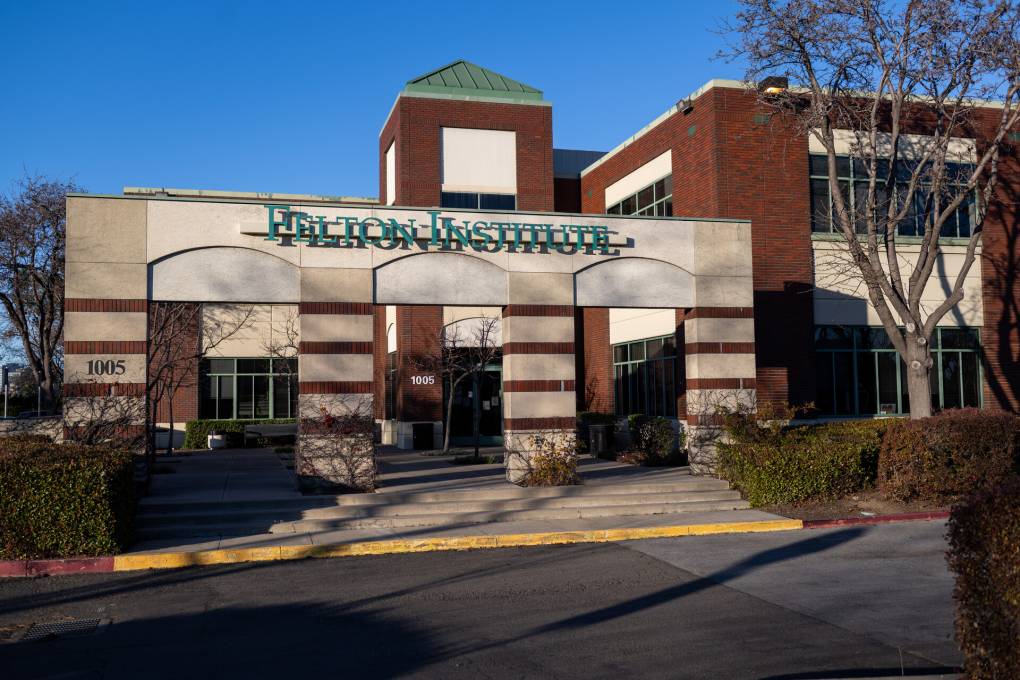
"caption": "The Felton Institute in Alameda on Jan. 25, 2023.",
"description": null,
"title": "The Felton Institute in Alameda on Jan. 25, 2023.",
"credit": "Beth LaBerge/KQED",
"status": "inherit",
"altTag": "The front of a building with a large green sign that says 'The Felton Institute.'",
"isLoading": false,
"fetchFailed": false
}
},
"audioPlayerReducer": {
"postId": "stream_live",
"isPaused": true,
"isPlaying": false,
"pfsActive": false,
"pledgeModalIsOpen": true,
"playerDrawerIsOpen": false,
"liveAudioPlayStartedAt": 0,
"liveAudioPlayContext": ""
},
"authorsReducer": {
"byline_news_11946741": {
"type": "authors",
"id": "byline_news_11946741",
"meta": {
"override": true
},
"slug": "byline_news_11946741",
"name": "\u003ca href=\"https://calmatters.org/author/rocky-walker/\">Rocky Walker\u003c/a>",
"isLoading": false
},
"byline_news_11946467": {
"type": "authors",
"id": "byline_news_11946467",
"meta": {
"override": true
},
"slug": "byline_news_11946467",
"name": "\u003ca href=\"https://calmatters.org/author/jeanne-kuang/\">Jeanne Kuang\u003c/a>",
"isLoading": false
},
"byline_news_11945976": {
"type": "authors",
"id": "byline_news_11945976",
"meta": {
"override": true
},
"slug": "byline_news_11945976",
"name": "\u003ca href=\"https://calmatters.org/author/grace-gedye/\">Grace Gedye\u003c/a>",
"isLoading": false
},
"byline_news_11945357": {
"type": "authors",
"id": "byline_news_11945357",
"meta": {
"override": true
},
"slug": "byline_news_11945357",
"name": "\u003ca href=\"https://www.npr.org/people/1147860766/dara-kerr\">Dara Kerr\u003c/a>",
"isLoading": false
},
"byline_news_11944515": {
"type": "authors",
"id": "byline_news_11944515",
"meta": {
"override": true
},
"slug": "byline_news_11944515",
"name": "\u003ca href=\"https://calmatters.org/author/alejandro-lazo/\">Alejandro Lazo\u003c/a>, \u003ca href=\"https://calmatters.org/author/jeanne-kuang/\">Jeanne Kuang\u003c/a>",
"isLoading": false
},
"byline_news_11940248": {
"type": "authors",
"id": "byline_news_11940248",
"meta": {
"override": true
},
"slug": "byline_news_11940248",
"name": "\u003ca href=\"https://calmatters.org/author/sameea-kamal/\">Sameea Kamal\u003c/a>",
"isLoading": false
},
"tgoldberg": {
"type": "authors",
"id": "258",
"meta": {
"index": "authors_1716337520",
"id": "258",
"found": true
},
"name": "Ted Goldberg",
"firstName": "Ted",
"lastName": "Goldberg",
"slug": "tgoldberg",
"email": "tgoldberg@kqed.org",
"display_author_email": true,
"staff_mastheads": [
"news"
],
"title": "KQED Managing Editor, News and Newscasts",
"bio": "Ted Goldberg is Managing Editor of News and Newscasts at KQED. His main reporting beat is the Bay Area's oil refining industry.\r\n\r\nPrior to joining KQED in 2014, Ted worked at CBS News and WCBS AM in New York and Bay City News and KCBS Radio in San Francisco. He graduated from Oberlin College in Ohio in 1998.",
"avatar": "https://secure.gravatar.com/avatar/30ce2e4fe89135e104f89be2394d16225b9d36c121b5b3cb7651ce642978b96f?s=600&d=blank&r=g",
"twitter": "TedrickG",
"bluesky": null,
"facebook": null,
"instagram": null,
"linkedin": null,
"sites": [
{
"site": "news",
"roles": [
"editor"
]
},
{
"site": "science",
"roles": [
"editor"
]
}
],
"headData": {
"title": "Ted Goldberg | KQED",
"description": "KQED Managing Editor, News and Newscasts",
"ogImgSrc": "https://secure.gravatar.com/avatar/30ce2e4fe89135e104f89be2394d16225b9d36c121b5b3cb7651ce642978b96f?s=600&d=blank&r=g",
"twImgSrc": "https://secure.gravatar.com/avatar/30ce2e4fe89135e104f89be2394d16225b9d36c121b5b3cb7651ce642978b96f?s=600&d=blank&r=g"
},
"isLoading": false,
"link": "/author/tgoldberg"
},
"ecruzguevarra": {
"type": "authors",
"id": "8654",
"meta": {
"index": "authors_1716337520",
"id": "8654",
"found": true
},
"name": "Ericka Cruz Guevarra",
"firstName": "Ericka",
"lastName": "Cruz Guevarra",
"slug": "ecruzguevarra",
"email": "ecruzguevarra@kqed.org",
"display_author_email": true,
"staff_mastheads": [
"news"
],
"title": "Producer, The Bay Podcast",
"bio": "Ericka Cruz Guevarra is host of \u003ca href=\"https://www.kqed.org/podcasts/thebay\">\u003cem>The Bay\u003c/em>\u003c/a> podcast at KQED. Before host, she was the show’s producer. Her work in that capacity includes a three-part reported series on policing in Vallejo, which won a 2020 excellence in journalism award from the Society of Professional Journalists. Ericka has worked as a breaking news reporter at Oregon Public Broadcasting, helped produce the Code Switch podcast, and was KQED’s inaugural Raul Ramirez Diversity Fund intern. She’s also an alumna of NPR’s Next Generation Radio program. Send her an email if you have strong feelings about whether Fairfield and Suisun City are the Bay. Ericka is represented by SAG-AFTRA.",
"avatar": "https://secure.gravatar.com/avatar/accefc1de4bafc7e234b69bcb9b6f6536c130fd84709bc3069ef11a78787e1bb?s=600&d=blank&r=g",
"twitter": "NotoriousECG",
"bluesky": null,
"facebook": null,
"instagram": null,
"linkedin": null,
"sites": [
{
"site": "arts",
"roles": [
"subscriber"
]
},
{
"site": "news",
"roles": [
"editor",
"manage_categories"
]
},
{
"site": "futureofyou",
"roles": [
"subscriber"
]
},
{
"site": "stateofhealth",
"roles": [
"subscriber"
]
},
{
"site": "science",
"roles": [
"editor"
]
},
{
"site": "forum",
"roles": [
"subscriber"
]
}
],
"headData": {
"title": "Ericka Cruz Guevarra | KQED",
"description": "Producer, The Bay Podcast",
"ogImgSrc": "https://secure.gravatar.com/avatar/accefc1de4bafc7e234b69bcb9b6f6536c130fd84709bc3069ef11a78787e1bb?s=600&d=blank&r=g",
"twImgSrc": "https://secure.gravatar.com/avatar/accefc1de4bafc7e234b69bcb9b6f6536c130fd84709bc3069ef11a78787e1bb?s=600&d=blank&r=g"
},
"isLoading": false,
"link": "/author/ecruzguevarra"
},
"fjhabvala": {
"type": "authors",
"id": "8659",
"meta": {
"index": "authors_1716337520",
"id": "8659",
"found": true
},
"name": "Farida Jhabvala Romero",
"firstName": "Farida",
"lastName": "Jhabvala Romero",
"slug": "fjhabvala",
"email": "fjhabvala@kqed.org",
"display_author_email": true,
"staff_mastheads": [
"news"
],
"title": "KQED Contributor",
"bio": "Farida Jhabvala Romero is a Labor Correspondent for KQED. She previously covered immigration. Farida was \u003ca href=\"https://www.ccnma.org/2022-most-influential-latina-journalists\">named\u003c/a> one of the 10 Most Influential Latina Journalists in California in 2022 by the California Chicano News Media Association. Her work has won awards from the Society of Professional Journalists (Northern California), as well as a national and regional Edward M. Murrow Award for the collaborative reporting projects “Dangerous Air” and “Graying California.” Before joining KQED, Farida worked as a producer at Radio Bilingüe, a national public radio network. Farida earned her master’s degree in journalism from Stanford University.",
"avatar": "https://secure.gravatar.com/avatar/f9f022d4e2609741874222a1e9d41f48fea74011aa7c615eef91d9a50c944ebe?s=600&d=blank&r=g",
"twitter": "FaridaJhabvala",
"bluesky": null,
"facebook": null,
"instagram": null,
"linkedin": "https://www.linkedin.com/in/faridajhabvala/",
"sites": [
{
"site": "news",
"roles": [
"editor"
]
},
{
"site": "stateofhealth",
"roles": [
"author"
]
},
{
"site": "liveblog",
"roles": [
"author"
]
}
],
"headData": {
"title": "Farida Jhabvala Romero | KQED",
"description": "KQED Contributor",
"ogImgSrc": "https://secure.gravatar.com/avatar/f9f022d4e2609741874222a1e9d41f48fea74011aa7c615eef91d9a50c944ebe?s=600&d=blank&r=g",
"twImgSrc": "https://secure.gravatar.com/avatar/f9f022d4e2609741874222a1e9d41f48fea74011aa7c615eef91d9a50c944ebe?s=600&d=blank&r=g"
},
"isLoading": false,
"link": "/author/fjhabvala"
},
"hmcdede": {
"type": "authors",
"id": "11635",
"meta": {
"index": "authors_1716337520",
"id": "11635",
"found": true
},
"name": "Holly McDede",
"firstName": "Holly",
"lastName": "McDede",
"slug": "hmcdede",
"email": "hmcdede@KQED.org",
"display_author_email": false,
"staff_mastheads": [],
"title": "KQED Contributor",
"bio": null,
"avatar": "https://secure.gravatar.com/avatar/999d9bf31bb3a2f0511932d99526cb3e?s=600&d=blank&r=g",
"twitter": null,
"facebook": null,
"instagram": null,
"linkedin": null,
"sites": [
{
"site": "arts",
"roles": [
"editor"
]
},
{
"site": "news",
"roles": [
"edit_others_posts",
"editor"
]
},
{
"site": "science",
"roles": [
"editor"
]
},
{
"site": "forum",
"roles": [
"editor"
]
},
{
"site": "perspectives",
"roles": [
"administrator"
]
}
],
"headData": {
"title": "Holly McDede | KQED",
"description": "KQED Contributor",
"ogImgSrc": "https://secure.gravatar.com/avatar/999d9bf31bb3a2f0511932d99526cb3e?s=600&d=blank&r=g",
"twImgSrc": "https://secure.gravatar.com/avatar/999d9bf31bb3a2f0511932d99526cb3e?s=600&d=blank&r=g"
},
"isLoading": false,
"link": "/author/hmcdede"
},
"amontecillo": {
"type": "authors",
"id": "11649",
"meta": {
"index": "authors_1716337520",
"id": "11649",
"found": true
},
"name": "Alan Montecillo",
"firstName": "Alan",
"lastName": "Montecillo",
"slug": "amontecillo",
"email": "amontecillo@kqed.org",
"display_author_email": false,
"staff_mastheads": [
"news"
],
"title": "KQED Contributor",
"bio": "Alan Montecillo is the senior editor of \u003cem>\u003ca href=\"http://kqed.org/thebay\">The Bay\u003c/a>, \u003c/em> KQED's local news podcast. Before moving to the Bay Area, he worked as a senior talk show producer for WILL in Champaign-Urbana, Illinois and at Oregon Public Broadcasting in Portland, Oregon. He has won journalism awards from the Society of Professional Journalists Northern California, the Public Media Journalists Association, The Signal Awards, and has also received a regional Edward R. Murrow award. Alan is a Filipino American from Hong Kong and a graduate of Reed College.",
"avatar": "https://secure.gravatar.com/avatar/268f53a2066899ea9efdd8a5900218b17c822d9862cbc9326cccec53ef41d349?s=600&d=blank&r=g",
"twitter": "alanmontecillo",
"bluesky": null,
"facebook": null,
"instagram": null,
"linkedin": null,
"sites": [
{
"site": "",
"roles": [
"editor"
]
},
{
"site": "news",
"roles": [
"editor",
"manage_categories"
]
}
],
"headData": {
"title": "Alan Montecillo | KQED",
"description": "KQED Contributor",
"ogImgSrc": "https://secure.gravatar.com/avatar/268f53a2066899ea9efdd8a5900218b17c822d9862cbc9326cccec53ef41d349?s=600&d=blank&r=g",
"twImgSrc": "https://secure.gravatar.com/avatar/268f53a2066899ea9efdd8a5900218b17c822d9862cbc9326cccec53ef41d349?s=600&d=blank&r=g"
},
"isLoading": false,
"link": "/author/amontecillo"
},
"ccabreralomeli": {
"type": "authors",
"id": "11708",
"meta": {
"index": "authors_1716337520",
"id": "11708",
"found": true
},
"name": "Carlos Cabrera-Lomelí",
"firstName": "Carlos",
"lastName": "Cabrera-Lomelí",
"slug": "ccabreralomeli",
"email": "ccabreralomeli@KQED.org",
"display_author_email": true,
"staff_mastheads": [
"news"
],
"title": "Community Reporter",
"bio": "Carlos Cabrera-Lomelí is a community reporter with KQED's digital engagement team. He also reports and co-produces for KQED's bilingual news hub KQED en Español. He grew up in San Francisco's Mission District and has previously worked with Univision, 48 Hills and REFORMA in Mexico City.",
"avatar": "https://secure.gravatar.com/avatar/c309be9665e484f887b818c89e273ecc673004f426f36b24d00a4d813a2e0518?s=600&d=blank&r=g",
"twitter": "@LomeliCabrera",
"bluesky": null,
"facebook": null,
"instagram": null,
"linkedin": null,
"sites": [
{
"site": "arts",
"roles": [
"editor"
]
},
{
"site": "news",
"roles": [
"editor"
]
},
{
"site": "about",
"roles": [
"editor"
]
},
{
"site": "science",
"roles": [
"editor"
]
},
{
"site": "perspectives",
"roles": [
"editor"
]
},
{
"site": "elections",
"roles": [
"editor"
]
},
{
"site": "liveblog",
"roles": [
"contributor"
]
}
],
"headData": {
"title": "Carlos Cabrera-Lomelí | KQED",
"description": "Community Reporter",
"ogImgSrc": "https://secure.gravatar.com/avatar/c309be9665e484f887b818c89e273ecc673004f426f36b24d00a4d813a2e0518?s=600&d=blank&r=g",
"twImgSrc": "https://secure.gravatar.com/avatar/c309be9665e484f887b818c89e273ecc673004f426f36b24d00a4d813a2e0518?s=600&d=blank&r=g"
},
"isLoading": false,
"link": "/author/ccabreralomeli"
},
"mesquinca": {
"type": "authors",
"id": "11802",
"meta": {
"index": "authors_1716337520",
"id": "11802",
"found": true
},
"name": "Maria Esquinca",
"firstName": "Maria",
"lastName": "Esquinca",
"slug": "mesquinca",
"email": "mesquinca@kqed.org",
"display_author_email": false,
"staff_mastheads": [],
"title": "Producer, The Bay",
"bio": "María Esquinca is a producer of The Bay. Before that, she was a New York Women’s Foundation IGNITE Fellow at Latino USA. She worked at Radio Bilingue where she covered the San Joaquin Valley. Maria has interned at WLRN, News 21, The New York Times Student Journalism Institute and at Crain’s Detroit Business as a Dow Jones News Fund Business Reporting Intern. She is an MFA graduate from the University of Miami. In 2017, she graduated from the Walter Cronkite School of Journalism and Mass Communication with a Master of Mass Communication. A fronteriza, she was born in Ciudad Juárez, Chihuahua, Mexico and grew up in El Paso, Texas.",
"avatar": "https://secure.gravatar.com/avatar/77cedba18aae91da775038ba06dcd8d0?s=600&d=blank&r=g",
"twitter": "@m_esquinca",
"facebook": null,
"instagram": null,
"linkedin": null,
"sites": [
{
"site": "news",
"roles": []
}
],
"headData": {
"title": "Maria Esquinca | KQED",
"description": "Producer, The Bay",
"ogImgSrc": "https://secure.gravatar.com/avatar/77cedba18aae91da775038ba06dcd8d0?s=600&d=blank&r=g",
"twImgSrc": "https://secure.gravatar.com/avatar/77cedba18aae91da775038ba06dcd8d0?s=600&d=blank&r=g"
},
"isLoading": false,
"link": "/author/mesquinca"
}
},
"pagesReducer": {
"news_tag_labor": {
"type": "terms",
"id": "news_19904",
"meta": {
"index": "terms_1716263798",
"site": "news",
"id": "19904",
"score": 8.558133
},
"name": "Labor",
"slug": "labor",
"taxonomy": "tag",
"description": null,
"featImg": null,
"headData": {
"title": "Labor | KQED News",
"description": null,
"ogTitle": null,
"ogDescription": null,
"ogImgId": null,
"twTitle": null,
"twDescription": null,
"twImgId": null
},
"ttid": 19921,
"isLoading": false,
"title": "Labor",
"pageMeta": {
"site": "news",
"WpPageTemplate": "page-topic-editorial",
"currentPage": 39
},
"blocks": [
{
"blockName": "kqed/post-list",
"attrs": {
"layout": "cardArticle2",
"query": "posts/news?tag=labor",
"seeMore": false,
"paginated": true,
"page": 39
}
},
{
"blockName": "kqed/ad"
}
]
}
},
"pfsSessionReducer": {},
"postsReducer": {
"stream_live": {
"type": "live",
"id": "stream_live",
"audioUrl": "https://streams.kqed.org/kqedradio",
"title": "Live Stream",
"excerpt": "Live Stream information currently unavailable.",
"link": "/radio",
"featImg": "",
"label": {
"name": "KQED Live",
"link": "/"
}
},
"stream_kqedNewscast": {
"type": "posts",
"id": "stream_kqedNewscast",
"audioUrl": "https://www.kqed.org/.stream/anon/radio/RDnews/newscast.mp3?_=1",
"title": "KQED Newscast",
"featImg": "",
"label": {
"name": "88.5 FM",
"link": "/"
}
},
"news_11946741": {
"type": "posts",
"id": "news_11946741",
"meta": {
"index": "posts_1716263798",
"site": "news",
"id": "11946741",
"score": null,
"sort": [
1681505180000
]
},
"guestAuthors": [],
"slug": "cal-state-undergrad-workers-pursue-union-representation-for-higher-wages-paid-sick-time",
"title": "Cal State Undergrad Workers Pursue Union Representation for Higher Wages, Paid Sick Time",
"publishDate": 1681505180,
"format": "standard",
"headTitle": "Cal State Undergrad Workers Pursue Union Representation for Higher Wages, Paid Sick Time | KQED",
"labelTerm": {},
"content": "\u003cp>California State University is the largest public university system in the country, so when sophomore Delilah Mays-Triplett decided that working on the San Diego State University campus as a library assistant would be the best thing for her education, she didn’t expect to be paid less than the local minimum wage.\u003c/p>\n\u003cp>But when Mays-Triplett’s check came, she saw she was paid $15.50 per hour, nearly a dollar lower than the San Diego minimum wage of $16.30.\u003c/p>\n\u003cp>That reason, paired with others, is why Mays-Triplett decided to sign a union authorization card when organizers approached her. Undergraduate student assistants at the university are mounting a union-organizing campaign, calling for more work hours, paid sick time and higher wages. The campaign could potentially affect thousands of library assistants, clerical workers and other nonacademic student employees and comes at a time of heightened labor activism on university campuses.\u003c/p>\n\u003cp>[ad fullwidth]\u003c/p>\n\u003cp>“There’s a lot of things that are kind of unfair about our job,” she said. “So just being able to organize and address some of those issues would be really helpful.” Mays-Triplett added that she finds power in “just being able to have a voice.”\u003c/p>\n\u003cp>The \u003ca href=\"https://www.csueu.org/\">California State University Employees Union\u003c/a>, which represents non-student workers in similar roles, \u003ca href=\"https://calmatters.org/wp-content/uploads/2022/06/HEERA_STATEMENT_OF_INTEREST_v3-1.pdf\">filed petitions (PDF)\u003c/a> with the state’s Public Employment Relations Board in 2021 to add student assistants to its existing bargaining units, and has been working with student organizers to collect union authorization cards since last fall.\u003c/p>\n\u003cp>“Thousands of student assistants signed union cards. You’re almost ready to file for an election!” organizers texted student supporters April 8. Union spokesperson Khanh Weinberg declined to make leaders available for an interview.\u003c/p>\n\u003cp>Cal State has disputed the union’s claim that student workers have enough in common with other university support staff to be folded into existing bargaining units. “The Student Assistants’ primary role is that of a student and not a traditional employee,” Timothy Yeung, lawyer for the university, \u003ca href=\"https://calmatters.org/wp-content/uploads/2022/06/CSU_Statement_of_Issues.pdf\">wrote in December to the administrative law judge handling the case (PDF)\u003c/a>.\u003c/p>\n\u003cp>[aside label='More Stories on Education' tag='education']\u003c/p>\n\u003cp>“We don’t have anything else to add on the matter,” Cal State spokesperson Mike Uhlenkamp wrote in response to an interview request.\u003c/p>\n\u003cp>But Grace Dearborn, another San Diego State student, said she deserves the same benefits as any other employee. Dearborn said she caught COVID last semester. While her supervisor allowed her to make up the hours she missed, she felt she should have gotten the paid COVID-related leave that California at the time required businesses to give full-time workers.\u003c/p>\n\u003cp>“This is a real job for a lot of students,” Dearborn said. “We get paid and we use that pay for bills and our personal expenses … if you’re expecting for it to be a real job, but not receive sick pay, I think that that’s really weird.”\u003c/p>\n\u003cp>Several cited the discrepancy between Cal State’s minimum wage and local minimum wages as part of their motivation. University attorney Marc Mootchnik told San Diego State’s student newspaper, The Daily Aztec, in 2016 that because Cal State is a state agency, it \u003ca href=\"https://thedailyaztec.com/80394/news/city-minimum-wage-does-not-apply-at-sdsu/\">is not required to comply\u003c/a> with local minimum wage laws.\u003c/p>\n\u003cp>Emma Galloway, a commuter student at \u003cspan style=\"font-weight: 400\">California State University, Northridge\u003c/span>, said receiving at least the Los Angeles minimum wage of $16.50 for her work as a student assistant in the journalism department office would help her save money to move out of her parents’ house.\u003c/p>\n\u003cp>“I have a very big fear of being homeless, especially with the homeless crisis in Los Angeles,” she said. “I’m really grateful to have my parents and to live under a roof, but that fear kind of lingers a little bit, and I just want to save enough to the point where I can rent a one-bedroom apartment.”\u003c/p>\n\u003cp>“Student assistants are a backbone” for the campus departments where they work, she added.\u003c/p>\n\u003cp>Some 11,000 Cal State teaching assistants and other academic workers already have union representation through the United Auto Workers. But the undergraduates involved in the California State University Employees Union organizing effort are doing work that’s arguably less related to their studies — such as filing office paperwork, helping with print jobs and assisting in checking out books at the library.\u003c/p>\n\u003ch2>More students are organizing\u003c/h2>\n\u003cp>They’re part of a recent wave of campus labor activism that includes the largest higher education strike in history, in which \u003ca href=\"https://calmatters.org/education/higher-education/2023/01/six-takeaways-for-californians-after-the-uc-graduate-student-worker-strike/\">48,000 graduate student workers at the University of California\u003c/a> walked off the job in November, eventually winning raises, transit passes and child care benefits.\u003c/p>\n\u003cfigure id=\"attachment_11946749\" class=\"wp-caption aligncenter\" style=\"max-width: 1920px\">\u003cimg loading=\"lazy\" decoding=\"async\" class=\"size-full wp-image-11946749\" src=\"https://ww2.kqed.org/app/uploads/sites/10/2023/04/RS60139_007_KQED_UCStrike_11152022-qut.jpg\" alt=\"A line of protesters of all ages hold blue and white picket signs as they chant on a college campus.\" width=\"1920\" height=\"1280\" srcset=\"https://cdn.kqed.org/wp-content/uploads/sites/10/2023/04/RS60139_007_KQED_UCStrike_11152022-qut.jpg 1920w, https://cdn.kqed.org/wp-content/uploads/sites/10/2023/04/RS60139_007_KQED_UCStrike_11152022-qut-800x533.jpg 800w, https://cdn.kqed.org/wp-content/uploads/sites/10/2023/04/RS60139_007_KQED_UCStrike_11152022-qut-1020x680.jpg 1020w, https://cdn.kqed.org/wp-content/uploads/sites/10/2023/04/RS60139_007_KQED_UCStrike_11152022-qut-160x107.jpg 160w, https://cdn.kqed.org/wp-content/uploads/sites/10/2023/04/RS60139_007_KQED_UCStrike_11152022-qut-1536x1024.jpg 1536w\" sizes=\"auto, (max-width: 1920px) 100vw, 1920px\">\u003cfigcaption class=\"wp-caption-text\">Staff members during a strike among some 48,000 academic workers across all 10 University of California campuses at the UCSF Mission Bay campus on Nov. 15, 2022. The California State University Employees Union, which represents non-student workers in similar roles, filed petitions with the state’s Public Employment Relations Board in 2021 to add student assistants into its existing bargaining units, and has been working with student organizers to collect union authorization cards since fall 2022. \u003ccite>(Beth LaBerge/KQED)\u003c/cite>\u003c/figcaption>\u003c/figure>\n\u003cp>In February, Dartmouth University \u003ca href=\"https://www.thedartmouth.com/article/2023/02/college-swcd-reach-tentative-agreement-to-21-base-pay-proposal\">agreed to pay its student dining hall workers\u003c/a> a base wage of $21 per hour after they voted to authorize a strike — less than a year after being recognized as a union. And last month, undergraduate residential advisors at the University of Pennsylvania filed for representation with the Office and Professional Employees International Union.\u003c/p>\n\u003cp>“The most fundamental demand that people on college campuses are making right now is honor the principles that you say you are committed to,” said Caroline Luce, labor historian at the UCLA Institute for Research on Labor and Employment and a member of the university’s lecturers’ union. “You say you’re a public-serving institution — it doesn’t make sense to be paying people wages that they can’t live on.”\u003c/p>\n\u003cp>While Cal State undergraduates have been inspired by the gains made by graduate student organizing, Luce said, they face an uphill battle if the university continues to oppose the effort, because of the high turnover in their ranks.[pullquote size=\"medium\" align=\"right\" citation=\"Caroline Luce, labor historian, UCLA Institute for Research on Labor and Employment\"]‘You say you’re a public-serving institution — it doesn’t make sense to be paying people wages that they can’t live on.’[/pullquote]“If [Cal State officials] draw things out, they will win basically because the students who [are organizing] will go on to bigger and better things and it might fall apart,” she said.\u003c/p>\n\u003cp>\u003ca href=\"https://perb.ca.gov/\">Public Employment Relations Board\u003c/a> hearings to determine whether the California State University Employees Union can expand its bargaining units to include student assistants began in March and will resume June 12.\u003c/p>\n\u003cp>Either the union or the university could appeal the judge’s decision to the full board and then to a state court of appeal. If the union prevails, it could then submit cards showing majority support and petition to represent the students, said the board’s general counsel, Felix De La Torre. It could also file to create a new bargaining unit composed of student assistants only.\u003c/p>\n\u003cp>“What makes it more unique than a typical public employee union drive is we’re dealing with individuals who straddle the line between employees and students,” said De La Torre. He cited recent controversies over whether, for example, collegiate athletes should be allowed to organize.\u003c/p>\n\u003cp>“All these cases begin to develop a body of law around this class of workers,” he said. “To that extent, it could be significant if this petition goes up to the board.”\u003c/p>\n\u003cp>[ad floatright]\u003c/p>\n",
"blocks": [],
"excerpt": "California State University undergraduate student assistants are mounting a union-organizing campaign that could affect thousands of library assistants, clerical workers and other nonacademic student employees.",
"status": "publish",
"parent": 0,
"modified": 1740612863,
"stats": {
"hasAudio": false,
"hasVideo": false,
"hasChartOrMap": false,
"iframeSrcs": [],
"hasGoogleForm": false,
"hasGallery": false,
"hasHearkenModule": false,
"hasPolis": false,
"paragraphCount": 26,
"wordCount": 1353
},
"headData": {
"title": "Cal State Undergrad Workers Pursue Union Representation for Higher Wages, Paid Sick Time | KQED",
"description": "California State University undergraduate student assistants are mounting a union-organizing campaign that could affect thousands of library assistants, clerical workers and other nonacademic student employees.",
"ogTitle": "",
"ogDescription": "",
"ogImgId": "",
"twTitle": "",
"twDescription": "",
"twImgId": "",
"schema": {
"@context": "https://schema.org",
"@type": "NewsArticle",
"headline": "Cal State Undergrad Workers Pursue Union Representation for Higher Wages, Paid Sick Time",
"datePublished": "2023-04-14T13:46:20-07:00",
"dateModified": "2025-02-26T15:34:23-08:00",
"image": "https://cdn.kqed.org/wp-content/uploads/2020/02/KQED-OG-Image@1x.png",
"isAccessibleForFree": "True",
"publisher": {
"@type": "NewsMediaOrganization",
"@id": "https://www.kqed.org/#organization",
"name": "KQED",
"logo": "https://cdn.kqed.org/wp-content/uploads/2020/02/KQED-OG-Image@1x.png",
"url": "https://www.kqed.org",
"sameAs": [
"https://www.facebook.com/KQED",
"https://twitter.com/KQED",
"https://www.instagram.com/kqed/",
"https://www.tiktok.com/@kqedofficial",
"https://www.linkedin.com/company/kqed",
"https://www.youtube.com/channel/UCeC0IOo7i1P_61zVUWbJ4nw"
]
}
}
},
"source": "CalMatters",
"sourceUrl": "https://calmatters.org/",
"sticky": false,
"nprByline": "\u003ca href=\"https://calmatters.org/author/rocky-walker/\">Rocky Walker\u003c/a>",
"excludeFromSiteSearch": "Include",
"showOnAuthorArchivePages": "No",
"articleAge": "0",
"path": "/news/11946741/cal-state-undergrad-workers-pursue-union-representation-for-higher-wages-paid-sick-time",
"audioTrackLength": null,
"parsedContent": [
{
"type": "contentString",
"content": "\u003cdiv class=\"post-body\">\u003cp>\u003cp>California State University is the largest public university system in the country, so when sophomore Delilah Mays-Triplett decided that working on the San Diego State University campus as a library assistant would be the best thing for her education, she didn’t expect to be paid less than the local minimum wage.\u003c/p>\n\u003cp>But when Mays-Triplett’s check came, she saw she was paid $15.50 per hour, nearly a dollar lower than the San Diego minimum wage of $16.30.\u003c/p>\n\u003cp>That reason, paired with others, is why Mays-Triplett decided to sign a union authorization card when organizers approached her. Undergraduate student assistants at the university are mounting a union-organizing campaign, calling for more work hours, paid sick time and higher wages. The campaign could potentially affect thousands of library assistants, clerical workers and other nonacademic student employees and comes at a time of heightened labor activism on university campuses.\u003c/p>\n\u003cp>\u003c/p>\u003c/div>",
"attributes": {
"named": {},
"numeric": []
}
},
{
"type": "component",
"content": "",
"name": "ad",
"attributes": {
"named": {
"label": "fullwidth"
},
"numeric": [
"fullwidth"
]
}
},
{
"type": "contentString",
"content": "\u003cdiv class=\"post-body\">\u003cp>\u003c/p>\n\u003cp>“There’s a lot of things that are kind of unfair about our job,” she said. “So just being able to organize and address some of those issues would be really helpful.” Mays-Triplett added that she finds power in “just being able to have a voice.”\u003c/p>\n\u003cp>The \u003ca href=\"https://www.csueu.org/\">California State University Employees Union\u003c/a>, which represents non-student workers in similar roles, \u003ca href=\"https://calmatters.org/wp-content/uploads/2022/06/HEERA_STATEMENT_OF_INTEREST_v3-1.pdf\">filed petitions (PDF)\u003c/a> with the state’s Public Employment Relations Board in 2021 to add student assistants to its existing bargaining units, and has been working with student organizers to collect union authorization cards since last fall.\u003c/p>\n\u003cp>“Thousands of student assistants signed union cards. You’re almost ready to file for an election!” organizers texted student supporters April 8. Union spokesperson Khanh Weinberg declined to make leaders available for an interview.\u003c/p>\n\u003cp>Cal State has disputed the union’s claim that student workers have enough in common with other university support staff to be folded into existing bargaining units. “The Student Assistants’ primary role is that of a student and not a traditional employee,” Timothy Yeung, lawyer for the university, \u003ca href=\"https://calmatters.org/wp-content/uploads/2022/06/CSU_Statement_of_Issues.pdf\">wrote in December to the administrative law judge handling the case (PDF)\u003c/a>.\u003c/p>\n\u003cp>\u003c/p>\u003c/div>",
"attributes": {
"named": {},
"numeric": []
}
},
{
"type": "component",
"content": "",
"name": "aside",
"attributes": {
"named": {
"label": "More Stories on Education ",
"tag": "education"
},
"numeric": []
}
},
{
"type": "contentString",
"content": "\u003cdiv class=\"post-body\">\u003cp>\u003c/p>\n\u003cp>“We don’t have anything else to add on the matter,” Cal State spokesperson Mike Uhlenkamp wrote in response to an interview request.\u003c/p>\n\u003cp>But Grace Dearborn, another San Diego State student, said she deserves the same benefits as any other employee. Dearborn said she caught COVID last semester. While her supervisor allowed her to make up the hours she missed, she felt she should have gotten the paid COVID-related leave that California at the time required businesses to give full-time workers.\u003c/p>\n\u003cp>“This is a real job for a lot of students,” Dearborn said. “We get paid and we use that pay for bills and our personal expenses … if you’re expecting for it to be a real job, but not receive sick pay, I think that that’s really weird.”\u003c/p>\n\u003cp>Several cited the discrepancy between Cal State’s minimum wage and local minimum wages as part of their motivation. University attorney Marc Mootchnik told San Diego State’s student newspaper, The Daily Aztec, in 2016 that because Cal State is a state agency, it \u003ca href=\"https://thedailyaztec.com/80394/news/city-minimum-wage-does-not-apply-at-sdsu/\">is not required to comply\u003c/a> with local minimum wage laws.\u003c/p>\n\u003cp>Emma Galloway, a commuter student at \u003cspan style=\"font-weight: 400\">California State University, Northridge\u003c/span>, said receiving at least the Los Angeles minimum wage of $16.50 for her work as a student assistant in the journalism department office would help her save money to move out of her parents’ house.\u003c/p>\n\u003cp>“I have a very big fear of being homeless, especially with the homeless crisis in Los Angeles,” she said. “I’m really grateful to have my parents and to live under a roof, but that fear kind of lingers a little bit, and I just want to save enough to the point where I can rent a one-bedroom apartment.”\u003c/p>\n\u003cp>“Student assistants are a backbone” for the campus departments where they work, she added.\u003c/p>\n\u003cp>Some 11,000 Cal State teaching assistants and other academic workers already have union representation through the United Auto Workers. But the undergraduates involved in the California State University Employees Union organizing effort are doing work that’s arguably less related to their studies — such as filing office paperwork, helping with print jobs and assisting in checking out books at the library.\u003c/p>\n\u003ch2>More students are organizing\u003c/h2>\n\u003cp>They’re part of a recent wave of campus labor activism that includes the largest higher education strike in history, in which \u003ca href=\"https://calmatters.org/education/higher-education/2023/01/six-takeaways-for-californians-after-the-uc-graduate-student-worker-strike/\">48,000 graduate student workers at the University of California\u003c/a> walked off the job in November, eventually winning raises, transit passes and child care benefits.\u003c/p>\n\u003cfigure id=\"attachment_11946749\" class=\"wp-caption aligncenter\" style=\"max-width: 1920px\">\u003cimg loading=\"lazy\" decoding=\"async\" class=\"size-full wp-image-11946749\" src=\"https://ww2.kqed.org/app/uploads/sites/10/2023/04/RS60139_007_KQED_UCStrike_11152022-qut.jpg\" alt=\"A line of protesters of all ages hold blue and white picket signs as they chant on a college campus.\" width=\"1920\" height=\"1280\" srcset=\"https://cdn.kqed.org/wp-content/uploads/sites/10/2023/04/RS60139_007_KQED_UCStrike_11152022-qut.jpg 1920w, https://cdn.kqed.org/wp-content/uploads/sites/10/2023/04/RS60139_007_KQED_UCStrike_11152022-qut-800x533.jpg 800w, https://cdn.kqed.org/wp-content/uploads/sites/10/2023/04/RS60139_007_KQED_UCStrike_11152022-qut-1020x680.jpg 1020w, https://cdn.kqed.org/wp-content/uploads/sites/10/2023/04/RS60139_007_KQED_UCStrike_11152022-qut-160x107.jpg 160w, https://cdn.kqed.org/wp-content/uploads/sites/10/2023/04/RS60139_007_KQED_UCStrike_11152022-qut-1536x1024.jpg 1536w\" sizes=\"auto, (max-width: 1920px) 100vw, 1920px\">\u003cfigcaption class=\"wp-caption-text\">Staff members during a strike among some 48,000 academic workers across all 10 University of California campuses at the UCSF Mission Bay campus on Nov. 15, 2022. The California State University Employees Union, which represents non-student workers in similar roles, filed petitions with the state’s Public Employment Relations Board in 2021 to add student assistants into its existing bargaining units, and has been working with student organizers to collect union authorization cards since fall 2022. \u003ccite>(Beth LaBerge/KQED)\u003c/cite>\u003c/figcaption>\u003c/figure>\n\u003cp>In February, Dartmouth University \u003ca href=\"https://www.thedartmouth.com/article/2023/02/college-swcd-reach-tentative-agreement-to-21-base-pay-proposal\">agreed to pay its student dining hall workers\u003c/a> a base wage of $21 per hour after they voted to authorize a strike — less than a year after being recognized as a union. And last month, undergraduate residential advisors at the University of Pennsylvania filed for representation with the Office and Professional Employees International Union.\u003c/p>\n\u003cp>“The most fundamental demand that people on college campuses are making right now is honor the principles that you say you are committed to,” said Caroline Luce, labor historian at the UCLA Institute for Research on Labor and Employment and a member of the university’s lecturers’ union. “You say you’re a public-serving institution — it doesn’t make sense to be paying people wages that they can’t live on.”\u003c/p>\n\u003cp>While Cal State undergraduates have been inspired by the gains made by graduate student organizing, Luce said, they face an uphill battle if the university continues to oppose the effort, because of the high turnover in their ranks.\u003c/p>\u003c/div>",
"attributes": {
"named": {},
"numeric": []
}
},
{
"type": "component",
"content": "‘You say you’re a public-serving institution — it doesn’t make sense to be paying people wages that they can’t live on.’",
"name": "pullquote",
"attributes": {
"named": {
"size": "medium",
"align": "right",
"citation": "Caroline Luce, labor historian, UCLA Institute for Research on Labor and Employment",
"label": ""
},
"numeric": []
}
},
{
"type": "contentString",
"content": "\u003cdiv class=\"post-body\">\u003cp>“If [Cal State officials] draw things out, they will win basically because the students who [are organizing] will go on to bigger and better things and it might fall apart,” she said.\u003c/p>\n\u003cp>\u003ca href=\"https://perb.ca.gov/\">Public Employment Relations Board\u003c/a> hearings to determine whether the California State University Employees Union can expand its bargaining units to include student assistants began in March and will resume June 12.\u003c/p>\n\u003cp>Either the union or the university could appeal the judge’s decision to the full board and then to a state court of appeal. If the union prevails, it could then submit cards showing majority support and petition to represent the students, said the board’s general counsel, Felix De La Torre. It could also file to create a new bargaining unit composed of student assistants only.\u003c/p>\n\u003cp>“What makes it more unique than a typical public employee union drive is we’re dealing with individuals who straddle the line between employees and students,” said De La Torre. He cited recent controversies over whether, for example, collegiate athletes should be allowed to organize.\u003c/p>\n\u003cp>“All these cases begin to develop a body of law around this class of workers,” he said. “To that extent, it could be significant if this petition goes up to the board.”\u003c/p>\n\u003cp>\u003c/p>\u003c/div>",
"attributes": {
"named": {},
"numeric": []
}
},
{
"type": "component",
"content": "",
"name": "ad",
"attributes": {
"named": {
"label": "floatright"
},
"numeric": [
"floatright"
]
}
},
{
"type": "contentString",
"content": "\u003cdiv class=\"post-body\">\u003cp>\u003c/p>\n\u003c/div>\u003c/p>",
"attributes": {
"named": {},
"numeric": []
}
}
],
"link": "/news/11946741/cal-state-undergrad-workers-pursue-union-representation-for-higher-wages-paid-sick-time",
"authors": [
"byline_news_11946741"
],
"categories": [
"news_18540",
"news_34551",
"news_8"
],
"tags": [
"news_2776",
"news_18538",
"news_31933",
"news_18085",
"news_20013",
"news_21749",
"news_19904",
"news_3457",
"news_794"
],
"affiliates": [
"news_18481"
],
"featImg": "news_11946744",
"label": "source_news_11946741"
},
"news_11946661": {
"type": "posts",
"id": "news_11946661",
"meta": {
"index": "posts_1716263798",
"site": "news",
"id": "11946661",
"score": null,
"sort": [
1681435825000
]
},
"guestAuthors": [],
"slug": "ive-been-contributing-undocumented-workers-are-key-to-californias-economy-a-new-bill-would-give-them-unemployment-benefits",
"title": "'I've Been Contributing': Undocumented Workers Are Key to California's Economy. A New Bill Would Give Them Unemployment Benefits",
"publishDate": 1681435825,
"format": "standard",
"headTitle": "‘I’ve Been Contributing’: Undocumented Workers Are Key to California’s Economy. A New Bill Would Give Them Unemployment Benefits | KQED",
"labelTerm": {
"site": "news"
},
"content": "\u003cp>Several hundred demonstrators from around California converged Thursday at the state’s Capitol in support of a bill that would offer income assistance to workers who are excluded from unemployment insurance benefits because of their immigration status.\u003c/p>\n\u003cp>The “Safety Net for All Day of Action,” as dubbed by organizers, comes a month after a disastrous flood submerged vast expanses of berry and lettuce farmlands on the Central Coast and left \u003ca href=\"https://www.kqed.org/news/11944008/we-have-nothing-pajaro-farmworkers-face-the-prospect-of-no-income-at-start-of-harvesting-season\">thousands of local agricultural workers — many of them undocumented — facing the prospect of no income for months\u003c/a>.\u003c/p>\n\u003cp>As more natural disasters like this winter’s atmospheric-river fueled storms are expected to disrupt jobs, supporters of \u003ca href=\"https://leginfo.legislature.ca.gov/faces/billNavClient.xhtml?bill_id=202320240SB227\">SB 227\u003c/a> say it’s urgent for the state of California to fund an economic safety net for laid-off undocumented residents — instead of leaving nonprofits scrambling after every emergency to offer cash aid.\u003c/p>\n\u003cfigure id=\"attachment_11946686\" class=\"wp-caption aligncenter\" style=\"max-width: 1920px\">\u003cimg loading=\"lazy\" decoding=\"async\" class=\"size-full wp-image-11946686\" src=\"https://ww2.kqed.org/app/uploads/sites/10/2023/04/SB_227_SafetyNet_2.jpg\" alt=\"A photo from behind of a group of people marching. A sign depicting Our Lady of Guadalupe is being held up. It says Salud y Justicia Para Todos, Safety Net for All\" width=\"1920\" height=\"1281\" srcset=\"https://cdn.kqed.org/wp-content/uploads/sites/10/2023/04/SB_227_SafetyNet_2.jpg 1920w, https://cdn.kqed.org/wp-content/uploads/sites/10/2023/04/SB_227_SafetyNet_2-800x534.jpg 800w, https://cdn.kqed.org/wp-content/uploads/sites/10/2023/04/SB_227_SafetyNet_2-1020x681.jpg 1020w, https://cdn.kqed.org/wp-content/uploads/sites/10/2023/04/SB_227_SafetyNet_2-160x107.jpg 160w, https://cdn.kqed.org/wp-content/uploads/sites/10/2023/04/SB_227_SafetyNet_2-1536x1025.jpg 1536w\" sizes=\"(max-width: 1920px) 100vw, 1920px\">\u003cfigcaption class=\"wp-caption-text\">Advocates say it’s essential for California to fund a safety net program for undocumented workers, who play a key role in California’s agriculture, construction, retail trade and food services industries. \u003ccite>(Carlos Cabrera-Lomelí/KQED)\u003c/cite>\u003c/figcaption>\u003c/figure>\n\u003cp>“That’s just not a feasible solution, where we have over a million undocumented workers in the state,” said Kim Ouillette, attorney with \u003ca href=\"https://legalaidatwork.org/\">Legal Aid at Work\u003c/a>, an organization that is part of the \u003ca href=\"https://caimmigrant.org/what-we-do/policy/economic-justice/safety-net-for-all-bill/\">Safety Net for All Coalition\u003c/a>.\u003c/p>\n\u003cp>“Realizing that reality, it can’t just be left to piecework charity,” she said. “The state has an obligation to ensure that there’s a system in place that protects California workers that are major parts of significant industries.”\u003c/p>\n\u003cp>An estimated 1.1 million unauthorized immigrants labor in California, particularly in low-wage jobs in agriculture, construction, retail trade and food services. \u003ca href=\"https://migration.ucdavis.edu/rmn/blog/post/?id=2770\">In agriculture, half of the state’s crop workforce lacks employment authorization\u003c/a>, as estimated by the U.S. Department of Labor.\u003c/p>\n\u003cp>\u003ca href=\"https://edd.ca.gov/siteassets/files/pdf_pub_ctr/de8714b.pdf\">California’s unemployment insurance system is funded in part with dollars from the federal government (PDF)\u003c/a>, which renders unauthorized immigrants ineligible for those benefits. However, \u003ca href=\"https://clc.ucmerced.edu/sites/clc.ucmerced.edu/files/page/documents/essential_fairness.pdf\">the employers of those immigrants pay tax contributions to that same system — hundreds of millions of dollars each year — on their behalf (PDF)\u003c/a>, according to estimates by the UC Merced Community and Labor Center.\u003c/p>\n\u003cfigure id=\"attachment_11946687\" class=\"wp-caption aligncenter\" style=\"max-width: 1920px\">\u003cimg loading=\"lazy\" decoding=\"async\" class=\"wp-image-11946687 size-full\" src=\"https://ww2.kqed.org/app/uploads/sites/10/2023/04/SB_227_SafetyNet_3.jpg\" alt='A sign that says \"Solo el Pueblo/Salva Al Pueblo\"' width=\"1920\" height=\"1280\" srcset=\"https://cdn.kqed.org/wp-content/uploads/sites/10/2023/04/SB_227_SafetyNet_3.jpg 1920w, https://cdn.kqed.org/wp-content/uploads/sites/10/2023/04/SB_227_SafetyNet_3-800x533.jpg 800w, https://cdn.kqed.org/wp-content/uploads/sites/10/2023/04/SB_227_SafetyNet_3-1020x680.jpg 1020w, https://cdn.kqed.org/wp-content/uploads/sites/10/2023/04/SB_227_SafetyNet_3-160x107.jpg 160w, https://cdn.kqed.org/wp-content/uploads/sites/10/2023/04/SB_227_SafetyNet_3-1536x1024.jpg 1536w\" sizes=\"(max-width: 1920px) 100vw, 1920px\">\u003cfigcaption class=\"wp-caption-text\">Researchers say unauthorized immigrants pay significant state and local taxes annually. \u003ccite>(Carlos Cabrera-Lomelí/KQED)\u003c/cite>\u003c/figcaption>\u003c/figure>\n\u003cp>SB 227 would direct the Employment Development Department, or EDD, to create an “Excluded Workers Program” offering eligible individuals $300 dollars weekly for up to 20 weeks, with funds that would come from state coffers only.\u003c/p>\n\u003cp>Under the bill, California residents would be eligible for the benefits if they performed at least 93 hours of work or earned $1,300 or more in gross wages over the course of three months during the year before their application. That cash assistance would become available at the earliest by Jan. 1, 2025, and end by the start of 2027, according to the measure by Los Angeles state Sen. Maria Elena Durazo.\u003c/p>\n\u003cp>Advocates and workers pushing for the bill said they started organizing at the start of the pandemic, when the safety net gap became increasingly evident as undocumented residents in hard-hit industries lost income but were unable to access the unemployment benefits other workers had.\u003c/p>\n\u003cfigure id=\"attachment_11946688\" class=\"wp-caption aligncenter\" style=\"max-width: 1920px\">\u003cimg loading=\"lazy\" decoding=\"async\" class=\"wp-image-11946688 size-full\" src=\"https://ww2.kqed.org/app/uploads/sites/10/2023/04/SB_227_SafetyNet_4.jpg\" alt=\"Three demonstrators, all wearing dark sweatshirts and face masks that obscure their faces, hold up a yellow sign with a bright, round insignia that says Mixteco/Indigeni Community Organizing Project, standing in the middle of a street with trees and high-rise buildings beyond them, on a blue-sky day.\" width=\"1920\" height=\"1281\" srcset=\"https://cdn.kqed.org/wp-content/uploads/sites/10/2023/04/SB_227_SafetyNet_4.jpg 1920w, https://cdn.kqed.org/wp-content/uploads/sites/10/2023/04/SB_227_SafetyNet_4-800x534.jpg 800w, https://cdn.kqed.org/wp-content/uploads/sites/10/2023/04/SB_227_SafetyNet_4-1020x681.jpg 1020w, https://cdn.kqed.org/wp-content/uploads/sites/10/2023/04/SB_227_SafetyNet_4-160x107.jpg 160w, https://cdn.kqed.org/wp-content/uploads/sites/10/2023/04/SB_227_SafetyNet_4-1536x1025.jpg 1536w\" sizes=\"(max-width: 1920px) 100vw, 1920px\">\u003cfigcaption class=\"wp-caption-text\">Hundreds gathered at the California state Capitol in support of SB 227, a bill that would offer unemployment benefits to undocumented workers, on Thursday, April 13, 2023. \u003ccite>(Carlos Cabrera-Lomelí/KQED)\u003c/cite>\u003c/figcaption>\u003c/figure>\n\u003cp>“It’s not fair. I’ve been contributing to the state,” said Luis Mejia, who has worked in California for 13 years. “We need the governor to sign this law proposal.”\u003c/p>\n\u003cp>The 54-year-old car wash worker said losing his income for months during the pandemic — with no jobless benefits to rely on — was incredibly stressful. He fell hopelessly behind on rent and couldn’t send money to his two daughters in El Salvador.\u003c/p>\n\u003cp>“Those were moments that I would not wish on anyone else,” said Mejia, one of numerous Bay Area residents who woke up before dawn to ride a bus from San Francisco’s Civic Center to Sacramento with the organization \u003ca href=\"https://www.tuwu.org/\">Trabajadores Unidos Workers United\u003c/a>. “That’s why I’m taking measures so that on this trip to Sacramento, we tell Mr. Gavin Newsom that we are here. We are still in this fight.”\u003c/p>\n\u003cfigure id=\"attachment_11946689\" class=\"wp-caption aligncenter\" style=\"max-width: 1920px\">\u003cimg loading=\"lazy\" decoding=\"async\" class=\"size-full wp-image-11946689\" src=\"https://ww2.kqed.org/app/uploads/sites/10/2023/04/SB_227_SafetyNet_5.jpg\" alt=\"Demonstrators hold up a sign in front of the California State Capitol\" width=\"1920\" height=\"1280\" srcset=\"https://cdn.kqed.org/wp-content/uploads/sites/10/2023/04/SB_227_SafetyNet_5.jpg 1920w, https://cdn.kqed.org/wp-content/uploads/sites/10/2023/04/SB_227_SafetyNet_5-800x533.jpg 800w, https://cdn.kqed.org/wp-content/uploads/sites/10/2023/04/SB_227_SafetyNet_5-1020x680.jpg 1020w, https://cdn.kqed.org/wp-content/uploads/sites/10/2023/04/SB_227_SafetyNet_5-160x107.jpg 160w, https://cdn.kqed.org/wp-content/uploads/sites/10/2023/04/SB_227_SafetyNet_5-1536x1024.jpg 1536w\" sizes=\"(max-width: 1920px) 100vw, 1920px\">\u003cfigcaption class=\"wp-caption-text\">Under the bill, assistance for undocumented immigrants would begin Jan. 1, 2025. \u003ccite>(Carlos Cabrera-Lomelí/KQED)\u003c/cite>\u003c/figcaption>\u003c/figure>\n\u003cp>The Legislature passed a similar bill last year, but \u003ca href=\"https://www.gov.ca.gov/wp-content/uploads/2022/09/AB-2847-VETO.pdf?emrc=87cd0d\">Gov. Newsom vetoed it (PDF)\u003c/a>, citing fiscal concerns. Those objections could be magnified this year, as the state faces a huge budget shortfall. While the administration \u003ca href=\"https://lao.ca.gov/Publications/Report/4687\">projected the deficit at $22.5 billion, it could be about $7 billion larger\u003c/a>, according to a report last month by the Legislative Analyst’s Office.\u003c/p>\n\u003cp>Still, supporters of SB 227, which has become a top issue for the California Latino Legislative Caucus, argue that it’s a question of basic equity and justice. Unauthorized immigrants pay significant state and local taxes annually, to the tune of \u003ca href=\"https://immigrantdataca.org/indicators/economic-contributions?immig=3\">$3.72 billion in 2019\u003c/a>, researchers at the University of Southern California’s Equity Research Institute found. [aside label=\"Related Stories\" tag=\"undocumented-workers\"]\u003c/p>\n\u003cp>“Where there’s a will, there’s a way,” said Assembly Majority Leader Eloise Gómez Reyes at \u003ca href=\"https://www.assembly.ca.gov/media/assembly-budget-subcommittee-no-4-state-administration-20230328\">a budget subcommittee hearing on the proposal last month\u003c/a>. “They have been paying into the system, their employers have been paying their part of it. Yet none of those workers receive any of the benefits.”\u003c/p>\n\u003cp>During the march near the Capitol, a crowd of hundreds of people who had traversed the state from the Coachella Valley, Fresno and other regions, filled the sidewalks. An accompanying band played corridos and cumbias.\u003c/p>\n\u003cp>“Although we don’t have documents, we have rights to demand something better for our community,” said marcher Ana Alfaro, a home cleaner from San Francisco who said she had to borrow money and rely on a food bank to feed her family as she lost several clients during the pandemic. “It’s so important that our undocumented community is not afraid and that we stand united.”\u003c/p>\n\u003cp>The bill’s supporters are requesting Newsom include $356 million for its implementation in his revised budget proposal next month. About $193 million of those funds would cover benefits for one year, while the rest would be for EDD expenses to get the program running, said Ouillette, with the Safety Net for All Coalition. [pullquote size='medium' align='left' citation=\"Ana Alfaro, house cleaner in San Francisco\"]‘Although we don’t have documents, we have rights to demand something better for our community. It’s so important that our undocumented community is not afraid and that we stand united.’[/pullquote]The governor’s office did not immediately respond to a request for comment.\u003c/p>\n\u003cp>The California Taxpayers Association officially disapproved of the measure as of last month, arguing that the state’s unemployment system “does not have the financial ability to sustain any added benefits at this time.” But the association has since withdrawn its opposition, a spokesperson said, after clarifying the measure would not use money from the regular unemployment insurance fund.\u003c/p>\n\u003cp>Last year, EDD projected it would need up to $237 million in one-time general funds to build an excluded workers program, with most of that funding going to a new tech platform to distribute the cash assistance. Ongoing administration costs were estimated at less than $23.1 million per year, according to the agency.\u003c/p>\n\u003cp>The EDD is analyzing the potential price tag to implement the current bill, and does not have an updated estimate, an agency spokesperson told KQED.\u003c/p>\n\u003cp>Last year, Colorado became the first state to approve ongoing unemployment benefits for unauthorized workers. That state, with a significantly smaller population of undocumented residents, established a new fund using part of a tax already imposed on employers. Initial estimates pegged the cost of establishing a new program at $55 million, but the \u003ca href=\"https://www.fastcompany.com/90838985/colorado-is-about-to-launch-the-countrys-first-unemployment-fund-for-undocumented-immigrants\">actual expenses will be “tens of millions” lower, as reported by \u003cem>Fast Company\u003c/em>\u003c/a>.\u003c/p>\n\u003cp>\u003cem>KQED’s Carlos Cabrera-Lomelí contributed to this report.\u003c/em>\u003c/p>\n\u003cp>[ad fullwidth]\u003c/p>\n\u003cp>[ad floatright]\u003c/p>\n",
"blocks": [],
"excerpt": "California’s undocumented immigrants contribute billions of dollars in taxes annually but are excluded from government financial assistance when they lose their jobs through no fault of their own. As more natural disasters and economic downturns are expected to hit the state, labor advocates are pushing to include these workers in the economic safety net.",
"status": "publish",
"parent": 0,
"modified": 1721122811,
"stats": {
"hasAudio": false,
"hasVideo": false,
"hasChartOrMap": false,
"iframeSrcs": [],
"hasGoogleForm": false,
"hasGallery": false,
"hasHearkenModule": false,
"hasPolis": false,
"paragraphCount": 26,
"wordCount": 1406
},
"headData": {
"title": "'I've Been Contributing': Undocumented Workers Are Key to California's Economy. A New Bill Would Give Them Unemployment Benefits | KQED",
"description": "California’s undocumented immigrants contribute billions of dollars in taxes annually but are excluded from government financial assistance when they lose their jobs through no fault of their own. As more natural disasters and economic downturns are expected to hit the state, labor advocates are pushing to include these workers in the economic safety net.",
"ogTitle": "",
"ogDescription": "",
"ogImgId": "",
"twTitle": "",
"twDescription": "",
"twImgId": "",
"schema": {
"@context": "https://schema.org",
"@type": "NewsArticle",
"headline": "'I've Been Contributing': Undocumented Workers Are Key to California's Economy. A New Bill Would Give Them Unemployment Benefits",
"datePublished": "2023-04-13T18:30:25-07:00",
"dateModified": "2024-07-16T02:40:11-07:00",
"image": "https://cdn.kqed.org/wp-content/uploads/2020/02/KQED-OG-Image@1x.png",
"isAccessibleForFree": "True",
"publisher": {
"@type": "NewsMediaOrganization",
"@id": "https://www.kqed.org/#organization",
"name": "KQED",
"logo": "https://cdn.kqed.org/wp-content/uploads/2020/02/KQED-OG-Image@1x.png",
"url": "https://www.kqed.org",
"sameAs": [
"https://www.facebook.com/KQED",
"https://twitter.com/KQED",
"https://www.instagram.com/kqed/",
"https://www.tiktok.com/@kqedofficial",
"https://www.linkedin.com/company/kqed",
"https://www.youtube.com/channel/UCeC0IOo7i1P_61zVUWbJ4nw"
]
}
}
},
"audioUrl": "https://traffic.omny.fm/d/clips/0af137ef-751e-4b19-a055-aaef00d2d578/ffca7e9f-6831-4[…]f-aaef00f5a073/e94aae9f-d0e3-4fc3-837e-afe300ee71bb/audio.mp3",
"sticky": false,
"excludeFromSiteSearch": "Include",
"articleAge": "0",
"path": "/news/11946661/ive-been-contributing-undocumented-workers-are-key-to-californias-economy-a-new-bill-would-give-them-unemployment-benefits",
"audioTrackLength": null,
"parsedContent": [
{
"type": "contentString",
"content": "\u003cdiv class=\"post-body\">\u003cp>\u003cp>Several hundred demonstrators from around California converged Thursday at the state’s Capitol in support of a bill that would offer income assistance to workers who are excluded from unemployment insurance benefits because of their immigration status.\u003c/p>\n\u003cp>The “Safety Net for All Day of Action,” as dubbed by organizers, comes a month after a disastrous flood submerged vast expanses of berry and lettuce farmlands on the Central Coast and left \u003ca href=\"https://www.kqed.org/news/11944008/we-have-nothing-pajaro-farmworkers-face-the-prospect-of-no-income-at-start-of-harvesting-season\">thousands of local agricultural workers — many of them undocumented — facing the prospect of no income for months\u003c/a>.\u003c/p>\n\u003cp>As more natural disasters like this winter’s atmospheric-river fueled storms are expected to disrupt jobs, supporters of \u003ca href=\"https://leginfo.legislature.ca.gov/faces/billNavClient.xhtml?bill_id=202320240SB227\">SB 227\u003c/a> say it’s urgent for the state of California to fund an economic safety net for laid-off undocumented residents — instead of leaving nonprofits scrambling after every emergency to offer cash aid.\u003c/p>\n\u003cfigure id=\"attachment_11946686\" class=\"wp-caption aligncenter\" style=\"max-width: 1920px\">\u003cimg loading=\"lazy\" decoding=\"async\" class=\"size-full wp-image-11946686\" src=\"https://ww2.kqed.org/app/uploads/sites/10/2023/04/SB_227_SafetyNet_2.jpg\" alt=\"A photo from behind of a group of people marching. A sign depicting Our Lady of Guadalupe is being held up. It says Salud y Justicia Para Todos, Safety Net for All\" width=\"1920\" height=\"1281\" srcset=\"https://cdn.kqed.org/wp-content/uploads/sites/10/2023/04/SB_227_SafetyNet_2.jpg 1920w, https://cdn.kqed.org/wp-content/uploads/sites/10/2023/04/SB_227_SafetyNet_2-800x534.jpg 800w, https://cdn.kqed.org/wp-content/uploads/sites/10/2023/04/SB_227_SafetyNet_2-1020x681.jpg 1020w, https://cdn.kqed.org/wp-content/uploads/sites/10/2023/04/SB_227_SafetyNet_2-160x107.jpg 160w, https://cdn.kqed.org/wp-content/uploads/sites/10/2023/04/SB_227_SafetyNet_2-1536x1025.jpg 1536w\" sizes=\"(max-width: 1920px) 100vw, 1920px\">\u003cfigcaption class=\"wp-caption-text\">Advocates say it’s essential for California to fund a safety net program for undocumented workers, who play a key role in California’s agriculture, construction, retail trade and food services industries. \u003ccite>(Carlos Cabrera-Lomelí/KQED)\u003c/cite>\u003c/figcaption>\u003c/figure>\n\u003cp>“That’s just not a feasible solution, where we have over a million undocumented workers in the state,” said Kim Ouillette, attorney with \u003ca href=\"https://legalaidatwork.org/\">Legal Aid at Work\u003c/a>, an organization that is part of the \u003ca href=\"https://caimmigrant.org/what-we-do/policy/economic-justice/safety-net-for-all-bill/\">Safety Net for All Coalition\u003c/a>.\u003c/p>\n\u003cp>“Realizing that reality, it can’t just be left to piecework charity,” she said. “The state has an obligation to ensure that there’s a system in place that protects California workers that are major parts of significant industries.”\u003c/p>\n\u003cp>An estimated 1.1 million unauthorized immigrants labor in California, particularly in low-wage jobs in agriculture, construction, retail trade and food services. \u003ca href=\"https://migration.ucdavis.edu/rmn/blog/post/?id=2770\">In agriculture, half of the state’s crop workforce lacks employment authorization\u003c/a>, as estimated by the U.S. Department of Labor.\u003c/p>\n\u003cp>\u003ca href=\"https://edd.ca.gov/siteassets/files/pdf_pub_ctr/de8714b.pdf\">California’s unemployment insurance system is funded in part with dollars from the federal government (PDF)\u003c/a>, which renders unauthorized immigrants ineligible for those benefits. However, \u003ca href=\"https://clc.ucmerced.edu/sites/clc.ucmerced.edu/files/page/documents/essential_fairness.pdf\">the employers of those immigrants pay tax contributions to that same system — hundreds of millions of dollars each year — on their behalf (PDF)\u003c/a>, according to estimates by the UC Merced Community and Labor Center.\u003c/p>\n\u003cfigure id=\"attachment_11946687\" class=\"wp-caption aligncenter\" style=\"max-width: 1920px\">\u003cimg loading=\"lazy\" decoding=\"async\" class=\"wp-image-11946687 size-full\" src=\"https://ww2.kqed.org/app/uploads/sites/10/2023/04/SB_227_SafetyNet_3.jpg\" alt='A sign that says \"Solo el Pueblo/Salva Al Pueblo\"' width=\"1920\" height=\"1280\" srcset=\"https://cdn.kqed.org/wp-content/uploads/sites/10/2023/04/SB_227_SafetyNet_3.jpg 1920w, https://cdn.kqed.org/wp-content/uploads/sites/10/2023/04/SB_227_SafetyNet_3-800x533.jpg 800w, https://cdn.kqed.org/wp-content/uploads/sites/10/2023/04/SB_227_SafetyNet_3-1020x680.jpg 1020w, https://cdn.kqed.org/wp-content/uploads/sites/10/2023/04/SB_227_SafetyNet_3-160x107.jpg 160w, https://cdn.kqed.org/wp-content/uploads/sites/10/2023/04/SB_227_SafetyNet_3-1536x1024.jpg 1536w\" sizes=\"(max-width: 1920px) 100vw, 1920px\">\u003cfigcaption class=\"wp-caption-text\">Researchers say unauthorized immigrants pay significant state and local taxes annually. \u003ccite>(Carlos Cabrera-Lomelí/KQED)\u003c/cite>\u003c/figcaption>\u003c/figure>\n\u003cp>SB 227 would direct the Employment Development Department, or EDD, to create an “Excluded Workers Program” offering eligible individuals $300 dollars weekly for up to 20 weeks, with funds that would come from state coffers only.\u003c/p>\n\u003cp>Under the bill, California residents would be eligible for the benefits if they performed at least 93 hours of work or earned $1,300 or more in gross wages over the course of three months during the year before their application. That cash assistance would become available at the earliest by Jan. 1, 2025, and end by the start of 2027, according to the measure by Los Angeles state Sen. Maria Elena Durazo.\u003c/p>\n\u003cp>Advocates and workers pushing for the bill said they started organizing at the start of the pandemic, when the safety net gap became increasingly evident as undocumented residents in hard-hit industries lost income but were unable to access the unemployment benefits other workers had.\u003c/p>\n\u003cfigure id=\"attachment_11946688\" class=\"wp-caption aligncenter\" style=\"max-width: 1920px\">\u003cimg loading=\"lazy\" decoding=\"async\" class=\"wp-image-11946688 size-full\" src=\"https://ww2.kqed.org/app/uploads/sites/10/2023/04/SB_227_SafetyNet_4.jpg\" alt=\"Three demonstrators, all wearing dark sweatshirts and face masks that obscure their faces, hold up a yellow sign with a bright, round insignia that says Mixteco/Indigeni Community Organizing Project, standing in the middle of a street with trees and high-rise buildings beyond them, on a blue-sky day.\" width=\"1920\" height=\"1281\" srcset=\"https://cdn.kqed.org/wp-content/uploads/sites/10/2023/04/SB_227_SafetyNet_4.jpg 1920w, https://cdn.kqed.org/wp-content/uploads/sites/10/2023/04/SB_227_SafetyNet_4-800x534.jpg 800w, https://cdn.kqed.org/wp-content/uploads/sites/10/2023/04/SB_227_SafetyNet_4-1020x681.jpg 1020w, https://cdn.kqed.org/wp-content/uploads/sites/10/2023/04/SB_227_SafetyNet_4-160x107.jpg 160w, https://cdn.kqed.org/wp-content/uploads/sites/10/2023/04/SB_227_SafetyNet_4-1536x1025.jpg 1536w\" sizes=\"(max-width: 1920px) 100vw, 1920px\">\u003cfigcaption class=\"wp-caption-text\">Hundreds gathered at the California state Capitol in support of SB 227, a bill that would offer unemployment benefits to undocumented workers, on Thursday, April 13, 2023. \u003ccite>(Carlos Cabrera-Lomelí/KQED)\u003c/cite>\u003c/figcaption>\u003c/figure>\n\u003cp>“It’s not fair. I’ve been contributing to the state,” said Luis Mejia, who has worked in California for 13 years. “We need the governor to sign this law proposal.”\u003c/p>\n\u003cp>The 54-year-old car wash worker said losing his income for months during the pandemic — with no jobless benefits to rely on — was incredibly stressful. He fell hopelessly behind on rent and couldn’t send money to his two daughters in El Salvador.\u003c/p>\n\u003cp>“Those were moments that I would not wish on anyone else,” said Mejia, one of numerous Bay Area residents who woke up before dawn to ride a bus from San Francisco’s Civic Center to Sacramento with the organization \u003ca href=\"https://www.tuwu.org/\">Trabajadores Unidos Workers United\u003c/a>. “That’s why I’m taking measures so that on this trip to Sacramento, we tell Mr. Gavin Newsom that we are here. We are still in this fight.”\u003c/p>\n\u003cfigure id=\"attachment_11946689\" class=\"wp-caption aligncenter\" style=\"max-width: 1920px\">\u003cimg loading=\"lazy\" decoding=\"async\" class=\"size-full wp-image-11946689\" src=\"https://ww2.kqed.org/app/uploads/sites/10/2023/04/SB_227_SafetyNet_5.jpg\" alt=\"Demonstrators hold up a sign in front of the California State Capitol\" width=\"1920\" height=\"1280\" srcset=\"https://cdn.kqed.org/wp-content/uploads/sites/10/2023/04/SB_227_SafetyNet_5.jpg 1920w, https://cdn.kqed.org/wp-content/uploads/sites/10/2023/04/SB_227_SafetyNet_5-800x533.jpg 800w, https://cdn.kqed.org/wp-content/uploads/sites/10/2023/04/SB_227_SafetyNet_5-1020x680.jpg 1020w, https://cdn.kqed.org/wp-content/uploads/sites/10/2023/04/SB_227_SafetyNet_5-160x107.jpg 160w, https://cdn.kqed.org/wp-content/uploads/sites/10/2023/04/SB_227_SafetyNet_5-1536x1024.jpg 1536w\" sizes=\"(max-width: 1920px) 100vw, 1920px\">\u003cfigcaption class=\"wp-caption-text\">Under the bill, assistance for undocumented immigrants would begin Jan. 1, 2025. \u003ccite>(Carlos Cabrera-Lomelí/KQED)\u003c/cite>\u003c/figcaption>\u003c/figure>\n\u003cp>The Legislature passed a similar bill last year, but \u003ca href=\"https://www.gov.ca.gov/wp-content/uploads/2022/09/AB-2847-VETO.pdf?emrc=87cd0d\">Gov. Newsom vetoed it (PDF)\u003c/a>, citing fiscal concerns. Those objections could be magnified this year, as the state faces a huge budget shortfall. While the administration \u003ca href=\"https://lao.ca.gov/Publications/Report/4687\">projected the deficit at $22.5 billion, it could be about $7 billion larger\u003c/a>, according to a report last month by the Legislative Analyst’s Office.\u003c/p>\n\u003cp>Still, supporters of SB 227, which has become a top issue for the California Latino Legislative Caucus, argue that it’s a question of basic equity and justice. Unauthorized immigrants pay significant state and local taxes annually, to the tune of \u003ca href=\"https://immigrantdataca.org/indicators/economic-contributions?immig=3\">$3.72 billion in 2019\u003c/a>, researchers at the University of Southern California’s Equity Research Institute found. \u003c/p>\u003c/div>",
"attributes": {
"named": {},
"numeric": []
}
},
{
"type": "component",
"content": "",
"name": "aside",
"attributes": {
"named": {
"label": "Related Stories ",
"tag": "undocumented-workers"
},
"numeric": []
}
},
{
"type": "contentString",
"content": "\u003cdiv class=\"post-body\">\u003cp>\u003c/p>\n\u003cp>“Where there’s a will, there’s a way,” said Assembly Majority Leader Eloise Gómez Reyes at \u003ca href=\"https://www.assembly.ca.gov/media/assembly-budget-subcommittee-no-4-state-administration-20230328\">a budget subcommittee hearing on the proposal last month\u003c/a>. “They have been paying into the system, their employers have been paying their part of it. Yet none of those workers receive any of the benefits.”\u003c/p>\n\u003cp>During the march near the Capitol, a crowd of hundreds of people who had traversed the state from the Coachella Valley, Fresno and other regions, filled the sidewalks. An accompanying band played corridos and cumbias.\u003c/p>\n\u003cp>“Although we don’t have documents, we have rights to demand something better for our community,” said marcher Ana Alfaro, a home cleaner from San Francisco who said she had to borrow money and rely on a food bank to feed her family as she lost several clients during the pandemic. “It’s so important that our undocumented community is not afraid and that we stand united.”\u003c/p>\n\u003cp>The bill’s supporters are requesting Newsom include $356 million for its implementation in his revised budget proposal next month. About $193 million of those funds would cover benefits for one year, while the rest would be for EDD expenses to get the program running, said Ouillette, with the Safety Net for All Coalition. \u003c/p>\u003c/div>",
"attributes": {
"named": {},
"numeric": []
}
},
{
"type": "component",
"content": "‘Although we don’t have documents, we have rights to demand something better for our community. It’s so important that our undocumented community is not afraid and that we stand united.’",
"name": "pullquote",
"attributes": {
"named": {
"size": "medium",
"align": "left",
"citation": "Ana Alfaro, house cleaner in San Francisco",
"label": ""
},
"numeric": []
}
},
{
"type": "contentString",
"content": "\u003cdiv class=\"post-body\">\u003cp>The governor’s office did not immediately respond to a request for comment.\u003c/p>\n\u003cp>The California Taxpayers Association officially disapproved of the measure as of last month, arguing that the state’s unemployment system “does not have the financial ability to sustain any added benefits at this time.” But the association has since withdrawn its opposition, a spokesperson said, after clarifying the measure would not use money from the regular unemployment insurance fund.\u003c/p>\n\u003cp>Last year, EDD projected it would need up to $237 million in one-time general funds to build an excluded workers program, with most of that funding going to a new tech platform to distribute the cash assistance. Ongoing administration costs were estimated at less than $23.1 million per year, according to the agency.\u003c/p>\n\u003cp>The EDD is analyzing the potential price tag to implement the current bill, and does not have an updated estimate, an agency spokesperson told KQED.\u003c/p>\n\u003cp>Last year, Colorado became the first state to approve ongoing unemployment benefits for unauthorized workers. That state, with a significantly smaller population of undocumented residents, established a new fund using part of a tax already imposed on employers. Initial estimates pegged the cost of establishing a new program at $55 million, but the \u003ca href=\"https://www.fastcompany.com/90838985/colorado-is-about-to-launch-the-countrys-first-unemployment-fund-for-undocumented-immigrants\">actual expenses will be “tens of millions” lower, as reported by \u003cem>Fast Company\u003c/em>\u003c/a>.\u003c/p>\n\u003cp>\u003cem>KQED’s Carlos Cabrera-Lomelí contributed to this report.\u003c/em>\u003c/p>\n\u003cp>\u003c/p>\u003c/div>",
"attributes": {
"named": {},
"numeric": []
}
},
{
"type": "component",
"content": "",
"name": "ad",
"attributes": {
"named": {
"label": "fullwidth"
},
"numeric": [
"fullwidth"
]
}
},
{
"type": "contentString",
"content": "\u003cdiv class=\"post-body\">\u003cp>\u003c/p>\n\u003cp>\u003c/p>\u003c/div>",
"attributes": {
"named": {},
"numeric": []
}
},
{
"type": "component",
"content": "",
"name": "ad",
"attributes": {
"named": {
"label": "floatright"
},
"numeric": [
"floatright"
]
}
},
{
"type": "contentString",
"content": "\u003cdiv class=\"post-body\">\u003cp>\u003c/p>\n\u003c/div>\u003c/p>",
"attributes": {
"named": {},
"numeric": []
}
}
],
"link": "/news/11946661/ive-been-contributing-undocumented-workers-are-key-to-californias-economy-a-new-bill-would-give-them-unemployment-benefits",
"authors": [
"8659"
],
"categories": [
"news_1758",
"news_1169",
"news_8",
"news_13"
],
"tags": [
"news_18538",
"news_20202",
"news_19904",
"news_25305",
"news_244",
"news_32380",
"news_30130",
"news_27765"
],
"featImg": "news_11946681",
"label": "news"
},
"news_11946467": {
"type": "posts",
"id": "news_11946467",
"meta": {
"index": "posts_1716263798",
"site": "news",
"id": "11946467",
"score": null,
"sort": [
1681338094000
]
},
"guestAuthors": [],
"slug": "study-shows-limits-of-stocktons-guaranteed-income-program-during-pandemic",
"title": "Study Shows Limits of Stockton's Guaranteed Income Program During Pandemic",
"publishDate": 1681338094,
"format": "standard",
"headTitle": "Study Shows Limits of Stockton’s Guaranteed Income Program During Pandemic | KQED",
"labelTerm": {},
"content": "\u003cp>Stockton’s experiment in guaranteed income — which paid more than 100 residents $500 a month with no strings attached — likely improved the recipients’ financial stability and health, but those effects were much less pronounced during the pandemic, researchers found.\u003c/p>\n\u003cp>The study of the two-year experiment that began in 2019 shows the promise and limitations of a guaranteed income, said Amy Castro, a study author and founding director of the Center for Guaranteed Income Research at the University of Pennsylvania.\u003c/p>\n\u003cp>The Stockton program is one of the few modern U.S. experiments in regular cash payments with complete, published results.\u003c/p>\n\u003cp>Castro and co-author Stacia West wrote that guaranteed income “under normative economic and health conditions, does calm income volatility and allay financial, emotional, and psychological distress.”\u003c/p>\n\u003cp>But during the pandemic, those results were inconclusive.\u003c/p>\n\u003cp>[ad fullwidth]\u003c/p>\n\u003cp>“We were able to say definitively that there are certain changes in terms of mental health and physical health and well-being that are directly attributed to the cash,” Castro told CalMatters on Tuesday. “Year 2 (2020) showed us some of those limits, where $500 a month is not a panacea for all social ills.”\u003c/p>\n\u003cp>The Stockton pilot program kicked off a flurry of advocacy for unconditional cash programs across the country. The pandemic — along with infusions of federal aid to local governments — pushed officials and private organizations to start their own experiments giving people direct cash to alleviate poverty and financial instability.\u003c/p>\n\u003cp>Nowhere did the pilot programs take off more than in California. Earlier this year, CalMatters counted more than 40 programs that have launched or are preparing to launch this year, giving cash to more than 12,000 residents total.\u003c/p>\n\u003ch2>Program complications\u003c/h2>\n\u003cp>Many of the programs target immigrants or families raising children. Seven programs the state is funding will focus on lower-income, expectant mothers or foster youth aging out of state care.\u003c/p>\n\u003cp>In a state where the cost of living drives a top-of-the-nation poverty rate, and a large share of workers who are disqualified from traditional social services due to their immigration statuses, California officials have already taken interest in direct cash programs. They’ve expanded tax credits for lower-income families and loosened stringent federal work requirements for cash welfare recipients.[aside label=\"More Stories\" tag=\"guaranteed-income\"]Unconditional cash proposals have detractors. Critics say the programs could discourage work and are too expensive. And some skeptical labor leaders say employers should be paying higher wages if their workers can’t afford basic needs. Some proponents disagree about whether guaranteed income should replace current safety-net programs or be an addition to them.\u003c/p>\n\u003cp>Complicating the Stockton study was its relatively small sample size.\u003c/p>\n\u003cp>Researchers were initially tracking more than 100 recipients, but many of those receiving the cash and those in the control group couldn’t be reached for surveys and interviews during the pandemic. As a result, the researchers saw “trends of a positive trajectory” on many measures for recipients — such as an increased ability to pay for a $400 emergency — but results were not strong enough to be statistically significant.\u003c/p>\n\u003cp>By contrast, a recently concluded pilot program in Los Angeles included more than 3,200 recipients. The Center for Guaranteed Income Research is also studying that experiment, but there are no published results yet.\u003c/p>\n\u003cp>An initial report on the first year of the Stockton experiment showed that the group receiving payments had increased its rate of full-time employment, as some recipients used the money to complete internships or consolidate part-time shifts and gig work.\u003c/p>\n\u003cp>The final study did not find effects on recipients’ employment to be statistically significant.\u003c/p>\n\u003ch2>Pandemic spending\u003c/h2>\n\u003cp>Michael Tubbs, Stockton’s former mayor, has founded an organization that launched several other guaranteed income programs; he also advises Gov. Gavin Newsom on poverty. He said the Stockton study shows the program did not drive down employment among recipients, even during the pandemic.\u003c/p>\n\u003cp>“People did not stop working,” he said. “And people spent money on things we all spend money on. People know how to spend money.”[pullquote size='medium' align='left' citation=\"Former Stockton Mayor Michael Tubbs\"]‘People did not stop working. And people spent money on things we all spend money on. People know how to spend money.’[/pullquote]Data the researchers collected from Stockton recipients’ debit cards shows that recipients on average spent more than a third of the funds on food. But during the first month of the pandemic, spending on food spiked to nearly half of the tracked funds.\u003c/p>\n\u003cp>Researchers noted that recipients also transferred about 40% of the funds off the debit cards, with some people explaining they worried about scams and feared the money would be taken away, or they chose to pay for things in cash.\u003c/p>\n\u003cp>Castro noted many program recipients reported using the money to buy food in bulk during the stay-at-home orders.\u003c/p>\n\u003cp>“Those are activities that you can’t do when you’re experiencing poverty or when your income is going up and down each month,” she said.\u003c/p>\n\u003cfigure id=\"attachment_11946514\" class=\"wp-caption aligncenter\" style=\"max-width: 1920px\">\u003cimg loading=\"lazy\" decoding=\"async\" class=\"wp-image-11946514 size-full\" src=\"https://ww2.kqed.org/app/uploads/sites/10/2023/04/RS43525_GettyImages-1208196864-qut.jpg\" alt=\"A profile picture of a young Black man with a black moustache and goatee looking off-camera into light to his right.\" width=\"1920\" height=\"1280\" srcset=\"https://cdn.kqed.org/wp-content/uploads/sites/10/2023/04/RS43525_GettyImages-1208196864-qut.jpg 1920w, https://cdn.kqed.org/wp-content/uploads/sites/10/2023/04/RS43525_GettyImages-1208196864-qut-800x533.jpg 800w, https://cdn.kqed.org/wp-content/uploads/sites/10/2023/04/RS43525_GettyImages-1208196864-qut-1020x680.jpg 1020w, https://cdn.kqed.org/wp-content/uploads/sites/10/2023/04/RS43525_GettyImages-1208196864-qut-160x107.jpg 160w, https://cdn.kqed.org/wp-content/uploads/sites/10/2023/04/RS43525_GettyImages-1208196864-qut-1536x1024.jpg 1536w\" sizes=\"(max-width: 1920px) 100vw, 1920px\">\u003cfigcaption class=\"wp-caption-text\">Michael Tubbs, former mayor of Stockton, implemented an 18-month trial of universal basic income for 125 residents in the city. \u003ccite>(Nick Otto/AFP/Getty Images)\u003c/cite>\u003c/figcaption>\u003c/figure>\n\u003ch2>Less stress\u003c/h2>\n\u003cp>Gregory Gauthier, a 34-year-old recipient in Stockton, said the money helped keep his family afloat through two unexpected losses in income during the pandemic — once while he was waiting for unemployment checks when his job furloughed him for three months and again when he was recovering from surgery for several weeks.\u003c/p>\n\u003cp>“It would have been really hard” without guaranteed income payments, he said, which “make everything smoother and less stressful.”\u003c/p>\n\u003cp>Gauthier grew up in Stockton, in a working-class family that he said didn’t have much money and moved a lot.[aside postID=\"news_11820737,news_11863446,news_11882363\" label=\"Related Coverage\"]The pilot program randomly picked recipients from neighborhoods where the median household income was less than the city’s average — about $46,000 a year at the time. When Gauthier enrolled in the program in 2019, he was making $13 an hour at an auto-dismantling business. He had four kids at the time; two lived with him, his mother and her husband.\u003c/p>\n\u003cp>Gauthier had been saving to buy a car, he said, and the payments helped get him there sooner. He also spent it on food, car parts and his children’s clothing, school supplies and skateboards.\u003c/p>\n\u003cp>Since the payments ended two years ago, he has felt the loss, he said, but his family has gotten by on the pay bumps he has earned at his auto-dismantling job.\u003c/p>\n\u003cp>Reflecting on the guaranteed income program, Gauthier said it allowed him to have enough to save for emergencies, and it prompted him to think about how to earn more in the future.\u003c/p>\n\u003cp>[ad floatright]\u003c/p>\n\u003cp>“With inflation I want to be above that, so I don’t have to worry,” he said.\u003c/p>\n\n",
"blocks": [],
"excerpt": "A final study of Stockton’s famous experiment giving lower-income residents unconditional cash found that the money improved some recipients’ mental health and financial stability — but only during 'normative' economic conditions.",
"status": "publish",
"parent": 0,
"modified": 1721135954,
"stats": {
"hasAudio": false,
"hasVideo": false,
"hasChartOrMap": false,
"iframeSrcs": [],
"hasGoogleForm": false,
"hasGallery": false,
"hasHearkenModule": false,
"hasPolis": false,
"paragraphCount": 29,
"wordCount": 1194
},
"headData": {
"title": "Study Shows Limits of Stockton's Guaranteed Income Program During Pandemic | KQED",
"description": "A final study of Stockton’s famous experiment giving lower-income residents unconditional cash found that the money improved some recipients’ mental health and financial stability — but only during 'normative' economic conditions.",
"ogTitle": "",
"ogDescription": "",
"ogImgId": "",
"twTitle": "",
"twDescription": "",
"twImgId": "",
"schema": {
"@context": "https://schema.org",
"@type": "NewsArticle",
"headline": "Study Shows Limits of Stockton's Guaranteed Income Program During Pandemic",
"datePublished": "2023-04-12T15:21:34-07:00",
"dateModified": "2024-07-16T06:19:14-07:00",
"image": "https://cdn.kqed.org/wp-content/uploads/2020/02/KQED-OG-Image@1x.png",
"isAccessibleForFree": "True",
"publisher": {
"@type": "NewsMediaOrganization",
"@id": "https://www.kqed.org/#organization",
"name": "KQED",
"logo": "https://cdn.kqed.org/wp-content/uploads/2020/02/KQED-OG-Image@1x.png",
"url": "https://www.kqed.org",
"sameAs": [
"https://www.facebook.com/KQED",
"https://twitter.com/KQED",
"https://www.instagram.com/kqed/",
"https://www.tiktok.com/@kqedofficial",
"https://www.linkedin.com/company/kqed",
"https://www.youtube.com/channel/UCeC0IOo7i1P_61zVUWbJ4nw"
]
}
}
},
"source": "CalMatters",
"sourceUrl": "https://calmatters.org/california-divide/2023/04/california-guaranteed-income/",
"sticky": false,
"nprByline": "\u003ca href=\"https://calmatters.org/author/jeanne-kuang/\">Jeanne Kuang\u003c/a>",
"excludeFromSiteSearch": "Include",
"showOnAuthorArchivePages": "No",
"articleAge": "0",
"path": "/news/11946467/study-shows-limits-of-stocktons-guaranteed-income-program-during-pandemic",
"audioTrackLength": null,
"parsedContent": [
{
"type": "contentString",
"content": "\u003cdiv class=\"post-body\">\u003cp>\u003cp>Stockton’s experiment in guaranteed income — which paid more than 100 residents $500 a month with no strings attached — likely improved the recipients’ financial stability and health, but those effects were much less pronounced during the pandemic, researchers found.\u003c/p>\n\u003cp>The study of the two-year experiment that began in 2019 shows the promise and limitations of a guaranteed income, said Amy Castro, a study author and founding director of the Center for Guaranteed Income Research at the University of Pennsylvania.\u003c/p>\n\u003cp>The Stockton program is one of the few modern U.S. experiments in regular cash payments with complete, published results.\u003c/p>\n\u003cp>Castro and co-author Stacia West wrote that guaranteed income “under normative economic and health conditions, does calm income volatility and allay financial, emotional, and psychological distress.”\u003c/p>\n\u003cp>But during the pandemic, those results were inconclusive.\u003c/p>\n\u003cp>\u003c/p>\u003c/div>",
"attributes": {
"named": {},
"numeric": []
}
},
{
"type": "component",
"content": "",
"name": "ad",
"attributes": {
"named": {
"label": "fullwidth"
},
"numeric": [
"fullwidth"
]
}
},
{
"type": "contentString",
"content": "\u003cdiv class=\"post-body\">\u003cp>\u003c/p>\n\u003cp>“We were able to say definitively that there are certain changes in terms of mental health and physical health and well-being that are directly attributed to the cash,” Castro told CalMatters on Tuesday. “Year 2 (2020) showed us some of those limits, where $500 a month is not a panacea for all social ills.”\u003c/p>\n\u003cp>The Stockton pilot program kicked off a flurry of advocacy for unconditional cash programs across the country. The pandemic — along with infusions of federal aid to local governments — pushed officials and private organizations to start their own experiments giving people direct cash to alleviate poverty and financial instability.\u003c/p>\n\u003cp>Nowhere did the pilot programs take off more than in California. Earlier this year, CalMatters counted more than 40 programs that have launched or are preparing to launch this year, giving cash to more than 12,000 residents total.\u003c/p>\n\u003ch2>Program complications\u003c/h2>\n\u003cp>Many of the programs target immigrants or families raising children. Seven programs the state is funding will focus on lower-income, expectant mothers or foster youth aging out of state care.\u003c/p>\n\u003cp>In a state where the cost of living drives a top-of-the-nation poverty rate, and a large share of workers who are disqualified from traditional social services due to their immigration statuses, California officials have already taken interest in direct cash programs. They’ve expanded tax credits for lower-income families and loosened stringent federal work requirements for cash welfare recipients.\u003c/p>\u003c/div>",
"attributes": {
"named": {},
"numeric": []
}
},
{
"type": "component",
"content": "",
"name": "aside",
"attributes": {
"named": {
"label": "More Stories ",
"tag": "guaranteed-income"
},
"numeric": []
}
},
{
"type": "contentString",
"content": "\u003cdiv class=\"post-body\">\u003cp>Unconditional cash proposals have detractors. Critics say the programs could discourage work and are too expensive. And some skeptical labor leaders say employers should be paying higher wages if their workers can’t afford basic needs. Some proponents disagree about whether guaranteed income should replace current safety-net programs or be an addition to them.\u003c/p>\n\u003cp>Complicating the Stockton study was its relatively small sample size.\u003c/p>\n\u003cp>Researchers were initially tracking more than 100 recipients, but many of those receiving the cash and those in the control group couldn’t be reached for surveys and interviews during the pandemic. As a result, the researchers saw “trends of a positive trajectory” on many measures for recipients — such as an increased ability to pay for a $400 emergency — but results were not strong enough to be statistically significant.\u003c/p>\n\u003cp>By contrast, a recently concluded pilot program in Los Angeles included more than 3,200 recipients. The Center for Guaranteed Income Research is also studying that experiment, but there are no published results yet.\u003c/p>\n\u003cp>An initial report on the first year of the Stockton experiment showed that the group receiving payments had increased its rate of full-time employment, as some recipients used the money to complete internships or consolidate part-time shifts and gig work.\u003c/p>\n\u003cp>The final study did not find effects on recipients’ employment to be statistically significant.\u003c/p>\n\u003ch2>Pandemic spending\u003c/h2>\n\u003cp>Michael Tubbs, Stockton’s former mayor, has founded an organization that launched several other guaranteed income programs; he also advises Gov. Gavin Newsom on poverty. He said the Stockton study shows the program did not drive down employment among recipients, even during the pandemic.\u003c/p>\n\u003cp>“People did not stop working,” he said. “And people spent money on things we all spend money on. People know how to spend money.”\u003c/p>\u003c/div>",
"attributes": {
"named": {},
"numeric": []
}
},
{
"type": "component",
"content": "‘People did not stop working. And people spent money on things we all spend money on. People know how to spend money.’",
"name": "pullquote",
"attributes": {
"named": {
"size": "medium",
"align": "left",
"citation": "Former Stockton Mayor Michael Tubbs",
"label": ""
},
"numeric": []
}
},
{
"type": "contentString",
"content": "\u003cdiv class=\"post-body\">\u003cp>Data the researchers collected from Stockton recipients’ debit cards shows that recipients on average spent more than a third of the funds on food. But during the first month of the pandemic, spending on food spiked to nearly half of the tracked funds.\u003c/p>\n\u003cp>Researchers noted that recipients also transferred about 40% of the funds off the debit cards, with some people explaining they worried about scams and feared the money would be taken away, or they chose to pay for things in cash.\u003c/p>\n\u003cp>Castro noted many program recipients reported using the money to buy food in bulk during the stay-at-home orders.\u003c/p>\n\u003cp>“Those are activities that you can’t do when you’re experiencing poverty or when your income is going up and down each month,” she said.\u003c/p>\n\u003cfigure id=\"attachment_11946514\" class=\"wp-caption aligncenter\" style=\"max-width: 1920px\">\u003cimg loading=\"lazy\" decoding=\"async\" class=\"wp-image-11946514 size-full\" src=\"https://ww2.kqed.org/app/uploads/sites/10/2023/04/RS43525_GettyImages-1208196864-qut.jpg\" alt=\"A profile picture of a young Black man with a black moustache and goatee looking off-camera into light to his right.\" width=\"1920\" height=\"1280\" srcset=\"https://cdn.kqed.org/wp-content/uploads/sites/10/2023/04/RS43525_GettyImages-1208196864-qut.jpg 1920w, https://cdn.kqed.org/wp-content/uploads/sites/10/2023/04/RS43525_GettyImages-1208196864-qut-800x533.jpg 800w, https://cdn.kqed.org/wp-content/uploads/sites/10/2023/04/RS43525_GettyImages-1208196864-qut-1020x680.jpg 1020w, https://cdn.kqed.org/wp-content/uploads/sites/10/2023/04/RS43525_GettyImages-1208196864-qut-160x107.jpg 160w, https://cdn.kqed.org/wp-content/uploads/sites/10/2023/04/RS43525_GettyImages-1208196864-qut-1536x1024.jpg 1536w\" sizes=\"(max-width: 1920px) 100vw, 1920px\">\u003cfigcaption class=\"wp-caption-text\">Michael Tubbs, former mayor of Stockton, implemented an 18-month trial of universal basic income for 125 residents in the city. \u003ccite>(Nick Otto/AFP/Getty Images)\u003c/cite>\u003c/figcaption>\u003c/figure>\n\u003ch2>Less stress\u003c/h2>\n\u003cp>Gregory Gauthier, a 34-year-old recipient in Stockton, said the money helped keep his family afloat through two unexpected losses in income during the pandemic — once while he was waiting for unemployment checks when his job furloughed him for three months and again when he was recovering from surgery for several weeks.\u003c/p>\n\u003cp>“It would have been really hard” without guaranteed income payments, he said, which “make everything smoother and less stressful.”\u003c/p>\n\u003cp>Gauthier grew up in Stockton, in a working-class family that he said didn’t have much money and moved a lot.\u003c/p>\u003c/div>",
"attributes": {
"named": {},
"numeric": []
}
},
{
"type": "component",
"content": "",
"name": "aside",
"attributes": {
"named": {
"postid": "news_11820737,news_11863446,news_11882363",
"label": "Related Coverage "
},
"numeric": []
}
},
{
"type": "contentString",
"content": "\u003cdiv class=\"post-body\">\u003cp>The pilot program randomly picked recipients from neighborhoods where the median household income was less than the city’s average — about $46,000 a year at the time. When Gauthier enrolled in the program in 2019, he was making $13 an hour at an auto-dismantling business. He had four kids at the time; two lived with him, his mother and her husband.\u003c/p>\n\u003cp>Gauthier had been saving to buy a car, he said, and the payments helped get him there sooner. He also spent it on food, car parts and his children’s clothing, school supplies and skateboards.\u003c/p>\n\u003cp>Since the payments ended two years ago, he has felt the loss, he said, but his family has gotten by on the pay bumps he has earned at his auto-dismantling job.\u003c/p>\n\u003cp>Reflecting on the guaranteed income program, Gauthier said it allowed him to have enough to save for emergencies, and it prompted him to think about how to earn more in the future.\u003c/p>\n\u003cp>\u003c/p>\u003c/div>",
"attributes": {
"named": {},
"numeric": []
}
},
{
"type": "component",
"content": "",
"name": "ad",
"attributes": {
"named": {
"label": "floatright"
},
"numeric": [
"floatright"
]
}
},
{
"type": "contentString",
"content": "\u003cdiv class=\"post-body\">\u003cp>\u003c/p>\n\u003cp>“With inflation I want to be above that, so I don’t have to worry,” he said.\u003c/p>\n\n\u003c/div>\u003c/p>",
"attributes": {
"named": {},
"numeric": []
}
}
],
"link": "/news/11946467/study-shows-limits-of-stocktons-guaranteed-income-program-during-pandemic",
"authors": [
"byline_news_11946467"
],
"categories": [
"news_1758",
"news_8"
],
"tags": [
"news_21405",
"news_28824",
"news_19904",
"news_784",
"news_19961"
],
"featImg": "news_11838271",
"label": "source_news_11946467"
},
"news_11945976": {
"type": "posts",
"id": "news_11945976",
"meta": {
"index": "posts_1716263798",
"site": "news",
"id": "11945976",
"score": null,
"sort": [
1680905001000
]
},
"parent": 0,
"labelTerm": {},
"blocks": [],
"publishDate": 1680905001,
"format": "standard",
"title": "Could a Four-Day Workweek Happen in California? Some Lawmakers Think So",
"headTitle": "Could a Four-Day Workweek Happen in California? Some Lawmakers Think So | KQED",
"content": "\u003cp>It’s Thursday evening. You pack up your things at work and hit the road. Maybe you’re thinking about a lunch plan you’ve got with a friend or a show you plan to binge. But you’re not thinking about clocking in tomorrow: You’ve got a three-day weekend.\u003c/p>\n\u003cp>All your weekends, in fact, are three-day weekends.\u003c/p>\n\u003cp>It’s a utopian vision for some. The standard work week in the U.S. has been stuck at 40 hours for almost a century, even as workers have become dramatically more productive. Evidence from pilot programs suggests that shifting to 32-hour weeks without reducing pay is better for workers and doesn’t hurt revenues. Companies that try it largely stick with it.\u003c/p>\n\u003cp>But opponents of the idea say most businesses would incur increased costs they couldn’t bear as a result.\u003c/p>\n\u003cp>California lawmakers have considered — however briefly — legislation that would allow workers to propose alternate 40-hour weeks, such as four, 10-hour days, more than a dozen times since 2005. While business groups oppose the idea of paying workers the same rate for eight fewer working hours per week, they do support giving individual workers the option to propose alternate 40-hour schedules. Labor groups, however, oppose that idea.\u003c/p>\n\u003cp>Here’s what you need to know about the debate and why most Californians are unlikely to get a four-day workweek in the near future.[ad fullwidth]\u003c/p>\n\u003ch2>Is a four-day workweek up for grabs?\u003c/h2>\n\u003cp>The 40-hour week wasn’t preordained. Economist John Maynard Keynes famously predicted in 1930 that productivity and living standards over the next century would rise so much that, by 2030, we would only have to work for 15 hours per week. In 1956, then-Vice President Richard Nixon predicted a four-day workweek in the “not too distant future.”\u003c/p>\n\u003cp>Neither prediction came true. Keynes was right that productivity would increase, but wrong about the consequences for workers. That may finally be changing. In recent years, advocates and researchers have been building a case for the viability of a shorter workweek.\u003c/p>\n\u003cp>In Iceland, for example, trials in 2015 and 2017 shifted workers to 35- or 36-hour weeks without a reduction in pay. The tests spanned government agencies, schools, police stations, hospital departments and more, affecting more than 2,500 workers. Worker well-being and work-life balance improved while productivity was maintained or increased across the majority of workplaces, according to a report from Autonomy, a progressive think tank that consults with companies looking to shift to a four-day workweek.[aside label=\"More Business Stories\" tag=\"business\"]A more recent trial in the United Kingdom found similar results. In 2022, more than five dozen companies in industries from marketing to manufacturing reduced work hours in one of several ways — a coordinated extra day off, or staggered days off, or an annualized 32-hour week for companies with seasonal demands — while maintaining pay. The report, authored by Autonomy and including analysis from researchers at the University of Cambridge and Boston College, found that workers’ stress decreased on average, and most workers found it easier to balance work and caregiving commitments.\u003c/p>\n\u003cp>There were benefits for businesses, too: The rate of workers quitting decreased during the trial, and revenue remained essentially steady, increasing by 1.4% on average. By the end of the seven-month trial, 92% of the companies said they would continue the policy, and 18% decided it would be a permanent change.\u003c/p>\n\u003cp>When the San Francisco-based social media management company Buffer decided to try a four-day week in May 2020, amid COVID-19 lockdowns, Julia Cummings remembers feeling excited and relieved. Cummings, a senior customer advocate with the company, was living in New York at the time. The extra day gave her time to run errands when grocery stores were less crowded, she said. “We’re humans, and we have all of these actual duties outside of work,” she said. Having the “space to do that just felt really like, ‘Phew! OK, cool, this is great.'”[pullquote size='medium' align='left' citation=\"Julia Cummings, senior customer advocate, Buffer\"]‘We’re humans, and we have all of these actual duties outside of work.’[/pullquote]When the trial started, Buffer’s CEO wrote that the aim was to improve employees’ well-being. “This isn’t about us trying to get the same productivity in fewer days,” he wrote in a company blog post. But after internal surveys and data showed sustained productivity, the company decided in 2021 to stick with the change.\u003c/p>\n\u003cp>For Cummings, who now lives in Los Angeles, the shift to a four-day week meant experimenting with staggered days off so that the customer support team could maintain quick response times. Customers don’t seem concerned with the reduced schedule, she said, and during a time when companies have been struggling to attract and retain workers, “I think overall we view it as a competitive advantage.”\u003c/p>\n\u003cp>But Buffer’s experience isn’t universal. The managing director of Allcap, an engineering and industrial supplies company that participated in the U.K. trial, told the BBC that the company quickly ran into problems, finding that more intense workdays were exhausting workers and that they couldn’t find sufficient coverage for the extra days off. The company ultimately withdrew some of its trade sites from the trial a couple months early. Los Angeles-based market research firm Alter Agents tried a four-day workweek in 2021, and ended the experiment after finding employee satisfaction was down, \u003cem>Fast Company\u003c/em> reported. The company has shifted to giving employees an extra day off per month.\u003c/p>\n\u003ch2>Not everyone is sold\u003c/h2>\n\u003cp>Despite the successful trials, some experts are skeptical that shrinking the workweek makes sense across the board.\u003c/p>\n\u003cp>One potential benefit for employers of reducing work hours is that productivity per hour could go up, said Matthew Bidwell, professor of management at the Wharton School at the University of Pennsylvania. But are the increases large enough to offset eight hours of work?\u003c/p>\n\u003cp>“I doubt the increases in productivity are that large,” he said. “I suspect for most people in most jobs, working a four-day week does mean you’re getting a little less done, at least in the long run.”\u003c/p>\n\u003cp>People get paid, to some extent, based on how valuable they are to their employers, so if we are all getting a little less done, we are going to get paid less in the long run, he said. Some people might prefer that trade-off, but not everybody, Bidwell said.[pullquote size='medium' align='right' citation=\"Matthew Bidwell, professor of management, Wharton School at the University of Pennsylvania\"]‘I suspect for most people in most jobs, working a four-day week does mean you’re getting a little less done, at least in the long run.’[/pullquote]Nicholas Bloom, a Stanford economist, pointed out shortcomings with the trials, saying the companies that participated aren’t representative of the overall economy: They opted in to the trial, and there was no control group. “Only firms that think the four-day week works for them will sign up for this study,” he wrote in an email.\u003c/p>\n\u003cp>When a 32-hour workweek requirement for large businesses was introduced in the California Legislature last year, business groups pushed back hard. The bill, introduced by Assemblymember Evan Low, a Cupertino Democrat, would have required companies with more than 500 employees to shift to a 32-hour week without reducing pay, and pay overtime after 32 hours. Dozens of employer groups opposed the bill, saying it would impose “a tremendous cost on employers” and would discourage job growth in California. The bill died without a vote.\u003c/p>\n\u003cp>“Our point of view is if that’s something that a business wants to do, great, they absolutely have the power to do that,” said Ashley Hoffman, policy advocate with the California Chamber of Commerce, which opposed Low’s bill. But a mandated “one-size-fits-all approach” forces it on employers for whom it doesn’t make sense, she said.\u003c/p>\n\u003ch2>More proposals in the works\u003c/h2>\n\u003cp>There are other ideas to make four-day workweeks a reality for more Californians — with different approaches and boosters.\u003c/p>\n\u003cp>One would allow individual employees to propose alternate 40-hour workweeks, like working 10 hours a day, four days a week. That bill was introduced this year by state Sen. Roger Niello, a Republican from Sacramento.\u003c/p>\n\u003cp>Right now if workers want alternate schedules, they need a two-thirds vote of their “work unit,” which could be all the workers in a department or on a shift. The bill would also change how overtime pay works. In most states, overtime kicks in after 40 hours per week, but in California workers are also paid overtime after eight hours in a day. If the bill were to pass, employees could request alternate schedules, and if the schedule is approved, they would receive overtime after 10 hours in a day or 40 in a week.[pullquote size='medium' align='left' citation=\"Assemblymember Evan Low\"]‘The goal is to reimagine the workforce and improve the lives of millions of Californians.’[/pullquote]Business groups, including the Chamber of Commerce, support the bill, saying that the existing process is complicated, but that employees want the option of flexibility. A poll from Marketplace and Edison Research found that nearly two-thirds of workers polled said they’d prefer working 10 hours a day, four days a week to the standard eight-hour days, five days a week.\u003c/p>\n\u003cp>The bill is unlikely to pass, however; the idea has been proposed at least 14 times since 2005 and has never made it out of committee. It is opposed by the California Labor Federation, an umbrella organization for unions, which wrote in a letter to lawmakers that it “would erode the fundamental right to an eight-hour day.”\u003c/p>\n\u003cp>Another proposal comes from Low. This year, instead of a 32-hour-per-week requirement for all large companies, he’s proposed a pilot program that would provide grants to companies that want to try a 32-hour week schedule without reducing pay. Companies that participate would have to evaluate the impact of the trial and share their findings with the state.\u003c/p>\n\u003cp>“The goal,” Low wrote in an email, “is to reimagine the workforce and improve the lives of millions of Californians.”\u003c/p>\n\u003cp>[ad floatright]\u003c/p>\n",
"stats": {
"hasVideo": false,
"hasChartOrMap": false,
"hasAudio": false,
"hasPolis": false,
"wordCount": 1804,
"hasGoogleForm": false,
"hasGallery": false,
"hasHearkenModule": false,
"iframeSrcs": [],
"paragraphCount": 26
},
"modified": 1680908213,
"excerpt": "Evidence from pilot programs shows that 32-hour weeks are feasible, but business groups in California say it won’t work for all companies. Lawmakers in California and DC are introducing bills that would encourage or require shortened workweeks.",
"headData": {
"twImgId": "",
"twTitle": "",
"ogTitle": "",
"ogImgId": "",
"twDescription": "",
"description": "Evidence from pilot programs shows that 32-hour weeks are feasible, but business groups in California say it won’t work for all companies. Lawmakers in California and DC are introducing bills that would encourage or require shortened workweeks.",
"title": "Could a Four-Day Workweek Happen in California? Some Lawmakers Think So | KQED",
"ogDescription": "",
"schema": {
"@context": "https://schema.org",
"@type": "NewsArticle",
"headline": "Could a Four-Day Workweek Happen in California? Some Lawmakers Think So",
"datePublished": "2023-04-07T15:03:21-07:00",
"dateModified": "2023-04-07T15:56:53-07:00",
"image": "https://cdn.kqed.org/wp-content/uploads/2020/02/KQED-OG-Image@1x.png",
"isAccessibleForFree": "True",
"publisher": {
"@type": "NewsMediaOrganization",
"@id": "https://www.kqed.org/#organization",
"name": "KQED",
"logo": "https://cdn.kqed.org/wp-content/uploads/2020/02/KQED-OG-Image@1x.png",
"url": "https://www.kqed.org",
"sameAs": [
"https://www.facebook.com/KQED",
"https://twitter.com/KQED",
"https://www.instagram.com/kqed/",
"https://www.tiktok.com/@kqedofficial",
"https://www.linkedin.com/company/kqed",
"https://www.youtube.com/channel/UCeC0IOo7i1P_61zVUWbJ4nw"
]
}
}
},
"guestAuthors": [],
"slug": "could-a-four-day-week-work-in-california-some-lawmakers-think-so",
"status": "publish",
"sourceUrl": "https://calmatters.org/author/grace-gedye/",
"nprByline": "\u003ca href=\"https://calmatters.org/author/grace-gedye/\">Grace Gedye\u003c/a>",
"excludeFromSiteSearch": "Include",
"source": "CalMatters",
"showOnAuthorArchivePages": "No",
"articleAge": "0",
"path": "/news/11945976/could-a-four-day-week-work-in-california-some-lawmakers-think-so",
"audioTrackLength": null,
"parsedContent": [
{
"type": "contentString",
"content": "\u003cdiv class=\"post-body\">\u003cp>\u003cp>It’s Thursday evening. You pack up your things at work and hit the road. Maybe you’re thinking about a lunch plan you’ve got with a friend or a show you plan to binge. But you’re not thinking about clocking in tomorrow: You’ve got a three-day weekend.\u003c/p>\n\u003cp>All your weekends, in fact, are three-day weekends.\u003c/p>\n\u003cp>It’s a utopian vision for some. The standard work week in the U.S. has been stuck at 40 hours for almost a century, even as workers have become dramatically more productive. Evidence from pilot programs suggests that shifting to 32-hour weeks without reducing pay is better for workers and doesn’t hurt revenues. Companies that try it largely stick with it.\u003c/p>\n\u003cp>But opponents of the idea say most businesses would incur increased costs they couldn’t bear as a result.\u003c/p>\n\u003cp>California lawmakers have considered — however briefly — legislation that would allow workers to propose alternate 40-hour weeks, such as four, 10-hour days, more than a dozen times since 2005. While business groups oppose the idea of paying workers the same rate for eight fewer working hours per week, they do support giving individual workers the option to propose alternate 40-hour schedules. Labor groups, however, oppose that idea.\u003c/p>\n\u003cp>Here’s what you need to know about the debate and why most Californians are unlikely to get a four-day workweek in the near future.\u003c/p>\u003c/div>",
"attributes": {
"named": {},
"numeric": []
}
},
{
"type": "component",
"content": "",
"name": "ad",
"attributes": {
"named": {
"label": "fullwidth"
},
"numeric": [
"fullwidth"
]
}
},
{
"type": "contentString",
"content": "\u003cdiv class=\"post-body\">\u003cp>\u003c/p>\n\u003ch2>Is a four-day workweek up for grabs?\u003c/h2>\n\u003cp>The 40-hour week wasn’t preordained. Economist John Maynard Keynes famously predicted in 1930 that productivity and living standards over the next century would rise so much that, by 2030, we would only have to work for 15 hours per week. In 1956, then-Vice President Richard Nixon predicted a four-day workweek in the “not too distant future.”\u003c/p>\n\u003cp>Neither prediction came true. Keynes was right that productivity would increase, but wrong about the consequences for workers. That may finally be changing. In recent years, advocates and researchers have been building a case for the viability of a shorter workweek.\u003c/p>\n\u003cp>In Iceland, for example, trials in 2015 and 2017 shifted workers to 35- or 36-hour weeks without a reduction in pay. The tests spanned government agencies, schools, police stations, hospital departments and more, affecting more than 2,500 workers. Worker well-being and work-life balance improved while productivity was maintained or increased across the majority of workplaces, according to a report from Autonomy, a progressive think tank that consults with companies looking to shift to a four-day workweek.\u003c/p>\u003c/div>",
"attributes": {
"named": {},
"numeric": []
}
},
{
"type": "component",
"content": "",
"name": "aside",
"attributes": {
"named": {
"label": "More Business Stories ",
"tag": "business"
},
"numeric": []
}
},
{
"type": "contentString",
"content": "\u003cdiv class=\"post-body\">\u003cp>A more recent trial in the United Kingdom found similar results. In 2022, more than five dozen companies in industries from marketing to manufacturing reduced work hours in one of several ways — a coordinated extra day off, or staggered days off, or an annualized 32-hour week for companies with seasonal demands — while maintaining pay. The report, authored by Autonomy and including analysis from researchers at the University of Cambridge and Boston College, found that workers’ stress decreased on average, and most workers found it easier to balance work and caregiving commitments.\u003c/p>\n\u003cp>There were benefits for businesses, too: The rate of workers quitting decreased during the trial, and revenue remained essentially steady, increasing by 1.4% on average. By the end of the seven-month trial, 92% of the companies said they would continue the policy, and 18% decided it would be a permanent change.\u003c/p>\n\u003cp>When the San Francisco-based social media management company Buffer decided to try a four-day week in May 2020, amid COVID-19 lockdowns, Julia Cummings remembers feeling excited and relieved. Cummings, a senior customer advocate with the company, was living in New York at the time. The extra day gave her time to run errands when grocery stores were less crowded, she said. “We’re humans, and we have all of these actual duties outside of work,” she said. Having the “space to do that just felt really like, ‘Phew! OK, cool, this is great.'”\u003c/p>\u003c/div>",
"attributes": {
"named": {},
"numeric": []
}
},
{
"type": "component",
"content": "‘We’re humans, and we have all of these actual duties outside of work.’",
"name": "pullquote",
"attributes": {
"named": {
"size": "medium",
"align": "left",
"citation": "Julia Cummings, senior customer advocate, Buffer",
"label": ""
},
"numeric": []
}
},
{
"type": "contentString",
"content": "\u003cdiv class=\"post-body\">\u003cp>When the trial started, Buffer’s CEO wrote that the aim was to improve employees’ well-being. “This isn’t about us trying to get the same productivity in fewer days,” he wrote in a company blog post. But after internal surveys and data showed sustained productivity, the company decided in 2021 to stick with the change.\u003c/p>\n\u003cp>For Cummings, who now lives in Los Angeles, the shift to a four-day week meant experimenting with staggered days off so that the customer support team could maintain quick response times. Customers don’t seem concerned with the reduced schedule, she said, and during a time when companies have been struggling to attract and retain workers, “I think overall we view it as a competitive advantage.”\u003c/p>\n\u003cp>But Buffer’s experience isn’t universal. The managing director of Allcap, an engineering and industrial supplies company that participated in the U.K. trial, told the BBC that the company quickly ran into problems, finding that more intense workdays were exhausting workers and that they couldn’t find sufficient coverage for the extra days off. The company ultimately withdrew some of its trade sites from the trial a couple months early. Los Angeles-based market research firm Alter Agents tried a four-day workweek in 2021, and ended the experiment after finding employee satisfaction was down, \u003cem>Fast Company\u003c/em> reported. The company has shifted to giving employees an extra day off per month.\u003c/p>\n\u003ch2>Not everyone is sold\u003c/h2>\n\u003cp>Despite the successful trials, some experts are skeptical that shrinking the workweek makes sense across the board.\u003c/p>\n\u003cp>One potential benefit for employers of reducing work hours is that productivity per hour could go up, said Matthew Bidwell, professor of management at the Wharton School at the University of Pennsylvania. But are the increases large enough to offset eight hours of work?\u003c/p>\n\u003cp>“I doubt the increases in productivity are that large,” he said. “I suspect for most people in most jobs, working a four-day week does mean you’re getting a little less done, at least in the long run.”\u003c/p>\n\u003cp>People get paid, to some extent, based on how valuable they are to their employers, so if we are all getting a little less done, we are going to get paid less in the long run, he said. Some people might prefer that trade-off, but not everybody, Bidwell said.\u003c/p>\u003c/div>",
"attributes": {
"named": {},
"numeric": []
}
},
{
"type": "component",
"content": "‘I suspect for most people in most jobs, working a four-day week does mean you’re getting a little less done, at least in the long run.’",
"name": "pullquote",
"attributes": {
"named": {
"size": "medium",
"align": "right",
"citation": "Matthew Bidwell, professor of management, Wharton School at the University of Pennsylvania",
"label": ""
},
"numeric": []
}
},
{
"type": "contentString",
"content": "\u003cdiv class=\"post-body\">\u003cp>Nicholas Bloom, a Stanford economist, pointed out shortcomings with the trials, saying the companies that participated aren’t representative of the overall economy: They opted in to the trial, and there was no control group. “Only firms that think the four-day week works for them will sign up for this study,” he wrote in an email.\u003c/p>\n\u003cp>When a 32-hour workweek requirement for large businesses was introduced in the California Legislature last year, business groups pushed back hard. The bill, introduced by Assemblymember Evan Low, a Cupertino Democrat, would have required companies with more than 500 employees to shift to a 32-hour week without reducing pay, and pay overtime after 32 hours. Dozens of employer groups opposed the bill, saying it would impose “a tremendous cost on employers” and would discourage job growth in California. The bill died without a vote.\u003c/p>\n\u003cp>“Our point of view is if that’s something that a business wants to do, great, they absolutely have the power to do that,” said Ashley Hoffman, policy advocate with the California Chamber of Commerce, which opposed Low’s bill. But a mandated “one-size-fits-all approach” forces it on employers for whom it doesn’t make sense, she said.\u003c/p>\n\u003ch2>More proposals in the works\u003c/h2>\n\u003cp>There are other ideas to make four-day workweeks a reality for more Californians — with different approaches and boosters.\u003c/p>\n\u003cp>One would allow individual employees to propose alternate 40-hour workweeks, like working 10 hours a day, four days a week. That bill was introduced this year by state Sen. Roger Niello, a Republican from Sacramento.\u003c/p>\n\u003cp>Right now if workers want alternate schedules, they need a two-thirds vote of their “work unit,” which could be all the workers in a department or on a shift. The bill would also change how overtime pay works. In most states, overtime kicks in after 40 hours per week, but in California workers are also paid overtime after eight hours in a day. If the bill were to pass, employees could request alternate schedules, and if the schedule is approved, they would receive overtime after 10 hours in a day or 40 in a week.\u003c/p>\u003c/div>",
"attributes": {
"named": {},
"numeric": []
}
},
{
"type": "component",
"content": "‘The goal is to reimagine the workforce and improve the lives of millions of Californians.’",
"name": "pullquote",
"attributes": {
"named": {
"size": "medium",
"align": "left",
"citation": "Assemblymember Evan Low",
"label": ""
},
"numeric": []
}
},
{
"type": "contentString",
"content": "\u003cdiv class=\"post-body\">\u003cp>Business groups, including the Chamber of Commerce, support the bill, saying that the existing process is complicated, but that employees want the option of flexibility. A poll from Marketplace and Edison Research found that nearly two-thirds of workers polled said they’d prefer working 10 hours a day, four days a week to the standard eight-hour days, five days a week.\u003c/p>\n\u003cp>The bill is unlikely to pass, however; the idea has been proposed at least 14 times since 2005 and has never made it out of committee. It is opposed by the California Labor Federation, an umbrella organization for unions, which wrote in a letter to lawmakers that it “would erode the fundamental right to an eight-hour day.”\u003c/p>\n\u003cp>Another proposal comes from Low. This year, instead of a 32-hour-per-week requirement for all large companies, he’s proposed a pilot program that would provide grants to companies that want to try a 32-hour week schedule without reducing pay. Companies that participate would have to evaluate the impact of the trial and share their findings with the state.\u003c/p>\n\u003cp>“The goal,” Low wrote in an email, “is to reimagine the workforce and improve the lives of millions of Californians.”\u003c/p>\n\u003cp>\u003c/p>\u003c/div>",
"attributes": {
"named": {},
"numeric": []
}
},
{
"type": "component",
"content": "",
"name": "ad",
"attributes": {
"named": {
"label": "floatright"
},
"numeric": [
"floatright"
]
}
},
{
"type": "contentString",
"content": "\u003cdiv class=\"post-body\">\u003cp>\u003c/p>\n\u003c/div>\u003c/p>",
"attributes": {
"named": {},
"numeric": []
}
}
],
"link": "/news/11945976/could-a-four-day-week-work-in-california-some-lawmakers-think-so",
"authors": [
"byline_news_11945976"
],
"categories": [
"news_8"
],
"tags": [
"news_32611",
"news_17611",
"news_26542",
"news_32612",
"news_19904",
"news_6387"
],
"featImg": "news_11945993",
"label": "source_news_11945976"
},
"news_11945357": {
"type": "posts",
"id": "news_11945357",
"meta": {
"index": "posts_1716263798",
"site": "news",
"id": "11945357",
"score": null,
"sort": [
1680354039000
]
},
"guestAuthors": [],
"slug": "googles-ghost-workers-demand-to-be-seen-seeking-better-wages-and-benefits-from-tech-giant",
"title": "Google's 'Ghost Workers' Demand to Be Seen, Seeking Better Wages and Benefits From Tech Giant",
"publishDate": 1680354039,
"format": "standard",
"headTitle": "Google’s ‘Ghost Workers’ Demand to Be Seen, Seeking Better Wages and Benefits From Tech Giant | KQED",
"labelTerm": {
"term": 253,
"site": "news"
},
"content": "\u003cp>Teresa Partain has a job few people know exists. She’s a content moderator for Google’s ads engine and many of her colleagues do the same work for Google Search. Their job is to make sure the results people see are accurate and not spam or scams. Google calls these workers “quality raters,” but Partain said they call themselves “ghost workers.”\u003c/p>\n\u003cp>“Most people — even at Google — have no idea that we exist,” Partain said. “They don’t know that there are human beings doing a lot of the work. They think that the software is magic and already perfect and doesn’t need maintenance. And that’s just not true.”\u003c/p>\n\u003cp>But now they want to be seen. They’ve written letters to Google executives, held a rally outside the company’s Silicon Valley headquarters and created a petition to demand benefits and better pay.\u003c/p>\n\u003cp>[ad fullwidth]\u003c/p>\n\u003cp>Partain isn’t employed by Google directly, but by a subcontractor called Appen. And, she said, that employment setup is what has led to worker grievances — mainly low wages, no benefits and isolation from colleagues. Partain is one of at least 10,000 people worldwide doing this job, according to Google.\u003c/p>\n\u003cp>They work from home and even though they’re employed by subcontractors, they’re given assignments directly by Google. Partain evaluates the quality and placement of Google ads, while her colleagues rate the quality of Google Search results. Their tasks can range from confirming a search for “carrot cake recipe” brings up relevant results to making sure an airfare ad doesn’t appear next to a news story about a plane crash.\u003c/p>\n\u003cp>Without them, Google Search wouldn’t function smoothly. Google says it gets \u003ca href=\"https://www.google.com/search/howsearchworks/how-search-works/rigorous-testing/\">billions of queries\u003c/a> every day and it’s constantly making improvements to ensure its algorithms keep up. Danny Sullivan, the company’s public liaison for Search, wrote in a\u003ca href=\"https://blog.google/products/search/raters-experiments-improve-google-search/\"> blog post\u003c/a> that getting feedback from raters is “a key part of our evaluation process.”[pullquote align=\"right\" size=\"medium\" citation=\"Roberto Clack, executive director, Temp Worker Justice\"]‘A lot of people don’t really understand just how prevalent the subcontracting and staffing agency usage is. These models are really the driving force towards lower labor standards.’[/pullquote]Raters work on Google’s two most vital products — Search and ads. In 2022, Google made more than \u003ca href=\"https://abc.xyz/investor/static/pdf/20230203_alphabet_10K.pdf?cache=5ae4398\">$224 billion in revenue (PDF)\u003c/a> from Search and advertising, accounting for more than 79% of its total revenue. For comparison, that’s more than the entire gross domestic product of Greece.\u003c/p>\n\u003cp>“We support billions of dollars of revenue,” Google rater Ed Stackhouse told NPR. “And we get paid less than your average fast food worker.”\u003c/p>\n\u003cp>Google raters who work for Appen make between $14 and $14.50 an hour and under company policy can’t work more than 29 hours a week. Raters who spoke with NPR said they have health conditions or family needs that require them to work from home and they appreciate they can do that. But, since they can’t work more than 29 hours a week, they’re not eligible for benefits like health care and sick leave.\u003c/p>\n\u003cp>Google spokesperson Courtenay Mencini told NPR in a statement that “Our suppliers manage all employment terms for the raters, including pay and benefits.” Appen, which is an Australian company that has other big tech clients such as Salesforce and LinkedIn, didn’t respond to multiple requests for comment.\u003c/p>\n\u003ch2>Ramping up the pressure\u003c/h2>\n\u003cp>A group of about 50 Google workers gathered in an outdoor courtyard at the company’s sprawling California headquarters in February. Many of them wore red t-shirts that sported the Alphabet Workers Union logo, which is a labor group made up of people who work for Google and its parent company Alphabet.\u003c/p>\n\u003cp>They unfurled a massive white cloth banner that read, “Google: End Rater Poverty” and chanted “Equal pay for equal work.”\u003c/p>\n\u003cp>Raters had come from around the country to hand deliver a \u003ca href=\"https://www.ratersunion.org/\">petition\u003c/a> to Prabhakar Raghavan, Google’s senior vice president in charge of Search, ads and other divisions. The petition, which has now been signed by more than 850 raters, asks Raghavan to meet with them to discuss better pay and benefits.[pullquote align=\"right\" size=\"medium\" citation=\"Ed Stackhouse, Google rater\"]‘We support billions of dollars of revenue. And we get paid less than your average fast food worker.’[/pullquote]Partain flew in from Kansas for the rally and said she’d been a rater for more than seven years and that she and her colleagues “want to be able to do our job well, earn a dignified wage and have access to basic benefits.” The raters were joined by worker advocates, local politicians and union representatives.\u003c/p>\n\u003cp>“A lot of people don’t really understand just how prevalent the subcontracting and staffing agency usage is,” said Roberto Clack, executive director of Temp Worker Justice, a nonprofit that advocates for contract workers. “These models are really the driving force towards lower labor standards.”\u003c/p>\n\u003cp>Google’s Mencini declined to provide numbers on the company’s subcontractor workforce. But, according to estimates from the Alphabet Workers Union, Alphabet has around 200,000 contract workers worldwide who do \u003ca href=\"https://everygoogleworker.alphabetworkersunion.org/\">all sorts of jobs\u003c/a>. That’s more than 50% of the company’s total workforce.\u003c/p>\n\u003cdiv>\n\u003cp>The raters’ pressure campaign on Google began last year. With the help of Alphabet Workers Union, they began meeting each other and organizing online.\u003c/p>\n\u003cp>In May, Alphabet Workers Union published an open letter to Raghavan demanding the company raise pay for raters. Then, in January of this year, raters who work for Appen \u003ca href=\"https://www.forbes.com/sites/richardnieva/2023/01/11/google-search-quality-rater-raise/\">got their first-ever raise\u003c/a> to $14 or $14.50 an hour, based on seniority. Previously, workers made roughly $10 to $13 an hour.\u003c/p>\n\u003cp>After the February rally, Appen raters were told they’d get another raise by the end of this year that would increase their pay to $15 an hour. Then, a couple weeks later, Appen sent them an email saying the hours they work could be extended from the previous maximum of 26 hours per week to what raters have now — 29 hours per week. Raters can work their own hours, but it can be no more than 29 per week.\u003c/p>\n\u003cp>“So, the magic 30 hours a week is what we can’t go past,” Partain said.\u003c/p>\n\u003cp>Google’s Mencini told NPR that the company’s \u003ca href=\"https://urldefense.com/v3/__https:/support.google.com/corporate-suppliers/answer/10208902/*zippy=__;Iw!!Iwwt!Ub5DUC5iYYOJz9Y7sePkrMr9s_4Id4QlDovj04rf7c2RxXO5jdmw1TQ2oA5dU4_x1Qyq8MnV7RFg%24\">Wages and Benefits standards\u003c/a> — which would provide health care and sick leave to contractors — only apply to people who are assigned to Google at least 30 hours per week and have access to the company’s corporate systems or campuses.\u003c/p>\n\u003cp>Raters say that as long as they haven’t met that threshold, they’re going to keep up the pressure.\u003c/p>\n\u003cp>“What we’re asking for now is just to be allowed to get the same benefits as people who work 30 hours a week are supposed to get,” Partain said. “And if we have to work 30 hours a week in order to get them, people would be happy to do that.”\u003c/p>\n\u003cp>As far as a response from Raghavan to meet with them, raters say they’re still waiting.\u003c/p>\n\u003c/div>\u003cp>[ad floatright]\u003c/p>\n",
"blocks": [],
"excerpt": "Google's 'quality raters' — who refer to themselves as 'ghost workers' — are employed through subcontractors and number around 10,000 worldwide, helping the company generate 'billions in revenue.' They are demanding better wages and benefits from the tech giant. ",
"status": "publish",
"parent": 0,
"modified": 1740180797,
"stats": {
"hasAudio": false,
"hasVideo": false,
"hasChartOrMap": false,
"iframeSrcs": [],
"hasGoogleForm": false,
"hasGallery": false,
"hasHearkenModule": false,
"hasPolis": false,
"paragraphCount": 24,
"wordCount": 1283
},
"headData": {
"title": "Google's 'Ghost Workers' Demand to Be Seen, Seeking Better Wages and Benefits From Tech Giant | KQED",
"description": "Google's 'quality raters' — who refer to themselves as 'ghost workers' — are employed through subcontractors and number around 10,000 worldwide, helping the company generate 'billions in revenue.' They are demanding better wages and benefits from the tech giant. ",
"ogTitle": "",
"ogDescription": "",
"ogImgId": "",
"twTitle": "",
"twDescription": "",
"twImgId": "",
"schema": {
"@context": "https://schema.org",
"@type": "NewsArticle",
"headline": "Google's 'Ghost Workers' Demand to Be Seen, Seeking Better Wages and Benefits From Tech Giant",
"datePublished": "2023-04-01T06:00:39-07:00",
"dateModified": "2025-02-21T15:33:17-08:00",
"image": "https://cdn.kqed.org/wp-content/uploads/2020/02/KQED-OG-Image@1x.png",
"isAccessibleForFree": "True",
"publisher": {
"@type": "NewsMediaOrganization",
"@id": "https://www.kqed.org/#organization",
"name": "KQED",
"logo": "https://cdn.kqed.org/wp-content/uploads/2020/02/KQED-OG-Image@1x.png",
"url": "https://www.kqed.org",
"sameAs": [
"https://www.facebook.com/KQED",
"https://twitter.com/KQED",
"https://www.instagram.com/kqed/",
"https://www.tiktok.com/@kqedofficial",
"https://www.linkedin.com/company/kqed",
"https://www.youtube.com/channel/UCeC0IOo7i1P_61zVUWbJ4nw"
]
}
}
},
"sticky": false,
"nprByline": "\u003ca href=\"https://www.npr.org/people/1147860766/dara-kerr\">Dara Kerr\u003c/a>",
"excludeFromSiteSearch": "Include",
"showOnAuthorArchivePages": "No",
"articleAge": "0",
"path": "/news/11945357/googles-ghost-workers-demand-to-be-seen-seeking-better-wages-and-benefits-from-tech-giant",
"audioTrackLength": null,
"parsedContent": [
{
"type": "contentString",
"content": "\u003cdiv class=\"post-body\">\u003cp>\u003cp>Teresa Partain has a job few people know exists. She’s a content moderator for Google’s ads engine and many of her colleagues do the same work for Google Search. Their job is to make sure the results people see are accurate and not spam or scams. Google calls these workers “quality raters,” but Partain said they call themselves “ghost workers.”\u003c/p>\n\u003cp>“Most people — even at Google — have no idea that we exist,” Partain said. “They don’t know that there are human beings doing a lot of the work. They think that the software is magic and already perfect and doesn’t need maintenance. And that’s just not true.”\u003c/p>\n\u003cp>But now they want to be seen. They’ve written letters to Google executives, held a rally outside the company’s Silicon Valley headquarters and created a petition to demand benefits and better pay.\u003c/p>\n\u003cp>\u003c/p>\u003c/div>",
"attributes": {
"named": {},
"numeric": []
}
},
{
"type": "component",
"content": "",
"name": "ad",
"attributes": {
"named": {
"label": "fullwidth"
},
"numeric": [
"fullwidth"
]
}
},
{
"type": "contentString",
"content": "\u003cdiv class=\"post-body\">\u003cp>\u003c/p>\n\u003cp>Partain isn’t employed by Google directly, but by a subcontractor called Appen. And, she said, that employment setup is what has led to worker grievances — mainly low wages, no benefits and isolation from colleagues. Partain is one of at least 10,000 people worldwide doing this job, according to Google.\u003c/p>\n\u003cp>They work from home and even though they’re employed by subcontractors, they’re given assignments directly by Google. Partain evaluates the quality and placement of Google ads, while her colleagues rate the quality of Google Search results. Their tasks can range from confirming a search for “carrot cake recipe” brings up relevant results to making sure an airfare ad doesn’t appear next to a news story about a plane crash.\u003c/p>\n\u003cp>Without them, Google Search wouldn’t function smoothly. Google says it gets \u003ca href=\"https://www.google.com/search/howsearchworks/how-search-works/rigorous-testing/\">billions of queries\u003c/a> every day and it’s constantly making improvements to ensure its algorithms keep up. Danny Sullivan, the company’s public liaison for Search, wrote in a\u003ca href=\"https://blog.google/products/search/raters-experiments-improve-google-search/\"> blog post\u003c/a> that getting feedback from raters is “a key part of our evaluation process.”\u003c/p>\u003c/div>",
"attributes": {
"named": {},
"numeric": []
}
},
{
"type": "component",
"content": "‘A lot of people don’t really understand just how prevalent the subcontracting and staffing agency usage is. These models are really the driving force towards lower labor standards.’",
"name": "pullquote",
"attributes": {
"named": {
"align": "right",
"size": "medium",
"citation": "Roberto Clack, executive director, Temp Worker Justice",
"label": ""
},
"numeric": []
}
},
{
"type": "contentString",
"content": "\u003cdiv class=\"post-body\">\u003cp>Raters work on Google’s two most vital products — Search and ads. In 2022, Google made more than \u003ca href=\"https://abc.xyz/investor/static/pdf/20230203_alphabet_10K.pdf?cache=5ae4398\">$224 billion in revenue (PDF)\u003c/a> from Search and advertising, accounting for more than 79% of its total revenue. For comparison, that’s more than the entire gross domestic product of Greece.\u003c/p>\n\u003cp>“We support billions of dollars of revenue,” Google rater Ed Stackhouse told NPR. “And we get paid less than your average fast food worker.”\u003c/p>\n\u003cp>Google raters who work for Appen make between $14 and $14.50 an hour and under company policy can’t work more than 29 hours a week. Raters who spoke with NPR said they have health conditions or family needs that require them to work from home and they appreciate they can do that. But, since they can’t work more than 29 hours a week, they’re not eligible for benefits like health care and sick leave.\u003c/p>\n\u003cp>Google spokesperson Courtenay Mencini told NPR in a statement that “Our suppliers manage all employment terms for the raters, including pay and benefits.” Appen, which is an Australian company that has other big tech clients such as Salesforce and LinkedIn, didn’t respond to multiple requests for comment.\u003c/p>\n\u003ch2>Ramping up the pressure\u003c/h2>\n\u003cp>A group of about 50 Google workers gathered in an outdoor courtyard at the company’s sprawling California headquarters in February. Many of them wore red t-shirts that sported the Alphabet Workers Union logo, which is a labor group made up of people who work for Google and its parent company Alphabet.\u003c/p>\n\u003cp>They unfurled a massive white cloth banner that read, “Google: End Rater Poverty” and chanted “Equal pay for equal work.”\u003c/p>\n\u003cp>Raters had come from around the country to hand deliver a \u003ca href=\"https://www.ratersunion.org/\">petition\u003c/a> to Prabhakar Raghavan, Google’s senior vice president in charge of Search, ads and other divisions. The petition, which has now been signed by more than 850 raters, asks Raghavan to meet with them to discuss better pay and benefits.\u003c/p>\u003c/div>",
"attributes": {
"named": {},
"numeric": []
}
},
{
"type": "component",
"content": "‘We support billions of dollars of revenue. And we get paid less than your average fast food worker.’",
"name": "pullquote",
"attributes": {
"named": {
"align": "right",
"size": "medium",
"citation": "Ed Stackhouse, Google rater",
"label": ""
},
"numeric": []
}
},
{
"type": "contentString",
"content": "\u003cdiv class=\"post-body\">\u003cp>Partain flew in from Kansas for the rally and said she’d been a rater for more than seven years and that she and her colleagues “want to be able to do our job well, earn a dignified wage and have access to basic benefits.” The raters were joined by worker advocates, local politicians and union representatives.\u003c/p>\n\u003cp>“A lot of people don’t really understand just how prevalent the subcontracting and staffing agency usage is,” said Roberto Clack, executive director of Temp Worker Justice, a nonprofit that advocates for contract workers. “These models are really the driving force towards lower labor standards.”\u003c/p>\n\u003cp>Google’s Mencini declined to provide numbers on the company’s subcontractor workforce. But, according to estimates from the Alphabet Workers Union, Alphabet has around 200,000 contract workers worldwide who do \u003ca href=\"https://everygoogleworker.alphabetworkersunion.org/\">all sorts of jobs\u003c/a>. That’s more than 50% of the company’s total workforce.\u003c/p>\n\u003cdiv>\n\u003cp>The raters’ pressure campaign on Google began last year. With the help of Alphabet Workers Union, they began meeting each other and organizing online.\u003c/p>\n\u003cp>In May, Alphabet Workers Union published an open letter to Raghavan demanding the company raise pay for raters. Then, in January of this year, raters who work for Appen \u003ca href=\"https://www.forbes.com/sites/richardnieva/2023/01/11/google-search-quality-rater-raise/\">got their first-ever raise\u003c/a> to $14 or $14.50 an hour, based on seniority. Previously, workers made roughly $10 to $13 an hour.\u003c/p>\n\u003cp>After the February rally, Appen raters were told they’d get another raise by the end of this year that would increase their pay to $15 an hour. Then, a couple weeks later, Appen sent them an email saying the hours they work could be extended from the previous maximum of 26 hours per week to what raters have now — 29 hours per week. Raters can work their own hours, but it can be no more than 29 per week.\u003c/p>\n\u003cp>“So, the magic 30 hours a week is what we can’t go past,” Partain said.\u003c/p>\n\u003cp>Google’s Mencini told NPR that the company’s \u003ca href=\"https://urldefense.com/v3/__https:/support.google.com/corporate-suppliers/answer/10208902/*zippy=__;Iw!!Iwwt!Ub5DUC5iYYOJz9Y7sePkrMr9s_4Id4QlDovj04rf7c2RxXO5jdmw1TQ2oA5dU4_x1Qyq8MnV7RFg%24\">Wages and Benefits standards\u003c/a> — which would provide health care and sick leave to contractors — only apply to people who are assigned to Google at least 30 hours per week and have access to the company’s corporate systems or campuses.\u003c/p>\n\u003cp>Raters say that as long as they haven’t met that threshold, they’re going to keep up the pressure.\u003c/p>\n\u003cp>“What we’re asking for now is just to be allowed to get the same benefits as people who work 30 hours a week are supposed to get,” Partain said. “And if we have to work 30 hours a week in order to get them, people would be happy to do that.”\u003c/p>\n\u003cp>As far as a response from Raghavan to meet with them, raters say they’re still waiting.\u003c/p>\n\u003c/div>\u003cp>\u003c/p>\u003c/div>",
"attributes": {
"named": {},
"numeric": []
}
},
{
"type": "component",
"content": "",
"name": "ad",
"attributes": {
"named": {
"label": "floatright"
},
"numeric": [
"floatright"
]
}
},
{
"type": "contentString",
"content": "\u003cdiv class=\"post-body\">\u003cp>\u003c/p>\n\u003c/div>\u003c/p>",
"attributes": {
"named": {},
"numeric": []
}
}
],
"link": "/news/11945357/googles-ghost-workers-demand-to-be-seen-seeking-better-wages-and-benefits-from-tech-giant",
"authors": [
"byline_news_11945357"
],
"categories": [
"news_31795",
"news_1758",
"news_34551",
"news_8",
"news_248"
],
"tags": [
"news_24027",
"news_18538",
"news_18545",
"news_93",
"news_19904",
"news_1631"
],
"affiliates": [
"news_253"
],
"featImg": "news_11945374",
"label": "news_253"
},
"news_11944515": {
"type": "posts",
"id": "news_11944515",
"meta": {
"index": "posts_1716263798",
"site": "news",
"id": "11944515",
"score": null,
"sort": [
1679606436000
]
},
"guestAuthors": [],
"slug": "a-deep-systemic-problem-persistent-backlogs-force-state-audit-of-california-labor-commissioners-office",
"title": "'A Deep, Systemic Problem': Persistent Backlogs Force State Audit of California Labor Commissioner's Office",
"publishDate": 1679606436,
"format": "standard",
"headTitle": "‘A Deep, Systemic Problem’: Persistent Backlogs Force State Audit of California Labor Commissioner’s Office | KQED",
"labelTerm": {
"term": 18481,
"site": "news"
},
"content": "\u003cp>California’s independent state auditor will investigate the understaffed California Labor Commissioner’s Office over its persistent backlogs in workers’ wage theft claims, issues\u003ca href=\"https://calmatters.org/series/unpaid-wages-california-workers/\"> highlighted in a series of articles last year by CalMatters\u003c/a>.\u003c/p>\n\u003cp>The audit would start Sept. 1 — that is, if budget hearings before then don’t address the agency’s problems to the satisfaction of lawmakers who approved the investigation.\u003c/p>\n\u003cp>The Joint Legislative Audit Committee on Wednesday called for the audit over the objections of some of the state’s biggest labor unions, who argued the probe was unnecessary.\u003c/p>\n\u003cp>Labor Commissioner Lilia García-Brower on Wednesday also pushed back against an audit, testifying that her office already is undertaking multiple reforms to address her agency’s backlogs.\u003c/p>\n\u003cp>[aside label='More on California Labor' tag='labor']\u003c/p>\n\u003cp>The Labor Commissioner’s Office has struggled for years to address wage claims in a timely manner. Wage theft — the failure of employers to pay the minimum wage, pay overtime premiums, or provide meal and rest breaks — primarily affects low-wage workers, who are often immigrants or people of color, studies show.\u003c/p>\n\u003cp>Each worker’s claims by law are supposed to be heard in 120 days and decided 15 days after that. But CalMatters, in its series, uncovered that between 2017 and 2021, the state averaged 505 days.\u003c/p>\n\u003cp>After that, back pay can take years to recover, and \u003ca href=\"https://calmatters.org/california-divide/2022/09/california-wage-theft-cases/?series=unpaid-wages-california-workers\">many who win their claims are never paid\u003c/a>. The backlog was exacerbated last year, when \u003ca href=\"https://calmatters.org/newsletters/2023/01/california-budget-cuts-senate/\">new wage theft claims hit a record 38,000\u003c/a> and \u003ca href=\"https://esd.dof.ca.gov/Documents/bcp/2324/FY2324_ORG7350_BCP6630.pdf\">wait times climbed past 800 days (PDF)\u003c/a>.\u003c/p>\n\u003cp>“What is it going to take to get to 120 days? Is it additional measures to compel employers to participate, and if that’s the case, in which ways?” asked Assemblymember \u003ca href=\"https://calmatters.org/legislator-tracker/david-alvarez-1980/\">David Alvarez\u003c/a>, a Democrat from Chula Vista who chairs the legislative audit committee.\u003c/p>\n\u003cp>“I am willing to give an opportunity for those questions to be answered,” he said. “But I’d like to see detailed answers, not just, ‘We’re going to do better when we hire more people.’”\u003c/p>\n\u003cp>Alvarez held out the possibility that the committee could rescind their audit request before September if budget hearings satisfactorily address the issues the audit would target. The Labor Commissioner’s Office is seeking $12 million in the next fiscal year to hire 43 additional employees with the goal of reducing the time to hear a claim to 200 days.\u003c/p>\n\u003cp>The audit came at the request of state Sen. \u003ca href=\"https://calmatters.org/legislator-tracker/steven-glazer-1957/\">Steve Glazer\u003c/a>, a Walnut Creek Democrat, who agreed to the compromise to delay the audit until Sept. 1. The audit request put Glazer, a moderate Democrat, at odds with labor groups and workers’ advocates.\u003c/p>\n\u003cp>The California Labor Federation and several unions and worker centers wrote earlier in March that an audit would divert time and attention from an already understaffed agency.\u003c/p>\n\u003cp>[ad fullwidth]\u003c/p>\n\u003cp>The California Chamber of Commerce testified in favor of the audit. Ashley Hoffman, a lobbyist for the chamber, told the committee it is important to the state’s employers that bad actors be held to account and that disputes be resolved expediently, out of court.\u003c/p>\n\u003cp>In addition to wage claims, California workers can also file lawsuits against employers through California’s Private Attorneys General Act (PAGA), a 19-year-old law that gives workers the same powers as the state to sue employers and recover civil penalties on behalf of co-workers. If they win, the workers can get a quarter of the penalties while the rest goes to the state for labor enforcement.[pullquote size=\"medium\" align=\"right\" citation=\"Assemblymember David Alvarez\"]‘I am willing to give an opportunity for those questions to be answered. But I’d like to see detailed answers, not just, ‘We’re going to do better when we hire more people.”[/pullquote]In 2022 the Department of Industrial Relations, the agency that houses the Labor Commissioner’s Office, received 5,813 notices of new PAGA suits, according to state data.\u003c/p>\n\u003cp>The chamber is among several business groups that succeeded in getting a measure to repeal the private enforcement law on the 2024 ballot.\u003c/p>\n\u003cp>Hoffman told the committee that workers get more of their back wages when they go through the Labor Commissioner’s process instead of filing a lawsuit with a private attorney.\u003c/p>\n\u003cp>In her testimony Wednesday, García-Brower said she is working to overhaul her office’s wage claims staff by recruiting recent graduates from the University of California, filling key managerial positions and implementing new pilot initiatives in certain offices, among other measures.\u003c/p>\n\u003cp>García-Brower, an appointee of Gov. Gavin Newsom, is the former director of a group that helped the state investigate wage theft in the janitorial industry before she became labor commissioner and is considered an ally of the unions and worker advocates who opposed the audit.\u003c/p>\n\u003cfigure id=\"attachment_11944542\" class=\"wp-caption aligncenter\" style=\"max-width: 1920px\">\u003cimg loading=\"lazy\" decoding=\"async\" class=\"size-full wp-image-11944542\" src=\"https://ww2.kqed.org/app/uploads/sites/10/2023/03/RS53299_59372619533__C9A844C3-E366-4DC4-A1F5-5293FE97A06B-qut.jpg\" alt=\"Dozens of men and women holding signs in front of a Burger King franchise in Oakland, California.\" width=\"1920\" height=\"1440\" srcset=\"https://cdn.kqed.org/wp-content/uploads/sites/10/2023/03/RS53299_59372619533__C9A844C3-E366-4DC4-A1F5-5293FE97A06B-qut.jpg 1920w, https://cdn.kqed.org/wp-content/uploads/sites/10/2023/03/RS53299_59372619533__C9A844C3-E366-4DC4-A1F5-5293FE97A06B-qut-800x600.jpg 800w, https://cdn.kqed.org/wp-content/uploads/sites/10/2023/03/RS53299_59372619533__C9A844C3-E366-4DC4-A1F5-5293FE97A06B-qut-1020x765.jpg 1020w, https://cdn.kqed.org/wp-content/uploads/sites/10/2023/03/RS53299_59372619533__C9A844C3-E366-4DC4-A1F5-5293FE97A06B-qut-160x120.jpg 160w, https://cdn.kqed.org/wp-content/uploads/sites/10/2023/03/RS53299_59372619533__C9A844C3-E366-4DC4-A1F5-5293FE97A06B-qut-1536x1152.jpg 1536w\" sizes=\"auto, (max-width: 1920px) 100vw, 1920px\">\u003cfigcaption class=\"wp-caption-text\">Protesters demand a Burger King franchisee pay wages owed to workers on Oct. 25, 2019. The company operating the restaurant, Golden Gate Restaurant Group, was cited by the state Labor Commissioner’s Office for failing to pay workers minimum wage and other violations. \u003ccite>(Courtesy Trabajadores Unidos Workers United)\u003c/cite>\u003c/figcaption>\u003c/figure>\n\u003cp>The labor and worker groups advocated instead for increased funding for García-Brower’s office, higher penalties for employers who violate labor law and an expedited hiring process for the Department of Industrial Relations. They also argued for boosting the use of criminal charges against problem employers and expanding local officials’ abilities to sue businesses on behalf of workers to relieve pressure on the state.[pullquote size=\"medium\" align=\"right\" citation=\"Lorena Gonzalez Fletcher, chief officer, California Labor Federation\"]‘Everyone knows there’s a problem, including the labor commissioner. I don’t think an audit is going to tell us anything we don’t know already.’[/pullquote]Lorena Gonzalez Fletcher, the former Assembly member who heads the California Labor Federation, told CalMatters in an interview before the hearing that an audit would be a distraction.\u003c/p>\n\u003cp>“Everyone knows there’s a problem, including the labor commissioner,” Gonzalez Fletcher said. “I don’t think an audit is going to tell us anything we don’t know already.”\u003c/p>\n\u003cp>But at the hearing, García-Brower conceded that the issues in her office went beyond a staffing shortage.\u003c/p>\n\u003cp>Assemblymember \u003ca href=\"https://calmatters.org/legislator-tracker/jim-wood-1960/\">Jim Wood\u003c/a>, a Democrat from Ukiah and a member of the legislative audit committee, said his office had considered proposing an audit of the labor commissioner’s wage claim issues.\u003c/p>\n\u003cp>He told García-Brower that his office struggled to get data on wage claims from her office, and that some of his constituents had faced people who worked for her who “are not always terribly friendly and very dismissive sometimes.” That prompted García-Brower to agree.\u003c/p>\n\u003cp>“I sat across six different labor commissioners, and most of them were dismissive,” García-Brower said, referring to her time as a labor activist. “So this is a deep, systemic problem within the culture of this agency, which is why we’re digging down deep to ensure that people understand we are a public-facing agency. We were created to serve the public.”\u003c/p>\n\u003cp>Senator \u003ca href=\"https://calmatters.org/legislator-tracker/john-laird-1950/\">John Laird\u003c/a>, a Democrat from Salinas who sits on the committee, said García-Brower’s acknowledgement that the office’s problems went beyond staffing issues swayed him in favor of the audit.\u003c/p>\n\u003cp>[ad floatright]\u003c/p>\n",
"blocks": [],
"excerpt": "It takes California nearly 800 days — four times longer than is legal — to handle wage claims. Lawmakers ordered an audit of the understaffed California Labor Commissioner's Office to start Sept. 1, if agency issues aren't addressed by then.",
"status": "publish",
"parent": 0,
"modified": 1740182251,
"stats": {
"hasAudio": false,
"hasVideo": false,
"hasChartOrMap": false,
"iframeSrcs": [],
"hasGoogleForm": false,
"hasGallery": false,
"hasHearkenModule": false,
"hasPolis": false,
"paragraphCount": 28,
"wordCount": 1289
},
"headData": {
"title": "'A Deep, Systemic Problem': Persistent Backlogs Force State Audit of California Labor Commissioner's Office | KQED",
"description": "It takes California nearly 800 days — four times longer than is legal — to handle wage claims. Lawmakers ordered an audit of the understaffed California Labor Commissioner's Office to start Sept. 1, if agency issues aren't addressed by then.",
"ogTitle": "",
"ogDescription": "",
"ogImgId": "",
"twTitle": "",
"twDescription": "",
"twImgId": "",
"schema": {
"@context": "https://schema.org",
"@type": "NewsArticle",
"headline": "'A Deep, Systemic Problem': Persistent Backlogs Force State Audit of California Labor Commissioner's Office",
"datePublished": "2023-03-23T14:20:36-07:00",
"dateModified": "2025-02-21T15:57:31-08:00",
"image": "https://cdn.kqed.org/wp-content/uploads/2020/02/KQED-OG-Image@1x.png",
"isAccessibleForFree": "True",
"publisher": {
"@type": "NewsMediaOrganization",
"@id": "https://www.kqed.org/#organization",
"name": "KQED",
"logo": "https://cdn.kqed.org/wp-content/uploads/2020/02/KQED-OG-Image@1x.png",
"url": "https://www.kqed.org",
"sameAs": [
"https://www.facebook.com/KQED",
"https://twitter.com/KQED",
"https://www.instagram.com/kqed/",
"https://www.tiktok.com/@kqedofficial",
"https://www.linkedin.com/company/kqed",
"https://www.youtube.com/channel/UCeC0IOo7i1P_61zVUWbJ4nw"
]
}
}
},
"sticky": false,
"nprByline": "\u003ca href=\"https://calmatters.org/author/alejandro-lazo/\">Alejandro Lazo\u003c/a>, \u003ca href=\"https://calmatters.org/author/jeanne-kuang/\">Jeanne Kuang\u003c/a>",
"excludeFromSiteSearch": "Include",
"showOnAuthorArchivePages": "No",
"articleAge": "0",
"path": "/news/11944515/a-deep-systemic-problem-persistent-backlogs-force-state-audit-of-california-labor-commissioners-office",
"audioTrackLength": null,
"parsedContent": [
{
"type": "contentString",
"content": "\u003cdiv class=\"post-body\">\u003cp>\u003cp>California’s independent state auditor will investigate the understaffed California Labor Commissioner’s Office over its persistent backlogs in workers’ wage theft claims, issues\u003ca href=\"https://calmatters.org/series/unpaid-wages-california-workers/\"> highlighted in a series of articles last year by CalMatters\u003c/a>.\u003c/p>\n\u003cp>The audit would start Sept. 1 — that is, if budget hearings before then don’t address the agency’s problems to the satisfaction of lawmakers who approved the investigation.\u003c/p>\n\u003cp>The Joint Legislative Audit Committee on Wednesday called for the audit over the objections of some of the state’s biggest labor unions, who argued the probe was unnecessary.\u003c/p>\n\u003cp>Labor Commissioner Lilia García-Brower on Wednesday also pushed back against an audit, testifying that her office already is undertaking multiple reforms to address her agency’s backlogs.\u003c/p>\n\u003cp>\u003c/p>\u003c/div>",
"attributes": {
"named": {},
"numeric": []
}
},
{
"type": "component",
"content": "",
"name": "aside",
"attributes": {
"named": {
"label": "More on California Labor ",
"tag": "labor"
},
"numeric": []
}
},
{
"type": "contentString",
"content": "\u003cdiv class=\"post-body\">\u003cp>\u003c/p>\n\u003cp>The Labor Commissioner’s Office has struggled for years to address wage claims in a timely manner. Wage theft — the failure of employers to pay the minimum wage, pay overtime premiums, or provide meal and rest breaks — primarily affects low-wage workers, who are often immigrants or people of color, studies show.\u003c/p>\n\u003cp>Each worker’s claims by law are supposed to be heard in 120 days and decided 15 days after that. But CalMatters, in its series, uncovered that between 2017 and 2021, the state averaged 505 days.\u003c/p>\n\u003cp>After that, back pay can take years to recover, and \u003ca href=\"https://calmatters.org/california-divide/2022/09/california-wage-theft-cases/?series=unpaid-wages-california-workers\">many who win their claims are never paid\u003c/a>. The backlog was exacerbated last year, when \u003ca href=\"https://calmatters.org/newsletters/2023/01/california-budget-cuts-senate/\">new wage theft claims hit a record 38,000\u003c/a> and \u003ca href=\"https://esd.dof.ca.gov/Documents/bcp/2324/FY2324_ORG7350_BCP6630.pdf\">wait times climbed past 800 days (PDF)\u003c/a>.\u003c/p>\n\u003cp>“What is it going to take to get to 120 days? Is it additional measures to compel employers to participate, and if that’s the case, in which ways?” asked Assemblymember \u003ca href=\"https://calmatters.org/legislator-tracker/david-alvarez-1980/\">David Alvarez\u003c/a>, a Democrat from Chula Vista who chairs the legislative audit committee.\u003c/p>\n\u003cp>“I am willing to give an opportunity for those questions to be answered,” he said. “But I’d like to see detailed answers, not just, ‘We’re going to do better when we hire more people.’”\u003c/p>\n\u003cp>Alvarez held out the possibility that the committee could rescind their audit request before September if budget hearings satisfactorily address the issues the audit would target. The Labor Commissioner’s Office is seeking $12 million in the next fiscal year to hire 43 additional employees with the goal of reducing the time to hear a claim to 200 days.\u003c/p>\n\u003cp>The audit came at the request of state Sen. \u003ca href=\"https://calmatters.org/legislator-tracker/steven-glazer-1957/\">Steve Glazer\u003c/a>, a Walnut Creek Democrat, who agreed to the compromise to delay the audit until Sept. 1. The audit request put Glazer, a moderate Democrat, at odds with labor groups and workers’ advocates.\u003c/p>\n\u003cp>The California Labor Federation and several unions and worker centers wrote earlier in March that an audit would divert time and attention from an already understaffed agency.\u003c/p>\n\u003cp>\u003c/p>\u003c/div>",
"attributes": {
"named": {},
"numeric": []
}
},
{
"type": "component",
"content": "",
"name": "ad",
"attributes": {
"named": {
"label": "fullwidth"
},
"numeric": [
"fullwidth"
]
}
},
{
"type": "contentString",
"content": "\u003cdiv class=\"post-body\">\u003cp>\u003c/p>\n\u003cp>The California Chamber of Commerce testified in favor of the audit. Ashley Hoffman, a lobbyist for the chamber, told the committee it is important to the state’s employers that bad actors be held to account and that disputes be resolved expediently, out of court.\u003c/p>\n\u003cp>In addition to wage claims, California workers can also file lawsuits against employers through California’s Private Attorneys General Act (PAGA), a 19-year-old law that gives workers the same powers as the state to sue employers and recover civil penalties on behalf of co-workers. If they win, the workers can get a quarter of the penalties while the rest goes to the state for labor enforcement.\u003c/p>\u003c/div>",
"attributes": {
"named": {},
"numeric": []
}
},
{
"type": "component",
"content": "‘I am willing to give an opportunity for those questions to be answered. But I’d like to see detailed answers, not just, ‘We’re going to do better when we hire more people.”",
"name": "pullquote",
"attributes": {
"named": {
"size": "medium",
"align": "right",
"citation": "Assemblymember David Alvarez",
"label": ""
},
"numeric": []
}
},
{
"type": "contentString",
"content": "\u003cdiv class=\"post-body\">\u003cp>In 2022 the Department of Industrial Relations, the agency that houses the Labor Commissioner’s Office, received 5,813 notices of new PAGA suits, according to state data.\u003c/p>\n\u003cp>The chamber is among several business groups that succeeded in getting a measure to repeal the private enforcement law on the 2024 ballot.\u003c/p>\n\u003cp>Hoffman told the committee that workers get more of their back wages when they go through the Labor Commissioner’s process instead of filing a lawsuit with a private attorney.\u003c/p>\n\u003cp>In her testimony Wednesday, García-Brower said she is working to overhaul her office’s wage claims staff by recruiting recent graduates from the University of California, filling key managerial positions and implementing new pilot initiatives in certain offices, among other measures.\u003c/p>\n\u003cp>García-Brower, an appointee of Gov. Gavin Newsom, is the former director of a group that helped the state investigate wage theft in the janitorial industry before she became labor commissioner and is considered an ally of the unions and worker advocates who opposed the audit.\u003c/p>\n\u003cfigure id=\"attachment_11944542\" class=\"wp-caption aligncenter\" style=\"max-width: 1920px\">\u003cimg loading=\"lazy\" decoding=\"async\" class=\"size-full wp-image-11944542\" src=\"https://ww2.kqed.org/app/uploads/sites/10/2023/03/RS53299_59372619533__C9A844C3-E366-4DC4-A1F5-5293FE97A06B-qut.jpg\" alt=\"Dozens of men and women holding signs in front of a Burger King franchise in Oakland, California.\" width=\"1920\" height=\"1440\" srcset=\"https://cdn.kqed.org/wp-content/uploads/sites/10/2023/03/RS53299_59372619533__C9A844C3-E366-4DC4-A1F5-5293FE97A06B-qut.jpg 1920w, https://cdn.kqed.org/wp-content/uploads/sites/10/2023/03/RS53299_59372619533__C9A844C3-E366-4DC4-A1F5-5293FE97A06B-qut-800x600.jpg 800w, https://cdn.kqed.org/wp-content/uploads/sites/10/2023/03/RS53299_59372619533__C9A844C3-E366-4DC4-A1F5-5293FE97A06B-qut-1020x765.jpg 1020w, https://cdn.kqed.org/wp-content/uploads/sites/10/2023/03/RS53299_59372619533__C9A844C3-E366-4DC4-A1F5-5293FE97A06B-qut-160x120.jpg 160w, https://cdn.kqed.org/wp-content/uploads/sites/10/2023/03/RS53299_59372619533__C9A844C3-E366-4DC4-A1F5-5293FE97A06B-qut-1536x1152.jpg 1536w\" sizes=\"auto, (max-width: 1920px) 100vw, 1920px\">\u003cfigcaption class=\"wp-caption-text\">Protesters demand a Burger King franchisee pay wages owed to workers on Oct. 25, 2019. The company operating the restaurant, Golden Gate Restaurant Group, was cited by the state Labor Commissioner’s Office for failing to pay workers minimum wage and other violations. \u003ccite>(Courtesy Trabajadores Unidos Workers United)\u003c/cite>\u003c/figcaption>\u003c/figure>\n\u003cp>The labor and worker groups advocated instead for increased funding for García-Brower’s office, higher penalties for employers who violate labor law and an expedited hiring process for the Department of Industrial Relations. They also argued for boosting the use of criminal charges against problem employers and expanding local officials’ abilities to sue businesses on behalf of workers to relieve pressure on the state.\u003c/p>\u003c/div>",
"attributes": {
"named": {},
"numeric": []
}
},
{
"type": "component",
"content": "‘Everyone knows there’s a problem, including the labor commissioner. I don’t think an audit is going to tell us anything we don’t know already.’",
"name": "pullquote",
"attributes": {
"named": {
"size": "medium",
"align": "right",
"citation": "Lorena Gonzalez Fletcher, chief officer, California Labor Federation",
"label": ""
},
"numeric": []
}
},
{
"type": "contentString",
"content": "\u003cdiv class=\"post-body\">\u003cp>Lorena Gonzalez Fletcher, the former Assembly member who heads the California Labor Federation, told CalMatters in an interview before the hearing that an audit would be a distraction.\u003c/p>\n\u003cp>“Everyone knows there’s a problem, including the labor commissioner,” Gonzalez Fletcher said. “I don’t think an audit is going to tell us anything we don’t know already.”\u003c/p>\n\u003cp>But at the hearing, García-Brower conceded that the issues in her office went beyond a staffing shortage.\u003c/p>\n\u003cp>Assemblymember \u003ca href=\"https://calmatters.org/legislator-tracker/jim-wood-1960/\">Jim Wood\u003c/a>, a Democrat from Ukiah and a member of the legislative audit committee, said his office had considered proposing an audit of the labor commissioner’s wage claim issues.\u003c/p>\n\u003cp>He told García-Brower that his office struggled to get data on wage claims from her office, and that some of his constituents had faced people who worked for her who “are not always terribly friendly and very dismissive sometimes.” That prompted García-Brower to agree.\u003c/p>\n\u003cp>“I sat across six different labor commissioners, and most of them were dismissive,” García-Brower said, referring to her time as a labor activist. “So this is a deep, systemic problem within the culture of this agency, which is why we’re digging down deep to ensure that people understand we are a public-facing agency. We were created to serve the public.”\u003c/p>\n\u003cp>Senator \u003ca href=\"https://calmatters.org/legislator-tracker/john-laird-1950/\">John Laird\u003c/a>, a Democrat from Salinas who sits on the committee, said García-Brower’s acknowledgement that the office’s problems went beyond staffing issues swayed him in favor of the audit.\u003c/p>\n\u003cp>\u003c/p>\u003c/div>",
"attributes": {
"named": {},
"numeric": []
}
},
{
"type": "component",
"content": "",
"name": "ad",
"attributes": {
"named": {
"label": "floatright"
},
"numeric": [
"floatright"
]
}
},
{
"type": "contentString",
"content": "\u003cdiv class=\"post-body\">\u003cp>\u003c/p>\n\u003c/div>\u003c/p>",
"attributes": {
"named": {},
"numeric": []
}
}
],
"link": "/news/11944515/a-deep-systemic-problem-persistent-backlogs-force-state-audit-of-california-labor-commissioners-office",
"authors": [
"byline_news_11944515"
],
"categories": [
"news_31795",
"news_34551",
"news_8"
],
"tags": [
"news_18538",
"news_30731",
"news_20546",
"news_27698",
"news_19904",
"news_24863",
"news_5555",
"news_2141"
],
"affiliates": [
"news_18481"
],
"featImg": "news_11944534",
"label": "news_18481"
},
"news_11944008": {
"type": "posts",
"id": "news_11944008",
"meta": {
"index": "posts_1716263798",
"site": "news",
"id": "11944008",
"score": null,
"sort": [
1679172944000
]
},
"guestAuthors": [],
"slug": "we-have-nothing-pajaro-farmworkers-face-the-prospect-of-no-income-at-start-of-harvesting-season",
"title": "'We Have Nothing': Pajaro Farmworkers Face the Prospect of No Income at Start of Harvesting Season",
"publishDate": 1679172944,
"format": "standard",
"headTitle": "‘We Have Nothing’: Pajaro Farmworkers Face the Prospect of No Income at Start of Harvesting Season | KQED",
"labelTerm": {
"site": "news"
},
"content": "\u003cp>As \u003ca href=\"https://www.sfchronicle.com/weather/article/next-storm-atmospheric-river-california-impacts-17843272.php\">another atmospheric river storm approaches California\u003c/a>, thousands of farmworkers could be left with no income for months after \u003ca href=\"https://www.kqed.org/news/11943316/pajaro-river-levee-breached-where-to-find-evacuation-shelters\">a disastrous flood\u003c/a> submerged an “alarming” acreage of agricultural land in California’s Central Coast, according to Monterey County officials.\u003c/p>\n\u003cp>The community of Pajaro, where many farmworkers live, became \u003ca href=\"https://www.co.monterey.ca.us/government/departments-a-h/administrative-office/office-of-emergency-services/incidents/2023-pineapple-express\">the emergency\u003c/a>’s ground zero after a nearby river levee broke last week and residents were forced to evacuate their homes. Emergency crews have since patched up the Pajaro River levee breach, allowing floodwaters to recede from streets, homes and businesses. But all \u003ca href=\"https://censusreporter.org/profiles/16000US0655044-pajaro-ca/\">3,000 residents\u003c/a> continue to be displaced and are under evacuation orders.\u003c/p>\n\u003cp>“We have nothing. No money. No home,” said Juana Juarez, a longtime farmworker and single mother of three, in Spanish, as tears streamed down her face. “I feel like I’ve reached rock bottom.”\u003c/p>\n\u003cp>Juarez, 41, worried about how to pay for rent and food for her kids. She planned to start working this month, the usual start to harvesting season for strawberries — the county’s top crop. But now an overwhelming economic and housing uncertainty keeps her up at night.\u003c/p>\n\u003cfigure id=\"attachment_11944019\" class=\"wp-caption alignnone\" style=\"max-width: 800px\">\u003cimg loading=\"lazy\" decoding=\"async\" class=\"size-medium wp-image-11944019\" src=\"https://ww2.kqed.org/app/uploads/sites/10/2023/03/RS63697_IMG_7224-qut-800x600.jpg\" alt=\"Two Latina women packing clothes in a park.\" width=\"800\" height=\"600\" srcset=\"https://cdn.kqed.org/wp-content/uploads/sites/10/2023/03/RS63697_IMG_7224-qut-800x600.jpg 800w, https://cdn.kqed.org/wp-content/uploads/sites/10/2023/03/RS63697_IMG_7224-qut-1020x765.jpg 1020w, https://cdn.kqed.org/wp-content/uploads/sites/10/2023/03/RS63697_IMG_7224-qut-160x120.jpg 160w, https://cdn.kqed.org/wp-content/uploads/sites/10/2023/03/RS63697_IMG_7224-qut-1536x1152.jpg 1536w, https://cdn.kqed.org/wp-content/uploads/sites/10/2023/03/RS63697_IMG_7224-qut.jpg 1920w\" sizes=\"(max-width: 800px) 100vw, 800px\">\u003cfigcaption class=\"wp-caption-text\">Farmworker Juana Juarez (left) packs donated clothes for her family in Watsonville, on March 15, 2023. Juarez, a single mother of three, said she worries about the prospect of no work due to flooding damage. \u003ccite>(Farida Jhabvala Romero/KQED)\u003c/cite>\u003c/figcaption>\u003c/figure>\n\u003cp>The devastation in the mostly lower-income Latino community was clear earlier this week. Trucks sat partly inundated in parking lots, while tires, metal pots and other debris littered the deserted roads. A blue beauty salon on Main Street was missing part of its front wall.\u003c/p>\n\u003cp>Sister Rosa Dolores Rodriguez returned to her nonprofit, \u003ca href=\"https://www.casadelaculturacenter.org/\">Casa de la Cultura Center\u003c/a>, to find that water had left a mark on the brick walls more than 2 feet up from the ground. She carefully opened the building’s front door to find a thick, shiny layer of mud covering the ground floor.\u003c/p>\n\u003cp>“I’m OK. I’m OK,” she slowly assured herself. And then, “That’s going to require a lot of help to clean out the mud,” she said, as she began considering the impacts. The piano and some electronics would be damaged, she said. Mold might be growing in the walls.\u003c/p>\n\u003cp>Just outside the town, expansive farmlands looked like shimmering lakes. County officials have started the long process of assessing losses to the local agricultural industry, with a \u003ca href=\"https://www.co.monterey.ca.us/home/showpublisheddocument/113214/637970560105830000\">production gross value of $4.1 billion\u003c/a> in 2021.[aside label=\"Related Stories\" postID=\"news_11943316,news_11943845,news_11943590\"]Monterey County Agricultural Commissioner Juan Hidalgo said the current flood damage will be more extensive than the havoc wreaked during a series of storms last January, when roughly \u003ca href=\"https://www.ksbw.com/article/monterey-county-agriculture-storm-losses/43068481\">15,000 acres of farmland were affected\u003c/a>, at an estimated cost of $336 million.\u003c/p>\n\u003cp>“Some of the damages that we are seeing are quite alarming,” particularly for strawberry and raspberry fields that had already been planted, Hidalgo told reporters earlier this week. “From experience in previous flooding, we’re looking at anywhere from 30% to 50% yield losses” for those crops.\u003c/p>\n\u003cp>Because of food safety requirements, submerged farmlands will likely stay fallow for at least 60 days, he said. Regrowing harvests could take even longer.\u003c/p>\n\u003cp>For the region’s agricultural workforce, the economic impact could be devastating, particularly for Pajaro residents who are also facing additional losses due to flooded homes, said Luis Alejo, who chairs the Monterey County Board of Supervisors.\u003c/p>\n\u003cp>“They have so little but have lost so much,” said Alejo. “We need to get resources for those who don’t have any other means to pay the rent, put food on the table, provide for their families.”[pullquote align=\"right\" size=\"medium\" citation=\"Luis Alejo, chair, Monterey County Board of Supervisors\"]‘They have so little but have lost so much. We need to get resources for those who don’t have any other means to pay the rent, put food on the table, provide for their families.’[/pullquote]About \u003ca href=\"https://migration.ucdavis.edu/rmn/blog/post/?id=2770\">half of the farmworkers in California are undocumented\u003c/a>, according to the U.S. Department of Labor. That means they are ineligible for unemployment insurance benefits, but \u003ca href=\"https://www.cdss.ca.gov/Portals/13/DisasterAssistanceGuideforImmigrantCaliforniansFinal.pdf\">households with U.S. citizens or legal residents may apply (PDF)\u003c/a> for Federal Emergency Management Agency aid.\u003c/p>\n\u003cp>After touring the disaster area earlier this week, Gov. Gavin Newsom told reporters that he recognized the vulnerability of Pajaro and other disaster-stricken communities in the region. During his tenure, \u003ca href=\"https://www.gov.ca.gov/2022/10/19/medi-cal-expansion-provided-286000-undocumented-californians-with-comprehensive-health-care/#:~:text=The%20next%20step%20in%20California's,%2C%20effective%20January%201%2C%202024.\">Newsom has expanded the public health insurance program Medi-Cal\u003c/a> to cover hundreds of thousands of undocumented Californians. But the governor also \u003ca href=\"https://www.sfchronicle.com/bayarea/article/Gov-Newsom-vetoed-a-program-to-offer-17478927.php\">vetoed\u003c/a> a bill last year that would have set up temporary unemployment benefits for undocumented workers.\u003c/p>\n\u003cp>“There’s not a state in America, not one state, that does more for farmworkers than the state of California. And we don’t do enough,” said Newsom, standing by flooded farmlands outside Pajaro.\u003c/p>\n\u003cp>The governor touted a $42 million grant by the U.S. Department of Agriculture to the nonprofit United Way to provide financial assistance for farmworkers hit with flood losses, regardless of immigration status. People could readily start applying for the aid, he added.\u003c/p>\n\u003cp>Shortly after, United Ways of California representatives \u003ca href=\"https://www.kqed.org/news/11943845/gov-newsom-touts-42-million-in-aid-for-flooded-farmworkers-turns-out-its-months-old-covid-funding\">clarified\u003c/a> that only $300,000 of those funds — which were actually awarded months ago to the organization for \u003ca href=\"https://www.unitedwaysca.org/press-releases/610-usda-farmerworker-grant\">COVID relief\u003c/a> — will be distributed in Monterey County, including to storm victims. Applications for the $600 one-time cash cards are not open yet, said Katy Castagna, president of United Way Monterey County.\u003c/p>\n\u003cfigure id=\"attachment_11944020\" class=\"wp-caption alignright\" style=\"max-width: 800px\">\u003cimg loading=\"lazy\" decoding=\"async\" class=\"size-medium wp-image-11944020\" src=\"https://ww2.kqed.org/app/uploads/sites/10/2023/03/RS63695_IMG_7203-qut-800x600.jpg\" alt=\"An older Latina woman with white hair stands outside a building.\" width=\"800\" height=\"600\" srcset=\"https://cdn.kqed.org/wp-content/uploads/sites/10/2023/03/RS63695_IMG_7203-qut-800x600.jpg 800w, https://cdn.kqed.org/wp-content/uploads/sites/10/2023/03/RS63695_IMG_7203-qut-1020x765.jpg 1020w, https://cdn.kqed.org/wp-content/uploads/sites/10/2023/03/RS63695_IMG_7203-qut-160x120.jpg 160w, https://cdn.kqed.org/wp-content/uploads/sites/10/2023/03/RS63695_IMG_7203-qut-1536x1152.jpg 1536w, https://cdn.kqed.org/wp-content/uploads/sites/10/2023/03/RS63695_IMG_7203-qut.jpg 1920w\" sizes=\"(max-width: 800px) 100vw, 800px\">\u003cfigcaption class=\"wp-caption-text\">Sister Rosa Dolores Rodriguez surveys the damage at her nonprofit, Casa de la Cultura, in Pajaro on March 15, 2023. The floodwaters left a mark on the walls more than 2 feet from the ground. \u003ccite>(Farida Jhabvala Romero/KQED)\u003c/cite>\u003c/figcaption>\u003c/figure>\n\u003cp>For farmworker Juana Juarez, that cash amount won’t be nearly enough to cover the cost of replacing belongings she lost in the flooding, which she believes include her car, furniture, electronics and clothes. She didn’t know the total amount of her losses, as most Pajaro residents have not been allowed into town yet to survey their homes.\u003c/p>\n\u003cp>“It’s just too little … the governor should try to help us with more money,” said Juarez, who has been staying with her children at a relatives’ crowded home in the adjacent town of Watsonville.\u003c/p>\n\u003cp>A spokesperson for Newsom’s office said the administration is pursuing “additional support” for storm-affected residents who are ineligible for FEMA assistance due to immigration status.\u003c/p>\n\u003cp>An additional $300,000 in flood relief has been raised by local foundations and nonprofits for affected residents in the Pajaro Valley, said MaríaElena De La Garza, who directs the \u003ca href=\"https://cabinc.org/\">Community Action Board\u003c/a> of Santa Cruz County, one of the organizations tasked with distributing those funds.\u003c/p>\n\u003cp>“This is a critical situation,” De La Garza said. “We are working in collaboration to get out economic relief to families not only at the shelters, but anybody who’s been displaced.”\u003c/p>\n\u003cp>Before residents can return to their homes, Monterey County Sheriff Tina Nieto said several agencies must first check the safety of buildings, running water and other infrastructure — a process that could take weeks. \u003ca href=\"https://www.co.monterey.ca.us/government/departments-a-h/administrative-office/office-o%5B%E2%80%A6%5Dnts/2023-pineapple-express/2023-pineapple-express-recovery\">Cal Fire damage assessment teams have already started working\u003c/a> in Pajaro and other affected areas, according to a county spokesperson.\u003c/p>\n\u003cfigure id=\"attachment_11944021\" class=\"wp-caption alignnone\" style=\"max-width: 800px\">\u003cimg loading=\"lazy\" decoding=\"async\" class=\"wp-image-11944021 size-medium\" src=\"https://ww2.kqed.org/app/uploads/sites/10/2023/03/RS63692_IMG_1243-qut-800x600.jpg\" alt=\"A white semi facing the camera drives along a partially flooded road with completely submerged fields to both sides, alongside electric lines. In the background is a ranch-style house and thick tree cover.\" width=\"800\" height=\"600\" srcset=\"https://cdn.kqed.org/wp-content/uploads/sites/10/2023/03/RS63692_IMG_1243-qut-800x600.jpg 800w, https://cdn.kqed.org/wp-content/uploads/sites/10/2023/03/RS63692_IMG_1243-qut-1020x765.jpg 1020w, https://cdn.kqed.org/wp-content/uploads/sites/10/2023/03/RS63692_IMG_1243-qut-160x120.jpg 160w, https://cdn.kqed.org/wp-content/uploads/sites/10/2023/03/RS63692_IMG_1243-qut-1536x1152.jpg 1536w, https://cdn.kqed.org/wp-content/uploads/sites/10/2023/03/RS63692_IMG_1243-qut.jpg 1920w\" sizes=\"(max-width: 800px) 100vw, 800px\">\u003cfigcaption class=\"wp-caption-text\">A truck drives on a flooded road between agricultural fields near Pajaro on March 15, 2023. \u003ccite>(Farida Jhabvala Romero/KQED)\u003c/cite>\u003c/figcaption>\u003c/figure>\n\u003cp>Farmworkers from Watsonville whose homes were not flooded also are responding to the crisis. A group of volunteers raised donations through social media and dropped off bags of clothes and food to displaced residents near one of the blocked street entrances to Pajaro this week.\u003c/p>\n\u003cp>Yessica Ortiz, a strawberry picker who fears she won’t have work either, said she paid out of her own pocket for chicken and rice, pizza boxes and cookies that she offered to families with young children on the street.\u003c/p>\n\u003cp>“We have to try to help people in whatever way we can,” Ortiz said.\u003c/p>\n\u003ch2>To give money:\u003c/h2>\n\u003cul>\n\u003cli>\u003ca href=\"https://www.cfmco.org/impact/montereycountystormrelieffund/\">Community Foundation for Monterey County: Storm Relief Fund\u003c/a>\u003c/li>\n\u003cli>\u003ca href=\"https://www.cfscc.org/funds/disaster-fund\">Community Foundation Santa Cruz County: Santa Cruz County Disaster Fund\u003c/a>\u003c/li>\n\u003cli>\u003ca href=\"https://www.facebook.com/allinmonterey\">ALL IN in Monterey County: Donation distribution center at Monterey Fairgrounds\u003c/a>\u003c/li>\n\u003c/ul>\n\u003ch2>To volunteer:\u003c/h2>\n\u003cul>\n\u003cli>\u003ca href=\"https://allinmonterey.org/2023-pineapple-express-storm-relief\">Monterey County is seeking volunteers to sort donated items.\u003c/a>\u003c/li>\n\u003cli>\u003ca href=\"https://www.redcross.org/local/california/northern-california-coastal/volunteer.html\">The Red Cross is accepting volunteer applications.\u003c/a>\u003c/li>\n\u003c/ul>\n\u003ch2>Additional organizations:\u003c/h2>\n\u003cul>\n\u003cli>\u003ca href=\"https://www.unitedwaysc.org/\">United Way of Santa Cruz County\u003c/a>\u003c/li>\n\u003cli>\u003ca href=\"https://www.unitedwaymcca.org/\">United Way of Monterey County\u003c/a>\u003c/li>\n\u003cli>\u003ca href=\"https://cabinc.org/\">Community Action Board of Santa Cruz County\u003c/a>\u003c/li>\n\u003c/ul>\n\u003cp>[ad fullwidth]\u003c/p>\n\u003cp>[ad floatright]\u003c/p>\n",
"blocks": [],
"excerpt": "Displaced residents of Pajaro face severe economic losses after their homes were flooded, along with nearby agricultural farmlands where they work. Many are undocumented farmworkers who don't qualify for unemployment and other benefits because of their immigration status.",
"status": "publish",
"parent": 0,
"modified": 1722644239,
"stats": {
"hasAudio": false,
"hasVideo": false,
"hasChartOrMap": false,
"iframeSrcs": [],
"hasGoogleForm": false,
"hasGallery": false,
"hasHearkenModule": false,
"hasPolis": false,
"paragraphCount": 27,
"wordCount": 1449
},
"headData": {
"title": "'We Have Nothing': Pajaro Farmworkers Face the Prospect of No Income at Start of Harvesting Season | KQED",
"description": "Displaced residents of Pajaro face severe economic losses after their homes were flooded, along with nearby agricultural farmlands where they work. Many are undocumented farmworkers who don't qualify for unemployment and other benefits because of their immigration status.",
"ogTitle": "",
"ogDescription": "",
"ogImgId": "",
"twTitle": "",
"twDescription": "",
"twImgId": "",
"schema": {
"@context": "https://schema.org",
"@type": "NewsArticle",
"headline": "'We Have Nothing': Pajaro Farmworkers Face the Prospect of No Income at Start of Harvesting Season",
"datePublished": "2023-03-18T13:55:44-07:00",
"dateModified": "2024-08-02T17:17:19-07:00",
"image": "https://cdn.kqed.org/wp-content/uploads/2020/02/KQED-OG-Image@1x.png",
"isAccessibleForFree": "True",
"publisher": {
"@type": "NewsMediaOrganization",
"@id": "https://www.kqed.org/#organization",
"name": "KQED",
"logo": "https://cdn.kqed.org/wp-content/uploads/2020/02/KQED-OG-Image@1x.png",
"url": "https://www.kqed.org",
"sameAs": [
"https://www.facebook.com/KQED",
"https://twitter.com/KQED",
"https://www.instagram.com/kqed/",
"https://www.tiktok.com/@kqedofficial",
"https://www.linkedin.com/company/kqed",
"https://www.youtube.com/channel/UCeC0IOo7i1P_61zVUWbJ4nw"
]
}
}
},
"audioUrl": "https://traffic.omny.fm/d/clips/0af137ef-751e-4b19-a055-aaef00d2d578/ffca7e9f-6831-4[…]f-aaef00f5a073/3a0d7d9e-5cf0-4f56-941a-afc800ec9f20/audio.mp3",
"sticky": false,
"excludeFromSiteSearch": "Include",
"articleAge": "0",
"path": "/news/11944008/we-have-nothing-pajaro-farmworkers-face-the-prospect-of-no-income-at-start-of-harvesting-season",
"audioTrackLength": null,
"parsedContent": [
{
"type": "contentString",
"content": "\u003cdiv class=\"post-body\">\u003cp>\u003cp>As \u003ca href=\"https://www.sfchronicle.com/weather/article/next-storm-atmospheric-river-california-impacts-17843272.php\">another atmospheric river storm approaches California\u003c/a>, thousands of farmworkers could be left with no income for months after \u003ca href=\"https://www.kqed.org/news/11943316/pajaro-river-levee-breached-where-to-find-evacuation-shelters\">a disastrous flood\u003c/a> submerged an “alarming” acreage of agricultural land in California’s Central Coast, according to Monterey County officials.\u003c/p>\n\u003cp>The community of Pajaro, where many farmworkers live, became \u003ca href=\"https://www.co.monterey.ca.us/government/departments-a-h/administrative-office/office-of-emergency-services/incidents/2023-pineapple-express\">the emergency\u003c/a>’s ground zero after a nearby river levee broke last week and residents were forced to evacuate their homes. Emergency crews have since patched up the Pajaro River levee breach, allowing floodwaters to recede from streets, homes and businesses. But all \u003ca href=\"https://censusreporter.org/profiles/16000US0655044-pajaro-ca/\">3,000 residents\u003c/a> continue to be displaced and are under evacuation orders.\u003c/p>\n\u003cp>“We have nothing. No money. No home,” said Juana Juarez, a longtime farmworker and single mother of three, in Spanish, as tears streamed down her face. “I feel like I’ve reached rock bottom.”\u003c/p>\n\u003cp>Juarez, 41, worried about how to pay for rent and food for her kids. She planned to start working this month, the usual start to harvesting season for strawberries — the county’s top crop. But now an overwhelming economic and housing uncertainty keeps her up at night.\u003c/p>\n\u003cfigure id=\"attachment_11944019\" class=\"wp-caption alignnone\" style=\"max-width: 800px\">\u003cimg loading=\"lazy\" decoding=\"async\" class=\"size-medium wp-image-11944019\" src=\"https://ww2.kqed.org/app/uploads/sites/10/2023/03/RS63697_IMG_7224-qut-800x600.jpg\" alt=\"Two Latina women packing clothes in a park.\" width=\"800\" height=\"600\" srcset=\"https://cdn.kqed.org/wp-content/uploads/sites/10/2023/03/RS63697_IMG_7224-qut-800x600.jpg 800w, https://cdn.kqed.org/wp-content/uploads/sites/10/2023/03/RS63697_IMG_7224-qut-1020x765.jpg 1020w, https://cdn.kqed.org/wp-content/uploads/sites/10/2023/03/RS63697_IMG_7224-qut-160x120.jpg 160w, https://cdn.kqed.org/wp-content/uploads/sites/10/2023/03/RS63697_IMG_7224-qut-1536x1152.jpg 1536w, https://cdn.kqed.org/wp-content/uploads/sites/10/2023/03/RS63697_IMG_7224-qut.jpg 1920w\" sizes=\"(max-width: 800px) 100vw, 800px\">\u003cfigcaption class=\"wp-caption-text\">Farmworker Juana Juarez (left) packs donated clothes for her family in Watsonville, on March 15, 2023. Juarez, a single mother of three, said she worries about the prospect of no work due to flooding damage. \u003ccite>(Farida Jhabvala Romero/KQED)\u003c/cite>\u003c/figcaption>\u003c/figure>\n\u003cp>The devastation in the mostly lower-income Latino community was clear earlier this week. Trucks sat partly inundated in parking lots, while tires, metal pots and other debris littered the deserted roads. A blue beauty salon on Main Street was missing part of its front wall.\u003c/p>\n\u003cp>Sister Rosa Dolores Rodriguez returned to her nonprofit, \u003ca href=\"https://www.casadelaculturacenter.org/\">Casa de la Cultura Center\u003c/a>, to find that water had left a mark on the brick walls more than 2 feet up from the ground. She carefully opened the building’s front door to find a thick, shiny layer of mud covering the ground floor.\u003c/p>\n\u003cp>“I’m OK. I’m OK,” she slowly assured herself. And then, “That’s going to require a lot of help to clean out the mud,” she said, as she began considering the impacts. The piano and some electronics would be damaged, she said. Mold might be growing in the walls.\u003c/p>\n\u003cp>Just outside the town, expansive farmlands looked like shimmering lakes. County officials have started the long process of assessing losses to the local agricultural industry, with a \u003ca href=\"https://www.co.monterey.ca.us/home/showpublisheddocument/113214/637970560105830000\">production gross value of $4.1 billion\u003c/a> in 2021.\u003c/p>\u003c/div>",
"attributes": {
"named": {},
"numeric": []
}
},
{
"type": "component",
"content": "",
"name": "aside",
"attributes": {
"named": {
"label": "Related Stories ",
"postid": "news_11943316,news_11943845,news_11943590"
},
"numeric": []
}
},
{
"type": "contentString",
"content": "\u003cdiv class=\"post-body\">\u003cp>Monterey County Agricultural Commissioner Juan Hidalgo said the current flood damage will be more extensive than the havoc wreaked during a series of storms last January, when roughly \u003ca href=\"https://www.ksbw.com/article/monterey-county-agriculture-storm-losses/43068481\">15,000 acres of farmland were affected\u003c/a>, at an estimated cost of $336 million.\u003c/p>\n\u003cp>“Some of the damages that we are seeing are quite alarming,” particularly for strawberry and raspberry fields that had already been planted, Hidalgo told reporters earlier this week. “From experience in previous flooding, we’re looking at anywhere from 30% to 50% yield losses” for those crops.\u003c/p>\n\u003cp>Because of food safety requirements, submerged farmlands will likely stay fallow for at least 60 days, he said. Regrowing harvests could take even longer.\u003c/p>\n\u003cp>For the region’s agricultural workforce, the economic impact could be devastating, particularly for Pajaro residents who are also facing additional losses due to flooded homes, said Luis Alejo, who chairs the Monterey County Board of Supervisors.\u003c/p>\n\u003cp>“They have so little but have lost so much,” said Alejo. “We need to get resources for those who don’t have any other means to pay the rent, put food on the table, provide for their families.”\u003c/p>\u003c/div>",
"attributes": {
"named": {},
"numeric": []
}
},
{
"type": "component",
"content": "‘They have so little but have lost so much. We need to get resources for those who don’t have any other means to pay the rent, put food on the table, provide for their families.’",
"name": "pullquote",
"attributes": {
"named": {
"align": "right",
"size": "medium",
"citation": "Luis Alejo, chair, Monterey County Board of Supervisors",
"label": ""
},
"numeric": []
}
},
{
"type": "contentString",
"content": "\u003cdiv class=\"post-body\">\u003cp>About \u003ca href=\"https://migration.ucdavis.edu/rmn/blog/post/?id=2770\">half of the farmworkers in California are undocumented\u003c/a>, according to the U.S. Department of Labor. That means they are ineligible for unemployment insurance benefits, but \u003ca href=\"https://www.cdss.ca.gov/Portals/13/DisasterAssistanceGuideforImmigrantCaliforniansFinal.pdf\">households with U.S. citizens or legal residents may apply (PDF)\u003c/a> for Federal Emergency Management Agency aid.\u003c/p>\n\u003cp>After touring the disaster area earlier this week, Gov. Gavin Newsom told reporters that he recognized the vulnerability of Pajaro and other disaster-stricken communities in the region. During his tenure, \u003ca href=\"https://www.gov.ca.gov/2022/10/19/medi-cal-expansion-provided-286000-undocumented-californians-with-comprehensive-health-care/#:~:text=The%20next%20step%20in%20California's,%2C%20effective%20January%201%2C%202024.\">Newsom has expanded the public health insurance program Medi-Cal\u003c/a> to cover hundreds of thousands of undocumented Californians. But the governor also \u003ca href=\"https://www.sfchronicle.com/bayarea/article/Gov-Newsom-vetoed-a-program-to-offer-17478927.php\">vetoed\u003c/a> a bill last year that would have set up temporary unemployment benefits for undocumented workers.\u003c/p>\n\u003cp>“There’s not a state in America, not one state, that does more for farmworkers than the state of California. And we don’t do enough,” said Newsom, standing by flooded farmlands outside Pajaro.\u003c/p>\n\u003cp>The governor touted a $42 million grant by the U.S. Department of Agriculture to the nonprofit United Way to provide financial assistance for farmworkers hit with flood losses, regardless of immigration status. People could readily start applying for the aid, he added.\u003c/p>\n\u003cp>Shortly after, United Ways of California representatives \u003ca href=\"https://www.kqed.org/news/11943845/gov-newsom-touts-42-million-in-aid-for-flooded-farmworkers-turns-out-its-months-old-covid-funding\">clarified\u003c/a> that only $300,000 of those funds — which were actually awarded months ago to the organization for \u003ca href=\"https://www.unitedwaysca.org/press-releases/610-usda-farmerworker-grant\">COVID relief\u003c/a> — will be distributed in Monterey County, including to storm victims. Applications for the $600 one-time cash cards are not open yet, said Katy Castagna, president of United Way Monterey County.\u003c/p>\n\u003cfigure id=\"attachment_11944020\" class=\"wp-caption alignright\" style=\"max-width: 800px\">\u003cimg loading=\"lazy\" decoding=\"async\" class=\"size-medium wp-image-11944020\" src=\"https://ww2.kqed.org/app/uploads/sites/10/2023/03/RS63695_IMG_7203-qut-800x600.jpg\" alt=\"An older Latina woman with white hair stands outside a building.\" width=\"800\" height=\"600\" srcset=\"https://cdn.kqed.org/wp-content/uploads/sites/10/2023/03/RS63695_IMG_7203-qut-800x600.jpg 800w, https://cdn.kqed.org/wp-content/uploads/sites/10/2023/03/RS63695_IMG_7203-qut-1020x765.jpg 1020w, https://cdn.kqed.org/wp-content/uploads/sites/10/2023/03/RS63695_IMG_7203-qut-160x120.jpg 160w, https://cdn.kqed.org/wp-content/uploads/sites/10/2023/03/RS63695_IMG_7203-qut-1536x1152.jpg 1536w, https://cdn.kqed.org/wp-content/uploads/sites/10/2023/03/RS63695_IMG_7203-qut.jpg 1920w\" sizes=\"(max-width: 800px) 100vw, 800px\">\u003cfigcaption class=\"wp-caption-text\">Sister Rosa Dolores Rodriguez surveys the damage at her nonprofit, Casa de la Cultura, in Pajaro on March 15, 2023. The floodwaters left a mark on the walls more than 2 feet from the ground. \u003ccite>(Farida Jhabvala Romero/KQED)\u003c/cite>\u003c/figcaption>\u003c/figure>\n\u003cp>For farmworker Juana Juarez, that cash amount won’t be nearly enough to cover the cost of replacing belongings she lost in the flooding, which she believes include her car, furniture, electronics and clothes. She didn’t know the total amount of her losses, as most Pajaro residents have not been allowed into town yet to survey their homes.\u003c/p>\n\u003cp>“It’s just too little … the governor should try to help us with more money,” said Juarez, who has been staying with her children at a relatives’ crowded home in the adjacent town of Watsonville.\u003c/p>\n\u003cp>A spokesperson for Newsom’s office said the administration is pursuing “additional support” for storm-affected residents who are ineligible for FEMA assistance due to immigration status.\u003c/p>\n\u003cp>An additional $300,000 in flood relief has been raised by local foundations and nonprofits for affected residents in the Pajaro Valley, said MaríaElena De La Garza, who directs the \u003ca href=\"https://cabinc.org/\">Community Action Board\u003c/a> of Santa Cruz County, one of the organizations tasked with distributing those funds.\u003c/p>\n\u003cp>“This is a critical situation,” De La Garza said. “We are working in collaboration to get out economic relief to families not only at the shelters, but anybody who’s been displaced.”\u003c/p>\n\u003cp>Before residents can return to their homes, Monterey County Sheriff Tina Nieto said several agencies must first check the safety of buildings, running water and other infrastructure — a process that could take weeks. \u003ca href=\"https://www.co.monterey.ca.us/government/departments-a-h/administrative-office/office-o%5B%E2%80%A6%5Dnts/2023-pineapple-express/2023-pineapple-express-recovery\">Cal Fire damage assessment teams have already started working\u003c/a> in Pajaro and other affected areas, according to a county spokesperson.\u003c/p>\n\u003cfigure id=\"attachment_11944021\" class=\"wp-caption alignnone\" style=\"max-width: 800px\">\u003cimg loading=\"lazy\" decoding=\"async\" class=\"wp-image-11944021 size-medium\" src=\"https://ww2.kqed.org/app/uploads/sites/10/2023/03/RS63692_IMG_1243-qut-800x600.jpg\" alt=\"A white semi facing the camera drives along a partially flooded road with completely submerged fields to both sides, alongside electric lines. In the background is a ranch-style house and thick tree cover.\" width=\"800\" height=\"600\" srcset=\"https://cdn.kqed.org/wp-content/uploads/sites/10/2023/03/RS63692_IMG_1243-qut-800x600.jpg 800w, https://cdn.kqed.org/wp-content/uploads/sites/10/2023/03/RS63692_IMG_1243-qut-1020x765.jpg 1020w, https://cdn.kqed.org/wp-content/uploads/sites/10/2023/03/RS63692_IMG_1243-qut-160x120.jpg 160w, https://cdn.kqed.org/wp-content/uploads/sites/10/2023/03/RS63692_IMG_1243-qut-1536x1152.jpg 1536w, https://cdn.kqed.org/wp-content/uploads/sites/10/2023/03/RS63692_IMG_1243-qut.jpg 1920w\" sizes=\"(max-width: 800px) 100vw, 800px\">\u003cfigcaption class=\"wp-caption-text\">A truck drives on a flooded road between agricultural fields near Pajaro on March 15, 2023. \u003ccite>(Farida Jhabvala Romero/KQED)\u003c/cite>\u003c/figcaption>\u003c/figure>\n\u003cp>Farmworkers from Watsonville whose homes were not flooded also are responding to the crisis. A group of volunteers raised donations through social media and dropped off bags of clothes and food to displaced residents near one of the blocked street entrances to Pajaro this week.\u003c/p>\n\u003cp>Yessica Ortiz, a strawberry picker who fears she won’t have work either, said she paid out of her own pocket for chicken and rice, pizza boxes and cookies that she offered to families with young children on the street.\u003c/p>\n\u003cp>“We have to try to help people in whatever way we can,” Ortiz said.\u003c/p>\n\u003ch2>To give money:\u003c/h2>\n\u003cul>\n\u003cli>\u003ca href=\"https://www.cfmco.org/impact/montereycountystormrelieffund/\">Community Foundation for Monterey County: Storm Relief Fund\u003c/a>\u003c/li>\n\u003cli>\u003ca href=\"https://www.cfscc.org/funds/disaster-fund\">Community Foundation Santa Cruz County: Santa Cruz County Disaster Fund\u003c/a>\u003c/li>\n\u003cli>\u003ca href=\"https://www.facebook.com/allinmonterey\">ALL IN in Monterey County: Donation distribution center at Monterey Fairgrounds\u003c/a>\u003c/li>\n\u003c/ul>\n\u003ch2>To volunteer:\u003c/h2>\n\u003cul>\n\u003cli>\u003ca href=\"https://allinmonterey.org/2023-pineapple-express-storm-relief\">Monterey County is seeking volunteers to sort donated items.\u003c/a>\u003c/li>\n\u003cli>\u003ca href=\"https://www.redcross.org/local/california/northern-california-coastal/volunteer.html\">The Red Cross is accepting volunteer applications.\u003c/a>\u003c/li>\n\u003c/ul>\n\u003ch2>Additional organizations:\u003c/h2>\n\u003cul>\n\u003cli>\u003ca href=\"https://www.unitedwaysc.org/\">United Way of Santa Cruz County\u003c/a>\u003c/li>\n\u003cli>\u003ca href=\"https://www.unitedwaymcca.org/\">United Way of Monterey County\u003c/a>\u003c/li>\n\u003cli>\u003ca href=\"https://cabinc.org/\">Community Action Board of Santa Cruz County\u003c/a>\u003c/li>\n\u003c/ul>\n\u003cp>\u003c/p>\u003c/div>",
"attributes": {
"named": {},
"numeric": []
}
},
{
"type": "component",
"content": "",
"name": "ad",
"attributes": {
"named": {
"label": "fullwidth"
},
"numeric": [
"fullwidth"
]
}
},
{
"type": "contentString",
"content": "\u003cdiv class=\"post-body\">\u003cp>\u003c/p>\n\u003cp>\u003c/p>\u003c/div>",
"attributes": {
"named": {},
"numeric": []
}
},
{
"type": "component",
"content": "",
"name": "ad",
"attributes": {
"named": {
"label": "floatright"
},
"numeric": [
"floatright"
]
}
},
{
"type": "contentString",
"content": "\u003cdiv class=\"post-body\">\u003cp>\u003c/p>\n\u003c/div>\u003c/p>",
"attributes": {
"named": {},
"numeric": []
}
}
],
"link": "/news/11944008/we-have-nothing-pajaro-farmworkers-face-the-prospect-of-no-income-at-start-of-harvesting-season",
"authors": [
"8659"
],
"categories": [
"news_31795",
"news_1758",
"news_19906",
"news_1169",
"news_8"
],
"tags": [
"news_27626",
"news_16",
"news_19904",
"news_32519",
"news_32380"
],
"featImg": "news_11944022",
"label": "news"
},
"news_11940683": {
"type": "posts",
"id": "news_11940683",
"meta": {
"index": "posts_1716263798",
"site": "news",
"id": "11940683",
"score": null,
"sort": [
1676286047000
]
},
"guestAuthors": [],
"slug": "chevron-workers-richmond-strike-aftermath",
"title": "Did Chevron Fire Workers in Richmond for Going on Strike?",
"publishDate": 1676286047,
"format": "audio",
"headTitle": "Did Chevron Fire Workers in Richmond for Going on Strike? | KQED",
"labelTerm": {},
"content": "\u003cp>\u003cspan style=\"font-weight: 400\">Last spring, workers at Chevron’s Richmond refinery went on strike for 10 weeks, demanding higher pay, better health benefits, and safer working conditions. When the strike ended, union leaders say that Chevron initially encouraged managers and workers to put the strike behind them.\u003c/span>\u003c/p>\n\u003cp>\u003cspan style=\"font-weight: 400\">But now, USW Local 5, the union representing Richmond refinery workers, alleges Chevron has fired at least\u003c/span>\u003ca href=\"https://www.kqed.org/news/11940114/union-says-chevron-fired-several-richmond-refinery-workers-who-went-on-strike\">\u003cspan style=\"font-weight: 400\"> 5 workers for their \u003c/span>\u003c/a>\u003cspan style=\"font-weight: 400\">role in the strikes, a claim that Chevron denies.\u003c/span>\u003c/p>\n\u003cp>\u003cb>Guest: \u003c/b>\u003cspan style=\"font-weight: 400\">\u003ca href=\"https://twitter.com/TedrickG\">Ted Goldberg\u003c/a>, KQED supervising senior editor for news\u003c/span>\u003c/p>\n\u003cp>\u003cb>Links:\u003c/b>\u003c/p>\n\u003cul>\n\u003cli style=\"font-weight: 400\">\u003cb>‘\u003c/b>\u003ca href=\"https://www.kqed.org/news/11940114/union-says-chevron-fired-several-richmond-refinery-workers-who-went-on-strike\">\u003cspan style=\"font-weight: 400\">Union Says Chevron Fired Several Richmond Refinery Workers Who Went on Strike\u003c/span>\u003c/a>\u003cspan style=\"font-weight: 400\">,’ by Ted Goldberg, Feb. 5, 2023.\u003c/span>\u003c/li>\n\u003cli style=\"font-weight: 400\">\u003ca href=\"https://www.kqed.org/about/17653/help-make-the-bay-even-better\">\u003cspan style=\"font-weight: 400\">The Bay Survey\u003c/span>\u003c/a>\u003c/li>\n\u003c/ul>\n\u003cdiv class=\"card card--enclosed grey\">\n\u003cp id=\"embed-code\" class=\"inconsolata\">\n\u003c!-- iframe plugin v.4.3 wordpress.org/plugins/iframe/ -->\u003cbr>\n\u003ciframe loading=\"lazy\" frameborder=\"0\" height=\"200\" scrolling=\"no\" src=\"https://playlist.megaphone.fm/?e=KQINC4497538450&light=true\" width=\"100%\" class=\"iframe-class\">\u003c/iframe>\n\u003c/p>\n\u003c/div>\n\u003cp>[ad fullwidth]\u003c/p>\u003cp>\u003c/p>\n",
"blocks": [],
"excerpt": null,
"status": "publish",
"parent": 0,
"modified": 1740699857,
"stats": {
"hasAudio": true,
"hasVideo": false,
"hasChartOrMap": false,
"iframeSrcs": [],
"hasGoogleForm": false,
"hasGallery": false,
"hasHearkenModule": false,
"hasPolis": false,
"paragraphCount": 6,
"wordCount": 110
},
"headData": {
"title": "Did Chevron Fire Workers in Richmond for Going on Strike? | KQED",
"description": "Last spring, workers at Chevron’s Richmond refinery went on strike for 10 weeks, demanding higher pay, better health benefits, and safer working conditions. When the strike ended, union leaders say that Chevron initially encouraged managers and workers to put the strike behind them. But now, USW Local 5, the union representing Richmond refinery workers, alleges Chevron has fired at least 5 workers for their role in the strikes, a claim that Chevron denies. Guest: Ted Goldberg, KQED supervising senior editor for news Links: ‘Union Says Chevron Fired Several Richmond Refinery Workers Who Went on Strike,’ by Ted Goldberg, Feb. 5,",
"ogTitle": "",
"ogDescription": "",
"ogImgId": "",
"twTitle": "",
"twDescription": "",
"twImgId": "",
"schema": {
"@context": "https://schema.org",
"@type": "NewsArticle",
"headline": "Did Chevron Fire Workers in Richmond for Going on Strike?",
"datePublished": "2023-02-13T03:00:47-08:00",
"dateModified": "2025-02-27T15:44:17-08:00",
"image": "https://cdn.kqed.org/wp-content/uploads/2020/02/KQED-OG-Image@1x.png",
"isAccessibleForFree": "True",
"publisher": {
"@type": "NewsMediaOrganization",
"@id": "https://www.kqed.org/#organization",
"name": "KQED",
"logo": "https://cdn.kqed.org/wp-content/uploads/2020/02/KQED-OG-Image@1x.png",
"url": "https://www.kqed.org",
"sameAs": [
"https://www.facebook.com/KQED",
"https://twitter.com/KQED",
"https://www.instagram.com/kqed/",
"https://www.tiktok.com/@kqedofficial",
"https://www.linkedin.com/company/kqed",
"https://www.youtube.com/channel/UCeC0IOo7i1P_61zVUWbJ4nw"
]
}
}
},
"source": "The Bay",
"sourceUrl": "https://www.kqed.org/podcasts/thebay",
"audioUrl": "https://www.podtrac.com/pts/redirect.mp3/chrt.fm/track/A511B8/traffic.megaphone.fm/KQINC4497538450.mp3?updated=1676061810",
"sticky": false,
"excludeFromSiteSearch": "Include",
"articleAge": "0",
"path": "/news/11940683/chevron-workers-richmond-strike-aftermath",
"audioTrackLength": null,
"parsedContent": [
{
"type": "contentString",
"content": "\u003cdiv class=\"post-body\">\u003cp>\u003cp>\u003cspan style=\"font-weight: 400\">Last spring, workers at Chevron’s Richmond refinery went on strike for 10 weeks, demanding higher pay, better health benefits, and safer working conditions. When the strike ended, union leaders say that Chevron initially encouraged managers and workers to put the strike behind them.\u003c/span>\u003c/p>\n\u003cp>\u003cspan style=\"font-weight: 400\">But now, USW Local 5, the union representing Richmond refinery workers, alleges Chevron has fired at least\u003c/span>\u003ca href=\"https://www.kqed.org/news/11940114/union-says-chevron-fired-several-richmond-refinery-workers-who-went-on-strike\">\u003cspan style=\"font-weight: 400\"> 5 workers for their \u003c/span>\u003c/a>\u003cspan style=\"font-weight: 400\">role in the strikes, a claim that Chevron denies.\u003c/span>\u003c/p>\n\u003cp>\u003cb>Guest: \u003c/b>\u003cspan style=\"font-weight: 400\">\u003ca href=\"https://twitter.com/TedrickG\">Ted Goldberg\u003c/a>, KQED supervising senior editor for news\u003c/span>\u003c/p>\n\u003cp>\u003cb>Links:\u003c/b>\u003c/p>\n\u003cul>\n\u003cli style=\"font-weight: 400\">\u003cb>‘\u003c/b>\u003ca href=\"https://www.kqed.org/news/11940114/union-says-chevron-fired-several-richmond-refinery-workers-who-went-on-strike\">\u003cspan style=\"font-weight: 400\">Union Says Chevron Fired Several Richmond Refinery Workers Who Went on Strike\u003c/span>\u003c/a>\u003cspan style=\"font-weight: 400\">,’ by Ted Goldberg, Feb. 5, 2023.\u003c/span>\u003c/li>\n\u003cli style=\"font-weight: 400\">\u003ca href=\"https://www.kqed.org/about/17653/help-make-the-bay-even-better\">\u003cspan style=\"font-weight: 400\">The Bay Survey\u003c/span>\u003c/a>\u003c/li>\n\u003c/ul>\n\u003cdiv class=\"card card--enclosed grey\">\n\u003cp id=\"embed-code\" class=\"inconsolata\">\n\u003c!-- iframe plugin v.4.3 wordpress.org/plugins/iframe/ -->\u003cbr>\n\u003ciframe loading=\"lazy\" frameborder=\"0\" height=\"200\" scrolling=\"no\" src=\"https://playlist.megaphone.fm/?e=KQINC4497538450&light=true\" width=\"100%\" class=\"iframe-class\">\u003c/iframe>\n\u003c/p>\n\u003c/div>\n\u003cp>\u003c/p>\u003c/div>",
"attributes": {
"named": {},
"numeric": []
}
},
{
"type": "component",
"content": "",
"name": "ad",
"attributes": {
"named": {
"label": "fullwidth"
},
"numeric": [
"fullwidth"
]
}
},
{
"type": "contentString",
"content": "\u003cdiv class=\"post-body\">\u003cp>\u003c/p>\u003cp>\u003c/p>\n\u003c/div>\u003c/p>",
"attributes": {
"named": {},
"numeric": []
}
}
],
"link": "/news/11940683/chevron-workers-richmond-strike-aftermath",
"authors": [
"8654",
"258",
"11802",
"11649"
],
"programs": [
"news_28779"
],
"categories": [
"news_34551",
"news_8",
"news_33520"
],
"tags": [
"news_424",
"news_19904",
"news_579",
"news_2759",
"news_22598",
"news_794"
],
"featImg": "news_11940126",
"label": "source_news_11940683"
},
"news_11940706": {
"type": "posts",
"id": "news_11940706",
"meta": {
"index": "posts_1716263798",
"site": "news",
"id": "11940706",
"score": null,
"sort": [
1676080102000
]
},
"guestAuthors": [],
"slug": "labor-fight-intensifies-at-upscale-wine-country-resort-amid-allegations-of-worker-intimidation",
"title": "Labor Fight Intensifies at Upscale Wine Country Resort, Amid Allegations of Worker Intimidation",
"publishDate": 1676080102,
"format": "standard",
"headTitle": "Labor Fight Intensifies at Upscale Wine Country Resort, Amid Allegations of Worker Intimidation | KQED",
"labelTerm": {
"site": "news"
},
"content": "\u003cp>Dozens of workers at a luxury resort in the heart of Northern California’s wine country held a candlelight vigil Thursday evening to protest their employer’s alleged illegal intimidation tactics to block unionization efforts.\u003c/p>\n\u003cp>The vigil, held outside the Fairmont Sonoma Mission Inn and Spa, in the city of Sonoma, comes weeks after the resort was accused of violating a \u003ca href=\"https://www.nlrb.gov/about-nlrb/rights-we-protect/the-law/interfering-with-employee-rights-section-7-8a1\">federal law that protects the rights of most private-sector workers to organize without facing threats or coercion from their employers\u003c/a>.[pullquote align=\"right\" size=\"medium\" citation=\"Tony Arguello, bar captain, Fairmont Sonoma Mission Inn and Spa\"]‘There shouldn’t be coercion. There shouldn’t be harassment, intimidation. But right now, it feels like the company has a megaphone and we’re standing behind the bleachers.’[/pullquote]Unite Here Local 2, which represents more than 15,000 hotel and hospitality workers in the Bay Area, \u003ca href=\"https://www.nlrb.gov/case/20-CA-310743\">filed the complaint with regulators on Jan. 20\u003c/a>, charging that the resort’s management threatened, surveilled and coercively questioned workers on their union activity.\u003c/p>\n\u003cp>“Our hope is that we can shut down this illegal anti-union campaign that the Fairmont has been on,” said Sonya Karabel, an organizer with the union. “What the company has been trying to do is really unacceptable, it’s unethical. And, they’re trying to intimidate workers out of joining a union.”\u003c/p>\n\u003cp>Employees at the large, upscale resort said they are seeking to boost wages and fix workplace issues that management has largely ignored for years. Chronic understaffing has resulted in unduly stressful work shifts for housekeepers, putting them at greater risk of physical injury, while supervisors have done little to address the concerns of spa attendants experiencing sexual harassment by clients, Karabel said.\u003c/p>\n\u003cp>The hotel’s management did not respond to KQED’s requests for comment.\u003c/p>\n\u003cp>The Sonoma resort, which on its website “boasts geothermal fed mineral pools, farm to table dining and access to championship golf,” is operated by the French multinational hospitality group Accor, which also declined to comment.\u003c/p>\n\u003cfigure id=\"attachment_11940745\" class=\"wp-caption alignnone\" style=\"max-width: 1920px\">\u003ca href=\"https://ww2.kqed.org/app/uploads/sites/10/2023/02/RS62740__DSC2547.jpg\">\u003cimg loading=\"lazy\" decoding=\"async\" class=\"wp-image-11940745\" src=\"https://ww2.kqed.org/app/uploads/sites/10/2023/02/RS62740__DSC2547.jpg\" alt=\"A group of people outside at night hold candles.\" width=\"1920\" height=\"1280\" srcset=\"https://cdn.kqed.org/wp-content/uploads/sites/10/2023/02/RS62740__DSC2547.jpg 2000w, https://cdn.kqed.org/wp-content/uploads/sites/10/2023/02/RS62740__DSC2547-800x533.jpg 800w, https://cdn.kqed.org/wp-content/uploads/sites/10/2023/02/RS62740__DSC2547-1020x680.jpg 1020w, https://cdn.kqed.org/wp-content/uploads/sites/10/2023/02/RS62740__DSC2547-160x107.jpg 160w, https://cdn.kqed.org/wp-content/uploads/sites/10/2023/02/RS62740__DSC2547-1536x1024.jpg 1536w, https://cdn.kqed.org/wp-content/uploads/sites/10/2023/02/RS62740__DSC2547-1920x1280.jpg 1920w\" sizes=\"(max-width: 1920px) 100vw, 1920px\">\u003c/a>\u003cfigcaption class=\"wp-caption-text\">Over 100 workers and community members demonstrate in front of the Fairmont Sonoma Mission Inn and Spa on Thursday evening. \u003ccite>(Aryk Copley/KQED)\u003c/cite>\u003c/figcaption>\u003c/figure>\n\u003cp>The property’s ownership has changed several times in recent years, with \u003ca href=\"https://www.northbaybusinessjournal.com/article/article/sonoma-valley-hotel-is-part-of-brookfields-3-8-billion-play-for-watermark/\">investing firm Brookfield Asset Management most recently acquiring it last year\u003c/a>, as part of a larger deal involving 25 hotels, the North Bay Business Journal reported.\u003c/p>\n\u003cp>\u003ca href=\"https://olmsapps.dol.gov/query/orgReport.do?rptId=850230&rptForm=LM20Form\">Federal filings show\u003c/a> that the resort last November hired \u003ca href=\"https://www.kqed.org/news/11915111/how-socially-responsible-is-amys-kitchen-depends-on-who-you-ask\">Quest Consulting\u003c/a>, a company with a \u003ca href=\"https://www.laborlab.us/unionbustingtracker\">union-busting reputation\u003c/a> among labor organizers, to “persuade” employees on issues related to the organizing effort.\u003c/p>\n\u003cp>Tony Arguello, a bar captain in the resort’s banquet department, is one of about 30 workers who have been involved in union organizing efforts since last fall. He said managers and consultants have persistently approached workers on the job to tell them that unions are unhelpful and that they could lose wages or benefits if they join. At a recent meeting, Arguello said a manager suggested his own job could be on the line.\u003c/p>\n\u003cp>“The response was, ‘Well, if you’re not happy, you have a choice not to be here.’ And that to me is quite frightening because this is obviously my livelihood,” Arguello, 38, said.\u003c/p>\n\u003cp>[ad fullwidth]\u003c/p>\n\u003cp>Karabel, the union organizer, said other workers are also feeling vulnerable, particularly immigrant employees.\u003c/p>\n\u003cp>“People are afraid to some degree seeing how many resources the company has put into this anti-union campaign,” she said.\u003c/p>\n\u003cp>The National Labor Relations Board (NLRB), which is investigating the unfair labor practices complaint, \u003ca href=\"https://www.nlrb.gov/about-nlrb/what-we-do/investigate-charges\">generally takes seven to 14 weeks to issue a decision in most cases\u003c/a>.\u003c/p>\n\u003cp>Employers have a right to express their opinion about unions and can encourage workers not to join them. Yet they are not legally allowed to issue threats imperiling workers’ jobs or benefits or, conversely, to offer workers incentives for rejecting a union, according to Bill Gould, professor emeritus at Stanford Law School.\u003c/p>\n\u003cp>But, he added, those violations are often difficult to prove.\u003c/p>\n\u003cfigure id=\"attachment_11940733\" class=\"wp-caption alignnone\" style=\"max-width: 2000px\">\u003ca href=\"https://ww2.kqed.org/app/uploads/sites/10/2023/02/DSC2476.jpg\">\u003cimg loading=\"lazy\" decoding=\"async\" class=\"size-full wp-image-11940733\" src=\"https://ww2.kqed.org/app/uploads/sites/10/2023/02/DSC2476.jpg\" alt=\"A young girl holds a candle outside in the dark.\" width=\"2000\" height=\"1333\" srcset=\"https://cdn.kqed.org/wp-content/uploads/sites/10/2023/02/DSC2476.jpg 2000w, https://cdn.kqed.org/wp-content/uploads/sites/10/2023/02/DSC2476-800x533.jpg 800w, https://cdn.kqed.org/wp-content/uploads/sites/10/2023/02/DSC2476-1020x680.jpg 1020w, https://cdn.kqed.org/wp-content/uploads/sites/10/2023/02/DSC2476-160x107.jpg 160w, https://cdn.kqed.org/wp-content/uploads/sites/10/2023/02/DSC2476-1536x1024.jpg 1536w, https://cdn.kqed.org/wp-content/uploads/sites/10/2023/02/DSC2476-1920x1280.jpg 1920w\" sizes=\"(max-width: 2000px) 100vw, 2000px\">\u003c/a>\u003cfigcaption class=\"wp-caption-text\">Sayana Mendez is illuminated by candles during a community gathering on Thursday in support of Fairmont Sonoma Mission Inn and Spa workers who are trying to unionize. \u003ccite>(Aryk Copley/KQED)\u003c/cite>\u003c/figcaption>\u003c/figure>\n\u003cp>“That’s the difficulty of this particular law, the vagueness of it, the vagueness of the demarcation line between what’s permissible and what’s not,” Gould said.\u003c/p>\n\u003cp>And even when NLRB regulators find that employers have broken labor laws, the agency does not have the power to issue fines. The NLRB may seek to reinstate any workers who have been unlawfully fired. But with most other violations, regulators often just send guilty employers a “cease and desist” letter, said Gould, who chaired the NLRB during the Clinton administration and wrote the book \u003cem>For Labor to Build Upon\u003c/em>.[aside label=\"Related Stories\" postID=\"news_11940014,news_11940248,news_11928262\"]“It’s a slap on the wrist. A lot of people don’t take that too seriously,” he said. “It certainly works to the disadvantage of workers, particularly low-income workers.”\u003c/p>\n\u003cp>A bill in the last session of Congress would have given the NLRB the ability to issue monetary penalties for employers who commit unfair labor practices — up to $50,000 for each violation, or up to $100,000 if an employee is unlawfully discharged. The U.S. House of Representatives passed the \u003ca href=\"https://www.congress.gov/bill/117th-congress/house-bill/842\">Protecting the Right to Organize Act\u003c/a> in 2021, but the measure died in the Senate.\u003c/p>\n\u003cp>The office of Rep. Bobby Scott (D-VA), who authored the bill, did not confirm whether he plans to reintroduce a similar measure.\u003c/p>\n\u003cp>The allegations against Fairmont Sonoma are hardly unique.\u003c/p>\n\u003cp>Nationwide, \u003ca href=\"https://www.epi.org/publication/unlawful-employer-opposition-to-union-election-campaigns/\">employers were charged with violating labor law in more than 40% of union elections between 2016 and 2017\u003c/a> — with allegations ranging from retaliation to firing, according to a 2019 report by the left-leaning nonprofit Economic Policy Institute.\u003c/p>\n\u003cp>“Employers want to avoid unions because they believe it’s costly,” said Margaret Poydock, policy analyst with the group, who co-authored the analysis. “Unions are essentially a vehicle to help increase wages, benefits and work conditions, but also a vehicle for workplace democracy, for employers and workers to talk to each other to improve all these things.”\u003c/p>\n\u003cp>Some companies are willing to invest significant resources to prevent workers from organizing and bargaining collectively. Poydock’s research shows that \u003ca href=\"https://www.epi.org/publication/unlawful-employer-opposition-to-union-election-campaigns/\">employers nationwide spend about $340 million per year to hire “union avoidance advisers,”\u003c/a> also known as “persuaders.”\u003c/p>\n\u003cfigure id=\"attachment_11940730\" class=\"wp-caption alignnone\" style=\"max-width: 2000px\">\u003ca href=\"https://ww2.kqed.org/app/uploads/sites/10/2023/02/DSC2273.jpg\">\u003cimg loading=\"lazy\" decoding=\"async\" class=\"size-full wp-image-11940730\" src=\"https://ww2.kqed.org/app/uploads/sites/10/2023/02/DSC2273.jpg\" alt=\"A woman plays guitar while standing outside among a crowd of demonstrators.\" width=\"2000\" height=\"1333\" srcset=\"https://cdn.kqed.org/wp-content/uploads/sites/10/2023/02/DSC2273.jpg 2000w, https://cdn.kqed.org/wp-content/uploads/sites/10/2023/02/DSC2273-800x533.jpg 800w, https://cdn.kqed.org/wp-content/uploads/sites/10/2023/02/DSC2273-1020x680.jpg 1020w, https://cdn.kqed.org/wp-content/uploads/sites/10/2023/02/DSC2273-160x107.jpg 160w, https://cdn.kqed.org/wp-content/uploads/sites/10/2023/02/DSC2273-1536x1024.jpg 1536w, https://cdn.kqed.org/wp-content/uploads/sites/10/2023/02/DSC2273-1920x1280.jpg 1920w\" sizes=\"(max-width: 2000px) 100vw, 2000px\">\u003c/a>\u003cfigcaption class=\"wp-caption-text\">Renee Saucedo, a member of the group Almas Libres, performs at Thursday’s vigil in support of a union organizing effort among workers at the Fairmont Sonoma Mission Inn and Spa. \u003ccite>(Aryk Copley/KQED)\u003c/cite>\u003c/figcaption>\u003c/figure>\n\u003cp>Arguello, the bar captain at the resort, said it shouldn’t be that way. “If the employees want to organize a union, I feel that they should be able to do so,” said Arguello, who recently moved from Sonoma to Vallejo — about 40 minutes away — because on his salary he struggled to afford rent in the area.\u003c/p>\n\u003cp>“There shouldn’t be coercion. There shouldn’t be harassment, intimidation,” he said. “But right now, it feels like the company has a megaphone and we’re standing behind the bleachers.”\u003c/p>\n\u003cp>At the end of last year, Fairmont Sonoma increased wages for all nonmanagerial employees by $2 or $3 per hour, Arguello said, bumping up his hourly pay to $19.50. But, he added, that was the first significant pay hike the resort offered in the decade he’s been working there, and he believes it was intended to dissuade employees from joining the union.\u003c/p>\n\u003cp>Even with the recent pay increases, workers at the resort earn lower wages than at Fairmont hotels in the Bay Area with a unionized workforce, organizers said, noting that housekeepers in the Sonoma location make $21 an hour, $7 less than their counterparts at Fairmont San Francisco.\u003c/p>\n\u003cp>\u003cem>Editor’s note: This story has been updated to remove a reference to a 2022 fact sheet about retaliatory firings during union campaigns issued by the Economic Policy Institute. The EPI has since retracted the fact sheet due to inaccuracies it says it found in the underlying data.\u003c/em>\u003c/p>\n\u003cp>[ad floatright]\u003c/p>\n",
"blocks": [],
"excerpt": "Workers at the iconic Fairmont Sonoma Mission Inn and Spa held a vigil on Thursday evening, weeks after the resort was accused of violating a federal law that bars employers from threatening or coercing employees involved in organizing efforts.",
"status": "publish",
"parent": 0,
"modified": 1721145920,
"stats": {
"hasAudio": false,
"hasVideo": false,
"hasChartOrMap": false,
"iframeSrcs": [],
"hasGoogleForm": false,
"hasGallery": false,
"hasHearkenModule": false,
"hasPolis": false,
"paragraphCount": 30,
"wordCount": 1412
},
"headData": {
"title": "Labor Fight Intensifies at Upscale Wine Country Resort, Amid Allegations of Worker Intimidation | KQED",
"description": "Workers at the iconic Fairmont Sonoma Mission Inn and Spa held a vigil on Thursday evening, weeks after the resort was accused of violating a federal law that bars employers from threatening or coercing employees involved in organizing efforts.",
"ogTitle": "",
"ogDescription": "",
"ogImgId": "",
"twTitle": "",
"twDescription": "",
"twImgId": "",
"schema": {
"@context": "https://schema.org",
"@type": "NewsArticle",
"headline": "Labor Fight Intensifies at Upscale Wine Country Resort, Amid Allegations of Worker Intimidation",
"datePublished": "2023-02-10T17:48:22-08:00",
"dateModified": "2024-07-16T09:05:20-07:00",
"image": "https://cdn.kqed.org/wp-content/uploads/2020/02/KQED-OG-Image@1x.png",
"isAccessibleForFree": "True",
"publisher": {
"@type": "NewsMediaOrganization",
"@id": "https://www.kqed.org/#organization",
"name": "KQED",
"logo": "https://cdn.kqed.org/wp-content/uploads/2020/02/KQED-OG-Image@1x.png",
"url": "https://www.kqed.org",
"sameAs": [
"https://www.facebook.com/KQED",
"https://twitter.com/KQED",
"https://www.instagram.com/kqed/",
"https://www.tiktok.com/@kqedofficial",
"https://www.linkedin.com/company/kqed",
"https://www.youtube.com/channel/UCeC0IOo7i1P_61zVUWbJ4nw"
]
}
}
},
"sticky": false,
"excludeFromSiteSearch": "Include",
"articleAge": "0",
"path": "/news/11940706/labor-fight-intensifies-at-upscale-wine-country-resort-amid-allegations-of-worker-intimidation",
"audioTrackLength": null,
"parsedContent": [
{
"type": "contentString",
"content": "\u003cdiv class=\"post-body\">\u003cp>\u003cp>Dozens of workers at a luxury resort in the heart of Northern California’s wine country held a candlelight vigil Thursday evening to protest their employer’s alleged illegal intimidation tactics to block unionization efforts.\u003c/p>\n\u003cp>The vigil, held outside the Fairmont Sonoma Mission Inn and Spa, in the city of Sonoma, comes weeks after the resort was accused of violating a \u003ca href=\"https://www.nlrb.gov/about-nlrb/rights-we-protect/the-law/interfering-with-employee-rights-section-7-8a1\">federal law that protects the rights of most private-sector workers to organize without facing threats or coercion from their employers\u003c/a>.\u003c/p>\u003c/div>",
"attributes": {
"named": {},
"numeric": []
}
},
{
"type": "component",
"content": "‘There shouldn’t be coercion. There shouldn’t be harassment, intimidation. But right now, it feels like the company has a megaphone and we’re standing behind the bleachers.’",
"name": "pullquote",
"attributes": {
"named": {
"align": "right",
"size": "medium",
"citation": "Tony Arguello, bar captain, Fairmont Sonoma Mission Inn and Spa",
"label": ""
},
"numeric": []
}
},
{
"type": "contentString",
"content": "\u003cdiv class=\"post-body\">\u003cp>Unite Here Local 2, which represents more than 15,000 hotel and hospitality workers in the Bay Area, \u003ca href=\"https://www.nlrb.gov/case/20-CA-310743\">filed the complaint with regulators on Jan. 20\u003c/a>, charging that the resort’s management threatened, surveilled and coercively questioned workers on their union activity.\u003c/p>\n\u003cp>“Our hope is that we can shut down this illegal anti-union campaign that the Fairmont has been on,” said Sonya Karabel, an organizer with the union. “What the company has been trying to do is really unacceptable, it’s unethical. And, they’re trying to intimidate workers out of joining a union.”\u003c/p>\n\u003cp>Employees at the large, upscale resort said they are seeking to boost wages and fix workplace issues that management has largely ignored for years. Chronic understaffing has resulted in unduly stressful work shifts for housekeepers, putting them at greater risk of physical injury, while supervisors have done little to address the concerns of spa attendants experiencing sexual harassment by clients, Karabel said.\u003c/p>\n\u003cp>The hotel’s management did not respond to KQED’s requests for comment.\u003c/p>\n\u003cp>The Sonoma resort, which on its website “boasts geothermal fed mineral pools, farm to table dining and access to championship golf,” is operated by the French multinational hospitality group Accor, which also declined to comment.\u003c/p>\n\u003cfigure id=\"attachment_11940745\" class=\"wp-caption alignnone\" style=\"max-width: 1920px\">\u003ca href=\"https://ww2.kqed.org/app/uploads/sites/10/2023/02/RS62740__DSC2547.jpg\">\u003cimg loading=\"lazy\" decoding=\"async\" class=\"wp-image-11940745\" src=\"https://ww2.kqed.org/app/uploads/sites/10/2023/02/RS62740__DSC2547.jpg\" alt=\"A group of people outside at night hold candles.\" width=\"1920\" height=\"1280\" srcset=\"https://cdn.kqed.org/wp-content/uploads/sites/10/2023/02/RS62740__DSC2547.jpg 2000w, https://cdn.kqed.org/wp-content/uploads/sites/10/2023/02/RS62740__DSC2547-800x533.jpg 800w, https://cdn.kqed.org/wp-content/uploads/sites/10/2023/02/RS62740__DSC2547-1020x680.jpg 1020w, https://cdn.kqed.org/wp-content/uploads/sites/10/2023/02/RS62740__DSC2547-160x107.jpg 160w, https://cdn.kqed.org/wp-content/uploads/sites/10/2023/02/RS62740__DSC2547-1536x1024.jpg 1536w, https://cdn.kqed.org/wp-content/uploads/sites/10/2023/02/RS62740__DSC2547-1920x1280.jpg 1920w\" sizes=\"(max-width: 1920px) 100vw, 1920px\">\u003c/a>\u003cfigcaption class=\"wp-caption-text\">Over 100 workers and community members demonstrate in front of the Fairmont Sonoma Mission Inn and Spa on Thursday evening. \u003ccite>(Aryk Copley/KQED)\u003c/cite>\u003c/figcaption>\u003c/figure>\n\u003cp>The property’s ownership has changed several times in recent years, with \u003ca href=\"https://www.northbaybusinessjournal.com/article/article/sonoma-valley-hotel-is-part-of-brookfields-3-8-billion-play-for-watermark/\">investing firm Brookfield Asset Management most recently acquiring it last year\u003c/a>, as part of a larger deal involving 25 hotels, the North Bay Business Journal reported.\u003c/p>\n\u003cp>\u003ca href=\"https://olmsapps.dol.gov/query/orgReport.do?rptId=850230&rptForm=LM20Form\">Federal filings show\u003c/a> that the resort last November hired \u003ca href=\"https://www.kqed.org/news/11915111/how-socially-responsible-is-amys-kitchen-depends-on-who-you-ask\">Quest Consulting\u003c/a>, a company with a \u003ca href=\"https://www.laborlab.us/unionbustingtracker\">union-busting reputation\u003c/a> among labor organizers, to “persuade” employees on issues related to the organizing effort.\u003c/p>\n\u003cp>Tony Arguello, a bar captain in the resort’s banquet department, is one of about 30 workers who have been involved in union organizing efforts since last fall. He said managers and consultants have persistently approached workers on the job to tell them that unions are unhelpful and that they could lose wages or benefits if they join. At a recent meeting, Arguello said a manager suggested his own job could be on the line.\u003c/p>\n\u003cp>“The response was, ‘Well, if you’re not happy, you have a choice not to be here.’ And that to me is quite frightening because this is obviously my livelihood,” Arguello, 38, said.\u003c/p>\n\u003cp>\u003c/p>\u003c/div>",
"attributes": {
"named": {},
"numeric": []
}
},
{
"type": "component",
"content": "",
"name": "ad",
"attributes": {
"named": {
"label": "fullwidth"
},
"numeric": [
"fullwidth"
]
}
},
{
"type": "contentString",
"content": "\u003cdiv class=\"post-body\">\u003cp>\u003c/p>\n\u003cp>Karabel, the union organizer, said other workers are also feeling vulnerable, particularly immigrant employees.\u003c/p>\n\u003cp>“People are afraid to some degree seeing how many resources the company has put into this anti-union campaign,” she said.\u003c/p>\n\u003cp>The National Labor Relations Board (NLRB), which is investigating the unfair labor practices complaint, \u003ca href=\"https://www.nlrb.gov/about-nlrb/what-we-do/investigate-charges\">generally takes seven to 14 weeks to issue a decision in most cases\u003c/a>.\u003c/p>\n\u003cp>Employers have a right to express their opinion about unions and can encourage workers not to join them. Yet they are not legally allowed to issue threats imperiling workers’ jobs or benefits or, conversely, to offer workers incentives for rejecting a union, according to Bill Gould, professor emeritus at Stanford Law School.\u003c/p>\n\u003cp>But, he added, those violations are often difficult to prove.\u003c/p>\n\u003cfigure id=\"attachment_11940733\" class=\"wp-caption alignnone\" style=\"max-width: 2000px\">\u003ca href=\"https://ww2.kqed.org/app/uploads/sites/10/2023/02/DSC2476.jpg\">\u003cimg loading=\"lazy\" decoding=\"async\" class=\"size-full wp-image-11940733\" src=\"https://ww2.kqed.org/app/uploads/sites/10/2023/02/DSC2476.jpg\" alt=\"A young girl holds a candle outside in the dark.\" width=\"2000\" height=\"1333\" srcset=\"https://cdn.kqed.org/wp-content/uploads/sites/10/2023/02/DSC2476.jpg 2000w, https://cdn.kqed.org/wp-content/uploads/sites/10/2023/02/DSC2476-800x533.jpg 800w, https://cdn.kqed.org/wp-content/uploads/sites/10/2023/02/DSC2476-1020x680.jpg 1020w, https://cdn.kqed.org/wp-content/uploads/sites/10/2023/02/DSC2476-160x107.jpg 160w, https://cdn.kqed.org/wp-content/uploads/sites/10/2023/02/DSC2476-1536x1024.jpg 1536w, https://cdn.kqed.org/wp-content/uploads/sites/10/2023/02/DSC2476-1920x1280.jpg 1920w\" sizes=\"(max-width: 2000px) 100vw, 2000px\">\u003c/a>\u003cfigcaption class=\"wp-caption-text\">Sayana Mendez is illuminated by candles during a community gathering on Thursday in support of Fairmont Sonoma Mission Inn and Spa workers who are trying to unionize. \u003ccite>(Aryk Copley/KQED)\u003c/cite>\u003c/figcaption>\u003c/figure>\n\u003cp>“That’s the difficulty of this particular law, the vagueness of it, the vagueness of the demarcation line between what’s permissible and what’s not,” Gould said.\u003c/p>\n\u003cp>And even when NLRB regulators find that employers have broken labor laws, the agency does not have the power to issue fines. The NLRB may seek to reinstate any workers who have been unlawfully fired. But with most other violations, regulators often just send guilty employers a “cease and desist” letter, said Gould, who chaired the NLRB during the Clinton administration and wrote the book \u003cem>For Labor to Build Upon\u003c/em>.\u003c/p>\u003c/div>",
"attributes": {
"named": {},
"numeric": []
}
},
{
"type": "component",
"content": "",
"name": "aside",
"attributes": {
"named": {
"label": "Related Stories ",
"postid": "news_11940014,news_11940248,news_11928262"
},
"numeric": []
}
},
{
"type": "contentString",
"content": "\u003cdiv class=\"post-body\">\u003cp>“It’s a slap on the wrist. A lot of people don’t take that too seriously,” he said. “It certainly works to the disadvantage of workers, particularly low-income workers.”\u003c/p>\n\u003cp>A bill in the last session of Congress would have given the NLRB the ability to issue monetary penalties for employers who commit unfair labor practices — up to $50,000 for each violation, or up to $100,000 if an employee is unlawfully discharged. The U.S. House of Representatives passed the \u003ca href=\"https://www.congress.gov/bill/117th-congress/house-bill/842\">Protecting the Right to Organize Act\u003c/a> in 2021, but the measure died in the Senate.\u003c/p>\n\u003cp>The office of Rep. Bobby Scott (D-VA), who authored the bill, did not confirm whether he plans to reintroduce a similar measure.\u003c/p>\n\u003cp>The allegations against Fairmont Sonoma are hardly unique.\u003c/p>\n\u003cp>Nationwide, \u003ca href=\"https://www.epi.org/publication/unlawful-employer-opposition-to-union-election-campaigns/\">employers were charged with violating labor law in more than 40% of union elections between 2016 and 2017\u003c/a> — with allegations ranging from retaliation to firing, according to a 2019 report by the left-leaning nonprofit Economic Policy Institute.\u003c/p>\n\u003cp>“Employers want to avoid unions because they believe it’s costly,” said Margaret Poydock, policy analyst with the group, who co-authored the analysis. “Unions are essentially a vehicle to help increase wages, benefits and work conditions, but also a vehicle for workplace democracy, for employers and workers to talk to each other to improve all these things.”\u003c/p>\n\u003cp>Some companies are willing to invest significant resources to prevent workers from organizing and bargaining collectively. Poydock’s research shows that \u003ca href=\"https://www.epi.org/publication/unlawful-employer-opposition-to-union-election-campaigns/\">employers nationwide spend about $340 million per year to hire “union avoidance advisers,”\u003c/a> also known as “persuaders.”\u003c/p>\n\u003cfigure id=\"attachment_11940730\" class=\"wp-caption alignnone\" style=\"max-width: 2000px\">\u003ca href=\"https://ww2.kqed.org/app/uploads/sites/10/2023/02/DSC2273.jpg\">\u003cimg loading=\"lazy\" decoding=\"async\" class=\"size-full wp-image-11940730\" src=\"https://ww2.kqed.org/app/uploads/sites/10/2023/02/DSC2273.jpg\" alt=\"A woman plays guitar while standing outside among a crowd of demonstrators.\" width=\"2000\" height=\"1333\" srcset=\"https://cdn.kqed.org/wp-content/uploads/sites/10/2023/02/DSC2273.jpg 2000w, https://cdn.kqed.org/wp-content/uploads/sites/10/2023/02/DSC2273-800x533.jpg 800w, https://cdn.kqed.org/wp-content/uploads/sites/10/2023/02/DSC2273-1020x680.jpg 1020w, https://cdn.kqed.org/wp-content/uploads/sites/10/2023/02/DSC2273-160x107.jpg 160w, https://cdn.kqed.org/wp-content/uploads/sites/10/2023/02/DSC2273-1536x1024.jpg 1536w, https://cdn.kqed.org/wp-content/uploads/sites/10/2023/02/DSC2273-1920x1280.jpg 1920w\" sizes=\"(max-width: 2000px) 100vw, 2000px\">\u003c/a>\u003cfigcaption class=\"wp-caption-text\">Renee Saucedo, a member of the group Almas Libres, performs at Thursday’s vigil in support of a union organizing effort among workers at the Fairmont Sonoma Mission Inn and Spa. \u003ccite>(Aryk Copley/KQED)\u003c/cite>\u003c/figcaption>\u003c/figure>\n\u003cp>Arguello, the bar captain at the resort, said it shouldn’t be that way. “If the employees want to organize a union, I feel that they should be able to do so,” said Arguello, who recently moved from Sonoma to Vallejo — about 40 minutes away — because on his salary he struggled to afford rent in the area.\u003c/p>\n\u003cp>“There shouldn’t be coercion. There shouldn’t be harassment, intimidation,” he said. “But right now, it feels like the company has a megaphone and we’re standing behind the bleachers.”\u003c/p>\n\u003cp>At the end of last year, Fairmont Sonoma increased wages for all nonmanagerial employees by $2 or $3 per hour, Arguello said, bumping up his hourly pay to $19.50. But, he added, that was the first significant pay hike the resort offered in the decade he’s been working there, and he believes it was intended to dissuade employees from joining the union.\u003c/p>\n\u003cp>Even with the recent pay increases, workers at the resort earn lower wages than at Fairmont hotels in the Bay Area with a unionized workforce, organizers said, noting that housekeepers in the Sonoma location make $21 an hour, $7 less than their counterparts at Fairmont San Francisco.\u003c/p>\n\u003cp>\u003cem>Editor’s note: This story has been updated to remove a reference to a 2022 fact sheet about retaliatory firings during union campaigns issued by the Economic Policy Institute. The EPI has since retracted the fact sheet due to inaccuracies it says it found in the underlying data.\u003c/em>\u003c/p>\n\u003cp>\u003c/p>\u003c/div>",
"attributes": {
"named": {},
"numeric": []
}
},
{
"type": "component",
"content": "",
"name": "ad",
"attributes": {
"named": {
"label": "floatright"
},
"numeric": [
"floatright"
]
}
},
{
"type": "contentString",
"content": "\u003cdiv class=\"post-body\">\u003cp>\u003c/p>\n\u003c/div>\u003c/p>",
"attributes": {
"named": {},
"numeric": []
}
}
],
"link": "/news/11940706/labor-fight-intensifies-at-upscale-wine-country-resort-amid-allegations-of-worker-intimidation",
"authors": [
"8659"
],
"categories": [
"news_8"
],
"tags": [
"news_27626",
"news_19904",
"news_21766",
"news_4981",
"news_794"
],
"featImg": "news_11940732",
"label": "news"
},
"news_11940104": {
"type": "posts",
"id": "news_11940104",
"meta": {
"index": "posts_1716263798",
"site": "news",
"id": "11940104",
"score": null,
"sort": [
1675778446000
]
},
"guestAuthors": [],
"slug": "bilingual-state-of-the-union",
"title": "NPR to Cover State of the Union in Spanish for First Time Ever",
"publishDate": 1675778446,
"format": "standard",
"headTitle": "NPR to Cover State of the Union in Spanish for First Time Ever | KQED",
"labelTerm": {
"site": "news"
},
"content": "\u003cp>\u003cem>\u003ca href=\"#spanish\">Este artículo también está disponible en español.\u003c/a>\u003c/em>\u003c/p>\n\u003cp>For the first time ever, NPR will be covering the State of the Union address in both English and Spanish, along with the Republican Party’s response. KQED will be broadcasting this coverage, as a separate transmission from the one in English, on its HD2 radio station. You can also \u003ca href=\"https://www.npr.org/2023/02/06/1152511564/estado-de-la-union-2023\">listen to NPR’s Spanish broadcast here\u003c/a>. The speech begins Tuesday night at 6 p.m. PT.[pullquote size=\"medium\" align=\"right\" citation=\"Christian Arana, vice president of policy, Latino Community Foundation\"]‘When you look at what the State of the Union is, it’s a celebration of democracy. But a democracy also means that people should be informed.’[/pullquote]After the speech, the broadcast will feature commentary hosted by NPR Morning Edition’s A Martínez, joined by NPR correspondents Franco Ordóñez, Claudia Grisales and Eyder Peralta and KUT’s Sergio Martínez-Beltrán. In an announcement to member stations, NPR said that offering bilingual coverage could expand the information stations provide to audiences.\u003c/p>\n\u003cp>Christian Arana, vice president of policy at the Latino Community Foundation, which funds Latino-led organizations and encourages greater political participation among Latinos in California, points out that over 67 million people in the U.S. speak a language other than English, a number that has tripled in the past 40 years.\u003c/p>\n\u003cp>“When you look at what the State of the Union is, it’s a celebration of democracy. But a democracy also means that people should be informed,” he told KQED. “That’s why it’s so critical that whatever is said that night, people can understand it and feel it in a language that they speak.”\u003c/p>\n\u003cp>The U.S. Census \u003ca href=\"https://www.census.gov/acs/www/about/why-we-ask-each-question/language/\">estimates that over 41 million people speak Spanish\u003c/a>, and roughly 11 million of those live in California.\u003c/p>\n\u003cp>“We just underwent a global pandemic where access to information meant whether or not you actually got a COVID-19 test or whether or not you got a vaccine,” he said. “We saw firsthand how important language accessibility was in the last couple years.”\u003c/p>\n\u003cp>[aside postID=\"news_11940252\" hero=\"https://ww2.kqed.org/app/uploads/sites/10/2023/02/Arriaga-1020x678.jpg\"]One of those attending the State of the Union address will be Belinda Hernandez-Arriaga, director and founder of Ayudando Latinos a Soñar (ALAS), a community group in Half Moon Bay that has played a crucial role in the aftermath of \u003ca href=\"https://www.kqed.org/news/11938972/7-killed-in-monday-shooting-massacre-in-half-moon-bay\">the mass shooting that left seven dead and one wounded on Jan. 23 in the small coastside town\u003c/a>. ALAS has helped \u003ca href=\"https://www.kqed.org/news/11939214/half-moon-bay-mass-shooting-whos-helping-community-members-and-how-to-support-these-efforts\">provide food, shelter and grief counseling to the families of the victims and those displaced by the violence\u003c/a>. KQED’s Brian Watt will also be talking to Hernandez-Arriaga on Tuesday’s Morning Edition.\u003c/p>\n\u003chr>\n\u003cp>\u003ca id=\"spanish\">\u003c/a>Por la primera vez en su historia, NPR ofrecerá una cobertura completamente bilingüe del discurso del estado de la Unión, otorgado por el presidente Joe Biden al Congreso. Habrá una cobertura en inglés y otra en español y ambas serán transmitidas por KQED. Si tiene una radio digital, puede escuchar la cobertura en español a través del canal HD2 de KQED y también puede sintonizarse por su computadora o celular\u003ca href=\"https://www.npr.org/2023/02/06/1152511564/estado-de-la-union-2023\"> a través de este enlace de NPR\u003c/a>. El discurso comienza martes a las 6 p.m., tiempo pacífico[pullquote size=\"medium\" align=\"right\" citation=\"Christian Arana, vice president of policy, Latino Community Foundation\"]‘Cuando vemos lo que es el estado de la Unión, es una celebración de la democracia. Pero una democracia también significa que el pueblo debe de estar informado’.[/pullquote]Después del discurso, habrá un análisis liderado por A Martínez, presentador del programa Morning Edition de NPR, y los corresponsales Franco Ordóñez, Claudia Grisales y Eyder Peralta de NPR junto con Sergio Martínez-Beltrán de la estación KUT. En un comunicado a sus estaciones locales, NPR explicó que a través de ofrecer una cobertura bilingüe, las estaciones podrán expandir la información que ofrecen a sus audiencias.\u003c/p>\n\u003cp>Christian Arana es vicepresidente de asuntos políticos para el grupo Latino Community Foundation, el cual otorga subvenciones a organizaciones latinas e impulsa el papel de los latinos en la política de California. Arana indica que hay más de 67 millones de personas en EE.UU. que hablan otro idioma en la casa que no es inglés, una cifra que se ha triplicado en los últimos 40 años.\u003c/p>\n\u003cp>“Cuando vemos lo que es el estado de la Unión, es una celebración de la democracia. Pero una democracia también significa que el pueblo debe de estar informado”, dijo él. “Por eso es tan importante que lo qe se diga esa noche, la gente lo pueda entender y sentirlo en el idioma que hablan”.\u003c/p>\n\u003cp>Según \u003ca href=\"https://www.census.gov/acs/www/about/why-we-ask-each-question/language/\">datos del Censo de EE.UU.\u003c/a>, alrededor de 41 millones de personas en el país hablan español y 11 millones viven en California.\u003c/p>\n\u003cp>“Acabamos de experimentar una pandemia mundial y el acceso a la información contribuyó a si alguien se hacía la prueba del COVID-19 o si se vacunaban o no”, agregó. “En estos años, hemos visto a primera mano qué tan importante es la accesibilidad lingüística”.\u003c/p>\n\u003cp>Una de las personas que estará en Washington, D.C. para presenciar el discurso es Belinda Hernández-Arriaga, directora y fundadora de Ayudando Latinos a Soñar (ALAS), un grupo comunitario de Half Moon Bay, el cual ha apoyado a las familias de las siete víctimas \u003ca href=\"https://www.kqed.org/news/11938972/7-killed-in-monday-shooting-massacre-in-half-moon-bay\">del tiroteo masivo que ocurrió en esa ciudad el pasado 23 de enero\u003c/a>. ALAS ha otorgado \u003ca href=\"https://www.kqed.org/news/11939214/half-moon-bay-mass-shooting-whos-helping-community-members-and-how-to-support-these-efforts\">comida, vivienda y apoyo emocional a las familias que perdieron un ser querido o su hogar\u003c/a>. Brian Watt, presentador de KQED, hablará con Hernández-Arriaga en Morning Edition este martes.\u003c/p>\n\u003cp>[ad fullwidth]\u003c/p>\n\u003cp>\u003c/p>\n",
"blocks": [],
"excerpt": "For the first time ever, NPR will be covering the State of the Union address in both English and Spanish, along with the Republican Party's response. KQED will be broadcasting this coverage, as a separate transmission from the one in English, on its HD2 radio station and on KQED.org.",
"status": "publish",
"parent": 0,
"modified": 1721135716,
"stats": {
"hasAudio": false,
"hasVideo": false,
"hasChartOrMap": false,
"iframeSrcs": [],
"hasGoogleForm": false,
"hasGallery": false,
"hasHearkenModule": false,
"hasPolis": false,
"paragraphCount": 15,
"wordCount": 1085
},
"headData": {
"title": "NPR to Cover State of the Union in Spanish for First Time Ever | KQED",
"description": "For the first time ever, NPR will be covering the State of the Union address in both English and Spanish, along with the Republican Party's response. KQED will be broadcasting this coverage, as a separate transmission from the one in English, on its HD2 radio station and on KQED.org.",
"ogTitle": "",
"ogDescription": "",
"ogImgId": "",
"twTitle": "",
"twDescription": "",
"twImgId": "",
"schema": {
"@context": "https://schema.org",
"@type": "NewsArticle",
"headline": "NPR to Cover State of the Union in Spanish for First Time Ever",
"datePublished": "2023-02-07T06:00:46-08:00",
"dateModified": "2024-07-16T06:15:16-07:00",
"image": "https://cdn.kqed.org/wp-content/uploads/2020/02/KQED-OG-Image@1x.png",
"isAccessibleForFree": "True",
"publisher": {
"@type": "NewsMediaOrganization",
"@id": "https://www.kqed.org/#organization",
"name": "KQED",
"logo": "https://cdn.kqed.org/wp-content/uploads/2020/02/KQED-OG-Image@1x.png",
"url": "https://www.kqed.org",
"sameAs": [
"https://www.facebook.com/KQED",
"https://twitter.com/KQED",
"https://www.instagram.com/kqed/",
"https://www.tiktok.com/@kqedofficial",
"https://www.linkedin.com/company/kqed",
"https://www.youtube.com/channel/UCeC0IOo7i1P_61zVUWbJ4nw"
]
}
}
},
"sticky": false,
"excludeFromSiteSearch": "Include",
"articleAge": "0",
"path": "/news/11940104/bilingual-state-of-the-union",
"audioTrackLength": null,
"parsedContent": [
{
"type": "contentString",
"content": "\u003cdiv class=\"post-body\">\u003cp>\u003cp>\u003cem>\u003ca href=\"#spanish\">Este artículo también está disponible en español.\u003c/a>\u003c/em>\u003c/p>\n\u003cp>For the first time ever, NPR will be covering the State of the Union address in both English and Spanish, along with the Republican Party’s response. KQED will be broadcasting this coverage, as a separate transmission from the one in English, on its HD2 radio station. You can also \u003ca href=\"https://www.npr.org/2023/02/06/1152511564/estado-de-la-union-2023\">listen to NPR’s Spanish broadcast here\u003c/a>. The speech begins Tuesday night at 6 p.m. PT.\u003c/p>\u003c/div>",
"attributes": {
"named": {},
"numeric": []
}
},
{
"type": "component",
"content": "‘When you look at what the State of the Union is, it’s a celebration of democracy. But a democracy also means that people should be informed.’",
"name": "pullquote",
"attributes": {
"named": {
"size": "medium",
"align": "right",
"citation": "Christian Arana, vice president of policy, Latino Community Foundation",
"label": ""
},
"numeric": []
}
},
{
"type": "contentString",
"content": "\u003cdiv class=\"post-body\">\u003cp>After the speech, the broadcast will feature commentary hosted by NPR Morning Edition’s A Martínez, joined by NPR correspondents Franco Ordóñez, Claudia Grisales and Eyder Peralta and KUT’s Sergio Martínez-Beltrán. In an announcement to member stations, NPR said that offering bilingual coverage could expand the information stations provide to audiences.\u003c/p>\n\u003cp>Christian Arana, vice president of policy at the Latino Community Foundation, which funds Latino-led organizations and encourages greater political participation among Latinos in California, points out that over 67 million people in the U.S. speak a language other than English, a number that has tripled in the past 40 years.\u003c/p>\n\u003cp>“When you look at what the State of the Union is, it’s a celebration of democracy. But a democracy also means that people should be informed,” he told KQED. “That’s why it’s so critical that whatever is said that night, people can understand it and feel it in a language that they speak.”\u003c/p>\n\u003cp>The U.S. Census \u003ca href=\"https://www.census.gov/acs/www/about/why-we-ask-each-question/language/\">estimates that over 41 million people speak Spanish\u003c/a>, and roughly 11 million of those live in California.\u003c/p>\n\u003cp>“We just underwent a global pandemic where access to information meant whether or not you actually got a COVID-19 test or whether or not you got a vaccine,” he said. “We saw firsthand how important language accessibility was in the last couple years.”\u003c/p>\n\u003cp>\u003c/p>\u003c/div>",
"attributes": {
"named": {},
"numeric": []
}
},
{
"type": "component",
"content": "",
"name": "aside",
"attributes": {
"named": {
"postid": "news_11940252",
"hero": "https://ww2.kqed.org/app/uploads/sites/10/2023/02/Arriaga-1020x678.jpg",
"label": ""
},
"numeric": []
}
},
{
"type": "contentString",
"content": "\u003cdiv class=\"post-body\">\u003cp>One of those attending the State of the Union address will be Belinda Hernandez-Arriaga, director and founder of Ayudando Latinos a Soñar (ALAS), a community group in Half Moon Bay that has played a crucial role in the aftermath of \u003ca href=\"https://www.kqed.org/news/11938972/7-killed-in-monday-shooting-massacre-in-half-moon-bay\">the mass shooting that left seven dead and one wounded on Jan. 23 in the small coastside town\u003c/a>. ALAS has helped \u003ca href=\"https://www.kqed.org/news/11939214/half-moon-bay-mass-shooting-whos-helping-community-members-and-how-to-support-these-efforts\">provide food, shelter and grief counseling to the families of the victims and those displaced by the violence\u003c/a>. KQED’s Brian Watt will also be talking to Hernandez-Arriaga on Tuesday’s Morning Edition.\u003c/p>\n\u003chr>\n\u003cp>\u003ca id=\"spanish\">\u003c/a>Por la primera vez en su historia, NPR ofrecerá una cobertura completamente bilingüe del discurso del estado de la Unión, otorgado por el presidente Joe Biden al Congreso. Habrá una cobertura en inglés y otra en español y ambas serán transmitidas por KQED. Si tiene una radio digital, puede escuchar la cobertura en español a través del canal HD2 de KQED y también puede sintonizarse por su computadora o celular\u003ca href=\"https://www.npr.org/2023/02/06/1152511564/estado-de-la-union-2023\"> a través de este enlace de NPR\u003c/a>. El discurso comienza martes a las 6 p.m., tiempo pacífico\u003c/p>\u003c/div>",
"attributes": {
"named": {},
"numeric": []
}
},
{
"type": "component",
"content": "‘Cuando vemos lo que es el estado de la Unión, es una celebración de la democracia. Pero una democracia también significa que el pueblo debe de estar informado’.",
"name": "pullquote",
"attributes": {
"named": {
"size": "medium",
"align": "right",
"citation": "Christian Arana, vice president of policy, Latino Community Foundation",
"label": ""
},
"numeric": []
}
},
{
"type": "contentString",
"content": "\u003cdiv class=\"post-body\">\u003cp>Después del discurso, habrá un análisis liderado por A Martínez, presentador del programa Morning Edition de NPR, y los corresponsales Franco Ordóñez, Claudia Grisales y Eyder Peralta de NPR junto con Sergio Martínez-Beltrán de la estación KUT. En un comunicado a sus estaciones locales, NPR explicó que a través de ofrecer una cobertura bilingüe, las estaciones podrán expandir la información que ofrecen a sus audiencias.\u003c/p>\n\u003cp>Christian Arana es vicepresidente de asuntos políticos para el grupo Latino Community Foundation, el cual otorga subvenciones a organizaciones latinas e impulsa el papel de los latinos en la política de California. Arana indica que hay más de 67 millones de personas en EE.UU. que hablan otro idioma en la casa que no es inglés, una cifra que se ha triplicado en los últimos 40 años.\u003c/p>\n\u003cp>“Cuando vemos lo que es el estado de la Unión, es una celebración de la democracia. Pero una democracia también significa que el pueblo debe de estar informado”, dijo él. “Por eso es tan importante que lo qe se diga esa noche, la gente lo pueda entender y sentirlo en el idioma que hablan”.\u003c/p>\n\u003cp>Según \u003ca href=\"https://www.census.gov/acs/www/about/why-we-ask-each-question/language/\">datos del Censo de EE.UU.\u003c/a>, alrededor de 41 millones de personas en el país hablan español y 11 millones viven en California.\u003c/p>\n\u003cp>“Acabamos de experimentar una pandemia mundial y el acceso a la información contribuyó a si alguien se hacía la prueba del COVID-19 o si se vacunaban o no”, agregó. “En estos años, hemos visto a primera mano qué tan importante es la accesibilidad lingüística”.\u003c/p>\n\u003cp>Una de las personas que estará en Washington, D.C. para presenciar el discurso es Belinda Hernández-Arriaga, directora y fundadora de Ayudando Latinos a Soñar (ALAS), un grupo comunitario de Half Moon Bay, el cual ha apoyado a las familias de las siete víctimas \u003ca href=\"https://www.kqed.org/news/11938972/7-killed-in-monday-shooting-massacre-in-half-moon-bay\">del tiroteo masivo que ocurrió en esa ciudad el pasado 23 de enero\u003c/a>. ALAS ha otorgado \u003ca href=\"https://www.kqed.org/news/11939214/half-moon-bay-mass-shooting-whos-helping-community-members-and-how-to-support-these-efforts\">comida, vivienda y apoyo emocional a las familias que perdieron un ser querido o su hogar\u003c/a>. Brian Watt, presentador de KQED, hablará con Hernández-Arriaga en Morning Edition este martes.\u003c/p>\n\u003cp>\u003c/p>\u003c/div>",
"attributes": {
"named": {},
"numeric": []
}
},
{
"type": "component",
"content": "",
"name": "ad",
"attributes": {
"named": {
"label": "fullwidth"
},
"numeric": [
"fullwidth"
]
}
},
{
"type": "contentString",
"content": "\u003cdiv class=\"post-body\">\u003cp>\u003c/p>\n\u003cp>\u003c/p>\n\u003c/div>\u003c/p>",
"attributes": {
"named": {},
"numeric": []
}
}
],
"link": "/news/11940104/bilingual-state-of-the-union",
"authors": [
"11708"
],
"categories": [
"news_28523",
"news_8",
"news_13"
],
"tags": [
"news_20013",
"news_28586",
"news_717",
"news_27775",
"news_28444",
"news_19904",
"news_17968",
"news_716"
],
"featImg": "news_11940250",
"label": "news"
},
"news_11940248": {
"type": "posts",
"id": "news_11940248",
"meta": {
"index": "posts_1716263798",
"site": "news",
"id": "11940248",
"score": null,
"sort": [
1675729329000
]
},
"guestAuthors": [],
"slug": "what-are-we-afraid-of-california-legislators-may-finally-allow-their-staffers-to-unionize-under-new-bill",
"title": "'What Are We Afraid Of?': California Legislators May Finally Allow Their Staffers to Unionize Under New Bill",
"publishDate": 1675729329,
"format": "standard",
"headTitle": "‘What Are We Afraid Of?’: California Legislators May Finally Allow Their Staffers to Unionize Under New Bill | KQED",
"labelTerm": {
"term": 18481,
"site": "news"
},
"content": "\u003cp>California legislators pass hundreds of laws every year. But sometimes, they free themselves from following them.\u003c/p>\n\u003cp>On one emblematic issue, however, this may be the session when that changes: Lawmakers, who have pushed through major bills to support unions throughout California may finally let their own staffers organize.\u003c/p>\n\u003cp>For at least the fifth time in the last 25 years, the effort came to an anticlimactic end last year as \u003ca href=\"https://leginfo.legislature.ca.gov/faces/billVotesClient.xhtml?bill_id=202120220AB1577\">a legislative unionization bill passed the state Senate, but failed in an Assembly committee\u003c/a> on the last day of the session.\u003c/p>\n\u003cp>This year, there are multiple pieces in place that could help the new push. For one: the \u003ca href=\"https://calmatters.org/politics/2022/01/california-legislature-great-resignation/\">amount of turnover\u003c/a> in what is now California’s \u003ca href=\"https://calmatters.org/politics/election-2022/2022/11/california-legislature-diversity/\">most diverse Legislature in its history\u003c/a>.[pullquote align=\"right\" size=\"medium\" citation=\"Assemblymember Tina McKinnor\"]‘We’ve asked the farmers to let the farmworkers unionize. We asked the hotel owners to let hotel workers unionize and the restaurant owners to let restaurant folks unionize. And we’re not letting our own folks in our building unionize. We can’t continue this.’[/pullquote]The legislation was revived — and highlighted as Assembly Bill 1 on the first day of the current session — by new Assemblymember Tina McKinnor, who leads the committee where it has died four out of the five times it has been proposed.\u003c/p>\n\u003cp>“What are we afraid of? Why are we afraid of our staff to have representation?” the Inglewood Democrat told CalMatters today. “We’ve asked the farmers to let the farmworkers unionize. We asked the hotel owners to let hotel workers unionize and the restaurant owners to let restaurant folks unionize. And we’re not letting our own folks in our building unionize. We can’t continue this.”\u003c/p>\n\u003cp>In addition, Assembly Speaker Anthony Rendon supports the idea of staff unionization. The incoming speaker, Assemblymember Robert Rivas, the Hollister Democrat who is set to take the top leadership post on June 30, is one of 20 Assemblymembers and seven senators whose names were on the bill at introduction.\u003c/p>\n\u003cp>\u003ca href=\"https://www.route-fifty.com/management/2022/08/unionization-waves-hit-blue-state-capitols-around-nation/375461/\">A wave of unionization\u003c/a> in Democratic state legislatures across the country, as well as among \u003ca href=\"https://www.npr.org/2022/09/27/1125257131/congress-staff-union-election-win-andy-levin\">some U.S. congressional staff\u003c/a>, could also help the cause. Oregon became the first state to allow legislative staff to unionize in 2021. Similar efforts were started in Massachusetts, New York and Washington state.\u003c/p>\n\u003cp>San Diego Democrat \u003ca href=\"https://calmatters.org/legislator-tracker/lorena-gonzalez-1971/\">Lorena Gonzalez Fletcher\u003c/a> — one of the most prominent union champions in the Legislature from 2013 until last year, when she \u003ca href=\"https://calmatters.org/newsletters/whatmatters/2022/01/california-legislature-labor-gonzalez/\">resigned from the Assembly to become head of the California Labor Federation\u003c/a> — says there’s no legitimate reason for legislative staff to be blocked from collective bargaining.\u003c/p>\n\u003cp>“It’s an argument that we hear always in unionizing efforts: Our place of work is special, it’s different, we have unique challenges,” she told CalMatters. “We have unions that are used to dealing with a variety of sticky situations. That’s something that can be worked out.”\u003c/p>\n\u003cp>At last count, there were \u003ca href=\"http://www.onevoter.org/legislative-staff/\">more than 1,800 full-time staffers in the state Assembly and Senate\u003c/a>, including legislative directors, district coordinators, secretaries and aides.\u003c/p>\n\u003cp>Dan Schnur, a politics professor at UC Berkeley, University of Southern California and Pepperdine University, says there’s “no coherent argument” to be made for why legislators should not abide by the laws they pass for other Californians. He also argues that “rules for thee” damages civic engagement.\u003c/p>\n\u003cp>“This is exactly the type of double standard that makes voters across the ideological spectrum absolutely despise politics and politicians,” he said.\u003c/p>\n\u003ch2>Legislative staffers unite\u003c/h2>\n\u003cp>State employees other than legislative staff were \u003ca href=\"https://leginfo.legislature.ca.gov/faces/codes_displayText.xhtml?lawCode=GOV&division=4.&title=1.&part=&chapter=10.3.&article=\">granted the right to collective bargaining in the Ralph C. Dills Act\u003c/a>, signed into law by then-Gov. Jerry Brown in 1977.\u003c/p>\n\u003cp>Of the 200,000-plus state workers, \u003ca href=\"https://lao.ca.gov/StateWorkforce/BargainingUnits\">more than 80% are represented in one of 21 bargaining units\u003c/a>; managers, supervisors and some others are excluded. Last week, for instance, the union representing more than \u003ca href=\"https://www.sacbee.com/news/politics-government/the-state-worker/article272029567.html\">2,700 state scientists rejected a contract offer from the Newsom administration\u003c/a>. The union, which has been without an agreement since July 2020, is seeking 43% raises.\u003c/p>\n\u003cp>Concerns about past staff unionization bills have included treating the Assembly and Senate as one joint employer although they operate independently, as well as potential timing conflicts between labor contracts and \u003ca href=\"https://lao.ca.gov/BallotAnalysis/Initiative/2019-012#:~:text=Proposition%20140%20(1990)%20established%20term,the%20state's%20economy%20and%20population.\">legislative terms\u003c/a>.\u003c/p>\n\u003cp>Other lawmakers have also flagged concerns about outside interests such as unions having a say in the Legislature’s operations, where constituents’ voices are meant to be prioritized above all else.\u003c/p>\n\u003cp>But staff members say \u003ca href=\"https://twitter.com/CAUnionRights/status/1603822013595860992\">long hours and low pay can also be damaging to democracy\u003c/a>.\u003c/p>\n\u003cp>“People are comfortable trying to exploit our passions for public service,” said Aubrey Rodriguez, a legislative director. “That’s why a union is absolutely needed.”\u003c/p>\n\u003cp>And McKinnor, the Assemblymember, said that if there were a strike, and managers and supervisors remained on duty, legislators would still be able to vote.\u003c/p>\n\u003cp>“We can write. We can read. We can do some of our own work,” she said. “Nothing will stop.”\u003c/p>\n\u003cp>\u003ca href=\"https://www.sfchronicle.com/politics/article/How-California-s-Legislature-exempts-itself-12369822.php\">Unionization isn’t the only labor law the Legislature exempts itself from.\u003c/a> Lawmakers also aren’t required to pay minimum wage — though many choose to do so — or to \u003ca href=\"https://www.dir.ca.gov/dlse/faq_overtimeexemptions.htm#:~:text=Any%20employee%20who%20is%20engaged,wage%20for%20full%20time%20employment.\">pay overtime\u003c/a>. And until 2018, \u003ca href=\"https://apnews.com/article/f7fb899d741244bc9fd52ef877bec11d\">legislative staff weren’t included\u003c/a> under the \u003ca href=\"https://leginfo.legislature.ca.gov/faces/codes_displayText.xhtml?division=1.&chapter=6.5.&lawCode=GOV&title=2.&article=3.\">Whistleblower Protection Act\u003c/a>, which prohibits retaliation against state employees who report misconduct.\u003c/p>\n\u003cp>The Legislature also wasn’t immune from the #MeToo movement, which raised awareness about rampant sexual harassment and abuse in workplaces. In 2018, leaders released a decade’s worth of records that included 18 cases of alleged sexual harassment and \u003ca href=\"https://calmatters.org/politics/inside-california-capitol/2018/02/california-legislature-last-releases-sexual-harassment-records/\">named four lawmakers who were still serving at the time\u003c/a> — but only after public pressure and \u003ca href=\"https://www.latimes.com/politics/la-pol-ca-legislature-sexual-harassment-records-released-20180202-story.html\">the threat of court intervention\u003c/a>.\u003c/p>\n\u003cp>[ad fullwidth]\u003c/p>\n\u003cp>In response, Senate and Assembly leaders \u003ca href=\"https://sd39.senate.ca.gov/news/20190118-legislative-leaders-announce-new-workplace-conduct-unit-and-review-panel\">created the Workplace Conduct Unit in 2019\u003c/a>. Last December, the unit released its first report, which said that since February 2019, 91 cases were substantiated and 86 resulted in disciplinary action, including nine dismissals.\u003c/p>\n\u003cp>The goal was to clear up the “erroneous assumption that allegations are not being substantiated or that discipline has not been imposed,” according to \u003ca href=\"https://calmatters.org/wp-content/uploads/2022/06/WCU-Letter-8-19-22.pdf\">an August 2022 letter (PDF)\u003c/a> from legislative leaders to fellow lawmakers and staff.\u003c/p>\n\u003cp>But beyond the high-level numbers, the letter didn’t provide a lot of detail. It did not include names or specify disciplinary actions, other than the terminations.\u003c/p>\n\u003cp>That’s concerning to Ruth Ferguson, a former legislative staff member who helped start the \u003ca href=\"https://twitter.com/ship_ca\">Stop Sexual Harassment in Politics\u003c/a> coalition after her unsatisfactory experience with the \u003ca href=\"https://www.sfchronicle.com/politics/article/California-legislature-workplace-harassment-17078756.php\">Workplace Conduct Unit\u003c/a>.\u003c/p>\n\u003cp>“It appears they haven’t \u003ca href=\"https://www.latimes.com/politics/la-pol-ca-legislature-sexual-harassment-records-released-20180202-story.html\">kept that promise\u003c/a> of reporting out high-level staffers or members who have been found to have done something inappropriate,” Ferguson told CalMatters. “It makes me wonder: Why hasn’t the public been given an explanation as to why?”\u003c/p>\n\u003cp>[aside label=\"related coverage\" tag=\"unions\"]The Legislature is exempt from the Public Records Act that applies to other state agencies. Instead, it’s covered by the Legislative Open Records Act, which does not require the release of misconduct reports.\u003c/p>\n\u003cp>The anti-sexual harassment coalition will focus this year on trying again to pass a bill to amend the Legislative Open Records Act to require the release of those records, using language similar to \u003ca href=\"https://leginfo.legislature.ca.gov/faces/billNavClient.xhtml?bill_id=202120220SB16\">a law passed in 2021\u003c/a> that applies to disclosing police misconduct.\u003c/p>\n\u003cp>“The justification [for those bills] was that there’s this lack of trust and transparency and that greater transparency would result in a fair and more just system,” Ferguson said. “I think similarly that’s really true in this case. For staffers in the Legislature and the public, there’s no accountability mechanism.”\u003c/p>\n\u003cp>Public meetings are another area where the Legislature doesn’t have to be as transparent as other elected officials. The 1953 \u003ca href=\"https://leginfo.legislature.ca.gov/faces/codes_displayText.xhtml?division=2.&chapter=9.&part=1.&lawCode=GOV&title=5.\">Ralph M. Brown Act\u003c/a> and the 1967 Bagley-Keene Act require local governments and state agencies to conduct business at open meetings, with some exceptions for closed sessions requiring confidentiality, such as personnel issues.\u003c/p>\n\u003cp>The logic: “The people, in delegating authority, do not give their public servants the right to decide what is good for the people to know and what is not good for them to know.”\u003c/p>\n\u003cp>But that doesn’t apply to the Legislature. Under\u003cstrong> \u003c/strong>a 1973 law, legislators can gather privately in partisan caucuses. For example, Assembly Democrats \u003ca href=\"https://calmatters.org/newsletters/whatmatters/2022/06/california-assembly-speaker-drama/\">met behind closed doors for six hours\u003c/a> at the state Capitol last spring on the speakership fight, then hammered out the deal for Rivas to succeed Rendon as speaker in \u003ca href=\"https://calmatters.org/politics/california-legislature/2022/11/california-legislature-assembly-speaker-deal/\">another six-hour private meeting\u003c/a> in November at the Sacramento Convention Center.\u003c/p>\n\u003cp>“The most angry and resentful populists in both parties are driven by the accurate belief that most politicians think that they’re better than the rest of society,” Schnur said. “Every one of these double standards reinforces that belief.”\u003c/p>\n\u003cp>[ad floatright]\u003c/p>\n",
"blocks": [],
"excerpt": "California legislators have pushed through major bills in recent years to support unions throughout the state, despite barring their own staffers from organizing. A bill this session could change that.",
"status": "publish",
"parent": 0,
"modified": 1721145924,
"stats": {
"hasAudio": false,
"hasVideo": false,
"hasChartOrMap": false,
"iframeSrcs": [],
"hasGoogleForm": false,
"hasGallery": false,
"hasHearkenModule": false,
"hasPolis": false,
"paragraphCount": 36,
"wordCount": 1557
},
"headData": {
"title": "'What Are We Afraid Of?': California Legislators May Finally Allow Their Staffers to Unionize Under New Bill | KQED",
"description": "California legislators have pushed through major bills in recent years to support unions throughout the state, despite barring their own staffers from organizing. A bill this session could change that.",
"ogTitle": "",
"ogDescription": "",
"ogImgId": "",
"twTitle": "",
"twDescription": "",
"twImgId": "",
"schema": {
"@context": "https://schema.org",
"@type": "NewsArticle",
"headline": "'What Are We Afraid Of?': California Legislators May Finally Allow Their Staffers to Unionize Under New Bill",
"datePublished": "2023-02-06T16:22:09-08:00",
"dateModified": "2024-07-16T09:05:24-07:00",
"image": "https://cdn.kqed.org/wp-content/uploads/2020/02/KQED-OG-Image@1x.png",
"isAccessibleForFree": "True",
"publisher": {
"@type": "NewsMediaOrganization",
"@id": "https://www.kqed.org/#organization",
"name": "KQED",
"logo": "https://cdn.kqed.org/wp-content/uploads/2020/02/KQED-OG-Image@1x.png",
"url": "https://www.kqed.org",
"sameAs": [
"https://www.facebook.com/KQED",
"https://twitter.com/KQED",
"https://www.instagram.com/kqed/",
"https://www.tiktok.com/@kqedofficial",
"https://www.linkedin.com/company/kqed",
"https://www.youtube.com/channel/UCeC0IOo7i1P_61zVUWbJ4nw"
]
}
}
},
"sticky": false,
"nprByline": "\u003ca href=\"https://calmatters.org/author/sameea-kamal/\">Sameea Kamal\u003c/a>",
"excludeFromSiteSearch": "Include",
"showOnAuthorArchivePages": "No",
"articleAge": "0",
"path": "/news/11940248/what-are-we-afraid-of-california-legislators-may-finally-allow-their-staffers-to-unionize-under-new-bill",
"audioTrackLength": null,
"parsedContent": [
{
"type": "contentString",
"content": "\u003cdiv class=\"post-body\">\u003cp>\u003cp>California legislators pass hundreds of laws every year. But sometimes, they free themselves from following them.\u003c/p>\n\u003cp>On one emblematic issue, however, this may be the session when that changes: Lawmakers, who have pushed through major bills to support unions throughout California may finally let their own staffers organize.\u003c/p>\n\u003cp>For at least the fifth time in the last 25 years, the effort came to an anticlimactic end last year as \u003ca href=\"https://leginfo.legislature.ca.gov/faces/billVotesClient.xhtml?bill_id=202120220AB1577\">a legislative unionization bill passed the state Senate, but failed in an Assembly committee\u003c/a> on the last day of the session.\u003c/p>\n\u003cp>This year, there are multiple pieces in place that could help the new push. For one: the \u003ca href=\"https://calmatters.org/politics/2022/01/california-legislature-great-resignation/\">amount of turnover\u003c/a> in what is now California’s \u003ca href=\"https://calmatters.org/politics/election-2022/2022/11/california-legislature-diversity/\">most diverse Legislature in its history\u003c/a>.\u003c/p>\u003c/div>",
"attributes": {
"named": {},
"numeric": []
}
},
{
"type": "component",
"content": "‘We’ve asked the farmers to let the farmworkers unionize. We asked the hotel owners to let hotel workers unionize and the restaurant owners to let restaurant folks unionize. And we’re not letting our own folks in our building unionize. We can’t continue this.’",
"name": "pullquote",
"attributes": {
"named": {
"align": "right",
"size": "medium",
"citation": "Assemblymember Tina McKinnor",
"label": ""
},
"numeric": []
}
},
{
"type": "contentString",
"content": "\u003cdiv class=\"post-body\">\u003cp>The legislation was revived — and highlighted as Assembly Bill 1 on the first day of the current session — by new Assemblymember Tina McKinnor, who leads the committee where it has died four out of the five times it has been proposed.\u003c/p>\n\u003cp>“What are we afraid of? Why are we afraid of our staff to have representation?” the Inglewood Democrat told CalMatters today. “We’ve asked the farmers to let the farmworkers unionize. We asked the hotel owners to let hotel workers unionize and the restaurant owners to let restaurant folks unionize. And we’re not letting our own folks in our building unionize. We can’t continue this.”\u003c/p>\n\u003cp>In addition, Assembly Speaker Anthony Rendon supports the idea of staff unionization. The incoming speaker, Assemblymember Robert Rivas, the Hollister Democrat who is set to take the top leadership post on June 30, is one of 20 Assemblymembers and seven senators whose names were on the bill at introduction.\u003c/p>\n\u003cp>\u003ca href=\"https://www.route-fifty.com/management/2022/08/unionization-waves-hit-blue-state-capitols-around-nation/375461/\">A wave of unionization\u003c/a> in Democratic state legislatures across the country, as well as among \u003ca href=\"https://www.npr.org/2022/09/27/1125257131/congress-staff-union-election-win-andy-levin\">some U.S. congressional staff\u003c/a>, could also help the cause. Oregon became the first state to allow legislative staff to unionize in 2021. Similar efforts were started in Massachusetts, New York and Washington state.\u003c/p>\n\u003cp>San Diego Democrat \u003ca href=\"https://calmatters.org/legislator-tracker/lorena-gonzalez-1971/\">Lorena Gonzalez Fletcher\u003c/a> — one of the most prominent union champions in the Legislature from 2013 until last year, when she \u003ca href=\"https://calmatters.org/newsletters/whatmatters/2022/01/california-legislature-labor-gonzalez/\">resigned from the Assembly to become head of the California Labor Federation\u003c/a> — says there’s no legitimate reason for legislative staff to be blocked from collective bargaining.\u003c/p>\n\u003cp>“It’s an argument that we hear always in unionizing efforts: Our place of work is special, it’s different, we have unique challenges,” she told CalMatters. “We have unions that are used to dealing with a variety of sticky situations. That’s something that can be worked out.”\u003c/p>\n\u003cp>At last count, there were \u003ca href=\"http://www.onevoter.org/legislative-staff/\">more than 1,800 full-time staffers in the state Assembly and Senate\u003c/a>, including legislative directors, district coordinators, secretaries and aides.\u003c/p>\n\u003cp>Dan Schnur, a politics professor at UC Berkeley, University of Southern California and Pepperdine University, says there’s “no coherent argument” to be made for why legislators should not abide by the laws they pass for other Californians. He also argues that “rules for thee” damages civic engagement.\u003c/p>\n\u003cp>“This is exactly the type of double standard that makes voters across the ideological spectrum absolutely despise politics and politicians,” he said.\u003c/p>\n\u003ch2>Legislative staffers unite\u003c/h2>\n\u003cp>State employees other than legislative staff were \u003ca href=\"https://leginfo.legislature.ca.gov/faces/codes_displayText.xhtml?lawCode=GOV&division=4.&title=1.&part=&chapter=10.3.&article=\">granted the right to collective bargaining in the Ralph C. Dills Act\u003c/a>, signed into law by then-Gov. Jerry Brown in 1977.\u003c/p>\n\u003cp>Of the 200,000-plus state workers, \u003ca href=\"https://lao.ca.gov/StateWorkforce/BargainingUnits\">more than 80% are represented in one of 21 bargaining units\u003c/a>; managers, supervisors and some others are excluded. Last week, for instance, the union representing more than \u003ca href=\"https://www.sacbee.com/news/politics-government/the-state-worker/article272029567.html\">2,700 state scientists rejected a contract offer from the Newsom administration\u003c/a>. The union, which has been without an agreement since July 2020, is seeking 43% raises.\u003c/p>\n\u003cp>Concerns about past staff unionization bills have included treating the Assembly and Senate as one joint employer although they operate independently, as well as potential timing conflicts between labor contracts and \u003ca href=\"https://lao.ca.gov/BallotAnalysis/Initiative/2019-012#:~:text=Proposition%20140%20(1990)%20established%20term,the%20state's%20economy%20and%20population.\">legislative terms\u003c/a>.\u003c/p>\n\u003cp>Other lawmakers have also flagged concerns about outside interests such as unions having a say in the Legislature’s operations, where constituents’ voices are meant to be prioritized above all else.\u003c/p>\n\u003cp>But staff members say \u003ca href=\"https://twitter.com/CAUnionRights/status/1603822013595860992\">long hours and low pay can also be damaging to democracy\u003c/a>.\u003c/p>\n\u003cp>“People are comfortable trying to exploit our passions for public service,” said Aubrey Rodriguez, a legislative director. “That’s why a union is absolutely needed.”\u003c/p>\n\u003cp>And McKinnor, the Assemblymember, said that if there were a strike, and managers and supervisors remained on duty, legislators would still be able to vote.\u003c/p>\n\u003cp>“We can write. We can read. We can do some of our own work,” she said. “Nothing will stop.”\u003c/p>\n\u003cp>\u003ca href=\"https://www.sfchronicle.com/politics/article/How-California-s-Legislature-exempts-itself-12369822.php\">Unionization isn’t the only labor law the Legislature exempts itself from.\u003c/a> Lawmakers also aren’t required to pay minimum wage — though many choose to do so — or to \u003ca href=\"https://www.dir.ca.gov/dlse/faq_overtimeexemptions.htm#:~:text=Any%20employee%20who%20is%20engaged,wage%20for%20full%20time%20employment.\">pay overtime\u003c/a>. And until 2018, \u003ca href=\"https://apnews.com/article/f7fb899d741244bc9fd52ef877bec11d\">legislative staff weren’t included\u003c/a> under the \u003ca href=\"https://leginfo.legislature.ca.gov/faces/codes_displayText.xhtml?division=1.&chapter=6.5.&lawCode=GOV&title=2.&article=3.\">Whistleblower Protection Act\u003c/a>, which prohibits retaliation against state employees who report misconduct.\u003c/p>\n\u003cp>The Legislature also wasn’t immune from the #MeToo movement, which raised awareness about rampant sexual harassment and abuse in workplaces. In 2018, leaders released a decade’s worth of records that included 18 cases of alleged sexual harassment and \u003ca href=\"https://calmatters.org/politics/inside-california-capitol/2018/02/california-legislature-last-releases-sexual-harassment-records/\">named four lawmakers who were still serving at the time\u003c/a> — but only after public pressure and \u003ca href=\"https://www.latimes.com/politics/la-pol-ca-legislature-sexual-harassment-records-released-20180202-story.html\">the threat of court intervention\u003c/a>.\u003c/p>\n\u003cp>\u003c/p>\u003c/div>",
"attributes": {
"named": {},
"numeric": []
}
},
{
"type": "component",
"content": "",
"name": "ad",
"attributes": {
"named": {
"label": "fullwidth"
},
"numeric": [
"fullwidth"
]
}
},
{
"type": "contentString",
"content": "\u003cdiv class=\"post-body\">\u003cp>\u003c/p>\n\u003cp>In response, Senate and Assembly leaders \u003ca href=\"https://sd39.senate.ca.gov/news/20190118-legislative-leaders-announce-new-workplace-conduct-unit-and-review-panel\">created the Workplace Conduct Unit in 2019\u003c/a>. Last December, the unit released its first report, which said that since February 2019, 91 cases were substantiated and 86 resulted in disciplinary action, including nine dismissals.\u003c/p>\n\u003cp>The goal was to clear up the “erroneous assumption that allegations are not being substantiated or that discipline has not been imposed,” according to \u003ca href=\"https://calmatters.org/wp-content/uploads/2022/06/WCU-Letter-8-19-22.pdf\">an August 2022 letter (PDF)\u003c/a> from legislative leaders to fellow lawmakers and staff.\u003c/p>\n\u003cp>But beyond the high-level numbers, the letter didn’t provide a lot of detail. It did not include names or specify disciplinary actions, other than the terminations.\u003c/p>\n\u003cp>That’s concerning to Ruth Ferguson, a former legislative staff member who helped start the \u003ca href=\"https://twitter.com/ship_ca\">Stop Sexual Harassment in Politics\u003c/a> coalition after her unsatisfactory experience with the \u003ca href=\"https://www.sfchronicle.com/politics/article/California-legislature-workplace-harassment-17078756.php\">Workplace Conduct Unit\u003c/a>.\u003c/p>\n\u003cp>“It appears they haven’t \u003ca href=\"https://www.latimes.com/politics/la-pol-ca-legislature-sexual-harassment-records-released-20180202-story.html\">kept that promise\u003c/a> of reporting out high-level staffers or members who have been found to have done something inappropriate,” Ferguson told CalMatters. “It makes me wonder: Why hasn’t the public been given an explanation as to why?”\u003c/p>\n\u003cp>\u003c/p>\u003c/div>",
"attributes": {
"named": {},
"numeric": []
}
},
{
"type": "component",
"content": "",
"name": "aside",
"attributes": {
"named": {
"label": "related coverage ",
"tag": "unions"
},
"numeric": []
}
},
{
"type": "contentString",
"content": "\u003cdiv class=\"post-body\">\u003cp>The Legislature is exempt from the Public Records Act that applies to other state agencies. Instead, it’s covered by the Legislative Open Records Act, which does not require the release of misconduct reports.\u003c/p>\n\u003cp>The anti-sexual harassment coalition will focus this year on trying again to pass a bill to amend the Legislative Open Records Act to require the release of those records, using language similar to \u003ca href=\"https://leginfo.legislature.ca.gov/faces/billNavClient.xhtml?bill_id=202120220SB16\">a law passed in 2021\u003c/a> that applies to disclosing police misconduct.\u003c/p>\n\u003cp>“The justification [for those bills] was that there’s this lack of trust and transparency and that greater transparency would result in a fair and more just system,” Ferguson said. “I think similarly that’s really true in this case. For staffers in the Legislature and the public, there’s no accountability mechanism.”\u003c/p>\n\u003cp>Public meetings are another area where the Legislature doesn’t have to be as transparent as other elected officials. The 1953 \u003ca href=\"https://leginfo.legislature.ca.gov/faces/codes_displayText.xhtml?division=2.&chapter=9.&part=1.&lawCode=GOV&title=5.\">Ralph M. Brown Act\u003c/a> and the 1967 Bagley-Keene Act require local governments and state agencies to conduct business at open meetings, with some exceptions for closed sessions requiring confidentiality, such as personnel issues.\u003c/p>\n\u003cp>The logic: “The people, in delegating authority, do not give their public servants the right to decide what is good for the people to know and what is not good for them to know.”\u003c/p>\n\u003cp>But that doesn’t apply to the Legislature. Under\u003cstrong> \u003c/strong>a 1973 law, legislators can gather privately in partisan caucuses. For example, Assembly Democrats \u003ca href=\"https://calmatters.org/newsletters/whatmatters/2022/06/california-assembly-speaker-drama/\">met behind closed doors for six hours\u003c/a> at the state Capitol last spring on the speakership fight, then hammered out the deal for Rivas to succeed Rendon as speaker in \u003ca href=\"https://calmatters.org/politics/california-legislature/2022/11/california-legislature-assembly-speaker-deal/\">another six-hour private meeting\u003c/a> in November at the Sacramento Convention Center.\u003c/p>\n\u003cp>“The most angry and resentful populists in both parties are driven by the accurate belief that most politicians think that they’re better than the rest of society,” Schnur said. “Every one of these double standards reinforces that belief.”\u003c/p>\n\u003cp>\u003c/p>\u003c/div>",
"attributes": {
"named": {},
"numeric": []
}
},
{
"type": "component",
"content": "",
"name": "ad",
"attributes": {
"named": {
"label": "floatright"
},
"numeric": [
"floatright"
]
}
},
{
"type": "contentString",
"content": "\u003cdiv class=\"post-body\">\u003cp>\u003c/p>\n\u003c/div>\u003c/p>",
"attributes": {
"named": {},
"numeric": []
}
}
],
"link": "/news/11940248/what-are-we-afraid-of-california-legislators-may-finally-allow-their-staffers-to-unionize-under-new-bill",
"authors": [
"byline_news_11940248"
],
"categories": [
"news_8"
],
"tags": [
"news_913",
"news_2704",
"news_914",
"news_19904",
"news_794"
],
"affiliates": [
"news_18481"
],
"featImg": "news_11940268",
"label": "news_18481"
},
"news_11940014": {
"type": "posts",
"id": "news_11940014",
"meta": {
"index": "posts_1716263798",
"site": "news",
"id": "11940014",
"score": null,
"sort": [
1675432848000
]
},
"guestAuthors": [],
"slug": "inside-the-long-uphill-battle-to-unionize-workers-at-one-bay-area-nonprofit",
"title": "Inside the Long, Uphill Battle to Unionize Workers at One Large Bay Area Nonprofit",
"publishDate": 1675432848,
"format": "standard",
"headTitle": "Inside the Long, Uphill Battle to Unionize Workers at One Large Bay Area Nonprofit | KQED",
"labelTerm": {
"site": "news"
},
"content": "\u003cp>Eva Cisneros loves her job at the Felton Institute, a nonprofit that has provided a range of mental health and social services across the Bay Area for more than 130 years.\u003c/p>\n\u003cp>“It gives me a lot of joy when [my clients] reach a milestone. Even when we finish a Social Security application, that’s a huge accomplishment,” said Cisneros, an employment and education specialist at the organization’s early psychosis program. “I always call it ‘the little wins.’ You have to get those little wins.”\u003c/p>\n\u003cp>But high turnover, staffing shortages, unsustainable caseloads and low pay are undermining crucial services and relationships with clients, she said.\u003c/p>\n\u003cp>Cisneros notes that she’s been at Felton for less than three years, and is already one of the longest-serving members of her team.\u003c/p>\n\u003cp>“We, as the frontline workers, need more of a voice,” she said. “Every month I just hope I can pay the rent, pay the bills, feed the cats and keep my car running so I can get to work, go to the field and meet my clients.”\u003c/p>\n\u003cfigure id=\"attachment_11940041\" class=\"wp-caption alignnone\" style=\"max-width: 1920px\">\u003ca href=\"https://ww2.kqed.org/app/uploads/sites/10/2023/02/RS62474_005_KQED_FeltonInstituteUnion_01312023-qut.jpg\">\u003cimg loading=\"lazy\" decoding=\"async\" class=\"wp-image-11940041 size-full\" src=\"https://ww2.kqed.org/app/uploads/sites/10/2023/02/RS62474_005_KQED_FeltonInstituteUnion_01312023-qut.jpg\" alt=\"A woman with glasses and a SF Giants jacket stands in front of stone building.\" width=\"1920\" height=\"1280\" srcset=\"https://cdn.kqed.org/wp-content/uploads/sites/10/2023/02/RS62474_005_KQED_FeltonInstituteUnion_01312023-qut.jpg 1920w, https://cdn.kqed.org/wp-content/uploads/sites/10/2023/02/RS62474_005_KQED_FeltonInstituteUnion_01312023-qut-800x533.jpg 800w, https://cdn.kqed.org/wp-content/uploads/sites/10/2023/02/RS62474_005_KQED_FeltonInstituteUnion_01312023-qut-1020x680.jpg 1020w, https://cdn.kqed.org/wp-content/uploads/sites/10/2023/02/RS62474_005_KQED_FeltonInstituteUnion_01312023-qut-160x107.jpg 160w, https://cdn.kqed.org/wp-content/uploads/sites/10/2023/02/RS62474_005_KQED_FeltonInstituteUnion_01312023-qut-1536x1024.jpg 1536w\" sizes=\"(max-width: 1920px) 100vw, 1920px\">\u003c/a>\u003cfigcaption class=\"wp-caption-text\">Eva Cisneros, an employment and education specialist at the Felton Institute, who has helped organize the union campaign, near the organization’s Geary Blvd. location in San Francisco on Jan. 31, 2023. \u003ccite>(Beth LaBerge/KQED)\u003c/cite>\u003c/figcaption>\u003c/figure>\n\u003cp>In a push to boost workers’ wages and bargaining power, Cisneros and a contingent of her colleagues have been waging a prolonged campaign to join the Service Employees International Union (SEIU) Local 1021, which currently represents only about 50 of the organization’s roughly 500 workers.\u003c/p>\n\u003cp>Felton workers watched over the last year as their counterparts at several Bay Area social services nonprofits — including the Glide Foundation and Compass Family Services — \u003ca href=\"https://www.kqed.org/news/11928262/they-cant-live-on-their-desire-to-serve-others-more-bay-area-nonprofit-workers-are-joining-the-labor-movement\">voted to unionize\u003c/a> because of similar workplace concerns. Workers in those agencies are now, for the first time, preparing to bargain for their new contracts.\u003c/p>\n\u003cp>That comes as more than \u003ca href=\"https://news.gallup.com/poll/398303/approval-labor-unions-highest-point-1965.aspx\">70% of Americans say they approve of labor unions\u003c/a>, the highest rate since 1965, according to a 2022 Gallup poll. But even so, \u003ca href=\"https://www.bls.gov/news.release/pdf/union2.pdf\">only about 10% of U.S. workers currently belong to labor unions\u003c/a>, according to the U.S. Department of Labor.\u003c/p>\n\u003cp>More than three years into their unionization bid, organizers at Felton are still trying to secure support from a majority of workers.\u003c/p>\n\u003cp>The protracted effort at Felton highlights just how challenging labor organizing can be at a sprawling, mission-driven nonprofit.\u003c/p>\n\u003cp>[pullquote align=\"right\" size=\"medium\" citation=\"Ayla Lorraine, clinical case manager, Felton Institute\"]‘I knew that a boss never likes the idea of a union, but the extent that upper management has gone to suppress the union campaign has really shocked me.’[/pullquote]\u003c/p>\n\u003cp>Some Felton workers say they’ve been threatened and retaliated against for their union activity.\u003c/p>\n\u003cp>“I knew that a boss never likes the idea of a union, but the extent that upper management has gone to suppress the union campaign has really shocked me,” said Ayla Lorraine, a clinical case manager at Felton who works with older adults. “I’ve talked to so, so many different colleagues. Easily a broad majority of people I’ve talked to are in support of a union, and also terrified to be public about it.”\u003c/p>\n\u003cp>SEIU Local 1021 has filed 10 unfair labor practice charges against Felton with the National Labor Relations Board, including claims that its management surveilled staff by taking their pictures or recording videos of them, and fired an employee for supporting the union. (The union has since dropped one of the 10 charges.)\u003c/p>\n\u003cp>In a neutrality agreement with Felton that went into effect in 2019, the nonprofit agreed to remain neutral on the organizing campaign and not to retaliate against workers involved in union activity.\u003c/p>\n\u003cp>Felton also pledged to provide contact information to allow the union to speak to workers about joining, an agreement the SEIU said Felton has violated.\u003c/p>\n\u003cp>“Felton has also been waging one of the most intense and comprehensive anti-worker campaign we’ve seen from an employer in San Francisco in decades,” Mariya Semeit, a Felton head teacher and member of the SEIU 1021 bargaining team, said in an email statement. “Their goal is to intimidate workers who are not yet members of the union and to distract and delay efforts by SEIU 1021 to provide representation and assistance to current members who are seeking to improve their workplace.”\u003c/p>\n\u003cp>Felton flatly denies those claims.\u003c/p>\n\u003cp>When asked during a San Francisco Board of Supervisors committee hearing last October to respond to the charges, Sarah Richardson Baker, Felton’s director of communications, refuted the allegations and said that Felton has followed all “contractual obligations.” She noted that over the last five years, Felton increased the wages of all of its employees by over 25%. She declined, however, to answer questions from supervisors.[aside label=\"Related Stories\" postID=\"news_11928262,news_11926218,news_11920638\"]“I just find that totally unacceptable,” Supervisor Myrna Melgar responded. “The goal, as I told you when I met with you, was to get to a place where we can have labor peace. And it doesn’t seem to me that by not engaging, we can get to a place of understanding.”\u003c/p>\n\u003cp>In an interview with KQED, Felton CEO and President Al Gilbert said he had been advised that saying anything during the hearing could be perceived as anti-union.\u003c/p>\n\u003cp>Gilbert also said that some Felton employees have raised concerns with management about those campaigning for the union visiting employees’ homes after hours.\u003c/p>\n\u003cp>“It can feel frightening if someone comes to your house and says your name and knocks on your door and it’s nighttime,” he said. “You don’t feel safe. You don’t know why they’re there, you don’t know if you’re in trouble with the law. Many staff have said they’re concerned about that, and they actually asked for our support.”\u003c/p>\n\u003cp>Gilbert acknowledged that Felton, like many other nonprofits dependent on public funding, has faced challenges paying employees enough to afford to live in the Bay Area.\u003c/p>\n\u003cp>That claim is backed by a report last year from the San Francisco City Controller’s Office, which found that \u003ca href=\"https://hsh.sfgov.org/wp-content/uploads/2022/06/Controllers-Nonprofit-Wage-Analysis-FINAL-5.4.22.pdf\">nonprofits face “extreme inflationary and market pressures, which often exceed contract budget increases” \u003c/a> and that “low wage levels led to difficulty hiring and high turnover, impacting client services and service provider stability.”\u003c/p>\n\u003cp>Nonetheless, Gilbert contended that Felton’s workforce has remained “relatively stable” considering the many pandemic-related disruptions it’s faced in recent years.\u003c/p>\n\u003cp>The union’s complaints against Felton have been a distraction from the necessary and difficult work the nonprofit should be focusing on, Gilbert added, noting that he worries the recent strife is also undermining worker camaraderie and morale.\u003c/p>\n\u003cp>“The work is really complicated and we know we’re all in it for the right reasons. And now we’re spending time talking about something that, to us, should be a nonissue,” Gilbert said. “If the employees want to join the union, please do. Call a vote, do something.”\u003c/p>\n\u003cfigure id=\"attachment_11940039\" class=\"wp-caption alignnone\" style=\"max-width: 1920px\">\u003ca href=\"https://ww2.kqed.org/app/uploads/sites/10/2023/02/RS62287_005_KQED_FeltonInstitute_01252023-qut.jpg\">\u003cimg loading=\"lazy\" decoding=\"async\" class=\"wp-image-11940039 size-full\" src=\"https://ww2.kqed.org/app/uploads/sites/10/2023/02/RS62287_005_KQED_FeltonInstitute_01252023-qut.jpg\" alt=\"A middle-age woman stands in front of a house.\" width=\"1920\" height=\"1280\" srcset=\"https://cdn.kqed.org/wp-content/uploads/sites/10/2023/02/RS62287_005_KQED_FeltonInstitute_01252023-qut.jpg 1920w, https://cdn.kqed.org/wp-content/uploads/sites/10/2023/02/RS62287_005_KQED_FeltonInstitute_01252023-qut-800x533.jpg 800w, https://cdn.kqed.org/wp-content/uploads/sites/10/2023/02/RS62287_005_KQED_FeltonInstitute_01252023-qut-1020x680.jpg 1020w, https://cdn.kqed.org/wp-content/uploads/sites/10/2023/02/RS62287_005_KQED_FeltonInstitute_01252023-qut-160x107.jpg 160w, https://cdn.kqed.org/wp-content/uploads/sites/10/2023/02/RS62287_005_KQED_FeltonInstitute_01252023-qut-1536x1024.jpg 1536w\" sizes=\"(max-width: 1920px) 100vw, 1920px\">\u003c/a>\u003cfigcaption class=\"wp-caption-text\">Ahide Palomera, administrative manager at Felton who opposes the union drive, near her Oakland home on Jan. 25, 2023. \u003ccite>(Beth LaBerge/KQED)\u003c/cite>\u003c/figcaption>\u003c/figure>\n\u003cp>Ahide Palomera, administrative manager in Felton’s early psychosis program, pointed to the rift that the union organizing campaign has fomented among workers.\u003c/p>\n\u003cp>“It’s upsetting because it’s now snowballed into something it shouldn’t have been,” Palomera said. “I feel like it’s a lot of bullying and a lot of pressuring folks.”\u003c/p>\n\u003cp>Palomera is not new to union involvement at Felton: She joined SEIU Local 1021 in 2011. During that time, Palomera said, she generally felt misled and unsupported, and remembers finding the union hard to get ahold of when she or her co-workers sought help.\u003c/p>\n\u003cp>“I got really upset. I was like, ‘Why are you guys not helping these employees?'” Palomera said. “I was like, ‘I can’t do this anymore.’ I’m paying [dues for] something that is not benefiting me. No one was hearing me.”[pullquote align=\"right\" size=\"medium\" citation=\"Ahide Palomera, administrative manager, Felton Institute\"]‘It’s upsetting because it’s now snowballed into something it shouldn’t have been. I feel like it’s a lot of bullying and a lot of pressuring folks.’[/pullquote]Palomera now works at a different Felton location in Alameda, where employees are not unionized.\u003c/p>\n\u003cp>“We pride ourselves on being a member-led union, but people come up short sometimes,” Semeit, the bargaining team member, said in her email. “We have worked hard in the decade since the issues raised by that member to be better, and we continue to do the difficult but necessary work of building a strong, member-led organization.”\u003c/p>\n\u003cp>Another employee, Milagro Castro, said she was so frustrated by pressure to support the union at the Bryant location that she transferred to another site.\u003c/p>\n\u003cp>“The environment is too toxic,” said Castro, a teaching assistant who works with young children. “Too much pressure. I said, ‘No, no, no. I need to move.'”\u003c/p>\n\u003cp>But Cisneros, the union proponent, said workers involved in the campaign need to be able to hear from their colleagues directly. She noted door-to-door campaigning is a normal part of democracy.\u003c/p>\n\u003cp>“It’s not necessarily that [workers] have to support a union, but we want [their] input,” Cisneros said. “If we’re going to form a union — if we’re going to try to form a union — we need people’s thoughts who work there.”\u003cbr>\n[ad fullwidth]\u003c/p>\n\u003cp>[ad floatright]\u003c/p>\n",
"blocks": [],
"excerpt": "Despite recent successful organizing campaigns at several other local nonprofits, the effort to unionize employees at the Felton Institute has dragged on for years and sparked tensions among workers.",
"status": "publish",
"parent": 0,
"modified": 1721145939,
"stats": {
"hasAudio": false,
"hasVideo": false,
"hasChartOrMap": false,
"iframeSrcs": [],
"hasGoogleForm": false,
"hasGallery": false,
"hasHearkenModule": false,
"hasPolis": false,
"paragraphCount": 37,
"wordCount": 1684
},
"headData": {
"title": "Inside the Long, Uphill Battle to Unionize Workers at One Large Bay Area Nonprofit | KQED",
"description": "Despite recent successful organizing campaigns at several other local nonprofits, the effort to unionize employees at the Felton Institute has dragged on for years and sparked tensions among workers.",
"ogTitle": "",
"ogDescription": "",
"ogImgId": "",
"twTitle": "",
"twDescription": "",
"twImgId": "",
"schema": {
"@context": "https://schema.org",
"@type": "NewsArticle",
"headline": "Inside the Long, Uphill Battle to Unionize Workers at One Large Bay Area Nonprofit",
"datePublished": "2023-02-03T06:00:48-08:00",
"dateModified": "2024-07-16T09:05:39-07:00",
"image": "https://cdn.kqed.org/wp-content/uploads/2020/02/KQED-OG-Image@1x.png",
"isAccessibleForFree": "True",
"publisher": {
"@type": "NewsMediaOrganization",
"@id": "https://www.kqed.org/#organization",
"name": "KQED",
"logo": "https://cdn.kqed.org/wp-content/uploads/2020/02/KQED-OG-Image@1x.png",
"url": "https://www.kqed.org",
"sameAs": [
"https://www.facebook.com/KQED",
"https://twitter.com/KQED",
"https://www.instagram.com/kqed/",
"https://www.tiktok.com/@kqedofficial",
"https://www.linkedin.com/company/kqed",
"https://www.youtube.com/channel/UCeC0IOo7i1P_61zVUWbJ4nw"
]
}
}
},
"sticky": false,
"excludeFromSiteSearch": "Include",
"articleAge": "0",
"path": "/news/11940014/inside-the-long-uphill-battle-to-unionize-workers-at-one-bay-area-nonprofit",
"audioTrackLength": null,
"parsedContent": [
{
"type": "contentString",
"content": "\u003cdiv class=\"post-body\">\u003cp>\u003cp>Eva Cisneros loves her job at the Felton Institute, a nonprofit that has provided a range of mental health and social services across the Bay Area for more than 130 years.\u003c/p>\n\u003cp>“It gives me a lot of joy when [my clients] reach a milestone. Even when we finish a Social Security application, that’s a huge accomplishment,” said Cisneros, an employment and education specialist at the organization’s early psychosis program. “I always call it ‘the little wins.’ You have to get those little wins.”\u003c/p>\n\u003cp>But high turnover, staffing shortages, unsustainable caseloads and low pay are undermining crucial services and relationships with clients, she said.\u003c/p>\n\u003cp>Cisneros notes that she’s been at Felton for less than three years, and is already one of the longest-serving members of her team.\u003c/p>\n\u003cp>“We, as the frontline workers, need more of a voice,” she said. “Every month I just hope I can pay the rent, pay the bills, feed the cats and keep my car running so I can get to work, go to the field and meet my clients.”\u003c/p>\n\u003cfigure id=\"attachment_11940041\" class=\"wp-caption alignnone\" style=\"max-width: 1920px\">\u003ca href=\"https://ww2.kqed.org/app/uploads/sites/10/2023/02/RS62474_005_KQED_FeltonInstituteUnion_01312023-qut.jpg\">\u003cimg loading=\"lazy\" decoding=\"async\" class=\"wp-image-11940041 size-full\" src=\"https://ww2.kqed.org/app/uploads/sites/10/2023/02/RS62474_005_KQED_FeltonInstituteUnion_01312023-qut.jpg\" alt=\"A woman with glasses and a SF Giants jacket stands in front of stone building.\" width=\"1920\" height=\"1280\" srcset=\"https://cdn.kqed.org/wp-content/uploads/sites/10/2023/02/RS62474_005_KQED_FeltonInstituteUnion_01312023-qut.jpg 1920w, https://cdn.kqed.org/wp-content/uploads/sites/10/2023/02/RS62474_005_KQED_FeltonInstituteUnion_01312023-qut-800x533.jpg 800w, https://cdn.kqed.org/wp-content/uploads/sites/10/2023/02/RS62474_005_KQED_FeltonInstituteUnion_01312023-qut-1020x680.jpg 1020w, https://cdn.kqed.org/wp-content/uploads/sites/10/2023/02/RS62474_005_KQED_FeltonInstituteUnion_01312023-qut-160x107.jpg 160w, https://cdn.kqed.org/wp-content/uploads/sites/10/2023/02/RS62474_005_KQED_FeltonInstituteUnion_01312023-qut-1536x1024.jpg 1536w\" sizes=\"(max-width: 1920px) 100vw, 1920px\">\u003c/a>\u003cfigcaption class=\"wp-caption-text\">Eva Cisneros, an employment and education specialist at the Felton Institute, who has helped organize the union campaign, near the organization’s Geary Blvd. location in San Francisco on Jan. 31, 2023. \u003ccite>(Beth LaBerge/KQED)\u003c/cite>\u003c/figcaption>\u003c/figure>\n\u003cp>In a push to boost workers’ wages and bargaining power, Cisneros and a contingent of her colleagues have been waging a prolonged campaign to join the Service Employees International Union (SEIU) Local 1021, which currently represents only about 50 of the organization’s roughly 500 workers.\u003c/p>\n\u003cp>Felton workers watched over the last year as their counterparts at several Bay Area social services nonprofits — including the Glide Foundation and Compass Family Services — \u003ca href=\"https://www.kqed.org/news/11928262/they-cant-live-on-their-desire-to-serve-others-more-bay-area-nonprofit-workers-are-joining-the-labor-movement\">voted to unionize\u003c/a> because of similar workplace concerns. Workers in those agencies are now, for the first time, preparing to bargain for their new contracts.\u003c/p>\n\u003cp>That comes as more than \u003ca href=\"https://news.gallup.com/poll/398303/approval-labor-unions-highest-point-1965.aspx\">70% of Americans say they approve of labor unions\u003c/a>, the highest rate since 1965, according to a 2022 Gallup poll. But even so, \u003ca href=\"https://www.bls.gov/news.release/pdf/union2.pdf\">only about 10% of U.S. workers currently belong to labor unions\u003c/a>, according to the U.S. Department of Labor.\u003c/p>\n\u003cp>More than three years into their unionization bid, organizers at Felton are still trying to secure support from a majority of workers.\u003c/p>\n\u003cp>The protracted effort at Felton highlights just how challenging labor organizing can be at a sprawling, mission-driven nonprofit.\u003c/p>\n\u003cp>\u003c/p>\u003c/div>",
"attributes": {
"named": {},
"numeric": []
}
},
{
"type": "component",
"content": "‘I knew that a boss never likes the idea of a union, but the extent that upper management has gone to suppress the union campaign has really shocked me.’",
"name": "pullquote",
"attributes": {
"named": {
"align": "right",
"size": "medium",
"citation": "Ayla Lorraine, clinical case manager, Felton Institute",
"label": ""
},
"numeric": []
}
},
{
"type": "contentString",
"content": "\u003cdiv class=\"post-body\">\u003cp>\u003c/p>\n\u003cp>Some Felton workers say they’ve been threatened and retaliated against for their union activity.\u003c/p>\n\u003cp>“I knew that a boss never likes the idea of a union, but the extent that upper management has gone to suppress the union campaign has really shocked me,” said Ayla Lorraine, a clinical case manager at Felton who works with older adults. “I’ve talked to so, so many different colleagues. Easily a broad majority of people I’ve talked to are in support of a union, and also terrified to be public about it.”\u003c/p>\n\u003cp>SEIU Local 1021 has filed 10 unfair labor practice charges against Felton with the National Labor Relations Board, including claims that its management surveilled staff by taking their pictures or recording videos of them, and fired an employee for supporting the union. (The union has since dropped one of the 10 charges.)\u003c/p>\n\u003cp>In a neutrality agreement with Felton that went into effect in 2019, the nonprofit agreed to remain neutral on the organizing campaign and not to retaliate against workers involved in union activity.\u003c/p>\n\u003cp>Felton also pledged to provide contact information to allow the union to speak to workers about joining, an agreement the SEIU said Felton has violated.\u003c/p>\n\u003cp>“Felton has also been waging one of the most intense and comprehensive anti-worker campaign we’ve seen from an employer in San Francisco in decades,” Mariya Semeit, a Felton head teacher and member of the SEIU 1021 bargaining team, said in an email statement. “Their goal is to intimidate workers who are not yet members of the union and to distract and delay efforts by SEIU 1021 to provide representation and assistance to current members who are seeking to improve their workplace.”\u003c/p>\n\u003cp>Felton flatly denies those claims.\u003c/p>\n\u003cp>When asked during a San Francisco Board of Supervisors committee hearing last October to respond to the charges, Sarah Richardson Baker, Felton’s director of communications, refuted the allegations and said that Felton has followed all “contractual obligations.” She noted that over the last five years, Felton increased the wages of all of its employees by over 25%. She declined, however, to answer questions from supervisors.\u003c/p>\u003c/div>",
"attributes": {
"named": {},
"numeric": []
}
},
{
"type": "component",
"content": "",
"name": "aside",
"attributes": {
"named": {
"label": "Related Stories ",
"postid": "news_11928262,news_11926218,news_11920638"
},
"numeric": []
}
},
{
"type": "contentString",
"content": "\u003cdiv class=\"post-body\">\u003cp>“I just find that totally unacceptable,” Supervisor Myrna Melgar responded. “The goal, as I told you when I met with you, was to get to a place where we can have labor peace. And it doesn’t seem to me that by not engaging, we can get to a place of understanding.”\u003c/p>\n\u003cp>In an interview with KQED, Felton CEO and President Al Gilbert said he had been advised that saying anything during the hearing could be perceived as anti-union.\u003c/p>\n\u003cp>Gilbert also said that some Felton employees have raised concerns with management about those campaigning for the union visiting employees’ homes after hours.\u003c/p>\n\u003cp>“It can feel frightening if someone comes to your house and says your name and knocks on your door and it’s nighttime,” he said. “You don’t feel safe. You don’t know why they’re there, you don’t know if you’re in trouble with the law. Many staff have said they’re concerned about that, and they actually asked for our support.”\u003c/p>\n\u003cp>Gilbert acknowledged that Felton, like many other nonprofits dependent on public funding, has faced challenges paying employees enough to afford to live in the Bay Area.\u003c/p>\n\u003cp>That claim is backed by a report last year from the San Francisco City Controller’s Office, which found that \u003ca href=\"https://hsh.sfgov.org/wp-content/uploads/2022/06/Controllers-Nonprofit-Wage-Analysis-FINAL-5.4.22.pdf\">nonprofits face “extreme inflationary and market pressures, which often exceed contract budget increases” \u003c/a> and that “low wage levels led to difficulty hiring and high turnover, impacting client services and service provider stability.”\u003c/p>\n\u003cp>Nonetheless, Gilbert contended that Felton’s workforce has remained “relatively stable” considering the many pandemic-related disruptions it’s faced in recent years.\u003c/p>\n\u003cp>The union’s complaints against Felton have been a distraction from the necessary and difficult work the nonprofit should be focusing on, Gilbert added, noting that he worries the recent strife is also undermining worker camaraderie and morale.\u003c/p>\n\u003cp>“The work is really complicated and we know we’re all in it for the right reasons. And now we’re spending time talking about something that, to us, should be a nonissue,” Gilbert said. “If the employees want to join the union, please do. Call a vote, do something.”\u003c/p>\n\u003cfigure id=\"attachment_11940039\" class=\"wp-caption alignnone\" style=\"max-width: 1920px\">\u003ca href=\"https://ww2.kqed.org/app/uploads/sites/10/2023/02/RS62287_005_KQED_FeltonInstitute_01252023-qut.jpg\">\u003cimg loading=\"lazy\" decoding=\"async\" class=\"wp-image-11940039 size-full\" src=\"https://ww2.kqed.org/app/uploads/sites/10/2023/02/RS62287_005_KQED_FeltonInstitute_01252023-qut.jpg\" alt=\"A middle-age woman stands in front of a house.\" width=\"1920\" height=\"1280\" srcset=\"https://cdn.kqed.org/wp-content/uploads/sites/10/2023/02/RS62287_005_KQED_FeltonInstitute_01252023-qut.jpg 1920w, https://cdn.kqed.org/wp-content/uploads/sites/10/2023/02/RS62287_005_KQED_FeltonInstitute_01252023-qut-800x533.jpg 800w, https://cdn.kqed.org/wp-content/uploads/sites/10/2023/02/RS62287_005_KQED_FeltonInstitute_01252023-qut-1020x680.jpg 1020w, https://cdn.kqed.org/wp-content/uploads/sites/10/2023/02/RS62287_005_KQED_FeltonInstitute_01252023-qut-160x107.jpg 160w, https://cdn.kqed.org/wp-content/uploads/sites/10/2023/02/RS62287_005_KQED_FeltonInstitute_01252023-qut-1536x1024.jpg 1536w\" sizes=\"(max-width: 1920px) 100vw, 1920px\">\u003c/a>\u003cfigcaption class=\"wp-caption-text\">Ahide Palomera, administrative manager at Felton who opposes the union drive, near her Oakland home on Jan. 25, 2023. \u003ccite>(Beth LaBerge/KQED)\u003c/cite>\u003c/figcaption>\u003c/figure>\n\u003cp>Ahide Palomera, administrative manager in Felton’s early psychosis program, pointed to the rift that the union organizing campaign has fomented among workers.\u003c/p>\n\u003cp>“It’s upsetting because it’s now snowballed into something it shouldn’t have been,” Palomera said. “I feel like it’s a lot of bullying and a lot of pressuring folks.”\u003c/p>\n\u003cp>Palomera is not new to union involvement at Felton: She joined SEIU Local 1021 in 2011. During that time, Palomera said, she generally felt misled and unsupported, and remembers finding the union hard to get ahold of when she or her co-workers sought help.\u003c/p>\n\u003cp>“I got really upset. I was like, ‘Why are you guys not helping these employees?'” Palomera said. “I was like, ‘I can’t do this anymore.’ I’m paying [dues for] something that is not benefiting me. No one was hearing me.”\u003c/p>\u003c/div>",
"attributes": {
"named": {},
"numeric": []
}
},
{
"type": "component",
"content": "‘It’s upsetting because it’s now snowballed into something it shouldn’t have been. I feel like it’s a lot of bullying and a lot of pressuring folks.’",
"name": "pullquote",
"attributes": {
"named": {
"align": "right",
"size": "medium",
"citation": "Ahide Palomera, administrative manager, Felton Institute",
"label": ""
},
"numeric": []
}
},
{
"type": "contentString",
"content": "\u003cdiv class=\"post-body\">\u003cp>Palomera now works at a different Felton location in Alameda, where employees are not unionized.\u003c/p>\n\u003cp>“We pride ourselves on being a member-led union, but people come up short sometimes,” Semeit, the bargaining team member, said in her email. “We have worked hard in the decade since the issues raised by that member to be better, and we continue to do the difficult but necessary work of building a strong, member-led organization.”\u003c/p>\n\u003cp>Another employee, Milagro Castro, said she was so frustrated by pressure to support the union at the Bryant location that she transferred to another site.\u003c/p>\n\u003cp>“The environment is too toxic,” said Castro, a teaching assistant who works with young children. “Too much pressure. I said, ‘No, no, no. I need to move.'”\u003c/p>\n\u003cp>But Cisneros, the union proponent, said workers involved in the campaign need to be able to hear from their colleagues directly. She noted door-to-door campaigning is a normal part of democracy.\u003c/p>\n\u003cp>“It’s not necessarily that [workers] have to support a union, but we want [their] input,” Cisneros said. “If we’re going to form a union — if we’re going to try to form a union — we need people’s thoughts who work there.”\u003cbr>\n\u003c/p>\u003c/div>",
"attributes": {
"named": {},
"numeric": []
}
},
{
"type": "component",
"content": "",
"name": "ad",
"attributes": {
"named": {
"label": "fullwidth"
},
"numeric": [
"fullwidth"
]
}
},
{
"type": "contentString",
"content": "\u003cdiv class=\"post-body\">\u003cp>\u003c/p>\n\u003cp>\u003c/p>\u003c/div>",
"attributes": {
"named": {},
"numeric": []
}
},
{
"type": "component",
"content": "",
"name": "ad",
"attributes": {
"named": {
"label": "floatright"
},
"numeric": [
"floatright"
]
}
},
{
"type": "contentString",
"content": "\u003cdiv class=\"post-body\">\u003cp>\u003c/p>\n\u003c/div>\u003c/p>",
"attributes": {
"named": {},
"numeric": []
}
}
],
"link": "/news/11940014/inside-the-long-uphill-battle-to-unionize-workers-at-one-bay-area-nonprofit",
"authors": [
"11635"
],
"categories": [
"news_8"
],
"tags": [
"news_27626",
"news_19904",
"news_794"
],
"featImg": "news_11940040",
"label": "news"
}
},
"podcastsReducer": {
"isFetching": false,
"fetchFailed": false,
"hasFetched": false,
"podcasts": {}
},
"radioProgramsReducer": {
"isFetching": false,
"fetchFailed": false,
"hasFetched": false,
"radioPrograms": {}
},
"radioSearchSegmentsReducer": {},
"programsReducer": {
"all-things-considered": {
"id": "all-things-considered",
"title": "All Things Considered",
"info": "Every weekday, \u003cem>All Things Considered\u003c/em> hosts Robert Siegel, Audie Cornish, Ari Shapiro, and Kelly McEvers present the program's trademark mix of news, interviews, commentaries, reviews, and offbeat features. Michel Martin hosts on the weekends.",
"airtime": "MON-FRI 1pm-2pm, 4:30pm-6:30pm\u003cbr />SAT-SUN 5pm-6pm",
"imageSrc": "https://cdn.kqed.org/wp-content/uploads/2024/04/All-Things-Considered-Podcast-Tile-360x360-1.jpg",
"officialWebsiteLink": "https://www.npr.org/programs/all-things-considered/",
"meta": {
"site": "news",
"source": "npr"
},
"link": "/radio/program/all-things-considered"
},
"american-suburb-podcast": {
"id": "american-suburb-podcast",
"title": "American Suburb: The Podcast",
"tagline": "The flip side of gentrification, told through one town",
"info": "Gentrification is changing cities across America, forcing people from neighborhoods they have long called home. Call them the displaced. Now those priced out of the Bay Area are looking for a better life in an unlikely place. American Suburb follows this migration to one California town along the Delta, 45 miles from San Francisco. But is this once sleepy suburb ready for them?",
"imageSrc": "https://cdn.kqed.org/wp-content/uploads/2024/04/American-Suburb-Podcast-Tile-703x703-1.jpg",
"officialWebsiteLink": "/news/series/american-suburb-podcast",
"meta": {
"site": "news",
"source": "kqed",
"order": 19
},
"link": "/news/series/american-suburb-podcast/",
"subscribe": {
"npr": "https://rpb3r.app.goo.gl/RBrW",
"apple": "https://itunes.apple.com/WebObjects/MZStore.woa/wa/viewPodcast?mt=2&id=1287748328",
"tuneIn": "https://tunein.com/radio/American-Suburb-p1086805/",
"rss": "https://ww2.kqed.org/news/series/american-suburb-podcast/feed/podcast",
"google": "https://podcasts.google.com/feed/aHR0cHM6Ly9mZWVkcy5tZWdhcGhvbmUuZm0vS1FJTkMzMDExODgxNjA5"
}
},
"baycurious": {
"id": "baycurious",
"title": "Bay Curious",
"tagline": "Exploring the Bay Area, one question at a time",
"info": "KQED’s new podcast, Bay Curious, gets to the bottom of the mysteries — both profound and peculiar — that give the Bay Area its unique identity. And we’ll do it with your help! You ask the questions. You decide what Bay Curious investigates. And you join us on the journey to find the answers.",
"imageSrc": "https://cdn.kqed.org/wp-content/uploads/2024/04/Bay-Curious-Podcast-Tile-703x703-1.jpg",
"imageAlt": "KQED Bay Curious",
"officialWebsiteLink": "/news/series/baycurious",
"meta": {
"site": "news",
"source": "kqed",
"order": 3
},
"link": "/podcasts/baycurious",
"subscribe": {
"apple": "https://podcasts.apple.com/us/podcast/bay-curious/id1172473406",
"npr": "https://www.npr.org/podcasts/500557090/bay-curious",
"rss": "https://ww2.kqed.org/news/category/bay-curious-podcast/feed/podcast",
"amazon": "https://music.amazon.com/podcasts/9a90d476-aa04-455d-9a4c-0871ed6216d4/bay-curious",
"stitcher": "https://www.stitcher.com/podcast/kqed/bay-curious",
"spotify": "https://open.spotify.com/show/6O76IdmhixfijmhTZLIJ8k"
}
},
"bbc-world-service": {
"id": "bbc-world-service",
"title": "BBC World Service",
"info": "The day's top stories from BBC News compiled twice daily in the week, once at weekends.",
"airtime": "MON-FRI 9pm-10pm, TUE-FRI 1am-2am",
"imageSrc": "https://cdn.kqed.org/wp-content/uploads/2024/04/BBC-World-Service-Podcast-Tile-360x360-1.jpg",
"officialWebsiteLink": "https://www.bbc.co.uk/sounds/play/live:bbc_world_service",
"meta": {
"site": "news",
"source": "BBC World Service"
},
"link": "/radio/program/bbc-world-service",
"subscribe": {
"apple": "https://itunes.apple.com/us/podcast/global-news-podcast/id135067274?mt=2",
"tuneIn": "https://tunein.com/radio/BBC-World-Service-p455581/",
"rss": "https://podcasts.files.bbci.co.uk/p02nq0gn.rss"
}
},
"californiareport": {
"id": "californiareport",
"title": "The California Report",
"tagline": "California, day by day",
"info": "KQED’s statewide radio news program providing daily coverage of issues, trends and public policy decisions.",
"imageSrc": "https://cdn.kqed.org/wp-content/uploads/2024/04/The-California-Report-Podcast-Tile-703x703-1.jpg",
"imageAlt": "KQED The California Report",
"officialWebsiteLink": "/californiareport",
"meta": {
"site": "news",
"source": "kqed",
"order": 8
},
"link": "/californiareport",
"subscribe": {
"apple": "https://podcasts.apple.com/us/podcast/kqeds-the-california-report/id79681292",
"amazon": "https://music.amazon.com/podcasts/26099305-72af-4542-9dde-ac1807fe36d5/kqed-s-the-california-report",
"npr": "https://www.npr.org/podcasts/432285393/the-california-report",
"stitcher": "https://www.stitcher.com/podcast/kqedfm-kqeds-the-california-report-podcast-8838",
"rss": "https://ww2.kqed.org/news/tag/tcram/feed/podcast"
}
},
"californiareportmagazine": {
"id": "californiareportmagazine",
"title": "The California Report Magazine",
"tagline": "Your state, your stories",
"info": "Every week, The California Report Magazine takes you on a road trip for the ears: to visit the places and meet the people who make California unique. The in-depth storytelling podcast from the California Report.",
"airtime": "FRI 4:30pm-5pm, 6:30pm-7pm, 11pm-11:30pm",
"imageSrc": "https://cdn.kqed.org/wp-content/uploads/2024/04/The-California-Report-Magazine-Podcast-Tile-703x703-1.jpg",
"imageAlt": "KQED The California Report Magazine",
"officialWebsiteLink": "/californiareportmagazine",
"meta": {
"site": "news",
"source": "kqed",
"order": 10
},
"link": "/californiareportmagazine",
"subscribe": {
"apple": "https://podcasts.apple.com/us/podcast/the-california-report-magazine/id1314750545",
"google": "https://podcasts.google.com/feed/aHR0cHM6Ly9mZWVkcy5tZWdhcGhvbmUuZm0vS1FJTkM3NjkwNjk1OTAz",
"npr": "https://www.npr.org/podcasts/564733126/the-california-report-magazine",
"stitcher": "https://www.stitcher.com/podcast/kqed/the-california-report-magazine",
"rss": "https://ww2.kqed.org/news/tag/tcrmag/feed/podcast"
}
},
"city-arts": {
"id": "city-arts",
"title": "City Arts & Lectures",
"info": "A one-hour radio program to hear celebrated writers, artists and thinkers address contemporary ideas and values, often discussing the creative process. Please note: tapes or transcripts are not available",
"imageSrc": "https://ww2.kqed.org/radio/wp-content/uploads/sites/50/2018/05/cityartsandlecture-300x300.jpg",
"officialWebsiteLink": "https://www.cityarts.net/",
"airtime": "SUN 1pm-2pm, TUE 10pm, WED 1am",
"meta": {
"site": "news",
"source": "City Arts & Lectures"
},
"link": "https://www.cityarts.net",
"subscribe": {
"tuneIn": "https://tunein.com/radio/City-Arts-and-Lectures-p692/",
"rss": "https://www.cityarts.net/feed/"
}
},
"closealltabs": {
"id": "closealltabs",
"title": "Close All Tabs",
"tagline": "Your irreverent guide to the trends redefining our world",
"info": "Close All Tabs breaks down how digital culture shapes our world through thoughtful insights and irreverent humor.",
"imageSrc": "https://cdn.kqed.org/wp-content/uploads/2025/02/CAT_2_Tile-scaled.jpg",
"imageAlt": "KQED Close All Tabs",
"officialWebsiteLink": "/podcasts/closealltabs",
"meta": {
"site": "news",
"source": "kqed",
"order": 1
},
"link": "/podcasts/closealltabs",
"subscribe": {
"apple": "https://podcasts.apple.com/us/podcast/close-all-tabs/id214663465",
"rss": "https://feeds.megaphone.fm/KQINC6993880386",
"amazon": "https://music.amazon.com/podcasts/92d9d4ac-67a3-4eed-b10a-fb45d45b1ef2/close-all-tabs",
"spotify": "https://open.spotify.com/show/6LAJFHnGK1pYXYzv6SIol6?si=deb0cae19813417c"
}
},
"code-switch-life-kit": {
"id": "code-switch-life-kit",
"title": "Code Switch / Life Kit",
"info": "\u003cem>Code Switch\u003c/em>, which listeners will hear in the first part of the hour, has fearless and much-needed conversations about race. Hosted by journalists of color, the show tackles the subject of race head-on, exploring how it impacts every part of society — from politics and pop culture to history, sports and more.\u003cbr />\u003cbr />\u003cem>Life Kit\u003c/em>, which will be in the second part of the hour, guides you through spaces and feelings no one prepares you for — from finances to mental health, from workplace microaggressions to imposter syndrome, from relationships to parenting. The show features experts with real world experience and shares their knowledge. Because everyone needs a little help being human.\u003cbr />\u003cbr />\u003ca href=\"https://www.npr.org/podcasts/510312/codeswitch\">\u003cem>Code Switch\u003c/em> offical site and podcast\u003c/a>\u003cbr />\u003ca href=\"https://www.npr.org/lifekit\">\u003cem>Life Kit\u003c/em> offical site and podcast\u003c/a>\u003cbr />",
"airtime": "SUN 9pm-10pm",
"imageSrc": "https://cdn.kqed.org/wp-content/uploads/2024/04/Code-Switch-Life-Kit-Podcast-Tile-360x360-1.jpg",
"meta": {
"site": "radio",
"source": "npr"
},
"link": "/radio/program/code-switch-life-kit",
"subscribe": {
"apple": "https://podcasts.apple.com/podcast/1112190608?mt=2&at=11l79Y&ct=nprdirectory",
"google": "https://podcasts.google.com/feed/aHR0cHM6Ly93d3cubnByLm9yZy9yc3MvcG9kY2FzdC5waHA_aWQ9NTEwMzEy",
"spotify": "https://open.spotify.com/show/3bExJ9JQpkwNhoHvaIIuyV",
"rss": "https://feeds.npr.org/510312/podcast.xml"
}
},
"commonwealth-club": {
"id": "commonwealth-club",
"title": "Commonwealth Club of California Podcast",
"info": "The Commonwealth Club of California is the nation's oldest and largest public affairs forum. As a non-partisan forum, The Club brings to the public airwaves diverse viewpoints on important topics. The Club's weekly radio broadcast - the oldest in the U.S., dating back to 1924 - is carried across the nation on public radio stations and is now podcasting. Our website archive features audio of our recent programs, as well as selected speeches from our long and distinguished history. This podcast feed is usually updated twice a week and is always un-edited.",
"airtime": "THU 10pm, FRI 1am",
"imageSrc": "https://cdn.kqed.org/wp-content/uploads/2024/04/Commonwealth-Club-Podcast-Tile-360x360-1.jpg",
"officialWebsiteLink": "https://www.commonwealthclub.org/podcasts",
"meta": {
"site": "news",
"source": "Commonwealth Club of California"
},
"link": "/radio/program/commonwealth-club",
"subscribe": {
"apple": "https://itunes.apple.com/us/podcast/commonwealth-club-of-california-podcast/id976334034?mt=2",
"google": "https://podcasts.google.com/feed/aHR0cDovL3d3dy5jb21tb253ZWFsdGhjbHViLm9yZy9hdWRpby9wb2RjYXN0L3dlZWtseS54bWw",
"tuneIn": "https://tunein.com/radio/Commonwealth-Club-of-California-p1060/"
}
},
"forum": {
"id": "forum",
"title": "Forum",
"tagline": "The conversation starts here",
"info": "KQED’s live call-in program discussing local, state, national and international issues, as well as in-depth interviews.",
"airtime": "MON-FRI 9am-11am, 10pm-11pm",
"imageSrc": "https://cdn.kqed.org/wp-content/uploads/2024/04/Forum-Podcast-Tile-703x703-1.jpg",
"imageAlt": "KQED Forum with Mina Kim and Alexis Madrigal",
"officialWebsiteLink": "/forum",
"meta": {
"site": "news",
"source": "kqed",
"order": 9
},
"link": "/forum",
"subscribe": {
"apple": "https://podcasts.apple.com/us/podcast/kqeds-forum/id73329719",
"google": "https://podcasts.google.com/feed/aHR0cHM6Ly9mZWVkcy5tZWdhcGhvbmUuZm0vS1FJTkM5NTU3MzgxNjMz",
"npr": "https://www.npr.org/podcasts/432307980/forum",
"stitcher": "https://www.stitcher.com/podcast/kqedfm-kqeds-forum-podcast",
"rss": "https://feeds.megaphone.fm/KQINC9557381633"
}
},
"freakonomics-radio": {
"id": "freakonomics-radio",
"title": "Freakonomics Radio",
"info": "Freakonomics Radio is a one-hour award-winning podcast and public-radio project hosted by Stephen Dubner, with co-author Steve Levitt as a regular guest. It is produced in partnership with WNYC.",
"imageSrc": "https://ww2.kqed.org/news/wp-content/uploads/sites/10/2018/05/freakonomicsRadio.png",
"officialWebsiteLink": "http://freakonomics.com/",
"airtime": "SUN 1am-2am, SAT 3pm-4pm",
"meta": {
"site": "radio",
"source": "WNYC"
},
"link": "/radio/program/freakonomics-radio",
"subscribe": {
"npr": "https://rpb3r.app.goo.gl/4s8b",
"apple": "https://itunes.apple.com/us/podcast/freakonomics-radio/id354668519",
"tuneIn": "https://tunein.com/podcasts/WNYC-Podcasts/Freakonomics-Radio-p272293/",
"rss": "https://feeds.feedburner.com/freakonomicsradio"
}
},
"fresh-air": {
"id": "fresh-air",
"title": "Fresh Air",
"info": "Hosted by Terry Gross, \u003cem>Fresh Air from WHYY\u003c/em> is the Peabody Award-winning weekday magazine of contemporary arts and issues. One of public radio's most popular programs, Fresh Air features intimate conversations with today's biggest luminaries.",
"airtime": "MON-FRI 7pm-8pm",
"imageSrc": "https://cdn.kqed.org/wp-content/uploads/2024/04/Fresh-Air-Podcast-Tile-360x360-1.jpg",
"officialWebsiteLink": "https://www.npr.org/programs/fresh-air/",
"meta": {
"site": "radio",
"source": "npr"
},
"link": "/radio/program/fresh-air",
"subscribe": {
"npr": "https://rpb3r.app.goo.gl/4s8b",
"apple": "https://itunes.apple.com/WebObjects/MZStore.woa/wa/viewPodcast?s=143441&mt=2&id=214089682&at=11l79Y&ct=nprdirectory",
"tuneIn": "https://tunein.com/radio/Fresh-Air-p17/",
"rss": "https://feeds.npr.org/381444908/podcast.xml"
}
},
"here-and-now": {
"id": "here-and-now",
"title": "Here & Now",
"info": "A live production of NPR and WBUR Boston, in collaboration with stations across the country, Here & Now reflects the fluid world of news as it's happening in the middle of the day, with timely, in-depth news, interviews and conversation. Hosted by Robin Young, Jeremy Hobson and Tonya Mosley.",
"airtime": "MON-THU 11am-12pm",
"imageSrc": "https://cdn.kqed.org/wp-content/uploads/2024/04/Here-And-Now-Podcast-Tile-360x360-1.jpg",
"officialWebsiteLink": "http://www.wbur.org/hereandnow",
"meta": {
"site": "news",
"source": "npr"
},
"link": "/radio/program/here-and-now",
"subsdcribe": {
"apple": "https://itunes.apple.com/WebObjects/MZStore.woa/wa/viewPodcast?mt=2&id=426698661",
"tuneIn": "https://tunein.com/radio/Here--Now-p211/",
"rss": "https://feeds.npr.org/510051/podcast.xml"
}
},
"hidden-brain": {
"id": "hidden-brain",
"title": "Hidden Brain",
"info": "Shankar Vedantam uses science and storytelling to reveal the unconscious patterns that drive human behavior, shape our choices and direct our relationships.",
"imageSrc": "https://ww2.kqed.org/radio/wp-content/uploads/sites/50/2018/05/hiddenbrain.jpg",
"officialWebsiteLink": "https://www.npr.org/series/423302056/hidden-brain",
"airtime": "SUN 7pm-8pm",
"meta": {
"site": "news",
"source": "NPR"
},
"link": "/radio/program/hidden-brain",
"subscribe": {
"apple": "https://itunes.apple.com/us/podcast/hidden-brain/id1028908750?mt=2",
"tuneIn": "https://tunein.com/podcasts/Science-Podcasts/Hidden-Brain-p787503/",
"rss": "https://feeds.npr.org/510308/podcast.xml"
}
},
"how-i-built-this": {
"id": "how-i-built-this",
"title": "How I Built This with Guy Raz",
"info": "Guy Raz dives into the stories behind some of the world's best known companies. How I Built This weaves a narrative journey about innovators, entrepreneurs and idealists—and the movements they built.",
"imageSrc": "https://ww2.kqed.org/news/wp-content/uploads/sites/10/2018/05/howIBuiltThis.png",
"officialWebsiteLink": "https://www.npr.org/podcasts/510313/how-i-built-this",
"airtime": "SUN 7:30pm-8pm",
"meta": {
"site": "news",
"source": "npr"
},
"link": "/radio/program/how-i-built-this",
"subscribe": {
"npr": "https://rpb3r.app.goo.gl/3zxy",
"apple": "https://itunes.apple.com/us/podcast/how-i-built-this-with-guy-raz/id1150510297?mt=2",
"tuneIn": "https://tunein.com/podcasts/Arts--Culture-Podcasts/How-I-Built-This-p910896/",
"rss": "https://feeds.npr.org/510313/podcast.xml"
}
},
"hyphenacion": {
"id": "hyphenacion",
"title": "Hyphenación",
"tagline": "Where conversation and cultura meet",
"info": "What kind of no sabo word is Hyphenación? For us, it’s about living within a hyphenation. Like being a third-gen Mexican-American from the Texas border now living that Bay Area Chicano life. Like Xorje! Each week we bring together a couple of hyphenated Latinos to talk all about personal life choices: family, careers, relationships, belonging … everything is on the table. ",
"imageSrc": "https://cdn.kqed.org/wp-content/uploads/2025/03/Hyphenacion_FinalAssets_PodcastTile.png",
"imageAlt": "KQED Hyphenación",
"officialWebsiteLink": "/podcasts/hyphenacion",
"meta": {
"site": "news",
"source": "kqed",
"order": 15
},
"link": "/podcasts/hyphenacion",
"subscribe": {
"apple": "https://podcasts.apple.com/us/podcast/hyphenaci%C3%B3n/id1191591838",
"spotify": "https://open.spotify.com/show/2p3Fifq96nw9BPcmFdIq0o?si=39209f7b25774f38",
"youtube": "https://www.youtube.com/c/kqedarts",
"amazon": "https://music.amazon.com/podcasts/6c3dd23c-93fb-4aab-97ba-1725fa6315f1/hyphenaci%C3%B3n",
"rss": "https://feeds.megaphone.fm/KQINC2275451163"
}
},
"jerrybrown": {
"id": "jerrybrown",
"title": "The Political Mind of Jerry Brown",
"tagline": "Lessons from a lifetime in politics",
"info": "The Political Mind of Jerry Brown brings listeners the wisdom of the former Governor, Mayor, and presidential candidate. Scott Shafer interviewed Brown for more than 40 hours, covering the former governor's life and half-century in the political game – and Brown has some lessons he'd like to share. ",
"imageSrc": "https://cdn.kqed.org/wp-content/uploads/2024/04/The-Political-Mind-of-Jerry-Brown-Podcast-Tile-703x703-1.jpg",
"imageAlt": "KQED The Political Mind of Jerry Brown",
"officialWebsiteLink": "/podcasts/jerrybrown",
"meta": {
"site": "news",
"source": "kqed",
"order": 18
},
"link": "/podcasts/jerrybrown",
"subscribe": {
"npr": "https://www.npr.org/podcasts/790253322/the-political-mind-of-jerry-brown",
"apple": "https://itunes.apple.com/us/podcast/id1492194549",
"rss": "https://ww2.kqed.org/news/series/jerrybrown/feed/podcast/",
"tuneIn": "http://tun.in/pjGcK",
"stitcher": "https://www.stitcher.com/podcast/kqed/the-political-mind-of-jerry-brown",
"spotify": "https://open.spotify.com/show/54C1dmuyFyKMFttY6X2j6r?si=K8SgRCoISNK6ZbjpXrX5-w",
"amazon": "https://music.amazon.com/podcasts/44420f75-3b0e-4301-ab3b-16da6b09e543/the-political-mind-of-jerry-brown"
}
},
"latino-usa": {
"id": "latino-usa",
"title": "Latino USA",
"airtime": "MON 1am-2am, SUN 6pm-7pm",
"info": "Latino USA, the radio journal of news and culture, is the only national, English-language radio program produced from a Latino perspective.",
"imageSrc": "https://ww2.kqed.org/radio/wp-content/uploads/sites/50/2018/04/latinoUsa.jpg",
"officialWebsiteLink": "http://latinousa.org/",
"meta": {
"site": "news",
"source": "npr"
},
"link": "/radio/program/latino-usa",
"subscribe": {
"npr": "https://rpb3r.app.goo.gl/xtTd",
"apple": "https://itunes.apple.com/WebObjects/MZStore.woa/wa/viewPodcast?s=143441&mt=2&id=79681317&at=11l79Y&ct=nprdirectory",
"tuneIn": "https://tunein.com/radio/Latino-USA-p621/",
"rss": "https://feeds.npr.org/510016/podcast.xml"
}
},
"marketplace": {
"id": "marketplace",
"title": "Marketplace",
"info": "Our flagship program, helmed by Kai Ryssdal, examines what the day in money delivered, through stories, conversations, newsworthy numbers and more. Updated Monday through Friday at about 3:30 p.m. PT.",
"airtime": "MON-FRI 4pm-4:30pm, MON-WED 6:30pm-7pm",
"imageSrc": "https://cdn.kqed.org/wp-content/uploads/2024/04/Marketplace-Podcast-Tile-360x360-1.jpg",
"officialWebsiteLink": "https://www.marketplace.org/",
"meta": {
"site": "news",
"source": "American Public Media"
},
"link": "/radio/program/marketplace",
"subscribe": {
"apple": "https://itunes.apple.com/WebObjects/MZStore.woa/wa/viewPodcast?s=143441&mt=2&id=201853034&at=11l79Y&ct=nprdirectory",
"tuneIn": "https://tunein.com/radio/APM-Marketplace-p88/",
"rss": "https://feeds.publicradio.org/public_feeds/marketplace-pm/rss/rss"
}
},
"masters-of-scale": {
"id": "masters-of-scale",
"title": "Masters of Scale",
"info": "Masters of Scale is an original podcast in which LinkedIn co-founder and Greylock Partner Reid Hoffman sets out to describe and prove theories that explain how great entrepreneurs take their companies from zero to a gazillion in ingenious fashion.",
"airtime": "Every other Wednesday June 12 through October 16 at 8pm (repeats Thursdays at 2am)",
"imageSrc": "https://cdn.kqed.org/wp-content/uploads/2024/04/Masters-of-Scale-Podcast-Tile-360x360-1.jpg",
"officialWebsiteLink": "https://mastersofscale.com/",
"meta": {
"site": "radio",
"source": "WaitWhat"
},
"link": "/radio/program/masters-of-scale",
"subscribe": {
"apple": "http://mastersofscale.app.link/",
"rss": "https://rss.art19.com/masters-of-scale"
}
},
"mindshift": {
"id": "mindshift",
"title": "MindShift",
"tagline": "A podcast about the future of learning and how we raise our kids",
"info": "The MindShift podcast explores the innovations in education that are shaping how kids learn. Hosts Ki Sung and Katrina Schwartz introduce listeners to educators, researchers, parents and students who are developing effective ways to improve how kids learn. We cover topics like how fed-up administrators are developing surprising tactics to deal with classroom disruptions; how listening to podcasts are helping kids develop reading skills; the consequences of overparenting; and why interdisciplinary learning can engage students on all ends of the traditional achievement spectrum. This podcast is part of the MindShift education site, a division of KQED News. KQED is an NPR/PBS member station based in San Francisco. You can also visit the MindShift website for episodes and supplemental blog posts or tweet us \u003ca href=\"https://twitter.com/MindShiftKQED\">@MindShiftKQED\u003c/a> or visit us at \u003ca href=\"/mindshift\">MindShift.KQED.org\u003c/a>",
"imageSrc": "https://cdn.kqed.org/wp-content/uploads/2024/04/Mindshift-Podcast-Tile-703x703-1.jpg",
"imageAlt": "KQED MindShift: How We Will Learn",
"officialWebsiteLink": "/mindshift/",
"meta": {
"site": "news",
"source": "kqed",
"order": 12
},
"link": "/podcasts/mindshift",
"subscribe": {
"apple": "https://podcasts.apple.com/us/podcast/mindshift-podcast/id1078765985",
"google": "https://podcasts.google.com/feed/aHR0cHM6Ly9mZWVkcy5tZWdhcGhvbmUuZm0vS1FJTkM1NzY0NjAwNDI5",
"npr": "https://www.npr.org/podcasts/464615685/mind-shift-podcast",
"stitcher": "https://www.stitcher.com/podcast/kqed/stories-teachers-share",
"spotify": "https://open.spotify.com/show/0MxSpNYZKNprFLCl7eEtyx"
}
},
"morning-edition": {
"id": "morning-edition",
"title": "Morning Edition",
"info": "\u003cem>Morning Edition\u003c/em> takes listeners around the country and the world with multi-faceted stories and commentaries every weekday. Hosts Steve Inskeep, David Greene and Rachel Martin bring you the latest breaking news and features to prepare you for the day.",
"airtime": "MON-FRI 3am-9am",
"imageSrc": "https://cdn.kqed.org/wp-content/uploads/2024/04/Morning-Edition-Podcast-Tile-360x360-1.jpg",
"officialWebsiteLink": "https://www.npr.org/programs/morning-edition/",
"meta": {
"site": "news",
"source": "npr"
},
"link": "/radio/program/morning-edition"
},
"onourwatch": {
"id": "onourwatch",
"title": "On Our Watch",
"tagline": "Deeply-reported investigative journalism",
"info": "For decades, the process for how police police themselves has been inconsistent – if not opaque. In some states, like California, these proceedings were completely hidden. After a new police transparency law unsealed scores of internal affairs files, our reporters set out to examine these cases and the shadow world of police discipline. On Our Watch brings listeners into the rooms where officers are questioned and witnesses are interrogated to find out who this system is really protecting. Is it the officers, or the public they've sworn to serve?",
"imageSrc": "https://cdn.kqed.org/wp-content/uploads/2024/04/On-Our-Watch-Podcast-Tile-703x703-1.jpg",
"imageAlt": "On Our Watch from NPR and KQED",
"officialWebsiteLink": "/podcasts/onourwatch",
"meta": {
"site": "news",
"source": "kqed",
"order": 11
},
"link": "/podcasts/onourwatch",
"subscribe": {
"apple": "https://podcasts.apple.com/podcast/id1567098962",
"google": "https://podcasts.google.com/feed/aHR0cHM6Ly9mZWVkcy5ucHIub3JnLzUxMDM2MC9wb2RjYXN0LnhtbD9zYz1nb29nbGVwb2RjYXN0cw",
"npr": "https://rpb3r.app.goo.gl/onourwatch",
"spotify": "https://open.spotify.com/show/0OLWoyizopu6tY1XiuX70x",
"tuneIn": "https://tunein.com/radio/On-Our-Watch-p1436229/",
"stitcher": "https://www.stitcher.com/show/on-our-watch",
"rss": "https://feeds.npr.org/510360/podcast.xml"
}
},
"on-the-media": {
"id": "on-the-media",
"title": "On The Media",
"info": "Our weekly podcast explores how the media 'sausage' is made, casts an incisive eye on fluctuations in the marketplace of ideas, and examines threats to the freedom of information and expression in America and abroad. For one hour a week, the show tries to lift the veil from the process of \"making media,\" especially news media, because it's through that lens that we see the world and the world sees us",
"airtime": "SUN 2pm-3pm, MON 12am-1am",
"imageSrc": "https://ww2.kqed.org/radio/wp-content/uploads/sites/50/2018/04/onTheMedia.png",
"officialWebsiteLink": "https://www.wnycstudios.org/shows/otm",
"meta": {
"site": "news",
"source": "wnyc"
},
"link": "/radio/program/on-the-media",
"subscribe": {
"apple": "https://itunes.apple.com/us/podcast/on-the-media/id73330715?mt=2",
"tuneIn": "https://tunein.com/radio/On-the-Media-p69/",
"rss": "http://feeds.wnyc.org/onthemedia"
}
},
"pbs-newshour": {
"id": "pbs-newshour",
"title": "PBS NewsHour",
"info": "Analysis, background reports and updates from the PBS NewsHour putting today's news in context.",
"airtime": "MON-FRI 3pm-4pm",
"imageSrc": "https://cdn.kqed.org/wp-content/uploads/2024/04/PBS-News-Hour-Podcast-Tile-360x360-1.jpg",
"officialWebsiteLink": "https://www.pbs.org/newshour/",
"meta": {
"site": "news",
"source": "pbs"
},
"link": "/radio/program/pbs-newshour",
"subscribe": {
"apple": "https://itunes.apple.com/us/podcast/pbs-newshour-full-show/id394432287?mt=2",
"tuneIn": "https://tunein.com/radio/PBS-NewsHour---Full-Show-p425698/",
"rss": "https://www.pbs.org/newshour/feeds/rss/podcasts/show"
}
},
"perspectives": {
"id": "perspectives",
"title": "Perspectives",
"tagline": "KQED's series of daily listener commentaries since 1991",
"info": "KQED's series of daily listener commentaries since 1991.",
"imageSrc": "https://cdn.kqed.org/wp-content/uploads/2025/01/Perspectives_Tile_Final.jpg",
"imageAlt": "KQED Perspectives",
"officialWebsiteLink": "/perspectives/",
"meta": {
"site": "radio",
"source": "kqed",
"order": 14
},
"link": "/perspectives",
"subscribe": {
"apple": "https://podcasts.apple.com/us/podcast/id73801135",
"npr": "https://www.npr.org/podcasts/432309616/perspectives",
"rss": "https://ww2.kqed.org/perspectives/category/perspectives/feed/",
"google": "https://podcasts.google.com/feed/aHR0cHM6Ly93dzIua3FlZC5vcmcvcGVyc3BlY3RpdmVzL2NhdGVnb3J5L3BlcnNwZWN0aXZlcy9mZWVkLw"
}
},
"planet-money": {
"id": "planet-money",
"title": "Planet Money",
"info": "The economy explained. Imagine you could call up a friend and say, Meet me at the bar and tell me what's going on with the economy. Now imagine that's actually a fun evening.",
"airtime": "SUN 3pm-4pm",
"imageSrc": "https://ww2.kqed.org/radio/wp-content/uploads/sites/50/2018/04/planetmoney.jpg",
"officialWebsiteLink": "https://www.npr.org/sections/money/",
"meta": {
"site": "news",
"source": "npr"
},
"link": "/radio/program/planet-money",
"subscribe": {
"npr": "https://rpb3r.app.goo.gl/M4f5",
"apple": "https://itunes.apple.com/us/podcast/planet-money/id290783428?mt=2",
"tuneIn": "https://tunein.com/podcasts/Business--Economics-Podcasts/Planet-Money-p164680/",
"rss": "https://feeds.npr.org/510289/podcast.xml"
}
},
"politicalbreakdown": {
"id": "politicalbreakdown",
"title": "Political Breakdown",
"tagline": "Politics from a personal perspective",
"info": "Political Breakdown is a new series that explores the political intersection of California and the nation. Each week hosts Scott Shafer and Marisa Lagos are joined with a new special guest to unpack politics -- with personality — and offer an insider’s glimpse at how politics happens.",
"airtime": "THU 6:30pm-7pm",
"imageSrc": "https://cdn.kqed.org/wp-content/uploads/2024/04/Political-Breakdown-2024-Podcast-Tile-703x703-1.jpg",
"imageAlt": "KQED Political Breakdown",
"officialWebsiteLink": "/podcasts/politicalbreakdown",
"meta": {
"site": "radio",
"source": "kqed",
"order": 5
},
"link": "/podcasts/politicalbreakdown",
"subscribe": {
"apple": "https://podcasts.apple.com/us/podcast/political-breakdown/id1327641087",
"amazon": "https://music.amazon.com/podcasts/e0c2d153-ad36-4c8d-901d-f1da6a724824/political-breakdown",
"npr": "https://www.npr.org/podcasts/572155894/political-breakdown",
"stitcher": "https://www.stitcher.com/podcast/kqed/political-breakdown",
"spotify": "https://open.spotify.com/show/07RVyIjIdk2WDuVehvBMoN",
"rss": "https://ww2.kqed.org/news/tag/political-breakdown/feed/podcast"
}
},
"possible": {
"id": "possible",
"title": "Possible",
"info": "Possible is hosted by entrepreneur Reid Hoffman and writer Aria Finger. Together in Possible, Hoffman and Finger lead enlightening discussions about building a brighter collective future. The show features interviews with visionary guests like Trevor Noah, Sam Altman and Janette Sadik-Khan. Possible paints an optimistic portrait of the world we can create through science, policy, business, art and our shared humanity. It asks: What if everything goes right for once? How can we get there? Each episode also includes a short fiction story generated by advanced AI GPT-4, serving as a thought-provoking springboard to speculate how humanity could leverage technology for good.",
"airtime": "SUN 2pm",
"imageSrc": "https://cdn.kqed.org/wp-content/uploads/2024/04/Possible-Podcast-Tile-360x360-1.jpg",
"officialWebsiteLink": "https://www.possible.fm/",
"meta": {
"site": "news",
"source": "Possible"
},
"link": "/radio/program/possible",
"subscribe": {
"apple": "https://podcasts.apple.com/us/podcast/possible/id1677184070",
"spotify": "https://open.spotify.com/show/730YpdUSNlMyPQwNnyjp4k"
}
},
"pri-the-world": {
"id": "pri-the-world",
"title": "PRI's The World: Latest Edition",
"info": "Each weekday, host Marco Werman and his team of producers bring you the world's most interesting stories in an hour of radio that reminds us just how small our planet really is.",
"airtime": "MON-FRI 2pm-3pm",
"imageSrc": "https://cdn.kqed.org/wp-content/uploads/2024/04/The-World-Podcast-Tile-360x360-1.jpg",
"officialWebsiteLink": "https://www.pri.org/programs/the-world",
"meta": {
"site": "news",
"source": "PRI"
},
"link": "/radio/program/pri-the-world",
"subscribe": {
"apple": "https://itunes.apple.com/us/podcast/pris-the-world-latest-edition/id278196007?mt=2",
"tuneIn": "https://tunein.com/podcasts/News--Politics-Podcasts/PRIs-The-World-p24/",
"rss": "http://feeds.feedburner.com/pri/theworld"
}
},
"radiolab": {
"id": "radiolab",
"title": "Radiolab",
"info": "A two-time Peabody Award-winner, Radiolab is an investigation told through sounds and stories, and centered around one big idea. In the Radiolab world, information sounds like music and science and culture collide. Hosted by Jad Abumrad and Robert Krulwich, the show is designed for listeners who demand skepticism, but appreciate wonder. WNYC Studios is the producer of other leading podcasts including Freakonomics Radio, Death, Sex & Money, On the Media and many more.",
"airtime": "SUN 12am-1am, SAT 2pm-3pm",
"imageSrc": "https://ww2.kqed.org/radio/wp-content/uploads/sites/50/2018/04/radiolab1400.png",
"officialWebsiteLink": "https://www.wnycstudios.org/shows/radiolab/",
"meta": {
"site": "science",
"source": "WNYC"
},
"link": "/radio/program/radiolab",
"subscribe": {
"apple": "https://itunes.apple.com/us/podcast/radiolab/id152249110?mt=2",
"tuneIn": "https://tunein.com/radio/RadioLab-p68032/",
"rss": "https://feeds.wnyc.org/radiolab"
}
},
"reveal": {
"id": "reveal",
"title": "Reveal",
"info": "Created by The Center for Investigative Reporting and PRX, Reveal is public radios first one-hour weekly radio show and podcast dedicated to investigative reporting. Credible, fact based and without a partisan agenda, Reveal combines the power and artistry of driveway moment storytelling with data-rich reporting on critically important issues. The result is stories that inform and inspire, arming our listeners with information to right injustices, hold the powerful accountable and improve lives.Reveal is hosted by Al Letson and showcases the award-winning work of CIR and newsrooms large and small across the nation. In a radio and podcast market crowded with choices, Reveal focuses on important and often surprising stories that illuminate the world for our listeners.",
"airtime": "SAT 4pm-5pm",
"imageSrc": "https://ww2.kqed.org/radio/wp-content/uploads/sites/50/2018/04/reveal300px.png",
"officialWebsiteLink": "https://www.revealnews.org/episodes/",
"meta": {
"site": "news",
"source": "npr"
},
"link": "/radio/program/reveal",
"subscribe": {
"apple": "https://itunes.apple.com/us/podcast/reveal/id886009669",
"tuneIn": "https://tunein.com/radio/Reveal-p679597/",
"rss": "http://feeds.revealradio.org/revealpodcast"
}
},
"rightnowish": {
"id": "rightnowish",
"title": "Rightnowish",
"tagline": "Art is where you find it",
"info": "Rightnowish digs into life in the Bay Area right now… ish. Journalist Pendarvis Harshaw takes us to galleries painted on the sides of liquor stores in West Oakland. We'll dance in warehouses in the Bayview, make smoothies with kids in South Berkeley, and listen to classical music in a 1984 Cutlass Supreme in Richmond. Every week, Pen talks to movers and shakers about how the Bay Area shapes what they create, and how they shape the place we call home.",
"imageSrc": "https://cdn.kqed.org/wp-content/uploads/2024/04/Rightnowish-Podcast-Tile-500x500-1.jpg",
"imageAlt": "KQED Rightnowish with Pendarvis Harshaw",
"officialWebsiteLink": "/podcasts/rightnowish",
"meta": {
"site": "arts",
"source": "kqed",
"order": 16
},
"link": "/podcasts/rightnowish",
"subscribe": {
"npr": "https://www.npr.org/podcasts/721590300/rightnowish",
"rss": "https://ww2.kqed.org/arts/programs/rightnowish/feed/podcast",
"apple": "https://podcasts.apple.com/us/podcast/rightnowish/id1482187648",
"stitcher": "https://www.stitcher.com/podcast/kqed/rightnowish",
"google": "https://podcasts.google.com/feed/aHR0cHM6Ly9mZWVkcy5tZWdhcGhvbmUuZm0vS1FJTkMxMjU5MTY3NDc4",
"spotify": "https://open.spotify.com/show/7kEJuafTzTVan7B78ttz1I"
}
},
"science-friday": {
"id": "science-friday",
"title": "Science Friday",
"info": "Science Friday is a weekly science talk show, broadcast live over public radio stations nationwide. Each week, the show focuses on science topics that are in the news and tries to bring an educated, balanced discussion to bear on the scientific issues at hand. Panels of expert guests join host Ira Flatow, a veteran science journalist, to discuss science and to take questions from listeners during the call-in portion of the program.",
"airtime": "FRI 11am-1pm",
"imageSrc": "https://cdn.kqed.org/wp-content/uploads/2024/04/Science-Friday-Podcast-Tile-360x360-1.jpg",
"officialWebsiteLink": "https://www.wnycstudios.org/shows/science-friday",
"meta": {
"site": "news",
"source": "npr"
},
"link": "/radio/program/science-friday",
"subscribe": {
"apple": "https://itunes.apple.com/WebObjects/MZStore.woa/wa/viewPodcast?s=143441&mt=2&id=73329284&at=11l79Y&ct=nprdirectory",
"tuneIn": "https://tunein.com/radio/Science-Friday-p394/",
"rss": "http://feeds.wnyc.org/science-friday"
}
},
"snap-judgment": {
"id": "snap-judgment",
"title": "Snap Judgment",
"tagline": "Real stories with killer beats",
"info": "The Snap Judgment radio show and podcast mixes real stories with killer beats to produce cinematic, dramatic radio. Snap's musical brand of storytelling dares listeners to see the world through the eyes of another. This is storytelling... with a BEAT!! Snap first aired on public radio stations nationwide in July 2010. Today, Snap Judgment airs on over 450 public radio stations and is brought to the airwaves by KQED & PRX.",
"airtime": "SAT 1pm-2pm, 9pm-10pm",
"imageSrc": "https://cdn.kqed.org/wp-content/uploads/2024/05/Snap-Judgment-Podcast-Tile-703x703-1.jpg",
"imageAlt": "KQED Snap Judgment",
"officialWebsiteLink": "https://snapjudgment.org",
"meta": {
"site": "arts",
"source": "kqed",
"order": 4
},
"link": "https://snapjudgment.org",
"subscribe": {
"apple": "https://podcasts.apple.com/us/podcast/snap-judgment/id283657561",
"npr": "https://www.npr.org/podcasts/449018144/snap-judgment",
"stitcher": "https://www.pandora.com/podcast/snap-judgment/PC:241?source=stitcher-sunset",
"spotify": "https://open.spotify.com/show/3Cct7ZWmxHNAtLgBTqjC5v",
"rss": "https://snap.feed.snapjudgment.org/"
}
},
"soldout": {
"id": "soldout",
"title": "SOLD OUT: Rethinking Housing in America",
"tagline": "A new future for housing",
"info": "Sold Out: Rethinking Housing in America",
"imageSrc": "https://cdn.kqed.org/wp-content/uploads/2024/04/Sold-Out-Podcast-Tile-703x703-1.jpg",
"imageAlt": "KQED Sold Out: Rethinking Housing in America",
"officialWebsiteLink": "/podcasts/soldout",
"meta": {
"site": "news",
"source": "kqed",
"order": 13
},
"link": "/podcasts/soldout",
"subscribe": {
"npr": "https://www.npr.org/podcasts/911586047/s-o-l-d-o-u-t-a-new-future-for-housing",
"apple": "https://podcasts.apple.com/us/podcast/introducing-sold-out-rethinking-housing-in-america/id1531354937",
"rss": "https://feeds.megaphone.fm/soldout",
"spotify": "https://open.spotify.com/show/38dTBSk2ISFoPiyYNoKn1X",
"stitcher": "https://www.stitcher.com/podcast/kqed/sold-out-rethinking-housing-in-america",
"tunein": "https://tunein.com/radio/SOLD-OUT-Rethinking-Housing-in-America-p1365871/"
}
},
"spooked": {
"id": "spooked",
"title": "Spooked",
"tagline": "True-life supernatural stories",
"info": "",
"imageSrc": "https://cdn.kqed.org/wp-content/uploads/2024/10/Spooked-Podcast-Tile-703x703-1.jpg",
"imageAlt": "KQED Spooked",
"officialWebsiteLink": "https://spookedpodcast.org/",
"meta": {
"site": "news",
"source": "kqed",
"order": 7
},
"link": "https://spookedpodcast.org/",
"subscribe": {
"apple": "https://podcasts.apple.com/us/podcast/spooked/id1279361017",
"npr": "https://www.npr.org/podcasts/549547848/snap-judgment-presents-spooked",
"spotify": "https://open.spotify.com/show/76571Rfl3m7PLJQZKQIGCT",
"rss": "https://feeds.simplecast.com/TBotaapn"
}
},
"tech-nation": {
"id": "tech-nation",
"title": "Tech Nation Radio Podcast",
"info": "Tech Nation is a weekly public radio program, hosted by Dr. Moira Gunn. Founded in 1993, it has grown from a simple interview show to a multi-faceted production, featuring conversations with noted technology and science leaders, and a weekly science and technology-related commentary.",
"airtime": "FRI 10pm",
"imageSrc": "https://cdn.kqed.org/wp-content/uploads/2024/04/Tech-Nation-Radio-Podcast-Tile-360x360-1.jpg",
"officialWebsiteLink": "http://technation.podomatic.com/",
"meta": {
"site": "science",
"source": "Tech Nation Media"
},
"link": "/radio/program/tech-nation",
"subscribe": {
"rss": "https://technation.podomatic.com/rss2.xml"
}
},
"ted-radio-hour": {
"id": "ted-radio-hour",
"title": "TED Radio Hour",
"info": "The TED Radio Hour is a journey through fascinating ideas, astonishing inventions, fresh approaches to old problems, and new ways to think and create.",
"airtime": "SUN 3pm-4pm, SAT 10pm-11pm",
"imageSrc": "https://ww2.kqed.org/radio/wp-content/uploads/sites/50/2018/04/tedRadioHour.jpg",
"officialWebsiteLink": "https://www.npr.org/programs/ted-radio-hour/?showDate=2018-06-22",
"meta": {
"site": "news",
"source": "npr"
},
"link": "/radio/program/ted-radio-hour",
"subscribe": {
"npr": "https://rpb3r.app.goo.gl/8vsS",
"apple": "https://itunes.apple.com/WebObjects/MZStore.woa/wa/viewPodcast?s=143441&mt=2&id=523121474&at=11l79Y&ct=nprdirectory",
"tuneIn": "https://tunein.com/radio/TED-Radio-Hour-p418021/",
"rss": "https://feeds.npr.org/510298/podcast.xml"
}
},
"thebay": {
"id": "thebay",
"title": "The Bay",
"tagline": "Local news to keep you rooted",
"info": "Host Devin Katayama walks you through the biggest story of the day with reporters and newsmakers.",
"imageSrc": "https://cdn.kqed.org/wp-content/uploads/2024/04/The-Bay-Podcast-Tile-703x703-1.jpg",
"imageAlt": "KQED The Bay",
"officialWebsiteLink": "/podcasts/thebay",
"meta": {
"site": "radio",
"source": "kqed",
"order": 2
},
"link": "/podcasts/thebay",
"subscribe": {
"apple": "https://podcasts.apple.com/us/podcast/the-bay/id1350043452",
"amazon": "https://music.amazon.com/podcasts/d800ea4c-7a2c-42f2-b861-edaf78a5db0b/the-bay",
"npr": "https://www.npr.org/podcasts/586725995/the-bay",
"stitcher": "https://www.stitcher.com/podcast/kqed/the-bay",
"spotify": "https://open.spotify.com/show/4BIKBKIujizLHlIlBNaAqQ",
"rss": "https://feeds.megaphone.fm/KQINC8259786327"
}
},
"thelatest": {
"id": "thelatest",
"title": "The Latest",
"tagline": "Trusted local news in real time",
"info": "",
"imageSrc": "https://cdn.kqed.org/wp-content/uploads/2025/05/The-Latest-2025-Podcast-Tile-703x703-1.jpg",
"imageAlt": "KQED The Latest",
"officialWebsiteLink": "/thelatest",
"meta": {
"site": "news",
"source": "kqed",
"order": 6
},
"link": "/thelatest",
"subscribe": {
"apple": "https://podcasts.apple.com/us/podcast/the-latest-from-kqed/id1197721799",
"npr": "https://www.npr.org/podcasts/1257949365/the-latest-from-k-q-e-d",
"spotify": "https://open.spotify.com/show/5KIIXMgM9GTi5AepwOYvIZ?si=bd3053fec7244dba",
"rss": "https://feeds.megaphone.fm/KQINC9137121918"
}
},
"theleap": {
"id": "theleap",
"title": "The Leap",
"tagline": "What if you closed your eyes, and jumped?",
"info": "Stories about people making dramatic, risky changes, told by award-winning public radio reporter Judy Campbell.",
"imageSrc": "https://cdn.kqed.org/wp-content/uploads/2024/04/The-Leap-Podcast-Tile-703x703-1.jpg",
"imageAlt": "KQED The Leap",
"officialWebsiteLink": "/podcasts/theleap",
"meta": {
"site": "news",
"source": "kqed",
"order": 17
},
"link": "/podcasts/theleap",
"subscribe": {
"apple": "https://podcasts.apple.com/us/podcast/the-leap/id1046668171",
"npr": "https://www.npr.org/podcasts/447248267/the-leap",
"stitcher": "https://www.stitcher.com/podcast/kqed/the-leap",
"spotify": "https://open.spotify.com/show/3sSlVHHzU0ytLwuGs1SD1U",
"rss": "https://ww2.kqed.org/news/programs/the-leap/feed/podcast"
}
},
"the-moth-radio-hour": {
"id": "the-moth-radio-hour",
"title": "The Moth Radio Hour",
"info": "Since its launch in 1997, The Moth has presented thousands of true stories, told live and without notes, to standing-room-only crowds worldwide. Moth storytellers stand alone, under a spotlight, with only a microphone and a roomful of strangers. The storyteller and the audience embark on a high-wire act of shared experience which is both terrifying and exhilarating. Since 2008, The Moth podcast has featured many of our favorite stories told live on Moth stages around the country. For information on all of our programs and live events, visit themoth.org.",
"airtime": "SAT 8pm-9pm and SUN 11am-12pm",
"imageSrc": "https://ww2.kqed.org/radio/wp-content/uploads/sites/50/2018/04/theMoth.jpg",
"officialWebsiteLink": "https://themoth.org/",
"meta": {
"site": "arts",
"source": "prx"
},
"link": "/radio/program/the-moth-radio-hour",
"subscribe": {
"apple": "https://itunes.apple.com/us/podcast/the-moth-podcast/id275699983?mt=2",
"tuneIn": "https://tunein.com/radio/The-Moth-p273888/",
"rss": "http://feeds.themoth.org/themothpodcast"
}
},
"the-new-yorker-radio-hour": {
"id": "the-new-yorker-radio-hour",
"title": "The New Yorker Radio Hour",
"info": "The New Yorker Radio Hour is a weekly program presented by the magazine's editor, David Remnick, and produced by WNYC Studios and The New Yorker. Each episode features a diverse mix of interviews, profiles, storytelling, and an occasional burst of humor inspired by the magazine, and shaped by its writers, artists, and editors. This isn't a radio version of a magazine, but something all its own, reflecting the rich possibilities of audio storytelling and conversation. Theme music for the show was composed and performed by Merrill Garbus of tUnE-YArDs.",
"airtime": "SAT 10am-11am",
"imageSrc": "https://cdn.kqed.org/wp-content/uploads/2024/04/The-New-Yorker-Podcast-Tile-360x360-1.jpg",
"officialWebsiteLink": "https://www.wnycstudios.org/shows/tnyradiohour",
"meta": {
"site": "arts",
"source": "WNYC"
},
"link": "/radio/program/the-new-yorker-radio-hour",
"subscribe": {
"apple": "https://itunes.apple.com/us/podcast/id1050430296",
"tuneIn": "https://tunein.com/podcasts/WNYC-Podcasts/New-Yorker-Radio-Hour-p803804/",
"rss": "https://feeds.feedburner.com/newyorkerradiohour"
}
},
"the-sam-sanders-show": {
"id": "the-sam-sanders-show",
"title": "The Sam Sanders Show",
"info": "One of public radio's most dynamic voices, Sam Sanders helped launch The NPR Politics Podcast and hosted NPR's hit show It's Been A Minute. Now, the award-winning host returns with something brand new, The Sam Sanders Show. Every week, Sam Sanders and friends dig into the culture that shapes our lives: what's driving the biggest trends, how artists really think, and even the memes you can't stop scrolling past. Sam is beloved for his way of unpacking the world and bringing you up close to fresh currents and engaging conversations. The Sam Sanders Show is smart, funny and always a good time.",
"airtime": "FRI 12-1pm AND SAT 11am-12pm",
"imageSrc": "https://cdn.kqed.org/wp-content/uploads/2025/11/The-Sam-Sanders-Show-Podcast-Tile-400x400-1.jpg",
"officialWebsiteLink": "https://www.kcrw.com/shows/the-sam-sanders-show/latest",
"meta": {
"site": "arts",
"source": "KCRW"
},
"link": "https://www.kcrw.com/shows/the-sam-sanders-show/latest",
"subscribe": {
"rss": "https://feed.cdnstream1.com/zjb/feed/download/ac/28/59/ac28594c-e1d0-4231-8728-61865cdc80e8.xml"
}
},
"the-splendid-table": {
"id": "the-splendid-table",
"title": "The Splendid Table",
"info": "\u003cem>The Splendid Table\u003c/em> hosts our nation's conversations about cooking, sustainability and food culture.",
"imageSrc": "https://cdn.kqed.org/wp-content/uploads/2024/04/The-Splendid-Table-Podcast-Tile-360x360-1.jpg",
"officialWebsiteLink": "https://www.splendidtable.org/",
"airtime": "SUN 10-11 pm",
"meta": {
"site": "radio",
"source": "npr"
},
"link": "/radio/program/the-splendid-table"
},
"this-american-life": {
"id": "this-american-life",
"title": "This American Life",
"info": "This American Life is a weekly public radio show, heard by 2.2 million people on more than 500 stations. Another 2.5 million people download the weekly podcast. It is hosted by Ira Glass, produced in collaboration with Chicago Public Media, delivered to stations by PRX The Public Radio Exchange, and has won all of the major broadcasting awards.",
"airtime": "SAT 12pm-1pm, 7pm-8pm",
"imageSrc": "https://ww2.kqed.org/radio/wp-content/uploads/sites/50/2018/04/thisAmericanLife.png",
"officialWebsiteLink": "https://www.thisamericanlife.org/",
"meta": {
"site": "news",
"source": "wbez"
},
"link": "/radio/program/this-american-life",
"subscribe": {
"apple": "https://itunes.apple.com/WebObjects/MZStore.woa/wa/viewPodcast?s=143441&mt=2&id=201671138&at=11l79Y&ct=nprdirectory",
"rss": "https://www.thisamericanlife.org/podcast/rss.xml"
}
},
"tinydeskradio": {
"id": "tinydeskradio",
"title": "Tiny Desk Radio",
"info": "We're bringing the best of Tiny Desk to the airwaves, only on public radio.",
"airtime": "SUN 8pm and SAT 9pm",
"imageSrc": "https://cdn.kqed.org/wp-content/uploads/2025/04/300x300-For-Member-Station-Logo-Tiny-Desk-Radio-@2x.png",
"officialWebsiteLink": "https://www.npr.org/series/g-s1-52030/tiny-desk-radio",
"meta": {
"site": "news",
"source": "npr"
},
"link": "/radio/program/tinydeskradio",
"subscribe": {
"rss": "https://feeds.npr.org/g-s1-52030/rss.xml"
}
},
"wait-wait-dont-tell-me": {
"id": "wait-wait-dont-tell-me",
"title": "Wait Wait... Don't Tell Me!",
"info": "Peter Sagal and Bill Kurtis host the weekly NPR News quiz show alongside some of the best and brightest news and entertainment personalities.",
"airtime": "SUN 10am-11am, SAT 11am-12pm, SAT 6pm-7pm",
"imageSrc": "https://cdn.kqed.org/wp-content/uploads/2024/04/Wait-Wait-Podcast-Tile-300x300-1.jpg",
"officialWebsiteLink": "https://www.npr.org/programs/wait-wait-dont-tell-me/",
"meta": {
"site": "news",
"source": "npr"
},
"link": "/radio/program/wait-wait-dont-tell-me",
"subscribe": {
"npr": "https://rpb3r.app.goo.gl/Xogv",
"apple": "https://itunes.apple.com/WebObjects/MZStore.woa/wa/viewPodcast?s=143441&mt=2&id=121493804&at=11l79Y&ct=nprdirectory",
"tuneIn": "https://tunein.com/radio/Wait-Wait-Dont-Tell-Me-p46/",
"rss": "https://feeds.npr.org/344098539/podcast.xml"
}
},
"weekend-edition-saturday": {
"id": "weekend-edition-saturday",
"title": "Weekend Edition Saturday",
"info": "Weekend Edition Saturday wraps up the week's news and offers a mix of analysis and features on a wide range of topics, including arts, sports, entertainment, and human interest stories. The two-hour program is hosted by NPR's Peabody Award-winning Scott Simon.",
"airtime": "SAT 5am-10am",
"imageSrc": "https://cdn.kqed.org/wp-content/uploads/2024/04/Weekend-Edition-Podcast-Tile-360x360-1.jpg",
"officialWebsiteLink": "https://www.npr.org/programs/weekend-edition-saturday/",
"meta": {
"site": "news",
"source": "npr"
},
"link": "/radio/program/weekend-edition-saturday"
},
"weekend-edition-sunday": {
"id": "weekend-edition-sunday",
"title": "Weekend Edition Sunday",
"info": "Weekend Edition Sunday features interviews with newsmakers, artists, scientists, politicians, musicians, writers, theologians and historians. The program has covered news events from Nelson Mandela's 1990 release from a South African prison to the capture of Saddam Hussein.",
"airtime": "SUN 5am-10am",
"imageSrc": "https://cdn.kqed.org/wp-content/uploads/2024/04/Weekend-Edition-Podcast-Tile-360x360-1.jpg",
"officialWebsiteLink": "https://www.npr.org/programs/weekend-edition-sunday/",
"meta": {
"site": "news",
"source": "npr"
},
"link": "/radio/program/weekend-edition-sunday"
}
},
"racesReducer": {},
"racesGenElectionReducer": {},
"racesGenElection2026Reducer": {},
"radioSchedulesReducer": {},
"listsReducer": {
"posts/news?tag=labor": {
"isFetching": false,
"latestQuery": {
"from": 456,
"size": 12
},
"vitalsOnly": false,
"totalRequested": 12,
"isLoading": false,
"isLoadingMore": true,
"total": {
"value": 1073,
"relation": "eq"
},
"items": [
"news_11946741",
"news_11946661",
"news_11946467",
"news_11945976",
"news_11945357",
"news_11944515",
"news_11944008",
"news_11940683",
"news_11940706",
"news_11940104",
"news_11940248",
"news_11940014"
],
"complete": true
}
},
"recallGuideReducer": {
"intros": {},
"policy": {},
"candidates": {}
},
"savedArticleReducer": {
"articles": [],
"status": {}
},
"newslettersReducer": {
"isFetching": false,
"fetchFailed": false,
"hasFetched": false,
"newsletters": {},
"isSubscribing": false,
"isUnsubscribing": false,
"subscribedNewsletters": {}
},
"termsReducer": {
"about": {
"name": "About",
"type": "terms",
"id": "about",
"slug": "about",
"link": "/about",
"taxonomy": "site"
},
"arts": {
"name": "Arts & Culture",
"grouping": [
"arts",
"pop",
"trulyca"
],
"description": "KQED Arts provides daily in-depth coverage of the Bay Area's music, art, film, performing arts, literature and arts news, as well as cultural commentary and criticism.",
"type": "terms",
"id": "arts",
"slug": "arts",
"link": "/arts",
"taxonomy": "site"
},
"artschool": {
"name": "Art School",
"parent": "arts",
"type": "terms",
"id": "artschool",
"slug": "artschool",
"link": "/artschool",
"taxonomy": "site"
},
"bayareabites": {
"name": "KQED food",
"grouping": [
"food",
"bayareabites",
"checkplease"
],
"parent": "food",
"type": "terms",
"id": "bayareabites",
"slug": "bayareabites",
"link": "/food",
"taxonomy": "site"
},
"bayareahiphop": {
"name": "Bay Area Hiphop",
"type": "terms",
"id": "bayareahiphop",
"slug": "bayareahiphop",
"link": "/bayareahiphop",
"taxonomy": "site"
},
"campaign21": {
"name": "Campaign 21",
"type": "terms",
"id": "campaign21",
"slug": "campaign21",
"link": "/campaign21",
"taxonomy": "site"
},
"careers": {
"name": "Careers",
"type": "terms",
"id": "careers",
"slug": "careers",
"link": "/careers",
"taxonomy": "site"
},
"checkplease": {
"name": "KQED food",
"grouping": [
"food",
"bayareabites",
"checkplease"
],
"parent": "food",
"type": "terms",
"id": "checkplease",
"slug": "checkplease",
"link": "/food",
"taxonomy": "site"
},
"education": {
"name": "Education",
"grouping": [
"education"
],
"type": "terms",
"id": "education",
"slug": "education",
"link": "/education",
"taxonomy": "site"
},
"elections": {
"name": "Elections",
"type": "terms",
"id": "elections",
"slug": "elections",
"link": "/elections",
"taxonomy": "site"
},
"events": {
"name": "Events",
"type": "terms",
"id": "events",
"slug": "events",
"link": "/events",
"taxonomy": "site"
},
"event": {
"name": "Event",
"alias": "events",
"type": "terms",
"id": "event",
"slug": "event",
"link": "/event",
"taxonomy": "site"
},
"filmschoolshorts": {
"name": "Film School Shorts",
"type": "terms",
"id": "filmschoolshorts",
"slug": "filmschoolshorts",
"link": "/filmschoolshorts",
"taxonomy": "site"
},
"food": {
"name": "KQED food",
"grouping": [
"food",
"bayareabites",
"checkplease"
],
"type": "terms",
"id": "food",
"slug": "food",
"link": "/food",
"taxonomy": "site"
},
"forum": {
"name": "Forum",
"relatedContentQuery": "posts/forum?",
"parent": "news",
"type": "terms",
"id": "forum",
"slug": "forum",
"link": "/forum",
"taxonomy": "site"
},
"futureofyou": {
"name": "Future of You",
"grouping": [
"science",
"futureofyou"
],
"parent": "science",
"type": "terms",
"id": "futureofyou",
"slug": "futureofyou",
"link": "/futureofyou",
"taxonomy": "site"
},
"jpepinheart": {
"name": "KQED food",
"relatedContentQuery": "posts/food,bayareabites,checkplease",
"parent": "food",
"type": "terms",
"id": "jpepinheart",
"slug": "jpepinheart",
"link": "/food",
"taxonomy": "site"
},
"liveblog": {
"name": "Live Blog",
"type": "terms",
"id": "liveblog",
"slug": "liveblog",
"link": "/liveblog",
"taxonomy": "site"
},
"livetv": {
"name": "Live TV",
"parent": "tv",
"type": "terms",
"id": "livetv",
"slug": "livetv",
"link": "/livetv",
"taxonomy": "site"
},
"lowdown": {
"name": "The Lowdown",
"relatedContentQuery": "posts/lowdown?",
"parent": "news",
"type": "terms",
"id": "lowdown",
"slug": "lowdown",
"link": "/lowdown",
"taxonomy": "site"
},
"mindshift": {
"name": "Mindshift",
"parent": "news",
"description": "MindShift explores the future of education by highlighting the innovative – and sometimes counterintuitive – ways educators and parents are helping all children succeed.",
"type": "terms",
"id": "mindshift",
"slug": "mindshift",
"link": "/mindshift",
"taxonomy": "site"
},
"news": {
"name": "News",
"grouping": [
"news",
"forum"
],
"type": "terms",
"id": "news",
"slug": "news",
"link": "/news",
"taxonomy": "site"
},
"newsletters": {
"name": "newsletters",
"type": "terms",
"id": "newsletters",
"slug": "newsletters",
"link": "/newsletters",
"taxonomy": "site"
},
"perspectives": {
"name": "Perspectives",
"parent": "radio",
"type": "terms",
"id": "perspectives",
"slug": "perspectives",
"link": "/perspectives",
"taxonomy": "site"
},
"podcasts": {
"name": "Podcasts",
"type": "terms",
"id": "podcasts",
"slug": "podcasts",
"link": "/podcasts",
"taxonomy": "site"
},
"pop": {
"name": "Pop",
"parent": "arts",
"type": "terms",
"id": "pop",
"slug": "pop",
"link": "/pop",
"taxonomy": "site"
},
"pressroom": {
"name": "Pressroom",
"type": "terms",
"id": "pressroom",
"slug": "pressroom",
"link": "/pressroom",
"taxonomy": "site"
},
"quest": {
"name": "Quest",
"parent": "science",
"type": "terms",
"id": "quest",
"slug": "quest",
"link": "/quest",
"taxonomy": "site"
},
"radio": {
"name": "Radio",
"grouping": [
"forum",
"perspectives"
],
"description": "Listen to KQED Public Radio – home of Forum and The California Report – on 88.5 FM in San Francisco, 89.3 FM in Sacramento, 88.3 FM in Santa Rosa and 88.1 FM in Martinez.",
"type": "terms",
"id": "radio",
"slug": "radio",
"link": "/radio",
"taxonomy": "site"
},
"root": {
"name": "KQED",
"image": "https://ww2.kqed.org/app/uploads/2020/02/KQED-OG-Image@1x.png",
"imageWidth": 1200,
"imageHeight": 630,
"headData": {
"title": "KQED | News, Radio, Podcasts, TV | Public Media for Northern California",
"description": "KQED provides public radio, television, and independent reporting on issues that matter to the Bay Area. We’re the NPR and PBS member station for Northern California."
},
"type": "terms",
"id": "root",
"slug": "root",
"link": "/root",
"taxonomy": "site"
},
"science": {
"name": "Science",
"grouping": [
"science",
"futureofyou"
],
"description": "KQED Science brings you award-winning science and environment coverage from the Bay Area and beyond.",
"type": "terms",
"id": "science",
"slug": "science",
"link": "/science",
"taxonomy": "site"
},
"stateofhealth": {
"name": "State of Health",
"parent": "science",
"type": "terms",
"id": "stateofhealth",
"slug": "stateofhealth",
"link": "/stateofhealth",
"taxonomy": "site"
},
"support": {
"name": "Support",
"type": "terms",
"id": "support",
"slug": "support",
"link": "/support",
"taxonomy": "site"
},
"thedolist": {
"name": "The Do List",
"parent": "arts",
"type": "terms",
"id": "thedolist",
"slug": "thedolist",
"link": "/thedolist",
"taxonomy": "site"
},
"trulyca": {
"name": "Truly CA",
"grouping": [
"arts",
"pop",
"trulyca"
],
"parent": "arts",
"type": "terms",
"id": "trulyca",
"slug": "trulyca",
"link": "/trulyca",
"taxonomy": "site"
},
"tv": {
"name": "TV",
"type": "terms",
"id": "tv",
"slug": "tv",
"link": "/tv",
"taxonomy": "site"
},
"voterguide": {
"name": "Voter Guide",
"parent": "elections",
"alias": "elections",
"type": "terms",
"id": "voterguide",
"slug": "voterguide",
"link": "/voterguide",
"taxonomy": "site"
},
"guiaelectoral": {
"name": "Guia Electoral",
"parent": "elections",
"alias": "elections",
"type": "terms",
"id": "guiaelectoral",
"slug": "guiaelectoral",
"link": "/guiaelectoral",
"taxonomy": "site"
},
"news_tag_labor": {
"isLoading": true
},
"news_19904": {
"type": "terms",
"id": "news_19904",
"meta": {
"index": "terms_1716263798",
"site": "news",
"id": "19904",
"found": true
},
"relationships": {},
"name": "Labor",
"slug": "labor",
"taxonomy": "tag",
"description": null,
"featImg": null,
"headData": {
"title": "Labor | KQED News",
"description": null,
"ogTitle": null,
"ogDescription": null,
"ogImgId": null,
"twTitle": null,
"twDescription": null,
"twImgId": null
},
"ttid": 19921,
"isLoading": false,
"link": "/news/tag/labor"
},
"source_news_11946741": {
"type": "terms",
"id": "source_news_11946741",
"meta": {
"override": true
},
"name": "CalMatters",
"link": "https://calmatters.org/",
"isLoading": false
},
"source_news_11946467": {
"type": "terms",
"id": "source_news_11946467",
"meta": {
"override": true
},
"name": "CalMatters",
"link": "https://calmatters.org/california-divide/2023/04/california-guaranteed-income/",
"isLoading": false
},
"source_news_11945976": {
"type": "terms",
"id": "source_news_11945976",
"meta": {
"override": true
},
"name": "CalMatters",
"link": "https://calmatters.org/author/grace-gedye/",
"isLoading": false
},
"source_news_11940683": {
"type": "terms",
"id": "source_news_11940683",
"meta": {
"override": true
},
"name": "The Bay",
"link": "https://www.kqed.org/podcasts/thebay",
"isLoading": false
},
"news_18540": {
"type": "terms",
"id": "news_18540",
"meta": {
"index": "terms_1716263798",
"site": "news",
"id": "18540",
"found": true
},
"relationships": {},
"featImg": null,
"name": "Education",
"description": null,
"taxonomy": "category",
"headData": {
"twImgId": null,
"twTitle": null,
"ogTitle": null,
"ogImgId": null,
"twDescription": null,
"description": null,
"title": "Education Archives | KQED News",
"ogDescription": null
},
"ttid": 2595,
"slug": "education",
"isLoading": false,
"link": "/news/category/education"
},
"news_34551": {
"type": "terms",
"id": "news_34551",
"meta": {
"index": "terms_1716263798",
"site": "news",
"id": "34551",
"found": true
},
"relationships": {},
"name": "Labor",
"slug": "labor",
"taxonomy": "category",
"description": "We examine worker safety, workplace regulation, employment trends and union organizing.",
"featImg": null,
"headData": {
"title": "Labor | KQED News",
"description": "We examine worker safety, workplace regulation, employment trends and union organizing.",
"ogTitle": null,
"ogDescription": null,
"ogImgId": null,
"twTitle": null,
"twDescription": null,
"twImgId": null
},
"ttid": 34568,
"isLoading": false,
"link": "/news/category/labor"
},
"news_8": {
"type": "terms",
"id": "news_8",
"meta": {
"index": "terms_1716263798",
"site": "news",
"id": "8",
"found": true
},
"relationships": {},
"featImg": null,
"name": "News",
"description": null,
"taxonomy": "category",
"headData": {
"twImgId": null,
"twTitle": null,
"ogTitle": null,
"ogImgId": null,
"twDescription": null,
"description": null,
"title": "News Archives | KQED News",
"ogDescription": null
},
"ttid": 8,
"slug": "news",
"isLoading": false,
"link": "/news/category/news"
},
"news_2776": {
"type": "terms",
"id": "news_2776",
"meta": {
"index": "terms_1716263798",
"site": "news",
"id": "2776",
"found": true
},
"relationships": {},
"featImg": null,
"name": "Cal State",
"description": null,
"taxonomy": "tag",
"headData": {
"twImgId": null,
"twTitle": null,
"ogTitle": null,
"ogImgId": null,
"twDescription": null,
"description": null,
"title": "Cal State Archives | KQED News",
"ogDescription": null
},
"ttid": 2794,
"slug": "cal-state",
"isLoading": false,
"link": "/news/tag/cal-state"
},
"news_18538": {
"type": "terms",
"id": "news_18538",
"meta": {
"index": "terms_1716263798",
"site": "news",
"id": "18538",
"found": true
},
"relationships": {},
"featImg": null,
"name": "California",
"description": null,
"taxonomy": "tag",
"headData": {
"twImgId": null,
"twTitle": null,
"ogTitle": null,
"ogImgId": null,
"twDescription": null,
"description": null,
"title": "California Archives | KQED News",
"ogDescription": null
},
"ttid": 31,
"slug": "california",
"isLoading": false,
"link": "/news/tag/california"
},
"news_31933": {
"type": "terms",
"id": "news_31933",
"meta": {
"index": "terms_1716263798",
"site": "news",
"id": "31933",
"found": true
},
"relationships": {},
"featImg": null,
"name": "California education",
"description": null,
"taxonomy": "tag",
"headData": {
"twImgId": null,
"twTitle": null,
"ogTitle": null,
"ogImgId": null,
"twDescription": null,
"description": null,
"title": "California education Archives | KQED News",
"ogDescription": null
},
"ttid": 31950,
"slug": "california-education",
"isLoading": false,
"link": "/news/tag/california-education"
},
"news_18085": {
"type": "terms",
"id": "news_18085",
"meta": {
"index": "terms_1716263798",
"site": "news",
"id": "18085",
"found": true
},
"relationships": {},
"name": "College",
"slug": "college",
"taxonomy": "tag",
"description": null,
"featImg": null,
"headData": {
"title": "College | KQED News",
"description": null,
"ogTitle": null,
"ogDescription": null,
"ogImgId": null,
"twTitle": null,
"twDescription": null,
"twImgId": null
},
"ttid": 18119,
"isLoading": false,
"link": "/news/tag/college"
},
"news_20013": {
"type": "terms",
"id": "news_20013",
"meta": {
"index": "terms_1716263798",
"site": "news",
"id": "20013",
"found": true
},
"relationships": {},
"featImg": null,
"name": "education",
"description": null,
"taxonomy": "tag",
"headData": {
"twImgId": null,
"twTitle": null,
"ogTitle": null,
"ogImgId": null,
"twDescription": null,
"description": null,
"title": "education Archives | KQED News",
"ogDescription": null
},
"ttid": 20030,
"slug": "education",
"isLoading": false,
"link": "/news/tag/education"
},
"news_21749": {
"type": "terms",
"id": "news_21749",
"meta": {
"index": "terms_1716263798",
"site": "news",
"id": "21749",
"found": true
},
"relationships": {},
"featImg": null,
"name": "employment",
"description": null,
"taxonomy": "tag",
"headData": {
"twImgId": null,
"twTitle": null,
"ogTitle": null,
"ogImgId": null,
"twDescription": null,
"description": null,
"title": "employment Archives | KQED News",
"ogDescription": null
},
"ttid": 21766,
"slug": "employment",
"isLoading": false,
"link": "/news/tag/employment"
},
"news_3457": {
"type": "terms",
"id": "news_3457",
"meta": {
"index": "terms_1716263798",
"site": "news",
"id": "3457",
"found": true
},
"relationships": {},
"name": "Students",
"slug": "students",
"taxonomy": "tag",
"description": null,
"featImg": null,
"headData": {
"title": "Students | KQED News",
"description": null,
"ogTitle": null,
"ogDescription": null,
"ogImgId": null,
"twTitle": null,
"twDescription": null,
"twImgId": null
},
"ttid": 3475,
"isLoading": false,
"link": "/news/tag/students"
},
"news_794": {
"type": "terms",
"id": "news_794",
"meta": {
"index": "terms_1716263798",
"site": "news",
"id": "794",
"found": true
},
"relationships": {},
"name": "Unions",
"slug": "unions",
"taxonomy": "tag",
"description": null,
"featImg": null,
"headData": {
"title": "Unions | KQED News",
"description": null,
"ogTitle": null,
"ogDescription": null,
"ogImgId": null,
"twTitle": null,
"twDescription": null,
"twImgId": null
},
"ttid": 804,
"isLoading": false,
"link": "/news/tag/unions"
},
"news_18481": {
"type": "terms",
"id": "news_18481",
"meta": {
"index": "terms_1716263798",
"site": "news",
"id": "18481",
"found": true
},
"relationships": {},
"featImg": null,
"name": "CALmatters",
"description": null,
"taxonomy": "affiliate",
"headData": {
"twImgId": null,
"twTitle": null,
"ogTitle": null,
"ogImgId": null,
"twDescription": null,
"description": null,
"title": "CALmatters Archives | KQED Arts",
"ogDescription": null
},
"ttid": 18515,
"slug": "calmatters",
"isLoading": false,
"link": "/news/affiliate/calmatters"
},
"news_1758": {
"type": "terms",
"id": "news_1758",
"meta": {
"index": "terms_1716263798",
"site": "news",
"id": "1758",
"found": true
},
"relationships": {},
"featImg": null,
"name": "Economy",
"description": null,
"taxonomy": "category",
"headData": {
"twImgId": null,
"twTitle": null,
"ogTitle": null,
"ogImgId": null,
"twDescription": null,
"description": "Full coverage of the economy",
"title": "Economy Archives | KQED News",
"ogDescription": null
},
"ttid": 2648,
"slug": "economy",
"isLoading": false,
"link": "/news/category/economy"
},
"news_1169": {
"type": "terms",
"id": "news_1169",
"meta": {
"index": "terms_1716263798",
"site": "news",
"id": "1169",
"found": true
},
"relationships": {},
"featImg": null,
"name": "Immigration",
"description": null,
"taxonomy": "category",
"headData": {
"twImgId": null,
"twTitle": null,
"ogTitle": null,
"ogImgId": null,
"twDescription": null,
"description": null,
"title": "Immigration Archives | KQED News",
"ogDescription": null
},
"ttid": 1180,
"slug": "immigration",
"isLoading": false,
"link": "/news/category/immigration"
},
"news_13": {
"type": "terms",
"id": "news_13",
"meta": {
"index": "terms_1716263798",
"site": "news",
"id": "13",
"found": true
},
"relationships": {},
"name": "Politics",
"slug": "politics",
"taxonomy": "category",
"description": null,
"featImg": null,
"headData": {
"title": "Politics | KQED News",
"description": null,
"ogTitle": null,
"ogDescription": null,
"ogImgId": null,
"twTitle": null,
"twDescription": null,
"twImgId": null
},
"ttid": 13,
"isLoading": false,
"link": "/news/category/politics"
},
"news_20202": {
"type": "terms",
"id": "news_20202",
"meta": {
"index": "terms_1716263798",
"site": "news",
"id": "20202",
"found": true
},
"relationships": {},
"featImg": null,
"name": "immigration",
"description": null,
"taxonomy": "tag",
"headData": {
"twImgId": null,
"twTitle": null,
"ogTitle": null,
"ogImgId": null,
"twDescription": null,
"description": null,
"title": "immigration Archives | KQED News",
"ogDescription": null
},
"ttid": 20219,
"slug": "immigration",
"isLoading": false,
"link": "/news/tag/immigration"
},
"news_25305": {
"type": "terms",
"id": "news_25305",
"meta": {
"index": "terms_1716263798",
"site": "news",
"id": "25305",
"found": true
},
"relationships": {},
"featImg": null,
"name": "undocumented immigrant",
"description": null,
"taxonomy": "tag",
"headData": {
"twImgId": null,
"twTitle": null,
"ogTitle": null,
"ogImgId": null,
"twDescription": null,
"description": null,
"title": "undocumented immigrant Archives | KQED News",
"ogDescription": null
},
"ttid": 25322,
"slug": "undocumented-immigrant",
"isLoading": false,
"link": "/news/tag/undocumented-immigrant"
},
"news_244": {
"type": "terms",
"id": "news_244",
"meta": {
"index": "terms_1716263798",
"site": "news",
"id": "244",
"found": true
},
"relationships": {},
"featImg": null,
"name": "undocumented immigrants",
"description": null,
"taxonomy": "tag",
"headData": {
"twImgId": null,
"twTitle": null,
"ogTitle": null,
"ogImgId": null,
"twDescription": null,
"description": null,
"title": "undocumented immigrants Archives | KQED News",
"ogDescription": null
},
"ttid": 252,
"slug": "undocumented-immigrants",
"isLoading": false,
"link": "/news/tag/undocumented-immigrants"
},
"news_32380": {
"type": "terms",
"id": "news_32380",
"meta": {
"index": "terms_1716263798",
"site": "news",
"id": "32380",
"found": true
},
"relationships": {},
"featImg": null,
"name": "undocumented workers",
"description": null,
"taxonomy": "tag",
"headData": {
"twImgId": null,
"twTitle": null,
"ogTitle": null,
"ogImgId": null,
"twDescription": null,
"description": null,
"title": "undocumented workers Archives | KQED News",
"ogDescription": null
},
"ttid": 32397,
"slug": "undocumented-workers",
"isLoading": false,
"link": "/news/tag/undocumented-workers"
},
"news_30130": {
"type": "terms",
"id": "news_30130",
"meta": {
"index": "terms_1716263798",
"site": "news",
"id": "30130",
"found": true
},
"relationships": {},
"featImg": null,
"name": "unemployment benefits",
"description": null,
"taxonomy": "tag",
"headData": {
"twImgId": null,
"twTitle": null,
"ogTitle": null,
"ogImgId": null,
"twDescription": null,
"description": null,
"title": "unemployment benefits Archives | KQED News",
"ogDescription": null
},
"ttid": 30147,
"slug": "unemployment-benefits",
"isLoading": false,
"link": "/news/tag/unemployment-benefits"
},
"news_27765": {
"type": "terms",
"id": "news_27765",
"meta": {
"index": "terms_1716263798",
"site": "news",
"id": "27765",
"found": true
},
"relationships": {},
"featImg": null,
"name": "unemployment insurance",
"description": null,
"taxonomy": "tag",
"headData": {
"twImgId": null,
"twTitle": null,
"ogTitle": null,
"ogImgId": null,
"twDescription": null,
"description": null,
"title": "unemployment insurance Archives | KQED News",
"ogDescription": null
},
"ttid": 27782,
"slug": "unemployment-insurance",
"isLoading": false,
"link": "/news/tag/unemployment-insurance"
},
"news_21405": {
"type": "terms",
"id": "news_21405",
"meta": {
"index": "terms_1716263798",
"site": "news",
"id": "21405",
"found": true
},
"relationships": {},
"featImg": null,
"name": "equity",
"description": null,
"taxonomy": "tag",
"headData": {
"twImgId": null,
"twTitle": null,
"ogTitle": null,
"ogImgId": null,
"twDescription": null,
"description": null,
"title": "equity Archives | KQED News",
"ogDescription": null
},
"ttid": 21422,
"slug": "equity",
"isLoading": false,
"link": "/news/tag/equity"
},
"news_28824": {
"type": "terms",
"id": "news_28824",
"meta": {
"index": "terms_1716263798",
"site": "news",
"id": "28824",
"found": true
},
"relationships": {},
"featImg": null,
"name": "guaranteed income",
"description": null,
"taxonomy": "tag",
"headData": {
"twImgId": null,
"twTitle": null,
"ogTitle": null,
"ogImgId": null,
"twDescription": null,
"description": null,
"title": "guaranteed income Archives | KQED News",
"ogDescription": null
},
"ttid": 28841,
"slug": "guaranteed-income",
"isLoading": false,
"link": "/news/tag/guaranteed-income"
},
"news_784": {
"type": "terms",
"id": "news_784",
"meta": {
"index": "terms_1716263798",
"site": "news",
"id": "784",
"found": true
},
"relationships": {},
"featImg": null,
"name": "Stockton",
"description": null,
"taxonomy": "tag",
"headData": {
"twImgId": null,
"twTitle": null,
"ogTitle": null,
"ogImgId": null,
"twDescription": null,
"description": null,
"title": "Stockton Archives | KQED News",
"ogDescription": null
},
"ttid": 794,
"slug": "stockton",
"isLoading": false,
"link": "/news/tag/stockton"
},
"news_19961": {
"type": "terms",
"id": "news_19961",
"meta": {
"index": "terms_1716263798",
"site": "news",
"id": "19961",
"found": true
},
"relationships": {},
"featImg": null,
"name": "universal basic income",
"description": null,
"taxonomy": "tag",
"headData": {
"twImgId": null,
"twTitle": null,
"ogTitle": null,
"ogImgId": null,
"twDescription": null,
"description": null,
"title": "universal basic income Archives | KQED News",
"ogDescription": null
},
"ttid": 19978,
"slug": "universal-basic-income",
"isLoading": false,
"link": "/news/tag/universal-basic-income"
},
"news_17611": {
"type": "terms",
"id": "news_17611",
"meta": {
"index": "terms_1716263798",
"site": "news",
"id": "17611",
"found": true
},
"relationships": {},
"featImg": null,
"name": "business",
"description": null,
"taxonomy": "tag",
"headData": {
"twImgId": null,
"twTitle": null,
"ogTitle": null,
"ogImgId": null,
"twDescription": null,
"description": null,
"title": "business Archives | KQED News",
"ogDescription": null
},
"ttid": 17645,
"slug": "business",
"isLoading": false,
"link": "/news/tag/business"
},
"news_26542": {
"type": "terms",
"id": "news_26542",
"meta": {
"index": "terms_1716263798",
"site": "news",
"id": "26542",
"found": true
},
"relationships": {},
"featImg": null,
"name": "CA Legislature",
"description": null,
"taxonomy": "tag",
"headData": {
"twImgId": null,
"twTitle": null,
"ogTitle": null,
"ogImgId": null,
"twDescription": null,
"description": null,
"title": "CA Legislature Archives | KQED News",
"ogDescription": null
},
"ttid": 26559,
"slug": "ca-legislature",
"isLoading": false,
"link": "/news/tag/ca-legislature"
},
"news_6387": {
"type": "terms",
"id": "news_6387",
"meta": {
"index": "terms_1716263798",
"site": "news",
"id": "6387",
"found": true
},
"relationships": {},
"featImg": null,
"name": "work",
"description": null,
"taxonomy": "tag",
"headData": {
"twImgId": null,
"twTitle": null,
"ogTitle": null,
"ogImgId": null,
"twDescription": null,
"description": null,
"title": "work Archives | KQED News",
"ogDescription": null
},
"ttid": 6411,
"slug": "work",
"isLoading": false,
"link": "/news/tag/work"
},
"news_31795": {
"type": "terms",
"id": "news_31795",
"meta": {
"index": "terms_1716263798",
"site": "news",
"id": "31795",
"found": true
},
"relationships": {},
"featImg": null,
"name": "California",
"description": null,
"taxonomy": "category",
"headData": {
"twImgId": null,
"twTitle": null,
"ogTitle": null,
"ogImgId": null,
"twDescription": null,
"description": null,
"title": "California Archives | KQED News",
"ogDescription": null
},
"ttid": 31812,
"slug": "california",
"isLoading": false,
"link": "/news/category/california"
},
"news_248": {
"type": "terms",
"id": "news_248",
"meta": {
"index": "terms_1716263798",
"site": "news",
"id": "248",
"found": true
},
"relationships": {},
"featImg": null,
"name": "Technology",
"description": null,
"taxonomy": "category",
"headData": {
"twImgId": null,
"twTitle": null,
"ogTitle": null,
"ogImgId": null,
"twDescription": null,
"description": null,
"title": "Technology Archives | KQED News",
"ogDescription": null
},
"ttid": 256,
"slug": "technology",
"isLoading": false,
"link": "/news/category/technology"
},
"news_24027": {
"type": "terms",
"id": "news_24027",
"meta": {
"index": "terms_1716263798",
"site": "news",
"id": "24027",
"found": true
},
"relationships": {},
"featImg": null,
"name": "Alphabet",
"description": null,
"taxonomy": "tag",
"headData": {
"twImgId": null,
"twTitle": null,
"ogTitle": null,
"ogImgId": null,
"twDescription": null,
"description": null,
"title": "Alphabet Archives | KQED News",
"ogDescription": null
},
"ttid": 24044,
"slug": "alphabet",
"isLoading": false,
"link": "/news/tag/alphabet"
},
"news_18545": {
"type": "terms",
"id": "news_18545",
"meta": {
"index": "terms_1716263798",
"site": "news",
"id": "18545",
"found": true
},
"relationships": {},
"featImg": null,
"name": "Economy",
"description": null,
"taxonomy": "tag",
"headData": {
"twImgId": null,
"twTitle": null,
"ogTitle": null,
"ogImgId": null,
"twDescription": null,
"description": null,
"title": "Economy Archives | KQED News",
"ogDescription": null
},
"ttid": 1771,
"slug": "economy",
"isLoading": false,
"link": "/news/tag/economy"
},
"news_93": {
"type": "terms",
"id": "news_93",
"meta": {
"index": "terms_1716263798",
"site": "news",
"id": "93",
"found": true
},
"relationships": {},
"featImg": null,
"name": "Google",
"description": null,
"taxonomy": "tag",
"headData": {
"twImgId": null,
"twTitle": null,
"ogTitle": null,
"ogImgId": null,
"twDescription": null,
"description": null,
"title": "Google Archives | KQED News",
"ogDescription": null
},
"ttid": 96,
"slug": "google",
"isLoading": false,
"link": "/news/tag/google"
},
"news_1631": {
"type": "terms",
"id": "news_1631",
"meta": {
"index": "terms_1716263798",
"site": "news",
"id": "1631",
"found": true
},
"relationships": {},
"name": "Technology",
"slug": "technology",
"taxonomy": "tag",
"description": null,
"featImg": null,
"headData": {
"title": "Technology | KQED News",
"description": null,
"ogTitle": null,
"ogDescription": null,
"ogImgId": null,
"twTitle": null,
"twDescription": null,
"twImgId": null
},
"ttid": 1643,
"isLoading": false,
"link": "/news/tag/technology"
},
"news_253": {
"type": "terms",
"id": "news_253",
"meta": {
"index": "terms_1716263798",
"site": "news",
"id": "253",
"found": true
},
"relationships": {},
"featImg": null,
"name": "NPR",
"description": null,
"taxonomy": "affiliate",
"headData": {
"twImgId": null,
"twTitle": null,
"ogTitle": null,
"ogImgId": null,
"twDescription": null,
"description": "KQED is the NPR station for the Bay Area, providing award-winning news, programming, and community engagement.",
"title": "NPR Archives - Get the Latest News and Reports from California | KQED",
"ogDescription": null
},
"ttid": 7083,
"slug": "npr",
"isLoading": false,
"link": "/news/affiliate/npr"
},
"news_30731": {
"type": "terms",
"id": "news_30731",
"meta": {
"index": "terms_1716263798",
"site": "news",
"id": "30731",
"found": true
},
"relationships": {},
"featImg": null,
"name": "California Labor Commissioner’s Office",
"description": null,
"taxonomy": "tag",
"headData": {
"twImgId": null,
"twTitle": null,
"ogTitle": null,
"ogImgId": null,
"twDescription": null,
"description": null,
"title": "California Labor Commissioner’s Office Archives | KQED News",
"ogDescription": null
},
"ttid": 30748,
"slug": "california-labor-commissioners-office",
"isLoading": false,
"link": "/news/tag/california-labor-commissioners-office"
},
"news_20546": {
"type": "terms",
"id": "news_20546",
"meta": {
"index": "terms_1716263798",
"site": "news",
"id": "20546",
"found": true
},
"relationships": {},
"featImg": null,
"name": "Department of Labor",
"description": null,
"taxonomy": "tag",
"headData": {
"twImgId": null,
"twTitle": null,
"ogTitle": null,
"ogImgId": null,
"twDescription": null,
"description": null,
"title": "Department of Labor Archives | KQED News",
"ogDescription": null
},
"ttid": 20563,
"slug": "department-of-labor",
"isLoading": false,
"link": "/news/tag/department-of-labor"
},
"news_27698": {
"type": "terms",
"id": "news_27698",
"meta": {
"index": "terms_1716263798",
"site": "news",
"id": "27698",
"found": true
},
"relationships": {},
"featImg": null,
"name": "essential workers",
"description": null,
"taxonomy": "tag",
"headData": {
"twImgId": null,
"twTitle": null,
"ogTitle": null,
"ogImgId": null,
"twDescription": null,
"description": null,
"title": "essential workers Archives | KQED News",
"ogDescription": null
},
"ttid": 27715,
"slug": "essential-workers",
"isLoading": false,
"link": "/news/tag/essential-workers"
},
"news_24863": {
"type": "terms",
"id": "news_24863",
"meta": {
"index": "terms_1716263798",
"site": "news",
"id": "24863",
"found": true
},
"relationships": {},
"featImg": null,
"name": "labor disputes",
"description": null,
"taxonomy": "tag",
"headData": {
"twImgId": null,
"twTitle": null,
"ogTitle": null,
"ogImgId": null,
"twDescription": null,
"description": null,
"title": "labor disputes Archives | KQED News",
"ogDescription": null
},
"ttid": 24880,
"slug": "labor-disputes",
"isLoading": false,
"link": "/news/tag/labor-disputes"
},
"news_5555": {
"type": "terms",
"id": "news_5555",
"meta": {
"index": "terms_1716263798",
"site": "news",
"id": "5555",
"found": true
},
"relationships": {},
"featImg": null,
"name": "labor law",
"description": null,
"taxonomy": "tag",
"headData": {
"twImgId": null,
"twTitle": null,
"ogTitle": null,
"ogImgId": null,
"twDescription": null,
"description": null,
"title": "labor law Archives | KQED News",
"ogDescription": null
},
"ttid": 5578,
"slug": "labor-law",
"isLoading": false,
"link": "/news/tag/labor-law"
},
"news_2141": {
"type": "terms",
"id": "news_2141",
"meta": {
"index": "terms_1716263798",
"site": "news",
"id": "2141",
"found": true
},
"relationships": {},
"featImg": null,
"name": "minimum wage",
"description": null,
"taxonomy": "tag",
"headData": {
"twImgId": null,
"twTitle": null,
"ogTitle": null,
"ogImgId": null,
"twDescription": null,
"description": null,
"title": "minimum wage Archives | KQED News",
"ogDescription": null
},
"ttid": 2156,
"slug": "minimum-wage",
"isLoading": false,
"link": "/news/tag/minimum-wage"
},
"news_19906": {
"type": "terms",
"id": "news_19906",
"meta": {
"index": "terms_1716263798",
"site": "news",
"id": "19906",
"found": true
},
"relationships": {},
"featImg": null,
"name": "Environment",
"description": null,
"taxonomy": "category",
"headData": {
"twImgId": null,
"twTitle": null,
"ogTitle": null,
"ogImgId": null,
"twDescription": null,
"description": null,
"title": "Environment Archives | KQED News",
"ogDescription": null
},
"ttid": 19923,
"slug": "environment",
"isLoading": false,
"link": "/news/category/environment"
},
"news_27626": {
"type": "terms",
"id": "news_27626",
"meta": {
"index": "terms_1716263798",
"site": "news",
"id": "27626",
"found": true
},
"relationships": {},
"featImg": null,
"name": "featured-news",
"description": null,
"taxonomy": "tag",
"headData": {
"twImgId": null,
"twTitle": null,
"ogTitle": null,
"ogImgId": null,
"twDescription": null,
"description": null,
"title": "featured-news Archives | KQED News",
"ogDescription": null
},
"ttid": 27643,
"slug": "featured-news",
"isLoading": false,
"link": "/news/tag/featured-news"
},
"news_16": {
"type": "terms",
"id": "news_16",
"meta": {
"index": "terms_1716263798",
"site": "news",
"id": "16",
"found": true
},
"relationships": {},
"featImg": null,
"name": "Gavin Newsom",
"description": null,
"taxonomy": "tag",
"headData": {
"twImgId": null,
"twTitle": null,
"ogTitle": null,
"ogImgId": null,
"twDescription": null,
"description": null,
"title": "Gavin Newsom Archives | KQED News",
"ogDescription": null
},
"ttid": 16,
"slug": "gavin-newsom",
"isLoading": false,
"link": "/news/tag/gavin-newsom"
},
"news_32519": {
"type": "terms",
"id": "news_32519",
"meta": {
"index": "terms_1716263798",
"site": "news",
"id": "32519",
"found": true
},
"relationships": {},
"featImg": null,
"name": "pajaro",
"description": null,
"taxonomy": "tag",
"headData": {
"twImgId": null,
"twTitle": null,
"ogTitle": null,
"ogImgId": null,
"twDescription": null,
"description": null,
"title": "pajaro Archives | KQED News",
"ogDescription": null
},
"ttid": 32536,
"slug": "pajaro",
"isLoading": false,
"link": "/news/tag/pajaro"
},
"news_28779": {
"type": "terms",
"id": "news_28779",
"meta": {
"index": "terms_1716263798",
"site": "news",
"id": "28779",
"found": true
},
"relationships": {},
"featImg": null,
"name": "The Bay",
"description": null,
"taxonomy": "program",
"headData": {
"twImgId": null,
"twTitle": null,
"ogTitle": null,
"ogImgId": null,
"twDescription": null,
"description": "The Bay is a daily news and culture program from KQED that covers the latest headlines, trends, and stories that matter to the Bay Area.",
"title": "The Bay Area Archives | KQED",
"ogDescription": null
},
"ttid": 28796,
"slug": "the-bay",
"isLoading": false,
"link": "/news/program/the-bay"
},
"news_33520": {
"type": "terms",
"id": "news_33520",
"meta": {
"index": "terms_1716263798",
"site": "news",
"id": "33520",
"found": true
},
"relationships": {},
"featImg": null,
"name": "Podcast",
"description": null,
"taxonomy": "category",
"headData": {
"twImgId": null,
"twTitle": null,
"ogTitle": null,
"ogImgId": null,
"twDescription": null,
"description": null,
"title": "Podcast Archives | KQED News",
"ogDescription": null
},
"ttid": 33537,
"slug": "podcast",
"isLoading": false,
"link": "/news/category/podcast"
},
"news_424": {
"type": "terms",
"id": "news_424",
"meta": {
"index": "terms_1716263798",
"site": "news",
"id": "424",
"found": true
},
"relationships": {},
"featImg": null,
"name": "Chevron",
"description": null,
"taxonomy": "tag",
"headData": {
"twImgId": null,
"twTitle": null,
"ogTitle": null,
"ogImgId": null,
"twDescription": null,
"description": null,
"title": "Chevron Archives | KQED News",
"ogDescription": null
},
"ttid": 433,
"slug": "chevron",
"isLoading": false,
"link": "/news/tag/chevron"
},
"news_579": {
"type": "terms",
"id": "news_579",
"meta": {
"index": "terms_1716263798",
"site": "news",
"id": "579",
"found": true
},
"relationships": {},
"featImg": null,
"name": "Richmond",
"description": null,
"taxonomy": "tag",
"headData": {
"twImgId": null,
"twTitle": null,
"ogTitle": null,
"ogImgId": null,
"twDescription": null,
"description": null,
"title": "Richmond Archives | KQED News",
"ogDescription": null
},
"ttid": 2717,
"slug": "richmond",
"isLoading": false,
"link": "/news/tag/richmond"
},
"news_2759": {
"type": "terms",
"id": "news_2759",
"meta": {
"index": "terms_1716263798",
"site": "news",
"id": "2759",
"found": true
},
"relationships": {},
"featImg": null,
"name": "Strike",
"description": null,
"taxonomy": "tag",
"headData": {
"twImgId": null,
"twTitle": null,
"ogTitle": null,
"ogImgId": null,
"twDescription": null,
"description": null,
"title": "Strike Archives | KQED News",
"ogDescription": null
},
"ttid": 2777,
"slug": "strike",
"isLoading": false,
"link": "/news/tag/strike"
},
"news_22598": {
"type": "terms",
"id": "news_22598",
"meta": {
"index": "terms_1716263798",
"site": "news",
"id": "22598",
"found": true
},
"relationships": {},
"featImg": null,
"name": "The Bay",
"description": "\u003cimg class=\"alignnone size-medium wp-image-11638190\" src=\"https://ww2.kqed.org/news/wp-content/uploads/sites/10/2018/02/TheBay_1200x6301.png\" alt=\"\" />\r\n\u003cbr/>\r\n\r\nEvery good story starts local. So that’s where we start. \u003ci>The Bay\u003c/i> is storytelling for daily news. KQED host Devin Katayama talks with reporters to help us make sense of what’s happening in the Bay Area. One story. One conversation. One idea.\r\n\r\n\u003cstrong>Subscribe to The Bay:\u003c/strong>\r\n\r\n\u003ca href=\"https://itunes.apple.com/us/podcast/the-bay/id1350043452?mt=2\">\u003cimg src=\"https://ww2.kqed.org/news/wp-content/uploads/sites/10/2018/01/Listen_on_Apple_Podcasts_sRGB_US-e1515635079510.png\" />\u003c/a>",
"taxonomy": "tag",
"headData": {
"twImgId": null,
"twTitle": null,
"ogTitle": null,
"ogImgId": null,
"twDescription": null,
"description": "Every good story starts local. So that’s where we start. The Bay is storytelling for daily news. KQED host Devin Katayama talks with reporters to help us make sense of what’s happening in the Bay Area. One story. One conversation. One idea. Subscribe to The Bay:",
"title": "The Bay Archives | KQED News",
"ogDescription": null
},
"ttid": 22615,
"slug": "the-bay",
"isLoading": false,
"link": "/news/tag/the-bay"
},
"news_21766": {
"type": "terms",
"id": "news_21766",
"meta": {
"index": "terms_1716263798",
"site": "news",
"id": "21766",
"found": true
},
"relationships": {},
"featImg": null,
"name": "Sonoma",
"description": null,
"taxonomy": "tag",
"headData": {
"twImgId": null,
"twTitle": null,
"ogTitle": null,
"ogImgId": null,
"twDescription": null,
"description": null,
"title": "Sonoma Archives | KQED News",
"ogDescription": null
},
"ttid": 21783,
"slug": "sonoma",
"isLoading": false,
"link": "/news/tag/sonoma"
},
"news_4981": {
"type": "terms",
"id": "news_4981",
"meta": {
"index": "terms_1716263798",
"site": "news",
"id": "4981",
"found": true
},
"relationships": {},
"featImg": null,
"name": "Sonoma County",
"description": null,
"taxonomy": "tag",
"headData": {
"twImgId": null,
"twTitle": null,
"ogTitle": null,
"ogImgId": null,
"twDescription": null,
"description": null,
"title": "Sonoma County Archives | KQED News",
"ogDescription": null
},
"ttid": 5000,
"slug": "sonoma-county",
"isLoading": false,
"link": "/news/tag/sonoma-county"
},
"news_28523": {
"type": "terms",
"id": "news_28523",
"meta": {
"index": "terms_1716263798",
"site": "news",
"id": "28523",
"found": true
},
"relationships": {},
"featImg": null,
"name": "KQED en Español",
"description": null,
"taxonomy": "category",
"headData": {
"twImgId": null,
"twTitle": null,
"ogTitle": null,
"ogImgId": null,
"twDescription": null,
"description": null,
"title": "KQED en Español Archives | KQED News",
"ogDescription": null
},
"ttid": 28540,
"slug": "kqed-en-espanol",
"isLoading": false,
"link": "/news/category/kqed-en-espanol"
},
"news_28586": {
"type": "terms",
"id": "news_28586",
"meta": {
"index": "terms_1716263798",
"site": "news",
"id": "28586",
"found": true
},
"relationships": {},
"featImg": null,
"name": "en español",
"description": null,
"taxonomy": "tag",
"headData": {
"twImgId": null,
"twTitle": null,
"ogTitle": null,
"ogImgId": null,
"twDescription": null,
"description": null,
"title": "en español Archives | KQED News",
"ogDescription": null
},
"ttid": 28603,
"slug": "en-espanol",
"isLoading": false,
"link": "/news/tag/en-espanol"
},
"news_717": {
"type": "terms",
"id": "news_717",
"meta": {
"index": "terms_1716263798",
"site": "news",
"id": "717",
"found": true
},
"relationships": {},
"featImg": null,
"name": "Joe Biden",
"description": null,
"taxonomy": "tag",
"headData": {
"twImgId": null,
"twTitle": null,
"ogTitle": null,
"ogImgId": null,
"twDescription": null,
"description": null,
"title": "Joe Biden Archives | KQED News",
"ogDescription": null
},
"ttid": 726,
"slug": "joe-biden",
"isLoading": false,
"link": "/news/tag/joe-biden"
},
"news_27775": {
"type": "terms",
"id": "news_27775",
"meta": {
"index": "terms_1716263798",
"site": "news",
"id": "27775",
"found": true
},
"relationships": {},
"featImg": null,
"name": "kqed en español",
"description": null,
"taxonomy": "tag",
"headData": {
"twImgId": null,
"twTitle": null,
"ogTitle": null,
"ogImgId": null,
"twDescription": null,
"description": null,
"title": "kqed en español Archives | KQED News",
"ogDescription": null
},
"ttid": 27792,
"slug": "kqed-en-espanol",
"isLoading": false,
"link": "/news/tag/kqed-en-espanol"
},
"news_28444": {
"type": "terms",
"id": "news_28444",
"meta": {
"index": "terms_1716263798",
"site": "news",
"id": "28444",
"found": true
},
"relationships": {},
"featImg": null,
"name": "kqedenespanol",
"description": null,
"taxonomy": "tag",
"headData": {
"twImgId": null,
"twTitle": null,
"ogTitle": null,
"ogImgId": null,
"twDescription": null,
"description": null,
"title": "kqedenespanol Archives | KQED News",
"ogDescription": null
},
"ttid": 28461,
"slug": "kqedenespanol",
"isLoading": false,
"link": "/news/tag/kqedenespanol"
},
"news_17968": {
"type": "terms",
"id": "news_17968",
"meta": {
"index": "terms_1716263798",
"site": "news",
"id": "17968",
"found": true
},
"relationships": {},
"name": "Politics",
"slug": "politics",
"taxonomy": "tag",
"description": null,
"featImg": null,
"headData": {
"title": "Politics | KQED News",
"description": null,
"ogTitle": null,
"ogDescription": null,
"ogImgId": null,
"twTitle": null,
"twDescription": null,
"twImgId": null
},
"ttid": 18002,
"isLoading": false,
"link": "/news/tag/politics"
},
"news_716": {
"type": "terms",
"id": "news_716",
"meta": {
"index": "terms_1716263798",
"site": "news",
"id": "716",
"found": true
},
"relationships": {},
"featImg": null,
"name": "State of the Union",
"description": null,
"taxonomy": "tag",
"headData": {
"twImgId": null,
"twTitle": null,
"ogTitle": null,
"ogImgId": null,
"twDescription": null,
"description": null,
"title": "State of the Union Archives | KQED News",
"ogDescription": null
},
"ttid": 725,
"slug": "state-of-the-union",
"isLoading": false,
"link": "/news/tag/state-of-the-union"
},
"news_913": {
"type": "terms",
"id": "news_913",
"meta": {
"index": "terms_1716263798",
"site": "news",
"id": "913",
"found": true
},
"relationships": {},
"featImg": null,
"name": "California Assembly",
"description": null,
"taxonomy": "tag",
"headData": {
"twImgId": null,
"twTitle": null,
"ogTitle": null,
"ogImgId": null,
"twDescription": null,
"description": null,
"title": "California Assembly Archives | KQED News",
"ogDescription": null
},
"ttid": 923,
"slug": "california-assembly",
"isLoading": false,
"link": "/news/tag/california-assembly"
},
"news_2704": {
"type": "terms",
"id": "news_2704",
"meta": {
"index": "terms_1716263798",
"site": "news",
"id": "2704",
"found": true
},
"relationships": {},
"featImg": null,
"name": "California Legislature",
"description": null,
"taxonomy": "tag",
"headData": {
"twImgId": null,
"twTitle": null,
"ogTitle": null,
"ogImgId": null,
"twDescription": null,
"description": null,
"title": "California Legislature Archives | KQED News",
"ogDescription": null
},
"ttid": 2722,
"slug": "california-legislature",
"isLoading": false,
"link": "/news/tag/california-legislature"
},
"news_914": {
"type": "terms",
"id": "news_914",
"meta": {
"index": "terms_1716263798",
"site": "news",
"id": "914",
"found": true
},
"relationships": {},
"featImg": null,
"name": "California Senate",
"description": null,
"taxonomy": "tag",
"headData": {
"twImgId": null,
"twTitle": null,
"ogTitle": null,
"ogImgId": null,
"twDescription": null,
"description": null,
"title": "California Senate Archives | KQED News",
"ogDescription": null
},
"ttid": 924,
"slug": "california-senate",
"isLoading": false,
"link": "/news/tag/california-senate"
}
},
"userPermissionsReducer": {
"wpLoggedIn": false
},
"eventsReducer": {},
"fssReducer": {},
"tvDailyScheduleReducer": {},
"tvWeeklyScheduleReducer": {},
"tvPrimetimeScheduleReducer": {},
"tvMonthlyScheduleReducer": {},
"userAccountReducer": {
"user": {
"email": null,
"emailStatus": "EMAIL_UNVALIDATED",
"loggedStatus": "LOGGED_OUT",
"loggingChecked": false,
"articles": [],
"firstName": null,
"lastName": null,
"phoneNumber": null,
"fetchingMembership": false,
"membershipError": false,
"memberships": [
{
"id": null,
"startDate": null,
"firstName": null,
"lastName": null,
"familyNumber": null,
"memberNumber": null,
"memberSince": null,
"expirationDate": null,
"pfsEligible": false,
"isSustaining": false,
"membershipLevel": "Prospect",
"membershipStatus": "Non Member",
"lastGiftDate": null,
"renewalDate": null,
"lastDonationAmount": null
}
]
},
"authModal": {
"isOpen": false,
"view": "LANDING_VIEW"
},
"error": null
},
"youthMediaReducer": {},
"checkPleaseReducer": {
"filterData": {
"region": {
"key": "Restaurant Region",
"filters": [
"Any Region"
]
},
"cuisine": {
"key": "Restaurant Cuisine",
"filters": [
"Any Cuisine"
]
}
},
"restaurantDataById": {},
"restaurantIdsSorted": [],
"error": null
},
"userAgentReducer": {
"userAgent": "Mozilla/5.0 AppleWebKit/537.36 (KHTML, like Gecko; compatible; ClaudeBot/1.0; +claudebot@anthropic.com)",
"isBot": true
},
"requestOutcomesReducer": {
"notFound": []
}
}