window.__IS_SSR__=true
window.__INITIAL_STATE__={
"attachmentsReducer": {
"audio_0": {
"type": "attachments",
"id": "audio_0",
"imgSizes": {
"kqedFullSize": {
"file": "https://ww2.kqed.org/news/wp-content/themes/KQED-unified/img/audio_bgs/background0.jpg"
}
}
},
"audio_1": {
"type": "attachments",
"id": "audio_1",
"imgSizes": {
"kqedFullSize": {
"file": "https://ww2.kqed.org/news/wp-content/themes/KQED-unified/img/audio_bgs/background1.jpg"
}
}
},
"audio_2": {
"type": "attachments",
"id": "audio_2",
"imgSizes": {
"kqedFullSize": {
"file": "https://ww2.kqed.org/news/wp-content/themes/KQED-unified/img/audio_bgs/background2.jpg"
}
}
},
"audio_3": {
"type": "attachments",
"id": "audio_3",
"imgSizes": {
"kqedFullSize": {
"file": "https://ww2.kqed.org/news/wp-content/themes/KQED-unified/img/audio_bgs/background3.jpg"
}
}
},
"audio_4": {
"type": "attachments",
"id": "audio_4",
"imgSizes": {
"kqedFullSize": {
"file": "https://ww2.kqed.org/news/wp-content/themes/KQED-unified/img/audio_bgs/background4.jpg"
}
}
},
"placeholder": {
"type": "attachments",
"id": "placeholder",
"imgSizes": {
"thumbnail": {
"file": "https://cdn.kqed.org/wp-content/uploads/2024/12/KQED-Default-Image-816638274-2000x1333-1-160x107.jpg",
"width": 160,
"height": 107,
"mimeType": "image/jpeg"
},
"medium": {
"file": "https://cdn.kqed.org/wp-content/uploads/2024/12/KQED-Default-Image-816638274-2000x1333-1-800x533.jpg",
"width": 800,
"height": 533,
"mimeType": "image/jpeg"
},
"medium_large": {
"file": "https://cdn.kqed.org/wp-content/uploads/2024/12/KQED-Default-Image-816638274-2000x1333-1-768x512.jpg",
"width": 768,
"height": 512,
"mimeType": "image/jpeg"
},
"large": {
"file": "https://cdn.kqed.org/wp-content/uploads/2024/12/KQED-Default-Image-816638274-2000x1333-1-1020x680.jpg",
"width": 1020,
"height": 680,
"mimeType": "image/jpeg"
},
"1536x1536": {
"file": "https://cdn.kqed.org/wp-content/uploads/2024/12/KQED-Default-Image-816638274-2000x1333-1-1536x1024.jpg",
"width": 1536,
"height": 1024,
"mimeType": "image/jpeg"
},
"fd-lrg": {
"file": "https://cdn.kqed.org/wp-content/uploads/2024/12/KQED-Default-Image-816638274-2000x1333-1-1536x1024.jpg",
"width": 1536,
"height": 1024,
"mimeType": "image/jpeg"
},
"fd-med": {
"file": "https://cdn.kqed.org/wp-content/uploads/2024/12/KQED-Default-Image-816638274-2000x1333-1-1020x680.jpg",
"width": 1020,
"height": 680,
"mimeType": "image/jpeg"
},
"fd-sm": {
"file": "https://cdn.kqed.org/wp-content/uploads/2024/12/KQED-Default-Image-816638274-2000x1333-1-800x533.jpg",
"width": 800,
"height": 533,
"mimeType": "image/jpeg"
},
"post-thumbnail": {
"file": "https://cdn.kqed.org/wp-content/uploads/2024/12/KQED-Default-Image-816638274-2000x1333-1-672x372.jpg",
"width": 672,
"height": 372,
"mimeType": "image/jpeg"
},
"twentyfourteen-full-width": {
"file": "https://cdn.kqed.org/wp-content/uploads/2024/12/KQED-Default-Image-816638274-2000x1333-1-1038x576.jpg",
"width": 1038,
"height": 576,
"mimeType": "image/jpeg"
},
"xxsmall": {
"file": "https://cdn.kqed.org/wp-content/uploads/2024/12/KQED-Default-Image-816638274-2000x1333-1-160x107.jpg",
"width": 160,
"height": 107,
"mimeType": "image/jpeg"
},
"xsmall": {
"file": "https://cdn.kqed.org/wp-content/uploads/2024/12/KQED-Default-Image-816638274-2000x1333-1-672x372.jpg",
"width": 672,
"height": 372,
"mimeType": "image/jpeg"
},
"small": {
"file": "https://cdn.kqed.org/wp-content/uploads/2024/12/KQED-Default-Image-816638274-2000x1333-1-672x372.jpg",
"width": 672,
"height": 372,
"mimeType": "image/jpeg"
},
"xlarge": {
"file": "https://cdn.kqed.org/wp-content/uploads/2024/12/KQED-Default-Image-816638274-2000x1333-1-1020x680.jpg",
"width": 1020,
"height": 680,
"mimeType": "image/jpeg"
},
"full-width": {
"file": "https://cdn.kqed.org/wp-content/uploads/2024/12/KQED-Default-Image-816638274-2000x1333-1-1920x1280.jpg",
"width": 1920,
"height": 1280,
"mimeType": "image/jpeg"
},
"guest-author-32": {
"file": "https://cdn.kqed.org/wp-content/uploads/2025/01/KQED-Default-Image-816638274-1333x1333-1-160x160.jpg",
"width": 32,
"height": 32,
"mimeType": "image/jpeg"
},
"guest-author-50": {
"file": "https://cdn.kqed.org/wp-content/uploads/2025/01/KQED-Default-Image-816638274-1333x1333-1-160x160.jpg",
"width": 50,
"height": 50,
"mimeType": "image/jpeg"
},
"guest-author-64": {
"file": "https://cdn.kqed.org/wp-content/uploads/2025/01/KQED-Default-Image-816638274-1333x1333-1-160x160.jpg",
"width": 64,
"height": 64,
"mimeType": "image/jpeg"
},
"guest-author-96": {
"file": "https://cdn.kqed.org/wp-content/uploads/2025/01/KQED-Default-Image-816638274-1333x1333-1-160x160.jpg",
"width": 96,
"height": 96,
"mimeType": "image/jpeg"
},
"guest-author-128": {
"file": "https://cdn.kqed.org/wp-content/uploads/2025/01/KQED-Default-Image-816638274-1333x1333-1-160x160.jpg",
"width": 128,
"height": 128,
"mimeType": "image/jpeg"
},
"detail": {
"file": "https://cdn.kqed.org/wp-content/uploads/2025/01/KQED-Default-Image-816638274-1333x1333-1-160x160.jpg",
"width": 160,
"height": 160,
"mimeType": "image/jpeg"
},
"kqedFullSize": {
"file": "https://cdn.kqed.org/wp-content/uploads/2024/12/KQED-Default-Image-816638274-2000x1333-1.jpg",
"width": 2000,
"height": 1333
}
}
},
"news_11928189": {
"type": "attachments",
"id": "news_11928189",
"meta": {
"index": "attachments_1716263798",
"site": "news",
"id": "11928189",
"found": true
},
"parent": 11928188,
"imgSizes": {
"twentyfourteen-full-width": {
"file": "https://ww2.kqed.org/app/uploads/sites/10/2022/10/RS59113_DSC08232-qut-1038x576.jpg",
"width": 1038,
"mimeType": "image/jpeg",
"height": 576
},
"thumbnail": {
"file": "https://ww2.kqed.org/app/uploads/sites/10/2022/10/RS59113_DSC08232-qut-160x107.jpg",
"width": 160,
"mimeType": "image/jpeg",
"height": 107
},
"post-thumbnail": {
"file": "https://ww2.kqed.org/app/uploads/sites/10/2022/10/RS59113_DSC08232-qut-672x372.jpg",
"width": 672,
"mimeType": "image/jpeg",
"height": 372
},
"kqedFullSize": {
"file": "https://ww2.kqed.org/app/uploads/sites/10/2022/10/RS59113_DSC08232-qut.jpg",
"width": 1920,
"height": 1280
},
"large": {
"file": "https://ww2.kqed.org/app/uploads/sites/10/2022/10/RS59113_DSC08232-qut-1020x680.jpg",
"width": 1020,
"mimeType": "image/jpeg",
"height": 680
},
"1536x1536": {
"file": "https://ww2.kqed.org/app/uploads/sites/10/2022/10/RS59113_DSC08232-qut-1536x1024.jpg",
"width": 1536,
"mimeType": "image/jpeg",
"height": 1024
},
"medium": {
"file": "https://ww2.kqed.org/app/uploads/sites/10/2022/10/RS59113_DSC08232-qut-800x533.jpg",
"width": 800,
"mimeType": "image/jpeg",
"height": 533
}
},
"publishDate": 1665344409,
"modified": 1665431104,
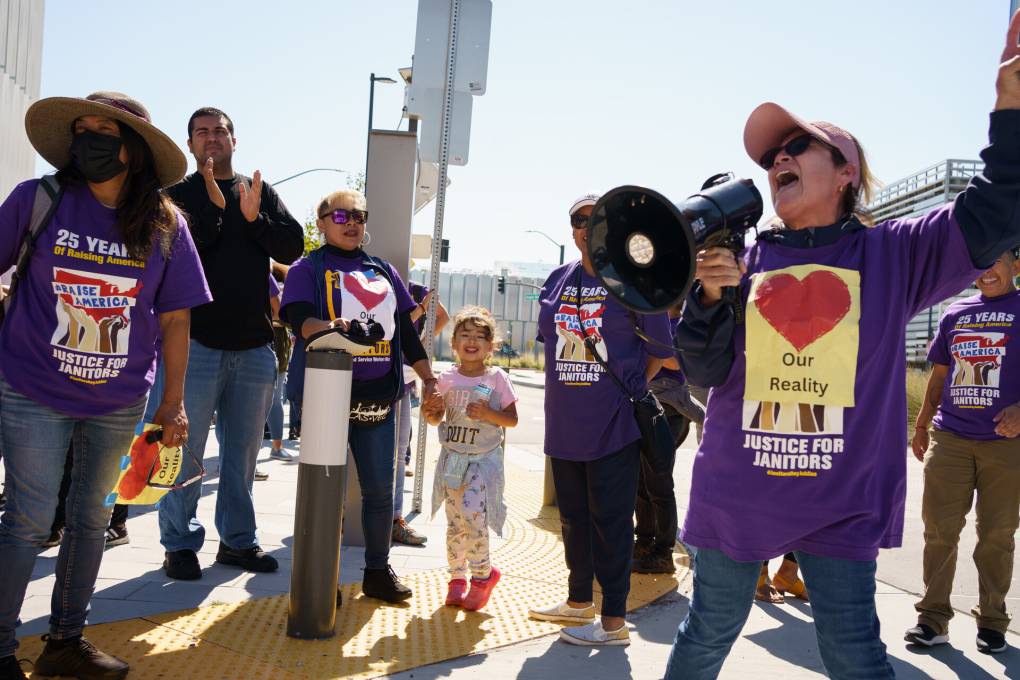
"caption": "Janitorial staff go on strike after mass layoffs, at Meta's offices in Burlingame on Oct. 7, 2022.",
"description": null,
"title": "RS59113_DSC08232-qut",
"credit": "Aryk Copley/KQED",
"status": "inherit",
"altTag": "A person shouts into a megaphone with a small crowd of around of around 10 standing behind them.",
"isLoading": false,
"fetchFailed": false
},
"news_11927533": {
"type": "attachments",
"id": "news_11927533",
"meta": {
"index": "attachments_1716263798",
"site": "news",
"id": "11927533",
"found": true
},
"parent": 11927383,
"imgSizes": {
"twentyfourteen-full-width": {
"file": "https://ww2.kqed.org/app/uploads/sites/10/2022/09/IMG_5611-1038x576.jpg",
"width": 1038,
"mimeType": "image/jpeg",
"height": 576
},
"thumbnail": {
"file": "https://ww2.kqed.org/app/uploads/sites/10/2022/09/IMG_5611-160x107.jpg",
"width": 160,
"mimeType": "image/jpeg",
"height": 107
},
"post-thumbnail": {
"file": "https://ww2.kqed.org/app/uploads/sites/10/2022/09/IMG_5611-672x372.jpg",
"width": 672,
"mimeType": "image/jpeg",
"height": 372
},
"kqedFullSize": {
"file": "https://ww2.kqed.org/app/uploads/sites/10/2022/09/IMG_5611-scaled.jpg",
"width": 2560,
"height": 1707
},
"2048x2048": {
"file": "https://ww2.kqed.org/app/uploads/sites/10/2022/09/IMG_5611-2048x1365.jpg",
"width": 2048,
"mimeType": "image/jpeg",
"height": 1365
},
"large": {
"file": "https://ww2.kqed.org/app/uploads/sites/10/2022/09/IMG_5611-1020x680.jpg",
"width": 1020,
"mimeType": "image/jpeg",
"height": 680
},
"1536x1536": {
"file": "https://ww2.kqed.org/app/uploads/sites/10/2022/09/IMG_5611-1536x1024.jpg",
"width": 1536,
"mimeType": "image/jpeg",
"height": 1024
},
"full-width": {
"file": "https://ww2.kqed.org/app/uploads/sites/10/2022/09/IMG_5611-1920x1280.jpg",
"width": 1920,
"mimeType": "image/jpeg",
"height": 1280
},
"medium": {
"file": "https://ww2.kqed.org/app/uploads/sites/10/2022/09/IMG_5611-800x533.jpg",
"width": 800,
"mimeType": "image/jpeg",
"height": 533
}
},
"publishDate": 1664820574,
"modified": 1664820832,
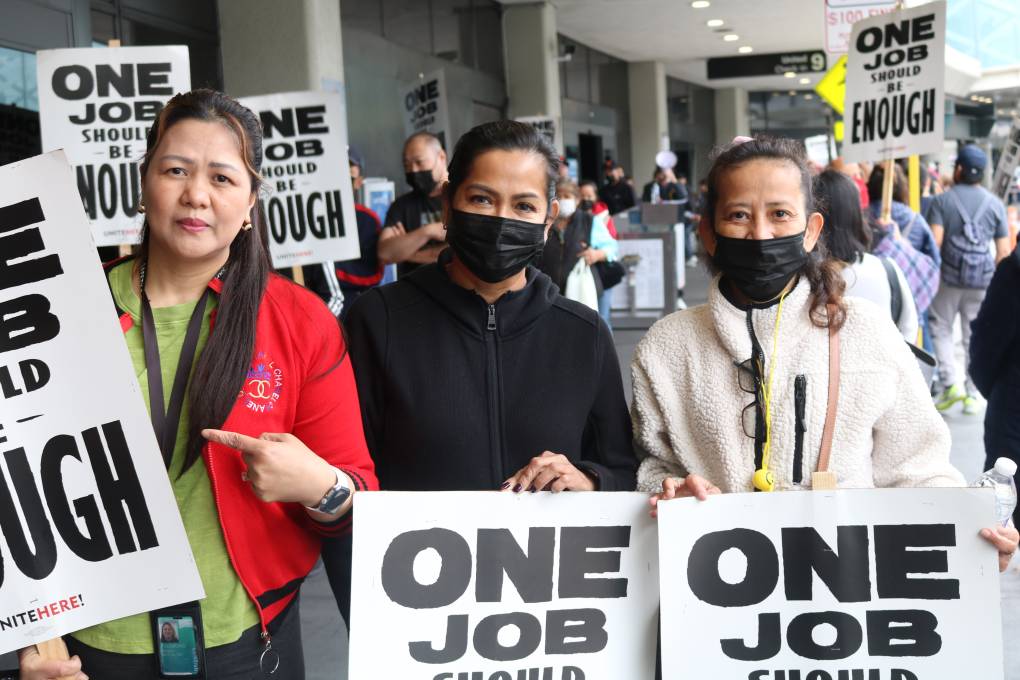
"caption": "Restaurant workers on the picket line outside San Francisco International Airport on Sept. 27, 2022. UNITE HERE Local 2 signed a new contract Sunday guaranteeing workers a $5 per hour raise and free family health care.",
"description": null,
"title": "IMG_5611",
"credit": "Courtesy UNITE HERE",
"status": "inherit",
"altTag": "three Asian-American women on strike hold signs outside the San Francisco AIrport",
"isLoading": false,
"fetchFailed": false
},
"news_11923074": {
"type": "attachments",
"id": "news_11923074",
"meta": {
"index": "attachments_1716263798",
"site": "news",
"id": "11923074",
"found": true
},
"parent": 11923034,
"imgSizes": {
"twentyfourteen-full-width": {
"file": "https://ww2.kqed.org/app/uploads/sites/10/2022/08/RS57894_032_KQED_KaiserStrikeOakland_08192022-qut-1038x576.jpg",
"width": 1038,
"mimeType": "image/jpeg",
"height": 576
},
"thumbnail": {
"file": "https://ww2.kqed.org/app/uploads/sites/10/2022/08/RS57894_032_KQED_KaiserStrikeOakland_08192022-qut-160x107.jpg",
"width": 160,
"mimeType": "image/jpeg",
"height": 107
},
"post-thumbnail": {
"file": "https://ww2.kqed.org/app/uploads/sites/10/2022/08/RS57894_032_KQED_KaiserStrikeOakland_08192022-qut-672x372.jpg",
"width": 672,
"mimeType": "image/jpeg",
"height": 372
},
"kqedFullSize": {
"file": "https://ww2.kqed.org/app/uploads/sites/10/2022/08/RS57894_032_KQED_KaiserStrikeOakland_08192022-qut.jpg",
"width": 1920,
"height": 1280
},
"large": {
"file": "https://ww2.kqed.org/app/uploads/sites/10/2022/08/RS57894_032_KQED_KaiserStrikeOakland_08192022-qut-1020x680.jpg",
"width": 1020,
"mimeType": "image/jpeg",
"height": 680
},
"1536x1536": {
"file": "https://ww2.kqed.org/app/uploads/sites/10/2022/08/RS57894_032_KQED_KaiserStrikeOakland_08192022-qut-1536x1024.jpg",
"width": 1536,
"mimeType": "image/jpeg",
"height": 1024
},
"medium": {
"file": "https://ww2.kqed.org/app/uploads/sites/10/2022/08/RS57894_032_KQED_KaiserStrikeOakland_08192022-qut-800x533.jpg",
"width": 800,
"mimeType": "image/jpeg",
"height": 533
}
},
"publishDate": 1660951150,
"modified": 1660951188,
"caption": "Kaiser mental health care workers and supporters march from Oakland Kaiser Medical Center to Kaiser's corporate headquarters on Friday, Aug. 19, 2022, the fifth day of an open-ended strike.",
"description": null,
"title": "RS57894_032_KQED_KaiserStrikeOakland_08192022-qut",
"credit": "Beth LaBerge/KQED",
"status": "inherit",
"altTag": "people in red shirts carrying signs that read \"patients over profits\"",
"isLoading": false,
"fetchFailed": false
},
"news_11922835": {
"type": "attachments",
"id": "news_11922835",
"meta": {
"index": "attachments_1716263798",
"site": "news",
"id": "11922835",
"found": true
},
"parent": 11922748,
"imgSizes": {
"twentyfourteen-full-width": {
"file": "https://ww2.kqed.org/app/uploads/sites/10/2022/08/KaiserOak-1-1038x576.jpg",
"width": 1038,
"mimeType": "image/jpeg",
"height": 576
},
"thumbnail": {
"file": "https://ww2.kqed.org/app/uploads/sites/10/2022/08/KaiserOak-1-160x120.jpg",
"width": 160,
"mimeType": "image/jpeg",
"height": 120
},
"post-thumbnail": {
"file": "https://ww2.kqed.org/app/uploads/sites/10/2022/08/KaiserOak-1-672x372.jpg",
"width": 672,
"mimeType": "image/jpeg",
"height": 372
},
"kqedFullSize": {
"file": "https://ww2.kqed.org/app/uploads/sites/10/2022/08/KaiserOak-1.jpg",
"width": 1920,
"height": 1440
},
"large": {
"file": "https://ww2.kqed.org/app/uploads/sites/10/2022/08/KaiserOak-1-1020x765.jpg",
"width": 1020,
"mimeType": "image/jpeg",
"height": 765
},
"1536x1536": {
"file": "https://ww2.kqed.org/app/uploads/sites/10/2022/08/KaiserOak-1-1536x1152.jpg",
"width": 1536,
"mimeType": "image/jpeg",
"height": 1152
},
"medium": {
"file": "https://ww2.kqed.org/app/uploads/sites/10/2022/08/KaiserOak-1-800x600.jpg",
"width": 800,
"mimeType": "image/jpeg",
"height": 600
}
},
"publishDate": 1660765977,
"modified": 1660767107,
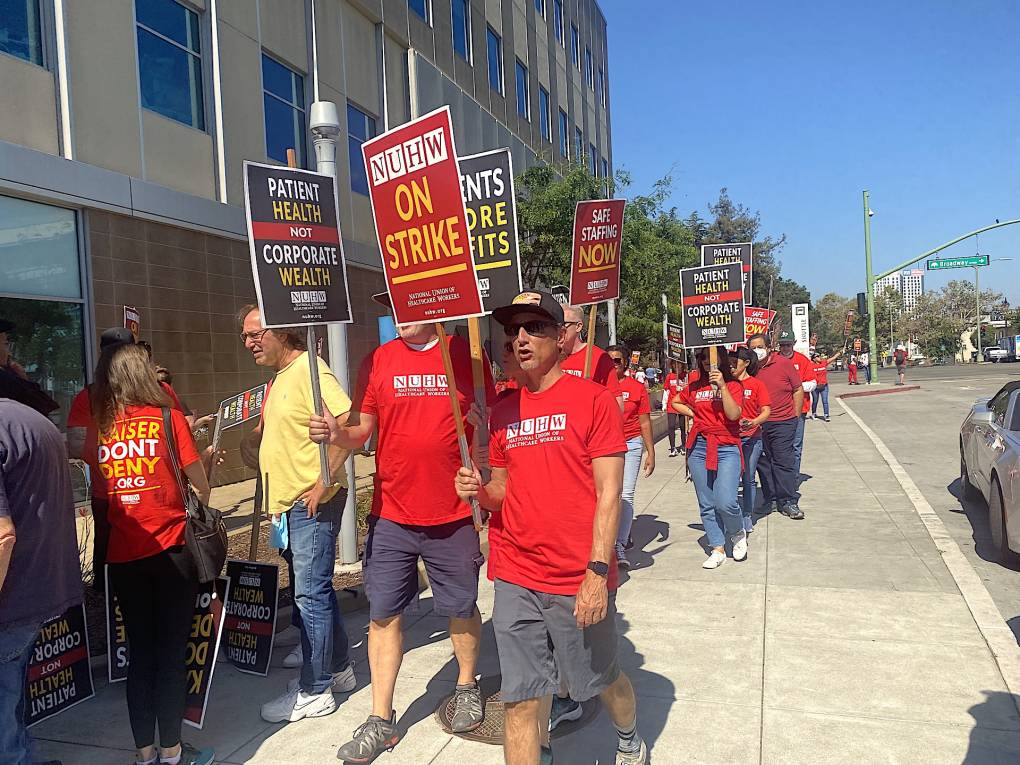
"caption": "Kaiser mental health care workers hold signs on the picket line outside one of the health care giant's facilities in Oakland on Tuesday, Aug. 16, 2022, the second day of an open-ended strike. Those participating said a staffing shortage and unfair wages have led to 'dangerous' wait times for people seeking treatment.",
"description": null,
"title": "KaiserOak",
"credit": "Lesley McClurg/KQED",
"status": "inherit",
"altTag": "A line of people in red shirts march down a street, carrying signs at a picket line that say 'NUHW on strike.'",
"isLoading": false,
"fetchFailed": false
},
"news_11912976": {
"type": "attachments",
"id": "news_11912976",
"meta": {
"index": "attachments_1716263798",
"site": "news",
"id": "11912976",
"found": true
},
"parent": 11912951,
"imgSizes": {
"twentyfourteen-full-width": {
"file": "https://ww2.kqed.org/app/uploads/sites/10/2022/05/279287443_8035081779838833_1380121179455831791_n-768x576.jpeg",
"width": 768,
"mimeType": "image/jpeg",
"height": 576
},
"thumbnail": {
"file": "https://ww2.kqed.org/app/uploads/sites/10/2022/05/279287443_8035081779838833_1380121179455831791_n-160x127.jpeg",
"width": 160,
"mimeType": "image/jpeg",
"height": 127
},
"post-thumbnail": {
"file": "https://ww2.kqed.org/app/uploads/sites/10/2022/05/279287443_8035081779838833_1380121179455831791_n-672x372.jpeg",
"width": 672,
"mimeType": "image/jpeg",
"height": 372
},
"kqedFullSize": {
"file": "https://ww2.kqed.org/app/uploads/sites/10/2022/05/279287443_8035081779838833_1380121179455831791_n.jpeg",
"width": 768,
"height": 608
}
},
"publishDate": 1651540273,
"modified": 1651620995,
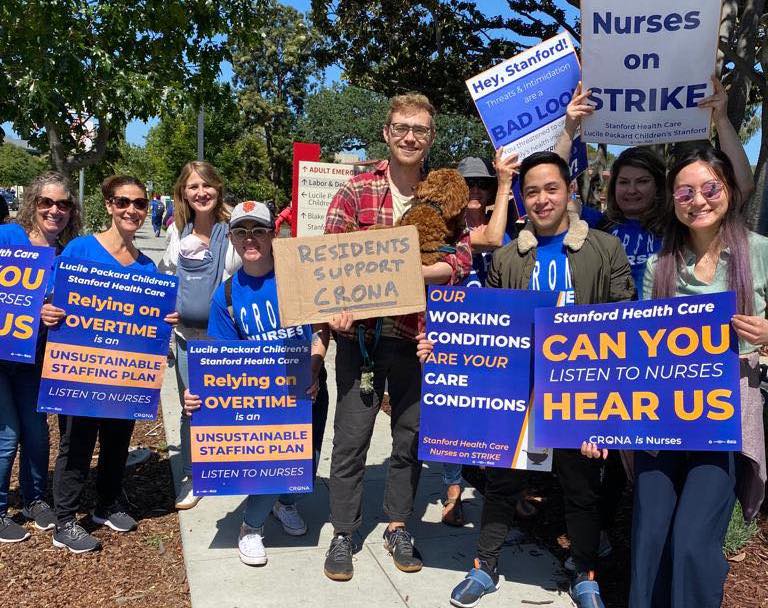
"caption": "Nurses at Stanford Health Care and Lucile Packard Children's Hospital on the picket line on April 25, 2022, the first day of their weeklong strike. ",
"description": null,
"title": "279287443_8035081779838833_1380121179455831791_n",
"credit": "Courtesy of the Committee for Recognition of Nursing Achievement",
"status": "inherit",
"altTag": "A group of people stand with picket signs that say 'Stanford Health Care, can you hear us\"",
"isLoading": false,
"fetchFailed": false
},
"news_11912276": {
"type": "attachments",
"id": "news_11912276",
"meta": {
"index": "attachments_1716263798",
"site": "news",
"id": "11912276",
"found": true
},
"parent": 11912231,
"imgSizes": {
"twentyfourteen-full-width": {
"file": "https://ww2.kqed.org/app/uploads/sites/10/2022/04/NursesStrike-1038x576.jpg",
"width": 1038,
"mimeType": "image/jpeg",
"height": 576
},
"thumbnail": {
"file": "https://ww2.kqed.org/app/uploads/sites/10/2022/04/NursesStrike-160x106.jpg",
"width": 160,
"mimeType": "image/jpeg",
"height": 106
},
"post-thumbnail": {
"file": "https://ww2.kqed.org/app/uploads/sites/10/2022/04/NursesStrike-672x372.jpg",
"width": 672,
"mimeType": "image/jpeg",
"height": 372
},
"kqedFullSize": {
"file": "https://ww2.kqed.org/app/uploads/sites/10/2022/04/NursesStrike.jpg",
"width": 1920,
"height": 1266
},
"large": {
"file": "https://ww2.kqed.org/app/uploads/sites/10/2022/04/NursesStrike-1020x673.jpg",
"width": 1020,
"mimeType": "image/jpeg",
"height": 673
},
"1536x1536": {
"file": "https://ww2.kqed.org/app/uploads/sites/10/2022/04/NursesStrike-1536x1013.jpg",
"width": 1536,
"mimeType": "image/jpeg",
"height": 1013
},
"medium": {
"file": "https://ww2.kqed.org/app/uploads/sites/10/2022/04/NursesStrike-800x528.jpg",
"width": 800,
"mimeType": "image/jpeg",
"height": 528
}
},
"publishDate": 1651006140,
"modified": 1651009844,
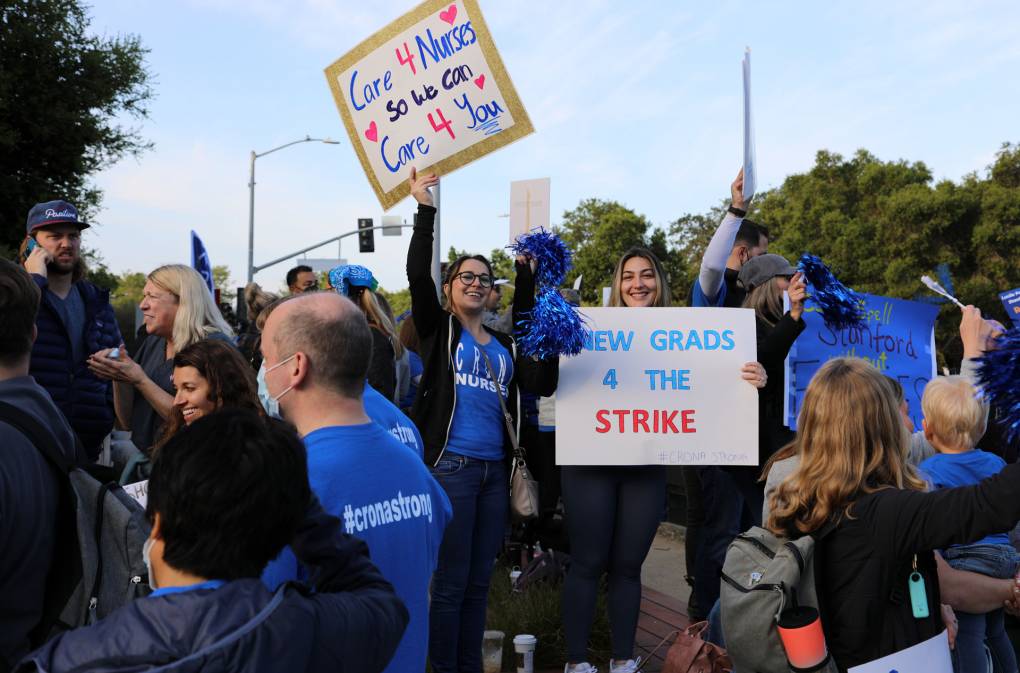
"caption": "Stanford nurses and their supporters rally as part of a strike on April 25, 2022. Thousands of nurses walked off the job, calling on management to address staffing shortages and provide workers with better mental health support.",
"description": null,
"title": "NursesStrike",
"credit": "Courtesy of Committee for Recognition of Nursing Achievement",
"status": "inherit",
"altTag": "nurses wearing bright blue union shirts hold signs reading 'care 4 nurses so we can care 4 you'",
"isLoading": false,
"fetchFailed": false
},
"news_11896572": {
"type": "attachments",
"id": "news_11896572",
"meta": {
"index": "attachments_1716263798",
"site": "news",
"id": "11896572",
"found": true
},
"parent": 11896516,
"imgSizes": {
"twentyfourteen-full-width": {
"file": "https://ww2.kqed.org/app/uploads/sites/10/2021/11/20211117_125512-1038x576.jpg",
"width": 1038,
"mimeType": "image/jpeg",
"height": 576
},
"thumbnail": {
"file": "https://ww2.kqed.org/app/uploads/sites/10/2021/11/20211117_125512-160x107.jpg",
"width": 160,
"mimeType": "image/jpeg",
"height": 107
},
"post-thumbnail": {
"file": "https://ww2.kqed.org/app/uploads/sites/10/2021/11/20211117_125512-672x372.jpg",
"width": 672,
"mimeType": "image/jpeg",
"height": 372
},
"kqedFullSize": {
"file": "https://ww2.kqed.org/app/uploads/sites/10/2021/11/20211117_125512-scaled.jpg",
"width": 2560,
"height": 1707
},
"2048x2048": {
"file": "https://ww2.kqed.org/app/uploads/sites/10/2021/11/20211117_125512-2048x1365.jpg",
"width": 2048,
"mimeType": "image/jpeg",
"height": 1365
},
"large": {
"file": "https://ww2.kqed.org/app/uploads/sites/10/2021/11/20211117_125512-1020x680.jpg",
"width": 1020,
"mimeType": "image/jpeg",
"height": 680
},
"1536x1536": {
"file": "https://ww2.kqed.org/app/uploads/sites/10/2021/11/20211117_125512-1536x1024.jpg",
"width": 1536,
"mimeType": "image/jpeg",
"height": 1024
},
"full-width": {
"file": "https://ww2.kqed.org/app/uploads/sites/10/2021/11/20211117_125512-1920x1280.jpg",
"width": 1920,
"mimeType": "image/jpeg",
"height": 1280
},
"medium": {
"file": "https://ww2.kqed.org/app/uploads/sites/10/2021/11/20211117_125512-800x533.jpg",
"width": 800,
"mimeType": "image/jpeg",
"height": 533
}
},
"publishDate": 1637186788,
"modified": 1637186980,
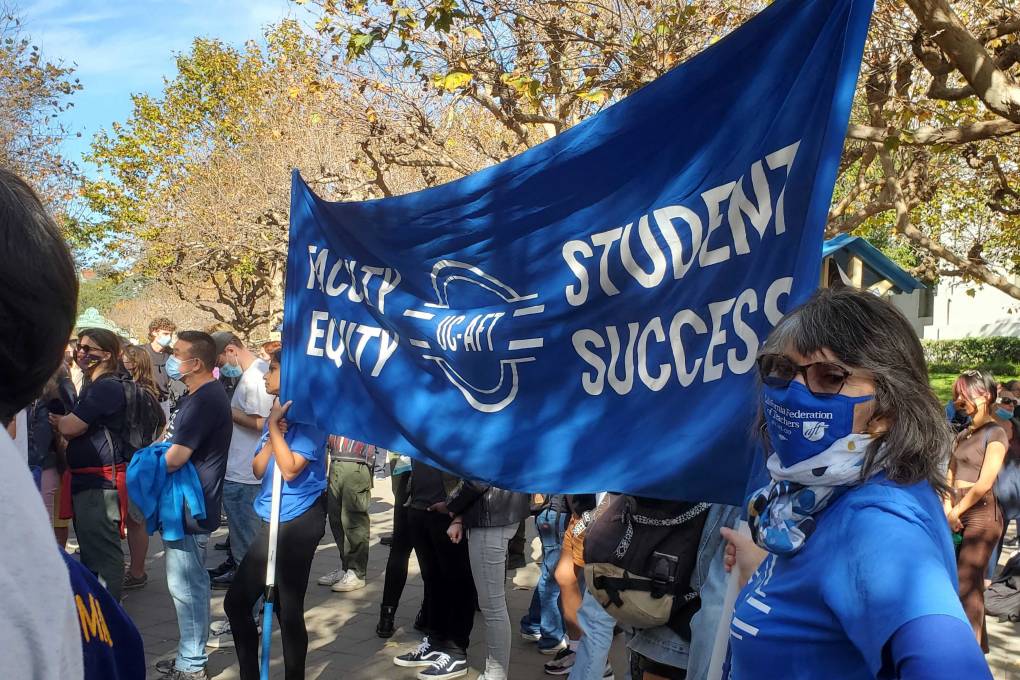
"caption": "Clelia Donovan, right, continuing lecturer in Spanish and Portuguese at UC Berkeley, at a rally on campus on Nov. 17, 2021, to celebrate the last-minute contract deal that averted a planned systemwide strike. ‘I’m elated that we got a contract resolution,’ she said.",
"description": "Clelia Donovan, right, continuing lecturer in Spanish and Portuguese at UC Berkeley, at a rally on campus on Nov. 17, 2021, to celebrate the last-minute contract deal that averted a planned systemwide strike.",
"title": "20211117_125512",
"credit": "Alex Emslie/KQED",
"status": "inherit",
"altTag": "Several people are gathered outdoors under the shade of trees, many are wearing the same t-shirt. A pair is holding up a large sign that says, 'Faculty equity equals student success.'",
"isLoading": false,
"fetchFailed": false
},
"news_11855739": {
"type": "attachments",
"id": "news_11855739",
"meta": {
"index": "attachments_1716263798",
"site": "news",
"id": "11855739",
"found": true
},
"parent": 11855621,
"imgSizes": {
"apple_news_ca_landscape_5_5": {
"file": "https://ww2.kqed.org/app/uploads/sites/10/2021/01/KQED_Oakland_McDonaldsStrike_01152021-5-1044x783.jpg",
"width": 1044,
"mimeType": "image/jpeg",
"height": 783
},
"apple_news_ca_square_4_0": {
"file": "https://ww2.kqed.org/app/uploads/sites/10/2021/01/KQED_Oakland_McDonaldsStrike_01152021-5-470x470.jpg",
"width": 470,
"mimeType": "image/jpeg",
"height": 470
},
"twentyfourteen-full-width": {
"file": "https://ww2.kqed.org/app/uploads/sites/10/2021/01/KQED_Oakland_McDonaldsStrike_01152021-5-1038x576.jpg",
"width": 1038,
"mimeType": "image/jpeg",
"height": 576
},
"thumbnail": {
"file": "https://ww2.kqed.org/app/uploads/sites/10/2021/01/KQED_Oakland_McDonaldsStrike_01152021-5-160x107.jpg",
"width": 160,
"mimeType": "image/jpeg",
"height": 107
},
"post-thumbnail": {
"file": "https://ww2.kqed.org/app/uploads/sites/10/2021/01/KQED_Oakland_McDonaldsStrike_01152021-5-672x372.jpg",
"width": 672,
"mimeType": "image/jpeg",
"height": 372
},
"kqedFullSize": {
"file": "https://ww2.kqed.org/app/uploads/sites/10/2021/01/KQED_Oakland_McDonaldsStrike_01152021-5-scaled-e1610760015919.jpg",
"width": 1920,
"height": 1283
},
"2048x2048": {
"file": "https://ww2.kqed.org/app/uploads/sites/10/2021/01/KQED_Oakland_McDonaldsStrike_01152021-5-2048x1368.jpg",
"width": 2048,
"mimeType": "image/jpeg",
"height": 1368
},
"apple_news_ca_landscape_4_7": {
"file": "https://ww2.kqed.org/app/uploads/sites/10/2021/01/KQED_Oakland_McDonaldsStrike_01152021-5-632x474.jpg",
"width": 632,
"mimeType": "image/jpeg",
"height": 474
},
"large": {
"file": "https://ww2.kqed.org/app/uploads/sites/10/2021/01/KQED_Oakland_McDonaldsStrike_01152021-5-1020x681.jpg",
"width": 1020,
"mimeType": "image/jpeg",
"height": 681
},
"apple_news_ca_landscape_4_0": {
"file": "https://ww2.kqed.org/app/uploads/sites/10/2021/01/KQED_Oakland_McDonaldsStrike_01152021-5-536x402.jpg",
"width": 536,
"mimeType": "image/jpeg",
"height": 402
},
"apple_news_ca_portrait_12_9": {
"file": "https://ww2.kqed.org/app/uploads/sites/10/2021/01/KQED_Oakland_McDonaldsStrike_01152021-5-1122x1496.jpg",
"width": 1122,
"mimeType": "image/jpeg",
"height": 1496
},
"medium": {
"file": "https://ww2.kqed.org/app/uploads/sites/10/2021/01/KQED_Oakland_McDonaldsStrike_01152021-5-800x534.jpg",
"width": 800,
"mimeType": "image/jpeg",
"height": 534
},
"apple_news_ca_portrait_4_0": {
"file": "https://ww2.kqed.org/app/uploads/sites/10/2021/01/KQED_Oakland_McDonaldsStrike_01152021-5-354x472.jpg",
"width": 354,
"mimeType": "image/jpeg",
"height": 472
},
"apple_news_ca_portrait_9_7": {
"file": "https://ww2.kqed.org/app/uploads/sites/10/2021/01/KQED_Oakland_McDonaldsStrike_01152021-5-840x1120.jpg",
"width": 840,
"mimeType": "image/jpeg",
"height": 1120
},
"apple_news_ca_landscape_12_9": {
"file": "https://ww2.kqed.org/app/uploads/sites/10/2021/01/KQED_Oakland_McDonaldsStrike_01152021-5-1832x1374.jpg",
"width": 1832,
"mimeType": "image/jpeg",
"height": 1374
},
"apple_news_ca_square_9_7": {
"file": "https://ww2.kqed.org/app/uploads/sites/10/2021/01/KQED_Oakland_McDonaldsStrike_01152021-5-1104x1104.jpg",
"width": 1104,
"mimeType": "image/jpeg",
"height": 1104
},
"1536x1536": {
"file": "https://ww2.kqed.org/app/uploads/sites/10/2021/01/KQED_Oakland_McDonaldsStrike_01152021-5-1536x1026.jpg",
"width": 1536,
"mimeType": "image/jpeg",
"height": 1026
},
"apple_news_ca_portrait_4_7": {
"file": "https://ww2.kqed.org/app/uploads/sites/10/2021/01/KQED_Oakland_McDonaldsStrike_01152021-5-414x552.jpg",
"width": 414,
"mimeType": "image/jpeg",
"height": 552
},
"apple_news_ca_square_12_9": {
"file": "https://ww2.kqed.org/app/uploads/sites/10/2021/01/KQED_Oakland_McDonaldsStrike_01152021-5-1472x1472.jpg",
"width": 1472,
"mimeType": "image/jpeg",
"height": 1472
},
"apple_news_ca_portrait_5_5": {
"file": "https://ww2.kqed.org/app/uploads/sites/10/2021/01/KQED_Oakland_McDonaldsStrike_01152021-5-687x916.jpg",
"width": 687,
"mimeType": "image/jpeg",
"height": 916
},
"full-width": {
"file": "https://ww2.kqed.org/app/uploads/sites/10/2021/01/KQED_Oakland_McDonaldsStrike_01152021-5-1920x1282.jpg",
"width": 1920,
"mimeType": "image/jpeg",
"height": 1282
},
"apple_news_ca_square_4_7": {
"file": "https://ww2.kqed.org/app/uploads/sites/10/2021/01/KQED_Oakland_McDonaldsStrike_01152021-5-550x550.jpg",
"width": 550,
"mimeType": "image/jpeg",
"height": 550
},
"apple_news_ca_landscape_9_7": {
"file": "https://ww2.kqed.org/app/uploads/sites/10/2021/01/KQED_Oakland_McDonaldsStrike_01152021-5-1376x1032.jpg",
"width": 1376,
"mimeType": "image/jpeg",
"height": 1032
},
"apple_news_ca_square_5_5": {
"file": "https://ww2.kqed.org/app/uploads/sites/10/2021/01/KQED_Oakland_McDonaldsStrike_01152021-5-912x912.jpg",
"width": 912,
"mimeType": "image/jpeg",
"height": 912
}
},
"publishDate": 1610759868,
"modified": 1610764649,
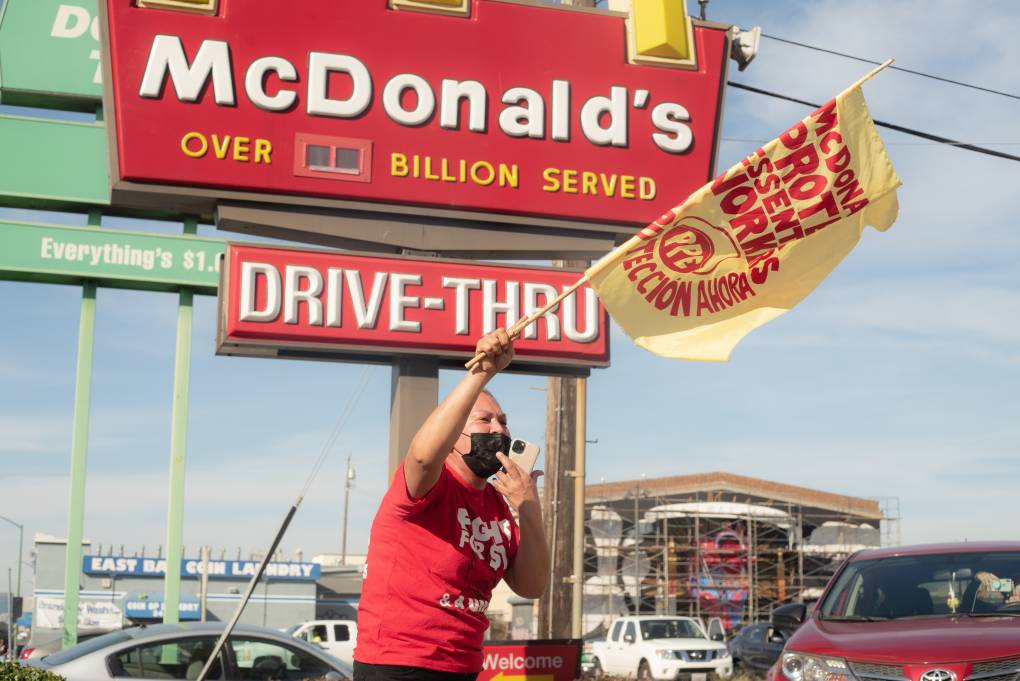
"caption": "Maria Ruiz from San Jose, who has worked for McDonald's for 20 years, speaks at a car caravan strike outside a McDonald's restaurant in Oakland's Fruitvale District on Jan. 15, 2021.",
"description": null,
"title": "KQED_Oakland_McDonaldsStrike_01152021-5",
"credit": "Anna Vignet/KQED",
"status": "inherit",
"altTag": null,
"isLoading": false,
"fetchFailed": false
},
"news_11744257": {
"type": "attachments",
"id": "news_11744257",
"meta": {
"index": "attachments_1716263798",
"site": "news",
"id": "11744257",
"found": true
},
"parent": 11744255,
"imgSizes": {
"twentyfourteen-full-width": {
"file": "https://ww2.kqed.org/app/uploads/sites/10/2019/05/HaymarketRiot-Harpers-964x576.jpg",
"width": 964,
"mimeType": "image/jpeg",
"height": 576
},
"thumbnail": {
"file": "https://ww2.kqed.org/app/uploads/sites/10/2019/05/HaymarketRiot-Harpers-160x111.jpg",
"width": 160,
"mimeType": "image/jpeg",
"height": 111
},
"post-thumbnail": {
"file": "https://ww2.kqed.org/app/uploads/sites/10/2019/05/HaymarketRiot-Harpers-672x372.jpg",
"width": 672,
"mimeType": "image/jpeg",
"height": 372
},
"kqedFullSize": {
"file": "https://ww2.kqed.org/app/uploads/sites/10/2019/05/HaymarketRiot-Harpers.jpg",
"width": 964,
"height": 669
},
"medium": {
"file": "https://ww2.kqed.org/app/uploads/sites/10/2019/05/HaymarketRiot-Harpers-800x555.jpg",
"width": 800,
"mimeType": "image/jpeg",
"height": 555
}
},
"publishDate": 1556742903,
"modified": 1556743095,
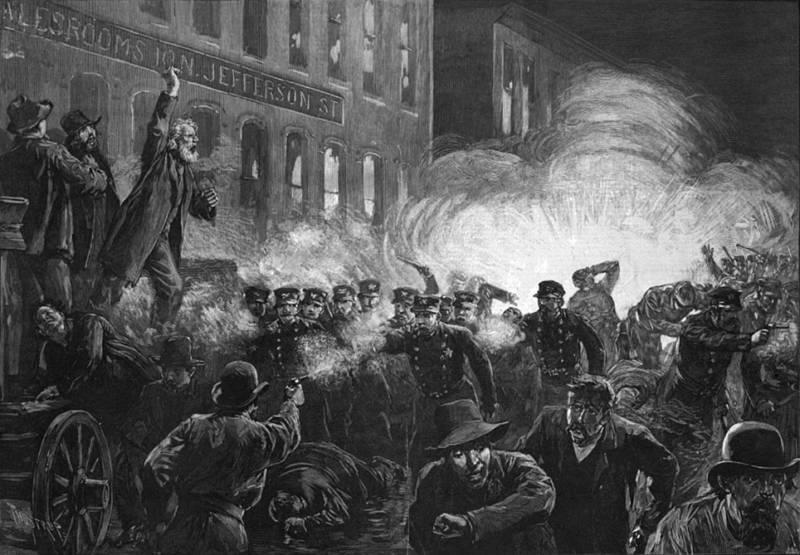
"caption": "This 1886 engraving from Harper's Weekly is the most widely reproduced image of the Haymarket Affair. It shows Methodist pastor Samuel Fielden speaking, the bomb exploding, and the riot beginning simultaneously; in reality, Fielden had finished speaking before the explosion.\n",
"description": null,
"title": "HACAT_V46",
"credit": "\u003ca href=\"https://en.wikipedia.org/wiki/Haymarket_affair#/media/File:HaymarketRiot-Harpers.jpg\">Chicago History Museum/Wikimedia Commons\u003c/a>",
"status": "inherit",
"isLoading": false,
"fetchFailed": false
},
"news_11734270": {
"type": "attachments",
"id": "news_11734270",
"meta": {
"index": "attachments_1716263798",
"site": "news",
"id": "11734270",
"found": true
},
"parent": 11734173,
"imgSizes": {
"post-thumbnail": {
"file": "https://ww2.kqed.org/app/uploads/sites/10/2019/03/IMG_9002-12-672x372.jpg",
"width": 672,
"mimeType": "image/jpeg",
"height": 372
},
"kqedFullSize": {
"file": "https://ww2.kqed.org/app/uploads/sites/10/2019/03/IMG_9002-12.jpg",
"width": 1920,
"height": 1280
},
"guest-author-50": {
"file": "https://ww2.kqed.org/app/uploads/sites/10/2019/03/IMG_9002-12-50x50.jpg",
"width": 50,
"mimeType": "image/jpeg",
"height": 50
},
"guest-author-96": {
"file": "https://ww2.kqed.org/app/uploads/sites/10/2019/03/IMG_9002-12-96x96.jpg",
"width": 96,
"mimeType": "image/jpeg",
"height": 96
},
"apple_news_ca_portrait_12_9": {
"file": "https://ww2.kqed.org/app/uploads/sites/10/2019/03/IMG_9002-12-1122x1280.jpg",
"width": 1122,
"mimeType": "image/jpeg",
"height": 1280
},
"medium": {
"file": "https://ww2.kqed.org/app/uploads/sites/10/2019/03/IMG_9002-12-800x533.jpg",
"width": 800,
"mimeType": "image/jpeg",
"height": 533
},
"guest-author-32": {
"file": "https://ww2.kqed.org/app/uploads/sites/10/2019/03/IMG_9002-12-32x32.jpg",
"width": 32,
"mimeType": "image/jpeg",
"height": 32
},
"apple_news_ca_portrait_9_7": {
"file": "https://ww2.kqed.org/app/uploads/sites/10/2019/03/IMG_9002-12-840x1120.jpg",
"width": 840,
"mimeType": "image/jpeg",
"height": 1120
},
"apple_news_ca_square_9_7": {
"file": "https://ww2.kqed.org/app/uploads/sites/10/2019/03/IMG_9002-12-1104x1104.jpg",
"width": 1104,
"mimeType": "image/jpeg",
"height": 1104
},
"apple_news_ca_portrait_4_7": {
"file": "https://ww2.kqed.org/app/uploads/sites/10/2019/03/IMG_9002-12-414x552.jpg",
"width": 414,
"mimeType": "image/jpeg",
"height": 552
},
"apple_news_ca_square_12_9": {
"file": "https://ww2.kqed.org/app/uploads/sites/10/2019/03/IMG_9002-12-1472x1280.jpg",
"width": 1472,
"mimeType": "image/jpeg",
"height": 1280
},
"apple_news_ca_portrait_5_5": {
"file": "https://ww2.kqed.org/app/uploads/sites/10/2019/03/IMG_9002-12-687x916.jpg",
"width": 687,
"mimeType": "image/jpeg",
"height": 916
},
"apple_news_ca_square_4_7": {
"file": "https://ww2.kqed.org/app/uploads/sites/10/2019/03/IMG_9002-12-550x550.jpg",
"width": 550,
"mimeType": "image/jpeg",
"height": 550
},
"apple_news_ca_square_5_5": {
"file": "https://ww2.kqed.org/app/uploads/sites/10/2019/03/IMG_9002-12-912x912.jpg",
"width": 912,
"mimeType": "image/jpeg",
"height": 912
},
"apple_news_ca_landscape_5_5": {
"file": "https://ww2.kqed.org/app/uploads/sites/10/2019/03/IMG_9002-12-1044x783.jpg",
"width": 1044,
"mimeType": "image/jpeg",
"height": 783
},
"apple_news_ca_square_4_0": {
"file": "https://ww2.kqed.org/app/uploads/sites/10/2019/03/IMG_9002-12-470x470.jpg",
"width": 470,
"mimeType": "image/jpeg",
"height": 470
},
"twentyfourteen-full-width": {
"file": "https://ww2.kqed.org/app/uploads/sites/10/2019/03/IMG_9002-12-1038x576.jpg",
"width": 1038,
"mimeType": "image/jpeg",
"height": 576
},
"thumbnail": {
"file": "https://ww2.kqed.org/app/uploads/sites/10/2019/03/IMG_9002-12-160x107.jpg",
"width": 160,
"mimeType": "image/jpeg",
"height": 107
},
"apple_news_ca_landscape_4_7": {
"file": "https://ww2.kqed.org/app/uploads/sites/10/2019/03/IMG_9002-12-632x474.jpg",
"width": 632,
"mimeType": "image/jpeg",
"height": 474
},
"large": {
"file": "https://ww2.kqed.org/app/uploads/sites/10/2019/03/IMG_9002-12-1020x680.jpg",
"width": 1020,
"mimeType": "image/jpeg",
"height": 680
},
"complete_open_graph": {
"file": "https://ww2.kqed.org/app/uploads/sites/10/2019/03/IMG_9002-12-1200x800.jpg",
"width": 1200,
"mimeType": "image/jpeg",
"height": 800
},
"apple_news_ca_landscape_4_0": {
"file": "https://ww2.kqed.org/app/uploads/sites/10/2019/03/IMG_9002-12-536x402.jpg",
"width": 536,
"mimeType": "image/jpeg",
"height": 402
},
"guest-author-64": {
"file": "https://ww2.kqed.org/app/uploads/sites/10/2019/03/IMG_9002-12-64x64.jpg",
"width": 64,
"mimeType": "image/jpeg",
"height": 64
},
"apple_news_ca_portrait_4_0": {
"file": "https://ww2.kqed.org/app/uploads/sites/10/2019/03/IMG_9002-12-354x472.jpg",
"width": 354,
"mimeType": "image/jpeg",
"height": 472
},
"apple_news_ca_landscape_12_9": {
"file": "https://ww2.kqed.org/app/uploads/sites/10/2019/03/IMG_9002-12-1832x1280.jpg",
"width": 1832,
"mimeType": "image/jpeg",
"height": 1280
},
"full-width": {
"file": "https://ww2.kqed.org/app/uploads/sites/10/2019/03/IMG_9002-12-1920x1280.jpg",
"width": 1920,
"mimeType": "image/jpeg",
"height": 1280
},
"guest-author-128": {
"file": "https://ww2.kqed.org/app/uploads/sites/10/2019/03/IMG_9002-12-128x128.jpg",
"width": 128,
"mimeType": "image/jpeg",
"height": 128
},
"apple_news_ca_landscape_9_7": {
"file": "https://ww2.kqed.org/app/uploads/sites/10/2019/03/IMG_9002-12-1376x1032.jpg",
"width": 1376,
"mimeType": "image/jpeg",
"height": 1032
}
},
"publishDate": 1553116203,
"modified": 1553116368,
"caption": "Striking union workers picketing outside the UCSF Helen Diller Medical Center during a one-day walkout on Wed., March 20. ",
"description": null,
"title": "IMG_9002-12",
"credit": "Olivia Obineme/KQED",
"status": "inherit",
"isLoading": false,
"fetchFailed": false
},
"news_11717991": {
"type": "attachments",
"id": "news_11717991",
"meta": {
"index": "attachments_1716263798",
"site": "news",
"id": "11717991",
"found": true
},
"parent": 11717990,
"imgSizes": {
"twentyfourteen-full-width": {
"file": "https://ww2.kqed.org/app/uploads/sites/10/2019/01/ap_18354010716514_wide-5bc9eb2ab89cc031de4f3c52d36bc83bb60e3134-e1547494751631-1038x576.jpg",
"width": 1038,
"mimeType": "image/jpeg",
"height": 576
},
"thumbnail": {
"file": "https://ww2.kqed.org/app/uploads/sites/10/2019/01/ap_18354010716514_wide-5bc9eb2ab89cc031de4f3c52d36bc83bb60e3134-e1547494751631-160x90.jpg",
"width": 160,
"mimeType": "image/jpeg",
"height": 90
},
"post-thumbnail": {
"file": "https://ww2.kqed.org/app/uploads/sites/10/2019/01/ap_18354010716514_wide-5bc9eb2ab89cc031de4f3c52d36bc83bb60e3134-e1547494751631-672x372.jpg",
"width": 672,
"mimeType": "image/jpeg",
"height": 372
},
"kqedFullSize": {
"file": "https://ww2.kqed.org/app/uploads/sites/10/2019/01/ap_18354010716514_wide-5bc9eb2ab89cc031de4f3c52d36bc83bb60e3134-e1547494751631.jpg",
"width": 1920,
"height": 1079
},
"large": {
"file": "https://ww2.kqed.org/app/uploads/sites/10/2019/01/ap_18354010716514_wide-5bc9eb2ab89cc031de4f3c52d36bc83bb60e3134-e1547494751631-1020x573.jpg",
"width": 1020,
"mimeType": "image/jpeg",
"height": 573
},
"complete_open_graph": {
"file": "https://ww2.kqed.org/app/uploads/sites/10/2019/01/ap_18354010716514_wide-5bc9eb2ab89cc031de4f3c52d36bc83bb60e3134-e1547494751631-1200x674.jpg",
"width": 1200,
"mimeType": "image/jpeg",
"height": 674
},
"guest-author-50": {
"file": "https://ww2.kqed.org/app/uploads/sites/10/2019/01/ap_18354010716514_wide-5bc9eb2ab89cc031de4f3c52d36bc83bb60e3134-e1547494751631-50x50.jpg",
"width": 50,
"mimeType": "image/jpeg",
"height": 50
},
"guest-author-96": {
"file": "https://ww2.kqed.org/app/uploads/sites/10/2019/01/ap_18354010716514_wide-5bc9eb2ab89cc031de4f3c52d36bc83bb60e3134-e1547494751631-96x96.jpg",
"width": 96,
"mimeType": "image/jpeg",
"height": 96
},
"medium": {
"file": "https://ww2.kqed.org/app/uploads/sites/10/2019/01/ap_18354010716514_wide-5bc9eb2ab89cc031de4f3c52d36bc83bb60e3134-e1547494751631-800x450.jpg",
"width": 800,
"mimeType": "image/jpeg",
"height": 450
},
"guest-author-64": {
"file": "https://ww2.kqed.org/app/uploads/sites/10/2019/01/ap_18354010716514_wide-5bc9eb2ab89cc031de4f3c52d36bc83bb60e3134-e1547494751631-64x64.jpg",
"width": 64,
"mimeType": "image/jpeg",
"height": 64
},
"guest-author-32": {
"file": "https://ww2.kqed.org/app/uploads/sites/10/2019/01/ap_18354010716514_wide-5bc9eb2ab89cc031de4f3c52d36bc83bb60e3134-e1547494751631-32x32.jpg",
"width": 32,
"mimeType": "image/jpeg",
"height": 32
},
"full-width": {
"file": "https://ww2.kqed.org/app/uploads/sites/10/2019/01/ap_18354010716514_wide-5bc9eb2ab89cc031de4f3c52d36bc83bb60e3134-e1547494751631-1920x1079.jpg",
"width": 1920,
"mimeType": "image/jpeg",
"height": 1079
},
"detail": {
"file": "https://ww2.kqed.org/app/uploads/sites/10/2019/01/ap_18354010716514_wide-5bc9eb2ab89cc031de4f3c52d36bc83bb60e3134-e1547494751631-150x150.jpg",
"width": 150,
"mimeType": "image/jpeg",
"height": 150
},
"guest-author-128": {
"file": "https://ww2.kqed.org/app/uploads/sites/10/2019/01/ap_18354010716514_wide-5bc9eb2ab89cc031de4f3c52d36bc83bb60e3134-e1547494751631-128x128.jpg",
"width": 128,
"mimeType": "image/jpeg",
"height": 128
}
},
"publishDate": 1547489118,
"modified": 1547512105,
"caption": "Educators march in downtown Los Angeles on Dec. 15. Negotiations between United Teachers Los Angeles and the L.A. Unified School District started in early 2017.",
"description": "Educators march in downtown Los Angeles on Dec. 15. Negotiations between United Teachers Los Angeles and the LA Unified School District started in early 2017.",
"title": "Educators march in downtown Los Angeles on Dec. 15. Negotiations between United Teachers Los Angeles and the LA Unified School District started in early 2017.",
"credit": "Damian Dovarganes/AP",
"status": "inherit",
"isLoading": false,
"fetchFailed": false
},
"news_11698170": {
"type": "attachments",
"id": "news_11698170",
"meta": {
"index": "attachments_1716263798",
"site": "news",
"id": "11698170",
"found": true
},
"parent": 11698130,
"imgSizes": {
"small": {
"file": "https://ww2.kqed.org/app/uploads/sites/10/2018/10/HotelWorkersStrike-520x353.jpg",
"width": 520,
"mimeType": "image/jpeg",
"height": 353
},
"twentyfourteen-full-width": {
"file": "https://ww2.kqed.org/app/uploads/sites/10/2018/10/HotelWorkersStrike-1038x576.jpg",
"width": 1038,
"mimeType": "image/jpeg",
"height": 576
},
"thumbnail": {
"file": "https://ww2.kqed.org/app/uploads/sites/10/2018/10/HotelWorkersStrike-160x109.jpg",
"width": 160,
"mimeType": "image/jpeg",
"height": 109
},
"fd-sm": {
"file": "https://ww2.kqed.org/app/uploads/sites/10/2018/10/HotelWorkersStrike-960x652.jpg",
"width": 960,
"mimeType": "image/jpeg",
"height": 652
},
"post-thumbnail": {
"file": "https://ww2.kqed.org/app/uploads/sites/10/2018/10/HotelWorkersStrike-672x372.jpg",
"width": 672,
"mimeType": "image/jpeg",
"height": 372
},
"xsmall": {
"file": "https://ww2.kqed.org/app/uploads/sites/10/2018/10/HotelWorkersStrike-375x255.jpg",
"width": 375,
"mimeType": "image/jpeg",
"height": 255
},
"kqedFullSize": {
"file": "https://ww2.kqed.org/app/uploads/sites/10/2018/10/HotelWorkersStrike.jpg",
"width": 1920,
"height": 1304
},
"large": {
"file": "https://ww2.kqed.org/app/uploads/sites/10/2018/10/HotelWorkersStrike-1020x693.jpg",
"width": 1020,
"mimeType": "image/jpeg",
"height": 693
},
"xlarge": {
"file": "https://ww2.kqed.org/app/uploads/sites/10/2018/10/HotelWorkersStrike-1180x801.jpg",
"width": 1180,
"mimeType": "image/jpeg",
"height": 801
},
"complete_open_graph": {
"file": "https://ww2.kqed.org/app/uploads/sites/10/2018/10/HotelWorkersStrike-1200x815.jpg",
"width": 1200,
"mimeType": "image/jpeg",
"height": 815
},
"guest-author-50": {
"file": "https://ww2.kqed.org/app/uploads/sites/10/2018/10/HotelWorkersStrike-50x50.jpg",
"width": 50,
"mimeType": "image/jpeg",
"height": 50
},
"guest-author-96": {
"file": "https://ww2.kqed.org/app/uploads/sites/10/2018/10/HotelWorkersStrike-96x96.jpg",
"width": 96,
"mimeType": "image/jpeg",
"height": 96
},
"medium": {
"file": "https://ww2.kqed.org/app/uploads/sites/10/2018/10/HotelWorkersStrike-800x543.jpg",
"width": 800,
"mimeType": "image/jpeg",
"height": 543
},
"guest-author-64": {
"file": "https://ww2.kqed.org/app/uploads/sites/10/2018/10/HotelWorkersStrike-64x64.jpg",
"width": 64,
"mimeType": "image/jpeg",
"height": 64
},
"guest-author-32": {
"file": "https://ww2.kqed.org/app/uploads/sites/10/2018/10/HotelWorkersStrike-32x32.jpg",
"width": 32,
"mimeType": "image/jpeg",
"height": 32
},
"fd-lrg": {
"file": "https://ww2.kqed.org/app/uploads/sites/10/2018/10/HotelWorkersStrike-1920x1304.jpg",
"width": 1920,
"mimeType": "image/jpeg",
"height": 1304
},
"fd-med": {
"file": "https://ww2.kqed.org/app/uploads/sites/10/2018/10/HotelWorkersStrike-1180x801.jpg",
"width": 1180,
"mimeType": "image/jpeg",
"height": 801
},
"full-width": {
"file": "https://ww2.kqed.org/app/uploads/sites/10/2018/10/HotelWorkersStrike-1920x1304.jpg",
"width": 1920,
"mimeType": "image/jpeg",
"height": 1304
},
"detail": {
"file": "https://ww2.kqed.org/app/uploads/sites/10/2018/10/HotelWorkersStrike-150x150.jpg",
"width": 150,
"mimeType": "image/jpeg",
"height": 150
},
"guest-author-128": {
"file": "https://ww2.kqed.org/app/uploads/sites/10/2018/10/HotelWorkersStrike-128x128.jpg",
"width": 128,
"mimeType": "image/jpeg",
"height": 128
},
"xxsmall": {
"file": "https://ww2.kqed.org/app/uploads/sites/10/2018/10/HotelWorkersStrike-240x163.jpg",
"width": 240,
"mimeType": "image/jpeg",
"height": 163
}
},
"publishDate": 1539287770,
"modified": 1539287903,
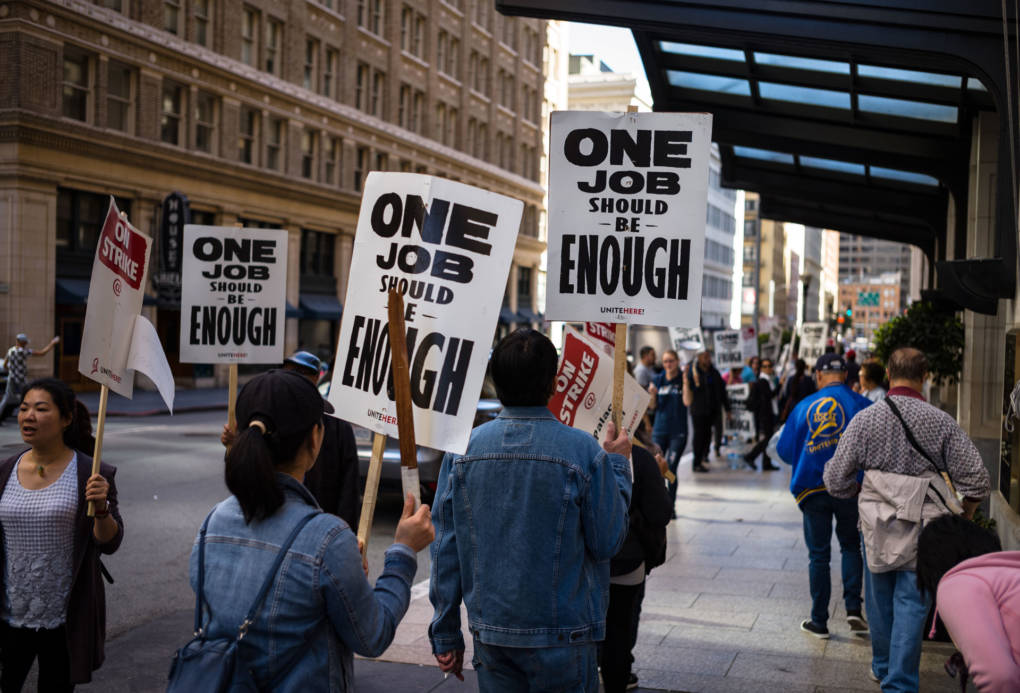
"caption": "Striking hotel workers picket outside San Francisco's Palace Hotel, part of Marriott Hotels, on Oct. 6, 2018.",
"description": "Striking hotel workers picket outside San Francisco's Palace Hotel, part of Marriott Hotels, on Oct. 6, 2018.",
"title": "HotelWorkersStrike",
"credit": "\u003ca href=\"https://www.flickr.com/photos/gedankenstuecke/\">Bastian Greshake Tzovaras\u003c/a>/Flickr",
"status": "inherit",
"isLoading": false,
"fetchFailed": false
}
},
"audioPlayerReducer": {
"postId": "stream_live",
"isPaused": true,
"isPlaying": false,
"pfsActive": false,
"pledgeModalIsOpen": true,
"playerDrawerIsOpen": false,
"liveAudioPlayStartedAt": 0,
"liveAudioPlayContext": ""
},
"authorsReducer": {
"byline_news_11928188": {
"type": "authors",
"id": "byline_news_11928188",
"meta": {
"override": true
},
"slug": "byline_news_11928188",
"name": "Shreeya Aranake",
"isLoading": false
},
"byline_news_11896516": {
"type": "authors",
"id": "byline_news_11896516",
"meta": {
"override": true
},
"slug": "byline_news_11896516",
"name": "\u003ca href=\"https://calmatters.org/author/mikhailzinshteyn/\">Mikhail Zinshteyn\u003c/a>",
"isLoading": false
},
"byline_news_11734173": {
"type": "authors",
"id": "byline_news_11734173",
"meta": {
"override": true
},
"slug": "byline_news_11734173",
"name": "Associated Press",
"isLoading": false
},
"byline_news_11717990": {
"type": "authors",
"id": "byline_news_11717990",
"meta": {
"override": true
},
"slug": "byline_news_11717990",
"name": "Elissa Nadworny, Laurel Wamsley and Francesca Paris",
"isLoading": false
},
"kqednewsstaffandwires": {
"type": "authors",
"id": "237",
"meta": {
"index": "authors_1716337520",
"id": "237",
"found": true
},
"name": "KQED News Staff and Wires",
"firstName": "KQED News Staff and Wires",
"lastName": null,
"slug": "kqednewsstaffandwires",
"email": "onlinenewsstaff@kqed.org",
"display_author_email": false,
"staff_mastheads": [],
"title": null,
"bio": null,
"avatar": "https://secure.gravatar.com/avatar/72295af8ebbfbd19a4948f5271285664?s=600&d=blank&r=g",
"twitter": null,
"facebook": null,
"instagram": null,
"linkedin": null,
"sites": [
{
"site": "arts",
"roles": [
"contributor"
]
},
{
"site": "news",
"roles": [
"contributor"
]
},
{
"site": "lowdown",
"roles": [
"author"
]
},
{
"site": "stateofhealth",
"roles": [
"contributor"
]
},
{
"site": "food",
"roles": [
"author"
]
}
],
"headData": {
"title": "KQED News Staff and Wires | KQED",
"description": null,
"ogImgSrc": "https://secure.gravatar.com/avatar/72295af8ebbfbd19a4948f5271285664?s=600&d=blank&r=g",
"twImgSrc": "https://secure.gravatar.com/avatar/72295af8ebbfbd19a4948f5271285664?s=600&d=blank&r=g"
},
"isLoading": false,
"link": "/author/kqednewsstaffandwires"
},
"tgoldberg": {
"type": "authors",
"id": "258",
"meta": {
"index": "authors_1716337520",
"id": "258",
"found": true
},
"name": "Ted Goldberg",
"firstName": "Ted",
"lastName": "Goldberg",
"slug": "tgoldberg",
"email": "tgoldberg@kqed.org",
"display_author_email": true,
"staff_mastheads": [
"news"
],
"title": "KQED Managing Editor, News and Newscasts",
"bio": "Ted Goldberg is Managing Editor of News and Newscasts at KQED. His main reporting beat is the Bay Area's oil refining industry.\r\n\r\nPrior to joining KQED in 2014, Ted worked at CBS News and WCBS AM in New York and Bay City News and KCBS Radio in San Francisco. He graduated from Oberlin College in Ohio in 1998.",
"avatar": "https://secure.gravatar.com/avatar/30ce2e4fe89135e104f89be2394d16225b9d36c121b5b3cb7651ce642978b96f?s=600&d=blank&r=g",
"twitter": "TedrickG",
"bluesky": null,
"facebook": null,
"instagram": null,
"linkedin": null,
"sites": [
{
"site": "news",
"roles": [
"editor"
]
},
{
"site": "science",
"roles": [
"editor"
]
}
],
"headData": {
"title": "Ted Goldberg | KQED",
"description": "KQED Managing Editor, News and Newscasts",
"ogImgSrc": "https://secure.gravatar.com/avatar/30ce2e4fe89135e104f89be2394d16225b9d36c121b5b3cb7651ce642978b96f?s=600&d=blank&r=g",
"twImgSrc": "https://secure.gravatar.com/avatar/30ce2e4fe89135e104f89be2394d16225b9d36c121b5b3cb7651ce642978b96f?s=600&d=blank&r=g"
},
"isLoading": false,
"link": "/author/tgoldberg"
},
"tychehendricks": {
"type": "authors",
"id": "259",
"meta": {
"index": "authors_1716337520",
"id": "259",
"found": true
},
"name": "Tyche Hendricks",
"firstName": "Tyche",
"lastName": "Hendricks",
"slug": "tychehendricks",
"email": "thendricks@kqed.org",
"display_author_email": true,
"staff_mastheads": [
"news"
],
"title": "KQED Senior Editor, Immigration",
"bio": "\u003cspan style=\"font-weight: 400;\">Tyche Hendricks is KQED’s senior editor for immigration, leading coverage of the policy and politics that affect California’s immigrant communities. Her work for KQED’s radio and online audiences is also carried on NPR and other national outlets. She has been recognized with awards from the Radio and Television News Directors Association, the Society for Professional Journalists; the Education Writers Association; the Best of the West and the National Federation of Community Broadcasters. Before joining KQED in 2010, Tyche spent more than a dozen years as a newspaper reporter, notably at the \u003c/span>\u003ci>\u003cspan style=\"font-weight: 400;\">San Francisco Chronicle\u003c/span>\u003c/i>\u003cspan style=\"font-weight: 400;\">. At different times she has covered criminal justice, government and politics and urban planning. Tyche has taught in the MFA Creative Writing program at the University of San Francisco and at UC Berkeley’s Graduate School of Journalism, where she was co-director of a national immigration symposium for professional journalists. She is the author of \u003c/span>\u003ci>\u003cspan style=\"font-weight: 400;\">The Wind Doesn't Need a Passport: Stories from the U.S.-Mexico Borderlands\u003c/span>\u003c/i>\u003cspan style=\"font-weight: 400;\"> (University of California Press). \u003c/span>",
"avatar": "https://secure.gravatar.com/avatar/b8ee458e2731c2d43df86882ce17267e?s=600&d=blank&r=g",
"twitter": "tychehendricks",
"facebook": null,
"instagram": null,
"linkedin": null,
"sites": [
{
"site": "news",
"roles": [
"editor"
]
},
{
"site": "stateofhealth",
"roles": [
"editor"
]
}
],
"headData": {
"title": "Tyche Hendricks | KQED",
"description": "KQED Senior Editor, Immigration",
"ogImgSrc": "https://secure.gravatar.com/avatar/b8ee458e2731c2d43df86882ce17267e?s=600&d=blank&r=g",
"twImgSrc": "https://secure.gravatar.com/avatar/b8ee458e2731c2d43df86882ce17267e?s=600&d=blank&r=g"
},
"isLoading": false,
"link": "/author/tychehendricks"
},
"matthewgreen": {
"type": "authors",
"id": "1263",
"meta": {
"index": "authors_1716337520",
"id": "1263",
"found": true
},
"name": "Matthew Green",
"firstName": "Matthew",
"lastName": "Green",
"slug": "matthewgreen",
"email": "mgreen@kqed.org",
"display_author_email": false,
"staff_mastheads": [],
"title": "KQED Editor/Reporter",
"bio": "Matthew Green is a digital media producer for KQED News. He previously produced \u003ca href=\"http://www.kqed.org/lowdown\">The Lowdown\u003c/a>, KQED’s multimedia news education blog. Matthew's written for numerous Bay Area publications, including the Oakland Tribune and San Francisco Chronicle. He also taught journalism classes at Fremont High School in East Oakland.\r\n\r\nEmail: mgreen@kqed.org; Twitter: @MGreenKQED",
"avatar": "https://secure.gravatar.com/avatar/3bf498d1267ca02c8494f33d8cfc575e?s=600&d=blank&r=g",
"twitter": "MGreenKQED",
"facebook": null,
"instagram": null,
"linkedin": null,
"sites": [
{
"site": "news",
"roles": []
},
{
"site": "lowdown",
"roles": []
},
{
"site": "science",
"roles": []
},
{
"site": "education",
"roles": []
},
{
"site": "quest",
"roles": []
},
{
"site": "liveblog",
"roles": []
}
],
"headData": {
"title": "Matthew Green | KQED",
"description": "KQED Editor/Reporter",
"ogImgSrc": "https://secure.gravatar.com/avatar/3bf498d1267ca02c8494f33d8cfc575e?s=600&d=blank&r=g",
"twImgSrc": "https://secure.gravatar.com/avatar/3bf498d1267ca02c8494f33d8cfc575e?s=600&d=blank&r=g"
},
"isLoading": false,
"link": "/author/matthewgreen"
},
"esilvers": {
"type": "authors",
"id": "7237",
"meta": {
"index": "authors_1716337520",
"id": "7237",
"found": true
},
"name": "Emma Silvers",
"firstName": "Emma",
"lastName": "Silvers",
"slug": "esilvers",
"email": "esilvers@kqed.org",
"display_author_email": false,
"staff_mastheads": [],
"title": "KQED Contributor",
"bio": "Emma Silvers is an editor at KQED Arts and a former digital producer at KQED News. Born and raised in the Bay Area, she has previously been an arts and entertainment editor at the \u003cem>San Francisco Chronicle\u003c/em>, \u003cem>SF Weekly\u003c/em> and the \u003cem>San Francisco Bay Guardian.\u003c/em> \u003ca href=\"https://www.emmasilvers.com\">Her work\u003c/a> has also appeared in \u003cem>Rolling Stone\u003c/em>, Pitchfork and \u003cem>Mother Jones\u003c/em>. In 2017 she was the recipient of the Society of Professional Journalists-Northern California's award for arts and culture reporting. In 1993 she \u003ca href=\"https://www.kqed.org/pop/16759/wait-what-my-coworker-was-a-voice-over-hyperventilator-for-jurassic-park\">hyperventilated in \u003cem>Jurassic Park\u003c/em>\u003c/a>.",
"avatar": "https://secure.gravatar.com/avatar/247beada39b88ea5759db1f51dba05cf?s=600&d=blank&r=g",
"twitter": "emmaruthless",
"facebook": null,
"instagram": null,
"linkedin": null,
"sites": [
{
"site": "arts",
"roles": [
"editor"
]
},
{
"site": "news",
"roles": [
"editor"
]
},
{
"site": "pop",
"roles": [
"contributor"
]
},
{
"site": "bayareabites",
"roles": [
"editor"
]
},
{
"site": "food",
"roles": [
"contributor"
]
},
{
"site": "liveblog",
"roles": [
"editor"
]
}
],
"headData": {
"title": "Emma Silvers | KQED",
"description": "KQED Contributor",
"ogImgSrc": "https://secure.gravatar.com/avatar/247beada39b88ea5759db1f51dba05cf?s=600&d=blank&r=g",
"twImgSrc": "https://secure.gravatar.com/avatar/247beada39b88ea5759db1f51dba05cf?s=600&d=blank&r=g"
},
"isLoading": false,
"link": "/author/esilvers"
},
"lesleymcclurg": {
"type": "authors",
"id": "11229",
"meta": {
"index": "authors_1716337520",
"id": "11229",
"found": true
},
"name": "Lesley McClurg",
"firstName": "Lesley",
"lastName": "McClurg",
"slug": "lesleymcclurg",
"email": "lmcclurg@KQED.org",
"display_author_email": false,
"staff_mastheads": [
"news",
"science"
],
"title": "KQED Health Correspondent",
"bio": "Lesley McClurg is a health correspondent and fill-in host whose work is regularly rebroadcast on NPR and PBS programs. She’s earned multiple regional Emmy awards, a national and a regional Edward R. Murrow award, and was named Best Beat Reporter by the Association of Health Care Journalists. The Society of Professional Journalists has recognized her work several times, and the Society of Environmental Journalists spotlighted her coverage of California’s historic drought.\r\n\r\nBefore joining KQED in 2016, Lesley covered food and sustainability for Capital Public Radio, environmental issues for Colorado Public Radio, and reported for KUOW and KCTS 9 in Seattle. Away from the newsroom, she loves skiing with her daughter, mountain biking with her partner, and playing with Ollie, the family’s goldendoodle. On deadline, she runs almost entirely on chocolate chips.\r\n\r\n ",
"avatar": "https://secure.gravatar.com/avatar/bab49e972ea10c774fe0f5e29dba1722b158f7c0d58a360923d1389d380b2978?s=600&d=blank&r=g",
"twitter": "lesleywmcclurg",
"bluesky": null,
"facebook": null,
"instagram": null,
"linkedin": null,
"sites": [
{
"site": "arts",
"roles": [
"author"
]
},
{
"site": "news",
"roles": [
"editor"
]
},
{
"site": "futureofyou",
"roles": [
"editor"
]
},
{
"site": "stateofhealth",
"roles": [
"author"
]
},
{
"site": "science",
"roles": [
"editor"
]
},
{
"site": "quest",
"roles": [
"subscriber"
]
},
{
"site": "forum",
"roles": [
"administrator"
]
},
{
"site": "liveblog",
"roles": [
"author"
]
}
],
"headData": {
"title": "Lesley McClurg | KQED",
"description": "KQED Health Correspondent",
"ogImgSrc": "https://secure.gravatar.com/avatar/bab49e972ea10c774fe0f5e29dba1722b158f7c0d58a360923d1389d380b2978?s=600&d=blank&r=g",
"twImgSrc": "https://secure.gravatar.com/avatar/bab49e972ea10c774fe0f5e29dba1722b158f7c0d58a360923d1389d380b2978?s=600&d=blank&r=g"
},
"isLoading": false,
"link": "/author/lesleymcclurg"
},
"avignet": {
"type": "authors",
"id": "11683",
"meta": {
"index": "authors_1716337520",
"id": "11683",
"found": true
},
"name": "Anna Vignet",
"firstName": "Anna",
"lastName": "Vignet",
"slug": "avignet",
"email": "avignet@kqed.org",
"display_author_email": false,
"staff_mastheads": [
"news"
],
"title": "KQED Contributor",
"bio": null,
"avatar": "https://secure.gravatar.com/avatar/75b1c67fd0f5915bc8c1514aca495240?s=600&d=blank&r=g",
"twitter": null,
"facebook": null,
"instagram": null,
"linkedin": null,
"sites": [
{
"site": "arts",
"roles": [
"author"
]
},
{
"site": "news",
"roles": [
"editor"
]
}
],
"headData": {
"title": "Anna Vignet | KQED",
"description": "KQED Contributor",
"ogImgSrc": "https://secure.gravatar.com/avatar/75b1c67fd0f5915bc8c1514aca495240?s=600&d=blank&r=g",
"twImgSrc": "https://secure.gravatar.com/avatar/75b1c67fd0f5915bc8c1514aca495240?s=600&d=blank&r=g"
},
"isLoading": false,
"link": "/author/avignet"
}
},
"pagesReducer": {
"news_tag_labor-strikes": {
"type": "terms",
"id": "news_24590",
"meta": {
"index": "terms_1716263798",
"site": "news",
"id": "24590",
"score": 10.403227
},
"featImg": null,
"name": "labor strikes",
"description": null,
"taxonomy": "tag",
"headData": {
"twImgId": null,
"twTitle": null,
"ogTitle": null,
"ogImgId": null,
"twDescription": null,
"description": null,
"title": "labor strikes Archives | KQED News",
"ogDescription": null
},
"ttid": 24607,
"slug": "labor-strikes",
"isLoading": false,
"title": "labor strikes",
"pageMeta": {
"site": "news",
"WpPageTemplate": "page-topic-editorial",
"currentPage": 8
},
"blocks": [
{
"blockName": "kqed/post-list",
"attrs": {
"layout": "cardArticle2",
"query": "posts/news?tag=labor-strikes",
"seeMore": false,
"paginated": true,
"page": 8
}
},
{
"blockName": "kqed/ad"
}
]
}
},
"pfsSessionReducer": {},
"postsReducer": {
"stream_live": {
"type": "live",
"id": "stream_live",
"audioUrl": "https://streams.kqed.org/kqedradio",
"title": "Live Stream",
"excerpt": "Live Stream information currently unavailable.",
"link": "/radio",
"featImg": "",
"label": {
"name": "KQED Live",
"link": "/"
}
},
"stream_kqedNewscast": {
"type": "posts",
"id": "stream_kqedNewscast",
"audioUrl": "https://www.kqed.org/.stream/anon/radio/RDnews/newscast.mp3?_=1",
"title": "KQED Newscast",
"featImg": "",
"label": {
"name": "88.5 FM",
"link": "/"
}
},
"news_11928188": {
"type": "posts",
"id": "news_11928188",
"meta": {
"index": "posts_1716263798",
"site": "news",
"id": "11928188",
"score": null,
"sort": [
1665417646000
]
},
"parent": 0,
"labelTerm": {
"site": "news"
},
"blocks": [],
"publishDate": 1665417646,
"format": "standard",
"disqusTitle": "Agreement Reached With Striking Janitors at Meta Offices",
"title": "Agreement Reached With Striking Janitors at Meta Offices",
"headTitle": "KQED News",
"content": "\u003cp style=\"text-align: left;\">\u003ci>Updated Tuesday, 11 a.m.\u003c/i>\u003c/p>\n\u003cp>Janitors who clean Meta’s offices reached an agreement with the contracting firm that hires them, ending a strike that started last week in response to mass layoffs.\u003c/p>\n\u003cp>\"From the negotiations that happened over the weekend, we were able to reduce the amount of layoffs and increase sustainability of the workforce that is still there,\" said Sebastian Silva, communications coordinator for Service Employees International Union-United Service Workers West, the union representing many janitors in Silicon Valley. [pullquote size=\"medium\" align=\"right\" citation=\"David Huerta, president, SEIU-USWW\"]'It is critical they remember that USWW members' work has always been — and will continue to be — essential and that workers deserve jobs with dignity.'[/pullquote]The agreement that was reached on Sunday night with SBM Management, the contractor that handles Meta’s janitorial services, includes severance pay and health care for impacted workers, Silva said.\u003c/p>\n\u003cp>\"We also wanted to make sure the workload for the remaining workers is sustainable,\" he added.\u003c/p>\n\u003cp>Workers went on strike last week after more than 120 janitors were laid off by SBM.\u003c/p>\n\u003cp>The downsizing effort resulted in increased and excessive workloads for remaining employees, and fewer unionized workers, SEIU-USWW said in a statement.\u003c/p>\n\u003cp>\"We thank Meta for listening to workers' demands for safer working conditions and covering wages and benefits for workers during the pandemic,\" David Huerta, president of SEIU-USWW, said in a statement. \"We also thank them for intervening and working towards a resolution with the site contractor, SBM. As employers, like Meta and SBM look ahead, it is critical they remember that USWW members' work has always been — and will continue to be — essential and that workers deserve jobs with dignity.\"\u003c/p>\n\u003cp>“For us it’s a victory when you can tell workers that they can go back to their jobs, and that's a big win for us,” said Olga Miranda, president of SEIU Local 87.\u003c/p>\n\u003cp>Miranda also said that despite the win at Meta, similar efforts to reduce janitorial staff are still happening at other tech companies, where her union is working to organize more workers.\u003c/p>\n\u003cfigure id=\"attachment_11928190\" class=\"wp-caption alignnone\" style=\"max-width: 800px\">\u003cimg class=\"size-medium wp-image-11928190\" src=\"https://ww2.kqed.org/app/uploads/sites/10/2022/10/RS59142_DSC09718-qut-800x533.jpg\" alt=\"A person stands center frame shouting into a megaphone with another person standing just behind them and to the side clapping excitedly. \" width=\"800\" height=\"533\" srcset=\"https://ww2.kqed.org/app/uploads/sites/10/2022/10/RS59142_DSC09718-qut-800x533.jpg 800w, https://ww2.kqed.org/app/uploads/sites/10/2022/10/RS59142_DSC09718-qut-1020x680.jpg 1020w, https://ww2.kqed.org/app/uploads/sites/10/2022/10/RS59142_DSC09718-qut-160x107.jpg 160w, https://ww2.kqed.org/app/uploads/sites/10/2022/10/RS59142_DSC09718-qut-1536x1024.jpg 1536w, https://ww2.kqed.org/app/uploads/sites/10/2022/10/RS59142_DSC09718-qut.jpg 1920w\" sizes=\"(max-width: 800px) 100vw, 800px\">\u003cfigcaption class=\"wp-caption-text\">David Huerta, SEIU-USWW president, addresses the crowd outside a Meta store in Burlingame, on Oct. 7, 2022. \u003ccite>(Aryk Copley/KQED)\u003c/cite>\u003c/figcaption>\u003c/figure>\n\u003cp>\"We will stand up to each and every form of corporate harassment and continue to intensify the fight for safe working conditions, as well as dignity and respect for Meta’s cleaning workers,” Huerta told striking workers at a rally on Friday outside Meta’s Burlingame offices.[aside postID=\"news_11928247\" label=\"Related Post\"]The crowd of largely Latinx workers shouted labor chants like, \"Arriba la union, abajo la explotación\" (which in English means, \"Up with the union, down with exploitation\") and \"SBM, escucha, estamos en la lucha\" (\"SBM, listen, we are in the fight\").\u003c/p>\n\u003cfigure id=\"attachment_11928191\" class=\"wp-caption alignnone\" style=\"max-width: 800px\">\u003cimg class=\"wp-image-11928191 size-medium\" src=\"https://ww2.kqed.org/app/uploads/sites/10/2022/10/RS59110_DSC08166-qut-800x533.jpg\" alt=\"An upward-angled picture of several people in a crowd clapping\" width=\"800\" height=\"533\" srcset=\"https://ww2.kqed.org/app/uploads/sites/10/2022/10/RS59110_DSC08166-qut-800x533.jpg 800w, https://ww2.kqed.org/app/uploads/sites/10/2022/10/RS59110_DSC08166-qut-1020x680.jpg 1020w, https://ww2.kqed.org/app/uploads/sites/10/2022/10/RS59110_DSC08166-qut-160x107.jpg 160w, https://ww2.kqed.org/app/uploads/sites/10/2022/10/RS59110_DSC08166-qut-1536x1024.jpg 1536w, https://ww2.kqed.org/app/uploads/sites/10/2022/10/RS59110_DSC08166-qut.jpg 1920w\" sizes=\"(max-width: 800px) 100vw, 800px\">\u003cfigcaption class=\"wp-caption-text\">Janitorial workers from two SEIU chapters, SEIU-USWW and SEIU Local 87, are striking in solidarity with each other. \u003ccite>(Aryk Copley/KQED)\u003c/cite>\u003c/figcaption>\u003c/figure>\n\u003cp>Janitor Maria Garcia said her duties more than doubled after SBM began laying off employees, and as a single mother she struggles to be apart from her children for so long. Garcia said she also misses her co-workers who were let go.\u003c/p>\n\u003cp>\"I keep my fingers crossed to see my brothers and sisters come back. I want that,\" said Garcia. \"I don’t ask for money. I want to see my people come back. And more respect. I want respect because when you have respect and love, everything goes more smooth.\"\u003c/p>\n\u003cfigure id=\"attachment_11928192\" class=\"wp-caption alignnone\" style=\"max-width: 800px\">\u003cimg class=\"wp-image-11928192 size-medium\" src=\"https://ww2.kqed.org/app/uploads/sites/10/2022/10/RS59127_DSC09516-qut-800x533.jpg\" alt='A picket sign that reads \"Justice for Janitors\"' width=\"800\" height=\"533\" srcset=\"https://ww2.kqed.org/app/uploads/sites/10/2022/10/RS59127_DSC09516-qut-800x533.jpg 800w, https://ww2.kqed.org/app/uploads/sites/10/2022/10/RS59127_DSC09516-qut-1020x680.jpg 1020w, https://ww2.kqed.org/app/uploads/sites/10/2022/10/RS59127_DSC09516-qut-160x107.jpg 160w, https://ww2.kqed.org/app/uploads/sites/10/2022/10/RS59127_DSC09516-qut-1536x1024.jpg 1536w, https://ww2.kqed.org/app/uploads/sites/10/2022/10/RS59127_DSC09516-qut.jpg 1920w\" sizes=\"(max-width: 800px) 100vw, 800px\">\u003cfigcaption class=\"wp-caption-text\">As part of their negotiations, striking janitors are calling for their former co-workers who were laid off to be rehired. \u003ccite>(Aryk Copley/KQED)\u003c/cite>\u003c/figcaption>\u003c/figure>\n\u003cp>Meta pointed out in a statement that they worked to ensure workers were paid throughout the pandemic, even when offices were shut down. While workers don’t contest that, they argue the recent layoffs with no advance warning fly in the face of Meta’s rhetoric during that time, when the Facebook parent company regarded its janitorial staff as essential and valued workers.\u003c/p>\n\u003cfigure id=\"attachment_11928193\" class=\"wp-caption alignnone\" style=\"max-width: 800px\">\u003cimg class=\"wp-image-11928193 size-medium\" src=\"https://ww2.kqed.org/app/uploads/sites/10/2022/10/RS59160_DSC09864-qut-800x533.jpg\" alt=\"A person wearing a grey wide-brimmed hat and purple shirt reading justice for janitors faces the camera while holding a picket sign.\" width=\"800\" height=\"533\" srcset=\"https://ww2.kqed.org/app/uploads/sites/10/2022/10/RS59160_DSC09864-qut-800x533.jpg 800w, https://ww2.kqed.org/app/uploads/sites/10/2022/10/RS59160_DSC09864-qut-1020x680.jpg 1020w, https://ww2.kqed.org/app/uploads/sites/10/2022/10/RS59160_DSC09864-qut-160x107.jpg 160w, https://ww2.kqed.org/app/uploads/sites/10/2022/10/RS59160_DSC09864-qut-1536x1024.jpg 1536w, https://ww2.kqed.org/app/uploads/sites/10/2022/10/RS59160_DSC09864-qut.jpg 1920w\" sizes=\"(max-width: 800px) 100vw, 800px\">\u003cfigcaption class=\"wp-caption-text\">Workers say the layoffs have resulted in increased and excessive workloads for those who remain. \u003ccite>(Aryk Copley/KQED)\u003c/cite>\u003c/figcaption>\u003c/figure>\n\u003cp>\u003cem>KQED's Juan Carlos Lara and Spencer Whitney contributed reporting to this story.\u003c/em>\u003c/p>\n\u003cp>[ad fullwidth]\u003c/p>\n\u003cp>\u003c/p>\n",
"disqusIdentifier": "11928188 https://ww2.kqed.org/news/?p=11928188",
"disqusUrl": "https://ww2.kqed.org/news/2022/10/10/mass-janitor-layoffs-at-meta-offices-trigger-open-ended-strike/",
"stats": {
"hasVideo": false,
"hasChartOrMap": false,
"hasAudio": false,
"hasPolis": false,
"wordCount": 720,
"hasGoogleForm": false,
"hasGallery": false,
"hasHearkenModule": false,
"iframeSrcs": [],
"paragraphCount": 15
},
"modified": 1665552623,
"excerpt": "Janitors reached an agreement with Meta on Sunday night, ending the strike that started last week in response to mass layoffs.",
"headData": {
"twImgId": "",
"twTitle": "",
"ogTitle": "",
"ogImgId": "",
"twDescription": "",
"description": "Janitors reached an agreement with Meta on Sunday night, ending the strike that started last week in response to mass layoffs.",
"title": "Agreement Reached With Striking Janitors at Meta Offices | KQED",
"ogDescription": "",
"schema": {
"@context": "https://schema.org",
"@type": "NewsArticle",
"headline": "Agreement Reached With Striking Janitors at Meta Offices",
"datePublished": "2022-10-10T09:00:46-07:00",
"dateModified": "2022-10-11T22:30:23-07:00",
"image": "https://cdn.kqed.org/wp-content/uploads/2020/02/KQED-OG-Image@1x.png",
"isAccessibleForFree": "True",
"publisher": {
"@type": "NewsMediaOrganization",
"@id": "https://www.kqed.org/#organization",
"name": "KQED",
"logo": "https://cdn.kqed.org/wp-content/uploads/2020/02/KQED-OG-Image@1x.png",
"url": "https://www.kqed.org",
"sameAs": [
"https://www.facebook.com/KQED",
"https://twitter.com/KQED",
"https://www.instagram.com/kqed/",
"https://www.tiktok.com/@kqedofficial",
"https://www.linkedin.com/company/kqed",
"https://www.youtube.com/channel/UCeC0IOo7i1P_61zVUWbJ4nw"
]
}
}
},
"guestAuthors": [],
"slug": "mass-janitor-layoffs-at-meta-offices-trigger-open-ended-strike",
"status": "publish",
"audioUrl": "https://traffic.omny.fm/d/clips/0af137ef-751e-4b19-a055-aaef00d2d578/ffca7e9f-6831-4[…]f-aaef00f5a073/b83800ae-9f19-41b0-8c17-af2a00faca50/audio.mp3",
"nprByline": "Shreeya Aranake",
"excludeFromSiteSearch": "Include",
"showOnAuthorArchivePages": "No",
"path": "/news/11928188/mass-janitor-layoffs-at-meta-offices-trigger-open-ended-strike",
"audioTrackLength": null,
"parsedContent": [
{
"type": "contentString",
"content": "\u003cdiv class=\"post-body\">\u003cp>\u003cp style=\"text-align: left;\">\u003ci>Updated Tuesday, 11 a.m.\u003c/i>\u003c/p>\n\u003cp>Janitors who clean Meta’s offices reached an agreement with the contracting firm that hires them, ending a strike that started last week in response to mass layoffs.\u003c/p>\n\u003cp>\"From the negotiations that happened over the weekend, we were able to reduce the amount of layoffs and increase sustainability of the workforce that is still there,\" said Sebastian Silva, communications coordinator for Service Employees International Union-United Service Workers West, the union representing many janitors in Silicon Valley. \u003c/p>\u003c/div>",
"attributes": {
"named": {},
"numeric": []
}
},
{
"type": "component",
"content": "'It is critical they remember that USWW members' work has always been — and will continue to be — essential and that workers deserve jobs with dignity.'",
"name": "pullquote",
"attributes": {
"named": {
"size": "medium",
"align": "right",
"citation": "David Huerta, president, SEIU-USWW",
"label": ""
},
"numeric": []
}
},
{
"type": "contentString",
"content": "\u003cdiv class=\"post-body\">\u003cp>The agreement that was reached on Sunday night with SBM Management, the contractor that handles Meta’s janitorial services, includes severance pay and health care for impacted workers, Silva said.\u003c/p>\n\u003cp>\"We also wanted to make sure the workload for the remaining workers is sustainable,\" he added.\u003c/p>\n\u003cp>Workers went on strike last week after more than 120 janitors were laid off by SBM.\u003c/p>\n\u003cp>The downsizing effort resulted in increased and excessive workloads for remaining employees, and fewer unionized workers, SEIU-USWW said in a statement.\u003c/p>\n\u003cp>\"We thank Meta for listening to workers' demands for safer working conditions and covering wages and benefits for workers during the pandemic,\" David Huerta, president of SEIU-USWW, said in a statement. \"We also thank them for intervening and working towards a resolution with the site contractor, SBM. As employers, like Meta and SBM look ahead, it is critical they remember that USWW members' work has always been — and will continue to be — essential and that workers deserve jobs with dignity.\"\u003c/p>\n\u003cp>“For us it’s a victory when you can tell workers that they can go back to their jobs, and that's a big win for us,” said Olga Miranda, president of SEIU Local 87.\u003c/p>\n\u003cp>Miranda also said that despite the win at Meta, similar efforts to reduce janitorial staff are still happening at other tech companies, where her union is working to organize more workers.\u003c/p>\n\u003cfigure id=\"attachment_11928190\" class=\"wp-caption alignnone\" style=\"max-width: 800px\">\u003cimg class=\"size-medium wp-image-11928190\" src=\"https://ww2.kqed.org/app/uploads/sites/10/2022/10/RS59142_DSC09718-qut-800x533.jpg\" alt=\"A person stands center frame shouting into a megaphone with another person standing just behind them and to the side clapping excitedly. \" width=\"800\" height=\"533\" srcset=\"https://ww2.kqed.org/app/uploads/sites/10/2022/10/RS59142_DSC09718-qut-800x533.jpg 800w, https://ww2.kqed.org/app/uploads/sites/10/2022/10/RS59142_DSC09718-qut-1020x680.jpg 1020w, https://ww2.kqed.org/app/uploads/sites/10/2022/10/RS59142_DSC09718-qut-160x107.jpg 160w, https://ww2.kqed.org/app/uploads/sites/10/2022/10/RS59142_DSC09718-qut-1536x1024.jpg 1536w, https://ww2.kqed.org/app/uploads/sites/10/2022/10/RS59142_DSC09718-qut.jpg 1920w\" sizes=\"(max-width: 800px) 100vw, 800px\">\u003cfigcaption class=\"wp-caption-text\">David Huerta, SEIU-USWW president, addresses the crowd outside a Meta store in Burlingame, on Oct. 7, 2022. \u003ccite>(Aryk Copley/KQED)\u003c/cite>\u003c/figcaption>\u003c/figure>\n\u003cp>\"We will stand up to each and every form of corporate harassment and continue to intensify the fight for safe working conditions, as well as dignity and respect for Meta’s cleaning workers,” Huerta told striking workers at a rally on Friday outside Meta’s Burlingame offices.\u003c/p>\u003c/div>",
"attributes": {
"named": {},
"numeric": []
}
},
{
"type": "component",
"content": "",
"name": "aside",
"attributes": {
"named": {
"postid": "news_11928247",
"label": "Related Post "
},
"numeric": []
}
},
{
"type": "contentString",
"content": "\u003cdiv class=\"post-body\">\u003cp>The crowd of largely Latinx workers shouted labor chants like, \"Arriba la union, abajo la explotación\" (which in English means, \"Up with the union, down with exploitation\") and \"SBM, escucha, estamos en la lucha\" (\"SBM, listen, we are in the fight\").\u003c/p>\n\u003cfigure id=\"attachment_11928191\" class=\"wp-caption alignnone\" style=\"max-width: 800px\">\u003cimg class=\"wp-image-11928191 size-medium\" src=\"https://ww2.kqed.org/app/uploads/sites/10/2022/10/RS59110_DSC08166-qut-800x533.jpg\" alt=\"An upward-angled picture of several people in a crowd clapping\" width=\"800\" height=\"533\" srcset=\"https://ww2.kqed.org/app/uploads/sites/10/2022/10/RS59110_DSC08166-qut-800x533.jpg 800w, https://ww2.kqed.org/app/uploads/sites/10/2022/10/RS59110_DSC08166-qut-1020x680.jpg 1020w, https://ww2.kqed.org/app/uploads/sites/10/2022/10/RS59110_DSC08166-qut-160x107.jpg 160w, https://ww2.kqed.org/app/uploads/sites/10/2022/10/RS59110_DSC08166-qut-1536x1024.jpg 1536w, https://ww2.kqed.org/app/uploads/sites/10/2022/10/RS59110_DSC08166-qut.jpg 1920w\" sizes=\"(max-width: 800px) 100vw, 800px\">\u003cfigcaption class=\"wp-caption-text\">Janitorial workers from two SEIU chapters, SEIU-USWW and SEIU Local 87, are striking in solidarity with each other. \u003ccite>(Aryk Copley/KQED)\u003c/cite>\u003c/figcaption>\u003c/figure>\n\u003cp>Janitor Maria Garcia said her duties more than doubled after SBM began laying off employees, and as a single mother she struggles to be apart from her children for so long. Garcia said she also misses her co-workers who were let go.\u003c/p>\n\u003cp>\"I keep my fingers crossed to see my brothers and sisters come back. I want that,\" said Garcia. \"I don’t ask for money. I want to see my people come back. And more respect. I want respect because when you have respect and love, everything goes more smooth.\"\u003c/p>\n\u003cfigure id=\"attachment_11928192\" class=\"wp-caption alignnone\" style=\"max-width: 800px\">\u003cimg class=\"wp-image-11928192 size-medium\" src=\"https://ww2.kqed.org/app/uploads/sites/10/2022/10/RS59127_DSC09516-qut-800x533.jpg\" alt='A picket sign that reads \"Justice for Janitors\"' width=\"800\" height=\"533\" srcset=\"https://ww2.kqed.org/app/uploads/sites/10/2022/10/RS59127_DSC09516-qut-800x533.jpg 800w, https://ww2.kqed.org/app/uploads/sites/10/2022/10/RS59127_DSC09516-qut-1020x680.jpg 1020w, https://ww2.kqed.org/app/uploads/sites/10/2022/10/RS59127_DSC09516-qut-160x107.jpg 160w, https://ww2.kqed.org/app/uploads/sites/10/2022/10/RS59127_DSC09516-qut-1536x1024.jpg 1536w, https://ww2.kqed.org/app/uploads/sites/10/2022/10/RS59127_DSC09516-qut.jpg 1920w\" sizes=\"(max-width: 800px) 100vw, 800px\">\u003cfigcaption class=\"wp-caption-text\">As part of their negotiations, striking janitors are calling for their former co-workers who were laid off to be rehired. \u003ccite>(Aryk Copley/KQED)\u003c/cite>\u003c/figcaption>\u003c/figure>\n\u003cp>Meta pointed out in a statement that they worked to ensure workers were paid throughout the pandemic, even when offices were shut down. While workers don’t contest that, they argue the recent layoffs with no advance warning fly in the face of Meta’s rhetoric during that time, when the Facebook parent company regarded its janitorial staff as essential and valued workers.\u003c/p>\n\u003cfigure id=\"attachment_11928193\" class=\"wp-caption alignnone\" style=\"max-width: 800px\">\u003cimg class=\"wp-image-11928193 size-medium\" src=\"https://ww2.kqed.org/app/uploads/sites/10/2022/10/RS59160_DSC09864-qut-800x533.jpg\" alt=\"A person wearing a grey wide-brimmed hat and purple shirt reading justice for janitors faces the camera while holding a picket sign.\" width=\"800\" height=\"533\" srcset=\"https://ww2.kqed.org/app/uploads/sites/10/2022/10/RS59160_DSC09864-qut-800x533.jpg 800w, https://ww2.kqed.org/app/uploads/sites/10/2022/10/RS59160_DSC09864-qut-1020x680.jpg 1020w, https://ww2.kqed.org/app/uploads/sites/10/2022/10/RS59160_DSC09864-qut-160x107.jpg 160w, https://ww2.kqed.org/app/uploads/sites/10/2022/10/RS59160_DSC09864-qut-1536x1024.jpg 1536w, https://ww2.kqed.org/app/uploads/sites/10/2022/10/RS59160_DSC09864-qut.jpg 1920w\" sizes=\"(max-width: 800px) 100vw, 800px\">\u003cfigcaption class=\"wp-caption-text\">Workers say the layoffs have resulted in increased and excessive workloads for those who remain. \u003ccite>(Aryk Copley/KQED)\u003c/cite>\u003c/figcaption>\u003c/figure>\n\u003cp>\u003cem>KQED's Juan Carlos Lara and Spencer Whitney contributed reporting to this story.\u003c/em>\u003c/p>\n\u003cp>\u003c/p>\u003c/div>",
"attributes": {
"named": {},
"numeric": []
}
},
{
"type": "component",
"content": "",
"name": "ad",
"attributes": {
"named": {
"label": "fullwidth"
},
"numeric": [
"fullwidth"
]
}
},
{
"type": "contentString",
"content": "\u003cdiv class=\"post-body\">\u003cp>\u003c/p>\n\u003cp>\u003c/p>\n\u003c/div>\u003c/p>",
"attributes": {
"named": {},
"numeric": []
}
}
],
"link": "/news/11928188/mass-janitor-layoffs-at-meta-offices-trigger-open-ended-strike",
"authors": [
"byline_news_11928188"
],
"categories": [
"news_1758",
"news_28250",
"news_8"
],
"tags": [
"news_249",
"news_19948",
"news_19904",
"news_24590",
"news_20482",
"news_352",
"news_30214",
"news_214"
],
"featImg": "news_11928189",
"label": "news"
},
"news_11927383": {
"type": "posts",
"id": "news_11927383",
"meta": {
"index": "posts_1716263798",
"site": "news",
"id": "11927383",
"score": null,
"sort": [
1664816427000
]
},
"parent": 0,
"labelTerm": {
"site": "news"
},
"blocks": [],
"publishDate": 1664816427,
"format": "standard",
"disqusTitle": "SFO Restaurant Workers Win $5 Raise, Free Family Health Care Following Strike",
"title": "SFO Restaurant Workers Win $5 Raise, Free Family Health Care Following Strike",
"headTitle": "KQED News",
"content": "\u003cp>\u003cstrong>Update, 10 a.m. Monday: \u003c/strong>Restaurant workers at San Francisco International Airport approved a new union contract on Sunday, giving them a $5 per hour raise and free family health care, after 1,000 workers went out on strike for three days last week.\u003c/p>\n\u003cp>A tentative agreement between the union and the airport's consortium of restaurants was announced Thursday, after the union's bargaining committee unanimously approved it.\u003c/p>\n\u003cp>The union said Sunday the deal passed the hospitality workers' union, UNITE HERE Local 2, by a vote of 99.5%. Workers will immediately get a $3 per hour raise, with the entire $5 raise coming by September 2024. Most workers' hourly wage will increase almost 30%, from $17.05 to $22.05.\u003c/p>\n\u003cp>Workers will also receive free platinum-tier family health insurance — including medical, dental and vision — with no premiums and co-pays of less than $30 for most doctor's visits and prescriptions.\u003c/p>\n\u003cp>The union also secured increased retirement income through a defined-benefit pension, a retention policy to protect workers' jobs when outlets change operators, and a one-time $1,500 bonus.\u003c/p>\n\u003cp>[ad fullwidth]\u003c/p>\n\u003cp>\"This victory is more than I ever dreamed of,\" said April Asfour, a cook at Boudin Bakery Café at SFO, in a statement released by UNITE HERE Local 2. \"I have six kids, and this raise will help me to support them. And with the health care that we won, I can cover all of them for free. I’m so proud that we stood up for ourselves, because everything we won will help me give my family a better life.\"\u003c/p>\n\u003cfigure id=\"attachment_11927534\" class=\"wp-caption aligncenter\" style=\"max-width: 800px\">\u003ca href=\"https://ww2.kqed.org/app/uploads/sites/10/2022/09/IMG_5798-scaled.jpg\">\u003cimg class=\"size-medium wp-image-11927534\" src=\"https://ww2.kqed.org/app/uploads/sites/10/2022/09/IMG_5798-800x533.jpg\" alt=\"a group of seven people in an office look over a contract\" width=\"800\" height=\"533\" srcset=\"https://ww2.kqed.org/app/uploads/sites/10/2022/09/IMG_5798-800x533.jpg 800w, https://ww2.kqed.org/app/uploads/sites/10/2022/09/IMG_5798-1020x680.jpg 1020w, https://ww2.kqed.org/app/uploads/sites/10/2022/09/IMG_5798-160x107.jpg 160w, https://ww2.kqed.org/app/uploads/sites/10/2022/09/IMG_5798-1536x1024.jpg 1536w, https://ww2.kqed.org/app/uploads/sites/10/2022/09/IMG_5798-2048x1365.jpg 2048w, https://ww2.kqed.org/app/uploads/sites/10/2022/09/IMG_5798-1920x1280.jpg 1920w\" sizes=\"(max-width: 800px) 100vw, 800px\">\u003c/a>\u003cfigcaption class=\"wp-caption-text\">SFO restaurant workers vote on the new contract guaranteeing a $5 an hour raise, among other benefits. \u003ccite>(Courtesy UNITE HERE)\u003c/cite>\u003c/figcaption>\u003c/figure>\n\u003cp>The win \"shows the world that fast-food jobs can in fact be good, family-sustaining jobs, and it's all because workers had the courage to strike,\" said Anand Singh, president of UNITE HERE Local 2. \"After three years without a raise, SFO's fast-food workers were tired of working two or even three jobs just to survive — so they took their lives into their own hands and won a better future.\"\u003c/p>\n\u003cp>According to union officials, the strike included employees at 84 food and beverage outlets throughout SFO. The contract will expire in August 2025.\u003c/p>\n\u003cp>\u003cstrong>Original post, Sept. 30:\u003c/strong> The roughly 1,000 food service workers at San Francisco International Airport who went on strike this week for higher pay and benefits will be voting on a contract Sunday that union leaders say “hits all the marks” for a living wage.\u003c/p>\n\u003cp>The deal, reached Wednesday night, just three days into the strike, showed the power of an organized workforce — a rarity in the U.S. food service industry — but it also showed the effect of some key pressure brought to bear by San Francisco's Board of Supervisors, those close to the negotiations say.\u003c/p>\n\u003cp>[aside label=\"Related Stories\" postID=\"news_11923034,news_11855621\"]When the airport cooks, dishwashers, servers, bartenders and baristas of UNITE HERE Local 2 walked off the job Monday morning, contract negotiations had been underway for nine months but union officials said the two sides remained far apart.\u003c/p>\n\u003cp>“We felt that there was no movement,” said Gabriela Mitose, 56, an airport bartender for almost 30 years who was a member of the negotiating team. “Our voices weren’t being heard. So we had to be loud.”\u003c/p>\n\u003cp>The impact of the walkout inside SFO was swift, with most restaurants, coffee shops, bars and airport lounges closing entirely or operating only limited hours.\u003c/p>\n\u003cp>“The airport restaurants can't function without the workers,” said Anand Singh, president of Local 2. “Striking is not an easy thing. But I think we were exacting a real toll on the employers that wasn't sustainable for them.”\u003c/p>\n\u003cp>[pullquote align=\"right\" size=\"medium\" citation=\"Gabriela Mitose, SFO bartender, member of Local 2\"]'Our voices weren't being heard. So we had to be loud.'[/pullquote]At every terminal, workers marched at the curb, chanting and waving union signs reading “One Job Should Be Enough.”\u003c/p>\n\u003cp>Mitose, who makes $15.10 per hour plus tips at the Lark Creek Grill, said that one job had not been enough for her to cover her mortgage payments. She worked a second job for many years, but it took a heavy toll.\u003c/p>\n\u003cp>“When you work two jobs for over 15 years, your health takes a really big hit,” she said.\u003c/p>\n\u003ch2>'Shocked and appalled'\u003c/h2>\n\u003cp>The strike made headlines, and some members of San Francisco’s Board of Supervisors joined the picket lines this week. On Tuesday night, the supervisors called a hearing on the strike.\u003c/p>\n\u003cp>Union officials testified at the hearing that airport food service workers haven’t had a raise since 2018, and more than one-third of them hold down two or more jobs. Workers described sleeping in their cars between shifts and bathing in public restrooms, because their long commutes home would rob them of precious hours to sleep.\u003c/p>\n\u003cp>“When we listed our concerns to the Board of Supervisors, they looked pretty shocked and appalled,” said Mitose, who spoke at the meeting.\u003c/p>\n\u003cp>Board members responded with outrage and noted that the city is the landlord for the restaurants who have leases to do business at the airport.\u003c/p>\n\u003cp>“It’s an embarrassment that the airport of the city and county of San Francisco treats workers like dirt,” declared Supervisor Hillary Ronen, who chairs the budget committee. “I’m going to start scrutinizing these leases like you’ve never seen before, and nothing’s getting past that committee until these workers are treated fairly.”\u003c/p>\n\u003cp>She and others urged SFO Director Ivar Satero to take a stronger role in negotiations. And, after Local 2 officials described how a handful of new businesses were ignoring the SFO requirement to allow workers to vote on union membership, supervisors pressed Satero to take action.\u003c/p>\n\u003cp>“We’ve always enjoyed such strong relationships with the unions … I feel like we really got caught off guard by this whole issue,” admitted Satero, who vowed to be more vigilant.\u003c/p>\n\u003cp>The board also pressured the group of 30 restaurant employers — who bargain jointly with Local 2 — to meet the needs of workers.\u003c/p>\n\u003cfigure id=\"attachment_11927396\" class=\"wp-caption aligncenter\" style=\"max-width: 800px\">\u003ca href=\"https://ww2.kqed.org/app/uploads/sites/10/2022/09/IMG_7729-scaled.jpeg\">\u003cimg class=\"size-medium wp-image-11927396\" src=\"https://ww2.kqed.org/app/uploads/sites/10/2022/09/IMG_7729-800x600.jpeg\" alt=\"people striking with signs outside an airport\" width=\"800\" height=\"600\" srcset=\"https://ww2.kqed.org/app/uploads/sites/10/2022/09/IMG_7729-800x600.jpeg 800w, https://ww2.kqed.org/app/uploads/sites/10/2022/09/IMG_7729-1020x765.jpeg 1020w, https://ww2.kqed.org/app/uploads/sites/10/2022/09/IMG_7729-160x120.jpeg 160w, https://ww2.kqed.org/app/uploads/sites/10/2022/09/IMG_7729-1536x1152.jpeg 1536w, https://ww2.kqed.org/app/uploads/sites/10/2022/09/IMG_7729-2048x1536.jpeg 2048w, https://ww2.kqed.org/app/uploads/sites/10/2022/09/IMG_7729-1920x1440.jpeg 1920w\" sizes=\"(max-width: 800px) 100vw, 800px\">\u003c/a>\u003cfigcaption class=\"wp-caption-text\">Striking food service workers with UNITE HERE Local 2 picket outside San Francisco International Airport on Mon., Sept. 26, 2022. They ended the strike Wednesday night after reaching a tentative deal with employers. \u003ccite>(Tyche Hendricks/KQED)\u003c/cite>\u003c/figcaption>\u003c/figure>\n\u003cp>Restaurateur Kevin Westlye, who spoke on behalf of the employer group, said the owners are pinched by inflation. And he made a pitch for the airport to let the group raise menu prices higher than the current allowance to charge 12% above prevailing “street pricing” at city restaurants.\u003c/p>\n\u003cp>“We have no issue with giving the employees more money, we have no issue with the union and we have no issue with the airport,” said Westlye. But, he added, “You’ve got us right now in an untenable vise grip.”\u003c/p>\n\u003cp>Supervisors encouraged the airport to meet the owners halfway on their inflation concerns.\u003c/p>\n\u003cp>“I see absolutely no reason you guys can’t all just get in the room. The airport’s got something to give, your employer group’s got something to give ... Local 2 already gave a lot,” said Supervisor Aaron Peskin. “So why don’t you guys go sit down and work it out and we just want to see this strike finished.”\u003c/p>\n\u003cp>A little more than 24 hours later, a tentative deal was announced.\u003c/p>\n\u003cp>Mitose, the bartender and Local 2 member, said she heard about it from a co-worker. She had been at the negotiations earlier Wednesday night but had to leave before they concluded.\u003c/p>\n\u003cp>“We got the phone call at midnight,” she said. “We were so excited. It's just such a relief to know that you can go back to work and things will get better.”\u003c/p>\n\u003ch2>'This is the workers' victory'\u003c/h2>\n\u003cp>Neither SFO nor the restaurant group would comment on what happened after Tuesday’s hearing. But Supervisor Rafael Mandelman said the airport did agree to let menu prices go up, potentially breaking the logjam.\u003c/p>\n\u003cp>“I don't know the details, but I do know that the airport is allowing the restaurants to collect some additional compensation for the workers on the checks that people are going to be paying,” he said. “So prices will go up at the airport.”\u003c/p>\n\u003cp>Mandelman added, “This is a busy airport, the gateway to San Francisco. And the city general fund benefits from payments from the airport. So we need to not have labor unrest at this airport.”\u003c/p>\n\u003cfigure id=\"attachment_11927404\" class=\"wp-caption aligncenter\" style=\"max-width: 800px\">\u003ca href=\"https://ww2.kqed.org/app/uploads/sites/10/2022/09/IMG_7757-scaled.jpeg\">\u003cimg class=\"size-medium wp-image-11927404\" src=\"https://ww2.kqed.org/app/uploads/sites/10/2022/09/IMG_7757-800x600.jpeg\" alt=\"a woman with a shirt that says 'one job should be enough'\" width=\"800\" height=\"600\" srcset=\"https://ww2.kqed.org/app/uploads/sites/10/2022/09/IMG_7757-800x600.jpeg 800w, https://ww2.kqed.org/app/uploads/sites/10/2022/09/IMG_7757-1020x765.jpeg 1020w, https://ww2.kqed.org/app/uploads/sites/10/2022/09/IMG_7757-160x120.jpeg 160w, https://ww2.kqed.org/app/uploads/sites/10/2022/09/IMG_7757-1536x1152.jpeg 1536w, https://ww2.kqed.org/app/uploads/sites/10/2022/09/IMG_7757-2048x1536.jpeg 2048w, https://ww2.kqed.org/app/uploads/sites/10/2022/09/IMG_7757-1920x1440.jpeg 1920w\" sizes=\"(max-width: 800px) 100vw, 800px\">\u003c/a>\u003cfigcaption class=\"wp-caption-text\">Striking food service workers with UNITE HERE Local 2 picket outside San Francisco International Airport on Mon., Sept. 26, 2022. \u003ccite>(Tyche Hendricks/KQED)\u003c/cite>\u003c/figcaption>\u003c/figure>\n\u003cp>Singh, the union president, would not reveal the details of the three-year contract before workers vote to ratify it on Sunday. But he said it includes “significant” raises and fully paid family health insurance.\u003c/p>\n\u003cp>“We’re very excited by this deal,” he said. “It hits all the marks.”\u003c/p>\n\u003cp>And he credited the supervisors — who, he pointed out, rarely speak in unison on anything.\u003c/p>\n\u003cp>“There's no question that the Board of Supervisors had a real impact here. ... They were really shoulder to shoulder and unanimous in their support of the workers,” Singh said. But, he added, “At the end of the day, this is the workers' victory.”\u003c/p>\n\u003cp>Mitose was back at her job Thursday at the Lark Creek Grill in Terminal 2.\u003c/p>\n\u003cp>“We’re open for business, and everybody's coming in with happy faces,” she said. “When you don’t have that extra stress about your paycheck, you come in with a better attitude. So you’re going to get way better service.”\u003c/p>\n\u003cp>[ad floatright]\u003c/p>\n\u003cp>\u003cem>The update to this story includes reporting from Bay City News.\u003c/em>\u003c/p>\n\n",
"disqusIdentifier": "11927383 https://ww2.kqed.org/news/?p=11927383",
"disqusUrl": "https://ww2.kqed.org/news/2022/10/03/pressure-from-sf-supes-helped-striking-sfo-restaurant-workers-win-a-deal/",
"stats": {
"hasVideo": false,
"hasChartOrMap": false,
"hasAudio": false,
"hasPolis": false,
"wordCount": 1713,
"hasGoogleForm": false,
"hasGallery": false,
"hasHearkenModule": false,
"iframeSrcs": [],
"paragraphCount": 44
},
"modified": 1664823495,
"excerpt": "The new contract comes after nine months of negotiations, according to union officials, who said restaurant workers at the airport hadn't received a raise in three years.",
"headData": {
"twImgId": "",
"twTitle": "",
"ogTitle": "",
"ogImgId": "",
"twDescription": "",
"description": "The new contract comes after nine months of negotiations, according to union officials, who said restaurant workers at the airport hadn't received a raise in three years.",
"title": "SFO Restaurant Workers Win $5 Raise, Free Family Health Care Following Strike | KQED",
"ogDescription": "",
"schema": {
"@context": "https://schema.org",
"@type": "NewsArticle",
"headline": "SFO Restaurant Workers Win $5 Raise, Free Family Health Care Following Strike",
"datePublished": "2022-10-03T10:00:27-07:00",
"dateModified": "2022-10-03T11:58:15-07:00",
"image": "https://cdn.kqed.org/wp-content/uploads/2020/02/KQED-OG-Image@1x.png",
"isAccessibleForFree": "True",
"publisher": {
"@type": "NewsMediaOrganization",
"@id": "https://www.kqed.org/#organization",
"name": "KQED",
"logo": "https://cdn.kqed.org/wp-content/uploads/2020/02/KQED-OG-Image@1x.png",
"url": "https://www.kqed.org",
"sameAs": [
"https://www.facebook.com/KQED",
"https://twitter.com/KQED",
"https://www.instagram.com/kqed/",
"https://www.tiktok.com/@kqedofficial",
"https://www.linkedin.com/company/kqed",
"https://www.youtube.com/channel/UCeC0IOo7i1P_61zVUWbJ4nw"
]
}
}
},
"guestAuthors": [],
"slug": "pressure-from-sf-supes-helped-striking-sfo-restaurant-workers-win-a-deal",
"status": "publish",
"audioUrl": "https://traffic.omny.fm/d/clips/0af137ef-751e-4b19-a055-aaef00d2d578/ffca7e9f-6831-4[…]f-aaef00f5a073/d6d36a7c-f4ca-41bd-8ef1-af2100024ac5/audio.mp3",
"excludeFromSiteSearch": "Include",
"path": "/news/11927383/pressure-from-sf-supes-helped-striking-sfo-restaurant-workers-win-a-deal",
"audioTrackLength": null,
"parsedContent": [
{
"type": "contentString",
"content": "\u003cdiv class=\"post-body\">\u003cp>\u003cp>\u003cstrong>Update, 10 a.m. Monday: \u003c/strong>Restaurant workers at San Francisco International Airport approved a new union contract on Sunday, giving them a $5 per hour raise and free family health care, after 1,000 workers went out on strike for three days last week.\u003c/p>\n\u003cp>A tentative agreement between the union and the airport's consortium of restaurants was announced Thursday, after the union's bargaining committee unanimously approved it.\u003c/p>\n\u003cp>The union said Sunday the deal passed the hospitality workers' union, UNITE HERE Local 2, by a vote of 99.5%. Workers will immediately get a $3 per hour raise, with the entire $5 raise coming by September 2024. Most workers' hourly wage will increase almost 30%, from $17.05 to $22.05.\u003c/p>\n\u003cp>Workers will also receive free platinum-tier family health insurance — including medical, dental and vision — with no premiums and co-pays of less than $30 for most doctor's visits and prescriptions.\u003c/p>\n\u003cp>The union also secured increased retirement income through a defined-benefit pension, a retention policy to protect workers' jobs when outlets change operators, and a one-time $1,500 bonus.\u003c/p>\n\u003cp>\u003c/p>\u003c/div>",
"attributes": {
"named": {},
"numeric": []
}
},
{
"type": "component",
"content": "",
"name": "ad",
"attributes": {
"named": {
"label": "fullwidth"
},
"numeric": [
"fullwidth"
]
}
},
{
"type": "contentString",
"content": "\u003cdiv class=\"post-body\">\u003cp>\u003c/p>\n\u003cp>\"This victory is more than I ever dreamed of,\" said April Asfour, a cook at Boudin Bakery Café at SFO, in a statement released by UNITE HERE Local 2. \"I have six kids, and this raise will help me to support them. And with the health care that we won, I can cover all of them for free. I’m so proud that we stood up for ourselves, because everything we won will help me give my family a better life.\"\u003c/p>\n\u003cfigure id=\"attachment_11927534\" class=\"wp-caption aligncenter\" style=\"max-width: 800px\">\u003ca href=\"https://ww2.kqed.org/app/uploads/sites/10/2022/09/IMG_5798-scaled.jpg\">\u003cimg class=\"size-medium wp-image-11927534\" src=\"https://ww2.kqed.org/app/uploads/sites/10/2022/09/IMG_5798-800x533.jpg\" alt=\"a group of seven people in an office look over a contract\" width=\"800\" height=\"533\" srcset=\"https://ww2.kqed.org/app/uploads/sites/10/2022/09/IMG_5798-800x533.jpg 800w, https://ww2.kqed.org/app/uploads/sites/10/2022/09/IMG_5798-1020x680.jpg 1020w, https://ww2.kqed.org/app/uploads/sites/10/2022/09/IMG_5798-160x107.jpg 160w, https://ww2.kqed.org/app/uploads/sites/10/2022/09/IMG_5798-1536x1024.jpg 1536w, https://ww2.kqed.org/app/uploads/sites/10/2022/09/IMG_5798-2048x1365.jpg 2048w, https://ww2.kqed.org/app/uploads/sites/10/2022/09/IMG_5798-1920x1280.jpg 1920w\" sizes=\"(max-width: 800px) 100vw, 800px\">\u003c/a>\u003cfigcaption class=\"wp-caption-text\">SFO restaurant workers vote on the new contract guaranteeing a $5 an hour raise, among other benefits. \u003ccite>(Courtesy UNITE HERE)\u003c/cite>\u003c/figcaption>\u003c/figure>\n\u003cp>The win \"shows the world that fast-food jobs can in fact be good, family-sustaining jobs, and it's all because workers had the courage to strike,\" said Anand Singh, president of UNITE HERE Local 2. \"After three years without a raise, SFO's fast-food workers were tired of working two or even three jobs just to survive — so they took their lives into their own hands and won a better future.\"\u003c/p>\n\u003cp>According to union officials, the strike included employees at 84 food and beverage outlets throughout SFO. The contract will expire in August 2025.\u003c/p>\n\u003cp>\u003cstrong>Original post, Sept. 30:\u003c/strong> The roughly 1,000 food service workers at San Francisco International Airport who went on strike this week for higher pay and benefits will be voting on a contract Sunday that union leaders say “hits all the marks” for a living wage.\u003c/p>\n\u003cp>The deal, reached Wednesday night, just three days into the strike, showed the power of an organized workforce — a rarity in the U.S. food service industry — but it also showed the effect of some key pressure brought to bear by San Francisco's Board of Supervisors, those close to the negotiations say.\u003c/p>\n\u003cp>\u003c/p>\u003c/div>",
"attributes": {
"named": {},
"numeric": []
}
},
{
"type": "component",
"content": "",
"name": "aside",
"attributes": {
"named": {
"label": "Related Stories ",
"postid": "news_11923034,news_11855621"
},
"numeric": []
}
},
{
"type": "contentString",
"content": "\u003cdiv class=\"post-body\">\u003cp>When the airport cooks, dishwashers, servers, bartenders and baristas of UNITE HERE Local 2 walked off the job Monday morning, contract negotiations had been underway for nine months but union officials said the two sides remained far apart.\u003c/p>\n\u003cp>“We felt that there was no movement,” said Gabriela Mitose, 56, an airport bartender for almost 30 years who was a member of the negotiating team. “Our voices weren’t being heard. So we had to be loud.”\u003c/p>\n\u003cp>The impact of the walkout inside SFO was swift, with most restaurants, coffee shops, bars and airport lounges closing entirely or operating only limited hours.\u003c/p>\n\u003cp>“The airport restaurants can't function without the workers,” said Anand Singh, president of Local 2. “Striking is not an easy thing. But I think we were exacting a real toll on the employers that wasn't sustainable for them.”\u003c/p>\n\u003cp>\u003c/p>\u003c/div>",
"attributes": {
"named": {},
"numeric": []
}
},
{
"type": "component",
"content": "'Our voices weren't being heard. So we had to be loud.'",
"name": "pullquote",
"attributes": {
"named": {
"align": "right",
"size": "medium",
"citation": "Gabriela Mitose, SFO bartender, member of Local 2",
"label": ""
},
"numeric": []
}
},
{
"type": "contentString",
"content": "\u003cdiv class=\"post-body\">\u003cp>At every terminal, workers marched at the curb, chanting and waving union signs reading “One Job Should Be Enough.”\u003c/p>\n\u003cp>Mitose, who makes $15.10 per hour plus tips at the Lark Creek Grill, said that one job had not been enough for her to cover her mortgage payments. She worked a second job for many years, but it took a heavy toll.\u003c/p>\n\u003cp>“When you work two jobs for over 15 years, your health takes a really big hit,” she said.\u003c/p>\n\u003ch2>'Shocked and appalled'\u003c/h2>\n\u003cp>The strike made headlines, and some members of San Francisco’s Board of Supervisors joined the picket lines this week. On Tuesday night, the supervisors called a hearing on the strike.\u003c/p>\n\u003cp>Union officials testified at the hearing that airport food service workers haven’t had a raise since 2018, and more than one-third of them hold down two or more jobs. Workers described sleeping in their cars between shifts and bathing in public restrooms, because their long commutes home would rob them of precious hours to sleep.\u003c/p>\n\u003cp>“When we listed our concerns to the Board of Supervisors, they looked pretty shocked and appalled,” said Mitose, who spoke at the meeting.\u003c/p>\n\u003cp>Board members responded with outrage and noted that the city is the landlord for the restaurants who have leases to do business at the airport.\u003c/p>\n\u003cp>“It’s an embarrassment that the airport of the city and county of San Francisco treats workers like dirt,” declared Supervisor Hillary Ronen, who chairs the budget committee. “I’m going to start scrutinizing these leases like you’ve never seen before, and nothing’s getting past that committee until these workers are treated fairly.”\u003c/p>\n\u003cp>She and others urged SFO Director Ivar Satero to take a stronger role in negotiations. And, after Local 2 officials described how a handful of new businesses were ignoring the SFO requirement to allow workers to vote on union membership, supervisors pressed Satero to take action.\u003c/p>\n\u003cp>“We’ve always enjoyed such strong relationships with the unions … I feel like we really got caught off guard by this whole issue,” admitted Satero, who vowed to be more vigilant.\u003c/p>\n\u003cp>The board also pressured the group of 30 restaurant employers — who bargain jointly with Local 2 — to meet the needs of workers.\u003c/p>\n\u003cfigure id=\"attachment_11927396\" class=\"wp-caption aligncenter\" style=\"max-width: 800px\">\u003ca href=\"https://ww2.kqed.org/app/uploads/sites/10/2022/09/IMG_7729-scaled.jpeg\">\u003cimg class=\"size-medium wp-image-11927396\" src=\"https://ww2.kqed.org/app/uploads/sites/10/2022/09/IMG_7729-800x600.jpeg\" alt=\"people striking with signs outside an airport\" width=\"800\" height=\"600\" srcset=\"https://ww2.kqed.org/app/uploads/sites/10/2022/09/IMG_7729-800x600.jpeg 800w, https://ww2.kqed.org/app/uploads/sites/10/2022/09/IMG_7729-1020x765.jpeg 1020w, https://ww2.kqed.org/app/uploads/sites/10/2022/09/IMG_7729-160x120.jpeg 160w, https://ww2.kqed.org/app/uploads/sites/10/2022/09/IMG_7729-1536x1152.jpeg 1536w, https://ww2.kqed.org/app/uploads/sites/10/2022/09/IMG_7729-2048x1536.jpeg 2048w, https://ww2.kqed.org/app/uploads/sites/10/2022/09/IMG_7729-1920x1440.jpeg 1920w\" sizes=\"(max-width: 800px) 100vw, 800px\">\u003c/a>\u003cfigcaption class=\"wp-caption-text\">Striking food service workers with UNITE HERE Local 2 picket outside San Francisco International Airport on Mon., Sept. 26, 2022. They ended the strike Wednesday night after reaching a tentative deal with employers. \u003ccite>(Tyche Hendricks/KQED)\u003c/cite>\u003c/figcaption>\u003c/figure>\n\u003cp>Restaurateur Kevin Westlye, who spoke on behalf of the employer group, said the owners are pinched by inflation. And he made a pitch for the airport to let the group raise menu prices higher than the current allowance to charge 12% above prevailing “street pricing” at city restaurants.\u003c/p>\n\u003cp>“We have no issue with giving the employees more money, we have no issue with the union and we have no issue with the airport,” said Westlye. But, he added, “You’ve got us right now in an untenable vise grip.”\u003c/p>\n\u003cp>Supervisors encouraged the airport to meet the owners halfway on their inflation concerns.\u003c/p>\n\u003cp>“I see absolutely no reason you guys can’t all just get in the room. The airport’s got something to give, your employer group’s got something to give ... Local 2 already gave a lot,” said Supervisor Aaron Peskin. “So why don’t you guys go sit down and work it out and we just want to see this strike finished.”\u003c/p>\n\u003cp>A little more than 24 hours later, a tentative deal was announced.\u003c/p>\n\u003cp>Mitose, the bartender and Local 2 member, said she heard about it from a co-worker. She had been at the negotiations earlier Wednesday night but had to leave before they concluded.\u003c/p>\n\u003cp>“We got the phone call at midnight,” she said. “We were so excited. It's just such a relief to know that you can go back to work and things will get better.”\u003c/p>\n\u003ch2>'This is the workers' victory'\u003c/h2>\n\u003cp>Neither SFO nor the restaurant group would comment on what happened after Tuesday’s hearing. But Supervisor Rafael Mandelman said the airport did agree to let menu prices go up, potentially breaking the logjam.\u003c/p>\n\u003cp>“I don't know the details, but I do know that the airport is allowing the restaurants to collect some additional compensation for the workers on the checks that people are going to be paying,” he said. “So prices will go up at the airport.”\u003c/p>\n\u003cp>Mandelman added, “This is a busy airport, the gateway to San Francisco. And the city general fund benefits from payments from the airport. So we need to not have labor unrest at this airport.”\u003c/p>\n\u003cfigure id=\"attachment_11927404\" class=\"wp-caption aligncenter\" style=\"max-width: 800px\">\u003ca href=\"https://ww2.kqed.org/app/uploads/sites/10/2022/09/IMG_7757-scaled.jpeg\">\u003cimg class=\"size-medium wp-image-11927404\" src=\"https://ww2.kqed.org/app/uploads/sites/10/2022/09/IMG_7757-800x600.jpeg\" alt=\"a woman with a shirt that says 'one job should be enough'\" width=\"800\" height=\"600\" srcset=\"https://ww2.kqed.org/app/uploads/sites/10/2022/09/IMG_7757-800x600.jpeg 800w, https://ww2.kqed.org/app/uploads/sites/10/2022/09/IMG_7757-1020x765.jpeg 1020w, https://ww2.kqed.org/app/uploads/sites/10/2022/09/IMG_7757-160x120.jpeg 160w, https://ww2.kqed.org/app/uploads/sites/10/2022/09/IMG_7757-1536x1152.jpeg 1536w, https://ww2.kqed.org/app/uploads/sites/10/2022/09/IMG_7757-2048x1536.jpeg 2048w, https://ww2.kqed.org/app/uploads/sites/10/2022/09/IMG_7757-1920x1440.jpeg 1920w\" sizes=\"(max-width: 800px) 100vw, 800px\">\u003c/a>\u003cfigcaption class=\"wp-caption-text\">Striking food service workers with UNITE HERE Local 2 picket outside San Francisco International Airport on Mon., Sept. 26, 2022. \u003ccite>(Tyche Hendricks/KQED)\u003c/cite>\u003c/figcaption>\u003c/figure>\n\u003cp>Singh, the union president, would not reveal the details of the three-year contract before workers vote to ratify it on Sunday. But he said it includes “significant” raises and fully paid family health insurance.\u003c/p>\n\u003cp>“We’re very excited by this deal,” he said. “It hits all the marks.”\u003c/p>\n\u003cp>And he credited the supervisors — who, he pointed out, rarely speak in unison on anything.\u003c/p>\n\u003cp>“There's no question that the Board of Supervisors had a real impact here. ... They were really shoulder to shoulder and unanimous in their support of the workers,” Singh said. But, he added, “At the end of the day, this is the workers' victory.”\u003c/p>\n\u003cp>Mitose was back at her job Thursday at the Lark Creek Grill in Terminal 2.\u003c/p>\n\u003cp>“We’re open for business, and everybody's coming in with happy faces,” she said. “When you don’t have that extra stress about your paycheck, you come in with a better attitude. So you’re going to get way better service.”\u003c/p>\n\u003cp>\u003c/p>\u003c/div>",
"attributes": {
"named": {},
"numeric": []
}
},
{
"type": "component",
"content": "",
"name": "ad",
"attributes": {
"named": {
"label": "floatright"
},
"numeric": [
"floatright"
]
}
},
{
"type": "contentString",
"content": "\u003cdiv class=\"post-body\">\u003cp>\u003c/p>\n\u003cp>\u003cem>The update to this story includes reporting from Bay City News.\u003c/em>\u003c/p>\n\n\u003c/div>\u003c/p>",
"attributes": {
"named": {},
"numeric": []
}
}
],
"link": "/news/11927383/pressure-from-sf-supes-helped-striking-sfo-restaurant-workers-win-a-deal",
"authors": [
"259"
],
"categories": [
"news_8"
],
"tags": [
"news_27626",
"news_24590",
"news_20482",
"news_508",
"news_24103"
],
"featImg": "news_11927533",
"label": "news"
},
"news_11923034": {
"type": "posts",
"id": "news_11923034",
"meta": {
"index": "posts_1716263798",
"site": "news",
"id": "11923034",
"score": null,
"sort": [
1661013005000
]
},
"guestAuthors": [],
"slug": "were-drowning-why-kaiser-mental-health-workers-are-striking",
"title": "'We're Drowning': Why Kaiser Mental Health Workers Are Striking",
"publishDate": 1661013005,
"format": "standard",
"headTitle": "‘We’re Drowning’: Why Kaiser Mental Health Workers Are Striking | KQED",
"labelTerm": {
"site": "news"
},
"content": "\u003cp>On Friday, the fifth day of an open-ended strike by Kaiser Permanente mental health workers across Northern California, some 200 employees and supporters marched to the health care giant’s Oakland headquarters, demanding that management increase staffing and resources.\u003c/p>\n\u003cp>They were among the roughly 2,000 Kaiser therapists, social workers and other mental health care staffers across Northern California — represented by the National Union of Healthcare Workers — who formed picket lines outside Kaiser facilities this week, after negotiations with management ended without resolution last weekend. Those striking said employee morale is dangerously low and patient care has become substandard due to long wait times for treatment. [aside label=\"Related Stories\" postID=\"news_11922524,news_11922748,news_11921580\"] Kaiser officials have called the strike unethical to patients and counterproductive, pointing to the shortage of mental health professionals nationwide. A company representative declined to participate in an interview, citing ongoing negotiations.\u003c/p>\n\u003cp class=\"p1\">But in a statement issued Friday, Deb Catsavas, senior vice president of human resources at Kaiser Permanente Northern California, reiterated the company’s stance that the strike and “disruption to patient care” were unnecessary.\u003c/p>\n\u003cp class=\"p1\">“While [the National Union of Healthcare Workers] claims it is fighting for increased access to care, its primary demand is for union members to spend less time seeing patients,” said Catsavas. “Our patients cannot afford a proposal that significantly reduces the time available to care for our patients and their mental health needs.”\u003c/p>\n\u003cp>The strike comes amid what the White House has described as an unprecedented mental health crisis among Americans of all ages.\u003c/p>\n\u003ch2>Why are Kaiser mental health care workers striking?\u003c/h2>\n\u003cp>“We’re striking because it’s demoralizing to work for a company that actively does things to capitalize on burnout,” Naomi Johnson, an associate clinical social worker for Kaiser, told KQED Forum. “We’re really working very hard as clinicians to try to see patients as frequently as we can, and to provide the care that we’re trained [for] and good at providing. And we’re not supported in doing that by the company.”\u003c/p>\n\u003cp>[ad fullwidth]\u003c/p>\n\u003cp>Kaiser tells patients that “if you have any sort of concerns or you want to come to therapy, please reach out,” added Johnson. “And then as providers, we’re told, ‘Only treat people who meet medical necessity.’ So it’s really difficult because we have this huge influx of people trying to seek services, but there aren’t enough of us to actually meet the demand, so we’re just completely overwhelmed. … We’re drowning, as clinicians.”\u003c/p>\n\u003cfigure id=\"attachment_11923078\" class=\"wp-caption aligncenter\" style=\"max-width: 1920px\">\u003ca href=\"https://ww2.kqed.org/app/uploads/sites/10/2022/08/RS57886_021_KQED_KaiserStrikeOakland_08192022-qut.jpg\">\u003cimg loading=\"lazy\" decoding=\"async\" class=\"size-full wp-image-11923078\" src=\"https://ww2.kqed.org/app/uploads/sites/10/2022/08/RS57886_021_KQED_KaiserStrikeOakland_08192022-qut.jpg\" alt=\"a protest\" width=\"1920\" height=\"1280\" srcset=\"https://cdn.kqed.org/wp-content/uploads/sites/10/2022/08/RS57886_021_KQED_KaiserStrikeOakland_08192022-qut.jpg 1920w, https://cdn.kqed.org/wp-content/uploads/sites/10/2022/08/RS57886_021_KQED_KaiserStrikeOakland_08192022-qut-800x533.jpg 800w, https://cdn.kqed.org/wp-content/uploads/sites/10/2022/08/RS57886_021_KQED_KaiserStrikeOakland_08192022-qut-1020x680.jpg 1020w, https://cdn.kqed.org/wp-content/uploads/sites/10/2022/08/RS57886_021_KQED_KaiserStrikeOakland_08192022-qut-160x107.jpg 160w, https://cdn.kqed.org/wp-content/uploads/sites/10/2022/08/RS57886_021_KQED_KaiserStrikeOakland_08192022-qut-1536x1024.jpg 1536w\" sizes=\"auto, (max-width: 1920px) 100vw, 1920px\">\u003c/a>\u003cfigcaption class=\"wp-caption-text\">Kaiser mental health care workers rally before a march from Oakland Kaiser Medical Center to Kaiser’s corporate headquarters on Friday, Aug. 19, 2022, the fifth day of an open-ended strike. \u003ccite>(Beth LaBerge/KQED)\u003c/cite>\u003c/figcaption>\u003c/figure>\n\u003ch2>How does understaffing affect patients seeking treatment?\u003c/h2>\n\u003cp>“There are currently 2,600 Kaiser patients for every mental health worker in (the) Northern California Kaiser system,” Ilana Marcucci-Morris, a licensed clinical social worker in Kaiser’s psychiatry department in Oakland, told Forum. That means the average Kaiser therapist sees between seven and 12 patients per day, while someone in private practice might see between three and six. After a series of initial intake calls, the majority of Kaiser patients calling with a “nonurgent” need wait between two and three months to see a therapist.\u003c/p>\n\u003cp>The National Union of Healthcare Workers points to \u003ca href=\"https://nuhw.org/more-than-2000-kaiser-permanente-mental-health-clinicians-to-start-open-ended-strike-august-15/\">internal Kaiser documents illustrating\u003c/a> that “patients who received an initial mental health assessment on June 13 weren’t scheduled for follow-up appointments for a month in San Francisco, more than two months in Sacramento and three months or more in other parts of Northern California.” That length of time, experts say, does a disservice to those who have already taken the often-difficult first step of seeking support.\u003c/p>\n\u003cp>“The goal is to help people get better and terminate,” said Marcucci-Morris. “But the system within Kaiser does not allow for that. It’s the opposite. People are waiting longer, and deteriorating to where they either give up and pay [for therapy] out of pocket, which sets up a system for folks who have those resources to pay a private practice therapist and get better.” She said people who can’t afford private therapy and insurance premiums aren’t able to get better. “They get worse and they stay in Kaiser and they just stay sick,” she said.\u003c/p>\n\u003cfigure id=\"attachment_11923083\" class=\"wp-caption aligncenter\" style=\"max-width: 1920px\">\u003ca href=\"https://ww2.kqed.org/app/uploads/sites/10/2022/08/RS57866_005_KQED_KaiserStrikeOakland_08192022-qut.jpg\">\u003cimg loading=\"lazy\" decoding=\"async\" class=\"size-full wp-image-11923083\" src=\"https://ww2.kqed.org/app/uploads/sites/10/2022/08/RS57866_005_KQED_KaiserStrikeOakland_08192022-qut.jpg\" alt=\"protestors reflected in a bus window\" width=\"1920\" height=\"1280\" srcset=\"https://cdn.kqed.org/wp-content/uploads/sites/10/2022/08/RS57866_005_KQED_KaiserStrikeOakland_08192022-qut.jpg 1920w, https://cdn.kqed.org/wp-content/uploads/sites/10/2022/08/RS57866_005_KQED_KaiserStrikeOakland_08192022-qut-800x533.jpg 800w, https://cdn.kqed.org/wp-content/uploads/sites/10/2022/08/RS57866_005_KQED_KaiserStrikeOakland_08192022-qut-1020x680.jpg 1020w, https://cdn.kqed.org/wp-content/uploads/sites/10/2022/08/RS57866_005_KQED_KaiserStrikeOakland_08192022-qut-160x107.jpg 160w, https://cdn.kqed.org/wp-content/uploads/sites/10/2022/08/RS57866_005_KQED_KaiserStrikeOakland_08192022-qut-1536x1024.jpg 1536w\" sizes=\"auto, (max-width: 1920px) 100vw, 1920px\">\u003c/a>\u003cfigcaption class=\"wp-caption-text\">Kaiser mental health care workers and supporters hold signs on the picket line outside Oakland Kaiser Medical Center. \u003ccite>(Beth LaBerge/KQED)\u003c/cite>\u003c/figcaption>\u003c/figure>\n\u003ch2>What is causing the understaffing?\u003c/h2>\n\u003cp>Kaiser administrators point to what they describe as a nationwide staffing shortage. “Across the country, there are not enough mental health care professionals to meet the increased demand for care,” said Kaiser’s Catsavas in an Aug. 15 statement. “This has created challenges for Kaiser Permanente and mental health care providers everywhere.”\u003c/p>\n\u003cp>Company administrators say they have worked to combat the shortage by hiring new mental health clinicians, including nearly 200 new clinicians since January 2021; improving mental health care access through virtual care; and launching a $500,000 initiative to recruit new employees.[pullquote align=\"right\" size=\"medium\" citation=\"Ilana Marcucci-Morris, Kaiser psychiatrist\"]‘There isn’t a shortage of clinicians. There’s only a shortage of clinicians that want to work for Kaiser.’[/pullquote]But those on strike said the severity of the shortage is specific to Kaiser, and that burnout and poor working conditions are contributing to low retention of existing employees, and making it difficult for the company to recruit new ones.\u003c/p>\n\u003cp>“There isn’t a shortage of clinicians. There’s only a shortage of clinicians that want to work for Kaiser,” said Marcucci-Morris. “We get into this field to help people, and it’s hard to recruit therapists when Kaiser’s reputation is known to make people wait so long for therapy sessions. It’s really, really not ethical. And I personally have a handful of colleagues and friends who are therapists with time in their schedules who I’ve tried to recruit for Kaiser. But the reputation is just so poor.”\u003c/p>\n\u003cp>It’s more appealing, said those striking, for qualified therapists to work for a private practice. “Workers just don’t want to work for Kaiser anymore, and that’s the real crisis we’re facing,” said Marcucci-Morris.\u003c/p>\n\u003cp>The union said the rate at which mental health clinicians are leaving Kaiser nearly doubled in the past year, with 668 clinicians leaving between June 2021 and May 2022, compared to 335 clinicians the previous year. In a union survey of 200 of those departing clinicians, 85% said they were leaving because their workload was unsustainable or because they felt they did not have enough time to complete the work, and 76% said they were unable to “treat patients in line with standards of care and medical necessity.”\u003c/p>\n\u003cp>“We need to grow the mental health workforce, there’s no doubt about that,” California state Senator Scott Wiener told KQED Forum. “It is also the case that the shortage is not as severe right now as the health plans say … health plans can take steps to expand their workforce, including paying better, providing better reimbursements to private providers, and those are investments that they should be making that they have not made.”\u003c/p>\n\u003cp>“I don’t think it’s the case that they can just throw up their hands and say, we have some challenges with the workforce, and so therefore, we’re going to make people wait three months,” he added. “We have real shortages of physical health care providers, but we don’t tolerate around physical health what we have long tolerated around mental health, which is effectively denying people access to lifesaving care.”\u003c/p>\n\u003cfigure id=\"attachment_11923080\" class=\"wp-caption aligncenter\" style=\"max-width: 1920px\">\u003ca href=\"https://ww2.kqed.org/app/uploads/sites/10/2022/08/RS57907_044_KQED_KaiserStrikeOakland_08192022-qut.jpg\">\u003cimg loading=\"lazy\" decoding=\"async\" class=\"size-full wp-image-11923080\" src=\"https://ww2.kqed.org/app/uploads/sites/10/2022/08/RS57907_044_KQED_KaiserStrikeOakland_08192022-qut.jpg\" alt=\"a baby in a stroller as part of a protest \" width=\"1920\" height=\"1280\" srcset=\"https://cdn.kqed.org/wp-content/uploads/sites/10/2022/08/RS57907_044_KQED_KaiserStrikeOakland_08192022-qut.jpg 1920w, https://cdn.kqed.org/wp-content/uploads/sites/10/2022/08/RS57907_044_KQED_KaiserStrikeOakland_08192022-qut-800x533.jpg 800w, https://cdn.kqed.org/wp-content/uploads/sites/10/2022/08/RS57907_044_KQED_KaiserStrikeOakland_08192022-qut-1020x680.jpg 1020w, https://cdn.kqed.org/wp-content/uploads/sites/10/2022/08/RS57907_044_KQED_KaiserStrikeOakland_08192022-qut-160x107.jpg 160w, https://cdn.kqed.org/wp-content/uploads/sites/10/2022/08/RS57907_044_KQED_KaiserStrikeOakland_08192022-qut-1536x1024.jpg 1536w\" sizes=\"auto, (max-width: 1920px) 100vw, 1920px\">\u003c/a>\u003cfigcaption class=\"wp-caption-text\">Kaiser mental health care workers carry signs on the picket line outside Oakland Kaiser Medical Center on Friday, Aug. 19, 2022, the fifth day of an open-ended strike. \u003ccite>(Beth LaBerge/KQED)\u003c/cite>\u003c/figcaption>\u003c/figure>\n\u003ch2>Has California passed any recent laws to address this shortage?\u003c/h2>\n\u003cp>\u003ca href=\"https://openstates.org/ca/bills/20212022/SB221/\">Senate Bill 221\u003c/a>, which passed in 2021 and went into effect July 1, 2022, said that “health plans, including Kaiser, must provide timely access to mental health and addiction treatment,” Senator Wiener told Forum. “And that means a prompt first visit.”\u003c/p>\n\u003cp>The law codifies existing regulations from the Department of Managed Health Care and the Department of Insurance that require a health care service plan or an insurer to ensure that “for an enrollee requesting a non-urgent appointment with a non-physician mental health care provider … appointments are offered within 10 business days of the request for an appointment.” Follow-up visits have to happen within two weeks, added Wiener.\u003c/p>\n\u003cp>\u003ca href=\"https://leginfo.legislature.ca.gov/faces/billVotesClient.xhtml?bill_id=202120220SB858\" target=\"_blank\" rel=\"noopener noreferrer\">Senate Bill 858\u003c/a>, which recently passed on the California State Assembly floor and will now move to Gov. Gavin Newsom’s desk, would update the way health insurance companies are fined for violations, something that hasn’t been updated or even adjusted for inflation since the 1970s, said Wiener. Currently, the maximum fine possible stands at $2,500 per violation; the bill, if passed, would increase that amount to $25,000.\u003c/p>\n\u003cp>“We think that will create a much larger incentive to actually follow the law and provide people with timely and appropriate access to health care,” he said.\u003c/p>\n\u003ch2>What exactly are the strikers asking for? What’s the current status of negotiations?\u003c/h2>\n\u003cp>In negotiations that led up to the strike, the National Union of Healthcare Workers accepted Kaiser’s wage-increase offer. But the union held fast on its demand that nine hours per week — up from the current six hours — be allotted for administrative work. Kaiser rejected that demand, arguing it would not leave adequate time to see patients. The company’s counteroffer, of an additional 1.2 hours for that work, was flatly rejected.\u003c/p>\n\u003cp>“We wouldn’t be striking right now if money was the primary [issue],” said Marcucci-Morris, pointing to burnout, retention issues and poor morale — as well as what the union describes as the lack of a clear plan for how the company is going to meet the requirements laid out by SB 221.\u003c/p>\n\u003cp>“It’s not going to fix the problems to buy the therapists out and pay us more,” she said. “What good is more pay when you’re drowning and can’t come up for air?”\u003c/p>\n\u003ch2>How is the strike affecting patients in need of care?\u003c/h2>\n\u003cp>Kaiser is legally obligated to continue providing care for its members during a labor strike.\u003c/p>\n\u003cp>[ad floatright]\u003c/p>\n\u003cp>“Beginning this week, our patients will receive care from those mental health clinicians who choose patient needs over the strike, as well as from our psychiatrists, clinical managers, and other licensed professionals,” said Catsavas in a statement on the first day of the strike, while noting that “some nonurgent appointments may need to be rescheduled” and that patients whose appointments might be affected “will be directly contacted prior to the date of the appointment to ensure they receive the care they need.”\u003c/p>\n\n",
"blocks": [],
"excerpt": "On the fifth day of an open-ended strike, Kaiser mental health workers gathered in Oakland to protest outside the health care giant's corporate headquarters. Here's what they're marching for.",
"status": "publish",
"parent": 0,
"modified": 1738186438,
"stats": {
"hasAudio": false,
"hasVideo": false,
"hasChartOrMap": false,
"iframeSrcs": [],
"hasGoogleForm": false,
"hasGallery": false,
"hasHearkenModule": false,
"hasPolis": false,
"paragraphCount": 26,
"wordCount": 1937
},
"headData": {
"title": "'We're Drowning': Why Kaiser Mental Health Workers Are Striking | KQED",
"description": "On the fifth day of an open-ended strike, Kaiser mental health workers gathered in Oakland to protest outside the health care giant's corporate headquarters. Here's what they're marching for.",
"ogTitle": "",
"ogDescription": "",
"ogImgId": "",
"twTitle": "",
"twDescription": "",
"twImgId": "",
"schema": {
"@context": "https://schema.org",
"@type": "NewsArticle",
"headline": "'We're Drowning': Why Kaiser Mental Health Workers Are Striking",
"datePublished": "2022-08-20T09:30:05-07:00",
"dateModified": "2025-01-29T13:33:58-08:00",
"image": "https://cdn.kqed.org/wp-content/uploads/2020/02/KQED-OG-Image@1x.png",
"isAccessibleForFree": "True",
"publisher": {
"@type": "NewsMediaOrganization",
"@id": "https://www.kqed.org/#organization",
"name": "KQED",
"logo": "https://cdn.kqed.org/wp-content/uploads/2020/02/KQED-OG-Image@1x.png",
"url": "https://www.kqed.org",
"sameAs": [
"https://www.facebook.com/KQED",
"https://twitter.com/KQED",
"https://www.instagram.com/kqed/",
"https://www.tiktok.com/@kqedofficial",
"https://www.linkedin.com/company/kqed",
"https://www.youtube.com/channel/UCeC0IOo7i1P_61zVUWbJ4nw"
]
}
}
},
"audioUrl": "https://www.podtrac.com/pts/redirect.mp3/traffic.megaphone.fm/KQINC7467692553.mp3?updated=1660932881",
"sticky": false,
"excludeFromSiteSearch": "Include",
"path": "/news/11923034/were-drowning-why-kaiser-mental-health-workers-are-striking",
"audioTrackLength": null,
"parsedContent": [
{
"type": "contentString",
"content": "\u003cdiv class=\"post-body\">\u003cp>\u003cp>On Friday, the fifth day of an open-ended strike by Kaiser Permanente mental health workers across Northern California, some 200 employees and supporters marched to the health care giant’s Oakland headquarters, demanding that management increase staffing and resources.\u003c/p>\n\u003cp>They were among the roughly 2,000 Kaiser therapists, social workers and other mental health care staffers across Northern California — represented by the National Union of Healthcare Workers — who formed picket lines outside Kaiser facilities this week, after negotiations with management ended without resolution last weekend. Those striking said employee morale is dangerously low and patient care has become substandard due to long wait times for treatment. \u003c/p>\u003c/div>",
"attributes": {
"named": {},
"numeric": []
}
},
{
"type": "component",
"content": "",
"name": "aside",
"attributes": {
"named": {
"label": "Related Stories ",
"postid": "news_11922524,news_11922748,news_11921580"
},
"numeric": []
}
},
{
"type": "contentString",
"content": "\u003cdiv class=\"post-body\">\u003cp> Kaiser officials have called the strike unethical to patients and counterproductive, pointing to the shortage of mental health professionals nationwide. A company representative declined to participate in an interview, citing ongoing negotiations.\u003c/p>\n\u003cp class=\"p1\">But in a statement issued Friday, Deb Catsavas, senior vice president of human resources at Kaiser Permanente Northern California, reiterated the company’s stance that the strike and “disruption to patient care” were unnecessary.\u003c/p>\n\u003cp class=\"p1\">“While [the National Union of Healthcare Workers] claims it is fighting for increased access to care, its primary demand is for union members to spend less time seeing patients,” said Catsavas. “Our patients cannot afford a proposal that significantly reduces the time available to care for our patients and their mental health needs.”\u003c/p>\n\u003cp>The strike comes amid what the White House has described as an unprecedented mental health crisis among Americans of all ages.\u003c/p>\n\u003ch2>Why are Kaiser mental health care workers striking?\u003c/h2>\n\u003cp>“We’re striking because it’s demoralizing to work for a company that actively does things to capitalize on burnout,” Naomi Johnson, an associate clinical social worker for Kaiser, told KQED Forum. “We’re really working very hard as clinicians to try to see patients as frequently as we can, and to provide the care that we’re trained [for] and good at providing. And we’re not supported in doing that by the company.”\u003c/p>\n\u003cp>\u003c/p>\u003c/div>",
"attributes": {
"named": {},
"numeric": []
}
},
{
"type": "component",
"content": "",
"name": "ad",
"attributes": {
"named": {
"label": "fullwidth"
},
"numeric": [
"fullwidth"
]
}
},
{
"type": "contentString",
"content": "\u003cdiv class=\"post-body\">\u003cp>\u003c/p>\n\u003cp>Kaiser tells patients that “if you have any sort of concerns or you want to come to therapy, please reach out,” added Johnson. “And then as providers, we’re told, ‘Only treat people who meet medical necessity.’ So it’s really difficult because we have this huge influx of people trying to seek services, but there aren’t enough of us to actually meet the demand, so we’re just completely overwhelmed. … We’re drowning, as clinicians.”\u003c/p>\n\u003cfigure id=\"attachment_11923078\" class=\"wp-caption aligncenter\" style=\"max-width: 1920px\">\u003ca href=\"https://ww2.kqed.org/app/uploads/sites/10/2022/08/RS57886_021_KQED_KaiserStrikeOakland_08192022-qut.jpg\">\u003cimg loading=\"lazy\" decoding=\"async\" class=\"size-full wp-image-11923078\" src=\"https://ww2.kqed.org/app/uploads/sites/10/2022/08/RS57886_021_KQED_KaiserStrikeOakland_08192022-qut.jpg\" alt=\"a protest\" width=\"1920\" height=\"1280\" srcset=\"https://cdn.kqed.org/wp-content/uploads/sites/10/2022/08/RS57886_021_KQED_KaiserStrikeOakland_08192022-qut.jpg 1920w, https://cdn.kqed.org/wp-content/uploads/sites/10/2022/08/RS57886_021_KQED_KaiserStrikeOakland_08192022-qut-800x533.jpg 800w, https://cdn.kqed.org/wp-content/uploads/sites/10/2022/08/RS57886_021_KQED_KaiserStrikeOakland_08192022-qut-1020x680.jpg 1020w, https://cdn.kqed.org/wp-content/uploads/sites/10/2022/08/RS57886_021_KQED_KaiserStrikeOakland_08192022-qut-160x107.jpg 160w, https://cdn.kqed.org/wp-content/uploads/sites/10/2022/08/RS57886_021_KQED_KaiserStrikeOakland_08192022-qut-1536x1024.jpg 1536w\" sizes=\"auto, (max-width: 1920px) 100vw, 1920px\">\u003c/a>\u003cfigcaption class=\"wp-caption-text\">Kaiser mental health care workers rally before a march from Oakland Kaiser Medical Center to Kaiser’s corporate headquarters on Friday, Aug. 19, 2022, the fifth day of an open-ended strike. \u003ccite>(Beth LaBerge/KQED)\u003c/cite>\u003c/figcaption>\u003c/figure>\n\u003ch2>How does understaffing affect patients seeking treatment?\u003c/h2>\n\u003cp>“There are currently 2,600 Kaiser patients for every mental health worker in (the) Northern California Kaiser system,” Ilana Marcucci-Morris, a licensed clinical social worker in Kaiser’s psychiatry department in Oakland, told Forum. That means the average Kaiser therapist sees between seven and 12 patients per day, while someone in private practice might see between three and six. After a series of initial intake calls, the majority of Kaiser patients calling with a “nonurgent” need wait between two and three months to see a therapist.\u003c/p>\n\u003cp>The National Union of Healthcare Workers points to \u003ca href=\"https://nuhw.org/more-than-2000-kaiser-permanente-mental-health-clinicians-to-start-open-ended-strike-august-15/\">internal Kaiser documents illustrating\u003c/a> that “patients who received an initial mental health assessment on June 13 weren’t scheduled for follow-up appointments for a month in San Francisco, more than two months in Sacramento and three months or more in other parts of Northern California.” That length of time, experts say, does a disservice to those who have already taken the often-difficult first step of seeking support.\u003c/p>\n\u003cp>“The goal is to help people get better and terminate,” said Marcucci-Morris. “But the system within Kaiser does not allow for that. It’s the opposite. People are waiting longer, and deteriorating to where they either give up and pay [for therapy] out of pocket, which sets up a system for folks who have those resources to pay a private practice therapist and get better.” She said people who can’t afford private therapy and insurance premiums aren’t able to get better. “They get worse and they stay in Kaiser and they just stay sick,” she said.\u003c/p>\n\u003cfigure id=\"attachment_11923083\" class=\"wp-caption aligncenter\" style=\"max-width: 1920px\">\u003ca href=\"https://ww2.kqed.org/app/uploads/sites/10/2022/08/RS57866_005_KQED_KaiserStrikeOakland_08192022-qut.jpg\">\u003cimg loading=\"lazy\" decoding=\"async\" class=\"size-full wp-image-11923083\" src=\"https://ww2.kqed.org/app/uploads/sites/10/2022/08/RS57866_005_KQED_KaiserStrikeOakland_08192022-qut.jpg\" alt=\"protestors reflected in a bus window\" width=\"1920\" height=\"1280\" srcset=\"https://cdn.kqed.org/wp-content/uploads/sites/10/2022/08/RS57866_005_KQED_KaiserStrikeOakland_08192022-qut.jpg 1920w, https://cdn.kqed.org/wp-content/uploads/sites/10/2022/08/RS57866_005_KQED_KaiserStrikeOakland_08192022-qut-800x533.jpg 800w, https://cdn.kqed.org/wp-content/uploads/sites/10/2022/08/RS57866_005_KQED_KaiserStrikeOakland_08192022-qut-1020x680.jpg 1020w, https://cdn.kqed.org/wp-content/uploads/sites/10/2022/08/RS57866_005_KQED_KaiserStrikeOakland_08192022-qut-160x107.jpg 160w, https://cdn.kqed.org/wp-content/uploads/sites/10/2022/08/RS57866_005_KQED_KaiserStrikeOakland_08192022-qut-1536x1024.jpg 1536w\" sizes=\"auto, (max-width: 1920px) 100vw, 1920px\">\u003c/a>\u003cfigcaption class=\"wp-caption-text\">Kaiser mental health care workers and supporters hold signs on the picket line outside Oakland Kaiser Medical Center. \u003ccite>(Beth LaBerge/KQED)\u003c/cite>\u003c/figcaption>\u003c/figure>\n\u003ch2>What is causing the understaffing?\u003c/h2>\n\u003cp>Kaiser administrators point to what they describe as a nationwide staffing shortage. “Across the country, there are not enough mental health care professionals to meet the increased demand for care,” said Kaiser’s Catsavas in an Aug. 15 statement. “This has created challenges for Kaiser Permanente and mental health care providers everywhere.”\u003c/p>\n\u003cp>Company administrators say they have worked to combat the shortage by hiring new mental health clinicians, including nearly 200 new clinicians since January 2021; improving mental health care access through virtual care; and launching a $500,000 initiative to recruit new employees.\u003c/p>\u003c/div>",
"attributes": {
"named": {},
"numeric": []
}
},
{
"type": "component",
"content": "‘There isn’t a shortage of clinicians. There’s only a shortage of clinicians that want to work for Kaiser.’",
"name": "pullquote",
"attributes": {
"named": {
"align": "right",
"size": "medium",
"citation": "Ilana Marcucci-Morris, Kaiser psychiatrist",
"label": ""
},
"numeric": []
}
},
{
"type": "contentString",
"content": "\u003cdiv class=\"post-body\">\u003cp>But those on strike said the severity of the shortage is specific to Kaiser, and that burnout and poor working conditions are contributing to low retention of existing employees, and making it difficult for the company to recruit new ones.\u003c/p>\n\u003cp>“There isn’t a shortage of clinicians. There’s only a shortage of clinicians that want to work for Kaiser,” said Marcucci-Morris. “We get into this field to help people, and it’s hard to recruit therapists when Kaiser’s reputation is known to make people wait so long for therapy sessions. It’s really, really not ethical. And I personally have a handful of colleagues and friends who are therapists with time in their schedules who I’ve tried to recruit for Kaiser. But the reputation is just so poor.”\u003c/p>\n\u003cp>It’s more appealing, said those striking, for qualified therapists to work for a private practice. “Workers just don’t want to work for Kaiser anymore, and that’s the real crisis we’re facing,” said Marcucci-Morris.\u003c/p>\n\u003cp>The union said the rate at which mental health clinicians are leaving Kaiser nearly doubled in the past year, with 668 clinicians leaving between June 2021 and May 2022, compared to 335 clinicians the previous year. In a union survey of 200 of those departing clinicians, 85% said they were leaving because their workload was unsustainable or because they felt they did not have enough time to complete the work, and 76% said they were unable to “treat patients in line with standards of care and medical necessity.”\u003c/p>\n\u003cp>“We need to grow the mental health workforce, there’s no doubt about that,” California state Senator Scott Wiener told KQED Forum. “It is also the case that the shortage is not as severe right now as the health plans say … health plans can take steps to expand their workforce, including paying better, providing better reimbursements to private providers, and those are investments that they should be making that they have not made.”\u003c/p>\n\u003cp>“I don’t think it’s the case that they can just throw up their hands and say, we have some challenges with the workforce, and so therefore, we’re going to make people wait three months,” he added. “We have real shortages of physical health care providers, but we don’t tolerate around physical health what we have long tolerated around mental health, which is effectively denying people access to lifesaving care.”\u003c/p>\n\u003cfigure id=\"attachment_11923080\" class=\"wp-caption aligncenter\" style=\"max-width: 1920px\">\u003ca href=\"https://ww2.kqed.org/app/uploads/sites/10/2022/08/RS57907_044_KQED_KaiserStrikeOakland_08192022-qut.jpg\">\u003cimg loading=\"lazy\" decoding=\"async\" class=\"size-full wp-image-11923080\" src=\"https://ww2.kqed.org/app/uploads/sites/10/2022/08/RS57907_044_KQED_KaiserStrikeOakland_08192022-qut.jpg\" alt=\"a baby in a stroller as part of a protest \" width=\"1920\" height=\"1280\" srcset=\"https://cdn.kqed.org/wp-content/uploads/sites/10/2022/08/RS57907_044_KQED_KaiserStrikeOakland_08192022-qut.jpg 1920w, https://cdn.kqed.org/wp-content/uploads/sites/10/2022/08/RS57907_044_KQED_KaiserStrikeOakland_08192022-qut-800x533.jpg 800w, https://cdn.kqed.org/wp-content/uploads/sites/10/2022/08/RS57907_044_KQED_KaiserStrikeOakland_08192022-qut-1020x680.jpg 1020w, https://cdn.kqed.org/wp-content/uploads/sites/10/2022/08/RS57907_044_KQED_KaiserStrikeOakland_08192022-qut-160x107.jpg 160w, https://cdn.kqed.org/wp-content/uploads/sites/10/2022/08/RS57907_044_KQED_KaiserStrikeOakland_08192022-qut-1536x1024.jpg 1536w\" sizes=\"auto, (max-width: 1920px) 100vw, 1920px\">\u003c/a>\u003cfigcaption class=\"wp-caption-text\">Kaiser mental health care workers carry signs on the picket line outside Oakland Kaiser Medical Center on Friday, Aug. 19, 2022, the fifth day of an open-ended strike. \u003ccite>(Beth LaBerge/KQED)\u003c/cite>\u003c/figcaption>\u003c/figure>\n\u003ch2>Has California passed any recent laws to address this shortage?\u003c/h2>\n\u003cp>\u003ca href=\"https://openstates.org/ca/bills/20212022/SB221/\">Senate Bill 221\u003c/a>, which passed in 2021 and went into effect July 1, 2022, said that “health plans, including Kaiser, must provide timely access to mental health and addiction treatment,” Senator Wiener told Forum. “And that means a prompt first visit.”\u003c/p>\n\u003cp>The law codifies existing regulations from the Department of Managed Health Care and the Department of Insurance that require a health care service plan or an insurer to ensure that “for an enrollee requesting a non-urgent appointment with a non-physician mental health care provider … appointments are offered within 10 business days of the request for an appointment.” Follow-up visits have to happen within two weeks, added Wiener.\u003c/p>\n\u003cp>\u003ca href=\"https://leginfo.legislature.ca.gov/faces/billVotesClient.xhtml?bill_id=202120220SB858\" target=\"_blank\" rel=\"noopener noreferrer\">Senate Bill 858\u003c/a>, which recently passed on the California State Assembly floor and will now move to Gov. Gavin Newsom’s desk, would update the way health insurance companies are fined for violations, something that hasn’t been updated or even adjusted for inflation since the 1970s, said Wiener. Currently, the maximum fine possible stands at $2,500 per violation; the bill, if passed, would increase that amount to $25,000.\u003c/p>\n\u003cp>“We think that will create a much larger incentive to actually follow the law and provide people with timely and appropriate access to health care,” he said.\u003c/p>\n\u003ch2>What exactly are the strikers asking for? What’s the current status of negotiations?\u003c/h2>\n\u003cp>In negotiations that led up to the strike, the National Union of Healthcare Workers accepted Kaiser’s wage-increase offer. But the union held fast on its demand that nine hours per week — up from the current six hours — be allotted for administrative work. Kaiser rejected that demand, arguing it would not leave adequate time to see patients. The company’s counteroffer, of an additional 1.2 hours for that work, was flatly rejected.\u003c/p>\n\u003cp>“We wouldn’t be striking right now if money was the primary [issue],” said Marcucci-Morris, pointing to burnout, retention issues and poor morale — as well as what the union describes as the lack of a clear plan for how the company is going to meet the requirements laid out by SB 221.\u003c/p>\n\u003cp>“It’s not going to fix the problems to buy the therapists out and pay us more,” she said. “What good is more pay when you’re drowning and can’t come up for air?”\u003c/p>\n\u003ch2>How is the strike affecting patients in need of care?\u003c/h2>\n\u003cp>Kaiser is legally obligated to continue providing care for its members during a labor strike.\u003c/p>\n\u003cp>\u003c/p>\u003c/div>",
"attributes": {
"named": {},
"numeric": []
}
},
{
"type": "component",
"content": "",
"name": "ad",
"attributes": {
"named": {
"label": "floatright"
},
"numeric": [
"floatright"
]
}
},
{
"type": "contentString",
"content": "\u003cdiv class=\"post-body\">\u003cp>\u003c/p>\n\u003cp>“Beginning this week, our patients will receive care from those mental health clinicians who choose patient needs over the strike, as well as from our psychiatrists, clinical managers, and other licensed professionals,” said Catsavas in a statement on the first day of the strike, while noting that “some nonurgent appointments may need to be rescheduled” and that patients whose appointments might be affected “will be directly contacted prior to the date of the appointment to ensure they receive the care they need.”\u003c/p>\n\n\u003c/div>\u003c/p>",
"attributes": {
"named": {},
"numeric": []
}
}
],
"link": "/news/11923034/were-drowning-why-kaiser-mental-health-workers-are-striking",
"authors": [
"7237",
"11229"
],
"categories": [
"news_34551",
"news_8"
],
"tags": [
"news_27626",
"news_18543",
"news_421",
"news_6637",
"news_19904",
"news_24590",
"news_2109",
"news_1217"
],
"featImg": "news_11923074",
"label": "news"
},
"news_11922748": {
"type": "posts",
"id": "news_11922748",
"meta": {
"index": "posts_1716263798",
"site": "news",
"id": "11922748",
"score": null,
"sort": [
1660767352000
]
},
"guestAuthors": [],
"slug": "kaiser-mental-health-workers-strike-for-third-day-in-fight-for-increased-staffing-and-wages",
"title": "Kaiser Mental Health Workers Strike for Third Day in Fight for Increased Staffing and Wages",
"publishDate": 1660767352,
"format": "standard",
"headTitle": "Kaiser Mental Health Workers Strike for Third Day in Fight for Increased Staffing and Wages | KQED",
"labelTerm": {
"site": "news"
},
"content": "\u003cp>Thousands of mental health care workers maintained picket lines Wednesday in front of Kaiser Permanente facilities in the Bay Area and Central Valley, the third day of an open-ended strike to demand the health care giant increase mental health staffing and wages.\u003c/p>\n\u003cp>“This strike is a long time coming,” said state Sen. Scott Wiener, D-San Francisco, among a growing number of state legislative leaders backing the workers. “There have been major issues at Kaiser in terms of providing people with timely access or any access to mental health and addiction treatment and the workers have been advocating for years to have more staffing and compliance with the law and that hasn’t happened.”\u003c/p>\n\u003cp>Jason Lechner, a therapist focused on addiction services for youth, was among a throng of protesters outside a Kaiser Oakland facility on Tuesday, where workers chanted, “What do we want? Patient care. When do we want it? Now!”\u003c/p>\n\u003cp>Lechner said Kaiser doesn’t offer him enough time to carry out essential tasks like answering phone calls and emails, or referring patients to other experts, forcing him and his colleagues to regularly work extra hours in order to complete crucial administrative tasks.\u003c/p>\n\u003cp>“If I need to communicate with your primary care physician about what substances you’re abusing, where’s my time to do that?” he said.[aside label=\"Related Stories\" postID=\"news_11922524,forum_2010101884368,stateofhealth_21358\"]The National Union of Healthcare Workers, which represents Kaiser psychologists, therapists, social workers and chemical dependency counselors in Northern California, is in the thick of negotiating a new contract with Kaiser, and demanding the company hire more mental health workers to ease the burden placed on current staff. The union said negotiations with management this weekend ended without resolution, with Kaiser rejecting the union’s “proposals to increase staffing and end dangerously long waits for mental health therapy appointments.”\u003c/p>\n\u003cp>Nicole Riddle, a labor and delivery nurse, said she has experienced the consequences of staffing shortages, not only as a health care worker, but also as a Kaiser member who has tried to access mental health services for herself.\u003c/p>\n\u003cp>“I’ve had my own experiences, both trying to advocate for myself throughout really traumatic birth experiences, postpartum depression, and then for my own child,” she said. “And I feel like Kaiser kind of banks on people being burnt out enough to not keep escalating and advocating for themselves. And then those who are privileged enough to do so pay out of pocket.”\u003c/p>\n\u003cp>“We deserve a better situation,” she added.\u003c/p>\n\u003cp>\u003ca href=\"https://about.kaiserpermanente.org/who-we-are/labor-relations/committed-to-reaching-a-fair-and-equitable-agreement\">In a statement\u003c/a> issued Sunday, after negotiations stalled, Deb Catsavas, Kaiser’s regional senior vice president of human resources, said the Oakland-based company has “the deepest appreciation and gratitude for our mental health professionals and the extraordinary care they provide to our members.” But, she noted, “there are not enough mental health care professionals to meet the increased demand for care,” both locally and nationwide.\u003c/p>\n\u003cp>The company has hired “nearly 200 new clinicians since January 2021” and launched a $500,000 initiative to recruit new mental health practitioners, Catsavas added.\u003c/p>\n\u003cp>“Despite the union’s harmful tactics, we remain committed to bargaining in good faith to reach a fair and equitable agreement that is good for our therapists and our patients,” she said.\u003c/p>\n\u003cp>In negotiations, the union accepted Kaiser’s wage-increase offer, but held fast on its demand that nine hours per week — up from the current six hours — be allotted for administrative work. Kaiser, however, rejected that demand, arguing it would not leave adequate time to see patients. Its counteroffer, of an additional 1.2 hours for that work, was flatly rejected.\u003c/p>\n\u003cp>California law requires health care providers like Kaiser to offer patients timely care even during labor strikes, and state regulators say they are closely monitoring consumer complaints about the company’s compliance. Kaiser has said it will prioritize urgent mental health situations, but may have to reschedule some ongoing appointments.\u003c/p>\n\u003cp>Oakland City Councilmember Dan Kalb, who joined Oakland staffers on the picket line on Tuesday, said mental health care has been undervalued for far too long.\u003c/p>\n\u003cp>“Mental health care is health care. And (it) needs to stop being seen as the stepchild of health care,” Kalb said, pointing to the longstanding demand for services that has only further escalated since the start of the COVID-19 pandemic. “Kaiser should be ashamed of themselves for not staffing up the mental health care clinicians that they need and not paying them a fair wage. It’s inexcusable.”\u003c/p>\n\u003cp>Kalb called for “unanimous support” for mental health workers, not just at Kaiser, but in all health care settings “to make sure that there are enough health care workers everywhere to meet the needs that people have.”\u003c/p>\n\u003cp>\u003cem>KQED’s Matthew Green contributed reporting.\u003c/em> [ad fullwidth]\u003c/p>\n\u003cp>\u003c/p>\n",
"blocks": [],
"excerpt": "Thousands of Kaiser psychologists, therapists and social workers picketed for a third day outside Kaiser facilities in Northern California, after negotiations with management broke down over the weekend.",
"status": "publish",
"parent": 0,
"modified": 1726005642,
"stats": {
"hasAudio": false,
"hasVideo": false,
"hasChartOrMap": false,
"iframeSrcs": [],
"hasGoogleForm": false,
"hasGallery": false,
"hasHearkenModule": false,
"hasPolis": false,
"paragraphCount": 18,
"wordCount": 837
},
"headData": {
"title": "Kaiser Mental Health Workers Strike for Third Day in Fight for Increased Staffing and Wages | KQED",
"description": "Thousands of Kaiser psychologists, therapists and social workers picketed for a third day outside Kaiser facilities in Northern California, after negotiations with management broke down over the weekend.",
"ogTitle": "",
"ogDescription": "",
"ogImgId": "",
"twTitle": "",
"twDescription": "",
"twImgId": "",
"schema": {
"@context": "https://schema.org",
"@type": "NewsArticle",
"headline": "Kaiser Mental Health Workers Strike for Third Day in Fight for Increased Staffing and Wages",
"datePublished": "2022-08-17T13:15:52-07:00",
"dateModified": "2024-09-10T15:00:42-07:00",
"image": "https://cdn.kqed.org/wp-content/uploads/2020/02/KQED-OG-Image@1x.png",
"isAccessibleForFree": "True",
"publisher": {
"@type": "NewsMediaOrganization",
"@id": "https://www.kqed.org/#organization",
"name": "KQED",
"logo": "https://cdn.kqed.org/wp-content/uploads/2020/02/KQED-OG-Image@1x.png",
"url": "https://www.kqed.org",
"sameAs": [
"https://www.facebook.com/KQED",
"https://twitter.com/KQED",
"https://www.instagram.com/kqed/",
"https://www.tiktok.com/@kqedofficial",
"https://www.linkedin.com/company/kqed",
"https://www.youtube.com/channel/UCeC0IOo7i1P_61zVUWbJ4nw"
]
}
}
},
"audioUrl": "https://traffic.omny.fm/d/clips/0af137ef-751e-4b19-a055-aaef00d2d578/ffca7e9f-6831-41c5-bcaf-aaef00f5a073/f75f5fcb-c6e6-4a43-9e1f-aef4011082a5/audio.mp3",
"sticky": false,
"excludeFromSiteSearch": "Include",
"path": "/news/11922748/kaiser-mental-health-workers-strike-for-third-day-in-fight-for-increased-staffing-and-wages",
"audioTrackLength": null,
"parsedContent": [
{
"type": "contentString",
"content": "\u003cdiv class=\"post-body\">\u003cp>\u003cp>Thousands of mental health care workers maintained picket lines Wednesday in front of Kaiser Permanente facilities in the Bay Area and Central Valley, the third day of an open-ended strike to demand the health care giant increase mental health staffing and wages.\u003c/p>\n\u003cp>“This strike is a long time coming,” said state Sen. Scott Wiener, D-San Francisco, among a growing number of state legislative leaders backing the workers. “There have been major issues at Kaiser in terms of providing people with timely access or any access to mental health and addiction treatment and the workers have been advocating for years to have more staffing and compliance with the law and that hasn’t happened.”\u003c/p>\n\u003cp>Jason Lechner, a therapist focused on addiction services for youth, was among a throng of protesters outside a Kaiser Oakland facility on Tuesday, where workers chanted, “What do we want? Patient care. When do we want it? Now!”\u003c/p>\n\u003cp>Lechner said Kaiser doesn’t offer him enough time to carry out essential tasks like answering phone calls and emails, or referring patients to other experts, forcing him and his colleagues to regularly work extra hours in order to complete crucial administrative tasks.\u003c/p>\n\u003cp>“If I need to communicate with your primary care physician about what substances you’re abusing, where’s my time to do that?” he said.\u003c/p>\u003c/div>",
"attributes": {
"named": {},
"numeric": []
}
},
{
"type": "component",
"content": "",
"name": "aside",
"attributes": {
"named": {
"label": "Related Stories ",
"postid": "news_11922524,forum_2010101884368,stateofhealth_21358"
},
"numeric": []
}
},
{
"type": "contentString",
"content": "\u003cdiv class=\"post-body\">\u003cp>The National Union of Healthcare Workers, which represents Kaiser psychologists, therapists, social workers and chemical dependency counselors in Northern California, is in the thick of negotiating a new contract with Kaiser, and demanding the company hire more mental health workers to ease the burden placed on current staff. The union said negotiations with management this weekend ended without resolution, with Kaiser rejecting the union’s “proposals to increase staffing and end dangerously long waits for mental health therapy appointments.”\u003c/p>\n\u003cp>Nicole Riddle, a labor and delivery nurse, said she has experienced the consequences of staffing shortages, not only as a health care worker, but also as a Kaiser member who has tried to access mental health services for herself.\u003c/p>\n\u003cp>“I’ve had my own experiences, both trying to advocate for myself throughout really traumatic birth experiences, postpartum depression, and then for my own child,” she said. “And I feel like Kaiser kind of banks on people being burnt out enough to not keep escalating and advocating for themselves. And then those who are privileged enough to do so pay out of pocket.”\u003c/p>\n\u003cp>“We deserve a better situation,” she added.\u003c/p>\n\u003cp>\u003ca href=\"https://about.kaiserpermanente.org/who-we-are/labor-relations/committed-to-reaching-a-fair-and-equitable-agreement\">In a statement\u003c/a> issued Sunday, after negotiations stalled, Deb Catsavas, Kaiser’s regional senior vice president of human resources, said the Oakland-based company has “the deepest appreciation and gratitude for our mental health professionals and the extraordinary care they provide to our members.” But, she noted, “there are not enough mental health care professionals to meet the increased demand for care,” both locally and nationwide.\u003c/p>\n\u003cp>The company has hired “nearly 200 new clinicians since January 2021” and launched a $500,000 initiative to recruit new mental health practitioners, Catsavas added.\u003c/p>\n\u003cp>“Despite the union’s harmful tactics, we remain committed to bargaining in good faith to reach a fair and equitable agreement that is good for our therapists and our patients,” she said.\u003c/p>\n\u003cp>In negotiations, the union accepted Kaiser’s wage-increase offer, but held fast on its demand that nine hours per week — up from the current six hours — be allotted for administrative work. Kaiser, however, rejected that demand, arguing it would not leave adequate time to see patients. Its counteroffer, of an additional 1.2 hours for that work, was flatly rejected.\u003c/p>\n\u003cp>California law requires health care providers like Kaiser to offer patients timely care even during labor strikes, and state regulators say they are closely monitoring consumer complaints about the company’s compliance. Kaiser has said it will prioritize urgent mental health situations, but may have to reschedule some ongoing appointments.\u003c/p>\n\u003cp>Oakland City Councilmember Dan Kalb, who joined Oakland staffers on the picket line on Tuesday, said mental health care has been undervalued for far too long.\u003c/p>\n\u003cp>“Mental health care is health care. And (it) needs to stop being seen as the stepchild of health care,” Kalb said, pointing to the longstanding demand for services that has only further escalated since the start of the COVID-19 pandemic. “Kaiser should be ashamed of themselves for not staffing up the mental health care clinicians that they need and not paying them a fair wage. It’s inexcusable.”\u003c/p>\n\u003cp>Kalb called for “unanimous support” for mental health workers, not just at Kaiser, but in all health care settings “to make sure that there are enough health care workers everywhere to meet the needs that people have.”\u003c/p>\n\u003cp>\u003cem>KQED’s Matthew Green contributed reporting.\u003c/em> \u003c/p>\u003c/div>",
"attributes": {
"named": {},
"numeric": []
}
},
{
"type": "component",
"content": "",
"name": "ad",
"attributes": {
"named": {
"label": "fullwidth"
},
"numeric": [
"fullwidth"
]
}
},
{
"type": "contentString",
"content": "\u003cdiv class=\"post-body\">\u003cp>\u003c/p>\n\u003cp>\u003c/p>\n\u003c/div>\u003c/p>",
"attributes": {
"named": {},
"numeric": []
}
}
],
"link": "/news/11922748/kaiser-mental-health-workers-strike-for-third-day-in-fight-for-increased-staffing-and-wages",
"authors": [
"11229",
"7237"
],
"categories": [
"news_457",
"news_8"
],
"tags": [
"news_18543",
"news_421",
"news_6637",
"news_19904",
"news_24590",
"news_2109"
],
"featImg": "news_11922835",
"label": "news"
},
"news_11912951": {
"type": "posts",
"id": "news_11912951",
"meta": {
"index": "posts_1716263798",
"site": "news",
"id": "11912951",
"score": null,
"sort": [
1651540938000
]
},
"guestAuthors": [],
"slug": "stanford-nurses-approve-new-contracts-ending-weeklong-strike",
"title": "Stanford Nurses Approve New Contracts, Ending Weeklong Strike",
"publishDate": 1651540938,
"format": "standard",
"headTitle": "Stanford Nurses Approve New Contracts, Ending Weeklong Strike | KQED",
"labelTerm": {
"site": "news"
},
"content": "\u003cp>Nearly 5,000 striking nurses at Stanford and Lucile Packard Children’s hospitals plan to return to work Tuesday after overwhelmingly approving new three-year contracts.\u003c/p>\n\u003cp>The new agreements, which cover nurses at both hospitals, include yearly wage increases of 7% this year and 5% for each of the following two years, along with more generous retirement benefits and additional vacation time.\u003c/p>\n\u003cp>In an effort to address severe staffing shortages and high rates of burnout in the profession, the contracts also offer better access to mental health support and new pay incentives for recruiting and retaining nurses in hard-to-staff sectors, like critical care.\u003c/p>\n\u003cp>“We are very proud of the advances we have made with these contracts,” Colleen Borges, president of the Committee for Recognition of Nursing Achievement (CRONA), the union representing nurses, told reporters Monday. “They addressed the goals we set out at the outset of negotiations, and we hope will lead the way to improve nursing as an overall profession.”\u003c/p>\n\u003cp>https://twitter.com/CRONAnurses/status/1521176731083706368\u003c/p>\n\u003cp>\u003ca href=\"https://www.kqed.org/news/11912231/stanford-nurses-strike-over-staffing-shortages-lack-of-mental-health-support\">Nurses went on strike last Monday\u003c/a>, April 25, in an action that more than 90% of the union’s rank-and-file supported after their previous contracts expired in March. Union officials argued that the two hospitals were not adequately reinvesting in staffing, even after receiving hundreds of millions of dollars in federal pandemic relief funding. Revenue for the two hospitals grew 16%, to a combined $8.3 billion, according to Stanford Health Care’s financial disclosure for the 2021 fiscal year.\u003c/p>\n\u003cp>Kathy Stormberg, CRONA’s vice president, said management finally got the message that the nursing profession needs to be more sustainable and appealing.\u003c/p>\n\u003cp>“Amid a nationwide shortage of nurses driven by high levels of burnout, moral injury, exhaustion and trauma, hospitals need to step up their support for the nursing profession,” she told reporters on Monday. “Creating better and safer working conditions for nurses is directly connected to ensuring the best care conditions for the patients who are in our charge.”\u003c/p>\n\u003cp>[aside label=\"related coverage\" tag=\"stanford-hospital\"]A 2021 UCSF study estimated a \u003ca href=\"https://www.ucsf.edu/news/2021/09/421366/california-faces-short-term-nursing-shortage-covid-19-retirements\">shortage of more than 40,000 full-time registered nurses in California\u003c/a>, part of what it identified as a longer-term trend that has been accelerated during the COVID-19 pandemic.\u003c/p>\n\u003cp>Meanwhile, a survey conducted by CRONA in November found that 45% of Stanford nurses had considered leaving their jobs due to a lack of resources, training and support staff.\u003c/p>\n\u003cp>Kimberley Reed, a union representative who has worked for roughly 18 years as a nurse in Stanford Hospital’s cardiac intensive care unit, said many nurses simply have been pushed to the brink.\u003c/p>\n\u003cp>“There’s been high turnover, an increased amount of overtime that we’re using, decreased resources available to us,” she said. “And there’s really no time for us to rest and recharge. All of this is not sustainable.”\u003c/p>\n\u003cp>Reed said she’s particularly encouraged that the new contract includes better mental health support and pay incentives for nurses working with severely ill patients in emergency departments, intensive care units and critical care transport teams.\u003c/p>\n\u003cp>“The reason that is so important is because it’s been really, really hard for the institution to be able to get nurses in those areas,” she said. “So this incentive program will hopefully retain the nurses who have been here through the pandemic. And it will also incentivize experienced nurses who want to come to Stanford to work in those areas.”\u003c/p>\n\u003cp>Pressure mounted against hospital management heading into the strike, with nurses receiving strong support from elected officials across the Peninsula and South Bay. \u003ca href=\"https://twitter.com/SenAlexPadilla/status/1520202366049562626\">U.S. Sen. Alex Padilla also visited the picket line Friday\u003c/a>, calling nurses “real-life superheroes.”\u003c/p>\n\u003cp>In a statement, Stanford said it was pleased to reach a deal that reflects “shared priorities and enhances existing benefits supporting our nurses’ health, well-being, and ongoing professional development.”\u003c/p>\n\u003cp>CRONA officials agreed Monday that both sides had shared goals, but suggested that they approached the negotiations in notably different ways.\u003c/p>\n\u003cp>“Sticking points really had to do with sort of a philosophical difference in how we approach things,” Stormberg said. “It wasn’t so much that there was a specific issue, rather that it was a complete package of changes that we were working on.”\u003c/p>\n\u003cp>\u003cem>This story includes reporting from KQED’s Sara Hossaini and Eli Walsh of Bay City News.\u003c/em>\u003cbr>\n[ad fullwidth]\u003c/p>\n\u003cp>\u003c/p>\n",
"blocks": [],
"excerpt": "The new contracts, which cover some 5,000 nurses at both hospitals, include yearly wage increases, better retirement benefits and additional vacation time. The package also comes with new pay incentives for critical care nurses and better mental health support.",
"status": "publish",
"parent": 0,
"modified": 1738186459,
"stats": {
"hasAudio": false,
"hasVideo": false,
"hasChartOrMap": false,
"iframeSrcs": [],
"hasGoogleForm": false,
"hasGallery": false,
"hasHearkenModule": false,
"hasPolis": false,
"paragraphCount": 19,
"wordCount": 765
},
"headData": {
"title": "Stanford Nurses Approve New Contracts, Ending Weeklong Strike | KQED",
"description": "The new contracts, which cover some 5,000 nurses at both hospitals, include yearly wage increases, better retirement benefits and additional vacation time. The package also comes with new pay incentives for critical care nurses and better mental health support.",
"ogTitle": "",
"ogDescription": "",
"ogImgId": "",
"twTitle": "",
"twDescription": "",
"twImgId": "",
"schema": {
"@context": "https://schema.org",
"@type": "NewsArticle",
"headline": "Stanford Nurses Approve New Contracts, Ending Weeklong Strike",
"datePublished": "2022-05-02T18:22:18-07:00",
"dateModified": "2025-01-29T13:34:19-08:00",
"image": "https://cdn.kqed.org/wp-content/uploads/2020/02/KQED-OG-Image@1x.png",
"isAccessibleForFree": "True",
"publisher": {
"@type": "NewsMediaOrganization",
"@id": "https://www.kqed.org/#organization",
"name": "KQED",
"logo": "https://cdn.kqed.org/wp-content/uploads/2020/02/KQED-OG-Image@1x.png",
"url": "https://www.kqed.org",
"sameAs": [
"https://www.facebook.com/KQED",
"https://twitter.com/KQED",
"https://www.instagram.com/kqed/",
"https://www.tiktok.com/@kqedofficial",
"https://www.linkedin.com/company/kqed",
"https://www.youtube.com/channel/UCeC0IOo7i1P_61zVUWbJ4nw"
]
}
}
},
"sticky": false,
"excludeFromSiteSearch": "Include",
"path": "/news/11912951/stanford-nurses-approve-new-contracts-ending-weeklong-strike",
"audioTrackLength": null,
"parsedContent": [
{
"type": "contentString",
"content": "\u003cdiv class=\"post-body\">\u003cp>\u003cp>Nearly 5,000 striking nurses at Stanford and Lucile Packard Children’s hospitals plan to return to work Tuesday after overwhelmingly approving new three-year contracts.\u003c/p>\n\u003cp>The new agreements, which cover nurses at both hospitals, include yearly wage increases of 7% this year and 5% for each of the following two years, along with more generous retirement benefits and additional vacation time.\u003c/p>\n\u003cp>In an effort to address severe staffing shortages and high rates of burnout in the profession, the contracts also offer better access to mental health support and new pay incentives for recruiting and retaining nurses in hard-to-staff sectors, like critical care.\u003c/p>\n\u003cp>“We are very proud of the advances we have made with these contracts,” Colleen Borges, president of the Committee for Recognition of Nursing Achievement (CRONA), the union representing nurses, told reporters Monday. “They addressed the goals we set out at the outset of negotiations, and we hope will lead the way to improve nursing as an overall profession.”\u003c/p>\u003c/p>\u003c/div>",
"attributes": {
"named": {},
"numeric": []
}
},
{
"type": "component",
"content": "",
"name": "singleTwitterStatus",
"attributes": {
"named": {
"id": "1521176731083706368"
},
"numeric": []
}
},
{
"type": "contentString",
"content": "\u003cdiv class=\"post-body\">\u003cp>\n\u003cp>\u003ca href=\"https://www.kqed.org/news/11912231/stanford-nurses-strike-over-staffing-shortages-lack-of-mental-health-support\">Nurses went on strike last Monday\u003c/a>, April 25, in an action that more than 90% of the union’s rank-and-file supported after their previous contracts expired in March. Union officials argued that the two hospitals were not adequately reinvesting in staffing, even after receiving hundreds of millions of dollars in federal pandemic relief funding. Revenue for the two hospitals grew 16%, to a combined $8.3 billion, according to Stanford Health Care’s financial disclosure for the 2021 fiscal year.\u003c/p>\n\u003cp>Kathy Stormberg, CRONA’s vice president, said management finally got the message that the nursing profession needs to be more sustainable and appealing.\u003c/p>\n\u003cp>“Amid a nationwide shortage of nurses driven by high levels of burnout, moral injury, exhaustion and trauma, hospitals need to step up their support for the nursing profession,” she told reporters on Monday. “Creating better and safer working conditions for nurses is directly connected to ensuring the best care conditions for the patients who are in our charge.”\u003c/p>\n\u003cp>\u003c/p>\u003c/div>",
"attributes": {
"named": {},
"numeric": []
}
},
{
"type": "component",
"content": "",
"name": "aside",
"attributes": {
"named": {
"label": "related coverage ",
"tag": "stanford-hospital"
},
"numeric": []
}
},
{
"type": "contentString",
"content": "\u003cdiv class=\"post-body\">\u003cp>A 2021 UCSF study estimated a \u003ca href=\"https://www.ucsf.edu/news/2021/09/421366/california-faces-short-term-nursing-shortage-covid-19-retirements\">shortage of more than 40,000 full-time registered nurses in California\u003c/a>, part of what it identified as a longer-term trend that has been accelerated during the COVID-19 pandemic.\u003c/p>\n\u003cp>Meanwhile, a survey conducted by CRONA in November found that 45% of Stanford nurses had considered leaving their jobs due to a lack of resources, training and support staff.\u003c/p>\n\u003cp>Kimberley Reed, a union representative who has worked for roughly 18 years as a nurse in Stanford Hospital’s cardiac intensive care unit, said many nurses simply have been pushed to the brink.\u003c/p>\n\u003cp>“There’s been high turnover, an increased amount of overtime that we’re using, decreased resources available to us,” she said. “And there’s really no time for us to rest and recharge. All of this is not sustainable.”\u003c/p>\n\u003cp>Reed said she’s particularly encouraged that the new contract includes better mental health support and pay incentives for nurses working with severely ill patients in emergency departments, intensive care units and critical care transport teams.\u003c/p>\n\u003cp>“The reason that is so important is because it’s been really, really hard for the institution to be able to get nurses in those areas,” she said. “So this incentive program will hopefully retain the nurses who have been here through the pandemic. And it will also incentivize experienced nurses who want to come to Stanford to work in those areas.”\u003c/p>\n\u003cp>Pressure mounted against hospital management heading into the strike, with nurses receiving strong support from elected officials across the Peninsula and South Bay. \u003ca href=\"https://twitter.com/SenAlexPadilla/status/1520202366049562626\">U.S. Sen. Alex Padilla also visited the picket line Friday\u003c/a>, calling nurses “real-life superheroes.”\u003c/p>\n\u003cp>In a statement, Stanford said it was pleased to reach a deal that reflects “shared priorities and enhances existing benefits supporting our nurses’ health, well-being, and ongoing professional development.”\u003c/p>\n\u003cp>CRONA officials agreed Monday that both sides had shared goals, but suggested that they approached the negotiations in notably different ways.\u003c/p>\n\u003cp>“Sticking points really had to do with sort of a philosophical difference in how we approach things,” Stormberg said. “It wasn’t so much that there was a specific issue, rather that it was a complete package of changes that we were working on.”\u003c/p>\n\u003cp>\u003cem>This story includes reporting from KQED’s Sara Hossaini and Eli Walsh of Bay City News.\u003c/em>\u003cbr>\n\u003c/p>\u003c/div>",
"attributes": {
"named": {},
"numeric": []
}
},
{
"type": "component",
"content": "",
"name": "ad",
"attributes": {
"named": {
"label": "fullwidth"
},
"numeric": [
"fullwidth"
]
}
},
{
"type": "contentString",
"content": "\u003cdiv class=\"post-body\">\u003cp>\u003c/p>\n\u003cp>\u003c/p>\n\u003c/div>\u003c/p>",
"attributes": {
"named": {},
"numeric": []
}
}
],
"link": "/news/11912951/stanford-nurses-approve-new-contracts-ending-weeklong-strike",
"authors": [
"1263"
],
"categories": [
"news_457",
"news_34551",
"news_8"
],
"tags": [
"news_18543",
"news_19904",
"news_24590",
"news_25435",
"news_1901",
"news_25434"
],
"featImg": "news_11912976",
"label": "news"
},
"news_11912231": {
"type": "posts",
"id": "news_11912231",
"meta": {
"index": "posts_1716263798",
"site": "news",
"id": "11912231",
"score": null,
"sort": [
1651007081000
]
},
"guestAuthors": [],
"slug": "stanford-nurses-strike-over-staffing-shortages-lack-of-mental-health-support",
"title": "Stanford Nurses Strike Over Staffing Shortages, Lack of Mental Health Support",
"publishDate": 1651007081,
"format": "standard",
"headTitle": "Stanford Nurses Strike Over Staffing Shortages, Lack of Mental Health Support | KQED",
"labelTerm": {
"site": "news"
},
"content": "\u003cp>About 5,000 nurses at Stanford and Lucile Packard Children’s hospitals went on strike Monday, with workers calling on Stanford Health Care management to boost wages, address staffing shortages and provide workers with more mental health support, a need that’s grown during the pandemic.\u003c/p>\n\u003cp>According to the Committee for Recognition of Nursing Achievement, or CRONA, which represents the striking nurses, executives at Stanford Health Care and Luclle Packard Children’s Hospital have failed to address low staff retention and high turnover rates and have attempted to withdraw health benefits for striking nurses.\u003c/p>\n\u003cp>Stanford administrators and union leaders are set to go back to the bargaining table Tuesday as nurses enter their second day of an open-ended strike.\u003c/p>\n\u003cp>Roughly 93% of nurses represented by CRONA voted to authorize the strike earlier this month after their labor contract with Stanford expired March 31. The strike is CRONA’s first in more than two decades, according to the union.\u003c/p>\n\u003cp>“A strike has always been the last resort for CRONA nurses, but we are prepared to stand strong and make sacrifices today for the transformative changes that the nursing profession and our patients need,” said CRONA President Colleen Borges on Monday. Borges is a pediatric oncology nurse at Packard Children’s.\u003c/p>\n\u003cp>[ad fullwidth]\u003c/p>\n\u003cp>https://twitter.com/CRONAnurses/status/1518635587435065345?s=20&t=zWCMkNe3aGzraOscLsagKg\u003c/p>\n\u003cp>A survey conducted by CRONA in November found that 45% of Stanford nurses considered leaving due to a lack of resources, training and support staff.\u003c/p>\n\u003cp>Stanford Health Care Chief Nurse Executive Dale Beatty and Stanford Children’s Health Senior Vice President Jesus Cepero said in a joint statement that they respect the union’s right to strike, but argued that Stanford will be forced to reduce some services and reschedule elective procedures during the strike, even after securing replacement nurses for the two hospitals.\u003c/p>\n\u003cp>The two executives also argued that Stanford’s most recent contract offer to CRONA was sufficient, offering increased wages, student loan repayment assistance and incentive payments for nurses in units with high turnover rates.\u003c/p>\n\u003cp>“We continue to work toward an agreement with CRONA on a contract that our nurses can support and be proud of,” Beatty and Cepero said. “Our nurses are exceptional, and we strive to recognize and reward their enormous contributions.”\u003c/p>\n\u003cp>[aside postID=news_11911519 hero='https://ww2.kqed.org/app/uploads/sites/10/2022/04/GettyImages-1392178871-1020x676.jpg']“Nobody wants to strike,” ICU cardiac nurse Kimberley Reed told KQED. “Because it’s not good for hospitals. It’s not good for nurses. It’s not good for our patients.”\u003c/p>\n\u003cp>But Reed said she’ll be at the bargaining table to fight for better retirement benefits and to make sure that patients get the best care — and part of that, she said, is making sure nurses also get the mental health care they need.\u003c/p>\n\u003cp>“A lot of [workers] are paying for mental health services out of their pockets,” she said. “And I think with the death of Michael Odell … that actually did something to a lot of people.” Odell was a 27-year-old traveling nurse who was working at Stanford Health Care in January when he \u003ca href=\"https://www.statnews.com/2022/03/23/nurse-warned-of-pandemic-mental-toll-health-workers/\">died by an apparent suicide\u003c/a>.\u003c/p>\n\u003cp>“We had been bringing these [mental health] issues to light even before the tragic death of one of our colleagues,” Fred Taleghani, a nurse at Lucile Packard Children’s Hospital and a member of the union’s negotiation team, told KQED before the strike began.\u003c/p>\n\u003cp>The hospitals’ existing employee assistance program, Taleghani said, “was taking upwards [of] four to six weeks to even get an appointment with a therapist. And [for] anyone experiencing a mental health crisis, you need help immediately. A month from now, a month and a half from now — it doesn’t work.”\u003c/p>\n\u003cp>Taleghani said the union is asking for creative workarounds to get the hospitals to improve mental health care options for workers.\u003c/p>\n\u003cp>“We’re asking for $1,750 that [a] nurse can reimburse up to 80% of their outside mental health expenses with,” he said. “Mental health is a really personal issue, and you have to have a therapist that you connect with — and a randomly assigned therapist from a large company … is just not workable.”\u003c/p>\n\u003ch2>Hospitals plan to cut striking workers’ benefits\u003c/h2>\n\u003cp>Stanford Health and Packard Children’s announced earlier this month that they would cut striking workers’ health care benefits as of May 1. Stanford executives Beatty and Cepero said doing so is “standard national practice,” as health care benefits from an employer are generally only provided to those who are actively working.\u003c/p>\n\u003cp>“This standard practice is not unique to our hospitals and applies to any of our employees who are not working, are on unpaid status, and are not on an approved leave,” they said.\u003c/p>\n\u003cp>State legislators representing parts of the peninsula have called on Stanford to resolve the contract dispute.\u003c/p>\n\u003cp>In a joint letter Friday to Stanford Health Care President and CEO David Entwistle and Packard Children’s President and CEO Paul King, Assemblymembers Ash Kalra (D-San José) and Marc Berman (D-Palo Alto) and state Sen. Josh Becker (D-San Mateo) called it “unconscionable” that the two hospitals would cut health care benefits for striking workers and suggested it was a tactic to break the picket line.\u003c/p>\n\u003cp>The legislators and CRONA also have noted that Stanford Health Care and Packard Children’s have received hundreds of millions of dollars in federal pandemic relief funding — Stanford Health Care’s financial disclosure for the end of the 2021 fiscal year reported that revenue for the two hospitals grew 16% to a combined $8.3 billion.\u003c/p>\n\u003cp>“Cutting off the health care for these frontline health care workers and their families after they have carried us through a pandemic is not only unnecessary — it is cruel and out of step with the values Stanford and Packard publicly advertise,” Kalra, Berman and Becker said. “Having received generous federal funding the last two years, Stanford and Packard health care should not be playing games with nurses’ health care benefits.”\u003c/p>\n\u003cp>CRONA has yet to announce an end date for the strike and plans to continue bargaining with Stanford Health executives.\u003c/p>\n\u003cp>[ad floatright]\u003c/p>\n\u003cp>\u003cem>This story includes reporting from Eli Walsh of Bay City News, KQED’s Sukey Lewis and KQED’s April Dembosky. \u003c/em>\u003c/p>\n\n",
"blocks": [],
"excerpt": "About 5,000 nurses at Stanford and Lucille Packard Children's hospitals continued an open-ended strike Tuesday, with workers calling on management to address staffing shortages and provide workers with better mental health support.",
"status": "publish",
"parent": 0,
"modified": 1738186464,
"stats": {
"hasAudio": false,
"hasVideo": false,
"hasChartOrMap": false,
"iframeSrcs": [],
"hasGoogleForm": false,
"hasGallery": false,
"hasHearkenModule": false,
"hasPolis": false,
"paragraphCount": 26,
"wordCount": 1113
},
"headData": {
"title": "Stanford Nurses Strike Over Staffing Shortages, Lack of Mental Health Support | KQED",
"description": "About 5,000 nurses at Stanford and Lucille Packard Children's hospitals continued an open-ended strike Tuesday, with workers calling on management to address staffing shortages and provide workers with better mental health support.",
"ogTitle": "",
"ogDescription": "",
"ogImgId": "",
"twTitle": "",
"twDescription": "",
"twImgId": "",
"schema": {
"@context": "https://schema.org",
"@type": "NewsArticle",
"headline": "Stanford Nurses Strike Over Staffing Shortages, Lack of Mental Health Support",
"datePublished": "2022-04-26T14:04:41-07:00",
"dateModified": "2025-01-29T13:34:24-08:00",
"image": "https://cdn.kqed.org/wp-content/uploads/2020/02/KQED-OG-Image@1x.png",
"isAccessibleForFree": "True",
"publisher": {
"@type": "NewsMediaOrganization",
"@id": "https://www.kqed.org/#organization",
"name": "KQED",
"logo": "https://cdn.kqed.org/wp-content/uploads/2020/02/KQED-OG-Image@1x.png",
"url": "https://www.kqed.org",
"sameAs": [
"https://www.facebook.com/KQED",
"https://twitter.com/KQED",
"https://www.instagram.com/kqed/",
"https://www.tiktok.com/@kqedofficial",
"https://www.linkedin.com/company/kqed",
"https://www.youtube.com/channel/UCeC0IOo7i1P_61zVUWbJ4nw"
]
}
}
},
"sticky": false,
"excludeFromSiteSearch": "Include",
"path": "/news/11912231/stanford-nurses-strike-over-staffing-shortages-lack-of-mental-health-support",
"audioTrackLength": null,
"parsedContent": [
{
"type": "contentString",
"content": "\u003cdiv class=\"post-body\">\u003cp>\u003cp>About 5,000 nurses at Stanford and Lucile Packard Children’s hospitals went on strike Monday, with workers calling on Stanford Health Care management to boost wages, address staffing shortages and provide workers with more mental health support, a need that’s grown during the pandemic.\u003c/p>\n\u003cp>According to the Committee for Recognition of Nursing Achievement, or CRONA, which represents the striking nurses, executives at Stanford Health Care and Luclle Packard Children’s Hospital have failed to address low staff retention and high turnover rates and have attempted to withdraw health benefits for striking nurses.\u003c/p>\n\u003cp>Stanford administrators and union leaders are set to go back to the bargaining table Tuesday as nurses enter their second day of an open-ended strike.\u003c/p>\n\u003cp>Roughly 93% of nurses represented by CRONA voted to authorize the strike earlier this month after their labor contract with Stanford expired March 31. The strike is CRONA’s first in more than two decades, according to the union.\u003c/p>\n\u003cp>“A strike has always been the last resort for CRONA nurses, but we are prepared to stand strong and make sacrifices today for the transformative changes that the nursing profession and our patients need,” said CRONA President Colleen Borges on Monday. Borges is a pediatric oncology nurse at Packard Children’s.\u003c/p>\n\u003cp>\u003c/p>\u003c/div>",
"attributes": {
"named": {},
"numeric": []
}
},
{
"type": "component",
"content": "",
"name": "ad",
"attributes": {
"named": {
"label": "fullwidth"
},
"numeric": [
"fullwidth"
]
}
},
{
"type": "contentString",
"content": "\u003cdiv class=\"post-body\">\u003cp>\u003c/p>\u003c/p>\u003c/div>",
"attributes": {
"named": {},
"numeric": []
}
},
{
"type": "component",
"content": "",
"name": "singleTwitterStatus",
"attributes": {
"named": {
"id": "1518635587435065345"
},
"numeric": []
}
},
{
"type": "contentString",
"content": "\u003cdiv class=\"post-body\">\u003cp>\n\u003cp>A survey conducted by CRONA in November found that 45% of Stanford nurses considered leaving due to a lack of resources, training and support staff.\u003c/p>\n\u003cp>Stanford Health Care Chief Nurse Executive Dale Beatty and Stanford Children’s Health Senior Vice President Jesus Cepero said in a joint statement that they respect the union’s right to strike, but argued that Stanford will be forced to reduce some services and reschedule elective procedures during the strike, even after securing replacement nurses for the two hospitals.\u003c/p>\n\u003cp>The two executives also argued that Stanford’s most recent contract offer to CRONA was sufficient, offering increased wages, student loan repayment assistance and incentive payments for nurses in units with high turnover rates.\u003c/p>\n\u003cp>“We continue to work toward an agreement with CRONA on a contract that our nurses can support and be proud of,” Beatty and Cepero said. “Our nurses are exceptional, and we strive to recognize and reward their enormous contributions.”\u003c/p>\n\u003cp>\u003c/p>\u003c/div>",
"attributes": {
"named": {},
"numeric": []
}
},
{
"type": "component",
"content": "",
"name": "aside",
"attributes": {
"named": {
"postid": "news_11911519",
"hero": "https://ww2.kqed.org/app/uploads/sites/10/2022/04/GettyImages-1392178871-1020x676.jpg",
"label": ""
},
"numeric": []
}
},
{
"type": "contentString",
"content": "\u003cdiv class=\"post-body\">\u003cp>“Nobody wants to strike,” ICU cardiac nurse Kimberley Reed told KQED. “Because it’s not good for hospitals. It’s not good for nurses. It’s not good for our patients.”\u003c/p>\n\u003cp>But Reed said she’ll be at the bargaining table to fight for better retirement benefits and to make sure that patients get the best care — and part of that, she said, is making sure nurses also get the mental health care they need.\u003c/p>\n\u003cp>“A lot of [workers] are paying for mental health services out of their pockets,” she said. “And I think with the death of Michael Odell … that actually did something to a lot of people.” Odell was a 27-year-old traveling nurse who was working at Stanford Health Care in January when he \u003ca href=\"https://www.statnews.com/2022/03/23/nurse-warned-of-pandemic-mental-toll-health-workers/\">died by an apparent suicide\u003c/a>.\u003c/p>\n\u003cp>“We had been bringing these [mental health] issues to light even before the tragic death of one of our colleagues,” Fred Taleghani, a nurse at Lucile Packard Children’s Hospital and a member of the union’s negotiation team, told KQED before the strike began.\u003c/p>\n\u003cp>The hospitals’ existing employee assistance program, Taleghani said, “was taking upwards [of] four to six weeks to even get an appointment with a therapist. And [for] anyone experiencing a mental health crisis, you need help immediately. A month from now, a month and a half from now — it doesn’t work.”\u003c/p>\n\u003cp>Taleghani said the union is asking for creative workarounds to get the hospitals to improve mental health care options for workers.\u003c/p>\n\u003cp>“We’re asking for $1,750 that [a] nurse can reimburse up to 80% of their outside mental health expenses with,” he said. “Mental health is a really personal issue, and you have to have a therapist that you connect with — and a randomly assigned therapist from a large company … is just not workable.”\u003c/p>\n\u003ch2>Hospitals plan to cut striking workers’ benefits\u003c/h2>\n\u003cp>Stanford Health and Packard Children’s announced earlier this month that they would cut striking workers’ health care benefits as of May 1. Stanford executives Beatty and Cepero said doing so is “standard national practice,” as health care benefits from an employer are generally only provided to those who are actively working.\u003c/p>\n\u003cp>“This standard practice is not unique to our hospitals and applies to any of our employees who are not working, are on unpaid status, and are not on an approved leave,” they said.\u003c/p>\n\u003cp>State legislators representing parts of the peninsula have called on Stanford to resolve the contract dispute.\u003c/p>\n\u003cp>In a joint letter Friday to Stanford Health Care President and CEO David Entwistle and Packard Children’s President and CEO Paul King, Assemblymembers Ash Kalra (D-San José) and Marc Berman (D-Palo Alto) and state Sen. Josh Becker (D-San Mateo) called it “unconscionable” that the two hospitals would cut health care benefits for striking workers and suggested it was a tactic to break the picket line.\u003c/p>\n\u003cp>The legislators and CRONA also have noted that Stanford Health Care and Packard Children’s have received hundreds of millions of dollars in federal pandemic relief funding — Stanford Health Care’s financial disclosure for the end of the 2021 fiscal year reported that revenue for the two hospitals grew 16% to a combined $8.3 billion.\u003c/p>\n\u003cp>“Cutting off the health care for these frontline health care workers and their families after they have carried us through a pandemic is not only unnecessary — it is cruel and out of step with the values Stanford and Packard publicly advertise,” Kalra, Berman and Becker said. “Having received generous federal funding the last two years, Stanford and Packard health care should not be playing games with nurses’ health care benefits.”\u003c/p>\n\u003cp>CRONA has yet to announce an end date for the strike and plans to continue bargaining with Stanford Health executives.\u003c/p>\n\u003cp>\u003c/p>\u003c/div>",
"attributes": {
"named": {},
"numeric": []
}
},
{
"type": "component",
"content": "",
"name": "ad",
"attributes": {
"named": {
"label": "floatright"
},
"numeric": [
"floatright"
]
}
},
{
"type": "contentString",
"content": "\u003cdiv class=\"post-body\">\u003cp>\u003c/p>\n\u003cp>\u003cem>This story includes reporting from Eli Walsh of Bay City News, KQED’s Sukey Lewis and KQED’s April Dembosky. \u003c/em>\u003c/p>\n\n\u003c/div>\u003c/p>",
"attributes": {
"named": {},
"numeric": []
}
}
],
"link": "/news/11912231/stanford-nurses-strike-over-staffing-shortages-lack-of-mental-health-support",
"authors": [
"237"
],
"categories": [
"news_457",
"news_34551",
"news_8"
],
"tags": [
"news_27626",
"news_18543",
"news_19904",
"news_24590",
"news_25435",
"news_1901",
"news_25434"
],
"featImg": "news_11912276",
"label": "news"
},
"news_11896516": {
"type": "posts",
"id": "news_11896516",
"meta": {
"index": "posts_1716263798",
"site": "news",
"id": "11896516",
"score": null,
"sort": [
1637173259000
]
},
"guestAuthors": [],
"slug": "uc-lecturers-win-raises-other-concessions-in-deal-that-averts-planned-two-day-strike",
"title": "UC Lecturers Win Raises, Other Concessions in Deal That Averts Planned 2-Day Strike",
"publishDate": 1637173259,
"format": "standard",
"headTitle": "UC Lecturers Win Raises, Other Concessions in Deal That Averts Planned 2-Day Strike | KQED",
"labelTerm": {},
"content": "\u003cp>The University of California’s 6,500 lecturers called off their planned strike Wednesday after winning \u003ca href=\"https://www.kqed.org/news/11896422/uc-lecturers-will-strike-wednesday-halting-instruction-for-thousands-of-students\">long-sought concessions from UC management\u003c/a> — including salary increases of about 30% over five years for its members, and job stability promises.\u003c/p>\n\u003cp>The deal, brokered around 4 a.m., followed two days of marathon bargaining sessions and capped off a labor impasse that began nearly three years ago.\u003c/p>\n\u003cp>“What changed is that we were really going to go on strike,” said Mia McIver, president of the University Council-American Federation of Teachers (UC-AFT), the union representing the lecturers. “They understood how angry our members were.”\u003c/p>\n\u003cp>[pullquote align=\"right\" size=\"medium\" citation=\"Mia McIver, University Council-American Federation of Teachers\"]‘What changed is that we were really going to go on strike. They understood how angry our members were.’[/pullquote]The work stoppage would have canceled as much as a third of undergraduate instruction at the nation’s premier public university system.\u003c/p>\n\u003cp>UC officials released a statement Wednesday morning, describing the tentative deal as a positive development that will particularly benefit students.\u003c/p>\n\u003cp>“We believe this contract addresses key issues, and honors the vital role you and your colleagues play in supporting UC’s educational mission and delivering high quality instruction,” Letitia Silas, UC’s executive director of labor relations, said in the statement .\u003c/p>\n\u003cp>Union officials called for the strike over the weekend to mount pressure on UC’s negotiators. Numerous state lawmakers have been urging UC officials to settle the labor dispute, blaming the university for the impasse. Aiding the union was a commitment from more than 800 senior faculty to cancel classes in solidarity with the striking lecturers.\u003c/p>\n\u003cp>https://twitter.com/UCAFT/status/1460952943826329600\u003c/p>\n\u003cp>“I expected today to come here and speak with anger and with disappointment in the way that bargaining had taken so long for us to get a good contract, but I was pleased to show up and have a success under our belt in such a historic contract for contingent faculty here at UC Berkeley,” Annie Danis, a UC Berkeley Anthropology Department lecturer, said at a Wednesday victory rally on campus. “I’ve been a lecturer for a year only, so I’m new to this profession, but I understand having been a graduate student here how overall the University of California has a long way to go in terms of supporting its workers. And this contract really makes me feel like I can make a living teaching the best students in the world.”\u003c/p>\n\u003cp>On Wednesday morning, the union and UC management signed a summary document outlining the details of the new contract. Union members will then vote within the next two weeks on whether to approve it. If ratified, the contract will run through March 2026.\u003c/p>\n\u003cp>Lecturers typically have doctorate degrees but lack the job stability and pay that tenured and tenure-track faculty receive. A CalMatters investigation found that a quarter of lecturers leave their jobs every year, due in large part to their tenuous employment conditions.\u003c/p>\n\u003cp>\u003cspan data-pm-slice='1 1 [\"paragraph-wrapper\",{},\"paragraph\",{\"id\":\"p4-0\"}]'>Josh Brahinsky, UC-AFT’s vice president for organizing,\u003c/span> says the agreement was crucial for lecturers and will have a lasting impact, especially around job security.\u003c/p>\n\u003cp>“We just came to an agreement that changes the fundamental nature of what it’s like to be a lecturer in the UC system,” said \u003cspan data-pm-slice='1 1 [\"paragraph-wrapper\",{},\"paragraph\",{\"id\":\"p4-0\"}]'>Brahinsky.\u003c/span> “Up until now, people in their first six years had no job security. Most of us are part time and our jobs are supremely insecure. Around 75% of us have no job security at all. And that means we tend to work at three to five other institutions so we can have something that’ll stick around for the next little while.”\u003c/p>\n\u003cp>\u003c!-- iframe plugin v.4.3 wordpress.org/plugins/iframe/ -->\u003cbr>\n\u003ciframe loading=\"lazy\" src=\"https://e.infogram.com/dbd28745-c6b9-4c2a-829b-74d7e4789360?src=embed\" title=\"More than a quarter of UC lecturers don't return to their jobs each year\" width=\"800\" height=\"1130\" scrolling=\"no\" frameborder=\"0\" style=\"border:none;\" allowfullscreen=\"allowfullscreen\" class=\"iframe-class\">\u003c/iframe>\u003c/p>\n\u003cp>Lecturers’ short-term contracts often last just a few months and their pay averages around $32,000 a year because of limited work opportunities. There is also no official system of performance reviews to determine when and how a lecturer can be rehired.\u003c/p>\n\u003cp>The deal addresses many of those concerns and includes:\u003c/p>\n\u003cul>\n\u003cli>Annual pay raises of 7%, 3%, 3%, 3%, and 4% for all lecturers plus a higher bump for the lowest-paid lecturers and other increases based on merit;\u003c/li>\n\u003cli>Employment contracts of one, two and then three years;\u003c/li>\n\u003cli>Extensive performance reviews at the end of the two- and three-year contracts and a shorter written review following a one-year appointment;\u003c/li>\n\u003cli>Rehiring rights if work is available for lecturers who passed their reviews;\u003c/li>\n\u003cli>More compensation for lecturers who teach classes with more than 200 students or that have heavy writing components.\u003c/li>\n\u003c/ul>\n\u003cp>Other details of the deal are nonbinding, such as language saying academic departments may assign lecturers additional part-time work if it becomes available.\u003c/p>\n\u003cp>“But the big fight was to create viable, teaching-focused career pathways for people who want them, and I really think we’ve accomplished that,” McIver said.\u003c/p>\n\u003cp>[aside label ='Related Coverage' tag='labor-rights']The threat of the strike was technically over accusations of UC’s unfair labor practices rather than the larger contract terms. That distinction is important: By law the union couldn’t strike over the contract because they were in state-led mediation with UC. Adding to the confusion, UC and lecturers have also been negotiating behind closed doors through a state mediator.\u003c/p>\n\u003cp>The lecturer union and UC settled a key unfair labor practice gripe. Lecturers will now get four weeks of paid family leave at 100% of pay; previously UC was offering paid leave at 70% and only for lecturers who worked more than 1,250 hours in a year, which excluded most of the workforce because so many work part time. The union was asking for eight weeks of paid leave.\u003c/p>\n\u003cp>Lecturers didn’t win everything they wanted. UC still won’t pay into a lecturer’s Social Security if the lecturer works less than 50% of what’s considered full-time. Lecturers in that situation also don’t receive UC retirement contributions. The lecturers didn’t get a promise of a neutral arbitration committee to settle workload disputes nor changes to grievance procedures.\u003c/p>\n\u003cp>“I think this is just a completely extraordinary moment in time,” McIver said. “I feel like we’ve accomplished something real.”\u003c/p>\n\u003cp>\u003c!-- iframe plugin v.4.3 wordpress.org/plugins/iframe/ -->\u003cbr>\n\u003ciframe loading=\"lazy\" src=\"https://e.infogram.com/b34052e0-5e52-48fd-b580-dc706277d01d?src=embed\" title=\"UC professor pay\" width=\"800\" height=\"1051\" scrolling=\"no\" frameborder=\"0\" style=\"border:none;\" allowfullscreen=\"allowfullscreen\" class=\"iframe-class\">\u003c/iframe>\u003c/p>\n\u003cp>\u003ci data-stringify-type=\"italic\">KQED’s Alex Emslie and Rebecca Smith contributed reporting to this post.\u003c/i>\u003c/p>\n\u003cp>[ad fullwidth]\u003c/p>\n\u003cp>[ad floatright]\u003c/p>\n",
"blocks": [],
"excerpt": "After years of negotiating, the University of California and the UC lecturers' union reached a last-minute agreement — one that includes raises and job stability promises — heading off a strike that was widely expected to begin Wednesday.",
"status": "publish",
"parent": 0,
"modified": 1721157937,
"stats": {
"hasAudio": false,
"hasVideo": false,
"hasChartOrMap": true,
"iframeSrcs": [
"https://e.infogram.com/dbd28745-c6b9-4c2a-829b-74d7e4789360",
"https://e.infogram.com/b34052e0-5e52-48fd-b580-dc706277d01d"
],
"hasGoogleForm": false,
"hasGallery": false,
"hasHearkenModule": false,
"hasPolis": false,
"paragraphCount": 25,
"wordCount": 1095
},
"headData": {
"title": "UC Lecturers Win Raises, Other Concessions in Deal That Averts Planned 2-Day Strike | KQED",
"description": "After years of negotiating, the University of California and the UC lecturers' union reached a last-minute agreement — one that includes raises and job stability promises — heading off a strike that was widely expected to begin Wednesday.",
"ogTitle": "",
"ogDescription": "",
"ogImgId": "news_11896572",
"twTitle": "",
"twDescription": "",
"twImgId": "news_11896572",
"schema": {
"@context": "https://schema.org",
"@type": "NewsArticle",
"headline": "UC Lecturers Win Raises, Other Concessions in Deal That Averts Planned 2-Day Strike",
"datePublished": "2021-11-17T10:20:59-08:00",
"dateModified": "2024-07-16T12:25:37-07:00",
"image": "https://cdn.kqed.org/wp-content/uploads/2020/02/KQED-OG-Image@1x.png",
"isAccessibleForFree": "True",
"publisher": {
"@type": "NewsMediaOrganization",
"@id": "https://www.kqed.org/#organization",
"name": "KQED",
"logo": "https://cdn.kqed.org/wp-content/uploads/2020/02/KQED-OG-Image@1x.png",
"url": "https://www.kqed.org",
"sameAs": [
"https://www.facebook.com/KQED",
"https://twitter.com/KQED",
"https://www.instagram.com/kqed/",
"https://www.tiktok.com/@kqedofficial",
"https://www.linkedin.com/company/kqed",
"https://www.youtube.com/channel/UCeC0IOo7i1P_61zVUWbJ4nw"
]
}
}
},
"source": "CalMatters",
"sourceUrl": "https://calmatters.org/",
"sticky": false,
"nprByline": "\u003ca href=\"https://calmatters.org/author/mikhailzinshteyn/\">Mikhail Zinshteyn\u003c/a>",
"excludeFromSiteSearch": "Include",
"path": "/news/11896516/uc-lecturers-win-raises-other-concessions-in-deal-that-averts-planned-two-day-strike",
"audioTrackLength": null,
"parsedContent": [
{
"type": "contentString",
"content": "\u003cdiv class=\"post-body\">\u003cp>\u003cp>The University of California’s 6,500 lecturers called off their planned strike Wednesday after winning \u003ca href=\"https://www.kqed.org/news/11896422/uc-lecturers-will-strike-wednesday-halting-instruction-for-thousands-of-students\">long-sought concessions from UC management\u003c/a> — including salary increases of about 30% over five years for its members, and job stability promises.\u003c/p>\n\u003cp>The deal, brokered around 4 a.m., followed two days of marathon bargaining sessions and capped off a labor impasse that began nearly three years ago.\u003c/p>\n\u003cp>“What changed is that we were really going to go on strike,” said Mia McIver, president of the University Council-American Federation of Teachers (UC-AFT), the union representing the lecturers. “They understood how angry our members were.”\u003c/p>\n\u003cp>\u003c/p>\u003c/div>",
"attributes": {
"named": {},
"numeric": []
}
},
{
"type": "component",
"content": "‘What changed is that we were really going to go on strike. They understood how angry our members were.’",
"name": "pullquote",
"attributes": {
"named": {
"align": "right",
"size": "medium",
"citation": "Mia McIver, University Council-American Federation of Teachers",
"label": ""
},
"numeric": []
}
},
{
"type": "contentString",
"content": "\u003cdiv class=\"post-body\">\u003cp>The work stoppage would have canceled as much as a third of undergraduate instruction at the nation’s premier public university system.\u003c/p>\n\u003cp>UC officials released a statement Wednesday morning, describing the tentative deal as a positive development that will particularly benefit students.\u003c/p>\n\u003cp>“We believe this contract addresses key issues, and honors the vital role you and your colleagues play in supporting UC’s educational mission and delivering high quality instruction,” Letitia Silas, UC’s executive director of labor relations, said in the statement .\u003c/p>\n\u003cp>Union officials called for the strike over the weekend to mount pressure on UC’s negotiators. Numerous state lawmakers have been urging UC officials to settle the labor dispute, blaming the university for the impasse. Aiding the union was a commitment from more than 800 senior faculty to cancel classes in solidarity with the striking lecturers.\u003c/p>\u003c/p>\u003c/div>",
"attributes": {
"named": {},
"numeric": []
}
},
{
"type": "component",
"content": "",
"name": "singleTwitterStatus",
"attributes": {
"named": {
"id": "1460952943826329600"
},
"numeric": []
}
},
{
"type": "contentString",
"content": "\u003cdiv class=\"post-body\">\u003cp>\n\u003cp>“I expected today to come here and speak with anger and with disappointment in the way that bargaining had taken so long for us to get a good contract, but I was pleased to show up and have a success under our belt in such a historic contract for contingent faculty here at UC Berkeley,” Annie Danis, a UC Berkeley Anthropology Department lecturer, said at a Wednesday victory rally on campus. “I’ve been a lecturer for a year only, so I’m new to this profession, but I understand having been a graduate student here how overall the University of California has a long way to go in terms of supporting its workers. And this contract really makes me feel like I can make a living teaching the best students in the world.”\u003c/p>\n\u003cp>On Wednesday morning, the union and UC management signed a summary document outlining the details of the new contract. Union members will then vote within the next two weeks on whether to approve it. If ratified, the contract will run through March 2026.\u003c/p>\n\u003cp>Lecturers typically have doctorate degrees but lack the job stability and pay that tenured and tenure-track faculty receive. A CalMatters investigation found that a quarter of lecturers leave their jobs every year, due in large part to their tenuous employment conditions.\u003c/p>\n\u003cp>\u003cspan data-pm-slice='1 1 [\"paragraph-wrapper\",{},\"paragraph\",{\"id\":\"p4-0\"}]'>Josh Brahinsky, UC-AFT’s vice president for organizing,\u003c/span> says the agreement was crucial for lecturers and will have a lasting impact, especially around job security.\u003c/p>\n\u003cp>“We just came to an agreement that changes the fundamental nature of what it’s like to be a lecturer in the UC system,” said \u003cspan data-pm-slice='1 1 [\"paragraph-wrapper\",{},\"paragraph\",{\"id\":\"p4-0\"}]'>Brahinsky.\u003c/span> “Up until now, people in their first six years had no job security. Most of us are part time and our jobs are supremely insecure. Around 75% of us have no job security at all. And that means we tend to work at three to five other institutions so we can have something that’ll stick around for the next little while.”\u003c/p>\n\u003cp>\u003c!-- iframe plugin v.4.3 wordpress.org/plugins/iframe/ -->\u003cbr>\n\u003ciframe loading=\"lazy\" src=\"https://e.infogram.com/dbd28745-c6b9-4c2a-829b-74d7e4789360?src=embed\" title=\"More than a quarter of UC lecturers don't return to their jobs each year\" width=\"800\" height=\"1130\" scrolling=\"no\" frameborder=\"0\" style=\"border:none;\" allowfullscreen=\"allowfullscreen\" class=\"iframe-class\">\u003c/iframe>\u003c/p>\n\u003cp>Lecturers’ short-term contracts often last just a few months and their pay averages around $32,000 a year because of limited work opportunities. There is also no official system of performance reviews to determine when and how a lecturer can be rehired.\u003c/p>\n\u003cp>The deal addresses many of those concerns and includes:\u003c/p>\n\u003cul>\n\u003cli>Annual pay raises of 7%, 3%, 3%, 3%, and 4% for all lecturers plus a higher bump for the lowest-paid lecturers and other increases based on merit;\u003c/li>\n\u003cli>Employment contracts of one, two and then three years;\u003c/li>\n\u003cli>Extensive performance reviews at the end of the two- and three-year contracts and a shorter written review following a one-year appointment;\u003c/li>\n\u003cli>Rehiring rights if work is available for lecturers who passed their reviews;\u003c/li>\n\u003cli>More compensation for lecturers who teach classes with more than 200 students or that have heavy writing components.\u003c/li>\n\u003c/ul>\n\u003cp>Other details of the deal are nonbinding, such as language saying academic departments may assign lecturers additional part-time work if it becomes available.\u003c/p>\n\u003cp>“But the big fight was to create viable, teaching-focused career pathways for people who want them, and I really think we’ve accomplished that,” McIver said.\u003c/p>\n\u003cp>\u003c/p>\u003c/div>",
"attributes": {
"named": {},
"numeric": []
}
},
{
"type": "component",
"content": "",
"name": "aside",
"attributes": {
"named": {
"label": "Related Coverage ",
"tag": "labor-rights"
},
"numeric": []
}
},
{
"type": "contentString",
"content": "\u003cdiv class=\"post-body\">\u003cp>The threat of the strike was technically over accusations of UC’s unfair labor practices rather than the larger contract terms. That distinction is important: By law the union couldn’t strike over the contract because they were in state-led mediation with UC. Adding to the confusion, UC and lecturers have also been negotiating behind closed doors through a state mediator.\u003c/p>\n\u003cp>The lecturer union and UC settled a key unfair labor practice gripe. Lecturers will now get four weeks of paid family leave at 100% of pay; previously UC was offering paid leave at 70% and only for lecturers who worked more than 1,250 hours in a year, which excluded most of the workforce because so many work part time. The union was asking for eight weeks of paid leave.\u003c/p>\n\u003cp>Lecturers didn’t win everything they wanted. UC still won’t pay into a lecturer’s Social Security if the lecturer works less than 50% of what’s considered full-time. Lecturers in that situation also don’t receive UC retirement contributions. The lecturers didn’t get a promise of a neutral arbitration committee to settle workload disputes nor changes to grievance procedures.\u003c/p>\n\u003cp>“I think this is just a completely extraordinary moment in time,” McIver said. “I feel like we’ve accomplished something real.”\u003c/p>\n\u003cp>\u003c!-- iframe plugin v.4.3 wordpress.org/plugins/iframe/ -->\u003cbr>\n\u003ciframe loading=\"lazy\" src=\"https://e.infogram.com/b34052e0-5e52-48fd-b580-dc706277d01d?src=embed\" title=\"UC professor pay\" width=\"800\" height=\"1051\" scrolling=\"no\" frameborder=\"0\" style=\"border:none;\" allowfullscreen=\"allowfullscreen\" class=\"iframe-class\">\u003c/iframe>\u003c/p>\n\u003cp>\u003ci data-stringify-type=\"italic\">KQED’s Alex Emslie and Rebecca Smith contributed reporting to this post.\u003c/i>\u003c/p>\n\u003cp>\u003c/p>\u003c/div>",
"attributes": {
"named": {},
"numeric": []
}
},
{
"type": "component",
"content": "",
"name": "ad",
"attributes": {
"named": {
"label": "fullwidth"
},
"numeric": [
"fullwidth"
]
}
},
{
"type": "contentString",
"content": "\u003cdiv class=\"post-body\">\u003cp>\u003c/p>\n\u003cp>\u003c/p>\u003c/div>",
"attributes": {
"named": {},
"numeric": []
}
},
{
"type": "component",
"content": "",
"name": "ad",
"attributes": {
"named": {
"label": "floatright"
},
"numeric": [
"floatright"
]
}
},
{
"type": "contentString",
"content": "\u003cdiv class=\"post-body\">\u003cp>\u003c/p>\n\u003c/div>\u003c/p>",
"attributes": {
"named": {},
"numeric": []
}
}
],
"link": "/news/11896516/uc-lecturers-win-raises-other-concessions-in-deal-that-averts-planned-two-day-strike",
"authors": [
"byline_news_11896516"
],
"categories": [
"news_18540",
"news_28250",
"news_8"
],
"tags": [
"news_24863",
"news_29865",
"news_24590",
"news_2759",
"news_2044",
"news_23180",
"news_4606",
"news_206"
],
"affiliates": [
"news_18481"
],
"featImg": "news_11896572",
"label": "source_news_11896516"
},
"news_11855621": {
"type": "posts",
"id": "news_11855621",
"meta": {
"index": "posts_1716263798",
"site": "news",
"id": "11855621",
"score": null,
"sort": [
1610763251000
]
},
"guestAuthors": [],
"slug": "treat-us-right-oakland-fast-food-workers-rally-for-safer-conditions-and-a-living-wage",
"title": "‘Treat Us Right’: Oakland Fast Food Workers Rally for Safer Conditions and a Living Wage",
"publishDate": 1610763251,
"format": "standard",
"headTitle": "‘Treat Us Right’: Oakland Fast Food Workers Rally for Safer Conditions and a Living Wage | KQED",
"labelTerm": {
"site": "news"
},
"content": "\u003cp>McDonald’s employees in Oakland were among hundreds of workers in more than a dozen cities across the country who walked off the job Friday, demanding higher wages and safer pandemic-related working conditions.\u003c/p>\n\u003cp>In the early afternoon, a caravan of approximately 20 cars of workers and union leaders creeped noisily into the drive-thru of a McDonald’s in Oakland’s Fruitvale District, horns blaring, a banner hung up on the restaurant’s facade imploring Congress to pass another recovery bill.\u003c/p>\n\u003cp>[pullquote size=\"medium\" align=\"right\" citation=\"Maria Ruiz, McDonald's employee for 20 years\"]‘It’s about time that we stood up for ourselves and fought for better working conditions and for better wages nationwide. It’s in the spirit of Dr. Martin Luther King.’[/pullquote]\u003c/p>\n\u003cp>“We have too many workers in our society, in our communities, especially here in the community of Oakland, that are making such low wages,” said Gary Jimenez, vice president of the Alameda Labor Council.\u003c/p>\n\u003cp>“It’s a shame and embarrassment,” Jimenez said. “We need to be paying people that work 40 hours a week enough to exist on 40 hours a week.”\u003c/p>\n\u003cp>The rally, staged on what would have been Martin Luther King Jr.’s 92nd birthday, was organized locally by the Service Employees International Union Local 1021 as part of “Fight for 15,” an ongoing nationwide campaign to increase the federal minimum wage, which has stagnated at $7.25 an hour for over a decade.\u003c/p>\n\u003cfigure id=\"attachment_11855737\" class=\"wp-caption aligncenter\" style=\"max-width: 1783px\">\u003ca href=\"https://ww2.kqed.org/app/uploads/sites/10/2021/01/KQED_Oakland_McDonaldsStrike_01152021-3-scaled.jpg\">\u003cimg loading=\"lazy\" decoding=\"async\" class=\"size-full wp-image-11855737\" src=\"https://ww2.kqed.org/app/uploads/sites/10/2021/01/KQED_Oakland_McDonaldsStrike_01152021-3-scaled.jpg\" alt=\"\" width=\"1783\" height=\"2560\" srcset=\"https://cdn.kqed.org/wp-content/uploads/sites/10/2021/01/KQED_Oakland_McDonaldsStrike_01152021-3-scaled.jpg 1783w, https://cdn.kqed.org/wp-content/uploads/sites/10/2021/01/KQED_Oakland_McDonaldsStrike_01152021-3-800x1149.jpg 800w, https://cdn.kqed.org/wp-content/uploads/sites/10/2021/01/KQED_Oakland_McDonaldsStrike_01152021-3-1020x1465.jpg 1020w, https://cdn.kqed.org/wp-content/uploads/sites/10/2021/01/KQED_Oakland_McDonaldsStrike_01152021-3-160x230.jpg 160w, https://cdn.kqed.org/wp-content/uploads/sites/10/2021/01/KQED_Oakland_McDonaldsStrike_01152021-3-1070x1536.jpg 1070w, https://cdn.kqed.org/wp-content/uploads/sites/10/2021/01/KQED_Oakland_McDonaldsStrike_01152021-3-1426x2048.jpg 1426w, https://cdn.kqed.org/wp-content/uploads/sites/10/2021/01/KQED_Oakland_McDonaldsStrike_01152021-3-1920x2757.jpg 1920w\" sizes=\"(max-width: 1783px) 100vw, 1783px\">\u003c/a>\u003cfigcaption class=\"wp-caption-text\">McDonald’s employee Cleotilde Cuaya and her son Alejandro at Friday’s car caravan strike to demand better working conditions and a $15 national minimum wage. \u003ccite>(Anna Vignet/KQED)\u003c/cite>\u003c/figcaption>\u003c/figure>\n\u003cp>“It’s been really bad working for McDonald’s, really bad working conditions from the point that this company does not give [us] appropriate PPE to work. So it’s been disastrous,” Maria Ruiz, from San Jose, who has worked at a McDonald’s for 20 years, said through an interpreter.\u003c/p>\n\u003cp>“We decided to do it on MLK’s birthday because we thought it was appropriate,” Ruiz said. “It’s about time that we stood up for ourselves and fought for better working conditions and for better wages nationwide. It’s in the spirit of Dr. Martin Luther King.”\u003c/p>\n\u003cp>[ad fullwidth]\u003c/p>\n\u003cp>In 2016, California lawmakers authorized a yearly increase in the minimum wage, which will hit $15 an hour for most businesses in 2022 (it just went up to $13). Many cities in the state, including Oakland ($14.14/hour) and others in the Bay Area, have instituted even higher minimums.\u003c/p>\n\u003cp>Local organizers noted this progress and said they were joining the national day of action “in solidarity with workers across the country who have not yet won $15 an hour.”\u003c/p>\n\u003cp>Workers at the rally also demanded more influence on the job and enhanced safety measures.\u003c/p>\n\u003cp>“There’s a lot of people congregating and working in really close conditions, which is dangerous,” Maria Sabina Alegria, who works at the McDonald’s in downtown Oakland, said through an interpreter. “There’s times where they have to do many things at the same time, because things are not working. Sometimes they’re grabbing the money and the food at the same time because of unsanitary conditions that they have here.”\u003c/p>\n\u003cp>Fast food workers, Joseph Bryant, president of SEIU Local 1021, added, “have faced just some of the most unbearable conditions as they risk their lives each and every day in the pandemic making sure that communities have the food that they need.”\u003c/p>\n\u003cp>“We’re here today to say, ‘Treat the workers right. Respect them,’ ” he said. “For far too long, the big corporations have tried to frame the workers as expendable. But we know they’re essential.”\u003c/p>\n\u003cfigure id=\"attachment_11855744\" class=\"wp-caption aligncenter\" style=\"max-width: 2560px\">\u003ca href=\"https://ww2.kqed.org/app/uploads/sites/10/2021/01/KQED_Oakland_McDonaldsStrike_01152021-2-scaled.jpg\">\u003cimg loading=\"lazy\" decoding=\"async\" class=\"size-full wp-image-11855744\" src=\"https://ww2.kqed.org/app/uploads/sites/10/2021/01/KQED_Oakland_McDonaldsStrike_01152021-2-scaled.jpg\" alt=\"\" width=\"2560\" height=\"1710\" srcset=\"https://cdn.kqed.org/wp-content/uploads/sites/10/2021/01/KQED_Oakland_McDonaldsStrike_01152021-2-scaled.jpg 2560w, https://cdn.kqed.org/wp-content/uploads/sites/10/2021/01/KQED_Oakland_McDonaldsStrike_01152021-2-800x534.jpg 800w, https://cdn.kqed.org/wp-content/uploads/sites/10/2021/01/KQED_Oakland_McDonaldsStrike_01152021-2-1020x681.jpg 1020w, https://cdn.kqed.org/wp-content/uploads/sites/10/2021/01/KQED_Oakland_McDonaldsStrike_01152021-2-160x107.jpg 160w, https://cdn.kqed.org/wp-content/uploads/sites/10/2021/01/KQED_Oakland_McDonaldsStrike_01152021-2-1536x1026.jpg 1536w, https://cdn.kqed.org/wp-content/uploads/sites/10/2021/01/KQED_Oakland_McDonaldsStrike_01152021-2-2048x1368.jpg 2048w, https://cdn.kqed.org/wp-content/uploads/sites/10/2021/01/KQED_Oakland_McDonaldsStrike_01152021-2-1920x1282.jpg 1920w\" sizes=\"(max-width: 2560px) 100vw, 2560px\">\u003c/a>\u003cfigcaption class=\"wp-caption-text\">Gary Jimenez, vice president of the Alameda Labor Council, raises a fist in solidarity as the car caravan heads through the McDonald’s drive-thru in the Fruitvale District. \u003ccite>(Anna Vignet/KQED)\u003c/cite>\u003c/figcaption>\u003c/figure>\n\u003cp>During the pandemic, a slew of complaints have been filed by workers at McDonald’s and other fast food chains, both locally and across the country, claiming their employers did not provide adequate safety equipment, enforce social distancing or allow those with coronavirus symptoms to take paid sick leave.\u003c/p>\n\u003cp>[aside label='Related Coverage' tag='labor']In June, workers at a McDonald’s on Telegraph Avenue in Oakland’s Temescal neighborhood \u003ca href=\"https://www.kqed.org/news/11824634/oakland-mcdonalds-workers-sue-management-over-covid-19-outbreak\">sued their employer\u003c/a> for unsafe, crowded working conditions that they said resulted in at least 11 workers at the restaurant contracting COVID-19.\u003c/p>\n\u003cp>Later in the summer, outbreaks of the virus were reported at nine other McDonald’s outlets within 15 miles of the Temescal location, with more than 70 workers and their families testing positive or exhibiting symptoms, according to reporters from the investigative \u003ca href=\"https://www.latimes.com/california/story/2021-01-15/mcdonalds-fails-manage-covid-outbreaks-seiu-steps-in\">news outlet Reveal\u003c/a>, based on a review of formal complaints.\u003c/p>\n\u003cp>For its part, McDonald’s — along with many of its franchisees — has claimed to be an industry leader in protecting its workers against the virus, imposing multiple safety procedures in consultation with prominent health clinics for advice on how to “further enhance hygiene and cleanliness practices in support of customer and crew safety.”\u003c/p>\n\u003cp>But as Reveal reported, complaints filed by McDonald’s employees in 37 states suggest otherwise, depicting many of the chain’s restaurants – both franchises and corporate-owned – as COVID-19 incubators.\u003c/p>\n\u003cfigure id=\"attachment_11855738\" class=\"wp-caption aligncenter\" style=\"max-width: 2560px\">\u003ca href=\"https://ww2.kqed.org/app/uploads/sites/10/2021/01/KQED_Oakland_McDonaldsStrike_01152021-4-scaled.jpg\">\u003cimg loading=\"lazy\" decoding=\"async\" class=\"size-full wp-image-11855738\" src=\"https://ww2.kqed.org/app/uploads/sites/10/2021/01/KQED_Oakland_McDonaldsStrike_01152021-4-scaled.jpg\" alt=\"\" width=\"2560\" height=\"1710\" srcset=\"https://cdn.kqed.org/wp-content/uploads/sites/10/2021/01/KQED_Oakland_McDonaldsStrike_01152021-4-scaled.jpg 2560w, https://cdn.kqed.org/wp-content/uploads/sites/10/2021/01/KQED_Oakland_McDonaldsStrike_01152021-4-800x534.jpg 800w, https://cdn.kqed.org/wp-content/uploads/sites/10/2021/01/KQED_Oakland_McDonaldsStrike_01152021-4-1020x681.jpg 1020w, https://cdn.kqed.org/wp-content/uploads/sites/10/2021/01/KQED_Oakland_McDonaldsStrike_01152021-4-160x107.jpg 160w, https://cdn.kqed.org/wp-content/uploads/sites/10/2021/01/KQED_Oakland_McDonaldsStrike_01152021-4-1536x1026.jpg 1536w, https://cdn.kqed.org/wp-content/uploads/sites/10/2021/01/KQED_Oakland_McDonaldsStrike_01152021-4-2048x1368.jpg 2048w, https://cdn.kqed.org/wp-content/uploads/sites/10/2021/01/KQED_Oakland_McDonaldsStrike_01152021-4-1920x1282.jpg 1920w\" sizes=\"(max-width: 2560px) 100vw, 2560px\">\u003c/a>\u003cfigcaption class=\"wp-caption-text\">Workers hold a banner outside the McDonald’s in the Fruitvale neighborhood as the car caravan inches past. \u003ccite>(Anna Vignet/KQED)\u003c/cite>\u003c/figcaption>\u003c/figure>\n\u003cp>“In California, what we want is for workers to be protected from infection and death that has been way too rampant in fast food since the beginning of the pandemic,” said SEIU International President Mary Kay Henry as she stood in front of a McDonald’s location on Market Street in West Oakland, where the car caravan headed after Fruitvale.\u003c/p>\n\u003cp>She accused the restaurant’s managers of retaliating against workers for complaining about inadequate health and safety conditions, a lack of PPE and not allowing workers to self-quarantine at home.\u003c/p>\n\u003cp>“And so what we’re hoping is today’s strike sends a message to Congress to do the right thing on the emergency relief for all essential workers and everybody in the country,” Henry said.\u003c/p>\n\u003cp>\u003c/p>\n",
"blocks": [],
"excerpt": "The McDonald's workers were among hundreds of others in more than a dozen cities who walked off the job Friday, demanding higher wages and safer pandemic-related working conditions.",
"status": "publish",
"parent": 0,
"modified": 1721125332,
"stats": {
"hasAudio": false,
"hasVideo": false,
"hasChartOrMap": false,
"iframeSrcs": [],
"hasGoogleForm": false,
"hasGallery": false,
"hasHearkenModule": false,
"hasPolis": false,
"paragraphCount": 24,
"wordCount": 1102
},
"headData": {
"title": "‘Treat Us Right’: Oakland Fast Food Workers Rally for Safer Conditions and a Living Wage | KQED",
"description": "The McDonald's workers were among hundreds of others in more than a dozen cities who walked off the job Friday, demanding higher wages and safer pandemic-related working conditions.",
"ogTitle": "",
"ogDescription": "",
"ogImgId": "",
"twTitle": "",
"twDescription": "",
"twImgId": "",
"schema": {
"@context": "https://schema.org",
"@type": "NewsArticle",
"headline": "‘Treat Us Right’: Oakland Fast Food Workers Rally for Safer Conditions and a Living Wage",
"datePublished": "2021-01-15T18:14:11-08:00",
"dateModified": "2024-07-16T03:22:12-07:00",
"image": "https://cdn.kqed.org/wp-content/uploads/2020/02/KQED-OG-Image@1x.png",
"isAccessibleForFree": "True",
"publisher": {
"@type": "NewsMediaOrganization",
"@id": "https://www.kqed.org/#organization",
"name": "KQED",
"logo": "https://cdn.kqed.org/wp-content/uploads/2020/02/KQED-OG-Image@1x.png",
"url": "https://www.kqed.org",
"sameAs": [
"https://www.facebook.com/KQED",
"https://twitter.com/KQED",
"https://www.instagram.com/kqed/",
"https://www.tiktok.com/@kqedofficial",
"https://www.linkedin.com/company/kqed",
"https://www.youtube.com/channel/UCeC0IOo7i1P_61zVUWbJ4nw"
]
}
}
},
"sticky": false,
"path": "/news/11855621/treat-us-right-oakland-fast-food-workers-rally-for-safer-conditions-and-a-living-wage",
"audioTrackLength": null,
"parsedContent": [
{
"type": "contentString",
"content": "\u003cdiv class=\"post-body\">\u003cp>\u003cp>McDonald’s employees in Oakland were among hundreds of workers in more than a dozen cities across the country who walked off the job Friday, demanding higher wages and safer pandemic-related working conditions.\u003c/p>\n\u003cp>In the early afternoon, a caravan of approximately 20 cars of workers and union leaders creeped noisily into the drive-thru of a McDonald’s in Oakland’s Fruitvale District, horns blaring, a banner hung up on the restaurant’s facade imploring Congress to pass another recovery bill.\u003c/p>\n\u003cp>\u003c/p>\u003c/div>",
"attributes": {
"named": {},
"numeric": []
}
},
{
"type": "component",
"content": "‘It’s about time that we stood up for ourselves and fought for better working conditions and for better wages nationwide. It’s in the spirit of Dr. Martin Luther King.’",
"name": "pullquote",
"attributes": {
"named": {
"size": "medium",
"align": "right",
"citation": "Maria Ruiz, McDonald's employee for 20 years",
"label": ""
},
"numeric": []
}
},
{
"type": "contentString",
"content": "\u003cdiv class=\"post-body\">\u003cp>\u003c/p>\n\u003cp>“We have too many workers in our society, in our communities, especially here in the community of Oakland, that are making such low wages,” said Gary Jimenez, vice president of the Alameda Labor Council.\u003c/p>\n\u003cp>“It’s a shame and embarrassment,” Jimenez said. “We need to be paying people that work 40 hours a week enough to exist on 40 hours a week.”\u003c/p>\n\u003cp>The rally, staged on what would have been Martin Luther King Jr.’s 92nd birthday, was organized locally by the Service Employees International Union Local 1021 as part of “Fight for 15,” an ongoing nationwide campaign to increase the federal minimum wage, which has stagnated at $7.25 an hour for over a decade.\u003c/p>\n\u003cfigure id=\"attachment_11855737\" class=\"wp-caption aligncenter\" style=\"max-width: 1783px\">\u003ca href=\"https://ww2.kqed.org/app/uploads/sites/10/2021/01/KQED_Oakland_McDonaldsStrike_01152021-3-scaled.jpg\">\u003cimg loading=\"lazy\" decoding=\"async\" class=\"size-full wp-image-11855737\" src=\"https://ww2.kqed.org/app/uploads/sites/10/2021/01/KQED_Oakland_McDonaldsStrike_01152021-3-scaled.jpg\" alt=\"\" width=\"1783\" height=\"2560\" srcset=\"https://cdn.kqed.org/wp-content/uploads/sites/10/2021/01/KQED_Oakland_McDonaldsStrike_01152021-3-scaled.jpg 1783w, https://cdn.kqed.org/wp-content/uploads/sites/10/2021/01/KQED_Oakland_McDonaldsStrike_01152021-3-800x1149.jpg 800w, https://cdn.kqed.org/wp-content/uploads/sites/10/2021/01/KQED_Oakland_McDonaldsStrike_01152021-3-1020x1465.jpg 1020w, https://cdn.kqed.org/wp-content/uploads/sites/10/2021/01/KQED_Oakland_McDonaldsStrike_01152021-3-160x230.jpg 160w, https://cdn.kqed.org/wp-content/uploads/sites/10/2021/01/KQED_Oakland_McDonaldsStrike_01152021-3-1070x1536.jpg 1070w, https://cdn.kqed.org/wp-content/uploads/sites/10/2021/01/KQED_Oakland_McDonaldsStrike_01152021-3-1426x2048.jpg 1426w, https://cdn.kqed.org/wp-content/uploads/sites/10/2021/01/KQED_Oakland_McDonaldsStrike_01152021-3-1920x2757.jpg 1920w\" sizes=\"(max-width: 1783px) 100vw, 1783px\">\u003c/a>\u003cfigcaption class=\"wp-caption-text\">McDonald’s employee Cleotilde Cuaya and her son Alejandro at Friday’s car caravan strike to demand better working conditions and a $15 national minimum wage. \u003ccite>(Anna Vignet/KQED)\u003c/cite>\u003c/figcaption>\u003c/figure>\n\u003cp>“It’s been really bad working for McDonald’s, really bad working conditions from the point that this company does not give [us] appropriate PPE to work. So it’s been disastrous,” Maria Ruiz, from San Jose, who has worked at a McDonald’s for 20 years, said through an interpreter.\u003c/p>\n\u003cp>“We decided to do it on MLK’s birthday because we thought it was appropriate,” Ruiz said. “It’s about time that we stood up for ourselves and fought for better working conditions and for better wages nationwide. It’s in the spirit of Dr. Martin Luther King.”\u003c/p>\n\u003cp>\u003c/p>\u003c/div>",
"attributes": {
"named": {},
"numeric": []
}
},
{
"type": "component",
"content": "",
"name": "ad",
"attributes": {
"named": {
"label": "fullwidth"
},
"numeric": [
"fullwidth"
]
}
},
{
"type": "contentString",
"content": "\u003cdiv class=\"post-body\">\u003cp>\u003c/p>\n\u003cp>In 2016, California lawmakers authorized a yearly increase in the minimum wage, which will hit $15 an hour for most businesses in 2022 (it just went up to $13). Many cities in the state, including Oakland ($14.14/hour) and others in the Bay Area, have instituted even higher minimums.\u003c/p>\n\u003cp>Local organizers noted this progress and said they were joining the national day of action “in solidarity with workers across the country who have not yet won $15 an hour.”\u003c/p>\n\u003cp>Workers at the rally also demanded more influence on the job and enhanced safety measures.\u003c/p>\n\u003cp>“There’s a lot of people congregating and working in really close conditions, which is dangerous,” Maria Sabina Alegria, who works at the McDonald’s in downtown Oakland, said through an interpreter. “There’s times where they have to do many things at the same time, because things are not working. Sometimes they’re grabbing the money and the food at the same time because of unsanitary conditions that they have here.”\u003c/p>\n\u003cp>Fast food workers, Joseph Bryant, president of SEIU Local 1021, added, “have faced just some of the most unbearable conditions as they risk their lives each and every day in the pandemic making sure that communities have the food that they need.”\u003c/p>\n\u003cp>“We’re here today to say, ‘Treat the workers right. Respect them,’ ” he said. “For far too long, the big corporations have tried to frame the workers as expendable. But we know they’re essential.”\u003c/p>\n\u003cfigure id=\"attachment_11855744\" class=\"wp-caption aligncenter\" style=\"max-width: 2560px\">\u003ca href=\"https://ww2.kqed.org/app/uploads/sites/10/2021/01/KQED_Oakland_McDonaldsStrike_01152021-2-scaled.jpg\">\u003cimg loading=\"lazy\" decoding=\"async\" class=\"size-full wp-image-11855744\" src=\"https://ww2.kqed.org/app/uploads/sites/10/2021/01/KQED_Oakland_McDonaldsStrike_01152021-2-scaled.jpg\" alt=\"\" width=\"2560\" height=\"1710\" srcset=\"https://cdn.kqed.org/wp-content/uploads/sites/10/2021/01/KQED_Oakland_McDonaldsStrike_01152021-2-scaled.jpg 2560w, https://cdn.kqed.org/wp-content/uploads/sites/10/2021/01/KQED_Oakland_McDonaldsStrike_01152021-2-800x534.jpg 800w, https://cdn.kqed.org/wp-content/uploads/sites/10/2021/01/KQED_Oakland_McDonaldsStrike_01152021-2-1020x681.jpg 1020w, https://cdn.kqed.org/wp-content/uploads/sites/10/2021/01/KQED_Oakland_McDonaldsStrike_01152021-2-160x107.jpg 160w, https://cdn.kqed.org/wp-content/uploads/sites/10/2021/01/KQED_Oakland_McDonaldsStrike_01152021-2-1536x1026.jpg 1536w, https://cdn.kqed.org/wp-content/uploads/sites/10/2021/01/KQED_Oakland_McDonaldsStrike_01152021-2-2048x1368.jpg 2048w, https://cdn.kqed.org/wp-content/uploads/sites/10/2021/01/KQED_Oakland_McDonaldsStrike_01152021-2-1920x1282.jpg 1920w\" sizes=\"(max-width: 2560px) 100vw, 2560px\">\u003c/a>\u003cfigcaption class=\"wp-caption-text\">Gary Jimenez, vice president of the Alameda Labor Council, raises a fist in solidarity as the car caravan heads through the McDonald’s drive-thru in the Fruitvale District. \u003ccite>(Anna Vignet/KQED)\u003c/cite>\u003c/figcaption>\u003c/figure>\n\u003cp>During the pandemic, a slew of complaints have been filed by workers at McDonald’s and other fast food chains, both locally and across the country, claiming their employers did not provide adequate safety equipment, enforce social distancing or allow those with coronavirus symptoms to take paid sick leave.\u003c/p>\n\u003cp>\u003c/p>\u003c/div>",
"attributes": {
"named": {},
"numeric": []
}
},
{
"type": "component",
"content": "",
"name": "aside",
"attributes": {
"named": {
"label": "Related Coverage ",
"tag": "labor"
},
"numeric": []
}
},
{
"type": "contentString",
"content": "\u003cdiv class=\"post-body\">\u003cp>In June, workers at a McDonald’s on Telegraph Avenue in Oakland’s Temescal neighborhood \u003ca href=\"https://www.kqed.org/news/11824634/oakland-mcdonalds-workers-sue-management-over-covid-19-outbreak\">sued their employer\u003c/a> for unsafe, crowded working conditions that they said resulted in at least 11 workers at the restaurant contracting COVID-19.\u003c/p>\n\u003cp>Later in the summer, outbreaks of the virus were reported at nine other McDonald’s outlets within 15 miles of the Temescal location, with more than 70 workers and their families testing positive or exhibiting symptoms, according to reporters from the investigative \u003ca href=\"https://www.latimes.com/california/story/2021-01-15/mcdonalds-fails-manage-covid-outbreaks-seiu-steps-in\">news outlet Reveal\u003c/a>, based on a review of formal complaints.\u003c/p>\n\u003cp>For its part, McDonald’s — along with many of its franchisees — has claimed to be an industry leader in protecting its workers against the virus, imposing multiple safety procedures in consultation with prominent health clinics for advice on how to “further enhance hygiene and cleanliness practices in support of customer and crew safety.”\u003c/p>\n\u003cp>But as Reveal reported, complaints filed by McDonald’s employees in 37 states suggest otherwise, depicting many of the chain’s restaurants – both franchises and corporate-owned – as COVID-19 incubators.\u003c/p>\n\u003cfigure id=\"attachment_11855738\" class=\"wp-caption aligncenter\" style=\"max-width: 2560px\">\u003ca href=\"https://ww2.kqed.org/app/uploads/sites/10/2021/01/KQED_Oakland_McDonaldsStrike_01152021-4-scaled.jpg\">\u003cimg loading=\"lazy\" decoding=\"async\" class=\"size-full wp-image-11855738\" src=\"https://ww2.kqed.org/app/uploads/sites/10/2021/01/KQED_Oakland_McDonaldsStrike_01152021-4-scaled.jpg\" alt=\"\" width=\"2560\" height=\"1710\" srcset=\"https://cdn.kqed.org/wp-content/uploads/sites/10/2021/01/KQED_Oakland_McDonaldsStrike_01152021-4-scaled.jpg 2560w, https://cdn.kqed.org/wp-content/uploads/sites/10/2021/01/KQED_Oakland_McDonaldsStrike_01152021-4-800x534.jpg 800w, https://cdn.kqed.org/wp-content/uploads/sites/10/2021/01/KQED_Oakland_McDonaldsStrike_01152021-4-1020x681.jpg 1020w, https://cdn.kqed.org/wp-content/uploads/sites/10/2021/01/KQED_Oakland_McDonaldsStrike_01152021-4-160x107.jpg 160w, https://cdn.kqed.org/wp-content/uploads/sites/10/2021/01/KQED_Oakland_McDonaldsStrike_01152021-4-1536x1026.jpg 1536w, https://cdn.kqed.org/wp-content/uploads/sites/10/2021/01/KQED_Oakland_McDonaldsStrike_01152021-4-2048x1368.jpg 2048w, https://cdn.kqed.org/wp-content/uploads/sites/10/2021/01/KQED_Oakland_McDonaldsStrike_01152021-4-1920x1282.jpg 1920w\" sizes=\"(max-width: 2560px) 100vw, 2560px\">\u003c/a>\u003cfigcaption class=\"wp-caption-text\">Workers hold a banner outside the McDonald’s in the Fruitvale neighborhood as the car caravan inches past. \u003ccite>(Anna Vignet/KQED)\u003c/cite>\u003c/figcaption>\u003c/figure>\n\u003cp>“In California, what we want is for workers to be protected from infection and death that has been way too rampant in fast food since the beginning of the pandemic,” said SEIU International President Mary Kay Henry as she stood in front of a McDonald’s location on Market Street in West Oakland, where the car caravan headed after Fruitvale.\u003c/p>\n\u003cp>She accused the restaurant’s managers of retaliating against workers for complaining about inadequate health and safety conditions, a lack of PPE and not allowing workers to self-quarantine at home.\u003c/p>\n\u003cp>“And so what we’re hoping is today’s strike sends a message to Congress to do the right thing on the emergency relief for all essential workers and everybody in the country,” Henry said.\u003c/p>\n\u003cp>\u003c/p>\n\u003c/div>\u003c/p>",
"attributes": {
"named": {},
"numeric": []
}
}
],
"link": "/news/11855621/treat-us-right-oakland-fast-food-workers-rally-for-safer-conditions-and-a-living-wage",
"authors": [
"11683",
"1263"
],
"categories": [
"news_1758",
"news_457",
"news_8"
],
"tags": [
"news_27350",
"news_29044",
"news_19904",
"news_24590",
"news_28120",
"news_2141"
],
"featImg": "news_11855739",
"label": "news"
},
"news_11744255": {
"type": "posts",
"id": "news_11744255",
"meta": {
"index": "posts_1716263798",
"site": "news",
"id": "11744255",
"score": null,
"sort": [
1556743175000
]
},
"parent": 0,
"labelTerm": {
"site": "news"
},
"blocks": [],
"publishDate": 1556743175,
"format": "standard",
"disqusTitle": "Explained: What's the Deal With May Day?",
"title": "Explained: What's the Deal With May Day?",
"headTitle": "KQED News",
"content": "\u003cp>No, this is not an article about \u003ca href=\"https://www.youtube.com/watch?v=M1nPX5wLmZI\" target=\"_blank\" rel=\"noopener\">pole dancing\u003c/a> (sorry to disappoint).\u003c/p>\n\u003cp>In about 80 countries around the world, May 1, or May Day, is an official labor holiday, marked by worker demonstrations and rallies.\u003c/p>\n\u003cp>But you wouldn't know it in much of the United States, where union membership has fallen to its\u003ca href=\"http://ww2.kqed.org/lowdown/2014/07/02/the-rise-and-fall-of-americas-labor-unions/\" target=\"_blank\" rel=\"noopener\"> lowest point in nearly 80 years\u003c/a> and May Day's significance is all but forgotten (although in recent years, it's become a day of immigrant rights rallies).\u003c/p>\n\u003cp>And that's a bit odd, given that International Workers Day, as it's alternately known, is a major milestone in our nation's turbulent labor history.\u003c/p>\n\u003ch3>Gilded Age tensions\u003c/h3>\n\u003cp>During The Gilded Age, which stretched from the end of the Civil War to the turn of the 20th Century, America went through a period of dramatic economic growth and industrialization. It resulted in a huge concentration of wealth and a rapidly growing gap between capital — broadly defined as stockholders, executives and managers who controlled the means of production — and the wage-earning labor force who worked the production lines.\u003c/p>\n\u003cp>[ad fullwidth]\u003c/p>\n\u003cp>Industrial capitalism yielded larger workplaces, greater use of technology, and a division of the manufacturing process that required less skill and training (sound familiar?). It also posed a direct threat to the individual laborer, who risked becoming an increasingly cheap and replaceable cog in a vastly expanding machine.\u003c/p>\n\u003cfigure id=\"attachment_1842\" class=\"wp-caption alignnone\" style=\"max-width: 650px\">\u003ca href=\"http://ww2.kqed.org/lowdown/wp-content/uploads/sites/26/2012/05/Pyramid_of_Capitalist_System.png\">\u003cimg class=\"wp-image-1842 size-full\" title=\"Pyramid_of_Capitalist_System\" src=\"http://ww2.kqed.org/lowdown/wp-content/uploads/sites/26/2012/05/Pyramid_of_Capitalist_System.png\" width=\"650\" height=\"990\">\u003c/a>\u003cfigcaption class=\"wp-caption-text\">A 1911 Industrial Worker publication illustration critiquing the capitalist system. (Wikimedia Commons)\u003c/figcaption>\u003c/figure>\n\u003ch3>The labor movement\u003c/h3>\n\u003cp>It was a period of boom and bust, marked by intermittent economic slowdowns that led to waves of widespread unemployment. And with that, came a growing level of discontent, particularly among new waves of European immigrants who poured into cities in search of work.\u003c/p>\n\u003cp>When work was available, it was often far from desirable. In the absence of strong federal work laws, immigrant laborers commonly worked excessively long hours in wretched, dangerous conditions, typically for meager wages.\u003c/p>\n\u003cp>In response, a convention of the Federation of Organized Trades and Labor Unions called for a national strike on May 1, 1886. The primary demand: an eight-hour workday.\u003cspan class=\"Apple-style-span\" style=\"color: #000000\"> \u003c/span>\u003c/p>\n\u003cp>The convention declared:\u003c/p>\n\u003cblockquote>\u003cp>\"Eight hours shall constitute a legal day's labour from and after May 1, 1886, and that we recommend to labour organizations throughout this jurisdiction that they so direct their laws as to conform to this resolution by the time named.\"\u003c/p>\u003c/blockquote>\n\u003cp>Hundreds of thousands of workers in cities across the country participated in the strike, including roughly 80,000 in Chicago.\u003c/p>\n\u003cp>Chicago's population was booming. Fueled by an influx of German immigrants, the city's population grew from about 300,000 in 1870 to 1.7 million in 1900. The growing workforce also turned it into a hotbed of radical labor activism.\u003c/p>\n\u003ch3 style=\"font-weight: bold\">\u003cstrong style=\"font-weight: bold\">Haymarket Affair\u003c/strong>\u003c/h3>\n\u003cp>Two days after the demonstrations, police and strikers clashed outside Chicago’s McCormick Reaper Works, leaving two workers dead. In response, a group of anarchist labor leaders organized a rally for the following evening in Chicago’s Haymarket Square.\u003c/p>\n\u003cp>The event attracted a large crowd, and proceeded peacefully until police arrived and ordered the remaining workers to disperse. As the officers advanced on the crowd, a homemade bomb was thrown, and in the melee that ensued, seven policeman were killed (mostly a result of friendly fire, according to historical reports). Police fired on the crowd, killing at least four demonstrators and injuring scores more.\u003c/p>\n\u003cfigure id=\"attachment_1836\" class=\"wp-caption alignright\" style=\"max-width: 189px\">\u003ca href=\"http://ww2.kqed.org/lowdown/wp-content/uploads/sites/26/2012/05/378px-HaymarketMartyrs.jpg\">\u003cimg class=\"wp-image-1836\" title=\"378px-HaymarketMartyrs\" src=\"http://ww2.kqed.org/lowdown/wp-content/uploads/sites/26/2012/05/378px-HaymarketMartyrs-300x475.jpg\" width=\"189\" height=\"300\">\u003c/a>\u003cfigcaption class=\"wp-caption-text\">The seven anarchists initially sentenced to death for the murder of a police officer during the Haymarket incident (Wikimedia Commons)\u003c/figcaption>\u003c/figure>\n\u003cp>A number of subsequent organizing efforts were violently suppressed by authorities. In a desperate attempt to identify the perpetrators of the Haymarket incident, Chicago authorities captured and convicted eight local labor leaders, despite any concrete evidence of their involvement. Four were hanged, one committed suicide, and three were pardoned six years later by the governor of Illinois.\u003c/p>\n\u003cp>The real bomber, however, was never identified.\u003c/p>\n\u003cp>Although the Haymarket Affair, as the incident became known, marked a temporary setback for the labor movement, it also spurred a fresh wave of activism around the world, particularly among younger workers. Subsequently, membership in labor organizations grew rapidly.\u003c/p>\n\u003ch3>\u003cstrong>First May Day\u003c/strong>\u003c/h3>\n\u003cp>Responding to ongoing pressure for an eight-hour day, the \u003ca title=\"American Federation of Labor\" href=\"http://en.wikipedia.org/wiki/American_Federation_of_Labor\">American Federation of Labor\u003c/a> (AFL) resumed its campaign, planning a general strike for May 1, 1890. AFL president Samuel Gompers enlisted the support of European socialist labor leaders in planning an international day of action to demand a universal eight-hour day. Workers in countries throughout Europe and America rallied in the streets.\u003c/p>\n\u003cp>The \u003cem>New York World's \u003c/em>front page the next day was devoted entirely t\u003cem>o \u003c/em>the event\u003ci>. \u003c/i>The headlines proclaimed:\u003c/p>\n\u003cblockquote>\u003cp>\u003cem>\"Parade of Jubilant Workingmen in All the Trade Centers of the Civilized World ... Everywhere the Workmen Join in Demands for a Normal Day\"\u003c/em>\u003c/p>\u003c/blockquote>\n\u003cp>\u003cem>The Times\u003c/em> of London listed 24 European cities where demonstrations had occurred. It also noted events in Cuba, Peru and Chile. Commemoration of May Day became an annual event, as workers in a growing number of nations participated each year. In many countries — especially those with socialist or former-socialist governments — the day still retains strong political significance.\u003c/p>\n\u003cfigure id=\"attachment_11744275\" class=\"wp-caption alignright\" style=\"max-width: 640px\">\u003ca href=\"https://ww2.kqed.org/news/wp-content/uploads/sites/10/2019/05/may-day-rally.jpg\">\u003cimg class=\"size-full wp-image-11744275\" src=\"https://ww2.kqed.org/news/wp-content/uploads/sites/10/2019/05/may-day-rally.jpg\" alt=\"\" width=\"640\" height=\"472\" srcset=\"https://ww2.kqed.org/app/uploads/sites/10/2019/05/may-day-rally.jpg 640w, https://ww2.kqed.org/app/uploads/sites/10/2019/05/may-day-rally-160x118.jpg 160w\" sizes=\"(max-width: 640px) 100vw, 640px\">\u003c/a>\u003cfigcaption class=\"wp-caption-text\">A 1912 May Day socialist rally in New York City. \u003ccite>(Courtesy of Library of Congress)\u003c/cite>\u003c/figcaption>\u003c/figure>\n\u003ch3>May Day's decline in America\u003c/h3>\n\u003cp>In 1894, riots erupted during the longstanding \u003ca href=\"http://www.pbs.org/newshour/updates/business-july-dec01-labor_day_9-2/\" target=\"_blank\" rel=\"noopener\">Pullman Strike\u003c/a> near Chicago, in which workers were killed by federal authorities sent in to quell the walkout. The incident drew national attention, and under pressure to appease the increasingly powerful labor movement, Congress unanimously approved rush legislation to make Labor Day a national holiday.\u003c/p>\n\u003cp>But eager to separate Labor Day from May Day's more radical roots, President Grover Cleveland pushed for a September date for the holiday. The move helped make May Day increasingly obsolete in the United States.\u003c/p>\n\u003ch3>And finally, the 8-hour day\u003c/h3>\n\u003cp>The fight for the eight-hour day in America persisted through the turn of the century, with ongoing and sometimes violent strikes and labor demonstrations. Incrementally, though, a number of key industries agreed to shorten hours for their workers. In 1916, Congress passed the \u003ca href=\"http://en.wikipedia.org/wiki/Adamson_Act\" target=\"_blank\" rel=\"noopener\">Adamson Act\u003c/a>, the first federal law to regulate the hours of workers in private companies.\u003c/p>\n\u003cp>Two decades later, Congress passed the \u003ca href=\"http://www.dol.gov/whd/regs/statutes/FairLaborStandAct.pdf\" target=\"_blank\" rel=\"noopener\">Fair Labor Standards Act\u003c/a>, setting the maximum workweek at 40 hours for a wide range of industries . It also required employers to pay overtime bonuses in certain professions.\u003c/p>\n\u003cp>[ad floatright]\u003c/p>\n\u003cp>So, when you clock out of work at 5 p.m. today, you might consider tipping your hat to those May Day labor activists from way back when.\u003c/p>\n\n",
"disqusIdentifier": "11744255 https://ww2.kqed.org/news/?p=11744255",
"disqusUrl": "https://ww2.kqed.org/news/2019/05/01/explained-whats-the-deal-with-may-day/",
"stats": {
"hasVideo": false,
"hasChartOrMap": false,
"hasAudio": false,
"hasPolis": false,
"wordCount": 1108,
"hasGoogleForm": false,
"hasGallery": false,
"hasHearkenModule": false,
"iframeSrcs": [],
"paragraphCount": 29
},
"modified": 1556745112,
"excerpt": null,
"headData": {
"twImgId": "",
"twTitle": "",
"ogTitle": "",
"ogImgId": "",
"twDescription": "",
"description": "No, this is not an article about pole dancing (sorry to disappoint). In about 80 countries around the world, May 1, or May Day, is an official labor holiday, marked by worker demonstrations and rallies. But you wouldn't know it in much of the United States, where union membership has fallen to its lowest point in",
"title": "Explained: What's the Deal With May Day? | KQED",
"ogDescription": "",
"schema": {
"@context": "https://schema.org",
"@type": "NewsArticle",
"headline": "Explained: What's the Deal With May Day?",
"datePublished": "2019-05-01T13:39:35-07:00",
"dateModified": "2019-05-01T14:11:52-07:00",
"image": "https://cdn.kqed.org/wp-content/uploads/2020/02/KQED-OG-Image@1x.png",
"isAccessibleForFree": "True",
"publisher": {
"@type": "NewsMediaOrganization",
"@id": "https://www.kqed.org/#organization",
"name": "KQED",
"logo": "https://cdn.kqed.org/wp-content/uploads/2020/02/KQED-OG-Image@1x.png",
"url": "https://www.kqed.org",
"sameAs": [
"https://www.facebook.com/KQED",
"https://twitter.com/KQED",
"https://www.instagram.com/kqed/",
"https://www.tiktok.com/@kqedofficial",
"https://www.linkedin.com/company/kqed",
"https://www.youtube.com/channel/UCeC0IOo7i1P_61zVUWbJ4nw"
]
}
}
},
"guestAuthors": [],
"slug": "explained-whats-the-deal-with-may-day",
"status": "publish",
"path": "/news/11744255/explained-whats-the-deal-with-may-day",
"audioTrackLength": null,
"parsedContent": [
{
"type": "contentString",
"content": "\u003cdiv class=\"post-body\">\u003cp>\u003cp>No, this is not an article about \u003ca href=\"https://www.youtube.com/watch?v=M1nPX5wLmZI\" target=\"_blank\" rel=\"noopener\">pole dancing\u003c/a> (sorry to disappoint).\u003c/p>\n\u003cp>In about 80 countries around the world, May 1, or May Day, is an official labor holiday, marked by worker demonstrations and rallies.\u003c/p>\n\u003cp>But you wouldn't know it in much of the United States, where union membership has fallen to its\u003ca href=\"http://ww2.kqed.org/lowdown/2014/07/02/the-rise-and-fall-of-americas-labor-unions/\" target=\"_blank\" rel=\"noopener\"> lowest point in nearly 80 years\u003c/a> and May Day's significance is all but forgotten (although in recent years, it's become a day of immigrant rights rallies).\u003c/p>\n\u003cp>And that's a bit odd, given that International Workers Day, as it's alternately known, is a major milestone in our nation's turbulent labor history.\u003c/p>\n\u003ch3>Gilded Age tensions\u003c/h3>\n\u003cp>During The Gilded Age, which stretched from the end of the Civil War to the turn of the 20th Century, America went through a period of dramatic economic growth and industrialization. It resulted in a huge concentration of wealth and a rapidly growing gap between capital — broadly defined as stockholders, executives and managers who controlled the means of production — and the wage-earning labor force who worked the production lines.\u003c/p>\n\u003cp>\u003c/p>\u003c/div>",
"attributes": {
"named": {},
"numeric": []
}
},
{
"type": "component",
"content": "",
"name": "ad",
"attributes": {
"named": {
"label": "fullwidth"
},
"numeric": [
"fullwidth"
]
}
},
{
"type": "contentString",
"content": "\u003cdiv class=\"post-body\">\u003cp>\u003c/p>\n\u003cp>Industrial capitalism yielded larger workplaces, greater use of technology, and a division of the manufacturing process that required less skill and training (sound familiar?). It also posed a direct threat to the individual laborer, who risked becoming an increasingly cheap and replaceable cog in a vastly expanding machine.\u003c/p>\n\u003cfigure id=\"attachment_1842\" class=\"wp-caption alignnone\" style=\"max-width: 650px\">\u003ca href=\"http://ww2.kqed.org/lowdown/wp-content/uploads/sites/26/2012/05/Pyramid_of_Capitalist_System.png\">\u003cimg class=\"wp-image-1842 size-full\" title=\"Pyramid_of_Capitalist_System\" src=\"http://ww2.kqed.org/lowdown/wp-content/uploads/sites/26/2012/05/Pyramid_of_Capitalist_System.png\" width=\"650\" height=\"990\">\u003c/a>\u003cfigcaption class=\"wp-caption-text\">A 1911 Industrial Worker publication illustration critiquing the capitalist system. (Wikimedia Commons)\u003c/figcaption>\u003c/figure>\n\u003ch3>The labor movement\u003c/h3>\n\u003cp>It was a period of boom and bust, marked by intermittent economic slowdowns that led to waves of widespread unemployment. And with that, came a growing level of discontent, particularly among new waves of European immigrants who poured into cities in search of work.\u003c/p>\n\u003cp>When work was available, it was often far from desirable. In the absence of strong federal work laws, immigrant laborers commonly worked excessively long hours in wretched, dangerous conditions, typically for meager wages.\u003c/p>\n\u003cp>In response, a convention of the Federation of Organized Trades and Labor Unions called for a national strike on May 1, 1886. The primary demand: an eight-hour workday.\u003cspan class=\"Apple-style-span\" style=\"color: #000000\"> \u003c/span>\u003c/p>\n\u003cp>The convention declared:\u003c/p>\n\u003cblockquote>\u003cp>\"Eight hours shall constitute a legal day's labour from and after May 1, 1886, and that we recommend to labour organizations throughout this jurisdiction that they so direct their laws as to conform to this resolution by the time named.\"\u003c/p>\u003c/blockquote>\n\u003cp>Hundreds of thousands of workers in cities across the country participated in the strike, including roughly 80,000 in Chicago.\u003c/p>\n\u003cp>Chicago's population was booming. Fueled by an influx of German immigrants, the city's population grew from about 300,000 in 1870 to 1.7 million in 1900. The growing workforce also turned it into a hotbed of radical labor activism.\u003c/p>\n\u003ch3 style=\"font-weight: bold\">\u003cstrong style=\"font-weight: bold\">Haymarket Affair\u003c/strong>\u003c/h3>\n\u003cp>Two days after the demonstrations, police and strikers clashed outside Chicago’s McCormick Reaper Works, leaving two workers dead. In response, a group of anarchist labor leaders organized a rally for the following evening in Chicago’s Haymarket Square.\u003c/p>\n\u003cp>The event attracted a large crowd, and proceeded peacefully until police arrived and ordered the remaining workers to disperse. As the officers advanced on the crowd, a homemade bomb was thrown, and in the melee that ensued, seven policeman were killed (mostly a result of friendly fire, according to historical reports). Police fired on the crowd, killing at least four demonstrators and injuring scores more.\u003c/p>\n\u003cfigure id=\"attachment_1836\" class=\"wp-caption alignright\" style=\"max-width: 189px\">\u003ca href=\"http://ww2.kqed.org/lowdown/wp-content/uploads/sites/26/2012/05/378px-HaymarketMartyrs.jpg\">\u003cimg class=\"wp-image-1836\" title=\"378px-HaymarketMartyrs\" src=\"http://ww2.kqed.org/lowdown/wp-content/uploads/sites/26/2012/05/378px-HaymarketMartyrs-300x475.jpg\" width=\"189\" height=\"300\">\u003c/a>\u003cfigcaption class=\"wp-caption-text\">The seven anarchists initially sentenced to death for the murder of a police officer during the Haymarket incident (Wikimedia Commons)\u003c/figcaption>\u003c/figure>\n\u003cp>A number of subsequent organizing efforts were violently suppressed by authorities. In a desperate attempt to identify the perpetrators of the Haymarket incident, Chicago authorities captured and convicted eight local labor leaders, despite any concrete evidence of their involvement. Four were hanged, one committed suicide, and three were pardoned six years later by the governor of Illinois.\u003c/p>\n\u003cp>The real bomber, however, was never identified.\u003c/p>\n\u003cp>Although the Haymarket Affair, as the incident became known, marked a temporary setback for the labor movement, it also spurred a fresh wave of activism around the world, particularly among younger workers. Subsequently, membership in labor organizations grew rapidly.\u003c/p>\n\u003ch3>\u003cstrong>First May Day\u003c/strong>\u003c/h3>\n\u003cp>Responding to ongoing pressure for an eight-hour day, the \u003ca title=\"American Federation of Labor\" href=\"http://en.wikipedia.org/wiki/American_Federation_of_Labor\">American Federation of Labor\u003c/a> (AFL) resumed its campaign, planning a general strike for May 1, 1890. AFL president Samuel Gompers enlisted the support of European socialist labor leaders in planning an international day of action to demand a universal eight-hour day. Workers in countries throughout Europe and America rallied in the streets.\u003c/p>\n\u003cp>The \u003cem>New York World's \u003c/em>front page the next day was devoted entirely t\u003cem>o \u003c/em>the event\u003ci>. \u003c/i>The headlines proclaimed:\u003c/p>\n\u003cblockquote>\u003cp>\u003cem>\"Parade of Jubilant Workingmen in All the Trade Centers of the Civilized World ... Everywhere the Workmen Join in Demands for a Normal Day\"\u003c/em>\u003c/p>\u003c/blockquote>\n\u003cp>\u003cem>The Times\u003c/em> of London listed 24 European cities where demonstrations had occurred. It also noted events in Cuba, Peru and Chile. Commemoration of May Day became an annual event, as workers in a growing number of nations participated each year. In many countries — especially those with socialist or former-socialist governments — the day still retains strong political significance.\u003c/p>\n\u003cfigure id=\"attachment_11744275\" class=\"wp-caption alignright\" style=\"max-width: 640px\">\u003ca href=\"https://ww2.kqed.org/news/wp-content/uploads/sites/10/2019/05/may-day-rally.jpg\">\u003cimg class=\"size-full wp-image-11744275\" src=\"https://ww2.kqed.org/news/wp-content/uploads/sites/10/2019/05/may-day-rally.jpg\" alt=\"\" width=\"640\" height=\"472\" srcset=\"https://ww2.kqed.org/app/uploads/sites/10/2019/05/may-day-rally.jpg 640w, https://ww2.kqed.org/app/uploads/sites/10/2019/05/may-day-rally-160x118.jpg 160w\" sizes=\"(max-width: 640px) 100vw, 640px\">\u003c/a>\u003cfigcaption class=\"wp-caption-text\">A 1912 May Day socialist rally in New York City. \u003ccite>(Courtesy of Library of Congress)\u003c/cite>\u003c/figcaption>\u003c/figure>\n\u003ch3>May Day's decline in America\u003c/h3>\n\u003cp>In 1894, riots erupted during the longstanding \u003ca href=\"http://www.pbs.org/newshour/updates/business-july-dec01-labor_day_9-2/\" target=\"_blank\" rel=\"noopener\">Pullman Strike\u003c/a> near Chicago, in which workers were killed by federal authorities sent in to quell the walkout. The incident drew national attention, and under pressure to appease the increasingly powerful labor movement, Congress unanimously approved rush legislation to make Labor Day a national holiday.\u003c/p>\n\u003cp>But eager to separate Labor Day from May Day's more radical roots, President Grover Cleveland pushed for a September date for the holiday. The move helped make May Day increasingly obsolete in the United States.\u003c/p>\n\u003ch3>And finally, the 8-hour day\u003c/h3>\n\u003cp>The fight for the eight-hour day in America persisted through the turn of the century, with ongoing and sometimes violent strikes and labor demonstrations. Incrementally, though, a number of key industries agreed to shorten hours for their workers. In 1916, Congress passed the \u003ca href=\"http://en.wikipedia.org/wiki/Adamson_Act\" target=\"_blank\" rel=\"noopener\">Adamson Act\u003c/a>, the first federal law to regulate the hours of workers in private companies.\u003c/p>\n\u003cp>Two decades later, Congress passed the \u003ca href=\"http://www.dol.gov/whd/regs/statutes/FairLaborStandAct.pdf\" target=\"_blank\" rel=\"noopener\">Fair Labor Standards Act\u003c/a>, setting the maximum workweek at 40 hours for a wide range of industries . It also required employers to pay overtime bonuses in certain professions.\u003c/p>\n\u003cp>\u003c/p>\u003c/div>",
"attributes": {
"named": {},
"numeric": []
}
},
{
"type": "component",
"content": "",
"name": "ad",
"attributes": {
"named": {
"label": "floatright"
},
"numeric": [
"floatright"
]
}
},
{
"type": "contentString",
"content": "\u003cdiv class=\"post-body\">\u003cp>\u003c/p>\n\u003cp>So, when you clock out of work at 5 p.m. today, you might consider tipping your hat to those May Day labor activists from way back when.\u003c/p>\n\n\u003c/div>\u003c/p>",
"attributes": {
"named": {},
"numeric": []
}
}
],
"link": "/news/11744255/explained-whats-the-deal-with-may-day",
"authors": [
"1263"
],
"categories": [
"news_8"
],
"tags": [
"news_24590",
"news_2494"
],
"featImg": "news_11744257",
"label": "news"
},
"news_11734173": {
"type": "posts",
"id": "news_11734173",
"meta": {
"index": "posts_1716263798",
"site": "news",
"id": "11734173",
"score": null,
"sort": [
1553117326000
]
},
"guestAuthors": [],
"slug": "workers-stage-1-day-statewide-strike-at-university-of-california-campuses-and-hospitals",
"title": "Workers Stage 1-Day Statewide Strike at University of California Campuses and Hospitals",
"publishDate": 1553117326,
"format": "audio",
"headTitle": "Workers Stage 1-Day Statewide Strike at University of California Campuses and Hospitals | KQED",
"labelTerm": {
"term": 72,
"site": "news"
},
"content": "\u003cp>Members of a union representing research and technical workers walked picket lines Wednesday at University of California campuses and hospitals in a one-day strike amid a lengthening stretch of unsuccessful contract negotiations.\u003c/p>\n\u003cp>Some 10,000 members of University Professional and Technical Employees-Communications Workers of America were expected to take part statewide, union spokesman Dan Russell said.\u003c/p>\n\u003cdiv>They perform jobs including running clinical trials, assisting in laboratory tests, managing classroom technology and caring for research animals.\u003c/div>\n\u003cdiv>\u003c/div>\n\u003cdiv>“We have gone without any wage increases for virtually two years, for most of us at this point,”said Erin Brightwell, a speech pathologist at UCSF and a member of the union. “So it’s quite frustrating, and I think a lot of workers are ready to do something that shows how committed they are to maintain the workforce, the quality of this institution, by having a skilled and stable workforce at the university.”\u003c/div>\n\u003cdiv>\u003c/div>\n\u003cp>Vermont Sen. Bernie Sanders, who is again seeking the Democratic presidential nomination, was scheduled to lend support with a midday speech at the University of California, Los Angeles, where strikers wearing ponchos marched in rain.\u003c/p>\n\u003cfigure id=\"attachment_11734269\" class=\"wp-caption alignnone\" style=\"max-width: 1920px\">\u003ca href=\"https://ww2.kqed.org/news/wp-content/uploads/sites/10/2019/03/IMG_8894-7.jpg\">\u003cimg loading=\"lazy\" decoding=\"async\" class=\"size-full wp-image-11734269\" src=\"https://ww2.kqed.org/news/wp-content/uploads/sites/10/2019/03/IMG_8894-7.jpg\" alt=\"\" width=\"1920\" height=\"1280\" srcset=\"https://cdn.kqed.org/wp-content/uploads/sites/10/2019/03/IMG_8894-7.jpg 1920w, https://cdn.kqed.org/wp-content/uploads/sites/10/2019/03/IMG_8894-7-160x107.jpg 160w, https://cdn.kqed.org/wp-content/uploads/sites/10/2019/03/IMG_8894-7-800x533.jpg 800w, https://cdn.kqed.org/wp-content/uploads/sites/10/2019/03/IMG_8894-7-1020x680.jpg 1020w, https://cdn.kqed.org/wp-content/uploads/sites/10/2019/03/IMG_8894-7-1200x800.jpg 1200w\" sizes=\"(max-width: 1920px) 100vw, 1920px\">\u003c/a>\u003cfigcaption class=\"wp-caption-text\">Striking union marching near the UCSF Helen Diller Medical Center on Wednesday. \u003ccite>(Olivia Obineme/KQED)\u003c/cite>\u003c/figcaption>\u003c/figure>\n\u003cp>The union and the University of California have been at odds since 2017 over issues including pay, health care premiums and retirement terms.\u003c/p>\n\u003cp>UC spokeswoman Claire Doan characterized the strike as “organized theatrics.”\u003c/p>\n\u003cp>[ad fullwidth]\u003c/p>\n\u003cp>“Three disruptive strikes in less than one year come at a cost to everyone — patients, students and UC communities — while doing nothing to help unionized workers get closer to a contract and wage increases,” Doan said in a statement.\u003c/p>\n\u003cp>The American Federation of State, County and Municipal Employees, which represents more than 25,000 patient care technicians and services in the UC system, said members were joining UPTE in a sympathy strike.\u003c/p>\n\u003cp>Doan said agreeing to the unions’ demands would cost the university system hundreds of millions of dollars over the life of the contracts and would be unfair to other UC employees.\u003c/p>\n\u003cfigure id=\"attachment_11734272\" class=\"wp-caption alignnone\" style=\"max-width: 1920px\">\u003ca href=\"https://ww2.kqed.org/news/wp-content/uploads/sites/10/2019/03/IMG_9023-13.jpg\">\u003cimg loading=\"lazy\" decoding=\"async\" class=\"wp-image-11734272 size-full\" src=\"https://ww2.kqed.org/news/wp-content/uploads/sites/10/2019/03/IMG_9023-13.jpg\" alt=\"\" width=\"1920\" height=\"1280\" srcset=\"https://cdn.kqed.org/wp-content/uploads/sites/10/2019/03/IMG_9023-13.jpg 1920w, https://cdn.kqed.org/wp-content/uploads/sites/10/2019/03/IMG_9023-13-160x107.jpg 160w, https://cdn.kqed.org/wp-content/uploads/sites/10/2019/03/IMG_9023-13-800x533.jpg 800w, https://cdn.kqed.org/wp-content/uploads/sites/10/2019/03/IMG_9023-13-1020x680.jpg 1020w, https://cdn.kqed.org/wp-content/uploads/sites/10/2019/03/IMG_9023-13-1200x800.jpg 1200w\" sizes=\"(max-width: 1920px) 100vw, 1920px\">\u003c/a>\u003cfigcaption class=\"wp-caption-text\">Anges Suarez, a hospital service clerk at UCSF, and member of AFSCME-3299, leads a chant during the one-day walkout on Wednesday. “AFSCME has been bargaining for almost two years now,” she said. “We’re here in solidarity with our UPTE brothers and sisters. Their fight is our fight.” \u003ccite>(Olivia Obineme/KQED)\u003c/cite>\u003c/figcaption>\u003c/figure>\n\u003cp>Union officials characterized the strike as a protest of growing income inequality at the university.\u003c/p>\n\u003cp>“For over a year, the University of California has continued to ignore the well-founded concerns of the workers that make this the finest research institution in the world,” Jamie McDole, president of UPTE-CWA Local 9119, said in a statement.\u003c/p>\n\u003cp>The UC system includes 10 campuses, five medical centers and three national laboratories. It has 190,000 faculty and staff and 238,000 students.\u003c/p>\n\u003cdiv>“Every single time we have a contract, we always go out on strike to push them harder,” said Edgar Perez, who has worked as a surgical technician at UCSF for 20 years. A member of AFSCME, he joined the strike in a show of solidarity. “And this time they are really pushing us even more. But you know, we are willing to fight until we win. We’re willing to fight until we get our fair contract.”\u003c/div>\n\u003cdiv>\u003c/div>\n\u003cp>\u003c/p>\n\u003cp>\u003cem>KQED’s Anna Sturla contributed to this article.\u003c/em>\u003c/p>\n\n",
"blocks": [],
"excerpt": "The union and the University of California have been at odds since 2017 over issues including pay, health care premiums and retirement terms.",
"status": "publish",
"parent": 0,
"modified": 1721104998,
"stats": {
"hasAudio": false,
"hasVideo": false,
"hasChartOrMap": false,
"iframeSrcs": [],
"hasGoogleForm": false,
"hasGallery": false,
"hasHearkenModule": false,
"hasPolis": false,
"paragraphCount": 14,
"wordCount": 582
},
"headData": {
"title": "Workers Stage 1-Day Statewide Strike at University of California Campuses and Hospitals | KQED",
"description": "The union and the University of California have been at odds since 2017 over issues including pay, health care premiums and retirement terms.",
"ogTitle": "",
"ogDescription": "",
"ogImgId": "",
"twTitle": "",
"twDescription": "",
"twImgId": "",
"schema": {
"@context": "https://schema.org",
"@type": "NewsArticle",
"headline": "Workers Stage 1-Day Statewide Strike at University of California Campuses and Hospitals",
"datePublished": "2019-03-20T14:28:46-07:00",
"dateModified": "2024-07-15T21:43:18-07:00",
"image": "https://cdn.kqed.org/wp-content/uploads/2020/02/KQED-OG-Image@1x.png",
"isAccessibleForFree": "True",
"publisher": {
"@type": "NewsMediaOrganization",
"@id": "https://www.kqed.org/#organization",
"name": "KQED",
"logo": "https://cdn.kqed.org/wp-content/uploads/2020/02/KQED-OG-Image@1x.png",
"url": "https://www.kqed.org",
"sameAs": [
"https://www.facebook.com/KQED",
"https://twitter.com/KQED",
"https://www.instagram.com/kqed/",
"https://www.tiktok.com/@kqedofficial",
"https://www.linkedin.com/company/kqed",
"https://www.youtube.com/channel/UCeC0IOo7i1P_61zVUWbJ4nw"
]
}
}
},
"audioUrl": "https://www.kqed.org/.stream/anon/radio/tcr/2019/03/UCStrikeChiotakistcram190321.mp3",
"sticky": false,
"nprByline": "Associated Press",
"audioTrackLength": 147,
"path": "/news/11734173/workers-stage-1-day-statewide-strike-at-university-of-california-campuses-and-hospitals",
"parsedContent": [
{
"type": "contentString",
"content": "\u003cdiv class=\"post-body\">\u003cp>\u003cp>Members of a union representing research and technical workers walked picket lines Wednesday at University of California campuses and hospitals in a one-day strike amid a lengthening stretch of unsuccessful contract negotiations.\u003c/p>\n\u003cp>Some 10,000 members of University Professional and Technical Employees-Communications Workers of America were expected to take part statewide, union spokesman Dan Russell said.\u003c/p>\n\u003cdiv>They perform jobs including running clinical trials, assisting in laboratory tests, managing classroom technology and caring for research animals.\u003c/div>\n\u003cdiv>\u003c/div>\n\u003cdiv>“We have gone without any wage increases for virtually two years, for most of us at this point,”said Erin Brightwell, a speech pathologist at UCSF and a member of the union. “So it’s quite frustrating, and I think a lot of workers are ready to do something that shows how committed they are to maintain the workforce, the quality of this institution, by having a skilled and stable workforce at the university.”\u003c/div>\n\u003cdiv>\u003c/div>\n\u003cp>Vermont Sen. Bernie Sanders, who is again seeking the Democratic presidential nomination, was scheduled to lend support with a midday speech at the University of California, Los Angeles, where strikers wearing ponchos marched in rain.\u003c/p>\n\u003cfigure id=\"attachment_11734269\" class=\"wp-caption alignnone\" style=\"max-width: 1920px\">\u003ca href=\"https://ww2.kqed.org/news/wp-content/uploads/sites/10/2019/03/IMG_8894-7.jpg\">\u003cimg loading=\"lazy\" decoding=\"async\" class=\"size-full wp-image-11734269\" src=\"https://ww2.kqed.org/news/wp-content/uploads/sites/10/2019/03/IMG_8894-7.jpg\" alt=\"\" width=\"1920\" height=\"1280\" srcset=\"https://cdn.kqed.org/wp-content/uploads/sites/10/2019/03/IMG_8894-7.jpg 1920w, https://cdn.kqed.org/wp-content/uploads/sites/10/2019/03/IMG_8894-7-160x107.jpg 160w, https://cdn.kqed.org/wp-content/uploads/sites/10/2019/03/IMG_8894-7-800x533.jpg 800w, https://cdn.kqed.org/wp-content/uploads/sites/10/2019/03/IMG_8894-7-1020x680.jpg 1020w, https://cdn.kqed.org/wp-content/uploads/sites/10/2019/03/IMG_8894-7-1200x800.jpg 1200w\" sizes=\"(max-width: 1920px) 100vw, 1920px\">\u003c/a>\u003cfigcaption class=\"wp-caption-text\">Striking union marching near the UCSF Helen Diller Medical Center on Wednesday. \u003ccite>(Olivia Obineme/KQED)\u003c/cite>\u003c/figcaption>\u003c/figure>\n\u003cp>The union and the University of California have been at odds since 2017 over issues including pay, health care premiums and retirement terms.\u003c/p>\n\u003cp>UC spokeswoman Claire Doan characterized the strike as “organized theatrics.”\u003c/p>\n\u003cp>\u003c/p>\u003c/div>",
"attributes": {
"named": {},
"numeric": []
}
},
{
"type": "component",
"content": "",
"name": "ad",
"attributes": {
"named": {
"label": "fullwidth"
},
"numeric": [
"fullwidth"
]
}
},
{
"type": "contentString",
"content": "\u003cdiv class=\"post-body\">\u003cp>\u003c/p>\n\u003cp>“Three disruptive strikes in less than one year come at a cost to everyone — patients, students and UC communities — while doing nothing to help unionized workers get closer to a contract and wage increases,” Doan said in a statement.\u003c/p>\n\u003cp>The American Federation of State, County and Municipal Employees, which represents more than 25,000 patient care technicians and services in the UC system, said members were joining UPTE in a sympathy strike.\u003c/p>\n\u003cp>Doan said agreeing to the unions’ demands would cost the university system hundreds of millions of dollars over the life of the contracts and would be unfair to other UC employees.\u003c/p>\n\u003cfigure id=\"attachment_11734272\" class=\"wp-caption alignnone\" style=\"max-width: 1920px\">\u003ca href=\"https://ww2.kqed.org/news/wp-content/uploads/sites/10/2019/03/IMG_9023-13.jpg\">\u003cimg loading=\"lazy\" decoding=\"async\" class=\"wp-image-11734272 size-full\" src=\"https://ww2.kqed.org/news/wp-content/uploads/sites/10/2019/03/IMG_9023-13.jpg\" alt=\"\" width=\"1920\" height=\"1280\" srcset=\"https://cdn.kqed.org/wp-content/uploads/sites/10/2019/03/IMG_9023-13.jpg 1920w, https://cdn.kqed.org/wp-content/uploads/sites/10/2019/03/IMG_9023-13-160x107.jpg 160w, https://cdn.kqed.org/wp-content/uploads/sites/10/2019/03/IMG_9023-13-800x533.jpg 800w, https://cdn.kqed.org/wp-content/uploads/sites/10/2019/03/IMG_9023-13-1020x680.jpg 1020w, https://cdn.kqed.org/wp-content/uploads/sites/10/2019/03/IMG_9023-13-1200x800.jpg 1200w\" sizes=\"(max-width: 1920px) 100vw, 1920px\">\u003c/a>\u003cfigcaption class=\"wp-caption-text\">Anges Suarez, a hospital service clerk at UCSF, and member of AFSCME-3299, leads a chant during the one-day walkout on Wednesday. “AFSCME has been bargaining for almost two years now,” she said. “We’re here in solidarity with our UPTE brothers and sisters. Their fight is our fight.” \u003ccite>(Olivia Obineme/KQED)\u003c/cite>\u003c/figcaption>\u003c/figure>\n\u003cp>Union officials characterized the strike as a protest of growing income inequality at the university.\u003c/p>\n\u003cp>“For over a year, the University of California has continued to ignore the well-founded concerns of the workers that make this the finest research institution in the world,” Jamie McDole, president of UPTE-CWA Local 9119, said in a statement.\u003c/p>\n\u003cp>The UC system includes 10 campuses, five medical centers and three national laboratories. It has 190,000 faculty and staff and 238,000 students.\u003c/p>\n\u003cdiv>“Every single time we have a contract, we always go out on strike to push them harder,” said Edgar Perez, who has worked as a surgical technician at UCSF for 20 years. A member of AFSCME, he joined the strike in a show of solidarity. “And this time they are really pushing us even more. But you know, we are willing to fight until we win. We’re willing to fight until we get our fair contract.”\u003c/div>\n\u003cdiv>\u003c/div>\n\u003cp>\u003c/p>\n\u003cp>\u003cem>KQED’s Anna Sturla contributed to this article.\u003c/em>\u003c/p>\n\n\u003c/div>\u003c/p>",
"attributes": {
"named": {},
"numeric": []
}
}
],
"link": "/news/11734173/workers-stage-1-day-statewide-strike-at-university-of-california-campuses-and-hospitals",
"authors": [
"byline_news_11734173"
],
"programs": [
"news_72"
],
"categories": [
"news_18540",
"news_8"
],
"tags": [
"news_24590",
"news_794",
"news_206"
],
"featImg": "news_11734270",
"label": "news_72"
},
"news_11717990": {
"type": "posts",
"id": "news_11717990",
"meta": {
"index": "posts_1716263798",
"site": "news",
"id": "11717990",
"score": null,
"sort": [
1547490637000
]
},
"parent": 0,
"labelTerm": {},
"blocks": [],
"publishDate": 1547490637,
"format": "standard",
"disqusTitle": "Los Angeles Teachers Strike for Smaller Classes, More Nurses and Librarians",
"title": "Los Angeles Teachers Strike for Smaller Classes, More Nurses and Librarians",
"headTitle": "The California Report | KQED News",
"content": "\u003cp>\u003cstrong>Updated Monday at 10:16 a.m. ET\u003c/strong>\u003c/p>\n\u003cp>Los Angeles public school teachers went on strike Monday morning, a result of failed negotiations between the teachers union and the school district.\u003c/p>\n\u003cp>The strike has looked inevitable since Friday, when United Teachers Los Angeles rejected another offer from district leaders.\u003c/p>\n\u003cp>\"We are more convinced than ever that the district won't move without a strike,\" declared union president Alex Caputo-Pearl at a Sunday press conference.\u003c/p>\n\u003cp>UTLA has more than 30,000 members, including teachers, librarians, school nurses and counselors. The last teacher strike in the city was \u003ca href=\"https://www.nytimes.com/1989/05/16/us/teacher-strike-spreads-chaos-in-los-angeles.html\">nearly 30 years ago\u003c/a>.\u003c/p>\n\u003cp>[ad fullwidth]\u003c/p>\n\u003cp>The district says \u003ca href=\"https://assets.documentcloud.org/documents/5005009/MIPR-LAUSD-FamilyResourceGuide-10-12-18-DIGITAL.pdf\">schools will remain open\u003c/a> for the same hours during the strike, with the same before- and after-school programs. It also said that student learning will still take place in schools staffed by administrators, volunteers and \u003ca href=\"https://laist.com/2018/12/28/la_teachers_pissed_after_lausd_reportedly_hires_400_substitute_teachers_to_work_during_strike.php\">400 newly hired substitute teachers\u003c/a>.\u003c/p>\n\u003cp>Negotiations with the L.A. Unified School District started in early 2017. Union members have been working without a contract for more than a year. LAUSD is the second-largest school district in the nation, with about 480,000 students.\u003c/p>\n\u003cp>The district and the union are close to an agreement on teacher salaries, but educators and union leaders say the strike is about more than paychecks.\u003c/p>\n\u003cp>\"It's about the conditions that the kids are learning in,\" says Scout Wodehouse, a drama teacher at Orthopaedic Hospital Medical Magnet High School in downtown L.A.\u003c/p>\n\u003cp>On Thursday, California Gov. Gavin Newsom announced a proposed budget that includes more funding for public education. The next day, LAUSD presented a new offer that \u003ca href=\"https://twitter.com/LASchools/status/1083504720272969728\">put more money\u003c/a> toward the union's demands — but union leaders said the offer wasn't enough. They want smaller class sizes, more counselors and librarians, and a full-time nurse in every school.\u003c/p>\n\u003cp>\"If they want a strike, they'll have a strike,\" said LAUSD Superintendent Austin Beutner at a Friday press conference after unveiling the district's new offer. \"We're doing everything we can to avoid it. We don't want it because we know the harm it will cause.\"\u003c/p>\n\u003cp>\"This is not an easy decision for us,\" said Jesenia Chavez, a Spanish teacher at UCLA Community School in the Koreatown neighborhood.\u003c/p>\n\u003cp>\"Public education for me was a space of transformation, a place for opportunity,\" said Chavez, who grew up in southeast Los Angeles and teaches many immigrants and low-income students. \"And that's why I'm striking.\"\u003c/p>\n\u003cp>Schools across the district informed parents of their plans during the strike, with several noting that kids should bring an extra book to read.\u003c/p>\n\u003cp>According to \u003ca href=\"http://reedms.com/new/wp-content/uploads/2018/10/Work-Stoppage-Parent-Letter-1-10-19-1.jpg\">a letter sent to parents\u003c/a> at Walter Reed Middle School in North Hollywood, students will rotate through three subject blocks — English, math and physical education. \u003ca href=\"https://www.latimes.com/local/education/la-me-edu-lausd-teachers-strike-guide-20190113-story.html\">The \u003cem>Los Angeles Times\u003c/em> reports\u003c/a> that Katherine Johnson STEM Academy, in the Westchester neighborhood, plans to have students work on district-issued Chromebooks.\u003c/p>\n\u003cp>About 81 percent of L.A.'s public school students receive free or reduced-price meals, which schools will continue to serve. Nearly 75 percent of the district's students are Latino, \u003ca href=\"https://achieve.lausd.net/site/handlers/filedownload.ashx?moduleinstanceid=47248&dataid=68431&FileName=Fingertip%20Facts2018-19_EnglishFinalDS.pdf\">according to data\u003c/a> for the 2017-18 school year.\u003c/p>\n\u003cp>\u003c/p>\n\u003cp>It's unclear how many students will still attend classes. That number matters to LAUSD because the state funds schools based on how many students actually show up each day. Even a short strike will likely be expensive for the district.\u003c/p>\n\u003cdiv class=\"fullattribution\">Copyright 2019 NPR. To see more, visit https://www.npr.org.\u003cimg src=\"https://www.google-analytics.com/__utm.gif?utmac=UA-5828686-4&utmdt=Los+Angeles+Teachers+Strike+For+Smaller+Classes%2C+More+Nurses+And+Librarians&utme=8(APIKey)9(MDAxOTAwOTE4MDEyMTkxMDAzNjczZDljZA004)\">\u003c/div>\n\n",
"disqusIdentifier": "11717990 https://ww2.kqed.org/news/?p=11717990",
"disqusUrl": "https://ww2.kqed.org/news/2019/01/14/los-angeles-teachers-strike-for-smaller-classes-more-nurses-and-librarians/",
"stats": {
"hasVideo": false,
"hasChartOrMap": false,
"hasAudio": false,
"hasPolis": false,
"wordCount": 579,
"hasGoogleForm": false,
"hasGallery": false,
"hasHearkenModule": false,
"iframeSrcs": [],
"paragraphCount": 19
},
"modified": 1547512127,
"excerpt": "Members of the city's teachers union have been working without a contract for more than a year.",
"headData": {
"twImgId": "",
"twTitle": "",
"ogTitle": "",
"ogImgId": "",
"twDescription": "",
"description": "Members of the city's teachers union have been working without a contract for more than a year.",
"title": "Los Angeles Teachers Strike for Smaller Classes, More Nurses and Librarians | KQED",
"ogDescription": "",
"schema": {
"@context": "https://schema.org",
"@type": "NewsArticle",
"headline": "Los Angeles Teachers Strike for Smaller Classes, More Nurses and Librarians",
"datePublished": "2019-01-14T10:30:37-08:00",
"dateModified": "2019-01-14T16:28:47-08:00",
"image": "https://cdn.kqed.org/wp-content/uploads/2020/02/KQED-OG-Image@1x.png",
"isAccessibleForFree": "True",
"publisher": {
"@type": "NewsMediaOrganization",
"@id": "https://www.kqed.org/#organization",
"name": "KQED",
"logo": "https://cdn.kqed.org/wp-content/uploads/2020/02/KQED-OG-Image@1x.png",
"url": "https://www.kqed.org",
"sameAs": [
"https://www.facebook.com/KQED",
"https://twitter.com/KQED",
"https://www.instagram.com/kqed/",
"https://www.tiktok.com/@kqedofficial",
"https://www.linkedin.com/company/kqed",
"https://www.youtube.com/channel/UCeC0IOo7i1P_61zVUWbJ4nw"
]
}
}
},
"guestAuthors": [],
"slug": "los-angeles-teachers-strike-for-smaller-classes-more-nurses-and-librarians",
"status": "publish",
"nprApiLink": "http://api.npr.org/query?id=684645947&apiKey=MDAxOTAwOTE4MDEyMTkxMDAzNjczZDljZA004",
"nprByline": "Elissa Nadworny, Laurel Wamsley and Francesca Paris",
"nprStoryDate": "Sun, 13 Jan 2019 20:21:50 -0500",
"nprLastModifiedDate": "Mon, 14 Jan 2019 11:18:13 -0500",
"nprHtmlLink": "https://www.npr.org/2019/01/13/684645947/los-angeles-teachers-are-moving-forward-with-a-strike?ft=nprml&f=684645947",
"nprImageAgency": "AP",
"nprImageCredit": "Damian Dovarganes",
"source": "NPR",
"nprStoryId": "684645947",
"nprRetrievedStory": "1",
"nprPubDate": "Mon, 14 Jan 2019 11:18:00 -0500",
"path": "/news/11717990/los-angeles-teachers-strike-for-smaller-classes-more-nurses-and-librarians",
"audioTrackLength": null,
"parsedContent": [
{
"type": "contentString",
"content": "\u003cdiv class=\"post-body\">\u003cp>\u003cp>\u003cstrong>Updated Monday at 10:16 a.m. ET\u003c/strong>\u003c/p>\n\u003cp>Los Angeles public school teachers went on strike Monday morning, a result of failed negotiations between the teachers union and the school district.\u003c/p>\n\u003cp>The strike has looked inevitable since Friday, when United Teachers Los Angeles rejected another offer from district leaders.\u003c/p>\n\u003cp>\"We are more convinced than ever that the district won't move without a strike,\" declared union president Alex Caputo-Pearl at a Sunday press conference.\u003c/p>\n\u003cp>UTLA has more than 30,000 members, including teachers, librarians, school nurses and counselors. The last teacher strike in the city was \u003ca href=\"https://www.nytimes.com/1989/05/16/us/teacher-strike-spreads-chaos-in-los-angeles.html\">nearly 30 years ago\u003c/a>.\u003c/p>\n\u003cp>\u003c/p>\u003c/div>",
"attributes": {
"named": {},
"numeric": []
}
},
{
"type": "component",
"content": "",
"name": "ad",
"attributes": {
"named": {
"label": "fullwidth"
},
"numeric": [
"fullwidth"
]
}
},
{
"type": "contentString",
"content": "\u003cdiv class=\"post-body\">\u003cp>\u003c/p>\n\u003cp>The district says \u003ca href=\"https://assets.documentcloud.org/documents/5005009/MIPR-LAUSD-FamilyResourceGuide-10-12-18-DIGITAL.pdf\">schools will remain open\u003c/a> for the same hours during the strike, with the same before- and after-school programs. It also said that student learning will still take place in schools staffed by administrators, volunteers and \u003ca href=\"https://laist.com/2018/12/28/la_teachers_pissed_after_lausd_reportedly_hires_400_substitute_teachers_to_work_during_strike.php\">400 newly hired substitute teachers\u003c/a>.\u003c/p>\n\u003cp>Negotiations with the L.A. Unified School District started in early 2017. Union members have been working without a contract for more than a year. LAUSD is the second-largest school district in the nation, with about 480,000 students.\u003c/p>\n\u003cp>The district and the union are close to an agreement on teacher salaries, but educators and union leaders say the strike is about more than paychecks.\u003c/p>\n\u003cp>\"It's about the conditions that the kids are learning in,\" says Scout Wodehouse, a drama teacher at Orthopaedic Hospital Medical Magnet High School in downtown L.A.\u003c/p>\n\u003cp>On Thursday, California Gov. Gavin Newsom announced a proposed budget that includes more funding for public education. The next day, LAUSD presented a new offer that \u003ca href=\"https://twitter.com/LASchools/status/1083504720272969728\">put more money\u003c/a> toward the union's demands — but union leaders said the offer wasn't enough. They want smaller class sizes, more counselors and librarians, and a full-time nurse in every school.\u003c/p>\n\u003cp>\"If they want a strike, they'll have a strike,\" said LAUSD Superintendent Austin Beutner at a Friday press conference after unveiling the district's new offer. \"We're doing everything we can to avoid it. We don't want it because we know the harm it will cause.\"\u003c/p>\n\u003cp>\"This is not an easy decision for us,\" said Jesenia Chavez, a Spanish teacher at UCLA Community School in the Koreatown neighborhood.\u003c/p>\n\u003cp>\"Public education for me was a space of transformation, a place for opportunity,\" said Chavez, who grew up in southeast Los Angeles and teaches many immigrants and low-income students. \"And that's why I'm striking.\"\u003c/p>\n\u003cp>Schools across the district informed parents of their plans during the strike, with several noting that kids should bring an extra book to read.\u003c/p>\n\u003cp>According to \u003ca href=\"http://reedms.com/new/wp-content/uploads/2018/10/Work-Stoppage-Parent-Letter-1-10-19-1.jpg\">a letter sent to parents\u003c/a> at Walter Reed Middle School in North Hollywood, students will rotate through three subject blocks — English, math and physical education. \u003ca href=\"https://www.latimes.com/local/education/la-me-edu-lausd-teachers-strike-guide-20190113-story.html\">The \u003cem>Los Angeles Times\u003c/em> reports\u003c/a> that Katherine Johnson STEM Academy, in the Westchester neighborhood, plans to have students work on district-issued Chromebooks.\u003c/p>\n\u003cp>About 81 percent of L.A.'s public school students receive free or reduced-price meals, which schools will continue to serve. Nearly 75 percent of the district's students are Latino, \u003ca href=\"https://achieve.lausd.net/site/handlers/filedownload.ashx?moduleinstanceid=47248&dataid=68431&FileName=Fingertip%20Facts2018-19_EnglishFinalDS.pdf\">according to data\u003c/a> for the 2017-18 school year.\u003c/p>\n\u003cp>\u003c/p>\n\u003cp>It's unclear how many students will still attend classes. That number matters to LAUSD because the state funds schools based on how many students actually show up each day. Even a short strike will likely be expensive for the district.\u003c/p>\n\u003cdiv class=\"fullattribution\">Copyright 2019 NPR. To see more, visit https://www.npr.org.\u003cimg src=\"https://www.google-analytics.com/__utm.gif?utmac=UA-5828686-4&utmdt=Los+Angeles+Teachers+Strike+For+Smaller+Classes%2C+More+Nurses+And+Librarians&utme=8(APIKey)9(MDAxOTAwOTE4MDEyMTkxMDAzNjczZDljZA004)\">\u003c/div>\n\n\u003c/div>\u003c/p>",
"attributes": {
"named": {},
"numeric": []
}
}
],
"link": "/news/11717990/los-angeles-teachers-strike-for-smaller-classes-more-nurses-and-librarians",
"authors": [
"byline_news_11717990"
],
"programs": [
"news_72"
],
"categories": [
"news_18540",
"news_8"
],
"tags": [
"news_24590",
"news_20482",
"news_18969",
"news_4"
],
"affiliates": [
"news_253"
],
"featImg": "news_11717991",
"label": "source_news_11717990"
},
"news_11709707": {
"type": "posts",
"id": "news_11709707",
"meta": {
"index": "posts_1716263798",
"site": "news",
"id": "11709707",
"score": null,
"sort": [
1543853031000
]
},
"parent": 0,
"labelTerm": {
"site": "news",
"term": 72
},
"blocks": [],
"publishDate": 1543853031,
"format": "standard",
"disqusTitle": "Hotel Workers Ratify Deal, Ending Strike Against Marriott's S.F. Hotels",
"title": "Hotel Workers Ratify Deal, Ending Strike Against Marriott's S.F. Hotels",
"headTitle": "The California Report | KQED News",
"content": "\u003cp>\u003cem>Updated Dec. 4, 2018 at 12:10 p.m.\u003c/em>\u003c/p>\n\u003cp>An overwhelming majority of the nearly 2,500 hotel workers who have been striking against seven Marriott hotels in San Francisco for the last two months have voted to ratify a contract that ends their walkout, capping an end to a labor dispute that touched cities across the country.\u003c/p>\n\u003cp>Union officials announced Monday evening that the contract was ratified by a vote of 99.6 percent.\u003c/p>\n\u003cp>The vote ends a strike by housekeepers, bartenders, bellmen and others represented by Unite Here Local 2 that \u003ca href=\"https://www.kqed.org/news/11696561/marriott-hotel-workers-in-san-francisco-walk-off-the-job\" target=\"_blank\" rel=\"noopener\">began Oct. 4\u003c/a>.\u003c/p>\n\u003cp>\"It really is a historic deal for these workers and our union,\" Unite Here Local 2 president Anand Singh said in an interview earlier in the day.\u003c/p>\n\u003cp>[ad fullwidth]\u003c/p>\n\u003cp>Local 2 officials say the agreement, which was reached early Monday morning after a round of weekend talks, includes wage increases, improved job security protections and affordable health care coverage.\u003c/p>\n\u003cp>\"This hard-fought contract sets a new and transformative standard for San Francisco's hotel industry,\" Singh said. \"During more than two months on strike, hotel workers' resolve never wavered and neither did the support and solidarity in our community. Now it's time for every hotel to follow Marriott's lead.\"\u003c/p>\n\u003cp>In a brief statement, Marriott confirmed that it had reached an agreement and that \"we look forward to welcoming our associates back to work.\"\u003c/p>\n\u003cp>Now that the contract is ratified, the workers are expected to return to their jobs on Wednesday, according to Singh.\u003c/p>\n\u003cp>Under the \u003ca href=\"https://www.nytimes.com/2018/12/03/travel/san-francisco-marriott-strike-over.html\" target=\"_blank\" rel=\"noopener\">four-year deal\u003c/a>, housekeepers would get a gradual $4-an-hour wage increase and workers who deal directly with guests will get a GPS-enabled panic button to get help if they feel unsafe, among other changes.\u003c/p>\n\u003cp>UC Berkeley professor Harley Shaiken, who specializes in labor issues, says the contract is a win for Unite Here.\u003c/p>\n\u003cp>\"Wages, they went up. Benefits, particularly health care and pensions, improved. Workload was addressed in some new and effective ways,\" Shaiken said.\u003c/p>\n\u003cp>The contract calls for workers who accuse a guest of sexual harassment to not have any contact with the guest. In cases that include credible reports of inappropriate sexual behavior, the hotel will evict a guest, according to Unite Here.\u003c/p>\n\u003cp>\"At a time when unions have been largely on the defensive, this really counts as a major victory,\" Shaiken said.\u003c/p>\n\u003cp>The 60-day strike rallied the region's labor movement. The union received \u003ca href=\"https://www.kqed.org/news/11698707/san-francisco-mayor-jumps-into-marriott-hotel-labor-dispute\" target=\"_blank\" rel=\"noopener\">support from Mayor London Breed\u003c/a> and \u003ca href=\"https://www.kqed.org/news/11698425/s-f-supervisors-back-hotel-strikers-mayor-still-mum?utm_source=dlvr.it&utm_medium=twitter&utm_campaign=kqednews\" target=\"_blank\" rel=\"noopener\">several members\u003c/a> of the Board of Supervisors, which held a \u003ca href=\"https://www.kqed.org/news/11703249/striking-hotel-workers-vent-during-special-board-meeting-at-san-francisco-city-hall\" target=\"_blank\" rel=\"noopener\">special meeting\u003c/a> in early November to hear the workers' stories.\u003c/p>\n\u003cp>Breed and Supervisor Hillary Ronen applauded the deal Monday.\u003c/p>\n\u003cp>\"In this time of rising inequality, it is crucial that our workers are able to earn a fair wage that allows them to live and support their families in the increasingly expensive Bay Area,\" Breed said in a statement.\u003c/p>\n\u003cp>\"This was a really important fight for the future of San Francisco and I'm delighted that the parties have reached a settlement,\" Ronen said in a text message through her spokeswoman, Carolyn Goossen.\u003c/p>\n\u003cp>The company said during the walkout that it was disappointed its workers chose to strike and emphasized that the seven hotels would keep operating. Days before the supervisors' hearing, Marriott CEO \u003ca href=\"https://www.kqed.org/news/11702796/marriott-ceo-slams-hotel-workers-union-refuses-to-attend-s-f-hearing\" target=\"_blank\" rel=\"noopener\">Arne Sorenson criticized\u003c/a> Unite Here, claiming it was more interested in coordinating a national labor action than in settling local contract issues at the bargaining table.\u003c/p>\n\u003cp>Walkouts by Unite Here in San Jose, Oakland and other cities around the country ended in recent weeks while the San Francisco picketing continued.\u003c/p>\n\u003cp>\"I attribute that to the fact that San Francisco enjoys one of the highest, richest standards in a contract of any other city in this country. It's because of our past successes that our contract is so expensive,\" Singh said, adding that health care costs in the region are higher than other urban markets.\u003c/p>\n\u003cp>The agreement ends strikes at the Courtyard by Marriott Downtown, the Marriott Marquis, the Marriott Union Square, the Palace Hotel, the St. Regis, the W and the Westin St. Francis.\u003c/p>\n\u003cp>The walkout struck at the center of one of San Francisco's most lucrative industries: tourism. It not only made life inconvenient for some Marriott guests but it also led some organizations to postpone events at the company's hotels.\u003c/p>\n\u003cp>Travel and hotel industry groups hailed the deal.\u003c/p>\n\u003cp>\"We're thankful that there is an announced settlement and that regular operations at the hotels involved will resume in the coming days,\" Kevin Carroll, executive director of the Hotel Council of San Francisco, said in a statement.\u003c/p>\n\u003cp>\"We are of course happy that a tentative agreement has been reached so that the hotels and the workers can move forward,\" said Laurie Armstrong Gossy, a spokeswoman for San Francisco Travel, in an email before the ratification vote.\u003c/p>\n\u003cp>The dispute also triggered potential scrutiny from state workplace regulators. Several workers hired to replace hotel employees, who walked off the job in San Francisco, filed \u003ca href=\"https://www.kqed.org/news/11708777/replacement-marriott-workers-say-they-werent-paid-file-wage-theft-claims\" target=\"_blank\" rel=\"noopener\">wage theft claims\u003c/a> with the California Labor Commissioner's Office, alleging the company that hired them neglected to pay them thousands of dollars.\u003c/p>\n\u003cp>The strike represents the largest hotel labor dispute in San Francisco since workers were locked out of more than a dozen hotels in 2004, part of a weeks-long conflict that at one point involved then-Mayor Gavin Newsom briefly joining a picket line.\u003c/p>\n\u003cp>Singh said Unite Here Local 2 will now focus on setting strong contract language with other hotel companies in the city.\u003c/p>\n\u003cp>\"Because Marriott is the largest employer, it was important to engage them first, for them to set a pattern,\" he said.\u003c/p>\n\u003cp>All of the union's contracts for major hotels in San Francisco with companies like Hilton, Hyatt and the Intercontinental Hotel Group (IHG) have expired, according to Singh.\u003c/p>\n\u003cp>\"The standard has been set. We expect other employers will step and do right by their workers,\" he said.\u003c/p>\n\u003cp>A spokesman for Hyatt said the hotel company and Unite Here have already come to agreements in other markets this year.\u003c/p>\n\u003cp>\"Our colleagues are the heart of our business, and we respect their right to voice their opinions,\" said Michael D'Angelo, Hyatt vice president of labor relations. \"Hyatt hotels in San Francisco, like those across the country, offer competitive wages and benefits to our colleagues.\"\u003c/p>\n\u003cp>A spokesman for IHG said the company looks forward to \"arriving at a mutually beneficial agreement\" with Unite Here.\u003c/p>\n\u003cp>[ad floatright]\u003c/p>\n\u003cp>Representatives for Hilton have yet to comment.\u003c/p>\n\n",
"disqusIdentifier": "11709707 https://ww2.kqed.org/news/?p=11709707",
"disqusUrl": "https://ww2.kqed.org/news/2018/12/03/tentative-deal-reached-to-end-san-francisco-marriott-strike/",
"stats": {
"hasVideo": false,
"hasChartOrMap": false,
"hasAudio": false,
"hasPolis": false,
"wordCount": 1084,
"hasGoogleForm": false,
"hasGallery": false,
"hasHearkenModule": false,
"iframeSrcs": [],
"paragraphCount": 38
},
"modified": 1543958949,
"excerpt": "Close to 2,500 Marriott workers will return to work in San Francisco Wednesday, ending two month long strike. ",
"headData": {
"twImgId": "",
"twTitle": "",
"ogTitle": "",
"ogImgId": "",
"twDescription": "",
"description": "Close to 2,500 Marriott workers will return to work in San Francisco Wednesday, ending two month long strike. ",
"title": "Hotel Workers Ratify Deal, Ending Strike Against Marriott's S.F. Hotels | KQED",
"ogDescription": "",
"schema": {
"@context": "https://schema.org",
"@type": "NewsArticle",
"headline": "Hotel Workers Ratify Deal, Ending Strike Against Marriott's S.F. Hotels",
"datePublished": "2018-12-03T08:03:51-08:00",
"dateModified": "2018-12-04T13:29:09-08:00",
"image": "https://cdn.kqed.org/wp-content/uploads/2020/02/KQED-OG-Image@1x.png",
"isAccessibleForFree": "True",
"publisher": {
"@type": "NewsMediaOrganization",
"@id": "https://www.kqed.org/#organization",
"name": "KQED",
"logo": "https://cdn.kqed.org/wp-content/uploads/2020/02/KQED-OG-Image@1x.png",
"url": "https://www.kqed.org",
"sameAs": [
"https://www.facebook.com/KQED",
"https://twitter.com/KQED",
"https://www.instagram.com/kqed/",
"https://www.tiktok.com/@kqedofficial",
"https://www.linkedin.com/company/kqed",
"https://www.youtube.com/channel/UCeC0IOo7i1P_61zVUWbJ4nw"
]
}
}
},
"guestAuthors": [],
"slug": "tentative-deal-reached-to-end-san-francisco-marriott-strike",
"status": "publish",
"path": "/news/11709707/tentative-deal-reached-to-end-san-francisco-marriott-strike",
"audioTrackLength": null,
"parsedContent": [
{
"type": "contentString",
"content": "\u003cdiv class=\"post-body\">\u003cp>\u003cp>\u003cem>Updated Dec. 4, 2018 at 12:10 p.m.\u003c/em>\u003c/p>\n\u003cp>An overwhelming majority of the nearly 2,500 hotel workers who have been striking against seven Marriott hotels in San Francisco for the last two months have voted to ratify a contract that ends their walkout, capping an end to a labor dispute that touched cities across the country.\u003c/p>\n\u003cp>Union officials announced Monday evening that the contract was ratified by a vote of 99.6 percent.\u003c/p>\n\u003cp>The vote ends a strike by housekeepers, bartenders, bellmen and others represented by Unite Here Local 2 that \u003ca href=\"https://www.kqed.org/news/11696561/marriott-hotel-workers-in-san-francisco-walk-off-the-job\" target=\"_blank\" rel=\"noopener\">began Oct. 4\u003c/a>.\u003c/p>\n\u003cp>\"It really is a historic deal for these workers and our union,\" Unite Here Local 2 president Anand Singh said in an interview earlier in the day.\u003c/p>\n\u003cp>\u003c/p>\u003c/div>",
"attributes": {
"named": {},
"numeric": []
}
},
{
"type": "component",
"content": "",
"name": "ad",
"attributes": {
"named": {
"label": "fullwidth"
},
"numeric": [
"fullwidth"
]
}
},
{
"type": "contentString",
"content": "\u003cdiv class=\"post-body\">\u003cp>\u003c/p>\n\u003cp>Local 2 officials say the agreement, which was reached early Monday morning after a round of weekend talks, includes wage increases, improved job security protections and affordable health care coverage.\u003c/p>\n\u003cp>\"This hard-fought contract sets a new and transformative standard for San Francisco's hotel industry,\" Singh said. \"During more than two months on strike, hotel workers' resolve never wavered and neither did the support and solidarity in our community. Now it's time for every hotel to follow Marriott's lead.\"\u003c/p>\n\u003cp>In a brief statement, Marriott confirmed that it had reached an agreement and that \"we look forward to welcoming our associates back to work.\"\u003c/p>\n\u003cp>Now that the contract is ratified, the workers are expected to return to their jobs on Wednesday, according to Singh.\u003c/p>\n\u003cp>Under the \u003ca href=\"https://www.nytimes.com/2018/12/03/travel/san-francisco-marriott-strike-over.html\" target=\"_blank\" rel=\"noopener\">four-year deal\u003c/a>, housekeepers would get a gradual $4-an-hour wage increase and workers who deal directly with guests will get a GPS-enabled panic button to get help if they feel unsafe, among other changes.\u003c/p>\n\u003cp>UC Berkeley professor Harley Shaiken, who specializes in labor issues, says the contract is a win for Unite Here.\u003c/p>\n\u003cp>\"Wages, they went up. Benefits, particularly health care and pensions, improved. Workload was addressed in some new and effective ways,\" Shaiken said.\u003c/p>\n\u003cp>The contract calls for workers who accuse a guest of sexual harassment to not have any contact with the guest. In cases that include credible reports of inappropriate sexual behavior, the hotel will evict a guest, according to Unite Here.\u003c/p>\n\u003cp>\"At a time when unions have been largely on the defensive, this really counts as a major victory,\" Shaiken said.\u003c/p>\n\u003cp>The 60-day strike rallied the region's labor movement. The union received \u003ca href=\"https://www.kqed.org/news/11698707/san-francisco-mayor-jumps-into-marriott-hotel-labor-dispute\" target=\"_blank\" rel=\"noopener\">support from Mayor London Breed\u003c/a> and \u003ca href=\"https://www.kqed.org/news/11698425/s-f-supervisors-back-hotel-strikers-mayor-still-mum?utm_source=dlvr.it&utm_medium=twitter&utm_campaign=kqednews\" target=\"_blank\" rel=\"noopener\">several members\u003c/a> of the Board of Supervisors, which held a \u003ca href=\"https://www.kqed.org/news/11703249/striking-hotel-workers-vent-during-special-board-meeting-at-san-francisco-city-hall\" target=\"_blank\" rel=\"noopener\">special meeting\u003c/a> in early November to hear the workers' stories.\u003c/p>\n\u003cp>Breed and Supervisor Hillary Ronen applauded the deal Monday.\u003c/p>\n\u003cp>\"In this time of rising inequality, it is crucial that our workers are able to earn a fair wage that allows them to live and support their families in the increasingly expensive Bay Area,\" Breed said in a statement.\u003c/p>\n\u003cp>\"This was a really important fight for the future of San Francisco and I'm delighted that the parties have reached a settlement,\" Ronen said in a text message through her spokeswoman, Carolyn Goossen.\u003c/p>\n\u003cp>The company said during the walkout that it was disappointed its workers chose to strike and emphasized that the seven hotels would keep operating. Days before the supervisors' hearing, Marriott CEO \u003ca href=\"https://www.kqed.org/news/11702796/marriott-ceo-slams-hotel-workers-union-refuses-to-attend-s-f-hearing\" target=\"_blank\" rel=\"noopener\">Arne Sorenson criticized\u003c/a> Unite Here, claiming it was more interested in coordinating a national labor action than in settling local contract issues at the bargaining table.\u003c/p>\n\u003cp>Walkouts by Unite Here in San Jose, Oakland and other cities around the country ended in recent weeks while the San Francisco picketing continued.\u003c/p>\n\u003cp>\"I attribute that to the fact that San Francisco enjoys one of the highest, richest standards in a contract of any other city in this country. It's because of our past successes that our contract is so expensive,\" Singh said, adding that health care costs in the region are higher than other urban markets.\u003c/p>\n\u003cp>The agreement ends strikes at the Courtyard by Marriott Downtown, the Marriott Marquis, the Marriott Union Square, the Palace Hotel, the St. Regis, the W and the Westin St. Francis.\u003c/p>\n\u003cp>The walkout struck at the center of one of San Francisco's most lucrative industries: tourism. It not only made life inconvenient for some Marriott guests but it also led some organizations to postpone events at the company's hotels.\u003c/p>\n\u003cp>Travel and hotel industry groups hailed the deal.\u003c/p>\n\u003cp>\"We're thankful that there is an announced settlement and that regular operations at the hotels involved will resume in the coming days,\" Kevin Carroll, executive director of the Hotel Council of San Francisco, said in a statement.\u003c/p>\n\u003cp>\"We are of course happy that a tentative agreement has been reached so that the hotels and the workers can move forward,\" said Laurie Armstrong Gossy, a spokeswoman for San Francisco Travel, in an email before the ratification vote.\u003c/p>\n\u003cp>The dispute also triggered potential scrutiny from state workplace regulators. Several workers hired to replace hotel employees, who walked off the job in San Francisco, filed \u003ca href=\"https://www.kqed.org/news/11708777/replacement-marriott-workers-say-they-werent-paid-file-wage-theft-claims\" target=\"_blank\" rel=\"noopener\">wage theft claims\u003c/a> with the California Labor Commissioner's Office, alleging the company that hired them neglected to pay them thousands of dollars.\u003c/p>\n\u003cp>The strike represents the largest hotel labor dispute in San Francisco since workers were locked out of more than a dozen hotels in 2004, part of a weeks-long conflict that at one point involved then-Mayor Gavin Newsom briefly joining a picket line.\u003c/p>\n\u003cp>Singh said Unite Here Local 2 will now focus on setting strong contract language with other hotel companies in the city.\u003c/p>\n\u003cp>\"Because Marriott is the largest employer, it was important to engage them first, for them to set a pattern,\" he said.\u003c/p>\n\u003cp>All of the union's contracts for major hotels in San Francisco with companies like Hilton, Hyatt and the Intercontinental Hotel Group (IHG) have expired, according to Singh.\u003c/p>\n\u003cp>\"The standard has been set. We expect other employers will step and do right by their workers,\" he said.\u003c/p>\n\u003cp>A spokesman for Hyatt said the hotel company and Unite Here have already come to agreements in other markets this year.\u003c/p>\n\u003cp>\"Our colleagues are the heart of our business, and we respect their right to voice their opinions,\" said Michael D'Angelo, Hyatt vice president of labor relations. \"Hyatt hotels in San Francisco, like those across the country, offer competitive wages and benefits to our colleagues.\"\u003c/p>\n\u003cp>A spokesman for IHG said the company looks forward to \"arriving at a mutually beneficial agreement\" with Unite Here.\u003c/p>\n\u003cp>\u003c/p>\u003c/div>",
"attributes": {
"named": {},
"numeric": []
}
},
{
"type": "component",
"content": "",
"name": "ad",
"attributes": {
"named": {
"label": "floatright"
},
"numeric": [
"floatright"
]
}
},
{
"type": "contentString",
"content": "\u003cdiv class=\"post-body\">\u003cp>\u003c/p>\n\u003cp>Representatives for Hilton have yet to comment.\u003c/p>\n\n\u003c/div>\u003c/p>",
"attributes": {
"named": {},
"numeric": []
}
}
],
"link": "/news/11709707/tentative-deal-reached-to-end-san-francisco-marriott-strike",
"authors": [
"258"
],
"programs": [
"news_72"
],
"categories": [
"news_1758",
"news_8",
"news_13"
],
"tags": [
"news_19542",
"news_24590",
"news_23738",
"news_24103"
],
"featImg": "news_11698170",
"label": "news_72"
}
},
"podcastsReducer": {
"isFetching": false,
"fetchFailed": false,
"hasFetched": false,
"podcasts": {}
},
"radioProgramsReducer": {
"isFetching": false,
"fetchFailed": false,
"hasFetched": false,
"radioPrograms": {}
},
"radioSearchSegmentsReducer": {},
"programsReducer": {
"all-things-considered": {
"id": "all-things-considered",
"title": "All Things Considered",
"info": "Every weekday, \u003cem>All Things Considered\u003c/em> hosts Robert Siegel, Audie Cornish, Ari Shapiro, and Kelly McEvers present the program's trademark mix of news, interviews, commentaries, reviews, and offbeat features. Michel Martin hosts on the weekends.",
"airtime": "MON-FRI 1pm-2pm, 4:30pm-6:30pm\u003cbr />SAT-SUN 5pm-6pm",
"imageSrc": "https://cdn.kqed.org/wp-content/uploads/2024/04/All-Things-Considered-Podcast-Tile-360x360-1.jpg",
"officialWebsiteLink": "https://www.npr.org/programs/all-things-considered/",
"meta": {
"site": "news",
"source": "npr"
},
"link": "/radio/program/all-things-considered"
},
"american-suburb-podcast": {
"id": "american-suburb-podcast",
"title": "American Suburb: The Podcast",
"tagline": "The flip side of gentrification, told through one town",
"info": "Gentrification is changing cities across America, forcing people from neighborhoods they have long called home. Call them the displaced. Now those priced out of the Bay Area are looking for a better life in an unlikely place. American Suburb follows this migration to one California town along the Delta, 45 miles from San Francisco. But is this once sleepy suburb ready for them?",
"imageSrc": "https://cdn.kqed.org/wp-content/uploads/2024/04/American-Suburb-Podcast-Tile-703x703-1.jpg",
"officialWebsiteLink": "/news/series/american-suburb-podcast",
"meta": {
"site": "news",
"source": "kqed",
"order": 19
},
"link": "/news/series/american-suburb-podcast/",
"subscribe": {
"npr": "https://rpb3r.app.goo.gl/RBrW",
"apple": "https://itunes.apple.com/WebObjects/MZStore.woa/wa/viewPodcast?mt=2&id=1287748328",
"tuneIn": "https://tunein.com/radio/American-Suburb-p1086805/",
"rss": "https://ww2.kqed.org/news/series/american-suburb-podcast/feed/podcast",
"google": "https://podcasts.google.com/feed/aHR0cHM6Ly9mZWVkcy5tZWdhcGhvbmUuZm0vS1FJTkMzMDExODgxNjA5"
}
},
"baycurious": {
"id": "baycurious",
"title": "Bay Curious",
"tagline": "Exploring the Bay Area, one question at a time",
"info": "KQED’s new podcast, Bay Curious, gets to the bottom of the mysteries — both profound and peculiar — that give the Bay Area its unique identity. And we’ll do it with your help! You ask the questions. You decide what Bay Curious investigates. And you join us on the journey to find the answers.",
"imageSrc": "https://cdn.kqed.org/wp-content/uploads/2024/04/Bay-Curious-Podcast-Tile-703x703-1.jpg",
"imageAlt": "KQED Bay Curious",
"officialWebsiteLink": "/news/series/baycurious",
"meta": {
"site": "news",
"source": "kqed",
"order": 3
},
"link": "/podcasts/baycurious",
"subscribe": {
"apple": "https://podcasts.apple.com/us/podcast/bay-curious/id1172473406",
"npr": "https://www.npr.org/podcasts/500557090/bay-curious",
"rss": "https://ww2.kqed.org/news/category/bay-curious-podcast/feed/podcast",
"amazon": "https://music.amazon.com/podcasts/9a90d476-aa04-455d-9a4c-0871ed6216d4/bay-curious",
"stitcher": "https://www.stitcher.com/podcast/kqed/bay-curious",
"spotify": "https://open.spotify.com/show/6O76IdmhixfijmhTZLIJ8k"
}
},
"bbc-world-service": {
"id": "bbc-world-service",
"title": "BBC World Service",
"info": "The day's top stories from BBC News compiled twice daily in the week, once at weekends.",
"airtime": "MON-FRI 9pm-10pm, TUE-FRI 1am-2am",
"imageSrc": "https://cdn.kqed.org/wp-content/uploads/2024/04/BBC-World-Service-Podcast-Tile-360x360-1.jpg",
"officialWebsiteLink": "https://www.bbc.co.uk/sounds/play/live:bbc_world_service",
"meta": {
"site": "news",
"source": "BBC World Service"
},
"link": "/radio/program/bbc-world-service",
"subscribe": {
"apple": "https://itunes.apple.com/us/podcast/global-news-podcast/id135067274?mt=2",
"tuneIn": "https://tunein.com/radio/BBC-World-Service-p455581/",
"rss": "https://podcasts.files.bbci.co.uk/p02nq0gn.rss"
}
},
"californiareport": {
"id": "californiareport",
"title": "The California Report",
"tagline": "California, day by day",
"info": "KQED’s statewide radio news program providing daily coverage of issues, trends and public policy decisions.",
"imageSrc": "https://cdn.kqed.org/wp-content/uploads/2024/04/The-California-Report-Podcast-Tile-703x703-1.jpg",
"imageAlt": "KQED The California Report",
"officialWebsiteLink": "/californiareport",
"meta": {
"site": "news",
"source": "kqed",
"order": 8
},
"link": "/californiareport",
"subscribe": {
"apple": "https://podcasts.apple.com/us/podcast/kqeds-the-california-report/id79681292",
"amazon": "https://music.amazon.com/podcasts/26099305-72af-4542-9dde-ac1807fe36d5/kqed-s-the-california-report",
"npr": "https://www.npr.org/podcasts/432285393/the-california-report",
"stitcher": "https://www.stitcher.com/podcast/kqedfm-kqeds-the-california-report-podcast-8838",
"rss": "https://ww2.kqed.org/news/tag/tcram/feed/podcast"
}
},
"californiareportmagazine": {
"id": "californiareportmagazine",
"title": "The California Report Magazine",
"tagline": "Your state, your stories",
"info": "Every week, The California Report Magazine takes you on a road trip for the ears: to visit the places and meet the people who make California unique. The in-depth storytelling podcast from the California Report.",
"airtime": "FRI 4:30pm-5pm, 6:30pm-7pm, 11pm-11:30pm",
"imageSrc": "https://cdn.kqed.org/wp-content/uploads/2024/04/The-California-Report-Magazine-Podcast-Tile-703x703-1.jpg",
"imageAlt": "KQED The California Report Magazine",
"officialWebsiteLink": "/californiareportmagazine",
"meta": {
"site": "news",
"source": "kqed",
"order": 10
},
"link": "/californiareportmagazine",
"subscribe": {
"apple": "https://podcasts.apple.com/us/podcast/the-california-report-magazine/id1314750545",
"google": "https://podcasts.google.com/feed/aHR0cHM6Ly9mZWVkcy5tZWdhcGhvbmUuZm0vS1FJTkM3NjkwNjk1OTAz",
"npr": "https://www.npr.org/podcasts/564733126/the-california-report-magazine",
"stitcher": "https://www.stitcher.com/podcast/kqed/the-california-report-magazine",
"rss": "https://ww2.kqed.org/news/tag/tcrmag/feed/podcast"
}
},
"city-arts": {
"id": "city-arts",
"title": "City Arts & Lectures",
"info": "A one-hour radio program to hear celebrated writers, artists and thinkers address contemporary ideas and values, often discussing the creative process. Please note: tapes or transcripts are not available",
"imageSrc": "https://ww2.kqed.org/radio/wp-content/uploads/sites/50/2018/05/cityartsandlecture-300x300.jpg",
"officialWebsiteLink": "https://www.cityarts.net/",
"airtime": "SUN 1pm-2pm, TUE 10pm, WED 1am",
"meta": {
"site": "news",
"source": "City Arts & Lectures"
},
"link": "https://www.cityarts.net",
"subscribe": {
"tuneIn": "https://tunein.com/radio/City-Arts-and-Lectures-p692/",
"rss": "https://www.cityarts.net/feed/"
}
},
"closealltabs": {
"id": "closealltabs",
"title": "Close All Tabs",
"tagline": "Your irreverent guide to the trends redefining our world",
"info": "Close All Tabs breaks down how digital culture shapes our world through thoughtful insights and irreverent humor.",
"imageSrc": "https://cdn.kqed.org/wp-content/uploads/2025/02/CAT_2_Tile-scaled.jpg",
"imageAlt": "KQED Close All Tabs",
"officialWebsiteLink": "/podcasts/closealltabs",
"meta": {
"site": "news",
"source": "kqed",
"order": 1
},
"link": "/podcasts/closealltabs",
"subscribe": {
"apple": "https://podcasts.apple.com/us/podcast/close-all-tabs/id214663465",
"rss": "https://feeds.megaphone.fm/KQINC6993880386",
"amazon": "https://music.amazon.com/podcasts/92d9d4ac-67a3-4eed-b10a-fb45d45b1ef2/close-all-tabs",
"spotify": "https://open.spotify.com/show/6LAJFHnGK1pYXYzv6SIol6?si=deb0cae19813417c"
}
},
"code-switch-life-kit": {
"id": "code-switch-life-kit",
"title": "Code Switch / Life Kit",
"info": "\u003cem>Code Switch\u003c/em>, which listeners will hear in the first part of the hour, has fearless and much-needed conversations about race. Hosted by journalists of color, the show tackles the subject of race head-on, exploring how it impacts every part of society — from politics and pop culture to history, sports and more.\u003cbr />\u003cbr />\u003cem>Life Kit\u003c/em>, which will be in the second part of the hour, guides you through spaces and feelings no one prepares you for — from finances to mental health, from workplace microaggressions to imposter syndrome, from relationships to parenting. The show features experts with real world experience and shares their knowledge. Because everyone needs a little help being human.\u003cbr />\u003cbr />\u003ca href=\"https://www.npr.org/podcasts/510312/codeswitch\">\u003cem>Code Switch\u003c/em> offical site and podcast\u003c/a>\u003cbr />\u003ca href=\"https://www.npr.org/lifekit\">\u003cem>Life Kit\u003c/em> offical site and podcast\u003c/a>\u003cbr />",
"airtime": "SUN 9pm-10pm",
"imageSrc": "https://cdn.kqed.org/wp-content/uploads/2024/04/Code-Switch-Life-Kit-Podcast-Tile-360x360-1.jpg",
"meta": {
"site": "radio",
"source": "npr"
},
"link": "/radio/program/code-switch-life-kit",
"subscribe": {
"apple": "https://podcasts.apple.com/podcast/1112190608?mt=2&at=11l79Y&ct=nprdirectory",
"google": "https://podcasts.google.com/feed/aHR0cHM6Ly93d3cubnByLm9yZy9yc3MvcG9kY2FzdC5waHA_aWQ9NTEwMzEy",
"spotify": "https://open.spotify.com/show/3bExJ9JQpkwNhoHvaIIuyV",
"rss": "https://feeds.npr.org/510312/podcast.xml"
}
},
"commonwealth-club": {
"id": "commonwealth-club",
"title": "Commonwealth Club of California Podcast",
"info": "The Commonwealth Club of California is the nation's oldest and largest public affairs forum. As a non-partisan forum, The Club brings to the public airwaves diverse viewpoints on important topics. The Club's weekly radio broadcast - the oldest in the U.S., dating back to 1924 - is carried across the nation on public radio stations and is now podcasting. Our website archive features audio of our recent programs, as well as selected speeches from our long and distinguished history. This podcast feed is usually updated twice a week and is always un-edited.",
"airtime": "THU 10pm, FRI 1am",
"imageSrc": "https://cdn.kqed.org/wp-content/uploads/2024/04/Commonwealth-Club-Podcast-Tile-360x360-1.jpg",
"officialWebsiteLink": "https://www.commonwealthclub.org/podcasts",
"meta": {
"site": "news",
"source": "Commonwealth Club of California"
},
"link": "/radio/program/commonwealth-club",
"subscribe": {
"apple": "https://itunes.apple.com/us/podcast/commonwealth-club-of-california-podcast/id976334034?mt=2",
"google": "https://podcasts.google.com/feed/aHR0cDovL3d3dy5jb21tb253ZWFsdGhjbHViLm9yZy9hdWRpby9wb2RjYXN0L3dlZWtseS54bWw",
"tuneIn": "https://tunein.com/radio/Commonwealth-Club-of-California-p1060/"
}
},
"forum": {
"id": "forum",
"title": "Forum",
"tagline": "The conversation starts here",
"info": "KQED’s live call-in program discussing local, state, national and international issues, as well as in-depth interviews.",
"airtime": "MON-FRI 9am-11am, 10pm-11pm",
"imageSrc": "https://cdn.kqed.org/wp-content/uploads/2024/04/Forum-Podcast-Tile-703x703-1.jpg",
"imageAlt": "KQED Forum with Mina Kim and Alexis Madrigal",
"officialWebsiteLink": "/forum",
"meta": {
"site": "news",
"source": "kqed",
"order": 9
},
"link": "/forum",
"subscribe": {
"apple": "https://podcasts.apple.com/us/podcast/kqeds-forum/id73329719",
"google": "https://podcasts.google.com/feed/aHR0cHM6Ly9mZWVkcy5tZWdhcGhvbmUuZm0vS1FJTkM5NTU3MzgxNjMz",
"npr": "https://www.npr.org/podcasts/432307980/forum",
"stitcher": "https://www.stitcher.com/podcast/kqedfm-kqeds-forum-podcast",
"rss": "https://feeds.megaphone.fm/KQINC9557381633"
}
},
"freakonomics-radio": {
"id": "freakonomics-radio",
"title": "Freakonomics Radio",
"info": "Freakonomics Radio is a one-hour award-winning podcast and public-radio project hosted by Stephen Dubner, with co-author Steve Levitt as a regular guest. It is produced in partnership with WNYC.",
"imageSrc": "https://ww2.kqed.org/news/wp-content/uploads/sites/10/2018/05/freakonomicsRadio.png",
"officialWebsiteLink": "http://freakonomics.com/",
"airtime": "SUN 1am-2am, SAT 3pm-4pm",
"meta": {
"site": "radio",
"source": "WNYC"
},
"link": "/radio/program/freakonomics-radio",
"subscribe": {
"npr": "https://rpb3r.app.goo.gl/4s8b",
"apple": "https://itunes.apple.com/us/podcast/freakonomics-radio/id354668519",
"tuneIn": "https://tunein.com/podcasts/WNYC-Podcasts/Freakonomics-Radio-p272293/",
"rss": "https://feeds.feedburner.com/freakonomicsradio"
}
},
"fresh-air": {
"id": "fresh-air",
"title": "Fresh Air",
"info": "Hosted by Terry Gross, \u003cem>Fresh Air from WHYY\u003c/em> is the Peabody Award-winning weekday magazine of contemporary arts and issues. One of public radio's most popular programs, Fresh Air features intimate conversations with today's biggest luminaries.",
"airtime": "MON-FRI 7pm-8pm",
"imageSrc": "https://cdn.kqed.org/wp-content/uploads/2024/04/Fresh-Air-Podcast-Tile-360x360-1.jpg",
"officialWebsiteLink": "https://www.npr.org/programs/fresh-air/",
"meta": {
"site": "radio",
"source": "npr"
},
"link": "/radio/program/fresh-air",
"subscribe": {
"npr": "https://rpb3r.app.goo.gl/4s8b",
"apple": "https://itunes.apple.com/WebObjects/MZStore.woa/wa/viewPodcast?s=143441&mt=2&id=214089682&at=11l79Y&ct=nprdirectory",
"tuneIn": "https://tunein.com/radio/Fresh-Air-p17/",
"rss": "https://feeds.npr.org/381444908/podcast.xml"
}
},
"here-and-now": {
"id": "here-and-now",
"title": "Here & Now",
"info": "A live production of NPR and WBUR Boston, in collaboration with stations across the country, Here & Now reflects the fluid world of news as it's happening in the middle of the day, with timely, in-depth news, interviews and conversation. Hosted by Robin Young, Jeremy Hobson and Tonya Mosley.",
"airtime": "MON-THU 11am-12pm",
"imageSrc": "https://cdn.kqed.org/wp-content/uploads/2024/04/Here-And-Now-Podcast-Tile-360x360-1.jpg",
"officialWebsiteLink": "http://www.wbur.org/hereandnow",
"meta": {
"site": "news",
"source": "npr"
},
"link": "/radio/program/here-and-now",
"subsdcribe": {
"apple": "https://itunes.apple.com/WebObjects/MZStore.woa/wa/viewPodcast?mt=2&id=426698661",
"tuneIn": "https://tunein.com/radio/Here--Now-p211/",
"rss": "https://feeds.npr.org/510051/podcast.xml"
}
},
"hidden-brain": {
"id": "hidden-brain",
"title": "Hidden Brain",
"info": "Shankar Vedantam uses science and storytelling to reveal the unconscious patterns that drive human behavior, shape our choices and direct our relationships.",
"imageSrc": "https://ww2.kqed.org/radio/wp-content/uploads/sites/50/2018/05/hiddenbrain.jpg",
"officialWebsiteLink": "https://www.npr.org/series/423302056/hidden-brain",
"airtime": "SUN 7pm-8pm",
"meta": {
"site": "news",
"source": "NPR"
},
"link": "/radio/program/hidden-brain",
"subscribe": {
"apple": "https://itunes.apple.com/us/podcast/hidden-brain/id1028908750?mt=2",
"tuneIn": "https://tunein.com/podcasts/Science-Podcasts/Hidden-Brain-p787503/",
"rss": "https://feeds.npr.org/510308/podcast.xml"
}
},
"how-i-built-this": {
"id": "how-i-built-this",
"title": "How I Built This with Guy Raz",
"info": "Guy Raz dives into the stories behind some of the world's best known companies. How I Built This weaves a narrative journey about innovators, entrepreneurs and idealists—and the movements they built.",
"imageSrc": "https://ww2.kqed.org/news/wp-content/uploads/sites/10/2018/05/howIBuiltThis.png",
"officialWebsiteLink": "https://www.npr.org/podcasts/510313/how-i-built-this",
"airtime": "SUN 7:30pm-8pm",
"meta": {
"site": "news",
"source": "npr"
},
"link": "/radio/program/how-i-built-this",
"subscribe": {
"npr": "https://rpb3r.app.goo.gl/3zxy",
"apple": "https://itunes.apple.com/us/podcast/how-i-built-this-with-guy-raz/id1150510297?mt=2",
"tuneIn": "https://tunein.com/podcasts/Arts--Culture-Podcasts/How-I-Built-This-p910896/",
"rss": "https://feeds.npr.org/510313/podcast.xml"
}
},
"hyphenacion": {
"id": "hyphenacion",
"title": "Hyphenación",
"tagline": "Where conversation and cultura meet",
"info": "What kind of no sabo word is Hyphenación? For us, it’s about living within a hyphenation. Like being a third-gen Mexican-American from the Texas border now living that Bay Area Chicano life. Like Xorje! Each week we bring together a couple of hyphenated Latinos to talk all about personal life choices: family, careers, relationships, belonging … everything is on the table. ",
"imageSrc": "https://cdn.kqed.org/wp-content/uploads/2025/03/Hyphenacion_FinalAssets_PodcastTile.png",
"imageAlt": "KQED Hyphenación",
"officialWebsiteLink": "/podcasts/hyphenacion",
"meta": {
"site": "news",
"source": "kqed",
"order": 15
},
"link": "/podcasts/hyphenacion",
"subscribe": {
"apple": "https://podcasts.apple.com/us/podcast/hyphenaci%C3%B3n/id1191591838",
"spotify": "https://open.spotify.com/show/2p3Fifq96nw9BPcmFdIq0o?si=39209f7b25774f38",
"youtube": "https://www.youtube.com/c/kqedarts",
"amazon": "https://music.amazon.com/podcasts/6c3dd23c-93fb-4aab-97ba-1725fa6315f1/hyphenaci%C3%B3n",
"rss": "https://feeds.megaphone.fm/KQINC2275451163"
}
},
"jerrybrown": {
"id": "jerrybrown",
"title": "The Political Mind of Jerry Brown",
"tagline": "Lessons from a lifetime in politics",
"info": "The Political Mind of Jerry Brown brings listeners the wisdom of the former Governor, Mayor, and presidential candidate. Scott Shafer interviewed Brown for more than 40 hours, covering the former governor's life and half-century in the political game – and Brown has some lessons he'd like to share. ",
"imageSrc": "https://cdn.kqed.org/wp-content/uploads/2024/04/The-Political-Mind-of-Jerry-Brown-Podcast-Tile-703x703-1.jpg",
"imageAlt": "KQED The Political Mind of Jerry Brown",
"officialWebsiteLink": "/podcasts/jerrybrown",
"meta": {
"site": "news",
"source": "kqed",
"order": 18
},
"link": "/podcasts/jerrybrown",
"subscribe": {
"npr": "https://www.npr.org/podcasts/790253322/the-political-mind-of-jerry-brown",
"apple": "https://itunes.apple.com/us/podcast/id1492194549",
"rss": "https://ww2.kqed.org/news/series/jerrybrown/feed/podcast/",
"tuneIn": "http://tun.in/pjGcK",
"stitcher": "https://www.stitcher.com/podcast/kqed/the-political-mind-of-jerry-brown",
"spotify": "https://open.spotify.com/show/54C1dmuyFyKMFttY6X2j6r?si=K8SgRCoISNK6ZbjpXrX5-w",
"amazon": "https://music.amazon.com/podcasts/44420f75-3b0e-4301-ab3b-16da6b09e543/the-political-mind-of-jerry-brown"
}
},
"latino-usa": {
"id": "latino-usa",
"title": "Latino USA",
"airtime": "MON 1am-2am, SUN 6pm-7pm",
"info": "Latino USA, the radio journal of news and culture, is the only national, English-language radio program produced from a Latino perspective.",
"imageSrc": "https://ww2.kqed.org/radio/wp-content/uploads/sites/50/2018/04/latinoUsa.jpg",
"officialWebsiteLink": "http://latinousa.org/",
"meta": {
"site": "news",
"source": "npr"
},
"link": "/radio/program/latino-usa",
"subscribe": {
"npr": "https://rpb3r.app.goo.gl/xtTd",
"apple": "https://itunes.apple.com/WebObjects/MZStore.woa/wa/viewPodcast?s=143441&mt=2&id=79681317&at=11l79Y&ct=nprdirectory",
"tuneIn": "https://tunein.com/radio/Latino-USA-p621/",
"rss": "https://feeds.npr.org/510016/podcast.xml"
}
},
"marketplace": {
"id": "marketplace",
"title": "Marketplace",
"info": "Our flagship program, helmed by Kai Ryssdal, examines what the day in money delivered, through stories, conversations, newsworthy numbers and more. Updated Monday through Friday at about 3:30 p.m. PT.",
"airtime": "MON-FRI 4pm-4:30pm, MON-WED 6:30pm-7pm",
"imageSrc": "https://cdn.kqed.org/wp-content/uploads/2024/04/Marketplace-Podcast-Tile-360x360-1.jpg",
"officialWebsiteLink": "https://www.marketplace.org/",
"meta": {
"site": "news",
"source": "American Public Media"
},
"link": "/radio/program/marketplace",
"subscribe": {
"apple": "https://itunes.apple.com/WebObjects/MZStore.woa/wa/viewPodcast?s=143441&mt=2&id=201853034&at=11l79Y&ct=nprdirectory",
"tuneIn": "https://tunein.com/radio/APM-Marketplace-p88/",
"rss": "https://feeds.publicradio.org/public_feeds/marketplace-pm/rss/rss"
}
},
"masters-of-scale": {
"id": "masters-of-scale",
"title": "Masters of Scale",
"info": "Masters of Scale is an original podcast in which LinkedIn co-founder and Greylock Partner Reid Hoffman sets out to describe and prove theories that explain how great entrepreneurs take their companies from zero to a gazillion in ingenious fashion.",
"airtime": "Every other Wednesday June 12 through October 16 at 8pm (repeats Thursdays at 2am)",
"imageSrc": "https://cdn.kqed.org/wp-content/uploads/2024/04/Masters-of-Scale-Podcast-Tile-360x360-1.jpg",
"officialWebsiteLink": "https://mastersofscale.com/",
"meta": {
"site": "radio",
"source": "WaitWhat"
},
"link": "/radio/program/masters-of-scale",
"subscribe": {
"apple": "http://mastersofscale.app.link/",
"rss": "https://rss.art19.com/masters-of-scale"
}
},
"mindshift": {
"id": "mindshift",
"title": "MindShift",
"tagline": "A podcast about the future of learning and how we raise our kids",
"info": "The MindShift podcast explores the innovations in education that are shaping how kids learn. Hosts Ki Sung and Katrina Schwartz introduce listeners to educators, researchers, parents and students who are developing effective ways to improve how kids learn. We cover topics like how fed-up administrators are developing surprising tactics to deal with classroom disruptions; how listening to podcasts are helping kids develop reading skills; the consequences of overparenting; and why interdisciplinary learning can engage students on all ends of the traditional achievement spectrum. This podcast is part of the MindShift education site, a division of KQED News. KQED is an NPR/PBS member station based in San Francisco. You can also visit the MindShift website for episodes and supplemental blog posts or tweet us \u003ca href=\"https://twitter.com/MindShiftKQED\">@MindShiftKQED\u003c/a> or visit us at \u003ca href=\"/mindshift\">MindShift.KQED.org\u003c/a>",
"imageSrc": "https://cdn.kqed.org/wp-content/uploads/2024/04/Mindshift-Podcast-Tile-703x703-1.jpg",
"imageAlt": "KQED MindShift: How We Will Learn",
"officialWebsiteLink": "/mindshift/",
"meta": {
"site": "news",
"source": "kqed",
"order": 12
},
"link": "/podcasts/mindshift",
"subscribe": {
"apple": "https://podcasts.apple.com/us/podcast/mindshift-podcast/id1078765985",
"google": "https://podcasts.google.com/feed/aHR0cHM6Ly9mZWVkcy5tZWdhcGhvbmUuZm0vS1FJTkM1NzY0NjAwNDI5",
"npr": "https://www.npr.org/podcasts/464615685/mind-shift-podcast",
"stitcher": "https://www.stitcher.com/podcast/kqed/stories-teachers-share",
"spotify": "https://open.spotify.com/show/0MxSpNYZKNprFLCl7eEtyx"
}
},
"morning-edition": {
"id": "morning-edition",
"title": "Morning Edition",
"info": "\u003cem>Morning Edition\u003c/em> takes listeners around the country and the world with multi-faceted stories and commentaries every weekday. Hosts Steve Inskeep, David Greene and Rachel Martin bring you the latest breaking news and features to prepare you for the day.",
"airtime": "MON-FRI 3am-9am",
"imageSrc": "https://cdn.kqed.org/wp-content/uploads/2024/04/Morning-Edition-Podcast-Tile-360x360-1.jpg",
"officialWebsiteLink": "https://www.npr.org/programs/morning-edition/",
"meta": {
"site": "news",
"source": "npr"
},
"link": "/radio/program/morning-edition"
},
"onourwatch": {
"id": "onourwatch",
"title": "On Our Watch",
"tagline": "Deeply-reported investigative journalism",
"info": "For decades, the process for how police police themselves has been inconsistent – if not opaque. In some states, like California, these proceedings were completely hidden. After a new police transparency law unsealed scores of internal affairs files, our reporters set out to examine these cases and the shadow world of police discipline. On Our Watch brings listeners into the rooms where officers are questioned and witnesses are interrogated to find out who this system is really protecting. Is it the officers, or the public they've sworn to serve?",
"imageSrc": "https://cdn.kqed.org/wp-content/uploads/2024/04/On-Our-Watch-Podcast-Tile-703x703-1.jpg",
"imageAlt": "On Our Watch from NPR and KQED",
"officialWebsiteLink": "/podcasts/onourwatch",
"meta": {
"site": "news",
"source": "kqed",
"order": 11
},
"link": "/podcasts/onourwatch",
"subscribe": {
"apple": "https://podcasts.apple.com/podcast/id1567098962",
"google": "https://podcasts.google.com/feed/aHR0cHM6Ly9mZWVkcy5ucHIub3JnLzUxMDM2MC9wb2RjYXN0LnhtbD9zYz1nb29nbGVwb2RjYXN0cw",
"npr": "https://rpb3r.app.goo.gl/onourwatch",
"spotify": "https://open.spotify.com/show/0OLWoyizopu6tY1XiuX70x",
"tuneIn": "https://tunein.com/radio/On-Our-Watch-p1436229/",
"stitcher": "https://www.stitcher.com/show/on-our-watch",
"rss": "https://feeds.npr.org/510360/podcast.xml"
}
},
"on-the-media": {
"id": "on-the-media",
"title": "On The Media",
"info": "Our weekly podcast explores how the media 'sausage' is made, casts an incisive eye on fluctuations in the marketplace of ideas, and examines threats to the freedom of information and expression in America and abroad. For one hour a week, the show tries to lift the veil from the process of \"making media,\" especially news media, because it's through that lens that we see the world and the world sees us",
"airtime": "SUN 2pm-3pm, MON 12am-1am",
"imageSrc": "https://ww2.kqed.org/radio/wp-content/uploads/sites/50/2018/04/onTheMedia.png",
"officialWebsiteLink": "https://www.wnycstudios.org/shows/otm",
"meta": {
"site": "news",
"source": "wnyc"
},
"link": "/radio/program/on-the-media",
"subscribe": {
"apple": "https://itunes.apple.com/us/podcast/on-the-media/id73330715?mt=2",
"tuneIn": "https://tunein.com/radio/On-the-Media-p69/",
"rss": "http://feeds.wnyc.org/onthemedia"
}
},
"pbs-newshour": {
"id": "pbs-newshour",
"title": "PBS NewsHour",
"info": "Analysis, background reports and updates from the PBS NewsHour putting today's news in context.",
"airtime": "MON-FRI 3pm-4pm",
"imageSrc": "https://cdn.kqed.org/wp-content/uploads/2024/04/PBS-News-Hour-Podcast-Tile-360x360-1.jpg",
"officialWebsiteLink": "https://www.pbs.org/newshour/",
"meta": {
"site": "news",
"source": "pbs"
},
"link": "/radio/program/pbs-newshour",
"subscribe": {
"apple": "https://itunes.apple.com/us/podcast/pbs-newshour-full-show/id394432287?mt=2",
"tuneIn": "https://tunein.com/radio/PBS-NewsHour---Full-Show-p425698/",
"rss": "https://www.pbs.org/newshour/feeds/rss/podcasts/show"
}
},
"perspectives": {
"id": "perspectives",
"title": "Perspectives",
"tagline": "KQED's series of daily listener commentaries since 1991",
"info": "KQED's series of daily listener commentaries since 1991.",
"imageSrc": "https://cdn.kqed.org/wp-content/uploads/2025/01/Perspectives_Tile_Final.jpg",
"imageAlt": "KQED Perspectives",
"officialWebsiteLink": "/perspectives/",
"meta": {
"site": "radio",
"source": "kqed",
"order": 14
},
"link": "/perspectives",
"subscribe": {
"apple": "https://podcasts.apple.com/us/podcast/id73801135",
"npr": "https://www.npr.org/podcasts/432309616/perspectives",
"rss": "https://ww2.kqed.org/perspectives/category/perspectives/feed/",
"google": "https://podcasts.google.com/feed/aHR0cHM6Ly93dzIua3FlZC5vcmcvcGVyc3BlY3RpdmVzL2NhdGVnb3J5L3BlcnNwZWN0aXZlcy9mZWVkLw"
}
},
"planet-money": {
"id": "planet-money",
"title": "Planet Money",
"info": "The economy explained. Imagine you could call up a friend and say, Meet me at the bar and tell me what's going on with the economy. Now imagine that's actually a fun evening.",
"airtime": "SUN 3pm-4pm",
"imageSrc": "https://ww2.kqed.org/radio/wp-content/uploads/sites/50/2018/04/planetmoney.jpg",
"officialWebsiteLink": "https://www.npr.org/sections/money/",
"meta": {
"site": "news",
"source": "npr"
},
"link": "/radio/program/planet-money",
"subscribe": {
"npr": "https://rpb3r.app.goo.gl/M4f5",
"apple": "https://itunes.apple.com/us/podcast/planet-money/id290783428?mt=2",
"tuneIn": "https://tunein.com/podcasts/Business--Economics-Podcasts/Planet-Money-p164680/",
"rss": "https://feeds.npr.org/510289/podcast.xml"
}
},
"politicalbreakdown": {
"id": "politicalbreakdown",
"title": "Political Breakdown",
"tagline": "Politics from a personal perspective",
"info": "Political Breakdown is a new series that explores the political intersection of California and the nation. Each week hosts Scott Shafer and Marisa Lagos are joined with a new special guest to unpack politics -- with personality — and offer an insider’s glimpse at how politics happens.",
"airtime": "THU 6:30pm-7pm",
"imageSrc": "https://cdn.kqed.org/wp-content/uploads/2024/04/Political-Breakdown-2024-Podcast-Tile-703x703-1.jpg",
"imageAlt": "KQED Political Breakdown",
"officialWebsiteLink": "/podcasts/politicalbreakdown",
"meta": {
"site": "radio",
"source": "kqed",
"order": 5
},
"link": "/podcasts/politicalbreakdown",
"subscribe": {
"apple": "https://podcasts.apple.com/us/podcast/political-breakdown/id1327641087",
"amazon": "https://music.amazon.com/podcasts/e0c2d153-ad36-4c8d-901d-f1da6a724824/political-breakdown",
"npr": "https://www.npr.org/podcasts/572155894/political-breakdown",
"stitcher": "https://www.stitcher.com/podcast/kqed/political-breakdown",
"spotify": "https://open.spotify.com/show/07RVyIjIdk2WDuVehvBMoN",
"rss": "https://ww2.kqed.org/news/tag/political-breakdown/feed/podcast"
}
},
"possible": {
"id": "possible",
"title": "Possible",
"info": "Possible is hosted by entrepreneur Reid Hoffman and writer Aria Finger. Together in Possible, Hoffman and Finger lead enlightening discussions about building a brighter collective future. The show features interviews with visionary guests like Trevor Noah, Sam Altman and Janette Sadik-Khan. Possible paints an optimistic portrait of the world we can create through science, policy, business, art and our shared humanity. It asks: What if everything goes right for once? How can we get there? Each episode also includes a short fiction story generated by advanced AI GPT-4, serving as a thought-provoking springboard to speculate how humanity could leverage technology for good.",
"airtime": "SUN 2pm",
"imageSrc": "https://cdn.kqed.org/wp-content/uploads/2024/04/Possible-Podcast-Tile-360x360-1.jpg",
"officialWebsiteLink": "https://www.possible.fm/",
"meta": {
"site": "news",
"source": "Possible"
},
"link": "/radio/program/possible",
"subscribe": {
"apple": "https://podcasts.apple.com/us/podcast/possible/id1677184070",
"spotify": "https://open.spotify.com/show/730YpdUSNlMyPQwNnyjp4k"
}
},
"pri-the-world": {
"id": "pri-the-world",
"title": "PRI's The World: Latest Edition",
"info": "Each weekday, host Marco Werman and his team of producers bring you the world's most interesting stories in an hour of radio that reminds us just how small our planet really is.",
"airtime": "MON-FRI 2pm-3pm",
"imageSrc": "https://cdn.kqed.org/wp-content/uploads/2024/04/The-World-Podcast-Tile-360x360-1.jpg",
"officialWebsiteLink": "https://www.pri.org/programs/the-world",
"meta": {
"site": "news",
"source": "PRI"
},
"link": "/radio/program/pri-the-world",
"subscribe": {
"apple": "https://itunes.apple.com/us/podcast/pris-the-world-latest-edition/id278196007?mt=2",
"tuneIn": "https://tunein.com/podcasts/News--Politics-Podcasts/PRIs-The-World-p24/",
"rss": "http://feeds.feedburner.com/pri/theworld"
}
},
"radiolab": {
"id": "radiolab",
"title": "Radiolab",
"info": "A two-time Peabody Award-winner, Radiolab is an investigation told through sounds and stories, and centered around one big idea. In the Radiolab world, information sounds like music and science and culture collide. Hosted by Jad Abumrad and Robert Krulwich, the show is designed for listeners who demand skepticism, but appreciate wonder. WNYC Studios is the producer of other leading podcasts including Freakonomics Radio, Death, Sex & Money, On the Media and many more.",
"airtime": "SUN 12am-1am, SAT 2pm-3pm",
"imageSrc": "https://ww2.kqed.org/radio/wp-content/uploads/sites/50/2018/04/radiolab1400.png",
"officialWebsiteLink": "https://www.wnycstudios.org/shows/radiolab/",
"meta": {
"site": "science",
"source": "WNYC"
},
"link": "/radio/program/radiolab",
"subscribe": {
"apple": "https://itunes.apple.com/us/podcast/radiolab/id152249110?mt=2",
"tuneIn": "https://tunein.com/radio/RadioLab-p68032/",
"rss": "https://feeds.wnyc.org/radiolab"
}
},
"reveal": {
"id": "reveal",
"title": "Reveal",
"info": "Created by The Center for Investigative Reporting and PRX, Reveal is public radios first one-hour weekly radio show and podcast dedicated to investigative reporting. Credible, fact based and without a partisan agenda, Reveal combines the power and artistry of driveway moment storytelling with data-rich reporting on critically important issues. The result is stories that inform and inspire, arming our listeners with information to right injustices, hold the powerful accountable and improve lives.Reveal is hosted by Al Letson and showcases the award-winning work of CIR and newsrooms large and small across the nation. In a radio and podcast market crowded with choices, Reveal focuses on important and often surprising stories that illuminate the world for our listeners.",
"airtime": "SAT 4pm-5pm",
"imageSrc": "https://ww2.kqed.org/radio/wp-content/uploads/sites/50/2018/04/reveal300px.png",
"officialWebsiteLink": "https://www.revealnews.org/episodes/",
"meta": {
"site": "news",
"source": "npr"
},
"link": "/radio/program/reveal",
"subscribe": {
"apple": "https://itunes.apple.com/us/podcast/reveal/id886009669",
"tuneIn": "https://tunein.com/radio/Reveal-p679597/",
"rss": "http://feeds.revealradio.org/revealpodcast"
}
},
"rightnowish": {
"id": "rightnowish",
"title": "Rightnowish",
"tagline": "Art is where you find it",
"info": "Rightnowish digs into life in the Bay Area right now… ish. Journalist Pendarvis Harshaw takes us to galleries painted on the sides of liquor stores in West Oakland. We'll dance in warehouses in the Bayview, make smoothies with kids in South Berkeley, and listen to classical music in a 1984 Cutlass Supreme in Richmond. Every week, Pen talks to movers and shakers about how the Bay Area shapes what they create, and how they shape the place we call home.",
"imageSrc": "https://cdn.kqed.org/wp-content/uploads/2024/04/Rightnowish-Podcast-Tile-500x500-1.jpg",
"imageAlt": "KQED Rightnowish with Pendarvis Harshaw",
"officialWebsiteLink": "/podcasts/rightnowish",
"meta": {
"site": "arts",
"source": "kqed",
"order": 16
},
"link": "/podcasts/rightnowish",
"subscribe": {
"npr": "https://www.npr.org/podcasts/721590300/rightnowish",
"rss": "https://ww2.kqed.org/arts/programs/rightnowish/feed/podcast",
"apple": "https://podcasts.apple.com/us/podcast/rightnowish/id1482187648",
"stitcher": "https://www.stitcher.com/podcast/kqed/rightnowish",
"google": "https://podcasts.google.com/feed/aHR0cHM6Ly9mZWVkcy5tZWdhcGhvbmUuZm0vS1FJTkMxMjU5MTY3NDc4",
"spotify": "https://open.spotify.com/show/7kEJuafTzTVan7B78ttz1I"
}
},
"science-friday": {
"id": "science-friday",
"title": "Science Friday",
"info": "Science Friday is a weekly science talk show, broadcast live over public radio stations nationwide. Each week, the show focuses on science topics that are in the news and tries to bring an educated, balanced discussion to bear on the scientific issues at hand. Panels of expert guests join host Ira Flatow, a veteran science journalist, to discuss science and to take questions from listeners during the call-in portion of the program.",
"airtime": "FRI 11am-1pm",
"imageSrc": "https://cdn.kqed.org/wp-content/uploads/2024/04/Science-Friday-Podcast-Tile-360x360-1.jpg",
"officialWebsiteLink": "https://www.wnycstudios.org/shows/science-friday",
"meta": {
"site": "news",
"source": "npr"
},
"link": "/radio/program/science-friday",
"subscribe": {
"apple": "https://itunes.apple.com/WebObjects/MZStore.woa/wa/viewPodcast?s=143441&mt=2&id=73329284&at=11l79Y&ct=nprdirectory",
"tuneIn": "https://tunein.com/radio/Science-Friday-p394/",
"rss": "http://feeds.wnyc.org/science-friday"
}
},
"snap-judgment": {
"id": "snap-judgment",
"title": "Snap Judgment",
"tagline": "Real stories with killer beats",
"info": "The Snap Judgment radio show and podcast mixes real stories with killer beats to produce cinematic, dramatic radio. Snap's musical brand of storytelling dares listeners to see the world through the eyes of another. This is storytelling... with a BEAT!! Snap first aired on public radio stations nationwide in July 2010. Today, Snap Judgment airs on over 450 public radio stations and is brought to the airwaves by KQED & PRX.",
"airtime": "SAT 1pm-2pm, 9pm-10pm",
"imageSrc": "https://cdn.kqed.org/wp-content/uploads/2024/05/Snap-Judgment-Podcast-Tile-703x703-1.jpg",
"imageAlt": "KQED Snap Judgment",
"officialWebsiteLink": "https://snapjudgment.org",
"meta": {
"site": "arts",
"source": "kqed",
"order": 4
},
"link": "https://snapjudgment.org",
"subscribe": {
"apple": "https://podcasts.apple.com/us/podcast/snap-judgment/id283657561",
"npr": "https://www.npr.org/podcasts/449018144/snap-judgment",
"stitcher": "https://www.pandora.com/podcast/snap-judgment/PC:241?source=stitcher-sunset",
"spotify": "https://open.spotify.com/show/3Cct7ZWmxHNAtLgBTqjC5v",
"rss": "https://snap.feed.snapjudgment.org/"
}
},
"soldout": {
"id": "soldout",
"title": "SOLD OUT: Rethinking Housing in America",
"tagline": "A new future for housing",
"info": "Sold Out: Rethinking Housing in America",
"imageSrc": "https://cdn.kqed.org/wp-content/uploads/2024/04/Sold-Out-Podcast-Tile-703x703-1.jpg",
"imageAlt": "KQED Sold Out: Rethinking Housing in America",
"officialWebsiteLink": "/podcasts/soldout",
"meta": {
"site": "news",
"source": "kqed",
"order": 13
},
"link": "/podcasts/soldout",
"subscribe": {
"npr": "https://www.npr.org/podcasts/911586047/s-o-l-d-o-u-t-a-new-future-for-housing",
"apple": "https://podcasts.apple.com/us/podcast/introducing-sold-out-rethinking-housing-in-america/id1531354937",
"rss": "https://feeds.megaphone.fm/soldout",
"spotify": "https://open.spotify.com/show/38dTBSk2ISFoPiyYNoKn1X",
"stitcher": "https://www.stitcher.com/podcast/kqed/sold-out-rethinking-housing-in-america",
"tunein": "https://tunein.com/radio/SOLD-OUT-Rethinking-Housing-in-America-p1365871/"
}
},
"spooked": {
"id": "spooked",
"title": "Spooked",
"tagline": "True-life supernatural stories",
"info": "",
"imageSrc": "https://cdn.kqed.org/wp-content/uploads/2024/10/Spooked-Podcast-Tile-703x703-1.jpg",
"imageAlt": "KQED Spooked",
"officialWebsiteLink": "https://spookedpodcast.org/",
"meta": {
"site": "news",
"source": "kqed",
"order": 7
},
"link": "https://spookedpodcast.org/",
"subscribe": {
"apple": "https://podcasts.apple.com/us/podcast/spooked/id1279361017",
"npr": "https://www.npr.org/podcasts/549547848/snap-judgment-presents-spooked",
"spotify": "https://open.spotify.com/show/76571Rfl3m7PLJQZKQIGCT",
"rss": "https://feeds.simplecast.com/TBotaapn"
}
},
"tech-nation": {
"id": "tech-nation",
"title": "Tech Nation Radio Podcast",
"info": "Tech Nation is a weekly public radio program, hosted by Dr. Moira Gunn. Founded in 1993, it has grown from a simple interview show to a multi-faceted production, featuring conversations with noted technology and science leaders, and a weekly science and technology-related commentary.",
"airtime": "FRI 10pm",
"imageSrc": "https://cdn.kqed.org/wp-content/uploads/2024/04/Tech-Nation-Radio-Podcast-Tile-360x360-1.jpg",
"officialWebsiteLink": "http://technation.podomatic.com/",
"meta": {
"site": "science",
"source": "Tech Nation Media"
},
"link": "/radio/program/tech-nation",
"subscribe": {
"rss": "https://technation.podomatic.com/rss2.xml"
}
},
"ted-radio-hour": {
"id": "ted-radio-hour",
"title": "TED Radio Hour",
"info": "The TED Radio Hour is a journey through fascinating ideas, astonishing inventions, fresh approaches to old problems, and new ways to think and create.",
"airtime": "SUN 3pm-4pm, SAT 10pm-11pm",
"imageSrc": "https://ww2.kqed.org/radio/wp-content/uploads/sites/50/2018/04/tedRadioHour.jpg",
"officialWebsiteLink": "https://www.npr.org/programs/ted-radio-hour/?showDate=2018-06-22",
"meta": {
"site": "news",
"source": "npr"
},
"link": "/radio/program/ted-radio-hour",
"subscribe": {
"npr": "https://rpb3r.app.goo.gl/8vsS",
"apple": "https://itunes.apple.com/WebObjects/MZStore.woa/wa/viewPodcast?s=143441&mt=2&id=523121474&at=11l79Y&ct=nprdirectory",
"tuneIn": "https://tunein.com/radio/TED-Radio-Hour-p418021/",
"rss": "https://feeds.npr.org/510298/podcast.xml"
}
},
"thebay": {
"id": "thebay",
"title": "The Bay",
"tagline": "Local news to keep you rooted",
"info": "Host Devin Katayama walks you through the biggest story of the day with reporters and newsmakers.",
"imageSrc": "https://cdn.kqed.org/wp-content/uploads/2024/04/The-Bay-Podcast-Tile-703x703-1.jpg",
"imageAlt": "KQED The Bay",
"officialWebsiteLink": "/podcasts/thebay",
"meta": {
"site": "radio",
"source": "kqed",
"order": 2
},
"link": "/podcasts/thebay",
"subscribe": {
"apple": "https://podcasts.apple.com/us/podcast/the-bay/id1350043452",
"amazon": "https://music.amazon.com/podcasts/d800ea4c-7a2c-42f2-b861-edaf78a5db0b/the-bay",
"npr": "https://www.npr.org/podcasts/586725995/the-bay",
"stitcher": "https://www.stitcher.com/podcast/kqed/the-bay",
"spotify": "https://open.spotify.com/show/4BIKBKIujizLHlIlBNaAqQ",
"rss": "https://feeds.megaphone.fm/KQINC8259786327"
}
},
"thelatest": {
"id": "thelatest",
"title": "The Latest",
"tagline": "Trusted local news in real time",
"info": "",
"imageSrc": "https://cdn.kqed.org/wp-content/uploads/2025/05/The-Latest-2025-Podcast-Tile-703x703-1.jpg",
"imageAlt": "KQED The Latest",
"officialWebsiteLink": "/thelatest",
"meta": {
"site": "news",
"source": "kqed",
"order": 6
},
"link": "/thelatest",
"subscribe": {
"apple": "https://podcasts.apple.com/us/podcast/the-latest-from-kqed/id1197721799",
"npr": "https://www.npr.org/podcasts/1257949365/the-latest-from-k-q-e-d",
"spotify": "https://open.spotify.com/show/5KIIXMgM9GTi5AepwOYvIZ?si=bd3053fec7244dba",
"rss": "https://feeds.megaphone.fm/KQINC9137121918"
}
},
"theleap": {
"id": "theleap",
"title": "The Leap",
"tagline": "What if you closed your eyes, and jumped?",
"info": "Stories about people making dramatic, risky changes, told by award-winning public radio reporter Judy Campbell.",
"imageSrc": "https://cdn.kqed.org/wp-content/uploads/2024/04/The-Leap-Podcast-Tile-703x703-1.jpg",
"imageAlt": "KQED The Leap",
"officialWebsiteLink": "/podcasts/theleap",
"meta": {
"site": "news",
"source": "kqed",
"order": 17
},
"link": "/podcasts/theleap",
"subscribe": {
"apple": "https://podcasts.apple.com/us/podcast/the-leap/id1046668171",
"npr": "https://www.npr.org/podcasts/447248267/the-leap",
"stitcher": "https://www.stitcher.com/podcast/kqed/the-leap",
"spotify": "https://open.spotify.com/show/3sSlVHHzU0ytLwuGs1SD1U",
"rss": "https://ww2.kqed.org/news/programs/the-leap/feed/podcast"
}
},
"the-moth-radio-hour": {
"id": "the-moth-radio-hour",
"title": "The Moth Radio Hour",
"info": "Since its launch in 1997, The Moth has presented thousands of true stories, told live and without notes, to standing-room-only crowds worldwide. Moth storytellers stand alone, under a spotlight, with only a microphone and a roomful of strangers. The storyteller and the audience embark on a high-wire act of shared experience which is both terrifying and exhilarating. Since 2008, The Moth podcast has featured many of our favorite stories told live on Moth stages around the country. For information on all of our programs and live events, visit themoth.org.",
"airtime": "SAT 8pm-9pm and SUN 11am-12pm",
"imageSrc": "https://ww2.kqed.org/radio/wp-content/uploads/sites/50/2018/04/theMoth.jpg",
"officialWebsiteLink": "https://themoth.org/",
"meta": {
"site": "arts",
"source": "prx"
},
"link": "/radio/program/the-moth-radio-hour",
"subscribe": {
"apple": "https://itunes.apple.com/us/podcast/the-moth-podcast/id275699983?mt=2",
"tuneIn": "https://tunein.com/radio/The-Moth-p273888/",
"rss": "http://feeds.themoth.org/themothpodcast"
}
},
"the-new-yorker-radio-hour": {
"id": "the-new-yorker-radio-hour",
"title": "The New Yorker Radio Hour",
"info": "The New Yorker Radio Hour is a weekly program presented by the magazine's editor, David Remnick, and produced by WNYC Studios and The New Yorker. Each episode features a diverse mix of interviews, profiles, storytelling, and an occasional burst of humor inspired by the magazine, and shaped by its writers, artists, and editors. This isn't a radio version of a magazine, but something all its own, reflecting the rich possibilities of audio storytelling and conversation. Theme music for the show was composed and performed by Merrill Garbus of tUnE-YArDs.",
"airtime": "SAT 10am-11am",
"imageSrc": "https://cdn.kqed.org/wp-content/uploads/2024/04/The-New-Yorker-Podcast-Tile-360x360-1.jpg",
"officialWebsiteLink": "https://www.wnycstudios.org/shows/tnyradiohour",
"meta": {
"site": "arts",
"source": "WNYC"
},
"link": "/radio/program/the-new-yorker-radio-hour",
"subscribe": {
"apple": "https://itunes.apple.com/us/podcast/id1050430296",
"tuneIn": "https://tunein.com/podcasts/WNYC-Podcasts/New-Yorker-Radio-Hour-p803804/",
"rss": "https://feeds.feedburner.com/newyorkerradiohour"
}
},
"the-sam-sanders-show": {
"id": "the-sam-sanders-show",
"title": "The Sam Sanders Show",
"info": "One of public radio's most dynamic voices, Sam Sanders helped launch The NPR Politics Podcast and hosted NPR's hit show It's Been A Minute. Now, the award-winning host returns with something brand new, The Sam Sanders Show. Every week, Sam Sanders and friends dig into the culture that shapes our lives: what's driving the biggest trends, how artists really think, and even the memes you can't stop scrolling past. Sam is beloved for his way of unpacking the world and bringing you up close to fresh currents and engaging conversations. The Sam Sanders Show is smart, funny and always a good time.",
"airtime": "FRI 12-1pm AND SAT 11am-12pm",
"imageSrc": "https://cdn.kqed.org/wp-content/uploads/2025/11/The-Sam-Sanders-Show-Podcast-Tile-400x400-1.jpg",
"officialWebsiteLink": "https://www.kcrw.com/shows/the-sam-sanders-show/latest",
"meta": {
"site": "arts",
"source": "KCRW"
},
"link": "https://www.kcrw.com/shows/the-sam-sanders-show/latest",
"subscribe": {
"rss": "https://feed.cdnstream1.com/zjb/feed/download/ac/28/59/ac28594c-e1d0-4231-8728-61865cdc80e8.xml"
}
},
"the-splendid-table": {
"id": "the-splendid-table",
"title": "The Splendid Table",
"info": "\u003cem>The Splendid Table\u003c/em> hosts our nation's conversations about cooking, sustainability and food culture.",
"imageSrc": "https://cdn.kqed.org/wp-content/uploads/2024/04/The-Splendid-Table-Podcast-Tile-360x360-1.jpg",
"officialWebsiteLink": "https://www.splendidtable.org/",
"airtime": "SUN 10-11 pm",
"meta": {
"site": "radio",
"source": "npr"
},
"link": "/radio/program/the-splendid-table"
},
"this-american-life": {
"id": "this-american-life",
"title": "This American Life",
"info": "This American Life is a weekly public radio show, heard by 2.2 million people on more than 500 stations. Another 2.5 million people download the weekly podcast. It is hosted by Ira Glass, produced in collaboration with Chicago Public Media, delivered to stations by PRX The Public Radio Exchange, and has won all of the major broadcasting awards.",
"airtime": "SAT 12pm-1pm, 7pm-8pm",
"imageSrc": "https://ww2.kqed.org/radio/wp-content/uploads/sites/50/2018/04/thisAmericanLife.png",
"officialWebsiteLink": "https://www.thisamericanlife.org/",
"meta": {
"site": "news",
"source": "wbez"
},
"link": "/radio/program/this-american-life",
"subscribe": {
"apple": "https://itunes.apple.com/WebObjects/MZStore.woa/wa/viewPodcast?s=143441&mt=2&id=201671138&at=11l79Y&ct=nprdirectory",
"rss": "https://www.thisamericanlife.org/podcast/rss.xml"
}
},
"tinydeskradio": {
"id": "tinydeskradio",
"title": "Tiny Desk Radio",
"info": "We're bringing the best of Tiny Desk to the airwaves, only on public radio.",
"airtime": "SUN 8pm and SAT 9pm",
"imageSrc": "https://cdn.kqed.org/wp-content/uploads/2025/04/300x300-For-Member-Station-Logo-Tiny-Desk-Radio-@2x.png",
"officialWebsiteLink": "https://www.npr.org/series/g-s1-52030/tiny-desk-radio",
"meta": {
"site": "news",
"source": "npr"
},
"link": "/radio/program/tinydeskradio",
"subscribe": {
"rss": "https://feeds.npr.org/g-s1-52030/rss.xml"
}
},
"wait-wait-dont-tell-me": {
"id": "wait-wait-dont-tell-me",
"title": "Wait Wait... Don't Tell Me!",
"info": "Peter Sagal and Bill Kurtis host the weekly NPR News quiz show alongside some of the best and brightest news and entertainment personalities.",
"airtime": "SUN 10am-11am, SAT 11am-12pm, SAT 6pm-7pm",
"imageSrc": "https://cdn.kqed.org/wp-content/uploads/2024/04/Wait-Wait-Podcast-Tile-300x300-1.jpg",
"officialWebsiteLink": "https://www.npr.org/programs/wait-wait-dont-tell-me/",
"meta": {
"site": "news",
"source": "npr"
},
"link": "/radio/program/wait-wait-dont-tell-me",
"subscribe": {
"npr": "https://rpb3r.app.goo.gl/Xogv",
"apple": "https://itunes.apple.com/WebObjects/MZStore.woa/wa/viewPodcast?s=143441&mt=2&id=121493804&at=11l79Y&ct=nprdirectory",
"tuneIn": "https://tunein.com/radio/Wait-Wait-Dont-Tell-Me-p46/",
"rss": "https://feeds.npr.org/344098539/podcast.xml"
}
},
"weekend-edition-saturday": {
"id": "weekend-edition-saturday",
"title": "Weekend Edition Saturday",
"info": "Weekend Edition Saturday wraps up the week's news and offers a mix of analysis and features on a wide range of topics, including arts, sports, entertainment, and human interest stories. The two-hour program is hosted by NPR's Peabody Award-winning Scott Simon.",
"airtime": "SAT 5am-10am",
"imageSrc": "https://cdn.kqed.org/wp-content/uploads/2024/04/Weekend-Edition-Podcast-Tile-360x360-1.jpg",
"officialWebsiteLink": "https://www.npr.org/programs/weekend-edition-saturday/",
"meta": {
"site": "news",
"source": "npr"
},
"link": "/radio/program/weekend-edition-saturday"
},
"weekend-edition-sunday": {
"id": "weekend-edition-sunday",
"title": "Weekend Edition Sunday",
"info": "Weekend Edition Sunday features interviews with newsmakers, artists, scientists, politicians, musicians, writers, theologians and historians. The program has covered news events from Nelson Mandela's 1990 release from a South African prison to the capture of Saddam Hussein.",
"airtime": "SUN 5am-10am",
"imageSrc": "https://cdn.kqed.org/wp-content/uploads/2024/04/Weekend-Edition-Podcast-Tile-360x360-1.jpg",
"officialWebsiteLink": "https://www.npr.org/programs/weekend-edition-sunday/",
"meta": {
"site": "news",
"source": "npr"
},
"link": "/radio/program/weekend-edition-sunday"
}
},
"racesReducer": {},
"racesGenElectionReducer": {},
"racesGenElection2026Reducer": {},
"radioSchedulesReducer": {},
"listsReducer": {
"posts/news?tag=labor-strikes": {
"isFetching": false,
"latestQuery": {
"from": 84,
"size": 12
},
"vitalsOnly": false,
"totalRequested": 12,
"isLoading": false,
"isLoadingMore": true,
"total": {
"value": 96,
"relation": "eq"
},
"items": [
"news_11928188",
"news_11927383",
"news_11923034",
"news_11922748",
"news_11912951",
"news_11912231",
"news_11896516",
"news_11855621",
"news_11744255",
"news_11734173",
"news_11717990",
"news_11709707"
],
"complete": true
}
},
"recallGuideReducer": {
"intros": {},
"policy": {},
"candidates": {}
},
"savedArticleReducer": {
"articles": [],
"status": {}
},
"newslettersReducer": {
"isFetching": false,
"fetchFailed": false,
"hasFetched": false,
"newsletters": {},
"isSubscribing": false,
"isUnsubscribing": false,
"subscribedNewsletters": {}
},
"termsReducer": {
"about": {
"name": "About",
"type": "terms",
"id": "about",
"slug": "about",
"link": "/about",
"taxonomy": "site"
},
"arts": {
"name": "Arts & Culture",
"grouping": [
"arts",
"pop",
"trulyca"
],
"description": "KQED Arts provides daily in-depth coverage of the Bay Area's music, art, film, performing arts, literature and arts news, as well as cultural commentary and criticism.",
"type": "terms",
"id": "arts",
"slug": "arts",
"link": "/arts",
"taxonomy": "site"
},
"artschool": {
"name": "Art School",
"parent": "arts",
"type": "terms",
"id": "artschool",
"slug": "artschool",
"link": "/artschool",
"taxonomy": "site"
},
"bayareabites": {
"name": "KQED food",
"grouping": [
"food",
"bayareabites",
"checkplease"
],
"parent": "food",
"type": "terms",
"id": "bayareabites",
"slug": "bayareabites",
"link": "/food",
"taxonomy": "site"
},
"bayareahiphop": {
"name": "Bay Area Hiphop",
"type": "terms",
"id": "bayareahiphop",
"slug": "bayareahiphop",
"link": "/bayareahiphop",
"taxonomy": "site"
},
"campaign21": {
"name": "Campaign 21",
"type": "terms",
"id": "campaign21",
"slug": "campaign21",
"link": "/campaign21",
"taxonomy": "site"
},
"careers": {
"name": "Careers",
"type": "terms",
"id": "careers",
"slug": "careers",
"link": "/careers",
"taxonomy": "site"
},
"checkplease": {
"name": "KQED food",
"grouping": [
"food",
"bayareabites",
"checkplease"
],
"parent": "food",
"type": "terms",
"id": "checkplease",
"slug": "checkplease",
"link": "/food",
"taxonomy": "site"
},
"education": {
"name": "Education",
"grouping": [
"education"
],
"type": "terms",
"id": "education",
"slug": "education",
"link": "/education",
"taxonomy": "site"
},
"elections": {
"name": "Elections",
"type": "terms",
"id": "elections",
"slug": "elections",
"link": "/elections",
"taxonomy": "site"
},
"events": {
"name": "Events",
"type": "terms",
"id": "events",
"slug": "events",
"link": "/events",
"taxonomy": "site"
},
"event": {
"name": "Event",
"alias": "events",
"type": "terms",
"id": "event",
"slug": "event",
"link": "/event",
"taxonomy": "site"
},
"filmschoolshorts": {
"name": "Film School Shorts",
"type": "terms",
"id": "filmschoolshorts",
"slug": "filmschoolshorts",
"link": "/filmschoolshorts",
"taxonomy": "site"
},
"food": {
"name": "KQED food",
"grouping": [
"food",
"bayareabites",
"checkplease"
],
"type": "terms",
"id": "food",
"slug": "food",
"link": "/food",
"taxonomy": "site"
},
"forum": {
"name": "Forum",
"relatedContentQuery": "posts/forum?",
"parent": "news",
"type": "terms",
"id": "forum",
"slug": "forum",
"link": "/forum",
"taxonomy": "site"
},
"futureofyou": {
"name": "Future of You",
"grouping": [
"science",
"futureofyou"
],
"parent": "science",
"type": "terms",
"id": "futureofyou",
"slug": "futureofyou",
"link": "/futureofyou",
"taxonomy": "site"
},
"jpepinheart": {
"name": "KQED food",
"relatedContentQuery": "posts/food,bayareabites,checkplease",
"parent": "food",
"type": "terms",
"id": "jpepinheart",
"slug": "jpepinheart",
"link": "/food",
"taxonomy": "site"
},
"liveblog": {
"name": "Live Blog",
"type": "terms",
"id": "liveblog",
"slug": "liveblog",
"link": "/liveblog",
"taxonomy": "site"
},
"livetv": {
"name": "Live TV",
"parent": "tv",
"type": "terms",
"id": "livetv",
"slug": "livetv",
"link": "/livetv",
"taxonomy": "site"
},
"lowdown": {
"name": "The Lowdown",
"relatedContentQuery": "posts/lowdown?",
"parent": "news",
"type": "terms",
"id": "lowdown",
"slug": "lowdown",
"link": "/lowdown",
"taxonomy": "site"
},
"mindshift": {
"name": "Mindshift",
"parent": "news",
"description": "MindShift explores the future of education by highlighting the innovative – and sometimes counterintuitive – ways educators and parents are helping all children succeed.",
"type": "terms",
"id": "mindshift",
"slug": "mindshift",
"link": "/mindshift",
"taxonomy": "site"
},
"news": {
"name": "News",
"grouping": [
"news",
"forum"
],
"type": "terms",
"id": "news",
"slug": "news",
"link": "/news",
"taxonomy": "site"
},
"newsletters": {
"name": "newsletters",
"type": "terms",
"id": "newsletters",
"slug": "newsletters",
"link": "/newsletters",
"taxonomy": "site"
},
"perspectives": {
"name": "Perspectives",
"parent": "radio",
"type": "terms",
"id": "perspectives",
"slug": "perspectives",
"link": "/perspectives",
"taxonomy": "site"
},
"podcasts": {
"name": "Podcasts",
"type": "terms",
"id": "podcasts",
"slug": "podcasts",
"link": "/podcasts",
"taxonomy": "site"
},
"pop": {
"name": "Pop",
"parent": "arts",
"type": "terms",
"id": "pop",
"slug": "pop",
"link": "/pop",
"taxonomy": "site"
},
"pressroom": {
"name": "Pressroom",
"type": "terms",
"id": "pressroom",
"slug": "pressroom",
"link": "/pressroom",
"taxonomy": "site"
},
"quest": {
"name": "Quest",
"parent": "science",
"type": "terms",
"id": "quest",
"slug": "quest",
"link": "/quest",
"taxonomy": "site"
},
"radio": {
"name": "Radio",
"grouping": [
"forum",
"perspectives"
],
"description": "Listen to KQED Public Radio – home of Forum and The California Report – on 88.5 FM in San Francisco, 89.3 FM in Sacramento, 88.3 FM in Santa Rosa and 88.1 FM in Martinez.",
"type": "terms",
"id": "radio",
"slug": "radio",
"link": "/radio",
"taxonomy": "site"
},
"root": {
"name": "KQED",
"image": "https://ww2.kqed.org/app/uploads/2020/02/KQED-OG-Image@1x.png",
"imageWidth": 1200,
"imageHeight": 630,
"headData": {
"title": "KQED | News, Radio, Podcasts, TV | Public Media for Northern California",
"description": "KQED provides public radio, television, and independent reporting on issues that matter to the Bay Area. We’re the NPR and PBS member station for Northern California."
},
"type": "terms",
"id": "root",
"slug": "root",
"link": "/root",
"taxonomy": "site"
},
"science": {
"name": "Science",
"grouping": [
"science",
"futureofyou"
],
"description": "KQED Science brings you award-winning science and environment coverage from the Bay Area and beyond.",
"type": "terms",
"id": "science",
"slug": "science",
"link": "/science",
"taxonomy": "site"
},
"stateofhealth": {
"name": "State of Health",
"parent": "science",
"type": "terms",
"id": "stateofhealth",
"slug": "stateofhealth",
"link": "/stateofhealth",
"taxonomy": "site"
},
"support": {
"name": "Support",
"type": "terms",
"id": "support",
"slug": "support",
"link": "/support",
"taxonomy": "site"
},
"thedolist": {
"name": "The Do List",
"parent": "arts",
"type": "terms",
"id": "thedolist",
"slug": "thedolist",
"link": "/thedolist",
"taxonomy": "site"
},
"trulyca": {
"name": "Truly CA",
"grouping": [
"arts",
"pop",
"trulyca"
],
"parent": "arts",
"type": "terms",
"id": "trulyca",
"slug": "trulyca",
"link": "/trulyca",
"taxonomy": "site"
},
"tv": {
"name": "TV",
"type": "terms",
"id": "tv",
"slug": "tv",
"link": "/tv",
"taxonomy": "site"
},
"voterguide": {
"name": "Voter Guide",
"parent": "elections",
"alias": "elections",
"type": "terms",
"id": "voterguide",
"slug": "voterguide",
"link": "/voterguide",
"taxonomy": "site"
},
"guiaelectoral": {
"name": "Guia Electoral",
"parent": "elections",
"alias": "elections",
"type": "terms",
"id": "guiaelectoral",
"slug": "guiaelectoral",
"link": "/guiaelectoral",
"taxonomy": "site"
},
"news_tag_labor-strikes": {
"isLoading": true
},
"news_24590": {
"type": "terms",
"id": "news_24590",
"meta": {
"index": "terms_1716263798",
"site": "news",
"id": "24590",
"found": true
},
"relationships": {},
"featImg": null,
"name": "labor strikes",
"description": null,
"taxonomy": "tag",
"headData": {
"twImgId": null,
"twTitle": null,
"ogTitle": null,
"ogImgId": null,
"twDescription": null,
"description": null,
"title": "labor strikes Archives | KQED News",
"ogDescription": null
},
"ttid": 24607,
"slug": "labor-strikes",
"isLoading": false,
"link": "/news/tag/labor-strikes"
},
"source_news_11896516": {
"type": "terms",
"id": "source_news_11896516",
"meta": {
"override": true
},
"name": "CalMatters",
"link": "https://calmatters.org/",
"isLoading": false
},
"source_news_11717990": {
"type": "terms",
"id": "source_news_11717990",
"meta": {
"override": true
},
"name": "NPR",
"isLoading": false
},
"news_1758": {
"type": "terms",
"id": "news_1758",
"meta": {
"index": "terms_1716263798",
"site": "news",
"id": "1758",
"found": true
},
"relationships": {},
"featImg": null,
"name": "Economy",
"description": null,
"taxonomy": "category",
"headData": {
"twImgId": null,
"twTitle": null,
"ogTitle": null,
"ogImgId": null,
"twDescription": null,
"description": "Full coverage of the economy",
"title": "Economy Archives | KQED News",
"ogDescription": null
},
"ttid": 2648,
"slug": "economy",
"isLoading": false,
"link": "/news/category/economy"
},
"news_28250": {
"type": "terms",
"id": "news_28250",
"meta": {
"index": "terms_1716263798",
"site": "news",
"id": "28250",
"found": true
},
"relationships": {},
"featImg": null,
"name": "Local",
"description": null,
"taxonomy": "category",
"headData": {
"twImgId": null,
"twTitle": null,
"ogTitle": null,
"ogImgId": null,
"twDescription": null,
"description": null,
"title": "Local Archives | KQED News",
"ogDescription": null
},
"ttid": 28267,
"slug": "local",
"isLoading": false,
"link": "/news/category/local"
},
"news_8": {
"type": "terms",
"id": "news_8",
"meta": {
"index": "terms_1716263798",
"site": "news",
"id": "8",
"found": true
},
"relationships": {},
"featImg": null,
"name": "News",
"description": null,
"taxonomy": "category",
"headData": {
"twImgId": null,
"twTitle": null,
"ogTitle": null,
"ogImgId": null,
"twDescription": null,
"description": null,
"title": "News Archives | KQED News",
"ogDescription": null
},
"ttid": 8,
"slug": "news",
"isLoading": false,
"link": "/news/category/news"
},
"news_249": {
"type": "terms",
"id": "news_249",
"meta": {
"index": "terms_1716263798",
"site": "news",
"id": "249",
"found": true
},
"relationships": {},
"featImg": null,
"name": "Facebook",
"description": null,
"taxonomy": "tag",
"headData": {
"twImgId": null,
"twTitle": null,
"ogTitle": null,
"ogImgId": null,
"twDescription": null,
"description": null,
"title": "Facebook Archives | KQED News",
"ogDescription": null
},
"ttid": 257,
"slug": "facebook",
"isLoading": false,
"link": "/news/tag/facebook"
},
"news_19948": {
"type": "terms",
"id": "news_19948",
"meta": {
"index": "terms_1716263798",
"site": "news",
"id": "19948",
"found": true
},
"relationships": {},
"featImg": null,
"name": "Janitors",
"description": null,
"taxonomy": "tag",
"headData": {
"twImgId": null,
"twTitle": null,
"ogTitle": null,
"ogImgId": null,
"twDescription": null,
"description": null,
"title": "Janitors Archives | KQED News",
"ogDescription": null
},
"ttid": 19965,
"slug": "janitors",
"isLoading": false,
"link": "/news/tag/janitors"
},
"news_19904": {
"type": "terms",
"id": "news_19904",
"meta": {
"index": "terms_1716263798",
"site": "news",
"id": "19904",
"found": true
},
"relationships": {},
"name": "Labor",
"slug": "labor",
"taxonomy": "tag",
"description": null,
"featImg": null,
"headData": {
"title": "Labor | KQED News",
"description": null,
"ogTitle": null,
"ogDescription": null,
"ogImgId": null,
"twTitle": null,
"twDescription": null,
"twImgId": null
},
"ttid": 19921,
"isLoading": false,
"link": "/news/tag/labor"
},
"news_20482": {
"type": "terms",
"id": "news_20482",
"meta": {
"index": "terms_1716263798",
"site": "news",
"id": "20482",
"found": true
},
"relationships": {},
"featImg": null,
"name": "labor unions",
"description": null,
"taxonomy": "tag",
"headData": {
"twImgId": null,
"twTitle": null,
"ogTitle": null,
"ogImgId": null,
"twDescription": null,
"description": null,
"title": "labor unions Archives | KQED News",
"ogDescription": null
},
"ttid": 20499,
"slug": "labor-unions",
"isLoading": false,
"link": "/news/tag/labor-unions"
},
"news_352": {
"type": "terms",
"id": "news_352",
"meta": {
"index": "terms_1716263798",
"site": "news",
"id": "352",
"found": true
},
"relationships": {},
"featImg": null,
"name": "layoffs",
"description": null,
"taxonomy": "tag",
"headData": {
"twImgId": null,
"twTitle": null,
"ogTitle": null,
"ogImgId": null,
"twDescription": null,
"description": null,
"title": "layoffs Archives | KQED News",
"ogDescription": null
},
"ttid": 360,
"slug": "layoffs",
"isLoading": false,
"link": "/news/tag/layoffs"
},
"news_30214": {
"type": "terms",
"id": "news_30214",
"meta": {
"index": "terms_1716263798",
"site": "news",
"id": "30214",
"found": true
},
"relationships": {},
"featImg": null,
"name": "Meta",
"description": null,
"taxonomy": "tag",
"headData": {
"twImgId": null,
"twTitle": null,
"ogTitle": null,
"ogImgId": null,
"twDescription": null,
"description": null,
"title": "Meta Archives | KQED News",
"ogDescription": null
},
"ttid": 30231,
"slug": "meta",
"isLoading": false,
"link": "/news/tag/meta"
},
"news_214": {
"type": "terms",
"id": "news_214",
"meta": {
"index": "terms_1716263798",
"site": "news",
"id": "214",
"found": true
},
"relationships": {},
"featImg": null,
"name": "SEIU",
"description": null,
"taxonomy": "tag",
"headData": {
"twImgId": null,
"twTitle": null,
"ogTitle": null,
"ogImgId": null,
"twDescription": null,
"description": null,
"title": "SEIU Archives | KQED News",
"ogDescription": null
},
"ttid": 222,
"slug": "seiu",
"isLoading": false,
"link": "/news/tag/seiu"
},
"news_27626": {
"type": "terms",
"id": "news_27626",
"meta": {
"index": "terms_1716263798",
"site": "news",
"id": "27626",
"found": true
},
"relationships": {},
"featImg": null,
"name": "featured-news",
"description": null,
"taxonomy": "tag",
"headData": {
"twImgId": null,
"twTitle": null,
"ogTitle": null,
"ogImgId": null,
"twDescription": null,
"description": null,
"title": "featured-news Archives | KQED News",
"ogDescription": null
},
"ttid": 27643,
"slug": "featured-news",
"isLoading": false,
"link": "/news/tag/featured-news"
},
"news_508": {
"type": "terms",
"id": "news_508",
"meta": {
"index": "terms_1716263798",
"site": "news",
"id": "508",
"found": true
},
"relationships": {},
"featImg": null,
"name": "San Francisco Airport",
"description": null,
"taxonomy": "tag",
"headData": {
"twImgId": null,
"twTitle": null,
"ogTitle": null,
"ogImgId": null,
"twDescription": null,
"description": null,
"title": "San Francisco Airport Archives | KQED News",
"ogDescription": null
},
"ttid": 517,
"slug": "san-francisco-airport",
"isLoading": false,
"link": "/news/tag/san-francisco-airport"
},
"news_24103": {
"type": "terms",
"id": "news_24103",
"meta": {
"index": "terms_1716263798",
"site": "news",
"id": "24103",
"found": true
},
"relationships": {},
"featImg": null,
"name": "Unite Here Local 2",
"description": null,
"taxonomy": "tag",
"headData": {
"twImgId": null,
"twTitle": null,
"ogTitle": null,
"ogImgId": null,
"twDescription": null,
"description": null,
"title": "Unite Here Local 2 Archives | KQED News",
"ogDescription": null
},
"ttid": 24120,
"slug": "unite-here-local-2",
"isLoading": false,
"link": "/news/tag/unite-here-local-2"
},
"news_34551": {
"type": "terms",
"id": "news_34551",
"meta": {
"index": "terms_1716263798",
"site": "news",
"id": "34551",
"found": true
},
"relationships": {},
"name": "Labor",
"slug": "labor",
"taxonomy": "category",
"description": "We examine worker safety, workplace regulation, employment trends and union organizing.",
"featImg": null,
"headData": {
"title": "Labor | KQED News",
"description": "We examine worker safety, workplace regulation, employment trends and union organizing.",
"ogTitle": null,
"ogDescription": null,
"ogImgId": null,
"twTitle": null,
"twDescription": null,
"twImgId": null
},
"ttid": 34568,
"isLoading": false,
"link": "/news/category/labor"
},
"news_18543": {
"type": "terms",
"id": "news_18543",
"meta": {
"index": "terms_1716263798",
"site": "news",
"id": "18543",
"found": true
},
"relationships": {},
"featImg": null,
"name": "Health",
"description": null,
"taxonomy": "tag",
"headData": {
"twImgId": null,
"twTitle": null,
"ogTitle": null,
"ogImgId": null,
"twDescription": null,
"description": null,
"title": "Health Archives | KQED News",
"ogDescription": null
},
"ttid": 466,
"slug": "health",
"isLoading": false,
"link": "/news/tag/health"
},
"news_421": {
"type": "terms",
"id": "news_421",
"meta": {
"index": "terms_1716263798",
"site": "news",
"id": "421",
"found": true
},
"relationships": {},
"featImg": null,
"name": "Kaiser Permanente",
"description": null,
"taxonomy": "tag",
"headData": {
"twImgId": null,
"twTitle": null,
"ogTitle": null,
"ogImgId": null,
"twDescription": null,
"description": null,
"title": "Kaiser Permanente Archives | KQED News",
"ogDescription": null
},
"ttid": 430,
"slug": "kaiser-permanente",
"isLoading": false,
"link": "/news/tag/kaiser-permanente"
},
"news_6637": {
"type": "terms",
"id": "news_6637",
"meta": {
"index": "terms_1716263798",
"site": "news",
"id": "6637",
"found": true
},
"relationships": {},
"featImg": null,
"name": "Kaiser Permanente mental health",
"description": null,
"taxonomy": "tag",
"headData": {
"twImgId": null,
"twTitle": null,
"ogTitle": null,
"ogImgId": null,
"twDescription": null,
"description": null,
"title": "Kaiser Permanente mental health Archives | KQED News",
"ogDescription": null
},
"ttid": 6661,
"slug": "kaiser-permanente-mental-health",
"isLoading": false,
"link": "/news/tag/kaiser-permanente-mental-health"
},
"news_2109": {
"type": "terms",
"id": "news_2109",
"meta": {
"index": "terms_1716263798",
"site": "news",
"id": "2109",
"found": true
},
"relationships": {},
"featImg": null,
"name": "mental health",
"description": null,
"taxonomy": "tag",
"headData": {
"twImgId": null,
"twTitle": null,
"ogTitle": null,
"ogImgId": null,
"twDescription": null,
"description": null,
"title": "mental health Archives | KQED News",
"ogDescription": null
},
"ttid": 2124,
"slug": "mental-health",
"isLoading": false,
"link": "/news/tag/mental-health"
},
"news_1217": {
"type": "terms",
"id": "news_1217",
"meta": {
"index": "terms_1716263798",
"site": "news",
"id": "1217",
"found": true
},
"relationships": {},
"featImg": null,
"name": "Scott Wiener",
"description": null,
"taxonomy": "tag",
"headData": {
"twImgId": null,
"twTitle": null,
"ogTitle": null,
"ogImgId": null,
"twDescription": null,
"description": null,
"title": "Scott Wiener Archives | KQED News",
"ogDescription": null
},
"ttid": 1229,
"slug": "scott-wiener",
"isLoading": false,
"link": "/news/tag/scott-wiener"
},
"news_457": {
"type": "terms",
"id": "news_457",
"meta": {
"index": "terms_1716263798",
"site": "news",
"id": "457",
"found": true
},
"relationships": {},
"featImg": null,
"name": "Health",
"description": null,
"taxonomy": "category",
"headData": {
"twImgId": null,
"twTitle": null,
"ogTitle": null,
"ogImgId": null,
"twDescription": null,
"description": null,
"title": "Health Archives | KQED News",
"ogDescription": null
},
"ttid": 16998,
"slug": "health",
"isLoading": false,
"link": "/news/category/health"
},
"news_25435": {
"type": "terms",
"id": "news_25435",
"meta": {
"index": "terms_1716263798",
"site": "news",
"id": "25435",
"found": true
},
"relationships": {},
"name": "Lucile Packard Chidren's Hospital",
"slug": "lucile-packard-chidrens-hospital",
"taxonomy": "tag",
"description": null,
"featImg": null,
"headData": {
"title": "Lucile Packard Chidren's Hospital | KQED News",
"description": null,
"ogTitle": null,
"ogDescription": null,
"ogImgId": null,
"twTitle": null,
"twDescription": null,
"twImgId": null,
"metaRobotsNoIndex": "noindex"
},
"ttid": 25452,
"isLoading": false,
"link": "/news/tag/lucile-packard-chidrens-hospital"
},
"news_1901": {
"type": "terms",
"id": "news_1901",
"meta": {
"index": "terms_1716263798",
"site": "news",
"id": "1901",
"found": true
},
"relationships": {},
"featImg": null,
"name": "nurses strike",
"description": null,
"taxonomy": "tag",
"headData": {
"twImgId": null,
"twTitle": null,
"ogTitle": null,
"ogImgId": null,
"twDescription": null,
"description": null,
"title": "nurses strike Archives | KQED News",
"ogDescription": null
},
"ttid": 1916,
"slug": "nurses-strike",
"isLoading": false,
"link": "/news/tag/nurses-strike"
},
"news_25434": {
"type": "terms",
"id": "news_25434",
"meta": {
"index": "terms_1716263798",
"site": "news",
"id": "25434",
"found": true
},
"relationships": {},
"featImg": null,
"name": "Stanford Hospital",
"description": null,
"taxonomy": "tag",
"headData": {
"twImgId": null,
"twTitle": null,
"ogTitle": null,
"ogImgId": null,
"twDescription": null,
"description": null,
"title": "Stanford Hospital Archives | KQED News",
"ogDescription": null
},
"ttid": 25451,
"slug": "stanford-hospital",
"isLoading": false,
"link": "/news/tag/stanford-hospital"
},
"news_18540": {
"type": "terms",
"id": "news_18540",
"meta": {
"index": "terms_1716263798",
"site": "news",
"id": "18540",
"found": true
},
"relationships": {},
"featImg": null,
"name": "Education",
"description": null,
"taxonomy": "category",
"headData": {
"twImgId": null,
"twTitle": null,
"ogTitle": null,
"ogImgId": null,
"twDescription": null,
"description": null,
"title": "Education Archives | KQED News",
"ogDescription": null
},
"ttid": 2595,
"slug": "education",
"isLoading": false,
"link": "/news/category/education"
},
"news_24863": {
"type": "terms",
"id": "news_24863",
"meta": {
"index": "terms_1716263798",
"site": "news",
"id": "24863",
"found": true
},
"relationships": {},
"featImg": null,
"name": "labor disputes",
"description": null,
"taxonomy": "tag",
"headData": {
"twImgId": null,
"twTitle": null,
"ogTitle": null,
"ogImgId": null,
"twDescription": null,
"description": null,
"title": "labor disputes Archives | KQED News",
"ogDescription": null
},
"ttid": 24880,
"slug": "labor-disputes",
"isLoading": false,
"link": "/news/tag/labor-disputes"
},
"news_29865": {
"type": "terms",
"id": "news_29865",
"meta": {
"index": "terms_1716263798",
"site": "news",
"id": "29865",
"found": true
},
"relationships": {},
"featImg": null,
"name": "labor rights",
"description": null,
"taxonomy": "tag",
"headData": {
"twImgId": null,
"twTitle": null,
"ogTitle": null,
"ogImgId": null,
"twDescription": null,
"description": null,
"title": "labor rights Archives | KQED News",
"ogDescription": null
},
"ttid": 29882,
"slug": "labor-rights",
"isLoading": false,
"link": "/news/tag/labor-rights"
},
"news_2759": {
"type": "terms",
"id": "news_2759",
"meta": {
"index": "terms_1716263798",
"site": "news",
"id": "2759",
"found": true
},
"relationships": {},
"featImg": null,
"name": "Strike",
"description": null,
"taxonomy": "tag",
"headData": {
"twImgId": null,
"twTitle": null,
"ogTitle": null,
"ogImgId": null,
"twDescription": null,
"description": null,
"title": "Strike Archives | KQED News",
"ogDescription": null
},
"ttid": 2777,
"slug": "strike",
"isLoading": false,
"link": "/news/tag/strike"
},
"news_2044": {
"type": "terms",
"id": "news_2044",
"meta": {
"index": "terms_1716263798",
"site": "news",
"id": "2044",
"found": true
},
"relationships": {},
"featImg": null,
"name": "teachers",
"description": null,
"taxonomy": "tag",
"headData": {
"twImgId": null,
"twTitle": null,
"ogTitle": null,
"ogImgId": null,
"twDescription": null,
"description": null,
"title": "teachers Archives | KQED News",
"ogDescription": null
},
"ttid": 2059,
"slug": "teachers",
"isLoading": false,
"link": "/news/tag/teachers"
},
"news_23180": {
"type": "terms",
"id": "news_23180",
"meta": {
"index": "terms_1716263798",
"site": "news",
"id": "23180",
"found": true
},
"relationships": {},
"featImg": null,
"name": "UC strike",
"description": null,
"taxonomy": "tag",
"headData": {
"twImgId": null,
"twTitle": null,
"ogTitle": null,
"ogImgId": null,
"twDescription": null,
"description": null,
"title": "UC strike Archives | KQED News",
"ogDescription": null
},
"ttid": 23197,
"slug": "uc-strike",
"isLoading": false,
"link": "/news/tag/uc-strike"
},
"news_4606": {
"type": "terms",
"id": "news_4606",
"meta": {
"index": "terms_1716263798",
"site": "news",
"id": "4606",
"found": true
},
"relationships": {},
"featImg": null,
"name": "UC system",
"description": null,
"taxonomy": "tag",
"headData": {
"twImgId": null,
"twTitle": null,
"ogTitle": null,
"ogImgId": null,
"twDescription": null,
"description": null,
"title": "UC system Archives | KQED News",
"ogDescription": null
},
"ttid": 4625,
"slug": "uc-system",
"isLoading": false,
"link": "/news/tag/uc-system"
},
"news_206": {
"type": "terms",
"id": "news_206",
"meta": {
"index": "terms_1716263798",
"site": "news",
"id": "206",
"found": true
},
"relationships": {},
"featImg": null,
"name": "University of California",
"description": null,
"taxonomy": "tag",
"headData": {
"twImgId": null,
"twTitle": null,
"ogTitle": null,
"ogImgId": null,
"twDescription": null,
"description": null,
"title": "University of California Archives | KQED News",
"ogDescription": null
},
"ttid": 214,
"slug": "university-of-california",
"isLoading": false,
"link": "/news/tag/university-of-california"
},
"news_18481": {
"type": "terms",
"id": "news_18481",
"meta": {
"index": "terms_1716263798",
"site": "news",
"id": "18481",
"found": true
},
"relationships": {},
"featImg": null,
"name": "CALmatters",
"description": null,
"taxonomy": "affiliate",
"headData": {
"twImgId": null,
"twTitle": null,
"ogTitle": null,
"ogImgId": null,
"twDescription": null,
"description": null,
"title": "CALmatters Archives | KQED Arts",
"ogDescription": null
},
"ttid": 18515,
"slug": "calmatters",
"isLoading": false,
"link": "/news/affiliate/calmatters"
},
"news_27350": {
"type": "terms",
"id": "news_27350",
"meta": {
"index": "terms_1716263798",
"site": "news",
"id": "27350",
"found": true
},
"relationships": {},
"featImg": null,
"name": "coronavirus",
"description": null,
"taxonomy": "tag",
"headData": {
"twImgId": null,
"twTitle": null,
"ogTitle": null,
"ogImgId": null,
"twDescription": null,
"description": null,
"title": "coronavirus Archives | KQED News",
"ogDescription": null
},
"ttid": 27367,
"slug": "coronavirus",
"isLoading": false,
"link": "/news/tag/coronavirus"
},
"news_29044": {
"type": "terms",
"id": "news_29044",
"meta": {
"index": "terms_1716263798",
"site": "news",
"id": "29044",
"found": true
},
"relationships": {},
"featImg": null,
"name": "fast food workers",
"description": null,
"taxonomy": "tag",
"headData": {
"twImgId": null,
"twTitle": null,
"ogTitle": null,
"ogImgId": null,
"twDescription": null,
"description": null,
"title": "fast food workers Archives | KQED News",
"ogDescription": null
},
"ttid": 29061,
"slug": "fast-food-workers",
"isLoading": false,
"link": "/news/tag/fast-food-workers"
},
"news_28120": {
"type": "terms",
"id": "news_28120",
"meta": {
"index": "terms_1716263798",
"site": "news",
"id": "28120",
"found": true
},
"relationships": {},
"featImg": null,
"name": "McDonald's",
"description": null,
"taxonomy": "tag",
"headData": {
"twImgId": null,
"twTitle": null,
"ogTitle": null,
"ogImgId": null,
"twDescription": null,
"description": null,
"title": "McDonald's Archives | KQED News",
"ogDescription": null
},
"ttid": 28137,
"slug": "mcdonalds",
"isLoading": false,
"link": "/news/tag/mcdonalds"
},
"news_2141": {
"type": "terms",
"id": "news_2141",
"meta": {
"index": "terms_1716263798",
"site": "news",
"id": "2141",
"found": true
},
"relationships": {},
"featImg": null,
"name": "minimum wage",
"description": null,
"taxonomy": "tag",
"headData": {
"twImgId": null,
"twTitle": null,
"ogTitle": null,
"ogImgId": null,
"twDescription": null,
"description": null,
"title": "minimum wage Archives | KQED News",
"ogDescription": null
},
"ttid": 2156,
"slug": "minimum-wage",
"isLoading": false,
"link": "/news/tag/minimum-wage"
},
"news_2494": {
"type": "terms",
"id": "news_2494",
"meta": {
"index": "terms_1716263798",
"site": "news",
"id": "2494",
"found": true
},
"relationships": {},
"featImg": null,
"name": "May Day",
"description": null,
"taxonomy": "tag",
"headData": {
"twImgId": null,
"twTitle": null,
"ogTitle": null,
"ogImgId": null,
"twDescription": null,
"description": null,
"title": "May Day Archives | KQED News",
"ogDescription": null
},
"ttid": 2509,
"slug": "may-day",
"isLoading": false,
"link": "/news/tag/may-day"
},
"news_72": {
"type": "terms",
"id": "news_72",
"meta": {
"index": "terms_1716263798",
"site": "news",
"id": "72",
"found": true
},
"relationships": {},
"featImg": "https://ww2.kqed.org/app/uploads/sites/10/2014/10/TCR-2-Logo-Web-Banners-03.png",
"name": "The California Report",
"description": null,
"taxonomy": "program",
"headData": {
"twImgId": null,
"twTitle": null,
"ogTitle": null,
"ogImgId": null,
"twDescription": null,
"description": null,
"title": "The California Report Archives | KQED News",
"ogDescription": null
},
"ttid": 6969,
"slug": "the-california-report",
"isLoading": false,
"link": "/news/program/the-california-report"
},
"news_794": {
"type": "terms",
"id": "news_794",
"meta": {
"index": "terms_1716263798",
"site": "news",
"id": "794",
"found": true
},
"relationships": {},
"name": "Unions",
"slug": "unions",
"taxonomy": "tag",
"description": null,
"featImg": null,
"headData": {
"title": "Unions | KQED News",
"description": null,
"ogTitle": null,
"ogDescription": null,
"ogImgId": null,
"twTitle": null,
"twDescription": null,
"twImgId": null
},
"ttid": 804,
"isLoading": false,
"link": "/news/tag/unions"
},
"news_18969": {
"type": "terms",
"id": "news_18969",
"meta": {
"index": "terms_1716263798",
"site": "news",
"id": "18969",
"found": true
},
"relationships": {},
"featImg": null,
"name": "lausd",
"description": null,
"taxonomy": "tag",
"headData": {
"twImgId": null,
"twTitle": null,
"ogTitle": null,
"ogImgId": null,
"twDescription": null,
"description": null,
"title": "lausd Archives | KQED News",
"ogDescription": null
},
"ttid": 18986,
"slug": "lausd",
"isLoading": false,
"link": "/news/tag/lausd"
},
"news_4": {
"type": "terms",
"id": "news_4",
"meta": {
"index": "terms_1716263798",
"site": "news",
"id": "4",
"found": true
},
"relationships": {},
"featImg": null,
"name": "los angeles",
"description": null,
"taxonomy": "tag",
"headData": {
"twImgId": null,
"twTitle": null,
"ogTitle": null,
"ogImgId": null,
"twDescription": null,
"description": null,
"title": "los angeles Archives | KQED News",
"ogDescription": null
},
"ttid": 4,
"slug": "los-angeles",
"isLoading": false,
"link": "/news/tag/los-angeles"
},
"news_253": {
"type": "terms",
"id": "news_253",
"meta": {
"index": "terms_1716263798",
"site": "news",
"id": "253",
"found": true
},
"relationships": {},
"featImg": null,
"name": "NPR",
"description": null,
"taxonomy": "affiliate",
"headData": {
"twImgId": null,
"twTitle": null,
"ogTitle": null,
"ogImgId": null,
"twDescription": null,
"description": "KQED is the NPR station for the Bay Area, providing award-winning news, programming, and community engagement.",
"title": "NPR Archives - Get the Latest News and Reports from California | KQED",
"ogDescription": null
},
"ttid": 7083,
"slug": "npr",
"isLoading": false,
"link": "/news/affiliate/npr"
},
"news_13": {
"type": "terms",
"id": "news_13",
"meta": {
"index": "terms_1716263798",
"site": "news",
"id": "13",
"found": true
},
"relationships": {},
"name": "Politics",
"slug": "politics",
"taxonomy": "category",
"description": null,
"featImg": null,
"headData": {
"title": "Politics | KQED News",
"description": null,
"ogTitle": null,
"ogDescription": null,
"ogImgId": null,
"twTitle": null,
"twDescription": null,
"twImgId": null
},
"ttid": 13,
"isLoading": false,
"link": "/news/category/politics"
},
"news_19542": {
"type": "terms",
"id": "news_19542",
"meta": {
"index": "terms_1716263798",
"site": "news",
"id": "19542",
"found": true
},
"relationships": {},
"featImg": null,
"name": "featured",
"description": null,
"taxonomy": "tag",
"headData": {
"twImgId": null,
"twTitle": null,
"ogTitle": null,
"ogImgId": null,
"twDescription": null,
"description": null,
"title": "featured Archives | KQED News",
"ogDescription": null
},
"ttid": 19559,
"slug": "featured",
"isLoading": false,
"link": "/news/tag/featured"
},
"news_23738": {
"type": "terms",
"id": "news_23738",
"meta": {
"index": "terms_1716263798",
"site": "news",
"id": "23738",
"found": true
},
"relationships": {},
"featImg": null,
"name": "marriott",
"description": null,
"taxonomy": "tag",
"headData": {
"twImgId": null,
"twTitle": null,
"ogTitle": null,
"ogImgId": null,
"twDescription": null,
"description": null,
"title": "marriott Archives | KQED News",
"ogDescription": null
},
"ttid": 23755,
"slug": "marriott",
"isLoading": false,
"link": "/news/tag/marriott"
}
},
"userPermissionsReducer": {
"wpLoggedIn": false
},
"eventsReducer": {},
"fssReducer": {},
"tvDailyScheduleReducer": {},
"tvWeeklyScheduleReducer": {},
"tvPrimetimeScheduleReducer": {},
"tvMonthlyScheduleReducer": {},
"userAccountReducer": {
"user": {
"email": null,
"emailStatus": "EMAIL_UNVALIDATED",
"loggedStatus": "LOGGED_OUT",
"loggingChecked": false,
"articles": [],
"firstName": null,
"lastName": null,
"phoneNumber": null,
"fetchingMembership": false,
"membershipError": false,
"memberships": [
{
"id": null,
"startDate": null,
"firstName": null,
"lastName": null,
"familyNumber": null,
"memberNumber": null,
"memberSince": null,
"expirationDate": null,
"pfsEligible": false,
"isSustaining": false,
"membershipLevel": "Prospect",
"membershipStatus": "Non Member",
"lastGiftDate": null,
"renewalDate": null,
"lastDonationAmount": null
}
]
},
"authModal": {
"isOpen": false,
"view": "LANDING_VIEW"
},
"error": null
},
"youthMediaReducer": {},
"checkPleaseReducer": {
"filterData": {
"region": {
"key": "Restaurant Region",
"filters": [
"Any Region"
]
},
"cuisine": {
"key": "Restaurant Cuisine",
"filters": [
"Any Cuisine"
]
}
},
"restaurantDataById": {},
"restaurantIdsSorted": [],
"error": null
},
"userAgentReducer": {
"userAgent": "Mozilla/5.0 AppleWebKit/537.36 (KHTML, like Gecko; compatible; ClaudeBot/1.0; +claudebot@anthropic.com)",
"isBot": true
},
"requestOutcomesReducer": {
"notFound": []
}
}