window.__IS_SSR__=true
window.__INITIAL_STATE__={
"attachmentsReducer": {
"audio_0": {
"type": "attachments",
"id": "audio_0",
"imgSizes": {
"kqedFullSize": {
"file": "https://ww2.kqed.org/news/wp-content/themes/KQED-unified/img/audio_bgs/background0.jpg"
}
}
},
"audio_1": {
"type": "attachments",
"id": "audio_1",
"imgSizes": {
"kqedFullSize": {
"file": "https://ww2.kqed.org/news/wp-content/themes/KQED-unified/img/audio_bgs/background1.jpg"
}
}
},
"audio_2": {
"type": "attachments",
"id": "audio_2",
"imgSizes": {
"kqedFullSize": {
"file": "https://ww2.kqed.org/news/wp-content/themes/KQED-unified/img/audio_bgs/background2.jpg"
}
}
},
"audio_3": {
"type": "attachments",
"id": "audio_3",
"imgSizes": {
"kqedFullSize": {
"file": "https://ww2.kqed.org/news/wp-content/themes/KQED-unified/img/audio_bgs/background3.jpg"
}
}
},
"audio_4": {
"type": "attachments",
"id": "audio_4",
"imgSizes": {
"kqedFullSize": {
"file": "https://ww2.kqed.org/news/wp-content/themes/KQED-unified/img/audio_bgs/background4.jpg"
}
}
},
"placeholder": {
"type": "attachments",
"id": "placeholder",
"imgSizes": {
"thumbnail": {
"file": "https://cdn.kqed.org/wp-content/uploads/2024/12/KQED-Default-Image-816638274-2000x1333-1-160x107.jpg",
"width": 160,
"height": 107,
"mimeType": "image/jpeg"
},
"medium": {
"file": "https://cdn.kqed.org/wp-content/uploads/2024/12/KQED-Default-Image-816638274-2000x1333-1-800x533.jpg",
"width": 800,
"height": 533,
"mimeType": "image/jpeg"
},
"medium_large": {
"file": "https://cdn.kqed.org/wp-content/uploads/2024/12/KQED-Default-Image-816638274-2000x1333-1-768x512.jpg",
"width": 768,
"height": 512,
"mimeType": "image/jpeg"
},
"large": {
"file": "https://cdn.kqed.org/wp-content/uploads/2024/12/KQED-Default-Image-816638274-2000x1333-1-1020x680.jpg",
"width": 1020,
"height": 680,
"mimeType": "image/jpeg"
},
"1536x1536": {
"file": "https://cdn.kqed.org/wp-content/uploads/2024/12/KQED-Default-Image-816638274-2000x1333-1-1536x1024.jpg",
"width": 1536,
"height": 1024,
"mimeType": "image/jpeg"
},
"fd-lrg": {
"file": "https://cdn.kqed.org/wp-content/uploads/2024/12/KQED-Default-Image-816638274-2000x1333-1-1536x1024.jpg",
"width": 1536,
"height": 1024,
"mimeType": "image/jpeg"
},
"fd-med": {
"file": "https://cdn.kqed.org/wp-content/uploads/2024/12/KQED-Default-Image-816638274-2000x1333-1-1020x680.jpg",
"width": 1020,
"height": 680,
"mimeType": "image/jpeg"
},
"fd-sm": {
"file": "https://cdn.kqed.org/wp-content/uploads/2024/12/KQED-Default-Image-816638274-2000x1333-1-800x533.jpg",
"width": 800,
"height": 533,
"mimeType": "image/jpeg"
},
"post-thumbnail": {
"file": "https://cdn.kqed.org/wp-content/uploads/2024/12/KQED-Default-Image-816638274-2000x1333-1-672x372.jpg",
"width": 672,
"height": 372,
"mimeType": "image/jpeg"
},
"twentyfourteen-full-width": {
"file": "https://cdn.kqed.org/wp-content/uploads/2024/12/KQED-Default-Image-816638274-2000x1333-1-1038x576.jpg",
"width": 1038,
"height": 576,
"mimeType": "image/jpeg"
},
"xxsmall": {
"file": "https://cdn.kqed.org/wp-content/uploads/2024/12/KQED-Default-Image-816638274-2000x1333-1-160x107.jpg",
"width": 160,
"height": 107,
"mimeType": "image/jpeg"
},
"xsmall": {
"file": "https://cdn.kqed.org/wp-content/uploads/2024/12/KQED-Default-Image-816638274-2000x1333-1-672x372.jpg",
"width": 672,
"height": 372,
"mimeType": "image/jpeg"
},
"small": {
"file": "https://cdn.kqed.org/wp-content/uploads/2024/12/KQED-Default-Image-816638274-2000x1333-1-672x372.jpg",
"width": 672,
"height": 372,
"mimeType": "image/jpeg"
},
"xlarge": {
"file": "https://cdn.kqed.org/wp-content/uploads/2024/12/KQED-Default-Image-816638274-2000x1333-1-1020x680.jpg",
"width": 1020,
"height": 680,
"mimeType": "image/jpeg"
},
"full-width": {
"file": "https://cdn.kqed.org/wp-content/uploads/2024/12/KQED-Default-Image-816638274-2000x1333-1-1920x1280.jpg",
"width": 1920,
"height": 1280,
"mimeType": "image/jpeg"
},
"guest-author-32": {
"file": "https://cdn.kqed.org/wp-content/uploads/2025/01/KQED-Default-Image-816638274-1333x1333-1-160x160.jpg",
"width": 32,
"height": 32,
"mimeType": "image/jpeg"
},
"guest-author-50": {
"file": "https://cdn.kqed.org/wp-content/uploads/2025/01/KQED-Default-Image-816638274-1333x1333-1-160x160.jpg",
"width": 50,
"height": 50,
"mimeType": "image/jpeg"
},
"guest-author-64": {
"file": "https://cdn.kqed.org/wp-content/uploads/2025/01/KQED-Default-Image-816638274-1333x1333-1-160x160.jpg",
"width": 64,
"height": 64,
"mimeType": "image/jpeg"
},
"guest-author-96": {
"file": "https://cdn.kqed.org/wp-content/uploads/2025/01/KQED-Default-Image-816638274-1333x1333-1-160x160.jpg",
"width": 96,
"height": 96,
"mimeType": "image/jpeg"
},
"guest-author-128": {
"file": "https://cdn.kqed.org/wp-content/uploads/2025/01/KQED-Default-Image-816638274-1333x1333-1-160x160.jpg",
"width": 128,
"height": 128,
"mimeType": "image/jpeg"
},
"detail": {
"file": "https://cdn.kqed.org/wp-content/uploads/2025/01/KQED-Default-Image-816638274-1333x1333-1-160x160.jpg",
"width": 160,
"height": 160,
"mimeType": "image/jpeg"
},
"kqedFullSize": {
"file": "https://cdn.kqed.org/wp-content/uploads/2024/12/KQED-Default-Image-816638274-2000x1333-1.jpg",
"width": 2000,
"height": 1333
}
}
},
"news_11920324": {
"type": "attachments",
"id": "news_11920324",
"meta": {
"index": "attachments_1716263798",
"site": "news",
"id": "11920324",
"found": true
},
"parent": 11920323,
"imgSizes": {
"twentyfourteen-full-width": {
"file": "https://ww2.kqed.org/app/uploads/sites/10/2022/07/Shatz-VR-2_frame_17162-1038x576.jpeg",
"width": 1038,
"mimeType": "image/jpeg",
"height": 576
},
"thumbnail": {
"file": "https://ww2.kqed.org/app/uploads/sites/10/2022/07/Shatz-VR-2_frame_17162-160x90.jpeg",
"width": 160,
"mimeType": "image/jpeg",
"height": 90
},
"post-thumbnail": {
"file": "https://ww2.kqed.org/app/uploads/sites/10/2022/07/Shatz-VR-2_frame_17162-672x372.jpeg",
"width": 672,
"mimeType": "image/jpeg",
"height": 372
},
"kqedFullSize": {
"file": "https://ww2.kqed.org/app/uploads/sites/10/2022/07/Shatz-VR-2_frame_17162.jpeg",
"width": 1920,
"height": 1080
},
"large": {
"file": "https://ww2.kqed.org/app/uploads/sites/10/2022/07/Shatz-VR-2_frame_17162-1020x574.jpeg",
"width": 1020,
"mimeType": "image/jpeg",
"height": 574
},
"1536x1536": {
"file": "https://ww2.kqed.org/app/uploads/sites/10/2022/07/Shatz-VR-2_frame_17162-1536x864.jpeg",
"width": 1536,
"mimeType": "image/jpeg",
"height": 864
},
"medium": {
"file": "https://ww2.kqed.org/app/uploads/sites/10/2022/07/Shatz-VR-2_frame_17162-800x450.jpeg",
"width": 800,
"mimeType": "image/jpeg",
"height": 450
}
},
"publishDate": 1658533590,
"modified": 1658533590,
"caption": null,
"description": null,
"title": "Shatz VR 2_frame_17162",
"credit": null,
"status": "inherit",
"altTag": null,
"isLoading": false,
"fetchFailed": false
},
"news_11920156": {
"type": "attachments",
"id": "news_11920156",
"meta": {
"index": "attachments_1716263798",
"site": "news",
"id": "11920156",
"found": true
},
"parent": 11920130,
"imgSizes": {
"twentyfourteen-full-width": {
"file": "https://ww2.kqed.org/app/uploads/sites/10/2022/07/IMG_0343-1038x576.jpg",
"width": 1038,
"mimeType": "image/jpeg",
"height": 576
},
"thumbnail": {
"file": "https://ww2.kqed.org/app/uploads/sites/10/2022/07/IMG_0343-160x90.jpg",
"width": 160,
"mimeType": "image/jpeg",
"height": 90
},
"post-thumbnail": {
"file": "https://ww2.kqed.org/app/uploads/sites/10/2022/07/IMG_0343-672x372.jpg",
"width": 672,
"mimeType": "image/jpeg",
"height": 372
},
"kqedFullSize": {
"file": "https://ww2.kqed.org/app/uploads/sites/10/2022/07/IMG_0343.jpg",
"width": 1600,
"height": 900
},
"large": {
"file": "https://ww2.kqed.org/app/uploads/sites/10/2022/07/IMG_0343-1020x574.jpg",
"width": 1020,
"mimeType": "image/jpeg",
"height": 574
},
"1536x1536": {
"file": "https://ww2.kqed.org/app/uploads/sites/10/2022/07/IMG_0343-1536x864.jpg",
"width": 1536,
"mimeType": "image/jpeg",
"height": 864
},
"medium": {
"file": "https://ww2.kqed.org/app/uploads/sites/10/2022/07/IMG_0343-800x450.jpg",
"width": 800,
"mimeType": "image/jpeg",
"height": 450
}
},
"publishDate": 1658442304,
"modified": 1658530252,
"caption": "Paola Hoffman marches in the streets of Los Angeles during a 24-hour Youth Climate Strike on Sept 24-25, 2021. The strike was organized by Youth Climate Strike LA, Fridays for Future and UprootTheSystem.",
"description": "Paola Hoffman marches in the streets of Los Angeles during a 24-hour Youth Climate Strike on Sept 24-25, 2001. The strike was organized by Fridays for Future and UprootTheSystem.",
"title": "Paola Hoffman",
"credit": "Caleigh Wells",
"status": "inherit",
"altTag": "A woman with white skin and dark hair speaks loudly through a bullhorn. She's wearing a white t-shirt and an orange traffic safety vest. Young people holding signs supporting climate action march to the sides and behind her. The signs read \"Green New Deal\" and \"No Climate No Deal.\" The young people are of multiple races and wearing covid protection masks.",
"isLoading": false,
"fetchFailed": false
},
"news_11919744": {
"type": "attachments",
"id": "news_11919744",
"meta": {
"index": "attachments_1716263798",
"site": "news",
"id": "11919744",
"found": true
},
"parent": 11919743,
"imgSizes": {
"twentyfourteen-full-width": {
"file": "https://ww2.kqed.org/app/uploads/sites/10/2022/07/Jenkins2-1-1038x576.png",
"width": 1038,
"mimeType": "image/png",
"height": 576
},
"thumbnail": {
"file": "https://ww2.kqed.org/app/uploads/sites/10/2022/07/Jenkins2-1-160x90.png",
"width": 160,
"mimeType": "image/png",
"height": 90
},
"post-thumbnail": {
"file": "https://ww2.kqed.org/app/uploads/sites/10/2022/07/Jenkins2-1-672x372.png",
"width": 672,
"mimeType": "image/png",
"height": 372
},
"kqedFullSize": {
"file": "https://ww2.kqed.org/app/uploads/sites/10/2022/07/Jenkins2-1.png",
"width": 1920,
"height": 1080
},
"large": {
"file": "https://ww2.kqed.org/app/uploads/sites/10/2022/07/Jenkins2-1-1020x574.png",
"width": 1020,
"mimeType": "image/png",
"height": 574
},
"1536x1536": {
"file": "https://ww2.kqed.org/app/uploads/sites/10/2022/07/Jenkins2-1-1536x864.png",
"width": 1536,
"mimeType": "image/png",
"height": 864
},
"medium": {
"file": "https://ww2.kqed.org/app/uploads/sites/10/2022/07/Jenkins2-1-800x450.png",
"width": 800,
"mimeType": "image/png",
"height": 450
}
},
"publishDate": 1657930771,
"modified": 1657930771,
"caption": null,
"description": null,
"title": "Jenkins2 (1)",
"credit": null,
"status": "inherit",
"altTag": null,
"isLoading": false,
"fetchFailed": false
},
"news_11918236": {
"type": "attachments",
"id": "news_11918236",
"meta": {
"index": "attachments_1716263798",
"site": "news",
"id": "11918236",
"found": true
},
"title": "The intake, transfer and release area at the Santa Rita Jail in Dublin, California, on Thurs. Aug. 4, 2016. Alameda County is considering severing ties with their private health services contractor Corizon Health Inc.",
"publishDate": 1656457828,
"status": "inherit",
"parent": 11918230,
"modified": 1760661358,
"caption": "The intake, transfer and release area at the Santa Rita Jail, in Dublin, on Aug. 4, 2016.",
"credit": "Michael Macor/The San Francisco Chronicle via Getty Images",
"altTag": "A blue door framed by a fence with a sign at the top saying \"Alameda County Sheriff's Office\"",
"description": null,
"imgSizes": {
"medium": {
"file": "https://cdn.kqed.org/wp-content/uploads/sites/10/2022/06/RS56996_GettyImages-1321825234-qut-800x481.jpg",
"width": 800,
"height": 481,
"mimeType": "image/jpeg"
},
"large": {
"file": "https://cdn.kqed.org/wp-content/uploads/sites/10/2022/06/RS56996_GettyImages-1321825234-qut-1020x614.jpg",
"width": 1020,
"height": 614,
"mimeType": "image/jpeg"
},
"thumbnail": {
"file": "https://cdn.kqed.org/wp-content/uploads/sites/10/2022/06/RS56996_GettyImages-1321825234-qut-160x96.jpg",
"width": 160,
"height": 96,
"mimeType": "image/jpeg"
},
"1536x1536": {
"file": "https://cdn.kqed.org/wp-content/uploads/sites/10/2022/06/RS56996_GettyImages-1321825234-qut-1536x924.jpg",
"width": 1536,
"height": 924,
"mimeType": "image/jpeg"
},
"post-thumbnail": {
"file": "https://cdn.kqed.org/wp-content/uploads/sites/10/2022/06/RS56996_GettyImages-1321825234-qut-672x372.jpg",
"width": 672,
"height": 372,
"mimeType": "image/jpeg"
},
"twentyfourteen-full-width": {
"file": "https://cdn.kqed.org/wp-content/uploads/sites/10/2022/06/RS56996_GettyImages-1321825234-qut-1038x576.jpg",
"width": 1038,
"height": 576,
"mimeType": "image/jpeg"
},
"kqedFullSize": {
"file": "https://cdn.kqed.org/wp-content/uploads/sites/10/2022/06/RS56996_GettyImages-1321825234-qut.jpg",
"width": 1920,
"height": 1155
}
},
"isLoading": false,
"fetchFailed": false
},
"news_11918420": {
"type": "attachments",
"id": "news_11918420",
"meta": {
"index": "attachments_1716263798",
"site": "news",
"id": "11918420",
"found": true
},
"parent": 11918317,
"imgSizes": {
"twentyfourteen-full-width": {
"file": "https://ww2.kqed.org/app/uploads/sites/10/2022/06/FarmworkersIlloVignet-1038x576.jpg",
"width": 1038,
"mimeType": "image/jpeg",
"height": 576
},
"thumbnail": {
"file": "https://ww2.kqed.org/app/uploads/sites/10/2022/06/FarmworkersIlloVignet-160x103.jpg",
"width": 160,
"mimeType": "image/jpeg",
"height": 103
},
"post-thumbnail": {
"file": "https://ww2.kqed.org/app/uploads/sites/10/2022/06/FarmworkersIlloVignet-672x372.jpg",
"width": 672,
"mimeType": "image/jpeg",
"height": 372
},
"kqedFullSize": {
"file": "https://ww2.kqed.org/app/uploads/sites/10/2022/06/FarmworkersIlloVignet.jpg",
"width": 1920,
"height": 1240
},
"large": {
"file": "https://ww2.kqed.org/app/uploads/sites/10/2022/06/FarmworkersIlloVignet-1020x659.jpg",
"width": 1020,
"mimeType": "image/jpeg",
"height": 659
},
"1536x1536": {
"file": "https://ww2.kqed.org/app/uploads/sites/10/2022/06/FarmworkersIlloVignet-1536x992.jpg",
"width": 1536,
"mimeType": "image/jpeg",
"height": 992
},
"medium": {
"file": "https://ww2.kqed.org/app/uploads/sites/10/2022/06/FarmworkersIlloVignet-800x517.jpg",
"width": 800,
"mimeType": "image/jpeg",
"height": 517
}
},
"publishDate": 1656543213,
"modified": 1656701270,
"caption": "What's it like for immigrant farmworkers to report an unfair labor practice in California? Labor rights advocates say laborers with H-2A visas are vulnerable to retaliation not just from their employers but from recruiters that connect them to jobs in the future.",
"description": null,
"title": "FarmworkersIlloVignet",
"credit": "Anna Vignet/KQED",
"status": "inherit",
"altTag": "colorful illustration shows farmworkers working between rows of grape vines under a blistering hot sun",
"isLoading": false,
"fetchFailed": false
},
"news_11917358": {
"type": "attachments",
"id": "news_11917358",
"meta": {
"index": "attachments_1716263798",
"site": "news",
"id": "11917358",
"found": true
},
"parent": 11917356,
"imgSizes": {
"twentyfourteen-full-width": {
"file": "https://ww2.kqed.org/app/uploads/sites/10/2022/06/Warriors_GettyImages-1241364247-1024x576.jpg",
"width": 1024,
"mimeType": "image/jpeg",
"height": 576
},
"thumbnail": {
"file": "https://ww2.kqed.org/app/uploads/sites/10/2022/06/Warriors_GettyImages-1241364247-160x113.jpg",
"width": 160,
"mimeType": "image/jpeg",
"height": 113
},
"post-thumbnail": {
"file": "https://ww2.kqed.org/app/uploads/sites/10/2022/06/Warriors_GettyImages-1241364247-672x372.jpg",
"width": 672,
"mimeType": "image/jpeg",
"height": 372
},
"kqedFullSize": {
"file": "https://ww2.kqed.org/app/uploads/sites/10/2022/06/Warriors_GettyImages-1241364247.jpg",
"width": 1024,
"height": 724
},
"large": {
"file": "https://ww2.kqed.org/app/uploads/sites/10/2022/06/Warriors_GettyImages-1241364247-1020x721.jpg",
"width": 1020,
"mimeType": "image/jpeg",
"height": 721
},
"medium": {
"file": "https://ww2.kqed.org/app/uploads/sites/10/2022/06/Warriors_GettyImages-1241364247-800x566.jpg",
"width": 800,
"mimeType": "image/jpeg",
"height": 566
}
},
"publishDate": 1655507838,
"modified": 1655507866,
"caption": null,
"description": "Boston - June 16: Golden State Warriors guard Stephen Curry (30) lifting the Finals MVP trophy while teammate Klay Thompson holds the Championship Trophy after they defeated the Boston Celtics 103-90. The Boston Celtics hosted the Golden State Warriors for Game Six of the NBA Finals at the TD Garden in Boston on June 17, 2022. (Photo by Matthew J. Lee/The Boston Globe via Getty Images)",
"title": "Golden State Warriors Vs Boston Celtics At TD Garden",
"credit": "Matthew J. Lee/The Boston Globe via Getty Images",
"status": "inherit",
"altTag": null,
"isLoading": false,
"fetchFailed": false
},
"news_11917260": {
"type": "attachments",
"id": "news_11917260",
"meta": {
"index": "attachments_1716263798",
"site": "news",
"id": "11917260",
"found": true
},
"parent": 11917220,
"imgSizes": {
"twentyfourteen-full-width": {
"file": "https://ww2.kqed.org/app/uploads/sites/10/2022/06/RS55399_026_KQED_RebelGalleryTattoo415Day_04152022-qut-1038x576.jpg",
"width": 1038,
"mimeType": "image/jpeg",
"height": 576
},
"thumbnail": {
"file": "https://ww2.kqed.org/app/uploads/sites/10/2022/06/RS55399_026_KQED_RebelGalleryTattoo415Day_04152022-qut-160x107.jpg",
"width": 160,
"mimeType": "image/jpeg",
"height": 107
},
"post-thumbnail": {
"file": "https://ww2.kqed.org/app/uploads/sites/10/2022/06/RS55399_026_KQED_RebelGalleryTattoo415Day_04152022-qut-672x372.jpg",
"width": 672,
"mimeType": "image/jpeg",
"height": 372
},
"kqedFullSize": {
"file": "https://ww2.kqed.org/app/uploads/sites/10/2022/06/RS55399_026_KQED_RebelGalleryTattoo415Day_04152022-qut.jpg",
"width": 1920,
"height": 1280
},
"large": {
"file": "https://ww2.kqed.org/app/uploads/sites/10/2022/06/RS55399_026_KQED_RebelGalleryTattoo415Day_04152022-qut-1020x680.jpg",
"width": 1020,
"mimeType": "image/jpeg",
"height": 680
},
"1536x1536": {
"file": "https://ww2.kqed.org/app/uploads/sites/10/2022/06/RS55399_026_KQED_RebelGalleryTattoo415Day_04152022-qut-1536x1024.jpg",
"width": 1536,
"mimeType": "image/jpeg",
"height": 1024
},
"medium": {
"file": "https://ww2.kqed.org/app/uploads/sites/10/2022/06/RS55399_026_KQED_RebelGalleryTattoo415Day_04152022-qut-800x533.jpg",
"width": 800,
"mimeType": "image/jpeg",
"height": 533
}
},
"publishDate": 1655328748,
"modified": 1655328820,
"caption": "Ally tattoos a 415 design on Rocio Perez at Rebel Gallery in San Francisco's Bayview neighborhood during a 415 Day event at the shop.",
"description": null,
"title": "RS55399_026_KQED_RebelGalleryTattoo415Day_04152022-qut",
"credit": "Beth LaBerge/KQED",
"status": "inherit",
"altTag": "A man in a white and yellow shirt sits with his back to the camera. A woman, wearing black latex gloves leans over his arm with a tattoo gun.",
"isLoading": false,
"fetchFailed": false
},
"news_11916850": {
"type": "attachments",
"id": "news_11916850",
"meta": {
"index": "attachments_1716263798",
"site": "news",
"id": "11916850",
"found": true
},
"parent": 11916729,
"imgSizes": {
"twentyfourteen-full-width": {
"file": "https://ww2.kqed.org/app/uploads/sites/10/2022/06/RS56053_20220402_SJFleaMarket_RamosWhites-07-2-qut-1038x576.jpg",
"width": 1038,
"mimeType": "image/jpeg",
"height": 576
},
"thumbnail": {
"file": "https://ww2.kqed.org/app/uploads/sites/10/2022/06/RS56053_20220402_SJFleaMarket_RamosWhites-07-2-qut-160x107.jpg",
"width": 160,
"mimeType": "image/jpeg",
"height": 107
},
"post-thumbnail": {
"file": "https://ww2.kqed.org/app/uploads/sites/10/2022/06/RS56053_20220402_SJFleaMarket_RamosWhites-07-2-qut-672x372.jpg",
"width": 672,
"mimeType": "image/jpeg",
"height": 372
},
"kqedFullSize": {
"file": "https://ww2.kqed.org/app/uploads/sites/10/2022/06/RS56053_20220402_SJFleaMarket_RamosWhites-07-2-qut.jpg",
"width": 1920,
"height": 1280
},
"large": {
"file": "https://ww2.kqed.org/app/uploads/sites/10/2022/06/RS56053_20220402_SJFleaMarket_RamosWhites-07-2-qut-1020x680.jpg",
"width": 1020,
"mimeType": "image/jpeg",
"height": 680
},
"1536x1536": {
"file": "https://ww2.kqed.org/app/uploads/sites/10/2022/06/RS56053_20220402_SJFleaMarket_RamosWhites-07-2-qut-1536x1024.jpg",
"width": 1536,
"mimeType": "image/jpeg",
"height": 1024
},
"medium": {
"file": "https://ww2.kqed.org/app/uploads/sites/10/2022/06/RS56053_20220402_SJFleaMarket_RamosWhites-07-2-qut-800x533.jpg",
"width": 800,
"mimeType": "image/jpeg",
"height": 533
}
},
"publishDate": 1654903337,
"modified": 1655152356,
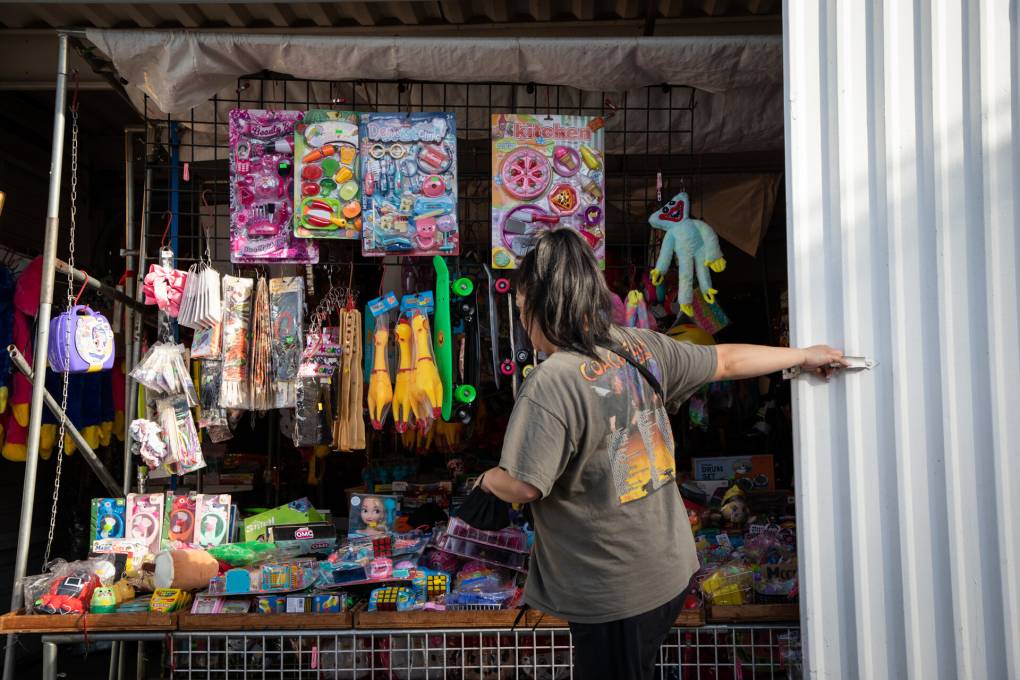
"caption": "Katrina Ramos White closes up the vending stall she runs with her husband on April 2, 2022. Ramos White took over the family business in 2020 after her parents retired.",
"description": null,
"title": "RS56053_20220402_SJFleaMarket_RamosWhites-07-2-qut",
"credit": "Amaya Edwards/KQED",
"status": "inherit",
"altTag": null,
"isLoading": false,
"fetchFailed": false
},
"news_11916779": {
"type": "attachments",
"id": "news_11916779",
"meta": {
"index": "attachments_1716263798",
"site": "news",
"id": "11916779",
"found": true
},
"parent": 11916778,
"imgSizes": {
"thumbnail": {
"file": "https://ww2.kqed.org/app/uploads/sites/10/2022/06/image1-160x107.jpg",
"width": 160,
"mimeType": "image/jpeg",
"height": 107
},
"post-thumbnail": {
"file": "https://ww2.kqed.org/app/uploads/sites/10/2022/06/image1-672x372.jpg",
"width": 672,
"mimeType": "image/jpeg",
"height": 372
},
"kqedFullSize": {
"file": "https://ww2.kqed.org/app/uploads/sites/10/2022/06/image1.jpg",
"width": 860,
"height": 574
},
"medium": {
"file": "https://ww2.kqed.org/app/uploads/sites/10/2022/06/image1-800x534.jpg",
"width": 800,
"mimeType": "image/jpeg",
"height": 534
}
},
"publishDate": 1654894376,
"modified": 1654894376,
"caption": null,
"description": null,
"title": "image1",
"credit": null,
"status": "inherit",
"altTag": null,
"isLoading": false,
"fetchFailed": false
},
"news_11900509": {
"type": "attachments",
"id": "news_11900509",
"meta": {
"index": "attachments_1716263798",
"site": "news",
"id": "11900509",
"found": true
},
"parent": 11900454,
"imgSizes": {
"twentyfourteen-full-width": {
"file": "https://ww2.kqed.org/app/uploads/sites/10/2021/12/RS47894_015_SanFrancisco_ChinaExpress_03192021-qut-1038x576.jpg",
"width": 1038,
"mimeType": "image/jpeg",
"height": 576
},
"thumbnail": {
"file": "https://ww2.kqed.org/app/uploads/sites/10/2021/12/RS47894_015_SanFrancisco_ChinaExpress_03192021-qut-160x107.jpg",
"width": 160,
"mimeType": "image/jpeg",
"height": 107
},
"post-thumbnail": {
"file": "https://ww2.kqed.org/app/uploads/sites/10/2021/12/RS47894_015_SanFrancisco_ChinaExpress_03192021-qut-672x372.jpg",
"width": 672,
"mimeType": "image/jpeg",
"height": 372
},
"kqedFullSize": {
"file": "https://ww2.kqed.org/app/uploads/sites/10/2021/12/RS47894_015_SanFrancisco_ChinaExpress_03192021-qut.jpg",
"width": 1920,
"height": 1280
},
"large": {
"file": "https://ww2.kqed.org/app/uploads/sites/10/2021/12/RS47894_015_SanFrancisco_ChinaExpress_03192021-qut-1020x680.jpg",
"width": 1020,
"mimeType": "image/jpeg",
"height": 680
},
"1536x1536": {
"file": "https://ww2.kqed.org/app/uploads/sites/10/2021/12/RS47894_015_SanFrancisco_ChinaExpress_03192021-qut-1536x1024.jpg",
"width": 1536,
"mimeType": "image/jpeg",
"height": 1024
},
"medium": {
"file": "https://ww2.kqed.org/app/uploads/sites/10/2021/12/RS47894_015_SanFrancisco_ChinaExpress_03192021-qut-800x533.jpg",
"width": 800,
"mimeType": "image/jpeg",
"height": 533
}
},
"publishDate": 1640829339,
"modified": 1653338300,
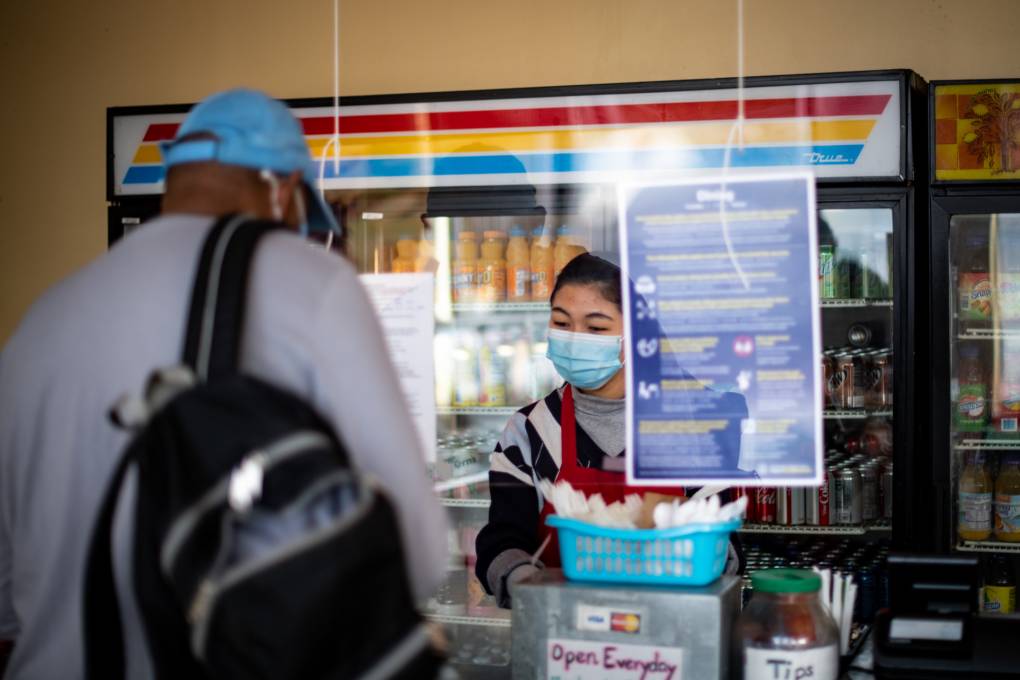
"caption": "An employee helps a customer at a restaurant on 24th and Mission streets in San Francisco on March 19, 2021.",
"description": "An employee helps a customer at a restaurant on 24th and Mission streets in San Francisco on March 19, 2021.",
"title": "RS47894_015_SanFrancisco_ChinaExpress_03192021-qut",
"credit": "Beth LaBerge/KQED",
"status": "inherit",
"altTag": "A young Asian woman, apparently a counter clerk in a restaurant, stands next to a cash register behind a clear-plastic barrier that hangs from the ceiling, talking to a man on the other side of a counter. The woman wears a powder-blue face mask and a red apron over a gray turtleneck shirt and white, black, and blue argyle sweater. Behind her, against the wall, are two glass-fronted fridges full of drinks – orange juice, soda, iced tea. The man is blurry in the foreground and seen from behind, wearing a long-sleeved gray shirt, a light blue hat and a black backpack on his right shoulder. Crowded on the counter are a bright blue plastic basket full of white plastic forks and spoons, and a plastic tip jar.",
"isLoading": false,
"fetchFailed": false
},
"news_11912619": {
"type": "attachments",
"id": "news_11912619",
"meta": {
"index": "attachments_1716263798",
"site": "news",
"id": "11912619",
"found": true
},
"parent": 11912590,
"imgSizes": {
"twentyfourteen-full-width": {
"file": "https://ww2.kqed.org/app/uploads/sites/10/2022/04/64667143290__84C93925-9FB3-4BA8-9CDD-959DE9D525B8.fullsizerender-2-1038x576.jpeg",
"width": 1038,
"mimeType": "image/jpeg",
"height": 576
},
"thumbnail": {
"file": "https://ww2.kqed.org/app/uploads/sites/10/2022/04/64667143290__84C93925-9FB3-4BA8-9CDD-959DE9D525B8.fullsizerender-2-160x151.jpeg",
"width": 160,
"mimeType": "image/jpeg",
"height": 151
},
"post-thumbnail": {
"file": "https://ww2.kqed.org/app/uploads/sites/10/2022/04/64667143290__84C93925-9FB3-4BA8-9CDD-959DE9D525B8.fullsizerender-2-672x372.jpeg",
"width": 672,
"mimeType": "image/jpeg",
"height": 372
},
"kqedFullSize": {
"file": "https://ww2.kqed.org/app/uploads/sites/10/2022/04/64667143290__84C93925-9FB3-4BA8-9CDD-959DE9D525B8.fullsizerender-2-scaled.jpeg",
"width": 2560,
"height": 2416
},
"2048x2048": {
"file": "https://ww2.kqed.org/app/uploads/sites/10/2022/04/64667143290__84C93925-9FB3-4BA8-9CDD-959DE9D525B8.fullsizerender-2-2048x1933.jpeg",
"width": 2048,
"mimeType": "image/jpeg",
"height": 1933
},
"large": {
"file": "https://ww2.kqed.org/app/uploads/sites/10/2022/04/64667143290__84C93925-9FB3-4BA8-9CDD-959DE9D525B8.fullsizerender-2-1020x963.jpeg",
"width": 1020,
"mimeType": "image/jpeg",
"height": 963
},
"1536x1536": {
"file": "https://ww2.kqed.org/app/uploads/sites/10/2022/04/64667143290__84C93925-9FB3-4BA8-9CDD-959DE9D525B8.fullsizerender-2-1536x1449.jpeg",
"width": 1536,
"mimeType": "image/jpeg",
"height": 1449
},
"full-width": {
"file": "https://ww2.kqed.org/app/uploads/sites/10/2022/04/64667143290__84C93925-9FB3-4BA8-9CDD-959DE9D525B8.fullsizerender-2-1920x1812.jpeg",
"width": 1920,
"mimeType": "image/jpeg",
"height": 1812
},
"medium": {
"file": "https://ww2.kqed.org/app/uploads/sites/10/2022/04/64667143290__84C93925-9FB3-4BA8-9CDD-959DE9D525B8.fullsizerender-2-800x755.jpeg",
"width": 800,
"mimeType": "image/jpeg",
"height": 755
}
},
"publishDate": 1651253967,
"modified": 1651254000,
"caption": "The Dish, aka the Stanford Dish, is a radio antenna in the Stanford foothills. It's also an iconic local landmark, and the centerpiece of a popular hiking path on the Stanford campus.",
"description": "The Dish, aka the Stanford Dish, is a radio antenna in the Stanford foothills. It's also an iconic local landmark, and the centerpiece of a popular hiking path on the Stanford campus.",
"title": "64667143290__84C93925-9FB3-4BA8-9CDD-959DE9D525B8.fullsizerender 2",
"credit": "Rachael Myrow/KQED",
"status": "inherit",
"altTag": "A satellite dish points up into the blue sky.",
"isLoading": false,
"fetchFailed": false
},
"news_11912228": {
"type": "attachments",
"id": "news_11912228",
"meta": {
"index": "attachments_1716263798",
"site": "news",
"id": "11912228",
"found": true
},
"parent": 11912101,
"imgSizes": {
"twentyfourteen-full-width": {
"file": "https://ww2.kqed.org/app/uploads/sites/10/2022/04/RS55033_019_KQED_ChevronRefineryStrike_04072022-qut-1038x576.jpg",
"width": 1038,
"mimeType": "image/jpeg",
"height": 576
},
"thumbnail": {
"file": "https://ww2.kqed.org/app/uploads/sites/10/2022/04/RS55033_019_KQED_ChevronRefineryStrike_04072022-qut-160x107.jpg",
"width": 160,
"mimeType": "image/jpeg",
"height": 107
},
"post-thumbnail": {
"file": "https://ww2.kqed.org/app/uploads/sites/10/2022/04/RS55033_019_KQED_ChevronRefineryStrike_04072022-qut-672x372.jpg",
"width": 672,
"mimeType": "image/jpeg",
"height": 372
},
"kqedFullSize": {
"file": "https://ww2.kqed.org/app/uploads/sites/10/2022/04/RS55033_019_KQED_ChevronRefineryStrike_04072022-qut.jpg",
"width": 1920,
"height": 1280
},
"large": {
"file": "https://ww2.kqed.org/app/uploads/sites/10/2022/04/RS55033_019_KQED_ChevronRefineryStrike_04072022-qut-1020x680.jpg",
"width": 1020,
"mimeType": "image/jpeg",
"height": 680
},
"1536x1536": {
"file": "https://ww2.kqed.org/app/uploads/sites/10/2022/04/RS55033_019_KQED_ChevronRefineryStrike_04072022-qut-1536x1024.jpg",
"width": 1536,
"mimeType": "image/jpeg",
"height": 1024
},
"medium": {
"file": "https://ww2.kqed.org/app/uploads/sites/10/2022/04/RS55033_019_KQED_ChevronRefineryStrike_04072022-qut-800x533.jpg",
"width": 800,
"mimeType": "image/jpeg",
"height": 533
}
},
"publishDate": 1650996046,
"modified": 1654028468,
"caption": "United Steelworkers union member Mike Zielinski speaks on a megaphone during a strike by Chevron employees outside Gate 14 at the Richmond refinery on April 7, 2022.",
"description": "United Steel Workers union member Mike Zielinski speaks on a megaphone during a strike by Chevron employees outside of Gate 14 at the Richmond refinery on April 7, 2022.",
"title": "RS55033_019_KQED_ChevronRefineryStrike_04072022-qut",
"credit": "Beth LaBerge/KQED",
"status": "inherit",
"altTag": "An older white man with glasses and a trim white mustache, wearing a navy baseball hat and navy shirt, shouts into a red-and-white bullhorn he holds in his right hand, his left hand pointing to the sky. To his right, farther from the camera, stands a woman in a white tank top and jeans. To the man's left and behind him, out of focus, is a group of people holding signs. One of them says \"Fair Contract\" and the other says \"Strike against Chevron.\" It appears to be evening time, and behind everyone is what appears to be a black, iron, security fence and a low, white building.",
"isLoading": false,
"fetchFailed": false
}
},
"audioPlayerReducer": {
"postId": "stream_live",
"isPaused": true,
"isPlaying": false,
"pfsActive": false,
"pledgeModalIsOpen": true,
"playerDrawerIsOpen": false,
"liveAudioPlayStartedAt": 0,
"liveAudioPlayContext": ""
},
"authorsReducer": {
"byline_news_11920130": {
"type": "authors",
"id": "byline_news_11920130",
"meta": {
"override": true
},
"slug": "byline_news_11920130",
"name": "Caleigh Wells, KCRW",
"isLoading": false
},
"kqed": {
"type": "authors",
"id": "236",
"meta": {
"index": "authors_1716337520",
"id": "236",
"found": true
},
"name": "KQED News Staff",
"firstName": "KQED News Staff",
"lastName": null,
"slug": "kqed",
"email": "faq@kqed.org",
"display_author_email": false,
"staff_mastheads": [],
"title": null,
"bio": null,
"avatar": "https://secure.gravatar.com/avatar/ef0e801a68c4c54afa9180db14084167?s=600&d=blank&r=g",
"twitter": null,
"facebook": null,
"instagram": null,
"linkedin": null,
"sites": [
{
"site": "arts",
"roles": [
"contributor"
]
},
{
"site": "news",
"roles": [
"editor"
]
},
{
"site": "futureofyou",
"roles": [
"author"
]
}
],
"headData": {
"title": "KQED News Staff | KQED",
"description": null,
"ogImgSrc": "https://secure.gravatar.com/avatar/ef0e801a68c4c54afa9180db14084167?s=600&d=blank&r=g",
"twImgSrc": "https://secure.gravatar.com/avatar/ef0e801a68c4c54afa9180db14084167?s=600&d=blank&r=g"
},
"isLoading": false,
"link": "/author/kqed"
},
"kqednewsstaffandwires": {
"type": "authors",
"id": "237",
"meta": {
"index": "authors_1716337520",
"id": "237",
"found": true
},
"name": "KQED News Staff and Wires",
"firstName": "KQED News Staff and Wires",
"lastName": null,
"slug": "kqednewsstaffandwires",
"email": "onlinenewsstaff@kqed.org",
"display_author_email": false,
"staff_mastheads": [],
"title": null,
"bio": null,
"avatar": "https://secure.gravatar.com/avatar/72295af8ebbfbd19a4948f5271285664?s=600&d=blank&r=g",
"twitter": null,
"facebook": null,
"instagram": null,
"linkedin": null,
"sites": [
{
"site": "arts",
"roles": [
"contributor"
]
},
{
"site": "news",
"roles": [
"contributor"
]
},
{
"site": "lowdown",
"roles": [
"author"
]
},
{
"site": "stateofhealth",
"roles": [
"contributor"
]
},
{
"site": "food",
"roles": [
"author"
]
}
],
"headData": {
"title": "KQED News Staff and Wires | KQED",
"description": null,
"ogImgSrc": "https://secure.gravatar.com/avatar/72295af8ebbfbd19a4948f5271285664?s=600&d=blank&r=g",
"twImgSrc": "https://secure.gravatar.com/avatar/72295af8ebbfbd19a4948f5271285664?s=600&d=blank&r=g"
},
"isLoading": false,
"link": "/author/kqednewsstaffandwires"
},
"rachael-myrow": {
"type": "authors",
"id": "251",
"meta": {
"index": "authors_1716337520",
"id": "251",
"found": true
},
"name": "Rachael Myrow",
"firstName": "Rachael",
"lastName": "Myrow",
"slug": "rachael-myrow",
"email": "rmyrow@kqed.org",
"display_author_email": true,
"staff_mastheads": [
"news"
],
"title": "Senior Editor of KQED's Silicon Valley News Desk",
"bio": "• I write and edit stories about how Silicon Valley power and policies shape everyday life in California. I’m also passionate about making Bay Area history and culture more accessible to a broad public. • I’ve been a journalist for most of my life, starting in high school with The Franklin Press in Los Angeles, where I grew up. While earning my first degree in English at UC Berkeley, I got my start in public radio at KALX-FM. After completing a second degree in journalism at Cal, I landed my first professional job at Marketplace, then moved on to KPCC (now LAist), and then KQED, where I hosted The California Report for more than seven years. • My reporting has appeared on NPR, The World, WBUR’s \u003ci>Here & Now\u003c/i>, and the BBC. I also guest host for KQED’s \u003ci>Forum\u003c/i>, as well as the Commonwealth Club in San Francisco. • I speak periodically on media, democracy and technology issues, and do voiceover work for documentaries and educational video projects. • Outside of the studio, you'll find me hiking Bay Area trails and whipping up Insta-ready meals in my kitchen. • I do not accept gifts, money, or favors from anyone connected to my reporting, I don't pay people for information, and I do not support or donate to political causes. • I strive to treat the people I report on with fairness, honesty, and respect. I also recognize there are often multiple sides to a story and work to verify information through multiple sources and documentation. If I get something wrong, I correct it.",
"avatar": "https://secure.gravatar.com/avatar/3ed8a3c5f26025e4a805ba634cda8cd764906b97438a6d9ce216b044e340da4e?s=600&d=blank&r=g",
"twitter": "rachaelmyrow",
"bluesky": null,
"facebook": null,
"instagram": null,
"linkedin": "https://www.linkedin.com/in/rachaelmyrow/",
"sites": [
{
"site": "arts",
"roles": [
"administrator"
]
},
{
"site": "news",
"roles": [
"edit_others_posts",
"editor"
]
},
{
"site": "futureofyou",
"roles": [
"editor"
]
},
{
"site": "bayareabites",
"roles": [
"editor"
]
},
{
"site": "stateofhealth",
"roles": [
"editor"
]
},
{
"site": "science",
"roles": [
"editor"
]
},
{
"site": "food",
"roles": [
"editor"
]
},
{
"site": "forum",
"roles": [
"editor"
]
},
{
"site": "liveblog",
"roles": [
"author"
]
}
],
"headData": {
"title": "Rachael Myrow | KQED",
"description": "Senior Editor of KQED's Silicon Valley News Desk",
"ogImgSrc": "https://secure.gravatar.com/avatar/3ed8a3c5f26025e4a805ba634cda8cd764906b97438a6d9ce216b044e340da4e?s=600&d=blank&r=g",
"twImgSrc": "https://secure.gravatar.com/avatar/3ed8a3c5f26025e4a805ba634cda8cd764906b97438a6d9ce216b044e340da4e?s=600&d=blank&r=g"
},
"isLoading": false,
"link": "/author/rachael-myrow"
},
"tgoldberg": {
"type": "authors",
"id": "258",
"meta": {
"index": "authors_1716337520",
"id": "258",
"found": true
},
"name": "Ted Goldberg",
"firstName": "Ted",
"lastName": "Goldberg",
"slug": "tgoldberg",
"email": "tgoldberg@kqed.org",
"display_author_email": true,
"staff_mastheads": [
"news"
],
"title": "KQED Managing Editor, News and Newscasts",
"bio": "Ted Goldberg is Managing Editor of News and Newscasts at KQED. His main reporting beat is the Bay Area's oil refining industry.\r\n\r\nPrior to joining KQED in 2014, Ted worked at CBS News and WCBS AM in New York and Bay City News and KCBS Radio in San Francisco. He graduated from Oberlin College in Ohio in 1998.",
"avatar": "https://secure.gravatar.com/avatar/30ce2e4fe89135e104f89be2394d16225b9d36c121b5b3cb7651ce642978b96f?s=600&d=blank&r=g",
"twitter": "TedrickG",
"bluesky": null,
"facebook": null,
"instagram": null,
"linkedin": null,
"sites": [
{
"site": "news",
"roles": [
"editor"
]
},
{
"site": "science",
"roles": [
"editor"
]
}
],
"headData": {
"title": "Ted Goldberg | KQED",
"description": "KQED Managing Editor, News and Newscasts",
"ogImgSrc": "https://secure.gravatar.com/avatar/30ce2e4fe89135e104f89be2394d16225b9d36c121b5b3cb7651ce642978b96f?s=600&d=blank&r=g",
"twImgSrc": "https://secure.gravatar.com/avatar/30ce2e4fe89135e104f89be2394d16225b9d36c121b5b3cb7651ce642978b96f?s=600&d=blank&r=g"
},
"isLoading": false,
"link": "/author/tgoldberg"
},
"matthewgreen": {
"type": "authors",
"id": "1263",
"meta": {
"index": "authors_1716337520",
"id": "1263",
"found": true
},
"name": "Matthew Green",
"firstName": "Matthew",
"lastName": "Green",
"slug": "matthewgreen",
"email": "mgreen@kqed.org",
"display_author_email": false,
"staff_mastheads": [],
"title": "KQED Editor/Reporter",
"bio": "Matthew Green is a digital media producer for KQED News. He previously produced \u003ca href=\"http://www.kqed.org/lowdown\">The Lowdown\u003c/a>, KQED’s multimedia news education blog. Matthew's written for numerous Bay Area publications, including the Oakland Tribune and San Francisco Chronicle. He also taught journalism classes at Fremont High School in East Oakland.\r\n\r\nEmail: mgreen@kqed.org; Twitter: @MGreenKQED",
"avatar": "https://secure.gravatar.com/avatar/3bf498d1267ca02c8494f33d8cfc575e?s=600&d=blank&r=g",
"twitter": "MGreenKQED",
"facebook": null,
"instagram": null,
"linkedin": null,
"sites": [
{
"site": "news",
"roles": []
},
{
"site": "lowdown",
"roles": []
},
{
"site": "science",
"roles": []
},
{
"site": "education",
"roles": []
},
{
"site": "quest",
"roles": []
},
{
"site": "liveblog",
"roles": []
}
],
"headData": {
"title": "Matthew Green | KQED",
"description": "KQED Editor/Reporter",
"ogImgSrc": "https://secure.gravatar.com/avatar/3bf498d1267ca02c8494f33d8cfc575e?s=600&d=blank&r=g",
"twImgSrc": "https://secure.gravatar.com/avatar/3bf498d1267ca02c8494f33d8cfc575e?s=600&d=blank&r=g"
},
"isLoading": false,
"link": "/author/matthewgreen"
},
"carlysevern": {
"type": "authors",
"id": "3243",
"meta": {
"index": "authors_1716337520",
"id": "3243",
"found": true
},
"name": "Carly Severn",
"firstName": "Carly",
"lastName": "Severn",
"slug": "carlysevern",
"email": "csevern@kqed.org",
"display_author_email": false,
"staff_mastheads": [
"news"
],
"title": "Senior Editor, Audience News ",
"bio": "Carly is KQED's Senior Editor of Audience News on the Digital News team, and has reported for the California Report Magazine, Bay Curious and KQED Arts. She's formerly the host of \u003ca href=\"http://ww2.kqed.org/pop/category/the-cooler/\" rel=\"noopener noreferrer\">The Cooler\u003c/a> podcast.",
"avatar": "https://secure.gravatar.com/avatar/54037bf5c128fe678f0ef26cec97a93f2e7f220a22d7285703328f12c42c1b1d?s=600&d=blank&r=g",
"twitter": "teacupinthebay",
"bluesky": null,
"facebook": null,
"instagram": null,
"linkedin": null,
"sites": [
{
"site": "",
"roles": [
"editor"
]
},
{
"site": "arts",
"roles": [
"editor"
]
},
{
"site": "news",
"roles": [
"administrator"
]
},
{
"site": "pop",
"roles": [
"editor"
]
},
{
"site": "futureofyou",
"roles": [
"editor"
]
},
{
"site": "about",
"roles": [
"administrator"
]
},
{
"site": "mindshift",
"roles": [
"editor"
]
},
{
"site": "bayareabites",
"roles": [
"editor"
]
},
{
"site": "stateofhealth",
"roles": [
"editor"
]
},
{
"site": "science",
"roles": [
"editor"
]
},
{
"site": "food",
"roles": [
"contributor"
]
},
{
"site": "forum",
"roles": [
"editor"
]
},
{
"site": "perspectives",
"roles": [
"administrator"
]
},
{
"site": "liveblog",
"roles": [
"editor"
]
}
],
"headData": {
"title": "Carly Severn | KQED",
"description": "Senior Editor, Audience News ",
"ogImgSrc": "https://secure.gravatar.com/avatar/54037bf5c128fe678f0ef26cec97a93f2e7f220a22d7285703328f12c42c1b1d?s=600&d=blank&r=g",
"twImgSrc": "https://secure.gravatar.com/avatar/54037bf5c128fe678f0ef26cec97a93f2e7f220a22d7285703328f12c42c1b1d?s=600&d=blank&r=g"
},
"isLoading": false,
"link": "/author/carlysevern"
},
"lsarah": {
"type": "authors",
"id": "11626",
"meta": {
"index": "authors_1716337520",
"id": "11626",
"found": true
},
"name": "Lakshmi Sarah",
"firstName": "Lakshmi",
"lastName": "Sarah",
"slug": "lsarah",
"email": "lsarah@kqed.org",
"display_author_email": false,
"staff_mastheads": [],
"title": "Digital Producer",
"bio": "Lakshmi Sarah is an educator, author and journalist with a focus on innovative storytelling. She has worked with newspapers, radio and magazines from Ahmedabad, India to Los Angeles, California. She has written and produced for Die Zeit, Global Voices, AJ+, KQED, Fusion Media Group and the New York Times.",
"avatar": "https://secure.gravatar.com/avatar/652dcaecd8b28826fc17a8b2d6bb4e93?s=600&d=blank&r=g",
"twitter": "lakitalki",
"facebook": null,
"instagram": "https://www.instagram.com/laki.talki/",
"linkedin": "https://www.linkedin.com/in/lakisarah/",
"sites": [
{
"site": "arts",
"roles": []
},
{
"site": "news",
"roles": []
},
{
"site": "bayareabites",
"roles": []
},
{
"site": "science",
"roles": []
}
],
"headData": {
"title": "Lakshmi Sarah | KQED",
"description": "Digital Producer",
"ogImgSrc": "https://secure.gravatar.com/avatar/652dcaecd8b28826fc17a8b2d6bb4e93?s=600&d=blank&r=g",
"twImgSrc": "https://secure.gravatar.com/avatar/652dcaecd8b28826fc17a8b2d6bb4e93?s=600&d=blank&r=g"
},
"isLoading": false,
"link": "/author/lsarah"
},
"abandlamudi": {
"type": "authors",
"id": "11672",
"meta": {
"index": "authors_1716337520",
"id": "11672",
"found": true
},
"name": "Adhiti Bandlamudi",
"firstName": "Adhiti",
"lastName": "Bandlamudi",
"slug": "abandlamudi",
"email": "abandlamudi@kqed.org",
"display_author_email": false,
"staff_mastheads": [
"news"
],
"title": "KQED Housing Reporter",
"bio": "Adhiti Bandlamudi reports for KQED's Housing desk. She focuses on how housing gets built across the Bay Area. Before joining KQED in 2020, she reported for WUNC in Durham, North Carolina, WABE in Atlanta, Georgia and Capital Public Radio in Sacramento. In 2017, she was awarded a Kroc Fellowship at NPR where she reported on everything from sprinkles to the Golden State Killer's arrest. When she's not reporting, she's baking new recipes in her kitchen or watching movies with friends and family. She's originally from Georgia and has strong opinions about Great British Bake Off.",
"avatar": "https://secure.gravatar.com/avatar/868129c8b257bb99a3500e2c86a65400?s=600&d=mm&r=g",
"twitter": "oddity_adhiti",
"facebook": null,
"instagram": null,
"linkedin": null,
"sites": [
{
"site": "arts",
"roles": [
"author"
]
},
{
"site": "news",
"roles": [
"editor"
]
},
{
"site": "liveblog",
"roles": [
"author"
]
}
],
"headData": {
"title": "Adhiti Bandlamudi | KQED",
"description": "KQED Housing Reporter",
"ogImgSrc": "https://secure.gravatar.com/avatar/868129c8b257bb99a3500e2c86a65400?s=600&d=mm&r=g",
"twImgSrc": "https://secure.gravatar.com/avatar/868129c8b257bb99a3500e2c86a65400?s=600&d=mm&r=g"
},
"isLoading": false,
"link": "/author/abandlamudi"
},
"ccabreralomeli": {
"type": "authors",
"id": "11708",
"meta": {
"index": "authors_1716337520",
"id": "11708",
"found": true
},
"name": "Carlos Cabrera-Lomelí",
"firstName": "Carlos",
"lastName": "Cabrera-Lomelí",
"slug": "ccabreralomeli",
"email": "ccabreralomeli@KQED.org",
"display_author_email": true,
"staff_mastheads": [
"news"
],
"title": "Community Reporter",
"bio": "Carlos Cabrera-Lomelí is a community reporter with KQED's digital engagement team. He also reports and co-produces for KQED's bilingual news hub KQED en Español. He grew up in San Francisco's Mission District and has previously worked with Univision, 48 Hills and REFORMA in Mexico City.",
"avatar": "https://secure.gravatar.com/avatar/c309be9665e484f887b818c89e273ecc673004f426f36b24d00a4d813a2e0518?s=600&d=blank&r=g",
"twitter": "@LomeliCabrera",
"bluesky": null,
"facebook": null,
"instagram": null,
"linkedin": null,
"sites": [
{
"site": "arts",
"roles": [
"editor"
]
},
{
"site": "news",
"roles": [
"editor"
]
},
{
"site": "about",
"roles": [
"editor"
]
},
{
"site": "science",
"roles": [
"editor"
]
},
{
"site": "perspectives",
"roles": [
"editor"
]
},
{
"site": "elections",
"roles": [
"editor"
]
},
{
"site": "liveblog",
"roles": [
"contributor"
]
}
],
"headData": {
"title": "Carlos Cabrera-Lomelí | KQED",
"description": "Community Reporter",
"ogImgSrc": "https://secure.gravatar.com/avatar/c309be9665e484f887b818c89e273ecc673004f426f36b24d00a4d813a2e0518?s=600&d=blank&r=g",
"twImgSrc": "https://secure.gravatar.com/avatar/c309be9665e484f887b818c89e273ecc673004f426f36b24d00a4d813a2e0518?s=600&d=blank&r=g"
},
"isLoading": false,
"link": "/author/ccabreralomeli"
},
"sminobucheli": {
"type": "authors",
"id": "11764",
"meta": {
"index": "authors_1716337520",
"id": "11764",
"found": true
},
"name": "Sebastian Miño-Bucheli",
"firstName": "Sebastian",
"lastName": "Miño-Bucheli",
"slug": "sminobucheli",
"email": "sminobucheli@kqed.org",
"display_author_email": false,
"staff_mastheads": [],
"title": "KQED Contributor",
"bio": "Sebastian Miño-Bucheli is a bilingual multimedia reporter and contributor to KQED Digital News. His reporting has been featured for Bay Curious, the California Report Magazine and KQED Arts. ",
"avatar": "https://secure.gravatar.com/avatar/4d433e33876cb631fbbe1ab7b9ddf7a1616f5e270c709b89ee147c0489875612?s=600&d=blank&r=g",
"twitter": "@BucheliMino",
"bluesky": null,
"facebook": null,
"instagram": null,
"linkedin": null,
"sites": [
{
"site": "arts",
"roles": [
"subscriber"
]
},
{
"site": "news",
"roles": [
"subscriber"
]
}
],
"headData": {
"title": "Sebastian Miño-Bucheli | KQED",
"description": "KQED Contributor",
"ogImgSrc": "https://secure.gravatar.com/avatar/4d433e33876cb631fbbe1ab7b9ddf7a1616f5e270c709b89ee147c0489875612?s=600&d=blank&r=g",
"twImgSrc": "https://secure.gravatar.com/avatar/4d433e33876cb631fbbe1ab7b9ddf7a1616f5e270c709b89ee147c0489875612?s=600&d=blank&r=g"
},
"isLoading": false,
"link": "/author/sminobucheli"
}
},
"pagesReducer": {
"news_category_local": {
"type": "terms",
"id": "news_28250",
"meta": {
"index": "terms_1716263798",
"site": "news",
"id": "28250",
"score": 12.940829
},
"featImg": null,
"name": "Local",
"description": null,
"taxonomy": "category",
"headData": {
"twImgId": null,
"twTitle": null,
"ogTitle": null,
"ogImgId": null,
"twDescription": null,
"description": null,
"title": "Local Archives | KQED News",
"ogDescription": null
},
"ttid": 28267,
"slug": "local",
"isLoading": false,
"title": "Local",
"pageMeta": {
"site": "news",
"WpPageTemplate": "page-topic-editorial",
"currentPage": 150
},
"blocks": [
{
"blockName": "kqed/post-list",
"attrs": {
"layout": "cardArticle2",
"query": "posts/news?category=local",
"seeMore": false,
"paginated": true,
"page": 150
}
},
{
"blockName": "kqed/ad"
}
]
}
},
"pfsSessionReducer": {},
"postsReducer": {
"stream_live": {
"type": "live",
"id": "stream_live",
"audioUrl": "https://streams.kqed.org/kqedradio",
"title": "Live Stream",
"excerpt": "Live Stream information currently unavailable.",
"link": "/radio",
"featImg": "",
"label": {
"name": "KQED Live",
"link": "/"
}
},
"stream_kqedNewscast": {
"type": "posts",
"id": "stream_kqedNewscast",
"audioUrl": "https://www.kqed.org/.stream/anon/radio/RDnews/newscast.mp3?_=1",
"title": "KQED Newscast",
"featImg": "",
"label": {
"name": "88.5 FM",
"link": "/"
}
},
"news_11920323": {
"type": "posts",
"id": "news_11920323",
"meta": {
"index": "posts_1716263798",
"site": "news",
"id": "11920323",
"score": null,
"sort": [
1658534639000
]
},
"parent": 0,
"labelTerm": {
"site": "news",
"term": 7052
},
"blocks": [],
"publishDate": 1658534639,
"format": "video",
"disqusTitle": "\"DO THE WORK!\" with W. Kamau Bell and Kate Schatz",
"title": "\"DO THE WORK!\" with W. Kamau Bell and Kate Schatz",
"headTitle": "KQED Newsroom | KQED News",
"content": "\u003cp>\u003cb>Doing the Work with W. Kamau Bell and Kate Schatz\u003cbr>\n\u003c/b>\u003cspan style=\"font-weight: 400\">We’ve talked about racism again and again, particularly during the past few years. And yet, how many of us deeply understand both the root causes of racism and the reasons systemic racism persists today? And how many of us know what to do to change the power dynamics built into the fabric of our country and create more equitable systems and relationships? \u003c/span>\u003c/p>\n\u003cp>\u003cspan style=\"font-weight: 400\">Well, the co-authors of the new book “DO THE WORK! An Antiracist Activity Book” have some suggestions in their irreverent and thought-provoking book, which includes hands-on activities like the “Check Your Privilege” checklist and a Nina Simone coloring page.\u003c/span>\u003c/p>\n\u003cp>\u003cspan style=\"font-weight: 400\">Co-author \u003c/span>\u003cb>Kate Schatz\u003c/b>\u003cspan style=\"font-weight: 400\"> is the New York Times-bestselling author of the “Rad Women” book series, who describes herself as an educator, public speaker and left-handed vegetarian Bay Area-born-and-bred queer feminist activist mama. \u003c/span>\u003c/p>\n\u003cp>\u003cspan style=\"font-weight: 400\">Co-author \u003c/span>\u003cb>W. Kamau Bell\u003c/b>\u003cspan style=\"font-weight: 400\"> also hails from the Bay Area, and is a comedian, political commentator and TV host, whose CNN series United Shades of America just launched its seventh season. He’s also the director of the Showtime docuseries “We Need To Talk About Cosby.” \u003c/span>\u003c/p>\n\u003cp>\u003cb>Something Beautiful: Presidio Tunnel Tops Park\u003cbr>\n\u003c/b>\u003cspan style=\"font-weight: 400\">How do you create a new park in an already densely populated city? How about on top of the cars! Well, San Francisco has a new feather in its cap: 14 acres of national park created on top of the roofs of tunnels where traffic passes through on its way to the Golden Gate Bridge — that’s this week’s look at Something Beautiful.\u003c/span>\u003c/p>\n\u003cp>[ad fullwidth]\u003c/p>\u003cp>\u003c/p>\n",
"disqusIdentifier": "11920323 https://ww2.kqed.org/news/?p=11920323",
"disqusUrl": "https://ww2.kqed.org/news/2022/07/22/do-the-work-with-w-kamau-bell-and-kate-schatz/",
"stats": {
"hasVideo": false,
"hasChartOrMap": false,
"hasAudio": false,
"hasPolis": false,
"wordCount": 288,
"hasGoogleForm": false,
"hasGallery": false,
"hasHearkenModule": false,
"iframeSrcs": [],
"paragraphCount": 7
},
"modified": 1658534639,
"excerpt": null,
"headData": {
"twImgId": "",
"twTitle": "",
"ogTitle": "",
"ogImgId": "",
"twDescription": "",
"description": "Doing the Work with W. Kamau Bell and Kate Schatz We’ve talked about racism again and again, particularly during the past few years. And yet, how many of us deeply understand both the root causes of racism and the reasons systemic racism persists today? And how many of us know what to do to change",
"title": "\"DO THE WORK!\" with W. Kamau Bell and Kate Schatz | KQED",
"ogDescription": "",
"schema": {
"@context": "https://schema.org",
"@type": "NewsArticle",
"headline": "\"DO THE WORK!\" with W. Kamau Bell and Kate Schatz",
"datePublished": "2022-07-22T17:03:59-07:00",
"dateModified": "2022-07-22T17:03:59-07:00",
"image": "https://cdn.kqed.org/wp-content/uploads/2020/02/KQED-OG-Image@1x.png",
"isAccessibleForFree": "True",
"publisher": {
"@type": "NewsMediaOrganization",
"@id": "https://www.kqed.org/#organization",
"name": "KQED",
"logo": "https://cdn.kqed.org/wp-content/uploads/2020/02/KQED-OG-Image@1x.png",
"url": "https://www.kqed.org",
"sameAs": [
"https://www.facebook.com/KQED",
"https://twitter.com/KQED",
"https://www.instagram.com/kqed/",
"https://www.tiktok.com/@kqedofficial",
"https://www.linkedin.com/company/kqed",
"https://www.youtube.com/channel/UCeC0IOo7i1P_61zVUWbJ4nw"
]
}
}
},
"guestAuthors": [],
"slug": "do-the-work-with-w-kamau-bell-and-kate-schatz",
"status": "publish",
"videoEmbed": "https://youtu.be/rTruyArrwWY",
"excludeFromSiteSearch": "Include",
"path": "/news/11920323/do-the-work-with-w-kamau-bell-and-kate-schatz",
"audioTrackLength": null,
"parsedContent": [
{
"type": "contentString",
"content": "\u003cdiv class=\"post-body\">\u003cp>\u003cp>\u003cb>Doing the Work with W. Kamau Bell and Kate Schatz\u003cbr>\n\u003c/b>\u003cspan style=\"font-weight: 400\">We’ve talked about racism again and again, particularly during the past few years. And yet, how many of us deeply understand both the root causes of racism and the reasons systemic racism persists today? And how many of us know what to do to change the power dynamics built into the fabric of our country and create more equitable systems and relationships? \u003c/span>\u003c/p>\n\u003cp>\u003cspan style=\"font-weight: 400\">Well, the co-authors of the new book “DO THE WORK! An Antiracist Activity Book” have some suggestions in their irreverent and thought-provoking book, which includes hands-on activities like the “Check Your Privilege” checklist and a Nina Simone coloring page.\u003c/span>\u003c/p>\n\u003cp>\u003cspan style=\"font-weight: 400\">Co-author \u003c/span>\u003cb>Kate Schatz\u003c/b>\u003cspan style=\"font-weight: 400\"> is the New York Times-bestselling author of the “Rad Women” book series, who describes herself as an educator, public speaker and left-handed vegetarian Bay Area-born-and-bred queer feminist activist mama. \u003c/span>\u003c/p>\n\u003cp>\u003cspan style=\"font-weight: 400\">Co-author \u003c/span>\u003cb>W. Kamau Bell\u003c/b>\u003cspan style=\"font-weight: 400\"> also hails from the Bay Area, and is a comedian, political commentator and TV host, whose CNN series United Shades of America just launched its seventh season. He’s also the director of the Showtime docuseries “We Need To Talk About Cosby.” \u003c/span>\u003c/p>\n\u003cp>\u003cb>Something Beautiful: Presidio Tunnel Tops Park\u003cbr>\n\u003c/b>\u003cspan style=\"font-weight: 400\">How do you create a new park in an already densely populated city? How about on top of the cars! Well, San Francisco has a new feather in its cap: 14 acres of national park created on top of the roofs of tunnels where traffic passes through on its way to the Golden Gate Bridge — that’s this week’s look at Something Beautiful.\u003c/span>\u003c/p>\n\u003cp>\u003c/p>\u003c/div>",
"attributes": {
"named": {},
"numeric": []
}
},
{
"type": "component",
"content": "",
"name": "ad",
"attributes": {
"named": {
"label": "fullwidth"
},
"numeric": [
"fullwidth"
]
}
},
{
"type": "contentString",
"content": "\u003cdiv class=\"post-body\">\u003cp>\u003c/p>\u003cp>\u003c/p>\n\u003c/div>\u003c/p>",
"attributes": {
"named": {},
"numeric": []
}
}
],
"link": "/news/11920323/do-the-work-with-w-kamau-bell-and-kate-schatz",
"authors": [
"236"
],
"programs": [
"news_7052"
],
"categories": [
"news_223",
"news_18540",
"news_28250"
],
"tags": [
"news_31365",
"news_20013",
"news_31363",
"news_31364",
"news_2715",
"news_5663",
"news_31366",
"news_16988",
"news_17613"
],
"featImg": "news_11920324",
"label": "news_7052"
},
"news_11920130": {
"type": "posts",
"id": "news_11920130",
"meta": {
"index": "posts_1716263798",
"site": "news",
"id": "11920130",
"score": null,
"sort": [
1658524556000
]
},
"guestAuthors": [],
"slug": "how-to-save-the-future-audio-diaries-from-a-high-school-climate-leader",
"title": "How to Save the Future: Audio Diaries From a High School Climate Leader",
"publishDate": 1658524556,
"format": "standard",
"headTitle": "How to Save the Future: Audio Diaries From a High School Climate Leader | KQED",
"labelTerm": {},
"content": "\u003cp>Young people in the generation known as Gen-Z \u003ca href=\"https://www2.deloitte.com/content/dam/Deloitte/global/Documents/2021-deloitte-global-millennial-survey-report.pdf\">consider climate change to be the biggest challenge we’re facing\u003c/a>. Gen-Z being people born between 1996 and 2012, it may explain why many environmental protests are often led by people who aren’t old enough to vote.\u003c/p>\n\u003cp>Paola Hoffman is one of those leaders. She volunteers with a group called \u003ca href=\"https://www.instagram.com/ycstrikela/?hl=en\">Youth Climate Strike Los Angeles\u003c/a>. For months, she kept an audio diary and shared her experiences. In those months she wrote speeches for protests and spoke on a youth summit climate change panel. She also testified before the state legislature about \u003ca href=\"https://leginfo.legislature.ca.gov/faces/billTextClient.xhtml?bill_id=202120220SB1173\">SB 1173\u003c/a>, which would require that two of the state and nation’s largest public pension funds divest from fossil fuels. That was in her free time, when she wasn’t keeping up with her school work as a senior at \u003ca href=\"https://www.archer.org/\">The Archer School for Girls\u003c/a>, or leading the second violins in her school orchestra. And she did it all while carrying the weight of the world on her shoulders.\u003c/p>\n\u003cp>\u003cem>These entries have been edited for clarity and brevity.\u003c/em>\u003c/p>\n\u003ch2>\u003cstrong>April 4\u003c/strong>\u003c/h2>\n\u003cp>Hi, it’s Paola, today is Monday, April 4, and it’s 1:14pm. I was just playing guitar and then figured I should probably check in. Yeah, so I’ve been pretty busy this weekend, mostly with a mix of personal deadlines and Youth Climate strike LA work.\u003c/p>\n\u003cp>Today, there will be the Monday meeting for the \u003ca href=\"https://aper.assembly.ca.gov/\">Senate Retirement Committee\u003c/a>, around 3pm. And they’re going to have a hearing on SB 1173. And we’re trying to get people to call in because, like I said, we have people who are impacted, and the people who are trying to shut down this bill, which, if this doesn’t pass, if the Senate Retirement Committee doesn’t go through with this, the bill halts again. We’ve made so much progress with it, so we really can’t afford to lose this momentum. So I guess I’m preparing to do some calling in, and calling all my friends and getting them to call in. And I’m kind of nervous.\u003c/p>\n\u003ch2>\u003cstrong>April 12\u003c/strong>\u003c/h2>\n\u003cp>Well, my miniature break was fun while it lasted. I’m back home from my trip out of town to check out college. And now that I have officially made my enrollment, we have to go right back to work. I’m currently in my room at my desk. I have brought my food upstairs so I can work on finishing up our endorsement graphics while I eat because I want to get this done as fast as possible. Then I also have to record two videos. We’re still working to get SB 1173, through as many different Senate hearings as we can. Next Tuesday is the next one. We have the \u003ca href=\"https://sjud.senate.ca.gov/\">Judiciary Committee\u003c/a> that’s meeting.\u003c/p>\n\u003cp>[ad fullwidth]\u003c/p>\n\u003cp>[The opposition] did not think we were going to get through the last committee. The bill is supposed to die there. And they had people calling in, they had people showing up, but we had more. But the issue is, they have money. And they have time. And they can have meetings with senators and meetings with politicians. And we have none of that. We have people, but that’s not enough.\u003c/p>\n\u003cp>Hopefully I won’t be up too late, but it’s already nine. You know, fun times. But honestly we’re doing important things, so I don’t even mind so long as I have time to get my schoolwork done as well…or not. That’ll come second.\u003c/p>\n\u003cfigure id=\"attachment_11920206\" class=\"wp-caption aligncenter\" style=\"max-width: 800px\">\u003ca href=\"https://ww2.kqed.org/app/uploads/sites/10/2022/07/IMG_0342.jpg\">\u003cimg loading=\"lazy\" decoding=\"async\" class=\"size-medium wp-image-11920206\" src=\"https://ww2.kqed.org/app/uploads/sites/10/2022/07/IMG_0342-800x533.jpg\" alt=\"Young people carry a banner in a climate march reading, "Governor Newsom: It's your last chance to choose: Our Future or Fossil Fuels. Behind the banner is a crowd of young people wearing covid masks and carrying signs. At the front, Paola Hoffman speaks through a bullhorn. There are green trees on either side of the road and a glassy building on the left with an American flag in front of it.\" width=\"800\" height=\"533\" srcset=\"https://cdn.kqed.org/wp-content/uploads/sites/10/2022/07/IMG_0342-800x533.jpg 800w, https://cdn.kqed.org/wp-content/uploads/sites/10/2022/07/IMG_0342-1020x680.jpg 1020w, https://cdn.kqed.org/wp-content/uploads/sites/10/2022/07/IMG_0342-160x107.jpg 160w, https://cdn.kqed.org/wp-content/uploads/sites/10/2022/07/IMG_0342.jpg 1500w\" sizes=\"(max-width: 800px) 100vw, 800px\">\u003c/a>\u003cfigcaption class=\"wp-caption-text\">Young people in Los Angeles march in a global 24-hour Youth Climate Strike on Sept 24-25, 2001. Paola Hoffman later spoke at a rally following the march.\u003c/figcaption>\u003c/figure>\n\u003ch2>\u003cstrong>April 21\u003c/strong>\u003c/h2>\n\u003cp>I am currently working on writing a speech. Tomorrow is Earth Day, or \u003ca href=\"https://www.earthcrisisdayla.org/about\">Earth Crisis Day\u003c/a>, as we have been preparing for. I’m gonna be talking about greenwashing [disinformation distributed by organizations to inflate environmental initiatives or present themselves as more environmentally conscious than they are]. Because it’s insidious. And a lot of what the UCLA protest is talking about is getting the UC system to divest and actually make changes that will actually do something.\u003c/p>\n\u003cp>My orchestra at school is in tech week currently, and I’m the section leader. So as much as I want to skip my actual school – I’m willing to skip my actual school to protest – I also have responsibility to my orchestra. So I’m going to have a very long day, and the next day I have my prom. I’m going with a bunch of friends; we’re really excited. Because despite all of this, I’m somehow still a high-schooler. And it’s my senior prom. That’s crazy.\u003c/p>\n\u003ch2>\u003cstrong>Earth Crisis Day\u003c/strong>\u003c/h2>\n\u003cp>I feel really good. There’s a good kind of tired after these kinds of events because you’re exhausted, but you feel like maybe there’s a chance that, this time, things will go better.\u003c/p>\n\u003cp>I’m really sad that I’m not going to be in the LA area anymore, especially now I feel like I’ve created such a close bond. I’m going to go to Houston. I’m going to go to Rice University. I’m currently dedicated to study astrophysics, but sometimes I feel guilty about it, because how am I going into the sciences, but not the science that we need right now to save the Earth? And then I think about how depressing that is because you tell kids to chase their dreams. And I’m sitting here feeling bad because I want to do that.\u003c/p>\n\u003cp>I also have to be realistic.\u003c/p>\n\u003ch2>\u003cstrong>June 8\u003c/strong>\u003c/h2>\n\u003cp>I just woke up from a dream where the world ended.\u003c/p>\n\u003cp>It started with the coastal cities and then it spread. I was on one of the last planes, and there was a little boy on the intercom, just telling us about our failure, telling us about how we were supposed to act. And here we were at the end. Then I woke up and I came downstairs. And I saw an article on \u003ca href=\"https://www.nytimes.com/2022/06/07/climate/salt-lake-city-climate-disaster.html\">The New York Times on the front page that says environmental nuclear bomb as the Great Salt Lake dries up\u003c/a>.\u003c/p>\n\u003cp>So yeah, that’s a fun way to start my day.\u003c/p>\n\u003cp>I was trying to think what might have caused the nightmare. And all I can think about is we just had elections, the primary elections in LA. And last I went to sleep, I had checked to see \u003ca href=\"https://results.lavote.gov/#year=2022&election=4269\">what the results were looking like\u003c/a>. And a lot of the progressive candidates, the candidates that I’ve had the honor of just being able to work with, so many of them were not in the lead. It kind of felt like a punch in the gut. Because I know these people, and I know how dedicated they are and how driven they are and how they actually care about me, you know? And then I went to sleep and I saw the world ending.\u003c/p>\n\u003cp>I guess I have some good news. I recently spoke on the Changeist panel. \u003ca href=\"https://www.changeist.org/summit\">They were holding a summit over three days\u003c/a>. And we got to talk about the urgency of the climate crisis and provide information and tips. And I said, “We find the strength to keep going by doing things in groups. We find the strength to keep going by doing things together. We find the strength to keep going when we realize that we’re not the only people in this fight.”\u003c/p>\n\u003cp>That’s what gives us the strength to keep going even when we have nightmares about the world ending. It’s the thought that there’s other people by our side who are just as passionate about making sure it doesn’t.\u003c/p>\n\u003ch2>\u003cstrong>June 21\u003c/strong>\u003c/h2>\n\u003cp>Hi, this is Paola. I am so angry right now. I don’t even know what to do with it.\u003c/p>\n\u003cp>\u003ca href=\"https://legiscan.com/CA/bill/SB1173/2021\">Our bill [SB1173] is dead\u003c/a>.\u003c/p>\n\u003cp>We didn’t get voted down, no. We still have tons of support, the support of 10 unions, five cities, three government offices, six local political party groups, over 100 organizations. We have the support of thousands of calls, nearly 20,000 letters, dozens of meetings with legislators all advocating for SB 1173. We have the support of everyone except \u003ca href=\"https://a09.asmdc.org/\">Assemblymember Jim Cooper\u003c/a>, who’s the Chair of the \u003ca href=\"https://aper.assembly.ca.gov/\">Assembly Committee on Public Employment and Retirement\u003c/a>, who has just pulled the bill. So the bill will not be heard in the committee. It will not be voted on. Instead, he vetoed it, essentially.\u003c/p>\n\u003cp>You know, you see people marching in the streets and you think with that many people, surely, surely we can get something done.\u003c/p>\n\u003cp>It’s hard to feel happy about what you’ve done. You just feel so small. I’m really tired of feeling small.\u003c/p>\n\u003ch2>\u003cstrong>Graduation\u003c/strong>\u003c/h2>\n\u003cp>[ad floatright]\u003c/p>\n\u003cp>I am officially a high school graduate. Our school does a few things for graduating. We have a few events at school before we have the main ceremony with our family. And one of them, they give awards out to some members of the graduating class. And I got an award this year. I won it for my work with both \u003ca href=\"https://www.teenline.org/\">Teen Line [a teen-to-teen crisis hotline]\u003c/a> and Youth Climate Strike Los Angeles. That was pretty incredible. It’s weird to get recognition for things, especially after all those years I’ve been to Archer seeing other students get these kinds of awards and graduate, and it’s surreal to graduate in general. Just being on that stage singing our graduation song, hearing our names get called, walking across. I’ve gone to The Archer School for Girls for six years. So it’s very hard to say goodbye. But we did it and I am off to college next.\u003c/p>\n\n",
"blocks": [],
"excerpt": "Paola Hoffman speaks candidly about the ups and downs of being a Gen-Z climate leader with a statewide profile and also a high school student prepping for her graduation.",
"status": "publish",
"parent": 0,
"modified": 1727905297,
"stats": {
"hasAudio": false,
"hasVideo": false,
"hasChartOrMap": false,
"iframeSrcs": [],
"hasGoogleForm": false,
"hasGallery": false,
"hasHearkenModule": false,
"hasPolis": false,
"paragraphCount": 27,
"wordCount": 1720
},
"headData": {
"title": "How to Save the Future: Audio Diaries From a High School Climate Leader | KQED",
"description": "Paola Hoffman speaks candidly about the ups and downs of being a Gen-Z climate leader with a statewide profile and also a high school student prepping for her graduation.",
"ogTitle": "",
"ogDescription": "",
"ogImgId": "",
"twTitle": "",
"twDescription": "",
"twImgId": "",
"schema": {
"@context": "https://schema.org",
"@type": "NewsArticle",
"headline": "How to Save the Future: Audio Diaries From a High School Climate Leader",
"datePublished": "2022-07-22T14:15:56-07:00",
"dateModified": "2024-10-02T14:41:37-07:00",
"image": "https://cdn.kqed.org/wp-content/uploads/2020/02/KQED-OG-Image@1x.png",
"isAccessibleForFree": "True",
"publisher": {
"@type": "NewsMediaOrganization",
"@id": "https://www.kqed.org/#organization",
"name": "KQED",
"logo": "https://cdn.kqed.org/wp-content/uploads/2020/02/KQED-OG-Image@1x.png",
"url": "https://www.kqed.org",
"sameAs": [
"https://www.facebook.com/KQED",
"https://twitter.com/KQED",
"https://www.instagram.com/kqed/",
"https://www.tiktok.com/@kqedofficial",
"https://www.linkedin.com/company/kqed",
"https://www.youtube.com/channel/UCeC0IOo7i1P_61zVUWbJ4nw"
]
}
}
},
"source": "California Report Magazine",
"sticky": false,
"nprByline": "Caleigh Wells, KCRW",
"excludeFromSiteSearch": "Include",
"showOnAuthorArchivePages": "No",
"path": "/news/11920130/how-to-save-the-future-audio-diaries-from-a-high-school-climate-leader",
"audioTrackLength": null,
"parsedContent": [
{
"type": "contentString",
"content": "\u003cdiv class=\"post-body\">\u003cp>\u003cp>Young people in the generation known as Gen-Z \u003ca href=\"https://www2.deloitte.com/content/dam/Deloitte/global/Documents/2021-deloitte-global-millennial-survey-report.pdf\">consider climate change to be the biggest challenge we’re facing\u003c/a>. Gen-Z being people born between 1996 and 2012, it may explain why many environmental protests are often led by people who aren’t old enough to vote.\u003c/p>\n\u003cp>Paola Hoffman is one of those leaders. She volunteers with a group called \u003ca href=\"https://www.instagram.com/ycstrikela/?hl=en\">Youth Climate Strike Los Angeles\u003c/a>. For months, she kept an audio diary and shared her experiences. In those months she wrote speeches for protests and spoke on a youth summit climate change panel. She also testified before the state legislature about \u003ca href=\"https://leginfo.legislature.ca.gov/faces/billTextClient.xhtml?bill_id=202120220SB1173\">SB 1173\u003c/a>, which would require that two of the state and nation’s largest public pension funds divest from fossil fuels. That was in her free time, when she wasn’t keeping up with her school work as a senior at \u003ca href=\"https://www.archer.org/\">The Archer School for Girls\u003c/a>, or leading the second violins in her school orchestra. And she did it all while carrying the weight of the world on her shoulders.\u003c/p>\n\u003cp>\u003cem>These entries have been edited for clarity and brevity.\u003c/em>\u003c/p>\n\u003ch2>\u003cstrong>April 4\u003c/strong>\u003c/h2>\n\u003cp>Hi, it’s Paola, today is Monday, April 4, and it’s 1:14pm. I was just playing guitar and then figured I should probably check in. Yeah, so I’ve been pretty busy this weekend, mostly with a mix of personal deadlines and Youth Climate strike LA work.\u003c/p>\n\u003cp>Today, there will be the Monday meeting for the \u003ca href=\"https://aper.assembly.ca.gov/\">Senate Retirement Committee\u003c/a>, around 3pm. And they’re going to have a hearing on SB 1173. And we’re trying to get people to call in because, like I said, we have people who are impacted, and the people who are trying to shut down this bill, which, if this doesn’t pass, if the Senate Retirement Committee doesn’t go through with this, the bill halts again. We’ve made so much progress with it, so we really can’t afford to lose this momentum. So I guess I’m preparing to do some calling in, and calling all my friends and getting them to call in. And I’m kind of nervous.\u003c/p>\n\u003ch2>\u003cstrong>April 12\u003c/strong>\u003c/h2>\n\u003cp>Well, my miniature break was fun while it lasted. I’m back home from my trip out of town to check out college. And now that I have officially made my enrollment, we have to go right back to work. I’m currently in my room at my desk. I have brought my food upstairs so I can work on finishing up our endorsement graphics while I eat because I want to get this done as fast as possible. Then I also have to record two videos. We’re still working to get SB 1173, through as many different Senate hearings as we can. Next Tuesday is the next one. We have the \u003ca href=\"https://sjud.senate.ca.gov/\">Judiciary Committee\u003c/a> that’s meeting.\u003c/p>\n\u003cp>\u003c/p>\u003c/div>",
"attributes": {
"named": {},
"numeric": []
}
},
{
"type": "component",
"content": "",
"name": "ad",
"attributes": {
"named": {
"label": "fullwidth"
},
"numeric": [
"fullwidth"
]
}
},
{
"type": "contentString",
"content": "\u003cdiv class=\"post-body\">\u003cp>\u003c/p>\n\u003cp>[The opposition] did not think we were going to get through the last committee. The bill is supposed to die there. And they had people calling in, they had people showing up, but we had more. But the issue is, they have money. And they have time. And they can have meetings with senators and meetings with politicians. And we have none of that. We have people, but that’s not enough.\u003c/p>\n\u003cp>Hopefully I won’t be up too late, but it’s already nine. You know, fun times. But honestly we’re doing important things, so I don’t even mind so long as I have time to get my schoolwork done as well…or not. That’ll come second.\u003c/p>\n\u003cfigure id=\"attachment_11920206\" class=\"wp-caption aligncenter\" style=\"max-width: 800px\">\u003ca href=\"https://ww2.kqed.org/app/uploads/sites/10/2022/07/IMG_0342.jpg\">\u003cimg loading=\"lazy\" decoding=\"async\" class=\"size-medium wp-image-11920206\" src=\"https://ww2.kqed.org/app/uploads/sites/10/2022/07/IMG_0342-800x533.jpg\" alt=\"Young people carry a banner in a climate march reading, "Governor Newsom: It's your last chance to choose: Our Future or Fossil Fuels. Behind the banner is a crowd of young people wearing covid masks and carrying signs. At the front, Paola Hoffman speaks through a bullhorn. There are green trees on either side of the road and a glassy building on the left with an American flag in front of it.\" width=\"800\" height=\"533\" srcset=\"https://cdn.kqed.org/wp-content/uploads/sites/10/2022/07/IMG_0342-800x533.jpg 800w, https://cdn.kqed.org/wp-content/uploads/sites/10/2022/07/IMG_0342-1020x680.jpg 1020w, https://cdn.kqed.org/wp-content/uploads/sites/10/2022/07/IMG_0342-160x107.jpg 160w, https://cdn.kqed.org/wp-content/uploads/sites/10/2022/07/IMG_0342.jpg 1500w\" sizes=\"(max-width: 800px) 100vw, 800px\">\u003c/a>\u003cfigcaption class=\"wp-caption-text\">Young people in Los Angeles march in a global 24-hour Youth Climate Strike on Sept 24-25, 2001. Paola Hoffman later spoke at a rally following the march.\u003c/figcaption>\u003c/figure>\n\u003ch2>\u003cstrong>April 21\u003c/strong>\u003c/h2>\n\u003cp>I am currently working on writing a speech. Tomorrow is Earth Day, or \u003ca href=\"https://www.earthcrisisdayla.org/about\">Earth Crisis Day\u003c/a>, as we have been preparing for. I’m gonna be talking about greenwashing [disinformation distributed by organizations to inflate environmental initiatives or present themselves as more environmentally conscious than they are]. Because it’s insidious. And a lot of what the UCLA protest is talking about is getting the UC system to divest and actually make changes that will actually do something.\u003c/p>\n\u003cp>My orchestra at school is in tech week currently, and I’m the section leader. So as much as I want to skip my actual school – I’m willing to skip my actual school to protest – I also have responsibility to my orchestra. So I’m going to have a very long day, and the next day I have my prom. I’m going with a bunch of friends; we’re really excited. Because despite all of this, I’m somehow still a high-schooler. And it’s my senior prom. That’s crazy.\u003c/p>\n\u003ch2>\u003cstrong>Earth Crisis Day\u003c/strong>\u003c/h2>\n\u003cp>I feel really good. There’s a good kind of tired after these kinds of events because you’re exhausted, but you feel like maybe there’s a chance that, this time, things will go better.\u003c/p>\n\u003cp>I’m really sad that I’m not going to be in the LA area anymore, especially now I feel like I’ve created such a close bond. I’m going to go to Houston. I’m going to go to Rice University. I’m currently dedicated to study astrophysics, but sometimes I feel guilty about it, because how am I going into the sciences, but not the science that we need right now to save the Earth? And then I think about how depressing that is because you tell kids to chase their dreams. And I’m sitting here feeling bad because I want to do that.\u003c/p>\n\u003cp>I also have to be realistic.\u003c/p>\n\u003ch2>\u003cstrong>June 8\u003c/strong>\u003c/h2>\n\u003cp>I just woke up from a dream where the world ended.\u003c/p>\n\u003cp>It started with the coastal cities and then it spread. I was on one of the last planes, and there was a little boy on the intercom, just telling us about our failure, telling us about how we were supposed to act. And here we were at the end. Then I woke up and I came downstairs. And I saw an article on \u003ca href=\"https://www.nytimes.com/2022/06/07/climate/salt-lake-city-climate-disaster.html\">The New York Times on the front page that says environmental nuclear bomb as the Great Salt Lake dries up\u003c/a>.\u003c/p>\n\u003cp>So yeah, that’s a fun way to start my day.\u003c/p>\n\u003cp>I was trying to think what might have caused the nightmare. And all I can think about is we just had elections, the primary elections in LA. And last I went to sleep, I had checked to see \u003ca href=\"https://results.lavote.gov/#year=2022&election=4269\">what the results were looking like\u003c/a>. And a lot of the progressive candidates, the candidates that I’ve had the honor of just being able to work with, so many of them were not in the lead. It kind of felt like a punch in the gut. Because I know these people, and I know how dedicated they are and how driven they are and how they actually care about me, you know? And then I went to sleep and I saw the world ending.\u003c/p>\n\u003cp>I guess I have some good news. I recently spoke on the Changeist panel. \u003ca href=\"https://www.changeist.org/summit\">They were holding a summit over three days\u003c/a>. And we got to talk about the urgency of the climate crisis and provide information and tips. And I said, “We find the strength to keep going by doing things in groups. We find the strength to keep going by doing things together. We find the strength to keep going when we realize that we’re not the only people in this fight.”\u003c/p>\n\u003cp>That’s what gives us the strength to keep going even when we have nightmares about the world ending. It’s the thought that there’s other people by our side who are just as passionate about making sure it doesn’t.\u003c/p>\n\u003ch2>\u003cstrong>June 21\u003c/strong>\u003c/h2>\n\u003cp>Hi, this is Paola. I am so angry right now. I don’t even know what to do with it.\u003c/p>\n\u003cp>\u003ca href=\"https://legiscan.com/CA/bill/SB1173/2021\">Our bill [SB1173] is dead\u003c/a>.\u003c/p>\n\u003cp>We didn’t get voted down, no. We still have tons of support, the support of 10 unions, five cities, three government offices, six local political party groups, over 100 organizations. We have the support of thousands of calls, nearly 20,000 letters, dozens of meetings with legislators all advocating for SB 1173. We have the support of everyone except \u003ca href=\"https://a09.asmdc.org/\">Assemblymember Jim Cooper\u003c/a>, who’s the Chair of the \u003ca href=\"https://aper.assembly.ca.gov/\">Assembly Committee on Public Employment and Retirement\u003c/a>, who has just pulled the bill. So the bill will not be heard in the committee. It will not be voted on. Instead, he vetoed it, essentially.\u003c/p>\n\u003cp>You know, you see people marching in the streets and you think with that many people, surely, surely we can get something done.\u003c/p>\n\u003cp>It’s hard to feel happy about what you’ve done. You just feel so small. I’m really tired of feeling small.\u003c/p>\n\u003ch2>\u003cstrong>Graduation\u003c/strong>\u003c/h2>\n\u003cp>\u003c/p>\u003c/div>",
"attributes": {
"named": {},
"numeric": []
}
},
{
"type": "component",
"content": "",
"name": "ad",
"attributes": {
"named": {
"label": "floatright"
},
"numeric": [
"floatright"
]
}
},
{
"type": "contentString",
"content": "\u003cdiv class=\"post-body\">\u003cp>\u003c/p>\n\u003cp>I am officially a high school graduate. Our school does a few things for graduating. We have a few events at school before we have the main ceremony with our family. And one of them, they give awards out to some members of the graduating class. And I got an award this year. I won it for my work with both \u003ca href=\"https://www.teenline.org/\">Teen Line [a teen-to-teen crisis hotline]\u003c/a> and Youth Climate Strike Los Angeles. That was pretty incredible. It’s weird to get recognition for things, especially after all those years I’ve been to Archer seeing other students get these kinds of awards and graduate, and it’s surreal to graduate in general. Just being on that stage singing our graduation song, hearing our names get called, walking across. I’ve gone to The Archer School for Girls for six years. So it’s very hard to say goodbye. But we did it and I am off to college next.\u003c/p>\n\n\u003c/div>\u003c/p>",
"attributes": {
"named": {},
"numeric": []
}
}
],
"link": "/news/11920130/how-to-save-the-future-audio-diaries-from-a-high-school-climate-leader",
"authors": [
"byline_news_11920130"
],
"categories": [
"news_34165",
"news_19906",
"news_28250",
"news_8",
"news_356"
],
"tags": [
"news_19204",
"news_255",
"news_30162",
"news_2027"
],
"featImg": "news_11920156",
"label": "source_news_11920130"
},
"news_11919743": {
"type": "posts",
"id": "news_11919743",
"meta": {
"index": "posts_1716263798",
"site": "news",
"id": "11919743",
"score": null,
"sort": [
1657931789000
]
},
"guestAuthors": [],
"slug": "sf-da-brooke-jenkins-gun-control-this-week-in-ca-news",
"title": "SF DA Brooke Jenkins | Gun Control | This Week in CA News",
"publishDate": 1657931789,
"format": "video",
"headTitle": "SF DA Brooke Jenkins | Gun Control | This Week in CA News | KQED",
"labelTerm": {
"term": 7052,
"site": "news"
},
"content": "\u003cp>\u003cb>San Francisco District Attorney Brooke Jenkins\u003c/b>\u003cb>\u003cbr>\n\u003c/b>\u003cspan style=\"font-weight: 400\">Last week, San Francisco Mayor London Breed appointed Brooke Jenkins as the city’s new district attorney, after former DA Chesa Boudin was ousted in a contentious recall election. Jenkins worked for Boudin as a prosecutor, but quit in protest over some of his decisions, and joined the effort to recall Boudin as lead spokesperson. Now that she’s got her former boss’s job, Jenkins has said she wants to review dozens of former drug cases and may overturn decisions made by her predecessor.\u003c/span>\u003c/p>\n\u003cp>\u003cb>Assemblymember Phil Ting’s New Gun Control Law\u003cbr>\n\u003c/b>\u003cspan style=\"font-weight: 400\">There have been more than 300 mass shootings in the United States so far this year, according to the \u003c/span>\u003ca href=\"https://www.gunviolencearchive.org/reports/mass-shooting\">\u003cspan style=\"font-weight: 400\">Gun Violence Archive\u003c/span>\u003c/a>\u003cspan style=\"font-weight: 400\">. \u003c/span>\u003cspan style=\"font-weight: 400\">California lawmakers have acted swiftly to respond to these recent events and pushed through a new package of gun control laws. We talk to state Assemblymember Phil Ting, D-San Francisco, about the new law he authored, which carves a pathway to sue gun makers. \u003c/span>\u003c/p>\n\u003cp>\u003cb>This Week in California News and Politics\u003cbr>\n\u003c/b>\u003cspan style=\"font-weight: 400\">The first six months of the year have been the driest in California’s recorded history, setting us up for a serious wildfire season. Crews have been battling wildfire in Yosemite National Park, where a big blaze has threatened ancient sequoias. We tackle this and more of the week’s big stories with our panel of reporters.\u003c/span>\u003c/p>\n\u003cp>\u003cspan style=\"font-weight: 400\">Guests: \u003c/span>\u003c/p>\n\u003cul>\n\u003cli style=\"font-weight: 400\">\u003cspan style=\"font-weight: 400\">Guy Marzorati, KQED politics and government reporter\u003c/span>\u003c/li>\n\u003cli style=\"font-weight: 400\">\u003cspan style=\"font-weight: 400\">Kevin Stark, KQED climate editor\u003c/span>\u003c/li>\n\u003cli style=\"font-weight: 400\">\u003cspan style=\"font-weight: 400\">Grace Toohey, Los Angeles Times breaking news reporter\u003c/span>\u003c/li>\n\u003c/ul>\n\u003cp>\u003cb>James Webb Telescope\u003cbr>\n\u003c/b>\u003cspan style=\"font-weight: 400\">Nearly a million miles away, an array of 18 hexagonal mirrors made from rare metals is capturing stunning images of our universe. There’s a special California connection to the James Webb Telescope: It was partly assembled in Southern California, and many Californian engineers worked on the project for years. This week’s Something Beautiful showcases the story of this remarkable piece of technology that taps into our collective human spirit of invention, exploration and wonder.\u003c/span>\u003c/p>\n\u003cp>[ad fullwidth]\u003c/p>\u003cp>\u003c/p>\n",
"blocks": [],
"excerpt": null,
"status": "publish",
"parent": 0,
"modified": 1721133865,
"stats": {
"hasAudio": false,
"hasVideo": false,
"hasChartOrMap": false,
"iframeSrcs": [],
"hasGoogleForm": false,
"hasGallery": false,
"hasHearkenModule": false,
"hasPolis": false,
"paragraphCount": 7,
"wordCount": 342
},
"headData": {
"title": "SF DA Brooke Jenkins | Gun Control | This Week in CA News | KQED",
"description": "San Francisco District Attorney Brooke Jenkins Last week, San Francisco Mayor London Breed appointed Brooke Jenkins as the city’s new district attorney, after former DA Chesa Boudin was ousted in a contentious recall election. Jenkins worked for Boudin as a prosecutor, but quit in protest over some of his decisions, and joined the effort to",
"ogTitle": "",
"ogDescription": "",
"ogImgId": "",
"twTitle": "",
"twDescription": "",
"twImgId": "",
"schema": {
"@context": "https://schema.org",
"@type": "NewsArticle",
"headline": "SF DA Brooke Jenkins | Gun Control | This Week in CA News",
"datePublished": "2022-07-15T17:36:29-07:00",
"dateModified": "2024-07-16T05:44:25-07:00",
"image": "https://cdn.kqed.org/wp-content/uploads/2020/02/KQED-OG-Image@1x.png",
"isAccessibleForFree": "True",
"publisher": {
"@type": "NewsMediaOrganization",
"@id": "https://www.kqed.org/#organization",
"name": "KQED",
"logo": "https://cdn.kqed.org/wp-content/uploads/2020/02/KQED-OG-Image@1x.png",
"url": "https://www.kqed.org",
"sameAs": [
"https://www.facebook.com/KQED",
"https://twitter.com/KQED",
"https://www.instagram.com/kqed/",
"https://www.tiktok.com/@kqedofficial",
"https://www.linkedin.com/company/kqed",
"https://www.youtube.com/channel/UCeC0IOo7i1P_61zVUWbJ4nw"
]
}
}
},
"videoEmbed": "https://youtu.be/Ps6vt6bv-n4",
"sticky": false,
"excludeFromSiteSearch": "Include",
"path": "/news/11919743/sf-da-brooke-jenkins-gun-control-this-week-in-ca-news",
"audioTrackLength": null,
"parsedContent": [
{
"type": "contentString",
"content": "\u003cdiv class=\"post-body\">\u003cp>\u003cp>\u003cb>San Francisco District Attorney Brooke Jenkins\u003c/b>\u003cb>\u003cbr>\n\u003c/b>\u003cspan style=\"font-weight: 400\">Last week, San Francisco Mayor London Breed appointed Brooke Jenkins as the city’s new district attorney, after former DA Chesa Boudin was ousted in a contentious recall election. Jenkins worked for Boudin as a prosecutor, but quit in protest over some of his decisions, and joined the effort to recall Boudin as lead spokesperson. Now that she’s got her former boss’s job, Jenkins has said she wants to review dozens of former drug cases and may overturn decisions made by her predecessor.\u003c/span>\u003c/p>\n\u003cp>\u003cb>Assemblymember Phil Ting’s New Gun Control Law\u003cbr>\n\u003c/b>\u003cspan style=\"font-weight: 400\">There have been more than 300 mass shootings in the United States so far this year, according to the \u003c/span>\u003ca href=\"https://www.gunviolencearchive.org/reports/mass-shooting\">\u003cspan style=\"font-weight: 400\">Gun Violence Archive\u003c/span>\u003c/a>\u003cspan style=\"font-weight: 400\">. \u003c/span>\u003cspan style=\"font-weight: 400\">California lawmakers have acted swiftly to respond to these recent events and pushed through a new package of gun control laws. We talk to state Assemblymember Phil Ting, D-San Francisco, about the new law he authored, which carves a pathway to sue gun makers. \u003c/span>\u003c/p>\n\u003cp>\u003cb>This Week in California News and Politics\u003cbr>\n\u003c/b>\u003cspan style=\"font-weight: 400\">The first six months of the year have been the driest in California’s recorded history, setting us up for a serious wildfire season. Crews have been battling wildfire in Yosemite National Park, where a big blaze has threatened ancient sequoias. We tackle this and more of the week’s big stories with our panel of reporters.\u003c/span>\u003c/p>\n\u003cp>\u003cspan style=\"font-weight: 400\">Guests: \u003c/span>\u003c/p>\n\u003cul>\n\u003cli style=\"font-weight: 400\">\u003cspan style=\"font-weight: 400\">Guy Marzorati, KQED politics and government reporter\u003c/span>\u003c/li>\n\u003cli style=\"font-weight: 400\">\u003cspan style=\"font-weight: 400\">Kevin Stark, KQED climate editor\u003c/span>\u003c/li>\n\u003cli style=\"font-weight: 400\">\u003cspan style=\"font-weight: 400\">Grace Toohey, Los Angeles Times breaking news reporter\u003c/span>\u003c/li>\n\u003c/ul>\n\u003cp>\u003cb>James Webb Telescope\u003cbr>\n\u003c/b>\u003cspan style=\"font-weight: 400\">Nearly a million miles away, an array of 18 hexagonal mirrors made from rare metals is capturing stunning images of our universe. There’s a special California connection to the James Webb Telescope: It was partly assembled in Southern California, and many Californian engineers worked on the project for years. This week’s Something Beautiful showcases the story of this remarkable piece of technology that taps into our collective human spirit of invention, exploration and wonder.\u003c/span>\u003c/p>\n\u003cp>\u003c/p>\u003c/div>",
"attributes": {
"named": {},
"numeric": []
}
},
{
"type": "component",
"content": "",
"name": "ad",
"attributes": {
"named": {
"label": "fullwidth"
},
"numeric": [
"fullwidth"
]
}
},
{
"type": "contentString",
"content": "\u003cdiv class=\"post-body\">\u003cp>\u003c/p>\u003cp>\u003c/p>\n\u003c/div>\u003c/p>",
"attributes": {
"named": {},
"numeric": []
}
}
],
"link": "/news/11919743/sf-da-brooke-jenkins-gun-control-this-week-in-ca-news",
"authors": [
"236"
],
"programs": [
"news_7052"
],
"categories": [
"news_1758",
"news_19906",
"news_457",
"news_6188",
"news_28250",
"news_8",
"news_13",
"news_248"
],
"tags": [
"news_31298",
"news_641",
"news_16",
"news_2795",
"news_23289",
"news_20297",
"news_31133",
"news_17968",
"news_559",
"news_1770",
"news_4463"
],
"featImg": "news_11919744",
"label": "news_7052"
},
"news_11918230": {
"type": "posts",
"id": "news_11918230",
"meta": {
"index": "posts_1716263798",
"site": "news",
"id": "11918230",
"score": null,
"sort": [
1656626037000
]
},
"parent": 0,
"labelTerm": {
"site": "news"
},
"blocks": [],
"publishDate": 1656626037,
"format": "standard",
"disqusTitle": "Grand Jury: Major Health and Safety Violations at Santa Rita Jail Require 'Urgent Attention'",
"title": "Grand Jury: Major Health and Safety Violations at Santa Rita Jail Require 'Urgent Attention'",
"headTitle": "KQED News",
"content": "\u003cp>Serious safety violations, inadequate medical services and poor sanitation are among a host of critical issues plaguing Santa Rita Jail, Alameda County's notorious lockup.\u003c/p>\n\u003cp>That's according to a civil grand jury investigation of the long-troubled Dublin-based jail, the county's main adult detention facility. The report, released Tuesday, details \u003ca href=\"http://grandjury.acgov.org/grandjury-assets/docs/2021-2022/Grand.Jury.Report.2022.for.ITD.Web.pdf\">a litany of major problems at the jail that have resulted in unsafe conditions for its detainees and staff\u003c/a>, and spurred a “multiple-year pattern of lawsuits concerning conditions.”\u003c/p>\n\u003cp>“The concerns identified in this report represent material health, safety, and financial risks and as such warrant urgent attention,” the 35-page report states.\u003c/p>\n\u003cp>In 2021 alone, it notes, there were seven in-custody deaths at the jail along with an \"unprecedented\" spike in COVID-19 cases, with some 20% of detainees testing positive at the peak of the January surge.\u003c/p>\n\u003cp>[pullquote size=\"medium\" align=\"right\" citation=\"2021-2022 Alameda County Grand Jury Final Report\"]'The concerns identified in this report represent material health, safety, and financial risks and as such warrant urgent attention.'[/pullquote]\u003c/p>\n\u003cp>“When a detainee enters custody at Santa Rita, Alameda County assumes responsibility for that detainee’s health and well-being,” the report asserts. “That responsibility is a legal duty and persists regardless of the emotional or mental state of the detainee, the offense with which they are charged, budget pressures within the county, or even the presence of a global pandemic.”\u003c/p>\n\u003cp>Among its wide-ranging findings, the report calls attention to inadequate access to outdoor spaces and describes a confusing and ineffective process for detainees to report grievances. It also underscores, in graphic terms, the jail's excessively dirty cells — especially those used for temporary occupancy.\u003c/p>\n\u003cp>“The presence of feces smeared on walls and foul odors in several cells described as being available for immediate occupancy suggests to the Grand Jury a systemic issue with the quality of cleaning and sanitation of temporary occupancy cells,” the report describes.\u003c/p>\n\u003cp>[ad fullwidth]\u003c/p>\n\u003cp>The investigation additionally identifies lackluster security procedures at the facility that often fail to block visitors and employees from smuggling in contraband, especially drugs — an issue its staff views “as perhaps the most serious and persistent challenge faced by the jail.”\u003c/p>\n\u003cp>The grand jurors reported that during their 13 inspection visits, they were asked for credentials only once and were never made to go through a metal detector or undergo a bag search.\u003c/p>\n\u003cp>Accounts of such lax oversight track with the jail's recent history of overdose deaths and smuggling scandals. In July 2020, an Alameda County Sheriff's technician was charged with 10 felonies for allegedly \u003ca href=\"https://www.mercurynews.com/2020/07/29/sheriffs-technician-charged-with-smuggling-drugs-cellphone-into-jail/\">smuggling methamphetamine and a cellphone\u003c/a> to an inmate awaiting trial for murder. The following month, a female detainee \u003ca href=\"https://www.mercurynews.com/2022/06/10/east-bay-woman-admits-to-selling-fentanyl-into-santa-rita-jail-leading-to-fatal-overdose/\">died from an overdose of fentanyl\u003c/a> that had been smuggled in from an outside dealer.\u003c/p>\n\u003cp>Around the same time, \u003ca href=\"https://oaklandside.org/2021/09/03/alameda-county-santa-rita-jail-medical-director-fired-wellpath-drugs-vaccination-covid/\">the jail's medical director was fired\u003c/a> for writing fake prescriptions to obtain opioid pain medications.\u003c/p>\n\u003cp>Operated by the Alameda County Sheriff's Office, Santa Rita Jail is among the largest detention facilities in the country. As of February 2022, the 33-year-old facility held roughly 2,260 male and female detainees — about 65% of its total capacity. Nearly two-thirds of its population have not been convicted of crimes, and are awaiting adjudication.\u003c/p>\n\u003cp>The grand jury, whose investigation included extensive interviews and reviews of thousands of pages of records, makes nearly 30 recommendations for improving conditions at the facility. Among them: regular safety inspections, tighter security at entry points, an updated and more responsive grievance process for detainees, increased access to outdoor areas and stricter enforcement of COVID-19 safety protocols.\u003c/p>\n\u003cp>The sheriff's office, which has 90 days to respond to the report, declined this week to comment on the findings, saying it was still reviewing them.\u003c/p>\n\u003cp>“While some of the information related to the Santa Rita Jail has been public for some time, we will obviously need time to review the comments in their entirety before an informed statement can be made,” Tya M. Modeste, a spokesperson for the sheriff's office, said in an email.\u003c/p>\n\u003cp>[aside tag=\"santa-rita-jail\" label=\"More Related Stories\"]The grand jury's report comes on the heels of a separate investigation by the U.S. Department of Justice's Civil Rights Division, which last year \u003ca href=\"https://www.justice.gov/crt/case-document/file/1388891/download\">concluded that the lack of mental health treatment options at the jail violated the Americans with Disabilities Act\u003c/a>. Such negligence, it found, resulted in needless suffering and death — including 19 reported suicides since 2014.\u003c/p>\n\u003cp>Alameda County and its sheriff's office, the DOJ report alleges, “engage in a pattern or practice of constitutional violations in the conditions at the Santa Rita Jail.”\u003c/p>\n\u003cp>And in March of this year, \u003ca href=\"https://oaklandside.org/2022/02/08/judge-places-santa-rita-jail-under-external-oversight-ending-mental-health-abuse-lawsuit/\">a federal judge placed the jail under court supervision for at least six years\u003c/a> after hearing stirring detainee testimony in a class-action lawsuit.\u003c/p>\n\u003cp>The new grand jury report confirms “that many safety rules are not being followed by the staff and medical providers at the Santa Rita Jail,” said Sanjay Schmidt, a San Francisco-based civil rights lawyer, who represents the family of \u003ca href=\"https://www.mercurynews.com/2022/03/29/alameda-county-has-deliberate-indifference-to-safety-of-inmates-at-santa-rita-jail-lawsuit-alleges/\">Jonas Park\u003c/a>.\u003c/p>\n\u003cp>Park was found dead in his cell in February 2021, after allegedly hanging himself — just five days into his detention at the facility.\u003c/p>\n\u003cp>The lawsuit against Alameda County and the sheriff's office, filed by Park's family earlier this year, alleges that the 33-year-old entered the jail while “actively experiencing opiate withdrawal\" and, rather than receiving help, was put in an isolation cell — known as “restrictive” housing. His death, the suit claims, was a result of the jail staff's “deliberate indifference” to Park’s “serious, emergency medical and mental health needs.”\u003c/p>\n\u003cp>“There appears to be a correlation between the overuse of restrictive housing, the inadequacy of access to outdoor space, and the high rate of suicides in the Santa Rita Jail,” Schmidt said, noting that the jail's suicide rate is significantly higher the average rate in detention centers nationwide.\u003c/p>\n\u003cp>Schmidt added that the report also emphasizes the importance of cases like the one he's working on, as they are “important vehicles for getting the attention of policymakers in the county, to alert them of the need for reforms to stop needlessly endangering the lives, safety, and welfare of pretrial detainees.”\u003c/p>\n\u003cp>\u003ca href=\"http://grandjury.acgov.org/index.page\" target=\"_blank\" rel=\"noopener noreferrer\">The civil grand jury,\u003c/a> similar to a citizen watchdog group, is made up of a team of 19 people tasked with ensuring that local agencies are acting in the best interest of the public. It's investigation of Santa Rita Jail is part of a much larger report released on Tuesday that scrutinizes multiple institutions within Alameda County, including its mental health system, student homelessness, BART oversight and election integrity.\u003c/p>\n\u003cp>\u003cem>KQED's Nina Thorsen contributed to this report. \u003c/em>\u003c/p>\n\u003cp>[ad floatright]\u003c/p>\n",
"disqusIdentifier": "11918230 https://ww2.kqed.org/news/?p=11918230",
"disqusUrl": "https://ww2.kqed.org/news/2022/06/30/grand-jury-major-health-and-safety-violations-at-santa-rita-jail-require-urgent-attention/",
"stats": {
"hasVideo": false,
"hasChartOrMap": false,
"hasAudio": false,
"hasPolis": false,
"wordCount": 1166,
"hasGoogleForm": false,
"hasGallery": false,
"hasHearkenModule": false,
"iframeSrcs": [],
"paragraphCount": 28
},
"modified": 1656631277,
"excerpt": "The investigation of the long-troubled jail highlights a litany of failures, including major safety violations, inadequate medical services and poor sanitation — all of which have contributed to avoidable deaths and a 'multiple-year pattern of lawsuits concerning conditions.'",
"headData": {
"twImgId": "",
"twTitle": "",
"ogTitle": "",
"ogImgId": "",
"twDescription": "",
"description": "The investigation of the long-troubled jail highlights a litany of failures, including major safety violations, inadequate medical services and poor sanitation — all of which have contributed to avoidable deaths and a 'multiple-year pattern of lawsuits concerning conditions.'",
"title": "Grand Jury: Major Health and Safety Violations at Santa Rita Jail Require 'Urgent Attention' | KQED",
"ogDescription": "",
"schema": {
"@context": "https://schema.org",
"@type": "NewsArticle",
"headline": "Grand Jury: Major Health and Safety Violations at Santa Rita Jail Require 'Urgent Attention'",
"datePublished": "2022-06-30T14:53:57-07:00",
"dateModified": "2022-06-30T16:21:17-07:00",
"image": "https://cdn.kqed.org/wp-content/uploads/2020/02/KQED-OG-Image@1x.png",
"isAccessibleForFree": "True",
"publisher": {
"@type": "NewsMediaOrganization",
"@id": "https://www.kqed.org/#organization",
"name": "KQED",
"logo": "https://cdn.kqed.org/wp-content/uploads/2020/02/KQED-OG-Image@1x.png",
"url": "https://www.kqed.org",
"sameAs": [
"https://www.facebook.com/KQED",
"https://twitter.com/KQED",
"https://www.instagram.com/kqed/",
"https://www.tiktok.com/@kqedofficial",
"https://www.linkedin.com/company/kqed",
"https://www.youtube.com/channel/UCeC0IOo7i1P_61zVUWbJ4nw"
]
}
}
},
"guestAuthors": [],
"slug": "grand-jury-major-health-and-safety-violations-at-santa-rita-jail-require-urgent-attention",
"status": "publish",
"excludeFromSiteSearch": "Include",
"path": "/news/11918230/grand-jury-major-health-and-safety-violations-at-santa-rita-jail-require-urgent-attention",
"audioTrackLength": null,
"parsedContent": [
{
"type": "contentString",
"content": "\u003cdiv class=\"post-body\">\u003cp>\u003cp>Serious safety violations, inadequate medical services and poor sanitation are among a host of critical issues plaguing Santa Rita Jail, Alameda County's notorious lockup.\u003c/p>\n\u003cp>That's according to a civil grand jury investigation of the long-troubled Dublin-based jail, the county's main adult detention facility. The report, released Tuesday, details \u003ca href=\"http://grandjury.acgov.org/grandjury-assets/docs/2021-2022/Grand.Jury.Report.2022.for.ITD.Web.pdf\">a litany of major problems at the jail that have resulted in unsafe conditions for its detainees and staff\u003c/a>, and spurred a “multiple-year pattern of lawsuits concerning conditions.”\u003c/p>\n\u003cp>“The concerns identified in this report represent material health, safety, and financial risks and as such warrant urgent attention,” the 35-page report states.\u003c/p>\n\u003cp>In 2021 alone, it notes, there were seven in-custody deaths at the jail along with an \"unprecedented\" spike in COVID-19 cases, with some 20% of detainees testing positive at the peak of the January surge.\u003c/p>\n\u003cp>\u003c/p>\u003c/div>",
"attributes": {
"named": {},
"numeric": []
}
},
{
"type": "component",
"content": "'The concerns identified in this report represent material health, safety, and financial risks and as such warrant urgent attention.'",
"name": "pullquote",
"attributes": {
"named": {
"size": "medium",
"align": "right",
"citation": "2021-2022 Alameda County Grand Jury Final Report",
"label": ""
},
"numeric": []
}
},
{
"type": "contentString",
"content": "\u003cdiv class=\"post-body\">\u003cp>\u003c/p>\n\u003cp>“When a detainee enters custody at Santa Rita, Alameda County assumes responsibility for that detainee’s health and well-being,” the report asserts. “That responsibility is a legal duty and persists regardless of the emotional or mental state of the detainee, the offense with which they are charged, budget pressures within the county, or even the presence of a global pandemic.”\u003c/p>\n\u003cp>Among its wide-ranging findings, the report calls attention to inadequate access to outdoor spaces and describes a confusing and ineffective process for detainees to report grievances. It also underscores, in graphic terms, the jail's excessively dirty cells — especially those used for temporary occupancy.\u003c/p>\n\u003cp>“The presence of feces smeared on walls and foul odors in several cells described as being available for immediate occupancy suggests to the Grand Jury a systemic issue with the quality of cleaning and sanitation of temporary occupancy cells,” the report describes.\u003c/p>\n\u003cp>\u003c/p>\u003c/div>",
"attributes": {
"named": {},
"numeric": []
}
},
{
"type": "component",
"content": "",
"name": "ad",
"attributes": {
"named": {
"label": "fullwidth"
},
"numeric": [
"fullwidth"
]
}
},
{
"type": "contentString",
"content": "\u003cdiv class=\"post-body\">\u003cp>\u003c/p>\n\u003cp>The investigation additionally identifies lackluster security procedures at the facility that often fail to block visitors and employees from smuggling in contraband, especially drugs — an issue its staff views “as perhaps the most serious and persistent challenge faced by the jail.”\u003c/p>\n\u003cp>The grand jurors reported that during their 13 inspection visits, they were asked for credentials only once and were never made to go through a metal detector or undergo a bag search.\u003c/p>\n\u003cp>Accounts of such lax oversight track with the jail's recent history of overdose deaths and smuggling scandals. In July 2020, an Alameda County Sheriff's technician was charged with 10 felonies for allegedly \u003ca href=\"https://www.mercurynews.com/2020/07/29/sheriffs-technician-charged-with-smuggling-drugs-cellphone-into-jail/\">smuggling methamphetamine and a cellphone\u003c/a> to an inmate awaiting trial for murder. The following month, a female detainee \u003ca href=\"https://www.mercurynews.com/2022/06/10/east-bay-woman-admits-to-selling-fentanyl-into-santa-rita-jail-leading-to-fatal-overdose/\">died from an overdose of fentanyl\u003c/a> that had been smuggled in from an outside dealer.\u003c/p>\n\u003cp>Around the same time, \u003ca href=\"https://oaklandside.org/2021/09/03/alameda-county-santa-rita-jail-medical-director-fired-wellpath-drugs-vaccination-covid/\">the jail's medical director was fired\u003c/a> for writing fake prescriptions to obtain opioid pain medications.\u003c/p>\n\u003cp>Operated by the Alameda County Sheriff's Office, Santa Rita Jail is among the largest detention facilities in the country. As of February 2022, the 33-year-old facility held roughly 2,260 male and female detainees — about 65% of its total capacity. Nearly two-thirds of its population have not been convicted of crimes, and are awaiting adjudication.\u003c/p>\n\u003cp>The grand jury, whose investigation included extensive interviews and reviews of thousands of pages of records, makes nearly 30 recommendations for improving conditions at the facility. Among them: regular safety inspections, tighter security at entry points, an updated and more responsive grievance process for detainees, increased access to outdoor areas and stricter enforcement of COVID-19 safety protocols.\u003c/p>\n\u003cp>The sheriff's office, which has 90 days to respond to the report, declined this week to comment on the findings, saying it was still reviewing them.\u003c/p>\n\u003cp>“While some of the information related to the Santa Rita Jail has been public for some time, we will obviously need time to review the comments in their entirety before an informed statement can be made,” Tya M. Modeste, a spokesperson for the sheriff's office, said in an email.\u003c/p>\n\u003cp>\u003c/p>\u003c/div>",
"attributes": {
"named": {},
"numeric": []
}
},
{
"type": "component",
"content": "",
"name": "aside",
"attributes": {
"named": {
"tag": "santa-rita-jail",
"label": "More Related Stories "
},
"numeric": []
}
},
{
"type": "contentString",
"content": "\u003cdiv class=\"post-body\">\u003cp>The grand jury's report comes on the heels of a separate investigation by the U.S. Department of Justice's Civil Rights Division, which last year \u003ca href=\"https://www.justice.gov/crt/case-document/file/1388891/download\">concluded that the lack of mental health treatment options at the jail violated the Americans with Disabilities Act\u003c/a>. Such negligence, it found, resulted in needless suffering and death — including 19 reported suicides since 2014.\u003c/p>\n\u003cp>Alameda County and its sheriff's office, the DOJ report alleges, “engage in a pattern or practice of constitutional violations in the conditions at the Santa Rita Jail.”\u003c/p>\n\u003cp>And in March of this year, \u003ca href=\"https://oaklandside.org/2022/02/08/judge-places-santa-rita-jail-under-external-oversight-ending-mental-health-abuse-lawsuit/\">a federal judge placed the jail under court supervision for at least six years\u003c/a> after hearing stirring detainee testimony in a class-action lawsuit.\u003c/p>\n\u003cp>The new grand jury report confirms “that many safety rules are not being followed by the staff and medical providers at the Santa Rita Jail,” said Sanjay Schmidt, a San Francisco-based civil rights lawyer, who represents the family of \u003ca href=\"https://www.mercurynews.com/2022/03/29/alameda-county-has-deliberate-indifference-to-safety-of-inmates-at-santa-rita-jail-lawsuit-alleges/\">Jonas Park\u003c/a>.\u003c/p>\n\u003cp>Park was found dead in his cell in February 2021, after allegedly hanging himself — just five days into his detention at the facility.\u003c/p>\n\u003cp>The lawsuit against Alameda County and the sheriff's office, filed by Park's family earlier this year, alleges that the 33-year-old entered the jail while “actively experiencing opiate withdrawal\" and, rather than receiving help, was put in an isolation cell — known as “restrictive” housing. His death, the suit claims, was a result of the jail staff's “deliberate indifference” to Park’s “serious, emergency medical and mental health needs.”\u003c/p>\n\u003cp>“There appears to be a correlation between the overuse of restrictive housing, the inadequacy of access to outdoor space, and the high rate of suicides in the Santa Rita Jail,” Schmidt said, noting that the jail's suicide rate is significantly higher the average rate in detention centers nationwide.\u003c/p>\n\u003cp>Schmidt added that the report also emphasizes the importance of cases like the one he's working on, as they are “important vehicles for getting the attention of policymakers in the county, to alert them of the need for reforms to stop needlessly endangering the lives, safety, and welfare of pretrial detainees.”\u003c/p>\n\u003cp>\u003ca href=\"http://grandjury.acgov.org/index.page\" target=\"_blank\" rel=\"noopener noreferrer\">The civil grand jury,\u003c/a> similar to a citizen watchdog group, is made up of a team of 19 people tasked with ensuring that local agencies are acting in the best interest of the public. It's investigation of Santa Rita Jail is part of a much larger report released on Tuesday that scrutinizes multiple institutions within Alameda County, including its mental health system, student homelessness, BART oversight and election integrity.\u003c/p>\n\u003cp>\u003cem>KQED's Nina Thorsen contributed to this report. \u003c/em>\u003c/p>\n\u003cp>\u003c/p>\u003c/div>",
"attributes": {
"named": {},
"numeric": []
}
},
{
"type": "component",
"content": "",
"name": "ad",
"attributes": {
"named": {
"label": "floatright"
},
"numeric": [
"floatright"
]
}
},
{
"type": "contentString",
"content": "\u003cdiv class=\"post-body\">\u003cp>\u003c/p>\n\u003c/div>\u003c/p>",
"attributes": {
"named": {},
"numeric": []
}
}
],
"link": "/news/11918230/grand-jury-major-health-and-safety-violations-at-santa-rita-jail-require-urgent-attention",
"authors": [
"11626",
"1263"
],
"categories": [
"news_457",
"news_6188",
"news_28250",
"news_8"
],
"tags": [
"news_27989",
"news_31265",
"news_2842",
"news_2069",
"news_21568"
],
"featImg": "news_11918236",
"label": "news"
},
"news_11918317": {
"type": "posts",
"id": "news_11918317",
"meta": {
"index": "posts_1716263798",
"site": "news",
"id": "11918317",
"score": null,
"sort": [
1656617513000
]
},
"guestAuthors": [],
"slug": "blacklisted-for-speaking-up-how-california-farmworkers-fighting-abuses-are-vulnerable-to-retaliation",
"title": "Blacklisted for Speaking Up: How California Farmworkers Fighting Abuses Are Vulnerable to Retaliation",
"publishDate": 1656617513,
"format": "standard",
"headTitle": "Blacklisted for Speaking Up: How California Farmworkers Fighting Abuses Are Vulnerable to Retaliation | KQED",
"labelTerm": {
"site": "news"
},
"content": "\u003cp>\u003ca href=\"https://www.kqed.org/news/11919450/trabajar-con-una-visa-h-2a-en-estados-unidos-represalias-derechos\">\u003cem>Leer en español\u003c/em>\u003c/a>\u003c/p>\n\u003cp>[dropcap]A[/dropcap] pair of boots, shirts and pants.\u003c/p>\n\u003cp>That’s what Samuel left in the room he shared with other field workers at Mauritson Farms in Healdsburg, in the heart of Sonoma County’s wine country, last October.\u003c/p>\n\u003cp>He was heading back to his family in his hometown in Oaxaca, Mexico. The harvest had ended and his H-2A visa would soon expire.\u003c/p>\n\u003cp>He started working at Mauritson Farms in 2019 with an H-2A visa, \u003ca href=\"https://www.uscis.gov/working-in-the-united-states/temporary-workers/h-2a-temporary-agricultural-workers\">which lets agricultural workers stay in the U.S. for limited periods of time\u003c/a>. The program was modeled off the Bracero Program, which was created in 1942, thanks to an agreement between the U.S. and Mexican governments that brought Mexican workers to American farms. Labor rights groups point out that \u003ca href=\"https://www.npr.org/sections/thesalt/2018/07/31/634442195/when-the-u-s-government-tried-to-replace-migrant-farmworkers-with-high-schoolers\">many of those braceros experienced wage theft, physical abuse and terrible working and living conditions\u003c/a>.\u003c/p>\n\u003cp>Through the H-2A program, Samuel and a group of other young men from towns and rural communities in and around the Sola de Vega district in Oaxaca have come to California for years — from February through October — to work at Mauritson Farms, which owns and controls the vineyards that produce Mauritson Wines.\u003c/p>\n\u003cp>He left his belongings in Healdsburg with plans to come back in 2022. But he was never rehired by Mauritson Farms.\u003c/p>\n\u003cp>[ad fullwidth]\u003c/p>\n\u003cp>At the end of the 2021 growing season, Samuel and five other workers from Oaxaca spoke up against what \u003ca href=\"#workplace\">they believed to be unfair and unsafe working conditions they had experienced for the past three years\u003c/a>. They said they were asked to work on extremely hot days without adequate protections against the heat, that hours of their pay were docked for unjustified reasons and that they suffered verbal abuse from the foreman who supervised them.\u003c/p>\n\u003cp>With the support of the labor rights group North Bay Jobs With Justice, the group of six workers met with Cameron Mauritson, manager of the vineyard, in October to explain what they were experiencing.\u003c/p>\n\u003cp>“He apologized to us and said he was really sorry that this had happened at his company,” said Kevin, who also was at the meeting and worked alongside Samuel for the same period of time. “He promised that he would hire us again.”\u003c/p>\n\u003cp>For Samuel and Kevin — whose real names KQED is not using due to their fears of employment loss — this promise represented a lot more than a job offer for the next year. It signaled that the group could feel comfortable speaking out against unsafe working conditions and that Mauritson wouldn’t do what they feared the most: retaliate against them by not hiring them again.\u003c/p>\n\u003cp>“We left our things [at Mauritson Farms] believing we would come back,” Samuel said. “But none of it was true.”\u003c/p>\n\u003cfigure id=\"attachment_11918388\" class=\"wp-caption aligncenter\" style=\"max-width: 1920px\">\u003cimg loading=\"lazy\" decoding=\"async\" class=\"wp-image-11918388 size-full\" src=\"https://ww2.kqed.org/app/uploads/sites/10/2022/06/RS45142_017_KQED_Napa_VineyardFarmWorkers_09302020-qut.jpg\" alt=\"A grapevine in a field. The grapes are ripe and ready to pick.\" width=\"1920\" height=\"1280\" srcset=\"https://cdn.kqed.org/wp-content/uploads/sites/10/2022/06/RS45142_017_KQED_Napa_VineyardFarmWorkers_09302020-qut.jpg 1920w, https://cdn.kqed.org/wp-content/uploads/sites/10/2022/06/RS45142_017_KQED_Napa_VineyardFarmWorkers_09302020-qut-800x533.jpg 800w, https://cdn.kqed.org/wp-content/uploads/sites/10/2022/06/RS45142_017_KQED_Napa_VineyardFarmWorkers_09302020-qut-1020x680.jpg 1020w, https://cdn.kqed.org/wp-content/uploads/sites/10/2022/06/RS45142_017_KQED_Napa_VineyardFarmWorkers_09302020-qut-160x107.jpg 160w, https://cdn.kqed.org/wp-content/uploads/sites/10/2022/06/RS45142_017_KQED_Napa_VineyardFarmWorkers_09302020-qut-1536x1024.jpg 1536w\" sizes=\"(max-width: 1920px) 100vw, 1920px\">\u003cfigcaption class=\"wp-caption-text\">Samuel and Kevin started coming to California in 2019 with H-2A visas. They would come in February and leave at the end of the grape harvest season in October. They now wait in their hometowns in Oaxaca to hear what an ALRB investigation finds. \u003ccite>(Beth LaBerge/KQED)\u003c/cite>\u003c/figcaption>\u003c/figure>\n\u003cp>Out of the six workers who met with Mauritson in October, none was called back to work in 2022, despite their completion of an application with Cierto Global, the company’s third-party recruiter service. Both Samuel and Kevin believe they were not rehired because they told management about unsafe working conditions they were experiencing in Mauritson’s vineyards, a right protected by California labor standards.\u003c/p>\n\u003cp>North Bay Jobs With Justice representatives said they have reached out to Mauritson several times since February without receiving a response. Mauritson also declined KQED’s request for an interview.\u003c/p>\n\u003cp>On February 7, North Bay Jobs With Justice filed an unfair labor practice charge on behalf of the six workers with the California Agricultural Labor Relations Board (ALRB), the state agency that investigates possible workplace abuses in the agricultural industry. The charge \u003ca href=\"https://ww2.kqed.org/app/uploads/sites/10/2022/06/3.3.22-ULP-Against-Employer-Mauritson-Farms-Inc..pdf\">states that Mauritson Farms discriminated against the workers\u003c/a> by “refusing to rehire them because they engaged in protected concerted activity.”\u003c/p>\n\u003cp>As the ALRB investigation moves forward, Samuel and Kevin spend their days taking on whatever work they can get in Oaxaca and looking for different farming jobs in the U.S., but with little luck. The window to receive an H-2A visa this year has closed, so they must look for jobs that don’t offer visas. With their remaining savings depleted and families to feed, time is running out to make enough money to survive.\u003c/p>\n\u003cp>California, home to the country’s largest agriculture sector, also has the nation’s third-most H-2A workers. Last year, \u003ca href=\"https://s3.documentcloud.org/documents/22082364/h2a-statistics.pdf\">more than 32,000 H-2A laborers from around the world worked in the state supporting the agriculture industry\u003c/a>. And even though California has an extensive system of agencies and regulations meant to protect these workers, H-2A immigrants are still extremely vulnerable to illegal retaliation by their employers.\u003c/p>\n\u003cp>To bring foreign workers to the U.S., many H-2A employers use a network of both formal and informal recruiters that operate both inside and outside the country. Workers like Samuel and Kevin depend on these recruiters to find jobs in the U.S. and navigate the visa application process.\u003c/p>\n\u003cp>But when a worker speaks up about illegal labor practices, advocates say these recruiters often make sure the worker is blacklisted across the industry — making it harder for these laborers to find another job in the U.S. and for agricultural industry and labor agencies, who only have jurisdiction in the U.S., to enforce anti-retaliation rules.\u003c/p>\n\u003cfigure id=\"attachment_11918390\" class=\"wp-caption aligncenter\" style=\"max-width: 1920px\">\u003cimg loading=\"lazy\" decoding=\"async\" class=\"size-full wp-image-11918390\" src=\"https://ww2.kqed.org/app/uploads/sites/10/2022/06/RS45137_011_KQED_Napa_VineyardFarmWorkers_09302020-qut.jpg\" alt=\"Rows of grapevines in a field. In the background, a worker can be seen picking grapes.\" width=\"1920\" height=\"1280\" srcset=\"https://cdn.kqed.org/wp-content/uploads/sites/10/2022/06/RS45137_011_KQED_Napa_VineyardFarmWorkers_09302020-qut.jpg 1920w, https://cdn.kqed.org/wp-content/uploads/sites/10/2022/06/RS45137_011_KQED_Napa_VineyardFarmWorkers_09302020-qut-800x533.jpg 800w, https://cdn.kqed.org/wp-content/uploads/sites/10/2022/06/RS45137_011_KQED_Napa_VineyardFarmWorkers_09302020-qut-1020x680.jpg 1020w, https://cdn.kqed.org/wp-content/uploads/sites/10/2022/06/RS45137_011_KQED_Napa_VineyardFarmWorkers_09302020-qut-160x107.jpg 160w, https://cdn.kqed.org/wp-content/uploads/sites/10/2022/06/RS45137_011_KQED_Napa_VineyardFarmWorkers_09302020-qut-1536x1024.jpg 1536w\" sizes=\"(max-width: 1920px) 100vw, 1920px\">\u003cfigcaption class=\"wp-caption-text\">More than 4,200 laborers from around the world come to work in California with an H-2A visa. Most of them are employed in the agricultural industry. While these workers are protected by the same labor laws as anybody else, labor advocates say they are especially vulnerable to retaliation if they speak up against what they consider to be unfair or unsafe labor practices. \u003ccite>(Beth LaBerge/KQED)\u003c/cite>\u003c/figcaption>\u003c/figure>\n\u003ch2>‘Employers do retaliate’ even though it’s illegal\u003c/h2>\n\u003cp>Cynthia Rice has worked as a labor rights attorney for over 20 years. She’s now the director of litigation, advocacy and training at California Rural Legal Assistance, a nonprofit law firm that provides free legal aid across the state. She’s represented dozens of agricultural workers in cases involving dangerous working conditions, wage theft and retaliation.\u003c/p>\n\u003cp>At the start of each conversation with a new client, she makes one point clear.\u003c/p>\n\u003cp>“Retaliation is illegal,” she said, while adding that, “we never say the employer can’t retaliate against you because of course the employer can retaliate against you. It’s just illegal and employers do retaliate.”\u003c/p>\n\u003cp>Thanks to decades of farmworker- and immigrant-led organizing, California has several agencies that enforce labor laws, including anti-retaliation rules. The ALRB was created after then-Gov. Jerry Brown signed the \u003ca href=\"https://www.alrb.ca.gov/forms-publications/fact-sheets/fact-sheet-english/\">California Agricultural Labor Relations Act\u003c/a> in 1975, which guaranteed collective bargaining rights for farmworkers. Additionally, the \u003ca href=\"https://www.dir.ca.gov/dlse/\">California Labor Commissioner’s Office\u003c/a> investigates underpaid or missing wages, and the \u003ca href=\"https://www.dir.ca.gov/dosh/\">California Occupational Safety and Health Standards Board\u003c/a> (Cal/OSHA) enforces workplace safety rules like \u003ca href=\"https://www.kqed.org/news/11886628/feeling-the-heat-how-workers-can-advocate-for-safer-working-conditions-under-the-sun\">heat protections for outdoor workers\u003c/a>.\u003c/p>\n\u003cp>[pullquote align=\"right\" size=\"medium\" citation=\"Cynthia Rice, director of litigation, advocacy and training, California Rural Legal Assistance\"]‘We never say the employer can’t retaliate against you because of course the employer can retaliate against you.’[/pullquote]At the federal level, the Department of Labor processes job orders for the H-2A program and enforces employment contracts and the federal laws meant to protect guest workers. The department’s \u003ca href=\"https://www.dol.gov/agencies/whd\">Wage and Hour Division\u003c/a> investigates cases where employers may not be paying their workers properly or failing to provide housing, transportation or meals, \u003ca href=\"https://www.dol.gov/sites/dolgov/files/WHD/legacy/files/whdfs26.pdf\">which is required by the federal government\u003c/a>.\u003c/p>\n\u003cp>Many immigrant farmworkers Rice has worked with come to her after they’ve been terminated or when they’re about to go back to their home countries after the harvest season. “Then they talk about the hours that were shaved or the meals and restrooms that they didn’t get,” she explained.\u003c/p>\n\u003cp>But waiting until the end of harvest season to file a claim with the ALRB or other labor agencies is usually too late, she said, particularly for H-2A workers who typically have to leave the U.S. soon after. It gives attorneys like Rice very limited time to collect evidence and testimony before the worker heads back to their home country, which usually complicates communication as many H-2A holders come from rural communities in Mexico, Central America and the Caribbean, with limited access to the internet and telephone reception.\u003c/p>\n\u003cp>So why wait until the very last moment to speak up?\u003c/p>\n\u003cp>Retaliation can mean losing your job (and with that, your H-2A visa) after speaking up, but it can also include intimidation or punishment. Samuel remembers when his crew was working the fields in temperatures exceeding 95 degrees. “There were times where we felt so dehydrated that we were going to pass out,” he said. “We felt we wanted to vomit.”\u003c/p>\n\u003cp>[aside postID=\"news_11886628\" hero=\"https://ww2.kqed.org/app/uploads/sites/10/2021/08/RS50596_019_SanFrancisco_HeatWaveImpacts_08062021-qut-1020x680.jpg\"]\u003ca id=\"workplace\">\u003c/a>When he’d tell the foreman how he and others were feeling, Samuel said the foreman would laugh at them and tell them to keep working. Kevin said that there were many hot days where the workers didn’t have any of the heat protections required by California law. “When it was 90, 95 degrees, we didn’t have any shady spots to have a glass of water or rest for a bit,” he said.\u003c/p>\n\u003cp>When outside temperatures exceed 80 degrees, \u003ca href=\"https://www.kqed.org/news/11886628/feeling-the-heat-how-workers-can-advocate-for-safer-working-conditions-under-the-sun\">Cal/OSHA requires employers to provide their workers with sufficient water, shade and rest\u003c/a>. That means each employee should be able to drink at least one quart of water per hour and request breaks in the shade whenever they feel the need to. But a 2021 NPR investigation found that even with these protections in place, \u003ca href=\"https://www.kqed.org/news/11886402/why-california-workers-are-still-dying-from-heat-despite-protections\">nearly four dozen California workers died from heatstroke\u003c/a> and other heat-related illnesses within a 10-year period.\u003c/p>\n\u003cp>Cal/OSHA has stated that heat-related deaths can be prevented, but the agency has struggled with understaffing for years, \u003ca href=\"https://www.kqed.org/news/11886402/why-california-workers-are-still-dying-from-heat-despite-protections\">making it harder for it to enforce its rules across California’s thousands of farms\u003c/a>. So in many cases, the responsibility of protecting workers from heat falls solely on the employer.\u003c/p>\n\u003ch2>A network of retaliation in the US — and abroad\u003c/h2>\n\u003cp>A 2020 report by the migrant rights group Centro de los Derechos del Migrante \u003ca href=\"https://cdmigrante.org/wp-content/uploads/2020/04/Ripe-for-Reform.pdf\">shows that it’s common for H-2A employers nationwide to intimidate workers to exert greater control over them\u003c/a> and prevent them from feeling safe enough to speak up while they’re employed. Out of 100 former H-2A workers the organization spoke to, 100% of them experienced at least one serious legal violation and 94% experienced three or more serious legal violations.\u003c/p>\n\u003cp>Rice from CRLA points out that H-2A employers have an incredible amount of control over workers. An employer \u003ca href=\"https://www.dol.gov/sites/dolgov/files/WHD/legacy/files/whdfs26.pdf\">must provide housing, meals and transportation to and from the work site\u003c/a>. Because many workers don’t have a U.S. driver’s license or their own vehicle, they also depend on their bosses for transportation to go grocery shopping, to receive medical care and for other essential activities.\u003c/p>\n\u003cp>“A worker who is experiencing bad working conditions can always vote with his or her feet, right?” Rice said. “Well, that’s not true for H-2A workers.”\u003c/p>\n\u003cp>[aside postID=\"news_11886402\" hero=\"https://ww2.kqed.org/app/uploads/sites/10/2021/08/DSCF1773-1020x680.jpg\"]“The program is really closer to a kind of indentured servitude that we had in prior decades under sharecropper relationships post-emancipation,” she added. “There is such a dependency that the worker has on the employer and you can’t really say that they’re free to engage in activity anywhere else.”\u003c/p>\n\u003cp>Abusive employers can exert control over workers even when they are no longer living in the U.S. In order to find employees, many H-2A employers depend on third-party recruiters that operate all over the world. The recruitment process is rife with abuse, as some recruiters charge workers exorbitant amounts to connect them with American companies, \u003ca href=\"https://cdmigrante.org/wp-content/uploads/2020/04/Ripe-for-Reform.pdf\">some practice debt bondage and others mislead workers entirely about job opportunities\u003c/a>. Additionally, a 2015 report by the U.S. Government Accountability Office (GAO) \u003ca href=\"https://ww2.kqed.org/app/uploads/sites/10/2022/06/gao-2015-report-on-h2a-program-668875.pdf\">found that recruiters often blacklist any worker who speaks up about abuses to their employer\u003c/a>.\u003c/p>\n\u003cp>These recruiters, which range from informal one-person operations to multinational corporations, usually work for several employers spread out across the U.S. So when recruiters blacklist a worker, they’re not just doing so for one employer but potentially for whole sectors of the agriculture industry.\u003c/p>\n\u003cp>Rice has seen this happen several times with clients who spoke up about an employer in one state, only to later have trouble finding a job in other states.\u003c/p>\n\u003cp>“The first thing that the employer does once a worker has complained about wages or working conditions,” she said, “is go back to the recruiter and say, ‘I don’t want to hire this guy next year because they complained about me,’ and that affects not only recruitment for that particular employer, but also for all of the employers that a recruiter has a relationship with.”\u003c/p>\n\u003cp>Even when workers have returned to their countries of origin, the possibility of being blacklisted still exists. In the \u003ca href=\"https://cdn.kqed.org/wp-content/uploads/sites/10/2022/06/gao-2015-report-on-h2a-program-668875.pdf\">2015 GAO report\u003c/a>, federal officials traveled to Mexico to talk to former H-2A workers and noted that laborers were concerned about being seen talking to U.S. investigators in their hometowns because “people walking by could possibly see and report them to the local recruiter.”\u003c/p>\n\u003cp>[pullquote align=\"right\" size=\"medium\" citation=\"Elizabeth Strater, director of strategic campaigns, United Farm Workers\"]‘There is a tremendous amount of control over access to those [H-2A] visas [exerted by recruiters] within the communities of origin.’[/pullquote]The United Farm Workers union, which operates nationwide, also has noticed this phenomenon. Elizabeth Strater, director of strategic campaigns with the UFW, said many Jamaican H-2A workers in the U.S. will stick it out with a bad employer for a whole year just to stay within the recruitment pool for the next year. “There is also a tremendous amount of control over access to those visas [exerted by recruiters] within the communities of origin,” she said.\u003c/p>\n\u003cp>When Mauritson Farms first hired their crew in 2019, Samuel and Kevin say that the company arranged the recruitment process directly, using WhatsApp to coordinate. But in 2022, the vineyard switched to using a third-party recruiter, Cierto Global, a multinational farm labor contractor that was dubbed an “ethical recruiter” by the Biden administration earlier this year.\u003c/p>\n\u003cp>But Samuel and Kevin still worry that they now will have a much harder time finding a job in agriculture in the U.S. “I think [Mauritson] didn’t want any more problems to come up for them anymore,” Kevin said, “so they brought on the recruiter to be more selective.”\u003c/p>\n\u003ch2>Regulating the recruiter network\u003c/h2>\n\u003cp>How can labor officials prevent retaliation by American companies against H-2A workers if it happens outside the U.S.?\u003c/p>\n\u003cp>The GAO report points out that because recruitment happens outside the U.S., there’s very little federal oversight. Although the Department of Homeland Security keeps track of every incoming H-2A immigrant, there’s no federal database that tracks which agents are recruiting them.\u003c/p>\n\u003cp>[pullquote align=\"right\" size=\"medium\" citation=\"Ruben Lugo, regional enforcement coordinator, Department of Labor\"]‘Our enforcement authority is just in the United States. We can’t regulate what these third-party recruiters are doing.’[/pullquote]State agencies like California’s ALRB, which is currently investigating the Mauritson case, also have a hard time enforcing anti-retaliation laws in these situations. Regional director Jessica Arciniega shared that these types of situations are difficult for her agency due to jurisdictional limitations, but in certain cases, this sort of retaliation can fit into an ongoing unfair labor practice investigation.\u003c/p>\n\u003cp>“If there is evidence that the recruiter was an agent of the employer, then it may be part of something that we investigate,” she said.\u003c/p>\n\u003cp>At the federal level, Department of Labor officials are constrained by their jurisdiction. “Our enforcement authority is just in the United States. We can’t regulate what these third-party recruiters are doing, let’s just say, in Mexico,” said Ruben Lugo, regional enforcement coordinator.\u003c/p>\n\u003cp>However, Lugo explains, if a group of workers reported a breach of contract to the Department of Labor by their employer, and the following year none of the workers who were cooperating with the investigation were rehired, “then we can clearly discern that these workers were retaliated [against].”\u003c/p>\n\u003cp>In this situation, the federal government can order the employer to rehire the affected workers. In cases involving wage theft, officials also can require companies to pay back what they owe workers, along with civil penalties. For repeat offenders, authorities can even remove an employer from the H-2A program.\u003c/p>\n\u003cp>But at the end of the day, these consequences apply only for agriculture companies in the U.S., not recruiters abroad. In 2018, over 90% of H-2A workers were from Mexico and the \u003ca href=\"https://ww2.kqed.org/app/uploads/sites/10/2022/06/gao-2015-report-on-h2a-program-668875.pdf\">2018 GOA report\u003c/a> shows that the recruiter network operates extensively throughout that country.\u003c/p>\n\u003cp>[aside label='More Labor Coverage' tag='labor-rights']Migrant worker advocates argue that the Mexican government, along with the governments of other countries H-2A immigrants travel from, should be more proactive about regulating the activities of these recruiters and educating workers on what their labor rights are before they leave for the U.S.\u003c/p>\n\u003cp>But Mexican officials KQED spoke to pushed back, arguing that isn’t the responsibility of the Mexican government — despite millions of dollars flowing back to Mexico each year as remittances from Mexican nationals working for the U.S. agriculture industry.\u003c/p>\n\u003cp>“H-2A visas are not part of a binational program,” said Remedios Gómez Arnau, consul general of Mexico in San Francisco. The Mexican government has no part in the hiring process and only plays a role through its consular system once Mexican nationals are in American territory, she added.\u003c/p>\n\u003cp>“Once somebody leaves Mexico and enters another country using a visa, then that’s when we can figure out here if the national approaches a consulate and tells us what their issue is,” she said. “But before that, Mexican authorities don’t know who is being hired by who.”\u003c/p>\n\u003cfigure id=\"attachment_11918371\" class=\"wp-caption aligncenter\" style=\"max-width: 2560px\">\u003cimg loading=\"lazy\" decoding=\"async\" class=\"wp-image-11918371 size-full\" src=\"https://ww2.kqed.org/app/uploads/sites/10/2022/06/DSC02464-1-scaled.jpeg\" alt='A group of people protest outside an office building. Many are holding signs, one says in Spanish, \"Pago extra por peligros\" or \"hazard pay\" in English.' width=\"2560\" height=\"1710\" srcset=\"https://cdn.kqed.org/wp-content/uploads/sites/10/2022/06/DSC02464-1-scaled.jpeg 2560w, https://cdn.kqed.org/wp-content/uploads/sites/10/2022/06/DSC02464-1-800x534.jpeg 800w, https://cdn.kqed.org/wp-content/uploads/sites/10/2022/06/DSC02464-1-1020x681.jpeg 1020w, https://cdn.kqed.org/wp-content/uploads/sites/10/2022/06/DSC02464-1-160x107.jpeg 160w, https://cdn.kqed.org/wp-content/uploads/sites/10/2022/06/DSC02464-1-1536x1026.jpeg 1536w, https://cdn.kqed.org/wp-content/uploads/sites/10/2022/06/DSC02464-1-2048x1368.jpeg 2048w, https://cdn.kqed.org/wp-content/uploads/sites/10/2022/06/DSC02464-1-1920x1282.jpeg 1920w\" sizes=\"(max-width: 2560px) 100vw, 2560px\">\u003cfigcaption class=\"wp-caption-text\">Farmworkers and organizers with the labor rights group North Bay Jobs With Justice picket outside the Department of Emergency Management of Sonoma County on June 9, 2022. A coalition of workers and organizers have pushed Sonoma County officials for months to put into place five safety standards, meant to protect workers as wildfires intensify due to climate change, including hazard pay for farm laborers who work in wildfire evacuation zones. \u003ccite>(Courtesy of Derek Knowles)\u003c/cite>\u003c/figcaption>\u003c/figure>\n\u003ch2>‘The way we protect workers must change’\u003c/h2>\n\u003cp>Samuel and Kevin don’t regret speaking up.\u003c/p>\n\u003cp>“We’re acting within our rights,” Samuel said. “It’s not just one worker who spoke up but many.”\u003c/p>\n\u003cp>For the team at North Bay Jobs With Justice who have been working with this group of workers since last year, this case could set a precedent for the fight to protect farmworkers in wine country and the rest of California against retaliation and unsafe labor practices.\u003c/p>\n\u003cp>If the ALRB finds that Mauritson did retaliate against its workers, that could encourage other workers across the region to report their own experiences to labor officials, said Ana Salgado, community co-chair of the NBJWJ board. That could potentially fuel the movement for greater worker protections ahead of wildfire season.\u003c/p>\n\u003cp>A coalition of worker advocacy groups, including NBJWJ, \u003ca href=\"https://actionnetwork.org/petitions/farmworkers-deserve-safety-and-respect-in-sonoma-county?source=ig\">have pushed Sonoma County officials for months to put into place five safety standards\u003c/a> meant to protect workers as wildfires intensify due to climate change. These include providing safety and fire evacuation training in the workers’ first languages, including Indigenous languages, and allowing independent community observers to assess the safety of workers out in the field, so that workers are not alone when they report unsafe conditions.\u003c/p>\n\u003cp>“The Earth is changing, and the way we protect workers must change as well,” said Salgado in Spanish.\u003c/p>\n\u003cfigure id=\"attachment_11918370\" class=\"wp-caption aligncenter\" style=\"max-width: 2560px\">\u003cimg loading=\"lazy\" decoding=\"async\" class=\"wp-image-11918370 size-full\" src=\"https://ww2.kqed.org/app/uploads/sites/10/2022/06/DSC02491-scaled.jpeg\" alt=\"A group of people play the drums outside of an office building.\" width=\"2560\" height=\"1710\" srcset=\"https://cdn.kqed.org/wp-content/uploads/sites/10/2022/06/DSC02491-scaled.jpeg 2560w, https://cdn.kqed.org/wp-content/uploads/sites/10/2022/06/DSC02491-800x534.jpeg 800w, https://cdn.kqed.org/wp-content/uploads/sites/10/2022/06/DSC02491-1020x681.jpeg 1020w, https://cdn.kqed.org/wp-content/uploads/sites/10/2022/06/DSC02491-160x107.jpeg 160w, https://cdn.kqed.org/wp-content/uploads/sites/10/2022/06/DSC02491-1536x1026.jpeg 1536w, https://cdn.kqed.org/wp-content/uploads/sites/10/2022/06/DSC02491-2048x1368.jpeg 2048w, https://cdn.kqed.org/wp-content/uploads/sites/10/2022/06/DSC02491-1920x1282.jpeg 1920w\" sizes=\"(max-width: 2560px) 100vw, 2560px\">\u003cfigcaption class=\"wp-caption-text\">Protesters gathered outside the Department of Emergency Management of Sonoma County on June 9, 2022, to demand greater protections for farmworkers before the onset of wildfire season. Organizers point out that climate change will only worsen in the coming years and insist that officials expand labor regulations to better protect workers as global temperatures increase. \u003ccite>(Courtesy of Derek Knowles)\u003c/cite>\u003c/figcaption>\u003c/figure>\n\u003cp>Beyond Sonoma County, migrant rights advocates also are proposing structural reforms to the H-2A program to hold both employers and recruiters accountable for retaliation. Centro de los Derechos del Migrante has recommended that Congress approve legislation that reforms the recruitment process and ensures that workers who have suffered a labor rights violation in the U.S. can still access legal services once they’ve left the country. They’re also encouraging federal agencies, including the Department of Labor, to create a database accessible to workers that keeps track of H-2A employers and their recruiters.\u003c/p>\n\u003cp>[pullquote align=\"right\" size=\"medium\" citation=\"Ana Salgado, community co-chair, North Bay Jobs With Justice\"]‘The Earth is changing, and the way we protect workers must change as well.’[/pullquote]Cynthia Rice, attorney with the CRLA, points out a loophole in the existing accountability mechanism for H-2A employers: When a worker sues their company for an illegal labor practice, that company can settle the lawsuit and avoid admitting they violated labor law.\u003c/p>\n\u003cp>“Because there has not been any admission of liability or wrongdoing, that employer can get another H-2A order the next year,” Rice said. If federal officials took into consideration which companies are settling lawsuits year after year when it decides which ones get to stay in the H-2A program, it could prevent employers who don’t protect their workers from staying.\u003c/p>\n\u003cp>Reforming the program isn’t just necessary to better protect H-2A workers, Rice said, but also would benefit American workers. When H-2A workers are more vulnerable to retaliation, that makes them more attractive to hire, since employers know they can exploit them without having to fear the same consequences they’d face in hiring Americans.\u003c/p>\n\u003cp>[pullquote align=\"right\" size=\"medium\" citation=\"Kevin, former H-2A worker\"]‘We felt awful with the abuse we received, so we set out to learn what the employer actually needs to do.’[/pullquote]While he waits to hear the ALRB’s decision, Kevin has been sharing everything he’s learned in the past year with friends who are considering working in the U.S. He doesn’t want others to go through the same things he did.\u003c/p>\n\u003cp>“We were happy with the job we had over there because it gave us the economic means to send money back to our families and save for a home or a business,” he said. But he added that doesn’t justify how he was treated: “We felt awful with the abuse we received, so we set out to learn what the employer actually needs to do.”\u003c/p>\n\u003cp>\u003cem>This story has been updated.\u003c/em>\u003c/p>\n\u003cp>[ad floatright]\u003c/p>\n",
"blocks": [],
"excerpt": "What's it like for immigrant farmworkers to report an unfair labor practice? Advocates say laborers with H-2A visas are vulnerable to retaliation not just from their employers but from recruiters that connect them to jobs in the future.",
"status": "publish",
"parent": 0,
"modified": 1721133809,
"stats": {
"hasAudio": false,
"hasVideo": false,
"hasChartOrMap": false,
"iframeSrcs": [],
"hasGoogleForm": false,
"hasGallery": false,
"hasHearkenModule": false,
"hasPolis": false,
"paragraphCount": 70,
"wordCount": 4023
},
"headData": {
"title": "Blacklisted for Speaking Up: How California Farmworkers Fighting Abuses Are Vulnerable to Retaliation | KQED",
"description": "What's it like for immigrant farmworkers to report an unfair labor practice? Advocates say laborers with H-2A visas are vulnerable to retaliation not just from their employers but from recruiters that connect them to jobs in the future.",
"ogTitle": "",
"ogDescription": "",
"ogImgId": "",
"twTitle": "",
"twDescription": "",
"twImgId": "",
"schema": {
"@context": "https://schema.org",
"@type": "NewsArticle",
"headline": "Blacklisted for Speaking Up: How California Farmworkers Fighting Abuses Are Vulnerable to Retaliation",
"datePublished": "2022-06-30T12:31:53-07:00",
"dateModified": "2024-07-16T05:43:29-07:00",
"image": "https://cdn.kqed.org/wp-content/uploads/2020/02/KQED-OG-Image@1x.png",
"isAccessibleForFree": "True",
"publisher": {
"@type": "NewsMediaOrganization",
"@id": "https://www.kqed.org/#organization",
"name": "KQED",
"logo": "https://cdn.kqed.org/wp-content/uploads/2020/02/KQED-OG-Image@1x.png",
"url": "https://www.kqed.org",
"sameAs": [
"https://www.facebook.com/KQED",
"https://twitter.com/KQED",
"https://www.instagram.com/kqed/",
"https://www.tiktok.com/@kqedofficial",
"https://www.linkedin.com/company/kqed",
"https://www.youtube.com/channel/UCeC0IOo7i1P_61zVUWbJ4nw"
]
}
}
},
"audioUrl": "https://traffic.omny.fm/d/clips/0af137ef-751e-4b19-a055-aaef00d2d578/ffca7e9f-6831-41c5-bcaf-aaef00f5a073/04ca2167-999b-4f7b-b9e1-aed1012ae3f7/audio.mp3",
"sticky": false,
"excludeFromSiteSearch": "Include",
"path": "/news/11918317/blacklisted-for-speaking-up-how-california-farmworkers-fighting-abuses-are-vulnerable-to-retaliation",
"audioTrackLength": null,
"parsedContent": [
{
"type": "contentString",
"content": "\u003cdiv class=\"post-body\">\u003cp>\u003cp>\u003ca href=\"https://www.kqed.org/news/11919450/trabajar-con-una-visa-h-2a-en-estados-unidos-represalias-derechos\">\u003cem>Leer en español\u003c/em>\u003c/a>\u003c/p>\n\u003cp>\u003c/p>\u003cp>\u003cspan class=\"utils-parseShortcode-shortcodes-__dropcapShortcode__dropcap\">A\u003c/span>\u003c/p>\u003cp> pair of boots, shirts and pants.\u003c/p>\n\u003cp>That’s what Samuel left in the room he shared with other field workers at Mauritson Farms in Healdsburg, in the heart of Sonoma County’s wine country, last October.\u003c/p>\n\u003cp>He was heading back to his family in his hometown in Oaxaca, Mexico. The harvest had ended and his H-2A visa would soon expire.\u003c/p>\n\u003cp>He started working at Mauritson Farms in 2019 with an H-2A visa, \u003ca href=\"https://www.uscis.gov/working-in-the-united-states/temporary-workers/h-2a-temporary-agricultural-workers\">which lets agricultural workers stay in the U.S. for limited periods of time\u003c/a>. The program was modeled off the Bracero Program, which was created in 1942, thanks to an agreement between the U.S. and Mexican governments that brought Mexican workers to American farms. Labor rights groups point out that \u003ca href=\"https://www.npr.org/sections/thesalt/2018/07/31/634442195/when-the-u-s-government-tried-to-replace-migrant-farmworkers-with-high-schoolers\">many of those braceros experienced wage theft, physical abuse and terrible working and living conditions\u003c/a>.\u003c/p>\n\u003cp>Through the H-2A program, Samuel and a group of other young men from towns and rural communities in and around the Sola de Vega district in Oaxaca have come to California for years — from February through October — to work at Mauritson Farms, which owns and controls the vineyards that produce Mauritson Wines.\u003c/p>\n\u003cp>He left his belongings in Healdsburg with plans to come back in 2022. But he was never rehired by Mauritson Farms.\u003c/p>\n\u003cp>\u003c/p>\u003c/div>",
"attributes": {
"named": {},
"numeric": []
}
},
{
"type": "component",
"content": "",
"name": "ad",
"attributes": {
"named": {
"label": "fullwidth"
},
"numeric": [
"fullwidth"
]
}
},
{
"type": "contentString",
"content": "\u003cdiv class=\"post-body\">\u003cp>\u003c/p>\n\u003cp>At the end of the 2021 growing season, Samuel and five other workers from Oaxaca spoke up against what \u003ca href=\"#workplace\">they believed to be unfair and unsafe working conditions they had experienced for the past three years\u003c/a>. They said they were asked to work on extremely hot days without adequate protections against the heat, that hours of their pay were docked for unjustified reasons and that they suffered verbal abuse from the foreman who supervised them.\u003c/p>\n\u003cp>With the support of the labor rights group North Bay Jobs With Justice, the group of six workers met with Cameron Mauritson, manager of the vineyard, in October to explain what they were experiencing.\u003c/p>\n\u003cp>“He apologized to us and said he was really sorry that this had happened at his company,” said Kevin, who also was at the meeting and worked alongside Samuel for the same period of time. “He promised that he would hire us again.”\u003c/p>\n\u003cp>For Samuel and Kevin — whose real names KQED is not using due to their fears of employment loss — this promise represented a lot more than a job offer for the next year. It signaled that the group could feel comfortable speaking out against unsafe working conditions and that Mauritson wouldn’t do what they feared the most: retaliate against them by not hiring them again.\u003c/p>\n\u003cp>“We left our things [at Mauritson Farms] believing we would come back,” Samuel said. “But none of it was true.”\u003c/p>\n\u003cfigure id=\"attachment_11918388\" class=\"wp-caption aligncenter\" style=\"max-width: 1920px\">\u003cimg loading=\"lazy\" decoding=\"async\" class=\"wp-image-11918388 size-full\" src=\"https://ww2.kqed.org/app/uploads/sites/10/2022/06/RS45142_017_KQED_Napa_VineyardFarmWorkers_09302020-qut.jpg\" alt=\"A grapevine in a field. The grapes are ripe and ready to pick.\" width=\"1920\" height=\"1280\" srcset=\"https://cdn.kqed.org/wp-content/uploads/sites/10/2022/06/RS45142_017_KQED_Napa_VineyardFarmWorkers_09302020-qut.jpg 1920w, https://cdn.kqed.org/wp-content/uploads/sites/10/2022/06/RS45142_017_KQED_Napa_VineyardFarmWorkers_09302020-qut-800x533.jpg 800w, https://cdn.kqed.org/wp-content/uploads/sites/10/2022/06/RS45142_017_KQED_Napa_VineyardFarmWorkers_09302020-qut-1020x680.jpg 1020w, https://cdn.kqed.org/wp-content/uploads/sites/10/2022/06/RS45142_017_KQED_Napa_VineyardFarmWorkers_09302020-qut-160x107.jpg 160w, https://cdn.kqed.org/wp-content/uploads/sites/10/2022/06/RS45142_017_KQED_Napa_VineyardFarmWorkers_09302020-qut-1536x1024.jpg 1536w\" sizes=\"(max-width: 1920px) 100vw, 1920px\">\u003cfigcaption class=\"wp-caption-text\">Samuel and Kevin started coming to California in 2019 with H-2A visas. They would come in February and leave at the end of the grape harvest season in October. They now wait in their hometowns in Oaxaca to hear what an ALRB investigation finds. \u003ccite>(Beth LaBerge/KQED)\u003c/cite>\u003c/figcaption>\u003c/figure>\n\u003cp>Out of the six workers who met with Mauritson in October, none was called back to work in 2022, despite their completion of an application with Cierto Global, the company’s third-party recruiter service. Both Samuel and Kevin believe they were not rehired because they told management about unsafe working conditions they were experiencing in Mauritson’s vineyards, a right protected by California labor standards.\u003c/p>\n\u003cp>North Bay Jobs With Justice representatives said they have reached out to Mauritson several times since February without receiving a response. Mauritson also declined KQED’s request for an interview.\u003c/p>\n\u003cp>On February 7, North Bay Jobs With Justice filed an unfair labor practice charge on behalf of the six workers with the California Agricultural Labor Relations Board (ALRB), the state agency that investigates possible workplace abuses in the agricultural industry. The charge \u003ca href=\"https://ww2.kqed.org/app/uploads/sites/10/2022/06/3.3.22-ULP-Against-Employer-Mauritson-Farms-Inc..pdf\">states that Mauritson Farms discriminated against the workers\u003c/a> by “refusing to rehire them because they engaged in protected concerted activity.”\u003c/p>\n\u003cp>As the ALRB investigation moves forward, Samuel and Kevin spend their days taking on whatever work they can get in Oaxaca and looking for different farming jobs in the U.S., but with little luck. The window to receive an H-2A visa this year has closed, so they must look for jobs that don’t offer visas. With their remaining savings depleted and families to feed, time is running out to make enough money to survive.\u003c/p>\n\u003cp>California, home to the country’s largest agriculture sector, also has the nation’s third-most H-2A workers. Last year, \u003ca href=\"https://s3.documentcloud.org/documents/22082364/h2a-statistics.pdf\">more than 32,000 H-2A laborers from around the world worked in the state supporting the agriculture industry\u003c/a>. And even though California has an extensive system of agencies and regulations meant to protect these workers, H-2A immigrants are still extremely vulnerable to illegal retaliation by their employers.\u003c/p>\n\u003cp>To bring foreign workers to the U.S., many H-2A employers use a network of both formal and informal recruiters that operate both inside and outside the country. Workers like Samuel and Kevin depend on these recruiters to find jobs in the U.S. and navigate the visa application process.\u003c/p>\n\u003cp>But when a worker speaks up about illegal labor practices, advocates say these recruiters often make sure the worker is blacklisted across the industry — making it harder for these laborers to find another job in the U.S. and for agricultural industry and labor agencies, who only have jurisdiction in the U.S., to enforce anti-retaliation rules.\u003c/p>\n\u003cfigure id=\"attachment_11918390\" class=\"wp-caption aligncenter\" style=\"max-width: 1920px\">\u003cimg loading=\"lazy\" decoding=\"async\" class=\"size-full wp-image-11918390\" src=\"https://ww2.kqed.org/app/uploads/sites/10/2022/06/RS45137_011_KQED_Napa_VineyardFarmWorkers_09302020-qut.jpg\" alt=\"Rows of grapevines in a field. In the background, a worker can be seen picking grapes.\" width=\"1920\" height=\"1280\" srcset=\"https://cdn.kqed.org/wp-content/uploads/sites/10/2022/06/RS45137_011_KQED_Napa_VineyardFarmWorkers_09302020-qut.jpg 1920w, https://cdn.kqed.org/wp-content/uploads/sites/10/2022/06/RS45137_011_KQED_Napa_VineyardFarmWorkers_09302020-qut-800x533.jpg 800w, https://cdn.kqed.org/wp-content/uploads/sites/10/2022/06/RS45137_011_KQED_Napa_VineyardFarmWorkers_09302020-qut-1020x680.jpg 1020w, https://cdn.kqed.org/wp-content/uploads/sites/10/2022/06/RS45137_011_KQED_Napa_VineyardFarmWorkers_09302020-qut-160x107.jpg 160w, https://cdn.kqed.org/wp-content/uploads/sites/10/2022/06/RS45137_011_KQED_Napa_VineyardFarmWorkers_09302020-qut-1536x1024.jpg 1536w\" sizes=\"(max-width: 1920px) 100vw, 1920px\">\u003cfigcaption class=\"wp-caption-text\">More than 4,200 laborers from around the world come to work in California with an H-2A visa. Most of them are employed in the agricultural industry. While these workers are protected by the same labor laws as anybody else, labor advocates say they are especially vulnerable to retaliation if they speak up against what they consider to be unfair or unsafe labor practices. \u003ccite>(Beth LaBerge/KQED)\u003c/cite>\u003c/figcaption>\u003c/figure>\n\u003ch2>‘Employers do retaliate’ even though it’s illegal\u003c/h2>\n\u003cp>Cynthia Rice has worked as a labor rights attorney for over 20 years. She’s now the director of litigation, advocacy and training at California Rural Legal Assistance, a nonprofit law firm that provides free legal aid across the state. She’s represented dozens of agricultural workers in cases involving dangerous working conditions, wage theft and retaliation.\u003c/p>\n\u003cp>At the start of each conversation with a new client, she makes one point clear.\u003c/p>\n\u003cp>“Retaliation is illegal,” she said, while adding that, “we never say the employer can’t retaliate against you because of course the employer can retaliate against you. It’s just illegal and employers do retaliate.”\u003c/p>\n\u003cp>Thanks to decades of farmworker- and immigrant-led organizing, California has several agencies that enforce labor laws, including anti-retaliation rules. The ALRB was created after then-Gov. Jerry Brown signed the \u003ca href=\"https://www.alrb.ca.gov/forms-publications/fact-sheets/fact-sheet-english/\">California Agricultural Labor Relations Act\u003c/a> in 1975, which guaranteed collective bargaining rights for farmworkers. Additionally, the \u003ca href=\"https://www.dir.ca.gov/dlse/\">California Labor Commissioner’s Office\u003c/a> investigates underpaid or missing wages, and the \u003ca href=\"https://www.dir.ca.gov/dosh/\">California Occupational Safety and Health Standards Board\u003c/a> (Cal/OSHA) enforces workplace safety rules like \u003ca href=\"https://www.kqed.org/news/11886628/feeling-the-heat-how-workers-can-advocate-for-safer-working-conditions-under-the-sun\">heat protections for outdoor workers\u003c/a>.\u003c/p>\n\u003cp>\u003c/p>\u003c/div>",
"attributes": {
"named": {},
"numeric": []
}
},
{
"type": "component",
"content": "‘We never say the employer can’t retaliate against you because of course the employer can retaliate against you.’",
"name": "pullquote",
"attributes": {
"named": {
"align": "right",
"size": "medium",
"citation": "Cynthia Rice, director of litigation, advocacy and training, California Rural Legal Assistance",
"label": ""
},
"numeric": []
}
},
{
"type": "contentString",
"content": "\u003cdiv class=\"post-body\">\u003cp>At the federal level, the Department of Labor processes job orders for the H-2A program and enforces employment contracts and the federal laws meant to protect guest workers. The department’s \u003ca href=\"https://www.dol.gov/agencies/whd\">Wage and Hour Division\u003c/a> investigates cases where employers may not be paying their workers properly or failing to provide housing, transportation or meals, \u003ca href=\"https://www.dol.gov/sites/dolgov/files/WHD/legacy/files/whdfs26.pdf\">which is required by the federal government\u003c/a>.\u003c/p>\n\u003cp>Many immigrant farmworkers Rice has worked with come to her after they’ve been terminated or when they’re about to go back to their home countries after the harvest season. “Then they talk about the hours that were shaved or the meals and restrooms that they didn’t get,” she explained.\u003c/p>\n\u003cp>But waiting until the end of harvest season to file a claim with the ALRB or other labor agencies is usually too late, she said, particularly for H-2A workers who typically have to leave the U.S. soon after. It gives attorneys like Rice very limited time to collect evidence and testimony before the worker heads back to their home country, which usually complicates communication as many H-2A holders come from rural communities in Mexico, Central America and the Caribbean, with limited access to the internet and telephone reception.\u003c/p>\n\u003cp>So why wait until the very last moment to speak up?\u003c/p>\n\u003cp>Retaliation can mean losing your job (and with that, your H-2A visa) after speaking up, but it can also include intimidation or punishment. Samuel remembers when his crew was working the fields in temperatures exceeding 95 degrees. “There were times where we felt so dehydrated that we were going to pass out,” he said. “We felt we wanted to vomit.”\u003c/p>\n\u003cp>\u003c/p>\u003c/div>",
"attributes": {
"named": {},
"numeric": []
}
},
{
"type": "component",
"content": "",
"name": "aside",
"attributes": {
"named": {
"postid": "news_11886628",
"hero": "https://ww2.kqed.org/app/uploads/sites/10/2021/08/RS50596_019_SanFrancisco_HeatWaveImpacts_08062021-qut-1020x680.jpg",
"label": ""
},
"numeric": []
}
},
{
"type": "contentString",
"content": "\u003cdiv class=\"post-body\">\u003cp>\u003ca id=\"workplace\">\u003c/a>When he’d tell the foreman how he and others were feeling, Samuel said the foreman would laugh at them and tell them to keep working. Kevin said that there were many hot days where the workers didn’t have any of the heat protections required by California law. “When it was 90, 95 degrees, we didn’t have any shady spots to have a glass of water or rest for a bit,” he said.\u003c/p>\n\u003cp>When outside temperatures exceed 80 degrees, \u003ca href=\"https://www.kqed.org/news/11886628/feeling-the-heat-how-workers-can-advocate-for-safer-working-conditions-under-the-sun\">Cal/OSHA requires employers to provide their workers with sufficient water, shade and rest\u003c/a>. That means each employee should be able to drink at least one quart of water per hour and request breaks in the shade whenever they feel the need to. But a 2021 NPR investigation found that even with these protections in place, \u003ca href=\"https://www.kqed.org/news/11886402/why-california-workers-are-still-dying-from-heat-despite-protections\">nearly four dozen California workers died from heatstroke\u003c/a> and other heat-related illnesses within a 10-year period.\u003c/p>\n\u003cp>Cal/OSHA has stated that heat-related deaths can be prevented, but the agency has struggled with understaffing for years, \u003ca href=\"https://www.kqed.org/news/11886402/why-california-workers-are-still-dying-from-heat-despite-protections\">making it harder for it to enforce its rules across California’s thousands of farms\u003c/a>. So in many cases, the responsibility of protecting workers from heat falls solely on the employer.\u003c/p>\n\u003ch2>A network of retaliation in the US — and abroad\u003c/h2>\n\u003cp>A 2020 report by the migrant rights group Centro de los Derechos del Migrante \u003ca href=\"https://cdmigrante.org/wp-content/uploads/2020/04/Ripe-for-Reform.pdf\">shows that it’s common for H-2A employers nationwide to intimidate workers to exert greater control over them\u003c/a> and prevent them from feeling safe enough to speak up while they’re employed. Out of 100 former H-2A workers the organization spoke to, 100% of them experienced at least one serious legal violation and 94% experienced three or more serious legal violations.\u003c/p>\n\u003cp>Rice from CRLA points out that H-2A employers have an incredible amount of control over workers. An employer \u003ca href=\"https://www.dol.gov/sites/dolgov/files/WHD/legacy/files/whdfs26.pdf\">must provide housing, meals and transportation to and from the work site\u003c/a>. Because many workers don’t have a U.S. driver’s license or their own vehicle, they also depend on their bosses for transportation to go grocery shopping, to receive medical care and for other essential activities.\u003c/p>\n\u003cp>“A worker who is experiencing bad working conditions can always vote with his or her feet, right?” Rice said. “Well, that’s not true for H-2A workers.”\u003c/p>\n\u003cp>\u003c/p>\u003c/div>",
"attributes": {
"named": {},
"numeric": []
}
},
{
"type": "component",
"content": "",
"name": "aside",
"attributes": {
"named": {
"postid": "news_11886402",
"hero": "https://ww2.kqed.org/app/uploads/sites/10/2021/08/DSCF1773-1020x680.jpg",
"label": ""
},
"numeric": []
}
},
{
"type": "contentString",
"content": "\u003cdiv class=\"post-body\">\u003cp>“The program is really closer to a kind of indentured servitude that we had in prior decades under sharecropper relationships post-emancipation,” she added. “There is such a dependency that the worker has on the employer and you can’t really say that they’re free to engage in activity anywhere else.”\u003c/p>\n\u003cp>Abusive employers can exert control over workers even when they are no longer living in the U.S. In order to find employees, many H-2A employers depend on third-party recruiters that operate all over the world. The recruitment process is rife with abuse, as some recruiters charge workers exorbitant amounts to connect them with American companies, \u003ca href=\"https://cdmigrante.org/wp-content/uploads/2020/04/Ripe-for-Reform.pdf\">some practice debt bondage and others mislead workers entirely about job opportunities\u003c/a>. Additionally, a 2015 report by the U.S. Government Accountability Office (GAO) \u003ca href=\"https://ww2.kqed.org/app/uploads/sites/10/2022/06/gao-2015-report-on-h2a-program-668875.pdf\">found that recruiters often blacklist any worker who speaks up about abuses to their employer\u003c/a>.\u003c/p>\n\u003cp>These recruiters, which range from informal one-person operations to multinational corporations, usually work for several employers spread out across the U.S. So when recruiters blacklist a worker, they’re not just doing so for one employer but potentially for whole sectors of the agriculture industry.\u003c/p>\n\u003cp>Rice has seen this happen several times with clients who spoke up about an employer in one state, only to later have trouble finding a job in other states.\u003c/p>\n\u003cp>“The first thing that the employer does once a worker has complained about wages or working conditions,” she said, “is go back to the recruiter and say, ‘I don’t want to hire this guy next year because they complained about me,’ and that affects not only recruitment for that particular employer, but also for all of the employers that a recruiter has a relationship with.”\u003c/p>\n\u003cp>Even when workers have returned to their countries of origin, the possibility of being blacklisted still exists. In the \u003ca href=\"https://cdn.kqed.org/wp-content/uploads/sites/10/2022/06/gao-2015-report-on-h2a-program-668875.pdf\">2015 GAO report\u003c/a>, federal officials traveled to Mexico to talk to former H-2A workers and noted that laborers were concerned about being seen talking to U.S. investigators in their hometowns because “people walking by could possibly see and report them to the local recruiter.”\u003c/p>\n\u003cp>\u003c/p>\u003c/div>",
"attributes": {
"named": {},
"numeric": []
}
},
{
"type": "component",
"content": "‘There is a tremendous amount of control over access to those [H-2A] visas [exerted by recruiters] within the communities of origin.’",
"name": "pullquote",
"attributes": {
"named": {
"align": "right",
"size": "medium",
"citation": "Elizabeth Strater, director of strategic campaigns, United Farm Workers",
"label": ""
},
"numeric": []
}
},
{
"type": "contentString",
"content": "\u003cdiv class=\"post-body\">\u003cp>The United Farm Workers union, which operates nationwide, also has noticed this phenomenon. Elizabeth Strater, director of strategic campaigns with the UFW, said many Jamaican H-2A workers in the U.S. will stick it out with a bad employer for a whole year just to stay within the recruitment pool for the next year. “There is also a tremendous amount of control over access to those visas [exerted by recruiters] within the communities of origin,” she said.\u003c/p>\n\u003cp>When Mauritson Farms first hired their crew in 2019, Samuel and Kevin say that the company arranged the recruitment process directly, using WhatsApp to coordinate. But in 2022, the vineyard switched to using a third-party recruiter, Cierto Global, a multinational farm labor contractor that was dubbed an “ethical recruiter” by the Biden administration earlier this year.\u003c/p>\n\u003cp>But Samuel and Kevin still worry that they now will have a much harder time finding a job in agriculture in the U.S. “I think [Mauritson] didn’t want any more problems to come up for them anymore,” Kevin said, “so they brought on the recruiter to be more selective.”\u003c/p>\n\u003ch2>Regulating the recruiter network\u003c/h2>\n\u003cp>How can labor officials prevent retaliation by American companies against H-2A workers if it happens outside the U.S.?\u003c/p>\n\u003cp>The GAO report points out that because recruitment happens outside the U.S., there’s very little federal oversight. Although the Department of Homeland Security keeps track of every incoming H-2A immigrant, there’s no federal database that tracks which agents are recruiting them.\u003c/p>\n\u003cp>\u003c/p>\u003c/div>",
"attributes": {
"named": {},
"numeric": []
}
},
{
"type": "component",
"content": "‘Our enforcement authority is just in the United States. We can’t regulate what these third-party recruiters are doing.’",
"name": "pullquote",
"attributes": {
"named": {
"align": "right",
"size": "medium",
"citation": "Ruben Lugo, regional enforcement coordinator, Department of Labor",
"label": ""
},
"numeric": []
}
},
{
"type": "contentString",
"content": "\u003cdiv class=\"post-body\">\u003cp>State agencies like California’s ALRB, which is currently investigating the Mauritson case, also have a hard time enforcing anti-retaliation laws in these situations. Regional director Jessica Arciniega shared that these types of situations are difficult for her agency due to jurisdictional limitations, but in certain cases, this sort of retaliation can fit into an ongoing unfair labor practice investigation.\u003c/p>\n\u003cp>“If there is evidence that the recruiter was an agent of the employer, then it may be part of something that we investigate,” she said.\u003c/p>\n\u003cp>At the federal level, Department of Labor officials are constrained by their jurisdiction. “Our enforcement authority is just in the United States. We can’t regulate what these third-party recruiters are doing, let’s just say, in Mexico,” said Ruben Lugo, regional enforcement coordinator.\u003c/p>\n\u003cp>However, Lugo explains, if a group of workers reported a breach of contract to the Department of Labor by their employer, and the following year none of the workers who were cooperating with the investigation were rehired, “then we can clearly discern that these workers were retaliated [against].”\u003c/p>\n\u003cp>In this situation, the federal government can order the employer to rehire the affected workers. In cases involving wage theft, officials also can require companies to pay back what they owe workers, along with civil penalties. For repeat offenders, authorities can even remove an employer from the H-2A program.\u003c/p>\n\u003cp>But at the end of the day, these consequences apply only for agriculture companies in the U.S., not recruiters abroad. In 2018, over 90% of H-2A workers were from Mexico and the \u003ca href=\"https://ww2.kqed.org/app/uploads/sites/10/2022/06/gao-2015-report-on-h2a-program-668875.pdf\">2018 GOA report\u003c/a> shows that the recruiter network operates extensively throughout that country.\u003c/p>\n\u003cp>\u003c/p>\u003c/div>",
"attributes": {
"named": {},
"numeric": []
}
},
{
"type": "component",
"content": "",
"name": "aside",
"attributes": {
"named": {
"label": "More Labor Coverage ",
"tag": "labor-rights"
},
"numeric": []
}
},
{
"type": "contentString",
"content": "\u003cdiv class=\"post-body\">\u003cp>Migrant worker advocates argue that the Mexican government, along with the governments of other countries H-2A immigrants travel from, should be more proactive about regulating the activities of these recruiters and educating workers on what their labor rights are before they leave for the U.S.\u003c/p>\n\u003cp>But Mexican officials KQED spoke to pushed back, arguing that isn’t the responsibility of the Mexican government — despite millions of dollars flowing back to Mexico each year as remittances from Mexican nationals working for the U.S. agriculture industry.\u003c/p>\n\u003cp>“H-2A visas are not part of a binational program,” said Remedios Gómez Arnau, consul general of Mexico in San Francisco. The Mexican government has no part in the hiring process and only plays a role through its consular system once Mexican nationals are in American territory, she added.\u003c/p>\n\u003cp>“Once somebody leaves Mexico and enters another country using a visa, then that’s when we can figure out here if the national approaches a consulate and tells us what their issue is,” she said. “But before that, Mexican authorities don’t know who is being hired by who.”\u003c/p>\n\u003cfigure id=\"attachment_11918371\" class=\"wp-caption aligncenter\" style=\"max-width: 2560px\">\u003cimg loading=\"lazy\" decoding=\"async\" class=\"wp-image-11918371 size-full\" src=\"https://ww2.kqed.org/app/uploads/sites/10/2022/06/DSC02464-1-scaled.jpeg\" alt='A group of people protest outside an office building. Many are holding signs, one says in Spanish, \"Pago extra por peligros\" or \"hazard pay\" in English.' width=\"2560\" height=\"1710\" srcset=\"https://cdn.kqed.org/wp-content/uploads/sites/10/2022/06/DSC02464-1-scaled.jpeg 2560w, https://cdn.kqed.org/wp-content/uploads/sites/10/2022/06/DSC02464-1-800x534.jpeg 800w, https://cdn.kqed.org/wp-content/uploads/sites/10/2022/06/DSC02464-1-1020x681.jpeg 1020w, https://cdn.kqed.org/wp-content/uploads/sites/10/2022/06/DSC02464-1-160x107.jpeg 160w, https://cdn.kqed.org/wp-content/uploads/sites/10/2022/06/DSC02464-1-1536x1026.jpeg 1536w, https://cdn.kqed.org/wp-content/uploads/sites/10/2022/06/DSC02464-1-2048x1368.jpeg 2048w, https://cdn.kqed.org/wp-content/uploads/sites/10/2022/06/DSC02464-1-1920x1282.jpeg 1920w\" sizes=\"(max-width: 2560px) 100vw, 2560px\">\u003cfigcaption class=\"wp-caption-text\">Farmworkers and organizers with the labor rights group North Bay Jobs With Justice picket outside the Department of Emergency Management of Sonoma County on June 9, 2022. A coalition of workers and organizers have pushed Sonoma County officials for months to put into place five safety standards, meant to protect workers as wildfires intensify due to climate change, including hazard pay for farm laborers who work in wildfire evacuation zones. \u003ccite>(Courtesy of Derek Knowles)\u003c/cite>\u003c/figcaption>\u003c/figure>\n\u003ch2>‘The way we protect workers must change’\u003c/h2>\n\u003cp>Samuel and Kevin don’t regret speaking up.\u003c/p>\n\u003cp>“We’re acting within our rights,” Samuel said. “It’s not just one worker who spoke up but many.”\u003c/p>\n\u003cp>For the team at North Bay Jobs With Justice who have been working with this group of workers since last year, this case could set a precedent for the fight to protect farmworkers in wine country and the rest of California against retaliation and unsafe labor practices.\u003c/p>\n\u003cp>If the ALRB finds that Mauritson did retaliate against its workers, that could encourage other workers across the region to report their own experiences to labor officials, said Ana Salgado, community co-chair of the NBJWJ board. That could potentially fuel the movement for greater worker protections ahead of wildfire season.\u003c/p>\n\u003cp>A coalition of worker advocacy groups, including NBJWJ, \u003ca href=\"https://actionnetwork.org/petitions/farmworkers-deserve-safety-and-respect-in-sonoma-county?source=ig\">have pushed Sonoma County officials for months to put into place five safety standards\u003c/a> meant to protect workers as wildfires intensify due to climate change. These include providing safety and fire evacuation training in the workers’ first languages, including Indigenous languages, and allowing independent community observers to assess the safety of workers out in the field, so that workers are not alone when they report unsafe conditions.\u003c/p>\n\u003cp>“The Earth is changing, and the way we protect workers must change as well,” said Salgado in Spanish.\u003c/p>\n\u003cfigure id=\"attachment_11918370\" class=\"wp-caption aligncenter\" style=\"max-width: 2560px\">\u003cimg loading=\"lazy\" decoding=\"async\" class=\"wp-image-11918370 size-full\" src=\"https://ww2.kqed.org/app/uploads/sites/10/2022/06/DSC02491-scaled.jpeg\" alt=\"A group of people play the drums outside of an office building.\" width=\"2560\" height=\"1710\" srcset=\"https://cdn.kqed.org/wp-content/uploads/sites/10/2022/06/DSC02491-scaled.jpeg 2560w, https://cdn.kqed.org/wp-content/uploads/sites/10/2022/06/DSC02491-800x534.jpeg 800w, https://cdn.kqed.org/wp-content/uploads/sites/10/2022/06/DSC02491-1020x681.jpeg 1020w, https://cdn.kqed.org/wp-content/uploads/sites/10/2022/06/DSC02491-160x107.jpeg 160w, https://cdn.kqed.org/wp-content/uploads/sites/10/2022/06/DSC02491-1536x1026.jpeg 1536w, https://cdn.kqed.org/wp-content/uploads/sites/10/2022/06/DSC02491-2048x1368.jpeg 2048w, https://cdn.kqed.org/wp-content/uploads/sites/10/2022/06/DSC02491-1920x1282.jpeg 1920w\" sizes=\"(max-width: 2560px) 100vw, 2560px\">\u003cfigcaption class=\"wp-caption-text\">Protesters gathered outside the Department of Emergency Management of Sonoma County on June 9, 2022, to demand greater protections for farmworkers before the onset of wildfire season. Organizers point out that climate change will only worsen in the coming years and insist that officials expand labor regulations to better protect workers as global temperatures increase. \u003ccite>(Courtesy of Derek Knowles)\u003c/cite>\u003c/figcaption>\u003c/figure>\n\u003cp>Beyond Sonoma County, migrant rights advocates also are proposing structural reforms to the H-2A program to hold both employers and recruiters accountable for retaliation. Centro de los Derechos del Migrante has recommended that Congress approve legislation that reforms the recruitment process and ensures that workers who have suffered a labor rights violation in the U.S. can still access legal services once they’ve left the country. They’re also encouraging federal agencies, including the Department of Labor, to create a database accessible to workers that keeps track of H-2A employers and their recruiters.\u003c/p>\n\u003cp>\u003c/p>\u003c/div>",
"attributes": {
"named": {},
"numeric": []
}
},
{
"type": "component",
"content": "‘The Earth is changing, and the way we protect workers must change as well.’",
"name": "pullquote",
"attributes": {
"named": {
"align": "right",
"size": "medium",
"citation": "Ana Salgado, community co-chair, North Bay Jobs With Justice",
"label": ""
},
"numeric": []
}
},
{
"type": "contentString",
"content": "\u003cdiv class=\"post-body\">\u003cp>Cynthia Rice, attorney with the CRLA, points out a loophole in the existing accountability mechanism for H-2A employers: When a worker sues their company for an illegal labor practice, that company can settle the lawsuit and avoid admitting they violated labor law.\u003c/p>\n\u003cp>“Because there has not been any admission of liability or wrongdoing, that employer can get another H-2A order the next year,” Rice said. If federal officials took into consideration which companies are settling lawsuits year after year when it decides which ones get to stay in the H-2A program, it could prevent employers who don’t protect their workers from staying.\u003c/p>\n\u003cp>Reforming the program isn’t just necessary to better protect H-2A workers, Rice said, but also would benefit American workers. When H-2A workers are more vulnerable to retaliation, that makes them more attractive to hire, since employers know they can exploit them without having to fear the same consequences they’d face in hiring Americans.\u003c/p>\n\u003cp>\u003c/p>\u003c/div>",
"attributes": {
"named": {},
"numeric": []
}
},
{
"type": "component",
"content": "‘We felt awful with the abuse we received, so we set out to learn what the employer actually needs to do.’",
"name": "pullquote",
"attributes": {
"named": {
"align": "right",
"size": "medium",
"citation": "Kevin, former H-2A worker",
"label": ""
},
"numeric": []
}
},
{
"type": "contentString",
"content": "\u003cdiv class=\"post-body\">\u003cp>While he waits to hear the ALRB’s decision, Kevin has been sharing everything he’s learned in the past year with friends who are considering working in the U.S. He doesn’t want others to go through the same things he did.\u003c/p>\n\u003cp>“We were happy with the job we had over there because it gave us the economic means to send money back to our families and save for a home or a business,” he said. But he added that doesn’t justify how he was treated: “We felt awful with the abuse we received, so we set out to learn what the employer actually needs to do.”\u003c/p>\n\u003cp>\u003cem>This story has been updated.\u003c/em>\u003c/p>\n\u003cp>\u003c/p>\u003c/div>",
"attributes": {
"named": {},
"numeric": []
}
},
{
"type": "component",
"content": "",
"name": "ad",
"attributes": {
"named": {
"label": "floatright"
},
"numeric": [
"floatright"
]
}
},
{
"type": "contentString",
"content": "\u003cdiv class=\"post-body\">\u003cp>\u003c/p>\n\u003c/div>\u003c/p>",
"attributes": {
"named": {},
"numeric": []
}
}
],
"link": "/news/11918317/blacklisted-for-speaking-up-how-california-farmworkers-fighting-abuses-are-vulnerable-to-retaliation",
"authors": [
"11708"
],
"categories": [
"news_1169",
"news_6188",
"news_28250",
"news_8",
"news_13"
],
"tags": [
"news_4092",
"news_20546",
"news_27626",
"news_20202",
"news_19904",
"news_29865",
"news_31269",
"news_23478",
"news_31275",
"news_4463",
"news_1275",
"news_21765",
"news_6926",
"news_21991"
],
"featImg": "news_11918420",
"label": "news"
},
"news_11917356": {
"type": "posts",
"id": "news_11917356",
"meta": {
"index": "posts_1716263798",
"site": "news",
"id": "11917356",
"score": null,
"sort": [
1655509279000
]
},
"guestAuthors": [],
"slug": "golden-state-champions-this-week-in-ca-news",
"title": "Golden State Champions | This Week in CA News",
"publishDate": 1655509279,
"format": "video",
"headTitle": "Golden State Champions | This Week in CA News | KQED",
"labelTerm": {
"term": 7052,
"site": "news"
},
"content": "\u003cp>\u003cb>NBA Finals: Golden State Warriors vs. Boston Celtics\u003c/b>\u003c/p>\n\u003cp>\u003cspan style=\"font-weight: 400\">Last night the Golden State Warriors beat the Boston Celtics in the 2022 NBA Finals, giving the Warriors their fourth championship in eight years. We discuss the latest with 95.7 The Game host Mark Willard: Where do the Warriors go from here?\u003c/span>\u003c/p>\n\u003cp>\u003cb>This Week in California News and Politics\u003c/b>\u003c/p>\n\u003cp>\u003cspan style=\"font-weight: 400\">Last weekend, men believed to be members of the far-right group the Proud Boys interrupted the Drag Queen Story Hour at the San Lorenzo Library. The men shouted slurs at the host of the event, forcing librarians to call the police. \u003c/span>\u003cspan style=\"font-weight: 400\">Our news panel digs into this story as well as another recent threat of violence, this time against a local politician.\u003c/span>\u003c/p>\n\u003cp>\u003cspan style=\"font-weight: 400\">Guests: \u003c/span>\u003c/p>\n\u003cul>\n\u003cli style=\"font-weight: 400\">\u003cspan style=\"font-weight: 400\">Joe Fitzgerald Rodriguez, KQED producer and reporter\u003c/span>\u003c/li>\n\u003cli style=\"font-weight: 400\">\u003cspan style=\"font-weight: 400\">Otis R. Taylor Jr., KQED managing editor\u003c/span>\u003c/li>\n\u003c/ul>\n\u003cp>\u003cb>Something Beautiful: Clarion Alley\u003c/b>\u003c/p>\n\u003cp>[ad fullwidth]\u003c/p>\n\u003cp>\u003c/p>\n\u003cp>\u003cspan style=\"font-weight: 400\">We visit a beautiful alley hidden away in the Mission District of San Francisco, notable for its rich history with the Bay Area’s arts community and its colorful murals.\u003c/span>\u003c/p>\n\n",
"blocks": [],
"excerpt": null,
"status": "publish",
"parent": 0,
"modified": 1721156888,
"stats": {
"hasAudio": false,
"hasVideo": false,
"hasChartOrMap": false,
"iframeSrcs": [],
"hasGoogleForm": false,
"hasGallery": false,
"hasHearkenModule": false,
"hasPolis": false,
"paragraphCount": 9,
"wordCount": 174
},
"headData": {
"title": "Golden State Champions | This Week in CA News | KQED",
"description": "NBA Finals: Golden State Warriors vs. Boston Celtics Last night the Golden State Warriors beat the Boston Celtics in the 2022 NBA Finals, giving the Warriors their fourth championship in eight years. We discuss the latest with 95.7 The Game host Mark Willard: Where do the Warriors go from here? This Week in California News",
"ogTitle": "",
"ogDescription": "",
"ogImgId": "",
"twTitle": "",
"twDescription": "",
"twImgId": "",
"schema": {
"@context": "https://schema.org",
"@type": "NewsArticle",
"headline": "Golden State Champions | This Week in CA News",
"datePublished": "2022-06-17T16:41:19-07:00",
"dateModified": "2024-07-16T12:08:08-07:00",
"image": "https://cdn.kqed.org/wp-content/uploads/2020/02/KQED-OG-Image@1x.png",
"isAccessibleForFree": "True",
"publisher": {
"@type": "NewsMediaOrganization",
"@id": "https://www.kqed.org/#organization",
"name": "KQED",
"logo": "https://cdn.kqed.org/wp-content/uploads/2020/02/KQED-OG-Image@1x.png",
"url": "https://www.kqed.org",
"sameAs": [
"https://www.facebook.com/KQED",
"https://twitter.com/KQED",
"https://www.instagram.com/kqed/",
"https://www.tiktok.com/@kqedofficial",
"https://www.linkedin.com/company/kqed",
"https://www.youtube.com/channel/UCeC0IOo7i1P_61zVUWbJ4nw"
]
}
}
},
"videoEmbed": "https://youtu.be/dapitXn-f7M",
"sticky": false,
"excludeFromSiteSearch": "Include",
"path": "/news/11917356/golden-state-champions-this-week-in-ca-news",
"audioTrackLength": null,
"parsedContent": [
{
"type": "contentString",
"content": "\u003cdiv class=\"post-body\">\u003cp>\u003cp>\u003cb>NBA Finals: Golden State Warriors vs. Boston Celtics\u003c/b>\u003c/p>\n\u003cp>\u003cspan style=\"font-weight: 400\">Last night the Golden State Warriors beat the Boston Celtics in the 2022 NBA Finals, giving the Warriors their fourth championship in eight years. We discuss the latest with 95.7 The Game host Mark Willard: Where do the Warriors go from here?\u003c/span>\u003c/p>\n\u003cp>\u003cb>This Week in California News and Politics\u003c/b>\u003c/p>\n\u003cp>\u003cspan style=\"font-weight: 400\">Last weekend, men believed to be members of the far-right group the Proud Boys interrupted the Drag Queen Story Hour at the San Lorenzo Library. The men shouted slurs at the host of the event, forcing librarians to call the police. \u003c/span>\u003cspan style=\"font-weight: 400\">Our news panel digs into this story as well as another recent threat of violence, this time against a local politician.\u003c/span>\u003c/p>\n\u003cp>\u003cspan style=\"font-weight: 400\">Guests: \u003c/span>\u003c/p>\n\u003cul>\n\u003cli style=\"font-weight: 400\">\u003cspan style=\"font-weight: 400\">Joe Fitzgerald Rodriguez, KQED producer and reporter\u003c/span>\u003c/li>\n\u003cli style=\"font-weight: 400\">\u003cspan style=\"font-weight: 400\">Otis R. Taylor Jr., KQED managing editor\u003c/span>\u003c/li>\n\u003c/ul>\n\u003cp>\u003cb>Something Beautiful: Clarion Alley\u003c/b>\u003c/p>\n\u003cp>\u003c/p>\u003c/div>",
"attributes": {
"named": {},
"numeric": []
}
},
{
"type": "component",
"content": "",
"name": "ad",
"attributes": {
"named": {
"label": "fullwidth"
},
"numeric": [
"fullwidth"
]
}
},
{
"type": "contentString",
"content": "\u003cdiv class=\"post-body\">\u003cp>\u003c/p>\n\u003cp>\u003c/p>\n\u003cp>\u003cspan style=\"font-weight: 400\">We visit a beautiful alley hidden away in the Mission District of San Francisco, notable for its rich history with the Bay Area’s arts community and its colorful murals.\u003c/span>\u003c/p>\n\n\u003c/div>\u003c/p>",
"attributes": {
"named": {},
"numeric": []
}
}
],
"link": "/news/11917356/golden-state-champions-this-week-in-ca-news",
"authors": [
"237"
],
"programs": [
"news_7052"
],
"categories": [
"news_223",
"news_28250",
"news_8",
"news_10"
],
"tags": [
"news_30452",
"news_29204",
"news_935",
"news_5270",
"news_19539",
"news_38",
"news_163",
"news_34078"
],
"featImg": "news_11917358",
"label": "news_7052"
},
"news_11917220": {
"type": "posts",
"id": "news_11917220",
"meta": {
"index": "posts_1716263798",
"site": "news",
"id": "11917220",
"score": null,
"sort": [
1655373703000
]
},
"parent": 0,
"labelTerm": {},
"blocks": [],
"publishDate": 1655373703,
"format": "standard",
"title": "Are You Inked? How a San Francisco Tattoo Artist Changed the Industry",
"headTitle": "Are You Inked? How a San Francisco Tattoo Artist Changed the Industry | KQED",
"content": "\u003cp>The recent popularity of tattoos is undeniable. A decade ago, about 20% of Americans had a tattoo. Now \u003ca href=\"https://www.ipsos.com/en-us/news-polls/more-americans-have-tattoos-today\">that number is up to about 30%\u003c/a>. But just because their popularity is exploding doesn’t mean they’re anything new.\u003c/p>\n\u003cp>In fact, the 5,300-year-old mummy Ötzi has \u003ca href=\"https://www.discovermagazine.com/planet-earth/scientists-have-mapped-all-of-otzi-the-icemans-61-tattoos\">61 sprinkled across his body\u003c/a>!\u003c/p>\n\u003cp>[baycuriouspodcastinfo]\u003c/p>\n\u003cp>So, yeah, tattooing is old, which is partly why it’s surprising that San Francisco — a relatively young city — has left a mark on American tattoo history.\u003c/p>\n\u003ch2>American tattoos come in many forms\u003c/h2>\n\u003cp>Tattoos were common in the United States long before Europeans came here. \u003ca href=\"https://uwpressblog.com/2015/03/11/tattoo-traditions-of-native-north-america/\">Tattoos meant different things in various Native American tribes\u003c/a> and many believed \u003ca href=\"https://indiancountrytoday.com/archive/native-american-tattoos-influenced-body-art-industry\">they helped protect people and heal the body\u003c/a>.\u003c/p>\n\u003cp>[ad fullwidth]\u003c/p>\n\u003cp>Among Americans of European decent, tattoos were strongly associated with the military, starting around the time of the Civil War. In 1891, tattooer and inventor Samuel O’Reilly received a patent for the first electric tattoo machine. \u003ca href=\"https://edison.rutgers.edu/life-of-edison/inventions?view=article&id=533:electric-pen&catid=91\">It modified Thomas Edison’s electric pen\u003c/a>, replacing the pen with a needle that stored ink.\u003c/p>\n\u003cp>Before O’Reilly’s machine, tattoo artists punctured the skin two to three times per second. The new machine had a motor that drove the needle up and down, \u003ca href=\"https://www.sparkmuseum.org/the-first-practical-electric-motor-in-a-tattoo-gun/\">increasing the perforation rate to 50 times per second\u003c/a> and revolutionizing tattooing.\u003c/p>\n\u003cfigure id=\"attachment_11917228\" class=\"wp-caption alignnone\" style=\"max-width: 800px\">\u003cimg decoding=\"async\" loading=\"lazy\" class=\"size-medium wp-image-11917228\" src=\"https://ww2.kqed.org/app/uploads/sites/10/2022/06/US180857-drawings-page-2-800x1175.png\" alt=\"\" width=\"800\" height=\"1175\" srcset=\"https://ww2.kqed.org/app/uploads/sites/10/2022/06/US180857-drawings-page-2-800x1175.png 800w, https://ww2.kqed.org/app/uploads/sites/10/2022/06/US180857-drawings-page-2-1020x1498.png 1020w, https://ww2.kqed.org/app/uploads/sites/10/2022/06/US180857-drawings-page-2-160x235.png 160w, https://ww2.kqed.org/app/uploads/sites/10/2022/06/US180857-drawings-page-2-1046x1536.png 1046w, https://ww2.kqed.org/app/uploads/sites/10/2022/06/US180857-drawings-page-2-1394x2048.png 1394w, https://ww2.kqed.org/app/uploads/sites/10/2022/06/US180857-drawings-page-2-1920x2820.png 1920w\" sizes=\"(max-width: 800px) 100vw, 800px\">\u003cfigcaption class=\"wp-caption-text\">Thomas Edison’s patent for the electric pen.\u003c/figcaption>\u003c/figure>\n\u003cp>In the early 20th century, tattoos were still largely seen on people outside of mainstream society: soldiers, sailors and some circus performers who showed off their heavily tattooed bodies to enthralled crowds.\u003c/p>\n\u003cp>And because tattoos were so connected to the military, the designs were often nostalgic. Soldiers would get the names of people they wanted to remember inked on their skin — mothers, daughters and girlfriends. Or, they’d get designs that over time came to symbolize specific things. The swallow, for example, meant that a sailor had traveled over 5,000 nautical miles.\u003c/p>\n\u003cp>This style of tattooing grew into what is now known as American traditional. It has two recognizable design features: First, the tattoos use bright, saturated colors like yellow, red and green, with black for shading. Primary colors stay clear and eye-catching over a person’s whole lifetime.\u003c/p>\n\u003cp>Second, American traditional tattoos have easily identifiable designs and motifs like hearts, skulls, anchors, roses and other kinds of flowers. Over time this visual vocabulary became common enough that tattoo artists would display the most popular designs in their shops, called “flash.”\u003c/p>\n\u003cp>During World War II, soldiers poured into San Francisco before shipping out to the Pacific theater. Many stopped into local tattoo shops and inked familiar flash tattoos on themselves as reminders of home.\u003c/p>\n\u003cfigure id=\"attachment_11917215\" class=\"wp-caption aligncenter\" style=\"max-width: 1920px\">\u003cimg decoding=\"async\" loading=\"lazy\" class=\"size-full wp-image-11917215\" src=\"https://ww2.kqed.org/app/uploads/sites/10/2022/06/RS55388_016_KQED_RebelGalleryTattoo415Day_04152022-qut.jpg\" alt=\"A hand points to sheets of tattoo designs hanging on the wall. The designs feature 415 in honor of 415 Day.\" width=\"1920\" height=\"1280\" srcset=\"https://ww2.kqed.org/app/uploads/sites/10/2022/06/RS55388_016_KQED_RebelGalleryTattoo415Day_04152022-qut.jpg 1920w, https://ww2.kqed.org/app/uploads/sites/10/2022/06/RS55388_016_KQED_RebelGalleryTattoo415Day_04152022-qut-800x533.jpg 800w, https://ww2.kqed.org/app/uploads/sites/10/2022/06/RS55388_016_KQED_RebelGalleryTattoo415Day_04152022-qut-1020x680.jpg 1020w, https://ww2.kqed.org/app/uploads/sites/10/2022/06/RS55388_016_KQED_RebelGalleryTattoo415Day_04152022-qut-160x107.jpg 160w, https://ww2.kqed.org/app/uploads/sites/10/2022/06/RS55388_016_KQED_RebelGalleryTattoo415Day_04152022-qut-1536x1024.jpg 1536w\" sizes=\"(max-width: 1920px) 100vw, 1920px\">\u003cfigcaption class=\"wp-caption-text\">Tattoo artist Kyra Monterrosa points to a sheet of flash tattoos she designed for a 415 Day event at Rebel Gallery in San Francisco’s Bayview neighborhood. \u003ccite>(Beth LaBerge/KQED)\u003c/cite>\u003c/figcaption>\u003c/figure>\n\u003cp>And during the war, American soldiers came in contact with people from all over the world. They would have seen tattoos on people in Japan and the Pacific Islands, and they may even have gotten more tattoos while deployed. When the war finally ended, Americans didn’t want to return to the way things had been. Society was poised for some major social changes.\u003c/p>\n\u003ch2>Counterculture movements make tattoos mainstream\u003c/h2>\n\u003cp>“In the decades after World War II, and particularly after 1960, we see a spread of tattoo culture throughout popular culture in the U.S.,” said Nina Jablonski, a professor of anthropology at Pennsylvania State University and author of the book “\u003ca href=\"https://www.amazon.com/Skin-Natural-Nina-G-Jablonski/dp/0520242815\">Skin: A Natural History\u003c/a>.” “It becomes not necessarily legitimized, but much more popular.”\u003c/p>\n\u003cp>People were still getting American traditional flash tattoos, but now they were associated with countercultural movements.\u003c/p>\n\u003cp>In the Bay Area, women were challenging the beauty norms of the day as part of the women’s liberation movement. Janis Joplin famously showed off her tattoo on The Tonight Show, \u003ca href=\"https://lyletuttlecollection.com/history\">done by San Francisco tattoo artist Lyle Tuttle\u003c/a>.\u003c/p>\n\u003ch2>American tattoo culture is ripe for change\u003c/h2>\n\u003cfigure id=\"attachment_11917222\" class=\"wp-caption alignnone\" style=\"max-width: 800px\">\u003cimg decoding=\"async\" loading=\"lazy\" class=\"wp-image-11917222 size-medium\" src=\"https://ww2.kqed.org/app/uploads/sites/10/2022/06/1882px-Ed_Hardy_1980_tattoo_collection_kohrs-800x919.jpg\" alt=\"\" width=\"800\" height=\"919\" srcset=\"https://ww2.kqed.org/app/uploads/sites/10/2022/06/1882px-Ed_Hardy_1980_tattoo_collection_kohrs-800x919.jpg 800w, https://ww2.kqed.org/app/uploads/sites/10/2022/06/1882px-Ed_Hardy_1980_tattoo_collection_kohrs-1020x1171.jpg 1020w, https://ww2.kqed.org/app/uploads/sites/10/2022/06/1882px-Ed_Hardy_1980_tattoo_collection_kohrs-160x184.jpg 160w, https://ww2.kqed.org/app/uploads/sites/10/2022/06/1882px-Ed_Hardy_1980_tattoo_collection_kohrs-1338x1536.jpg 1338w, https://ww2.kqed.org/app/uploads/sites/10/2022/06/1882px-Ed_Hardy_1980_tattoo_collection_kohrs-1784x2048.jpg 1784w, https://ww2.kqed.org/app/uploads/sites/10/2022/06/1882px-Ed_Hardy_1980_tattoo_collection_kohrs.jpg 1882w\" sizes=\"(max-width: 800px) 100vw, 800px\">\u003cfigcaption class=\"wp-caption-text\">Ed Hardy at a tattoo convention in Sacramento circa 1980. \u003ccite>(Manfred Kohrs/Wikimedia Commons)\u003c/cite>\u003c/figcaption>\u003c/figure>\n\u003cp>It was during the explosion of interest in tattooing in the 1960s and ’70s that \u003ca href=\"https://lareviewofbooks.org/article/hate-the-brand-love-the-man-why-ed-hardy-matters/\">a guy named Ed Hardy popped onto the scene\u003c/a>. Hardy was first and foremost an artist. He graduated from the San Francisco Art Institute with a degree in printmaking in 1967 and was offered a scholarship to continue his studies at Yale.\u003c/p>\n\u003cp>One day he decided to get a tattoo. While he was there, his tattooer, a guy named Phil Sparrow, showed him a book that changed the course of his life.\u003c/p>\n\u003cp>“He brought a book out and it was Japanese bodysuit tattooing,” said Mary Joy Scott, owner of Raven Eye Tattoo in San Francisco’s Richmond district and a student of Hardy. “When Ed saw that, he decided to leave behind the whole art world and become a tattooer.”\u003c/p>\n\u003cfigure id=\"attachment_11917226\" class=\"wp-caption alignnone\" style=\"max-width: 800px\">\u003cimg decoding=\"async\" loading=\"lazy\" class=\"wp-image-11917226 size-medium\" src=\"https://ww2.kqed.org/app/uploads/sites/10/2022/06/IMG_0964-800x563.jpg\" alt=\"Mary Scott poses in front of Raven Eye Tattoo. \" width=\"800\" height=\"563\" srcset=\"https://ww2.kqed.org/app/uploads/sites/10/2022/06/IMG_0964-800x563.jpg 800w, https://ww2.kqed.org/app/uploads/sites/10/2022/06/IMG_0964-1020x718.jpg 1020w, https://ww2.kqed.org/app/uploads/sites/10/2022/06/IMG_0964-160x113.jpg 160w, https://ww2.kqed.org/app/uploads/sites/10/2022/06/IMG_0964-1536x1081.jpg 1536w, https://ww2.kqed.org/app/uploads/sites/10/2022/06/IMG_0964-2048x1441.jpg 2048w, https://ww2.kqed.org/app/uploads/sites/10/2022/06/IMG_0964-1920x1351.jpg 1920w\" sizes=\"(max-width: 800px) 100vw, 800px\">\u003cfigcaption class=\"wp-caption-text\">Mary Joy Scott stands in front of Raven Eye Tattoo, a shop she opened in early 2021 in San Francisco’s Richmond District. \u003ccite>(Sebastian Mino-Bucheli/KQED)\u003c/cite>\u003c/figcaption>\u003c/figure>\n\u003cp>Japanese bodysuits are complex, subtly shaded and beautiful. They cover the body in a way Hardy had never seen before. He wanted to know more about how Japanese tattoo artists created those effects, so he turned down the Yale scholarship and moved to Japan to study for five months with tattoo master Kazuo Oguri, sometimes known as Horihide.\u003c/p>\n\u003cp>Over thousands of years, Japanese tattoo artists have developed techniques using a bamboo stick, called a tebori, that has several needles grouped on one end. The tebori allows the artist to create much more complicated designs than were common at that time in the U.S.\u003c/p>\n\u003cfigure id=\"attachment_11917236\" class=\"wp-caption aligncenter\" style=\"max-width: 366px\">\u003ca href=\"https://en.m.wikipedia.org/wiki/Irezumi#\">\u003cimg decoding=\"async\" loading=\"lazy\" class=\"size-full wp-image-11917236\" src=\"https://ww2.kqed.org/app/uploads/sites/10/2022/06/Kusakabe_Kimbei_-_153._Japanese_Tattoo.jpg\" alt=\"A Japanese man stands shirtless with his back to the camera, leaning on a fence. His entire back is tattooed in an intricate and colorful pattern.\" width=\"366\" height=\"480\" srcset=\"https://ww2.kqed.org/app/uploads/sites/10/2022/06/Kusakabe_Kimbei_-_153._Japanese_Tattoo.jpg 366w, https://ww2.kqed.org/app/uploads/sites/10/2022/06/Kusakabe_Kimbei_-_153._Japanese_Tattoo-160x210.jpg 160w\" sizes=\"(max-width: 366px) 100vw, 366px\">\u003c/a>\u003cfigcaption class=\"wp-caption-text\">An example of classical Japanese tattooing circa 1875. \u003ccite>(Kusakabe Kimbei/\u003ca href=\"https://en.m.wikipedia.org/wiki/Irezumi\">Wikimedia Commons\u003c/a>)\u003c/cite>\u003c/figcaption>\u003c/figure>\n\u003cp>“There are multiple sharp needles that are dipped in some kind of a pigment and then tapped into the skin,” said Jablonski, of Pennsylvania State University. “These needles are in groups so you can get lines, you can get dots. Very complex designs can be made.”\u003c/p>\n\u003cp>With American traditional tattooing, a person collects individual designs over a lifetime, slowly covering the body. Japanese traditional, on the other hand, is about one idea or scene taking over the entire body.\u003c/p>\n\u003cp>Ed Hardy took the two styles and blended them. He opened a shop called Realistic Tattoo in San Francisco in 1974. He became known for custom tattoos — images designed specifically for a client, often referencing something personal in their life. Custom tattoos are often bigger than flash and complexly shaded like the Japanese style, although they don’t often cover the majority of the body the way a Japanese bodysuit does.\u003c/p>\n\u003cp>People loved the idea of custom tattoos, even making special trips to the city to get inked by Hardy.\u003c/p>\n\u003cp>“Ed Hardy basically spoke to that interest in not only bringing these new design elements, but personalizing them,” Jablonski said. “‘I want to express what’s in your heart, what you aspire to.'”\u003c/p>\n\u003cp>These days, \u003ca href=\"https://www.cnn.com/2013/09/04/living/fashion-ed-hardy-profile/index.html\">Ed Hardy is better known for his clothing designs\u003c/a> than for his impact on tattoo culture, but make no mistake — he was a founder. Many of the tattoos you see on people walking around today are the direct legacy of his vision.\u003c/p>\n\u003cp>https://youtu.be/K9gGbJ9J-cA\u003c/p>\n\u003cp>We’d love to see your custom tattoos! Take a picture and share it with us on Twitter, tagging \u003ca href=\"https://twitter.com/oallenprice\">@oallenprice\u003c/a> or using the hashtag #BayCurious. Be sure to tell us what the tattoo means to you.\u003c/p>\n\u003cp>[ad floatright]\u003c/p>\n\u003cp>[baycuriousquestion]\u003c/p>\n\n",
"stats": {
"hasVideo": false,
"hasChartOrMap": false,
"hasAudio": false,
"hasPolis": false,
"wordCount": 1284,
"hasGoogleForm": false,
"hasGallery": false,
"hasHearkenModule": true,
"iframeSrcs": [],
"paragraphCount": 31
},
"modified": 1700532555,
"excerpt": "You may know Ed Hardy for his clothing designs, but he's also one of the most important American tattoo artists in history. He's credited with coming up with custom-designed tattoos that reflect people's personal life stories.",
"headData": {
"twImgId": "",
"twTitle": "",
"ogTitle": "",
"ogImgId": "",
"twDescription": "",
"description": "You may know Ed Hardy for his clothing designs, but he's also one of the most important American tattoo artists in history. He's credited with coming up with custom-designed tattoos that reflect people's personal life stories.",
"title": "Are You Inked? How a San Francisco Tattoo Artist Changed the Industry | KQED",
"ogDescription": "",
"schema": {
"@context": "https://schema.org",
"@type": "NewsArticle",
"headline": "Are You Inked? How a San Francisco Tattoo Artist Changed the Industry",
"datePublished": "2022-06-16T03:01:43-07:00",
"dateModified": "2023-11-20T18:09:15-08:00",
"image": "https://cdn.kqed.org/wp-content/uploads/2020/02/KQED-OG-Image@1x.png",
"isAccessibleForFree": "True",
"publisher": {
"@type": "NewsMediaOrganization",
"@id": "https://www.kqed.org/#organization",
"name": "KQED",
"logo": "https://cdn.kqed.org/wp-content/uploads/2020/02/KQED-OG-Image@1x.png",
"url": "https://www.kqed.org",
"sameAs": [
"https://www.facebook.com/KQED",
"https://twitter.com/KQED",
"https://www.instagram.com/kqed/",
"https://www.tiktok.com/@kqedofficial",
"https://www.linkedin.com/company/kqed",
"https://www.youtube.com/channel/UCeC0IOo7i1P_61zVUWbJ4nw"
]
}
}
},
"guestAuthors": [],
"slug": "are-you-inked-how-a-san-francisco-tattoo-artist-changed-the-industry",
"status": "publish",
"sourceUrl": "https://kqed.org/baycurious",
"audioUrl": "https://www.podtrac.com/pts/redirect.mp3/traffic.megaphone.fm/KQINC9534463769.mp3?updated=1655320194",
"excludeFromSiteSearch": "Include",
"subhead": "You may know Ed Hardy for his clothing designs, but he's also a big name in custom tattooing.",
"source": "Bay Curious",
"path": "/news/11917220/are-you-inked-how-a-san-francisco-tattoo-artist-changed-the-industry",
"audioTrackLength": null,
"parsedContent": [
{
"type": "contentString",
"content": "\u003cdiv class=\"post-body\">\u003cp>\u003cp>The recent popularity of tattoos is undeniable. A decade ago, about 20% of Americans had a tattoo. Now \u003ca href=\"https://www.ipsos.com/en-us/news-polls/more-americans-have-tattoos-today\">that number is up to about 30%\u003c/a>. But just because their popularity is exploding doesn’t mean they’re anything new.\u003c/p>\n\u003cp>In fact, the 5,300-year-old mummy Ötzi has \u003ca href=\"https://www.discovermagazine.com/planet-earth/scientists-have-mapped-all-of-otzi-the-icemans-61-tattoos\">61 sprinkled across his body\u003c/a>!\u003c/p>\n\u003cp>\u003c/p>\u003cp>\u003caside class=\"alignleft utils-parseShortcode-shortcodes-__bayCuriousPodcastShortcode__bayCurious\">\u003cimg src=https://cdn.kqed.org/wp-content/uploads/2023/02/bayCuriousLogo.png alt=\"Bay Curious Podcast\" loading=\"lazy\" />\n \u003ca href=\"/news/series/baycurious\">Bay Curious\u003c/a> is a podcast that answers your questions about the Bay Area.\n Subscribe on \u003ca href=\"https://itunes.apple.com/us/podcast/bay-curious/id1172473406\" target=\"_blank\" rel=\"noopener noreferrer\">Apple Podcasts\u003c/a>,\n \u003ca href=\"http://www.npr.org/podcasts/500557090/bay-curious\" target=\"_blank\" rel=\"noopener noreferrer\">NPR One\u003c/a> or your favorite podcast platform.\u003c/aside>\u003c/p>\u003cp>\u003c/p>\n\u003cp>So, yeah, tattooing is old, which is partly why it’s surprising that San Francisco — a relatively young city — has left a mark on American tattoo history.\u003c/p>\n\u003ch2>American tattoos come in many forms\u003c/h2>\n\u003cp>Tattoos were common in the United States long before Europeans came here. \u003ca href=\"https://uwpressblog.com/2015/03/11/tattoo-traditions-of-native-north-america/\">Tattoos meant different things in various Native American tribes\u003c/a> and many believed \u003ca href=\"https://indiancountrytoday.com/archive/native-american-tattoos-influenced-body-art-industry\">they helped protect people and heal the body\u003c/a>.\u003c/p>\n\u003cp>\u003c/p>\u003c/div>",
"attributes": {
"named": {},
"numeric": []
}
},
{
"type": "component",
"content": "",
"name": "ad",
"attributes": {
"named": {
"label": "fullwidth"
},
"numeric": [
"fullwidth"
]
}
},
{
"type": "contentString",
"content": "\u003cdiv class=\"post-body\">\u003cp>\u003c/p>\n\u003cp>Among Americans of European decent, tattoos were strongly associated with the military, starting around the time of the Civil War. In 1891, tattooer and inventor Samuel O’Reilly received a patent for the first electric tattoo machine. \u003ca href=\"https://edison.rutgers.edu/life-of-edison/inventions?view=article&id=533:electric-pen&catid=91\">It modified Thomas Edison’s electric pen\u003c/a>, replacing the pen with a needle that stored ink.\u003c/p>\n\u003cp>Before O’Reilly’s machine, tattoo artists punctured the skin two to three times per second. The new machine had a motor that drove the needle up and down, \u003ca href=\"https://www.sparkmuseum.org/the-first-practical-electric-motor-in-a-tattoo-gun/\">increasing the perforation rate to 50 times per second\u003c/a> and revolutionizing tattooing.\u003c/p>\n\u003cfigure id=\"attachment_11917228\" class=\"wp-caption alignnone\" style=\"max-width: 800px\">\u003cimg decoding=\"async\" loading=\"lazy\" class=\"size-medium wp-image-11917228\" src=\"https://ww2.kqed.org/app/uploads/sites/10/2022/06/US180857-drawings-page-2-800x1175.png\" alt=\"\" width=\"800\" height=\"1175\" srcset=\"https://ww2.kqed.org/app/uploads/sites/10/2022/06/US180857-drawings-page-2-800x1175.png 800w, https://ww2.kqed.org/app/uploads/sites/10/2022/06/US180857-drawings-page-2-1020x1498.png 1020w, https://ww2.kqed.org/app/uploads/sites/10/2022/06/US180857-drawings-page-2-160x235.png 160w, https://ww2.kqed.org/app/uploads/sites/10/2022/06/US180857-drawings-page-2-1046x1536.png 1046w, https://ww2.kqed.org/app/uploads/sites/10/2022/06/US180857-drawings-page-2-1394x2048.png 1394w, https://ww2.kqed.org/app/uploads/sites/10/2022/06/US180857-drawings-page-2-1920x2820.png 1920w\" sizes=\"(max-width: 800px) 100vw, 800px\">\u003cfigcaption class=\"wp-caption-text\">Thomas Edison’s patent for the electric pen.\u003c/figcaption>\u003c/figure>\n\u003cp>In the early 20th century, tattoos were still largely seen on people outside of mainstream society: soldiers, sailors and some circus performers who showed off their heavily tattooed bodies to enthralled crowds.\u003c/p>\n\u003cp>And because tattoos were so connected to the military, the designs were often nostalgic. Soldiers would get the names of people they wanted to remember inked on their skin — mothers, daughters and girlfriends. Or, they’d get designs that over time came to symbolize specific things. The swallow, for example, meant that a sailor had traveled over 5,000 nautical miles.\u003c/p>\n\u003cp>This style of tattooing grew into what is now known as American traditional. It has two recognizable design features: First, the tattoos use bright, saturated colors like yellow, red and green, with black for shading. Primary colors stay clear and eye-catching over a person’s whole lifetime.\u003c/p>\n\u003cp>Second, American traditional tattoos have easily identifiable designs and motifs like hearts, skulls, anchors, roses and other kinds of flowers. Over time this visual vocabulary became common enough that tattoo artists would display the most popular designs in their shops, called “flash.”\u003c/p>\n\u003cp>During World War II, soldiers poured into San Francisco before shipping out to the Pacific theater. Many stopped into local tattoo shops and inked familiar flash tattoos on themselves as reminders of home.\u003c/p>\n\u003cfigure id=\"attachment_11917215\" class=\"wp-caption aligncenter\" style=\"max-width: 1920px\">\u003cimg decoding=\"async\" loading=\"lazy\" class=\"size-full wp-image-11917215\" src=\"https://ww2.kqed.org/app/uploads/sites/10/2022/06/RS55388_016_KQED_RebelGalleryTattoo415Day_04152022-qut.jpg\" alt=\"A hand points to sheets of tattoo designs hanging on the wall. The designs feature 415 in honor of 415 Day.\" width=\"1920\" height=\"1280\" srcset=\"https://ww2.kqed.org/app/uploads/sites/10/2022/06/RS55388_016_KQED_RebelGalleryTattoo415Day_04152022-qut.jpg 1920w, https://ww2.kqed.org/app/uploads/sites/10/2022/06/RS55388_016_KQED_RebelGalleryTattoo415Day_04152022-qut-800x533.jpg 800w, https://ww2.kqed.org/app/uploads/sites/10/2022/06/RS55388_016_KQED_RebelGalleryTattoo415Day_04152022-qut-1020x680.jpg 1020w, https://ww2.kqed.org/app/uploads/sites/10/2022/06/RS55388_016_KQED_RebelGalleryTattoo415Day_04152022-qut-160x107.jpg 160w, https://ww2.kqed.org/app/uploads/sites/10/2022/06/RS55388_016_KQED_RebelGalleryTattoo415Day_04152022-qut-1536x1024.jpg 1536w\" sizes=\"(max-width: 1920px) 100vw, 1920px\">\u003cfigcaption class=\"wp-caption-text\">Tattoo artist Kyra Monterrosa points to a sheet of flash tattoos she designed for a 415 Day event at Rebel Gallery in San Francisco’s Bayview neighborhood. \u003ccite>(Beth LaBerge/KQED)\u003c/cite>\u003c/figcaption>\u003c/figure>\n\u003cp>And during the war, American soldiers came in contact with people from all over the world. They would have seen tattoos on people in Japan and the Pacific Islands, and they may even have gotten more tattoos while deployed. When the war finally ended, Americans didn’t want to return to the way things had been. Society was poised for some major social changes.\u003c/p>\n\u003ch2>Counterculture movements make tattoos mainstream\u003c/h2>\n\u003cp>“In the decades after World War II, and particularly after 1960, we see a spread of tattoo culture throughout popular culture in the U.S.,” said Nina Jablonski, a professor of anthropology at Pennsylvania State University and author of the book “\u003ca href=\"https://www.amazon.com/Skin-Natural-Nina-G-Jablonski/dp/0520242815\">Skin: A Natural History\u003c/a>.” “It becomes not necessarily legitimized, but much more popular.”\u003c/p>\n\u003cp>People were still getting American traditional flash tattoos, but now they were associated with countercultural movements.\u003c/p>\n\u003cp>In the Bay Area, women were challenging the beauty norms of the day as part of the women’s liberation movement. Janis Joplin famously showed off her tattoo on The Tonight Show, \u003ca href=\"https://lyletuttlecollection.com/history\">done by San Francisco tattoo artist Lyle Tuttle\u003c/a>.\u003c/p>\n\u003ch2>American tattoo culture is ripe for change\u003c/h2>\n\u003cfigure id=\"attachment_11917222\" class=\"wp-caption alignnone\" style=\"max-width: 800px\">\u003cimg decoding=\"async\" loading=\"lazy\" class=\"wp-image-11917222 size-medium\" src=\"https://ww2.kqed.org/app/uploads/sites/10/2022/06/1882px-Ed_Hardy_1980_tattoo_collection_kohrs-800x919.jpg\" alt=\"\" width=\"800\" height=\"919\" srcset=\"https://ww2.kqed.org/app/uploads/sites/10/2022/06/1882px-Ed_Hardy_1980_tattoo_collection_kohrs-800x919.jpg 800w, https://ww2.kqed.org/app/uploads/sites/10/2022/06/1882px-Ed_Hardy_1980_tattoo_collection_kohrs-1020x1171.jpg 1020w, https://ww2.kqed.org/app/uploads/sites/10/2022/06/1882px-Ed_Hardy_1980_tattoo_collection_kohrs-160x184.jpg 160w, https://ww2.kqed.org/app/uploads/sites/10/2022/06/1882px-Ed_Hardy_1980_tattoo_collection_kohrs-1338x1536.jpg 1338w, https://ww2.kqed.org/app/uploads/sites/10/2022/06/1882px-Ed_Hardy_1980_tattoo_collection_kohrs-1784x2048.jpg 1784w, https://ww2.kqed.org/app/uploads/sites/10/2022/06/1882px-Ed_Hardy_1980_tattoo_collection_kohrs.jpg 1882w\" sizes=\"(max-width: 800px) 100vw, 800px\">\u003cfigcaption class=\"wp-caption-text\">Ed Hardy at a tattoo convention in Sacramento circa 1980. \u003ccite>(Manfred Kohrs/Wikimedia Commons)\u003c/cite>\u003c/figcaption>\u003c/figure>\n\u003cp>It was during the explosion of interest in tattooing in the 1960s and ’70s that \u003ca href=\"https://lareviewofbooks.org/article/hate-the-brand-love-the-man-why-ed-hardy-matters/\">a guy named Ed Hardy popped onto the scene\u003c/a>. Hardy was first and foremost an artist. He graduated from the San Francisco Art Institute with a degree in printmaking in 1967 and was offered a scholarship to continue his studies at Yale.\u003c/p>\n\u003cp>One day he decided to get a tattoo. While he was there, his tattooer, a guy named Phil Sparrow, showed him a book that changed the course of his life.\u003c/p>\n\u003cp>“He brought a book out and it was Japanese bodysuit tattooing,” said Mary Joy Scott, owner of Raven Eye Tattoo in San Francisco’s Richmond district and a student of Hardy. “When Ed saw that, he decided to leave behind the whole art world and become a tattooer.”\u003c/p>\n\u003cfigure id=\"attachment_11917226\" class=\"wp-caption alignnone\" style=\"max-width: 800px\">\u003cimg decoding=\"async\" loading=\"lazy\" class=\"wp-image-11917226 size-medium\" src=\"https://ww2.kqed.org/app/uploads/sites/10/2022/06/IMG_0964-800x563.jpg\" alt=\"Mary Scott poses in front of Raven Eye Tattoo. \" width=\"800\" height=\"563\" srcset=\"https://ww2.kqed.org/app/uploads/sites/10/2022/06/IMG_0964-800x563.jpg 800w, https://ww2.kqed.org/app/uploads/sites/10/2022/06/IMG_0964-1020x718.jpg 1020w, https://ww2.kqed.org/app/uploads/sites/10/2022/06/IMG_0964-160x113.jpg 160w, https://ww2.kqed.org/app/uploads/sites/10/2022/06/IMG_0964-1536x1081.jpg 1536w, https://ww2.kqed.org/app/uploads/sites/10/2022/06/IMG_0964-2048x1441.jpg 2048w, https://ww2.kqed.org/app/uploads/sites/10/2022/06/IMG_0964-1920x1351.jpg 1920w\" sizes=\"(max-width: 800px) 100vw, 800px\">\u003cfigcaption class=\"wp-caption-text\">Mary Joy Scott stands in front of Raven Eye Tattoo, a shop she opened in early 2021 in San Francisco’s Richmond District. \u003ccite>(Sebastian Mino-Bucheli/KQED)\u003c/cite>\u003c/figcaption>\u003c/figure>\n\u003cp>Japanese bodysuits are complex, subtly shaded and beautiful. They cover the body in a way Hardy had never seen before. He wanted to know more about how Japanese tattoo artists created those effects, so he turned down the Yale scholarship and moved to Japan to study for five months with tattoo master Kazuo Oguri, sometimes known as Horihide.\u003c/p>\n\u003cp>Over thousands of years, Japanese tattoo artists have developed techniques using a bamboo stick, called a tebori, that has several needles grouped on one end. The tebori allows the artist to create much more complicated designs than were common at that time in the U.S.\u003c/p>\n\u003cfigure id=\"attachment_11917236\" class=\"wp-caption aligncenter\" style=\"max-width: 366px\">\u003ca href=\"https://en.m.wikipedia.org/wiki/Irezumi#\">\u003cimg decoding=\"async\" loading=\"lazy\" class=\"size-full wp-image-11917236\" src=\"https://ww2.kqed.org/app/uploads/sites/10/2022/06/Kusakabe_Kimbei_-_153._Japanese_Tattoo.jpg\" alt=\"A Japanese man stands shirtless with his back to the camera, leaning on a fence. His entire back is tattooed in an intricate and colorful pattern.\" width=\"366\" height=\"480\" srcset=\"https://ww2.kqed.org/app/uploads/sites/10/2022/06/Kusakabe_Kimbei_-_153._Japanese_Tattoo.jpg 366w, https://ww2.kqed.org/app/uploads/sites/10/2022/06/Kusakabe_Kimbei_-_153._Japanese_Tattoo-160x210.jpg 160w\" sizes=\"(max-width: 366px) 100vw, 366px\">\u003c/a>\u003cfigcaption class=\"wp-caption-text\">An example of classical Japanese tattooing circa 1875. \u003ccite>(Kusakabe Kimbei/\u003ca href=\"https://en.m.wikipedia.org/wiki/Irezumi\">Wikimedia Commons\u003c/a>)\u003c/cite>\u003c/figcaption>\u003c/figure>\n\u003cp>“There are multiple sharp needles that are dipped in some kind of a pigment and then tapped into the skin,” said Jablonski, of Pennsylvania State University. “These needles are in groups so you can get lines, you can get dots. Very complex designs can be made.”\u003c/p>\n\u003cp>With American traditional tattooing, a person collects individual designs over a lifetime, slowly covering the body. Japanese traditional, on the other hand, is about one idea or scene taking over the entire body.\u003c/p>\n\u003cp>Ed Hardy took the two styles and blended them. He opened a shop called Realistic Tattoo in San Francisco in 1974. He became known for custom tattoos — images designed specifically for a client, often referencing something personal in their life. Custom tattoos are often bigger than flash and complexly shaded like the Japanese style, although they don’t often cover the majority of the body the way a Japanese bodysuit does.\u003c/p>\n\u003cp>People loved the idea of custom tattoos, even making special trips to the city to get inked by Hardy.\u003c/p>\n\u003cp>“Ed Hardy basically spoke to that interest in not only bringing these new design elements, but personalizing them,” Jablonski said. “‘I want to express what’s in your heart, what you aspire to.'”\u003c/p>\n\u003cp>These days, \u003ca href=\"https://www.cnn.com/2013/09/04/living/fashion-ed-hardy-profile/index.html\">Ed Hardy is better known for his clothing designs\u003c/a> than for his impact on tattoo culture, but make no mistake — he was a founder. Many of the tattoos you see on people walking around today are the direct legacy of his vision.\u003c/p>\u003c/p>\u003cp>\u003cspan class='utils-parseShortcode-shortcodes-__youtubeShortcode__embedYoutube'>\n \u003cspan class='utils-parseShortcode-shortcodes-__youtubeShortcode__embedYoutubeInside'>\n \u003ciframe\n loading='lazy'\n class='utils-parseShortcode-shortcodes-__youtubeShortcode__youtubePlayer'\n type='text/html'\n src='//www.youtube.com/embed/K9gGbJ9J-cA'\n title='//www.youtube.com/embed/K9gGbJ9J-cA'\n allowfullscreen='true'\n style='border:0;'>\u003c/iframe>\n \u003c/span>\n \u003c/span>\u003c/p>\u003cp>\u003cp>We’d love to see your custom tattoos! Take a picture and share it with us on Twitter, tagging \u003ca href=\"https://twitter.com/oallenprice\">@oallenprice\u003c/a> or using the hashtag #BayCurious. Be sure to tell us what the tattoo means to you.\u003c/p>\n\u003cp>\u003c/p>\u003c/div>",
"attributes": {
"named": {},
"numeric": []
}
},
{
"type": "component",
"content": "",
"name": "ad",
"attributes": {
"named": {
"label": "floatright"
},
"numeric": [
"floatright"
]
}
},
{
"type": "contentString",
"content": "\u003cdiv class=\"post-body\">\u003cp>\u003c/p>\n\u003cp>\u003c/p>\u003c/div>",
"attributes": {
"named": {},
"numeric": []
}
},
{
"type": "component",
"content": "",
"name": "baycuriousquestion",
"attributes": {
"named": {
"label": ""
},
"numeric": []
}
},
{
"type": "contentString",
"content": "\u003cdiv class=\"post-body\">\u003cp>\u003c/p>\n\n\u003c/div>\u003c/p>",
"attributes": {
"named": {},
"numeric": []
}
}
],
"link": "/news/11917220/are-you-inked-how-a-san-francisco-tattoo-artist-changed-the-industry",
"authors": [
"11764"
],
"programs": [
"news_33523"
],
"series": [
"news_17986"
],
"categories": [
"news_29992",
"news_28250",
"news_8",
"news_33520"
],
"tags": [
"news_6627",
"news_31233"
],
"featImg": "news_11917260",
"label": "source_news_11917220"
},
"news_11916729": {
"type": "posts",
"id": "news_11916729",
"meta": {
"index": "posts_1716263798",
"site": "news",
"id": "11916729",
"score": null,
"sort": [
1655035282000
]
},
"guestAuthors": [],
"slug": "my-roots-are-at-the-flea-market-as-la-pulga-closure-looms-over-vendors-one-san-jose-family-weighs-the-future",
"title": "'My Roots Are at the Flea Market': As La Pulga Closure Looms Over Vendors, One San José Family Weighs the Future",
"publishDate": 1655035282,
"format": "audio",
"headTitle": "‘My Roots Are at the Flea Market’: As La Pulga Closure Looms Over Vendors, One San José Family Weighs the Future | KQED",
"labelTerm": {
"site": "news"
},
"content": "\u003cp>Katrina Ramos White pulls open the gate of the stall that houses her family’s toy business.\u003c/p>\n\u003cp>It’s 8 a.m. on a Saturday at San José’s Berryessa Flea Market and dozens of other businesses are already up and running at this swap meet — one of the biggest in the country.\u003c/p>\n\u003cp>Ramos White and her husband, Russ White, quickly set up their stall: assembling several tables where they place rows of colorful toys of all sizes, plush figurines, board games and bright backpacks all over the stall and winding up mechanical toys so kids walking by can play with them.\u003c/p>\n\u003cp>\u003c!-- iframe plugin v.4.3 wordpress.org/plugins/iframe/ -->\u003cbr>\n\u003ciframe loading=\"lazy\" frameborder=\"0\" height=\"200\" scrolling=\"no\" src=\"https://playlist.megaphone.fm?e=KQINC8709579774\" width=\"100%\" class=\"iframe-class\">\u003c/iframe>\u003c/p>\n\u003cp>Ramos White’s parents, Kim and Tony Ramos, opened up the stand in 1984 and worked there on the weekends for extra income. Monday through Friday, they both worked at Texas Instruments.\u003c/p>\n\u003cp>Ramos White and her siblings grew up running around the dozens of aisles of La Pulga, as the 61-year-old market is also known, making friends with the kids of other vendors. Their stall, one of more than 700 that make up the market, is now run by Katrina and Russ, who operate it on the weekends and work full-time tech jobs during the week.\u003c/p>\n\u003cfigure class=\"wp-caption alignnone\" style=\"max-width: 2046px\">\u003cimg loading=\"lazy\" decoding=\"async\" class=\"size-full wp-image-11916752\" src=\"https://ww2.kqed.org/app/uploads/sites/10/2022/06/Image-from-iOS-2.jpg\" alt=\"\" width=\"2046\" height=\"1363\" srcset=\"https://cdn.kqed.org/wp-content/uploads/sites/10/2022/06/Image-from-iOS-2.jpg 2046w, https://cdn.kqed.org/wp-content/uploads/sites/10/2022/06/Image-from-iOS-2-800x533.jpg 800w, https://cdn.kqed.org/wp-content/uploads/sites/10/2022/06/Image-from-iOS-2-1020x680.jpg 1020w, https://cdn.kqed.org/wp-content/uploads/sites/10/2022/06/Image-from-iOS-2-160x107.jpg 160w, https://cdn.kqed.org/wp-content/uploads/sites/10/2022/06/Image-from-iOS-2-1536x1023.jpg 1536w, https://cdn.kqed.org/wp-content/uploads/sites/10/2022/06/Image-from-iOS-2-1920x1279.jpg 1920w\" sizes=\"auto, (max-width: 2046px) 100vw, 2046px\">\u003cfigcaption class=\"wp-caption-text\">Katrina Ramos White and her husband, Russ White, pose for a portrait outside their home in San José. The couple is part of a younger generation of San José residents who entered the tech industry to have financial stability — but still have to work several jobs to get close to achieving their dream of owning their own home.\u003c/figcaption>\u003c/figure>\n\u003cp>“The flea market is one of those places where you can still see the same vendors’ faces, you can get a bag of roasted peanuts,” Ramos White said. “It’s those little parts of what made up San José’s energy.”\u003c/p>\n\u003cp>But La Pulga is only a couple years away from closing down and restructuring itself within the new Berryessa BART Urban Village — construction of which is set to begin in the summer of 2024. San José officials and members of the Bumb family, which owns the 60 acres of land the flea market sits on, have repeatedly told vendors that \u003ca href=\"https://sanjosespotlight.com/san-jose-berryessa-flea-market-fees-frustrate-vendors/\">the market won’t close forever\u003c/a>, but instead will shrink to a space of just 5 acres. Office buildings, condominiums and new shops will be built on the remaining space.\u003c/p>\n\u003cp>[pullquote align=\"right\" size=\"medium\" citation=\"Katrina Ramos White, flea market vendor\"]‘The flea market is one of those places where you can still see the same vendors’ faces … it’s those little parts of what made up San José’s energy.’[/pullquote]City officials \u003ca href=\"https://www.sanjoseca.gov/your-government/departments/planning-building-code-enforcement/planning-division/citywide-planning/urban-villages/urban-village-plans-under-development/berryessa-bart\">approved this plan last summer\u003c/a>, but since then, property developers have not provided much information on how hundreds of stalls — which provide an extensive range of goods including furniture, produce, crafts and clothing — will fit inside the much smaller space. This leaves many vendors feeling they have no other choice but to develop their own exit strategies if their business is not included in the transition.\u003c/p>\n\u003cp>Ramos White is part of a younger generation of San José residents who grew up at the market and are now employed in the tech industry — balancing two sides of San José. “It just feels like Big Tech is coming in and steamrolling all the little people out,” she said, “which is hard to say because I work in Big Tech. But my roots are at the flea market.”\u003c/p>\n\u003cfigure id=\"attachment_11916753\" class=\"wp-caption aligncenter\" style=\"max-width: 2047px\">\u003cimg loading=\"lazy\" decoding=\"async\" class=\"size-full wp-image-11916753\" src=\"https://ww2.kqed.org/app/uploads/sites/10/2022/06/Image-from-iOS-12.jpg\" alt=\"Katrina Ramos White and Russell White stand inside their stall moving metal hangers around and hanging plush figurines. They are surrounded by toys of many shapes, sizes and colors.\" width=\"2047\" height=\"1364\" srcset=\"https://cdn.kqed.org/wp-content/uploads/sites/10/2022/06/Image-from-iOS-12.jpg 2047w, https://cdn.kqed.org/wp-content/uploads/sites/10/2022/06/Image-from-iOS-12-800x533.jpg 800w, https://cdn.kqed.org/wp-content/uploads/sites/10/2022/06/Image-from-iOS-12-1020x680.jpg 1020w, https://cdn.kqed.org/wp-content/uploads/sites/10/2022/06/Image-from-iOS-12-160x107.jpg 160w, https://cdn.kqed.org/wp-content/uploads/sites/10/2022/06/Image-from-iOS-12-1536x1023.jpg 1536w, https://cdn.kqed.org/wp-content/uploads/sites/10/2022/06/Image-from-iOS-12-1920x1279.jpg 1920w\" sizes=\"auto, (max-width: 2047px) 100vw, 2047px\">\u003cfigcaption class=\"wp-caption-text\">Ramos White and her siblings grew up running around the dozens of aisles of La Pulga, while their parents worked at the toy stall. Her parents, Kim and Tony Ramos, are now retired. They worked for decades at the flea market on the weekends at the same time they had full-time jobs during weekdays. \u003ccite>(Amaya Edwards/KQED)\u003c/cite>\u003c/figcaption>\u003c/figure>\n\u003ch2>\u003cstrong>A safety net\u003c/strong>\u003c/h2>\n\u003cp>When Kim and Tony Ramos retired at the start of 2020 from both their full-time jobs and the flea market, they gave their children the option of either continuing to run their stall until La Pulga eventually closes, or close it before then, and sell off the inventory. Ramos White wasn’t ready to say goodbye to the stall, so she and her husband have kept the family business open — at least, for now.\u003c/p>\n\u003cp>“This is something that we could do for the next few years, especially with the end kind of nearing,” Ramos White said.\u003c/p>\n\u003cp>[aside postID=\"arts_13905374\" hero=\"https://ww2.kqed.org/app/uploads/sites/2/2021/10/006_SanJose_BerryessaFleaMarket_10222021-1920x1280.jpg\"]Ramos White is a community product manager at MyHealthTeam, a social networking app for people who have similar chronic illnesses to cultivate communities. White works in marketing for Dripto, a new cryptocurrency company. Both are in their late 20s, and they want to start a family in a home of their own.\u003c/p>\n\u003cp>The couple currently lives at home with Ramos White’s parents, just a few miles away from the flea market. By working at both their full-time jobs and at La Pulga on the weekends, they are saving as much as they can to afford buying a house of their own someday — but when they drive around San José today, a future there feels unattainable.\u003c/p>\n\u003cfigure id=\"attachment_11916754\" class=\"wp-caption aligncenter\" style=\"max-width: 2048px\">\u003cimg loading=\"lazy\" decoding=\"async\" class=\"size-full wp-image-11916754\" src=\"https://ww2.kqed.org/app/uploads/sites/10/2022/06/Image-from-iOS-3.jpg\" alt=\"\" width=\"2048\" height=\"1366\" srcset=\"https://cdn.kqed.org/wp-content/uploads/sites/10/2022/06/Image-from-iOS-3.jpg 2048w, https://cdn.kqed.org/wp-content/uploads/sites/10/2022/06/Image-from-iOS-3-800x534.jpg 800w, https://cdn.kqed.org/wp-content/uploads/sites/10/2022/06/Image-from-iOS-3-1020x680.jpg 1020w, https://cdn.kqed.org/wp-content/uploads/sites/10/2022/06/Image-from-iOS-3-160x107.jpg 160w, https://cdn.kqed.org/wp-content/uploads/sites/10/2022/06/Image-from-iOS-3-1536x1025.jpg 1536w, https://cdn.kqed.org/wp-content/uploads/sites/10/2022/06/Image-from-iOS-3-1920x1281.jpg 1920w\" sizes=\"auto, (max-width: 2048px) 100vw, 2048px\">\u003cfigcaption class=\"wp-caption-text\">Kim and Tony Ramos (front) have seen many of their children leave the Bay Area due to the high cost of living. ‘I don’t have any little grandkids around me anymore, like I used to,’ Kim Ramos said. \u003ccite>(Amaya Edwards/KQED)\u003c/cite>\u003c/figcaption>\u003c/figure>\n\u003cp>“Right down the street from where I grew up, these luxury condos and townhouses are popping up,” Ramos White said. “My husband and I, who make a decent amount, still wouldn’t be able to afford a one-bedroom apartment. I always dreamed about living in the same neighborhood, sending my kids to the same schools I went to. That’s not a reality unless we want to just live with my parents.”\u003c/p>\n\u003cp>In 2021, only 32% of potential first-time home buyers could afford a median-priced home in Santa Clara County, \u003ca href=\"https://jointventure.org/download-the-2022-index#:~:text=Download%20the%202022%20Silicon%20Valley%20Index&text=Updated%20annually%2C%20it%20is%20a,for%20leadership%20and%20decision%20making\">according to an annual report from Joint Venture Silicon Valley\u003c/a>, a think tank organization based in the South Bay. Over the past few years, Ramos White’s older siblings have moved out of California to find cheaper real estate. Now the family gets together a few times a year, as opposed to every night when everyone was living in the Bay Area. It’s been hard for her mom, Kim, to adjust to.\u003c/p>\n\u003cp>“I don’t have any little grandkids around me anymore, like I used to,” Kim Ramos said. “I used to look forward to getting out of work and going to pick up the two little ones and bring them home.”\u003c/p>\n\u003cp>[pullquote align=\"right\" size=\"medium\" citation=\"Katrina Ramos White, flea market vendor\"]‘I always dreamed about living in the same neighborhood, sending my kids to the same schools I went to. That’s not a reality unless we want to just live with my parents.’[/pullquote]It would have been impossible for Kim and Tony Ramos to buy their own home and raise their kids without the income from their toy stall, said Tony. The stall served as a sort of safety net that helped smooth over rough patches when their weekday jobs cut back on hours or expenses went up.\u003c/p>\n\u003cp>“I went to San José State. My older brother and older sister went to San José State, and the flea market paid for all of that,” Ramos White said. “Especially during the recession in 2008. My mom always says that the flea market really kept our family afloat.”\u003c/p>\n\u003cp>Kim and Tony are now enjoying retirement after decades of working every weekend at the toy stall. They are happy that Ramos White and her siblings went to college and have stable jobs, but realize their family’s relationship with the flea market is different from that of other families who solely rely on the flea market to pay the bills.\u003c/p>\n\u003cp>“We see people who are totally dependent on the flea market and it’s a different kind of scenario [for them],” said Tony. “There is no way out. They are hurting, but for us, we’re maintaining it [for] those times that Silicon Valley is up and down.”\u003c/p>\n\u003cfigure id=\"attachment_11916758\" class=\"wp-caption aligncenter\" style=\"max-width: 2048px\">\u003cimg loading=\"lazy\" decoding=\"async\" class=\"size-full wp-image-11916758\" src=\"https://ww2.kqed.org/app/uploads/sites/10/2022/06/Image-from-iOS-21.jpg\" alt=\"\" width=\"2048\" height=\"1366\" srcset=\"https://cdn.kqed.org/wp-content/uploads/sites/10/2022/06/Image-from-iOS-21.jpg 2048w, https://cdn.kqed.org/wp-content/uploads/sites/10/2022/06/Image-from-iOS-21-800x534.jpg 800w, https://cdn.kqed.org/wp-content/uploads/sites/10/2022/06/Image-from-iOS-21-1020x680.jpg 1020w, https://cdn.kqed.org/wp-content/uploads/sites/10/2022/06/Image-from-iOS-21-160x107.jpg 160w, https://cdn.kqed.org/wp-content/uploads/sites/10/2022/06/Image-from-iOS-21-1536x1025.jpg 1536w, https://cdn.kqed.org/wp-content/uploads/sites/10/2022/06/Image-from-iOS-21-1920x1281.jpg 1920w\" sizes=\"auto, (max-width: 2048px) 100vw, 2048px\">\u003cfigcaption class=\"wp-caption-text\">When the end of the day draws near, Katrina and Russ begin to pack up their stall, including hundreds of toys. Russ worries that a lot of the original essence of La Pulga will be lost if it becomes a digital marketplace. ‘How many vendors at the flea market are going to be selling their fruits online?’ he asks. \u003ccite>(Amaya Edwards/KQED)\u003c/cite>\u003c/figcaption>\u003c/figure>\n\u003ch2>\u003cstrong>An online flea market? It’s just not the same\u003c/strong>\u003c/h2>\n\u003cp>The Bumb family and the city of San José have been negotiating about how to downsize the flea market since 2007. That’s when the city voted to rezone the land as a “mixed-use transit village,” surrounding the new BART station, which opened last year.\u003c/p>\n\u003cp>At the start of 2020, a group of vendors formed the \u003ca href=\"https://www.facebook.com/berryessafleamarketvendorsassociation\">Berryessa Flea Market Vendor Association\u003c/a>, a nonprofit that has \u003ca href=\"https://www.kqed.org/news/11878548/san-jose-flea-market-leaders-end-hunger-strike-but-future-of-la-pulga-still-hangs-in-the-balance\">organized extensively to ensure that no vendors are displaced\u003c/a> as the Berryessa BART Urban Village is developed. City officials have been trying to work with vendors to potentially move their small businesses to an online marketplace, in case they do not have a spot in the reimagined indoor marketplace within the Urban Village.\u003c/p>\n\u003cp>[aside postID=\"news_11879717\" hero=\"https://ww2.kqed.org/app/uploads/sites/10/2021/06/RS49568_014_SanJose_FleaMarket_05262021-qut-1-1020x680.jpg\"]While a few vendors are embracing the shift to a digital marketplace, many lament what will be lost when the sights, sounds, smells and conversations that can be enjoyed in a huge, bustling flea market give way to something much smaller, much more sedate, sandwiched inside a mixed-use development.\u003c/p>\n\u003cp>“How many vendors at the flea market are going to be selling their fruits online?” asked White. “People will literally drive two hours from home to go to the San José flea market. [Closing it] will forever change things.”\u003c/p>\n\u003cp>Unlike his wife, White didn’t grow up going to the flea market each weekend; he started working at the toy stall as an adult. In his time working at the stall, he’s learned how other vendors and customers barter and haggle, skills that he believes give swap meets their character and energy — and that can’t be easily substituted online.\u003c/p>\n\u003cp>La Pulga is a place where so many immigrant families and their children come together to make their dreams of financial stability a reality, Ramos White said. Waking up at dawn, knowing how to pull in customers, haggling to never lose a sale and staying past sunset to clean up — that’s the hustle culture that she says defines the energy of both the market and the families that have made it into a San José landmark.\u003c/p>\n\u003cp>[aside label='More Stories from the South Bay' tag='san-jose']“Being children of immigrants, we know that they came to this country to give us a better life and everything that we do was built on their backs,” she said. “If you need to make money, you need to make money.”\u003c/p>\n\u003cp>She’s inherited this mentality from her parents, but has also incorporated what she’s learned from her own experiences at La Pulga. As she and Russ prepare for potentially letting go of their stall in a couple years, they’re not letting go of their dream of buying a home.\u003c/p>\n\u003cp>She says that the hundreds of families who work at the flea market are going to keep hustling to survive in the Bay Area, with or without La Pulga. “People’s backs are going to be up against the wall and they are going to make it happen because that’s all we know how to do,” she said.\u003c/p>\n\u003cp>[ad fullwidth]\u003c/p>\n\u003cp>[ad floatright]\u003c/p>\n",
"blocks": [],
"excerpt": "In two years, San José's Berryessa Flea Market, or La Pulga, will transform into an 'urban village,' potentially displacing hundreds of vendors. Here's how one family that's sold there for decades is preparing.",
"status": "publish",
"parent": 0,
"modified": 1767830249,
"stats": {
"hasAudio": true,
"hasVideo": false,
"hasChartOrMap": false,
"iframeSrcs": [],
"hasGoogleForm": false,
"hasGallery": false,
"hasHearkenModule": false,
"hasPolis": false,
"paragraphCount": 32,
"wordCount": 2077
},
"headData": {
"title": "'My Roots Are at the Flea Market': As La Pulga Closure Looms Over Vendors, One San José Family Weighs the Future | KQED",
"description": "In two years, San José's Berryessa Flea Market, or La Pulga, will transform into an 'urban village,' potentially displacing hundreds of vendors. Here's how one family that's sold there for decades is preparing.",
"ogTitle": "",
"ogDescription": "",
"ogImgId": "",
"twTitle": "",
"twDescription": "",
"twImgId": "",
"schema": {
"@context": "https://schema.org",
"@type": "NewsArticle",
"headline": "'My Roots Are at the Flea Market': As La Pulga Closure Looms Over Vendors, One San José Family Weighs the Future",
"datePublished": "2022-06-12T05:01:22-07:00",
"dateModified": "2026-01-07T15:57:29-08:00",
"image": "https://cdn.kqed.org/wp-content/uploads/2020/02/KQED-OG-Image@1x.png",
"isAccessibleForFree": "True",
"publisher": {
"@type": "NewsMediaOrganization",
"@id": "https://www.kqed.org/#organization",
"name": "KQED",
"logo": "https://cdn.kqed.org/wp-content/uploads/2020/02/KQED-OG-Image@1x.png",
"url": "https://www.kqed.org",
"sameAs": [
"https://www.facebook.com/KQED",
"https://twitter.com/KQED",
"https://www.instagram.com/kqed/",
"https://www.tiktok.com/@kqedofficial",
"https://www.linkedin.com/company/kqed",
"https://www.youtube.com/channel/UCeC0IOo7i1P_61zVUWbJ4nw"
]
}
}
},
"primaryCategory": {
"termId": 8,
"slug": "news",
"name": "News"
},
"audioUrl": "https://www.podtrac.com/pts/redirect.mp3/traffic.megaphone.fm/KQINC8709579774.mp3?updated=1651611820",
"sticky": false,
"templateType": "standard",
"featuredImageType": "standard",
"excludeFromSiteSearch": "Include",
"articleAge": "0",
"path": "/news/11916729/my-roots-are-at-the-flea-market-as-la-pulga-closure-looms-over-vendors-one-san-jose-family-weighs-the-future",
"audioTrackLength": null,
"parsedContent": [
{
"type": "contentString",
"content": "\u003cdiv class=\"post-body\">\u003cp>\u003cp>Katrina Ramos White pulls open the gate of the stall that houses her family’s toy business.\u003c/p>\n\u003cp>It’s 8 a.m. on a Saturday at San José’s Berryessa Flea Market and dozens of other businesses are already up and running at this swap meet — one of the biggest in the country.\u003c/p>\n\u003cp>Ramos White and her husband, Russ White, quickly set up their stall: assembling several tables where they place rows of colorful toys of all sizes, plush figurines, board games and bright backpacks all over the stall and winding up mechanical toys so kids walking by can play with them.\u003c/p>\n\u003cp>\u003c!-- iframe plugin v.4.3 wordpress.org/plugins/iframe/ -->\u003cbr>\n\u003ciframe loading=\"lazy\" frameborder=\"0\" height=\"200\" scrolling=\"no\" src=\"https://playlist.megaphone.fm?e=KQINC8709579774\" width=\"100%\" class=\"iframe-class\">\u003c/iframe>\u003c/p>\n\u003cp>Ramos White’s parents, Kim and Tony Ramos, opened up the stand in 1984 and worked there on the weekends for extra income. Monday through Friday, they both worked at Texas Instruments.\u003c/p>\n\u003cp>Ramos White and her siblings grew up running around the dozens of aisles of La Pulga, as the 61-year-old market is also known, making friends with the kids of other vendors. Their stall, one of more than 700 that make up the market, is now run by Katrina and Russ, who operate it on the weekends and work full-time tech jobs during the week.\u003c/p>\n\u003cfigure class=\"wp-caption alignnone\" style=\"max-width: 2046px\">\u003cimg loading=\"lazy\" decoding=\"async\" class=\"size-full wp-image-11916752\" src=\"https://ww2.kqed.org/app/uploads/sites/10/2022/06/Image-from-iOS-2.jpg\" alt=\"\" width=\"2046\" height=\"1363\" srcset=\"https://cdn.kqed.org/wp-content/uploads/sites/10/2022/06/Image-from-iOS-2.jpg 2046w, https://cdn.kqed.org/wp-content/uploads/sites/10/2022/06/Image-from-iOS-2-800x533.jpg 800w, https://cdn.kqed.org/wp-content/uploads/sites/10/2022/06/Image-from-iOS-2-1020x680.jpg 1020w, https://cdn.kqed.org/wp-content/uploads/sites/10/2022/06/Image-from-iOS-2-160x107.jpg 160w, https://cdn.kqed.org/wp-content/uploads/sites/10/2022/06/Image-from-iOS-2-1536x1023.jpg 1536w, https://cdn.kqed.org/wp-content/uploads/sites/10/2022/06/Image-from-iOS-2-1920x1279.jpg 1920w\" sizes=\"auto, (max-width: 2046px) 100vw, 2046px\">\u003cfigcaption class=\"wp-caption-text\">Katrina Ramos White and her husband, Russ White, pose for a portrait outside their home in San José. The couple is part of a younger generation of San José residents who entered the tech industry to have financial stability — but still have to work several jobs to get close to achieving their dream of owning their own home.\u003c/figcaption>\u003c/figure>\n\u003cp>“The flea market is one of those places where you can still see the same vendors’ faces, you can get a bag of roasted peanuts,” Ramos White said. “It’s those little parts of what made up San José’s energy.”\u003c/p>\n\u003cp>But La Pulga is only a couple years away from closing down and restructuring itself within the new Berryessa BART Urban Village — construction of which is set to begin in the summer of 2024. San José officials and members of the Bumb family, which owns the 60 acres of land the flea market sits on, have repeatedly told vendors that \u003ca href=\"https://sanjosespotlight.com/san-jose-berryessa-flea-market-fees-frustrate-vendors/\">the market won’t close forever\u003c/a>, but instead will shrink to a space of just 5 acres. Office buildings, condominiums and new shops will be built on the remaining space.\u003c/p>\n\u003cp>\u003c/p>\u003c/div>",
"attributes": {
"named": {},
"numeric": []
}
},
{
"type": "component",
"content": "‘The flea market is one of those places where you can still see the same vendors’ faces … it’s those little parts of what made up San José’s energy.’",
"name": "pullquote",
"attributes": {
"named": {
"align": "right",
"size": "medium",
"citation": "Katrina Ramos White, flea market vendor",
"label": ""
},
"numeric": []
}
},
{
"type": "contentString",
"content": "\u003cdiv class=\"post-body\">\u003cp>City officials \u003ca href=\"https://www.sanjoseca.gov/your-government/departments/planning-building-code-enforcement/planning-division/citywide-planning/urban-villages/urban-village-plans-under-development/berryessa-bart\">approved this plan last summer\u003c/a>, but since then, property developers have not provided much information on how hundreds of stalls — which provide an extensive range of goods including furniture, produce, crafts and clothing — will fit inside the much smaller space. This leaves many vendors feeling they have no other choice but to develop their own exit strategies if their business is not included in the transition.\u003c/p>\n\u003cp>Ramos White is part of a younger generation of San José residents who grew up at the market and are now employed in the tech industry — balancing two sides of San José. “It just feels like Big Tech is coming in and steamrolling all the little people out,” she said, “which is hard to say because I work in Big Tech. But my roots are at the flea market.”\u003c/p>\n\u003cfigure id=\"attachment_11916753\" class=\"wp-caption aligncenter\" style=\"max-width: 2047px\">\u003cimg loading=\"lazy\" decoding=\"async\" class=\"size-full wp-image-11916753\" src=\"https://ww2.kqed.org/app/uploads/sites/10/2022/06/Image-from-iOS-12.jpg\" alt=\"Katrina Ramos White and Russell White stand inside their stall moving metal hangers around and hanging plush figurines. They are surrounded by toys of many shapes, sizes and colors.\" width=\"2047\" height=\"1364\" srcset=\"https://cdn.kqed.org/wp-content/uploads/sites/10/2022/06/Image-from-iOS-12.jpg 2047w, https://cdn.kqed.org/wp-content/uploads/sites/10/2022/06/Image-from-iOS-12-800x533.jpg 800w, https://cdn.kqed.org/wp-content/uploads/sites/10/2022/06/Image-from-iOS-12-1020x680.jpg 1020w, https://cdn.kqed.org/wp-content/uploads/sites/10/2022/06/Image-from-iOS-12-160x107.jpg 160w, https://cdn.kqed.org/wp-content/uploads/sites/10/2022/06/Image-from-iOS-12-1536x1023.jpg 1536w, https://cdn.kqed.org/wp-content/uploads/sites/10/2022/06/Image-from-iOS-12-1920x1279.jpg 1920w\" sizes=\"auto, (max-width: 2047px) 100vw, 2047px\">\u003cfigcaption class=\"wp-caption-text\">Ramos White and her siblings grew up running around the dozens of aisles of La Pulga, while their parents worked at the toy stall. Her parents, Kim and Tony Ramos, are now retired. They worked for decades at the flea market on the weekends at the same time they had full-time jobs during weekdays. \u003ccite>(Amaya Edwards/KQED)\u003c/cite>\u003c/figcaption>\u003c/figure>\n\u003ch2>\u003cstrong>A safety net\u003c/strong>\u003c/h2>\n\u003cp>When Kim and Tony Ramos retired at the start of 2020 from both their full-time jobs and the flea market, they gave their children the option of either continuing to run their stall until La Pulga eventually closes, or close it before then, and sell off the inventory. Ramos White wasn’t ready to say goodbye to the stall, so she and her husband have kept the family business open — at least, for now.\u003c/p>\n\u003cp>“This is something that we could do for the next few years, especially with the end kind of nearing,” Ramos White said.\u003c/p>\n\u003cp>\u003c/p>\u003c/div>",
"attributes": {
"named": {},
"numeric": []
}
},
{
"type": "component",
"content": "",
"name": "aside",
"attributes": {
"named": {
"postid": "arts_13905374",
"hero": "https://ww2.kqed.org/app/uploads/sites/2/2021/10/006_SanJose_BerryessaFleaMarket_10222021-1920x1280.jpg",
"label": ""
},
"numeric": []
}
},
{
"type": "contentString",
"content": "\u003cdiv class=\"post-body\">\u003cp>Ramos White is a community product manager at MyHealthTeam, a social networking app for people who have similar chronic illnesses to cultivate communities. White works in marketing for Dripto, a new cryptocurrency company. Both are in their late 20s, and they want to start a family in a home of their own.\u003c/p>\n\u003cp>The couple currently lives at home with Ramos White’s parents, just a few miles away from the flea market. By working at both their full-time jobs and at La Pulga on the weekends, they are saving as much as they can to afford buying a house of their own someday — but when they drive around San José today, a future there feels unattainable.\u003c/p>\n\u003cfigure id=\"attachment_11916754\" class=\"wp-caption aligncenter\" style=\"max-width: 2048px\">\u003cimg loading=\"lazy\" decoding=\"async\" class=\"size-full wp-image-11916754\" src=\"https://ww2.kqed.org/app/uploads/sites/10/2022/06/Image-from-iOS-3.jpg\" alt=\"\" width=\"2048\" height=\"1366\" srcset=\"https://cdn.kqed.org/wp-content/uploads/sites/10/2022/06/Image-from-iOS-3.jpg 2048w, https://cdn.kqed.org/wp-content/uploads/sites/10/2022/06/Image-from-iOS-3-800x534.jpg 800w, https://cdn.kqed.org/wp-content/uploads/sites/10/2022/06/Image-from-iOS-3-1020x680.jpg 1020w, https://cdn.kqed.org/wp-content/uploads/sites/10/2022/06/Image-from-iOS-3-160x107.jpg 160w, https://cdn.kqed.org/wp-content/uploads/sites/10/2022/06/Image-from-iOS-3-1536x1025.jpg 1536w, https://cdn.kqed.org/wp-content/uploads/sites/10/2022/06/Image-from-iOS-3-1920x1281.jpg 1920w\" sizes=\"auto, (max-width: 2048px) 100vw, 2048px\">\u003cfigcaption class=\"wp-caption-text\">Kim and Tony Ramos (front) have seen many of their children leave the Bay Area due to the high cost of living. ‘I don’t have any little grandkids around me anymore, like I used to,’ Kim Ramos said. \u003ccite>(Amaya Edwards/KQED)\u003c/cite>\u003c/figcaption>\u003c/figure>\n\u003cp>“Right down the street from where I grew up, these luxury condos and townhouses are popping up,” Ramos White said. “My husband and I, who make a decent amount, still wouldn’t be able to afford a one-bedroom apartment. I always dreamed about living in the same neighborhood, sending my kids to the same schools I went to. That’s not a reality unless we want to just live with my parents.”\u003c/p>\n\u003cp>In 2021, only 32% of potential first-time home buyers could afford a median-priced home in Santa Clara County, \u003ca href=\"https://jointventure.org/download-the-2022-index#:~:text=Download%20the%202022%20Silicon%20Valley%20Index&text=Updated%20annually%2C%20it%20is%20a,for%20leadership%20and%20decision%20making\">according to an annual report from Joint Venture Silicon Valley\u003c/a>, a think tank organization based in the South Bay. Over the past few years, Ramos White’s older siblings have moved out of California to find cheaper real estate. Now the family gets together a few times a year, as opposed to every night when everyone was living in the Bay Area. It’s been hard for her mom, Kim, to adjust to.\u003c/p>\n\u003cp>“I don’t have any little grandkids around me anymore, like I used to,” Kim Ramos said. “I used to look forward to getting out of work and going to pick up the two little ones and bring them home.”\u003c/p>\n\u003cp>\u003c/p>\u003c/div>",
"attributes": {
"named": {},
"numeric": []
}
},
{
"type": "component",
"content": "‘I always dreamed about living in the same neighborhood, sending my kids to the same schools I went to. That’s not a reality unless we want to just live with my parents.’",
"name": "pullquote",
"attributes": {
"named": {
"align": "right",
"size": "medium",
"citation": "Katrina Ramos White, flea market vendor",
"label": ""
},
"numeric": []
}
},
{
"type": "contentString",
"content": "\u003cdiv class=\"post-body\">\u003cp>It would have been impossible for Kim and Tony Ramos to buy their own home and raise their kids without the income from their toy stall, said Tony. The stall served as a sort of safety net that helped smooth over rough patches when their weekday jobs cut back on hours or expenses went up.\u003c/p>\n\u003cp>“I went to San José State. My older brother and older sister went to San José State, and the flea market paid for all of that,” Ramos White said. “Especially during the recession in 2008. My mom always says that the flea market really kept our family afloat.”\u003c/p>\n\u003cp>Kim and Tony are now enjoying retirement after decades of working every weekend at the toy stall. They are happy that Ramos White and her siblings went to college and have stable jobs, but realize their family’s relationship with the flea market is different from that of other families who solely rely on the flea market to pay the bills.\u003c/p>\n\u003cp>“We see people who are totally dependent on the flea market and it’s a different kind of scenario [for them],” said Tony. “There is no way out. They are hurting, but for us, we’re maintaining it [for] those times that Silicon Valley is up and down.”\u003c/p>\n\u003cfigure id=\"attachment_11916758\" class=\"wp-caption aligncenter\" style=\"max-width: 2048px\">\u003cimg loading=\"lazy\" decoding=\"async\" class=\"size-full wp-image-11916758\" src=\"https://ww2.kqed.org/app/uploads/sites/10/2022/06/Image-from-iOS-21.jpg\" alt=\"\" width=\"2048\" height=\"1366\" srcset=\"https://cdn.kqed.org/wp-content/uploads/sites/10/2022/06/Image-from-iOS-21.jpg 2048w, https://cdn.kqed.org/wp-content/uploads/sites/10/2022/06/Image-from-iOS-21-800x534.jpg 800w, https://cdn.kqed.org/wp-content/uploads/sites/10/2022/06/Image-from-iOS-21-1020x680.jpg 1020w, https://cdn.kqed.org/wp-content/uploads/sites/10/2022/06/Image-from-iOS-21-160x107.jpg 160w, https://cdn.kqed.org/wp-content/uploads/sites/10/2022/06/Image-from-iOS-21-1536x1025.jpg 1536w, https://cdn.kqed.org/wp-content/uploads/sites/10/2022/06/Image-from-iOS-21-1920x1281.jpg 1920w\" sizes=\"auto, (max-width: 2048px) 100vw, 2048px\">\u003cfigcaption class=\"wp-caption-text\">When the end of the day draws near, Katrina and Russ begin to pack up their stall, including hundreds of toys. Russ worries that a lot of the original essence of La Pulga will be lost if it becomes a digital marketplace. ‘How many vendors at the flea market are going to be selling their fruits online?’ he asks. \u003ccite>(Amaya Edwards/KQED)\u003c/cite>\u003c/figcaption>\u003c/figure>\n\u003ch2>\u003cstrong>An online flea market? It’s just not the same\u003c/strong>\u003c/h2>\n\u003cp>The Bumb family and the city of San José have been negotiating about how to downsize the flea market since 2007. That’s when the city voted to rezone the land as a “mixed-use transit village,” surrounding the new BART station, which opened last year.\u003c/p>\n\u003cp>At the start of 2020, a group of vendors formed the \u003ca href=\"https://www.facebook.com/berryessafleamarketvendorsassociation\">Berryessa Flea Market Vendor Association\u003c/a>, a nonprofit that has \u003ca href=\"https://www.kqed.org/news/11878548/san-jose-flea-market-leaders-end-hunger-strike-but-future-of-la-pulga-still-hangs-in-the-balance\">organized extensively to ensure that no vendors are displaced\u003c/a> as the Berryessa BART Urban Village is developed. City officials have been trying to work with vendors to potentially move their small businesses to an online marketplace, in case they do not have a spot in the reimagined indoor marketplace within the Urban Village.\u003c/p>\n\u003cp>\u003c/p>\u003c/div>",
"attributes": {
"named": {},
"numeric": []
}
},
{
"type": "component",
"content": "",
"name": "aside",
"attributes": {
"named": {
"postid": "news_11879717",
"hero": "https://ww2.kqed.org/app/uploads/sites/10/2021/06/RS49568_014_SanJose_FleaMarket_05262021-qut-1-1020x680.jpg",
"label": ""
},
"numeric": []
}
},
{
"type": "contentString",
"content": "\u003cdiv class=\"post-body\">\u003cp>While a few vendors are embracing the shift to a digital marketplace, many lament what will be lost when the sights, sounds, smells and conversations that can be enjoyed in a huge, bustling flea market give way to something much smaller, much more sedate, sandwiched inside a mixed-use development.\u003c/p>\n\u003cp>“How many vendors at the flea market are going to be selling their fruits online?” asked White. “People will literally drive two hours from home to go to the San José flea market. [Closing it] will forever change things.”\u003c/p>\n\u003cp>Unlike his wife, White didn’t grow up going to the flea market each weekend; he started working at the toy stall as an adult. In his time working at the stall, he’s learned how other vendors and customers barter and haggle, skills that he believes give swap meets their character and energy — and that can’t be easily substituted online.\u003c/p>\n\u003cp>La Pulga is a place where so many immigrant families and their children come together to make their dreams of financial stability a reality, Ramos White said. Waking up at dawn, knowing how to pull in customers, haggling to never lose a sale and staying past sunset to clean up — that’s the hustle culture that she says defines the energy of both the market and the families that have made it into a San José landmark.\u003c/p>\n\u003cp>\u003c/p>\u003c/div>",
"attributes": {
"named": {},
"numeric": []
}
},
{
"type": "component",
"content": "",
"name": "aside",
"attributes": {
"named": {
"label": "More Stories from the South Bay ",
"tag": "san-jose"
},
"numeric": []
}
},
{
"type": "contentString",
"content": "\u003cdiv class=\"post-body\">\u003cp>“Being children of immigrants, we know that they came to this country to give us a better life and everything that we do was built on their backs,” she said. “If you need to make money, you need to make money.”\u003c/p>\n\u003cp>She’s inherited this mentality from her parents, but has also incorporated what she’s learned from her own experiences at La Pulga. As she and Russ prepare for potentially letting go of their stall in a couple years, they’re not letting go of their dream of buying a home.\u003c/p>\n\u003cp>She says that the hundreds of families who work at the flea market are going to keep hustling to survive in the Bay Area, with or without La Pulga. “People’s backs are going to be up against the wall and they are going to make it happen because that’s all we know how to do,” she said.\u003c/p>\n\u003cp>\u003c/p>\u003c/div>",
"attributes": {
"named": {},
"numeric": []
}
},
{
"type": "component",
"content": "",
"name": "ad",
"attributes": {
"named": {
"label": "fullwidth"
},
"numeric": [
"fullwidth"
]
}
},
{
"type": "contentString",
"content": "\u003cdiv class=\"post-body\">\u003cp>\u003c/p>\n\u003cp>\u003c/p>\u003c/div>",
"attributes": {
"named": {},
"numeric": []
}
},
{
"type": "component",
"content": "",
"name": "ad",
"attributes": {
"named": {
"label": "floatright"
},
"numeric": [
"floatright"
]
}
},
{
"type": "contentString",
"content": "\u003cdiv class=\"post-body\">\u003cp>\u003c/p>\n\u003c/div>\u003c/p>",
"attributes": {
"named": {},
"numeric": []
}
}
],
"link": "/news/11916729/my-roots-are-at-the-flea-market-as-la-pulga-closure-looms-over-vendors-one-san-jose-family-weighs-the-future",
"authors": [
"11708",
"11672"
],
"categories": [
"news_223",
"news_6266",
"news_28250",
"news_8"
],
"tags": [
"news_3921",
"news_269",
"news_20519",
"news_21405",
"news_23333",
"news_27626",
"news_4613",
"news_1775",
"news_29596",
"news_25409",
"news_18541",
"news_29632",
"news_21285"
],
"featImg": "news_11916850",
"label": "news"
},
"news_11916778": {
"type": "posts",
"id": "news_11916778",
"meta": {
"index": "posts_1716263798",
"site": "news",
"id": "11916778",
"score": null,
"sort": [
1654908993000
]
},
"guestAuthors": [],
"slug": "state-sen-nancy-skinner-this-week-in-ca-news-and-politics",
"title": "State Sen. Nancy Skinner | This Week in CA News and Politics",
"publishDate": 1654908993,
"format": "video",
"headTitle": "State Sen. Nancy Skinner | This Week in CA News and Politics | KQED",
"labelTerm": {
"term": 7052,
"site": "news"
},
"content": "\u003cp>\u003cb>State Sen. Nancy Skinner\u003cbr>\n\u003c/b>\u003cspan style=\"font-weight: 400\">Over the past several weeks, Californians have been rallying to support abortion rights, as a leaked draft Supreme Court ruling signaled that the court intends to reverse Roe v Wade.\u003c/span>\u003c/p>\n\u003cp>\u003cspan style=\"font-weight: 400\">Another heavily debated topic is gun control, in the wake of the tragic mass shooting in Uvalde, Texas, that left 19 children and two adults dead at an elementary school. State Sen. Nancy Skinner, D-Berkeley, co-authored a proposed state constitutional amendment to protect access to abortion, and she’s been supporting other bills to fast track gun safety legislation this year.\u003c/span>\u003c/p>\n\u003cp>Guest:\u003c/p>\n\u003cul>\n\u003cli>\u003cspan style=\"font-weight: 400\">State Sen. Nancy Skinner, D-Berkeley\u003c/span>\u003c/li>\n\u003c/ul>\n\u003cp>\u003cb>This Week in California News and Politics\u003cbr>\n\u003c/b>\u003cspan style=\"font-weight: 400\">San Franciscans voted to oust District Attorney Chesa Boudin on Tuesday, in a recall election that drew national attention. On the state level, Gov. Gavin Newsom and Sen. Alex Padilla sailed to easy primary victories. We’ll break down Tuesday’s state and local primary results, including key Congressional races. We’ll also get the latest on the findings of the January 6 committee, which launched its hearings on Thursday. Plus: what new data tells us about the state of the economy. \u003c/span>\u003c/p>\n\u003cp>\u003cspan style=\"font-weight: 400\">Guests: \u003c/span>\u003c/p>\n\u003cul>\n\u003cli style=\"font-weight: 400\">\u003cspan style=\"font-weight: 400\">Tal Kopan, San Francisco Chronicle Washington correspondent \u003c/span>\u003c/li>\n\u003cli style=\"font-weight: 400\">\u003cspan style=\"font-weight: 400\">Jeremy Owens, MarketWatch San Francisco Bureau chief\u003c/span>\u003c/li>\n\u003c/ul>\n\u003cp>\u003cb>Something Beautiful: UC Gill Tract Community Farm\u003cbr>\n\u003c/b>\u003cspan style=\"font-weight: 400\">This week’s Something Beautiful is a bright and bustling community farm in Albany, the historical UC Gill Tract. Farmers work alongside students and families to produce healthy, locally-grown food to bolster the community’s food access. In collaboration with the University of California, the Tract provides education and conducts research on ecological farming and food justice, to nourish the body and mind of all participants.\u003c/span>\u003c/p>\n\u003cp>[ad fullwidth]\u003c/p>\u003cp>\u003c/p>\n",
"blocks": [],
"excerpt": null,
"status": "publish",
"parent": 0,
"modified": 1729712412,
"stats": {
"hasAudio": false,
"hasVideo": false,
"hasChartOrMap": false,
"iframeSrcs": [],
"hasGoogleForm": false,
"hasGallery": false,
"hasHearkenModule": false,
"hasPolis": false,
"paragraphCount": 8,
"wordCount": 293
},
"headData": {
"title": "State Sen. Nancy Skinner | This Week in CA News and Politics | KQED",
"description": "State Sen. Nancy Skinner Over the past several weeks, Californians have been rallying to support abortion rights, as a leaked draft Supreme Court ruling signaled that the court intends to reverse Roe v Wade. Another heavily debated topic is gun control, in the wake of the tragic mass shooting in Uvalde, Texas, that left 19 children and two adults dead at an elementary school. State Sen. Nancy Skinner, D-Berkeley, co-authored a proposed state constitutional amendment to protect access to abortion, and she’s been supporting other bills to fast track gun safety legislation this year. Guest: State Sen. Nancy Skinner, D-Berkeley",
"ogTitle": "",
"ogDescription": "",
"ogImgId": "",
"twTitle": "",
"twDescription": "",
"twImgId": "",
"schema": {
"@context": "https://schema.org",
"@type": "NewsArticle",
"headline": "State Sen. Nancy Skinner | This Week in CA News and Politics",
"datePublished": "2022-06-10T17:56:33-07:00",
"dateModified": "2024-10-23T12:40:12-07:00",
"image": "https://cdn.kqed.org/wp-content/uploads/2020/02/KQED-OG-Image@1x.png",
"isAccessibleForFree": "True",
"publisher": {
"@type": "NewsMediaOrganization",
"@id": "https://www.kqed.org/#organization",
"name": "KQED",
"logo": "https://cdn.kqed.org/wp-content/uploads/2020/02/KQED-OG-Image@1x.png",
"url": "https://www.kqed.org",
"sameAs": [
"https://www.facebook.com/KQED",
"https://twitter.com/KQED",
"https://www.instagram.com/kqed/",
"https://www.tiktok.com/@kqedofficial",
"https://www.linkedin.com/company/kqed",
"https://www.youtube.com/channel/UCeC0IOo7i1P_61zVUWbJ4nw"
]
}
}
},
"videoEmbed": "https://youtu.be/_U3DoVIIIss",
"sticky": false,
"excludeFromSiteSearch": "Include",
"path": "/news/11916778/state-sen-nancy-skinner-this-week-in-ca-news-and-politics",
"audioTrackLength": null,
"parsedContent": [
{
"type": "contentString",
"content": "\u003cdiv class=\"post-body\">\u003cp>\u003cp>\u003cb>State Sen. Nancy Skinner\u003cbr>\n\u003c/b>\u003cspan style=\"font-weight: 400\">Over the past several weeks, Californians have been rallying to support abortion rights, as a leaked draft Supreme Court ruling signaled that the court intends to reverse Roe v Wade.\u003c/span>\u003c/p>\n\u003cp>\u003cspan style=\"font-weight: 400\">Another heavily debated topic is gun control, in the wake of the tragic mass shooting in Uvalde, Texas, that left 19 children and two adults dead at an elementary school. State Sen. Nancy Skinner, D-Berkeley, co-authored a proposed state constitutional amendment to protect access to abortion, and she’s been supporting other bills to fast track gun safety legislation this year.\u003c/span>\u003c/p>\n\u003cp>Guest:\u003c/p>\n\u003cul>\n\u003cli>\u003cspan style=\"font-weight: 400\">State Sen. Nancy Skinner, D-Berkeley\u003c/span>\u003c/li>\n\u003c/ul>\n\u003cp>\u003cb>This Week in California News and Politics\u003cbr>\n\u003c/b>\u003cspan style=\"font-weight: 400\">San Franciscans voted to oust District Attorney Chesa Boudin on Tuesday, in a recall election that drew national attention. On the state level, Gov. Gavin Newsom and Sen. Alex Padilla sailed to easy primary victories. We’ll break down Tuesday’s state and local primary results, including key Congressional races. We’ll also get the latest on the findings of the January 6 committee, which launched its hearings on Thursday. Plus: what new data tells us about the state of the economy. \u003c/span>\u003c/p>\n\u003cp>\u003cspan style=\"font-weight: 400\">Guests: \u003c/span>\u003c/p>\n\u003cul>\n\u003cli style=\"font-weight: 400\">\u003cspan style=\"font-weight: 400\">Tal Kopan, San Francisco Chronicle Washington correspondent \u003c/span>\u003c/li>\n\u003cli style=\"font-weight: 400\">\u003cspan style=\"font-weight: 400\">Jeremy Owens, MarketWatch San Francisco Bureau chief\u003c/span>\u003c/li>\n\u003c/ul>\n\u003cp>\u003cb>Something Beautiful: UC Gill Tract Community Farm\u003cbr>\n\u003c/b>\u003cspan style=\"font-weight: 400\">This week’s Something Beautiful is a bright and bustling community farm in Albany, the historical UC Gill Tract. Farmers work alongside students and families to produce healthy, locally-grown food to bolster the community’s food access. In collaboration with the University of California, the Tract provides education and conducts research on ecological farming and food justice, to nourish the body and mind of all participants.\u003c/span>\u003c/p>\n\u003cp>\u003c/p>\u003c/div>",
"attributes": {
"named": {},
"numeric": []
}
},
{
"type": "component",
"content": "",
"name": "ad",
"attributes": {
"named": {
"label": "fullwidth"
},
"numeric": [
"fullwidth"
]
}
},
{
"type": "contentString",
"content": "\u003cdiv class=\"post-body\">\u003cp>\u003c/p>\u003cp>\u003c/p>\n\u003c/div>\u003c/p>",
"attributes": {
"named": {},
"numeric": []
}
}
],
"link": "/news/11916778/state-sen-nancy-skinner-this-week-in-ca-news-and-politics",
"authors": [
"236"
],
"programs": [
"news_7052"
],
"categories": [
"news_457",
"news_28250",
"news_13"
],
"tags": [
"news_20066",
"news_19112",
"news_18538",
"news_24162",
"news_16",
"news_30470",
"news_22831",
"news_20297",
"news_19177",
"news_31214",
"news_17968",
"news_30740",
"news_23688",
"news_38",
"news_1258",
"news_30632",
"news_932",
"news_25049",
"news_21540",
"news_206",
"news_31135"
],
"featImg": "news_11916779",
"label": "news_7052"
},
"news_11900454": {
"type": "posts",
"id": "news_11900454",
"meta": {
"index": "posts_1716263798",
"site": "news",
"id": "11900454",
"score": null,
"sort": [
1654206302000
]
},
"parent": 0,
"labelTerm": {
"site": "news"
},
"blocks": [],
"publishDate": 1654206302,
"format": "standard",
"title": "Alameda County Mask Mandate Returns — Check Your County's Rules",
"headTitle": "KQED News",
"content": "\u003cp>\u003cstrong>Update, 12 p.m. Tuesday, April 4, 2023:\u003c/strong> On April 3, California health officials announced that the state will no longer require face masks to be worn in health care facilities and other high-risk settings. Additionally, health care workers are no longer required to get the COVID-19 vaccine.\u003c/p>\n\u003cp>Individual counties still retain the authority to enforce their own additional public health restrictions separate from the state's. Some Bay Area counties, like Contra Costa and Alameda, will continue to require face masks in certain high-risk settings, like nursing facilities. \u003ca href=\"https://www.kqed.org/news/11945498/as-california-drops-more-masking-rules-these-bay-area-counties-keep-theirs\">Check your county's new 2023 masking rules.\u003c/a>\u003c/p>\n\u003cp>\u003cstrong>Original story, June 2, 2022.\u003c/strong> Alameda County health officials announced Thursday that \u003ca href=\"https://twitter.com/Dare2BWell/status/1532461204907646978?s=20&t=HeuzAVeiuAqoJQz4RMc4zA\">face masks will once again be required in most indoor public settings\u003c/a> starting at 12:01 a.m. on Friday, regardless of vaccination status.\u003c/p>\n\u003cp>Alameda County lifted its mask mandate last February — but in a press release Thursday, health officials said COVID hospitalization rates have more than doubled in the last month, and that both hospitalizations and daily reported COVID cases now have exceeded their highest rates from last summer's delta variant surge.\u003c/p>\n\u003cp>\"We expect to reach CDC’s 'High' COVID-19 Community Level soon,\" \u003ca href=\"https://covid-19.acgov.org/covid19-assets/docs/press/press-release-2022.06.02.pdf\">officials said in the press release\u003c/a>.\u003c/p>\n\u003cp>\"We cannot ignore the data, and we can’t predict when this wave may end,\" said Nicholas Moss, Alameda County health officer. \"Putting our masks back on gives us the best opportunity to limit the impact of a prolonged wave on our communities.\"\u003c/p>\n\u003cp>Starting Friday, people in Alameda County will be required to wear a face mask in indoor businesses, restaurants and bars, government offices, bus and train stations, hospitals, and correctional centers and on public transportation. While this mandate will also include facilities that serve youth like indoor summer camps, it will not apply to K-12 schools.\u003c/p>\n\u003cp>Officials with San Francisco, San Mateo, Contra Costa, Santa Clara, Marin, Sonoma and Solano counties told KQED on Thursday that they do not have plans to reinstate an indoor mask mandate at this time. These counties loosened their mask rules earlier this year to align with state guidelines.\u003c/p>\n\u003cul>\n\u003cli>\u003cstrong>Skip to: \u003ca href=\"#bayarea\">See the current mask mandates in your Bay Area county\u003c/a>\u003c/strong>\u003c/li>\n\u003c/ul>\n\u003cp>The state also announced that, \u003ca href=\"https://www.kqed.org/news/11906730/california-relaxes-mask-mandate-in-schools-leaving-decision-to-local-districts\">starting March 12, masks would not be required in schools and child care facilities\u003c/a>, but were strongly recommended. Local communities can still determine their own rules on masking.\u003c/p>\n\u003cp>On May 20, Berkeley Unified School District announced that \u003ca href=\"#alamedamaskmandate\">masks were once again required indoors at all BUSD schools\u003c/a> through the end of the 2021-2022 school year due to increased COVID transmission. \u003ca href=\"https://www.kqed.org/news/11906730/california-relaxes-mask-mandate-in-schools-leaving-decision-to-local-districts\">Read more about kids masking in schools.\u003c/a>[aside postID=\"news_11911549\"]\u003c/p>\n\u003cp>Masks had also been required on public transit across the Bay Area, but on April 18, \u003ca href=\"https://www.kqed.org/news/11911526/tsa-will-no-longer-enforce-travel-mask-mandate-after-federal-judge-strikes-it-down\">a federal judge in Florida ruled the federal travel mask mandate unlawful\u003c/a>. The Transportation Security Administration later announced it would no longer enforce mask rules inside airports and airplanes and on public transportation. Accordingly, \u003ca href=\"https://www.kqed.org/news/11911549\">all Bay Area transit agencies dropped their own mask requirements\u003c/a> — except \u003ca href=\"https://www.kqed.org/news/11911549#maskmandate\">BART, which reintroduced its own masking rules\u003c/a> starting on July 28. \u003ca href=\"https://www.kqed.org/news/11911549\">Read more about mask rules on public transit.\u003c/a>\u003c/p>\n\u003cp>Everyone — regardless of vaccination status — will still need to wear a mask in health care settings and congregate settings like correctional facilities, homeless shelters and long-term care facilities.\u003c/p>\n\u003cp>We'll continue to update this guide below with details for Bay Area counties as we confirm their decisions.\u003c/p>\n\u003ch2>What's the difference between California's mask mandate and my county's?\u003c/h2>\n\u003cp>Counties always have the ability to enact stricter mask rules than the state — so if your county had a mask mandate that’s more restrictive than state rules, that’s the one you had to follow.\u003c/p>\n\u003cp>That's why when \u003ca href=\"#santaclaramaskmandate\">Santa Clara County officials announced they would keep more restrictive mask rules in place\u003c/a> after the state's mask mandate expired on Feb. 15, those who work, live and learn in that county still had to follow county rules, despite the statewide mandate ending.\u003c/p>\n\u003cp>[aside label='Coronavirus Resources' tag='coronavirus-resources-and-explainers']Now that \u003ca href=\"#santaclaramaskmandate\">Santa Clara County has announced it'll drop its mask mandate and align with the state,\u003c/a> starting March 2 most of the Bay Area will be aligned with the \u003ca href=\"https://www.cdph.ca.gov/Programs/CID/DCDC/Pages/COVID-19/guidance-for-face-coverings.aspx\">state's new masking guidance\u003c/a>. Both vaccinated and unvaccinated Californians may now take off their masks in most indoor public settings, including stores, restaurants, gyms and movie theaters.\u003c/p>\n\u003cp>We’ll continue to closely monitor whether counties will further update their guidance.\u003c/p>\n\u003cp>Keep reading to find the county where you live, work or study for the latest masking rules, or use the links below — and bookmark this page for updates to mask mandates in the Bay Area.\u003c/p>\n\u003cul>\n\u003cli>\u003cstrong>Skip to your Bay Area county:\u003c/strong>\u003c/li>\n\u003c/ul>\n\u003cp>\u003cstrong>\u003ca href=\"#alamedamaskmandate\">Alameda\u003c/a> | \u003ca href=\"#sanfranciscomaskmandate\">San Francisco\u003c/a> | \u003ca href=\"#contracostamaskmandate\">Contra Costa\u003c/a> | \u003ca href=\"#marinmaskmandate\">Marin\u003c/a> | \u003ca href=\"#napamaskmandate\">Napa\u003c/a> | \u003ca href=\"#sanmateomaskmandate\">San Mateo\u003c/a> | \u003ca href=\"#santaclaramaskmandate\">Santa Clara\u003c/a> | \u003ca href=\"#sonomamaskmandate\">Sonoma\u003c/a> | \u003ca href=\"#solanomaskmandate\">Solano\u003c/a>\u003c/strong>\u003c/p>\n\u003ch2>\u003ca id=\"bayarea\">\u003c/a>Mask mandates in Bay Area counties\u003c/h2>\n\u003cp>\u003ca id=\"alamedamaskmandate\">\u003c/a>\u003cstrong>Alameda\u003c/strong>\u003c/p>\n\u003cp>On Thursday, June 2, Alameda County health officials announced they were reinstating a mask mandate for most indoor public settings beginning on June 3, regardless of vaccination status.\u003c/p>\n\u003cp>The new \u003ca href=\"https://covid-19.acgov.org/covid19-assets/docs/hoo/22-02-face-coverings.pdf\">health order\u003c/a> does not apply to the city of Berkeley, which has its own public health department.\u003c/p>\n\u003cp>This means both unvaccinated and vaccinated people are once again required to wear masks in most indoor public spaces, including businesses, restaurants and bars, government offices, public transportation, bus and train stations, hospitals and correctional centers.\u003c/p>\n\u003cp>An existing indoor mask mandate remans in effect for health care settings, congregate settings like correctional facilities and homeless shelters, and long-term care facilities, and in K-12 schools and child care settings.\u003c/p>\n\u003cp>An earlier indoor mask mandate at all schools that are part of Berkeley Unified School District began May 23. District officials \u003ca href=\"https://www.berkeleyschools.net/2022/05/new-public-health-guidance-from-the-city-of-berkeley-public-health-officer-reinstating-indoor-masking-nuevas-directrices-de-salud-publica-del-funcionario-de-salud-publica-del-gobierno-de-la-c/\">announced this change on May 20\u003c/a> and added that BUSD \" is experiencing an increase in the number of classroom clusters which indicate likely transmission in school.\"\u003c/p>\n\u003cp>The mask mandate for BUSD schools will be in place until the end of the 2021-2022 school year.\u003c/p>\n\u003cp>\u003ca id=\"sanfranciscomaskmandate\">\u003c/a>\u003cstrong>San Francisco\u003c/strong>\u003c/p>\n\u003cp>On June 2, following Alameda County's announcement of a renewed indoor mask mandate, San Francisco officials told KQED that they don't have plans to reinstate a similar mask mandate at this time.\u003c/p>\n\u003cp>As of Feb. 16, people who are up to date with their eligible COVID-19 vaccinations — \u003ca href=\"https://www.kqed.org/news/11896107/pretty-much-everyone-can-now-get-a-covid-booster-shot-heres-how-to-find-one\">this includes booster shots if you currently qualify\u003c/a> — can take their masks off in indoor public spaces in San Francisco. \u003ca href=\"https://sf.gov/news/sf-aligns-state-recommend-not-require-masks-schools-and-child-care-settings\">Officials confirmed that San Francisco aligned with the state's guidance\u003c/a> to extend this to unvaccinated people as of March 1.\u003c/p>\n\u003cp>Indoor masking is still required for everyone — regardless of vaccination status — in health care settings, congregate settings like correctional facilities and homeless shelters, long-term care facilities, and in K-12 schools and child care settings.\u003c/p>\n\u003cp>\u003ca id=\"contracostamaskmandate\">\u003c/a>\u003cstrong>Contra Costa\u003c/strong>\u003c/p>\n\u003cp>On June 2, following Alameda County's announcement of a renewed indoor mask mandate, Contra Costa County officials told KQED that they don't have plans to reinstate a similar mask mandate at this time.\u003c/p>\n\u003cp>Contra Costa County lifted universal mask requirements for most indoor public settings in the county starting Feb. 16. \u003ca href=\"https://www.coronavirus.cchealth.org/\">Contra Costa confirmed it's alignment with the state's guidance\u003c/a> to extend this to unvaccinated people as of March 1.\u003c/p>\n\u003cp>This means people no longer have to wear masks in indoor public spaces, although indoor masking will still be required for everyone — regardless of vaccination status — in health care settings, congregate settings like correctional facilities and homeless shelters, long-term care facilities, and K-12 schools and child care settings.\u003c/p>\n\u003cp>\u003ca id=\"marinmaskmandate\">\u003c/a>\u003cstrong>Marin\u003c/strong>\u003c/p>\n\u003cp>On June 2, following Alameda County's announcement of a renewed indoor mask mandate, Marin County officials told KQED that they don't have plans to reinstate a similar mask mandate at this time.\u003c/p>\n\u003cp>Marin lifted universal mask requirements for most indoor public settings in the county starting Feb. 16. Marin confirmed it's alignment with the state's guidance to extend this to unvaccinated people as of March 1.\u003c/p>\n\u003cp>This means people no longer have to wear masks in indoor public spaces, although indoor masking will still be required for everyone — regardless of vaccination status — in health care settings, congregate settings like correctional facilities and homeless shelters, long-term care facilities, and K-12 schools and child care settings.\u003c/p>\n\u003cp>Unvaccinated individuals over age 2 will continue to be required to wear masks in all indoor public settings in Marin County.\u003c/p>\n\u003cp>\u003ca id=\"napamaskmandate\">\u003c/a>\u003cstrong>Napa\u003c/strong>\u003c/p>\n\u003cp>Napa County has announced it will follow the state and lift universal mask requirements for most indoor public settings in the county starting Feb. 16.\u003c/p>\n\u003cp>This means people no longer have to wear masks in indoor public spaces, although indoor masking will still be required for everyone — regardless of vaccination status — in health care settings, congregate settings like correctional facilities and homeless shelters, long-term care facilities, and K-12 schools and child care settings.\u003c/p>\n\u003cp>\u003ca id=\"sanmateomaskmandate\">\u003c/a>\u003cstrong>San Mateo\u003c/strong>\u003c/p>\n\u003cp>On June 2, following Alameda County's announcement of a renewed indoor mask mandate, San Mateo County officials told KQED that they don't have plans to reinstate a similar mask mandate at this time.\u003c/p>\n\u003cp>The county followed state guidance and lifted universal mask requirements for vaccinated people in most indoor public settings since Feb. 16, and extended that guidance to unvaccinated people as of March 1.\u003c/p>\n\u003cp>This means people no longer have to wear masks in indoor public spaces, although indoor masking will still be required for everyone — regardless of vaccination status — in health care settings, congregate settings like correctional facilities and homeless shelters, long-term care facilities, and K-12 schools and child care settings.\u003c/p>\n\u003cp>[ad fullwidth]\u003c/p>\n\u003cp>\u003ca id=\"santaclaramaskmandate\">\u003c/a>\u003cstrong>Santa Clara\u003c/strong>\u003c/p>\n\u003cp>On June 2, following Alameda County's announcement of a renewed indoor mask mandate, Santa Clara County officials told KQED that they don't have plans to reinstate a similar mask mandate at this time.\u003c/p>\n\u003cp>Santa Clara County lifted its own mask rules on March 2, after a few weeks of being the only Bay Area county with an indoor mask mandate.\u003c/p>\n\u003cp>County officials confirmed on March 1 that Santa Clara had achieved its three required metrics to end the mandate and to, instead, only recommend indoor mask usage. This rule change extended to unvaccinated people, who also are no longer required to wear masks indoors.\u003c/p>\n\u003cp>Indoor masking is still required for everyone — regardless of vaccination status — in health care settings, congregate settings like correctional facilities and homeless shelters, long-term care facilities and K-12 schools and child care settings.\u003c/p>\n\u003cp>https://twitter.com/katewolffe/status/1496939963723616274\u003c/p>\n\u003cp>\u003ca id=\"sonomamaskmandate\">\u003c/a>\u003cstrong>Sonoma\u003c/strong>\u003c/p>\n\u003cp>Sonoma County followed state guidance and lifted universal mask requirements for most indoor public settings starting Feb. 16.\u003c/p>\n\u003cp>This means vaccinated people no longer have to wear masks in indoor public spaces, although indoor masking will still be required for everyone — regardless of vaccination status — in health care settings, congregate settings like correctional facilities and homeless shelters, long-term care facilities, and K-12 schools and child care settings.\u003c/p>\n\u003cp>\u003ca id=\"solanomaskmandate\">\u003c/a>\u003cstrong>Solano\u003c/strong>\u003c/p>\n\u003cp>Solano County followed state guidance and has lifted universal mask requirements for vaccinated people in most indoor public settings since Feb. 16, and extended that guidance to unvaccinated people as of March 1.\u003c/p>\n\u003cp>This means people no longer have to wear masks in indoor public spaces, although indoor masking will still be required for everyone — regardless of vaccination status — in health care settings, congregate settings like correctional facilities and homeless shelters, long-term care facilities, and K-12 schools and child care settings.\u003c/p>\n\u003cp>\u003cem>This post includes reporting from KQED's Kate Wolffe and Farida Jhabvala Romero. A version of this post was originally published on Dec. 29, 2021. KQED will update this post as new information becomes available.\u003c/em>\u003cbr>\n[ad fullwidth]\u003c/p>\n\u003cp>[ad floatright]\u003c/p>\n",
"stats": {
"hasVideo": false,
"hasChartOrMap": false,
"hasAudio": false,
"hasPolis": false,
"wordCount": 1963,
"hasGoogleForm": false,
"hasGallery": false,
"hasHearkenModule": false,
"iframeSrcs": [],
"paragraphCount": 60
},
"modified": 1680638584,
"excerpt": "Alameda County is bringing back its indoor mask mandate starting June 3. What are the mask rules for your Bay Area county?",
"headData": {
"twImgId": "",
"twTitle": "",
"ogTitle": "",
"ogImgId": "",
"twDescription": "",
"description": "Alameda County is bringing back its indoor mask mandate starting June 3. What are the mask rules for your Bay Area county?",
"title": "Alameda County Mask Mandate Returns — Check Your County's Rules | KQED",
"ogDescription": "",
"schema": {
"@context": "https://schema.org",
"@type": "NewsArticle",
"headline": "Alameda County Mask Mandate Returns — Check Your County's Rules",
"datePublished": "2022-06-02T14:45:02-07:00",
"dateModified": "2023-04-04T13:03:04-07:00",
"image": "https://cdn.kqed.org/wp-content/uploads/2020/02/KQED-OG-Image@1x.png",
"isAccessibleForFree": "True",
"publisher": {
"@type": "NewsMediaOrganization",
"@id": "https://www.kqed.org/#organization",
"name": "KQED",
"logo": "https://cdn.kqed.org/wp-content/uploads/2020/02/KQED-OG-Image@1x.png",
"url": "https://www.kqed.org",
"sameAs": [
"https://www.facebook.com/KQED",
"https://twitter.com/KQED",
"https://www.instagram.com/kqed/",
"https://www.tiktok.com/@kqedofficial",
"https://www.linkedin.com/company/kqed",
"https://www.youtube.com/channel/UCeC0IOo7i1P_61zVUWbJ4nw"
]
}
}
},
"guestAuthors": [],
"slug": "mask-rules-are-changing-again-in-the-bay-area-heres-where-your-county-stands",
"status": "publish",
"excludeFromSiteSearch": "Include",
"articleAge": "0",
"path": "/news/11900454/mask-rules-are-changing-again-in-the-bay-area-heres-where-your-county-stands",
"audioTrackLength": null,
"parsedContent": [
{
"type": "contentString",
"content": "\u003cdiv class=\"post-body\">\u003cp>\u003cp>\u003cstrong>Update, 12 p.m. Tuesday, April 4, 2023:\u003c/strong> On April 3, California health officials announced that the state will no longer require face masks to be worn in health care facilities and other high-risk settings. Additionally, health care workers are no longer required to get the COVID-19 vaccine.\u003c/p>\n\u003cp>Individual counties still retain the authority to enforce their own additional public health restrictions separate from the state's. Some Bay Area counties, like Contra Costa and Alameda, will continue to require face masks in certain high-risk settings, like nursing facilities. \u003ca href=\"https://www.kqed.org/news/11945498/as-california-drops-more-masking-rules-these-bay-area-counties-keep-theirs\">Check your county's new 2023 masking rules.\u003c/a>\u003c/p>\n\u003cp>\u003cstrong>Original story, June 2, 2022.\u003c/strong> Alameda County health officials announced Thursday that \u003ca href=\"https://twitter.com/Dare2BWell/status/1532461204907646978?s=20&t=HeuzAVeiuAqoJQz4RMc4zA\">face masks will once again be required in most indoor public settings\u003c/a> starting at 12:01 a.m. on Friday, regardless of vaccination status.\u003c/p>\n\u003cp>Alameda County lifted its mask mandate last February — but in a press release Thursday, health officials said COVID hospitalization rates have more than doubled in the last month, and that both hospitalizations and daily reported COVID cases now have exceeded their highest rates from last summer's delta variant surge.\u003c/p>\n\u003cp>\"We expect to reach CDC’s 'High' COVID-19 Community Level soon,\" \u003ca href=\"https://covid-19.acgov.org/covid19-assets/docs/press/press-release-2022.06.02.pdf\">officials said in the press release\u003c/a>.\u003c/p>\n\u003cp>\"We cannot ignore the data, and we can’t predict when this wave may end,\" said Nicholas Moss, Alameda County health officer. \"Putting our masks back on gives us the best opportunity to limit the impact of a prolonged wave on our communities.\"\u003c/p>\n\u003cp>Starting Friday, people in Alameda County will be required to wear a face mask in indoor businesses, restaurants and bars, government offices, bus and train stations, hospitals, and correctional centers and on public transportation. While this mandate will also include facilities that serve youth like indoor summer camps, it will not apply to K-12 schools.\u003c/p>\n\u003cp>Officials with San Francisco, San Mateo, Contra Costa, Santa Clara, Marin, Sonoma and Solano counties told KQED on Thursday that they do not have plans to reinstate an indoor mask mandate at this time. These counties loosened their mask rules earlier this year to align with state guidelines.\u003c/p>\n\u003cul>\n\u003cli>\u003cstrong>Skip to: \u003ca href=\"#bayarea\">See the current mask mandates in your Bay Area county\u003c/a>\u003c/strong>\u003c/li>\n\u003c/ul>\n\u003cp>The state also announced that, \u003ca href=\"https://www.kqed.org/news/11906730/california-relaxes-mask-mandate-in-schools-leaving-decision-to-local-districts\">starting March 12, masks would not be required in schools and child care facilities\u003c/a>, but were strongly recommended. Local communities can still determine their own rules on masking.\u003c/p>\n\u003cp>On May 20, Berkeley Unified School District announced that \u003ca href=\"#alamedamaskmandate\">masks were once again required indoors at all BUSD schools\u003c/a> through the end of the 2021-2022 school year due to increased COVID transmission. \u003ca href=\"https://www.kqed.org/news/11906730/california-relaxes-mask-mandate-in-schools-leaving-decision-to-local-districts\">Read more about kids masking in schools.\u003c/a>\u003c/p>\u003c/div>",
"attributes": {
"named": {},
"numeric": []
}
},
{
"type": "component",
"content": "",
"name": "aside",
"attributes": {
"named": {
"postid": "news_11911549",
"label": ""
},
"numeric": []
}
},
{
"type": "contentString",
"content": "\u003cdiv class=\"post-body\">\u003cp>\u003c/p>\n\u003cp>Masks had also been required on public transit across the Bay Area, but on April 18, \u003ca href=\"https://www.kqed.org/news/11911526/tsa-will-no-longer-enforce-travel-mask-mandate-after-federal-judge-strikes-it-down\">a federal judge in Florida ruled the federal travel mask mandate unlawful\u003c/a>. The Transportation Security Administration later announced it would no longer enforce mask rules inside airports and airplanes and on public transportation. Accordingly, \u003ca href=\"https://www.kqed.org/news/11911549\">all Bay Area transit agencies dropped their own mask requirements\u003c/a> — except \u003ca href=\"https://www.kqed.org/news/11911549#maskmandate\">BART, which reintroduced its own masking rules\u003c/a> starting on July 28. \u003ca href=\"https://www.kqed.org/news/11911549\">Read more about mask rules on public transit.\u003c/a>\u003c/p>\n\u003cp>Everyone — regardless of vaccination status — will still need to wear a mask in health care settings and congregate settings like correctional facilities, homeless shelters and long-term care facilities.\u003c/p>\n\u003cp>We'll continue to update this guide below with details for Bay Area counties as we confirm their decisions.\u003c/p>\n\u003ch2>What's the difference between California's mask mandate and my county's?\u003c/h2>\n\u003cp>Counties always have the ability to enact stricter mask rules than the state — so if your county had a mask mandate that’s more restrictive than state rules, that’s the one you had to follow.\u003c/p>\n\u003cp>That's why when \u003ca href=\"#santaclaramaskmandate\">Santa Clara County officials announced they would keep more restrictive mask rules in place\u003c/a> after the state's mask mandate expired on Feb. 15, those who work, live and learn in that county still had to follow county rules, despite the statewide mandate ending.\u003c/p>\n\u003cp>\u003c/p>\u003c/div>",
"attributes": {
"named": {},
"numeric": []
}
},
{
"type": "component",
"content": "",
"name": "aside",
"attributes": {
"named": {
"label": "Coronavirus Resources ",
"tag": "coronavirus-resources-and-explainers"
},
"numeric": []
}
},
{
"type": "contentString",
"content": "\u003cdiv class=\"post-body\">\u003cp>Now that \u003ca href=\"#santaclaramaskmandate\">Santa Clara County has announced it'll drop its mask mandate and align with the state,\u003c/a> starting March 2 most of the Bay Area will be aligned with the \u003ca href=\"https://www.cdph.ca.gov/Programs/CID/DCDC/Pages/COVID-19/guidance-for-face-coverings.aspx\">state's new masking guidance\u003c/a>. Both vaccinated and unvaccinated Californians may now take off their masks in most indoor public settings, including stores, restaurants, gyms and movie theaters.\u003c/p>\n\u003cp>We’ll continue to closely monitor whether counties will further update their guidance.\u003c/p>\n\u003cp>Keep reading to find the county where you live, work or study for the latest masking rules, or use the links below — and bookmark this page for updates to mask mandates in the Bay Area.\u003c/p>\n\u003cul>\n\u003cli>\u003cstrong>Skip to your Bay Area county:\u003c/strong>\u003c/li>\n\u003c/ul>\n\u003cp>\u003cstrong>\u003ca href=\"#alamedamaskmandate\">Alameda\u003c/a> | \u003ca href=\"#sanfranciscomaskmandate\">San Francisco\u003c/a> | \u003ca href=\"#contracostamaskmandate\">Contra Costa\u003c/a> | \u003ca href=\"#marinmaskmandate\">Marin\u003c/a> | \u003ca href=\"#napamaskmandate\">Napa\u003c/a> | \u003ca href=\"#sanmateomaskmandate\">San Mateo\u003c/a> | \u003ca href=\"#santaclaramaskmandate\">Santa Clara\u003c/a> | \u003ca href=\"#sonomamaskmandate\">Sonoma\u003c/a> | \u003ca href=\"#solanomaskmandate\">Solano\u003c/a>\u003c/strong>\u003c/p>\n\u003ch2>\u003ca id=\"bayarea\">\u003c/a>Mask mandates in Bay Area counties\u003c/h2>\n\u003cp>\u003ca id=\"alamedamaskmandate\">\u003c/a>\u003cstrong>Alameda\u003c/strong>\u003c/p>\n\u003cp>On Thursday, June 2, Alameda County health officials announced they were reinstating a mask mandate for most indoor public settings beginning on June 3, regardless of vaccination status.\u003c/p>\n\u003cp>The new \u003ca href=\"https://covid-19.acgov.org/covid19-assets/docs/hoo/22-02-face-coverings.pdf\">health order\u003c/a> does not apply to the city of Berkeley, which has its own public health department.\u003c/p>\n\u003cp>This means both unvaccinated and vaccinated people are once again required to wear masks in most indoor public spaces, including businesses, restaurants and bars, government offices, public transportation, bus and train stations, hospitals and correctional centers.\u003c/p>\n\u003cp>An existing indoor mask mandate remans in effect for health care settings, congregate settings like correctional facilities and homeless shelters, and long-term care facilities, and in K-12 schools and child care settings.\u003c/p>\n\u003cp>An earlier indoor mask mandate at all schools that are part of Berkeley Unified School District began May 23. District officials \u003ca href=\"https://www.berkeleyschools.net/2022/05/new-public-health-guidance-from-the-city-of-berkeley-public-health-officer-reinstating-indoor-masking-nuevas-directrices-de-salud-publica-del-funcionario-de-salud-publica-del-gobierno-de-la-c/\">announced this change on May 20\u003c/a> and added that BUSD \" is experiencing an increase in the number of classroom clusters which indicate likely transmission in school.\"\u003c/p>\n\u003cp>The mask mandate for BUSD schools will be in place until the end of the 2021-2022 school year.\u003c/p>\n\u003cp>\u003ca id=\"sanfranciscomaskmandate\">\u003c/a>\u003cstrong>San Francisco\u003c/strong>\u003c/p>\n\u003cp>On June 2, following Alameda County's announcement of a renewed indoor mask mandate, San Francisco officials told KQED that they don't have plans to reinstate a similar mask mandate at this time.\u003c/p>\n\u003cp>As of Feb. 16, people who are up to date with their eligible COVID-19 vaccinations — \u003ca href=\"https://www.kqed.org/news/11896107/pretty-much-everyone-can-now-get-a-covid-booster-shot-heres-how-to-find-one\">this includes booster shots if you currently qualify\u003c/a> — can take their masks off in indoor public spaces in San Francisco. \u003ca href=\"https://sf.gov/news/sf-aligns-state-recommend-not-require-masks-schools-and-child-care-settings\">Officials confirmed that San Francisco aligned with the state's guidance\u003c/a> to extend this to unvaccinated people as of March 1.\u003c/p>\n\u003cp>Indoor masking is still required for everyone — regardless of vaccination status — in health care settings, congregate settings like correctional facilities and homeless shelters, long-term care facilities, and in K-12 schools and child care settings.\u003c/p>\n\u003cp>\u003ca id=\"contracostamaskmandate\">\u003c/a>\u003cstrong>Contra Costa\u003c/strong>\u003c/p>\n\u003cp>On June 2, following Alameda County's announcement of a renewed indoor mask mandate, Contra Costa County officials told KQED that they don't have plans to reinstate a similar mask mandate at this time.\u003c/p>\n\u003cp>Contra Costa County lifted universal mask requirements for most indoor public settings in the county starting Feb. 16. \u003ca href=\"https://www.coronavirus.cchealth.org/\">Contra Costa confirmed it's alignment with the state's guidance\u003c/a> to extend this to unvaccinated people as of March 1.\u003c/p>\n\u003cp>This means people no longer have to wear masks in indoor public spaces, although indoor masking will still be required for everyone — regardless of vaccination status — in health care settings, congregate settings like correctional facilities and homeless shelters, long-term care facilities, and K-12 schools and child care settings.\u003c/p>\n\u003cp>\u003ca id=\"marinmaskmandate\">\u003c/a>\u003cstrong>Marin\u003c/strong>\u003c/p>\n\u003cp>On June 2, following Alameda County's announcement of a renewed indoor mask mandate, Marin County officials told KQED that they don't have plans to reinstate a similar mask mandate at this time.\u003c/p>\n\u003cp>Marin lifted universal mask requirements for most indoor public settings in the county starting Feb. 16. Marin confirmed it's alignment with the state's guidance to extend this to unvaccinated people as of March 1.\u003c/p>\n\u003cp>This means people no longer have to wear masks in indoor public spaces, although indoor masking will still be required for everyone — regardless of vaccination status — in health care settings, congregate settings like correctional facilities and homeless shelters, long-term care facilities, and K-12 schools and child care settings.\u003c/p>\n\u003cp>Unvaccinated individuals over age 2 will continue to be required to wear masks in all indoor public settings in Marin County.\u003c/p>\n\u003cp>\u003ca id=\"napamaskmandate\">\u003c/a>\u003cstrong>Napa\u003c/strong>\u003c/p>\n\u003cp>Napa County has announced it will follow the state and lift universal mask requirements for most indoor public settings in the county starting Feb. 16.\u003c/p>\n\u003cp>This means people no longer have to wear masks in indoor public spaces, although indoor masking will still be required for everyone — regardless of vaccination status — in health care settings, congregate settings like correctional facilities and homeless shelters, long-term care facilities, and K-12 schools and child care settings.\u003c/p>\n\u003cp>\u003ca id=\"sanmateomaskmandate\">\u003c/a>\u003cstrong>San Mateo\u003c/strong>\u003c/p>\n\u003cp>On June 2, following Alameda County's announcement of a renewed indoor mask mandate, San Mateo County officials told KQED that they don't have plans to reinstate a similar mask mandate at this time.\u003c/p>\n\u003cp>The county followed state guidance and lifted universal mask requirements for vaccinated people in most indoor public settings since Feb. 16, and extended that guidance to unvaccinated people as of March 1.\u003c/p>\n\u003cp>This means people no longer have to wear masks in indoor public spaces, although indoor masking will still be required for everyone — regardless of vaccination status — in health care settings, congregate settings like correctional facilities and homeless shelters, long-term care facilities, and K-12 schools and child care settings.\u003c/p>\n\u003cp>\u003c/p>\u003c/div>",
"attributes": {
"named": {},
"numeric": []
}
},
{
"type": "component",
"content": "",
"name": "ad",
"attributes": {
"named": {
"label": "fullwidth"
},
"numeric": [
"fullwidth"
]
}
},
{
"type": "contentString",
"content": "\u003cdiv class=\"post-body\">\u003cp>\u003c/p>\n\u003cp>\u003ca id=\"santaclaramaskmandate\">\u003c/a>\u003cstrong>Santa Clara\u003c/strong>\u003c/p>\n\u003cp>On June 2, following Alameda County's announcement of a renewed indoor mask mandate, Santa Clara County officials told KQED that they don't have plans to reinstate a similar mask mandate at this time.\u003c/p>\n\u003cp>Santa Clara County lifted its own mask rules on March 2, after a few weeks of being the only Bay Area county with an indoor mask mandate.\u003c/p>\n\u003cp>County officials confirmed on March 1 that Santa Clara had achieved its three required metrics to end the mandate and to, instead, only recommend indoor mask usage. This rule change extended to unvaccinated people, who also are no longer required to wear masks indoors.\u003c/p>\n\u003cp>Indoor masking is still required for everyone — regardless of vaccination status — in health care settings, congregate settings like correctional facilities and homeless shelters, long-term care facilities and K-12 schools and child care settings.\u003c/p>\u003c/p>\u003c/div>",
"attributes": {
"named": {},
"numeric": []
}
},
{
"type": "component",
"content": "",
"name": "singleTwitterStatus",
"attributes": {
"named": {
"id": "1496939963723616274"
},
"numeric": []
}
},
{
"type": "contentString",
"content": "\u003cdiv class=\"post-body\">\u003cp>\n\u003cp>\u003ca id=\"sonomamaskmandate\">\u003c/a>\u003cstrong>Sonoma\u003c/strong>\u003c/p>\n\u003cp>Sonoma County followed state guidance and lifted universal mask requirements for most indoor public settings starting Feb. 16.\u003c/p>\n\u003cp>This means vaccinated people no longer have to wear masks in indoor public spaces, although indoor masking will still be required for everyone — regardless of vaccination status — in health care settings, congregate settings like correctional facilities and homeless shelters, long-term care facilities, and K-12 schools and child care settings.\u003c/p>\n\u003cp>\u003ca id=\"solanomaskmandate\">\u003c/a>\u003cstrong>Solano\u003c/strong>\u003c/p>\n\u003cp>Solano County followed state guidance and has lifted universal mask requirements for vaccinated people in most indoor public settings since Feb. 16, and extended that guidance to unvaccinated people as of March 1.\u003c/p>\n\u003cp>This means people no longer have to wear masks in indoor public spaces, although indoor masking will still be required for everyone — regardless of vaccination status — in health care settings, congregate settings like correctional facilities and homeless shelters, long-term care facilities, and K-12 schools and child care settings.\u003c/p>\n\u003cp>\u003cem>This post includes reporting from KQED's Kate Wolffe and Farida Jhabvala Romero. A version of this post was originally published on Dec. 29, 2021. KQED will update this post as new information becomes available.\u003c/em>\u003cbr>\n\u003c/p>\u003c/div>",
"attributes": {
"named": {},
"numeric": []
}
},
{
"type": "component",
"content": "",
"name": "ad",
"attributes": {
"named": {
"label": "fullwidth"
},
"numeric": [
"fullwidth"
]
}
},
{
"type": "contentString",
"content": "\u003cdiv class=\"post-body\">\u003cp>\u003c/p>\n\u003cp>\u003c/p>\u003c/div>",
"attributes": {
"named": {},
"numeric": []
}
},
{
"type": "component",
"content": "",
"name": "ad",
"attributes": {
"named": {
"label": "floatright"
},
"numeric": [
"floatright"
]
}
},
{
"type": "contentString",
"content": "\u003cdiv class=\"post-body\">\u003cp>\u003c/p>\n\u003c/div>\u003c/p>",
"attributes": {
"named": {},
"numeric": []
}
}
],
"link": "/news/11900454/mask-rules-are-changing-again-in-the-bay-area-heres-where-your-county-stands",
"authors": [
"11708",
"3243"
],
"categories": [
"news_457",
"news_28250",
"news_8"
],
"tags": [
"news_29029",
"news_29028",
"news_27989",
"news_27804",
"news_29535",
"news_29575"
],
"featImg": "news_11900509",
"label": "news"
},
"news_11912590": {
"type": "posts",
"id": "news_11912590",
"meta": {
"index": "posts_1716263798",
"site": "news",
"id": "11912590",
"score": null,
"sort": [
1651744889000
]
},
"guestAuthors": [],
"slug": "no-the-stanford-dish-isnt-listening-for-aliens-but-it-was-designed-to-spy-on-russia",
"title": "No, the Stanford Dish Isn't Listening for Aliens — but It Was Built to Spy on Russia",
"publishDate": 1651744889,
"format": "standard",
"headTitle": "No, the Stanford Dish Isn’t Listening for Aliens — but It Was Built to Spy on Russia | KQED",
"labelTerm": {},
"content": "\u003cp>On the western edge of Stanford University’s sprawling, 8,180-acre campus stands a giant satellite dish pointed at the sky. It’s known simply as “\u003ca href=\"https://dish.stanford.edu\" target=\"_blank\" rel=\"noopener noreferrer\">The Dish\u003c/a>,” and it stands out among Stanford’s rolling hills — green or yellow, depending on the season.\u003c/p>\n\u003cp>[baycuriouspodcastinfo]\u003c/p>\n\u003cp>“Who built The Dish?” asked former Menlo Park resident Jim Timmins. He also wanted to know, “When was it built? For what purpose? Is it still in service? If it’s not in service, when was it taken out of service?”\u003c/p>\n\u003cp>Timmins retired from a career in finance four years ago and moved to a dairy farm outside of Toronto, Canada. But he still listens to Bay Curious, and he still dreams about The Dish — not just the satellite dish, but the sprawling park and walking paths surrounding the massive saucer that thousands of people visit each year.\u003c/p>\n\u003cfigure id=\"attachment_11912625\" class=\"wp-caption aligncenter\" style=\"max-width: 2560px\">\u003cimg loading=\"lazy\" decoding=\"async\" class=\"size-full wp-image-11912625\" src=\"https://ww2.kqed.org/app/uploads/sites/10/2022/04/IMG_5780-scaled.jpeg\" alt=\"An elevated view of green hills dotted with oak trees and the San Francisco Bay in the distance.\" width=\"2560\" height=\"1920\" srcset=\"https://cdn.kqed.org/wp-content/uploads/sites/10/2022/04/IMG_5780-scaled.jpeg 2560w, https://cdn.kqed.org/wp-content/uploads/sites/10/2022/04/IMG_5780-800x600.jpeg 800w, https://cdn.kqed.org/wp-content/uploads/sites/10/2022/04/IMG_5780-1020x765.jpeg 1020w, https://cdn.kqed.org/wp-content/uploads/sites/10/2022/04/IMG_5780-160x120.jpeg 160w, https://cdn.kqed.org/wp-content/uploads/sites/10/2022/04/IMG_5780-1536x1152.jpeg 1536w, https://cdn.kqed.org/wp-content/uploads/sites/10/2022/04/IMG_5780-2048x1536.jpeg 2048w, https://cdn.kqed.org/wp-content/uploads/sites/10/2022/04/IMG_5780-1920x1440.jpeg 1920w\" sizes=\"(max-width: 2560px) 100vw, 2560px\">\u003cfigcaption class=\"wp-caption-text\">An elevated view, from the mezzanine of the Stanford Dish, of surrounding green hills dotted with oak trees, and the San Francisco Bay in the distance. \u003ccite>(Rachael Myrow/KQED)\u003c/cite>\u003c/figcaption>\u003c/figure>\n\u003cp>“It’s just an incredible view,” Timmins explained. “I can remember it like it was yesterday. To the west, is the Pacific Ocean. To the south, I could see past San Jose. To the east, I could see well into the Central Valley. And to the north, I could see all the way past San Francisco and the Golden Gate in to Marin.”\u003c/p>\n\u003cp>[ad fullwidth]\u003c/p>\n\u003cp>Now, this reporter has never seen quite so far as Timmins says he did when he started running around The Dish, as a Stanford student, back in 1979. But I do spot San Jose and San Francisco on clear days, and I love the way I can watch the landscape change over the seasons.\u003c/p>\n\u003cfigure id=\"attachment_11912633\" class=\"wp-caption aligncenter\" style=\"max-width: 2560px\">\u003cimg loading=\"lazy\" decoding=\"async\" class=\"size-full wp-image-11912633\" src=\"https://ww2.kqed.org/app/uploads/sites/10/2022/04/40E5EEAA-9216-4CA3-9C40-3549EE977935-scaled.jpg\" alt=\"A close up of oak acorns still on the tree.\" width=\"2560\" height=\"2560\" srcset=\"https://cdn.kqed.org/wp-content/uploads/sites/10/2022/04/40E5EEAA-9216-4CA3-9C40-3549EE977935-scaled.jpg 2560w, https://cdn.kqed.org/wp-content/uploads/sites/10/2022/04/40E5EEAA-9216-4CA3-9C40-3549EE977935-800x800.jpg 800w, https://cdn.kqed.org/wp-content/uploads/sites/10/2022/04/40E5EEAA-9216-4CA3-9C40-3549EE977935-1020x1020.jpg 1020w, https://cdn.kqed.org/wp-content/uploads/sites/10/2022/04/40E5EEAA-9216-4CA3-9C40-3549EE977935-160x160.jpg 160w, https://cdn.kqed.org/wp-content/uploads/sites/10/2022/04/40E5EEAA-9216-4CA3-9C40-3549EE977935-1536x1536.jpg 1536w, https://cdn.kqed.org/wp-content/uploads/sites/10/2022/04/40E5EEAA-9216-4CA3-9C40-3549EE977935-2048x2048.jpg 2048w, https://cdn.kqed.org/wp-content/uploads/sites/10/2022/04/40E5EEAA-9216-4CA3-9C40-3549EE977935-1920x1920.jpg 1920w\" sizes=\"(max-width: 2560px) 100vw, 2560px\">\u003cfigcaption class=\"wp-caption-text\">Oak trees sprout leaves — and acorns — in the spring. \u003ccite>(Rachael Myrow/KQED)\u003c/cite>\u003c/figcaption>\u003c/figure>\n\u003cp>Clutches of deer and turkeys roam the grounds in the spring. Coyotes and tarantulas, too, in the late summer.\u003c/p>\n\u003cp>Red-tailed hawks coast on thermals, hunting for chirping ground squirrels in the grass below all year. I’ve spotted egrets, woodpeckers and hummingbirds. I’ve never seen a mountain lion, but signs warn me they’re out there as well.\u003c/p>\n\u003cp>Even though I — and some 600,000 visitors a year — think of The Dish as a public park, it’s actually owned by Stanford. “The Dish is primarily used for academic research purposes, but in addition to that, it’s used for habitat restoration conservation efforts,” said Jovan Solis, who works with \u003ca href=\"https://lbre.stanford.edu\" target=\"_blank\" rel=\"noopener noreferrer\">Stanford Land, Buildings & Real Estate\u003c/a>.\u003c/p>\n\u003cfigure id=\"attachment_11912632\" class=\"wp-caption aligncenter\" style=\"max-width: 2560px\">\u003cimg loading=\"lazy\" decoding=\"async\" class=\"wp-image-11912632 size-full\" src=\"https://ww2.kqed.org/app/uploads/sites/10/2022/04/IMG_4483-scaled.jpeg\" alt=\"A young male turkey shows his tail on a paved hiking path.\" width=\"2560\" height=\"1920\" srcset=\"https://cdn.kqed.org/wp-content/uploads/sites/10/2022/04/IMG_4483-scaled.jpeg 2560w, https://cdn.kqed.org/wp-content/uploads/sites/10/2022/04/IMG_4483-800x600.jpeg 800w, https://cdn.kqed.org/wp-content/uploads/sites/10/2022/04/IMG_4483-1020x765.jpeg 1020w, https://cdn.kqed.org/wp-content/uploads/sites/10/2022/04/IMG_4483-160x120.jpeg 160w, https://cdn.kqed.org/wp-content/uploads/sites/10/2022/04/IMG_4483-1536x1152.jpeg 1536w, https://cdn.kqed.org/wp-content/uploads/sites/10/2022/04/IMG_4483-2048x1536.jpeg 2048w, https://cdn.kqed.org/wp-content/uploads/sites/10/2022/04/IMG_4483-1920x1440.jpeg 1920w\" sizes=\"(max-width: 2560px) 100vw, 2560px\">\u003cfigcaption class=\"wp-caption-text\">A young male turkey eyes a KQED reporter warily on the hiking path at the Stanford Dish. \u003ccite>(Rachael Myrow/KQED)\u003c/cite>\u003c/figcaption>\u003c/figure>\n\u003cp>Look closely and you’ll spot all kinds of habitat restoration projects Stanford students and professors are working on. There are efforts to encourage \u003ca href=\"https://news.stanford.edu/2019/01/15/save-native-grasslands-study-invasive-species/\" target=\"_blank\" rel=\"noopener noreferrer\">native grasses\u003c/a> and plants, like the \u003ca href=\"https://jrbp.stanford.edu/research/projects/floral-ecology-mimulus-aurantiacus-and-pedicularis-densiflora\" target=\"_blank\" rel=\"noopener noreferrer\">sticky monkey flower\u003c/a> and California \u003ca href=\"https://web.stanford.edu/~siegelr/flora/poppy.html\" target=\"_blank\" rel=\"noopener noreferrer\">poppies\u003c/a>, as well as critters, like the \u003ca href=\"https://hcp.stanford.edu/salamander.html\" target=\"_blank\" rel=\"noopener noreferrer\">California tiger salamander\u003c/a>. There also are two massive, solar-powered water storage facilities and a \u003ca href=\"https://www.alertwildfire.org/region/southeastbay/?camera=Axis-StanfordDish&v=81e002f\" target=\"_blank\" rel=\"noopener noreferrer\">wildfire alert system\u003c/a>.\u003cspan class=\"Apple-converted-space\"> \u003c/span>\u003c/p>\n\u003ch2>\u003cstrong>The dish about the Dish at the Dish\u003c/strong>\u003c/h2>\n\u003cp>The Dish is a parabolic antenna radio telescope pointed at the heavens. It’s basically a giant, U-shaped dish, 150 feet from edge to edge, that sends and receives signals from space. And who’s the wizard of this Oz? It’s Stephen Muther, a senior research engineer with \u003ca href=\"https://www.sri.com/hoi/dish-radio-antenna/\" target=\"_blank\" rel=\"noopener noreferrer\">SRI International\u003c/a>, a nonprofit scientific research institute started by Stanford in 1946.[emailsignup newslettername=\"baycurious\" align=\"right\"]He explained that The Dish was built in the early 1960s as a Cold War response to Sputnik 1, the first artificial satellite launched into space. Sputnik, launched by the Soviet Union in 1957, was about the size and shape of a beach ball, and it sent the U.S. into a national panic that was eventually channeled into a space program of our own.\u003c/p>\n\u003cfigure id=\"attachment_11912627\" class=\"wp-caption aligncenter\" style=\"max-width: 2560px\">\u003cimg loading=\"lazy\" decoding=\"async\" class=\"size-full wp-image-11912627\" src=\"https://ww2.kqed.org/app/uploads/sites/10/2022/04/IMG_5772-scaled.jpeg\" alt=\"A man standing several flights of stairs up a giant satellite dish smiles at the view.\" width=\"2560\" height=\"1920\" srcset=\"https://cdn.kqed.org/wp-content/uploads/sites/10/2022/04/IMG_5772-scaled.jpeg 2560w, https://cdn.kqed.org/wp-content/uploads/sites/10/2022/04/IMG_5772-800x600.jpeg 800w, https://cdn.kqed.org/wp-content/uploads/sites/10/2022/04/IMG_5772-1020x765.jpeg 1020w, https://cdn.kqed.org/wp-content/uploads/sites/10/2022/04/IMG_5772-160x120.jpeg 160w, https://cdn.kqed.org/wp-content/uploads/sites/10/2022/04/IMG_5772-1536x1152.jpeg 1536w, https://cdn.kqed.org/wp-content/uploads/sites/10/2022/04/IMG_5772-2048x1536.jpeg 2048w, https://cdn.kqed.org/wp-content/uploads/sites/10/2022/04/IMG_5772-1920x1440.jpeg 1920w\" sizes=\"(max-width: 2560px) 100vw, 2560px\">\u003cfigcaption class=\"wp-caption-text\">Stephen Muther, a senior research engineer at SRI International, takes in the view from the mezzanine level of his office. \u003ccite>(Rachael Myrow/KQED)\u003c/cite>\u003c/figcaption>\u003c/figure>\n\u003cp>“We were … listening to signals from [the Soviet Union] as they bounced off of the moon, using the moon as a reflector,” Muther said. The Dish was basically a giant spying device. (You can watch \u003ca href=\"https://youtu.be/bAvwUjN30kY\">silent footage of its construction here\u003c/a>.)\u003c/p>\n\u003cp>To this day, scientists and amateur radio enthusiasts like to demonstrate the process, for research purposes and for fun. The Dish concentrates radio waves into a narrow beam of energy, most of which gets absorbed by the moon. The rest bounces back our way, a round trip that takes about 2.5 seconds.\u003c/p>\n\u003cp>“We’ve sent Morse code signals to the moon and back,” Muther said. “Testing, one, two, three. Hello. Hello. That kind of thing.”\u003c/p>\n\u003cfigure id=\"attachment_11912628\" class=\"wp-caption aligncenter\" style=\"max-width: 2493px\">\u003cimg loading=\"lazy\" decoding=\"async\" class=\"size-full wp-image-11912628\" src=\"https://ww2.kqed.org/app/uploads/sites/10/2022/04/IMG_5801-scaled.jpeg\" alt=\"A 1960s era control panel features knobs and meters.\" width=\"2493\" height=\"2560\" srcset=\"https://cdn.kqed.org/wp-content/uploads/sites/10/2022/04/IMG_5801-scaled.jpeg 2493w, https://cdn.kqed.org/wp-content/uploads/sites/10/2022/04/IMG_5801-800x821.jpeg 800w, https://cdn.kqed.org/wp-content/uploads/sites/10/2022/04/IMG_5801-1020x1047.jpeg 1020w, https://cdn.kqed.org/wp-content/uploads/sites/10/2022/04/IMG_5801-160x164.jpeg 160w, https://cdn.kqed.org/wp-content/uploads/sites/10/2022/04/IMG_5801-1496x1536.jpeg 1496w, https://cdn.kqed.org/wp-content/uploads/sites/10/2022/04/IMG_5801-1995x2048.jpeg 1995w, https://cdn.kqed.org/wp-content/uploads/sites/10/2022/04/IMG_5801-1920x1971.jpeg 1920w\" sizes=\"(max-width: 2493px) 100vw, 2493px\">\u003cfigcaption class=\"wp-caption-text\">A 1960s-era control panel inside the observation desk of The Dish. \u003ccite>(Rachael Myrow/KQED)\u003c/cite>\u003c/figcaption>\u003c/figure>\n\u003cp>For years, I presumed The Dish was designed to listen for aliens. “No,” said Muther. It turns out that the airwaves above the hills on the Stanford campus are filled with all sorts of extraneous sounds, “from cellphones to broadcast stations, radio-dispatched anything. It’s a very noisy environment,” Muther said.\u003c/p>\n\u003cp>“You really want to be out in the middle of nowhere [to listen for signs of extraterrestrial life],” he continued. “We mostly talk to spacecraft [i.e., human-made satellites] closer to home.”\u003c/p>\n\u003cp>Muther also offered me a tour of the observation deck at ground level of The Dish, his day-to-day office. It looks like a science classroom circa 1960, albeit one with a great view.\u003c/p>\n\u003cfigure id=\"attachment_11912822\" class=\"wp-caption aligncenter\" style=\"max-width: 2560px\">\u003cimg loading=\"lazy\" decoding=\"async\" class=\"wp-image-11912822 size-full\" src=\"https://ww2.kqed.org/app/uploads/sites/10/2022/04/IMG_4811-scaled.jpeg\" alt=\"A sign is posted next to neat rows of flowers planted where grass has been cleared.\" width=\"2560\" height=\"1920\" srcset=\"https://cdn.kqed.org/wp-content/uploads/sites/10/2022/04/IMG_4811-scaled.jpeg 2560w, https://cdn.kqed.org/wp-content/uploads/sites/10/2022/04/IMG_4811-800x600.jpeg 800w, https://cdn.kqed.org/wp-content/uploads/sites/10/2022/04/IMG_4811-1020x765.jpeg 1020w, https://cdn.kqed.org/wp-content/uploads/sites/10/2022/04/IMG_4811-160x120.jpeg 160w, https://cdn.kqed.org/wp-content/uploads/sites/10/2022/04/IMG_4811-1536x1152.jpeg 1536w, https://cdn.kqed.org/wp-content/uploads/sites/10/2022/04/IMG_4811-2048x1536.jpeg 2048w, https://cdn.kqed.org/wp-content/uploads/sites/10/2022/04/IMG_4811-1920x1440.jpeg 1920w\" sizes=\"(max-width: 2560px) 100vw, 2560px\">\u003cfigcaption class=\"wp-caption-text\">A sign tells passersby about efforts to more fully establish the sticky monkey flower, a favorite of local hummingbirds, on the grounds of the Stanford Dish. \u003ccite>(Rachael Myrow/KQED)\u003c/cite>\u003c/figcaption>\u003c/figure>\n\u003cp>“All these buttons here are the same ones you see on the control consoles in the old \u003ca href=\"https://www.nasa.gov/sites/default/files/thumbnails/image/s69-40022_orig.jpg\" target=\"_blank\" rel=\"noopener noreferrer\">Apollo Mission Control\u003c/a>,” he said. “It’s the same hardware, came from the same era, and it’s still in use today. We still have spare parts for it.”\u003c/p>\n\u003cp>The Dish sits on a circular rail, rotating upon command from these very controls inside the observation deck. It also can be tilted up or to the side, as desired. “This whole structure rotates — the building and everything,” Muther said.\u003c/p>\n\u003cp>I asked Muther what the red “panic” button in the center of the main console is used for. “Well, sometimes the computer doesn’t do what you think it should be doing, and sends you off in the wrong direction really fast, and you’ve got to put a stop to it,” he said.\u003c/p>\n\u003cfigure id=\"attachment_11912636\" class=\"wp-caption aligncenter\" style=\"max-width: 1213px\">\u003cimg loading=\"lazy\" decoding=\"async\" class=\"size-full wp-image-11912636\" src=\"https://ww2.kqed.org/app/uploads/sites/10/2022/04/IMG_2177.jpeg\" alt=\"A tarantula stands atop dry grass.\" width=\"1213\" height=\"1213\" srcset=\"https://cdn.kqed.org/wp-content/uploads/sites/10/2022/04/IMG_2177.jpeg 1213w, https://cdn.kqed.org/wp-content/uploads/sites/10/2022/04/IMG_2177-800x800.jpeg 800w, https://cdn.kqed.org/wp-content/uploads/sites/10/2022/04/IMG_2177-1020x1020.jpeg 1020w, https://cdn.kqed.org/wp-content/uploads/sites/10/2022/04/IMG_2177-160x160.jpeg 160w\" sizes=\"(max-width: 1213px) 100vw, 1213px\">\u003cfigcaption class=\"wp-caption-text\">A tarantula eyes a KQED reporter along the hiking trail at the Stanford Dish. \u003ccite>(Rachael Myrow/KQED)\u003c/cite>\u003c/figcaption>\u003c/figure>\n\u003cp>A chain-link fence keeps most nosy humans away from the satellite dish, but there is a lot of wildlife in the area. Birds, in particular, like to perch on The Dish and watch the goings-on below.\u003c/p>\n\u003cp>Why not see for yourself what draws the crowds? No dogs or bicycles are allowed, but The Dish is open seven days a week, typically sunup to sundown.\u003c/p>\n\u003cfigure id=\"attachment_11912823\" class=\"wp-caption aligncenter\" style=\"max-width: 2560px\">\u003cimg loading=\"lazy\" decoding=\"async\" class=\"size-full wp-image-11912823\" src=\"https://ww2.kqed.org/app/uploads/sites/10/2022/04/IMG_4803-scaled-e1651344034172.jpeg\" alt=\"A woman with sunglasses and a striped sunhat smiles in the foreground. A satellite dish sits on the hills behind her.\" width=\"2560\" height=\"1920\" srcset=\"https://cdn.kqed.org/wp-content/uploads/sites/10/2022/04/IMG_4803-scaled-e1651344034172.jpeg 2560w, https://cdn.kqed.org/wp-content/uploads/sites/10/2022/04/IMG_4803-scaled-e1651344034172-800x600.jpeg 800w, https://cdn.kqed.org/wp-content/uploads/sites/10/2022/04/IMG_4803-scaled-e1651344034172-1020x765.jpeg 1020w, https://cdn.kqed.org/wp-content/uploads/sites/10/2022/04/IMG_4803-scaled-e1651344034172-160x120.jpeg 160w, https://cdn.kqed.org/wp-content/uploads/sites/10/2022/04/IMG_4803-scaled-e1651344034172-1536x1152.jpeg 1536w, https://cdn.kqed.org/wp-content/uploads/sites/10/2022/04/IMG_4803-scaled-e1651344034172-2048x1536.jpeg 2048w, https://cdn.kqed.org/wp-content/uploads/sites/10/2022/04/IMG_4803-scaled-e1651344034172-1920x1440.jpeg 1920w\" sizes=\"(max-width: 2560px) 100vw, 2560px\">\u003cfigcaption class=\"wp-caption-text\">KQED’s Rachael Myrow has struggled to take a selfie that includes her and The Dish while delivering a proper sense of scale. \u003ccite>(Rachael Myrow/KQED)\u003c/cite>\u003c/figcaption>\u003c/figure>\n\u003cp>[ad floatright]\u003c/p>\n\u003cp>[baycuriousquestion]\u003c/p>\n\n",
"blocks": [],
"excerpt": "The Stanford Dish is a popular park as well as the home of a 1960s-era parabolic antenna radio telescope built to keep tabs on the Russian space program at the height of the Cold War. It's still used for research.",
"status": "publish",
"parent": 0,
"modified": 1729027672,
"stats": {
"hasAudio": false,
"hasVideo": false,
"hasChartOrMap": false,
"iframeSrcs": [],
"hasGoogleForm": false,
"hasGallery": false,
"hasHearkenModule": true,
"hasPolis": false,
"paragraphCount": 25,
"wordCount": 1265
},
"headData": {
"title": "No, the Stanford Dish Isn't Listening for Aliens — but It Was Built to Spy on Russia | KQED",
"description": "The Stanford Dish is a popular park as well as the home of a 1960s-era parabolic antenna radio telescope built to keep tabs on the Russian space program at the height of the Cold War. It's still used for research.",
"ogTitle": "",
"ogDescription": "",
"ogImgId": "",
"twTitle": "",
"twDescription": "",
"twImgId": "",
"schema": {
"@context": "https://schema.org",
"@type": "NewsArticle",
"headline": "No, the Stanford Dish Isn't Listening for Aliens — but It Was Built to Spy on Russia",
"datePublished": "2022-05-05T03:01:29-07:00",
"dateModified": "2024-10-15T14:27:52-07:00",
"image": "https://cdn.kqed.org/wp-content/uploads/2020/02/KQED-OG-Image@1x.png",
"isAccessibleForFree": "True",
"publisher": {
"@type": "NewsMediaOrganization",
"@id": "https://www.kqed.org/#organization",
"name": "KQED",
"logo": "https://cdn.kqed.org/wp-content/uploads/2020/02/KQED-OG-Image@1x.png",
"url": "https://www.kqed.org",
"sameAs": [
"https://www.facebook.com/KQED",
"https://twitter.com/KQED",
"https://www.instagram.com/kqed/",
"https://www.tiktok.com/@kqedofficial",
"https://www.linkedin.com/company/kqed",
"https://www.youtube.com/channel/UCeC0IOo7i1P_61zVUWbJ4nw"
]
}
}
},
"source": "Bay Curious",
"sourceUrl": "https://www.kqed.org/podcasts/baycurious",
"audioUrl": "https://www.podtrac.com/pts/redirect.mp3/traffic.megaphone.fm/KQINC8535676983.mp3?updated=1651707265",
"sticky": false,
"excludeFromSiteSearch": "Include",
"path": "/news/11912590/no-the-stanford-dish-isnt-listening-for-aliens-but-it-was-designed-to-spy-on-russia",
"audioTrackLength": null,
"parsedContent": [
{
"type": "contentString",
"content": "\u003cdiv class=\"post-body\">\u003cp>\u003cp>On the western edge of Stanford University’s sprawling, 8,180-acre campus stands a giant satellite dish pointed at the sky. It’s known simply as “\u003ca href=\"https://dish.stanford.edu\" target=\"_blank\" rel=\"noopener noreferrer\">The Dish\u003c/a>,” and it stands out among Stanford’s rolling hills — green or yellow, depending on the season.\u003c/p>\n\u003cp>\u003c/p>\u003cp>\u003caside class=\"alignleft utils-parseShortcode-shortcodes-__bayCuriousPodcastShortcode__bayCurious\">\u003cimg src=https://cdn.kqed.org/wp-content/uploads/2023/02/bayCuriousLogo.png alt=\"Bay Curious Podcast\" loading=\"lazy\" />\n \u003ca href=\"/news/series/baycurious\">Bay Curious\u003c/a> is a podcast that answers your questions about the Bay Area.\n Subscribe on \u003ca href=\"https://itunes.apple.com/us/podcast/bay-curious/id1172473406\" target=\"_blank\" rel=\"noopener noreferrer\">Apple Podcasts\u003c/a>,\n \u003ca href=\"http://www.npr.org/podcasts/500557090/bay-curious\" target=\"_blank\" rel=\"noopener noreferrer\">NPR One\u003c/a> or your favorite podcast platform.\u003c/aside>\u003c/p>\u003cp>\u003c/p>\n\u003cp>“Who built The Dish?” asked former Menlo Park resident Jim Timmins. He also wanted to know, “When was it built? For what purpose? Is it still in service? If it’s not in service, when was it taken out of service?”\u003c/p>\n\u003cp>Timmins retired from a career in finance four years ago and moved to a dairy farm outside of Toronto, Canada. But he still listens to Bay Curious, and he still dreams about The Dish — not just the satellite dish, but the sprawling park and walking paths surrounding the massive saucer that thousands of people visit each year.\u003c/p>\n\u003cfigure id=\"attachment_11912625\" class=\"wp-caption aligncenter\" style=\"max-width: 2560px\">\u003cimg loading=\"lazy\" decoding=\"async\" class=\"size-full wp-image-11912625\" src=\"https://ww2.kqed.org/app/uploads/sites/10/2022/04/IMG_5780-scaled.jpeg\" alt=\"An elevated view of green hills dotted with oak trees and the San Francisco Bay in the distance.\" width=\"2560\" height=\"1920\" srcset=\"https://cdn.kqed.org/wp-content/uploads/sites/10/2022/04/IMG_5780-scaled.jpeg 2560w, https://cdn.kqed.org/wp-content/uploads/sites/10/2022/04/IMG_5780-800x600.jpeg 800w, https://cdn.kqed.org/wp-content/uploads/sites/10/2022/04/IMG_5780-1020x765.jpeg 1020w, https://cdn.kqed.org/wp-content/uploads/sites/10/2022/04/IMG_5780-160x120.jpeg 160w, https://cdn.kqed.org/wp-content/uploads/sites/10/2022/04/IMG_5780-1536x1152.jpeg 1536w, https://cdn.kqed.org/wp-content/uploads/sites/10/2022/04/IMG_5780-2048x1536.jpeg 2048w, https://cdn.kqed.org/wp-content/uploads/sites/10/2022/04/IMG_5780-1920x1440.jpeg 1920w\" sizes=\"(max-width: 2560px) 100vw, 2560px\">\u003cfigcaption class=\"wp-caption-text\">An elevated view, from the mezzanine of the Stanford Dish, of surrounding green hills dotted with oak trees, and the San Francisco Bay in the distance. \u003ccite>(Rachael Myrow/KQED)\u003c/cite>\u003c/figcaption>\u003c/figure>\n\u003cp>“It’s just an incredible view,” Timmins explained. “I can remember it like it was yesterday. To the west, is the Pacific Ocean. To the south, I could see past San Jose. To the east, I could see well into the Central Valley. And to the north, I could see all the way past San Francisco and the Golden Gate in to Marin.”\u003c/p>\n\u003cp>\u003c/p>\u003c/div>",
"attributes": {
"named": {},
"numeric": []
}
},
{
"type": "component",
"content": "",
"name": "ad",
"attributes": {
"named": {
"label": "fullwidth"
},
"numeric": [
"fullwidth"
]
}
},
{
"type": "contentString",
"content": "\u003cdiv class=\"post-body\">\u003cp>\u003c/p>\n\u003cp>Now, this reporter has never seen quite so far as Timmins says he did when he started running around The Dish, as a Stanford student, back in 1979. But I do spot San Jose and San Francisco on clear days, and I love the way I can watch the landscape change over the seasons.\u003c/p>\n\u003cfigure id=\"attachment_11912633\" class=\"wp-caption aligncenter\" style=\"max-width: 2560px\">\u003cimg loading=\"lazy\" decoding=\"async\" class=\"size-full wp-image-11912633\" src=\"https://ww2.kqed.org/app/uploads/sites/10/2022/04/40E5EEAA-9216-4CA3-9C40-3549EE977935-scaled.jpg\" alt=\"A close up of oak acorns still on the tree.\" width=\"2560\" height=\"2560\" srcset=\"https://cdn.kqed.org/wp-content/uploads/sites/10/2022/04/40E5EEAA-9216-4CA3-9C40-3549EE977935-scaled.jpg 2560w, https://cdn.kqed.org/wp-content/uploads/sites/10/2022/04/40E5EEAA-9216-4CA3-9C40-3549EE977935-800x800.jpg 800w, https://cdn.kqed.org/wp-content/uploads/sites/10/2022/04/40E5EEAA-9216-4CA3-9C40-3549EE977935-1020x1020.jpg 1020w, https://cdn.kqed.org/wp-content/uploads/sites/10/2022/04/40E5EEAA-9216-4CA3-9C40-3549EE977935-160x160.jpg 160w, https://cdn.kqed.org/wp-content/uploads/sites/10/2022/04/40E5EEAA-9216-4CA3-9C40-3549EE977935-1536x1536.jpg 1536w, https://cdn.kqed.org/wp-content/uploads/sites/10/2022/04/40E5EEAA-9216-4CA3-9C40-3549EE977935-2048x2048.jpg 2048w, https://cdn.kqed.org/wp-content/uploads/sites/10/2022/04/40E5EEAA-9216-4CA3-9C40-3549EE977935-1920x1920.jpg 1920w\" sizes=\"(max-width: 2560px) 100vw, 2560px\">\u003cfigcaption class=\"wp-caption-text\">Oak trees sprout leaves — and acorns — in the spring. \u003ccite>(Rachael Myrow/KQED)\u003c/cite>\u003c/figcaption>\u003c/figure>\n\u003cp>Clutches of deer and turkeys roam the grounds in the spring. Coyotes and tarantulas, too, in the late summer.\u003c/p>\n\u003cp>Red-tailed hawks coast on thermals, hunting for chirping ground squirrels in the grass below all year. I’ve spotted egrets, woodpeckers and hummingbirds. I’ve never seen a mountain lion, but signs warn me they’re out there as well.\u003c/p>\n\u003cp>Even though I — and some 600,000 visitors a year — think of The Dish as a public park, it’s actually owned by Stanford. “The Dish is primarily used for academic research purposes, but in addition to that, it’s used for habitat restoration conservation efforts,” said Jovan Solis, who works with \u003ca href=\"https://lbre.stanford.edu\" target=\"_blank\" rel=\"noopener noreferrer\">Stanford Land, Buildings & Real Estate\u003c/a>.\u003c/p>\n\u003cfigure id=\"attachment_11912632\" class=\"wp-caption aligncenter\" style=\"max-width: 2560px\">\u003cimg loading=\"lazy\" decoding=\"async\" class=\"wp-image-11912632 size-full\" src=\"https://ww2.kqed.org/app/uploads/sites/10/2022/04/IMG_4483-scaled.jpeg\" alt=\"A young male turkey shows his tail on a paved hiking path.\" width=\"2560\" height=\"1920\" srcset=\"https://cdn.kqed.org/wp-content/uploads/sites/10/2022/04/IMG_4483-scaled.jpeg 2560w, https://cdn.kqed.org/wp-content/uploads/sites/10/2022/04/IMG_4483-800x600.jpeg 800w, https://cdn.kqed.org/wp-content/uploads/sites/10/2022/04/IMG_4483-1020x765.jpeg 1020w, https://cdn.kqed.org/wp-content/uploads/sites/10/2022/04/IMG_4483-160x120.jpeg 160w, https://cdn.kqed.org/wp-content/uploads/sites/10/2022/04/IMG_4483-1536x1152.jpeg 1536w, https://cdn.kqed.org/wp-content/uploads/sites/10/2022/04/IMG_4483-2048x1536.jpeg 2048w, https://cdn.kqed.org/wp-content/uploads/sites/10/2022/04/IMG_4483-1920x1440.jpeg 1920w\" sizes=\"(max-width: 2560px) 100vw, 2560px\">\u003cfigcaption class=\"wp-caption-text\">A young male turkey eyes a KQED reporter warily on the hiking path at the Stanford Dish. \u003ccite>(Rachael Myrow/KQED)\u003c/cite>\u003c/figcaption>\u003c/figure>\n\u003cp>Look closely and you’ll spot all kinds of habitat restoration projects Stanford students and professors are working on. There are efforts to encourage \u003ca href=\"https://news.stanford.edu/2019/01/15/save-native-grasslands-study-invasive-species/\" target=\"_blank\" rel=\"noopener noreferrer\">native grasses\u003c/a> and plants, like the \u003ca href=\"https://jrbp.stanford.edu/research/projects/floral-ecology-mimulus-aurantiacus-and-pedicularis-densiflora\" target=\"_blank\" rel=\"noopener noreferrer\">sticky monkey flower\u003c/a> and California \u003ca href=\"https://web.stanford.edu/~siegelr/flora/poppy.html\" target=\"_blank\" rel=\"noopener noreferrer\">poppies\u003c/a>, as well as critters, like the \u003ca href=\"https://hcp.stanford.edu/salamander.html\" target=\"_blank\" rel=\"noopener noreferrer\">California tiger salamander\u003c/a>. There also are two massive, solar-powered water storage facilities and a \u003ca href=\"https://www.alertwildfire.org/region/southeastbay/?camera=Axis-StanfordDish&v=81e002f\" target=\"_blank\" rel=\"noopener noreferrer\">wildfire alert system\u003c/a>.\u003cspan class=\"Apple-converted-space\"> \u003c/span>\u003c/p>\n\u003ch2>\u003cstrong>The dish about the Dish at the Dish\u003c/strong>\u003c/h2>\n\u003cp>The Dish is a parabolic antenna radio telescope pointed at the heavens. It’s basically a giant, U-shaped dish, 150 feet from edge to edge, that sends and receives signals from space. And who’s the wizard of this Oz? It’s Stephen Muther, a senior research engineer with \u003ca href=\"https://www.sri.com/hoi/dish-radio-antenna/\" target=\"_blank\" rel=\"noopener noreferrer\">SRI International\u003c/a>, a nonprofit scientific research institute started by Stanford in 1946.\u003c/p>\u003c/div>",
"attributes": {
"named": {},
"numeric": []
}
},
{
"type": "component",
"content": "",
"name": "emailsignup",
"attributes": {
"named": {
"newslettername": "baycurious",
"align": "right",
"label": ""
},
"numeric": []
}
},
{
"type": "contentString",
"content": "\u003cdiv class=\"post-body\">\u003cp>He explained that The Dish was built in the early 1960s as a Cold War response to Sputnik 1, the first artificial satellite launched into space. Sputnik, launched by the Soviet Union in 1957, was about the size and shape of a beach ball, and it sent the U.S. into a national panic that was eventually channeled into a space program of our own.\u003c/p>\n\u003cfigure id=\"attachment_11912627\" class=\"wp-caption aligncenter\" style=\"max-width: 2560px\">\u003cimg loading=\"lazy\" decoding=\"async\" class=\"size-full wp-image-11912627\" src=\"https://ww2.kqed.org/app/uploads/sites/10/2022/04/IMG_5772-scaled.jpeg\" alt=\"A man standing several flights of stairs up a giant satellite dish smiles at the view.\" width=\"2560\" height=\"1920\" srcset=\"https://cdn.kqed.org/wp-content/uploads/sites/10/2022/04/IMG_5772-scaled.jpeg 2560w, https://cdn.kqed.org/wp-content/uploads/sites/10/2022/04/IMG_5772-800x600.jpeg 800w, https://cdn.kqed.org/wp-content/uploads/sites/10/2022/04/IMG_5772-1020x765.jpeg 1020w, https://cdn.kqed.org/wp-content/uploads/sites/10/2022/04/IMG_5772-160x120.jpeg 160w, https://cdn.kqed.org/wp-content/uploads/sites/10/2022/04/IMG_5772-1536x1152.jpeg 1536w, https://cdn.kqed.org/wp-content/uploads/sites/10/2022/04/IMG_5772-2048x1536.jpeg 2048w, https://cdn.kqed.org/wp-content/uploads/sites/10/2022/04/IMG_5772-1920x1440.jpeg 1920w\" sizes=\"(max-width: 2560px) 100vw, 2560px\">\u003cfigcaption class=\"wp-caption-text\">Stephen Muther, a senior research engineer at SRI International, takes in the view from the mezzanine level of his office. \u003ccite>(Rachael Myrow/KQED)\u003c/cite>\u003c/figcaption>\u003c/figure>\n\u003cp>“We were … listening to signals from [the Soviet Union] as they bounced off of the moon, using the moon as a reflector,” Muther said. The Dish was basically a giant spying device. (You can watch \u003ca href=\"https://youtu.be/bAvwUjN30kY\">silent footage of its construction here\u003c/a>.)\u003c/p>\n\u003cp>To this day, scientists and amateur radio enthusiasts like to demonstrate the process, for research purposes and for fun. The Dish concentrates radio waves into a narrow beam of energy, most of which gets absorbed by the moon. The rest bounces back our way, a round trip that takes about 2.5 seconds.\u003c/p>\n\u003cp>“We’ve sent Morse code signals to the moon and back,” Muther said. “Testing, one, two, three. Hello. Hello. That kind of thing.”\u003c/p>\n\u003cfigure id=\"attachment_11912628\" class=\"wp-caption aligncenter\" style=\"max-width: 2493px\">\u003cimg loading=\"lazy\" decoding=\"async\" class=\"size-full wp-image-11912628\" src=\"https://ww2.kqed.org/app/uploads/sites/10/2022/04/IMG_5801-scaled.jpeg\" alt=\"A 1960s era control panel features knobs and meters.\" width=\"2493\" height=\"2560\" srcset=\"https://cdn.kqed.org/wp-content/uploads/sites/10/2022/04/IMG_5801-scaled.jpeg 2493w, https://cdn.kqed.org/wp-content/uploads/sites/10/2022/04/IMG_5801-800x821.jpeg 800w, https://cdn.kqed.org/wp-content/uploads/sites/10/2022/04/IMG_5801-1020x1047.jpeg 1020w, https://cdn.kqed.org/wp-content/uploads/sites/10/2022/04/IMG_5801-160x164.jpeg 160w, https://cdn.kqed.org/wp-content/uploads/sites/10/2022/04/IMG_5801-1496x1536.jpeg 1496w, https://cdn.kqed.org/wp-content/uploads/sites/10/2022/04/IMG_5801-1995x2048.jpeg 1995w, https://cdn.kqed.org/wp-content/uploads/sites/10/2022/04/IMG_5801-1920x1971.jpeg 1920w\" sizes=\"(max-width: 2493px) 100vw, 2493px\">\u003cfigcaption class=\"wp-caption-text\">A 1960s-era control panel inside the observation desk of The Dish. \u003ccite>(Rachael Myrow/KQED)\u003c/cite>\u003c/figcaption>\u003c/figure>\n\u003cp>For years, I presumed The Dish was designed to listen for aliens. “No,” said Muther. It turns out that the airwaves above the hills on the Stanford campus are filled with all sorts of extraneous sounds, “from cellphones to broadcast stations, radio-dispatched anything. It’s a very noisy environment,” Muther said.\u003c/p>\n\u003cp>“You really want to be out in the middle of nowhere [to listen for signs of extraterrestrial life],” he continued. “We mostly talk to spacecraft [i.e., human-made satellites] closer to home.”\u003c/p>\n\u003cp>Muther also offered me a tour of the observation deck at ground level of The Dish, his day-to-day office. It looks like a science classroom circa 1960, albeit one with a great view.\u003c/p>\n\u003cfigure id=\"attachment_11912822\" class=\"wp-caption aligncenter\" style=\"max-width: 2560px\">\u003cimg loading=\"lazy\" decoding=\"async\" class=\"wp-image-11912822 size-full\" src=\"https://ww2.kqed.org/app/uploads/sites/10/2022/04/IMG_4811-scaled.jpeg\" alt=\"A sign is posted next to neat rows of flowers planted where grass has been cleared.\" width=\"2560\" height=\"1920\" srcset=\"https://cdn.kqed.org/wp-content/uploads/sites/10/2022/04/IMG_4811-scaled.jpeg 2560w, https://cdn.kqed.org/wp-content/uploads/sites/10/2022/04/IMG_4811-800x600.jpeg 800w, https://cdn.kqed.org/wp-content/uploads/sites/10/2022/04/IMG_4811-1020x765.jpeg 1020w, https://cdn.kqed.org/wp-content/uploads/sites/10/2022/04/IMG_4811-160x120.jpeg 160w, https://cdn.kqed.org/wp-content/uploads/sites/10/2022/04/IMG_4811-1536x1152.jpeg 1536w, https://cdn.kqed.org/wp-content/uploads/sites/10/2022/04/IMG_4811-2048x1536.jpeg 2048w, https://cdn.kqed.org/wp-content/uploads/sites/10/2022/04/IMG_4811-1920x1440.jpeg 1920w\" sizes=\"(max-width: 2560px) 100vw, 2560px\">\u003cfigcaption class=\"wp-caption-text\">A sign tells passersby about efforts to more fully establish the sticky monkey flower, a favorite of local hummingbirds, on the grounds of the Stanford Dish. \u003ccite>(Rachael Myrow/KQED)\u003c/cite>\u003c/figcaption>\u003c/figure>\n\u003cp>“All these buttons here are the same ones you see on the control consoles in the old \u003ca href=\"https://www.nasa.gov/sites/default/files/thumbnails/image/s69-40022_orig.jpg\" target=\"_blank\" rel=\"noopener noreferrer\">Apollo Mission Control\u003c/a>,” he said. “It’s the same hardware, came from the same era, and it’s still in use today. We still have spare parts for it.”\u003c/p>\n\u003cp>The Dish sits on a circular rail, rotating upon command from these very controls inside the observation deck. It also can be tilted up or to the side, as desired. “This whole structure rotates — the building and everything,” Muther said.\u003c/p>\n\u003cp>I asked Muther what the red “panic” button in the center of the main console is used for. “Well, sometimes the computer doesn’t do what you think it should be doing, and sends you off in the wrong direction really fast, and you’ve got to put a stop to it,” he said.\u003c/p>\n\u003cfigure id=\"attachment_11912636\" class=\"wp-caption aligncenter\" style=\"max-width: 1213px\">\u003cimg loading=\"lazy\" decoding=\"async\" class=\"size-full wp-image-11912636\" src=\"https://ww2.kqed.org/app/uploads/sites/10/2022/04/IMG_2177.jpeg\" alt=\"A tarantula stands atop dry grass.\" width=\"1213\" height=\"1213\" srcset=\"https://cdn.kqed.org/wp-content/uploads/sites/10/2022/04/IMG_2177.jpeg 1213w, https://cdn.kqed.org/wp-content/uploads/sites/10/2022/04/IMG_2177-800x800.jpeg 800w, https://cdn.kqed.org/wp-content/uploads/sites/10/2022/04/IMG_2177-1020x1020.jpeg 1020w, https://cdn.kqed.org/wp-content/uploads/sites/10/2022/04/IMG_2177-160x160.jpeg 160w\" sizes=\"(max-width: 1213px) 100vw, 1213px\">\u003cfigcaption class=\"wp-caption-text\">A tarantula eyes a KQED reporter along the hiking trail at the Stanford Dish. \u003ccite>(Rachael Myrow/KQED)\u003c/cite>\u003c/figcaption>\u003c/figure>\n\u003cp>A chain-link fence keeps most nosy humans away from the satellite dish, but there is a lot of wildlife in the area. Birds, in particular, like to perch on The Dish and watch the goings-on below.\u003c/p>\n\u003cp>Why not see for yourself what draws the crowds? No dogs or bicycles are allowed, but The Dish is open seven days a week, typically sunup to sundown.\u003c/p>\n\u003cfigure id=\"attachment_11912823\" class=\"wp-caption aligncenter\" style=\"max-width: 2560px\">\u003cimg loading=\"lazy\" decoding=\"async\" class=\"size-full wp-image-11912823\" src=\"https://ww2.kqed.org/app/uploads/sites/10/2022/04/IMG_4803-scaled-e1651344034172.jpeg\" alt=\"A woman with sunglasses and a striped sunhat smiles in the foreground. A satellite dish sits on the hills behind her.\" width=\"2560\" height=\"1920\" srcset=\"https://cdn.kqed.org/wp-content/uploads/sites/10/2022/04/IMG_4803-scaled-e1651344034172.jpeg 2560w, https://cdn.kqed.org/wp-content/uploads/sites/10/2022/04/IMG_4803-scaled-e1651344034172-800x600.jpeg 800w, https://cdn.kqed.org/wp-content/uploads/sites/10/2022/04/IMG_4803-scaled-e1651344034172-1020x765.jpeg 1020w, https://cdn.kqed.org/wp-content/uploads/sites/10/2022/04/IMG_4803-scaled-e1651344034172-160x120.jpeg 160w, https://cdn.kqed.org/wp-content/uploads/sites/10/2022/04/IMG_4803-scaled-e1651344034172-1536x1152.jpeg 1536w, https://cdn.kqed.org/wp-content/uploads/sites/10/2022/04/IMG_4803-scaled-e1651344034172-2048x1536.jpeg 2048w, https://cdn.kqed.org/wp-content/uploads/sites/10/2022/04/IMG_4803-scaled-e1651344034172-1920x1440.jpeg 1920w\" sizes=\"(max-width: 2560px) 100vw, 2560px\">\u003cfigcaption class=\"wp-caption-text\">KQED’s Rachael Myrow has struggled to take a selfie that includes her and The Dish while delivering a proper sense of scale. \u003ccite>(Rachael Myrow/KQED)\u003c/cite>\u003c/figcaption>\u003c/figure>\n\u003cp>\u003c/p>\u003c/div>",
"attributes": {
"named": {},
"numeric": []
}
},
{
"type": "component",
"content": "",
"name": "ad",
"attributes": {
"named": {
"label": "floatright"
},
"numeric": [
"floatright"
]
}
},
{
"type": "contentString",
"content": "\u003cdiv class=\"post-body\">\u003cp>\u003c/p>\n\u003cp>\u003c/p>\u003c/div>",
"attributes": {
"named": {},
"numeric": []
}
},
{
"type": "component",
"content": "",
"name": "baycuriousquestion",
"attributes": {
"named": {
"label": ""
},
"numeric": []
}
},
{
"type": "contentString",
"content": "\u003cdiv class=\"post-body\">\u003cp>\u003c/p>\n\n\u003c/div>\u003c/p>",
"attributes": {
"named": {},
"numeric": []
}
}
],
"link": "/news/11912590/no-the-stanford-dish-isnt-listening-for-aliens-but-it-was-designed-to-spy-on-russia",
"authors": [
"251"
],
"programs": [
"news_28779",
"news_34552",
"news_33523"
],
"series": [
"news_17986"
],
"categories": [
"news_28250",
"news_8",
"news_33520",
"news_248"
],
"tags": [
"news_17925",
"news_1259",
"news_1770",
"news_178",
"news_1631"
],
"featImg": "news_11912619",
"label": "source_news_11912590"
},
"news_11912101": {
"type": "posts",
"id": "news_11912101",
"meta": {
"index": "posts_1716263798",
"site": "news",
"id": "11912101",
"score": null,
"sort": [
1651537827000
]
},
"guestAuthors": [],
"slug": "chevron-calls-to-police-during-strike-prompt-pushback-strain-on-resources",
"title": "Chevron Calls to Police During Strike Prompt Pushback, Strain on Resources",
"publishDate": 1651537827,
"format": "standard",
"headTitle": "Chevron Calls to Police During Strike Prompt Pushback, Strain on Resources | KQED",
"labelTerm": {
"site": "news"
},
"content": "\u003cp>Officials at Chevron’s Richmond refinery have called police dozens of times in recent weeks to respond to the facility during a strike that’s now entering its seventh week.\u003c/p>\n\u003cp>The calls come on the heels of financial arrangements worth tens of thousands of dollars that the oil giant made with the Richmond and San Pablo police departments in response to the labor dispute.\u003c/p>\n\u003cp>In the weeks before the walkout, a group of Richmond police officers were put on standby in case they were needed at the refinery. During the first week of April, Chevron paid the San Pablo Police Department to put officers at the facility’s gates. Chevron agreed to pay overtime to both departments to make officers available.\u003c/p>\n\u003cp>The union behind the strike calls the police contracts and the company’s repeated calls to Richmond police an attempt to intimidate strikers. A top Richmond police official says the work has strained the understaffed department. And a member of the Richmond City Council says the police presence is a problematic use of public law enforcement resources at a time when staffing is strained.[pullquote size=\"medium\" align=\"right\" citation=\"Fred Glass, instructor in labor and community studies, City College of San Francisco\"]‘Most strikes are quite law-abiding, so the use of private security or off-duty police — or for that matter on-duty police — is usually more meant to intimidate than actually protect anything.’[/pullquote]\u003c/p>\n\u003cp>“Why are we deploying our police officers to support a corporation like Chevron?” said Richmond City Councilmember Claudia Jimenez, a critic of the company.\u003c/p>\n\u003cp>On Friday, \u003ca href=\"https://www.chevron.com/-/media/chevron/stories/documents/1Q22-earnings-press-release.pdf\">Chevron announced a profit of $6.3 billion\u003c/a> for the first three months of this year, more than quadruple its earnings for the same period a year ago.\u003c/p>\n\u003cp>The police presence at the Richmond refinery is one element of a \u003ca href=\"https://www.kqed.org/news/11908916/a-strike-at-chevrons-richmond-refinery\" target=\"_blank\" rel=\"noopener noreferrer\">labor conflict\u003c/a> that sees no signs of ending. Chevron and leaders of United Steelworkers Local 5 have met several times since \u003ca href=\"https://www.kqed.org/news/11908722/they-own-the-oil-but-the-people-are-ours-workers-strike-at-chevrons-richmond-refinery\" target=\"_blank\" rel=\"noopener noreferrer\">the walkout began March 21\u003c/a>. Neither the company nor the union has indicated that a resolution on the sticking points, which include worker safety as well as pay and benefits, is close.\u003c/p>\n\u003ch2>‘Chevron understands the optics’\u003c/h2>\n\u003cp>Four days after the strike began, the refinery’s security director asked four law enforcement agencies whether they could station officers outside the facility.\u003c/p>\n\u003cp>“I was asked to reach out to you and any other police agencies to see if there is any interest in providing, on Chevron paid overtime, uniformed officers to assist in keeping traffic flowing around the refinery,” wrote Chevron Security Director Daryl Jackson in a March 25 email to the California Highway Patrol and Richmond, San Pablo and El Cerrito police departments.\u003c/p>\n\u003cp>The email, obtained by KQED through California Public Records Act requests, describes the job as a “24/7 operation.” Two officers would be deployed during the day and two at night.\u003c/p>\n\u003cp>“Chevron understands the optics, but I’ve seen some very dangerous vehicle opportunities and those optics have the opportunity to look bad as well,” Jackson wrote.\u003c/p>\n\u003cp>Several hours later, San Pablo Police Chief Ron Raman wrote back, asking whether any of the other law enforcement agencies expressed interest.\u003c/p>\n\u003cp>“Crickets. Nothing. Nada,” Jackson replied.\u003c/p>\n\u003cp>“Wow. Our rate would be close to $200 an offer [sic] per hour. I can try to fill but it’s kind of last minute,” Raman wrote. Five days later Chevron and San Pablo police officials began trading emails in order to create a contract, marking the first time that police department ever agreed to such a deal.\u003c/p>\n\u003cp>“Due to the imminent and ongoing public safety concerns of the events of the refinery, the police department agreed to provide support in the interest of the West Contra Costa County community,” Raman told KQED in an email.\u003c/p>\n\u003ch2>Richmond officers deploy to refinery amid staffing shortages\u003c/h2>\n\u003cp>A top Richmond police officer replied to Chevron’s security manager on March 28 in a message that laid bare how strained that department has become.[aside postID=\"news_11908852,news_11908916,news_11908722\" label=\"Related Posts\"]“We can post an overtime sign-up to see if we garner any interest. However, our patrol officers are currently being forced over on multiple 16-18 hours shifts each week, on forced overtime (minimum staffing),” wrote Capt. Timothy Simmons.\u003c/p>\n\u003cp>Simmons told Chevron the department had already posted overtime opportunities for officers on several other projects.\u003c/p>\n\u003cp>“All of these assignments routinely go unfilled because officers are tapped out. We will do our best,” wrote Simmons.\u003c/p>\n\u003cp>In an interview with KQED on Friday, Simmons said that before that exchange, Chevron had arranged for Richmond police officers to be ready in case there was trouble outside the refinery in the weeks leading up to the walkout. Those officers were paid overtime for being on call, but were never sent to the facility.\u003c/p>\n\u003cp>But since then, Chevron has called Richmond police frequently.\u003c/p>\n\u003cp>“There’s calls for service almost every day down there,” Simmons said.\u003c/p>\n\u003cp>The company has been asking police to clear roads so trucks can drive in and out of the facility. On occasion, officers are asked to respond to complaints of loud music on the picket line. On several occasions, Chevron has reported that one of its managers or contract workers has been assaulted, though police have never been able to substantiate those allegations and have made no arrests.\u003c/p>\n\u003cp>Simmons says the refinery calls have exacerbated pressure on a department that’s suffering from a shortage of officers.\u003c/p>\n\u003cp>“This is the leanest I have ever seen it,” said Simmons, a 13-year veteran of the department. “We are reaching critical mass staffing levels,” he added, saying that last week, all officers were ordered to sign up for overtime shifts.\u003c/p>\n\u003cp>“They [Chevron] are a major customer in our city. And we’re getting called down there often. It takes away from other things that that beat officer could be doing,” Simmons said.\u003c/p>\n\u003ch2>Emails: Nonunion workers stayed inside refinery for over a week\u003c/h2>\n\u003cp>Jackson, the Chevron security official, asked police agencies for help on April 1 in a message that revealed that non-striking refinery workers had been sleeping at the facility since the walkout began.\u003c/p>\n\u003cp>“The refinery is re-posturing itself by now allowing the initial workforce to go home for a day or two. This workforce, just like myself, were considered essential workers and have been living within the refinery property since March 20,” Jackson wrote.\u003c/p>\n\u003cp>“I hope to have an orderly transition during that shift change period and having marked units assisting in that endeavor would be great,” he wrote.\u003c/p>\n\u003cp>The use of law enforcement by companies involved in strikes is very much a part of our nation’s labor history.\u003c/p>\n\u003cp>“Strikes with large numbers of workers are more likely to see companies bring in the ‘rent-a-cops’ than smaller ones,” said Fred Glass, an instructor in labor and community studies at City College of San Francisco.\u003c/p>\n\u003cp>The police response to Bay Area labor disputes has sometimes led to historic episodes of violence. In a 1934 strike, longshore workers shut down the port of San Francisco. Police opened fire on strikers, killing two workers and triggering a general strike in the city. During Oakland’s general strike in 1946, police beat strikers on the picket line.\u003c/p>\n\u003cp>“Most strikes are quite law-abiding, so the use of private security or off-duty police — or for that matter on-duty police — is usually more meant to intimidate than actually protect anything,” said Glass, author of “From Mission to Microchip: A History of the California Labor Movement.”\u003c/p>\n\u003cp>A top local United Steelworkers union official says the police arrangements at Chevron’s Richmond refinery paint unionized striking workers unfairly as lawbreakers.\u003c/p>\n\u003cp>“The only reason I think you would have all that is to intimidate our people. But our people are not doing anything wrong. They’re conducting themselves well on the picket lines,” said B.K. White, vice president of USW Local 5, in an interview.\u003c/p>\n\u003ch2>‘A jurisdiction miles away from San Pablo’\u003c/h2>\n\u003cp>Chevron’s security manager for the most part seemed happy with the work San Pablo officers did but sent an email to the department’s Capt. Brian Bubar on April 6, highlighting an interaction he did not like.\u003c/p>\n\u003cp>Jackson said Chevron firefighters in the area of the picketers told him an unidentified San Pablo police officer expressed support for the striking workers.\u003c/p>\n\u003cp>“I understand that officers, of which you know I was one for 33 years, can have an opinion,” Jackson wrote. “There’s a time and place to express that opinion. This wasn’t one of them.”\u003c/p>\n\u003cp>Bubar wrote back, telling Jackson he understood and agreed. He emphasized that his officers were there to “keep the peace” and said that there had been several incidents they’d worked to deescalate involving “both sides.”\u003c/p>\n\u003cp>“I understand the challenges of the situation and the officers are doing their best not to get involved politically,” Bubar wrote. “I hope Chevron staff understands that challenge as we’re trying to navigate through this in a jurisdiction miles away from San Pablo.”\u003c/p>\n\u003cp>San Pablo Police Chief Raman says his officers were deployed for five days, from April 4 to April 8, and that there are no plans to redeploy officers.\u003c/p>\n\u003ch2>Chevron defends deployments, councilmember challenges them\u003c/h2>\n\u003cp>Chevron says the police deployments are aimed at managing traffic into and out of the refinery.\u003c/p>\n\u003cp>“We’ve appreciated the help of some local off-duty officers,” said refinery spokesperson Linsi Crain.\u003c/p>\n\u003cp>The company, on a webpage titled “\u003ca href=\"https://richmond.chevron.com/uswstrike\" target=\"_blank\" rel=\"noopener noreferrer\">USW Local 5 Strike at Chevron Richmond\u003c/a>,” says hiring local police officers is a regular occurrence and that the Richmond and San Pablo officers “encourage safe and smooth movement through gates at times of increased in and out flow of our workforce, supplies and products.”\u003c/p>\n\u003cp>Richmond Councilmember Jimenez — a member of the Richmond Progressive Alliance, which backs USW Local 5 — says it’s concerning the city would agree to put police officers on standby for Chevron at a time when the department is having a tough time responding to local 911 calls.\u003c/p>\n\u003cp>“This is a problem in terms of how the Richmond Police Department decides what’s more important to deploy services,” Jimenez said in an interview.\u003c/p>\n\u003cp>Richmond police have yet to outline a full accounting of how much Chevron paid for the department’s officers to be on standby before the strike, but the price tag is expected to be in the thousands.\u003c/p>\n\u003cp>San Pablo police sent an invoice recently to Chevron for $27,500 for the work its officers did the first week of April, according to Chief Raman.\u003c/p>\n\u003cp>[ad fullwidth]\u003c/p>\n\u003cp>[ad floatright]\u003c/p>\n",
"blocks": [],
"excerpt": "The union representing refinery workers calls Chevron's police deployment a bully tactic.",
"status": "publish",
"parent": 0,
"modified": 1721133181,
"stats": {
"hasAudio": false,
"hasVideo": false,
"hasChartOrMap": false,
"iframeSrcs": [],
"hasGoogleForm": false,
"hasGallery": false,
"hasHearkenModule": false,
"hasPolis": false,
"paragraphCount": 49,
"wordCount": 1861
},
"headData": {
"title": "Chevron Calls to Police During Strike Prompt Pushback, Strain on Resources | KQED",
"description": "The union representing refinery workers calls Chevron's police deployment a bully tactic.",
"ogTitle": "",
"ogDescription": "",
"ogImgId": "",
"twTitle": "",
"twDescription": "",
"twImgId": "",
"schema": {
"@context": "https://schema.org",
"@type": "NewsArticle",
"headline": "Chevron Calls to Police During Strike Prompt Pushback, Strain on Resources",
"datePublished": "2022-05-02T17:30:27-07:00",
"dateModified": "2024-07-16T05:33:01-07:00",
"image": "https://cdn.kqed.org/wp-content/uploads/2020/02/KQED-OG-Image@1x.png",
"isAccessibleForFree": "True",
"publisher": {
"@type": "NewsMediaOrganization",
"@id": "https://www.kqed.org/#organization",
"name": "KQED",
"logo": "https://cdn.kqed.org/wp-content/uploads/2020/02/KQED-OG-Image@1x.png",
"url": "https://www.kqed.org",
"sameAs": [
"https://www.facebook.com/KQED",
"https://twitter.com/KQED",
"https://www.instagram.com/kqed/",
"https://www.tiktok.com/@kqedofficial",
"https://www.linkedin.com/company/kqed",
"https://www.youtube.com/channel/UCeC0IOo7i1P_61zVUWbJ4nw"
]
}
}
},
"sticky": false,
"subhead": "Richmond Police have been called to the refinery almost every day during the walkout. ",
"excludeFromSiteSearch": "Include",
"path": "/news/11912101/chevron-calls-to-police-during-strike-prompt-pushback-strain-on-resources",
"audioTrackLength": null,
"parsedContent": [
{
"type": "contentString",
"content": "\u003cdiv class=\"post-body\">\u003cp>\u003cp>Officials at Chevron’s Richmond refinery have called police dozens of times in recent weeks to respond to the facility during a strike that’s now entering its seventh week.\u003c/p>\n\u003cp>The calls come on the heels of financial arrangements worth tens of thousands of dollars that the oil giant made with the Richmond and San Pablo police departments in response to the labor dispute.\u003c/p>\n\u003cp>In the weeks before the walkout, a group of Richmond police officers were put on standby in case they were needed at the refinery. During the first week of April, Chevron paid the San Pablo Police Department to put officers at the facility’s gates. Chevron agreed to pay overtime to both departments to make officers available.\u003c/p>\n\u003cp>The union behind the strike calls the police contracts and the company’s repeated calls to Richmond police an attempt to intimidate strikers. A top Richmond police official says the work has strained the understaffed department. And a member of the Richmond City Council says the police presence is a problematic use of public law enforcement resources at a time when staffing is strained.\u003c/p>\u003c/div>",
"attributes": {
"named": {},
"numeric": []
}
},
{
"type": "component",
"content": "‘Most strikes are quite law-abiding, so the use of private security or off-duty police — or for that matter on-duty police — is usually more meant to intimidate than actually protect anything.’",
"name": "pullquote",
"attributes": {
"named": {
"size": "medium",
"align": "right",
"citation": "Fred Glass, instructor in labor and community studies, City College of San Francisco",
"label": ""
},
"numeric": []
}
},
{
"type": "contentString",
"content": "\u003cdiv class=\"post-body\">\u003cp>\u003c/p>\n\u003cp>“Why are we deploying our police officers to support a corporation like Chevron?” said Richmond City Councilmember Claudia Jimenez, a critic of the company.\u003c/p>\n\u003cp>On Friday, \u003ca href=\"https://www.chevron.com/-/media/chevron/stories/documents/1Q22-earnings-press-release.pdf\">Chevron announced a profit of $6.3 billion\u003c/a> for the first three months of this year, more than quadruple its earnings for the same period a year ago.\u003c/p>\n\u003cp>The police presence at the Richmond refinery is one element of a \u003ca href=\"https://www.kqed.org/news/11908916/a-strike-at-chevrons-richmond-refinery\" target=\"_blank\" rel=\"noopener noreferrer\">labor conflict\u003c/a> that sees no signs of ending. Chevron and leaders of United Steelworkers Local 5 have met several times since \u003ca href=\"https://www.kqed.org/news/11908722/they-own-the-oil-but-the-people-are-ours-workers-strike-at-chevrons-richmond-refinery\" target=\"_blank\" rel=\"noopener noreferrer\">the walkout began March 21\u003c/a>. Neither the company nor the union has indicated that a resolution on the sticking points, which include worker safety as well as pay and benefits, is close.\u003c/p>\n\u003ch2>‘Chevron understands the optics’\u003c/h2>\n\u003cp>Four days after the strike began, the refinery’s security director asked four law enforcement agencies whether they could station officers outside the facility.\u003c/p>\n\u003cp>“I was asked to reach out to you and any other police agencies to see if there is any interest in providing, on Chevron paid overtime, uniformed officers to assist in keeping traffic flowing around the refinery,” wrote Chevron Security Director Daryl Jackson in a March 25 email to the California Highway Patrol and Richmond, San Pablo and El Cerrito police departments.\u003c/p>\n\u003cp>The email, obtained by KQED through California Public Records Act requests, describes the job as a “24/7 operation.” Two officers would be deployed during the day and two at night.\u003c/p>\n\u003cp>“Chevron understands the optics, but I’ve seen some very dangerous vehicle opportunities and those optics have the opportunity to look bad as well,” Jackson wrote.\u003c/p>\n\u003cp>Several hours later, San Pablo Police Chief Ron Raman wrote back, asking whether any of the other law enforcement agencies expressed interest.\u003c/p>\n\u003cp>“Crickets. Nothing. Nada,” Jackson replied.\u003c/p>\n\u003cp>“Wow. Our rate would be close to $200 an offer [sic] per hour. I can try to fill but it’s kind of last minute,” Raman wrote. Five days later Chevron and San Pablo police officials began trading emails in order to create a contract, marking the first time that police department ever agreed to such a deal.\u003c/p>\n\u003cp>“Due to the imminent and ongoing public safety concerns of the events of the refinery, the police department agreed to provide support in the interest of the West Contra Costa County community,” Raman told KQED in an email.\u003c/p>\n\u003ch2>Richmond officers deploy to refinery amid staffing shortages\u003c/h2>\n\u003cp>A top Richmond police officer replied to Chevron’s security manager on March 28 in a message that laid bare how strained that department has become.\u003c/p>\u003c/div>",
"attributes": {
"named": {},
"numeric": []
}
},
{
"type": "component",
"content": "",
"name": "aside",
"attributes": {
"named": {
"postid": "news_11908852,news_11908916,news_11908722",
"label": "Related Posts "
},
"numeric": []
}
},
{
"type": "contentString",
"content": "\u003cdiv class=\"post-body\">\u003cp>“We can post an overtime sign-up to see if we garner any interest. However, our patrol officers are currently being forced over on multiple 16-18 hours shifts each week, on forced overtime (minimum staffing),” wrote Capt. Timothy Simmons.\u003c/p>\n\u003cp>Simmons told Chevron the department had already posted overtime opportunities for officers on several other projects.\u003c/p>\n\u003cp>“All of these assignments routinely go unfilled because officers are tapped out. We will do our best,” wrote Simmons.\u003c/p>\n\u003cp>In an interview with KQED on Friday, Simmons said that before that exchange, Chevron had arranged for Richmond police officers to be ready in case there was trouble outside the refinery in the weeks leading up to the walkout. Those officers were paid overtime for being on call, but were never sent to the facility.\u003c/p>\n\u003cp>But since then, Chevron has called Richmond police frequently.\u003c/p>\n\u003cp>“There’s calls for service almost every day down there,” Simmons said.\u003c/p>\n\u003cp>The company has been asking police to clear roads so trucks can drive in and out of the facility. On occasion, officers are asked to respond to complaints of loud music on the picket line. On several occasions, Chevron has reported that one of its managers or contract workers has been assaulted, though police have never been able to substantiate those allegations and have made no arrests.\u003c/p>\n\u003cp>Simmons says the refinery calls have exacerbated pressure on a department that’s suffering from a shortage of officers.\u003c/p>\n\u003cp>“This is the leanest I have ever seen it,” said Simmons, a 13-year veteran of the department. “We are reaching critical mass staffing levels,” he added, saying that last week, all officers were ordered to sign up for overtime shifts.\u003c/p>\n\u003cp>“They [Chevron] are a major customer in our city. And we’re getting called down there often. It takes away from other things that that beat officer could be doing,” Simmons said.\u003c/p>\n\u003ch2>Emails: Nonunion workers stayed inside refinery for over a week\u003c/h2>\n\u003cp>Jackson, the Chevron security official, asked police agencies for help on April 1 in a message that revealed that non-striking refinery workers had been sleeping at the facility since the walkout began.\u003c/p>\n\u003cp>“The refinery is re-posturing itself by now allowing the initial workforce to go home for a day or two. This workforce, just like myself, were considered essential workers and have been living within the refinery property since March 20,” Jackson wrote.\u003c/p>\n\u003cp>“I hope to have an orderly transition during that shift change period and having marked units assisting in that endeavor would be great,” he wrote.\u003c/p>\n\u003cp>The use of law enforcement by companies involved in strikes is very much a part of our nation’s labor history.\u003c/p>\n\u003cp>“Strikes with large numbers of workers are more likely to see companies bring in the ‘rent-a-cops’ than smaller ones,” said Fred Glass, an instructor in labor and community studies at City College of San Francisco.\u003c/p>\n\u003cp>The police response to Bay Area labor disputes has sometimes led to historic episodes of violence. In a 1934 strike, longshore workers shut down the port of San Francisco. Police opened fire on strikers, killing two workers and triggering a general strike in the city. During Oakland’s general strike in 1946, police beat strikers on the picket line.\u003c/p>\n\u003cp>“Most strikes are quite law-abiding, so the use of private security or off-duty police — or for that matter on-duty police — is usually more meant to intimidate than actually protect anything,” said Glass, author of “From Mission to Microchip: A History of the California Labor Movement.”\u003c/p>\n\u003cp>A top local United Steelworkers union official says the police arrangements at Chevron’s Richmond refinery paint unionized striking workers unfairly as lawbreakers.\u003c/p>\n\u003cp>“The only reason I think you would have all that is to intimidate our people. But our people are not doing anything wrong. They’re conducting themselves well on the picket lines,” said B.K. White, vice president of USW Local 5, in an interview.\u003c/p>\n\u003ch2>‘A jurisdiction miles away from San Pablo’\u003c/h2>\n\u003cp>Chevron’s security manager for the most part seemed happy with the work San Pablo officers did but sent an email to the department’s Capt. Brian Bubar on April 6, highlighting an interaction he did not like.\u003c/p>\n\u003cp>Jackson said Chevron firefighters in the area of the picketers told him an unidentified San Pablo police officer expressed support for the striking workers.\u003c/p>\n\u003cp>“I understand that officers, of which you know I was one for 33 years, can have an opinion,” Jackson wrote. “There’s a time and place to express that opinion. This wasn’t one of them.”\u003c/p>\n\u003cp>Bubar wrote back, telling Jackson he understood and agreed. He emphasized that his officers were there to “keep the peace” and said that there had been several incidents they’d worked to deescalate involving “both sides.”\u003c/p>\n\u003cp>“I understand the challenges of the situation and the officers are doing their best not to get involved politically,” Bubar wrote. “I hope Chevron staff understands that challenge as we’re trying to navigate through this in a jurisdiction miles away from San Pablo.”\u003c/p>\n\u003cp>San Pablo Police Chief Raman says his officers were deployed for five days, from April 4 to April 8, and that there are no plans to redeploy officers.\u003c/p>\n\u003ch2>Chevron defends deployments, councilmember challenges them\u003c/h2>\n\u003cp>Chevron says the police deployments are aimed at managing traffic into and out of the refinery.\u003c/p>\n\u003cp>“We’ve appreciated the help of some local off-duty officers,” said refinery spokesperson Linsi Crain.\u003c/p>\n\u003cp>The company, on a webpage titled “\u003ca href=\"https://richmond.chevron.com/uswstrike\" target=\"_blank\" rel=\"noopener noreferrer\">USW Local 5 Strike at Chevron Richmond\u003c/a>,” says hiring local police officers is a regular occurrence and that the Richmond and San Pablo officers “encourage safe and smooth movement through gates at times of increased in and out flow of our workforce, supplies and products.”\u003c/p>\n\u003cp>Richmond Councilmember Jimenez — a member of the Richmond Progressive Alliance, which backs USW Local 5 — says it’s concerning the city would agree to put police officers on standby for Chevron at a time when the department is having a tough time responding to local 911 calls.\u003c/p>\n\u003cp>“This is a problem in terms of how the Richmond Police Department decides what’s more important to deploy services,” Jimenez said in an interview.\u003c/p>\n\u003cp>Richmond police have yet to outline a full accounting of how much Chevron paid for the department’s officers to be on standby before the strike, but the price tag is expected to be in the thousands.\u003c/p>\n\u003cp>San Pablo police sent an invoice recently to Chevron for $27,500 for the work its officers did the first week of April, according to Chief Raman.\u003c/p>\n\u003cp>\u003c/p>\u003c/div>",
"attributes": {
"named": {},
"numeric": []
}
},
{
"type": "component",
"content": "",
"name": "ad",
"attributes": {
"named": {
"label": "fullwidth"
},
"numeric": [
"fullwidth"
]
}
},
{
"type": "contentString",
"content": "\u003cdiv class=\"post-body\">\u003cp>\u003c/p>\n\u003cp>\u003c/p>\u003c/div>",
"attributes": {
"named": {},
"numeric": []
}
},
{
"type": "component",
"content": "",
"name": "ad",
"attributes": {
"named": {
"label": "floatright"
},
"numeric": [
"floatright"
]
}
},
{
"type": "contentString",
"content": "\u003cdiv class=\"post-body\">\u003cp>\u003c/p>\n\u003c/div>\u003c/p>",
"attributes": {
"named": {},
"numeric": []
}
}
],
"link": "/news/11912101/chevron-calls-to-police-during-strike-prompt-pushback-strain-on-resources",
"authors": [
"258"
],
"categories": [
"news_28250",
"news_8"
],
"tags": [
"news_424",
"news_29152",
"news_19904",
"news_579",
"news_23011"
],
"featImg": "news_11912228",
"label": "news"
}
},
"podcastsReducer": {
"isFetching": false,
"fetchFailed": false,
"hasFetched": false,
"podcasts": {}
},
"radioProgramsReducer": {
"isFetching": false,
"fetchFailed": false,
"hasFetched": false,
"radioPrograms": {}
},
"radioSearchSegmentsReducer": {},
"programsReducer": {
"all-things-considered": {
"id": "all-things-considered",
"title": "All Things Considered",
"info": "Every weekday, \u003cem>All Things Considered\u003c/em> hosts Robert Siegel, Audie Cornish, Ari Shapiro, and Kelly McEvers present the program's trademark mix of news, interviews, commentaries, reviews, and offbeat features. Michel Martin hosts on the weekends.",
"airtime": "MON-FRI 1pm-2pm, 4:30pm-6:30pm\u003cbr />SAT-SUN 5pm-6pm",
"imageSrc": "https://cdn.kqed.org/wp-content/uploads/2024/04/All-Things-Considered-Podcast-Tile-360x360-1.jpg",
"officialWebsiteLink": "https://www.npr.org/programs/all-things-considered/",
"meta": {
"site": "news",
"source": "npr"
},
"link": "/radio/program/all-things-considered"
},
"american-suburb-podcast": {
"id": "american-suburb-podcast",
"title": "American Suburb: The Podcast",
"tagline": "The flip side of gentrification, told through one town",
"info": "Gentrification is changing cities across America, forcing people from neighborhoods they have long called home. Call them the displaced. Now those priced out of the Bay Area are looking for a better life in an unlikely place. American Suburb follows this migration to one California town along the Delta, 45 miles from San Francisco. But is this once sleepy suburb ready for them?",
"imageSrc": "https://cdn.kqed.org/wp-content/uploads/2024/04/American-Suburb-Podcast-Tile-703x703-1.jpg",
"officialWebsiteLink": "/news/series/american-suburb-podcast",
"meta": {
"site": "news",
"source": "kqed",
"order": 19
},
"link": "/news/series/american-suburb-podcast/",
"subscribe": {
"npr": "https://rpb3r.app.goo.gl/RBrW",
"apple": "https://itunes.apple.com/WebObjects/MZStore.woa/wa/viewPodcast?mt=2&id=1287748328",
"tuneIn": "https://tunein.com/radio/American-Suburb-p1086805/",
"rss": "https://ww2.kqed.org/news/series/american-suburb-podcast/feed/podcast",
"google": "https://podcasts.google.com/feed/aHR0cHM6Ly9mZWVkcy5tZWdhcGhvbmUuZm0vS1FJTkMzMDExODgxNjA5"
}
},
"baycurious": {
"id": "baycurious",
"title": "Bay Curious",
"tagline": "Exploring the Bay Area, one question at a time",
"info": "KQED’s new podcast, Bay Curious, gets to the bottom of the mysteries — both profound and peculiar — that give the Bay Area its unique identity. And we’ll do it with your help! You ask the questions. You decide what Bay Curious investigates. And you join us on the journey to find the answers.",
"imageSrc": "https://cdn.kqed.org/wp-content/uploads/2024/04/Bay-Curious-Podcast-Tile-703x703-1.jpg",
"imageAlt": "KQED Bay Curious",
"officialWebsiteLink": "/news/series/baycurious",
"meta": {
"site": "news",
"source": "kqed",
"order": 3
},
"link": "/podcasts/baycurious",
"subscribe": {
"apple": "https://podcasts.apple.com/us/podcast/bay-curious/id1172473406",
"npr": "https://www.npr.org/podcasts/500557090/bay-curious",
"rss": "https://ww2.kqed.org/news/category/bay-curious-podcast/feed/podcast",
"amazon": "https://music.amazon.com/podcasts/9a90d476-aa04-455d-9a4c-0871ed6216d4/bay-curious",
"stitcher": "https://www.stitcher.com/podcast/kqed/bay-curious",
"spotify": "https://open.spotify.com/show/6O76IdmhixfijmhTZLIJ8k"
}
},
"bbc-world-service": {
"id": "bbc-world-service",
"title": "BBC World Service",
"info": "The day's top stories from BBC News compiled twice daily in the week, once at weekends.",
"airtime": "MON-FRI 9pm-10pm, TUE-FRI 1am-2am",
"imageSrc": "https://cdn.kqed.org/wp-content/uploads/2024/04/BBC-World-Service-Podcast-Tile-360x360-1.jpg",
"officialWebsiteLink": "https://www.bbc.co.uk/sounds/play/live:bbc_world_service",
"meta": {
"site": "news",
"source": "BBC World Service"
},
"link": "/radio/program/bbc-world-service",
"subscribe": {
"apple": "https://itunes.apple.com/us/podcast/global-news-podcast/id135067274?mt=2",
"tuneIn": "https://tunein.com/radio/BBC-World-Service-p455581/",
"rss": "https://podcasts.files.bbci.co.uk/p02nq0gn.rss"
}
},
"californiareport": {
"id": "californiareport",
"title": "The California Report",
"tagline": "California, day by day",
"info": "KQED’s statewide radio news program providing daily coverage of issues, trends and public policy decisions.",
"imageSrc": "https://cdn.kqed.org/wp-content/uploads/2024/04/The-California-Report-Podcast-Tile-703x703-1.jpg",
"imageAlt": "KQED The California Report",
"officialWebsiteLink": "/californiareport",
"meta": {
"site": "news",
"source": "kqed",
"order": 8
},
"link": "/californiareport",
"subscribe": {
"apple": "https://podcasts.apple.com/us/podcast/kqeds-the-california-report/id79681292",
"amazon": "https://music.amazon.com/podcasts/26099305-72af-4542-9dde-ac1807fe36d5/kqed-s-the-california-report",
"npr": "https://www.npr.org/podcasts/432285393/the-california-report",
"stitcher": "https://www.stitcher.com/podcast/kqedfm-kqeds-the-california-report-podcast-8838",
"rss": "https://ww2.kqed.org/news/tag/tcram/feed/podcast"
}
},
"californiareportmagazine": {
"id": "californiareportmagazine",
"title": "The California Report Magazine",
"tagline": "Your state, your stories",
"info": "Every week, The California Report Magazine takes you on a road trip for the ears: to visit the places and meet the people who make California unique. The in-depth storytelling podcast from the California Report.",
"airtime": "FRI 4:30pm-5pm, 6:30pm-7pm, 11pm-11:30pm",
"imageSrc": "https://cdn.kqed.org/wp-content/uploads/2024/04/The-California-Report-Magazine-Podcast-Tile-703x703-1.jpg",
"imageAlt": "KQED The California Report Magazine",
"officialWebsiteLink": "/californiareportmagazine",
"meta": {
"site": "news",
"source": "kqed",
"order": 10
},
"link": "/californiareportmagazine",
"subscribe": {
"apple": "https://podcasts.apple.com/us/podcast/the-california-report-magazine/id1314750545",
"google": "https://podcasts.google.com/feed/aHR0cHM6Ly9mZWVkcy5tZWdhcGhvbmUuZm0vS1FJTkM3NjkwNjk1OTAz",
"npr": "https://www.npr.org/podcasts/564733126/the-california-report-magazine",
"stitcher": "https://www.stitcher.com/podcast/kqed/the-california-report-magazine",
"rss": "https://ww2.kqed.org/news/tag/tcrmag/feed/podcast"
}
},
"city-arts": {
"id": "city-arts",
"title": "City Arts & Lectures",
"info": "A one-hour radio program to hear celebrated writers, artists and thinkers address contemporary ideas and values, often discussing the creative process. Please note: tapes or transcripts are not available",
"imageSrc": "https://ww2.kqed.org/radio/wp-content/uploads/sites/50/2018/05/cityartsandlecture-300x300.jpg",
"officialWebsiteLink": "https://www.cityarts.net/",
"airtime": "SUN 1pm-2pm, TUE 10pm, WED 1am",
"meta": {
"site": "news",
"source": "City Arts & Lectures"
},
"link": "https://www.cityarts.net",
"subscribe": {
"tuneIn": "https://tunein.com/radio/City-Arts-and-Lectures-p692/",
"rss": "https://www.cityarts.net/feed/"
}
},
"closealltabs": {
"id": "closealltabs",
"title": "Close All Tabs",
"tagline": "Your irreverent guide to the trends redefining our world",
"info": "Close All Tabs breaks down how digital culture shapes our world through thoughtful insights and irreverent humor.",
"imageSrc": "https://cdn.kqed.org/wp-content/uploads/2025/02/CAT_2_Tile-scaled.jpg",
"imageAlt": "KQED Close All Tabs",
"officialWebsiteLink": "/podcasts/closealltabs",
"meta": {
"site": "news",
"source": "kqed",
"order": 1
},
"link": "/podcasts/closealltabs",
"subscribe": {
"apple": "https://podcasts.apple.com/us/podcast/close-all-tabs/id214663465",
"rss": "https://feeds.megaphone.fm/KQINC6993880386",
"amazon": "https://music.amazon.com/podcasts/92d9d4ac-67a3-4eed-b10a-fb45d45b1ef2/close-all-tabs",
"spotify": "https://open.spotify.com/show/6LAJFHnGK1pYXYzv6SIol6?si=deb0cae19813417c"
}
},
"code-switch-life-kit": {
"id": "code-switch-life-kit",
"title": "Code Switch / Life Kit",
"info": "\u003cem>Code Switch\u003c/em>, which listeners will hear in the first part of the hour, has fearless and much-needed conversations about race. Hosted by journalists of color, the show tackles the subject of race head-on, exploring how it impacts every part of society — from politics and pop culture to history, sports and more.\u003cbr />\u003cbr />\u003cem>Life Kit\u003c/em>, which will be in the second part of the hour, guides you through spaces and feelings no one prepares you for — from finances to mental health, from workplace microaggressions to imposter syndrome, from relationships to parenting. The show features experts with real world experience and shares their knowledge. Because everyone needs a little help being human.\u003cbr />\u003cbr />\u003ca href=\"https://www.npr.org/podcasts/510312/codeswitch\">\u003cem>Code Switch\u003c/em> offical site and podcast\u003c/a>\u003cbr />\u003ca href=\"https://www.npr.org/lifekit\">\u003cem>Life Kit\u003c/em> offical site and podcast\u003c/a>\u003cbr />",
"airtime": "SUN 9pm-10pm",
"imageSrc": "https://cdn.kqed.org/wp-content/uploads/2024/04/Code-Switch-Life-Kit-Podcast-Tile-360x360-1.jpg",
"meta": {
"site": "radio",
"source": "npr"
},
"link": "/radio/program/code-switch-life-kit",
"subscribe": {
"apple": "https://podcasts.apple.com/podcast/1112190608?mt=2&at=11l79Y&ct=nprdirectory",
"google": "https://podcasts.google.com/feed/aHR0cHM6Ly93d3cubnByLm9yZy9yc3MvcG9kY2FzdC5waHA_aWQ9NTEwMzEy",
"spotify": "https://open.spotify.com/show/3bExJ9JQpkwNhoHvaIIuyV",
"rss": "https://feeds.npr.org/510312/podcast.xml"
}
},
"commonwealth-club": {
"id": "commonwealth-club",
"title": "Commonwealth Club of California Podcast",
"info": "The Commonwealth Club of California is the nation's oldest and largest public affairs forum. As a non-partisan forum, The Club brings to the public airwaves diverse viewpoints on important topics. The Club's weekly radio broadcast - the oldest in the U.S., dating back to 1924 - is carried across the nation on public radio stations and is now podcasting. Our website archive features audio of our recent programs, as well as selected speeches from our long and distinguished history. This podcast feed is usually updated twice a week and is always un-edited.",
"airtime": "THU 10pm, FRI 1am",
"imageSrc": "https://cdn.kqed.org/wp-content/uploads/2024/04/Commonwealth-Club-Podcast-Tile-360x360-1.jpg",
"officialWebsiteLink": "https://www.commonwealthclub.org/podcasts",
"meta": {
"site": "news",
"source": "Commonwealth Club of California"
},
"link": "/radio/program/commonwealth-club",
"subscribe": {
"apple": "https://itunes.apple.com/us/podcast/commonwealth-club-of-california-podcast/id976334034?mt=2",
"google": "https://podcasts.google.com/feed/aHR0cDovL3d3dy5jb21tb253ZWFsdGhjbHViLm9yZy9hdWRpby9wb2RjYXN0L3dlZWtseS54bWw",
"tuneIn": "https://tunein.com/radio/Commonwealth-Club-of-California-p1060/"
}
},
"forum": {
"id": "forum",
"title": "Forum",
"tagline": "The conversation starts here",
"info": "KQED’s live call-in program discussing local, state, national and international issues, as well as in-depth interviews.",
"airtime": "MON-FRI 9am-11am, 10pm-11pm",
"imageSrc": "https://cdn.kqed.org/wp-content/uploads/2024/04/Forum-Podcast-Tile-703x703-1.jpg",
"imageAlt": "KQED Forum with Mina Kim and Alexis Madrigal",
"officialWebsiteLink": "/forum",
"meta": {
"site": "news",
"source": "kqed",
"order": 9
},
"link": "/forum",
"subscribe": {
"apple": "https://podcasts.apple.com/us/podcast/kqeds-forum/id73329719",
"google": "https://podcasts.google.com/feed/aHR0cHM6Ly9mZWVkcy5tZWdhcGhvbmUuZm0vS1FJTkM5NTU3MzgxNjMz",
"npr": "https://www.npr.org/podcasts/432307980/forum",
"stitcher": "https://www.stitcher.com/podcast/kqedfm-kqeds-forum-podcast",
"rss": "https://feeds.megaphone.fm/KQINC9557381633"
}
},
"freakonomics-radio": {
"id": "freakonomics-radio",
"title": "Freakonomics Radio",
"info": "Freakonomics Radio is a one-hour award-winning podcast and public-radio project hosted by Stephen Dubner, with co-author Steve Levitt as a regular guest. It is produced in partnership with WNYC.",
"imageSrc": "https://ww2.kqed.org/news/wp-content/uploads/sites/10/2018/05/freakonomicsRadio.png",
"officialWebsiteLink": "http://freakonomics.com/",
"airtime": "SUN 1am-2am, SAT 3pm-4pm",
"meta": {
"site": "radio",
"source": "WNYC"
},
"link": "/radio/program/freakonomics-radio",
"subscribe": {
"npr": "https://rpb3r.app.goo.gl/4s8b",
"apple": "https://itunes.apple.com/us/podcast/freakonomics-radio/id354668519",
"tuneIn": "https://tunein.com/podcasts/WNYC-Podcasts/Freakonomics-Radio-p272293/",
"rss": "https://feeds.feedburner.com/freakonomicsradio"
}
},
"fresh-air": {
"id": "fresh-air",
"title": "Fresh Air",
"info": "Hosted by Terry Gross, \u003cem>Fresh Air from WHYY\u003c/em> is the Peabody Award-winning weekday magazine of contemporary arts and issues. One of public radio's most popular programs, Fresh Air features intimate conversations with today's biggest luminaries.",
"airtime": "MON-FRI 7pm-8pm",
"imageSrc": "https://cdn.kqed.org/wp-content/uploads/2024/04/Fresh-Air-Podcast-Tile-360x360-1.jpg",
"officialWebsiteLink": "https://www.npr.org/programs/fresh-air/",
"meta": {
"site": "radio",
"source": "npr"
},
"link": "/radio/program/fresh-air",
"subscribe": {
"npr": "https://rpb3r.app.goo.gl/4s8b",
"apple": "https://itunes.apple.com/WebObjects/MZStore.woa/wa/viewPodcast?s=143441&mt=2&id=214089682&at=11l79Y&ct=nprdirectory",
"tuneIn": "https://tunein.com/radio/Fresh-Air-p17/",
"rss": "https://feeds.npr.org/381444908/podcast.xml"
}
},
"here-and-now": {
"id": "here-and-now",
"title": "Here & Now",
"info": "A live production of NPR and WBUR Boston, in collaboration with stations across the country, Here & Now reflects the fluid world of news as it's happening in the middle of the day, with timely, in-depth news, interviews and conversation. Hosted by Robin Young, Jeremy Hobson and Tonya Mosley.",
"airtime": "MON-THU 11am-12pm",
"imageSrc": "https://cdn.kqed.org/wp-content/uploads/2024/04/Here-And-Now-Podcast-Tile-360x360-1.jpg",
"officialWebsiteLink": "http://www.wbur.org/hereandnow",
"meta": {
"site": "news",
"source": "npr"
},
"link": "/radio/program/here-and-now",
"subsdcribe": {
"apple": "https://itunes.apple.com/WebObjects/MZStore.woa/wa/viewPodcast?mt=2&id=426698661",
"tuneIn": "https://tunein.com/radio/Here--Now-p211/",
"rss": "https://feeds.npr.org/510051/podcast.xml"
}
},
"hidden-brain": {
"id": "hidden-brain",
"title": "Hidden Brain",
"info": "Shankar Vedantam uses science and storytelling to reveal the unconscious patterns that drive human behavior, shape our choices and direct our relationships.",
"imageSrc": "https://ww2.kqed.org/radio/wp-content/uploads/sites/50/2018/05/hiddenbrain.jpg",
"officialWebsiteLink": "https://www.npr.org/series/423302056/hidden-brain",
"airtime": "SUN 7pm-8pm",
"meta": {
"site": "news",
"source": "NPR"
},
"link": "/radio/program/hidden-brain",
"subscribe": {
"apple": "https://itunes.apple.com/us/podcast/hidden-brain/id1028908750?mt=2",
"tuneIn": "https://tunein.com/podcasts/Science-Podcasts/Hidden-Brain-p787503/",
"rss": "https://feeds.npr.org/510308/podcast.xml"
}
},
"how-i-built-this": {
"id": "how-i-built-this",
"title": "How I Built This with Guy Raz",
"info": "Guy Raz dives into the stories behind some of the world's best known companies. How I Built This weaves a narrative journey about innovators, entrepreneurs and idealists—and the movements they built.",
"imageSrc": "https://ww2.kqed.org/news/wp-content/uploads/sites/10/2018/05/howIBuiltThis.png",
"officialWebsiteLink": "https://www.npr.org/podcasts/510313/how-i-built-this",
"airtime": "SUN 7:30pm-8pm",
"meta": {
"site": "news",
"source": "npr"
},
"link": "/radio/program/how-i-built-this",
"subscribe": {
"npr": "https://rpb3r.app.goo.gl/3zxy",
"apple": "https://itunes.apple.com/us/podcast/how-i-built-this-with-guy-raz/id1150510297?mt=2",
"tuneIn": "https://tunein.com/podcasts/Arts--Culture-Podcasts/How-I-Built-This-p910896/",
"rss": "https://feeds.npr.org/510313/podcast.xml"
}
},
"hyphenacion": {
"id": "hyphenacion",
"title": "Hyphenación",
"tagline": "Where conversation and cultura meet",
"info": "What kind of no sabo word is Hyphenación? For us, it’s about living within a hyphenation. Like being a third-gen Mexican-American from the Texas border now living that Bay Area Chicano life. Like Xorje! Each week we bring together a couple of hyphenated Latinos to talk all about personal life choices: family, careers, relationships, belonging … everything is on the table. ",
"imageSrc": "https://cdn.kqed.org/wp-content/uploads/2025/03/Hyphenacion_FinalAssets_PodcastTile.png",
"imageAlt": "KQED Hyphenación",
"officialWebsiteLink": "/podcasts/hyphenacion",
"meta": {
"site": "news",
"source": "kqed",
"order": 15
},
"link": "/podcasts/hyphenacion",
"subscribe": {
"apple": "https://podcasts.apple.com/us/podcast/hyphenaci%C3%B3n/id1191591838",
"spotify": "https://open.spotify.com/show/2p3Fifq96nw9BPcmFdIq0o?si=39209f7b25774f38",
"youtube": "https://www.youtube.com/c/kqedarts",
"amazon": "https://music.amazon.com/podcasts/6c3dd23c-93fb-4aab-97ba-1725fa6315f1/hyphenaci%C3%B3n",
"rss": "https://feeds.megaphone.fm/KQINC2275451163"
}
},
"jerrybrown": {
"id": "jerrybrown",
"title": "The Political Mind of Jerry Brown",
"tagline": "Lessons from a lifetime in politics",
"info": "The Political Mind of Jerry Brown brings listeners the wisdom of the former Governor, Mayor, and presidential candidate. Scott Shafer interviewed Brown for more than 40 hours, covering the former governor's life and half-century in the political game – and Brown has some lessons he'd like to share. ",
"imageSrc": "https://cdn.kqed.org/wp-content/uploads/2024/04/The-Political-Mind-of-Jerry-Brown-Podcast-Tile-703x703-1.jpg",
"imageAlt": "KQED The Political Mind of Jerry Brown",
"officialWebsiteLink": "/podcasts/jerrybrown",
"meta": {
"site": "news",
"source": "kqed",
"order": 18
},
"link": "/podcasts/jerrybrown",
"subscribe": {
"npr": "https://www.npr.org/podcasts/790253322/the-political-mind-of-jerry-brown",
"apple": "https://itunes.apple.com/us/podcast/id1492194549",
"rss": "https://ww2.kqed.org/news/series/jerrybrown/feed/podcast/",
"tuneIn": "http://tun.in/pjGcK",
"stitcher": "https://www.stitcher.com/podcast/kqed/the-political-mind-of-jerry-brown",
"spotify": "https://open.spotify.com/show/54C1dmuyFyKMFttY6X2j6r?si=K8SgRCoISNK6ZbjpXrX5-w",
"amazon": "https://music.amazon.com/podcasts/44420f75-3b0e-4301-ab3b-16da6b09e543/the-political-mind-of-jerry-brown"
}
},
"latino-usa": {
"id": "latino-usa",
"title": "Latino USA",
"airtime": "MON 1am-2am, SUN 6pm-7pm",
"info": "Latino USA, the radio journal of news and culture, is the only national, English-language radio program produced from a Latino perspective.",
"imageSrc": "https://ww2.kqed.org/radio/wp-content/uploads/sites/50/2018/04/latinoUsa.jpg",
"officialWebsiteLink": "http://latinousa.org/",
"meta": {
"site": "news",
"source": "npr"
},
"link": "/radio/program/latino-usa",
"subscribe": {
"npr": "https://rpb3r.app.goo.gl/xtTd",
"apple": "https://itunes.apple.com/WebObjects/MZStore.woa/wa/viewPodcast?s=143441&mt=2&id=79681317&at=11l79Y&ct=nprdirectory",
"tuneIn": "https://tunein.com/radio/Latino-USA-p621/",
"rss": "https://feeds.npr.org/510016/podcast.xml"
}
},
"marketplace": {
"id": "marketplace",
"title": "Marketplace",
"info": "Our flagship program, helmed by Kai Ryssdal, examines what the day in money delivered, through stories, conversations, newsworthy numbers and more. Updated Monday through Friday at about 3:30 p.m. PT.",
"airtime": "MON-FRI 4pm-4:30pm, MON-WED 6:30pm-7pm",
"imageSrc": "https://cdn.kqed.org/wp-content/uploads/2024/04/Marketplace-Podcast-Tile-360x360-1.jpg",
"officialWebsiteLink": "https://www.marketplace.org/",
"meta": {
"site": "news",
"source": "American Public Media"
},
"link": "/radio/program/marketplace",
"subscribe": {
"apple": "https://itunes.apple.com/WebObjects/MZStore.woa/wa/viewPodcast?s=143441&mt=2&id=201853034&at=11l79Y&ct=nprdirectory",
"tuneIn": "https://tunein.com/radio/APM-Marketplace-p88/",
"rss": "https://feeds.publicradio.org/public_feeds/marketplace-pm/rss/rss"
}
},
"masters-of-scale": {
"id": "masters-of-scale",
"title": "Masters of Scale",
"info": "Masters of Scale is an original podcast in which LinkedIn co-founder and Greylock Partner Reid Hoffman sets out to describe and prove theories that explain how great entrepreneurs take their companies from zero to a gazillion in ingenious fashion.",
"airtime": "Every other Wednesday June 12 through October 16 at 8pm (repeats Thursdays at 2am)",
"imageSrc": "https://cdn.kqed.org/wp-content/uploads/2024/04/Masters-of-Scale-Podcast-Tile-360x360-1.jpg",
"officialWebsiteLink": "https://mastersofscale.com/",
"meta": {
"site": "radio",
"source": "WaitWhat"
},
"link": "/radio/program/masters-of-scale",
"subscribe": {
"apple": "http://mastersofscale.app.link/",
"rss": "https://rss.art19.com/masters-of-scale"
}
},
"mindshift": {
"id": "mindshift",
"title": "MindShift",
"tagline": "A podcast about the future of learning and how we raise our kids",
"info": "The MindShift podcast explores the innovations in education that are shaping how kids learn. Hosts Ki Sung and Katrina Schwartz introduce listeners to educators, researchers, parents and students who are developing effective ways to improve how kids learn. We cover topics like how fed-up administrators are developing surprising tactics to deal with classroom disruptions; how listening to podcasts are helping kids develop reading skills; the consequences of overparenting; and why interdisciplinary learning can engage students on all ends of the traditional achievement spectrum. This podcast is part of the MindShift education site, a division of KQED News. KQED is an NPR/PBS member station based in San Francisco. You can also visit the MindShift website for episodes and supplemental blog posts or tweet us \u003ca href=\"https://twitter.com/MindShiftKQED\">@MindShiftKQED\u003c/a> or visit us at \u003ca href=\"/mindshift\">MindShift.KQED.org\u003c/a>",
"imageSrc": "https://cdn.kqed.org/wp-content/uploads/2024/04/Mindshift-Podcast-Tile-703x703-1.jpg",
"imageAlt": "KQED MindShift: How We Will Learn",
"officialWebsiteLink": "/mindshift/",
"meta": {
"site": "news",
"source": "kqed",
"order": 12
},
"link": "/podcasts/mindshift",
"subscribe": {
"apple": "https://podcasts.apple.com/us/podcast/mindshift-podcast/id1078765985",
"google": "https://podcasts.google.com/feed/aHR0cHM6Ly9mZWVkcy5tZWdhcGhvbmUuZm0vS1FJTkM1NzY0NjAwNDI5",
"npr": "https://www.npr.org/podcasts/464615685/mind-shift-podcast",
"stitcher": "https://www.stitcher.com/podcast/kqed/stories-teachers-share",
"spotify": "https://open.spotify.com/show/0MxSpNYZKNprFLCl7eEtyx"
}
},
"morning-edition": {
"id": "morning-edition",
"title": "Morning Edition",
"info": "\u003cem>Morning Edition\u003c/em> takes listeners around the country and the world with multi-faceted stories and commentaries every weekday. Hosts Steve Inskeep, David Greene and Rachel Martin bring you the latest breaking news and features to prepare you for the day.",
"airtime": "MON-FRI 3am-9am",
"imageSrc": "https://cdn.kqed.org/wp-content/uploads/2024/04/Morning-Edition-Podcast-Tile-360x360-1.jpg",
"officialWebsiteLink": "https://www.npr.org/programs/morning-edition/",
"meta": {
"site": "news",
"source": "npr"
},
"link": "/radio/program/morning-edition"
},
"onourwatch": {
"id": "onourwatch",
"title": "On Our Watch",
"tagline": "Deeply-reported investigative journalism",
"info": "For decades, the process for how police police themselves has been inconsistent – if not opaque. In some states, like California, these proceedings were completely hidden. After a new police transparency law unsealed scores of internal affairs files, our reporters set out to examine these cases and the shadow world of police discipline. On Our Watch brings listeners into the rooms where officers are questioned and witnesses are interrogated to find out who this system is really protecting. Is it the officers, or the public they've sworn to serve?",
"imageSrc": "https://cdn.kqed.org/wp-content/uploads/2024/04/On-Our-Watch-Podcast-Tile-703x703-1.jpg",
"imageAlt": "On Our Watch from NPR and KQED",
"officialWebsiteLink": "/podcasts/onourwatch",
"meta": {
"site": "news",
"source": "kqed",
"order": 11
},
"link": "/podcasts/onourwatch",
"subscribe": {
"apple": "https://podcasts.apple.com/podcast/id1567098962",
"google": "https://podcasts.google.com/feed/aHR0cHM6Ly9mZWVkcy5ucHIub3JnLzUxMDM2MC9wb2RjYXN0LnhtbD9zYz1nb29nbGVwb2RjYXN0cw",
"npr": "https://rpb3r.app.goo.gl/onourwatch",
"spotify": "https://open.spotify.com/show/0OLWoyizopu6tY1XiuX70x",
"tuneIn": "https://tunein.com/radio/On-Our-Watch-p1436229/",
"stitcher": "https://www.stitcher.com/show/on-our-watch",
"rss": "https://feeds.npr.org/510360/podcast.xml"
}
},
"on-the-media": {
"id": "on-the-media",
"title": "On The Media",
"info": "Our weekly podcast explores how the media 'sausage' is made, casts an incisive eye on fluctuations in the marketplace of ideas, and examines threats to the freedom of information and expression in America and abroad. For one hour a week, the show tries to lift the veil from the process of \"making media,\" especially news media, because it's through that lens that we see the world and the world sees us",
"airtime": "SUN 2pm-3pm, MON 12am-1am",
"imageSrc": "https://ww2.kqed.org/radio/wp-content/uploads/sites/50/2018/04/onTheMedia.png",
"officialWebsiteLink": "https://www.wnycstudios.org/shows/otm",
"meta": {
"site": "news",
"source": "wnyc"
},
"link": "/radio/program/on-the-media",
"subscribe": {
"apple": "https://itunes.apple.com/us/podcast/on-the-media/id73330715?mt=2",
"tuneIn": "https://tunein.com/radio/On-the-Media-p69/",
"rss": "http://feeds.wnyc.org/onthemedia"
}
},
"pbs-newshour": {
"id": "pbs-newshour",
"title": "PBS NewsHour",
"info": "Analysis, background reports and updates from the PBS NewsHour putting today's news in context.",
"airtime": "MON-FRI 3pm-4pm",
"imageSrc": "https://cdn.kqed.org/wp-content/uploads/2024/04/PBS-News-Hour-Podcast-Tile-360x360-1.jpg",
"officialWebsiteLink": "https://www.pbs.org/newshour/",
"meta": {
"site": "news",
"source": "pbs"
},
"link": "/radio/program/pbs-newshour",
"subscribe": {
"apple": "https://itunes.apple.com/us/podcast/pbs-newshour-full-show/id394432287?mt=2",
"tuneIn": "https://tunein.com/radio/PBS-NewsHour---Full-Show-p425698/",
"rss": "https://www.pbs.org/newshour/feeds/rss/podcasts/show"
}
},
"perspectives": {
"id": "perspectives",
"title": "Perspectives",
"tagline": "KQED's series of daily listener commentaries since 1991",
"info": "KQED's series of daily listener commentaries since 1991.",
"imageSrc": "https://cdn.kqed.org/wp-content/uploads/2025/01/Perspectives_Tile_Final.jpg",
"imageAlt": "KQED Perspectives",
"officialWebsiteLink": "/perspectives/",
"meta": {
"site": "radio",
"source": "kqed",
"order": 14
},
"link": "/perspectives",
"subscribe": {
"apple": "https://podcasts.apple.com/us/podcast/id73801135",
"npr": "https://www.npr.org/podcasts/432309616/perspectives",
"rss": "https://ww2.kqed.org/perspectives/category/perspectives/feed/",
"google": "https://podcasts.google.com/feed/aHR0cHM6Ly93dzIua3FlZC5vcmcvcGVyc3BlY3RpdmVzL2NhdGVnb3J5L3BlcnNwZWN0aXZlcy9mZWVkLw"
}
},
"planet-money": {
"id": "planet-money",
"title": "Planet Money",
"info": "The economy explained. Imagine you could call up a friend and say, Meet me at the bar and tell me what's going on with the economy. Now imagine that's actually a fun evening.",
"airtime": "SUN 3pm-4pm",
"imageSrc": "https://ww2.kqed.org/radio/wp-content/uploads/sites/50/2018/04/planetmoney.jpg",
"officialWebsiteLink": "https://www.npr.org/sections/money/",
"meta": {
"site": "news",
"source": "npr"
},
"link": "/radio/program/planet-money",
"subscribe": {
"npr": "https://rpb3r.app.goo.gl/M4f5",
"apple": "https://itunes.apple.com/us/podcast/planet-money/id290783428?mt=2",
"tuneIn": "https://tunein.com/podcasts/Business--Economics-Podcasts/Planet-Money-p164680/",
"rss": "https://feeds.npr.org/510289/podcast.xml"
}
},
"politicalbreakdown": {
"id": "politicalbreakdown",
"title": "Political Breakdown",
"tagline": "Politics from a personal perspective",
"info": "Political Breakdown is a new series that explores the political intersection of California and the nation. Each week hosts Scott Shafer and Marisa Lagos are joined with a new special guest to unpack politics -- with personality — and offer an insider’s glimpse at how politics happens.",
"airtime": "THU 6:30pm-7pm",
"imageSrc": "https://cdn.kqed.org/wp-content/uploads/2024/04/Political-Breakdown-2024-Podcast-Tile-703x703-1.jpg",
"imageAlt": "KQED Political Breakdown",
"officialWebsiteLink": "/podcasts/politicalbreakdown",
"meta": {
"site": "radio",
"source": "kqed",
"order": 5
},
"link": "/podcasts/politicalbreakdown",
"subscribe": {
"apple": "https://podcasts.apple.com/us/podcast/political-breakdown/id1327641087",
"amazon": "https://music.amazon.com/podcasts/e0c2d153-ad36-4c8d-901d-f1da6a724824/political-breakdown",
"npr": "https://www.npr.org/podcasts/572155894/political-breakdown",
"stitcher": "https://www.stitcher.com/podcast/kqed/political-breakdown",
"spotify": "https://open.spotify.com/show/07RVyIjIdk2WDuVehvBMoN",
"rss": "https://ww2.kqed.org/news/tag/political-breakdown/feed/podcast"
}
},
"possible": {
"id": "possible",
"title": "Possible",
"info": "Possible is hosted by entrepreneur Reid Hoffman and writer Aria Finger. Together in Possible, Hoffman and Finger lead enlightening discussions about building a brighter collective future. The show features interviews with visionary guests like Trevor Noah, Sam Altman and Janette Sadik-Khan. Possible paints an optimistic portrait of the world we can create through science, policy, business, art and our shared humanity. It asks: What if everything goes right for once? How can we get there? Each episode also includes a short fiction story generated by advanced AI GPT-4, serving as a thought-provoking springboard to speculate how humanity could leverage technology for good.",
"airtime": "SUN 2pm",
"imageSrc": "https://cdn.kqed.org/wp-content/uploads/2024/04/Possible-Podcast-Tile-360x360-1.jpg",
"officialWebsiteLink": "https://www.possible.fm/",
"meta": {
"site": "news",
"source": "Possible"
},
"link": "/radio/program/possible",
"subscribe": {
"apple": "https://podcasts.apple.com/us/podcast/possible/id1677184070",
"spotify": "https://open.spotify.com/show/730YpdUSNlMyPQwNnyjp4k"
}
},
"pri-the-world": {
"id": "pri-the-world",
"title": "PRI's The World: Latest Edition",
"info": "Each weekday, host Marco Werman and his team of producers bring you the world's most interesting stories in an hour of radio that reminds us just how small our planet really is.",
"airtime": "MON-FRI 2pm-3pm",
"imageSrc": "https://cdn.kqed.org/wp-content/uploads/2024/04/The-World-Podcast-Tile-360x360-1.jpg",
"officialWebsiteLink": "https://www.pri.org/programs/the-world",
"meta": {
"site": "news",
"source": "PRI"
},
"link": "/radio/program/pri-the-world",
"subscribe": {
"apple": "https://itunes.apple.com/us/podcast/pris-the-world-latest-edition/id278196007?mt=2",
"tuneIn": "https://tunein.com/podcasts/News--Politics-Podcasts/PRIs-The-World-p24/",
"rss": "http://feeds.feedburner.com/pri/theworld"
}
},
"radiolab": {
"id": "radiolab",
"title": "Radiolab",
"info": "A two-time Peabody Award-winner, Radiolab is an investigation told through sounds and stories, and centered around one big idea. In the Radiolab world, information sounds like music and science and culture collide. Hosted by Jad Abumrad and Robert Krulwich, the show is designed for listeners who demand skepticism, but appreciate wonder. WNYC Studios is the producer of other leading podcasts including Freakonomics Radio, Death, Sex & Money, On the Media and many more.",
"airtime": "SUN 12am-1am, SAT 2pm-3pm",
"imageSrc": "https://ww2.kqed.org/radio/wp-content/uploads/sites/50/2018/04/radiolab1400.png",
"officialWebsiteLink": "https://www.wnycstudios.org/shows/radiolab/",
"meta": {
"site": "science",
"source": "WNYC"
},
"link": "/radio/program/radiolab",
"subscribe": {
"apple": "https://itunes.apple.com/us/podcast/radiolab/id152249110?mt=2",
"tuneIn": "https://tunein.com/radio/RadioLab-p68032/",
"rss": "https://feeds.wnyc.org/radiolab"
}
},
"reveal": {
"id": "reveal",
"title": "Reveal",
"info": "Created by The Center for Investigative Reporting and PRX, Reveal is public radios first one-hour weekly radio show and podcast dedicated to investigative reporting. Credible, fact based and without a partisan agenda, Reveal combines the power and artistry of driveway moment storytelling with data-rich reporting on critically important issues. The result is stories that inform and inspire, arming our listeners with information to right injustices, hold the powerful accountable and improve lives.Reveal is hosted by Al Letson and showcases the award-winning work of CIR and newsrooms large and small across the nation. In a radio and podcast market crowded with choices, Reveal focuses on important and often surprising stories that illuminate the world for our listeners.",
"airtime": "SAT 4pm-5pm",
"imageSrc": "https://ww2.kqed.org/radio/wp-content/uploads/sites/50/2018/04/reveal300px.png",
"officialWebsiteLink": "https://www.revealnews.org/episodes/",
"meta": {
"site": "news",
"source": "npr"
},
"link": "/radio/program/reveal",
"subscribe": {
"apple": "https://itunes.apple.com/us/podcast/reveal/id886009669",
"tuneIn": "https://tunein.com/radio/Reveal-p679597/",
"rss": "http://feeds.revealradio.org/revealpodcast"
}
},
"rightnowish": {
"id": "rightnowish",
"title": "Rightnowish",
"tagline": "Art is where you find it",
"info": "Rightnowish digs into life in the Bay Area right now… ish. Journalist Pendarvis Harshaw takes us to galleries painted on the sides of liquor stores in West Oakland. We'll dance in warehouses in the Bayview, make smoothies with kids in South Berkeley, and listen to classical music in a 1984 Cutlass Supreme in Richmond. Every week, Pen talks to movers and shakers about how the Bay Area shapes what they create, and how they shape the place we call home.",
"imageSrc": "https://cdn.kqed.org/wp-content/uploads/2024/04/Rightnowish-Podcast-Tile-500x500-1.jpg",
"imageAlt": "KQED Rightnowish with Pendarvis Harshaw",
"officialWebsiteLink": "/podcasts/rightnowish",
"meta": {
"site": "arts",
"source": "kqed",
"order": 16
},
"link": "/podcasts/rightnowish",
"subscribe": {
"npr": "https://www.npr.org/podcasts/721590300/rightnowish",
"rss": "https://ww2.kqed.org/arts/programs/rightnowish/feed/podcast",
"apple": "https://podcasts.apple.com/us/podcast/rightnowish/id1482187648",
"stitcher": "https://www.stitcher.com/podcast/kqed/rightnowish",
"google": "https://podcasts.google.com/feed/aHR0cHM6Ly9mZWVkcy5tZWdhcGhvbmUuZm0vS1FJTkMxMjU5MTY3NDc4",
"spotify": "https://open.spotify.com/show/7kEJuafTzTVan7B78ttz1I"
}
},
"science-friday": {
"id": "science-friday",
"title": "Science Friday",
"info": "Science Friday is a weekly science talk show, broadcast live over public radio stations nationwide. Each week, the show focuses on science topics that are in the news and tries to bring an educated, balanced discussion to bear on the scientific issues at hand. Panels of expert guests join host Ira Flatow, a veteran science journalist, to discuss science and to take questions from listeners during the call-in portion of the program.",
"airtime": "FRI 11am-1pm",
"imageSrc": "https://cdn.kqed.org/wp-content/uploads/2024/04/Science-Friday-Podcast-Tile-360x360-1.jpg",
"officialWebsiteLink": "https://www.wnycstudios.org/shows/science-friday",
"meta": {
"site": "news",
"source": "npr"
},
"link": "/radio/program/science-friday",
"subscribe": {
"apple": "https://itunes.apple.com/WebObjects/MZStore.woa/wa/viewPodcast?s=143441&mt=2&id=73329284&at=11l79Y&ct=nprdirectory",
"tuneIn": "https://tunein.com/radio/Science-Friday-p394/",
"rss": "http://feeds.wnyc.org/science-friday"
}
},
"snap-judgment": {
"id": "snap-judgment",
"title": "Snap Judgment",
"tagline": "Real stories with killer beats",
"info": "The Snap Judgment radio show and podcast mixes real stories with killer beats to produce cinematic, dramatic radio. Snap's musical brand of storytelling dares listeners to see the world through the eyes of another. This is storytelling... with a BEAT!! Snap first aired on public radio stations nationwide in July 2010. Today, Snap Judgment airs on over 450 public radio stations and is brought to the airwaves by KQED & PRX.",
"airtime": "SAT 1pm-2pm, 9pm-10pm",
"imageSrc": "https://cdn.kqed.org/wp-content/uploads/2024/05/Snap-Judgment-Podcast-Tile-703x703-1.jpg",
"imageAlt": "KQED Snap Judgment",
"officialWebsiteLink": "https://snapjudgment.org",
"meta": {
"site": "arts",
"source": "kqed",
"order": 4
},
"link": "https://snapjudgment.org",
"subscribe": {
"apple": "https://podcasts.apple.com/us/podcast/snap-judgment/id283657561",
"npr": "https://www.npr.org/podcasts/449018144/snap-judgment",
"stitcher": "https://www.pandora.com/podcast/snap-judgment/PC:241?source=stitcher-sunset",
"spotify": "https://open.spotify.com/show/3Cct7ZWmxHNAtLgBTqjC5v",
"rss": "https://snap.feed.snapjudgment.org/"
}
},
"soldout": {
"id": "soldout",
"title": "SOLD OUT: Rethinking Housing in America",
"tagline": "A new future for housing",
"info": "Sold Out: Rethinking Housing in America",
"imageSrc": "https://cdn.kqed.org/wp-content/uploads/2024/04/Sold-Out-Podcast-Tile-703x703-1.jpg",
"imageAlt": "KQED Sold Out: Rethinking Housing in America",
"officialWebsiteLink": "/podcasts/soldout",
"meta": {
"site": "news",
"source": "kqed",
"order": 13
},
"link": "/podcasts/soldout",
"subscribe": {
"npr": "https://www.npr.org/podcasts/911586047/s-o-l-d-o-u-t-a-new-future-for-housing",
"apple": "https://podcasts.apple.com/us/podcast/introducing-sold-out-rethinking-housing-in-america/id1531354937",
"rss": "https://feeds.megaphone.fm/soldout",
"spotify": "https://open.spotify.com/show/38dTBSk2ISFoPiyYNoKn1X",
"stitcher": "https://www.stitcher.com/podcast/kqed/sold-out-rethinking-housing-in-america",
"tunein": "https://tunein.com/radio/SOLD-OUT-Rethinking-Housing-in-America-p1365871/"
}
},
"spooked": {
"id": "spooked",
"title": "Spooked",
"tagline": "True-life supernatural stories",
"info": "",
"imageSrc": "https://cdn.kqed.org/wp-content/uploads/2024/10/Spooked-Podcast-Tile-703x703-1.jpg",
"imageAlt": "KQED Spooked",
"officialWebsiteLink": "https://spookedpodcast.org/",
"meta": {
"site": "news",
"source": "kqed",
"order": 7
},
"link": "https://spookedpodcast.org/",
"subscribe": {
"apple": "https://podcasts.apple.com/us/podcast/spooked/id1279361017",
"npr": "https://www.npr.org/podcasts/549547848/snap-judgment-presents-spooked",
"spotify": "https://open.spotify.com/show/76571Rfl3m7PLJQZKQIGCT",
"rss": "https://feeds.simplecast.com/TBotaapn"
}
},
"tech-nation": {
"id": "tech-nation",
"title": "Tech Nation Radio Podcast",
"info": "Tech Nation is a weekly public radio program, hosted by Dr. Moira Gunn. Founded in 1993, it has grown from a simple interview show to a multi-faceted production, featuring conversations with noted technology and science leaders, and a weekly science and technology-related commentary.",
"airtime": "FRI 10pm",
"imageSrc": "https://cdn.kqed.org/wp-content/uploads/2024/04/Tech-Nation-Radio-Podcast-Tile-360x360-1.jpg",
"officialWebsiteLink": "http://technation.podomatic.com/",
"meta": {
"site": "science",
"source": "Tech Nation Media"
},
"link": "/radio/program/tech-nation",
"subscribe": {
"rss": "https://technation.podomatic.com/rss2.xml"
}
},
"ted-radio-hour": {
"id": "ted-radio-hour",
"title": "TED Radio Hour",
"info": "The TED Radio Hour is a journey through fascinating ideas, astonishing inventions, fresh approaches to old problems, and new ways to think and create.",
"airtime": "SUN 3pm-4pm, SAT 10pm-11pm",
"imageSrc": "https://ww2.kqed.org/radio/wp-content/uploads/sites/50/2018/04/tedRadioHour.jpg",
"officialWebsiteLink": "https://www.npr.org/programs/ted-radio-hour/?showDate=2018-06-22",
"meta": {
"site": "news",
"source": "npr"
},
"link": "/radio/program/ted-radio-hour",
"subscribe": {
"npr": "https://rpb3r.app.goo.gl/8vsS",
"apple": "https://itunes.apple.com/WebObjects/MZStore.woa/wa/viewPodcast?s=143441&mt=2&id=523121474&at=11l79Y&ct=nprdirectory",
"tuneIn": "https://tunein.com/radio/TED-Radio-Hour-p418021/",
"rss": "https://feeds.npr.org/510298/podcast.xml"
}
},
"thebay": {
"id": "thebay",
"title": "The Bay",
"tagline": "Local news to keep you rooted",
"info": "Host Devin Katayama walks you through the biggest story of the day with reporters and newsmakers.",
"imageSrc": "https://cdn.kqed.org/wp-content/uploads/2024/04/The-Bay-Podcast-Tile-703x703-1.jpg",
"imageAlt": "KQED The Bay",
"officialWebsiteLink": "/podcasts/thebay",
"meta": {
"site": "radio",
"source": "kqed",
"order": 2
},
"link": "/podcasts/thebay",
"subscribe": {
"apple": "https://podcasts.apple.com/us/podcast/the-bay/id1350043452",
"amazon": "https://music.amazon.com/podcasts/d800ea4c-7a2c-42f2-b861-edaf78a5db0b/the-bay",
"npr": "https://www.npr.org/podcasts/586725995/the-bay",
"stitcher": "https://www.stitcher.com/podcast/kqed/the-bay",
"spotify": "https://open.spotify.com/show/4BIKBKIujizLHlIlBNaAqQ",
"rss": "https://feeds.megaphone.fm/KQINC8259786327"
}
},
"thelatest": {
"id": "thelatest",
"title": "The Latest",
"tagline": "Trusted local news in real time",
"info": "",
"imageSrc": "https://cdn.kqed.org/wp-content/uploads/2025/05/The-Latest-2025-Podcast-Tile-703x703-1.jpg",
"imageAlt": "KQED The Latest",
"officialWebsiteLink": "/thelatest",
"meta": {
"site": "news",
"source": "kqed",
"order": 6
},
"link": "/thelatest",
"subscribe": {
"apple": "https://podcasts.apple.com/us/podcast/the-latest-from-kqed/id1197721799",
"npr": "https://www.npr.org/podcasts/1257949365/the-latest-from-k-q-e-d",
"spotify": "https://open.spotify.com/show/5KIIXMgM9GTi5AepwOYvIZ?si=bd3053fec7244dba",
"rss": "https://feeds.megaphone.fm/KQINC9137121918"
}
},
"theleap": {
"id": "theleap",
"title": "The Leap",
"tagline": "What if you closed your eyes, and jumped?",
"info": "Stories about people making dramatic, risky changes, told by award-winning public radio reporter Judy Campbell.",
"imageSrc": "https://cdn.kqed.org/wp-content/uploads/2024/04/The-Leap-Podcast-Tile-703x703-1.jpg",
"imageAlt": "KQED The Leap",
"officialWebsiteLink": "/podcasts/theleap",
"meta": {
"site": "news",
"source": "kqed",
"order": 17
},
"link": "/podcasts/theleap",
"subscribe": {
"apple": "https://podcasts.apple.com/us/podcast/the-leap/id1046668171",
"npr": "https://www.npr.org/podcasts/447248267/the-leap",
"stitcher": "https://www.stitcher.com/podcast/kqed/the-leap",
"spotify": "https://open.spotify.com/show/3sSlVHHzU0ytLwuGs1SD1U",
"rss": "https://ww2.kqed.org/news/programs/the-leap/feed/podcast"
}
},
"the-moth-radio-hour": {
"id": "the-moth-radio-hour",
"title": "The Moth Radio Hour",
"info": "Since its launch in 1997, The Moth has presented thousands of true stories, told live and without notes, to standing-room-only crowds worldwide. Moth storytellers stand alone, under a spotlight, with only a microphone and a roomful of strangers. The storyteller and the audience embark on a high-wire act of shared experience which is both terrifying and exhilarating. Since 2008, The Moth podcast has featured many of our favorite stories told live on Moth stages around the country. For information on all of our programs and live events, visit themoth.org.",
"airtime": "SAT 8pm-9pm and SUN 11am-12pm",
"imageSrc": "https://ww2.kqed.org/radio/wp-content/uploads/sites/50/2018/04/theMoth.jpg",
"officialWebsiteLink": "https://themoth.org/",
"meta": {
"site": "arts",
"source": "prx"
},
"link": "/radio/program/the-moth-radio-hour",
"subscribe": {
"apple": "https://itunes.apple.com/us/podcast/the-moth-podcast/id275699983?mt=2",
"tuneIn": "https://tunein.com/radio/The-Moth-p273888/",
"rss": "http://feeds.themoth.org/themothpodcast"
}
},
"the-new-yorker-radio-hour": {
"id": "the-new-yorker-radio-hour",
"title": "The New Yorker Radio Hour",
"info": "The New Yorker Radio Hour is a weekly program presented by the magazine's editor, David Remnick, and produced by WNYC Studios and The New Yorker. Each episode features a diverse mix of interviews, profiles, storytelling, and an occasional burst of humor inspired by the magazine, and shaped by its writers, artists, and editors. This isn't a radio version of a magazine, but something all its own, reflecting the rich possibilities of audio storytelling and conversation. Theme music for the show was composed and performed by Merrill Garbus of tUnE-YArDs.",
"airtime": "SAT 10am-11am",
"imageSrc": "https://cdn.kqed.org/wp-content/uploads/2024/04/The-New-Yorker-Podcast-Tile-360x360-1.jpg",
"officialWebsiteLink": "https://www.wnycstudios.org/shows/tnyradiohour",
"meta": {
"site": "arts",
"source": "WNYC"
},
"link": "/radio/program/the-new-yorker-radio-hour",
"subscribe": {
"apple": "https://itunes.apple.com/us/podcast/id1050430296",
"tuneIn": "https://tunein.com/podcasts/WNYC-Podcasts/New-Yorker-Radio-Hour-p803804/",
"rss": "https://feeds.feedburner.com/newyorkerradiohour"
}
},
"the-sam-sanders-show": {
"id": "the-sam-sanders-show",
"title": "The Sam Sanders Show",
"info": "One of public radio's most dynamic voices, Sam Sanders helped launch The NPR Politics Podcast and hosted NPR's hit show It's Been A Minute. Now, the award-winning host returns with something brand new, The Sam Sanders Show. Every week, Sam Sanders and friends dig into the culture that shapes our lives: what's driving the biggest trends, how artists really think, and even the memes you can't stop scrolling past. Sam is beloved for his way of unpacking the world and bringing you up close to fresh currents and engaging conversations. The Sam Sanders Show is smart, funny and always a good time.",
"airtime": "FRI 12-1pm AND SAT 11am-12pm",
"imageSrc": "https://cdn.kqed.org/wp-content/uploads/2025/11/The-Sam-Sanders-Show-Podcast-Tile-400x400-1.jpg",
"officialWebsiteLink": "https://www.kcrw.com/shows/the-sam-sanders-show/latest",
"meta": {
"site": "arts",
"source": "KCRW"
},
"link": "https://www.kcrw.com/shows/the-sam-sanders-show/latest",
"subscribe": {
"rss": "https://feed.cdnstream1.com/zjb/feed/download/ac/28/59/ac28594c-e1d0-4231-8728-61865cdc80e8.xml"
}
},
"the-splendid-table": {
"id": "the-splendid-table",
"title": "The Splendid Table",
"info": "\u003cem>The Splendid Table\u003c/em> hosts our nation's conversations about cooking, sustainability and food culture.",
"imageSrc": "https://cdn.kqed.org/wp-content/uploads/2024/04/The-Splendid-Table-Podcast-Tile-360x360-1.jpg",
"officialWebsiteLink": "https://www.splendidtable.org/",
"airtime": "SUN 10-11 pm",
"meta": {
"site": "radio",
"source": "npr"
},
"link": "/radio/program/the-splendid-table"
},
"this-american-life": {
"id": "this-american-life",
"title": "This American Life",
"info": "This American Life is a weekly public radio show, heard by 2.2 million people on more than 500 stations. Another 2.5 million people download the weekly podcast. It is hosted by Ira Glass, produced in collaboration with Chicago Public Media, delivered to stations by PRX The Public Radio Exchange, and has won all of the major broadcasting awards.",
"airtime": "SAT 12pm-1pm, 7pm-8pm",
"imageSrc": "https://ww2.kqed.org/radio/wp-content/uploads/sites/50/2018/04/thisAmericanLife.png",
"officialWebsiteLink": "https://www.thisamericanlife.org/",
"meta": {
"site": "news",
"source": "wbez"
},
"link": "/radio/program/this-american-life",
"subscribe": {
"apple": "https://itunes.apple.com/WebObjects/MZStore.woa/wa/viewPodcast?s=143441&mt=2&id=201671138&at=11l79Y&ct=nprdirectory",
"rss": "https://www.thisamericanlife.org/podcast/rss.xml"
}
},
"tinydeskradio": {
"id": "tinydeskradio",
"title": "Tiny Desk Radio",
"info": "We're bringing the best of Tiny Desk to the airwaves, only on public radio.",
"airtime": "SUN 8pm and SAT 9pm",
"imageSrc": "https://cdn.kqed.org/wp-content/uploads/2025/04/300x300-For-Member-Station-Logo-Tiny-Desk-Radio-@2x.png",
"officialWebsiteLink": "https://www.npr.org/series/g-s1-52030/tiny-desk-radio",
"meta": {
"site": "news",
"source": "npr"
},
"link": "/radio/program/tinydeskradio",
"subscribe": {
"rss": "https://feeds.npr.org/g-s1-52030/rss.xml"
}
},
"wait-wait-dont-tell-me": {
"id": "wait-wait-dont-tell-me",
"title": "Wait Wait... Don't Tell Me!",
"info": "Peter Sagal and Bill Kurtis host the weekly NPR News quiz show alongside some of the best and brightest news and entertainment personalities.",
"airtime": "SUN 10am-11am, SAT 11am-12pm, SAT 6pm-7pm",
"imageSrc": "https://cdn.kqed.org/wp-content/uploads/2024/04/Wait-Wait-Podcast-Tile-300x300-1.jpg",
"officialWebsiteLink": "https://www.npr.org/programs/wait-wait-dont-tell-me/",
"meta": {
"site": "news",
"source": "npr"
},
"link": "/radio/program/wait-wait-dont-tell-me",
"subscribe": {
"npr": "https://rpb3r.app.goo.gl/Xogv",
"apple": "https://itunes.apple.com/WebObjects/MZStore.woa/wa/viewPodcast?s=143441&mt=2&id=121493804&at=11l79Y&ct=nprdirectory",
"tuneIn": "https://tunein.com/radio/Wait-Wait-Dont-Tell-Me-p46/",
"rss": "https://feeds.npr.org/344098539/podcast.xml"
}
},
"weekend-edition-saturday": {
"id": "weekend-edition-saturday",
"title": "Weekend Edition Saturday",
"info": "Weekend Edition Saturday wraps up the week's news and offers a mix of analysis and features on a wide range of topics, including arts, sports, entertainment, and human interest stories. The two-hour program is hosted by NPR's Peabody Award-winning Scott Simon.",
"airtime": "SAT 5am-10am",
"imageSrc": "https://cdn.kqed.org/wp-content/uploads/2024/04/Weekend-Edition-Podcast-Tile-360x360-1.jpg",
"officialWebsiteLink": "https://www.npr.org/programs/weekend-edition-saturday/",
"meta": {
"site": "news",
"source": "npr"
},
"link": "/radio/program/weekend-edition-saturday"
},
"weekend-edition-sunday": {
"id": "weekend-edition-sunday",
"title": "Weekend Edition Sunday",
"info": "Weekend Edition Sunday features interviews with newsmakers, artists, scientists, politicians, musicians, writers, theologians and historians. The program has covered news events from Nelson Mandela's 1990 release from a South African prison to the capture of Saddam Hussein.",
"airtime": "SUN 5am-10am",
"imageSrc": "https://cdn.kqed.org/wp-content/uploads/2024/04/Weekend-Edition-Podcast-Tile-360x360-1.jpg",
"officialWebsiteLink": "https://www.npr.org/programs/weekend-edition-sunday/",
"meta": {
"site": "news",
"source": "npr"
},
"link": "/radio/program/weekend-edition-sunday"
}
},
"racesReducer": {},
"racesGenElectionReducer": {},
"racesGenElection2026Reducer": {},
"racesGenElection2026PresidentialReducer": {},
"radioSchedulesReducer": {},
"listsReducer": {
"posts/news?category=local": {
"isFetching": false,
"latestQuery": {
"from": 1788,
"size": 12
},
"vitalsOnly": false,
"totalRequested": 12,
"isLoading": false,
"isLoadingMore": true,
"total": {
"value": 1998,
"relation": "eq"
},
"items": [
"news_11920323",
"news_11920130",
"news_11919743",
"news_11918230",
"news_11918317",
"news_11917356",
"news_11917220",
"news_11916729",
"news_11916778",
"news_11900454",
"news_11912590",
"news_11912101"
],
"complete": true
}
},
"recallGuideReducer": {
"intros": {},
"policy": {},
"candidates": {}
},
"savedArticleReducer": {
"articles": [],
"status": {}
},
"newslettersReducer": {
"isFetching": false,
"fetchFailed": false,
"hasFetched": false,
"newsletters": {},
"isSubscribing": false,
"isUnsubscribing": false,
"subscribedNewsletters": {}
},
"termsReducer": {
"about": {
"name": "About",
"type": "terms",
"id": "about",
"slug": "about",
"link": "/about",
"taxonomy": "site"
},
"arts": {
"name": "Arts & Culture",
"grouping": [
"arts",
"pop",
"trulyca"
],
"description": "KQED Arts provides daily in-depth coverage of the Bay Area's music, art, film, performing arts, literature and arts news, as well as cultural commentary and criticism.",
"type": "terms",
"id": "arts",
"slug": "arts",
"link": "/arts",
"taxonomy": "site"
},
"artschool": {
"name": "Art School",
"parent": "arts",
"type": "terms",
"id": "artschool",
"slug": "artschool",
"link": "/artschool",
"taxonomy": "site"
},
"bayareabites": {
"name": "KQED food",
"grouping": [
"food",
"bayareabites",
"checkplease"
],
"parent": "food",
"type": "terms",
"id": "bayareabites",
"slug": "bayareabites",
"link": "/food",
"taxonomy": "site"
},
"bayareahiphop": {
"name": "Bay Area Hiphop",
"type": "terms",
"id": "bayareahiphop",
"slug": "bayareahiphop",
"link": "/bayareahiphop",
"taxonomy": "site"
},
"campaign21": {
"name": "Campaign 21",
"type": "terms",
"id": "campaign21",
"slug": "campaign21",
"link": "/campaign21",
"taxonomy": "site"
},
"careers": {
"name": "Careers",
"type": "terms",
"id": "careers",
"slug": "careers",
"link": "/careers",
"taxonomy": "site"
},
"checkplease": {
"name": "KQED food",
"grouping": [
"food",
"bayareabites",
"checkplease"
],
"parent": "food",
"type": "terms",
"id": "checkplease",
"slug": "checkplease",
"link": "/food",
"taxonomy": "site"
},
"education": {
"name": "Education",
"grouping": [
"education"
],
"type": "terms",
"id": "education",
"slug": "education",
"link": "/education",
"taxonomy": "site"
},
"elections": {
"name": "Elections",
"type": "terms",
"id": "elections",
"slug": "elections",
"link": "/elections",
"taxonomy": "site"
},
"events": {
"name": "Events",
"type": "terms",
"id": "events",
"slug": "events",
"link": "/events",
"taxonomy": "site"
},
"event": {
"name": "Event",
"alias": "events",
"type": "terms",
"id": "event",
"slug": "event",
"link": "/event",
"taxonomy": "site"
},
"filmschoolshorts": {
"name": "Film School Shorts",
"type": "terms",
"id": "filmschoolshorts",
"slug": "filmschoolshorts",
"link": "/filmschoolshorts",
"taxonomy": "site"
},
"food": {
"name": "KQED food",
"grouping": [
"food",
"bayareabites",
"checkplease"
],
"type": "terms",
"id": "food",
"slug": "food",
"link": "/food",
"taxonomy": "site"
},
"forum": {
"name": "Forum",
"relatedContentQuery": "posts/forum?",
"parent": "news",
"type": "terms",
"id": "forum",
"slug": "forum",
"link": "/forum",
"taxonomy": "site"
},
"futureofyou": {
"name": "Future of You",
"grouping": [
"science",
"futureofyou"
],
"parent": "science",
"type": "terms",
"id": "futureofyou",
"slug": "futureofyou",
"link": "/futureofyou",
"taxonomy": "site"
},
"jpepinheart": {
"name": "KQED food",
"relatedContentQuery": "posts/food,bayareabites,checkplease",
"parent": "food",
"type": "terms",
"id": "jpepinheart",
"slug": "jpepinheart",
"link": "/food",
"taxonomy": "site"
},
"liveblog": {
"name": "Live Blog",
"type": "terms",
"id": "liveblog",
"slug": "liveblog",
"link": "/liveblog",
"taxonomy": "site"
},
"livetv": {
"name": "Live TV",
"parent": "tv",
"type": "terms",
"id": "livetv",
"slug": "livetv",
"link": "/livetv",
"taxonomy": "site"
},
"lowdown": {
"name": "The Lowdown",
"relatedContentQuery": "posts/lowdown?",
"parent": "news",
"type": "terms",
"id": "lowdown",
"slug": "lowdown",
"link": "/lowdown",
"taxonomy": "site"
},
"mindshift": {
"name": "Mindshift",
"parent": "news",
"description": "MindShift explores the future of education by highlighting the innovative – and sometimes counterintuitive – ways educators and parents are helping all children succeed.",
"type": "terms",
"id": "mindshift",
"slug": "mindshift",
"link": "/mindshift",
"taxonomy": "site"
},
"news": {
"name": "News",
"grouping": [
"news",
"forum"
],
"type": "terms",
"id": "news",
"slug": "news",
"link": "/news",
"taxonomy": "site"
},
"newsletters": {
"name": "newsletters",
"type": "terms",
"id": "newsletters",
"slug": "newsletters",
"link": "/newsletters",
"taxonomy": "site"
},
"perspectives": {
"name": "Perspectives",
"parent": "radio",
"type": "terms",
"id": "perspectives",
"slug": "perspectives",
"link": "/perspectives",
"taxonomy": "site"
},
"podcasts": {
"name": "Podcasts",
"type": "terms",
"id": "podcasts",
"slug": "podcasts",
"link": "/podcasts",
"taxonomy": "site"
},
"pop": {
"name": "Pop",
"parent": "arts",
"type": "terms",
"id": "pop",
"slug": "pop",
"link": "/pop",
"taxonomy": "site"
},
"pressroom": {
"name": "Pressroom",
"type": "terms",
"id": "pressroom",
"slug": "pressroom",
"link": "/pressroom",
"taxonomy": "site"
},
"quest": {
"name": "Quest",
"parent": "science",
"type": "terms",
"id": "quest",
"slug": "quest",
"link": "/quest",
"taxonomy": "site"
},
"radio": {
"name": "Radio",
"grouping": [
"forum",
"perspectives"
],
"description": "Listen to KQED Public Radio – home of Forum and The California Report – on 88.5 FM in San Francisco, 89.3 FM in Sacramento, 88.3 FM in Santa Rosa and 88.1 FM in Martinez.",
"type": "terms",
"id": "radio",
"slug": "radio",
"link": "/radio",
"taxonomy": "site"
},
"root": {
"name": "KQED",
"image": "https://ww2.kqed.org/app/uploads/2020/02/KQED-OG-Image@1x.png",
"imageWidth": 1200,
"imageHeight": 630,
"headData": {
"title": "KQED | News, Radio, Podcasts, TV | Public Media for Northern California",
"description": "KQED provides public radio, television, and independent reporting on issues that matter to the Bay Area. We’re the NPR and PBS member station for Northern California."
},
"type": "terms",
"id": "root",
"slug": "root",
"link": "/root",
"taxonomy": "site"
},
"science": {
"name": "Science",
"grouping": [
"science",
"futureofyou"
],
"description": "KQED Science brings you award-winning science and environment coverage from the Bay Area and beyond.",
"type": "terms",
"id": "science",
"slug": "science",
"link": "/science",
"taxonomy": "site"
},
"stateofhealth": {
"name": "State of Health",
"parent": "science",
"type": "terms",
"id": "stateofhealth",
"slug": "stateofhealth",
"link": "/stateofhealth",
"taxonomy": "site"
},
"support": {
"name": "Support",
"type": "terms",
"id": "support",
"slug": "support",
"link": "/support",
"taxonomy": "site"
},
"thedolist": {
"name": "The Do List",
"parent": "arts",
"type": "terms",
"id": "thedolist",
"slug": "thedolist",
"link": "/thedolist",
"taxonomy": "site"
},
"trulyca": {
"name": "Truly CA",
"grouping": [
"arts",
"pop",
"trulyca"
],
"parent": "arts",
"type": "terms",
"id": "trulyca",
"slug": "trulyca",
"link": "/trulyca",
"taxonomy": "site"
},
"tv": {
"name": "TV",
"type": "terms",
"id": "tv",
"slug": "tv",
"link": "/tv",
"taxonomy": "site"
},
"voterguide": {
"name": "Voter Guide",
"parent": "elections",
"alias": "elections",
"type": "terms",
"id": "voterguide",
"slug": "voterguide",
"link": "/voterguide",
"taxonomy": "site"
},
"guiaelectoral": {
"name": "Guia Electoral",
"parent": "elections",
"alias": "elections",
"type": "terms",
"id": "guiaelectoral",
"slug": "guiaelectoral",
"link": "/guiaelectoral",
"taxonomy": "site"
},
"news_category_local": {
"isLoading": true
},
"news_28250": {
"type": "terms",
"id": "news_28250",
"meta": {
"index": "terms_1716263798",
"site": "news",
"id": "28250",
"found": true
},
"relationships": {},
"featImg": null,
"name": "Local",
"description": null,
"taxonomy": "category",
"headData": {
"twImgId": null,
"twTitle": null,
"ogTitle": null,
"ogImgId": null,
"twDescription": null,
"description": null,
"title": "Local Archives | KQED News",
"ogDescription": null
},
"ttid": 28267,
"slug": "local",
"isLoading": false,
"link": "/news/category/local"
},
"source_news_11920130": {
"type": "terms",
"id": "source_news_11920130",
"meta": {
"override": true
},
"name": "California Report Magazine",
"isLoading": false
},
"source_news_11917220": {
"type": "terms",
"id": "source_news_11917220",
"meta": {
"override": true
},
"name": "Bay Curious",
"link": "https://kqed.org/baycurious",
"isLoading": false
},
"source_news_11912590": {
"type": "terms",
"id": "source_news_11912590",
"meta": {
"override": true
},
"name": "Bay Curious",
"link": "https://www.kqed.org/podcasts/baycurious",
"isLoading": false
},
"news_7052": {
"type": "terms",
"id": "news_7052",
"meta": {
"index": "terms_1716263798",
"site": "news",
"id": "7052",
"found": true
},
"relationships": {
"ogImgId": {
"data": {
"type": "attachments",
"id": "news_117396"
}
}
},
"featImg": "https://ww2.kqed.org/app/uploads/sites/10/2014/10/KQED-Newsroom-Logo-Web-Banners-051.png",
"name": "KQED Newsroom",
"description": null,
"taxonomy": "program",
"headData": {
"twImgId": null,
"twTitle": null,
"ogTitle": "KQED Newsroom",
"ogImgId": "news_117396",
"twDescription": null,
"description": "KQED Newsroom airs every Friday on KQED-9",
"title": "KQED Newsroom | KQED Arts",
"ogDescription": "KQED Newsroom is our weekly show highlighting the issues that matter most to the people of Northern California."
},
"ttid": 7078,
"slug": "kqed-newsroom",
"isLoading": false,
"link": "/news/program/kqed-newsroom"
},
"news_223": {
"type": "terms",
"id": "news_223",
"meta": {
"index": "terms_1716263798",
"site": "news",
"id": "223",
"found": true
},
"relationships": {},
"featImg": null,
"name": "Arts and Culture",
"description": null,
"taxonomy": "category",
"headData": {
"twImgId": null,
"twTitle": null,
"ogTitle": null,
"ogImgId": null,
"twDescription": null,
"description": null,
"title": "Arts and Culture Archives | KQED News",
"ogDescription": null
},
"ttid": 231,
"slug": "arts-and-culture",
"isLoading": false,
"link": "/news/category/arts-and-culture"
},
"news_18540": {
"type": "terms",
"id": "news_18540",
"meta": {
"index": "terms_1716263798",
"site": "news",
"id": "18540",
"found": true
},
"relationships": {},
"featImg": null,
"name": "Education",
"description": null,
"taxonomy": "category",
"headData": {
"twImgId": null,
"twTitle": null,
"ogTitle": null,
"ogImgId": null,
"twDescription": null,
"description": null,
"title": "Education Archives | KQED News",
"ogDescription": null
},
"ttid": 2595,
"slug": "education",
"isLoading": false,
"link": "/news/category/education"
},
"news_20013": {
"type": "terms",
"id": "news_20013",
"meta": {
"index": "terms_1716263798",
"site": "news",
"id": "20013",
"found": true
},
"relationships": {},
"featImg": null,
"name": "education",
"description": null,
"taxonomy": "tag",
"headData": {
"twImgId": null,
"twTitle": null,
"ogTitle": null,
"ogImgId": null,
"twDescription": null,
"description": null,
"title": "education Archives | KQED News",
"ogDescription": null
},
"ttid": 20030,
"slug": "education",
"isLoading": false,
"link": "/news/tag/education"
},
"news_2715": {
"type": "terms",
"id": "news_2715",
"meta": {
"index": "terms_1716263798",
"site": "news",
"id": "2715",
"found": true
},
"relationships": {},
"featImg": null,
"name": "national parks",
"description": null,
"taxonomy": "tag",
"headData": {
"twImgId": null,
"twTitle": null,
"ogTitle": null,
"ogImgId": null,
"twDescription": null,
"description": null,
"title": "national parks Archives | KQED News",
"ogDescription": null
},
"ttid": 2733,
"slug": "national-parks",
"isLoading": false,
"link": "/news/tag/national-parks"
},
"news_5663": {
"type": "terms",
"id": "news_5663",
"meta": {
"index": "terms_1716263798",
"site": "news",
"id": "5663",
"found": true
},
"relationships": {},
"featImg": null,
"name": "Presidio",
"description": null,
"taxonomy": "tag",
"headData": {
"twImgId": null,
"twTitle": null,
"ogTitle": null,
"ogImgId": null,
"twDescription": null,
"description": null,
"title": "Presidio Archives | KQED News",
"ogDescription": null
},
"ttid": 5687,
"slug": "presidio",
"isLoading": false,
"link": "/news/tag/presidio"
},
"news_16988": {
"type": "terms",
"id": "news_16988",
"meta": {
"index": "terms_1716263798",
"site": "news",
"id": "16988",
"found": true
},
"relationships": {},
"featImg": null,
"name": "social justice",
"description": null,
"taxonomy": "tag",
"headData": {
"twImgId": null,
"twTitle": null,
"ogTitle": null,
"ogImgId": null,
"twDescription": null,
"description": null,
"title": "social justice Archives | KQED News",
"ogDescription": null
},
"ttid": 17014,
"slug": "social-justice",
"isLoading": false,
"link": "/news/tag/social-justice"
},
"news_17613": {
"type": "terms",
"id": "news_17613",
"meta": {
"index": "terms_1716263798",
"site": "news",
"id": "17613",
"found": true
},
"relationships": {},
"featImg": null,
"name": "W. Kamau Bell",
"description": null,
"taxonomy": "tag",
"headData": {
"twImgId": null,
"twTitle": null,
"ogTitle": null,
"ogImgId": null,
"twDescription": null,
"description": null,
"title": "W. Kamau Bell Archives | KQED News",
"ogDescription": null
},
"ttid": 17647,
"slug": "w-kamau-bell",
"isLoading": false,
"link": "/news/tag/w-kamau-bell"
},
"news_34165": {
"type": "terms",
"id": "news_34165",
"meta": {
"index": "terms_1716263798",
"site": "news",
"id": "34165",
"found": true
},
"relationships": {},
"name": "Climate",
"slug": "climate",
"taxonomy": "category",
"description": null,
"featImg": null,
"headData": {
"title": "Climate Archives | KQED News",
"description": null,
"ogTitle": null,
"ogDescription": null,
"ogImgId": null,
"twTitle": null,
"twDescription": null,
"twImgId": null
},
"ttid": 34182,
"isLoading": false,
"link": "/news/category/climate"
},
"news_19906": {
"type": "terms",
"id": "news_19906",
"meta": {
"index": "terms_1716263798",
"site": "news",
"id": "19906",
"found": true
},
"relationships": {},
"featImg": null,
"name": "Environment",
"description": null,
"taxonomy": "category",
"headData": {
"twImgId": null,
"twTitle": null,
"ogTitle": null,
"ogImgId": null,
"twDescription": null,
"description": null,
"title": "Environment Archives | KQED News",
"ogDescription": null
},
"ttid": 19923,
"slug": "environment",
"isLoading": false,
"link": "/news/category/environment"
},
"news_8": {
"type": "terms",
"id": "news_8",
"meta": {
"index": "terms_1716263798",
"site": "news",
"id": "8",
"found": true
},
"relationships": {},
"featImg": null,
"name": "News",
"description": null,
"taxonomy": "category",
"headData": {
"twImgId": null,
"twTitle": null,
"ogTitle": null,
"ogImgId": null,
"twDescription": null,
"description": null,
"title": "News Archives | KQED News",
"ogDescription": null
},
"ttid": 8,
"slug": "news",
"isLoading": false,
"link": "/news/category/news"
},
"news_356": {
"type": "terms",
"id": "news_356",
"meta": {
"index": "terms_1716263798",
"site": "news",
"id": "356",
"found": true
},
"relationships": {},
"featImg": null,
"name": "Science",
"description": null,
"taxonomy": "category",
"headData": {
"twImgId": null,
"twTitle": null,
"ogTitle": null,
"ogImgId": null,
"twDescription": null,
"description": null,
"title": "Science Archives | KQED News",
"ogDescription": null
},
"ttid": 364,
"slug": "science",
"isLoading": false,
"link": "/news/category/science"
},
"news_19204": {
"type": "terms",
"id": "news_19204",
"meta": {
"index": "terms_1716263798",
"site": "news",
"id": "19204",
"found": true
},
"relationships": {},
"featImg": null,
"name": "climate",
"description": null,
"taxonomy": "tag",
"headData": {
"twImgId": null,
"twTitle": null,
"ogTitle": null,
"ogImgId": null,
"twDescription": null,
"description": null,
"title": "climate Archives | KQED News",
"ogDescription": null
},
"ttid": 19221,
"slug": "climate",
"isLoading": false,
"link": "/news/tag/climate"
},
"news_255": {
"type": "terms",
"id": "news_255",
"meta": {
"index": "terms_1716263798",
"site": "news",
"id": "255",
"found": true
},
"relationships": {},
"featImg": null,
"name": "climate change",
"description": null,
"taxonomy": "tag",
"headData": {
"twImgId": null,
"twTitle": null,
"ogTitle": null,
"ogImgId": null,
"twDescription": null,
"description": null,
"title": "climate change Archives | KQED News",
"ogDescription": null
},
"ttid": 263,
"slug": "climate-change",
"isLoading": false,
"link": "/news/tag/climate-change"
},
"news_30162": {
"type": "terms",
"id": "news_30162",
"meta": {
"index": "terms_1716263798",
"site": "news",
"id": "30162",
"found": true
},
"relationships": {},
"featImg": null,
"name": "The California Report Magazine",
"description": null,
"taxonomy": "tag",
"headData": {
"twImgId": null,
"twTitle": null,
"ogTitle": null,
"ogImgId": null,
"twDescription": null,
"description": null,
"title": "The California Report Magazine Archives | KQED News",
"ogDescription": null
},
"ttid": 30179,
"slug": "the-california-report-magazine",
"isLoading": false,
"link": "/news/tag/the-california-report-magazine"
},
"news_2027": {
"type": "terms",
"id": "news_2027",
"meta": {
"index": "terms_1716263798",
"site": "news",
"id": "2027",
"found": true
},
"relationships": {},
"featImg": null,
"name": "voting",
"description": null,
"taxonomy": "tag",
"headData": {
"twImgId": null,
"twTitle": null,
"ogTitle": null,
"ogImgId": null,
"twDescription": null,
"description": null,
"title": "voting Archives | KQED News",
"ogDescription": null
},
"ttid": 2042,
"slug": "voting",
"isLoading": false,
"link": "/news/tag/voting"
},
"news_1758": {
"type": "terms",
"id": "news_1758",
"meta": {
"index": "terms_1716263798",
"site": "news",
"id": "1758",
"found": true
},
"relationships": {},
"featImg": null,
"name": "Economy",
"description": null,
"taxonomy": "category",
"headData": {
"twImgId": null,
"twTitle": null,
"ogTitle": null,
"ogImgId": null,
"twDescription": null,
"description": "Full coverage of the economy",
"title": "Economy Archives | KQED News",
"ogDescription": null
},
"ttid": 2648,
"slug": "economy",
"isLoading": false,
"link": "/news/category/economy"
},
"news_457": {
"type": "terms",
"id": "news_457",
"meta": {
"index": "terms_1716263798",
"site": "news",
"id": "457",
"found": true
},
"relationships": {},
"featImg": null,
"name": "Health",
"description": null,
"taxonomy": "category",
"headData": {
"twImgId": null,
"twTitle": null,
"ogTitle": null,
"ogImgId": null,
"twDescription": null,
"description": null,
"title": "Health Archives | KQED News",
"ogDescription": null
},
"ttid": 16998,
"slug": "health",
"isLoading": false,
"link": "/news/category/health"
},
"news_6188": {
"type": "terms",
"id": "news_6188",
"meta": {
"index": "terms_1716263798",
"site": "news",
"id": "6188",
"found": true
},
"relationships": {},
"featImg": null,
"name": "Law and Justice",
"description": null,
"taxonomy": "category",
"headData": {
"twImgId": null,
"twTitle": null,
"ogTitle": null,
"ogImgId": null,
"twDescription": null,
"description": null,
"title": "Law and Justice Archives | KQED News",
"ogDescription": null
},
"ttid": 6212,
"slug": "law-and-justice",
"isLoading": false,
"link": "/news/category/law-and-justice"
},
"news_13": {
"type": "terms",
"id": "news_13",
"meta": {
"index": "terms_1716263798",
"site": "news",
"id": "13",
"found": true
},
"relationships": {},
"name": "Politics",
"slug": "politics",
"taxonomy": "category",
"description": null,
"featImg": null,
"headData": {
"title": "Politics | KQED News",
"description": null,
"ogTitle": null,
"ogDescription": null,
"ogImgId": null,
"twTitle": null,
"twDescription": null,
"twImgId": null
},
"ttid": 13,
"isLoading": false,
"link": "/news/category/politics"
},
"news_248": {
"type": "terms",
"id": "news_248",
"meta": {
"index": "terms_1716263798",
"site": "news",
"id": "248",
"found": true
},
"relationships": {},
"featImg": null,
"name": "Technology",
"description": null,
"taxonomy": "category",
"headData": {
"twImgId": null,
"twTitle": null,
"ogTitle": null,
"ogImgId": null,
"twDescription": null,
"description": null,
"title": "Technology Archives | KQED News",
"ogDescription": null
},
"ttid": 256,
"slug": "technology",
"isLoading": false,
"link": "/news/category/technology"
},
"news_31298": {
"type": "terms",
"id": "news_31298",
"meta": {
"index": "terms_1716263798",
"site": "news",
"id": "31298",
"found": true
},
"relationships": {},
"name": "Brooke Jenkins",
"slug": "brooke-jenkins",
"taxonomy": "tag",
"description": null,
"featImg": null,
"headData": {
"title": "Brooke Jenkins | KQED News",
"description": null,
"ogTitle": null,
"ogDescription": null,
"ogImgId": null,
"twTitle": null,
"twDescription": null,
"twImgId": null,
"metaRobotsNoIndex": "index"
},
"ttid": 31315,
"isLoading": false,
"link": "/news/tag/brooke-jenkins"
},
"news_641": {
"type": "terms",
"id": "news_641",
"meta": {
"index": "terms_1716263798",
"site": "news",
"id": "641",
"found": true
},
"relationships": {},
"featImg": null,
"name": "gas prices",
"description": null,
"taxonomy": "tag",
"headData": {
"twImgId": null,
"twTitle": null,
"ogTitle": null,
"ogImgId": null,
"twDescription": null,
"description": null,
"title": "gas prices Archives | KQED News",
"ogDescription": null
},
"ttid": 650,
"slug": "gas-prices",
"isLoading": false,
"link": "/news/tag/gas-prices"
},
"news_16": {
"type": "terms",
"id": "news_16",
"meta": {
"index": "terms_1716263798",
"site": "news",
"id": "16",
"found": true
},
"relationships": {},
"featImg": null,
"name": "Gavin Newsom",
"description": null,
"taxonomy": "tag",
"headData": {
"twImgId": null,
"twTitle": null,
"ogTitle": null,
"ogImgId": null,
"twDescription": null,
"description": null,
"title": "Gavin Newsom Archives | KQED News",
"ogDescription": null
},
"ttid": 16,
"slug": "gavin-newsom",
"isLoading": false,
"link": "/news/tag/gavin-newsom"
},
"news_2795": {
"type": "terms",
"id": "news_2795",
"meta": {
"index": "terms_1716263798",
"site": "news",
"id": "2795",
"found": true
},
"relationships": {},
"featImg": null,
"name": "gun control",
"description": null,
"taxonomy": "tag",
"headData": {
"twImgId": null,
"twTitle": null,
"ogTitle": null,
"ogImgId": null,
"twDescription": null,
"description": null,
"title": "gun control Archives | KQED News",
"ogDescription": null
},
"ttid": 2813,
"slug": "gun-control",
"isLoading": false,
"link": "/news/tag/gun-control"
},
"news_23289": {
"type": "terms",
"id": "news_23289",
"meta": {
"index": "terms_1716263798",
"site": "news",
"id": "23289",
"found": true
},
"relationships": {},
"featImg": null,
"name": "Guy Marzorati",
"description": null,
"taxonomy": "tag",
"headData": {
"twImgId": null,
"twTitle": null,
"ogTitle": null,
"ogImgId": null,
"twDescription": null,
"description": null,
"title": "Guy Marzorati Archives | KQED News",
"ogDescription": null
},
"ttid": 23306,
"slug": "guy-marzorati",
"isLoading": false,
"link": "/news/tag/guy-marzorati"
},
"news_20297": {
"type": "terms",
"id": "news_20297",
"meta": {
"index": "terms_1716263798",
"site": "news",
"id": "20297",
"found": true
},
"relationships": {},
"featImg": "https://ww2.kqed.org/app/uploads/sites/10/2014/10/KQED-Newsroom-Logo-Web-Banners-051.png",
"name": "KQED Newsroom Full Episodes",
"description": null,
"taxonomy": "tag",
"headData": {
"twImgId": null,
"twTitle": null,
"ogTitle": null,
"ogImgId": null,
"twDescription": null,
"description": null,
"title": "KQED Newsroom Full Episodes Archives | KQED News",
"ogDescription": null
},
"ttid": 20314,
"slug": "kqed-newsroom-episode",
"isLoading": false,
"link": "/news/tag/kqed-newsroom-episode"
},
"news_31133": {
"type": "terms",
"id": "news_31133",
"meta": {
"index": "terms_1716263798",
"site": "news",
"id": "31133",
"found": true
},
"relationships": {},
"featImg": null,
"name": "Monkeypox",
"description": null,
"taxonomy": "tag",
"headData": {
"twImgId": null,
"twTitle": null,
"ogTitle": null,
"ogImgId": null,
"twDescription": null,
"description": null,
"title": "Monkeypox Archives | KQED News",
"ogDescription": null
},
"ttid": 31150,
"slug": "monkeypox",
"isLoading": false,
"link": "/news/tag/monkeypox"
},
"news_17968": {
"type": "terms",
"id": "news_17968",
"meta": {
"index": "terms_1716263798",
"site": "news",
"id": "17968",
"found": true
},
"relationships": {},
"name": "Politics",
"slug": "politics",
"taxonomy": "tag",
"description": null,
"featImg": null,
"headData": {
"title": "Politics | KQED News",
"description": null,
"ogTitle": null,
"ogDescription": null,
"ogImgId": null,
"twTitle": null,
"twDescription": null,
"twImgId": null
},
"ttid": 18002,
"isLoading": false,
"link": "/news/tag/politics"
},
"news_559": {
"type": "terms",
"id": "news_559",
"meta": {
"index": "terms_1716263798",
"site": "news",
"id": "559",
"found": true
},
"relationships": {},
"featImg": null,
"name": "San Francisco District Attorney",
"description": null,
"taxonomy": "tag",
"headData": {
"twImgId": null,
"twTitle": null,
"ogTitle": null,
"ogImgId": null,
"twDescription": null,
"description": null,
"title": "San Francisco District Attorney Archives | KQED News",
"ogDescription": null
},
"ttid": 568,
"slug": "san-francisco-district-attorney",
"isLoading": false,
"link": "/news/tag/san-francisco-district-attorney"
},
"news_1770": {
"type": "terms",
"id": "news_1770",
"meta": {
"index": "terms_1716263798",
"site": "news",
"id": "1770",
"found": true
},
"relationships": {},
"featImg": null,
"name": "space",
"description": null,
"taxonomy": "tag",
"headData": {
"twImgId": null,
"twTitle": null,
"ogTitle": null,
"ogImgId": null,
"twDescription": null,
"description": null,
"title": "space Archives | KQED News",
"ogDescription": null
},
"ttid": 1785,
"slug": "space",
"isLoading": false,
"link": "/news/tag/space"
},
"news_4463": {
"type": "terms",
"id": "news_4463",
"meta": {
"index": "terms_1716263798",
"site": "news",
"id": "4463",
"found": true
},
"relationships": {},
"featImg": null,
"name": "wildfires",
"description": null,
"taxonomy": "tag",
"headData": {
"twImgId": null,
"twTitle": null,
"ogTitle": null,
"ogImgId": null,
"twDescription": null,
"description": null,
"title": "wildfires Archives | KQED News",
"ogDescription": null
},
"ttid": 4482,
"slug": "wildfires",
"isLoading": false,
"link": "/news/tag/wildfires"
},
"news_27989": {
"type": "terms",
"id": "news_27989",
"meta": {
"index": "terms_1716263798",
"site": "news",
"id": "27989",
"found": true
},
"relationships": {},
"featImg": null,
"name": "covid",
"description": null,
"taxonomy": "tag",
"headData": {
"twImgId": null,
"twTitle": null,
"ogTitle": null,
"ogImgId": null,
"twDescription": null,
"description": null,
"title": "covid Archives | KQED News",
"ogDescription": null
},
"ttid": 28006,
"slug": "covid",
"isLoading": false,
"link": "/news/tag/covid"
},
"news_2842": {
"type": "terms",
"id": "news_2842",
"meta": {
"index": "terms_1716263798",
"site": "news",
"id": "2842",
"found": true
},
"relationships": {},
"featImg": null,
"name": "incarceration",
"description": null,
"taxonomy": "tag",
"headData": {
"twImgId": null,
"twTitle": null,
"ogTitle": null,
"ogImgId": null,
"twDescription": null,
"description": null,
"title": "incarceration Archives | KQED News",
"ogDescription": null
},
"ttid": 2860,
"slug": "incarceration",
"isLoading": false,
"link": "/news/tag/incarceration"
},
"news_2069": {
"type": "terms",
"id": "news_2069",
"meta": {
"index": "terms_1716263798",
"site": "news",
"id": "2069",
"found": true
},
"relationships": {},
"featImg": null,
"name": "Jails",
"description": null,
"taxonomy": "tag",
"headData": {
"twImgId": null,
"twTitle": null,
"ogTitle": null,
"ogImgId": null,
"twDescription": null,
"description": null,
"title": "Jails Archives | KQED News",
"ogDescription": null
},
"ttid": 2084,
"slug": "jails",
"isLoading": false,
"link": "/news/tag/jails"
},
"news_21568": {
"type": "terms",
"id": "news_21568",
"meta": {
"index": "terms_1716263798",
"site": "news",
"id": "21568",
"found": true
},
"relationships": {},
"featImg": null,
"name": "Santa Rita jail",
"description": null,
"taxonomy": "tag",
"headData": {
"twImgId": null,
"twTitle": null,
"ogTitle": null,
"ogImgId": null,
"twDescription": null,
"description": null,
"title": "Santa Rita jail Archives | KQED News",
"ogDescription": null
},
"ttid": 21585,
"slug": "santa-rita-jail",
"isLoading": false,
"link": "/news/tag/santa-rita-jail"
},
"news_1169": {
"type": "terms",
"id": "news_1169",
"meta": {
"index": "terms_1716263798",
"site": "news",
"id": "1169",
"found": true
},
"relationships": {},
"featImg": null,
"name": "Immigration",
"description": null,
"taxonomy": "category",
"headData": {
"twImgId": null,
"twTitle": null,
"ogTitle": null,
"ogImgId": null,
"twDescription": null,
"description": null,
"title": "Immigration Archives | KQED News",
"ogDescription": null
},
"ttid": 1180,
"slug": "immigration",
"isLoading": false,
"link": "/news/category/immigration"
},
"news_4092": {
"type": "terms",
"id": "news_4092",
"meta": {
"index": "terms_1716263798",
"site": "news",
"id": "4092",
"found": true
},
"relationships": {},
"featImg": null,
"name": "agriculture",
"description": null,
"taxonomy": "tag",
"headData": {
"twImgId": null,
"twTitle": null,
"ogTitle": null,
"ogImgId": null,
"twDescription": null,
"description": null,
"title": "agriculture Archives | KQED News",
"ogDescription": null
},
"ttid": 4111,
"slug": "agriculture-2",
"isLoading": false,
"link": "/news/tag/agriculture-2"
},
"news_20546": {
"type": "terms",
"id": "news_20546",
"meta": {
"index": "terms_1716263798",
"site": "news",
"id": "20546",
"found": true
},
"relationships": {},
"featImg": null,
"name": "Department of Labor",
"description": null,
"taxonomy": "tag",
"headData": {
"twImgId": null,
"twTitle": null,
"ogTitle": null,
"ogImgId": null,
"twDescription": null,
"description": null,
"title": "Department of Labor Archives | KQED News",
"ogDescription": null
},
"ttid": 20563,
"slug": "department-of-labor",
"isLoading": false,
"link": "/news/tag/department-of-labor"
},
"news_27626": {
"type": "terms",
"id": "news_27626",
"meta": {
"index": "terms_1716263798",
"site": "news",
"id": "27626",
"found": true
},
"relationships": {},
"featImg": null,
"name": "featured-news",
"description": null,
"taxonomy": "tag",
"headData": {
"twImgId": null,
"twTitle": null,
"ogTitle": null,
"ogImgId": null,
"twDescription": null,
"description": null,
"title": "featured-news Archives | KQED News",
"ogDescription": null
},
"ttid": 27643,
"slug": "featured-news",
"isLoading": false,
"link": "/news/tag/featured-news"
},
"news_20202": {
"type": "terms",
"id": "news_20202",
"meta": {
"index": "terms_1716263798",
"site": "news",
"id": "20202",
"found": true
},
"relationships": {},
"featImg": null,
"name": "immigration",
"description": null,
"taxonomy": "tag",
"headData": {
"twImgId": null,
"twTitle": null,
"ogTitle": null,
"ogImgId": null,
"twDescription": null,
"description": null,
"title": "immigration Archives | KQED News",
"ogDescription": null
},
"ttid": 20219,
"slug": "immigration",
"isLoading": false,
"link": "/news/tag/immigration"
},
"news_19904": {
"type": "terms",
"id": "news_19904",
"meta": {
"index": "terms_1716263798",
"site": "news",
"id": "19904",
"found": true
},
"relationships": {},
"name": "Labor",
"slug": "labor",
"taxonomy": "tag",
"description": null,
"featImg": null,
"headData": {
"title": "Labor | KQED News",
"description": null,
"ogTitle": null,
"ogDescription": null,
"ogImgId": null,
"twTitle": null,
"twDescription": null,
"twImgId": null
},
"ttid": 19921,
"isLoading": false,
"link": "/news/tag/labor"
},
"news_29865": {
"type": "terms",
"id": "news_29865",
"meta": {
"index": "terms_1716263798",
"site": "news",
"id": "29865",
"found": true
},
"relationships": {},
"featImg": null,
"name": "labor rights",
"description": null,
"taxonomy": "tag",
"headData": {
"twImgId": null,
"twTitle": null,
"ogTitle": null,
"ogImgId": null,
"twDescription": null,
"description": null,
"title": "labor rights Archives | KQED News",
"ogDescription": null
},
"ttid": 29882,
"slug": "labor-rights",
"isLoading": false,
"link": "/news/tag/labor-rights"
},
"news_31269": {
"type": "terms",
"id": "news_31269",
"meta": {
"index": "terms_1716263798",
"site": "news",
"id": "31269",
"found": true
},
"relationships": {},
"name": "Mauritson Wines",
"slug": "mauritson-wines",
"taxonomy": "tag",
"description": null,
"featImg": null,
"headData": {
"title": "Mauritson Wines | KQED News",
"description": null,
"ogTitle": null,
"ogDescription": null,
"ogImgId": null,
"twTitle": null,
"twDescription": null,
"twImgId": null,
"metaRobotsNoIndex": "noindex"
},
"ttid": 31286,
"isLoading": false,
"link": "/news/tag/mauritson-wines"
},
"news_23478": {
"type": "terms",
"id": "news_23478",
"meta": {
"index": "terms_1716263798",
"site": "news",
"id": "23478",
"found": true
},
"relationships": {},
"name": "Oaxaca",
"slug": "oaxaca",
"taxonomy": "tag",
"description": null,
"featImg": null,
"headData": {
"title": "Oaxaca | KQED News",
"description": null,
"ogTitle": null,
"ogDescription": null,
"ogImgId": null,
"twTitle": null,
"twDescription": null,
"twImgId": null,
"metaRobotsNoIndex": "noindex"
},
"ttid": 23495,
"isLoading": false,
"link": "/news/tag/oaxaca"
},
"news_31275": {
"type": "terms",
"id": "news_31275",
"meta": {
"index": "terms_1716263798",
"site": "news",
"id": "31275",
"found": true
},
"relationships": {},
"featImg": null,
"name": "retaliation",
"description": null,
"taxonomy": "tag",
"headData": {
"twImgId": null,
"twTitle": null,
"ogTitle": null,
"ogImgId": null,
"twDescription": null,
"description": null,
"title": "retaliation Archives | KQED News",
"ogDescription": null
},
"ttid": 31292,
"slug": "retaliation",
"isLoading": false,
"link": "/news/tag/retaliation"
},
"news_1275": {
"type": "terms",
"id": "news_1275",
"meta": {
"index": "terms_1716263798",
"site": "news",
"id": "1275",
"found": true
},
"relationships": {},
"featImg": null,
"name": "wine",
"description": null,
"taxonomy": "tag",
"headData": {
"twImgId": null,
"twTitle": null,
"ogTitle": null,
"ogImgId": null,
"twDescription": null,
"description": null,
"title": "wine Archives | KQED News",
"ogDescription": null
},
"ttid": 1287,
"slug": "wine",
"isLoading": false,
"link": "/news/tag/wine"
},
"news_21765": {
"type": "terms",
"id": "news_21765",
"meta": {
"index": "terms_1716263798",
"site": "news",
"id": "21765",
"found": true
},
"relationships": {},
"featImg": null,
"name": "wine country",
"description": null,
"taxonomy": "tag",
"headData": {
"twImgId": null,
"twTitle": null,
"ogTitle": null,
"ogImgId": null,
"twDescription": null,
"description": null,
"title": "wine country Archives | KQED News",
"ogDescription": null
},
"ttid": 21782,
"slug": "wine-country",
"isLoading": false,
"link": "/news/tag/wine-country"
},
"news_6926": {
"type": "terms",
"id": "news_6926",
"meta": {
"index": "terms_1716263798",
"site": "news",
"id": "6926",
"found": true
},
"relationships": {},
"featImg": null,
"name": "wine industry",
"description": null,
"taxonomy": "tag",
"headData": {
"twImgId": null,
"twTitle": null,
"ogTitle": null,
"ogImgId": null,
"twDescription": null,
"description": null,
"title": "wine industry Archives | KQED News",
"ogDescription": null
},
"ttid": 6950,
"slug": "wine-industry",
"isLoading": false,
"link": "/news/tag/wine-industry"
},
"news_21991": {
"type": "terms",
"id": "news_21991",
"meta": {
"index": "terms_1716263798",
"site": "news",
"id": "21991",
"found": true
},
"relationships": {},
"featImg": null,
"name": "wineries",
"description": null,
"taxonomy": "tag",
"headData": {
"twImgId": null,
"twTitle": null,
"ogTitle": null,
"ogImgId": null,
"twDescription": null,
"description": null,
"title": "wineries Archives | KQED News",
"ogDescription": null
},
"ttid": 22008,
"slug": "wineries",
"isLoading": false,
"link": "/news/tag/wineries"
},
"news_10": {
"type": "terms",
"id": "news_10",
"meta": {
"index": "terms_1716263798",
"site": "news",
"id": "10",
"found": true
},
"relationships": {},
"featImg": null,
"name": "Sports",
"description": null,
"taxonomy": "category",
"headData": {
"twImgId": null,
"twTitle": null,
"ogTitle": null,
"ogImgId": null,
"twDescription": null,
"description": null,
"title": "Sports Archives | KQED News",
"ogDescription": null
},
"ttid": 10,
"slug": "sports",
"isLoading": false,
"link": "/news/category/sports"
},
"news_30452": {
"type": "terms",
"id": "news_30452",
"meta": {
"index": "terms_1716263798",
"site": "news",
"id": "30452",
"found": true
},
"relationships": {},
"name": "2022",
"slug": "2022",
"taxonomy": "tag",
"description": null,
"featImg": null,
"headData": {
"title": "2022 | KQED News",
"description": null,
"ogTitle": null,
"ogDescription": null,
"ogImgId": null,
"twTitle": null,
"twDescription": null,
"twImgId": null,
"metaRobotsNoIndex": "noindex"
},
"ttid": 30469,
"isLoading": false,
"link": "/news/tag/2022"
},
"news_29204": {
"type": "terms",
"id": "news_29204",
"meta": {
"index": "terms_1716263798",
"site": "news",
"id": "29204",
"found": true
},
"relationships": {},
"name": "Clarion Alley",
"slug": "clarion-alley",
"taxonomy": "tag",
"description": null,
"featImg": null,
"headData": {
"title": "Clarion Alley | KQED News",
"description": null,
"ogTitle": null,
"ogDescription": null,
"ogImgId": null,
"twTitle": null,
"twDescription": null,
"twImgId": null,
"metaRobotsNoIndex": "noindex"
},
"ttid": 29221,
"isLoading": false,
"link": "/news/tag/clarion-alley"
},
"news_935": {
"type": "terms",
"id": "news_935",
"meta": {
"index": "terms_1716263798",
"site": "news",
"id": "935",
"found": true
},
"relationships": {},
"featImg": null,
"name": "golden state warriors",
"description": null,
"taxonomy": "tag",
"headData": {
"twImgId": null,
"twTitle": null,
"ogTitle": null,
"ogImgId": null,
"twDescription": null,
"description": null,
"title": "golden state warriors Archives | KQED News",
"ogDescription": null
},
"ttid": 945,
"slug": "golden-state-warriors",
"isLoading": false,
"link": "/news/tag/golden-state-warriors"
},
"news_5270": {
"type": "terms",
"id": "news_5270",
"meta": {
"index": "terms_1716263798",
"site": "news",
"id": "5270",
"found": true
},
"relationships": {},
"featImg": null,
"name": "Mission District",
"description": null,
"taxonomy": "tag",
"headData": {
"twImgId": null,
"twTitle": null,
"ogTitle": null,
"ogImgId": null,
"twDescription": null,
"description": null,
"title": "Mission District Archives | KQED News",
"ogDescription": null
},
"ttid": 5292,
"slug": "mission-district",
"isLoading": false,
"link": "/news/tag/mission-district"
},
"news_19539": {
"type": "terms",
"id": "news_19539",
"meta": {
"index": "terms_1716263798",
"site": "news",
"id": "19539",
"found": true
},
"relationships": {},
"featImg": null,
"name": "NBA Finals",
"description": null,
"taxonomy": "tag",
"headData": {
"twImgId": null,
"twTitle": null,
"ogTitle": null,
"ogImgId": null,
"twDescription": null,
"description": null,
"title": "NBA Finals Archives | KQED News",
"ogDescription": null
},
"ttid": 19556,
"slug": "nba-finals",
"isLoading": false,
"link": "/news/tag/nba-finals"
},
"news_38": {
"type": "terms",
"id": "news_38",
"meta": {
"index": "terms_1716263798",
"site": "news",
"id": "38",
"found": true
},
"relationships": {},
"featImg": null,
"name": "San Francisco",
"description": null,
"taxonomy": "tag",
"headData": {
"twImgId": null,
"twTitle": null,
"ogTitle": null,
"ogImgId": null,
"twDescription": null,
"description": null,
"title": "San Francisco Archives | KQED News",
"ogDescription": null
},
"ttid": 58,
"slug": "san-francisco",
"isLoading": false,
"link": "/news/tag/san-francisco"
},
"news_163": {
"type": "terms",
"id": "news_163",
"meta": {
"index": "terms_1716263798",
"site": "news",
"id": "163",
"found": true
},
"relationships": {},
"featImg": null,
"name": "Scott Shafer",
"description": null,
"taxonomy": "tag",
"headData": {
"twImgId": null,
"twTitle": null,
"ogTitle": null,
"ogImgId": null,
"twDescription": null,
"description": null,
"title": "Scott Shafer Archives | KQED News",
"ogDescription": null
},
"ttid": 170,
"slug": "scott-shafer",
"isLoading": false,
"link": "/news/tag/scott-shafer"
},
"news_34078": {
"type": "terms",
"id": "news_34078",
"meta": {
"index": "terms_1716263798",
"site": "news",
"id": "34078",
"found": true
},
"relationships": {},
"featImg": null,
"name": "sports",
"description": null,
"taxonomy": "tag",
"headData": {
"twImgId": null,
"twTitle": null,
"ogTitle": null,
"ogImgId": null,
"twDescription": null,
"description": null,
"title": "sports Archives | KQED News",
"ogDescription": null
},
"ttid": 34095,
"slug": "sports",
"isLoading": false,
"link": "/news/tag/sports"
},
"news_33523": {
"type": "terms",
"id": "news_33523",
"meta": {
"index": "terms_1716263798",
"site": "news",
"id": "33523",
"found": true
},
"relationships": {},
"featImg": null,
"name": "Bay Curious",
"description": null,
"taxonomy": "program",
"headData": {
"twImgId": null,
"twTitle": null,
"ogTitle": null,
"ogImgId": null,
"twDescription": null,
"description": null,
"title": "Bay Curious Archives | KQED News",
"ogDescription": null
},
"ttid": 33540,
"slug": "bay-curious",
"isLoading": false,
"link": "/news/program/bay-curious"
},
"news_17986": {
"type": "terms",
"id": "news_17986",
"meta": {
"index": "terms_1716263798",
"site": "news",
"id": "17986",
"found": true
},
"relationships": {},
"featImg": "https://ww2.kqed.org/app/uploads/sites/10/2016/11/BayCuriousLogoFinal01-e1493662037229.png",
"name": "Bay Curious",
"description": "\u003ch2>A podcast exploring the Bay Area one question at a time\u003c/h2>\r\n\r\n\u003caside>\r\n\u003cdiv style=\"width: 100%; padding-right: 20px;\">\r\n\r\nKQED’s \u003cstrong>Bay Curious\u003c/strong> gets to the bottom of the mysteries — both profound and peculiar — that give the Bay Area its unique identity. And we’ll do it with your help! You ask the questions. You decide what Bay Curious investigates. And you join us on the journey to find the answers.\r\n\u003cbr />\r\n\u003cspan class=\"alignleft\">\u003ca href=\"https://itunes.apple.com/us/podcast/id1172473406\">\u003cimg width=\"75px\" src=\"https://ww2.kqed.org/news/wp-content/uploads/sites/10/2016/11/DownloadOniTunes_100x100.png\">\u003c/a> \u003ca href=\"https://goo.gl/app/playmusic?ibi=com.google.PlayMusic&isi=691797987&ius=googleplaymusic&link=https://play.google.com/music/m/Ipi2mc5aqfen4nr2daayiziiyuy?t%3DBay_Curious\">\u003cimg width=\"75px\" src=\"https://ww2.kqed.org/news/wp-content/uploads/sites/10/2016/11/Google_Play_100x100.png\">\u003c/a>\u003c/span>\u003c/div>\r\n\u003c/aside> \r\n\u003ch2>What's your question?\u003c/h2>\r\n\u003cdiv id=\"huxq6\" class=\"curiosity-module\" data-pym-src=\"//modules.wearehearken.com/kqed/curiosity_modules/133\">\u003c/div>\r\n\u003cscript src=\"//assets.wearehearken.com/production/thirdparty/p.m.js\">\u003c/script>\r\n\u003ch2>Bay Curious monthly newsletter\u003c/h2>\r\nWe're launching it soon! \u003ca href=\"https://docs.google.com/forms/d/e/1FAIpQLSdEtzbyNbSQkRHCCAkKhoGiAl3Bd0zWxhk0ZseJ1KH_o_ZDjQ/viewform\" target=\"_blank\">Sign up\u003c/a> so you don't miss it when it drops.\r\n",
"taxonomy": "series",
"headData": {
"twImgId": null,
"twTitle": null,
"ogTitle": null,
"ogImgId": null,
"twDescription": null,
"description": "A podcast exploring the Bay Area one question at a time KQED’s Bay Curious gets to the bottom of the mysteries — both profound and peculiar — that give the Bay Area its unique identity. And we’ll do it with your help! You ask the questions. You decide what Bay Curious investigates. And you join us on the journey to find the answers. What's your question? Bay Curious monthly newsletter We're launching it soon! Sign up so you don't miss it when it drops.",
"title": "Bay Curious Archives | KQED News",
"ogDescription": null
},
"ttid": 18020,
"slug": "baycurious",
"isLoading": false,
"link": "/news/series/baycurious"
},
"news_29992": {
"type": "terms",
"id": "news_29992",
"meta": {
"index": "terms_1716263798",
"site": "news",
"id": "29992",
"found": true
},
"relationships": {},
"featImg": null,
"name": "Arts",
"description": null,
"taxonomy": "category",
"headData": {
"twImgId": null,
"twTitle": null,
"ogTitle": null,
"ogImgId": null,
"twDescription": null,
"description": null,
"title": "Arts Archives | KQED News",
"ogDescription": null
},
"ttid": 30009,
"slug": "arts",
"isLoading": false,
"link": "/news/category/arts"
},
"news_33520": {
"type": "terms",
"id": "news_33520",
"meta": {
"index": "terms_1716263798",
"site": "news",
"id": "33520",
"found": true
},
"relationships": {},
"featImg": null,
"name": "Podcast",
"description": null,
"taxonomy": "category",
"headData": {
"twImgId": null,
"twTitle": null,
"ogTitle": null,
"ogImgId": null,
"twDescription": null,
"description": null,
"title": "Podcast Archives | KQED News",
"ogDescription": null
},
"ttid": 33537,
"slug": "podcast",
"isLoading": false,
"link": "/news/category/podcast"
},
"news_6627": {
"type": "terms",
"id": "news_6627",
"meta": {
"index": "terms_1716263798",
"site": "news",
"id": "6627",
"found": true
},
"relationships": {},
"featImg": null,
"name": "San Francisco history",
"description": null,
"taxonomy": "tag",
"headData": {
"twImgId": null,
"twTitle": null,
"ogTitle": null,
"ogImgId": null,
"twDescription": null,
"description": null,
"title": "San Francisco history Archives | KQED News",
"ogDescription": null
},
"ttid": 6651,
"slug": "san-francisco-history",
"isLoading": false,
"link": "/news/tag/san-francisco-history"
},
"news_6266": {
"type": "terms",
"id": "news_6266",
"meta": {
"index": "terms_1716263798",
"site": "news",
"id": "6266",
"found": true
},
"relationships": {},
"featImg": null,
"name": "Housing",
"description": null,
"taxonomy": "category",
"headData": {
"twImgId": null,
"twTitle": null,
"ogTitle": null,
"ogImgId": null,
"twDescription": null,
"description": null,
"title": "Housing Archives | KQED News",
"ogDescription": null
},
"ttid": 6290,
"slug": "housing",
"isLoading": false,
"link": "/news/category/housing"
},
"news_3921": {
"type": "terms",
"id": "news_3921",
"meta": {
"index": "terms_1716263798",
"site": "news",
"id": "3921",
"found": true
},
"relationships": {},
"featImg": null,
"name": "affordable housing",
"description": null,
"taxonomy": "tag",
"headData": {
"twImgId": null,
"twTitle": null,
"ogTitle": null,
"ogImgId": null,
"twDescription": null,
"description": null,
"title": "affordable housing Archives | KQED News",
"ogDescription": null
},
"ttid": 3940,
"slug": "affordable-housing",
"isLoading": false,
"link": "/news/tag/affordable-housing"
},
"news_269": {
"type": "terms",
"id": "news_269",
"meta": {
"index": "terms_1716263798",
"site": "news",
"id": "269",
"found": true
},
"relationships": {},
"featImg": null,
"name": "BART",
"description": null,
"taxonomy": "tag",
"headData": {
"twImgId": null,
"twTitle": null,
"ogTitle": null,
"ogImgId": null,
"twDescription": null,
"description": null,
"title": "BART Archives | KQED News",
"ogDescription": null
},
"ttid": 277,
"slug": "bart",
"isLoading": false,
"link": "/news/tag/bart"
},
"news_20519": {
"type": "terms",
"id": "news_20519",
"meta": {
"index": "terms_1716263798",
"site": "news",
"id": "20519",
"found": true
},
"relationships": {},
"featImg": null,
"name": "displacement",
"description": null,
"taxonomy": "tag",
"headData": {
"twImgId": null,
"twTitle": null,
"ogTitle": null,
"ogImgId": null,
"twDescription": null,
"description": null,
"title": "displacement Archives | KQED News",
"ogDescription": null
},
"ttid": 20536,
"slug": "displacement",
"isLoading": false,
"link": "/news/tag/displacement"
},
"news_21405": {
"type": "terms",
"id": "news_21405",
"meta": {
"index": "terms_1716263798",
"site": "news",
"id": "21405",
"found": true
},
"relationships": {},
"featImg": null,
"name": "equity",
"description": null,
"taxonomy": "tag",
"headData": {
"twImgId": null,
"twTitle": null,
"ogTitle": null,
"ogImgId": null,
"twDescription": null,
"description": null,
"title": "equity Archives | KQED News",
"ogDescription": null
},
"ttid": 21422,
"slug": "equity",
"isLoading": false,
"link": "/news/tag/equity"
},
"news_23333": {
"type": "terms",
"id": "news_23333",
"meta": {
"index": "terms_1716263798",
"site": "news",
"id": "23333",
"found": true
},
"relationships": {},
"featImg": null,
"name": "families",
"description": null,
"taxonomy": "tag",
"headData": {
"twImgId": null,
"twTitle": null,
"ogTitle": null,
"ogImgId": null,
"twDescription": null,
"description": null,
"title": "families Archives | KQED News",
"ogDescription": null
},
"ttid": 23350,
"slug": "families",
"isLoading": false,
"link": "/news/tag/families"
},
"news_4613": {
"type": "terms",
"id": "news_4613",
"meta": {
"index": "terms_1716263798",
"site": "news",
"id": "4613",
"found": true
},
"relationships": {},
"featImg": null,
"name": "gentrification",
"description": null,
"taxonomy": "tag",
"headData": {
"twImgId": null,
"twTitle": null,
"ogTitle": null,
"ogImgId": null,
"twDescription": null,
"description": null,
"title": "gentrification Archives | KQED News",
"ogDescription": null
},
"ttid": 4632,
"slug": "gentrification",
"isLoading": false,
"link": "/news/tag/gentrification"
},
"news_1775": {
"type": "terms",
"id": "news_1775",
"meta": {
"index": "terms_1716263798",
"site": "news",
"id": "1775",
"found": true
},
"relationships": {},
"featImg": null,
"name": "housing",
"description": null,
"taxonomy": "tag",
"headData": {
"twImgId": null,
"twTitle": null,
"ogTitle": null,
"ogImgId": null,
"twDescription": null,
"description": null,
"title": "housing Archives | KQED News",
"ogDescription": null
},
"ttid": 1790,
"slug": "housing",
"isLoading": false,
"link": "/news/tag/housing"
},
"news_29596": {
"type": "terms",
"id": "news_29596",
"meta": {
"index": "terms_1716263798",
"site": "news",
"id": "29596",
"found": true
},
"relationships": {},
"featImg": null,
"name": "la pulga",
"description": null,
"taxonomy": "tag",
"headData": {
"twImgId": null,
"twTitle": null,
"ogTitle": null,
"ogImgId": null,
"twDescription": null,
"description": null,
"title": "la pulga Archives | KQED News",
"ogDescription": null
},
"ttid": 29613,
"slug": "la-pulga",
"isLoading": false,
"link": "/news/tag/la-pulga"
},
"news_25409": {
"type": "terms",
"id": "news_25409",
"meta": {
"index": "terms_1716263798",
"site": "news",
"id": "25409",
"found": true
},
"relationships": {},
"featImg": null,
"name": "Latinx",
"description": null,
"taxonomy": "tag",
"headData": {
"twImgId": null,
"twTitle": null,
"ogTitle": null,
"ogImgId": null,
"twDescription": null,
"description": null,
"title": "Latinx Archives | KQED News",
"ogDescription": null
},
"ttid": 25426,
"slug": "latinx",
"isLoading": false,
"link": "/news/tag/latinx"
},
"news_18541": {
"type": "terms",
"id": "news_18541",
"meta": {
"index": "terms_1716263798",
"site": "news",
"id": "18541",
"found": true
},
"relationships": {},
"featImg": null,
"name": "San Jose",
"description": null,
"taxonomy": "tag",
"headData": {
"twImgId": null,
"twTitle": null,
"ogTitle": null,
"ogImgId": null,
"twDescription": null,
"description": null,
"title": "San Jose Archives | KQED News",
"ogDescription": null
},
"ttid": 91,
"slug": "san-jose",
"isLoading": false,
"link": "/news/tag/san-jose"
},
"news_29632": {
"type": "terms",
"id": "news_29632",
"meta": {
"index": "terms_1716263798",
"site": "news",
"id": "29632",
"found": true
},
"relationships": {},
"name": "san jose flea market",
"slug": "san-jose-flea-market",
"taxonomy": "tag",
"description": null,
"featImg": null,
"headData": {
"title": "san jose flea market | KQED News",
"description": null,
"ogTitle": null,
"ogDescription": null,
"ogImgId": null,
"twTitle": null,
"twDescription": null,
"twImgId": null,
"metaRobotsNoIndex": "noindex"
},
"ttid": 29649,
"isLoading": false,
"link": "/news/tag/san-jose-flea-market"
},
"news_21285": {
"type": "terms",
"id": "news_21285",
"meta": {
"index": "terms_1716263798",
"site": "news",
"id": "21285",
"found": true
},
"relationships": {},
"featImg": null,
"name": "South Bay",
"description": null,
"taxonomy": "tag",
"headData": {
"twImgId": null,
"twTitle": null,
"ogTitle": null,
"ogImgId": null,
"twDescription": null,
"description": null,
"title": "South Bay Archives | KQED News",
"ogDescription": null
},
"ttid": 21302,
"slug": "south-bay",
"isLoading": false,
"link": "/news/tag/south-bay"
},
"news_20066": {
"type": "terms",
"id": "news_20066",
"meta": {
"index": "terms_1716263798",
"site": "news",
"id": "20066",
"found": true
},
"relationships": {},
"name": "Albany",
"slug": "albany",
"taxonomy": "tag",
"description": null,
"featImg": null,
"headData": {
"title": "Albany | KQED News",
"description": null,
"ogTitle": null,
"ogDescription": null,
"ogImgId": null,
"twTitle": null,
"twDescription": null,
"twImgId": null,
"metaRobotsNoIndex": "noindex"
},
"ttid": 20083,
"isLoading": false,
"link": "/news/tag/albany"
},
"news_19112": {
"type": "terms",
"id": "news_19112",
"meta": {
"index": "terms_1716263798",
"site": "news",
"id": "19112",
"found": true
},
"relationships": {},
"featImg": null,
"name": "Alex Padilla",
"description": null,
"taxonomy": "tag",
"headData": {
"twImgId": null,
"twTitle": null,
"ogTitle": null,
"ogImgId": null,
"twDescription": null,
"description": null,
"title": "Alex Padilla Archives | KQED News",
"ogDescription": null
},
"ttid": 19129,
"slug": "alex-padilla",
"isLoading": false,
"link": "/news/tag/alex-padilla"
},
"news_18538": {
"type": "terms",
"id": "news_18538",
"meta": {
"index": "terms_1716263798",
"site": "news",
"id": "18538",
"found": true
},
"relationships": {},
"featImg": null,
"name": "California",
"description": null,
"taxonomy": "tag",
"headData": {
"twImgId": null,
"twTitle": null,
"ogTitle": null,
"ogImgId": null,
"twDescription": null,
"description": null,
"title": "California Archives | KQED News",
"ogDescription": null
},
"ttid": 31,
"slug": "california",
"isLoading": false,
"link": "/news/tag/california"
},
"news_24162": {
"type": "terms",
"id": "news_24162",
"meta": {
"index": "terms_1716263798",
"site": "news",
"id": "24162",
"found": true
},
"relationships": {},
"featImg": null,
"name": "Chesa Boudin",
"description": null,
"taxonomy": "tag",
"headData": {
"twImgId": null,
"twTitle": null,
"ogTitle": null,
"ogImgId": null,
"twDescription": null,
"description": null,
"title": "Chesa Boudin Archives | KQED News",
"ogDescription": null
},
"ttid": 24179,
"slug": "chesa-boudin",
"isLoading": false,
"link": "/news/tag/chesa-boudin"
},
"news_30470": {
"type": "terms",
"id": "news_30470",
"meta": {
"index": "terms_1716263798",
"site": "news",
"id": "30470",
"found": true
},
"relationships": {},
"featImg": null,
"name": "January 6",
"description": null,
"taxonomy": "tag",
"headData": {
"twImgId": null,
"twTitle": null,
"ogTitle": null,
"ogImgId": null,
"twDescription": null,
"description": null,
"title": "January 6 Archives | KQED News",
"ogDescription": null
},
"ttid": 30487,
"slug": "january-6",
"isLoading": false,
"link": "/news/tag/january-6"
},
"news_22831": {
"type": "terms",
"id": "news_22831",
"meta": {
"index": "terms_1716263798",
"site": "news",
"id": "22831",
"found": true
},
"relationships": {},
"featImg": null,
"name": "jeremy owens",
"description": null,
"taxonomy": "tag",
"headData": {
"twImgId": null,
"twTitle": null,
"ogTitle": null,
"ogImgId": null,
"twDescription": null,
"description": null,
"title": "jeremy owens Archives | KQED News",
"ogDescription": null
},
"ttid": 22848,
"slug": "jeremy-owens",
"isLoading": false,
"link": "/news/tag/jeremy-owens"
},
"news_19177": {
"type": "terms",
"id": "news_19177",
"meta": {
"index": "terms_1716263798",
"site": "news",
"id": "19177",
"found": true
},
"relationships": {},
"featImg": null,
"name": "kqed-newsroom-featured",
"description": null,
"taxonomy": "tag",
"headData": {
"twImgId": null,
"twTitle": null,
"ogTitle": null,
"ogImgId": null,
"twDescription": null,
"description": null,
"title": "kqed-newsroom-featured Archives | KQED News",
"ogDescription": null
},
"ttid": 19194,
"slug": "kqed-newsroom-featured",
"isLoading": false,
"link": "/news/tag/kqed-newsroom-featured"
},
"news_31214": {
"type": "terms",
"id": "news_31214",
"meta": {
"index": "terms_1716263798",
"site": "news",
"id": "31214",
"found": true
},
"relationships": {},
"featImg": null,
"name": "MarketWatch",
"description": null,
"taxonomy": "tag",
"headData": {
"twImgId": null,
"twTitle": null,
"ogTitle": null,
"ogImgId": null,
"twDescription": null,
"description": null,
"title": "MarketWatch Archives | KQED News",
"ogDescription": null
},
"ttid": 31231,
"slug": "marketwatch",
"isLoading": false,
"link": "/news/tag/marketwatch"
},
"news_30740": {
"type": "terms",
"id": "news_30740",
"meta": {
"index": "terms_1716263798",
"site": "news",
"id": "30740",
"found": true
},
"relationships": {},
"featImg": null,
"name": "Priya David Clemens",
"description": null,
"taxonomy": "tag",
"headData": {
"twImgId": null,
"twTitle": null,
"ogTitle": null,
"ogImgId": null,
"twDescription": null,
"description": null,
"title": "Priya David Clemens Archives | KQED News",
"ogDescription": null
},
"ttid": 30757,
"slug": "priya-david-clemens",
"isLoading": false,
"link": "/news/tag/priya-david-clemens"
},
"news_23688": {
"type": "terms",
"id": "news_23688",
"meta": {
"index": "terms_1716263798",
"site": "news",
"id": "23688",
"found": true
},
"relationships": {},
"featImg": null,
"name": "roe v. wade",
"description": null,
"taxonomy": "tag",
"headData": {
"twImgId": null,
"twTitle": null,
"ogTitle": null,
"ogImgId": null,
"twDescription": null,
"description": null,
"title": "roe v. wade Archives | KQED News",
"ogDescription": null
},
"ttid": 23705,
"slug": "roe-v-wade",
"isLoading": false,
"link": "/news/tag/roe-v-wade"
},
"news_1258": {
"type": "terms",
"id": "news_1258",
"meta": {
"index": "terms_1716263798",
"site": "news",
"id": "1258",
"found": true
},
"relationships": {},
"featImg": null,
"name": "San Francisco Chronicle",
"description": null,
"taxonomy": "tag",
"headData": {
"twImgId": null,
"twTitle": null,
"ogTitle": null,
"ogImgId": null,
"twDescription": null,
"description": null,
"title": "San Francisco Chronicle Archives | KQED News",
"ogDescription": null
},
"ttid": 1270,
"slug": "san-francisco-chronicle",
"isLoading": false,
"link": "/news/tag/san-francisco-chronicle"
},
"news_30632": {
"type": "terms",
"id": "news_30632",
"meta": {
"index": "terms_1716263798",
"site": "news",
"id": "30632",
"found": true
},
"relationships": {},
"featImg": null,
"name": "Something Beautiful",
"description": null,
"taxonomy": "tag",
"headData": {
"twImgId": null,
"twTitle": null,
"ogTitle": null,
"ogImgId": null,
"twDescription": null,
"description": null,
"title": "Something Beautiful Archives | KQED News",
"ogDescription": null
},
"ttid": 30649,
"slug": "something-beautiful",
"isLoading": false,
"link": "/news/tag/something-beautiful"
},
"news_932": {
"type": "terms",
"id": "news_932",
"meta": {
"index": "terms_1716263798",
"site": "news",
"id": "932",
"found": true
},
"relationships": {},
"featImg": null,
"name": "supreme court",
"description": null,
"taxonomy": "tag",
"headData": {
"twImgId": null,
"twTitle": null,
"ogTitle": null,
"ogImgId": null,
"twDescription": null,
"description": null,
"title": "supreme court Archives | KQED News",
"ogDescription": null
},
"ttid": 942,
"slug": "supreme-court",
"isLoading": false,
"link": "/news/tag/supreme-court"
},
"news_25049": {
"type": "terms",
"id": "news_25049",
"meta": {
"index": "terms_1716263798",
"site": "news",
"id": "25049",
"found": true
},
"relationships": {},
"featImg": null,
"name": "tal kopan",
"description": null,
"taxonomy": "tag",
"headData": {
"twImgId": null,
"twTitle": null,
"ogTitle": null,
"ogImgId": null,
"twDescription": null,
"description": null,
"title": "tal kopan Archives | KQED News",
"ogDescription": null
},
"ttid": 25066,
"slug": "tal-kopan",
"isLoading": false,
"link": "/news/tag/tal-kopan"
},
"news_21540": {
"type": "terms",
"id": "news_21540",
"meta": {
"index": "terms_1716263798",
"site": "news",
"id": "21540",
"found": true
},
"relationships": {},
"featImg": null,
"name": "Texas",
"description": null,
"taxonomy": "tag",
"headData": {
"twImgId": null,
"twTitle": null,
"ogTitle": null,
"ogImgId": null,
"twDescription": null,
"description": null,
"title": "Texas Archives | KQED News",
"ogDescription": null
},
"ttid": 21557,
"slug": "texas",
"isLoading": false,
"link": "/news/tag/texas"
},
"news_206": {
"type": "terms",
"id": "news_206",
"meta": {
"index": "terms_1716263798",
"site": "news",
"id": "206",
"found": true
},
"relationships": {},
"featImg": null,
"name": "University of California",
"description": null,
"taxonomy": "tag",
"headData": {
"twImgId": null,
"twTitle": null,
"ogTitle": null,
"ogImgId": null,
"twDescription": null,
"description": null,
"title": "University of California Archives | KQED News",
"ogDescription": null
},
"ttid": 214,
"slug": "university-of-california",
"isLoading": false,
"link": "/news/tag/university-of-california"
},
"news_31135": {
"type": "terms",
"id": "news_31135",
"meta": {
"index": "terms_1716263798",
"site": "news",
"id": "31135",
"found": true
},
"relationships": {},
"featImg": null,
"name": "uvalde",
"description": null,
"taxonomy": "tag",
"headData": {
"twImgId": null,
"twTitle": null,
"ogTitle": null,
"ogImgId": null,
"twDescription": null,
"description": null,
"title": "uvalde Archives | KQED News",
"ogDescription": null
},
"ttid": 31152,
"slug": "uvalde",
"isLoading": false,
"link": "/news/tag/uvalde"
},
"news_29029": {
"type": "terms",
"id": "news_29029",
"meta": {
"index": "terms_1716263798",
"site": "news",
"id": "29029",
"found": true
},
"relationships": {},
"featImg": null,
"name": "Coronavirus Resources and Explainers",
"description": null,
"taxonomy": "tag",
"headData": {
"twImgId": null,
"twTitle": null,
"ogTitle": null,
"ogImgId": null,
"twDescription": null,
"description": null,
"title": "Coronavirus Resources and Explainers Archives | KQED News",
"ogDescription": null
},
"ttid": 29046,
"slug": "coronavirus-resources-and-explainers",
"isLoading": false,
"link": "/news/tag/coronavirus-resources-and-explainers"
},
"news_29028": {
"type": "terms",
"id": "news_29028",
"meta": {
"index": "terms_1716263798",
"site": "news",
"id": "29028",
"found": true
},
"relationships": {},
"featImg": null,
"name": "Coronavirus-Explainers-and-Resources",
"description": null,
"taxonomy": "tag",
"headData": {
"twImgId": null,
"twTitle": null,
"ogTitle": null,
"ogImgId": null,
"twDescription": null,
"description": null,
"title": "Coronavirus-Explainers-and-Resources Archives | KQED News",
"ogDescription": null
},
"ttid": 29045,
"slug": "coronavirus-explainers-and-resources",
"isLoading": false,
"link": "/news/tag/coronavirus-explainers-and-resources"
},
"news_27804": {
"type": "terms",
"id": "news_27804",
"meta": {
"index": "terms_1716263798",
"site": "news",
"id": "27804",
"found": true
},
"relationships": {},
"featImg": null,
"name": "face masks",
"description": null,
"taxonomy": "tag",
"headData": {
"twImgId": null,
"twTitle": null,
"ogTitle": null,
"ogImgId": null,
"twDescription": null,
"description": null,
"title": "face masks Archives | KQED News",
"ogDescription": null
},
"ttid": 27821,
"slug": "face-masks",
"isLoading": false,
"link": "/news/tag/face-masks"
},
"news_29535": {
"type": "terms",
"id": "news_29535",
"meta": {
"index": "terms_1716263798",
"site": "news",
"id": "29535",
"found": true
},
"relationships": {},
"featImg": null,
"name": "mask mandate",
"description": null,
"taxonomy": "tag",
"headData": {
"twImgId": null,
"twTitle": null,
"ogTitle": null,
"ogImgId": null,
"twDescription": null,
"description": null,
"title": "mask mandate Archives | KQED News",
"ogDescription": null
},
"ttid": 29552,
"slug": "mask-mandate",
"isLoading": false,
"link": "/news/tag/mask-mandate"
},
"news_29575": {
"type": "terms",
"id": "news_29575",
"meta": {
"index": "terms_1716263798",
"site": "news",
"id": "29575",
"found": true
},
"relationships": {},
"featImg": null,
"name": "mask mandates",
"description": null,
"taxonomy": "tag",
"headData": {
"twImgId": null,
"twTitle": null,
"ogTitle": null,
"ogImgId": null,
"twDescription": null,
"description": null,
"title": "mask mandates Archives | KQED News",
"ogDescription": null
},
"ttid": 29592,
"slug": "mask-mandates",
"isLoading": false,
"link": "/news/tag/mask-mandates"
},
"news_28779": {
"type": "terms",
"id": "news_28779",
"meta": {
"index": "terms_1716263798",
"site": "news",
"id": "28779",
"found": true
},
"relationships": {},
"featImg": null,
"name": "The Bay",
"description": null,
"taxonomy": "program",
"headData": {
"twImgId": null,
"twTitle": null,
"ogTitle": null,
"ogImgId": null,
"twDescription": null,
"description": "The Bay is a daily news and culture program from KQED that covers the latest headlines, trends, and stories that matter to the Bay Area.",
"title": "The Bay Area Archives | KQED",
"ogDescription": null
},
"ttid": 28796,
"slug": "the-bay",
"isLoading": false,
"link": "/news/program/the-bay"
},
"news_34552": {
"type": "terms",
"id": "news_34552",
"meta": {
"index": "terms_1716263798",
"site": "news",
"id": "34552",
"found": true
},
"relationships": {},
"name": "baycurious",
"slug": "baycurious",
"taxonomy": "program",
"description": null,
"featImg": null,
"headData": {
"title": "baycurious | KQED News",
"description": null,
"ogTitle": null,
"ogDescription": null,
"ogImgId": null,
"twTitle": null,
"twDescription": null,
"twImgId": null
},
"ttid": 34569,
"isLoading": false,
"link": "/news/program/baycurious"
},
"news_17925": {
"type": "terms",
"id": "news_17925",
"meta": {
"index": "terms_1716263798",
"site": "news",
"id": "17925",
"found": true
},
"relationships": {},
"featImg": null,
"name": "hiking",
"description": null,
"taxonomy": "tag",
"headData": {
"twImgId": null,
"twTitle": null,
"ogTitle": null,
"ogImgId": null,
"twDescription": null,
"description": null,
"title": "hiking Archives | KQED News",
"ogDescription": null
},
"ttid": 17959,
"slug": "hiking",
"isLoading": false,
"link": "/news/tag/hiking"
},
"news_1259": {
"type": "terms",
"id": "news_1259",
"meta": {
"index": "terms_1716263798",
"site": "news",
"id": "1259",
"found": true
},
"relationships": {},
"featImg": null,
"name": "Peninsula",
"description": null,
"taxonomy": "tag",
"headData": {
"twImgId": null,
"twTitle": null,
"ogTitle": null,
"ogImgId": null,
"twDescription": null,
"description": null,
"title": "Peninsula Archives | KQED News",
"ogDescription": null
},
"ttid": 1271,
"slug": "peninsula",
"isLoading": false,
"link": "/news/tag/peninsula"
},
"news_178": {
"type": "terms",
"id": "news_178",
"meta": {
"index": "terms_1716263798",
"site": "news",
"id": "178",
"found": true
},
"relationships": {},
"featImg": null,
"name": "Stanford",
"description": null,
"taxonomy": "tag",
"headData": {
"twImgId": null,
"twTitle": null,
"ogTitle": null,
"ogImgId": null,
"twDescription": null,
"description": null,
"title": "Stanford Archives | KQED News",
"ogDescription": null
},
"ttid": 185,
"slug": "stanford",
"isLoading": false,
"link": "/news/tag/stanford"
},
"news_1631": {
"type": "terms",
"id": "news_1631",
"meta": {
"index": "terms_1716263798",
"site": "news",
"id": "1631",
"found": true
},
"relationships": {},
"name": "Technology",
"slug": "technology",
"taxonomy": "tag",
"description": null,
"featImg": null,
"headData": {
"title": "Technology | KQED News",
"description": null,
"ogTitle": null,
"ogDescription": null,
"ogImgId": null,
"twTitle": null,
"twDescription": null,
"twImgId": null
},
"ttid": 1643,
"isLoading": false,
"link": "/news/tag/technology"
},
"news_424": {
"type": "terms",
"id": "news_424",
"meta": {
"index": "terms_1716263798",
"site": "news",
"id": "424",
"found": true
},
"relationships": {},
"featImg": null,
"name": "Chevron",
"description": null,
"taxonomy": "tag",
"headData": {
"twImgId": null,
"twTitle": null,
"ogTitle": null,
"ogImgId": null,
"twDescription": null,
"description": null,
"title": "Chevron Archives | KQED News",
"ogDescription": null
},
"ttid": 433,
"slug": "chevron",
"isLoading": false,
"link": "/news/tag/chevron"
},
"news_29152": {
"type": "terms",
"id": "news_29152",
"meta": {
"index": "terms_1716263798",
"site": "news",
"id": "29152",
"found": true
},
"relationships": {},
"featImg": null,
"name": "Chevron Richmond refinery",
"description": null,
"taxonomy": "tag",
"headData": {
"twImgId": null,
"twTitle": null,
"ogTitle": null,
"ogImgId": null,
"twDescription": null,
"description": null,
"title": "Chevron Richmond refinery Archives | KQED News",
"ogDescription": null
},
"ttid": 29169,
"slug": "chevron-richmond-refinery",
"isLoading": false,
"link": "/news/tag/chevron-richmond-refinery"
},
"news_579": {
"type": "terms",
"id": "news_579",
"meta": {
"index": "terms_1716263798",
"site": "news",
"id": "579",
"found": true
},
"relationships": {},
"featImg": null,
"name": "Richmond",
"description": null,
"taxonomy": "tag",
"headData": {
"twImgId": null,
"twTitle": null,
"ogTitle": null,
"ogImgId": null,
"twDescription": null,
"description": null,
"title": "Richmond Archives | KQED News",
"ogDescription": null
},
"ttid": 2717,
"slug": "richmond",
"isLoading": false,
"link": "/news/tag/richmond"
},
"news_23011": {
"type": "terms",
"id": "news_23011",
"meta": {
"index": "terms_1716263798",
"site": "news",
"id": "23011",
"found": true
},
"relationships": {},
"featImg": null,
"name": "San Pablo",
"description": null,
"taxonomy": "tag",
"headData": {
"twImgId": null,
"twTitle": null,
"ogTitle": null,
"ogImgId": null,
"twDescription": null,
"description": null,
"title": "San Pablo Archives | KQED News",
"ogDescription": null
},
"ttid": 23028,
"slug": "san-pablo",
"isLoading": false,
"link": "/news/tag/san-pablo"
}
},
"userPermissionsReducer": {
"wpLoggedIn": false
},
"eventsReducer": {},
"fssReducer": {},
"tvDailyScheduleReducer": {},
"tvWeeklyScheduleReducer": {},
"tvPrimetimeScheduleReducer": {},
"tvMonthlyScheduleReducer": {},
"userAccountReducer": {
"user": {
"email": null,
"emailStatus": "EMAIL_UNVALIDATED",
"loggedStatus": "LOGGED_OUT",
"loggingChecked": false,
"articles": [],
"firstName": null,
"lastName": null,
"phoneNumber": null,
"fetchingMembership": false,
"membershipError": false,
"memberships": [
{
"id": null,
"startDate": null,
"firstName": null,
"lastName": null,
"familyNumber": null,
"memberNumber": null,
"memberSince": null,
"expirationDate": null,
"pfsEligible": false,
"isSustaining": false,
"membershipLevel": "Prospect",
"membershipStatus": "Non Member",
"lastGiftDate": null,
"renewalDate": null,
"lastDonationAmount": null
}
]
},
"authModal": {
"isOpen": false,
"view": "LANDING_VIEW"
},
"error": null
},
"youthMediaReducer": {},
"checkPleaseReducer": {
"filterData": {
"region": {
"key": "Restaurant Region",
"filters": [
"Any Region"
]
},
"cuisine": {
"key": "Restaurant Cuisine",
"filters": [
"Any Cuisine"
]
}
},
"restaurantDataById": {},
"restaurantIdsSorted": [],
"error": null
},
"userAgentReducer": {
"userAgent": "Mozilla/5.0 AppleWebKit/537.36 (KHTML, like Gecko; compatible; ClaudeBot/1.0; +claudebot@anthropic.com)",
"isBot": true
},
"requestOutcomesReducer": {
"notFound": []
}
}