window.__IS_SSR__=true
window.__INITIAL_STATE__={
"attachmentsReducer": {
"audio_0": {
"type": "attachments",
"id": "audio_0",
"imgSizes": {
"kqedFullSize": {
"file": "https://ww2.kqed.org/news/wp-content/themes/KQED-unified/img/audio_bgs/background0.jpg"
}
}
},
"audio_1": {
"type": "attachments",
"id": "audio_1",
"imgSizes": {
"kqedFullSize": {
"file": "https://ww2.kqed.org/news/wp-content/themes/KQED-unified/img/audio_bgs/background1.jpg"
}
}
},
"audio_2": {
"type": "attachments",
"id": "audio_2",
"imgSizes": {
"kqedFullSize": {
"file": "https://ww2.kqed.org/news/wp-content/themes/KQED-unified/img/audio_bgs/background2.jpg"
}
}
},
"audio_3": {
"type": "attachments",
"id": "audio_3",
"imgSizes": {
"kqedFullSize": {
"file": "https://ww2.kqed.org/news/wp-content/themes/KQED-unified/img/audio_bgs/background3.jpg"
}
}
},
"audio_4": {
"type": "attachments",
"id": "audio_4",
"imgSizes": {
"kqedFullSize": {
"file": "https://ww2.kqed.org/news/wp-content/themes/KQED-unified/img/audio_bgs/background4.jpg"
}
}
},
"placeholder": {
"type": "attachments",
"id": "placeholder",
"imgSizes": {
"thumbnail": {
"file": "https://cdn.kqed.org/wp-content/uploads/2024/12/KQED-Default-Image-816638274-2000x1333-1-160x107.jpg",
"width": 160,
"height": 107,
"mimeType": "image/jpeg"
},
"medium": {
"file": "https://cdn.kqed.org/wp-content/uploads/2024/12/KQED-Default-Image-816638274-2000x1333-1-800x533.jpg",
"width": 800,
"height": 533,
"mimeType": "image/jpeg"
},
"medium_large": {
"file": "https://cdn.kqed.org/wp-content/uploads/2024/12/KQED-Default-Image-816638274-2000x1333-1-768x512.jpg",
"width": 768,
"height": 512,
"mimeType": "image/jpeg"
},
"large": {
"file": "https://cdn.kqed.org/wp-content/uploads/2024/12/KQED-Default-Image-816638274-2000x1333-1-1020x680.jpg",
"width": 1020,
"height": 680,
"mimeType": "image/jpeg"
},
"1536x1536": {
"file": "https://cdn.kqed.org/wp-content/uploads/2024/12/KQED-Default-Image-816638274-2000x1333-1-1536x1024.jpg",
"width": 1536,
"height": 1024,
"mimeType": "image/jpeg"
},
"fd-lrg": {
"file": "https://cdn.kqed.org/wp-content/uploads/2024/12/KQED-Default-Image-816638274-2000x1333-1-1536x1024.jpg",
"width": 1536,
"height": 1024,
"mimeType": "image/jpeg"
},
"fd-med": {
"file": "https://cdn.kqed.org/wp-content/uploads/2024/12/KQED-Default-Image-816638274-2000x1333-1-1020x680.jpg",
"width": 1020,
"height": 680,
"mimeType": "image/jpeg"
},
"fd-sm": {
"file": "https://cdn.kqed.org/wp-content/uploads/2024/12/KQED-Default-Image-816638274-2000x1333-1-800x533.jpg",
"width": 800,
"height": 533,
"mimeType": "image/jpeg"
},
"post-thumbnail": {
"file": "https://cdn.kqed.org/wp-content/uploads/2024/12/KQED-Default-Image-816638274-2000x1333-1-672x372.jpg",
"width": 672,
"height": 372,
"mimeType": "image/jpeg"
},
"twentyfourteen-full-width": {
"file": "https://cdn.kqed.org/wp-content/uploads/2024/12/KQED-Default-Image-816638274-2000x1333-1-1038x576.jpg",
"width": 1038,
"height": 576,
"mimeType": "image/jpeg"
},
"xxsmall": {
"file": "https://cdn.kqed.org/wp-content/uploads/2024/12/KQED-Default-Image-816638274-2000x1333-1-160x107.jpg",
"width": 160,
"height": 107,
"mimeType": "image/jpeg"
},
"xsmall": {
"file": "https://cdn.kqed.org/wp-content/uploads/2024/12/KQED-Default-Image-816638274-2000x1333-1-672x372.jpg",
"width": 672,
"height": 372,
"mimeType": "image/jpeg"
},
"small": {
"file": "https://cdn.kqed.org/wp-content/uploads/2024/12/KQED-Default-Image-816638274-2000x1333-1-672x372.jpg",
"width": 672,
"height": 372,
"mimeType": "image/jpeg"
},
"xlarge": {
"file": "https://cdn.kqed.org/wp-content/uploads/2024/12/KQED-Default-Image-816638274-2000x1333-1-1020x680.jpg",
"width": 1020,
"height": 680,
"mimeType": "image/jpeg"
},
"full-width": {
"file": "https://cdn.kqed.org/wp-content/uploads/2024/12/KQED-Default-Image-816638274-2000x1333-1-1920x1280.jpg",
"width": 1920,
"height": 1280,
"mimeType": "image/jpeg"
},
"guest-author-32": {
"file": "https://cdn.kqed.org/wp-content/uploads/2025/01/KQED-Default-Image-816638274-1333x1333-1-160x160.jpg",
"width": 32,
"height": 32,
"mimeType": "image/jpeg"
},
"guest-author-50": {
"file": "https://cdn.kqed.org/wp-content/uploads/2025/01/KQED-Default-Image-816638274-1333x1333-1-160x160.jpg",
"width": 50,
"height": 50,
"mimeType": "image/jpeg"
},
"guest-author-64": {
"file": "https://cdn.kqed.org/wp-content/uploads/2025/01/KQED-Default-Image-816638274-1333x1333-1-160x160.jpg",
"width": 64,
"height": 64,
"mimeType": "image/jpeg"
},
"guest-author-96": {
"file": "https://cdn.kqed.org/wp-content/uploads/2025/01/KQED-Default-Image-816638274-1333x1333-1-160x160.jpg",
"width": 96,
"height": 96,
"mimeType": "image/jpeg"
},
"guest-author-128": {
"file": "https://cdn.kqed.org/wp-content/uploads/2025/01/KQED-Default-Image-816638274-1333x1333-1-160x160.jpg",
"width": 128,
"height": 128,
"mimeType": "image/jpeg"
},
"detail": {
"file": "https://cdn.kqed.org/wp-content/uploads/2025/01/KQED-Default-Image-816638274-1333x1333-1-160x160.jpg",
"width": 160,
"height": 160,
"mimeType": "image/jpeg"
},
"kqedFullSize": {
"file": "https://cdn.kqed.org/wp-content/uploads/2024/12/KQED-Default-Image-816638274-2000x1333-1.jpg",
"width": 2000,
"height": 1333
}
}
},
"news_11907321": {
"type": "attachments",
"id": "news_11907321",
"meta": {
"index": "attachments_1716263798",
"site": "news",
"id": "11907321",
"found": true
},
"parent": 11907319,
"imgSizes": {
"twentyfourteen-full-width": {
"file": "https://ww2.kqed.org/app/uploads/sites/10/2022/03/GettyImages-1238817320-1038x576.jpg",
"width": 1038,
"mimeType": "image/jpeg",
"height": 576
},
"thumbnail": {
"file": "https://ww2.kqed.org/app/uploads/sites/10/2022/03/GettyImages-1238817320-160x107.jpg",
"width": 160,
"mimeType": "image/jpeg",
"height": 107
},
"post-thumbnail": {
"file": "https://ww2.kqed.org/app/uploads/sites/10/2022/03/GettyImages-1238817320-672x372.jpg",
"width": 672,
"mimeType": "image/jpeg",
"height": 372
},
"kqedFullSize": {
"file": "https://ww2.kqed.org/app/uploads/sites/10/2022/03/GettyImages-1238817320-scaled.jpg",
"width": 2560,
"height": 1707
},
"2048x2048": {
"file": "https://ww2.kqed.org/app/uploads/sites/10/2022/03/GettyImages-1238817320-2048x1365.jpg",
"width": 2048,
"mimeType": "image/jpeg",
"height": 1365
},
"large": {
"file": "https://ww2.kqed.org/app/uploads/sites/10/2022/03/GettyImages-1238817320-1020x680.jpg",
"width": 1020,
"mimeType": "image/jpeg",
"height": 680
},
"1536x1536": {
"file": "https://ww2.kqed.org/app/uploads/sites/10/2022/03/GettyImages-1238817320-1536x1024.jpg",
"width": 1536,
"mimeType": "image/jpeg",
"height": 1024
},
"full-width": {
"file": "https://ww2.kqed.org/app/uploads/sites/10/2022/03/GettyImages-1238817320-1920x1280.jpg",
"width": 1920,
"mimeType": "image/jpeg",
"height": 1280
},
"medium": {
"file": "https://ww2.kqed.org/app/uploads/sites/10/2022/03/GettyImages-1238817320-800x533.jpg",
"width": 800,
"mimeType": "image/jpeg",
"height": 533
}
},
"publishDate": 1646676329,
"modified": 1646676691,
"caption": "Demonstrators gather to rally in support of Ukraine in Santa Monica on Feb. 27, 2022.",
"description": null,
"title": "US-RUSSIA-UKRAINE-CONFLICT-PROTEST",
"credit": "Ringo Chiu/AFP via Getty Images",
"status": "inherit",
"altTag": "A demonstration with hundreds of people holding signs and the Ukrainian flag.",
"isLoading": false,
"fetchFailed": false
},
"news_11907233": {
"type": "attachments",
"id": "news_11907233",
"meta": {
"index": "attachments_1716263798",
"site": "news",
"id": "11907233",
"found": true
},
"parent": 11907214,
"imgSizes": {
"twentyfourteen-full-width": {
"file": "https://ww2.kqed.org/app/uploads/sites/10/2022/03/DSC_2055_OstapKorkuna_web-1038x576.jpg",
"width": 1038,
"mimeType": "image/jpeg",
"height": 576
},
"thumbnail": {
"file": "https://ww2.kqed.org/app/uploads/sites/10/2022/03/DSC_2055_OstapKorkuna_web-160x107.jpg",
"width": 160,
"mimeType": "image/jpeg",
"height": 107
},
"post-thumbnail": {
"file": "https://ww2.kqed.org/app/uploads/sites/10/2022/03/DSC_2055_OstapKorkuna_web-672x372.jpg",
"width": 672,
"mimeType": "image/jpeg",
"height": 372
},
"kqedFullSize": {
"file": "https://ww2.kqed.org/app/uploads/sites/10/2022/03/DSC_2055_OstapKorkuna_web.jpg",
"width": 1920,
"height": 1278
},
"large": {
"file": "https://ww2.kqed.org/app/uploads/sites/10/2022/03/DSC_2055_OstapKorkuna_web-1020x679.jpg",
"width": 1020,
"mimeType": "image/jpeg",
"height": 679
},
"1536x1536": {
"file": "https://ww2.kqed.org/app/uploads/sites/10/2022/03/DSC_2055_OstapKorkuna_web-1536x1022.jpg",
"width": 1536,
"mimeType": "image/jpeg",
"height": 1022
},
"medium": {
"file": "https://ww2.kqed.org/app/uploads/sites/10/2022/03/DSC_2055_OstapKorkuna_web-800x533.jpg",
"width": 800,
"mimeType": "image/jpeg",
"height": 533
}
},
"publishDate": 1646428054,
"modified": 1646428054,
"caption": null,
"description": null,
"title": "DSC_2055_OstapKorkuna_web",
"credit": null,
"status": "inherit",
"altTag": null,
"isLoading": false,
"fetchFailed": false
},
"news_11907202": {
"type": "attachments",
"id": "news_11907202",
"meta": {
"index": "attachments_1716263798",
"site": "news",
"id": "11907202",
"found": true
},
"parent": 11907194,
"imgSizes": {
"twentyfourteen-full-width": {
"file": "https://ww2.kqed.org/app/uploads/sites/10/2022/03/whoweare_030422_final-1038x576.png",
"width": 1038,
"mimeType": "image/png",
"height": 576
},
"thumbnail": {
"file": "https://ww2.kqed.org/app/uploads/sites/10/2022/03/whoweare_030422_final-160x117.png",
"width": 160,
"mimeType": "image/png",
"height": 117
},
"post-thumbnail": {
"file": "https://ww2.kqed.org/app/uploads/sites/10/2022/03/whoweare_030422_final-672x372.png",
"width": 672,
"mimeType": "image/png",
"height": 372
},
"kqedFullSize": {
"file": "https://ww2.kqed.org/app/uploads/sites/10/2022/03/whoweare_030422_final.png",
"width": 1920,
"height": 1400
},
"large": {
"file": "https://ww2.kqed.org/app/uploads/sites/10/2022/03/whoweare_030422_final-1020x744.png",
"width": 1020,
"mimeType": "image/png",
"height": 744
},
"1536x1536": {
"file": "https://ww2.kqed.org/app/uploads/sites/10/2022/03/whoweare_030422_final-1536x1120.png",
"width": 1536,
"mimeType": "image/png",
"height": 1120
},
"medium": {
"file": "https://ww2.kqed.org/app/uploads/sites/10/2022/03/whoweare_030422_final-800x583.png",
"width": 800,
"mimeType": "image/png",
"height": 583
}
},
"publishDate": 1646420658,
"modified": 1646420809,
"caption": null,
"description": null,
"title": "whoweare_030422_final",
"credit": null,
"status": "inherit",
"altTag": "Cartoon: a label that reads, \"this is not who we are\" points at Joe Biden, who carries a paper that says, \"settlement for victims of family separation\" that is crossed out in red. In small parenthetical type to the right is written, \"but check back after the midterms.\" A migrant family looks on in the background.",
"isLoading": false,
"fetchFailed": false
},
"news_11907199": {
"type": "attachments",
"id": "news_11907199",
"meta": {
"index": "attachments_1716263798",
"site": "news",
"id": "11907199",
"found": true
},
"parent": 11907155,
"imgSizes": {
"twentyfourteen-full-width": {
"file": "https://ww2.kqed.org/app/uploads/sites/10/2022/03/ExcludedWorkersRallySac-1038x576.jpg",
"width": 1038,
"mimeType": "image/jpeg",
"height": 576
},
"thumbnail": {
"file": "https://ww2.kqed.org/app/uploads/sites/10/2022/03/ExcludedWorkersRallySac-160x104.jpg",
"width": 160,
"mimeType": "image/jpeg",
"height": 104
},
"post-thumbnail": {
"file": "https://ww2.kqed.org/app/uploads/sites/10/2022/03/ExcludedWorkersRallySac-672x372.jpg",
"width": 672,
"mimeType": "image/jpeg",
"height": 372
},
"kqedFullSize": {
"file": "https://ww2.kqed.org/app/uploads/sites/10/2022/03/ExcludedWorkersRallySac.jpg",
"width": 1920,
"height": 1242
},
"large": {
"file": "https://ww2.kqed.org/app/uploads/sites/10/2022/03/ExcludedWorkersRallySac-1020x660.jpg",
"width": 1020,
"mimeType": "image/jpeg",
"height": 660
},
"1536x1536": {
"file": "https://ww2.kqed.org/app/uploads/sites/10/2022/03/ExcludedWorkersRallySac-1536x994.jpg",
"width": 1536,
"mimeType": "image/jpeg",
"height": 994
},
"medium": {
"file": "https://ww2.kqed.org/app/uploads/sites/10/2022/03/ExcludedWorkersRallySac-800x518.jpg",
"width": 800,
"mimeType": "image/jpeg",
"height": 518
}
},
"publishDate": 1646420431,
"modified": 1646421313,
"caption": "Assemblymember Robert Rivas (left, at podium) speaks in support of AB 2847, which he coauthored, as supporters rally outside the state Capitol in Sacramento on March 3, 2022.",
"description": null,
"title": "ExcludedWorkersRallySac",
"credit": "Courtesy of Sumeet Bal, California Immigrant Policy Center",
"status": "inherit",
"altTag": "man in suit speaks at podium as ralliers hold bright yellow signs reading 'fund excluded workers'",
"isLoading": false,
"fetchFailed": false
},
"news_11907124": {
"type": "attachments",
"id": "news_11907124",
"meta": {
"index": "attachments_1716263798",
"site": "news",
"id": "11907124",
"found": true
},
"parent": 11907020,
"imgSizes": {
"twentyfourteen-full-width": {
"file": "https://ww2.kqed.org/app/uploads/sites/10/2022/03/RS54042_GettyImages-973077512-qut-1038x576.jpg",
"width": 1038,
"mimeType": "image/jpeg",
"height": 576
},
"thumbnail": {
"file": "https://ww2.kqed.org/app/uploads/sites/10/2022/03/RS54042_GettyImages-973077512-qut-160x107.jpg",
"width": 160,
"mimeType": "image/jpeg",
"height": 107
},
"post-thumbnail": {
"file": "https://ww2.kqed.org/app/uploads/sites/10/2022/03/RS54042_GettyImages-973077512-qut-672x372.jpg",
"width": 672,
"mimeType": "image/jpeg",
"height": 372
},
"kqedFullSize": {
"file": "https://ww2.kqed.org/app/uploads/sites/10/2022/03/RS54042_GettyImages-973077512-qut.jpg",
"width": 1920,
"height": 1280
},
"large": {
"file": "https://ww2.kqed.org/app/uploads/sites/10/2022/03/RS54042_GettyImages-973077512-qut-1020x680.jpg",
"width": 1020,
"mimeType": "image/jpeg",
"height": 680
},
"1536x1536": {
"file": "https://ww2.kqed.org/app/uploads/sites/10/2022/03/RS54042_GettyImages-973077512-qut-1536x1024.jpg",
"width": 1536,
"mimeType": "image/jpeg",
"height": 1024
},
"medium": {
"file": "https://ww2.kqed.org/app/uploads/sites/10/2022/03/RS54042_GettyImages-973077512-qut-800x533.jpg",
"width": 800,
"mimeType": "image/jpeg",
"height": 533
}
},
"publishDate": 1646345333,
"modified": 1646349875,
"caption": "A Honduran asylum seeker holds her 2-year-old child as U.S. Border Patrol agents review their papers near the U.S.-Mexico border on June 12, 2018, in Texas. They were sent to a processing center for possible separation as part of the Trump administration's 'zero tolerance' policy toward undocumented immigrants.",
"description": null,
"title": "Border Patrol Agents Detain Migrants Near US-Mexico Border",
"credit": "John Moore/Getty Images",
"status": "inherit",
"altTag": "night-time shot of woman holding her small child, both with concerned faces, surrounded by silhouettes of border patrol agents",
"isLoading": false,
"fetchFailed": false
},
"news_11906904": {
"type": "attachments",
"id": "news_11906904",
"meta": {
"index": "attachments_1716263798",
"site": "news",
"id": "11906904",
"found": true
},
"parent": 11906868,
"imgSizes": {
"twentyfourteen-full-width": {
"file": "https://ww2.kqed.org/app/uploads/sites/10/2022/03/Screen-Shot-2022-03-01-at-11.37.47-AM-1038x576.png",
"width": 1038,
"mimeType": "image/png",
"height": 576
},
"thumbnail": {
"file": "https://ww2.kqed.org/app/uploads/sites/10/2022/03/Screen-Shot-2022-03-01-at-11.37.47-AM-160x106.png",
"width": 160,
"mimeType": "image/png",
"height": 106
},
"post-thumbnail": {
"file": "https://ww2.kqed.org/app/uploads/sites/10/2022/03/Screen-Shot-2022-03-01-at-11.37.47-AM-672x372.png",
"width": 672,
"mimeType": "image/png",
"height": 372
},
"kqedFullSize": {
"file": "https://ww2.kqed.org/app/uploads/sites/10/2022/03/Screen-Shot-2022-03-01-at-11.37.47-AM.png",
"width": 2394,
"height": 1586
},
"2048x2048": {
"file": "https://ww2.kqed.org/app/uploads/sites/10/2022/03/Screen-Shot-2022-03-01-at-11.37.47-AM-2048x1357.png",
"width": 2048,
"mimeType": "image/png",
"height": 1357
},
"large": {
"file": "https://ww2.kqed.org/app/uploads/sites/10/2022/03/Screen-Shot-2022-03-01-at-11.37.47-AM-1020x676.png",
"width": 1020,
"mimeType": "image/png",
"height": 676
},
"1536x1536": {
"file": "https://ww2.kqed.org/app/uploads/sites/10/2022/03/Screen-Shot-2022-03-01-at-11.37.47-AM-1536x1018.png",
"width": 1536,
"mimeType": "image/png",
"height": 1018
},
"full-width": {
"file": "https://ww2.kqed.org/app/uploads/sites/10/2022/03/Screen-Shot-2022-03-01-at-11.37.47-AM-1920x1272.png",
"width": 1920,
"mimeType": "image/png",
"height": 1272
},
"medium": {
"file": "https://ww2.kqed.org/app/uploads/sites/10/2022/03/Screen-Shot-2022-03-01-at-11.37.47-AM-800x530.png",
"width": 800,
"mimeType": "image/png",
"height": 530
}
},
"publishDate": 1646164208,
"modified": 1646164375,
"caption": "A physician's assistant listens to a patient's heartbeat at a clinic in Bieber.",
"description": null,
"title": "Screen Shot 2022-03-01 at 11.37.47 AM",
"credit": "Anne Wernikoff/CalMatters",
"status": "inherit",
"altTag": "A man wearing a red button down shirt presses an instrument to a man's back.",
"isLoading": false,
"fetchFailed": false
},
"news_11906434": {
"type": "attachments",
"id": "news_11906434",
"meta": {
"index": "attachments_1716263798",
"site": "news",
"id": "11906434",
"found": true
},
"parent": 11906302,
"imgSizes": {
"twentyfourteen-full-width": {
"file": "https://ww2.kqed.org/app/uploads/sites/10/2022/02/UkraineCH-1038x576.jpg",
"width": 1038,
"mimeType": "image/jpeg",
"height": 576
},
"thumbnail": {
"file": "https://ww2.kqed.org/app/uploads/sites/10/2022/02/UkraineCH-160x107.jpg",
"width": 160,
"mimeType": "image/jpeg",
"height": 107
},
"post-thumbnail": {
"file": "https://ww2.kqed.org/app/uploads/sites/10/2022/02/UkraineCH-672x372.jpg",
"width": 672,
"mimeType": "image/jpeg",
"height": 372
},
"kqedFullSize": {
"file": "https://ww2.kqed.org/app/uploads/sites/10/2022/02/UkraineCH.jpg",
"width": 1620,
"height": 1080
},
"large": {
"file": "https://ww2.kqed.org/app/uploads/sites/10/2022/02/UkraineCH-1020x680.jpg",
"width": 1020,
"mimeType": "image/jpeg",
"height": 680
},
"1536x1536": {
"file": "https://ww2.kqed.org/app/uploads/sites/10/2022/02/UkraineCH-1536x1024.jpg",
"width": 1536,
"mimeType": "image/jpeg",
"height": 1024
},
"medium": {
"file": "https://ww2.kqed.org/app/uploads/sites/10/2022/02/UkraineCH-800x533.jpg",
"width": 800,
"mimeType": "image/jpeg",
"height": 533
}
},
"publishDate": 1645754247,
"modified": 1646091334,
"caption": "Demonstrators wrapped in Ukrainian flags gather in San Francisco Civic Center on Feb. 24, 2022. ",
"description": "Hundreds of demonstrators gather in front of City Hall in San Francisco on Feb. 24, 2022, to protest the Russian invasion of Ukraine. Longstanding ties between Ukraine and the Bay Area's tech industry mean numerous companies have been working on contingency plans to make sure workers and their families are safe. ",
"title": "UkraineCH",
"credit": "Beth LaBerge/KQED",
"status": "inherit",
"altTag": "group shot of dozens of people holding protest signs and yellow and blue Ukrainian flags",
"isLoading": false,
"fetchFailed": false
},
"news_11905253": {
"type": "attachments",
"id": "news_11905253",
"meta": {
"index": "attachments_1716263798",
"site": "news",
"id": "11905253",
"found": true
},
"parent": 11905244,
"imgSizes": {
"twentyfourteen-full-width": {
"file": "https://ww2.kqed.org/app/uploads/sites/10/2022/02/RS53728_Free-Enrique-NDLON-qut-1038x576.jpg",
"width": 1038,
"mimeType": "image/jpeg",
"height": 576
},
"thumbnail": {
"file": "https://ww2.kqed.org/app/uploads/sites/10/2022/02/RS53728_Free-Enrique-NDLON-qut-160x120.jpg",
"width": 160,
"mimeType": "image/jpeg",
"height": 120
},
"post-thumbnail": {
"file": "https://ww2.kqed.org/app/uploads/sites/10/2022/02/RS53728_Free-Enrique-NDLON-qut-672x372.jpg",
"width": 672,
"mimeType": "image/jpeg",
"height": 372
},
"kqedFullSize": {
"file": "https://ww2.kqed.org/app/uploads/sites/10/2022/02/RS53728_Free-Enrique-NDLON-qut.jpg",
"width": 1200,
"height": 900
},
"large": {
"file": "https://ww2.kqed.org/app/uploads/sites/10/2022/02/RS53728_Free-Enrique-NDLON-qut-1020x765.jpg",
"width": 1020,
"mimeType": "image/jpeg",
"height": 765
},
"medium": {
"file": "https://ww2.kqed.org/app/uploads/sites/10/2022/02/RS53728_Free-Enrique-NDLON-qut-800x600.jpg",
"width": 800,
"mimeType": "image/jpeg",
"height": 600
}
},
"publishDate": 1644965734,
"modified": 1645044983,
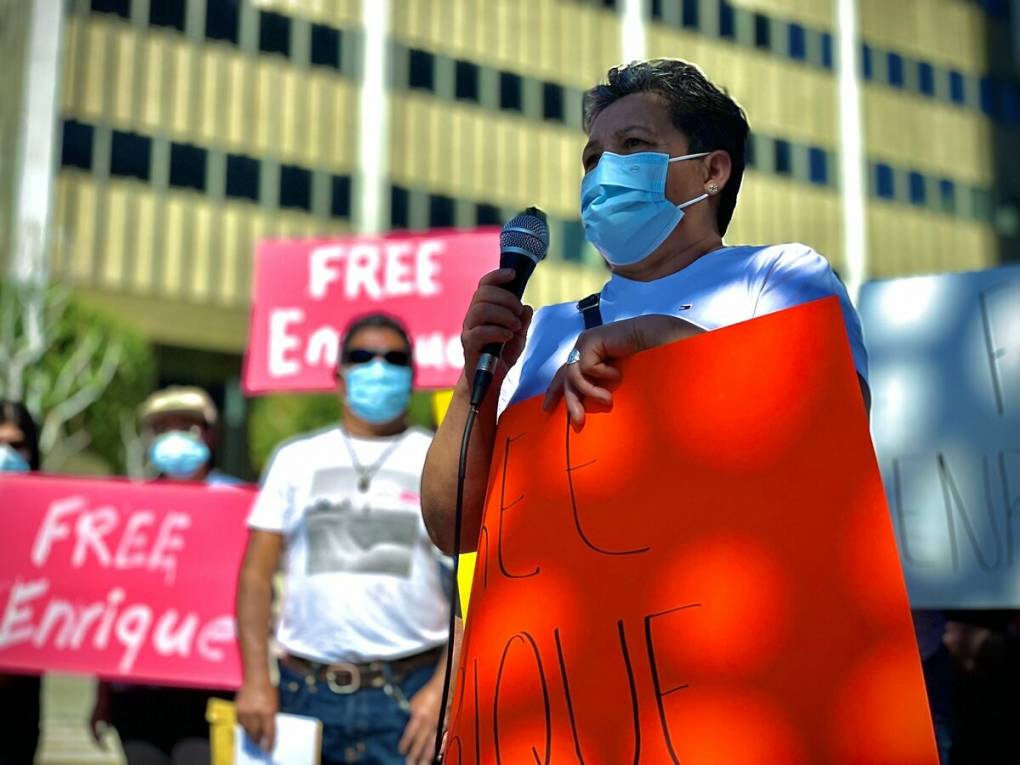
"caption": "Supporters of Enrique Cristobal Meneses and other ICE detainees at Golden State Annex call for their release outside Sen. Alex Padilla's offices in Los Angeles, on Feb. 10, 2021.",
"description": null,
"title": "RS53728_Free Enrique, NDLON-qut",
"credit": "Courtesy of the National Day Laborer Organizing Network",
"status": "inherit",
"altTag": "Three people are seen with masks and holding red and pink signs that read \"Free Enrique.\" One person holds a red sign in one hand and a microphone in the other.",
"isLoading": false,
"fetchFailed": false
},
"news_11903775": {
"type": "attachments",
"id": "news_11903775",
"meta": {
"index": "attachments_1716263798",
"site": "news",
"id": "11903775",
"found": true
},
"parent": 11903772,
"imgSizes": {
"twentyfourteen-full-width": {
"file": "https://ww2.kqed.org/app/uploads/sites/10/2022/02/young-waj-e1643843942952-1038x576.jpeg",
"width": 1038,
"mimeType": "image/jpeg",
"height": 576
},
"thumbnail": {
"file": "https://ww2.kqed.org/app/uploads/sites/10/2022/02/young-waj-e1643843942952-160x116.jpeg",
"width": 160,
"mimeType": "image/jpeg",
"height": 116
},
"post-thumbnail": {
"file": "https://ww2.kqed.org/app/uploads/sites/10/2022/02/young-waj-e1643843942952-672x372.jpeg",
"width": 672,
"mimeType": "image/jpeg",
"height": 372
},
"kqedFullSize": {
"file": "https://ww2.kqed.org/app/uploads/sites/10/2022/02/young-waj-e1643843942952.jpeg",
"width": 1418,
"height": 1026
},
"large": {
"file": "https://ww2.kqed.org/app/uploads/sites/10/2022/02/young-waj-e1643843942952-1020x738.jpeg",
"width": 1020,
"mimeType": "image/jpeg",
"height": 738
},
"medium": {
"file": "https://ww2.kqed.org/app/uploads/sites/10/2022/02/young-waj-e1643843942952-800x579.jpeg",
"width": 800,
"mimeType": "image/jpeg",
"height": 579
}
},
"publishDate": 1643842101,
"modified": 1650654309,
"caption": "A young Wajahat Ali at his family's home in Fremont.",
"description": null,
"title": "young waj",
"credit": "Courtesy Wajahat Ali",
"status": "inherit",
"altTag": "family photograph of young boy riding toy horse, tinted yellow, reads like a photo from the early 80s",
"isLoading": false,
"fetchFailed": false
},
"news_11904228": {
"type": "attachments",
"id": "news_11904228",
"meta": {
"index": "attachments_1716263798",
"site": "news",
"id": "11904228",
"found": true
},
"parent": 11903964,
"imgSizes": {
"twentyfourteen-full-width": {
"file": "https://ww2.kqed.org/app/uploads/sites/10/2022/02/image5PT-1038x576.jpeg",
"width": 1038,
"mimeType": "image/jpeg",
"height": 576
},
"thumbnail": {
"file": "https://ww2.kqed.org/app/uploads/sites/10/2022/02/image5PT-160x109.jpeg",
"width": 160,
"mimeType": "image/jpeg",
"height": 109
},
"post-thumbnail": {
"file": "https://ww2.kqed.org/app/uploads/sites/10/2022/02/image5PT-672x372.jpeg",
"width": 672,
"mimeType": "image/jpeg",
"height": 372
},
"kqedFullSize": {
"file": "https://ww2.kqed.org/app/uploads/sites/10/2022/02/image5PT.jpeg",
"width": 1170,
"height": 800
},
"large": {
"file": "https://ww2.kqed.org/app/uploads/sites/10/2022/02/image5PT-1020x697.jpeg",
"width": 1020,
"mimeType": "image/jpeg",
"height": 697
},
"medium": {
"file": "https://ww2.kqed.org/app/uploads/sites/10/2022/02/image5PT-800x547.jpeg",
"width": 800,
"mimeType": "image/jpeg",
"height": 547
}
},
"publishDate": 1644021945,
"modified": 1644022031,
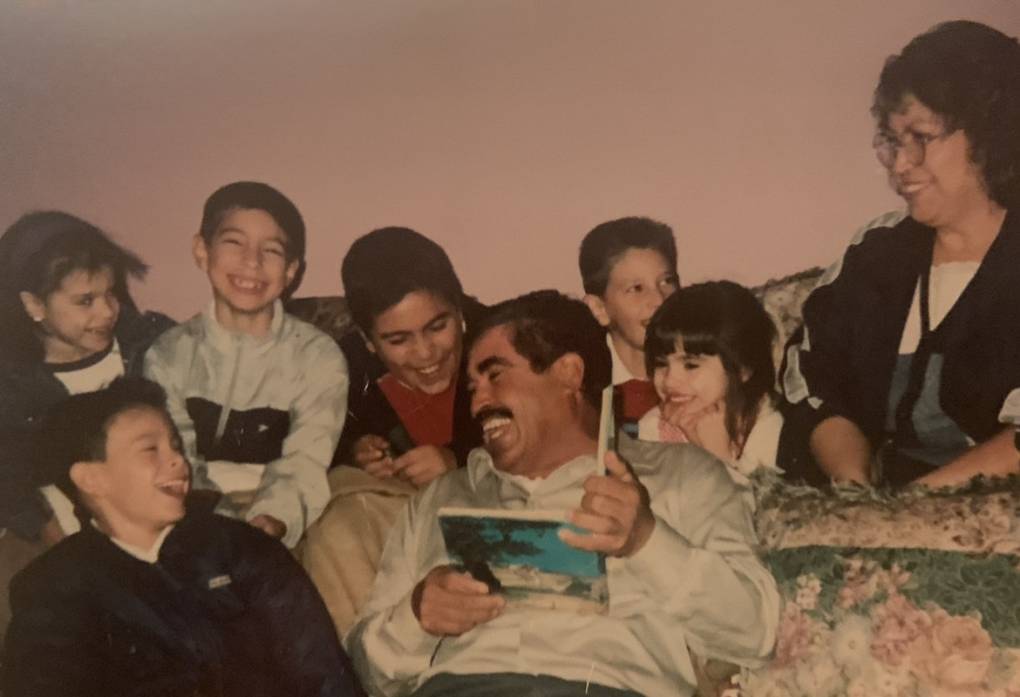
"caption": "Tomás Reyes Soto with his wife and grandchildren in their home in Madera in 2004. ",
"description": null,
"title": "image5PT",
"credit": "Courtesy Madi Bolaños",
"status": "inherit",
"altTag": "A man reading a book, surrounded by his wife and young grandchildren.",
"isLoading": false,
"fetchFailed": false
},
"news_11903832": {
"type": "attachments",
"id": "news_11903832",
"meta": {
"index": "attachments_1716263798",
"site": "news",
"id": "11903832",
"found": true
},
"parent": 11903829,
"imgSizes": {
"twentyfourteen-full-width": {
"file": "https://ww2.kqed.org/app/uploads/sites/10/2022/02/GettyImages-1330932126-1038x576.jpg",
"width": 1038,
"mimeType": "image/jpeg",
"height": 576
},
"thumbnail": {
"file": "https://ww2.kqed.org/app/uploads/sites/10/2022/02/GettyImages-1330932126-160x109.jpg",
"width": 160,
"mimeType": "image/jpeg",
"height": 109
},
"post-thumbnail": {
"file": "https://ww2.kqed.org/app/uploads/sites/10/2022/02/GettyImages-1330932126-672x372.jpg",
"width": 672,
"mimeType": "image/jpeg",
"height": 372
},
"kqedFullSize": {
"file": "https://ww2.kqed.org/app/uploads/sites/10/2022/02/GettyImages-1330932126-scaled-e1643861298742.jpg",
"width": 1920,
"height": 1308
},
"2048x2048": {
"file": "https://ww2.kqed.org/app/uploads/sites/10/2022/02/GettyImages-1330932126-2048x1395.jpg",
"width": 2048,
"mimeType": "image/jpeg",
"height": 1395
},
"large": {
"file": "https://ww2.kqed.org/app/uploads/sites/10/2022/02/GettyImages-1330932126-1020x695.jpg",
"width": 1020,
"mimeType": "image/jpeg",
"height": 695
},
"1536x1536": {
"file": "https://ww2.kqed.org/app/uploads/sites/10/2022/02/GettyImages-1330932126-1536x1046.jpg",
"width": 1536,
"mimeType": "image/jpeg",
"height": 1046
},
"full-width": {
"file": "https://ww2.kqed.org/app/uploads/sites/10/2022/02/GettyImages-1330932126-1920x1308.jpg",
"width": 1920,
"mimeType": "image/jpeg",
"height": 1308
},
"medium": {
"file": "https://ww2.kqed.org/app/uploads/sites/10/2022/02/GettyImages-1330932126-800x545.jpg",
"width": 800,
"mimeType": "image/jpeg",
"height": 545
}
},
"publishDate": 1643861280,
"modified": 1643912814,
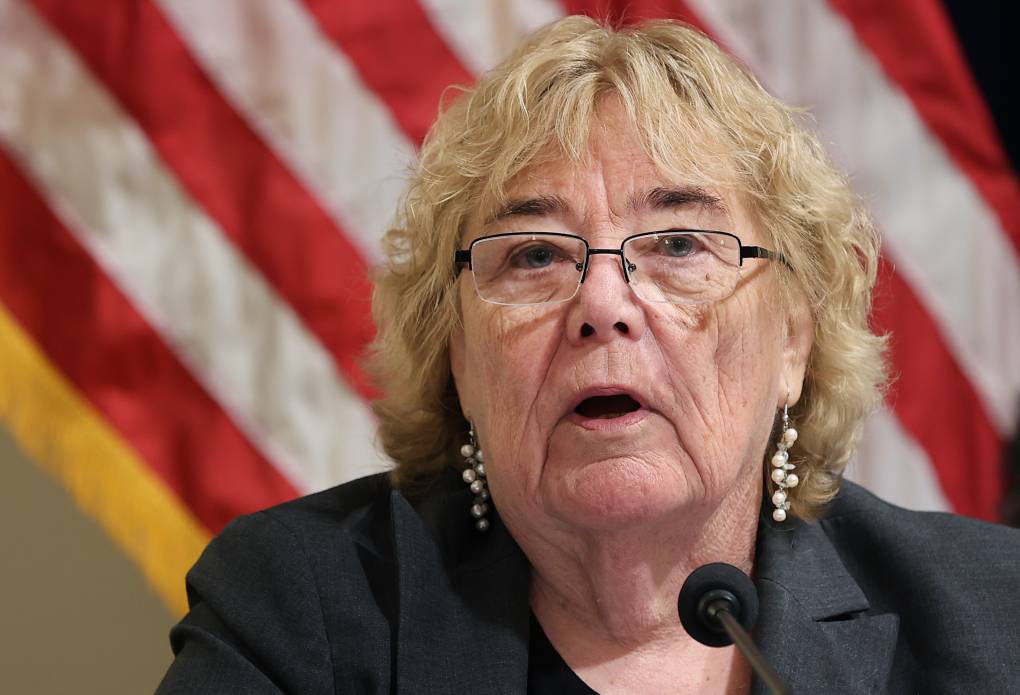
"caption": "U.S. Rep. Zoe Lofgren (D-San Jose) questions witnesses during a hearing by the House Select Committee investigating the January 6 attack on the U.S. Capitol on July 27, 2021, at the Cannon House Office Building in Washington, D.C. ",
"description": null,
"title": "House Select Committee Investigating January 6 Attack On US Capitol Holds First Hearing",
"credit": "Chip Somodevilla/Getty Images",
"status": "inherit",
"altTag": "A close shot of Zoe Lofgren, a middle-aged white woman with shoulder-length blond hair and glasses, wearing large earrings and a dark blue blazer, speaks into a microphone in front of an American flag.",
"isLoading": false,
"fetchFailed": false
},
"news_11903105": {
"type": "attachments",
"id": "news_11903105",
"meta": {
"index": "attachments_1716263798",
"site": "news",
"id": "11903105",
"found": true
},
"parent": 11903103,
"imgSizes": {
"twentyfourteen-full-width": {
"file": "https://ww2.kqed.org/app/uploads/sites/10/2022/01/ANGELA-ZHOU-SF-SCHOO-BOARD-RECALL-PICTURE-1020x576.jpg",
"width": 1020,
"mimeType": "image/jpeg",
"height": 576
},
"thumbnail": {
"file": "https://ww2.kqed.org/app/uploads/sites/10/2022/01/ANGELA-ZHOU-SF-SCHOO-BOARD-RECALL-PICTURE-160x107.jpg",
"width": 160,
"mimeType": "image/jpeg",
"height": 107
},
"post-thumbnail": {
"file": "https://ww2.kqed.org/app/uploads/sites/10/2022/01/ANGELA-ZHOU-SF-SCHOO-BOARD-RECALL-PICTURE-672x372.jpg",
"width": 672,
"mimeType": "image/jpeg",
"height": 372
},
"kqedFullSize": {
"file": "https://ww2.kqed.org/app/uploads/sites/10/2022/01/ANGELA-ZHOU-SF-SCHOO-BOARD-RECALL-PICTURE.jpg",
"width": 1020,
"height": 679
},
"medium": {
"file": "https://ww2.kqed.org/app/uploads/sites/10/2022/01/ANGELA-ZHOU-SF-SCHOO-BOARD-RECALL-PICTURE-800x533.jpg",
"width": 800,
"mimeType": "image/jpeg",
"height": 533
}
},
"publishDate": 1643394355,
"modified": 1643652988,
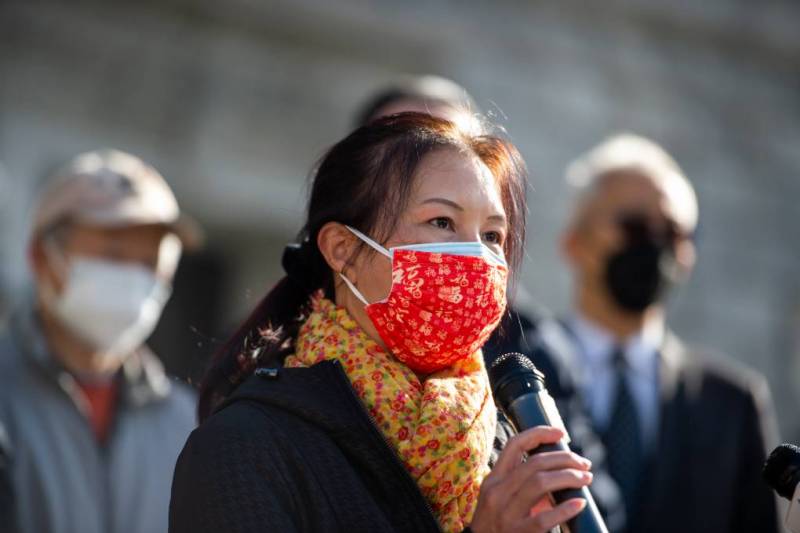
"caption": "Angela Zhou habla durante una conferencia de prensa organizada por el grupo de trabajo de alcance al votante chino/API en las escalinatas del Asian Art Museum en San Francisco el 14 de enero de 2022.",
"description": null,
"title": "ANGELA ZHOU SF SCHOO BOARD RECALL PICTURE",
"credit": "(Beth LaBerge/KQED)",
"status": "inherit",
"altTag": null,
"isLoading": false,
"fetchFailed": false
}
},
"audioPlayerReducer": {
"postId": "stream_live",
"isPaused": true,
"isPlaying": false,
"pfsActive": false,
"pledgeModalIsOpen": true,
"playerDrawerIsOpen": false,
"liveAudioPlayStartedAt": 0,
"liveAudioPlayContext": ""
},
"authorsReducer": {
"byline_news_11907319": {
"type": "authors",
"id": "byline_news_11907319",
"meta": {
"override": true
},
"slug": "byline_news_11907319",
"name": "John Antczak\u003cbr>The Associated Press",
"isLoading": false
},
"byline_news_11906868": {
"type": "authors",
"id": "byline_news_11906868",
"meta": {
"override": true
},
"slug": "byline_news_11906868",
"name": "\u003ca href=\"https://calmatters.org/author/anaibarra/\">Ana B. Ibarra\u003c/a>",
"isLoading": false
},
"gmarzorati": {
"type": "authors",
"id": "227",
"meta": {
"index": "authors_1716337520",
"id": "227",
"found": true
},
"name": "Guy Marzorati",
"firstName": "Guy",
"lastName": "Marzorati",
"slug": "gmarzorati",
"email": "gmarzorati@KQED.org",
"display_author_email": true,
"staff_mastheads": [
"news"
],
"title": "Correspondent",
"bio": "Guy Marzorati is a correspondent on KQED's California Politics and Government Desk, based in San Jose. A graduate of Santa Clara University, Guy joined KQED in 2013. He reports on state and local politics and produces KQED's digital voter guide.",
"avatar": "https://secure.gravatar.com/avatar/e7038b8dbfd55b104369b76b1cd0b9de?s=600&d=blank&r=g",
"twitter": "guymarzorati",
"facebook": null,
"instagram": null,
"linkedin": null,
"sites": [
{
"site": "",
"roles": [
"editor"
]
},
{
"site": "news",
"roles": [
"editor"
]
},
{
"site": "science",
"roles": [
"editor"
]
},
{
"site": "forum",
"roles": [
"editor"
]
},
{
"site": "elections",
"roles": [
"editor"
]
},
{
"site": "liveblog",
"roles": [
"editor"
]
}
],
"headData": {
"title": "Guy Marzorati | KQED",
"description": "Correspondent",
"ogImgSrc": "https://secure.gravatar.com/avatar/e7038b8dbfd55b104369b76b1cd0b9de?s=600&d=blank&r=g",
"twImgSrc": "https://secure.gravatar.com/avatar/e7038b8dbfd55b104369b76b1cd0b9de?s=600&d=blank&r=g"
},
"isLoading": false,
"link": "/author/gmarzorati"
},
"kqed": {
"type": "authors",
"id": "236",
"meta": {
"index": "authors_1716337520",
"id": "236",
"found": true
},
"name": "KQED News Staff",
"firstName": "KQED News Staff",
"lastName": null,
"slug": "kqed",
"email": "faq@kqed.org",
"display_author_email": false,
"staff_mastheads": [],
"title": null,
"bio": null,
"avatar": "https://secure.gravatar.com/avatar/ef0e801a68c4c54afa9180db14084167?s=600&d=blank&r=g",
"twitter": null,
"facebook": null,
"instagram": null,
"linkedin": null,
"sites": [
{
"site": "arts",
"roles": [
"contributor"
]
},
{
"site": "news",
"roles": [
"editor"
]
},
{
"site": "futureofyou",
"roles": [
"author"
]
}
],
"headData": {
"title": "KQED News Staff | KQED",
"description": null,
"ogImgSrc": "https://secure.gravatar.com/avatar/ef0e801a68c4c54afa9180db14084167?s=600&d=blank&r=g",
"twImgSrc": "https://secure.gravatar.com/avatar/ef0e801a68c4c54afa9180db14084167?s=600&d=blank&r=g"
},
"isLoading": false,
"link": "/author/kqed"
},
"rachael-myrow": {
"type": "authors",
"id": "251",
"meta": {
"index": "authors_1716337520",
"id": "251",
"found": true
},
"name": "Rachael Myrow",
"firstName": "Rachael",
"lastName": "Myrow",
"slug": "rachael-myrow",
"email": "rmyrow@kqed.org",
"display_author_email": true,
"staff_mastheads": [
"news"
],
"title": "Senior Editor of KQED's Silicon Valley News Desk",
"bio": "• I write and edit stories about how Silicon Valley power and policies shape everyday life in California. I’m also passionate about making Bay Area history and culture more accessible to a broad public. • I’ve been a journalist for most of my life, starting in high school with The Franklin Press in Los Angeles, where I grew up. While earning my first degree in English at UC Berkeley, I got my start in public radio at KALX-FM. After completing a second degree in journalism at Cal, I landed my first professional job at Marketplace, then moved on to KPCC (now LAist), and then KQED, where I hosted The California Report for more than seven years. • My reporting has appeared on NPR, The World, WBUR’s \u003ci>Here & Now\u003c/i>, and the BBC. I also guest host for KQED’s \u003ci>Forum\u003c/i>, as well as the Commonwealth Club in San Francisco. • I speak periodically on media, democracy and technology issues, and do voiceover work for documentaries and educational video projects. • Outside of the studio, you'll find me hiking Bay Area trails and whipping up Insta-ready meals in my kitchen. • I do not accept gifts, money, or favors from anyone connected to my reporting, I don't pay people for information, and I do not support or donate to political causes. • I strive to treat the people I report on with fairness, honesty, and respect. I also recognize there are often multiple sides to a story and work to verify information through multiple sources and documentation. If I get something wrong, I correct it.",
"avatar": "https://secure.gravatar.com/avatar/3ed8a3c5f26025e4a805ba634cda8cd764906b97438a6d9ce216b044e340da4e?s=600&d=blank&r=g",
"twitter": "rachaelmyrow",
"bluesky": null,
"facebook": null,
"instagram": null,
"linkedin": "https://www.linkedin.com/in/rachaelmyrow/",
"sites": [
{
"site": "arts",
"roles": [
"administrator"
]
},
{
"site": "news",
"roles": [
"edit_others_posts",
"editor"
]
},
{
"site": "futureofyou",
"roles": [
"editor"
]
},
{
"site": "bayareabites",
"roles": [
"editor"
]
},
{
"site": "stateofhealth",
"roles": [
"editor"
]
},
{
"site": "science",
"roles": [
"editor"
]
},
{
"site": "food",
"roles": [
"editor"
]
},
{
"site": "forum",
"roles": [
"editor"
]
},
{
"site": "liveblog",
"roles": [
"author"
]
}
],
"headData": {
"title": "Rachael Myrow | KQED",
"description": "Senior Editor of KQED's Silicon Valley News Desk",
"ogImgSrc": "https://secure.gravatar.com/avatar/3ed8a3c5f26025e4a805ba634cda8cd764906b97438a6d9ce216b044e340da4e?s=600&d=blank&r=g",
"twImgSrc": "https://secure.gravatar.com/avatar/3ed8a3c5f26025e4a805ba634cda8cd764906b97438a6d9ce216b044e340da4e?s=600&d=blank&r=g"
},
"isLoading": false,
"link": "/author/rachael-myrow"
},
"sasha-khokha": {
"type": "authors",
"id": "254",
"meta": {
"index": "authors_1716337520",
"id": "254",
"found": true
},
"name": "Sasha Khokha",
"firstName": "Sasha",
"lastName": "Khokha",
"slug": "sasha-khokha",
"email": "skhokha@kqed.org",
"display_author_email": true,
"staff_mastheads": [
"news"
],
"title": "Host, The California Report Magazine",
"bio": "Sasha Khokha is the host of \u003cem>The California Report's \u003c/em> weekly magazine program, which takes listeners on sound-rich excursions to meet the people that make the Golden State unique -- through audio documentaries and long-form stories. As \u003cem>The California Report's\u003c/em> Central Valley Bureau Chief based in Fresno for nearly a dozen years, Sasha brought the lives and concerns of rural Californians to listeners around the state. Her reporting helped expose the hidden price immigrant women janitors and farmworkers may pay to keep their jobs: sexual assault at work. It inspired two new California laws to protect them from sexual harassment. She was a key member of the reporting team for the Frontline film \u003cem>Rape on the Night Shift, \u003c/em>which was nominated for two national Emmys. Sasha has also won a national Edward R. Murrow and a national PRNDI award for investigative reporting, as well as multiple prizes from the Society for Professional Journalists. Sasha is a proud alum of the UC Berkeley Graduate School of Journalism and Brown University and a member of the South Asian Journalists Association.",
"avatar": "https://secure.gravatar.com/avatar/e4b5e1541aaeea2aa356aa1fb2a68950?s=600&d=blank&r=g",
"twitter": "KQEDSashaKhokha",
"facebook": null,
"instagram": null,
"linkedin": null,
"sites": [
{
"site": "news",
"roles": [
"editor"
]
},
{
"site": "stateofhealth",
"roles": [
"author"
]
},
{
"site": "science",
"roles": [
"author"
]
},
{
"site": "quest",
"roles": [
"subscriber"
]
}
],
"headData": {
"title": "Sasha Khokha | KQED",
"description": "Host, The California Report Magazine",
"ogImgSrc": "https://secure.gravatar.com/avatar/e4b5e1541aaeea2aa356aa1fb2a68950?s=600&d=blank&r=g",
"twImgSrc": "https://secure.gravatar.com/avatar/e4b5e1541aaeea2aa356aa1fb2a68950?s=600&d=blank&r=g"
},
"isLoading": false,
"link": "/author/sasha-khokha"
},
"tychehendricks": {
"type": "authors",
"id": "259",
"meta": {
"index": "authors_1716337520",
"id": "259",
"found": true
},
"name": "Tyche Hendricks",
"firstName": "Tyche",
"lastName": "Hendricks",
"slug": "tychehendricks",
"email": "thendricks@kqed.org",
"display_author_email": true,
"staff_mastheads": [
"news"
],
"title": "KQED Senior Editor, Immigration",
"bio": "\u003cspan style=\"font-weight: 400;\">Tyche Hendricks is KQED’s senior editor for immigration, leading coverage of the policy and politics that affect California’s immigrant communities. Her work for KQED’s radio and online audiences is also carried on NPR and other national outlets. She has been recognized with awards from the Radio and Television News Directors Association, the Society for Professional Journalists; the Education Writers Association; the Best of the West and the National Federation of Community Broadcasters. Before joining KQED in 2010, Tyche spent more than a dozen years as a newspaper reporter, notably at the \u003c/span>\u003ci>\u003cspan style=\"font-weight: 400;\">San Francisco Chronicle\u003c/span>\u003c/i>\u003cspan style=\"font-weight: 400;\">. At different times she has covered criminal justice, government and politics and urban planning. Tyche has taught in the MFA Creative Writing program at the University of San Francisco and at UC Berkeley’s Graduate School of Journalism, where she was co-director of a national immigration symposium for professional journalists. She is the author of \u003c/span>\u003ci>\u003cspan style=\"font-weight: 400;\">The Wind Doesn't Need a Passport: Stories from the U.S.-Mexico Borderlands\u003c/span>\u003c/i>\u003cspan style=\"font-weight: 400;\"> (University of California Press). \u003c/span>",
"avatar": "https://secure.gravatar.com/avatar/b8ee458e2731c2d43df86882ce17267e?s=600&d=blank&r=g",
"twitter": "tychehendricks",
"facebook": null,
"instagram": null,
"linkedin": null,
"sites": [
{
"site": "news",
"roles": [
"editor"
]
},
{
"site": "stateofhealth",
"roles": [
"editor"
]
}
],
"headData": {
"title": "Tyche Hendricks | KQED",
"description": "KQED Senior Editor, Immigration",
"ogImgSrc": "https://secure.gravatar.com/avatar/b8ee458e2731c2d43df86882ce17267e?s=600&d=blank&r=g",
"twImgSrc": "https://secure.gravatar.com/avatar/b8ee458e2731c2d43df86882ce17267e?s=600&d=blank&r=g"
},
"isLoading": false,
"link": "/author/tychehendricks"
},
"markfiore": {
"type": "authors",
"id": "3236",
"meta": {
"index": "authors_1716337520",
"id": "3236",
"found": true
},
"name": "Mark Fiore",
"firstName": "Mark",
"lastName": "Fiore",
"slug": "markfiore",
"email": "mark@markfiore.com",
"display_author_email": false,
"staff_mastheads": [
"news"
],
"title": "KQED News Cartoonist",
"bio": "\u003ca href=\"http://www.MarkFiore.com\">MarkFiore.com\u003c/a> | \u003ca href=\"https://twitter.com/markfiore\">Follow on Twitter\u003c/a> | \u003ca href=\"https://www.facebook.com/pages/Mark-Fiore-Animated-Political-Cartoons/94451707396?ref=bookmarks\">Facebook\u003c/a> | \u003ca href=\"mailto:mark@markfiore.com\">email\u003c/a>\r\n\r\nPulitzer Prize-winner, Mark Fiore, who the Wall Street Journal has called “the undisputed guru of the form,” creates animated political cartoons in San Francisco, where his work has been featured regularly on the San Francisco Chronicle’s web site, SFGate.com. His work has appeared on Newsweek.com, Slate.com, CBSNews.com, MotherJones.com, DailyKos.com and NPR’s web site. Fiore’s political animation has appeared on CNN, Frontline, Bill Moyers Journal, Salon.com and cable and broadcast outlets across the globe.\r\n\r\nBeginning his professional life by drawing traditional political cartoons for newspapers, Fiore’s work appeared in publications ranging from the Washington Post to the Los Angeles Times. In the late 1990s, he began to experiment with animating political cartoons and, after a short stint at the San Jose Mercury News as their staff cartoonist, Fiore devoted all his energies to animation.\r\nGrowing up in California, Fiore also spent a good portion of his life in the backwoods of Idaho. It was this combination that shaped him politically. Mark majored in political science at Colorado College, where, in a perfect send-off for a cartoonist, he received his diploma in 1991 as commencement speaker Dick Cheney smiled approvingly.\r\nMark Fiore was awarded the Pulitzer Prize for political cartooning in 2010, a Robert F. Kennedy Journalism Award in 2004 and has twice received an Online Journalism Award for commentary from the Online News Association (2002, 2008). Fiore has received two awards for his work in new media from the National Cartoonists Society (2001, 2002), and in 2006 received The James Madison Freedom of Information Award from The Society of Professional Journalists.",
"avatar": "https://secure.gravatar.com/avatar/fc4e2a612b15b67bad0c6f0e1db4ca9b?s=600&d=blank&r=g",
"twitter": "MarkFiore",
"facebook": null,
"instagram": "https://www.instagram.com/markfiore/?hl=en",
"linkedin": null,
"sites": [
{
"site": "arts",
"roles": [
"contributor"
]
},
{
"site": "news",
"roles": [
"editor"
]
},
{
"site": "futureofyou",
"roles": [
"editor"
]
},
{
"site": "science",
"roles": [
"editor"
]
}
],
"headData": {
"title": "Mark Fiore | KQED",
"description": "KQED News Cartoonist",
"ogImgSrc": "https://secure.gravatar.com/avatar/fc4e2a612b15b67bad0c6f0e1db4ca9b?s=600&d=blank&r=g",
"twImgSrc": "https://secure.gravatar.com/avatar/fc4e2a612b15b67bad0c6f0e1db4ca9b?s=600&d=blank&r=g"
},
"isLoading": false,
"link": "/author/markfiore"
},
"afont": {
"type": "authors",
"id": "8637",
"meta": {
"index": "authors_1716337520",
"id": "8637",
"found": true
},
"name": "Amanda Font",
"firstName": "Amanda",
"lastName": "Font",
"slug": "afont",
"email": "afont@kqed.org",
"display_author_email": false,
"staff_mastheads": [],
"title": "KQED Contributor",
"bio": "Amanda Font is a producer on \u003cem>The Latest\u003c/em> podcast, and the host and co-producer of the series \u003cem>Audible Cosmos\u003c/em>. She has previously worked as a producer and reporter on the \u003cem>Bay Curious\u003c/em> podcast, and director of \u003cem>The California Report Magazine\u003c/em>. She grew up in the deserts of Southern California and moved north for the trees. Amanda earned a B.A. from the BECA program at San Francisco State, where she worked in the university's radio station. Amanda Font is represented by SAG-AFTRA.",
"avatar": "https://secure.gravatar.com/avatar/d9e81cf0117d5849b9cfb7ab4b1422f1?s=600&d=blank&r=g",
"twitter": null,
"facebook": null,
"instagram": null,
"linkedin": null,
"sites": [
{
"site": "news",
"roles": [
"add_users",
"create_users"
]
},
{
"site": "science",
"roles": []
},
{
"site": "forum",
"roles": [
"administrator"
]
},
{
"site": "perspectives",
"roles": [
"administrator"
]
},
{
"site": "radio",
"roles": [
"administrator"
]
}
],
"headData": {
"title": "Amanda Font | KQED",
"description": "KQED Contributor",
"ogImgSrc": "https://secure.gravatar.com/avatar/d9e81cf0117d5849b9cfb7ab4b1422f1?s=600&d=blank&r=g",
"twImgSrc": "https://secure.gravatar.com/avatar/d9e81cf0117d5849b9cfb7ab4b1422f1?s=600&d=blank&r=g"
},
"isLoading": false,
"link": "/author/afont"
},
"fjhabvala": {
"type": "authors",
"id": "8659",
"meta": {
"index": "authors_1716337520",
"id": "8659",
"found": true
},
"name": "Farida Jhabvala Romero",
"firstName": "Farida",
"lastName": "Jhabvala Romero",
"slug": "fjhabvala",
"email": "fjhabvala@kqed.org",
"display_author_email": true,
"staff_mastheads": [
"news"
],
"title": "KQED Contributor",
"bio": "Farida Jhabvala Romero is a Labor Correspondent for KQED. She previously covered immigration. Farida was \u003ca href=\"https://www.ccnma.org/2022-most-influential-latina-journalists\">named\u003c/a> one of the 10 Most Influential Latina Journalists in California in 2022 by the California Chicano News Media Association. Her work has won awards from the Society of Professional Journalists (Northern California), as well as a national and regional Edward M. Murrow Award for the collaborative reporting projects “Dangerous Air” and “Graying California.” Before joining KQED, Farida worked as a producer at Radio Bilingüe, a national public radio network. Farida earned her master’s degree in journalism from Stanford University.",
"avatar": "https://secure.gravatar.com/avatar/f9f022d4e2609741874222a1e9d41f48fea74011aa7c615eef91d9a50c944ebe?s=600&d=blank&r=g",
"twitter": "FaridaJhabvala",
"bluesky": null,
"facebook": null,
"instagram": null,
"linkedin": "https://www.linkedin.com/in/faridajhabvala/",
"sites": [
{
"site": "news",
"roles": [
"editor"
]
},
{
"site": "stateofhealth",
"roles": [
"author"
]
},
{
"site": "liveblog",
"roles": [
"author"
]
}
],
"headData": {
"title": "Farida Jhabvala Romero | KQED",
"description": "KQED Contributor",
"ogImgSrc": "https://secure.gravatar.com/avatar/f9f022d4e2609741874222a1e9d41f48fea74011aa7c615eef91d9a50c944ebe?s=600&d=blank&r=g",
"twImgSrc": "https://secure.gravatar.com/avatar/f9f022d4e2609741874222a1e9d41f48fea74011aa7c615eef91d9a50c944ebe?s=600&d=blank&r=g"
},
"isLoading": false,
"link": "/author/fjhabvala"
},
"mwiley": {
"type": "authors",
"id": "11526",
"meta": {
"index": "authors_1716337520",
"id": "11526",
"found": true
},
"name": "Michelle Wiley",
"firstName": "Michelle",
"lastName": "Wiley",
"slug": "mwiley",
"email": "mwiley@KQED.org",
"display_author_email": true,
"staff_mastheads": [],
"title": null,
"bio": "Michelle Wiley was the senior editor of weekends.",
"avatar": "https://secure.gravatar.com/avatar/3b897d82a09e8587e8e73fa69fbcc635?s=600&d=blank&r=g",
"twitter": "michelleewiley",
"facebook": null,
"instagram": null,
"linkedin": null,
"sites": [
{
"site": "",
"roles": [
"editor"
]
},
{
"site": "arts",
"roles": [
"editor"
]
},
{
"site": "news",
"roles": [
"subscriber"
]
},
{
"site": "lowdown",
"roles": [
"editor"
]
},
{
"site": "science",
"roles": [
"editor"
]
},
{
"site": "podcasts",
"roles": [
"editor"
]
}
],
"headData": {
"title": "Michelle Wiley | KQED",
"description": null,
"ogImgSrc": "https://secure.gravatar.com/avatar/3b897d82a09e8587e8e73fa69fbcc635?s=600&d=blank&r=g",
"twImgSrc": "https://secure.gravatar.com/avatar/3b897d82a09e8587e8e73fa69fbcc635?s=600&d=blank&r=g"
},
"isLoading": false,
"link": "/author/mwiley"
},
"ccabreralomeli": {
"type": "authors",
"id": "11708",
"meta": {
"index": "authors_1716337520",
"id": "11708",
"found": true
},
"name": "Carlos Cabrera-Lomelí",
"firstName": "Carlos",
"lastName": "Cabrera-Lomelí",
"slug": "ccabreralomeli",
"email": "ccabreralomeli@KQED.org",
"display_author_email": true,
"staff_mastheads": [
"news"
],
"title": "Community Reporter",
"bio": "Carlos Cabrera-Lomelí is a community reporter with KQED's digital engagement team. He also reports and co-produces for KQED's bilingual news hub KQED en Español. He grew up in San Francisco's Mission District and has previously worked with Univision, 48 Hills and REFORMA in Mexico City.",
"avatar": "https://secure.gravatar.com/avatar/c309be9665e484f887b818c89e273ecc673004f426f36b24d00a4d813a2e0518?s=600&d=blank&r=g",
"twitter": "@LomeliCabrera",
"bluesky": null,
"facebook": null,
"instagram": null,
"linkedin": null,
"sites": [
{
"site": "arts",
"roles": [
"editor"
]
},
{
"site": "news",
"roles": [
"editor"
]
},
{
"site": "about",
"roles": [
"editor"
]
},
{
"site": "science",
"roles": [
"editor"
]
},
{
"site": "perspectives",
"roles": [
"editor"
]
},
{
"site": "elections",
"roles": [
"editor"
]
},
{
"site": "liveblog",
"roles": [
"contributor"
]
}
],
"headData": {
"title": "Carlos Cabrera-Lomelí | KQED",
"description": "Community Reporter",
"ogImgSrc": "https://secure.gravatar.com/avatar/c309be9665e484f887b818c89e273ecc673004f426f36b24d00a4d813a2e0518?s=600&d=blank&r=g",
"twImgSrc": "https://secure.gravatar.com/avatar/c309be9665e484f887b818c89e273ecc673004f426f36b24d00a4d813a2e0518?s=600&d=blank&r=g"
},
"isLoading": false,
"link": "/author/ccabreralomeli"
},
"mbolanos": {
"type": "authors",
"id": "11895",
"meta": {
"index": "authors_1716337520",
"id": "11895",
"found": true
},
"name": "Madi Bolaños",
"firstName": "Madi",
"lastName": "Bolaños",
"slug": "mbolanos",
"email": "mbolanos@kqed.org",
"display_author_email": false,
"staff_mastheads": [],
"title": "KQED Contributor",
"bio": null,
"avatar": "https://secure.gravatar.com/avatar/e6df5601c1f2d951e46a3fb42764330f?s=600&d=blank&r=g",
"twitter": null,
"bluesky": null,
"facebook": null,
"instagram": null,
"linkedin": null,
"sites": [
{
"site": "news",
"roles": [
"author"
]
}
],
"headData": {
"title": "Madi Bolaños | KQED",
"description": "KQED Contributor",
"ogImgSrc": "https://secure.gravatar.com/avatar/e6df5601c1f2d951e46a3fb42764330f?s=600&d=blank&r=g",
"twImgSrc": "https://secure.gravatar.com/avatar/e6df5601c1f2d951e46a3fb42764330f?s=600&d=blank&r=g"
},
"isLoading": false,
"link": "/author/mbolanos"
}
},
"pagesReducer": {
"news_category_immigration": {
"type": "terms",
"id": "news_1169",
"meta": {
"index": "terms_1716263798",
"site": "news",
"id": "1169",
"score": 10.910406
},
"featImg": null,
"name": "Immigration",
"description": null,
"taxonomy": "category",
"headData": {
"twImgId": null,
"twTitle": null,
"ogTitle": null,
"ogImgId": null,
"twDescription": null,
"description": null,
"title": "Immigration Archives | KQED News",
"ogDescription": null
},
"ttid": 1180,
"slug": "immigration",
"isLoading": false,
"title": "Immigration",
"pageMeta": {
"site": "news",
"WpPageTemplate": "page-topic-editorial",
"currentPage": 51
},
"blocks": [
{
"blockName": "kqed/post-list",
"attrs": {
"layout": "cardArticle2",
"query": "posts/news?category=immigration",
"seeMore": false,
"paginated": true,
"page": 51
}
},
{
"blockName": "kqed/ad"
}
]
}
},
"pfsSessionReducer": {},
"postsReducer": {
"stream_live": {
"type": "live",
"id": "stream_live",
"audioUrl": "https://streams.kqed.org/kqedradio",
"title": "Live Stream",
"excerpt": "Live Stream information currently unavailable.",
"link": "/radio",
"featImg": "",
"label": {
"name": "KQED Live",
"link": "/"
}
},
"stream_kqedNewscast": {
"type": "posts",
"id": "stream_kqedNewscast",
"audioUrl": "https://www.kqed.org/.stream/anon/radio/RDnews/newscast.mp3?_=1",
"title": "KQED Newscast",
"featImg": "",
"label": {
"name": "88.5 FM",
"link": "/"
}
},
"news_11907319": {
"type": "posts",
"id": "news_11907319",
"meta": {
"index": "posts_1716263798",
"site": "news",
"id": "11907319",
"score": null,
"sort": [
1646681804000
]
},
"guestAuthors": [],
"slug": "ukrainians-in-us-granted-temporary-protection-status-allowed-to-stay-up-to-18-months",
"title": "Ukrainians in US Granted Temporary Protection Status, Allowed to Stay Up to 18 Months",
"publishDate": 1646681804,
"format": "standard",
"headTitle": "Ukrainians in US Granted Temporary Protection Status, Allowed to Stay Up to 18 Months | KQED",
"labelTerm": {
"site": "news"
},
"content": "\u003cp>Iryna Volvach traveled from Ukraine to California on a tour package with a friend and decided to stay for a few months. When Russia invaded Ukraine, leaving her stuck in the U.S., she worried about her children and grandchildren back home.\u003c/p>\n\u003cp>As Volvach, 62, tearfully told The Associated Press this week about her efforts to rescue her family, the Biden administration announced humanitarian relief that could keep thousands of Ukrainians in the U.S. without fear of deportation to their embattled homeland.\u003c/p>\n\u003cp>“Thank you,” Volvach said in English last Thursday as the news was relayed to her through her Russian-speaking friend.\u003c/p>\n\u003cp>“They are happy I am here,” she said in Russian. “They are not worried about me. I am worried about them.”\u003c/p>\n\u003cp>Volvach’s reaction reflects emotions many Ukrainians who are currently in the U.S. may feel about the decision to grant the temporary protected status, or TPS, they’d been seeking since the Russian invasion, which marks the largest conventional military action in Europe since World War II. The invasion has caused a humanitarian crisis that has driven more than 1.2 million people to flee Ukraine since the fighting began, according to the United Nations’ refugee agency.[pullquote size=\"medium\" align=\"right\" citation=\"Nika Rudenko, Ukrainian national and student\"]‘My mental state is not very stable and it’s just very difficult to keep up with work and at the same time to try to do something for my country.’[/pullquote]\u003c/p>\n\u003cp>Refugee advocates applauded the move after more than 177 organizations signed a letter sent to the administration requesting the relief.\u003c/p>\n\u003cp>Under the federal program, Ukrainians can remain in the country for up to 18 months. In order to be eligible, individuals would have to have been in the U.S. by last Tuesday.\u003c/p>\n\u003cp>Citizens from a dozen countries are already in the United States under the TPS program, which is designated for people fleeing ongoing armed conflict, environmental disasters or extraordinary and temporary conditions. The countries include Somalia, Yemen, Syria, Haiti and Venezuela.\u003c/p>\n\u003cp>About 75,100 Ukrainians are expected to be eligible, according to the latest estimates from the Department of Homeland Security. They include about 4,000 people with pending asylum claims and many others who entered the U.S. legally as tourists, business visitors or students on visas that have expired or are about to expire.\u003c/p>\n\u003cp>PJ Moore, executive director of World Relief’s office in Memphis, Tennessee, said the organization has helped about 18,000 Ukrainians settle in the U.S. in the past 18 years, with most of them residing in California and Washington state.\u003c/p>\n\u003cp>Across the country, in Cambridge, Massachusetts, Ukrainian national Nika Rudenko says she’ll consider seeking TPS if she decides to take leave from college and can’t meet the requirements of her student visa.\u003c/p>\n\u003cp>Rudenko, a 20-year-old Harvard University sophomore, says she stopped attending classes after the invasion started last week because she’s worried about her family, who remain in hiding in the Ukrainian capital of Kyiv. Rudenko said she’s also trying to raise awareness on campus about the situation.[aside postID=\"news_11907312,arts_13909903,news_11906380\" label=\"Related Posts\"]“My mental state is not very stable and it’s just very difficult to keep up with work and at the same time to try to do something for my country,” Rudenko said. “It feels very weird to understand that everyone else’s lives just carry on, but my life has completely changed. People just cannot feel what you’re going through, and it hurts.”\u003c/p>\n\u003cp>While Rudenko’s pain could be eased a bit by gaining protected status, it appears Volodymyr Bobko’s mother-in-law is not as fortunate. Bobko, 31, said he and his wife had talked about the potential for seeking TPS for his wife’s mother, who arrived Thursday from Ukraine via Poland — two days after the Tuesday cutoff.\u003c/p>\n\u003cp>Bobko, a resident of Boxborough, Massachusetts, came from Ukraine in 2016 and is a green card holder. He says his wife’s mother has a tourist visa and had booked a flight months ago to help with the birth of the couple’s second child later this month.\u003c/p>\n\u003cp>Bobko says asking his mother-in-law to stay longer than planned would likely be a tall order, in any case. Her husband and other family members are still in western Ukraine, he said.\u003c/p>\n\u003cp>“She wants to get back, maybe in a couple of months, but we don’t know yet what the situation is going to be in a couple of months,” Bobko said. “Right now, she’s still thinking she’s still going to live in Ukraine because it’s a beautiful country and she has a lot of friends and families over there.”\u003cbr>\n[ad fullwidth]\u003c/p>\n\u003cp>\u003c/p>\n",
"blocks": [],
"excerpt": "The Biden administration granted temporary protected status for Ukrainians, which could keep thousands of them in the U.S. without fear of deportation to their embattled homeland. Under the federal program, Ukrainians can remain in the country for up to 18 months.",
"status": "publish",
"parent": 0,
"modified": 1729027695,
"stats": {
"hasAudio": false,
"hasVideo": false,
"hasChartOrMap": false,
"iframeSrcs": [],
"hasGoogleForm": false,
"hasGallery": false,
"hasHearkenModule": false,
"hasPolis": false,
"paragraphCount": 17,
"wordCount": 834
},
"headData": {
"title": "Ukrainians in US Granted Temporary Protection Status, Allowed to Stay Up to 18 Months | KQED",
"description": "The Biden administration granted temporary protected status for Ukrainians, which could keep thousands of them in the U.S. without fear of deportation to their embattled homeland. Under the federal program, Ukrainians can remain in the country for up to 18 months.",
"ogTitle": "",
"ogDescription": "",
"ogImgId": "",
"twTitle": "",
"twDescription": "",
"twImgId": "",
"schema": {
"@context": "https://schema.org",
"@type": "NewsArticle",
"headline": "Ukrainians in US Granted Temporary Protection Status, Allowed to Stay Up to 18 Months",
"datePublished": "2022-03-07T11:36:44-08:00",
"dateModified": "2024-10-15T14:28:15-07:00",
"image": "https://cdn.kqed.org/wp-content/uploads/2020/02/KQED-OG-Image@1x.png",
"isAccessibleForFree": "True",
"publisher": {
"@type": "NewsMediaOrganization",
"@id": "https://www.kqed.org/#organization",
"name": "KQED",
"logo": "https://cdn.kqed.org/wp-content/uploads/2020/02/KQED-OG-Image@1x.png",
"url": "https://www.kqed.org",
"sameAs": [
"https://www.facebook.com/KQED",
"https://twitter.com/KQED",
"https://www.instagram.com/kqed/",
"https://www.tiktok.com/@kqedofficial",
"https://www.linkedin.com/company/kqed",
"https://www.youtube.com/channel/UCeC0IOo7i1P_61zVUWbJ4nw"
]
}
}
},
"audioUrl": "https://ww2.kqed.org/app/uploads/sites/10/2022/03/TCRAM2022030UkraineTPS.mp3",
"sticky": false,
"nprByline": "John Antczak\u003cbr>The Associated Press",
"excludeFromSiteSearch": "Include",
"showOnAuthorArchivePages": "No",
"path": "/news/11907319/ukrainians-in-us-granted-temporary-protection-status-allowed-to-stay-up-to-18-months",
"audioTrackLength": null,
"parsedContent": [
{
"type": "contentString",
"content": "\u003cdiv class=\"post-body\">\u003cp>\u003cp>Iryna Volvach traveled from Ukraine to California on a tour package with a friend and decided to stay for a few months. When Russia invaded Ukraine, leaving her stuck in the U.S., she worried about her children and grandchildren back home.\u003c/p>\n\u003cp>As Volvach, 62, tearfully told The Associated Press this week about her efforts to rescue her family, the Biden administration announced humanitarian relief that could keep thousands of Ukrainians in the U.S. without fear of deportation to their embattled homeland.\u003c/p>\n\u003cp>“Thank you,” Volvach said in English last Thursday as the news was relayed to her through her Russian-speaking friend.\u003c/p>\n\u003cp>“They are happy I am here,” she said in Russian. “They are not worried about me. I am worried about them.”\u003c/p>\n\u003cp>Volvach’s reaction reflects emotions many Ukrainians who are currently in the U.S. may feel about the decision to grant the temporary protected status, or TPS, they’d been seeking since the Russian invasion, which marks the largest conventional military action in Europe since World War II. The invasion has caused a humanitarian crisis that has driven more than 1.2 million people to flee Ukraine since the fighting began, according to the United Nations’ refugee agency.\u003c/p>\u003c/div>",
"attributes": {
"named": {},
"numeric": []
}
},
{
"type": "component",
"content": "‘My mental state is not very stable and it’s just very difficult to keep up with work and at the same time to try to do something for my country.’",
"name": "pullquote",
"attributes": {
"named": {
"size": "medium",
"align": "right",
"citation": "Nika Rudenko, Ukrainian national and student",
"label": ""
},
"numeric": []
}
},
{
"type": "contentString",
"content": "\u003cdiv class=\"post-body\">\u003cp>\u003c/p>\n\u003cp>Refugee advocates applauded the move after more than 177 organizations signed a letter sent to the administration requesting the relief.\u003c/p>\n\u003cp>Under the federal program, Ukrainians can remain in the country for up to 18 months. In order to be eligible, individuals would have to have been in the U.S. by last Tuesday.\u003c/p>\n\u003cp>Citizens from a dozen countries are already in the United States under the TPS program, which is designated for people fleeing ongoing armed conflict, environmental disasters or extraordinary and temporary conditions. The countries include Somalia, Yemen, Syria, Haiti and Venezuela.\u003c/p>\n\u003cp>About 75,100 Ukrainians are expected to be eligible, according to the latest estimates from the Department of Homeland Security. They include about 4,000 people with pending asylum claims and many others who entered the U.S. legally as tourists, business visitors or students on visas that have expired or are about to expire.\u003c/p>\n\u003cp>PJ Moore, executive director of World Relief’s office in Memphis, Tennessee, said the organization has helped about 18,000 Ukrainians settle in the U.S. in the past 18 years, with most of them residing in California and Washington state.\u003c/p>\n\u003cp>Across the country, in Cambridge, Massachusetts, Ukrainian national Nika Rudenko says she’ll consider seeking TPS if she decides to take leave from college and can’t meet the requirements of her student visa.\u003c/p>\n\u003cp>Rudenko, a 20-year-old Harvard University sophomore, says she stopped attending classes after the invasion started last week because she’s worried about her family, who remain in hiding in the Ukrainian capital of Kyiv. Rudenko said she’s also trying to raise awareness on campus about the situation.\u003c/p>\u003c/div>",
"attributes": {
"named": {},
"numeric": []
}
},
{
"type": "component",
"content": "",
"name": "aside",
"attributes": {
"named": {
"postid": "news_11907312,arts_13909903,news_11906380",
"label": "Related Posts "
},
"numeric": []
}
},
{
"type": "contentString",
"content": "\u003cdiv class=\"post-body\">\u003cp>“My mental state is not very stable and it’s just very difficult to keep up with work and at the same time to try to do something for my country,” Rudenko said. “It feels very weird to understand that everyone else’s lives just carry on, but my life has completely changed. People just cannot feel what you’re going through, and it hurts.”\u003c/p>\n\u003cp>While Rudenko’s pain could be eased a bit by gaining protected status, it appears Volodymyr Bobko’s mother-in-law is not as fortunate. Bobko, 31, said he and his wife had talked about the potential for seeking TPS for his wife’s mother, who arrived Thursday from Ukraine via Poland — two days after the Tuesday cutoff.\u003c/p>\n\u003cp>Bobko, a resident of Boxborough, Massachusetts, came from Ukraine in 2016 and is a green card holder. He says his wife’s mother has a tourist visa and had booked a flight months ago to help with the birth of the couple’s second child later this month.\u003c/p>\n\u003cp>Bobko says asking his mother-in-law to stay longer than planned would likely be a tall order, in any case. Her husband and other family members are still in western Ukraine, he said.\u003c/p>\n\u003cp>“She wants to get back, maybe in a couple of months, but we don’t know yet what the situation is going to be in a couple of months,” Bobko said. “Right now, she’s still thinking she’s still going to live in Ukraine because it’s a beautiful country and she has a lot of friends and families over there.”\u003cbr>\n\u003c/p>\u003c/div>",
"attributes": {
"named": {},
"numeric": []
}
},
{
"type": "component",
"content": "",
"name": "ad",
"attributes": {
"named": {
"label": "fullwidth"
},
"numeric": [
"fullwidth"
]
}
},
{
"type": "contentString",
"content": "\u003cdiv class=\"post-body\">\u003cp>\u003c/p>\n\u003cp>\u003c/p>\n\u003c/div>\u003c/p>",
"attributes": {
"named": {},
"numeric": []
}
}
],
"link": "/news/11907319/ukrainians-in-us-granted-temporary-protection-status-allowed-to-stay-up-to-18-months",
"authors": [
"byline_news_11907319"
],
"categories": [
"news_1169",
"news_8",
"news_248"
],
"tags": [
"news_20202",
"news_1631",
"news_22335"
],
"featImg": "news_11907321",
"label": "news"
},
"news_11907214": {
"type": "posts",
"id": "news_11907214",
"meta": {
"index": "posts_1716263798",
"site": "news",
"id": "11907214",
"score": null,
"sort": [
1646440357000
]
},
"guestAuthors": [],
"slug": "nova-ukraine-former-sen-barbara-boxer-this-week-in-california-news",
"title": "Nova Ukraine | Former Sen. Barbara Boxer | This Week in California News",
"publishDate": 1646440357,
"format": "video",
"headTitle": "Nova Ukraine | Former Sen. Barbara Boxer | This Week in California News | KQED",
"labelTerm": {
"term": 7052,
"site": "news"
},
"content": "\u003cp>\u003cb>Nova Ukraine\u003cbr>\n\u003c/b>\u003cspan style=\"font-weight: 400\">Ostap Korkuna has a full-time job in tech, but since the Russian invasion of Ukraine on Feb. 24, he’s been spending most of his time coordinating humanitarian aid to his home country. Korkuna is the co-chair and director of Nova Ukraine, a non-profit run entirely by volunteers. Right now, he said, they are trying to secure planes to transport medical supplies for injured civilians and soldiers in Ukraine.\u003c/span>\u003c/p>\n\u003cp>\u003cb>Former Sen. Barbara Boxer\u003cbr>\n\u003c/b>\u003cspan style=\"font-weight: 400\">“My heart is breaking as I watch this war unfold,” said \u003c/span>\u003cb>former Sen. Barbara Boxer,\u003c/b>\u003cspan style=\"font-weight: 400\"> D-CA (1993-2017). As the second week of Russia’s war on Ukraine unfolds, American and Californian support for Ukraine grew. Boxer shares her perspective on the war, sanctions against Russia, and whether Russian President Vladimir Putin can prevail. \u003c/span>\u003c/p>\n\u003cp>\u003cb>This Week in California News and Politics\u003c/b>\u003cspan style=\"font-weight: 400\">\u003cbr>\n\u003c/span>\u003cspan style=\"font-weight: 400\">This week, President Biden gave his first State of the Union, which was heavily focused on the crisis in Ukraine as well as plans for learning to live with COVID. We analyze what Biden’s priorities mean for California in addition to other news of the week\u003c/span>\u003c/p>\n\u003cp>\u003cspan style=\"font-weight: 400\">Guests:\u003c/span>\u003c/p>\n\u003cul>\n\u003cli style=\"font-weight: 400\">\u003cspan style=\"font-weight: 400\">Saul Gonzalez, KQED’s The California Report co-host\u003c/span>\u003c/li>\n\u003cli style=\"font-weight: 400\">\u003cspan style=\"font-weight: 400\">Scott Shafer, KQED politics and government senior editor\u003c/span>\u003c/li>\n\u003c/ul>\n\u003cp>\u003cb>Something Beautiful: West Oakland Mural Project\u003cbr>\n\u003c/b>\u003cspan style=\"font-weight: 400\">This week’s look at Something Beautiful is a public art installation by the West Oakland Mural Project which highlights the vital role women played in the revolutionary Black Panther Party. \u003c/span>\u003c/p>\n\u003cp>[ad fullwidth]\u003c/p>\u003cp>\u003c/p>\n",
"blocks": [],
"excerpt": null,
"status": "publish",
"parent": 0,
"modified": 1722645005,
"stats": {
"hasAudio": false,
"hasVideo": false,
"hasChartOrMap": false,
"iframeSrcs": [],
"hasGoogleForm": false,
"hasGallery": false,
"hasHearkenModule": false,
"hasPolis": false,
"paragraphCount": 7,
"wordCount": 252
},
"headData": {
"title": "Nova Ukraine | Former Sen. Barbara Boxer | This Week in California News | KQED",
"description": "Nova Ukraine Ostap Korkuna has a full-time job in tech, but since the Russian invasion of Ukraine on Feb. 24, he’s been spending most of his time coordinating humanitarian aid to his home country. Korkuna is the co-chair and director of Nova Ukraine, a non-profit run entirely by volunteers. Right now, he said, they are trying to secure planes to transport medical supplies for injured civilians and soldiers in Ukraine. Former Sen. Barbara Boxer “My heart is breaking as I watch this war unfold,” said former Sen. Barbara Boxer, D-CA (1993-2017). As the second week of Russia’s war on Ukraine",
"ogTitle": "",
"ogDescription": "",
"ogImgId": "",
"twTitle": "",
"twDescription": "",
"twImgId": "",
"schema": {
"@context": "https://schema.org",
"@type": "NewsArticle",
"headline": "Nova Ukraine | Former Sen. Barbara Boxer | This Week in California News",
"datePublished": "2022-03-04T16:32:37-08:00",
"dateModified": "2024-08-02T17:30:05-07:00",
"image": "https://cdn.kqed.org/wp-content/uploads/2020/02/KQED-OG-Image@1x.png",
"isAccessibleForFree": "True",
"publisher": {
"@type": "NewsMediaOrganization",
"@id": "https://www.kqed.org/#organization",
"name": "KQED",
"logo": "https://cdn.kqed.org/wp-content/uploads/2020/02/KQED-OG-Image@1x.png",
"url": "https://www.kqed.org",
"sameAs": [
"https://www.facebook.com/KQED",
"https://twitter.com/KQED",
"https://www.instagram.com/kqed/",
"https://www.tiktok.com/@kqedofficial",
"https://www.linkedin.com/company/kqed",
"https://www.youtube.com/channel/UCeC0IOo7i1P_61zVUWbJ4nw"
]
}
}
},
"videoEmbed": "https://youtu.be/KHxIF5SdhkI",
"sticky": false,
"excludeFromSiteSearch": "Include",
"path": "/news/11907214/nova-ukraine-former-sen-barbara-boxer-this-week-in-california-news",
"audioTrackLength": null,
"parsedContent": [
{
"type": "contentString",
"content": "\u003cdiv class=\"post-body\">\u003cp>\u003cp>\u003cb>Nova Ukraine\u003cbr>\n\u003c/b>\u003cspan style=\"font-weight: 400\">Ostap Korkuna has a full-time job in tech, but since the Russian invasion of Ukraine on Feb. 24, he’s been spending most of his time coordinating humanitarian aid to his home country. Korkuna is the co-chair and director of Nova Ukraine, a non-profit run entirely by volunteers. Right now, he said, they are trying to secure planes to transport medical supplies for injured civilians and soldiers in Ukraine.\u003c/span>\u003c/p>\n\u003cp>\u003cb>Former Sen. Barbara Boxer\u003cbr>\n\u003c/b>\u003cspan style=\"font-weight: 400\">“My heart is breaking as I watch this war unfold,” said \u003c/span>\u003cb>former Sen. Barbara Boxer,\u003c/b>\u003cspan style=\"font-weight: 400\"> D-CA (1993-2017). As the second week of Russia’s war on Ukraine unfolds, American and Californian support for Ukraine grew. Boxer shares her perspective on the war, sanctions against Russia, and whether Russian President Vladimir Putin can prevail. \u003c/span>\u003c/p>\n\u003cp>\u003cb>This Week in California News and Politics\u003c/b>\u003cspan style=\"font-weight: 400\">\u003cbr>\n\u003c/span>\u003cspan style=\"font-weight: 400\">This week, President Biden gave his first State of the Union, which was heavily focused on the crisis in Ukraine as well as plans for learning to live with COVID. We analyze what Biden’s priorities mean for California in addition to other news of the week\u003c/span>\u003c/p>\n\u003cp>\u003cspan style=\"font-weight: 400\">Guests:\u003c/span>\u003c/p>\n\u003cul>\n\u003cli style=\"font-weight: 400\">\u003cspan style=\"font-weight: 400\">Saul Gonzalez, KQED’s The California Report co-host\u003c/span>\u003c/li>\n\u003cli style=\"font-weight: 400\">\u003cspan style=\"font-weight: 400\">Scott Shafer, KQED politics and government senior editor\u003c/span>\u003c/li>\n\u003c/ul>\n\u003cp>\u003cb>Something Beautiful: West Oakland Mural Project\u003cbr>\n\u003c/b>\u003cspan style=\"font-weight: 400\">This week’s look at Something Beautiful is a public art installation by the West Oakland Mural Project which highlights the vital role women played in the revolutionary Black Panther Party. \u003c/span>\u003c/p>\n\u003cp>\u003c/p>\u003c/div>",
"attributes": {
"named": {},
"numeric": []
}
},
{
"type": "component",
"content": "",
"name": "ad",
"attributes": {
"named": {
"label": "fullwidth"
},
"numeric": [
"fullwidth"
]
}
},
{
"type": "contentString",
"content": "\u003cdiv class=\"post-body\">\u003cp>\u003c/p>\u003cp>\u003c/p>\n\u003c/div>\u003c/p>",
"attributes": {
"named": {},
"numeric": []
}
}
],
"link": "/news/11907214/nova-ukraine-former-sen-barbara-boxer-this-week-in-california-news",
"authors": [
"236"
],
"programs": [
"news_7052"
],
"categories": [
"news_223",
"news_18540",
"news_1169",
"news_6188",
"news_8",
"news_13"
],
"tags": [
"news_34",
"news_22590",
"news_18538",
"news_27989",
"news_16",
"news_717",
"news_9",
"news_4593",
"news_20297",
"news_19177",
"news_34054",
"news_30740",
"news_20279",
"news_163",
"news_30632",
"news_716",
"news_20851",
"news_346",
"news_26723"
],
"featImg": "news_11907233",
"label": "news_7052"
},
"news_11907194": {
"type": "posts",
"id": "news_11907194",
"meta": {
"index": "posts_1716263798",
"site": "news",
"id": "11907194",
"score": null,
"sort": [
1646433242000
]
},
"guestAuthors": [],
"slug": "from-family-separation-to-financial-separation",
"title": "From Family Separation to Financial Separation",
"publishDate": 1646433242,
"format": "aside",
"headTitle": "From Family Separation to Financial Separation | KQED",
"labelTerm": {
"term": 18515,
"site": "news"
},
"content": "\u003cp>\u003ca href=\"https://ww2.kqed.org/app/uploads/sites/10/2022/03/whoweare_030422_final.png\">\u003cimg loading=\"lazy\" decoding=\"async\" class=\"alignnone size-full wp-image-11907202\" src=\"https://ww2.kqed.org/app/uploads/sites/10/2022/03/whoweare_030422_final.png\" alt='Cartoon: a label that reads, \"this is not who we are\" points at Joe Biden, who carries a paper that says, \"settlement for victims of family separation\" that is crossed out in red. In small parenthetical type to the right is written, \"but check back after the midterms.\" A migrant family looks on in the background.' width=\"1920\" height=\"1400\" srcset=\"https://cdn.kqed.org/wp-content/uploads/sites/10/2022/03/whoweare_030422_final.png 1920w, https://cdn.kqed.org/wp-content/uploads/sites/10/2022/03/whoweare_030422_final-800x583.png 800w, https://cdn.kqed.org/wp-content/uploads/sites/10/2022/03/whoweare_030422_final-1020x744.png 1020w, https://cdn.kqed.org/wp-content/uploads/sites/10/2022/03/whoweare_030422_final-160x117.png 160w, https://cdn.kqed.org/wp-content/uploads/sites/10/2022/03/whoweare_030422_final-1536x1120.png 1536w\" sizes=\"auto, (max-width: 1920px) 100vw, 1920px\">\u003c/a>Soon after right-wing media outlets slammed potential payouts to migrant families that had been separated under Trump, \u003ca href=\"https://bit.ly/fioreseparationsettlement\">the Biden administration withdrew from settlement talks\u003c/a> with immigrant advocates.\u003c/p>\n\u003cp>President Joe Biden was known for saying, “\u003ca href=\"https://www.vox.com/2018/6/20/17484414/joe-biden-trump-family-separation-immigration\">this is not who we are\u003c/a>” when he correctly excoriated the Trump administration’s family separation policy.\u003c/p>\n\u003cp>When talking about asylum-seeking families who were tortured by the U.S. government during Donald Trump’s “zero tolerance” policy, Biden more recently said, “\u003ca href=\"https://www.newyorker.com/news/news-desk/why-biden-refused-to-pay-restitution-to-families-separated-at-the-border\">you deserve some kind of compensation, no matter what.\u003c/a>”\u003c/p>\n\u003cp>Unfortunately, it looks like that compensation isn’t happening anytime soon.\u003c/p>\n\u003cp>[ad fullwidth]\u003c/p>\u003cp>\u003c/p>\n",
"blocks": [],
"excerpt": "Soon after right-wing media outlets slammed potential payouts to families that had been separated under Trump, the Biden administration withdrew from settlement talks with immigrant advocates.",
"status": "publish",
"parent": 0,
"modified": 1739475339,
"stats": {
"hasAudio": false,
"hasVideo": false,
"hasChartOrMap": false,
"iframeSrcs": [],
"hasGoogleForm": false,
"hasGallery": false,
"hasHearkenModule": false,
"hasPolis": false,
"paragraphCount": 6,
"wordCount": 108
},
"headData": {
"title": "From Family Separation to Financial Separation | KQED",
"description": "Soon after right-wing media outlets slammed potential payouts to families that had been separated under Trump, the Biden administration withdrew from settlement talks with immigrant advocates.",
"ogTitle": "",
"ogDescription": "",
"ogImgId": "",
"twTitle": "",
"twDescription": "",
"twImgId": "",
"schema": {
"@context": "https://schema.org",
"@type": "NewsArticle",
"headline": "From Family Separation to Financial Separation",
"datePublished": "2022-03-04T14:34:02-08:00",
"dateModified": "2025-02-13T11:35:39-08:00",
"image": "https://cdn.kqed.org/wp-content/uploads/2020/02/KQED-OG-Image@1x.png",
"isAccessibleForFree": "True",
"publisher": {
"@type": "NewsMediaOrganization",
"@id": "https://www.kqed.org/#organization",
"name": "KQED",
"logo": "https://cdn.kqed.org/wp-content/uploads/2020/02/KQED-OG-Image@1x.png",
"url": "https://www.kqed.org",
"sameAs": [
"https://www.facebook.com/KQED",
"https://twitter.com/KQED",
"https://www.instagram.com/kqed/",
"https://www.tiktok.com/@kqedofficial",
"https://www.linkedin.com/company/kqed",
"https://www.youtube.com/channel/UCeC0IOo7i1P_61zVUWbJ4nw"
]
}
}
},
"sticky": false,
"excludeFromSiteSearch": "Include",
"path": "/news/11907194/from-family-separation-to-financial-separation",
"audioTrackLength": null,
"parsedContent": [
{
"type": "contentString",
"content": "\u003cdiv class=\"post-body\">\u003cp>\u003cp>\u003ca href=\"https://ww2.kqed.org/app/uploads/sites/10/2022/03/whoweare_030422_final.png\">\u003cimg loading=\"lazy\" decoding=\"async\" class=\"alignnone size-full wp-image-11907202\" src=\"https://ww2.kqed.org/app/uploads/sites/10/2022/03/whoweare_030422_final.png\" alt='Cartoon: a label that reads, \"this is not who we are\" points at Joe Biden, who carries a paper that says, \"settlement for victims of family separation\" that is crossed out in red. In small parenthetical type to the right is written, \"but check back after the midterms.\" A migrant family looks on in the background.' width=\"1920\" height=\"1400\" srcset=\"https://cdn.kqed.org/wp-content/uploads/sites/10/2022/03/whoweare_030422_final.png 1920w, https://cdn.kqed.org/wp-content/uploads/sites/10/2022/03/whoweare_030422_final-800x583.png 800w, https://cdn.kqed.org/wp-content/uploads/sites/10/2022/03/whoweare_030422_final-1020x744.png 1020w, https://cdn.kqed.org/wp-content/uploads/sites/10/2022/03/whoweare_030422_final-160x117.png 160w, https://cdn.kqed.org/wp-content/uploads/sites/10/2022/03/whoweare_030422_final-1536x1120.png 1536w\" sizes=\"auto, (max-width: 1920px) 100vw, 1920px\">\u003c/a>Soon after right-wing media outlets slammed potential payouts to migrant families that had been separated under Trump, \u003ca href=\"https://bit.ly/fioreseparationsettlement\">the Biden administration withdrew from settlement talks\u003c/a> with immigrant advocates.\u003c/p>\n\u003cp>President Joe Biden was known for saying, “\u003ca href=\"https://www.vox.com/2018/6/20/17484414/joe-biden-trump-family-separation-immigration\">this is not who we are\u003c/a>” when he correctly excoriated the Trump administration’s family separation policy.\u003c/p>\n\u003cp>When talking about asylum-seeking families who were tortured by the U.S. government during Donald Trump’s “zero tolerance” policy, Biden more recently said, “\u003ca href=\"https://www.newyorker.com/news/news-desk/why-biden-refused-to-pay-restitution-to-families-separated-at-the-border\">you deserve some kind of compensation, no matter what.\u003c/a>”\u003c/p>\n\u003cp>Unfortunately, it looks like that compensation isn’t happening anytime soon.\u003c/p>\n\u003cp>\u003c/p>\u003c/div>",
"attributes": {
"named": {},
"numeric": []
}
},
{
"type": "component",
"content": "",
"name": "ad",
"attributes": {
"named": {
"label": "fullwidth"
},
"numeric": [
"fullwidth"
]
}
},
{
"type": "contentString",
"content": "\u003cdiv class=\"post-body\">\u003cp>\u003c/p>\u003cp>\u003c/p>\n\u003c/div>\u003c/p>",
"attributes": {
"named": {},
"numeric": []
}
}
],
"link": "/news/11907194/from-family-separation-to-financial-separation",
"authors": [
"3236"
],
"series": [
"news_18515"
],
"categories": [
"news_1169",
"news_6188",
"news_13"
],
"tags": [
"news_350",
"news_1323",
"news_23456",
"news_717",
"news_20949",
"news_23524",
"news_23792",
"news_23457"
],
"featImg": "news_11907202",
"label": "news_18515"
},
"news_11907155": {
"type": "posts",
"id": "news_11907155",
"meta": {
"index": "posts_1716263798",
"site": "news",
"id": "11907155",
"score": null,
"sort": [
1646421379000
]
},
"parent": 0,
"labelTerm": {
"site": "news",
"term": 72
},
"blocks": [],
"publishDate": 1646421379,
"format": "standard",
"disqusTitle": "California's Undocumented Workers Would Get Unemployment Benefits Under New Bill",
"title": "California's Undocumented Workers Would Get Unemployment Benefits Under New Bill",
"headTitle": "The California Report | KQED News",
"content": "\u003cp>Dozens of immigrant and worker rights advocates rallied in Sacramento on Thursday for the creation of a temporary wage replacement program for California's undocumented immigrants who become unemployed.\u003c/p>\n\u003cp>People without work permits are excluded from unemployment insurance benefits, even though they comprise a significant portion of the state’s labor force in key industries such as agriculture and construction.\u003c/p>\n\u003cp>As businesses closed during the pandemic, undocumented immigrants who lost their jobs were often left with no income to pay for rent and other basic needs. But they were ineligible for most federal public benefit programs and COVID-19 relief.\u003c/p>\n\u003cp>[pullquote size=\"medium\" align=\"right\" citation=\"Maria Venegas, indigenous Maya immigrant from Mexico\"]'I came to support this bill not just for me but for our community ... so we don’t go through the same crisis again of losing our jobs without having access to any unemployment benefits'[/pullquote]A \u003ca href=\"https://leginfo.legislature.ca.gov/faces/billTextClient.xhtml?bill_id=202120220AB2847\">new California bill\u003c/a> by Assemblymember Eduardo Garcia (D-Coachella) would create the first-ever pilot program to offer $300 per week for up to 20 weeks to workers who are ineligible for unemployment insurance benefits because they are undocumented.\u003c/p>\n\u003cp>“It's time for California to take the lead on this issue, upholding California's values and taking care of all Californians – not just some, but all Californians,” said Garcia, who represents a largely Latino district in eastern Riverside and Imperial counties.\u003c/p>\n\u003cp>“The Excluded Workers Pilot Program will rightfully provide unemployment benefits to workers who have earned them, but are ineligible due to their documentation status,” he said.\u003c/p>\n\u003cp>[ad fullwidth]\u003c/p>\n\u003cp>The proposal, AB 2847, would task the California Labor and Workforce Development Agency with administering the income assistance, which would be offered next year at a cost of $690 million.\u003c/p>\n\u003cp>The bill would also require the agency to recommend plans to establish a permanent unemployment insurance benefit program for undocumented Californians by Aug. 2024.\u003c/p>\n\u003cp>In California, people without lawful immigration status contribute an estimated $3 billion per year in local and state taxes, according to the nonprofit Institute on Taxation and Economic Policy.\u003c/p>\n\u003cfigure id=\"attachment_11907211\" class=\"wp-caption aligncenter\" style=\"max-width: 1920px\">\u003cimg class=\"size-full wp-image-11907211\" src=\"https://ww2.kqed.org/app/uploads/sites/10/2022/03/WorkersRallyBabyWithSign.jpg\" alt=\"baby in stroller with pacifier in her mouth holds sign\" width=\"1920\" height=\"1655\" srcset=\"https://ww2.kqed.org/app/uploads/sites/10/2022/03/WorkersRallyBabyWithSign.jpg 1920w, https://ww2.kqed.org/app/uploads/sites/10/2022/03/WorkersRallyBabyWithSign-800x690.jpg 800w, https://ww2.kqed.org/app/uploads/sites/10/2022/03/WorkersRallyBabyWithSign-1020x879.jpg 1020w, https://ww2.kqed.org/app/uploads/sites/10/2022/03/WorkersRallyBabyWithSign-160x138.jpg 160w, https://ww2.kqed.org/app/uploads/sites/10/2022/03/WorkersRallyBabyWithSign-1536x1324.jpg 1536w\" sizes=\"(max-width: 1920px) 100vw, 1920px\">\u003cfigcaption class=\"wp-caption-text\">Ayla Arroyo, 1, from Orange County holds a sign in Spanish that reads 'Safety Net for All Coalition,' at a rally at the state Capitol on March 3, 2022. A coalition of more than 100 California organizations is calling for unemployment benefits for undocumented workers. \u003ccite>(Courtesy of Sumeet Bal, California Immigrant Policy Center)\u003c/cite>\u003c/figcaption>\u003c/figure>\n\u003cp>Maria Venegas, one of the speakers at the Sacramento rally, said she lost her job at a restaurant in San Francisco early in the pandemic and remained unemployed for several months.\u003c/p>\n\u003cp>Venegas remembers having to explain to her two sons, ages 10 and 15, that they had run out of money to pay rent. The family relied on food banks to survive and was ultimately evicted, she said.\u003c/p>\n\u003cp>“I sacrificed so much to be able to support my children,” said Venegas, an indigenous Maya immigrant from Mexico. “I came to support this bill not just for me but for our community ... so we don’t go through the same crisis again of losing our jobs without having access to any unemployment benefits.”\u003c/p>\n\u003cp>[aside postID=news_11906868]More than 5.2 million Californians were either undocumented or lived in a household with an undocumented person in 2018, according to census data analyzed by researchers at the University of Southern California.\u003c/p>\n\u003cp>\u003c/p>\n",
"disqusIdentifier": "11907155 https://ww2.kqed.org/news/?p=11907155",
"disqusUrl": "https://ww2.kqed.org/news/2022/03/04/californias-undocumented-workers-would-get-unemployment-benefits-under-new-bill/",
"stats": {
"hasVideo": false,
"hasChartOrMap": false,
"hasAudio": false,
"hasPolis": false,
"wordCount": 565,
"hasGoogleForm": false,
"hasGallery": false,
"hasHearkenModule": false,
"iframeSrcs": [],
"paragraphCount": 15
},
"modified": 1648843247,
"excerpt": "The bill would create the first-ever pilot program to offer $300 per week for up to 20 weeks to workers who are ineligible for unemployment insurance benefits because of their immigration status.",
"headData": {
"twImgId": "",
"twTitle": "",
"ogTitle": "",
"ogImgId": "",
"twDescription": "",
"description": "The bill would create the first-ever pilot program to offer $300 per week for up to 20 weeks to workers who are ineligible for unemployment insurance benefits because of their immigration status.",
"title": "California's Undocumented Workers Would Get Unemployment Benefits Under New Bill | KQED",
"ogDescription": "",
"schema": {
"@context": "https://schema.org",
"@type": "NewsArticle",
"headline": "California's Undocumented Workers Would Get Unemployment Benefits Under New Bill",
"datePublished": "2022-03-04T11:16:19-08:00",
"dateModified": "2022-04-01T13:00:47-07:00",
"image": "https://cdn.kqed.org/wp-content/uploads/2020/02/KQED-OG-Image@1x.png",
"isAccessibleForFree": "True",
"publisher": {
"@type": "NewsMediaOrganization",
"@id": "https://www.kqed.org/#organization",
"name": "KQED",
"logo": "https://cdn.kqed.org/wp-content/uploads/2020/02/KQED-OG-Image@1x.png",
"url": "https://www.kqed.org",
"sameAs": [
"https://www.facebook.com/KQED",
"https://twitter.com/KQED",
"https://www.instagram.com/kqed/",
"https://www.tiktok.com/@kqedofficial",
"https://www.linkedin.com/company/kqed",
"https://www.youtube.com/channel/UCeC0IOo7i1P_61zVUWbJ4nw"
]
}
}
},
"guestAuthors": [],
"slug": "californias-undocumented-workers-would-get-unemployment-benefits-under-new-bill",
"status": "publish",
"audioUrl": "https://traffic.omny.fm/d/clips/0af137ef-751e-4b19-a055-aaef00d2d578/ffca7e9f-6831-4[…]f-aaef00f5a073/363cce14-9a2b-498d-86ae-ae4e014f7fd8/audio.mp3",
"excludeFromSiteSearch": "Include",
"path": "/news/11907155/californias-undocumented-workers-would-get-unemployment-benefits-under-new-bill",
"audioTrackLength": null,
"parsedContent": [
{
"type": "contentString",
"content": "\u003cdiv class=\"post-body\">\u003cp>\u003cp>Dozens of immigrant and worker rights advocates rallied in Sacramento on Thursday for the creation of a temporary wage replacement program for California's undocumented immigrants who become unemployed.\u003c/p>\n\u003cp>People without work permits are excluded from unemployment insurance benefits, even though they comprise a significant portion of the state’s labor force in key industries such as agriculture and construction.\u003c/p>\n\u003cp>As businesses closed during the pandemic, undocumented immigrants who lost their jobs were often left with no income to pay for rent and other basic needs. But they were ineligible for most federal public benefit programs and COVID-19 relief.\u003c/p>\n\u003cp>\u003c/p>\u003c/div>",
"attributes": {
"named": {},
"numeric": []
}
},
{
"type": "component",
"content": "'I came to support this bill not just for me but for our community ... so we don’t go through the same crisis again of losing our jobs without having access to any unemployment benefits'",
"name": "pullquote",
"attributes": {
"named": {
"size": "medium",
"align": "right",
"citation": "Maria Venegas, indigenous Maya immigrant from Mexico",
"label": ""
},
"numeric": []
}
},
{
"type": "contentString",
"content": "\u003cdiv class=\"post-body\">\u003cp>A \u003ca href=\"https://leginfo.legislature.ca.gov/faces/billTextClient.xhtml?bill_id=202120220AB2847\">new California bill\u003c/a> by Assemblymember Eduardo Garcia (D-Coachella) would create the first-ever pilot program to offer $300 per week for up to 20 weeks to workers who are ineligible for unemployment insurance benefits because they are undocumented.\u003c/p>\n\u003cp>“It's time for California to take the lead on this issue, upholding California's values and taking care of all Californians – not just some, but all Californians,” said Garcia, who represents a largely Latino district in eastern Riverside and Imperial counties.\u003c/p>\n\u003cp>“The Excluded Workers Pilot Program will rightfully provide unemployment benefits to workers who have earned them, but are ineligible due to their documentation status,” he said.\u003c/p>\n\u003cp>\u003c/p>\u003c/div>",
"attributes": {
"named": {},
"numeric": []
}
},
{
"type": "component",
"content": "",
"name": "ad",
"attributes": {
"named": {
"label": "fullwidth"
},
"numeric": [
"fullwidth"
]
}
},
{
"type": "contentString",
"content": "\u003cdiv class=\"post-body\">\u003cp>\u003c/p>\n\u003cp>The proposal, AB 2847, would task the California Labor and Workforce Development Agency with administering the income assistance, which would be offered next year at a cost of $690 million.\u003c/p>\n\u003cp>The bill would also require the agency to recommend plans to establish a permanent unemployment insurance benefit program for undocumented Californians by Aug. 2024.\u003c/p>\n\u003cp>In California, people without lawful immigration status contribute an estimated $3 billion per year in local and state taxes, according to the nonprofit Institute on Taxation and Economic Policy.\u003c/p>\n\u003cfigure id=\"attachment_11907211\" class=\"wp-caption aligncenter\" style=\"max-width: 1920px\">\u003cimg class=\"size-full wp-image-11907211\" src=\"https://ww2.kqed.org/app/uploads/sites/10/2022/03/WorkersRallyBabyWithSign.jpg\" alt=\"baby in stroller with pacifier in her mouth holds sign\" width=\"1920\" height=\"1655\" srcset=\"https://ww2.kqed.org/app/uploads/sites/10/2022/03/WorkersRallyBabyWithSign.jpg 1920w, https://ww2.kqed.org/app/uploads/sites/10/2022/03/WorkersRallyBabyWithSign-800x690.jpg 800w, https://ww2.kqed.org/app/uploads/sites/10/2022/03/WorkersRallyBabyWithSign-1020x879.jpg 1020w, https://ww2.kqed.org/app/uploads/sites/10/2022/03/WorkersRallyBabyWithSign-160x138.jpg 160w, https://ww2.kqed.org/app/uploads/sites/10/2022/03/WorkersRallyBabyWithSign-1536x1324.jpg 1536w\" sizes=\"(max-width: 1920px) 100vw, 1920px\">\u003cfigcaption class=\"wp-caption-text\">Ayla Arroyo, 1, from Orange County holds a sign in Spanish that reads 'Safety Net for All Coalition,' at a rally at the state Capitol on March 3, 2022. A coalition of more than 100 California organizations is calling for unemployment benefits for undocumented workers. \u003ccite>(Courtesy of Sumeet Bal, California Immigrant Policy Center)\u003c/cite>\u003c/figcaption>\u003c/figure>\n\u003cp>Maria Venegas, one of the speakers at the Sacramento rally, said she lost her job at a restaurant in San Francisco early in the pandemic and remained unemployed for several months.\u003c/p>\n\u003cp>Venegas remembers having to explain to her two sons, ages 10 and 15, that they had run out of money to pay rent. The family relied on food banks to survive and was ultimately evicted, she said.\u003c/p>\n\u003cp>“I sacrificed so much to be able to support my children,” said Venegas, an indigenous Maya immigrant from Mexico. “I came to support this bill not just for me but for our community ... so we don’t go through the same crisis again of losing our jobs without having access to any unemployment benefits.”\u003c/p>\n\u003cp>\u003c/p>\u003c/div>",
"attributes": {
"named": {},
"numeric": []
}
},
{
"type": "component",
"content": "",
"name": "aside",
"attributes": {
"named": {
"postid": "news_11906868",
"label": ""
},
"numeric": []
}
},
{
"type": "contentString",
"content": "\u003cdiv class=\"post-body\">\u003cp>More than 5.2 million Californians were either undocumented or lived in a household with an undocumented person in 2018, according to census data analyzed by researchers at the University of Southern California.\u003c/p>\n\u003cp>\u003c/p>\n\u003c/div>\u003c/p>",
"attributes": {
"named": {},
"numeric": []
}
}
],
"link": "/news/11907155/californias-undocumented-workers-would-get-unemployment-benefits-under-new-bill",
"authors": [
"8659"
],
"programs": [
"news_72"
],
"categories": [
"news_1169",
"news_8"
],
"tags": [
"news_18538",
"news_27698",
"news_18269",
"news_20202",
"news_19904",
"news_17968",
"news_244",
"news_30130"
],
"featImg": "news_11907199",
"label": "news_72"
},
"news_11907020": {
"type": "posts",
"id": "news_11907020",
"meta": {
"index": "posts_1716263798",
"site": "news",
"id": "11907020",
"score": null,
"sort": [
1646346954000
]
},
"guestAuthors": [],
"slug": "biden-walked-away-from-compensating-separated-migrant-families-but-these-parents-arent-giving-up",
"title": "Biden Walked Away From Compensating Separated Migrant Families. But These Parents Aren't Giving Up",
"publishDate": 1646346954,
"format": "audio",
"headTitle": "Biden Walked Away From Compensating Separated Migrant Families. But These Parents Aren’t Giving Up | KQED",
"labelTerm": {
"term": 72,
"site": "news"
},
"content": "\u003cp>Days before the final 2020 presidential debate between candidate Joe Biden and then-President Donald Trump, news broke that hundreds of migrant children remained separated from their parents, more than two years after the Trump administration’s “zero tolerance” policy was halted.\u003c/p>\n\u003cp>At the debate in Nashville, Biden expressed his outrage.\u003c/p>\n\u003cp>“Their kids were ripped from their arms and separated,” he said. “It’s criminal.”\u003c/p>\n\u003cp>The Trump administration \u003ca href=\"https://www.washingtonpost.com/world/the_americas/family-separations-biden-trump-honduras/2021/01/31/f6b815cc-6198-11eb-9430-e7c77b5b0297_story.html\">separated more than 5,500 children from their parents\u003c/a>.\u003c/p>\n\u003cp>Reunifying the families — and undoing the harm of the separations — became a key part of Biden’s immigration platform. He ran an ad on it, just days before voters went to the polls.\u003c/p>\n\u003cp>https://www.youtube.com/watch?v=PevJComISV0\u003c/p>\n\u003cp>So it was a surprise in December of 2021 when the administration dropped out of negotiations with the American Civil Liberties Union to compensate families for the harm they suffered.\u003c/p>\n\u003cp>Though administration officials have not explained their decision, and the Justice Department declined to comment for this story, some advocates believe money and politics are to blame.\u003c/p>\n\u003cp>And with the breakdown of the talks, the Biden administration now faces a series of individual lawsuits as many of the affected families pursue compensation through the federal courts.\u003c/p>\n\u003cp>“Everyone has gone back to court and those lawsuits are spread out throughout the country,” said Lee Gelernt, deputy director of the ACLU’s Immigrants’ Rights Project. “I think they were on the right track to try and settle these globally. And unfortunately, politics got in the way.”\u003c/p>\n\u003ch2>Supposedly leaked compensation amount spawns backlash\u003c/h2>\n\u003cp>Nearly four years ago, the ACLU sued the federal government on behalf of newly arrived immigrant parents whose children had been taken from them by the Trump administration. This class action lawsuit, Ms. L v. ICE, led to the reunification of thousands of separated families, but the process has dragged on for years. The Trump administration was compelled by a court injunction to assist, but much of the work of locating the parents and children has been done by a team led by the ACLU.\u003c/p>\n\u003cp>When Biden was elected, it seemed like the government and the ACLU would finally be aligned in aiding the families. Shortly after taking office, the president signed an executive order establishing the Family Reunification Task Force. And a few months later, the ACLU and the government announced they’d be \u003ca href=\"https://www.kqed.org/news/11864249/family-separations-lawsuit-u-s-and-aclu-start-settlement-talks\">pursuing a settlement\u003c/a> in the case.\u003c/p>\n\u003cp>[aside postID='news_11864249,news_11858627,news_11888754' label='The Effort to Reunify Families']Then, according to advocates, a leaked number from the confidential negotiations caused the talks to break down: $450,000. In late October 2021, The Wall Street Journal reported that the Biden administration was considering paying each person harmed by family separation something close to that amount in monetary damages.\u003c/p>\n\u003cp>But according to ACLU attorney Gelernt, while they were discussing compensation for families, the actual dollar amount wasn’t firm.\u003c/p>\n\u003cp>“There was no offer on the table,” said Gelernt, who’s one of the attorneys on the Ms. L case. “There was no specific amount on the table. And we were prepared to continue negotiating.”\u003c/p>\n\u003cp>But it was too late. Once that number was out in the world, the backlash was swift. Online, and on right-wing media channels, politicians and pundits blasted the plan, calling government payouts to unauthorized immigrants “outrageous.”\u003c/p>\n\u003cp>Then, in December 2021, the administration \u003ca href=\"https://www.npr.org/2021/12/16/1065044185/justice-department-breaks-off-talks-on-compensation-for-separated-families\">backed out\u003c/a> of talks to compensate families altogether.\u003c/p>\n\u003ch2>‘You’re harmed, you sue’\u003c/h2>\n\u003cp>At the heart of the negotiations was an attempt to settle a series of lawsuits filed under the Federal Tort Claims Act by families who were separated. The FTCA \u003ca href=\"https://www.house.gov/doing-business-with-the-house/leases/federal-tort-claims-act\">allows individuals to sue the federal government\u003c/a> if they were harmed by government representatives acting in their official capacity.\u003c/p>\n\u003cp>With the collapse of the talks, attorneys say those families will now take their individual cases to federal judges across the country.\u003c/p>\n\u003cp>They add that the cases of families who were separated by border agents clearly meet the FTCA standard. A paper, published last year in the journal Pediatrics, found that the U.S. treatment of migrant children was \u003ca href=\"https://www.kqed.org/news/11843880/us-treatment-of-migrant-children-falls-under-un-definition-of-torture-doctors-say\">consistent with the United Nations’ definition of torture\u003c/a>.\u003c/p>\n\u003cp>[pullquote size='medium' align='right' citation='Carol Anne Donohoe, managing attorney, Family Reunification Project at Al Otro Lado']‘They have every right to file a claim like you or I would … You know, you’re harmed, you sue. That’s the American way.’[/pullquote]“The personal injury … in some cases it was physical harm, it’s emotional distress because we ripped their children from them,” said Carol Anne Donohoe, managing attorney for the Family Reunification Project at Al Otro Lado, a California-based immigrant rights organization. “There’s nothing that will ever make that OK.”\u003c/p>\n\u003cp>Whether or not money can undo the harm caused by the separations, Donohoe says, the families are entitled to pursue the legal remedy available under the U.S. justice system.\u003c/p>\n\u003cp>“They have every right to file a claim like you or I would,” she said. “You know, you’re harmed, you sue. That’s the American way.”\u003c/p>\n\u003cp>At the same time, Donohoe points out that the migrant parents who have been reunited with their kids in the U.S. may have a real need for those funds right now. Many are pursuing asylum claims, which can take years to resolve.\u003c/p>\n\u003cp>“Families that come here, they’re allowed to apply for a work permit — which they get within maybe two months — but if they need housing, if they need food … if they have any medical issues, there is nothing in place for these families,” Donohoe said.\u003c/p>\n\u003cp>[ad fullwidth]\u003c/p>\n\u003ch2>Three people, one room\u003c/h2>\n\u003cp>One of these families is headed by a widow named Sandra, who came to the U.S. with her two children — then 10 and 11 years old — in 2017. She said she fled Guatemala because she didn’t trust the police to protect her from a violent neighbor.\u003c/p>\n\u003cp>Sandra presented herself at a port of entry in Arizona, seeking asylum. After she and her children spent three days in immigration custody, Sandra said officials told her the facility could not support her children, and they would be taken away from her.\u003c/p>\n\u003cp>[aside tag=\"immigration\" label=\"Related Coverage\"]Sandra remained in immigration detention for three months before being deported without her children and didn’t see them for three years until she was allowed to return last year. She’s filed a tort claim against the federal government for the trauma caused by the separation. Sandra didn’t want to use her last name out of fear that talking to the press might harm her case.\u003c/p>\n\u003cp>Sandra and her kids — now 14 and 15 — are currently sharing a room in her brother-in-law’s house.\u003c/p>\n\u003cp>“In the place where we’re living, we just have one little room for the three of us, me and my kids,” she said, speaking through a translator. “Sometimes it’s really hard to sleep because we’re all in this one little room.”\u003c/p>\n\u003cp>Sandra said she’s having a hard time supporting her family. She’s been looking for work but most jobs she’s found would require her to work swing shifts, and that would prevent her from spending time with her kids. Without a steady job, she cannot afford a car or an apartment of her own.\u003c/p>\n\u003cp>Sandra says her kids often discuss what it’ll be like when they’re in a bigger place. She tells them to take advantage of their education, so when they’re adults they won’t have to struggle to support themselves.\u003c/p>\n\u003cp>“I tell them, ‘Study, my children, because you’re not meant to work the way I’m working. Just look at how I come home — exhausted,'” she said.\u003c/p>\n\u003cp>While she’s juggling looking for work and reconnecting with her kids, Sandra is also preparing, with the help of attorneys, to go before a judge with her tort claim.\u003c/p>\n\u003ch2>The politics of it all\u003c/h2>\n\u003cp>With the negotiated settlement off the table and the individual tort claims like Sandra’s moving forward, the Biden Justice Department could soon find itself having to defend the Trump administration’s family separation policy in court. And if the government loses, it could end up paying monetary damages — potentially greater than $450,000 — to the separated families.\u003c/p>\n\u003cp>That has led some advocates to conclude that politics — not fiscal pragmatism — may have motivated the administration to abandon the settlement talks.\u003c/p>\n\u003cp>Donohoe says she believes Biden was concerned about the potential political damage from providing payments.\u003c/p>\n\u003cp>“And now he doesn’t apparently care as much about the political damage of what it’s going to look like for his DOJ [to be] defending the same policy in court,” she said.\u003c/p>\n\u003cp>UC Berkeley political scientist Lisa García Bedolla says it’s possible that White House officials are trying to control the narrative ahead of this year’s midterm Congressional elections, where the president’s party traditionally suffers losses.\u003c/p>\n\u003cp>“What the White House in a midterm wants is they want the conversation to be one where they think that they can be portrayed in a positive light,” she said.\u003c/p>\n\u003cp>[pullquote size='medium' align='right' citation='Lee Gelernt, attorney, ACLU']‘I think the Biden administration is wrong to think the politics will be against them for doing what’s right here. But regardless, they need to do what’s right.’[/pullquote]With that in mind, Bedolla said, the administration may find it easier to deal with one tort claim at a time, rather than settling them all at once.\u003c/p>\n\u003cp>“It’s a trickle instead of a flood, right?” she said. “You’re dealing with each individual at a time, based on their individual circumstances.”\u003c/p>\n\u003cp>But the ACLU’s Gelernt disagrees that compensating families will hurt the Democrats politically.\u003c/p>\n\u003cp>“If you recall in 2018, a good chunk of the American public — not just Democrats and liberals [but] conservatives and Republicans — were outraged about the Trump administration taking little babies away from their parents,” he said. “So I think the Biden administration is wrong to think the politics will be against them for doing what’s right here. But regardless, they need to do what’s right.”\u003c/p>\n\u003cp>\u003cem>KQED’s Carlos Cabrera-Lomelí contributed to this story.\u003c/em>\u003c/p>\n\u003cp>[ad floatright]\u003c/p>\n",
"blocks": [],
"excerpt": "Reunifying families and undoing the harm they suffered was a key part of President Biden's immigration platform when he was elected. So it was a surprise in December when the administration dropped out of negotiations to compensate families.",
"status": "publish",
"parent": 0,
"modified": 1739475017,
"stats": {
"hasAudio": false,
"hasVideo": true,
"hasChartOrMap": false,
"iframeSrcs": [],
"hasGoogleForm": false,
"hasGallery": false,
"hasHearkenModule": false,
"hasPolis": false,
"paragraphCount": 46,
"wordCount": 1823
},
"headData": {
"title": "Biden Walked Away From Compensating Separated Migrant Families. But These Parents Aren't Giving Up | KQED",
"description": "Reunifying families and undoing the harm they suffered was a key part of President Biden's immigration platform when he was elected. So it was a surprise in December when the administration dropped out of negotiations to compensate families.",
"ogTitle": "",
"ogDescription": "",
"ogImgId": "",
"twTitle": "",
"twDescription": "",
"twImgId": "",
"schema": {
"@context": "https://schema.org",
"@type": "NewsArticle",
"headline": "Biden Walked Away From Compensating Separated Migrant Families. But These Parents Aren't Giving Up",
"datePublished": "2022-03-03T14:35:54-08:00",
"dateModified": "2025-02-13T11:30:17-08:00",
"image": "https://cdn.kqed.org/wp-content/uploads/2020/02/KQED-OG-Image@1x.png",
"isAccessibleForFree": "True",
"publisher": {
"@type": "NewsMediaOrganization",
"@id": "https://www.kqed.org/#organization",
"name": "KQED",
"logo": "https://cdn.kqed.org/wp-content/uploads/2020/02/KQED-OG-Image@1x.png",
"url": "https://www.kqed.org",
"sameAs": [
"https://www.facebook.com/KQED",
"https://twitter.com/KQED",
"https://www.instagram.com/kqed/",
"https://www.tiktok.com/@kqedofficial",
"https://www.linkedin.com/company/kqed",
"https://www.youtube.com/channel/UCeC0IOo7i1P_61zVUWbJ4nw"
]
}
}
},
"audioUrl": "https://traffic.omny.fm/d/clips/0af137ef-751e-4b19-a055-aaef00d2d578/ffca7e9f-6831-41c5-bcaf-aaef00f5a073/0280e941-dd47-459b-84be-ae4d0116cbbd/audio.mp3",
"sticky": false,
"excludeFromSiteSearch": "Include",
"path": "/news/11907020/biden-walked-away-from-compensating-separated-migrant-families-but-these-parents-arent-giving-up",
"audioTrackLength": null,
"parsedContent": [
{
"type": "contentString",
"content": "\u003cdiv class=\"post-body\">\u003cp>\u003cp>Days before the final 2020 presidential debate between candidate Joe Biden and then-President Donald Trump, news broke that hundreds of migrant children remained separated from their parents, more than two years after the Trump administration’s “zero tolerance” policy was halted.\u003c/p>\n\u003cp>At the debate in Nashville, Biden expressed his outrage.\u003c/p>\n\u003cp>“Their kids were ripped from their arms and separated,” he said. “It’s criminal.”\u003c/p>\n\u003cp>The Trump administration \u003ca href=\"https://www.washingtonpost.com/world/the_americas/family-separations-biden-trump-honduras/2021/01/31/f6b815cc-6198-11eb-9430-e7c77b5b0297_story.html\">separated more than 5,500 children from their parents\u003c/a>.\u003c/p>\n\u003cp>Reunifying the families — and undoing the harm of the separations — became a key part of Biden’s immigration platform. He ran an ad on it, just days before voters went to the polls.\u003c/p>\u003c/p>\u003cp>\u003cspan class='utils-parseShortcode-shortcodes-__youtubeShortcode__embedYoutube'>\n \u003cspan class='utils-parseShortcode-shortcodes-__youtubeShortcode__embedYoutubeInside'>\n \u003ciframe\n loading='lazy'\n class='utils-parseShortcode-shortcodes-__youtubeShortcode__youtubePlayer'\n type='text/html'\n src='//www.youtube.com/embed/PevJComISV0'\n title='//www.youtube.com/embed/PevJComISV0'\n allowfullscreen='true'\n style='border:0;'>\u003c/iframe>\n \u003c/span>\n \u003c/span>\u003c/p>\u003cp>\u003cp>So it was a surprise in December of 2021 when the administration dropped out of negotiations with the American Civil Liberties Union to compensate families for the harm they suffered.\u003c/p>\n\u003cp>Though administration officials have not explained their decision, and the Justice Department declined to comment for this story, some advocates believe money and politics are to blame.\u003c/p>\n\u003cp>And with the breakdown of the talks, the Biden administration now faces a series of individual lawsuits as many of the affected families pursue compensation through the federal courts.\u003c/p>\n\u003cp>“Everyone has gone back to court and those lawsuits are spread out throughout the country,” said Lee Gelernt, deputy director of the ACLU’s Immigrants’ Rights Project. “I think they were on the right track to try and settle these globally. And unfortunately, politics got in the way.”\u003c/p>\n\u003ch2>Supposedly leaked compensation amount spawns backlash\u003c/h2>\n\u003cp>Nearly four years ago, the ACLU sued the federal government on behalf of newly arrived immigrant parents whose children had been taken from them by the Trump administration. This class action lawsuit, Ms. L v. ICE, led to the reunification of thousands of separated families, but the process has dragged on for years. The Trump administration was compelled by a court injunction to assist, but much of the work of locating the parents and children has been done by a team led by the ACLU.\u003c/p>\n\u003cp>When Biden was elected, it seemed like the government and the ACLU would finally be aligned in aiding the families. Shortly after taking office, the president signed an executive order establishing the Family Reunification Task Force. And a few months later, the ACLU and the government announced they’d be \u003ca href=\"https://www.kqed.org/news/11864249/family-separations-lawsuit-u-s-and-aclu-start-settlement-talks\">pursuing a settlement\u003c/a> in the case.\u003c/p>\n\u003cp>\u003c/p>\u003c/div>",
"attributes": {
"named": {},
"numeric": []
}
},
{
"type": "component",
"content": "",
"name": "aside",
"attributes": {
"named": {
"postid": "news_11864249,news_11858627,news_11888754",
"label": "The Effort to Reunify Families "
},
"numeric": []
}
},
{
"type": "contentString",
"content": "\u003cdiv class=\"post-body\">\u003cp>Then, according to advocates, a leaked number from the confidential negotiations caused the talks to break down: $450,000. In late October 2021, The Wall Street Journal reported that the Biden administration was considering paying each person harmed by family separation something close to that amount in monetary damages.\u003c/p>\n\u003cp>But according to ACLU attorney Gelernt, while they were discussing compensation for families, the actual dollar amount wasn’t firm.\u003c/p>\n\u003cp>“There was no offer on the table,” said Gelernt, who’s one of the attorneys on the Ms. L case. “There was no specific amount on the table. And we were prepared to continue negotiating.”\u003c/p>\n\u003cp>But it was too late. Once that number was out in the world, the backlash was swift. Online, and on right-wing media channels, politicians and pundits blasted the plan, calling government payouts to unauthorized immigrants “outrageous.”\u003c/p>\n\u003cp>Then, in December 2021, the administration \u003ca href=\"https://www.npr.org/2021/12/16/1065044185/justice-department-breaks-off-talks-on-compensation-for-separated-families\">backed out\u003c/a> of talks to compensate families altogether.\u003c/p>\n\u003ch2>‘You’re harmed, you sue’\u003c/h2>\n\u003cp>At the heart of the negotiations was an attempt to settle a series of lawsuits filed under the Federal Tort Claims Act by families who were separated. The FTCA \u003ca href=\"https://www.house.gov/doing-business-with-the-house/leases/federal-tort-claims-act\">allows individuals to sue the federal government\u003c/a> if they were harmed by government representatives acting in their official capacity.\u003c/p>\n\u003cp>With the collapse of the talks, attorneys say those families will now take their individual cases to federal judges across the country.\u003c/p>\n\u003cp>They add that the cases of families who were separated by border agents clearly meet the FTCA standard. A paper, published last year in the journal Pediatrics, found that the U.S. treatment of migrant children was \u003ca href=\"https://www.kqed.org/news/11843880/us-treatment-of-migrant-children-falls-under-un-definition-of-torture-doctors-say\">consistent with the United Nations’ definition of torture\u003c/a>.\u003c/p>\n\u003cp>\u003c/p>\u003c/div>",
"attributes": {
"named": {},
"numeric": []
}
},
{
"type": "component",
"content": "‘They have every right to file a claim like you or I would … You know, you’re harmed, you sue. That’s the American way.’",
"name": "pullquote",
"attributes": {
"named": {
"size": "medium",
"align": "right",
"citation": "Carol Anne Donohoe, managing attorney, Family Reunification Project at Al Otro Lado",
"label": ""
},
"numeric": []
}
},
{
"type": "contentString",
"content": "\u003cdiv class=\"post-body\">\u003cp>“The personal injury … in some cases it was physical harm, it’s emotional distress because we ripped their children from them,” said Carol Anne Donohoe, managing attorney for the Family Reunification Project at Al Otro Lado, a California-based immigrant rights organization. “There’s nothing that will ever make that OK.”\u003c/p>\n\u003cp>Whether or not money can undo the harm caused by the separations, Donohoe says, the families are entitled to pursue the legal remedy available under the U.S. justice system.\u003c/p>\n\u003cp>“They have every right to file a claim like you or I would,” she said. “You know, you’re harmed, you sue. That’s the American way.”\u003c/p>\n\u003cp>At the same time, Donohoe points out that the migrant parents who have been reunited with their kids in the U.S. may have a real need for those funds right now. Many are pursuing asylum claims, which can take years to resolve.\u003c/p>\n\u003cp>“Families that come here, they’re allowed to apply for a work permit — which they get within maybe two months — but if they need housing, if they need food … if they have any medical issues, there is nothing in place for these families,” Donohoe said.\u003c/p>\n\u003cp>\u003c/p>\u003c/div>",
"attributes": {
"named": {},
"numeric": []
}
},
{
"type": "component",
"content": "",
"name": "ad",
"attributes": {
"named": {
"label": "fullwidth"
},
"numeric": [
"fullwidth"
]
}
},
{
"type": "contentString",
"content": "\u003cdiv class=\"post-body\">\u003cp>\u003c/p>\n\u003ch2>Three people, one room\u003c/h2>\n\u003cp>One of these families is headed by a widow named Sandra, who came to the U.S. with her two children — then 10 and 11 years old — in 2017. She said she fled Guatemala because she didn’t trust the police to protect her from a violent neighbor.\u003c/p>\n\u003cp>Sandra presented herself at a port of entry in Arizona, seeking asylum. After she and her children spent three days in immigration custody, Sandra said officials told her the facility could not support her children, and they would be taken away from her.\u003c/p>\n\u003cp>\u003c/p>\u003c/div>",
"attributes": {
"named": {},
"numeric": []
}
},
{
"type": "component",
"content": "",
"name": "aside",
"attributes": {
"named": {
"tag": "immigration",
"label": "Related Coverage "
},
"numeric": []
}
},
{
"type": "contentString",
"content": "\u003cdiv class=\"post-body\">\u003cp>Sandra remained in immigration detention for three months before being deported without her children and didn’t see them for three years until she was allowed to return last year. She’s filed a tort claim against the federal government for the trauma caused by the separation. Sandra didn’t want to use her last name out of fear that talking to the press might harm her case.\u003c/p>\n\u003cp>Sandra and her kids — now 14 and 15 — are currently sharing a room in her brother-in-law’s house.\u003c/p>\n\u003cp>“In the place where we’re living, we just have one little room for the three of us, me and my kids,” she said, speaking through a translator. “Sometimes it’s really hard to sleep because we’re all in this one little room.”\u003c/p>\n\u003cp>Sandra said she’s having a hard time supporting her family. She’s been looking for work but most jobs she’s found would require her to work swing shifts, and that would prevent her from spending time with her kids. Without a steady job, she cannot afford a car or an apartment of her own.\u003c/p>\n\u003cp>Sandra says her kids often discuss what it’ll be like when they’re in a bigger place. She tells them to take advantage of their education, so when they’re adults they won’t have to struggle to support themselves.\u003c/p>\n\u003cp>“I tell them, ‘Study, my children, because you’re not meant to work the way I’m working. Just look at how I come home — exhausted,'” she said.\u003c/p>\n\u003cp>While she’s juggling looking for work and reconnecting with her kids, Sandra is also preparing, with the help of attorneys, to go before a judge with her tort claim.\u003c/p>\n\u003ch2>The politics of it all\u003c/h2>\n\u003cp>With the negotiated settlement off the table and the individual tort claims like Sandra’s moving forward, the Biden Justice Department could soon find itself having to defend the Trump administration’s family separation policy in court. And if the government loses, it could end up paying monetary damages — potentially greater than $450,000 — to the separated families.\u003c/p>\n\u003cp>That has led some advocates to conclude that politics — not fiscal pragmatism — may have motivated the administration to abandon the settlement talks.\u003c/p>\n\u003cp>Donohoe says she believes Biden was concerned about the potential political damage from providing payments.\u003c/p>\n\u003cp>“And now he doesn’t apparently care as much about the political damage of what it’s going to look like for his DOJ [to be] defending the same policy in court,” she said.\u003c/p>\n\u003cp>UC Berkeley political scientist Lisa García Bedolla says it’s possible that White House officials are trying to control the narrative ahead of this year’s midterm Congressional elections, where the president’s party traditionally suffers losses.\u003c/p>\n\u003cp>“What the White House in a midterm wants is they want the conversation to be one where they think that they can be portrayed in a positive light,” she said.\u003c/p>\n\u003cp>\u003c/p>\u003c/div>",
"attributes": {
"named": {},
"numeric": []
}
},
{
"type": "component",
"content": "‘I think the Biden administration is wrong to think the politics will be against them for doing what’s right here. But regardless, they need to do what’s right.’",
"name": "pullquote",
"attributes": {
"named": {
"size": "medium",
"align": "right",
"citation": "Lee Gelernt, attorney, ACLU",
"label": ""
},
"numeric": []
}
},
{
"type": "contentString",
"content": "\u003cdiv class=\"post-body\">\u003cp>With that in mind, Bedolla said, the administration may find it easier to deal with one tort claim at a time, rather than settling them all at once.\u003c/p>\n\u003cp>“It’s a trickle instead of a flood, right?” she said. “You’re dealing with each individual at a time, based on their individual circumstances.”\u003c/p>\n\u003cp>But the ACLU’s Gelernt disagrees that compensating families will hurt the Democrats politically.\u003c/p>\n\u003cp>“If you recall in 2018, a good chunk of the American public — not just Democrats and liberals [but] conservatives and Republicans — were outraged about the Trump administration taking little babies away from their parents,” he said. “So I think the Biden administration is wrong to think the politics will be against them for doing what’s right here. But regardless, they need to do what’s right.”\u003c/p>\n\u003cp>\u003cem>KQED’s Carlos Cabrera-Lomelí contributed to this story.\u003c/em>\u003c/p>\n\u003cp>\u003c/p>\u003c/div>",
"attributes": {
"named": {},
"numeric": []
}
},
{
"type": "component",
"content": "",
"name": "ad",
"attributes": {
"named": {
"label": "floatright"
},
"numeric": [
"floatright"
]
}
},
{
"type": "contentString",
"content": "\u003cdiv class=\"post-body\">\u003cp>\u003c/p>\n\u003c/div>\u003c/p>",
"attributes": {
"named": {},
"numeric": []
}
}
],
"link": "/news/11907020/biden-walked-away-from-compensating-separated-migrant-families-but-these-parents-arent-giving-up",
"authors": [
"11526"
],
"programs": [
"news_72"
],
"categories": [
"news_1169",
"news_8",
"news_33520"
],
"tags": [
"news_350",
"news_29052",
"news_1323",
"news_23720",
"news_23456",
"news_27626",
"news_20202",
"news_717",
"news_23457"
],
"featImg": "news_11907124",
"label": "news_72"
},
"news_11906868": {
"type": "posts",
"id": "news_11906868",
"meta": {
"index": "posts_1716263798",
"site": "news",
"id": "11906868",
"score": null,
"sort": [
1646166578000
]
},
"guestAuthors": [],
"slug": "californias-expanding-medi-cal-but-thousands-of-immigrants-still-wont-qualify",
"title": "California's Expanding Medi-Cal — But Thousands of Immigrants Still Won't Qualify",
"publishDate": 1646166578,
"format": "standard",
"headTitle": "California’s Expanding Medi-Cal — But Thousands of Immigrants Still Won’t Qualify | KQED",
"labelTerm": {},
"content": "\u003cp>Many working undocumented immigrants won’t qualify for state health insurance even if they don’t earn a living wage. That leaves them with few viable options for coverage.\u003c/p>\n\u003cp>Lucia Marroquin knows what it’s like to wait out pain in hopes that it will go away on its own. She is suffering from kidney stones and may need surgery. But because she lacks health coverage, her first question when she falls ill is always, “How much will that cost me?”\u003c/p>\n\u003cp>So when California officials announced plans to extend Medi-Cal coverage to more undocumented adults, the Fresno County resident was hopeful that she would finally qualify for health insurance.\u003c/p>\n\u003cp>But her farmworker husband’s annual income of $35,000 puts the couple over the limit to qualify for Medi-Cal, which is reserved for residents with lower incomes. So even under Gov. Gavin Newsom’s planned expansion, she’ll likely be left with no health insurance.[pullquote size=\"medium\" align=\"right\" citation=\"Arturo Vargas Bustamante, professor, UCLA Fielding School of Public Health\"]‘This is a great achievement and it is absolutely amazing, but there will still be some who will remain uninsured.’[/pullquote]\u003c/p>\n\u003cp>Experts say allowing people to sign up for comprehensive Medi-Cal coverage regardless of their immigration status is the single biggest step California can take to insure as many people as possible in the current system. Newsom called his latest planned expansion “\u003ca href=\"https://twitter.com/GavinNewsom/status/1480618598762647553?s=20&t=6kiFbKIbAMdNs3tpMmRspw\">universal access to coverage\u003c/a>.”\u003c/p>\n\u003cp>But the expansion would still leave several hundred thousand undocumented immigrants like Marroquin uninsured. They are unable to qualify because they have jobs where they earn above Medi-Cal’s annual income thresholds for most adults: $17,609 for single people, $23,792 for a couple and $36,156 for a family of four.\u003c/p>\n\u003cp>That leaves many immigrants with low incomes with few viable options for health coverage. While most Californians who earn over the Medi-Cal limit can get subsidized coverage through \u003ca href=\"https://www.coveredca.com/learning-center/information-for-immigrants/\">Covered California, undocumented people are not allowed\u003c/a> to buy insurance through the marketplace under the federal Affordable Care Act.\u003c/p>\n\u003cp>On May 1, about \u003ca href=\"https://www.gov.ca.gov/2021/07/27/governor-newsom-signs-into-law-first-in-the-nation-expansion-of-medi-cal-to-undocumented-californians-age-50-and-over-bold-initiatives-to-advance-more-equitable-and-prevention-focused-health-care/\">235,000 undocumented people\u003c/a> age 50 and older will gain new access to Medi-Cal under a law signed last summer. A second proposal, unveiled in Newsom’s January budget, would include another 700,000 undocumented adults in the 26-to-49 age group, starting as early as 2024, if approved in this year’s final budget. Children and young adults are already eligible.\u003c/p>\n\u003cp>“This is a great achievement and it is absolutely amazing, but there will still be some who will remain uninsured,” said Arturo Vargas Bustamante, health policy professor at the UCLA Fielding School of Public Health. “It’s not universal health care, but the situation for many immigrants in California will be much better.”\u003c/p>\n\u003cp>In 2023, after Medi-Cal expands to cover undocumented immigrants 50 and older, about \u003ca href=\"https://www.itup.org/wp-content/uploads/2021/12/Final.-ITUP-Snapshot-2021.pdf#page=3\">3.2 million people will remain uninsured in California\u003c/a>, according to researchers at the UC Berkeley Labor Center and the UCLA Center for Health Policy Research. Of those, 1.16 million will be unauthorized immigrants.[aside postID=\"news_11901253,news_11901347,news_11902149\" label=\"Related Posts\"]Even if Newsom’s next step is approved — covering undocumented adults 26 to 49 years old as early as 2024 — that would still leave roughly 450,000 undocumented people under 65 with no health coverage (the difference between 1.16 million people and the 700,000 who would gain access).\u003c/p>\n\u003ch2>‘Doesn’t have to be free. Just a fair price’\u003c/h2>\n\u003cp>The governor’s latest proposal would help Virginia Moscoso, a 29-year-old mother of two in Yolo County who is undocumented. She is enrolled in restricted-scope Medi-Cal, which is limited to emergencies and pregnancies, but hopes she would obtain full benefits if the proposal is approved in the final budget.\u003c/p>\n\u003cp>Full-scope benefits allow people coverage for routine, preventive care, long-term care and \u003ca href=\"https://www.cdss.ca.gov/in-home-supportive-services\">in-home supportive services\u003c/a>.\u003c/p>\n\u003cp>Moscoso is especially interested in dental care. A few months back, she had a toothache that she alleviated with home remedies, but she is overdue for a checkup.\u003c/p>\n\u003cfigure id=\"attachment_11906905\" class=\"wp-caption aligncenter\" style=\"max-width: 800px\">\u003ca href=\"https://ww2.kqed.org/app/uploads/sites/10/2022/03/Screen-Shot-2022-03-01-at-11.37.59-AM.png\">\u003cimg loading=\"lazy\" decoding=\"async\" class=\"size-medium wp-image-11906905\" src=\"https://ww2.kqed.org/app/uploads/sites/10/2022/03/Screen-Shot-2022-03-01-at-11.37.59-AM-800x532.png\" alt=\"A woman wearing a pink shirt rests her arms on a fence outside.\" width=\"800\" height=\"532\" srcset=\"https://cdn.kqed.org/wp-content/uploads/sites/10/2022/03/Screen-Shot-2022-03-01-at-11.37.59-AM-800x532.png 800w, https://cdn.kqed.org/wp-content/uploads/sites/10/2022/03/Screen-Shot-2022-03-01-at-11.37.59-AM-1020x678.png 1020w, https://cdn.kqed.org/wp-content/uploads/sites/10/2022/03/Screen-Shot-2022-03-01-at-11.37.59-AM-160x106.png 160w, https://cdn.kqed.org/wp-content/uploads/sites/10/2022/03/Screen-Shot-2022-03-01-at-11.37.59-AM-1536x1021.png 1536w, https://cdn.kqed.org/wp-content/uploads/sites/10/2022/03/Screen-Shot-2022-03-01-at-11.37.59-AM.png 1552w\" sizes=\"auto, (max-width: 800px) 100vw, 800px\">\u003c/a>\u003cfigcaption class=\"wp-caption-text\">Virginia Moscoso, who lives in the Yolo County town of Dunnigan, will qualify for full-scope Medi-Cal if Gov. Gavin Newsom’s budget is approved, expanding it to undocumented immigrants age 26 through 49. But the expansion would still leave hundreds of thousands of undocumented immigrants who earn over the income threshold with no insurance. \u003ccite>(Miguel Gutierrez Jr./CalMatters)\u003c/cite>\u003c/figcaption>\u003c/figure>\n\u003cp>In the past, Moscoso has worked seasonal jobs in farm fields, but her family of four mostly relies on her husband’s earnings of about $35,000, which means they would likely qualify — just barely — for Medi-Cal under Newsom’s expansion. Her children are already enrolled in Medi-Cal, and that’s a huge help, she said.\u003c/p>\n\u003cp>She’s grateful that apart from her pregnancies, she hasn’t needed to use her emergency Medi-Cal. But if she qualified for primary care, it would make a lot more sense than waiting until she’s ill in the hospital.\u003c/p>\n\u003cp>“For me it would be a great blessing,” Moscoso said. “Because when you go to the doctor, it’s never just the one visit — you need tests and medication, and it adds up.”\u003c/p>\n\u003cp>Many people without health insurance seek care at community clinics where services may be offered on a sliding fee scale, so what they pay is based on their income.\u003c/p>\n\u003cp>That’s how Marroquin, 55, usually gets care. Each visit to the clinic costs her about $40. A recent ultrasound for her kidney stones cost her $200.\u003c/p>\n\u003cp>Marroquin has applied for emergency Medi-Cal in the past but was denied because her husband’s income of $35,000 was too high.\u003c/p>\n\u003cp>“It’s very difficult to be without coverage,” Marroquin said. “It doesn’t have to be free, just at a fair price. As my husband says, we can get car insurance, why can’t we buy health insurance?”\u003c/p>\n\u003cp>For most adult enrollees, the limit to qualify for Medi-Cal is \u003ca href=\"https://www.dhcs.ca.gov/services/medi-cal/Pages/DoYouQualifyForMedi-Cal.aspx\">138% of the federal poverty level\u003c/a>. Eligibility takes into account income and household size. (Certain groups like pregnant women qualify at slightly higher incomes.)\u003c/p>\n\u003cp>People like Marroquin with wages near that threshold are considered to be among the working poor: They \u003ca href=\"https://livingwage.mit.edu/states/06\">are not earning a living wage in California\u003c/a>. Most Californians in that situation can buy subsidized plans from Covered California. But undocumented immigrants cannot, and while they can purchase coverage directly from insurance companies, it is often unaffordable. For instance, premiums for a couple in their 50s could cost more than $1,000 a month, said \u003ca href=\"https://www.quotevalley.com/contact.aspx\">Alex Hernandez\u003c/a>, a health insurance agent in Merced.\u003c/p>\n\u003cp>“I think some people, especially if they have an illness, see the value of having insurance despite the cost. But it’s tough,” Hernandez said. Facing such high premiums, he said, “most people are going to say forget it.”\u003c/p>\n\u003cp>In 2016, California applied for a waiver from the federal government to allow undocumented people to buy from Covered California. But the state \u003ca href=\"https://khn.org/news/california-withdraws-bid-to-allow-undocumented-immigrants-to-buy-unsubsidized-obamacare-plans/\">withdrew the application\u003c/a> at the request of the Legislature when former President Donald Trump took office.\u003c/p>\n\u003cp>Insurance Commissioner Ricardo Lara, who spearheaded legislation for the waiver application when he was a state senator, said the request was rescinded because of concern that the Trump administration would use immigrants’ information against them.\u003c/p>\n\u003cp>The waiver application has not been resubmitted by the state, but it’s still an option, Lara said.\u003c/p>\n\u003cp>Even if a waiver were approved, undocumented residents would still have to purchase insurance without federal subsidies. The state could, in theory, provide some financial assistance, health advocates say.\u003c/p>\n\u003cp>Lara said Newsom made Medi-Cal expansion for undocumented immigrants a priority in this year’s budget, which shows just how much attitudes around the issue have changed.\u003c/p>\n\u003cp>“Back in the day this was an issue that people thought would cost you the election or cost you grief. It’s a tremendous shift in attitude toward the undocumented community,” Lara said.\u003c/p>\n\u003cp>But to truly get to universal coverage, California will need to continue innovative approaches and drill down on affordability, Lara said. He authored a \u003ca href=\"https://khn.org/news/single-payer-health-care-bill-introduced-in-california-senate/\">single-payer bill in 2017\u003c/a> and thinks that type of system is inevitable, but will take time. In the meantime, he said the state should keep expanding coverage where it can.\u003c/p>\n\u003cp>Last month, the Legislature’s latest version of \u003ca href=\"https://calmatters.org/politics/2022/02/california-single-payer-legislature/?utm_source=CalMatters+Newsletters&utm_campaign=da289b23b6-WHATMATTERS&utm_medium=email&utm_term=0_faa7be558d-da289b23b6-150460103&mc_cid=da289b23b6&mc_eid=099a508f5c\">a bill that would have created a state-funded single-payer system\u003c/a> died on the Assembly floor. \u003ca href=\"https://a27.asmdc.org/press-releases/20220131-assemblymember-ash-kalra-author-ab-1400-ca-guaranteed-health-care-all-act\">It didn’t have enough votes\u003c/a>, according to its author, Assemblymember Ash Kalra of San Jose.\u003c/p>\n\u003cp>Lack of access because of immigration status is just one piece of the remaining uninsured. Many other Californians forgo coverage despite being eligible, likely because of the cost. According to the UC Berkeley and UCLA study, 2 million uninsured people qualify for Medi-Cal, employer coverage or Covered California.\u003c/p>\n\u003cp>“The most common reason that people eligible for employer coverage remain uninsured is that they can’t afford the premium contributions,” said Laurel Lucia, director of the Health Care Program at UC Berkeley’s Labor Center.\u003c/p>\n\u003cp>\u003c!-- iframe plugin v.4.3 wordpress.org/plugins/iframe/ -->\u003cbr>\n\u003ciframe loading=\"lazy\" src=\"https://e.infogram.com/af381a4c-1356-4991-a3b4-b2ca7a12f01a?src=embed\" title=\"uninsured 2023- UC estimates\" width=\"950\" height=\"800\" scrolling=\"no\" frameborder=\"0\" style=\"border:none;\" allowfullscreen=\"allowfullscreen\" class=\"iframe-class\">\u003c/iframe>\u003c/p>\n\u003cp>People eligible for Medi-Cal may go without it for a number of reasons. A report from the California Health Care Foundation found that \u003ca href=\"https://www.chcf.org/publication/medi-cal-maze-why-many-eligible-californians-dont-enroll/\">people may be deterred from applying\u003c/a> because of misinformation about or a negative perception of the Medi-Cal program. Some who tried applying reported having a hard time navigating the enrollment process.\u003c/p>\n\u003cp>Similarly, people eligible for Covered California may go without it because they either don’t know they are eligible for financial aid or may still not be able to afford it even with the help.\u003c/p>\n\u003cp>Covered California officials last month announced that because of a \u003ca href=\"https://calmatters.org/health/2021/04/health-insurance-subsidies/\">temporary boost in federal subsidies\u003c/a>, two-thirds of enrollees in its most recent sign-up period were eligible to \u003ca href=\"https://www.coveredca.com/pdfs/news/01-25-22-CoveredCA-1.8-Million.pdf\">get coverage for $10 or less a month\u003c/a>. This year’s enrollment period closed with a record 1.8 million Californians signed up for health insurance through the marketplace.\u003c/p>\n\u003cp>To further aid with affordability, the chairs of the Legislature’s health committees recently introduced \u003ca href=\"https://health-access.org/press_release/2022/02/health-access-ca-health-committee-chairs-introduce-bills-to-increase-affordability-in-coveredca/\">bills that aim to reduce deductibles and copays\u003c/a> for people enrolled through Covered California.\u003c/p>\n\u003cp>[ad fullwidth]\u003c/p>\n\u003cp>[ad floatright]\u003c/p>\n",
"blocks": [],
"excerpt": "Many working undocumented immigrants won't qualify for state health insurance even if they don't earn a living wage. That leaves them with few viable options for coverage.",
"status": "publish",
"parent": 0,
"modified": 1738186482,
"stats": {
"hasAudio": false,
"hasVideo": false,
"hasChartOrMap": true,
"iframeSrcs": [
"https://e.infogram.com/af381a4c-1356-4991-a3b4-b2ca7a12f01a"
],
"hasGoogleForm": false,
"hasGallery": false,
"hasHearkenModule": false,
"hasPolis": false,
"paragraphCount": 40,
"wordCount": 1778
},
"headData": {
"title": "California's Expanding Medi-Cal — But Thousands of Immigrants Still Won't Qualify | KQED",
"description": "Many working undocumented immigrants won't qualify for state health insurance even if they don't earn a living wage. That leaves them with few viable options for coverage.",
"ogTitle": "",
"ogDescription": "",
"ogImgId": "",
"twTitle": "",
"twDescription": "",
"twImgId": "",
"schema": {
"@context": "https://schema.org",
"@type": "NewsArticle",
"headline": "California's Expanding Medi-Cal — But Thousands of Immigrants Still Won't Qualify",
"datePublished": "2022-03-01T12:29:38-08:00",
"dateModified": "2025-01-29T13:34:42-08:00",
"image": "https://cdn.kqed.org/wp-content/uploads/2020/02/KQED-OG-Image@1x.png",
"isAccessibleForFree": "True",
"publisher": {
"@type": "NewsMediaOrganization",
"@id": "https://www.kqed.org/#organization",
"name": "KQED",
"logo": "https://cdn.kqed.org/wp-content/uploads/2020/02/KQED-OG-Image@1x.png",
"url": "https://www.kqed.org",
"sameAs": [
"https://www.facebook.com/KQED",
"https://twitter.com/KQED",
"https://www.instagram.com/kqed/",
"https://www.tiktok.com/@kqedofficial",
"https://www.linkedin.com/company/kqed",
"https://www.youtube.com/channel/UCeC0IOo7i1P_61zVUWbJ4nw"
]
}
}
},
"source": "CalMatters",
"sourceUrl": "https://calmatters.org",
"sticky": false,
"nprByline": "\u003ca href=\"https://calmatters.org/author/anaibarra/\">Ana B. Ibarra\u003c/a>",
"excludeFromSiteSearch": "Include",
"showOnAuthorArchivePages": "No",
"path": "/news/11906868/californias-expanding-medi-cal-but-thousands-of-immigrants-still-wont-qualify",
"audioTrackLength": null,
"parsedContent": [
{
"type": "contentString",
"content": "\u003cdiv class=\"post-body\">\u003cp>\u003cp>Many working undocumented immigrants won’t qualify for state health insurance even if they don’t earn a living wage. That leaves them with few viable options for coverage.\u003c/p>\n\u003cp>Lucia Marroquin knows what it’s like to wait out pain in hopes that it will go away on its own. She is suffering from kidney stones and may need surgery. But because she lacks health coverage, her first question when she falls ill is always, “How much will that cost me?”\u003c/p>\n\u003cp>So when California officials announced plans to extend Medi-Cal coverage to more undocumented adults, the Fresno County resident was hopeful that she would finally qualify for health insurance.\u003c/p>\n\u003cp>But her farmworker husband’s annual income of $35,000 puts the couple over the limit to qualify for Medi-Cal, which is reserved for residents with lower incomes. So even under Gov. Gavin Newsom’s planned expansion, she’ll likely be left with no health insurance.\u003c/p>\u003c/div>",
"attributes": {
"named": {},
"numeric": []
}
},
{
"type": "component",
"content": "‘This is a great achievement and it is absolutely amazing, but there will still be some who will remain uninsured.’",
"name": "pullquote",
"attributes": {
"named": {
"size": "medium",
"align": "right",
"citation": "Arturo Vargas Bustamante, professor, UCLA Fielding School of Public Health",
"label": ""
},
"numeric": []
}
},
{
"type": "contentString",
"content": "\u003cdiv class=\"post-body\">\u003cp>\u003c/p>\n\u003cp>Experts say allowing people to sign up for comprehensive Medi-Cal coverage regardless of their immigration status is the single biggest step California can take to insure as many people as possible in the current system. Newsom called his latest planned expansion “\u003ca href=\"https://twitter.com/GavinNewsom/status/1480618598762647553?s=20&t=6kiFbKIbAMdNs3tpMmRspw\">universal access to coverage\u003c/a>.”\u003c/p>\n\u003cp>But the expansion would still leave several hundred thousand undocumented immigrants like Marroquin uninsured. They are unable to qualify because they have jobs where they earn above Medi-Cal’s annual income thresholds for most adults: $17,609 for single people, $23,792 for a couple and $36,156 for a family of four.\u003c/p>\n\u003cp>That leaves many immigrants with low incomes with few viable options for health coverage. While most Californians who earn over the Medi-Cal limit can get subsidized coverage through \u003ca href=\"https://www.coveredca.com/learning-center/information-for-immigrants/\">Covered California, undocumented people are not allowed\u003c/a> to buy insurance through the marketplace under the federal Affordable Care Act.\u003c/p>\n\u003cp>On May 1, about \u003ca href=\"https://www.gov.ca.gov/2021/07/27/governor-newsom-signs-into-law-first-in-the-nation-expansion-of-medi-cal-to-undocumented-californians-age-50-and-over-bold-initiatives-to-advance-more-equitable-and-prevention-focused-health-care/\">235,000 undocumented people\u003c/a> age 50 and older will gain new access to Medi-Cal under a law signed last summer. A second proposal, unveiled in Newsom’s January budget, would include another 700,000 undocumented adults in the 26-to-49 age group, starting as early as 2024, if approved in this year’s final budget. Children and young adults are already eligible.\u003c/p>\n\u003cp>“This is a great achievement and it is absolutely amazing, but there will still be some who will remain uninsured,” said Arturo Vargas Bustamante, health policy professor at the UCLA Fielding School of Public Health. “It’s not universal health care, but the situation for many immigrants in California will be much better.”\u003c/p>\n\u003cp>In 2023, after Medi-Cal expands to cover undocumented immigrants 50 and older, about \u003ca href=\"https://www.itup.org/wp-content/uploads/2021/12/Final.-ITUP-Snapshot-2021.pdf#page=3\">3.2 million people will remain uninsured in California\u003c/a>, according to researchers at the UC Berkeley Labor Center and the UCLA Center for Health Policy Research. Of those, 1.16 million will be unauthorized immigrants.\u003c/p>\u003c/div>",
"attributes": {
"named": {},
"numeric": []
}
},
{
"type": "component",
"content": "",
"name": "aside",
"attributes": {
"named": {
"postid": "news_11901253,news_11901347,news_11902149",
"label": "Related Posts "
},
"numeric": []
}
},
{
"type": "contentString",
"content": "\u003cdiv class=\"post-body\">\u003cp>Even if Newsom’s next step is approved — covering undocumented adults 26 to 49 years old as early as 2024 — that would still leave roughly 450,000 undocumented people under 65 with no health coverage (the difference between 1.16 million people and the 700,000 who would gain access).\u003c/p>\n\u003ch2>‘Doesn’t have to be free. Just a fair price’\u003c/h2>\n\u003cp>The governor’s latest proposal would help Virginia Moscoso, a 29-year-old mother of two in Yolo County who is undocumented. She is enrolled in restricted-scope Medi-Cal, which is limited to emergencies and pregnancies, but hopes she would obtain full benefits if the proposal is approved in the final budget.\u003c/p>\n\u003cp>Full-scope benefits allow people coverage for routine, preventive care, long-term care and \u003ca href=\"https://www.cdss.ca.gov/in-home-supportive-services\">in-home supportive services\u003c/a>.\u003c/p>\n\u003cp>Moscoso is especially interested in dental care. A few months back, she had a toothache that she alleviated with home remedies, but she is overdue for a checkup.\u003c/p>\n\u003cfigure id=\"attachment_11906905\" class=\"wp-caption aligncenter\" style=\"max-width: 800px\">\u003ca href=\"https://ww2.kqed.org/app/uploads/sites/10/2022/03/Screen-Shot-2022-03-01-at-11.37.59-AM.png\">\u003cimg loading=\"lazy\" decoding=\"async\" class=\"size-medium wp-image-11906905\" src=\"https://ww2.kqed.org/app/uploads/sites/10/2022/03/Screen-Shot-2022-03-01-at-11.37.59-AM-800x532.png\" alt=\"A woman wearing a pink shirt rests her arms on a fence outside.\" width=\"800\" height=\"532\" srcset=\"https://cdn.kqed.org/wp-content/uploads/sites/10/2022/03/Screen-Shot-2022-03-01-at-11.37.59-AM-800x532.png 800w, https://cdn.kqed.org/wp-content/uploads/sites/10/2022/03/Screen-Shot-2022-03-01-at-11.37.59-AM-1020x678.png 1020w, https://cdn.kqed.org/wp-content/uploads/sites/10/2022/03/Screen-Shot-2022-03-01-at-11.37.59-AM-160x106.png 160w, https://cdn.kqed.org/wp-content/uploads/sites/10/2022/03/Screen-Shot-2022-03-01-at-11.37.59-AM-1536x1021.png 1536w, https://cdn.kqed.org/wp-content/uploads/sites/10/2022/03/Screen-Shot-2022-03-01-at-11.37.59-AM.png 1552w\" sizes=\"auto, (max-width: 800px) 100vw, 800px\">\u003c/a>\u003cfigcaption class=\"wp-caption-text\">Virginia Moscoso, who lives in the Yolo County town of Dunnigan, will qualify for full-scope Medi-Cal if Gov. Gavin Newsom’s budget is approved, expanding it to undocumented immigrants age 26 through 49. But the expansion would still leave hundreds of thousands of undocumented immigrants who earn over the income threshold with no insurance. \u003ccite>(Miguel Gutierrez Jr./CalMatters)\u003c/cite>\u003c/figcaption>\u003c/figure>\n\u003cp>In the past, Moscoso has worked seasonal jobs in farm fields, but her family of four mostly relies on her husband’s earnings of about $35,000, which means they would likely qualify — just barely — for Medi-Cal under Newsom’s expansion. Her children are already enrolled in Medi-Cal, and that’s a huge help, she said.\u003c/p>\n\u003cp>She’s grateful that apart from her pregnancies, she hasn’t needed to use her emergency Medi-Cal. But if she qualified for primary care, it would make a lot more sense than waiting until she’s ill in the hospital.\u003c/p>\n\u003cp>“For me it would be a great blessing,” Moscoso said. “Because when you go to the doctor, it’s never just the one visit — you need tests and medication, and it adds up.”\u003c/p>\n\u003cp>Many people without health insurance seek care at community clinics where services may be offered on a sliding fee scale, so what they pay is based on their income.\u003c/p>\n\u003cp>That’s how Marroquin, 55, usually gets care. Each visit to the clinic costs her about $40. A recent ultrasound for her kidney stones cost her $200.\u003c/p>\n\u003cp>Marroquin has applied for emergency Medi-Cal in the past but was denied because her husband’s income of $35,000 was too high.\u003c/p>\n\u003cp>“It’s very difficult to be without coverage,” Marroquin said. “It doesn’t have to be free, just at a fair price. As my husband says, we can get car insurance, why can’t we buy health insurance?”\u003c/p>\n\u003cp>For most adult enrollees, the limit to qualify for Medi-Cal is \u003ca href=\"https://www.dhcs.ca.gov/services/medi-cal/Pages/DoYouQualifyForMedi-Cal.aspx\">138% of the federal poverty level\u003c/a>. Eligibility takes into account income and household size. (Certain groups like pregnant women qualify at slightly higher incomes.)\u003c/p>\n\u003cp>People like Marroquin with wages near that threshold are considered to be among the working poor: They \u003ca href=\"https://livingwage.mit.edu/states/06\">are not earning a living wage in California\u003c/a>. Most Californians in that situation can buy subsidized plans from Covered California. But undocumented immigrants cannot, and while they can purchase coverage directly from insurance companies, it is often unaffordable. For instance, premiums for a couple in their 50s could cost more than $1,000 a month, said \u003ca href=\"https://www.quotevalley.com/contact.aspx\">Alex Hernandez\u003c/a>, a health insurance agent in Merced.\u003c/p>\n\u003cp>“I think some people, especially if they have an illness, see the value of having insurance despite the cost. But it’s tough,” Hernandez said. Facing such high premiums, he said, “most people are going to say forget it.”\u003c/p>\n\u003cp>In 2016, California applied for a waiver from the federal government to allow undocumented people to buy from Covered California. But the state \u003ca href=\"https://khn.org/news/california-withdraws-bid-to-allow-undocumented-immigrants-to-buy-unsubsidized-obamacare-plans/\">withdrew the application\u003c/a> at the request of the Legislature when former President Donald Trump took office.\u003c/p>\n\u003cp>Insurance Commissioner Ricardo Lara, who spearheaded legislation for the waiver application when he was a state senator, said the request was rescinded because of concern that the Trump administration would use immigrants’ information against them.\u003c/p>\n\u003cp>The waiver application has not been resubmitted by the state, but it’s still an option, Lara said.\u003c/p>\n\u003cp>Even if a waiver were approved, undocumented residents would still have to purchase insurance without federal subsidies. The state could, in theory, provide some financial assistance, health advocates say.\u003c/p>\n\u003cp>Lara said Newsom made Medi-Cal expansion for undocumented immigrants a priority in this year’s budget, which shows just how much attitudes around the issue have changed.\u003c/p>\n\u003cp>“Back in the day this was an issue that people thought would cost you the election or cost you grief. It’s a tremendous shift in attitude toward the undocumented community,” Lara said.\u003c/p>\n\u003cp>But to truly get to universal coverage, California will need to continue innovative approaches and drill down on affordability, Lara said. He authored a \u003ca href=\"https://khn.org/news/single-payer-health-care-bill-introduced-in-california-senate/\">single-payer bill in 2017\u003c/a> and thinks that type of system is inevitable, but will take time. In the meantime, he said the state should keep expanding coverage where it can.\u003c/p>\n\u003cp>Last month, the Legislature’s latest version of \u003ca href=\"https://calmatters.org/politics/2022/02/california-single-payer-legislature/?utm_source=CalMatters+Newsletters&utm_campaign=da289b23b6-WHATMATTERS&utm_medium=email&utm_term=0_faa7be558d-da289b23b6-150460103&mc_cid=da289b23b6&mc_eid=099a508f5c\">a bill that would have created a state-funded single-payer system\u003c/a> died on the Assembly floor. \u003ca href=\"https://a27.asmdc.org/press-releases/20220131-assemblymember-ash-kalra-author-ab-1400-ca-guaranteed-health-care-all-act\">It didn’t have enough votes\u003c/a>, according to its author, Assemblymember Ash Kalra of San Jose.\u003c/p>\n\u003cp>Lack of access because of immigration status is just one piece of the remaining uninsured. Many other Californians forgo coverage despite being eligible, likely because of the cost. According to the UC Berkeley and UCLA study, 2 million uninsured people qualify for Medi-Cal, employer coverage or Covered California.\u003c/p>\n\u003cp>“The most common reason that people eligible for employer coverage remain uninsured is that they can’t afford the premium contributions,” said Laurel Lucia, director of the Health Care Program at UC Berkeley’s Labor Center.\u003c/p>\n\u003cp>\u003c!-- iframe plugin v.4.3 wordpress.org/plugins/iframe/ -->\u003cbr>\n\u003ciframe loading=\"lazy\" src=\"https://e.infogram.com/af381a4c-1356-4991-a3b4-b2ca7a12f01a?src=embed\" title=\"uninsured 2023- UC estimates\" width=\"950\" height=\"800\" scrolling=\"no\" frameborder=\"0\" style=\"border:none;\" allowfullscreen=\"allowfullscreen\" class=\"iframe-class\">\u003c/iframe>\u003c/p>\n\u003cp>People eligible for Medi-Cal may go without it for a number of reasons. A report from the California Health Care Foundation found that \u003ca href=\"https://www.chcf.org/publication/medi-cal-maze-why-many-eligible-californians-dont-enroll/\">people may be deterred from applying\u003c/a> because of misinformation about or a negative perception of the Medi-Cal program. Some who tried applying reported having a hard time navigating the enrollment process.\u003c/p>\n\u003cp>Similarly, people eligible for Covered California may go without it because they either don’t know they are eligible for financial aid or may still not be able to afford it even with the help.\u003c/p>\n\u003cp>Covered California officials last month announced that because of a \u003ca href=\"https://calmatters.org/health/2021/04/health-insurance-subsidies/\">temporary boost in federal subsidies\u003c/a>, two-thirds of enrollees in its most recent sign-up period were eligible to \u003ca href=\"https://www.coveredca.com/pdfs/news/01-25-22-CoveredCA-1.8-Million.pdf\">get coverage for $10 or less a month\u003c/a>. This year’s enrollment period closed with a record 1.8 million Californians signed up for health insurance through the marketplace.\u003c/p>\n\u003cp>To further aid with affordability, the chairs of the Legislature’s health committees recently introduced \u003ca href=\"https://health-access.org/press_release/2022/02/health-access-ca-health-committee-chairs-introduce-bills-to-increase-affordability-in-coveredca/\">bills that aim to reduce deductibles and copays\u003c/a> for people enrolled through Covered California.\u003c/p>\n\u003cp>\u003c/p>\u003c/div>",
"attributes": {
"named": {},
"numeric": []
}
},
{
"type": "component",
"content": "",
"name": "ad",
"attributes": {
"named": {
"label": "fullwidth"
},
"numeric": [
"fullwidth"
]
}
},
{
"type": "contentString",
"content": "\u003cdiv class=\"post-body\">\u003cp>\u003c/p>\n\u003cp>\u003c/p>\u003c/div>",
"attributes": {
"named": {},
"numeric": []
}
},
{
"type": "component",
"content": "",
"name": "ad",
"attributes": {
"named": {
"label": "floatright"
},
"numeric": [
"floatright"
]
}
},
{
"type": "contentString",
"content": "\u003cdiv class=\"post-body\">\u003cp>\u003c/p>\n\u003c/div>\u003c/p>",
"attributes": {
"named": {},
"numeric": []
}
}
],
"link": "/news/11906868/californias-expanding-medi-cal-but-thousands-of-immigrants-still-wont-qualify",
"authors": [
"byline_news_11906868"
],
"categories": [
"news_457",
"news_1169",
"news_8"
],
"tags": [
"news_18543",
"news_1054",
"news_2605",
"news_244"
],
"featImg": "news_11906904",
"label": "source_news_11906868"
},
"news_11906302": {
"type": "posts",
"id": "news_11906302",
"meta": {
"index": "posts_1716263798",
"site": "news",
"id": "11906302",
"score": null,
"sort": [
1645754960000
]
},
"guestAuthors": [],
"slug": "why-russias-invasion-of-ukraine-is-personal-for-silicon-valley",
"title": "Why Russia's Invasion of Ukraine Is Personal for Silicon Valley",
"publishDate": 1645754960,
"format": "audio",
"headTitle": "Why Russia’s Invasion of Ukraine Is Personal for Silicon Valley | KQED",
"labelTerm": {
"term": 72,
"site": "news"
},
"content": "\u003cp>For years, Ukraine has been one of Silicon Valley’s favorite offshore outposts for educated, cheap IT labor. There are now roughly 20,000 people of Ukrainian descent living in the Bay Area, according to the \u003ca href=\"https://san-francisco.mfa.gov.ua/en\" target=\"_blank\" rel=\"noopener noreferrer\">Ukrainian consulate in San Francisco\u003c/a>.\u003c/p>\n\u003cp>The connections between the two regions are not simply economic. Strong cultural affinities have developed. People move between the Bay Area and Ukraine and work together on projects. They get married to each other.\u003c/p>\n\u003cp>“My wife is Ukrainian,” said John Sung Kim, CEO of the Bay Area-based outsourcing company \u003ca href=\"https://jetbridge.com\" target=\"_blank\" rel=\"noopener noreferrer\">JetBridge\u003c/a>. He’s married to a Ukrainian woman, with in-laws in one of the disputed regions.\u003c/p>\n\u003cp>They told him tanks have arrived in their town \u003ca href=\"https://www.npr.org/live-updates/ukraine-russia-invasion-putin\">as Russia’s long-feared assault on Ukraine began Thursday\u003c/a>, and they’ve relocated to their basement. “So we need evacuation plans for them,” Kim said.\u003c/p>\n\u003cp>JetBridge employs more than 20 people in Ukraine, and the company has been working on contingency plans to get them out: to western Ukraine, to Poland, or even to the Bay Area.\u003c/p>\n\u003cp>[ad fullwidth]\u003c/p>\n\u003cp>“If we have to evacuate them, we also have to evacuate their families. And so this could be 100 people,” Kim said. But it’s an open question when that might happen. “Airports have been bombed and traffic is a no go. People are stuck.”\u003c/p>\n\u003cp>Then there’s the JetBridge team in Belarus, dependent, like their co-workers in Ukraine, on international money transfers for their salaries. Kim fears financial sanctions on Russia could be extended to include Belarus, a Russian ally. Should that happen, it could become difficult to pay his employees there. “So now we have questions, like, do we need to extract people out of Belarus?” he said.\u003c/p>\n\u003cfigure id=\"attachment_11906424\" class=\"wp-caption aligncenter\" style=\"max-width: 1920px\">\u003cimg loading=\"lazy\" decoding=\"async\" class=\"size-full wp-image-11906424\" src=\"https://ww2.kqed.org/app/uploads/sites/10/2022/02/CyclistUkraineFlag.jpg\" alt=\"cyclist carrying bright yellow and blue ukrainian flag rides under series of metal hoops under a blue sky\" width=\"1920\" height=\"1416\" srcset=\"https://cdn.kqed.org/wp-content/uploads/sites/10/2022/02/CyclistUkraineFlag.jpg 1920w, https://cdn.kqed.org/wp-content/uploads/sites/10/2022/02/CyclistUkraineFlag-800x590.jpg 800w, https://cdn.kqed.org/wp-content/uploads/sites/10/2022/02/CyclistUkraineFlag-1020x752.jpg 1020w, https://cdn.kqed.org/wp-content/uploads/sites/10/2022/02/CyclistUkraineFlag-160x118.jpg 160w, https://cdn.kqed.org/wp-content/uploads/sites/10/2022/02/CyclistUkraineFlag-1536x1133.jpg 1536w\" sizes=\"(max-width: 1920px) 100vw, 1920px\">\u003cfigcaption class=\"wp-caption-text\">A bicyclist waves the Ukrainian flag over his head as he rides through the Sonic Runway, an art installation outside San Jose City Hall. \u003ccite>(Rachael Myrow/KQED)\u003c/cite>\u003c/figcaption>\u003c/figure>\n\u003cp>While many companies big and small employ Ukrainians here or in Ukraine, those contacted by KQED declined to identify specific employees out of concern for their safety.\u003c/p>\n\u003cp>JustAnswer, a San Francisco-based tech company that employs 252 people in Ukraine, \u003ca href=\"https://www.sfchronicle.com/tech/article/How-Russia-invading-Ukraine-affects-the-workforce-16938923.php\">also has been working on contingency plans to keep its workers safe, make sure they get paid — and handle workers who want to serve in Ukraine’s military\u003c/a>, according to The San Francisco Chronicle.\u003c/p>\n\u003cp>Google, Oracle, Snap, Grammarly and Ring also employ workers in Ukraine.\u003c/p>\n\u003cp>A spokesperson for Ring said the company is in close contact with the people it does business with in Ukraine, and that “we’re of course monitoring their well-being with great care.”\u003c/p>\n\u003cp>“This is not the first time that our team members in Ukraine have experienced heightened uncertainty,” said a spokesperson for Grammarly, \u003ca href=\"https://gbozhok.medium.com/grammarly-the-story-of-how-three-ukrainians-created-the-most-popular-online-grammar-checker-5c3f20a2f66a\" target=\"_blank\" rel=\"noopener noreferrer\">a company founded by Ukrainians\u003c/a>.\u003c/p>\n\u003cp>“Grammarly also supports all of our team members, including those who call Ukraine home, with various mental health benefits and frequent internal communication updates that aim to provide clarity in a time of uncertainty,” the spokesperson said. “Our contingency plans also account for ensuring Grammarly’s services will not be disrupted. This includes backup communication methods and temporary transfer of business-critical responsibilities to team members outside of Ukraine to ensure our Ukraine-based team members can focus on the immediate safety of themselves and their families.”\u003c/p>\n\u003cp>In 2014, after Russia invaded and annexed Crimea, the nonprofit humanitarian aid organization \u003ca href=\"https://novaukraine.org/\">Nova Ukraine\u003c/a> was born in the Bay Area. It’s one of several groups raising funds for causes ranging from helping underserved children in Ukraine with educational aid, to COVID relief, to a letter-writing campaign directed at U.S. lawmakers regarding the Russian invasion.\u003c/p>\n\u003cp>“I have fewer connections now than before,” said Igor Markov, a research scientist for a prominent Silicon Valley company who volunteers for Nova Ukraine in his spare time.\u003c/p>\n\u003cp>He came to the U.S. in 1993 to study mathematics in graduate school. He estimates that a third of his high school class from Kyiv now lives in the U.S., reflecting how enmeshed the two countries have become in the last three decades.\u003c/p>\n\u003cp>\u003c/p>\n\u003cp>“Putin and his subservient government and parliament — they have gone way too far,” Markov said. “It’s not a matter of Russians versus Ukrainians at all. It’s a matter of Putin versus the world.”\u003c/p>\n\n",
"blocks": [],
"excerpt": "Longstanding ties between Ukraine and the Bay Area's tech industry mean numerous companies have been working on contingency plans to make sure workers and their families are safe.",
"status": "publish",
"parent": 0,
"modified": 1729027764,
"stats": {
"hasAudio": false,
"hasVideo": false,
"hasChartOrMap": false,
"iframeSrcs": [],
"hasGoogleForm": false,
"hasGallery": false,
"hasHearkenModule": false,
"hasPolis": false,
"paragraphCount": 19,
"wordCount": 753
},
"headData": {
"title": "Why Russia's Invasion of Ukraine Is Personal for Silicon Valley | KQED",
"description": "Longstanding ties between Ukraine and the Bay Area's tech industry mean numerous companies have been working on contingency plans to make sure workers and their families are safe.",
"ogTitle": "",
"ogDescription": "",
"ogImgId": "",
"twTitle": "",
"twDescription": "",
"twImgId": "",
"schema": {
"@context": "https://schema.org",
"@type": "NewsArticle",
"headline": "Why Russia's Invasion of Ukraine Is Personal for Silicon Valley",
"datePublished": "2022-02-24T18:09:20-08:00",
"dateModified": "2024-10-15T14:29:24-07:00",
"image": "https://cdn.kqed.org/wp-content/uploads/2020/02/KQED-OG-Image@1x.png",
"isAccessibleForFree": "True",
"publisher": {
"@type": "NewsMediaOrganization",
"@id": "https://www.kqed.org/#organization",
"name": "KQED",
"logo": "https://cdn.kqed.org/wp-content/uploads/2020/02/KQED-OG-Image@1x.png",
"url": "https://www.kqed.org",
"sameAs": [
"https://www.facebook.com/KQED",
"https://twitter.com/KQED",
"https://www.instagram.com/kqed/",
"https://www.tiktok.com/@kqedofficial",
"https://www.linkedin.com/company/kqed",
"https://www.youtube.com/channel/UCeC0IOo7i1P_61zVUWbJ4nw"
]
}
}
},
"audioUrl": "https://traffic.omny.fm/d/clips/0af137ef-751e-4b19-a055-aaef00d2d578/ffca7e9f-6831-4[…]f-aaef00f5a073/66951e48-eec7-4213-8daa-ae46010af317/audio.mp3",
"sticky": false,
"excludeFromSiteSearch": "Include",
"path": "/news/11906302/why-russias-invasion-of-ukraine-is-personal-for-silicon-valley",
"audioTrackLength": null,
"parsedContent": [
{
"type": "contentString",
"content": "\u003cdiv class=\"post-body\">\u003cp>\u003cp>For years, Ukraine has been one of Silicon Valley’s favorite offshore outposts for educated, cheap IT labor. There are now roughly 20,000 people of Ukrainian descent living in the Bay Area, according to the \u003ca href=\"https://san-francisco.mfa.gov.ua/en\" target=\"_blank\" rel=\"noopener noreferrer\">Ukrainian consulate in San Francisco\u003c/a>.\u003c/p>\n\u003cp>The connections between the two regions are not simply economic. Strong cultural affinities have developed. People move between the Bay Area and Ukraine and work together on projects. They get married to each other.\u003c/p>\n\u003cp>“My wife is Ukrainian,” said John Sung Kim, CEO of the Bay Area-based outsourcing company \u003ca href=\"https://jetbridge.com\" target=\"_blank\" rel=\"noopener noreferrer\">JetBridge\u003c/a>. He’s married to a Ukrainian woman, with in-laws in one of the disputed regions.\u003c/p>\n\u003cp>They told him tanks have arrived in their town \u003ca href=\"https://www.npr.org/live-updates/ukraine-russia-invasion-putin\">as Russia’s long-feared assault on Ukraine began Thursday\u003c/a>, and they’ve relocated to their basement. “So we need evacuation plans for them,” Kim said.\u003c/p>\n\u003cp>JetBridge employs more than 20 people in Ukraine, and the company has been working on contingency plans to get them out: to western Ukraine, to Poland, or even to the Bay Area.\u003c/p>\n\u003cp>\u003c/p>\u003c/div>",
"attributes": {
"named": {},
"numeric": []
}
},
{
"type": "component",
"content": "",
"name": "ad",
"attributes": {
"named": {
"label": "fullwidth"
},
"numeric": [
"fullwidth"
]
}
},
{
"type": "contentString",
"content": "\u003cdiv class=\"post-body\">\u003cp>\u003c/p>\n\u003cp>“If we have to evacuate them, we also have to evacuate their families. And so this could be 100 people,” Kim said. But it’s an open question when that might happen. “Airports have been bombed and traffic is a no go. People are stuck.”\u003c/p>\n\u003cp>Then there’s the JetBridge team in Belarus, dependent, like their co-workers in Ukraine, on international money transfers for their salaries. Kim fears financial sanctions on Russia could be extended to include Belarus, a Russian ally. Should that happen, it could become difficult to pay his employees there. “So now we have questions, like, do we need to extract people out of Belarus?” he said.\u003c/p>\n\u003cfigure id=\"attachment_11906424\" class=\"wp-caption aligncenter\" style=\"max-width: 1920px\">\u003cimg loading=\"lazy\" decoding=\"async\" class=\"size-full wp-image-11906424\" src=\"https://ww2.kqed.org/app/uploads/sites/10/2022/02/CyclistUkraineFlag.jpg\" alt=\"cyclist carrying bright yellow and blue ukrainian flag rides under series of metal hoops under a blue sky\" width=\"1920\" height=\"1416\" srcset=\"https://cdn.kqed.org/wp-content/uploads/sites/10/2022/02/CyclistUkraineFlag.jpg 1920w, https://cdn.kqed.org/wp-content/uploads/sites/10/2022/02/CyclistUkraineFlag-800x590.jpg 800w, https://cdn.kqed.org/wp-content/uploads/sites/10/2022/02/CyclistUkraineFlag-1020x752.jpg 1020w, https://cdn.kqed.org/wp-content/uploads/sites/10/2022/02/CyclistUkraineFlag-160x118.jpg 160w, https://cdn.kqed.org/wp-content/uploads/sites/10/2022/02/CyclistUkraineFlag-1536x1133.jpg 1536w\" sizes=\"(max-width: 1920px) 100vw, 1920px\">\u003cfigcaption class=\"wp-caption-text\">A bicyclist waves the Ukrainian flag over his head as he rides through the Sonic Runway, an art installation outside San Jose City Hall. \u003ccite>(Rachael Myrow/KQED)\u003c/cite>\u003c/figcaption>\u003c/figure>\n\u003cp>While many companies big and small employ Ukrainians here or in Ukraine, those contacted by KQED declined to identify specific employees out of concern for their safety.\u003c/p>\n\u003cp>JustAnswer, a San Francisco-based tech company that employs 252 people in Ukraine, \u003ca href=\"https://www.sfchronicle.com/tech/article/How-Russia-invading-Ukraine-affects-the-workforce-16938923.php\">also has been working on contingency plans to keep its workers safe, make sure they get paid — and handle workers who want to serve in Ukraine’s military\u003c/a>, according to The San Francisco Chronicle.\u003c/p>\n\u003cp>Google, Oracle, Snap, Grammarly and Ring also employ workers in Ukraine.\u003c/p>\n\u003cp>A spokesperson for Ring said the company is in close contact with the people it does business with in Ukraine, and that “we’re of course monitoring their well-being with great care.”\u003c/p>\n\u003cp>“This is not the first time that our team members in Ukraine have experienced heightened uncertainty,” said a spokesperson for Grammarly, \u003ca href=\"https://gbozhok.medium.com/grammarly-the-story-of-how-three-ukrainians-created-the-most-popular-online-grammar-checker-5c3f20a2f66a\" target=\"_blank\" rel=\"noopener noreferrer\">a company founded by Ukrainians\u003c/a>.\u003c/p>\n\u003cp>“Grammarly also supports all of our team members, including those who call Ukraine home, with various mental health benefits and frequent internal communication updates that aim to provide clarity in a time of uncertainty,” the spokesperson said. “Our contingency plans also account for ensuring Grammarly’s services will not be disrupted. This includes backup communication methods and temporary transfer of business-critical responsibilities to team members outside of Ukraine to ensure our Ukraine-based team members can focus on the immediate safety of themselves and their families.”\u003c/p>\n\u003cp>In 2014, after Russia invaded and annexed Crimea, the nonprofit humanitarian aid organization \u003ca href=\"https://novaukraine.org/\">Nova Ukraine\u003c/a> was born in the Bay Area. It’s one of several groups raising funds for causes ranging from helping underserved children in Ukraine with educational aid, to COVID relief, to a letter-writing campaign directed at U.S. lawmakers regarding the Russian invasion.\u003c/p>\n\u003cp>“I have fewer connections now than before,” said Igor Markov, a research scientist for a prominent Silicon Valley company who volunteers for Nova Ukraine in his spare time.\u003c/p>\n\u003cp>He came to the U.S. in 1993 to study mathematics in graduate school. He estimates that a third of his high school class from Kyiv now lives in the U.S., reflecting how enmeshed the two countries have become in the last three decades.\u003c/p>\n\u003cp>\u003c/p>\n\u003cp>“Putin and his subservient government and parliament — they have gone way too far,” Markov said. “It’s not a matter of Russians versus Ukrainians at all. It’s a matter of Putin versus the world.”\u003c/p>\n\n\u003c/div>\u003c/p>",
"attributes": {
"named": {},
"numeric": []
}
}
],
"link": "/news/11906302/why-russias-invasion-of-ukraine-is-personal-for-silicon-valley",
"authors": [
"251"
],
"programs": [
"news_72"
],
"categories": [
"news_1758",
"news_1169",
"news_8",
"news_33520",
"news_248"
],
"tags": [
"news_93",
"news_285",
"news_2011",
"news_20279",
"news_1631",
"news_26723"
],
"featImg": "news_11906434",
"label": "news_72"
},
"news_11905244": {
"type": "posts",
"id": "news_11905244",
"meta": {
"index": "posts_1716263798",
"site": "news",
"id": "11905244",
"score": null,
"sort": [
1645040158000
]
},
"guestAuthors": [],
"slug": "reports-show-covid-boosters-are-lagging-in-ice-detention-advocates-call-for-state-to-intervene",
"title": "Reports Show COVID Boosters Are Lagging in ICE Detention, Advocates Call for State to Intervene",
"publishDate": 1645040158,
"format": "standard",
"headTitle": "Reports Show COVID Boosters Are Lagging in ICE Detention, Advocates Call for State to Intervene | KQED",
"labelTerm": {
"site": "news"
},
"content": "\u003cp>Immigrant advocates say the rollout of COVID-19 boosters at federal immigration detention centers in California has been sluggish and uneven, and they’re asking the state to intervene to protect detainees’ health.\u003c/p>\n\u003cp>Confirmed coronavirus \u003ca href=\"https://www.ice.gov/coronavirus\">cases among people locked up\u003c/a> by U.S. Immigration and Customs Enforcement skyrocketed from about 300 to more than 3,100 last month, as omicron infections peaked nationwide.\u003c/p>\n\u003cp>That figure dropped to 1,660 this week. But many detainees still need boosters as outbreaks continue at some ICE facilities in the state, said Edwin Carmona-Cruz, with the California Collaborative for Immigrant Justice.\u003c/p>\n\u003cp>“There are massive efforts across the state and across the nation to be vaccinated, to be boosted, right? And so when you look at this population that’s in immigration detention, they’re forgotten,” said Carmona-Cruz, who directs community engagement at his organization.\u003c/p>\n\u003cp>For months now, booster vaccinations have been one of the federal government’s top priorities in fighting COVID. Since November, the Centers for Disease Control and Prevention has \u003ca href=\"https://www.cdc.gov/media/releases/2021/s1119-booster-shots.html\">recommended booster shots for all adults\u003c/a>, and in mid-December, it \u003ca href=\"https://www.cdc.gov/media/releases/2021/s1216-covid-19-vaccines.html\">endorsed Pfizer and Moderna shots\u003c/a>, because they have been shown to be more effective than Johnson & Johnson against COVID-19.[pullquote size=\"medium\" align=\"right\" citation=\"Edwin Carmona-Cruz, community engagement director, California Collaborative for Immigrant Justice\"]‘We are requesting the state to intervene, to protect the health and safety of immigrants when there’s federal inaction with regards to booster and vaccine access.’[/pullquote]\u003c/p>\n\u003cp>But as of early January, only about \u003ca href=\"https://www.cbsnews.com/news/immigration-detention-covid-cases-surge/\">3% of people held in ICE custody had received any booster shot\u003c/a>, according to news reports citing agency figures.\u003c/p>\n\u003cp>Medical experts with the Department of Homeland Security, which oversees ICE, \u003ca href=\"https://whistleblower.org/wp-content/uploads/2022/01/012622-LETTER-TO-MAYORKAS-FROM-DRS-RE-COVID-IN-IMM-DETENTION.pdf\">warned DHS Secretary Alejandro Mayorkas in a letter\u003c/a> dated Jan. 26 of the often “slow and inconsistent” response at immigration detention centers to limit the spread of COVID.\u003c/p>\n\u003cp>In spite of CDC guidance calling for so-called mRNA boosters such as Pfizer or Moderna, “DHS does not appear to have adopted this approach even in the face of the high, well documented risks associated with detention settings,” wrote Dr. Scott Allen and Dr. Josiah Rich, who conducted numerous investigations of detention facilities on behalf of DHS’s Office for Civil Rights and Civil Liberties.\u003c/p>\n\u003cp>“The threat of Omicron in a congregate setting with populations who are either unvaccinated or only vaccinated with a single dose of J&J vaccine poses an immediate threat to the lives of immigrants, staff and communities surrounding the detention centers with staff and detainees entering and exiting facilities and must be addressed with booster vaccinations,” said Allen and Rich.\u003c/p>\n\u003cp>In fact, ICE’s current \u003ca href=\"https://www.ice.gov/doclib/coronavirus/eroCOVID19responseReqsCleanFacilities.pdf\">pandemic response\u003c/a> requirements, last updated in October 2021, do not mention boosters or any requirements to provide them to eligible people held at the more than 130 detention facilities nationwide — many of which are operated by private companies.\u003c/p>\n\u003cp>Critics say the lack of a nationwide policy has led to uneven access to boosters at detention centers, and a failure by ICE to properly care for people in its custody.[aside postID=\"news_11900535,news_11883227,news_11903829\" label=\"Related Posts\"]In California, immigrant detainees have reported weeks-long delays in getting a booster shot, a lack of information about the three kinds of vaccines, or pressure to accept the J&J booster, according to a \u003ca href=\"https://ccijustice.org/2022-covid-outbreak-in-immigrant-detention-facilities/\">letter that the California Collaborative for Immigrant Justice and dozens of other organizations sent\u003c/a> to Gov. Gavin Newsom and California Department of Public Health Director Dr. Tomás Aragón.\u003c/p>\n\u003cp>In response to the letter, officials with the CDPH sat down with a group of the advocates, said Carmona-Cruz, who attended the meeting. He said the group petitioned CDPH to mandate access to Pfizer and Moderna boosters at the seven ICE detention centers in the state.\u003c/p>\n\u003cp>“We are requesting the state to intervene, to protect the health and safety of immigrants when there’s federal inaction with regards to booster and vaccine access,” said Carmona-Cruz.\u003c/p>\n\u003cp>CDPH is reviewing the advocates’ letter, but has “no further comment at this time,” said a spokesperson with the agency.\u003c/p>\n\u003cp>Meanwhile, advocates are most worried about the estimated 4,500 people in ICE detention across the country who they say are at higher risk of severe illness from COVID-19 because of underlying medical conditions.\u003c/p>\n\u003cp>One of them is Enrique Cristobal Meneses, who was confirmed positive for COVID-19 on Jan. 26 while held at Golden State Annex, a privately run ICE detention center north of Bakersfield. The previous week, the facility had reported no detainees with COVID-19, but \u003ca href=\"https://www.ice.gov/coronavirus\">it now has 46\u003c/a>, according to ICE’s figures.\u003c/p>\n\u003cp>“My lungs hurt. I’ve been coughing since the 21st” of January, said Cristobal, 38, who suffers from severe asthma and spoke with KQED by phone from the detention center last week.\u003c/p>\n\u003cp>Cristobal contracted the virus a few days after he said guards placed a new detainee in his dorm, a man with fever, muscle aches and other coronavirus symptoms. The placement was an apparent violation of ICE’s pandemic protocols, which require detention facilities to test all new arrivals for COVID-19 and house them separately for 14 days while monitoring for any symptoms.\u003c/p>\n\u003cp>“I feel like their negligence put our health and our lives at risk,” said Cristobal. “I was frustrated … there were a lot of detainees displaying symptoms, and it could have been prevented with Golden State staff following protocol.”\u003c/p>\n\u003cp>Cristobal did not get a booster, he said, because the detention center only offered Johnson & Johnson doses, and he had had a bad reaction after his initial J&J vaccine. He had been requesting a Moderna or Pfizer booster since November, he said.\u003c/p>\n\u003cp>“Their response is you can get the Johnson & Johnson. If you don’t want it, you wait till you get out,” said Cristobal, who was transferred to ICE custody on November 2020, after serving 17 years in state prison for a conviction of attempted murder.\u003c/p>\n\u003cp>Gov. Newsom had commuted his prison sentence and determined he was ready for release on parole, citing his rehabilitation and “exemplary disciplinary record.” But Cristobal, an immigrant from Mexico, had entered the U.S. without authorization when he was a teen. ICE considered him a public safety threat and arrested him as soon as he was released from state prison.\u003c/p>\n\u003cfigure id=\"attachment_11905256\" class=\"wp-caption aligncenter\" style=\"max-width: 1920px\">\u003cimg loading=\"lazy\" decoding=\"async\" class=\"wp-image-11905256 size-full\" src=\"https://ww2.kqed.org/app/uploads/sites/10/2022/02/RS53729_GradPhoto-qut.jpg\" alt=\"A man stands wearing a black graduation cap and gown behind a sign that's reads "Congrats Grad."\" width=\"1920\" height=\"1316\" srcset=\"https://cdn.kqed.org/wp-content/uploads/sites/10/2022/02/RS53729_GradPhoto-qut.jpg 1920w, https://cdn.kqed.org/wp-content/uploads/sites/10/2022/02/RS53729_GradPhoto-qut-800x548.jpg 800w, https://cdn.kqed.org/wp-content/uploads/sites/10/2022/02/RS53729_GradPhoto-qut-1020x699.jpg 1020w, https://cdn.kqed.org/wp-content/uploads/sites/10/2022/02/RS53729_GradPhoto-qut-160x110.jpg 160w, https://cdn.kqed.org/wp-content/uploads/sites/10/2022/02/RS53729_GradPhoto-qut-1536x1053.jpg 1536w\" sizes=\"(max-width: 1920px) 100vw, 1920px\">\u003cfigcaption class=\"wp-caption-text\">Enrique Cristobal Meneses celebrates earning his General Education Development degree on June 12, 2014, at the Correctional Training Facility in Soledad. \u003ccite>(Courtesy of Pangea Legal Services)\u003c/cite>\u003c/figcaption>\u003c/figure>\n\u003cp>A spokesperson for the GEO Group, the company that operates Golden State Annex, declined to comment on Cristobal’s COVID story. He said boosters are available to detainees, but wouldn’t say which kind.\u003c/p>\n\u003cp>“We continue to work closely with our government agency partners and state and local health departments to make vaccinations, including booster shots, available to all eligible individuals housed at ICE Processing Centers,” said the GEO spokesperson in a statement.\u003c/p>\n\u003cp>Last March, California became \u003ca href=\"https://www.kqed.org/news/11864820/ice-detainees-in-california-now-eligible-for-covid-19-vaccine\">one of the first states\u003c/a> to offer COVID-19 vaccines to people held at federal immigrant detention facilities, after ICE maintained for months that the state was responsible for allocating doses within its borders.\u003c/p>\n\u003cp>County public health departments initially distributed vaccine shipments to detention centers. But now, facilities may order doses — including Moderna — directly through the state’s MyCAvax, a system for requesting and tracking COVID-19 vaccines. The shots can be administered by either medical personnel in the ICE detention centers or county health department staff.\u003c/p>\n\u003cp>ICE’s Health Service Corps has also provided the single-dose J&J vaccines to detention centers. The Imperial Regional Detention Facility in Calexico, where 20 detainees currently are under isolation or monitoring for COVID-19, has received vaccines and boosters from ICE since July 2021, said Issa Arnita, a spokesperson with the prison company that runs that facility.\u003c/p>\n\u003cp>“At this time, J&J is the only booster vaccine provided by the ICE Health Service Corps,” said Arnita, with Management & Training Corporation, in an email. “Boosters are available to all residents.”\u003c/p>\n\u003cp>However, medical experts have established that only offering the J&J vaccine as a booster shot falls below the standard of care expected for anyone in the country, said Eunice Cho, an attorney with the ACLU \u003cspan style=\"font-weight: 400\">National Prison Project\u003c/span>.\u003c/p>\n\u003cp>Cho filed a \u003ca href=\"https://www.aclu.org/legal-document/aclu-complaint-behalf-medically-vulnerable-people-denied-covid-19-booster-shots\">lawsuit last month on behalf of four medically vulnerable ICE\u003c/a> detainees with conditions such as asthma and diabetes who couldn’t get boosters at all, including at Golden State Annex, where Cristobal is held. A fifth plaintiff, who was advised to not take a J&J booster because he had an adverse reaction to that vaccine, was told Moderna and Pfizer doses were unavailable, according to the complaint.\u003c/p>\n\u003cp>“It is really inconceivable at this point that ICE has not gotten its act together to provide COVID-19 boosters to people in detention. This really just goes beyond the pale,” said Cho.\u003c/p>\n\u003cp>The lawsuit calls for ICE to provide boosters to the five plaintiffs, but Cho said she hopes the agency will also feel pressured to adopt a nationwide policy to offer the more effective boosters to all eligible detainees.\u003c/p>\n\u003cp>ICE has been working to secure access to Pfizer or Moderna doses for all detention facilities, said an agency spokesperson, who declined to answer questions about how many detainees have gotten boosters, citing pending litigation.\u003c/p>\n\u003cp>“ICE is committed to applying CDC guidance through its Pandemic Response Requirements and regularly communicates with senior medical leadership across the federal government on its detention health standards,” said the ICE spokesperson in a statement.\u003c/p>\n\u003cp>“Vaccine education materials have been developed and are available in multiple languages to ensure that those in our care and custody can make an informed choice during this global pandemic,” they added.\u003c/p>\n\u003cp>Enrique Cristobal Meneses, at Golden State Annex, feared long-term damage to his lungs as he said his condition continued to deteriorate. An X-ray last week showed lung inflammation, and medical staff prescribed him antibiotics and more frequent use of an inhaler, said his attorney Jessica Yamane, with Pangea Legal Services.\u003c/p>\n\u003cp>But on Friday, an immigration judge granted Cristobal the right to stay in the U.S, Yamane said, adding that his release will give him a chance to fully recover from the impact of COVID.\u003c/p>\n\u003cp>Cristobal, who earned his GED and became a certified drug and alcohol counselor during his time in prison, already has job offers as a restorative justice counselor.\u003c/p>\n\u003cp>While in ICE detention, Cristobal said he encouraged other detainees to learn about immigration law and the ICE guidelines the facility must follow.\u003c/p>\n\u003cp>“Silence is not an option,” said Cristobal. “If you know your rights, you can advocate for yourself.”\u003c/p>\n\u003cp>[ad fullwidth]\u003c/p>\n\u003cp>[ad floatright]\u003c/p>\n",
"blocks": [],
"excerpt": "The rollout of COVID-19 boosters at federal immigration detention centers in California has been sluggish and uneven, say advocates. Now they are asking the state to intervene to protect detainees' health.",
"status": "publish",
"parent": 0,
"modified": 1726005782,
"stats": {
"hasAudio": false,
"hasVideo": false,
"hasChartOrMap": false,
"iframeSrcs": [],
"hasGoogleForm": false,
"hasGallery": false,
"hasHearkenModule": false,
"hasPolis": false,
"paragraphCount": 42,
"wordCount": 1849
},
"headData": {
"title": "Reports Show COVID Boosters Are Lagging in ICE Detention, Advocates Call for State to Intervene | KQED",
"description": "The rollout of COVID-19 boosters at federal immigration detention centers in California has been sluggish and uneven, say advocates. Now they are asking the state to intervene to protect detainees' health.",
"ogTitle": "",
"ogDescription": "",
"ogImgId": "",
"twTitle": "",
"twDescription": "",
"twImgId": "",
"schema": {
"@context": "https://schema.org",
"@type": "NewsArticle",
"headline": "Reports Show COVID Boosters Are Lagging in ICE Detention, Advocates Call for State to Intervene",
"datePublished": "2022-02-16T11:35:58-08:00",
"dateModified": "2024-09-10T15:03:02-07:00",
"image": "https://cdn.kqed.org/wp-content/uploads/2020/02/KQED-OG-Image@1x.png",
"isAccessibleForFree": "True",
"publisher": {
"@type": "NewsMediaOrganization",
"@id": "https://www.kqed.org/#organization",
"name": "KQED",
"logo": "https://cdn.kqed.org/wp-content/uploads/2020/02/KQED-OG-Image@1x.png",
"url": "https://www.kqed.org",
"sameAs": [
"https://www.facebook.com/KQED",
"https://twitter.com/KQED",
"https://www.instagram.com/kqed/",
"https://www.tiktok.com/@kqedofficial",
"https://www.linkedin.com/company/kqed",
"https://www.youtube.com/channel/UCeC0IOo7i1P_61zVUWbJ4nw"
]
}
}
},
"audioUrl": "https://traffic.omny.fm/d/clips/0af137ef-751e-4b19-a055-aaef00d2d578/ffca7e9f-6831-4[…]f-aaef00f5a073/c60b7be6-2874-4918-96ad-ae3c010d0f81/audio.mp3",
"sticky": false,
"excludeFromSiteSearch": "Include",
"path": "/news/11905244/reports-show-covid-boosters-are-lagging-in-ice-detention-advocates-call-for-state-to-intervene",
"audioTrackLength": null,
"parsedContent": [
{
"type": "contentString",
"content": "\u003cdiv class=\"post-body\">\u003cp>\u003cp>Immigrant advocates say the rollout of COVID-19 boosters at federal immigration detention centers in California has been sluggish and uneven, and they’re asking the state to intervene to protect detainees’ health.\u003c/p>\n\u003cp>Confirmed coronavirus \u003ca href=\"https://www.ice.gov/coronavirus\">cases among people locked up\u003c/a> by U.S. Immigration and Customs Enforcement skyrocketed from about 300 to more than 3,100 last month, as omicron infections peaked nationwide.\u003c/p>\n\u003cp>That figure dropped to 1,660 this week. But many detainees still need boosters as outbreaks continue at some ICE facilities in the state, said Edwin Carmona-Cruz, with the California Collaborative for Immigrant Justice.\u003c/p>\n\u003cp>“There are massive efforts across the state and across the nation to be vaccinated, to be boosted, right? And so when you look at this population that’s in immigration detention, they’re forgotten,” said Carmona-Cruz, who directs community engagement at his organization.\u003c/p>\n\u003cp>For months now, booster vaccinations have been one of the federal government’s top priorities in fighting COVID. Since November, the Centers for Disease Control and Prevention has \u003ca href=\"https://www.cdc.gov/media/releases/2021/s1119-booster-shots.html\">recommended booster shots for all adults\u003c/a>, and in mid-December, it \u003ca href=\"https://www.cdc.gov/media/releases/2021/s1216-covid-19-vaccines.html\">endorsed Pfizer and Moderna shots\u003c/a>, because they have been shown to be more effective than Johnson & Johnson against COVID-19.\u003c/p>\u003c/div>",
"attributes": {
"named": {},
"numeric": []
}
},
{
"type": "component",
"content": "‘We are requesting the state to intervene, to protect the health and safety of immigrants when there’s federal inaction with regards to booster and vaccine access.’",
"name": "pullquote",
"attributes": {
"named": {
"size": "medium",
"align": "right",
"citation": "Edwin Carmona-Cruz, community engagement director, California Collaborative for Immigrant Justice",
"label": ""
},
"numeric": []
}
},
{
"type": "contentString",
"content": "\u003cdiv class=\"post-body\">\u003cp>\u003c/p>\n\u003cp>But as of early January, only about \u003ca href=\"https://www.cbsnews.com/news/immigration-detention-covid-cases-surge/\">3% of people held in ICE custody had received any booster shot\u003c/a>, according to news reports citing agency figures.\u003c/p>\n\u003cp>Medical experts with the Department of Homeland Security, which oversees ICE, \u003ca href=\"https://whistleblower.org/wp-content/uploads/2022/01/012622-LETTER-TO-MAYORKAS-FROM-DRS-RE-COVID-IN-IMM-DETENTION.pdf\">warned DHS Secretary Alejandro Mayorkas in a letter\u003c/a> dated Jan. 26 of the often “slow and inconsistent” response at immigration detention centers to limit the spread of COVID.\u003c/p>\n\u003cp>In spite of CDC guidance calling for so-called mRNA boosters such as Pfizer or Moderna, “DHS does not appear to have adopted this approach even in the face of the high, well documented risks associated with detention settings,” wrote Dr. Scott Allen and Dr. Josiah Rich, who conducted numerous investigations of detention facilities on behalf of DHS’s Office for Civil Rights and Civil Liberties.\u003c/p>\n\u003cp>“The threat of Omicron in a congregate setting with populations who are either unvaccinated or only vaccinated with a single dose of J&J vaccine poses an immediate threat to the lives of immigrants, staff and communities surrounding the detention centers with staff and detainees entering and exiting facilities and must be addressed with booster vaccinations,” said Allen and Rich.\u003c/p>\n\u003cp>In fact, ICE’s current \u003ca href=\"https://www.ice.gov/doclib/coronavirus/eroCOVID19responseReqsCleanFacilities.pdf\">pandemic response\u003c/a> requirements, last updated in October 2021, do not mention boosters or any requirements to provide them to eligible people held at the more than 130 detention facilities nationwide — many of which are operated by private companies.\u003c/p>\n\u003cp>Critics say the lack of a nationwide policy has led to uneven access to boosters at detention centers, and a failure by ICE to properly care for people in its custody.\u003c/p>\u003c/div>",
"attributes": {
"named": {},
"numeric": []
}
},
{
"type": "component",
"content": "",
"name": "aside",
"attributes": {
"named": {
"postid": "news_11900535,news_11883227,news_11903829",
"label": "Related Posts "
},
"numeric": []
}
},
{
"type": "contentString",
"content": "\u003cdiv class=\"post-body\">\u003cp>In California, immigrant detainees have reported weeks-long delays in getting a booster shot, a lack of information about the three kinds of vaccines, or pressure to accept the J&J booster, according to a \u003ca href=\"https://ccijustice.org/2022-covid-outbreak-in-immigrant-detention-facilities/\">letter that the California Collaborative for Immigrant Justice and dozens of other organizations sent\u003c/a> to Gov. Gavin Newsom and California Department of Public Health Director Dr. Tomás Aragón.\u003c/p>\n\u003cp>In response to the letter, officials with the CDPH sat down with a group of the advocates, said Carmona-Cruz, who attended the meeting. He said the group petitioned CDPH to mandate access to Pfizer and Moderna boosters at the seven ICE detention centers in the state.\u003c/p>\n\u003cp>“We are requesting the state to intervene, to protect the health and safety of immigrants when there’s federal inaction with regards to booster and vaccine access,” said Carmona-Cruz.\u003c/p>\n\u003cp>CDPH is reviewing the advocates’ letter, but has “no further comment at this time,” said a spokesperson with the agency.\u003c/p>\n\u003cp>Meanwhile, advocates are most worried about the estimated 4,500 people in ICE detention across the country who they say are at higher risk of severe illness from COVID-19 because of underlying medical conditions.\u003c/p>\n\u003cp>One of them is Enrique Cristobal Meneses, who was confirmed positive for COVID-19 on Jan. 26 while held at Golden State Annex, a privately run ICE detention center north of Bakersfield. The previous week, the facility had reported no detainees with COVID-19, but \u003ca href=\"https://www.ice.gov/coronavirus\">it now has 46\u003c/a>, according to ICE’s figures.\u003c/p>\n\u003cp>“My lungs hurt. I’ve been coughing since the 21st” of January, said Cristobal, 38, who suffers from severe asthma and spoke with KQED by phone from the detention center last week.\u003c/p>\n\u003cp>Cristobal contracted the virus a few days after he said guards placed a new detainee in his dorm, a man with fever, muscle aches and other coronavirus symptoms. The placement was an apparent violation of ICE’s pandemic protocols, which require detention facilities to test all new arrivals for COVID-19 and house them separately for 14 days while monitoring for any symptoms.\u003c/p>\n\u003cp>“I feel like their negligence put our health and our lives at risk,” said Cristobal. “I was frustrated … there were a lot of detainees displaying symptoms, and it could have been prevented with Golden State staff following protocol.”\u003c/p>\n\u003cp>Cristobal did not get a booster, he said, because the detention center only offered Johnson & Johnson doses, and he had had a bad reaction after his initial J&J vaccine. He had been requesting a Moderna or Pfizer booster since November, he said.\u003c/p>\n\u003cp>“Their response is you can get the Johnson & Johnson. If you don’t want it, you wait till you get out,” said Cristobal, who was transferred to ICE custody on November 2020, after serving 17 years in state prison for a conviction of attempted murder.\u003c/p>\n\u003cp>Gov. Newsom had commuted his prison sentence and determined he was ready for release on parole, citing his rehabilitation and “exemplary disciplinary record.” But Cristobal, an immigrant from Mexico, had entered the U.S. without authorization when he was a teen. ICE considered him a public safety threat and arrested him as soon as he was released from state prison.\u003c/p>\n\u003cfigure id=\"attachment_11905256\" class=\"wp-caption aligncenter\" style=\"max-width: 1920px\">\u003cimg loading=\"lazy\" decoding=\"async\" class=\"wp-image-11905256 size-full\" src=\"https://ww2.kqed.org/app/uploads/sites/10/2022/02/RS53729_GradPhoto-qut.jpg\" alt=\"A man stands wearing a black graduation cap and gown behind a sign that's reads "Congrats Grad."\" width=\"1920\" height=\"1316\" srcset=\"https://cdn.kqed.org/wp-content/uploads/sites/10/2022/02/RS53729_GradPhoto-qut.jpg 1920w, https://cdn.kqed.org/wp-content/uploads/sites/10/2022/02/RS53729_GradPhoto-qut-800x548.jpg 800w, https://cdn.kqed.org/wp-content/uploads/sites/10/2022/02/RS53729_GradPhoto-qut-1020x699.jpg 1020w, https://cdn.kqed.org/wp-content/uploads/sites/10/2022/02/RS53729_GradPhoto-qut-160x110.jpg 160w, https://cdn.kqed.org/wp-content/uploads/sites/10/2022/02/RS53729_GradPhoto-qut-1536x1053.jpg 1536w\" sizes=\"(max-width: 1920px) 100vw, 1920px\">\u003cfigcaption class=\"wp-caption-text\">Enrique Cristobal Meneses celebrates earning his General Education Development degree on June 12, 2014, at the Correctional Training Facility in Soledad. \u003ccite>(Courtesy of Pangea Legal Services)\u003c/cite>\u003c/figcaption>\u003c/figure>\n\u003cp>A spokesperson for the GEO Group, the company that operates Golden State Annex, declined to comment on Cristobal’s COVID story. He said boosters are available to detainees, but wouldn’t say which kind.\u003c/p>\n\u003cp>“We continue to work closely with our government agency partners and state and local health departments to make vaccinations, including booster shots, available to all eligible individuals housed at ICE Processing Centers,” said the GEO spokesperson in a statement.\u003c/p>\n\u003cp>Last March, California became \u003ca href=\"https://www.kqed.org/news/11864820/ice-detainees-in-california-now-eligible-for-covid-19-vaccine\">one of the first states\u003c/a> to offer COVID-19 vaccines to people held at federal immigrant detention facilities, after ICE maintained for months that the state was responsible for allocating doses within its borders.\u003c/p>\n\u003cp>County public health departments initially distributed vaccine shipments to detention centers. But now, facilities may order doses — including Moderna — directly through the state’s MyCAvax, a system for requesting and tracking COVID-19 vaccines. The shots can be administered by either medical personnel in the ICE detention centers or county health department staff.\u003c/p>\n\u003cp>ICE’s Health Service Corps has also provided the single-dose J&J vaccines to detention centers. The Imperial Regional Detention Facility in Calexico, where 20 detainees currently are under isolation or monitoring for COVID-19, has received vaccines and boosters from ICE since July 2021, said Issa Arnita, a spokesperson with the prison company that runs that facility.\u003c/p>\n\u003cp>“At this time, J&J is the only booster vaccine provided by the ICE Health Service Corps,” said Arnita, with Management & Training Corporation, in an email. “Boosters are available to all residents.”\u003c/p>\n\u003cp>However, medical experts have established that only offering the J&J vaccine as a booster shot falls below the standard of care expected for anyone in the country, said Eunice Cho, an attorney with the ACLU \u003cspan style=\"font-weight: 400\">National Prison Project\u003c/span>.\u003c/p>\n\u003cp>Cho filed a \u003ca href=\"https://www.aclu.org/legal-document/aclu-complaint-behalf-medically-vulnerable-people-denied-covid-19-booster-shots\">lawsuit last month on behalf of four medically vulnerable ICE\u003c/a> detainees with conditions such as asthma and diabetes who couldn’t get boosters at all, including at Golden State Annex, where Cristobal is held. A fifth plaintiff, who was advised to not take a J&J booster because he had an adverse reaction to that vaccine, was told Moderna and Pfizer doses were unavailable, according to the complaint.\u003c/p>\n\u003cp>“It is really inconceivable at this point that ICE has not gotten its act together to provide COVID-19 boosters to people in detention. This really just goes beyond the pale,” said Cho.\u003c/p>\n\u003cp>The lawsuit calls for ICE to provide boosters to the five plaintiffs, but Cho said she hopes the agency will also feel pressured to adopt a nationwide policy to offer the more effective boosters to all eligible detainees.\u003c/p>\n\u003cp>ICE has been working to secure access to Pfizer or Moderna doses for all detention facilities, said an agency spokesperson, who declined to answer questions about how many detainees have gotten boosters, citing pending litigation.\u003c/p>\n\u003cp>“ICE is committed to applying CDC guidance through its Pandemic Response Requirements and regularly communicates with senior medical leadership across the federal government on its detention health standards,” said the ICE spokesperson in a statement.\u003c/p>\n\u003cp>“Vaccine education materials have been developed and are available in multiple languages to ensure that those in our care and custody can make an informed choice during this global pandemic,” they added.\u003c/p>\n\u003cp>Enrique Cristobal Meneses, at Golden State Annex, feared long-term damage to his lungs as he said his condition continued to deteriorate. An X-ray last week showed lung inflammation, and medical staff prescribed him antibiotics and more frequent use of an inhaler, said his attorney Jessica Yamane, with Pangea Legal Services.\u003c/p>\n\u003cp>But on Friday, an immigration judge granted Cristobal the right to stay in the U.S, Yamane said, adding that his release will give him a chance to fully recover from the impact of COVID.\u003c/p>\n\u003cp>Cristobal, who earned his GED and became a certified drug and alcohol counselor during his time in prison, already has job offers as a restorative justice counselor.\u003c/p>\n\u003cp>While in ICE detention, Cristobal said he encouraged other detainees to learn about immigration law and the ICE guidelines the facility must follow.\u003c/p>\n\u003cp>“Silence is not an option,” said Cristobal. “If you know your rights, you can advocate for yourself.”\u003c/p>\n\u003cp>\u003c/p>\u003c/div>",
"attributes": {
"named": {},
"numeric": []
}
},
{
"type": "component",
"content": "",
"name": "ad",
"attributes": {
"named": {
"label": "fullwidth"
},
"numeric": [
"fullwidth"
]
}
},
{
"type": "contentString",
"content": "\u003cdiv class=\"post-body\">\u003cp>\u003c/p>\n\u003cp>\u003c/p>\u003c/div>",
"attributes": {
"named": {},
"numeric": []
}
},
{
"type": "component",
"content": "",
"name": "ad",
"attributes": {
"named": {
"label": "floatright"
},
"numeric": [
"floatright"
]
}
},
{
"type": "contentString",
"content": "\u003cdiv class=\"post-body\">\u003cp>\u003c/p>\n\u003c/div>\u003c/p>",
"attributes": {
"named": {},
"numeric": []
}
}
],
"link": "/news/11905244/reports-show-covid-boosters-are-lagging-in-ice-detention-advocates-call-for-state-to-intervene",
"authors": [
"8659"
],
"categories": [
"news_457",
"news_1169",
"news_8"
],
"tags": [
"news_27989",
"news_18543",
"news_20584"
],
"featImg": "news_11905253",
"label": "news"
},
"news_11903772": {
"type": "posts",
"id": "news_11903772",
"meta": {
"index": "posts_1716263798",
"site": "news",
"id": "11903772",
"score": null,
"sort": [
1644069697000
]
},
"guestAuthors": [],
"slug": "wajahat-ali-on-his-new-memoir-and-the-merits-of-investing-in-joy",
"title": "Wajahat Ali on His New Memoir and the Merits of Investing in Joy",
"publishDate": 1644069697,
"format": "audio",
"headTitle": "Wajahat Ali on His New Memoir and the Merits of Investing in Joy | KQED",
"labelTerm": {
"term": 26731,
"site": "news"
},
"content": "\u003cp>“Go back to where you came from.”\u003c/p>\n\u003cp>It’s an insult that, unfortunately, many of us have heard. For writer, playwright and political commentator Wajahat Ali, \u003ca href=\"https://www.npr.org/2022/01/25/1075283913/wajahat-alis-go-back-to-where-you-came-from-is-biting-and-funny-and-full-of-hear\">it’s also the title of his new book\u003c/a> — a memoir he calls “a love letter to a country that doesn’t love us back.”\u003c/p>\n\u003cp>The book traces Ali’s childhood in Fremont through his activism as a UC Berkeley student after 9/11, and the challenges he’s faced as a son, a father and a writer. It chronicles his near-death from a heart condition, his young daughter getting cancer and his parents going to jail. The book is also, somehow, hysterically funny.\u003c/p>\n\u003cp>Ali shared some of his reflections about Islamophobia, humor and resilience with The California Report Magazine host Sasha Khokha.\u003c/p>\n\u003cp>\u003cem>Interview excerpts have been edited for brevity and clarity.\u003c/em>\u003c/p>\n\u003cp>[ad fullwidth]\u003c/p>\n\u003ch2>On representations of South Asians and Muslims in pop culture\u003c/h2>\n\u003cp>Growing up as a child of the ’80s and ’90s, I inhaled American pop culture. Growing up, you don’t sit there and go, “I am a Muslim Pakistani son of immigrants. I am left-handed and wearing Husky pants.” You’re like, “I’m just a kid and I’m an American.”\u003c/p>\n\u003cp>But you internalize being the other. You see movies where you are either the sidekick, the villain or you’re completely invisible. Like action movies where Chuck Norris used to go to Middle Eastern countries and just blow up swaths of brown people all the time. He was the hero and you’re rooting for him. Or you’re watching that movie “Indiana Jones and the Temple of Doom.” Even then, as a 5-year-old, I’m like, “This is not how my people are. We don’t eat chilled monkey brains or drink eyeball soup.”\u003c/p>\n\u003cp>But then you don’t realize, oh, the joke’s on me. I’m the bad guy. What does that do to your sense of self-worth, your self-esteem, your image of beauty? When you look at yourself in the mirror, do you love yourself or do you hate yourself? Are you taught to hate the color of your skin, the shape of your nose, your ethnic last name? Many people, without ever really thinking about it, internalize these images, for the rest of their lives.\u003c/p>\n\u003cp>\u003cem>An excerpt from “Go Back to Where You Came From”:\u003c/em>\u003c/p>\n\u003cblockquote>\u003cp>I’m about as American as chicken korma, apple pie, and chai, but even after forty years, I’m still told to “go back.”\u003c/p>\n\u003cp>Where, exactly?\u003c/p>\n\u003cp>In America, who (and what) are you when you’re both “us” and “them”? When I’m a native but seen as a foreigner? When I’m a citizen but also seen as a perpetual suspect? When I’m your neighbor but also seen as an invader? When I’m a cultural creator but also seen as an eraser of white identity and European civilization?\u003c/p>\n\u003cp>According to mainstream code, I will never be “ordinary” or “a real American” from the “Rust Belt” (unless you consider California the heartland which, let’s face it, no one does). My parents are seen by some as potential terrorists because they’re from Pakistan, even though they’ve lived in this country for over forty years.\u003c/p>\n\u003cp>Can I be a “real” American when I’m not white no matter how much Fair & Lovely cream I slather on my skin? The answer in 2022 is “Yes, but with conditions.”\u003c/p>\n\u003cp>But I don’t want conditional love. I want more from America and my fellow Americans.\u003c/p>\u003c/blockquote>\n\u003cfigure id=\"attachment_11903778\" class=\"wp-caption aligncenter\" style=\"max-width: 832px\">\u003cimg loading=\"lazy\" decoding=\"async\" class=\"wp-image-11903778 size-full\" src=\"https://ww2.kqed.org/app/uploads/sites/10/2022/02/young-waj-fam-e1643842585110.jpeg\" alt=\"group family photo of 5 people\" width=\"832\" height=\"652\" srcset=\"https://cdn.kqed.org/wp-content/uploads/sites/10/2022/02/young-waj-fam-e1643842585110.jpeg 832w, https://cdn.kqed.org/wp-content/uploads/sites/10/2022/02/young-waj-fam-e1643842585110-800x627.jpeg 800w, https://cdn.kqed.org/wp-content/uploads/sites/10/2022/02/young-waj-fam-e1643842585110-160x125.jpeg 160w\" sizes=\"(max-width: 832px) 100vw, 832px\">\u003cfigcaption class=\"wp-caption-text\">A young Wajahat Ali (far left) with family, including his parents and grandmother. \u003ccite>(Courtesy Wajahat Ali)\u003c/cite>\u003c/figcaption>\u003c/figure>\n\u003ch2>On life as a young Muslim in post-9/11 America\u003c/h2>\n\u003cp>I was liberal in college and was, I guess you could say, an accidental activist. But a lot of it was book learning. Let me be blunt, and some people might not like to hear this, but a lot of those kids are good, well-intentioned kids who haven’t lived those experiences.\u003c/p>\n\u003cp>They read about poverty. They haven’t tasted poverty. They read about oppression. They’ve never been oppressed. They’re like cul-de-sac social justice warriors, right? Their heart is in the right place. Their mind is in the right place. I was like that, but I didn’t really taste it. My [immigrant] parents tasted it. But they protected me. So I was kind of in a suburban, protected shell living the American dream. A kid who was at UC Berkeley and was thinking about going to law school.\u003c/p>\n\u003cp>Then 9/11 happened, and overnight we became citizens and suspects. Overnight, we became terrorists. The American story had a remake, and tag, Muslims were it.\u003c/p>\n\u003cfigure id=\"attachment_11903780\" class=\"wp-caption alignright\" style=\"max-width: 980px\">\u003cimg loading=\"lazy\" decoding=\"async\" class=\"size-full wp-image-11903780\" src=\"https://ww2.kqed.org/app/uploads/sites/10/2022/02/9780393867978.jpg\" alt=\"\" width=\"980\" height=\"1480\" srcset=\"https://cdn.kqed.org/wp-content/uploads/sites/10/2022/02/9780393867978.jpg 980w, https://cdn.kqed.org/wp-content/uploads/sites/10/2022/02/9780393867978-800x1208.jpg 800w, https://cdn.kqed.org/wp-content/uploads/sites/10/2022/02/9780393867978-160x242.jpg 160w\" sizes=\"(max-width: 980px) 100vw, 980px\">\u003cfigcaption class=\"wp-caption-text\">Wajahat Ali’s new memoir transforms a painful phrase into a hilarious exploration of Islamophobia and racism. \u003ccite>(Courtesy W.W. Norton and Co.)\u003c/cite>\u003c/figcaption>\u003c/figure>\n\u003cp>We were the villains. Not just Muslims, but those who look Muslim-y. All of a sudden the entire target was on our back. This country went mad after 9/11. This country went so crazy, we renamed french fries as freedom fries. This country went so nuts that they canceled Susan Sontag. They canceled the Dixie Chicks, who are like the whitest women on Earth.\u003c/p>\n\u003cp>So what do you think they were doing to Muslims? They were surveilling us. They were entrapping us. They went after our organizations. They went after our charities. What is the type of effect that has on Muslims? A chilling effect. Fear. There were hate crimes against Muslim women.\u003c/p>\n\u003cp>All this was happening as I was a student at UC Berkeley. Overnight I became this accidental activist and this representative of this thing called “Islam” and “Muslims.”\u003c/p>\n\u003cp>I learned then that we would have to be something called the “moderate Muslim” in order to be accepted by America. That meant condemning violent acts done by people we’ve never met. Even if we condemned violent acts, and no matter how nice and shiny, we were still seen as suspects. That’s what happened, and we realized, “Oh crap, we’re not white. We’re actually, for a brief moment, living the Black experience in America.”\u003c/p>\n\u003ch2>On ‘actively investing’ in joy and humor\u003c/h2>\n\u003cp>I think humor is important for us to simply have catharsis, to have joy. For people of color to have joy.\u003c/p>\n\u003cp>The two things that have surprised people most about the book is that people didn’t expect it to be so funny, and people didn’t expect it to end on such a hopeful note, and they needed that hope. The hope that I try to give in the book is an earned hope, not a Hollywood Hallmark hope, where they tie on a bow at the end to make you feel better, like cotton candy. It tastes good for the moment, but afterwards you feel really bad and you get angry, right?\u003c/p>\n\u003cfigure id=\"attachment_11903781\" class=\"wp-caption aligncenter\" style=\"max-width: 1920px\">\u003cimg loading=\"lazy\" decoding=\"async\" class=\"size-full wp-image-11903781\" src=\"https://ww2.kqed.org/app/uploads/sites/10/2022/02/Wajahat-Ali-author-photo-scaled-e1644023476196.jpg\" alt=\"profile headshot with bright pink background\" width=\"1920\" height=\"1282\">\u003cfigcaption class=\"wp-caption-text\">Author Wajahat Ali has written for The Atlantic, The Washington Post and The New York Times and appeared as a political commentator on CNN. \u003ccite>(Danin Dahlen/HuffPost)\u003c/cite>\u003c/figcaption>\u003c/figure>\n\u003cp>Earned hope is confronting the demons, acknowledging them. Walking through the [forest] of horrors and then coming out with the scars and the wounds, but still standing. The journey of horrors, which is the life of so many Americans who still haven’t tasted the American dream. They’ve lived the American nightmare. And this pandemic, which has flattened us but flattened us unequally and revealed the wonderful X-ray of this country — all of its goodness and badness — perfectly laid bare.\u003c/p>\n\u003cp>As so many are suffering, I have made the decision in life to actively invest in joy. You have to actively invest in it like exercise. You have to make the intention and then you have to develop the discipline, because for so many of us, we don’t get joy, we don’t get to laugh. Instead, the narrative that we were taught was suffer, but suffer well. Suffer but suffer proud. Suffer, but suffer silently. Smile, even though you’re crying inside.\u003c/p>\n\u003cp>When [our then-2-year-old daughter] Nusayba was diagnosed with cancer, my wife and I could have easily gone to this mental quicksand of, “Why us? Why us? Why, God?” You’ll never receive an answer to that. That whisper eats away and destroys you. But instead, we said, “This is life. Life happens.” There’s good and there’s bad. Bad things happen to good people. Good things happen to bad people. It’s how we choose to confront it.\u003c/p>\n\u003cfigure id=\"attachment_11903779\" class=\"wp-caption aligncenter\" style=\"max-width: 960px\">\u003cimg loading=\"lazy\" decoding=\"async\" class=\"size-full wp-image-11903779\" src=\"https://ww2.kqed.org/app/uploads/sites/10/2022/02/sleeping-dad-2015.jpeg\" alt=\"\" width=\"960\" height=\"956\" srcset=\"https://cdn.kqed.org/wp-content/uploads/sites/10/2022/02/sleeping-dad-2015.jpeg 960w, https://cdn.kqed.org/wp-content/uploads/sites/10/2022/02/sleeping-dad-2015-800x797.jpeg 800w, https://cdn.kqed.org/wp-content/uploads/sites/10/2022/02/sleeping-dad-2015-160x159.jpeg 160w\" sizes=\"(max-width: 960px) 100vw, 960px\">\u003cfigcaption class=\"wp-caption-text\">Wajahat Ali, a tired dad, in 2015. \u003ccite>(Courtesy Wajahat Ali)\u003c/cite>\u003c/figcaption>\u003c/figure>\n\u003cp>I remember I used to sit there at night after my kids went to sleep during my daughter’s stage-four cancer, where we didn’t know if she’d survive. I imagined burying her. I imagined her dying. I imagined [calling her grandparents], saying she died, because I had to prepare myself as the father. But then I made the choice of imagining her alive and healthy, wearing her “Encanto” Isabella dress, full of life. I chose to invest in that story.\u003c/p>\n\u003cp>Even though it feels like you’re on the edge of the cliff and the cliff is falling, you know, you never know, sometimes the page turns and brings with it a plot twist, and it leads to a better story. And [after being diagnosed with a serious heart condition], I should be dead. Literally, I should be dead. But here I am talking to you. Still alive. My daughter is still alive. So how can I not invest in hope?\u003c/p>\n\u003cp>[ad floatright]\u003c/p>\n",
"blocks": [],
"excerpt": "In 'Go Back to Where You Came From,' South Bay author Wajahat Ali chronicles Islamophobia and family tragedy, but also gives a sense of hope he calls 'earned hope, not a Hollywood Hallmark hope.'",
"status": "publish",
"parent": 0,
"modified": 1726005790,
"stats": {
"hasAudio": false,
"hasVideo": false,
"hasChartOrMap": false,
"iframeSrcs": [],
"hasGoogleForm": false,
"hasGallery": false,
"hasHearkenModule": false,
"hasPolis": false,
"paragraphCount": 31,
"wordCount": 1714
},
"headData": {
"title": "Wajahat Ali on His New Memoir and the Merits of Investing in Joy | KQED",
"description": "In 'Go Back to Where You Came From,' South Bay author Wajahat Ali chronicles Islamophobia and family tragedy, but also gives a sense of hope he calls 'earned hope, not a Hollywood Hallmark hope.'",
"ogTitle": "",
"ogDescription": "",
"ogImgId": "",
"twTitle": "",
"twDescription": "",
"twImgId": "",
"schema": {
"@context": "https://schema.org",
"@type": "NewsArticle",
"headline": "Wajahat Ali on His New Memoir and the Merits of Investing in Joy",
"datePublished": "2022-02-05T06:01:37-08:00",
"dateModified": "2024-09-10T15:03:10-07:00",
"image": "https://cdn.kqed.org/wp-content/uploads/2020/02/KQED-OG-Image@1x.png",
"isAccessibleForFree": "True",
"publisher": {
"@type": "NewsMediaOrganization",
"@id": "https://www.kqed.org/#organization",
"name": "KQED",
"logo": "https://cdn.kqed.org/wp-content/uploads/2020/02/KQED-OG-Image@1x.png",
"url": "https://www.kqed.org",
"sameAs": [
"https://www.facebook.com/KQED",
"https://twitter.com/KQED",
"https://www.instagram.com/kqed/",
"https://www.tiktok.com/@kqedofficial",
"https://www.linkedin.com/company/kqed",
"https://www.youtube.com/channel/UCeC0IOo7i1P_61zVUWbJ4nw"
]
}
}
},
"audioUrl": "https://traffic.omny.fm/d/clips/0af137ef-751e-4b19-a055-aaef00d2d578/ffca7e9f-6831-41c5-bcaf-aaef00f5a073/f6a81d8b-84ef-4e26-aa2c-ae32016472f1/audio.mp3",
"sticky": false,
"excludeFromSiteSearch": "Include",
"path": "/news/11903772/wajahat-ali-on-his-new-memoir-and-the-merits-of-investing-in-joy",
"audioTrackLength": null,
"parsedContent": [
{
"type": "contentString",
"content": "\u003cdiv class=\"post-body\">\u003cp>\u003cp>“Go back to where you came from.”\u003c/p>\n\u003cp>It’s an insult that, unfortunately, many of us have heard. For writer, playwright and political commentator Wajahat Ali, \u003ca href=\"https://www.npr.org/2022/01/25/1075283913/wajahat-alis-go-back-to-where-you-came-from-is-biting-and-funny-and-full-of-hear\">it’s also the title of his new book\u003c/a> — a memoir he calls “a love letter to a country that doesn’t love us back.”\u003c/p>\n\u003cp>The book traces Ali’s childhood in Fremont through his activism as a UC Berkeley student after 9/11, and the challenges he’s faced as a son, a father and a writer. It chronicles his near-death from a heart condition, his young daughter getting cancer and his parents going to jail. The book is also, somehow, hysterically funny.\u003c/p>\n\u003cp>Ali shared some of his reflections about Islamophobia, humor and resilience with The California Report Magazine host Sasha Khokha.\u003c/p>\n\u003cp>\u003cem>Interview excerpts have been edited for brevity and clarity.\u003c/em>\u003c/p>\n\u003cp>\u003c/p>\u003c/div>",
"attributes": {
"named": {},
"numeric": []
}
},
{
"type": "component",
"content": "",
"name": "ad",
"attributes": {
"named": {
"label": "fullwidth"
},
"numeric": [
"fullwidth"
]
}
},
{
"type": "contentString",
"content": "\u003cdiv class=\"post-body\">\u003cp>\u003c/p>\n\u003ch2>On representations of South Asians and Muslims in pop culture\u003c/h2>\n\u003cp>Growing up as a child of the ’80s and ’90s, I inhaled American pop culture. Growing up, you don’t sit there and go, “I am a Muslim Pakistani son of immigrants. I am left-handed and wearing Husky pants.” You’re like, “I’m just a kid and I’m an American.”\u003c/p>\n\u003cp>But you internalize being the other. You see movies where you are either the sidekick, the villain or you’re completely invisible. Like action movies where Chuck Norris used to go to Middle Eastern countries and just blow up swaths of brown people all the time. He was the hero and you’re rooting for him. Or you’re watching that movie “Indiana Jones and the Temple of Doom.” Even then, as a 5-year-old, I’m like, “This is not how my people are. We don’t eat chilled monkey brains or drink eyeball soup.”\u003c/p>\n\u003cp>But then you don’t realize, oh, the joke’s on me. I’m the bad guy. What does that do to your sense of self-worth, your self-esteem, your image of beauty? When you look at yourself in the mirror, do you love yourself or do you hate yourself? Are you taught to hate the color of your skin, the shape of your nose, your ethnic last name? Many people, without ever really thinking about it, internalize these images, for the rest of their lives.\u003c/p>\n\u003cp>\u003cem>An excerpt from “Go Back to Where You Came From”:\u003c/em>\u003c/p>\n\u003cblockquote>\u003cp>I’m about as American as chicken korma, apple pie, and chai, but even after forty years, I’m still told to “go back.”\u003c/p>\n\u003cp>Where, exactly?\u003c/p>\n\u003cp>In America, who (and what) are you when you’re both “us” and “them”? When I’m a native but seen as a foreigner? When I’m a citizen but also seen as a perpetual suspect? When I’m your neighbor but also seen as an invader? When I’m a cultural creator but also seen as an eraser of white identity and European civilization?\u003c/p>\n\u003cp>According to mainstream code, I will never be “ordinary” or “a real American” from the “Rust Belt” (unless you consider California the heartland which, let’s face it, no one does). My parents are seen by some as potential terrorists because they’re from Pakistan, even though they’ve lived in this country for over forty years.\u003c/p>\n\u003cp>Can I be a “real” American when I’m not white no matter how much Fair & Lovely cream I slather on my skin? The answer in 2022 is “Yes, but with conditions.”\u003c/p>\n\u003cp>But I don’t want conditional love. I want more from America and my fellow Americans.\u003c/p>\u003c/blockquote>\n\u003cfigure id=\"attachment_11903778\" class=\"wp-caption aligncenter\" style=\"max-width: 832px\">\u003cimg loading=\"lazy\" decoding=\"async\" class=\"wp-image-11903778 size-full\" src=\"https://ww2.kqed.org/app/uploads/sites/10/2022/02/young-waj-fam-e1643842585110.jpeg\" alt=\"group family photo of 5 people\" width=\"832\" height=\"652\" srcset=\"https://cdn.kqed.org/wp-content/uploads/sites/10/2022/02/young-waj-fam-e1643842585110.jpeg 832w, https://cdn.kqed.org/wp-content/uploads/sites/10/2022/02/young-waj-fam-e1643842585110-800x627.jpeg 800w, https://cdn.kqed.org/wp-content/uploads/sites/10/2022/02/young-waj-fam-e1643842585110-160x125.jpeg 160w\" sizes=\"(max-width: 832px) 100vw, 832px\">\u003cfigcaption class=\"wp-caption-text\">A young Wajahat Ali (far left) with family, including his parents and grandmother. \u003ccite>(Courtesy Wajahat Ali)\u003c/cite>\u003c/figcaption>\u003c/figure>\n\u003ch2>On life as a young Muslim in post-9/11 America\u003c/h2>\n\u003cp>I was liberal in college and was, I guess you could say, an accidental activist. But a lot of it was book learning. Let me be blunt, and some people might not like to hear this, but a lot of those kids are good, well-intentioned kids who haven’t lived those experiences.\u003c/p>\n\u003cp>They read about poverty. They haven’t tasted poverty. They read about oppression. They’ve never been oppressed. They’re like cul-de-sac social justice warriors, right? Their heart is in the right place. Their mind is in the right place. I was like that, but I didn’t really taste it. My [immigrant] parents tasted it. But they protected me. So I was kind of in a suburban, protected shell living the American dream. A kid who was at UC Berkeley and was thinking about going to law school.\u003c/p>\n\u003cp>Then 9/11 happened, and overnight we became citizens and suspects. Overnight, we became terrorists. The American story had a remake, and tag, Muslims were it.\u003c/p>\n\u003cfigure id=\"attachment_11903780\" class=\"wp-caption alignright\" style=\"max-width: 980px\">\u003cimg loading=\"lazy\" decoding=\"async\" class=\"size-full wp-image-11903780\" src=\"https://ww2.kqed.org/app/uploads/sites/10/2022/02/9780393867978.jpg\" alt=\"\" width=\"980\" height=\"1480\" srcset=\"https://cdn.kqed.org/wp-content/uploads/sites/10/2022/02/9780393867978.jpg 980w, https://cdn.kqed.org/wp-content/uploads/sites/10/2022/02/9780393867978-800x1208.jpg 800w, https://cdn.kqed.org/wp-content/uploads/sites/10/2022/02/9780393867978-160x242.jpg 160w\" sizes=\"(max-width: 980px) 100vw, 980px\">\u003cfigcaption class=\"wp-caption-text\">Wajahat Ali’s new memoir transforms a painful phrase into a hilarious exploration of Islamophobia and racism. \u003ccite>(Courtesy W.W. Norton and Co.)\u003c/cite>\u003c/figcaption>\u003c/figure>\n\u003cp>We were the villains. Not just Muslims, but those who look Muslim-y. All of a sudden the entire target was on our back. This country went mad after 9/11. This country went so crazy, we renamed french fries as freedom fries. This country went so nuts that they canceled Susan Sontag. They canceled the Dixie Chicks, who are like the whitest women on Earth.\u003c/p>\n\u003cp>So what do you think they were doing to Muslims? They were surveilling us. They were entrapping us. They went after our organizations. They went after our charities. What is the type of effect that has on Muslims? A chilling effect. Fear. There were hate crimes against Muslim women.\u003c/p>\n\u003cp>All this was happening as I was a student at UC Berkeley. Overnight I became this accidental activist and this representative of this thing called “Islam” and “Muslims.”\u003c/p>\n\u003cp>I learned then that we would have to be something called the “moderate Muslim” in order to be accepted by America. That meant condemning violent acts done by people we’ve never met. Even if we condemned violent acts, and no matter how nice and shiny, we were still seen as suspects. That’s what happened, and we realized, “Oh crap, we’re not white. We’re actually, for a brief moment, living the Black experience in America.”\u003c/p>\n\u003ch2>On ‘actively investing’ in joy and humor\u003c/h2>\n\u003cp>I think humor is important for us to simply have catharsis, to have joy. For people of color to have joy.\u003c/p>\n\u003cp>The two things that have surprised people most about the book is that people didn’t expect it to be so funny, and people didn’t expect it to end on such a hopeful note, and they needed that hope. The hope that I try to give in the book is an earned hope, not a Hollywood Hallmark hope, where they tie on a bow at the end to make you feel better, like cotton candy. It tastes good for the moment, but afterwards you feel really bad and you get angry, right?\u003c/p>\n\u003cfigure id=\"attachment_11903781\" class=\"wp-caption aligncenter\" style=\"max-width: 1920px\">\u003cimg loading=\"lazy\" decoding=\"async\" class=\"size-full wp-image-11903781\" src=\"https://ww2.kqed.org/app/uploads/sites/10/2022/02/Wajahat-Ali-author-photo-scaled-e1644023476196.jpg\" alt=\"profile headshot with bright pink background\" width=\"1920\" height=\"1282\">\u003cfigcaption class=\"wp-caption-text\">Author Wajahat Ali has written for The Atlantic, The Washington Post and The New York Times and appeared as a political commentator on CNN. \u003ccite>(Danin Dahlen/HuffPost)\u003c/cite>\u003c/figcaption>\u003c/figure>\n\u003cp>Earned hope is confronting the demons, acknowledging them. Walking through the [forest] of horrors and then coming out with the scars and the wounds, but still standing. The journey of horrors, which is the life of so many Americans who still haven’t tasted the American dream. They’ve lived the American nightmare. And this pandemic, which has flattened us but flattened us unequally and revealed the wonderful X-ray of this country — all of its goodness and badness — perfectly laid bare.\u003c/p>\n\u003cp>As so many are suffering, I have made the decision in life to actively invest in joy. You have to actively invest in it like exercise. You have to make the intention and then you have to develop the discipline, because for so many of us, we don’t get joy, we don’t get to laugh. Instead, the narrative that we were taught was suffer, but suffer well. Suffer but suffer proud. Suffer, but suffer silently. Smile, even though you’re crying inside.\u003c/p>\n\u003cp>When [our then-2-year-old daughter] Nusayba was diagnosed with cancer, my wife and I could have easily gone to this mental quicksand of, “Why us? Why us? Why, God?” You’ll never receive an answer to that. That whisper eats away and destroys you. But instead, we said, “This is life. Life happens.” There’s good and there’s bad. Bad things happen to good people. Good things happen to bad people. It’s how we choose to confront it.\u003c/p>\n\u003cfigure id=\"attachment_11903779\" class=\"wp-caption aligncenter\" style=\"max-width: 960px\">\u003cimg loading=\"lazy\" decoding=\"async\" class=\"size-full wp-image-11903779\" src=\"https://ww2.kqed.org/app/uploads/sites/10/2022/02/sleeping-dad-2015.jpeg\" alt=\"\" width=\"960\" height=\"956\" srcset=\"https://cdn.kqed.org/wp-content/uploads/sites/10/2022/02/sleeping-dad-2015.jpeg 960w, https://cdn.kqed.org/wp-content/uploads/sites/10/2022/02/sleeping-dad-2015-800x797.jpeg 800w, https://cdn.kqed.org/wp-content/uploads/sites/10/2022/02/sleeping-dad-2015-160x159.jpeg 160w\" sizes=\"(max-width: 960px) 100vw, 960px\">\u003cfigcaption class=\"wp-caption-text\">Wajahat Ali, a tired dad, in 2015. \u003ccite>(Courtesy Wajahat Ali)\u003c/cite>\u003c/figcaption>\u003c/figure>\n\u003cp>I remember I used to sit there at night after my kids went to sleep during my daughter’s stage-four cancer, where we didn’t know if she’d survive. I imagined burying her. I imagined her dying. I imagined [calling her grandparents], saying she died, because I had to prepare myself as the father. But then I made the choice of imagining her alive and healthy, wearing her “Encanto” Isabella dress, full of life. I chose to invest in that story.\u003c/p>\n\u003cp>Even though it feels like you’re on the edge of the cliff and the cliff is falling, you know, you never know, sometimes the page turns and brings with it a plot twist, and it leads to a better story. And [after being diagnosed with a serious heart condition], I should be dead. Literally, I should be dead. But here I am talking to you. Still alive. My daughter is still alive. So how can I not invest in hope?\u003c/p>\n\u003cp>\u003c/p>\u003c/div>",
"attributes": {
"named": {},
"numeric": []
}
},
{
"type": "component",
"content": "",
"name": "ad",
"attributes": {
"named": {
"label": "floatright"
},
"numeric": [
"floatright"
]
}
},
{
"type": "contentString",
"content": "\u003cdiv class=\"post-body\">\u003cp>\u003c/p>\n\u003c/div>\u003c/p>",
"attributes": {
"named": {},
"numeric": []
}
}
],
"link": "/news/11903772/wajahat-ali-on-his-new-memoir-and-the-merits-of-investing-in-joy",
"authors": [
"254",
"8637"
],
"programs": [
"news_26731"
],
"categories": [
"news_223",
"news_457",
"news_1169",
"news_8"
],
"tags": [
"news_1849",
"news_17725",
"news_27626",
"news_66",
"news_18543",
"news_205",
"news_17597"
],
"featImg": "news_11903775",
"label": "news_26731"
},
"news_11903964": {
"type": "posts",
"id": "news_11903964",
"meta": {
"index": "posts_1716263798",
"site": "news",
"id": "11903964",
"score": null,
"sort": [
1644024602000
]
},
"guestAuthors": [],
"slug": "he-taught-me-what-unconditional-love-is-a-granddaughter-remembers-her-papi-tomas-lost-to-covid",
"title": "'He Taught Me What Unconditional Love Is': A Granddaughter Remembers Her Papi Tomás, Lost to COVID",
"publishDate": 1644024602,
"format": "standard",
"headTitle": "‘He Taught Me What Unconditional Love Is’: A Granddaughter Remembers Her Papi Tomás, Lost to COVID | KQED",
"labelTerm": {
"term": 26731,
"site": "news"
},
"content": "\u003cp>\u003cem>More than 80,000 Californians have died so far from COVID-19. \u003ca href=\"https://podcasts.apple.com/us/podcast/the-california-report-magazine/id1314750545?mt=2\">The California Report Magazine\u003c/a> has been honoring some of them with a series of tributes from loved ones. If you’d like to submit a remembrance, please \u003ca href=\"http://kqed.org/lost2covid\">fill out this form\u003c/a>.\u003c/em>\u003c/p>\n\u003cp>\u003cem>This tribute to Tomás Reyes Soto comes from his granddaughter Madi Bolaños, a radio reporter at KVPR, the local NPR station in Fresno.\u003c/em>\u003c/p>\n\u003cp>We all called my grandfather Papi Tomás. He died on Dec. 13, 2020, a week before his 69th birthday. In the year since his death, I’ve had a lot of time to think about his legacy and what his decisions meant for me and my future. I feel this extreme sense of gratitude to him. My Papi Tomás taught me the value of hard work, to have pride in my work, and that nothing was out of my reach.\u003c/p>\n\u003cfigure id=\"attachment_11903996\" class=\"wp-caption alignnone\" style=\"max-width: 800px\">\u003cimg loading=\"lazy\" decoding=\"async\" class=\"size-medium wp-image-11903996\" src=\"https://ww2.kqed.org/app/uploads/sites/10/2022/02/image1PT-800x1017.jpg\" alt=\"\" width=\"800\" height=\"1017\" srcset=\"https://cdn.kqed.org/wp-content/uploads/sites/10/2022/02/image1PT-800x1017.jpg 800w, https://cdn.kqed.org/wp-content/uploads/sites/10/2022/02/image1PT-1020x1297.jpg 1020w, https://cdn.kqed.org/wp-content/uploads/sites/10/2022/02/image1PT-160x203.jpg 160w, https://cdn.kqed.org/wp-content/uploads/sites/10/2022/02/image1PT.jpg 1125w\" sizes=\"(max-width: 800px) 100vw, 800px\">\u003cfigcaption class=\"wp-caption-text\">Tomás Reyes Soto with his grandchildren, Robert Murillo II (top left), Crishtian Ceja (top center), Judith Ceja (top right) and Madi Bolaños. \u003ccite>(Courtesy Madi Bolaños)\u003c/cite>\u003c/figcaption>\u003c/figure>\n\u003cp>Papi Tomás was born in Pueblo Nuevo, in the Mexican state of Durango, in 1951. When he was 12, he started traveling to the neighboring state of Sinaloa to work picking tomatoes. On one of his trips, when he was 16, he met my grandma, Elisa Aguilar Zepeda, who we call Mami Licha. She says he was very direct.\u003c/p>\n\u003cp>“He went up to me and said, ‘You’re going to be my wife, chaparrita,’” she told me in Spanish. “I told him, ‘You’re crazy.’ That Saturday, he sent a mariachi that played music from Northern Mexico.”\u003c/p>\n\u003cp>[ad fullwidth]\u003c/p>\n\u003cp>They married and had five kids together. Soon after, they moved to Mexicali, on the border with California. He was a taquero, making and selling tacos. My mom, Monica Reyes-Aguilar, says some of her favorite memories are helping him cut cabbage and tomatoes.\u003c/p>\n\u003cfigure id=\"attachment_11903999\" class=\"wp-caption alignright\" style=\"max-width: 288px\">\u003cimg loading=\"lazy\" decoding=\"async\" class=\"wp-image-11903999\" src=\"https://ww2.kqed.org/app/uploads/sites/10/2022/02/image4PT-800x768.jpg\" alt=\"An old, damaged photo of a man and a woman close together.\" width=\"288\" height=\"276\" srcset=\"https://cdn.kqed.org/wp-content/uploads/sites/10/2022/02/image4PT-800x768.jpg 800w, https://cdn.kqed.org/wp-content/uploads/sites/10/2022/02/image4PT-1020x979.jpg 1020w, https://cdn.kqed.org/wp-content/uploads/sites/10/2022/02/image4PT-160x154.jpg 160w, https://cdn.kqed.org/wp-content/uploads/sites/10/2022/02/image4PT.jpg 1170w\" sizes=\"(max-width: 288px) 100vw, 288px\">\u003cfigcaption class=\"wp-caption-text\">Tomás Reyes Soto and his wife, Elisa de Reyes in Mexicali, Mexico, in 1980. \u003ccite>(Courtesy Madi Bolaños)\u003c/cite>\u003c/figcaption>\u003c/figure>\n\u003cp>“I just remember he used to make the best tacos, the best flour tortillas, tacos with the best salsas,” she said. “He made really good spicy salsa. That was his thing.”\u003c/p>\n\u003cp>But Mami Licha said Papi Tomás always had bigger dreams to move to the United States. He never attended school as a child, and he didn’t want that for his kids. So in 1985, he took his wife and kids through the desert to cross the border.\u003c/p>\n\u003cp>“He had the idea that his children had to grow up in the United States and that they were going to be the best there,” Mami Licha told me. “He was always proud of their accomplishments. When our two oldest kids graduated from university, he cried so hard.”\u003c/p>\n\u003cp>Mami Licha says sometimes she felt like her kids loved their dad more than her, because she had to be the strict one. But my mom remembers her dad being even more strict than her mom, especially after he came home from a long day of work in the fields.\u003c/p>\n\u003cp>“We’d see the truck and we would run home, make sure that house was clean and everything was nice and tidy because Papi Tomás was coming,” my mom recalled.\u003c/p>\n\u003cp>He picked garlic, olives and oranges for 40 years. He enjoyed it. It was honest work, but he wanted his kids to strive for more.\u003c/p>\n\u003cp>“He would tell all of us, ‘You better pay attention in school or this will be your future,'” my mom said. “And I took it literally. I wanted to get straight A’s because I did not like working in the fields.”\u003c/p>\n\u003cp>Papi Tomás’s kids remember him as a tough-love kind of dad. But that changed when he became a grandfather. I was born when my mom was 20 years old. She was a single mother. Many people, including my grandpa, told her she was making the wrong decision by keeping me.\u003c/p>\n\u003cfigure id=\"attachment_11904003\" class=\"wp-caption aligncenter\" style=\"max-width: 800px\">\u003cimg loading=\"lazy\" decoding=\"async\" class=\"wp-image-11904003 size-medium\" src=\"https://ww2.kqed.org/app/uploads/sites/10/2022/02/image2PT-800x1057.jpg\" alt=\"An grandfather standing outside with his arm around his granddaughter.\" width=\"800\" height=\"1057\" srcset=\"https://cdn.kqed.org/wp-content/uploads/sites/10/2022/02/image2PT-800x1057.jpg 800w, https://cdn.kqed.org/wp-content/uploads/sites/10/2022/02/image2PT-1020x1348.jpg 1020w, https://cdn.kqed.org/wp-content/uploads/sites/10/2022/02/image2PT-160x211.jpg 160w, https://cdn.kqed.org/wp-content/uploads/sites/10/2022/02/image2PT-1162x1536.jpg 1162w, https://cdn.kqed.org/wp-content/uploads/sites/10/2022/02/image2PT.jpg 1170w\" sizes=\"(max-width: 800px) 100vw, 800px\">\u003cfigcaption class=\"wp-caption-text\">Tomás Reyes Soto and his granddaughter Madi Bolaños on her 23rd birthday. \u003ccite>(Courtesy Madi Bolaños)\u003c/cite>\u003c/figcaption>\u003c/figure>\n\u003cp>My mom says their relationship was contentious for the first year of my life. But she was determined to prove him wrong and everyone else who doubted her. She was going to be a successful single mom because her dad taught her to be hardworking and determined.\u003c/p>\n\u003cp>She got a job as a teller at a bank. Now she works as a lending consultant. And she owns a new home near the same fields where her dad took her to pick olives as a teenager. He would always say, “A chambear porque nacimos bonitos pero pobres!” (Translation: “Work hard because we were born good-looking but poor!”) She took that literally, too.\u003c/p>\n\u003cp>I was his fifth grandchild. Altogether, there were 15 of us.\u003c/p>\n\u003cp>[aside label=\"More stories from our 'Lost to COVID' series\" tag=\"lost-to-covid\"]“He’d start counting them,” Mami Licha remembered. “Every few years he’d say, ‘How many are there now?’ And he’d name them, but not by their actual names, by the nicknames he’d give them.”\u003c/p>\n\u003cp>He called one of his grandson’s “rábanito,” Spanish for radish, because he blushed easily. Another one was “nadador” (swimmer), because he was trying to swim in the tub at only 6 months old. I was his “Monicita Jr.” or his “Madi Yupi.”\u003c/p>\n\u003cp>As a kid, it was a great morning if he’d call and say, in Spanish, “Madi Yupi, do you want me to pick you up from school today?” I’d run out of my classroom and see him waiting for me in his pickup truck wearing his jeans, a button-up shirt, a hat and his signature mustache. He’d dye his mustache every few months when it started to turn gray.\u003c/p>\n\u003cp>At that time, he worked as a supervisor in the fields. After picking me up, he’d usually have to go back to work or run a few work-related errands. I remember on one of those days, we stopped at the gas station near his house and from inside his truck he called out to a woman on the street. He told her, “Be careful, immigration agents are driving around the neighborhood.” He was always looking out for his undocumented community.\u003c/p>\n\u003cp>I knew I could always count on my Papi Tomás. He taught me what unconditional love is. He was a second father to all of his grandchildren. He was even a father figure to his nephew and niece Grecia and Angel Mundaca, who didn’t have a present father.\u003c/p>\n\u003cfigure id=\"attachment_11903990\" class=\"wp-caption aligncenter\" style=\"max-width: 2560px\">\u003ca href=\"https://ww2.kqed.org/app/uploads/sites/10/2022/02/image7PT-scaled.jpg\">\u003cimg loading=\"lazy\" decoding=\"async\" class=\"wp-image-11903990 size-full\" src=\"https://ww2.kqed.org/app/uploads/sites/10/2022/02/image7PT-scaled.jpg\" alt=\"A man sits with his young granddaughter on his lap in a kitchen.\" width=\"2560\" height=\"1831\" srcset=\"https://cdn.kqed.org/wp-content/uploads/sites/10/2022/02/image7PT-scaled.jpg 2560w, https://cdn.kqed.org/wp-content/uploads/sites/10/2022/02/image7PT-800x572.jpg 800w, https://cdn.kqed.org/wp-content/uploads/sites/10/2022/02/image7PT-1020x729.jpg 1020w, https://cdn.kqed.org/wp-content/uploads/sites/10/2022/02/image7PT-160x114.jpg 160w, https://cdn.kqed.org/wp-content/uploads/sites/10/2022/02/image7PT-1536x1099.jpg 1536w, https://cdn.kqed.org/wp-content/uploads/sites/10/2022/02/image7PT-2048x1465.jpg 2048w, https://cdn.kqed.org/wp-content/uploads/sites/10/2022/02/image7PT-1920x1373.jpg 1920w\" sizes=\"(max-width: 2560px) 100vw, 2560px\">\u003c/a>\u003cfigcaption class=\"wp-caption-text\">Tomás Reyes Soto and his granddaughter Madi Bolaños in Fresno in 2003. \u003ccite>(Courtesy Madi Bolaños)\u003c/cite>\u003c/figcaption>\u003c/figure>\n\u003cp>In the last few years before his death, he spent the most time with his younger grandchildren Mario Olguin, 11, and Melanie Olguin, 17.\u003c/p>\n\u003cp>“I mean, if my mom or dad wasn’t there when I needed them, who would be there? My grandpa,” Mario Olguin told me. “He would always be there when I needed him.”\u003c/p>\n\u003cp>“He would always pick me up from school and he just wanted to hang out more with me and, like, get to know me better,” Melanie Olguin said. “He’d be like, ‘Oh, let’s go to eat.’ Oh, look at your belly, so tiny, so small. You look so skinny. Let’s go out to eat.’ All the time.”[pullquote align=\"right\" size=\"medium\" citation=\"Mario Olguin, one of Soto's 15 grandchildren\"]‘I mean, if my mom or dad wasn’t there when I needed them, who would be there? My grandpa. He would always be there when I needed him.’[/pullquote]His grandchildren were the joy of the second half of his life. But that time was also far from easy for him. He had high cholesterol, but he didn’t take it seriously until he had a heart attack at age 57. He underwent major heart surgeries shortly after. Then, at age 68, he was diagnosed with prostate cancer. In the final years of his life, he’d talk about his death like it was just around the corner. He’d tell us to make sure we took care of our grandma, our Mami Licha, after he died.\u003c/p>\n\u003cp>At the start of the pandemic, Papi Tomás took COVID-19 very seriously. He only left his house to go work in the fields. Then in late November 2020, Mami Licha contracted the virus while working as a housekeeper at a hospital. Papi Tomás took care of her. Then he contracted the virus, and so did my mom.\u003c/p>\n\u003cp>“My body was in a lot of pain and all I can think of is that I hope my dad is not in the same pain that I am going through,” my mom remembered. “And the next day when we learned that he had passed away, it was painful.”\u003c/p>\n\u003cp>He had been sick for a few days. My grandma tried convincing him to go to the hospital, but he told her he didn’t want to die alone. She tried to convince him that since she worked at the hospital, she would check in on him as often as she could. He still refused.\u003c/p>\n\u003cfigure id=\"attachment_11903992\" class=\"wp-caption aligncenter\" style=\"max-width: 800px\">\u003cimg loading=\"lazy\" decoding=\"async\" class=\"wp-image-11903992 size-medium\" src=\"https://ww2.kqed.org/app/uploads/sites/10/2022/02/image3PT-800x453.jpg\" alt=\"An older man with a mustache with his head next to his granddaughter.\" width=\"800\" height=\"453\" srcset=\"https://cdn.kqed.org/wp-content/uploads/sites/10/2022/02/image3PT-800x453.jpg 800w, https://cdn.kqed.org/wp-content/uploads/sites/10/2022/02/image3PT-1020x578.jpg 1020w, https://cdn.kqed.org/wp-content/uploads/sites/10/2022/02/image3PT-160x91.jpg 160w, https://cdn.kqed.org/wp-content/uploads/sites/10/2022/02/image3PT-1536x871.jpg 1536w, https://cdn.kqed.org/wp-content/uploads/sites/10/2022/02/image3PT-1920x1088.jpg 1920w, https://cdn.kqed.org/wp-content/uploads/sites/10/2022/02/image3PT.jpg 2036w\" sizes=\"(max-width: 800px) 100vw, 800px\">\u003cfigcaption class=\"wp-caption-text\">Tomás Reyes Soto (with his signature dyed mustache) and his granddaughter Melanie Olguin. \u003ccite>(Courtesy Madi Bolaños)\u003c/cite>\u003c/figcaption>\u003c/figure>\n\u003cp>My Mami Licha found him at home, lifeless, after returning from her night shift at the hospital. That morning, I remember waking up to a scream from across the house. My cousins had gotten the news. My mom, who had been bedridden for days, suddenly had the energy to get dressed. We all raced to the car, tears streaming down our faces as we made the 25-minute drive to my grandparents’ house. All his children and most of us grandchildren arrived shortly after hearing the news.\u003c/p>\n\u003cp>“We were parked right there outside the driveway,” Melanie remembered. “I remember my mom screaming really loud, ‘Oh, no, no, no, you’re lying!’ in Spanish. She was like, ‘You’re lying! He’s fine!’”\u003c/p>\n\u003cp>Tomás Reyes Soto died in his sleep, lying on his side with his hands clasped together in front of him. For my mom and me the grief is still very real.\u003c/p>\n\u003cp>“It’s still painful,” she told me. “You never want to go through that pain that your parents are gone, especially someone that you care for so much.”\u003c/p>\n\u003cp>A year before my grandpa died, I graduated college and got an internship in Washington, D.C. The day before I left, I went to visit him. I told him how grateful I was for his sacrifices, for the values he instilled in my mom and that she passed on to me. The values that allowed me to fly across the country to pursue my dream of becoming a reporter. We hugged and shared a few tears together.\u003c/p>\n\u003cp>Later that day, my mom told me Papi Tomás called her to tell her she did a good job raising me. I felt and still feel indebted to him and my mom for the sacrifices they made for me. I’m just happy I was able to tell him that before he passed away.\u003c/p>\n\u003cp>[ad floatright]\u003c/p>\n\u003cp>https://docs.google.com/forms/d/e/1FAIpQLSckOJOhLOFX1NkhVutxIrCJeo1LxJejpCRt4cyNWdgzeQRk1A/viewform?embedded=true\u003c/p>\n\n",
"blocks": [],
"excerpt": "My Papi Tomás taught me the value of hard work, to have pride in my work, and that nothing was out of my reach.",
"status": "publish",
"parent": 0,
"modified": 1721157826,
"stats": {
"hasAudio": false,
"hasVideo": false,
"hasChartOrMap": false,
"iframeSrcs": [],
"hasGoogleForm": true,
"hasGallery": false,
"hasHearkenModule": false,
"hasPolis": false,
"paragraphCount": 36,
"wordCount": 2032
},
"headData": {
"title": "'He Taught Me What Unconditional Love Is': A Granddaughter Remembers Her Papi Tomás, Lost to COVID | KQED",
"description": "My Papi Tomás taught me the value of hard work, to have pride in my work, and that nothing was out of my reach.",
"ogTitle": "",
"ogDescription": "",
"ogImgId": "",
"twTitle": "",
"twDescription": "",
"twImgId": "",
"schema": {
"@context": "https://schema.org",
"@type": "NewsArticle",
"headline": "'He Taught Me What Unconditional Love Is': A Granddaughter Remembers Her Papi Tomás, Lost to COVID",
"datePublished": "2022-02-04T17:30:02-08:00",
"dateModified": "2024-07-16T12:23:46-07:00",
"image": "https://cdn.kqed.org/wp-content/uploads/2020/02/KQED-OG-Image@1x.png",
"isAccessibleForFree": "True",
"publisher": {
"@type": "NewsMediaOrganization",
"@id": "https://www.kqed.org/#organization",
"name": "KQED",
"logo": "https://cdn.kqed.org/wp-content/uploads/2020/02/KQED-OG-Image@1x.png",
"url": "https://www.kqed.org",
"sameAs": [
"https://www.facebook.com/KQED",
"https://twitter.com/KQED",
"https://www.instagram.com/kqed/",
"https://www.tiktok.com/@kqedofficial",
"https://www.linkedin.com/company/kqed",
"https://www.youtube.com/channel/UCeC0IOo7i1P_61zVUWbJ4nw"
]
}
}
},
"audioUrl": "https://traffic.omny.fm/d/clips/0af137ef-751e-4b19-a055-aaef00d2d578/ffca7e9f-6831-41c5-bcaf-aaef00f5a073/8678f0e9-ce05-48eb-9f50-ae3201653a41/audio.mp3",
"sticky": false,
"excludeFromSiteSearch": "Include",
"showOnAuthorArchivePages": "No",
"articleAge": "0",
"path": "/news/11903964/he-taught-me-what-unconditional-love-is-a-granddaughter-remembers-her-papi-tomas-lost-to-covid",
"audioTrackLength": null,
"parsedContent": [
{
"type": "contentString",
"content": "\u003cdiv class=\"post-body\">\u003cp>\u003cp>\u003cem>More than 80,000 Californians have died so far from COVID-19. \u003ca href=\"https://podcasts.apple.com/us/podcast/the-california-report-magazine/id1314750545?mt=2\">The California Report Magazine\u003c/a> has been honoring some of them with a series of tributes from loved ones. If you’d like to submit a remembrance, please \u003ca href=\"http://kqed.org/lost2covid\">fill out this form\u003c/a>.\u003c/em>\u003c/p>\n\u003cp>\u003cem>This tribute to Tomás Reyes Soto comes from his granddaughter Madi Bolaños, a radio reporter at KVPR, the local NPR station in Fresno.\u003c/em>\u003c/p>\n\u003cp>We all called my grandfather Papi Tomás. He died on Dec. 13, 2020, a week before his 69th birthday. In the year since his death, I’ve had a lot of time to think about his legacy and what his decisions meant for me and my future. I feel this extreme sense of gratitude to him. My Papi Tomás taught me the value of hard work, to have pride in my work, and that nothing was out of my reach.\u003c/p>\n\u003cfigure id=\"attachment_11903996\" class=\"wp-caption alignnone\" style=\"max-width: 800px\">\u003cimg loading=\"lazy\" decoding=\"async\" class=\"size-medium wp-image-11903996\" src=\"https://ww2.kqed.org/app/uploads/sites/10/2022/02/image1PT-800x1017.jpg\" alt=\"\" width=\"800\" height=\"1017\" srcset=\"https://cdn.kqed.org/wp-content/uploads/sites/10/2022/02/image1PT-800x1017.jpg 800w, https://cdn.kqed.org/wp-content/uploads/sites/10/2022/02/image1PT-1020x1297.jpg 1020w, https://cdn.kqed.org/wp-content/uploads/sites/10/2022/02/image1PT-160x203.jpg 160w, https://cdn.kqed.org/wp-content/uploads/sites/10/2022/02/image1PT.jpg 1125w\" sizes=\"(max-width: 800px) 100vw, 800px\">\u003cfigcaption class=\"wp-caption-text\">Tomás Reyes Soto with his grandchildren, Robert Murillo II (top left), Crishtian Ceja (top center), Judith Ceja (top right) and Madi Bolaños. \u003ccite>(Courtesy Madi Bolaños)\u003c/cite>\u003c/figcaption>\u003c/figure>\n\u003cp>Papi Tomás was born in Pueblo Nuevo, in the Mexican state of Durango, in 1951. When he was 12, he started traveling to the neighboring state of Sinaloa to work picking tomatoes. On one of his trips, when he was 16, he met my grandma, Elisa Aguilar Zepeda, who we call Mami Licha. She says he was very direct.\u003c/p>\n\u003cp>“He went up to me and said, ‘You’re going to be my wife, chaparrita,’” she told me in Spanish. “I told him, ‘You’re crazy.’ That Saturday, he sent a mariachi that played music from Northern Mexico.”\u003c/p>\n\u003cp>\u003c/p>\u003c/div>",
"attributes": {
"named": {},
"numeric": []
}
},
{
"type": "component",
"content": "",
"name": "ad",
"attributes": {
"named": {
"label": "fullwidth"
},
"numeric": [
"fullwidth"
]
}
},
{
"type": "contentString",
"content": "\u003cdiv class=\"post-body\">\u003cp>\u003c/p>\n\u003cp>They married and had five kids together. Soon after, they moved to Mexicali, on the border with California. He was a taquero, making and selling tacos. My mom, Monica Reyes-Aguilar, says some of her favorite memories are helping him cut cabbage and tomatoes.\u003c/p>\n\u003cfigure id=\"attachment_11903999\" class=\"wp-caption alignright\" style=\"max-width: 288px\">\u003cimg loading=\"lazy\" decoding=\"async\" class=\"wp-image-11903999\" src=\"https://ww2.kqed.org/app/uploads/sites/10/2022/02/image4PT-800x768.jpg\" alt=\"An old, damaged photo of a man and a woman close together.\" width=\"288\" height=\"276\" srcset=\"https://cdn.kqed.org/wp-content/uploads/sites/10/2022/02/image4PT-800x768.jpg 800w, https://cdn.kqed.org/wp-content/uploads/sites/10/2022/02/image4PT-1020x979.jpg 1020w, https://cdn.kqed.org/wp-content/uploads/sites/10/2022/02/image4PT-160x154.jpg 160w, https://cdn.kqed.org/wp-content/uploads/sites/10/2022/02/image4PT.jpg 1170w\" sizes=\"(max-width: 288px) 100vw, 288px\">\u003cfigcaption class=\"wp-caption-text\">Tomás Reyes Soto and his wife, Elisa de Reyes in Mexicali, Mexico, in 1980. \u003ccite>(Courtesy Madi Bolaños)\u003c/cite>\u003c/figcaption>\u003c/figure>\n\u003cp>“I just remember he used to make the best tacos, the best flour tortillas, tacos with the best salsas,” she said. “He made really good spicy salsa. That was his thing.”\u003c/p>\n\u003cp>But Mami Licha said Papi Tomás always had bigger dreams to move to the United States. He never attended school as a child, and he didn’t want that for his kids. So in 1985, he took his wife and kids through the desert to cross the border.\u003c/p>\n\u003cp>“He had the idea that his children had to grow up in the United States and that they were going to be the best there,” Mami Licha told me. “He was always proud of their accomplishments. When our two oldest kids graduated from university, he cried so hard.”\u003c/p>\n\u003cp>Mami Licha says sometimes she felt like her kids loved their dad more than her, because she had to be the strict one. But my mom remembers her dad being even more strict than her mom, especially after he came home from a long day of work in the fields.\u003c/p>\n\u003cp>“We’d see the truck and we would run home, make sure that house was clean and everything was nice and tidy because Papi Tomás was coming,” my mom recalled.\u003c/p>\n\u003cp>He picked garlic, olives and oranges for 40 years. He enjoyed it. It was honest work, but he wanted his kids to strive for more.\u003c/p>\n\u003cp>“He would tell all of us, ‘You better pay attention in school or this will be your future,'” my mom said. “And I took it literally. I wanted to get straight A’s because I did not like working in the fields.”\u003c/p>\n\u003cp>Papi Tomás’s kids remember him as a tough-love kind of dad. But that changed when he became a grandfather. I was born when my mom was 20 years old. She was a single mother. Many people, including my grandpa, told her she was making the wrong decision by keeping me.\u003c/p>\n\u003cfigure id=\"attachment_11904003\" class=\"wp-caption aligncenter\" style=\"max-width: 800px\">\u003cimg loading=\"lazy\" decoding=\"async\" class=\"wp-image-11904003 size-medium\" src=\"https://ww2.kqed.org/app/uploads/sites/10/2022/02/image2PT-800x1057.jpg\" alt=\"An grandfather standing outside with his arm around his granddaughter.\" width=\"800\" height=\"1057\" srcset=\"https://cdn.kqed.org/wp-content/uploads/sites/10/2022/02/image2PT-800x1057.jpg 800w, https://cdn.kqed.org/wp-content/uploads/sites/10/2022/02/image2PT-1020x1348.jpg 1020w, https://cdn.kqed.org/wp-content/uploads/sites/10/2022/02/image2PT-160x211.jpg 160w, https://cdn.kqed.org/wp-content/uploads/sites/10/2022/02/image2PT-1162x1536.jpg 1162w, https://cdn.kqed.org/wp-content/uploads/sites/10/2022/02/image2PT.jpg 1170w\" sizes=\"(max-width: 800px) 100vw, 800px\">\u003cfigcaption class=\"wp-caption-text\">Tomás Reyes Soto and his granddaughter Madi Bolaños on her 23rd birthday. \u003ccite>(Courtesy Madi Bolaños)\u003c/cite>\u003c/figcaption>\u003c/figure>\n\u003cp>My mom says their relationship was contentious for the first year of my life. But she was determined to prove him wrong and everyone else who doubted her. She was going to be a successful single mom because her dad taught her to be hardworking and determined.\u003c/p>\n\u003cp>She got a job as a teller at a bank. Now she works as a lending consultant. And she owns a new home near the same fields where her dad took her to pick olives as a teenager. He would always say, “A chambear porque nacimos bonitos pero pobres!” (Translation: “Work hard because we were born good-looking but poor!”) She took that literally, too.\u003c/p>\n\u003cp>I was his fifth grandchild. Altogether, there were 15 of us.\u003c/p>\n\u003cp>\u003c/p>\u003c/div>",
"attributes": {
"named": {},
"numeric": []
}
},
{
"type": "component",
"content": "",
"name": "aside",
"attributes": {
"named": {
"label": "More stories from our 'Lost to COVID' series ",
"tag": "lost-to-covid"
},
"numeric": []
}
},
{
"type": "contentString",
"content": "\u003cdiv class=\"post-body\">\u003cp>“He’d start counting them,” Mami Licha remembered. “Every few years he’d say, ‘How many are there now?’ And he’d name them, but not by their actual names, by the nicknames he’d give them.”\u003c/p>\n\u003cp>He called one of his grandson’s “rábanito,” Spanish for radish, because he blushed easily. Another one was “nadador” (swimmer), because he was trying to swim in the tub at only 6 months old. I was his “Monicita Jr.” or his “Madi Yupi.”\u003c/p>\n\u003cp>As a kid, it was a great morning if he’d call and say, in Spanish, “Madi Yupi, do you want me to pick you up from school today?” I’d run out of my classroom and see him waiting for me in his pickup truck wearing his jeans, a button-up shirt, a hat and his signature mustache. He’d dye his mustache every few months when it started to turn gray.\u003c/p>\n\u003cp>At that time, he worked as a supervisor in the fields. After picking me up, he’d usually have to go back to work or run a few work-related errands. I remember on one of those days, we stopped at the gas station near his house and from inside his truck he called out to a woman on the street. He told her, “Be careful, immigration agents are driving around the neighborhood.” He was always looking out for his undocumented community.\u003c/p>\n\u003cp>I knew I could always count on my Papi Tomás. He taught me what unconditional love is. He was a second father to all of his grandchildren. He was even a father figure to his nephew and niece Grecia and Angel Mundaca, who didn’t have a present father.\u003c/p>\n\u003cfigure id=\"attachment_11903990\" class=\"wp-caption aligncenter\" style=\"max-width: 2560px\">\u003ca href=\"https://ww2.kqed.org/app/uploads/sites/10/2022/02/image7PT-scaled.jpg\">\u003cimg loading=\"lazy\" decoding=\"async\" class=\"wp-image-11903990 size-full\" src=\"https://ww2.kqed.org/app/uploads/sites/10/2022/02/image7PT-scaled.jpg\" alt=\"A man sits with his young granddaughter on his lap in a kitchen.\" width=\"2560\" height=\"1831\" srcset=\"https://cdn.kqed.org/wp-content/uploads/sites/10/2022/02/image7PT-scaled.jpg 2560w, https://cdn.kqed.org/wp-content/uploads/sites/10/2022/02/image7PT-800x572.jpg 800w, https://cdn.kqed.org/wp-content/uploads/sites/10/2022/02/image7PT-1020x729.jpg 1020w, https://cdn.kqed.org/wp-content/uploads/sites/10/2022/02/image7PT-160x114.jpg 160w, https://cdn.kqed.org/wp-content/uploads/sites/10/2022/02/image7PT-1536x1099.jpg 1536w, https://cdn.kqed.org/wp-content/uploads/sites/10/2022/02/image7PT-2048x1465.jpg 2048w, https://cdn.kqed.org/wp-content/uploads/sites/10/2022/02/image7PT-1920x1373.jpg 1920w\" sizes=\"(max-width: 2560px) 100vw, 2560px\">\u003c/a>\u003cfigcaption class=\"wp-caption-text\">Tomás Reyes Soto and his granddaughter Madi Bolaños in Fresno in 2003. \u003ccite>(Courtesy Madi Bolaños)\u003c/cite>\u003c/figcaption>\u003c/figure>\n\u003cp>In the last few years before his death, he spent the most time with his younger grandchildren Mario Olguin, 11, and Melanie Olguin, 17.\u003c/p>\n\u003cp>“I mean, if my mom or dad wasn’t there when I needed them, who would be there? My grandpa,” Mario Olguin told me. “He would always be there when I needed him.”\u003c/p>\n\u003cp>“He would always pick me up from school and he just wanted to hang out more with me and, like, get to know me better,” Melanie Olguin said. “He’d be like, ‘Oh, let’s go to eat.’ Oh, look at your belly, so tiny, so small. You look so skinny. Let’s go out to eat.’ All the time.”\u003c/p>\u003c/div>",
"attributes": {
"named": {},
"numeric": []
}
},
{
"type": "component",
"content": "‘I mean, if my mom or dad wasn’t there when I needed them, who would be there? My grandpa. He would always be there when I needed him.’",
"name": "pullquote",
"attributes": {
"named": {
"align": "right",
"size": "medium",
"citation": "Mario Olguin, one of Soto's 15 grandchildren",
"label": ""
},
"numeric": []
}
},
{
"type": "contentString",
"content": "\u003cdiv class=\"post-body\">\u003cp>His grandchildren were the joy of the second half of his life. But that time was also far from easy for him. He had high cholesterol, but he didn’t take it seriously until he had a heart attack at age 57. He underwent major heart surgeries shortly after. Then, at age 68, he was diagnosed with prostate cancer. In the final years of his life, he’d talk about his death like it was just around the corner. He’d tell us to make sure we took care of our grandma, our Mami Licha, after he died.\u003c/p>\n\u003cp>At the start of the pandemic, Papi Tomás took COVID-19 very seriously. He only left his house to go work in the fields. Then in late November 2020, Mami Licha contracted the virus while working as a housekeeper at a hospital. Papi Tomás took care of her. Then he contracted the virus, and so did my mom.\u003c/p>\n\u003cp>“My body was in a lot of pain and all I can think of is that I hope my dad is not in the same pain that I am going through,” my mom remembered. “And the next day when we learned that he had passed away, it was painful.”\u003c/p>\n\u003cp>He had been sick for a few days. My grandma tried convincing him to go to the hospital, but he told her he didn’t want to die alone. She tried to convince him that since she worked at the hospital, she would check in on him as often as she could. He still refused.\u003c/p>\n\u003cfigure id=\"attachment_11903992\" class=\"wp-caption aligncenter\" style=\"max-width: 800px\">\u003cimg loading=\"lazy\" decoding=\"async\" class=\"wp-image-11903992 size-medium\" src=\"https://ww2.kqed.org/app/uploads/sites/10/2022/02/image3PT-800x453.jpg\" alt=\"An older man with a mustache with his head next to his granddaughter.\" width=\"800\" height=\"453\" srcset=\"https://cdn.kqed.org/wp-content/uploads/sites/10/2022/02/image3PT-800x453.jpg 800w, https://cdn.kqed.org/wp-content/uploads/sites/10/2022/02/image3PT-1020x578.jpg 1020w, https://cdn.kqed.org/wp-content/uploads/sites/10/2022/02/image3PT-160x91.jpg 160w, https://cdn.kqed.org/wp-content/uploads/sites/10/2022/02/image3PT-1536x871.jpg 1536w, https://cdn.kqed.org/wp-content/uploads/sites/10/2022/02/image3PT-1920x1088.jpg 1920w, https://cdn.kqed.org/wp-content/uploads/sites/10/2022/02/image3PT.jpg 2036w\" sizes=\"(max-width: 800px) 100vw, 800px\">\u003cfigcaption class=\"wp-caption-text\">Tomás Reyes Soto (with his signature dyed mustache) and his granddaughter Melanie Olguin. \u003ccite>(Courtesy Madi Bolaños)\u003c/cite>\u003c/figcaption>\u003c/figure>\n\u003cp>My Mami Licha found him at home, lifeless, after returning from her night shift at the hospital. That morning, I remember waking up to a scream from across the house. My cousins had gotten the news. My mom, who had been bedridden for days, suddenly had the energy to get dressed. We all raced to the car, tears streaming down our faces as we made the 25-minute drive to my grandparents’ house. All his children and most of us grandchildren arrived shortly after hearing the news.\u003c/p>\n\u003cp>“We were parked right there outside the driveway,” Melanie remembered. “I remember my mom screaming really loud, ‘Oh, no, no, no, you’re lying!’ in Spanish. She was like, ‘You’re lying! He’s fine!’”\u003c/p>\n\u003cp>Tomás Reyes Soto died in his sleep, lying on his side with his hands clasped together in front of him. For my mom and me the grief is still very real.\u003c/p>\n\u003cp>“It’s still painful,” she told me. “You never want to go through that pain that your parents are gone, especially someone that you care for so much.”\u003c/p>\n\u003cp>A year before my grandpa died, I graduated college and got an internship in Washington, D.C. The day before I left, I went to visit him. I told him how grateful I was for his sacrifices, for the values he instilled in my mom and that she passed on to me. The values that allowed me to fly across the country to pursue my dream of becoming a reporter. We hugged and shared a few tears together.\u003c/p>\n\u003cp>Later that day, my mom told me Papi Tomás called her to tell her she did a good job raising me. I felt and still feel indebted to him and my mom for the sacrifices they made for me. I’m just happy I was able to tell him that before he passed away.\u003c/p>\n\u003cp>\u003c/p>\u003c/div>",
"attributes": {
"named": {},
"numeric": []
}
},
{
"type": "component",
"content": "",
"name": "ad",
"attributes": {
"named": {
"label": "floatright"
},
"numeric": [
"floatright"
]
}
},
{
"type": "contentString",
"content": "\u003cdiv class=\"post-body\">\u003cp>\u003c/p>\u003c/p>\u003cp>\u003cdiv class='utils-parseShortcode-shortcodes-__shortcodes__shortcodeWrapper'>\n \u003ciframe\n src='https://docs.google.com/forms/d/e/1FAIpQLSckOJOhLOFX1NkhVutxIrCJeo1LxJejpCRt4cyNWdgzeQRk1A/viewform?embedded=true?embedded=true'\n title='https://docs.google.com/forms/d/e/1FAIpQLSckOJOhLOFX1NkhVutxIrCJeo1LxJejpCRt4cyNWdgzeQRk1A/viewform?embedded=true'\n width='760' height='500'\n frameborder='0'\n marginheight='0' marginwidth='0'>\u003c/iframe>\u003c/div>\u003c/p>\u003cp>\n\u003c/div>\u003c/p>",
"attributes": {
"named": {},
"numeric": []
}
}
],
"link": "/news/11903964/he-taught-me-what-unconditional-love-is-a-granddaughter-remembers-her-papi-tomas-lost-to-covid",
"authors": [
"11895"
],
"programs": [
"news_72",
"news_26731"
],
"categories": [
"news_1169",
"news_8"
],
"tags": [
"news_311",
"news_27504",
"news_28005",
"news_18269",
"news_17708",
"news_28128",
"news_2403",
"news_1773"
],
"affiliates": [
"news_29969"
],
"featImg": "news_11904228",
"label": "news_26731"
},
"news_11903829": {
"type": "posts",
"id": "news_11903829",
"meta": {
"index": "posts_1716263798",
"site": "news",
"id": "11903829",
"score": null,
"sort": [
1643896826000
]
},
"parent": 0,
"labelTerm": {
"site": "news",
"term": 72
},
"blocks": [],
"publishDate": 1643896826,
"format": "audio",
"title": "Immigration Court Bill Would Give Judges Independence, Tackle 1.6 Million Case Backlog",
"headTitle": "Immigration Court Bill Would Give Judges Independence, Tackle 1.6 Million Case Backlog | KQED",
"content": "\u003cp>San Jose Rep. Zoe Lofgren is introducing a bill today to transform the nation’s troubled immigration courts and protect them from partisan influence by making them independent of the Department of Justice, which is led by the U.S. attorney general — the nation’s top law enforcement officer and a political appointee.\u003c/p>\n\u003cp>The bill would create a new immigration court system under Article I of the U.S. Constitution, giving it independent status akin to bankruptcy or tax courts. It would include measures to ensure that judges are qualified and impartial, that rulings and court procedures are transparent to the public, and that the court’s budget does not depend on approval by the executive branch.\u003c/p>\n\u003cp>There’s a lot at stake in immigration court, yet the current system is not structured to deliver justice fairly, said Lofgren, a former immigration lawyer and chair of the House Judiciary Committee’s Subcommittee on Immigration and Citizenship.\u003c/p>\n\u003cp>“You could be separated from your family for the rest of your life. In the case of asylum, if a decision is made incorrectly, it quite literally could result in death,” she said. “[Yet] the judges themselves are appointed by the Department of Justice. They’re not at all independent. So it’s not a real court in the way we think of, and the stakes are very, very high.”\u003c/p>\n\u003cp>The current system, formally known as the \u003ca href=\"https://www.justice.gov/eoir\">Executive Office of Immigration Review\u003c/a>, is also plagued by underfunding, an unprecedented backlog of 1.6 million cases, and a lack of protections for the rights of immigrants who appear in court to request asylum or fight deportation, observers say.\u003c/p>\n\u003cp>[ad fullwidth]\u003c/p>\n\u003cp>Separating the courts from the political pressure of the president and attorney general — regardless of party — is an important step in bringing legitimacy and fairness to immigration decisions, said \u003ca href=\"https://law.scu.edu/faculty/profile/gulasekaram-pratheepan/\">Pratheepan Gulasekaram\u003c/a>, a professor of constitutional law and immigration law at Santa Clara University.\u003c/p>\n\u003cp>“When people hear the word ‘court,’ they generally think of a state court where you have district attorneys, defense attorneys, where — everyone knows about Miranda rights — if you cannot afford an attorney, one will be appointed for you,” he said. “What I don’t think people understand is that none of those Bill of Rights protections — that you see in police procedural shows on television — apply in immigration courts. And I think just the fact that you have legislation that highlights how bankrupt this system is … is a great service.”\u003c/p>\n\u003cp>An \u003ca href=\"https://rollcall.com/2022/01/19/congress-mulls-independent-immigration-courts-as-backlog-soars/\">independent court\u003c/a> system has long been sought by the immigration judges union. Under former President Donald Trump, attorneys general stripped the judges of their authority to control their dockets, imposed case completion quotas and took steps to dismantle their union. The administration of President Joe Biden has acted to reverse these moves.\u003c/p>\n\u003cp>“The DOJ’s control over the courts has yielded extreme pendulum swings, and our apolitical judges are reeling as they navigate their judicial responsibilities on the one hand and heavy political scrutiny,” said Mimi Tsankov, president of the \u003ca href=\"https://www.naij-usa.org/\">National Association of Immigration Judges\u003c/a>, at a hearing last month before the House immigration subcommittee. An independent Article I immigration court is “a good government solution,” she said.\u003c/p>\n\u003cp>The American Bar Association, the Federal Bar Association and the American Immigration Lawyers Association also support an independent immigration court system, and worked with Lofgren’s staff to craft the new bill. It’s the first such legislation in over 20 years, according to a Lofgren aide.\u003c/p>\n\u003cp>[aside postID='news_11883227']\u003c/p>\n\u003cp>Under the proposal, appellate judges would be appointed to staggered 15-year terms by the president and confirmed by the Senate, and would in turn appoint trial court judges. One third of the appellate judges would be appointed every five years to ensure that no one president could choose an outsized share of them, protecting the court from undue political influence.\u003c/p>\n\u003cp>The courts would be required to contract with nonprofit organizations to give legal orientations explaining the law and court procedures to everyone appearing in court. Immigrants would have the right to be represented by a lawyer, as they do now, but the bill does not propose providing counsel at government expense.\u003c/p>\n\u003cp>If enacted, the bill could help reduce the historic backlog in the courts by giving judges greater power to set aside cases where an immigrant is waiting for the government to process a green card or another legal way to remain in the country. But Lofgren acknowledged it would not eliminate it.\u003c/p>\n\u003cp>The Department of Homeland Security would still control how many cases it chooses to prosecute. However, last May, Biden administration officials restored the discretion that Immigration and Customs Enforcement prosecutors had during the Obama years to focus on deporting recently arrived unauthorized immigrants and those who pose a threat to national security or public safety.\u003c/p>\n\u003cp>Another measure that could affect court backlogs is a not-yet-final rule the Biden administration has proposed that would shift most asylum claims out of the immigration court system and decide them at the DHS asylum office.\u003c/p>\n\u003cp>Lofgren admitted that it could be an uphill battle to pass the bill in a polarized Congress. She said legal organizations had identified a number of Republicans who were open to the bill but unwilling to commit to be co-sponsors.\u003c/p>\n\u003cp>\u003cb>“\u003c/b>I finally thought, I’m just going to introduce it myself, get it out there, and then people can see what it is and get comfortable with it,” she said. \u003cb>“\u003c/b>It’s quite possible it won’t happen in this Congress. It may take more than one Congress, but it’s important to get the idea out there.”\u003c/p>\n\u003cp>Overhauling the courts is not a particularly partisan issue, said Gulasekaram, and pitching a stand-alone bill could potentially get more bipartisan support than if it were attached to a larger immigration reform effort.\u003c/p>\n\u003cp>\u003cb>“\u003c/b>It might be the case that lots of people from different parts of our political spectrum are interested in lowering the backlog in immigration courts and making adjudications more fair,” he said.\u003c/p>\n\u003cp>But at last month’s hearing, Republicans on the immigration subcommittee were dismissive of an independent court system. Instead, they sought to focus attention on the U.S.-Mexico border, where asylum seekers from Central America and elsewhere have arrived in large numbers, and use that to attack Biden and Democrats for what they called “open border” policies.\u003c/p>\n\u003cp>But Lofgren said she’s determined to get the issue into the public eye.\u003c/p>\n\u003cp>[ad floatright]\u003c/p>\n\u003cp>“You never know when immigration issues touch your community or your family,” she said. “We should all be for the rule of law, and that’s what this is about. And I hope that it prevails.\u003ci>”\u003c/i>\u003c/p>\n\n",
"stats": {
"hasVideo": false,
"hasChartOrMap": false,
"hasAudio": false,
"hasPolis": false,
"wordCount": 1161,
"hasGoogleForm": false,
"hasGallery": false,
"hasHearkenModule": false,
"iframeSrcs": [],
"paragraphCount": 25
},
"modified": 1710284118,
"excerpt": "A bill introduced by Rep. Zoe Lofgren would move immigration courts out of the Department of Justice to avoid political interference, underfunding and a massive backlog of cases. ",
"headData": {
"twImgId": "",
"twTitle": "",
"ogTitle": "",
"ogImgId": "",
"twDescription": "",
"description": "A bill introduced by Rep. Zoe Lofgren would move immigration courts out of the Department of Justice to avoid political interference, underfunding and a massive backlog of cases.",
"socialDescription": "A bill introduced by Rep. Zoe Lofgren would move immigration courts out of the Department of Justice to avoid political interference, underfunding and a massive backlog of cases.",
"title": "Immigration Court Bill Would Give Judges Independence, Tackle 1.6 Million Case Backlog | KQED",
"ogDescription": "",
"schema": {
"@context": "https://schema.org",
"@type": "NewsArticle",
"headline": "Immigration Court Bill Would Give Judges Independence, Tackle 1.6 Million Case Backlog",
"datePublished": "2022-02-03T06:00:26-08:00",
"dateModified": "2024-03-12T15:55:18-07:00",
"image": "https://cdn.kqed.org/wp-content/uploads/2020/02/KQED-OG-Image@1x.png",
"isAccessibleForFree": "True",
"publisher": {
"@type": "NewsMediaOrganization",
"@id": "https://www.kqed.org/#organization",
"name": "KQED",
"logo": "https://cdn.kqed.org/wp-content/uploads/2020/02/KQED-OG-Image@1x.png",
"url": "https://www.kqed.org",
"sameAs": [
"https://www.facebook.com/KQED",
"https://twitter.com/KQED",
"https://www.instagram.com/kqed/",
"https://www.tiktok.com/@kqedofficial",
"https://www.linkedin.com/company/kqed",
"https://www.youtube.com/channel/UCeC0IOo7i1P_61zVUWbJ4nw"
]
}
}
},
"guestAuthors": [],
"slug": "immigration-court-bill-would-give-judges-independence-tackle-1-6m-case-backlog",
"status": "publish",
"audioUrl": "https://traffic.omny.fm/d/clips/0af137ef-751e-4b19-a055-aaef00d2d578/ffca7e9f-6831-41c5-bcaf-aaef00f5a073/f71df9f8-6ea2-4127-ba93-ae310119f000/audio.mp3",
"excludeFromSiteSearch": "Include",
"sticky": false,
"articleAge": "0",
"path": "/news/11903829/immigration-court-bill-would-give-judges-independence-tackle-1-6m-case-backlog",
"audioTrackLength": null,
"parsedContent": [
{
"type": "contentString",
"content": "\u003cdiv class=\"post-body\">\u003cp>\u003cp>San Jose Rep. Zoe Lofgren is introducing a bill today to transform the nation’s troubled immigration courts and protect them from partisan influence by making them independent of the Department of Justice, which is led by the U.S. attorney general — the nation’s top law enforcement officer and a political appointee.\u003c/p>\n\u003cp>The bill would create a new immigration court system under Article I of the U.S. Constitution, giving it independent status akin to bankruptcy or tax courts. It would include measures to ensure that judges are qualified and impartial, that rulings and court procedures are transparent to the public, and that the court’s budget does not depend on approval by the executive branch.\u003c/p>\n\u003cp>There’s a lot at stake in immigration court, yet the current system is not structured to deliver justice fairly, said Lofgren, a former immigration lawyer and chair of the House Judiciary Committee’s Subcommittee on Immigration and Citizenship.\u003c/p>\n\u003cp>“You could be separated from your family for the rest of your life. In the case of asylum, if a decision is made incorrectly, it quite literally could result in death,” she said. “[Yet] the judges themselves are appointed by the Department of Justice. They’re not at all independent. So it’s not a real court in the way we think of, and the stakes are very, very high.”\u003c/p>\n\u003cp>The current system, formally known as the \u003ca href=\"https://www.justice.gov/eoir\">Executive Office of Immigration Review\u003c/a>, is also plagued by underfunding, an unprecedented backlog of 1.6 million cases, and a lack of protections for the rights of immigrants who appear in court to request asylum or fight deportation, observers say.\u003c/p>\n\u003cp>\u003c/p>\u003c/div>",
"attributes": {
"named": {},
"numeric": []
}
},
{
"type": "component",
"content": "",
"name": "ad",
"attributes": {
"named": {
"label": "fullwidth"
},
"numeric": [
"fullwidth"
]
}
},
{
"type": "contentString",
"content": "\u003cdiv class=\"post-body\">\u003cp>\u003c/p>\n\u003cp>Separating the courts from the political pressure of the president and attorney general — regardless of party — is an important step in bringing legitimacy and fairness to immigration decisions, said \u003ca href=\"https://law.scu.edu/faculty/profile/gulasekaram-pratheepan/\">Pratheepan Gulasekaram\u003c/a>, a professor of constitutional law and immigration law at Santa Clara University.\u003c/p>\n\u003cp>“When people hear the word ‘court,’ they generally think of a state court where you have district attorneys, defense attorneys, where — everyone knows about Miranda rights — if you cannot afford an attorney, one will be appointed for you,” he said. “What I don’t think people understand is that none of those Bill of Rights protections — that you see in police procedural shows on television — apply in immigration courts. And I think just the fact that you have legislation that highlights how bankrupt this system is … is a great service.”\u003c/p>\n\u003cp>An \u003ca href=\"https://rollcall.com/2022/01/19/congress-mulls-independent-immigration-courts-as-backlog-soars/\">independent court\u003c/a> system has long been sought by the immigration judges union. Under former President Donald Trump, attorneys general stripped the judges of their authority to control their dockets, imposed case completion quotas and took steps to dismantle their union. The administration of President Joe Biden has acted to reverse these moves.\u003c/p>\n\u003cp>“The DOJ’s control over the courts has yielded extreme pendulum swings, and our apolitical judges are reeling as they navigate their judicial responsibilities on the one hand and heavy political scrutiny,” said Mimi Tsankov, president of the \u003ca href=\"https://www.naij-usa.org/\">National Association of Immigration Judges\u003c/a>, at a hearing last month before the House immigration subcommittee. An independent Article I immigration court is “a good government solution,” she said.\u003c/p>\n\u003cp>The American Bar Association, the Federal Bar Association and the American Immigration Lawyers Association also support an independent immigration court system, and worked with Lofgren’s staff to craft the new bill. It’s the first such legislation in over 20 years, according to a Lofgren aide.\u003c/p>\n\u003cp>\u003c/p>\u003c/div>",
"attributes": {
"named": {},
"numeric": []
}
},
{
"type": "component",
"content": "",
"name": "aside",
"attributes": {
"named": {
"postid": "news_11883227",
"label": ""
},
"numeric": []
}
},
{
"type": "contentString",
"content": "\u003cdiv class=\"post-body\">\u003cp>\u003c/p>\n\u003cp>Under the proposal, appellate judges would be appointed to staggered 15-year terms by the president and confirmed by the Senate, and would in turn appoint trial court judges. One third of the appellate judges would be appointed every five years to ensure that no one president could choose an outsized share of them, protecting the court from undue political influence.\u003c/p>\n\u003cp>The courts would be required to contract with nonprofit organizations to give legal orientations explaining the law and court procedures to everyone appearing in court. Immigrants would have the right to be represented by a lawyer, as they do now, but the bill does not propose providing counsel at government expense.\u003c/p>\n\u003cp>If enacted, the bill could help reduce the historic backlog in the courts by giving judges greater power to set aside cases where an immigrant is waiting for the government to process a green card or another legal way to remain in the country. But Lofgren acknowledged it would not eliminate it.\u003c/p>\n\u003cp>The Department of Homeland Security would still control how many cases it chooses to prosecute. However, last May, Biden administration officials restored the discretion that Immigration and Customs Enforcement prosecutors had during the Obama years to focus on deporting recently arrived unauthorized immigrants and those who pose a threat to national security or public safety.\u003c/p>\n\u003cp>Another measure that could affect court backlogs is a not-yet-final rule the Biden administration has proposed that would shift most asylum claims out of the immigration court system and decide them at the DHS asylum office.\u003c/p>\n\u003cp>Lofgren admitted that it could be an uphill battle to pass the bill in a polarized Congress. She said legal organizations had identified a number of Republicans who were open to the bill but unwilling to commit to be co-sponsors.\u003c/p>\n\u003cp>\u003cb>“\u003c/b>I finally thought, I’m just going to introduce it myself, get it out there, and then people can see what it is and get comfortable with it,” she said. \u003cb>“\u003c/b>It’s quite possible it won’t happen in this Congress. It may take more than one Congress, but it’s important to get the idea out there.”\u003c/p>\n\u003cp>Overhauling the courts is not a particularly partisan issue, said Gulasekaram, and pitching a stand-alone bill could potentially get more bipartisan support than if it were attached to a larger immigration reform effort.\u003c/p>\n\u003cp>\u003cb>“\u003c/b>It might be the case that lots of people from different parts of our political spectrum are interested in lowering the backlog in immigration courts and making adjudications more fair,” he said.\u003c/p>\n\u003cp>But at last month’s hearing, Republicans on the immigration subcommittee were dismissive of an independent court system. Instead, they sought to focus attention on the U.S.-Mexico border, where asylum seekers from Central America and elsewhere have arrived in large numbers, and use that to attack Biden and Democrats for what they called “open border” policies.\u003c/p>\n\u003cp>But Lofgren said she’s determined to get the issue into the public eye.\u003c/p>\n\u003cp>\u003c/p>\u003c/div>",
"attributes": {
"named": {},
"numeric": []
}
},
{
"type": "component",
"content": "",
"name": "ad",
"attributes": {
"named": {
"label": "floatright"
},
"numeric": [
"floatright"
]
}
},
{
"type": "contentString",
"content": "\u003cdiv class=\"post-body\">\u003cp>\u003c/p>\n\u003cp>“You never know when immigration issues touch your community or your family,” she said. “We should all be for the rule of law, and that’s what this is about. And I hope that it prevails.\u003ci>”\u003c/i>\u003c/p>\n\n\u003c/div>\u003c/p>",
"attributes": {
"named": {},
"numeric": []
}
}
],
"link": "/news/11903829/immigration-court-bill-would-give-judges-independence-tackle-1-6m-case-backlog",
"authors": [
"259"
],
"programs": [
"news_72"
],
"categories": [
"news_1169",
"news_8",
"news_13"
],
"tags": [
"news_27626",
"news_20202",
"news_6883",
"news_20857",
"news_20058",
"news_2013"
],
"featImg": "news_11903832",
"label": "news_72"
},
"news_11903103": {
"type": "posts",
"id": "news_11903103",
"meta": {
"index": "posts_1716263798",
"site": "news",
"id": "11903103",
"score": null,
"sort": [
1643415575000
]
},
"guestAuthors": [],
"slug": "como-votar-en-la-eleccion-revocatoria-del-consejo-escolar-de-san-francisco-si-usted-es-padre-no-ciudadano",
"title": "Cómo votar en la elección revocatoria del consejo escolar de San Francisco si usted es padre no ciudadano",
"publishDate": 1643415575,
"format": "standard",
"headTitle": "Cómo votar en la elección revocatoria del consejo escolar de San Francisco si usted es padre no ciudadano | KQED",
"labelTerm": {},
"content": "\u003cul>\n\u003cli>\u003ca href=\"#inscribo\">\u003cstrong>Avanza a la sección con detalles sobre cómo registrarse como no ciudadano para la elección revocatoria de la junta escolar.\u003c/strong>\u003c/a>\u003c/li>\n\u003c/ul>\n\u003cp>\u003ca href=\"https://www.kqed.org/news/11902654/sf-school-board-recall-how-to-vote-as-a-noncitizen-parent\">\u003cem>Read in English\u003c/em>\u003c/a>\u003c/p>\n\u003cp>Algunos residentes de San Francisco que no son ciudadanos podrán \u003ca href=\"https://www.kqed.org/news/tag/sf-school-board-recall\">votar en la elección revocatoria que se aproxima de los miembros del consejo escolar Alison Collins, Gabriela López y Faauuga Moliga\u003c/a> (\u003cspan style=\"font-weight: 400\">sólo\u003c/span> en inglés).\u003c/p>\n\u003cp>Gracias a una ley que fue aprobada por votantes en 2016, los padres y tutores legales de estudiantes en el Distrito Escolar Unificado de San Francisco pueden participar en las elecciones del consejo escolar, independientemente de su estatus migratorio. Para que un padre pueda votar, debe tener un hijo/hija de 19 años o menos\u003c/p>\n\u003cp>En octubre de 2021, la Junta de Supervisores de la ciudad hizo que la ley fuera permanente para todas las futuras votaciones del consejo escolar, permitiendo a los padres no ciudadanos, como Angela Zhou, votar en las elecciones de febrero.\u003c/p>\n\u003cp>[pullquote align=\"right\" size=\"medium\" citation=\"Angela Zhou, una registrante no ciudadana\"]‘Estoy muy contenta de tener la oportunidad de votar. Será la primera vez que vote en Estados Unidos y me siento muy afortunad.’[/pullquote]\u003c/p>\n\u003cp>“Soy residente en San Francisco desde hace unos 20 años, pero aún no soy ciudadana estadounidense”, dijo Zhou, \u003ca href=\"https://www.kqed.org/news/11901813/sf-school-board-recall-drives-more-non-citizen-voters-to-register\">en una rueda de prensa celebrada por un grupo de voluntarios enfocado en el registro de votantes asiáticos\u003c/a> (\u003cspan style=\"font-weight: 400\">sólo\u003c/span> en inglés). “Estoy muy contenta de tener la oportunidad de votar. Será la primera vez que vote en Estados Unidos y me siento muy afortunada”.\u003c/p>\n\u003cp>La idea de limitar el derecho de voto de algunos no ciudadanos está adquiriendo impulso: \u003ca href=\"https://www.npr.org/2021/12/12/1063539443/nyc-granted-noncitizens-the-right-to-vote-in-local-elections-the-idea-isnt-so-ne\">Nueva York permitirá a los residentes legales votar en las elecciones municipales\u003c/a> (\u003cspan style=\"font-weight: 400\">sólo\u003c/span> en inglés), y \u003ca href=\"https://www.kqed.org/news/11901435/give-us-a-chance-non-citizens-in-san-jose-could-potentially-be-allowed-to-vote\">San José está estudiando la idea\u003c/a> (\u003cspan style=\"font-weight: 400\">sólo\u003c/span> en inglés).\u003c/p>\n\u003cp>Los grupos comunitarios y de defensa de los inmigrantes de San Francisco ya se están movilizando para que los padres no ciudadanos se registren. Hasta el martes, una cifra récord de 122 personas no ciudadanos se han registrado para votar en la revocación de la Junta de Educación.\u003c/p>\n\u003cp>A continuación, las respuestas a algunas preguntas comunes sobre el programa de San Francisco. Haga clic en los enlaces de abajo para ir a una sección específica.\u003c/p>\n\u003cul>\n\u003cli>\u003ca href=\"#revocatoria\">\u003cstrong>¿Qué es la elección revocatoria de la junta escolar de SF?\u003c/strong>\u003c/a>\u003c/li>\n\u003cli>\u003ca href=\"#correo\">\u003cstrong>¿Por qué he recibido información por correo sobre la votación cuando no soy ciudadano?\u003c/strong>\u003c/a>\u003c/li>\n\u003cli>\u003ca href=\"#inscribo\">\u003cstrong>¿Cómo me inscribo para votar a través de este programa?\u003c/strong>\u003c/a>\u003c/li>\n\u003cli>\u003ca href=\"#ciudadanos\">\u003cstrong>¿Los votos de los no ciudadanos se cuentan de forma diferente a los de los ciudadanos?\u003c/strong>\u003c/a>\u003c/li>\n\u003cli>\u003ca href=\"#ICE\">\u003cstrong>¿Adónde va a parar esta información? ¿Se compartirá mi información con otras agencias gubernamentales como ICE?\u003c/strong>\u003c/a>\u003c/li>\n\u003c/ul>\n\u003ch3>\u003ca id=\"revocatoria\">\u003c/a>¿Qué es la elección revocatoria de la junta escolar de SF?\u003c/h3>\n\u003cp>El 15 de febrero, los votantes decidirán si quieren remover de su cargo a tres comisionados de la Junta de Educación de San Francisco: Alison Collins, Gabriela López y Faauuga Moliga.\u003c/p>\n\u003cp>Los votantes pueden optar por destituir a uno, dos, los tres o ninguno de estos funcionarios. Si se destituye a alguno de los tres miembros del consejo, la alcaldesa de San Francisco, London Breed, nombraría a su sustituto.\u003c/p>\n\u003cp>La votación será la primera revocación de un funcionario de San Francisco en casi 40 años, después de que los organizadores que apoyan la revocación presentaran el año pasado más de las 51,325 firmas necesarias para forzar la votación.\u003c/p>\n\u003cp>\u003ca href=\"https://www.kqed.org/news/11900721/how-we-got-here-the-road-to-the-recall-election-of-3-sf-school-board-members\">Lea más sobre la cronología que condujo a esta elección revocatoria del Consejo Escolar de San Francisco, y lo que está en juego\u003c/a> (sólo en inglés).\u003cbr>\n[ad fullwidth]\u003c/p>\n\u003ch3>\u003ca id=\"correo\">\u003c/a>¿Por qué he recibido información por correo sobre la votación cuando no soy ciudadano?\u003c/h3>\n\u003cp>Antes de cada elección, el Departamento Electoral de San Francisco envía información sobre el voto a todos los hogares de la ciudad. Estos correos, que contienen información sobre el voto de los residentes no ciudadanos, se envían a las casas y apartamentos independientemente de quiénes residan en ellos.\u003c/p>\n\u003cp>“Cualquiera que viva en San Francisco, recibe un correo antes de las elecciones, indicando cómo pueden, si no son ciudadanos, obtener más información y participar en las elecciones”, dijo John Arntz, director del departamento. “No sabemos quiénes son no ciudadanos, así que no nos ponemos en contacto con ellos individualmente”.\u003c/p>\n\u003cp>Arntz dijo que su departamento espera concienciar sobre el voto de los no ciudadanos mediante anuncios en los periódicos locales. Un grupo de organizaciones sin fines de lucro ha formado la coalición multilingüe Immigrant Parent Voting Collaborative, la cual trabaja para dar a conocer a los no ciudadanos su derecho al voto.\u003c/p>\n\u003cp>“Nuestro trabajo continúa asegurando que las familias inmigrantes conozcan y tomen sus propias decisiones sobre el ejercicio de este nuevo derecho de voto permanente”, dijo Eva Poon, gerente de políticas del grupo ‘Chinese for Affirmative Action’, en una declaración celebrando la decisión de hacer permanente el voto de los no ciudadanos.\u003c/p>\n\u003ch3>\u003ca id=\"inscribo\">\u003c/a>¿Cómo me inscribo para votar a través de este programa?\u003c/h3>\n\u003cp>Asegúrese de rellenar y enviar un formulario de inscripción para votantes no ciudadanos. El formulario está disponible en línea en \u003ca href=\"https://sfelections.sfgov.org/sites/default/files/Documents/VoterEducation/2022February/NCV_VRC_SP.pdf\">español\u003c/a>, \u003ca href=\"https://sfelections.sfgov.org/sites/default/files/Documents/VoterEducation/2022February/NCV_VRC_ENG.pdf\">inglés\u003c/a>, \u003ca href=\"https://sfelections.sfgov.org/sites/default/files/Documents/VoterEducation/2022February/NCV_VRC_CH.pdf\">chino\u003c/a>, \u003ca href=\"https://sfelections.sfgov.org/sites/default/files/Documents/VoterEducation/2022February/NCV_VRC_FI.pdf\">tagalo\u003c/a>, \u003ca href=\"https://sfelections.sfgov.org/sites/default/files/Documents/VoterEducation/2022February/NCV_VRC_Arabic.pdf\">árabe\u003c/a> y \u003ca href=\"https://sfelections.sfgov.org/inscripci%C3%B3n-y-votaci%C3%B3n-de-personas-sin-ciudadan%C3%ADa\">más de 40 idiomas\u003c/a>. \u003ca href=\"https://sfelections.sfgov.org/formularios-y-recursos\">La lista completa de formularios que puede imprimir está disponible aquí\u003c/a>.\u003c/p>\n\u003cp>El formulario de inscripción le pide que comparta su nombre y dirección, e incluye preguntas opcionales donde puede compartir su correo electrónico, número de teléfono y país de nacimiento. No es necesario que comparta su estatus migratorio ni información sobre sus hijos.\u003c/p>\n\u003cp>Una vez que haya rellenado el formulario, puede presentarlo en persona en la oficina del Departamento de Elecciones en el Ayuntamiento o enviarlo por correo (a través del Servicio Postal de EE.UU.) a:\u003c/p>\n\u003cp>Department of Elections\u003cbr>\nCity Hall\u003cbr>\n1 Dr. Carlton B. Goodlett Place, Room 48\u003cbr>\nSan Francisco, CA 94102\u003c/p>\n\u003cp>La fecha límite de inscripción es el 31 de enero. Si se le pasó la fecha, no se preocupe, todavía puede registrarse, pero ya no tendrá la opción de hacerlo por correo. Tendrá que rellenar el formulario y presentarlo en persona en el Ayuntamiento o en la mesa electoral más cercana.\u003c/p>\n\u003ch3>\u003ca id=\"ciudadanos\">\u003c/a>¿Los votos de los no ciudadanos se cuentan de forma diferente a los de los ciudadanos?\u003c/h3>\n\u003cp>No, los votos de los no ciudadanos se incluyen en el recuento total de las elecciones al consejo escolar.\u003c/p>\n\u003cp>“En su mayoría, es la misma elección, los no ciudadanos experimentan la misma elección que otros votantes”, dijo Arntz.\u003c/p>\n\u003cp>Hay algunas pequeñas diferencias en la forma en que se administran las elecciones para los no ciudadanos.\u003c/p>\n\u003cp>Estos votantes se registran en una base de datos local, separada del sistema estatal que sólo contiene la información de los votantes que son ciudadanos. Y los no ciudadanos reciben una guía del votante única, escrita en cuatro idiomas (inglés, español, chino y tagalo) y una papeleta que contiene sólo las contiendas del consejo escolar.\u003c/p>\n\u003ch3>\u003ca id=\"ICE\">\u003c/a>¿Adónde va a parar esta información? ¿Se compartirá mi información con otras agencias gubernamentales como el ICE?\u003c/h3>\n\u003cp>Una vez que haya rellenado su formulario de inscripción de votante y lo haya enviado al Departamento de Elecciones, su información se almacenará en la base de datos de este organismo. Según Arntz, la ciudad mantiene una base de datos separada donde guarda la información de registro de los no ciudadanos.\u003c/p>\n\u003cp>“No podemos ingresar a los no ciudadanos en la base de datos estatal”, dijo, pero añadió que la base de datos de no ciudadanos debe seguir las mismas normas sobre quién tiene acceso a su contenido. Las agencias gubernamentales, las campañas políticas y los periodistas pueden solicitar información específica sobre los votantes registrados, como direcciones o información demográfica.\u003c/p>\n\u003cp>Arntz reconoce que esto puede preocupar a algunas personas, el hecho de que agencias federales como el Servicio de Inmigración y Control de Aduanas (ICE) puedan acceder a los datos personales de personas indocumentadas que se registraron en San Francisco para votar. Sin embargo, señala que existe un sistema que controla quién puede acceder a esta información.\u003c/p>\n\u003cp>“Si alguien nos pidiera específicamente la información de registro [de los no ciudadanos], en realidad consultaríamos primero a la oficina del abogado de la ciudad antes de hacer algo”, dijo. ICE podría solicitar esta información, pero Arntz dice que nunca ha recibido una solicitud de esta agencia desde que la ciudad amplió la elegibilidad de los votantes en 2016.\u003c/p>\n\u003cp>Además, la oficina del abogado de la ciudad publicó un memorando el 20 de enero, defendiendo la legalidad de dejar que los padres no ciudadanos voten en las elecciones de la junta escolar, afirmando que, “las elecciones de la junta escolar son para un propósito local, distinto de una elección para un cargo federal…los votantes no ciudadanos no pueden, y no votan en ninguna otra contienda electoral.”\u003c/p>\n\u003chr>\n\u003cp>\u003cem>Este artículo fue traducido por la periodista, \u003ca href=\"https://twitter.com/soytapatia\">María Peña\u003c/a> y editado por el periodista, \u003ca href=\"https://www.kqed.org/author/ccabreralomeli\">Carlos Cabrera-Lomelí\u003c/a>.\u003c/em>\u003cbr>\n[ad fullwidth]\u003c/p>\n\u003cp>[ad floatright]\u003c/p>\n",
"blocks": [],
"excerpt": "Algunos residentes de San Francisco que no son ciudadanos podrán votar en la elección revocatoria de los miembros del consejo escolar Alison Collins, Gabriela López y Faauuga Moliga.",
"status": "publish",
"parent": 0,
"modified": 1721132213,
"stats": {
"hasAudio": false,
"hasVideo": false,
"hasChartOrMap": false,
"iframeSrcs": [],
"hasGoogleForm": false,
"hasGallery": false,
"hasHearkenModule": false,
"hasPolis": false,
"paragraphCount": 33,
"wordCount": 1772
},
"headData": {
"title": "Cómo votar en la elección revocatoria del consejo escolar de San Francisco si usted es padre no ciudadano | KQED",
"description": "Algunos residentes de San Francisco que no son ciudadanos podrán votar en la elección revocatoria de los miembros del consejo escolar Alison Collins, Gabriela López y Faauuga Moliga.",
"ogTitle": "",
"ogDescription": "",
"ogImgId": "",
"twTitle": "",
"twDescription": "",
"twImgId": "",
"schema": {
"@context": "https://schema.org",
"@type": "NewsArticle",
"headline": "Cómo votar en la elección revocatoria del consejo escolar de San Francisco si usted es padre no ciudadano",
"datePublished": "2022-01-28T16:19:35-08:00",
"dateModified": "2024-07-16T05:16:53-07:00",
"image": "https://cdn.kqed.org/wp-content/uploads/2020/02/KQED-OG-Image@1x.png",
"isAccessibleForFree": "True",
"publisher": {
"@type": "NewsMediaOrganization",
"@id": "https://www.kqed.org/#organization",
"name": "KQED",
"logo": "https://cdn.kqed.org/wp-content/uploads/2020/02/KQED-OG-Image@1x.png",
"url": "https://www.kqed.org",
"sameAs": [
"https://www.facebook.com/KQED",
"https://twitter.com/KQED",
"https://www.instagram.com/kqed/",
"https://www.tiktok.com/@kqedofficial",
"https://www.linkedin.com/company/kqed",
"https://www.youtube.com/channel/UCeC0IOo7i1P_61zVUWbJ4nw"
]
}
}
},
"source": "KQED En Español",
"sourceUrl": "https://www.kqed.org/kqedenespanol",
"sticky": false,
"excludeFromSiteSearch": "Include",
"showOnAuthorArchivePages": "No",
"path": "/news/11903103/como-votar-en-la-eleccion-revocatoria-del-consejo-escolar-de-san-francisco-si-usted-es-padre-no-ciudadano",
"audioTrackLength": null,
"parsedContent": [
{
"type": "contentString",
"content": "\u003cdiv class=\"post-body\">\u003cp>\u003cul>\n\u003cli>\u003ca href=\"#inscribo\">\u003cstrong>Avanza a la sección con detalles sobre cómo registrarse como no ciudadano para la elección revocatoria de la junta escolar.\u003c/strong>\u003c/a>\u003c/li>\n\u003c/ul>\n\u003cp>\u003ca href=\"https://www.kqed.org/news/11902654/sf-school-board-recall-how-to-vote-as-a-noncitizen-parent\">\u003cem>Read in English\u003c/em>\u003c/a>\u003c/p>\n\u003cp>Algunos residentes de San Francisco que no son ciudadanos podrán \u003ca href=\"https://www.kqed.org/news/tag/sf-school-board-recall\">votar en la elección revocatoria que se aproxima de los miembros del consejo escolar Alison Collins, Gabriela López y Faauuga Moliga\u003c/a> (\u003cspan style=\"font-weight: 400\">sólo\u003c/span> en inglés).\u003c/p>\n\u003cp>Gracias a una ley que fue aprobada por votantes en 2016, los padres y tutores legales de estudiantes en el Distrito Escolar Unificado de San Francisco pueden participar en las elecciones del consejo escolar, independientemente de su estatus migratorio. Para que un padre pueda votar, debe tener un hijo/hija de 19 años o menos\u003c/p>\n\u003cp>En octubre de 2021, la Junta de Supervisores de la ciudad hizo que la ley fuera permanente para todas las futuras votaciones del consejo escolar, permitiendo a los padres no ciudadanos, como Angela Zhou, votar en las elecciones de febrero.\u003c/p>\n\u003cp>\u003c/p>\u003c/div>",
"attributes": {
"named": {},
"numeric": []
}
},
{
"type": "component",
"content": "‘Estoy muy contenta de tener la oportunidad de votar. Será la primera vez que vote en Estados Unidos y me siento muy afortunad.’",
"name": "pullquote",
"attributes": {
"named": {
"align": "right",
"size": "medium",
"citation": "Angela Zhou, una registrante no ciudadana",
"label": ""
},
"numeric": []
}
},
{
"type": "contentString",
"content": "\u003cdiv class=\"post-body\">\u003cp>\u003c/p>\n\u003cp>“Soy residente en San Francisco desde hace unos 20 años, pero aún no soy ciudadana estadounidense”, dijo Zhou, \u003ca href=\"https://www.kqed.org/news/11901813/sf-school-board-recall-drives-more-non-citizen-voters-to-register\">en una rueda de prensa celebrada por un grupo de voluntarios enfocado en el registro de votantes asiáticos\u003c/a> (\u003cspan style=\"font-weight: 400\">sólo\u003c/span> en inglés). “Estoy muy contenta de tener la oportunidad de votar. Será la primera vez que vote en Estados Unidos y me siento muy afortunada”.\u003c/p>\n\u003cp>La idea de limitar el derecho de voto de algunos no ciudadanos está adquiriendo impulso: \u003ca href=\"https://www.npr.org/2021/12/12/1063539443/nyc-granted-noncitizens-the-right-to-vote-in-local-elections-the-idea-isnt-so-ne\">Nueva York permitirá a los residentes legales votar en las elecciones municipales\u003c/a> (\u003cspan style=\"font-weight: 400\">sólo\u003c/span> en inglés), y \u003ca href=\"https://www.kqed.org/news/11901435/give-us-a-chance-non-citizens-in-san-jose-could-potentially-be-allowed-to-vote\">San José está estudiando la idea\u003c/a> (\u003cspan style=\"font-weight: 400\">sólo\u003c/span> en inglés).\u003c/p>\n\u003cp>Los grupos comunitarios y de defensa de los inmigrantes de San Francisco ya se están movilizando para que los padres no ciudadanos se registren. Hasta el martes, una cifra récord de 122 personas no ciudadanos se han registrado para votar en la revocación de la Junta de Educación.\u003c/p>\n\u003cp>A continuación, las respuestas a algunas preguntas comunes sobre el programa de San Francisco. Haga clic en los enlaces de abajo para ir a una sección específica.\u003c/p>\n\u003cul>\n\u003cli>\u003ca href=\"#revocatoria\">\u003cstrong>¿Qué es la elección revocatoria de la junta escolar de SF?\u003c/strong>\u003c/a>\u003c/li>\n\u003cli>\u003ca href=\"#correo\">\u003cstrong>¿Por qué he recibido información por correo sobre la votación cuando no soy ciudadano?\u003c/strong>\u003c/a>\u003c/li>\n\u003cli>\u003ca href=\"#inscribo\">\u003cstrong>¿Cómo me inscribo para votar a través de este programa?\u003c/strong>\u003c/a>\u003c/li>\n\u003cli>\u003ca href=\"#ciudadanos\">\u003cstrong>¿Los votos de los no ciudadanos se cuentan de forma diferente a los de los ciudadanos?\u003c/strong>\u003c/a>\u003c/li>\n\u003cli>\u003ca href=\"#ICE\">\u003cstrong>¿Adónde va a parar esta información? ¿Se compartirá mi información con otras agencias gubernamentales como ICE?\u003c/strong>\u003c/a>\u003c/li>\n\u003c/ul>\n\u003ch3>\u003ca id=\"revocatoria\">\u003c/a>¿Qué es la elección revocatoria de la junta escolar de SF?\u003c/h3>\n\u003cp>El 15 de febrero, los votantes decidirán si quieren remover de su cargo a tres comisionados de la Junta de Educación de San Francisco: Alison Collins, Gabriela López y Faauuga Moliga.\u003c/p>\n\u003cp>Los votantes pueden optar por destituir a uno, dos, los tres o ninguno de estos funcionarios. Si se destituye a alguno de los tres miembros del consejo, la alcaldesa de San Francisco, London Breed, nombraría a su sustituto.\u003c/p>\n\u003cp>La votación será la primera revocación de un funcionario de San Francisco en casi 40 años, después de que los organizadores que apoyan la revocación presentaran el año pasado más de las 51,325 firmas necesarias para forzar la votación.\u003c/p>\n\u003cp>\u003ca href=\"https://www.kqed.org/news/11900721/how-we-got-here-the-road-to-the-recall-election-of-3-sf-school-board-members\">Lea más sobre la cronología que condujo a esta elección revocatoria del Consejo Escolar de San Francisco, y lo que está en juego\u003c/a> (sólo en inglés).\u003cbr>\n\u003c/p>\u003c/div>",
"attributes": {
"named": {},
"numeric": []
}
},
{
"type": "component",
"content": "",
"name": "ad",
"attributes": {
"named": {
"label": "fullwidth"
},
"numeric": [
"fullwidth"
]
}
},
{
"type": "contentString",
"content": "\u003cdiv class=\"post-body\">\u003cp>\u003c/p>\n\u003ch3>\u003ca id=\"correo\">\u003c/a>¿Por qué he recibido información por correo sobre la votación cuando no soy ciudadano?\u003c/h3>\n\u003cp>Antes de cada elección, el Departamento Electoral de San Francisco envía información sobre el voto a todos los hogares de la ciudad. Estos correos, que contienen información sobre el voto de los residentes no ciudadanos, se envían a las casas y apartamentos independientemente de quiénes residan en ellos.\u003c/p>\n\u003cp>“Cualquiera que viva en San Francisco, recibe un correo antes de las elecciones, indicando cómo pueden, si no son ciudadanos, obtener más información y participar en las elecciones”, dijo John Arntz, director del departamento. “No sabemos quiénes son no ciudadanos, así que no nos ponemos en contacto con ellos individualmente”.\u003c/p>\n\u003cp>Arntz dijo que su departamento espera concienciar sobre el voto de los no ciudadanos mediante anuncios en los periódicos locales. Un grupo de organizaciones sin fines de lucro ha formado la coalición multilingüe Immigrant Parent Voting Collaborative, la cual trabaja para dar a conocer a los no ciudadanos su derecho al voto.\u003c/p>\n\u003cp>“Nuestro trabajo continúa asegurando que las familias inmigrantes conozcan y tomen sus propias decisiones sobre el ejercicio de este nuevo derecho de voto permanente”, dijo Eva Poon, gerente de políticas del grupo ‘Chinese for Affirmative Action’, en una declaración celebrando la decisión de hacer permanente el voto de los no ciudadanos.\u003c/p>\n\u003ch3>\u003ca id=\"inscribo\">\u003c/a>¿Cómo me inscribo para votar a través de este programa?\u003c/h3>\n\u003cp>Asegúrese de rellenar y enviar un formulario de inscripción para votantes no ciudadanos. El formulario está disponible en línea en \u003ca href=\"https://sfelections.sfgov.org/sites/default/files/Documents/VoterEducation/2022February/NCV_VRC_SP.pdf\">español\u003c/a>, \u003ca href=\"https://sfelections.sfgov.org/sites/default/files/Documents/VoterEducation/2022February/NCV_VRC_ENG.pdf\">inglés\u003c/a>, \u003ca href=\"https://sfelections.sfgov.org/sites/default/files/Documents/VoterEducation/2022February/NCV_VRC_CH.pdf\">chino\u003c/a>, \u003ca href=\"https://sfelections.sfgov.org/sites/default/files/Documents/VoterEducation/2022February/NCV_VRC_FI.pdf\">tagalo\u003c/a>, \u003ca href=\"https://sfelections.sfgov.org/sites/default/files/Documents/VoterEducation/2022February/NCV_VRC_Arabic.pdf\">árabe\u003c/a> y \u003ca href=\"https://sfelections.sfgov.org/inscripci%C3%B3n-y-votaci%C3%B3n-de-personas-sin-ciudadan%C3%ADa\">más de 40 idiomas\u003c/a>. \u003ca href=\"https://sfelections.sfgov.org/formularios-y-recursos\">La lista completa de formularios que puede imprimir está disponible aquí\u003c/a>.\u003c/p>\n\u003cp>El formulario de inscripción le pide que comparta su nombre y dirección, e incluye preguntas opcionales donde puede compartir su correo electrónico, número de teléfono y país de nacimiento. No es necesario que comparta su estatus migratorio ni información sobre sus hijos.\u003c/p>\n\u003cp>Una vez que haya rellenado el formulario, puede presentarlo en persona en la oficina del Departamento de Elecciones en el Ayuntamiento o enviarlo por correo (a través del Servicio Postal de EE.UU.) a:\u003c/p>\n\u003cp>Department of Elections\u003cbr>\nCity Hall\u003cbr>\n1 Dr. Carlton B. Goodlett Place, Room 48\u003cbr>\nSan Francisco, CA 94102\u003c/p>\n\u003cp>La fecha límite de inscripción es el 31 de enero. Si se le pasó la fecha, no se preocupe, todavía puede registrarse, pero ya no tendrá la opción de hacerlo por correo. Tendrá que rellenar el formulario y presentarlo en persona en el Ayuntamiento o en la mesa electoral más cercana.\u003c/p>\n\u003ch3>\u003ca id=\"ciudadanos\">\u003c/a>¿Los votos de los no ciudadanos se cuentan de forma diferente a los de los ciudadanos?\u003c/h3>\n\u003cp>No, los votos de los no ciudadanos se incluyen en el recuento total de las elecciones al consejo escolar.\u003c/p>\n\u003cp>“En su mayoría, es la misma elección, los no ciudadanos experimentan la misma elección que otros votantes”, dijo Arntz.\u003c/p>\n\u003cp>Hay algunas pequeñas diferencias en la forma en que se administran las elecciones para los no ciudadanos.\u003c/p>\n\u003cp>Estos votantes se registran en una base de datos local, separada del sistema estatal que sólo contiene la información de los votantes que son ciudadanos. Y los no ciudadanos reciben una guía del votante única, escrita en cuatro idiomas (inglés, español, chino y tagalo) y una papeleta que contiene sólo las contiendas del consejo escolar.\u003c/p>\n\u003ch3>\u003ca id=\"ICE\">\u003c/a>¿Adónde va a parar esta información? ¿Se compartirá mi información con otras agencias gubernamentales como el ICE?\u003c/h3>\n\u003cp>Una vez que haya rellenado su formulario de inscripción de votante y lo haya enviado al Departamento de Elecciones, su información se almacenará en la base de datos de este organismo. Según Arntz, la ciudad mantiene una base de datos separada donde guarda la información de registro de los no ciudadanos.\u003c/p>\n\u003cp>“No podemos ingresar a los no ciudadanos en la base de datos estatal”, dijo, pero añadió que la base de datos de no ciudadanos debe seguir las mismas normas sobre quién tiene acceso a su contenido. Las agencias gubernamentales, las campañas políticas y los periodistas pueden solicitar información específica sobre los votantes registrados, como direcciones o información demográfica.\u003c/p>\n\u003cp>Arntz reconoce que esto puede preocupar a algunas personas, el hecho de que agencias federales como el Servicio de Inmigración y Control de Aduanas (ICE) puedan acceder a los datos personales de personas indocumentadas que se registraron en San Francisco para votar. Sin embargo, señala que existe un sistema que controla quién puede acceder a esta información.\u003c/p>\n\u003cp>“Si alguien nos pidiera específicamente la información de registro [de los no ciudadanos], en realidad consultaríamos primero a la oficina del abogado de la ciudad antes de hacer algo”, dijo. ICE podría solicitar esta información, pero Arntz dice que nunca ha recibido una solicitud de esta agencia desde que la ciudad amplió la elegibilidad de los votantes en 2016.\u003c/p>\n\u003cp>Además, la oficina del abogado de la ciudad publicó un memorando el 20 de enero, defendiendo la legalidad de dejar que los padres no ciudadanos voten en las elecciones de la junta escolar, afirmando que, “las elecciones de la junta escolar son para un propósito local, distinto de una elección para un cargo federal…los votantes no ciudadanos no pueden, y no votan en ninguna otra contienda electoral.”\u003c/p>\n\u003chr>\n\u003cp>\u003cem>Este artículo fue traducido por la periodista, \u003ca href=\"https://twitter.com/soytapatia\">María Peña\u003c/a> y editado por el periodista, \u003ca href=\"https://www.kqed.org/author/ccabreralomeli\">Carlos Cabrera-Lomelí\u003c/a>.\u003c/em>\u003cbr>\n\u003c/p>\u003c/div>",
"attributes": {
"named": {},
"numeric": []
}
},
{
"type": "component",
"content": "",
"name": "ad",
"attributes": {
"named": {
"label": "fullwidth"
},
"numeric": [
"fullwidth"
]
}
},
{
"type": "contentString",
"content": "\u003cdiv class=\"post-body\">\u003cp>\u003c/p>\n\u003cp>\u003c/p>\u003c/div>",
"attributes": {
"named": {},
"numeric": []
}
},
{
"type": "component",
"content": "",
"name": "ad",
"attributes": {
"named": {
"label": "floatright"
},
"numeric": [
"floatright"
]
}
},
{
"type": "contentString",
"content": "\u003cdiv class=\"post-body\">\u003cp>\u003c/p>\n\u003c/div>\u003c/p>",
"attributes": {
"named": {},
"numeric": []
}
}
],
"link": "/news/11903103/como-votar-en-la-eleccion-revocatoria-del-consejo-escolar-de-san-francisco-si-usted-es-padre-no-ciudadano",
"authors": [
"11708",
"227"
],
"categories": [
"news_18540",
"news_1169",
"news_28523",
"news_28250",
"news_13"
],
"tags": [
"news_29311",
"news_28422",
"news_28586",
"news_30139",
"news_29888",
"news_29423",
"news_28611",
"news_30152",
"news_27775",
"news_17968",
"news_38"
],
"featImg": "news_11903105",
"label": "source_news_11903103"
}
},
"podcastsReducer": {
"isFetching": false,
"fetchFailed": false,
"hasFetched": false,
"podcasts": {}
},
"radioProgramsReducer": {
"isFetching": false,
"fetchFailed": false,
"hasFetched": false,
"radioPrograms": {}
},
"radioSearchSegmentsReducer": {},
"programsReducer": {
"all-things-considered": {
"id": "all-things-considered",
"title": "All Things Considered",
"info": "Every weekday, \u003cem>All Things Considered\u003c/em> hosts Robert Siegel, Audie Cornish, Ari Shapiro, and Kelly McEvers present the program's trademark mix of news, interviews, commentaries, reviews, and offbeat features. Michel Martin hosts on the weekends.",
"airtime": "MON-FRI 1pm-2pm, 4:30pm-6:30pm\u003cbr />SAT-SUN 5pm-6pm",
"imageSrc": "https://cdn.kqed.org/wp-content/uploads/2024/04/All-Things-Considered-Podcast-Tile-360x360-1.jpg",
"officialWebsiteLink": "https://www.npr.org/programs/all-things-considered/",
"meta": {
"site": "news",
"source": "npr"
},
"link": "/radio/program/all-things-considered"
},
"american-suburb-podcast": {
"id": "american-suburb-podcast",
"title": "American Suburb: The Podcast",
"tagline": "The flip side of gentrification, told through one town",
"info": "Gentrification is changing cities across America, forcing people from neighborhoods they have long called home. Call them the displaced. Now those priced out of the Bay Area are looking for a better life in an unlikely place. American Suburb follows this migration to one California town along the Delta, 45 miles from San Francisco. But is this once sleepy suburb ready for them?",
"imageSrc": "https://cdn.kqed.org/wp-content/uploads/2024/04/American-Suburb-Podcast-Tile-703x703-1.jpg",
"officialWebsiteLink": "/news/series/american-suburb-podcast",
"meta": {
"site": "news",
"source": "kqed",
"order": 19
},
"link": "/news/series/american-suburb-podcast/",
"subscribe": {
"npr": "https://rpb3r.app.goo.gl/RBrW",
"apple": "https://itunes.apple.com/WebObjects/MZStore.woa/wa/viewPodcast?mt=2&id=1287748328",
"tuneIn": "https://tunein.com/radio/American-Suburb-p1086805/",
"rss": "https://ww2.kqed.org/news/series/american-suburb-podcast/feed/podcast",
"google": "https://podcasts.google.com/feed/aHR0cHM6Ly9mZWVkcy5tZWdhcGhvbmUuZm0vS1FJTkMzMDExODgxNjA5"
}
},
"baycurious": {
"id": "baycurious",
"title": "Bay Curious",
"tagline": "Exploring the Bay Area, one question at a time",
"info": "KQED’s new podcast, Bay Curious, gets to the bottom of the mysteries — both profound and peculiar — that give the Bay Area its unique identity. And we’ll do it with your help! You ask the questions. You decide what Bay Curious investigates. And you join us on the journey to find the answers.",
"imageSrc": "https://cdn.kqed.org/wp-content/uploads/2024/04/Bay-Curious-Podcast-Tile-703x703-1.jpg",
"imageAlt": "KQED Bay Curious",
"officialWebsiteLink": "/news/series/baycurious",
"meta": {
"site": "news",
"source": "kqed",
"order": 3
},
"link": "/podcasts/baycurious",
"subscribe": {
"apple": "https://podcasts.apple.com/us/podcast/bay-curious/id1172473406",
"npr": "https://www.npr.org/podcasts/500557090/bay-curious",
"rss": "https://ww2.kqed.org/news/category/bay-curious-podcast/feed/podcast",
"amazon": "https://music.amazon.com/podcasts/9a90d476-aa04-455d-9a4c-0871ed6216d4/bay-curious",
"stitcher": "https://www.stitcher.com/podcast/kqed/bay-curious",
"spotify": "https://open.spotify.com/show/6O76IdmhixfijmhTZLIJ8k"
}
},
"bbc-world-service": {
"id": "bbc-world-service",
"title": "BBC World Service",
"info": "The day's top stories from BBC News compiled twice daily in the week, once at weekends.",
"airtime": "MON-FRI 9pm-10pm, TUE-FRI 1am-2am",
"imageSrc": "https://cdn.kqed.org/wp-content/uploads/2024/04/BBC-World-Service-Podcast-Tile-360x360-1.jpg",
"officialWebsiteLink": "https://www.bbc.co.uk/sounds/play/live:bbc_world_service",
"meta": {
"site": "news",
"source": "BBC World Service"
},
"link": "/radio/program/bbc-world-service",
"subscribe": {
"apple": "https://itunes.apple.com/us/podcast/global-news-podcast/id135067274?mt=2",
"tuneIn": "https://tunein.com/radio/BBC-World-Service-p455581/",
"rss": "https://podcasts.files.bbci.co.uk/p02nq0gn.rss"
}
},
"californiareport": {
"id": "californiareport",
"title": "The California Report",
"tagline": "California, day by day",
"info": "KQED’s statewide radio news program providing daily coverage of issues, trends and public policy decisions.",
"imageSrc": "https://cdn.kqed.org/wp-content/uploads/2024/04/The-California-Report-Podcast-Tile-703x703-1.jpg",
"imageAlt": "KQED The California Report",
"officialWebsiteLink": "/californiareport",
"meta": {
"site": "news",
"source": "kqed",
"order": 8
},
"link": "/californiareport",
"subscribe": {
"apple": "https://podcasts.apple.com/us/podcast/kqeds-the-california-report/id79681292",
"amazon": "https://music.amazon.com/podcasts/26099305-72af-4542-9dde-ac1807fe36d5/kqed-s-the-california-report",
"npr": "https://www.npr.org/podcasts/432285393/the-california-report",
"stitcher": "https://www.stitcher.com/podcast/kqedfm-kqeds-the-california-report-podcast-8838",
"rss": "https://ww2.kqed.org/news/tag/tcram/feed/podcast"
}
},
"californiareportmagazine": {
"id": "californiareportmagazine",
"title": "The California Report Magazine",
"tagline": "Your state, your stories",
"info": "Every week, The California Report Magazine takes you on a road trip for the ears: to visit the places and meet the people who make California unique. The in-depth storytelling podcast from the California Report.",
"airtime": "FRI 4:30pm-5pm, 6:30pm-7pm, 11pm-11:30pm",
"imageSrc": "https://cdn.kqed.org/wp-content/uploads/2024/04/The-California-Report-Magazine-Podcast-Tile-703x703-1.jpg",
"imageAlt": "KQED The California Report Magazine",
"officialWebsiteLink": "/californiareportmagazine",
"meta": {
"site": "news",
"source": "kqed",
"order": 10
},
"link": "/californiareportmagazine",
"subscribe": {
"apple": "https://podcasts.apple.com/us/podcast/the-california-report-magazine/id1314750545",
"google": "https://podcasts.google.com/feed/aHR0cHM6Ly9mZWVkcy5tZWdhcGhvbmUuZm0vS1FJTkM3NjkwNjk1OTAz",
"npr": "https://www.npr.org/podcasts/564733126/the-california-report-magazine",
"stitcher": "https://www.stitcher.com/podcast/kqed/the-california-report-magazine",
"rss": "https://ww2.kqed.org/news/tag/tcrmag/feed/podcast"
}
},
"city-arts": {
"id": "city-arts",
"title": "City Arts & Lectures",
"info": "A one-hour radio program to hear celebrated writers, artists and thinkers address contemporary ideas and values, often discussing the creative process. Please note: tapes or transcripts are not available",
"imageSrc": "https://ww2.kqed.org/radio/wp-content/uploads/sites/50/2018/05/cityartsandlecture-300x300.jpg",
"officialWebsiteLink": "https://www.cityarts.net/",
"airtime": "SUN 1pm-2pm, TUE 10pm, WED 1am",
"meta": {
"site": "news",
"source": "City Arts & Lectures"
},
"link": "https://www.cityarts.net",
"subscribe": {
"tuneIn": "https://tunein.com/radio/City-Arts-and-Lectures-p692/",
"rss": "https://www.cityarts.net/feed/"
}
},
"closealltabs": {
"id": "closealltabs",
"title": "Close All Tabs",
"tagline": "Your irreverent guide to the trends redefining our world",
"info": "Close All Tabs breaks down how digital culture shapes our world through thoughtful insights and irreverent humor.",
"imageSrc": "https://cdn.kqed.org/wp-content/uploads/2025/02/CAT_2_Tile-scaled.jpg",
"imageAlt": "KQED Close All Tabs",
"officialWebsiteLink": "/podcasts/closealltabs",
"meta": {
"site": "news",
"source": "kqed",
"order": 1
},
"link": "/podcasts/closealltabs",
"subscribe": {
"apple": "https://podcasts.apple.com/us/podcast/close-all-tabs/id214663465",
"rss": "https://feeds.megaphone.fm/KQINC6993880386",
"amazon": "https://music.amazon.com/podcasts/92d9d4ac-67a3-4eed-b10a-fb45d45b1ef2/close-all-tabs",
"spotify": "https://open.spotify.com/show/6LAJFHnGK1pYXYzv6SIol6?si=deb0cae19813417c"
}
},
"code-switch-life-kit": {
"id": "code-switch-life-kit",
"title": "Code Switch / Life Kit",
"info": "\u003cem>Code Switch\u003c/em>, which listeners will hear in the first part of the hour, has fearless and much-needed conversations about race. Hosted by journalists of color, the show tackles the subject of race head-on, exploring how it impacts every part of society — from politics and pop culture to history, sports and more.\u003cbr />\u003cbr />\u003cem>Life Kit\u003c/em>, which will be in the second part of the hour, guides you through spaces and feelings no one prepares you for — from finances to mental health, from workplace microaggressions to imposter syndrome, from relationships to parenting. The show features experts with real world experience and shares their knowledge. Because everyone needs a little help being human.\u003cbr />\u003cbr />\u003ca href=\"https://www.npr.org/podcasts/510312/codeswitch\">\u003cem>Code Switch\u003c/em> offical site and podcast\u003c/a>\u003cbr />\u003ca href=\"https://www.npr.org/lifekit\">\u003cem>Life Kit\u003c/em> offical site and podcast\u003c/a>\u003cbr />",
"airtime": "SUN 9pm-10pm",
"imageSrc": "https://cdn.kqed.org/wp-content/uploads/2024/04/Code-Switch-Life-Kit-Podcast-Tile-360x360-1.jpg",
"meta": {
"site": "radio",
"source": "npr"
},
"link": "/radio/program/code-switch-life-kit",
"subscribe": {
"apple": "https://podcasts.apple.com/podcast/1112190608?mt=2&at=11l79Y&ct=nprdirectory",
"google": "https://podcasts.google.com/feed/aHR0cHM6Ly93d3cubnByLm9yZy9yc3MvcG9kY2FzdC5waHA_aWQ9NTEwMzEy",
"spotify": "https://open.spotify.com/show/3bExJ9JQpkwNhoHvaIIuyV",
"rss": "https://feeds.npr.org/510312/podcast.xml"
}
},
"commonwealth-club": {
"id": "commonwealth-club",
"title": "Commonwealth Club of California Podcast",
"info": "The Commonwealth Club of California is the nation's oldest and largest public affairs forum. As a non-partisan forum, The Club brings to the public airwaves diverse viewpoints on important topics. The Club's weekly radio broadcast - the oldest in the U.S., dating back to 1924 - is carried across the nation on public radio stations and is now podcasting. Our website archive features audio of our recent programs, as well as selected speeches from our long and distinguished history. This podcast feed is usually updated twice a week and is always un-edited.",
"airtime": "THU 10pm, FRI 1am",
"imageSrc": "https://cdn.kqed.org/wp-content/uploads/2024/04/Commonwealth-Club-Podcast-Tile-360x360-1.jpg",
"officialWebsiteLink": "https://www.commonwealthclub.org/podcasts",
"meta": {
"site": "news",
"source": "Commonwealth Club of California"
},
"link": "/radio/program/commonwealth-club",
"subscribe": {
"apple": "https://itunes.apple.com/us/podcast/commonwealth-club-of-california-podcast/id976334034?mt=2",
"google": "https://podcasts.google.com/feed/aHR0cDovL3d3dy5jb21tb253ZWFsdGhjbHViLm9yZy9hdWRpby9wb2RjYXN0L3dlZWtseS54bWw",
"tuneIn": "https://tunein.com/radio/Commonwealth-Club-of-California-p1060/"
}
},
"forum": {
"id": "forum",
"title": "Forum",
"tagline": "The conversation starts here",
"info": "KQED’s live call-in program discussing local, state, national and international issues, as well as in-depth interviews.",
"airtime": "MON-FRI 9am-11am, 10pm-11pm",
"imageSrc": "https://cdn.kqed.org/wp-content/uploads/2024/04/Forum-Podcast-Tile-703x703-1.jpg",
"imageAlt": "KQED Forum with Mina Kim and Alexis Madrigal",
"officialWebsiteLink": "/forum",
"meta": {
"site": "news",
"source": "kqed",
"order": 9
},
"link": "/forum",
"subscribe": {
"apple": "https://podcasts.apple.com/us/podcast/kqeds-forum/id73329719",
"google": "https://podcasts.google.com/feed/aHR0cHM6Ly9mZWVkcy5tZWdhcGhvbmUuZm0vS1FJTkM5NTU3MzgxNjMz",
"npr": "https://www.npr.org/podcasts/432307980/forum",
"stitcher": "https://www.stitcher.com/podcast/kqedfm-kqeds-forum-podcast",
"rss": "https://feeds.megaphone.fm/KQINC9557381633"
}
},
"freakonomics-radio": {
"id": "freakonomics-radio",
"title": "Freakonomics Radio",
"info": "Freakonomics Radio is a one-hour award-winning podcast and public-radio project hosted by Stephen Dubner, with co-author Steve Levitt as a regular guest. It is produced in partnership with WNYC.",
"imageSrc": "https://ww2.kqed.org/news/wp-content/uploads/sites/10/2018/05/freakonomicsRadio.png",
"officialWebsiteLink": "http://freakonomics.com/",
"airtime": "SUN 1am-2am, SAT 3pm-4pm",
"meta": {
"site": "radio",
"source": "WNYC"
},
"link": "/radio/program/freakonomics-radio",
"subscribe": {
"npr": "https://rpb3r.app.goo.gl/4s8b",
"apple": "https://itunes.apple.com/us/podcast/freakonomics-radio/id354668519",
"tuneIn": "https://tunein.com/podcasts/WNYC-Podcasts/Freakonomics-Radio-p272293/",
"rss": "https://feeds.feedburner.com/freakonomicsradio"
}
},
"fresh-air": {
"id": "fresh-air",
"title": "Fresh Air",
"info": "Hosted by Terry Gross, \u003cem>Fresh Air from WHYY\u003c/em> is the Peabody Award-winning weekday magazine of contemporary arts and issues. One of public radio's most popular programs, Fresh Air features intimate conversations with today's biggest luminaries.",
"airtime": "MON-FRI 7pm-8pm",
"imageSrc": "https://cdn.kqed.org/wp-content/uploads/2024/04/Fresh-Air-Podcast-Tile-360x360-1.jpg",
"officialWebsiteLink": "https://www.npr.org/programs/fresh-air/",
"meta": {
"site": "radio",
"source": "npr"
},
"link": "/radio/program/fresh-air",
"subscribe": {
"npr": "https://rpb3r.app.goo.gl/4s8b",
"apple": "https://itunes.apple.com/WebObjects/MZStore.woa/wa/viewPodcast?s=143441&mt=2&id=214089682&at=11l79Y&ct=nprdirectory",
"tuneIn": "https://tunein.com/radio/Fresh-Air-p17/",
"rss": "https://feeds.npr.org/381444908/podcast.xml"
}
},
"here-and-now": {
"id": "here-and-now",
"title": "Here & Now",
"info": "A live production of NPR and WBUR Boston, in collaboration with stations across the country, Here & Now reflects the fluid world of news as it's happening in the middle of the day, with timely, in-depth news, interviews and conversation. Hosted by Robin Young, Jeremy Hobson and Tonya Mosley.",
"airtime": "MON-THU 11am-12pm",
"imageSrc": "https://cdn.kqed.org/wp-content/uploads/2024/04/Here-And-Now-Podcast-Tile-360x360-1.jpg",
"officialWebsiteLink": "http://www.wbur.org/hereandnow",
"meta": {
"site": "news",
"source": "npr"
},
"link": "/radio/program/here-and-now",
"subsdcribe": {
"apple": "https://itunes.apple.com/WebObjects/MZStore.woa/wa/viewPodcast?mt=2&id=426698661",
"tuneIn": "https://tunein.com/radio/Here--Now-p211/",
"rss": "https://feeds.npr.org/510051/podcast.xml"
}
},
"hidden-brain": {
"id": "hidden-brain",
"title": "Hidden Brain",
"info": "Shankar Vedantam uses science and storytelling to reveal the unconscious patterns that drive human behavior, shape our choices and direct our relationships.",
"imageSrc": "https://ww2.kqed.org/radio/wp-content/uploads/sites/50/2018/05/hiddenbrain.jpg",
"officialWebsiteLink": "https://www.npr.org/series/423302056/hidden-brain",
"airtime": "SUN 7pm-8pm",
"meta": {
"site": "news",
"source": "NPR"
},
"link": "/radio/program/hidden-brain",
"subscribe": {
"apple": "https://itunes.apple.com/us/podcast/hidden-brain/id1028908750?mt=2",
"tuneIn": "https://tunein.com/podcasts/Science-Podcasts/Hidden-Brain-p787503/",
"rss": "https://feeds.npr.org/510308/podcast.xml"
}
},
"how-i-built-this": {
"id": "how-i-built-this",
"title": "How I Built This with Guy Raz",
"info": "Guy Raz dives into the stories behind some of the world's best known companies. How I Built This weaves a narrative journey about innovators, entrepreneurs and idealists—and the movements they built.",
"imageSrc": "https://ww2.kqed.org/news/wp-content/uploads/sites/10/2018/05/howIBuiltThis.png",
"officialWebsiteLink": "https://www.npr.org/podcasts/510313/how-i-built-this",
"airtime": "SUN 7:30pm-8pm",
"meta": {
"site": "news",
"source": "npr"
},
"link": "/radio/program/how-i-built-this",
"subscribe": {
"npr": "https://rpb3r.app.goo.gl/3zxy",
"apple": "https://itunes.apple.com/us/podcast/how-i-built-this-with-guy-raz/id1150510297?mt=2",
"tuneIn": "https://tunein.com/podcasts/Arts--Culture-Podcasts/How-I-Built-This-p910896/",
"rss": "https://feeds.npr.org/510313/podcast.xml"
}
},
"hyphenacion": {
"id": "hyphenacion",
"title": "Hyphenación",
"tagline": "Where conversation and cultura meet",
"info": "What kind of no sabo word is Hyphenación? For us, it’s about living within a hyphenation. Like being a third-gen Mexican-American from the Texas border now living that Bay Area Chicano life. Like Xorje! Each week we bring together a couple of hyphenated Latinos to talk all about personal life choices: family, careers, relationships, belonging … everything is on the table. ",
"imageSrc": "https://cdn.kqed.org/wp-content/uploads/2025/03/Hyphenacion_FinalAssets_PodcastTile.png",
"imageAlt": "KQED Hyphenación",
"officialWebsiteLink": "/podcasts/hyphenacion",
"meta": {
"site": "news",
"source": "kqed",
"order": 15
},
"link": "/podcasts/hyphenacion",
"subscribe": {
"apple": "https://podcasts.apple.com/us/podcast/hyphenaci%C3%B3n/id1191591838",
"spotify": "https://open.spotify.com/show/2p3Fifq96nw9BPcmFdIq0o?si=39209f7b25774f38",
"youtube": "https://www.youtube.com/c/kqedarts",
"amazon": "https://music.amazon.com/podcasts/6c3dd23c-93fb-4aab-97ba-1725fa6315f1/hyphenaci%C3%B3n",
"rss": "https://feeds.megaphone.fm/KQINC2275451163"
}
},
"jerrybrown": {
"id": "jerrybrown",
"title": "The Political Mind of Jerry Brown",
"tagline": "Lessons from a lifetime in politics",
"info": "The Political Mind of Jerry Brown brings listeners the wisdom of the former Governor, Mayor, and presidential candidate. Scott Shafer interviewed Brown for more than 40 hours, covering the former governor's life and half-century in the political game – and Brown has some lessons he'd like to share. ",
"imageSrc": "https://cdn.kqed.org/wp-content/uploads/2024/04/The-Political-Mind-of-Jerry-Brown-Podcast-Tile-703x703-1.jpg",
"imageAlt": "KQED The Political Mind of Jerry Brown",
"officialWebsiteLink": "/podcasts/jerrybrown",
"meta": {
"site": "news",
"source": "kqed",
"order": 18
},
"link": "/podcasts/jerrybrown",
"subscribe": {
"npr": "https://www.npr.org/podcasts/790253322/the-political-mind-of-jerry-brown",
"apple": "https://itunes.apple.com/us/podcast/id1492194549",
"rss": "https://ww2.kqed.org/news/series/jerrybrown/feed/podcast/",
"tuneIn": "http://tun.in/pjGcK",
"stitcher": "https://www.stitcher.com/podcast/kqed/the-political-mind-of-jerry-brown",
"spotify": "https://open.spotify.com/show/54C1dmuyFyKMFttY6X2j6r?si=K8SgRCoISNK6ZbjpXrX5-w",
"amazon": "https://music.amazon.com/podcasts/44420f75-3b0e-4301-ab3b-16da6b09e543/the-political-mind-of-jerry-brown"
}
},
"latino-usa": {
"id": "latino-usa",
"title": "Latino USA",
"airtime": "MON 1am-2am, SUN 6pm-7pm",
"info": "Latino USA, the radio journal of news and culture, is the only national, English-language radio program produced from a Latino perspective.",
"imageSrc": "https://ww2.kqed.org/radio/wp-content/uploads/sites/50/2018/04/latinoUsa.jpg",
"officialWebsiteLink": "http://latinousa.org/",
"meta": {
"site": "news",
"source": "npr"
},
"link": "/radio/program/latino-usa",
"subscribe": {
"npr": "https://rpb3r.app.goo.gl/xtTd",
"apple": "https://itunes.apple.com/WebObjects/MZStore.woa/wa/viewPodcast?s=143441&mt=2&id=79681317&at=11l79Y&ct=nprdirectory",
"tuneIn": "https://tunein.com/radio/Latino-USA-p621/",
"rss": "https://feeds.npr.org/510016/podcast.xml"
}
},
"marketplace": {
"id": "marketplace",
"title": "Marketplace",
"info": "Our flagship program, helmed by Kai Ryssdal, examines what the day in money delivered, through stories, conversations, newsworthy numbers and more. Updated Monday through Friday at about 3:30 p.m. PT.",
"airtime": "MON-FRI 4pm-4:30pm, MON-WED 6:30pm-7pm",
"imageSrc": "https://cdn.kqed.org/wp-content/uploads/2024/04/Marketplace-Podcast-Tile-360x360-1.jpg",
"officialWebsiteLink": "https://www.marketplace.org/",
"meta": {
"site": "news",
"source": "American Public Media"
},
"link": "/radio/program/marketplace",
"subscribe": {
"apple": "https://itunes.apple.com/WebObjects/MZStore.woa/wa/viewPodcast?s=143441&mt=2&id=201853034&at=11l79Y&ct=nprdirectory",
"tuneIn": "https://tunein.com/radio/APM-Marketplace-p88/",
"rss": "https://feeds.publicradio.org/public_feeds/marketplace-pm/rss/rss"
}
},
"masters-of-scale": {
"id": "masters-of-scale",
"title": "Masters of Scale",
"info": "Masters of Scale is an original podcast in which LinkedIn co-founder and Greylock Partner Reid Hoffman sets out to describe and prove theories that explain how great entrepreneurs take their companies from zero to a gazillion in ingenious fashion.",
"airtime": "Every other Wednesday June 12 through October 16 at 8pm (repeats Thursdays at 2am)",
"imageSrc": "https://cdn.kqed.org/wp-content/uploads/2024/04/Masters-of-Scale-Podcast-Tile-360x360-1.jpg",
"officialWebsiteLink": "https://mastersofscale.com/",
"meta": {
"site": "radio",
"source": "WaitWhat"
},
"link": "/radio/program/masters-of-scale",
"subscribe": {
"apple": "http://mastersofscale.app.link/",
"rss": "https://rss.art19.com/masters-of-scale"
}
},
"mindshift": {
"id": "mindshift",
"title": "MindShift",
"tagline": "A podcast about the future of learning and how we raise our kids",
"info": "The MindShift podcast explores the innovations in education that are shaping how kids learn. Hosts Ki Sung and Katrina Schwartz introduce listeners to educators, researchers, parents and students who are developing effective ways to improve how kids learn. We cover topics like how fed-up administrators are developing surprising tactics to deal with classroom disruptions; how listening to podcasts are helping kids develop reading skills; the consequences of overparenting; and why interdisciplinary learning can engage students on all ends of the traditional achievement spectrum. This podcast is part of the MindShift education site, a division of KQED News. KQED is an NPR/PBS member station based in San Francisco. You can also visit the MindShift website for episodes and supplemental blog posts or tweet us \u003ca href=\"https://twitter.com/MindShiftKQED\">@MindShiftKQED\u003c/a> or visit us at \u003ca href=\"/mindshift\">MindShift.KQED.org\u003c/a>",
"imageSrc": "https://cdn.kqed.org/wp-content/uploads/2024/04/Mindshift-Podcast-Tile-703x703-1.jpg",
"imageAlt": "KQED MindShift: How We Will Learn",
"officialWebsiteLink": "/mindshift/",
"meta": {
"site": "news",
"source": "kqed",
"order": 12
},
"link": "/podcasts/mindshift",
"subscribe": {
"apple": "https://podcasts.apple.com/us/podcast/mindshift-podcast/id1078765985",
"google": "https://podcasts.google.com/feed/aHR0cHM6Ly9mZWVkcy5tZWdhcGhvbmUuZm0vS1FJTkM1NzY0NjAwNDI5",
"npr": "https://www.npr.org/podcasts/464615685/mind-shift-podcast",
"stitcher": "https://www.stitcher.com/podcast/kqed/stories-teachers-share",
"spotify": "https://open.spotify.com/show/0MxSpNYZKNprFLCl7eEtyx"
}
},
"morning-edition": {
"id": "morning-edition",
"title": "Morning Edition",
"info": "\u003cem>Morning Edition\u003c/em> takes listeners around the country and the world with multi-faceted stories and commentaries every weekday. Hosts Steve Inskeep, David Greene and Rachel Martin bring you the latest breaking news and features to prepare you for the day.",
"airtime": "MON-FRI 3am-9am",
"imageSrc": "https://cdn.kqed.org/wp-content/uploads/2024/04/Morning-Edition-Podcast-Tile-360x360-1.jpg",
"officialWebsiteLink": "https://www.npr.org/programs/morning-edition/",
"meta": {
"site": "news",
"source": "npr"
},
"link": "/radio/program/morning-edition"
},
"onourwatch": {
"id": "onourwatch",
"title": "On Our Watch",
"tagline": "Deeply-reported investigative journalism",
"info": "For decades, the process for how police police themselves has been inconsistent – if not opaque. In some states, like California, these proceedings were completely hidden. After a new police transparency law unsealed scores of internal affairs files, our reporters set out to examine these cases and the shadow world of police discipline. On Our Watch brings listeners into the rooms where officers are questioned and witnesses are interrogated to find out who this system is really protecting. Is it the officers, or the public they've sworn to serve?",
"imageSrc": "https://cdn.kqed.org/wp-content/uploads/2024/04/On-Our-Watch-Podcast-Tile-703x703-1.jpg",
"imageAlt": "On Our Watch from NPR and KQED",
"officialWebsiteLink": "/podcasts/onourwatch",
"meta": {
"site": "news",
"source": "kqed",
"order": 11
},
"link": "/podcasts/onourwatch",
"subscribe": {
"apple": "https://podcasts.apple.com/podcast/id1567098962",
"google": "https://podcasts.google.com/feed/aHR0cHM6Ly9mZWVkcy5ucHIub3JnLzUxMDM2MC9wb2RjYXN0LnhtbD9zYz1nb29nbGVwb2RjYXN0cw",
"npr": "https://rpb3r.app.goo.gl/onourwatch",
"spotify": "https://open.spotify.com/show/0OLWoyizopu6tY1XiuX70x",
"tuneIn": "https://tunein.com/radio/On-Our-Watch-p1436229/",
"stitcher": "https://www.stitcher.com/show/on-our-watch",
"rss": "https://feeds.npr.org/510360/podcast.xml"
}
},
"on-the-media": {
"id": "on-the-media",
"title": "On The Media",
"info": "Our weekly podcast explores how the media 'sausage' is made, casts an incisive eye on fluctuations in the marketplace of ideas, and examines threats to the freedom of information and expression in America and abroad. For one hour a week, the show tries to lift the veil from the process of \"making media,\" especially news media, because it's through that lens that we see the world and the world sees us",
"airtime": "SUN 2pm-3pm, MON 12am-1am",
"imageSrc": "https://ww2.kqed.org/radio/wp-content/uploads/sites/50/2018/04/onTheMedia.png",
"officialWebsiteLink": "https://www.wnycstudios.org/shows/otm",
"meta": {
"site": "news",
"source": "wnyc"
},
"link": "/radio/program/on-the-media",
"subscribe": {
"apple": "https://itunes.apple.com/us/podcast/on-the-media/id73330715?mt=2",
"tuneIn": "https://tunein.com/radio/On-the-Media-p69/",
"rss": "http://feeds.wnyc.org/onthemedia"
}
},
"pbs-newshour": {
"id": "pbs-newshour",
"title": "PBS NewsHour",
"info": "Analysis, background reports and updates from the PBS NewsHour putting today's news in context.",
"airtime": "MON-FRI 3pm-4pm",
"imageSrc": "https://cdn.kqed.org/wp-content/uploads/2024/04/PBS-News-Hour-Podcast-Tile-360x360-1.jpg",
"officialWebsiteLink": "https://www.pbs.org/newshour/",
"meta": {
"site": "news",
"source": "pbs"
},
"link": "/radio/program/pbs-newshour",
"subscribe": {
"apple": "https://itunes.apple.com/us/podcast/pbs-newshour-full-show/id394432287?mt=2",
"tuneIn": "https://tunein.com/radio/PBS-NewsHour---Full-Show-p425698/",
"rss": "https://www.pbs.org/newshour/feeds/rss/podcasts/show"
}
},
"perspectives": {
"id": "perspectives",
"title": "Perspectives",
"tagline": "KQED's series of daily listener commentaries since 1991",
"info": "KQED's series of daily listener commentaries since 1991.",
"imageSrc": "https://cdn.kqed.org/wp-content/uploads/2025/01/Perspectives_Tile_Final.jpg",
"imageAlt": "KQED Perspectives",
"officialWebsiteLink": "/perspectives/",
"meta": {
"site": "radio",
"source": "kqed",
"order": 14
},
"link": "/perspectives",
"subscribe": {
"apple": "https://podcasts.apple.com/us/podcast/id73801135",
"npr": "https://www.npr.org/podcasts/432309616/perspectives",
"rss": "https://ww2.kqed.org/perspectives/category/perspectives/feed/",
"google": "https://podcasts.google.com/feed/aHR0cHM6Ly93dzIua3FlZC5vcmcvcGVyc3BlY3RpdmVzL2NhdGVnb3J5L3BlcnNwZWN0aXZlcy9mZWVkLw"
}
},
"planet-money": {
"id": "planet-money",
"title": "Planet Money",
"info": "The economy explained. Imagine you could call up a friend and say, Meet me at the bar and tell me what's going on with the economy. Now imagine that's actually a fun evening.",
"airtime": "SUN 3pm-4pm",
"imageSrc": "https://ww2.kqed.org/radio/wp-content/uploads/sites/50/2018/04/planetmoney.jpg",
"officialWebsiteLink": "https://www.npr.org/sections/money/",
"meta": {
"site": "news",
"source": "npr"
},
"link": "/radio/program/planet-money",
"subscribe": {
"npr": "https://rpb3r.app.goo.gl/M4f5",
"apple": "https://itunes.apple.com/us/podcast/planet-money/id290783428?mt=2",
"tuneIn": "https://tunein.com/podcasts/Business--Economics-Podcasts/Planet-Money-p164680/",
"rss": "https://feeds.npr.org/510289/podcast.xml"
}
},
"politicalbreakdown": {
"id": "politicalbreakdown",
"title": "Political Breakdown",
"tagline": "Politics from a personal perspective",
"info": "Political Breakdown is a new series that explores the political intersection of California and the nation. Each week hosts Scott Shafer and Marisa Lagos are joined with a new special guest to unpack politics -- with personality — and offer an insider’s glimpse at how politics happens.",
"airtime": "THU 6:30pm-7pm",
"imageSrc": "https://cdn.kqed.org/wp-content/uploads/2024/04/Political-Breakdown-2024-Podcast-Tile-703x703-1.jpg",
"imageAlt": "KQED Political Breakdown",
"officialWebsiteLink": "/podcasts/politicalbreakdown",
"meta": {
"site": "radio",
"source": "kqed",
"order": 5
},
"link": "/podcasts/politicalbreakdown",
"subscribe": {
"apple": "https://podcasts.apple.com/us/podcast/political-breakdown/id1327641087",
"amazon": "https://music.amazon.com/podcasts/e0c2d153-ad36-4c8d-901d-f1da6a724824/political-breakdown",
"npr": "https://www.npr.org/podcasts/572155894/political-breakdown",
"stitcher": "https://www.stitcher.com/podcast/kqed/political-breakdown",
"spotify": "https://open.spotify.com/show/07RVyIjIdk2WDuVehvBMoN",
"rss": "https://ww2.kqed.org/news/tag/political-breakdown/feed/podcast"
}
},
"possible": {
"id": "possible",
"title": "Possible",
"info": "Possible is hosted by entrepreneur Reid Hoffman and writer Aria Finger. Together in Possible, Hoffman and Finger lead enlightening discussions about building a brighter collective future. The show features interviews with visionary guests like Trevor Noah, Sam Altman and Janette Sadik-Khan. Possible paints an optimistic portrait of the world we can create through science, policy, business, art and our shared humanity. It asks: What if everything goes right for once? How can we get there? Each episode also includes a short fiction story generated by advanced AI GPT-4, serving as a thought-provoking springboard to speculate how humanity could leverage technology for good.",
"airtime": "SUN 2pm",
"imageSrc": "https://cdn.kqed.org/wp-content/uploads/2024/04/Possible-Podcast-Tile-360x360-1.jpg",
"officialWebsiteLink": "https://www.possible.fm/",
"meta": {
"site": "news",
"source": "Possible"
},
"link": "/radio/program/possible",
"subscribe": {
"apple": "https://podcasts.apple.com/us/podcast/possible/id1677184070",
"spotify": "https://open.spotify.com/show/730YpdUSNlMyPQwNnyjp4k"
}
},
"pri-the-world": {
"id": "pri-the-world",
"title": "PRI's The World: Latest Edition",
"info": "Each weekday, host Marco Werman and his team of producers bring you the world's most interesting stories in an hour of radio that reminds us just how small our planet really is.",
"airtime": "MON-FRI 2pm-3pm",
"imageSrc": "https://cdn.kqed.org/wp-content/uploads/2024/04/The-World-Podcast-Tile-360x360-1.jpg",
"officialWebsiteLink": "https://www.pri.org/programs/the-world",
"meta": {
"site": "news",
"source": "PRI"
},
"link": "/radio/program/pri-the-world",
"subscribe": {
"apple": "https://itunes.apple.com/us/podcast/pris-the-world-latest-edition/id278196007?mt=2",
"tuneIn": "https://tunein.com/podcasts/News--Politics-Podcasts/PRIs-The-World-p24/",
"rss": "http://feeds.feedburner.com/pri/theworld"
}
},
"radiolab": {
"id": "radiolab",
"title": "Radiolab",
"info": "A two-time Peabody Award-winner, Radiolab is an investigation told through sounds and stories, and centered around one big idea. In the Radiolab world, information sounds like music and science and culture collide. Hosted by Jad Abumrad and Robert Krulwich, the show is designed for listeners who demand skepticism, but appreciate wonder. WNYC Studios is the producer of other leading podcasts including Freakonomics Radio, Death, Sex & Money, On the Media and many more.",
"airtime": "SUN 12am-1am, SAT 2pm-3pm",
"imageSrc": "https://ww2.kqed.org/radio/wp-content/uploads/sites/50/2018/04/radiolab1400.png",
"officialWebsiteLink": "https://www.wnycstudios.org/shows/radiolab/",
"meta": {
"site": "science",
"source": "WNYC"
},
"link": "/radio/program/radiolab",
"subscribe": {
"apple": "https://itunes.apple.com/us/podcast/radiolab/id152249110?mt=2",
"tuneIn": "https://tunein.com/radio/RadioLab-p68032/",
"rss": "https://feeds.wnyc.org/radiolab"
}
},
"reveal": {
"id": "reveal",
"title": "Reveal",
"info": "Created by The Center for Investigative Reporting and PRX, Reveal is public radios first one-hour weekly radio show and podcast dedicated to investigative reporting. Credible, fact based and without a partisan agenda, Reveal combines the power and artistry of driveway moment storytelling with data-rich reporting on critically important issues. The result is stories that inform and inspire, arming our listeners with information to right injustices, hold the powerful accountable and improve lives.Reveal is hosted by Al Letson and showcases the award-winning work of CIR and newsrooms large and small across the nation. In a radio and podcast market crowded with choices, Reveal focuses on important and often surprising stories that illuminate the world for our listeners.",
"airtime": "SAT 4pm-5pm",
"imageSrc": "https://ww2.kqed.org/radio/wp-content/uploads/sites/50/2018/04/reveal300px.png",
"officialWebsiteLink": "https://www.revealnews.org/episodes/",
"meta": {
"site": "news",
"source": "npr"
},
"link": "/radio/program/reveal",
"subscribe": {
"apple": "https://itunes.apple.com/us/podcast/reveal/id886009669",
"tuneIn": "https://tunein.com/radio/Reveal-p679597/",
"rss": "http://feeds.revealradio.org/revealpodcast"
}
},
"rightnowish": {
"id": "rightnowish",
"title": "Rightnowish",
"tagline": "Art is where you find it",
"info": "Rightnowish digs into life in the Bay Area right now… ish. Journalist Pendarvis Harshaw takes us to galleries painted on the sides of liquor stores in West Oakland. We'll dance in warehouses in the Bayview, make smoothies with kids in South Berkeley, and listen to classical music in a 1984 Cutlass Supreme in Richmond. Every week, Pen talks to movers and shakers about how the Bay Area shapes what they create, and how they shape the place we call home.",
"imageSrc": "https://cdn.kqed.org/wp-content/uploads/2024/04/Rightnowish-Podcast-Tile-500x500-1.jpg",
"imageAlt": "KQED Rightnowish with Pendarvis Harshaw",
"officialWebsiteLink": "/podcasts/rightnowish",
"meta": {
"site": "arts",
"source": "kqed",
"order": 16
},
"link": "/podcasts/rightnowish",
"subscribe": {
"npr": "https://www.npr.org/podcasts/721590300/rightnowish",
"rss": "https://ww2.kqed.org/arts/programs/rightnowish/feed/podcast",
"apple": "https://podcasts.apple.com/us/podcast/rightnowish/id1482187648",
"stitcher": "https://www.stitcher.com/podcast/kqed/rightnowish",
"google": "https://podcasts.google.com/feed/aHR0cHM6Ly9mZWVkcy5tZWdhcGhvbmUuZm0vS1FJTkMxMjU5MTY3NDc4",
"spotify": "https://open.spotify.com/show/7kEJuafTzTVan7B78ttz1I"
}
},
"science-friday": {
"id": "science-friday",
"title": "Science Friday",
"info": "Science Friday is a weekly science talk show, broadcast live over public radio stations nationwide. Each week, the show focuses on science topics that are in the news and tries to bring an educated, balanced discussion to bear on the scientific issues at hand. Panels of expert guests join host Ira Flatow, a veteran science journalist, to discuss science and to take questions from listeners during the call-in portion of the program.",
"airtime": "FRI 11am-1pm",
"imageSrc": "https://cdn.kqed.org/wp-content/uploads/2024/04/Science-Friday-Podcast-Tile-360x360-1.jpg",
"officialWebsiteLink": "https://www.wnycstudios.org/shows/science-friday",
"meta": {
"site": "news",
"source": "npr"
},
"link": "/radio/program/science-friday",
"subscribe": {
"apple": "https://itunes.apple.com/WebObjects/MZStore.woa/wa/viewPodcast?s=143441&mt=2&id=73329284&at=11l79Y&ct=nprdirectory",
"tuneIn": "https://tunein.com/radio/Science-Friday-p394/",
"rss": "http://feeds.wnyc.org/science-friday"
}
},
"snap-judgment": {
"id": "snap-judgment",
"title": "Snap Judgment",
"tagline": "Real stories with killer beats",
"info": "The Snap Judgment radio show and podcast mixes real stories with killer beats to produce cinematic, dramatic radio. Snap's musical brand of storytelling dares listeners to see the world through the eyes of another. This is storytelling... with a BEAT!! Snap first aired on public radio stations nationwide in July 2010. Today, Snap Judgment airs on over 450 public radio stations and is brought to the airwaves by KQED & PRX.",
"airtime": "SAT 1pm-2pm, 9pm-10pm",
"imageSrc": "https://cdn.kqed.org/wp-content/uploads/2024/05/Snap-Judgment-Podcast-Tile-703x703-1.jpg",
"imageAlt": "KQED Snap Judgment",
"officialWebsiteLink": "https://snapjudgment.org",
"meta": {
"site": "arts",
"source": "kqed",
"order": 4
},
"link": "https://snapjudgment.org",
"subscribe": {
"apple": "https://podcasts.apple.com/us/podcast/snap-judgment/id283657561",
"npr": "https://www.npr.org/podcasts/449018144/snap-judgment",
"stitcher": "https://www.pandora.com/podcast/snap-judgment/PC:241?source=stitcher-sunset",
"spotify": "https://open.spotify.com/show/3Cct7ZWmxHNAtLgBTqjC5v",
"rss": "https://snap.feed.snapjudgment.org/"
}
},
"soldout": {
"id": "soldout",
"title": "SOLD OUT: Rethinking Housing in America",
"tagline": "A new future for housing",
"info": "Sold Out: Rethinking Housing in America",
"imageSrc": "https://cdn.kqed.org/wp-content/uploads/2024/04/Sold-Out-Podcast-Tile-703x703-1.jpg",
"imageAlt": "KQED Sold Out: Rethinking Housing in America",
"officialWebsiteLink": "/podcasts/soldout",
"meta": {
"site": "news",
"source": "kqed",
"order": 13
},
"link": "/podcasts/soldout",
"subscribe": {
"npr": "https://www.npr.org/podcasts/911586047/s-o-l-d-o-u-t-a-new-future-for-housing",
"apple": "https://podcasts.apple.com/us/podcast/introducing-sold-out-rethinking-housing-in-america/id1531354937",
"rss": "https://feeds.megaphone.fm/soldout",
"spotify": "https://open.spotify.com/show/38dTBSk2ISFoPiyYNoKn1X",
"stitcher": "https://www.stitcher.com/podcast/kqed/sold-out-rethinking-housing-in-america",
"tunein": "https://tunein.com/radio/SOLD-OUT-Rethinking-Housing-in-America-p1365871/"
}
},
"spooked": {
"id": "spooked",
"title": "Spooked",
"tagline": "True-life supernatural stories",
"info": "",
"imageSrc": "https://cdn.kqed.org/wp-content/uploads/2024/10/Spooked-Podcast-Tile-703x703-1.jpg",
"imageAlt": "KQED Spooked",
"officialWebsiteLink": "https://spookedpodcast.org/",
"meta": {
"site": "news",
"source": "kqed",
"order": 7
},
"link": "https://spookedpodcast.org/",
"subscribe": {
"apple": "https://podcasts.apple.com/us/podcast/spooked/id1279361017",
"npr": "https://www.npr.org/podcasts/549547848/snap-judgment-presents-spooked",
"spotify": "https://open.spotify.com/show/76571Rfl3m7PLJQZKQIGCT",
"rss": "https://feeds.simplecast.com/TBotaapn"
}
},
"tech-nation": {
"id": "tech-nation",
"title": "Tech Nation Radio Podcast",
"info": "Tech Nation is a weekly public radio program, hosted by Dr. Moira Gunn. Founded in 1993, it has grown from a simple interview show to a multi-faceted production, featuring conversations with noted technology and science leaders, and a weekly science and technology-related commentary.",
"airtime": "FRI 10pm",
"imageSrc": "https://cdn.kqed.org/wp-content/uploads/2024/04/Tech-Nation-Radio-Podcast-Tile-360x360-1.jpg",
"officialWebsiteLink": "http://technation.podomatic.com/",
"meta": {
"site": "science",
"source": "Tech Nation Media"
},
"link": "/radio/program/tech-nation",
"subscribe": {
"rss": "https://technation.podomatic.com/rss2.xml"
}
},
"ted-radio-hour": {
"id": "ted-radio-hour",
"title": "TED Radio Hour",
"info": "The TED Radio Hour is a journey through fascinating ideas, astonishing inventions, fresh approaches to old problems, and new ways to think and create.",
"airtime": "SUN 3pm-4pm, SAT 10pm-11pm",
"imageSrc": "https://ww2.kqed.org/radio/wp-content/uploads/sites/50/2018/04/tedRadioHour.jpg",
"officialWebsiteLink": "https://www.npr.org/programs/ted-radio-hour/?showDate=2018-06-22",
"meta": {
"site": "news",
"source": "npr"
},
"link": "/radio/program/ted-radio-hour",
"subscribe": {
"npr": "https://rpb3r.app.goo.gl/8vsS",
"apple": "https://itunes.apple.com/WebObjects/MZStore.woa/wa/viewPodcast?s=143441&mt=2&id=523121474&at=11l79Y&ct=nprdirectory",
"tuneIn": "https://tunein.com/radio/TED-Radio-Hour-p418021/",
"rss": "https://feeds.npr.org/510298/podcast.xml"
}
},
"thebay": {
"id": "thebay",
"title": "The Bay",
"tagline": "Local news to keep you rooted",
"info": "Host Devin Katayama walks you through the biggest story of the day with reporters and newsmakers.",
"imageSrc": "https://cdn.kqed.org/wp-content/uploads/2024/04/The-Bay-Podcast-Tile-703x703-1.jpg",
"imageAlt": "KQED The Bay",
"officialWebsiteLink": "/podcasts/thebay",
"meta": {
"site": "radio",
"source": "kqed",
"order": 2
},
"link": "/podcasts/thebay",
"subscribe": {
"apple": "https://podcasts.apple.com/us/podcast/the-bay/id1350043452",
"amazon": "https://music.amazon.com/podcasts/d800ea4c-7a2c-42f2-b861-edaf78a5db0b/the-bay",
"npr": "https://www.npr.org/podcasts/586725995/the-bay",
"stitcher": "https://www.stitcher.com/podcast/kqed/the-bay",
"spotify": "https://open.spotify.com/show/4BIKBKIujizLHlIlBNaAqQ",
"rss": "https://feeds.megaphone.fm/KQINC8259786327"
}
},
"thelatest": {
"id": "thelatest",
"title": "The Latest",
"tagline": "Trusted local news in real time",
"info": "",
"imageSrc": "https://cdn.kqed.org/wp-content/uploads/2025/05/The-Latest-2025-Podcast-Tile-703x703-1.jpg",
"imageAlt": "KQED The Latest",
"officialWebsiteLink": "/thelatest",
"meta": {
"site": "news",
"source": "kqed",
"order": 6
},
"link": "/thelatest",
"subscribe": {
"apple": "https://podcasts.apple.com/us/podcast/the-latest-from-kqed/id1197721799",
"npr": "https://www.npr.org/podcasts/1257949365/the-latest-from-k-q-e-d",
"spotify": "https://open.spotify.com/show/5KIIXMgM9GTi5AepwOYvIZ?si=bd3053fec7244dba",
"rss": "https://feeds.megaphone.fm/KQINC9137121918"
}
},
"theleap": {
"id": "theleap",
"title": "The Leap",
"tagline": "What if you closed your eyes, and jumped?",
"info": "Stories about people making dramatic, risky changes, told by award-winning public radio reporter Judy Campbell.",
"imageSrc": "https://cdn.kqed.org/wp-content/uploads/2024/04/The-Leap-Podcast-Tile-703x703-1.jpg",
"imageAlt": "KQED The Leap",
"officialWebsiteLink": "/podcasts/theleap",
"meta": {
"site": "news",
"source": "kqed",
"order": 17
},
"link": "/podcasts/theleap",
"subscribe": {
"apple": "https://podcasts.apple.com/us/podcast/the-leap/id1046668171",
"npr": "https://www.npr.org/podcasts/447248267/the-leap",
"stitcher": "https://www.stitcher.com/podcast/kqed/the-leap",
"spotify": "https://open.spotify.com/show/3sSlVHHzU0ytLwuGs1SD1U",
"rss": "https://ww2.kqed.org/news/programs/the-leap/feed/podcast"
}
},
"the-moth-radio-hour": {
"id": "the-moth-radio-hour",
"title": "The Moth Radio Hour",
"info": "Since its launch in 1997, The Moth has presented thousands of true stories, told live and without notes, to standing-room-only crowds worldwide. Moth storytellers stand alone, under a spotlight, with only a microphone and a roomful of strangers. The storyteller and the audience embark on a high-wire act of shared experience which is both terrifying and exhilarating. Since 2008, The Moth podcast has featured many of our favorite stories told live on Moth stages around the country. For information on all of our programs and live events, visit themoth.org.",
"airtime": "SAT 8pm-9pm and SUN 11am-12pm",
"imageSrc": "https://ww2.kqed.org/radio/wp-content/uploads/sites/50/2018/04/theMoth.jpg",
"officialWebsiteLink": "https://themoth.org/",
"meta": {
"site": "arts",
"source": "prx"
},
"link": "/radio/program/the-moth-radio-hour",
"subscribe": {
"apple": "https://itunes.apple.com/us/podcast/the-moth-podcast/id275699983?mt=2",
"tuneIn": "https://tunein.com/radio/The-Moth-p273888/",
"rss": "http://feeds.themoth.org/themothpodcast"
}
},
"the-new-yorker-radio-hour": {
"id": "the-new-yorker-radio-hour",
"title": "The New Yorker Radio Hour",
"info": "The New Yorker Radio Hour is a weekly program presented by the magazine's editor, David Remnick, and produced by WNYC Studios and The New Yorker. Each episode features a diverse mix of interviews, profiles, storytelling, and an occasional burst of humor inspired by the magazine, and shaped by its writers, artists, and editors. This isn't a radio version of a magazine, but something all its own, reflecting the rich possibilities of audio storytelling and conversation. Theme music for the show was composed and performed by Merrill Garbus of tUnE-YArDs.",
"airtime": "SAT 10am-11am",
"imageSrc": "https://cdn.kqed.org/wp-content/uploads/2024/04/The-New-Yorker-Podcast-Tile-360x360-1.jpg",
"officialWebsiteLink": "https://www.wnycstudios.org/shows/tnyradiohour",
"meta": {
"site": "arts",
"source": "WNYC"
},
"link": "/radio/program/the-new-yorker-radio-hour",
"subscribe": {
"apple": "https://itunes.apple.com/us/podcast/id1050430296",
"tuneIn": "https://tunein.com/podcasts/WNYC-Podcasts/New-Yorker-Radio-Hour-p803804/",
"rss": "https://feeds.feedburner.com/newyorkerradiohour"
}
},
"the-sam-sanders-show": {
"id": "the-sam-sanders-show",
"title": "The Sam Sanders Show",
"info": "One of public radio's most dynamic voices, Sam Sanders helped launch The NPR Politics Podcast and hosted NPR's hit show It's Been A Minute. Now, the award-winning host returns with something brand new, The Sam Sanders Show. Every week, Sam Sanders and friends dig into the culture that shapes our lives: what's driving the biggest trends, how artists really think, and even the memes you can't stop scrolling past. Sam is beloved for his way of unpacking the world and bringing you up close to fresh currents and engaging conversations. The Sam Sanders Show is smart, funny and always a good time.",
"airtime": "FRI 12-1pm AND SAT 11am-12pm",
"imageSrc": "https://cdn.kqed.org/wp-content/uploads/2025/11/The-Sam-Sanders-Show-Podcast-Tile-400x400-1.jpg",
"officialWebsiteLink": "https://www.kcrw.com/shows/the-sam-sanders-show/latest",
"meta": {
"site": "arts",
"source": "KCRW"
},
"link": "https://www.kcrw.com/shows/the-sam-sanders-show/latest",
"subscribe": {
"rss": "https://feed.cdnstream1.com/zjb/feed/download/ac/28/59/ac28594c-e1d0-4231-8728-61865cdc80e8.xml"
}
},
"the-splendid-table": {
"id": "the-splendid-table",
"title": "The Splendid Table",
"info": "\u003cem>The Splendid Table\u003c/em> hosts our nation's conversations about cooking, sustainability and food culture.",
"imageSrc": "https://cdn.kqed.org/wp-content/uploads/2024/04/The-Splendid-Table-Podcast-Tile-360x360-1.jpg",
"officialWebsiteLink": "https://www.splendidtable.org/",
"airtime": "SUN 10-11 pm",
"meta": {
"site": "radio",
"source": "npr"
},
"link": "/radio/program/the-splendid-table"
},
"this-american-life": {
"id": "this-american-life",
"title": "This American Life",
"info": "This American Life is a weekly public radio show, heard by 2.2 million people on more than 500 stations. Another 2.5 million people download the weekly podcast. It is hosted by Ira Glass, produced in collaboration with Chicago Public Media, delivered to stations by PRX The Public Radio Exchange, and has won all of the major broadcasting awards.",
"airtime": "SAT 12pm-1pm, 7pm-8pm",
"imageSrc": "https://ww2.kqed.org/radio/wp-content/uploads/sites/50/2018/04/thisAmericanLife.png",
"officialWebsiteLink": "https://www.thisamericanlife.org/",
"meta": {
"site": "news",
"source": "wbez"
},
"link": "/radio/program/this-american-life",
"subscribe": {
"apple": "https://itunes.apple.com/WebObjects/MZStore.woa/wa/viewPodcast?s=143441&mt=2&id=201671138&at=11l79Y&ct=nprdirectory",
"rss": "https://www.thisamericanlife.org/podcast/rss.xml"
}
},
"tinydeskradio": {
"id": "tinydeskradio",
"title": "Tiny Desk Radio",
"info": "We're bringing the best of Tiny Desk to the airwaves, only on public radio.",
"airtime": "SUN 8pm and SAT 9pm",
"imageSrc": "https://cdn.kqed.org/wp-content/uploads/2025/04/300x300-For-Member-Station-Logo-Tiny-Desk-Radio-@2x.png",
"officialWebsiteLink": "https://www.npr.org/series/g-s1-52030/tiny-desk-radio",
"meta": {
"site": "news",
"source": "npr"
},
"link": "/radio/program/tinydeskradio",
"subscribe": {
"rss": "https://feeds.npr.org/g-s1-52030/rss.xml"
}
},
"wait-wait-dont-tell-me": {
"id": "wait-wait-dont-tell-me",
"title": "Wait Wait... Don't Tell Me!",
"info": "Peter Sagal and Bill Kurtis host the weekly NPR News quiz show alongside some of the best and brightest news and entertainment personalities.",
"airtime": "SUN 10am-11am, SAT 11am-12pm, SAT 6pm-7pm",
"imageSrc": "https://cdn.kqed.org/wp-content/uploads/2024/04/Wait-Wait-Podcast-Tile-300x300-1.jpg",
"officialWebsiteLink": "https://www.npr.org/programs/wait-wait-dont-tell-me/",
"meta": {
"site": "news",
"source": "npr"
},
"link": "/radio/program/wait-wait-dont-tell-me",
"subscribe": {
"npr": "https://rpb3r.app.goo.gl/Xogv",
"apple": "https://itunes.apple.com/WebObjects/MZStore.woa/wa/viewPodcast?s=143441&mt=2&id=121493804&at=11l79Y&ct=nprdirectory",
"tuneIn": "https://tunein.com/radio/Wait-Wait-Dont-Tell-Me-p46/",
"rss": "https://feeds.npr.org/344098539/podcast.xml"
}
},
"weekend-edition-saturday": {
"id": "weekend-edition-saturday",
"title": "Weekend Edition Saturday",
"info": "Weekend Edition Saturday wraps up the week's news and offers a mix of analysis and features on a wide range of topics, including arts, sports, entertainment, and human interest stories. The two-hour program is hosted by NPR's Peabody Award-winning Scott Simon.",
"airtime": "SAT 5am-10am",
"imageSrc": "https://cdn.kqed.org/wp-content/uploads/2024/04/Weekend-Edition-Podcast-Tile-360x360-1.jpg",
"officialWebsiteLink": "https://www.npr.org/programs/weekend-edition-saturday/",
"meta": {
"site": "news",
"source": "npr"
},
"link": "/radio/program/weekend-edition-saturday"
},
"weekend-edition-sunday": {
"id": "weekend-edition-sunday",
"title": "Weekend Edition Sunday",
"info": "Weekend Edition Sunday features interviews with newsmakers, artists, scientists, politicians, musicians, writers, theologians and historians. The program has covered news events from Nelson Mandela's 1990 release from a South African prison to the capture of Saddam Hussein.",
"airtime": "SUN 5am-10am",
"imageSrc": "https://cdn.kqed.org/wp-content/uploads/2024/04/Weekend-Edition-Podcast-Tile-360x360-1.jpg",
"officialWebsiteLink": "https://www.npr.org/programs/weekend-edition-sunday/",
"meta": {
"site": "news",
"source": "npr"
},
"link": "/radio/program/weekend-edition-sunday"
}
},
"racesReducer": {},
"racesGenElectionReducer": {},
"racesGenElection2026Reducer": {},
"racesGenElection2026PresidentialReducer": {},
"radioSchedulesReducer": {},
"listsReducer": {
"posts/news?category=immigration": {
"isFetching": false,
"latestQuery": {
"from": 600,
"size": 12
},
"vitalsOnly": false,
"totalRequested": 12,
"isLoading": false,
"isLoadingMore": true,
"total": {
"value": 2388,
"relation": "eq"
},
"items": [
"news_11907319",
"news_11907214",
"news_11907194",
"news_11907155",
"news_11907020",
"news_11906868",
"news_11906302",
"news_11905244",
"news_11903772",
"news_11903964",
"news_11903829",
"news_11903103"
],
"complete": true
}
},
"recallGuideReducer": {
"intros": {},
"policy": {},
"candidates": {}
},
"savedArticleReducer": {
"articles": [],
"status": {}
},
"newslettersReducer": {
"isFetching": false,
"fetchFailed": false,
"hasFetched": false,
"newsletters": {},
"isSubscribing": false,
"isUnsubscribing": false,
"subscribedNewsletters": {}
},
"termsReducer": {
"about": {
"name": "About",
"type": "terms",
"id": "about",
"slug": "about",
"link": "/about",
"taxonomy": "site"
},
"arts": {
"name": "Arts & Culture",
"grouping": [
"arts",
"pop",
"trulyca"
],
"description": "KQED Arts provides daily in-depth coverage of the Bay Area's music, art, film, performing arts, literature and arts news, as well as cultural commentary and criticism.",
"type": "terms",
"id": "arts",
"slug": "arts",
"link": "/arts",
"taxonomy": "site"
},
"artschool": {
"name": "Art School",
"parent": "arts",
"type": "terms",
"id": "artschool",
"slug": "artschool",
"link": "/artschool",
"taxonomy": "site"
},
"bayareabites": {
"name": "KQED food",
"grouping": [
"food",
"bayareabites",
"checkplease"
],
"parent": "food",
"type": "terms",
"id": "bayareabites",
"slug": "bayareabites",
"link": "/food",
"taxonomy": "site"
},
"bayareahiphop": {
"name": "Bay Area Hiphop",
"type": "terms",
"id": "bayareahiphop",
"slug": "bayareahiphop",
"link": "/bayareahiphop",
"taxonomy": "site"
},
"campaign21": {
"name": "Campaign 21",
"type": "terms",
"id": "campaign21",
"slug": "campaign21",
"link": "/campaign21",
"taxonomy": "site"
},
"careers": {
"name": "Careers",
"type": "terms",
"id": "careers",
"slug": "careers",
"link": "/careers",
"taxonomy": "site"
},
"checkplease": {
"name": "KQED food",
"grouping": [
"food",
"bayareabites",
"checkplease"
],
"parent": "food",
"type": "terms",
"id": "checkplease",
"slug": "checkplease",
"link": "/food",
"taxonomy": "site"
},
"education": {
"name": "Education",
"grouping": [
"education"
],
"type": "terms",
"id": "education",
"slug": "education",
"link": "/education",
"taxonomy": "site"
},
"elections": {
"name": "Elections",
"type": "terms",
"id": "elections",
"slug": "elections",
"link": "/elections",
"taxonomy": "site"
},
"events": {
"name": "Events",
"type": "terms",
"id": "events",
"slug": "events",
"link": "/events",
"taxonomy": "site"
},
"event": {
"name": "Event",
"alias": "events",
"type": "terms",
"id": "event",
"slug": "event",
"link": "/event",
"taxonomy": "site"
},
"filmschoolshorts": {
"name": "Film School Shorts",
"type": "terms",
"id": "filmschoolshorts",
"slug": "filmschoolshorts",
"link": "/filmschoolshorts",
"taxonomy": "site"
},
"food": {
"name": "KQED food",
"grouping": [
"food",
"bayareabites",
"checkplease"
],
"type": "terms",
"id": "food",
"slug": "food",
"link": "/food",
"taxonomy": "site"
},
"forum": {
"name": "Forum",
"relatedContentQuery": "posts/forum?",
"parent": "news",
"type": "terms",
"id": "forum",
"slug": "forum",
"link": "/forum",
"taxonomy": "site"
},
"futureofyou": {
"name": "Future of You",
"grouping": [
"science",
"futureofyou"
],
"parent": "science",
"type": "terms",
"id": "futureofyou",
"slug": "futureofyou",
"link": "/futureofyou",
"taxonomy": "site"
},
"jpepinheart": {
"name": "KQED food",
"relatedContentQuery": "posts/food,bayareabites,checkplease",
"parent": "food",
"type": "terms",
"id": "jpepinheart",
"slug": "jpepinheart",
"link": "/food",
"taxonomy": "site"
},
"liveblog": {
"name": "Live Blog",
"type": "terms",
"id": "liveblog",
"slug": "liveblog",
"link": "/liveblog",
"taxonomy": "site"
},
"livetv": {
"name": "Live TV",
"parent": "tv",
"type": "terms",
"id": "livetv",
"slug": "livetv",
"link": "/livetv",
"taxonomy": "site"
},
"lowdown": {
"name": "The Lowdown",
"relatedContentQuery": "posts/lowdown?",
"parent": "news",
"type": "terms",
"id": "lowdown",
"slug": "lowdown",
"link": "/lowdown",
"taxonomy": "site"
},
"mindshift": {
"name": "Mindshift",
"parent": "news",
"description": "MindShift explores the future of education by highlighting the innovative – and sometimes counterintuitive – ways educators and parents are helping all children succeed.",
"type": "terms",
"id": "mindshift",
"slug": "mindshift",
"link": "/mindshift",
"taxonomy": "site"
},
"news": {
"name": "News",
"grouping": [
"news",
"forum"
],
"type": "terms",
"id": "news",
"slug": "news",
"link": "/news",
"taxonomy": "site"
},
"newsletters": {
"name": "newsletters",
"type": "terms",
"id": "newsletters",
"slug": "newsletters",
"link": "/newsletters",
"taxonomy": "site"
},
"perspectives": {
"name": "Perspectives",
"parent": "radio",
"type": "terms",
"id": "perspectives",
"slug": "perspectives",
"link": "/perspectives",
"taxonomy": "site"
},
"podcasts": {
"name": "Podcasts",
"type": "terms",
"id": "podcasts",
"slug": "podcasts",
"link": "/podcasts",
"taxonomy": "site"
},
"pop": {
"name": "Pop",
"parent": "arts",
"type": "terms",
"id": "pop",
"slug": "pop",
"link": "/pop",
"taxonomy": "site"
},
"pressroom": {
"name": "Pressroom",
"type": "terms",
"id": "pressroom",
"slug": "pressroom",
"link": "/pressroom",
"taxonomy": "site"
},
"quest": {
"name": "Quest",
"parent": "science",
"type": "terms",
"id": "quest",
"slug": "quest",
"link": "/quest",
"taxonomy": "site"
},
"radio": {
"name": "Radio",
"grouping": [
"forum",
"perspectives"
],
"description": "Listen to KQED Public Radio – home of Forum and The California Report – on 88.5 FM in San Francisco, 89.3 FM in Sacramento, 88.3 FM in Santa Rosa and 88.1 FM in Martinez.",
"type": "terms",
"id": "radio",
"slug": "radio",
"link": "/radio",
"taxonomy": "site"
},
"root": {
"name": "KQED",
"image": "https://ww2.kqed.org/app/uploads/2020/02/KQED-OG-Image@1x.png",
"imageWidth": 1200,
"imageHeight": 630,
"headData": {
"title": "KQED | News, Radio, Podcasts, TV | Public Media for Northern California",
"description": "KQED provides public radio, television, and independent reporting on issues that matter to the Bay Area. We’re the NPR and PBS member station for Northern California."
},
"type": "terms",
"id": "root",
"slug": "root",
"link": "/root",
"taxonomy": "site"
},
"science": {
"name": "Science",
"grouping": [
"science",
"futureofyou"
],
"description": "KQED Science brings you award-winning science and environment coverage from the Bay Area and beyond.",
"type": "terms",
"id": "science",
"slug": "science",
"link": "/science",
"taxonomy": "site"
},
"stateofhealth": {
"name": "State of Health",
"parent": "science",
"type": "terms",
"id": "stateofhealth",
"slug": "stateofhealth",
"link": "/stateofhealth",
"taxonomy": "site"
},
"support": {
"name": "Support",
"type": "terms",
"id": "support",
"slug": "support",
"link": "/support",
"taxonomy": "site"
},
"thedolist": {
"name": "The Do List",
"parent": "arts",
"type": "terms",
"id": "thedolist",
"slug": "thedolist",
"link": "/thedolist",
"taxonomy": "site"
},
"trulyca": {
"name": "Truly CA",
"grouping": [
"arts",
"pop",
"trulyca"
],
"parent": "arts",
"type": "terms",
"id": "trulyca",
"slug": "trulyca",
"link": "/trulyca",
"taxonomy": "site"
},
"tv": {
"name": "TV",
"type": "terms",
"id": "tv",
"slug": "tv",
"link": "/tv",
"taxonomy": "site"
},
"voterguide": {
"name": "Voter Guide",
"parent": "elections",
"alias": "elections",
"type": "terms",
"id": "voterguide",
"slug": "voterguide",
"link": "/voterguide",
"taxonomy": "site"
},
"guiaelectoral": {
"name": "Guia Electoral",
"parent": "elections",
"alias": "elections",
"type": "terms",
"id": "guiaelectoral",
"slug": "guiaelectoral",
"link": "/guiaelectoral",
"taxonomy": "site"
},
"news_category_immigration": {
"isLoading": true
},
"news_1169": {
"type": "terms",
"id": "news_1169",
"meta": {
"index": "terms_1716263798",
"site": "news",
"id": "1169",
"found": true
},
"relationships": {},
"featImg": null,
"name": "Immigration",
"description": null,
"taxonomy": "category",
"headData": {
"twImgId": null,
"twTitle": null,
"ogTitle": null,
"ogImgId": null,
"twDescription": null,
"description": null,
"title": "Immigration Archives | KQED News",
"ogDescription": null
},
"ttid": 1180,
"slug": "immigration",
"isLoading": false,
"link": "/news/category/immigration"
},
"source_news_11906868": {
"type": "terms",
"id": "source_news_11906868",
"meta": {
"override": true
},
"name": "CalMatters",
"link": "https://calmatters.org",
"isLoading": false
},
"source_news_11903103": {
"type": "terms",
"id": "source_news_11903103",
"meta": {
"override": true
},
"name": "KQED En Español",
"link": "https://www.kqed.org/kqedenespanol",
"isLoading": false
},
"news_8": {
"type": "terms",
"id": "news_8",
"meta": {
"index": "terms_1716263798",
"site": "news",
"id": "8",
"found": true
},
"relationships": {},
"featImg": null,
"name": "News",
"description": null,
"taxonomy": "category",
"headData": {
"twImgId": null,
"twTitle": null,
"ogTitle": null,
"ogImgId": null,
"twDescription": null,
"description": null,
"title": "News Archives | KQED News",
"ogDescription": null
},
"ttid": 8,
"slug": "news",
"isLoading": false,
"link": "/news/category/news"
},
"news_248": {
"type": "terms",
"id": "news_248",
"meta": {
"index": "terms_1716263798",
"site": "news",
"id": "248",
"found": true
},
"relationships": {},
"featImg": null,
"name": "Technology",
"description": null,
"taxonomy": "category",
"headData": {
"twImgId": null,
"twTitle": null,
"ogTitle": null,
"ogImgId": null,
"twDescription": null,
"description": null,
"title": "Technology Archives | KQED News",
"ogDescription": null
},
"ttid": 256,
"slug": "technology",
"isLoading": false,
"link": "/news/category/technology"
},
"news_20202": {
"type": "terms",
"id": "news_20202",
"meta": {
"index": "terms_1716263798",
"site": "news",
"id": "20202",
"found": true
},
"relationships": {},
"featImg": null,
"name": "immigration",
"description": null,
"taxonomy": "tag",
"headData": {
"twImgId": null,
"twTitle": null,
"ogTitle": null,
"ogImgId": null,
"twDescription": null,
"description": null,
"title": "immigration Archives | KQED News",
"ogDescription": null
},
"ttid": 20219,
"slug": "immigration",
"isLoading": false,
"link": "/news/tag/immigration"
},
"news_1631": {
"type": "terms",
"id": "news_1631",
"meta": {
"index": "terms_1716263798",
"site": "news",
"id": "1631",
"found": true
},
"relationships": {},
"name": "Technology",
"slug": "technology",
"taxonomy": "tag",
"description": null,
"featImg": null,
"headData": {
"title": "Technology | KQED News",
"description": null,
"ogTitle": null,
"ogDescription": null,
"ogImgId": null,
"twTitle": null,
"twDescription": null,
"twImgId": null
},
"ttid": 1643,
"isLoading": false,
"link": "/news/tag/technology"
},
"news_22335": {
"type": "terms",
"id": "news_22335",
"meta": {
"index": "terms_1716263798",
"site": "news",
"id": "22335",
"found": true
},
"relationships": {},
"featImg": null,
"name": "Temporary Protected Status",
"description": null,
"taxonomy": "tag",
"headData": {
"twImgId": null,
"twTitle": null,
"ogTitle": null,
"ogImgId": null,
"twDescription": null,
"description": null,
"title": "Temporary Protected Status Archives | KQED News",
"ogDescription": null
},
"ttid": 22352,
"slug": "temporary-protected-status",
"isLoading": false,
"link": "/news/tag/temporary-protected-status"
},
"news_7052": {
"type": "terms",
"id": "news_7052",
"meta": {
"index": "terms_1716263798",
"site": "news",
"id": "7052",
"found": true
},
"relationships": {
"ogImgId": {
"data": {
"type": "attachments",
"id": "news_117396"
}
}
},
"featImg": "https://ww2.kqed.org/app/uploads/sites/10/2014/10/KQED-Newsroom-Logo-Web-Banners-051.png",
"name": "KQED Newsroom",
"description": null,
"taxonomy": "program",
"headData": {
"twImgId": null,
"twTitle": null,
"ogTitle": "KQED Newsroom",
"ogImgId": "news_117396",
"twDescription": null,
"description": "KQED Newsroom airs every Friday on KQED-9",
"title": "KQED Newsroom | KQED Arts",
"ogDescription": "KQED Newsroom is our weekly show highlighting the issues that matter most to the people of Northern California."
},
"ttid": 7078,
"slug": "kqed-newsroom",
"isLoading": false,
"link": "/news/program/kqed-newsroom"
},
"news_223": {
"type": "terms",
"id": "news_223",
"meta": {
"index": "terms_1716263798",
"site": "news",
"id": "223",
"found": true
},
"relationships": {},
"featImg": null,
"name": "Arts and Culture",
"description": null,
"taxonomy": "category",
"headData": {
"twImgId": null,
"twTitle": null,
"ogTitle": null,
"ogImgId": null,
"twDescription": null,
"description": null,
"title": "Arts and Culture Archives | KQED News",
"ogDescription": null
},
"ttid": 231,
"slug": "arts-and-culture",
"isLoading": false,
"link": "/news/category/arts-and-culture"
},
"news_18540": {
"type": "terms",
"id": "news_18540",
"meta": {
"index": "terms_1716263798",
"site": "news",
"id": "18540",
"found": true
},
"relationships": {},
"featImg": null,
"name": "Education",
"description": null,
"taxonomy": "category",
"headData": {
"twImgId": null,
"twTitle": null,
"ogTitle": null,
"ogImgId": null,
"twDescription": null,
"description": null,
"title": "Education Archives | KQED News",
"ogDescription": null
},
"ttid": 2595,
"slug": "education",
"isLoading": false,
"link": "/news/category/education"
},
"news_6188": {
"type": "terms",
"id": "news_6188",
"meta": {
"index": "terms_1716263798",
"site": "news",
"id": "6188",
"found": true
},
"relationships": {},
"featImg": null,
"name": "Law and Justice",
"description": null,
"taxonomy": "category",
"headData": {
"twImgId": null,
"twTitle": null,
"ogTitle": null,
"ogImgId": null,
"twDescription": null,
"description": null,
"title": "Law and Justice Archives | KQED News",
"ogDescription": null
},
"ttid": 6212,
"slug": "law-and-justice",
"isLoading": false,
"link": "/news/category/law-and-justice"
},
"news_13": {
"type": "terms",
"id": "news_13",
"meta": {
"index": "terms_1716263798",
"site": "news",
"id": "13",
"found": true
},
"relationships": {},
"name": "Politics",
"slug": "politics",
"taxonomy": "category",
"description": null,
"featImg": null,
"headData": {
"title": "Politics | KQED News",
"description": null,
"ogTitle": null,
"ogDescription": null,
"ogImgId": null,
"twTitle": null,
"twDescription": null,
"twImgId": null
},
"ttid": 13,
"isLoading": false,
"link": "/news/category/politics"
},
"news_34": {
"type": "terms",
"id": "news_34",
"meta": {
"index": "terms_1716263798",
"site": "news",
"id": "34",
"found": true
},
"relationships": {},
"featImg": null,
"name": "Barbara Boxer",
"description": null,
"taxonomy": "tag",
"headData": {
"twImgId": null,
"twTitle": null,
"ogTitle": null,
"ogImgId": null,
"twDescription": null,
"description": null,
"title": "Barbara Boxer Archives | KQED News",
"ogDescription": null
},
"ttid": 34,
"slug": "barbara-boxer",
"isLoading": false,
"link": "/news/tag/barbara-boxer"
},
"news_22590": {
"type": "terms",
"id": "news_22590",
"meta": {
"index": "terms_1716263798",
"site": "news",
"id": "22590",
"found": true
},
"relationships": {},
"featImg": null,
"name": "Black Panther Party",
"description": null,
"taxonomy": "tag",
"headData": {
"twImgId": null,
"twTitle": null,
"ogTitle": null,
"ogImgId": null,
"twDescription": null,
"description": null,
"title": "Black Panther Party Archives | KQED News",
"ogDescription": null
},
"ttid": 22607,
"slug": "black-panther-party",
"isLoading": false,
"link": "/news/tag/black-panther-party"
},
"news_18538": {
"type": "terms",
"id": "news_18538",
"meta": {
"index": "terms_1716263798",
"site": "news",
"id": "18538",
"found": true
},
"relationships": {},
"featImg": null,
"name": "California",
"description": null,
"taxonomy": "tag",
"headData": {
"twImgId": null,
"twTitle": null,
"ogTitle": null,
"ogImgId": null,
"twDescription": null,
"description": null,
"title": "California Archives | KQED News",
"ogDescription": null
},
"ttid": 31,
"slug": "california",
"isLoading": false,
"link": "/news/tag/california"
},
"news_27989": {
"type": "terms",
"id": "news_27989",
"meta": {
"index": "terms_1716263798",
"site": "news",
"id": "27989",
"found": true
},
"relationships": {},
"featImg": null,
"name": "covid",
"description": null,
"taxonomy": "tag",
"headData": {
"twImgId": null,
"twTitle": null,
"ogTitle": null,
"ogImgId": null,
"twDescription": null,
"description": null,
"title": "covid Archives | KQED News",
"ogDescription": null
},
"ttid": 28006,
"slug": "covid",
"isLoading": false,
"link": "/news/tag/covid"
},
"news_16": {
"type": "terms",
"id": "news_16",
"meta": {
"index": "terms_1716263798",
"site": "news",
"id": "16",
"found": true
},
"relationships": {},
"featImg": null,
"name": "Gavin Newsom",
"description": null,
"taxonomy": "tag",
"headData": {
"twImgId": null,
"twTitle": null,
"ogTitle": null,
"ogImgId": null,
"twDescription": null,
"description": null,
"title": "Gavin Newsom Archives | KQED News",
"ogDescription": null
},
"ttid": 16,
"slug": "gavin-newsom",
"isLoading": false,
"link": "/news/tag/gavin-newsom"
},
"news_717": {
"type": "terms",
"id": "news_717",
"meta": {
"index": "terms_1716263798",
"site": "news",
"id": "717",
"found": true
},
"relationships": {},
"featImg": null,
"name": "Joe Biden",
"description": null,
"taxonomy": "tag",
"headData": {
"twImgId": null,
"twTitle": null,
"ogTitle": null,
"ogImgId": null,
"twDescription": null,
"description": null,
"title": "Joe Biden Archives | KQED News",
"ogDescription": null
},
"ttid": 726,
"slug": "joe-biden",
"isLoading": false,
"link": "/news/tag/joe-biden"
},
"news_9": {
"type": "terms",
"id": "news_9",
"meta": {
"index": "terms_1716263798",
"site": "news",
"id": "9",
"found": true
},
"relationships": {},
"featImg": null,
"name": "KQED",
"description": null,
"taxonomy": "tag",
"headData": {
"twImgId": null,
"twTitle": null,
"ogTitle": null,
"ogImgId": null,
"twDescription": null,
"description": null,
"title": "KQED Archives | KQED News",
"ogDescription": null
},
"ttid": 150,
"slug": "kqed",
"isLoading": false,
"link": "/news/tag/kqed"
},
"news_4593": {
"type": "terms",
"id": "news_4593",
"meta": {
"index": "terms_1716263798",
"site": "news",
"id": "4593",
"found": true
},
"relationships": {},
"featImg": null,
"name": "KQED newsroom",
"description": null,
"taxonomy": "tag",
"headData": {
"twImgId": null,
"twTitle": null,
"ogTitle": null,
"ogImgId": null,
"twDescription": null,
"description": null,
"title": "KQED newsroom Archives | KQED News",
"ogDescription": null
},
"ttid": 4612,
"slug": "newsroom-kqed",
"isLoading": false,
"link": "/news/tag/newsroom-kqed"
},
"news_20297": {
"type": "terms",
"id": "news_20297",
"meta": {
"index": "terms_1716263798",
"site": "news",
"id": "20297",
"found": true
},
"relationships": {},
"featImg": "https://ww2.kqed.org/app/uploads/sites/10/2014/10/KQED-Newsroom-Logo-Web-Banners-051.png",
"name": "KQED Newsroom Full Episodes",
"description": null,
"taxonomy": "tag",
"headData": {
"twImgId": null,
"twTitle": null,
"ogTitle": null,
"ogImgId": null,
"twDescription": null,
"description": null,
"title": "KQED Newsroom Full Episodes Archives | KQED News",
"ogDescription": null
},
"ttid": 20314,
"slug": "kqed-newsroom-episode",
"isLoading": false,
"link": "/news/tag/kqed-newsroom-episode"
},
"news_19177": {
"type": "terms",
"id": "news_19177",
"meta": {
"index": "terms_1716263798",
"site": "news",
"id": "19177",
"found": true
},
"relationships": {},
"featImg": null,
"name": "kqed-newsroom-featured",
"description": null,
"taxonomy": "tag",
"headData": {
"twImgId": null,
"twTitle": null,
"ogTitle": null,
"ogImgId": null,
"twDescription": null,
"description": null,
"title": "kqed-newsroom-featured Archives | KQED News",
"ogDescription": null
},
"ttid": 19194,
"slug": "kqed-newsroom-featured",
"isLoading": false,
"link": "/news/tag/kqed-newsroom-featured"
},
"news_34054": {
"type": "terms",
"id": "news_34054",
"meta": {
"index": "terms_1716263798",
"site": "news",
"id": "34054",
"found": true
},
"relationships": {},
"featImg": null,
"name": "oakland",
"description": null,
"taxonomy": "tag",
"headData": {
"twImgId": null,
"twTitle": null,
"ogTitle": null,
"ogImgId": null,
"twDescription": null,
"description": null,
"title": "oakland Archives | KQED News",
"ogDescription": null
},
"ttid": 34071,
"slug": "oakland",
"isLoading": false,
"link": "/news/tag/oakland"
},
"news_30740": {
"type": "terms",
"id": "news_30740",
"meta": {
"index": "terms_1716263798",
"site": "news",
"id": "30740",
"found": true
},
"relationships": {},
"featImg": null,
"name": "Priya David Clemens",
"description": null,
"taxonomy": "tag",
"headData": {
"twImgId": null,
"twTitle": null,
"ogTitle": null,
"ogImgId": null,
"twDescription": null,
"description": null,
"title": "Priya David Clemens Archives | KQED News",
"ogDescription": null
},
"ttid": 30757,
"slug": "priya-david-clemens",
"isLoading": false,
"link": "/news/tag/priya-david-clemens"
},
"news_20279": {
"type": "terms",
"id": "news_20279",
"meta": {
"index": "terms_1716263798",
"site": "news",
"id": "20279",
"found": true
},
"relationships": {},
"featImg": null,
"name": "Russia",
"description": null,
"taxonomy": "tag",
"headData": {
"twImgId": null,
"twTitle": null,
"ogTitle": null,
"ogImgId": null,
"twDescription": null,
"description": null,
"title": "Russia Archives | KQED News",
"ogDescription": null
},
"ttid": 20296,
"slug": "russia",
"isLoading": false,
"link": "/news/tag/russia"
},
"news_163": {
"type": "terms",
"id": "news_163",
"meta": {
"index": "terms_1716263798",
"site": "news",
"id": "163",
"found": true
},
"relationships": {},
"featImg": null,
"name": "Scott Shafer",
"description": null,
"taxonomy": "tag",
"headData": {
"twImgId": null,
"twTitle": null,
"ogTitle": null,
"ogImgId": null,
"twDescription": null,
"description": null,
"title": "Scott Shafer Archives | KQED News",
"ogDescription": null
},
"ttid": 170,
"slug": "scott-shafer",
"isLoading": false,
"link": "/news/tag/scott-shafer"
},
"news_30632": {
"type": "terms",
"id": "news_30632",
"meta": {
"index": "terms_1716263798",
"site": "news",
"id": "30632",
"found": true
},
"relationships": {},
"featImg": null,
"name": "Something Beautiful",
"description": null,
"taxonomy": "tag",
"headData": {
"twImgId": null,
"twTitle": null,
"ogTitle": null,
"ogImgId": null,
"twDescription": null,
"description": null,
"title": "Something Beautiful Archives | KQED News",
"ogDescription": null
},
"ttid": 30649,
"slug": "something-beautiful",
"isLoading": false,
"link": "/news/tag/something-beautiful"
},
"news_716": {
"type": "terms",
"id": "news_716",
"meta": {
"index": "terms_1716263798",
"site": "news",
"id": "716",
"found": true
},
"relationships": {},
"featImg": null,
"name": "State of the Union",
"description": null,
"taxonomy": "tag",
"headData": {
"twImgId": null,
"twTitle": null,
"ogTitle": null,
"ogImgId": null,
"twDescription": null,
"description": null,
"title": "State of the Union Archives | KQED News",
"ogDescription": null
},
"ttid": 725,
"slug": "state-of-the-union",
"isLoading": false,
"link": "/news/tag/state-of-the-union"
},
"news_20851": {
"type": "terms",
"id": "news_20851",
"meta": {
"index": "terms_1716263798",
"site": "news",
"id": "20851",
"found": true
},
"relationships": {},
"featImg": null,
"name": "The California Report",
"description": null,
"taxonomy": "tag",
"headData": {
"twImgId": null,
"twTitle": null,
"ogTitle": null,
"ogImgId": null,
"twDescription": null,
"description": null,
"title": "The California Report Archives | KQED News",
"ogDescription": null
},
"ttid": 20868,
"slug": "the-california-report",
"isLoading": false,
"link": "/news/tag/the-california-report"
},
"news_346": {
"type": "terms",
"id": "news_346",
"meta": {
"index": "terms_1716263798",
"site": "news",
"id": "346",
"found": true
},
"relationships": {},
"featImg": null,
"name": "Twitter",
"description": null,
"taxonomy": "tag",
"headData": {
"twImgId": null,
"twTitle": null,
"ogTitle": null,
"ogImgId": null,
"twDescription": null,
"description": null,
"title": "Twitter Archives | KQED News",
"ogDescription": null
},
"ttid": 354,
"slug": "twitter",
"isLoading": false,
"link": "/news/tag/twitter"
},
"news_26723": {
"type": "terms",
"id": "news_26723",
"meta": {
"index": "terms_1716263798",
"site": "news",
"id": "26723",
"found": true
},
"relationships": {},
"featImg": null,
"name": "ukraine",
"description": null,
"taxonomy": "tag",
"headData": {
"twImgId": null,
"twTitle": null,
"ogTitle": null,
"ogImgId": null,
"twDescription": null,
"description": null,
"title": "ukraine Archives | KQED News",
"ogDescription": null
},
"ttid": 26740,
"slug": "ukraine",
"isLoading": false,
"link": "/news/tag/ukraine"
},
"news_18515": {
"type": "terms",
"id": "news_18515",
"meta": {
"index": "terms_1716263798",
"site": "news",
"id": "18515",
"found": true
},
"relationships": {},
"featImg": "https://ww2.kqed.org/app/uploads/sites/10/2015/09/DrawnBayHeader.jpg",
"name": "Mark Fiore: Drawn to the Bay",
"description": "\"Mark Fiore: Drawn to the Bay\" is a look at the Bay Area through the eyes of a longtime local cartoonist. Sometimes current, sometimes quirky, always interesting and engaging, you can find Drawn to the Bay here and on KQED’s Facebook, Twitter and Instagram feeds Monday through Friday. Mark Fiore is a Pulitzer Prize-winning political animator and cartoonist who hatched in California before the Intertubes were even invented.\r\n",
"taxonomy": "series",
"headData": {
"twImgId": null,
"twTitle": null,
"ogTitle": null,
"ogImgId": null,
"twDescription": null,
"description": "\"Mark Fiore: Drawn to the Bay\" is a look at the Bay Area through the eyes of a longtime local cartoonist. Sometimes current, sometimes quirky, always interesting and engaging, you can find Drawn to the Bay here and on KQED’s Facebook, Twitter and Instagram feeds Monday through Friday. Mark Fiore is a Pulitzer Prize-winning political animator and cartoonist who hatched in California before the Intertubes were even invented.",
"title": "Mark Fiore: Drawn to the Bay Archives | KQED News",
"ogDescription": null
},
"ttid": 18549,
"slug": "mark-fiore-drawn-to-the-bay",
"isLoading": false,
"link": "/news/series/mark-fiore-drawn-to-the-bay"
},
"news_350": {
"type": "terms",
"id": "news_350",
"meta": {
"index": "terms_1716263798",
"site": "news",
"id": "350",
"found": true
},
"relationships": {},
"featImg": null,
"name": "ACLU",
"description": null,
"taxonomy": "tag",
"headData": {
"twImgId": null,
"twTitle": null,
"ogTitle": null,
"ogImgId": null,
"twDescription": null,
"description": null,
"title": "ACLU Archives | KQED News",
"ogDescription": null
},
"ttid": 358,
"slug": "aclu",
"isLoading": false,
"link": "/news/tag/aclu"
},
"news_1323": {
"type": "terms",
"id": "news_1323",
"meta": {
"index": "terms_1716263798",
"site": "news",
"id": "1323",
"found": true
},
"relationships": {},
"featImg": null,
"name": "Donald Trump",
"description": null,
"taxonomy": "tag",
"headData": {
"twImgId": null,
"twTitle": null,
"ogTitle": null,
"ogImgId": null,
"twDescription": null,
"description": null,
"title": "Donald Trump Archives | KQED News",
"ogDescription": null
},
"ttid": 1335,
"slug": "donald-trump",
"isLoading": false,
"link": "/news/tag/donald-trump"
},
"news_23456": {
"type": "terms",
"id": "news_23456",
"meta": {
"index": "terms_1716263798",
"site": "news",
"id": "23456",
"found": true
},
"relationships": {},
"featImg": null,
"name": "family separation",
"description": null,
"taxonomy": "tag",
"headData": {
"twImgId": null,
"twTitle": null,
"ogTitle": null,
"ogImgId": null,
"twDescription": null,
"description": null,
"title": "family separation Archives | KQED News",
"ogDescription": null
},
"ttid": 23473,
"slug": "family-separation",
"isLoading": false,
"link": "/news/tag/family-separation"
},
"news_20949": {
"type": "terms",
"id": "news_20949",
"meta": {
"index": "terms_1716263798",
"site": "news",
"id": "20949",
"found": true
},
"relationships": {},
"featImg": null,
"name": "mark-fiore-drawn-to-the-bay-featured",
"description": null,
"taxonomy": "tag",
"headData": {
"twImgId": null,
"twTitle": null,
"ogTitle": null,
"ogImgId": null,
"twDescription": null,
"description": null,
"title": "mark-fiore-drawn-to-the-bay-featured Archives | KQED News",
"ogDescription": null
},
"ttid": 20966,
"slug": "mark-fiore-drawn-to-the-bay-featured",
"isLoading": false,
"link": "/news/tag/mark-fiore-drawn-to-the-bay-featured"
},
"news_23524": {
"type": "terms",
"id": "news_23524",
"meta": {
"index": "terms_1716263798",
"site": "news",
"id": "23524",
"found": true
},
"relationships": {},
"featImg": null,
"name": "migrant children",
"description": null,
"taxonomy": "tag",
"headData": {
"twImgId": null,
"twTitle": null,
"ogTitle": null,
"ogImgId": null,
"twDescription": null,
"description": null,
"title": "migrant children Archives | KQED News",
"ogDescription": null
},
"ttid": 23541,
"slug": "migrant-children",
"isLoading": false,
"link": "/news/tag/migrant-children"
},
"news_23792": {
"type": "terms",
"id": "news_23792",
"meta": {
"index": "terms_1716263798",
"site": "news",
"id": "23792",
"found": true
},
"relationships": {},
"featImg": null,
"name": "migrant families",
"description": null,
"taxonomy": "tag",
"headData": {
"twImgId": null,
"twTitle": null,
"ogTitle": null,
"ogImgId": null,
"twDescription": null,
"description": null,
"title": "migrant families Archives | KQED News",
"ogDescription": null
},
"ttid": 23809,
"slug": "migrant-families",
"isLoading": false,
"link": "/news/tag/migrant-families"
},
"news_23457": {
"type": "terms",
"id": "news_23457",
"meta": {
"index": "terms_1716263798",
"site": "news",
"id": "23457",
"found": true
},
"relationships": {},
"featImg": null,
"name": "zero tolerance",
"description": null,
"taxonomy": "tag",
"headData": {
"twImgId": null,
"twTitle": null,
"ogTitle": null,
"ogImgId": null,
"twDescription": null,
"description": null,
"title": "zero tolerance Archives | KQED News",
"ogDescription": null
},
"ttid": 23474,
"slug": "zero-tolerance",
"isLoading": false,
"link": "/news/tag/zero-tolerance"
},
"news_72": {
"type": "terms",
"id": "news_72",
"meta": {
"index": "terms_1716263798",
"site": "news",
"id": "72",
"found": true
},
"relationships": {},
"featImg": "https://ww2.kqed.org/app/uploads/sites/10/2014/10/TCR-2-Logo-Web-Banners-03.png",
"name": "The California Report",
"description": null,
"taxonomy": "program",
"headData": {
"twImgId": null,
"twTitle": null,
"ogTitle": null,
"ogImgId": null,
"twDescription": null,
"description": null,
"title": "The California Report Archives | KQED News",
"ogDescription": null
},
"ttid": 6969,
"slug": "the-california-report",
"isLoading": false,
"link": "/news/program/the-california-report"
},
"news_27698": {
"type": "terms",
"id": "news_27698",
"meta": {
"index": "terms_1716263798",
"site": "news",
"id": "27698",
"found": true
},
"relationships": {},
"featImg": null,
"name": "essential workers",
"description": null,
"taxonomy": "tag",
"headData": {
"twImgId": null,
"twTitle": null,
"ogTitle": null,
"ogImgId": null,
"twDescription": null,
"description": null,
"title": "essential workers Archives | KQED News",
"ogDescription": null
},
"ttid": 27715,
"slug": "essential-workers",
"isLoading": false,
"link": "/news/tag/essential-workers"
},
"news_18269": {
"type": "terms",
"id": "news_18269",
"meta": {
"index": "terms_1716263798",
"site": "news",
"id": "18269",
"found": true
},
"relationships": {},
"featImg": null,
"name": "farmworkers",
"description": null,
"taxonomy": "tag",
"headData": {
"twImgId": null,
"twTitle": null,
"ogTitle": null,
"ogImgId": null,
"twDescription": null,
"description": null,
"title": "farmworkers Archives | KQED News",
"ogDescription": null
},
"ttid": 18303,
"slug": "farmworkers",
"isLoading": false,
"link": "/news/tag/farmworkers"
},
"news_19904": {
"type": "terms",
"id": "news_19904",
"meta": {
"index": "terms_1716263798",
"site": "news",
"id": "19904",
"found": true
},
"relationships": {},
"name": "Labor",
"slug": "labor",
"taxonomy": "tag",
"description": null,
"featImg": null,
"headData": {
"title": "Labor | KQED News",
"description": null,
"ogTitle": null,
"ogDescription": null,
"ogImgId": null,
"twTitle": null,
"twDescription": null,
"twImgId": null
},
"ttid": 19921,
"isLoading": false,
"link": "/news/tag/labor"
},
"news_17968": {
"type": "terms",
"id": "news_17968",
"meta": {
"index": "terms_1716263798",
"site": "news",
"id": "17968",
"found": true
},
"relationships": {},
"name": "Politics",
"slug": "politics",
"taxonomy": "tag",
"description": null,
"featImg": null,
"headData": {
"title": "Politics | KQED News",
"description": null,
"ogTitle": null,
"ogDescription": null,
"ogImgId": null,
"twTitle": null,
"twDescription": null,
"twImgId": null
},
"ttid": 18002,
"isLoading": false,
"link": "/news/tag/politics"
},
"news_244": {
"type": "terms",
"id": "news_244",
"meta": {
"index": "terms_1716263798",
"site": "news",
"id": "244",
"found": true
},
"relationships": {},
"featImg": null,
"name": "undocumented immigrants",
"description": null,
"taxonomy": "tag",
"headData": {
"twImgId": null,
"twTitle": null,
"ogTitle": null,
"ogImgId": null,
"twDescription": null,
"description": null,
"title": "undocumented immigrants Archives | KQED News",
"ogDescription": null
},
"ttid": 252,
"slug": "undocumented-immigrants",
"isLoading": false,
"link": "/news/tag/undocumented-immigrants"
},
"news_30130": {
"type": "terms",
"id": "news_30130",
"meta": {
"index": "terms_1716263798",
"site": "news",
"id": "30130",
"found": true
},
"relationships": {},
"featImg": null,
"name": "unemployment benefits",
"description": null,
"taxonomy": "tag",
"headData": {
"twImgId": null,
"twTitle": null,
"ogTitle": null,
"ogImgId": null,
"twDescription": null,
"description": null,
"title": "unemployment benefits Archives | KQED News",
"ogDescription": null
},
"ttid": 30147,
"slug": "unemployment-benefits",
"isLoading": false,
"link": "/news/tag/unemployment-benefits"
},
"news_33520": {
"type": "terms",
"id": "news_33520",
"meta": {
"index": "terms_1716263798",
"site": "news",
"id": "33520",
"found": true
},
"relationships": {},
"featImg": null,
"name": "Podcast",
"description": null,
"taxonomy": "category",
"headData": {
"twImgId": null,
"twTitle": null,
"ogTitle": null,
"ogImgId": null,
"twDescription": null,
"description": null,
"title": "Podcast Archives | KQED News",
"ogDescription": null
},
"ttid": 33537,
"slug": "podcast",
"isLoading": false,
"link": "/news/category/podcast"
},
"news_29052": {
"type": "terms",
"id": "news_29052",
"meta": {
"index": "terms_1716263798",
"site": "news",
"id": "29052",
"found": true
},
"relationships": {},
"featImg": null,
"name": "biden administration",
"description": null,
"taxonomy": "tag",
"headData": {
"twImgId": null,
"twTitle": null,
"ogTitle": null,
"ogImgId": null,
"twDescription": null,
"description": null,
"title": "biden administration Archives | KQED News",
"ogDescription": null
},
"ttid": 29069,
"slug": "biden-administration",
"isLoading": false,
"link": "/news/tag/biden-administration"
},
"news_23720": {
"type": "terms",
"id": "news_23720",
"meta": {
"index": "terms_1716263798",
"site": "news",
"id": "23720",
"found": true
},
"relationships": {},
"featImg": null,
"name": "family reunification",
"description": null,
"taxonomy": "tag",
"headData": {
"twImgId": null,
"twTitle": null,
"ogTitle": null,
"ogImgId": null,
"twDescription": null,
"description": null,
"title": "family reunification Archives | KQED News",
"ogDescription": null
},
"ttid": 23737,
"slug": "family-reunification",
"isLoading": false,
"link": "/news/tag/family-reunification"
},
"news_27626": {
"type": "terms",
"id": "news_27626",
"meta": {
"index": "terms_1716263798",
"site": "news",
"id": "27626",
"found": true
},
"relationships": {},
"featImg": null,
"name": "featured-news",
"description": null,
"taxonomy": "tag",
"headData": {
"twImgId": null,
"twTitle": null,
"ogTitle": null,
"ogImgId": null,
"twDescription": null,
"description": null,
"title": "featured-news Archives | KQED News",
"ogDescription": null
},
"ttid": 27643,
"slug": "featured-news",
"isLoading": false,
"link": "/news/tag/featured-news"
},
"news_457": {
"type": "terms",
"id": "news_457",
"meta": {
"index": "terms_1716263798",
"site": "news",
"id": "457",
"found": true
},
"relationships": {},
"featImg": null,
"name": "Health",
"description": null,
"taxonomy": "category",
"headData": {
"twImgId": null,
"twTitle": null,
"ogTitle": null,
"ogImgId": null,
"twDescription": null,
"description": null,
"title": "Health Archives | KQED News",
"ogDescription": null
},
"ttid": 16998,
"slug": "health",
"isLoading": false,
"link": "/news/category/health"
},
"news_18543": {
"type": "terms",
"id": "news_18543",
"meta": {
"index": "terms_1716263798",
"site": "news",
"id": "18543",
"found": true
},
"relationships": {},
"featImg": null,
"name": "Health",
"description": null,
"taxonomy": "tag",
"headData": {
"twImgId": null,
"twTitle": null,
"ogTitle": null,
"ogImgId": null,
"twDescription": null,
"description": null,
"title": "Health Archives | KQED News",
"ogDescription": null
},
"ttid": 466,
"slug": "health",
"isLoading": false,
"link": "/news/tag/health"
},
"news_1054": {
"type": "terms",
"id": "news_1054",
"meta": {
"index": "terms_1716263798",
"site": "news",
"id": "1054",
"found": true
},
"relationships": {},
"featImg": null,
"name": "health insurance",
"description": null,
"taxonomy": "tag",
"headData": {
"twImgId": null,
"twTitle": null,
"ogTitle": null,
"ogImgId": null,
"twDescription": null,
"description": null,
"title": "health insurance Archives | KQED News",
"ogDescription": null
},
"ttid": 1065,
"slug": "health-insurance",
"isLoading": false,
"link": "/news/tag/health-insurance"
},
"news_2605": {
"type": "terms",
"id": "news_2605",
"meta": {
"index": "terms_1716263798",
"site": "news",
"id": "2605",
"found": true
},
"relationships": {},
"featImg": null,
"name": "Medi-Cal",
"description": null,
"taxonomy": "tag",
"headData": {
"twImgId": null,
"twTitle": null,
"ogTitle": null,
"ogImgId": null,
"twDescription": null,
"description": null,
"title": "Medi-Cal Archives | KQED News",
"ogDescription": null
},
"ttid": 2621,
"slug": "medi-cal",
"isLoading": false,
"link": "/news/tag/medi-cal"
},
"news_1758": {
"type": "terms",
"id": "news_1758",
"meta": {
"index": "terms_1716263798",
"site": "news",
"id": "1758",
"found": true
},
"relationships": {},
"featImg": null,
"name": "Economy",
"description": null,
"taxonomy": "category",
"headData": {
"twImgId": null,
"twTitle": null,
"ogTitle": null,
"ogImgId": null,
"twDescription": null,
"description": "Full coverage of the economy",
"title": "Economy Archives | KQED News",
"ogDescription": null
},
"ttid": 2648,
"slug": "economy",
"isLoading": false,
"link": "/news/category/economy"
},
"news_93": {
"type": "terms",
"id": "news_93",
"meta": {
"index": "terms_1716263798",
"site": "news",
"id": "93",
"found": true
},
"relationships": {},
"featImg": null,
"name": "Google",
"description": null,
"taxonomy": "tag",
"headData": {
"twImgId": null,
"twTitle": null,
"ogTitle": null,
"ogImgId": null,
"twDescription": null,
"description": null,
"title": "Google Archives | KQED News",
"ogDescription": null
},
"ttid": 96,
"slug": "google",
"isLoading": false,
"link": "/news/tag/google"
},
"news_285": {
"type": "terms",
"id": "news_285",
"meta": {
"index": "terms_1716263798",
"site": "news",
"id": "285",
"found": true
},
"relationships": {},
"featImg": null,
"name": "Oracle",
"description": null,
"taxonomy": "tag",
"headData": {
"twImgId": null,
"twTitle": null,
"ogTitle": null,
"ogImgId": null,
"twDescription": null,
"description": null,
"title": "Oracle Archives | KQED News",
"ogDescription": null
},
"ttid": 293,
"slug": "oracle",
"isLoading": false,
"link": "/news/tag/oracle"
},
"news_2011": {
"type": "terms",
"id": "news_2011",
"meta": {
"index": "terms_1716263798",
"site": "news",
"id": "2011",
"found": true
},
"relationships": {},
"featImg": null,
"name": "Rachael Myrow",
"description": null,
"taxonomy": "tag",
"headData": {
"twImgId": null,
"twTitle": null,
"ogTitle": null,
"ogImgId": null,
"twDescription": null,
"description": null,
"title": "Rachael Myrow Archives | KQED News",
"ogDescription": null
},
"ttid": 2026,
"slug": "rachael-myrow-2",
"isLoading": false,
"link": "/news/tag/rachael-myrow-2"
},
"news_20584": {
"type": "terms",
"id": "news_20584",
"meta": {
"index": "terms_1716263798",
"site": "news",
"id": "20584",
"found": true
},
"relationships": {},
"featImg": null,
"name": "immigration detention",
"description": null,
"taxonomy": "tag",
"headData": {
"twImgId": null,
"twTitle": null,
"ogTitle": null,
"ogImgId": null,
"twDescription": null,
"description": null,
"title": "immigration detention Archives | KQED News",
"ogDescription": null
},
"ttid": 20601,
"slug": "immigration-detention",
"isLoading": false,
"link": "/news/tag/immigration-detention"
},
"news_26731": {
"type": "terms",
"id": "news_26731",
"meta": {
"index": "terms_1716263798",
"site": "news",
"id": "26731",
"found": true
},
"relationships": {},
"featImg": null,
"name": "The California Report Magazine",
"description": null,
"taxonomy": "program",
"headData": {
"twImgId": null,
"twTitle": null,
"ogTitle": null,
"ogImgId": null,
"twDescription": null,
"description": null,
"title": "The California Report Magazine Archives | KQED News",
"ogDescription": null
},
"ttid": 26748,
"slug": "the-california-report-magazine",
"isLoading": false,
"link": "/news/program/the-california-report-magazine"
},
"news_1849": {
"type": "terms",
"id": "news_1849",
"meta": {
"index": "terms_1716263798",
"site": "news",
"id": "1849",
"found": true
},
"relationships": {},
"featImg": null,
"name": "9/11",
"description": null,
"taxonomy": "tag",
"headData": {
"twImgId": null,
"twTitle": null,
"ogTitle": null,
"ogImgId": null,
"twDescription": null,
"description": null,
"title": "9/11 Archives | KQED News",
"ogDescription": null
},
"ttid": 1864,
"slug": "911",
"isLoading": false,
"link": "/news/tag/911"
},
"news_17725": {
"type": "terms",
"id": "news_17725",
"meta": {
"index": "terms_1716263798",
"site": "news",
"id": "17725",
"found": true
},
"relationships": {},
"featImg": null,
"name": "criminal justice",
"description": null,
"taxonomy": "tag",
"headData": {
"twImgId": null,
"twTitle": null,
"ogTitle": null,
"ogImgId": null,
"twDescription": null,
"description": null,
"title": "criminal justice Archives | KQED News",
"ogDescription": null
},
"ttid": 17759,
"slug": "criminal-justice",
"isLoading": false,
"link": "/news/tag/criminal-justice"
},
"news_66": {
"type": "terms",
"id": "news_66",
"meta": {
"index": "terms_1716263798",
"site": "news",
"id": "66",
"found": true
},
"relationships": {},
"featImg": null,
"name": "Fremont",
"description": null,
"taxonomy": "tag",
"headData": {
"twImgId": null,
"twTitle": null,
"ogTitle": null,
"ogImgId": null,
"twDescription": null,
"description": null,
"title": "Fremont Archives | KQED News",
"ogDescription": null
},
"ttid": 67,
"slug": "fremont",
"isLoading": false,
"link": "/news/tag/fremont"
},
"news_205": {
"type": "terms",
"id": "news_205",
"meta": {
"index": "terms_1716263798",
"site": "news",
"id": "205",
"found": true
},
"relationships": {},
"featImg": null,
"name": "Media",
"description": null,
"taxonomy": "tag",
"headData": {
"twImgId": null,
"twTitle": null,
"ogTitle": null,
"ogImgId": null,
"twDescription": null,
"description": null,
"title": "Media Archives | KQED News",
"ogDescription": null
},
"ttid": 213,
"slug": "media",
"isLoading": false,
"link": "/news/tag/media"
},
"news_17597": {
"type": "terms",
"id": "news_17597",
"meta": {
"index": "terms_1716263798",
"site": "news",
"id": "17597",
"found": true
},
"relationships": {},
"featImg": null,
"name": "UC Berkeley",
"description": null,
"taxonomy": "tag",
"headData": {
"twImgId": null,
"twTitle": null,
"ogTitle": null,
"ogImgId": null,
"twDescription": null,
"description": null,
"title": "UC Berkeley Archives | KQED News",
"ogDescription": null
},
"ttid": 17631,
"slug": "uc-berkeley",
"isLoading": false,
"link": "/news/tag/uc-berkeley"
},
"news_311": {
"type": "terms",
"id": "news_311",
"meta": {
"index": "terms_1716263798",
"site": "news",
"id": "311",
"found": true
},
"relationships": {},
"featImg": null,
"name": "Central Valley",
"description": null,
"taxonomy": "tag",
"headData": {
"twImgId": null,
"twTitle": null,
"ogTitle": null,
"ogImgId": null,
"twDescription": null,
"description": null,
"title": "Central Valley Archives | KQED News",
"ogDescription": null
},
"ttid": 319,
"slug": "central-valley",
"isLoading": false,
"link": "/news/tag/central-valley"
},
"news_27504": {
"type": "terms",
"id": "news_27504",
"meta": {
"index": "terms_1716263798",
"site": "news",
"id": "27504",
"found": true
},
"relationships": {},
"featImg": null,
"name": "covid-19",
"description": null,
"taxonomy": "tag",
"headData": {
"twImgId": null,
"twTitle": null,
"ogTitle": null,
"ogImgId": null,
"twDescription": null,
"description": null,
"title": "covid-19 Archives | KQED News",
"ogDescription": null
},
"ttid": 27521,
"slug": "covid-19",
"isLoading": false,
"link": "/news/tag/covid-19"
},
"news_28005": {
"type": "terms",
"id": "news_28005",
"meta": {
"index": "terms_1716263798",
"site": "news",
"id": "28005",
"found": true
},
"relationships": {},
"featImg": null,
"name": "covid-19 deaths",
"description": null,
"taxonomy": "tag",
"headData": {
"twImgId": null,
"twTitle": null,
"ogTitle": null,
"ogImgId": null,
"twDescription": null,
"description": null,
"title": "covid-19 deaths Archives | KQED News",
"ogDescription": null
},
"ttid": 28022,
"slug": "covid-19-deaths",
"isLoading": false,
"link": "/news/tag/covid-19-deaths"
},
"news_17708": {
"type": "terms",
"id": "news_17708",
"meta": {
"index": "terms_1716263798",
"site": "news",
"id": "17708",
"found": true
},
"relationships": {},
"featImg": null,
"name": "immigrants",
"description": null,
"taxonomy": "tag",
"headData": {
"twImgId": null,
"twTitle": null,
"ogTitle": null,
"ogImgId": null,
"twDescription": null,
"description": null,
"title": "immigrants Archives | KQED News",
"ogDescription": null
},
"ttid": 17742,
"slug": "immigrants",
"isLoading": false,
"link": "/news/tag/immigrants"
},
"news_28128": {
"type": "terms",
"id": "news_28128",
"meta": {
"index": "terms_1716263798",
"site": "news",
"id": "28128",
"found": true
},
"relationships": {},
"name": "mexicali",
"slug": "mexicali",
"taxonomy": "tag",
"description": null,
"featImg": null,
"headData": {
"title": "mexicali | KQED News",
"description": null,
"ogTitle": null,
"ogDescription": null,
"ogImgId": null,
"twTitle": null,
"twDescription": null,
"twImgId": null,
"metaRobotsNoIndex": "noindex"
},
"ttid": 28145,
"isLoading": false,
"link": "/news/tag/mexicali"
},
"news_2403": {
"type": "terms",
"id": "news_2403",
"meta": {
"index": "terms_1716263798",
"site": "news",
"id": "2403",
"found": true
},
"relationships": {},
"featImg": null,
"name": "Mexico",
"description": null,
"taxonomy": "tag",
"headData": {
"twImgId": null,
"twTitle": null,
"ogTitle": null,
"ogImgId": null,
"twDescription": null,
"description": null,
"title": "Mexico Archives | KQED News",
"ogDescription": null
},
"ttid": 2418,
"slug": "mexico",
"isLoading": false,
"link": "/news/tag/mexico"
},
"news_1773": {
"type": "terms",
"id": "news_1773",
"meta": {
"index": "terms_1716263798",
"site": "news",
"id": "1773",
"found": true
},
"relationships": {},
"featImg": null,
"name": "obituary",
"description": null,
"taxonomy": "tag",
"headData": {
"twImgId": null,
"twTitle": null,
"ogTitle": null,
"ogImgId": null,
"twDescription": null,
"description": null,
"title": "obituary Archives | KQED News",
"ogDescription": null
},
"ttid": 1788,
"slug": "obituary",
"isLoading": false,
"link": "/news/tag/obituary"
},
"news_29969": {
"type": "terms",
"id": "news_29969",
"meta": {
"index": "terms_1716263798",
"site": "news",
"id": "29969",
"found": true
},
"relationships": {},
"featImg": null,
"name": "KVPR",
"description": null,
"taxonomy": "affiliate",
"headData": {
"twImgId": null,
"twTitle": null,
"ogTitle": null,
"ogImgId": null,
"twDescription": null,
"description": null,
"title": "KVPR Archives | KQED Arts",
"ogDescription": null
},
"ttid": 29986,
"slug": "kvpr",
"isLoading": false,
"link": "/news/affiliate/kvpr"
},
"news_6883": {
"type": "terms",
"id": "news_6883",
"meta": {
"index": "terms_1716263798",
"site": "news",
"id": "6883",
"found": true
},
"relationships": {},
"featImg": null,
"name": "immigration courts",
"description": null,
"taxonomy": "tag",
"headData": {
"twImgId": null,
"twTitle": null,
"ogTitle": null,
"ogImgId": null,
"twDescription": null,
"description": null,
"title": "immigration courts Archives | KQED News",
"ogDescription": null
},
"ttid": 6907,
"slug": "immigration-courts",
"isLoading": false,
"link": "/news/tag/immigration-courts"
},
"news_20857": {
"type": "terms",
"id": "news_20857",
"meta": {
"index": "terms_1716263798",
"site": "news",
"id": "20857",
"found": true
},
"relationships": {},
"featImg": null,
"name": "Immigration Customs and Enforcement",
"description": null,
"taxonomy": "tag",
"headData": {
"twImgId": null,
"twTitle": null,
"ogTitle": null,
"ogImgId": null,
"twDescription": null,
"description": null,
"title": "Immigration Customs and Enforcement Archives | KQED News",
"ogDescription": null
},
"ttid": 20874,
"slug": "immigration-customs-and-enforcement",
"isLoading": false,
"link": "/news/tag/immigration-customs-and-enforcement"
},
"news_20058": {
"type": "terms",
"id": "news_20058",
"meta": {
"index": "terms_1716263798",
"site": "news",
"id": "20058",
"found": true
},
"relationships": {},
"featImg": null,
"name": "U.S. Department of Justice",
"description": null,
"taxonomy": "tag",
"headData": {
"twImgId": null,
"twTitle": null,
"ogTitle": null,
"ogImgId": null,
"twDescription": null,
"description": null,
"title": "U.S. Department of Justice Archives | KQED News",
"ogDescription": null
},
"ttid": 20075,
"slug": "u-s-department-of-justice",
"isLoading": false,
"link": "/news/tag/u-s-department-of-justice"
},
"news_2013": {
"type": "terms",
"id": "news_2013",
"meta": {
"index": "terms_1716263798",
"site": "news",
"id": "2013",
"found": true
},
"relationships": {},
"featImg": null,
"name": "Zoe Lofgren",
"description": null,
"taxonomy": "tag",
"headData": {
"twImgId": null,
"twTitle": null,
"ogTitle": null,
"ogImgId": null,
"twDescription": null,
"description": null,
"title": "Zoe Lofgren Archives | KQED News",
"ogDescription": null
},
"ttid": 2028,
"slug": "zoe-lofgren",
"isLoading": false,
"link": "/news/tag/zoe-lofgren"
},
"news_28523": {
"type": "terms",
"id": "news_28523",
"meta": {
"index": "terms_1716263798",
"site": "news",
"id": "28523",
"found": true
},
"relationships": {},
"featImg": null,
"name": "KQED en Español",
"description": null,
"taxonomy": "category",
"headData": {
"twImgId": null,
"twTitle": null,
"ogTitle": null,
"ogImgId": null,
"twDescription": null,
"description": null,
"title": "KQED en Español Archives | KQED News",
"ogDescription": null
},
"ttid": 28540,
"slug": "kqed-en-espanol",
"isLoading": false,
"link": "/news/category/kqed-en-espanol"
},
"news_28250": {
"type": "terms",
"id": "news_28250",
"meta": {
"index": "terms_1716263798",
"site": "news",
"id": "28250",
"found": true
},
"relationships": {},
"featImg": null,
"name": "Local",
"description": null,
"taxonomy": "category",
"headData": {
"twImgId": null,
"twTitle": null,
"ogTitle": null,
"ogImgId": null,
"twDescription": null,
"description": null,
"title": "Local Archives | KQED News",
"ogDescription": null
},
"ttid": 28267,
"slug": "local",
"isLoading": false,
"link": "/news/category/local"
},
"news_29311": {
"type": "terms",
"id": "news_29311",
"meta": {
"index": "terms_1716263798",
"site": "news",
"id": "29311",
"found": true
},
"relationships": {},
"name": "alison collins",
"slug": "alison-collins",
"taxonomy": "tag",
"description": null,
"featImg": null,
"headData": {
"title": "alison collins | KQED News",
"description": null,
"ogTitle": null,
"ogDescription": null,
"ogImgId": null,
"twTitle": null,
"twDescription": null,
"twImgId": null,
"metaRobotsNoIndex": "noindex"
},
"ttid": 29328,
"isLoading": false,
"link": "/news/tag/alison-collins"
},
"news_28422": {
"type": "terms",
"id": "news_28422",
"meta": {
"index": "terms_1716263798",
"site": "news",
"id": "28422",
"found": true
},
"relationships": {},
"featImg": null,
"name": "elecciones",
"description": null,
"taxonomy": "tag",
"headData": {
"twImgId": null,
"twTitle": null,
"ogTitle": null,
"ogImgId": null,
"twDescription": null,
"description": null,
"title": "elecciones Archives | KQED News",
"ogDescription": null
},
"ttid": 28439,
"slug": "elecciones",
"isLoading": false,
"link": "/news/tag/elecciones"
},
"news_28586": {
"type": "terms",
"id": "news_28586",
"meta": {
"index": "terms_1716263798",
"site": "news",
"id": "28586",
"found": true
},
"relationships": {},
"featImg": null,
"name": "en español",
"description": null,
"taxonomy": "tag",
"headData": {
"twImgId": null,
"twTitle": null,
"ogTitle": null,
"ogImgId": null,
"twDescription": null,
"description": null,
"title": "en español Archives | KQED News",
"ogDescription": null
},
"ttid": 28603,
"slug": "en-espanol",
"isLoading": false,
"link": "/news/tag/en-espanol"
},
"news_30139": {
"type": "terms",
"id": "news_30139",
"meta": {
"index": "terms_1716263798",
"site": "news",
"id": "30139",
"found": true
},
"relationships": {},
"featImg": null,
"name": "Faauuga Moliga",
"description": null,
"taxonomy": "tag",
"headData": {
"twImgId": null,
"twTitle": null,
"ogTitle": null,
"ogImgId": null,
"twDescription": null,
"description": null,
"title": "Faauuga Moliga Archives | KQED News",
"ogDescription": null
},
"ttid": 30156,
"slug": "faauuga-moliga",
"isLoading": false,
"link": "/news/tag/faauuga-moliga"
},
"news_29888": {
"type": "terms",
"id": "news_29888",
"meta": {
"index": "terms_1716263798",
"site": "news",
"id": "29888",
"found": true
},
"relationships": {},
"featImg": null,
"name": "Gabriela Lopez",
"description": null,
"taxonomy": "tag",
"headData": {
"twImgId": null,
"twTitle": null,
"ogTitle": null,
"ogImgId": null,
"twDescription": null,
"description": null,
"title": "Gabriela Lopez Archives | KQED News",
"ogDescription": null
},
"ttid": 29905,
"slug": "gabriela-lopez",
"isLoading": false,
"link": "/news/tag/gabriela-lopez"
},
"news_29423": {
"type": "terms",
"id": "news_29423",
"meta": {
"index": "terms_1716263798",
"site": "news",
"id": "29423",
"found": true
},
"relationships": {},
"featImg": null,
"name": "guia",
"description": null,
"taxonomy": "tag",
"headData": {
"twImgId": null,
"twTitle": null,
"ogTitle": null,
"ogImgId": null,
"twDescription": null,
"description": null,
"title": "guia Archives | KQED News",
"ogDescription": null
},
"ttid": 29440,
"slug": "guia",
"isLoading": false,
"link": "/news/tag/guia"
},
"news_28611": {
"type": "terms",
"id": "news_28611",
"meta": {
"index": "terms_1716263798",
"site": "news",
"id": "28611",
"found": true
},
"relationships": {},
"featImg": null,
"name": "guía para votar",
"description": null,
"taxonomy": "tag",
"headData": {
"twImgId": null,
"twTitle": null,
"ogTitle": null,
"ogImgId": null,
"twDescription": null,
"description": null,
"title": "guía para votar Archives | KQED News",
"ogDescription": null
},
"ttid": 28628,
"slug": "guia-para-votar",
"isLoading": false,
"link": "/news/tag/guia-para-votar"
},
"news_30152": {
"type": "terms",
"id": "news_30152",
"meta": {
"index": "terms_1716263798",
"site": "news",
"id": "30152",
"found": true
},
"relationships": {},
"featImg": null,
"name": "guías de KQED",
"description": null,
"taxonomy": "tag",
"headData": {
"twImgId": null,
"twTitle": null,
"ogTitle": null,
"ogImgId": null,
"twDescription": null,
"description": null,
"title": "guías de KQED Archives | KQED News",
"ogDescription": null
},
"ttid": 30169,
"slug": "guias-de-kqed",
"isLoading": false,
"link": "/news/tag/guias-de-kqed"
},
"news_27775": {
"type": "terms",
"id": "news_27775",
"meta": {
"index": "terms_1716263798",
"site": "news",
"id": "27775",
"found": true
},
"relationships": {},
"featImg": null,
"name": "kqed en español",
"description": null,
"taxonomy": "tag",
"headData": {
"twImgId": null,
"twTitle": null,
"ogTitle": null,
"ogImgId": null,
"twDescription": null,
"description": null,
"title": "kqed en español Archives | KQED News",
"ogDescription": null
},
"ttid": 27792,
"slug": "kqed-en-espanol",
"isLoading": false,
"link": "/news/tag/kqed-en-espanol"
},
"news_38": {
"type": "terms",
"id": "news_38",
"meta": {
"index": "terms_1716263798",
"site": "news",
"id": "38",
"found": true
},
"relationships": {},
"featImg": null,
"name": "San Francisco",
"description": null,
"taxonomy": "tag",
"headData": {
"twImgId": null,
"twTitle": null,
"ogTitle": null,
"ogImgId": null,
"twDescription": null,
"description": null,
"title": "San Francisco Archives | KQED News",
"ogDescription": null
},
"ttid": 58,
"slug": "san-francisco",
"isLoading": false,
"link": "/news/tag/san-francisco"
}
},
"userPermissionsReducer": {
"wpLoggedIn": false
},
"eventsReducer": {},
"fssReducer": {},
"tvDailyScheduleReducer": {},
"tvWeeklyScheduleReducer": {},
"tvPrimetimeScheduleReducer": {},
"tvMonthlyScheduleReducer": {},
"userAccountReducer": {
"user": {
"email": null,
"emailStatus": "EMAIL_UNVALIDATED",
"loggedStatus": "LOGGED_OUT",
"loggingChecked": false,
"articles": [],
"firstName": null,
"lastName": null,
"phoneNumber": null,
"fetchingMembership": false,
"membershipError": false,
"memberships": [
{
"id": null,
"startDate": null,
"firstName": null,
"lastName": null,
"familyNumber": null,
"memberNumber": null,
"memberSince": null,
"expirationDate": null,
"pfsEligible": false,
"isSustaining": false,
"membershipLevel": "Prospect",
"membershipStatus": "Non Member",
"lastGiftDate": null,
"renewalDate": null,
"lastDonationAmount": null
}
]
},
"authModal": {
"isOpen": false,
"view": "LANDING_VIEW"
},
"error": null
},
"youthMediaReducer": {},
"checkPleaseReducer": {
"filterData": {
"region": {
"key": "Restaurant Region",
"filters": [
"Any Region"
]
},
"cuisine": {
"key": "Restaurant Cuisine",
"filters": [
"Any Cuisine"
]
}
},
"restaurantDataById": {},
"restaurantIdsSorted": [],
"error": null
},
"userAgentReducer": {
"userAgent": "Mozilla/5.0 AppleWebKit/537.36 (KHTML, like Gecko; compatible; ClaudeBot/1.0; +claudebot@anthropic.com)",
"isBot": true
},
"requestOutcomesReducer": {
"notFound": []
}
}