window.__IS_SSR__=true
window.__INITIAL_STATE__={
"attachmentsReducer": {
"audio_0": {
"type": "attachments",
"id": "audio_0",
"imgSizes": {
"kqedFullSize": {
"file": "https://ww2.kqed.org/news/wp-content/themes/KQED-unified/img/audio_bgs/background0.jpg"
}
}
},
"audio_1": {
"type": "attachments",
"id": "audio_1",
"imgSizes": {
"kqedFullSize": {
"file": "https://ww2.kqed.org/news/wp-content/themes/KQED-unified/img/audio_bgs/background1.jpg"
}
}
},
"audio_2": {
"type": "attachments",
"id": "audio_2",
"imgSizes": {
"kqedFullSize": {
"file": "https://ww2.kqed.org/news/wp-content/themes/KQED-unified/img/audio_bgs/background2.jpg"
}
}
},
"audio_3": {
"type": "attachments",
"id": "audio_3",
"imgSizes": {
"kqedFullSize": {
"file": "https://ww2.kqed.org/news/wp-content/themes/KQED-unified/img/audio_bgs/background3.jpg"
}
}
},
"audio_4": {
"type": "attachments",
"id": "audio_4",
"imgSizes": {
"kqedFullSize": {
"file": "https://ww2.kqed.org/news/wp-content/themes/KQED-unified/img/audio_bgs/background4.jpg"
}
}
},
"placeholder": {
"type": "attachments",
"id": "placeholder",
"imgSizes": {
"thumbnail": {
"file": "https://cdn.kqed.org/wp-content/uploads/2024/12/KQED-Default-Image-816638274-2000x1333-1-160x107.jpg",
"width": 160,
"height": 107,
"mimeType": "image/jpeg"
},
"medium": {
"file": "https://cdn.kqed.org/wp-content/uploads/2024/12/KQED-Default-Image-816638274-2000x1333-1-800x533.jpg",
"width": 800,
"height": 533,
"mimeType": "image/jpeg"
},
"medium_large": {
"file": "https://cdn.kqed.org/wp-content/uploads/2024/12/KQED-Default-Image-816638274-2000x1333-1-768x512.jpg",
"width": 768,
"height": 512,
"mimeType": "image/jpeg"
},
"large": {
"file": "https://cdn.kqed.org/wp-content/uploads/2024/12/KQED-Default-Image-816638274-2000x1333-1-1020x680.jpg",
"width": 1020,
"height": 680,
"mimeType": "image/jpeg"
},
"1536x1536": {
"file": "https://cdn.kqed.org/wp-content/uploads/2024/12/KQED-Default-Image-816638274-2000x1333-1-1536x1024.jpg",
"width": 1536,
"height": 1024,
"mimeType": "image/jpeg"
},
"fd-lrg": {
"file": "https://cdn.kqed.org/wp-content/uploads/2024/12/KQED-Default-Image-816638274-2000x1333-1-1536x1024.jpg",
"width": 1536,
"height": 1024,
"mimeType": "image/jpeg"
},
"fd-med": {
"file": "https://cdn.kqed.org/wp-content/uploads/2024/12/KQED-Default-Image-816638274-2000x1333-1-1020x680.jpg",
"width": 1020,
"height": 680,
"mimeType": "image/jpeg"
},
"fd-sm": {
"file": "https://cdn.kqed.org/wp-content/uploads/2024/12/KQED-Default-Image-816638274-2000x1333-1-800x533.jpg",
"width": 800,
"height": 533,
"mimeType": "image/jpeg"
},
"post-thumbnail": {
"file": "https://cdn.kqed.org/wp-content/uploads/2024/12/KQED-Default-Image-816638274-2000x1333-1-672x372.jpg",
"width": 672,
"height": 372,
"mimeType": "image/jpeg"
},
"twentyfourteen-full-width": {
"file": "https://cdn.kqed.org/wp-content/uploads/2024/12/KQED-Default-Image-816638274-2000x1333-1-1038x576.jpg",
"width": 1038,
"height": 576,
"mimeType": "image/jpeg"
},
"xxsmall": {
"file": "https://cdn.kqed.org/wp-content/uploads/2024/12/KQED-Default-Image-816638274-2000x1333-1-160x107.jpg",
"width": 160,
"height": 107,
"mimeType": "image/jpeg"
},
"xsmall": {
"file": "https://cdn.kqed.org/wp-content/uploads/2024/12/KQED-Default-Image-816638274-2000x1333-1-672x372.jpg",
"width": 672,
"height": 372,
"mimeType": "image/jpeg"
},
"small": {
"file": "https://cdn.kqed.org/wp-content/uploads/2024/12/KQED-Default-Image-816638274-2000x1333-1-672x372.jpg",
"width": 672,
"height": 372,
"mimeType": "image/jpeg"
},
"xlarge": {
"file": "https://cdn.kqed.org/wp-content/uploads/2024/12/KQED-Default-Image-816638274-2000x1333-1-1020x680.jpg",
"width": 1020,
"height": 680,
"mimeType": "image/jpeg"
},
"full-width": {
"file": "https://cdn.kqed.org/wp-content/uploads/2024/12/KQED-Default-Image-816638274-2000x1333-1-1920x1280.jpg",
"width": 1920,
"height": 1280,
"mimeType": "image/jpeg"
},
"guest-author-32": {
"file": "https://cdn.kqed.org/wp-content/uploads/2025/01/KQED-Default-Image-816638274-1333x1333-1-160x160.jpg",
"width": 32,
"height": 32,
"mimeType": "image/jpeg"
},
"guest-author-50": {
"file": "https://cdn.kqed.org/wp-content/uploads/2025/01/KQED-Default-Image-816638274-1333x1333-1-160x160.jpg",
"width": 50,
"height": 50,
"mimeType": "image/jpeg"
},
"guest-author-64": {
"file": "https://cdn.kqed.org/wp-content/uploads/2025/01/KQED-Default-Image-816638274-1333x1333-1-160x160.jpg",
"width": 64,
"height": 64,
"mimeType": "image/jpeg"
},
"guest-author-96": {
"file": "https://cdn.kqed.org/wp-content/uploads/2025/01/KQED-Default-Image-816638274-1333x1333-1-160x160.jpg",
"width": 96,
"height": 96,
"mimeType": "image/jpeg"
},
"guest-author-128": {
"file": "https://cdn.kqed.org/wp-content/uploads/2025/01/KQED-Default-Image-816638274-1333x1333-1-160x160.jpg",
"width": 128,
"height": 128,
"mimeType": "image/jpeg"
},
"detail": {
"file": "https://cdn.kqed.org/wp-content/uploads/2025/01/KQED-Default-Image-816638274-1333x1333-1-160x160.jpg",
"width": 160,
"height": 160,
"mimeType": "image/jpeg"
},
"kqedFullSize": {
"file": "https://cdn.kqed.org/wp-content/uploads/2024/12/KQED-Default-Image-816638274-2000x1333-1.jpg",
"width": 2000,
"height": 1333
}
}
},
"news_11827819": {
"type": "attachments",
"id": "news_11827819",
"meta": {
"index": "attachments_1716263798",
"site": "news",
"id": "11827819",
"found": true
},
"parent": 11827813,
"imgSizes": {
"apple_news_ca_landscape_5_5": {
"file": "https://ww2.kqed.org/app/uploads/sites/10/2020/07/GettyImages-630153562-1024x783.jpg",
"width": 1024,
"mimeType": "image/jpeg",
"height": 783
},
"apple_news_ca_square_4_0": {
"file": "https://ww2.kqed.org/app/uploads/sites/10/2020/07/GettyImages-630153562-470x470.jpg",
"width": 470,
"mimeType": "image/jpeg",
"height": 470
},
"twentyfourteen-full-width": {
"file": "https://ww2.kqed.org/app/uploads/sites/10/2020/07/GettyImages-630153562-1024x576.jpg",
"width": 1024,
"mimeType": "image/jpeg",
"height": 576
},
"thumbnail": {
"file": "https://ww2.kqed.org/app/uploads/sites/10/2020/07/GettyImages-630153562-160x123.jpg",
"width": 160,
"mimeType": "image/jpeg",
"height": 123
},
"post-thumbnail": {
"file": "https://ww2.kqed.org/app/uploads/sites/10/2020/07/GettyImages-630153562-672x372.jpg",
"width": 672,
"mimeType": "image/jpeg",
"height": 372
},
"kqedFullSize": {
"file": "https://ww2.kqed.org/app/uploads/sites/10/2020/07/GettyImages-630153562.jpg",
"width": 1024,
"height": 789
},
"apple_news_ca_landscape_4_7": {
"file": "https://ww2.kqed.org/app/uploads/sites/10/2020/07/GettyImages-630153562-632x474.jpg",
"width": 632,
"mimeType": "image/jpeg",
"height": 474
},
"large": {
"file": "https://ww2.kqed.org/app/uploads/sites/10/2020/07/GettyImages-630153562-1020x786.jpg",
"width": 1020,
"mimeType": "image/jpeg",
"height": 786
},
"apple_news_ca_landscape_4_0": {
"file": "https://ww2.kqed.org/app/uploads/sites/10/2020/07/GettyImages-630153562-536x402.jpg",
"width": 536,
"mimeType": "image/jpeg",
"height": 402
},
"medium": {
"file": "https://ww2.kqed.org/app/uploads/sites/10/2020/07/GettyImages-630153562-800x616.jpg",
"width": 800,
"mimeType": "image/jpeg",
"height": 616
},
"apple_news_ca_portrait_4_0": {
"file": "https://ww2.kqed.org/app/uploads/sites/10/2020/07/GettyImages-630153562-354x472.jpg",
"width": 354,
"mimeType": "image/jpeg",
"height": 472
},
"apple_news_ca_portrait_9_7": {
"file": "https://ww2.kqed.org/app/uploads/sites/10/2020/07/GettyImages-630153562-840x789.jpg",
"width": 840,
"mimeType": "image/jpeg",
"height": 789
},
"apple_news_ca_portrait_4_7": {
"file": "https://ww2.kqed.org/app/uploads/sites/10/2020/07/GettyImages-630153562-414x552.jpg",
"width": 414,
"mimeType": "image/jpeg",
"height": 552
},
"apple_news_ca_portrait_5_5": {
"file": "https://ww2.kqed.org/app/uploads/sites/10/2020/07/GettyImages-630153562-687x789.jpg",
"width": 687,
"mimeType": "image/jpeg",
"height": 789
},
"apple_news_ca_square_4_7": {
"file": "https://ww2.kqed.org/app/uploads/sites/10/2020/07/GettyImages-630153562-550x550.jpg",
"width": 550,
"mimeType": "image/jpeg",
"height": 550
},
"apple_news_ca_square_5_5": {
"file": "https://ww2.kqed.org/app/uploads/sites/10/2020/07/GettyImages-630153562-912x789.jpg",
"width": 912,
"mimeType": "image/jpeg",
"height": 789
}
},
"publishDate": 1594167498,
"modified": 1594167583,
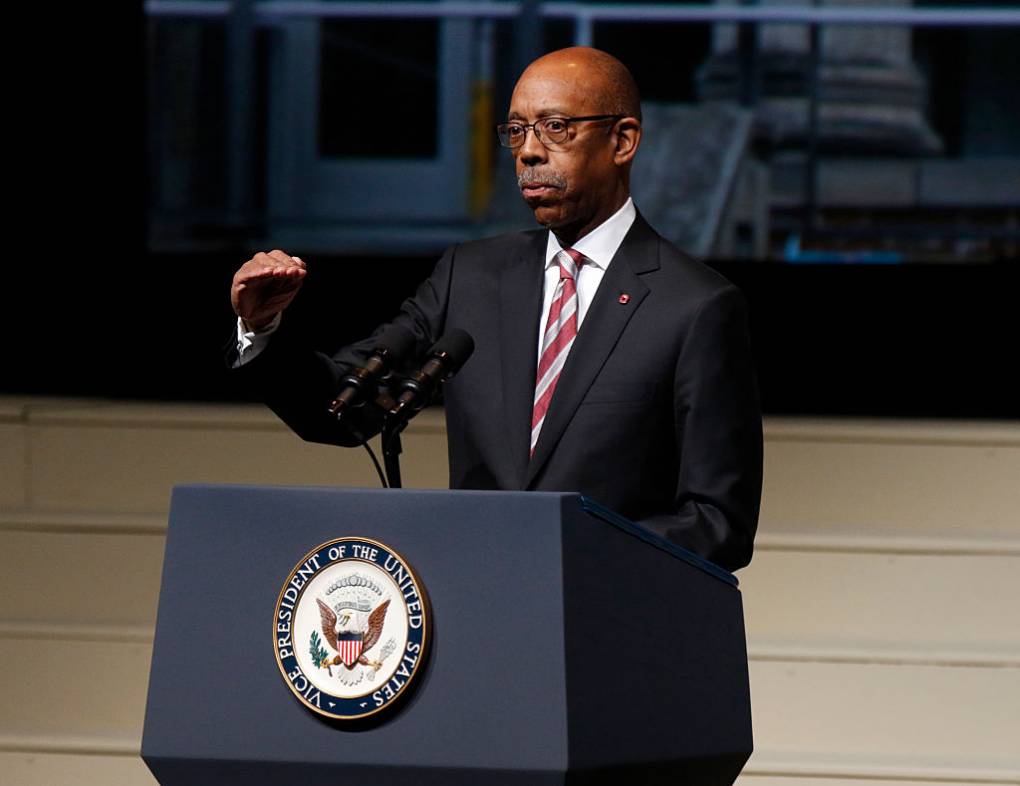
"caption": "Former Ohio State University President Dr. Michael Drake speaks during a public memorial service for former astronaut and US Senator John Glenn at Ohio State University's Mershon Auditorium in Columbus, Ohio, on Dec. 17, 2016.",
"description": null,
"title": "US-SPACE-ASTRONAUT-GLENN-FUNERAL",
"credit": "Paul Vernon/AFP via Getty Images",
"status": "inherit",
"isLoading": false,
"fetchFailed": false
},
"news_11827800": {
"type": "attachments",
"id": "news_11827800",
"meta": {
"index": "attachments_1716263798",
"site": "news",
"id": "11827800",
"found": true
},
"parent": 11827732,
"imgSizes": {
"apple_news_ca_landscape_5_5": {
"file": "https://ww2.kqed.org/app/uploads/sites/10/2020/07/model_070720_final-1044x783.jpg",
"width": 1044,
"mimeType": "image/jpeg",
"height": 783
},
"apple_news_ca_square_4_0": {
"file": "https://ww2.kqed.org/app/uploads/sites/10/2020/07/model_070720_final-470x470.jpg",
"width": 470,
"mimeType": "image/jpeg",
"height": 470
},
"twentyfourteen-full-width": {
"file": "https://ww2.kqed.org/app/uploads/sites/10/2020/07/model_070720_final-1038x576.jpg",
"width": 1038,
"mimeType": "image/jpeg",
"height": 576
},
"thumbnail": {
"file": "https://ww2.kqed.org/app/uploads/sites/10/2020/07/model_070720_final-160x120.jpg",
"width": 160,
"mimeType": "image/jpeg",
"height": 120
},
"post-thumbnail": {
"file": "https://ww2.kqed.org/app/uploads/sites/10/2020/07/model_070720_final-672x372.jpg",
"width": 672,
"mimeType": "image/jpeg",
"height": 372
},
"kqedFullSize": {
"file": "https://ww2.kqed.org/app/uploads/sites/10/2020/07/model_070720_final.jpg",
"width": 1920,
"height": 1443
},
"apple_news_ca_landscape_4_7": {
"file": "https://ww2.kqed.org/app/uploads/sites/10/2020/07/model_070720_final-632x474.jpg",
"width": 632,
"mimeType": "image/jpeg",
"height": 474
},
"large": {
"file": "https://ww2.kqed.org/app/uploads/sites/10/2020/07/model_070720_final-1020x767.jpg",
"width": 1020,
"mimeType": "image/jpeg",
"height": 767
},
"apple_news_ca_landscape_4_0": {
"file": "https://ww2.kqed.org/app/uploads/sites/10/2020/07/model_070720_final-536x402.jpg",
"width": 536,
"mimeType": "image/jpeg",
"height": 402
},
"apple_news_ca_portrait_12_9": {
"file": "https://ww2.kqed.org/app/uploads/sites/10/2020/07/model_070720_final-1122x1443.jpg",
"width": 1122,
"mimeType": "image/jpeg",
"height": 1443
},
"medium": {
"file": "https://ww2.kqed.org/app/uploads/sites/10/2020/07/model_070720_final-800x601.jpg",
"width": 800,
"mimeType": "image/jpeg",
"height": 601
},
"apple_news_ca_portrait_4_0": {
"file": "https://ww2.kqed.org/app/uploads/sites/10/2020/07/model_070720_final-354x472.jpg",
"width": 354,
"mimeType": "image/jpeg",
"height": 472
},
"apple_news_ca_portrait_9_7": {
"file": "https://ww2.kqed.org/app/uploads/sites/10/2020/07/model_070720_final-840x1120.jpg",
"width": 840,
"mimeType": "image/jpeg",
"height": 1120
},
"apple_news_ca_landscape_12_9": {
"file": "https://ww2.kqed.org/app/uploads/sites/10/2020/07/model_070720_final-1832x1374.jpg",
"width": 1832,
"mimeType": "image/jpeg",
"height": 1374
},
"apple_news_ca_square_9_7": {
"file": "https://ww2.kqed.org/app/uploads/sites/10/2020/07/model_070720_final-1104x1104.jpg",
"width": 1104,
"mimeType": "image/jpeg",
"height": 1104
},
"1536x1536": {
"file": "https://ww2.kqed.org/app/uploads/sites/10/2020/07/model_070720_final-1536x1154.jpg",
"width": 1536,
"mimeType": "image/jpeg",
"height": 1154
},
"apple_news_ca_portrait_4_7": {
"file": "https://ww2.kqed.org/app/uploads/sites/10/2020/07/model_070720_final-414x552.jpg",
"width": 414,
"mimeType": "image/jpeg",
"height": 552
},
"apple_news_ca_square_12_9": {
"file": "https://ww2.kqed.org/app/uploads/sites/10/2020/07/model_070720_final-1472x1443.jpg",
"width": 1472,
"mimeType": "image/jpeg",
"height": 1443
},
"apple_news_ca_portrait_5_5": {
"file": "https://ww2.kqed.org/app/uploads/sites/10/2020/07/model_070720_final-687x916.jpg",
"width": 687,
"mimeType": "image/jpeg",
"height": 916
},
"apple_news_ca_square_4_7": {
"file": "https://ww2.kqed.org/app/uploads/sites/10/2020/07/model_070720_final-550x550.jpg",
"width": 550,
"mimeType": "image/jpeg",
"height": 550
},
"apple_news_ca_landscape_9_7": {
"file": "https://ww2.kqed.org/app/uploads/sites/10/2020/07/model_070720_final-1376x1032.jpg",
"width": 1376,
"mimeType": "image/jpeg",
"height": 1032
},
"apple_news_ca_square_5_5": {
"file": "https://ww2.kqed.org/app/uploads/sites/10/2020/07/model_070720_final-912x912.jpg",
"width": 912,
"mimeType": "image/jpeg",
"height": 912
}
},
"publishDate": 1594162509,
"modified": 1594162532,
"caption": null,
"description": null,
"title": "model_070720_final",
"credit": null,
"status": "inherit",
"isLoading": false,
"fetchFailed": false
},
"news_11827659": {
"type": "attachments",
"id": "news_11827659",
"meta": {
"index": "attachments_1716263798",
"site": "news",
"id": "11827659",
"found": true
},
"parent": 11826151,
"imgSizes": {
"apple_news_ca_landscape_5_5": {
"file": "https://ww2.kqed.org/app/uploads/sites/10/2020/10/serra-ventura-1044x783.jpg",
"width": 1044,
"mimeType": "image/jpeg",
"height": 783
},
"apple_news_ca_square_4_0": {
"file": "https://ww2.kqed.org/app/uploads/sites/10/2020/10/serra-ventura-470x470.jpg",
"width": 470,
"mimeType": "image/jpeg",
"height": 470
},
"twentyfourteen-full-width": {
"file": "https://ww2.kqed.org/app/uploads/sites/10/2020/10/serra-ventura-1038x576.jpg",
"width": 1038,
"mimeType": "image/jpeg",
"height": 576
},
"thumbnail": {
"file": "https://ww2.kqed.org/app/uploads/sites/10/2020/10/serra-ventura-160x108.jpg",
"width": 160,
"mimeType": "image/jpeg",
"height": 108
},
"post-thumbnail": {
"file": "https://ww2.kqed.org/app/uploads/sites/10/2020/10/serra-ventura-672x372.jpg",
"width": 672,
"mimeType": "image/jpeg",
"height": 372
},
"kqedFullSize": {
"file": "https://ww2.kqed.org/app/uploads/sites/10/2020/10/serra-ventura.jpg",
"width": 1900,
"height": 1280
},
"apple_news_ca_landscape_4_7": {
"file": "https://ww2.kqed.org/app/uploads/sites/10/2020/10/serra-ventura-632x474.jpg",
"width": 632,
"mimeType": "image/jpeg",
"height": 474
},
"large": {
"file": "https://ww2.kqed.org/app/uploads/sites/10/2020/10/serra-ventura-1020x687.jpg",
"width": 1020,
"mimeType": "image/jpeg",
"height": 687
},
"apple_news_ca_landscape_4_0": {
"file": "https://ww2.kqed.org/app/uploads/sites/10/2020/10/serra-ventura-536x402.jpg",
"width": 536,
"mimeType": "image/jpeg",
"height": 402
},
"apple_news_ca_portrait_12_9": {
"file": "https://ww2.kqed.org/app/uploads/sites/10/2020/10/serra-ventura-1122x1280.jpg",
"width": 1122,
"mimeType": "image/jpeg",
"height": 1280
},
"medium": {
"file": "https://ww2.kqed.org/app/uploads/sites/10/2020/10/serra-ventura-800x539.jpg",
"width": 800,
"mimeType": "image/jpeg",
"height": 539
},
"apple_news_ca_portrait_4_0": {
"file": "https://ww2.kqed.org/app/uploads/sites/10/2020/10/serra-ventura-354x472.jpg",
"width": 354,
"mimeType": "image/jpeg",
"height": 472
},
"apple_news_ca_portrait_9_7": {
"file": "https://ww2.kqed.org/app/uploads/sites/10/2020/10/serra-ventura-840x1120.jpg",
"width": 840,
"mimeType": "image/jpeg",
"height": 1120
},
"apple_news_ca_landscape_12_9": {
"file": "https://ww2.kqed.org/app/uploads/sites/10/2020/10/serra-ventura-1832x1280.jpg",
"width": 1832,
"mimeType": "image/jpeg",
"height": 1280
},
"apple_news_ca_square_9_7": {
"file": "https://ww2.kqed.org/app/uploads/sites/10/2020/10/serra-ventura-1104x1104.jpg",
"width": 1104,
"mimeType": "image/jpeg",
"height": 1104
},
"1536x1536": {
"file": "https://ww2.kqed.org/app/uploads/sites/10/2020/10/serra-ventura-1536x1035.jpg",
"width": 1536,
"mimeType": "image/jpeg",
"height": 1035
},
"apple_news_ca_portrait_4_7": {
"file": "https://ww2.kqed.org/app/uploads/sites/10/2020/10/serra-ventura-414x552.jpg",
"width": 414,
"mimeType": "image/jpeg",
"height": 552
},
"apple_news_ca_square_12_9": {
"file": "https://ww2.kqed.org/app/uploads/sites/10/2020/10/serra-ventura-1472x1280.jpg",
"width": 1472,
"mimeType": "image/jpeg",
"height": 1280
},
"apple_news_ca_portrait_5_5": {
"file": "https://ww2.kqed.org/app/uploads/sites/10/2020/10/serra-ventura-687x916.jpg",
"width": 687,
"mimeType": "image/jpeg",
"height": 916
},
"apple_news_ca_square_4_7": {
"file": "https://ww2.kqed.org/app/uploads/sites/10/2020/10/serra-ventura-550x550.jpg",
"width": 550,
"mimeType": "image/jpeg",
"height": 550
},
"apple_news_ca_landscape_9_7": {
"file": "https://ww2.kqed.org/app/uploads/sites/10/2020/10/serra-ventura-1376x1032.jpg",
"width": 1376,
"mimeType": "image/jpeg",
"height": 1032
},
"apple_news_ca_square_5_5": {
"file": "https://ww2.kqed.org/app/uploads/sites/10/2020/10/serra-ventura-912x912.jpg",
"width": 912,
"mimeType": "image/jpeg",
"height": 912
}
},
"publishDate": 1594079378,
"modified": 1594154093,
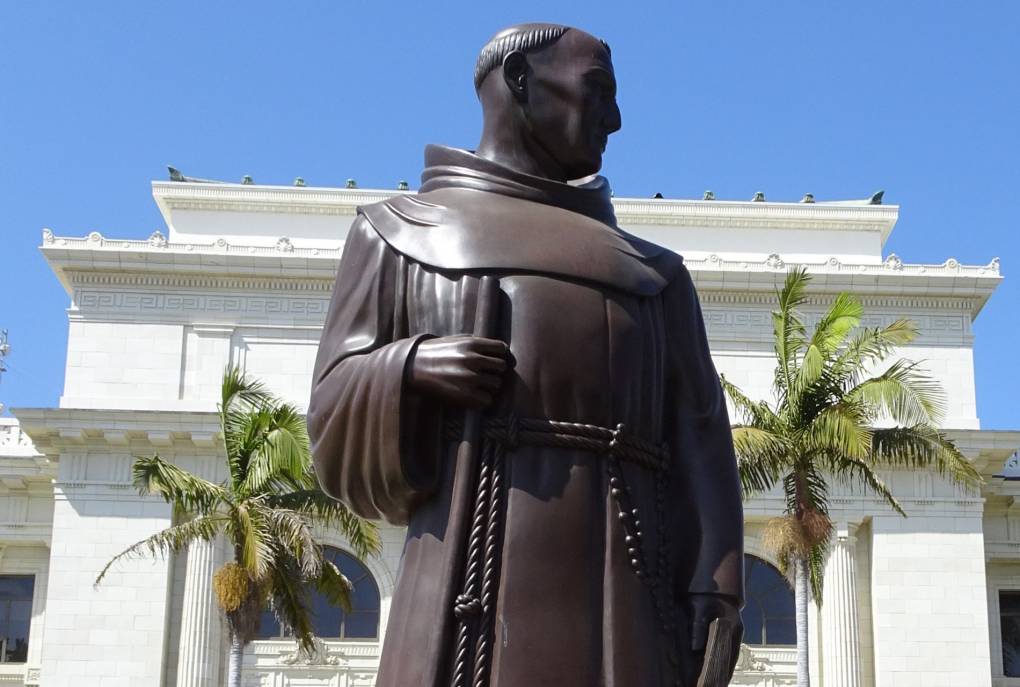
"caption": "A bronze figure of the 18th century missionary Junípero Serra stands outside Ventura City Hall, sculpted in 1936 by Uno John Palo Kangas. Indigenous activists say a reckoning with Serra's legacy is long overdue.",
"description": "A bronze figure of the 18th century missionary Junípero Serra stands outside Ventura City Hall, sculpted in 1936 by Uno John Palo Kangas. Indigenous activists say a reckoning with Serra's legacy is long overdue.",
"title": "serra ventura",
"credit": "Cbl62/Wikimedia Commons",
"status": "inherit",
"isLoading": false,
"fetchFailed": false
},
"news_11826193": {
"type": "attachments",
"id": "news_11826193",
"meta": {
"index": "attachments_1716263798",
"site": "news",
"id": "11826193",
"found": true
},
"parent": 11826192,
"imgSizes": {
"apple_news_ca_landscape_5_5": {
"file": "https://ww2.kqed.org/app/uploads/sites/10/2020/06/RS43815_GettyImages-1217492733-qut-1044x783.jpg",
"width": 1044,
"mimeType": "image/jpeg",
"height": 783
},
"apple_news_ca_square_4_0": {
"file": "https://ww2.kqed.org/app/uploads/sites/10/2020/06/RS43815_GettyImages-1217492733-qut-470x470.jpg",
"width": 470,
"mimeType": "image/jpeg",
"height": 470
},
"twentyfourteen-full-width": {
"file": "https://ww2.kqed.org/app/uploads/sites/10/2020/06/RS43815_GettyImages-1217492733-qut-1038x576.jpg",
"width": 1038,
"mimeType": "image/jpeg",
"height": 576
},
"thumbnail": {
"file": "https://ww2.kqed.org/app/uploads/sites/10/2020/06/RS43815_GettyImages-1217492733-qut-160x107.jpg",
"width": 160,
"mimeType": "image/jpeg",
"height": 107
},
"post-thumbnail": {
"file": "https://ww2.kqed.org/app/uploads/sites/10/2020/06/RS43815_GettyImages-1217492733-qut-672x372.jpg",
"width": 672,
"mimeType": "image/jpeg",
"height": 372
},
"kqedFullSize": {
"file": "https://ww2.kqed.org/app/uploads/sites/10/2020/06/RS43815_GettyImages-1217492733-qut.jpg",
"width": 1920,
"height": 1280
},
"apple_news_ca_landscape_4_7": {
"file": "https://ww2.kqed.org/app/uploads/sites/10/2020/06/RS43815_GettyImages-1217492733-qut-632x474.jpg",
"width": 632,
"mimeType": "image/jpeg",
"height": 474
},
"large": {
"file": "https://ww2.kqed.org/app/uploads/sites/10/2020/06/RS43815_GettyImages-1217492733-qut-1020x680.jpg",
"width": 1020,
"mimeType": "image/jpeg",
"height": 680
},
"apple_news_ca_landscape_4_0": {
"file": "https://ww2.kqed.org/app/uploads/sites/10/2020/06/RS43815_GettyImages-1217492733-qut-536x402.jpg",
"width": 536,
"mimeType": "image/jpeg",
"height": 402
},
"apple_news_ca_portrait_12_9": {
"file": "https://ww2.kqed.org/app/uploads/sites/10/2020/06/RS43815_GettyImages-1217492733-qut-1122x1280.jpg",
"width": 1122,
"mimeType": "image/jpeg",
"height": 1280
},
"medium": {
"file": "https://ww2.kqed.org/app/uploads/sites/10/2020/06/RS43815_GettyImages-1217492733-qut-800x533.jpg",
"width": 800,
"mimeType": "image/jpeg",
"height": 533
},
"apple_news_ca_portrait_4_0": {
"file": "https://ww2.kqed.org/app/uploads/sites/10/2020/06/RS43815_GettyImages-1217492733-qut-354x472.jpg",
"width": 354,
"mimeType": "image/jpeg",
"height": 472
},
"apple_news_ca_portrait_9_7": {
"file": "https://ww2.kqed.org/app/uploads/sites/10/2020/06/RS43815_GettyImages-1217492733-qut-840x1120.jpg",
"width": 840,
"mimeType": "image/jpeg",
"height": 1120
},
"apple_news_ca_landscape_12_9": {
"file": "https://ww2.kqed.org/app/uploads/sites/10/2020/06/RS43815_GettyImages-1217492733-qut-1832x1280.jpg",
"width": 1832,
"mimeType": "image/jpeg",
"height": 1280
},
"apple_news_ca_square_9_7": {
"file": "https://ww2.kqed.org/app/uploads/sites/10/2020/06/RS43815_GettyImages-1217492733-qut-1104x1104.jpg",
"width": 1104,
"mimeType": "image/jpeg",
"height": 1104
},
"1536x1536": {
"file": "https://ww2.kqed.org/app/uploads/sites/10/2020/06/RS43815_GettyImages-1217492733-qut-1536x1024.jpg",
"width": 1536,
"mimeType": "image/jpeg",
"height": 1024
},
"apple_news_ca_portrait_4_7": {
"file": "https://ww2.kqed.org/app/uploads/sites/10/2020/06/RS43815_GettyImages-1217492733-qut-414x552.jpg",
"width": 414,
"mimeType": "image/jpeg",
"height": 552
},
"apple_news_ca_square_12_9": {
"file": "https://ww2.kqed.org/app/uploads/sites/10/2020/06/RS43815_GettyImages-1217492733-qut-1472x1280.jpg",
"width": 1472,
"mimeType": "image/jpeg",
"height": 1280
},
"apple_news_ca_portrait_5_5": {
"file": "https://ww2.kqed.org/app/uploads/sites/10/2020/06/RS43815_GettyImages-1217492733-qut-687x916.jpg",
"width": 687,
"mimeType": "image/jpeg",
"height": 916
},
"apple_news_ca_square_4_7": {
"file": "https://ww2.kqed.org/app/uploads/sites/10/2020/06/RS43815_GettyImages-1217492733-qut-550x550.jpg",
"width": 550,
"mimeType": "image/jpeg",
"height": 550
},
"apple_news_ca_landscape_9_7": {
"file": "https://ww2.kqed.org/app/uploads/sites/10/2020/06/RS43815_GettyImages-1217492733-qut-1376x1032.jpg",
"width": 1376,
"mimeType": "image/jpeg",
"height": 1032
},
"apple_news_ca_square_5_5": {
"file": "https://ww2.kqed.org/app/uploads/sites/10/2020/06/RS43815_GettyImages-1217492733-qut-912x912.jpg",
"width": 912,
"mimeType": "image/jpeg",
"height": 912
}
},
"publishDate": 1593124800,
"modified": 1593205048,
"caption": "A mural painted on the ground of Frank Ogawa Plaza in Oakland is pictured during a June 3 \"Sit Out the Curfew\" protest over the death of George Floyd, who died in Minneapolis on May 25 while in police custody. ",
"description": "A mural painted on the ground of Frank Ogawa Plaza in Oakland is pictured during a June 3 \"Sit Out the Curfew\" protest over the death of George Floyd, who died in Minneapolis on May 25 while in police custody. ",
"title": "US-POLITICS-RACE-UNREST",
"credit": "Philip Pacheco/AFP via Getty Images",
"status": "inherit",
"isLoading": false,
"fetchFailed": false
},
"news_11826055": {
"type": "attachments",
"id": "news_11826055",
"meta": {
"index": "attachments_1716263798",
"site": "news",
"id": "11826055",
"found": true
},
"parent": 11825991,
"imgSizes": {
"apple_news_ca_landscape_5_5": {
"file": "https://ww2.kqed.org/app/uploads/sites/10/2020/06/RS41635_002_KQED_Election_Prop13_02262020_4349-qut-1044x783.jpg",
"width": 1044,
"mimeType": "image/jpeg",
"height": 783
},
"apple_news_ca_square_4_0": {
"file": "https://ww2.kqed.org/app/uploads/sites/10/2020/06/RS41635_002_KQED_Election_Prop13_02262020_4349-qut-470x470.jpg",
"width": 470,
"mimeType": "image/jpeg",
"height": 470
},
"twentyfourteen-full-width": {
"file": "https://ww2.kqed.org/app/uploads/sites/10/2020/06/RS41635_002_KQED_Election_Prop13_02262020_4349-qut-1038x576.jpg",
"width": 1038,
"mimeType": "image/jpeg",
"height": 576
},
"thumbnail": {
"file": "https://ww2.kqed.org/app/uploads/sites/10/2020/06/RS41635_002_KQED_Election_Prop13_02262020_4349-qut-160x107.jpg",
"width": 160,
"mimeType": "image/jpeg",
"height": 107
},
"post-thumbnail": {
"file": "https://ww2.kqed.org/app/uploads/sites/10/2020/06/RS41635_002_KQED_Election_Prop13_02262020_4349-qut-672x372.jpg",
"width": 672,
"mimeType": "image/jpeg",
"height": 372
},
"kqedFullSize": {
"file": "https://ww2.kqed.org/app/uploads/sites/10/2020/06/RS41635_002_KQED_Election_Prop13_02262020_4349-qut.jpg",
"width": 1920,
"height": 1280
},
"apple_news_ca_landscape_4_7": {
"file": "https://ww2.kqed.org/app/uploads/sites/10/2020/06/RS41635_002_KQED_Election_Prop13_02262020_4349-qut-632x474.jpg",
"width": 632,
"mimeType": "image/jpeg",
"height": 474
},
"large": {
"file": "https://ww2.kqed.org/app/uploads/sites/10/2020/06/RS41635_002_KQED_Election_Prop13_02262020_4349-qut-1020x680.jpg",
"width": 1020,
"mimeType": "image/jpeg",
"height": 680
},
"apple_news_ca_landscape_4_0": {
"file": "https://ww2.kqed.org/app/uploads/sites/10/2020/06/RS41635_002_KQED_Election_Prop13_02262020_4349-qut-536x402.jpg",
"width": 536,
"mimeType": "image/jpeg",
"height": 402
},
"apple_news_ca_portrait_12_9": {
"file": "https://ww2.kqed.org/app/uploads/sites/10/2020/06/RS41635_002_KQED_Election_Prop13_02262020_4349-qut-1122x1280.jpg",
"width": 1122,
"mimeType": "image/jpeg",
"height": 1280
},
"medium": {
"file": "https://ww2.kqed.org/app/uploads/sites/10/2020/06/RS41635_002_KQED_Election_Prop13_02262020_4349-qut-800x533.jpg",
"width": 800,
"mimeType": "image/jpeg",
"height": 533
},
"apple_news_ca_portrait_4_0": {
"file": "https://ww2.kqed.org/app/uploads/sites/10/2020/06/RS41635_002_KQED_Election_Prop13_02262020_4349-qut-354x472.jpg",
"width": 354,
"mimeType": "image/jpeg",
"height": 472
},
"apple_news_ca_portrait_9_7": {
"file": "https://ww2.kqed.org/app/uploads/sites/10/2020/06/RS41635_002_KQED_Election_Prop13_02262020_4349-qut-840x1120.jpg",
"width": 840,
"mimeType": "image/jpeg",
"height": 1120
},
"apple_news_ca_landscape_12_9": {
"file": "https://ww2.kqed.org/app/uploads/sites/10/2020/06/RS41635_002_KQED_Election_Prop13_02262020_4349-qut-1832x1280.jpg",
"width": 1832,
"mimeType": "image/jpeg",
"height": 1280
},
"apple_news_ca_square_9_7": {
"file": "https://ww2.kqed.org/app/uploads/sites/10/2020/06/RS41635_002_KQED_Election_Prop13_02262020_4349-qut-1104x1104.jpg",
"width": 1104,
"mimeType": "image/jpeg",
"height": 1104
},
"1536x1536": {
"file": "https://ww2.kqed.org/app/uploads/sites/10/2020/06/RS41635_002_KQED_Election_Prop13_02262020_4349-qut-1536x1024.jpg",
"width": 1536,
"mimeType": "image/jpeg",
"height": 1024
},
"apple_news_ca_portrait_4_7": {
"file": "https://ww2.kqed.org/app/uploads/sites/10/2020/06/RS41635_002_KQED_Election_Prop13_02262020_4349-qut-414x552.jpg",
"width": 414,
"mimeType": "image/jpeg",
"height": 552
},
"apple_news_ca_square_12_9": {
"file": "https://ww2.kqed.org/app/uploads/sites/10/2020/06/RS41635_002_KQED_Election_Prop13_02262020_4349-qut-1472x1280.jpg",
"width": 1472,
"mimeType": "image/jpeg",
"height": 1280
},
"apple_news_ca_portrait_5_5": {
"file": "https://ww2.kqed.org/app/uploads/sites/10/2020/06/RS41635_002_KQED_Election_Prop13_02262020_4349-qut-687x916.jpg",
"width": 687,
"mimeType": "image/jpeg",
"height": 916
},
"apple_news_ca_square_4_7": {
"file": "https://ww2.kqed.org/app/uploads/sites/10/2020/06/RS41635_002_KQED_Election_Prop13_02262020_4349-qut-550x550.jpg",
"width": 550,
"mimeType": "image/jpeg",
"height": 550
},
"apple_news_ca_landscape_9_7": {
"file": "https://ww2.kqed.org/app/uploads/sites/10/2020/06/RS41635_002_KQED_Election_Prop13_02262020_4349-qut-1376x1032.jpg",
"width": 1376,
"mimeType": "image/jpeg",
"height": 1032
},
"apple_news_ca_square_5_5": {
"file": "https://ww2.kqed.org/app/uploads/sites/10/2020/06/RS41635_002_KQED_Election_Prop13_02262020_4349-qut-912x912.jpg",
"width": 912,
"mimeType": "image/jpeg",
"height": 912
}
},
"publishDate": 1593041774,
"modified": 1593041924,
"caption": "San Francisco Unified School District's Board of Education voted unanimously on June 23, 2020 to declare the city's public schools to be\npolice-free.",
"description": "San Francisco Unified School District's Board of Education voted unanimously on June 23, 2020 to declare the city's public schools to be\npolice-free.",
"title": "RS41635_002_KQED_Election_Prop13_02262020_4349-qut",
"credit": "Beth LaBerge/KQED",
"status": "inherit",
"isLoading": false,
"fetchFailed": false
},
"news_11825887": {
"type": "attachments",
"id": "news_11825887",
"meta": {
"index": "attachments_1716263798",
"site": "news",
"id": "11825887",
"found": true
},
"parent": 11825885,
"imgSizes": {
"apple_news_ca_landscape_5_5": {
"file": "https://ww2.kqed.org/app/uploads/sites/10/2020/06/drawinggames-1044x783.png",
"width": 1044,
"mimeType": "image/png",
"height": 783
},
"apple_news_ca_square_4_0": {
"file": "https://ww2.kqed.org/app/uploads/sites/10/2020/06/drawinggames-470x470.png",
"width": 470,
"mimeType": "image/png",
"height": 470
},
"twentyfourteen-full-width": {
"file": "https://ww2.kqed.org/app/uploads/sites/10/2020/06/drawinggames-1038x576.png",
"width": 1038,
"mimeType": "image/png",
"height": 576
},
"thumbnail": {
"file": "https://ww2.kqed.org/app/uploads/sites/10/2020/06/drawinggames-160x90.png",
"width": 160,
"mimeType": "image/png",
"height": 90
},
"post-thumbnail": {
"file": "https://ww2.kqed.org/app/uploads/sites/10/2020/06/drawinggames-672x372.png",
"width": 672,
"mimeType": "image/png",
"height": 372
},
"kqedFullSize": {
"file": "https://ww2.kqed.org/app/uploads/sites/10/2020/06/drawinggames-e1593025182210.png",
"width": 1918,
"height": 1079
},
"apple_news_ca_landscape_4_7": {
"file": "https://ww2.kqed.org/app/uploads/sites/10/2020/06/drawinggames-632x474.png",
"width": 632,
"mimeType": "image/png",
"height": 474
},
"large": {
"file": "https://ww2.kqed.org/app/uploads/sites/10/2020/06/drawinggames-1020x574.png",
"width": 1020,
"mimeType": "image/png",
"height": 574
},
"apple_news_ca_landscape_4_0": {
"file": "https://ww2.kqed.org/app/uploads/sites/10/2020/06/drawinggames-536x402.png",
"width": 536,
"mimeType": "image/png",
"height": 402
},
"apple_news_ca_portrait_12_9": {
"file": "https://ww2.kqed.org/app/uploads/sites/10/2020/06/drawinggames-1122x1080.png",
"width": 1122,
"mimeType": "image/png",
"height": 1080
},
"medium": {
"file": "https://ww2.kqed.org/app/uploads/sites/10/2020/06/drawinggames-800x450.png",
"width": 800,
"mimeType": "image/png",
"height": 450
},
"apple_news_ca_portrait_4_0": {
"file": "https://ww2.kqed.org/app/uploads/sites/10/2020/06/drawinggames-354x472.png",
"width": 354,
"mimeType": "image/png",
"height": 472
},
"apple_news_ca_portrait_9_7": {
"file": "https://ww2.kqed.org/app/uploads/sites/10/2020/06/drawinggames-840x1080.png",
"width": 840,
"mimeType": "image/png",
"height": 1080
},
"apple_news_ca_landscape_12_9": {
"file": "https://ww2.kqed.org/app/uploads/sites/10/2020/06/drawinggames-1832x1080.png",
"width": 1832,
"mimeType": "image/png",
"height": 1080
},
"apple_news_ca_square_9_7": {
"file": "https://ww2.kqed.org/app/uploads/sites/10/2020/06/drawinggames-1104x1080.png",
"width": 1104,
"mimeType": "image/png",
"height": 1080
},
"1536x1536": {
"file": "https://ww2.kqed.org/app/uploads/sites/10/2020/06/drawinggames-1536x864.png",
"width": 1536,
"mimeType": "image/png",
"height": 864
},
"apple_news_ca_portrait_4_7": {
"file": "https://ww2.kqed.org/app/uploads/sites/10/2020/06/drawinggames-414x552.png",
"width": 414,
"mimeType": "image/png",
"height": 552
},
"apple_news_ca_square_12_9": {
"file": "https://ww2.kqed.org/app/uploads/sites/10/2020/06/drawinggames-1472x1080.png",
"width": 1472,
"mimeType": "image/png",
"height": 1080
},
"apple_news_ca_portrait_5_5": {
"file": "https://ww2.kqed.org/app/uploads/sites/10/2020/06/drawinggames-687x916.png",
"width": 687,
"mimeType": "image/png",
"height": 916
},
"apple_news_ca_square_4_7": {
"file": "https://ww2.kqed.org/app/uploads/sites/10/2020/06/drawinggames-550x550.png",
"width": 550,
"mimeType": "image/png",
"height": 550
},
"apple_news_ca_landscape_9_7": {
"file": "https://ww2.kqed.org/app/uploads/sites/10/2020/06/drawinggames-1376x1032.png",
"width": 1376,
"mimeType": "image/png",
"height": 1032
},
"apple_news_ca_square_5_5": {
"file": "https://ww2.kqed.org/app/uploads/sites/10/2020/06/drawinggames-912x912.png",
"width": 912,
"mimeType": "image/png",
"height": 912
}
},
"publishDate": 1592956065,
"modified": 1592956230,
"caption": "KQED’s Mark Fiore shows off his favorite cartooning exercises to get your imagination going.",
"description": "KQED’s Mark Fiore shows off his favorite cartooning exercises to get your imagination going.",
"title": "drawinggames",
"credit": "Mark Fiore/KQED",
"status": "inherit",
"isLoading": false,
"fetchFailed": false
},
"news_11825852": {
"type": "attachments",
"id": "news_11825852",
"meta": {
"index": "attachments_1716263798",
"site": "news",
"id": "11825852",
"found": true
},
"title": "Sharp Budget Cuts Loom For All Sectors Of California's Infrastructure",
"publishDate": 1592950982,
"status": "inherit",
"parent": 11825729,
"modified": 1770426512,
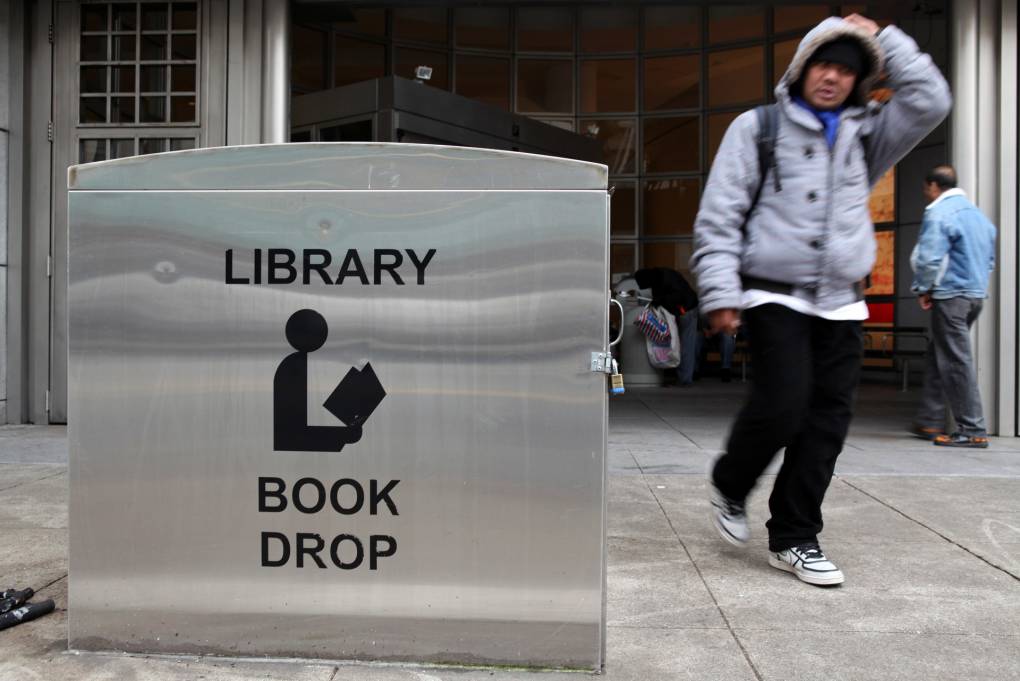
"caption": "A student walks by a library book drop box outside of the main branch of the San Francisco Public Library on Jan. 11, 2011, in San Francisco, California.",
"credit": "Justin Sullivan/Getty Images",
"altTag": null,
"description": null,
"imgSizes": {
"medium": {
"file": "https://cdn.kqed.org/wp-content/uploads/sites/10/2020/06/RS43801_GettyImages-107987983-qut-800x534.jpg",
"width": 800,
"height": 534,
"mimeType": "image/jpeg"
},
"large": {
"file": "https://cdn.kqed.org/wp-content/uploads/sites/10/2020/06/RS43801_GettyImages-107987983-qut-1020x681.jpg",
"width": 1020,
"height": 681,
"mimeType": "image/jpeg"
},
"thumbnail": {
"file": "https://cdn.kqed.org/wp-content/uploads/sites/10/2020/06/RS43801_GettyImages-107987983-qut-160x107.jpg",
"width": 160,
"height": 107,
"mimeType": "image/jpeg"
},
"1536x1536": {
"file": "https://cdn.kqed.org/wp-content/uploads/sites/10/2020/06/RS43801_GettyImages-107987983-qut-1536x1026.jpg",
"width": 1536,
"height": 1026,
"mimeType": "image/jpeg"
},
"post-thumbnail": {
"file": "https://cdn.kqed.org/wp-content/uploads/sites/10/2020/06/RS43801_GettyImages-107987983-qut-672x372.jpg",
"width": 672,
"height": 372,
"mimeType": "image/jpeg"
},
"twentyfourteen-full-width": {
"file": "https://cdn.kqed.org/wp-content/uploads/sites/10/2020/06/RS43801_GettyImages-107987983-qut-1038x576.jpg",
"width": 1038,
"height": 576,
"mimeType": "image/jpeg"
},
"apple_news_ca_landscape_12_9": {
"file": "https://cdn.kqed.org/wp-content/uploads/sites/10/2020/06/RS43801_GettyImages-107987983-qut-1832x1282.jpg",
"width": 1832,
"height": 1282,
"mimeType": "image/jpeg"
},
"apple_news_ca_landscape_9_7": {
"file": "https://cdn.kqed.org/wp-content/uploads/sites/10/2020/06/RS43801_GettyImages-107987983-qut-1376x1032.jpg",
"width": 1376,
"height": 1032,
"mimeType": "image/jpeg"
},
"apple_news_ca_landscape_5_5": {
"file": "https://cdn.kqed.org/wp-content/uploads/sites/10/2020/06/RS43801_GettyImages-107987983-qut-1044x783.jpg",
"width": 1044,
"height": 783,
"mimeType": "image/jpeg"
},
"apple_news_ca_landscape_4_7": {
"file": "https://cdn.kqed.org/wp-content/uploads/sites/10/2020/06/RS43801_GettyImages-107987983-qut-632x474.jpg",
"width": 632,
"height": 474,
"mimeType": "image/jpeg"
},
"apple_news_ca_landscape_4_0": {
"file": "https://cdn.kqed.org/wp-content/uploads/sites/10/2020/06/RS43801_GettyImages-107987983-qut-536x402.jpg",
"width": 536,
"height": 402,
"mimeType": "image/jpeg"
},
"apple_news_ca_portrait_12_9": {
"file": "https://cdn.kqed.org/wp-content/uploads/sites/10/2020/06/RS43801_GettyImages-107987983-qut-1122x1282.jpg",
"width": 1122,
"height": 1282,
"mimeType": "image/jpeg"
},
"apple_news_ca_portrait_9_7": {
"file": "https://cdn.kqed.org/wp-content/uploads/sites/10/2020/06/RS43801_GettyImages-107987983-qut-840x1120.jpg",
"width": 840,
"height": 1120,
"mimeType": "image/jpeg"
},
"apple_news_ca_portrait_5_5": {
"file": "https://cdn.kqed.org/wp-content/uploads/sites/10/2020/06/RS43801_GettyImages-107987983-qut-687x916.jpg",
"width": 687,
"height": 916,
"mimeType": "image/jpeg"
},
"apple_news_ca_portrait_4_7": {
"file": "https://cdn.kqed.org/wp-content/uploads/sites/10/2020/06/RS43801_GettyImages-107987983-qut-414x552.jpg",
"width": 414,
"height": 552,
"mimeType": "image/jpeg"
},
"apple_news_ca_portrait_4_0": {
"file": "https://cdn.kqed.org/wp-content/uploads/sites/10/2020/06/RS43801_GettyImages-107987983-qut-354x472.jpg",
"width": 354,
"height": 472,
"mimeType": "image/jpeg"
},
"apple_news_ca_square_12_9": {
"file": "https://cdn.kqed.org/wp-content/uploads/sites/10/2020/06/RS43801_GettyImages-107987983-qut-1472x1282.jpg",
"width": 1472,
"height": 1282,
"mimeType": "image/jpeg"
},
"apple_news_ca_square_9_7": {
"file": "https://cdn.kqed.org/wp-content/uploads/sites/10/2020/06/RS43801_GettyImages-107987983-qut-1104x1104.jpg",
"width": 1104,
"height": 1104,
"mimeType": "image/jpeg"
},
"apple_news_ca_square_5_5": {
"file": "https://cdn.kqed.org/wp-content/uploads/sites/10/2020/06/RS43801_GettyImages-107987983-qut-912x912.jpg",
"width": 912,
"height": 912,
"mimeType": "image/jpeg"
},
"apple_news_ca_square_4_7": {
"file": "https://cdn.kqed.org/wp-content/uploads/sites/10/2020/06/RS43801_GettyImages-107987983-qut-550x550.jpg",
"width": 550,
"height": 550,
"mimeType": "image/jpeg"
},
"apple_news_ca_square_4_0": {
"file": "https://cdn.kqed.org/wp-content/uploads/sites/10/2020/06/RS43801_GettyImages-107987983-qut-470x470.jpg",
"width": 470,
"height": 470,
"mimeType": "image/jpeg"
},
"kqedFullSize": {
"file": "https://cdn.kqed.org/wp-content/uploads/sites/10/2020/06/RS43801_GettyImages-107987983-qut.jpg",
"width": 1920,
"height": 1282
}
},
"isLoading": false,
"fetchFailed": false
},
"news_11825499": {
"type": "attachments",
"id": "news_11825499",
"meta": {
"index": "attachments_1716263798",
"site": "news",
"id": "11825499",
"found": true
},
"parent": 11824642,
"imgSizes": {
"apple_news_ca_landscape_5_5": {
"file": "https://ww2.kqed.org/app/uploads/sites/10/2020/06/RS43701_IMG_2103_v2-qut-1044x783.jpg",
"width": 1044,
"mimeType": "image/jpeg",
"height": 783
},
"apple_news_ca_square_4_0": {
"file": "https://ww2.kqed.org/app/uploads/sites/10/2020/06/RS43701_IMG_2103_v2-qut-470x470.jpg",
"width": 470,
"mimeType": "image/jpeg",
"height": 470
},
"twentyfourteen-full-width": {
"file": "https://ww2.kqed.org/app/uploads/sites/10/2020/06/RS43701_IMG_2103_v2-qut-1038x576.jpg",
"width": 1038,
"mimeType": "image/jpeg",
"height": 576
},
"thumbnail": {
"file": "https://ww2.kqed.org/app/uploads/sites/10/2020/06/RS43701_IMG_2103_v2-qut-160x98.jpg",
"width": 160,
"mimeType": "image/jpeg",
"height": 98
},
"post-thumbnail": {
"file": "https://ww2.kqed.org/app/uploads/sites/10/2020/06/RS43701_IMG_2103_v2-qut-672x372.jpg",
"width": 672,
"mimeType": "image/jpeg",
"height": 372
},
"kqedFullSize": {
"file": "https://ww2.kqed.org/app/uploads/sites/10/2020/06/RS43701_IMG_2103_v2-qut.jpg",
"width": 1920,
"height": 1170
},
"apple_news_ca_landscape_4_7": {
"file": "https://ww2.kqed.org/app/uploads/sites/10/2020/06/RS43701_IMG_2103_v2-qut-632x474.jpg",
"width": 632,
"mimeType": "image/jpeg",
"height": 474
},
"large": {
"file": "https://ww2.kqed.org/app/uploads/sites/10/2020/06/RS43701_IMG_2103_v2-qut-1020x622.jpg",
"width": 1020,
"mimeType": "image/jpeg",
"height": 622
},
"apple_news_ca_landscape_4_0": {
"file": "https://ww2.kqed.org/app/uploads/sites/10/2020/06/RS43701_IMG_2103_v2-qut-536x402.jpg",
"width": 536,
"mimeType": "image/jpeg",
"height": 402
},
"apple_news_ca_portrait_12_9": {
"file": "https://ww2.kqed.org/app/uploads/sites/10/2020/06/RS43701_IMG_2103_v2-qut-1122x1170.jpg",
"width": 1122,
"mimeType": "image/jpeg",
"height": 1170
},
"medium": {
"file": "https://ww2.kqed.org/app/uploads/sites/10/2020/06/RS43701_IMG_2103_v2-qut-800x488.jpg",
"width": 800,
"mimeType": "image/jpeg",
"height": 488
},
"apple_news_ca_portrait_4_0": {
"file": "https://ww2.kqed.org/app/uploads/sites/10/2020/06/RS43701_IMG_2103_v2-qut-354x472.jpg",
"width": 354,
"mimeType": "image/jpeg",
"height": 472
},
"apple_news_ca_portrait_9_7": {
"file": "https://ww2.kqed.org/app/uploads/sites/10/2020/06/RS43701_IMG_2103_v2-qut-840x1120.jpg",
"width": 840,
"mimeType": "image/jpeg",
"height": 1120
},
"apple_news_ca_landscape_12_9": {
"file": "https://ww2.kqed.org/app/uploads/sites/10/2020/06/RS43701_IMG_2103_v2-qut-1832x1170.jpg",
"width": 1832,
"mimeType": "image/jpeg",
"height": 1170
},
"apple_news_ca_square_9_7": {
"file": "https://ww2.kqed.org/app/uploads/sites/10/2020/06/RS43701_IMG_2103_v2-qut-1104x1104.jpg",
"width": 1104,
"mimeType": "image/jpeg",
"height": 1104
},
"apple_news_ca_portrait_4_7": {
"file": "https://ww2.kqed.org/app/uploads/sites/10/2020/06/RS43701_IMG_2103_v2-qut-414x552.jpg",
"width": 414,
"mimeType": "image/jpeg",
"height": 552
},
"apple_news_ca_square_12_9": {
"file": "https://ww2.kqed.org/app/uploads/sites/10/2020/06/RS43701_IMG_2103_v2-qut-1472x1170.jpg",
"width": 1472,
"mimeType": "image/jpeg",
"height": 1170
},
"apple_news_ca_portrait_5_5": {
"file": "https://ww2.kqed.org/app/uploads/sites/10/2020/06/RS43701_IMG_2103_v2-qut-687x916.jpg",
"width": 687,
"mimeType": "image/jpeg",
"height": 916
},
"full-width": {
"file": "https://ww2.kqed.org/app/uploads/sites/10/2020/06/RS43701_IMG_2103_v2-qut-1920x1170.jpg",
"width": 1920,
"mimeType": "image/jpeg",
"height": 1170
},
"apple_news_ca_square_4_7": {
"file": "https://ww2.kqed.org/app/uploads/sites/10/2020/06/RS43701_IMG_2103_v2-qut-550x550.jpg",
"width": 550,
"mimeType": "image/jpeg",
"height": 550
},
"apple_news_ca_landscape_9_7": {
"file": "https://ww2.kqed.org/app/uploads/sites/10/2020/06/RS43701_IMG_2103_v2-qut-1376x1032.jpg",
"width": 1376,
"mimeType": "image/jpeg",
"height": 1032
},
"apple_news_ca_square_5_5": {
"file": "https://ww2.kqed.org/app/uploads/sites/10/2020/06/RS43701_IMG_2103_v2-qut-912x912.jpg",
"width": 912,
"mimeType": "image/jpeg",
"height": 912
}
},
"publishDate": 1592612889,
"modified": 1592613505,
"caption": "Students under 12 years of age are not required to wear masks, according to the Marin Health and Human Services, even while attending an in-person pilot program at Bayside Martin Luther King Jr. Academy.",
"description": "Students under 12 years of age are not required to wear masks, according to the Marin Health and Human Services, even while attending an in-person pilot program at Bayside Martin Luther King Jr. Academy.",
"title": "RS43701_IMG_2103_v2-qut",
"credit": "Julia McEvoy/KQED",
"status": "inherit",
"isLoading": false,
"fetchFailed": false
},
"news_11825578": {
"type": "attachments",
"id": "news_11825578",
"meta": {
"index": "attachments_1716263798",
"site": "news",
"id": "11825578",
"found": true
},
"parent": 11825573,
"imgSizes": {
"apple_news_ca_square_4_0": {
"file": "https://ww2.kqed.org/app/uploads/sites/10/2020/06/1920_1280px-Etnic_Studies_Hunger_Strike_SF_State-470x470.jpg",
"width": 470,
"mimeType": "image/jpeg",
"height": 470
},
"twentyfourteen-full-width": {
"file": "https://ww2.kqed.org/app/uploads/sites/10/2020/06/1920_1280px-Etnic_Studies_Hunger_Strike_SF_State-1031x576.jpg",
"width": 1031,
"mimeType": "image/jpeg",
"height": 576
},
"thumbnail": {
"file": "https://ww2.kqed.org/app/uploads/sites/10/2020/06/1920_1280px-Etnic_Studies_Hunger_Strike_SF_State-160x90.jpg",
"width": 160,
"mimeType": "image/jpeg",
"height": 90
},
"post-thumbnail": {
"file": "https://ww2.kqed.org/app/uploads/sites/10/2020/06/1920_1280px-Etnic_Studies_Hunger_Strike_SF_State-672x372.jpg",
"width": 672,
"mimeType": "image/jpeg",
"height": 372
},
"kqedFullSize": {
"file": "https://ww2.kqed.org/app/uploads/sites/10/2020/06/1920_1280px-Etnic_Studies_Hunger_Strike_SF_State.jpg",
"width": 1031,
"height": 580
},
"apple_news_ca_landscape_4_7": {
"file": "https://ww2.kqed.org/app/uploads/sites/10/2020/06/1920_1280px-Etnic_Studies_Hunger_Strike_SF_State-632x474.jpg",
"width": 632,
"mimeType": "image/jpeg",
"height": 474
},
"large": {
"file": "https://ww2.kqed.org/app/uploads/sites/10/2020/06/1920_1280px-Etnic_Studies_Hunger_Strike_SF_State-1020x574.jpg",
"width": 1020,
"mimeType": "image/jpeg",
"height": 574
},
"apple_news_ca_landscape_4_0": {
"file": "https://ww2.kqed.org/app/uploads/sites/10/2020/06/1920_1280px-Etnic_Studies_Hunger_Strike_SF_State-536x402.jpg",
"width": 536,
"mimeType": "image/jpeg",
"height": 402
},
"medium": {
"file": "https://ww2.kqed.org/app/uploads/sites/10/2020/06/1920_1280px-Etnic_Studies_Hunger_Strike_SF_State-800x450.jpg",
"width": 800,
"mimeType": "image/jpeg",
"height": 450
},
"apple_news_ca_portrait_4_0": {
"file": "https://ww2.kqed.org/app/uploads/sites/10/2020/06/1920_1280px-Etnic_Studies_Hunger_Strike_SF_State-354x472.jpg",
"width": 354,
"mimeType": "image/jpeg",
"height": 472
},
"apple_news_ca_portrait_9_7": {
"file": "https://ww2.kqed.org/app/uploads/sites/10/2020/06/1920_1280px-Etnic_Studies_Hunger_Strike_SF_State-840x580.jpg",
"width": 840,
"mimeType": "image/jpeg",
"height": 580
},
"apple_news_ca_portrait_4_7": {
"file": "https://ww2.kqed.org/app/uploads/sites/10/2020/06/1920_1280px-Etnic_Studies_Hunger_Strike_SF_State-414x552.jpg",
"width": 414,
"mimeType": "image/jpeg",
"height": 552
},
"apple_news_ca_portrait_5_5": {
"file": "https://ww2.kqed.org/app/uploads/sites/10/2020/06/1920_1280px-Etnic_Studies_Hunger_Strike_SF_State-687x580.jpg",
"width": 687,
"mimeType": "image/jpeg",
"height": 580
},
"apple_news_ca_square_4_7": {
"file": "https://ww2.kqed.org/app/uploads/sites/10/2020/06/1920_1280px-Etnic_Studies_Hunger_Strike_SF_State-550x550.jpg",
"width": 550,
"mimeType": "image/jpeg",
"height": 550
},
"apple_news_ca_square_5_5": {
"file": "https://ww2.kqed.org/app/uploads/sites/10/2020/06/1920_1280px-Etnic_Studies_Hunger_Strike_SF_State-912x580.jpg",
"width": 912,
"mimeType": "image/jpeg",
"height": 580
}
},
"publishDate": 1592765437,
"modified": 1592765469,
"caption": "A San Francisco State Student holds a sign in solidarity and support of the students on a hunger strike to defend Ethnic Studies, during an a press conference on May 9, 2016. ",
"description": null,
"title": "1920_1280px-Etnic_Studies_Hunger_Strike_SF_State",
"credit": "Melissa Minton/Wikimedia",
"status": "inherit",
"isLoading": false,
"fetchFailed": false
},
"news_11825313": {
"type": "attachments",
"id": "news_11825313",
"meta": {
"index": "attachments_1716263798",
"site": "news",
"id": "11825313",
"found": true
},
"parent": 11825312,
"imgSizes": {
"apple_news_ca_landscape_5_5": {
"file": "https://ww2.kqed.org/app/uploads/sites/10/2020/06/Image-from-iOS-1-1-1044x783.jpg",
"width": 1044,
"mimeType": "image/jpeg",
"height": 783
},
"apple_news_ca_square_4_0": {
"file": "https://ww2.kqed.org/app/uploads/sites/10/2020/06/Image-from-iOS-1-1-470x470.jpg",
"width": 470,
"mimeType": "image/jpeg",
"height": 470
},
"twentyfourteen-full-width": {
"file": "https://ww2.kqed.org/app/uploads/sites/10/2020/06/Image-from-iOS-1-1-1038x576.jpg",
"width": 1038,
"mimeType": "image/jpeg",
"height": 576
},
"thumbnail": {
"file": "https://ww2.kqed.org/app/uploads/sites/10/2020/06/Image-from-iOS-1-1-160x120.jpg",
"width": 160,
"mimeType": "image/jpeg",
"height": 120
},
"post-thumbnail": {
"file": "https://ww2.kqed.org/app/uploads/sites/10/2020/06/Image-from-iOS-1-1-672x372.jpg",
"width": 672,
"mimeType": "image/jpeg",
"height": 372
},
"kqedFullSize": {
"file": "https://ww2.kqed.org/app/uploads/sites/10/2020/06/Image-from-iOS-1-1-e1592626083391.jpg",
"width": 1920,
"height": 1440
},
"apple_news_ca_landscape_4_7": {
"file": "https://ww2.kqed.org/app/uploads/sites/10/2020/06/Image-from-iOS-1-1-632x474.jpg",
"width": 632,
"mimeType": "image/jpeg",
"height": 474
},
"large": {
"file": "https://ww2.kqed.org/app/uploads/sites/10/2020/06/Image-from-iOS-1-1-1020x765.jpg",
"width": 1020,
"mimeType": "image/jpeg",
"height": 765
},
"apple_news_ca_landscape_4_0": {
"file": "https://ww2.kqed.org/app/uploads/sites/10/2020/06/Image-from-iOS-1-1-536x402.jpg",
"width": 536,
"mimeType": "image/jpeg",
"height": 402
},
"apple_news_ca_portrait_12_9": {
"file": "https://ww2.kqed.org/app/uploads/sites/10/2020/06/Image-from-iOS-1-1-1122x1496.jpg",
"width": 1122,
"mimeType": "image/jpeg",
"height": 1496
},
"medium": {
"file": "https://ww2.kqed.org/app/uploads/sites/10/2020/06/Image-from-iOS-1-1-800x600.jpg",
"width": 800,
"mimeType": "image/jpeg",
"height": 600
},
"apple_news_ca_portrait_4_0": {
"file": "https://ww2.kqed.org/app/uploads/sites/10/2020/06/Image-from-iOS-1-1-354x472.jpg",
"width": 354,
"mimeType": "image/jpeg",
"height": 472
},
"apple_news_ca_portrait_9_7": {
"file": "https://ww2.kqed.org/app/uploads/sites/10/2020/06/Image-from-iOS-1-1-840x1120.jpg",
"width": 840,
"mimeType": "image/jpeg",
"height": 1120
},
"apple_news_ca_landscape_12_9": {
"file": "https://ww2.kqed.org/app/uploads/sites/10/2020/06/Image-from-iOS-1-1-1832x1374.jpg",
"width": 1832,
"mimeType": "image/jpeg",
"height": 1374
},
"apple_news_ca_square_9_7": {
"file": "https://ww2.kqed.org/app/uploads/sites/10/2020/06/Image-from-iOS-1-1-1104x1104.jpg",
"width": 1104,
"mimeType": "image/jpeg",
"height": 1104
},
"apple_news_ca_portrait_4_7": {
"file": "https://ww2.kqed.org/app/uploads/sites/10/2020/06/Image-from-iOS-1-1-414x552.jpg",
"width": 414,
"mimeType": "image/jpeg",
"height": 552
},
"apple_news_ca_square_12_9": {
"file": "https://ww2.kqed.org/app/uploads/sites/10/2020/06/Image-from-iOS-1-1-1472x1472.jpg",
"width": 1472,
"mimeType": "image/jpeg",
"height": 1472
},
"apple_news_ca_portrait_5_5": {
"file": "https://ww2.kqed.org/app/uploads/sites/10/2020/06/Image-from-iOS-1-1-687x916.jpg",
"width": 687,
"mimeType": "image/jpeg",
"height": 916
},
"full-width": {
"file": "https://ww2.kqed.org/app/uploads/sites/10/2020/06/Image-from-iOS-1-1-1920x1440.jpg",
"width": 1920,
"mimeType": "image/jpeg",
"height": 1440
},
"apple_news_ca_square_4_7": {
"file": "https://ww2.kqed.org/app/uploads/sites/10/2020/06/Image-from-iOS-1-1-550x550.jpg",
"width": 550,
"mimeType": "image/jpeg",
"height": 550
},
"apple_news_ca_landscape_9_7": {
"file": "https://ww2.kqed.org/app/uploads/sites/10/2020/06/Image-from-iOS-1-1-1376x1032.jpg",
"width": 1376,
"mimeType": "image/jpeg",
"height": 1032
},
"apple_news_ca_square_5_5": {
"file": "https://ww2.kqed.org/app/uploads/sites/10/2020/06/Image-from-iOS-1-1-912x912.jpg",
"width": 912,
"mimeType": "image/jpeg",
"height": 912
}
},
"publishDate": 1592529140,
"modified": 1592864462,
"caption": "Bay Area teenagers with the newly-formed group Black Youth for the People’s Liberation prepping signs for the Juneteenth rally and march they organized for Friday afternoon at DeFremery Park in West Oakland.",
"description": "Bay Area teenagers with the newly-formed group Black Youth for the People’s Liberation prepping signs for the Juneteenth rally and march they organized for Friday afternoon at DeFremery Park in West Oakland.",
"title": "Image from iOS (1)",
"credit": "Vanessa Rancaño/KQED",
"status": "inherit",
"isLoading": false,
"fetchFailed": false
},
"news_11825488": {
"type": "attachments",
"id": "news_11825488",
"meta": {
"index": "attachments_1716263798",
"site": "news",
"id": "11825488",
"found": true
},
"parent": 11825390,
"imgSizes": {
"apple_news_ca_landscape_5_5": {
"file": "https://ww2.kqed.org/app/uploads/sites/10/2020/06/MARQUEE_733-1044x720.jpg",
"width": 1044,
"mimeType": "image/jpeg",
"height": 720
},
"apple_news_ca_square_4_0": {
"file": "https://ww2.kqed.org/app/uploads/sites/10/2020/06/MARQUEE_733-470x470.jpg",
"width": 470,
"mimeType": "image/jpeg",
"height": 470
},
"twentyfourteen-full-width": {
"file": "https://ww2.kqed.org/app/uploads/sites/10/2020/06/MARQUEE_733-1038x576.jpg",
"width": 1038,
"mimeType": "image/jpeg",
"height": 576
},
"thumbnail": {
"file": "https://ww2.kqed.org/app/uploads/sites/10/2020/06/MARQUEE_733-160x90.jpg",
"width": 160,
"mimeType": "image/jpeg",
"height": 90
},
"post-thumbnail": {
"file": "https://ww2.kqed.org/app/uploads/sites/10/2020/06/MARQUEE_733-672x372.jpg",
"width": 672,
"mimeType": "image/jpeg",
"height": 372
},
"kqedFullSize": {
"file": "https://ww2.kqed.org/app/uploads/sites/10/2020/06/MARQUEE_733.jpg",
"width": 1280,
"height": 720
},
"apple_news_ca_landscape_4_7": {
"file": "https://ww2.kqed.org/app/uploads/sites/10/2020/06/MARQUEE_733-632x474.jpg",
"width": 632,
"mimeType": "image/jpeg",
"height": 474
},
"large": {
"file": "https://ww2.kqed.org/app/uploads/sites/10/2020/06/MARQUEE_733-1020x574.jpg",
"width": 1020,
"mimeType": "image/jpeg",
"height": 574
},
"apple_news_ca_landscape_4_0": {
"file": "https://ww2.kqed.org/app/uploads/sites/10/2020/06/MARQUEE_733-536x402.jpg",
"width": 536,
"mimeType": "image/jpeg",
"height": 402
},
"apple_news_ca_portrait_12_9": {
"file": "https://ww2.kqed.org/app/uploads/sites/10/2020/06/MARQUEE_733-1122x720.jpg",
"width": 1122,
"mimeType": "image/jpeg",
"height": 720
},
"medium": {
"file": "https://ww2.kqed.org/app/uploads/sites/10/2020/06/MARQUEE_733-800x450.jpg",
"width": 800,
"mimeType": "image/jpeg",
"height": 450
},
"apple_news_ca_portrait_4_0": {
"file": "https://ww2.kqed.org/app/uploads/sites/10/2020/06/MARQUEE_733-354x472.jpg",
"width": 354,
"mimeType": "image/jpeg",
"height": 472
},
"apple_news_ca_portrait_9_7": {
"file": "https://ww2.kqed.org/app/uploads/sites/10/2020/06/MARQUEE_733-840x720.jpg",
"width": 840,
"mimeType": "image/jpeg",
"height": 720
},
"apple_news_ca_square_9_7": {
"file": "https://ww2.kqed.org/app/uploads/sites/10/2020/06/MARQUEE_733-1104x720.jpg",
"width": 1104,
"mimeType": "image/jpeg",
"height": 720
},
"apple_news_ca_portrait_4_7": {
"file": "https://ww2.kqed.org/app/uploads/sites/10/2020/06/MARQUEE_733-414x552.jpg",
"width": 414,
"mimeType": "image/jpeg",
"height": 552
},
"apple_news_ca_portrait_5_5": {
"file": "https://ww2.kqed.org/app/uploads/sites/10/2020/06/MARQUEE_733-687x720.jpg",
"width": 687,
"mimeType": "image/jpeg",
"height": 720
},
"apple_news_ca_square_4_7": {
"file": "https://ww2.kqed.org/app/uploads/sites/10/2020/06/MARQUEE_733-550x550.jpg",
"width": 550,
"mimeType": "image/jpeg",
"height": 550
},
"apple_news_ca_square_5_5": {
"file": "https://ww2.kqed.org/app/uploads/sites/10/2020/06/MARQUEE_733-912x720.jpg",
"width": 912,
"mimeType": "image/jpeg",
"height": 720
}
},
"publishDate": 1592611076,
"modified": 1592611076,
"caption": null,
"description": null,
"title": "MARQUEE_733",
"credit": null,
"status": "inherit",
"isLoading": false,
"fetchFailed": false
},
"news_11825347": {
"type": "attachments",
"id": "news_11825347",
"meta": {
"index": "attachments_1716263798",
"site": "news",
"id": "11825347",
"found": true
},
"parent": 11825327,
"imgSizes": {
"apple_news_ca_landscape_5_5": {
"file": "https://ww2.kqed.org/app/uploads/sites/10/2020/06/RS43696_IMG_20200618_161733-qut-1044x783.jpg",
"width": 1044,
"mimeType": "image/jpeg",
"height": 783
},
"apple_news_ca_square_4_0": {
"file": "https://ww2.kqed.org/app/uploads/sites/10/2020/06/RS43696_IMG_20200618_161733-qut-470x470.jpg",
"width": 470,
"mimeType": "image/jpeg",
"height": 470
},
"twentyfourteen-full-width": {
"file": "https://ww2.kqed.org/app/uploads/sites/10/2020/06/RS43696_IMG_20200618_161733-qut-1038x576.jpg",
"width": 1038,
"mimeType": "image/jpeg",
"height": 576
},
"thumbnail": {
"file": "https://ww2.kqed.org/app/uploads/sites/10/2020/06/RS43696_IMG_20200618_161733-qut-160x120.jpg",
"width": 160,
"mimeType": "image/jpeg",
"height": 120
},
"post-thumbnail": {
"file": "https://ww2.kqed.org/app/uploads/sites/10/2020/06/RS43696_IMG_20200618_161733-qut-672x372.jpg",
"width": 672,
"mimeType": "image/jpeg",
"height": 372
},
"kqedFullSize": {
"file": "https://ww2.kqed.org/app/uploads/sites/10/2020/06/RS43696_IMG_20200618_161733-qut.jpg",
"width": 1920,
"height": 1440
},
"apple_news_ca_landscape_4_7": {
"file": "https://ww2.kqed.org/app/uploads/sites/10/2020/06/RS43696_IMG_20200618_161733-qut-632x474.jpg",
"width": 632,
"mimeType": "image/jpeg",
"height": 474
},
"large": {
"file": "https://ww2.kqed.org/app/uploads/sites/10/2020/06/RS43696_IMG_20200618_161733-qut-1020x765.jpg",
"width": 1020,
"mimeType": "image/jpeg",
"height": 765
},
"apple_news_ca_landscape_4_0": {
"file": "https://ww2.kqed.org/app/uploads/sites/10/2020/06/RS43696_IMG_20200618_161733-qut-536x402.jpg",
"width": 536,
"mimeType": "image/jpeg",
"height": 402
},
"apple_news_ca_portrait_12_9": {
"file": "https://ww2.kqed.org/app/uploads/sites/10/2020/06/RS43696_IMG_20200618_161733-qut-1122x1440.jpg",
"width": 1122,
"mimeType": "image/jpeg",
"height": 1440
},
"medium": {
"file": "https://ww2.kqed.org/app/uploads/sites/10/2020/06/RS43696_IMG_20200618_161733-qut-800x600.jpg",
"width": 800,
"mimeType": "image/jpeg",
"height": 600
},
"apple_news_ca_portrait_4_0": {
"file": "https://ww2.kqed.org/app/uploads/sites/10/2020/06/RS43696_IMG_20200618_161733-qut-354x472.jpg",
"width": 354,
"mimeType": "image/jpeg",
"height": 472
},
"apple_news_ca_portrait_9_7": {
"file": "https://ww2.kqed.org/app/uploads/sites/10/2020/06/RS43696_IMG_20200618_161733-qut-840x1120.jpg",
"width": 840,
"mimeType": "image/jpeg",
"height": 1120
},
"apple_news_ca_landscape_12_9": {
"file": "https://ww2.kqed.org/app/uploads/sites/10/2020/06/RS43696_IMG_20200618_161733-qut-1832x1374.jpg",
"width": 1832,
"mimeType": "image/jpeg",
"height": 1374
},
"apple_news_ca_square_9_7": {
"file": "https://ww2.kqed.org/app/uploads/sites/10/2020/06/RS43696_IMG_20200618_161733-qut-1104x1104.jpg",
"width": 1104,
"mimeType": "image/jpeg",
"height": 1104
},
"apple_news_ca_portrait_4_7": {
"file": "https://ww2.kqed.org/app/uploads/sites/10/2020/06/RS43696_IMG_20200618_161733-qut-414x552.jpg",
"width": 414,
"mimeType": "image/jpeg",
"height": 552
},
"apple_news_ca_square_12_9": {
"file": "https://ww2.kqed.org/app/uploads/sites/10/2020/06/RS43696_IMG_20200618_161733-qut-1472x1440.jpg",
"width": 1472,
"mimeType": "image/jpeg",
"height": 1440
},
"apple_news_ca_portrait_5_5": {
"file": "https://ww2.kqed.org/app/uploads/sites/10/2020/06/RS43696_IMG_20200618_161733-qut-687x916.jpg",
"width": 687,
"mimeType": "image/jpeg",
"height": 916
},
"full-width": {
"file": "https://ww2.kqed.org/app/uploads/sites/10/2020/06/RS43696_IMG_20200618_161733-qut-1920x1440.jpg",
"width": 1920,
"mimeType": "image/jpeg",
"height": 1440
},
"apple_news_ca_square_4_7": {
"file": "https://ww2.kqed.org/app/uploads/sites/10/2020/06/RS43696_IMG_20200618_161733-qut-550x550.jpg",
"width": 550,
"mimeType": "image/jpeg",
"height": 550
},
"apple_news_ca_landscape_9_7": {
"file": "https://ww2.kqed.org/app/uploads/sites/10/2020/06/RS43696_IMG_20200618_161733-qut-1376x1032.jpg",
"width": 1376,
"mimeType": "image/jpeg",
"height": 1032
},
"apple_news_ca_square_5_5": {
"file": "https://ww2.kqed.org/app/uploads/sites/10/2020/06/RS43696_IMG_20200618_161733-qut-912x912.jpg",
"width": 912,
"mimeType": "image/jpeg",
"height": 912
}
},
"publishDate": 1592543162,
"modified": 1592545022,
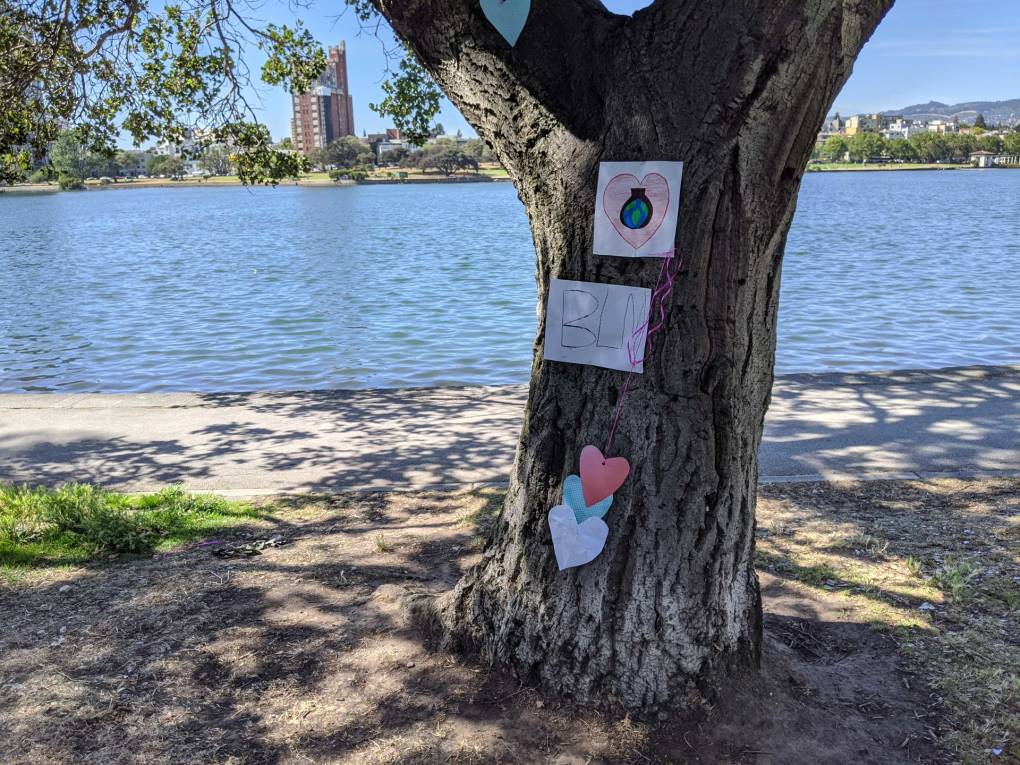
"caption": "A tree at Lake Merritt decorated with Black Lives Matter art on June 18, 2020.",
"description": "A tree at Lake Merritt decorated with Black Lives Matter art on June 18, 2020.",
"title": "RS43696_IMG_20200618_161733-qut",
"credit": "Lakshmi Sarah/KQED",
"status": "inherit",
"isLoading": false,
"fetchFailed": false
}
},
"audioPlayerReducer": {
"postId": "stream_live",
"isPaused": true,
"isPlaying": false,
"pfsActive": false,
"pledgeModalIsOpen": true,
"playerDrawerIsOpen": false,
"liveAudioPlayStartedAt": 0,
"liveAudioPlayContext": ""
},
"authorsReducer": {
"byline_news_11827813": {
"type": "authors",
"id": "byline_news_11827813",
"meta": {
"override": true
},
"slug": "byline_news_11827813",
"name": "Jocelyn Gecker and Julie Watson\u003cbr>Associated Press",
"isLoading": false
},
"byline_news_11825991": {
"type": "authors",
"id": "byline_news_11825991",
"meta": {
"override": true
},
"slug": "byline_news_11825991",
"name": "Olga R. Rodriguez\u003cBR>Associated Press",
"isLoading": false
},
"byline_news_11825573": {
"type": "authors",
"id": "byline_news_11825573",
"meta": {
"override": true
},
"slug": "byline_news_11825573",
"name": "Cuneyt Dil \u003cbr> Associated Press",
"isLoading": false
},
"jmcevoy": {
"type": "authors",
"id": "231",
"meta": {
"index": "authors_1716337520",
"id": "231",
"found": true
},
"name": "Julia McEvoy",
"firstName": "Julia",
"lastName": "McEvoy",
"slug": "jmcevoy",
"email": "jmcevoy@KQED.org",
"display_author_email": true,
"staff_mastheads": [
"news"
],
"title": "KQED Senior Editor",
"bio": "Julia McEvoy is KQED's Senior Editor, Education Equity.\r\n\r\nJulia heads KQED’s education coverage examining inequities students face in Bay Area and California schools, and reports on what it will take to educate the next generation.\r\n\r\nJulia's editorial work has received a Peabody Award, a Casey Medal for Coverage of Children and Families, several Edward R. Murrow awards, as well as awards from the Public Radio News Directors Inc. and the Society for Professional Journalists.",
"avatar": "https://secure.gravatar.com/avatar/aec3ce21abe02b302fd33638abd56a22?s=600&d=blank&r=g",
"twitter": "juliamcevoy1",
"facebook": null,
"instagram": null,
"linkedin": null,
"sites": [
{
"site": "news",
"roles": []
},
{
"site": "stateofhealth",
"roles": [
"author"
]
}
],
"headData": {
"title": "Julia McEvoy | KQED",
"description": "KQED Senior Editor",
"ogImgSrc": "https://secure.gravatar.com/avatar/aec3ce21abe02b302fd33638abd56a22?s=600&d=blank&r=g",
"twImgSrc": "https://secure.gravatar.com/avatar/aec3ce21abe02b302fd33638abd56a22?s=600&d=blank&r=g"
},
"isLoading": false,
"link": "/author/jmcevoy"
},
"kqed": {
"type": "authors",
"id": "236",
"meta": {
"index": "authors_1716337520",
"id": "236",
"found": true
},
"name": "KQED News Staff",
"firstName": "KQED News Staff",
"lastName": null,
"slug": "kqed",
"email": "faq@kqed.org",
"display_author_email": false,
"staff_mastheads": [],
"title": null,
"bio": null,
"avatar": "https://secure.gravatar.com/avatar/ef0e801a68c4c54afa9180db14084167?s=600&d=blank&r=g",
"twitter": null,
"facebook": null,
"instagram": null,
"linkedin": null,
"sites": [
{
"site": "arts",
"roles": [
"contributor"
]
},
{
"site": "news",
"roles": [
"editor"
]
},
{
"site": "futureofyou",
"roles": [
"author"
]
}
],
"headData": {
"title": "KQED News Staff | KQED",
"description": null,
"ogImgSrc": "https://secure.gravatar.com/avatar/ef0e801a68c4c54afa9180db14084167?s=600&d=blank&r=g",
"twImgSrc": "https://secure.gravatar.com/avatar/ef0e801a68c4c54afa9180db14084167?s=600&d=blank&r=g"
},
"isLoading": false,
"link": "/author/kqed"
},
"markfiore": {
"type": "authors",
"id": "3236",
"meta": {
"index": "authors_1716337520",
"id": "3236",
"found": true
},
"name": "Mark Fiore",
"firstName": "Mark",
"lastName": "Fiore",
"slug": "markfiore",
"email": "mark@markfiore.com",
"display_author_email": false,
"staff_mastheads": [
"news"
],
"title": "KQED News Cartoonist",
"bio": "\u003ca href=\"http://www.MarkFiore.com\">MarkFiore.com\u003c/a> | \u003ca href=\"https://twitter.com/markfiore\">Follow on Twitter\u003c/a> | \u003ca href=\"https://www.facebook.com/pages/Mark-Fiore-Animated-Political-Cartoons/94451707396?ref=bookmarks\">Facebook\u003c/a> | \u003ca href=\"mailto:mark@markfiore.com\">email\u003c/a>\r\n\r\nPulitzer Prize-winner, Mark Fiore, who the Wall Street Journal has called “the undisputed guru of the form,” creates animated political cartoons in San Francisco, where his work has been featured regularly on the San Francisco Chronicle’s web site, SFGate.com. His work has appeared on Newsweek.com, Slate.com, CBSNews.com, MotherJones.com, DailyKos.com and NPR’s web site. Fiore’s political animation has appeared on CNN, Frontline, Bill Moyers Journal, Salon.com and cable and broadcast outlets across the globe.\r\n\r\nBeginning his professional life by drawing traditional political cartoons for newspapers, Fiore’s work appeared in publications ranging from the Washington Post to the Los Angeles Times. In the late 1990s, he began to experiment with animating political cartoons and, after a short stint at the San Jose Mercury News as their staff cartoonist, Fiore devoted all his energies to animation.\r\nGrowing up in California, Fiore also spent a good portion of his life in the backwoods of Idaho. It was this combination that shaped him politically. Mark majored in political science at Colorado College, where, in a perfect send-off for a cartoonist, he received his diploma in 1991 as commencement speaker Dick Cheney smiled approvingly.\r\nMark Fiore was awarded the Pulitzer Prize for political cartooning in 2010, a Robert F. Kennedy Journalism Award in 2004 and has twice received an Online Journalism Award for commentary from the Online News Association (2002, 2008). Fiore has received two awards for his work in new media from the National Cartoonists Society (2001, 2002), and in 2006 received The James Madison Freedom of Information Award from The Society of Professional Journalists.",
"avatar": "https://secure.gravatar.com/avatar/fc4e2a612b15b67bad0c6f0e1db4ca9b?s=600&d=blank&r=g",
"twitter": "MarkFiore",
"facebook": null,
"instagram": "https://www.instagram.com/markfiore/?hl=en",
"linkedin": null,
"sites": [
{
"site": "arts",
"roles": [
"contributor"
]
},
{
"site": "news",
"roles": [
"editor"
]
},
{
"site": "futureofyou",
"roles": [
"editor"
]
},
{
"site": "science",
"roles": [
"editor"
]
}
],
"headData": {
"title": "Mark Fiore | KQED",
"description": "KQED News Cartoonist",
"ogImgSrc": "https://secure.gravatar.com/avatar/fc4e2a612b15b67bad0c6f0e1db4ca9b?s=600&d=blank&r=g",
"twImgSrc": "https://secure.gravatar.com/avatar/fc4e2a612b15b67bad0c6f0e1db4ca9b?s=600&d=blank&r=g"
},
"isLoading": false,
"link": "/author/markfiore"
},
"carlysevern": {
"type": "authors",
"id": "3243",
"meta": {
"index": "authors_1716337520",
"id": "3243",
"found": true
},
"name": "Carly Severn",
"firstName": "Carly",
"lastName": "Severn",
"slug": "carlysevern",
"email": "csevern@kqed.org",
"display_author_email": false,
"staff_mastheads": [
"news"
],
"title": "Senior Editor, Audience News ",
"bio": "Carly is KQED's Senior Editor of Audience News on the Digital News team, and has reported for the California Report Magazine, Bay Curious and KQED Arts. She's formerly the host of \u003ca href=\"http://ww2.kqed.org/pop/category/the-cooler/\" rel=\"noopener noreferrer\">The Cooler\u003c/a> podcast.",
"avatar": "https://secure.gravatar.com/avatar/54037bf5c128fe678f0ef26cec97a93f2e7f220a22d7285703328f12c42c1b1d?s=600&d=blank&r=g",
"twitter": "teacupinthebay",
"bluesky": null,
"facebook": null,
"instagram": null,
"linkedin": null,
"sites": [
{
"site": "",
"roles": [
"editor"
]
},
{
"site": "arts",
"roles": [
"editor"
]
},
{
"site": "news",
"roles": [
"administrator"
]
},
{
"site": "pop",
"roles": [
"editor"
]
},
{
"site": "futureofyou",
"roles": [
"editor"
]
},
{
"site": "about",
"roles": [
"administrator"
]
},
{
"site": "mindshift",
"roles": [
"editor"
]
},
{
"site": "bayareabites",
"roles": [
"editor"
]
},
{
"site": "stateofhealth",
"roles": [
"editor"
]
},
{
"site": "science",
"roles": [
"editor"
]
},
{
"site": "food",
"roles": [
"contributor"
]
},
{
"site": "forum",
"roles": [
"editor"
]
},
{
"site": "perspectives",
"roles": [
"administrator"
]
},
{
"site": "liveblog",
"roles": [
"editor"
]
}
],
"headData": {
"title": "Carly Severn | KQED",
"description": "Senior Editor, Audience News ",
"ogImgSrc": "https://secure.gravatar.com/avatar/54037bf5c128fe678f0ef26cec97a93f2e7f220a22d7285703328f12c42c1b1d?s=600&d=blank&r=g",
"twImgSrc": "https://secure.gravatar.com/avatar/54037bf5c128fe678f0ef26cec97a93f2e7f220a22d7285703328f12c42c1b1d?s=600&d=blank&r=g"
},
"isLoading": false,
"link": "/author/carlysevern"
},
"cveltman": {
"type": "authors",
"id": "8608",
"meta": {
"index": "authors_1716337520",
"id": "8608",
"found": true
},
"name": "Chloe Veltman",
"firstName": "Chloe",
"lastName": "Veltman",
"slug": "cveltman",
"email": "cveltman@kqed.org",
"display_author_email": true,
"staff_mastheads": [],
"title": "Arts and Culture Reporter",
"bio": "Chloe Veltman is a former arts and culture reporter for KQED. Prior to joining the organization, she launched and led the arts bureau at Colorado Public Radio, served as the Bay Area's culture columnist for the New York Times, and was the founder, host and executive producer of VoiceBox, a national award-winning weekly podcast/radio show and live events series all about the human voice. Chloe is the recipient of numerous prizes, grants and fellowships including a Webby Award for her work on interactive storytelling, both the John S Knight Journalism Fellowship and Humanities Center Fellowship at Stanford University, the Sundance Arts Writing Fellowship and a Library of Congress Research Fellowship. She is the author of the book \"On Acting\" and has appeared as a guest lecturer at Yale University and the San Francisco Conservatory of Music among other institutions. She holds a BA in english literature from King's College, Cambridge, and a Masters in Dramaturgy from the Central School of Speech and Drama/Harvard Institute for Advanced Theater Training.\r\n\u003ca href=\"https://www.chloeveltman.com\">www.chloeveltman.com\u003c/a>",
"avatar": "https://secure.gravatar.com/avatar/55403394b00a1ddab683952c2eb2cf85?s=600&d=blank&r=g",
"twitter": "chloeveltman",
"facebook": null,
"instagram": null,
"linkedin": null,
"sites": [
{
"site": "arts",
"roles": []
},
{
"site": "news",
"roles": [
"author"
]
},
{
"site": "pop",
"roles": [
"editor"
]
},
{
"site": "science",
"roles": []
}
],
"headData": {
"title": "Chloe Veltman | KQED",
"description": "Arts and Culture Reporter",
"ogImgSrc": "https://secure.gravatar.com/avatar/55403394b00a1ddab683952c2eb2cf85?s=600&d=blank&r=g",
"twImgSrc": "https://secure.gravatar.com/avatar/55403394b00a1ddab683952c2eb2cf85?s=600&d=blank&r=g"
},
"isLoading": false,
"link": "/author/cveltman"
},
"vrancano": {
"type": "authors",
"id": "11276",
"meta": {
"index": "authors_1716337520",
"id": "11276",
"found": true
},
"name": "Vanessa Rancaño",
"firstName": "Vanessa",
"lastName": "Rancaño",
"slug": "vrancano",
"email": "vrancano@kqed.org",
"display_author_email": false,
"staff_mastheads": [
"news"
],
"title": "Reporter",
"bio": "Vanessa Rancaño is a features reporter for KQED. She’s also covered homelessness and education for the station and reported from the Central Valley. Her work has aired across public radio, from flagship national news shows to longform narrative podcasts. Before taking up a mic, she worked as a freelance print journalist. She’s been recognized with a number of national and regional awards. Vanessa grew up in California's Central Valley. She's a former NPR Kroc Fellow, and a graduate of the UC Berkeley Graduate School of Journalism.",
"avatar": "https://secure.gravatar.com/avatar/b3a383dfb0e7ee1c17568f2cf067904ab654d6e3de9743fc661f3c788ade1bed?s=600&d=blank&r=g",
"twitter": "vanessarancano",
"bluesky": null,
"facebook": null,
"instagram": null,
"linkedin": null,
"sites": [
{
"site": "arts",
"roles": [
"editor"
]
},
{
"site": "news",
"roles": [
"editor"
]
},
{
"site": "liveblog",
"roles": [
"contributor"
]
}
],
"headData": {
"title": "Vanessa Rancaño | KQED",
"description": "Reporter",
"ogImgSrc": "https://secure.gravatar.com/avatar/b3a383dfb0e7ee1c17568f2cf067904ab654d6e3de9743fc661f3c788ade1bed?s=600&d=blank&r=g",
"twImgSrc": "https://secure.gravatar.com/avatar/b3a383dfb0e7ee1c17568f2cf067904ab654d6e3de9743fc661f3c788ade1bed?s=600&d=blank&r=g"
},
"isLoading": false,
"link": "/author/vrancano"
},
"lsarah": {
"type": "authors",
"id": "11626",
"meta": {
"index": "authors_1716337520",
"id": "11626",
"found": true
},
"name": "Lakshmi Sarah",
"firstName": "Lakshmi",
"lastName": "Sarah",
"slug": "lsarah",
"email": "lsarah@kqed.org",
"display_author_email": false,
"staff_mastheads": [],
"title": "Digital Producer",
"bio": "Lakshmi Sarah is an educator, author and journalist with a focus on innovative storytelling. She has worked with newspapers, radio and magazines from Ahmedabad, India to Los Angeles, California. She has written and produced for Die Zeit, Global Voices, AJ+, KQED, Fusion Media Group and the New York Times.",
"avatar": "https://secure.gravatar.com/avatar/652dcaecd8b28826fc17a8b2d6bb4e93?s=600&d=blank&r=g",
"twitter": "lakitalki",
"facebook": null,
"instagram": "https://www.instagram.com/laki.talki/",
"linkedin": "https://www.linkedin.com/in/lakisarah/",
"sites": [
{
"site": "arts",
"roles": []
},
{
"site": "news",
"roles": []
},
{
"site": "bayareabites",
"roles": []
},
{
"site": "science",
"roles": []
}
],
"headData": {
"title": "Lakshmi Sarah | KQED",
"description": "Digital Producer",
"ogImgSrc": "https://secure.gravatar.com/avatar/652dcaecd8b28826fc17a8b2d6bb4e93?s=600&d=blank&r=g",
"twImgSrc": "https://secure.gravatar.com/avatar/652dcaecd8b28826fc17a8b2d6bb4e93?s=600&d=blank&r=g"
},
"isLoading": false,
"link": "/author/lsarah"
}
},
"pagesReducer": {
"news_category_education": {
"type": "terms",
"id": "news_18540",
"meta": {
"index": "terms_1716263798",
"site": "news",
"id": "18540",
"score": 10.973179
},
"featImg": null,
"name": "Education",
"description": null,
"taxonomy": "category",
"headData": {
"twImgId": null,
"twTitle": null,
"ogTitle": null,
"ogImgId": null,
"twDescription": null,
"description": null,
"title": "Education Archives | KQED News",
"ogDescription": null
},
"ttid": 2595,
"slug": "education",
"isLoading": false,
"title": "Education",
"pageMeta": {
"site": "news",
"WpPageTemplate": "page-topic-editorial",
"currentPage": 94
},
"blocks": [
{
"blockName": "kqed/post-list",
"attrs": {
"layout": "cardArticle2",
"query": "posts/news?category=education",
"seeMore": false,
"paginated": true,
"page": 94
}
},
{
"blockName": "kqed/ad"
}
]
}
},
"pfsSessionReducer": {},
"postsReducer": {
"stream_live": {
"type": "live",
"id": "stream_live",
"audioUrl": "https://streams.kqed.org/kqedradio",
"title": "Live Stream",
"excerpt": "Live Stream information currently unavailable.",
"link": "/radio",
"featImg": "",
"label": {
"name": "KQED Live",
"link": "/"
}
},
"stream_kqedNewscast": {
"type": "posts",
"id": "stream_kqedNewscast",
"audioUrl": "https://www.kqed.org/.stream/anon/radio/RDnews/newscast.mp3?_=1",
"title": "KQED Newscast",
"featImg": "",
"label": {
"name": "88.5 FM",
"link": "/"
}
},
"news_11827813": {
"type": "posts",
"id": "news_11827813",
"meta": {
"index": "posts_1716263798",
"site": "news",
"id": "11827813",
"score": null,
"sort": [
1594169408000
]
},
"guestAuthors": [],
"slug": "uc-names-michael-drake-as-first-black-president",
"title": "Michael Drake Named First Black President of University of California",
"publishDate": 1594169408,
"format": "audio",
"headTitle": "Michael Drake Named First Black President of University of California | KQED",
"labelTerm": {
"term": 72,
"site": "news"
},
"content": "\u003cp>Dr. Michael Drake was chosen Tuesday to lead the University of California, the first Black president in the system’s 152-year history.\u003c/p>\n\u003cp>Drake, a seasoned university administrator, replaces Janet Napolitano in overseeing a sprawling, 285,000-student system dealing with issues of accessibility for Blacks and other minorities, along with slashed budgets and upended campus life because of the coronavirus pandemic.\u003c/p>\n\u003cp>Drake is a UC-trained physician who served as chancellor of the University of California, Irvine, and also led The Ohio State University before retiring from that job last month.\u003c/p>\n\u003cp>The UC Board of Regents unanimously approved Drake’s appointment.\u003c/p>\n\u003cp>“I’m excited and ready to go,” Drake told the board, noting the challenging times amid the pandemic, the threat of climate change and “the yawning wounds of social injustice that we see in so many ways that really tears at the fabric of our lives.”\u003c/p>\n\u003cp>[ad fullwidth]\u003c/p>\n\u003cp>He noted that the UC system is “best equipped worldwide” to be “fully engaged in finding solutions.”\u003c/p>\n\u003cp>Napolitano, whose seven years as president end Aug. 1, said Drake’s appointment is “one more step in our university’s ongoing effort to ensure that the university reflects the rich diversity of our state. It follows other recent decisions by this board to address issues of inequity and systemic racism in our society.”\u003c/p>\n\u003cp>Napolitano and Drake’s references to systemic racism and social injustice echo the focus of mass protests worldwide following the death of George Floyd, a black man, who died in Minnesota after a white police officer pressed a knee to his neck.\u003c/p>\n\u003cp>Napolitano, the first woman to serve as UC president, added, “I recognize the significance of these firsts and while I hope that this kind of leadership diversity at our nation’s universities will soon become commonplace, I am humbled and grateful to have been part of this chapter in UC’s history.”\u003c/p>\n\u003cp>Drake was UC Irvine’s chancellor from 2005 to 2014, when the university increased the number of applicants for undergraduate admission by more than 90% and added programs in law, public health, pharmaceutical sciences and nursing science.\u003c/p>\n\u003cp>Subsequently, as the president at The Ohio State University, he worked to increase the number of minority and underrepresented students. Under his leadership, the university boosted financial aid, and introduced changes to the tuition model.\u003c/p>\n\u003cp>“I’m a firm believer in inclusion. It takes all of us to do our best work,” Drake said at an afternoon teleconference, adding that it will be “a critical part of our moving forward.”\u003c/p>\n\u003cp>Drake said that during his tenure in Ohio, the school reversed a 20-year trend of decreasing African American enrollment, doubling the number of Black students admitted between 2014 and 2020. The school also “dramatically” increased retention and graduation rates for all students, he said.\u003c/p>\n\u003cp>[aside label=\"more UC coverage\" tag=\"university-of-california\"]He also worked to create minority representation during his years in the UC system. Prior to UC Irvine, he served as vice chancellor for health affairs for the UC system. He earned his medical degree in ophthalmology at UC San Francisco.\u003c/p>\n\u003cp>“Michael is a wise and thoughtful leader, never afraid to do the right thing at the right time,” said Kim A. Wilcox, UC Riverside’s chancellor, who served with Drake on the board of the University Innovation Alliance, a group of 11 public universities working to improve college access for low-income students, first-generation students, and students of color.\u003c/p>\n\u003cp>Drake takes the helm as the UC system faces more than $470 million in budget cuts, and many campuses have already announced plans for mostly online instruction in the fall.\u003c/p>\n\u003cp>“I am confident that Dr. Drake is the leader we need to guide our world-class higher education system through this time of unprecedented challenge,” Gov. Gavin Newsom said.\u003c/p>\n\u003cp>The announcement also comes as the California State University system is searching for a new leader. President Timothy White announced he would retire in June, but delayed his departure until the fall because of the pandemic.\u003c/p>\n\u003cp>Napolitano oversaw historic expansions at the 10-campus system and championed immigrant students. When she took the post in 2013, Napolitano — who had served as governor of Arizona and secretary of U.S. Homeland Security, but lacked experience in academic leadership — seemed an unconventional choice to lead the prestigious public university system.\u003c/p>\n\u003cp>But during her tenure at UC, she won praise for helping to boost enrollment to historic numbers and reforming sexual misconduct policies.\u003c/p>\n\u003cp>However, a state audit in 2016 found that Napolitano’s office amassed millions of dollars in undisclosed reserve funds. It also disclosed that top aides sought to suppress criticism of her office in surveys that were supposed to be confidential and sent directly to the state auditor.\u003c/p>\n\u003cp>State Auditor Elaine Howle’s report said there was “insufficient evidence” to conclude Napolitano knew or approved of any interference. But the investigation and subsequent oversight prompted a rare public rebuke by the UC’s governing Board of Regents, and the university adopted measures to improve transparency.\u003c/p>\n\u003cp>\u003c/p>\n\u003cp>Napolitano has battled a recurrence of breast cancer, but when she announced her resignation last September she said her health was good. She plans to resume teaching at UC Berkeley’s Goldman School of Public Policy in the fall of 2021.\u003c/p>\n\n",
"blocks": [],
"excerpt": "In a vote Tuesday afternoon, the UC Board of Regents selected Drake, the former president of The Ohio State University, to lead California's massive higher education system. Drake will replace outgoing President Janet Napolitano, becoming the first Black leader in the system's 152-year history.",
"status": "publish",
"parent": 0,
"modified": 1721155864,
"stats": {
"hasAudio": false,
"hasVideo": false,
"hasChartOrMap": false,
"iframeSrcs": [],
"hasGoogleForm": false,
"hasGallery": false,
"hasHearkenModule": false,
"hasPolis": false,
"paragraphCount": 25,
"wordCount": 923
},
"headData": {
"title": "Michael Drake Named First Black President of University of California | KQED",
"description": "In a vote Tuesday afternoon, the UC Board of Regents selected Drake, the former president of The Ohio State University, to lead California's massive higher education system. Drake will replace outgoing President Janet Napolitano, becoming the first Black leader in the system's 152-year history.",
"ogTitle": "",
"ogDescription": "",
"ogImgId": "",
"twTitle": "",
"twDescription": "",
"twImgId": "",
"schema": {
"@context": "https://schema.org",
"@type": "NewsArticle",
"headline": "Michael Drake Named First Black President of University of California",
"datePublished": "2020-07-07T17:50:08-07:00",
"dateModified": "2024-07-16T11:51:04-07:00",
"image": "https://cdn.kqed.org/wp-content/uploads/2020/02/KQED-OG-Image@1x.png",
"isAccessibleForFree": "True",
"publisher": {
"@type": "NewsMediaOrganization",
"@id": "https://www.kqed.org/#organization",
"name": "KQED",
"logo": "https://cdn.kqed.org/wp-content/uploads/2020/02/KQED-OG-Image@1x.png",
"url": "https://www.kqed.org",
"sameAs": [
"https://www.facebook.com/KQED",
"https://twitter.com/KQED",
"https://www.instagram.com/kqed/",
"https://www.tiktok.com/@kqedofficial",
"https://www.linkedin.com/company/kqed",
"https://www.youtube.com/channel/UCeC0IOo7i1P_61zVUWbJ4nw"
]
}
}
},
"audioUrl": "https://traffic.omny.fm/d/clips/0af137ef-751e-4b19-a055-aaef00d2d578/ffca7e9f-6831-41c5-bcaf-aaef00f5a073/d623f6fe-54d0-4bee-a30a-abf201153676/audio.mp3",
"sticky": false,
"nprByline": "Jocelyn Gecker and Julie Watson\u003cbr>Associated Press",
"path": "/news/11827813/uc-names-michael-drake-as-first-black-president",
"audioDuration": 52000,
"audioTrackLength": null,
"parsedContent": [
{
"type": "contentString",
"content": "\u003cdiv class=\"post-body\">\u003cp>\u003cp>Dr. Michael Drake was chosen Tuesday to lead the University of California, the first Black president in the system’s 152-year history.\u003c/p>\n\u003cp>Drake, a seasoned university administrator, replaces Janet Napolitano in overseeing a sprawling, 285,000-student system dealing with issues of accessibility for Blacks and other minorities, along with slashed budgets and upended campus life because of the coronavirus pandemic.\u003c/p>\n\u003cp>Drake is a UC-trained physician who served as chancellor of the University of California, Irvine, and also led The Ohio State University before retiring from that job last month.\u003c/p>\n\u003cp>The UC Board of Regents unanimously approved Drake’s appointment.\u003c/p>\n\u003cp>“I’m excited and ready to go,” Drake told the board, noting the challenging times amid the pandemic, the threat of climate change and “the yawning wounds of social injustice that we see in so many ways that really tears at the fabric of our lives.”\u003c/p>\n\u003cp>\u003c/p>\u003c/div>",
"attributes": {
"named": {},
"numeric": []
}
},
{
"type": "component",
"content": "",
"name": "ad",
"attributes": {
"named": {
"label": "fullwidth"
},
"numeric": [
"fullwidth"
]
}
},
{
"type": "contentString",
"content": "\u003cdiv class=\"post-body\">\u003cp>\u003c/p>\n\u003cp>He noted that the UC system is “best equipped worldwide” to be “fully engaged in finding solutions.”\u003c/p>\n\u003cp>Napolitano, whose seven years as president end Aug. 1, said Drake’s appointment is “one more step in our university’s ongoing effort to ensure that the university reflects the rich diversity of our state. It follows other recent decisions by this board to address issues of inequity and systemic racism in our society.”\u003c/p>\n\u003cp>Napolitano and Drake’s references to systemic racism and social injustice echo the focus of mass protests worldwide following the death of George Floyd, a black man, who died in Minnesota after a white police officer pressed a knee to his neck.\u003c/p>\n\u003cp>Napolitano, the first woman to serve as UC president, added, “I recognize the significance of these firsts and while I hope that this kind of leadership diversity at our nation’s universities will soon become commonplace, I am humbled and grateful to have been part of this chapter in UC’s history.”\u003c/p>\n\u003cp>Drake was UC Irvine’s chancellor from 2005 to 2014, when the university increased the number of applicants for undergraduate admission by more than 90% and added programs in law, public health, pharmaceutical sciences and nursing science.\u003c/p>\n\u003cp>Subsequently, as the president at The Ohio State University, he worked to increase the number of minority and underrepresented students. Under his leadership, the university boosted financial aid, and introduced changes to the tuition model.\u003c/p>\n\u003cp>“I’m a firm believer in inclusion. It takes all of us to do our best work,” Drake said at an afternoon teleconference, adding that it will be “a critical part of our moving forward.”\u003c/p>\n\u003cp>Drake said that during his tenure in Ohio, the school reversed a 20-year trend of decreasing African American enrollment, doubling the number of Black students admitted between 2014 and 2020. The school also “dramatically” increased retention and graduation rates for all students, he said.\u003c/p>\n\u003cp>\u003c/p>\u003c/div>",
"attributes": {
"named": {},
"numeric": []
}
},
{
"type": "component",
"content": "",
"name": "aside",
"attributes": {
"named": {
"label": "more UC coverage ",
"tag": "university-of-california"
},
"numeric": []
}
},
{
"type": "contentString",
"content": "\u003cdiv class=\"post-body\">\u003cp>He also worked to create minority representation during his years in the UC system. Prior to UC Irvine, he served as vice chancellor for health affairs for the UC system. He earned his medical degree in ophthalmology at UC San Francisco.\u003c/p>\n\u003cp>“Michael is a wise and thoughtful leader, never afraid to do the right thing at the right time,” said Kim A. Wilcox, UC Riverside’s chancellor, who served with Drake on the board of the University Innovation Alliance, a group of 11 public universities working to improve college access for low-income students, first-generation students, and students of color.\u003c/p>\n\u003cp>Drake takes the helm as the UC system faces more than $470 million in budget cuts, and many campuses have already announced plans for mostly online instruction in the fall.\u003c/p>\n\u003cp>“I am confident that Dr. Drake is the leader we need to guide our world-class higher education system through this time of unprecedented challenge,” Gov. Gavin Newsom said.\u003c/p>\n\u003cp>The announcement also comes as the California State University system is searching for a new leader. President Timothy White announced he would retire in June, but delayed his departure until the fall because of the pandemic.\u003c/p>\n\u003cp>Napolitano oversaw historic expansions at the 10-campus system and championed immigrant students. When she took the post in 2013, Napolitano — who had served as governor of Arizona and secretary of U.S. Homeland Security, but lacked experience in academic leadership — seemed an unconventional choice to lead the prestigious public university system.\u003c/p>\n\u003cp>But during her tenure at UC, she won praise for helping to boost enrollment to historic numbers and reforming sexual misconduct policies.\u003c/p>\n\u003cp>However, a state audit in 2016 found that Napolitano’s office amassed millions of dollars in undisclosed reserve funds. It also disclosed that top aides sought to suppress criticism of her office in surveys that were supposed to be confidential and sent directly to the state auditor.\u003c/p>\n\u003cp>State Auditor Elaine Howle’s report said there was “insufficient evidence” to conclude Napolitano knew or approved of any interference. But the investigation and subsequent oversight prompted a rare public rebuke by the UC’s governing Board of Regents, and the university adopted measures to improve transparency.\u003c/p>\n\u003cp>\u003c/p>\n\u003cp>Napolitano has battled a recurrence of breast cancer, but when she announced her resignation last September she said her health was good. She plans to resume teaching at UC Berkeley’s Goldman School of Public Policy in the fall of 2021.\u003c/p>\n\n\u003c/div>\u003c/p>",
"attributes": {
"named": {},
"numeric": []
}
}
],
"link": "/news/11827813/uc-names-michael-drake-as-first-black-president",
"authors": [
"byline_news_11827813"
],
"programs": [
"news_72"
],
"categories": [
"news_18540",
"news_8"
],
"tags": [
"news_1790",
"news_2100",
"news_206"
],
"featImg": "news_11827819",
"label": "news_72"
},
"news_11827732": {
"type": "posts",
"id": "news_11827732",
"meta": {
"index": "posts_1716263798",
"site": "news",
"id": "11827732",
"score": null,
"sort": [
1594162603000
]
},
"guestAuthors": [],
"slug": "not-so-model-missions",
"title": "Not-So-Model Missions",
"publishDate": 1594162603,
"format": "standard",
"headTitle": "Not-So-Model Missions | KQED",
"labelTerm": {
"term": 18515,
"site": "news"
},
"content": "\u003cp>Many people in California grew up with a simplified, mythologized version of Junípero Serra that included building models of Spanish missions.\u003c/p>\n\u003cp>While espousing beatings for Indigenous peoples, Serra \u003ca href=\"https://www.kqed.org/news/11826151/how-do-we-heal-toppling-the-myth-of-junipero-serra\">helped preside over a system of enslavement\u003c/a> in the name of spreading Catholicism.\u003c/p>\n\u003cp>Attending Catholic schools while growing up in California, I distinctly remember making tiny clay blocks for my Spanish mission project, but I definitely don’t remember being taught that Father Serra’s missionary work led to a 90% decline of the Native population.\u003c/p>\n\u003cp>[ad fullwidth]\u003c/p>\n\u003cp>\u003c/p>\n",
"blocks": [],
"excerpt": "Many people in California grew up with a simplified, mythologized version of Junípero Serra that included building models of Spanish missions.",
"status": "publish",
"parent": 0,
"modified": 1721155856,
"stats": {
"hasAudio": false,
"hasVideo": false,
"hasChartOrMap": false,
"iframeSrcs": [],
"hasGoogleForm": false,
"hasGallery": false,
"hasHearkenModule": false,
"hasPolis": false,
"paragraphCount": 5,
"wordCount": 90
},
"headData": {
"title": "Not-So-Model Missions | KQED",
"description": "Many people in California grew up with a simplified, mythologized version of Junípero Serra that included building models of Spanish missions.",
"ogTitle": "",
"ogDescription": "",
"ogImgId": "",
"twTitle": "",
"twDescription": "",
"twImgId": "",
"schema": {
"@context": "https://schema.org",
"@type": "NewsArticle",
"headline": "Not-So-Model Missions",
"datePublished": "2020-07-07T15:56:43-07:00",
"dateModified": "2024-07-16T11:50:56-07:00",
"image": "https://cdn.kqed.org/wp-content/uploads/2020/02/KQED-OG-Image@1x.png",
"isAccessibleForFree": "True",
"publisher": {
"@type": "NewsMediaOrganization",
"@id": "https://www.kqed.org/#organization",
"name": "KQED",
"logo": "https://cdn.kqed.org/wp-content/uploads/2020/02/KQED-OG-Image@1x.png",
"url": "https://www.kqed.org",
"sameAs": [
"https://www.facebook.com/KQED",
"https://twitter.com/KQED",
"https://www.instagram.com/kqed/",
"https://www.tiktok.com/@kqedofficial",
"https://www.linkedin.com/company/kqed",
"https://www.youtube.com/channel/UCeC0IOo7i1P_61zVUWbJ4nw"
]
}
}
},
"sticky": false,
"path": "/news/11827732/not-so-model-missions",
"audioTrackLength": null,
"parsedContent": [
{
"type": "contentString",
"content": "\u003cdiv class=\"post-body\">\u003cp>\u003cp>Many people in California grew up with a simplified, mythologized version of Junípero Serra that included building models of Spanish missions.\u003c/p>\n\u003cp>While espousing beatings for Indigenous peoples, Serra \u003ca href=\"https://www.kqed.org/news/11826151/how-do-we-heal-toppling-the-myth-of-junipero-serra\">helped preside over a system of enslavement\u003c/a> in the name of spreading Catholicism.\u003c/p>\n\u003cp>Attending Catholic schools while growing up in California, I distinctly remember making tiny clay blocks for my Spanish mission project, but I definitely don’t remember being taught that Father Serra’s missionary work led to a 90% decline of the Native population.\u003c/p>\n\u003cp>\u003c/p>\u003c/div>",
"attributes": {
"named": {},
"numeric": []
}
},
{
"type": "component",
"content": "",
"name": "ad",
"attributes": {
"named": {
"label": "fullwidth"
},
"numeric": [
"fullwidth"
]
}
},
{
"type": "contentString",
"content": "\u003cdiv class=\"post-body\">\u003cp>\u003c/p>\n\u003cp>\u003c/p>\n\u003c/div>\u003c/p>",
"attributes": {
"named": {},
"numeric": []
}
}
],
"link": "/news/11827732/not-so-model-missions",
"authors": [
"3236"
],
"series": [
"news_18515"
],
"categories": [
"news_18540",
"news_13"
],
"tags": [
"news_18538",
"news_20397",
"news_27966",
"news_28122",
"news_20949",
"news_1262"
],
"featImg": "news_11827800",
"label": "news_18515"
},
"news_11826151": {
"type": "posts",
"id": "news_11826151",
"meta": {
"index": "posts_1716263798",
"site": "news",
"id": "11826151",
"score": null,
"sort": [
1594159269000
]
},
"guestAuthors": [],
"slug": "how-do-we-heal-toppling-the-myth-of-junipero-serra",
"title": "'How Do We Heal?' Toppling the Myth of Junípero Serra",
"publishDate": 1594159269,
"format": "image",
"headTitle": "‘How Do We Heal?’ Toppling the Myth of Junípero Serra | KQED",
"labelTerm": {
"site": "news"
},
"content": "\u003cp>\u003cstrong>Skip to:\u003c/strong>\u003c/p>\n\u003cul>\n\u003cli>\u003cstrong>\u003cstrong>\u003ca href=\"#serra\">Who was Junípero Serra, and what did he do? \u003c/a>\u003c/strong>\u003c/strong>\u003cstrong>\u003ca href=\"#serra\"> \u003c/a>\u003c/strong>\u003c/li>\n\u003cli>\u003cstrong>\u003ca href=\"#removal\">How statues get officially removed – and what you can do personally\u003c/a>\u003c/strong>\u003c/li>\n\u003c/ul>\n\u003cp>[dropcap]O[/dropcap]n June 19, people around the Bay Area \u003ca href=\"https://www.kqed.org/news/11825274/updates-bay-area-honors-juneteenth-on-the-streets\">took to the streets to mark Juneteenth\u003c/a>: the date in 1865 when the last enslaved people in Texas learned they were free, more than two years after slavery officially ended in the United States. The rallies followed weeks of \u003ca href=\"https://www.kqed.org/news/tag/protests\">intense protest\u003c/a> across the country over the killings of George Floyd and other Black people by police, and over systemic racism in the United States.\u003c/p>\n\u003cp>That evening, protesters \u003ca href=\"https://twitter.com/FitzTheReporter/status/1274374501925453824\">pulled down a bronze statue\u003c/a> that had stood 30 feet high over San Francisco’s Golden Gate Park for more than a century, spattering it with red paint.\u003c/p>\n\u003cfigure id=\"attachment_11827294\" class=\"wp-caption alignnone\" style=\"max-width: 1900px\">\u003cimg loading=\"lazy\" decoding=\"async\" class=\"size-full wp-image-11827294\" src=\"https://ww2.kqed.org/app/uploads/sites/10/2020/07/Serra-toppled.jpg\" alt=\"\" width=\"1900\" height=\"1280\" srcset=\"https://cdn.kqed.org/wp-content/uploads/sites/10/2020/07/Serra-toppled.jpg 1900w, https://cdn.kqed.org/wp-content/uploads/sites/10/2020/07/Serra-toppled-800x539.jpg 800w, https://cdn.kqed.org/wp-content/uploads/sites/10/2020/07/Serra-toppled-1020x687.jpg 1020w, https://cdn.kqed.org/wp-content/uploads/sites/10/2020/07/Serra-toppled-160x108.jpg 160w, https://cdn.kqed.org/wp-content/uploads/sites/10/2020/07/Serra-toppled-1536x1035.jpg 1536w\" sizes=\"(max-width: 1900px) 100vw, 1900px\">\u003cfigcaption class=\"wp-caption-text\">A statue of Junípero Serra toppled from its plinth in San Francisco’s Golden Gate Park by protesters on June 18, 2020. \u003ccite>(Joe Fitzgerald Rodriguez/KQED)\u003c/cite>\u003c/figcaption>\u003c/figure>\n\u003cp>The 1907 monument was a tribute to Father Junípero Serra: the 18th century Franciscan priest who presided over the colonizing Spanish mission system in California that resulted in the decimation of the Indigenous population, and who was \u003ca href=\"https://www.kqed.org/news/10682571/pope-francis-courts-controversy-over-junipero-serra-sainthood\">made a saint\u003c/a> by Pope Francis in 2015. Monuments to Ulysses S. Grant and Francis Scott Key, who both enslaved Black people, were also pulled down in the park that night.\u003c/p>\n\u003cp>The Juneteenth topplings followed the \u003ca href=\"https://www.kqed.org/news/11825103/san-francisco-removes-controversial-christopher-columbus-statue-on-telegraph-hill\">removal\u003c/a> of a Christopher Columbus statue in San Francisco’s North Beach neighborhood by city workers ahead of plans by protesters to topple it themselves, and the removal of a Sacramento \u003ca href=\"https://www.kqed.org/news/11824573/statue-of-john-sutter-pioneer-who-enslaved-native-americans-removed-in-sacramento\">monument to John Sutter\u003c/a> — a 19th century colonizer who enslaved Native Americans at his mill. The day after the Golden Gate Park statues fell, Indigenous activists in downtown Los Angeles watched as a 1932 park monument to Serra \u003ca href=\"https://www.latimes.com/entertainment-arts/story/2020-06-20/statue-junipero-serra-monument-protest-activists-take-down-los-angeles\">was ripped off its pedestal\u003c/a>.\u003c/p>\n\u003cfigure id=\"attachment_11827292\" class=\"wp-caption aligncenter\" style=\"max-width: 1900px\">\u003cimg loading=\"lazy\" decoding=\"async\" class=\"size-full wp-image-11827292\" src=\"https://ww2.kqed.org/app/uploads/sites/10/2020/07/serra-graffiti.jpg\" alt=\"Graffiti at the former site of a statue of Junípero Serra reads 'Stolen land, stolen people.'\" width=\"1900\" height=\"1280\" srcset=\"https://cdn.kqed.org/wp-content/uploads/sites/10/2020/07/serra-graffiti.jpg 1900w, https://cdn.kqed.org/wp-content/uploads/sites/10/2020/07/serra-graffiti-800x539.jpg 800w, https://cdn.kqed.org/wp-content/uploads/sites/10/2020/07/serra-graffiti-1020x687.jpg 1020w, https://cdn.kqed.org/wp-content/uploads/sites/10/2020/07/serra-graffiti-160x108.jpg 160w, https://cdn.kqed.org/wp-content/uploads/sites/10/2020/07/serra-graffiti-1536x1035.jpg 1536w\" sizes=\"(max-width: 1900px) 100vw, 1900px\">\u003cfigcaption class=\"wp-caption-text\">Graffiti at the former site of a statue of Junípero Serra reads ‘Stolen land, stolen people.’ \u003ccite>(Joe Fitzgerald Rodriguez/KQED)\u003c/cite>\u003c/figcaption>\u003c/figure>\n\u003cp>And this past July 4, another statue of Serra was \u003ca href=\"https://www.sacbee.com/news/local/article244012732.html\">torn down in Sacramento’s Capitol Park\u003c/a> by protesters following a day of peaceful marches by demonstrators aligned with the Black Lives Matter movement. The same day, Indigenous activists \u003ca href=\"https://www.latimes.com/california/story/2020-07-04/indigenous-groups-black-lives-matters-join-forces-to-mark-historical-sins-on-july-4th\">joined forces with Black Lives Matter organizers\u003c/a> for a march in Los Angeles, calling for unity and decrying the historical ‘sins’ of the United States.\u003c/p>\n\u003ch3>Black Lives Matter and the Fight Against Serra Monuments\u003c/h3>\n\u003cp>Like the timing of the July 4 marches, the Juneteenth timing of the Golden Gate Park Serra statue toppling was highly symbolic.\u003c/p>\n\u003cp>“It’s emotional for sure,” says Morning Star Gali about how it feels to see statues come down. A member of the Ajumawi band of the Pit River Tribe — and the project director of the organization Restoring Justice for Indigenous Peoples — Gali has been involved in campaigns for the removal of several statues in the state.\u003c/p>\n\u003cp>She campaigned against the Sacramento monument to Sutter, and was there to watch it fall. She was present too at the contentious \u003ca href=\"https://www.kqed.org/arts/13859733/sf-had-right-to-remove-early-days-statue-deemed-racist-judge-says\">removal of the Early Days\u003c/a> statue in San Francisco in 2018, which she and others had worked to remove from public view on account of its portrayal of Native Americans.\u003c/p>\n\u003cfigure id=\"attachment_11827286\" class=\"wp-caption aligncenter\" style=\"max-width: 1900px\">\u003cimg loading=\"lazy\" decoding=\"async\" class=\"size-full wp-image-11827286\" src=\"https://ww2.kqed.org/app/uploads/sites/10/2020/07/early-days.jpg\" alt=\"\" width=\"1900\" height=\"1758\" srcset=\"https://cdn.kqed.org/wp-content/uploads/sites/10/2020/07/early-days.jpg 1900w, https://cdn.kqed.org/wp-content/uploads/sites/10/2020/07/early-days-800x740.jpg 800w, https://cdn.kqed.org/wp-content/uploads/sites/10/2020/07/early-days-1020x944.jpg 1020w, https://cdn.kqed.org/wp-content/uploads/sites/10/2020/07/early-days-160x148.jpg 160w, https://cdn.kqed.org/wp-content/uploads/sites/10/2020/07/early-days-1536x1421.jpg 1536w\" sizes=\"(max-width: 1900px) 100vw, 1900px\">\u003cfigcaption class=\"wp-caption-text\">‘Early Days,’ part of the Pioneer Monument in San Francisco’s Civic Center, was removed in 2018. \u003ccite>(Sam Lefebvre/KQED)\u003c/cite>\u003c/figcaption>\u003c/figure>\n\u003cp>America’s current movement toward social justice, and the deep reckoning with U.S. history that it demands, is “absolutely intersectional,” says Gali.\u003c/p>\n\u003cp>“There is absolutely a mutual understanding of Black and brown and Indigenous liberation that we understand, and we’ve done a lot of work in the past year to get to the point where we’re at.”\u003c/p>\n\u003cp>She and her fellow Indigenous activists are active partners with the Anti Police-Terror Project — work that’s seen them hold memorials and vigils to honor Black victims of police brutality. In Sacramento, Gali’s efforts to \u003ca href=\"https://www.antipoliceterrorproject.org/sac-events/2020/6/17/community-conversations-to-de-serra-sacramento\">“de-Serra” the city\u003c/a> were purposefully held in partnership with the Anti Police-Terror Project, to “really show the solidarity that we have with one another.”\u003c/p>\n\u003cp>These statues are, Gali emphasizes, “monuments to racism. These are monuments to genocide. And it’s time for them to come down.”\u003c/p>\n\u003cfigure id=\"attachment_11827564\" class=\"wp-caption alignnone\" style=\"max-width: 1900px\">\u003cimg loading=\"lazy\" decoding=\"async\" class=\"size-full wp-image-11827564\" src=\"https://ww2.kqed.org/app/uploads/sites/10/2020/10/Gali-Brooke.jpg\" alt=\"\" width=\"1900\" height=\"1280\" srcset=\"https://cdn.kqed.org/wp-content/uploads/sites/10/2020/10/Gali-Brooke.jpg 1900w, https://cdn.kqed.org/wp-content/uploads/sites/10/2020/10/Gali-Brooke-800x539.jpg 800w, https://cdn.kqed.org/wp-content/uploads/sites/10/2020/10/Gali-Brooke-1020x687.jpg 1020w, https://cdn.kqed.org/wp-content/uploads/sites/10/2020/10/Gali-Brooke-160x108.jpg 160w, https://cdn.kqed.org/wp-content/uploads/sites/10/2020/10/Gali-Brooke-1536x1035.jpg 1536w\" sizes=\"(max-width: 1900px) 100vw, 1900px\">\u003cfigcaption class=\"wp-caption-text\">Morning Star Gali, with her youngest daughters. \u003ccite>(Brooke Anderson)\u003c/cite>\u003c/figcaption>\u003c/figure>\n\u003cp>Author and academic Greg Sarris is the chairman of the Federated Indians of Graton Rancheria, and lecturer at Sonoma State University’s Native American Studies program. In support of “everyone who is suffering the legacy of racism and injustice,” Sarris says that he and his tribe fully stand behind the Black Lives Matter movement.\u003c/p>\n\u003cp>“Let us not forget that the Indians on this continent were the first to find out what European insensitivity would do to us,” he says. “And do to others.”\u003c/p>\n\u003cp>As statues of colonizers are brought down around California — mirroring actions against Confederate monuments further east — Serra remains a particular focus. And for years, he’s been a reviled figure among many Indigenous people for his leadership over a system that resulted in the incalculable loss of Native lives, and forever altered the Indigenous way of life in California.\u003c/p>\n\u003cp>When it comes to Serra, this is a fight that has been sustained by Indigenous activists for decades. And far from being a matter that relates mainly to California’s history, it says everything about our state’s present — and future.\u003c/p>\n\u003ch3>\u003ca id=\"serra\">\u003c/a>Who Was Junípero Serra?\u003c/h3>\n\u003cp>Born in Spain, Junípero Serra first traveled to the Americas in 1749 while in his thirties, to work as a Catholic missionary in Mexico. In 1768, he traveled north to California, and founded a string of missions stretching from San Diego to San Francisco.\u003c/p>\n\u003cfigure id=\"attachment_10406942\" class=\"wp-caption alignnone\" style=\"max-width: 1440px\">\u003cimg loading=\"lazy\" decoding=\"async\" class=\"size-full wp-image-10406942\" src=\"https://ww2.kqed.org/app/uploads/sites/10/2015/01/juniperoserra-e1421339520709.jpeg\" alt=\"\" width=\"1440\" height=\"1036\">\u003cfigcaption class=\"wp-caption-text\">Father Junípero Serra in a portrait by Father Jose Mosqueda. \u003ccite>(Huntington Library)\u003c/cite>\u003c/figcaption>\u003c/figure>\n\u003cp>If members of a nearby Indigenous tribe were baptized, they were then brought into a mission where they were ordered to abandon many aspects of their culture and customs, and forced into labor — and prevented from leaving. Anyone who tried to escape the mission was subject to being hunted down and brought back.\u003c/p>\n\u003cp>The Native people in Serra’s missions were subjected to physical punishments like whippings and beating, which Serra himself justified in 1780, \u003ca href=\"https://www.pbs.org/weta/thewest/people/s_z/serra.htm\">writing\u003c/a> “that spiritual fathers should punish their sons, the Indians, with blows appears to be as old as the conquest of [the Americas]; so general in fact that the saints do not seem to be any exception to the rule.”\u003c/p>\n\u003cfigure id=\"attachment_11827259\" class=\"wp-caption alignnone\" style=\"max-width: 1900px\">\u003cimg loading=\"lazy\" decoding=\"async\" class=\"size-full wp-image-11827259\" src=\"https://ww2.kqed.org/app/uploads/sites/10/2020/07/Map.jpg\" alt=\"\" width=\"1900\" height=\"1579\" srcset=\"https://cdn.kqed.org/wp-content/uploads/sites/10/2020/07/Map.jpg 1900w, https://cdn.kqed.org/wp-content/uploads/sites/10/2020/07/Map-800x665.jpg 800w, https://cdn.kqed.org/wp-content/uploads/sites/10/2020/07/Map-1020x848.jpg 1020w, https://cdn.kqed.org/wp-content/uploads/sites/10/2020/07/Map-160x133.jpg 160w, https://cdn.kqed.org/wp-content/uploads/sites/10/2020/07/Map-1536x1276.jpg 1536w\" sizes=\"(max-width: 1900px) 100vw, 1900px\">\u003cfigcaption class=\"wp-caption-text\">A map of North America dated 1789, showing California when it was part of Spanish-controlled “New Spain.” \u003ccite>(Dobson's Encyclopædia)\u003c/cite>\u003c/figcaption>\u003c/figure>\n\u003cp>Thousands of Indigenous people in the missions died from exposure to European diseases and from the brutal labor they were forced to perform. It was the discovery of the missions’ birth and death rolls — and the revelation that more Native people died under Serra’s system than were born — that sparked a more widespread re-evaluation of his legacy in the 20th century.\u003c/p>\n\u003cp>The hard physical labor performed by Indigenous people in Serra’s missions was, for years, characterized in history books as ‘work.’ The word for it used today by many, including the descendants of those people, is ‘slavery.’\u003c/p>\n\u003cp>“Here we were enslaved in the missions, and whipped and beaten,” says Greg Sarris. “Up to 90% of the population [was] decimated, from which we never really recovered.”\u003c/p>\n\u003cp>The missions “were concentration camps,” \u003ca href=\"https://www.montereyherald.com/2015/04/01/easter-sunday-protest-over-serra-planned-at-carmel-mission/\">said Corine Fairbanks\u003c/a> of the American Indian Movement Southern California in 2015, ahead of a protest at Serra’s canonization at the Carmel mission. “They were places of death.”\u003c/p>\n\u003cp>Centuries of spiritual and cultural heritage were erased by the Spanish conversion system.\u003c/p>\n\u003cp>“Serra did not just bring us Christianity,” \u003ca href=\"https://www.nytimes.com/2015/01/22/us/to-some-indians-in-california-father-serra-is-far-from-a-saint.html\">said academic Deborah Miranda\u003c/a>, a member of the Ohlone Costanoan Esselen Nation and author of “Bad Indians”, in 2015. “He imposed it, giving us no choice in the matter. He did incalculable damage to a whole culture.”\u003c/p>\n\u003ch3>Serra the Saint\u003c/h3>\n\u003cp>In 2015, Pope Francis announced his \u003ca href=\"https://www.kqed.org/news/10682571/pope-francis-courts-controversy-over-junipero-serra-sainthood\">decision to make Junípero Serra a saint\u003c/a>. The news was met with outrage in California, with protests taking place in San Francisco’s Mission Dolores, Mission Carmel and Mission San Juan Bautista.\u003c/p>\n\u003cfigure id=\"attachment_11748397\" class=\"wp-caption aligncenter\" style=\"max-width: 1920px\">\u003cimg loading=\"lazy\" decoding=\"async\" class=\"size-full wp-image-11748397\" src=\"https://ww2.kqed.org/app/uploads/sites/10/2019/05/RS37187_GettyImages-489795578-qut.jpg\" alt=\"Pope Francis pauses in front of a sculpture of Spanish-born Junipero Serra, the Franciscan Friar known for starting missions in California, in Statuary Hall at the U.S. Capitol on September 24, 2015 in Washington, DC.\" width=\"1920\" height=\"1280\" srcset=\"https://cdn.kqed.org/wp-content/uploads/sites/10/2019/05/RS37187_GettyImages-489795578-qut.jpg 1920w, https://cdn.kqed.org/wp-content/uploads/sites/10/2019/05/RS37187_GettyImages-489795578-qut-160x107.jpg 160w, https://cdn.kqed.org/wp-content/uploads/sites/10/2019/05/RS37187_GettyImages-489795578-qut-800x533.jpg 800w, https://cdn.kqed.org/wp-content/uploads/sites/10/2019/05/RS37187_GettyImages-489795578-qut-1020x680.jpg 1020w, https://cdn.kqed.org/wp-content/uploads/sites/10/2019/05/RS37187_GettyImages-489795578-qut-1200x800.jpg 1200w\" sizes=\"(max-width: 1920px) 100vw, 1920px\">\u003cfigcaption class=\"wp-caption-text\">Pope Francis pauses in front of a sculpture of Junípero Serra in Statuary Hall at the U.S. Capitol on September 24, 2015 in Washington, DC. He canonized Serra on this visit. \u003ccite>(Michael Reynolds-Pool/Getty Images)\u003c/cite>\u003c/figcaption>\u003c/figure>\n\u003cp>An Indigenous-authored \u003ca href=\"https://sign.moveon.org/petitions/urge-pope-francis-to?mailing_id=28356&r_by=504037&source=s.icn.em.cr\">petition\u003c/a> urging the pope to reconsider the canonization received over 11,000 signatures, stating that “it is imperative he is enlightened to understand that Father Serra was responsible for the deception, exploitation, oppression, enslavement and genocide of thousands of Indigenous Californians, ultimately resulting in the largest ethnic cleansing in North America.”\u003c/p>\n\u003cp>A week after the canonization, a statue of Serra in Monterey was decapitated. Two years later in Santa Barbara, another Serra monument at the city’s mission was also decapitated and covered with red paint.\u003c/p>\n\u003cp>This wasn’t the first time the Church had attempted to elevate Serra’s holy stature. Almost three decades earlier, in 1988, Francis’ predecessor Pope John Paul II had actually kicked off the sanctification process by beatifying Serra. That announcement too was greeted with horror by Indigenous voices, but even back then, it represented only the latest articulation of of anti-Serra protest.\u003c/p>\n\u003cfigure id=\"attachment_11827261\" class=\"wp-caption aligncenter\" style=\"max-width: 1920px\">\u003cimg loading=\"lazy\" decoding=\"async\" class=\"size-full wp-image-11827261\" src=\"https://ww2.kqed.org/app/uploads/sites/10/2020/07/RS43838_001_KQED_280_JuniperoSerraStatue_06302020-qut.jpg\" alt=\"A statue of Junípero Serra at a rest stop along Interstate 280 near Hillsborough.\" width=\"1920\" height=\"1280\" srcset=\"https://cdn.kqed.org/wp-content/uploads/sites/10/2020/07/RS43838_001_KQED_280_JuniperoSerraStatue_06302020-qut.jpg 1920w, https://cdn.kqed.org/wp-content/uploads/sites/10/2020/07/RS43838_001_KQED_280_JuniperoSerraStatue_06302020-qut-800x533.jpg 800w, https://cdn.kqed.org/wp-content/uploads/sites/10/2020/07/RS43838_001_KQED_280_JuniperoSerraStatue_06302020-qut-1020x680.jpg 1020w, https://cdn.kqed.org/wp-content/uploads/sites/10/2020/07/RS43838_001_KQED_280_JuniperoSerraStatue_06302020-qut-160x107.jpg 160w, https://cdn.kqed.org/wp-content/uploads/sites/10/2020/07/RS43838_001_KQED_280_JuniperoSerraStatue_06302020-qut-1536x1024.jpg 1536w\" sizes=\"(max-width: 1920px) 100vw, 1920px\">\u003cfigcaption class=\"wp-caption-text\">A statue of Junípero Serra at a rest stop along Interstate 280 near Hillsborough. \u003ccite>(Beth LaBerge/KQED)\u003c/cite>\u003c/figcaption>\u003c/figure>\n\u003cp>Some saw the canonization as a Catholic matter for Catholic people.\u003c/p>\n\u003cp>In \u003ca href=\"https://www.youtube.com/watch?v=R4LLtN2fjLA\">a 1989 episode of the TV talk show “Firing Line,”\u003c/a> host William F. Buckley Jr. suggests to guest Edward Castillo – a Cahuilla-Luiseño professor of Native American studies at Sonoma State University and a Serra critic who participated in the 1969 occupation of Alcatraz Island — that as as a non-Christian, “it’s none of your business who the church canonizes.”\u003c/p>\n\u003cp>In 2015, L.A. Native activist Norma Flores – who worked with the Kizh Nation/Gabrieleño Band of Mission Indians to author the anti-canonization petition — disagreed. “Junípero Serra is being canonized for being an evangelist of the Native peoples in California,” she said. “Why do we not have an active say in this?”\u003c/p>\n\u003ch3>What Replaces Serra?\u003c/h3>\n\u003cp>Amid a national reckoning with U.S. history, how California deals with Serra is fundamental — not just to the state’s view of its past, but also to how it imagines its future, and the stories it wishes to tell.\u003c/p>\n\u003cfigure id=\"attachment_11827271\" class=\"wp-caption aligncenter\" style=\"max-width: 1900px\">\u003cimg loading=\"lazy\" decoding=\"async\" class=\"size-full wp-image-11827271\" src=\"https://ww2.kqed.org/app/uploads/sites/10/2020/07/san-bautista.jpg\" alt=\"A statue of Father Junípero Serra at Old Mission San Juan Bautista in San Juan Bautista, San Benito County, California.\" width=\"1900\" height=\"1280\" srcset=\"https://cdn.kqed.org/wp-content/uploads/sites/10/2020/07/san-bautista.jpg 1900w, https://cdn.kqed.org/wp-content/uploads/sites/10/2020/07/san-bautista-800x539.jpg 800w, https://cdn.kqed.org/wp-content/uploads/sites/10/2020/07/san-bautista-1020x687.jpg 1020w, https://cdn.kqed.org/wp-content/uploads/sites/10/2020/07/san-bautista-160x108.jpg 160w, https://cdn.kqed.org/wp-content/uploads/sites/10/2020/07/san-bautista-1536x1035.jpg 1536w\" sizes=\"(max-width: 1900px) 100vw, 1900px\">\u003cfigcaption class=\"wp-caption-text\">A statue of Father Junípero Serra at Old Mission San Juan Bautista in San Juan Bautista, San Benito County, California. \u003ccite>(The Jon B. Lovelace Collection of California Photographs in Carol M. Highsmith's America Project, Library of Congress, Prints and Photographs Division)\u003c/cite>\u003c/figcaption>\u003c/figure>\n\u003cp>“Most people that are crying about these statues being removed cannot name the local tribe of where they live,” says Gali. “The fact that they can’t name that San Francisco is Ramaytush Ohlone territory just goes to show the lack of education, really.” She attributes this lack of understanding to an active “suppression of information about the local tribes.”\u003c/p>\n\u003cp>So if a statue comes down, or a place is renamed, what \u003cem>is\u003c/em> the way forward? Should a statue of Serra be replaced by a figure from local Indigenous history?\u003c/p>\n\u003cp>It’s not that simple, says April McGill, director of community partnerships and projects at the California Consortium for Urban Indian Health, and the executive director of the American Indian Cultural Center in San Francisco.\u003c/p>\n\u003cp>An American Indian of Yuki, Wappo, Little Lake Pomo and Wailaki descent, McGill stresses that statues of colonizers like Serra coming down is the start, \u003cem>not\u003c/em> the solution. Especially when a city doesn’t work to involve Indigenous people in that removal process, and in what comes next.\u003c/p>\n\u003cfigure id=\"attachment_11827672\" class=\"wp-caption aligncenter\" style=\"max-width: 1900px\">\u003cimg loading=\"lazy\" decoding=\"async\" class=\"wp-image-11827672 size-full\" src=\"https://ww2.kqed.org/app/uploads/sites/10/2020/10/April.jpg\" alt=\"\" width=\"1900\" height=\"1280\" srcset=\"https://cdn.kqed.org/wp-content/uploads/sites/10/2020/10/April.jpg 1900w, https://cdn.kqed.org/wp-content/uploads/sites/10/2020/10/April-800x539.jpg 800w, https://cdn.kqed.org/wp-content/uploads/sites/10/2020/10/April-1020x687.jpg 1020w, https://cdn.kqed.org/wp-content/uploads/sites/10/2020/10/April-160x108.jpg 160w, https://cdn.kqed.org/wp-content/uploads/sites/10/2020/10/April-1536x1035.jpg 1536w\" sizes=\"(max-width: 1900px) 100vw, 1900px\">\u003cfigcaption class=\"wp-caption-text\">April McGill, an American Indian of Yuki, Wappo, Little Lake Pomo and Wailaki descent. \u003ccite>(April McGill)\u003c/cite>\u003c/figcaption>\u003c/figure>\n\u003cp>When the city of San Francisco removed its Christopher Columbus statue, for example, McGill saw a lack of “Native presence there to follow a protocol” for marking the event. “There’s always somebody speaking \u003cem>for\u003c/em> our people,” she notes.\u003c/p>\n\u003cp>When it comes to the ‘what next’ after a statue comes down, McGill cautions against thinking only in terms of \u003cem>replacing\u003c/em> the monuments. After all, statues commemorating individuals are “a white thing,” she says, referencing recent words by \u003ca class=\"c-link\" href=\"https://slack-redir.net/link?url=https%3A%2F%2Fwww.sfchronicle.com%2Fbayarea%2Farticle%2FIn-reckoning-with-oppression-don-t-rush-to-15372699.php\" target=\"_blank\" rel=\"noopener noreferrer\" data-stringify-link=\"https://www.sfchronicle.com/bayarea/article/In-reckoning-with-oppression-don-t-rush-to-15372699.php\" data-sk=\"tooltip_parent\" aria-describedby=\"sk-tooltip-32618\">Jonathan Cordero, chairperson of the Ramaytush Ohlone\u003c/a>.\u003c/p>\n\u003cp>As to recompense and restitution for the damage done to a region’s Native peoples down the centuries, McGill says a city can begin to truly do right by its Native peoples by recognizing them as living communities with needs.\u003c/p>\n\u003cp>“I honestly say: give them a space,” she says. “Give them a park. Create a dance arena. Give them back\u003ca href=\"https://www.kqed.org/news/11704679/there-were-once-more-than-425-shellmounds-in-the-bay-area-where-did-they-go\"> their shellmounds\u003c/a> … a place to continue to hold their ceremonies, and grow their indigenous food.” And federal land like San Francisco’s Presidio, McGill says, should be given to “the original stewards of that land,” the Ohlone people.\u003c/p>\n\u003cp>“\u003cem>That’s\u003c/em> how you honor them — not via a statue.”\u003c/p>\n\u003cp>Ultimately, McGill says, it’s about answering the question, ‘How do we heal?’\u003c/p>\n\u003ch3>Serra in Schools\u003c/h3>\n\u003cp>If you grew up in California in the last few decades, you could be forgiven for being confused about why statues in Junípero Serra’s honor are being pulled down.\u003c/p>\n\u003cfigure id=\"attachment_11619652\" class=\"wp-caption alignnone\" style=\"max-width: 1920px\">\u003cimg loading=\"lazy\" decoding=\"async\" class=\"size-full wp-image-11619652\" src=\"https://ww2.kqed.org/app/uploads/sites/10/2017/09/MissionProject.jpg\" alt=\"The new History-Social Science framework suggests replacing the Mission-building project with assignments that provide more context to the Spanish missions.\" width=\"1920\" height=\"1536\" srcset=\"https://cdn.kqed.org/wp-content/uploads/sites/10/2017/09/MissionProject.jpg 1920w, https://cdn.kqed.org/wp-content/uploads/sites/10/2017/09/MissionProject-160x128.jpg 160w, https://cdn.kqed.org/wp-content/uploads/sites/10/2017/09/MissionProject-800x640.jpg 800w, https://cdn.kqed.org/wp-content/uploads/sites/10/2017/09/MissionProject-1020x816.jpg 1020w, https://cdn.kqed.org/wp-content/uploads/sites/10/2017/09/MissionProject-1180x944.jpg 1180w, https://cdn.kqed.org/wp-content/uploads/sites/10/2017/09/MissionProject-960x768.jpg 960w, https://cdn.kqed.org/wp-content/uploads/sites/10/2017/09/MissionProject-240x192.jpg 240w, https://cdn.kqed.org/wp-content/uploads/sites/10/2017/09/MissionProject-375x300.jpg 375w, https://cdn.kqed.org/wp-content/uploads/sites/10/2017/09/MissionProject-520x416.jpg 520w\" sizes=\"(max-width: 1920px) 100vw, 1920px\">\u003cfigcaption class=\"wp-caption-text\">The new history-social science framework suggests replacing the mission-building project with assignments that provide more context to the Spanish missions. \u003ccite>(DAVID LOFINK/FLICKR CREATIVE COMMONS)\u003c/cite>\u003c/figcaption>\u003c/figure>\n\u003cp>Generations of California-educated people chiefly remember their fourth-grade “build a model mission” projects — and a conspicuous lack of criticism around Serra and his actions.\u003c/p>\n\u003cp>https://twitter.com/hbluv2surf/status/1276257873987637248?s=20\u003c/p>\n\u003cp>Of her own fourth grade mission education, Morning Star Gali says she knew “even back then that it was bogus.”\u003c/p>\n\u003cp>Two years ago, when her now 12-year-old son’s fourth grade teacher announced plans for a class visit to a Spanish mission, Gali says she flatly objected.\u003c/p>\n\u003cp>“I said, absolutely not. That’s not happening. I will take my son to the nearby state park, to the nearby roundhouse where he can learn about our California Indian teaching that way. But he will not be doing any ‘mission field trip.'”\u003c/p>\n\u003cp>https://twitter.com/sarahmirk/status/1276225222681563136\u003c/p>\n\u003cp>The California Department of Education’s \u003ca href=\"https://www.cde.ca.gov/ci/hs/cf/hssframework.asp\">current guidelines\u003c/a> for fourth grade education on the missions were adopted in 2016-2017. After learning about what life was like for Native peoples in California “before other settlers arrived,” the framework asks teachers to move onto the “colonizing” of California from 1769.\u003c/p>\n\u003cp>The public school guidelines emphasize how Indigenous peoples were “initially attracted” to the missions, “impressed by the pageantry, material wealth, and abundant food of the Catholic Church,” but that as colonization increasingly disrupted existing food sources and village life, Native peoples began to be drawn into the missions out of survival — and once baptized, missionaries and military forces “conspired to forcibly keep” them there, and pressed them into “forced labor.”\u003c/p>\n\u003cp>https://twitter.com/thyanhvo/status/1276229718744813568\u003c/p>\n\u003cp>The state framework for teachers attributes the “extremely high” death rate among the Indigenous populations during the mission period to not only disease, but “the hardships of forced labor and separation from traditional ways of life.”\u003c/p>\n\u003cp>At the same time, it encourages educators to “sensitize” their students to “the various ways in which Indians exhibited agency in the mission system.” They say it’s in the pursuit of “a more comprehensive view of the era.”\u003c/p>\n\u003cp>Greg Sarris says he’s hopeful about the possibility that Indigenous voices have enough influence to make change when it comes to furthering knowledge of Native American history — albeit “sadly,” he says, “only because of the money generated from our casinos that let us use that power.”\u003c/p>\n\u003cfigure id=\"attachment_11827675\" class=\"wp-caption alignnone\" style=\"max-width: 1900px\">\u003cimg loading=\"lazy\" decoding=\"async\" class=\"wp-image-11827675 size-full\" src=\"https://ww2.kqed.org/app/uploads/sites/10/2020/10/Greg-cropped.jpg\" alt=\"\" width=\"1900\" height=\"1280\" srcset=\"https://cdn.kqed.org/wp-content/uploads/sites/10/2020/10/Greg-cropped.jpg 1900w, https://cdn.kqed.org/wp-content/uploads/sites/10/2020/10/Greg-cropped-800x539.jpg 800w, https://cdn.kqed.org/wp-content/uploads/sites/10/2020/10/Greg-cropped-1020x687.jpg 1020w, https://cdn.kqed.org/wp-content/uploads/sites/10/2020/10/Greg-cropped-160x108.jpg 160w, https://cdn.kqed.org/wp-content/uploads/sites/10/2020/10/Greg-cropped-1536x1035.jpg 1536w\" sizes=\"(max-width: 1900px) 100vw, 1900px\">\u003cfigcaption class=\"wp-caption-text\">Greg Sarris, chairman of the Federated Indians of Graton Rancheria \u003ccite>(Greg Sarris)\u003c/cite>\u003c/figcaption>\u003c/figure>\n\u003cp>The Federated Indians of Graton Rancheria, of which Sarris is chairman, own the land on which the Graton Resort & Casino in Rohnert Park resides. Sarris says he’s working with the National Museum of the American Indian at the Smithsonian, where he’s on the Board of Trustees, and Gov. Newsom to privately finance a new template for California public schools to better teach children about their state’s Indigenous history.\u003c/p>\n\u003ch3>Who Gets to Define Serra for California?\u003c/h3>\n\u003cp>Critics of statue-toppling in California have characterized ongoing protests as a passing moment, or somehow opportunistic of the current anti-racism uprising in the nation’s streets.\u003c/p>\n\u003cp>After releasing \u003ca href=\"https://sfarchdiocese.org/letters-and-statements\">statements in June on the killing of George Floyd\u003c/a> by Minneapolis police, which called for readers “to join together in prayer for an end to racism in all its pernicious manifestations,” the Archdiocese of San Francisco released \u003ca href=\"https://sfarchdiocese.org/letters-and-statements\">a statement on the “destruction” of Golden Gate Park Serra statue\u003c/a>. It was subtitled “Healing of Memories and Historical Accuracy.”\u003c/p>\n\u003cfigure id=\"attachment_10682581\" class=\"wp-caption alignnone\" style=\"max-width: 1920px\">\u003cimg loading=\"lazy\" decoding=\"async\" class=\"size-full wp-image-10682581\" src=\"https://ww2.kqed.org/app/uploads/sites/10/2015/09/RS16659_FullSizeRender-7-Copy-qut.jpg\" alt=\"A statue of Father Junípero Serra outside the San Gabriel Mission.\" width=\"1920\" height=\"1440\" srcset=\"https://cdn.kqed.org/wp-content/uploads/sites/10/2015/09/RS16659_FullSizeRender-7-Copy-qut.jpg 1920w, https://cdn.kqed.org/wp-content/uploads/sites/10/2015/09/RS16659_FullSizeRender-7-Copy-qut-400x300.jpg 400w, https://cdn.kqed.org/wp-content/uploads/sites/10/2015/09/RS16659_FullSizeRender-7-Copy-qut-800x600.jpg 800w, https://cdn.kqed.org/wp-content/uploads/sites/10/2015/09/RS16659_FullSizeRender-7-Copy-qut-1440x1080.jpg 1440w, https://cdn.kqed.org/wp-content/uploads/sites/10/2015/09/RS16659_FullSizeRender-7-Copy-qut-1180x885.jpg 1180w, https://cdn.kqed.org/wp-content/uploads/sites/10/2015/09/RS16659_FullSizeRender-7-Copy-qut-960x720.jpg 960w\" sizes=\"(max-width: 1920px) 100vw, 1920px\">\u003cfigcaption class=\"wp-caption-text\">A statue of Father Junípero Serra outside the San Gabriel Mission. \u003ccite>(George Lavender/KQED)\u003c/cite>\u003c/figcaption>\u003c/figure>\n\u003cp>Its author, Archbishop Salvatore Cordileone, called the removal “the latest example” of how “a renewed national movement to heal memories and correct the injustices of racism and police brutality in our country has been hijacked by some into a movement of violence, looting and vandalism.”\u003c/p>\n\u003cp>“The memorialization of historic figures,” he stated, “merits an honest and fair discussion as to how and to whom such honor should be given.” Instead, it characterized the statue toppling as “mob rule” — enacted against the memory of a man who “made heroic sacrifices to protect the indigenous people of California from their Spanish conquerors” and offered them “the best thing he had: the knowledge and love of Jesus Christ.”\u003c/p>\n\u003cp>[ad fullwidth]\u003c/p>\n\u003cp>On June 27, Archbishop Cordileone and other Catholics joined at the site of the topped Serra statue in Golden Gate Park to \u003ca href=\"https://sanfrancisco.cbslocal.com/2020/06/30/san-francisco-archbishop-exorcism-golden-gate-park-junipero-serra-statue-toppled/\">perform an exorcism\u003c/a>, saying that “evil has made itself present here” owing to the monument being “blasphemously torn down.”\u003c/p>\n\u003cp>The New York-based Catholic League for Religious and Civil Rights reacted to the Golden Gate Park incident with even more vehemence, with president Bill Donohue commenting that “Smashing statues of American icons is all the rage among urban barbarians. Ignorant of history, they are destroying statues of those who were among the most enlightened persons of their time.”\u003c/p>\n\u003cp>Serra, Donohue says, “fought hard for the rights of Indians, and was rightfully canonized by Pope Francis in 2015.”\u003c/p>\n\u003cp>Comparing the Catholic Church’s view of the missions with the perspectives of Indigenous activists can make it seem like there are two Serras; two completely different versions of the Californian timeline. Yet as Dara Lind writes in her\u003ca href=\"https://www.vox.com/2015/9/24/9391995/junipero-serra-saint-pope-francis\"> 2015 Vox explainer\u003c/a> on Pope Francis’s decision to sanctify, Serra “was canonized because what he did during his life was good \u003cem>according to Catholic teaching\u003c/em>.”\u003c/p>\n\u003cfigure id=\"attachment_11827264\" class=\"wp-caption alignnone\" style=\"max-width: 1900px\">\u003cimg loading=\"lazy\" decoding=\"async\" class=\"size-full wp-image-11827264\" src=\"https://ww2.kqed.org/app/uploads/sites/10/2020/07/Serra-GG-park.jpg\" alt=\"\" width=\"1900\" height=\"1280\" srcset=\"https://cdn.kqed.org/wp-content/uploads/sites/10/2020/07/Serra-GG-park.jpg 1900w, https://cdn.kqed.org/wp-content/uploads/sites/10/2020/07/Serra-GG-park-800x539.jpg 800w, https://cdn.kqed.org/wp-content/uploads/sites/10/2020/07/Serra-GG-park-1020x687.jpg 1020w, https://cdn.kqed.org/wp-content/uploads/sites/10/2020/07/Serra-GG-park-160x108.jpg 160w, https://cdn.kqed.org/wp-content/uploads/sites/10/2020/07/Serra-GG-park-1536x1035.jpg 1536w\" sizes=\"(max-width: 1900px) 100vw, 1900px\">\u003cfigcaption class=\"wp-caption-text\">The statue of Junípero Serra in Golden Gate Park, before it was torn down on June 18, 2020 \u003ccite>(Burkhard Mücke)\u003c/cite>\u003c/figcaption>\u003c/figure>\n\u003cp>Morning Star Gali says she’s tired of the ‘historical vandalism’ narrative in much of the mainstream commentary she sees around statue removals.\u003c/p>\n\u003cp>“People are treating it like, ‘oh, this is such an awful thing; this is erasure of history.’ No, it’s erasure of the lies that are perpetuated to support white supremacy.”\u003c/p>\n\u003cp>Gali’s own message regarding “the healing of memories and historical accuracy?” — “Tear down these monuments to genocide, tear down white supremacy: One statue at a time.”\u003c/p>\n\u003ch3>When Serra Became a Myth\u003c/h3>\n\u003cp>To understand why Junípero Serra looms so large in the California consciousness, from the statues around us to the things we (still) teach our schoolchildren, it helps to know that his status as a California legend appears to have been no accident. It was rather an integral part of how California wished to see itself — and be seen — during the Gold Rush.\u003c/p>\n\u003cp>Serra’s reputation as a kind of California founding father was intentionally built at the end of the 19th century, in what \u003ca href=\"https://www.theatlantic.com/politics/archive/2015/09/junipero-serra-pope-francis-colonialism/406306/\">Atlantic writer Emma Green calls\u003c/a> “basically a marketing effort as settlers came to Southern California in the 1880s.”\u003c/p>\n\u003cfigure id=\"attachment_11827266\" class=\"wp-caption alignnone\" style=\"max-width: 1900px\">\u003cimg loading=\"lazy\" decoding=\"async\" class=\"size-full wp-image-11827266\" src=\"https://ww2.kqed.org/app/uploads/sites/10/2020/07/Monterey.jpg\" alt=\"\" width=\"1900\" height=\"1280\" srcset=\"https://cdn.kqed.org/wp-content/uploads/sites/10/2020/07/Monterey.jpg 1900w, https://cdn.kqed.org/wp-content/uploads/sites/10/2020/07/Monterey-800x539.jpg 800w, https://cdn.kqed.org/wp-content/uploads/sites/10/2020/07/Monterey-1020x687.jpg 1020w, https://cdn.kqed.org/wp-content/uploads/sites/10/2020/07/Monterey-160x108.jpg 160w, https://cdn.kqed.org/wp-content/uploads/sites/10/2020/07/Monterey-1536x1035.jpg 1536w\" sizes=\"(max-width: 1900px) 100vw, 1900px\">\u003cfigcaption class=\"wp-caption-text\">An 1877 painting by Léon Trousset: ‘Father Serra Celebrates Mass at Monterey.’ \u003ccite>(Public Domain)\u003c/cite>\u003c/figcaption>\u003c/figure>\n\u003cp>\u003ca href=\"https://www.theatlantic.com/politics/archive/2015/09/junipero-serra-pope-francis-colonialism/406306/\">According to historian Bob Senkewicz\u003c/a>, author and professor at Santa Clara University, this drive to justify white westward expansion at a time when the state’s prosperity depended on it resulted in the creation of “a mission mythology of dedicated, selfless missionaries and happy, contented Indians. And this mythology created a notion of California before the U.S. as a kind of bucolic arcadia.”\u003c/p>\n\u003cp>Native people have “always been the tabula rasa on which Californians can write their fantasies,” says Greg Sarris. “One of which is Junípero Serra. And we’ve been so decimated that we haven’t had the power or a loud enough or big enough voice to say, no, you cannot write our story.”\u003c/p>\n\u003cp>The legacy of that 19th century “marketing effort” lingers not only in the Serra statues and countless Serra place names across California — and in \u003ca href=\"https://www.kqed.org/news/11621122/el-camino-not-so-real-the-true-story-of-the-ancient-road\">the mythology of the “Camino Real”\u003c/a> — but on a national stage. In 1985, the U.S. Postal Service commemorated Serra with his own postage stamp.\u003c/p>\n\u003cfigure id=\"attachment_11827267\" class=\"wp-caption alignnone\" style=\"max-width: 1900px\">\u003cimg loading=\"lazy\" decoding=\"async\" class=\"size-full wp-image-11827267\" src=\"https://ww2.kqed.org/app/uploads/sites/10/2020/07/slo-MISSION.jpg\" alt=\"\" width=\"1900\" height=\"1280\" srcset=\"https://cdn.kqed.org/wp-content/uploads/sites/10/2020/07/slo-MISSION.jpg 1900w, https://cdn.kqed.org/wp-content/uploads/sites/10/2020/07/slo-MISSION-800x539.jpg 800w, https://cdn.kqed.org/wp-content/uploads/sites/10/2020/07/slo-MISSION-1020x687.jpg 1020w, https://cdn.kqed.org/wp-content/uploads/sites/10/2020/07/slo-MISSION-160x108.jpg 160w, https://cdn.kqed.org/wp-content/uploads/sites/10/2020/07/slo-MISSION-1536x1035.jpg 1536w\" sizes=\"(max-width: 1900px) 100vw, 1900px\">\u003cfigcaption class=\"wp-caption-text\">Mission San Luis Obispo de Tolosa, a Spanish mission founded in 1772 by Serra in the present-day city of San Luis Obispo. \u003ccite>(The Jon B. Lovelace Collection of California Photographs in Carol M. Highsmith's America Project, Library of Congress, Prints and Photographs Division)\u003c/cite>\u003c/figcaption>\u003c/figure>\n\u003cp>In the U.S. Capitol collection of state statues, several states are represented by 21st-century statues of Indigenous people, such as New Mexico (Pueblo leader Po’pay) and Wyoming (Chief Washakie of the Shoshone) — but a bronze figure of Serra has represented California since 1931.\u003c/p>\n\u003cp>Alongside it, the state of Virginia is still represented by a 1909 statue of Confederate general Robert E. Lee.\u003c/p>\n\u003ch3>Serra as Symbol\u003c/h3>\n\u003cp>Why has Serra in particular — and the monuments erected in his honor — become \u003cem>such\u003c/em> a flashpoint in this moment, as anti-racism campaigners take their fight to the streets?\u003c/p>\n\u003cp>For Sarris, Serra represents a way of thinking about Indigenous culture — as something not to be understood and preserved, but colonized and assimilated — that has traumatic repercussions today. “Here was a man who represented a culture that felt entitled to dominate another culture,” he says. “The cultural insensitivity that resulted in violence and the death of 90% of the California Indian population is something to be understood, and not cherished.”\u003c/p>\n\u003cp>Compared with the drive against Confederate statues on the East Coast, Sarris just doesn’t see “enough interest or understanding of the violence against California Indians for the larger California general public to say, take down Junípero Serra.” At least, not yet. And for him, that lack of urgency from non-Native people around Serra’s legacy stems from fundamental misunderstandings about California’s Native history and culture.\u003c/p>\n\u003cfigure id=\"attachment_11824391\" class=\"wp-caption alignnone\" style=\"max-width: 1920px\">\u003cimg loading=\"lazy\" decoding=\"async\" class=\"size-full wp-image-11824391\" src=\"https://ww2.kqed.org/app/uploads/sites/10/2020/06/RS43652_GettyImages-1219619841-qut.jpg\" alt=\"\" width=\"1920\" height=\"1280\" srcset=\"https://cdn.kqed.org/wp-content/uploads/sites/10/2020/06/RS43652_GettyImages-1219619841-qut.jpg 1920w, https://cdn.kqed.org/wp-content/uploads/sites/10/2020/06/RS43652_GettyImages-1219619841-qut-160x107.jpg 160w, https://cdn.kqed.org/wp-content/uploads/sites/10/2020/06/RS43652_GettyImages-1219619841-qut-800x533.jpg 800w, https://cdn.kqed.org/wp-content/uploads/sites/10/2020/06/RS43652_GettyImages-1219619841-qut-1020x680.jpg 1020w\" sizes=\"(max-width: 1920px) 100vw, 1920px\">\u003cfigcaption class=\"wp-caption-text\">A rainbow is projected over the statue of Confederate General Robert Lee on June 12, 2020 in Richmond, Virginia. Virginia Gov. Ralph Northam ordered the removal of the General Lee statue as soon as possible but legal proceedings have temporarily halted those plans. \u003ccite>(Eze Amos/Getty Images)\u003c/cite>\u003c/figcaption>\u003c/figure>\n\u003cp>For Morning Star Gali, the still-standing Serra statues represent a visual emblem of the wider issue at hand: California’s systemic inaction towards its Native peoples. She notes that June marks one year since Gov. Gavin Newsom \u003ca href=\"https://www.nytimes.com/2019/06/19/us/newsom-native-american-apology.html\">delivered an apology\u003c/a> “for the many instances of violence, mistreatment and neglect inflicted upon California Native Americans throughout the state’s history.”\u003c/p>\n\u003cp>But, Gali notes, “an apology is nothing without action” — especially where it concerns vital decisions being made for Indigenous people without their input.\u003c/p>\n\u003cp>Most recently, she says, where is that action regarding the coronavirus relief funds provided by the CARES Act? Funds were dispersed only to Native tribes that are federally recognized, to the exclusion of tribes that have been terminated, disenrolled and disenfranchised. The federal government, Gali notes, still “gets to decide who is and who is not a Native person in California.”\u003c/p>\n\u003cp>In the lack of a specific apology from the Catholic Church for Serra’s legacy, Gali sees this same inaction.\u003c/p>\n\u003cp>“Until that’s done,” she says, “there is still a gaping wound that needs to be healed.”\u003c/p>\n\u003ch3>\u003ca id=\"removal\">\u003c/a>How Can You Challenge a Statue or Place Name?\u003c/h3>\n\u003cp>If there’s a statue or place name in your area that you want to officially challenge, how can you do that as a member of the public?\u003c/p>\n\u003cp>Arianna Antone-Ramirez is a research associate at the California Consortium for Urban Indian Health, and is on the board of the American Indian Cultural Center of San Francisco. Born and raised in the Mission District of San Francisco, she’s a member of the Tohono O’odham Nation in Arizona and was a part of the campaign to remove San Francisco’s Early Days statue. Her key advice for activism in this field? “Let the community lead” — especially if you’re a non-Indigenous ally.\u003c/p>\n\u003cp>Antone-Ramirez recommends beginning by researching the communities who are “directly affected” by the issue at hand, finding out what they’re already working on, and offering support to their organizers.\u003c/p>\n\u003cfigure id=\"attachment_11827558\" class=\"wp-caption alignnone\" style=\"max-width: 1900px\">\u003cimg loading=\"lazy\" decoding=\"async\" class=\"size-full wp-image-11827558\" src=\"https://ww2.kqed.org/app/uploads/sites/10/2020/10/Arriana.jpg\" alt=\"\" width=\"1900\" height=\"1280\" srcset=\"https://cdn.kqed.org/wp-content/uploads/sites/10/2020/10/Arriana.jpg 1900w, https://cdn.kqed.org/wp-content/uploads/sites/10/2020/10/Arriana-800x539.jpg 800w, https://cdn.kqed.org/wp-content/uploads/sites/10/2020/10/Arriana-1020x687.jpg 1020w, https://cdn.kqed.org/wp-content/uploads/sites/10/2020/10/Arriana-160x108.jpg 160w, https://cdn.kqed.org/wp-content/uploads/sites/10/2020/10/Arriana-1536x1035.jpg 1536w\" sizes=\"(max-width: 1900px) 100vw, 1900px\">\u003cfigcaption class=\"wp-caption-text\">Arianna Antone-Ramirez is a member of the Tohono O’odham Nation in Arizona, and was a part of the campaign to remove San Francisco’s Early Days statue. \u003ccite>(Arianna Antone-Ramirez)\u003c/cite>\u003c/figcaption>\u003c/figure>\n\u003cp>She also advises embarking on your \u003cem>own\u003c/em> bureaucratic research.\u003c/p>\n\u003cp>“Has anything come up in my city council? Wherever you live, have there been any hearings about this? … Where is this issue now? Is it in a committee?” Acquiring this familiarity with civic processes, says Antone-Ramirez, will really help these efforts.\u003c/p>\n\u003cp>And what \u003cem>are\u003c/em> these processes?\u003c/p>\n\u003cp>The best approach for challenging a statue or place name is “the same as approaching the city government for any other civic inquiry,” says Rebekah Krell, acting director of cultural affairs at the San Francisco Arts Commission – the city body that was involved in the removal of the Early Days statue.\u003c/p>\n\u003cp>The governmental bodies she recommends contacting:\u003c/p>\n\u003cul>\n\u003cli>Your District Supervisor\u003c/li>\n\u003cli>The Mayor’s office of your town/city\u003c/li>\n\u003cli>The local Arts Commission\u003c/li>\n\u003cli>Your local non-emergency 311 line\u003c/li>\n\u003c/ul>\n\u003cp>Krell also advises attending “any number of public meetings” to “pose general public comment.” This, she says, is how member of the public campaigning for the removal of the Early Days monument “got the ball rolling”– “the community came to a [monthly] public Arts Commission meeting” and spoke up.\u003c/p>\n\u003cp>If a group is specifically looking to challenge a monument or public artwork, Krell says that the agency governing these can differ from municipality. It could be an Arts Commission (as in San Francisco), a Parks Department or your city’s Public Works.\u003c/p>\n\u003cp>“But when all else fails,” she says, “your elected city representative (council member, district supervisor, etc.) office should be able to direct your concern.”\u003c/p>\n\u003cp>The San Francisco Arts Commission has \u003ca href=\"https://www.kqed.org/arts/13883431/city-to-evaluate-public-monuments-but-community-questions-its-track-record\">announced plans\u003c/a> to now evaluate the the city’s nearly one hundred public monuments and memorials — and whether any of them should be removed. The plans will apparently entail the city examining factors including the story behind the historical figure a work depicts, the artist who made it, the community’s response so far, and the cost of its removal.\u003c/p>\n\u003cp>\u003cem>The original story incorrectly listed Greg Sarris as the owner of Graton Resort & Casino and has since been corrected.\u003c/em>\u003c/p>\n\u003cp>[ad floatright]\u003c/p>\n",
"blocks": [],
"excerpt": "Why are statues of Junípero Serra being torn down all over California? Indigenous activists say a reckoning with the 18th century missionary's legacy is long overdue.",
"status": "publish",
"parent": 0,
"modified": 1721112199,
"stats": {
"hasAudio": false,
"hasVideo": false,
"hasChartOrMap": false,
"iframeSrcs": [],
"hasGoogleForm": false,
"hasGallery": false,
"hasHearkenModule": false,
"hasPolis": false,
"paragraphCount": 96,
"wordCount": 4886
},
"headData": {
"title": "'How Do We Heal?' Toppling the Myth of Junípero Serra | KQED",
"description": "Why are statues of Junípero Serra being torn down all over California? Indigenous activists say a reckoning with the missionary's legacy is long overdue.",
"ogTitle": "",
"ogDescription": "",
"ogImgId": "",
"twTitle": "",
"twDescription": "",
"twImgId": "",
"socialDescription": "Why are statues of Junípero Serra being torn down all over California? Indigenous activists say a reckoning with the missionary's legacy is long overdue.",
"schema": {
"@context": "https://schema.org",
"@type": "NewsArticle",
"headline": "'How Do We Heal?' Toppling the Myth of Junípero Serra",
"datePublished": "2020-07-07T15:01:09-07:00",
"dateModified": "2024-07-15T23:43:19-07:00",
"image": "https://cdn.kqed.org/wp-content/uploads/2020/02/KQED-OG-Image@1x.png",
"isAccessibleForFree": "True",
"publisher": {
"@type": "NewsMediaOrganization",
"@id": "https://www.kqed.org/#organization",
"name": "KQED",
"logo": "https://cdn.kqed.org/wp-content/uploads/2020/02/KQED-OG-Image@1x.png",
"url": "https://www.kqed.org",
"sameAs": [
"https://www.facebook.com/KQED",
"https://twitter.com/KQED",
"https://www.instagram.com/kqed/",
"https://www.tiktok.com/@kqedofficial",
"https://www.linkedin.com/company/kqed",
"https://www.youtube.com/channel/UCeC0IOo7i1P_61zVUWbJ4nw"
]
}
}
},
"sticky": false,
"path": "/news/11826151/how-do-we-heal-toppling-the-myth-of-junipero-serra",
"audioTrackLength": null,
"parsedContent": [
{
"type": "contentString",
"content": "\u003cdiv class=\"post-body\">\u003cp>\u003cp>\u003cstrong>Skip to:\u003c/strong>\u003c/p>\n\u003cul>\n\u003cli>\u003cstrong>\u003cstrong>\u003ca href=\"#serra\">Who was Junípero Serra, and what did he do? \u003c/a>\u003c/strong>\u003c/strong>\u003cstrong>\u003ca href=\"#serra\"> \u003c/a>\u003c/strong>\u003c/li>\n\u003cli>\u003cstrong>\u003ca href=\"#removal\">How statues get officially removed – and what you can do personally\u003c/a>\u003c/strong>\u003c/li>\n\u003c/ul>\n\u003cp>\u003c/p>\u003cp>\u003cspan class=\"utils-parseShortcode-shortcodes-__dropcapShortcode__dropcap\">O\u003c/span>\u003c/p>\u003cp>n June 19, people around the Bay Area \u003ca href=\"https://www.kqed.org/news/11825274/updates-bay-area-honors-juneteenth-on-the-streets\">took to the streets to mark Juneteenth\u003c/a>: the date in 1865 when the last enslaved people in Texas learned they were free, more than two years after slavery officially ended in the United States. The rallies followed weeks of \u003ca href=\"https://www.kqed.org/news/tag/protests\">intense protest\u003c/a> across the country over the killings of George Floyd and other Black people by police, and over systemic racism in the United States.\u003c/p>\n\u003cp>That evening, protesters \u003ca href=\"https://twitter.com/FitzTheReporter/status/1274374501925453824\">pulled down a bronze statue\u003c/a> that had stood 30 feet high over San Francisco’s Golden Gate Park for more than a century, spattering it with red paint.\u003c/p>\n\u003cfigure id=\"attachment_11827294\" class=\"wp-caption alignnone\" style=\"max-width: 1900px\">\u003cimg loading=\"lazy\" decoding=\"async\" class=\"size-full wp-image-11827294\" src=\"https://ww2.kqed.org/app/uploads/sites/10/2020/07/Serra-toppled.jpg\" alt=\"\" width=\"1900\" height=\"1280\" srcset=\"https://cdn.kqed.org/wp-content/uploads/sites/10/2020/07/Serra-toppled.jpg 1900w, https://cdn.kqed.org/wp-content/uploads/sites/10/2020/07/Serra-toppled-800x539.jpg 800w, https://cdn.kqed.org/wp-content/uploads/sites/10/2020/07/Serra-toppled-1020x687.jpg 1020w, https://cdn.kqed.org/wp-content/uploads/sites/10/2020/07/Serra-toppled-160x108.jpg 160w, https://cdn.kqed.org/wp-content/uploads/sites/10/2020/07/Serra-toppled-1536x1035.jpg 1536w\" sizes=\"(max-width: 1900px) 100vw, 1900px\">\u003cfigcaption class=\"wp-caption-text\">A statue of Junípero Serra toppled from its plinth in San Francisco’s Golden Gate Park by protesters on June 18, 2020. \u003ccite>(Joe Fitzgerald Rodriguez/KQED)\u003c/cite>\u003c/figcaption>\u003c/figure>\n\u003cp>The 1907 monument was a tribute to Father Junípero Serra: the 18th century Franciscan priest who presided over the colonizing Spanish mission system in California that resulted in the decimation of the Indigenous population, and who was \u003ca href=\"https://www.kqed.org/news/10682571/pope-francis-courts-controversy-over-junipero-serra-sainthood\">made a saint\u003c/a> by Pope Francis in 2015. Monuments to Ulysses S. Grant and Francis Scott Key, who both enslaved Black people, were also pulled down in the park that night.\u003c/p>\n\u003cp>The Juneteenth topplings followed the \u003ca href=\"https://www.kqed.org/news/11825103/san-francisco-removes-controversial-christopher-columbus-statue-on-telegraph-hill\">removal\u003c/a> of a Christopher Columbus statue in San Francisco’s North Beach neighborhood by city workers ahead of plans by protesters to topple it themselves, and the removal of a Sacramento \u003ca href=\"https://www.kqed.org/news/11824573/statue-of-john-sutter-pioneer-who-enslaved-native-americans-removed-in-sacramento\">monument to John Sutter\u003c/a> — a 19th century colonizer who enslaved Native Americans at his mill. The day after the Golden Gate Park statues fell, Indigenous activists in downtown Los Angeles watched as a 1932 park monument to Serra \u003ca href=\"https://www.latimes.com/entertainment-arts/story/2020-06-20/statue-junipero-serra-monument-protest-activists-take-down-los-angeles\">was ripped off its pedestal\u003c/a>.\u003c/p>\n\u003cfigure id=\"attachment_11827292\" class=\"wp-caption aligncenter\" style=\"max-width: 1900px\">\u003cimg loading=\"lazy\" decoding=\"async\" class=\"size-full wp-image-11827292\" src=\"https://ww2.kqed.org/app/uploads/sites/10/2020/07/serra-graffiti.jpg\" alt=\"Graffiti at the former site of a statue of Junípero Serra reads 'Stolen land, stolen people.'\" width=\"1900\" height=\"1280\" srcset=\"https://cdn.kqed.org/wp-content/uploads/sites/10/2020/07/serra-graffiti.jpg 1900w, https://cdn.kqed.org/wp-content/uploads/sites/10/2020/07/serra-graffiti-800x539.jpg 800w, https://cdn.kqed.org/wp-content/uploads/sites/10/2020/07/serra-graffiti-1020x687.jpg 1020w, https://cdn.kqed.org/wp-content/uploads/sites/10/2020/07/serra-graffiti-160x108.jpg 160w, https://cdn.kqed.org/wp-content/uploads/sites/10/2020/07/serra-graffiti-1536x1035.jpg 1536w\" sizes=\"(max-width: 1900px) 100vw, 1900px\">\u003cfigcaption class=\"wp-caption-text\">Graffiti at the former site of a statue of Junípero Serra reads ‘Stolen land, stolen people.’ \u003ccite>(Joe Fitzgerald Rodriguez/KQED)\u003c/cite>\u003c/figcaption>\u003c/figure>\n\u003cp>And this past July 4, another statue of Serra was \u003ca href=\"https://www.sacbee.com/news/local/article244012732.html\">torn down in Sacramento’s Capitol Park\u003c/a> by protesters following a day of peaceful marches by demonstrators aligned with the Black Lives Matter movement. The same day, Indigenous activists \u003ca href=\"https://www.latimes.com/california/story/2020-07-04/indigenous-groups-black-lives-matters-join-forces-to-mark-historical-sins-on-july-4th\">joined forces with Black Lives Matter organizers\u003c/a> for a march in Los Angeles, calling for unity and decrying the historical ‘sins’ of the United States.\u003c/p>\n\u003ch3>Black Lives Matter and the Fight Against Serra Monuments\u003c/h3>\n\u003cp>Like the timing of the July 4 marches, the Juneteenth timing of the Golden Gate Park Serra statue toppling was highly symbolic.\u003c/p>\n\u003cp>“It’s emotional for sure,” says Morning Star Gali about how it feels to see statues come down. A member of the Ajumawi band of the Pit River Tribe — and the project director of the organization Restoring Justice for Indigenous Peoples — Gali has been involved in campaigns for the removal of several statues in the state.\u003c/p>\n\u003cp>She campaigned against the Sacramento monument to Sutter, and was there to watch it fall. She was present too at the contentious \u003ca href=\"https://www.kqed.org/arts/13859733/sf-had-right-to-remove-early-days-statue-deemed-racist-judge-says\">removal of the Early Days\u003c/a> statue in San Francisco in 2018, which she and others had worked to remove from public view on account of its portrayal of Native Americans.\u003c/p>\n\u003cfigure id=\"attachment_11827286\" class=\"wp-caption aligncenter\" style=\"max-width: 1900px\">\u003cimg loading=\"lazy\" decoding=\"async\" class=\"size-full wp-image-11827286\" src=\"https://ww2.kqed.org/app/uploads/sites/10/2020/07/early-days.jpg\" alt=\"\" width=\"1900\" height=\"1758\" srcset=\"https://cdn.kqed.org/wp-content/uploads/sites/10/2020/07/early-days.jpg 1900w, https://cdn.kqed.org/wp-content/uploads/sites/10/2020/07/early-days-800x740.jpg 800w, https://cdn.kqed.org/wp-content/uploads/sites/10/2020/07/early-days-1020x944.jpg 1020w, https://cdn.kqed.org/wp-content/uploads/sites/10/2020/07/early-days-160x148.jpg 160w, https://cdn.kqed.org/wp-content/uploads/sites/10/2020/07/early-days-1536x1421.jpg 1536w\" sizes=\"(max-width: 1900px) 100vw, 1900px\">\u003cfigcaption class=\"wp-caption-text\">‘Early Days,’ part of the Pioneer Monument in San Francisco’s Civic Center, was removed in 2018. \u003ccite>(Sam Lefebvre/KQED)\u003c/cite>\u003c/figcaption>\u003c/figure>\n\u003cp>America’s current movement toward social justice, and the deep reckoning with U.S. history that it demands, is “absolutely intersectional,” says Gali.\u003c/p>\n\u003cp>“There is absolutely a mutual understanding of Black and brown and Indigenous liberation that we understand, and we’ve done a lot of work in the past year to get to the point where we’re at.”\u003c/p>\n\u003cp>She and her fellow Indigenous activists are active partners with the Anti Police-Terror Project — work that’s seen them hold memorials and vigils to honor Black victims of police brutality. In Sacramento, Gali’s efforts to \u003ca href=\"https://www.antipoliceterrorproject.org/sac-events/2020/6/17/community-conversations-to-de-serra-sacramento\">“de-Serra” the city\u003c/a> were purposefully held in partnership with the Anti Police-Terror Project, to “really show the solidarity that we have with one another.”\u003c/p>\n\u003cp>These statues are, Gali emphasizes, “monuments to racism. These are monuments to genocide. And it’s time for them to come down.”\u003c/p>\n\u003cfigure id=\"attachment_11827564\" class=\"wp-caption alignnone\" style=\"max-width: 1900px\">\u003cimg loading=\"lazy\" decoding=\"async\" class=\"size-full wp-image-11827564\" src=\"https://ww2.kqed.org/app/uploads/sites/10/2020/10/Gali-Brooke.jpg\" alt=\"\" width=\"1900\" height=\"1280\" srcset=\"https://cdn.kqed.org/wp-content/uploads/sites/10/2020/10/Gali-Brooke.jpg 1900w, https://cdn.kqed.org/wp-content/uploads/sites/10/2020/10/Gali-Brooke-800x539.jpg 800w, https://cdn.kqed.org/wp-content/uploads/sites/10/2020/10/Gali-Brooke-1020x687.jpg 1020w, https://cdn.kqed.org/wp-content/uploads/sites/10/2020/10/Gali-Brooke-160x108.jpg 160w, https://cdn.kqed.org/wp-content/uploads/sites/10/2020/10/Gali-Brooke-1536x1035.jpg 1536w\" sizes=\"(max-width: 1900px) 100vw, 1900px\">\u003cfigcaption class=\"wp-caption-text\">Morning Star Gali, with her youngest daughters. \u003ccite>(Brooke Anderson)\u003c/cite>\u003c/figcaption>\u003c/figure>\n\u003cp>Author and academic Greg Sarris is the chairman of the Federated Indians of Graton Rancheria, and lecturer at Sonoma State University’s Native American Studies program. In support of “everyone who is suffering the legacy of racism and injustice,” Sarris says that he and his tribe fully stand behind the Black Lives Matter movement.\u003c/p>\n\u003cp>“Let us not forget that the Indians on this continent were the first to find out what European insensitivity would do to us,” he says. “And do to others.”\u003c/p>\n\u003cp>As statues of colonizers are brought down around California — mirroring actions against Confederate monuments further east — Serra remains a particular focus. And for years, he’s been a reviled figure among many Indigenous people for his leadership over a system that resulted in the incalculable loss of Native lives, and forever altered the Indigenous way of life in California.\u003c/p>\n\u003cp>When it comes to Serra, this is a fight that has been sustained by Indigenous activists for decades. And far from being a matter that relates mainly to California’s history, it says everything about our state’s present — and future.\u003c/p>\n\u003ch3>\u003ca id=\"serra\">\u003c/a>Who Was Junípero Serra?\u003c/h3>\n\u003cp>Born in Spain, Junípero Serra first traveled to the Americas in 1749 while in his thirties, to work as a Catholic missionary in Mexico. In 1768, he traveled north to California, and founded a string of missions stretching from San Diego to San Francisco.\u003c/p>\n\u003cfigure id=\"attachment_10406942\" class=\"wp-caption alignnone\" style=\"max-width: 1440px\">\u003cimg loading=\"lazy\" decoding=\"async\" class=\"size-full wp-image-10406942\" src=\"https://ww2.kqed.org/app/uploads/sites/10/2015/01/juniperoserra-e1421339520709.jpeg\" alt=\"\" width=\"1440\" height=\"1036\">\u003cfigcaption class=\"wp-caption-text\">Father Junípero Serra in a portrait by Father Jose Mosqueda. \u003ccite>(Huntington Library)\u003c/cite>\u003c/figcaption>\u003c/figure>\n\u003cp>If members of a nearby Indigenous tribe were baptized, they were then brought into a mission where they were ordered to abandon many aspects of their culture and customs, and forced into labor — and prevented from leaving. Anyone who tried to escape the mission was subject to being hunted down and brought back.\u003c/p>\n\u003cp>The Native people in Serra’s missions were subjected to physical punishments like whippings and beating, which Serra himself justified in 1780, \u003ca href=\"https://www.pbs.org/weta/thewest/people/s_z/serra.htm\">writing\u003c/a> “that spiritual fathers should punish their sons, the Indians, with blows appears to be as old as the conquest of [the Americas]; so general in fact that the saints do not seem to be any exception to the rule.”\u003c/p>\n\u003cfigure id=\"attachment_11827259\" class=\"wp-caption alignnone\" style=\"max-width: 1900px\">\u003cimg loading=\"lazy\" decoding=\"async\" class=\"size-full wp-image-11827259\" src=\"https://ww2.kqed.org/app/uploads/sites/10/2020/07/Map.jpg\" alt=\"\" width=\"1900\" height=\"1579\" srcset=\"https://cdn.kqed.org/wp-content/uploads/sites/10/2020/07/Map.jpg 1900w, https://cdn.kqed.org/wp-content/uploads/sites/10/2020/07/Map-800x665.jpg 800w, https://cdn.kqed.org/wp-content/uploads/sites/10/2020/07/Map-1020x848.jpg 1020w, https://cdn.kqed.org/wp-content/uploads/sites/10/2020/07/Map-160x133.jpg 160w, https://cdn.kqed.org/wp-content/uploads/sites/10/2020/07/Map-1536x1276.jpg 1536w\" sizes=\"(max-width: 1900px) 100vw, 1900px\">\u003cfigcaption class=\"wp-caption-text\">A map of North America dated 1789, showing California when it was part of Spanish-controlled “New Spain.” \u003ccite>(Dobson's Encyclopædia)\u003c/cite>\u003c/figcaption>\u003c/figure>\n\u003cp>Thousands of Indigenous people in the missions died from exposure to European diseases and from the brutal labor they were forced to perform. It was the discovery of the missions’ birth and death rolls — and the revelation that more Native people died under Serra’s system than were born — that sparked a more widespread re-evaluation of his legacy in the 20th century.\u003c/p>\n\u003cp>The hard physical labor performed by Indigenous people in Serra’s missions was, for years, characterized in history books as ‘work.’ The word for it used today by many, including the descendants of those people, is ‘slavery.’\u003c/p>\n\u003cp>“Here we were enslaved in the missions, and whipped and beaten,” says Greg Sarris. “Up to 90% of the population [was] decimated, from which we never really recovered.”\u003c/p>\n\u003cp>The missions “were concentration camps,” \u003ca href=\"https://www.montereyherald.com/2015/04/01/easter-sunday-protest-over-serra-planned-at-carmel-mission/\">said Corine Fairbanks\u003c/a> of the American Indian Movement Southern California in 2015, ahead of a protest at Serra’s canonization at the Carmel mission. “They were places of death.”\u003c/p>\n\u003cp>Centuries of spiritual and cultural heritage were erased by the Spanish conversion system.\u003c/p>\n\u003cp>“Serra did not just bring us Christianity,” \u003ca href=\"https://www.nytimes.com/2015/01/22/us/to-some-indians-in-california-father-serra-is-far-from-a-saint.html\">said academic Deborah Miranda\u003c/a>, a member of the Ohlone Costanoan Esselen Nation and author of “Bad Indians”, in 2015. “He imposed it, giving us no choice in the matter. He did incalculable damage to a whole culture.”\u003c/p>\n\u003ch3>Serra the Saint\u003c/h3>\n\u003cp>In 2015, Pope Francis announced his \u003ca href=\"https://www.kqed.org/news/10682571/pope-francis-courts-controversy-over-junipero-serra-sainthood\">decision to make Junípero Serra a saint\u003c/a>. The news was met with outrage in California, with protests taking place in San Francisco’s Mission Dolores, Mission Carmel and Mission San Juan Bautista.\u003c/p>\n\u003cfigure id=\"attachment_11748397\" class=\"wp-caption aligncenter\" style=\"max-width: 1920px\">\u003cimg loading=\"lazy\" decoding=\"async\" class=\"size-full wp-image-11748397\" src=\"https://ww2.kqed.org/app/uploads/sites/10/2019/05/RS37187_GettyImages-489795578-qut.jpg\" alt=\"Pope Francis pauses in front of a sculpture of Spanish-born Junipero Serra, the Franciscan Friar known for starting missions in California, in Statuary Hall at the U.S. Capitol on September 24, 2015 in Washington, DC.\" width=\"1920\" height=\"1280\" srcset=\"https://cdn.kqed.org/wp-content/uploads/sites/10/2019/05/RS37187_GettyImages-489795578-qut.jpg 1920w, https://cdn.kqed.org/wp-content/uploads/sites/10/2019/05/RS37187_GettyImages-489795578-qut-160x107.jpg 160w, https://cdn.kqed.org/wp-content/uploads/sites/10/2019/05/RS37187_GettyImages-489795578-qut-800x533.jpg 800w, https://cdn.kqed.org/wp-content/uploads/sites/10/2019/05/RS37187_GettyImages-489795578-qut-1020x680.jpg 1020w, https://cdn.kqed.org/wp-content/uploads/sites/10/2019/05/RS37187_GettyImages-489795578-qut-1200x800.jpg 1200w\" sizes=\"(max-width: 1920px) 100vw, 1920px\">\u003cfigcaption class=\"wp-caption-text\">Pope Francis pauses in front of a sculpture of Junípero Serra in Statuary Hall at the U.S. Capitol on September 24, 2015 in Washington, DC. He canonized Serra on this visit. \u003ccite>(Michael Reynolds-Pool/Getty Images)\u003c/cite>\u003c/figcaption>\u003c/figure>\n\u003cp>An Indigenous-authored \u003ca href=\"https://sign.moveon.org/petitions/urge-pope-francis-to?mailing_id=28356&r_by=504037&source=s.icn.em.cr\">petition\u003c/a> urging the pope to reconsider the canonization received over 11,000 signatures, stating that “it is imperative he is enlightened to understand that Father Serra was responsible for the deception, exploitation, oppression, enslavement and genocide of thousands of Indigenous Californians, ultimately resulting in the largest ethnic cleansing in North America.”\u003c/p>\n\u003cp>A week after the canonization, a statue of Serra in Monterey was decapitated. Two years later in Santa Barbara, another Serra monument at the city’s mission was also decapitated and covered with red paint.\u003c/p>\n\u003cp>This wasn’t the first time the Church had attempted to elevate Serra’s holy stature. Almost three decades earlier, in 1988, Francis’ predecessor Pope John Paul II had actually kicked off the sanctification process by beatifying Serra. That announcement too was greeted with horror by Indigenous voices, but even back then, it represented only the latest articulation of of anti-Serra protest.\u003c/p>\n\u003cfigure id=\"attachment_11827261\" class=\"wp-caption aligncenter\" style=\"max-width: 1920px\">\u003cimg loading=\"lazy\" decoding=\"async\" class=\"size-full wp-image-11827261\" src=\"https://ww2.kqed.org/app/uploads/sites/10/2020/07/RS43838_001_KQED_280_JuniperoSerraStatue_06302020-qut.jpg\" alt=\"A statue of Junípero Serra at a rest stop along Interstate 280 near Hillsborough.\" width=\"1920\" height=\"1280\" srcset=\"https://cdn.kqed.org/wp-content/uploads/sites/10/2020/07/RS43838_001_KQED_280_JuniperoSerraStatue_06302020-qut.jpg 1920w, https://cdn.kqed.org/wp-content/uploads/sites/10/2020/07/RS43838_001_KQED_280_JuniperoSerraStatue_06302020-qut-800x533.jpg 800w, https://cdn.kqed.org/wp-content/uploads/sites/10/2020/07/RS43838_001_KQED_280_JuniperoSerraStatue_06302020-qut-1020x680.jpg 1020w, https://cdn.kqed.org/wp-content/uploads/sites/10/2020/07/RS43838_001_KQED_280_JuniperoSerraStatue_06302020-qut-160x107.jpg 160w, https://cdn.kqed.org/wp-content/uploads/sites/10/2020/07/RS43838_001_KQED_280_JuniperoSerraStatue_06302020-qut-1536x1024.jpg 1536w\" sizes=\"(max-width: 1920px) 100vw, 1920px\">\u003cfigcaption class=\"wp-caption-text\">A statue of Junípero Serra at a rest stop along Interstate 280 near Hillsborough. \u003ccite>(Beth LaBerge/KQED)\u003c/cite>\u003c/figcaption>\u003c/figure>\n\u003cp>Some saw the canonization as a Catholic matter for Catholic people.\u003c/p>\n\u003cp>In \u003ca href=\"https://www.youtube.com/watch?v=R4LLtN2fjLA\">a 1989 episode of the TV talk show “Firing Line,”\u003c/a> host William F. Buckley Jr. suggests to guest Edward Castillo – a Cahuilla-Luiseño professor of Native American studies at Sonoma State University and a Serra critic who participated in the 1969 occupation of Alcatraz Island — that as as a non-Christian, “it’s none of your business who the church canonizes.”\u003c/p>\n\u003cp>In 2015, L.A. Native activist Norma Flores – who worked with the Kizh Nation/Gabrieleño Band of Mission Indians to author the anti-canonization petition — disagreed. “Junípero Serra is being canonized for being an evangelist of the Native peoples in California,” she said. “Why do we not have an active say in this?”\u003c/p>\n\u003ch3>What Replaces Serra?\u003c/h3>\n\u003cp>Amid a national reckoning with U.S. history, how California deals with Serra is fundamental — not just to the state’s view of its past, but also to how it imagines its future, and the stories it wishes to tell.\u003c/p>\n\u003cfigure id=\"attachment_11827271\" class=\"wp-caption aligncenter\" style=\"max-width: 1900px\">\u003cimg loading=\"lazy\" decoding=\"async\" class=\"size-full wp-image-11827271\" src=\"https://ww2.kqed.org/app/uploads/sites/10/2020/07/san-bautista.jpg\" alt=\"A statue of Father Junípero Serra at Old Mission San Juan Bautista in San Juan Bautista, San Benito County, California.\" width=\"1900\" height=\"1280\" srcset=\"https://cdn.kqed.org/wp-content/uploads/sites/10/2020/07/san-bautista.jpg 1900w, https://cdn.kqed.org/wp-content/uploads/sites/10/2020/07/san-bautista-800x539.jpg 800w, https://cdn.kqed.org/wp-content/uploads/sites/10/2020/07/san-bautista-1020x687.jpg 1020w, https://cdn.kqed.org/wp-content/uploads/sites/10/2020/07/san-bautista-160x108.jpg 160w, https://cdn.kqed.org/wp-content/uploads/sites/10/2020/07/san-bautista-1536x1035.jpg 1536w\" sizes=\"(max-width: 1900px) 100vw, 1900px\">\u003cfigcaption class=\"wp-caption-text\">A statue of Father Junípero Serra at Old Mission San Juan Bautista in San Juan Bautista, San Benito County, California. \u003ccite>(The Jon B. Lovelace Collection of California Photographs in Carol M. Highsmith's America Project, Library of Congress, Prints and Photographs Division)\u003c/cite>\u003c/figcaption>\u003c/figure>\n\u003cp>“Most people that are crying about these statues being removed cannot name the local tribe of where they live,” says Gali. “The fact that they can’t name that San Francisco is Ramaytush Ohlone territory just goes to show the lack of education, really.” She attributes this lack of understanding to an active “suppression of information about the local tribes.”\u003c/p>\n\u003cp>So if a statue comes down, or a place is renamed, what \u003cem>is\u003c/em> the way forward? Should a statue of Serra be replaced by a figure from local Indigenous history?\u003c/p>\n\u003cp>It’s not that simple, says April McGill, director of community partnerships and projects at the California Consortium for Urban Indian Health, and the executive director of the American Indian Cultural Center in San Francisco.\u003c/p>\n\u003cp>An American Indian of Yuki, Wappo, Little Lake Pomo and Wailaki descent, McGill stresses that statues of colonizers like Serra coming down is the start, \u003cem>not\u003c/em> the solution. Especially when a city doesn’t work to involve Indigenous people in that removal process, and in what comes next.\u003c/p>\n\u003cfigure id=\"attachment_11827672\" class=\"wp-caption aligncenter\" style=\"max-width: 1900px\">\u003cimg loading=\"lazy\" decoding=\"async\" class=\"wp-image-11827672 size-full\" src=\"https://ww2.kqed.org/app/uploads/sites/10/2020/10/April.jpg\" alt=\"\" width=\"1900\" height=\"1280\" srcset=\"https://cdn.kqed.org/wp-content/uploads/sites/10/2020/10/April.jpg 1900w, https://cdn.kqed.org/wp-content/uploads/sites/10/2020/10/April-800x539.jpg 800w, https://cdn.kqed.org/wp-content/uploads/sites/10/2020/10/April-1020x687.jpg 1020w, https://cdn.kqed.org/wp-content/uploads/sites/10/2020/10/April-160x108.jpg 160w, https://cdn.kqed.org/wp-content/uploads/sites/10/2020/10/April-1536x1035.jpg 1536w\" sizes=\"(max-width: 1900px) 100vw, 1900px\">\u003cfigcaption class=\"wp-caption-text\">April McGill, an American Indian of Yuki, Wappo, Little Lake Pomo and Wailaki descent. \u003ccite>(April McGill)\u003c/cite>\u003c/figcaption>\u003c/figure>\n\u003cp>When the city of San Francisco removed its Christopher Columbus statue, for example, McGill saw a lack of “Native presence there to follow a protocol” for marking the event. “There’s always somebody speaking \u003cem>for\u003c/em> our people,” she notes.\u003c/p>\n\u003cp>When it comes to the ‘what next’ after a statue comes down, McGill cautions against thinking only in terms of \u003cem>replacing\u003c/em> the monuments. After all, statues commemorating individuals are “a white thing,” she says, referencing recent words by \u003ca class=\"c-link\" href=\"https://slack-redir.net/link?url=https%3A%2F%2Fwww.sfchronicle.com%2Fbayarea%2Farticle%2FIn-reckoning-with-oppression-don-t-rush-to-15372699.php\" target=\"_blank\" rel=\"noopener noreferrer\" data-stringify-link=\"https://www.sfchronicle.com/bayarea/article/In-reckoning-with-oppression-don-t-rush-to-15372699.php\" data-sk=\"tooltip_parent\" aria-describedby=\"sk-tooltip-32618\">Jonathan Cordero, chairperson of the Ramaytush Ohlone\u003c/a>.\u003c/p>\n\u003cp>As to recompense and restitution for the damage done to a region’s Native peoples down the centuries, McGill says a city can begin to truly do right by its Native peoples by recognizing them as living communities with needs.\u003c/p>\n\u003cp>“I honestly say: give them a space,” she says. “Give them a park. Create a dance arena. Give them back\u003ca href=\"https://www.kqed.org/news/11704679/there-were-once-more-than-425-shellmounds-in-the-bay-area-where-did-they-go\"> their shellmounds\u003c/a> … a place to continue to hold their ceremonies, and grow their indigenous food.” And federal land like San Francisco’s Presidio, McGill says, should be given to “the original stewards of that land,” the Ohlone people.\u003c/p>\n\u003cp>“\u003cem>That’s\u003c/em> how you honor them — not via a statue.”\u003c/p>\n\u003cp>Ultimately, McGill says, it’s about answering the question, ‘How do we heal?’\u003c/p>\n\u003ch3>Serra in Schools\u003c/h3>\n\u003cp>If you grew up in California in the last few decades, you could be forgiven for being confused about why statues in Junípero Serra’s honor are being pulled down.\u003c/p>\n\u003cfigure id=\"attachment_11619652\" class=\"wp-caption alignnone\" style=\"max-width: 1920px\">\u003cimg loading=\"lazy\" decoding=\"async\" class=\"size-full wp-image-11619652\" src=\"https://ww2.kqed.org/app/uploads/sites/10/2017/09/MissionProject.jpg\" alt=\"The new History-Social Science framework suggests replacing the Mission-building project with assignments that provide more context to the Spanish missions.\" width=\"1920\" height=\"1536\" srcset=\"https://cdn.kqed.org/wp-content/uploads/sites/10/2017/09/MissionProject.jpg 1920w, https://cdn.kqed.org/wp-content/uploads/sites/10/2017/09/MissionProject-160x128.jpg 160w, https://cdn.kqed.org/wp-content/uploads/sites/10/2017/09/MissionProject-800x640.jpg 800w, https://cdn.kqed.org/wp-content/uploads/sites/10/2017/09/MissionProject-1020x816.jpg 1020w, https://cdn.kqed.org/wp-content/uploads/sites/10/2017/09/MissionProject-1180x944.jpg 1180w, https://cdn.kqed.org/wp-content/uploads/sites/10/2017/09/MissionProject-960x768.jpg 960w, https://cdn.kqed.org/wp-content/uploads/sites/10/2017/09/MissionProject-240x192.jpg 240w, https://cdn.kqed.org/wp-content/uploads/sites/10/2017/09/MissionProject-375x300.jpg 375w, https://cdn.kqed.org/wp-content/uploads/sites/10/2017/09/MissionProject-520x416.jpg 520w\" sizes=\"(max-width: 1920px) 100vw, 1920px\">\u003cfigcaption class=\"wp-caption-text\">The new history-social science framework suggests replacing the mission-building project with assignments that provide more context to the Spanish missions. \u003ccite>(DAVID LOFINK/FLICKR CREATIVE COMMONS)\u003c/cite>\u003c/figcaption>\u003c/figure>\n\u003cp>Generations of California-educated people chiefly remember their fourth-grade “build a model mission” projects — and a conspicuous lack of criticism around Serra and his actions.\u003c/p>\u003c/p>\u003c/div>",
"attributes": {
"named": {},
"numeric": []
}
},
{
"type": "component",
"content": "",
"name": "singleTwitterStatus",
"attributes": {
"named": {
"id": "1276257873987637248"
},
"numeric": []
}
},
{
"type": "contentString",
"content": "\u003cdiv class=\"post-body\">\u003cp>\n\u003cp>Of her own fourth grade mission education, Morning Star Gali says she knew “even back then that it was bogus.”\u003c/p>\n\u003cp>Two years ago, when her now 12-year-old son’s fourth grade teacher announced plans for a class visit to a Spanish mission, Gali says she flatly objected.\u003c/p>\n\u003cp>“I said, absolutely not. That’s not happening. I will take my son to the nearby state park, to the nearby roundhouse where he can learn about our California Indian teaching that way. But he will not be doing any ‘mission field trip.'”\u003c/p>\u003c/p>\u003c/div>",
"attributes": {
"named": {},
"numeric": []
}
},
{
"type": "component",
"content": "",
"name": "singleTwitterStatus",
"attributes": {
"named": {
"id": "1276225222681563136"
},
"numeric": []
}
},
{
"type": "contentString",
"content": "\u003cdiv class=\"post-body\">\u003cp>\n\u003cp>The California Department of Education’s \u003ca href=\"https://www.cde.ca.gov/ci/hs/cf/hssframework.asp\">current guidelines\u003c/a> for fourth grade education on the missions were adopted in 2016-2017. After learning about what life was like for Native peoples in California “before other settlers arrived,” the framework asks teachers to move onto the “colonizing” of California from 1769.\u003c/p>\n\u003cp>The public school guidelines emphasize how Indigenous peoples were “initially attracted” to the missions, “impressed by the pageantry, material wealth, and abundant food of the Catholic Church,” but that as colonization increasingly disrupted existing food sources and village life, Native peoples began to be drawn into the missions out of survival — and once baptized, missionaries and military forces “conspired to forcibly keep” them there, and pressed them into “forced labor.”\u003c/p>\u003c/p>\u003c/div>",
"attributes": {
"named": {},
"numeric": []
}
},
{
"type": "component",
"content": "",
"name": "singleTwitterStatus",
"attributes": {
"named": {
"id": "1276229718744813568"
},
"numeric": []
}
},
{
"type": "contentString",
"content": "\u003cdiv class=\"post-body\">\u003cp>\n\u003cp>The state framework for teachers attributes the “extremely high” death rate among the Indigenous populations during the mission period to not only disease, but “the hardships of forced labor and separation from traditional ways of life.”\u003c/p>\n\u003cp>At the same time, it encourages educators to “sensitize” their students to “the various ways in which Indians exhibited agency in the mission system.” They say it’s in the pursuit of “a more comprehensive view of the era.”\u003c/p>\n\u003cp>Greg Sarris says he’s hopeful about the possibility that Indigenous voices have enough influence to make change when it comes to furthering knowledge of Native American history — albeit “sadly,” he says, “only because of the money generated from our casinos that let us use that power.”\u003c/p>\n\u003cfigure id=\"attachment_11827675\" class=\"wp-caption alignnone\" style=\"max-width: 1900px\">\u003cimg loading=\"lazy\" decoding=\"async\" class=\"wp-image-11827675 size-full\" src=\"https://ww2.kqed.org/app/uploads/sites/10/2020/10/Greg-cropped.jpg\" alt=\"\" width=\"1900\" height=\"1280\" srcset=\"https://cdn.kqed.org/wp-content/uploads/sites/10/2020/10/Greg-cropped.jpg 1900w, https://cdn.kqed.org/wp-content/uploads/sites/10/2020/10/Greg-cropped-800x539.jpg 800w, https://cdn.kqed.org/wp-content/uploads/sites/10/2020/10/Greg-cropped-1020x687.jpg 1020w, https://cdn.kqed.org/wp-content/uploads/sites/10/2020/10/Greg-cropped-160x108.jpg 160w, https://cdn.kqed.org/wp-content/uploads/sites/10/2020/10/Greg-cropped-1536x1035.jpg 1536w\" sizes=\"(max-width: 1900px) 100vw, 1900px\">\u003cfigcaption class=\"wp-caption-text\">Greg Sarris, chairman of the Federated Indians of Graton Rancheria \u003ccite>(Greg Sarris)\u003c/cite>\u003c/figcaption>\u003c/figure>\n\u003cp>The Federated Indians of Graton Rancheria, of which Sarris is chairman, own the land on which the Graton Resort & Casino in Rohnert Park resides. Sarris says he’s working with the National Museum of the American Indian at the Smithsonian, where he’s on the Board of Trustees, and Gov. Newsom to privately finance a new template for California public schools to better teach children about their state’s Indigenous history.\u003c/p>\n\u003ch3>Who Gets to Define Serra for California?\u003c/h3>\n\u003cp>Critics of statue-toppling in California have characterized ongoing protests as a passing moment, or somehow opportunistic of the current anti-racism uprising in the nation’s streets.\u003c/p>\n\u003cp>After releasing \u003ca href=\"https://sfarchdiocese.org/letters-and-statements\">statements in June on the killing of George Floyd\u003c/a> by Minneapolis police, which called for readers “to join together in prayer for an end to racism in all its pernicious manifestations,” the Archdiocese of San Francisco released \u003ca href=\"https://sfarchdiocese.org/letters-and-statements\">a statement on the “destruction” of Golden Gate Park Serra statue\u003c/a>. It was subtitled “Healing of Memories and Historical Accuracy.”\u003c/p>\n\u003cfigure id=\"attachment_10682581\" class=\"wp-caption alignnone\" style=\"max-width: 1920px\">\u003cimg loading=\"lazy\" decoding=\"async\" class=\"size-full wp-image-10682581\" src=\"https://ww2.kqed.org/app/uploads/sites/10/2015/09/RS16659_FullSizeRender-7-Copy-qut.jpg\" alt=\"A statue of Father Junípero Serra outside the San Gabriel Mission.\" width=\"1920\" height=\"1440\" srcset=\"https://cdn.kqed.org/wp-content/uploads/sites/10/2015/09/RS16659_FullSizeRender-7-Copy-qut.jpg 1920w, https://cdn.kqed.org/wp-content/uploads/sites/10/2015/09/RS16659_FullSizeRender-7-Copy-qut-400x300.jpg 400w, https://cdn.kqed.org/wp-content/uploads/sites/10/2015/09/RS16659_FullSizeRender-7-Copy-qut-800x600.jpg 800w, https://cdn.kqed.org/wp-content/uploads/sites/10/2015/09/RS16659_FullSizeRender-7-Copy-qut-1440x1080.jpg 1440w, https://cdn.kqed.org/wp-content/uploads/sites/10/2015/09/RS16659_FullSizeRender-7-Copy-qut-1180x885.jpg 1180w, https://cdn.kqed.org/wp-content/uploads/sites/10/2015/09/RS16659_FullSizeRender-7-Copy-qut-960x720.jpg 960w\" sizes=\"(max-width: 1920px) 100vw, 1920px\">\u003cfigcaption class=\"wp-caption-text\">A statue of Father Junípero Serra outside the San Gabriel Mission. \u003ccite>(George Lavender/KQED)\u003c/cite>\u003c/figcaption>\u003c/figure>\n\u003cp>Its author, Archbishop Salvatore Cordileone, called the removal “the latest example” of how “a renewed national movement to heal memories and correct the injustices of racism and police brutality in our country has been hijacked by some into a movement of violence, looting and vandalism.”\u003c/p>\n\u003cp>“The memorialization of historic figures,” he stated, “merits an honest and fair discussion as to how and to whom such honor should be given.” Instead, it characterized the statue toppling as “mob rule” — enacted against the memory of a man who “made heroic sacrifices to protect the indigenous people of California from their Spanish conquerors” and offered them “the best thing he had: the knowledge and love of Jesus Christ.”\u003c/p>\n\u003cp>\u003c/p>\u003c/div>",
"attributes": {
"named": {},
"numeric": []
}
},
{
"type": "component",
"content": "",
"name": "ad",
"attributes": {
"named": {
"label": "fullwidth"
},
"numeric": [
"fullwidth"
]
}
},
{
"type": "contentString",
"content": "\u003cdiv class=\"post-body\">\u003cp>\u003c/p>\n\u003cp>On June 27, Archbishop Cordileone and other Catholics joined at the site of the topped Serra statue in Golden Gate Park to \u003ca href=\"https://sanfrancisco.cbslocal.com/2020/06/30/san-francisco-archbishop-exorcism-golden-gate-park-junipero-serra-statue-toppled/\">perform an exorcism\u003c/a>, saying that “evil has made itself present here” owing to the monument being “blasphemously torn down.”\u003c/p>\n\u003cp>The New York-based Catholic League for Religious and Civil Rights reacted to the Golden Gate Park incident with even more vehemence, with president Bill Donohue commenting that “Smashing statues of American icons is all the rage among urban barbarians. Ignorant of history, they are destroying statues of those who were among the most enlightened persons of their time.”\u003c/p>\n\u003cp>Serra, Donohue says, “fought hard for the rights of Indians, and was rightfully canonized by Pope Francis in 2015.”\u003c/p>\n\u003cp>Comparing the Catholic Church’s view of the missions with the perspectives of Indigenous activists can make it seem like there are two Serras; two completely different versions of the Californian timeline. Yet as Dara Lind writes in her\u003ca href=\"https://www.vox.com/2015/9/24/9391995/junipero-serra-saint-pope-francis\"> 2015 Vox explainer\u003c/a> on Pope Francis’s decision to sanctify, Serra “was canonized because what he did during his life was good \u003cem>according to Catholic teaching\u003c/em>.”\u003c/p>\n\u003cfigure id=\"attachment_11827264\" class=\"wp-caption alignnone\" style=\"max-width: 1900px\">\u003cimg loading=\"lazy\" decoding=\"async\" class=\"size-full wp-image-11827264\" src=\"https://ww2.kqed.org/app/uploads/sites/10/2020/07/Serra-GG-park.jpg\" alt=\"\" width=\"1900\" height=\"1280\" srcset=\"https://cdn.kqed.org/wp-content/uploads/sites/10/2020/07/Serra-GG-park.jpg 1900w, https://cdn.kqed.org/wp-content/uploads/sites/10/2020/07/Serra-GG-park-800x539.jpg 800w, https://cdn.kqed.org/wp-content/uploads/sites/10/2020/07/Serra-GG-park-1020x687.jpg 1020w, https://cdn.kqed.org/wp-content/uploads/sites/10/2020/07/Serra-GG-park-160x108.jpg 160w, https://cdn.kqed.org/wp-content/uploads/sites/10/2020/07/Serra-GG-park-1536x1035.jpg 1536w\" sizes=\"(max-width: 1900px) 100vw, 1900px\">\u003cfigcaption class=\"wp-caption-text\">The statue of Junípero Serra in Golden Gate Park, before it was torn down on June 18, 2020 \u003ccite>(Burkhard Mücke)\u003c/cite>\u003c/figcaption>\u003c/figure>\n\u003cp>Morning Star Gali says she’s tired of the ‘historical vandalism’ narrative in much of the mainstream commentary she sees around statue removals.\u003c/p>\n\u003cp>“People are treating it like, ‘oh, this is such an awful thing; this is erasure of history.’ No, it’s erasure of the lies that are perpetuated to support white supremacy.”\u003c/p>\n\u003cp>Gali’s own message regarding “the healing of memories and historical accuracy?” — “Tear down these monuments to genocide, tear down white supremacy: One statue at a time.”\u003c/p>\n\u003ch3>When Serra Became a Myth\u003c/h3>\n\u003cp>To understand why Junípero Serra looms so large in the California consciousness, from the statues around us to the things we (still) teach our schoolchildren, it helps to know that his status as a California legend appears to have been no accident. It was rather an integral part of how California wished to see itself — and be seen — during the Gold Rush.\u003c/p>\n\u003cp>Serra’s reputation as a kind of California founding father was intentionally built at the end of the 19th century, in what \u003ca href=\"https://www.theatlantic.com/politics/archive/2015/09/junipero-serra-pope-francis-colonialism/406306/\">Atlantic writer Emma Green calls\u003c/a> “basically a marketing effort as settlers came to Southern California in the 1880s.”\u003c/p>\n\u003cfigure id=\"attachment_11827266\" class=\"wp-caption alignnone\" style=\"max-width: 1900px\">\u003cimg loading=\"lazy\" decoding=\"async\" class=\"size-full wp-image-11827266\" src=\"https://ww2.kqed.org/app/uploads/sites/10/2020/07/Monterey.jpg\" alt=\"\" width=\"1900\" height=\"1280\" srcset=\"https://cdn.kqed.org/wp-content/uploads/sites/10/2020/07/Monterey.jpg 1900w, https://cdn.kqed.org/wp-content/uploads/sites/10/2020/07/Monterey-800x539.jpg 800w, https://cdn.kqed.org/wp-content/uploads/sites/10/2020/07/Monterey-1020x687.jpg 1020w, https://cdn.kqed.org/wp-content/uploads/sites/10/2020/07/Monterey-160x108.jpg 160w, https://cdn.kqed.org/wp-content/uploads/sites/10/2020/07/Monterey-1536x1035.jpg 1536w\" sizes=\"(max-width: 1900px) 100vw, 1900px\">\u003cfigcaption class=\"wp-caption-text\">An 1877 painting by Léon Trousset: ‘Father Serra Celebrates Mass at Monterey.’ \u003ccite>(Public Domain)\u003c/cite>\u003c/figcaption>\u003c/figure>\n\u003cp>\u003ca href=\"https://www.theatlantic.com/politics/archive/2015/09/junipero-serra-pope-francis-colonialism/406306/\">According to historian Bob Senkewicz\u003c/a>, author and professor at Santa Clara University, this drive to justify white westward expansion at a time when the state’s prosperity depended on it resulted in the creation of “a mission mythology of dedicated, selfless missionaries and happy, contented Indians. And this mythology created a notion of California before the U.S. as a kind of bucolic arcadia.”\u003c/p>\n\u003cp>Native people have “always been the tabula rasa on which Californians can write their fantasies,” says Greg Sarris. “One of which is Junípero Serra. And we’ve been so decimated that we haven’t had the power or a loud enough or big enough voice to say, no, you cannot write our story.”\u003c/p>\n\u003cp>The legacy of that 19th century “marketing effort” lingers not only in the Serra statues and countless Serra place names across California — and in \u003ca href=\"https://www.kqed.org/news/11621122/el-camino-not-so-real-the-true-story-of-the-ancient-road\">the mythology of the “Camino Real”\u003c/a> — but on a national stage. In 1985, the U.S. Postal Service commemorated Serra with his own postage stamp.\u003c/p>\n\u003cfigure id=\"attachment_11827267\" class=\"wp-caption alignnone\" style=\"max-width: 1900px\">\u003cimg loading=\"lazy\" decoding=\"async\" class=\"size-full wp-image-11827267\" src=\"https://ww2.kqed.org/app/uploads/sites/10/2020/07/slo-MISSION.jpg\" alt=\"\" width=\"1900\" height=\"1280\" srcset=\"https://cdn.kqed.org/wp-content/uploads/sites/10/2020/07/slo-MISSION.jpg 1900w, https://cdn.kqed.org/wp-content/uploads/sites/10/2020/07/slo-MISSION-800x539.jpg 800w, https://cdn.kqed.org/wp-content/uploads/sites/10/2020/07/slo-MISSION-1020x687.jpg 1020w, https://cdn.kqed.org/wp-content/uploads/sites/10/2020/07/slo-MISSION-160x108.jpg 160w, https://cdn.kqed.org/wp-content/uploads/sites/10/2020/07/slo-MISSION-1536x1035.jpg 1536w\" sizes=\"(max-width: 1900px) 100vw, 1900px\">\u003cfigcaption class=\"wp-caption-text\">Mission San Luis Obispo de Tolosa, a Spanish mission founded in 1772 by Serra in the present-day city of San Luis Obispo. \u003ccite>(The Jon B. Lovelace Collection of California Photographs in Carol M. Highsmith's America Project, Library of Congress, Prints and Photographs Division)\u003c/cite>\u003c/figcaption>\u003c/figure>\n\u003cp>In the U.S. Capitol collection of state statues, several states are represented by 21st-century statues of Indigenous people, such as New Mexico (Pueblo leader Po’pay) and Wyoming (Chief Washakie of the Shoshone) — but a bronze figure of Serra has represented California since 1931.\u003c/p>\n\u003cp>Alongside it, the state of Virginia is still represented by a 1909 statue of Confederate general Robert E. Lee.\u003c/p>\n\u003ch3>Serra as Symbol\u003c/h3>\n\u003cp>Why has Serra in particular — and the monuments erected in his honor — become \u003cem>such\u003c/em> a flashpoint in this moment, as anti-racism campaigners take their fight to the streets?\u003c/p>\n\u003cp>For Sarris, Serra represents a way of thinking about Indigenous culture — as something not to be understood and preserved, but colonized and assimilated — that has traumatic repercussions today. “Here was a man who represented a culture that felt entitled to dominate another culture,” he says. “The cultural insensitivity that resulted in violence and the death of 90% of the California Indian population is something to be understood, and not cherished.”\u003c/p>\n\u003cp>Compared with the drive against Confederate statues on the East Coast, Sarris just doesn’t see “enough interest or understanding of the violence against California Indians for the larger California general public to say, take down Junípero Serra.” At least, not yet. And for him, that lack of urgency from non-Native people around Serra’s legacy stems from fundamental misunderstandings about California’s Native history and culture.\u003c/p>\n\u003cfigure id=\"attachment_11824391\" class=\"wp-caption alignnone\" style=\"max-width: 1920px\">\u003cimg loading=\"lazy\" decoding=\"async\" class=\"size-full wp-image-11824391\" src=\"https://ww2.kqed.org/app/uploads/sites/10/2020/06/RS43652_GettyImages-1219619841-qut.jpg\" alt=\"\" width=\"1920\" height=\"1280\" srcset=\"https://cdn.kqed.org/wp-content/uploads/sites/10/2020/06/RS43652_GettyImages-1219619841-qut.jpg 1920w, https://cdn.kqed.org/wp-content/uploads/sites/10/2020/06/RS43652_GettyImages-1219619841-qut-160x107.jpg 160w, https://cdn.kqed.org/wp-content/uploads/sites/10/2020/06/RS43652_GettyImages-1219619841-qut-800x533.jpg 800w, https://cdn.kqed.org/wp-content/uploads/sites/10/2020/06/RS43652_GettyImages-1219619841-qut-1020x680.jpg 1020w\" sizes=\"(max-width: 1920px) 100vw, 1920px\">\u003cfigcaption class=\"wp-caption-text\">A rainbow is projected over the statue of Confederate General Robert Lee on June 12, 2020 in Richmond, Virginia. Virginia Gov. Ralph Northam ordered the removal of the General Lee statue as soon as possible but legal proceedings have temporarily halted those plans. \u003ccite>(Eze Amos/Getty Images)\u003c/cite>\u003c/figcaption>\u003c/figure>\n\u003cp>For Morning Star Gali, the still-standing Serra statues represent a visual emblem of the wider issue at hand: California’s systemic inaction towards its Native peoples. She notes that June marks one year since Gov. Gavin Newsom \u003ca href=\"https://www.nytimes.com/2019/06/19/us/newsom-native-american-apology.html\">delivered an apology\u003c/a> “for the many instances of violence, mistreatment and neglect inflicted upon California Native Americans throughout the state’s history.”\u003c/p>\n\u003cp>But, Gali notes, “an apology is nothing without action” — especially where it concerns vital decisions being made for Indigenous people without their input.\u003c/p>\n\u003cp>Most recently, she says, where is that action regarding the coronavirus relief funds provided by the CARES Act? Funds were dispersed only to Native tribes that are federally recognized, to the exclusion of tribes that have been terminated, disenrolled and disenfranchised. The federal government, Gali notes, still “gets to decide who is and who is not a Native person in California.”\u003c/p>\n\u003cp>In the lack of a specific apology from the Catholic Church for Serra’s legacy, Gali sees this same inaction.\u003c/p>\n\u003cp>“Until that’s done,” she says, “there is still a gaping wound that needs to be healed.”\u003c/p>\n\u003ch3>\u003ca id=\"removal\">\u003c/a>How Can You Challenge a Statue or Place Name?\u003c/h3>\n\u003cp>If there’s a statue or place name in your area that you want to officially challenge, how can you do that as a member of the public?\u003c/p>\n\u003cp>Arianna Antone-Ramirez is a research associate at the California Consortium for Urban Indian Health, and is on the board of the American Indian Cultural Center of San Francisco. Born and raised in the Mission District of San Francisco, she’s a member of the Tohono O’odham Nation in Arizona and was a part of the campaign to remove San Francisco’s Early Days statue. Her key advice for activism in this field? “Let the community lead” — especially if you’re a non-Indigenous ally.\u003c/p>\n\u003cp>Antone-Ramirez recommends beginning by researching the communities who are “directly affected” by the issue at hand, finding out what they’re already working on, and offering support to their organizers.\u003c/p>\n\u003cfigure id=\"attachment_11827558\" class=\"wp-caption alignnone\" style=\"max-width: 1900px\">\u003cimg loading=\"lazy\" decoding=\"async\" class=\"size-full wp-image-11827558\" src=\"https://ww2.kqed.org/app/uploads/sites/10/2020/10/Arriana.jpg\" alt=\"\" width=\"1900\" height=\"1280\" srcset=\"https://cdn.kqed.org/wp-content/uploads/sites/10/2020/10/Arriana.jpg 1900w, https://cdn.kqed.org/wp-content/uploads/sites/10/2020/10/Arriana-800x539.jpg 800w, https://cdn.kqed.org/wp-content/uploads/sites/10/2020/10/Arriana-1020x687.jpg 1020w, https://cdn.kqed.org/wp-content/uploads/sites/10/2020/10/Arriana-160x108.jpg 160w, https://cdn.kqed.org/wp-content/uploads/sites/10/2020/10/Arriana-1536x1035.jpg 1536w\" sizes=\"(max-width: 1900px) 100vw, 1900px\">\u003cfigcaption class=\"wp-caption-text\">Arianna Antone-Ramirez is a member of the Tohono O’odham Nation in Arizona, and was a part of the campaign to remove San Francisco’s Early Days statue. \u003ccite>(Arianna Antone-Ramirez)\u003c/cite>\u003c/figcaption>\u003c/figure>\n\u003cp>She also advises embarking on your \u003cem>own\u003c/em> bureaucratic research.\u003c/p>\n\u003cp>“Has anything come up in my city council? Wherever you live, have there been any hearings about this? … Where is this issue now? Is it in a committee?” Acquiring this familiarity with civic processes, says Antone-Ramirez, will really help these efforts.\u003c/p>\n\u003cp>And what \u003cem>are\u003c/em> these processes?\u003c/p>\n\u003cp>The best approach for challenging a statue or place name is “the same as approaching the city government for any other civic inquiry,” says Rebekah Krell, acting director of cultural affairs at the San Francisco Arts Commission – the city body that was involved in the removal of the Early Days statue.\u003c/p>\n\u003cp>The governmental bodies she recommends contacting:\u003c/p>\n\u003cul>\n\u003cli>Your District Supervisor\u003c/li>\n\u003cli>The Mayor’s office of your town/city\u003c/li>\n\u003cli>The local Arts Commission\u003c/li>\n\u003cli>Your local non-emergency 311 line\u003c/li>\n\u003c/ul>\n\u003cp>Krell also advises attending “any number of public meetings” to “pose general public comment.” This, she says, is how member of the public campaigning for the removal of the Early Days monument “got the ball rolling”– “the community came to a [monthly] public Arts Commission meeting” and spoke up.\u003c/p>\n\u003cp>If a group is specifically looking to challenge a monument or public artwork, Krell says that the agency governing these can differ from municipality. It could be an Arts Commission (as in San Francisco), a Parks Department or your city’s Public Works.\u003c/p>\n\u003cp>“But when all else fails,” she says, “your elected city representative (council member, district supervisor, etc.) office should be able to direct your concern.”\u003c/p>\n\u003cp>The San Francisco Arts Commission has \u003ca href=\"https://www.kqed.org/arts/13883431/city-to-evaluate-public-monuments-but-community-questions-its-track-record\">announced plans\u003c/a> to now evaluate the the city’s nearly one hundred public monuments and memorials — and whether any of them should be removed. The plans will apparently entail the city examining factors including the story behind the historical figure a work depicts, the artist who made it, the community’s response so far, and the cost of its removal.\u003c/p>\n\u003cp>\u003cem>The original story incorrectly listed Greg Sarris as the owner of Graton Resort & Casino and has since been corrected.\u003c/em>\u003c/p>\n\u003cp>\u003c/p>\u003c/div>",
"attributes": {
"named": {},
"numeric": []
}
},
{
"type": "component",
"content": "",
"name": "ad",
"attributes": {
"named": {
"label": "floatright"
},
"numeric": [
"floatright"
]
}
},
{
"type": "contentString",
"content": "\u003cdiv class=\"post-body\">\u003cp>\u003c/p>\n\u003c/div>\u003c/p>",
"attributes": {
"named": {},
"numeric": []
}
}
],
"link": "/news/11826151/how-do-we-heal-toppling-the-myth-of-junipero-serra",
"authors": [
"3243"
],
"categories": [
"news_223",
"news_18540",
"news_8"
],
"tags": [
"news_19971",
"news_18538",
"news_20397",
"news_27626",
"news_28031",
"news_28122",
"news_3986",
"news_21512",
"news_1261",
"news_1262",
"news_856",
"news_2439"
],
"featImg": "news_11827659",
"label": "news"
},
"news_11826192": {
"type": "posts",
"id": "news_11826192",
"meta": {
"index": "posts_1716263798",
"site": "news",
"id": "11826192",
"score": null,
"sort": [
1593213928000
]
},
"guestAuthors": [],
"slug": "after-abolishing-school-police-oakland-wants-to-reimagine-safety-in-education",
"title": "After Abolishing School Police, Oakland Wants to Reimagine Safety in Education",
"publishDate": 1593213928,
"format": "standard",
"headTitle": "After Abolishing School Police, Oakland Wants to Reimagine Safety in Education | KQED",
"labelTerm": {},
"content": "\u003cp>A day after a unanimous vote to eliminate the Oakland school district’s internal police department and develop an alternative safety plan by the end of the year, advocates turned from celebrating back to business.\u003c/p>\n\u003cp>At a press conference Thursday, leaders with Black Organizing Project (BOP), which led the nearly \u003ca href=\"http://blackorganizingproject.org/our-work/\" target=\"_blank\" rel=\"noopener noreferrer\">decade-long fight\u003c/a> to get cops out of the city’s schools, looked to steer the momentum of the moment toward a wholesale reshaping of school culture. They called for supporters to ready for more pushback as the work of redesigning school safety gets underway.\u003c/p>\n\u003cp>“While we’re very excited to win the removal of the police department from OUSD, we also are embracing this next level of struggle,” said Jessica Black, an organizing director for BOP, who added that it will “require people to change their minds.”\u003c/p>\n\u003cp>Specifically, she said, it’ll require the school district to hand over some decision making power to community stakeholders.\u003c/p>\n\u003cp>“We now have to change our hearts and minds around who the experts are,” she said.\u003c/p>\n\u003cp>[ad fullwidth]\u003c/p>\n\u003cp>The newly approved \u003ca href=\"https://ousd.legistar.com/LegislationDetail.aspx?ID=4564122&GUID=C591BB69-6054-4DCC-8548-69AA1623E643&Options=&Search=\" target=\"_blank\" rel=\"noopener noreferrer\">George Floyd Resolution to Eliminate the Oakland Schools Police Department\u003c/a> directs Superintendent Kyla Johnson-Trammell to launch “an inclusive, community-driven process” for developing a new district safety plan by Aug. 21.\u003c/p>\n\u003cp>The resolution explicitly calls for parents, students, teachers, administrators, the Black Organizing Project and others to be included in the process. Advocates say holding district leaders to that will require steady demands for transparency — something the district’s often been criticized for lacking.\u003c/p>\n\u003cp>For guidance on how an alternative approach to school safety might work, BOP has looked to the work of organizers in Canada, who successfully \u003ca href=\"https://www.cbc.ca/news/canada/toronto/school-resource-officers-toronto-board-police-1.4415064\" target=\"_blank\" rel=\"noopener noreferrer\">ousted armed police from Toronto schools\u003c/a> in 2017.\u003c/p>\n\u003cp>Speaking at Thursday’s press conference, organizer Andrea Vasquez Jimenez of Latinx, Afro-Latin-America, Abya Yala Education Network, who helped lead the Toronto effort, warned against recreating a similar policing system through different means, such as contracts with law enforcement, technological surveillance or security personnel with police-like roles.\u003c/p>\n\u003cp>Vasquez Jimenez described the Toronto process as a community-guided redistribution of school resources that led to more support staff and programs for students, in addition to policy changes — like limiting the kinds of offenses deemed suspendable, and the hiring of community advocates into leadership positions within the district.\u003c/p>\n\u003cp>“Community wants to be there,” she said. “What we need are educational spaces to open their arms and say, ‘We need you community.'”\u003c/p>\n\u003cp>She cited \u003ca href=\"https://www.tdsb.on.ca/Portals/0/docs/Caring%20and%20Safe%20Schools%20Report%202018-19%2C%20TDSB%2C%2012Feb2020%20Final.pdf\" target=\"_blank\" rel=\"noopener noreferrer\">data from the Toronto District School Board\u003c/a> that show suspensions in the 2018 school year dropped 24% compared to the 2016 school year, the last year student resource officers were on campus. Expulsions dropped 53% over that same period.\u003c/p>\n\u003cp>The data show a modest decrease in the percentage of all suspensions and expulsions of Black students, from 36.2% to 33.0%. Black students make up about 11 % of district students.\u003c/p>\n\u003cp>In voting to lay off all 67 employees of the Oakland School Police Department, including its 10 sworn officers, the board agreed it could funnel those savings towards student support services like counselors and academic mentors. The board’s decision also directs the district to put in place annual implicit bias and anti-racism training for all staff — and in a last-minute addition, for school board members themselves.\u003c/p>\n\u003cp>Wednesday’s resolution draws in part on a \u003ca href=\"http://blackorganizingproject.org/wp-content/uploads/2019/11/The-Peoples-Plan-2019-Online-Reduced-Size.pdf\" target=\"_blank\" rel=\"noopener noreferrer\">2019 Black Organizing Project plan\u003c/a> for police-free schools, which calls for moving the safety program to the equity or behavioral health departments and investing more money in mental health and special education staff, plus restorative justice programs. The plan would replace school security officers with “peacekeepers” or “school climate specialists” trained in de-escalation and trauma-informed approaches.\u003c/p>\n\u003cp>The schools police department chief Jeff Godown has expressed support for the board’s vote, and his input may help guide the alternative safety plan development. Earlier this year, Superintendent Johnson-Trammell tasked Godown with coming up with guidelines for how the district could function without officers in schools. Last month, the school board also hired Georgetown Law’s Innovative Policing Project to develop recommendations. That report, due in the fall, will likely also shape the safety plan.\u003c/p>\n\u003cp>[aside tag=\"ousd\" label=\"related coverage\"]\u003c/p>\n\u003cp>Activists with BOP want to seize on the momentum to think beyond safety in the traditional sense.\u003c/p>\n\u003cp>“We’re proposing to have students learn social skills, to have students learn how to build relationships, to have teachers learn how to build relationships,” said BOP organizer Black. “We’re proposing to change the entire school culture and climate.”\u003c/p>\n\u003cp>School leaders have echoed that sentiment.\u003c/p>\n\u003cp>“Police in schools are ultimately a symptom of a much larger issue,” Johnson-Trammell said before the vote. “If we are really going to make progress, we have to transform the underlying conditions within the school system that have brought us to this place.”\u003c/p>\n\u003cp class=\"p1\">Advocates say they’re ready for the work. “It’s gonna take a while to turn this thing around,” said BOP director Jackie Byers. “We’re in for the long haul.”\u003c/p>\n\u003cp>\u003c/p>\n\u003cp>\u003cem>This article has been updated to clarify the number of armed personnel included in the Oakland School Police Department’s total staff. \u003c/em>\u003c/p>\n\n",
"blocks": [],
"excerpt": "After a hard-won fight to get police officers out of Oakland's schools, organizers ready for the work of creating a new safety plan for the district.",
"status": "publish",
"parent": 0,
"modified": 1721155717,
"stats": {
"hasAudio": false,
"hasVideo": false,
"hasChartOrMap": false,
"iframeSrcs": [],
"hasGoogleForm": false,
"hasGallery": false,
"hasHearkenModule": false,
"hasPolis": false,
"paragraphCount": 24,
"wordCount": 909
},
"headData": {
"title": "After Abolishing School Police, Oakland Wants to Reimagine Safety in Education | KQED",
"description": "After a hard-won fight to get police officers out of Oakland's schools, organizers ready for the work of creating a new safety plan for the district.",
"ogTitle": "",
"ogDescription": "",
"ogImgId": "",
"twTitle": "",
"twDescription": "",
"twImgId": "",
"schema": {
"@context": "https://schema.org",
"@type": "NewsArticle",
"headline": "After Abolishing School Police, Oakland Wants to Reimagine Safety in Education",
"datePublished": "2020-06-26T16:25:28-07:00",
"dateModified": "2024-07-16T11:48:37-07:00",
"image": "https://cdn.kqed.org/wp-content/uploads/2020/02/KQED-OG-Image@1x.png",
"isAccessibleForFree": "True",
"publisher": {
"@type": "NewsMediaOrganization",
"@id": "https://www.kqed.org/#organization",
"name": "KQED",
"logo": "https://cdn.kqed.org/wp-content/uploads/2020/02/KQED-OG-Image@1x.png",
"url": "https://www.kqed.org",
"sameAs": [
"https://www.facebook.com/KQED",
"https://twitter.com/KQED",
"https://www.instagram.com/kqed/",
"https://www.tiktok.com/@kqedofficial",
"https://www.linkedin.com/company/kqed",
"https://www.youtube.com/channel/UCeC0IOo7i1P_61zVUWbJ4nw"
]
}
}
},
"source": "News",
"sourceUrl": "https://www.kqed.org/",
"sticky": false,
"path": "/news/11826192/after-abolishing-school-police-oakland-wants-to-reimagine-safety-in-education",
"audioTrackLength": null,
"parsedContent": [
{
"type": "contentString",
"content": "\u003cdiv class=\"post-body\">\u003cp>\u003cp>A day after a unanimous vote to eliminate the Oakland school district’s internal police department and develop an alternative safety plan by the end of the year, advocates turned from celebrating back to business.\u003c/p>\n\u003cp>At a press conference Thursday, leaders with Black Organizing Project (BOP), which led the nearly \u003ca href=\"http://blackorganizingproject.org/our-work/\" target=\"_blank\" rel=\"noopener noreferrer\">decade-long fight\u003c/a> to get cops out of the city’s schools, looked to steer the momentum of the moment toward a wholesale reshaping of school culture. They called for supporters to ready for more pushback as the work of redesigning school safety gets underway.\u003c/p>\n\u003cp>“While we’re very excited to win the removal of the police department from OUSD, we also are embracing this next level of struggle,” said Jessica Black, an organizing director for BOP, who added that it will “require people to change their minds.”\u003c/p>\n\u003cp>Specifically, she said, it’ll require the school district to hand over some decision making power to community stakeholders.\u003c/p>\n\u003cp>“We now have to change our hearts and minds around who the experts are,” she said.\u003c/p>\n\u003cp>\u003c/p>\u003c/div>",
"attributes": {
"named": {},
"numeric": []
}
},
{
"type": "component",
"content": "",
"name": "ad",
"attributes": {
"named": {
"label": "fullwidth"
},
"numeric": [
"fullwidth"
]
}
},
{
"type": "contentString",
"content": "\u003cdiv class=\"post-body\">\u003cp>\u003c/p>\n\u003cp>The newly approved \u003ca href=\"https://ousd.legistar.com/LegislationDetail.aspx?ID=4564122&GUID=C591BB69-6054-4DCC-8548-69AA1623E643&Options=&Search=\" target=\"_blank\" rel=\"noopener noreferrer\">George Floyd Resolution to Eliminate the Oakland Schools Police Department\u003c/a> directs Superintendent Kyla Johnson-Trammell to launch “an inclusive, community-driven process” for developing a new district safety plan by Aug. 21.\u003c/p>\n\u003cp>The resolution explicitly calls for parents, students, teachers, administrators, the Black Organizing Project and others to be included in the process. Advocates say holding district leaders to that will require steady demands for transparency — something the district’s often been criticized for lacking.\u003c/p>\n\u003cp>For guidance on how an alternative approach to school safety might work, BOP has looked to the work of organizers in Canada, who successfully \u003ca href=\"https://www.cbc.ca/news/canada/toronto/school-resource-officers-toronto-board-police-1.4415064\" target=\"_blank\" rel=\"noopener noreferrer\">ousted armed police from Toronto schools\u003c/a> in 2017.\u003c/p>\n\u003cp>Speaking at Thursday’s press conference, organizer Andrea Vasquez Jimenez of Latinx, Afro-Latin-America, Abya Yala Education Network, who helped lead the Toronto effort, warned against recreating a similar policing system through different means, such as contracts with law enforcement, technological surveillance or security personnel with police-like roles.\u003c/p>\n\u003cp>Vasquez Jimenez described the Toronto process as a community-guided redistribution of school resources that led to more support staff and programs for students, in addition to policy changes — like limiting the kinds of offenses deemed suspendable, and the hiring of community advocates into leadership positions within the district.\u003c/p>\n\u003cp>“Community wants to be there,” she said. “What we need are educational spaces to open their arms and say, ‘We need you community.'”\u003c/p>\n\u003cp>She cited \u003ca href=\"https://www.tdsb.on.ca/Portals/0/docs/Caring%20and%20Safe%20Schools%20Report%202018-19%2C%20TDSB%2C%2012Feb2020%20Final.pdf\" target=\"_blank\" rel=\"noopener noreferrer\">data from the Toronto District School Board\u003c/a> that show suspensions in the 2018 school year dropped 24% compared to the 2016 school year, the last year student resource officers were on campus. Expulsions dropped 53% over that same period.\u003c/p>\n\u003cp>The data show a modest decrease in the percentage of all suspensions and expulsions of Black students, from 36.2% to 33.0%. Black students make up about 11 % of district students.\u003c/p>\n\u003cp>In voting to lay off all 67 employees of the Oakland School Police Department, including its 10 sworn officers, the board agreed it could funnel those savings towards student support services like counselors and academic mentors. The board’s decision also directs the district to put in place annual implicit bias and anti-racism training for all staff — and in a last-minute addition, for school board members themselves.\u003c/p>\n\u003cp>Wednesday’s resolution draws in part on a \u003ca href=\"http://blackorganizingproject.org/wp-content/uploads/2019/11/The-Peoples-Plan-2019-Online-Reduced-Size.pdf\" target=\"_blank\" rel=\"noopener noreferrer\">2019 Black Organizing Project plan\u003c/a> for police-free schools, which calls for moving the safety program to the equity or behavioral health departments and investing more money in mental health and special education staff, plus restorative justice programs. The plan would replace school security officers with “peacekeepers” or “school climate specialists” trained in de-escalation and trauma-informed approaches.\u003c/p>\n\u003cp>The schools police department chief Jeff Godown has expressed support for the board’s vote, and his input may help guide the alternative safety plan development. Earlier this year, Superintendent Johnson-Trammell tasked Godown with coming up with guidelines for how the district could function without officers in schools. Last month, the school board also hired Georgetown Law’s Innovative Policing Project to develop recommendations. That report, due in the fall, will likely also shape the safety plan.\u003c/p>\n\u003cp>\u003c/p>\u003c/div>",
"attributes": {
"named": {},
"numeric": []
}
},
{
"type": "component",
"content": "",
"name": "aside",
"attributes": {
"named": {
"tag": "ousd",
"label": "related coverage "
},
"numeric": []
}
},
{
"type": "contentString",
"content": "\u003cdiv class=\"post-body\">\u003cp>\u003c/p>\n\u003cp>Activists with BOP want to seize on the momentum to think beyond safety in the traditional sense.\u003c/p>\n\u003cp>“We’re proposing to have students learn social skills, to have students learn how to build relationships, to have teachers learn how to build relationships,” said BOP organizer Black. “We’re proposing to change the entire school culture and climate.”\u003c/p>\n\u003cp>School leaders have echoed that sentiment.\u003c/p>\n\u003cp>“Police in schools are ultimately a symptom of a much larger issue,” Johnson-Trammell said before the vote. “If we are really going to make progress, we have to transform the underlying conditions within the school system that have brought us to this place.”\u003c/p>\n\u003cp class=\"p1\">Advocates say they’re ready for the work. “It’s gonna take a while to turn this thing around,” said BOP director Jackie Byers. “We’re in for the long haul.”\u003c/p>\n\u003cp>\u003c/p>\n\u003cp>\u003cem>This article has been updated to clarify the number of armed personnel included in the Oakland School Police Department’s total staff. \u003c/em>\u003c/p>\n\n\u003c/div>\u003c/p>",
"attributes": {
"named": {},
"numeric": []
}
}
],
"link": "/news/11826192/after-abolishing-school-police-oakland-wants-to-reimagine-safety-in-education",
"authors": [
"11276"
],
"categories": [
"news_18540",
"news_6188",
"news_8"
],
"tags": [
"news_28066",
"news_28031",
"news_1826",
"news_3366"
],
"featImg": "news_11826193",
"label": "source_news_11826192"
},
"news_11825991": {
"type": "posts",
"id": "news_11825991",
"meta": {
"index": "posts_1716263798",
"site": "news",
"id": "11825991",
"score": null,
"sort": [
1593043770000
]
},
"guestAuthors": [],
"slug": "as-sf-schools-cut-ties-with-police-state-education-chief-says-officers-still-needed-in-some-schools",
"title": "As SF Schools Cut Ties With Police, State Education Chief Says Officers Still Needed in Some Schools",
"publishDate": 1593043770,
"format": "standard",
"headTitle": "As SF Schools Cut Ties With Police, State Education Chief Says Officers Still Needed in Some Schools | KQED",
"labelTerm": {
"site": "news"
},
"content": "\u003cp>The head of California schools said Wednesday his office is working to re-imagine the role of police officers at the state’s 10,000 public schools but that some schools would still need officers on campus to protect students’ safety.\u003c/p>\n\u003cp>Superintendent of Public Instruction Tony Thurmond said the officers would be needed to protect students from dangers, including school shootings or bomb threats, but officers would no longer be called upon to discipline misbehaving students.\u003c/p>\n\u003cp>“As a former school board member, I spent four years working very closely with school resource officers,” Thurmond said. “But I’ve already seen data that shows when there’s police on campus, this results in more suspensions and arrests, particularly for African American students and other students of color.”\u003c/p>\n\u003cp>Thurmond’s announcement came a day after the San Francisco Unified School District (SFUSD) Board of Education voted to cut ties with city police as protests against police brutality continue across the country.\u003c/p>\n\u003cp>The SFUSD board voted unanimously Tuesday to end an agreement with the San Francisco Police Department involving 12 armed police officers assigned to respond to calls at schools.\u003c/p>\n\u003cp>[ad fullwidth]\u003c/p>\n\u003cp>The resolution deems schools as sanctuary spaces from law enforcement and directs staff and schools Superintendent Vincent Matthews to not cooperate or facilitate in the criminalization of a student, their family member or staff on campus by state, federal and local law enforcement agencies. Additionally, armed officers won’t be allowed on school grounds.\u003c/p>\n\u003cp>The board’s resolution also calls for $46,000 in school district funds previously used to pay law enforcement to be reallocated toward student support services.\u003c/p>\n\u003cp>In response to the board’s vote, San Francisco Police spokesman Sgt. Michael Andraychak said in an email, “The department has not made any decisions regarding the [school resource officer] program. We look forward to having conversations with Superintendent Matthews regarding how we implement a thoughtful transition.”\u003c/p>\n\u003cp>Thurmond said schools that still need a police presence would get officers who choose to be there and who have been trained on implicit bias. He said officers won’t be assigned to campuses.\u003c/p>\n\u003cp>He said his office has convened a task force that includes legislators, researchers, law enforcement officials and advocacy groups that will look at how to address security issues at public schools.\u003c/p>\n\u003cp>[aside postID=news_11823933,news_11823958,news_11823140 label=\"related coverage\"]\u003c/p>\n\u003cp>Schools throughout the nation are grappling with how to address demands to get police officers out of schools amid protests against police brutality following the death of George Floyd, a Black man who died after a white Minneapolis police officer pressed a knee to his neck for nearly eight minutes.\u003c/p>\n\u003cp>The Oakland Unified School District Board is expected to vote Wednesday on whether to eliminate its police department, which has an annual budget of $6 million and a force of 10 sworn officers and 50 unarmed campus security guards. It is one of 19 school districts in California with its own police department.\u003c/p>\n\u003cp>The board of United Teachers Los Angeles, the powerful teachers union, recently voted to call for defunding the school police department and using $63 million of its $70 million budget for counseling and other student services.\u003c/p>\n\u003cp>But on Tuesday, the Los Angeles Unified School District (LAUSD), the second-largest in the nation, rejected a proposal to defund campus police. Some district board members said they wouldn’t want to defund police unless there was another plan for guaranteeing the safety of the district’s 735,000 students.\u003c/p>\n\u003cp>\u003c/p>\n\u003cp>\u003cem>Additional reporting contributed by Bay City News.\u003c/em>\u003c/p>\n\n",
"blocks": [],
"excerpt": "While San Francisco declared its public schools sanctuaries from law enforcement, state Superintendent Tony Thurmond said some officers are needed to protect students from shootings or bomb threats.",
"status": "publish",
"parent": 0,
"modified": 1721125243,
"stats": {
"hasAudio": false,
"hasVideo": false,
"hasChartOrMap": false,
"iframeSrcs": [],
"hasGoogleForm": false,
"hasGallery": false,
"hasHearkenModule": false,
"hasPolis": false,
"paragraphCount": 18,
"wordCount": 605
},
"headData": {
"title": "As SF Schools Cut Ties With Police, State Education Chief Says Officers Still Needed in Some Schools | KQED",
"description": "While San Francisco declared its public schools sanctuaries from law enforcement, state Superintendent Tony Thurmond said some officers are needed to protect students from shootings or bomb threats.",
"ogTitle": "",
"ogDescription": "",
"ogImgId": "",
"twTitle": "",
"twDescription": "",
"twImgId": "",
"schema": {
"@context": "https://schema.org",
"@type": "NewsArticle",
"headline": "As SF Schools Cut Ties With Police, State Education Chief Says Officers Still Needed in Some Schools",
"datePublished": "2020-06-24T17:09:30-07:00",
"dateModified": "2024-07-16T03:20:43-07:00",
"image": "https://cdn.kqed.org/wp-content/uploads/2020/02/KQED-OG-Image@1x.png",
"isAccessibleForFree": "True",
"publisher": {
"@type": "NewsMediaOrganization",
"@id": "https://www.kqed.org/#organization",
"name": "KQED",
"logo": "https://cdn.kqed.org/wp-content/uploads/2020/02/KQED-OG-Image@1x.png",
"url": "https://www.kqed.org",
"sameAs": [
"https://www.facebook.com/KQED",
"https://twitter.com/KQED",
"https://www.instagram.com/kqed/",
"https://www.tiktok.com/@kqedofficial",
"https://www.linkedin.com/company/kqed",
"https://www.youtube.com/channel/UCeC0IOo7i1P_61zVUWbJ4nw"
]
}
}
},
"sticky": false,
"nprByline": "Olga R. Rodriguez\u003cBR>Associated Press",
"path": "/news/11825991/as-sf-schools-cut-ties-with-police-state-education-chief-says-officers-still-needed-in-some-schools",
"audioTrackLength": null,
"parsedContent": [
{
"type": "contentString",
"content": "\u003cdiv class=\"post-body\">\u003cp>\u003cp>The head of California schools said Wednesday his office is working to re-imagine the role of police officers at the state’s 10,000 public schools but that some schools would still need officers on campus to protect students’ safety.\u003c/p>\n\u003cp>Superintendent of Public Instruction Tony Thurmond said the officers would be needed to protect students from dangers, including school shootings or bomb threats, but officers would no longer be called upon to discipline misbehaving students.\u003c/p>\n\u003cp>“As a former school board member, I spent four years working very closely with school resource officers,” Thurmond said. “But I’ve already seen data that shows when there’s police on campus, this results in more suspensions and arrests, particularly for African American students and other students of color.”\u003c/p>\n\u003cp>Thurmond’s announcement came a day after the San Francisco Unified School District (SFUSD) Board of Education voted to cut ties with city police as protests against police brutality continue across the country.\u003c/p>\n\u003cp>The SFUSD board voted unanimously Tuesday to end an agreement with the San Francisco Police Department involving 12 armed police officers assigned to respond to calls at schools.\u003c/p>\n\u003cp>\u003c/p>\u003c/div>",
"attributes": {
"named": {},
"numeric": []
}
},
{
"type": "component",
"content": "",
"name": "ad",
"attributes": {
"named": {
"label": "fullwidth"
},
"numeric": [
"fullwidth"
]
}
},
{
"type": "contentString",
"content": "\u003cdiv class=\"post-body\">\u003cp>\u003c/p>\n\u003cp>The resolution deems schools as sanctuary spaces from law enforcement and directs staff and schools Superintendent Vincent Matthews to not cooperate or facilitate in the criminalization of a student, their family member or staff on campus by state, federal and local law enforcement agencies. Additionally, armed officers won’t be allowed on school grounds.\u003c/p>\n\u003cp>The board’s resolution also calls for $46,000 in school district funds previously used to pay law enforcement to be reallocated toward student support services.\u003c/p>\n\u003cp>In response to the board’s vote, San Francisco Police spokesman Sgt. Michael Andraychak said in an email, “The department has not made any decisions regarding the [school resource officer] program. We look forward to having conversations with Superintendent Matthews regarding how we implement a thoughtful transition.”\u003c/p>\n\u003cp>Thurmond said schools that still need a police presence would get officers who choose to be there and who have been trained on implicit bias. He said officers won’t be assigned to campuses.\u003c/p>\n\u003cp>He said his office has convened a task force that includes legislators, researchers, law enforcement officials and advocacy groups that will look at how to address security issues at public schools.\u003c/p>\n\u003cp>\u003c/p>\u003c/div>",
"attributes": {
"named": {},
"numeric": []
}
},
{
"type": "component",
"content": "",
"name": "aside",
"attributes": {
"named": {
"postid": "news_11823933,news_11823958,news_11823140",
"label": "related coverage "
},
"numeric": []
}
},
{
"type": "contentString",
"content": "\u003cdiv class=\"post-body\">\u003cp>\u003c/p>\n\u003cp>Schools throughout the nation are grappling with how to address demands to get police officers out of schools amid protests against police brutality following the death of George Floyd, a Black man who died after a white Minneapolis police officer pressed a knee to his neck for nearly eight minutes.\u003c/p>\n\u003cp>The Oakland Unified School District Board is expected to vote Wednesday on whether to eliminate its police department, which has an annual budget of $6 million and a force of 10 sworn officers and 50 unarmed campus security guards. It is one of 19 school districts in California with its own police department.\u003c/p>\n\u003cp>The board of United Teachers Los Angeles, the powerful teachers union, recently voted to call for defunding the school police department and using $63 million of its $70 million budget for counseling and other student services.\u003c/p>\n\u003cp>But on Tuesday, the Los Angeles Unified School District (LAUSD), the second-largest in the nation, rejected a proposal to defund campus police. Some district board members said they wouldn’t want to defund police unless there was another plan for guaranteeing the safety of the district’s 735,000 students.\u003c/p>\n\u003cp>\u003c/p>\n\u003cp>\u003cem>Additional reporting contributed by Bay City News.\u003c/em>\u003c/p>\n\n\u003c/div>\u003c/p>",
"attributes": {
"named": {},
"numeric": []
}
}
],
"link": "/news/11825991/as-sf-schools-cut-ties-with-police-state-education-chief-says-officers-still-needed-in-some-schools",
"authors": [
"byline_news_11825991"
],
"categories": [
"news_18540",
"news_6188",
"news_8"
],
"tags": [
"news_17725",
"news_28066",
"news_28031",
"news_19903",
"news_3366",
"news_116",
"news_2998",
"news_1290",
"news_23313"
],
"featImg": "news_11826055",
"label": "news"
},
"news_11825885": {
"type": "posts",
"id": "news_11825885",
"meta": {
"index": "posts_1716263798",
"site": "news",
"id": "11825885",
"score": null,
"sort": [
1593025081000
]
},
"parent": 0,
"labelTerm": {
"site": "news",
"term": 18515
},
"blocks": [],
"publishDate": 1593025081,
"format": "aside",
"disqusTitle": "Cartooning-in-Place: Drawing Games to Jump-Start Your Imagination",
"title": "Cartooning-in-Place: Drawing Games to Jump-Start Your Imagination",
"headTitle": "Mark Fiore: Drawn to the Bay | KQED News",
"content": "\u003cp>Having a creative block? Not sure what to draw next?\u003c/p>\n\u003cp>In this episode of Cartooning-in-Place, KQED’s Mark Fiore shows off his favorite cartooning exercises to get your imagination going. He'll explain how to warm up and then gives us three drawing games we can play at home. \u003c/p>\n\u003cp>https://youtu.be/FdiOYNbtaVA\u003c/p>\n\u003cp>What will you come up with? Remember to share your creations with us at \u003ca href=\"mailto:cartoons@kqed.org\">cartoons@kqed.org\u003c/a>. \u003c/p>\n\u003cp>When he's not showing you how to cartoon, Mark creates daily cartoons for KQED called \u003ca href=\"https://www.kqed.org/mark-fiore-drawn-to-the-bay\">Drawn to the Bay\u003c/a> and a \u003ca href=\"http://www.markfiore.com/january-march-2020/2020/3/19/keep-your-distance\">weekly political animation\u003c/a>.\u003c/p>\n\u003cp>You can catch more wore video tutorials with Mark \u003ca href=\"https://www.youtube.com/playlist?list=PLCxtKFQXBuRhNvgC-PnGiYHGALe8W84Qp\">here\u003c/a>.\u003c/p>\n\u003cp>\u003cem>Have a request for something you'd like to learn to draw? Send an email to \u003ca href=\"mailto:cartoons@kqed.org\">cartoons@kqed.org\u003c/a>. And if you want to share a cartoon you've drawn after watching Cartooning-in-Place, send it in! We may feature it in a future episode.\u003c/em>\u003c/p>\n\u003cp>[ad fullwidth]\u003c/p>\n\u003cp>\u003c/p>\n",
"disqusIdentifier": "11825885 https://ww2.kqed.org/news/?p=11825885",
"disqusUrl": "https://ww2.kqed.org/news/2020/06/24/cartooning-in-place-drawing-games-to-jump-start-your-imagination/",
"stats": {
"hasVideo": false,
"hasChartOrMap": false,
"hasAudio": false,
"hasPolis": false,
"wordCount": 156,
"hasGoogleForm": false,
"hasGallery": false,
"hasHearkenModule": false,
"iframeSrcs": [],
"paragraphCount": 8
},
"modified": 1593025210,
"excerpt": "KQED’s Mark Fiore shows off his favorite cartooning exercises to get your imagination going.",
"headData": {
"twImgId": "",
"twTitle": "",
"ogTitle": "",
"ogImgId": "",
"twDescription": "",
"description": "KQED’s Mark Fiore shows off his favorite cartooning exercises to get your imagination going.",
"title": "Cartooning-in-Place: Drawing Games to Jump-Start Your Imagination | KQED",
"ogDescription": "",
"schema": {
"@context": "https://schema.org",
"@type": "NewsArticle",
"headline": "Cartooning-in-Place: Drawing Games to Jump-Start Your Imagination",
"datePublished": "2020-06-24T11:58:01-07:00",
"dateModified": "2020-06-24T12:00:10-07:00",
"image": "https://cdn.kqed.org/wp-content/uploads/2020/02/KQED-OG-Image@1x.png",
"isAccessibleForFree": "True",
"publisher": {
"@type": "NewsMediaOrganization",
"@id": "https://www.kqed.org/#organization",
"name": "KQED",
"logo": "https://cdn.kqed.org/wp-content/uploads/2020/02/KQED-OG-Image@1x.png",
"url": "https://www.kqed.org",
"sameAs": [
"https://www.facebook.com/KQED",
"https://twitter.com/KQED",
"https://www.instagram.com/kqed/",
"https://www.tiktok.com/@kqedofficial",
"https://www.linkedin.com/company/kqed",
"https://www.youtube.com/channel/UCeC0IOo7i1P_61zVUWbJ4nw"
]
}
}
},
"guestAuthors": [],
"slug": "cartooning-in-place-drawing-games-to-jump-start-your-imagination",
"status": "publish",
"path": "/news/11825885/cartooning-in-place-drawing-games-to-jump-start-your-imagination",
"audioTrackLength": null,
"parsedContent": [
{
"type": "contentString",
"content": "\u003cdiv class=\"post-body\">\u003cp>\u003cp>Having a creative block? Not sure what to draw next?\u003c/p>\n\u003cp>In this episode of Cartooning-in-Place, KQED’s Mark Fiore shows off his favorite cartooning exercises to get your imagination going. He'll explain how to warm up and then gives us three drawing games we can play at home. \u003c/p>\u003c/p>\u003cp>\u003cspan class='utils-parseShortcode-shortcodes-__youtubeShortcode__embedYoutube'>\n \u003cspan class='utils-parseShortcode-shortcodes-__youtubeShortcode__embedYoutubeInside'>\n \u003ciframe\n loading='lazy'\n class='utils-parseShortcode-shortcodes-__youtubeShortcode__youtubePlayer'\n type='text/html'\n src='//www.youtube.com/embed/FdiOYNbtaVA'\n title='//www.youtube.com/embed/FdiOYNbtaVA'\n allowfullscreen='true'\n style='border:0;'>\u003c/iframe>\n \u003c/span>\n \u003c/span>\u003c/p>\u003cp>\u003cp>What will you come up with? Remember to share your creations with us at \u003ca href=\"mailto:cartoons@kqed.org\">cartoons@kqed.org\u003c/a>. \u003c/p>\n\u003cp>When he's not showing you how to cartoon, Mark creates daily cartoons for KQED called \u003ca href=\"https://www.kqed.org/mark-fiore-drawn-to-the-bay\">Drawn to the Bay\u003c/a> and a \u003ca href=\"http://www.markfiore.com/january-march-2020/2020/3/19/keep-your-distance\">weekly political animation\u003c/a>.\u003c/p>\n\u003cp>You can catch more wore video tutorials with Mark \u003ca href=\"https://www.youtube.com/playlist?list=PLCxtKFQXBuRhNvgC-PnGiYHGALe8W84Qp\">here\u003c/a>.\u003c/p>\n\u003cp>\u003cem>Have a request for something you'd like to learn to draw? Send an email to \u003ca href=\"mailto:cartoons@kqed.org\">cartoons@kqed.org\u003c/a>. And if you want to share a cartoon you've drawn after watching Cartooning-in-Place, send it in! We may feature it in a future episode.\u003c/em>\u003c/p>\n\u003cp>\u003c/p>\u003c/div>",
"attributes": {
"named": {},
"numeric": []
}
},
{
"type": "component",
"content": "",
"name": "ad",
"attributes": {
"named": {
"label": "fullwidth"
},
"numeric": [
"fullwidth"
]
}
},
{
"type": "contentString",
"content": "\u003cdiv class=\"post-body\">\u003cp>\u003c/p>\n\u003cp>\u003c/p>\n\u003c/div>\u003c/p>",
"attributes": {
"named": {},
"numeric": []
}
}
],
"link": "/news/11825885/cartooning-in-place-drawing-games-to-jump-start-your-imagination",
"authors": [
"3236"
],
"series": [
"news_18515"
],
"categories": [
"news_223",
"news_18540",
"news_8"
],
"tags": [
"news_27932",
"news_27934",
"news_27350",
"news_27504",
"news_20949",
"news_4921",
"news_27660",
"news_27638",
"news_27933"
],
"featImg": "news_11825887",
"label": "news_18515"
},
"news_11825729": {
"type": "posts",
"id": "news_11825729",
"meta": {
"index": "posts_1716263798",
"site": "news",
"id": "11825729",
"score": null,
"sort": [
1592959321000
]
},
"guestAuthors": [],
"slug": "interview-what-will-reopening-san-franciscos-public-libraries-look-like-and-when",
"title": "San Francisco Public Libraries: What Will Reopening Look Like, and When?",
"publishDate": 1592959321,
"format": "audio",
"headTitle": "San Francisco Public Libraries: What Will Reopening Look Like, and When? | KQED",
"labelTerm": {},
"content": "\u003cp>Public libraries are now open for curbside pickup across the Bay Area. But in San Francisco, libraries still remain shut — and curbside pickup for SF library card holders is unlikely to start until at least August.\u003c/p>\n\u003cp>Hundreds of San Francisco library workers are \u003ca href=\"https://www.kqed.org/news/11824854/san-francisco-libraries-still-closed-as-their-staff-work-on-covid-19-front-lines\" target=\"_blank\" rel=\"noopener noreferrer\">continuing to work on the front lines of the city’s coronavirus relief efforts\u003c/a>. Their roles include doing contact tracing, running food banks and helping out at hotels and trailer parks where the city is housing homeless people. If a member of library staff refuses to be deployed as Disaster Service Workers (DSW), they must use their paid time off or sick leave, or take unpaid leave.\u003c/p>\n\u003cp>KQED spoke with \u003ca href=\"https://sfpl.org/about-us/library-administration/michael-lambert-city-librarian\" target=\"_blank\" rel=\"noopener noreferrer\">Michael Lambert\u003c/a>, the head of San Francisco’s public library system, about the roadmap for reopening the library — and returning staffers to their regular jobs.\u003c/p>\n\u003cp>\u003cstrong>The latest public statement from the San Francisco Mayor’s Office gives \u003ca href=\"https://sf.gov/step-by-step/reopening-san-francisco\">permission for the reopening\u003c/a> of hair, nail and tattoo salons, museums, zoos and outdoor swimming pools on June 29. Why are we still not seeing libraries on this list?\u003c/strong>\u003c/p>\n\u003cp>My department has been working really hard to do our due diligence and make preparations so that we can reopen safely and follow all the latest health guidance. If we’re able to reopen sooner, we will, but August may be a more realistic target.\u003c/p>\n\u003cp>[ad fullwidth]\u003c/p>\n\u003cp>We have to have a site-specific health and safety plan for any library location that will be resuming public services. The week before last, we submitted our first plan for the main branch of the library. We have some outstanding issues that we have to address. I’m optimistic that we can quickly address those issues, resubmit our plan and hopefully secure approval very soon. Concurrently, we are working on plans for our neighborhood branches.\u003c/p>\n\u003cp>\u003cstrong>Can you share a little bit more about the plan, and what are the issues that have made it harder to get this pushed through faster?\u003c/strong>\u003c/p>\n\u003cp>Our plan is to do our version of curbside pickup in San Francisco called “SFPL To Go.” It’s a contact-free service model where patrons will not enter the building, but they will approach our entrances where we will have a table, and library staff there with materials already checked out so people can reserve their items online or they can call in and reserve their items. It’ll be a “grab-and-go” kind of model with materials already bagged up and waiting for patrons as they approach the entrance.\u003c/p>\n\u003cfigure id=\"attachment_11825890\" class=\"wp-caption alignnone\" style=\"max-width: 1920px\">\u003cimg loading=\"lazy\" decoding=\"async\" class=\"wp-image-11825890 size-full\" src=\"https://ww2.kqed.org/app/uploads/sites/10/2020/06/library.jpg\" alt=\"\" width=\"1920\" height=\"1200\" srcset=\"https://cdn.kqed.org/wp-content/uploads/sites/10/2020/06/library.jpg 1920w, https://cdn.kqed.org/wp-content/uploads/sites/10/2020/06/library-800x500.jpg 800w, https://cdn.kqed.org/wp-content/uploads/sites/10/2020/06/library-1020x638.jpg 1020w, https://cdn.kqed.org/wp-content/uploads/sites/10/2020/06/library-160x100.jpg 160w, https://cdn.kqed.org/wp-content/uploads/sites/10/2020/06/library-1536x960.jpg 1536w\" sizes=\"(max-width: 1920px) 100vw, 1920px\">\u003cfigcaption class=\"wp-caption-text\">A patron leafs through books at the main branch of the San Francisco Public Library, before the pandemic. \u003ccite>(Justin Sullivan/Getty Images)\u003c/cite>\u003c/figcaption>\u003c/figure>\n\u003cp>With the main library site specific plan, some of the questions that have arisen relate to how we’re going to ensure proper physical distancing with lines that queue up, ensuring that we’re going to have proper signage and make it clear that people have to wear facial coverings. [pullquote size=\"medium\" align=\"right\" citation=\"— Michael Lambert\"]‘We have 40 percent of the library’s workforce currently deployed feeding people, sheltering people, serving as contact tracers. There’s no other municipality in the country that has activated library personnel on this scale.’[/pullquote]\u003c/p>\n\u003cp>Another wrinkle about the main library’s plan is that we’re building in the capacity for it to serve as a cooling center. We’re entering another heat wave this week. It’s a matter of time before the city may need infrastructure to help shelter people that do not have shelter or provide a cooling center option for people that don’t have air conditioning in their home. So we have to flesh out the floor plan and the layout a little bit more for how we would accommodate people in a physically distanced manner.\u003c/p>\n\u003cp>\u003cstrong>So people who want to pick up books will remain outside, but the inside will be accessible to those who need help in a heatwave?\u003c/strong>\u003c/p>\n\u003cp>It’s really a contingency plan. We recognize that libraries are part of the critical social infrastructure in the city and the city’s resiliency strategy. We’ve served as a cooling center in the past. We’ve served as an air respite center when we’ve had extreme wildfire events. We just want to be prepared for that contingency down the road if if the need arises. We’re planning for potentially accommodating up to 60 people.\u003c/p>\n\u003cp>\u003cstrong>How do plans to set up the library as a cooling center fit into the larger plan for indoors at the library? \u003c/strong>\u003c/p>\n\u003cp>My main priority right now is to stand up SFPL To Go and get our front door service going. I have no idea, to be quite honest, when library patrons will reenter our facilities.\u003c/p>\n\u003cfigure id=\"attachment_11824970\" class=\"wp-caption alignnone\" style=\"max-width: 941px\">\u003cimg loading=\"lazy\" decoding=\"async\" class=\"wp-image-11824970 size-full\" src=\"https://ww2.kqed.org/app/uploads/sites/10/2020/06/RS43671_Michael-Lambert-qut.jpg\" alt=\"\" width=\"941\" height=\"629\" srcset=\"https://cdn.kqed.org/wp-content/uploads/sites/10/2020/06/RS43671_Michael-Lambert-qut.jpg 941w, https://cdn.kqed.org/wp-content/uploads/sites/10/2020/06/RS43671_Michael-Lambert-qut-160x107.jpg 160w, https://cdn.kqed.org/wp-content/uploads/sites/10/2020/06/RS43671_Michael-Lambert-qut-800x535.jpg 800w\" sizes=\"(max-width: 941px) 100vw, 941px\">\u003cfigcaption class=\"wp-caption-text\">San Francisco City Librarian Michel Lambert. \u003ccite>(Courtesy of San Francisco Public Library)\u003c/cite>\u003c/figcaption>\u003c/figure>\n\u003cp>We do have a phased reopening plan. At a high level, we’re thinking about patrons coming in the building down the road and metering access and the number of people that enter the building. We’re thinking about floor plans. But that’s a longer term proposition. And we’re going to proceed very cautiously in the near term because the health and safety of our staff and our patrons is our top priority.\u003c/p>\n\u003cp>\u003cstrong>What branches other than the Main branch do you plan to reopen when SFPL To Go launches?\u003c/strong>\u003c/p>\n\u003cp>We’ll prioritize equity in selecting which branches to reopen and strive to have broad coverage throughout the city. We’ll also weigh the architectural design of our neighborhood branches to figure out which will be optimal for the SFPL To Go service model. It’s too early to tell which neighborhood branches will reopen first, but we’ll seek to narrow our options in the coming weeks as our planning efforts continue.\u003c/p>\n\u003cp>\u003cstrong>Why is it taking so long to get curbside pickup going compared to other cities? Everyone’s dealing with the same health and safety issues.\u003c/strong>\u003c/p>\n\u003cp>Well, I think there’s a couple of reasons why. Number one, the City and County of San Francisco’s response to this pandemic has been unique. We are an outlier. San Francisco has fared much better than other cities.[aside postID=\"news_11824854\" label=\"Related Coverage\"]\u003c/p>\n\u003cp>Number two, we have also been unique in how much the city has relied on the library’s workforce for responding to the public health emergency. We have 40 percent of the library’s workforce currently deployed feeding people, sheltering people, serving as contact tracers. There’s no other municipality in the country that has activated library personnel on this scale. So that’s another huge contingency for me as a department head and thinking about reopening.\u003c/p>\n\u003cp>I’m working with the city’s Department of Human Resources and the Office of the City Administrator to orchestrate the return of library workers to my department from their DSW [Disaster Service Workers] activations. The city will need some of my workforce potentially for the entire upcoming fiscal year. The need for contact tracers, for example, is critical. So I do envision some of our workforce will continue as disaster service workers for the foreseeable future. But other workers, for example, the ones in the hotels — I’m optimistic that we will get those folks back in the near term. I understand that the Human Services Agency is looking to contract that work out to nonprofits. And once they can have the alternative workforce in place, then my branch managers can come back to the library and help me stand up SFPL To Go.\u003c/p>\n\u003cp>\u003cstrong>Why will it take so long to get some library workers back into their regular jobs? Why can’t the city find other people to take over for them?\u003c/strong>\u003c/p>\n\u003cp>I share my staff’s eagerness to reopen and resume library services. But I also understand that the city’s priorities overall are to protect vulnerable populations, ensure that there’s adequate availability of alternative housing and be prepared for a medical surge. I’m realistic about this upcoming year and the city’s need for disaster service workers — I do expect that to continue on some level. What I’m working on is trying to balance reopening libraries with our ability to continue supporting the city’s priorities.\u003c/p>\n\u003cp>\u003cstrong>Why are librarians deployed in this manner in such high numbers? \u003c/strong>\u003c/p>\n\u003cp>We’re a very well funded, well supported library system. We have 28 library locations that were open seven days a week. At the time we closed on March 13, we had the largest idle workforce of any city department. So as the city needed to respond to the public health emergency, we were a logical source of city workers for staffing food pantries and doing community outreach and the myriad roles that library staff are currently serving in.\u003c/p>\n\u003cp>\u003cstrong>When was the last time the San Francisco Public Library workforce was deployed on this scale?\u003c/strong>\u003c/p>\n\u003cp>It’s certainly unprecedented. We are now in the longest sustained closure of our library system since World War II.\u003c/p>\n\u003cp>\u003cstrong>The City of San Francisco is paying the salaries of workers currently serving in DSW roles. But the city is expecting to eventually get reimbursed for much of these salaries by FEMA and other state and federal disaster recovery funds. Does this provide the city with a further incentive to keep library workers serving in emergency roles?\u003c/strong>\u003c/p>\n\u003cp>I don’t think so. I think the main reason to rely on library workers to perform disaster service work or functions is because there’s a need for library staff to help be a part of the city’s response. That’s the primary driver of why library workers are being called upon. I don’t think it’s a financial motive.\u003c/p>\n\u003cp>\u003cstrong>A library worker who responded to \u003ca href=\"https://www.kqed.org/news/11824854/san-francisco-libraries-still-closed-as-their-staff-work-on-covid-19-front-lines\" target=\"_blank\" rel=\"noopener noreferrer\">last week’s KQED story\u003c/a> about the San Francisco library system on social media wrote, “Staff was forced to exhaust their sick pay or not get paid at all if they did not want to go to the front lines.” KQED has received similar comments from other library workers. What’s your response to this criticism?\u003c/strong>\u003c/p>\n\u003cp>I feel for our library staff that were unable to report for their disaster service work reactivations. In those scenarios, people have options. Depending on what their individual circumstances are, they can either use their vacation time or their sick leave.\u003c/p>\n\u003cp>\u003cstrong>What happens if someone runs out of leave? \u003c/strong>\u003c/p>\n\u003cp>They have the option of using unpaid leave and there may be some other options they have available to them.\u003c/p>\n\u003cp>\u003cstrong>The latest word from the city is that library workers are assured salaries through the end of June. Is that date likely to be extended?\u003c/strong>\u003c/p>\n\u003cp>Like everyone else, I’m eagerly awaiting an updated communication about the continuance of that benefit, hopefully this week. This affects all city employees, not just the library.\u003c/p>\n\u003cp>\u003cstrong>What will happen if employees’ salaries are not extended beyond June 30?\u003c/strong>\u003c/p>\n\u003cp>I am an optimist. I do not foresee people’s pay getting cut off next week and I’m going to do everything in my power to continue providing as robust a service as we can provide to the community under this global pandemic, while also doing right by our staff.\u003c/p>\n\u003cp>[ad floatright]\u003c/p>\n\u003cp>\u003cem>This interview has been edited for length and clarity.\u003c/em>\u003c/p>\n\n",
"blocks": [],
"excerpt": "Public libraries in many cities across the Bay Area are now open for curbside pickup. But in San Francisco this service may not launch until August — while hundreds of library workers continue on the front lines of the city's coronavirus relief efforts.",
"status": "publish",
"parent": 0,
"modified": 1721125435,
"stats": {
"hasAudio": false,
"hasVideo": false,
"hasChartOrMap": false,
"iframeSrcs": [],
"hasGoogleForm": false,
"hasGallery": false,
"hasHearkenModule": false,
"hasPolis": false,
"paragraphCount": 40,
"wordCount": 1964
},
"headData": {
"title": "San Francisco Public Libraries: What Will Reopening Look Like, and When? | KQED",
"description": "Public libraries in many cities across the Bay Area are now open for curbside pickup. But in San Francisco this service may not launch until August — while hundreds of library workers continue on the front lines of the city's coronavirus relief efforts.",
"ogTitle": "",
"ogDescription": "",
"ogImgId": "",
"twTitle": "",
"twDescription": "",
"twImgId": "",
"schema": {
"@context": "https://schema.org",
"@type": "NewsArticle",
"headline": "San Francisco Public Libraries: What Will Reopening Look Like, and When?",
"datePublished": "2020-06-23T17:42:01-07:00",
"dateModified": "2024-07-16T03:23:55-07:00",
"image": "https://cdn.kqed.org/wp-content/uploads/2020/02/KQED-OG-Image@1x.png",
"isAccessibleForFree": "True",
"publisher": {
"@type": "NewsMediaOrganization",
"@id": "https://www.kqed.org/#organization",
"name": "KQED",
"logo": "https://cdn.kqed.org/wp-content/uploads/2020/02/KQED-OG-Image@1x.png",
"url": "https://www.kqed.org",
"sameAs": [
"https://www.facebook.com/KQED",
"https://twitter.com/KQED",
"https://www.instagram.com/kqed/",
"https://www.tiktok.com/@kqedofficial",
"https://www.linkedin.com/company/kqed",
"https://www.youtube.com/channel/UCeC0IOo7i1P_61zVUWbJ4nw"
]
}
}
},
"source": "Coronavirus",
"sourceUrl": "https://www.kqed.org/",
"audioUrl": "https://www.kqed.org/.stream/anon/radio/RDnews/2020/06/VeltmanSFLibrary.mp3",
"sticky": false,
"path": "/news/11825729/interview-what-will-reopening-san-franciscos-public-libraries-look-like-and-when",
"audioDuration": 59000,
"audioTrackLength": null,
"parsedContent": [
{
"type": "contentString",
"content": "\u003cdiv class=\"post-body\">\u003cp>\u003cp>Public libraries are now open for curbside pickup across the Bay Area. But in San Francisco, libraries still remain shut — and curbside pickup for SF library card holders is unlikely to start until at least August.\u003c/p>\n\u003cp>Hundreds of San Francisco library workers are \u003ca href=\"https://www.kqed.org/news/11824854/san-francisco-libraries-still-closed-as-their-staff-work-on-covid-19-front-lines\" target=\"_blank\" rel=\"noopener noreferrer\">continuing to work on the front lines of the city’s coronavirus relief efforts\u003c/a>. Their roles include doing contact tracing, running food banks and helping out at hotels and trailer parks where the city is housing homeless people. If a member of library staff refuses to be deployed as Disaster Service Workers (DSW), they must use their paid time off or sick leave, or take unpaid leave.\u003c/p>\n\u003cp>KQED spoke with \u003ca href=\"https://sfpl.org/about-us/library-administration/michael-lambert-city-librarian\" target=\"_blank\" rel=\"noopener noreferrer\">Michael Lambert\u003c/a>, the head of San Francisco’s public library system, about the roadmap for reopening the library — and returning staffers to their regular jobs.\u003c/p>\n\u003cp>\u003cstrong>The latest public statement from the San Francisco Mayor’s Office gives \u003ca href=\"https://sf.gov/step-by-step/reopening-san-francisco\">permission for the reopening\u003c/a> of hair, nail and tattoo salons, museums, zoos and outdoor swimming pools on June 29. Why are we still not seeing libraries on this list?\u003c/strong>\u003c/p>\n\u003cp>My department has been working really hard to do our due diligence and make preparations so that we can reopen safely and follow all the latest health guidance. If we’re able to reopen sooner, we will, but August may be a more realistic target.\u003c/p>\n\u003cp>\u003c/p>\u003c/div>",
"attributes": {
"named": {},
"numeric": []
}
},
{
"type": "component",
"content": "",
"name": "ad",
"attributes": {
"named": {
"label": "fullwidth"
},
"numeric": [
"fullwidth"
]
}
},
{
"type": "contentString",
"content": "\u003cdiv class=\"post-body\">\u003cp>\u003c/p>\n\u003cp>We have to have a site-specific health and safety plan for any library location that will be resuming public services. The week before last, we submitted our first plan for the main branch of the library. We have some outstanding issues that we have to address. I’m optimistic that we can quickly address those issues, resubmit our plan and hopefully secure approval very soon. Concurrently, we are working on plans for our neighborhood branches.\u003c/p>\n\u003cp>\u003cstrong>Can you share a little bit more about the plan, and what are the issues that have made it harder to get this pushed through faster?\u003c/strong>\u003c/p>\n\u003cp>Our plan is to do our version of curbside pickup in San Francisco called “SFPL To Go.” It’s a contact-free service model where patrons will not enter the building, but they will approach our entrances where we will have a table, and library staff there with materials already checked out so people can reserve their items online or they can call in and reserve their items. It’ll be a “grab-and-go” kind of model with materials already bagged up and waiting for patrons as they approach the entrance.\u003c/p>\n\u003cfigure id=\"attachment_11825890\" class=\"wp-caption alignnone\" style=\"max-width: 1920px\">\u003cimg loading=\"lazy\" decoding=\"async\" class=\"wp-image-11825890 size-full\" src=\"https://ww2.kqed.org/app/uploads/sites/10/2020/06/library.jpg\" alt=\"\" width=\"1920\" height=\"1200\" srcset=\"https://cdn.kqed.org/wp-content/uploads/sites/10/2020/06/library.jpg 1920w, https://cdn.kqed.org/wp-content/uploads/sites/10/2020/06/library-800x500.jpg 800w, https://cdn.kqed.org/wp-content/uploads/sites/10/2020/06/library-1020x638.jpg 1020w, https://cdn.kqed.org/wp-content/uploads/sites/10/2020/06/library-160x100.jpg 160w, https://cdn.kqed.org/wp-content/uploads/sites/10/2020/06/library-1536x960.jpg 1536w\" sizes=\"(max-width: 1920px) 100vw, 1920px\">\u003cfigcaption class=\"wp-caption-text\">A patron leafs through books at the main branch of the San Francisco Public Library, before the pandemic. \u003ccite>(Justin Sullivan/Getty Images)\u003c/cite>\u003c/figcaption>\u003c/figure>\n\u003cp>With the main library site specific plan, some of the questions that have arisen relate to how we’re going to ensure proper physical distancing with lines that queue up, ensuring that we’re going to have proper signage and make it clear that people have to wear facial coverings. \u003c/p>\u003c/div>",
"attributes": {
"named": {},
"numeric": []
}
},
{
"type": "component",
"content": "‘We have 40 percent of the library’s workforce currently deployed feeding people, sheltering people, serving as contact tracers. There’s no other municipality in the country that has activated library personnel on this scale.’",
"name": "pullquote",
"attributes": {
"named": {
"size": "medium",
"align": "right",
"citation": "— Michael Lambert",
"label": ""
},
"numeric": []
}
},
{
"type": "contentString",
"content": "\u003cdiv class=\"post-body\">\u003cp>\u003c/p>\n\u003cp>Another wrinkle about the main library’s plan is that we’re building in the capacity for it to serve as a cooling center. We’re entering another heat wave this week. It’s a matter of time before the city may need infrastructure to help shelter people that do not have shelter or provide a cooling center option for people that don’t have air conditioning in their home. So we have to flesh out the floor plan and the layout a little bit more for how we would accommodate people in a physically distanced manner.\u003c/p>\n\u003cp>\u003cstrong>So people who want to pick up books will remain outside, but the inside will be accessible to those who need help in a heatwave?\u003c/strong>\u003c/p>\n\u003cp>It’s really a contingency plan. We recognize that libraries are part of the critical social infrastructure in the city and the city’s resiliency strategy. We’ve served as a cooling center in the past. We’ve served as an air respite center when we’ve had extreme wildfire events. We just want to be prepared for that contingency down the road if if the need arises. We’re planning for potentially accommodating up to 60 people.\u003c/p>\n\u003cp>\u003cstrong>How do plans to set up the library as a cooling center fit into the larger plan for indoors at the library? \u003c/strong>\u003c/p>\n\u003cp>My main priority right now is to stand up SFPL To Go and get our front door service going. I have no idea, to be quite honest, when library patrons will reenter our facilities.\u003c/p>\n\u003cfigure id=\"attachment_11824970\" class=\"wp-caption alignnone\" style=\"max-width: 941px\">\u003cimg loading=\"lazy\" decoding=\"async\" class=\"wp-image-11824970 size-full\" src=\"https://ww2.kqed.org/app/uploads/sites/10/2020/06/RS43671_Michael-Lambert-qut.jpg\" alt=\"\" width=\"941\" height=\"629\" srcset=\"https://cdn.kqed.org/wp-content/uploads/sites/10/2020/06/RS43671_Michael-Lambert-qut.jpg 941w, https://cdn.kqed.org/wp-content/uploads/sites/10/2020/06/RS43671_Michael-Lambert-qut-160x107.jpg 160w, https://cdn.kqed.org/wp-content/uploads/sites/10/2020/06/RS43671_Michael-Lambert-qut-800x535.jpg 800w\" sizes=\"(max-width: 941px) 100vw, 941px\">\u003cfigcaption class=\"wp-caption-text\">San Francisco City Librarian Michel Lambert. \u003ccite>(Courtesy of San Francisco Public Library)\u003c/cite>\u003c/figcaption>\u003c/figure>\n\u003cp>We do have a phased reopening plan. At a high level, we’re thinking about patrons coming in the building down the road and metering access and the number of people that enter the building. We’re thinking about floor plans. But that’s a longer term proposition. And we’re going to proceed very cautiously in the near term because the health and safety of our staff and our patrons is our top priority.\u003c/p>\n\u003cp>\u003cstrong>What branches other than the Main branch do you plan to reopen when SFPL To Go launches?\u003c/strong>\u003c/p>\n\u003cp>We’ll prioritize equity in selecting which branches to reopen and strive to have broad coverage throughout the city. We’ll also weigh the architectural design of our neighborhood branches to figure out which will be optimal for the SFPL To Go service model. It’s too early to tell which neighborhood branches will reopen first, but we’ll seek to narrow our options in the coming weeks as our planning efforts continue.\u003c/p>\n\u003cp>\u003cstrong>Why is it taking so long to get curbside pickup going compared to other cities? Everyone’s dealing with the same health and safety issues.\u003c/strong>\u003c/p>\n\u003cp>Well, I think there’s a couple of reasons why. Number one, the City and County of San Francisco’s response to this pandemic has been unique. We are an outlier. San Francisco has fared much better than other cities.\u003c/p>\u003c/div>",
"attributes": {
"named": {},
"numeric": []
}
},
{
"type": "component",
"content": "",
"name": "aside",
"attributes": {
"named": {
"postid": "news_11824854",
"label": "Related Coverage "
},
"numeric": []
}
},
{
"type": "contentString",
"content": "\u003cdiv class=\"post-body\">\u003cp>\u003c/p>\n\u003cp>Number two, we have also been unique in how much the city has relied on the library’s workforce for responding to the public health emergency. We have 40 percent of the library’s workforce currently deployed feeding people, sheltering people, serving as contact tracers. There’s no other municipality in the country that has activated library personnel on this scale. So that’s another huge contingency for me as a department head and thinking about reopening.\u003c/p>\n\u003cp>I’m working with the city’s Department of Human Resources and the Office of the City Administrator to orchestrate the return of library workers to my department from their DSW [Disaster Service Workers] activations. The city will need some of my workforce potentially for the entire upcoming fiscal year. The need for contact tracers, for example, is critical. So I do envision some of our workforce will continue as disaster service workers for the foreseeable future. But other workers, for example, the ones in the hotels — I’m optimistic that we will get those folks back in the near term. I understand that the Human Services Agency is looking to contract that work out to nonprofits. And once they can have the alternative workforce in place, then my branch managers can come back to the library and help me stand up SFPL To Go.\u003c/p>\n\u003cp>\u003cstrong>Why will it take so long to get some library workers back into their regular jobs? Why can’t the city find other people to take over for them?\u003c/strong>\u003c/p>\n\u003cp>I share my staff’s eagerness to reopen and resume library services. But I also understand that the city’s priorities overall are to protect vulnerable populations, ensure that there’s adequate availability of alternative housing and be prepared for a medical surge. I’m realistic about this upcoming year and the city’s need for disaster service workers — I do expect that to continue on some level. What I’m working on is trying to balance reopening libraries with our ability to continue supporting the city’s priorities.\u003c/p>\n\u003cp>\u003cstrong>Why are librarians deployed in this manner in such high numbers? \u003c/strong>\u003c/p>\n\u003cp>We’re a very well funded, well supported library system. We have 28 library locations that were open seven days a week. At the time we closed on March 13, we had the largest idle workforce of any city department. So as the city needed to respond to the public health emergency, we were a logical source of city workers for staffing food pantries and doing community outreach and the myriad roles that library staff are currently serving in.\u003c/p>\n\u003cp>\u003cstrong>When was the last time the San Francisco Public Library workforce was deployed on this scale?\u003c/strong>\u003c/p>\n\u003cp>It’s certainly unprecedented. We are now in the longest sustained closure of our library system since World War II.\u003c/p>\n\u003cp>\u003cstrong>The City of San Francisco is paying the salaries of workers currently serving in DSW roles. But the city is expecting to eventually get reimbursed for much of these salaries by FEMA and other state and federal disaster recovery funds. Does this provide the city with a further incentive to keep library workers serving in emergency roles?\u003c/strong>\u003c/p>\n\u003cp>I don’t think so. I think the main reason to rely on library workers to perform disaster service work or functions is because there’s a need for library staff to help be a part of the city’s response. That’s the primary driver of why library workers are being called upon. I don’t think it’s a financial motive.\u003c/p>\n\u003cp>\u003cstrong>A library worker who responded to \u003ca href=\"https://www.kqed.org/news/11824854/san-francisco-libraries-still-closed-as-their-staff-work-on-covid-19-front-lines\" target=\"_blank\" rel=\"noopener noreferrer\">last week’s KQED story\u003c/a> about the San Francisco library system on social media wrote, “Staff was forced to exhaust their sick pay or not get paid at all if they did not want to go to the front lines.” KQED has received similar comments from other library workers. What’s your response to this criticism?\u003c/strong>\u003c/p>\n\u003cp>I feel for our library staff that were unable to report for their disaster service work reactivations. In those scenarios, people have options. Depending on what their individual circumstances are, they can either use their vacation time or their sick leave.\u003c/p>\n\u003cp>\u003cstrong>What happens if someone runs out of leave? \u003c/strong>\u003c/p>\n\u003cp>They have the option of using unpaid leave and there may be some other options they have available to them.\u003c/p>\n\u003cp>\u003cstrong>The latest word from the city is that library workers are assured salaries through the end of June. Is that date likely to be extended?\u003c/strong>\u003c/p>\n\u003cp>Like everyone else, I’m eagerly awaiting an updated communication about the continuance of that benefit, hopefully this week. This affects all city employees, not just the library.\u003c/p>\n\u003cp>\u003cstrong>What will happen if employees’ salaries are not extended beyond June 30?\u003c/strong>\u003c/p>\n\u003cp>I am an optimist. I do not foresee people’s pay getting cut off next week and I’m going to do everything in my power to continue providing as robust a service as we can provide to the community under this global pandemic, while also doing right by our staff.\u003c/p>\n\u003cp>\u003c/p>\u003c/div>",
"attributes": {
"named": {},
"numeric": []
}
},
{
"type": "component",
"content": "",
"name": "ad",
"attributes": {
"named": {
"label": "floatright"
},
"numeric": [
"floatright"
]
}
},
{
"type": "contentString",
"content": "\u003cdiv class=\"post-body\">\u003cp>\u003c/p>\n\u003cp>\u003cem>This interview has been edited for length and clarity.\u003c/em>\u003c/p>\n\n\u003c/div>\u003c/p>",
"attributes": {
"named": {},
"numeric": []
}
}
],
"link": "/news/11825729/interview-what-will-reopening-san-franciscos-public-libraries-look-like-and-when",
"authors": [
"8608"
],
"categories": [
"news_223",
"news_18540",
"news_8"
],
"tags": [
"news_28147",
"news_38"
],
"featImg": "news_11825852",
"label": "source_news_11825729"
},
"news_11824642": {
"type": "posts",
"id": "news_11824642",
"meta": {
"index": "posts_1716263798",
"site": "news",
"id": "11824642",
"score": null,
"sort": [
1592838026000
]
},
"guestAuthors": [],
"slug": "a-sausalito-school-reopened-during-the-pandemic-heres-what-they-learned",
"title": "A Sausalito School Reopened During the Pandemic. Here's What They Learned",
"publishDate": 1592838026,
"format": "audio",
"headTitle": "A Sausalito School Reopened During the Pandemic. Here’s What They Learned | KQED",
"labelTerm": {},
"content": "\u003cp>Every day that Kim Lewis headed out the door to her job at a nursing home in San Rafael, she left her husband, Robert Lewis, to keep track of their first- and third-graders’ homeschooling, while he also watched their 4 year old.\u003c/p>\n\u003cp>Lewis said their kids’ teachers had been pretty good at communicating and tracking progress, but she said sometimes the kids would be “sneaky.”\u003c/p>\n\u003cp>“They pretend they’re doing their homework, but they don’t,” she said, laughing. “They think it’s vacation.”\u003c/p>\n\u003cp>Then one day, school principal David Finnane knocked on their door.\u003c/p>\n\u003cp>“He was so funny. He said, ‘What’s going on? Where’s my kids?'” said Lewis. “And then my husband was like, ‘Oh, they didn’t do their homework today.’”\u003c/p>\n\u003cp>[ad fullwidth]\u003c/p>\n\u003cp>Shortly after Marin County issued shelter-in-place orders in mid-March, Bayside Martin Luther King Jr. Academy realized a small number of its 120 students were having a hard time learning from home.\u003c/p>\n\u003cp>Superintendent of the Sausalito Marin City School District, Itoco Garcia, said staff came together as a team and began calling families at home.\u003c/p>\n\u003cp>“Part of the reason some of our kids were struggling to get their distance learning done is that their parents are essential workers and they’re still working,” said Garcia, adding that he could relate, with kids of his own at home.\u003c/p>\n\u003cp>But the phone calls weren’t enough, so the school decided to offer 35 parents the option of sending their children to school from 9 a.m. to 11 a.m. to learn in class with a teacher.\u003c/p>\n\u003cfigure id=\"attachment_11825498\" class=\"wp-caption alignnone\" style=\"max-width: 800px\">\u003cimg loading=\"lazy\" decoding=\"async\" class=\"size-medium wp-image-11825498\" src=\"https://ww2.kqed.org/app/uploads/sites/10/2020/06/RS43702_IMG_2099_v2-qut-800x501.jpg\" alt=\"Kim Lewis said she signed a school waiver so that her two children could attend an in-person pilot program at Bayside Martin Luther King Jr. Academy.\" width=\"800\" height=\"501\" srcset=\"https://cdn.kqed.org/wp-content/uploads/sites/10/2020/06/RS43702_IMG_2099_v2-qut-800x501.jpg 800w, https://cdn.kqed.org/wp-content/uploads/sites/10/2020/06/RS43702_IMG_2099_v2-qut-160x100.jpg 160w, https://cdn.kqed.org/wp-content/uploads/sites/10/2020/06/RS43702_IMG_2099_v2-qut-1020x639.jpg 1020w, https://cdn.kqed.org/wp-content/uploads/sites/10/2020/06/RS43702_IMG_2099_v2-qut.jpg 1500w\" sizes=\"(max-width: 800px) 100vw, 800px\">\u003cfigcaption class=\"wp-caption-text\">Kim Lewis said she signed a school waiver so that her two children could attend an in-person pilot program at Bayside Martin Luther King Jr. Academy. \u003ccite>(Julia McEvoy/KQED)\u003c/cite>\u003c/figcaption>\u003c/figure>\n\u003cp>Lewis said that after learning about the safety procedures the school would put in place, she felt comfortable signing the school’s waiver and agreed to send in her children, Cameron and Camora.\u003c/p>\n\u003cp>“I trust the school,” she said. “It was a relief.”\u003c/p>\n\u003cp>The three-week pilot began May 20 and ended on the last day of school, June 4. Twenty-seven students from the K-8 school, which is near the border of Marin City and Sausalito, consistently attended school in the building as part of a limited test run of how things could work this summer and in the fall. The school took guidance from the county health department.\u003c/p>\n\u003cfigure id=\"attachment_11825497\" class=\"wp-caption aligncenter\" style=\"max-width: 800px\">\u003cimg loading=\"lazy\" decoding=\"async\" class=\"wp-image-11825497 size-medium\" src=\"https://ww2.kqed.org/app/uploads/sites/10/2020/06/RS43703_IMG_2092_v2-qut-800x853.jpg\" alt=\"Administrative assistant Julius Holtzclaw checks a kindergartner's temperature when she arrives at school.\" width=\"800\" height=\"853\" srcset=\"https://cdn.kqed.org/wp-content/uploads/sites/10/2020/06/RS43703_IMG_2092_v2-qut-800x853.jpg 800w, https://cdn.kqed.org/wp-content/uploads/sites/10/2020/06/RS43703_IMG_2092_v2-qut-160x171.jpg 160w, https://cdn.kqed.org/wp-content/uploads/sites/10/2020/06/RS43703_IMG_2092_v2-qut-1020x1088.jpg 1020w, https://cdn.kqed.org/wp-content/uploads/sites/10/2020/06/RS43703_IMG_2092_v2-qut.jpg 1500w\" sizes=\"(max-width: 800px) 100vw, 800px\">\u003cfigcaption class=\"wp-caption-text\">Administrative assistant Julius Holtzclaw checks a kindergartner’s temperature when she arrives at school. \u003ccite>(Julia McEvoy/KQED)\u003c/cite>\u003c/figcaption>\u003c/figure>\n\u003cp>Protocol during the three weeks required families to drop their children off outside the school at staggered times in 10 to 15 minute intervals and by grade level or cohort; if students arrived in groups, they were directed to stand on taped marks 6 feet apart outside.\u003c/p>\n\u003cp>At the school doorway, administrative assistant Julius Holtzclaw checked each student, making sure they had masks on, got their temperature checked, and received a big squirt of hand sanitizer and rubbed while he counted to 20. He asked them whether they had had any diarrhea or vomiting the night before.\u003c/p>\n\u003cp>Superintendent Garcia said county public health officials had advised that students in the pilot program under the age of 12 didn’t need to wear masks, but the school still encouraged it. Teachers had to wear masks, and inside each classroom was a desk holding extra masks and hand sanitizer.\u003c/p>\n\u003cp>As fifth grader Roderick Bradley arrived, Holtzclaw reminded him to put on his mask\u003c/p>\n\u003cp>“Yeah, a little bit, it bothers me,” said Roderick. But he said he was glad to be back in class with his friend Bairon Puertas.\u003c/p>\n\u003cp>“This was a good idea,” said Bairon. “Because if I don’t get something, the teacher is there. I could just ask for help.”\u003c/p>\n\u003cp>The boys sat at desks 6 feet apart, and the maximum class size during the pilot was 10.\u003c/p>\n\u003cfigure id=\"attachment_11825495\" class=\"wp-caption alignnone\" style=\"max-width: 800px\">\u003cimg loading=\"lazy\" decoding=\"async\" class=\"size-medium wp-image-11825495\" src=\"https://ww2.kqed.org/app/uploads/sites/10/2020/06/RS43705_IMG_2114_v2-qut-800x450.jpg\" alt=\"Fifth grade teacher Brandon Culley makes a point of getting his in-person class of six students out on a walk during the school day.\" width=\"800\" height=\"450\" srcset=\"https://cdn.kqed.org/wp-content/uploads/sites/10/2020/06/RS43705_IMG_2114_v2-qut-800x450.jpg 800w, https://cdn.kqed.org/wp-content/uploads/sites/10/2020/06/RS43705_IMG_2114_v2-qut-160x90.jpg 160w, https://cdn.kqed.org/wp-content/uploads/sites/10/2020/06/RS43705_IMG_2114_v2-qut-1020x573.jpg 1020w, https://cdn.kqed.org/wp-content/uploads/sites/10/2020/06/RS43705_IMG_2114_v2-qut.jpg 1599w\" sizes=\"(max-width: 800px) 100vw, 800px\">\u003cfigcaption class=\"wp-caption-text\">Fifth grade teacher Brandon Culley makes a point of getting his in-person class of six students out on a walk during the school day. \u003ccite>(Julia McEvoy/KQED)\u003c/cite>\u003c/figcaption>\u003c/figure>\n\u003cp>Fifth grade teacher Brandon Culley is one of several teachers who volunteered to return to Bayside MLK. He figured he could run his virtual classes from inside the school for the majority of his students who were doing fine learning from home, while at the same time provide in-person instruction for six of his students for whom virtual learning was not working.\u003c/p>\n\u003cp>“I just really wanted to come back to work,” said Culley. “I’m a person-to-person kind of teacher. It was just really odd, trying to get it all done through Zoom.”\u003c/p>\n\u003cp>However, it’s not lost on Culley that reopening school campuses is a risk. As shelter-in-place orders ease up, California is seeing a rise in the number of COVID-19 infections. The virus can spread from an adult to a child who then, potentially asymptomatic, can spread it to others.\u003c/p>\n\u003cp>“I’m questioning myself as to how close do I get? When is the last time I washed my hands or used hand sanitizer? There’s a lot of filtering going on that is hard to get used to,” Culley said. “I’m constantly worried about kids being human beings in the sense of being close and talking and touching, and that’s been challenging.”\u003c/p>\n\u003cfigure id=\"attachment_11825496\" class=\"wp-caption alignnone\" style=\"max-width: 800px\">\u003cimg loading=\"lazy\" decoding=\"async\" class=\"size-medium wp-image-11825496\" src=\"https://ww2.kqed.org/app/uploads/sites/10/2020/06/RS43704_IMG_2101_v2-qut-800x450.jpg\" alt=\"Sausalito Marin City schools superintendent Itoco Garcia drops in on a pilot program class, where desks are spaced 6 feet apart.\" width=\"800\" height=\"450\" srcset=\"https://cdn.kqed.org/wp-content/uploads/sites/10/2020/06/RS43704_IMG_2101_v2-qut-800x450.jpg 800w, https://cdn.kqed.org/wp-content/uploads/sites/10/2020/06/RS43704_IMG_2101_v2-qut-160x90.jpg 160w, https://cdn.kqed.org/wp-content/uploads/sites/10/2020/06/RS43704_IMG_2101_v2-qut-1020x574.jpg 1020w, https://cdn.kqed.org/wp-content/uploads/sites/10/2020/06/RS43704_IMG_2101_v2-qut.jpg 1500w\" sizes=\"(max-width: 800px) 100vw, 800px\">\u003cfigcaption class=\"wp-caption-text\">Sausalito Marin City schools superintendent Itoco Garcia drops in on a pilot program class, where desks are spaced 6 feet apart. \u003ccite>(Julia McEvoy/KQED)\u003c/cite>\u003c/figcaption>\u003c/figure>\n\u003cp>Garcia said the pilot program proved that this school community can reopen classrooms safely. But he said it will take more investment by the state to achieve smaller class sizes in the fall.\u003c/p>\n\u003cp>Garcia said he will need to hire three more teachers in the fall to keep students in groups of 12, as recommended by public health and state guidelines for schools. Yet, he is facing a 10% budget reduction.\u003c/p>\n\u003cp>The state Legislature just passed a budget that rejected the deep cuts to education proposed by Gov. Gavin Newsom. However, it won’t be until July that state tax revenues will be tallied and word on whether any further COVID-19 relief is on its way from the federal government.\u003c/p>\n\u003cp>Some 80 families dropped their children off Monday at Bayside MLK for summer school. Summer school is when many students who need to catch up on learning can do so — and with the pandemic, this year there are plenty of takers.\u003c/p>\n\u003cp>[ad floatright]\u003c/p>\n\u003cp>Lewis said she signed up her children to attend.\u003c/p>\n\n",
"blocks": [],
"excerpt": "A Marin County elementary school experimented with a small three-week pilot program to offer in-person instruction with adjustments for social distancing and health protocols.",
"status": "publish",
"parent": 0,
"modified": 1721155793,
"stats": {
"hasAudio": false,
"hasVideo": false,
"hasChartOrMap": false,
"iframeSrcs": [],
"hasGoogleForm": false,
"hasGallery": false,
"hasHearkenModule": false,
"hasPolis": false,
"paragraphCount": 30,
"wordCount": 1144
},
"headData": {
"title": "A Sausalito School Reopened During the Pandemic. Here's What They Learned | KQED",
"description": "A Marin County elementary school experimented with a small three-week pilot program to offer in-person instruction with adjustments for social distancing and health protocols.",
"ogTitle": "",
"ogDescription": "",
"ogImgId": "",
"twTitle": "",
"twDescription": "",
"twImgId": "",
"schema": {
"@context": "https://schema.org",
"@type": "NewsArticle",
"headline": "A Sausalito School Reopened During the Pandemic. Here's What They Learned",
"datePublished": "2020-06-22T08:00:26-07:00",
"dateModified": "2024-07-16T11:49:53-07:00",
"image": "https://cdn.kqed.org/wp-content/uploads/2020/02/KQED-OG-Image@1x.png",
"isAccessibleForFree": "True",
"publisher": {
"@type": "NewsMediaOrganization",
"@id": "https://www.kqed.org/#organization",
"name": "KQED",
"logo": "https://cdn.kqed.org/wp-content/uploads/2020/02/KQED-OG-Image@1x.png",
"url": "https://www.kqed.org",
"sameAs": [
"https://www.facebook.com/KQED",
"https://twitter.com/KQED",
"https://www.instagram.com/kqed/",
"https://www.tiktok.com/@kqedofficial",
"https://www.linkedin.com/company/kqed",
"https://www.youtube.com/channel/UCeC0IOo7i1P_61zVUWbJ4nw"
]
}
}
},
"source": "coronavirus",
"sourceUrl": "https://www.kqed.org/coronavirus",
"audioUrl": "https://traffic.omny.fm/d/clips/0af137ef-751e-4b19-a055-aaef00d2d578/ffca7e9f-6831-41c5-bcaf-aaef00f5a073/afdd3510-f5d1-4b3d-8b9f-abdc01321b39/audio.mp3",
"sticky": false,
"path": "/news/11824642/a-sausalito-school-reopened-during-the-pandemic-heres-what-they-learned",
"audioDuration": 435000,
"audioTrackLength": null,
"parsedContent": [
{
"type": "contentString",
"content": "\u003cdiv class=\"post-body\">\u003cp>\u003cp>Every day that Kim Lewis headed out the door to her job at a nursing home in San Rafael, she left her husband, Robert Lewis, to keep track of their first- and third-graders’ homeschooling, while he also watched their 4 year old.\u003c/p>\n\u003cp>Lewis said their kids’ teachers had been pretty good at communicating and tracking progress, but she said sometimes the kids would be “sneaky.”\u003c/p>\n\u003cp>“They pretend they’re doing their homework, but they don’t,” she said, laughing. “They think it’s vacation.”\u003c/p>\n\u003cp>Then one day, school principal David Finnane knocked on their door.\u003c/p>\n\u003cp>“He was so funny. He said, ‘What’s going on? Where’s my kids?'” said Lewis. “And then my husband was like, ‘Oh, they didn’t do their homework today.’”\u003c/p>\n\u003cp>\u003c/p>\u003c/div>",
"attributes": {
"named": {},
"numeric": []
}
},
{
"type": "component",
"content": "",
"name": "ad",
"attributes": {
"named": {
"label": "fullwidth"
},
"numeric": [
"fullwidth"
]
}
},
{
"type": "contentString",
"content": "\u003cdiv class=\"post-body\">\u003cp>\u003c/p>\n\u003cp>Shortly after Marin County issued shelter-in-place orders in mid-March, Bayside Martin Luther King Jr. Academy realized a small number of its 120 students were having a hard time learning from home.\u003c/p>\n\u003cp>Superintendent of the Sausalito Marin City School District, Itoco Garcia, said staff came together as a team and began calling families at home.\u003c/p>\n\u003cp>“Part of the reason some of our kids were struggling to get their distance learning done is that their parents are essential workers and they’re still working,” said Garcia, adding that he could relate, with kids of his own at home.\u003c/p>\n\u003cp>But the phone calls weren’t enough, so the school decided to offer 35 parents the option of sending their children to school from 9 a.m. to 11 a.m. to learn in class with a teacher.\u003c/p>\n\u003cfigure id=\"attachment_11825498\" class=\"wp-caption alignnone\" style=\"max-width: 800px\">\u003cimg loading=\"lazy\" decoding=\"async\" class=\"size-medium wp-image-11825498\" src=\"https://ww2.kqed.org/app/uploads/sites/10/2020/06/RS43702_IMG_2099_v2-qut-800x501.jpg\" alt=\"Kim Lewis said she signed a school waiver so that her two children could attend an in-person pilot program at Bayside Martin Luther King Jr. Academy.\" width=\"800\" height=\"501\" srcset=\"https://cdn.kqed.org/wp-content/uploads/sites/10/2020/06/RS43702_IMG_2099_v2-qut-800x501.jpg 800w, https://cdn.kqed.org/wp-content/uploads/sites/10/2020/06/RS43702_IMG_2099_v2-qut-160x100.jpg 160w, https://cdn.kqed.org/wp-content/uploads/sites/10/2020/06/RS43702_IMG_2099_v2-qut-1020x639.jpg 1020w, https://cdn.kqed.org/wp-content/uploads/sites/10/2020/06/RS43702_IMG_2099_v2-qut.jpg 1500w\" sizes=\"(max-width: 800px) 100vw, 800px\">\u003cfigcaption class=\"wp-caption-text\">Kim Lewis said she signed a school waiver so that her two children could attend an in-person pilot program at Bayside Martin Luther King Jr. Academy. \u003ccite>(Julia McEvoy/KQED)\u003c/cite>\u003c/figcaption>\u003c/figure>\n\u003cp>Lewis said that after learning about the safety procedures the school would put in place, she felt comfortable signing the school’s waiver and agreed to send in her children, Cameron and Camora.\u003c/p>\n\u003cp>“I trust the school,” she said. “It was a relief.”\u003c/p>\n\u003cp>The three-week pilot began May 20 and ended on the last day of school, June 4. Twenty-seven students from the K-8 school, which is near the border of Marin City and Sausalito, consistently attended school in the building as part of a limited test run of how things could work this summer and in the fall. The school took guidance from the county health department.\u003c/p>\n\u003cfigure id=\"attachment_11825497\" class=\"wp-caption aligncenter\" style=\"max-width: 800px\">\u003cimg loading=\"lazy\" decoding=\"async\" class=\"wp-image-11825497 size-medium\" src=\"https://ww2.kqed.org/app/uploads/sites/10/2020/06/RS43703_IMG_2092_v2-qut-800x853.jpg\" alt=\"Administrative assistant Julius Holtzclaw checks a kindergartner's temperature when she arrives at school.\" width=\"800\" height=\"853\" srcset=\"https://cdn.kqed.org/wp-content/uploads/sites/10/2020/06/RS43703_IMG_2092_v2-qut-800x853.jpg 800w, https://cdn.kqed.org/wp-content/uploads/sites/10/2020/06/RS43703_IMG_2092_v2-qut-160x171.jpg 160w, https://cdn.kqed.org/wp-content/uploads/sites/10/2020/06/RS43703_IMG_2092_v2-qut-1020x1088.jpg 1020w, https://cdn.kqed.org/wp-content/uploads/sites/10/2020/06/RS43703_IMG_2092_v2-qut.jpg 1500w\" sizes=\"(max-width: 800px) 100vw, 800px\">\u003cfigcaption class=\"wp-caption-text\">Administrative assistant Julius Holtzclaw checks a kindergartner’s temperature when she arrives at school. \u003ccite>(Julia McEvoy/KQED)\u003c/cite>\u003c/figcaption>\u003c/figure>\n\u003cp>Protocol during the three weeks required families to drop their children off outside the school at staggered times in 10 to 15 minute intervals and by grade level or cohort; if students arrived in groups, they were directed to stand on taped marks 6 feet apart outside.\u003c/p>\n\u003cp>At the school doorway, administrative assistant Julius Holtzclaw checked each student, making sure they had masks on, got their temperature checked, and received a big squirt of hand sanitizer and rubbed while he counted to 20. He asked them whether they had had any diarrhea or vomiting the night before.\u003c/p>\n\u003cp>Superintendent Garcia said county public health officials had advised that students in the pilot program under the age of 12 didn’t need to wear masks, but the school still encouraged it. Teachers had to wear masks, and inside each classroom was a desk holding extra masks and hand sanitizer.\u003c/p>\n\u003cp>As fifth grader Roderick Bradley arrived, Holtzclaw reminded him to put on his mask\u003c/p>\n\u003cp>“Yeah, a little bit, it bothers me,” said Roderick. But he said he was glad to be back in class with his friend Bairon Puertas.\u003c/p>\n\u003cp>“This was a good idea,” said Bairon. “Because if I don’t get something, the teacher is there. I could just ask for help.”\u003c/p>\n\u003cp>The boys sat at desks 6 feet apart, and the maximum class size during the pilot was 10.\u003c/p>\n\u003cfigure id=\"attachment_11825495\" class=\"wp-caption alignnone\" style=\"max-width: 800px\">\u003cimg loading=\"lazy\" decoding=\"async\" class=\"size-medium wp-image-11825495\" src=\"https://ww2.kqed.org/app/uploads/sites/10/2020/06/RS43705_IMG_2114_v2-qut-800x450.jpg\" alt=\"Fifth grade teacher Brandon Culley makes a point of getting his in-person class of six students out on a walk during the school day.\" width=\"800\" height=\"450\" srcset=\"https://cdn.kqed.org/wp-content/uploads/sites/10/2020/06/RS43705_IMG_2114_v2-qut-800x450.jpg 800w, https://cdn.kqed.org/wp-content/uploads/sites/10/2020/06/RS43705_IMG_2114_v2-qut-160x90.jpg 160w, https://cdn.kqed.org/wp-content/uploads/sites/10/2020/06/RS43705_IMG_2114_v2-qut-1020x573.jpg 1020w, https://cdn.kqed.org/wp-content/uploads/sites/10/2020/06/RS43705_IMG_2114_v2-qut.jpg 1599w\" sizes=\"(max-width: 800px) 100vw, 800px\">\u003cfigcaption class=\"wp-caption-text\">Fifth grade teacher Brandon Culley makes a point of getting his in-person class of six students out on a walk during the school day. \u003ccite>(Julia McEvoy/KQED)\u003c/cite>\u003c/figcaption>\u003c/figure>\n\u003cp>Fifth grade teacher Brandon Culley is one of several teachers who volunteered to return to Bayside MLK. He figured he could run his virtual classes from inside the school for the majority of his students who were doing fine learning from home, while at the same time provide in-person instruction for six of his students for whom virtual learning was not working.\u003c/p>\n\u003cp>“I just really wanted to come back to work,” said Culley. “I’m a person-to-person kind of teacher. It was just really odd, trying to get it all done through Zoom.”\u003c/p>\n\u003cp>However, it’s not lost on Culley that reopening school campuses is a risk. As shelter-in-place orders ease up, California is seeing a rise in the number of COVID-19 infections. The virus can spread from an adult to a child who then, potentially asymptomatic, can spread it to others.\u003c/p>\n\u003cp>“I’m questioning myself as to how close do I get? When is the last time I washed my hands or used hand sanitizer? There’s a lot of filtering going on that is hard to get used to,” Culley said. “I’m constantly worried about kids being human beings in the sense of being close and talking and touching, and that’s been challenging.”\u003c/p>\n\u003cfigure id=\"attachment_11825496\" class=\"wp-caption alignnone\" style=\"max-width: 800px\">\u003cimg loading=\"lazy\" decoding=\"async\" class=\"size-medium wp-image-11825496\" src=\"https://ww2.kqed.org/app/uploads/sites/10/2020/06/RS43704_IMG_2101_v2-qut-800x450.jpg\" alt=\"Sausalito Marin City schools superintendent Itoco Garcia drops in on a pilot program class, where desks are spaced 6 feet apart.\" width=\"800\" height=\"450\" srcset=\"https://cdn.kqed.org/wp-content/uploads/sites/10/2020/06/RS43704_IMG_2101_v2-qut-800x450.jpg 800w, https://cdn.kqed.org/wp-content/uploads/sites/10/2020/06/RS43704_IMG_2101_v2-qut-160x90.jpg 160w, https://cdn.kqed.org/wp-content/uploads/sites/10/2020/06/RS43704_IMG_2101_v2-qut-1020x574.jpg 1020w, https://cdn.kqed.org/wp-content/uploads/sites/10/2020/06/RS43704_IMG_2101_v2-qut.jpg 1500w\" sizes=\"(max-width: 800px) 100vw, 800px\">\u003cfigcaption class=\"wp-caption-text\">Sausalito Marin City schools superintendent Itoco Garcia drops in on a pilot program class, where desks are spaced 6 feet apart. \u003ccite>(Julia McEvoy/KQED)\u003c/cite>\u003c/figcaption>\u003c/figure>\n\u003cp>Garcia said the pilot program proved that this school community can reopen classrooms safely. But he said it will take more investment by the state to achieve smaller class sizes in the fall.\u003c/p>\n\u003cp>Garcia said he will need to hire three more teachers in the fall to keep students in groups of 12, as recommended by public health and state guidelines for schools. Yet, he is facing a 10% budget reduction.\u003c/p>\n\u003cp>The state Legislature just passed a budget that rejected the deep cuts to education proposed by Gov. Gavin Newsom. However, it won’t be until July that state tax revenues will be tallied and word on whether any further COVID-19 relief is on its way from the federal government.\u003c/p>\n\u003cp>Some 80 families dropped their children off Monday at Bayside MLK for summer school. Summer school is when many students who need to catch up on learning can do so — and with the pandemic, this year there are plenty of takers.\u003c/p>\n\u003cp>\u003c/p>\u003c/div>",
"attributes": {
"named": {},
"numeric": []
}
},
{
"type": "component",
"content": "",
"name": "ad",
"attributes": {
"named": {
"label": "floatright"
},
"numeric": [
"floatright"
]
}
},
{
"type": "contentString",
"content": "\u003cdiv class=\"post-body\">\u003cp>\u003c/p>\n\u003cp>Lewis said she signed up her children to attend.\u003c/p>\n\n\u003c/div>\u003c/p>",
"attributes": {
"named": {},
"numeric": []
}
}
],
"link": "/news/11824642/a-sausalito-school-reopened-during-the-pandemic-heres-what-they-learned",
"authors": [
"231"
],
"categories": [
"news_18540",
"news_457",
"news_8"
],
"tags": [
"news_27350",
"news_27504",
"news_20013",
"news_27626",
"news_24539",
"news_3729",
"news_2998"
],
"featImg": "news_11825499",
"label": "source_news_11824642"
},
"news_11825573": {
"type": "posts",
"id": "news_11825573",
"meta": {
"index": "posts_1716263798",
"site": "news",
"id": "11825573",
"score": null,
"sort": [
1592773241000
]
},
"parent": 0,
"labelTerm": {},
"blocks": [],
"publishDate": 1592773241,
"format": "standard",
"disqusTitle": "Ethnic Studies to be Required for Cal-State University Students",
"title": "Ethnic Studies to be Required for Cal-State University Students",
"headTitle": "KQED News",
"content": "\u003cp>Students at California State University, the nation’s largest four-year public university system, will be required to take courses in ethnic studies under legislation advanced Thursday.\u003c/p>\n\u003cp>The state Senate bill would make ethnic studies a graduation requirement for all 481,000 CSU students across the 23 statewide campuses. The bill had been in the chamber for more than a year.\u003c/p>\n\u003cp>The history of ethnic studies is rooted at San Francisco State University — a \u003ca href=\"https://ethnicstudies.sfsu.edu/history\" target=\"_blank\" rel=\"noopener noreferrer\">1968 shutdown\u003c/a> of the campus eventually resulted in the nation’s first and only College of Ethnic Studies. Dr. Ramona Tascoe was one of the first students protesters to be arrested at SF State. She’s also one of the students featured in the 2016 documentary \u003ca href=\"https://vimeo.com/ondemand/agentsofchange/317317338\" target=\"_blank\" rel=\"noopener noreferrer\">\u003cem>Agents of Change\u003c/em>\u003c/a>.\u003c/p>\n\u003cp>“The situation that we find ourselves in today, post George Floyd, is a seminal moment,\" said Tascoe. \"It ties very directly to what occurred at San Francisco State 50 years ago.\" Tascoe explained that the negative impact of racism, discrimination and white supremacy continue to be an issue to day for \"those who have been miseducated.” [pullquote size=\"medium\" align=\"right\" citation=\"—Dr. Ramona Tascoe\"]'The situation that we find ourselves in today, post George Floyd, is a seminal moment... It ties very directly to what occurred at San Francisco State 50 years ago.[/pullquote]\u003c/p>\n\u003cp>Tascoe was a member of an expert advisory panel regarding the establishment of ethnic studies for grades K-12 within the state of California. “It is critical to the healing and the development of students of color and varying ethnicity to be able to learn about themselves and their history in its more accurate form,” she said in a phone call with KQED. Teaching a more complete history, including an ethnic studies curriculum, can destroy stereotyping for everyone.\u003c/p>\n\u003cp>[ad fullwidth]\u003c/p>\n\u003cp>More recently, the discussion for including ethnic studies as a statewide requirement dates back to 2014, when Chancellor Timothy P. White formed a statewide committee called the CSU Task Force on the Advancement of Ethnic Studies. One of the 10 recommendations of the task force was making ethnic studies a general education requirement throughout the CSU system.\u003c/p>\n\u003cp>“Ethnic studies courses play an important role in building an inclusive multicultural democracy,” states the \u003ca href=\"https://leginfo.legislature.ca.gov/faces/billTextClient.xhtml?bill_id=201920200AB1460\" target=\"_blank\" rel=\"noopener noreferrer\">text of the bill\u003c/a>.\u003c/p>\n\u003cp>A research review concluded that \"evidence shows that well-designed and well-taught ethnic studies curricula have positive academic and social outcomes for students.” The research also stated that, “positive findings should not be interpreted, to mean schools can assign any teacher an ethnic studies curriculum to teach, or that students of color will automatically achieve more if ethnic content is added to the curriculum.”\u003c/p>\n\u003cp>For supporters, debate over the bill took on more urgency after the police killing of George Floyd in Minneapolis, saying the new rules would ensure students learn a more complete picture of American history and the experiences of marginalized communities.\u003c/p>\n\u003cp>Critics said the legislature should not impose course decisions on academia and that the public college system’s 23 campuses were already facing lean budgets because of the pandemic. According to the senate appropriations committee, the CSU estimates ongoing costs of approximately $16.5 million each year to provide ethnic studies courses.\u003c/p>\n\u003cp>On Thursday, after over an hour and a half of discussion, which sometimes turned personal as lawmakers shared stories about times they witnessed discrimination, the Senate passed the bill 30-5. The Assembly has to review minor amendments before sending it to the governor.\u003c/p>\n\u003cp>“For over 400 years, we have sanitized and white-washed history,” said Sen. Steven Bradford, D-Gardena, who presented the legislation authored by Assemblywoman Shirley Weber, D-San Diego.\u003c/p>\n\u003cp>On Wednesday, a Senate committee also passed a bill that would place a ballot initiative to end California’s ban on affirmative action policies for employment and admissions in public colleges. [pullquote size=\"medium\" align=\"right\" citation=\"—Sen. Steven Bradford, D-Gardena\"]'For over 400 years, we have sanitized and white-washed history.[/pullquote]\u003c/p>\n\u003cp>The ethnic studies bill would require California State University campuses starting in the 2021-2022 academic year to offer courses on race and ethnicity focusing on Native Americans, African Americans, Asian Americans and Latina and Latino Americans. Students would need to take one 3-credit course to graduate. A separate bill requiring ethnic studies in high school has been sitting in a Senate committee since last summer.\u003c/p>\n\u003cp>California State University has opposed the measure for over a year and said it’s in the middle of approving reforms that would require students take courses on a wider array of marginalized communities that include Jewish, Muslim and LGBTQ groups. The university’s proposed Ethnic Studies and Social Justice requirement is before its board of trustees.\u003c/p>\n\u003cp>“The CSU requirement avoids setting a dangerous precedent for legislative interference and keeps the higher education curriculum setting process within those institutions,” Toni Molle, director of public affairs at the university, wrote in an email.\u003c/p>\n\u003cp>Supporting the university’s stance, Sen. Steve Glazer, D-Contra Costa, said courses on Armenian studies, for instance, would not count toward the bill’s graduation requirement. He warned of “political interference in the academy.”\u003c/p>\n\u003cp>Sen. Andreas Borgeas, R-Fresno, said schools in the middle of tough economic times would have trouble setting new courses and hiring professors to teach them.\u003c/p>\n\u003cp>But senators who backed the bill praised its target on requiring classes about racial minorities and people of color.\u003c/p>\n\u003cp>“It does not explicitly exclude the fact that others here in our country have experienced bias or discrimination,” said Sen. Nancy Skinner, D-Berkeley.\u003c/p>\n\u003cp>Bradford, who is Black, said many minorities aren’t even taught about their own communities and history in schools. As a freshman at San Diego State University, Bradford said he briefly took an African American studies course by the bill’s author, Shirley Weber.\u003c/p>\n\u003cp>“I dropped it three weeks into it,” he said on the Senate floor. “Because I had a better chance of passing microbiology than African American studies, because I realized how ill equipped I was to know about my own history.”\u003c/p>\n\u003cp>\u003c/p>\n\u003cp>\u003cem>KQED’s Lakshmi Sarah contributed to this report.\u003c/em>\u003c/p>\n\n",
"disqusIdentifier": "11825573 https://ww2.kqed.org/news/?p=11825573",
"disqusUrl": "https://ww2.kqed.org/news/2020/06/21/ethnic-studies-to-be-required-for-cal-state-university-students/",
"stats": {
"hasVideo": false,
"hasChartOrMap": false,
"hasAudio": false,
"hasPolis": false,
"wordCount": 1049,
"hasGoogleForm": false,
"hasGallery": false,
"hasHearkenModule": false,
"iframeSrcs": [],
"paragraphCount": 25
},
"modified": 1592774915,
"excerpt": "Students at California State University campuses will need to take courses in ethnic studies under legislation advanced Thursday, a move by lawmakers to impose new graduation requirements that some colleges want to be able to set themselves.",
"headData": {
"twImgId": "",
"twTitle": "",
"ogTitle": "",
"ogImgId": "",
"twDescription": "",
"description": "Students at California State University campuses will need to take courses in ethnic studies under legislation advanced Thursday, a move by lawmakers to impose new graduation requirements that some colleges want to be able to set themselves.",
"title": "Ethnic Studies to be Required for Cal-State University Students | KQED",
"ogDescription": "",
"schema": {
"@context": "https://schema.org",
"@type": "NewsArticle",
"headline": "Ethnic Studies to be Required for Cal-State University Students",
"datePublished": "2020-06-21T14:00:41-07:00",
"dateModified": "2020-06-21T14:28:35-07:00",
"image": "https://cdn.kqed.org/wp-content/uploads/2020/02/KQED-OG-Image@1x.png",
"isAccessibleForFree": "True",
"publisher": {
"@type": "NewsMediaOrganization",
"@id": "https://www.kqed.org/#organization",
"name": "KQED",
"logo": "https://cdn.kqed.org/wp-content/uploads/2020/02/KQED-OG-Image@1x.png",
"url": "https://www.kqed.org",
"sameAs": [
"https://www.facebook.com/KQED",
"https://twitter.com/KQED",
"https://www.instagram.com/kqed/",
"https://www.tiktok.com/@kqedofficial",
"https://www.linkedin.com/company/kqed",
"https://www.youtube.com/channel/UCeC0IOo7i1P_61zVUWbJ4nw"
]
}
}
},
"guestAuthors": [],
"slug": "ethnic-studies-to-be-required-for-cal-state-university-students",
"status": "publish",
"sourceUrl": "http://kqed.org/",
"nprByline": "Cuneyt Dil \u003cbr> Associated Press",
"source": "News",
"path": "/news/11825573/ethnic-studies-to-be-required-for-cal-state-university-students",
"audioTrackLength": null,
"parsedContent": [
{
"type": "contentString",
"content": "\u003cdiv class=\"post-body\">\u003cp>\u003cp>Students at California State University, the nation’s largest four-year public university system, will be required to take courses in ethnic studies under legislation advanced Thursday.\u003c/p>\n\u003cp>The state Senate bill would make ethnic studies a graduation requirement for all 481,000 CSU students across the 23 statewide campuses. The bill had been in the chamber for more than a year.\u003c/p>\n\u003cp>The history of ethnic studies is rooted at San Francisco State University — a \u003ca href=\"https://ethnicstudies.sfsu.edu/history\" target=\"_blank\" rel=\"noopener noreferrer\">1968 shutdown\u003c/a> of the campus eventually resulted in the nation’s first and only College of Ethnic Studies. Dr. Ramona Tascoe was one of the first students protesters to be arrested at SF State. She’s also one of the students featured in the 2016 documentary \u003ca href=\"https://vimeo.com/ondemand/agentsofchange/317317338\" target=\"_blank\" rel=\"noopener noreferrer\">\u003cem>Agents of Change\u003c/em>\u003c/a>.\u003c/p>\n\u003cp>“The situation that we find ourselves in today, post George Floyd, is a seminal moment,\" said Tascoe. \"It ties very directly to what occurred at San Francisco State 50 years ago.\" Tascoe explained that the negative impact of racism, discrimination and white supremacy continue to be an issue to day for \"those who have been miseducated.” \u003c/p>\u003c/div>",
"attributes": {
"named": {},
"numeric": []
}
},
{
"type": "component",
"content": "'The situation that we find ourselves in today, post George Floyd, is a seminal moment... It ties very directly to what occurred at San Francisco State 50 years ago.",
"name": "pullquote",
"attributes": {
"named": {
"size": "medium",
"align": "right",
"citation": "—Dr. Ramona Tascoe",
"label": ""
},
"numeric": []
}
},
{
"type": "contentString",
"content": "\u003cdiv class=\"post-body\">\u003cp>\u003c/p>\n\u003cp>Tascoe was a member of an expert advisory panel regarding the establishment of ethnic studies for grades K-12 within the state of California. “It is critical to the healing and the development of students of color and varying ethnicity to be able to learn about themselves and their history in its more accurate form,” she said in a phone call with KQED. Teaching a more complete history, including an ethnic studies curriculum, can destroy stereotyping for everyone.\u003c/p>\n\u003cp>\u003c/p>\u003c/div>",
"attributes": {
"named": {},
"numeric": []
}
},
{
"type": "component",
"content": "",
"name": "ad",
"attributes": {
"named": {
"label": "fullwidth"
},
"numeric": [
"fullwidth"
]
}
},
{
"type": "contentString",
"content": "\u003cdiv class=\"post-body\">\u003cp>\u003c/p>\n\u003cp>More recently, the discussion for including ethnic studies as a statewide requirement dates back to 2014, when Chancellor Timothy P. White formed a statewide committee called the CSU Task Force on the Advancement of Ethnic Studies. One of the 10 recommendations of the task force was making ethnic studies a general education requirement throughout the CSU system.\u003c/p>\n\u003cp>“Ethnic studies courses play an important role in building an inclusive multicultural democracy,” states the \u003ca href=\"https://leginfo.legislature.ca.gov/faces/billTextClient.xhtml?bill_id=201920200AB1460\" target=\"_blank\" rel=\"noopener noreferrer\">text of the bill\u003c/a>.\u003c/p>\n\u003cp>A research review concluded that \"evidence shows that well-designed and well-taught ethnic studies curricula have positive academic and social outcomes for students.” The research also stated that, “positive findings should not be interpreted, to mean schools can assign any teacher an ethnic studies curriculum to teach, or that students of color will automatically achieve more if ethnic content is added to the curriculum.”\u003c/p>\n\u003cp>For supporters, debate over the bill took on more urgency after the police killing of George Floyd in Minneapolis, saying the new rules would ensure students learn a more complete picture of American history and the experiences of marginalized communities.\u003c/p>\n\u003cp>Critics said the legislature should not impose course decisions on academia and that the public college system’s 23 campuses were already facing lean budgets because of the pandemic. According to the senate appropriations committee, the CSU estimates ongoing costs of approximately $16.5 million each year to provide ethnic studies courses.\u003c/p>\n\u003cp>On Thursday, after over an hour and a half of discussion, which sometimes turned personal as lawmakers shared stories about times they witnessed discrimination, the Senate passed the bill 30-5. The Assembly has to review minor amendments before sending it to the governor.\u003c/p>\n\u003cp>“For over 400 years, we have sanitized and white-washed history,” said Sen. Steven Bradford, D-Gardena, who presented the legislation authored by Assemblywoman Shirley Weber, D-San Diego.\u003c/p>\n\u003cp>On Wednesday, a Senate committee also passed a bill that would place a ballot initiative to end California’s ban on affirmative action policies for employment and admissions in public colleges. \u003c/p>\u003c/div>",
"attributes": {
"named": {},
"numeric": []
}
},
{
"type": "component",
"content": "'For over 400 years, we have sanitized and white-washed history.",
"name": "pullquote",
"attributes": {
"named": {
"size": "medium",
"align": "right",
"citation": "—Sen. Steven Bradford, D-Gardena",
"label": ""
},
"numeric": []
}
},
{
"type": "contentString",
"content": "\u003cdiv class=\"post-body\">\u003cp>\u003c/p>\n\u003cp>The ethnic studies bill would require California State University campuses starting in the 2021-2022 academic year to offer courses on race and ethnicity focusing on Native Americans, African Americans, Asian Americans and Latina and Latino Americans. Students would need to take one 3-credit course to graduate. A separate bill requiring ethnic studies in high school has been sitting in a Senate committee since last summer.\u003c/p>\n\u003cp>California State University has opposed the measure for over a year and said it’s in the middle of approving reforms that would require students take courses on a wider array of marginalized communities that include Jewish, Muslim and LGBTQ groups. The university’s proposed Ethnic Studies and Social Justice requirement is before its board of trustees.\u003c/p>\n\u003cp>“The CSU requirement avoids setting a dangerous precedent for legislative interference and keeps the higher education curriculum setting process within those institutions,” Toni Molle, director of public affairs at the university, wrote in an email.\u003c/p>\n\u003cp>Supporting the university’s stance, Sen. Steve Glazer, D-Contra Costa, said courses on Armenian studies, for instance, would not count toward the bill’s graduation requirement. He warned of “political interference in the academy.”\u003c/p>\n\u003cp>Sen. Andreas Borgeas, R-Fresno, said schools in the middle of tough economic times would have trouble setting new courses and hiring professors to teach them.\u003c/p>\n\u003cp>But senators who backed the bill praised its target on requiring classes about racial minorities and people of color.\u003c/p>\n\u003cp>“It does not explicitly exclude the fact that others here in our country have experienced bias or discrimination,” said Sen. Nancy Skinner, D-Berkeley.\u003c/p>\n\u003cp>Bradford, who is Black, said many minorities aren’t even taught about their own communities and history in schools. As a freshman at San Diego State University, Bradford said he briefly took an African American studies course by the bill’s author, Shirley Weber.\u003c/p>\n\u003cp>“I dropped it three weeks into it,” he said on the Senate floor. “Because I had a better chance of passing microbiology than African American studies, because I realized how ill equipped I was to know about my own history.”\u003c/p>\n\u003cp>\u003c/p>\n\u003cp>\u003cem>KQED’s Lakshmi Sarah contributed to this report.\u003c/em>\u003c/p>\n\n\u003c/div>\u003c/p>",
"attributes": {
"named": {},
"numeric": []
}
}
],
"link": "/news/11825573/ethnic-studies-to-be-required-for-cal-state-university-students",
"authors": [
"byline_news_11825573"
],
"categories": [
"news_18540",
"news_8"
],
"tags": [
"news_18538",
"news_221",
"news_18738",
"news_19203",
"news_27626",
"news_27967",
"news_1260"
],
"featImg": "news_11825578",
"label": "source_news_11825573"
},
"news_11825312": {
"type": "posts",
"id": "news_11825312",
"meta": {
"index": "posts_1716263798",
"site": "news",
"id": "11825312",
"score": null,
"sort": [
1592665549000
]
},
"parent": 0,
"labelTerm": {},
"blocks": [],
"publishDate": 1592665549,
"format": "audio",
"disqusTitle": "'It Should be Celebrated Every Year with a Fight, and a Push for Change': Black Youth on Juneteenth",
"title": "'It Should be Celebrated Every Year with a Fight, and a Push for Change': Black Youth on Juneteenth",
"headTitle": "KQED News",
"content": "\u003cp>\u003cspan style=\"font-weight: 400\">While some Americans are just learning about the significance of Juneteenth, \u003c/span>\u003cspan style=\"font-weight: 400\">Bay Area teenagers are claiming the holiday for themselves.\u003c/span>\u003c/p>\n\u003cp>\"I only learned about Juneteenth a few years ago,\" said Isha Clarke who didn't grow up celebrating Juneteenth. But this year, the 17-year-old led a protest.\u003c/p>\n\u003cp>\"I was like, we need to do a Black youth-led protest on Juneteenth,\" she said. \"This is definitely a time to reclaim that holiday and to acknowledge that this is our Independence Day, it’s not the 4th of July.\"\u003c/p>\n\u003cfigure id=\"attachment_11825315\" class=\"wp-caption aligncenter\" style=\"max-width: 800px\">\u003cimg class=\"size-medium wp-image-11825315\" src=\"https://ww2.kqed.org/app/uploads/sites/10/2020/06/Image-from-iOS-2-1-800x600.jpg\" alt=\"\" width=\"800\" height=\"600\" srcset=\"https://ww2.kqed.org/app/uploads/sites/10/2020/06/Image-from-iOS-2-1-800x600.jpg 800w, https://ww2.kqed.org/app/uploads/sites/10/2020/06/Image-from-iOS-2-1-160x120.jpg 160w, https://ww2.kqed.org/app/uploads/sites/10/2020/06/Image-from-iOS-2-1-1020x765.jpg 1020w, https://ww2.kqed.org/app/uploads/sites/10/2020/06/Image-from-iOS-2-1-1920x1440.jpg 1920w, https://ww2.kqed.org/app/uploads/sites/10/2020/06/Image-from-iOS-2-1-1832x1374.jpg 1832w, https://ww2.kqed.org/app/uploads/sites/10/2020/06/Image-from-iOS-2-1-1376x1032.jpg 1376w, https://ww2.kqed.org/app/uploads/sites/10/2020/06/Image-from-iOS-2-1-1044x783.jpg 1044w, https://ww2.kqed.org/app/uploads/sites/10/2020/06/Image-from-iOS-2-1-632x474.jpg 632w, https://ww2.kqed.org/app/uploads/sites/10/2020/06/Image-from-iOS-2-1-536x402.jpg 536w\" sizes=\"(max-width: 800px) 100vw, 800px\">\u003cfigcaption class=\"wp-caption-text\">Activists with the newly-formed group Black Youth for the People’s Liberation making signs for the Juneteenth rally and march they organized for Friday afternoon at DeFremery Park in West Oakland. \u003ccite>(Vanessa Rancaño/KQED)\u003c/cite>\u003c/figcaption>\u003c/figure>\n\u003cp>It’s that idea that led Clarke to bring together friends and fellow organizers to form the group Black Youth for the People’s Liberation.\u003c/p>\n\u003cp>To prepare for Juneteenth they met at DeFremery Park in West Oakland, with their masks on, under the shade of a big tree and got to work painting the words \"Fight 4 ALL Black Lives\" in bold black letters on a big sheet of canvas, and stenciling signs with Black power fists and the words “Listen to Youth.\"\u003c/p>\n\u003cp>[ad fullwidth]\u003c/p>\n\u003cp>They held their Juneteenth event at DeFremery Friday afternoon, where Clarke and the others spoke and then led a march through West Oakland.\u003c/p>\n\u003cp>https://twitter.com/vanessarancano/status/1274082692028436480\u003c/p>\n\u003cp>\"We're celebrating all of our ancestors and the people that came before us, who fought since the day they were kidnapped,\" Clarke said. \"And also acknowledging that we have so much more to do.\"\u003c/p>\n\u003cp>As organizers, Clarke and the other organizers know what kind of work goes into forcing change. That’s partly why they’re really skeptical of some of the attention on Juneteenth right now.\u003c/p>\n\u003cp>\"I'm seeing exploitation from celebrities, from big companies,\" said 15-year-old Luna Fife. \"They're commodifying it — it's just, it's blank words.\"\u003c/p>\n\u003cp>\"What are you gonna do for your Black workers to support them?\" Clarke said. \"Are you donating to grassroots organizations who are doing the work? Like, what are you actually doing?\"\u003c/p>\n\u003cfigure id=\"attachment_11825316\" class=\"wp-caption aligncenter\" style=\"max-width: 800px\">\u003cimg class=\"size-medium wp-image-11825316\" src=\"https://ww2.kqed.org/app/uploads/sites/10/2020/06/Image-from-iOS-3-800x600.jpg\" alt=\"\" width=\"800\" height=\"600\" srcset=\"https://ww2.kqed.org/app/uploads/sites/10/2020/06/Image-from-iOS-3-800x600.jpg 800w, https://ww2.kqed.org/app/uploads/sites/10/2020/06/Image-from-iOS-3-160x120.jpg 160w, https://ww2.kqed.org/app/uploads/sites/10/2020/06/Image-from-iOS-3-1020x765.jpg 1020w, https://ww2.kqed.org/app/uploads/sites/10/2020/06/Image-from-iOS-3-1920x1440.jpg 1920w, https://ww2.kqed.org/app/uploads/sites/10/2020/06/Image-from-iOS-3-1832x1374.jpg 1832w, https://ww2.kqed.org/app/uploads/sites/10/2020/06/Image-from-iOS-3-1376x1032.jpg 1376w, https://ww2.kqed.org/app/uploads/sites/10/2020/06/Image-from-iOS-3-1044x783.jpg 1044w, https://ww2.kqed.org/app/uploads/sites/10/2020/06/Image-from-iOS-3-632x474.jpg 632w, https://ww2.kqed.org/app/uploads/sites/10/2020/06/Image-from-iOS-3-536x402.jpg 536w\" sizes=\"(max-width: 800px) 100vw, 800px\">\u003cfigcaption class=\"wp-caption-text\">Bay Area teenagers with Black Youth for the People’s Liberation prepping for the Juneteenth rally and march they organized for Friday afternoon at DeFremery Park in West Oakland. \u003ccite>(Vanessa Rancaño/KQED)\u003c/cite>\u003c/figcaption>\u003c/figure>\n\u003cp>These activists know how they want to honor each Juneteenth from now on.\u003c/p>\n\u003cp>\u003c/p>\n\u003cp>\"We're still enslaved in so many different forms and it shouldn't be celebrated until we're all free,\" Fife said. \"Therefore, it should be celebrated every year with a fight, and a push for change.\"\u003c/p>\n\n",
"disqusIdentifier": "11825312 https://ww2.kqed.org/news/?p=11825312",
"disqusUrl": "https://ww2.kqed.org/news/2020/06/20/it-should-be-celebrated-every-year-with-a-fight-and-a-push-for-change-black-youth-on-juneteenth/",
"stats": {
"hasVideo": false,
"hasChartOrMap": false,
"hasAudio": false,
"hasPolis": false,
"wordCount": 459,
"hasGoogleForm": false,
"hasGallery": false,
"hasHearkenModule": false,
"iframeSrcs": [],
"paragraphCount": 14
},
"modified": 1593232731,
"excerpt": "'We need to do a Black youth led protest on Juneteenth,' said Isha Clarke. 'This is definitely a time to reclaim that holiday and to acknowledge that this is our Independence Day, it’s not the 4th of July.'",
"headData": {
"twImgId": "",
"twTitle": "",
"ogTitle": "",
"ogImgId": "",
"twDescription": "",
"description": "'We need to do a Black youth led protest on Juneteenth,' said Isha Clarke. 'This is definitely a time to reclaim that holiday and to acknowledge that this is our Independence Day, it’s not the 4th of July.'",
"title": "'It Should be Celebrated Every Year with a Fight, and a Push for Change': Black Youth on Juneteenth | KQED",
"ogDescription": "",
"schema": {
"@context": "https://schema.org",
"@type": "NewsArticle",
"headline": "'It Should be Celebrated Every Year with a Fight, and a Push for Change': Black Youth on Juneteenth",
"datePublished": "2020-06-20T08:05:49-07:00",
"dateModified": "2020-06-26T21:38:51-07:00",
"image": "https://cdn.kqed.org/wp-content/uploads/2020/02/KQED-OG-Image@1x.png",
"isAccessibleForFree": "True",
"publisher": {
"@type": "NewsMediaOrganization",
"@id": "https://www.kqed.org/#organization",
"name": "KQED",
"logo": "https://cdn.kqed.org/wp-content/uploads/2020/02/KQED-OG-Image@1x.png",
"url": "https://www.kqed.org",
"sameAs": [
"https://www.facebook.com/KQED",
"https://twitter.com/KQED",
"https://www.instagram.com/kqed/",
"https://www.tiktok.com/@kqedofficial",
"https://www.linkedin.com/company/kqed",
"https://www.youtube.com/channel/UCeC0IOo7i1P_61zVUWbJ4nw"
]
}
}
},
"guestAuthors": [],
"slug": "it-should-be-celebrated-every-year-with-a-fight-and-a-push-for-change-black-youth-on-juneteenth",
"status": "publish",
"sourceUrl": "http://kqed.org/news/",
"audioUrl": "https://traffic.omny.fm/d/clips/0af137ef-751e-4b19-a055-aaef00d2d578/ffca7e9f-6831-41c5-bcaf-aaef00f5a073/37e8ccda-222b-4fe6-b63f-abdf0107cfde/audio.mp3",
"source": "News",
"path": "/news/11825312/it-should-be-celebrated-every-year-with-a-fight-and-a-push-for-change-black-youth-on-juneteenth",
"audioTrackLength": null,
"parsedContent": [
{
"type": "contentString",
"content": "\u003cdiv class=\"post-body\">\u003cp>\u003cp>\u003cspan style=\"font-weight: 400\">While some Americans are just learning about the significance of Juneteenth, \u003c/span>\u003cspan style=\"font-weight: 400\">Bay Area teenagers are claiming the holiday for themselves.\u003c/span>\u003c/p>\n\u003cp>\"I only learned about Juneteenth a few years ago,\" said Isha Clarke who didn't grow up celebrating Juneteenth. But this year, the 17-year-old led a protest.\u003c/p>\n\u003cp>\"I was like, we need to do a Black youth-led protest on Juneteenth,\" she said. \"This is definitely a time to reclaim that holiday and to acknowledge that this is our Independence Day, it’s not the 4th of July.\"\u003c/p>\n\u003cfigure id=\"attachment_11825315\" class=\"wp-caption aligncenter\" style=\"max-width: 800px\">\u003cimg class=\"size-medium wp-image-11825315\" src=\"https://ww2.kqed.org/app/uploads/sites/10/2020/06/Image-from-iOS-2-1-800x600.jpg\" alt=\"\" width=\"800\" height=\"600\" srcset=\"https://ww2.kqed.org/app/uploads/sites/10/2020/06/Image-from-iOS-2-1-800x600.jpg 800w, https://ww2.kqed.org/app/uploads/sites/10/2020/06/Image-from-iOS-2-1-160x120.jpg 160w, https://ww2.kqed.org/app/uploads/sites/10/2020/06/Image-from-iOS-2-1-1020x765.jpg 1020w, https://ww2.kqed.org/app/uploads/sites/10/2020/06/Image-from-iOS-2-1-1920x1440.jpg 1920w, https://ww2.kqed.org/app/uploads/sites/10/2020/06/Image-from-iOS-2-1-1832x1374.jpg 1832w, https://ww2.kqed.org/app/uploads/sites/10/2020/06/Image-from-iOS-2-1-1376x1032.jpg 1376w, https://ww2.kqed.org/app/uploads/sites/10/2020/06/Image-from-iOS-2-1-1044x783.jpg 1044w, https://ww2.kqed.org/app/uploads/sites/10/2020/06/Image-from-iOS-2-1-632x474.jpg 632w, https://ww2.kqed.org/app/uploads/sites/10/2020/06/Image-from-iOS-2-1-536x402.jpg 536w\" sizes=\"(max-width: 800px) 100vw, 800px\">\u003cfigcaption class=\"wp-caption-text\">Activists with the newly-formed group Black Youth for the People’s Liberation making signs for the Juneteenth rally and march they organized for Friday afternoon at DeFremery Park in West Oakland. \u003ccite>(Vanessa Rancaño/KQED)\u003c/cite>\u003c/figcaption>\u003c/figure>\n\u003cp>It’s that idea that led Clarke to bring together friends and fellow organizers to form the group Black Youth for the People’s Liberation.\u003c/p>\n\u003cp>To prepare for Juneteenth they met at DeFremery Park in West Oakland, with their masks on, under the shade of a big tree and got to work painting the words \"Fight 4 ALL Black Lives\" in bold black letters on a big sheet of canvas, and stenciling signs with Black power fists and the words “Listen to Youth.\"\u003c/p>\n\u003cp>\u003c/p>\u003c/div>",
"attributes": {
"named": {},
"numeric": []
}
},
{
"type": "component",
"content": "",
"name": "ad",
"attributes": {
"named": {
"label": "fullwidth"
},
"numeric": [
"fullwidth"
]
}
},
{
"type": "contentString",
"content": "\u003cdiv class=\"post-body\">\u003cp>\u003c/p>\n\u003cp>They held their Juneteenth event at DeFremery Friday afternoon, where Clarke and the others spoke and then led a march through West Oakland.\u003c/p>\u003c/p>\u003c/div>",
"attributes": {
"named": {},
"numeric": []
}
},
{
"type": "component",
"content": "",
"name": "singleTwitterStatus",
"attributes": {
"named": {
"id": "1274082692028436480"
},
"numeric": []
}
},
{
"type": "contentString",
"content": "\u003cdiv class=\"post-body\">\u003cp>\n\u003cp>\"We're celebrating all of our ancestors and the people that came before us, who fought since the day they were kidnapped,\" Clarke said. \"And also acknowledging that we have so much more to do.\"\u003c/p>\n\u003cp>As organizers, Clarke and the other organizers know what kind of work goes into forcing change. That’s partly why they’re really skeptical of some of the attention on Juneteenth right now.\u003c/p>\n\u003cp>\"I'm seeing exploitation from celebrities, from big companies,\" said 15-year-old Luna Fife. \"They're commodifying it — it's just, it's blank words.\"\u003c/p>\n\u003cp>\"What are you gonna do for your Black workers to support them?\" Clarke said. \"Are you donating to grassroots organizations who are doing the work? Like, what are you actually doing?\"\u003c/p>\n\u003cfigure id=\"attachment_11825316\" class=\"wp-caption aligncenter\" style=\"max-width: 800px\">\u003cimg class=\"size-medium wp-image-11825316\" src=\"https://ww2.kqed.org/app/uploads/sites/10/2020/06/Image-from-iOS-3-800x600.jpg\" alt=\"\" width=\"800\" height=\"600\" srcset=\"https://ww2.kqed.org/app/uploads/sites/10/2020/06/Image-from-iOS-3-800x600.jpg 800w, https://ww2.kqed.org/app/uploads/sites/10/2020/06/Image-from-iOS-3-160x120.jpg 160w, https://ww2.kqed.org/app/uploads/sites/10/2020/06/Image-from-iOS-3-1020x765.jpg 1020w, https://ww2.kqed.org/app/uploads/sites/10/2020/06/Image-from-iOS-3-1920x1440.jpg 1920w, https://ww2.kqed.org/app/uploads/sites/10/2020/06/Image-from-iOS-3-1832x1374.jpg 1832w, https://ww2.kqed.org/app/uploads/sites/10/2020/06/Image-from-iOS-3-1376x1032.jpg 1376w, https://ww2.kqed.org/app/uploads/sites/10/2020/06/Image-from-iOS-3-1044x783.jpg 1044w, https://ww2.kqed.org/app/uploads/sites/10/2020/06/Image-from-iOS-3-632x474.jpg 632w, https://ww2.kqed.org/app/uploads/sites/10/2020/06/Image-from-iOS-3-536x402.jpg 536w\" sizes=\"(max-width: 800px) 100vw, 800px\">\u003cfigcaption class=\"wp-caption-text\">Bay Area teenagers with Black Youth for the People’s Liberation prepping for the Juneteenth rally and march they organized for Friday afternoon at DeFremery Park in West Oakland. \u003ccite>(Vanessa Rancaño/KQED)\u003c/cite>\u003c/figcaption>\u003c/figure>\n\u003cp>These activists know how they want to honor each Juneteenth from now on.\u003c/p>\n\u003cp>\u003c/p>\n\u003cp>\"We're still enslaved in so many different forms and it shouldn't be celebrated until we're all free,\" Fife said. \"Therefore, it should be celebrated every year with a fight, and a push for change.\"\u003c/p>\n\n\u003c/div>\u003c/p>",
"attributes": {
"named": {},
"numeric": []
}
}
],
"link": "/news/11825312/it-should-be-celebrated-every-year-with-a-fight-and-a-push-for-change-black-youth-on-juneteenth",
"authors": [
"11276"
],
"categories": [
"news_18540",
"news_8"
],
"tags": [
"news_27626",
"news_23528"
],
"featImg": "news_11825313",
"label": "source_news_11825312"
},
"news_11825390": {
"type": "posts",
"id": "news_11825390",
"meta": {
"index": "posts_1716263798",
"site": "news",
"id": "11825390",
"score": null,
"sort": [
1592611205000
]
},
"guestAuthors": [],
"slug": "06-19-daca-ruling-janet-napolitano-political-roundup",
"title": "DACA Ruling, Janet Napolitano, Political Roundup",
"publishDate": 1592611205,
"format": "video",
"headTitle": "DACA Ruling, Janet Napolitano, Political Roundup | KQED",
"labelTerm": {
"term": 7052,
"site": "news"
},
"content": "\u003cp>\u003cb>Supreme Court Decision Saves DACA for Now\u003cbr>\n\u003c/b>\u003cspan style=\"font-weight: 400\">On Thursday, the Supreme Court ruled that the Trump administration cannot immediately end the Deferred Action for Childhood Arrivals program. Since its inception eight years ago this week, the Obama-era program has allowed roughly 700,000 young, undocumented immigrants, who were brought to the U.S. by their parents, to live and work without fear of deportation. The so-called Dreamers must pass background checks and renew their status every two years to continue participating in the program, which does not grant a permanent path to citizenship. Supreme Court Chief Justice John Roberts sided with the court’s four liberal justices in the 5-4 decision. President Trump tweeted Friday that his administration will once again try to dismantle DACA by submitting “enhanced papers” after the high court ruled the administration had not provided proper justification for ending the program. \u003c/span>\u003c/p>\n\u003cp>\u003cb>Guest:\u003c/b>\u003c/p>\n\u003cul>\n\u003cli style=\"font-weight: 400\">\u003cspan style=\"font-weight: 400\">Deep Gulasekaram, professor, Santa Clara University School of Law\u003c/span>\u003c/li>\n\u003c/ul>\n\u003cp>\u003cb>University of California President Janet Napolitano\u003cbr>\n\u003c/b>\u003cspan style=\"font-weight: 400\">For seven years, Janet Napolitano has served as the president of the University of California system, which serves more than 285,000 students across 10 campuses. In August, she is stepping down from her post to join the faculty at the Goldman School of Public Policy at UC Berkeley. She has also served as governor of Arizona and as Department of Homeland Security secretary under President Barack Obama. During her tenure in the Obama administration, she helped create and enforce the Deferred Action for Childhood Arrivals program, which has granted temporary relief from deportation for roughly 700,000 young, undocumented immigrants who were brought the U.S. by their parents.\u003c/span>\u003c/p>\n\u003cp>\u003cb>Guest:\u003c/b>\u003c/p>\n\u003cul>\n\u003cli style=\"font-weight: 400\">\u003cspan style=\"font-weight: 400\">Janet Napolitano, president, University of California \u003c/span>\u003c/li>\n\u003c/ul>\n\u003cp>\u003cb>Political Roundup From Sacramento to Capitol Hill\u003cbr>\n\u003c/b>\u003cspan style=\"font-weight: 400\">On Tuesday, the U.S. Senate held a hearing to discuss police reform amid widespread protests and a national reckoning over police brutality and racial inequities in America. California Sen. Kamala Harris has been outspoken in promoting a package of legislative reforms being championed by Democrats on Capitol Hill, including a ban on chokeholds and no-knock warrants. Also this week, the GOP unveiled a competing police reform proposal that seeks to disincentivize, but not ban, chokeholds and would require police departments to report the use of deadly force by officers. Meanwhile, in California, lawmakers in Sacramento passed a budget on Monday as they were constitutionally required to do. But the passage sets the stage for negotiations between legislators and Gov. Gavin Newsom on how to close a $54 billion budget deficit without steep cuts to health care, education and other public services. \u003c/span>\u003c/p>\n\u003cp>[ad fullwidth]\u003c/p>\n\u003cp>\u003c/p>\n\u003cp>\u003cspan style=\"font-weight: 400\"> \u003c/span>\u003cb>Guests:\u003c/b>\u003c/p>\n\u003cul>\n\u003cli style=\"font-weight: 400\">\u003cspan style=\"font-weight: 400\">Marisa Lagos, politics and government correspondent, KQED\u003c/span>\u003c/li>\n\u003cli style=\"font-weight: 400\">\u003cspan style=\"font-weight: 400\">Ron Elving, senior editor and correspondent, NPR\u003c/span>\u003c/li>\n\u003c/ul>\n\n",
"blocks": [],
"excerpt": null,
"status": "publish",
"parent": 0,
"modified": 1721120758,
"stats": {
"hasAudio": false,
"hasVideo": false,
"hasChartOrMap": false,
"iframeSrcs": [],
"hasGoogleForm": false,
"hasGallery": false,
"hasHearkenModule": false,
"hasPolis": false,
"paragraphCount": 7,
"wordCount": 455
},
"headData": {
"title": "DACA Ruling, Janet Napolitano, Political Roundup | KQED",
"description": "Supreme Court Decision Saves DACA for Now On Thursday, the Supreme Court ruled that the Trump administration cannot immediately end the Deferred Action for Childhood Arrivals program. Since its inception eight years ago this week, the Obama-era program has allowed roughly 700,000 young, undocumented immigrants, who were brought to the U.S. by their parents, to",
"ogTitle": "",
"ogDescription": "",
"ogImgId": "",
"twTitle": "",
"twDescription": "",
"twImgId": "",
"schema": {
"@context": "https://schema.org",
"@type": "NewsArticle",
"headline": "DACA Ruling, Janet Napolitano, Political Roundup",
"datePublished": "2020-06-19T17:00:05-07:00",
"dateModified": "2024-07-16T02:05:58-07:00",
"image": "https://cdn.kqed.org/wp-content/uploads/2020/02/KQED-OG-Image@1x.png",
"isAccessibleForFree": "True",
"publisher": {
"@type": "NewsMediaOrganization",
"@id": "https://www.kqed.org/#organization",
"name": "KQED",
"logo": "https://cdn.kqed.org/wp-content/uploads/2020/02/KQED-OG-Image@1x.png",
"url": "https://www.kqed.org",
"sameAs": [
"https://www.facebook.com/KQED",
"https://twitter.com/KQED",
"https://www.instagram.com/kqed/",
"https://www.tiktok.com/@kqedofficial",
"https://www.linkedin.com/company/kqed",
"https://www.youtube.com/channel/UCeC0IOo7i1P_61zVUWbJ4nw"
]
}
}
},
"videoEmbed": "https://youtu.be/AmNzMaeuRZ4",
"sticky": false,
"path": "/news/11825390/06-19-daca-ruling-janet-napolitano-political-roundup",
"audioTrackLength": null,
"parsedContent": [
{
"type": "contentString",
"content": "\u003cdiv class=\"post-body\">\u003cp>\u003cp>\u003cb>Supreme Court Decision Saves DACA for Now\u003cbr>\n\u003c/b>\u003cspan style=\"font-weight: 400\">On Thursday, the Supreme Court ruled that the Trump administration cannot immediately end the Deferred Action for Childhood Arrivals program. Since its inception eight years ago this week, the Obama-era program has allowed roughly 700,000 young, undocumented immigrants, who were brought to the U.S. by their parents, to live and work without fear of deportation. The so-called Dreamers must pass background checks and renew their status every two years to continue participating in the program, which does not grant a permanent path to citizenship. Supreme Court Chief Justice John Roberts sided with the court’s four liberal justices in the 5-4 decision. President Trump tweeted Friday that his administration will once again try to dismantle DACA by submitting “enhanced papers” after the high court ruled the administration had not provided proper justification for ending the program. \u003c/span>\u003c/p>\n\u003cp>\u003cb>Guest:\u003c/b>\u003c/p>\n\u003cul>\n\u003cli style=\"font-weight: 400\">\u003cspan style=\"font-weight: 400\">Deep Gulasekaram, professor, Santa Clara University School of Law\u003c/span>\u003c/li>\n\u003c/ul>\n\u003cp>\u003cb>University of California President Janet Napolitano\u003cbr>\n\u003c/b>\u003cspan style=\"font-weight: 400\">For seven years, Janet Napolitano has served as the president of the University of California system, which serves more than 285,000 students across 10 campuses. In August, she is stepping down from her post to join the faculty at the Goldman School of Public Policy at UC Berkeley. She has also served as governor of Arizona and as Department of Homeland Security secretary under President Barack Obama. During her tenure in the Obama administration, she helped create and enforce the Deferred Action for Childhood Arrivals program, which has granted temporary relief from deportation for roughly 700,000 young, undocumented immigrants who were brought the U.S. by their parents.\u003c/span>\u003c/p>\n\u003cp>\u003cb>Guest:\u003c/b>\u003c/p>\n\u003cul>\n\u003cli style=\"font-weight: 400\">\u003cspan style=\"font-weight: 400\">Janet Napolitano, president, University of California \u003c/span>\u003c/li>\n\u003c/ul>\n\u003cp>\u003cb>Political Roundup From Sacramento to Capitol Hill\u003cbr>\n\u003c/b>\u003cspan style=\"font-weight: 400\">On Tuesday, the U.S. Senate held a hearing to discuss police reform amid widespread protests and a national reckoning over police brutality and racial inequities in America. California Sen. Kamala Harris has been outspoken in promoting a package of legislative reforms being championed by Democrats on Capitol Hill, including a ban on chokeholds and no-knock warrants. Also this week, the GOP unveiled a competing police reform proposal that seeks to disincentivize, but not ban, chokeholds and would require police departments to report the use of deadly force by officers. Meanwhile, in California, lawmakers in Sacramento passed a budget on Monday as they were constitutionally required to do. But the passage sets the stage for negotiations between legislators and Gov. Gavin Newsom on how to close a $54 billion budget deficit without steep cuts to health care, education and other public services. \u003c/span>\u003c/p>\n\u003cp>\u003c/p>\u003c/div>",
"attributes": {
"named": {},
"numeric": []
}
},
{
"type": "component",
"content": "",
"name": "ad",
"attributes": {
"named": {
"label": "fullwidth"
},
"numeric": [
"fullwidth"
]
}
},
{
"type": "contentString",
"content": "\u003cdiv class=\"post-body\">\u003cp>\u003c/p>\n\u003cp>\u003c/p>\n\u003cp>\u003cspan style=\"font-weight: 400\"> \u003c/span>\u003cb>Guests:\u003c/b>\u003c/p>\n\u003cul>\n\u003cli style=\"font-weight: 400\">\u003cspan style=\"font-weight: 400\">Marisa Lagos, politics and government correspondent, KQED\u003c/span>\u003c/li>\n\u003cli style=\"font-weight: 400\">\u003cspan style=\"font-weight: 400\">Ron Elving, senior editor and correspondent, NPR\u003c/span>\u003c/li>\n\u003c/ul>\n\n\u003c/div>\u003c/p>",
"attributes": {
"named": {},
"numeric": []
}
}
],
"link": "/news/11825390/06-19-daca-ruling-janet-napolitano-political-roundup",
"authors": [
"236"
],
"programs": [
"news_7052"
],
"categories": [
"news_18540",
"news_1169",
"news_6188",
"news_8",
"news_13"
],
"tags": [
"news_402",
"news_24081",
"news_1790",
"news_61",
"news_20297",
"news_19177",
"news_20562",
"news_22050",
"news_17968",
"news_26783",
"news_18037"
],
"featImg": "news_11825488",
"label": "news_7052"
},
"news_11825327": {
"type": "posts",
"id": "news_11825327",
"meta": {
"index": "posts_1716263798",
"site": "news",
"id": "11825327",
"score": null,
"sort": [
1592568019000
]
},
"guestAuthors": [],
"slug": "oakland-community-responds-to-effigy-found-at-lake-merritt",
"title": "After Lake Merritt Effigy Discovery, Oaklanders Say It's Time for a 'Righteous Conversation'",
"publishDate": 1592568019,
"format": "standard",
"headTitle": "After Lake Merritt Effigy Discovery, Oaklanders Say It’s Time for a ‘Righteous Conversation’ | KQED",
"labelTerm": {},
"content": "\u003cp>The Oakland Police Department and the FBI have launched investigations into the source of what appears to be a hate crime. This comes just one day after Oakland Mayor Libby Schaaf \u003ca href=\"https://www.kqed.org/news/11825006/intentions-do-not-matter-the-harm-is-real-says-schaaf-on-ropes-found-hanging-from-oakland-trees\" target=\"_blank\" rel=\"noopener noreferrer\">made a statement on ropes found hanging from trees around the lake\u003c/a>.\u003c/p>\n\u003cp>A caller made a report about finding an effigy hanging from a tree Thursday, which they say they removed and set on the ground. In a statement, Oakland police said they found “material stuffed in the shape of a human body with a rope tied around the torso and neck, laying on the ground next to a tree with an American flag lying next to it.”[pullquote size=\"medium\" align=\"right\" citation=\"John Johnson, Oakland resident\"]‘I think the moment is static-charged and it’s a good energy. It’s the perfect storm for a righteous conversation for good.’[/pullquote]\u003c/p>\n\u003cp>Under California state law, it is \u003ca href=\"https://oag.ca.gov/sites/all/files/agweb/pdfs/info_bulletins/2020-dle-06.pdf\" target=\"_blank\" rel=\"noopener noreferrer\">a misdemeanor to hang a noose\u003c/a>, “knowing it to be a symbol representing a threat to life.”\u003c/p>\n\u003cp>The \u003ca href=\"https://www.fbi.gov/investigate/civil-rights/hate-crimes\">FBI defines a hate crime\u003c/a> as a “criminal offense against a person or property motivated in whole or in part by an offender’s bias against a race, religion, disability, sexual orientation, ethnicity, gender, or gender identity.” If this act is determined to be a hate crime, the perpetrator could face imprisonment or jail time and a monetary fine.\u003c/p>\n\u003cp>Symbolically, Lake Merritt is a special place for many Oakland residents and is the home for many community events.\u003c/p>\n\u003cp>“The lake is like the community — everyone comes here. It’s the heart of Oakland,” said resident Topher Francia.\u003c/p>\n\u003cp>But the lake has also drawn controversy. \u003ca href=\"https://www.kqed.org/arts/13832886/were-still-here-bbqn-while-black-draws-out-oaklanders-in-force\" target=\"_blank\" rel=\"noopener noreferrer\">In 2018\u003c/a>, the lake was the backdrop of a viral video that showed a white woman calling the police on two Black men barbecuing. The term “BBQ Becky” was coined, and used to refer to this incident, as a concerning trend.\u003c/p>\n\u003cp>Francia was sitting with Gabriel Alcaraz, who said that nooses have also been found on the campus of Mills College in Oakland. Alcaraz, who has studied ethnic studies and art, said the noose is “meant to terrorize and recall people being publicly murdered.”\u003c/p>\n\u003cp>While some in the community were surprised by the effigy, others saw it as a tool of opportunists attempting to spark fear. Retiree Floyd Johnson said he was shocked, but also wondered if someone was trying to instigate something.\u003c/p>\n\u003cp>“I thought we’d come a whole lot farther than that,” Johnson said. “I would suggest people focus on themselves, forget about that and continue to love people.”\u003c/p>\n\u003cfigure id=\"attachment_11825346\" class=\"wp-caption alignnone\" style=\"max-width: 800px\">\u003cimg loading=\"lazy\" decoding=\"async\" class=\"size-medium wp-image-11825346\" src=\"https://ww2.kqed.org/app/uploads/sites/10/2020/06/RS43698_MVIMG_20200618_172901-qut-800x600.jpg\" alt=\"\" width=\"800\" height=\"600\" srcset=\"https://cdn.kqed.org/wp-content/uploads/sites/10/2020/06/RS43698_MVIMG_20200618_172901-qut-800x600.jpg 800w, https://cdn.kqed.org/wp-content/uploads/sites/10/2020/06/RS43698_MVIMG_20200618_172901-qut-160x120.jpg 160w, https://cdn.kqed.org/wp-content/uploads/sites/10/2020/06/RS43698_MVIMG_20200618_172901-qut-1020x765.jpg 1020w, https://cdn.kqed.org/wp-content/uploads/sites/10/2020/06/RS43698_MVIMG_20200618_172901-qut.jpg 1920w, https://cdn.kqed.org/wp-content/uploads/sites/10/2020/06/RS43698_MVIMG_20200618_172901-qut-1832x1374.jpg 1832w, https://cdn.kqed.org/wp-content/uploads/sites/10/2020/06/RS43698_MVIMG_20200618_172901-qut-1376x1032.jpg 1376w, https://cdn.kqed.org/wp-content/uploads/sites/10/2020/06/RS43698_MVIMG_20200618_172901-qut-1044x783.jpg 1044w, https://cdn.kqed.org/wp-content/uploads/sites/10/2020/06/RS43698_MVIMG_20200618_172901-qut-632x474.jpg 632w, https://cdn.kqed.org/wp-content/uploads/sites/10/2020/06/RS43698_MVIMG_20200618_172901-qut-536x402.jpg 536w\" sizes=\"(max-width: 800px) 100vw, 800px\">\u003cfigcaption class=\"wp-caption-text\">“I would suggest people focus on themselves, forget about that and continue to love people,” said Floyd Johnson on June 18, 2020. \u003ccite>(Lakshmi Sarah/KQED)\u003c/cite>\u003c/figcaption>\u003c/figure>\n\u003cp>Esteban Samayoa, an Oakland-based artist who sat by the lake with his dog and friend Tiernan Nguyen, said he was surprised by the incident.\u003c/p>\n\u003cp>Nguyen said incidents like these have made his friends nervous, but acknowledged that “this isn’t new at all, it’s been happening.”\u003c/p>\n\u003cp>John Johnson found out about the incident when a white woman came by to ask if a nearby tree was where the effigy was found. After his conversation with the woman, he looked it up on social media. Johnson said, as a Black man, he wasn’t surprised.\u003c/p>\n\u003cp>“I’m kind of happy the ugliness appeared as it did. I think it will make us come together even more. The more the hate rears its ugly head … then we’ll continue to fight, unify and speak truth to power,” said Johnson, who works with \u003ca href=\"https://choose1.org\">CHOOSE1\u003c/a>, a nonprofit dedicated to criminal justice reform.\u003c/p>\n\u003cfigure id=\"attachment_11825345\" class=\"wp-caption aligncenter\" style=\"max-width: 800px\">\u003cimg loading=\"lazy\" decoding=\"async\" class=\"size-medium wp-image-11825345\" src=\"https://ww2.kqed.org/app/uploads/sites/10/2020/06/RS43694_MVIMG_20200618_170451-qut-800x600.jpg\" alt=\"\" width=\"800\" height=\"600\" srcset=\"https://cdn.kqed.org/wp-content/uploads/sites/10/2020/06/RS43694_MVIMG_20200618_170451-qut-800x600.jpg 800w, https://cdn.kqed.org/wp-content/uploads/sites/10/2020/06/RS43694_MVIMG_20200618_170451-qut-160x120.jpg 160w, https://cdn.kqed.org/wp-content/uploads/sites/10/2020/06/RS43694_MVIMG_20200618_170451-qut-1020x765.jpg 1020w, https://cdn.kqed.org/wp-content/uploads/sites/10/2020/06/RS43694_MVIMG_20200618_170451-qut.jpg 1920w, https://cdn.kqed.org/wp-content/uploads/sites/10/2020/06/RS43694_MVIMG_20200618_170451-qut-1832x1374.jpg 1832w, https://cdn.kqed.org/wp-content/uploads/sites/10/2020/06/RS43694_MVIMG_20200618_170451-qut-1376x1032.jpg 1376w, https://cdn.kqed.org/wp-content/uploads/sites/10/2020/06/RS43694_MVIMG_20200618_170451-qut-1044x783.jpg 1044w, https://cdn.kqed.org/wp-content/uploads/sites/10/2020/06/RS43694_MVIMG_20200618_170451-qut-632x474.jpg 632w, https://cdn.kqed.org/wp-content/uploads/sites/10/2020/06/RS43694_MVIMG_20200618_170451-qut-536x402.jpg 536w\" sizes=\"(max-width: 800px) 100vw, 800px\">\u003cfigcaption class=\"wp-caption-text\">‘The more the hate rears its ugly head … then we’ll continue to fight, unify and speak truth to power,’ said John Johnson on June 18, 2020. \u003ccite>(Lakshmi Sarah/KQED)\u003c/cite>\u003c/figcaption>\u003c/figure>\n\u003cp>“I think the moment is static-charged and it’s a good energy. It’s the perfect storm for a righteous conversation for good,” Johnson said. He showed the book he was reading on complex PTSD, and said racism also impacts those who perpetrate it.\u003c/p>\n\u003cp>Despite the initial shock, Esther Melton voiced the sentiment of many enjoying a sunny afternoon at the lake.\u003c/p>\n\u003cp>“Everybody enjoys this space. We’re still out here,” Melton said. “I still feel like this is our space. We’re still gonna have our joy.” [ad fullwidth]\u003c/p>\n\u003ch3>What to Do If You Witness a Hate Crime\u003c/h3>\n\u003cp>If you believe you’ve seen or been the victim of a hate crime or incident, the \u003ca href=\"https://oag.ca.gov/hatecrimes\">California Attorney General\u003c/a>‘s Office recommends that you call the local sheriff or police department immediately to make a report. It’s also suggested that you \u003ca href=\"https://www.justice.gov/hatecrimes/get-help-now\">make a report to the FBI\u003c/a>, so it can be investigated as a federal crime.\u003c/p>\n\u003cp>You can also report hate crimes to the \u003ca href=\"https://www.splcenter.org/reporthate\" target=\"_blank\" rel=\"noopener noreferrer\">Southern Poverty Law Center\u003c/a>. SPLC, however, recommends you report to local law enforcement first.\u003c/p>\n\u003cp>Additionally, law enforcement officials recommend that you also take notes and save evidence from the incident to aid law enforcement in their investigation.\u003c/p>\n\u003cp>Several Bay Area cities have their own processes of reporting hate crimes, including \u003ca href=\"https://www.oaklandca.gov/news/2018/opd-hate-crime-hotline\">Oakland\u003c/a>, \u003ca href=\"https://www.sjpd.org/reportingcrime/hatecrimes.html\">San Jose\u003c/a> and \u003ca href=\"https://sf-hrc.org/san-francisco-coalition-against-hate-violence-cahv\">San Francisco\u003c/a>.\u003c/p>\n\u003cp>\u003c/p>\n",
"blocks": [],
"excerpt": "In a statement, Oakland police said they found 'material stuffed in the shape of a human body with a rope tied around the torso and neck, laying on the ground next to a tree with an American flag lying next to it.'",
"status": "publish",
"parent": 0,
"modified": 1730493381,
"stats": {
"hasAudio": false,
"hasVideo": false,
"hasChartOrMap": false,
"iframeSrcs": [],
"hasGoogleForm": false,
"hasGallery": false,
"hasHearkenModule": false,
"hasPolis": false,
"paragraphCount": 22,
"wordCount": 904
},
"headData": {
"title": "After Lake Merritt Effigy Discovery, Oaklanders Say It's Time for a 'Righteous Conversation' | KQED",
"description": "In a statement, Oakland police said they found 'material stuffed in the shape of a human body with a rope tied around the torso and neck, laying on the ground next to a tree with an American flag lying next to it.'",
"ogTitle": "",
"ogDescription": "",
"ogImgId": "",
"twTitle": "",
"twDescription": "",
"twImgId": "",
"schema": {
"@context": "https://schema.org",
"@type": "NewsArticle",
"headline": "After Lake Merritt Effigy Discovery, Oaklanders Say It's Time for a 'Righteous Conversation'",
"datePublished": "2020-06-19T05:00:19-07:00",
"dateModified": "2024-11-01T13:36:21-07:00",
"image": "https://cdn.kqed.org/wp-content/uploads/2020/02/KQED-OG-Image@1x.png",
"isAccessibleForFree": "True",
"publisher": {
"@type": "NewsMediaOrganization",
"@id": "https://www.kqed.org/#organization",
"name": "KQED",
"logo": "https://cdn.kqed.org/wp-content/uploads/2020/02/KQED-OG-Image@1x.png",
"url": "https://www.kqed.org",
"sameAs": [
"https://www.facebook.com/KQED",
"https://twitter.com/KQED",
"https://www.instagram.com/kqed/",
"https://www.tiktok.com/@kqedofficial",
"https://www.linkedin.com/company/kqed",
"https://www.youtube.com/channel/UCeC0IOo7i1P_61zVUWbJ4nw"
]
}
}
},
"source": "News",
"sourceUrl": "https://www.kqed.org/news",
"sticky": false,
"path": "/news/11825327/oakland-community-responds-to-effigy-found-at-lake-merritt",
"audioTrackLength": null,
"parsedContent": [
{
"type": "contentString",
"content": "\u003cdiv class=\"post-body\">\u003cp>\u003cp>The Oakland Police Department and the FBI have launched investigations into the source of what appears to be a hate crime. This comes just one day after Oakland Mayor Libby Schaaf \u003ca href=\"https://www.kqed.org/news/11825006/intentions-do-not-matter-the-harm-is-real-says-schaaf-on-ropes-found-hanging-from-oakland-trees\" target=\"_blank\" rel=\"noopener noreferrer\">made a statement on ropes found hanging from trees around the lake\u003c/a>.\u003c/p>\n\u003cp>A caller made a report about finding an effigy hanging from a tree Thursday, which they say they removed and set on the ground. In a statement, Oakland police said they found “material stuffed in the shape of a human body with a rope tied around the torso and neck, laying on the ground next to a tree with an American flag lying next to it.”\u003c/p>\u003c/div>",
"attributes": {
"named": {},
"numeric": []
}
},
{
"type": "component",
"content": "‘I think the moment is static-charged and it’s a good energy. It’s the perfect storm for a righteous conversation for good.’",
"name": "pullquote",
"attributes": {
"named": {
"size": "medium",
"align": "right",
"citation": "John Johnson, Oakland resident",
"label": ""
},
"numeric": []
}
},
{
"type": "contentString",
"content": "\u003cdiv class=\"post-body\">\u003cp>\u003c/p>\n\u003cp>Under California state law, it is \u003ca href=\"https://oag.ca.gov/sites/all/files/agweb/pdfs/info_bulletins/2020-dle-06.pdf\" target=\"_blank\" rel=\"noopener noreferrer\">a misdemeanor to hang a noose\u003c/a>, “knowing it to be a symbol representing a threat to life.”\u003c/p>\n\u003cp>The \u003ca href=\"https://www.fbi.gov/investigate/civil-rights/hate-crimes\">FBI defines a hate crime\u003c/a> as a “criminal offense against a person or property motivated in whole or in part by an offender’s bias against a race, religion, disability, sexual orientation, ethnicity, gender, or gender identity.” If this act is determined to be a hate crime, the perpetrator could face imprisonment or jail time and a monetary fine.\u003c/p>\n\u003cp>Symbolically, Lake Merritt is a special place for many Oakland residents and is the home for many community events.\u003c/p>\n\u003cp>“The lake is like the community — everyone comes here. It’s the heart of Oakland,” said resident Topher Francia.\u003c/p>\n\u003cp>But the lake has also drawn controversy. \u003ca href=\"https://www.kqed.org/arts/13832886/were-still-here-bbqn-while-black-draws-out-oaklanders-in-force\" target=\"_blank\" rel=\"noopener noreferrer\">In 2018\u003c/a>, the lake was the backdrop of a viral video that showed a white woman calling the police on two Black men barbecuing. The term “BBQ Becky” was coined, and used to refer to this incident, as a concerning trend.\u003c/p>\n\u003cp>Francia was sitting with Gabriel Alcaraz, who said that nooses have also been found on the campus of Mills College in Oakland. Alcaraz, who has studied ethnic studies and art, said the noose is “meant to terrorize and recall people being publicly murdered.”\u003c/p>\n\u003cp>While some in the community were surprised by the effigy, others saw it as a tool of opportunists attempting to spark fear. Retiree Floyd Johnson said he was shocked, but also wondered if someone was trying to instigate something.\u003c/p>\n\u003cp>“I thought we’d come a whole lot farther than that,” Johnson said. “I would suggest people focus on themselves, forget about that and continue to love people.”\u003c/p>\n\u003cfigure id=\"attachment_11825346\" class=\"wp-caption alignnone\" style=\"max-width: 800px\">\u003cimg loading=\"lazy\" decoding=\"async\" class=\"size-medium wp-image-11825346\" src=\"https://ww2.kqed.org/app/uploads/sites/10/2020/06/RS43698_MVIMG_20200618_172901-qut-800x600.jpg\" alt=\"\" width=\"800\" height=\"600\" srcset=\"https://cdn.kqed.org/wp-content/uploads/sites/10/2020/06/RS43698_MVIMG_20200618_172901-qut-800x600.jpg 800w, https://cdn.kqed.org/wp-content/uploads/sites/10/2020/06/RS43698_MVIMG_20200618_172901-qut-160x120.jpg 160w, https://cdn.kqed.org/wp-content/uploads/sites/10/2020/06/RS43698_MVIMG_20200618_172901-qut-1020x765.jpg 1020w, https://cdn.kqed.org/wp-content/uploads/sites/10/2020/06/RS43698_MVIMG_20200618_172901-qut.jpg 1920w, https://cdn.kqed.org/wp-content/uploads/sites/10/2020/06/RS43698_MVIMG_20200618_172901-qut-1832x1374.jpg 1832w, https://cdn.kqed.org/wp-content/uploads/sites/10/2020/06/RS43698_MVIMG_20200618_172901-qut-1376x1032.jpg 1376w, https://cdn.kqed.org/wp-content/uploads/sites/10/2020/06/RS43698_MVIMG_20200618_172901-qut-1044x783.jpg 1044w, https://cdn.kqed.org/wp-content/uploads/sites/10/2020/06/RS43698_MVIMG_20200618_172901-qut-632x474.jpg 632w, https://cdn.kqed.org/wp-content/uploads/sites/10/2020/06/RS43698_MVIMG_20200618_172901-qut-536x402.jpg 536w\" sizes=\"(max-width: 800px) 100vw, 800px\">\u003cfigcaption class=\"wp-caption-text\">“I would suggest people focus on themselves, forget about that and continue to love people,” said Floyd Johnson on June 18, 2020. \u003ccite>(Lakshmi Sarah/KQED)\u003c/cite>\u003c/figcaption>\u003c/figure>\n\u003cp>Esteban Samayoa, an Oakland-based artist who sat by the lake with his dog and friend Tiernan Nguyen, said he was surprised by the incident.\u003c/p>\n\u003cp>Nguyen said incidents like these have made his friends nervous, but acknowledged that “this isn’t new at all, it’s been happening.”\u003c/p>\n\u003cp>John Johnson found out about the incident when a white woman came by to ask if a nearby tree was where the effigy was found. After his conversation with the woman, he looked it up on social media. Johnson said, as a Black man, he wasn’t surprised.\u003c/p>\n\u003cp>“I’m kind of happy the ugliness appeared as it did. I think it will make us come together even more. The more the hate rears its ugly head … then we’ll continue to fight, unify and speak truth to power,” said Johnson, who works with \u003ca href=\"https://choose1.org\">CHOOSE1\u003c/a>, a nonprofit dedicated to criminal justice reform.\u003c/p>\n\u003cfigure id=\"attachment_11825345\" class=\"wp-caption aligncenter\" style=\"max-width: 800px\">\u003cimg loading=\"lazy\" decoding=\"async\" class=\"size-medium wp-image-11825345\" src=\"https://ww2.kqed.org/app/uploads/sites/10/2020/06/RS43694_MVIMG_20200618_170451-qut-800x600.jpg\" alt=\"\" width=\"800\" height=\"600\" srcset=\"https://cdn.kqed.org/wp-content/uploads/sites/10/2020/06/RS43694_MVIMG_20200618_170451-qut-800x600.jpg 800w, https://cdn.kqed.org/wp-content/uploads/sites/10/2020/06/RS43694_MVIMG_20200618_170451-qut-160x120.jpg 160w, https://cdn.kqed.org/wp-content/uploads/sites/10/2020/06/RS43694_MVIMG_20200618_170451-qut-1020x765.jpg 1020w, https://cdn.kqed.org/wp-content/uploads/sites/10/2020/06/RS43694_MVIMG_20200618_170451-qut.jpg 1920w, https://cdn.kqed.org/wp-content/uploads/sites/10/2020/06/RS43694_MVIMG_20200618_170451-qut-1832x1374.jpg 1832w, https://cdn.kqed.org/wp-content/uploads/sites/10/2020/06/RS43694_MVIMG_20200618_170451-qut-1376x1032.jpg 1376w, https://cdn.kqed.org/wp-content/uploads/sites/10/2020/06/RS43694_MVIMG_20200618_170451-qut-1044x783.jpg 1044w, https://cdn.kqed.org/wp-content/uploads/sites/10/2020/06/RS43694_MVIMG_20200618_170451-qut-632x474.jpg 632w, https://cdn.kqed.org/wp-content/uploads/sites/10/2020/06/RS43694_MVIMG_20200618_170451-qut-536x402.jpg 536w\" sizes=\"(max-width: 800px) 100vw, 800px\">\u003cfigcaption class=\"wp-caption-text\">‘The more the hate rears its ugly head … then we’ll continue to fight, unify and speak truth to power,’ said John Johnson on June 18, 2020. \u003ccite>(Lakshmi Sarah/KQED)\u003c/cite>\u003c/figcaption>\u003c/figure>\n\u003cp>“I think the moment is static-charged and it’s a good energy. It’s the perfect storm for a righteous conversation for good,” Johnson said. He showed the book he was reading on complex PTSD, and said racism also impacts those who perpetrate it.\u003c/p>\n\u003cp>Despite the initial shock, Esther Melton voiced the sentiment of many enjoying a sunny afternoon at the lake.\u003c/p>\n\u003cp>“Everybody enjoys this space. We’re still out here,” Melton said. “I still feel like this is our space. We’re still gonna have our joy.” \u003c/p>\u003c/div>",
"attributes": {
"named": {},
"numeric": []
}
},
{
"type": "component",
"content": "",
"name": "ad",
"attributes": {
"named": {
"label": "fullwidth"
},
"numeric": [
"fullwidth"
]
}
},
{
"type": "contentString",
"content": "\u003cdiv class=\"post-body\">\u003cp>\u003c/p>\n\u003ch3>What to Do If You Witness a Hate Crime\u003c/h3>\n\u003cp>If you believe you’ve seen or been the victim of a hate crime or incident, the \u003ca href=\"https://oag.ca.gov/hatecrimes\">California Attorney General\u003c/a>‘s Office recommends that you call the local sheriff or police department immediately to make a report. It’s also suggested that you \u003ca href=\"https://www.justice.gov/hatecrimes/get-help-now\">make a report to the FBI\u003c/a>, so it can be investigated as a federal crime.\u003c/p>\n\u003cp>You can also report hate crimes to the \u003ca href=\"https://www.splcenter.org/reporthate\" target=\"_blank\" rel=\"noopener noreferrer\">Southern Poverty Law Center\u003c/a>. SPLC, however, recommends you report to local law enforcement first.\u003c/p>\n\u003cp>Additionally, law enforcement officials recommend that you also take notes and save evidence from the incident to aid law enforcement in their investigation.\u003c/p>\n\u003cp>Several Bay Area cities have their own processes of reporting hate crimes, including \u003ca href=\"https://www.oaklandca.gov/news/2018/opd-hate-crime-hotline\">Oakland\u003c/a>, \u003ca href=\"https://www.sjpd.org/reportingcrime/hatecrimes.html\">San Jose\u003c/a> and \u003ca href=\"https://sf-hrc.org/san-francisco-coalition-against-hate-violence-cahv\">San Francisco\u003c/a>.\u003c/p>\n\u003cp>\u003c/p>\n\u003c/div>\u003c/p>",
"attributes": {
"named": {},
"numeric": []
}
}
],
"link": "/news/11825327/oakland-community-responds-to-effigy-found-at-lake-merritt",
"authors": [
"11626"
],
"categories": [
"news_18540",
"news_8"
],
"tags": [
"news_20013",
"news_4273",
"news_2997",
"news_1604",
"news_19216"
],
"featImg": "news_11825347",
"label": "source_news_11825327"
}
},
"podcastsReducer": {
"isFetching": false,
"fetchFailed": false,
"hasFetched": false,
"podcasts": {}
},
"radioProgramsReducer": {
"isFetching": false,
"fetchFailed": false,
"hasFetched": false,
"radioPrograms": {}
},
"radioSearchSegmentsReducer": {},
"programsReducer": {
"all-things-considered": {
"id": "all-things-considered",
"title": "All Things Considered",
"info": "Every weekday, \u003cem>All Things Considered\u003c/em> hosts Robert Siegel, Audie Cornish, Ari Shapiro, and Kelly McEvers present the program's trademark mix of news, interviews, commentaries, reviews, and offbeat features. Michel Martin hosts on the weekends.",
"airtime": "MON-FRI 1pm-2pm, 4:30pm-6:30pm\u003cbr />SAT-SUN 5pm-6pm",
"imageSrc": "https://cdn.kqed.org/wp-content/uploads/2024/04/All-Things-Considered-Podcast-Tile-360x360-1.jpg",
"officialWebsiteLink": "https://www.npr.org/programs/all-things-considered/",
"meta": {
"site": "news",
"source": "npr"
},
"link": "/radio/program/all-things-considered"
},
"american-suburb-podcast": {
"id": "american-suburb-podcast",
"title": "American Suburb: The Podcast",
"tagline": "The flip side of gentrification, told through one town",
"info": "Gentrification is changing cities across America, forcing people from neighborhoods they have long called home. Call them the displaced. Now those priced out of the Bay Area are looking for a better life in an unlikely place. American Suburb follows this migration to one California town along the Delta, 45 miles from San Francisco. But is this once sleepy suburb ready for them?",
"imageSrc": "https://cdn.kqed.org/wp-content/uploads/2024/04/American-Suburb-Podcast-Tile-703x703-1.jpg",
"officialWebsiteLink": "/news/series/american-suburb-podcast",
"meta": {
"site": "news",
"source": "kqed",
"order": 19
},
"link": "/news/series/american-suburb-podcast/",
"subscribe": {
"npr": "https://rpb3r.app.goo.gl/RBrW",
"apple": "https://itunes.apple.com/WebObjects/MZStore.woa/wa/viewPodcast?mt=2&id=1287748328",
"tuneIn": "https://tunein.com/radio/American-Suburb-p1086805/",
"rss": "https://ww2.kqed.org/news/series/american-suburb-podcast/feed/podcast",
"google": "https://podcasts.google.com/feed/aHR0cHM6Ly9mZWVkcy5tZWdhcGhvbmUuZm0vS1FJTkMzMDExODgxNjA5"
}
},
"baycurious": {
"id": "baycurious",
"title": "Bay Curious",
"tagline": "Exploring the Bay Area, one question at a time",
"info": "KQED’s new podcast, Bay Curious, gets to the bottom of the mysteries — both profound and peculiar — that give the Bay Area its unique identity. And we’ll do it with your help! You ask the questions. You decide what Bay Curious investigates. And you join us on the journey to find the answers.",
"imageSrc": "https://cdn.kqed.org/wp-content/uploads/2024/04/Bay-Curious-Podcast-Tile-703x703-1.jpg",
"imageAlt": "KQED Bay Curious",
"officialWebsiteLink": "/news/series/baycurious",
"meta": {
"site": "news",
"source": "kqed",
"order": 3
},
"link": "/podcasts/baycurious",
"subscribe": {
"apple": "https://podcasts.apple.com/us/podcast/bay-curious/id1172473406",
"npr": "https://www.npr.org/podcasts/500557090/bay-curious",
"rss": "https://ww2.kqed.org/news/category/bay-curious-podcast/feed/podcast",
"amazon": "https://music.amazon.com/podcasts/9a90d476-aa04-455d-9a4c-0871ed6216d4/bay-curious",
"stitcher": "https://www.stitcher.com/podcast/kqed/bay-curious",
"spotify": "https://open.spotify.com/show/6O76IdmhixfijmhTZLIJ8k"
}
},
"bbc-world-service": {
"id": "bbc-world-service",
"title": "BBC World Service",
"info": "The day's top stories from BBC News compiled twice daily in the week, once at weekends.",
"airtime": "MON-FRI 9pm-10pm, TUE-FRI 1am-2am",
"imageSrc": "https://cdn.kqed.org/wp-content/uploads/2024/04/BBC-World-Service-Podcast-Tile-360x360-1.jpg",
"officialWebsiteLink": "https://www.bbc.co.uk/sounds/play/live:bbc_world_service",
"meta": {
"site": "news",
"source": "BBC World Service"
},
"link": "/radio/program/bbc-world-service",
"subscribe": {
"apple": "https://itunes.apple.com/us/podcast/global-news-podcast/id135067274?mt=2",
"tuneIn": "https://tunein.com/radio/BBC-World-Service-p455581/",
"rss": "https://podcasts.files.bbci.co.uk/p02nq0gn.rss"
}
},
"californiareport": {
"id": "californiareport",
"title": "The California Report",
"tagline": "California, day by day",
"info": "KQED’s statewide radio news program providing daily coverage of issues, trends and public policy decisions.",
"imageSrc": "https://cdn.kqed.org/wp-content/uploads/2024/04/The-California-Report-Podcast-Tile-703x703-1.jpg",
"imageAlt": "KQED The California Report",
"officialWebsiteLink": "/californiareport",
"meta": {
"site": "news",
"source": "kqed",
"order": 8
},
"link": "/californiareport",
"subscribe": {
"apple": "https://podcasts.apple.com/us/podcast/kqeds-the-california-report/id79681292",
"amazon": "https://music.amazon.com/podcasts/26099305-72af-4542-9dde-ac1807fe36d5/kqed-s-the-california-report",
"npr": "https://www.npr.org/podcasts/432285393/the-california-report",
"stitcher": "https://www.stitcher.com/podcast/kqedfm-kqeds-the-california-report-podcast-8838",
"rss": "https://ww2.kqed.org/news/tag/tcram/feed/podcast"
}
},
"californiareportmagazine": {
"id": "californiareportmagazine",
"title": "The California Report Magazine",
"tagline": "Your state, your stories",
"info": "Every week, The California Report Magazine takes you on a road trip for the ears: to visit the places and meet the people who make California unique. The in-depth storytelling podcast from the California Report.",
"airtime": "FRI 4:30pm-5pm, 6:30pm-7pm, 11pm-11:30pm",
"imageSrc": "https://cdn.kqed.org/wp-content/uploads/2024/04/The-California-Report-Magazine-Podcast-Tile-703x703-1.jpg",
"imageAlt": "KQED The California Report Magazine",
"officialWebsiteLink": "/californiareportmagazine",
"meta": {
"site": "news",
"source": "kqed",
"order": 10
},
"link": "/californiareportmagazine",
"subscribe": {
"apple": "https://podcasts.apple.com/us/podcast/the-california-report-magazine/id1314750545",
"google": "https://podcasts.google.com/feed/aHR0cHM6Ly9mZWVkcy5tZWdhcGhvbmUuZm0vS1FJTkM3NjkwNjk1OTAz",
"npr": "https://www.npr.org/podcasts/564733126/the-california-report-magazine",
"stitcher": "https://www.stitcher.com/podcast/kqed/the-california-report-magazine",
"rss": "https://ww2.kqed.org/news/tag/tcrmag/feed/podcast"
}
},
"city-arts": {
"id": "city-arts",
"title": "City Arts & Lectures",
"info": "A one-hour radio program to hear celebrated writers, artists and thinkers address contemporary ideas and values, often discussing the creative process. Please note: tapes or transcripts are not available",
"imageSrc": "https://ww2.kqed.org/radio/wp-content/uploads/sites/50/2018/05/cityartsandlecture-300x300.jpg",
"officialWebsiteLink": "https://www.cityarts.net/",
"airtime": "SUN 1pm-2pm, TUE 10pm, WED 1am",
"meta": {
"site": "news",
"source": "City Arts & Lectures"
},
"link": "https://www.cityarts.net",
"subscribe": {
"tuneIn": "https://tunein.com/radio/City-Arts-and-Lectures-p692/",
"rss": "https://www.cityarts.net/feed/"
}
},
"closealltabs": {
"id": "closealltabs",
"title": "Close All Tabs",
"tagline": "Your irreverent guide to the trends redefining our world",
"info": "Close All Tabs breaks down how digital culture shapes our world through thoughtful insights and irreverent humor.",
"imageSrc": "https://cdn.kqed.org/wp-content/uploads/2025/02/CAT_2_Tile-scaled.jpg",
"imageAlt": "KQED Close All Tabs",
"officialWebsiteLink": "/podcasts/closealltabs",
"meta": {
"site": "news",
"source": "kqed",
"order": 1
},
"link": "/podcasts/closealltabs",
"subscribe": {
"apple": "https://podcasts.apple.com/us/podcast/close-all-tabs/id214663465",
"rss": "https://feeds.megaphone.fm/KQINC6993880386",
"amazon": "https://music.amazon.com/podcasts/92d9d4ac-67a3-4eed-b10a-fb45d45b1ef2/close-all-tabs",
"spotify": "https://open.spotify.com/show/6LAJFHnGK1pYXYzv6SIol6?si=deb0cae19813417c"
}
},
"code-switch-life-kit": {
"id": "code-switch-life-kit",
"title": "Code Switch / Life Kit",
"info": "\u003cem>Code Switch\u003c/em>, which listeners will hear in the first part of the hour, has fearless and much-needed conversations about race. Hosted by journalists of color, the show tackles the subject of race head-on, exploring how it impacts every part of society — from politics and pop culture to history, sports and more.\u003cbr />\u003cbr />\u003cem>Life Kit\u003c/em>, which will be in the second part of the hour, guides you through spaces and feelings no one prepares you for — from finances to mental health, from workplace microaggressions to imposter syndrome, from relationships to parenting. The show features experts with real world experience and shares their knowledge. Because everyone needs a little help being human.\u003cbr />\u003cbr />\u003ca href=\"https://www.npr.org/podcasts/510312/codeswitch\">\u003cem>Code Switch\u003c/em> offical site and podcast\u003c/a>\u003cbr />\u003ca href=\"https://www.npr.org/lifekit\">\u003cem>Life Kit\u003c/em> offical site and podcast\u003c/a>\u003cbr />",
"airtime": "SUN 9pm-10pm",
"imageSrc": "https://cdn.kqed.org/wp-content/uploads/2024/04/Code-Switch-Life-Kit-Podcast-Tile-360x360-1.jpg",
"meta": {
"site": "radio",
"source": "npr"
},
"link": "/radio/program/code-switch-life-kit",
"subscribe": {
"apple": "https://podcasts.apple.com/podcast/1112190608?mt=2&at=11l79Y&ct=nprdirectory",
"google": "https://podcasts.google.com/feed/aHR0cHM6Ly93d3cubnByLm9yZy9yc3MvcG9kY2FzdC5waHA_aWQ9NTEwMzEy",
"spotify": "https://open.spotify.com/show/3bExJ9JQpkwNhoHvaIIuyV",
"rss": "https://feeds.npr.org/510312/podcast.xml"
}
},
"commonwealth-club": {
"id": "commonwealth-club",
"title": "Commonwealth Club of California Podcast",
"info": "The Commonwealth Club of California is the nation's oldest and largest public affairs forum. As a non-partisan forum, The Club brings to the public airwaves diverse viewpoints on important topics. The Club's weekly radio broadcast - the oldest in the U.S., dating back to 1924 - is carried across the nation on public radio stations and is now podcasting. Our website archive features audio of our recent programs, as well as selected speeches from our long and distinguished history. This podcast feed is usually updated twice a week and is always un-edited.",
"airtime": "THU 10pm, FRI 1am",
"imageSrc": "https://cdn.kqed.org/wp-content/uploads/2024/04/Commonwealth-Club-Podcast-Tile-360x360-1.jpg",
"officialWebsiteLink": "https://www.commonwealthclub.org/podcasts",
"meta": {
"site": "news",
"source": "Commonwealth Club of California"
},
"link": "/radio/program/commonwealth-club",
"subscribe": {
"apple": "https://itunes.apple.com/us/podcast/commonwealth-club-of-california-podcast/id976334034?mt=2",
"google": "https://podcasts.google.com/feed/aHR0cDovL3d3dy5jb21tb253ZWFsdGhjbHViLm9yZy9hdWRpby9wb2RjYXN0L3dlZWtseS54bWw",
"tuneIn": "https://tunein.com/radio/Commonwealth-Club-of-California-p1060/"
}
},
"forum": {
"id": "forum",
"title": "Forum",
"tagline": "The conversation starts here",
"info": "KQED’s live call-in program discussing local, state, national and international issues, as well as in-depth interviews.",
"airtime": "MON-FRI 9am-11am, 10pm-11pm",
"imageSrc": "https://cdn.kqed.org/wp-content/uploads/2024/04/Forum-Podcast-Tile-703x703-1.jpg",
"imageAlt": "KQED Forum with Mina Kim and Alexis Madrigal",
"officialWebsiteLink": "/forum",
"meta": {
"site": "news",
"source": "kqed",
"order": 9
},
"link": "/forum",
"subscribe": {
"apple": "https://podcasts.apple.com/us/podcast/kqeds-forum/id73329719",
"google": "https://podcasts.google.com/feed/aHR0cHM6Ly9mZWVkcy5tZWdhcGhvbmUuZm0vS1FJTkM5NTU3MzgxNjMz",
"npr": "https://www.npr.org/podcasts/432307980/forum",
"stitcher": "https://www.stitcher.com/podcast/kqedfm-kqeds-forum-podcast",
"rss": "https://feeds.megaphone.fm/KQINC9557381633"
}
},
"freakonomics-radio": {
"id": "freakonomics-radio",
"title": "Freakonomics Radio",
"info": "Freakonomics Radio is a one-hour award-winning podcast and public-radio project hosted by Stephen Dubner, with co-author Steve Levitt as a regular guest. It is produced in partnership with WNYC.",
"imageSrc": "https://ww2.kqed.org/news/wp-content/uploads/sites/10/2018/05/freakonomicsRadio.png",
"officialWebsiteLink": "http://freakonomics.com/",
"airtime": "SUN 1am-2am, SAT 3pm-4pm",
"meta": {
"site": "radio",
"source": "WNYC"
},
"link": "/radio/program/freakonomics-radio",
"subscribe": {
"npr": "https://rpb3r.app.goo.gl/4s8b",
"apple": "https://itunes.apple.com/us/podcast/freakonomics-radio/id354668519",
"tuneIn": "https://tunein.com/podcasts/WNYC-Podcasts/Freakonomics-Radio-p272293/",
"rss": "https://feeds.feedburner.com/freakonomicsradio"
}
},
"fresh-air": {
"id": "fresh-air",
"title": "Fresh Air",
"info": "Hosted by Terry Gross, \u003cem>Fresh Air from WHYY\u003c/em> is the Peabody Award-winning weekday magazine of contemporary arts and issues. One of public radio's most popular programs, Fresh Air features intimate conversations with today's biggest luminaries.",
"airtime": "MON-FRI 7pm-8pm",
"imageSrc": "https://cdn.kqed.org/wp-content/uploads/2024/04/Fresh-Air-Podcast-Tile-360x360-1.jpg",
"officialWebsiteLink": "https://www.npr.org/programs/fresh-air/",
"meta": {
"site": "radio",
"source": "npr"
},
"link": "/radio/program/fresh-air",
"subscribe": {
"npr": "https://rpb3r.app.goo.gl/4s8b",
"apple": "https://itunes.apple.com/WebObjects/MZStore.woa/wa/viewPodcast?s=143441&mt=2&id=214089682&at=11l79Y&ct=nprdirectory",
"tuneIn": "https://tunein.com/radio/Fresh-Air-p17/",
"rss": "https://feeds.npr.org/381444908/podcast.xml"
}
},
"here-and-now": {
"id": "here-and-now",
"title": "Here & Now",
"info": "A live production of NPR and WBUR Boston, in collaboration with stations across the country, Here & Now reflects the fluid world of news as it's happening in the middle of the day, with timely, in-depth news, interviews and conversation. Hosted by Robin Young, Jeremy Hobson and Tonya Mosley.",
"airtime": "MON-THU 11am-12pm",
"imageSrc": "https://cdn.kqed.org/wp-content/uploads/2024/04/Here-And-Now-Podcast-Tile-360x360-1.jpg",
"officialWebsiteLink": "http://www.wbur.org/hereandnow",
"meta": {
"site": "news",
"source": "npr"
},
"link": "/radio/program/here-and-now",
"subsdcribe": {
"apple": "https://itunes.apple.com/WebObjects/MZStore.woa/wa/viewPodcast?mt=2&id=426698661",
"tuneIn": "https://tunein.com/radio/Here--Now-p211/",
"rss": "https://feeds.npr.org/510051/podcast.xml"
}
},
"hidden-brain": {
"id": "hidden-brain",
"title": "Hidden Brain",
"info": "Shankar Vedantam uses science and storytelling to reveal the unconscious patterns that drive human behavior, shape our choices and direct our relationships.",
"imageSrc": "https://ww2.kqed.org/radio/wp-content/uploads/sites/50/2018/05/hiddenbrain.jpg",
"officialWebsiteLink": "https://www.npr.org/series/423302056/hidden-brain",
"airtime": "SUN 7pm-8pm",
"meta": {
"site": "news",
"source": "NPR"
},
"link": "/radio/program/hidden-brain",
"subscribe": {
"apple": "https://itunes.apple.com/us/podcast/hidden-brain/id1028908750?mt=2",
"tuneIn": "https://tunein.com/podcasts/Science-Podcasts/Hidden-Brain-p787503/",
"rss": "https://feeds.npr.org/510308/podcast.xml"
}
},
"how-i-built-this": {
"id": "how-i-built-this",
"title": "How I Built This with Guy Raz",
"info": "Guy Raz dives into the stories behind some of the world's best known companies. How I Built This weaves a narrative journey about innovators, entrepreneurs and idealists—and the movements they built.",
"imageSrc": "https://ww2.kqed.org/news/wp-content/uploads/sites/10/2018/05/howIBuiltThis.png",
"officialWebsiteLink": "https://www.npr.org/podcasts/510313/how-i-built-this",
"airtime": "SUN 7:30pm-8pm",
"meta": {
"site": "news",
"source": "npr"
},
"link": "/radio/program/how-i-built-this",
"subscribe": {
"npr": "https://rpb3r.app.goo.gl/3zxy",
"apple": "https://itunes.apple.com/us/podcast/how-i-built-this-with-guy-raz/id1150510297?mt=2",
"tuneIn": "https://tunein.com/podcasts/Arts--Culture-Podcasts/How-I-Built-This-p910896/",
"rss": "https://feeds.npr.org/510313/podcast.xml"
}
},
"hyphenacion": {
"id": "hyphenacion",
"title": "Hyphenación",
"tagline": "Where conversation and cultura meet",
"info": "What kind of no sabo word is Hyphenación? For us, it’s about living within a hyphenation. Like being a third-gen Mexican-American from the Texas border now living that Bay Area Chicano life. Like Xorje! Each week we bring together a couple of hyphenated Latinos to talk all about personal life choices: family, careers, relationships, belonging … everything is on the table. ",
"imageSrc": "https://cdn.kqed.org/wp-content/uploads/2025/03/Hyphenacion_FinalAssets_PodcastTile.png",
"imageAlt": "KQED Hyphenación",
"officialWebsiteLink": "/podcasts/hyphenacion",
"meta": {
"site": "news",
"source": "kqed",
"order": 15
},
"link": "/podcasts/hyphenacion",
"subscribe": {
"apple": "https://podcasts.apple.com/us/podcast/hyphenaci%C3%B3n/id1191591838",
"spotify": "https://open.spotify.com/show/2p3Fifq96nw9BPcmFdIq0o?si=39209f7b25774f38",
"youtube": "https://www.youtube.com/c/kqedarts",
"amazon": "https://music.amazon.com/podcasts/6c3dd23c-93fb-4aab-97ba-1725fa6315f1/hyphenaci%C3%B3n",
"rss": "https://feeds.megaphone.fm/KQINC2275451163"
}
},
"jerrybrown": {
"id": "jerrybrown",
"title": "The Political Mind of Jerry Brown",
"tagline": "Lessons from a lifetime in politics",
"info": "The Political Mind of Jerry Brown brings listeners the wisdom of the former Governor, Mayor, and presidential candidate. Scott Shafer interviewed Brown for more than 40 hours, covering the former governor's life and half-century in the political game – and Brown has some lessons he'd like to share. ",
"imageSrc": "https://cdn.kqed.org/wp-content/uploads/2024/04/The-Political-Mind-of-Jerry-Brown-Podcast-Tile-703x703-1.jpg",
"imageAlt": "KQED The Political Mind of Jerry Brown",
"officialWebsiteLink": "/podcasts/jerrybrown",
"meta": {
"site": "news",
"source": "kqed",
"order": 18
},
"link": "/podcasts/jerrybrown",
"subscribe": {
"npr": "https://www.npr.org/podcasts/790253322/the-political-mind-of-jerry-brown",
"apple": "https://itunes.apple.com/us/podcast/id1492194549",
"rss": "https://ww2.kqed.org/news/series/jerrybrown/feed/podcast/",
"tuneIn": "http://tun.in/pjGcK",
"stitcher": "https://www.stitcher.com/podcast/kqed/the-political-mind-of-jerry-brown",
"spotify": "https://open.spotify.com/show/54C1dmuyFyKMFttY6X2j6r?si=K8SgRCoISNK6ZbjpXrX5-w",
"amazon": "https://music.amazon.com/podcasts/44420f75-3b0e-4301-ab3b-16da6b09e543/the-political-mind-of-jerry-brown"
}
},
"latino-usa": {
"id": "latino-usa",
"title": "Latino USA",
"airtime": "MON 1am-2am, SUN 6pm-7pm",
"info": "Latino USA, the radio journal of news and culture, is the only national, English-language radio program produced from a Latino perspective.",
"imageSrc": "https://ww2.kqed.org/radio/wp-content/uploads/sites/50/2018/04/latinoUsa.jpg",
"officialWebsiteLink": "http://latinousa.org/",
"meta": {
"site": "news",
"source": "npr"
},
"link": "/radio/program/latino-usa",
"subscribe": {
"npr": "https://rpb3r.app.goo.gl/xtTd",
"apple": "https://itunes.apple.com/WebObjects/MZStore.woa/wa/viewPodcast?s=143441&mt=2&id=79681317&at=11l79Y&ct=nprdirectory",
"tuneIn": "https://tunein.com/radio/Latino-USA-p621/",
"rss": "https://feeds.npr.org/510016/podcast.xml"
}
},
"marketplace": {
"id": "marketplace",
"title": "Marketplace",
"info": "Our flagship program, helmed by Kai Ryssdal, examines what the day in money delivered, through stories, conversations, newsworthy numbers and more. Updated Monday through Friday at about 3:30 p.m. PT.",
"airtime": "MON-FRI 4pm-4:30pm, MON-WED 6:30pm-7pm",
"imageSrc": "https://cdn.kqed.org/wp-content/uploads/2024/04/Marketplace-Podcast-Tile-360x360-1.jpg",
"officialWebsiteLink": "https://www.marketplace.org/",
"meta": {
"site": "news",
"source": "American Public Media"
},
"link": "/radio/program/marketplace",
"subscribe": {
"apple": "https://itunes.apple.com/WebObjects/MZStore.woa/wa/viewPodcast?s=143441&mt=2&id=201853034&at=11l79Y&ct=nprdirectory",
"tuneIn": "https://tunein.com/radio/APM-Marketplace-p88/",
"rss": "https://feeds.publicradio.org/public_feeds/marketplace-pm/rss/rss"
}
},
"masters-of-scale": {
"id": "masters-of-scale",
"title": "Masters of Scale",
"info": "Masters of Scale is an original podcast in which LinkedIn co-founder and Greylock Partner Reid Hoffman sets out to describe and prove theories that explain how great entrepreneurs take their companies from zero to a gazillion in ingenious fashion.",
"airtime": "Every other Wednesday June 12 through October 16 at 8pm (repeats Thursdays at 2am)",
"imageSrc": "https://cdn.kqed.org/wp-content/uploads/2024/04/Masters-of-Scale-Podcast-Tile-360x360-1.jpg",
"officialWebsiteLink": "https://mastersofscale.com/",
"meta": {
"site": "radio",
"source": "WaitWhat"
},
"link": "/radio/program/masters-of-scale",
"subscribe": {
"apple": "http://mastersofscale.app.link/",
"rss": "https://rss.art19.com/masters-of-scale"
}
},
"mindshift": {
"id": "mindshift",
"title": "MindShift",
"tagline": "A podcast about the future of learning and how we raise our kids",
"info": "The MindShift podcast explores the innovations in education that are shaping how kids learn. Hosts Ki Sung and Katrina Schwartz introduce listeners to educators, researchers, parents and students who are developing effective ways to improve how kids learn. We cover topics like how fed-up administrators are developing surprising tactics to deal with classroom disruptions; how listening to podcasts are helping kids develop reading skills; the consequences of overparenting; and why interdisciplinary learning can engage students on all ends of the traditional achievement spectrum. This podcast is part of the MindShift education site, a division of KQED News. KQED is an NPR/PBS member station based in San Francisco. You can also visit the MindShift website for episodes and supplemental blog posts or tweet us \u003ca href=\"https://twitter.com/MindShiftKQED\">@MindShiftKQED\u003c/a> or visit us at \u003ca href=\"/mindshift\">MindShift.KQED.org\u003c/a>",
"imageSrc": "https://cdn.kqed.org/wp-content/uploads/2024/04/Mindshift-Podcast-Tile-703x703-1.jpg",
"imageAlt": "KQED MindShift: How We Will Learn",
"officialWebsiteLink": "/mindshift/",
"meta": {
"site": "news",
"source": "kqed",
"order": 12
},
"link": "/podcasts/mindshift",
"subscribe": {
"apple": "https://podcasts.apple.com/us/podcast/mindshift-podcast/id1078765985",
"google": "https://podcasts.google.com/feed/aHR0cHM6Ly9mZWVkcy5tZWdhcGhvbmUuZm0vS1FJTkM1NzY0NjAwNDI5",
"npr": "https://www.npr.org/podcasts/464615685/mind-shift-podcast",
"stitcher": "https://www.stitcher.com/podcast/kqed/stories-teachers-share",
"spotify": "https://open.spotify.com/show/0MxSpNYZKNprFLCl7eEtyx"
}
},
"morning-edition": {
"id": "morning-edition",
"title": "Morning Edition",
"info": "\u003cem>Morning Edition\u003c/em> takes listeners around the country and the world with multi-faceted stories and commentaries every weekday. Hosts Steve Inskeep, David Greene and Rachel Martin bring you the latest breaking news and features to prepare you for the day.",
"airtime": "MON-FRI 3am-9am",
"imageSrc": "https://cdn.kqed.org/wp-content/uploads/2024/04/Morning-Edition-Podcast-Tile-360x360-1.jpg",
"officialWebsiteLink": "https://www.npr.org/programs/morning-edition/",
"meta": {
"site": "news",
"source": "npr"
},
"link": "/radio/program/morning-edition"
},
"onourwatch": {
"id": "onourwatch",
"title": "On Our Watch",
"tagline": "Deeply-reported investigative journalism",
"info": "For decades, the process for how police police themselves has been inconsistent – if not opaque. In some states, like California, these proceedings were completely hidden. After a new police transparency law unsealed scores of internal affairs files, our reporters set out to examine these cases and the shadow world of police discipline. On Our Watch brings listeners into the rooms where officers are questioned and witnesses are interrogated to find out who this system is really protecting. Is it the officers, or the public they've sworn to serve?",
"imageSrc": "https://cdn.kqed.org/wp-content/uploads/2024/04/On-Our-Watch-Podcast-Tile-703x703-1.jpg",
"imageAlt": "On Our Watch from NPR and KQED",
"officialWebsiteLink": "/podcasts/onourwatch",
"meta": {
"site": "news",
"source": "kqed",
"order": 11
},
"link": "/podcasts/onourwatch",
"subscribe": {
"apple": "https://podcasts.apple.com/podcast/id1567098962",
"google": "https://podcasts.google.com/feed/aHR0cHM6Ly9mZWVkcy5ucHIub3JnLzUxMDM2MC9wb2RjYXN0LnhtbD9zYz1nb29nbGVwb2RjYXN0cw",
"npr": "https://rpb3r.app.goo.gl/onourwatch",
"spotify": "https://open.spotify.com/show/0OLWoyizopu6tY1XiuX70x",
"tuneIn": "https://tunein.com/radio/On-Our-Watch-p1436229/",
"stitcher": "https://www.stitcher.com/show/on-our-watch",
"rss": "https://feeds.npr.org/510360/podcast.xml"
}
},
"on-the-media": {
"id": "on-the-media",
"title": "On The Media",
"info": "Our weekly podcast explores how the media 'sausage' is made, casts an incisive eye on fluctuations in the marketplace of ideas, and examines threats to the freedom of information and expression in America and abroad. For one hour a week, the show tries to lift the veil from the process of \"making media,\" especially news media, because it's through that lens that we see the world and the world sees us",
"airtime": "SUN 2pm-3pm, MON 12am-1am",
"imageSrc": "https://ww2.kqed.org/radio/wp-content/uploads/sites/50/2018/04/onTheMedia.png",
"officialWebsiteLink": "https://www.wnycstudios.org/shows/otm",
"meta": {
"site": "news",
"source": "wnyc"
},
"link": "/radio/program/on-the-media",
"subscribe": {
"apple": "https://itunes.apple.com/us/podcast/on-the-media/id73330715?mt=2",
"tuneIn": "https://tunein.com/radio/On-the-Media-p69/",
"rss": "http://feeds.wnyc.org/onthemedia"
}
},
"pbs-newshour": {
"id": "pbs-newshour",
"title": "PBS NewsHour",
"info": "Analysis, background reports and updates from the PBS NewsHour putting today's news in context.",
"airtime": "MON-FRI 3pm-4pm",
"imageSrc": "https://cdn.kqed.org/wp-content/uploads/2024/04/PBS-News-Hour-Podcast-Tile-360x360-1.jpg",
"officialWebsiteLink": "https://www.pbs.org/newshour/",
"meta": {
"site": "news",
"source": "pbs"
},
"link": "/radio/program/pbs-newshour",
"subscribe": {
"apple": "https://itunes.apple.com/us/podcast/pbs-newshour-full-show/id394432287?mt=2",
"tuneIn": "https://tunein.com/radio/PBS-NewsHour---Full-Show-p425698/",
"rss": "https://www.pbs.org/newshour/feeds/rss/podcasts/show"
}
},
"perspectives": {
"id": "perspectives",
"title": "Perspectives",
"tagline": "KQED's series of daily listener commentaries since 1991",
"info": "KQED's series of daily listener commentaries since 1991.",
"imageSrc": "https://cdn.kqed.org/wp-content/uploads/2025/01/Perspectives_Tile_Final.jpg",
"imageAlt": "KQED Perspectives",
"officialWebsiteLink": "/perspectives/",
"meta": {
"site": "radio",
"source": "kqed",
"order": 14
},
"link": "/perspectives",
"subscribe": {
"apple": "https://podcasts.apple.com/us/podcast/id73801135",
"npr": "https://www.npr.org/podcasts/432309616/perspectives",
"rss": "https://ww2.kqed.org/perspectives/category/perspectives/feed/",
"google": "https://podcasts.google.com/feed/aHR0cHM6Ly93dzIua3FlZC5vcmcvcGVyc3BlY3RpdmVzL2NhdGVnb3J5L3BlcnNwZWN0aXZlcy9mZWVkLw"
}
},
"planet-money": {
"id": "planet-money",
"title": "Planet Money",
"info": "The economy explained. Imagine you could call up a friend and say, Meet me at the bar and tell me what's going on with the economy. Now imagine that's actually a fun evening.",
"airtime": "SUN 3pm-4pm",
"imageSrc": "https://ww2.kqed.org/radio/wp-content/uploads/sites/50/2018/04/planetmoney.jpg",
"officialWebsiteLink": "https://www.npr.org/sections/money/",
"meta": {
"site": "news",
"source": "npr"
},
"link": "/radio/program/planet-money",
"subscribe": {
"npr": "https://rpb3r.app.goo.gl/M4f5",
"apple": "https://itunes.apple.com/us/podcast/planet-money/id290783428?mt=2",
"tuneIn": "https://tunein.com/podcasts/Business--Economics-Podcasts/Planet-Money-p164680/",
"rss": "https://feeds.npr.org/510289/podcast.xml"
}
},
"politicalbreakdown": {
"id": "politicalbreakdown",
"title": "Political Breakdown",
"tagline": "Politics from a personal perspective",
"info": "Political Breakdown is a new series that explores the political intersection of California and the nation. Each week hosts Scott Shafer and Marisa Lagos are joined with a new special guest to unpack politics -- with personality — and offer an insider’s glimpse at how politics happens.",
"airtime": "THU 6:30pm-7pm",
"imageSrc": "https://cdn.kqed.org/wp-content/uploads/2024/04/Political-Breakdown-2024-Podcast-Tile-703x703-1.jpg",
"imageAlt": "KQED Political Breakdown",
"officialWebsiteLink": "/podcasts/politicalbreakdown",
"meta": {
"site": "radio",
"source": "kqed",
"order": 5
},
"link": "/podcasts/politicalbreakdown",
"subscribe": {
"apple": "https://podcasts.apple.com/us/podcast/political-breakdown/id1327641087",
"amazon": "https://music.amazon.com/podcasts/e0c2d153-ad36-4c8d-901d-f1da6a724824/political-breakdown",
"npr": "https://www.npr.org/podcasts/572155894/political-breakdown",
"stitcher": "https://www.stitcher.com/podcast/kqed/political-breakdown",
"spotify": "https://open.spotify.com/show/07RVyIjIdk2WDuVehvBMoN",
"rss": "https://ww2.kqed.org/news/tag/political-breakdown/feed/podcast"
}
},
"possible": {
"id": "possible",
"title": "Possible",
"info": "Possible is hosted by entrepreneur Reid Hoffman and writer Aria Finger. Together in Possible, Hoffman and Finger lead enlightening discussions about building a brighter collective future. The show features interviews with visionary guests like Trevor Noah, Sam Altman and Janette Sadik-Khan. Possible paints an optimistic portrait of the world we can create through science, policy, business, art and our shared humanity. It asks: What if everything goes right for once? How can we get there? Each episode also includes a short fiction story generated by advanced AI GPT-4, serving as a thought-provoking springboard to speculate how humanity could leverage technology for good.",
"airtime": "SUN 2pm",
"imageSrc": "https://cdn.kqed.org/wp-content/uploads/2024/04/Possible-Podcast-Tile-360x360-1.jpg",
"officialWebsiteLink": "https://www.possible.fm/",
"meta": {
"site": "news",
"source": "Possible"
},
"link": "/radio/program/possible",
"subscribe": {
"apple": "https://podcasts.apple.com/us/podcast/possible/id1677184070",
"spotify": "https://open.spotify.com/show/730YpdUSNlMyPQwNnyjp4k"
}
},
"pri-the-world": {
"id": "pri-the-world",
"title": "PRI's The World: Latest Edition",
"info": "Each weekday, host Marco Werman and his team of producers bring you the world's most interesting stories in an hour of radio that reminds us just how small our planet really is.",
"airtime": "MON-FRI 2pm-3pm",
"imageSrc": "https://cdn.kqed.org/wp-content/uploads/2024/04/The-World-Podcast-Tile-360x360-1.jpg",
"officialWebsiteLink": "https://www.pri.org/programs/the-world",
"meta": {
"site": "news",
"source": "PRI"
},
"link": "/radio/program/pri-the-world",
"subscribe": {
"apple": "https://itunes.apple.com/us/podcast/pris-the-world-latest-edition/id278196007?mt=2",
"tuneIn": "https://tunein.com/podcasts/News--Politics-Podcasts/PRIs-The-World-p24/",
"rss": "http://feeds.feedburner.com/pri/theworld"
}
},
"radiolab": {
"id": "radiolab",
"title": "Radiolab",
"info": "A two-time Peabody Award-winner, Radiolab is an investigation told through sounds and stories, and centered around one big idea. In the Radiolab world, information sounds like music and science and culture collide. Hosted by Jad Abumrad and Robert Krulwich, the show is designed for listeners who demand skepticism, but appreciate wonder. WNYC Studios is the producer of other leading podcasts including Freakonomics Radio, Death, Sex & Money, On the Media and many more.",
"airtime": "SUN 12am-1am, SAT 2pm-3pm",
"imageSrc": "https://ww2.kqed.org/radio/wp-content/uploads/sites/50/2018/04/radiolab1400.png",
"officialWebsiteLink": "https://www.wnycstudios.org/shows/radiolab/",
"meta": {
"site": "science",
"source": "WNYC"
},
"link": "/radio/program/radiolab",
"subscribe": {
"apple": "https://itunes.apple.com/us/podcast/radiolab/id152249110?mt=2",
"tuneIn": "https://tunein.com/radio/RadioLab-p68032/",
"rss": "https://feeds.wnyc.org/radiolab"
}
},
"reveal": {
"id": "reveal",
"title": "Reveal",
"info": "Created by The Center for Investigative Reporting and PRX, Reveal is public radios first one-hour weekly radio show and podcast dedicated to investigative reporting. Credible, fact based and without a partisan agenda, Reveal combines the power and artistry of driveway moment storytelling with data-rich reporting on critically important issues. The result is stories that inform and inspire, arming our listeners with information to right injustices, hold the powerful accountable and improve lives.Reveal is hosted by Al Letson and showcases the award-winning work of CIR and newsrooms large and small across the nation. In a radio and podcast market crowded with choices, Reveal focuses on important and often surprising stories that illuminate the world for our listeners.",
"airtime": "SAT 4pm-5pm",
"imageSrc": "https://ww2.kqed.org/radio/wp-content/uploads/sites/50/2018/04/reveal300px.png",
"officialWebsiteLink": "https://www.revealnews.org/episodes/",
"meta": {
"site": "news",
"source": "npr"
},
"link": "/radio/program/reveal",
"subscribe": {
"apple": "https://itunes.apple.com/us/podcast/reveal/id886009669",
"tuneIn": "https://tunein.com/radio/Reveal-p679597/",
"rss": "http://feeds.revealradio.org/revealpodcast"
}
},
"rightnowish": {
"id": "rightnowish",
"title": "Rightnowish",
"tagline": "Art is where you find it",
"info": "Rightnowish digs into life in the Bay Area right now… ish. Journalist Pendarvis Harshaw takes us to galleries painted on the sides of liquor stores in West Oakland. We'll dance in warehouses in the Bayview, make smoothies with kids in South Berkeley, and listen to classical music in a 1984 Cutlass Supreme in Richmond. Every week, Pen talks to movers and shakers about how the Bay Area shapes what they create, and how they shape the place we call home.",
"imageSrc": "https://cdn.kqed.org/wp-content/uploads/2024/04/Rightnowish-Podcast-Tile-500x500-1.jpg",
"imageAlt": "KQED Rightnowish with Pendarvis Harshaw",
"officialWebsiteLink": "/podcasts/rightnowish",
"meta": {
"site": "arts",
"source": "kqed",
"order": 16
},
"link": "/podcasts/rightnowish",
"subscribe": {
"npr": "https://www.npr.org/podcasts/721590300/rightnowish",
"rss": "https://ww2.kqed.org/arts/programs/rightnowish/feed/podcast",
"apple": "https://podcasts.apple.com/us/podcast/rightnowish/id1482187648",
"stitcher": "https://www.stitcher.com/podcast/kqed/rightnowish",
"google": "https://podcasts.google.com/feed/aHR0cHM6Ly9mZWVkcy5tZWdhcGhvbmUuZm0vS1FJTkMxMjU5MTY3NDc4",
"spotify": "https://open.spotify.com/show/7kEJuafTzTVan7B78ttz1I"
}
},
"science-friday": {
"id": "science-friday",
"title": "Science Friday",
"info": "Science Friday is a weekly science talk show, broadcast live over public radio stations nationwide. Each week, the show focuses on science topics that are in the news and tries to bring an educated, balanced discussion to bear on the scientific issues at hand. Panels of expert guests join host Ira Flatow, a veteran science journalist, to discuss science and to take questions from listeners during the call-in portion of the program.",
"airtime": "FRI 11am-1pm",
"imageSrc": "https://cdn.kqed.org/wp-content/uploads/2024/04/Science-Friday-Podcast-Tile-360x360-1.jpg",
"officialWebsiteLink": "https://www.wnycstudios.org/shows/science-friday",
"meta": {
"site": "news",
"source": "npr"
},
"link": "/radio/program/science-friday",
"subscribe": {
"apple": "https://itunes.apple.com/WebObjects/MZStore.woa/wa/viewPodcast?s=143441&mt=2&id=73329284&at=11l79Y&ct=nprdirectory",
"tuneIn": "https://tunein.com/radio/Science-Friday-p394/",
"rss": "http://feeds.wnyc.org/science-friday"
}
},
"snap-judgment": {
"id": "snap-judgment",
"title": "Snap Judgment",
"tagline": "Real stories with killer beats",
"info": "The Snap Judgment radio show and podcast mixes real stories with killer beats to produce cinematic, dramatic radio. Snap's musical brand of storytelling dares listeners to see the world through the eyes of another. This is storytelling... with a BEAT!! Snap first aired on public radio stations nationwide in July 2010. Today, Snap Judgment airs on over 450 public radio stations and is brought to the airwaves by KQED & PRX.",
"airtime": "SAT 1pm-2pm, 9pm-10pm",
"imageSrc": "https://cdn.kqed.org/wp-content/uploads/2024/05/Snap-Judgment-Podcast-Tile-703x703-1.jpg",
"imageAlt": "KQED Snap Judgment",
"officialWebsiteLink": "https://snapjudgment.org",
"meta": {
"site": "arts",
"source": "kqed",
"order": 4
},
"link": "https://snapjudgment.org",
"subscribe": {
"apple": "https://podcasts.apple.com/us/podcast/snap-judgment/id283657561",
"npr": "https://www.npr.org/podcasts/449018144/snap-judgment",
"stitcher": "https://www.pandora.com/podcast/snap-judgment/PC:241?source=stitcher-sunset",
"spotify": "https://open.spotify.com/show/3Cct7ZWmxHNAtLgBTqjC5v",
"rss": "https://snap.feed.snapjudgment.org/"
}
},
"soldout": {
"id": "soldout",
"title": "SOLD OUT: Rethinking Housing in America",
"tagline": "A new future for housing",
"info": "Sold Out: Rethinking Housing in America",
"imageSrc": "https://cdn.kqed.org/wp-content/uploads/2024/04/Sold-Out-Podcast-Tile-703x703-1.jpg",
"imageAlt": "KQED Sold Out: Rethinking Housing in America",
"officialWebsiteLink": "/podcasts/soldout",
"meta": {
"site": "news",
"source": "kqed",
"order": 13
},
"link": "/podcasts/soldout",
"subscribe": {
"npr": "https://www.npr.org/podcasts/911586047/s-o-l-d-o-u-t-a-new-future-for-housing",
"apple": "https://podcasts.apple.com/us/podcast/introducing-sold-out-rethinking-housing-in-america/id1531354937",
"rss": "https://feeds.megaphone.fm/soldout",
"spotify": "https://open.spotify.com/show/38dTBSk2ISFoPiyYNoKn1X",
"stitcher": "https://www.stitcher.com/podcast/kqed/sold-out-rethinking-housing-in-america",
"tunein": "https://tunein.com/radio/SOLD-OUT-Rethinking-Housing-in-America-p1365871/"
}
},
"spooked": {
"id": "spooked",
"title": "Spooked",
"tagline": "True-life supernatural stories",
"info": "",
"imageSrc": "https://cdn.kqed.org/wp-content/uploads/2024/10/Spooked-Podcast-Tile-703x703-1.jpg",
"imageAlt": "KQED Spooked",
"officialWebsiteLink": "https://spookedpodcast.org/",
"meta": {
"site": "news",
"source": "kqed",
"order": 7
},
"link": "https://spookedpodcast.org/",
"subscribe": {
"apple": "https://podcasts.apple.com/us/podcast/spooked/id1279361017",
"npr": "https://www.npr.org/podcasts/549547848/snap-judgment-presents-spooked",
"spotify": "https://open.spotify.com/show/76571Rfl3m7PLJQZKQIGCT",
"rss": "https://feeds.simplecast.com/TBotaapn"
}
},
"tech-nation": {
"id": "tech-nation",
"title": "Tech Nation Radio Podcast",
"info": "Tech Nation is a weekly public radio program, hosted by Dr. Moira Gunn. Founded in 1993, it has grown from a simple interview show to a multi-faceted production, featuring conversations with noted technology and science leaders, and a weekly science and technology-related commentary.",
"airtime": "FRI 10pm",
"imageSrc": "https://cdn.kqed.org/wp-content/uploads/2024/04/Tech-Nation-Radio-Podcast-Tile-360x360-1.jpg",
"officialWebsiteLink": "http://technation.podomatic.com/",
"meta": {
"site": "science",
"source": "Tech Nation Media"
},
"link": "/radio/program/tech-nation",
"subscribe": {
"rss": "https://technation.podomatic.com/rss2.xml"
}
},
"ted-radio-hour": {
"id": "ted-radio-hour",
"title": "TED Radio Hour",
"info": "The TED Radio Hour is a journey through fascinating ideas, astonishing inventions, fresh approaches to old problems, and new ways to think and create.",
"airtime": "SUN 3pm-4pm, SAT 10pm-11pm",
"imageSrc": "https://ww2.kqed.org/radio/wp-content/uploads/sites/50/2018/04/tedRadioHour.jpg",
"officialWebsiteLink": "https://www.npr.org/programs/ted-radio-hour/?showDate=2018-06-22",
"meta": {
"site": "news",
"source": "npr"
},
"link": "/radio/program/ted-radio-hour",
"subscribe": {
"npr": "https://rpb3r.app.goo.gl/8vsS",
"apple": "https://itunes.apple.com/WebObjects/MZStore.woa/wa/viewPodcast?s=143441&mt=2&id=523121474&at=11l79Y&ct=nprdirectory",
"tuneIn": "https://tunein.com/radio/TED-Radio-Hour-p418021/",
"rss": "https://feeds.npr.org/510298/podcast.xml"
}
},
"thebay": {
"id": "thebay",
"title": "The Bay",
"tagline": "Local news to keep you rooted",
"info": "Host Devin Katayama walks you through the biggest story of the day with reporters and newsmakers.",
"imageSrc": "https://cdn.kqed.org/wp-content/uploads/2024/04/The-Bay-Podcast-Tile-703x703-1.jpg",
"imageAlt": "KQED The Bay",
"officialWebsiteLink": "/podcasts/thebay",
"meta": {
"site": "radio",
"source": "kqed",
"order": 2
},
"link": "/podcasts/thebay",
"subscribe": {
"apple": "https://podcasts.apple.com/us/podcast/the-bay/id1350043452",
"amazon": "https://music.amazon.com/podcasts/d800ea4c-7a2c-42f2-b861-edaf78a5db0b/the-bay",
"npr": "https://www.npr.org/podcasts/586725995/the-bay",
"stitcher": "https://www.stitcher.com/podcast/kqed/the-bay",
"spotify": "https://open.spotify.com/show/4BIKBKIujizLHlIlBNaAqQ",
"rss": "https://feeds.megaphone.fm/KQINC8259786327"
}
},
"thelatest": {
"id": "thelatest",
"title": "The Latest",
"tagline": "Trusted local news in real time",
"info": "",
"imageSrc": "https://cdn.kqed.org/wp-content/uploads/2025/05/The-Latest-2025-Podcast-Tile-703x703-1.jpg",
"imageAlt": "KQED The Latest",
"officialWebsiteLink": "/thelatest",
"meta": {
"site": "news",
"source": "kqed",
"order": 6
},
"link": "/thelatest",
"subscribe": {
"apple": "https://podcasts.apple.com/us/podcast/the-latest-from-kqed/id1197721799",
"npr": "https://www.npr.org/podcasts/1257949365/the-latest-from-k-q-e-d",
"spotify": "https://open.spotify.com/show/5KIIXMgM9GTi5AepwOYvIZ?si=bd3053fec7244dba",
"rss": "https://feeds.megaphone.fm/KQINC9137121918"
}
},
"theleap": {
"id": "theleap",
"title": "The Leap",
"tagline": "What if you closed your eyes, and jumped?",
"info": "Stories about people making dramatic, risky changes, told by award-winning public radio reporter Judy Campbell.",
"imageSrc": "https://cdn.kqed.org/wp-content/uploads/2024/04/The-Leap-Podcast-Tile-703x703-1.jpg",
"imageAlt": "KQED The Leap",
"officialWebsiteLink": "/podcasts/theleap",
"meta": {
"site": "news",
"source": "kqed",
"order": 17
},
"link": "/podcasts/theleap",
"subscribe": {
"apple": "https://podcasts.apple.com/us/podcast/the-leap/id1046668171",
"npr": "https://www.npr.org/podcasts/447248267/the-leap",
"stitcher": "https://www.stitcher.com/podcast/kqed/the-leap",
"spotify": "https://open.spotify.com/show/3sSlVHHzU0ytLwuGs1SD1U",
"rss": "https://ww2.kqed.org/news/programs/the-leap/feed/podcast"
}
},
"the-moth-radio-hour": {
"id": "the-moth-radio-hour",
"title": "The Moth Radio Hour",
"info": "Since its launch in 1997, The Moth has presented thousands of true stories, told live and without notes, to standing-room-only crowds worldwide. Moth storytellers stand alone, under a spotlight, with only a microphone and a roomful of strangers. The storyteller and the audience embark on a high-wire act of shared experience which is both terrifying and exhilarating. Since 2008, The Moth podcast has featured many of our favorite stories told live on Moth stages around the country. For information on all of our programs and live events, visit themoth.org.",
"airtime": "SAT 8pm-9pm and SUN 11am-12pm",
"imageSrc": "https://ww2.kqed.org/radio/wp-content/uploads/sites/50/2018/04/theMoth.jpg",
"officialWebsiteLink": "https://themoth.org/",
"meta": {
"site": "arts",
"source": "prx"
},
"link": "/radio/program/the-moth-radio-hour",
"subscribe": {
"apple": "https://itunes.apple.com/us/podcast/the-moth-podcast/id275699983?mt=2",
"tuneIn": "https://tunein.com/radio/The-Moth-p273888/",
"rss": "http://feeds.themoth.org/themothpodcast"
}
},
"the-new-yorker-radio-hour": {
"id": "the-new-yorker-radio-hour",
"title": "The New Yorker Radio Hour",
"info": "The New Yorker Radio Hour is a weekly program presented by the magazine's editor, David Remnick, and produced by WNYC Studios and The New Yorker. Each episode features a diverse mix of interviews, profiles, storytelling, and an occasional burst of humor inspired by the magazine, and shaped by its writers, artists, and editors. This isn't a radio version of a magazine, but something all its own, reflecting the rich possibilities of audio storytelling and conversation. Theme music for the show was composed and performed by Merrill Garbus of tUnE-YArDs.",
"airtime": "SAT 10am-11am",
"imageSrc": "https://cdn.kqed.org/wp-content/uploads/2024/04/The-New-Yorker-Podcast-Tile-360x360-1.jpg",
"officialWebsiteLink": "https://www.wnycstudios.org/shows/tnyradiohour",
"meta": {
"site": "arts",
"source": "WNYC"
},
"link": "/radio/program/the-new-yorker-radio-hour",
"subscribe": {
"apple": "https://itunes.apple.com/us/podcast/id1050430296",
"tuneIn": "https://tunein.com/podcasts/WNYC-Podcasts/New-Yorker-Radio-Hour-p803804/",
"rss": "https://feeds.feedburner.com/newyorkerradiohour"
}
},
"the-sam-sanders-show": {
"id": "the-sam-sanders-show",
"title": "The Sam Sanders Show",
"info": "One of public radio's most dynamic voices, Sam Sanders helped launch The NPR Politics Podcast and hosted NPR's hit show It's Been A Minute. Now, the award-winning host returns with something brand new, The Sam Sanders Show. Every week, Sam Sanders and friends dig into the culture that shapes our lives: what's driving the biggest trends, how artists really think, and even the memes you can't stop scrolling past. Sam is beloved for his way of unpacking the world and bringing you up close to fresh currents and engaging conversations. The Sam Sanders Show is smart, funny and always a good time.",
"airtime": "FRI 12-1pm AND SAT 11am-12pm",
"imageSrc": "https://cdn.kqed.org/wp-content/uploads/2025/11/The-Sam-Sanders-Show-Podcast-Tile-400x400-1.jpg",
"officialWebsiteLink": "https://www.kcrw.com/shows/the-sam-sanders-show/latest",
"meta": {
"site": "arts",
"source": "KCRW"
},
"link": "https://www.kcrw.com/shows/the-sam-sanders-show/latest",
"subscribe": {
"rss": "https://feed.cdnstream1.com/zjb/feed/download/ac/28/59/ac28594c-e1d0-4231-8728-61865cdc80e8.xml"
}
},
"the-splendid-table": {
"id": "the-splendid-table",
"title": "The Splendid Table",
"info": "\u003cem>The Splendid Table\u003c/em> hosts our nation's conversations about cooking, sustainability and food culture.",
"imageSrc": "https://cdn.kqed.org/wp-content/uploads/2024/04/The-Splendid-Table-Podcast-Tile-360x360-1.jpg",
"officialWebsiteLink": "https://www.splendidtable.org/",
"airtime": "SUN 10-11 pm",
"meta": {
"site": "radio",
"source": "npr"
},
"link": "/radio/program/the-splendid-table"
},
"this-american-life": {
"id": "this-american-life",
"title": "This American Life",
"info": "This American Life is a weekly public radio show, heard by 2.2 million people on more than 500 stations. Another 2.5 million people download the weekly podcast. It is hosted by Ira Glass, produced in collaboration with Chicago Public Media, delivered to stations by PRX The Public Radio Exchange, and has won all of the major broadcasting awards.",
"airtime": "SAT 12pm-1pm, 7pm-8pm",
"imageSrc": "https://ww2.kqed.org/radio/wp-content/uploads/sites/50/2018/04/thisAmericanLife.png",
"officialWebsiteLink": "https://www.thisamericanlife.org/",
"meta": {
"site": "news",
"source": "wbez"
},
"link": "/radio/program/this-american-life",
"subscribe": {
"apple": "https://itunes.apple.com/WebObjects/MZStore.woa/wa/viewPodcast?s=143441&mt=2&id=201671138&at=11l79Y&ct=nprdirectory",
"rss": "https://www.thisamericanlife.org/podcast/rss.xml"
}
},
"tinydeskradio": {
"id": "tinydeskradio",
"title": "Tiny Desk Radio",
"info": "We're bringing the best of Tiny Desk to the airwaves, only on public radio.",
"airtime": "SUN 8pm and SAT 9pm",
"imageSrc": "https://cdn.kqed.org/wp-content/uploads/2025/04/300x300-For-Member-Station-Logo-Tiny-Desk-Radio-@2x.png",
"officialWebsiteLink": "https://www.npr.org/series/g-s1-52030/tiny-desk-radio",
"meta": {
"site": "news",
"source": "npr"
},
"link": "/radio/program/tinydeskradio",
"subscribe": {
"rss": "https://feeds.npr.org/g-s1-52030/rss.xml"
}
},
"wait-wait-dont-tell-me": {
"id": "wait-wait-dont-tell-me",
"title": "Wait Wait... Don't Tell Me!",
"info": "Peter Sagal and Bill Kurtis host the weekly NPR News quiz show alongside some of the best and brightest news and entertainment personalities.",
"airtime": "SUN 10am-11am, SAT 11am-12pm, SAT 6pm-7pm",
"imageSrc": "https://cdn.kqed.org/wp-content/uploads/2024/04/Wait-Wait-Podcast-Tile-300x300-1.jpg",
"officialWebsiteLink": "https://www.npr.org/programs/wait-wait-dont-tell-me/",
"meta": {
"site": "news",
"source": "npr"
},
"link": "/radio/program/wait-wait-dont-tell-me",
"subscribe": {
"npr": "https://rpb3r.app.goo.gl/Xogv",
"apple": "https://itunes.apple.com/WebObjects/MZStore.woa/wa/viewPodcast?s=143441&mt=2&id=121493804&at=11l79Y&ct=nprdirectory",
"tuneIn": "https://tunein.com/radio/Wait-Wait-Dont-Tell-Me-p46/",
"rss": "https://feeds.npr.org/344098539/podcast.xml"
}
},
"weekend-edition-saturday": {
"id": "weekend-edition-saturday",
"title": "Weekend Edition Saturday",
"info": "Weekend Edition Saturday wraps up the week's news and offers a mix of analysis and features on a wide range of topics, including arts, sports, entertainment, and human interest stories. The two-hour program is hosted by NPR's Peabody Award-winning Scott Simon.",
"airtime": "SAT 5am-10am",
"imageSrc": "https://cdn.kqed.org/wp-content/uploads/2024/04/Weekend-Edition-Podcast-Tile-360x360-1.jpg",
"officialWebsiteLink": "https://www.npr.org/programs/weekend-edition-saturday/",
"meta": {
"site": "news",
"source": "npr"
},
"link": "/radio/program/weekend-edition-saturday"
},
"weekend-edition-sunday": {
"id": "weekend-edition-sunday",
"title": "Weekend Edition Sunday",
"info": "Weekend Edition Sunday features interviews with newsmakers, artists, scientists, politicians, musicians, writers, theologians and historians. The program has covered news events from Nelson Mandela's 1990 release from a South African prison to the capture of Saddam Hussein.",
"airtime": "SUN 5am-10am",
"imageSrc": "https://cdn.kqed.org/wp-content/uploads/2024/04/Weekend-Edition-Podcast-Tile-360x360-1.jpg",
"officialWebsiteLink": "https://www.npr.org/programs/weekend-edition-sunday/",
"meta": {
"site": "news",
"source": "npr"
},
"link": "/radio/program/weekend-edition-sunday"
}
},
"racesReducer": {},
"racesGenElectionReducer": {},
"racesGenElection2026Reducer": {},
"racesGenElection2026PresidentialReducer": {},
"radioSchedulesReducer": {},
"listsReducer": {
"posts/news?category=education": {
"isFetching": false,
"latestQuery": {
"from": 1116,
"size": 12
},
"vitalsOnly": false,
"totalRequested": 12,
"isLoading": false,
"isLoadingMore": true,
"total": {
"value": 2621,
"relation": "eq"
},
"items": [
"news_11827813",
"news_11827732",
"news_11826151",
"news_11826192",
"news_11825991",
"news_11825885",
"news_11825729",
"news_11824642",
"news_11825573",
"news_11825312",
"news_11825390",
"news_11825327"
],
"complete": true
}
},
"recallGuideReducer": {
"intros": {},
"policy": {},
"candidates": {}
},
"savedArticleReducer": {
"articles": [],
"status": {}
},
"newslettersReducer": {
"isFetching": false,
"fetchFailed": false,
"hasFetched": false,
"newsletters": {},
"isSubscribing": false,
"isUnsubscribing": false,
"subscribedNewsletters": {}
},
"termsReducer": {
"about": {
"name": "About",
"type": "terms",
"id": "about",
"slug": "about",
"link": "/about",
"taxonomy": "site"
},
"arts": {
"name": "Arts & Culture",
"grouping": [
"arts",
"pop",
"trulyca"
],
"description": "KQED Arts provides daily in-depth coverage of the Bay Area's music, art, film, performing arts, literature and arts news, as well as cultural commentary and criticism.",
"type": "terms",
"id": "arts",
"slug": "arts",
"link": "/arts",
"taxonomy": "site"
},
"artschool": {
"name": "Art School",
"parent": "arts",
"type": "terms",
"id": "artschool",
"slug": "artschool",
"link": "/artschool",
"taxonomy": "site"
},
"bayareabites": {
"name": "KQED food",
"grouping": [
"food",
"bayareabites",
"checkplease"
],
"parent": "food",
"type": "terms",
"id": "bayareabites",
"slug": "bayareabites",
"link": "/food",
"taxonomy": "site"
},
"bayareahiphop": {
"name": "Bay Area Hiphop",
"type": "terms",
"id": "bayareahiphop",
"slug": "bayareahiphop",
"link": "/bayareahiphop",
"taxonomy": "site"
},
"campaign21": {
"name": "Campaign 21",
"type": "terms",
"id": "campaign21",
"slug": "campaign21",
"link": "/campaign21",
"taxonomy": "site"
},
"careers": {
"name": "Careers",
"type": "terms",
"id": "careers",
"slug": "careers",
"link": "/careers",
"taxonomy": "site"
},
"checkplease": {
"name": "KQED food",
"grouping": [
"food",
"bayareabites",
"checkplease"
],
"parent": "food",
"type": "terms",
"id": "checkplease",
"slug": "checkplease",
"link": "/food",
"taxonomy": "site"
},
"education": {
"name": "Education",
"grouping": [
"education"
],
"type": "terms",
"id": "education",
"slug": "education",
"link": "/education",
"taxonomy": "site"
},
"elections": {
"name": "Elections",
"type": "terms",
"id": "elections",
"slug": "elections",
"link": "/elections",
"taxonomy": "site"
},
"events": {
"name": "Events",
"type": "terms",
"id": "events",
"slug": "events",
"link": "/events",
"taxonomy": "site"
},
"event": {
"name": "Event",
"alias": "events",
"type": "terms",
"id": "event",
"slug": "event",
"link": "/event",
"taxonomy": "site"
},
"filmschoolshorts": {
"name": "Film School Shorts",
"type": "terms",
"id": "filmschoolshorts",
"slug": "filmschoolshorts",
"link": "/filmschoolshorts",
"taxonomy": "site"
},
"food": {
"name": "KQED food",
"grouping": [
"food",
"bayareabites",
"checkplease"
],
"type": "terms",
"id": "food",
"slug": "food",
"link": "/food",
"taxonomy": "site"
},
"forum": {
"name": "Forum",
"relatedContentQuery": "posts/forum?",
"parent": "news",
"type": "terms",
"id": "forum",
"slug": "forum",
"link": "/forum",
"taxonomy": "site"
},
"futureofyou": {
"name": "Future of You",
"grouping": [
"science",
"futureofyou"
],
"parent": "science",
"type": "terms",
"id": "futureofyou",
"slug": "futureofyou",
"link": "/futureofyou",
"taxonomy": "site"
},
"jpepinheart": {
"name": "KQED food",
"relatedContentQuery": "posts/food,bayareabites,checkplease",
"parent": "food",
"type": "terms",
"id": "jpepinheart",
"slug": "jpepinheart",
"link": "/food",
"taxonomy": "site"
},
"liveblog": {
"name": "Live Blog",
"type": "terms",
"id": "liveblog",
"slug": "liveblog",
"link": "/liveblog",
"taxonomy": "site"
},
"livetv": {
"name": "Live TV",
"parent": "tv",
"type": "terms",
"id": "livetv",
"slug": "livetv",
"link": "/livetv",
"taxonomy": "site"
},
"lowdown": {
"name": "The Lowdown",
"relatedContentQuery": "posts/lowdown?",
"parent": "news",
"type": "terms",
"id": "lowdown",
"slug": "lowdown",
"link": "/lowdown",
"taxonomy": "site"
},
"mindshift": {
"name": "Mindshift",
"parent": "news",
"description": "MindShift explores the future of education by highlighting the innovative – and sometimes counterintuitive – ways educators and parents are helping all children succeed.",
"type": "terms",
"id": "mindshift",
"slug": "mindshift",
"link": "/mindshift",
"taxonomy": "site"
},
"news": {
"name": "News",
"grouping": [
"news",
"forum"
],
"type": "terms",
"id": "news",
"slug": "news",
"link": "/news",
"taxonomy": "site"
},
"newsletters": {
"name": "newsletters",
"type": "terms",
"id": "newsletters",
"slug": "newsletters",
"link": "/newsletters",
"taxonomy": "site"
},
"perspectives": {
"name": "Perspectives",
"parent": "radio",
"type": "terms",
"id": "perspectives",
"slug": "perspectives",
"link": "/perspectives",
"taxonomy": "site"
},
"podcasts": {
"name": "Podcasts",
"type": "terms",
"id": "podcasts",
"slug": "podcasts",
"link": "/podcasts",
"taxonomy": "site"
},
"pop": {
"name": "Pop",
"parent": "arts",
"type": "terms",
"id": "pop",
"slug": "pop",
"link": "/pop",
"taxonomy": "site"
},
"pressroom": {
"name": "Pressroom",
"type": "terms",
"id": "pressroom",
"slug": "pressroom",
"link": "/pressroom",
"taxonomy": "site"
},
"quest": {
"name": "Quest",
"parent": "science",
"type": "terms",
"id": "quest",
"slug": "quest",
"link": "/quest",
"taxonomy": "site"
},
"radio": {
"name": "Radio",
"grouping": [
"forum",
"perspectives"
],
"description": "Listen to KQED Public Radio – home of Forum and The California Report – on 88.5 FM in San Francisco, 89.3 FM in Sacramento, 88.3 FM in Santa Rosa and 88.1 FM in Martinez.",
"type": "terms",
"id": "radio",
"slug": "radio",
"link": "/radio",
"taxonomy": "site"
},
"root": {
"name": "KQED",
"image": "https://ww2.kqed.org/app/uploads/2020/02/KQED-OG-Image@1x.png",
"imageWidth": 1200,
"imageHeight": 630,
"headData": {
"title": "KQED | News, Radio, Podcasts, TV | Public Media for Northern California",
"description": "KQED provides public radio, television, and independent reporting on issues that matter to the Bay Area. We’re the NPR and PBS member station for Northern California."
},
"type": "terms",
"id": "root",
"slug": "root",
"link": "/root",
"taxonomy": "site"
},
"science": {
"name": "Science",
"grouping": [
"science",
"futureofyou"
],
"description": "KQED Science brings you award-winning science and environment coverage from the Bay Area and beyond.",
"type": "terms",
"id": "science",
"slug": "science",
"link": "/science",
"taxonomy": "site"
},
"stateofhealth": {
"name": "State of Health",
"parent": "science",
"type": "terms",
"id": "stateofhealth",
"slug": "stateofhealth",
"link": "/stateofhealth",
"taxonomy": "site"
},
"support": {
"name": "Support",
"type": "terms",
"id": "support",
"slug": "support",
"link": "/support",
"taxonomy": "site"
},
"thedolist": {
"name": "The Do List",
"parent": "arts",
"type": "terms",
"id": "thedolist",
"slug": "thedolist",
"link": "/thedolist",
"taxonomy": "site"
},
"trulyca": {
"name": "Truly CA",
"grouping": [
"arts",
"pop",
"trulyca"
],
"parent": "arts",
"type": "terms",
"id": "trulyca",
"slug": "trulyca",
"link": "/trulyca",
"taxonomy": "site"
},
"tv": {
"name": "TV",
"type": "terms",
"id": "tv",
"slug": "tv",
"link": "/tv",
"taxonomy": "site"
},
"voterguide": {
"name": "Voter Guide",
"parent": "elections",
"alias": "elections",
"type": "terms",
"id": "voterguide",
"slug": "voterguide",
"link": "/voterguide",
"taxonomy": "site"
},
"guiaelectoral": {
"name": "Guia Electoral",
"parent": "elections",
"alias": "elections",
"type": "terms",
"id": "guiaelectoral",
"slug": "guiaelectoral",
"link": "/guiaelectoral",
"taxonomy": "site"
},
"news_category_education": {
"isLoading": true
},
"news_18540": {
"type": "terms",
"id": "news_18540",
"meta": {
"index": "terms_1716263798",
"site": "news",
"id": "18540",
"found": true
},
"relationships": {},
"featImg": null,
"name": "Education",
"description": null,
"taxonomy": "category",
"headData": {
"twImgId": null,
"twTitle": null,
"ogTitle": null,
"ogImgId": null,
"twDescription": null,
"description": null,
"title": "Education Archives | KQED News",
"ogDescription": null
},
"ttid": 2595,
"slug": "education",
"isLoading": false,
"link": "/news/category/education"
},
"source_news_11826192": {
"type": "terms",
"id": "source_news_11826192",
"meta": {
"override": true
},
"name": "News",
"link": "https://www.kqed.org/",
"isLoading": false
},
"source_news_11825729": {
"type": "terms",
"id": "source_news_11825729",
"meta": {
"override": true
},
"name": "Coronavirus",
"link": "https://www.kqed.org/",
"isLoading": false
},
"source_news_11824642": {
"type": "terms",
"id": "source_news_11824642",
"meta": {
"override": true
},
"name": "coronavirus",
"link": "https://www.kqed.org/coronavirus",
"isLoading": false
},
"source_news_11825573": {
"type": "terms",
"id": "source_news_11825573",
"meta": {
"override": true
},
"name": "News",
"link": "http://kqed.org/",
"isLoading": false
},
"source_news_11825312": {
"type": "terms",
"id": "source_news_11825312",
"meta": {
"override": true
},
"name": "News",
"link": "http://kqed.org/news/",
"isLoading": false
},
"source_news_11825327": {
"type": "terms",
"id": "source_news_11825327",
"meta": {
"override": true
},
"name": "News",
"link": "https://www.kqed.org/news",
"isLoading": false
},
"news_72": {
"type": "terms",
"id": "news_72",
"meta": {
"index": "terms_1716263798",
"site": "news",
"id": "72",
"found": true
},
"relationships": {},
"featImg": "https://ww2.kqed.org/app/uploads/sites/10/2014/10/TCR-2-Logo-Web-Banners-03.png",
"name": "The California Report",
"description": null,
"taxonomy": "program",
"headData": {
"twImgId": null,
"twTitle": null,
"ogTitle": null,
"ogImgId": null,
"twDescription": null,
"description": null,
"title": "The California Report Archives | KQED News",
"ogDescription": null
},
"ttid": 6969,
"slug": "the-california-report",
"isLoading": false,
"link": "/news/program/the-california-report"
},
"news_8": {
"type": "terms",
"id": "news_8",
"meta": {
"index": "terms_1716263798",
"site": "news",
"id": "8",
"found": true
},
"relationships": {},
"featImg": null,
"name": "News",
"description": null,
"taxonomy": "category",
"headData": {
"twImgId": null,
"twTitle": null,
"ogTitle": null,
"ogImgId": null,
"twDescription": null,
"description": null,
"title": "News Archives | KQED News",
"ogDescription": null
},
"ttid": 8,
"slug": "news",
"isLoading": false,
"link": "/news/category/news"
},
"news_1790": {
"type": "terms",
"id": "news_1790",
"meta": {
"index": "terms_1716263798",
"site": "news",
"id": "1790",
"found": true
},
"relationships": {},
"featImg": null,
"name": "Janet Napolitano",
"description": null,
"taxonomy": "tag",
"headData": {
"twImgId": null,
"twTitle": null,
"ogTitle": null,
"ogImgId": null,
"twDescription": null,
"description": null,
"title": "Janet Napolitano Archives | KQED News",
"ogDescription": null
},
"ttid": 1805,
"slug": "janet-napolitano",
"isLoading": false,
"link": "/news/tag/janet-napolitano"
},
"news_2100": {
"type": "terms",
"id": "news_2100",
"meta": {
"index": "terms_1716263798",
"site": "news",
"id": "2100",
"found": true
},
"relationships": {},
"featImg": null,
"name": "UC regents",
"description": null,
"taxonomy": "tag",
"headData": {
"twImgId": null,
"twTitle": null,
"ogTitle": null,
"ogImgId": null,
"twDescription": null,
"description": null,
"title": "UC regents Archives | KQED News",
"ogDescription": null
},
"ttid": 2115,
"slug": "uc-regents",
"isLoading": false,
"link": "/news/tag/uc-regents"
},
"news_206": {
"type": "terms",
"id": "news_206",
"meta": {
"index": "terms_1716263798",
"site": "news",
"id": "206",
"found": true
},
"relationships": {},
"featImg": null,
"name": "University of California",
"description": null,
"taxonomy": "tag",
"headData": {
"twImgId": null,
"twTitle": null,
"ogTitle": null,
"ogImgId": null,
"twDescription": null,
"description": null,
"title": "University of California Archives | KQED News",
"ogDescription": null
},
"ttid": 214,
"slug": "university-of-california",
"isLoading": false,
"link": "/news/tag/university-of-california"
},
"news_18515": {
"type": "terms",
"id": "news_18515",
"meta": {
"index": "terms_1716263798",
"site": "news",
"id": "18515",
"found": true
},
"relationships": {},
"featImg": "https://ww2.kqed.org/app/uploads/sites/10/2015/09/DrawnBayHeader.jpg",
"name": "Mark Fiore: Drawn to the Bay",
"description": "\"Mark Fiore: Drawn to the Bay\" is a look at the Bay Area through the eyes of a longtime local cartoonist. Sometimes current, sometimes quirky, always interesting and engaging, you can find Drawn to the Bay here and on KQED’s Facebook, Twitter and Instagram feeds Monday through Friday. Mark Fiore is a Pulitzer Prize-winning political animator and cartoonist who hatched in California before the Intertubes were even invented.\r\n",
"taxonomy": "series",
"headData": {
"twImgId": null,
"twTitle": null,
"ogTitle": null,
"ogImgId": null,
"twDescription": null,
"description": "\"Mark Fiore: Drawn to the Bay\" is a look at the Bay Area through the eyes of a longtime local cartoonist. Sometimes current, sometimes quirky, always interesting and engaging, you can find Drawn to the Bay here and on KQED’s Facebook, Twitter and Instagram feeds Monday through Friday. Mark Fiore is a Pulitzer Prize-winning political animator and cartoonist who hatched in California before the Intertubes were even invented.",
"title": "Mark Fiore: Drawn to the Bay Archives | KQED News",
"ogDescription": null
},
"ttid": 18549,
"slug": "mark-fiore-drawn-to-the-bay",
"isLoading": false,
"link": "/news/series/mark-fiore-drawn-to-the-bay"
},
"news_13": {
"type": "terms",
"id": "news_13",
"meta": {
"index": "terms_1716263798",
"site": "news",
"id": "13",
"found": true
},
"relationships": {},
"name": "Politics",
"slug": "politics",
"taxonomy": "category",
"description": null,
"featImg": null,
"headData": {
"title": "Politics | KQED News",
"description": null,
"ogTitle": null,
"ogDescription": null,
"ogImgId": null,
"twTitle": null,
"twDescription": null,
"twImgId": null
},
"ttid": 13,
"isLoading": false,
"link": "/news/category/politics"
},
"news_18538": {
"type": "terms",
"id": "news_18538",
"meta": {
"index": "terms_1716263798",
"site": "news",
"id": "18538",
"found": true
},
"relationships": {},
"featImg": null,
"name": "California",
"description": null,
"taxonomy": "tag",
"headData": {
"twImgId": null,
"twTitle": null,
"ogTitle": null,
"ogImgId": null,
"twDescription": null,
"description": null,
"title": "California Archives | KQED News",
"ogDescription": null
},
"ttid": 31,
"slug": "california",
"isLoading": false,
"link": "/news/tag/california"
},
"news_20397": {
"type": "terms",
"id": "news_20397",
"meta": {
"index": "terms_1716263798",
"site": "news",
"id": "20397",
"found": true
},
"relationships": {},
"featImg": null,
"name": "California history",
"description": null,
"taxonomy": "tag",
"headData": {
"twImgId": null,
"twTitle": null,
"ogTitle": null,
"ogImgId": null,
"twDescription": null,
"description": null,
"title": "California history Archives | KQED News",
"ogDescription": null
},
"ttid": 20414,
"slug": "california-history",
"isLoading": false,
"link": "/news/tag/california-history"
},
"news_27966": {
"type": "terms",
"id": "news_27966",
"meta": {
"index": "terms_1716263798",
"site": "news",
"id": "27966",
"found": true
},
"relationships": {},
"featImg": null,
"name": "indigenous",
"description": null,
"taxonomy": "tag",
"headData": {
"twImgId": null,
"twTitle": null,
"ogTitle": null,
"ogImgId": null,
"twDescription": null,
"description": null,
"title": "indigenous Archives | KQED News",
"ogDescription": null
},
"ttid": 27983,
"slug": "indigenous",
"isLoading": false,
"link": "/news/tag/indigenous"
},
"news_28122": {
"type": "terms",
"id": "news_28122",
"meta": {
"index": "terms_1716263798",
"site": "news",
"id": "28122",
"found": true
},
"relationships": {},
"name": "Junipero Serra",
"slug": "junipero-serra",
"taxonomy": "tag",
"description": null,
"featImg": null,
"headData": {
"title": "Junipero Serra | KQED News",
"description": null,
"ogTitle": null,
"ogDescription": null,
"ogImgId": null,
"twTitle": null,
"twDescription": null,
"twImgId": null,
"metaRobotsNoIndex": "noindex"
},
"ttid": 28139,
"isLoading": false,
"link": "/news/tag/junipero-serra"
},
"news_20949": {
"type": "terms",
"id": "news_20949",
"meta": {
"index": "terms_1716263798",
"site": "news",
"id": "20949",
"found": true
},
"relationships": {},
"featImg": null,
"name": "mark-fiore-drawn-to-the-bay-featured",
"description": null,
"taxonomy": "tag",
"headData": {
"twImgId": null,
"twTitle": null,
"ogTitle": null,
"ogImgId": null,
"twDescription": null,
"description": null,
"title": "mark-fiore-drawn-to-the-bay-featured Archives | KQED News",
"ogDescription": null
},
"ttid": 20966,
"slug": "mark-fiore-drawn-to-the-bay-featured",
"isLoading": false,
"link": "/news/tag/mark-fiore-drawn-to-the-bay-featured"
},
"news_1262": {
"type": "terms",
"id": "news_1262",
"meta": {
"index": "terms_1716263798",
"site": "news",
"id": "1262",
"found": true
},
"relationships": {},
"featImg": null,
"name": "native americans",
"description": null,
"taxonomy": "tag",
"headData": {
"twImgId": null,
"twTitle": null,
"ogTitle": null,
"ogImgId": null,
"twDescription": null,
"description": null,
"title": "native americans Archives | KQED News",
"ogDescription": null
},
"ttid": 1274,
"slug": "native-americans",
"isLoading": false,
"link": "/news/tag/native-americans"
},
"news_223": {
"type": "terms",
"id": "news_223",
"meta": {
"index": "terms_1716263798",
"site": "news",
"id": "223",
"found": true
},
"relationships": {},
"featImg": null,
"name": "Arts and Culture",
"description": null,
"taxonomy": "category",
"headData": {
"twImgId": null,
"twTitle": null,
"ogTitle": null,
"ogImgId": null,
"twDescription": null,
"description": null,
"title": "Arts and Culture Archives | KQED News",
"ogDescription": null
},
"ttid": 231,
"slug": "arts-and-culture",
"isLoading": false,
"link": "/news/category/arts-and-culture"
},
"news_19971": {
"type": "terms",
"id": "news_19971",
"meta": {
"index": "terms_1716263798",
"site": "news",
"id": "19971",
"found": true
},
"relationships": {},
"featImg": null,
"name": "black lives matter",
"description": null,
"taxonomy": "tag",
"headData": {
"twImgId": null,
"twTitle": null,
"ogTitle": null,
"ogImgId": null,
"twDescription": null,
"description": null,
"title": "black lives matter Archives | KQED News",
"ogDescription": null
},
"ttid": 19988,
"slug": "black-lives-matter",
"isLoading": false,
"link": "/news/tag/black-lives-matter"
},
"news_27626": {
"type": "terms",
"id": "news_27626",
"meta": {
"index": "terms_1716263798",
"site": "news",
"id": "27626",
"found": true
},
"relationships": {},
"featImg": null,
"name": "featured-news",
"description": null,
"taxonomy": "tag",
"headData": {
"twImgId": null,
"twTitle": null,
"ogTitle": null,
"ogImgId": null,
"twDescription": null,
"description": null,
"title": "featured-news Archives | KQED News",
"ogDescription": null
},
"ttid": 27643,
"slug": "featured-news",
"isLoading": false,
"link": "/news/tag/featured-news"
},
"news_28031": {
"type": "terms",
"id": "news_28031",
"meta": {
"index": "terms_1716263798",
"site": "news",
"id": "28031",
"found": true
},
"relationships": {},
"featImg": null,
"name": "George Floyd",
"description": null,
"taxonomy": "tag",
"headData": {
"twImgId": null,
"twTitle": null,
"ogTitle": null,
"ogImgId": null,
"twDescription": null,
"description": null,
"title": "George Floyd Archives | KQED News",
"ogDescription": null
},
"ttid": 28048,
"slug": "george-floyd",
"isLoading": false,
"link": "/news/tag/george-floyd"
},
"news_3986": {
"type": "terms",
"id": "news_3986",
"meta": {
"index": "terms_1716263798",
"site": "news",
"id": "3986",
"found": true
},
"relationships": {},
"featImg": null,
"name": "Mission",
"description": null,
"taxonomy": "tag",
"headData": {
"twImgId": null,
"twTitle": null,
"ogTitle": null,
"ogImgId": null,
"twDescription": null,
"description": null,
"title": "Mission Archives | KQED News",
"ogDescription": null
},
"ttid": 4005,
"slug": "mission",
"isLoading": false,
"link": "/news/tag/mission"
},
"news_21512": {
"type": "terms",
"id": "news_21512",
"meta": {
"index": "terms_1716263798",
"site": "news",
"id": "21512",
"found": true
},
"relationships": {},
"featImg": null,
"name": "Native American",
"description": null,
"taxonomy": "tag",
"headData": {
"twImgId": null,
"twTitle": null,
"ogTitle": null,
"ogImgId": null,
"twDescription": null,
"description": null,
"title": "Native American Archives | KQED News",
"ogDescription": null
},
"ttid": 21529,
"slug": "native-american",
"isLoading": false,
"link": "/news/tag/native-american"
},
"news_1261": {
"type": "terms",
"id": "news_1261",
"meta": {
"index": "terms_1716263798",
"site": "news",
"id": "1261",
"found": true
},
"relationships": {},
"featImg": null,
"name": "Native American Issues",
"description": null,
"taxonomy": "tag",
"headData": {
"twImgId": null,
"twTitle": null,
"ogTitle": null,
"ogImgId": null,
"twDescription": null,
"description": null,
"title": "Native American Issues Archives | KQED News",
"ogDescription": null
},
"ttid": 1273,
"slug": "native-american-issues",
"isLoading": false,
"link": "/news/tag/native-american-issues"
},
"news_856": {
"type": "terms",
"id": "news_856",
"meta": {
"index": "terms_1716263798",
"site": "news",
"id": "856",
"found": true
},
"relationships": {},
"featImg": null,
"name": "Religion",
"description": null,
"taxonomy": "tag",
"headData": {
"twImgId": null,
"twTitle": null,
"ogTitle": null,
"ogImgId": null,
"twDescription": null,
"description": null,
"title": "Religion Archives | KQED News",
"ogDescription": null
},
"ttid": 866,
"slug": "religion",
"isLoading": false,
"link": "/news/tag/religion"
},
"news_2439": {
"type": "terms",
"id": "news_2439",
"meta": {
"index": "terms_1716263798",
"site": "news",
"id": "2439",
"found": true
},
"relationships": {},
"featImg": null,
"name": "San Francisco Archdiocese",
"description": null,
"taxonomy": "tag",
"headData": {
"twImgId": null,
"twTitle": null,
"ogTitle": null,
"ogImgId": null,
"twDescription": null,
"description": null,
"title": "San Francisco Archdiocese Archives | KQED News",
"ogDescription": null
},
"ttid": 2454,
"slug": "san-francisco-archdiocese",
"isLoading": false,
"link": "/news/tag/san-francisco-archdiocese"
},
"news_6188": {
"type": "terms",
"id": "news_6188",
"meta": {
"index": "terms_1716263798",
"site": "news",
"id": "6188",
"found": true
},
"relationships": {},
"featImg": null,
"name": "Law and Justice",
"description": null,
"taxonomy": "category",
"headData": {
"twImgId": null,
"twTitle": null,
"ogTitle": null,
"ogImgId": null,
"twDescription": null,
"description": null,
"title": "Law and Justice Archives | KQED News",
"ogDescription": null
},
"ttid": 6212,
"slug": "law-and-justice",
"isLoading": false,
"link": "/news/category/law-and-justice"
},
"news_28066": {
"type": "terms",
"id": "news_28066",
"meta": {
"index": "terms_1716263798",
"site": "news",
"id": "28066",
"found": true
},
"relationships": {},
"featImg": null,
"name": "defund police",
"description": null,
"taxonomy": "tag",
"headData": {
"twImgId": null,
"twTitle": null,
"ogTitle": null,
"ogImgId": null,
"twDescription": null,
"description": null,
"title": "defund police Archives | KQED News",
"ogDescription": null
},
"ttid": 28083,
"slug": "defund-police",
"isLoading": false,
"link": "/news/tag/defund-police"
},
"news_1826": {
"type": "terms",
"id": "news_1826",
"meta": {
"index": "terms_1716263798",
"site": "news",
"id": "1826",
"found": true
},
"relationships": {},
"featImg": null,
"name": "Oakland Unified School District",
"description": null,
"taxonomy": "tag",
"headData": {
"twImgId": null,
"twTitle": null,
"ogTitle": null,
"ogImgId": null,
"twDescription": null,
"description": null,
"title": "Oakland Unified School District Archives | KQED News",
"ogDescription": null
},
"ttid": 1841,
"slug": "oakland-unified-school-district",
"isLoading": false,
"link": "/news/tag/oakland-unified-school-district"
},
"news_3366": {
"type": "terms",
"id": "news_3366",
"meta": {
"index": "terms_1716263798",
"site": "news",
"id": "3366",
"found": true
},
"relationships": {},
"featImg": null,
"name": "OUSD",
"description": null,
"taxonomy": "tag",
"headData": {
"twImgId": null,
"twTitle": null,
"ogTitle": null,
"ogImgId": null,
"twDescription": null,
"description": null,
"title": "OUSD Archives | KQED News",
"ogDescription": null
},
"ttid": 3384,
"slug": "ousd",
"isLoading": false,
"link": "/news/tag/ousd"
},
"news_17725": {
"type": "terms",
"id": "news_17725",
"meta": {
"index": "terms_1716263798",
"site": "news",
"id": "17725",
"found": true
},
"relationships": {},
"featImg": null,
"name": "criminal justice",
"description": null,
"taxonomy": "tag",
"headData": {
"twImgId": null,
"twTitle": null,
"ogTitle": null,
"ogImgId": null,
"twDescription": null,
"description": null,
"title": "criminal justice Archives | KQED News",
"ogDescription": null
},
"ttid": 17759,
"slug": "criminal-justice",
"isLoading": false,
"link": "/news/tag/criminal-justice"
},
"news_19903": {
"type": "terms",
"id": "news_19903",
"meta": {
"index": "terms_1716263798",
"site": "news",
"id": "19903",
"found": true
},
"relationships": {},
"featImg": null,
"name": "law enforcement",
"description": null,
"taxonomy": "tag",
"headData": {
"twImgId": null,
"twTitle": null,
"ogTitle": null,
"ogImgId": null,
"twDescription": null,
"description": null,
"title": "law enforcement Archives | KQED News",
"ogDescription": null
},
"ttid": 19920,
"slug": "law-enforcement",
"isLoading": false,
"link": "/news/tag/law-enforcement"
},
"news_116": {
"type": "terms",
"id": "news_116",
"meta": {
"index": "terms_1716263798",
"site": "news",
"id": "116",
"found": true
},
"relationships": {},
"featImg": null,
"name": "police",
"description": null,
"taxonomy": "tag",
"headData": {
"twImgId": null,
"twTitle": null,
"ogTitle": null,
"ogImgId": null,
"twDescription": null,
"description": null,
"title": "police Archives | KQED News",
"ogDescription": null
},
"ttid": 120,
"slug": "police",
"isLoading": false,
"link": "/news/tag/police"
},
"news_2998": {
"type": "terms",
"id": "news_2998",
"meta": {
"index": "terms_1716263798",
"site": "news",
"id": "2998",
"found": true
},
"relationships": {},
"featImg": null,
"name": "schools",
"description": null,
"taxonomy": "tag",
"headData": {
"twImgId": null,
"twTitle": null,
"ogTitle": null,
"ogImgId": null,
"twDescription": null,
"description": null,
"title": "schools Archives | KQED News",
"ogDescription": null
},
"ttid": 3016,
"slug": "schools",
"isLoading": false,
"link": "/news/tag/schools"
},
"news_1290": {
"type": "terms",
"id": "news_1290",
"meta": {
"index": "terms_1716263798",
"site": "news",
"id": "1290",
"found": true
},
"relationships": {},
"featImg": null,
"name": "SFUSD",
"description": null,
"taxonomy": "tag",
"headData": {
"twImgId": null,
"twTitle": null,
"ogTitle": null,
"ogImgId": null,
"twDescription": null,
"description": null,
"title": "SFUSD Archives | KQED News",
"ogDescription": null
},
"ttid": 1302,
"slug": "sfusd",
"isLoading": false,
"link": "/news/tag/sfusd"
},
"news_23313": {
"type": "terms",
"id": "news_23313",
"meta": {
"index": "terms_1716263798",
"site": "news",
"id": "23313",
"found": true
},
"relationships": {},
"featImg": null,
"name": "Tony Thurmond",
"description": null,
"taxonomy": "tag",
"headData": {
"twImgId": null,
"twTitle": null,
"ogTitle": null,
"ogImgId": null,
"twDescription": null,
"description": null,
"title": "Tony Thurmond Archives | KQED News",
"ogDescription": null
},
"ttid": 23330,
"slug": "tony-thurmond",
"isLoading": false,
"link": "/news/tag/tony-thurmond"
},
"news_27932": {
"type": "terms",
"id": "news_27932",
"meta": {
"index": "terms_1716263798",
"site": "news",
"id": "27932",
"found": true
},
"relationships": {},
"featImg": null,
"name": "cartooning-in-place",
"description": null,
"taxonomy": "tag",
"headData": {
"twImgId": null,
"twTitle": null,
"ogTitle": null,
"ogImgId": null,
"twDescription": null,
"description": null,
"title": "cartooning-in-place Archives | KQED News",
"ogDescription": null
},
"ttid": 27949,
"slug": "cartooning-in-place",
"isLoading": false,
"link": "/news/tag/cartooning-in-place"
},
"news_27934": {
"type": "terms",
"id": "news_27934",
"meta": {
"index": "terms_1716263798",
"site": "news",
"id": "27934",
"found": true
},
"relationships": {},
"featImg": null,
"name": "cartoons",
"description": null,
"taxonomy": "tag",
"headData": {
"twImgId": null,
"twTitle": null,
"ogTitle": null,
"ogImgId": null,
"twDescription": null,
"description": null,
"title": "cartoons Archives | KQED News",
"ogDescription": null
},
"ttid": 27951,
"slug": "cartoons",
"isLoading": false,
"link": "/news/tag/cartoons"
},
"news_27350": {
"type": "terms",
"id": "news_27350",
"meta": {
"index": "terms_1716263798",
"site": "news",
"id": "27350",
"found": true
},
"relationships": {},
"featImg": null,
"name": "coronavirus",
"description": null,
"taxonomy": "tag",
"headData": {
"twImgId": null,
"twTitle": null,
"ogTitle": null,
"ogImgId": null,
"twDescription": null,
"description": null,
"title": "coronavirus Archives | KQED News",
"ogDescription": null
},
"ttid": 27367,
"slug": "coronavirus",
"isLoading": false,
"link": "/news/tag/coronavirus"
},
"news_27504": {
"type": "terms",
"id": "news_27504",
"meta": {
"index": "terms_1716263798",
"site": "news",
"id": "27504",
"found": true
},
"relationships": {},
"featImg": null,
"name": "covid-19",
"description": null,
"taxonomy": "tag",
"headData": {
"twImgId": null,
"twTitle": null,
"ogTitle": null,
"ogImgId": null,
"twDescription": null,
"description": null,
"title": "covid-19 Archives | KQED News",
"ogDescription": null
},
"ttid": 27521,
"slug": "covid-19",
"isLoading": false,
"link": "/news/tag/covid-19"
},
"news_4921": {
"type": "terms",
"id": "news_4921",
"meta": {
"index": "terms_1716263798",
"site": "news",
"id": "4921",
"found": true
},
"relationships": {},
"featImg": null,
"name": "middle school",
"description": null,
"taxonomy": "tag",
"headData": {
"twImgId": null,
"twTitle": null,
"ogTitle": null,
"ogImgId": null,
"twDescription": null,
"description": null,
"title": "middle school Archives | KQED News",
"ogDescription": null
},
"ttid": 4940,
"slug": "middle-school",
"isLoading": false,
"link": "/news/tag/middle-school"
},
"news_27660": {
"type": "terms",
"id": "news_27660",
"meta": {
"index": "terms_1716263798",
"site": "news",
"id": "27660",
"found": true
},
"relationships": {},
"featImg": null,
"name": "pandemic",
"description": null,
"taxonomy": "tag",
"headData": {
"twImgId": null,
"twTitle": null,
"ogTitle": null,
"ogImgId": null,
"twDescription": null,
"description": null,
"title": "pandemic Archives | KQED News",
"ogDescription": null
},
"ttid": 27677,
"slug": "pandemic",
"isLoading": false,
"link": "/news/tag/pandemic"
},
"news_27638": {
"type": "terms",
"id": "news_27638",
"meta": {
"index": "terms_1716263798",
"site": "news",
"id": "27638",
"found": true
},
"relationships": {},
"featImg": null,
"name": "shelter-in-place",
"description": null,
"taxonomy": "tag",
"headData": {
"twImgId": null,
"twTitle": null,
"ogTitle": null,
"ogImgId": null,
"twDescription": null,
"description": null,
"title": "shelter-in-place Archives | KQED News",
"ogDescription": null
},
"ttid": 27655,
"slug": "shelter-in-place",
"isLoading": false,
"link": "/news/tag/shelter-in-place"
},
"news_27933": {
"type": "terms",
"id": "news_27933",
"meta": {
"index": "terms_1716263798",
"site": "news",
"id": "27933",
"found": true
},
"relationships": {},
"featImg": null,
"name": "tutorial",
"description": null,
"taxonomy": "tag",
"headData": {
"twImgId": null,
"twTitle": null,
"ogTitle": null,
"ogImgId": null,
"twDescription": null,
"description": null,
"title": "tutorial Archives | KQED News",
"ogDescription": null
},
"ttid": 27950,
"slug": "tutorial",
"isLoading": false,
"link": "/news/tag/tutorial"
},
"news_28147": {
"type": "terms",
"id": "news_28147",
"meta": {
"index": "terms_1716263798",
"site": "news",
"id": "28147",
"found": true
},
"relationships": {},
"featImg": null,
"name": "library",
"description": null,
"taxonomy": "tag",
"headData": {
"twImgId": null,
"twTitle": null,
"ogTitle": null,
"ogImgId": null,
"twDescription": null,
"description": null,
"title": "library Archives | KQED News",
"ogDescription": null
},
"ttid": 28164,
"slug": "library",
"isLoading": false,
"link": "/news/tag/library"
},
"news_38": {
"type": "terms",
"id": "news_38",
"meta": {
"index": "terms_1716263798",
"site": "news",
"id": "38",
"found": true
},
"relationships": {},
"featImg": null,
"name": "San Francisco",
"description": null,
"taxonomy": "tag",
"headData": {
"twImgId": null,
"twTitle": null,
"ogTitle": null,
"ogImgId": null,
"twDescription": null,
"description": null,
"title": "San Francisco Archives | KQED News",
"ogDescription": null
},
"ttid": 58,
"slug": "san-francisco",
"isLoading": false,
"link": "/news/tag/san-francisco"
},
"news_457": {
"type": "terms",
"id": "news_457",
"meta": {
"index": "terms_1716263798",
"site": "news",
"id": "457",
"found": true
},
"relationships": {},
"featImg": null,
"name": "Health",
"description": null,
"taxonomy": "category",
"headData": {
"twImgId": null,
"twTitle": null,
"ogTitle": null,
"ogImgId": null,
"twDescription": null,
"description": null,
"title": "Health Archives | KQED News",
"ogDescription": null
},
"ttid": 16998,
"slug": "health",
"isLoading": false,
"link": "/news/category/health"
},
"news_20013": {
"type": "terms",
"id": "news_20013",
"meta": {
"index": "terms_1716263798",
"site": "news",
"id": "20013",
"found": true
},
"relationships": {},
"featImg": null,
"name": "education",
"description": null,
"taxonomy": "tag",
"headData": {
"twImgId": null,
"twTitle": null,
"ogTitle": null,
"ogImgId": null,
"twDescription": null,
"description": null,
"title": "education Archives | KQED News",
"ogDescription": null
},
"ttid": 20030,
"slug": "education",
"isLoading": false,
"link": "/news/tag/education"
},
"news_24539": {
"type": "terms",
"id": "news_24539",
"meta": {
"index": "terms_1716263798",
"site": "news",
"id": "24539",
"found": true
},
"relationships": {},
"featImg": null,
"name": "Julia McEvoy",
"description": null,
"taxonomy": "tag",
"headData": {
"twImgId": null,
"twTitle": null,
"ogTitle": null,
"ogImgId": null,
"twDescription": null,
"description": null,
"title": "Julia McEvoy Archives | KQED News",
"ogDescription": null
},
"ttid": 24556,
"slug": "julia-mcevoy",
"isLoading": false,
"link": "/news/tag/julia-mcevoy"
},
"news_3729": {
"type": "terms",
"id": "news_3729",
"meta": {
"index": "terms_1716263798",
"site": "news",
"id": "3729",
"found": true
},
"relationships": {},
"featImg": null,
"name": "Marin County",
"description": null,
"taxonomy": "tag",
"headData": {
"twImgId": null,
"twTitle": null,
"ogTitle": null,
"ogImgId": null,
"twDescription": null,
"description": null,
"title": "Marin County Archives | KQED News",
"ogDescription": null
},
"ttid": 3747,
"slug": "marin-county",
"isLoading": false,
"link": "/news/tag/marin-county"
},
"news_221": {
"type": "terms",
"id": "news_221",
"meta": {
"index": "terms_1716263798",
"site": "news",
"id": "221",
"found": true
},
"relationships": {},
"featImg": null,
"name": "California State University",
"description": null,
"taxonomy": "tag",
"headData": {
"twImgId": null,
"twTitle": null,
"ogTitle": null,
"ogImgId": null,
"twDescription": null,
"description": null,
"title": "California State University Archives | KQED News",
"ogDescription": null
},
"ttid": 229,
"slug": "california-state-university",
"isLoading": false,
"link": "/news/tag/california-state-university"
},
"news_18738": {
"type": "terms",
"id": "news_18738",
"meta": {
"index": "terms_1716263798",
"site": "news",
"id": "18738",
"found": true
},
"relationships": {},
"featImg": null,
"name": "CSU",
"description": null,
"taxonomy": "tag",
"headData": {
"twImgId": null,
"twTitle": null,
"ogTitle": null,
"ogImgId": null,
"twDescription": null,
"description": null,
"title": "CSU Archives | KQED News",
"ogDescription": null
},
"ttid": 18755,
"slug": "csu",
"isLoading": false,
"link": "/news/tag/csu"
},
"news_19203": {
"type": "terms",
"id": "news_19203",
"meta": {
"index": "terms_1716263798",
"site": "news",
"id": "19203",
"found": true
},
"relationships": {},
"featImg": null,
"name": "ethnic studies",
"description": null,
"taxonomy": "tag",
"headData": {
"twImgId": null,
"twTitle": null,
"ogTitle": null,
"ogImgId": null,
"twDescription": null,
"description": null,
"title": "ethnic studies Archives | KQED News",
"ogDescription": null
},
"ttid": 19220,
"slug": "ethnic-studies",
"isLoading": false,
"link": "/news/tag/ethnic-studies"
},
"news_27967": {
"type": "terms",
"id": "news_27967",
"meta": {
"index": "terms_1716263798",
"site": "news",
"id": "27967",
"found": true
},
"relationships": {},
"featImg": null,
"name": "graduation",
"description": null,
"taxonomy": "tag",
"headData": {
"twImgId": null,
"twTitle": null,
"ogTitle": null,
"ogImgId": null,
"twDescription": null,
"description": null,
"title": "graduation Archives | KQED News",
"ogDescription": null
},
"ttid": 27984,
"slug": "graduation",
"isLoading": false,
"link": "/news/tag/graduation"
},
"news_1260": {
"type": "terms",
"id": "news_1260",
"meta": {
"index": "terms_1716263798",
"site": "news",
"id": "1260",
"found": true
},
"relationships": {},
"featImg": null,
"name": "San Francisco State",
"description": null,
"taxonomy": "tag",
"headData": {
"twImgId": null,
"twTitle": null,
"ogTitle": null,
"ogImgId": null,
"twDescription": null,
"description": null,
"title": "San Francisco State Archives | KQED News",
"ogDescription": null
},
"ttid": 1272,
"slug": "san-francisco-state",
"isLoading": false,
"link": "/news/tag/san-francisco-state"
},
"news_23528": {
"type": "terms",
"id": "news_23528",
"meta": {
"index": "terms_1716263798",
"site": "news",
"id": "23528",
"found": true
},
"relationships": {},
"featImg": null,
"name": "Juneteenth",
"description": null,
"taxonomy": "tag",
"headData": {
"twImgId": null,
"twTitle": null,
"ogTitle": null,
"ogImgId": null,
"twDescription": null,
"description": null,
"title": "Juneteenth Archives | KQED News",
"ogDescription": null
},
"ttid": 23545,
"slug": "juneteenth",
"isLoading": false,
"link": "/news/tag/juneteenth"
},
"news_7052": {
"type": "terms",
"id": "news_7052",
"meta": {
"index": "terms_1716263798",
"site": "news",
"id": "7052",
"found": true
},
"relationships": {
"ogImgId": {
"data": {
"type": "attachments",
"id": "news_117396"
}
}
},
"featImg": "https://ww2.kqed.org/app/uploads/sites/10/2014/10/KQED-Newsroom-Logo-Web-Banners-051.png",
"name": "KQED Newsroom",
"description": null,
"taxonomy": "program",
"headData": {
"twImgId": null,
"twTitle": null,
"ogTitle": "KQED Newsroom",
"ogImgId": "news_117396",
"twDescription": null,
"description": "KQED Newsroom airs every Friday on KQED-9",
"title": "KQED Newsroom | KQED Arts",
"ogDescription": "KQED Newsroom is our weekly show highlighting the issues that matter most to the people of Northern California."
},
"ttid": 7078,
"slug": "kqed-newsroom",
"isLoading": false,
"link": "/news/program/kqed-newsroom"
},
"news_1169": {
"type": "terms",
"id": "news_1169",
"meta": {
"index": "terms_1716263798",
"site": "news",
"id": "1169",
"found": true
},
"relationships": {},
"featImg": null,
"name": "Immigration",
"description": null,
"taxonomy": "category",
"headData": {
"twImgId": null,
"twTitle": null,
"ogTitle": null,
"ogImgId": null,
"twDescription": null,
"description": null,
"title": "Immigration Archives | KQED News",
"ogDescription": null
},
"ttid": 1180,
"slug": "immigration",
"isLoading": false,
"link": "/news/category/immigration"
},
"news_402": {
"type": "terms",
"id": "news_402",
"meta": {
"index": "terms_1716263798",
"site": "news",
"id": "402",
"found": true
},
"relationships": {},
"featImg": null,
"name": "California budget",
"description": null,
"taxonomy": "tag",
"headData": {
"twImgId": null,
"twTitle": null,
"ogTitle": null,
"ogImgId": null,
"twDescription": null,
"description": null,
"title": "California budget Archives | KQED News",
"ogDescription": null
},
"ttid": 410,
"slug": "california-budget",
"isLoading": false,
"link": "/news/tag/california-budget"
},
"news_24081": {
"type": "terms",
"id": "news_24081",
"meta": {
"index": "terms_1716263798",
"site": "news",
"id": "24081",
"found": true
},
"relationships": {},
"featImg": null,
"name": "cory booker",
"description": null,
"taxonomy": "tag",
"headData": {
"twImgId": null,
"twTitle": null,
"ogTitle": null,
"ogImgId": null,
"twDescription": null,
"description": null,
"title": "cory booker Archives | KQED News",
"ogDescription": null
},
"ttid": 24098,
"slug": "cory-booker",
"isLoading": false,
"link": "/news/tag/cory-booker"
},
"news_61": {
"type": "terms",
"id": "news_61",
"meta": {
"index": "terms_1716263798",
"site": "news",
"id": "61",
"found": true
},
"relationships": {},
"name": "Kamala Harris",
"slug": "kamala-harris",
"taxonomy": "tag",
"description": "Browse all our stories on Vice President Kamala Harris, including archive coverage of her accomplishments — and controversies — during her time in Bay Area and California politics before 2020.\r\n\r\nThe Oakland-born, Berkeley-raised Harris was San Francisco district attorney from 2004–10, California attorney general from 2011–17 and United States senator for California from 2017–21. In 2020, she became the first woman, the first Black woman and the first South Asian woman to be elected to vice president.",
"featImg": null,
"headData": {
"title": "Kamala Harris Archives | KQED News",
"description": "Browse all our stories on Vice President Kamala Harris, including archive coverage of her accomplishments — and controversies — during her time in Bay Area and California politics before 2020. The Oakland-born, Berkeley-raised Harris was San Francisco district attorney from 2004–10, California attorney general from 2011–17 and United States senator for California from 2017–21. In 2020, she became the first woman, the first Black woman and the first South Asian woman to be elected to vice president.",
"ogTitle": null,
"ogDescription": null,
"ogImgId": null,
"twTitle": null,
"twDescription": null,
"twImgId": null
},
"ttid": 62,
"isLoading": false,
"link": "/news/tag/kamala-harris"
},
"news_20297": {
"type": "terms",
"id": "news_20297",
"meta": {
"index": "terms_1716263798",
"site": "news",
"id": "20297",
"found": true
},
"relationships": {},
"featImg": "https://ww2.kqed.org/app/uploads/sites/10/2014/10/KQED-Newsroom-Logo-Web-Banners-051.png",
"name": "KQED Newsroom Full Episodes",
"description": null,
"taxonomy": "tag",
"headData": {
"twImgId": null,
"twTitle": null,
"ogTitle": null,
"ogImgId": null,
"twDescription": null,
"description": null,
"title": "KQED Newsroom Full Episodes Archives | KQED News",
"ogDescription": null
},
"ttid": 20314,
"slug": "kqed-newsroom-episode",
"isLoading": false,
"link": "/news/tag/kqed-newsroom-episode"
},
"news_19177": {
"type": "terms",
"id": "news_19177",
"meta": {
"index": "terms_1716263798",
"site": "news",
"id": "19177",
"found": true
},
"relationships": {},
"featImg": null,
"name": "kqed-newsroom-featured",
"description": null,
"taxonomy": "tag",
"headData": {
"twImgId": null,
"twTitle": null,
"ogTitle": null,
"ogImgId": null,
"twDescription": null,
"description": null,
"title": "kqed-newsroom-featured Archives | KQED News",
"ogDescription": null
},
"ttid": 19194,
"slug": "kqed-newsroom-featured",
"isLoading": false,
"link": "/news/tag/kqed-newsroom-featured"
},
"news_20562": {
"type": "terms",
"id": "news_20562",
"meta": {
"index": "terms_1716263798",
"site": "news",
"id": "20562",
"found": true
},
"relationships": {},
"featImg": null,
"name": "Marisa Lagos",
"description": null,
"taxonomy": "tag",
"headData": {
"twImgId": null,
"twTitle": null,
"ogTitle": null,
"ogImgId": null,
"twDescription": null,
"description": null,
"title": "Marisa Lagos Archives | KQED News",
"ogDescription": null
},
"ttid": 20579,
"slug": "marisa-lagos",
"isLoading": false,
"link": "/news/tag/marisa-lagos"
},
"news_22050": {
"type": "terms",
"id": "news_22050",
"meta": {
"index": "terms_1716263798",
"site": "news",
"id": "22050",
"found": true
},
"relationships": {},
"featImg": null,
"name": "police brutality",
"description": null,
"taxonomy": "tag",
"headData": {
"twImgId": null,
"twTitle": null,
"ogTitle": null,
"ogImgId": null,
"twDescription": null,
"description": null,
"title": "police brutality Archives | KQED News",
"ogDescription": null
},
"ttid": 22067,
"slug": "police-brutality",
"isLoading": false,
"link": "/news/tag/police-brutality"
},
"news_17968": {
"type": "terms",
"id": "news_17968",
"meta": {
"index": "terms_1716263798",
"site": "news",
"id": "17968",
"found": true
},
"relationships": {},
"name": "Politics",
"slug": "politics",
"taxonomy": "tag",
"description": null,
"featImg": null,
"headData": {
"title": "Politics | KQED News",
"description": null,
"ogTitle": null,
"ogDescription": null,
"ogImgId": null,
"twTitle": null,
"twDescription": null,
"twImgId": null
},
"ttid": 18002,
"isLoading": false,
"link": "/news/tag/politics"
},
"news_26783": {
"type": "terms",
"id": "news_26783",
"meta": {
"index": "terms_1716263798",
"site": "news",
"id": "26783",
"found": true
},
"relationships": {},
"featImg": null,
"name": "ron elving",
"description": null,
"taxonomy": "tag",
"headData": {
"twImgId": null,
"twTitle": null,
"ogTitle": null,
"ogImgId": null,
"twDescription": null,
"description": null,
"title": "ron elving Archives | KQED News",
"ogDescription": null
},
"ttid": 26800,
"slug": "ron-elving",
"isLoading": false,
"link": "/news/tag/ron-elving"
},
"news_18037": {
"type": "terms",
"id": "news_18037",
"meta": {
"index": "terms_1716263798",
"site": "news",
"id": "18037",
"found": true
},
"relationships": {},
"featImg": null,
"name": "Supreme Court of the United States",
"description": null,
"taxonomy": "tag",
"headData": {
"twImgId": null,
"twTitle": null,
"ogTitle": null,
"ogImgId": null,
"twDescription": null,
"description": null,
"title": "Supreme Court of the United States Archives | KQED News",
"ogDescription": null
},
"ttid": 18071,
"slug": "supreme-court-of-the-united-states",
"isLoading": false,
"link": "/news/tag/supreme-court-of-the-united-states"
},
"news_4273": {
"type": "terms",
"id": "news_4273",
"meta": {
"index": "terms_1716263798",
"site": "news",
"id": "4273",
"found": true
},
"relationships": {},
"featImg": null,
"name": "hate crimes",
"description": null,
"taxonomy": "tag",
"headData": {
"twImgId": null,
"twTitle": null,
"ogTitle": null,
"ogImgId": null,
"twDescription": null,
"description": null,
"title": "hate crimes Archives | KQED News",
"ogDescription": null
},
"ttid": 4292,
"slug": "hate-crimes",
"isLoading": false,
"link": "/news/tag/hate-crimes"
},
"news_2997": {
"type": "terms",
"id": "news_2997",
"meta": {
"index": "terms_1716263798",
"site": "news",
"id": "2997",
"found": true
},
"relationships": {},
"featImg": null,
"name": "justice",
"description": null,
"taxonomy": "tag",
"headData": {
"twImgId": null,
"twTitle": null,
"ogTitle": null,
"ogImgId": null,
"twDescription": null,
"description": null,
"title": "justice Archives | KQED News",
"ogDescription": null
},
"ttid": 3015,
"slug": "justice",
"isLoading": false,
"link": "/news/tag/justice"
},
"news_1604": {
"type": "terms",
"id": "news_1604",
"meta": {
"index": "terms_1716263798",
"site": "news",
"id": "1604",
"found": true
},
"relationships": {},
"featImg": null,
"name": "Lake Merritt",
"description": null,
"taxonomy": "tag",
"headData": {
"twImgId": null,
"twTitle": null,
"ogTitle": null,
"ogImgId": null,
"twDescription": null,
"description": null,
"title": "Lake Merritt Archives | KQED News",
"ogDescription": null
},
"ttid": 1616,
"slug": "lake-merritt",
"isLoading": false,
"link": "/news/tag/lake-merritt"
},
"news_19216": {
"type": "terms",
"id": "news_19216",
"meta": {
"index": "terms_1716263798",
"site": "news",
"id": "19216",
"found": true
},
"relationships": {},
"featImg": null,
"name": "racism",
"description": null,
"taxonomy": "tag",
"headData": {
"twImgId": null,
"twTitle": null,
"ogTitle": null,
"ogImgId": null,
"twDescription": null,
"description": null,
"title": "racism Archives | KQED News",
"ogDescription": null
},
"ttid": 19233,
"slug": "racism",
"isLoading": false,
"link": "/news/tag/racism"
}
},
"userPermissionsReducer": {
"wpLoggedIn": false
},
"eventsReducer": {},
"fssReducer": {},
"tvDailyScheduleReducer": {},
"tvWeeklyScheduleReducer": {},
"tvPrimetimeScheduleReducer": {},
"tvMonthlyScheduleReducer": {},
"userAccountReducer": {
"user": {
"email": null,
"emailStatus": "EMAIL_UNVALIDATED",
"loggedStatus": "LOGGED_OUT",
"loggingChecked": false,
"articles": [],
"firstName": null,
"lastName": null,
"phoneNumber": null,
"fetchingMembership": false,
"membershipError": false,
"memberships": [
{
"id": null,
"startDate": null,
"firstName": null,
"lastName": null,
"familyNumber": null,
"memberNumber": null,
"memberSince": null,
"expirationDate": null,
"pfsEligible": false,
"isSustaining": false,
"membershipLevel": "Prospect",
"membershipStatus": "Non Member",
"lastGiftDate": null,
"renewalDate": null,
"lastDonationAmount": null
}
]
},
"authModal": {
"isOpen": false,
"view": "LANDING_VIEW"
},
"error": null
},
"youthMediaReducer": {},
"checkPleaseReducer": {
"filterData": {
"region": {
"key": "Restaurant Region",
"filters": [
"Any Region"
]
},
"cuisine": {
"key": "Restaurant Cuisine",
"filters": [
"Any Cuisine"
]
}
},
"restaurantDataById": {},
"restaurantIdsSorted": [],
"error": null
},
"userAgentReducer": {
"userAgent": "Mozilla/5.0 AppleWebKit/537.36 (KHTML, like Gecko; compatible; ClaudeBot/1.0; +claudebot@anthropic.com)",
"isBot": true
},
"requestOutcomesReducer": {
"notFound": []
}
}