window.__IS_SSR__=true
window.__INITIAL_STATE__={
"attachmentsReducer": {
"audio_0": {
"type": "attachments",
"id": "audio_0",
"imgSizes": {
"kqedFullSize": {
"file": "https://ww2.kqed.org/news/wp-content/themes/KQED-unified/img/audio_bgs/background0.jpg"
}
}
},
"audio_1": {
"type": "attachments",
"id": "audio_1",
"imgSizes": {
"kqedFullSize": {
"file": "https://ww2.kqed.org/news/wp-content/themes/KQED-unified/img/audio_bgs/background1.jpg"
}
}
},
"audio_2": {
"type": "attachments",
"id": "audio_2",
"imgSizes": {
"kqedFullSize": {
"file": "https://ww2.kqed.org/news/wp-content/themes/KQED-unified/img/audio_bgs/background2.jpg"
}
}
},
"audio_3": {
"type": "attachments",
"id": "audio_3",
"imgSizes": {
"kqedFullSize": {
"file": "https://ww2.kqed.org/news/wp-content/themes/KQED-unified/img/audio_bgs/background3.jpg"
}
}
},
"audio_4": {
"type": "attachments",
"id": "audio_4",
"imgSizes": {
"kqedFullSize": {
"file": "https://ww2.kqed.org/news/wp-content/themes/KQED-unified/img/audio_bgs/background4.jpg"
}
}
},
"placeholder": {
"type": "attachments",
"id": "placeholder",
"imgSizes": {
"thumbnail": {
"file": "https://cdn.kqed.org/wp-content/uploads/2024/12/KQED-Default-Image-816638274-2000x1333-1-160x107.jpg",
"width": 160,
"height": 107,
"mimeType": "image/jpeg"
},
"medium": {
"file": "https://cdn.kqed.org/wp-content/uploads/2024/12/KQED-Default-Image-816638274-2000x1333-1-800x533.jpg",
"width": 800,
"height": 533,
"mimeType": "image/jpeg"
},
"medium_large": {
"file": "https://cdn.kqed.org/wp-content/uploads/2024/12/KQED-Default-Image-816638274-2000x1333-1-768x512.jpg",
"width": 768,
"height": 512,
"mimeType": "image/jpeg"
},
"large": {
"file": "https://cdn.kqed.org/wp-content/uploads/2024/12/KQED-Default-Image-816638274-2000x1333-1-1020x680.jpg",
"width": 1020,
"height": 680,
"mimeType": "image/jpeg"
},
"1536x1536": {
"file": "https://cdn.kqed.org/wp-content/uploads/2024/12/KQED-Default-Image-816638274-2000x1333-1-1536x1024.jpg",
"width": 1536,
"height": 1024,
"mimeType": "image/jpeg"
},
"fd-lrg": {
"file": "https://cdn.kqed.org/wp-content/uploads/2024/12/KQED-Default-Image-816638274-2000x1333-1-1536x1024.jpg",
"width": 1536,
"height": 1024,
"mimeType": "image/jpeg"
},
"fd-med": {
"file": "https://cdn.kqed.org/wp-content/uploads/2024/12/KQED-Default-Image-816638274-2000x1333-1-1020x680.jpg",
"width": 1020,
"height": 680,
"mimeType": "image/jpeg"
},
"fd-sm": {
"file": "https://cdn.kqed.org/wp-content/uploads/2024/12/KQED-Default-Image-816638274-2000x1333-1-800x533.jpg",
"width": 800,
"height": 533,
"mimeType": "image/jpeg"
},
"post-thumbnail": {
"file": "https://cdn.kqed.org/wp-content/uploads/2024/12/KQED-Default-Image-816638274-2000x1333-1-672x372.jpg",
"width": 672,
"height": 372,
"mimeType": "image/jpeg"
},
"twentyfourteen-full-width": {
"file": "https://cdn.kqed.org/wp-content/uploads/2024/12/KQED-Default-Image-816638274-2000x1333-1-1038x576.jpg",
"width": 1038,
"height": 576,
"mimeType": "image/jpeg"
},
"xxsmall": {
"file": "https://cdn.kqed.org/wp-content/uploads/2024/12/KQED-Default-Image-816638274-2000x1333-1-160x107.jpg",
"width": 160,
"height": 107,
"mimeType": "image/jpeg"
},
"xsmall": {
"file": "https://cdn.kqed.org/wp-content/uploads/2024/12/KQED-Default-Image-816638274-2000x1333-1-672x372.jpg",
"width": 672,
"height": 372,
"mimeType": "image/jpeg"
},
"small": {
"file": "https://cdn.kqed.org/wp-content/uploads/2024/12/KQED-Default-Image-816638274-2000x1333-1-672x372.jpg",
"width": 672,
"height": 372,
"mimeType": "image/jpeg"
},
"xlarge": {
"file": "https://cdn.kqed.org/wp-content/uploads/2024/12/KQED-Default-Image-816638274-2000x1333-1-1020x680.jpg",
"width": 1020,
"height": 680,
"mimeType": "image/jpeg"
},
"full-width": {
"file": "https://cdn.kqed.org/wp-content/uploads/2024/12/KQED-Default-Image-816638274-2000x1333-1-1920x1280.jpg",
"width": 1920,
"height": 1280,
"mimeType": "image/jpeg"
},
"guest-author-32": {
"file": "https://cdn.kqed.org/wp-content/uploads/2025/01/KQED-Default-Image-816638274-1333x1333-1-160x160.jpg",
"width": 32,
"height": 32,
"mimeType": "image/jpeg"
},
"guest-author-50": {
"file": "https://cdn.kqed.org/wp-content/uploads/2025/01/KQED-Default-Image-816638274-1333x1333-1-160x160.jpg",
"width": 50,
"height": 50,
"mimeType": "image/jpeg"
},
"guest-author-64": {
"file": "https://cdn.kqed.org/wp-content/uploads/2025/01/KQED-Default-Image-816638274-1333x1333-1-160x160.jpg",
"width": 64,
"height": 64,
"mimeType": "image/jpeg"
},
"guest-author-96": {
"file": "https://cdn.kqed.org/wp-content/uploads/2025/01/KQED-Default-Image-816638274-1333x1333-1-160x160.jpg",
"width": 96,
"height": 96,
"mimeType": "image/jpeg"
},
"guest-author-128": {
"file": "https://cdn.kqed.org/wp-content/uploads/2025/01/KQED-Default-Image-816638274-1333x1333-1-160x160.jpg",
"width": 128,
"height": 128,
"mimeType": "image/jpeg"
},
"detail": {
"file": "https://cdn.kqed.org/wp-content/uploads/2025/01/KQED-Default-Image-816638274-1333x1333-1-160x160.jpg",
"width": 160,
"height": 160,
"mimeType": "image/jpeg"
},
"kqedFullSize": {
"file": "https://cdn.kqed.org/wp-content/uploads/2024/12/KQED-Default-Image-816638274-2000x1333-1.jpg",
"width": 2000,
"height": 1333
}
}
},
"news_11950064": {
"type": "attachments",
"id": "news_11950064",
"meta": {
"index": "attachments_1716263798",
"site": "news",
"id": "11950064",
"found": true
},
"parent": 0,
"imgSizes": {
"twentyfourteen-full-width": {
"file": "https://ww2.kqed.org/app/uploads/sites/10/2023/05/RS38497_GettyImages-73909601-qut-1038x576.jpg",
"width": 1038,
"mimeType": "image/jpeg",
"height": 576
},
"thumbnail": {
"file": "https://ww2.kqed.org/app/uploads/sites/10/2023/05/RS38497_GettyImages-73909601-qut-160x115.jpg",
"width": 160,
"mimeType": "image/jpeg",
"height": 115
},
"post-thumbnail": {
"file": "https://ww2.kqed.org/app/uploads/sites/10/2023/05/RS38497_GettyImages-73909601-qut-672x372.jpg",
"width": 672,
"mimeType": "image/jpeg",
"height": 372
},
"kqedFullSize": {
"file": "https://ww2.kqed.org/app/uploads/sites/10/2023/05/RS38497_GettyImages-73909601-qut.jpg",
"width": 1920,
"height": 1376
},
"large": {
"file": "https://ww2.kqed.org/app/uploads/sites/10/2023/05/RS38497_GettyImages-73909601-qut-1020x731.jpg",
"width": 1020,
"mimeType": "image/jpeg",
"height": 731
},
"1536x1536": {
"file": "https://ww2.kqed.org/app/uploads/sites/10/2023/05/RS38497_GettyImages-73909601-qut-1536x1101.jpg",
"width": 1536,
"mimeType": "image/jpeg",
"height": 1101
},
"medium": {
"file": "https://ww2.kqed.org/app/uploads/sites/10/2023/05/RS38497_GettyImages-73909601-qut-800x573.jpg",
"width": 800,
"mimeType": "image/jpeg",
"height": 573
}
},
"publishDate": 1684445486,
"modified": 1684445661,
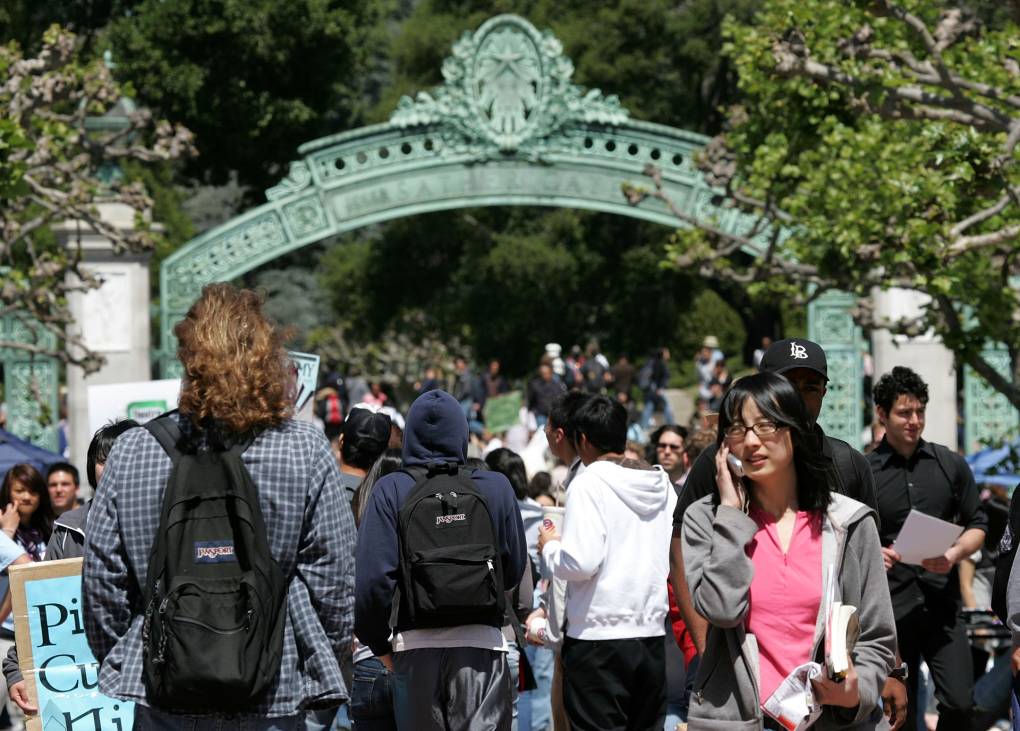
"caption": "UC Berkeley students walk through Sather Gate on the UC Berkeley campus April 17, 2007 in Berkeley, California. ",
"description": null,
"title": "U.S. Campus Security Scrutinized In Wake Of Virginia Tech Tragedy",
"credit": "Justin Sullivan/Getty Images",
"status": "inherit",
"altTag": "College students walk through a large, green archway surrounded by lush, tall trees. Many students wear black Jansport brand backpacks. Another female student with black hair and glasses talks on her cellphone in the foreground.",
"isLoading": false,
"fetchFailed": false
},
"news_11937313": {
"type": "attachments",
"id": "news_11937313",
"meta": {
"index": "attachments_1716263798",
"site": "news",
"id": "11937313",
"found": true
},
"parent": 11937299,
"imgSizes": {
"twentyfourteen-full-width": {
"file": "https://ww2.kqed.org/app/uploads/sites/10/2023/01/GettyImages-1234628376-1024x576.jpg",
"width": 1024,
"mimeType": "image/jpeg",
"height": 576
},
"thumbnail": {
"file": "https://ww2.kqed.org/app/uploads/sites/10/2023/01/GettyImages-1234628376-160x107.jpg",
"width": 160,
"mimeType": "image/jpeg",
"height": 107
},
"post-thumbnail": {
"file": "https://ww2.kqed.org/app/uploads/sites/10/2023/01/GettyImages-1234628376-672x372.jpg",
"width": 672,
"mimeType": "image/jpeg",
"height": 372
},
"kqedFullSize": {
"file": "https://ww2.kqed.org/app/uploads/sites/10/2023/01/GettyImages-1234628376.jpg",
"width": 1024,
"height": 683
},
"large": {
"file": "https://ww2.kqed.org/app/uploads/sites/10/2023/01/GettyImages-1234628376-1020x680.jpg",
"width": 1020,
"mimeType": "image/jpeg",
"height": 680
},
"medium": {
"file": "https://ww2.kqed.org/app/uploads/sites/10/2023/01/GettyImages-1234628376-800x534.jpg",
"width": 800,
"mimeType": "image/jpeg",
"height": 534
}
},
"publishDate": 1673130591,
"modified": 1673326246,
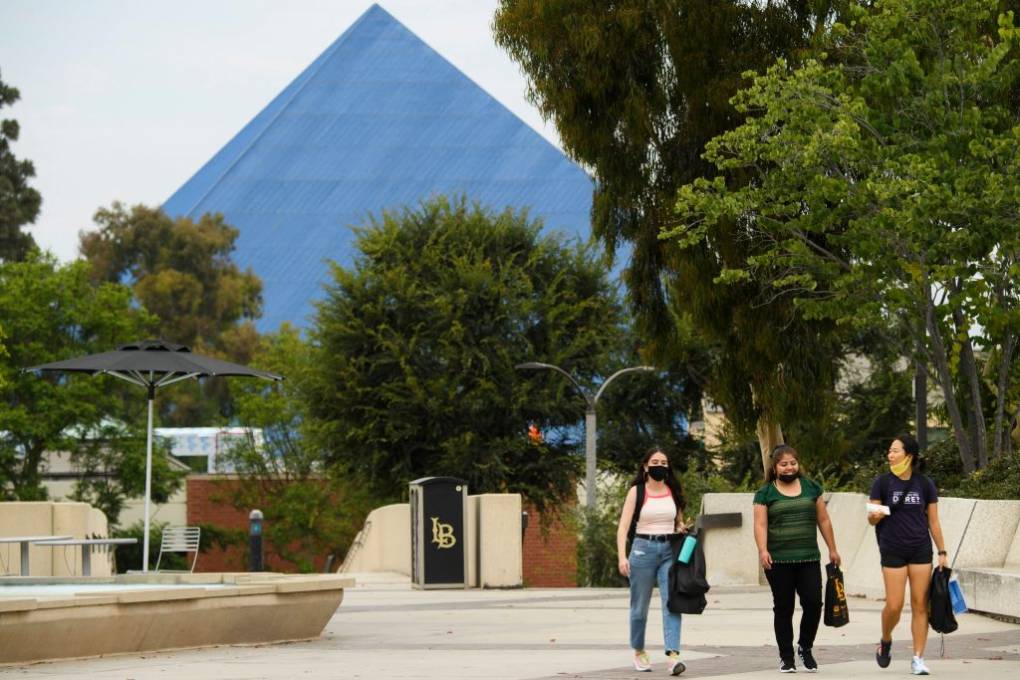
"caption": "A view of California State University Long Beach campus, Aug. 11, 2021.",
"description": null,
"title": "US-HEALTH-VIRUS-EDUCATION-CALIFORNIA",
"credit": "Patrick T. Fallon/AFP via Getty Images",
"status": "inherit",
"altTag": "Three students walk on campus with trees around them and the tip of a dark glass pyramid in the background.",
"isLoading": false,
"fetchFailed": false
},
"news_11934485": {
"type": "attachments",
"id": "news_11934485",
"meta": {
"index": "attachments_1716263798",
"site": "news",
"id": "11934485",
"found": true
},
"parent": 11934464,
"imgSizes": {
"twentyfourteen-full-width": {
"file": "https://ww2.kqed.org/app/uploads/sites/10/2022/12/GettyImages-1244836275-1024x576.jpg",
"width": 1024,
"mimeType": "image/jpeg",
"height": 576
},
"thumbnail": {
"file": "https://ww2.kqed.org/app/uploads/sites/10/2022/12/GettyImages-1244836275-160x107.jpg",
"width": 160,
"mimeType": "image/jpeg",
"height": 107
},
"post-thumbnail": {
"file": "https://ww2.kqed.org/app/uploads/sites/10/2022/12/GettyImages-1244836275-672x372.jpg",
"width": 672,
"mimeType": "image/jpeg",
"height": 372
},
"kqedFullSize": {
"file": "https://ww2.kqed.org/app/uploads/sites/10/2022/12/GettyImages-1244836275.jpg",
"width": 1024,
"height": 683
},
"large": {
"file": "https://ww2.kqed.org/app/uploads/sites/10/2022/12/GettyImages-1244836275-1020x680.jpg",
"width": 1020,
"mimeType": "image/jpeg",
"height": 680
},
"medium": {
"file": "https://ww2.kqed.org/app/uploads/sites/10/2022/12/GettyImages-1244836275-800x534.jpg",
"width": 800,
"mimeType": "image/jpeg",
"height": 534
}
},
"publishDate": 1670444829,
"modified": 1670452951,
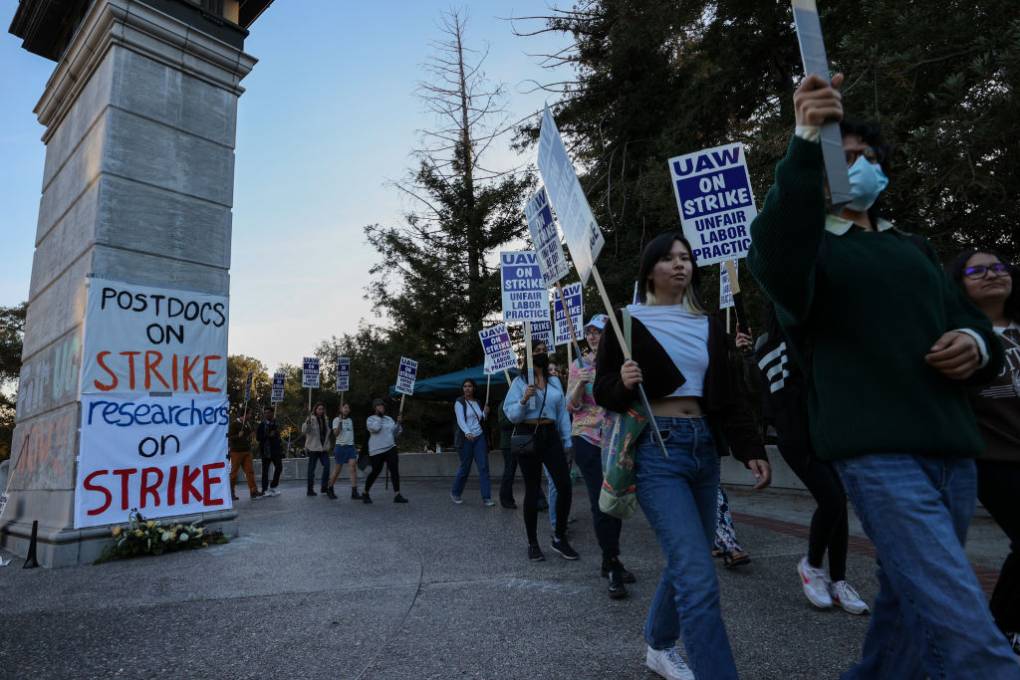
"caption": "Academic workers strike at UC Berkeley on Nov. 16, 2022.",
"description": null,
"title": "Academic workers strike for better pay and benefits at UC Berkeley",
"credit": "Tayfun Coskun/Anadolu Agency via Getty Images",
"status": "inherit",
"altTag": "Students holding signs and placards demonstrate at UC Berkeley",
"isLoading": false,
"fetchFailed": false
},
"news_11933319": {
"type": "attachments",
"id": "news_11933319",
"meta": {
"index": "attachments_1716263798",
"site": "news",
"id": "11933319",
"found": true
},
"parent": 11933284,
"imgSizes": {
"twentyfourteen-full-width": {
"file": "https://ww2.kqed.org/app/uploads/sites/10/2022/11/GettyImages-1244836327-1024x576.jpg",
"width": 1024,
"mimeType": "image/jpeg",
"height": 576
},
"thumbnail": {
"file": "https://ww2.kqed.org/app/uploads/sites/10/2022/11/GettyImages-1244836327-160x107.jpg",
"width": 160,
"mimeType": "image/jpeg",
"height": 107
},
"post-thumbnail": {
"file": "https://ww2.kqed.org/app/uploads/sites/10/2022/11/GettyImages-1244836327-672x372.jpg",
"width": 672,
"mimeType": "image/jpeg",
"height": 372
},
"kqedFullSize": {
"file": "https://ww2.kqed.org/app/uploads/sites/10/2022/11/GettyImages-1244836327.jpg",
"width": 1024,
"height": 683
},
"large": {
"file": "https://ww2.kqed.org/app/uploads/sites/10/2022/11/GettyImages-1244836327-1020x680.jpg",
"width": 1020,
"mimeType": "image/jpeg",
"height": 680
},
"medium": {
"file": "https://ww2.kqed.org/app/uploads/sites/10/2022/11/GettyImages-1244836327-800x534.jpg",
"width": 800,
"mimeType": "image/jpeg",
"height": 534
}
},
"publishDate": 1669671157,
"modified": 1669686604,
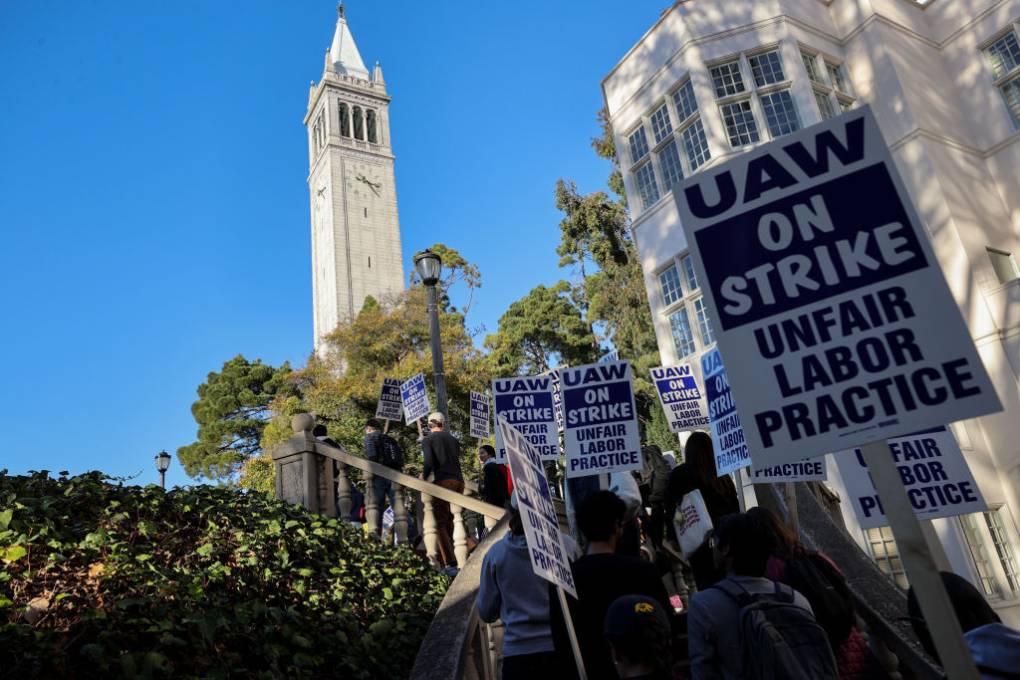
"caption": "Academic workers strike at UC Berkeley on Nov. 16, 2022. Nearly 48,000 unionized academic workers across the University of California's 10 campuses who perform much of the teaching and research at the state's premier higher-education system walked off the job on Nov. 14, calling for better pay and benefits.",
"description": null,
"title": "Academic workers strike for better pay and benefits at UC Berkeley",
"credit": "Tayfun Coskun/Anadolu Agency via Getty Images",
"status": "inherit",
"altTag": "a sign that reads 'UAW On Strike, Unfair Labor Practices' is held during a strike in front of UC Berkeley's campanile tower",
"isLoading": false,
"fetchFailed": false
},
"news_11932680": {
"type": "attachments",
"id": "news_11932680",
"meta": {
"index": "attachments_1716263798",
"site": "news",
"id": "11932680",
"found": true
},
"parent": 11932678,
"imgSizes": {
"twentyfourteen-full-width": {
"file": "https://ww2.kqed.org/app/uploads/sites/10/2022/11/GettyImages-1244858044-1038x576.jpg",
"width": 1038,
"mimeType": "image/jpeg",
"height": 576
},
"thumbnail": {
"file": "https://ww2.kqed.org/app/uploads/sites/10/2022/11/GettyImages-1244858044-160x107.jpg",
"width": 160,
"mimeType": "image/jpeg",
"height": 107
},
"post-thumbnail": {
"file": "https://ww2.kqed.org/app/uploads/sites/10/2022/11/GettyImages-1244858044-672x372.jpg",
"width": 672,
"mimeType": "image/jpeg",
"height": 372
},
"kqedFullSize": {
"file": "https://ww2.kqed.org/app/uploads/sites/10/2022/11/GettyImages-1244858044-scaled.jpg",
"width": 2560,
"height": 1707
},
"2048x2048": {
"file": "https://ww2.kqed.org/app/uploads/sites/10/2022/11/GettyImages-1244858044-2048x1365.jpg",
"width": 2048,
"mimeType": "image/jpeg",
"height": 1365
},
"large": {
"file": "https://ww2.kqed.org/app/uploads/sites/10/2022/11/GettyImages-1244858044-1020x680.jpg",
"width": 1020,
"mimeType": "image/jpeg",
"height": 680
},
"1536x1536": {
"file": "https://ww2.kqed.org/app/uploads/sites/10/2022/11/GettyImages-1244858044-1536x1024.jpg",
"width": 1536,
"mimeType": "image/jpeg",
"height": 1024
},
"full-width": {
"file": "https://ww2.kqed.org/app/uploads/sites/10/2022/11/GettyImages-1244858044-1920x1280.jpg",
"width": 1920,
"mimeType": "image/jpeg",
"height": 1280
},
"medium": {
"file": "https://ww2.kqed.org/app/uploads/sites/10/2022/11/GettyImages-1244858044-800x533.jpg",
"width": 800,
"mimeType": "image/jpeg",
"height": 533
}
},
"publishDate": 1668781845,
"modified": 1668781946,
"caption": "Protestors hold a march outside of the U.S. Capitol Building calling for a pathway to citizenship on November 17th, 2022 in Washington, DC. ",
"description": null,
"title": "DACA Protest in in Washington",
"credit": "Nathan Posner/Anadolu Agency via Getty Images",
"status": "inherit",
"altTag": "Marchers stand in the foreground, one holds a sign that reads \"Stop ignorance not immigrants.\" The Capitol building is in the background.",
"isLoading": false,
"fetchFailed": false
},
"news_11932196": {
"type": "attachments",
"id": "news_11932196",
"meta": {
"index": "attachments_1716263798",
"site": "news",
"id": "11932196",
"found": true
},
"parent": 11932147,
"imgSizes": {
"twentyfourteen-full-width": {
"file": "https://ww2.kqed.org/app/uploads/sites/10/2022/11/UC-featured-1038x576.jpg",
"width": 1038,
"mimeType": "image/jpeg",
"height": 576
},
"thumbnail": {
"file": "https://ww2.kqed.org/app/uploads/sites/10/2022/11/UC-featured-160x103.jpg",
"width": 160,
"mimeType": "image/jpeg",
"height": 103
},
"post-thumbnail": {
"file": "https://ww2.kqed.org/app/uploads/sites/10/2022/11/UC-featured-672x372.jpg",
"width": 672,
"mimeType": "image/jpeg",
"height": 372
},
"kqedFullSize": {
"file": "https://ww2.kqed.org/app/uploads/sites/10/2022/11/UC-featured.jpg",
"width": 1920,
"height": 1240
},
"large": {
"file": "https://ww2.kqed.org/app/uploads/sites/10/2022/11/UC-featured-1020x659.jpg",
"width": 1020,
"mimeType": "image/jpeg",
"height": 659
},
"1536x1536": {
"file": "https://ww2.kqed.org/app/uploads/sites/10/2022/11/UC-featured-1536x992.jpg",
"width": 1536,
"mimeType": "image/jpeg",
"height": 992
},
"medium": {
"file": "https://ww2.kqed.org/app/uploads/sites/10/2022/11/UC-featured-800x517.jpg",
"width": 800,
"mimeType": "image/jpeg",
"height": 517
}
},
"publishDate": 1668458351,
"modified": 1668458863,
"caption": "Hundreds of staff members at UC Berkeley demonstrate on Monday morning, the first day of a massive strike among some 48,000 academic workers across all 10 University of California campuses.",
"description": null,
"title": "UC-featured",
"credit": "Jean Zamora/UC Berkeley",
"status": "inherit",
"altTag": "A large crowd of people stand outside on a college campus holding signs that say 'UAW on Strike Unfair Labor Practice.'",
"isLoading": false,
"fetchFailed": false
},
"news_11928975": {
"type": "attachments",
"id": "news_11928975",
"meta": {
"index": "attachments_1716263798",
"site": "news",
"id": "11928975",
"found": true
},
"parent": 11928967,
"imgSizes": {
"twentyfourteen-full-width": {
"file": "https://ww2.kqed.org/app/uploads/sites/10/2022/10/GettyImages-1385201947-1024x576.jpg",
"width": 1024,
"mimeType": "image/jpeg",
"height": 576
},
"thumbnail": {
"file": "https://ww2.kqed.org/app/uploads/sites/10/2022/10/GettyImages-1385201947-160x108.jpg",
"width": 160,
"mimeType": "image/jpeg",
"height": 108
},
"post-thumbnail": {
"file": "https://ww2.kqed.org/app/uploads/sites/10/2022/10/GettyImages-1385201947-672x372.jpg",
"width": 672,
"mimeType": "image/jpeg",
"height": 372
},
"kqedFullSize": {
"file": "https://ww2.kqed.org/app/uploads/sites/10/2022/10/GettyImages-1385201947.jpg",
"width": 1024,
"height": 690
},
"large": {
"file": "https://ww2.kqed.org/app/uploads/sites/10/2022/10/GettyImages-1385201947-1020x687.jpg",
"width": 1020,
"mimeType": "image/jpeg",
"height": 687
},
"medium": {
"file": "https://ww2.kqed.org/app/uploads/sites/10/2022/10/GettyImages-1385201947-800x539.jpg",
"width": 800,
"mimeType": "image/jpeg",
"height": 539
}
},
"publishDate": 1665779615,
"modified": 1665779726,
"caption": "People walk by Sather Tower on the UC Berkeley campus. The university system recently told the Supreme Court that 'despite its extensive efforts, UC struggles to enroll a student body that is sufficiently racially diverse to attain the educational benefits of diversity.'",
"description": null,
"title": "California Universities In A Legal Bind Amid Student Housing Shortage",
"credit": "Justin Sullivan/Getty Images",
"status": "inherit",
"altTag": "students walk on UC Berkeley's campus",
"isLoading": false,
"fetchFailed": false
},
"news_11923267": {
"type": "attachments",
"id": "news_11923267",
"meta": {
"index": "attachments_1716263798",
"site": "news",
"id": "11923267",
"found": true
},
"parent": 11923263,
"imgSizes": {
"twentyfourteen-full-width": {
"file": "https://ww2.kqed.org/app/uploads/sites/10/2022/08/students-walking_1940x1295-1200x750-1-1038x576.jpg",
"width": 1038,
"mimeType": "image/jpeg",
"height": 576
},
"thumbnail": {
"file": "https://ww2.kqed.org/app/uploads/sites/10/2022/08/students-walking_1940x1295-1200x750-1-160x100.jpg",
"width": 160,
"mimeType": "image/jpeg",
"height": 100
},
"post-thumbnail": {
"file": "https://ww2.kqed.org/app/uploads/sites/10/2022/08/students-walking_1940x1295-1200x750-1-672x372.jpg",
"width": 672,
"mimeType": "image/jpeg",
"height": 372
},
"kqedFullSize": {
"file": "https://ww2.kqed.org/app/uploads/sites/10/2022/08/students-walking_1940x1295-1200x750-1.jpg",
"width": 1200,
"height": 750
},
"large": {
"file": "https://ww2.kqed.org/app/uploads/sites/10/2022/08/students-walking_1940x1295-1200x750-1-1020x638.jpg",
"width": 1020,
"mimeType": "image/jpeg",
"height": 638
},
"medium": {
"file": "https://ww2.kqed.org/app/uploads/sites/10/2022/08/students-walking_1940x1295-1200x750-1-800x500.jpg",
"width": 800,
"mimeType": "image/jpeg",
"height": 500
}
},
"publishDate": 1661282603,
"modified": 1661282656,
"caption": "Cal State Los Angeles students return to campus after summer break.",
"description": null,
"title": "students-walking_1940x1295-1200x750",
"credit": "Erik Adams/EdSource",
"status": "inherit",
"altTag": "students walk with backpacks around a college campus",
"isLoading": false,
"fetchFailed": false
},
"news_11916779": {
"type": "attachments",
"id": "news_11916779",
"meta": {
"index": "attachments_1716263798",
"site": "news",
"id": "11916779",
"found": true
},
"parent": 11916778,
"imgSizes": {
"thumbnail": {
"file": "https://ww2.kqed.org/app/uploads/sites/10/2022/06/image1-160x107.jpg",
"width": 160,
"mimeType": "image/jpeg",
"height": 107
},
"post-thumbnail": {
"file": "https://ww2.kqed.org/app/uploads/sites/10/2022/06/image1-672x372.jpg",
"width": 672,
"mimeType": "image/jpeg",
"height": 372
},
"kqedFullSize": {
"file": "https://ww2.kqed.org/app/uploads/sites/10/2022/06/image1.jpg",
"width": 860,
"height": 574
},
"medium": {
"file": "https://ww2.kqed.org/app/uploads/sites/10/2022/06/image1-800x534.jpg",
"width": 800,
"mimeType": "image/jpeg",
"height": 534
}
},
"publishDate": 1654894376,
"modified": 1654894376,
"caption": null,
"description": null,
"title": "image1",
"credit": null,
"status": "inherit",
"altTag": null,
"isLoading": false,
"fetchFailed": false
},
"news_11911938": {
"type": "attachments",
"id": "news_11911938",
"meta": {
"index": "attachments_1716263798",
"site": "news",
"id": "11911938",
"found": true
},
"parent": 11911874,
"imgSizes": {
"twentyfourteen-full-width": {
"file": "https://ww2.kqed.org/app/uploads/sites/10/2022/04/campus-1-1038x576.jpg",
"width": 1038,
"mimeType": "image/jpeg",
"height": 576
},
"thumbnail": {
"file": "https://ww2.kqed.org/app/uploads/sites/10/2022/04/campus-1-160x103.jpg",
"width": 160,
"mimeType": "image/jpeg",
"height": 103
},
"post-thumbnail": {
"file": "https://ww2.kqed.org/app/uploads/sites/10/2022/04/campus-1-672x372.jpg",
"width": 672,
"mimeType": "image/jpeg",
"height": 372
},
"kqedFullSize": {
"file": "https://ww2.kqed.org/app/uploads/sites/10/2022/04/campus-1.jpg",
"width": 1442,
"height": 925
},
"large": {
"file": "https://ww2.kqed.org/app/uploads/sites/10/2022/04/campus-1-1020x654.jpg",
"width": 1020,
"mimeType": "image/jpeg",
"height": 654
},
"medium": {
"file": "https://ww2.kqed.org/app/uploads/sites/10/2022/04/campus-1-800x513.jpg",
"width": 800,
"mimeType": "image/jpeg",
"height": 513
}
},
"publishDate": 1650605158,
"modified": 1650674721,
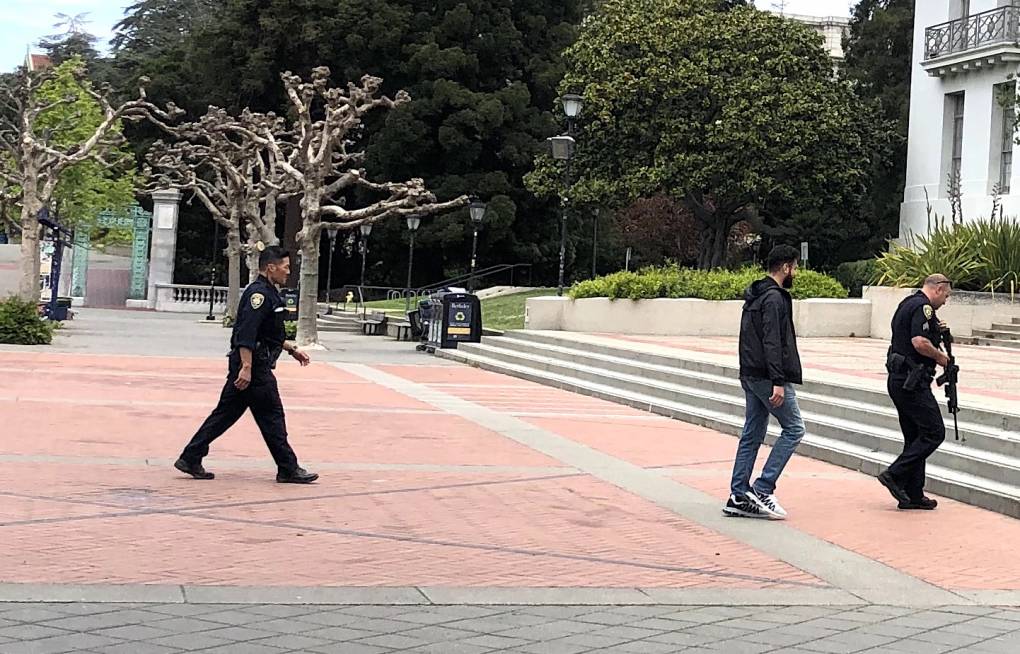
"caption": "UC Berkeley police officers walk across Sproul Plaza, one holding a rifle, on April 21, 2022, during a campus-wide lockdown. ",
"description": null,
"title": "campus",
"credit": "Matthew Green/KQED",
"status": "inherit",
"altTag": "Two police officers (and another man) walk across a campus holding rifles.",
"isLoading": false,
"fetchFailed": false
},
"news_11908295": {
"type": "attachments",
"id": "news_11908295",
"meta": {
"index": "attachments_1716263798",
"site": "news",
"id": "11908295",
"found": true
},
"parent": 11908289,
"imgSizes": {
"twentyfourteen-full-width": {
"file": "https://ww2.kqed.org/app/uploads/sites/10/2022/03/limby_031522_final-1038x576.png",
"width": 1038,
"mimeType": "image/png",
"height": 576
},
"thumbnail": {
"file": "https://ww2.kqed.org/app/uploads/sites/10/2022/03/limby_031522_final-160x112.png",
"width": 160,
"mimeType": "image/png",
"height": 112
},
"post-thumbnail": {
"file": "https://ww2.kqed.org/app/uploads/sites/10/2022/03/limby_031522_final-672x372.png",
"width": 672,
"mimeType": "image/png",
"height": 372
},
"kqedFullSize": {
"file": "https://ww2.kqed.org/app/uploads/sites/10/2022/03/limby_031522_final.png",
"width": 1920,
"height": 1341
},
"large": {
"file": "https://ww2.kqed.org/app/uploads/sites/10/2022/03/limby_031522_final-1020x712.png",
"width": 1020,
"mimeType": "image/png",
"height": 712
},
"1536x1536": {
"file": "https://ww2.kqed.org/app/uploads/sites/10/2022/03/limby_031522_final-1536x1073.png",
"width": 1536,
"mimeType": "image/png",
"height": 1073
},
"medium": {
"file": "https://ww2.kqed.org/app/uploads/sites/10/2022/03/limby_031522_final-800x559.png",
"width": 800,
"mimeType": "image/png",
"height": 559
}
},
"publishDate": 1647386588,
"modified": 1647386659,
"caption": null,
"description": null,
"title": "limby_031522_final",
"credit": null,
"status": "inherit",
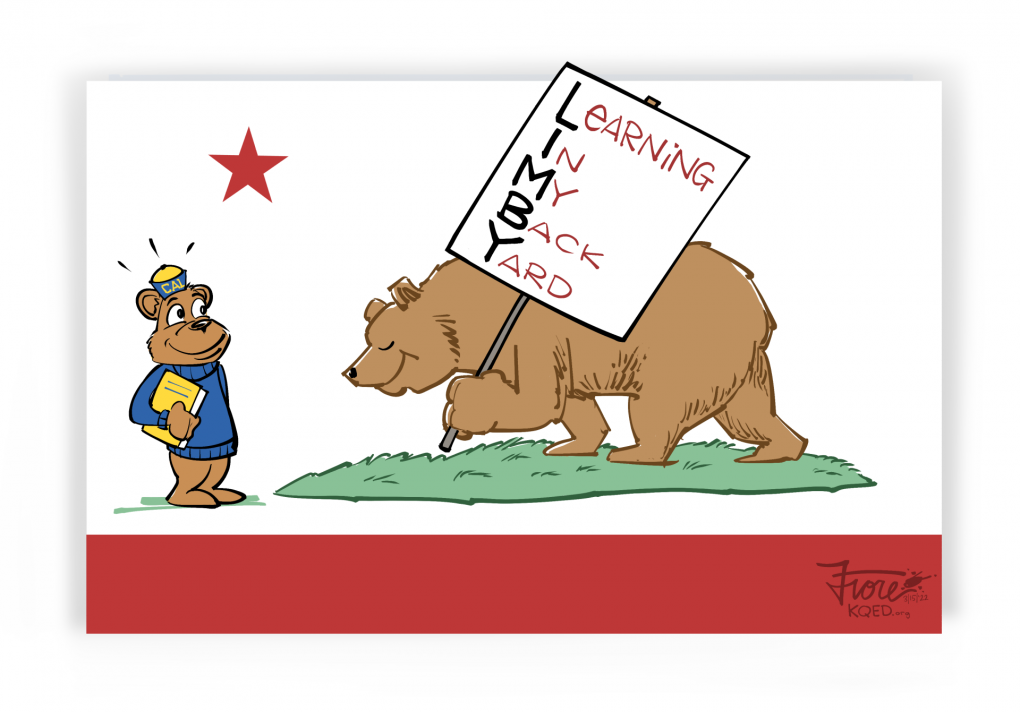
"altTag": "Cartoon: California's bear flag shows the bear holding a \"LIMBY\" sign that reads, \"learning in my backyard\" while the Cal mascot, Oski, smiles.",
"isLoading": false,
"fetchFailed": false
},
"news_11897040": {
"type": "attachments",
"id": "news_11897040",
"meta": {
"index": "attachments_1716263798",
"site": "news",
"id": "11897040",
"found": true
},
"parent": 11897034,
"imgSizes": {
"twentyfourteen-full-width": {
"file": "https://ww2.kqed.org/app/uploads/sites/10/2021/11/RS18894_GettyImages-52237594-qut-1038x576.jpg",
"width": 1038,
"mimeType": "image/jpeg",
"height": 576
},
"thumbnail": {
"file": "https://ww2.kqed.org/app/uploads/sites/10/2021/11/RS18894_GettyImages-52237594-qut-160x107.jpg",
"width": 160,
"mimeType": "image/jpeg",
"height": 107
},
"post-thumbnail": {
"file": "https://ww2.kqed.org/app/uploads/sites/10/2021/11/RS18894_GettyImages-52237594-qut-672x372.jpg",
"width": 672,
"mimeType": "image/jpeg",
"height": 372
},
"kqedFullSize": {
"file": "https://ww2.kqed.org/app/uploads/sites/10/2021/11/RS18894_GettyImages-52237594-qut.jpg",
"width": 1920,
"height": 1282
},
"large": {
"file": "https://ww2.kqed.org/app/uploads/sites/10/2021/11/RS18894_GettyImages-52237594-qut-1020x681.jpg",
"width": 1020,
"mimeType": "image/jpeg",
"height": 681
},
"1536x1536": {
"file": "https://ww2.kqed.org/app/uploads/sites/10/2021/11/RS18894_GettyImages-52237594-qut-1536x1026.jpg",
"width": 1536,
"mimeType": "image/jpeg",
"height": 1026
},
"medium": {
"file": "https://ww2.kqed.org/app/uploads/sites/10/2021/11/RS18894_GettyImages-52237594-qut-800x534.jpg",
"width": 800,
"mimeType": "image/jpeg",
"height": 534
}
},
"publishDate": 1637435844,
"modified": 1646337641,
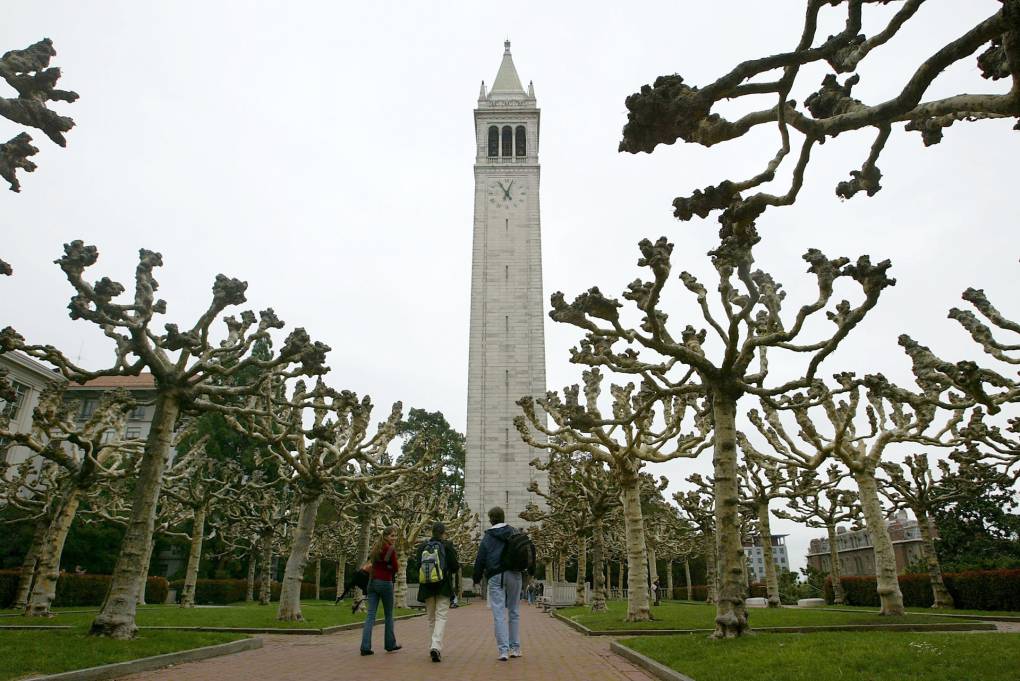
"caption": "Students walking on UC Berkeley's campus.",
"description": null,
"title": "RS18894_GettyImages-52237594-qut",
"credit": "Justin Sullivan/Getty Images",
"status": "inherit",
"altTag": "The UC Berkeley campanile against a white-grey sky with a foreground of funky-looking trees.",
"isLoading": false,
"fetchFailed": false
}
},
"audioPlayerReducer": {
"postId": "stream_live",
"isPaused": true,
"isPlaying": false,
"pfsActive": false,
"pledgeModalIsOpen": true,
"playerDrawerIsOpen": false,
"liveAudioPlayStartedAt": 0,
"liveAudioPlayContext": ""
},
"authorsReducer": {
"byline_news_11949956": {
"type": "authors",
"id": "byline_news_11949956",
"meta": {
"override": true
},
"slug": "byline_news_11949956",
"name": "\u003ca href=\"https://edsource.org/author/mburke\">Michael Burke\u003c/a>\u003cbr> EdSource",
"isLoading": false
},
"byline_news_11937299": {
"type": "authors",
"id": "byline_news_11937299",
"meta": {
"override": true
},
"slug": "byline_news_11937299",
"name": "\u003ca href=\"https://edsource.org/author/asmith\">Ashley A. Smith\u003c/a>",
"isLoading": false
},
"byline_news_11934464": {
"type": "authors",
"id": "byline_news_11934464",
"meta": {
"override": true
},
"slug": "byline_news_11934464",
"name": "\u003ca href=\"https://edsource.org/author/mburke\">Michael Burke\u003c/a>",
"isLoading": false
},
"byline_news_11928967": {
"type": "authors",
"id": "byline_news_11928967",
"meta": {
"override": true
},
"slug": "byline_news_11928967",
"name": "Michael Burke",
"isLoading": false
},
"byline_news_11923263": {
"type": "authors",
"id": "byline_news_11923263",
"meta": {
"override": true
},
"slug": "byline_news_11923263",
"name": "\u003ca href=\"https://edsource.org/author/mburke\">Michael Burke\u003c/a> and \u003ca href=\"https://edsource.org/author/asmith\">Ashley A. Smith\u003c/a>",
"isLoading": false
},
"byline_news_11907093": {
"type": "authors",
"id": "byline_news_11907093",
"meta": {
"override": true
},
"slug": "byline_news_11907093",
"name": "Jocelyn Gecker\u003cbr>Associated Press",
"isLoading": false
},
"kqed": {
"type": "authors",
"id": "236",
"meta": {
"index": "authors_1716337520",
"id": "236",
"found": true
},
"name": "KQED News Staff",
"firstName": "KQED News Staff",
"lastName": null,
"slug": "kqed",
"email": "faq@kqed.org",
"display_author_email": false,
"staff_mastheads": [],
"title": null,
"bio": null,
"avatar": "https://secure.gravatar.com/avatar/ef0e801a68c4c54afa9180db14084167?s=600&d=blank&r=g",
"twitter": null,
"facebook": null,
"instagram": null,
"linkedin": null,
"sites": [
{
"site": "arts",
"roles": [
"contributor"
]
},
{
"site": "news",
"roles": [
"editor"
]
},
{
"site": "futureofyou",
"roles": [
"author"
]
}
],
"headData": {
"title": "KQED News Staff | KQED",
"description": null,
"ogImgSrc": "https://secure.gravatar.com/avatar/ef0e801a68c4c54afa9180db14084167?s=600&d=blank&r=g",
"twImgSrc": "https://secure.gravatar.com/avatar/ef0e801a68c4c54afa9180db14084167?s=600&d=blank&r=g"
},
"isLoading": false,
"link": "/author/kqed"
},
"matthewgreen": {
"type": "authors",
"id": "1263",
"meta": {
"index": "authors_1716337520",
"id": "1263",
"found": true
},
"name": "Matthew Green",
"firstName": "Matthew",
"lastName": "Green",
"slug": "matthewgreen",
"email": "mgreen@kqed.org",
"display_author_email": false,
"staff_mastheads": [],
"title": "KQED Editor/Reporter",
"bio": "Matthew Green is a digital media producer for KQED News. He previously produced \u003ca href=\"http://www.kqed.org/lowdown\">The Lowdown\u003c/a>, KQED’s multimedia news education blog. Matthew's written for numerous Bay Area publications, including the Oakland Tribune and San Francisco Chronicle. He also taught journalism classes at Fremont High School in East Oakland.\r\n\r\nEmail: mgreen@kqed.org; Twitter: @MGreenKQED",
"avatar": "https://secure.gravatar.com/avatar/3bf498d1267ca02c8494f33d8cfc575e?s=600&d=blank&r=g",
"twitter": "MGreenKQED",
"facebook": null,
"instagram": null,
"linkedin": null,
"sites": [
{
"site": "news",
"roles": []
},
{
"site": "lowdown",
"roles": []
},
{
"site": "science",
"roles": []
},
{
"site": "education",
"roles": []
},
{
"site": "quest",
"roles": []
},
{
"site": "liveblog",
"roles": []
}
],
"headData": {
"title": "Matthew Green | KQED",
"description": "KQED Editor/Reporter",
"ogImgSrc": "https://secure.gravatar.com/avatar/3bf498d1267ca02c8494f33d8cfc575e?s=600&d=blank&r=g",
"twImgSrc": "https://secure.gravatar.com/avatar/3bf498d1267ca02c8494f33d8cfc575e?s=600&d=blank&r=g"
},
"isLoading": false,
"link": "/author/matthewgreen"
},
"markfiore": {
"type": "authors",
"id": "3236",
"meta": {
"index": "authors_1716337520",
"id": "3236",
"found": true
},
"name": "Mark Fiore",
"firstName": "Mark",
"lastName": "Fiore",
"slug": "markfiore",
"email": "mark@markfiore.com",
"display_author_email": false,
"staff_mastheads": [
"news"
],
"title": "KQED News Cartoonist",
"bio": "\u003ca href=\"http://www.MarkFiore.com\">MarkFiore.com\u003c/a> | \u003ca href=\"https://twitter.com/markfiore\">Follow on Twitter\u003c/a> | \u003ca href=\"https://www.facebook.com/pages/Mark-Fiore-Animated-Political-Cartoons/94451707396?ref=bookmarks\">Facebook\u003c/a> | \u003ca href=\"mailto:mark@markfiore.com\">email\u003c/a>\r\n\r\nPulitzer Prize-winner, Mark Fiore, who the Wall Street Journal has called “the undisputed guru of the form,” creates animated political cartoons in San Francisco, where his work has been featured regularly on the San Francisco Chronicle’s web site, SFGate.com. His work has appeared on Newsweek.com, Slate.com, CBSNews.com, MotherJones.com, DailyKos.com and NPR’s web site. Fiore’s political animation has appeared on CNN, Frontline, Bill Moyers Journal, Salon.com and cable and broadcast outlets across the globe.\r\n\r\nBeginning his professional life by drawing traditional political cartoons for newspapers, Fiore’s work appeared in publications ranging from the Washington Post to the Los Angeles Times. In the late 1990s, he began to experiment with animating political cartoons and, after a short stint at the San Jose Mercury News as their staff cartoonist, Fiore devoted all his energies to animation.\r\nGrowing up in California, Fiore also spent a good portion of his life in the backwoods of Idaho. It was this combination that shaped him politically. Mark majored in political science at Colorado College, where, in a perfect send-off for a cartoonist, he received his diploma in 1991 as commencement speaker Dick Cheney smiled approvingly.\r\nMark Fiore was awarded the Pulitzer Prize for political cartooning in 2010, a Robert F. Kennedy Journalism Award in 2004 and has twice received an Online Journalism Award for commentary from the Online News Association (2002, 2008). Fiore has received two awards for his work in new media from the National Cartoonists Society (2001, 2002), and in 2006 received The James Madison Freedom of Information Award from The Society of Professional Journalists.",
"avatar": "https://secure.gravatar.com/avatar/fc4e2a612b15b67bad0c6f0e1db4ca9b?s=600&d=blank&r=g",
"twitter": "MarkFiore",
"facebook": null,
"instagram": "https://www.instagram.com/markfiore/?hl=en",
"linkedin": null,
"sites": [
{
"site": "arts",
"roles": [
"contributor"
]
},
{
"site": "news",
"roles": [
"editor"
]
},
{
"site": "futureofyou",
"roles": [
"editor"
]
},
{
"site": "science",
"roles": [
"editor"
]
}
],
"headData": {
"title": "Mark Fiore | KQED",
"description": "KQED News Cartoonist",
"ogImgSrc": "https://secure.gravatar.com/avatar/fc4e2a612b15b67bad0c6f0e1db4ca9b?s=600&d=blank&r=g",
"twImgSrc": "https://secure.gravatar.com/avatar/fc4e2a612b15b67bad0c6f0e1db4ca9b?s=600&d=blank&r=g"
},
"isLoading": false,
"link": "/author/markfiore"
},
"esilvers": {
"type": "authors",
"id": "7237",
"meta": {
"index": "authors_1716337520",
"id": "7237",
"found": true
},
"name": "Emma Silvers",
"firstName": "Emma",
"lastName": "Silvers",
"slug": "esilvers",
"email": "esilvers@kqed.org",
"display_author_email": false,
"staff_mastheads": [],
"title": "KQED Contributor",
"bio": "Emma Silvers is an editor at KQED Arts and a former digital producer at KQED News. Born and raised in the Bay Area, she has previously been an arts and entertainment editor at the \u003cem>San Francisco Chronicle\u003c/em>, \u003cem>SF Weekly\u003c/em> and the \u003cem>San Francisco Bay Guardian.\u003c/em> \u003ca href=\"https://www.emmasilvers.com\">Her work\u003c/a> has also appeared in \u003cem>Rolling Stone\u003c/em>, Pitchfork and \u003cem>Mother Jones\u003c/em>. In 2017 she was the recipient of the Society of Professional Journalists-Northern California's award for arts and culture reporting. In 1993 she \u003ca href=\"https://www.kqed.org/pop/16759/wait-what-my-coworker-was-a-voice-over-hyperventilator-for-jurassic-park\">hyperventilated in \u003cem>Jurassic Park\u003c/em>\u003c/a>.",
"avatar": "https://secure.gravatar.com/avatar/247beada39b88ea5759db1f51dba05cf?s=600&d=blank&r=g",
"twitter": "emmaruthless",
"facebook": null,
"instagram": null,
"linkedin": null,
"sites": [
{
"site": "arts",
"roles": [
"editor"
]
},
{
"site": "news",
"roles": [
"editor"
]
},
{
"site": "pop",
"roles": [
"contributor"
]
},
{
"site": "bayareabites",
"roles": [
"editor"
]
},
{
"site": "food",
"roles": [
"contributor"
]
},
{
"site": "liveblog",
"roles": [
"editor"
]
}
],
"headData": {
"title": "Emma Silvers | KQED",
"description": "KQED Contributor",
"ogImgSrc": "https://secure.gravatar.com/avatar/247beada39b88ea5759db1f51dba05cf?s=600&d=blank&r=g",
"twImgSrc": "https://secure.gravatar.com/avatar/247beada39b88ea5759db1f51dba05cf?s=600&d=blank&r=g"
},
"isLoading": false,
"link": "/author/esilvers"
}
},
"pagesReducer": {
"news_tag_university-of-california": {
"type": "terms",
"id": "news_206",
"meta": {
"index": "terms_1716263798",
"site": "news",
"id": "206",
"score": 8.793955
},
"featImg": null,
"name": "University of California",
"description": null,
"taxonomy": "tag",
"headData": {
"twImgId": null,
"twTitle": null,
"ogTitle": null,
"ogImgId": null,
"twDescription": null,
"description": null,
"title": "University of California Archives | KQED News",
"ogDescription": null
},
"ttid": 214,
"slug": "university-of-california",
"isLoading": false,
"title": "University of California",
"pageMeta": {
"site": "news",
"WpPageTemplate": "page-topic-editorial",
"currentPage": 4
},
"blocks": [
{
"blockName": "kqed/post-list",
"attrs": {
"layout": "cardArticle2",
"query": "posts/news?tag=university-of-california",
"seeMore": false,
"paginated": true,
"page": 4
}
},
{
"blockName": "kqed/ad"
}
]
}
},
"pfsSessionReducer": {},
"postsReducer": {
"stream_live": {
"type": "live",
"id": "stream_live",
"audioUrl": "https://streams.kqed.org/kqedradio",
"title": "Live Stream",
"excerpt": "Live Stream information currently unavailable.",
"link": "/radio",
"featImg": "",
"label": {
"name": "KQED Live",
"link": "/"
}
},
"stream_kqedNewscast": {
"type": "posts",
"id": "stream_kqedNewscast",
"audioUrl": "https://www.kqed.org/.stream/anon/radio/RDnews/newscast.mp3?_=1",
"title": "KQED Newscast",
"featImg": "",
"label": {
"name": "88.5 FM",
"link": "/"
}
},
"news_11949956": {
"type": "posts",
"id": "news_11949956",
"meta": {
"index": "posts_1716263798",
"site": "news",
"id": "11949956",
"score": null,
"sort": [
1684459417000
]
},
"guestAuthors": [],
"slug": "uc-signals-support-for-hiring-of-undocumented-students-following-six-month-study",
"title": "UC Signals Support for Hiring of Undocumented Students, Following 6-Month Study",
"publishDate": 1684459417,
"format": "standard",
"headTitle": "UC Signals Support for Hiring of Undocumented Students, Following 6-Month Study | KQED",
"labelTerm": {},
"content": "\u003cp>The University of California on Thursday took a first step toward allowing the hiring of undocumented students for jobs across the 10-campus system, a move that follows months of pleas from those students.\u003c/p>\n\u003cp>\u003ca href=\"https://regents.universityofcalifornia.edu/regmeet/may23/b2.pdf\">The action by the system’s board of regents (PDF)\u003c/a> Thursday does not immediately authorize the employment of undocumented students. Instead, UC plans to create a working group that will spend the next six months considering the proposal.\u003c/p>\n\u003cp>Regent leaders insisted Thursday that their intention is to ultimately permit the hiring of undocumented students, but said they want time to carefully consider the issue, including legal strategies. If implemented, UC would be the first known institution to argue that a federal statute barring the hiring of undocumented immigrants doesn’t apply to state entities. Doing so could attract a legal challenge.\u003c/p>\n\u003cp>“It is our intention to find a way to allow employment opportunities for all our students regardless of their immigration status,” John Pérez, a regent and former chair of the board, told reporters following the vote.\u003c/p>\n\u003cp>[pullquote size=\"medium\" align=\"right\" citation=\"Richard Leib, chair, Board of Regents, University of California\"]‘We have a moral obligation to try to do what we can, because it is ridiculous. We are the University of California. We’re educating people. What are we educating them for? In part, to get into the workforce.’[/pullquote]First, though, the regents want to ensure they have “the best case to do that” legally, said Richard Leib, the current chair of the board who will be responsible for creating the working group, which will be made up entirely of regents.\u003c/p>\n\u003cp>“I think people would enjoy having a decision right away, but it would be irresponsible from our standpoint,” he said.\u003c/p>\n\u003cp>The working group will complete its work by Nov. 30, at which point it will direct the system’s president, Michael Drake, on how to move forward.\u003c/p>\n\u003cp>[ad fullwidth]\u003c/p>\n\u003cp>Since last fall, a coalition of undocumented students and their allies, including legal scholars at UCLA, \u003ca href=\"https://edsource.org/2023/university-of-californias-undocumented-students-push-for-right-to-work-campus-jobs/690413\">have called on the system to authorize the hiring of undocumented students\u003c/a> who don’t have protections offered under the Obama-era Deferred Action for Childhood Arrivals program. DACA offered permission to work for tens of thousands of young people, but the Trump administration ended the program in 2017 and no new applications have been accepted since then, leaving many undocumented students in higher education ineligible to work.\u003c/p>\n\u003cp>Undocumented student leaders with the Opportunity for All Campaign, the coalition that advocated for the policy, said they consider Thursday’s vote a victory. Students had lobbied the regents with a demonstration Wednesday, the second day of the three-day regents meeting, on the campus of UCLA, where the meeting was held. The students and their allies held signs calling for UC to allow the hiring of undocumented students as they took turns speaking and then marching across the campus.\u003c/p>\n\u003cp>“What we were going for was full implementation, but I still consider this a win,” said Carlos Alarcón, who is pursuing a master’s degree in public policy at UCLA. “They’re creating a working group to come up with a plan of how the UC will implement and there’s a deadline of November. That is very important to us, so we can hold them accountable.”\u003c/p>\n\u003cp>Alarcón said the campaign’s goal over the next several months will be to engage the regents and make sure the working group is considering the input of undocumented students.\u003c/p>\n\u003cp>“We don’t have the same opportunities our classmates are afforded,” said Carelia Maya Rios, an undocumented student who spoke during the regents meeting. “Yesterday, hundreds of students marched and rallied for victory… to let you know this is a critical and urgent need.”\u003c/p>\n\u003cfigure id=\"attachment_11950066\" class=\"wp-caption aligncenter\" style=\"max-width: 1920px\">\u003cimg loading=\"lazy\" decoding=\"async\" class=\"size-full wp-image-11950066\" src=\"https://ww2.kqed.org/app/uploads/sites/10/2023/05/RS19451_GettyImages-143309520-qut.jpg\" alt=\"A large, bronze statue of a bear showing its teeth is displayed outdoors on an university campus. Six students in UCLA hooded sweatshirts and jeans walk around the statue on their way to class. One young woman sits on a tan, chunky bench writing on a notepad.\" width=\"1920\" height=\"1291\" srcset=\"https://cdn.kqed.org/wp-content/uploads/sites/10/2023/05/RS19451_GettyImages-143309520-qut.jpg 1920w, https://cdn.kqed.org/wp-content/uploads/sites/10/2023/05/RS19451_GettyImages-143309520-qut-800x538.jpg 800w, https://cdn.kqed.org/wp-content/uploads/sites/10/2023/05/RS19451_GettyImages-143309520-qut-1020x686.jpg 1020w, https://cdn.kqed.org/wp-content/uploads/sites/10/2023/05/RS19451_GettyImages-143309520-qut-160x108.jpg 160w, https://cdn.kqed.org/wp-content/uploads/sites/10/2023/05/RS19451_GettyImages-143309520-qut-1536x1033.jpg 1536w\" sizes=\"auto, (max-width: 1920px) 100vw, 1920px\">\u003cfigcaption class=\"wp-caption-text\">Students sit around the Bruin Bear statue during lunchtime on the campus of UCLA on April 23, 2012 in Los Angeles, California. \u003ccite>(Kevork Djansezian/Getty Images)\u003c/cite>\u003c/figcaption>\u003c/figure>\n\u003cp>Diana Ortiz Aguilar, a student advocate and organizer for the group Opportunity4All at UC Berkeley, told KQED she’s familiar with the hardships many undocumented students face trying to find jobs on campus. She said, as an undocumented student herself, the regents’ decision directly impacts her life.\u003c/p>\n\u003cp>[aside label='More Stories on Education' tag='education']\u003c/p>\n\u003cp>“I’ve been barred from multiple opportunities to continue developing my career and even [getting] financial security,” she said. “This isn’t the first time that [the regents are] deciding on undocumented rights, on my rights. Mainly, it’s fear of just continuing to live in uncertainty and living in a state where I don’t feel welcome. But I’m also just very hopeful, mainly because we’ve had such strong support from multiple UCs across the UC system. So it’s a little bit of both, happiness and just fear.”\u003c/p>\n\u003cp>The legal theory was developed by \u003ca href=\"https://law.ucla.edu/academics/centers/center-immigration-law-and-policy\">UCLA’s Center for Immigration Law and Policy\u003c/a> and is supported by legal scholars including \u003ca href=\"https://www.law.berkeley.edu/our-faculty/faculty-profiles/erwin-chemerinsky/\">Erwin Chemerinsky, the dean of UC Berkeley’s School of Law.\u003c/a>\u003c/p>\n\u003cfigure id=\"attachment_11950082\" class=\"wp-caption aligncenter\" style=\"max-width: 1920px\">\u003cimg loading=\"lazy\" decoding=\"async\" class=\"size-full wp-image-11950082\" src=\"https://ww2.kqed.org/app/uploads/sites/10/2023/05/RS18894_GettyImages-52237594-qut.jpg\" alt=\"A tall, white clock tower punctuates the middle of a college campus outdoor space. Sections of grass and chunky trees are scattered throughout. The sky is gray. Three college students walk down a brick pathway together toward the clock tower. They wear book bags and jackets.\" width=\"1920\" height=\"1282\" srcset=\"https://cdn.kqed.org/wp-content/uploads/sites/10/2023/05/RS18894_GettyImages-52237594-qut.jpg 1920w, https://cdn.kqed.org/wp-content/uploads/sites/10/2023/05/RS18894_GettyImages-52237594-qut-800x534.jpg 800w, https://cdn.kqed.org/wp-content/uploads/sites/10/2023/05/RS18894_GettyImages-52237594-qut-1020x681.jpg 1020w, https://cdn.kqed.org/wp-content/uploads/sites/10/2023/05/RS18894_GettyImages-52237594-qut-160x107.jpg 160w, https://cdn.kqed.org/wp-content/uploads/sites/10/2023/05/RS18894_GettyImages-52237594-qut-1536x1026.jpg 1536w\" sizes=\"auto, (max-width: 1920px) 100vw, 1920px\">\u003cfigcaption class=\"wp-caption-text\">Students walk near Sather Tower on the University of California at Berkeley campus on February 24, 2005, in Berkeley, California. \u003ccite>(Justin Sullivan/Getty Images)\u003c/cite>\u003c/figcaption>\u003c/figure>\n\u003cp>Historically, states have followed a 1986 federal statute, the Immigration Reform and Control Act, that bans the hiring of undocumented immigrants without legal status and have required proof of legal status for employment. But in the view of UC’s undocumented students and their allies, UC is free to hire undocumented students because the statute doesn’t apply to state entities like UC. The legal theory was developed by \u003ca href=\"https://law.ucla.edu/academics/centers/center-immigration-law-and-policy\">UCLA’s Center for Immigration Law and Policy\u003c/a>.\u003c/p>\n\u003cp>If the idea were to ultimately be adopted, it could impact thousands of students at UC. There are more than 4,000 undocumented students across the ten campuses. It’s not known how many are without DACA protections, but it’s at least hundreds and likely many more, according to a spokesperson for the Opportunity for All Campaign.\u003c/p>\n\u003cp>Without the ability to work at UC, undocumented students not only have a harder time affording college, but they are also shut out of critical opportunities that further their educational experience, such as internships and research jobs.\u003c/p>\n\u003cp>“We have a moral obligation to try to do what we can, because it is ridiculous,” Leib said. “We are the University of California. We’re educating people. What are we educating them for? In part, to get into the workforce.”\u003c/p>\n\u003cp>If UC were to ultimately allow the hiring of undocumented students, it could have national implications, Pérez predicted. He compared it to \u003ca href=\"https://edsource.org/2020/in-historic-action-uc-moves-to-drop-sat-act-and-develop-a-replacement-exam-for-admissions/632174\">UC’s decision to drop the SAT and ACT as admissions requirements\u003c/a>, a policy that many other universities across the country later adopted.\u003c/p>\n\u003cp>“We are often at the cutting edge of big national conversations. I think this will be much in the same way,” he said.\u003c/p>\n\u003cp>\u003cem>This story includes reporting from KQED’s \u003ca href=\"https://www.kqed.org/author/bwatt#:~:text=Brian%20Watt%20is%20KQED's%20morning,his%20work%20won%20several%20awards.\">Brian Watt\u003c/a>, \u003ca href=\"https://www.kqed.org/author/agonzalez\">Alexander Gonzalez\u003c/a> and \u003ca href=\"https://www.kqed.org/author/lesleymcclurg\">Lesley McClurg\u003c/a>. \u003c/em>\u003c/p>\n\u003cp>\u003cem>\u003ca href=\"https://edsource.org/2023/uc-signals-support-for-hiring-of-undocumented-students-following-six-month-study/690855\">This story was originally published in EdSource.\u003c/a>\u003c/em>\u003c/p>\n\u003cp>[ad floatright]\u003c/p>\n",
"blocks": [],
"excerpt": "The University of California on Thursday took a first step toward allowing the hiring of undocumented students for jobs across the 10-campus system, a move that follows months of pleas from those students.\r\n",
"status": "publish",
"parent": 0,
"modified": 1740612857,
"stats": {
"hasAudio": false,
"hasVideo": false,
"hasChartOrMap": false,
"iframeSrcs": [],
"hasGoogleForm": false,
"hasGallery": false,
"hasHearkenModule": false,
"hasPolis": false,
"paragraphCount": 26,
"wordCount": 1223
},
"headData": {
"title": "UC Signals Support for Hiring of Undocumented Students, Following 6-Month Study | KQED",
"description": "The University of California on Thursday took a first step toward allowing the hiring of undocumented students for jobs across the 10-campus system, a move that follows months of pleas from those students.\r\n",
"ogTitle": "",
"ogDescription": "",
"ogImgId": "",
"twTitle": "",
"twDescription": "",
"twImgId": "",
"schema": {
"@context": "https://schema.org",
"@type": "NewsArticle",
"headline": "UC Signals Support for Hiring of Undocumented Students, Following 6-Month Study",
"datePublished": "2023-05-18T18:23:37-07:00",
"dateModified": "2025-02-26T15:34:17-08:00",
"image": "https://cdn.kqed.org/wp-content/uploads/2020/02/KQED-OG-Image@1x.png",
"isAccessibleForFree": "True",
"publisher": {
"@type": "NewsMediaOrganization",
"@id": "https://www.kqed.org/#organization",
"name": "KQED",
"logo": "https://cdn.kqed.org/wp-content/uploads/2020/02/KQED-OG-Image@1x.png",
"url": "https://www.kqed.org",
"sameAs": [
"https://www.facebook.com/KQED",
"https://twitter.com/KQED",
"https://www.instagram.com/kqed/",
"https://www.tiktok.com/@kqedofficial",
"https://www.linkedin.com/company/kqed",
"https://www.youtube.com/channel/UCeC0IOo7i1P_61zVUWbJ4nw"
]
}
}
},
"source": "EdSource",
"sourceUrl": "https://edsource.org/2023/university-of-californias-undocumented-students-push-for-right-to-work-campus-jobs/690413",
"sticky": false,
"nprByline": "\u003ca href=\"https://edsource.org/author/mburke\">Michael Burke\u003c/a>\u003cbr> EdSource",
"excludeFromSiteSearch": "Include",
"showOnAuthorArchivePages": "No",
"articleAge": "0",
"path": "/news/11949956/uc-signals-support-for-hiring-of-undocumented-students-following-six-month-study",
"audioTrackLength": null,
"parsedContent": [
{
"type": "contentString",
"content": "\u003cdiv class=\"post-body\">\u003cp>\u003cp>The University of California on Thursday took a first step toward allowing the hiring of undocumented students for jobs across the 10-campus system, a move that follows months of pleas from those students.\u003c/p>\n\u003cp>\u003ca href=\"https://regents.universityofcalifornia.edu/regmeet/may23/b2.pdf\">The action by the system’s board of regents (PDF)\u003c/a> Thursday does not immediately authorize the employment of undocumented students. Instead, UC plans to create a working group that will spend the next six months considering the proposal.\u003c/p>\n\u003cp>Regent leaders insisted Thursday that their intention is to ultimately permit the hiring of undocumented students, but said they want time to carefully consider the issue, including legal strategies. If implemented, UC would be the first known institution to argue that a federal statute barring the hiring of undocumented immigrants doesn’t apply to state entities. Doing so could attract a legal challenge.\u003c/p>\n\u003cp>“It is our intention to find a way to allow employment opportunities for all our students regardless of their immigration status,” John Pérez, a regent and former chair of the board, told reporters following the vote.\u003c/p>\n\u003cp>\u003c/p>\u003c/div>",
"attributes": {
"named": {},
"numeric": []
}
},
{
"type": "component",
"content": "‘We have a moral obligation to try to do what we can, because it is ridiculous. We are the University of California. We’re educating people. What are we educating them for? In part, to get into the workforce.’",
"name": "pullquote",
"attributes": {
"named": {
"size": "medium",
"align": "right",
"citation": "Richard Leib, chair, Board of Regents, University of California",
"label": ""
},
"numeric": []
}
},
{
"type": "contentString",
"content": "\u003cdiv class=\"post-body\">\u003cp>First, though, the regents want to ensure they have “the best case to do that” legally, said Richard Leib, the current chair of the board who will be responsible for creating the working group, which will be made up entirely of regents.\u003c/p>\n\u003cp>“I think people would enjoy having a decision right away, but it would be irresponsible from our standpoint,” he said.\u003c/p>\n\u003cp>The working group will complete its work by Nov. 30, at which point it will direct the system’s president, Michael Drake, on how to move forward.\u003c/p>\n\u003cp>\u003c/p>\u003c/div>",
"attributes": {
"named": {},
"numeric": []
}
},
{
"type": "component",
"content": "",
"name": "ad",
"attributes": {
"named": {
"label": "fullwidth"
},
"numeric": [
"fullwidth"
]
}
},
{
"type": "contentString",
"content": "\u003cdiv class=\"post-body\">\u003cp>\u003c/p>\n\u003cp>Since last fall, a coalition of undocumented students and their allies, including legal scholars at UCLA, \u003ca href=\"https://edsource.org/2023/university-of-californias-undocumented-students-push-for-right-to-work-campus-jobs/690413\">have called on the system to authorize the hiring of undocumented students\u003c/a> who don’t have protections offered under the Obama-era Deferred Action for Childhood Arrivals program. DACA offered permission to work for tens of thousands of young people, but the Trump administration ended the program in 2017 and no new applications have been accepted since then, leaving many undocumented students in higher education ineligible to work.\u003c/p>\n\u003cp>Undocumented student leaders with the Opportunity for All Campaign, the coalition that advocated for the policy, said they consider Thursday’s vote a victory. Students had lobbied the regents with a demonstration Wednesday, the second day of the three-day regents meeting, on the campus of UCLA, where the meeting was held. The students and their allies held signs calling for UC to allow the hiring of undocumented students as they took turns speaking and then marching across the campus.\u003c/p>\n\u003cp>“What we were going for was full implementation, but I still consider this a win,” said Carlos Alarcón, who is pursuing a master’s degree in public policy at UCLA. “They’re creating a working group to come up with a plan of how the UC will implement and there’s a deadline of November. That is very important to us, so we can hold them accountable.”\u003c/p>\n\u003cp>Alarcón said the campaign’s goal over the next several months will be to engage the regents and make sure the working group is considering the input of undocumented students.\u003c/p>\n\u003cp>“We don’t have the same opportunities our classmates are afforded,” said Carelia Maya Rios, an undocumented student who spoke during the regents meeting. “Yesterday, hundreds of students marched and rallied for victory… to let you know this is a critical and urgent need.”\u003c/p>\n\u003cfigure id=\"attachment_11950066\" class=\"wp-caption aligncenter\" style=\"max-width: 1920px\">\u003cimg loading=\"lazy\" decoding=\"async\" class=\"size-full wp-image-11950066\" src=\"https://ww2.kqed.org/app/uploads/sites/10/2023/05/RS19451_GettyImages-143309520-qut.jpg\" alt=\"A large, bronze statue of a bear showing its teeth is displayed outdoors on an university campus. Six students in UCLA hooded sweatshirts and jeans walk around the statue on their way to class. One young woman sits on a tan, chunky bench writing on a notepad.\" width=\"1920\" height=\"1291\" srcset=\"https://cdn.kqed.org/wp-content/uploads/sites/10/2023/05/RS19451_GettyImages-143309520-qut.jpg 1920w, https://cdn.kqed.org/wp-content/uploads/sites/10/2023/05/RS19451_GettyImages-143309520-qut-800x538.jpg 800w, https://cdn.kqed.org/wp-content/uploads/sites/10/2023/05/RS19451_GettyImages-143309520-qut-1020x686.jpg 1020w, https://cdn.kqed.org/wp-content/uploads/sites/10/2023/05/RS19451_GettyImages-143309520-qut-160x108.jpg 160w, https://cdn.kqed.org/wp-content/uploads/sites/10/2023/05/RS19451_GettyImages-143309520-qut-1536x1033.jpg 1536w\" sizes=\"auto, (max-width: 1920px) 100vw, 1920px\">\u003cfigcaption class=\"wp-caption-text\">Students sit around the Bruin Bear statue during lunchtime on the campus of UCLA on April 23, 2012 in Los Angeles, California. \u003ccite>(Kevork Djansezian/Getty Images)\u003c/cite>\u003c/figcaption>\u003c/figure>\n\u003cp>Diana Ortiz Aguilar, a student advocate and organizer for the group Opportunity4All at UC Berkeley, told KQED she’s familiar with the hardships many undocumented students face trying to find jobs on campus. She said, as an undocumented student herself, the regents’ decision directly impacts her life.\u003c/p>\n\u003cp>\u003c/p>\u003c/div>",
"attributes": {
"named": {},
"numeric": []
}
},
{
"type": "component",
"content": "",
"name": "aside",
"attributes": {
"named": {
"label": "More Stories on Education ",
"tag": "education"
},
"numeric": []
}
},
{
"type": "contentString",
"content": "\u003cdiv class=\"post-body\">\u003cp>\u003c/p>\n\u003cp>“I’ve been barred from multiple opportunities to continue developing my career and even [getting] financial security,” she said. “This isn’t the first time that [the regents are] deciding on undocumented rights, on my rights. Mainly, it’s fear of just continuing to live in uncertainty and living in a state where I don’t feel welcome. But I’m also just very hopeful, mainly because we’ve had such strong support from multiple UCs across the UC system. So it’s a little bit of both, happiness and just fear.”\u003c/p>\n\u003cp>The legal theory was developed by \u003ca href=\"https://law.ucla.edu/academics/centers/center-immigration-law-and-policy\">UCLA’s Center for Immigration Law and Policy\u003c/a> and is supported by legal scholars including \u003ca href=\"https://www.law.berkeley.edu/our-faculty/faculty-profiles/erwin-chemerinsky/\">Erwin Chemerinsky, the dean of UC Berkeley’s School of Law.\u003c/a>\u003c/p>\n\u003cfigure id=\"attachment_11950082\" class=\"wp-caption aligncenter\" style=\"max-width: 1920px\">\u003cimg loading=\"lazy\" decoding=\"async\" class=\"size-full wp-image-11950082\" src=\"https://ww2.kqed.org/app/uploads/sites/10/2023/05/RS18894_GettyImages-52237594-qut.jpg\" alt=\"A tall, white clock tower punctuates the middle of a college campus outdoor space. Sections of grass and chunky trees are scattered throughout. The sky is gray. Three college students walk down a brick pathway together toward the clock tower. They wear book bags and jackets.\" width=\"1920\" height=\"1282\" srcset=\"https://cdn.kqed.org/wp-content/uploads/sites/10/2023/05/RS18894_GettyImages-52237594-qut.jpg 1920w, https://cdn.kqed.org/wp-content/uploads/sites/10/2023/05/RS18894_GettyImages-52237594-qut-800x534.jpg 800w, https://cdn.kqed.org/wp-content/uploads/sites/10/2023/05/RS18894_GettyImages-52237594-qut-1020x681.jpg 1020w, https://cdn.kqed.org/wp-content/uploads/sites/10/2023/05/RS18894_GettyImages-52237594-qut-160x107.jpg 160w, https://cdn.kqed.org/wp-content/uploads/sites/10/2023/05/RS18894_GettyImages-52237594-qut-1536x1026.jpg 1536w\" sizes=\"auto, (max-width: 1920px) 100vw, 1920px\">\u003cfigcaption class=\"wp-caption-text\">Students walk near Sather Tower on the University of California at Berkeley campus on February 24, 2005, in Berkeley, California. \u003ccite>(Justin Sullivan/Getty Images)\u003c/cite>\u003c/figcaption>\u003c/figure>\n\u003cp>Historically, states have followed a 1986 federal statute, the Immigration Reform and Control Act, that bans the hiring of undocumented immigrants without legal status and have required proof of legal status for employment. But in the view of UC’s undocumented students and their allies, UC is free to hire undocumented students because the statute doesn’t apply to state entities like UC. The legal theory was developed by \u003ca href=\"https://law.ucla.edu/academics/centers/center-immigration-law-and-policy\">UCLA’s Center for Immigration Law and Policy\u003c/a>.\u003c/p>\n\u003cp>If the idea were to ultimately be adopted, it could impact thousands of students at UC. There are more than 4,000 undocumented students across the ten campuses. It’s not known how many are without DACA protections, but it’s at least hundreds and likely many more, according to a spokesperson for the Opportunity for All Campaign.\u003c/p>\n\u003cp>Without the ability to work at UC, undocumented students not only have a harder time affording college, but they are also shut out of critical opportunities that further their educational experience, such as internships and research jobs.\u003c/p>\n\u003cp>“We have a moral obligation to try to do what we can, because it is ridiculous,” Leib said. “We are the University of California. We’re educating people. What are we educating them for? In part, to get into the workforce.”\u003c/p>\n\u003cp>If UC were to ultimately allow the hiring of undocumented students, it could have national implications, Pérez predicted. He compared it to \u003ca href=\"https://edsource.org/2020/in-historic-action-uc-moves-to-drop-sat-act-and-develop-a-replacement-exam-for-admissions/632174\">UC’s decision to drop the SAT and ACT as admissions requirements\u003c/a>, a policy that many other universities across the country later adopted.\u003c/p>\n\u003cp>“We are often at the cutting edge of big national conversations. I think this will be much in the same way,” he said.\u003c/p>\n\u003cp>\u003cem>This story includes reporting from KQED’s \u003ca href=\"https://www.kqed.org/author/bwatt#:~:text=Brian%20Watt%20is%20KQED's%20morning,his%20work%20won%20several%20awards.\">Brian Watt\u003c/a>, \u003ca href=\"https://www.kqed.org/author/agonzalez\">Alexander Gonzalez\u003c/a> and \u003ca href=\"https://www.kqed.org/author/lesleymcclurg\">Lesley McClurg\u003c/a>. \u003c/em>\u003c/p>\n\u003cp>\u003cem>\u003ca href=\"https://edsource.org/2023/uc-signals-support-for-hiring-of-undocumented-students-following-six-month-study/690855\">This story was originally published in EdSource.\u003c/a>\u003c/em>\u003c/p>\n\u003cp>\u003c/p>\u003c/div>",
"attributes": {
"named": {},
"numeric": []
}
},
{
"type": "component",
"content": "",
"name": "ad",
"attributes": {
"named": {
"label": "floatright"
},
"numeric": [
"floatright"
]
}
},
{
"type": "contentString",
"content": "\u003cdiv class=\"post-body\">\u003cp>\u003c/p>\n\u003c/div>\u003c/p>",
"attributes": {
"named": {},
"numeric": []
}
}
],
"link": "/news/11949956/uc-signals-support-for-hiring-of-undocumented-students-following-six-month-study",
"authors": [
"byline_news_11949956"
],
"categories": [
"news_18540",
"news_1169",
"news_8"
],
"tags": [
"news_18085",
"news_29912",
"news_20013",
"news_20202",
"news_3457",
"news_2792",
"news_794",
"news_206"
],
"featImg": "news_11950064",
"label": "source_news_11949956"
},
"news_11937299": {
"type": "posts",
"id": "news_11937299",
"meta": {
"index": "posts_1716263798",
"site": "news",
"id": "11937299",
"score": null,
"sort": [
1673190025000
]
},
"guestAuthors": [],
"slug": "inspired-by-uc-cal-state-academic-student-employees-consider-striking-for-better-conditions",
"title": "Inspired by UC, Cal State Academic Student Employees Consider Striking for Better Conditions",
"publishDate": 1673190025,
"format": "standard",
"headTitle": "Inspired by UC, Cal State Academic Student Employees Consider Striking for Better Conditions | KQED",
"labelTerm": {},
"content": "\u003cp>When graduate students and researchers at the University of California launched the nation’s largest strike of academic workers in American history, they may have set an example for what California State University student employees might do this spring semester at the state’s other massive university system.\u003c/p>\n\u003cp>Cal State academic student employees, support staff and service workers in the nation’s largest university system have been demanding better wages and compensation for years. And multiple studies have concluded that CSU staff — including those who perform important teaching and grading functions — are underpaid.\u003c/p>\n\u003cp>“We will be fighting for a lot of the similar things that the UC folks have been fighting for,” said Lark Winner, president of UAW 4123, which represents more than 11,000 teaching assistants, graduate assistants and instructional student assistants across the 23 campus system. “Many of our members are rent-burdened, the vast majority of them have limited access to transit support, and our wages are not satisfactory to cover our living expenses.”[pullquote align=\"right\" size=\"medium\" citation=\"Lark Winner, president, UAW 4123\"]‘A strike didn’t have to happen if the UC had shown up to the table ready to negotiate fairly … We are hoping that the CSU is ready to negotiate a fair contract.’[/pullquote]UC academic workers recently reached an agreement with the university system and \u003ca href=\"https://edsource.org/updates/uc-academic-workers-ratify-contracts-ending-strike\">ratified new contracts that included improvements in salaries and working conditions\u003c/a>. But it came after weeks of disruption, grades delayed, classes canceled and research paused.\u003c/p>\n\u003cp>CSU will start bargaining with the academic student employees and other staff unions this spring. And if negotiations don’t go well, some workers have already expressed they’re not afraid to follow in UC workers’ steps and go on strike.\u003c/p>\n\u003cp>The scale of a work stoppage or strike at CSU might be less than UC experienced because the numbers of such employees are far less than the 48,000 UC academic workers. Plus, Cal State only offers a few doctoral programs, contrasted with the many at UC. Still, CSU graduate assistants and instructional student aides often teach courses, participate in research and provide grading.\u003c/p>\n\u003cp>In a statement, a representative from the chancellor’s office said, “The CSU deeply values its employees and is committed to ensuring competitive wages, benefits and rewarding careers that fulfill CSU’s mission of providing students access to a high-quality, affordable education.”\u003c/p>\n\u003cp>They went on to say they “look forward to meeting with UAW’s representatives and hope to have meaningful discussions at the bargaining table.”\u003c/p>\n\u003cp>Winner said she’s hopeful that CSU will be more willing to negotiate than UC initially was with its graduate employees.\u003c/p>\n\u003cp>“A strike didn’t have to happen if the UC had shown up to the table ready to negotiate fairly,” she said. “We are hoping that the CSU is ready to negotiate a fair contract, and we would hope that we would not have to strike for the CSU to negotiate fairly with us to reach a contract that is going to improve the quality of life for the academic workers.”[aside label=\"Related Stories\" postID=\"news_11932746,news_11936295,news_11932633\"]In their last contract two years ago, the student employees negotiated for a 19.7% increase to their minimum pay for all graduate and teaching assistants. But with most employees hired at or near the minimum wage, that increase has not provided enough to cover living expenses, Winner said.\u003c/p>\n\u003cp>Most graduate student academic employees are given about six hours a week to teach a college-level course, with many taking on two courses a semester. Typically, they average about $12,000 a year, Winner said.\u003c/p>\n\u003cp>Some of these student employees don’t just assist or help adjunct or full-time professors, either. They may teach the main courses without professors or lead discussion sections.\u003c/p>\n\u003cp>“These are graduate students who are pursuing their master’s degree,” Winner said. “One thing that we really need to fight for in this upcoming negotiation is one that was already fought for and won in the UC system, and that is tuition fee waivers.”\u003c/p>\n\u003cp>Unlike the UC, most CSU campuses don’t offer tuition waivers for graduate student employees. So it’s not uncommon for those people to pay more in tuition and fees every semester than they earn from their position working for the university, she said, adding that some departments force their graduate students to sign agreements that they won’t seek outside campus employment during their program. Only San Diego State and San José State offer tuition fee waivers to graduate employees.\u003c/p>\n\u003cp>“So folks are going into debt with student loans,” Winner said.\u003c/p>\n\u003cp>Francesca Felder, a graduate student studying philosophy at San Francisco State, has worked as a graduate teaching assistant on the campus for three semesters, which means that she’s taught philosophy and critical thinking courses at the university. But she also had to supplement her income by working as a barista, especially to “afford the Bay Area’s cost of living,” she said.\u003c/p>\n\u003cp>Felder’s CSU contract allowed her to work a maximum of two classes a semester. No graduate teaching assistants work more than 20 hours a week at the San Francisco campus, she said, adding that the time is spent teaching, hosting office hours and preparing the class.\u003c/p>\n\u003cp>Felder said that for six months of teaching two classes, she earned about $7,000 before tax.\u003c/p>\n\u003cp>“And I’m lucky because I live with a partner who makes a real salary, and I also have financial support from my parents and work as a barista,” she said. This past semester she stopped teaching to work as an instructional student aide and grade papers for $16.50 an hour.\u003c/p>\n\u003cp>Felder said there is a “talking point” from professors or administrators about “what a great educational opportunity it is for students to have the chance to work these jobs and that we get so much from being able to teach our peers and to teach other students.” And that talking point is used to justify the low compensation given to student employees, she said.\u003c/p>\n\u003cp>“That doesn’t mean that we shouldn’t be compensated fairly for our labor,” she said, adding that the low wages often hinder students of lower socioeconomic levels from becoming graduate and teaching assistants, often a first step toward careers in academia. “We love what we’re doing and deserve fair compensation and a say over our working conditions.”[pullquote align=\"right\" size=\"medium\" citation=\"CSU Chancellor's Office\"]‘The CSU deeply values its employees and is committed to ensuring competitive wages, benefits and rewarding careers that fulfill CSU’s mission of providing students access to a high-quality, affordable education.’[/pullquote]\u003ca href=\"https://edsource.org/2022/new-study-cal-state-system-needs-to-increase-staff-pay/672791\">CSU’s staff salary study\u003c/a>, released last April, included a list of improvements the system needed to make to boost compensation for more than 30,000 nonfaculty employees across 11 different bargaining units, including information technology, healthcare, clerical and custodial departments. But some of those improvements weren’t relevant to the student employees, who make up the largest bargaining unit of the group. For example, the need for a step-salary structure based on job levels was recommended to improve compensation for support staff over many years, but student employees may only work two or three years for their university.\u003c/p>\n\u003cp>But other issues affect the student workers, like the need for parental leave, health care and help with housing costs, Winner said.\u003c/p>\n\u003cp>“The CSU system actively promotes itself as being that gateway higher education system in California for first-generation college students, for students coming from marginalized backgrounds, and that includes nontraditional students who have children,” she said. “Yet there is no child care or parental benefits for these student workers.”\u003c/p>\n\u003cp>In September, CSU turned to the Legislature to help improve staff pay by \u003ca href=\"https://edsource.org/2022/cal-state-turns-to-the-legislature-to-help-fund-salaries-for-faculty-and-staff/678076\">requesting $261 million for raises\u003c/a> — a figure that still falls short of what is needed to cover staff and faculty salary increases. And this spring, the system is awaiting details of a faculty salary study, which they expect will also underscore that professors are poorly compensated compared with other universities.\u003c/p>\n\u003cp>\u003ca href=\"https://edsource.org/2023/could-cal-state-teaching-assistants-and-other-student-employees-follow-uc-to-a-strike/683513\">\u003cem>This story originally appeared in EdSource.\u003c/em>\u003c/a>\u003c/p>\n\u003cp>[ad fullwidth]\u003c/p>\n\u003cp>[ad floatright]\u003c/p>\n",
"blocks": [],
"excerpt": "Struggling with living expenses, and inspired by the recent strike at the University of California, 11,000 CSU student academic workers prepare to bargain.",
"status": "publish",
"parent": 0,
"modified": 1740612701,
"stats": {
"hasAudio": false,
"hasVideo": false,
"hasChartOrMap": false,
"iframeSrcs": [],
"hasGoogleForm": false,
"hasGallery": false,
"hasHearkenModule": false,
"hasPolis": false,
"paragraphCount": 26,
"wordCount": 1440
},
"headData": {
"title": "Inspired by UC, Cal State Academic Student Employees Consider Striking for Better Conditions | KQED",
"description": "Struggling with living expenses, and inspired by the recent strike at the University of California, 11,000 CSU student academic workers prepare to bargain.",
"ogTitle": "",
"ogDescription": "",
"ogImgId": "",
"twTitle": "",
"twDescription": "",
"twImgId": "",
"schema": {
"@context": "https://schema.org",
"@type": "NewsArticle",
"headline": "Inspired by UC, Cal State Academic Student Employees Consider Striking for Better Conditions",
"datePublished": "2023-01-08T07:00:25-08:00",
"dateModified": "2025-02-26T15:31:41-08:00",
"image": "https://cdn.kqed.org/wp-content/uploads/2020/02/KQED-OG-Image@1x.png",
"isAccessibleForFree": "True",
"publisher": {
"@type": "NewsMediaOrganization",
"@id": "https://www.kqed.org/#organization",
"name": "KQED",
"logo": "https://cdn.kqed.org/wp-content/uploads/2020/02/KQED-OG-Image@1x.png",
"url": "https://www.kqed.org",
"sameAs": [
"https://www.facebook.com/KQED",
"https://twitter.com/KQED",
"https://www.instagram.com/kqed/",
"https://www.tiktok.com/@kqedofficial",
"https://www.linkedin.com/company/kqed",
"https://www.youtube.com/channel/UCeC0IOo7i1P_61zVUWbJ4nw"
]
}
}
},
"source": "EDSOURCE",
"sourceUrl": "https://edsource.org/",
"sticky": false,
"nprByline": "\u003ca href=\"https://edsource.org/author/asmith\">Ashley A. Smith\u003c/a>",
"excludeFromSiteSearch": "Include",
"showOnAuthorArchivePages": "No",
"articleAge": "0",
"path": "/news/11937299/inspired-by-uc-cal-state-academic-student-employees-consider-striking-for-better-conditions",
"audioTrackLength": null,
"parsedContent": [
{
"type": "contentString",
"content": "\u003cdiv class=\"post-body\">\u003cp>\u003cp>When graduate students and researchers at the University of California launched the nation’s largest strike of academic workers in American history, they may have set an example for what California State University student employees might do this spring semester at the state’s other massive university system.\u003c/p>\n\u003cp>Cal State academic student employees, support staff and service workers in the nation’s largest university system have been demanding better wages and compensation for years. And multiple studies have concluded that CSU staff — including those who perform important teaching and grading functions — are underpaid.\u003c/p>\n\u003cp>“We will be fighting for a lot of the similar things that the UC folks have been fighting for,” said Lark Winner, president of UAW 4123, which represents more than 11,000 teaching assistants, graduate assistants and instructional student assistants across the 23 campus system. “Many of our members are rent-burdened, the vast majority of them have limited access to transit support, and our wages are not satisfactory to cover our living expenses.”\u003c/p>\u003c/div>",
"attributes": {
"named": {},
"numeric": []
}
},
{
"type": "component",
"content": "‘A strike didn’t have to happen if the UC had shown up to the table ready to negotiate fairly … We are hoping that the CSU is ready to negotiate a fair contract.’",
"name": "pullquote",
"attributes": {
"named": {
"align": "right",
"size": "medium",
"citation": "Lark Winner, president, UAW 4123",
"label": ""
},
"numeric": []
}
},
{
"type": "contentString",
"content": "\u003cdiv class=\"post-body\">\u003cp>UC academic workers recently reached an agreement with the university system and \u003ca href=\"https://edsource.org/updates/uc-academic-workers-ratify-contracts-ending-strike\">ratified new contracts that included improvements in salaries and working conditions\u003c/a>. But it came after weeks of disruption, grades delayed, classes canceled and research paused.\u003c/p>\n\u003cp>CSU will start bargaining with the academic student employees and other staff unions this spring. And if negotiations don’t go well, some workers have already expressed they’re not afraid to follow in UC workers’ steps and go on strike.\u003c/p>\n\u003cp>The scale of a work stoppage or strike at CSU might be less than UC experienced because the numbers of such employees are far less than the 48,000 UC academic workers. Plus, Cal State only offers a few doctoral programs, contrasted with the many at UC. Still, CSU graduate assistants and instructional student aides often teach courses, participate in research and provide grading.\u003c/p>\n\u003cp>In a statement, a representative from the chancellor’s office said, “The CSU deeply values its employees and is committed to ensuring competitive wages, benefits and rewarding careers that fulfill CSU’s mission of providing students access to a high-quality, affordable education.”\u003c/p>\n\u003cp>They went on to say they “look forward to meeting with UAW’s representatives and hope to have meaningful discussions at the bargaining table.”\u003c/p>\n\u003cp>Winner said she’s hopeful that CSU will be more willing to negotiate than UC initially was with its graduate employees.\u003c/p>\n\u003cp>“A strike didn’t have to happen if the UC had shown up to the table ready to negotiate fairly,” she said. “We are hoping that the CSU is ready to negotiate a fair contract, and we would hope that we would not have to strike for the CSU to negotiate fairly with us to reach a contract that is going to improve the quality of life for the academic workers.”\u003c/p>\u003c/div>",
"attributes": {
"named": {},
"numeric": []
}
},
{
"type": "component",
"content": "",
"name": "aside",
"attributes": {
"named": {
"label": "Related Stories ",
"postid": "news_11932746,news_11936295,news_11932633"
},
"numeric": []
}
},
{
"type": "contentString",
"content": "\u003cdiv class=\"post-body\">\u003cp>In their last contract two years ago, the student employees negotiated for a 19.7% increase to their minimum pay for all graduate and teaching assistants. But with most employees hired at or near the minimum wage, that increase has not provided enough to cover living expenses, Winner said.\u003c/p>\n\u003cp>Most graduate student academic employees are given about six hours a week to teach a college-level course, with many taking on two courses a semester. Typically, they average about $12,000 a year, Winner said.\u003c/p>\n\u003cp>Some of these student employees don’t just assist or help adjunct or full-time professors, either. They may teach the main courses without professors or lead discussion sections.\u003c/p>\n\u003cp>“These are graduate students who are pursuing their master’s degree,” Winner said. “One thing that we really need to fight for in this upcoming negotiation is one that was already fought for and won in the UC system, and that is tuition fee waivers.”\u003c/p>\n\u003cp>Unlike the UC, most CSU campuses don’t offer tuition waivers for graduate student employees. So it’s not uncommon for those people to pay more in tuition and fees every semester than they earn from their position working for the university, she said, adding that some departments force their graduate students to sign agreements that they won’t seek outside campus employment during their program. Only San Diego State and San José State offer tuition fee waivers to graduate employees.\u003c/p>\n\u003cp>“So folks are going into debt with student loans,” Winner said.\u003c/p>\n\u003cp>Francesca Felder, a graduate student studying philosophy at San Francisco State, has worked as a graduate teaching assistant on the campus for three semesters, which means that she’s taught philosophy and critical thinking courses at the university. But she also had to supplement her income by working as a barista, especially to “afford the Bay Area’s cost of living,” she said.\u003c/p>\n\u003cp>Felder’s CSU contract allowed her to work a maximum of two classes a semester. No graduate teaching assistants work more than 20 hours a week at the San Francisco campus, she said, adding that the time is spent teaching, hosting office hours and preparing the class.\u003c/p>\n\u003cp>Felder said that for six months of teaching two classes, she earned about $7,000 before tax.\u003c/p>\n\u003cp>“And I’m lucky because I live with a partner who makes a real salary, and I also have financial support from my parents and work as a barista,” she said. This past semester she stopped teaching to work as an instructional student aide and grade papers for $16.50 an hour.\u003c/p>\n\u003cp>Felder said there is a “talking point” from professors or administrators about “what a great educational opportunity it is for students to have the chance to work these jobs and that we get so much from being able to teach our peers and to teach other students.” And that talking point is used to justify the low compensation given to student employees, she said.\u003c/p>\n\u003cp>“That doesn’t mean that we shouldn’t be compensated fairly for our labor,” she said, adding that the low wages often hinder students of lower socioeconomic levels from becoming graduate and teaching assistants, often a first step toward careers in academia. “We love what we’re doing and deserve fair compensation and a say over our working conditions.”\u003c/p>\u003c/div>",
"attributes": {
"named": {},
"numeric": []
}
},
{
"type": "component",
"content": "‘The CSU deeply values its employees and is committed to ensuring competitive wages, benefits and rewarding careers that fulfill CSU’s mission of providing students access to a high-quality, affordable education.’",
"name": "pullquote",
"attributes": {
"named": {
"align": "right",
"size": "medium",
"citation": "CSU Chancellor's Office",
"label": ""
},
"numeric": []
}
},
{
"type": "contentString",
"content": "\u003cdiv class=\"post-body\">\u003cp>\u003ca href=\"https://edsource.org/2022/new-study-cal-state-system-needs-to-increase-staff-pay/672791\">CSU’s staff salary study\u003c/a>, released last April, included a list of improvements the system needed to make to boost compensation for more than 30,000 nonfaculty employees across 11 different bargaining units, including information technology, healthcare, clerical and custodial departments. But some of those improvements weren’t relevant to the student employees, who make up the largest bargaining unit of the group. For example, the need for a step-salary structure based on job levels was recommended to improve compensation for support staff over many years, but student employees may only work two or three years for their university.\u003c/p>\n\u003cp>But other issues affect the student workers, like the need for parental leave, health care and help with housing costs, Winner said.\u003c/p>\n\u003cp>“The CSU system actively promotes itself as being that gateway higher education system in California for first-generation college students, for students coming from marginalized backgrounds, and that includes nontraditional students who have children,” she said. “Yet there is no child care or parental benefits for these student workers.”\u003c/p>\n\u003cp>In September, CSU turned to the Legislature to help improve staff pay by \u003ca href=\"https://edsource.org/2022/cal-state-turns-to-the-legislature-to-help-fund-salaries-for-faculty-and-staff/678076\">requesting $261 million for raises\u003c/a> — a figure that still falls short of what is needed to cover staff and faculty salary increases. And this spring, the system is awaiting details of a faculty salary study, which they expect will also underscore that professors are poorly compensated compared with other universities.\u003c/p>\n\u003cp>\u003ca href=\"https://edsource.org/2023/could-cal-state-teaching-assistants-and-other-student-employees-follow-uc-to-a-strike/683513\">\u003cem>This story originally appeared in EdSource.\u003c/em>\u003c/a>\u003c/p>\n\u003cp>\u003c/p>\u003c/div>",
"attributes": {
"named": {},
"numeric": []
}
},
{
"type": "component",
"content": "",
"name": "ad",
"attributes": {
"named": {
"label": "fullwidth"
},
"numeric": [
"fullwidth"
]
}
},
{
"type": "contentString",
"content": "\u003cdiv class=\"post-body\">\u003cp>\u003c/p>\n\u003cp>\u003c/p>\u003c/div>",
"attributes": {
"named": {},
"numeric": []
}
},
{
"type": "component",
"content": "",
"name": "ad",
"attributes": {
"named": {
"label": "floatright"
},
"numeric": [
"floatright"
]
}
},
{
"type": "contentString",
"content": "\u003cdiv class=\"post-body\">\u003cp>\u003c/p>\n\u003c/div>\u003c/p>",
"attributes": {
"named": {},
"numeric": []
}
}
],
"link": "/news/11937299/inspired-by-uc-cal-state-academic-student-employees-consider-striking-for-better-conditions",
"authors": [
"byline_news_11937299"
],
"categories": [
"news_8"
],
"tags": [
"news_2776",
"news_221",
"news_18738",
"news_19904",
"news_379",
"news_206"
],
"featImg": "news_11937313",
"label": "source_news_11937299"
},
"news_11934464": {
"type": "posts",
"id": "news_11934464",
"meta": {
"index": "posts_1716263798",
"site": "news",
"id": "11934464",
"score": null,
"sort": [
1670454849000
]
},
"parent": 0,
"labelTerm": {},
"blocks": [],
"publishDate": 1670454849,
"format": "standard",
"title": "UC Profs Expected to Withhold Grades for Thousands of Undergrads in Solidarity With Striking Academic Workers",
"headTitle": "KQED News",
"content": "\u003cp>The strike by University of California academic workers may soon hit some undergraduates in a vulnerable spot: their grades.\u003c/p>\n\u003cp>With the strike in its fourth week and with no end in sight, faculty across the system are now planning to withhold tens of thousands of grades this fall in solidarity with the workers. That could have significant and dire implications for some undergraduates, such as those who need a certain grade point average to maintain federal financial aid and students planning to graduate this fall or soon apply to graduate school.\u003c/p>\n\u003cp>Allie Jones, a senior at UC Santa Barbara double majoring in English and philosophy, relies on her grade point average to keep her financial aid. She is confident she’ll keep her aid in the long run, but she’s yet to receive clear guidance and is concerned it could be temporarily withheld. That’s problematic because she relies on that federal aid to pay for her off-campus housing.[aside postID=news_11932147 hero='https://ww2.kqed.org/app/uploads/sites/10/2022/11/UC-featured-1020x659.jpg']\u003c/p>\n\u003cp>“For someone like me, who lives off campus, withheld aid could literally mean losing my housing,” said Jones. She blames UC leadership for her predicament and says the striking workers have reasonable demands.\u003c/p>\n\u003cp>UC officials say very few students — maybe less than 1% of its 230,000 undergraduates — might have aid withheld if grades aren’t submitted on time and that the university is taking steps to mitigate those possible impacts.\u003c/p>\n\u003cp>As of Tuesday, UC faculty have committed to withholding more than 30,000 grades until the strike ends. That number is based on self-reported information that faculty organizers have collected using an online form.\u003c/p>\n\u003cp>Teaching assistants as well as student researchers are striking for better wages and remain far apart from UC officials in efforts to reach a settlement. The strike also involves postdocs and academic researchers, but UC has reached tentative agreements with them, although they have not returned to work out of solidarity with the workers who have yet to settle.\u003c/p>\n\u003cp>The pledge from faculty to withhold grades comes during current finals week at UC’s seven undergraduate campuses that are on the quarter calendar. The other two campuses, Berkeley and Merced, hold finals next week on the semester calendar. Some professors have canceled their final exams altogether, while others are holding the exams but won’t grade them, post them for students or report them to their campus registrar.\u003c/p>\n\u003cp>UC leadership has urged faculty to submit grades on time, even threatening to withhold pay if they don’t. \u003ca href=\"https://news.ucsc.edu/2022/12/regarding-faculty-rights-and-responsibilities-2022-11-30.pdf\">In a recent letter to UC administrators (PDF)\u003c/a>, UC Provost Michael Brown wrote that faculty have the “responsibility to maintain course and curricular requirements,” including the “timely awarding and submission of grades.” He added that UC could “withhold their compensation” for faculty who “choose to withhold their labor during the strike.”\u003c/p>\n\u003cp>Withholding grades could also mean that federal financial aid is withheld for students who need to make satisfactory academic progress. That includes students who receive awards such as Pell grants, federal loans or federal work-study. Graduations may also be delayed for students planning to complete their degree this fall.[pullquote align=\"right\" size=\"medium\" citation=\"Kareem Majeed, senior in international development studies, UCLA\"]'Many of my friends feel like it's gone on for long enough, but that's the point of the strike. We're in a really key moment for labor. People are hurting. I hope they are able to get the cost-of-living adjustment.'[/pullquote]When it comes to financial aid disbursement, UC says fewer than 2,300 or so of its roughly 230,000 undergraduate students would be affected. UC also plans to help those students in the event aid is withheld, including by offering UC-administered aid when a student can’t get federal aid.\u003c/p>\n\u003cp>“The vast majority of students will be unaffected by a potential delay in grades. A very small number of students who did not meet federal Satisfactory Academic Progress in a prior term and were counting on fall grades to clear their record may be impacted. At most this group represents fewer than 1% of UC undergraduates,” UC spokesperson Ryan King said in a statement to EdSource.\u003c/p>\n\u003cp>Faculty who are withholding grades say they are simply exercising their legally protected right to not pick up work responsibilities of striking employees, since grading is often the job of teaching assistants. They also say it’s the university’s responsibility to ensure that students aren’t negatively affected by the lack of grades.\u003c/p>\n\u003cp>“This is a dispute between the university and the union representing graduate student workers. And this actually has little to do with us as individual faculty,” said Kevan Aguilar, assistant professor of history at UC Irvine. Aguilar is one of the faculty who organized the pledge to withhold grades and this fall is teaching a class on the Mexican Revolution. Since grading in that class is done by the teaching assistant, grading won’t happen until after the strike is resolved.\u003c/p>\n\u003cp>Aguilar added that it’s up to university officials to resolve the situation by “listening to the union and their demands.”\u003c/p>\n\u003cp>Jones, the UC Santa Barbara student, agrees. She said she supports the striking workers and said financial aid is being threatened because UC negotiators “refuse to play ball.”\u003c/p>\n\u003cp>“Rent here is absolutely astronomical, and inflation is absurd across the entire state and country,” Jones said. “A livable wage should not be something that people have to beg for.”\u003c/p>\n\u003cp>Campus officials across the system have encouraged faculty who can’t submit grades this fall to leave grades blank, which will allow them time to add a grade in the future. At UC San Diego, for example, instructors have been notified that they will have one year to change grades that are submitted as blank grades this fall.\u003c/p>\n\u003cfigure id=\"attachment_11934495\" class=\"wp-caption alignright\" style=\"max-width: 1024px\">\u003cimg class=\"size-full wp-image-11934495\" src=\"https://ww2.kqed.org/app/uploads/sites/10/2022/12/GettyImages-1245332428.jpg\" alt='A woman in the foreground holds a sign that says \"Faculty Support This Strike\" with otherv faculty members around her. ' width=\"1024\" height=\"778\" srcset=\"https://ww2.kqed.org/app/uploads/sites/10/2022/12/GettyImages-1245332428.jpg 1024w, https://ww2.kqed.org/app/uploads/sites/10/2022/12/GettyImages-1245332428-800x608.jpg 800w, https://ww2.kqed.org/app/uploads/sites/10/2022/12/GettyImages-1245332428-1020x775.jpg 1020w, https://ww2.kqed.org/app/uploads/sites/10/2022/12/GettyImages-1245332428-160x122.jpg 160w\" sizes=\"(max-width: 1024px) 100vw, 1024px\">\u003cfigcaption class=\"wp-caption-text\">Elisheva Gross, continuing lecturer at UCLA, is joined by other faculty members who came out in support of graduate student workers, calling for the university to offer the student workers a contract with a dramatic increase in pay and benefits to match the skyrocketing cost of living in California, on Dec. 2, 2022. \u003ccite>(Mel Melcon/Los Angeles Times via Getty Images)\u003c/cite>\u003c/figcaption>\u003c/figure>\n\u003cp>Some students won’t suffer immediate consequences if grades aren’t submitted on time this fall but remain frustrated with the situation. Soren Larsen, a senior at UC Santa Cruz studying computer science, is taking Principles of Computer Systems Design, an upper-division course in his major. The class, which is required for the Bachelor of Science in computer science, involves building a web server from scratch.\u003c/p>\n\u003cp>Larsen said he nailed the course’s first two assignments, but then the strike started and other meetings of the class were canceled. Since then, he’s had little contact with the professor and teaching assistants. The professor eventually communicated to Larsen and the students in the class that they would get to argue for the grade they deserve based on the work they did while the class was active.\u003c/p>\n\u003cp>Larsen is confident he can argue for a B-plus or A-minus but said he’s unsatisfied because there have been no classes or assignments since the strike started. He said he wishes he could’ve been evaluated “to the same strictness as someone who took the whole class” without disruptions.\u003c/p>\n\u003cp>“The grade I get in this course is always going to feel illegitimate, and it’s frustrating to me because I want a real grade,” he said. Larsen added that he’s especially frustrated because several of his classes in past terms were disrupted by the COVID-19 pandemic and now the strike is another interruption, making much of his experience at Santa Cruz feel inadequate.\u003c/p>\n\u003cp>Kareem Majeed, a senior in international development studies at UCLA, said he understands why many of his peers are unhappy with the disruptions brought by the strike. Majeed himself has felt the ramifications: All four of his classes have been completely canceled since the strike began. He’s not sure when he will receive grades, something he acknowledged is worrisome.\u003c/p>\n\u003cp>But Majeed supports the strike and said he wishes other undergraduate students could see “the bigger picture” and do the same.\u003c/p>\n\u003cp>“Many of my friends feel like it’s gone on for long enough, but that’s the point of the strike. We’re in a really key moment for labor. People are hurting. I hope they are able to get the cost-of-living adjustment,” Majeed said, referring to the striking workers’ push to get salaries that match the cost of living along with annual adjustments, one of their key demands.\u003c/p>\n\u003cp>\u003ca href=\"https://edsource.org/2022/students-fear-losing-aid-as-grades-are-withheld-during-strike/682232\">\u003cem>This story originally appeared in EdSource.\u003c/em>\u003c/a>\u003c/p>\n\u003cp>[ad fullwidth]\u003c/p>\n\u003cp>[ad floatright]\u003c/p>\n",
"stats": {
"hasVideo": false,
"hasChartOrMap": false,
"hasAudio": false,
"hasPolis": false,
"wordCount": 1520,
"hasGoogleForm": false,
"hasGallery": false,
"hasHearkenModule": false,
"iframeSrcs": [],
"paragraphCount": 27
},
"modified": 1670454849,
"excerpt": "UC says only a small fraction of students could lose aid and pledges to help those who are affected, but thousands of students may also not receive their grades on time, affecting GPAs and grad school applications.",
"headData": {
"twImgId": "",
"twTitle": "",
"ogTitle": "",
"ogImgId": "",
"twDescription": "",
"description": "UC says only a small fraction of students could lose aid and pledges to help those who are affected, but thousands of students may also not receive their grades on time, affecting GPAs and grad school applications.",
"title": "UC Profs Expected to Withhold Grades for Thousands of Undergrads in Solidarity With Striking Academic Workers | KQED",
"ogDescription": "",
"schema": {
"@context": "https://schema.org",
"@type": "NewsArticle",
"headline": "UC Profs Expected to Withhold Grades for Thousands of Undergrads in Solidarity With Striking Academic Workers",
"datePublished": "2022-12-07T15:14:09-08:00",
"dateModified": "2022-12-07T15:14:09-08:00",
"image": "https://cdn.kqed.org/wp-content/uploads/2020/02/KQED-OG-Image@1x.png",
"isAccessibleForFree": "True",
"publisher": {
"@type": "NewsMediaOrganization",
"@id": "https://www.kqed.org/#organization",
"name": "KQED",
"logo": "https://cdn.kqed.org/wp-content/uploads/2020/02/KQED-OG-Image@1x.png",
"url": "https://www.kqed.org",
"sameAs": [
"https://www.facebook.com/KQED",
"https://twitter.com/KQED",
"https://www.instagram.com/kqed/",
"https://www.tiktok.com/@kqedofficial",
"https://www.linkedin.com/company/kqed",
"https://www.youtube.com/channel/UCeC0IOo7i1P_61zVUWbJ4nw"
]
}
}
},
"guestAuthors": [],
"slug": "uc-profs-expected-to-withhold-grades-for-thousands-of-undergrads-in-solidarity-with-striking-academic-workers",
"status": "publish",
"sourceUrl": "https://edsource.org/",
"nprByline": "\u003ca href=\"https://edsource.org/author/mburke\">Michael Burke\u003c/a>",
"excludeFromSiteSearch": "Include",
"source": "EDSOURCE",
"showOnAuthorArchivePages": "No",
"path": "/news/11934464/uc-profs-expected-to-withhold-grades-for-thousands-of-undergrads-in-solidarity-with-striking-academic-workers",
"audioTrackLength": null,
"parsedContent": [
{
"type": "contentString",
"content": "\u003cdiv class=\"post-body\">\u003cp>\u003cp>The strike by University of California academic workers may soon hit some undergraduates in a vulnerable spot: their grades.\u003c/p>\n\u003cp>With the strike in its fourth week and with no end in sight, faculty across the system are now planning to withhold tens of thousands of grades this fall in solidarity with the workers. That could have significant and dire implications for some undergraduates, such as those who need a certain grade point average to maintain federal financial aid and students planning to graduate this fall or soon apply to graduate school.\u003c/p>\n\u003cp>Allie Jones, a senior at UC Santa Barbara double majoring in English and philosophy, relies on her grade point average to keep her financial aid. She is confident she’ll keep her aid in the long run, but she’s yet to receive clear guidance and is concerned it could be temporarily withheld. That’s problematic because she relies on that federal aid to pay for her off-campus housing.\u003c/p>\u003c/div>",
"attributes": {
"named": {},
"numeric": []
}
},
{
"type": "component",
"content": "",
"name": "aside",
"attributes": {
"named": {
"postid": "news_11932147",
"hero": "https://ww2.kqed.org/app/uploads/sites/10/2022/11/UC-featured-1020x659.jpg",
"label": ""
},
"numeric": []
}
},
{
"type": "contentString",
"content": "\u003cdiv class=\"post-body\">\u003cp>\u003c/p>\n\u003cp>“For someone like me, who lives off campus, withheld aid could literally mean losing my housing,” said Jones. She blames UC leadership for her predicament and says the striking workers have reasonable demands.\u003c/p>\n\u003cp>UC officials say very few students — maybe less than 1% of its 230,000 undergraduates — might have aid withheld if grades aren’t submitted on time and that the university is taking steps to mitigate those possible impacts.\u003c/p>\n\u003cp>As of Tuesday, UC faculty have committed to withholding more than 30,000 grades until the strike ends. That number is based on self-reported information that faculty organizers have collected using an online form.\u003c/p>\n\u003cp>Teaching assistants as well as student researchers are striking for better wages and remain far apart from UC officials in efforts to reach a settlement. The strike also involves postdocs and academic researchers, but UC has reached tentative agreements with them, although they have not returned to work out of solidarity with the workers who have yet to settle.\u003c/p>\n\u003cp>The pledge from faculty to withhold grades comes during current finals week at UC’s seven undergraduate campuses that are on the quarter calendar. The other two campuses, Berkeley and Merced, hold finals next week on the semester calendar. Some professors have canceled their final exams altogether, while others are holding the exams but won’t grade them, post them for students or report them to their campus registrar.\u003c/p>\n\u003cp>UC leadership has urged faculty to submit grades on time, even threatening to withhold pay if they don’t. \u003ca href=\"https://news.ucsc.edu/2022/12/regarding-faculty-rights-and-responsibilities-2022-11-30.pdf\">In a recent letter to UC administrators (PDF)\u003c/a>, UC Provost Michael Brown wrote that faculty have the “responsibility to maintain course and curricular requirements,” including the “timely awarding and submission of grades.” He added that UC could “withhold their compensation” for faculty who “choose to withhold their labor during the strike.”\u003c/p>\n\u003cp>Withholding grades could also mean that federal financial aid is withheld for students who need to make satisfactory academic progress. That includes students who receive awards such as Pell grants, federal loans or federal work-study. Graduations may also be delayed for students planning to complete their degree this fall.\u003c/p>\u003c/div>",
"attributes": {
"named": {},
"numeric": []
}
},
{
"type": "component",
"content": "'Many of my friends feel like it's gone on for long enough, but that's the point of the strike. We're in a really key moment for labor. People are hurting. I hope they are able to get the cost-of-living adjustment.'",
"name": "pullquote",
"attributes": {
"named": {
"align": "right",
"size": "medium",
"citation": "Kareem Majeed, senior in international development studies, UCLA",
"label": ""
},
"numeric": []
}
},
{
"type": "contentString",
"content": "\u003cdiv class=\"post-body\">\u003cp>When it comes to financial aid disbursement, UC says fewer than 2,300 or so of its roughly 230,000 undergraduate students would be affected. UC also plans to help those students in the event aid is withheld, including by offering UC-administered aid when a student can’t get federal aid.\u003c/p>\n\u003cp>“The vast majority of students will be unaffected by a potential delay in grades. A very small number of students who did not meet federal Satisfactory Academic Progress in a prior term and were counting on fall grades to clear their record may be impacted. At most this group represents fewer than 1% of UC undergraduates,” UC spokesperson Ryan King said in a statement to EdSource.\u003c/p>\n\u003cp>Faculty who are withholding grades say they are simply exercising their legally protected right to not pick up work responsibilities of striking employees, since grading is often the job of teaching assistants. They also say it’s the university’s responsibility to ensure that students aren’t negatively affected by the lack of grades.\u003c/p>\n\u003cp>“This is a dispute between the university and the union representing graduate student workers. And this actually has little to do with us as individual faculty,” said Kevan Aguilar, assistant professor of history at UC Irvine. Aguilar is one of the faculty who organized the pledge to withhold grades and this fall is teaching a class on the Mexican Revolution. Since grading in that class is done by the teaching assistant, grading won’t happen until after the strike is resolved.\u003c/p>\n\u003cp>Aguilar added that it’s up to university officials to resolve the situation by “listening to the union and their demands.”\u003c/p>\n\u003cp>Jones, the UC Santa Barbara student, agrees. She said she supports the striking workers and said financial aid is being threatened because UC negotiators “refuse to play ball.”\u003c/p>\n\u003cp>“Rent here is absolutely astronomical, and inflation is absurd across the entire state and country,” Jones said. “A livable wage should not be something that people have to beg for.”\u003c/p>\n\u003cp>Campus officials across the system have encouraged faculty who can’t submit grades this fall to leave grades blank, which will allow them time to add a grade in the future. At UC San Diego, for example, instructors have been notified that they will have one year to change grades that are submitted as blank grades this fall.\u003c/p>\n\u003cfigure id=\"attachment_11934495\" class=\"wp-caption alignright\" style=\"max-width: 1024px\">\u003cimg class=\"size-full wp-image-11934495\" src=\"https://ww2.kqed.org/app/uploads/sites/10/2022/12/GettyImages-1245332428.jpg\" alt='A woman in the foreground holds a sign that says \"Faculty Support This Strike\" with otherv faculty members around her. ' width=\"1024\" height=\"778\" srcset=\"https://ww2.kqed.org/app/uploads/sites/10/2022/12/GettyImages-1245332428.jpg 1024w, https://ww2.kqed.org/app/uploads/sites/10/2022/12/GettyImages-1245332428-800x608.jpg 800w, https://ww2.kqed.org/app/uploads/sites/10/2022/12/GettyImages-1245332428-1020x775.jpg 1020w, https://ww2.kqed.org/app/uploads/sites/10/2022/12/GettyImages-1245332428-160x122.jpg 160w\" sizes=\"(max-width: 1024px) 100vw, 1024px\">\u003cfigcaption class=\"wp-caption-text\">Elisheva Gross, continuing lecturer at UCLA, is joined by other faculty members who came out in support of graduate student workers, calling for the university to offer the student workers a contract with a dramatic increase in pay and benefits to match the skyrocketing cost of living in California, on Dec. 2, 2022. \u003ccite>(Mel Melcon/Los Angeles Times via Getty Images)\u003c/cite>\u003c/figcaption>\u003c/figure>\n\u003cp>Some students won’t suffer immediate consequences if grades aren’t submitted on time this fall but remain frustrated with the situation. Soren Larsen, a senior at UC Santa Cruz studying computer science, is taking Principles of Computer Systems Design, an upper-division course in his major. The class, which is required for the Bachelor of Science in computer science, involves building a web server from scratch.\u003c/p>\n\u003cp>Larsen said he nailed the course’s first two assignments, but then the strike started and other meetings of the class were canceled. Since then, he’s had little contact with the professor and teaching assistants. The professor eventually communicated to Larsen and the students in the class that they would get to argue for the grade they deserve based on the work they did while the class was active.\u003c/p>\n\u003cp>Larsen is confident he can argue for a B-plus or A-minus but said he’s unsatisfied because there have been no classes or assignments since the strike started. He said he wishes he could’ve been evaluated “to the same strictness as someone who took the whole class” without disruptions.\u003c/p>\n\u003cp>“The grade I get in this course is always going to feel illegitimate, and it’s frustrating to me because I want a real grade,” he said. Larsen added that he’s especially frustrated because several of his classes in past terms were disrupted by the COVID-19 pandemic and now the strike is another interruption, making much of his experience at Santa Cruz feel inadequate.\u003c/p>\n\u003cp>Kareem Majeed, a senior in international development studies at UCLA, said he understands why many of his peers are unhappy with the disruptions brought by the strike. Majeed himself has felt the ramifications: All four of his classes have been completely canceled since the strike began. He’s not sure when he will receive grades, something he acknowledged is worrisome.\u003c/p>\n\u003cp>But Majeed supports the strike and said he wishes other undergraduate students could see “the bigger picture” and do the same.\u003c/p>\n\u003cp>“Many of my friends feel like it’s gone on for long enough, but that’s the point of the strike. We’re in a really key moment for labor. People are hurting. I hope they are able to get the cost-of-living adjustment,” Majeed said, referring to the striking workers’ push to get salaries that match the cost of living along with annual adjustments, one of their key demands.\u003c/p>\n\u003cp>\u003ca href=\"https://edsource.org/2022/students-fear-losing-aid-as-grades-are-withheld-during-strike/682232\">\u003cem>This story originally appeared in EdSource.\u003c/em>\u003c/a>\u003c/p>\n\u003cp>\u003c/p>\u003c/div>",
"attributes": {
"named": {},
"numeric": []
}
},
{
"type": "component",
"content": "",
"name": "ad",
"attributes": {
"named": {
"label": "fullwidth"
},
"numeric": [
"fullwidth"
]
}
},
{
"type": "contentString",
"content": "\u003cdiv class=\"post-body\">\u003cp>\u003c/p>\n\u003cp>\u003c/p>\u003c/div>",
"attributes": {
"named": {},
"numeric": []
}
},
{
"type": "component",
"content": "",
"name": "ad",
"attributes": {
"named": {
"label": "floatright"
},
"numeric": [
"floatright"
]
}
},
{
"type": "contentString",
"content": "\u003cdiv class=\"post-body\">\u003cp>\u003c/p>\n\u003c/div>\u003c/p>",
"attributes": {
"named": {},
"numeric": []
}
}
],
"link": "/news/11934464/uc-profs-expected-to-withhold-grades-for-thousands-of-undergrads-in-solidarity-with-striking-academic-workers",
"authors": [
"byline_news_11934464"
],
"categories": [
"news_8"
],
"tags": [
"news_32119",
"news_32118",
"news_206"
],
"featImg": "news_11934485",
"label": "source_news_11934464"
},
"news_11933284": {
"type": "posts",
"id": "news_11933284",
"meta": {
"index": "posts_1716263798",
"site": "news",
"id": "11933284",
"score": null,
"sort": [
1669748434000
]
},
"guestAuthors": [],
"slug": "unconscionable-academic-workers-accuse-uc-of-stalling-as-strike-enters-third-week",
"title": "Striking Academic Researchers and Postdocs Reach 'Historic' Tentative Agreement With UC",
"publishDate": 1669748434,
"format": "standard",
"headTitle": "Striking Academic Researchers and Postdocs Reach ‘Historic’ Tentative Agreement With UC | KQED",
"labelTerm": {
"site": "news"
},
"content": "\u003cp>\u003cstrong>Update, 10 a.m. Tuesday:\u003c/strong> University of California academic researchers and postdoctoral scholars agreed on a tentative contract with the university system, 15 days into a massive, statewide strike, union leaders announced Tuesday morning.\u003c/p>\n\u003cp>The proposed five-year deal, reached after midnight, addresses workers’ key demands, including significant cost-of-living wage increases — of up to $12,000 by next year — as well as paid family leave and stronger job security, according to a union press release.\u003c/p>\n\u003cp>Neal Sweeney, president of United Auto Workers Local 5810, which represents the two bargaining units involved, called the concessions “historic,” saying they would amount to “the largest salary increase of a postdoctoral scholars’ union contract that I’ve seen.”\u003c/p>\n\u003cp>“These two contracts and the contracts that will come hopefully in a short number of days [for the other bargaining units] really set the standard,” Sweeney said. “I think it’s the start of a reconsideration of how university researchers are treated across the country.”\u003c/p>\n\u003cp>https://twitter.com/stealyrcarbon/status/1597626560005038080\u003c/p>\n\u003cp>The roughly 12,000 workers who would be covered under the agreement make up just about a quarter of the nearly 48,000 academic workers striking statewide. Those still in negotiations with UC include some 19,000 part-time graduate student instructors and teaching assistants and about 17,000 student researchers.\u003c/p>\n\u003cp>Sweeney said the postdoctoral scholars and academic researchers his union represents plan to remain on the picket line until the agreement is ratified — possibly by next week — and are pledging to continue striking in solidarity with the remaining 36,000 academic workers still seeking a deal.\u003c/p>\n\u003cp>“We’re calling on the university to seriously come to the table, make serious proposals to academic student employees and student researchers who are still bargaining, and to make sure that they can reach fair agreements to recognize the contributions that our colleagues make,” Sweeney said.\u003c/p>\n\u003cp>In a statement, UC officials called the workers “vital to UC’s research activities,” and said the terms of the agreement “uphold our tradition of supporting these employees with compensation and benefits packages that are among the best in the country.”\u003c/p>\n\u003cp>For most postdoctoral scholars, the tentative agreement includes:\u003c/p>\n\u003cul>\n\u003cli>A 20%–23% salary increase (of up to $12,000) by October 2023, with the lowest-paid postdoctoral workers slated to receive a 57% bump over five years.\u003c/li>\n\u003cli>Annual increases of 3% to 7.2% for most postdoctoral workers.\u003c/li>\n\u003cli>Eight weeks of paid parental and family leave (up from the current four weeks), paid at 100%.\u003c/li>\n\u003cli>New child care subsidies starting at $2,500 annually and increasing to $2,800.\u003c/li>\n\u003cli>Longer appointments to improve job security, and stronger protections against bullying and to support workers with disabilities.\u003c/li>\n\u003cli>Transportation benefits, including a commitment for free transit passes within three years and an e-bike discount of at least 15%.\u003c/li>\n\u003c/ul>\n\u003cp>For academic researchers, the agreement includes similar enhanced job-protection and family-leave benefits, as well as an average 29% salary increase over the five-year contract.\u003c/p>\n\u003cp>\u003cstrong>Original story, 6 p.m. Monday:\u003c/strong>\u003cbr>\nThe strike by University of California academic workers is now entering its third week, continuing what organizers have called the largest higher-education labor action in U.S. history.\u003c/p>\n\u003cp>With final exams and the end-of-semester grading period looming, nearly 48,000 graduate students, post-docs and researchers from across the system’s 10 campuses have continued to participate in the work stoppage, which began Nov. 14. Union organizers say little progress has been made in meeting \u003ca href=\"https://www.fairucnow.org/cola/\">their key demands\u003c/a>, which include significant wage increases tied to the cost of housing; transportation and child care subsidies; and guaranteed accommodations for workers with disabilities.[aside label=\"Related Stories\" postID=\"news_11932746,forum_2010101891301,news_11932147\"]“It’s been 11 days now since the university bargained with us at all over the most important thing right now, which is compensation and generally the economic portions of our contract. So the university is just choosing to stall us out at the moment, and we find that unconscionable,” said Tanzil Chowdhury, a graduate student research assistant at the Lawrence Berkeley National Laboratory and a bargaining team member for Student Researchers United, one of the four academic worker bargaining units represented by the United Auto Workers.\u003c/p>\n\u003cp>“It shows that they’re willing to put just about everything that this university stands for at risk,” he added. “The research that we do [and] the teaching that we provide are very important to the functioning of the university and, I think, to the whole state.”\u003c/p>\n\u003cp>In an emailed statement, a representative for the university system said that there had been a pause in negotiations after Nov. 23 for the Thanksgiving break, and that talks were scheduled to resume this week. Ryan King, associate director of media relations at UC’s Office of the President, emphasized that there have been more than 50 bargaining sessions with union leaders since last spring that have yielded 95 tentative agreements “on issues ranging from workplace accessibility, to respectful work environments, to nondiscrimination in employment.”\u003c/p>\n\u003cp>However, “the union’s proposal to tie wages and pay increases to housing rents would have a large-scale and unpredictable financial impact on the University,” King said in the email. He added that “the rents assessed to graduate and undergraduate students for University housing are already 20-25 percent below market rates, with some campuses providing even deeper discounts.”\u003c/p>\n\u003cp>UAW has accused UC of unfair bargaining practices, alleging that UC has improperly withheld information about wages and stipends on some campuses — in one case for two years. Another allegation stems from UC San Francisco, where the union says the university unilaterally changed wages without bargaining. The state’s Public Employment Relations Board reported that it has issued seven complaints against the university since the strike began on Nov. 14. UC officials have repeatedly denied the allegations.\u003c/p>\n\u003cp>UC officials have also called for a private third-party mediator to join negotiations, a move the union has so far rejected.\u003c/p>\n\u003cp>“Theoretically we’re not opposed to anything that could help us get a deal done, but at this stage … [when] the university is refusing to sit down and talk to us, we think that the path forward right now is open, face-to-face negotiations,” said Chowdhury, noting that his team has been ready to bargain “at all times of day.”\u003c/p>\n\u003cfigure id=\"attachment_11933355\" class=\"wp-caption alignnone\" style=\"max-width: 800px\">\u003ca href=\"https://ww2.kqed.org/app/uploads/sites/10/2022/11/GettyImages-1441767222.jpg\">\u003cimg loading=\"lazy\" decoding=\"async\" class=\"size-medium wp-image-11933355\" src=\"https://ww2.kqed.org/app/uploads/sites/10/2022/11/GettyImages-1441767222-800x523.jpg\" alt=\"a labor strike at UCLA, with people marching and holding signs\" width=\"800\" height=\"523\" srcset=\"https://cdn.kqed.org/wp-content/uploads/sites/10/2022/11/GettyImages-1441767222-800x523.jpg 800w, https://cdn.kqed.org/wp-content/uploads/sites/10/2022/11/GettyImages-1441767222-1020x666.jpg 1020w, https://cdn.kqed.org/wp-content/uploads/sites/10/2022/11/GettyImages-1441767222-160x105.jpg 160w, https://cdn.kqed.org/wp-content/uploads/sites/10/2022/11/GettyImages-1441767222.jpg 1024w\" sizes=\"auto, (max-width: 800px) 100vw, 800px\">\u003c/a>\u003cfigcaption class=\"wp-caption-text\">Union academic workers and supporters march and picket at the UCLA campus amid a statewide strike by nearly 48,000 University of California unionized workers on Nov. 15, 2022. Strikers are calling for improved wages and benefits at the 10 UC public university campuses across California. \u003ccite>(Mario Tama/Getty Images)\u003c/cite>\u003c/figcaption>\u003c/figure>\n\u003cp>As the strike drags on, a growing number of professors across the UC system have voiced support for the workers: As of Monday, around 300 faculty members have signed a \u003ca href=\"https://sites.google.com/view/ucfacultypledgeofsolidarity/home\">solidarity pledge\u003c/a> promising to honor the workers’ picket lines by, among other actions, “withdrawing our instructional labor, including teaching classes (with or without TA’s; virtual or in-person), advising, and grading, for as long as the strike endures.”\u003c/p>\n\u003cp>The list of signatories includes notable names such as renowned activist Angela Davis, who teaches at UC Santa Cruz, and philosopher and gender theorist Judith Butler, of UC Berkeley, as well as UCSF doctor and musician \u003ca href=\"https://www.kqed.org/arts/13855177/doctor-musician-and-activist-rupa-marya-offers-a-healing-balm-on-new-april-fishes-album\">Rupa Marya\u003c/a>.\u003c/p>\n\u003cp>Chowdhury said the striking workers have received “overwhelmingly positive” support from undergraduate students as well.\u003c/p>\n\u003cp>“I think undergrads know how critical we are to the mission of the university,” he said. “I think they understand that the working conditions we face result in worse learning conditions for them. I’ve heard of classes where students have to wait three-plus hours to get some one-on-one time with a teaching assistant, to get their homework done, because the university just does not fully fund staff [or] pay enough workers enough to actually be doing those jobs.”\u003c/p>\n\u003cp>With final exams just weeks away, the absence of academic workers will be felt even more severely, Chowdhury added.\u003c/p>\n\u003cp>“We love our students. We want to make sure that we have the best universities for all of us, not just for ourselves,” he said. “But I think the longer the university drags this out, the more serious the impact is going to become.”\u003c/p>\n\u003cp>Chowdhury said the ball is in the university’s court. “The university could come and bargain fairly with us and settle their contracts at any time,” he said. “So I’m hoping they come to their senses and do that. But if not, we’re prepared to be out here for as long as it takes.”\u003c/p>\n\u003cp>In his emailed statement, Ryan King said UC has “appropriate measures in place to ensure instructional continuity and are encouraging faculty departments and academic units to provide additional support and resources for student learning.”\u003c/p>\n\u003cp>Campuses, he added, “will be prepared for contingencies in the event a strike impacts the conclusion of the academic term.”\u003c/p>\n\u003cp>\u003ci>KQED’s Matthew Green contributed additional reporting to this story.\u003c/i>\u003cbr>\n[ad fullwidth]\u003c/p>\n\u003cp>[ad floatright]\u003c/p>\n",
"blocks": [],
"excerpt": "The tentative agreement, which includes significant wage increases, would cover roughly a quarter of the nearly 48,000 academic workers who are now into the third week of a statewide strike.",
"status": "publish",
"parent": 0,
"modified": 1740182105,
"stats": {
"hasAudio": false,
"hasVideo": false,
"hasChartOrMap": false,
"iframeSrcs": [],
"hasGoogleForm": false,
"hasGallery": false,
"hasHearkenModule": false,
"hasPolis": false,
"paragraphCount": 29,
"wordCount": 1570
},
"headData": {
"title": "Striking Academic Researchers and Postdocs Reach 'Historic' Tentative Agreement With UC | KQED",
"description": "The tentative agreement, which includes significant wage increases, would cover roughly a quarter of the nearly 48,000 academic workers who are now into the third week of a statewide strike.",
"ogTitle": "",
"ogDescription": "",
"ogImgId": "",
"twTitle": "",
"twDescription": "",
"twImgId": "",
"schema": {
"@context": "https://schema.org",
"@type": "NewsArticle",
"headline": "Striking Academic Researchers and Postdocs Reach 'Historic' Tentative Agreement With UC",
"datePublished": "2022-11-29T11:00:34-08:00",
"dateModified": "2025-02-21T15:55:05-08:00",
"image": "https://cdn.kqed.org/wp-content/uploads/2020/02/KQED-OG-Image@1x.png",
"isAccessibleForFree": "True",
"publisher": {
"@type": "NewsMediaOrganization",
"@id": "https://www.kqed.org/#organization",
"name": "KQED",
"logo": "https://cdn.kqed.org/wp-content/uploads/2020/02/KQED-OG-Image@1x.png",
"url": "https://www.kqed.org",
"sameAs": [
"https://www.facebook.com/KQED",
"https://twitter.com/KQED",
"https://www.instagram.com/kqed/",
"https://www.tiktok.com/@kqedofficial",
"https://www.linkedin.com/company/kqed",
"https://www.youtube.com/channel/UCeC0IOo7i1P_61zVUWbJ4nw"
]
}
}
},
"sticky": false,
"excludeFromSiteSearch": "Include",
"path": "/news/11933284/unconscionable-academic-workers-accuse-uc-of-stalling-as-strike-enters-third-week",
"audioTrackLength": null,
"parsedContent": [
{
"type": "contentString",
"content": "\u003cdiv class=\"post-body\">\u003cp>\u003cp>\u003cstrong>Update, 10 a.m. Tuesday:\u003c/strong> University of California academic researchers and postdoctoral scholars agreed on a tentative contract with the university system, 15 days into a massive, statewide strike, union leaders announced Tuesday morning.\u003c/p>\n\u003cp>The proposed five-year deal, reached after midnight, addresses workers’ key demands, including significant cost-of-living wage increases — of up to $12,000 by next year — as well as paid family leave and stronger job security, according to a union press release.\u003c/p>\n\u003cp>Neal Sweeney, president of United Auto Workers Local 5810, which represents the two bargaining units involved, called the concessions “historic,” saying they would amount to “the largest salary increase of a postdoctoral scholars’ union contract that I’ve seen.”\u003c/p>\n\u003cp>“These two contracts and the contracts that will come hopefully in a short number of days [for the other bargaining units] really set the standard,” Sweeney said. “I think it’s the start of a reconsideration of how university researchers are treated across the country.”\u003c/p>\u003c/p>\u003c/div>",
"attributes": {
"named": {},
"numeric": []
}
},
{
"type": "component",
"content": "",
"name": "singleTwitterStatus",
"attributes": {
"named": {
"id": "1597626560005038080"
},
"numeric": []
}
},
{
"type": "contentString",
"content": "\u003cdiv class=\"post-body\">\u003cp>\n\u003cp>The roughly 12,000 workers who would be covered under the agreement make up just about a quarter of the nearly 48,000 academic workers striking statewide. Those still in negotiations with UC include some 19,000 part-time graduate student instructors and teaching assistants and about 17,000 student researchers.\u003c/p>\n\u003cp>Sweeney said the postdoctoral scholars and academic researchers his union represents plan to remain on the picket line until the agreement is ratified — possibly by next week — and are pledging to continue striking in solidarity with the remaining 36,000 academic workers still seeking a deal.\u003c/p>\n\u003cp>“We’re calling on the university to seriously come to the table, make serious proposals to academic student employees and student researchers who are still bargaining, and to make sure that they can reach fair agreements to recognize the contributions that our colleagues make,” Sweeney said.\u003c/p>\n\u003cp>In a statement, UC officials called the workers “vital to UC’s research activities,” and said the terms of the agreement “uphold our tradition of supporting these employees with compensation and benefits packages that are among the best in the country.”\u003c/p>\n\u003cp>For most postdoctoral scholars, the tentative agreement includes:\u003c/p>\n\u003cul>\n\u003cli>A 20%–23% salary increase (of up to $12,000) by October 2023, with the lowest-paid postdoctoral workers slated to receive a 57% bump over five years.\u003c/li>\n\u003cli>Annual increases of 3% to 7.2% for most postdoctoral workers.\u003c/li>\n\u003cli>Eight weeks of paid parental and family leave (up from the current four weeks), paid at 100%.\u003c/li>\n\u003cli>New child care subsidies starting at $2,500 annually and increasing to $2,800.\u003c/li>\n\u003cli>Longer appointments to improve job security, and stronger protections against bullying and to support workers with disabilities.\u003c/li>\n\u003cli>Transportation benefits, including a commitment for free transit passes within three years and an e-bike discount of at least 15%.\u003c/li>\n\u003c/ul>\n\u003cp>For academic researchers, the agreement includes similar enhanced job-protection and family-leave benefits, as well as an average 29% salary increase over the five-year contract.\u003c/p>\n\u003cp>\u003cstrong>Original story, 6 p.m. Monday:\u003c/strong>\u003cbr>\nThe strike by University of California academic workers is now entering its third week, continuing what organizers have called the largest higher-education labor action in U.S. history.\u003c/p>\n\u003cp>With final exams and the end-of-semester grading period looming, nearly 48,000 graduate students, post-docs and researchers from across the system’s 10 campuses have continued to participate in the work stoppage, which began Nov. 14. Union organizers say little progress has been made in meeting \u003ca href=\"https://www.fairucnow.org/cola/\">their key demands\u003c/a>, which include significant wage increases tied to the cost of housing; transportation and child care subsidies; and guaranteed accommodations for workers with disabilities.\u003c/p>\u003c/div>",
"attributes": {
"named": {},
"numeric": []
}
},
{
"type": "component",
"content": "",
"name": "aside",
"attributes": {
"named": {
"label": "Related Stories ",
"postid": "news_11932746,forum_2010101891301,news_11932147"
},
"numeric": []
}
},
{
"type": "contentString",
"content": "\u003cdiv class=\"post-body\">\u003cp>“It’s been 11 days now since the university bargained with us at all over the most important thing right now, which is compensation and generally the economic portions of our contract. So the university is just choosing to stall us out at the moment, and we find that unconscionable,” said Tanzil Chowdhury, a graduate student research assistant at the Lawrence Berkeley National Laboratory and a bargaining team member for Student Researchers United, one of the four academic worker bargaining units represented by the United Auto Workers.\u003c/p>\n\u003cp>“It shows that they’re willing to put just about everything that this university stands for at risk,” he added. “The research that we do [and] the teaching that we provide are very important to the functioning of the university and, I think, to the whole state.”\u003c/p>\n\u003cp>In an emailed statement, a representative for the university system said that there had been a pause in negotiations after Nov. 23 for the Thanksgiving break, and that talks were scheduled to resume this week. Ryan King, associate director of media relations at UC’s Office of the President, emphasized that there have been more than 50 bargaining sessions with union leaders since last spring that have yielded 95 tentative agreements “on issues ranging from workplace accessibility, to respectful work environments, to nondiscrimination in employment.”\u003c/p>\n\u003cp>However, “the union’s proposal to tie wages and pay increases to housing rents would have a large-scale and unpredictable financial impact on the University,” King said in the email. He added that “the rents assessed to graduate and undergraduate students for University housing are already 20-25 percent below market rates, with some campuses providing even deeper discounts.”\u003c/p>\n\u003cp>UAW has accused UC of unfair bargaining practices, alleging that UC has improperly withheld information about wages and stipends on some campuses — in one case for two years. Another allegation stems from UC San Francisco, where the union says the university unilaterally changed wages without bargaining. The state’s Public Employment Relations Board reported that it has issued seven complaints against the university since the strike began on Nov. 14. UC officials have repeatedly denied the allegations.\u003c/p>\n\u003cp>UC officials have also called for a private third-party mediator to join negotiations, a move the union has so far rejected.\u003c/p>\n\u003cp>“Theoretically we’re not opposed to anything that could help us get a deal done, but at this stage … [when] the university is refusing to sit down and talk to us, we think that the path forward right now is open, face-to-face negotiations,” said Chowdhury, noting that his team has been ready to bargain “at all times of day.”\u003c/p>\n\u003cfigure id=\"attachment_11933355\" class=\"wp-caption alignnone\" style=\"max-width: 800px\">\u003ca href=\"https://ww2.kqed.org/app/uploads/sites/10/2022/11/GettyImages-1441767222.jpg\">\u003cimg loading=\"lazy\" decoding=\"async\" class=\"size-medium wp-image-11933355\" src=\"https://ww2.kqed.org/app/uploads/sites/10/2022/11/GettyImages-1441767222-800x523.jpg\" alt=\"a labor strike at UCLA, with people marching and holding signs\" width=\"800\" height=\"523\" srcset=\"https://cdn.kqed.org/wp-content/uploads/sites/10/2022/11/GettyImages-1441767222-800x523.jpg 800w, https://cdn.kqed.org/wp-content/uploads/sites/10/2022/11/GettyImages-1441767222-1020x666.jpg 1020w, https://cdn.kqed.org/wp-content/uploads/sites/10/2022/11/GettyImages-1441767222-160x105.jpg 160w, https://cdn.kqed.org/wp-content/uploads/sites/10/2022/11/GettyImages-1441767222.jpg 1024w\" sizes=\"auto, (max-width: 800px) 100vw, 800px\">\u003c/a>\u003cfigcaption class=\"wp-caption-text\">Union academic workers and supporters march and picket at the UCLA campus amid a statewide strike by nearly 48,000 University of California unionized workers on Nov. 15, 2022. Strikers are calling for improved wages and benefits at the 10 UC public university campuses across California. \u003ccite>(Mario Tama/Getty Images)\u003c/cite>\u003c/figcaption>\u003c/figure>\n\u003cp>As the strike drags on, a growing number of professors across the UC system have voiced support for the workers: As of Monday, around 300 faculty members have signed a \u003ca href=\"https://sites.google.com/view/ucfacultypledgeofsolidarity/home\">solidarity pledge\u003c/a> promising to honor the workers’ picket lines by, among other actions, “withdrawing our instructional labor, including teaching classes (with or without TA’s; virtual or in-person), advising, and grading, for as long as the strike endures.”\u003c/p>\n\u003cp>The list of signatories includes notable names such as renowned activist Angela Davis, who teaches at UC Santa Cruz, and philosopher and gender theorist Judith Butler, of UC Berkeley, as well as UCSF doctor and musician \u003ca href=\"https://www.kqed.org/arts/13855177/doctor-musician-and-activist-rupa-marya-offers-a-healing-balm-on-new-april-fishes-album\">Rupa Marya\u003c/a>.\u003c/p>\n\u003cp>Chowdhury said the striking workers have received “overwhelmingly positive” support from undergraduate students as well.\u003c/p>\n\u003cp>“I think undergrads know how critical we are to the mission of the university,” he said. “I think they understand that the working conditions we face result in worse learning conditions for them. I’ve heard of classes where students have to wait three-plus hours to get some one-on-one time with a teaching assistant, to get their homework done, because the university just does not fully fund staff [or] pay enough workers enough to actually be doing those jobs.”\u003c/p>\n\u003cp>With final exams just weeks away, the absence of academic workers will be felt even more severely, Chowdhury added.\u003c/p>\n\u003cp>“We love our students. We want to make sure that we have the best universities for all of us, not just for ourselves,” he said. “But I think the longer the university drags this out, the more serious the impact is going to become.”\u003c/p>\n\u003cp>Chowdhury said the ball is in the university’s court. “The university could come and bargain fairly with us and settle their contracts at any time,” he said. “So I’m hoping they come to their senses and do that. But if not, we’re prepared to be out here for as long as it takes.”\u003c/p>\n\u003cp>In his emailed statement, Ryan King said UC has “appropriate measures in place to ensure instructional continuity and are encouraging faculty departments and academic units to provide additional support and resources for student learning.”\u003c/p>\n\u003cp>Campuses, he added, “will be prepared for contingencies in the event a strike impacts the conclusion of the academic term.”\u003c/p>\n\u003cp>\u003ci>KQED’s Matthew Green contributed additional reporting to this story.\u003c/i>\u003cbr>\n\u003c/p>\u003c/div>",
"attributes": {
"named": {},
"numeric": []
}
},
{
"type": "component",
"content": "",
"name": "ad",
"attributes": {
"named": {
"label": "fullwidth"
},
"numeric": [
"fullwidth"
]
}
},
{
"type": "contentString",
"content": "\u003cdiv class=\"post-body\">\u003cp>\u003c/p>\n\u003cp>\u003c/p>\u003c/div>",
"attributes": {
"named": {},
"numeric": []
}
},
{
"type": "component",
"content": "",
"name": "ad",
"attributes": {
"named": {
"label": "floatright"
},
"numeric": [
"floatright"
]
}
},
{
"type": "contentString",
"content": "\u003cdiv class=\"post-body\">\u003cp>\u003c/p>\n\u003c/div>\u003c/p>",
"attributes": {
"named": {},
"numeric": []
}
}
],
"link": "/news/11933284/unconscionable-academic-workers-accuse-uc-of-stalling-as-strike-enters-third-week",
"authors": [
"7237"
],
"categories": [
"news_31795",
"news_18540",
"news_8"
],
"tags": [
"news_27626",
"news_19904",
"news_24590",
"news_20482",
"news_794",
"news_206"
],
"featImg": "news_11933319",
"label": "news"
},
"news_11932678": {
"type": "posts",
"id": "news_11932678",
"meta": {
"index": "posts_1716263798",
"site": "news",
"id": "11932678",
"score": null,
"sort": [
1668785034000
]
},
"parent": 0,
"labelTerm": {},
"blocks": [],
"publishDate": 1668785034,
"format": "audio",
"title": "Farmworkers Rally In Washington D.C. Calling for Path to Citizenship",
"headTitle": "Farmworkers Rally In Washington D.C. Calling for Path to Citizenship | KQED",
"content": "\u003ch2>Bill Could Give Legal Status to Undocumented Agricultural Workers\u003c/h2>\n\u003cp>\u003cspan style=\"font-weight: 400\">Hundreds of California farmworkers and growers are rallying in Washington this week. They’re supporting a bipartisan bill that would create a pathway to citizenship for the nation’s undocumented farmworkers.\u003c/span>\u003cbr>\n\u003cem>Reporter: Joshua Yeager, KVPR\u003c/em>\u003c/p>\n\u003ch2>A UC Researcher Shares Why He’s Striking\u003c/h2>\n\u003cp>The University of California academic workers’ strike continues today and could stretch into the Thanksgiving holiday and beyond. Hear from one striking researcher who’s been on the picket line all week.\u003cbr>\n\u003cem>Reporter: Laura Fitzgerald\u003c/em>\u003c/p>\n\u003ch2>Striking Immigrant Detainees Accuse Jailers of Abuse, Retaliation\u003c/h2>\n\u003cp>In a preview of our sister show, The California Report Magazine this week \u003cspan style=\"font-weight: 400\">checks in on immigrant detainees who say they were retaliated against for waging a labor strike at the two facilities where they’re held. One man says he faced 40 days in solitary confinement for supporting the strike. \u003c/span>\u003cbr>\n\u003cem>Reporter: Farida Jhabvala Romero, KQED\u003c/em>\u003c/p>\n\u003cp>[ad fullwidth]\u003c/p>\u003cp>\u003c/p>\n",
"stats": {
"hasVideo": false,
"hasChartOrMap": false,
"hasAudio": false,
"hasPolis": false,
"wordCount": 161,
"hasGoogleForm": false,
"hasGallery": false,
"hasHearkenModule": false,
"iframeSrcs": [],
"paragraphCount": 5
},
"modified": 1701974456,
"excerpt": null,
"headData": {
"twImgId": "",
"twTitle": "",
"ogTitle": "",
"ogImgId": "",
"twDescription": "",
"description": "Bill Could Give Legal Status to Undocumented Agricultural Workers Hundreds of California farmworkers and growers are rallying in Washington this week. They’re supporting a bipartisan bill that would create a pathway to citizenship for the nation’s undocumented farmworkers. Reporter: Joshua Yeager, KVPR A UC Researcher Shares Why He’s Striking The University of California academic workers’ strike continues today and could stretch into the Thanksgiving holiday and beyond. Hear from one striking researcher who’s been on the picket line all week. Reporter: Laura Fitzgerald Striking Immigrant Detainees Accuse Jailers of Abuse, Retaliation In a preview of our sister show, The California",
"title": "Farmworkers Rally In Washington D.C. Calling for Path to Citizenship | KQED",
"ogDescription": "",
"schema": {
"@context": "https://schema.org",
"@type": "NewsArticle",
"headline": "Farmworkers Rally In Washington D.C. Calling for Path to Citizenship",
"datePublished": "2022-11-18T07:23:54-08:00",
"dateModified": "2023-12-07T10:40:56-08:00",
"image": "https://cdn.kqed.org/wp-content/uploads/2020/02/KQED-OG-Image@1x.png",
"isAccessibleForFree": "True",
"publisher": {
"@type": "NewsMediaOrganization",
"@id": "https://www.kqed.org/#organization",
"name": "KQED",
"logo": "https://cdn.kqed.org/wp-content/uploads/2020/02/KQED-OG-Image@1x.png",
"url": "https://www.kqed.org",
"sameAs": [
"https://www.facebook.com/KQED",
"https://twitter.com/KQED",
"https://www.instagram.com/kqed/",
"https://www.tiktok.com/@kqedofficial",
"https://www.linkedin.com/company/kqed",
"https://www.youtube.com/channel/UCeC0IOo7i1P_61zVUWbJ4nw"
]
}
}
},
"guestAuthors": [],
"slug": "farmworkers-rally-in-washington-d-c-calling-for-path-to-citizenship",
"status": "publish",
"sourceUrl": "https://www.kqed.org/news/tag/tcrarchive/",
"audioUrl": "https://www.podtrac.com/pts/redirect.mp3/traffic.megaphone.fm/KQINC9316945291.mp3?updated=1668785270",
"excludeFromSiteSearch": "Include",
"sticky": false,
"source": "Morning Report",
"path": "/news/11932678/farmworkers-rally-in-washington-d-c-calling-for-path-to-citizenship",
"audioTrackLength": null,
"parsedContent": [
{
"type": "contentString",
"content": "\u003cdiv class=\"post-body\">\u003cp>\u003ch2>Bill Could Give Legal Status to Undocumented Agricultural Workers\u003c/h2>\n\u003cp>\u003cspan style=\"font-weight: 400\">Hundreds of California farmworkers and growers are rallying in Washington this week. They’re supporting a bipartisan bill that would create a pathway to citizenship for the nation’s undocumented farmworkers.\u003c/span>\u003cbr>\n\u003cem>Reporter: Joshua Yeager, KVPR\u003c/em>\u003c/p>\n\u003ch2>A UC Researcher Shares Why He’s Striking\u003c/h2>\n\u003cp>The University of California academic workers’ strike continues today and could stretch into the Thanksgiving holiday and beyond. Hear from one striking researcher who’s been on the picket line all week.\u003cbr>\n\u003cem>Reporter: Laura Fitzgerald\u003c/em>\u003c/p>\n\u003ch2>Striking Immigrant Detainees Accuse Jailers of Abuse, Retaliation\u003c/h2>\n\u003cp>In a preview of our sister show, The California Report Magazine this week \u003cspan style=\"font-weight: 400\">checks in on immigrant detainees who say they were retaliated against for waging a labor strike at the two facilities where they’re held. One man says he faced 40 days in solitary confinement for supporting the strike. \u003c/span>\u003cbr>\n\u003cem>Reporter: Farida Jhabvala Romero, KQED\u003c/em>\u003c/p>\n\u003cp>\u003c/p>\u003c/div>",
"attributes": {
"named": {},
"numeric": []
}
},
{
"type": "component",
"content": "",
"name": "ad",
"attributes": {
"named": {
"label": "fullwidth"
},
"numeric": [
"fullwidth"
]
}
},
{
"type": "contentString",
"content": "\u003cdiv class=\"post-body\">\u003cp>\u003c/p>\u003cp>\u003c/p>\n\u003c/div>\u003c/p>",
"attributes": {
"named": {},
"numeric": []
}
}
],
"link": "/news/11932678/farmworkers-rally-in-washington-d-c-calling-for-path-to-citizenship",
"authors": [
"236"
],
"programs": [
"news_72"
],
"categories": [
"news_21291"
],
"tags": [
"news_18538",
"news_21027",
"news_20202",
"news_21998",
"news_21268",
"news_206"
],
"featImg": "news_11932680",
"label": "source_news_11932678"
},
"news_11932147": {
"type": "posts",
"id": "news_11932147",
"meta": {
"index": "posts_1716263798",
"site": "news",
"id": "11932147",
"score": null,
"sort": [
1668643233000
]
},
"guestAuthors": [],
"slug": "uc-has-left-us-no-choice-48000-academic-workers-walk-off-job-in-demand-for-better-pay-benefits",
"title": "48,000 UC Academic Workers Continue Massive Statewide Strike, Demanding Living Wage",
"publishDate": 1668643233,
"format": "standard",
"headTitle": "48,000 UC Academic Workers Continue Massive Statewide Strike, Demanding Living Wage | KQED",
"labelTerm": {
"site": "news"
},
"content": "\u003cp>\u003cb>Update, 4 p.m. Wednesday: \u003c/b>On the third day of a massive open-ended strike among tens of thousands of University of California academic employees, a UC senior leader warned that certain union demands were financially unfeasible for the university to consider.\u003c/p>\n\u003cp>In a \u003ca class=\"link\" href=\"https://www.documentcloud.org/documents/23309878-provostletter\">letter to the system’s 10 chancellors (PDF)\u003c/a>, released Wednesday, UC Provost Michael T. Brown said, “I respect their choice” to strike, and acknowledged the “significant challenge” that California’s soaring housing costs create for students and employees.\u003c/p>\n\u003cp>But he said that the union demand to tie compensation to housing costs “could have overwhelming financial impacts on the University.”\u003c/p>\n\u003cp>“One review of the Union’s proposal predicts an annual unfunded obligation of at least several hundred million dollars, with inflationary pressure and no cap,” he said.\u003c/p>\n\u003cp>Brown also pushed back against the demand to waive out-of-state tuition for international scholars.\u003c/p>\n\u003cp>“If we were to provide remission of out-of state supplemental tuition, non-California student employees would in effect receive a larger compensation package than California resident student employees for doing the same work,” he said.\u003c/p>\n\u003cp>Brown noted that the university is offering academic workers multiyear pay raises — including up to 10% increases within the first year.\u003c/p>\n\u003cp>But that is far short of the 100% increases the union is pushing for. Organizers argue their demands are essential for academic workers to earn a living wage, and would total no more than 3% of UC’s entire $44 billion budget.\u003c/p>\n\u003cp>“It’s the money that we need to be able to address the cost of living and housing in California,” said Neal Sweeney, president of United Auto Workers Local 5810, which represents postdoctoral instructors.\u003c/p>\n\u003cp>Academic workers have long been underpaid and undervalued, he added, noting that “our work brings in about $5 billion in research grants each year.”\u003c/p>\n\u003cp>On Wednesday, the California Labor Federation, which sanctioned the strike, called on guest speakers and elected officials to cancel scheduled events at UC campuses until a fair agreement is reached. But organizers stopped short of asking students to boycott classes.\u003c/p>\n\u003cp>\u003cstrong>Original post, 1 p.m. Monday: \u003c/strong>Nearly 48,000 University of California academic workers across the 10-campus system walked off the job Monday, demanding better pay and benefits in what organizers are calling the largest strike in the history of U.S. higher education.\u003c/p>\n\u003cp>The strike by researchers, postdoctoral scholars, tutors, teaching assistants and graders – including scores of workers at UC Berkeley and the Lawrence Berkeley National Laboratory – threatens to disrupt instruction across the university system, just weeks ahead of final exams.\u003c/p>\n\u003cp>At campuses across the state, picket lines went up at 8 a.m., with workers — represented by various local chapters of the United Auto Workers — insisting they need significant pay raises to afford to live in cities like Los Angeles, San Diego and Berkeley, where housing and other living costs have soared.\u003c/p>\n\u003cp>“Extremely low compensation — many workers make less than $24,000 a year — is leaving workers severely rent-burdened and struggling to remain in academia,” Rafael Jaime, president of United Auto Workers 2865, which represents some 19,000 academic workers involved in the strike, said earlier this month. “UC’s failure to support a diverse workforce undermines the quality of research and education across the system.”\u003c/p>\n\u003cp>Contract talks produced “good progress” on Monday, but UC negotiators subsequently informed the union that they wouldn’t resume bargaining until Wednesday, according to Jaime.\u003c/p>\n\u003cp>“Workers are really frustrated by the slow process so far,” he said while demonstrating at UCLA, where he’s a teaching assistant. “They’re willing to be out here for as long as it takes.”\u003c/p>\n\u003cp>https://twitter.com/only_tanz/status/1592271003211948033\u003c/p>\n\u003cp>\u003ca href=\"https://www.fairucnow.org/cola/\">Demonstrators are demanding\u003c/a> a minimum annual salary of $54,000 for graduate workers and $70,000 for postdoctoral workers, and a 14% pay bump for academic researchers. The union is also pushing UC to offer child-care subsidies, better health care for dependents, public-transit passes, better accessibility for workers with disabilities and lower tuition costs for international scholars.\u003c/p>\n\u003cp>Pê Feijó, a graduate student instructor in UC Berkeley’s Rhetoric Department, was among the throng of academic workers who walked off the job Monday morning. Feijó said about 75% of the $26,000 a year they earn goes toward rent.\u003c/p>\n\u003cp>“It’s not just and not fair. It’s completely absurd,” Feijó said. “The amount of stress and pressure that we are under is ridiculous.”\u003c/p>\n\u003cp>Feijo also has to pay thousands of dollars each year in nonresident fees, an extra burden that union negotiators are seeking to reduce.\u003c/p>\n\u003cfigure id=\"attachment_11932309\" class=\"wp-caption alignnone\" style=\"max-width: 2560px\">\u003ca href=\"https://ww2.kqed.org/app/uploads/sites/10/2022/11/IMG_0145-scaled.jpg\">\u003cimg loading=\"lazy\" decoding=\"async\" class=\"size-full wp-image-11932309\" src=\"https://ww2.kqed.org/app/uploads/sites/10/2022/11/IMG_0145-scaled.jpg\" alt=\"A woman with a baby strapped to her chest holds a sign that says: 'Our working conditions = their learning conditions"\" width=\"2560\" height=\"1920\" srcset=\"https://cdn.kqed.org/wp-content/uploads/sites/10/2022/11/IMG_0145-scaled.jpg 2560w, https://cdn.kqed.org/wp-content/uploads/sites/10/2022/11/IMG_0145-800x600.jpg 800w, https://cdn.kqed.org/wp-content/uploads/sites/10/2022/11/IMG_0145-1020x765.jpg 1020w, https://cdn.kqed.org/wp-content/uploads/sites/10/2022/11/IMG_0145-160x120.jpg 160w, https://cdn.kqed.org/wp-content/uploads/sites/10/2022/11/IMG_0145-1536x1152.jpg 1536w, https://cdn.kqed.org/wp-content/uploads/sites/10/2022/11/IMG_0145-2048x1536.jpg 2048w, https://cdn.kqed.org/wp-content/uploads/sites/10/2022/11/IMG_0145-1920x1440.jpg 1920w\" sizes=\"auto, (max-width: 2560px) 100vw, 2560px\">\u003c/a>\u003cfigcaption class=\"wp-caption-text\">Anaya Hall, a graduate student instructor at UC Berkeley, brought her baby Mazie to the picket line on the west side of campus Monday. \u003ccite>(Jean Zamora/UC Berkeley)\u003c/cite>\u003c/figcaption>\u003c/figure>\n\u003cp>“We are not just here in a symbolic demonstration,” Feijó said. “We are really intended on disrupting this university until the administration is forced to recognize how much they depend on us and our labor.”\u003c/p>\n\u003cp>The strike comes amid a surge of labor actions and union organizing this year, both in California and across the country, as demand for workers in multiple industries has spiked. In recent months, the Bay Area has been a hotbed of labor activism, \u003ca href=\"https://www.kqed.org/news/tag/nurses-strike\">particularly among nurses\u003c/a> and \u003ca href=\"https://www.kqed.org/news/11929713/kaiser-mental-health-workers-appove-new-contract-ending-10-week-strike\">other health care workers\u003c/a>.\u003c/p>\n\u003cp>In a statement, \u003ca href=\"https://www.universityofcalifornia.edu/UAW\">UC officials said they had entered the talks with a “genuine willingness to compromise,”\u003c/a> adding that “many tentative agreements” on issues such as health and safety had been reached.[aside label=\"Related Stories\" postID=\"news_11931122,news_11801554,forum_2010101876230\"]“UC’s primary goal in these negotiations is multiyear agreements that recognize these employees’ important and highly valued contributions to UC’s teaching and research mission with fair pay, quality health and family-friendly benefits, and a supportive and respectful work environment,” the statement said.\u003c/p>\n\u003cp>UC also said it had offered multiyear wage increases, ranging from 4% to 26%, depending on the bargaining unit.\u003c/p>\n\u003cp>But Neal Sweeney, president of UAW 5810, which represents more than 11,000 postdoctoral scholars and academic researchers, said negotiations had dragged on for more than a year, and accused UC officials of failing to bargain in good faith.\u003c/p>\n\u003cp>“UC has left us no choice but to escalate our campaigns,” he said, earlier this month. “Rather than coming to fair agreements, the university has engaged in a wide variety of unlawful tactics. The UAW locals at UC have been forced to file more than 20 unfair labor practices to address their refusal to provide the information we need to bargain unilateral changes to our working conditions and more.”\u003c/p>\n\u003cp>Last week, \u003ca href=\"https://www.fairucnow.org/wp-content/uploads/2022/11/CA-Leg-Letter.pdf\">a group of 33 state lawmakers sent a letter in support of the academic workers\u003c/a>, urging UC President Michael Drake “to avert strikes by ceasing to commit unfair labor practices.”\u003c/p>\n\u003cp>“The UC is one of the top public university systems and research institutions in the world, in no small part because of its ability to attract the most talented scholars from a wide array of backgrounds,” the letter reads. “But the UC system cannot live up to its mission and reputation if its own employees do not feel respected.”\u003c/p>\n\u003cp>UC officials told students they should plan to continue attending their classes, but warned that some could be canceled depending on how many people participated in the strike.\u003c/p>\n\u003cp>“Department chairs and faculty will work together to ensure the least amount of disruption to the delivery of instruction and grading, as well as research,” UC Berkeley wrote in an email to its students.\u003c/p>\n\u003cfigure id=\"attachment_11932391\" class=\"wp-caption alignnone\" style=\"max-width: 1920px\">\u003ca href=\"https://ww2.kqed.org/app/uploads/sites/10/2022/11/RS60144_010_KQED_UCStrike_11152022-qut.jpg\">\u003cimg loading=\"lazy\" decoding=\"async\" class=\"size-full wp-image-11932391\" src=\"https://ww2.kqed.org/app/uploads/sites/10/2022/11/RS60144_010_KQED_UCStrike_11152022-qut.jpg\" alt=\"People holding signs demonstrate on a sidewalk, near a UCSF bus.\" width=\"1920\" height=\"1280\" srcset=\"https://cdn.kqed.org/wp-content/uploads/sites/10/2022/11/RS60144_010_KQED_UCStrike_11152022-qut.jpg 1920w, https://cdn.kqed.org/wp-content/uploads/sites/10/2022/11/RS60144_010_KQED_UCStrike_11152022-qut-800x533.jpg 800w, https://cdn.kqed.org/wp-content/uploads/sites/10/2022/11/RS60144_010_KQED_UCStrike_11152022-qut-1020x680.jpg 1020w, https://cdn.kqed.org/wp-content/uploads/sites/10/2022/11/RS60144_010_KQED_UCStrike_11152022-qut-160x107.jpg 160w, https://cdn.kqed.org/wp-content/uploads/sites/10/2022/11/RS60144_010_KQED_UCStrike_11152022-qut-1536x1024.jpg 1536w\" sizes=\"auto, (max-width: 1920px) 100vw, 1920px\">\u003c/a>\u003cfigcaption class=\"wp-caption-text\">Workers demonstrate at the UCSF Mission Bay campus on Nov. 15, 2022, the second day of an open-ended strike among nearly 48,000 academic employees across all 10 University of California campuses. \u003ccite>(Beth LaBerge/KQED)\u003c/cite>\u003c/figcaption>\u003c/figure>\n\u003cp>Demonstrators were out in force Monday at UC’s 10 campuses across the state, which are attended by some 300,000 students. On some campuses, students joined in solidarity.\u003c/p>\n\u003cp>Lex Von Klark, a 22-year-old political science student at UCLA, was among several hundred people on campus holding signs and participating in the picket line.\u003c/p>\n\u003cp>“I am out here primarily because these people are my teachers, and their working conditions are my learning conditions,” he said. “Basically, if my teachers are getting paid less than a living wage and have to work multiple jobs, it makes it hard for me to get a high-end education.”\u003c/p>\n\u003cp>Even at UC Merced, the system’s newest campus, which is located in one of California’s most affordable regions, academic workers on the picket line said inflation and the rising costs of rent make it tough to get by on their low salaries.\u003c/p>\n\u003cp>“It used to be very cheap to rent apartments here, and now it’s not that way anymore,” said Albert Dibenedetto, a graduate student in the school’s physics department, who makes just over $30,000 as teaching assistant.\u003c/p>\n\u003cp>Back at UC Berkeley, Mariagrazia De Luca, a doctoral student in the Italian Studies program, makes only slightly more than that, despite living in one of the most expensive parts of the state. Her $34,000 salary, she said, is not nearly enough to cover her rent and the rising child care expenses she has to pay for her only child.\u003c/p>\n\u003cp>“I would love to have a second one, but I’m a little bit scared and concerned about the financial burden, so we stick with one,” she said.\u003c/p>\n\u003cp>\u003cem>This story includes reporting from The Associated Press, KQED’s Julia McEvoy and KVPR’s Esther Quintanilla.\u003c/em>\u003cbr>\n[ad fullwidth]\u003c/p>\n\u003cp>[ad floatright]\u003c/p>\n",
"blocks": [],
"excerpt": "The massive strike by researchers, postdoctoral scholars, tutors, teaching assistants and graders on all 10 University of California campuses threatens to disrupt classroom and laboratory instruction across the statewide system, just weeks ahead of final exams.",
"status": "publish",
"parent": 0,
"modified": 1740182117,
"stats": {
"hasAudio": false,
"hasVideo": false,
"hasChartOrMap": false,
"iframeSrcs": [],
"hasGoogleForm": false,
"hasGallery": false,
"hasHearkenModule": false,
"hasPolis": false,
"paragraphCount": 40,
"wordCount": 1667
},
"headData": {
"title": "48,000 UC Academic Workers Continue Massive Statewide Strike, Demanding Living Wage | KQED",
"description": "The massive strike by researchers, postdoctoral scholars, tutors, teaching assistants and graders on all 10 University of California campuses threatens to disrupt classroom and laboratory instruction across the statewide system, just weeks ahead of final exams.",
"ogTitle": "",
"ogDescription": "",
"ogImgId": "",
"twTitle": "",
"twDescription": "",
"twImgId": "",
"schema": {
"@context": "https://schema.org",
"@type": "NewsArticle",
"headline": "48,000 UC Academic Workers Continue Massive Statewide Strike, Demanding Living Wage",
"datePublished": "2022-11-16T16:00:33-08:00",
"dateModified": "2025-02-21T15:55:17-08:00",
"image": "https://cdn.kqed.org/wp-content/uploads/2020/02/KQED-OG-Image@1x.png",
"isAccessibleForFree": "True",
"publisher": {
"@type": "NewsMediaOrganization",
"@id": "https://www.kqed.org/#organization",
"name": "KQED",
"logo": "https://cdn.kqed.org/wp-content/uploads/2020/02/KQED-OG-Image@1x.png",
"url": "https://www.kqed.org",
"sameAs": [
"https://www.facebook.com/KQED",
"https://twitter.com/KQED",
"https://www.instagram.com/kqed/",
"https://www.tiktok.com/@kqedofficial",
"https://www.linkedin.com/company/kqed",
"https://www.youtube.com/channel/UCeC0IOo7i1P_61zVUWbJ4nw"
]
}
}
},
"audioUrl": "https://traffic.omny.fm/d/clips/0af137ef-751e-4b19-a055-aaef00d2d578/ffca7e9f-6831-41c5-bcaf-aaef00f5a073/526d8540-c363-409d-bdad-af50011b7be5/audio.mp3",
"sticky": false,
"excludeFromSiteSearch": "Include",
"path": "/news/11932147/uc-has-left-us-no-choice-48000-academic-workers-walk-off-job-in-demand-for-better-pay-benefits",
"audioTrackLength": null,
"parsedContent": [
{
"type": "contentString",
"content": "\u003cdiv class=\"post-body\">\u003cp>\u003cp>\u003cb>Update, 4 p.m. Wednesday: \u003c/b>On the third day of a massive open-ended strike among tens of thousands of University of California academic employees, a UC senior leader warned that certain union demands were financially unfeasible for the university to consider.\u003c/p>\n\u003cp>In a \u003ca class=\"link\" href=\"https://www.documentcloud.org/documents/23309878-provostletter\">letter to the system’s 10 chancellors (PDF)\u003c/a>, released Wednesday, UC Provost Michael T. Brown said, “I respect their choice” to strike, and acknowledged the “significant challenge” that California’s soaring housing costs create for students and employees.\u003c/p>\n\u003cp>But he said that the union demand to tie compensation to housing costs “could have overwhelming financial impacts on the University.”\u003c/p>\n\u003cp>“One review of the Union’s proposal predicts an annual unfunded obligation of at least several hundred million dollars, with inflationary pressure and no cap,” he said.\u003c/p>\n\u003cp>Brown also pushed back against the demand to waive out-of-state tuition for international scholars.\u003c/p>\n\u003cp>“If we were to provide remission of out-of state supplemental tuition, non-California student employees would in effect receive a larger compensation package than California resident student employees for doing the same work,” he said.\u003c/p>\n\u003cp>Brown noted that the university is offering academic workers multiyear pay raises — including up to 10% increases within the first year.\u003c/p>\n\u003cp>But that is far short of the 100% increases the union is pushing for. Organizers argue their demands are essential for academic workers to earn a living wage, and would total no more than 3% of UC’s entire $44 billion budget.\u003c/p>\n\u003cp>“It’s the money that we need to be able to address the cost of living and housing in California,” said Neal Sweeney, president of United Auto Workers Local 5810, which represents postdoctoral instructors.\u003c/p>\n\u003cp>Academic workers have long been underpaid and undervalued, he added, noting that “our work brings in about $5 billion in research grants each year.”\u003c/p>\n\u003cp>On Wednesday, the California Labor Federation, which sanctioned the strike, called on guest speakers and elected officials to cancel scheduled events at UC campuses until a fair agreement is reached. But organizers stopped short of asking students to boycott classes.\u003c/p>\n\u003cp>\u003cstrong>Original post, 1 p.m. Monday: \u003c/strong>Nearly 48,000 University of California academic workers across the 10-campus system walked off the job Monday, demanding better pay and benefits in what organizers are calling the largest strike in the history of U.S. higher education.\u003c/p>\n\u003cp>The strike by researchers, postdoctoral scholars, tutors, teaching assistants and graders – including scores of workers at UC Berkeley and the Lawrence Berkeley National Laboratory – threatens to disrupt instruction across the university system, just weeks ahead of final exams.\u003c/p>\n\u003cp>At campuses across the state, picket lines went up at 8 a.m., with workers — represented by various local chapters of the United Auto Workers — insisting they need significant pay raises to afford to live in cities like Los Angeles, San Diego and Berkeley, where housing and other living costs have soared.\u003c/p>\n\u003cp>“Extremely low compensation — many workers make less than $24,000 a year — is leaving workers severely rent-burdened and struggling to remain in academia,” Rafael Jaime, president of United Auto Workers 2865, which represents some 19,000 academic workers involved in the strike, said earlier this month. “UC’s failure to support a diverse workforce undermines the quality of research and education across the system.”\u003c/p>\n\u003cp>Contract talks produced “good progress” on Monday, but UC negotiators subsequently informed the union that they wouldn’t resume bargaining until Wednesday, according to Jaime.\u003c/p>\n\u003cp>“Workers are really frustrated by the slow process so far,” he said while demonstrating at UCLA, where he’s a teaching assistant. “They’re willing to be out here for as long as it takes.”\u003c/p>\u003c/p>\u003c/div>",
"attributes": {
"named": {},
"numeric": []
}
},
{
"type": "component",
"content": "",
"name": "singleTwitterStatus",
"attributes": {
"named": {
"id": "1592271003211948033"
},
"numeric": []
}
},
{
"type": "contentString",
"content": "\u003cdiv class=\"post-body\">\u003cp>\n\u003cp>\u003ca href=\"https://www.fairucnow.org/cola/\">Demonstrators are demanding\u003c/a> a minimum annual salary of $54,000 for graduate workers and $70,000 for postdoctoral workers, and a 14% pay bump for academic researchers. The union is also pushing UC to offer child-care subsidies, better health care for dependents, public-transit passes, better accessibility for workers with disabilities and lower tuition costs for international scholars.\u003c/p>\n\u003cp>Pê Feijó, a graduate student instructor in UC Berkeley’s Rhetoric Department, was among the throng of academic workers who walked off the job Monday morning. Feijó said about 75% of the $26,000 a year they earn goes toward rent.\u003c/p>\n\u003cp>“It’s not just and not fair. It’s completely absurd,” Feijó said. “The amount of stress and pressure that we are under is ridiculous.”\u003c/p>\n\u003cp>Feijo also has to pay thousands of dollars each year in nonresident fees, an extra burden that union negotiators are seeking to reduce.\u003c/p>\n\u003cfigure id=\"attachment_11932309\" class=\"wp-caption alignnone\" style=\"max-width: 2560px\">\u003ca href=\"https://ww2.kqed.org/app/uploads/sites/10/2022/11/IMG_0145-scaled.jpg\">\u003cimg loading=\"lazy\" decoding=\"async\" class=\"size-full wp-image-11932309\" src=\"https://ww2.kqed.org/app/uploads/sites/10/2022/11/IMG_0145-scaled.jpg\" alt=\"A woman with a baby strapped to her chest holds a sign that says: 'Our working conditions = their learning conditions"\" width=\"2560\" height=\"1920\" srcset=\"https://cdn.kqed.org/wp-content/uploads/sites/10/2022/11/IMG_0145-scaled.jpg 2560w, https://cdn.kqed.org/wp-content/uploads/sites/10/2022/11/IMG_0145-800x600.jpg 800w, https://cdn.kqed.org/wp-content/uploads/sites/10/2022/11/IMG_0145-1020x765.jpg 1020w, https://cdn.kqed.org/wp-content/uploads/sites/10/2022/11/IMG_0145-160x120.jpg 160w, https://cdn.kqed.org/wp-content/uploads/sites/10/2022/11/IMG_0145-1536x1152.jpg 1536w, https://cdn.kqed.org/wp-content/uploads/sites/10/2022/11/IMG_0145-2048x1536.jpg 2048w, https://cdn.kqed.org/wp-content/uploads/sites/10/2022/11/IMG_0145-1920x1440.jpg 1920w\" sizes=\"auto, (max-width: 2560px) 100vw, 2560px\">\u003c/a>\u003cfigcaption class=\"wp-caption-text\">Anaya Hall, a graduate student instructor at UC Berkeley, brought her baby Mazie to the picket line on the west side of campus Monday. \u003ccite>(Jean Zamora/UC Berkeley)\u003c/cite>\u003c/figcaption>\u003c/figure>\n\u003cp>“We are not just here in a symbolic demonstration,” Feijó said. “We are really intended on disrupting this university until the administration is forced to recognize how much they depend on us and our labor.”\u003c/p>\n\u003cp>The strike comes amid a surge of labor actions and union organizing this year, both in California and across the country, as demand for workers in multiple industries has spiked. In recent months, the Bay Area has been a hotbed of labor activism, \u003ca href=\"https://www.kqed.org/news/tag/nurses-strike\">particularly among nurses\u003c/a> and \u003ca href=\"https://www.kqed.org/news/11929713/kaiser-mental-health-workers-appove-new-contract-ending-10-week-strike\">other health care workers\u003c/a>.\u003c/p>\n\u003cp>In a statement, \u003ca href=\"https://www.universityofcalifornia.edu/UAW\">UC officials said they had entered the talks with a “genuine willingness to compromise,”\u003c/a> adding that “many tentative agreements” on issues such as health and safety had been reached.\u003c/p>\u003c/div>",
"attributes": {
"named": {},
"numeric": []
}
},
{
"type": "component",
"content": "",
"name": "aside",
"attributes": {
"named": {
"label": "Related Stories ",
"postid": "news_11931122,news_11801554,forum_2010101876230"
},
"numeric": []
}
},
{
"type": "contentString",
"content": "\u003cdiv class=\"post-body\">\u003cp>“UC’s primary goal in these negotiations is multiyear agreements that recognize these employees’ important and highly valued contributions to UC’s teaching and research mission with fair pay, quality health and family-friendly benefits, and a supportive and respectful work environment,” the statement said.\u003c/p>\n\u003cp>UC also said it had offered multiyear wage increases, ranging from 4% to 26%, depending on the bargaining unit.\u003c/p>\n\u003cp>But Neal Sweeney, president of UAW 5810, which represents more than 11,000 postdoctoral scholars and academic researchers, said negotiations had dragged on for more than a year, and accused UC officials of failing to bargain in good faith.\u003c/p>\n\u003cp>“UC has left us no choice but to escalate our campaigns,” he said, earlier this month. “Rather than coming to fair agreements, the university has engaged in a wide variety of unlawful tactics. The UAW locals at UC have been forced to file more than 20 unfair labor practices to address their refusal to provide the information we need to bargain unilateral changes to our working conditions and more.”\u003c/p>\n\u003cp>Last week, \u003ca href=\"https://www.fairucnow.org/wp-content/uploads/2022/11/CA-Leg-Letter.pdf\">a group of 33 state lawmakers sent a letter in support of the academic workers\u003c/a>, urging UC President Michael Drake “to avert strikes by ceasing to commit unfair labor practices.”\u003c/p>\n\u003cp>“The UC is one of the top public university systems and research institutions in the world, in no small part because of its ability to attract the most talented scholars from a wide array of backgrounds,” the letter reads. “But the UC system cannot live up to its mission and reputation if its own employees do not feel respected.”\u003c/p>\n\u003cp>UC officials told students they should plan to continue attending their classes, but warned that some could be canceled depending on how many people participated in the strike.\u003c/p>\n\u003cp>“Department chairs and faculty will work together to ensure the least amount of disruption to the delivery of instruction and grading, as well as research,” UC Berkeley wrote in an email to its students.\u003c/p>\n\u003cfigure id=\"attachment_11932391\" class=\"wp-caption alignnone\" style=\"max-width: 1920px\">\u003ca href=\"https://ww2.kqed.org/app/uploads/sites/10/2022/11/RS60144_010_KQED_UCStrike_11152022-qut.jpg\">\u003cimg loading=\"lazy\" decoding=\"async\" class=\"size-full wp-image-11932391\" src=\"https://ww2.kqed.org/app/uploads/sites/10/2022/11/RS60144_010_KQED_UCStrike_11152022-qut.jpg\" alt=\"People holding signs demonstrate on a sidewalk, near a UCSF bus.\" width=\"1920\" height=\"1280\" srcset=\"https://cdn.kqed.org/wp-content/uploads/sites/10/2022/11/RS60144_010_KQED_UCStrike_11152022-qut.jpg 1920w, https://cdn.kqed.org/wp-content/uploads/sites/10/2022/11/RS60144_010_KQED_UCStrike_11152022-qut-800x533.jpg 800w, https://cdn.kqed.org/wp-content/uploads/sites/10/2022/11/RS60144_010_KQED_UCStrike_11152022-qut-1020x680.jpg 1020w, https://cdn.kqed.org/wp-content/uploads/sites/10/2022/11/RS60144_010_KQED_UCStrike_11152022-qut-160x107.jpg 160w, https://cdn.kqed.org/wp-content/uploads/sites/10/2022/11/RS60144_010_KQED_UCStrike_11152022-qut-1536x1024.jpg 1536w\" sizes=\"auto, (max-width: 1920px) 100vw, 1920px\">\u003c/a>\u003cfigcaption class=\"wp-caption-text\">Workers demonstrate at the UCSF Mission Bay campus on Nov. 15, 2022, the second day of an open-ended strike among nearly 48,000 academic employees across all 10 University of California campuses. \u003ccite>(Beth LaBerge/KQED)\u003c/cite>\u003c/figcaption>\u003c/figure>\n\u003cp>Demonstrators were out in force Monday at UC’s 10 campuses across the state, which are attended by some 300,000 students. On some campuses, students joined in solidarity.\u003c/p>\n\u003cp>Lex Von Klark, a 22-year-old political science student at UCLA, was among several hundred people on campus holding signs and participating in the picket line.\u003c/p>\n\u003cp>“I am out here primarily because these people are my teachers, and their working conditions are my learning conditions,” he said. “Basically, if my teachers are getting paid less than a living wage and have to work multiple jobs, it makes it hard for me to get a high-end education.”\u003c/p>\n\u003cp>Even at UC Merced, the system’s newest campus, which is located in one of California’s most affordable regions, academic workers on the picket line said inflation and the rising costs of rent make it tough to get by on their low salaries.\u003c/p>\n\u003cp>“It used to be very cheap to rent apartments here, and now it’s not that way anymore,” said Albert Dibenedetto, a graduate student in the school’s physics department, who makes just over $30,000 as teaching assistant.\u003c/p>\n\u003cp>Back at UC Berkeley, Mariagrazia De Luca, a doctoral student in the Italian Studies program, makes only slightly more than that, despite living in one of the most expensive parts of the state. Her $34,000 salary, she said, is not nearly enough to cover her rent and the rising child care expenses she has to pay for her only child.\u003c/p>\n\u003cp>“I would love to have a second one, but I’m a little bit scared and concerned about the financial burden, so we stick with one,” she said.\u003c/p>\n\u003cp>\u003cem>This story includes reporting from The Associated Press, KQED’s Julia McEvoy and KVPR’s Esther Quintanilla.\u003c/em>\u003cbr>\n\u003c/p>\u003c/div>",
"attributes": {
"named": {},
"numeric": []
}
},
{
"type": "component",
"content": "",
"name": "ad",
"attributes": {
"named": {
"label": "fullwidth"
},
"numeric": [
"fullwidth"
]
}
},
{
"type": "contentString",
"content": "\u003cdiv class=\"post-body\">\u003cp>\u003c/p>\n\u003cp>\u003c/p>\u003c/div>",
"attributes": {
"named": {},
"numeric": []
}
},
{
"type": "component",
"content": "",
"name": "ad",
"attributes": {
"named": {
"label": "floatright"
},
"numeric": [
"floatright"
]
}
},
{
"type": "contentString",
"content": "\u003cdiv class=\"post-body\">\u003cp>\u003c/p>\n\u003c/div>\u003c/p>",
"attributes": {
"named": {},
"numeric": []
}
}
],
"link": "/news/11932147/uc-has-left-us-no-choice-48000-academic-workers-walk-off-job-in-demand-for-better-pay-benefits",
"authors": [
"1263"
],
"categories": [
"news_18540",
"news_8"
],
"tags": [
"news_20013",
"news_27626",
"news_4843",
"news_19904",
"news_24863",
"news_17597",
"news_794",
"news_206"
],
"featImg": "news_11932196",
"label": "news"
},
"news_11928967": {
"type": "posts",
"id": "news_11928967",
"meta": {
"index": "posts_1716263798",
"site": "news",
"id": "11928967",
"score": null,
"sort": [
1665787621000
]
},
"guestAuthors": [],
"slug": "the-supreme-court-is-slated-to-hear-a-major-affirmative-action-case-university-of-california-offers-a-cautionary-tale",
"title": "The Supreme Court Is Slated to Hear a Major Affirmative Action Case. University of California Offers a Cautionary Tale",
"publishDate": 1665787621,
"format": "standard",
"headTitle": "The Supreme Court Is Slated to Hear a Major Affirmative Action Case. University of California Offers a Cautionary Tale | KQED",
"labelTerm": {},
"content": "\u003cp>The U.S. Supreme Court is set to soon decide whether race-based programs in admissions are lawful. California, where voters banned affirmative action in 1996, has already been down that road, and University of California officials have asked the court to allow race-conscious admissions policies elsewhere.\u003c/p>\n\u003cp>[aside label=\"Related Stories\" postID=\"news_11844364,news_11844254,science_1970355\"]The proof of their need, officials and college access advocates say, is in UC’s series of failed efforts to increase diversity without affirmative action. The system’s latest attempt to make admissions more equitable was its high-profile decision to eliminate standardized test scores, but that too has so far had little impact in improving racial diversity.\u003c/p>\n\u003cp>The conservative-leaning Supreme Court is scheduled to hear arguments on October 31 in two cases, against Harvard University and the University of North Carolina at Chapel Hill, and could overturn a long-standing precedent allowing the consideration of race in college admissions.\u003c/p>\n\u003cp>California voters in 1996 approved Proposition 209, which banned affirmative action in college admissions.\u003c/p>\n\u003cp>UC has since implemented a number of policies designed to increase diversity, from outreach efforts targeted at students from lower-income families to admission guarantees to more students. But while those policies improved geographic diversity and increased enrollment among students from lower-income families, they have failed to bring racial diversity that’s representative of the state to UC’s student body, \u003ca href=\"https://www.supremecourt.gov/DocketPDF/20/20-1199/232355/20220801134931730_20-1199%20bsac%20University%20of%20California.pdf\">UC acknowledged in an amicus brief\u003c/a> it filed with the Supreme Court this summer.\u003c/p>\n\u003cp>[ad fullwidth]\u003c/p>\n\u003cp>UC told the Supreme Court that “despite its extensive efforts, UC struggles to enroll a student body that is sufficiently racially diverse to attain the educational benefits of diversity. The shortfall is especially apparent at UC’s most selective campuses, where African American, Native American, and Latinx students are underrepresented and widely report struggling with feelings of racial isolation.”\u003c/p>\n\u003cp>The state’s high school seniors in 2021 were 54% Latino and 5.4% Black. But that fall, UC’s incoming freshmen were 26% Latino and 4.4% Black.\u003c/p>\n\u003cp>UC concluded to the court that its decades-long experience with race-neutral admissions “demonstrates that highly competitive universities may not be able to achieve the benefits of student body diversity through race-neutral measures alone.”\u003c/p>\n\u003cfigure id=\"attachment_11928982\" class=\"wp-caption aligncenter\" style=\"max-width: 800px\">\u003ca href=\"https://ww2.kqed.org/app/uploads/sites/10/2022/10/UCB_039-1200x750-1.jpg\">\u003cimg loading=\"lazy\" decoding=\"async\" class=\"size-medium wp-image-11928982\" src=\"https://ww2.kqed.org/app/uploads/sites/10/2022/10/UCB_039-1200x750-1-800x500.jpg\" alt=\"college students in a study hall\" width=\"800\" height=\"500\" srcset=\"https://cdn.kqed.org/wp-content/uploads/sites/10/2022/10/UCB_039-1200x750-1-800x500.jpg 800w, https://cdn.kqed.org/wp-content/uploads/sites/10/2022/10/UCB_039-1200x750-1-1020x638.jpg 1020w, https://cdn.kqed.org/wp-content/uploads/sites/10/2022/10/UCB_039-1200x750-1-160x100.jpg 160w, https://cdn.kqed.org/wp-content/uploads/sites/10/2022/10/UCB_039-1200x750-1.jpg 1200w\" sizes=\"(max-width: 800px) 100vw, 800px\">\u003c/a>\u003cfigcaption class=\"wp-caption-text\">University of California at Berkeley students on campus in the Martin Luther King Jr. Student Union. \u003ccite>(Alison Yin/EdSource)\u003c/cite>\u003c/figcaption>\u003c/figure>\n\u003cp>The university’s newest policy change — eliminating standardized tests — could be the latest evidence that even admissions policies that remove barriers can’t achieve racial diversity to the degree that affirmative action would. Critics of the SAT and ACT have said the tests are biased in favor of affluent, mostly white and Asian students with better access to test preparation, tutoring and the ability to take the exams multiple times.\u003c/p>\n\u003cp>In 2020, the system of nine undergraduate campuses eliminated standardized tests in admissions, a decision that college access advocates hoped would result in higher enrollments of Black and Latino students.\u003c/p>\n\u003cp>But in fall 2021, the first term when incoming students weren’t required to take the SAT or ACT, UC enrolled roughly the same percentage of new Black and Latino students as it did in previous fall terms. Enrollment data for fall 2022 likely won’t be released until January, but UC admitted about the same proportion of Black and Latino students as it did last year. Since eliminating the tests, UC has seen a large spike in the number of Black and Latino students applying to the system, but more white and Asian students also have been applying.\u003c/p>\n\u003cp>Some UC officials say it shouldn’t be surprising that eliminating the tests hasn’t made a major difference in the racial makeup of UC students.\u003c/p>\n\u003cp>That’s mostly because test scores were already a small part of admissions decisions, which considered 14 factors, said Michelle Whittingham, associate vice chancellor of enrollment management at UC Santa Cruz.\u003c/p>\n\u003cp>“I think individuals all throughout the country and throughout the world that were watching the University of California kind of made an assumption that things drastically changed. And that’s not the case,” Whittingham said.\u003c/p>\n\u003cfigure id=\"attachment_11928989\" class=\"wp-caption aligncenter\" style=\"max-width: 800px\">\u003ca href=\"https://ww2.kqed.org/app/uploads/sites/10/2022/10/GettyImages-1204097836.jpg\">\u003cimg loading=\"lazy\" decoding=\"async\" class=\"size-medium wp-image-11928989\" src=\"https://ww2.kqed.org/app/uploads/sites/10/2022/10/GettyImages-1204097836-800x527.jpg\" alt=\"students bicycle on a college campus\" width=\"800\" height=\"527\" srcset=\"https://cdn.kqed.org/wp-content/uploads/sites/10/2022/10/GettyImages-1204097836-800x527.jpg 800w, https://cdn.kqed.org/wp-content/uploads/sites/10/2022/10/GettyImages-1204097836-1020x671.jpg 1020w, https://cdn.kqed.org/wp-content/uploads/sites/10/2022/10/GettyImages-1204097836-160x105.jpg 160w, https://cdn.kqed.org/wp-content/uploads/sites/10/2022/10/GettyImages-1204097836.jpg 1024w\" sizes=\"(max-width: 800px) 100vw, 800px\">\u003c/a>\u003cfigcaption class=\"wp-caption-text\">Students cycle past Kearney Hall on the campus of UC Davis. \u003ccite>(Nick Otto/The Washington Post)\u003c/cite>\u003c/figcaption>\u003c/figure>\n\u003cp>At the same time, officials note that test scores are just one barrier for underrepresented students. Access to supports like college counseling, Advanced Placement classes and small class sizes remain unequal across California and the country.\u003c/p>\n\u003cp>Others are cautioning, though, that it’s too early to draw conclusions because the system has been through only two admissions cycles without standardized tests and because there have been many other factors at play since the onset of the COVID-19 pandemic. In the amicus brief UC filed with the Supreme Court, the university wrote that it’s not yet clear what the impact of eliminating the tests will be.\u003c/p>\n\u003cp>“I would hesitate to draw conclusions from any singular data point over the last two years. Combining the effects of the global pandemic, with all the various things that went on, and then with the SAT requirement changes on top of that, I think it’s going to take a while before any of that makes sense in context,” said Dale Leaman, executive director of undergraduate admissions at UC Irvine.\u003c/p>\n\u003ch2>‘A real dampening effect’\u003c/h2>\n\u003cp>After Proposition 209 banned UC from considering race in admissions, “freshmen enrollees from underrepresented minority groups dropped precipitously at UC,” the system wrote in the brief it filed with the Supreme Court.\u003c/p>\n\u003cp>That was true for each of UC’s campuses, but especially at its most selective campuses: UCLA and UC Berkeley. At UCLA, for example, Black students made up 7.13% of the freshman class in 1995 but just 3.43% in 1998. The proportion of Latino students dropped from 21.58% to 10.45% over the same period.\u003c/p>\n\u003cp>“There’s no question that when Prop. 209 passed, there was a real dampening effect on racial equity efforts,” said Audrey Dow, senior vice president at Campaign for College Opportunity, a group that advocates for better access to California universities.\u003c/p>\n\u003cp>Since Proposition 209 was approved by voters, UC has tried to increase diversity through several initiatives. The system has spent more than half a billion dollars implementing outreach programs, such as its \u003ca href=\"https://eaop.universityofcalifornia.edu/\">Early Academic Outreach Program\u003c/a> in which UC works directly with students from underserved high schools and helps them complete all admissions requirements and apply for financial aid. While those kinds of programs have helped UC enroll more students from lower-income families, they haven’t been as effective in enrolling higher percentages of Black and Latino students, according to the Supreme Court brief.\u003c/p>\n\u003cfigure id=\"attachment_11928992\" class=\"wp-caption aligncenter\" style=\"max-width: 800px\">\u003ca href=\"https://ww2.kqed.org/app/uploads/sites/10/2022/10/GettyImages-513161022.jpg\">\u003cimg loading=\"lazy\" decoding=\"async\" class=\"size-medium wp-image-11928992\" src=\"https://ww2.kqed.org/app/uploads/sites/10/2022/10/GettyImages-513161022-800x534.jpg\" alt=\"Black students march on a college campus during a protest\" width=\"800\" height=\"534\" srcset=\"https://cdn.kqed.org/wp-content/uploads/sites/10/2022/10/GettyImages-513161022-800x534.jpg 800w, https://cdn.kqed.org/wp-content/uploads/sites/10/2022/10/GettyImages-513161022-1020x680.jpg 1020w, https://cdn.kqed.org/wp-content/uploads/sites/10/2022/10/GettyImages-513161022-160x107.jpg 160w, https://cdn.kqed.org/wp-content/uploads/sites/10/2022/10/GettyImages-513161022.jpg 1024w\" sizes=\"(max-width: 800px) 100vw, 800px\">\u003c/a>\u003cfigcaption class=\"wp-caption-text\">Members of the Black Student Union at UC Riverside march during a 2016 solidarity protest following the assault of an African American student at UC Davis by three white men. A recent amicus brief from the University of California system to the US Supreme Court stated that ‘African American, Native American, and Latinx students are underrepresented and widely report struggling with feelings of racial isolation.’ \u003ccite>(Marcus Yam/Los Angeles Times via Getty Images)\u003c/cite>\u003c/figcaption>\u003c/figure>\n\u003cp>In 2001, UC also implemented a local program that now guarantees admission somewhere in the system to California residents who are in the top 9% of their high school class. The program is a way to ensure that students at schools across the state have access to UC, and it has helped the system improve its geographic diversity. However, like the outreach programs, the local guarantees “have not substantially increased the racial diversity of students admitted to UC, and they have had little impact at the most selective campuses,” UC wrote in the brief.\u003c/p>\n\u003cp>Also in 2001, UC introduced holistic review in admissions. The system went from primarily using grades and test scores to determine whether a student was admitted to, instead, using the 14 factors — now 13 with the elimination of test scores. Among the factors that UC now considers is the location of a student’s high school as well as a student’s accomplishments in light of special circumstances, such as whether the student comes from a lower-income family or is the first in their family to attend college.\u003c/p>\n\u003cp>But UC acknowledged in its Supreme Court brief that holistic review “has not been sufficient to counteract the declines in diversity after Proposition 209.”\u003c/p>\n\u003cp>California voters recently had a chance to reverse course and allow UC to consider affirmative action. Proposition 16, on the ballot in 2020, would have repealed Proposition 209, \u003ca href=\"https://edsource.org/2020/voters-appear-to-be-rejecting-proposition-16-to-restore-affirmative-action/642910\">but it was defeated\u003c/a>.\u003c/p>\n\u003ch2>Admissions without test scores\u003c/h2>\n\u003cp>Before UC got rid of standardized tests from admissions decisions, admissions officials were already considering test scores “in context,” said Whittingham, from UC Santa Cruz.\u003c/p>\n\u003cp>For example, if one applicant scored a 1,200 on the SAT and had the highest score at their school, that might be more impressive to application readers than an applicant who scored a 1,300 but went to a school where that score was only average.\u003c/p>\n\u003cp>“That’s the critical piece,” Whittingham said.\u003c/p>\n\u003cp>That may explain why UC’s freshman cohort that entered in fall 2021 didn’t look significantly different from previous fall cohorts. About 4.4% of the class were Black students, compared to 4.1% in fall 2020. The share of Latino students was 26%, compared to about 25% the previous year, and that slight uptick may be attributed at least partly to demographic changes in California’s high school students.\u003c/p>\n\u003cp>Whittingham added that she thinks there’s “potential” for the elimination of test scores to eventually lead to more enrollment of Black and Latino students, but she doesn’t expect it to be a dramatic change.\u003c/p>\n\u003cp>Dow of the Campaign for College Opportunity said that eliminating the SAT and ACT from admissions was a “huge signal to students that you have a spot, you are welcome at the University of California.” That’s why, Dow said, UC saw a huge increase in applications for fall 2021 admissions, when freshman applications were up by about 18%, which included large spikes in the number of Black and Latino students applying.\u003c/p>\n\u003cp>Dow added, however, that UC won’t see those application trends translate into enrollments unless it can significantly expand capacity. “There simply isn’t the capacity to fit everybody that is eligible and deserving of a seat,” Dow said. “I think as we figure out the capacity challenge, we will continue on the track of eliminating barriers to students of color to the UC.”\u003c/p>\n\u003cfigure id=\"attachment_11923270\" class=\"wp-caption aligncenter\" style=\"max-width: 800px\">\u003ca href=\"https://ww2.kqed.org/app/uploads/sites/10/2022/08/GettyImages-1385201995-scaled.jpg\">\u003cimg loading=\"lazy\" decoding=\"async\" class=\"size-medium wp-image-11923270\" src=\"https://ww2.kqed.org/app/uploads/sites/10/2022/08/GettyImages-1385201995-800x550.jpg\" alt=\"students walk through a plaza at UC Berkeley\" width=\"800\" height=\"550\" srcset=\"https://cdn.kqed.org/wp-content/uploads/sites/10/2022/08/GettyImages-1385201995-800x550.jpg 800w, https://cdn.kqed.org/wp-content/uploads/sites/10/2022/08/GettyImages-1385201995-1020x702.jpg 1020w, https://cdn.kqed.org/wp-content/uploads/sites/10/2022/08/GettyImages-1385201995-160x110.jpg 160w, https://cdn.kqed.org/wp-content/uploads/sites/10/2022/08/GettyImages-1385201995-1536x1057.jpg 1536w, https://cdn.kqed.org/wp-content/uploads/sites/10/2022/08/GettyImages-1385201995-2048x1409.jpg 2048w, https://cdn.kqed.org/wp-content/uploads/sites/10/2022/08/GettyImages-1385201995-1920x1321.jpg 1920w\" sizes=\"(max-width: 800px) 100vw, 800px\">\u003c/a>\u003cfigcaption class=\"wp-caption-text\">People walk through Sproul Plaza on the UC Berkeley campus. \u003ccite>(Justin Sullivan/Getty Images)\u003c/cite>\u003c/figcaption>\u003c/figure>\n\u003cp>UC has made it a priority to expand capacity and \u003ca href=\"https://edsource.org/2022/uc-plans-to-expand-enrollment-with-more-online-summer-programs-and-more-transfer-students/675641\">plans to add another 23,000 students by 2030\u003c/a>. However, that could be challenging at some campuses, especially the most competitive ones like Berkeley, which already is overcrowded to the point that it turns away thousands of students from on-campus housing every year.\u003c/p>\n\u003cp>Some UC officials are optimistic that eliminating the SAT and ACT will eventually translate to more enrollments of Black and Latino students. Leaman from UC Irvine as well as admissions officials with UC San Diego and UCLA told EdSource that they think it’s possible their campuses will see a higher percentage of those students enrolling in the coming years. That could be especially true if the negative impacts of the COVID-19 pandemic lessen since Black and Latino students have been \u003ca href=\"https://latino.ucla.edu/research/fact-sheet-education-covid/\">more likely to have their educational plans disrupted\u003c/a> by the pandemic.\u003c/p>\n\u003cp>If that happens, it would be a divergence from UC’s past measures that have failed to increase racial diversity across the system.\u003c/p>\n\u003cp>In its brief to the Supreme Court, UC wrote that its own experience demonstrates that universities need to “engage in limited consideration of race” in admissions.\u003c/p>\n\u003cp>“Such consideration remains justified by universities’ compelling interest in achieving the educational benefits of diversity — in bringing together young adults from all walks of life, who have had varying experiences informed by their localities, socioeconomic background, upbringing, and race, and instilling in them a capacity to appreciate each other’s viewpoints,” UC wrote.\u003c/p>\n\u003cp>[ad floatright]\u003c/p>\n\u003cp>\u003cem>\u003ca href=\"https://edsource.org/2022/as-supreme-court-considers-affirmative-action-case-university-of-california-offers-cautionary-tale/679692\">This story was originally published by EdSource.\u003c/a>\u003c/em>\u003c/p>\n\n",
"blocks": [],
"excerpt": "As the court prepares to consider race-based admissions at Harvard University and the University of North Carolina at Chapel Hill, the UC system says its efforts at increasing diversity without affirmative action have by and large failed.",
"status": "publish",
"parent": 0,
"modified": 1721129836,
"stats": {
"hasAudio": false,
"hasVideo": false,
"hasChartOrMap": false,
"iframeSrcs": [],
"hasGoogleForm": false,
"hasGallery": false,
"hasHearkenModule": false,
"hasPolis": false,
"paragraphCount": 40,
"wordCount": 2091
},
"headData": {
"title": "The Supreme Court Is Slated to Hear a Major Affirmative Action Case. University of California Offers a Cautionary Tale | KQED",
"description": "As the court prepares to consider race-based admissions at Harvard University and the University of North Carolina at Chapel Hill, the UC system says its efforts at increasing diversity without affirmative action have by and large failed.",
"ogTitle": "",
"ogDescription": "",
"ogImgId": "",
"twTitle": "",
"twDescription": "",
"twImgId": "",
"schema": {
"@context": "https://schema.org",
"@type": "NewsArticle",
"headline": "The Supreme Court Is Slated to Hear a Major Affirmative Action Case. University of California Offers a Cautionary Tale",
"datePublished": "2022-10-14T15:47:01-07:00",
"dateModified": "2024-07-16T04:37:16-07:00",
"image": "https://cdn.kqed.org/wp-content/uploads/2020/02/KQED-OG-Image@1x.png",
"isAccessibleForFree": "True",
"publisher": {
"@type": "NewsMediaOrganization",
"@id": "https://www.kqed.org/#organization",
"name": "KQED",
"logo": "https://cdn.kqed.org/wp-content/uploads/2020/02/KQED-OG-Image@1x.png",
"url": "https://www.kqed.org",
"sameAs": [
"https://www.facebook.com/KQED",
"https://twitter.com/KQED",
"https://www.instagram.com/kqed/",
"https://www.tiktok.com/@kqedofficial",
"https://www.linkedin.com/company/kqed",
"https://www.youtube.com/channel/UCeC0IOo7i1P_61zVUWbJ4nw"
]
}
}
},
"source": "EdSource",
"sticky": false,
"nprByline": "Michael Burke",
"excludeFromSiteSearch": "Include",
"showOnAuthorArchivePages": "No",
"path": "/news/11928967/the-supreme-court-is-slated-to-hear-a-major-affirmative-action-case-university-of-california-offers-a-cautionary-tale",
"audioTrackLength": null,
"parsedContent": [
{
"type": "contentString",
"content": "\u003cdiv class=\"post-body\">\u003cp>\u003cp>The U.S. Supreme Court is set to soon decide whether race-based programs in admissions are lawful. California, where voters banned affirmative action in 1996, has already been down that road, and University of California officials have asked the court to allow race-conscious admissions policies elsewhere.\u003c/p>\n\u003cp>\u003c/p>\u003c/div>",
"attributes": {
"named": {},
"numeric": []
}
},
{
"type": "component",
"content": "",
"name": "aside",
"attributes": {
"named": {
"label": "Related Stories ",
"postid": "news_11844364,news_11844254,science_1970355"
},
"numeric": []
}
},
{
"type": "contentString",
"content": "\u003cdiv class=\"post-body\">\u003cp>The proof of their need, officials and college access advocates say, is in UC’s series of failed efforts to increase diversity without affirmative action. The system’s latest attempt to make admissions more equitable was its high-profile decision to eliminate standardized test scores, but that too has so far had little impact in improving racial diversity.\u003c/p>\n\u003cp>The conservative-leaning Supreme Court is scheduled to hear arguments on October 31 in two cases, against Harvard University and the University of North Carolina at Chapel Hill, and could overturn a long-standing precedent allowing the consideration of race in college admissions.\u003c/p>\n\u003cp>California voters in 1996 approved Proposition 209, which banned affirmative action in college admissions.\u003c/p>\n\u003cp>UC has since implemented a number of policies designed to increase diversity, from outreach efforts targeted at students from lower-income families to admission guarantees to more students. But while those policies improved geographic diversity and increased enrollment among students from lower-income families, they have failed to bring racial diversity that’s representative of the state to UC’s student body, \u003ca href=\"https://www.supremecourt.gov/DocketPDF/20/20-1199/232355/20220801134931730_20-1199%20bsac%20University%20of%20California.pdf\">UC acknowledged in an amicus brief\u003c/a> it filed with the Supreme Court this summer.\u003c/p>\n\u003cp>\u003c/p>\u003c/div>",
"attributes": {
"named": {},
"numeric": []
}
},
{
"type": "component",
"content": "",
"name": "ad",
"attributes": {
"named": {
"label": "fullwidth"
},
"numeric": [
"fullwidth"
]
}
},
{
"type": "contentString",
"content": "\u003cdiv class=\"post-body\">\u003cp>\u003c/p>\n\u003cp>UC told the Supreme Court that “despite its extensive efforts, UC struggles to enroll a student body that is sufficiently racially diverse to attain the educational benefits of diversity. The shortfall is especially apparent at UC’s most selective campuses, where African American, Native American, and Latinx students are underrepresented and widely report struggling with feelings of racial isolation.”\u003c/p>\n\u003cp>The state’s high school seniors in 2021 were 54% Latino and 5.4% Black. But that fall, UC’s incoming freshmen were 26% Latino and 4.4% Black.\u003c/p>\n\u003cp>UC concluded to the court that its decades-long experience with race-neutral admissions “demonstrates that highly competitive universities may not be able to achieve the benefits of student body diversity through race-neutral measures alone.”\u003c/p>\n\u003cfigure id=\"attachment_11928982\" class=\"wp-caption aligncenter\" style=\"max-width: 800px\">\u003ca href=\"https://ww2.kqed.org/app/uploads/sites/10/2022/10/UCB_039-1200x750-1.jpg\">\u003cimg loading=\"lazy\" decoding=\"async\" class=\"size-medium wp-image-11928982\" src=\"https://ww2.kqed.org/app/uploads/sites/10/2022/10/UCB_039-1200x750-1-800x500.jpg\" alt=\"college students in a study hall\" width=\"800\" height=\"500\" srcset=\"https://cdn.kqed.org/wp-content/uploads/sites/10/2022/10/UCB_039-1200x750-1-800x500.jpg 800w, https://cdn.kqed.org/wp-content/uploads/sites/10/2022/10/UCB_039-1200x750-1-1020x638.jpg 1020w, https://cdn.kqed.org/wp-content/uploads/sites/10/2022/10/UCB_039-1200x750-1-160x100.jpg 160w, https://cdn.kqed.org/wp-content/uploads/sites/10/2022/10/UCB_039-1200x750-1.jpg 1200w\" sizes=\"(max-width: 800px) 100vw, 800px\">\u003c/a>\u003cfigcaption class=\"wp-caption-text\">University of California at Berkeley students on campus in the Martin Luther King Jr. Student Union. \u003ccite>(Alison Yin/EdSource)\u003c/cite>\u003c/figcaption>\u003c/figure>\n\u003cp>The university’s newest policy change — eliminating standardized tests — could be the latest evidence that even admissions policies that remove barriers can’t achieve racial diversity to the degree that affirmative action would. Critics of the SAT and ACT have said the tests are biased in favor of affluent, mostly white and Asian students with better access to test preparation, tutoring and the ability to take the exams multiple times.\u003c/p>\n\u003cp>In 2020, the system of nine undergraduate campuses eliminated standardized tests in admissions, a decision that college access advocates hoped would result in higher enrollments of Black and Latino students.\u003c/p>\n\u003cp>But in fall 2021, the first term when incoming students weren’t required to take the SAT or ACT, UC enrolled roughly the same percentage of new Black and Latino students as it did in previous fall terms. Enrollment data for fall 2022 likely won’t be released until January, but UC admitted about the same proportion of Black and Latino students as it did last year. Since eliminating the tests, UC has seen a large spike in the number of Black and Latino students applying to the system, but more white and Asian students also have been applying.\u003c/p>\n\u003cp>Some UC officials say it shouldn’t be surprising that eliminating the tests hasn’t made a major difference in the racial makeup of UC students.\u003c/p>\n\u003cp>That’s mostly because test scores were already a small part of admissions decisions, which considered 14 factors, said Michelle Whittingham, associate vice chancellor of enrollment management at UC Santa Cruz.\u003c/p>\n\u003cp>“I think individuals all throughout the country and throughout the world that were watching the University of California kind of made an assumption that things drastically changed. And that’s not the case,” Whittingham said.\u003c/p>\n\u003cfigure id=\"attachment_11928989\" class=\"wp-caption aligncenter\" style=\"max-width: 800px\">\u003ca href=\"https://ww2.kqed.org/app/uploads/sites/10/2022/10/GettyImages-1204097836.jpg\">\u003cimg loading=\"lazy\" decoding=\"async\" class=\"size-medium wp-image-11928989\" src=\"https://ww2.kqed.org/app/uploads/sites/10/2022/10/GettyImages-1204097836-800x527.jpg\" alt=\"students bicycle on a college campus\" width=\"800\" height=\"527\" srcset=\"https://cdn.kqed.org/wp-content/uploads/sites/10/2022/10/GettyImages-1204097836-800x527.jpg 800w, https://cdn.kqed.org/wp-content/uploads/sites/10/2022/10/GettyImages-1204097836-1020x671.jpg 1020w, https://cdn.kqed.org/wp-content/uploads/sites/10/2022/10/GettyImages-1204097836-160x105.jpg 160w, https://cdn.kqed.org/wp-content/uploads/sites/10/2022/10/GettyImages-1204097836.jpg 1024w\" sizes=\"(max-width: 800px) 100vw, 800px\">\u003c/a>\u003cfigcaption class=\"wp-caption-text\">Students cycle past Kearney Hall on the campus of UC Davis. \u003ccite>(Nick Otto/The Washington Post)\u003c/cite>\u003c/figcaption>\u003c/figure>\n\u003cp>At the same time, officials note that test scores are just one barrier for underrepresented students. Access to supports like college counseling, Advanced Placement classes and small class sizes remain unequal across California and the country.\u003c/p>\n\u003cp>Others are cautioning, though, that it’s too early to draw conclusions because the system has been through only two admissions cycles without standardized tests and because there have been many other factors at play since the onset of the COVID-19 pandemic. In the amicus brief UC filed with the Supreme Court, the university wrote that it’s not yet clear what the impact of eliminating the tests will be.\u003c/p>\n\u003cp>“I would hesitate to draw conclusions from any singular data point over the last two years. Combining the effects of the global pandemic, with all the various things that went on, and then with the SAT requirement changes on top of that, I think it’s going to take a while before any of that makes sense in context,” said Dale Leaman, executive director of undergraduate admissions at UC Irvine.\u003c/p>\n\u003ch2>‘A real dampening effect’\u003c/h2>\n\u003cp>After Proposition 209 banned UC from considering race in admissions, “freshmen enrollees from underrepresented minority groups dropped precipitously at UC,” the system wrote in the brief it filed with the Supreme Court.\u003c/p>\n\u003cp>That was true for each of UC’s campuses, but especially at its most selective campuses: UCLA and UC Berkeley. At UCLA, for example, Black students made up 7.13% of the freshman class in 1995 but just 3.43% in 1998. The proportion of Latino students dropped from 21.58% to 10.45% over the same period.\u003c/p>\n\u003cp>“There’s no question that when Prop. 209 passed, there was a real dampening effect on racial equity efforts,” said Audrey Dow, senior vice president at Campaign for College Opportunity, a group that advocates for better access to California universities.\u003c/p>\n\u003cp>Since Proposition 209 was approved by voters, UC has tried to increase diversity through several initiatives. The system has spent more than half a billion dollars implementing outreach programs, such as its \u003ca href=\"https://eaop.universityofcalifornia.edu/\">Early Academic Outreach Program\u003c/a> in which UC works directly with students from underserved high schools and helps them complete all admissions requirements and apply for financial aid. While those kinds of programs have helped UC enroll more students from lower-income families, they haven’t been as effective in enrolling higher percentages of Black and Latino students, according to the Supreme Court brief.\u003c/p>\n\u003cfigure id=\"attachment_11928992\" class=\"wp-caption aligncenter\" style=\"max-width: 800px\">\u003ca href=\"https://ww2.kqed.org/app/uploads/sites/10/2022/10/GettyImages-513161022.jpg\">\u003cimg loading=\"lazy\" decoding=\"async\" class=\"size-medium wp-image-11928992\" src=\"https://ww2.kqed.org/app/uploads/sites/10/2022/10/GettyImages-513161022-800x534.jpg\" alt=\"Black students march on a college campus during a protest\" width=\"800\" height=\"534\" srcset=\"https://cdn.kqed.org/wp-content/uploads/sites/10/2022/10/GettyImages-513161022-800x534.jpg 800w, https://cdn.kqed.org/wp-content/uploads/sites/10/2022/10/GettyImages-513161022-1020x680.jpg 1020w, https://cdn.kqed.org/wp-content/uploads/sites/10/2022/10/GettyImages-513161022-160x107.jpg 160w, https://cdn.kqed.org/wp-content/uploads/sites/10/2022/10/GettyImages-513161022.jpg 1024w\" sizes=\"(max-width: 800px) 100vw, 800px\">\u003c/a>\u003cfigcaption class=\"wp-caption-text\">Members of the Black Student Union at UC Riverside march during a 2016 solidarity protest following the assault of an African American student at UC Davis by three white men. A recent amicus brief from the University of California system to the US Supreme Court stated that ‘African American, Native American, and Latinx students are underrepresented and widely report struggling with feelings of racial isolation.’ \u003ccite>(Marcus Yam/Los Angeles Times via Getty Images)\u003c/cite>\u003c/figcaption>\u003c/figure>\n\u003cp>In 2001, UC also implemented a local program that now guarantees admission somewhere in the system to California residents who are in the top 9% of their high school class. The program is a way to ensure that students at schools across the state have access to UC, and it has helped the system improve its geographic diversity. However, like the outreach programs, the local guarantees “have not substantially increased the racial diversity of students admitted to UC, and they have had little impact at the most selective campuses,” UC wrote in the brief.\u003c/p>\n\u003cp>Also in 2001, UC introduced holistic review in admissions. The system went from primarily using grades and test scores to determine whether a student was admitted to, instead, using the 14 factors — now 13 with the elimination of test scores. Among the factors that UC now considers is the location of a student’s high school as well as a student’s accomplishments in light of special circumstances, such as whether the student comes from a lower-income family or is the first in their family to attend college.\u003c/p>\n\u003cp>But UC acknowledged in its Supreme Court brief that holistic review “has not been sufficient to counteract the declines in diversity after Proposition 209.”\u003c/p>\n\u003cp>California voters recently had a chance to reverse course and allow UC to consider affirmative action. Proposition 16, on the ballot in 2020, would have repealed Proposition 209, \u003ca href=\"https://edsource.org/2020/voters-appear-to-be-rejecting-proposition-16-to-restore-affirmative-action/642910\">but it was defeated\u003c/a>.\u003c/p>\n\u003ch2>Admissions without test scores\u003c/h2>\n\u003cp>Before UC got rid of standardized tests from admissions decisions, admissions officials were already considering test scores “in context,” said Whittingham, from UC Santa Cruz.\u003c/p>\n\u003cp>For example, if one applicant scored a 1,200 on the SAT and had the highest score at their school, that might be more impressive to application readers than an applicant who scored a 1,300 but went to a school where that score was only average.\u003c/p>\n\u003cp>“That’s the critical piece,” Whittingham said.\u003c/p>\n\u003cp>That may explain why UC’s freshman cohort that entered in fall 2021 didn’t look significantly different from previous fall cohorts. About 4.4% of the class were Black students, compared to 4.1% in fall 2020. The share of Latino students was 26%, compared to about 25% the previous year, and that slight uptick may be attributed at least partly to demographic changes in California’s high school students.\u003c/p>\n\u003cp>Whittingham added that she thinks there’s “potential” for the elimination of test scores to eventually lead to more enrollment of Black and Latino students, but she doesn’t expect it to be a dramatic change.\u003c/p>\n\u003cp>Dow of the Campaign for College Opportunity said that eliminating the SAT and ACT from admissions was a “huge signal to students that you have a spot, you are welcome at the University of California.” That’s why, Dow said, UC saw a huge increase in applications for fall 2021 admissions, when freshman applications were up by about 18%, which included large spikes in the number of Black and Latino students applying.\u003c/p>\n\u003cp>Dow added, however, that UC won’t see those application trends translate into enrollments unless it can significantly expand capacity. “There simply isn’t the capacity to fit everybody that is eligible and deserving of a seat,” Dow said. “I think as we figure out the capacity challenge, we will continue on the track of eliminating barriers to students of color to the UC.”\u003c/p>\n\u003cfigure id=\"attachment_11923270\" class=\"wp-caption aligncenter\" style=\"max-width: 800px\">\u003ca href=\"https://ww2.kqed.org/app/uploads/sites/10/2022/08/GettyImages-1385201995-scaled.jpg\">\u003cimg loading=\"lazy\" decoding=\"async\" class=\"size-medium wp-image-11923270\" src=\"https://ww2.kqed.org/app/uploads/sites/10/2022/08/GettyImages-1385201995-800x550.jpg\" alt=\"students walk through a plaza at UC Berkeley\" width=\"800\" height=\"550\" srcset=\"https://cdn.kqed.org/wp-content/uploads/sites/10/2022/08/GettyImages-1385201995-800x550.jpg 800w, https://cdn.kqed.org/wp-content/uploads/sites/10/2022/08/GettyImages-1385201995-1020x702.jpg 1020w, https://cdn.kqed.org/wp-content/uploads/sites/10/2022/08/GettyImages-1385201995-160x110.jpg 160w, https://cdn.kqed.org/wp-content/uploads/sites/10/2022/08/GettyImages-1385201995-1536x1057.jpg 1536w, https://cdn.kqed.org/wp-content/uploads/sites/10/2022/08/GettyImages-1385201995-2048x1409.jpg 2048w, https://cdn.kqed.org/wp-content/uploads/sites/10/2022/08/GettyImages-1385201995-1920x1321.jpg 1920w\" sizes=\"(max-width: 800px) 100vw, 800px\">\u003c/a>\u003cfigcaption class=\"wp-caption-text\">People walk through Sproul Plaza on the UC Berkeley campus. \u003ccite>(Justin Sullivan/Getty Images)\u003c/cite>\u003c/figcaption>\u003c/figure>\n\u003cp>UC has made it a priority to expand capacity and \u003ca href=\"https://edsource.org/2022/uc-plans-to-expand-enrollment-with-more-online-summer-programs-and-more-transfer-students/675641\">plans to add another 23,000 students by 2030\u003c/a>. However, that could be challenging at some campuses, especially the most competitive ones like Berkeley, which already is overcrowded to the point that it turns away thousands of students from on-campus housing every year.\u003c/p>\n\u003cp>Some UC officials are optimistic that eliminating the SAT and ACT will eventually translate to more enrollments of Black and Latino students. Leaman from UC Irvine as well as admissions officials with UC San Diego and UCLA told EdSource that they think it’s possible their campuses will see a higher percentage of those students enrolling in the coming years. That could be especially true if the negative impacts of the COVID-19 pandemic lessen since Black and Latino students have been \u003ca href=\"https://latino.ucla.edu/research/fact-sheet-education-covid/\">more likely to have their educational plans disrupted\u003c/a> by the pandemic.\u003c/p>\n\u003cp>If that happens, it would be a divergence from UC’s past measures that have failed to increase racial diversity across the system.\u003c/p>\n\u003cp>In its brief to the Supreme Court, UC wrote that its own experience demonstrates that universities need to “engage in limited consideration of race” in admissions.\u003c/p>\n\u003cp>“Such consideration remains justified by universities’ compelling interest in achieving the educational benefits of diversity — in bringing together young adults from all walks of life, who have had varying experiences informed by their localities, socioeconomic background, upbringing, and race, and instilling in them a capacity to appreciate each other’s viewpoints,” UC wrote.\u003c/p>\n\u003cp>\u003c/p>\u003c/div>",
"attributes": {
"named": {},
"numeric": []
}
},
{
"type": "component",
"content": "",
"name": "ad",
"attributes": {
"named": {
"label": "floatright"
},
"numeric": [
"floatright"
]
}
},
{
"type": "contentString",
"content": "\u003cdiv class=\"post-body\">\u003cp>\u003c/p>\n\u003cp>\u003cem>\u003ca href=\"https://edsource.org/2022/as-supreme-court-considers-affirmative-action-case-university-of-california-offers-cautionary-tale/679692\">This story was originally published by EdSource.\u003c/a>\u003c/em>\u003c/p>\n\n\u003c/div>\u003c/p>",
"attributes": {
"named": {},
"numeric": []
}
}
],
"link": "/news/11928967/the-supreme-court-is-slated-to-hear-a-major-affirmative-action-case-university-of-california-offers-a-cautionary-tale",
"authors": [
"byline_news_11928967"
],
"categories": [
"news_18540",
"news_8"
],
"tags": [
"news_1895",
"news_21405",
"news_1172",
"news_206"
],
"featImg": "news_11928975",
"label": "source_news_11928967"
},
"news_11923263": {
"type": "posts",
"id": "news_11923263",
"meta": {
"index": "posts_1716263798",
"site": "news",
"id": "11923263",
"score": null,
"sort": [
1661291973000
]
},
"guestAuthors": [],
"slug": "california-colleges-kick-off-new-school-year-with-few-if-any-covid-restrictions",
"title": "California Colleges Kick Off New School Year With Few, if Any, COVID Restrictions",
"publishDate": 1661291973,
"format": "standard",
"headTitle": "California Colleges Kick Off New School Year With Few, if Any, COVID Restrictions | KQED",
"labelTerm": {},
"content": "\u003cp>Students at California’s public colleges and universities will begin returning to campuses this month, and many of them will be welcomed back to full in-person classrooms, no mask mandates and few COVID-19 testing requirements. At some community colleges, students won’t even be required to be vaccinated.\u003c/p>\n\u003cp>More than two years into the pandemic, COVID-19 restrictions have been significantly eased across the University of California, California State University and the state’s system of 116 community colleges, which together enroll some 2.5 million students. That’s the case even as the colleges prepare to deal with another virus — monkeypox — potentially spreading on their campuses.\u003c/p>\n\u003cp>[aside label=\"Related Stories\" postID=\"news_11911266,news_11900125\"]It’s a stark contrast to last fall when indoor mask mandates were the norm at colleges across the state and many campuses also routinely tested all students for the virus. Amid the threat of the delta variant at that time, campuses were also preparing to move classes online if necessary. At least one CSU campus, Stanislaus State, delayed in-person classes for about five weeks at the start of the fall 2021 term.\u003c/p>\n\u003cp>The specific protocols in place this year vary across the campuses, especially at the 72 brick-and-mortar community college districts governed by locally elected boards. Some of those districts never had vaccine mandates, and some have rescinded vaccine mandates ahead of the fall term, which is underway at some colleges and begins later this month at others.\u003c/p>\n\u003cp>Systemwide vaccine mandates are still in effect at UC and CSU, but many campuses in those systems no longer require students and staff to mask indoors and have stopped requiring students to be regularly tested for the virus. Fall classes have started at most CSU campuses and begin this week at two UC campuses, Merced and Berkeley. UC’s other seven undergraduate campuses are on the quarter calendar and resume classes in mid-September.\u003c/p>\n\u003cfigure id=\"attachment_11923270\" class=\"wp-caption aligncenter\" style=\"max-width: 2560px\">\u003ca href=\"https://ww2.kqed.org/app/uploads/sites/10/2022/08/GettyImages-1385201995-scaled.jpg\">\u003cimg loading=\"lazy\" decoding=\"async\" class=\"size-full wp-image-11923270\" src=\"https://ww2.kqed.org/app/uploads/sites/10/2022/08/GettyImages-1385201995-scaled.jpg\" alt=\"students walk through a plaza at UC Berkeley\" width=\"2560\" height=\"1761\" srcset=\"https://cdn.kqed.org/wp-content/uploads/sites/10/2022/08/GettyImages-1385201995-scaled.jpg 2560w, https://cdn.kqed.org/wp-content/uploads/sites/10/2022/08/GettyImages-1385201995-800x550.jpg 800w, https://cdn.kqed.org/wp-content/uploads/sites/10/2022/08/GettyImages-1385201995-1020x702.jpg 1020w, https://cdn.kqed.org/wp-content/uploads/sites/10/2022/08/GettyImages-1385201995-160x110.jpg 160w, https://cdn.kqed.org/wp-content/uploads/sites/10/2022/08/GettyImages-1385201995-1536x1057.jpg 1536w, https://cdn.kqed.org/wp-content/uploads/sites/10/2022/08/GettyImages-1385201995-2048x1409.jpg 2048w, https://cdn.kqed.org/wp-content/uploads/sites/10/2022/08/GettyImages-1385201995-1920x1321.jpg 1920w\" sizes=\"auto, (max-width: 2560px) 100vw, 2560px\">\u003c/a>\u003cfigcaption class=\"wp-caption-text\">People walk through Sproul Plaza on the UC Berkeley campus. More than two years into the pandemic, COVID-19 restrictions have been significantly eased across the University of California system. \u003ccite>(Justin Sullivan/Getty Images)\u003c/cite>\u003c/figcaption>\u003c/figure>\n\u003cp>Gone also are the days of online classes aimed at preventing the spread of the virus. UC and CSU are at full capacity in their dorms, are holding almost all classes face-to-face and have no plans to shift to online classes. A bigger share of community college courses are being offered remotely, but that’s largely due to student demand for online instruction and not due to COVID. Many community college students, who are typically older and often work or have family obligations, have told the colleges they prefer remote learning.\u003c/p>\n\u003cp>[ad fullwidth]\u003c/p>\n\u003cp>Even campuses that want strict COVID restrictions are finding it difficult to keep them in place because, in many cases, it would run counter to public health guidance to do so.\u003c/p>\n\u003cp>The Contra Costa Community College District, home to three colleges, had an indoor mask mandate as recently as this summer but decided to lift that requirement ahead of the fall term to align with Contra Costa County’s public health department. Tim Leong, a spokesperson for the district, said district officials were torn over that decision.\u003c/p>\n\u003cp>“There are students and employees that still feel very concerned about their health, but we also are realistic to know that it’s hard to have an answer that’s going to win with every person,” Leong said. “I think to be the only entity that’s requiring masks — that’s difficult when everybody is running to places like the grocery store or the mall and there’s no mask mandate.”\u003c/p>\n\u003ch2>Fewer masks, less testing\u003c/h2>\n\u003cp>Many of the state’s other large community college districts also have done away with requiring masks, including the Los Angeles Community College District, the Sacramento-based Los Rios Community College District and the Fresno-based State Center Community College District.[pullquote align=\"right\" size=\"medium\" citation=\"Tim Leong, spokesperson, Contra Costa Community College District\"]‘It’s hard to have an answer that’s going to win with every person … [T]o be the only entity that’s requiring masks — that’s difficult when everybody is running to places like the grocery store or the mall and there’s no mask mandate.’[/pullquote]The same is true at many CSU campuses, including Maritime, Chico State and San Luis Obispo, as well as at UC campuses such as Davis and UCLA, which lifted its mandate on August 15.\u003c/p>\n\u003cp>But just because masks aren’t required doesn’t mean they won’t be worn. Most campuses that aren’t mandating masks are still strongly recommending them. At UC Riverside, students living on campus are required to wear masks while moving into campus housing, but not after that. Riverside also didn’t have a mask mandate in the spring, but most students still have chosen to wear masks around the campus, said Sheila Hedayati, executive director of the Environmental Health and Safety department at the campus.\u003c/p>\n\u003cp>“Our students are fantastic and very conscientious. I see more masks than I see full faces,” Hedayati said.\u003c/p>\n\u003cp>A few colleges do still require indoor masking, including UC Irvine, which last month reinstated that requirement.\u003c/p>\n\u003cp>In the CSU system, Long Beach is among the campuses that will require masks indoors to start the new academic year because of an “ongoing wave of Covid-19 infections from the current dominant variant,” President Jane Close Conoley said in a message to the campus community earlier this month.\u003c/p>\n\u003cp>Whether students need to be tested for the virus also depends on where they attend.\u003c/p>\n\u003cp>At some campuses, like College of the Canyons in northern Los Angeles County and Cal Poly San Luis Obispo, testing isn’t required. Other campuses, including those in the Los Rios and State Center community college districts, require routine testing only for students who aren’t vaccinated.\u003c/p>\n\u003cp>A few campuses, including UC Davis and UC Irvine, require students living in campus housing to be tested upon moving in, but routine testing isn’t mandated after that, except for unvaccinated students at Irvine.\u003c/p>\n\u003cp>UC Riverside has one of the stricter testing policies in the state. In addition to requiring weekly testing of unvaccinated students, the campus also will mandate testing every two weeks for students living on campus.\u003c/p>\n\u003cfigure id=\"attachment_11923283\" class=\"wp-caption aligncenter\" style=\"max-width: 2560px\">\u003ca href=\"https://ww2.kqed.org/app/uploads/sites/10/2022/08/GettyImages-1235588015-scaled.jpg\">\u003cimg loading=\"lazy\" decoding=\"async\" class=\"size-full wp-image-11923283\" src=\"https://ww2.kqed.org/app/uploads/sites/10/2022/08/GettyImages-1235588015-scaled.jpg\" alt='students walk in front of large letters that read \"UCR\" on the UC Riverside campus' width=\"2560\" height=\"1751\" srcset=\"https://cdn.kqed.org/wp-content/uploads/sites/10/2022/08/GettyImages-1235588015-scaled.jpg 2560w, https://cdn.kqed.org/wp-content/uploads/sites/10/2022/08/GettyImages-1235588015-800x547.jpg 800w, https://cdn.kqed.org/wp-content/uploads/sites/10/2022/08/GettyImages-1235588015-1020x698.jpg 1020w, https://cdn.kqed.org/wp-content/uploads/sites/10/2022/08/GettyImages-1235588015-160x109.jpg 160w, https://cdn.kqed.org/wp-content/uploads/sites/10/2022/08/GettyImages-1235588015-1536x1051.jpg 1536w, https://cdn.kqed.org/wp-content/uploads/sites/10/2022/08/GettyImages-1235588015-2048x1401.jpg 2048w, https://cdn.kqed.org/wp-content/uploads/sites/10/2022/08/GettyImages-1235588015-1920x1313.jpg 1920w\" sizes=\"auto, (max-width: 2560px) 100vw, 2560px\">\u003c/a>\u003cfigcaption class=\"wp-caption-text\">UC Riverside students walk past the UCR letters in the quad in 2021. The school is heading into the 2022-2023 academic year with one of the stricter testing policies in the state. \u003ccite>(Terry Pierson/The Press-Enterprise via Getty Images)\u003c/cite>\u003c/figcaption>\u003c/figure>\n\u003cp>The easing of COVID-19 restrictions at some colleges also applies to vaccine rules. The state’s largest community college district, the Los Angeles district that’s home to nine colleges, rescinded its vaccine mandate over the summer, said William Boyer, a spokesperson for the district. The Coast Community College District, based in Orange County, also rescinded its vaccine mandate this summer.\u003c/p>\n\u003cp>Some community colleges, though, continue to require vaccines for students taking classes in person, including the Contra Costa, Los Rios and State Center districts.\u003c/p>\n\u003cp>The systemwide vaccine mandates at CSU and UC also remain in effect and soon may require an additional shot for students. Currently, both systems require students to have their booster shots, and a second booster could soon be available to college-age students.\u003c/p>\n\u003cp>UC Davis officials are anticipating that a second booster will be available to students as soon as next month, said Cindy Schorzman, medical director of Student Health and Counseling Services. If that happens, students across UC would need to get the booster. Schorzman added that there likely will be a grace period for students, but it probably won’t be a long one.\u003c/p>\n\u003ch2>Back to in-person classes, more online at community colleges\u003c/h2>\n\u003cp>Across UC and CSU, face-to-face instruction is the norm entering the new academic year. At Chico State, 80% of classes will be in person. At San Luis Obispo, about 98% of courses will be in-person, a 13% increase from last year. UC Irvine is holding all classes in person except for a few that are being held online for academic purposes and not for reasons related to the virus.\u003c/p>\n\u003cp>Classes were also mostly held in person last fall, but with the delta variant spreading rapidly at that time, campus officials across UC and CSU were preparing to quickly pivot to online classes.\u003c/p>\n\u003cp>This fall, moving courses online across the systems is highly unlikely, officials said.\u003c/p>\n\u003cp>“I don’t think any of us really want to see a point where we go back to a stay-at-home situation, with online classes,” said David Souleles, director of UC Irvine’s COVID-19 response team. “Across the country, if you look at state and local governments, that’s not on the table for the most part.”\u003c/p>\n\u003cp>Sean Murphy, a spokesperson for Chico State, said the campus successfully held classes last year during the delta and omicron surges. Officials there are confident they can do the same this fall, though he added that “we have the mechanisms in place to change the mode of instruction.”\u003c/p>\n\u003cfigure id=\"attachment_11923284\" class=\"wp-caption aligncenter\" style=\"max-width: 2560px\">\u003ca href=\"https://ww2.kqed.org/app/uploads/sites/10/2022/08/GettyImages-1234977936-scaled.jpg\">\u003cimg loading=\"lazy\" decoding=\"async\" class=\"size-full wp-image-11923284\" src=\"https://ww2.kqed.org/app/uploads/sites/10/2022/08/GettyImages-1234977936-scaled.jpg\" alt=\"a young woman with dark hair in a green jacket sits with a black mask at a laptop\" width=\"2560\" height=\"1578\" srcset=\"https://cdn.kqed.org/wp-content/uploads/sites/10/2022/08/GettyImages-1234977936-scaled.jpg 2560w, https://cdn.kqed.org/wp-content/uploads/sites/10/2022/08/GettyImages-1234977936-800x493.jpg 800w, https://cdn.kqed.org/wp-content/uploads/sites/10/2022/08/GettyImages-1234977936-1020x629.jpg 1020w, https://cdn.kqed.org/wp-content/uploads/sites/10/2022/08/GettyImages-1234977936-160x99.jpg 160w, https://cdn.kqed.org/wp-content/uploads/sites/10/2022/08/GettyImages-1234977936-1536x947.jpg 1536w, https://cdn.kqed.org/wp-content/uploads/sites/10/2022/08/GettyImages-1234977936-2048x1263.jpg 2048w, https://cdn.kqed.org/wp-content/uploads/sites/10/2022/08/GettyImages-1234977936-1920x1184.jpg 1920w\" sizes=\"auto, (max-width: 2560px) 100vw, 2560px\">\u003c/a>\u003cfigcaption class=\"wp-caption-text\">First-year student Karla Pulgarin was among the students who attended in-person instruction at Los Angeles City College beginning in 2021. The Los Angeles Community College District, which includes nine schools, rescinded its vaccine mandate over the summer. \u003ccite>(Al Seib/Los Angeles Times via Getty Images)\u003c/cite>\u003c/figcaption>\u003c/figure>\n\u003cp>The situation is much different at most community colleges, which are still offering more courses online than before the pandemic. In the Los Rios district, 50% of classes are still being offered online, compared with 15% pre-pandemic. About half of courses are also online at College of the Canyons and the Los Angeles district.\u003c/p>\n\u003cp>For the most part, those colleges are offering many online courses not for public health reasons, but because students have indicated they prefer remote classes. Community colleges across the state have suffered dramatic enrollment declines since the onset of the pandemic, with the system as a whole losing hundreds of thousands of students. Colleges are doing what they can to bring students back, and that often means offering online classes, which often receive more enrollments than in-person classes.\u003c/p>\n\u003cp>At College of the Canyons, about three-quarters of students attend part-time and are often “doing other things, like working or caring for family or both,” said Eric Harnish, a spokesperson for the college.\u003c/p>\n\u003cp>“So, having the flexibility to attend online is something they really appreciate,” he added. “And by having significant numbers of classes online, we’re giving them the opportunity to actually attend.”\u003c/p>\n\u003ch2>Monitoring monkeypox\u003c/h2>\n\u003cp>To varying degrees, many California colleges are ready to confront positive cases of the monkeypox virus on their campuses, which has already happened at a few universities across the country.\u003c/p>\n\u003cp>Officials with campuses across the three systems said they are consulting with their local health officials on plans and possible responses. Supply of the monkeypox vaccine is low across the country, but officials said they have requested vaccines as soon as they’re available.\u003c/p>\n\u003cp>At UC Davis, if a student believes they have monkeypox symptoms, that student will get a telehealth appointment and, if needed, will be tested for the virus. If that student needs treatment, the campus plans to work with Yolo County’s public health department to secure that treatment, or the student can get treated through UC Davis Health.\u003c/p>\n\u003cp>While the experience of dealing with COVID-19 could help colleges respond to monkeypox, the virus also will present new challenges, said Souleles, the UC Irvine official. One of the main differences is that if a student contracts monkeypox, the isolation period could be much longer than is required for COVID. Instead of the five or seven days of isolation that COVID requires, a positive case of monkeypox could necessitate that a student isolates four to six weeks.\u003c/p>\n\u003cp>“We’re trying to think through what that means and how that might be managed, like where that isolation takes place, whether it’s on campus or at home or case-by-case-dependent. So we’re making sure we have a plan and that we’re communicating that in advance of our return to fall, so that families and students know what to expect,” Souleles said.\u003c/p>\n\u003cp>[ad floatright]\u003c/p>\n\u003cp>\u003ca href=\"https://edsource.org/2022/california-colleges-open-for-fall-term-with-relaxed-covid-rules/677040\">\u003cem>This story was originally reported by EdSource.\u003c/em>\u003c/a>\u003c/p>\n\n",
"blocks": [],
"excerpt": "More than two years into the pandemic, the start of the fall term has meant few mask mandates, less testing and more face-to-face classes on campuses statewide.",
"status": "publish",
"parent": 0,
"modified": 1740699315,
"stats": {
"hasAudio": false,
"hasVideo": false,
"hasChartOrMap": false,
"iframeSrcs": [],
"hasGoogleForm": false,
"hasGallery": false,
"hasHearkenModule": false,
"hasPolis": false,
"paragraphCount": 39,
"wordCount": 2125
},
"headData": {
"title": "California Colleges Kick Off New School Year With Few, if Any, COVID Restrictions | KQED",
"description": "More than two years into the pandemic, the start of the fall term has meant few mask mandates, less testing and more face-to-face classes on campuses statewide.",
"ogTitle": "",
"ogDescription": "",
"ogImgId": "",
"twTitle": "",
"twDescription": "",
"twImgId": "",
"schema": {
"@context": "https://schema.org",
"@type": "NewsArticle",
"headline": "California Colleges Kick Off New School Year With Few, if Any, COVID Restrictions",
"datePublished": "2022-08-23T14:59:33-07:00",
"dateModified": "2025-02-27T15:35:15-08:00",
"image": "https://cdn.kqed.org/wp-content/uploads/2020/02/KQED-OG-Image@1x.png",
"isAccessibleForFree": "True",
"publisher": {
"@type": "NewsMediaOrganization",
"@id": "https://www.kqed.org/#organization",
"name": "KQED",
"logo": "https://cdn.kqed.org/wp-content/uploads/2020/02/KQED-OG-Image@1x.png",
"url": "https://www.kqed.org",
"sameAs": [
"https://www.facebook.com/KQED",
"https://twitter.com/KQED",
"https://www.instagram.com/kqed/",
"https://www.tiktok.com/@kqedofficial",
"https://www.linkedin.com/company/kqed",
"https://www.youtube.com/channel/UCeC0IOo7i1P_61zVUWbJ4nw"
]
}
}
},
"source": "EdSource",
"sticky": false,
"nprByline": "\u003ca href=\"https://edsource.org/author/mburke\">Michael Burke\u003c/a> and \u003ca href=\"https://edsource.org/author/asmith\">Ashley A. Smith\u003c/a>",
"excludeFromSiteSearch": "Include",
"showOnAuthorArchivePages": "No",
"path": "/news/11923263/california-colleges-kick-off-new-school-year-with-few-if-any-covid-restrictions",
"audioTrackLength": null,
"parsedContent": [
{
"type": "contentString",
"content": "\u003cdiv class=\"post-body\">\u003cp>\u003cp>Students at California’s public colleges and universities will begin returning to campuses this month, and many of them will be welcomed back to full in-person classrooms, no mask mandates and few COVID-19 testing requirements. At some community colleges, students won’t even be required to be vaccinated.\u003c/p>\n\u003cp>More than two years into the pandemic, COVID-19 restrictions have been significantly eased across the University of California, California State University and the state’s system of 116 community colleges, which together enroll some 2.5 million students. That’s the case even as the colleges prepare to deal with another virus — monkeypox — potentially spreading on their campuses.\u003c/p>\n\u003cp>\u003c/p>\u003c/div>",
"attributes": {
"named": {},
"numeric": []
}
},
{
"type": "component",
"content": "",
"name": "aside",
"attributes": {
"named": {
"label": "Related Stories ",
"postid": "news_11911266,news_11900125"
},
"numeric": []
}
},
{
"type": "contentString",
"content": "\u003cdiv class=\"post-body\">\u003cp>It’s a stark contrast to last fall when indoor mask mandates were the norm at colleges across the state and many campuses also routinely tested all students for the virus. Amid the threat of the delta variant at that time, campuses were also preparing to move classes online if necessary. At least one CSU campus, Stanislaus State, delayed in-person classes for about five weeks at the start of the fall 2021 term.\u003c/p>\n\u003cp>The specific protocols in place this year vary across the campuses, especially at the 72 brick-and-mortar community college districts governed by locally elected boards. Some of those districts never had vaccine mandates, and some have rescinded vaccine mandates ahead of the fall term, which is underway at some colleges and begins later this month at others.\u003c/p>\n\u003cp>Systemwide vaccine mandates are still in effect at UC and CSU, but many campuses in those systems no longer require students and staff to mask indoors and have stopped requiring students to be regularly tested for the virus. Fall classes have started at most CSU campuses and begin this week at two UC campuses, Merced and Berkeley. UC’s other seven undergraduate campuses are on the quarter calendar and resume classes in mid-September.\u003c/p>\n\u003cfigure id=\"attachment_11923270\" class=\"wp-caption aligncenter\" style=\"max-width: 2560px\">\u003ca href=\"https://ww2.kqed.org/app/uploads/sites/10/2022/08/GettyImages-1385201995-scaled.jpg\">\u003cimg loading=\"lazy\" decoding=\"async\" class=\"size-full wp-image-11923270\" src=\"https://ww2.kqed.org/app/uploads/sites/10/2022/08/GettyImages-1385201995-scaled.jpg\" alt=\"students walk through a plaza at UC Berkeley\" width=\"2560\" height=\"1761\" srcset=\"https://cdn.kqed.org/wp-content/uploads/sites/10/2022/08/GettyImages-1385201995-scaled.jpg 2560w, https://cdn.kqed.org/wp-content/uploads/sites/10/2022/08/GettyImages-1385201995-800x550.jpg 800w, https://cdn.kqed.org/wp-content/uploads/sites/10/2022/08/GettyImages-1385201995-1020x702.jpg 1020w, https://cdn.kqed.org/wp-content/uploads/sites/10/2022/08/GettyImages-1385201995-160x110.jpg 160w, https://cdn.kqed.org/wp-content/uploads/sites/10/2022/08/GettyImages-1385201995-1536x1057.jpg 1536w, https://cdn.kqed.org/wp-content/uploads/sites/10/2022/08/GettyImages-1385201995-2048x1409.jpg 2048w, https://cdn.kqed.org/wp-content/uploads/sites/10/2022/08/GettyImages-1385201995-1920x1321.jpg 1920w\" sizes=\"auto, (max-width: 2560px) 100vw, 2560px\">\u003c/a>\u003cfigcaption class=\"wp-caption-text\">People walk through Sproul Plaza on the UC Berkeley campus. More than two years into the pandemic, COVID-19 restrictions have been significantly eased across the University of California system. \u003ccite>(Justin Sullivan/Getty Images)\u003c/cite>\u003c/figcaption>\u003c/figure>\n\u003cp>Gone also are the days of online classes aimed at preventing the spread of the virus. UC and CSU are at full capacity in their dorms, are holding almost all classes face-to-face and have no plans to shift to online classes. A bigger share of community college courses are being offered remotely, but that’s largely due to student demand for online instruction and not due to COVID. Many community college students, who are typically older and often work or have family obligations, have told the colleges they prefer remote learning.\u003c/p>\n\u003cp>\u003c/p>\u003c/div>",
"attributes": {
"named": {},
"numeric": []
}
},
{
"type": "component",
"content": "",
"name": "ad",
"attributes": {
"named": {
"label": "fullwidth"
},
"numeric": [
"fullwidth"
]
}
},
{
"type": "contentString",
"content": "\u003cdiv class=\"post-body\">\u003cp>\u003c/p>\n\u003cp>Even campuses that want strict COVID restrictions are finding it difficult to keep them in place because, in many cases, it would run counter to public health guidance to do so.\u003c/p>\n\u003cp>The Contra Costa Community College District, home to three colleges, had an indoor mask mandate as recently as this summer but decided to lift that requirement ahead of the fall term to align with Contra Costa County’s public health department. Tim Leong, a spokesperson for the district, said district officials were torn over that decision.\u003c/p>\n\u003cp>“There are students and employees that still feel very concerned about their health, but we also are realistic to know that it’s hard to have an answer that’s going to win with every person,” Leong said. “I think to be the only entity that’s requiring masks — that’s difficult when everybody is running to places like the grocery store or the mall and there’s no mask mandate.”\u003c/p>\n\u003ch2>Fewer masks, less testing\u003c/h2>\n\u003cp>Many of the state’s other large community college districts also have done away with requiring masks, including the Los Angeles Community College District, the Sacramento-based Los Rios Community College District and the Fresno-based State Center Community College District.\u003c/p>\u003c/div>",
"attributes": {
"named": {},
"numeric": []
}
},
{
"type": "component",
"content": "‘It’s hard to have an answer that’s going to win with every person … [T]o be the only entity that’s requiring masks — that’s difficult when everybody is running to places like the grocery store or the mall and there’s no mask mandate.’",
"name": "pullquote",
"attributes": {
"named": {
"align": "right",
"size": "medium",
"citation": "Tim Leong, spokesperson, Contra Costa Community College District",
"label": ""
},
"numeric": []
}
},
{
"type": "contentString",
"content": "\u003cdiv class=\"post-body\">\u003cp>The same is true at many CSU campuses, including Maritime, Chico State and San Luis Obispo, as well as at UC campuses such as Davis and UCLA, which lifted its mandate on August 15.\u003c/p>\n\u003cp>But just because masks aren’t required doesn’t mean they won’t be worn. Most campuses that aren’t mandating masks are still strongly recommending them. At UC Riverside, students living on campus are required to wear masks while moving into campus housing, but not after that. Riverside also didn’t have a mask mandate in the spring, but most students still have chosen to wear masks around the campus, said Sheila Hedayati, executive director of the Environmental Health and Safety department at the campus.\u003c/p>\n\u003cp>“Our students are fantastic and very conscientious. I see more masks than I see full faces,” Hedayati said.\u003c/p>\n\u003cp>A few colleges do still require indoor masking, including UC Irvine, which last month reinstated that requirement.\u003c/p>\n\u003cp>In the CSU system, Long Beach is among the campuses that will require masks indoors to start the new academic year because of an “ongoing wave of Covid-19 infections from the current dominant variant,” President Jane Close Conoley said in a message to the campus community earlier this month.\u003c/p>\n\u003cp>Whether students need to be tested for the virus also depends on where they attend.\u003c/p>\n\u003cp>At some campuses, like College of the Canyons in northern Los Angeles County and Cal Poly San Luis Obispo, testing isn’t required. Other campuses, including those in the Los Rios and State Center community college districts, require routine testing only for students who aren’t vaccinated.\u003c/p>\n\u003cp>A few campuses, including UC Davis and UC Irvine, require students living in campus housing to be tested upon moving in, but routine testing isn’t mandated after that, except for unvaccinated students at Irvine.\u003c/p>\n\u003cp>UC Riverside has one of the stricter testing policies in the state. In addition to requiring weekly testing of unvaccinated students, the campus also will mandate testing every two weeks for students living on campus.\u003c/p>\n\u003cfigure id=\"attachment_11923283\" class=\"wp-caption aligncenter\" style=\"max-width: 2560px\">\u003ca href=\"https://ww2.kqed.org/app/uploads/sites/10/2022/08/GettyImages-1235588015-scaled.jpg\">\u003cimg loading=\"lazy\" decoding=\"async\" class=\"size-full wp-image-11923283\" src=\"https://ww2.kqed.org/app/uploads/sites/10/2022/08/GettyImages-1235588015-scaled.jpg\" alt='students walk in front of large letters that read \"UCR\" on the UC Riverside campus' width=\"2560\" height=\"1751\" srcset=\"https://cdn.kqed.org/wp-content/uploads/sites/10/2022/08/GettyImages-1235588015-scaled.jpg 2560w, https://cdn.kqed.org/wp-content/uploads/sites/10/2022/08/GettyImages-1235588015-800x547.jpg 800w, https://cdn.kqed.org/wp-content/uploads/sites/10/2022/08/GettyImages-1235588015-1020x698.jpg 1020w, https://cdn.kqed.org/wp-content/uploads/sites/10/2022/08/GettyImages-1235588015-160x109.jpg 160w, https://cdn.kqed.org/wp-content/uploads/sites/10/2022/08/GettyImages-1235588015-1536x1051.jpg 1536w, https://cdn.kqed.org/wp-content/uploads/sites/10/2022/08/GettyImages-1235588015-2048x1401.jpg 2048w, https://cdn.kqed.org/wp-content/uploads/sites/10/2022/08/GettyImages-1235588015-1920x1313.jpg 1920w\" sizes=\"auto, (max-width: 2560px) 100vw, 2560px\">\u003c/a>\u003cfigcaption class=\"wp-caption-text\">UC Riverside students walk past the UCR letters in the quad in 2021. The school is heading into the 2022-2023 academic year with one of the stricter testing policies in the state. \u003ccite>(Terry Pierson/The Press-Enterprise via Getty Images)\u003c/cite>\u003c/figcaption>\u003c/figure>\n\u003cp>The easing of COVID-19 restrictions at some colleges also applies to vaccine rules. The state’s largest community college district, the Los Angeles district that’s home to nine colleges, rescinded its vaccine mandate over the summer, said William Boyer, a spokesperson for the district. The Coast Community College District, based in Orange County, also rescinded its vaccine mandate this summer.\u003c/p>\n\u003cp>Some community colleges, though, continue to require vaccines for students taking classes in person, including the Contra Costa, Los Rios and State Center districts.\u003c/p>\n\u003cp>The systemwide vaccine mandates at CSU and UC also remain in effect and soon may require an additional shot for students. Currently, both systems require students to have their booster shots, and a second booster could soon be available to college-age students.\u003c/p>\n\u003cp>UC Davis officials are anticipating that a second booster will be available to students as soon as next month, said Cindy Schorzman, medical director of Student Health and Counseling Services. If that happens, students across UC would need to get the booster. Schorzman added that there likely will be a grace period for students, but it probably won’t be a long one.\u003c/p>\n\u003ch2>Back to in-person classes, more online at community colleges\u003c/h2>\n\u003cp>Across UC and CSU, face-to-face instruction is the norm entering the new academic year. At Chico State, 80% of classes will be in person. At San Luis Obispo, about 98% of courses will be in-person, a 13% increase from last year. UC Irvine is holding all classes in person except for a few that are being held online for academic purposes and not for reasons related to the virus.\u003c/p>\n\u003cp>Classes were also mostly held in person last fall, but with the delta variant spreading rapidly at that time, campus officials across UC and CSU were preparing to quickly pivot to online classes.\u003c/p>\n\u003cp>This fall, moving courses online across the systems is highly unlikely, officials said.\u003c/p>\n\u003cp>“I don’t think any of us really want to see a point where we go back to a stay-at-home situation, with online classes,” said David Souleles, director of UC Irvine’s COVID-19 response team. “Across the country, if you look at state and local governments, that’s not on the table for the most part.”\u003c/p>\n\u003cp>Sean Murphy, a spokesperson for Chico State, said the campus successfully held classes last year during the delta and omicron surges. Officials there are confident they can do the same this fall, though he added that “we have the mechanisms in place to change the mode of instruction.”\u003c/p>\n\u003cfigure id=\"attachment_11923284\" class=\"wp-caption aligncenter\" style=\"max-width: 2560px\">\u003ca href=\"https://ww2.kqed.org/app/uploads/sites/10/2022/08/GettyImages-1234977936-scaled.jpg\">\u003cimg loading=\"lazy\" decoding=\"async\" class=\"size-full wp-image-11923284\" src=\"https://ww2.kqed.org/app/uploads/sites/10/2022/08/GettyImages-1234977936-scaled.jpg\" alt=\"a young woman with dark hair in a green jacket sits with a black mask at a laptop\" width=\"2560\" height=\"1578\" srcset=\"https://cdn.kqed.org/wp-content/uploads/sites/10/2022/08/GettyImages-1234977936-scaled.jpg 2560w, https://cdn.kqed.org/wp-content/uploads/sites/10/2022/08/GettyImages-1234977936-800x493.jpg 800w, https://cdn.kqed.org/wp-content/uploads/sites/10/2022/08/GettyImages-1234977936-1020x629.jpg 1020w, https://cdn.kqed.org/wp-content/uploads/sites/10/2022/08/GettyImages-1234977936-160x99.jpg 160w, https://cdn.kqed.org/wp-content/uploads/sites/10/2022/08/GettyImages-1234977936-1536x947.jpg 1536w, https://cdn.kqed.org/wp-content/uploads/sites/10/2022/08/GettyImages-1234977936-2048x1263.jpg 2048w, https://cdn.kqed.org/wp-content/uploads/sites/10/2022/08/GettyImages-1234977936-1920x1184.jpg 1920w\" sizes=\"auto, (max-width: 2560px) 100vw, 2560px\">\u003c/a>\u003cfigcaption class=\"wp-caption-text\">First-year student Karla Pulgarin was among the students who attended in-person instruction at Los Angeles City College beginning in 2021. The Los Angeles Community College District, which includes nine schools, rescinded its vaccine mandate over the summer. \u003ccite>(Al Seib/Los Angeles Times via Getty Images)\u003c/cite>\u003c/figcaption>\u003c/figure>\n\u003cp>The situation is much different at most community colleges, which are still offering more courses online than before the pandemic. In the Los Rios district, 50% of classes are still being offered online, compared with 15% pre-pandemic. About half of courses are also online at College of the Canyons and the Los Angeles district.\u003c/p>\n\u003cp>For the most part, those colleges are offering many online courses not for public health reasons, but because students have indicated they prefer remote classes. Community colleges across the state have suffered dramatic enrollment declines since the onset of the pandemic, with the system as a whole losing hundreds of thousands of students. Colleges are doing what they can to bring students back, and that often means offering online classes, which often receive more enrollments than in-person classes.\u003c/p>\n\u003cp>At College of the Canyons, about three-quarters of students attend part-time and are often “doing other things, like working or caring for family or both,” said Eric Harnish, a spokesperson for the college.\u003c/p>\n\u003cp>“So, having the flexibility to attend online is something they really appreciate,” he added. “And by having significant numbers of classes online, we’re giving them the opportunity to actually attend.”\u003c/p>\n\u003ch2>Monitoring monkeypox\u003c/h2>\n\u003cp>To varying degrees, many California colleges are ready to confront positive cases of the monkeypox virus on their campuses, which has already happened at a few universities across the country.\u003c/p>\n\u003cp>Officials with campuses across the three systems said they are consulting with their local health officials on plans and possible responses. Supply of the monkeypox vaccine is low across the country, but officials said they have requested vaccines as soon as they’re available.\u003c/p>\n\u003cp>At UC Davis, if a student believes they have monkeypox symptoms, that student will get a telehealth appointment and, if needed, will be tested for the virus. If that student needs treatment, the campus plans to work with Yolo County’s public health department to secure that treatment, or the student can get treated through UC Davis Health.\u003c/p>\n\u003cp>While the experience of dealing with COVID-19 could help colleges respond to monkeypox, the virus also will present new challenges, said Souleles, the UC Irvine official. One of the main differences is that if a student contracts monkeypox, the isolation period could be much longer than is required for COVID. Instead of the five or seven days of isolation that COVID requires, a positive case of monkeypox could necessitate that a student isolates four to six weeks.\u003c/p>\n\u003cp>“We’re trying to think through what that means and how that might be managed, like where that isolation takes place, whether it’s on campus or at home or case-by-case-dependent. So we’re making sure we have a plan and that we’re communicating that in advance of our return to fall, so that families and students know what to expect,” Souleles said.\u003c/p>\n\u003cp>\u003c/p>\u003c/div>",
"attributes": {
"named": {},
"numeric": []
}
},
{
"type": "component",
"content": "",
"name": "ad",
"attributes": {
"named": {
"label": "floatright"
},
"numeric": [
"floatright"
]
}
},
{
"type": "contentString",
"content": "\u003cdiv class=\"post-body\">\u003cp>\u003c/p>\n\u003cp>\u003ca href=\"https://edsource.org/2022/california-colleges-open-for-fall-term-with-relaxed-covid-rules/677040\">\u003cem>This story was originally reported by EdSource.\u003c/em>\u003c/a>\u003c/p>\n\n\u003c/div>\u003c/p>",
"attributes": {
"named": {},
"numeric": []
}
}
],
"link": "/news/11923263/california-colleges-kick-off-new-school-year-with-few-if-any-covid-restrictions",
"authors": [
"byline_news_11923263"
],
"categories": [
"news_18540"
],
"tags": [
"news_20334",
"news_221",
"news_27989",
"news_29535",
"news_206",
"news_981"
],
"featImg": "news_11923267",
"label": "source_news_11923263"
},
"news_11916778": {
"type": "posts",
"id": "news_11916778",
"meta": {
"index": "posts_1716263798",
"site": "news",
"id": "11916778",
"score": null,
"sort": [
1654908993000
]
},
"guestAuthors": [],
"slug": "state-sen-nancy-skinner-this-week-in-ca-news-and-politics",
"title": "State Sen. Nancy Skinner | This Week in CA News and Politics",
"publishDate": 1654908993,
"format": "video",
"headTitle": "State Sen. Nancy Skinner | This Week in CA News and Politics | KQED",
"labelTerm": {
"term": 7052,
"site": "news"
},
"content": "\u003cp>\u003cb>State Sen. Nancy Skinner\u003cbr>\n\u003c/b>\u003cspan style=\"font-weight: 400\">Over the past several weeks, Californians have been rallying to support abortion rights, as a leaked draft Supreme Court ruling signaled that the court intends to reverse Roe v Wade.\u003c/span>\u003c/p>\n\u003cp>\u003cspan style=\"font-weight: 400\">Another heavily debated topic is gun control, in the wake of the tragic mass shooting in Uvalde, Texas, that left 19 children and two adults dead at an elementary school. State Sen. Nancy Skinner, D-Berkeley, co-authored a proposed state constitutional amendment to protect access to abortion, and she’s been supporting other bills to fast track gun safety legislation this year.\u003c/span>\u003c/p>\n\u003cp>Guest:\u003c/p>\n\u003cul>\n\u003cli>\u003cspan style=\"font-weight: 400\">State Sen. Nancy Skinner, D-Berkeley\u003c/span>\u003c/li>\n\u003c/ul>\n\u003cp>\u003cb>This Week in California News and Politics\u003cbr>\n\u003c/b>\u003cspan style=\"font-weight: 400\">San Franciscans voted to oust District Attorney Chesa Boudin on Tuesday, in a recall election that drew national attention. On the state level, Gov. Gavin Newsom and Sen. Alex Padilla sailed to easy primary victories. We’ll break down Tuesday’s state and local primary results, including key Congressional races. We’ll also get the latest on the findings of the January 6 committee, which launched its hearings on Thursday. Plus: what new data tells us about the state of the economy. \u003c/span>\u003c/p>\n\u003cp>\u003cspan style=\"font-weight: 400\">Guests: \u003c/span>\u003c/p>\n\u003cul>\n\u003cli style=\"font-weight: 400\">\u003cspan style=\"font-weight: 400\">Tal Kopan, San Francisco Chronicle Washington correspondent \u003c/span>\u003c/li>\n\u003cli style=\"font-weight: 400\">\u003cspan style=\"font-weight: 400\">Jeremy Owens, MarketWatch San Francisco Bureau chief\u003c/span>\u003c/li>\n\u003c/ul>\n\u003cp>\u003cb>Something Beautiful: UC Gill Tract Community Farm\u003cbr>\n\u003c/b>\u003cspan style=\"font-weight: 400\">This week’s Something Beautiful is a bright and bustling community farm in Albany, the historical UC Gill Tract. Farmers work alongside students and families to produce healthy, locally-grown food to bolster the community’s food access. In collaboration with the University of California, the Tract provides education and conducts research on ecological farming and food justice, to nourish the body and mind of all participants.\u003c/span>\u003c/p>\n\u003cp>[ad fullwidth]\u003c/p>\u003cp>\u003c/p>\n",
"blocks": [],
"excerpt": null,
"status": "publish",
"parent": 0,
"modified": 1729712412,
"stats": {
"hasAudio": false,
"hasVideo": false,
"hasChartOrMap": false,
"iframeSrcs": [],
"hasGoogleForm": false,
"hasGallery": false,
"hasHearkenModule": false,
"hasPolis": false,
"paragraphCount": 8,
"wordCount": 293
},
"headData": {
"title": "State Sen. Nancy Skinner | This Week in CA News and Politics | KQED",
"description": "State Sen. Nancy Skinner Over the past several weeks, Californians have been rallying to support abortion rights, as a leaked draft Supreme Court ruling signaled that the court intends to reverse Roe v Wade. Another heavily debated topic is gun control, in the wake of the tragic mass shooting in Uvalde, Texas, that left 19 children and two adults dead at an elementary school. State Sen. Nancy Skinner, D-Berkeley, co-authored a proposed state constitutional amendment to protect access to abortion, and she’s been supporting other bills to fast track gun safety legislation this year. Guest: State Sen. Nancy Skinner, D-Berkeley",
"ogTitle": "",
"ogDescription": "",
"ogImgId": "",
"twTitle": "",
"twDescription": "",
"twImgId": "",
"schema": {
"@context": "https://schema.org",
"@type": "NewsArticle",
"headline": "State Sen. Nancy Skinner | This Week in CA News and Politics",
"datePublished": "2022-06-10T17:56:33-07:00",
"dateModified": "2024-10-23T12:40:12-07:00",
"image": "https://cdn.kqed.org/wp-content/uploads/2020/02/KQED-OG-Image@1x.png",
"isAccessibleForFree": "True",
"publisher": {
"@type": "NewsMediaOrganization",
"@id": "https://www.kqed.org/#organization",
"name": "KQED",
"logo": "https://cdn.kqed.org/wp-content/uploads/2020/02/KQED-OG-Image@1x.png",
"url": "https://www.kqed.org",
"sameAs": [
"https://www.facebook.com/KQED",
"https://twitter.com/KQED",
"https://www.instagram.com/kqed/",
"https://www.tiktok.com/@kqedofficial",
"https://www.linkedin.com/company/kqed",
"https://www.youtube.com/channel/UCeC0IOo7i1P_61zVUWbJ4nw"
]
}
}
},
"videoEmbed": "https://youtu.be/_U3DoVIIIss",
"sticky": false,
"excludeFromSiteSearch": "Include",
"path": "/news/11916778/state-sen-nancy-skinner-this-week-in-ca-news-and-politics",
"audioTrackLength": null,
"parsedContent": [
{
"type": "contentString",
"content": "\u003cdiv class=\"post-body\">\u003cp>\u003cp>\u003cb>State Sen. Nancy Skinner\u003cbr>\n\u003c/b>\u003cspan style=\"font-weight: 400\">Over the past several weeks, Californians have been rallying to support abortion rights, as a leaked draft Supreme Court ruling signaled that the court intends to reverse Roe v Wade.\u003c/span>\u003c/p>\n\u003cp>\u003cspan style=\"font-weight: 400\">Another heavily debated topic is gun control, in the wake of the tragic mass shooting in Uvalde, Texas, that left 19 children and two adults dead at an elementary school. State Sen. Nancy Skinner, D-Berkeley, co-authored a proposed state constitutional amendment to protect access to abortion, and she’s been supporting other bills to fast track gun safety legislation this year.\u003c/span>\u003c/p>\n\u003cp>Guest:\u003c/p>\n\u003cul>\n\u003cli>\u003cspan style=\"font-weight: 400\">State Sen. Nancy Skinner, D-Berkeley\u003c/span>\u003c/li>\n\u003c/ul>\n\u003cp>\u003cb>This Week in California News and Politics\u003cbr>\n\u003c/b>\u003cspan style=\"font-weight: 400\">San Franciscans voted to oust District Attorney Chesa Boudin on Tuesday, in a recall election that drew national attention. On the state level, Gov. Gavin Newsom and Sen. Alex Padilla sailed to easy primary victories. We’ll break down Tuesday’s state and local primary results, including key Congressional races. We’ll also get the latest on the findings of the January 6 committee, which launched its hearings on Thursday. Plus: what new data tells us about the state of the economy. \u003c/span>\u003c/p>\n\u003cp>\u003cspan style=\"font-weight: 400\">Guests: \u003c/span>\u003c/p>\n\u003cul>\n\u003cli style=\"font-weight: 400\">\u003cspan style=\"font-weight: 400\">Tal Kopan, San Francisco Chronicle Washington correspondent \u003c/span>\u003c/li>\n\u003cli style=\"font-weight: 400\">\u003cspan style=\"font-weight: 400\">Jeremy Owens, MarketWatch San Francisco Bureau chief\u003c/span>\u003c/li>\n\u003c/ul>\n\u003cp>\u003cb>Something Beautiful: UC Gill Tract Community Farm\u003cbr>\n\u003c/b>\u003cspan style=\"font-weight: 400\">This week’s Something Beautiful is a bright and bustling community farm in Albany, the historical UC Gill Tract. Farmers work alongside students and families to produce healthy, locally-grown food to bolster the community’s food access. In collaboration with the University of California, the Tract provides education and conducts research on ecological farming and food justice, to nourish the body and mind of all participants.\u003c/span>\u003c/p>\n\u003cp>\u003c/p>\u003c/div>",
"attributes": {
"named": {},
"numeric": []
}
},
{
"type": "component",
"content": "",
"name": "ad",
"attributes": {
"named": {
"label": "fullwidth"
},
"numeric": [
"fullwidth"
]
}
},
{
"type": "contentString",
"content": "\u003cdiv class=\"post-body\">\u003cp>\u003c/p>\u003cp>\u003c/p>\n\u003c/div>\u003c/p>",
"attributes": {
"named": {},
"numeric": []
}
}
],
"link": "/news/11916778/state-sen-nancy-skinner-this-week-in-ca-news-and-politics",
"authors": [
"236"
],
"programs": [
"news_7052"
],
"categories": [
"news_457",
"news_28250",
"news_13"
],
"tags": [
"news_20066",
"news_19112",
"news_18538",
"news_24162",
"news_16",
"news_30470",
"news_22831",
"news_20297",
"news_19177",
"news_31214",
"news_17968",
"news_30740",
"news_23688",
"news_38",
"news_1258",
"news_30632",
"news_932",
"news_25049",
"news_21540",
"news_206",
"news_31135"
],
"featImg": "news_11916779",
"label": "news_7052"
},
"news_11911874": {
"type": "posts",
"id": "news_11911874",
"meta": {
"index": "posts_1716263798",
"site": "news",
"id": "11911874",
"score": null,
"sort": [
1650590614000
]
},
"guestAuthors": [],
"slug": "uc-berkeley-lifts-campus-wide-lockdown-after-police-apprehend-suspect-who-made-threats-of-violence",
"title": "Criminal Charges Filed Against UC Berkeley Student Whose Alleged Threats Prompted Campus Lockdown",
"publishDate": 1650590614,
"format": "standard",
"headTitle": "Criminal Charges Filed Against UC Berkeley Student Whose Alleged Threats Prompted Campus Lockdown | KQED",
"labelTerm": {
"site": "news"
},
"content": "\u003cp>\u003cstrong>Update, 10 a.m. Wednesday: \u003c/strong>Alameda County prosecutors on Monday filed criminal charges against a 39-year-old UC Berkeley student for allegedly threatening university staff members last Thursday, an incident that prompted police to lock down the entire campus for more than four hours.\u003c/p>\n\u003cp>Just before 6 a.m. on Thursday, Lamar Bursey of Hayward sent an email to multiple staff members, threatening to shoot two of them, according to a declaration UC Berkeley Police submitted to Alameda County Superior Court.\u003c/p>\n\u003cp>Bursey wrote, in the email, that he had slept “outside” the day before and would be on campus, “in the office,” that day, from 9 a.m. to 4 p.m., the declaration said.\u003c/p>\n\u003cp>“Look, y’all are my resources,” he wrote in the email, according to police. “Stop playing with me. Depending on who I feel was helping or not, 2 people on this email will get shot. Consider this a promisarry [sic] note you bitch you.”\u003c/p>\n\u003cp>Bursey had been placed on academic suspension the previous week for a separate incident, police said, without specifying the reason.\u003c/p>\n\u003cp>[ad fullwidth]\u003c/p>\n\u003cp>“One of the recipients of the email was scared for his life and the life of others,” the declaration said. “The victim felt that there was nothing to stop BURSEY from coming onto campus and causing harm to UC staff. He emailed his supervisor ‘I will not be back on campus as long this person is a threat to my life.’ ”\u003c/p>\n\u003cp>Bursey was a participant in the \u003ca href=\"https://undergroundscholars.berkeley.edu/\">Berkeley Underground Scholars\u003c/a> Ambassador Program for formerly incarcerated people. As of Wednesday morning, the program had taken down its \u003ca href=\"https://undergroundscholars.berkeley.edu/ambassador-program\">webpage with photos and information about participating students\u003c/a>.\u003c/p>\n\u003cp>UC Berkeley police arrested Bursey off-campus, at Alta Bates Summit Medical Center in Oakland, at around 2 p.m., without incident, according to a criminal complaint filed by the Alameda County District Attorney’s Office. The lockdown was lifted shortly thereafter.\u003c/p>\n\u003cp>Prosecutors are charging Bursey with two counts of felony criminal threats.\u003cbr>\n\u003cstrong>\u003cbr>\nOriginal post, 6 p.m. Thursday.\u003cbr>\n\u003c/strong>\u003c/p>\n\u003cp>UC Berkeley issued an “all clear” Thursday afternoon, more than four hours after locking down the school in response to “a credible campus-wide threat.”\u003c/p>\n\u003cp>“ALL CLEAR – the situation has been resolved. Thank you for your patience,” \u003ca href=\"https://twitter.com/UCPD_Cal/status/1517246986466082819\">campus police posted on Twitter\u003c/a> at 2 p.m., soon after lifting the order. University officials subsequently announced that classes and other regular campus operations would resume Friday.\u003c/p>\n\u003cp>Officers located the individual in question at an off-campus location at about 2 p.m., and determined there was no longer an immediate threat, said UC Berkeley spokesperson Dan Mogulof. He noted the investigation is ongoing and said more details may be released when deemed “warranted and appropriate.”\u003c/p>\n\u003cp>Students and faculty were sent multiple emails and text message alerts Thursday morning, and were asked to leave campus quickly, with in-person classes canceled for the remainder of the day. The Berkeley Unified School District also placed seven nearby schools on a “soft lockdown,” keeping all exterior gates and doors secured for much of the day “out of an abundance of caution.”\u003c/p>\n\u003cp>The person who made the threats is an “individual associated with the campus,” said Mogulof, but stopped short of providing any additional details about the suspect’s identity or whether an arrest had been made, citing “unique and complicated privacy concerns.” No injuries were reported.\u003c/p>\n\u003cp>At around 7:30 a.m., he said, campus police received information about “credible threats of violence directed at other individuals, people who teach or work or learn at the university,” and moved quickly to lock down and search the campus, closing all libraries, cafeterias, parking garages and other facilities.\u003c/p>\n\u003cp>“UCPD became aware of the threats through a variety of different sources,” Mogulof said. “But suffice it to say that after a quick initial investigation, those threats were deemed to be legitimate, serious and of grave, grave concern.”\u003c/p>\n\u003cfigure id=\"attachment_11911977\" class=\"wp-caption aligncenter\" style=\"max-width: 1920px\">\u003ca href=\"https://ww2.kqed.org/app/uploads/sites/10/2022/04/sproul-plaza.jpg\">\u003cimg loading=\"lazy\" decoding=\"async\" class=\"size-full wp-image-11911977\" src=\"https://ww2.kqed.org/app/uploads/sites/10/2022/04/sproul-plaza.jpg\" alt=\"A view of UC Berkeley's Sproul Plaza without any people.\" width=\"1920\" height=\"1116\" srcset=\"https://cdn.kqed.org/wp-content/uploads/sites/10/2022/04/sproul-plaza.jpg 1920w, https://cdn.kqed.org/wp-content/uploads/sites/10/2022/04/sproul-plaza-800x465.jpg 800w, https://cdn.kqed.org/wp-content/uploads/sites/10/2022/04/sproul-plaza-1020x593.jpg 1020w, https://cdn.kqed.org/wp-content/uploads/sites/10/2022/04/sproul-plaza-160x93.jpg 160w, https://cdn.kqed.org/wp-content/uploads/sites/10/2022/04/sproul-plaza-1536x893.jpg 1536w\" sizes=\"(max-width: 1920px) 100vw, 1920px\">\u003c/a>\u003cfigcaption class=\"wp-caption-text\">An empty Sproul Plaza at around noon on Thursday, April 21, 2022, during UC Berkeley’s campus-wide lockdown. \u003ccite>(Matthew Green/KQED)\u003c/cite>\u003c/figcaption>\u003c/figure>\n\u003cp>The university didn’t hesitate to “respond quickly and comprehensively,” he added. “We’re not going to take any chances when it comes to the safety of the community, even if in retrospect it may be proved that it wasn’t necessary.”\u003c/p>\n\u003cp>Mogulof said that in his 18 years working here, this was first time the entire campus had been locked down.\u003c/p>\n\u003cp>During the incident, students and faculty on campus were instructed by police to shelter in their classrooms and offices and stay away from doors and windows, despite also being assured there was no active shooter on campus. A number of people who were stuck inside their buildings took to Twitter, expressing frustration that the university wasn’t providing specific details about the incident and was being too vague about the extent of the threat.\u003c/p>\n\u003cp>“Getting a bit frustrated at lack of clear information regarding this situation at Berkeley,” Keanan Joyner, an assistant professor of psychology, said in a tweet. “Sending the same email with no updates every 15 minutes is not helping the situation.”[aside label=\"related coverage\" tag=\"uc-berkeley\"]Mogulof acknowledged that frustration, but stressed that the administration followed the “gold standard of communications” established after the \u003ca href=\"https://www.cnn.com/2013/10/31/us/virginia-tech-shootings-fast-facts/index.html\">2007 Virginia Tech mass shooting\u003c/a>, which is to “put out the barest possible minimum of information.”\u003c/p>\n\u003cp>“Not only are there privacy concerns, but there are certain types of information that people understandably would like to get, but that could actually serve as a source of additional peril and danger,” he said. “Because obviously, anything that we convey to the public as a whole would be conveyed to the source of the threat at the same time.”\u003c/p>\n\u003cp>University officials will hold a postmortem next week to “examine carefully ways that we can improve,” he said.\u003c/p>\n\u003cp>Mogulof said he couldn’t remember the last time the school had updated its active shooter protocols, but confirmed it had not been done “recently.”\u003c/p>\n\u003cp>Throughout late Thursday morning and early afternoon, campus grounds remained open, but were eerily quiet, with only a handful of people milling around the school’s normally vibrant Sproul Plaza. Several campus police officers stood guard outside Martin Luther King Jr. Student Union — where the investigation appeared to be primarily focused — while behind the building’s locked glass doors, students could be seen working quietly on laptops in the lobby lounge area, as officers occasionally walked by with rifles in hand.\u003c/p>\n\u003cp>“Not what I expected,” said James Vickers, a high school junior from Boston who had come to tour the campus with his dad. “But I mean, you know, it is what it is. Hopefully, no one gets hurt.”\u003c/p>\n\u003cp>April, a senior who asked that her last name not be used, said she thought the incident probably involved a student experiencing a mental health issue. Sitting outside the locked-down student center on Thursday morning, she said mental health issues among students are increasingly common.\u003c/p>\n\u003cp>“People get stressed,” April said, noting that final exams were just around the corner. She said on-campus counseling and other mental health resources are too limited and often not easily accessible, which can be particularly detrimental for students facing crises.\u003c/p>\n\u003cp>“They don’t really know how to find help and then their stuff escalates and it’s too late,” she said.\u003c/p>\n\u003cp>In a statement to students and faculty, posted Thursday afternoon, UC Berkeley Chancellor Carol Christ acknowledged “\u003ca href=\"https://news.berkeley.edu/2022/04/21/in-person-classes-campus-operations-will-resume-friday/\">an unsettling day for our community\u003c/a>.”\u003c/p>\n\u003cp>“While we are fortunate that no one was injured in this incident, we recognize the alarm and the anxiety this caused,” she said. “Our sense of safety and security was threatened; our academic and research pursuits were interrupted; and, for some, past experiences with violence may have resurfaced.”\u003c/p>\n\u003cp>Christ said students can schedule same-day counseling visits by calling the university’s \u003ca href=\"https://uhs.berkeley.edu/caps\">Counseling and Psychological Services\u003c/a> at \u003ca class=\"c-link\" href=\"tel:5106429494\" target=\"_blank\" rel=\"noopener noreferrer\" data-stringify-link=\"tel:5106429494\" data-sk=\"tooltip_parent\" data-remove-tab-index=\"true\">(510) 642-9494\u003c/a>; booking through the online portal, known as \u003ca href=\"https://uhs.berkeley.edu/access-etang-portal\">eTang\u003c/a>; or calling the after-hours counseling line at \u003ca class=\"c-link\" href=\"tel:8558175667\" target=\"_blank\" rel=\"noopener noreferrer\" data-stringify-link=\"tel:8558175667\" data-sk=\"tooltip_parent\" data-remove-tab-index=\"true\">(855) 817-5667\u003c/a>.\u003c/p>\n\u003cp>[ad floatright]\u003c/p>\n\u003cp>Free confidential counseling also is available to faculty and staff through the \u003ca href=\"https://uhs.berkeley.edu/bewellatwork/employee-assistance\">Employee Assistance Program\u003c/a>.\u003c/p>\n\n",
"blocks": [],
"excerpt": "Alameda County prosecutors on Monday filed criminal charges against a 39-year-old UC Berkeley student for allegedly threatening university staff members last Thursday, prompting the more than four-hour lockdown.",
"status": "publish",
"parent": 0,
"modified": 1721156512,
"stats": {
"hasAudio": false,
"hasVideo": false,
"hasChartOrMap": false,
"iframeSrcs": [],
"hasGoogleForm": false,
"hasGallery": false,
"hasHearkenModule": false,
"hasPolis": false,
"paragraphCount": 34,
"wordCount": 1436
},
"headData": {
"title": "Criminal Charges Filed Against UC Berkeley Student Whose Alleged Threats Prompted Campus Lockdown | KQED",
"description": "Alameda County prosecutors on Monday filed criminal charges against a 39-year-old UC Berkeley student for allegedly threatening university staff members last Thursday, prompting the more than four-hour lockdown.",
"ogTitle": "",
"ogDescription": "",
"ogImgId": "",
"twTitle": "",
"twDescription": "",
"twImgId": "",
"schema": {
"@context": "https://schema.org",
"@type": "NewsArticle",
"headline": "Criminal Charges Filed Against UC Berkeley Student Whose Alleged Threats Prompted Campus Lockdown",
"datePublished": "2022-04-21T18:23:34-07:00",
"dateModified": "2024-07-16T12:01:52-07:00",
"image": "https://cdn.kqed.org/wp-content/uploads/2020/02/KQED-OG-Image@1x.png",
"isAccessibleForFree": "True",
"publisher": {
"@type": "NewsMediaOrganization",
"@id": "https://www.kqed.org/#organization",
"name": "KQED",
"logo": "https://cdn.kqed.org/wp-content/uploads/2020/02/KQED-OG-Image@1x.png",
"url": "https://www.kqed.org",
"sameAs": [
"https://www.facebook.com/KQED",
"https://twitter.com/KQED",
"https://www.instagram.com/kqed/",
"https://www.tiktok.com/@kqedofficial",
"https://www.linkedin.com/company/kqed",
"https://www.youtube.com/channel/UCeC0IOo7i1P_61zVUWbJ4nw"
]
}
}
},
"sticky": false,
"excludeFromSiteSearch": "Include",
"path": "/news/11911874/uc-berkeley-lifts-campus-wide-lockdown-after-police-apprehend-suspect-who-made-threats-of-violence",
"audioTrackLength": null,
"parsedContent": [
{
"type": "contentString",
"content": "\u003cdiv class=\"post-body\">\u003cp>\u003cp>\u003cstrong>Update, 10 a.m. Wednesday: \u003c/strong>Alameda County prosecutors on Monday filed criminal charges against a 39-year-old UC Berkeley student for allegedly threatening university staff members last Thursday, an incident that prompted police to lock down the entire campus for more than four hours.\u003c/p>\n\u003cp>Just before 6 a.m. on Thursday, Lamar Bursey of Hayward sent an email to multiple staff members, threatening to shoot two of them, according to a declaration UC Berkeley Police submitted to Alameda County Superior Court.\u003c/p>\n\u003cp>Bursey wrote, in the email, that he had slept “outside” the day before and would be on campus, “in the office,” that day, from 9 a.m. to 4 p.m., the declaration said.\u003c/p>\n\u003cp>“Look, y’all are my resources,” he wrote in the email, according to police. “Stop playing with me. Depending on who I feel was helping or not, 2 people on this email will get shot. Consider this a promisarry [sic] note you bitch you.”\u003c/p>\n\u003cp>Bursey had been placed on academic suspension the previous week for a separate incident, police said, without specifying the reason.\u003c/p>\n\u003cp>\u003c/p>\u003c/div>",
"attributes": {
"named": {},
"numeric": []
}
},
{
"type": "component",
"content": "",
"name": "ad",
"attributes": {
"named": {
"label": "fullwidth"
},
"numeric": [
"fullwidth"
]
}
},
{
"type": "contentString",
"content": "\u003cdiv class=\"post-body\">\u003cp>\u003c/p>\n\u003cp>“One of the recipients of the email was scared for his life and the life of others,” the declaration said. “The victim felt that there was nothing to stop BURSEY from coming onto campus and causing harm to UC staff. He emailed his supervisor ‘I will not be back on campus as long this person is a threat to my life.’ ”\u003c/p>\n\u003cp>Bursey was a participant in the \u003ca href=\"https://undergroundscholars.berkeley.edu/\">Berkeley Underground Scholars\u003c/a> Ambassador Program for formerly incarcerated people. As of Wednesday morning, the program had taken down its \u003ca href=\"https://undergroundscholars.berkeley.edu/ambassador-program\">webpage with photos and information about participating students\u003c/a>.\u003c/p>\n\u003cp>UC Berkeley police arrested Bursey off-campus, at Alta Bates Summit Medical Center in Oakland, at around 2 p.m., without incident, according to a criminal complaint filed by the Alameda County District Attorney’s Office. The lockdown was lifted shortly thereafter.\u003c/p>\n\u003cp>Prosecutors are charging Bursey with two counts of felony criminal threats.\u003cbr>\n\u003cstrong>\u003cbr>\nOriginal post, 6 p.m. Thursday.\u003cbr>\n\u003c/strong>\u003c/p>\n\u003cp>UC Berkeley issued an “all clear” Thursday afternoon, more than four hours after locking down the school in response to “a credible campus-wide threat.”\u003c/p>\n\u003cp>“ALL CLEAR – the situation has been resolved. Thank you for your patience,” \u003ca href=\"https://twitter.com/UCPD_Cal/status/1517246986466082819\">campus police posted on Twitter\u003c/a> at 2 p.m., soon after lifting the order. University officials subsequently announced that classes and other regular campus operations would resume Friday.\u003c/p>\n\u003cp>Officers located the individual in question at an off-campus location at about 2 p.m., and determined there was no longer an immediate threat, said UC Berkeley spokesperson Dan Mogulof. He noted the investigation is ongoing and said more details may be released when deemed “warranted and appropriate.”\u003c/p>\n\u003cp>Students and faculty were sent multiple emails and text message alerts Thursday morning, and were asked to leave campus quickly, with in-person classes canceled for the remainder of the day. The Berkeley Unified School District also placed seven nearby schools on a “soft lockdown,” keeping all exterior gates and doors secured for much of the day “out of an abundance of caution.”\u003c/p>\n\u003cp>The person who made the threats is an “individual associated with the campus,” said Mogulof, but stopped short of providing any additional details about the suspect’s identity or whether an arrest had been made, citing “unique and complicated privacy concerns.” No injuries were reported.\u003c/p>\n\u003cp>At around 7:30 a.m., he said, campus police received information about “credible threats of violence directed at other individuals, people who teach or work or learn at the university,” and moved quickly to lock down and search the campus, closing all libraries, cafeterias, parking garages and other facilities.\u003c/p>\n\u003cp>“UCPD became aware of the threats through a variety of different sources,” Mogulof said. “But suffice it to say that after a quick initial investigation, those threats were deemed to be legitimate, serious and of grave, grave concern.”\u003c/p>\n\u003cfigure id=\"attachment_11911977\" class=\"wp-caption aligncenter\" style=\"max-width: 1920px\">\u003ca href=\"https://ww2.kqed.org/app/uploads/sites/10/2022/04/sproul-plaza.jpg\">\u003cimg loading=\"lazy\" decoding=\"async\" class=\"size-full wp-image-11911977\" src=\"https://ww2.kqed.org/app/uploads/sites/10/2022/04/sproul-plaza.jpg\" alt=\"A view of UC Berkeley's Sproul Plaza without any people.\" width=\"1920\" height=\"1116\" srcset=\"https://cdn.kqed.org/wp-content/uploads/sites/10/2022/04/sproul-plaza.jpg 1920w, https://cdn.kqed.org/wp-content/uploads/sites/10/2022/04/sproul-plaza-800x465.jpg 800w, https://cdn.kqed.org/wp-content/uploads/sites/10/2022/04/sproul-plaza-1020x593.jpg 1020w, https://cdn.kqed.org/wp-content/uploads/sites/10/2022/04/sproul-plaza-160x93.jpg 160w, https://cdn.kqed.org/wp-content/uploads/sites/10/2022/04/sproul-plaza-1536x893.jpg 1536w\" sizes=\"(max-width: 1920px) 100vw, 1920px\">\u003c/a>\u003cfigcaption class=\"wp-caption-text\">An empty Sproul Plaza at around noon on Thursday, April 21, 2022, during UC Berkeley’s campus-wide lockdown. \u003ccite>(Matthew Green/KQED)\u003c/cite>\u003c/figcaption>\u003c/figure>\n\u003cp>The university didn’t hesitate to “respond quickly and comprehensively,” he added. “We’re not going to take any chances when it comes to the safety of the community, even if in retrospect it may be proved that it wasn’t necessary.”\u003c/p>\n\u003cp>Mogulof said that in his 18 years working here, this was first time the entire campus had been locked down.\u003c/p>\n\u003cp>During the incident, students and faculty on campus were instructed by police to shelter in their classrooms and offices and stay away from doors and windows, despite also being assured there was no active shooter on campus. A number of people who were stuck inside their buildings took to Twitter, expressing frustration that the university wasn’t providing specific details about the incident and was being too vague about the extent of the threat.\u003c/p>\n\u003cp>“Getting a bit frustrated at lack of clear information regarding this situation at Berkeley,” Keanan Joyner, an assistant professor of psychology, said in a tweet. “Sending the same email with no updates every 15 minutes is not helping the situation.”\u003c/p>\u003c/div>",
"attributes": {
"named": {},
"numeric": []
}
},
{
"type": "component",
"content": "",
"name": "aside",
"attributes": {
"named": {
"label": "related coverage ",
"tag": "uc-berkeley"
},
"numeric": []
}
},
{
"type": "contentString",
"content": "\u003cdiv class=\"post-body\">\u003cp>Mogulof acknowledged that frustration, but stressed that the administration followed the “gold standard of communications” established after the \u003ca href=\"https://www.cnn.com/2013/10/31/us/virginia-tech-shootings-fast-facts/index.html\">2007 Virginia Tech mass shooting\u003c/a>, which is to “put out the barest possible minimum of information.”\u003c/p>\n\u003cp>“Not only are there privacy concerns, but there are certain types of information that people understandably would like to get, but that could actually serve as a source of additional peril and danger,” he said. “Because obviously, anything that we convey to the public as a whole would be conveyed to the source of the threat at the same time.”\u003c/p>\n\u003cp>University officials will hold a postmortem next week to “examine carefully ways that we can improve,” he said.\u003c/p>\n\u003cp>Mogulof said he couldn’t remember the last time the school had updated its active shooter protocols, but confirmed it had not been done “recently.”\u003c/p>\n\u003cp>Throughout late Thursday morning and early afternoon, campus grounds remained open, but were eerily quiet, with only a handful of people milling around the school’s normally vibrant Sproul Plaza. Several campus police officers stood guard outside Martin Luther King Jr. Student Union — where the investigation appeared to be primarily focused — while behind the building’s locked glass doors, students could be seen working quietly on laptops in the lobby lounge area, as officers occasionally walked by with rifles in hand.\u003c/p>\n\u003cp>“Not what I expected,” said James Vickers, a high school junior from Boston who had come to tour the campus with his dad. “But I mean, you know, it is what it is. Hopefully, no one gets hurt.”\u003c/p>\n\u003cp>April, a senior who asked that her last name not be used, said she thought the incident probably involved a student experiencing a mental health issue. Sitting outside the locked-down student center on Thursday morning, she said mental health issues among students are increasingly common.\u003c/p>\n\u003cp>“People get stressed,” April said, noting that final exams were just around the corner. She said on-campus counseling and other mental health resources are too limited and often not easily accessible, which can be particularly detrimental for students facing crises.\u003c/p>\n\u003cp>“They don’t really know how to find help and then their stuff escalates and it’s too late,” she said.\u003c/p>\n\u003cp>In a statement to students and faculty, posted Thursday afternoon, UC Berkeley Chancellor Carol Christ acknowledged “\u003ca href=\"https://news.berkeley.edu/2022/04/21/in-person-classes-campus-operations-will-resume-friday/\">an unsettling day for our community\u003c/a>.”\u003c/p>\n\u003cp>“While we are fortunate that no one was injured in this incident, we recognize the alarm and the anxiety this caused,” she said. “Our sense of safety and security was threatened; our academic and research pursuits were interrupted; and, for some, past experiences with violence may have resurfaced.”\u003c/p>\n\u003cp>Christ said students can schedule same-day counseling visits by calling the university’s \u003ca href=\"https://uhs.berkeley.edu/caps\">Counseling and Psychological Services\u003c/a> at \u003ca class=\"c-link\" href=\"tel:5106429494\" target=\"_blank\" rel=\"noopener noreferrer\" data-stringify-link=\"tel:5106429494\" data-sk=\"tooltip_parent\" data-remove-tab-index=\"true\">(510) 642-9494\u003c/a>; booking through the online portal, known as \u003ca href=\"https://uhs.berkeley.edu/access-etang-portal\">eTang\u003c/a>; or calling the after-hours counseling line at \u003ca class=\"c-link\" href=\"tel:8558175667\" target=\"_blank\" rel=\"noopener noreferrer\" data-stringify-link=\"tel:8558175667\" data-sk=\"tooltip_parent\" data-remove-tab-index=\"true\">(855) 817-5667\u003c/a>.\u003c/p>\n\u003cp>\u003c/p>\u003c/div>",
"attributes": {
"named": {},
"numeric": []
}
},
{
"type": "component",
"content": "",
"name": "ad",
"attributes": {
"named": {
"label": "floatright"
},
"numeric": [
"floatright"
]
}
},
{
"type": "contentString",
"content": "\u003cdiv class=\"post-body\">\u003cp>\u003c/p>\n\u003cp>Free confidential counseling also is available to faculty and staff through the \u003ca href=\"https://uhs.berkeley.edu/bewellatwork/employee-assistance\">Employee Assistance Program\u003c/a>.\u003c/p>\n\n\u003c/div>\u003c/p>",
"attributes": {
"named": {},
"numeric": []
}
}
],
"link": "/news/11911874/uc-berkeley-lifts-campus-wide-lockdown-after-police-apprehend-suspect-who-made-threats-of-violence",
"authors": [
"1263"
],
"categories": [
"news_8"
],
"tags": [
"news_27626",
"news_379",
"news_17597",
"news_206"
],
"featImg": "news_11911938",
"label": "news"
},
"news_11908289": {
"type": "posts",
"id": "news_11908289",
"meta": {
"index": "posts_1716263798",
"site": "news",
"id": "11908289",
"score": null,
"sort": [
1647387926000
]
},
"guestAuthors": [],
"slug": "bears-of-a-feather",
"title": "Bears of a Feather",
"publishDate": 1647387926,
"format": "aside",
"headTitle": "Bears of a Feather | KQED",
"labelTerm": {
"term": 18515,
"site": "news"
},
"content": "\u003cp>\u003ca href=\"https://ww2.kqed.org/app/uploads/sites/10/2022/03/limby_031522_final.png\">\u003cimg loading=\"lazy\" decoding=\"async\" class=\"alignnone size-full wp-image-11908295\" src=\"https://ww2.kqed.org/app/uploads/sites/10/2022/03/limby_031522_final.png\" alt=\"Cartoon: California's bear flag shows the bear holding a "LIMBY" sign that reads, "learning in my backyard" while the Cal mascot, Oski, smiles.\" width=\"1920\" height=\"1341\" srcset=\"https://cdn.kqed.org/wp-content/uploads/sites/10/2022/03/limby_031522_final.png 1920w, https://cdn.kqed.org/wp-content/uploads/sites/10/2022/03/limby_031522_final-800x559.png 800w, https://cdn.kqed.org/wp-content/uploads/sites/10/2022/03/limby_031522_final-1020x712.png 1020w, https://cdn.kqed.org/wp-content/uploads/sites/10/2022/03/limby_031522_final-160x112.png 160w, https://cdn.kqed.org/wp-content/uploads/sites/10/2022/03/limby_031522_final-1536x1073.png 1536w\" sizes=\"(max-width: 1920px) 100vw, 1920px\">\u003c/a>California legislators \u003ca href=\"https://bit.ly/fioreucenrollment\">unanimously passed a bill on Monday that overrides a judge’s ruling that capped enrollment\u003c/a> at UC Berkeley.\u003c/p>\n\u003cp>Neighborhood NIMBY activists had sued to effectively force the university to cut enrollment, using the California Environmental Quality Act to win in court.\u003c/p>\n\u003cp>The legislation that Gov. Gavin Newsom signed Monday tinkers with CEQA so enrollment alone no longer triggers environmental restrictions.\u003c/p>\n\u003cp>Now if only affordable housing could be as unanimous and instantaneous as this bill.\u003c/p>\n\u003cp>[ad fullwidth]\u003c/p>\n\u003cp>\u003c/p>\n",
"blocks": [],
"excerpt": "California legislators unanimously passed a bill on Monday overriding a judge's ruling that capped enrollment at UC Berkeley.",
"status": "publish",
"parent": 0,
"modified": 1721120009,
"stats": {
"hasAudio": false,
"hasVideo": false,
"hasChartOrMap": false,
"iframeSrcs": [],
"hasGoogleForm": false,
"hasGallery": false,
"hasHearkenModule": false,
"hasPolis": false,
"paragraphCount": 6,
"wordCount": 79
},
"headData": {
"title": "Bears of a Feather | KQED",
"description": "California legislators unanimously passed a bill on Monday overriding a judge's ruling that capped enrollment at UC Berkeley.",
"ogTitle": "",
"ogDescription": "",
"ogImgId": "",
"twTitle": "",
"twDescription": "",
"twImgId": "",
"schema": {
"@context": "https://schema.org",
"@type": "NewsArticle",
"headline": "Bears of a Feather",
"datePublished": "2022-03-15T16:45:26-07:00",
"dateModified": "2024-07-16T01:53:29-07:00",
"image": "https://cdn.kqed.org/wp-content/uploads/2020/02/KQED-OG-Image@1x.png",
"isAccessibleForFree": "True",
"publisher": {
"@type": "NewsMediaOrganization",
"@id": "https://www.kqed.org/#organization",
"name": "KQED",
"logo": "https://cdn.kqed.org/wp-content/uploads/2020/02/KQED-OG-Image@1x.png",
"url": "https://www.kqed.org",
"sameAs": [
"https://www.facebook.com/KQED",
"https://twitter.com/KQED",
"https://www.instagram.com/kqed/",
"https://www.tiktok.com/@kqedofficial",
"https://www.linkedin.com/company/kqed",
"https://www.youtube.com/channel/UCeC0IOo7i1P_61zVUWbJ4nw"
]
}
}
},
"sticky": false,
"excludeFromSiteSearch": "Include",
"path": "/news/11908289/bears-of-a-feather",
"audioTrackLength": null,
"parsedContent": [
{
"type": "contentString",
"content": "\u003cdiv class=\"post-body\">\u003cp>\u003cp>\u003ca href=\"https://ww2.kqed.org/app/uploads/sites/10/2022/03/limby_031522_final.png\">\u003cimg loading=\"lazy\" decoding=\"async\" class=\"alignnone size-full wp-image-11908295\" src=\"https://ww2.kqed.org/app/uploads/sites/10/2022/03/limby_031522_final.png\" alt=\"Cartoon: California's bear flag shows the bear holding a "LIMBY" sign that reads, "learning in my backyard" while the Cal mascot, Oski, smiles.\" width=\"1920\" height=\"1341\" srcset=\"https://cdn.kqed.org/wp-content/uploads/sites/10/2022/03/limby_031522_final.png 1920w, https://cdn.kqed.org/wp-content/uploads/sites/10/2022/03/limby_031522_final-800x559.png 800w, https://cdn.kqed.org/wp-content/uploads/sites/10/2022/03/limby_031522_final-1020x712.png 1020w, https://cdn.kqed.org/wp-content/uploads/sites/10/2022/03/limby_031522_final-160x112.png 160w, https://cdn.kqed.org/wp-content/uploads/sites/10/2022/03/limby_031522_final-1536x1073.png 1536w\" sizes=\"(max-width: 1920px) 100vw, 1920px\">\u003c/a>California legislators \u003ca href=\"https://bit.ly/fioreucenrollment\">unanimously passed a bill on Monday that overrides a judge’s ruling that capped enrollment\u003c/a> at UC Berkeley.\u003c/p>\n\u003cp>Neighborhood NIMBY activists had sued to effectively force the university to cut enrollment, using the California Environmental Quality Act to win in court.\u003c/p>\n\u003cp>The legislation that Gov. Gavin Newsom signed Monday tinkers with CEQA so enrollment alone no longer triggers environmental restrictions.\u003c/p>\n\u003cp>Now if only affordable housing could be as unanimous and instantaneous as this bill.\u003c/p>\n\u003cp>\u003c/p>\u003c/div>",
"attributes": {
"named": {},
"numeric": []
}
},
{
"type": "component",
"content": "",
"name": "ad",
"attributes": {
"named": {
"label": "fullwidth"
},
"numeric": [
"fullwidth"
]
}
},
{
"type": "contentString",
"content": "\u003cdiv class=\"post-body\">\u003cp>\u003c/p>\n\u003cp>\u003c/p>\n\u003c/div>\u003c/p>",
"attributes": {
"named": {},
"numeric": []
}
}
],
"link": "/news/11908289/bears-of-a-feather",
"authors": [
"3236"
],
"series": [
"news_18515"
],
"categories": [
"news_18540",
"news_6266",
"news_6188",
"news_13"
],
"tags": [
"news_3921",
"news_129",
"news_1775",
"news_20949",
"news_25160",
"news_17597",
"news_206",
"news_2854"
],
"featImg": "news_11908295",
"label": "news_18515"
},
"news_11907093": {
"type": "posts",
"id": "news_11907093",
"meta": {
"index": "posts_1716263798",
"site": "news",
"id": "11907093",
"score": null,
"sort": [
1646337686000
]
},
"parent": 0,
"labelTerm": {
"site": "news"
},
"blocks": [],
"publishDate": 1646337686,
"format": "standard",
"disqusTitle": "UC Berkeley Ordered to Freeze Enrollment at 2020 Levels",
"title": "UC Berkeley Ordered to Freeze Enrollment at 2020 Levels",
"headTitle": "KQED News",
"content": "\u003cp>UC Berkeley was ordered by California’s Supreme Court on Thursday to freeze its undergraduate enrollment at 2020-21 levels, meaning it will have to accept at least 3,000 fewer students than planned for the upcoming academic year.\u003c/p>\n\u003cp>The ruling is a victory for some residents of the city of Berkeley, who had sued the university for accepting more and more students without providing enough housing for them, even though their lawsuit blocked construction of planned off-campus faculty housing.\u003c/p>\n\u003cp>But it is a major blow to many applicants to the prestigious public university and means millions of dollars in lost tuition.\u003c/p>\n\u003cp>In a statement, officials from the university said they were \"extremely disheartened\" by the ruling, which leaves intact a lower court's order and rejects the university's request to lift the enrollment cap while it appeals the original lawsuit.\u003c/p>\n\u003cp>\"This is devastating news for the thousands of students who have worked so hard and have earned a seat in our fall 2022 class,\" the university said in the statement. \"Our fight on behalf of every one of these students continues.\"\u003c/p>\n\u003cp>[ad fullwidth]\u003c/p>\n\u003cp>As it continues with an appeal, the university said it will have to adhere to the enrollment freeze for now. But it is scrambling to keep its prospective students and will increase online enrollment and also ask new, incoming students to delay enrollment until January 2023.\u003c/p>\n\u003cp>\"The lower court order leaves us with options that are far from ideal,\" the statement said. \"We believe this effort is preferable to drastically reducing the number of offers of admissions and denying so many students a Berkeley education.\"\u003c/p>\n\u003cp>UC Berkeley spokesperson Dan Mogulof said the university expects to present its case before the California Court of Appeal this summer.\u003c/p>\n\u003cp>Thursday’s decision is the result of a legal battle with a residents group called Save Berkeley Neighborhoods that sued the university for failing to address the effect of increased student enrollment on housing, homelessness, traffic and noise. The lawsuit was filed under the California Environmental Quality Act (CEQA), which is commonly used to stall or halt building projects.\u003c/p>\n\u003cp>[aside label=\"related coverage\" tag=\"uc-berkeley\"]In August, Alameda County Superior Court sided with the Berkeley residents, ordering the university to cap enrollment at its 2020-21 level of just over 42,000, and to suspend construction of a proposed faculty housing and classroom project. The residents argued the project, which would have created 150 faculty apartments, failed to plan for the increased noise, traffic and other quality-of-life problems the new buildings would bring.\u003c/p>\n\u003cp>The group of Berkeley residents also says the university should build more housing on its own property. It contends that a dearth of on-campus housing forces students to find alternatives around the city, in a process that ultimately displace lower-income city residents, fuels homelessness and strains city resources.\u003c/p>\n\u003cp>Phil Bokovoy, the president of the group, says he's pleased with the court's decision but not with the way the university is handling it. \u003c/p>\n\u003cp>\"We’re not happy that deserving California high school students have been used as pawns in UC Berkeley’s attempts to avoid mitigating the impact from those massive enrollment increases,\" he said.\u003c/p>\n\u003cp>Freezing enrollment means that UC Berkeley would not be able to offer an additional 3,050 seats for incoming first-year and transfer students as planned for the fall of 2022, and stands to lose at least $57 million in tuition, officials said. The university typically offers admission to roughly 21,000 first-year and transfer students, about 9,500 of whom enroll.\u003c/p>\n\u003cp>An appeals court last month denied UC Berkeley's request to lift the enrollment freeze as the case continues. The decision prompted Gov. Gavin Newsom to file a friend of the court brief asking the California Supreme Court to block the enrollment cap, saying in a statement that a lawsuit should not “get in the way of the education and dreams of thousands of students who are our future leaders and innovators.”\u003c/p>\n\u003cp>Writing in dissent of Thursday's 4-2 decision, Associate Justice Goodwin Liu lamented that thousands of students could lose the opportunity to attend one of the top universities in the country because of \"an environmental lawsuit.\" He urged the university to renew its request for a stay at the Court of Appeal and urged the two sides to engage in negotiations or mediation to solve the dispute quickly.\u003c/p>\n\u003cp>Following Thursday's decision, an outpouring of support for the university came from lawmakers, including Assemblyman Phil Ting, a San Francisco Democrat and UC Berkeley alum.\u003c/p>\n\u003cp>\"I know personally how life changing it can be to attend UC Berkeley,” Ting said. “I have been in contact with UC leadership, and the Legislature is exploring a variety of options.\"\u003c/p>\n\u003cp>State Sen. Scott Weiner, a Democrat from San Francisco, who has long run up against CEQA in his push to build more affordable housing, called it “tragic that California allows courts and environmental laws” to determine the number of students at a top state school.\u003c/p>\n\u003cp>\"We must never allow this to happen again,\" he said. \"We must change the law. And we will.\"\u003c/p>\n\u003cp>\u003c/p>\n\u003cp>\u003cem>KQED's Tara Siler contributed to this story.\u003c/em>\u003c/p>\n\n",
"disqusIdentifier": "11907093 https://ww2.kqed.org/news/?p=11907093",
"disqusUrl": "https://ww2.kqed.org/news/2022/03/03/uc-berkeley-ordered-to-freeze-enrollment-at-2020-levels/",
"stats": {
"hasVideo": false,
"hasChartOrMap": false,
"hasAudio": false,
"hasPolis": false,
"wordCount": 879,
"hasGoogleForm": false,
"hasGallery": false,
"hasHearkenModule": false,
"iframeSrcs": [],
"paragraphCount": 23
},
"modified": 1646353584,
"excerpt": "Freezing enrollment at the 2020-21 level means the university will not be able to offer an additional 3,050 seats for incoming first-year students and transfer students as planned for the fall of 2022.",
"headData": {
"twImgId": "",
"twTitle": "",
"ogTitle": "",
"ogImgId": "",
"twDescription": "",
"description": "Freezing enrollment at the 2020-21 level means the university will not be able to offer an additional 3,050 seats for incoming first-year students and transfer students as planned for the fall of 2022.",
"title": "UC Berkeley Ordered to Freeze Enrollment at 2020 Levels | KQED",
"ogDescription": "",
"schema": {
"@context": "https://schema.org",
"@type": "NewsArticle",
"headline": "UC Berkeley Ordered to Freeze Enrollment at 2020 Levels",
"datePublished": "2022-03-03T12:01:26-08:00",
"dateModified": "2022-03-03T16:26:24-08:00",
"image": "https://cdn.kqed.org/wp-content/uploads/2020/02/KQED-OG-Image@1x.png",
"isAccessibleForFree": "True",
"publisher": {
"@type": "NewsMediaOrganization",
"@id": "https://www.kqed.org/#organization",
"name": "KQED",
"logo": "https://cdn.kqed.org/wp-content/uploads/2020/02/KQED-OG-Image@1x.png",
"url": "https://www.kqed.org",
"sameAs": [
"https://www.facebook.com/KQED",
"https://twitter.com/KQED",
"https://www.instagram.com/kqed/",
"https://www.tiktok.com/@kqedofficial",
"https://www.linkedin.com/company/kqed",
"https://www.youtube.com/channel/UCeC0IOo7i1P_61zVUWbJ4nw"
]
}
}
},
"guestAuthors": [],
"slug": "uc-berkeley-ordered-to-freeze-enrollment-at-2020-levels",
"status": "publish",
"nprByline": "Jocelyn Gecker\u003cbr>Associated Press",
"excludeFromSiteSearch": "Include",
"showOnAuthorArchivePages": "No",
"path": "/news/11907093/uc-berkeley-ordered-to-freeze-enrollment-at-2020-levels",
"audioTrackLength": null,
"parsedContent": [
{
"type": "contentString",
"content": "\u003cdiv class=\"post-body\">\u003cp>\u003cp>UC Berkeley was ordered by California’s Supreme Court on Thursday to freeze its undergraduate enrollment at 2020-21 levels, meaning it will have to accept at least 3,000 fewer students than planned for the upcoming academic year.\u003c/p>\n\u003cp>The ruling is a victory for some residents of the city of Berkeley, who had sued the university for accepting more and more students without providing enough housing for them, even though their lawsuit blocked construction of planned off-campus faculty housing.\u003c/p>\n\u003cp>But it is a major blow to many applicants to the prestigious public university and means millions of dollars in lost tuition.\u003c/p>\n\u003cp>In a statement, officials from the university said they were \"extremely disheartened\" by the ruling, which leaves intact a lower court's order and rejects the university's request to lift the enrollment cap while it appeals the original lawsuit.\u003c/p>\n\u003cp>\"This is devastating news for the thousands of students who have worked so hard and have earned a seat in our fall 2022 class,\" the university said in the statement. \"Our fight on behalf of every one of these students continues.\"\u003c/p>\n\u003cp>\u003c/p>\u003c/div>",
"attributes": {
"named": {},
"numeric": []
}
},
{
"type": "component",
"content": "",
"name": "ad",
"attributes": {
"named": {
"label": "fullwidth"
},
"numeric": [
"fullwidth"
]
}
},
{
"type": "contentString",
"content": "\u003cdiv class=\"post-body\">\u003cp>\u003c/p>\n\u003cp>As it continues with an appeal, the university said it will have to adhere to the enrollment freeze for now. But it is scrambling to keep its prospective students and will increase online enrollment and also ask new, incoming students to delay enrollment until January 2023.\u003c/p>\n\u003cp>\"The lower court order leaves us with options that are far from ideal,\" the statement said. \"We believe this effort is preferable to drastically reducing the number of offers of admissions and denying so many students a Berkeley education.\"\u003c/p>\n\u003cp>UC Berkeley spokesperson Dan Mogulof said the university expects to present its case before the California Court of Appeal this summer.\u003c/p>\n\u003cp>Thursday’s decision is the result of a legal battle with a residents group called Save Berkeley Neighborhoods that sued the university for failing to address the effect of increased student enrollment on housing, homelessness, traffic and noise. The lawsuit was filed under the California Environmental Quality Act (CEQA), which is commonly used to stall or halt building projects.\u003c/p>\n\u003cp>\u003c/p>\u003c/div>",
"attributes": {
"named": {},
"numeric": []
}
},
{
"type": "component",
"content": "",
"name": "aside",
"attributes": {
"named": {
"label": "related coverage ",
"tag": "uc-berkeley"
},
"numeric": []
}
},
{
"type": "contentString",
"content": "\u003cdiv class=\"post-body\">\u003cp>In August, Alameda County Superior Court sided with the Berkeley residents, ordering the university to cap enrollment at its 2020-21 level of just over 42,000, and to suspend construction of a proposed faculty housing and classroom project. The residents argued the project, which would have created 150 faculty apartments, failed to plan for the increased noise, traffic and other quality-of-life problems the new buildings would bring.\u003c/p>\n\u003cp>The group of Berkeley residents also says the university should build more housing on its own property. It contends that a dearth of on-campus housing forces students to find alternatives around the city, in a process that ultimately displace lower-income city residents, fuels homelessness and strains city resources.\u003c/p>\n\u003cp>Phil Bokovoy, the president of the group, says he's pleased with the court's decision but not with the way the university is handling it. \u003c/p>\n\u003cp>\"We’re not happy that deserving California high school students have been used as pawns in UC Berkeley’s attempts to avoid mitigating the impact from those massive enrollment increases,\" he said.\u003c/p>\n\u003cp>Freezing enrollment means that UC Berkeley would not be able to offer an additional 3,050 seats for incoming first-year and transfer students as planned for the fall of 2022, and stands to lose at least $57 million in tuition, officials said. The university typically offers admission to roughly 21,000 first-year and transfer students, about 9,500 of whom enroll.\u003c/p>\n\u003cp>An appeals court last month denied UC Berkeley's request to lift the enrollment freeze as the case continues. The decision prompted Gov. Gavin Newsom to file a friend of the court brief asking the California Supreme Court to block the enrollment cap, saying in a statement that a lawsuit should not “get in the way of the education and dreams of thousands of students who are our future leaders and innovators.”\u003c/p>\n\u003cp>Writing in dissent of Thursday's 4-2 decision, Associate Justice Goodwin Liu lamented that thousands of students could lose the opportunity to attend one of the top universities in the country because of \"an environmental lawsuit.\" He urged the university to renew its request for a stay at the Court of Appeal and urged the two sides to engage in negotiations or mediation to solve the dispute quickly.\u003c/p>\n\u003cp>Following Thursday's decision, an outpouring of support for the university came from lawmakers, including Assemblyman Phil Ting, a San Francisco Democrat and UC Berkeley alum.\u003c/p>\n\u003cp>\"I know personally how life changing it can be to attend UC Berkeley,” Ting said. “I have been in contact with UC leadership, and the Legislature is exploring a variety of options.\"\u003c/p>\n\u003cp>State Sen. Scott Weiner, a Democrat from San Francisco, who has long run up against CEQA in his push to build more affordable housing, called it “tragic that California allows courts and environmental laws” to determine the number of students at a top state school.\u003c/p>\n\u003cp>\"We must never allow this to happen again,\" he said. \"We must change the law. And we will.\"\u003c/p>\n\u003cp>\u003c/p>\n\u003cp>\u003cem>KQED's Tara Siler contributed to this story.\u003c/em>\u003c/p>\n\n\u003c/div>\u003c/p>",
"attributes": {
"named": {},
"numeric": []
}
}
],
"link": "/news/11907093/uc-berkeley-ordered-to-freeze-enrollment-at-2020-levels",
"authors": [
"byline_news_11907093"
],
"categories": [
"news_18540",
"news_8"
],
"tags": [
"news_129",
"news_548",
"news_20013",
"news_17597",
"news_206"
],
"featImg": "news_11897040",
"label": "news"
}
},
"podcastsReducer": {
"isFetching": false,
"fetchFailed": false,
"hasFetched": false,
"podcasts": {}
},
"radioProgramsReducer": {
"isFetching": false,
"fetchFailed": false,
"hasFetched": false,
"radioPrograms": {}
},
"radioSearchSegmentsReducer": {},
"programsReducer": {
"all-things-considered": {
"id": "all-things-considered",
"title": "All Things Considered",
"info": "Every weekday, \u003cem>All Things Considered\u003c/em> hosts Robert Siegel, Audie Cornish, Ari Shapiro, and Kelly McEvers present the program's trademark mix of news, interviews, commentaries, reviews, and offbeat features. Michel Martin hosts on the weekends.",
"airtime": "MON-FRI 1pm-2pm, 4:30pm-6:30pm\u003cbr />SAT-SUN 5pm-6pm",
"imageSrc": "https://cdn.kqed.org/wp-content/uploads/2024/04/All-Things-Considered-Podcast-Tile-360x360-1.jpg",
"officialWebsiteLink": "https://www.npr.org/programs/all-things-considered/",
"meta": {
"site": "news",
"source": "npr"
},
"link": "/radio/program/all-things-considered"
},
"american-suburb-podcast": {
"id": "american-suburb-podcast",
"title": "American Suburb: The Podcast",
"tagline": "The flip side of gentrification, told through one town",
"info": "Gentrification is changing cities across America, forcing people from neighborhoods they have long called home. Call them the displaced. Now those priced out of the Bay Area are looking for a better life in an unlikely place. American Suburb follows this migration to one California town along the Delta, 45 miles from San Francisco. But is this once sleepy suburb ready for them?",
"imageSrc": "https://cdn.kqed.org/wp-content/uploads/2024/04/American-Suburb-Podcast-Tile-703x703-1.jpg",
"officialWebsiteLink": "/news/series/american-suburb-podcast",
"meta": {
"site": "news",
"source": "kqed",
"order": 19
},
"link": "/news/series/american-suburb-podcast/",
"subscribe": {
"npr": "https://rpb3r.app.goo.gl/RBrW",
"apple": "https://itunes.apple.com/WebObjects/MZStore.woa/wa/viewPodcast?mt=2&id=1287748328",
"tuneIn": "https://tunein.com/radio/American-Suburb-p1086805/",
"rss": "https://ww2.kqed.org/news/series/american-suburb-podcast/feed/podcast",
"google": "https://podcasts.google.com/feed/aHR0cHM6Ly9mZWVkcy5tZWdhcGhvbmUuZm0vS1FJTkMzMDExODgxNjA5"
}
},
"baycurious": {
"id": "baycurious",
"title": "Bay Curious",
"tagline": "Exploring the Bay Area, one question at a time",
"info": "KQED’s new podcast, Bay Curious, gets to the bottom of the mysteries — both profound and peculiar — that give the Bay Area its unique identity. And we’ll do it with your help! You ask the questions. You decide what Bay Curious investigates. And you join us on the journey to find the answers.",
"imageSrc": "https://cdn.kqed.org/wp-content/uploads/2024/04/Bay-Curious-Podcast-Tile-703x703-1.jpg",
"imageAlt": "KQED Bay Curious",
"officialWebsiteLink": "/news/series/baycurious",
"meta": {
"site": "news",
"source": "kqed",
"order": 3
},
"link": "/podcasts/baycurious",
"subscribe": {
"apple": "https://podcasts.apple.com/us/podcast/bay-curious/id1172473406",
"npr": "https://www.npr.org/podcasts/500557090/bay-curious",
"rss": "https://ww2.kqed.org/news/category/bay-curious-podcast/feed/podcast",
"amazon": "https://music.amazon.com/podcasts/9a90d476-aa04-455d-9a4c-0871ed6216d4/bay-curious",
"stitcher": "https://www.stitcher.com/podcast/kqed/bay-curious",
"spotify": "https://open.spotify.com/show/6O76IdmhixfijmhTZLIJ8k"
}
},
"bbc-world-service": {
"id": "bbc-world-service",
"title": "BBC World Service",
"info": "The day's top stories from BBC News compiled twice daily in the week, once at weekends.",
"airtime": "MON-FRI 9pm-10pm, TUE-FRI 1am-2am",
"imageSrc": "https://cdn.kqed.org/wp-content/uploads/2024/04/BBC-World-Service-Podcast-Tile-360x360-1.jpg",
"officialWebsiteLink": "https://www.bbc.co.uk/sounds/play/live:bbc_world_service",
"meta": {
"site": "news",
"source": "BBC World Service"
},
"link": "/radio/program/bbc-world-service",
"subscribe": {
"apple": "https://itunes.apple.com/us/podcast/global-news-podcast/id135067274?mt=2",
"tuneIn": "https://tunein.com/radio/BBC-World-Service-p455581/",
"rss": "https://podcasts.files.bbci.co.uk/p02nq0gn.rss"
}
},
"californiareport": {
"id": "californiareport",
"title": "The California Report",
"tagline": "California, day by day",
"info": "KQED’s statewide radio news program providing daily coverage of issues, trends and public policy decisions.",
"imageSrc": "https://cdn.kqed.org/wp-content/uploads/2024/04/The-California-Report-Podcast-Tile-703x703-1.jpg",
"imageAlt": "KQED The California Report",
"officialWebsiteLink": "/californiareport",
"meta": {
"site": "news",
"source": "kqed",
"order": 8
},
"link": "/californiareport",
"subscribe": {
"apple": "https://podcasts.apple.com/us/podcast/kqeds-the-california-report/id79681292",
"amazon": "https://music.amazon.com/podcasts/26099305-72af-4542-9dde-ac1807fe36d5/kqed-s-the-california-report",
"npr": "https://www.npr.org/podcasts/432285393/the-california-report",
"stitcher": "https://www.stitcher.com/podcast/kqedfm-kqeds-the-california-report-podcast-8838",
"rss": "https://ww2.kqed.org/news/tag/tcram/feed/podcast"
}
},
"californiareportmagazine": {
"id": "californiareportmagazine",
"title": "The California Report Magazine",
"tagline": "Your state, your stories",
"info": "Every week, The California Report Magazine takes you on a road trip for the ears: to visit the places and meet the people who make California unique. The in-depth storytelling podcast from the California Report.",
"airtime": "FRI 4:30pm-5pm, 6:30pm-7pm, 11pm-11:30pm",
"imageSrc": "https://cdn.kqed.org/wp-content/uploads/2024/04/The-California-Report-Magazine-Podcast-Tile-703x703-1.jpg",
"imageAlt": "KQED The California Report Magazine",
"officialWebsiteLink": "/californiareportmagazine",
"meta": {
"site": "news",
"source": "kqed",
"order": 10
},
"link": "/californiareportmagazine",
"subscribe": {
"apple": "https://podcasts.apple.com/us/podcast/the-california-report-magazine/id1314750545",
"google": "https://podcasts.google.com/feed/aHR0cHM6Ly9mZWVkcy5tZWdhcGhvbmUuZm0vS1FJTkM3NjkwNjk1OTAz",
"npr": "https://www.npr.org/podcasts/564733126/the-california-report-magazine",
"stitcher": "https://www.stitcher.com/podcast/kqed/the-california-report-magazine",
"rss": "https://ww2.kqed.org/news/tag/tcrmag/feed/podcast"
}
},
"city-arts": {
"id": "city-arts",
"title": "City Arts & Lectures",
"info": "A one-hour radio program to hear celebrated writers, artists and thinkers address contemporary ideas and values, often discussing the creative process. Please note: tapes or transcripts are not available",
"imageSrc": "https://ww2.kqed.org/radio/wp-content/uploads/sites/50/2018/05/cityartsandlecture-300x300.jpg",
"officialWebsiteLink": "https://www.cityarts.net/",
"airtime": "SUN 1pm-2pm, TUE 10pm, WED 1am",
"meta": {
"site": "news",
"source": "City Arts & Lectures"
},
"link": "https://www.cityarts.net",
"subscribe": {
"tuneIn": "https://tunein.com/radio/City-Arts-and-Lectures-p692/",
"rss": "https://www.cityarts.net/feed/"
}
},
"closealltabs": {
"id": "closealltabs",
"title": "Close All Tabs",
"tagline": "Your irreverent guide to the trends redefining our world",
"info": "Close All Tabs breaks down how digital culture shapes our world through thoughtful insights and irreverent humor.",
"imageSrc": "https://cdn.kqed.org/wp-content/uploads/2025/02/CAT_2_Tile-scaled.jpg",
"imageAlt": "KQED Close All Tabs",
"officialWebsiteLink": "/podcasts/closealltabs",
"meta": {
"site": "news",
"source": "kqed",
"order": 1
},
"link": "/podcasts/closealltabs",
"subscribe": {
"apple": "https://podcasts.apple.com/us/podcast/close-all-tabs/id214663465",
"rss": "https://feeds.megaphone.fm/KQINC6993880386",
"amazon": "https://music.amazon.com/podcasts/92d9d4ac-67a3-4eed-b10a-fb45d45b1ef2/close-all-tabs",
"spotify": "https://open.spotify.com/show/6LAJFHnGK1pYXYzv6SIol6?si=deb0cae19813417c"
}
},
"code-switch-life-kit": {
"id": "code-switch-life-kit",
"title": "Code Switch / Life Kit",
"info": "\u003cem>Code Switch\u003c/em>, which listeners will hear in the first part of the hour, has fearless and much-needed conversations about race. Hosted by journalists of color, the show tackles the subject of race head-on, exploring how it impacts every part of society — from politics and pop culture to history, sports and more.\u003cbr />\u003cbr />\u003cem>Life Kit\u003c/em>, which will be in the second part of the hour, guides you through spaces and feelings no one prepares you for — from finances to mental health, from workplace microaggressions to imposter syndrome, from relationships to parenting. The show features experts with real world experience and shares their knowledge. Because everyone needs a little help being human.\u003cbr />\u003cbr />\u003ca href=\"https://www.npr.org/podcasts/510312/codeswitch\">\u003cem>Code Switch\u003c/em> offical site and podcast\u003c/a>\u003cbr />\u003ca href=\"https://www.npr.org/lifekit\">\u003cem>Life Kit\u003c/em> offical site and podcast\u003c/a>\u003cbr />",
"airtime": "SUN 9pm-10pm",
"imageSrc": "https://cdn.kqed.org/wp-content/uploads/2024/04/Code-Switch-Life-Kit-Podcast-Tile-360x360-1.jpg",
"meta": {
"site": "radio",
"source": "npr"
},
"link": "/radio/program/code-switch-life-kit",
"subscribe": {
"apple": "https://podcasts.apple.com/podcast/1112190608?mt=2&at=11l79Y&ct=nprdirectory",
"google": "https://podcasts.google.com/feed/aHR0cHM6Ly93d3cubnByLm9yZy9yc3MvcG9kY2FzdC5waHA_aWQ9NTEwMzEy",
"spotify": "https://open.spotify.com/show/3bExJ9JQpkwNhoHvaIIuyV",
"rss": "https://feeds.npr.org/510312/podcast.xml"
}
},
"commonwealth-club": {
"id": "commonwealth-club",
"title": "Commonwealth Club of California Podcast",
"info": "The Commonwealth Club of California is the nation's oldest and largest public affairs forum. As a non-partisan forum, The Club brings to the public airwaves diverse viewpoints on important topics. The Club's weekly radio broadcast - the oldest in the U.S., dating back to 1924 - is carried across the nation on public radio stations and is now podcasting. Our website archive features audio of our recent programs, as well as selected speeches from our long and distinguished history. This podcast feed is usually updated twice a week and is always un-edited.",
"airtime": "THU 10pm, FRI 1am",
"imageSrc": "https://cdn.kqed.org/wp-content/uploads/2024/04/Commonwealth-Club-Podcast-Tile-360x360-1.jpg",
"officialWebsiteLink": "https://www.commonwealthclub.org/podcasts",
"meta": {
"site": "news",
"source": "Commonwealth Club of California"
},
"link": "/radio/program/commonwealth-club",
"subscribe": {
"apple": "https://itunes.apple.com/us/podcast/commonwealth-club-of-california-podcast/id976334034?mt=2",
"google": "https://podcasts.google.com/feed/aHR0cDovL3d3dy5jb21tb253ZWFsdGhjbHViLm9yZy9hdWRpby9wb2RjYXN0L3dlZWtseS54bWw",
"tuneIn": "https://tunein.com/radio/Commonwealth-Club-of-California-p1060/"
}
},
"forum": {
"id": "forum",
"title": "Forum",
"tagline": "The conversation starts here",
"info": "KQED’s live call-in program discussing local, state, national and international issues, as well as in-depth interviews.",
"airtime": "MON-FRI 9am-11am, 10pm-11pm",
"imageSrc": "https://cdn.kqed.org/wp-content/uploads/2024/04/Forum-Podcast-Tile-703x703-1.jpg",
"imageAlt": "KQED Forum with Mina Kim and Alexis Madrigal",
"officialWebsiteLink": "/forum",
"meta": {
"site": "news",
"source": "kqed",
"order": 9
},
"link": "/forum",
"subscribe": {
"apple": "https://podcasts.apple.com/us/podcast/kqeds-forum/id73329719",
"google": "https://podcasts.google.com/feed/aHR0cHM6Ly9mZWVkcy5tZWdhcGhvbmUuZm0vS1FJTkM5NTU3MzgxNjMz",
"npr": "https://www.npr.org/podcasts/432307980/forum",
"stitcher": "https://www.stitcher.com/podcast/kqedfm-kqeds-forum-podcast",
"rss": "https://feeds.megaphone.fm/KQINC9557381633"
}
},
"freakonomics-radio": {
"id": "freakonomics-radio",
"title": "Freakonomics Radio",
"info": "Freakonomics Radio is a one-hour award-winning podcast and public-radio project hosted by Stephen Dubner, with co-author Steve Levitt as a regular guest. It is produced in partnership with WNYC.",
"imageSrc": "https://ww2.kqed.org/news/wp-content/uploads/sites/10/2018/05/freakonomicsRadio.png",
"officialWebsiteLink": "http://freakonomics.com/",
"airtime": "SUN 1am-2am, SAT 3pm-4pm",
"meta": {
"site": "radio",
"source": "WNYC"
},
"link": "/radio/program/freakonomics-radio",
"subscribe": {
"npr": "https://rpb3r.app.goo.gl/4s8b",
"apple": "https://itunes.apple.com/us/podcast/freakonomics-radio/id354668519",
"tuneIn": "https://tunein.com/podcasts/WNYC-Podcasts/Freakonomics-Radio-p272293/",
"rss": "https://feeds.feedburner.com/freakonomicsradio"
}
},
"fresh-air": {
"id": "fresh-air",
"title": "Fresh Air",
"info": "Hosted by Terry Gross, \u003cem>Fresh Air from WHYY\u003c/em> is the Peabody Award-winning weekday magazine of contemporary arts and issues. One of public radio's most popular programs, Fresh Air features intimate conversations with today's biggest luminaries.",
"airtime": "MON-FRI 7pm-8pm",
"imageSrc": "https://cdn.kqed.org/wp-content/uploads/2024/04/Fresh-Air-Podcast-Tile-360x360-1.jpg",
"officialWebsiteLink": "https://www.npr.org/programs/fresh-air/",
"meta": {
"site": "radio",
"source": "npr"
},
"link": "/radio/program/fresh-air",
"subscribe": {
"npr": "https://rpb3r.app.goo.gl/4s8b",
"apple": "https://itunes.apple.com/WebObjects/MZStore.woa/wa/viewPodcast?s=143441&mt=2&id=214089682&at=11l79Y&ct=nprdirectory",
"tuneIn": "https://tunein.com/radio/Fresh-Air-p17/",
"rss": "https://feeds.npr.org/381444908/podcast.xml"
}
},
"here-and-now": {
"id": "here-and-now",
"title": "Here & Now",
"info": "A live production of NPR and WBUR Boston, in collaboration with stations across the country, Here & Now reflects the fluid world of news as it's happening in the middle of the day, with timely, in-depth news, interviews and conversation. Hosted by Robin Young, Jeremy Hobson and Tonya Mosley.",
"airtime": "MON-THU 11am-12pm",
"imageSrc": "https://cdn.kqed.org/wp-content/uploads/2024/04/Here-And-Now-Podcast-Tile-360x360-1.jpg",
"officialWebsiteLink": "http://www.wbur.org/hereandnow",
"meta": {
"site": "news",
"source": "npr"
},
"link": "/radio/program/here-and-now",
"subsdcribe": {
"apple": "https://itunes.apple.com/WebObjects/MZStore.woa/wa/viewPodcast?mt=2&id=426698661",
"tuneIn": "https://tunein.com/radio/Here--Now-p211/",
"rss": "https://feeds.npr.org/510051/podcast.xml"
}
},
"hidden-brain": {
"id": "hidden-brain",
"title": "Hidden Brain",
"info": "Shankar Vedantam uses science and storytelling to reveal the unconscious patterns that drive human behavior, shape our choices and direct our relationships.",
"imageSrc": "https://ww2.kqed.org/radio/wp-content/uploads/sites/50/2018/05/hiddenbrain.jpg",
"officialWebsiteLink": "https://www.npr.org/series/423302056/hidden-brain",
"airtime": "SUN 7pm-8pm",
"meta": {
"site": "news",
"source": "NPR"
},
"link": "/radio/program/hidden-brain",
"subscribe": {
"apple": "https://itunes.apple.com/us/podcast/hidden-brain/id1028908750?mt=2",
"tuneIn": "https://tunein.com/podcasts/Science-Podcasts/Hidden-Brain-p787503/",
"rss": "https://feeds.npr.org/510308/podcast.xml"
}
},
"how-i-built-this": {
"id": "how-i-built-this",
"title": "How I Built This with Guy Raz",
"info": "Guy Raz dives into the stories behind some of the world's best known companies. How I Built This weaves a narrative journey about innovators, entrepreneurs and idealists—and the movements they built.",
"imageSrc": "https://ww2.kqed.org/news/wp-content/uploads/sites/10/2018/05/howIBuiltThis.png",
"officialWebsiteLink": "https://www.npr.org/podcasts/510313/how-i-built-this",
"airtime": "SUN 7:30pm-8pm",
"meta": {
"site": "news",
"source": "npr"
},
"link": "/radio/program/how-i-built-this",
"subscribe": {
"npr": "https://rpb3r.app.goo.gl/3zxy",
"apple": "https://itunes.apple.com/us/podcast/how-i-built-this-with-guy-raz/id1150510297?mt=2",
"tuneIn": "https://tunein.com/podcasts/Arts--Culture-Podcasts/How-I-Built-This-p910896/",
"rss": "https://feeds.npr.org/510313/podcast.xml"
}
},
"hyphenacion": {
"id": "hyphenacion",
"title": "Hyphenación",
"tagline": "Where conversation and cultura meet",
"info": "What kind of no sabo word is Hyphenación? For us, it’s about living within a hyphenation. Like being a third-gen Mexican-American from the Texas border now living that Bay Area Chicano life. Like Xorje! Each week we bring together a couple of hyphenated Latinos to talk all about personal life choices: family, careers, relationships, belonging … everything is on the table. ",
"imageSrc": "https://cdn.kqed.org/wp-content/uploads/2025/03/Hyphenacion_FinalAssets_PodcastTile.png",
"imageAlt": "KQED Hyphenación",
"officialWebsiteLink": "/podcasts/hyphenacion",
"meta": {
"site": "news",
"source": "kqed",
"order": 15
},
"link": "/podcasts/hyphenacion",
"subscribe": {
"apple": "https://podcasts.apple.com/us/podcast/hyphenaci%C3%B3n/id1191591838",
"spotify": "https://open.spotify.com/show/2p3Fifq96nw9BPcmFdIq0o?si=39209f7b25774f38",
"youtube": "https://www.youtube.com/c/kqedarts",
"amazon": "https://music.amazon.com/podcasts/6c3dd23c-93fb-4aab-97ba-1725fa6315f1/hyphenaci%C3%B3n",
"rss": "https://feeds.megaphone.fm/KQINC2275451163"
}
},
"jerrybrown": {
"id": "jerrybrown",
"title": "The Political Mind of Jerry Brown",
"tagline": "Lessons from a lifetime in politics",
"info": "The Political Mind of Jerry Brown brings listeners the wisdom of the former Governor, Mayor, and presidential candidate. Scott Shafer interviewed Brown for more than 40 hours, covering the former governor's life and half-century in the political game – and Brown has some lessons he'd like to share. ",
"imageSrc": "https://cdn.kqed.org/wp-content/uploads/2024/04/The-Political-Mind-of-Jerry-Brown-Podcast-Tile-703x703-1.jpg",
"imageAlt": "KQED The Political Mind of Jerry Brown",
"officialWebsiteLink": "/podcasts/jerrybrown",
"meta": {
"site": "news",
"source": "kqed",
"order": 18
},
"link": "/podcasts/jerrybrown",
"subscribe": {
"npr": "https://www.npr.org/podcasts/790253322/the-political-mind-of-jerry-brown",
"apple": "https://itunes.apple.com/us/podcast/id1492194549",
"rss": "https://ww2.kqed.org/news/series/jerrybrown/feed/podcast/",
"tuneIn": "http://tun.in/pjGcK",
"stitcher": "https://www.stitcher.com/podcast/kqed/the-political-mind-of-jerry-brown",
"spotify": "https://open.spotify.com/show/54C1dmuyFyKMFttY6X2j6r?si=K8SgRCoISNK6ZbjpXrX5-w",
"amazon": "https://music.amazon.com/podcasts/44420f75-3b0e-4301-ab3b-16da6b09e543/the-political-mind-of-jerry-brown"
}
},
"latino-usa": {
"id": "latino-usa",
"title": "Latino USA",
"airtime": "MON 1am-2am, SUN 6pm-7pm",
"info": "Latino USA, the radio journal of news and culture, is the only national, English-language radio program produced from a Latino perspective.",
"imageSrc": "https://ww2.kqed.org/radio/wp-content/uploads/sites/50/2018/04/latinoUsa.jpg",
"officialWebsiteLink": "http://latinousa.org/",
"meta": {
"site": "news",
"source": "npr"
},
"link": "/radio/program/latino-usa",
"subscribe": {
"npr": "https://rpb3r.app.goo.gl/xtTd",
"apple": "https://itunes.apple.com/WebObjects/MZStore.woa/wa/viewPodcast?s=143441&mt=2&id=79681317&at=11l79Y&ct=nprdirectory",
"tuneIn": "https://tunein.com/radio/Latino-USA-p621/",
"rss": "https://feeds.npr.org/510016/podcast.xml"
}
},
"marketplace": {
"id": "marketplace",
"title": "Marketplace",
"info": "Our flagship program, helmed by Kai Ryssdal, examines what the day in money delivered, through stories, conversations, newsworthy numbers and more. Updated Monday through Friday at about 3:30 p.m. PT.",
"airtime": "MON-FRI 4pm-4:30pm, MON-WED 6:30pm-7pm",
"imageSrc": "https://cdn.kqed.org/wp-content/uploads/2024/04/Marketplace-Podcast-Tile-360x360-1.jpg",
"officialWebsiteLink": "https://www.marketplace.org/",
"meta": {
"site": "news",
"source": "American Public Media"
},
"link": "/radio/program/marketplace",
"subscribe": {
"apple": "https://itunes.apple.com/WebObjects/MZStore.woa/wa/viewPodcast?s=143441&mt=2&id=201853034&at=11l79Y&ct=nprdirectory",
"tuneIn": "https://tunein.com/radio/APM-Marketplace-p88/",
"rss": "https://feeds.publicradio.org/public_feeds/marketplace-pm/rss/rss"
}
},
"masters-of-scale": {
"id": "masters-of-scale",
"title": "Masters of Scale",
"info": "Masters of Scale is an original podcast in which LinkedIn co-founder and Greylock Partner Reid Hoffman sets out to describe and prove theories that explain how great entrepreneurs take their companies from zero to a gazillion in ingenious fashion.",
"airtime": "Every other Wednesday June 12 through October 16 at 8pm (repeats Thursdays at 2am)",
"imageSrc": "https://cdn.kqed.org/wp-content/uploads/2024/04/Masters-of-Scale-Podcast-Tile-360x360-1.jpg",
"officialWebsiteLink": "https://mastersofscale.com/",
"meta": {
"site": "radio",
"source": "WaitWhat"
},
"link": "/radio/program/masters-of-scale",
"subscribe": {
"apple": "http://mastersofscale.app.link/",
"rss": "https://rss.art19.com/masters-of-scale"
}
},
"mindshift": {
"id": "mindshift",
"title": "MindShift",
"tagline": "A podcast about the future of learning and how we raise our kids",
"info": "The MindShift podcast explores the innovations in education that are shaping how kids learn. Hosts Ki Sung and Katrina Schwartz introduce listeners to educators, researchers, parents and students who are developing effective ways to improve how kids learn. We cover topics like how fed-up administrators are developing surprising tactics to deal with classroom disruptions; how listening to podcasts are helping kids develop reading skills; the consequences of overparenting; and why interdisciplinary learning can engage students on all ends of the traditional achievement spectrum. This podcast is part of the MindShift education site, a division of KQED News. KQED is an NPR/PBS member station based in San Francisco. You can also visit the MindShift website for episodes and supplemental blog posts or tweet us \u003ca href=\"https://twitter.com/MindShiftKQED\">@MindShiftKQED\u003c/a> or visit us at \u003ca href=\"/mindshift\">MindShift.KQED.org\u003c/a>",
"imageSrc": "https://cdn.kqed.org/wp-content/uploads/2024/04/Mindshift-Podcast-Tile-703x703-1.jpg",
"imageAlt": "KQED MindShift: How We Will Learn",
"officialWebsiteLink": "/mindshift/",
"meta": {
"site": "news",
"source": "kqed",
"order": 12
},
"link": "/podcasts/mindshift",
"subscribe": {
"apple": "https://podcasts.apple.com/us/podcast/mindshift-podcast/id1078765985",
"google": "https://podcasts.google.com/feed/aHR0cHM6Ly9mZWVkcy5tZWdhcGhvbmUuZm0vS1FJTkM1NzY0NjAwNDI5",
"npr": "https://www.npr.org/podcasts/464615685/mind-shift-podcast",
"stitcher": "https://www.stitcher.com/podcast/kqed/stories-teachers-share",
"spotify": "https://open.spotify.com/show/0MxSpNYZKNprFLCl7eEtyx"
}
},
"morning-edition": {
"id": "morning-edition",
"title": "Morning Edition",
"info": "\u003cem>Morning Edition\u003c/em> takes listeners around the country and the world with multi-faceted stories and commentaries every weekday. Hosts Steve Inskeep, David Greene and Rachel Martin bring you the latest breaking news and features to prepare you for the day.",
"airtime": "MON-FRI 3am-9am",
"imageSrc": "https://cdn.kqed.org/wp-content/uploads/2024/04/Morning-Edition-Podcast-Tile-360x360-1.jpg",
"officialWebsiteLink": "https://www.npr.org/programs/morning-edition/",
"meta": {
"site": "news",
"source": "npr"
},
"link": "/radio/program/morning-edition"
},
"onourwatch": {
"id": "onourwatch",
"title": "On Our Watch",
"tagline": "Deeply-reported investigative journalism",
"info": "For decades, the process for how police police themselves has been inconsistent – if not opaque. In some states, like California, these proceedings were completely hidden. After a new police transparency law unsealed scores of internal affairs files, our reporters set out to examine these cases and the shadow world of police discipline. On Our Watch brings listeners into the rooms where officers are questioned and witnesses are interrogated to find out who this system is really protecting. Is it the officers, or the public they've sworn to serve?",
"imageSrc": "https://cdn.kqed.org/wp-content/uploads/2024/04/On-Our-Watch-Podcast-Tile-703x703-1.jpg",
"imageAlt": "On Our Watch from NPR and KQED",
"officialWebsiteLink": "/podcasts/onourwatch",
"meta": {
"site": "news",
"source": "kqed",
"order": 11
},
"link": "/podcasts/onourwatch",
"subscribe": {
"apple": "https://podcasts.apple.com/podcast/id1567098962",
"google": "https://podcasts.google.com/feed/aHR0cHM6Ly9mZWVkcy5ucHIub3JnLzUxMDM2MC9wb2RjYXN0LnhtbD9zYz1nb29nbGVwb2RjYXN0cw",
"npr": "https://rpb3r.app.goo.gl/onourwatch",
"spotify": "https://open.spotify.com/show/0OLWoyizopu6tY1XiuX70x",
"tuneIn": "https://tunein.com/radio/On-Our-Watch-p1436229/",
"stitcher": "https://www.stitcher.com/show/on-our-watch",
"rss": "https://feeds.npr.org/510360/podcast.xml"
}
},
"on-the-media": {
"id": "on-the-media",
"title": "On The Media",
"info": "Our weekly podcast explores how the media 'sausage' is made, casts an incisive eye on fluctuations in the marketplace of ideas, and examines threats to the freedom of information and expression in America and abroad. For one hour a week, the show tries to lift the veil from the process of \"making media,\" especially news media, because it's through that lens that we see the world and the world sees us",
"airtime": "SUN 2pm-3pm, MON 12am-1am",
"imageSrc": "https://ww2.kqed.org/radio/wp-content/uploads/sites/50/2018/04/onTheMedia.png",
"officialWebsiteLink": "https://www.wnycstudios.org/shows/otm",
"meta": {
"site": "news",
"source": "wnyc"
},
"link": "/radio/program/on-the-media",
"subscribe": {
"apple": "https://itunes.apple.com/us/podcast/on-the-media/id73330715?mt=2",
"tuneIn": "https://tunein.com/radio/On-the-Media-p69/",
"rss": "http://feeds.wnyc.org/onthemedia"
}
},
"pbs-newshour": {
"id": "pbs-newshour",
"title": "PBS NewsHour",
"info": "Analysis, background reports and updates from the PBS NewsHour putting today's news in context.",
"airtime": "MON-FRI 3pm-4pm",
"imageSrc": "https://cdn.kqed.org/wp-content/uploads/2024/04/PBS-News-Hour-Podcast-Tile-360x360-1.jpg",
"officialWebsiteLink": "https://www.pbs.org/newshour/",
"meta": {
"site": "news",
"source": "pbs"
},
"link": "/radio/program/pbs-newshour",
"subscribe": {
"apple": "https://itunes.apple.com/us/podcast/pbs-newshour-full-show/id394432287?mt=2",
"tuneIn": "https://tunein.com/radio/PBS-NewsHour---Full-Show-p425698/",
"rss": "https://www.pbs.org/newshour/feeds/rss/podcasts/show"
}
},
"perspectives": {
"id": "perspectives",
"title": "Perspectives",
"tagline": "KQED's series of daily listener commentaries since 1991",
"info": "KQED's series of daily listener commentaries since 1991.",
"imageSrc": "https://cdn.kqed.org/wp-content/uploads/2025/01/Perspectives_Tile_Final.jpg",
"imageAlt": "KQED Perspectives",
"officialWebsiteLink": "/perspectives/",
"meta": {
"site": "radio",
"source": "kqed",
"order": 14
},
"link": "/perspectives",
"subscribe": {
"apple": "https://podcasts.apple.com/us/podcast/id73801135",
"npr": "https://www.npr.org/podcasts/432309616/perspectives",
"rss": "https://ww2.kqed.org/perspectives/category/perspectives/feed/",
"google": "https://podcasts.google.com/feed/aHR0cHM6Ly93dzIua3FlZC5vcmcvcGVyc3BlY3RpdmVzL2NhdGVnb3J5L3BlcnNwZWN0aXZlcy9mZWVkLw"
}
},
"planet-money": {
"id": "planet-money",
"title": "Planet Money",
"info": "The economy explained. Imagine you could call up a friend and say, Meet me at the bar and tell me what's going on with the economy. Now imagine that's actually a fun evening.",
"airtime": "SUN 3pm-4pm",
"imageSrc": "https://ww2.kqed.org/radio/wp-content/uploads/sites/50/2018/04/planetmoney.jpg",
"officialWebsiteLink": "https://www.npr.org/sections/money/",
"meta": {
"site": "news",
"source": "npr"
},
"link": "/radio/program/planet-money",
"subscribe": {
"npr": "https://rpb3r.app.goo.gl/M4f5",
"apple": "https://itunes.apple.com/us/podcast/planet-money/id290783428?mt=2",
"tuneIn": "https://tunein.com/podcasts/Business--Economics-Podcasts/Planet-Money-p164680/",
"rss": "https://feeds.npr.org/510289/podcast.xml"
}
},
"politicalbreakdown": {
"id": "politicalbreakdown",
"title": "Political Breakdown",
"tagline": "Politics from a personal perspective",
"info": "Political Breakdown is a new series that explores the political intersection of California and the nation. Each week hosts Scott Shafer and Marisa Lagos are joined with a new special guest to unpack politics -- with personality — and offer an insider’s glimpse at how politics happens.",
"airtime": "THU 6:30pm-7pm",
"imageSrc": "https://cdn.kqed.org/wp-content/uploads/2024/04/Political-Breakdown-2024-Podcast-Tile-703x703-1.jpg",
"imageAlt": "KQED Political Breakdown",
"officialWebsiteLink": "/podcasts/politicalbreakdown",
"meta": {
"site": "radio",
"source": "kqed",
"order": 5
},
"link": "/podcasts/politicalbreakdown",
"subscribe": {
"apple": "https://podcasts.apple.com/us/podcast/political-breakdown/id1327641087",
"amazon": "https://music.amazon.com/podcasts/e0c2d153-ad36-4c8d-901d-f1da6a724824/political-breakdown",
"npr": "https://www.npr.org/podcasts/572155894/political-breakdown",
"stitcher": "https://www.stitcher.com/podcast/kqed/political-breakdown",
"spotify": "https://open.spotify.com/show/07RVyIjIdk2WDuVehvBMoN",
"rss": "https://ww2.kqed.org/news/tag/political-breakdown/feed/podcast"
}
},
"possible": {
"id": "possible",
"title": "Possible",
"info": "Possible is hosted by entrepreneur Reid Hoffman and writer Aria Finger. Together in Possible, Hoffman and Finger lead enlightening discussions about building a brighter collective future. The show features interviews with visionary guests like Trevor Noah, Sam Altman and Janette Sadik-Khan. Possible paints an optimistic portrait of the world we can create through science, policy, business, art and our shared humanity. It asks: What if everything goes right for once? How can we get there? Each episode also includes a short fiction story generated by advanced AI GPT-4, serving as a thought-provoking springboard to speculate how humanity could leverage technology for good.",
"airtime": "SUN 2pm",
"imageSrc": "https://cdn.kqed.org/wp-content/uploads/2024/04/Possible-Podcast-Tile-360x360-1.jpg",
"officialWebsiteLink": "https://www.possible.fm/",
"meta": {
"site": "news",
"source": "Possible"
},
"link": "/radio/program/possible",
"subscribe": {
"apple": "https://podcasts.apple.com/us/podcast/possible/id1677184070",
"spotify": "https://open.spotify.com/show/730YpdUSNlMyPQwNnyjp4k"
}
},
"pri-the-world": {
"id": "pri-the-world",
"title": "PRI's The World: Latest Edition",
"info": "Each weekday, host Marco Werman and his team of producers bring you the world's most interesting stories in an hour of radio that reminds us just how small our planet really is.",
"airtime": "MON-FRI 2pm-3pm",
"imageSrc": "https://cdn.kqed.org/wp-content/uploads/2024/04/The-World-Podcast-Tile-360x360-1.jpg",
"officialWebsiteLink": "https://www.pri.org/programs/the-world",
"meta": {
"site": "news",
"source": "PRI"
},
"link": "/radio/program/pri-the-world",
"subscribe": {
"apple": "https://itunes.apple.com/us/podcast/pris-the-world-latest-edition/id278196007?mt=2",
"tuneIn": "https://tunein.com/podcasts/News--Politics-Podcasts/PRIs-The-World-p24/",
"rss": "http://feeds.feedburner.com/pri/theworld"
}
},
"radiolab": {
"id": "radiolab",
"title": "Radiolab",
"info": "A two-time Peabody Award-winner, Radiolab is an investigation told through sounds and stories, and centered around one big idea. In the Radiolab world, information sounds like music and science and culture collide. Hosted by Jad Abumrad and Robert Krulwich, the show is designed for listeners who demand skepticism, but appreciate wonder. WNYC Studios is the producer of other leading podcasts including Freakonomics Radio, Death, Sex & Money, On the Media and many more.",
"airtime": "SUN 12am-1am, SAT 2pm-3pm",
"imageSrc": "https://ww2.kqed.org/radio/wp-content/uploads/sites/50/2018/04/radiolab1400.png",
"officialWebsiteLink": "https://www.wnycstudios.org/shows/radiolab/",
"meta": {
"site": "science",
"source": "WNYC"
},
"link": "/radio/program/radiolab",
"subscribe": {
"apple": "https://itunes.apple.com/us/podcast/radiolab/id152249110?mt=2",
"tuneIn": "https://tunein.com/radio/RadioLab-p68032/",
"rss": "https://feeds.wnyc.org/radiolab"
}
},
"reveal": {
"id": "reveal",
"title": "Reveal",
"info": "Created by The Center for Investigative Reporting and PRX, Reveal is public radios first one-hour weekly radio show and podcast dedicated to investigative reporting. Credible, fact based and without a partisan agenda, Reveal combines the power and artistry of driveway moment storytelling with data-rich reporting on critically important issues. The result is stories that inform and inspire, arming our listeners with information to right injustices, hold the powerful accountable and improve lives.Reveal is hosted by Al Letson and showcases the award-winning work of CIR and newsrooms large and small across the nation. In a radio and podcast market crowded with choices, Reveal focuses on important and often surprising stories that illuminate the world for our listeners.",
"airtime": "SAT 4pm-5pm",
"imageSrc": "https://ww2.kqed.org/radio/wp-content/uploads/sites/50/2018/04/reveal300px.png",
"officialWebsiteLink": "https://www.revealnews.org/episodes/",
"meta": {
"site": "news",
"source": "npr"
},
"link": "/radio/program/reveal",
"subscribe": {
"apple": "https://itunes.apple.com/us/podcast/reveal/id886009669",
"tuneIn": "https://tunein.com/radio/Reveal-p679597/",
"rss": "http://feeds.revealradio.org/revealpodcast"
}
},
"rightnowish": {
"id": "rightnowish",
"title": "Rightnowish",
"tagline": "Art is where you find it",
"info": "Rightnowish digs into life in the Bay Area right now… ish. Journalist Pendarvis Harshaw takes us to galleries painted on the sides of liquor stores in West Oakland. We'll dance in warehouses in the Bayview, make smoothies with kids in South Berkeley, and listen to classical music in a 1984 Cutlass Supreme in Richmond. Every week, Pen talks to movers and shakers about how the Bay Area shapes what they create, and how they shape the place we call home.",
"imageSrc": "https://cdn.kqed.org/wp-content/uploads/2024/04/Rightnowish-Podcast-Tile-500x500-1.jpg",
"imageAlt": "KQED Rightnowish with Pendarvis Harshaw",
"officialWebsiteLink": "/podcasts/rightnowish",
"meta": {
"site": "arts",
"source": "kqed",
"order": 16
},
"link": "/podcasts/rightnowish",
"subscribe": {
"npr": "https://www.npr.org/podcasts/721590300/rightnowish",
"rss": "https://ww2.kqed.org/arts/programs/rightnowish/feed/podcast",
"apple": "https://podcasts.apple.com/us/podcast/rightnowish/id1482187648",
"stitcher": "https://www.stitcher.com/podcast/kqed/rightnowish",
"google": "https://podcasts.google.com/feed/aHR0cHM6Ly9mZWVkcy5tZWdhcGhvbmUuZm0vS1FJTkMxMjU5MTY3NDc4",
"spotify": "https://open.spotify.com/show/7kEJuafTzTVan7B78ttz1I"
}
},
"science-friday": {
"id": "science-friday",
"title": "Science Friday",
"info": "Science Friday is a weekly science talk show, broadcast live over public radio stations nationwide. Each week, the show focuses on science topics that are in the news and tries to bring an educated, balanced discussion to bear on the scientific issues at hand. Panels of expert guests join host Ira Flatow, a veteran science journalist, to discuss science and to take questions from listeners during the call-in portion of the program.",
"airtime": "FRI 11am-1pm",
"imageSrc": "https://cdn.kqed.org/wp-content/uploads/2024/04/Science-Friday-Podcast-Tile-360x360-1.jpg",
"officialWebsiteLink": "https://www.wnycstudios.org/shows/science-friday",
"meta": {
"site": "news",
"source": "npr"
},
"link": "/radio/program/science-friday",
"subscribe": {
"apple": "https://itunes.apple.com/WebObjects/MZStore.woa/wa/viewPodcast?s=143441&mt=2&id=73329284&at=11l79Y&ct=nprdirectory",
"tuneIn": "https://tunein.com/radio/Science-Friday-p394/",
"rss": "http://feeds.wnyc.org/science-friday"
}
},
"snap-judgment": {
"id": "snap-judgment",
"title": "Snap Judgment",
"tagline": "Real stories with killer beats",
"info": "The Snap Judgment radio show and podcast mixes real stories with killer beats to produce cinematic, dramatic radio. Snap's musical brand of storytelling dares listeners to see the world through the eyes of another. This is storytelling... with a BEAT!! Snap first aired on public radio stations nationwide in July 2010. Today, Snap Judgment airs on over 450 public radio stations and is brought to the airwaves by KQED & PRX.",
"airtime": "SAT 1pm-2pm, 9pm-10pm",
"imageSrc": "https://cdn.kqed.org/wp-content/uploads/2024/05/Snap-Judgment-Podcast-Tile-703x703-1.jpg",
"imageAlt": "KQED Snap Judgment",
"officialWebsiteLink": "https://snapjudgment.org",
"meta": {
"site": "arts",
"source": "kqed",
"order": 4
},
"link": "https://snapjudgment.org",
"subscribe": {
"apple": "https://podcasts.apple.com/us/podcast/snap-judgment/id283657561",
"npr": "https://www.npr.org/podcasts/449018144/snap-judgment",
"stitcher": "https://www.pandora.com/podcast/snap-judgment/PC:241?source=stitcher-sunset",
"spotify": "https://open.spotify.com/show/3Cct7ZWmxHNAtLgBTqjC5v",
"rss": "https://snap.feed.snapjudgment.org/"
}
},
"soldout": {
"id": "soldout",
"title": "SOLD OUT: Rethinking Housing in America",
"tagline": "A new future for housing",
"info": "Sold Out: Rethinking Housing in America",
"imageSrc": "https://cdn.kqed.org/wp-content/uploads/2024/04/Sold-Out-Podcast-Tile-703x703-1.jpg",
"imageAlt": "KQED Sold Out: Rethinking Housing in America",
"officialWebsiteLink": "/podcasts/soldout",
"meta": {
"site": "news",
"source": "kqed",
"order": 13
},
"link": "/podcasts/soldout",
"subscribe": {
"npr": "https://www.npr.org/podcasts/911586047/s-o-l-d-o-u-t-a-new-future-for-housing",
"apple": "https://podcasts.apple.com/us/podcast/introducing-sold-out-rethinking-housing-in-america/id1531354937",
"rss": "https://feeds.megaphone.fm/soldout",
"spotify": "https://open.spotify.com/show/38dTBSk2ISFoPiyYNoKn1X",
"stitcher": "https://www.stitcher.com/podcast/kqed/sold-out-rethinking-housing-in-america",
"tunein": "https://tunein.com/radio/SOLD-OUT-Rethinking-Housing-in-America-p1365871/"
}
},
"spooked": {
"id": "spooked",
"title": "Spooked",
"tagline": "True-life supernatural stories",
"info": "",
"imageSrc": "https://cdn.kqed.org/wp-content/uploads/2024/10/Spooked-Podcast-Tile-703x703-1.jpg",
"imageAlt": "KQED Spooked",
"officialWebsiteLink": "https://spookedpodcast.org/",
"meta": {
"site": "news",
"source": "kqed",
"order": 7
},
"link": "https://spookedpodcast.org/",
"subscribe": {
"apple": "https://podcasts.apple.com/us/podcast/spooked/id1279361017",
"npr": "https://www.npr.org/podcasts/549547848/snap-judgment-presents-spooked",
"spotify": "https://open.spotify.com/show/76571Rfl3m7PLJQZKQIGCT",
"rss": "https://feeds.simplecast.com/TBotaapn"
}
},
"tech-nation": {
"id": "tech-nation",
"title": "Tech Nation Radio Podcast",
"info": "Tech Nation is a weekly public radio program, hosted by Dr. Moira Gunn. Founded in 1993, it has grown from a simple interview show to a multi-faceted production, featuring conversations with noted technology and science leaders, and a weekly science and technology-related commentary.",
"airtime": "FRI 10pm",
"imageSrc": "https://cdn.kqed.org/wp-content/uploads/2024/04/Tech-Nation-Radio-Podcast-Tile-360x360-1.jpg",
"officialWebsiteLink": "http://technation.podomatic.com/",
"meta": {
"site": "science",
"source": "Tech Nation Media"
},
"link": "/radio/program/tech-nation",
"subscribe": {
"rss": "https://technation.podomatic.com/rss2.xml"
}
},
"ted-radio-hour": {
"id": "ted-radio-hour",
"title": "TED Radio Hour",
"info": "The TED Radio Hour is a journey through fascinating ideas, astonishing inventions, fresh approaches to old problems, and new ways to think and create.",
"airtime": "SUN 3pm-4pm, SAT 10pm-11pm",
"imageSrc": "https://ww2.kqed.org/radio/wp-content/uploads/sites/50/2018/04/tedRadioHour.jpg",
"officialWebsiteLink": "https://www.npr.org/programs/ted-radio-hour/?showDate=2018-06-22",
"meta": {
"site": "news",
"source": "npr"
},
"link": "/radio/program/ted-radio-hour",
"subscribe": {
"npr": "https://rpb3r.app.goo.gl/8vsS",
"apple": "https://itunes.apple.com/WebObjects/MZStore.woa/wa/viewPodcast?s=143441&mt=2&id=523121474&at=11l79Y&ct=nprdirectory",
"tuneIn": "https://tunein.com/radio/TED-Radio-Hour-p418021/",
"rss": "https://feeds.npr.org/510298/podcast.xml"
}
},
"thebay": {
"id": "thebay",
"title": "The Bay",
"tagline": "Local news to keep you rooted",
"info": "Host Devin Katayama walks you through the biggest story of the day with reporters and newsmakers.",
"imageSrc": "https://cdn.kqed.org/wp-content/uploads/2024/04/The-Bay-Podcast-Tile-703x703-1.jpg",
"imageAlt": "KQED The Bay",
"officialWebsiteLink": "/podcasts/thebay",
"meta": {
"site": "radio",
"source": "kqed",
"order": 2
},
"link": "/podcasts/thebay",
"subscribe": {
"apple": "https://podcasts.apple.com/us/podcast/the-bay/id1350043452",
"amazon": "https://music.amazon.com/podcasts/d800ea4c-7a2c-42f2-b861-edaf78a5db0b/the-bay",
"npr": "https://www.npr.org/podcasts/586725995/the-bay",
"stitcher": "https://www.stitcher.com/podcast/kqed/the-bay",
"spotify": "https://open.spotify.com/show/4BIKBKIujizLHlIlBNaAqQ",
"rss": "https://feeds.megaphone.fm/KQINC8259786327"
}
},
"thelatest": {
"id": "thelatest",
"title": "The Latest",
"tagline": "Trusted local news in real time",
"info": "",
"imageSrc": "https://cdn.kqed.org/wp-content/uploads/2025/05/The-Latest-2025-Podcast-Tile-703x703-1.jpg",
"imageAlt": "KQED The Latest",
"officialWebsiteLink": "/thelatest",
"meta": {
"site": "news",
"source": "kqed",
"order": 6
},
"link": "/thelatest",
"subscribe": {
"apple": "https://podcasts.apple.com/us/podcast/the-latest-from-kqed/id1197721799",
"npr": "https://www.npr.org/podcasts/1257949365/the-latest-from-k-q-e-d",
"spotify": "https://open.spotify.com/show/5KIIXMgM9GTi5AepwOYvIZ?si=bd3053fec7244dba",
"rss": "https://feeds.megaphone.fm/KQINC9137121918"
}
},
"theleap": {
"id": "theleap",
"title": "The Leap",
"tagline": "What if you closed your eyes, and jumped?",
"info": "Stories about people making dramatic, risky changes, told by award-winning public radio reporter Judy Campbell.",
"imageSrc": "https://cdn.kqed.org/wp-content/uploads/2024/04/The-Leap-Podcast-Tile-703x703-1.jpg",
"imageAlt": "KQED The Leap",
"officialWebsiteLink": "/podcasts/theleap",
"meta": {
"site": "news",
"source": "kqed",
"order": 17
},
"link": "/podcasts/theleap",
"subscribe": {
"apple": "https://podcasts.apple.com/us/podcast/the-leap/id1046668171",
"npr": "https://www.npr.org/podcasts/447248267/the-leap",
"stitcher": "https://www.stitcher.com/podcast/kqed/the-leap",
"spotify": "https://open.spotify.com/show/3sSlVHHzU0ytLwuGs1SD1U",
"rss": "https://ww2.kqed.org/news/programs/the-leap/feed/podcast"
}
},
"the-moth-radio-hour": {
"id": "the-moth-radio-hour",
"title": "The Moth Radio Hour",
"info": "Since its launch in 1997, The Moth has presented thousands of true stories, told live and without notes, to standing-room-only crowds worldwide. Moth storytellers stand alone, under a spotlight, with only a microphone and a roomful of strangers. The storyteller and the audience embark on a high-wire act of shared experience which is both terrifying and exhilarating. Since 2008, The Moth podcast has featured many of our favorite stories told live on Moth stages around the country. For information on all of our programs and live events, visit themoth.org.",
"airtime": "SAT 8pm-9pm and SUN 11am-12pm",
"imageSrc": "https://ww2.kqed.org/radio/wp-content/uploads/sites/50/2018/04/theMoth.jpg",
"officialWebsiteLink": "https://themoth.org/",
"meta": {
"site": "arts",
"source": "prx"
},
"link": "/radio/program/the-moth-radio-hour",
"subscribe": {
"apple": "https://itunes.apple.com/us/podcast/the-moth-podcast/id275699983?mt=2",
"tuneIn": "https://tunein.com/radio/The-Moth-p273888/",
"rss": "http://feeds.themoth.org/themothpodcast"
}
},
"the-new-yorker-radio-hour": {
"id": "the-new-yorker-radio-hour",
"title": "The New Yorker Radio Hour",
"info": "The New Yorker Radio Hour is a weekly program presented by the magazine's editor, David Remnick, and produced by WNYC Studios and The New Yorker. Each episode features a diverse mix of interviews, profiles, storytelling, and an occasional burst of humor inspired by the magazine, and shaped by its writers, artists, and editors. This isn't a radio version of a magazine, but something all its own, reflecting the rich possibilities of audio storytelling and conversation. Theme music for the show was composed and performed by Merrill Garbus of tUnE-YArDs.",
"airtime": "SAT 10am-11am",
"imageSrc": "https://cdn.kqed.org/wp-content/uploads/2024/04/The-New-Yorker-Podcast-Tile-360x360-1.jpg",
"officialWebsiteLink": "https://www.wnycstudios.org/shows/tnyradiohour",
"meta": {
"site": "arts",
"source": "WNYC"
},
"link": "/radio/program/the-new-yorker-radio-hour",
"subscribe": {
"apple": "https://itunes.apple.com/us/podcast/id1050430296",
"tuneIn": "https://tunein.com/podcasts/WNYC-Podcasts/New-Yorker-Radio-Hour-p803804/",
"rss": "https://feeds.feedburner.com/newyorkerradiohour"
}
},
"the-sam-sanders-show": {
"id": "the-sam-sanders-show",
"title": "The Sam Sanders Show",
"info": "One of public radio's most dynamic voices, Sam Sanders helped launch The NPR Politics Podcast and hosted NPR's hit show It's Been A Minute. Now, the award-winning host returns with something brand new, The Sam Sanders Show. Every week, Sam Sanders and friends dig into the culture that shapes our lives: what's driving the biggest trends, how artists really think, and even the memes you can't stop scrolling past. Sam is beloved for his way of unpacking the world and bringing you up close to fresh currents and engaging conversations. The Sam Sanders Show is smart, funny and always a good time.",
"airtime": "FRI 12-1pm AND SAT 11am-12pm",
"imageSrc": "https://cdn.kqed.org/wp-content/uploads/2025/11/The-Sam-Sanders-Show-Podcast-Tile-400x400-1.jpg",
"officialWebsiteLink": "https://www.kcrw.com/shows/the-sam-sanders-show/latest",
"meta": {
"site": "arts",
"source": "KCRW"
},
"link": "https://www.kcrw.com/shows/the-sam-sanders-show/latest",
"subscribe": {
"rss": "https://feed.cdnstream1.com/zjb/feed/download/ac/28/59/ac28594c-e1d0-4231-8728-61865cdc80e8.xml"
}
},
"the-splendid-table": {
"id": "the-splendid-table",
"title": "The Splendid Table",
"info": "\u003cem>The Splendid Table\u003c/em> hosts our nation's conversations about cooking, sustainability and food culture.",
"imageSrc": "https://cdn.kqed.org/wp-content/uploads/2024/04/The-Splendid-Table-Podcast-Tile-360x360-1.jpg",
"officialWebsiteLink": "https://www.splendidtable.org/",
"airtime": "SUN 10-11 pm",
"meta": {
"site": "radio",
"source": "npr"
},
"link": "/radio/program/the-splendid-table"
},
"this-american-life": {
"id": "this-american-life",
"title": "This American Life",
"info": "This American Life is a weekly public radio show, heard by 2.2 million people on more than 500 stations. Another 2.5 million people download the weekly podcast. It is hosted by Ira Glass, produced in collaboration with Chicago Public Media, delivered to stations by PRX The Public Radio Exchange, and has won all of the major broadcasting awards.",
"airtime": "SAT 12pm-1pm, 7pm-8pm",
"imageSrc": "https://ww2.kqed.org/radio/wp-content/uploads/sites/50/2018/04/thisAmericanLife.png",
"officialWebsiteLink": "https://www.thisamericanlife.org/",
"meta": {
"site": "news",
"source": "wbez"
},
"link": "/radio/program/this-american-life",
"subscribe": {
"apple": "https://itunes.apple.com/WebObjects/MZStore.woa/wa/viewPodcast?s=143441&mt=2&id=201671138&at=11l79Y&ct=nprdirectory",
"rss": "https://www.thisamericanlife.org/podcast/rss.xml"
}
},
"tinydeskradio": {
"id": "tinydeskradio",
"title": "Tiny Desk Radio",
"info": "We're bringing the best of Tiny Desk to the airwaves, only on public radio.",
"airtime": "SUN 8pm and SAT 9pm",
"imageSrc": "https://cdn.kqed.org/wp-content/uploads/2025/04/300x300-For-Member-Station-Logo-Tiny-Desk-Radio-@2x.png",
"officialWebsiteLink": "https://www.npr.org/series/g-s1-52030/tiny-desk-radio",
"meta": {
"site": "news",
"source": "npr"
},
"link": "/radio/program/tinydeskradio",
"subscribe": {
"rss": "https://feeds.npr.org/g-s1-52030/rss.xml"
}
},
"wait-wait-dont-tell-me": {
"id": "wait-wait-dont-tell-me",
"title": "Wait Wait... Don't Tell Me!",
"info": "Peter Sagal and Bill Kurtis host the weekly NPR News quiz show alongside some of the best and brightest news and entertainment personalities.",
"airtime": "SUN 10am-11am, SAT 11am-12pm, SAT 6pm-7pm",
"imageSrc": "https://cdn.kqed.org/wp-content/uploads/2024/04/Wait-Wait-Podcast-Tile-300x300-1.jpg",
"officialWebsiteLink": "https://www.npr.org/programs/wait-wait-dont-tell-me/",
"meta": {
"site": "news",
"source": "npr"
},
"link": "/radio/program/wait-wait-dont-tell-me",
"subscribe": {
"npr": "https://rpb3r.app.goo.gl/Xogv",
"apple": "https://itunes.apple.com/WebObjects/MZStore.woa/wa/viewPodcast?s=143441&mt=2&id=121493804&at=11l79Y&ct=nprdirectory",
"tuneIn": "https://tunein.com/radio/Wait-Wait-Dont-Tell-Me-p46/",
"rss": "https://feeds.npr.org/344098539/podcast.xml"
}
},
"weekend-edition-saturday": {
"id": "weekend-edition-saturday",
"title": "Weekend Edition Saturday",
"info": "Weekend Edition Saturday wraps up the week's news and offers a mix of analysis and features on a wide range of topics, including arts, sports, entertainment, and human interest stories. The two-hour program is hosted by NPR's Peabody Award-winning Scott Simon.",
"airtime": "SAT 5am-10am",
"imageSrc": "https://cdn.kqed.org/wp-content/uploads/2024/04/Weekend-Edition-Podcast-Tile-360x360-1.jpg",
"officialWebsiteLink": "https://www.npr.org/programs/weekend-edition-saturday/",
"meta": {
"site": "news",
"source": "npr"
},
"link": "/radio/program/weekend-edition-saturday"
},
"weekend-edition-sunday": {
"id": "weekend-edition-sunday",
"title": "Weekend Edition Sunday",
"info": "Weekend Edition Sunday features interviews with newsmakers, artists, scientists, politicians, musicians, writers, theologians and historians. The program has covered news events from Nelson Mandela's 1990 release from a South African prison to the capture of Saddam Hussein.",
"airtime": "SUN 5am-10am",
"imageSrc": "https://cdn.kqed.org/wp-content/uploads/2024/04/Weekend-Edition-Podcast-Tile-360x360-1.jpg",
"officialWebsiteLink": "https://www.npr.org/programs/weekend-edition-sunday/",
"meta": {
"site": "news",
"source": "npr"
},
"link": "/radio/program/weekend-edition-sunday"
}
},
"racesReducer": {},
"racesGenElectionReducer": {},
"racesGenElection2026Reducer": {},
"radioSchedulesReducer": {},
"listsReducer": {
"posts/news?tag=university-of-california": {
"isFetching": false,
"latestQuery": {
"from": 36,
"size": 12
},
"vitalsOnly": false,
"totalRequested": 12,
"isLoading": false,
"isLoadingMore": true,
"total": {
"value": 185,
"relation": "eq"
},
"items": [
"news_11949956",
"news_11937299",
"news_11934464",
"news_11933284",
"news_11932678",
"news_11932147",
"news_11928967",
"news_11923263",
"news_11916778",
"news_11911874",
"news_11908289",
"news_11907093"
],
"complete": true
}
},
"recallGuideReducer": {
"intros": {},
"policy": {},
"candidates": {}
},
"savedArticleReducer": {
"articles": [],
"status": {}
},
"newslettersReducer": {
"isFetching": false,
"fetchFailed": false,
"hasFetched": false,
"newsletters": {},
"isSubscribing": false,
"isUnsubscribing": false,
"subscribedNewsletters": {}
},
"termsReducer": {
"about": {
"name": "About",
"type": "terms",
"id": "about",
"slug": "about",
"link": "/about",
"taxonomy": "site"
},
"arts": {
"name": "Arts & Culture",
"grouping": [
"arts",
"pop",
"trulyca"
],
"description": "KQED Arts provides daily in-depth coverage of the Bay Area's music, art, film, performing arts, literature and arts news, as well as cultural commentary and criticism.",
"type": "terms",
"id": "arts",
"slug": "arts",
"link": "/arts",
"taxonomy": "site"
},
"artschool": {
"name": "Art School",
"parent": "arts",
"type": "terms",
"id": "artschool",
"slug": "artschool",
"link": "/artschool",
"taxonomy": "site"
},
"bayareabites": {
"name": "KQED food",
"grouping": [
"food",
"bayareabites",
"checkplease"
],
"parent": "food",
"type": "terms",
"id": "bayareabites",
"slug": "bayareabites",
"link": "/food",
"taxonomy": "site"
},
"bayareahiphop": {
"name": "Bay Area Hiphop",
"type": "terms",
"id": "bayareahiphop",
"slug": "bayareahiphop",
"link": "/bayareahiphop",
"taxonomy": "site"
},
"campaign21": {
"name": "Campaign 21",
"type": "terms",
"id": "campaign21",
"slug": "campaign21",
"link": "/campaign21",
"taxonomy": "site"
},
"careers": {
"name": "Careers",
"type": "terms",
"id": "careers",
"slug": "careers",
"link": "/careers",
"taxonomy": "site"
},
"checkplease": {
"name": "KQED food",
"grouping": [
"food",
"bayareabites",
"checkplease"
],
"parent": "food",
"type": "terms",
"id": "checkplease",
"slug": "checkplease",
"link": "/food",
"taxonomy": "site"
},
"education": {
"name": "Education",
"grouping": [
"education"
],
"type": "terms",
"id": "education",
"slug": "education",
"link": "/education",
"taxonomy": "site"
},
"elections": {
"name": "Elections",
"type": "terms",
"id": "elections",
"slug": "elections",
"link": "/elections",
"taxonomy": "site"
},
"events": {
"name": "Events",
"type": "terms",
"id": "events",
"slug": "events",
"link": "/events",
"taxonomy": "site"
},
"event": {
"name": "Event",
"alias": "events",
"type": "terms",
"id": "event",
"slug": "event",
"link": "/event",
"taxonomy": "site"
},
"filmschoolshorts": {
"name": "Film School Shorts",
"type": "terms",
"id": "filmschoolshorts",
"slug": "filmschoolshorts",
"link": "/filmschoolshorts",
"taxonomy": "site"
},
"food": {
"name": "KQED food",
"grouping": [
"food",
"bayareabites",
"checkplease"
],
"type": "terms",
"id": "food",
"slug": "food",
"link": "/food",
"taxonomy": "site"
},
"forum": {
"name": "Forum",
"relatedContentQuery": "posts/forum?",
"parent": "news",
"type": "terms",
"id": "forum",
"slug": "forum",
"link": "/forum",
"taxonomy": "site"
},
"futureofyou": {
"name": "Future of You",
"grouping": [
"science",
"futureofyou"
],
"parent": "science",
"type": "terms",
"id": "futureofyou",
"slug": "futureofyou",
"link": "/futureofyou",
"taxonomy": "site"
},
"jpepinheart": {
"name": "KQED food",
"relatedContentQuery": "posts/food,bayareabites,checkplease",
"parent": "food",
"type": "terms",
"id": "jpepinheart",
"slug": "jpepinheart",
"link": "/food",
"taxonomy": "site"
},
"liveblog": {
"name": "Live Blog",
"type": "terms",
"id": "liveblog",
"slug": "liveblog",
"link": "/liveblog",
"taxonomy": "site"
},
"livetv": {
"name": "Live TV",
"parent": "tv",
"type": "terms",
"id": "livetv",
"slug": "livetv",
"link": "/livetv",
"taxonomy": "site"
},
"lowdown": {
"name": "The Lowdown",
"relatedContentQuery": "posts/lowdown?",
"parent": "news",
"type": "terms",
"id": "lowdown",
"slug": "lowdown",
"link": "/lowdown",
"taxonomy": "site"
},
"mindshift": {
"name": "Mindshift",
"parent": "news",
"description": "MindShift explores the future of education by highlighting the innovative – and sometimes counterintuitive – ways educators and parents are helping all children succeed.",
"type": "terms",
"id": "mindshift",
"slug": "mindshift",
"link": "/mindshift",
"taxonomy": "site"
},
"news": {
"name": "News",
"grouping": [
"news",
"forum"
],
"type": "terms",
"id": "news",
"slug": "news",
"link": "/news",
"taxonomy": "site"
},
"newsletters": {
"name": "newsletters",
"type": "terms",
"id": "newsletters",
"slug": "newsletters",
"link": "/newsletters",
"taxonomy": "site"
},
"perspectives": {
"name": "Perspectives",
"parent": "radio",
"type": "terms",
"id": "perspectives",
"slug": "perspectives",
"link": "/perspectives",
"taxonomy": "site"
},
"podcasts": {
"name": "Podcasts",
"type": "terms",
"id": "podcasts",
"slug": "podcasts",
"link": "/podcasts",
"taxonomy": "site"
},
"pop": {
"name": "Pop",
"parent": "arts",
"type": "terms",
"id": "pop",
"slug": "pop",
"link": "/pop",
"taxonomy": "site"
},
"pressroom": {
"name": "Pressroom",
"type": "terms",
"id": "pressroom",
"slug": "pressroom",
"link": "/pressroom",
"taxonomy": "site"
},
"quest": {
"name": "Quest",
"parent": "science",
"type": "terms",
"id": "quest",
"slug": "quest",
"link": "/quest",
"taxonomy": "site"
},
"radio": {
"name": "Radio",
"grouping": [
"forum",
"perspectives"
],
"description": "Listen to KQED Public Radio – home of Forum and The California Report – on 88.5 FM in San Francisco, 89.3 FM in Sacramento, 88.3 FM in Santa Rosa and 88.1 FM in Martinez.",
"type": "terms",
"id": "radio",
"slug": "radio",
"link": "/radio",
"taxonomy": "site"
},
"root": {
"name": "KQED",
"image": "https://ww2.kqed.org/app/uploads/2020/02/KQED-OG-Image@1x.png",
"imageWidth": 1200,
"imageHeight": 630,
"headData": {
"title": "KQED | News, Radio, Podcasts, TV | Public Media for Northern California",
"description": "KQED provides public radio, television, and independent reporting on issues that matter to the Bay Area. We’re the NPR and PBS member station for Northern California."
},
"type": "terms",
"id": "root",
"slug": "root",
"link": "/root",
"taxonomy": "site"
},
"science": {
"name": "Science",
"grouping": [
"science",
"futureofyou"
],
"description": "KQED Science brings you award-winning science and environment coverage from the Bay Area and beyond.",
"type": "terms",
"id": "science",
"slug": "science",
"link": "/science",
"taxonomy": "site"
},
"stateofhealth": {
"name": "State of Health",
"parent": "science",
"type": "terms",
"id": "stateofhealth",
"slug": "stateofhealth",
"link": "/stateofhealth",
"taxonomy": "site"
},
"support": {
"name": "Support",
"type": "terms",
"id": "support",
"slug": "support",
"link": "/support",
"taxonomy": "site"
},
"thedolist": {
"name": "The Do List",
"parent": "arts",
"type": "terms",
"id": "thedolist",
"slug": "thedolist",
"link": "/thedolist",
"taxonomy": "site"
},
"trulyca": {
"name": "Truly CA",
"grouping": [
"arts",
"pop",
"trulyca"
],
"parent": "arts",
"type": "terms",
"id": "trulyca",
"slug": "trulyca",
"link": "/trulyca",
"taxonomy": "site"
},
"tv": {
"name": "TV",
"type": "terms",
"id": "tv",
"slug": "tv",
"link": "/tv",
"taxonomy": "site"
},
"voterguide": {
"name": "Voter Guide",
"parent": "elections",
"alias": "elections",
"type": "terms",
"id": "voterguide",
"slug": "voterguide",
"link": "/voterguide",
"taxonomy": "site"
},
"guiaelectoral": {
"name": "Guia Electoral",
"parent": "elections",
"alias": "elections",
"type": "terms",
"id": "guiaelectoral",
"slug": "guiaelectoral",
"link": "/guiaelectoral",
"taxonomy": "site"
},
"news_tag_university-of-california": {
"isLoading": true
},
"news_206": {
"type": "terms",
"id": "news_206",
"meta": {
"index": "terms_1716263798",
"site": "news",
"id": "206",
"found": true
},
"relationships": {},
"featImg": null,
"name": "University of California",
"description": null,
"taxonomy": "tag",
"headData": {
"twImgId": null,
"twTitle": null,
"ogTitle": null,
"ogImgId": null,
"twDescription": null,
"description": null,
"title": "University of California Archives | KQED News",
"ogDescription": null
},
"ttid": 214,
"slug": "university-of-california",
"isLoading": false,
"link": "/news/tag/university-of-california"
},
"source_news_11949956": {
"type": "terms",
"id": "source_news_11949956",
"meta": {
"override": true
},
"name": "EdSource",
"link": "https://edsource.org/2023/university-of-californias-undocumented-students-push-for-right-to-work-campus-jobs/690413",
"isLoading": false
},
"source_news_11937299": {
"type": "terms",
"id": "source_news_11937299",
"meta": {
"override": true
},
"name": "EDSOURCE",
"link": "https://edsource.org/",
"isLoading": false
},
"source_news_11934464": {
"type": "terms",
"id": "source_news_11934464",
"meta": {
"override": true
},
"name": "EDSOURCE",
"link": "https://edsource.org/",
"isLoading": false
},
"source_news_11932678": {
"type": "terms",
"id": "source_news_11932678",
"meta": {
"override": true
},
"name": "Morning Report",
"link": "https://www.kqed.org/news/tag/tcrarchive/",
"isLoading": false
},
"source_news_11928967": {
"type": "terms",
"id": "source_news_11928967",
"meta": {
"override": true
},
"name": "EdSource",
"isLoading": false
},
"source_news_11923263": {
"type": "terms",
"id": "source_news_11923263",
"meta": {
"override": true
},
"name": "EdSource",
"isLoading": false
},
"news_18540": {
"type": "terms",
"id": "news_18540",
"meta": {
"index": "terms_1716263798",
"site": "news",
"id": "18540",
"found": true
},
"relationships": {},
"featImg": null,
"name": "Education",
"description": null,
"taxonomy": "category",
"headData": {
"twImgId": null,
"twTitle": null,
"ogTitle": null,
"ogImgId": null,
"twDescription": null,
"description": null,
"title": "Education Archives | KQED News",
"ogDescription": null
},
"ttid": 2595,
"slug": "education",
"isLoading": false,
"link": "/news/category/education"
},
"news_1169": {
"type": "terms",
"id": "news_1169",
"meta": {
"index": "terms_1716263798",
"site": "news",
"id": "1169",
"found": true
},
"relationships": {},
"featImg": null,
"name": "Immigration",
"description": null,
"taxonomy": "category",
"headData": {
"twImgId": null,
"twTitle": null,
"ogTitle": null,
"ogImgId": null,
"twDescription": null,
"description": null,
"title": "Immigration Archives | KQED News",
"ogDescription": null
},
"ttid": 1180,
"slug": "immigration",
"isLoading": false,
"link": "/news/category/immigration"
},
"news_8": {
"type": "terms",
"id": "news_8",
"meta": {
"index": "terms_1716263798",
"site": "news",
"id": "8",
"found": true
},
"relationships": {},
"featImg": null,
"name": "News",
"description": null,
"taxonomy": "category",
"headData": {
"twImgId": null,
"twTitle": null,
"ogTitle": null,
"ogImgId": null,
"twDescription": null,
"description": null,
"title": "News Archives | KQED News",
"ogDescription": null
},
"ttid": 8,
"slug": "news",
"isLoading": false,
"link": "/news/category/news"
},
"news_18085": {
"type": "terms",
"id": "news_18085",
"meta": {
"index": "terms_1716263798",
"site": "news",
"id": "18085",
"found": true
},
"relationships": {},
"name": "College",
"slug": "college",
"taxonomy": "tag",
"description": null,
"featImg": null,
"headData": {
"title": "College | KQED News",
"description": null,
"ogTitle": null,
"ogDescription": null,
"ogImgId": null,
"twTitle": null,
"twDescription": null,
"twImgId": null
},
"ttid": 18119,
"isLoading": false,
"link": "/news/tag/college"
},
"news_29912": {
"type": "terms",
"id": "news_29912",
"meta": {
"index": "terms_1716263798",
"site": "news",
"id": "29912",
"found": true
},
"relationships": {},
"featImg": null,
"name": "EdSource",
"description": null,
"taxonomy": "tag",
"headData": {
"twImgId": null,
"twTitle": null,
"ogTitle": null,
"ogImgId": null,
"twDescription": null,
"description": null,
"title": "EdSource Archives | KQED News",
"ogDescription": null
},
"ttid": 29929,
"slug": "edsource",
"isLoading": false,
"link": "/news/tag/edsource"
},
"news_20013": {
"type": "terms",
"id": "news_20013",
"meta": {
"index": "terms_1716263798",
"site": "news",
"id": "20013",
"found": true
},
"relationships": {},
"featImg": null,
"name": "education",
"description": null,
"taxonomy": "tag",
"headData": {
"twImgId": null,
"twTitle": null,
"ogTitle": null,
"ogImgId": null,
"twDescription": null,
"description": null,
"title": "education Archives | KQED News",
"ogDescription": null
},
"ttid": 20030,
"slug": "education",
"isLoading": false,
"link": "/news/tag/education"
},
"news_20202": {
"type": "terms",
"id": "news_20202",
"meta": {
"index": "terms_1716263798",
"site": "news",
"id": "20202",
"found": true
},
"relationships": {},
"featImg": null,
"name": "immigration",
"description": null,
"taxonomy": "tag",
"headData": {
"twImgId": null,
"twTitle": null,
"ogTitle": null,
"ogImgId": null,
"twDescription": null,
"description": null,
"title": "immigration Archives | KQED News",
"ogDescription": null
},
"ttid": 20219,
"slug": "immigration",
"isLoading": false,
"link": "/news/tag/immigration"
},
"news_3457": {
"type": "terms",
"id": "news_3457",
"meta": {
"index": "terms_1716263798",
"site": "news",
"id": "3457",
"found": true
},
"relationships": {},
"name": "Students",
"slug": "students",
"taxonomy": "tag",
"description": null,
"featImg": null,
"headData": {
"title": "Students | KQED News",
"description": null,
"ogTitle": null,
"ogDescription": null,
"ogImgId": null,
"twTitle": null,
"twDescription": null,
"twImgId": null
},
"ttid": 3475,
"isLoading": false,
"link": "/news/tag/students"
},
"news_2792": {
"type": "terms",
"id": "news_2792",
"meta": {
"index": "terms_1716263798",
"site": "news",
"id": "2792",
"found": true
},
"relationships": {},
"featImg": null,
"name": "UCLA",
"description": null,
"taxonomy": "tag",
"headData": {
"twImgId": null,
"twTitle": null,
"ogTitle": null,
"ogImgId": null,
"twDescription": null,
"description": null,
"title": "UCLA Archives | KQED News",
"ogDescription": null
},
"ttid": 2810,
"slug": "ucla",
"isLoading": false,
"link": "/news/tag/ucla"
},
"news_794": {
"type": "terms",
"id": "news_794",
"meta": {
"index": "terms_1716263798",
"site": "news",
"id": "794",
"found": true
},
"relationships": {},
"name": "Unions",
"slug": "unions",
"taxonomy": "tag",
"description": null,
"featImg": null,
"headData": {
"title": "Unions | KQED News",
"description": null,
"ogTitle": null,
"ogDescription": null,
"ogImgId": null,
"twTitle": null,
"twDescription": null,
"twImgId": null
},
"ttid": 804,
"isLoading": false,
"link": "/news/tag/unions"
},
"news_2776": {
"type": "terms",
"id": "news_2776",
"meta": {
"index": "terms_1716263798",
"site": "news",
"id": "2776",
"found": true
},
"relationships": {},
"featImg": null,
"name": "Cal State",
"description": null,
"taxonomy": "tag",
"headData": {
"twImgId": null,
"twTitle": null,
"ogTitle": null,
"ogImgId": null,
"twDescription": null,
"description": null,
"title": "Cal State Archives | KQED News",
"ogDescription": null
},
"ttid": 2794,
"slug": "cal-state",
"isLoading": false,
"link": "/news/tag/cal-state"
},
"news_221": {
"type": "terms",
"id": "news_221",
"meta": {
"index": "terms_1716263798",
"site": "news",
"id": "221",
"found": true
},
"relationships": {},
"featImg": null,
"name": "California State University",
"description": null,
"taxonomy": "tag",
"headData": {
"twImgId": null,
"twTitle": null,
"ogTitle": null,
"ogImgId": null,
"twDescription": null,
"description": null,
"title": "California State University Archives | KQED News",
"ogDescription": null
},
"ttid": 229,
"slug": "california-state-university",
"isLoading": false,
"link": "/news/tag/california-state-university"
},
"news_18738": {
"type": "terms",
"id": "news_18738",
"meta": {
"index": "terms_1716263798",
"site": "news",
"id": "18738",
"found": true
},
"relationships": {},
"featImg": null,
"name": "CSU",
"description": null,
"taxonomy": "tag",
"headData": {
"twImgId": null,
"twTitle": null,
"ogTitle": null,
"ogImgId": null,
"twDescription": null,
"description": null,
"title": "CSU Archives | KQED News",
"ogDescription": null
},
"ttid": 18755,
"slug": "csu",
"isLoading": false,
"link": "/news/tag/csu"
},
"news_19904": {
"type": "terms",
"id": "news_19904",
"meta": {
"index": "terms_1716263798",
"site": "news",
"id": "19904",
"found": true
},
"relationships": {},
"name": "Labor",
"slug": "labor",
"taxonomy": "tag",
"description": null,
"featImg": null,
"headData": {
"title": "Labor | KQED News",
"description": null,
"ogTitle": null,
"ogDescription": null,
"ogImgId": null,
"twTitle": null,
"twDescription": null,
"twImgId": null
},
"ttid": 19921,
"isLoading": false,
"link": "/news/tag/labor"
},
"news_379": {
"type": "terms",
"id": "news_379",
"meta": {
"index": "terms_1716263798",
"site": "news",
"id": "379",
"found": true
},
"relationships": {},
"featImg": null,
"name": "UC",
"description": null,
"taxonomy": "tag",
"headData": {
"twImgId": null,
"twTitle": null,
"ogTitle": null,
"ogImgId": null,
"twDescription": null,
"description": null,
"title": "UC Archives | KQED News",
"ogDescription": null
},
"ttid": 387,
"slug": "uc",
"isLoading": false,
"link": "/news/tag/uc"
},
"news_31795": {
"type": "terms",
"id": "news_31795",
"meta": {
"index": "terms_1716263798",
"site": "news",
"id": "31795",
"found": true
},
"relationships": {},
"featImg": null,
"name": "California",
"description": null,
"taxonomy": "category",
"headData": {
"twImgId": null,
"twTitle": null,
"ogTitle": null,
"ogImgId": null,
"twDescription": null,
"description": null,
"title": "California Archives | KQED News",
"ogDescription": null
},
"ttid": 31812,
"slug": "california",
"isLoading": false,
"link": "/news/category/california"
},
"news_27626": {
"type": "terms",
"id": "news_27626",
"meta": {
"index": "terms_1716263798",
"site": "news",
"id": "27626",
"found": true
},
"relationships": {},
"featImg": null,
"name": "featured-news",
"description": null,
"taxonomy": "tag",
"headData": {
"twImgId": null,
"twTitle": null,
"ogTitle": null,
"ogImgId": null,
"twDescription": null,
"description": null,
"title": "featured-news Archives | KQED News",
"ogDescription": null
},
"ttid": 27643,
"slug": "featured-news",
"isLoading": false,
"link": "/news/tag/featured-news"
},
"news_24590": {
"type": "terms",
"id": "news_24590",
"meta": {
"index": "terms_1716263798",
"site": "news",
"id": "24590",
"found": true
},
"relationships": {},
"featImg": null,
"name": "labor strikes",
"description": null,
"taxonomy": "tag",
"headData": {
"twImgId": null,
"twTitle": null,
"ogTitle": null,
"ogImgId": null,
"twDescription": null,
"description": null,
"title": "labor strikes Archives | KQED News",
"ogDescription": null
},
"ttid": 24607,
"slug": "labor-strikes",
"isLoading": false,
"link": "/news/tag/labor-strikes"
},
"news_20482": {
"type": "terms",
"id": "news_20482",
"meta": {
"index": "terms_1716263798",
"site": "news",
"id": "20482",
"found": true
},
"relationships": {},
"featImg": null,
"name": "labor unions",
"description": null,
"taxonomy": "tag",
"headData": {
"twImgId": null,
"twTitle": null,
"ogTitle": null,
"ogImgId": null,
"twDescription": null,
"description": null,
"title": "labor unions Archives | KQED News",
"ogDescription": null
},
"ttid": 20499,
"slug": "labor-unions",
"isLoading": false,
"link": "/news/tag/labor-unions"
},
"news_72": {
"type": "terms",
"id": "news_72",
"meta": {
"index": "terms_1716263798",
"site": "news",
"id": "72",
"found": true
},
"relationships": {},
"featImg": "https://ww2.kqed.org/app/uploads/sites/10/2014/10/TCR-2-Logo-Web-Banners-03.png",
"name": "The California Report",
"description": null,
"taxonomy": "program",
"headData": {
"twImgId": null,
"twTitle": null,
"ogTitle": null,
"ogImgId": null,
"twDescription": null,
"description": null,
"title": "The California Report Archives | KQED News",
"ogDescription": null
},
"ttid": 6969,
"slug": "the-california-report",
"isLoading": false,
"link": "/news/program/the-california-report"
},
"news_21291": {
"type": "terms",
"id": "news_21291",
"meta": {
"index": "terms_1716263798",
"site": "news",
"id": "21291",
"found": true
},
"relationships": {},
"featImg": null,
"name": "Uncategorized",
"description": null,
"taxonomy": "category",
"headData": {
"twImgId": null,
"twTitle": null,
"ogTitle": null,
"ogImgId": null,
"twDescription": null,
"description": null,
"title": "Uncategorized Archives | KQED News",
"ogDescription": null
},
"ttid": 21308,
"slug": "uncategorized",
"isLoading": false,
"link": "/news/category/uncategorized"
},
"news_18538": {
"type": "terms",
"id": "news_18538",
"meta": {
"index": "terms_1716263798",
"site": "news",
"id": "18538",
"found": true
},
"relationships": {},
"featImg": null,
"name": "California",
"description": null,
"taxonomy": "tag",
"headData": {
"twImgId": null,
"twTitle": null,
"ogTitle": null,
"ogImgId": null,
"twDescription": null,
"description": null,
"title": "California Archives | KQED News",
"ogDescription": null
},
"ttid": 31,
"slug": "california",
"isLoading": false,
"link": "/news/tag/california"
},
"news_21027": {
"type": "terms",
"id": "news_21027",
"meta": {
"index": "terms_1716263798",
"site": "news",
"id": "21027",
"found": true
},
"relationships": {},
"featImg": null,
"name": "ICE",
"description": null,
"taxonomy": "tag",
"headData": {
"twImgId": null,
"twTitle": null,
"ogTitle": null,
"ogImgId": null,
"twDescription": null,
"description": null,
"title": "ICE Archives | KQED News",
"ogDescription": null
},
"ttid": 21044,
"slug": "ice",
"isLoading": false,
"link": "/news/tag/ice"
},
"news_21998": {
"type": "terms",
"id": "news_21998",
"meta": {
"index": "terms_1716263798",
"site": "news",
"id": "21998",
"found": true
},
"relationships": {},
"featImg": null,
"name": "TCRAM",
"description": null,
"taxonomy": "tag",
"headData": {
"twImgId": null,
"twTitle": null,
"ogTitle": null,
"ogImgId": null,
"twDescription": null,
"description": null,
"title": "TCRAM Archives | KQED News",
"ogDescription": null
},
"ttid": 22015,
"slug": "tcram",
"isLoading": false,
"link": "/news/tag/tcram"
},
"news_21268": {
"type": "terms",
"id": "news_21268",
"meta": {
"index": "terms_1716263798",
"site": "news",
"id": "21268",
"found": true
},
"relationships": {},
"featImg": null,
"name": "tcrarchive",
"description": null,
"taxonomy": "tag",
"headData": {
"twImgId": null,
"twTitle": null,
"ogTitle": null,
"ogImgId": null,
"twDescription": null,
"description": null,
"title": "tcrarchive Archives | KQED News",
"ogDescription": null
},
"ttid": 21285,
"slug": "tcrarchive",
"isLoading": false,
"link": "/news/tag/tcrarchive"
},
"news_4843": {
"type": "terms",
"id": "news_4843",
"meta": {
"index": "terms_1716263798",
"site": "news",
"id": "4843",
"found": true
},
"relationships": {},
"featImg": null,
"name": "higher education",
"description": null,
"taxonomy": "tag",
"headData": {
"twImgId": null,
"twTitle": null,
"ogTitle": null,
"ogImgId": null,
"twDescription": null,
"description": null,
"title": "higher education Archives | KQED News",
"ogDescription": null
},
"ttid": 4862,
"slug": "higher-education",
"isLoading": false,
"link": "/news/tag/higher-education"
},
"news_24863": {
"type": "terms",
"id": "news_24863",
"meta": {
"index": "terms_1716263798",
"site": "news",
"id": "24863",
"found": true
},
"relationships": {},
"featImg": null,
"name": "labor disputes",
"description": null,
"taxonomy": "tag",
"headData": {
"twImgId": null,
"twTitle": null,
"ogTitle": null,
"ogImgId": null,
"twDescription": null,
"description": null,
"title": "labor disputes Archives | KQED News",
"ogDescription": null
},
"ttid": 24880,
"slug": "labor-disputes",
"isLoading": false,
"link": "/news/tag/labor-disputes"
},
"news_17597": {
"type": "terms",
"id": "news_17597",
"meta": {
"index": "terms_1716263798",
"site": "news",
"id": "17597",
"found": true
},
"relationships": {},
"featImg": null,
"name": "UC Berkeley",
"description": null,
"taxonomy": "tag",
"headData": {
"twImgId": null,
"twTitle": null,
"ogTitle": null,
"ogImgId": null,
"twDescription": null,
"description": null,
"title": "UC Berkeley Archives | KQED News",
"ogDescription": null
},
"ttid": 17631,
"slug": "uc-berkeley",
"isLoading": false,
"link": "/news/tag/uc-berkeley"
},
"news_1895": {
"type": "terms",
"id": "news_1895",
"meta": {
"index": "terms_1716263798",
"site": "news",
"id": "1895",
"found": true
},
"relationships": {},
"featImg": null,
"name": "affirmative action",
"description": null,
"taxonomy": "tag",
"headData": {
"twImgId": null,
"twTitle": null,
"ogTitle": null,
"ogImgId": null,
"twDescription": null,
"description": null,
"title": "affirmative action Archives | KQED News",
"ogDescription": null
},
"ttid": 1910,
"slug": "affirmative-action",
"isLoading": false,
"link": "/news/tag/affirmative-action"
},
"news_21405": {
"type": "terms",
"id": "news_21405",
"meta": {
"index": "terms_1716263798",
"site": "news",
"id": "21405",
"found": true
},
"relationships": {},
"featImg": null,
"name": "equity",
"description": null,
"taxonomy": "tag",
"headData": {
"twImgId": null,
"twTitle": null,
"ogTitle": null,
"ogImgId": null,
"twDescription": null,
"description": null,
"title": "equity Archives | KQED News",
"ogDescription": null
},
"ttid": 21422,
"slug": "equity",
"isLoading": false,
"link": "/news/tag/equity"
},
"news_1172": {
"type": "terms",
"id": "news_1172",
"meta": {
"index": "terms_1716263798",
"site": "news",
"id": "1172",
"found": true
},
"relationships": {},
"featImg": null,
"name": "U.S. Supreme Court",
"description": null,
"taxonomy": "tag",
"headData": {
"twImgId": null,
"twTitle": null,
"ogTitle": null,
"ogImgId": null,
"twDescription": null,
"description": null,
"title": "U.S. Supreme Court Archives | KQED News",
"ogDescription": null
},
"ttid": 1183,
"slug": "u-s-supreme-court",
"isLoading": false,
"link": "/news/tag/u-s-supreme-court"
},
"news_20334": {
"type": "terms",
"id": "news_20334",
"meta": {
"index": "terms_1716263798",
"site": "news",
"id": "20334",
"found": true
},
"relationships": {},
"featImg": null,
"name": "California Community Colleges",
"description": null,
"taxonomy": "tag",
"headData": {
"twImgId": null,
"twTitle": null,
"ogTitle": null,
"ogImgId": null,
"twDescription": null,
"description": null,
"title": "California Community Colleges Archives | KQED News",
"ogDescription": null
},
"ttid": 20351,
"slug": "california-community-colleges",
"isLoading": false,
"link": "/news/tag/california-community-colleges"
},
"news_27989": {
"type": "terms",
"id": "news_27989",
"meta": {
"index": "terms_1716263798",
"site": "news",
"id": "27989",
"found": true
},
"relationships": {},
"featImg": null,
"name": "covid",
"description": null,
"taxonomy": "tag",
"headData": {
"twImgId": null,
"twTitle": null,
"ogTitle": null,
"ogImgId": null,
"twDescription": null,
"description": null,
"title": "covid Archives | KQED News",
"ogDescription": null
},
"ttid": 28006,
"slug": "covid",
"isLoading": false,
"link": "/news/tag/covid"
},
"news_29535": {
"type": "terms",
"id": "news_29535",
"meta": {
"index": "terms_1716263798",
"site": "news",
"id": "29535",
"found": true
},
"relationships": {},
"featImg": null,
"name": "mask mandate",
"description": null,
"taxonomy": "tag",
"headData": {
"twImgId": null,
"twTitle": null,
"ogTitle": null,
"ogImgId": null,
"twDescription": null,
"description": null,
"title": "mask mandate Archives | KQED News",
"ogDescription": null
},
"ttid": 29552,
"slug": "mask-mandate",
"isLoading": false,
"link": "/news/tag/mask-mandate"
},
"news_981": {
"type": "terms",
"id": "news_981",
"meta": {
"index": "terms_1716263798",
"site": "news",
"id": "981",
"found": true
},
"relationships": {},
"name": "Vaccines",
"slug": "vaccines",
"taxonomy": "tag",
"description": null,
"featImg": null,
"headData": {
"title": "Vaccines | KQED News",
"description": null,
"ogTitle": null,
"ogDescription": null,
"ogImgId": null,
"twTitle": null,
"twDescription": null,
"twImgId": null
},
"ttid": 991,
"isLoading": false,
"link": "/news/tag/vaccines"
},
"news_7052": {
"type": "terms",
"id": "news_7052",
"meta": {
"index": "terms_1716263798",
"site": "news",
"id": "7052",
"found": true
},
"relationships": {
"ogImgId": {
"data": {
"type": "attachments",
"id": "news_117396"
}
}
},
"featImg": "https://ww2.kqed.org/app/uploads/sites/10/2014/10/KQED-Newsroom-Logo-Web-Banners-051.png",
"name": "KQED Newsroom",
"description": null,
"taxonomy": "program",
"headData": {
"twImgId": null,
"twTitle": null,
"ogTitle": "KQED Newsroom",
"ogImgId": "news_117396",
"twDescription": null,
"description": "KQED Newsroom airs every Friday on KQED-9",
"title": "KQED Newsroom | KQED Arts",
"ogDescription": "KQED Newsroom is our weekly show highlighting the issues that matter most to the people of Northern California."
},
"ttid": 7078,
"slug": "kqed-newsroom",
"isLoading": false,
"link": "/news/program/kqed-newsroom"
},
"news_457": {
"type": "terms",
"id": "news_457",
"meta": {
"index": "terms_1716263798",
"site": "news",
"id": "457",
"found": true
},
"relationships": {},
"featImg": null,
"name": "Health",
"description": null,
"taxonomy": "category",
"headData": {
"twImgId": null,
"twTitle": null,
"ogTitle": null,
"ogImgId": null,
"twDescription": null,
"description": null,
"title": "Health Archives | KQED News",
"ogDescription": null
},
"ttid": 16998,
"slug": "health",
"isLoading": false,
"link": "/news/category/health"
},
"news_28250": {
"type": "terms",
"id": "news_28250",
"meta": {
"index": "terms_1716263798",
"site": "news",
"id": "28250",
"found": true
},
"relationships": {},
"featImg": null,
"name": "Local",
"description": null,
"taxonomy": "category",
"headData": {
"twImgId": null,
"twTitle": null,
"ogTitle": null,
"ogImgId": null,
"twDescription": null,
"description": null,
"title": "Local Archives | KQED News",
"ogDescription": null
},
"ttid": 28267,
"slug": "local",
"isLoading": false,
"link": "/news/category/local"
},
"news_13": {
"type": "terms",
"id": "news_13",
"meta": {
"index": "terms_1716263798",
"site": "news",
"id": "13",
"found": true
},
"relationships": {},
"name": "Politics",
"slug": "politics",
"taxonomy": "category",
"description": null,
"featImg": null,
"headData": {
"title": "Politics | KQED News",
"description": null,
"ogTitle": null,
"ogDescription": null,
"ogImgId": null,
"twTitle": null,
"twDescription": null,
"twImgId": null
},
"ttid": 13,
"isLoading": false,
"link": "/news/category/politics"
},
"news_20066": {
"type": "terms",
"id": "news_20066",
"meta": {
"index": "terms_1716263798",
"site": "news",
"id": "20066",
"found": true
},
"relationships": {},
"name": "Albany",
"slug": "albany",
"taxonomy": "tag",
"description": null,
"featImg": null,
"headData": {
"title": "Albany | KQED News",
"description": null,
"ogTitle": null,
"ogDescription": null,
"ogImgId": null,
"twTitle": null,
"twDescription": null,
"twImgId": null,
"metaRobotsNoIndex": "noindex"
},
"ttid": 20083,
"isLoading": false,
"link": "/news/tag/albany"
},
"news_19112": {
"type": "terms",
"id": "news_19112",
"meta": {
"index": "terms_1716263798",
"site": "news",
"id": "19112",
"found": true
},
"relationships": {},
"featImg": null,
"name": "Alex Padilla",
"description": null,
"taxonomy": "tag",
"headData": {
"twImgId": null,
"twTitle": null,
"ogTitle": null,
"ogImgId": null,
"twDescription": null,
"description": null,
"title": "Alex Padilla Archives | KQED News",
"ogDescription": null
},
"ttid": 19129,
"slug": "alex-padilla",
"isLoading": false,
"link": "/news/tag/alex-padilla"
},
"news_24162": {
"type": "terms",
"id": "news_24162",
"meta": {
"index": "terms_1716263798",
"site": "news",
"id": "24162",
"found": true
},
"relationships": {},
"featImg": null,
"name": "Chesa Boudin",
"description": null,
"taxonomy": "tag",
"headData": {
"twImgId": null,
"twTitle": null,
"ogTitle": null,
"ogImgId": null,
"twDescription": null,
"description": null,
"title": "Chesa Boudin Archives | KQED News",
"ogDescription": null
},
"ttid": 24179,
"slug": "chesa-boudin",
"isLoading": false,
"link": "/news/tag/chesa-boudin"
},
"news_16": {
"type": "terms",
"id": "news_16",
"meta": {
"index": "terms_1716263798",
"site": "news",
"id": "16",
"found": true
},
"relationships": {},
"featImg": null,
"name": "Gavin Newsom",
"description": null,
"taxonomy": "tag",
"headData": {
"twImgId": null,
"twTitle": null,
"ogTitle": null,
"ogImgId": null,
"twDescription": null,
"description": null,
"title": "Gavin Newsom Archives | KQED News",
"ogDescription": null
},
"ttid": 16,
"slug": "gavin-newsom",
"isLoading": false,
"link": "/news/tag/gavin-newsom"
},
"news_30470": {
"type": "terms",
"id": "news_30470",
"meta": {
"index": "terms_1716263798",
"site": "news",
"id": "30470",
"found": true
},
"relationships": {},
"featImg": null,
"name": "January 6",
"description": null,
"taxonomy": "tag",
"headData": {
"twImgId": null,
"twTitle": null,
"ogTitle": null,
"ogImgId": null,
"twDescription": null,
"description": null,
"title": "January 6 Archives | KQED News",
"ogDescription": null
},
"ttid": 30487,
"slug": "january-6",
"isLoading": false,
"link": "/news/tag/january-6"
},
"news_22831": {
"type": "terms",
"id": "news_22831",
"meta": {
"index": "terms_1716263798",
"site": "news",
"id": "22831",
"found": true
},
"relationships": {},
"featImg": null,
"name": "jeremy owens",
"description": null,
"taxonomy": "tag",
"headData": {
"twImgId": null,
"twTitle": null,
"ogTitle": null,
"ogImgId": null,
"twDescription": null,
"description": null,
"title": "jeremy owens Archives | KQED News",
"ogDescription": null
},
"ttid": 22848,
"slug": "jeremy-owens",
"isLoading": false,
"link": "/news/tag/jeremy-owens"
},
"news_20297": {
"type": "terms",
"id": "news_20297",
"meta": {
"index": "terms_1716263798",
"site": "news",
"id": "20297",
"found": true
},
"relationships": {},
"featImg": "https://ww2.kqed.org/app/uploads/sites/10/2014/10/KQED-Newsroom-Logo-Web-Banners-051.png",
"name": "KQED Newsroom Full Episodes",
"description": null,
"taxonomy": "tag",
"headData": {
"twImgId": null,
"twTitle": null,
"ogTitle": null,
"ogImgId": null,
"twDescription": null,
"description": null,
"title": "KQED Newsroom Full Episodes Archives | KQED News",
"ogDescription": null
},
"ttid": 20314,
"slug": "kqed-newsroom-episode",
"isLoading": false,
"link": "/news/tag/kqed-newsroom-episode"
},
"news_19177": {
"type": "terms",
"id": "news_19177",
"meta": {
"index": "terms_1716263798",
"site": "news",
"id": "19177",
"found": true
},
"relationships": {},
"featImg": null,
"name": "kqed-newsroom-featured",
"description": null,
"taxonomy": "tag",
"headData": {
"twImgId": null,
"twTitle": null,
"ogTitle": null,
"ogImgId": null,
"twDescription": null,
"description": null,
"title": "kqed-newsroom-featured Archives | KQED News",
"ogDescription": null
},
"ttid": 19194,
"slug": "kqed-newsroom-featured",
"isLoading": false,
"link": "/news/tag/kqed-newsroom-featured"
},
"news_31214": {
"type": "terms",
"id": "news_31214",
"meta": {
"index": "terms_1716263798",
"site": "news",
"id": "31214",
"found": true
},
"relationships": {},
"featImg": null,
"name": "MarketWatch",
"description": null,
"taxonomy": "tag",
"headData": {
"twImgId": null,
"twTitle": null,
"ogTitle": null,
"ogImgId": null,
"twDescription": null,
"description": null,
"title": "MarketWatch Archives | KQED News",
"ogDescription": null
},
"ttid": 31231,
"slug": "marketwatch",
"isLoading": false,
"link": "/news/tag/marketwatch"
},
"news_17968": {
"type": "terms",
"id": "news_17968",
"meta": {
"index": "terms_1716263798",
"site": "news",
"id": "17968",
"found": true
},
"relationships": {},
"name": "Politics",
"slug": "politics",
"taxonomy": "tag",
"description": null,
"featImg": null,
"headData": {
"title": "Politics | KQED News",
"description": null,
"ogTitle": null,
"ogDescription": null,
"ogImgId": null,
"twTitle": null,
"twDescription": null,
"twImgId": null
},
"ttid": 18002,
"isLoading": false,
"link": "/news/tag/politics"
},
"news_30740": {
"type": "terms",
"id": "news_30740",
"meta": {
"index": "terms_1716263798",
"site": "news",
"id": "30740",
"found": true
},
"relationships": {},
"featImg": null,
"name": "Priya David Clemens",
"description": null,
"taxonomy": "tag",
"headData": {
"twImgId": null,
"twTitle": null,
"ogTitle": null,
"ogImgId": null,
"twDescription": null,
"description": null,
"title": "Priya David Clemens Archives | KQED News",
"ogDescription": null
},
"ttid": 30757,
"slug": "priya-david-clemens",
"isLoading": false,
"link": "/news/tag/priya-david-clemens"
},
"news_23688": {
"type": "terms",
"id": "news_23688",
"meta": {
"index": "terms_1716263798",
"site": "news",
"id": "23688",
"found": true
},
"relationships": {},
"featImg": null,
"name": "roe v. wade",
"description": null,
"taxonomy": "tag",
"headData": {
"twImgId": null,
"twTitle": null,
"ogTitle": null,
"ogImgId": null,
"twDescription": null,
"description": null,
"title": "roe v. wade Archives | KQED News",
"ogDescription": null
},
"ttid": 23705,
"slug": "roe-v-wade",
"isLoading": false,
"link": "/news/tag/roe-v-wade"
},
"news_38": {
"type": "terms",
"id": "news_38",
"meta": {
"index": "terms_1716263798",
"site": "news",
"id": "38",
"found": true
},
"relationships": {},
"featImg": null,
"name": "San Francisco",
"description": null,
"taxonomy": "tag",
"headData": {
"twImgId": null,
"twTitle": null,
"ogTitle": null,
"ogImgId": null,
"twDescription": null,
"description": null,
"title": "San Francisco Archives | KQED News",
"ogDescription": null
},
"ttid": 58,
"slug": "san-francisco",
"isLoading": false,
"link": "/news/tag/san-francisco"
},
"news_1258": {
"type": "terms",
"id": "news_1258",
"meta": {
"index": "terms_1716263798",
"site": "news",
"id": "1258",
"found": true
},
"relationships": {},
"featImg": null,
"name": "San Francisco Chronicle",
"description": null,
"taxonomy": "tag",
"headData": {
"twImgId": null,
"twTitle": null,
"ogTitle": null,
"ogImgId": null,
"twDescription": null,
"description": null,
"title": "San Francisco Chronicle Archives | KQED News",
"ogDescription": null
},
"ttid": 1270,
"slug": "san-francisco-chronicle",
"isLoading": false,
"link": "/news/tag/san-francisco-chronicle"
},
"news_30632": {
"type": "terms",
"id": "news_30632",
"meta": {
"index": "terms_1716263798",
"site": "news",
"id": "30632",
"found": true
},
"relationships": {},
"featImg": null,
"name": "Something Beautiful",
"description": null,
"taxonomy": "tag",
"headData": {
"twImgId": null,
"twTitle": null,
"ogTitle": null,
"ogImgId": null,
"twDescription": null,
"description": null,
"title": "Something Beautiful Archives | KQED News",
"ogDescription": null
},
"ttid": 30649,
"slug": "something-beautiful",
"isLoading": false,
"link": "/news/tag/something-beautiful"
},
"news_932": {
"type": "terms",
"id": "news_932",
"meta": {
"index": "terms_1716263798",
"site": "news",
"id": "932",
"found": true
},
"relationships": {},
"featImg": null,
"name": "supreme court",
"description": null,
"taxonomy": "tag",
"headData": {
"twImgId": null,
"twTitle": null,
"ogTitle": null,
"ogImgId": null,
"twDescription": null,
"description": null,
"title": "supreme court Archives | KQED News",
"ogDescription": null
},
"ttid": 942,
"slug": "supreme-court",
"isLoading": false,
"link": "/news/tag/supreme-court"
},
"news_25049": {
"type": "terms",
"id": "news_25049",
"meta": {
"index": "terms_1716263798",
"site": "news",
"id": "25049",
"found": true
},
"relationships": {},
"featImg": null,
"name": "tal kopan",
"description": null,
"taxonomy": "tag",
"headData": {
"twImgId": null,
"twTitle": null,
"ogTitle": null,
"ogImgId": null,
"twDescription": null,
"description": null,
"title": "tal kopan Archives | KQED News",
"ogDescription": null
},
"ttid": 25066,
"slug": "tal-kopan",
"isLoading": false,
"link": "/news/tag/tal-kopan"
},
"news_21540": {
"type": "terms",
"id": "news_21540",
"meta": {
"index": "terms_1716263798",
"site": "news",
"id": "21540",
"found": true
},
"relationships": {},
"featImg": null,
"name": "Texas",
"description": null,
"taxonomy": "tag",
"headData": {
"twImgId": null,
"twTitle": null,
"ogTitle": null,
"ogImgId": null,
"twDescription": null,
"description": null,
"title": "Texas Archives | KQED News",
"ogDescription": null
},
"ttid": 21557,
"slug": "texas",
"isLoading": false,
"link": "/news/tag/texas"
},
"news_31135": {
"type": "terms",
"id": "news_31135",
"meta": {
"index": "terms_1716263798",
"site": "news",
"id": "31135",
"found": true
},
"relationships": {},
"featImg": null,
"name": "uvalde",
"description": null,
"taxonomy": "tag",
"headData": {
"twImgId": null,
"twTitle": null,
"ogTitle": null,
"ogImgId": null,
"twDescription": null,
"description": null,
"title": "uvalde Archives | KQED News",
"ogDescription": null
},
"ttid": 31152,
"slug": "uvalde",
"isLoading": false,
"link": "/news/tag/uvalde"
},
"news_18515": {
"type": "terms",
"id": "news_18515",
"meta": {
"index": "terms_1716263798",
"site": "news",
"id": "18515",
"found": true
},
"relationships": {},
"featImg": "https://ww2.kqed.org/app/uploads/sites/10/2015/09/DrawnBayHeader.jpg",
"name": "Mark Fiore: Drawn to the Bay",
"description": "\"Mark Fiore: Drawn to the Bay\" is a look at the Bay Area through the eyes of a longtime local cartoonist. Sometimes current, sometimes quirky, always interesting and engaging, you can find Drawn to the Bay here and on KQED’s Facebook, Twitter and Instagram feeds Monday through Friday. Mark Fiore is a Pulitzer Prize-winning political animator and cartoonist who hatched in California before the Intertubes were even invented.\r\n",
"taxonomy": "series",
"headData": {
"twImgId": null,
"twTitle": null,
"ogTitle": null,
"ogImgId": null,
"twDescription": null,
"description": "\"Mark Fiore: Drawn to the Bay\" is a look at the Bay Area through the eyes of a longtime local cartoonist. Sometimes current, sometimes quirky, always interesting and engaging, you can find Drawn to the Bay here and on KQED’s Facebook, Twitter and Instagram feeds Monday through Friday. Mark Fiore is a Pulitzer Prize-winning political animator and cartoonist who hatched in California before the Intertubes were even invented.",
"title": "Mark Fiore: Drawn to the Bay Archives | KQED News",
"ogDescription": null
},
"ttid": 18549,
"slug": "mark-fiore-drawn-to-the-bay",
"isLoading": false,
"link": "/news/series/mark-fiore-drawn-to-the-bay"
},
"news_6266": {
"type": "terms",
"id": "news_6266",
"meta": {
"index": "terms_1716263798",
"site": "news",
"id": "6266",
"found": true
},
"relationships": {},
"featImg": null,
"name": "Housing",
"description": null,
"taxonomy": "category",
"headData": {
"twImgId": null,
"twTitle": null,
"ogTitle": null,
"ogImgId": null,
"twDescription": null,
"description": null,
"title": "Housing Archives | KQED News",
"ogDescription": null
},
"ttid": 6290,
"slug": "housing",
"isLoading": false,
"link": "/news/category/housing"
},
"news_6188": {
"type": "terms",
"id": "news_6188",
"meta": {
"index": "terms_1716263798",
"site": "news",
"id": "6188",
"found": true
},
"relationships": {},
"featImg": null,
"name": "Law and Justice",
"description": null,
"taxonomy": "category",
"headData": {
"twImgId": null,
"twTitle": null,
"ogTitle": null,
"ogImgId": null,
"twDescription": null,
"description": null,
"title": "Law and Justice Archives | KQED News",
"ogDescription": null
},
"ttid": 6212,
"slug": "law-and-justice",
"isLoading": false,
"link": "/news/category/law-and-justice"
},
"news_3921": {
"type": "terms",
"id": "news_3921",
"meta": {
"index": "terms_1716263798",
"site": "news",
"id": "3921",
"found": true
},
"relationships": {},
"featImg": null,
"name": "affordable housing",
"description": null,
"taxonomy": "tag",
"headData": {
"twImgId": null,
"twTitle": null,
"ogTitle": null,
"ogImgId": null,
"twDescription": null,
"description": null,
"title": "affordable housing Archives | KQED News",
"ogDescription": null
},
"ttid": 3940,
"slug": "affordable-housing",
"isLoading": false,
"link": "/news/tag/affordable-housing"
},
"news_129": {
"type": "terms",
"id": "news_129",
"meta": {
"index": "terms_1716263798",
"site": "news",
"id": "129",
"found": true
},
"relationships": {},
"featImg": null,
"name": "Berkeley",
"description": null,
"taxonomy": "tag",
"headData": {
"twImgId": null,
"twTitle": null,
"ogTitle": null,
"ogImgId": null,
"twDescription": null,
"description": null,
"title": "Berkeley Archives | KQED News",
"ogDescription": null
},
"ttid": 133,
"slug": "berkeley",
"isLoading": false,
"link": "/news/tag/berkeley"
},
"news_1775": {
"type": "terms",
"id": "news_1775",
"meta": {
"index": "terms_1716263798",
"site": "news",
"id": "1775",
"found": true
},
"relationships": {},
"featImg": null,
"name": "housing",
"description": null,
"taxonomy": "tag",
"headData": {
"twImgId": null,
"twTitle": null,
"ogTitle": null,
"ogImgId": null,
"twDescription": null,
"description": null,
"title": "housing Archives | KQED News",
"ogDescription": null
},
"ttid": 1790,
"slug": "housing",
"isLoading": false,
"link": "/news/tag/housing"
},
"news_20949": {
"type": "terms",
"id": "news_20949",
"meta": {
"index": "terms_1716263798",
"site": "news",
"id": "20949",
"found": true
},
"relationships": {},
"featImg": null,
"name": "mark-fiore-drawn-to-the-bay-featured",
"description": null,
"taxonomy": "tag",
"headData": {
"twImgId": null,
"twTitle": null,
"ogTitle": null,
"ogImgId": null,
"twDescription": null,
"description": null,
"title": "mark-fiore-drawn-to-the-bay-featured Archives | KQED News",
"ogDescription": null
},
"ttid": 20966,
"slug": "mark-fiore-drawn-to-the-bay-featured",
"isLoading": false,
"link": "/news/tag/mark-fiore-drawn-to-the-bay-featured"
},
"news_25160": {
"type": "terms",
"id": "news_25160",
"meta": {
"index": "terms_1716263798",
"site": "news",
"id": "25160",
"found": true
},
"relationships": {},
"featImg": null,
"name": "NIMBY",
"description": null,
"taxonomy": "tag",
"headData": {
"twImgId": null,
"twTitle": null,
"ogTitle": null,
"ogImgId": null,
"twDescription": null,
"description": null,
"title": "NIMBY Archives | KQED News",
"ogDescription": null
},
"ttid": 25177,
"slug": "nimby",
"isLoading": false,
"link": "/news/tag/nimby"
},
"news_2854": {
"type": "terms",
"id": "news_2854",
"meta": {
"index": "terms_1716263798",
"site": "news",
"id": "2854",
"found": true
},
"relationships": {},
"featImg": null,
"name": "University of California Berkeley",
"description": null,
"taxonomy": "tag",
"headData": {
"twImgId": null,
"twTitle": null,
"ogTitle": null,
"ogImgId": null,
"twDescription": null,
"description": null,
"title": "University of California Berkeley Archives | KQED News",
"ogDescription": null
},
"ttid": 2872,
"slug": "university-of-california-berkeley",
"isLoading": false,
"link": "/news/tag/university-of-california-berkeley"
},
"news_548": {
"type": "terms",
"id": "news_548",
"meta": {
"index": "terms_1716263798",
"site": "news",
"id": "548",
"found": true
},
"relationships": {},
"featImg": null,
"name": "California Supreme Court",
"description": null,
"taxonomy": "tag",
"headData": {
"twImgId": null,
"twTitle": null,
"ogTitle": null,
"ogImgId": null,
"twDescription": null,
"description": null,
"title": "California Supreme Court Archives | KQED News",
"ogDescription": null
},
"ttid": 557,
"slug": "california-supreme-court",
"isLoading": false,
"link": "/news/tag/california-supreme-court"
}
},
"userPermissionsReducer": {
"wpLoggedIn": false
},
"eventsReducer": {},
"fssReducer": {},
"tvDailyScheduleReducer": {},
"tvWeeklyScheduleReducer": {},
"tvPrimetimeScheduleReducer": {},
"tvMonthlyScheduleReducer": {},
"userAccountReducer": {
"user": {
"email": null,
"emailStatus": "EMAIL_UNVALIDATED",
"loggedStatus": "LOGGED_OUT",
"loggingChecked": false,
"articles": [],
"firstName": null,
"lastName": null,
"phoneNumber": null,
"fetchingMembership": false,
"membershipError": false,
"memberships": [
{
"id": null,
"startDate": null,
"firstName": null,
"lastName": null,
"familyNumber": null,
"memberNumber": null,
"memberSince": null,
"expirationDate": null,
"pfsEligible": false,
"isSustaining": false,
"membershipLevel": "Prospect",
"membershipStatus": "Non Member",
"lastGiftDate": null,
"renewalDate": null,
"lastDonationAmount": null
}
]
},
"authModal": {
"isOpen": false,
"view": "LANDING_VIEW"
},
"error": null
},
"youthMediaReducer": {},
"checkPleaseReducer": {
"filterData": {
"region": {
"key": "Restaurant Region",
"filters": [
"Any Region"
]
},
"cuisine": {
"key": "Restaurant Cuisine",
"filters": [
"Any Cuisine"
]
}
},
"restaurantDataById": {},
"restaurantIdsSorted": [],
"error": null
},
"userAgentReducer": {
"userAgent": "Mozilla/5.0 AppleWebKit/537.36 (KHTML, like Gecko; compatible; ClaudeBot/1.0; +claudebot@anthropic.com)",
"isBot": true
},
"requestOutcomesReducer": {
"notFound": []
}
}