window.__IS_SSR__=true
window.__INITIAL_STATE__={
"attachmentsReducer": {
"audio_0": {
"type": "attachments",
"id": "audio_0",
"imgSizes": {
"kqedFullSize": {
"file": "https://ww2.kqed.org/news/wp-content/themes/KQED-unified/img/audio_bgs/background0.jpg"
}
}
},
"audio_1": {
"type": "attachments",
"id": "audio_1",
"imgSizes": {
"kqedFullSize": {
"file": "https://ww2.kqed.org/news/wp-content/themes/KQED-unified/img/audio_bgs/background1.jpg"
}
}
},
"audio_2": {
"type": "attachments",
"id": "audio_2",
"imgSizes": {
"kqedFullSize": {
"file": "https://ww2.kqed.org/news/wp-content/themes/KQED-unified/img/audio_bgs/background2.jpg"
}
}
},
"audio_3": {
"type": "attachments",
"id": "audio_3",
"imgSizes": {
"kqedFullSize": {
"file": "https://ww2.kqed.org/news/wp-content/themes/KQED-unified/img/audio_bgs/background3.jpg"
}
}
},
"audio_4": {
"type": "attachments",
"id": "audio_4",
"imgSizes": {
"kqedFullSize": {
"file": "https://ww2.kqed.org/news/wp-content/themes/KQED-unified/img/audio_bgs/background4.jpg"
}
}
},
"placeholder": {
"type": "attachments",
"id": "placeholder",
"imgSizes": {
"thumbnail": {
"file": "https://cdn.kqed.org/wp-content/uploads/2024/12/KQED-Default-Image-816638274-2000x1333-1-160x107.jpg",
"width": 160,
"height": 107,
"mimeType": "image/jpeg"
},
"medium": {
"file": "https://cdn.kqed.org/wp-content/uploads/2024/12/KQED-Default-Image-816638274-2000x1333-1-800x533.jpg",
"width": 800,
"height": 533,
"mimeType": "image/jpeg"
},
"medium_large": {
"file": "https://cdn.kqed.org/wp-content/uploads/2024/12/KQED-Default-Image-816638274-2000x1333-1-768x512.jpg",
"width": 768,
"height": 512,
"mimeType": "image/jpeg"
},
"large": {
"file": "https://cdn.kqed.org/wp-content/uploads/2024/12/KQED-Default-Image-816638274-2000x1333-1-1020x680.jpg",
"width": 1020,
"height": 680,
"mimeType": "image/jpeg"
},
"1536x1536": {
"file": "https://cdn.kqed.org/wp-content/uploads/2024/12/KQED-Default-Image-816638274-2000x1333-1-1536x1024.jpg",
"width": 1536,
"height": 1024,
"mimeType": "image/jpeg"
},
"fd-lrg": {
"file": "https://cdn.kqed.org/wp-content/uploads/2024/12/KQED-Default-Image-816638274-2000x1333-1-1536x1024.jpg",
"width": 1536,
"height": 1024,
"mimeType": "image/jpeg"
},
"fd-med": {
"file": "https://cdn.kqed.org/wp-content/uploads/2024/12/KQED-Default-Image-816638274-2000x1333-1-1020x680.jpg",
"width": 1020,
"height": 680,
"mimeType": "image/jpeg"
},
"fd-sm": {
"file": "https://cdn.kqed.org/wp-content/uploads/2024/12/KQED-Default-Image-816638274-2000x1333-1-800x533.jpg",
"width": 800,
"height": 533,
"mimeType": "image/jpeg"
},
"post-thumbnail": {
"file": "https://cdn.kqed.org/wp-content/uploads/2024/12/KQED-Default-Image-816638274-2000x1333-1-672x372.jpg",
"width": 672,
"height": 372,
"mimeType": "image/jpeg"
},
"twentyfourteen-full-width": {
"file": "https://cdn.kqed.org/wp-content/uploads/2024/12/KQED-Default-Image-816638274-2000x1333-1-1038x576.jpg",
"width": 1038,
"height": 576,
"mimeType": "image/jpeg"
},
"xxsmall": {
"file": "https://cdn.kqed.org/wp-content/uploads/2024/12/KQED-Default-Image-816638274-2000x1333-1-160x107.jpg",
"width": 160,
"height": 107,
"mimeType": "image/jpeg"
},
"xsmall": {
"file": "https://cdn.kqed.org/wp-content/uploads/2024/12/KQED-Default-Image-816638274-2000x1333-1-672x372.jpg",
"width": 672,
"height": 372,
"mimeType": "image/jpeg"
},
"small": {
"file": "https://cdn.kqed.org/wp-content/uploads/2024/12/KQED-Default-Image-816638274-2000x1333-1-672x372.jpg",
"width": 672,
"height": 372,
"mimeType": "image/jpeg"
},
"xlarge": {
"file": "https://cdn.kqed.org/wp-content/uploads/2024/12/KQED-Default-Image-816638274-2000x1333-1-1020x680.jpg",
"width": 1020,
"height": 680,
"mimeType": "image/jpeg"
},
"full-width": {
"file": "https://cdn.kqed.org/wp-content/uploads/2024/12/KQED-Default-Image-816638274-2000x1333-1-1920x1280.jpg",
"width": 1920,
"height": 1280,
"mimeType": "image/jpeg"
},
"guest-author-32": {
"file": "https://cdn.kqed.org/wp-content/uploads/2025/01/KQED-Default-Image-816638274-1333x1333-1-160x160.jpg",
"width": 32,
"height": 32,
"mimeType": "image/jpeg"
},
"guest-author-50": {
"file": "https://cdn.kqed.org/wp-content/uploads/2025/01/KQED-Default-Image-816638274-1333x1333-1-160x160.jpg",
"width": 50,
"height": 50,
"mimeType": "image/jpeg"
},
"guest-author-64": {
"file": "https://cdn.kqed.org/wp-content/uploads/2025/01/KQED-Default-Image-816638274-1333x1333-1-160x160.jpg",
"width": 64,
"height": 64,
"mimeType": "image/jpeg"
},
"guest-author-96": {
"file": "https://cdn.kqed.org/wp-content/uploads/2025/01/KQED-Default-Image-816638274-1333x1333-1-160x160.jpg",
"width": 96,
"height": 96,
"mimeType": "image/jpeg"
},
"guest-author-128": {
"file": "https://cdn.kqed.org/wp-content/uploads/2025/01/KQED-Default-Image-816638274-1333x1333-1-160x160.jpg",
"width": 128,
"height": 128,
"mimeType": "image/jpeg"
},
"detail": {
"file": "https://cdn.kqed.org/wp-content/uploads/2025/01/KQED-Default-Image-816638274-1333x1333-1-160x160.jpg",
"width": 160,
"height": 160,
"mimeType": "image/jpeg"
},
"kqedFullSize": {
"file": "https://cdn.kqed.org/wp-content/uploads/2024/12/KQED-Default-Image-816638274-2000x1333-1.jpg",
"width": 2000,
"height": 1333
}
}
},
"news_11909925": {
"type": "attachments",
"id": "news_11909925",
"meta": {
"index": "attachments_1716263798",
"site": "news",
"id": "11909925",
"found": true
},
"parent": 11909759,
"imgSizes": {
"twentyfourteen-full-width": {
"file": "https://ww2.kqed.org/app/uploads/sites/10/2022/03/camposhaney-3-1038x576.jpg",
"width": 1038,
"mimeType": "image/jpeg",
"height": 576
},
"thumbnail": {
"file": "https://ww2.kqed.org/app/uploads/sites/10/2022/03/camposhaney-3-160x104.jpg",
"width": 160,
"mimeType": "image/jpeg",
"height": 104
},
"post-thumbnail": {
"file": "https://ww2.kqed.org/app/uploads/sites/10/2022/03/camposhaney-3-672x372.jpg",
"width": 672,
"mimeType": "image/jpeg",
"height": 372
},
"kqedFullSize": {
"file": "https://ww2.kqed.org/app/uploads/sites/10/2022/03/camposhaney-3.jpg",
"width": 1790,
"height": 1160
},
"large": {
"file": "https://ww2.kqed.org/app/uploads/sites/10/2022/03/camposhaney-3-1020x661.jpg",
"width": 1020,
"mimeType": "image/jpeg",
"height": 661
},
"1536x1536": {
"file": "https://ww2.kqed.org/app/uploads/sites/10/2022/03/camposhaney-3-1536x995.jpg",
"width": 1536,
"mimeType": "image/jpeg",
"height": 995
},
"medium": {
"file": "https://ww2.kqed.org/app/uploads/sites/10/2022/03/camposhaney-3-800x518.jpg",
"width": 800,
"mimeType": "image/jpeg",
"height": 518
}
},
"publishDate": 1648754116,
"modified": 1648837493,
"caption": "Former San Francisco Supervisor David Campos (left) on May 16, 2019, and current Supervisor Matt Haney, on Nov. 16, 2021. The two are competing in a heated runoff next month to represent the eastern part of San Francisco in the state Assembly.",
"description": null,
"title": "camposhaney-3",
"credit": "Santiago Mejia and Gabrielle Lurie/San Francisco Chronicle via Getty Images",
"status": "inherit",
"altTag": "A split screen of two men in suits speaking into microphones.",
"isLoading": false,
"fetchFailed": false
},
"news_11909167": {
"type": "attachments",
"id": "news_11909167",
"meta": {
"index": "attachments_1716263798",
"site": "news",
"id": "11909167",
"found": true
},
"parent": 11909141,
"imgSizes": {
"twentyfourteen-full-width": {
"file": "https://cdn.kqed.org/wp-content/uploads/sites/10/2022/03/RS50490_007_SanFrancisco_Housing_07292021-qut-1038x576.jpg",
"width": 1038,
"mimeType": "image/jpeg",
"height": 576
},
"thumbnail": {
"file": "https://cdn.kqed.org/wp-content/uploads/sites/10/2022/03/RS50490_007_SanFrancisco_Housing_07292021-qut-160x107.jpg",
"width": 160,
"mimeType": "image/jpeg",
"height": 107
},
"post-thumbnail": {
"file": "https://cdn.kqed.org/wp-content/uploads/sites/10/2022/03/RS50490_007_SanFrancisco_Housing_07292021-qut-672x372.jpg",
"width": 672,
"mimeType": "image/jpeg",
"height": 372
},
"kqedFullSize": {
"file": "https://cdn.kqed.org/wp-content/uploads/sites/10/2022/03/RS50490_007_SanFrancisco_Housing_07292021-qut.jpg",
"width": 1920,
"height": 1280
},
"large": {
"file": "https://cdn.kqed.org/wp-content/uploads/sites/10/2022/03/RS50490_007_SanFrancisco_Housing_07292021-qut-1020x680.jpg",
"width": 1020,
"mimeType": "image/jpeg",
"height": 680
},
"1536x1536": {
"file": "https://cdn.kqed.org/wp-content/uploads/sites/10/2022/03/RS50490_007_SanFrancisco_Housing_07292021-qut-1536x1024.jpg",
"width": 1536,
"mimeType": "image/jpeg",
"height": 1024
},
"medium": {
"file": "https://cdn.kqed.org/wp-content/uploads/sites/10/2022/03/RS50490_007_SanFrancisco_Housing_07292021-qut-800x533.jpg",
"width": 800,
"mimeType": "image/jpeg",
"height": 533
}
},
"publishDate": 1648154076,
"modified": 1714503292,
"caption": "A 'For Rent' sign hangs in the window of an apartment building in Nob Hill in San Francisco on July 29, 2021.",
"description": "A 'For Rent' sign hangs in the window of an apartment building in Nob Hill in San Francisco on July 29, 2021. In the first full year of the pandemic, San Francisco, New York, Los Angeles and Chicago saw the greatest population losses in the nation, according to data from the U.S. Census Bureau released Thursday.",
"title": "RS50490_007_SanFrancisco_Housing_07292021-qut",
"credit": "Beth LaBerge/KQED",
"status": "inherit",
"altTag": "A red 'for rent' sign hangs in the window of a classic SF Victorian building, with the downtown skyline in the background.",
"isLoading": false,
"fetchFailed": false
},
"news_11908650": {
"type": "attachments",
"id": "news_11908650",
"meta": {
"index": "attachments_1716263798",
"site": "news",
"id": "11908650",
"found": true
},
"parent": 11908647,
"imgSizes": {
"thumbnail": {
"file": "https://ww2.kqed.org/app/uploads/sites/10/2022/03/philmarqueeyuh-160x90.jpg",
"width": 160,
"mimeType": "image/jpeg",
"height": 90
},
"post-thumbnail": {
"file": "https://ww2.kqed.org/app/uploads/sites/10/2022/03/philmarqueeyuh-672x372.jpg",
"width": 672,
"mimeType": "image/jpeg",
"height": 372
},
"kqedFullSize": {
"file": "https://ww2.kqed.org/app/uploads/sites/10/2022/03/philmarqueeyuh.jpg",
"width": 898,
"height": 505
},
"medium": {
"file": "https://ww2.kqed.org/app/uploads/sites/10/2022/03/philmarqueeyuh-800x450.jpg",
"width": 800,
"mimeType": "image/jpeg",
"height": 450
}
},
"publishDate": 1647638413,
"modified": 1647638413,
"caption": null,
"description": null,
"title": "philmarqueeyuh",
"credit": null,
"status": "inherit",
"altTag": null,
"isLoading": false,
"fetchFailed": false
},
"news_11908651": {
"type": "attachments",
"id": "news_11908651",
"meta": {
"index": "attachments_1716263798",
"site": "news",
"id": "11908651",
"found": true
},
"parent": 11908537,
"imgSizes": {
"twentyfourteen-full-width": {
"file": "https://ww2.kqed.org/app/uploads/sites/10/2022/03/RS54374_028_KQED_UkrainianChefAnnaVoloshyna_03152022-qut-1038x576.jpg",
"width": 1038,
"mimeType": "image/jpeg",
"height": 576
},
"thumbnail": {
"file": "https://ww2.kqed.org/app/uploads/sites/10/2022/03/RS54374_028_KQED_UkrainianChefAnnaVoloshyna_03152022-qut-160x107.jpg",
"width": 160,
"mimeType": "image/jpeg",
"height": 107
},
"post-thumbnail": {
"file": "https://ww2.kqed.org/app/uploads/sites/10/2022/03/RS54374_028_KQED_UkrainianChefAnnaVoloshyna_03152022-qut-672x372.jpg",
"width": 672,
"mimeType": "image/jpeg",
"height": 372
},
"kqedFullSize": {
"file": "https://ww2.kqed.org/app/uploads/sites/10/2022/03/RS54374_028_KQED_UkrainianChefAnnaVoloshyna_03152022-qut.jpg",
"width": 1920,
"height": 1280
},
"large": {
"file": "https://ww2.kqed.org/app/uploads/sites/10/2022/03/RS54374_028_KQED_UkrainianChefAnnaVoloshyna_03152022-qut-1020x680.jpg",
"width": 1020,
"mimeType": "image/jpeg",
"height": 680
},
"1536x1536": {
"file": "https://ww2.kqed.org/app/uploads/sites/10/2022/03/RS54374_028_KQED_UkrainianChefAnnaVoloshyna_03152022-qut-1536x1024.jpg",
"width": 1536,
"mimeType": "image/jpeg",
"height": 1024
},
"medium": {
"file": "https://ww2.kqed.org/app/uploads/sites/10/2022/03/RS54374_028_KQED_UkrainianChefAnnaVoloshyna_03152022-qut-800x533.jpg",
"width": 800,
"mimeType": "image/jpeg",
"height": 533
}
},
"publishDate": 1647638470,
"modified": 1647638582,
"caption": "Chef Anna Voloshyna poses for a potrait with a traditional Ukrainian dish called varenyky at her home in San Francisco on March 15, 2022. ",
"description": null,
"title": "RS54374_028_KQED_UkrainianChefAnnaVoloshyna_03152022-qut",
"credit": "Beth LaBerge/KQED",
"status": "inherit",
"altTag": "Woman in powder blue sweater sitting at table with rolling pin and dumplings in front of her looks toward the camera",
"isLoading": false,
"fetchFailed": false
},
"news_11907987": {
"type": "attachments",
"id": "news_11907987",
"meta": {
"index": "attachments_1716263798",
"site": "news",
"id": "11907987",
"found": true
},
"parent": 11907959,
"imgSizes": {
"twentyfourteen-full-width": {
"file": "https://ww2.kqed.org/app/uploads/sites/10/2022/03/JG-action-Headshot-1038x576.jpeg",
"width": 1038,
"mimeType": "image/jpeg",
"height": 576
},
"thumbnail": {
"file": "https://ww2.kqed.org/app/uploads/sites/10/2022/03/JG-action-Headshot-160x90.jpeg",
"width": 160,
"mimeType": "image/jpeg",
"height": 90
},
"post-thumbnail": {
"file": "https://ww2.kqed.org/app/uploads/sites/10/2022/03/JG-action-Headshot-672x372.jpeg",
"width": 672,
"mimeType": "image/jpeg",
"height": 372
},
"kqedFullSize": {
"file": "https://ww2.kqed.org/app/uploads/sites/10/2022/03/JG-action-Headshot-scaled.jpeg",
"width": 2560,
"height": 1440
},
"2048x2048": {
"file": "https://ww2.kqed.org/app/uploads/sites/10/2022/03/JG-action-Headshot-2048x1152.jpeg",
"width": 2048,
"mimeType": "image/jpeg",
"height": 1152
},
"large": {
"file": "https://ww2.kqed.org/app/uploads/sites/10/2022/03/JG-action-Headshot-1020x574.jpeg",
"width": 1020,
"mimeType": "image/jpeg",
"height": 574
},
"1536x1536": {
"file": "https://ww2.kqed.org/app/uploads/sites/10/2022/03/JG-action-Headshot-1536x864.jpeg",
"width": 1536,
"mimeType": "image/jpeg",
"height": 864
},
"full-width": {
"file": "https://ww2.kqed.org/app/uploads/sites/10/2022/03/JG-action-Headshot-1920x1080.jpeg",
"width": 1920,
"mimeType": "image/jpeg",
"height": 1080
},
"medium": {
"file": "https://ww2.kqed.org/app/uploads/sites/10/2022/03/JG-action-Headshot-800x450.jpeg",
"width": 800,
"mimeType": "image/jpeg",
"height": 450
}
},
"publishDate": 1647043672,
"modified": 1647043672,
"caption": null,
"description": null,
"title": "JG action Headshot",
"credit": null,
"status": "inherit",
"altTag": null,
"isLoading": false,
"fetchFailed": false
},
"news_11907697": {
"type": "attachments",
"id": "news_11907697",
"meta": {
"index": "attachments_1716263798",
"site": "news",
"id": "11907697",
"found": true
},
"parent": 11907636,
"imgSizes": {
"twentyfourteen-full-width": {
"file": "https://ww2.kqed.org/app/uploads/sites/10/2022/03/RS54126_GettyImages-1235603927-qut-1038x576.jpg",
"width": 1038,
"mimeType": "image/jpeg",
"height": 576
},
"thumbnail": {
"file": "https://ww2.kqed.org/app/uploads/sites/10/2022/03/RS54126_GettyImages-1235603927-qut-160x107.jpg",
"width": 160,
"mimeType": "image/jpeg",
"height": 107
},
"post-thumbnail": {
"file": "https://ww2.kqed.org/app/uploads/sites/10/2022/03/RS54126_GettyImages-1235603927-qut-672x372.jpg",
"width": 672,
"mimeType": "image/jpeg",
"height": 372
},
"kqedFullSize": {
"file": "https://ww2.kqed.org/app/uploads/sites/10/2022/03/RS54126_GettyImages-1235603927-qut.jpg",
"width": 1920,
"height": 1280
},
"large": {
"file": "https://ww2.kqed.org/app/uploads/sites/10/2022/03/RS54126_GettyImages-1235603927-qut-1020x680.jpg",
"width": 1020,
"mimeType": "image/jpeg",
"height": 680
},
"1536x1536": {
"file": "https://ww2.kqed.org/app/uploads/sites/10/2022/03/RS54126_GettyImages-1235603927-qut-1536x1024.jpg",
"width": 1536,
"mimeType": "image/jpeg",
"height": 1024
},
"medium": {
"file": "https://ww2.kqed.org/app/uploads/sites/10/2022/03/RS54126_GettyImages-1235603927-qut-800x533.jpg",
"width": 800,
"mimeType": "image/jpeg",
"height": 533
}
},
"publishDate": 1646866227,
"modified": 1646866326,
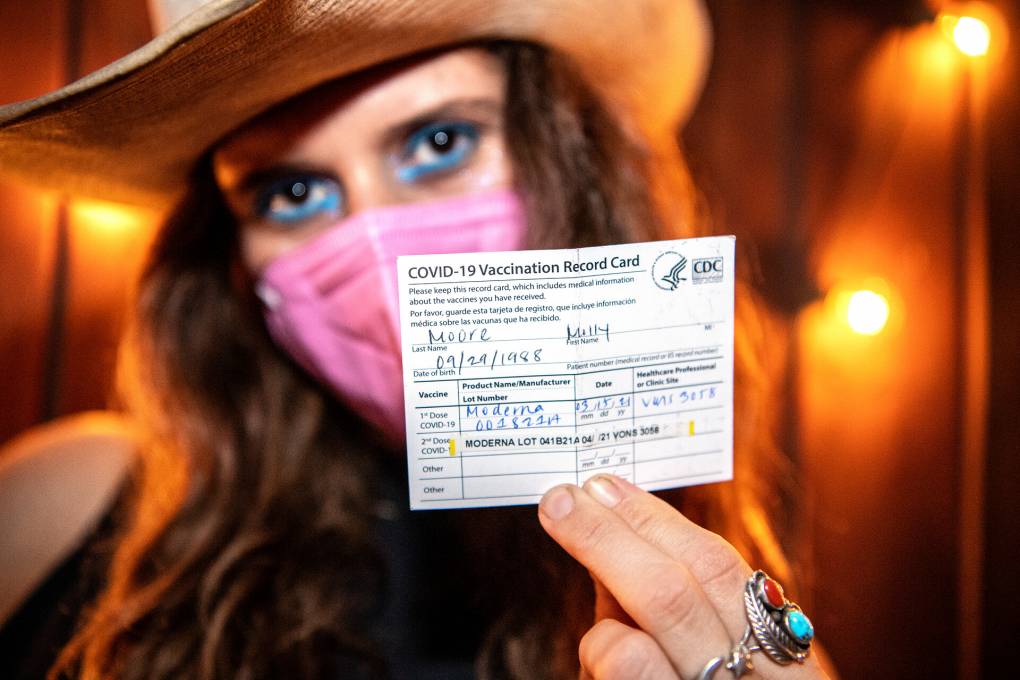
"caption": "Starting Friday, March 11, you will no longer have to show proof of vaccination to enter restaurants, bars and gyms in San Francisco and Berkeley.",
"description": null,
"title": "a look at Permanent Records Roadhouse where vaccine verification is the only way to gain entry",
"credit": "Mariah Tauger/Los Angeles Times via Getty Images",
"status": "inherit",
"altTag": "person wearing pink mask and cowboy hat with bright eyeliner holds up vaccination card",
"isLoading": false,
"fetchFailed": false
},
"news_11819809": {
"type": "attachments",
"id": "news_11819809",
"meta": {
"index": "attachments_1716263798",
"site": "news",
"id": "11819809",
"found": true
},
"parent": 11819691,
"imgSizes": {
"apple_news_ca_landscape_5_5": {
"file": "https://ww2.kqed.org/app/uploads/sites/10/2020/05/RS43039_009_KQED_SanFrancisco_TentEncampments_05052020-qut-1-1044x783.jpg",
"width": 1044,
"mimeType": "image/jpeg",
"height": 783
},
"apple_news_ca_square_4_0": {
"file": "https://ww2.kqed.org/app/uploads/sites/10/2020/05/RS43039_009_KQED_SanFrancisco_TentEncampments_05052020-qut-1-470x470.jpg",
"width": 470,
"mimeType": "image/jpeg",
"height": 470
},
"twentyfourteen-full-width": {
"file": "https://ww2.kqed.org/app/uploads/sites/10/2020/05/RS43039_009_KQED_SanFrancisco_TentEncampments_05052020-qut-1-1038x576.jpg",
"width": 1038,
"mimeType": "image/jpeg",
"height": 576
},
"thumbnail": {
"file": "https://ww2.kqed.org/app/uploads/sites/10/2020/05/RS43039_009_KQED_SanFrancisco_TentEncampments_05052020-qut-1-160x107.jpg",
"width": 160,
"mimeType": "image/jpeg",
"height": 107
},
"post-thumbnail": {
"file": "https://ww2.kqed.org/app/uploads/sites/10/2020/05/RS43039_009_KQED_SanFrancisco_TentEncampments_05052020-qut-1-672x372.jpg",
"width": 672,
"mimeType": "image/jpeg",
"height": 372
},
"kqedFullSize": {
"file": "https://ww2.kqed.org/app/uploads/sites/10/2020/05/RS43039_009_KQED_SanFrancisco_TentEncampments_05052020-qut-1.jpg",
"width": 1920,
"height": 1280
},
"apple_news_ca_landscape_4_7": {
"file": "https://ww2.kqed.org/app/uploads/sites/10/2020/05/RS43039_009_KQED_SanFrancisco_TentEncampments_05052020-qut-1-632x474.jpg",
"width": 632,
"mimeType": "image/jpeg",
"height": 474
},
"large": {
"file": "https://ww2.kqed.org/app/uploads/sites/10/2020/05/RS43039_009_KQED_SanFrancisco_TentEncampments_05052020-qut-1-1020x680.jpg",
"width": 1020,
"mimeType": "image/jpeg",
"height": 680
},
"apple_news_ca_landscape_4_0": {
"file": "https://ww2.kqed.org/app/uploads/sites/10/2020/05/RS43039_009_KQED_SanFrancisco_TentEncampments_05052020-qut-1-536x402.jpg",
"width": 536,
"mimeType": "image/jpeg",
"height": 402
},
"apple_news_ca_portrait_12_9": {
"file": "https://ww2.kqed.org/app/uploads/sites/10/2020/05/RS43039_009_KQED_SanFrancisco_TentEncampments_05052020-qut-1-1122x1280.jpg",
"width": 1122,
"mimeType": "image/jpeg",
"height": 1280
},
"medium": {
"file": "https://ww2.kqed.org/app/uploads/sites/10/2020/05/RS43039_009_KQED_SanFrancisco_TentEncampments_05052020-qut-1-800x533.jpg",
"width": 800,
"mimeType": "image/jpeg",
"height": 533
},
"apple_news_ca_portrait_4_0": {
"file": "https://ww2.kqed.org/app/uploads/sites/10/2020/05/RS43039_009_KQED_SanFrancisco_TentEncampments_05052020-qut-1-354x472.jpg",
"width": 354,
"mimeType": "image/jpeg",
"height": 472
},
"apple_news_ca_portrait_9_7": {
"file": "https://ww2.kqed.org/app/uploads/sites/10/2020/05/RS43039_009_KQED_SanFrancisco_TentEncampments_05052020-qut-1-840x1120.jpg",
"width": 840,
"mimeType": "image/jpeg",
"height": 1120
},
"apple_news_ca_landscape_12_9": {
"file": "https://ww2.kqed.org/app/uploads/sites/10/2020/05/RS43039_009_KQED_SanFrancisco_TentEncampments_05052020-qut-1-1832x1280.jpg",
"width": 1832,
"mimeType": "image/jpeg",
"height": 1280
},
"apple_news_ca_square_9_7": {
"file": "https://ww2.kqed.org/app/uploads/sites/10/2020/05/RS43039_009_KQED_SanFrancisco_TentEncampments_05052020-qut-1-1104x1104.jpg",
"width": 1104,
"mimeType": "image/jpeg",
"height": 1104
},
"apple_news_ca_portrait_4_7": {
"file": "https://ww2.kqed.org/app/uploads/sites/10/2020/05/RS43039_009_KQED_SanFrancisco_TentEncampments_05052020-qut-1-414x552.jpg",
"width": 414,
"mimeType": "image/jpeg",
"height": 552
},
"apple_news_ca_square_12_9": {
"file": "https://ww2.kqed.org/app/uploads/sites/10/2020/05/RS43039_009_KQED_SanFrancisco_TentEncampments_05052020-qut-1-1472x1280.jpg",
"width": 1472,
"mimeType": "image/jpeg",
"height": 1280
},
"apple_news_ca_portrait_5_5": {
"file": "https://ww2.kqed.org/app/uploads/sites/10/2020/05/RS43039_009_KQED_SanFrancisco_TentEncampments_05052020-qut-1-687x916.jpg",
"width": 687,
"mimeType": "image/jpeg",
"height": 916
},
"full-width": {
"file": "https://ww2.kqed.org/app/uploads/sites/10/2020/05/RS43039_009_KQED_SanFrancisco_TentEncampments_05052020-qut-1-1920x1280.jpg",
"width": 1920,
"mimeType": "image/jpeg",
"height": 1280
},
"apple_news_ca_square_4_7": {
"file": "https://ww2.kqed.org/app/uploads/sites/10/2020/05/RS43039_009_KQED_SanFrancisco_TentEncampments_05052020-qut-1-550x550.jpg",
"width": 550,
"mimeType": "image/jpeg",
"height": 550
},
"apple_news_ca_landscape_9_7": {
"file": "https://ww2.kqed.org/app/uploads/sites/10/2020/05/RS43039_009_KQED_SanFrancisco_TentEncampments_05052020-qut-1-1376x1032.jpg",
"width": 1376,
"mimeType": "image/jpeg",
"height": 1032
},
"apple_news_ca_square_5_5": {
"file": "https://ww2.kqed.org/app/uploads/sites/10/2020/05/RS43039_009_KQED_SanFrancisco_TentEncampments_05052020-qut-1-912x912.jpg",
"width": 912,
"mimeType": "image/jpeg",
"height": 912
}
},
"publishDate": 1590020750,
"modified": 1645913007,
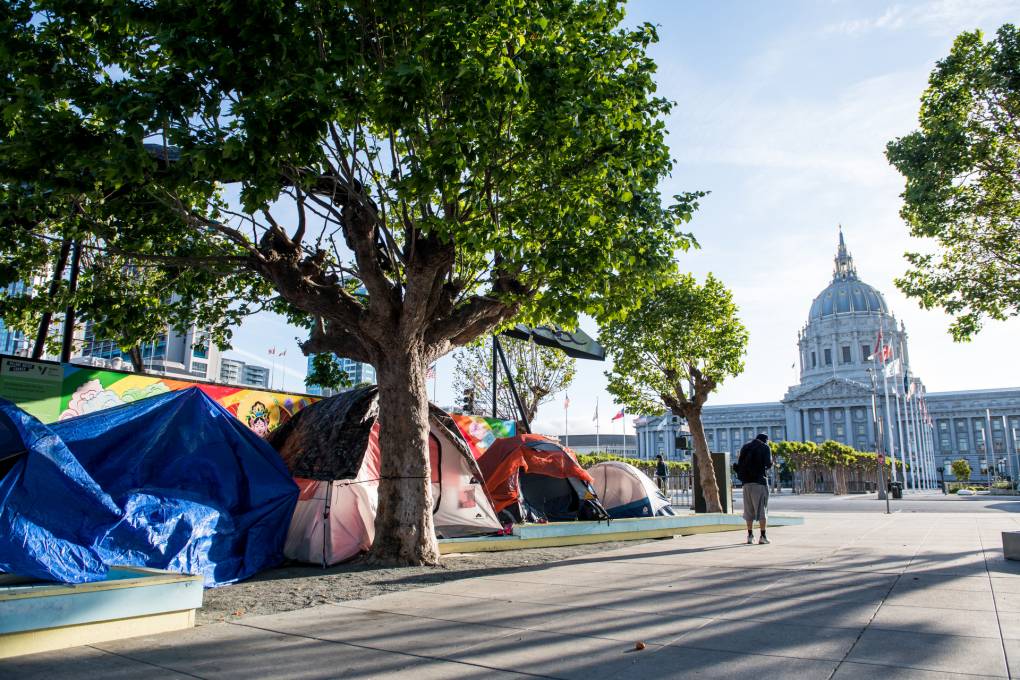
"caption": "Tents line Fulton Street near San Francisco City Hall on May 5, 2020.",
"description": null,
"title": "Tents line Fulton Street near City Hall on May 5, 2020.",
"credit": "Beth LaBerge/KQED",
"status": "inherit",
"altTag": "Tents are seen on a lot bordered by sidewalks in the foreground under a tree, with City Hall in the background.",
"isLoading": false,
"fetchFailed": false
},
"news_11905938": {
"type": "attachments",
"id": "news_11905938",
"meta": {
"index": "attachments_1716263798",
"site": "news",
"id": "11905938",
"found": true
},
"parent": 11905929,
"imgSizes": {
"twentyfourteen-full-width": {
"file": "https://ww2.kqed.org/app/uploads/sites/10/2022/02/RS53793_018_KQED_LunarNewYearSF_02192022-qut-1038x576.jpg",
"width": 1038,
"mimeType": "image/jpeg",
"height": 576
},
"thumbnail": {
"file": "https://ww2.kqed.org/app/uploads/sites/10/2022/02/RS53793_018_KQED_LunarNewYearSF_02192022-qut-160x107.jpg",
"width": 160,
"mimeType": "image/jpeg",
"height": 107
},
"post-thumbnail": {
"file": "https://ww2.kqed.org/app/uploads/sites/10/2022/02/RS53793_018_KQED_LunarNewYearSF_02192022-qut-672x372.jpg",
"width": 672,
"mimeType": "image/jpeg",
"height": 372
},
"kqedFullSize": {
"file": "https://ww2.kqed.org/app/uploads/sites/10/2022/02/RS53793_018_KQED_LunarNewYearSF_02192022-qut.jpg",
"width": 1920,
"height": 1278
},
"large": {
"file": "https://ww2.kqed.org/app/uploads/sites/10/2022/02/RS53793_018_KQED_LunarNewYearSF_02192022-qut-1020x679.jpg",
"width": 1020,
"mimeType": "image/jpeg",
"height": 679
},
"1536x1536": {
"file": "https://ww2.kqed.org/app/uploads/sites/10/2022/02/RS53793_018_KQED_LunarNewYearSF_02192022-qut-1536x1022.jpg",
"width": 1536,
"mimeType": "image/jpeg",
"height": 1022
},
"medium": {
"file": "https://ww2.kqed.org/app/uploads/sites/10/2022/02/RS53793_018_KQED_LunarNewYearSF_02192022-qut-800x533.jpg",
"width": 800,
"mimeType": "image/jpeg",
"height": 533
}
},
"publishDate": 1645376787,
"modified": 1645557952,
"caption": "Cheyenne and her son Xavier watch the Chinese New Year Parade in San Francisco on Feb. 19, 2022.",
"description": null,
"title": "RS53793_018_KQED_LunarNewYearSF_02192022-qut",
"credit": "Beth LaBerge/KQED",
"status": "inherit",
"altTag": null,
"isLoading": false,
"fetchFailed": false
},
"news_11905344": {
"type": "attachments",
"id": "news_11905344",
"meta": {
"index": "attachments_1716263798",
"site": "news",
"id": "11905344",
"found": true
},
"parent": 11904968,
"imgSizes": {
"twentyfourteen-full-width": {
"file": "https://ww2.kqed.org/app/uploads/sites/10/2022/02/Image-from-iOS-55-1038x576.jpg",
"width": 1038,
"mimeType": "image/jpeg",
"height": 576
},
"thumbnail": {
"file": "https://ww2.kqed.org/app/uploads/sites/10/2022/02/Image-from-iOS-55-160x107.jpg",
"width": 160,
"mimeType": "image/jpeg",
"height": 107
},
"post-thumbnail": {
"file": "https://ww2.kqed.org/app/uploads/sites/10/2022/02/Image-from-iOS-55-672x372.jpg",
"width": 672,
"mimeType": "image/jpeg",
"height": 372
},
"kqedFullSize": {
"file": "https://ww2.kqed.org/app/uploads/sites/10/2022/02/Image-from-iOS-55.jpg",
"width": 1620,
"height": 1080
},
"large": {
"file": "https://ww2.kqed.org/app/uploads/sites/10/2022/02/Image-from-iOS-55-1020x680.jpg",
"width": 1020,
"mimeType": "image/jpeg",
"height": 680
},
"1536x1536": {
"file": "https://ww2.kqed.org/app/uploads/sites/10/2022/02/Image-from-iOS-55-1536x1024.jpg",
"width": 1536,
"mimeType": "image/jpeg",
"height": 1024
},
"medium": {
"file": "https://ww2.kqed.org/app/uploads/sites/10/2022/02/Image-from-iOS-55-800x533.jpg",
"width": 800,
"mimeType": "image/jpeg",
"height": 533
}
},
"publishDate": 1644996395,
"modified": 1645034913,
"caption": "Matt Haney speaks to supporters after initial State Assembly election results are announced at the food truck park in San Francisco's District 6, on Feb. 15, 2022.",
"description": null,
"title": "Image from iOS (55)",
"credit": "Beth LaBerge/KQED",
"status": "inherit",
"altTag": "Supervisor Matt Haney, in a white shirt, holds up a paper as he cheers with a crowd with a projected image of his campaign supporters behind him.",
"isLoading": false,
"fetchFailed": false
},
"news_11904927": {
"type": "attachments",
"id": "news_11904927",
"meta": {
"index": "attachments_1716263798",
"site": "news",
"id": "11904927",
"found": true
},
"parent": 11904843,
"imgSizes": {
"twentyfourteen-full-width": {
"file": "https://ww2.kqed.org/app/uploads/sites/10/2022/02/MARQUEE_920-915x576.jpg",
"width": 915,
"mimeType": "image/jpeg",
"height": 576
},
"thumbnail": {
"file": "https://ww2.kqed.org/app/uploads/sites/10/2022/02/MARQUEE_920-160x108.jpg",
"width": 160,
"mimeType": "image/jpeg",
"height": 108
},
"post-thumbnail": {
"file": "https://ww2.kqed.org/app/uploads/sites/10/2022/02/MARQUEE_920-672x372.jpg",
"width": 672,
"mimeType": "image/jpeg",
"height": 372
},
"kqedFullSize": {
"file": "https://ww2.kqed.org/app/uploads/sites/10/2022/02/MARQUEE_920.jpg",
"width": 915,
"height": 617
},
"medium": {
"file": "https://ww2.kqed.org/app/uploads/sites/10/2022/02/MARQUEE_920-800x539.jpg",
"width": 800,
"mimeType": "image/jpeg",
"height": 539
}
},
"publishDate": 1644619481,
"modified": 1644619481,
"caption": null,
"description": null,
"title": "MARQUEE_920",
"credit": null,
"status": "inherit",
"altTag": null,
"isLoading": false,
"fetchFailed": false
},
"news_11904287": {
"type": "attachments",
"id": "news_11904287",
"meta": {
"index": "attachments_1716263798",
"site": "news",
"id": "11904287",
"found": true
},
"parent": 11904277,
"imgSizes": {
"twentyfourteen-full-width": {
"file": "https://ww2.kqed.org/app/uploads/sites/10/2022/02/IMG_0755-1038x576.jpg",
"width": 1038,
"mimeType": "image/jpeg",
"height": 576
},
"thumbnail": {
"file": "https://ww2.kqed.org/app/uploads/sites/10/2022/02/IMG_0755-160x120.jpg",
"width": 160,
"mimeType": "image/jpeg",
"height": 120
},
"post-thumbnail": {
"file": "https://ww2.kqed.org/app/uploads/sites/10/2022/02/IMG_0755-672x372.jpg",
"width": 672,
"mimeType": "image/jpeg",
"height": 372
},
"kqedFullSize": {
"file": "https://ww2.kqed.org/app/uploads/sites/10/2022/02/IMG_0755-scaled.jpg",
"width": 2560,
"height": 1920
},
"2048x2048": {
"file": "https://ww2.kqed.org/app/uploads/sites/10/2022/02/IMG_0755-2048x1536.jpg",
"width": 2048,
"mimeType": "image/jpeg",
"height": 1536
},
"large": {
"file": "https://ww2.kqed.org/app/uploads/sites/10/2022/02/IMG_0755-1020x765.jpg",
"width": 1020,
"mimeType": "image/jpeg",
"height": 765
},
"1536x1536": {
"file": "https://ww2.kqed.org/app/uploads/sites/10/2022/02/IMG_0755-1536x1152.jpg",
"width": 1536,
"mimeType": "image/jpeg",
"height": 1152
},
"full-width": {
"file": "https://ww2.kqed.org/app/uploads/sites/10/2022/02/IMG_0755-1920x1440.jpg",
"width": 1920,
"mimeType": "image/jpeg",
"height": 1440
},
"medium": {
"file": "https://ww2.kqed.org/app/uploads/sites/10/2022/02/IMG_0755-800x600.jpg",
"width": 800,
"mimeType": "image/jpeg",
"height": 600
}
},
"publishDate": 1644111501,
"modified": 1644275871,
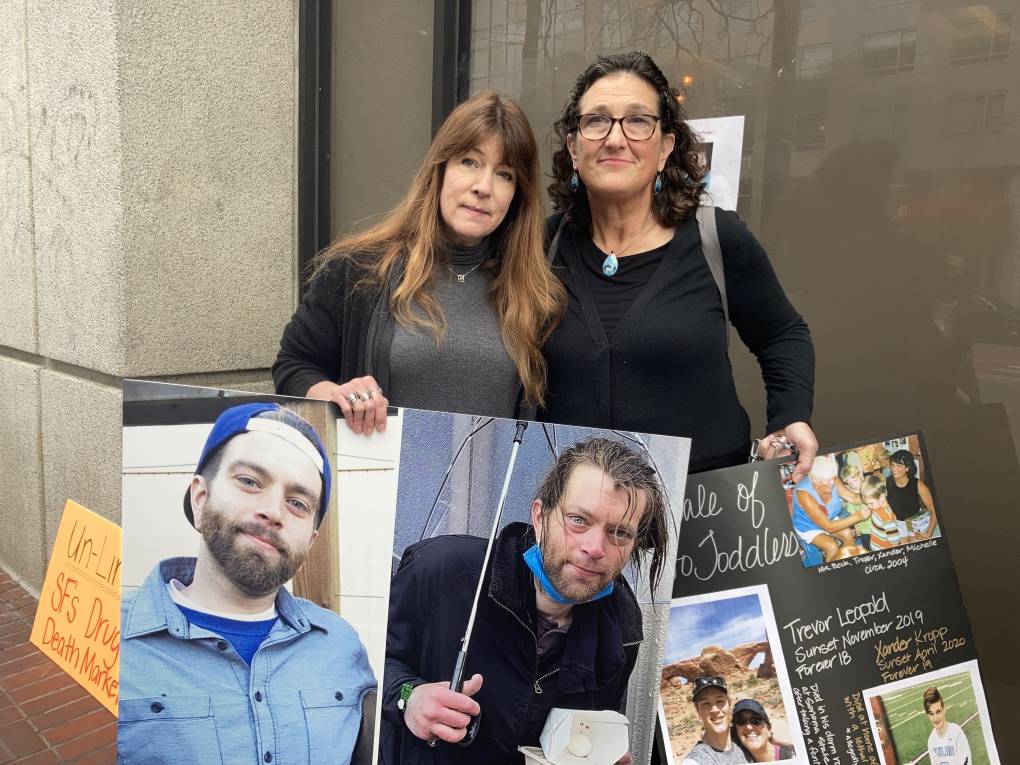
"caption": "Jacqui Berlinn and Michelle Leopold, two of the organizers with the protest against drug use at the Tenderloin Linkage Center, Feb. 5, 2022.",
"description": null,
"title": "IMG_0755",
"credit": "Holly J. McDede/KQED",
"status": "inherit",
"altTag": null,
"isLoading": false,
"fetchFailed": false
},
"news_11904090": {
"type": "attachments",
"id": "news_11904090",
"meta": {
"index": "attachments_1716263798",
"site": "news",
"id": "11904090",
"found": true
},
"parent": 11904089,
"imgSizes": {
"twentyfourteen-full-width": {
"file": "https://ww2.kqed.org/app/uploads/sites/10/2022/02/image1-1038x576.jpg",
"width": 1038,
"mimeType": "image/jpeg",
"height": 576
},
"thumbnail": {
"file": "https://ww2.kqed.org/app/uploads/sites/10/2022/02/image1-160x107.jpg",
"width": 160,
"mimeType": "image/jpeg",
"height": 107
},
"post-thumbnail": {
"file": "https://ww2.kqed.org/app/uploads/sites/10/2022/02/image1-672x372.jpg",
"width": 672,
"mimeType": "image/jpeg",
"height": 372
},
"kqedFullSize": {
"file": "https://ww2.kqed.org/app/uploads/sites/10/2022/02/image1.jpg",
"width": 1920,
"height": 1278
},
"large": {
"file": "https://ww2.kqed.org/app/uploads/sites/10/2022/02/image1-1020x679.jpg",
"width": 1020,
"mimeType": "image/jpeg",
"height": 679
},
"1536x1536": {
"file": "https://ww2.kqed.org/app/uploads/sites/10/2022/02/image1-1536x1022.jpg",
"width": 1536,
"mimeType": "image/jpeg",
"height": 1022
},
"medium": {
"file": "https://ww2.kqed.org/app/uploads/sites/10/2022/02/image1-800x533.jpg",
"width": 800,
"mimeType": "image/jpeg",
"height": 533
}
},
"publishDate": 1644007352,
"modified": 1644007352,
"caption": null,
"description": null,
"title": "image1",
"credit": null,
"status": "inherit",
"altTag": null,
"isLoading": false,
"fetchFailed": false
}
},
"audioPlayerReducer": {
"postId": "stream_live",
"isPaused": true,
"isPlaying": false,
"pfsActive": false,
"pledgeModalIsOpen": true,
"playerDrawerIsOpen": false,
"liveAudioPlayStartedAt": 0,
"liveAudioPlayContext": ""
},
"authorsReducer": {
"byline_news_11909141": {
"type": "authors",
"id": "byline_news_11909141",
"meta": {
"override": true
},
"slug": "byline_news_11909141",
"name": "Mike Schneider \u003cbr> The Associated Press",
"isLoading": false
},
"byline_news_11906631": {
"type": "authors",
"id": "byline_news_11906631",
"meta": {
"override": true
},
"slug": "byline_news_11906631",
"name": "\u003ca href=\"https://www.sfpublicpress.org/author/nuala-bishari/\">Nuala Bishari\u003c/a>\u003cbr>\u003ca href=\"https://www.sfpublicpress.org/\">San Francisco Public Press\u003c/a>",
"isLoading": false
},
"gmarzorati": {
"type": "authors",
"id": "227",
"meta": {
"index": "authors_1716337520",
"id": "227",
"found": true
},
"name": "Guy Marzorati",
"firstName": "Guy",
"lastName": "Marzorati",
"slug": "gmarzorati",
"email": "gmarzorati@KQED.org",
"display_author_email": true,
"staff_mastheads": [
"news"
],
"title": "Correspondent",
"bio": "Guy Marzorati is a correspondent on KQED's California Politics and Government Desk, based in San Jose. A graduate of Santa Clara University, Guy joined KQED in 2013. He reports on state and local politics and produces KQED's digital voter guide.",
"avatar": "https://secure.gravatar.com/avatar/e7038b8dbfd55b104369b76b1cd0b9de?s=600&d=blank&r=g",
"twitter": "guymarzorati",
"facebook": null,
"instagram": null,
"linkedin": null,
"sites": [
{
"site": "",
"roles": [
"editor"
]
},
{
"site": "news",
"roles": [
"editor"
]
},
{
"site": "science",
"roles": [
"editor"
]
},
{
"site": "forum",
"roles": [
"editor"
]
},
{
"site": "elections",
"roles": [
"editor"
]
},
{
"site": "liveblog",
"roles": [
"editor"
]
}
],
"headData": {
"title": "Guy Marzorati | KQED",
"description": "Correspondent",
"ogImgSrc": "https://secure.gravatar.com/avatar/e7038b8dbfd55b104369b76b1cd0b9de?s=600&d=blank&r=g",
"twImgSrc": "https://secure.gravatar.com/avatar/e7038b8dbfd55b104369b76b1cd0b9de?s=600&d=blank&r=g"
},
"isLoading": false,
"link": "/author/gmarzorati"
},
"kqed": {
"type": "authors",
"id": "236",
"meta": {
"index": "authors_1716337520",
"id": "236",
"found": true
},
"name": "KQED News Staff",
"firstName": "KQED News Staff",
"lastName": null,
"slug": "kqed",
"email": "faq@kqed.org",
"display_author_email": false,
"staff_mastheads": [],
"title": null,
"bio": null,
"avatar": "https://secure.gravatar.com/avatar/ef0e801a68c4c54afa9180db14084167?s=600&d=blank&r=g",
"twitter": null,
"facebook": null,
"instagram": null,
"linkedin": null,
"sites": [
{
"site": "arts",
"roles": [
"contributor"
]
},
{
"site": "news",
"roles": [
"editor"
]
},
{
"site": "futureofyou",
"roles": [
"author"
]
}
],
"headData": {
"title": "KQED News Staff | KQED",
"description": null,
"ogImgSrc": "https://secure.gravatar.com/avatar/ef0e801a68c4c54afa9180db14084167?s=600&d=blank&r=g",
"twImgSrc": "https://secure.gravatar.com/avatar/ef0e801a68c4c54afa9180db14084167?s=600&d=blank&r=g"
},
"isLoading": false,
"link": "/author/kqed"
},
"carlysevern": {
"type": "authors",
"id": "3243",
"meta": {
"index": "authors_1716337520",
"id": "3243",
"found": true
},
"name": "Carly Severn",
"firstName": "Carly",
"lastName": "Severn",
"slug": "carlysevern",
"email": "csevern@kqed.org",
"display_author_email": false,
"staff_mastheads": [
"news"
],
"title": "Senior Editor, Audience News ",
"bio": "Carly is KQED's Senior Editor of Audience News on the Digital News team, and has reported for the California Report Magazine, Bay Curious and KQED Arts. She's formerly the host of \u003ca href=\"http://ww2.kqed.org/pop/category/the-cooler/\" rel=\"noopener noreferrer\">The Cooler\u003c/a> podcast.",
"avatar": "https://secure.gravatar.com/avatar/54037bf5c128fe678f0ef26cec97a93f2e7f220a22d7285703328f12c42c1b1d?s=600&d=blank&r=g",
"twitter": "teacupinthebay",
"bluesky": null,
"facebook": null,
"instagram": null,
"linkedin": null,
"sites": [
{
"site": "",
"roles": [
"editor"
]
},
{
"site": "arts",
"roles": [
"editor"
]
},
{
"site": "news",
"roles": [
"administrator"
]
},
{
"site": "pop",
"roles": [
"editor"
]
},
{
"site": "futureofyou",
"roles": [
"editor"
]
},
{
"site": "about",
"roles": [
"administrator"
]
},
{
"site": "mindshift",
"roles": [
"editor"
]
},
{
"site": "bayareabites",
"roles": [
"editor"
]
},
{
"site": "stateofhealth",
"roles": [
"editor"
]
},
{
"site": "science",
"roles": [
"editor"
]
},
{
"site": "food",
"roles": [
"contributor"
]
},
{
"site": "forum",
"roles": [
"editor"
]
},
{
"site": "perspectives",
"roles": [
"administrator"
]
},
{
"site": "liveblog",
"roles": [
"editor"
]
}
],
"headData": {
"title": "Carly Severn | KQED",
"description": "Senior Editor, Audience News ",
"ogImgSrc": "https://secure.gravatar.com/avatar/54037bf5c128fe678f0ef26cec97a93f2e7f220a22d7285703328f12c42c1b1d?s=600&d=blank&r=g",
"twImgSrc": "https://secure.gravatar.com/avatar/54037bf5c128fe678f0ef26cec97a93f2e7f220a22d7285703328f12c42c1b1d?s=600&d=blank&r=g"
},
"isLoading": false,
"link": "/author/carlysevern"
},
"bwatt": {
"type": "authors",
"id": "11238",
"meta": {
"index": "authors_1716337520",
"id": "11238",
"found": true
},
"name": "Brian Watt",
"firstName": "Brian",
"lastName": "Watt",
"slug": "bwatt",
"email": "bwatt@KQED.org",
"display_author_email": false,
"staff_mastheads": [
"news"
],
"title": "Morning News Anchor",
"bio": "Brian Watt is KQED's morning radio news anchor. He joined the KQED News team in April of 2016. Prior to that, he worked as a Reporter for KPCC in Los Angeles and a producer at \u003cem>Marketplace.\u003c/em>\r\n\r\nDuring eight years at KPCC, Brian covered business and economics, and his work won several awards. In 2008, he won the Los Angeles Press Club’s first-place award for Business and Financial Reporting, Broadcast. He’s also received honorable mention and been first runner up for the Press Club’s Radio Journalist of the Year. He won two Golden Mike awards from the Radio and TV News Association of Southern California.\r\n\r\nBrian holds degrees in theater from Yale University and the Sorbonne, and has worked as an actor in France, Italy, Brazil, Hungary and . . . Hollywood. He appeared in a few television shows, including \u003cem>The West Wing, Judging Amy\u003c/em> and \u003cem>The District.\u003c/em>\r\n\r\nEmail: bwatt@KQED.org Twitter: @RadioBWatt",
"avatar": "https://secure.gravatar.com/avatar/55393ff57ed34e2be773ba4789dd6a19?s=600&d=blank&r=g",
"twitter": "@RadioBWatt",
"facebook": null,
"instagram": null,
"linkedin": null,
"sites": [
{
"site": "arts",
"roles": [
"contributor"
]
},
{
"site": "news",
"roles": [
"editor"
]
}
],
"headData": {
"title": "Brian Watt | KQED",
"description": "Morning News Anchor",
"ogImgSrc": "https://secure.gravatar.com/avatar/55393ff57ed34e2be773ba4789dd6a19?s=600&d=blank&r=g",
"twImgSrc": "https://secure.gravatar.com/avatar/55393ff57ed34e2be773ba4789dd6a19?s=600&d=blank&r=g"
},
"isLoading": false,
"link": "/author/bwatt"
},
"lsarah": {
"type": "authors",
"id": "11626",
"meta": {
"index": "authors_1716337520",
"id": "11626",
"found": true
},
"name": "Lakshmi Sarah",
"firstName": "Lakshmi",
"lastName": "Sarah",
"slug": "lsarah",
"email": "lsarah@kqed.org",
"display_author_email": false,
"staff_mastheads": [],
"title": "Digital Producer",
"bio": "Lakshmi Sarah is an educator, author and journalist with a focus on innovative storytelling. She has worked with newspapers, radio and magazines from Ahmedabad, India to Los Angeles, California. She has written and produced for Die Zeit, Global Voices, AJ+, KQED, Fusion Media Group and the New York Times.",
"avatar": "https://secure.gravatar.com/avatar/652dcaecd8b28826fc17a8b2d6bb4e93?s=600&d=blank&r=g",
"twitter": "lakitalki",
"facebook": null,
"instagram": "https://www.instagram.com/laki.talki/",
"linkedin": "https://www.linkedin.com/in/lakisarah/",
"sites": [
{
"site": "arts",
"roles": []
},
{
"site": "news",
"roles": []
},
{
"site": "bayareabites",
"roles": []
},
{
"site": "science",
"roles": []
}
],
"headData": {
"title": "Lakshmi Sarah | KQED",
"description": "Digital Producer",
"ogImgSrc": "https://secure.gravatar.com/avatar/652dcaecd8b28826fc17a8b2d6bb4e93?s=600&d=blank&r=g",
"twImgSrc": "https://secure.gravatar.com/avatar/652dcaecd8b28826fc17a8b2d6bb4e93?s=600&d=blank&r=g"
},
"isLoading": false,
"link": "/author/lsarah"
},
"hmcdede": {
"type": "authors",
"id": "11635",
"meta": {
"index": "authors_1716337520",
"id": "11635",
"found": true
},
"name": "Holly McDede",
"firstName": "Holly",
"lastName": "McDede",
"slug": "hmcdede",
"email": "hmcdede@KQED.org",
"display_author_email": false,
"staff_mastheads": [],
"title": "KQED Contributor",
"bio": null,
"avatar": "https://secure.gravatar.com/avatar/999d9bf31bb3a2f0511932d99526cb3e?s=600&d=blank&r=g",
"twitter": null,
"facebook": null,
"instagram": null,
"linkedin": null,
"sites": [
{
"site": "arts",
"roles": [
"editor"
]
},
{
"site": "news",
"roles": [
"edit_others_posts",
"editor"
]
},
{
"site": "science",
"roles": [
"editor"
]
},
{
"site": "forum",
"roles": [
"editor"
]
},
{
"site": "perspectives",
"roles": [
"administrator"
]
}
],
"headData": {
"title": "Holly McDede | KQED",
"description": "KQED Contributor",
"ogImgSrc": "https://secure.gravatar.com/avatar/999d9bf31bb3a2f0511932d99526cb3e?s=600&d=blank&r=g",
"twImgSrc": "https://secure.gravatar.com/avatar/999d9bf31bb3a2f0511932d99526cb3e?s=600&d=blank&r=g"
},
"isLoading": false,
"link": "/author/hmcdede"
},
"blaberge": {
"type": "authors",
"id": "11667",
"meta": {
"index": "authors_1716337520",
"id": "11667",
"found": true
},
"name": "Beth LaBerge",
"firstName": "Beth",
"lastName": "LaBerge",
"slug": "blaberge",
"email": "blaberge@KQED.org",
"display_author_email": true,
"staff_mastheads": [
"news"
],
"title": "Photographer, News",
"bio": "Beth LaBerge is a visual journalist for \u003ca href=\"https://www.kqed.org/news\">KQED News\u003c/a>.",
"avatar": "https://secure.gravatar.com/avatar/ce49ecd7a1306685637b45a1f6f5dedfc4ae9481966eb596fea5160466dd6319?s=600&d=blank&r=g",
"twitter": null,
"bluesky": null,
"facebook": null,
"instagram": "https://www.instagram.com/bethlaberge/",
"linkedin": null,
"sites": [
{
"site": "arts",
"roles": [
"editor",
"manage_categories"
]
},
{
"site": "news",
"roles": [
"editor",
"edit_plugins",
"manage_categories"
]
},
{
"site": "science",
"roles": [
"editor",
"contributor",
"author",
"manage_categories"
]
},
{
"site": "perspectives",
"roles": [
"editor"
]
},
{
"site": "liveblog",
"roles": [
"editor"
]
}
],
"headData": {
"title": "Beth LaBerge | KQED",
"description": "Photographer, News",
"ogImgSrc": "https://secure.gravatar.com/avatar/ce49ecd7a1306685637b45a1f6f5dedfc4ae9481966eb596fea5160466dd6319?s=600&d=blank&r=g",
"twImgSrc": "https://secure.gravatar.com/avatar/ce49ecd7a1306685637b45a1f6f5dedfc4ae9481966eb596fea5160466dd6319?s=600&d=blank&r=g"
},
"isLoading": false,
"link": "/author/blaberge"
},
"jrodriguez": {
"type": "authors",
"id": "11690",
"meta": {
"index": "authors_1716337520",
"id": "11690",
"found": true
},
"name": "Joe Fitzgerald Rodriguez",
"firstName": "Joe",
"lastName": "Fitzgerald Rodriguez",
"slug": "jrodriguez",
"email": "jrodriguez@kqed.org",
"display_author_email": true,
"staff_mastheads": [
"news"
],
"title": "Reporter and Producer",
"bio": "Joe Fitzgerald Rodriguez is a reporter and digital producer for KQED covering politics. Joe most recently wrote for the \u003cem>San Francisco Examiner\u003c/em> as a political columnist covering The City. He was raised in San Francisco and has spent his reporting career in his beloved, foggy, city by the bay. Joe was 12-years-old when he conducted his first interview in journalism, grilling former San Francisco Mayor Willie Brown for the Marina Middle School newspaper, \u003cem>The Penguin Press, \u003c/em>and he continues to report on the San Francisco Bay Area to this day.",
"avatar": "https://secure.gravatar.com/avatar/2247beb0564c1e9c62228d5649d2edac?s=600&d=blank&r=g",
"twitter": "FitztheReporter",
"facebook": null,
"instagram": "https://www.instagram.com/fitzthereporter/",
"linkedin": null,
"sites": [
{
"site": "",
"roles": [
"editor"
]
},
{
"site": "arts",
"roles": [
"editor"
]
},
{
"site": "news",
"roles": [
"editor"
]
},
{
"site": "science",
"roles": [
"editor"
]
},
{
"site": "elections",
"roles": [
"editor"
]
},
{
"site": "liveblog",
"roles": [
"editor"
]
}
],
"headData": {
"title": "Joe Fitzgerald Rodriguez | KQED",
"description": "Reporter and Producer",
"ogImgSrc": "https://secure.gravatar.com/avatar/2247beb0564c1e9c62228d5649d2edac?s=600&d=blank&r=g",
"twImgSrc": "https://secure.gravatar.com/avatar/2247beb0564c1e9c62228d5649d2edac?s=600&d=blank&r=g"
},
"isLoading": false,
"link": "/author/jrodriguez"
},
"agonzalez": {
"type": "authors",
"id": "11724",
"meta": {
"index": "authors_1716337520",
"id": "11724",
"found": true
},
"name": "Alexander Gonzalez",
"firstName": "Alexander",
"lastName": "Gonzalez",
"slug": "agonzalez",
"email": "AlexanderGonzalez@KQED.org",
"display_author_email": false,
"staff_mastheads": [
"news"
],
"title": "KQED Contributor",
"bio": null,
"avatar": "https://secure.gravatar.com/avatar/9e291ed34e154df4c662edf858b641d70b4859939bfe40be478408f9dfd057d2?s=600&d=blank&r=g",
"twitter": null,
"bluesky": null,
"facebook": null,
"instagram": null,
"linkedin": null,
"sites": [
{
"site": "arts",
"roles": [
"editor"
]
},
{
"site": "news",
"roles": [
"editor"
]
},
{
"site": "science",
"roles": [
"editor"
]
}
],
"headData": {
"title": "Alexander Gonzalez | KQED",
"description": "KQED Contributor",
"ogImgSrc": "https://secure.gravatar.com/avatar/9e291ed34e154df4c662edf858b641d70b4859939bfe40be478408f9dfd057d2?s=600&d=blank&r=g",
"twImgSrc": "https://secure.gravatar.com/avatar/9e291ed34e154df4c662edf858b641d70b4859939bfe40be478408f9dfd057d2?s=600&d=blank&r=g"
},
"isLoading": false,
"link": "/author/agonzalez"
}
},
"pagesReducer": {
"news_tag_san-francisco": {
"type": "terms",
"id": "news_38",
"meta": {
"index": "terms_1716263798",
"site": "news",
"id": "38",
"score": 6.7230654
},
"featImg": null,
"name": "San Francisco",
"description": null,
"taxonomy": "tag",
"headData": {
"twImgId": null,
"twTitle": null,
"ogTitle": null,
"ogImgId": null,
"twDescription": null,
"description": null,
"title": "San Francisco Archives | KQED News",
"ogDescription": null
},
"ttid": 58,
"slug": "san-francisco",
"isLoading": false,
"title": "San Francisco",
"pageMeta": {
"site": "news",
"WpPageTemplate": "page-topic-editorial",
"currentPage": 123
},
"blocks": [
{
"blockName": "kqed/post-list",
"attrs": {
"layout": "cardArticle2",
"query": "posts/news?tag=san-francisco",
"seeMore": false,
"paginated": true,
"page": 123
}
},
{
"blockName": "kqed/ad"
}
]
}
},
"pfsSessionReducer": {},
"postsReducer": {
"stream_live": {
"type": "live",
"id": "stream_live",
"audioUrl": "https://streams.kqed.org/kqedradio",
"title": "Live Stream",
"excerpt": "Live Stream information currently unavailable.",
"link": "/radio",
"featImg": "",
"label": {
"name": "KQED Live",
"link": "/"
}
},
"stream_kqedNewscast": {
"type": "posts",
"id": "stream_kqedNewscast",
"audioUrl": "https://www.kqed.org/.stream/anon/radio/RDnews/newscast.mp3?_=1",
"title": "KQED Newscast",
"featImg": "",
"label": {
"name": "88.5 FM",
"link": "/"
}
},
"news_11909759": {
"type": "posts",
"id": "news_11909759",
"meta": {
"index": "posts_1716263798",
"site": "news",
"id": "11909759",
"score": null,
"sort": [
1648843166000
]
},
"guestAuthors": [],
"slug": "haney-campos-laws",
"title": "We Reviewed Every Law Campos and Haney Wrote as SF Supervisors to Help You Vote in the State Assembly Runoff",
"publishDate": 1648843166,
"format": "standard",
"headTitle": "We Reviewed Every Law Campos and Haney Wrote as SF Supervisors to Help You Vote in the State Assembly Runoff | KQED",
"labelTerm": {
"site": "news"
},
"content": "\u003cp>Candidates running for elected office are known for making rosy promises, giving grandiose speeches, and singing soothing songs of better days to come.\u003c/p>\n\u003cp>And while that already makes choosing whom to vote for difficult, the race to represent San Francisco in Assembly District 17 (the city’s east side) between former Supervisor David Campos and current SF Supervisor Matt Haney can be even tougher to parse. That’s because finding the daylight between the two Democrats, on the issues, can be like searching for a clean sidewalk downtown.\u003c/p>\n\u003cp>To wit: It ain’t happenin’.\u003c/p>\n\u003cp>Well, gentlepeople, as \u003ca href=\"https://youtu.be/9vQaVIoEjOM\">a wise group\u003c/a> once said, don’t believe the hype. Instead of looking at what they’ve promised, look at what they’ve done. We’ll even help.\u003c/p>\n\u003cp>[aside postID=\"news_11908113\" hero='https://ww2.kqed.org/app/uploads/sites/10/2022/03/campos-haney3-1020x661.jpg']KQED has read every law these two lawmakers stamped their names on, or co-sponsored, while serving on the San Francisco Board of Supervisors. Yes, all of them.\u003c/p>\n\u003cp>That may serve as a window into their futures, as one of the key jobs of members of the state Assembly is writing laws. The scale of whom those laws affect is just wider by, you know, some 39 million people.\u003c/p>\n\u003cp>To help get a handle on their political futures, here are some top-line findings on their political pasts: While the legislators make similar public statements, and support similar causes, you can find significant differences in their \u003cem>approaches. \u003c/em>They both agree there’s a housing crisis, for instance, but wrote entirely different sets of laws to help ease it. And while both have focused extensively on public health, their specific aims have been notably different.\u003c/p>\n\u003cp>[ad fullwidth]\u003c/p>\n\u003cp>And, lastly — with caveats — one other big takeaway: Campos tended to focus more on citywide legislation, whereas Haney’s legislative portfolio is more of an even mix, with ordinances sometimes centered on the specific neighborhoods he has represented, instead of San Francisco writ large.\u003c/p>\n\u003cp>There’s not much time left: The special election to fill the Assembly seat vacated by now-SF City Attorney David Chiu is April 19. And if you’re asking yourself, “Didn’t I vote for one of these guys already?” \u003cem>— \u003c/em>you very well might have. Campos, Haney, Bilal Mahmood and Thea Selby all were listed as candidates for the Assembly seat on the city’s Feb. 15 ballot. But because \u003ca href=\"https://www.sfchronicle.com/projects/2022/election-results-sf-assembly/\">no one got a majority\u003c/a>, a special election was called between the top two vote-getters — Campos and Haney. Vote-by-mail ballots were sent out just last week.\u003c/p>\n\u003cp>So to help you with that vote, here’s more on what we found.\u003c/p>\n\u003ch2>\u003cstrong>How much work did they actually do in office? \u003c/strong>\u003c/h2>\n\u003cp>To answer that, we first just straight-up counted all the proposed laws the two candidates wrote or sponsored. One major caveat: Campos spent eight years on the Board of Supervisors, versus Haney’s three.\u003c/p>\n\u003cfigure id=\"attachment_11910113\" class=\"wp-caption alignright\" style=\"max-width: 1080px\">\u003ca href=\"https://ww2.kqed.org/app/uploads/sites/10/2022/04/slide3-4.jpg\">\u003cimg loading=\"lazy\" decoding=\"async\" class=\"size-full wp-image-11910113\" src=\"https://ww2.kqed.org/app/uploads/sites/10/2022/04/slide3-4.jpg\" alt=\"A breakdown of the number of laws written by assembly candidates David Campos and Matt Haney.\" width=\"1080\" height=\"1080\" srcset=\"https://cdn.kqed.org/wp-content/uploads/sites/10/2022/04/slide3-4.jpg 1080w, https://cdn.kqed.org/wp-content/uploads/sites/10/2022/04/slide3-4-800x800.jpg 800w, https://cdn.kqed.org/wp-content/uploads/sites/10/2022/04/slide3-4-1020x1020.jpg 1020w, https://cdn.kqed.org/wp-content/uploads/sites/10/2022/04/slide3-4-160x160.jpg 160w\" sizes=\"(max-width: 1080px) 100vw, 1080px\">\u003c/a>\u003cfigcaption class=\"wp-caption-text\">Source: San Francisco Legislative Research Center. \u003ccite>(Anna Vignet/KQED)\u003c/cite>\u003c/figcaption>\u003c/figure>\n\u003cp>Ordinances are legislation that becomes law, often drafted by the City Attorney’s Office at the direction of a supervisor, who becomes its “sponsor,” in wonk-speak.\u003c/p>\n\u003cp>Resolutions, by contrast, are policy statements to express approval or disapproval, that are introduced at Board of Supervisors meetings and voted on. For instance, an April 2021 resolution sponsored by Haney put the city on record “urging support of eliminating the United States Senate filibuster.” A January 2010 resolution by Campos recognized “the grand re-opening of the Bernal Heights Branch Library and commending the San Francisco Public Library and its team for their hard work and commitment to San Francisco and its residents.”\u003c/p>\n\u003cp>The supervisors vote on it, and — presto, change-o — it becomes a statement of record.\u003c/p>\n\u003cp>Lastly, hearings are meetings of the board, convened by one or more supervisors, to seek information or opinions on a topic of interest, wherein a representative of a city department may be asked to answer specific questions. Often these are a way to shine light on an issue for public understanding, or to establish a certain baseline of facts.\u003c/p>\n\u003cp>Former San Francisco Supervisor Jane Kim, Haney’s predecessor, hasn’t endorsed either candidate, but has long considered both of them allies and friends. We asked Kim to offer her own analysis on the two candidates’ lawmaking histories.\u003c/p>\n\u003cp>“Hearing these numbers for the first time, I would say that both Supervisor Haney and former Supervisor David Campos are both very active supervisors legislatively,” said Kim, who now runs the California Working Families Party.\u003c/p>\n\u003cp>Noting that both candidates often wrote ordinances directly influenced by the hearings they called — rather than prompting one hearing after another without a clear goal in sight — Kim also suggested looking at those two tallies in tandem to gauge their productiveness.\u003c/p>\n\u003cp>Campos, for instance, held a hearing in 2015 to look into fire code inspections of apartment buildings\u003ca href=\"https://sanfrancisco.cbslocal.com/2016/07/21/string-of-mission-district-fires-prompts-push-for-safer-buildings-tenant-protections/\"> after a string of fires in the Mission\u003c/a>, a neighborhood he represented.\u003c/p>\n\u003cp>By 2016, Campos had introduced an ordinance requiring owners of buildings with three or more dwelling units to comply with annual fire alarm testing and inspection requirements every two years, and upgrade existing fire alarm systems, among other changes.\u003c/p>\n\u003cp>Haney, meanwhile, called a hearing in 2019 to \u003ca href=\"https://beyondchron.org/supes-hold-hearing-on-tenderloin-drug-dealing/\">look into open-air drug dealing in the Tenderloin\u003c/a>, a longtime problem there.\u003c/p>\n\u003cp>By September 2019, he had convened a street-level drug-dealing task force to develop recommendations for further action.\u003c/p>\n\u003cp>“I do think that it contributed to the urgency that led to the [Tenderloin] state of emergency and some of the solutions that have been deployed,” Haney said of the task force’s findings. One of those recommendations led to the presence of \u003ca href=\"https://sfmayor.org/article/mayor-london-breed-announces-mid-market-vibrancy-and-safety-plan\">nonprofit Urban Alchemy’s unarmed ambassadors\u003c/a>, Haney said, who patrol the neighborhood to provide increased safety.\u003c/p>\n\u003ch2>\u003cstrong>Which laws did the two candidates work on? \u003c/strong>\u003c/h2>\n\u003cp>We categorized Campos and Haney’s legislative histories based on subject area.\u003c/p>\n\u003cp>\u003c!-- iframe plugin v.4.3 wordpress.org/plugins/iframe/ -->\u003cbr>\n\u003ciframe loading=\"lazy\" title=\"Every law Matt Haney wrote or sponsored on the SF Board of Supervisors\" aria-label=\"Table\" id=\"datawrapper-chart-sI01t\" src=\"https://datawrapper.dwcdn.net/sI01t/9/\" scrolling=\"yes\" frameborder=\"0\" style=\"border: none;\" width=\"1000\" height=\"500\" class=\"iframe-class\">\u003c/iframe>\u003c/p>\n\u003cp>Some laws were aimed at spurring housing development or tackling the homelessness crisis, or were inclusion-related laws aimed at helping a specific group, like the LGBTQ community or people of color. Other laws were intended to help specific businesses in each supervisor’s district, or a particular neighborhood, like when Haney created a local dog park in Mission Bay. The “reform” category includes new government ethics laws, improved access to voting, or cleaned-up errors in city code.\u003c/p>\n\u003cp>Categorizing laws is more art than science — for instance, a public health law may specifically aim to help homeless people, so is it a health care law, or a homelessness law? We mostly focused on \u003cem>who \u003c/em>the law aimed to help.\u003c/p>\n\u003cfigure id=\"attachment_11910114\" class=\"wp-caption alignright\" style=\"max-width: 1080px\">\u003ca href=\"https://ww2.kqed.org/app/uploads/sites/10/2022/04/slide4-4.jpg\">\u003cimg loading=\"lazy\" decoding=\"async\" class=\"size-full wp-image-11910114\" src=\"https://ww2.kqed.org/app/uploads/sites/10/2022/04/slide4-4.jpg\" alt=\"A graphic showing percentages of laws passed by assembly candidates David Campos and Matt Haney broken down by category.\" width=\"1080\" height=\"1080\" srcset=\"https://cdn.kqed.org/wp-content/uploads/sites/10/2022/04/slide4-4.jpg 1080w, https://cdn.kqed.org/wp-content/uploads/sites/10/2022/04/slide4-4-800x800.jpg 800w, https://cdn.kqed.org/wp-content/uploads/sites/10/2022/04/slide4-4-1020x1020.jpg 1020w, https://cdn.kqed.org/wp-content/uploads/sites/10/2022/04/slide4-4-160x160.jpg 160w\" sizes=\"(max-width: 1080px) 100vw, 1080px\">\u003c/a>\u003cfigcaption class=\"wp-caption-text\">Source: San Francisco Legislative Research Center. \u003ccite>(Anna Vignet/KQED)\u003c/cite>\u003c/figcaption>\u003c/figure>\n\u003cp>Reading their legislative histories, one top-line observation jumps out: The majority of laws Campos sponsored were citywide in scope, as opposed to targeting only his neighborhood. Haney, by contrast, has introduced more neighborhood-focused legislation. That differentiation could signal how they’d legislate in the Assembly, although, as Kim noted, it may also be circumstantial, given the open-air drug dealing, overdose deaths, poverty and homelessness that Haney has tried to address in his district.\u003c/p>\n\u003cp>Also, Kim said, supervisors in the beginnings of their careers tend to focus more on the neighborhoods and districts that helped them get elected. But, “as they log on more years, they become more citywide in perspective,” she said.\u003c/p>\n\u003cp>For his part, Campos attributed his dearth of neighborhood-facing legislation on an inclination to develop citywide solutions to issues he identified in his own district.\u003c/p>\n\u003cp>Navigation centers that help unhoused people with extended stays and connections to services are one example, he said. \u003ca href=\"https://www.kqed.org/news/10773847/as-s-f-s-homeless-crisis-grows-one-supervisor-wants-to-expand-new-approach-to-housing\">He helped get the first navigation center built in the Mission District, which he represented.\u003c/a> Along with other supervisors, Campos then sponsored legislation to expand navigation center construction in other neighborhoods.\u003c/p>\n\u003cp>“What we realized after the navigation center had been open was that no one else was opening navigation centers in their district, that ours was the only one,” Campos said. “That’s an example of something that was neighborhood-specific that then grew into a larger city issue.”\u003c/p>\n\u003cp>Haney said he has focused more on his district because the South of Market and Tenderloin neighborhoods have “a lot of huge challenges.”\u003c/p>\n\u003cp>That said, he trumpeted some of his own citywide laws, including placing on the 2020 ballot \u003ca href=\"https://ballotpedia.org/San_Francisco,_California,_Proposition_B,_Public_Works_Commission_and_Sanitation_and_Streets_Commission_Charter_Amendment_(November_2020)\">Proposition B\u003c/a>, which split San Francisco’s embattled Public Works Department into two separate departments, one of which now focuses solely on sanitation and streets.\u003c/p>\n\u003ch2>\u003cstrong>Housing: same issue, different approaches\u003c/strong>\u003c/h2>\n\u003cp>The Assembly candidates tackled housing from noticeably different angles during their times on the Board of Supervisors.\u003c/p>\n\u003cp>On the whole, Campos tended to concentrate on protecting existing housing, while Haney has focused more on enabling new housing construction.\u003c/p>\n\u003cp>Part of this is situational: Haney’s district includes South of Market and part of downtown, two neighborhoods that encompass much of the city’s development. By contrast, Campos’s district includes the Mission, a hotbed of tenant advocacy.\u003c/p>\n\u003cp>\u003c!-- iframe plugin v.4.3 wordpress.org/plugins/iframe/ -->\u003cbr>\n\u003ciframe loading=\"lazy\" title=\"Every law David Campos wrote/sponsored on SF Board of Supervisors\" aria-label=\"Table\" id=\"datawrapper-chart-ZKLpa\" src=\"https://datawrapper.dwcdn.net/ZKLpa/11/\" scrolling=\"yes\" frameborder=\"0\" style=\"border: none;\" width=\"1000\" height=\"500\" class=\"iframe-class\">\u003c/iframe>\u003c/p>\n\u003cp>“When you look at these two candidates side by side, they’re not going to differentiate a lot on their positions around tenant protections, but a voter may decide that one candidate just has a greater wealth of experience in regards to the technical aspects, or just experience working on tenant-protection legislation,” Kim said.\u003c/p>\n\u003cp>In 2013, Campos authored an ordinance to provide Rent Board hearings for tenants who allege landlord harassment. He also sponsored eight additional tenant-protection-related ordinances, including fire protections, relocation payments to evicted tenants, tenant buyout agreements, and no-fault eviction protections for families with children under 18.\u003c/p>\n\u003cp>And while Haney in 2019 wrote legislation extending some eviction protections to units constructed after 1979, his main legislative focus was promoting construction of housing. For instance, in June 2019, he sponsored an ordinance approving a development agreement between San Francisco and KR Flower Mart LLC, for the development of an approximately 6.5-acre office and retail site located at Fifth and Brannon streets that was expected to generate $166 million in community fees, with $54 million earmarked for affordable housing. That development is ongoing.\u003c/p>\n\u003cp>Haney also sponsored neighborhood redevelopment plans intended to spur housing and office construction and increase a jobs/housing linkage fee to fund new affordable housing development.\u003c/p>\n\u003cp>https://twitter.com/MattHaneySF/status/1503765849634598914\u003c/p>\n\u003cp>While some of these plans were started by other lawmakers, and were years in the making before his time in office, they still stand in stark contrast to his opponent’s record, including Campos’s proposed “Mission moratorium,” a controversial 2015 ordinance to halt housing construction in his district.\u003c/p>\n\u003cp>Campos told KQED he was largely responding to the wishes of his community at the time, when headlines often trumpeted high-profile evictions, and the issue of gentrification in the Mission District was on the tips of many tongues.\u003c/p>\n\u003cp>But the city’s politics have shifted ever-so-slightly in recent years to more strongly favor building dense construction — and amid that backdrop, Campos said he now supports building more housing than he did while serving as supervisor. But it should always be affordable housing, he added, as opposed to “luxury housing,” a term some use to refer to market-rate construction.\u003c/p>\n\u003cp>Campos said he would not repeat or replicate the Mission moratorium in Sacramento.\u003c/p>\n\u003cp>“In this business, you learn from your mistakes,” Campos said. “It’s actually something that came from the community. They actually collected signatures and brought it forward. And I think that in the end, you know, supporting it was a mistake. And if I had to do it over again, I wouldn’t do it.”\u003c/p>\n\u003ch2>\u003cstrong>The health care divide\u003c/strong>\u003c/h2>\n\u003cp>As supervisors, both also focused extensively on health policy, but in different areas.\u003c/p>\n\u003cp>Campos’s landmark health-related legislation sought to plug a loophole in Healthy San Francisco, the landmark law authored in 2006 by his predecessor, Tom Ammiano, that offered universal health coverage to city residents. But while one provision in the bill asked for companies to establish health care accounts to disburse money for employees, it also had a loophole that allowed the companies to get away with never giving the money away at all.\u003c/p>\n\u003cp>Campos’s legislation prevented companies from getting out of funding their employee health care accounts. “David was the cavalry,” said Ammiano, who in addition to his role as supervisor also served in the Assembly, and is supporting Campos. “He came to the rescue of Healthy San Francisco and closed a loophole, and now Healthy San Francisco is still healthy, especially given the COVID crisis. That politically, personally, morally meant a lot to me.”\u003c/p>\n\u003cp>Campos also authored health-related ordinances to establish a Medical Cannabis Task Force, and to require the city to create a plan for equitable distribution of health care services, among other legislation.\u003c/p>\n\u003cp>https://twitter.com/DavidCamposSF/status/1494851925291855875\u003c/p>\n\u003cp>By contrast, Haney’s health-related legislation illustrates his timing as a leader during the pandemic.\u003c/p>\n\u003cp>Haney had only been a supervisor for a year when the pandemic struck. Immediately, many citywide priorities were dropped as legislators and department heads came to grips with the invisible threat.\u003c/p>\n\u003cp>By March 2022, Haney had sponsored 10 COVID-19 emergency ordinances, the majority of which were extensions of two emergency laws. One requires grocery and drug stores, restaurants, and on-demand delivery service employers to provide health and scheduling protections to their employees during the pandemic. He also required the city to provide toilets and handwashing facilities within 1,000 feet of any tent encampment.\u003c/p>\n\u003cp>“There were some areas where I didn’t feel like our response as a city was robust enough, whether that was protecting essential workers, providing for bathrooms or handwashing,” Haney said. “There’s still clearly areas where I needed to legislate to get people off the streets, to protect workers, to provide bathroom access.”\u003c/p>\n\u003cp>Ultimately, whom you decide to support may come down to a single issue. But, Kim advised, as you browse the lists of laws each candidate has written or sponsored, think about which laws you consider most vital and whom you would want to represent you based on their experience writing them.\u003c/p>\n\u003cp>“It’s possible,” she said, “that the person with the greater experience in that legislative work will have a leg up the day they take their office in Sacramento.”\u003c/p>\n\u003cp>[ad floatright]\u003c/p>\n",
"blocks": [],
"excerpt": "In the heated race for state Assembly, David Campos and Matt Haney appear to be very closely aligned on many big issues. But their legislative records as San Francisco supervisors suggest deeper contrasts.",
"status": "publish",
"parent": 0,
"modified": 1728429970,
"stats": {
"hasAudio": false,
"hasVideo": false,
"hasChartOrMap": true,
"iframeSrcs": [
"https://datawrapper.dwcdn.net/sI01t/9/",
"https://datawrapper.dwcdn.net/ZKLpa/11/"
],
"hasGoogleForm": false,
"hasGallery": false,
"hasHearkenModule": false,
"hasPolis": false,
"paragraphCount": 59,
"wordCount": 2488
},
"headData": {
"title": "We Reviewed Every Law Campos and Haney Wrote as SF Supervisors to Help You Vote in the State Assembly Runoff | KQED",
"description": "In the heated race for state Assembly, David Campos and Matt Haney appear to be very closely aligned on many big issues. But their legislative records as San Francisco supervisors suggest deeper contrasts.",
"ogTitle": "",
"ogDescription": "",
"ogImgId": "",
"twTitle": "",
"twDescription": "",
"twImgId": "",
"schema": {
"@context": "https://schema.org",
"@type": "NewsArticle",
"headline": "We Reviewed Every Law Campos and Haney Wrote as SF Supervisors to Help You Vote in the State Assembly Runoff",
"datePublished": "2022-04-01T12:59:26-07:00",
"dateModified": "2024-10-08T16:26:10-07:00",
"image": "https://cdn.kqed.org/wp-content/uploads/2020/02/KQED-OG-Image@1x.png",
"isAccessibleForFree": "True",
"publisher": {
"@type": "NewsMediaOrganization",
"@id": "https://www.kqed.org/#organization",
"name": "KQED",
"logo": "https://cdn.kqed.org/wp-content/uploads/2020/02/KQED-OG-Image@1x.png",
"url": "https://www.kqed.org",
"sameAs": [
"https://www.facebook.com/KQED",
"https://twitter.com/KQED",
"https://www.instagram.com/kqed/",
"https://www.tiktok.com/@kqedofficial",
"https://www.linkedin.com/company/kqed",
"https://www.youtube.com/channel/UCeC0IOo7i1P_61zVUWbJ4nw"
]
}
}
},
"sticky": false,
"excludeFromSiteSearch": "Include",
"path": "/news/11909759/haney-campos-laws",
"audioTrackLength": null,
"parsedContent": [
{
"type": "contentString",
"content": "\u003cdiv class=\"post-body\">\u003cp>\u003cp>Candidates running for elected office are known for making rosy promises, giving grandiose speeches, and singing soothing songs of better days to come.\u003c/p>\n\u003cp>And while that already makes choosing whom to vote for difficult, the race to represent San Francisco in Assembly District 17 (the city’s east side) between former Supervisor David Campos and current SF Supervisor Matt Haney can be even tougher to parse. That’s because finding the daylight between the two Democrats, on the issues, can be like searching for a clean sidewalk downtown.\u003c/p>\n\u003cp>To wit: It ain’t happenin’.\u003c/p>\n\u003cp>Well, gentlepeople, as \u003ca href=\"https://youtu.be/9vQaVIoEjOM\">a wise group\u003c/a> once said, don’t believe the hype. Instead of looking at what they’ve promised, look at what they’ve done. We’ll even help.\u003c/p>\n\u003cp>\u003c/p>\u003c/div>",
"attributes": {
"named": {},
"numeric": []
}
},
{
"type": "component",
"content": "",
"name": "aside",
"attributes": {
"named": {
"postid": "news_11908113",
"hero": "https://ww2.kqed.org/app/uploads/sites/10/2022/03/campos-haney3-1020x661.jpg",
"label": ""
},
"numeric": []
}
},
{
"type": "contentString",
"content": "\u003cdiv class=\"post-body\">\u003cp>KQED has read every law these two lawmakers stamped their names on, or co-sponsored, while serving on the San Francisco Board of Supervisors. Yes, all of them.\u003c/p>\n\u003cp>That may serve as a window into their futures, as one of the key jobs of members of the state Assembly is writing laws. The scale of whom those laws affect is just wider by, you know, some 39 million people.\u003c/p>\n\u003cp>To help get a handle on their political futures, here are some top-line findings on their political pasts: While the legislators make similar public statements, and support similar causes, you can find significant differences in their \u003cem>approaches. \u003c/em>They both agree there’s a housing crisis, for instance, but wrote entirely different sets of laws to help ease it. And while both have focused extensively on public health, their specific aims have been notably different.\u003c/p>\n\u003cp>\u003c/p>\u003c/div>",
"attributes": {
"named": {},
"numeric": []
}
},
{
"type": "component",
"content": "",
"name": "ad",
"attributes": {
"named": {
"label": "fullwidth"
},
"numeric": [
"fullwidth"
]
}
},
{
"type": "contentString",
"content": "\u003cdiv class=\"post-body\">\u003cp>\u003c/p>\n\u003cp>And, lastly — with caveats — one other big takeaway: Campos tended to focus more on citywide legislation, whereas Haney’s legislative portfolio is more of an even mix, with ordinances sometimes centered on the specific neighborhoods he has represented, instead of San Francisco writ large.\u003c/p>\n\u003cp>There’s not much time left: The special election to fill the Assembly seat vacated by now-SF City Attorney David Chiu is April 19. And if you’re asking yourself, “Didn’t I vote for one of these guys already?” \u003cem>— \u003c/em>you very well might have. Campos, Haney, Bilal Mahmood and Thea Selby all were listed as candidates for the Assembly seat on the city’s Feb. 15 ballot. But because \u003ca href=\"https://www.sfchronicle.com/projects/2022/election-results-sf-assembly/\">no one got a majority\u003c/a>, a special election was called between the top two vote-getters — Campos and Haney. Vote-by-mail ballots were sent out just last week.\u003c/p>\n\u003cp>So to help you with that vote, here’s more on what we found.\u003c/p>\n\u003ch2>\u003cstrong>How much work did they actually do in office? \u003c/strong>\u003c/h2>\n\u003cp>To answer that, we first just straight-up counted all the proposed laws the two candidates wrote or sponsored. One major caveat: Campos spent eight years on the Board of Supervisors, versus Haney’s three.\u003c/p>\n\u003cfigure id=\"attachment_11910113\" class=\"wp-caption alignright\" style=\"max-width: 1080px\">\u003ca href=\"https://ww2.kqed.org/app/uploads/sites/10/2022/04/slide3-4.jpg\">\u003cimg loading=\"lazy\" decoding=\"async\" class=\"size-full wp-image-11910113\" src=\"https://ww2.kqed.org/app/uploads/sites/10/2022/04/slide3-4.jpg\" alt=\"A breakdown of the number of laws written by assembly candidates David Campos and Matt Haney.\" width=\"1080\" height=\"1080\" srcset=\"https://cdn.kqed.org/wp-content/uploads/sites/10/2022/04/slide3-4.jpg 1080w, https://cdn.kqed.org/wp-content/uploads/sites/10/2022/04/slide3-4-800x800.jpg 800w, https://cdn.kqed.org/wp-content/uploads/sites/10/2022/04/slide3-4-1020x1020.jpg 1020w, https://cdn.kqed.org/wp-content/uploads/sites/10/2022/04/slide3-4-160x160.jpg 160w\" sizes=\"(max-width: 1080px) 100vw, 1080px\">\u003c/a>\u003cfigcaption class=\"wp-caption-text\">Source: San Francisco Legislative Research Center. \u003ccite>(Anna Vignet/KQED)\u003c/cite>\u003c/figcaption>\u003c/figure>\n\u003cp>Ordinances are legislation that becomes law, often drafted by the City Attorney’s Office at the direction of a supervisor, who becomes its “sponsor,” in wonk-speak.\u003c/p>\n\u003cp>Resolutions, by contrast, are policy statements to express approval or disapproval, that are introduced at Board of Supervisors meetings and voted on. For instance, an April 2021 resolution sponsored by Haney put the city on record “urging support of eliminating the United States Senate filibuster.” A January 2010 resolution by Campos recognized “the grand re-opening of the Bernal Heights Branch Library and commending the San Francisco Public Library and its team for their hard work and commitment to San Francisco and its residents.”\u003c/p>\n\u003cp>The supervisors vote on it, and — presto, change-o — it becomes a statement of record.\u003c/p>\n\u003cp>Lastly, hearings are meetings of the board, convened by one or more supervisors, to seek information or opinions on a topic of interest, wherein a representative of a city department may be asked to answer specific questions. Often these are a way to shine light on an issue for public understanding, or to establish a certain baseline of facts.\u003c/p>\n\u003cp>Former San Francisco Supervisor Jane Kim, Haney’s predecessor, hasn’t endorsed either candidate, but has long considered both of them allies and friends. We asked Kim to offer her own analysis on the two candidates’ lawmaking histories.\u003c/p>\n\u003cp>“Hearing these numbers for the first time, I would say that both Supervisor Haney and former Supervisor David Campos are both very active supervisors legislatively,” said Kim, who now runs the California Working Families Party.\u003c/p>\n\u003cp>Noting that both candidates often wrote ordinances directly influenced by the hearings they called — rather than prompting one hearing after another without a clear goal in sight — Kim also suggested looking at those two tallies in tandem to gauge their productiveness.\u003c/p>\n\u003cp>Campos, for instance, held a hearing in 2015 to look into fire code inspections of apartment buildings\u003ca href=\"https://sanfrancisco.cbslocal.com/2016/07/21/string-of-mission-district-fires-prompts-push-for-safer-buildings-tenant-protections/\"> after a string of fires in the Mission\u003c/a>, a neighborhood he represented.\u003c/p>\n\u003cp>By 2016, Campos had introduced an ordinance requiring owners of buildings with three or more dwelling units to comply with annual fire alarm testing and inspection requirements every two years, and upgrade existing fire alarm systems, among other changes.\u003c/p>\n\u003cp>Haney, meanwhile, called a hearing in 2019 to \u003ca href=\"https://beyondchron.org/supes-hold-hearing-on-tenderloin-drug-dealing/\">look into open-air drug dealing in the Tenderloin\u003c/a>, a longtime problem there.\u003c/p>\n\u003cp>By September 2019, he had convened a street-level drug-dealing task force to develop recommendations for further action.\u003c/p>\n\u003cp>“I do think that it contributed to the urgency that led to the [Tenderloin] state of emergency and some of the solutions that have been deployed,” Haney said of the task force’s findings. One of those recommendations led to the presence of \u003ca href=\"https://sfmayor.org/article/mayor-london-breed-announces-mid-market-vibrancy-and-safety-plan\">nonprofit Urban Alchemy’s unarmed ambassadors\u003c/a>, Haney said, who patrol the neighborhood to provide increased safety.\u003c/p>\n\u003ch2>\u003cstrong>Which laws did the two candidates work on? \u003c/strong>\u003c/h2>\n\u003cp>We categorized Campos and Haney’s legislative histories based on subject area.\u003c/p>\n\u003cp>\u003c!-- iframe plugin v.4.3 wordpress.org/plugins/iframe/ -->\u003cbr>\n\u003ciframe loading=\"lazy\" title=\"Every law Matt Haney wrote or sponsored on the SF Board of Supervisors\" aria-label=\"Table\" id=\"datawrapper-chart-sI01t\" src=\"https://datawrapper.dwcdn.net/sI01t/9/\" scrolling=\"yes\" frameborder=\"0\" style=\"border: none;\" width=\"1000\" height=\"500\" class=\"iframe-class\">\u003c/iframe>\u003c/p>\n\u003cp>Some laws were aimed at spurring housing development or tackling the homelessness crisis, or were inclusion-related laws aimed at helping a specific group, like the LGBTQ community or people of color. Other laws were intended to help specific businesses in each supervisor’s district, or a particular neighborhood, like when Haney created a local dog park in Mission Bay. The “reform” category includes new government ethics laws, improved access to voting, or cleaned-up errors in city code.\u003c/p>\n\u003cp>Categorizing laws is more art than science — for instance, a public health law may specifically aim to help homeless people, so is it a health care law, or a homelessness law? We mostly focused on \u003cem>who \u003c/em>the law aimed to help.\u003c/p>\n\u003cfigure id=\"attachment_11910114\" class=\"wp-caption alignright\" style=\"max-width: 1080px\">\u003ca href=\"https://ww2.kqed.org/app/uploads/sites/10/2022/04/slide4-4.jpg\">\u003cimg loading=\"lazy\" decoding=\"async\" class=\"size-full wp-image-11910114\" src=\"https://ww2.kqed.org/app/uploads/sites/10/2022/04/slide4-4.jpg\" alt=\"A graphic showing percentages of laws passed by assembly candidates David Campos and Matt Haney broken down by category.\" width=\"1080\" height=\"1080\" srcset=\"https://cdn.kqed.org/wp-content/uploads/sites/10/2022/04/slide4-4.jpg 1080w, https://cdn.kqed.org/wp-content/uploads/sites/10/2022/04/slide4-4-800x800.jpg 800w, https://cdn.kqed.org/wp-content/uploads/sites/10/2022/04/slide4-4-1020x1020.jpg 1020w, https://cdn.kqed.org/wp-content/uploads/sites/10/2022/04/slide4-4-160x160.jpg 160w\" sizes=\"(max-width: 1080px) 100vw, 1080px\">\u003c/a>\u003cfigcaption class=\"wp-caption-text\">Source: San Francisco Legislative Research Center. \u003ccite>(Anna Vignet/KQED)\u003c/cite>\u003c/figcaption>\u003c/figure>\n\u003cp>Reading their legislative histories, one top-line observation jumps out: The majority of laws Campos sponsored were citywide in scope, as opposed to targeting only his neighborhood. Haney, by contrast, has introduced more neighborhood-focused legislation. That differentiation could signal how they’d legislate in the Assembly, although, as Kim noted, it may also be circumstantial, given the open-air drug dealing, overdose deaths, poverty and homelessness that Haney has tried to address in his district.\u003c/p>\n\u003cp>Also, Kim said, supervisors in the beginnings of their careers tend to focus more on the neighborhoods and districts that helped them get elected. But, “as they log on more years, they become more citywide in perspective,” she said.\u003c/p>\n\u003cp>For his part, Campos attributed his dearth of neighborhood-facing legislation on an inclination to develop citywide solutions to issues he identified in his own district.\u003c/p>\n\u003cp>Navigation centers that help unhoused people with extended stays and connections to services are one example, he said. \u003ca href=\"https://www.kqed.org/news/10773847/as-s-f-s-homeless-crisis-grows-one-supervisor-wants-to-expand-new-approach-to-housing\">He helped get the first navigation center built in the Mission District, which he represented.\u003c/a> Along with other supervisors, Campos then sponsored legislation to expand navigation center construction in other neighborhoods.\u003c/p>\n\u003cp>“What we realized after the navigation center had been open was that no one else was opening navigation centers in their district, that ours was the only one,” Campos said. “That’s an example of something that was neighborhood-specific that then grew into a larger city issue.”\u003c/p>\n\u003cp>Haney said he has focused more on his district because the South of Market and Tenderloin neighborhoods have “a lot of huge challenges.”\u003c/p>\n\u003cp>That said, he trumpeted some of his own citywide laws, including placing on the 2020 ballot \u003ca href=\"https://ballotpedia.org/San_Francisco,_California,_Proposition_B,_Public_Works_Commission_and_Sanitation_and_Streets_Commission_Charter_Amendment_(November_2020)\">Proposition B\u003c/a>, which split San Francisco’s embattled Public Works Department into two separate departments, one of which now focuses solely on sanitation and streets.\u003c/p>\n\u003ch2>\u003cstrong>Housing: same issue, different approaches\u003c/strong>\u003c/h2>\n\u003cp>The Assembly candidates tackled housing from noticeably different angles during their times on the Board of Supervisors.\u003c/p>\n\u003cp>On the whole, Campos tended to concentrate on protecting existing housing, while Haney has focused more on enabling new housing construction.\u003c/p>\n\u003cp>Part of this is situational: Haney’s district includes South of Market and part of downtown, two neighborhoods that encompass much of the city’s development. By contrast, Campos’s district includes the Mission, a hotbed of tenant advocacy.\u003c/p>\n\u003cp>\u003c!-- iframe plugin v.4.3 wordpress.org/plugins/iframe/ -->\u003cbr>\n\u003ciframe loading=\"lazy\" title=\"Every law David Campos wrote/sponsored on SF Board of Supervisors\" aria-label=\"Table\" id=\"datawrapper-chart-ZKLpa\" src=\"https://datawrapper.dwcdn.net/ZKLpa/11/\" scrolling=\"yes\" frameborder=\"0\" style=\"border: none;\" width=\"1000\" height=\"500\" class=\"iframe-class\">\u003c/iframe>\u003c/p>\n\u003cp>“When you look at these two candidates side by side, they’re not going to differentiate a lot on their positions around tenant protections, but a voter may decide that one candidate just has a greater wealth of experience in regards to the technical aspects, or just experience working on tenant-protection legislation,” Kim said.\u003c/p>\n\u003cp>In 2013, Campos authored an ordinance to provide Rent Board hearings for tenants who allege landlord harassment. He also sponsored eight additional tenant-protection-related ordinances, including fire protections, relocation payments to evicted tenants, tenant buyout agreements, and no-fault eviction protections for families with children under 18.\u003c/p>\n\u003cp>And while Haney in 2019 wrote legislation extending some eviction protections to units constructed after 1979, his main legislative focus was promoting construction of housing. For instance, in June 2019, he sponsored an ordinance approving a development agreement between San Francisco and KR Flower Mart LLC, for the development of an approximately 6.5-acre office and retail site located at Fifth and Brannon streets that was expected to generate $166 million in community fees, with $54 million earmarked for affordable housing. That development is ongoing.\u003c/p>\n\u003cp>Haney also sponsored neighborhood redevelopment plans intended to spur housing and office construction and increase a jobs/housing linkage fee to fund new affordable housing development.\u003c/p>\u003c/p>\u003c/div>",
"attributes": {
"named": {},
"numeric": []
}
},
{
"type": "component",
"content": "",
"name": "singleTwitterStatus",
"attributes": {
"named": {
"id": "1503765849634598914"
},
"numeric": []
}
},
{
"type": "contentString",
"content": "\u003cdiv class=\"post-body\">\u003cp>\n\u003cp>While some of these plans were started by other lawmakers, and were years in the making before his time in office, they still stand in stark contrast to his opponent’s record, including Campos’s proposed “Mission moratorium,” a controversial 2015 ordinance to halt housing construction in his district.\u003c/p>\n\u003cp>Campos told KQED he was largely responding to the wishes of his community at the time, when headlines often trumpeted high-profile evictions, and the issue of gentrification in the Mission District was on the tips of many tongues.\u003c/p>\n\u003cp>But the city’s politics have shifted ever-so-slightly in recent years to more strongly favor building dense construction — and amid that backdrop, Campos said he now supports building more housing than he did while serving as supervisor. But it should always be affordable housing, he added, as opposed to “luxury housing,” a term some use to refer to market-rate construction.\u003c/p>\n\u003cp>Campos said he would not repeat or replicate the Mission moratorium in Sacramento.\u003c/p>\n\u003cp>“In this business, you learn from your mistakes,” Campos said. “It’s actually something that came from the community. They actually collected signatures and brought it forward. And I think that in the end, you know, supporting it was a mistake. And if I had to do it over again, I wouldn’t do it.”\u003c/p>\n\u003ch2>\u003cstrong>The health care divide\u003c/strong>\u003c/h2>\n\u003cp>As supervisors, both also focused extensively on health policy, but in different areas.\u003c/p>\n\u003cp>Campos’s landmark health-related legislation sought to plug a loophole in Healthy San Francisco, the landmark law authored in 2006 by his predecessor, Tom Ammiano, that offered universal health coverage to city residents. But while one provision in the bill asked for companies to establish health care accounts to disburse money for employees, it also had a loophole that allowed the companies to get away with never giving the money away at all.\u003c/p>\n\u003cp>Campos’s legislation prevented companies from getting out of funding their employee health care accounts. “David was the cavalry,” said Ammiano, who in addition to his role as supervisor also served in the Assembly, and is supporting Campos. “He came to the rescue of Healthy San Francisco and closed a loophole, and now Healthy San Francisco is still healthy, especially given the COVID crisis. That politically, personally, morally meant a lot to me.”\u003c/p>\n\u003cp>Campos also authored health-related ordinances to establish a Medical Cannabis Task Force, and to require the city to create a plan for equitable distribution of health care services, among other legislation.\u003c/p>\u003c/p>\u003c/div>",
"attributes": {
"named": {},
"numeric": []
}
},
{
"type": "component",
"content": "",
"name": "singleTwitterStatus",
"attributes": {
"named": {
"id": "1494851925291855875"
},
"numeric": []
}
},
{
"type": "contentString",
"content": "\u003cdiv class=\"post-body\">\u003cp>\n\u003cp>By contrast, Haney’s health-related legislation illustrates his timing as a leader during the pandemic.\u003c/p>\n\u003cp>Haney had only been a supervisor for a year when the pandemic struck. Immediately, many citywide priorities were dropped as legislators and department heads came to grips with the invisible threat.\u003c/p>\n\u003cp>By March 2022, Haney had sponsored 10 COVID-19 emergency ordinances, the majority of which were extensions of two emergency laws. One requires grocery and drug stores, restaurants, and on-demand delivery service employers to provide health and scheduling protections to their employees during the pandemic. He also required the city to provide toilets and handwashing facilities within 1,000 feet of any tent encampment.\u003c/p>\n\u003cp>“There were some areas where I didn’t feel like our response as a city was robust enough, whether that was protecting essential workers, providing for bathrooms or handwashing,” Haney said. “There’s still clearly areas where I needed to legislate to get people off the streets, to protect workers, to provide bathroom access.”\u003c/p>\n\u003cp>Ultimately, whom you decide to support may come down to a single issue. But, Kim advised, as you browse the lists of laws each candidate has written or sponsored, think about which laws you consider most vital and whom you would want to represent you based on their experience writing them.\u003c/p>\n\u003cp>“It’s possible,” she said, “that the person with the greater experience in that legislative work will have a leg up the day they take their office in Sacramento.”\u003c/p>\n\u003cp>\u003c/p>\u003c/div>",
"attributes": {
"named": {},
"numeric": []
}
},
{
"type": "component",
"content": "",
"name": "ad",
"attributes": {
"named": {
"label": "floatright"
},
"numeric": [
"floatright"
]
}
},
{
"type": "contentString",
"content": "\u003cdiv class=\"post-body\">\u003cp>\u003c/p>\n\u003c/div>\u003c/p>",
"attributes": {
"named": {},
"numeric": []
}
}
],
"link": "/news/11909759/haney-campos-laws",
"authors": [
"11690"
],
"categories": [
"news_8",
"news_13"
],
"tags": [
"news_29966",
"news_4367",
"news_30879",
"news_23394",
"news_736",
"news_25468",
"news_17968",
"news_38",
"news_196",
"news_30889",
"news_20252"
],
"featImg": "news_11909925",
"label": "news"
},
"news_11909141": {
"type": "posts",
"id": "news_11909141",
"meta": {
"index": "posts_1716263798",
"site": "news",
"id": "11909141",
"score": null,
"sort": [
1648154339000
]
},
"parent": 0,
"labelTerm": {
"site": "news"
},
"blocks": [],
"publishDate": 1648154339,
"format": "standard",
"disqusTitle": "More Than 116,000 SF Residents Moved Away During Pandemic's First Year",
"title": "More Than 116,000 SF Residents Moved Away During Pandemic's First Year",
"headTitle": "KQED News",
"content": "\u003cp>\u003ci>\u003cspan style=\"font-weight: 400\">This report contains a correction.\u003c/span>\u003c/i>\u003c/p>\n\u003cp>After returning to San Francisco following a college football career, Anthony Giusti felt like his hometown was passing him by. The high cost of living, driven by a constantly transforming tech industry, ensured that even with two jobs he would never save enough money to buy a house.\u003c/p>\n\u003cp>So he started looking elsewhere, settling on Houston just last year.\u003c/p>\n\u003cp>\"In Houston, I can be a blue-collar entrepreneur. With the Houston housing market, it made sense to come here,\" said Giusti, who started a house-painting business.\u003c/p>\n\u003cp>Giusti was one of tens of thousands of residents who vacated some of the nation's biggest, most densely populated and costly metropolitan areas in favor of Sun Belt destinations during the first full year of the pandemic, from mid-2020 to mid-2021, according to new data released Thursday by the U.S. Census Bureau.\u003c/p>\n\u003cp>[ad fullwidth]\u003c/p>\n\u003cp>The pandemic intensified population trends of migration to the South and West, as well as a slowdown in growth in the biggest cities in the U.S.\u003c/p>\n\u003cp>The exodus from the biggest U.S. metropolitan areas was led by New York, which lost almost 328,000 residents. It was driven by people leaving for elsewhere, even though the metro area gained new residents from abroad and births outpaced deaths.\u003c/p>\n\u003cp>San Francisco saw a loss of more than 116,000 residents, metropolitan Los Angeles lost almost 176,000 residents and greater Chicago lost more than 91,000 people from 2020 to 2021.\u003c/p>\n\u003cp>The San Jose, Boston, Miami and Washington areas also lost tens of thousands of residents, primarily from people moving away.\u003c/p>\n\u003cp>[aside label='Housing Coverage' tag='housing']On the flip side, the Dallas area grew by more than 97,000 residents, Phoenix jumped by more than 78,000 people and greater Houston added 69,000 residents, including Giusti. In the Phoenix metropolitan area, growth was driven by moves from elsewhere in the U.S., while in Dallas and Houston it was propelled by a combination of migration and births outpacing deaths.\u003c/p>\n\u003cp>\"Texas has a thing about it, a romantic thing, with cowboys, and there's the idea here of the Lone Star State,\" said Giusti in describing the lure of Texas.\u003c/p>\n\u003cp>The U.S. Census Bureau's Vintage 2021 estimates also showed micro areas — defined as having a core city of less than 50,000 residents — gaining population from mid-2020 to mid-2021, after years of slow growth or declining population. The small population gains were driven by people moving there, as deaths continued to outpace births in many of these communities. Growth in micro areas was led by two Montana towns — Kalispell and Bozeman — and by Jefferson, Georgia. According to data released earlier this year from the California Policy Lab, \u003ca href=\"https://www.sfchronicle.com/bayarea/article/Migration-to-California-fell-from-most-states-17031956.php\">Idaho saw the biggest increase in move-ins from San Franciscans during the pandemic\u003c/a>.\u003c/p>\n\u003cp>Demographer William Frey said he believes the growth of micro areas and decreases in the biggest metros will be temporary, taking place at the height of people moving during the pandemic when work-from-home arrangements freed up workers from having to go to their offices.\u003c/p>\n\u003cp>\"There is clearly a dispersion, but I think it's a blip,\" said Frey, senior fellow at the Brookings Institution's metropolitan policy program, Brookings Metro. \"We're at one of the lowest levels of immigration in a long, long time, and that affects big metros like New York, Los Angeles and Chicago. That is going to come back. With the natural decrease, we will go back to normal.\"\u003c/p>\n\u003cp>Between mid-2020 and mid-2021, there was a stark increase in deaths outpacing births across the country, a trend fueled by the COVID-19 pandemic, as well as fewer births and an aging population.\u003c/p>\n\u003cp>\"You have more older Americans, and birth rates are low so you don't have many children being born, and then along comes COVID, and it hits older adults the most, often in rural areas without access to good health care,\" said Kenneth Johnson, a senior demographer at the University of New Hampshire. \"It's like a perfect storm, if you will, that produced this natural decrease.\"\u003c/p>\n\u003cp>Pittsburgh and Tampa, Florida, had the largest natural decreases of U.S. metropolitan areas, in the range of 10,000 residents each. Pittsburgh's overall population declined by almost 14,000 residents because people left. But the Tampa area grew bigger because of an influx of more than 45,000 new residents, such as Jennifer Waldholtz, who moved from Atlanta with her husband in 2020. They had previously lived in Orlando and missed Florida's palm trees and blue skies.\u003c/p>\n\u003cp>\"We wanted to come back to Florida. It was state-specific,\" said Waldholtz, who works in nonprofit development. \"We loved the way of life in Florida. It's a vibe, the way of living, sunshine, palm trees, but definitely not politically.\"\u003c/p>\n\u003cp>\u003c/p>\n\u003cp>\u003cem>March 28: \u003ci>\u003cspan style=\"font-weight: 400\">The original version of this report stated that Montana, rather than Idaho, saw the biggest increase in move-ins from San Franciscans during the pandemic. \u003c/span>\u003c/i>\u003c/em>\u003ci>\u003cspan style=\"font-weight: 400\">The story has been edited to correct the inaccuracy.\u003c/span>\u003c/i>\u003c/p>\n\n",
"disqusIdentifier": "11909141 https://ww2.kqed.org/news/?p=11909141",
"disqusUrl": "https://ww2.kqed.org/news/2022/03/24/sf-lost-more-than-116000-residents-during-pandemics-first-year/",
"stats": {
"hasVideo": false,
"hasChartOrMap": false,
"hasAudio": false,
"hasPolis": false,
"wordCount": 855,
"hasGoogleForm": false,
"hasGallery": false,
"hasHearkenModule": false,
"iframeSrcs": [],
"paragraphCount": 21
},
"modified": 1648495038,
"excerpt": "In the first full year of the pandemic, San Francisco, New York, Los Angeles and Chicago saw the greatest population decreases in the nation. U.S. Census Bureau data released Thursday shows Dallas, Phoenix and Houston had the biggest gains.",
"headData": {
"twImgId": "",
"twTitle": "",
"ogTitle": "",
"ogImgId": "",
"twDescription": "",
"description": "In the first full year of the pandemic, San Francisco, New York, Los Angeles and Chicago saw the greatest population decreases in the nation. U.S. Census Bureau data released Thursday shows Dallas, Phoenix and Houston had the biggest gains.",
"title": "More Than 116,000 SF Residents Moved Away During Pandemic's First Year | KQED",
"ogDescription": "",
"schema": {
"@context": "https://schema.org",
"@type": "NewsArticle",
"headline": "More Than 116,000 SF Residents Moved Away During Pandemic's First Year",
"datePublished": "2022-03-24T13:38:59-07:00",
"dateModified": "2022-03-28T12:17:18-07:00",
"image": "https://cdn.kqed.org/wp-content/uploads/2020/02/KQED-OG-Image@1x.png",
"isAccessibleForFree": "True",
"publisher": {
"@type": "NewsMediaOrganization",
"@id": "https://www.kqed.org/#organization",
"name": "KQED",
"logo": "https://cdn.kqed.org/wp-content/uploads/2020/02/KQED-OG-Image@1x.png",
"url": "https://www.kqed.org",
"sameAs": [
"https://www.facebook.com/KQED",
"https://twitter.com/KQED",
"https://www.instagram.com/kqed/",
"https://www.tiktok.com/@kqedofficial",
"https://www.linkedin.com/company/kqed",
"https://www.youtube.com/channel/UCeC0IOo7i1P_61zVUWbJ4nw"
]
}
}
},
"guestAuthors": [],
"slug": "sf-lost-more-than-116000-residents-during-pandemics-first-year",
"status": "publish",
"nprByline": "Mike Schneider \u003cbr> The Associated Press",
"excludeFromSiteSearch": "Include",
"showOnAuthorArchivePages": "No",
"path": "/news/11909141/sf-lost-more-than-116000-residents-during-pandemics-first-year",
"audioTrackLength": null,
"parsedContent": [
{
"type": "contentString",
"content": "\u003cdiv class=\"post-body\">\u003cp>\u003cp>\u003ci>\u003cspan style=\"font-weight: 400\">This report contains a correction.\u003c/span>\u003c/i>\u003c/p>\n\u003cp>After returning to San Francisco following a college football career, Anthony Giusti felt like his hometown was passing him by. The high cost of living, driven by a constantly transforming tech industry, ensured that even with two jobs he would never save enough money to buy a house.\u003c/p>\n\u003cp>So he started looking elsewhere, settling on Houston just last year.\u003c/p>\n\u003cp>\"In Houston, I can be a blue-collar entrepreneur. With the Houston housing market, it made sense to come here,\" said Giusti, who started a house-painting business.\u003c/p>\n\u003cp>Giusti was one of tens of thousands of residents who vacated some of the nation's biggest, most densely populated and costly metropolitan areas in favor of Sun Belt destinations during the first full year of the pandemic, from mid-2020 to mid-2021, according to new data released Thursday by the U.S. Census Bureau.\u003c/p>\n\u003cp>\u003c/p>\u003c/div>",
"attributes": {
"named": {},
"numeric": []
}
},
{
"type": "component",
"content": "",
"name": "ad",
"attributes": {
"named": {
"label": "fullwidth"
},
"numeric": [
"fullwidth"
]
}
},
{
"type": "contentString",
"content": "\u003cdiv class=\"post-body\">\u003cp>\u003c/p>\n\u003cp>The pandemic intensified population trends of migration to the South and West, as well as a slowdown in growth in the biggest cities in the U.S.\u003c/p>\n\u003cp>The exodus from the biggest U.S. metropolitan areas was led by New York, which lost almost 328,000 residents. It was driven by people leaving for elsewhere, even though the metro area gained new residents from abroad and births outpaced deaths.\u003c/p>\n\u003cp>San Francisco saw a loss of more than 116,000 residents, metropolitan Los Angeles lost almost 176,000 residents and greater Chicago lost more than 91,000 people from 2020 to 2021.\u003c/p>\n\u003cp>The San Jose, Boston, Miami and Washington areas also lost tens of thousands of residents, primarily from people moving away.\u003c/p>\n\u003cp>\u003c/p>\u003c/div>",
"attributes": {
"named": {},
"numeric": []
}
},
{
"type": "component",
"content": "",
"name": "aside",
"attributes": {
"named": {
"label": "Housing Coverage ",
"tag": "housing"
},
"numeric": []
}
},
{
"type": "contentString",
"content": "\u003cdiv class=\"post-body\">\u003cp>On the flip side, the Dallas area grew by more than 97,000 residents, Phoenix jumped by more than 78,000 people and greater Houston added 69,000 residents, including Giusti. In the Phoenix metropolitan area, growth was driven by moves from elsewhere in the U.S., while in Dallas and Houston it was propelled by a combination of migration and births outpacing deaths.\u003c/p>\n\u003cp>\"Texas has a thing about it, a romantic thing, with cowboys, and there's the idea here of the Lone Star State,\" said Giusti in describing the lure of Texas.\u003c/p>\n\u003cp>The U.S. Census Bureau's Vintage 2021 estimates also showed micro areas — defined as having a core city of less than 50,000 residents — gaining population from mid-2020 to mid-2021, after years of slow growth or declining population. The small population gains were driven by people moving there, as deaths continued to outpace births in many of these communities. Growth in micro areas was led by two Montana towns — Kalispell and Bozeman — and by Jefferson, Georgia. According to data released earlier this year from the California Policy Lab, \u003ca href=\"https://www.sfchronicle.com/bayarea/article/Migration-to-California-fell-from-most-states-17031956.php\">Idaho saw the biggest increase in move-ins from San Franciscans during the pandemic\u003c/a>.\u003c/p>\n\u003cp>Demographer William Frey said he believes the growth of micro areas and decreases in the biggest metros will be temporary, taking place at the height of people moving during the pandemic when work-from-home arrangements freed up workers from having to go to their offices.\u003c/p>\n\u003cp>\"There is clearly a dispersion, but I think it's a blip,\" said Frey, senior fellow at the Brookings Institution's metropolitan policy program, Brookings Metro. \"We're at one of the lowest levels of immigration in a long, long time, and that affects big metros like New York, Los Angeles and Chicago. That is going to come back. With the natural decrease, we will go back to normal.\"\u003c/p>\n\u003cp>Between mid-2020 and mid-2021, there was a stark increase in deaths outpacing births across the country, a trend fueled by the COVID-19 pandemic, as well as fewer births and an aging population.\u003c/p>\n\u003cp>\"You have more older Americans, and birth rates are low so you don't have many children being born, and then along comes COVID, and it hits older adults the most, often in rural areas without access to good health care,\" said Kenneth Johnson, a senior demographer at the University of New Hampshire. \"It's like a perfect storm, if you will, that produced this natural decrease.\"\u003c/p>\n\u003cp>Pittsburgh and Tampa, Florida, had the largest natural decreases of U.S. metropolitan areas, in the range of 10,000 residents each. Pittsburgh's overall population declined by almost 14,000 residents because people left. But the Tampa area grew bigger because of an influx of more than 45,000 new residents, such as Jennifer Waldholtz, who moved from Atlanta with her husband in 2020. They had previously lived in Orlando and missed Florida's palm trees and blue skies.\u003c/p>\n\u003cp>\"We wanted to come back to Florida. It was state-specific,\" said Waldholtz, who works in nonprofit development. \"We loved the way of life in Florida. It's a vibe, the way of living, sunshine, palm trees, but definitely not politically.\"\u003c/p>\n\u003cp>\u003c/p>\n\u003cp>\u003cem>March 28: \u003ci>\u003cspan style=\"font-weight: 400\">The original version of this report stated that Montana, rather than Idaho, saw the biggest increase in move-ins from San Franciscans during the pandemic. \u003c/span>\u003c/i>\u003c/em>\u003ci>\u003cspan style=\"font-weight: 400\">The story has been edited to correct the inaccuracy.\u003c/span>\u003c/i>\u003c/p>\n\n\u003c/div>\u003c/p>",
"attributes": {
"named": {},
"numeric": []
}
}
],
"link": "/news/11909141/sf-lost-more-than-116000-residents-during-pandemics-first-year",
"authors": [
"byline_news_11909141"
],
"categories": [
"news_1758",
"news_6266",
"news_8"
],
"tags": [
"news_26244",
"news_25535",
"news_5758",
"news_27350",
"news_1775",
"news_38"
],
"featImg": "news_11909167",
"label": "news"
},
"news_11908647": {
"type": "posts",
"id": "news_11908647",
"meta": {
"index": "posts_1716263798",
"site": "news",
"id": "11908647",
"score": null,
"sort": [
1647645899000
]
},
"guestAuthors": [],
"slug": "uc-berkeley-fight-this-week-in-california-news",
"title": "UC Berkeley Fight | This Week in California News",
"publishDate": 1647645899,
"format": "video",
"headTitle": "UC Berkeley Fight | This Week in California News | KQED",
"labelTerm": {
"term": 7052,
"site": "news"
},
"content": "\u003cp>\u003cb>UC Berkeley Admissions Restored Under Senate Bill 118\u003cbr>\n\u003c/b>\u003cspan style=\"font-weight: 400\">California legislators acted with unusual speed this week to protect UC Berkeley from the consequences of a court ruling governing the number of students it could admit. Senate Bill 118, which was signed by Gov. Gavin Newsom on Monday, exempts all state universities and colleges from certain portions of the California Environmental Quality Act (CEQA), which had been invoked by a local group suing UC Berkeley. \u003c/span>\u003c/p>\n\u003cp>\u003cspan style=\"font-weight: 400\">That group, called Save Berkeley’s Neighborhoods, had sued the university for growing its student population by 30% over the past two decades without doing enough to account for the environmental impact of those students. For now, the university can proceed with its planned enrollment for this fall, but broader questions raised by the lawsuit remain unanswered. We talk to one of the authors of the newly enacted law, Assemblymember Phil Ting from San Francisco. \u003c/span>\u003c/p>\n\u003cp>\u003cspan style=\"font-weight: 400\">Guest:\u003c/span>\u003c/p>\n\u003cul>\n\u003cli style=\"font-weight: 400\">\u003cspan style=\"font-weight: 400\">Assemblymember. Phil Ting, D-San Francisco\u003c/span>\u003c/li>\n\u003c/ul>\n\u003cp> \u003c/p>\n\u003cp>\u003cb>This Week in California News and Politics\u003c/b>\u003cspan style=\"font-weight: 400\">\u003cbr>\n\u003c/span>\u003cspan style=\"font-weight: 400\">This week, congressional earmarks — a way for members of Congress to request funding for specific projects in their districts — made their return after a decade of being banned. California is set to get $766 million out of the $1.5 trillion dollar budget that President Joe Biden signed on Tuesday for projects including construction at naval bases and beach replenishment in Southern California. Roughly $100 million is coming to the Bay Area for healthcare, education and transportation projects.\u003c/span>\u003c/p>\n\u003cp>[ad fullwidth]\u003c/p>\n\u003cp>\u003cspan style=\"font-weight: 400\">Guests:\u003c/span>\u003c/p>\n\u003cul>\n\u003cli style=\"font-weight: 400\">\u003cspan style=\"font-weight: 400\">Tal Kopan, San Francisco Chronicle Washington, D.C., correspondent\u003c/span>\u003c/li>\n\u003cli style=\"font-weight: 400\">\u003cspan style=\"font-weight: 400\">Scott Shafer, KQED politics and government senior editor\u003c/span>\u003c/li>\n\u003c/ul>\n\u003cp> \u003c/p>\n\u003cp>\u003c/p>\n\u003cp>\u003cb>Something Beautiful: Pacific Pinball Museum\u003cbr>\n\u003c/b>\u003cspan style=\"font-weight: 400\">Bells ring, lights flash, and balls fly at the Pacific Pinball Museum in Alameda, where machines from throughout the decades are on display in this week’s look at Something Beautiful. \u003c/span>\u003c/p>\n\n",
"blocks": [],
"excerpt": null,
"status": "publish",
"parent": 0,
"modified": 1722644347,
"stats": {
"hasAudio": false,
"hasVideo": false,
"hasChartOrMap": false,
"iframeSrcs": [],
"hasGoogleForm": false,
"hasGallery": false,
"hasHearkenModule": false,
"hasPolis": false,
"paragraphCount": 8,
"wordCount": 304
},
"headData": {
"title": "UC Berkeley Fight | This Week in California News | KQED",
"description": "UC Berkeley Admissions Restored Under Senate Bill 118 California legislators acted with unusual speed this week to protect UC Berkeley from the consequences of a court ruling governing the number of students it could admit. Senate Bill 118, which was signed by Gov. Gavin Newsom on Monday, exempts all state universities and colleges from certain portions of the California Environmental Quality Act (CEQA), which had been invoked by a local group suing UC Berkeley. That group, called Save Berkeley’s Neighborhoods, had sued the university for growing its student population by 30% over the past two decades without doing enough to",
"ogTitle": "",
"ogDescription": "",
"ogImgId": "",
"twTitle": "",
"twDescription": "",
"twImgId": "",
"schema": {
"@context": "https://schema.org",
"@type": "NewsArticle",
"headline": "UC Berkeley Fight | This Week in California News",
"datePublished": "2022-03-18T16:24:59-07:00",
"dateModified": "2024-08-02T17:19:07-07:00",
"image": "https://cdn.kqed.org/wp-content/uploads/2020/02/KQED-OG-Image@1x.png",
"isAccessibleForFree": "True",
"publisher": {
"@type": "NewsMediaOrganization",
"@id": "https://www.kqed.org/#organization",
"name": "KQED",
"logo": "https://cdn.kqed.org/wp-content/uploads/2020/02/KQED-OG-Image@1x.png",
"url": "https://www.kqed.org",
"sameAs": [
"https://www.facebook.com/KQED",
"https://twitter.com/KQED",
"https://www.instagram.com/kqed/",
"https://www.tiktok.com/@kqedofficial",
"https://www.linkedin.com/company/kqed",
"https://www.youtube.com/channel/UCeC0IOo7i1P_61zVUWbJ4nw"
]
}
}
},
"videoEmbed": "https://youtu.be/cu1sszMqEtQ",
"sticky": false,
"excludeFromSiteSearch": "Include",
"path": "/news/11908647/uc-berkeley-fight-this-week-in-california-news",
"audioTrackLength": null,
"parsedContent": [
{
"type": "contentString",
"content": "\u003cdiv class=\"post-body\">\u003cp>\u003cp>\u003cb>UC Berkeley Admissions Restored Under Senate Bill 118\u003cbr>\n\u003c/b>\u003cspan style=\"font-weight: 400\">California legislators acted with unusual speed this week to protect UC Berkeley from the consequences of a court ruling governing the number of students it could admit. Senate Bill 118, which was signed by Gov. Gavin Newsom on Monday, exempts all state universities and colleges from certain portions of the California Environmental Quality Act (CEQA), which had been invoked by a local group suing UC Berkeley. \u003c/span>\u003c/p>\n\u003cp>\u003cspan style=\"font-weight: 400\">That group, called Save Berkeley’s Neighborhoods, had sued the university for growing its student population by 30% over the past two decades without doing enough to account for the environmental impact of those students. For now, the university can proceed with its planned enrollment for this fall, but broader questions raised by the lawsuit remain unanswered. We talk to one of the authors of the newly enacted law, Assemblymember Phil Ting from San Francisco. \u003c/span>\u003c/p>\n\u003cp>\u003cspan style=\"font-weight: 400\">Guest:\u003c/span>\u003c/p>\n\u003cul>\n\u003cli style=\"font-weight: 400\">\u003cspan style=\"font-weight: 400\">Assemblymember. Phil Ting, D-San Francisco\u003c/span>\u003c/li>\n\u003c/ul>\n\u003cp> \u003c/p>\n\u003cp>\u003cb>This Week in California News and Politics\u003c/b>\u003cspan style=\"font-weight: 400\">\u003cbr>\n\u003c/span>\u003cspan style=\"font-weight: 400\">This week, congressional earmarks — a way for members of Congress to request funding for specific projects in their districts — made their return after a decade of being banned. California is set to get $766 million out of the $1.5 trillion dollar budget that President Joe Biden signed on Tuesday for projects including construction at naval bases and beach replenishment in Southern California. Roughly $100 million is coming to the Bay Area for healthcare, education and transportation projects.\u003c/span>\u003c/p>\n\u003cp>\u003c/p>\u003c/div>",
"attributes": {
"named": {},
"numeric": []
}
},
{
"type": "component",
"content": "",
"name": "ad",
"attributes": {
"named": {
"label": "fullwidth"
},
"numeric": [
"fullwidth"
]
}
},
{
"type": "contentString",
"content": "\u003cdiv class=\"post-body\">\u003cp>\u003c/p>\n\u003cp>\u003cspan style=\"font-weight: 400\">Guests:\u003c/span>\u003c/p>\n\u003cul>\n\u003cli style=\"font-weight: 400\">\u003cspan style=\"font-weight: 400\">Tal Kopan, San Francisco Chronicle Washington, D.C., correspondent\u003c/span>\u003c/li>\n\u003cli style=\"font-weight: 400\">\u003cspan style=\"font-weight: 400\">Scott Shafer, KQED politics and government senior editor\u003c/span>\u003c/li>\n\u003c/ul>\n\u003cp> \u003c/p>\n\u003cp>\u003c/p>\n\u003cp>\u003cb>Something Beautiful: Pacific Pinball Museum\u003cbr>\n\u003c/b>\u003cspan style=\"font-weight: 400\">Bells ring, lights flash, and balls fly at the Pacific Pinball Museum in Alameda, where machines from throughout the decades are on display in this week’s look at Something Beautiful. \u003c/span>\u003c/p>\n\n\u003c/div>\u003c/p>",
"attributes": {
"named": {},
"numeric": []
}
}
],
"link": "/news/11908647/uc-berkeley-fight-this-week-in-california-news",
"authors": [
"236"
],
"programs": [
"news_7052"
],
"categories": [
"news_1758",
"news_19906",
"news_457",
"news_6266",
"news_8",
"news_13"
],
"tags": [
"news_18848",
"news_1386",
"news_18538",
"news_4248",
"news_16",
"news_717",
"news_9",
"news_20297",
"news_19177",
"news_30816",
"news_17968",
"news_38",
"news_1258",
"news_163",
"news_30632",
"news_25049",
"news_17597"
],
"featImg": "news_11908650",
"label": "news_7052"
},
"news_11908537": {
"type": "posts",
"id": "news_11908537",
"meta": {
"index": "posts_1716263798",
"site": "news",
"id": "11908537",
"score": null,
"sort": [
1647640428000
]
},
"guestAuthors": [],
"slug": "ukrainian-chef-in-sf-finds-comfort-cooking-traditional-food-and-raises-thousands-in-relief-aid",
"title": "Ukrainian Chef in SF Finds Comfort Cooking Traditional Food — and Raises Thousands in Relief Aid",
"publishDate": 1647640428,
"format": "standard",
"headTitle": "Ukrainian Chef in SF Finds Comfort Cooking Traditional Food — and Raises Thousands in Relief Aid | KQED",
"labelTerm": {},
"content": "\u003cp>Anna Voloshyna faces a chef’s dilemma: She hasn’t had much of an appetite lately — curbed by the anxiety over whether her family remains safe back home near the \u003ca href=\"https://www.bbc.com/news/world-60769318\">port city of Kherson\u003c/a> in southern Ukraine.\u003c/p>\n\u003cp>“I heard from them [that] four bombs were dropped onto our tiny city,” she told KQED recently from her kitchen in San Francisco. “This was the first time I heard from them that war is actually in our city. It’s been harder every day.”\u003c/p>\n\u003cp>Voloshyna, 32, said her family is safe, so far. So these days, she finds comfort in making some of her favorite recipes, such as varenyky, traditional dumplings that contain sweet or savory fillings.\u003c/p>\n\u003cp>“I love making these dumplings because you’re doing something with your hands. It’s calming,” she said. “This is what keeps me sane, because if I start reading the news, I will just sink into despair.”\u003c/p>\n\u003cfigure id=\"attachment_11908635\" class=\"wp-caption aligncenter\" style=\"max-width: 1920px\">\u003cimg loading=\"lazy\" decoding=\"async\" class=\"size-full wp-image-11908635\" src=\"https://ww2.kqed.org/app/uploads/sites/10/2022/03/RS54342_003_KQED_UkrainianChefAnnaVoloshyna_03152022-qut.jpg\" alt=\"Detail photo of hands working to fill dumpling dough with filling over a large mixing bowl, with small circular bits of dough on the counter\" width=\"1920\" height=\"1280\" srcset=\"https://cdn.kqed.org/wp-content/uploads/sites/10/2022/03/RS54342_003_KQED_UkrainianChefAnnaVoloshyna_03152022-qut.jpg 1920w, https://cdn.kqed.org/wp-content/uploads/sites/10/2022/03/RS54342_003_KQED_UkrainianChefAnnaVoloshyna_03152022-qut-800x533.jpg 800w, https://cdn.kqed.org/wp-content/uploads/sites/10/2022/03/RS54342_003_KQED_UkrainianChefAnnaVoloshyna_03152022-qut-1020x680.jpg 1020w, https://cdn.kqed.org/wp-content/uploads/sites/10/2022/03/RS54342_003_KQED_UkrainianChefAnnaVoloshyna_03152022-qut-160x107.jpg 160w, https://cdn.kqed.org/wp-content/uploads/sites/10/2022/03/RS54342_003_KQED_UkrainianChefAnnaVoloshyna_03152022-qut-1536x1024.jpg 1536w\" sizes=\"(max-width: 1920px) 100vw, 1920px\">\u003cfigcaption class=\"wp-caption-text\">Chef Anna Voloshyna prepares traditional Ukrainian half-moon-shaped dumplings called varenyky at her home in San Francisco on March 15, 2022. \u003ccite>(Beth LaBerge/KQED)\u003c/cite>\u003c/figcaption>\u003c/figure>\n\u003cp>Voloshyna lights up as she’s preparing the dough for these half-moon-shaped dumplings, which are simple but packed with flavor.\u003c/p>\n\u003cp>This recipe, which comes from her mother-in-law, calls for a basic dough (flour, eggs and water) that’s cut into small circles. These will house a filling of choice — today, she selects a special cheese she bought at a Slavic store in San Francisco. She boils the dumplings for a few minutes, tosses them in brown butter and adds a hearty dollop of sour cream.\u003c/p>\n\u003cp>“In Ukraine, sour cream is like butter,” she said, laughing. “Ukrainian food is very comforting. A lot of carbs.”\u003c/p>\n\u003cfigure id=\"attachment_11908541\" class=\"wp-caption aligncenter\" style=\"max-width: 1920px\">\u003cimg loading=\"lazy\" decoding=\"async\" class=\"size-full wp-image-11908541\" src=\"https://ww2.kqed.org/app/uploads/sites/10/2022/03/RS54355_015_KQED_UkrainianChefAnnaVoloshyna_03152022-qut.jpg\" alt=\"Traditional Ukrainian dumplings called varenyky are lined up on a wooden board. They're shaped like half moons and fit in the palm of your hand.\" width=\"1920\" height=\"1280\" srcset=\"https://cdn.kqed.org/wp-content/uploads/sites/10/2022/03/RS54355_015_KQED_UkrainianChefAnnaVoloshyna_03152022-qut.jpg 1920w, https://cdn.kqed.org/wp-content/uploads/sites/10/2022/03/RS54355_015_KQED_UkrainianChefAnnaVoloshyna_03152022-qut-800x533.jpg 800w, https://cdn.kqed.org/wp-content/uploads/sites/10/2022/03/RS54355_015_KQED_UkrainianChefAnnaVoloshyna_03152022-qut-1020x680.jpg 1020w, https://cdn.kqed.org/wp-content/uploads/sites/10/2022/03/RS54355_015_KQED_UkrainianChefAnnaVoloshyna_03152022-qut-160x107.jpg 160w, https://cdn.kqed.org/wp-content/uploads/sites/10/2022/03/RS54355_015_KQED_UkrainianChefAnnaVoloshyna_03152022-qut-1536x1024.jpg 1536w\" sizes=\"(max-width: 1920px) 100vw, 1920px\">\u003cfigcaption class=\"wp-caption-text\">Varenyky, Ukrainian dumplings, are prepared by chef Anna Voloshyna at her home in San Francisco on March 15, 2022. \u003ccite>(Beth LaBerge/KQED)\u003c/cite>\u003c/figcaption>\u003c/figure>\n\u003cp>Voloshyna, who has a \u003ca href=\"https://www.rizzolibookstore.com/budmo-recipes-ukrainian-kitchen\">cookbook\u003c/a> coming out later this year, has a passion for sharing the stories and dishes of her homeland.\u003c/p>\n\u003cp>She and her husband moved to the Bay Area in 2011, and over the years she’s hosted pop-up dinners featuring Slavic dishes. These \u003ca href=\"https://www.tastemade.com/anna-voloshyna\">ongoing dinners\u003c/a> have assumed new urgency, with Voloshyna pivoting to use them as a way to raise thousands of dollars in relief funds as Russian forces continue to invade Ukraine. Proceeds from a dinner on March 13 went to \u003ca href=\"https://wck.org/\">World Central Kitchen\u003c/a>, a nonprofit organization that’s serving thousands of meals to Ukrainian families fleeing home as well as those who remain in the country.\u003c/p>\n\u003cp>Voloshyna also is holding online cooking classes \u003ca href=\"https://www.instagram.com/p/CbJkwe0rLBv/?utm_source=ig_web_copy_link\">including one taking place Saturday\u003c/a>, and she’s signed up for a \u003ca href=\"https://www.instagram.com/p/CasNuajJq1_/?utm_source=ig_web_copy_link\">bake-a-thon on Sunday\u003c/a> that has already raised its goal of $20,000.\u003c/p>\n\u003cp>[ad fullwidth]\u003c/p>\n\u003cp>\u003cem>Voloshyna talked about these efforts and how she’s been holding up with KQED morning host Brian Watt.\u003c/em>\u003c/p>\n\u003cp>\u003cstrong>BRIAN WATT: Are you able to speak with your family every day?\u003c/strong>\u003c/p>\n\u003cp>ANNA VOLOSHYNA: I talk with them almost every day. For the past two days [as of Tuesday, March 15], I wasn’t able to talk to them as often as I want to because there was no light, no electricity, no internet. But some parts were restored. At least for a couple hours a day, they have internet and electricity, so they can recharge their phones and call me.\u003c/p>\n\u003cp>\u003cstrong>How are you processing news about Russia’s invasion?\u003c/strong>\u003c/p>\n\u003cp>Most of the time, I try to stay busy and cook for people or get donations. I try to do something good and tangible that I actually take my mind off the war.\u003c/p>\n\u003cp>\u003cstrong>You have been hosting dinners to raise money. How are they going?\u003c/strong>\u003c/p>\n\u003cp>We had our first dinner on March 13, and it was amazing. It was probably the most wonderful dinner I’ve ever had because the community came together, and the support I got was overwhelming. Probably 10 minutes before the dinner, somebody brought me a letter at the venue [where] we hosted the dinner. I don’t know who wrote that letter and I opened it. It was actually a check for $1,000. (Voloshyna later told KQED she donated $6,000 raised during that March 13 dinner to World Central Kitchen.)\u003c/p>\n\u003cfigure id=\"attachment_11908542\" class=\"wp-caption aligncenter\" style=\"max-width: 1920px\">\u003cimg loading=\"lazy\" decoding=\"async\" class=\"size-full wp-image-11908542\" src=\"https://ww2.kqed.org/app/uploads/sites/10/2022/03/RS54361_021_KQED_UkrainianChefAnnaVoloshyna_03152022-qut.jpg\" alt=\"Chef Anna Voloshyna is in her kitchen. She holds a white bowl full of a savory cheese filling. She dollops a small amount into dumpling dough placed on the counter.\" width=\"1920\" height=\"1280\" srcset=\"https://cdn.kqed.org/wp-content/uploads/sites/10/2022/03/RS54361_021_KQED_UkrainianChefAnnaVoloshyna_03152022-qut.jpg 1920w, https://cdn.kqed.org/wp-content/uploads/sites/10/2022/03/RS54361_021_KQED_UkrainianChefAnnaVoloshyna_03152022-qut-800x533.jpg 800w, https://cdn.kqed.org/wp-content/uploads/sites/10/2022/03/RS54361_021_KQED_UkrainianChefAnnaVoloshyna_03152022-qut-1020x680.jpg 1020w, https://cdn.kqed.org/wp-content/uploads/sites/10/2022/03/RS54361_021_KQED_UkrainianChefAnnaVoloshyna_03152022-qut-160x107.jpg 160w, https://cdn.kqed.org/wp-content/uploads/sites/10/2022/03/RS54361_021_KQED_UkrainianChefAnnaVoloshyna_03152022-qut-1536x1024.jpg 1536w\" sizes=\"(max-width: 1920px) 100vw, 1920px\">\u003cfigcaption class=\"wp-caption-text\">Chef Anna Voloshyna plates varenyky with sour cream at her home in San Francisco on March 15, 2022. \u003ccite>(Beth LaBerge/KQED)\u003c/cite>\u003c/figcaption>\u003c/figure>\n\u003cp>\u003cstrong>It sounds like you’ve got quite a following on social media. It’s been very good to you for these efforts, right?\u003c/strong>\u003c/p>\n\u003cp>Yes, I’m lucky to be a part of this San Francisco culinary community because people here are kind and generous. And if they cannot donate money, they will donate their time. The support here keeps me afloat.\u003c/p>\n\u003cp>\u003cstrong>Do you worry that if this war continues, it could lead to an erasure of culture, including Ukrainian cuisine?\u003c/strong>\u003c/p>\n\u003cp>This is one of my biggest fears because Russia has a mission to destroy Ukraine. They will not allow us to keep our culture, and our cuisine will suffer from that.\u003c/p>\n\u003cp>I want a Michelin guide in Ukraine. I want amazing chefs who will turn Ukrainian cuisine into something new and exciting — not only traditional but something modern and creative. But if Russia wins, then I will have to keep the traditions. I don’t want to tell stories about the past. I want to create the future for our cuisine.\u003c/p>\n\u003cp>\u003cem>You can find details on Anna Voloshyna’s cooking classes — with proceeds supporting relief efforts in Ukraine — \u003ca href=\"https://www.instagram.com/annavoloshynacooks/\">on her Instagram\u003c/a>.\u003c/em>\u003c/p>\n\u003cp>\u003c/p>\n",
"blocks": [],
"excerpt": "Anna Voloshyna, who has a cookbook coming out later this year, is hosting pop-up dinners and online cooking classes to teach people about Ukrainian cuisine and to support relief efforts.",
"status": "publish",
"parent": 0,
"modified": 1721123560,
"stats": {
"hasAudio": false,
"hasVideo": false,
"hasChartOrMap": false,
"iframeSrcs": [],
"hasGoogleForm": false,
"hasGallery": false,
"hasHearkenModule": false,
"hasPolis": false,
"paragraphCount": 25,
"wordCount": 948
},
"headData": {
"title": "Ukrainian Chef in SF Finds Comfort Cooking Traditional Food — and Raises Thousands in Relief Aid | KQED",
"description": "Anna Voloshyna, who has a cookbook coming out later this year, is hosting pop-up dinners and online cooking classes to teach people about Ukrainian cuisine and to support relief efforts.",
"ogTitle": "",
"ogDescription": "",
"ogImgId": "",
"twTitle": "",
"twDescription": "",
"twImgId": "",
"schema": {
"@context": "https://schema.org",
"@type": "NewsArticle",
"headline": "Ukrainian Chef in SF Finds Comfort Cooking Traditional Food — and Raises Thousands in Relief Aid",
"datePublished": "2022-03-18T14:53:48-07:00",
"dateModified": "2024-07-16T02:52:40-07:00",
"image": "https://cdn.kqed.org/wp-content/uploads/2020/02/KQED-OG-Image@1x.png",
"isAccessibleForFree": "True",
"publisher": {
"@type": "NewsMediaOrganization",
"@id": "https://www.kqed.org/#organization",
"name": "KQED",
"logo": "https://cdn.kqed.org/wp-content/uploads/2020/02/KQED-OG-Image@1x.png",
"url": "https://www.kqed.org",
"sameAs": [
"https://www.facebook.com/KQED",
"https://twitter.com/KQED",
"https://www.instagram.com/kqed/",
"https://www.tiktok.com/@kqedofficial",
"https://www.linkedin.com/company/kqed",
"https://www.youtube.com/channel/UCeC0IOo7i1P_61zVUWbJ4nw"
]
}
}
},
"source": "Food",
"sourceUrl": "/food/",
"audioUrl": "https://traffic.omny.fm/d/clips/0af137ef-751e-4b19-a055-aaef00d2d578/ffca7e9f-6831-41c5-bcaf-aaef00f5a073/3a2bcd18-9bce-4690-82bd-ae5f013f4e3c/audio.mp3",
"sticky": false,
"excludeFromSiteSearch": "Include",
"path": "/news/11908537/ukrainian-chef-in-sf-finds-comfort-cooking-traditional-food-and-raises-thousands-in-relief-aid",
"audioTrackLength": null,
"parsedContent": [
{
"type": "contentString",
"content": "\u003cdiv class=\"post-body\">\u003cp>\u003cp>Anna Voloshyna faces a chef’s dilemma: She hasn’t had much of an appetite lately — curbed by the anxiety over whether her family remains safe back home near the \u003ca href=\"https://www.bbc.com/news/world-60769318\">port city of Kherson\u003c/a> in southern Ukraine.\u003c/p>\n\u003cp>“I heard from them [that] four bombs were dropped onto our tiny city,” she told KQED recently from her kitchen in San Francisco. “This was the first time I heard from them that war is actually in our city. It’s been harder every day.”\u003c/p>\n\u003cp>Voloshyna, 32, said her family is safe, so far. So these days, she finds comfort in making some of her favorite recipes, such as varenyky, traditional dumplings that contain sweet or savory fillings.\u003c/p>\n\u003cp>“I love making these dumplings because you’re doing something with your hands. It’s calming,” she said. “This is what keeps me sane, because if I start reading the news, I will just sink into despair.”\u003c/p>\n\u003cfigure id=\"attachment_11908635\" class=\"wp-caption aligncenter\" style=\"max-width: 1920px\">\u003cimg loading=\"lazy\" decoding=\"async\" class=\"size-full wp-image-11908635\" src=\"https://ww2.kqed.org/app/uploads/sites/10/2022/03/RS54342_003_KQED_UkrainianChefAnnaVoloshyna_03152022-qut.jpg\" alt=\"Detail photo of hands working to fill dumpling dough with filling over a large mixing bowl, with small circular bits of dough on the counter\" width=\"1920\" height=\"1280\" srcset=\"https://cdn.kqed.org/wp-content/uploads/sites/10/2022/03/RS54342_003_KQED_UkrainianChefAnnaVoloshyna_03152022-qut.jpg 1920w, https://cdn.kqed.org/wp-content/uploads/sites/10/2022/03/RS54342_003_KQED_UkrainianChefAnnaVoloshyna_03152022-qut-800x533.jpg 800w, https://cdn.kqed.org/wp-content/uploads/sites/10/2022/03/RS54342_003_KQED_UkrainianChefAnnaVoloshyna_03152022-qut-1020x680.jpg 1020w, https://cdn.kqed.org/wp-content/uploads/sites/10/2022/03/RS54342_003_KQED_UkrainianChefAnnaVoloshyna_03152022-qut-160x107.jpg 160w, https://cdn.kqed.org/wp-content/uploads/sites/10/2022/03/RS54342_003_KQED_UkrainianChefAnnaVoloshyna_03152022-qut-1536x1024.jpg 1536w\" sizes=\"(max-width: 1920px) 100vw, 1920px\">\u003cfigcaption class=\"wp-caption-text\">Chef Anna Voloshyna prepares traditional Ukrainian half-moon-shaped dumplings called varenyky at her home in San Francisco on March 15, 2022. \u003ccite>(Beth LaBerge/KQED)\u003c/cite>\u003c/figcaption>\u003c/figure>\n\u003cp>Voloshyna lights up as she’s preparing the dough for these half-moon-shaped dumplings, which are simple but packed with flavor.\u003c/p>\n\u003cp>This recipe, which comes from her mother-in-law, calls for a basic dough (flour, eggs and water) that’s cut into small circles. These will house a filling of choice — today, she selects a special cheese she bought at a Slavic store in San Francisco. She boils the dumplings for a few minutes, tosses them in brown butter and adds a hearty dollop of sour cream.\u003c/p>\n\u003cp>“In Ukraine, sour cream is like butter,” she said, laughing. “Ukrainian food is very comforting. A lot of carbs.”\u003c/p>\n\u003cfigure id=\"attachment_11908541\" class=\"wp-caption aligncenter\" style=\"max-width: 1920px\">\u003cimg loading=\"lazy\" decoding=\"async\" class=\"size-full wp-image-11908541\" src=\"https://ww2.kqed.org/app/uploads/sites/10/2022/03/RS54355_015_KQED_UkrainianChefAnnaVoloshyna_03152022-qut.jpg\" alt=\"Traditional Ukrainian dumplings called varenyky are lined up on a wooden board. They're shaped like half moons and fit in the palm of your hand.\" width=\"1920\" height=\"1280\" srcset=\"https://cdn.kqed.org/wp-content/uploads/sites/10/2022/03/RS54355_015_KQED_UkrainianChefAnnaVoloshyna_03152022-qut.jpg 1920w, https://cdn.kqed.org/wp-content/uploads/sites/10/2022/03/RS54355_015_KQED_UkrainianChefAnnaVoloshyna_03152022-qut-800x533.jpg 800w, https://cdn.kqed.org/wp-content/uploads/sites/10/2022/03/RS54355_015_KQED_UkrainianChefAnnaVoloshyna_03152022-qut-1020x680.jpg 1020w, https://cdn.kqed.org/wp-content/uploads/sites/10/2022/03/RS54355_015_KQED_UkrainianChefAnnaVoloshyna_03152022-qut-160x107.jpg 160w, https://cdn.kqed.org/wp-content/uploads/sites/10/2022/03/RS54355_015_KQED_UkrainianChefAnnaVoloshyna_03152022-qut-1536x1024.jpg 1536w\" sizes=\"(max-width: 1920px) 100vw, 1920px\">\u003cfigcaption class=\"wp-caption-text\">Varenyky, Ukrainian dumplings, are prepared by chef Anna Voloshyna at her home in San Francisco on March 15, 2022. \u003ccite>(Beth LaBerge/KQED)\u003c/cite>\u003c/figcaption>\u003c/figure>\n\u003cp>Voloshyna, who has a \u003ca href=\"https://www.rizzolibookstore.com/budmo-recipes-ukrainian-kitchen\">cookbook\u003c/a> coming out later this year, has a passion for sharing the stories and dishes of her homeland.\u003c/p>\n\u003cp>She and her husband moved to the Bay Area in 2011, and over the years she’s hosted pop-up dinners featuring Slavic dishes. These \u003ca href=\"https://www.tastemade.com/anna-voloshyna\">ongoing dinners\u003c/a> have assumed new urgency, with Voloshyna pivoting to use them as a way to raise thousands of dollars in relief funds as Russian forces continue to invade Ukraine. Proceeds from a dinner on March 13 went to \u003ca href=\"https://wck.org/\">World Central Kitchen\u003c/a>, a nonprofit organization that’s serving thousands of meals to Ukrainian families fleeing home as well as those who remain in the country.\u003c/p>\n\u003cp>Voloshyna also is holding online cooking classes \u003ca href=\"https://www.instagram.com/p/CbJkwe0rLBv/?utm_source=ig_web_copy_link\">including one taking place Saturday\u003c/a>, and she’s signed up for a \u003ca href=\"https://www.instagram.com/p/CasNuajJq1_/?utm_source=ig_web_copy_link\">bake-a-thon on Sunday\u003c/a> that has already raised its goal of $20,000.\u003c/p>\n\u003cp>\u003c/p>\u003c/div>",
"attributes": {
"named": {},
"numeric": []
}
},
{
"type": "component",
"content": "",
"name": "ad",
"attributes": {
"named": {
"label": "fullwidth"
},
"numeric": [
"fullwidth"
]
}
},
{
"type": "contentString",
"content": "\u003cdiv class=\"post-body\">\u003cp>\u003c/p>\n\u003cp>\u003cem>Voloshyna talked about these efforts and how she’s been holding up with KQED morning host Brian Watt.\u003c/em>\u003c/p>\n\u003cp>\u003cstrong>BRIAN WATT: Are you able to speak with your family every day?\u003c/strong>\u003c/p>\n\u003cp>ANNA VOLOSHYNA: I talk with them almost every day. For the past two days [as of Tuesday, March 15], I wasn’t able to talk to them as often as I want to because there was no light, no electricity, no internet. But some parts were restored. At least for a couple hours a day, they have internet and electricity, so they can recharge their phones and call me.\u003c/p>\n\u003cp>\u003cstrong>How are you processing news about Russia’s invasion?\u003c/strong>\u003c/p>\n\u003cp>Most of the time, I try to stay busy and cook for people or get donations. I try to do something good and tangible that I actually take my mind off the war.\u003c/p>\n\u003cp>\u003cstrong>You have been hosting dinners to raise money. How are they going?\u003c/strong>\u003c/p>\n\u003cp>We had our first dinner on March 13, and it was amazing. It was probably the most wonderful dinner I’ve ever had because the community came together, and the support I got was overwhelming. Probably 10 minutes before the dinner, somebody brought me a letter at the venue [where] we hosted the dinner. I don’t know who wrote that letter and I opened it. It was actually a check for $1,000. (Voloshyna later told KQED she donated $6,000 raised during that March 13 dinner to World Central Kitchen.)\u003c/p>\n\u003cfigure id=\"attachment_11908542\" class=\"wp-caption aligncenter\" style=\"max-width: 1920px\">\u003cimg loading=\"lazy\" decoding=\"async\" class=\"size-full wp-image-11908542\" src=\"https://ww2.kqed.org/app/uploads/sites/10/2022/03/RS54361_021_KQED_UkrainianChefAnnaVoloshyna_03152022-qut.jpg\" alt=\"Chef Anna Voloshyna is in her kitchen. She holds a white bowl full of a savory cheese filling. She dollops a small amount into dumpling dough placed on the counter.\" width=\"1920\" height=\"1280\" srcset=\"https://cdn.kqed.org/wp-content/uploads/sites/10/2022/03/RS54361_021_KQED_UkrainianChefAnnaVoloshyna_03152022-qut.jpg 1920w, https://cdn.kqed.org/wp-content/uploads/sites/10/2022/03/RS54361_021_KQED_UkrainianChefAnnaVoloshyna_03152022-qut-800x533.jpg 800w, https://cdn.kqed.org/wp-content/uploads/sites/10/2022/03/RS54361_021_KQED_UkrainianChefAnnaVoloshyna_03152022-qut-1020x680.jpg 1020w, https://cdn.kqed.org/wp-content/uploads/sites/10/2022/03/RS54361_021_KQED_UkrainianChefAnnaVoloshyna_03152022-qut-160x107.jpg 160w, https://cdn.kqed.org/wp-content/uploads/sites/10/2022/03/RS54361_021_KQED_UkrainianChefAnnaVoloshyna_03152022-qut-1536x1024.jpg 1536w\" sizes=\"(max-width: 1920px) 100vw, 1920px\">\u003cfigcaption class=\"wp-caption-text\">Chef Anna Voloshyna plates varenyky with sour cream at her home in San Francisco on March 15, 2022. \u003ccite>(Beth LaBerge/KQED)\u003c/cite>\u003c/figcaption>\u003c/figure>\n\u003cp>\u003cstrong>It sounds like you’ve got quite a following on social media. It’s been very good to you for these efforts, right?\u003c/strong>\u003c/p>\n\u003cp>Yes, I’m lucky to be a part of this San Francisco culinary community because people here are kind and generous. And if they cannot donate money, they will donate their time. The support here keeps me afloat.\u003c/p>\n\u003cp>\u003cstrong>Do you worry that if this war continues, it could lead to an erasure of culture, including Ukrainian cuisine?\u003c/strong>\u003c/p>\n\u003cp>This is one of my biggest fears because Russia has a mission to destroy Ukraine. They will not allow us to keep our culture, and our cuisine will suffer from that.\u003c/p>\n\u003cp>I want a Michelin guide in Ukraine. I want amazing chefs who will turn Ukrainian cuisine into something new and exciting — not only traditional but something modern and creative. But if Russia wins, then I will have to keep the traditions. I don’t want to tell stories about the past. I want to create the future for our cuisine.\u003c/p>\n\u003cp>\u003cem>You can find details on Anna Voloshyna’s cooking classes — with proceeds supporting relief efforts in Ukraine — \u003ca href=\"https://www.instagram.com/annavoloshynacooks/\">on her Instagram\u003c/a>.\u003c/em>\u003c/p>\n\u003cp>\u003c/p>\n\u003c/div>\u003c/p>",
"attributes": {
"named": {},
"numeric": []
}
}
],
"link": "/news/11908537/ukrainian-chef-in-sf-finds-comfort-cooking-traditional-food-and-raises-thousands-in-relief-aid",
"authors": [
"11724",
"11238"
],
"categories": [
"news_24114",
"news_8"
],
"tags": [
"news_333",
"news_38",
"news_26723"
],
"featImg": "news_11908651",
"label": "source_news_11908537"
},
"news_11907959": {
"type": "posts",
"id": "news_11907959",
"meta": {
"index": "posts_1716263798",
"site": "news",
"id": "11907959",
"score": null,
"sort": [
1647048959000
]
},
"guestAuthors": [],
"slug": "asm-james-gallagher-sold-out-this-week-in-california-news",
"title": "Asm. James Gallagher | “Sold Out” | This Week in California News",
"publishDate": 1647048959,
"format": "video",
"headTitle": "Asm. James Gallagher | “Sold Out” | This Week in California News | KQED",
"labelTerm": {
"term": 33522,
"site": "news"
},
"content": "\u003cp>\u003cb>Republican Calls to Repeal CA Gas Tax\u003cbr>\n\u003c/b>\u003cspan style=\"font-weight: 400\">As gas prices climb higher and higher, \u003c/span>\u003cspan style=\"font-weight: 400\">Republican state Assemblymember James Gallagher is \u003c/span>\u003cspan style=\"font-weight: 400\">calling for California’s gas tax of $0.51 per gallon to be suspended. Gallagher also wants to increase oil production in state.\u003c/span>\u003c/p>\n\u003cp>\u003cspan style=\"font-weight: 400\">Guest:\u003c/span>\u003c/p>\n\u003cul>\n\u003cli style=\"font-weight: 400\">\u003cspan style=\"font-weight: 400\">Assemblymember James Gallagher, R-Yuba City\u003c/span>\u003c/li>\n\u003c/ul>\n\u003cp>\u003cb>This Week in California News and Politics\u003c/b>\u003cspan style=\"font-weight: 400\">\u003cbr>\n\u003c/span>\u003cspan style=\"font-weight: 400\">In his State of the State address this week, Gov. Gavin Newsom acknowledged the ongoing crisis in Ukraine and expressed California’s solidarity with the Ukrainian government. \u003c/span>\u003c/p>\n\u003cp>\u003cspan style=\"font-weight: 400\">Earlier this week, he issued an executive order requiring state agencies and their contractors to comply with economic sanctions against Russia. He also touted California’s leadership on clean technology and recognized that while mask mandates and lockdowns during the pandemic were challenging, they also saved lives.\u003c/span>\u003c/p>\n\u003cp>\u003cspan style=\"font-weight: 400\">Guests:\u003c/span>\u003c/p>\n\u003cul>\n\u003cli style=\"font-weight: 400\">\u003cspan style=\"font-weight: 400\">Marisa Lagos, KQED government and politics correspondent\u003c/span>\u003c/li>\n\u003cli style=\"font-weight: 400\">\u003cspan style=\"font-weight: 400\">Brian Watt, KQED Morning Edition host\u003c/span>\u003c/li>\n\u003c/ul>\n\u003cp>\u003cb>Housing and Evictions\u003cbr>\n\u003c/b>\u003cspan style=\"font-weight: 400\">KQED has taken an in-depth look at the housing crisis with its podcast series, “\u003c/span>\u003ca href=\"https://www.kqed.org/podcasts/soldout\">\u003cspan style=\"font-weight: 400\">Sold Out: Rethinking Housing in America\u003c/span>\u003c/a>\u003cspan style=\"font-weight: 400\">.” We talk to co-hosts and housing affordability reporters \u003c/span>\u003cb>Erin Baldassari\u003c/b>\u003cspan style=\"font-weight: 400\"> and \u003c/span>\u003cb>Molly Solomon\u003c/b>\u003cspan style=\"font-weight: 400\">.\u003c/span>\u003c/p>\n\u003cp>[ad fullwidth]\u003c/p>\n\u003cp>\u003c/p>\n\u003cp>\u003cb>Something Beautiful: Anti-War Protests\u003cbr>\n\u003c/b>\u003cspan style=\"font-weight: 400\">Around the world, people have rallied in support of Ukraine in its fight against the Russian invasion. In this week’s look at Something Beautiful, we share photos from some San Francisco protests against the war.\u003c/span>\u003c/p>\n\n",
"blocks": [],
"excerpt": null,
"status": "publish",
"parent": 0,
"modified": 1727134236,
"stats": {
"hasAudio": false,
"hasVideo": false,
"hasChartOrMap": false,
"iframeSrcs": [],
"hasGoogleForm": false,
"hasGallery": false,
"hasHearkenModule": false,
"hasPolis": false,
"paragraphCount": 9,
"wordCount": 232
},
"headData": {
"title": "Asm. James Gallagher | “Sold Out” | This Week in California News | KQED",
"description": "Republican Calls to Repeal CA Gas Tax As gas prices climb higher and higher, Republican state Assemblymember James Gallagher is calling for California’s gas tax of $0.51 per gallon to be suspended. Gallagher also wants to increase oil production in state. Guest: Assemblymember James Gallagher, R-Yuba City This Week in California News and Politics In his State of the State address this week, Gov. Gavin Newsom acknowledged the ongoing crisis in Ukraine and expressed California’s solidarity with the Ukrainian government. Earlier this week, he issued an executive order requiring state agencies and their contractors to comply with economic sanctions against",
"ogTitle": "",
"ogDescription": "",
"ogImgId": "",
"twTitle": "",
"twDescription": "",
"twImgId": "",
"schema": {
"@context": "https://schema.org",
"@type": "NewsArticle",
"headline": "Asm. James Gallagher | “Sold Out” | This Week in California News",
"datePublished": "2022-03-11T17:35:59-08:00",
"dateModified": "2024-09-23T16:30:36-07:00",
"image": "https://cdn.kqed.org/wp-content/uploads/2020/02/KQED-OG-Image@1x.png",
"isAccessibleForFree": "True",
"publisher": {
"@type": "NewsMediaOrganization",
"@id": "https://www.kqed.org/#organization",
"name": "KQED",
"logo": "https://cdn.kqed.org/wp-content/uploads/2020/02/KQED-OG-Image@1x.png",
"url": "https://www.kqed.org",
"sameAs": [
"https://www.facebook.com/KQED",
"https://twitter.com/KQED",
"https://www.instagram.com/kqed/",
"https://www.tiktok.com/@kqedofficial",
"https://www.linkedin.com/company/kqed",
"https://www.youtube.com/channel/UCeC0IOo7i1P_61zVUWbJ4nw"
]
}
}
},
"videoEmbed": "https://youtu.be/PcVrvAZH2yg",
"sticky": false,
"excludeFromSiteSearch": "Include",
"path": "/news/11907959/asm-james-gallagher-sold-out-this-week-in-california-news",
"audioTrackLength": null,
"parsedContent": [
{
"type": "contentString",
"content": "\u003cdiv class=\"post-body\">\u003cp>\u003cp>\u003cb>Republican Calls to Repeal CA Gas Tax\u003cbr>\n\u003c/b>\u003cspan style=\"font-weight: 400\">As gas prices climb higher and higher, \u003c/span>\u003cspan style=\"font-weight: 400\">Republican state Assemblymember James Gallagher is \u003c/span>\u003cspan style=\"font-weight: 400\">calling for California’s gas tax of $0.51 per gallon to be suspended. Gallagher also wants to increase oil production in state.\u003c/span>\u003c/p>\n\u003cp>\u003cspan style=\"font-weight: 400\">Guest:\u003c/span>\u003c/p>\n\u003cul>\n\u003cli style=\"font-weight: 400\">\u003cspan style=\"font-weight: 400\">Assemblymember James Gallagher, R-Yuba City\u003c/span>\u003c/li>\n\u003c/ul>\n\u003cp>\u003cb>This Week in California News and Politics\u003c/b>\u003cspan style=\"font-weight: 400\">\u003cbr>\n\u003c/span>\u003cspan style=\"font-weight: 400\">In his State of the State address this week, Gov. Gavin Newsom acknowledged the ongoing crisis in Ukraine and expressed California’s solidarity with the Ukrainian government. \u003c/span>\u003c/p>\n\u003cp>\u003cspan style=\"font-weight: 400\">Earlier this week, he issued an executive order requiring state agencies and their contractors to comply with economic sanctions against Russia. He also touted California’s leadership on clean technology and recognized that while mask mandates and lockdowns during the pandemic were challenging, they also saved lives.\u003c/span>\u003c/p>\n\u003cp>\u003cspan style=\"font-weight: 400\">Guests:\u003c/span>\u003c/p>\n\u003cul>\n\u003cli style=\"font-weight: 400\">\u003cspan style=\"font-weight: 400\">Marisa Lagos, KQED government and politics correspondent\u003c/span>\u003c/li>\n\u003cli style=\"font-weight: 400\">\u003cspan style=\"font-weight: 400\">Brian Watt, KQED Morning Edition host\u003c/span>\u003c/li>\n\u003c/ul>\n\u003cp>\u003cb>Housing and Evictions\u003cbr>\n\u003c/b>\u003cspan style=\"font-weight: 400\">KQED has taken an in-depth look at the housing crisis with its podcast series, “\u003c/span>\u003ca href=\"https://www.kqed.org/podcasts/soldout\">\u003cspan style=\"font-weight: 400\">Sold Out: Rethinking Housing in America\u003c/span>\u003c/a>\u003cspan style=\"font-weight: 400\">.” We talk to co-hosts and housing affordability reporters \u003c/span>\u003cb>Erin Baldassari\u003c/b>\u003cspan style=\"font-weight: 400\"> and \u003c/span>\u003cb>Molly Solomon\u003c/b>\u003cspan style=\"font-weight: 400\">.\u003c/span>\u003c/p>\n\u003cp>\u003c/p>\u003c/div>",
"attributes": {
"named": {},
"numeric": []
}
},
{
"type": "component",
"content": "",
"name": "ad",
"attributes": {
"named": {
"label": "fullwidth"
},
"numeric": [
"fullwidth"
]
}
},
{
"type": "contentString",
"content": "\u003cdiv class=\"post-body\">\u003cp>\u003c/p>\n\u003cp>\u003c/p>\n\u003cp>\u003cb>Something Beautiful: Anti-War Protests\u003cbr>\n\u003c/b>\u003cspan style=\"font-weight: 400\">Around the world, people have rallied in support of Ukraine in its fight against the Russian invasion. In this week’s look at Something Beautiful, we share photos from some San Francisco protests against the war.\u003c/span>\u003c/p>\n\n\u003c/div>\u003c/p>",
"attributes": {
"named": {},
"numeric": []
}
}
],
"link": "/news/11907959/asm-james-gallagher-sold-out-this-week-in-california-news",
"authors": [
"236"
],
"programs": [
"news_7052",
"news_33522"
],
"categories": [
"news_1758",
"news_19906",
"news_1169",
"news_6188",
"news_8",
"news_33520",
"news_13",
"news_30302"
],
"tags": [
"news_26437",
"news_18538",
"news_19105",
"news_16",
"news_20297",
"news_19177",
"news_20562",
"news_17968",
"news_30740",
"news_20279",
"news_38",
"news_28541",
"news_30632",
"news_720",
"news_26723"
],
"featImg": "news_11907987",
"label": "news_33522"
},
"news_11907636": {
"type": "posts",
"id": "news_11907636",
"meta": {
"index": "posts_1716263798",
"site": "news",
"id": "11907636",
"score": null,
"sort": [
1646866416000
]
},
"guestAuthors": [],
"slug": "san-francisco-and-berkeley-drop-vaccine-mandate-for-bars-restaurants-and-gyms",
"title": "San Francisco and Berkeley Drop Vaccine Mandate for Bars, Restaurants and Gyms",
"publishDate": 1646866416,
"format": "standard",
"headTitle": "San Francisco and Berkeley Drop Vaccine Mandate for Bars, Restaurants and Gyms | KQED",
"labelTerm": {
"site": "news"
},
"content": "\u003cp>Starting Friday, San Francisco and Berkeley will no longer require proof of vaccination or a negative COVID test to enter restaurants, bars or gyms, according to separate statements the cities released on Wednesday.\u003c/p>\n\u003cp>San Francisco \u003ca href=\"https://www.kqed.org/news/11884778/san-franciscos-new-vaccine-mandate-when-it-starts-what-it-covers\">became the first major U.S. city to mandate proof of full vaccination\u003c/a> for certain indoor activities back in August 2021. \u003ca href=\"https://www.berkeleyside.org/2021/09/01/berkeley-covid-vaccination-requirement-indoor-restaurants-bars-gyms-venues-theaters-2\">Berkeley followed soon after\u003c/a> in September 2021 with its own local health order concerning proof of full vaccination to enter these spaces.\u003c/p>\n\u003cp>Proof of vaccination or a negative COVID test will still be required in San Francisco and Berkeley to attend a so-called “mega event” indoors with more than 1,000 people, such as certain large-scale concerts and shows.\u003c/p>\n\u003cp>After Friday, businesses in San Francisco and Berkeley can still require proof of vaccination from customers and their staff. These businesses also can continue to require masks, even though \u003ca href=\"https://www.kqed.org/news/11900454/mask-rules-are-changing-again-in-the-bay-area-heres-where-your-county-stands\">mask mandates for both vaccinated and unvaccinated people have now been lifted \u003c/a>for most indoor spaces in California. \u003ca href=\"https://www.kqed.org/news/11900454/mask-rules-are-changing-again-in-the-bay-area-heres-where-your-county-stands\">Read more about current mask rules in your Bay Area county.\u003c/a>\u003c/p>\n\u003cp>[aside label='Related Coverage' tag='coronavirus-resources-and-explainers']San Francisco officials say they’ll “continue to work closely with the business community to provide related guidance and assistance in the coming days.”\u003c/p>\n\u003cp>\u003ca href=\"https://www.cityofberkeley.info/City_Manager/Press_Releases/2022/2022-03-09_Vaccination,_boosters_still_recommended_for_restaurants,_gyms_and_events_as_requirements_removed.aspx\">Berkeley’s announcement\u003c/a> acknowledged that “some patrons, including those at higher risk due to age or medical conditions, may prefer” businesses to set stricter regulations for their customers and staff.\u003c/p>\n\u003cp>According to state data, \u003ca href=\"https://covid19.ca.gov/vaccination-progress-data/#overview\">85.8% of San Francisco’s population are fully vaccinated.\u003c/a> The city of Berkeley reports that \u003ca href=\"https://www.cityofberkeley.info/covid19-data/\">92% of its residents are fully vaccinated.\u003c/a>\u003c/p>\n\u003ch2>‘Coming out of crisis mode’\u003c/h2>\n\u003cp>In their announcements, health officials in both San Francisco and Berkeley framed the rolling back of vaccine requirements as reflecting what they saw as a new phase of the pandemic — prompted by declining rates of COVID cases and hospitalizations.\u003c/p>\n\u003cp>“The proof of vaccination and testing requirements served their purpose in keeping these spaces as safe as possible for staff and patrons,” said San Francisco Health Officer Dr. Susan Philip. “Rolling it back is part of coming out of crisis mode and learning to live with the virus.”\u003c/p>\n\u003cp>[ad fullwidth]\u003c/p>\n\u003cp>Dropping these requirements in San Francisco would “allow individuals to make their own decisions to protect themselves and their loved ones,” said Philip.\u003c/p>\n\u003cp>Berkeley’s announcement spoke about a “shift from requirements to recommendations” that reflected “the current phase of the pandemic, with hospitalizations and severe illness remaining low amidst an ongoing decline in infections.”\u003c/p>\n\u003cp>“Our COVID tools create a path to navigate the pandemic,” said Dr. Lisa B. Hernandez, Berkeley’s health officer. “As this latest surge fades, the safe path widens but the risks haven’t disappeared.” She urged residents to continue to get vaccinated and get their booster, and to wear a mask “when needed.”\u003c/p>\n\u003cp>We’ll update this story if further Bay Area cities or counties decide to roll back their proof of vaccination requirements. In the meantime, if where you live, work or study still requires proof of vaccination to enter bars, restaurants or gyms, \u003ca href=\"https://www.kqed.org/news/11879188/dont-have-your-california-digital-vaccine-card-yet-heres-how-to-get-it\">here’s how to look up your California vaccine card online\u003c/a>.\u003c/p>\n\u003cp>\u003c/p>\n",
"blocks": [],
"excerpt": "Starting Friday, you will no longer have to show proof of vaccination to enter restaurants, bars and gyms in San Francisco and Berkeley.",
"status": "publish",
"parent": 0,
"modified": 1726005764,
"stats": {
"hasAudio": false,
"hasVideo": false,
"hasChartOrMap": false,
"iframeSrcs": [],
"hasGoogleForm": false,
"hasGallery": false,
"hasHearkenModule": false,
"hasPolis": false,
"paragraphCount": 15,
"wordCount": 553
},
"headData": {
"title": "San Francisco and Berkeley Drop Vaccine Mandate for Bars, Restaurants and Gyms | KQED",
"description": "Starting Friday, you will no longer have to show proof of vaccination to enter restaurants, bars and gyms in San Francisco and Berkeley.",
"ogTitle": "",
"ogDescription": "",
"ogImgId": "",
"twTitle": "",
"twDescription": "",
"twImgId": "",
"schema": {
"@context": "https://schema.org",
"@type": "NewsArticle",
"headline": "San Francisco and Berkeley Drop Vaccine Mandate for Bars, Restaurants and Gyms",
"datePublished": "2022-03-09T14:53:36-08:00",
"dateModified": "2024-09-10T15:02:44-07:00",
"image": "https://cdn.kqed.org/wp-content/uploads/2020/02/KQED-OG-Image@1x.png",
"isAccessibleForFree": "True",
"publisher": {
"@type": "NewsMediaOrganization",
"@id": "https://www.kqed.org/#organization",
"name": "KQED",
"logo": "https://cdn.kqed.org/wp-content/uploads/2020/02/KQED-OG-Image@1x.png",
"url": "https://www.kqed.org",
"sameAs": [
"https://www.facebook.com/KQED",
"https://twitter.com/KQED",
"https://www.instagram.com/kqed/",
"https://www.tiktok.com/@kqedofficial",
"https://www.linkedin.com/company/kqed",
"https://www.youtube.com/channel/UCeC0IOo7i1P_61zVUWbJ4nw"
]
}
}
},
"sticky": false,
"excludeFromSiteSearch": "Include",
"path": "/news/11907636/san-francisco-and-berkeley-drop-vaccine-mandate-for-bars-restaurants-and-gyms",
"audioTrackLength": null,
"parsedContent": [
{
"type": "contentString",
"content": "\u003cdiv class=\"post-body\">\u003cp>\u003cp>Starting Friday, San Francisco and Berkeley will no longer require proof of vaccination or a negative COVID test to enter restaurants, bars or gyms, according to separate statements the cities released on Wednesday.\u003c/p>\n\u003cp>San Francisco \u003ca href=\"https://www.kqed.org/news/11884778/san-franciscos-new-vaccine-mandate-when-it-starts-what-it-covers\">became the first major U.S. city to mandate proof of full vaccination\u003c/a> for certain indoor activities back in August 2021. \u003ca href=\"https://www.berkeleyside.org/2021/09/01/berkeley-covid-vaccination-requirement-indoor-restaurants-bars-gyms-venues-theaters-2\">Berkeley followed soon after\u003c/a> in September 2021 with its own local health order concerning proof of full vaccination to enter these spaces.\u003c/p>\n\u003cp>Proof of vaccination or a negative COVID test will still be required in San Francisco and Berkeley to attend a so-called “mega event” indoors with more than 1,000 people, such as certain large-scale concerts and shows.\u003c/p>\n\u003cp>After Friday, businesses in San Francisco and Berkeley can still require proof of vaccination from customers and their staff. These businesses also can continue to require masks, even though \u003ca href=\"https://www.kqed.org/news/11900454/mask-rules-are-changing-again-in-the-bay-area-heres-where-your-county-stands\">mask mandates for both vaccinated and unvaccinated people have now been lifted \u003c/a>for most indoor spaces in California. \u003ca href=\"https://www.kqed.org/news/11900454/mask-rules-are-changing-again-in-the-bay-area-heres-where-your-county-stands\">Read more about current mask rules in your Bay Area county.\u003c/a>\u003c/p>\n\u003cp>\u003c/p>\u003c/div>",
"attributes": {
"named": {},
"numeric": []
}
},
{
"type": "component",
"content": "",
"name": "aside",
"attributes": {
"named": {
"label": "Related Coverage ",
"tag": "coronavirus-resources-and-explainers"
},
"numeric": []
}
},
{
"type": "contentString",
"content": "\u003cdiv class=\"post-body\">\u003cp>San Francisco officials say they’ll “continue to work closely with the business community to provide related guidance and assistance in the coming days.”\u003c/p>\n\u003cp>\u003ca href=\"https://www.cityofberkeley.info/City_Manager/Press_Releases/2022/2022-03-09_Vaccination,_boosters_still_recommended_for_restaurants,_gyms_and_events_as_requirements_removed.aspx\">Berkeley’s announcement\u003c/a> acknowledged that “some patrons, including those at higher risk due to age or medical conditions, may prefer” businesses to set stricter regulations for their customers and staff.\u003c/p>\n\u003cp>According to state data, \u003ca href=\"https://covid19.ca.gov/vaccination-progress-data/#overview\">85.8% of San Francisco’s population are fully vaccinated.\u003c/a> The city of Berkeley reports that \u003ca href=\"https://www.cityofberkeley.info/covid19-data/\">92% of its residents are fully vaccinated.\u003c/a>\u003c/p>\n\u003ch2>‘Coming out of crisis mode’\u003c/h2>\n\u003cp>In their announcements, health officials in both San Francisco and Berkeley framed the rolling back of vaccine requirements as reflecting what they saw as a new phase of the pandemic — prompted by declining rates of COVID cases and hospitalizations.\u003c/p>\n\u003cp>“The proof of vaccination and testing requirements served their purpose in keeping these spaces as safe as possible for staff and patrons,” said San Francisco Health Officer Dr. Susan Philip. “Rolling it back is part of coming out of crisis mode and learning to live with the virus.”\u003c/p>\n\u003cp>\u003c/p>\u003c/div>",
"attributes": {
"named": {},
"numeric": []
}
},
{
"type": "component",
"content": "",
"name": "ad",
"attributes": {
"named": {
"label": "fullwidth"
},
"numeric": [
"fullwidth"
]
}
},
{
"type": "contentString",
"content": "\u003cdiv class=\"post-body\">\u003cp>\u003c/p>\n\u003cp>Dropping these requirements in San Francisco would “allow individuals to make their own decisions to protect themselves and their loved ones,” said Philip.\u003c/p>\n\u003cp>Berkeley’s announcement spoke about a “shift from requirements to recommendations” that reflected “the current phase of the pandemic, with hospitalizations and severe illness remaining low amidst an ongoing decline in infections.”\u003c/p>\n\u003cp>“Our COVID tools create a path to navigate the pandemic,” said Dr. Lisa B. Hernandez, Berkeley’s health officer. “As this latest surge fades, the safe path widens but the risks haven’t disappeared.” She urged residents to continue to get vaccinated and get their booster, and to wear a mask “when needed.”\u003c/p>\n\u003cp>We’ll update this story if further Bay Area cities or counties decide to roll back their proof of vaccination requirements. In the meantime, if where you live, work or study still requires proof of vaccination to enter bars, restaurants or gyms, \u003ca href=\"https://www.kqed.org/news/11879188/dont-have-your-california-digital-vaccine-card-yet-heres-how-to-get-it\">here’s how to look up your California vaccine card online\u003c/a>.\u003c/p>\n\u003cp>\u003c/p>\n\u003c/div>\u003c/p>",
"attributes": {
"named": {},
"numeric": []
}
}
],
"link": "/news/11907636/san-francisco-and-berkeley-drop-vaccine-mandate-for-bars-restaurants-and-gyms",
"authors": [
"3243"
],
"categories": [
"news_1758",
"news_457",
"news_8"
],
"tags": [
"news_129",
"news_27350",
"news_27989",
"news_18543",
"news_38",
"news_17615"
],
"featImg": "news_11907697",
"label": "news"
},
"news_11906631": {
"type": "posts",
"id": "news_11906631",
"meta": {
"index": "posts_1716263798",
"site": "news",
"id": "11906631",
"score": null,
"sort": [
1646095378000
]
},
"guestAuthors": [],
"slug": "in-san-francisco-hundreds-of-homes-for-the-homeless-sit-vacant",
"title": "In San Francisco, Hundreds of Homes for Unhoused People Sit Vacant",
"publishDate": 1646095378,
"format": "standard",
"headTitle": "In San Francisco, Hundreds of Homes for Unhoused People Sit Vacant | KQED",
"labelTerm": {
"site": "news"
},
"content": "\u003cp>\u003cem>This story was co-published by \u003ca href=\"https://www.sfpublicpress.org/\">the San Francisco Public Press\u003c/a>, a local nonprofit public-interest news organization, and \u003ca href=\"https://www.propublica.org/article/in-san-francisco-hundreds-of-homes-for-the-homeless-sit-vacant\">ProPublica\u003c/a>, a Pulitzer Prize-winning investigative newsroom. Sign up for \u003ca href=\"https://pico.link/sanfranciscopublicpress/login/enter-email?id=LoginWizard_sanfranciscopublicpress&short_code=meqdnxdz\">the Public Press’ newsletter\u003c/a> and \u003ca href=\"https://www.propublica.org/newsletters/dispatches\">ProPublica’s Dispatches\u003c/a> to get stories like this one as soon as they are published.\u003c/em>\u003c/p>\n\u003cp>[dropcap]A[/dropcap]t a bustling makeshift flea market on a street corner in San Francisco’s Mission District, Ladybird sells her wares. One afternoon in December, wearing a black hoodie, faded black jeans embroidered with roses and carefully applied makeup, she biked three blocks from the city-sanctioned tent encampment where she lives, carrying a bag with a still-sealed Minnie Mouse stationery kit and a brand-new pair of brown high heels. Almost immediately, she was approached by a man interested in buying the stationery kit to give to his daughter for Christmas. “Eight dollars,” she said. He talked her down to five, and a deal was made.\u003c/p>\n\u003cp>During a pause in bartering, a text message appeared on her phone. “I’ve been assigned a case manager! It happened this morning,” she exclaimed, calling over her friend Johnny to tell him the news. “I’m going to be moving indoors in the next couple weeks.”\u003c/p>\n\u003cp>Ladybird said she hasn’t lived indoors in seven years. This winter, she said, she finally got approved for a permanent supportive housing unit — a subsidized room with health, employment and social services, paid for by the city and federal government. But despite her optimism, that didn’t mean the end of her wait. In San Francisco, the path from homelessness to housing can take as long as two years, and that’s for someone lucky enough to make it onto the waitlist.\u003c/p>\n\u003cp>San Francisco’s struggle with housing its unhoused population is notorious across the nation. Multiple mayors have promised to get the crisis under control. The city’s dedicated homelessness department, created in 2016, has an annual budget of $598 million — a sum that has more than tripled in its short existence.\u003c/p>\n\u003cp>Nonetheless, as of early February, the city’s Department of Homelessness and Supportive Housing reported 1,633 homeless people like Ladybird — approved for housing and awaiting their turn to move in. Yet records provided by the department show 888 vacancies in its permanent supportive housing stock as of Feb. 22. Filling those empty rooms would not just cut the waiting list by more than half. It would be enough to house roughly 1 in 8 eight homeless people in the city. The homelessness department said it cannot talk about individual cases, but officials acknowledged that at least 400 people have been waiting more than a year, far beyond the department’s professed goal of placing applicants into housing 30 to 45 days after they’re approved.\u003c/p>\n\u003cp>These persistent vacancy numbers stem largely from two new bureaucratic problems. First, the homelessness department created a policy that bumped hundreds of people who had previously been approved for housing to the bottom of a new list. In December 2020, the department rolled out a plan that reserved all available permanent supportive housing units for residents of shelter-in-place hotels, which had been opened during the pandemic to keep people who had been living on the streets safe from COVID-19.\u003c/p>\n\u003cp>This led to a spike in vacancies as many hotel-dwellers opted to stay in place rather than accept a more permanent option. It also meant that everyone else — people on the streets, in shelters, in navigation centers and in city-sanctioned tent sites — was out of luck, simply based on where they slept at night.\u003c/p>\n\u003cp>It’s into this void that Ladybird fell. A resident of a tent site, she was behind an even larger number of people on an already-massive list.\u003c/p>\n\u003cp>Second, even when someone is approved to move in, the city is slow to send the paperwork — what’s called a “referral” — over to the private nonprofit organizations contracted by the city to manage housing units. Over the course of the pandemic, this problem has grown steadily worse.[pullquote size=\"medium\" align=\"right\" citation=\"Doug Gary, co-founder and co-director, Delivering Innovation in Supportive Housing, or DISH\"]‘There are going to be 38 people stuck on the street tonight, and they could be in DISH housing.’[/pullquote]\u003c/p>\n\u003cp>Doug Gary recently retired from one of those organizations, Delivering Innovations in Supportive Housing, or DISH. A year ago, he reported that the organization had 38 vacant units, with no referrals. Gary remembered passing people sleeping on the sidewalk as he walked to work, knowing he had empty units languishing in his buildings.\u003c/p>\n\u003cp>“There are going to be 38 people stuck on the street tonight, and they could be in DISH housing,” he recalled thinking. “And that’s been true for months.”\u003c/p>\n\u003cp>The last count of San Francisco’s unhoused population numbered more than 8,000. There is not enough housing for all of them. To try to help, the city’s mayor, London Breed, is pursuing a new goal: She has allocated hundreds of millions of dollars to procure 1,500 new units by the end of 2022. The city is on track to hit Mayor Breed’s goal, and may even exceed it.\u003c/p>\n\u003cp>But with so many units of housing already sitting vacant — a number that according to the department has roughly doubled during the pandemic — a critical question arises: Will the city be able to fill them?\u003c/p>\n\u003ch2>A deprioritized population struggles to get indoors\u003c/h2>\n\u003cp>Funding for permanent supportive housing constitutes the largest piece of San Francisco’s budget for the unhoused, and the supply of housing is growing rapidly. It consists mostly of older hotels converted into single-room-occupancy residences. The city contracts with a dozen nonprofit organizations to run the nearly 150 buildings and manage social services, such as moving people in and out of units, maintaining the properties and managing individual cases, including everything from connecting people to treatment for substance use disorder to helping someone apply for food stamps. Residents pay 30% of their income, including Social Security benefits, toward rent, and the city subsidizes the rest.\u003c/p>\n\u003cp>All of the 1,633 people in line for a permanent supportive housing unit had to answer a series of questions to determine who is most vulnerable and therefore most in need of housing. Every year, more than 3,000 people take this assessment, called “coordinated entry,” which takes into consideration, among other things, how long they’ve been homeless, if they have any mental or physical disabilities and if they’re addicted to drugs. Those who score highly by the city’s complex algorithm — in theory, the most vulnerable — are marked “housing priority status,” and are then put on a waitlist for permanent supportive housing.[aside postID=news_11905645 label='More on Housing']But actually getting off the waitlist and into those units isn’t easy. The city’s software to track vacant units is error-prone, unit maintenance problems take a long time to resolve, case managers quit and it can be impossible for people who have been living on the street to meet document requirements. (The homelessness department said that the city is currently working on the software and documentation issues, and has put a raise for case managers into its budget request for next year.)\u003c/p>\n\u003cp>On top of all that, the city’s response to the COVID-19 pandemic made getting housed harder by creating a system that gave top priority to those least likely to want to move in: those who suddenly found themselves living for free in shelter-in-place hotel rooms.\u003c/p>\n\u003cp>In spring 2020, as the city locked down and its housed residents stayed indoors, advocates raised concern for the thousands of unhoused people living outside and in temporary shelters, many of whom had health conditions that increased their risk for severe COVID-19. Those fears were realized when 92 residents of a large one-room shelter contracted the illness just one month after the city shut down.\u003c/p>\n\u003cp>In response, San Francisco leased hotel rooms to help people experiencing homelessness quarantine indoors. It was always meant to be a temporary measure, and as the pandemic dragged on, the homelessness department strategized on how to wind the program down. The optics of sending anyone back to the street were not great, and the city created a policy of prioritizing residents of the shelter-in-place hotels for housing.[pullquote size=\"medium\" align=\"right\" citation=\"Abigail Stewart-Kahn, former director, San Francisco Department of Homelessness and Supportive Housing\"]‘It is both one of the biggest opportunities and one of the biggest challenges our city has faced in our homelessness space.’[/pullquote]“I will be candid: It is both one of the biggest opportunities and one of the biggest challenges our city has faced in our homelessness space,” said Abigail Stewart-Kahn, then director of the homelessness department, during a Nov. 10, 2020, Board of Supervisors meeting at City Hall, where she justified the new policy. She added that the department would keep an eye on the data, and would “course-correct” to ensure the process was successful. In subsequent interviews and email exchanges, the department did not respond to additional questions about why that policy was created and pursued.\u003c/p>\n\u003cp>The data over the past 15 months shows a gradually increasing crisis: In October 2020 there were 544 vacant units. A year later, vacancies had nearly doubled to 1,064. While units sat vacant, people living outdoors were waiting to get indoors. Any course correction has been slow to come.\u003c/p>\n\u003cp>From the get-go, the policy of reserving housing for people in hotels was difficult to implement. Although residents knew the hotels were temporary and could close at any time, many were reluctant to move from free, modern rooms with private bathrooms into small, older units with bathrooms down the hall, at a cost of 30% of their income. All of a sudden, one housing provider said, three applicants for housing had to be referred in order to fill one vacant room.\u003c/p>\n\u003cp>In the first seven months after the policy was implemented, supportive housing vacancies jumped 61%, from 600 units in November 2020 to 964 in June 2021, a period when the city was also adding new units. In February 2021, the homelessness department reported that 70% of shelter-in-place hotel residents who were offered a spot in the Granada Hotel, a newly purchased permanent supportive housing building, had rejected the placement.\u003c/p>\n\u003cp>When someone turned down an available housing unit, it sat vacant until a new referral appeared. Providers found themselves in a new position: having to offer incentives to persuade potential tenants to move in.\u003c/p>\n\u003cp>Georgetta Lovett, a property supervisor at DISH, oversees more than 300 units of permanent supportive housing. She said the organization now provides move-in benefits: free rent for the first month, free meals for three months and a free Muni transit pass.\u003c/p>\n\u003cp>Resistance to moving into permanent housing is not something Lovett experienced when showing units to people who had been living outside.[aside postID=news_11904495 label=\"KQED's 'Sold Out' Podcast\"]“People coming directly off the streets would take the place immediately,” she said. “We would be able to show them a room, they’d say, ‘Oh, this is nice.’ Most of them don’t come with a lot of stuff, and they were like, ‘I can move in today, or I can move in tomorrow.’ And normally we can make that happen right away.”\u003c/p>\n\u003cp>A Feb. 24, 2021, a budget hearing at City Hall on shelter-in-place hotels showed the homelessness department was aware early on that the policy was adding to the vacancy crisis in permanent supportive housing.\u003c/p>\n\u003cp>“We are noting that people who are not in shelter-in-place hotels are more eager to take permanent supportive housing placements,” Stewart-Kahn said, adding that it was “putting pressure on our system.” She said that the department was “reevaluating” the policy.\u003c/p>\n\u003cp>Three weeks later, Stewart-Kahn resigned, moving to a new role as an adviser to the city’s Department of Children, Youth and Their Families. That same month, the city established an 18-person shelter-in-place hotel housing team. Their task: to more efficiently implement the policy and move everyone qualified for housing from shelter-in-place hotels into vacant units. As a result of the change, move-ins did increase. In the six months before the housing team was established, the city moved 325 people into permanent supportive housing. In the six months after its creation, that number grew to 488.\u003c/p>\n\u003cp>In an email exchange with the San Francisco Public Press and ProPublica in February, Megan Owens, who oversees much of the housing process of the city’s homelessness department, acknowledged that the policy “caused a huge delay” for adults living outside the hotels.\u003c/p>\n\u003cp>In June, the department told the news organizations that it planned to open up a portion of permanent supportive housing vacancies to unhoused people living outside shelter-in-place hotels. But the department offered no transparency about how units were being allocated.\u003c/p>\n\u003cp>Neither effort did enough to catch up to the growing supply. By September 2021, vacancies were at their height, with 1,064 permanent supportive housing units empty.\u003c/p>\n\u003cp>The delay in access to housing has been rough for people living outdoors. According to the official numbers, the current median wait time for a unit is 82 days.\u003c/p>\n\u003cp>But Owens admitted that the software the city uses doesn’t accurately track the time between being approved for housing and moving indoors. The city and federal government spent $8.5 million for that system over the past five years, but information on people trying to get indoors still isn’t recorded accurately.\u003c/p>\n\u003cp>For example, if someone doesn’t contact their case manager for 90 days, their spot on the waitlist expires. In acknowledgment of the long delays, at the start of 2021 the city automatically reinstated those applications, but the software then started the timeline over from scratch.\u003c/p>\n\u003cp>“The 300 people that expired off the queue and were reinstated in December and January are now listed as having waited 20 to 45 days, depending when they were reinstated, but their experience is that they’ve been waiting for months,” Owens explained.\u003c/p>\n\u003cp>That lack of clear data worries Nan Roman, president and CEO of the National Alliance to End Homelessness. People who are unsheltered “have very high needs, and they need to get into permanent supportive housing,” she said. “If you don’t keep good administrative data, you can’t track them. You can’t support them. You can’t find them. You can’t know what their situation is. It’s very important to have good data to make these programs work properly.”\u003c/p>\n\u003cp>Many of those who are waiting are living in city-sanctioned tent encampments in empty parking lots around the city.\u003c/p>\n\u003cp>That’s where Ladybird, ineligible for housing under the policy that prioritizes hotel dwellers, lived for 15 months. (She requested the use of her nickname for this story due to complicated family matters; her identity was confirmed by a member of the city’s health department.)\u003c/p>\n\u003cp>After years on the streets, Ladybird committed herself to finding a home. She said she took the coordinated entry assessment for housing three times — going through a mandatory six-month wait between attempts. She was finally approved in November.\u003c/p>\n\u003cp>“Six months is a long time,” she said about the time between applications. “You basically have to be sitting out here waiting to be raped every night.” (A University of California San Francisco study found that 32% of women living outdoors reported instances of sexual or physical assault.)\u003c/p>\n\u003cp>Research backs up Ladybird’s experience. “The impact of waiting weeks, months or years in a shelter or outside rather than a home has devastating consequences for a person,” said Chris Herring, an assistant professor of sociology at the University of California, Los Angeles. “Homelessness for even short periods of time has negative impacts on people’s physical, behavioral and mental health, can strain familial and social relations, have lasting impacts on future employment opportunities, and can entangle people in the criminal justice system.”\u003c/p>\n\u003cp>In the city-owned parking lot where Ladybird lived during the last year, her cheap camping tent, which rested on a wooden platform in a parking lot, got moldy during a wet winter. She developed pneumonia, and said rats would run around at night, hiding under the pallet she slept on.[pullquote size=\"medium\" align=\"right\" citation=\"Ladybird, unhoused resident of San Francisco\"]‘Your body goes through a lot being homeless. I’ve had pneumonia for two months now, from black mold on my tent. My tent is literally killing me.’[/pullquote]“I can’t be there anymore,” she said when interviewed in December. “Your body goes through a lot being homeless. I’ve had pneumonia for two months now, from black mold on my tent. My tent is literally killing me.”\u003c/p>\n\u003cp>While the city said it is taking steps to mitigate delays, months of living in a wet tent site took its toll on residents. In text messages sent late one night, Ladybird described the chaos that had ensued as one of her neighbors had a mental breakdown. “This situation is getting worse by the day, it’s more twisted than anything I’ve seen in my decade out here,” she said. “I would be better off on the streets.”\u003c/p>\n\u003cp>The situation felt hopeless. “This site hasn’t placed anybody,” Ladybird said. “Anybody who’s getting out of there is doing it on their own. There’s no social worker. It’s just a dead end.”\u003c/p>\n\u003ch2>Paperwork bottlenecks stall the process of moving people indoors\u003c/h2>\n\u003cp>While the policies of the last two years left people like Ladybird living outdoors, those living in shelter-in-place hotels haven’t always fared better, with some of them waiting more than a year to be connected to a home.\u003c/p>\n\u003cp>Marquita Stroud is one of those. She said that she has been homeless for 15 years, but that about a month before the COVID-19 outbreak began in earnest, she was approved for permanent supportive housing. “God was on my side!” she said when interviewed in December.\u003c/p>\n\u003cp>In April 2020, she was relocated to the Hotel Whitcomb, a historic tourist hotel repurposed to allow people experiencing homelessness to quarantine safely. Stroud was one of 500 unhoused people the city moved from large, warehouse-style shelters into 25 hotels around town.\u003c/p>\n\u003cp>Stroud is an optimist, high-energy and cheerful, who wears her hair tied up neatly in a scarf. “It’s wet!” she exclaimed on a rainy morning, as she strode confidently down Market Street with an umbrella in one hand, pushing a cart containing her small, fluffy dog, Blue, with the other. She headed straight to a corner of the public library, a place she knows well.\u003c/p>\n\u003cp>Under COVID-19-era rules, Stroud isn’t allowed visitors where she lives, so she meets people at their apartments, outside or in public places. The prohibition on guests didn’t bother Stroud too much when she first moved in. But she felt isolated and, as the months dragged on, no one contacted her about moving into her own place. Stroud watched her friends and neighbors — many of whom arrived in the hotel the same day she did — move into permanent housing. Her turn never came.\u003c/p>\n\u003cp>In large part, that’s because the homelessness department’s process for reviewing and selecting unhoused people for referral is slow. And in the period when Stroud was waiting, things were markedly worse. In October 2020, 32% of vacant units had no pending referrals for a resident. In January, that ratio had more than doubled, to 66% of available units, according to the city’s own data. The department did not respond to questions about why this might be.\u003c/p>\n\u003cp>Gary ran eight buildings through DISH. In February 2021, before he stepped down, he said the problem wasn’t new, but it was getting worse.\u003c/p>\n\u003cp>“Somewhere there is a bottleneck where the city is not sending us the housing application — that is, the documented representation of that person that we can process,” he said. “We report the vacancy to the city, and those vacancies languish for weeks to months without a referral of a real live human being who can be housed.”\u003c/p>\n\u003cp>At least part of the problem is a shortage of case managers, who are the crucial link between vacant units and the hundreds of people approved for housing. There is frequent turnover in the high-stress positions, and nonprofits struggle to fill new job openings.\u003c/p>\n\u003cp>Stroud said she has been assigned six case managers in two years. To figure out who is assigned to her, she regularly checks a piece of paper taped to a wall in her hotel, which lists the name of the case manager assigned to each floor. She describes calling her case manager repeatedly to set up an appointment and not getting through.\u003c/p>\n\u003cp>“They pretty much don’t go knocking on your door,” Stroud said. “You got to ask for them. If I see one in the hallway — like if I see a worker talking to a client in the hallway — I always ask, ‘Are you a counselor? Are you my counselor?’ Because they don’t tell you.”\u003c/p>\n\u003cp>Nearly two years after being approved for a housing unit, Stroud is still at the Hotel Whitcomb. Although she dreams of going back to school, publishing her journals and giving back to the homeless community, her reality is much different. She’s had items stolen from her room, and the building has fallen into disrepair. “When we first got to this hotel, it was so cute,” she said. “Now they got the bedbugs, the roaches, the mice. Every other day, the pipes are messing up.”\u003c/p>\n\u003cp>Recently she met a woman who had recently moved into the Whitcomb, but was already on her way out: She’d been assigned a housing unit.\u003c/p>\n\u003cp>“I was asking her, what did she do to get her housing that quick? And she said her counselor just came knocking on her door like, ‘You ready to go?’” Stroud said, clearly frustrated. “I haven’t talked to anyone about housing,” she said this month, as she approaches her two-year anniversary at the hotel. “I’m still here just waiting.”\u003c/p>\n\u003cp>As for Ladybird, she was approved for housing in November, but three months later, she is still without a home. In January, she left the tent encampment for a short-term residential hotel, but it comes with a time limit. “After 28 days, we get put out.”\u003c/p>\n\u003cp>\u003cem>Are you currently unhoused in San Francisco, and trying to get housing? Do you have experience with the city’s housing process? Email the author at nuala@sfpublicpress.org.\u003c/em>\u003c/p>\n\u003cp>[ad fullwidth]\u003c/p>\n\u003cp>[ad floatright]\u003c/p>\n",
"blocks": [],
"excerpt": "As of early February, San Francisco's Department of Homelessness and Supportive Housing reported 1,633 unhoused people approved for supportive housing and awaiting their turn to move in — despite 888 vacancies in its permanent supportive housing stock as of Feb. 22. Filling those empty rooms would cut the waiting list by more than half, and house roughly 1 in every 8 homeless people in the city. ",
"status": "publish",
"parent": 0,
"modified": 1740520918,
"stats": {
"hasAudio": false,
"hasVideo": false,
"hasChartOrMap": false,
"iframeSrcs": [],
"hasGoogleForm": false,
"hasGallery": false,
"hasHearkenModule": false,
"hasPolis": false,
"paragraphCount": 62,
"wordCount": 4001
},
"headData": {
"title": "In San Francisco, Hundreds of Homes for Unhoused People Sit Vacant | KQED",
"description": "As of early February, San Francisco's Department of Homelessness and Supportive Housing reported 1,633 unhoused people approved for supportive housing and awaiting their turn to move in — despite 888 vacancies in its permanent supportive housing stock as of Feb. 22. Filling those empty rooms would cut the waiting list by more than half, and house roughly 1 in every 8 homeless people in the city. ",
"ogTitle": "",
"ogDescription": "",
"ogImgId": "",
"twTitle": "",
"twDescription": "",
"twImgId": "",
"canonicalUrl": "https://www.sfpublicpress.org/in-san-francisco-hundreds-of-homes-for-the-homeless-sit-vacant/",
"schema": {
"@context": "https://schema.org",
"@type": "NewsArticle",
"headline": "In San Francisco, Hundreds of Homes for Unhoused People Sit Vacant",
"datePublished": "2022-02-28T16:42:58-08:00",
"dateModified": "2025-02-25T14:01:58-08:00",
"image": "https://cdn.kqed.org/wp-content/uploads/2020/02/KQED-OG-Image@1x.png",
"isAccessibleForFree": "True",
"publisher": {
"@type": "NewsMediaOrganization",
"@id": "https://www.kqed.org/#organization",
"name": "KQED",
"logo": "https://cdn.kqed.org/wp-content/uploads/2020/02/KQED-OG-Image@1x.png",
"url": "https://www.kqed.org",
"sameAs": [
"https://www.facebook.com/KQED",
"https://twitter.com/KQED",
"https://www.instagram.com/kqed/",
"https://www.tiktok.com/@kqedofficial",
"https://www.linkedin.com/company/kqed",
"https://www.youtube.com/channel/UCeC0IOo7i1P_61zVUWbJ4nw"
]
}
}
},
"sticky": false,
"nprByline": "\u003ca href=\"https://www.sfpublicpress.org/author/nuala-bishari/\">Nuala Bishari\u003c/a>\u003cbr>\u003ca href=\"https://www.sfpublicpress.org/\">San Francisco Public Press\u003c/a>",
"excludeFromSiteSearch": "Include",
"showOnAuthorArchivePages": "No",
"path": "https://www.sfpublicpress.org/in-san-francisco-hundreds-of-homes-for-the-homeless-sit-vacant/",
"redirect": {
"type": "external",
"url": "https://www.sfpublicpress.org/in-san-francisco-hundreds-of-homes-for-the-homeless-sit-vacant/"
},
"audioTrackLength": null,
"parsedContent": [
{
"type": "contentString",
"content": "\u003cdiv class=\"post-body\">\u003cp>\u003cp>\u003cem>This story was co-published by \u003ca href=\"https://www.sfpublicpress.org/\">the San Francisco Public Press\u003c/a>, a local nonprofit public-interest news organization, and \u003ca href=\"https://www.propublica.org/article/in-san-francisco-hundreds-of-homes-for-the-homeless-sit-vacant\">ProPublica\u003c/a>, a Pulitzer Prize-winning investigative newsroom. Sign up for \u003ca href=\"https://pico.link/sanfranciscopublicpress/login/enter-email?id=LoginWizard_sanfranciscopublicpress&short_code=meqdnxdz\">the Public Press’ newsletter\u003c/a> and \u003ca href=\"https://www.propublica.org/newsletters/dispatches\">ProPublica’s Dispatches\u003c/a> to get stories like this one as soon as they are published.\u003c/em>\u003c/p>\n\u003cp>\u003c/p>\u003cp>\u003cspan class=\"utils-parseShortcode-shortcodes-__dropcapShortcode__dropcap\">A\u003c/span>\u003c/p>\u003cp>t a bustling makeshift flea market on a street corner in San Francisco’s Mission District, Ladybird sells her wares. One afternoon in December, wearing a black hoodie, faded black jeans embroidered with roses and carefully applied makeup, she biked three blocks from the city-sanctioned tent encampment where she lives, carrying a bag with a still-sealed Minnie Mouse stationery kit and a brand-new pair of brown high heels. Almost immediately, she was approached by a man interested in buying the stationery kit to give to his daughter for Christmas. “Eight dollars,” she said. He talked her down to five, and a deal was made.\u003c/p>\n\u003cp>During a pause in bartering, a text message appeared on her phone. “I’ve been assigned a case manager! It happened this morning,” she exclaimed, calling over her friend Johnny to tell him the news. “I’m going to be moving indoors in the next couple weeks.”\u003c/p>\n\u003cp>Ladybird said she hasn’t lived indoors in seven years. This winter, she said, she finally got approved for a permanent supportive housing unit — a subsidized room with health, employment and social services, paid for by the city and federal government. But despite her optimism, that didn’t mean the end of her wait. In San Francisco, the path from homelessness to housing can take as long as two years, and that’s for someone lucky enough to make it onto the waitlist.\u003c/p>\n\u003cp>San Francisco’s struggle with housing its unhoused population is notorious across the nation. Multiple mayors have promised to get the crisis under control. The city’s dedicated homelessness department, created in 2016, has an annual budget of $598 million — a sum that has more than tripled in its short existence.\u003c/p>\n\u003cp>Nonetheless, as of early February, the city’s Department of Homelessness and Supportive Housing reported 1,633 homeless people like Ladybird — approved for housing and awaiting their turn to move in. Yet records provided by the department show 888 vacancies in its permanent supportive housing stock as of Feb. 22. Filling those empty rooms would not just cut the waiting list by more than half. It would be enough to house roughly 1 in 8 eight homeless people in the city. The homelessness department said it cannot talk about individual cases, but officials acknowledged that at least 400 people have been waiting more than a year, far beyond the department’s professed goal of placing applicants into housing 30 to 45 days after they’re approved.\u003c/p>\n\u003cp>These persistent vacancy numbers stem largely from two new bureaucratic problems. First, the homelessness department created a policy that bumped hundreds of people who had previously been approved for housing to the bottom of a new list. In December 2020, the department rolled out a plan that reserved all available permanent supportive housing units for residents of shelter-in-place hotels, which had been opened during the pandemic to keep people who had been living on the streets safe from COVID-19.\u003c/p>\n\u003cp>This led to a spike in vacancies as many hotel-dwellers opted to stay in place rather than accept a more permanent option. It also meant that everyone else — people on the streets, in shelters, in navigation centers and in city-sanctioned tent sites — was out of luck, simply based on where they slept at night.\u003c/p>\n\u003cp>It’s into this void that Ladybird fell. A resident of a tent site, she was behind an even larger number of people on an already-massive list.\u003c/p>\n\u003cp>Second, even when someone is approved to move in, the city is slow to send the paperwork — what’s called a “referral” — over to the private nonprofit organizations contracted by the city to manage housing units. Over the course of the pandemic, this problem has grown steadily worse.\u003c/p>\u003c/div>",
"attributes": {
"named": {},
"numeric": []
}
},
{
"type": "component",
"content": "‘There are going to be 38 people stuck on the street tonight, and they could be in DISH housing.’",
"name": "pullquote",
"attributes": {
"named": {
"size": "medium",
"align": "right",
"citation": "Doug Gary, co-founder and co-director, Delivering Innovation in Supportive Housing, or DISH",
"label": ""
},
"numeric": []
}
},
{
"type": "contentString",
"content": "\u003cdiv class=\"post-body\">\u003cp>\u003c/p>\n\u003cp>Doug Gary recently retired from one of those organizations, Delivering Innovations in Supportive Housing, or DISH. A year ago, he reported that the organization had 38 vacant units, with no referrals. Gary remembered passing people sleeping on the sidewalk as he walked to work, knowing he had empty units languishing in his buildings.\u003c/p>\n\u003cp>“There are going to be 38 people stuck on the street tonight, and they could be in DISH housing,” he recalled thinking. “And that’s been true for months.”\u003c/p>\n\u003cp>The last count of San Francisco’s unhoused population numbered more than 8,000. There is not enough housing for all of them. To try to help, the city’s mayor, London Breed, is pursuing a new goal: She has allocated hundreds of millions of dollars to procure 1,500 new units by the end of 2022. The city is on track to hit Mayor Breed’s goal, and may even exceed it.\u003c/p>\n\u003cp>But with so many units of housing already sitting vacant — a number that according to the department has roughly doubled during the pandemic — a critical question arises: Will the city be able to fill them?\u003c/p>\n\u003ch2>A deprioritized population struggles to get indoors\u003c/h2>\n\u003cp>Funding for permanent supportive housing constitutes the largest piece of San Francisco’s budget for the unhoused, and the supply of housing is growing rapidly. It consists mostly of older hotels converted into single-room-occupancy residences. The city contracts with a dozen nonprofit organizations to run the nearly 150 buildings and manage social services, such as moving people in and out of units, maintaining the properties and managing individual cases, including everything from connecting people to treatment for substance use disorder to helping someone apply for food stamps. Residents pay 30% of their income, including Social Security benefits, toward rent, and the city subsidizes the rest.\u003c/p>\n\u003cp>All of the 1,633 people in line for a permanent supportive housing unit had to answer a series of questions to determine who is most vulnerable and therefore most in need of housing. Every year, more than 3,000 people take this assessment, called “coordinated entry,” which takes into consideration, among other things, how long they’ve been homeless, if they have any mental or physical disabilities and if they’re addicted to drugs. Those who score highly by the city’s complex algorithm — in theory, the most vulnerable — are marked “housing priority status,” and are then put on a waitlist for permanent supportive housing.\u003c/p>\u003c/div>",
"attributes": {
"named": {},
"numeric": []
}
},
{
"type": "component",
"content": "",
"name": "aside",
"attributes": {
"named": {
"postid": "news_11905645",
"label": "More on Housing "
},
"numeric": []
}
},
{
"type": "contentString",
"content": "\u003cdiv class=\"post-body\">\u003cp>But actually getting off the waitlist and into those units isn’t easy. The city’s software to track vacant units is error-prone, unit maintenance problems take a long time to resolve, case managers quit and it can be impossible for people who have been living on the street to meet document requirements. (The homelessness department said that the city is currently working on the software and documentation issues, and has put a raise for case managers into its budget request for next year.)\u003c/p>\n\u003cp>On top of all that, the city’s response to the COVID-19 pandemic made getting housed harder by creating a system that gave top priority to those least likely to want to move in: those who suddenly found themselves living for free in shelter-in-place hotel rooms.\u003c/p>\n\u003cp>In spring 2020, as the city locked down and its housed residents stayed indoors, advocates raised concern for the thousands of unhoused people living outside and in temporary shelters, many of whom had health conditions that increased their risk for severe COVID-19. Those fears were realized when 92 residents of a large one-room shelter contracted the illness just one month after the city shut down.\u003c/p>\n\u003cp>In response, San Francisco leased hotel rooms to help people experiencing homelessness quarantine indoors. It was always meant to be a temporary measure, and as the pandemic dragged on, the homelessness department strategized on how to wind the program down. The optics of sending anyone back to the street were not great, and the city created a policy of prioritizing residents of the shelter-in-place hotels for housing.\u003c/p>\u003c/div>",
"attributes": {
"named": {},
"numeric": []
}
},
{
"type": "component",
"content": "‘It is both one of the biggest opportunities and one of the biggest challenges our city has faced in our homelessness space.’",
"name": "pullquote",
"attributes": {
"named": {
"size": "medium",
"align": "right",
"citation": "Abigail Stewart-Kahn, former director, San Francisco Department of Homelessness and Supportive Housing",
"label": ""
},
"numeric": []
}
},
{
"type": "contentString",
"content": "\u003cdiv class=\"post-body\">\u003cp>“I will be candid: It is both one of the biggest opportunities and one of the biggest challenges our city has faced in our homelessness space,” said Abigail Stewart-Kahn, then director of the homelessness department, during a Nov. 10, 2020, Board of Supervisors meeting at City Hall, where she justified the new policy. She added that the department would keep an eye on the data, and would “course-correct” to ensure the process was successful. In subsequent interviews and email exchanges, the department did not respond to additional questions about why that policy was created and pursued.\u003c/p>\n\u003cp>The data over the past 15 months shows a gradually increasing crisis: In October 2020 there were 544 vacant units. A year later, vacancies had nearly doubled to 1,064. While units sat vacant, people living outdoors were waiting to get indoors. Any course correction has been slow to come.\u003c/p>\n\u003cp>From the get-go, the policy of reserving housing for people in hotels was difficult to implement. Although residents knew the hotels were temporary and could close at any time, many were reluctant to move from free, modern rooms with private bathrooms into small, older units with bathrooms down the hall, at a cost of 30% of their income. All of a sudden, one housing provider said, three applicants for housing had to be referred in order to fill one vacant room.\u003c/p>\n\u003cp>In the first seven months after the policy was implemented, supportive housing vacancies jumped 61%, from 600 units in November 2020 to 964 in June 2021, a period when the city was also adding new units. In February 2021, the homelessness department reported that 70% of shelter-in-place hotel residents who were offered a spot in the Granada Hotel, a newly purchased permanent supportive housing building, had rejected the placement.\u003c/p>\n\u003cp>When someone turned down an available housing unit, it sat vacant until a new referral appeared. Providers found themselves in a new position: having to offer incentives to persuade potential tenants to move in.\u003c/p>\n\u003cp>Georgetta Lovett, a property supervisor at DISH, oversees more than 300 units of permanent supportive housing. She said the organization now provides move-in benefits: free rent for the first month, free meals for three months and a free Muni transit pass.\u003c/p>\n\u003cp>Resistance to moving into permanent housing is not something Lovett experienced when showing units to people who had been living outside.\u003c/p>\u003c/div>",
"attributes": {
"named": {},
"numeric": []
}
},
{
"type": "component",
"content": "",
"name": "aside",
"attributes": {
"named": {
"postid": "news_11904495",
"label": "KQED's 'Sold Out' Podcast "
},
"numeric": []
}
},
{
"type": "contentString",
"content": "\u003cdiv class=\"post-body\">\u003cp>“People coming directly off the streets would take the place immediately,” she said. “We would be able to show them a room, they’d say, ‘Oh, this is nice.’ Most of them don’t come with a lot of stuff, and they were like, ‘I can move in today, or I can move in tomorrow.’ And normally we can make that happen right away.”\u003c/p>\n\u003cp>A Feb. 24, 2021, a budget hearing at City Hall on shelter-in-place hotels showed the homelessness department was aware early on that the policy was adding to the vacancy crisis in permanent supportive housing.\u003c/p>\n\u003cp>“We are noting that people who are not in shelter-in-place hotels are more eager to take permanent supportive housing placements,” Stewart-Kahn said, adding that it was “putting pressure on our system.” She said that the department was “reevaluating” the policy.\u003c/p>\n\u003cp>Three weeks later, Stewart-Kahn resigned, moving to a new role as an adviser to the city’s Department of Children, Youth and Their Families. That same month, the city established an 18-person shelter-in-place hotel housing team. Their task: to more efficiently implement the policy and move everyone qualified for housing from shelter-in-place hotels into vacant units. As a result of the change, move-ins did increase. In the six months before the housing team was established, the city moved 325 people into permanent supportive housing. In the six months after its creation, that number grew to 488.\u003c/p>\n\u003cp>In an email exchange with the San Francisco Public Press and ProPublica in February, Megan Owens, who oversees much of the housing process of the city’s homelessness department, acknowledged that the policy “caused a huge delay” for adults living outside the hotels.\u003c/p>\n\u003cp>In June, the department told the news organizations that it planned to open up a portion of permanent supportive housing vacancies to unhoused people living outside shelter-in-place hotels. But the department offered no transparency about how units were being allocated.\u003c/p>\n\u003cp>Neither effort did enough to catch up to the growing supply. By September 2021, vacancies were at their height, with 1,064 permanent supportive housing units empty.\u003c/p>\n\u003cp>The delay in access to housing has been rough for people living outdoors. According to the official numbers, the current median wait time for a unit is 82 days.\u003c/p>\n\u003cp>But Owens admitted that the software the city uses doesn’t accurately track the time between being approved for housing and moving indoors. The city and federal government spent $8.5 million for that system over the past five years, but information on people trying to get indoors still isn’t recorded accurately.\u003c/p>\n\u003cp>For example, if someone doesn’t contact their case manager for 90 days, their spot on the waitlist expires. In acknowledgment of the long delays, at the start of 2021 the city automatically reinstated those applications, but the software then started the timeline over from scratch.\u003c/p>\n\u003cp>“The 300 people that expired off the queue and were reinstated in December and January are now listed as having waited 20 to 45 days, depending when they were reinstated, but their experience is that they’ve been waiting for months,” Owens explained.\u003c/p>\n\u003cp>That lack of clear data worries Nan Roman, president and CEO of the National Alliance to End Homelessness. People who are unsheltered “have very high needs, and they need to get into permanent supportive housing,” she said. “If you don’t keep good administrative data, you can’t track them. You can’t support them. You can’t find them. You can’t know what their situation is. It’s very important to have good data to make these programs work properly.”\u003c/p>\n\u003cp>Many of those who are waiting are living in city-sanctioned tent encampments in empty parking lots around the city.\u003c/p>\n\u003cp>That’s where Ladybird, ineligible for housing under the policy that prioritizes hotel dwellers, lived for 15 months. (She requested the use of her nickname for this story due to complicated family matters; her identity was confirmed by a member of the city’s health department.)\u003c/p>\n\u003cp>After years on the streets, Ladybird committed herself to finding a home. She said she took the coordinated entry assessment for housing three times — going through a mandatory six-month wait between attempts. She was finally approved in November.\u003c/p>\n\u003cp>“Six months is a long time,” she said about the time between applications. “You basically have to be sitting out here waiting to be raped every night.” (A University of California San Francisco study found that 32% of women living outdoors reported instances of sexual or physical assault.)\u003c/p>\n\u003cp>Research backs up Ladybird’s experience. “The impact of waiting weeks, months or years in a shelter or outside rather than a home has devastating consequences for a person,” said Chris Herring, an assistant professor of sociology at the University of California, Los Angeles. “Homelessness for even short periods of time has negative impacts on people’s physical, behavioral and mental health, can strain familial and social relations, have lasting impacts on future employment opportunities, and can entangle people in the criminal justice system.”\u003c/p>\n\u003cp>In the city-owned parking lot where Ladybird lived during the last year, her cheap camping tent, which rested on a wooden platform in a parking lot, got moldy during a wet winter. She developed pneumonia, and said rats would run around at night, hiding under the pallet she slept on.\u003c/p>\u003c/div>",
"attributes": {
"named": {},
"numeric": []
}
},
{
"type": "component",
"content": "‘Your body goes through a lot being homeless. I’ve had pneumonia for two months now, from black mold on my tent. My tent is literally killing me.’",
"name": "pullquote",
"attributes": {
"named": {
"size": "medium",
"align": "right",
"citation": "Ladybird, unhoused resident of San Francisco",
"label": ""
},
"numeric": []
}
},
{
"type": "contentString",
"content": "\u003cdiv class=\"post-body\">\u003cp>“I can’t be there anymore,” she said when interviewed in December. “Your body goes through a lot being homeless. I’ve had pneumonia for two months now, from black mold on my tent. My tent is literally killing me.”\u003c/p>\n\u003cp>While the city said it is taking steps to mitigate delays, months of living in a wet tent site took its toll on residents. In text messages sent late one night, Ladybird described the chaos that had ensued as one of her neighbors had a mental breakdown. “This situation is getting worse by the day, it’s more twisted than anything I’ve seen in my decade out here,” she said. “I would be better off on the streets.”\u003c/p>\n\u003cp>The situation felt hopeless. “This site hasn’t placed anybody,” Ladybird said. “Anybody who’s getting out of there is doing it on their own. There’s no social worker. It’s just a dead end.”\u003c/p>\n\u003ch2>Paperwork bottlenecks stall the process of moving people indoors\u003c/h2>\n\u003cp>While the policies of the last two years left people like Ladybird living outdoors, those living in shelter-in-place hotels haven’t always fared better, with some of them waiting more than a year to be connected to a home.\u003c/p>\n\u003cp>Marquita Stroud is one of those. She said that she has been homeless for 15 years, but that about a month before the COVID-19 outbreak began in earnest, she was approved for permanent supportive housing. “God was on my side!” she said when interviewed in December.\u003c/p>\n\u003cp>In April 2020, she was relocated to the Hotel Whitcomb, a historic tourist hotel repurposed to allow people experiencing homelessness to quarantine safely. Stroud was one of 500 unhoused people the city moved from large, warehouse-style shelters into 25 hotels around town.\u003c/p>\n\u003cp>Stroud is an optimist, high-energy and cheerful, who wears her hair tied up neatly in a scarf. “It’s wet!” she exclaimed on a rainy morning, as she strode confidently down Market Street with an umbrella in one hand, pushing a cart containing her small, fluffy dog, Blue, with the other. She headed straight to a corner of the public library, a place she knows well.\u003c/p>\n\u003cp>Under COVID-19-era rules, Stroud isn’t allowed visitors where she lives, so she meets people at their apartments, outside or in public places. The prohibition on guests didn’t bother Stroud too much when she first moved in. But she felt isolated and, as the months dragged on, no one contacted her about moving into her own place. Stroud watched her friends and neighbors — many of whom arrived in the hotel the same day she did — move into permanent housing. Her turn never came.\u003c/p>\n\u003cp>In large part, that’s because the homelessness department’s process for reviewing and selecting unhoused people for referral is slow. And in the period when Stroud was waiting, things were markedly worse. In October 2020, 32% of vacant units had no pending referrals for a resident. In January, that ratio had more than doubled, to 66% of available units, according to the city’s own data. The department did not respond to questions about why this might be.\u003c/p>\n\u003cp>Gary ran eight buildings through DISH. In February 2021, before he stepped down, he said the problem wasn’t new, but it was getting worse.\u003c/p>\n\u003cp>“Somewhere there is a bottleneck where the city is not sending us the housing application — that is, the documented representation of that person that we can process,” he said. “We report the vacancy to the city, and those vacancies languish for weeks to months without a referral of a real live human being who can be housed.”\u003c/p>\n\u003cp>At least part of the problem is a shortage of case managers, who are the crucial link between vacant units and the hundreds of people approved for housing. There is frequent turnover in the high-stress positions, and nonprofits struggle to fill new job openings.\u003c/p>\n\u003cp>Stroud said she has been assigned six case managers in two years. To figure out who is assigned to her, she regularly checks a piece of paper taped to a wall in her hotel, which lists the name of the case manager assigned to each floor. She describes calling her case manager repeatedly to set up an appointment and not getting through.\u003c/p>\n\u003cp>“They pretty much don’t go knocking on your door,” Stroud said. “You got to ask for them. If I see one in the hallway — like if I see a worker talking to a client in the hallway — I always ask, ‘Are you a counselor? Are you my counselor?’ Because they don’t tell you.”\u003c/p>\n\u003cp>Nearly two years after being approved for a housing unit, Stroud is still at the Hotel Whitcomb. Although she dreams of going back to school, publishing her journals and giving back to the homeless community, her reality is much different. She’s had items stolen from her room, and the building has fallen into disrepair. “When we first got to this hotel, it was so cute,” she said. “Now they got the bedbugs, the roaches, the mice. Every other day, the pipes are messing up.”\u003c/p>\n\u003cp>Recently she met a woman who had recently moved into the Whitcomb, but was already on her way out: She’d been assigned a housing unit.\u003c/p>\n\u003cp>“I was asking her, what did she do to get her housing that quick? And she said her counselor just came knocking on her door like, ‘You ready to go?’” Stroud said, clearly frustrated. “I haven’t talked to anyone about housing,” she said this month, as she approaches her two-year anniversary at the hotel. “I’m still here just waiting.”\u003c/p>\n\u003cp>As for Ladybird, she was approved for housing in November, but three months later, she is still without a home. In January, she left the tent encampment for a short-term residential hotel, but it comes with a time limit. “After 28 days, we get put out.”\u003c/p>\n\u003cp>\u003cem>Are you currently unhoused in San Francisco, and trying to get housing? Do you have experience with the city’s housing process? Email the author at nuala@sfpublicpress.org.\u003c/em>\u003c/p>\n\u003cp>\u003c/p>\u003c/div>",
"attributes": {
"named": {},
"numeric": []
}
},
{
"type": "component",
"content": "",
"name": "ad",
"attributes": {
"named": {
"label": "fullwidth"
},
"numeric": [
"fullwidth"
]
}
},
{
"type": "contentString",
"content": "\u003cdiv class=\"post-body\">\u003cp>\u003c/p>\n\u003cp>\u003c/p>\u003c/div>",
"attributes": {
"named": {},
"numeric": []
}
},
{
"type": "component",
"content": "",
"name": "ad",
"attributes": {
"named": {
"label": "floatright"
},
"numeric": [
"floatright"
]
}
},
{
"type": "contentString",
"content": "\u003cdiv class=\"post-body\">\u003cp>\u003c/p>\n\u003c/div>\u003c/p>",
"attributes": {
"named": {},
"numeric": []
}
}
],
"link": "https://www.sfpublicpress.org/in-san-francisco-hundreds-of-homes-for-the-homeless-sit-vacant/",
"authors": [
"byline_news_11906631"
],
"categories": [
"news_6266",
"news_8"
],
"tags": [
"news_4020",
"news_1775",
"news_38"
],
"featImg": "news_11819809",
"label": "news"
},
"news_11905929": {
"type": "posts",
"id": "news_11905929",
"meta": {
"index": "posts_1716263798",
"site": "news",
"id": "11905929",
"score": null,
"sort": [
1645396604000
]
},
"guestAuthors": [],
"slug": "photos-year-of-the-tiger-sees-community-rise-up-for-joyous-chinese-new-year-parade",
"title": "Photos: Year of the Tiger Sees Community Come Together for Joyous Chinese New Year Parade",
"publishDate": 1645396604,
"format": "standard",
"headTitle": "Photos: Year of the Tiger Sees Community Come Together for Joyous Chinese New Year Parade | KQED",
"labelTerm": {
"site": "news"
},
"content": "\u003cp>For the first time in two years, the San Francisco Chinese New Year Parade saw acrobats and small children alike leaping across the city as they celebrated the Year of the Tiger, on Saturday night.\u003c/p>\n\u003cp>And much like that striped predator from the zodiac calendar, the community roared back with joy and love over the two-year din of rising anti-AAPI hate and pandemic fear.\u003c/p>\n\u003cp>“I think that being able to start the tiger year with something bold like a parade is really significant,” said Connie Shieh, a parade attendee who was born and raised in the Bay Area.[pullquote size=\"medium\" align=\"right\" citation=\"Assemblymember Phil Ting\"]‘We’ve masked, we vaccinated, we’ve tested. And I think we’ve demonstrated how to get through a pandemic.’[/pullquote]\u003c/p>\n\u003cp>She brought her 3-year-old daughter alongside her. The event was unusual for her daughter, Shieh said, because she’s spent over half of her life in some kind of quarantine, she said.\u003c/p>\n\u003cp>“It’s been a while since we’ve come out to things like this, and it’s really, really nice to be able to come out and celebrate,” Shieh added.\u003c/p>\n\u003cp>Stephanie Kim, \u003ca href=\"https://www.missasianglobal.com/legacy/\">a “Miss Asian Global” 2019 pageant winner\u003c/a>, said it was awesome to see everyone celebrating their heritage and their culture, after being isolated for so long.\u003c/p>\n\u003cp>“This year, there’s so much more energy … in the city in general, and I feel like there’s a lot more excitement. Everyone’s just kind of looking forward to doing this [parade],” Kim said.\u003cbr>\n[ad fullwidth]\u003c/p>\n\u003cp>Lily Li, who was named Miss Asian Best in Cultural Attire and Miss Asian Charity in 2020, said some pageants weren’t held the past few years and it is nice to see more people in Chinatown. The pageant community is like a family to her, she added: “I am able to meet a lot of successful women, and also the pageant leadership really cares about mentoring us and helping us develop our leadership skills.”\u003c/p>\n\u003cp>https://twitter.com/bethlaberge/status/1495224961098678272\u003c/p>\n\u003cp>Li said it was also nice to see many more people in the area. “There has been a lot of reduced business in Chinatown because of the pandemic, and it’s really great to have these community events to draw a lot of more traffic for people to come to San Francisco and to Chinatown,” she said.\u003c/p>\n\u003cp>Assemblymember Phil Ting told KQED that two years ago, restaurants in Chinatown saw their business plummet. “We were wondering how we were going to weather the storm,” he said.\u003c/p>\n\u003cp>But this weekend’s Chinese New Year Parade, and the fairs leading up to it, brought some of the largest crowds he has seen — and he’s been attending this parade for 20 years. That’s a big boon to local merchants represented by the Chinese Chamber of Commerce, the organizers of the parade.\u003c/p>\n\u003cp>“We’ve masked, we vaccinated, we’ve tested. And I think we’ve demonstrated how to get through a pandemic,” he said.\u003c/p>\n\u003cp>https://twitter.com/FitzTheReporter/status/1495232710431821826\u003c/p>\n\u003cp>Still, he said, the community is not completely safe.\u003c/p>\n\u003cp>“We still have seniors who are afraid to do their morning walk, ride the bus and go the grocery store,” he said.[aside tag=\"lunar-new-year, chinese\" label=\"More Related Stories\"]Cynthia Choi with Stop AAPI Hate echoed this sentiment on a call with KQED before the event. Her organization continues to receive incident reports of hate and discrimination. “Over 60% of our respondents are women who report the harassment and discrimination,” she said. “What’s also notable is that a majority of the incidents are taking place in public spaces.”\u003c/p>\n\u003cp>To combat that, Sen. Dave Min, D-Irvine, \u003ca href=\"https://www.nbcnews.com/news/asian-america/california-bills-aim-curb-anti-asian-attacks-women-vulnerable-groups-rcna16571\">introduced a bill this past week\u003c/a> to require 10 of California’s largest transit districts to study commuter harassment, and use that data to find solutions for more safety aboard transit. That’s key in San Francisco, as the Chinese community depends heavily on Muni, and \u003ca href=\"https://www.kqed.org/news/11885947/survey-most-sf-families-living-in-chinatown-communal-housing-dont-want-their-kids-back-in-school\">fear of assaults aboard buses and trains has dissuaded some from riding\u003c/a>.\u003c/p>\n\u003cp>Another legislative effort to support the Asian community came from Assemblymember Evan Low, D-Campbell, and \u003ca href=\"https://sfstandard.com/politics/lunar-new-year-a-state-holiday-in-california-bay-area-legislator-evan-low-introduces-bill/\">aims to make Lunar New Year’s Day a state holiday\u003c/a>.\u003c/p>\n\u003cp>Choi said it’s important to recognize that hate against the AAPI community is not new, acknowledging the historical precedent of an entire ethnic or racial group being scapegoated.\u003c/p>\n\u003cp>But at this moment in history, Choi said there’s a general sense of pandemic fatigue: “What we are seeing everywhere is the mental health toll that this is taking on our community.”\u003c/p>\n\u003cp>[ad fullwidth]\u003c/p>\n\u003cp>She said the organization has held several meetings to process grief, sadness, anger and the horror communities are experiencing.\u003c/p>\n\u003cp>This is why, she said, it’s so important to come together as a community and celebrate and experience joy “especially during an extended period of what we’ve felt like is a never-ending crisis.”\u003c/p>\n\u003cp>“Healing actually happens when we’re in community, and this has never been more true,” Choi said.\u003c/p>\n\u003cfigure id=\"attachment_11905930\" class=\"wp-caption alignnone\" style=\"max-width: 800px\">\u003cimg loading=\"lazy\" decoding=\"async\" class=\"size-medium wp-image-11905930\" src=\"https://ww2.kqed.org/app/uploads/sites/10/2022/02/02_Image-from-iOS-800x533.jpg\" alt=\"Heads of brightly colored lion costums sit on the cement sidewalk.\" width=\"800\" height=\"533\" srcset=\"https://cdn.kqed.org/wp-content/uploads/sites/10/2022/02/02_Image-from-iOS-800x533.jpg 800w, https://cdn.kqed.org/wp-content/uploads/sites/10/2022/02/02_Image-from-iOS-1020x680.jpg 1020w, https://cdn.kqed.org/wp-content/uploads/sites/10/2022/02/02_Image-from-iOS-160x107.jpg 160w, https://cdn.kqed.org/wp-content/uploads/sites/10/2022/02/02_Image-from-iOS-1536x1024.jpg 1536w, https://cdn.kqed.org/wp-content/uploads/sites/10/2022/02/02_Image-from-iOS-2048x1365.jpg 2048w, https://cdn.kqed.org/wp-content/uploads/sites/10/2022/02/02_Image-from-iOS-1920x1280.jpg 1920w\" sizes=\"(max-width: 800px) 100vw, 800px\">\u003cfigcaption class=\"wp-caption-text\">Lion dance costume heads line Market Street before the Chinese New Year Parade in San Francisco on Feb. 19, 2022. \u003ccite>(Amaya Edwards/KQED)\u003c/cite>\u003c/figcaption>\u003c/figure>\n\u003cfigure id=\"attachment_11905931\" class=\"wp-caption alignnone\" style=\"max-width: 800px\">\u003cimg loading=\"lazy\" decoding=\"async\" class=\"size-medium wp-image-11905931\" src=\"https://ww2.kqed.org/app/uploads/sites/10/2022/02/02_RS53779_004_KQED_LunarNewYearSF_02192022-qut-800x533.jpg\" alt=\"\" width=\"800\" height=\"533\" srcset=\"https://cdn.kqed.org/wp-content/uploads/sites/10/2022/02/02_RS53779_004_KQED_LunarNewYearSF_02192022-qut-800x533.jpg 800w, https://cdn.kqed.org/wp-content/uploads/sites/10/2022/02/02_RS53779_004_KQED_LunarNewYearSF_02192022-qut-1020x679.jpg 1020w, https://cdn.kqed.org/wp-content/uploads/sites/10/2022/02/02_RS53779_004_KQED_LunarNewYearSF_02192022-qut-160x107.jpg 160w, https://cdn.kqed.org/wp-content/uploads/sites/10/2022/02/02_RS53779_004_KQED_LunarNewYearSF_02192022-qut-1536x1022.jpg 1536w, https://cdn.kqed.org/wp-content/uploads/sites/10/2022/02/02_RS53779_004_KQED_LunarNewYearSF_02192022-qut.jpg 1920w\" sizes=\"(max-width: 800px) 100vw, 800px\">\u003cfigcaption class=\"wp-caption-text\">The Yau Kung Moon martial arts group prepare for their performance in the staging area for the Chinese New Year Parade in San Francisco on Feb. 19, 2022. \u003ccite>(Beth LaBerge/KQED)\u003c/cite>\u003c/figcaption>\u003c/figure>\n\u003cfigure id=\"attachment_11905932\" class=\"wp-caption alignnone\" style=\"max-width: 800px\">\u003cimg loading=\"lazy\" decoding=\"async\" class=\"size-medium wp-image-11905932\" src=\"https://ww2.kqed.org/app/uploads/sites/10/2022/02/RS53782_001_KQED_LunarNewYearSF_02192022-qut-800x533.jpg\" alt=\"\" width=\"800\" height=\"533\" srcset=\"https://cdn.kqed.org/wp-content/uploads/sites/10/2022/02/RS53782_001_KQED_LunarNewYearSF_02192022-qut-800x533.jpg 800w, https://cdn.kqed.org/wp-content/uploads/sites/10/2022/02/RS53782_001_KQED_LunarNewYearSF_02192022-qut-1020x680.jpg 1020w, https://cdn.kqed.org/wp-content/uploads/sites/10/2022/02/RS53782_001_KQED_LunarNewYearSF_02192022-qut-160x107.jpg 160w, https://cdn.kqed.org/wp-content/uploads/sites/10/2022/02/RS53782_001_KQED_LunarNewYearSF_02192022-qut-1536x1024.jpg 1536w, https://cdn.kqed.org/wp-content/uploads/sites/10/2022/02/RS53782_001_KQED_LunarNewYearSF_02192022-qut.jpg 1920w\" sizes=\"(max-width: 800px) 100vw, 800px\">\u003cfigcaption class=\"wp-caption-text\">The Yau Kung Moon martial arts group make their way through Chinatown to the staging area for the Chinese New Year Parade in San Francisco on Feb. 19, 2022. \u003ccite>(Beth LaBerge/KQED)\u003c/cite>\u003c/figcaption>\u003c/figure>\n\u003cfigure id=\"attachment_11905933\" class=\"wp-caption alignnone\" style=\"max-width: 800px\">\u003cimg loading=\"lazy\" decoding=\"async\" class=\"size-medium wp-image-11905933\" src=\"https://ww2.kqed.org/app/uploads/sites/10/2022/02/RS53783_002_KQED_LunarNewYearSF_02192022-qut-800x533.jpg\" alt=\"People walk down the street in bright colors with Chinatown in the background.\" width=\"800\" height=\"533\" srcset=\"https://cdn.kqed.org/wp-content/uploads/sites/10/2022/02/RS53783_002_KQED_LunarNewYearSF_02192022-qut-800x533.jpg 800w, https://cdn.kqed.org/wp-content/uploads/sites/10/2022/02/RS53783_002_KQED_LunarNewYearSF_02192022-qut-1020x680.jpg 1020w, https://cdn.kqed.org/wp-content/uploads/sites/10/2022/02/RS53783_002_KQED_LunarNewYearSF_02192022-qut-160x107.jpg 160w, https://cdn.kqed.org/wp-content/uploads/sites/10/2022/02/RS53783_002_KQED_LunarNewYearSF_02192022-qut-1536x1024.jpg 1536w, https://cdn.kqed.org/wp-content/uploads/sites/10/2022/02/RS53783_002_KQED_LunarNewYearSF_02192022-qut.jpg 1920w\" sizes=\"(max-width: 800px) 100vw, 800px\">\u003cfigcaption class=\"wp-caption-text\">The Yau Kung Moon martial arts group make their way through Chinatown to the staging area for the Chinese New Year Parade in San Francisco on Feb. 19, 2022. \u003ccite>(Beth LaBerge/KQED)\u003c/cite>\u003c/figcaption>\u003c/figure>\n\u003cfigure id=\"attachment_11905935\" class=\"wp-caption alignnone\" style=\"max-width: 800px\">\u003cimg loading=\"lazy\" decoding=\"async\" class=\"size-medium wp-image-11905935\" src=\"https://ww2.kqed.org/app/uploads/sites/10/2022/02/RS53786_009_KQED_LunarNewYearSF_02192022-qut-800x533.jpg\" alt=\"A woman in a bright pink sweater walks while waving.\" width=\"800\" height=\"533\" srcset=\"https://cdn.kqed.org/wp-content/uploads/sites/10/2022/02/RS53786_009_KQED_LunarNewYearSF_02192022-qut-800x533.jpg 800w, https://cdn.kqed.org/wp-content/uploads/sites/10/2022/02/RS53786_009_KQED_LunarNewYearSF_02192022-qut-1020x680.jpg 1020w, https://cdn.kqed.org/wp-content/uploads/sites/10/2022/02/RS53786_009_KQED_LunarNewYearSF_02192022-qut-160x107.jpg 160w, https://cdn.kqed.org/wp-content/uploads/sites/10/2022/02/RS53786_009_KQED_LunarNewYearSF_02192022-qut-1536x1024.jpg 1536w, https://cdn.kqed.org/wp-content/uploads/sites/10/2022/02/RS53786_009_KQED_LunarNewYearSF_02192022-qut.jpg 1920w\" sizes=\"(max-width: 800px) 100vw, 800px\">\u003cfigcaption class=\"wp-caption-text\">Parade participants walk down Kearny Street in San Francisco during the Chinese New Year Parade on Feb. 19, 2022. \u003ccite>(Beth LaBerge/KQED)\u003c/cite>\u003c/figcaption>\u003c/figure>\n\u003cfigure id=\"attachment_11905944\" class=\"wp-caption alignnone\" style=\"max-width: 1920px\">\u003cimg loading=\"lazy\" decoding=\"async\" class=\"size-full wp-image-11905944\" src=\"https://ww2.kqed.org/app/uploads/sites/10/2022/02/01_Feature_RS53805_031_KQED_LunarNewYearSF_02192022-qut.jpg\" alt=\"A yellow-colored dragon head glows with light against a dark background.\" width=\"1920\" height=\"1280\" srcset=\"https://cdn.kqed.org/wp-content/uploads/sites/10/2022/02/01_Feature_RS53805_031_KQED_LunarNewYearSF_02192022-qut.jpg 1920w, https://cdn.kqed.org/wp-content/uploads/sites/10/2022/02/01_Feature_RS53805_031_KQED_LunarNewYearSF_02192022-qut-800x533.jpg 800w, https://cdn.kqed.org/wp-content/uploads/sites/10/2022/02/01_Feature_RS53805_031_KQED_LunarNewYearSF_02192022-qut-1020x680.jpg 1020w, https://cdn.kqed.org/wp-content/uploads/sites/10/2022/02/01_Feature_RS53805_031_KQED_LunarNewYearSF_02192022-qut-160x107.jpg 160w, https://cdn.kqed.org/wp-content/uploads/sites/10/2022/02/01_Feature_RS53805_031_KQED_LunarNewYearSF_02192022-qut-1536x1024.jpg 1536w\" sizes=\"(max-width: 1920px) 100vw, 1920px\">\u003cfigcaption class=\"wp-caption-text\">A group performs a dragon dance during the Chinese New Year Parade in San Francisco on Feb. 19, 2022. \u003ccite>(Beth LaBerge/KQED)\u003c/cite>\u003c/figcaption>\u003c/figure>\n\u003cfigure id=\"attachment_11905936\" class=\"wp-caption alignnone\" style=\"max-width: 800px\">\u003cimg loading=\"lazy\" decoding=\"async\" class=\"size-medium wp-image-11905936\" src=\"https://ww2.kqed.org/app/uploads/sites/10/2022/02/RS53791_012_KQED_LunarNewYearSF_02192022-qut-800x533.jpg\" alt=\"Participants march down the road holding a 'we are one' sign.\" width=\"800\" height=\"533\" srcset=\"https://cdn.kqed.org/wp-content/uploads/sites/10/2022/02/RS53791_012_KQED_LunarNewYearSF_02192022-qut-800x533.jpg 800w, https://cdn.kqed.org/wp-content/uploads/sites/10/2022/02/RS53791_012_KQED_LunarNewYearSF_02192022-qut-1020x680.jpg 1020w, https://cdn.kqed.org/wp-content/uploads/sites/10/2022/02/RS53791_012_KQED_LunarNewYearSF_02192022-qut-160x107.jpg 160w, https://cdn.kqed.org/wp-content/uploads/sites/10/2022/02/RS53791_012_KQED_LunarNewYearSF_02192022-qut-1536x1024.jpg 1536w, https://cdn.kqed.org/wp-content/uploads/sites/10/2022/02/RS53791_012_KQED_LunarNewYearSF_02192022-qut.jpg 1920w\" sizes=\"(max-width: 800px) 100vw, 800px\">\u003cfigcaption class=\"wp-caption-text\">Members of the organization We Are One march in the Chinese New Year Parade in San Francisco on Feb. 19, 2022. \u003ccite>(Beth LaBerge/KQED)\u003c/cite>\u003c/figcaption>\u003c/figure>\n\u003cfigure id=\"attachment_11905941\" class=\"wp-caption alignnone\" style=\"max-width: 800px\">\u003cimg loading=\"lazy\" decoding=\"async\" class=\"size-medium wp-image-11905941\" src=\"https://ww2.kqed.org/app/uploads/sites/10/2022/02/RS53809_035_KQED_LunarNewYearSF_02192022-qut-800x533.jpg\" alt=\"Two people stand holding a match.\" width=\"800\" height=\"533\" srcset=\"https://cdn.kqed.org/wp-content/uploads/sites/10/2022/02/RS53809_035_KQED_LunarNewYearSF_02192022-qut-800x533.jpg 800w, https://cdn.kqed.org/wp-content/uploads/sites/10/2022/02/RS53809_035_KQED_LunarNewYearSF_02192022-qut-1020x680.jpg 1020w, https://cdn.kqed.org/wp-content/uploads/sites/10/2022/02/RS53809_035_KQED_LunarNewYearSF_02192022-qut-160x107.jpg 160w, https://cdn.kqed.org/wp-content/uploads/sites/10/2022/02/RS53809_035_KQED_LunarNewYearSF_02192022-qut-1536x1024.jpg 1536w, https://cdn.kqed.org/wp-content/uploads/sites/10/2022/02/RS53809_035_KQED_LunarNewYearSF_02192022-qut.jpg 1920w\" sizes=\"(max-width: 800px) 100vw, 800px\">\u003cfigcaption class=\"wp-caption-text\">Mayor London Breed helps light fireworks at the finale of the Chinese New Year Parade in San Francisco on Feb. 19, 2022. \u003ccite>(Beth LaBerge/KQED)\u003c/cite>\u003c/figcaption>\u003c/figure>\n\u003cfigure id=\"attachment_11905939\" class=\"wp-caption alignnone\" style=\"max-width: 800px\">\u003cimg loading=\"lazy\" decoding=\"async\" class=\"size-medium wp-image-11905939\" src=\"https://ww2.kqed.org/app/uploads/sites/10/2022/02/RS53799_023_KQED_LunarNewYearSF_02192022-qut-800x533.jpg\" alt=\"Someone stands holding a lion costume with a mask on their face.\" width=\"800\" height=\"533\" srcset=\"https://cdn.kqed.org/wp-content/uploads/sites/10/2022/02/RS53799_023_KQED_LunarNewYearSF_02192022-qut-800x533.jpg 800w, https://cdn.kqed.org/wp-content/uploads/sites/10/2022/02/RS53799_023_KQED_LunarNewYearSF_02192022-qut-1020x679.jpg 1020w, https://cdn.kqed.org/wp-content/uploads/sites/10/2022/02/RS53799_023_KQED_LunarNewYearSF_02192022-qut-160x107.jpg 160w, https://cdn.kqed.org/wp-content/uploads/sites/10/2022/02/RS53799_023_KQED_LunarNewYearSF_02192022-qut-1536x1022.jpg 1536w, https://cdn.kqed.org/wp-content/uploads/sites/10/2022/02/RS53799_023_KQED_LunarNewYearSF_02192022-qut.jpg 1920w\" sizes=\"(max-width: 800px) 100vw, 800px\">\u003cfigcaption class=\"wp-caption-text\">Parade participants perform a lion dance during the Chinese New Year Parade in San Francisco on Feb. 19, 2022. \u003ccite>(Beth LaBerge/KQED)\u003c/cite>\u003c/figcaption>\u003c/figure>\n\u003cfigure id=\"attachment_11905940\" class=\"wp-caption alignnone\" style=\"max-width: 800px\">\u003cimg loading=\"lazy\" decoding=\"async\" class=\"size-medium wp-image-11905940\" src=\"https://ww2.kqed.org/app/uploads/sites/10/2022/02/RS53807_026_KQED_LunarNewYearSF_02192022-qut-800x533.jpg\" alt=\"An older woman smiles while slightly pulling her mask down with a lantern in front of her.\" width=\"800\" height=\"533\" srcset=\"https://cdn.kqed.org/wp-content/uploads/sites/10/2022/02/RS53807_026_KQED_LunarNewYearSF_02192022-qut-800x533.jpg 800w, https://cdn.kqed.org/wp-content/uploads/sites/10/2022/02/RS53807_026_KQED_LunarNewYearSF_02192022-qut-1020x680.jpg 1020w, https://cdn.kqed.org/wp-content/uploads/sites/10/2022/02/RS53807_026_KQED_LunarNewYearSF_02192022-qut-160x107.jpg 160w, https://cdn.kqed.org/wp-content/uploads/sites/10/2022/02/RS53807_026_KQED_LunarNewYearSF_02192022-qut-1536x1024.jpg 1536w, https://cdn.kqed.org/wp-content/uploads/sites/10/2022/02/RS53807_026_KQED_LunarNewYearSF_02192022-qut.jpg 1920w\" sizes=\"(max-width: 800px) 100vw, 800px\">\u003cfigcaption class=\"wp-caption-text\">Janet Lem sits on the back of a parade float during the Chinese New Year Parade in San Francisco on Feb. 19, 2022. \u003ccite>(Beth LaBerge/KQED)\u003c/cite>\u003c/figcaption>\u003c/figure>\n\u003cfigure id=\"attachment_11905942\" class=\"wp-caption alignnone\" style=\"max-width: 800px\">\u003cimg loading=\"lazy\" decoding=\"async\" class=\"size-medium wp-image-11905942\" src=\"https://ww2.kqed.org/app/uploads/sites/10/2022/02/RS53810_033_KQED_LunarNewYearSF_02192022-qut-800x533.jpg\" alt=\"A lion costume looks into a bright fire.\" width=\"800\" height=\"533\" srcset=\"https://cdn.kqed.org/wp-content/uploads/sites/10/2022/02/RS53810_033_KQED_LunarNewYearSF_02192022-qut-800x533.jpg 800w, https://cdn.kqed.org/wp-content/uploads/sites/10/2022/02/RS53810_033_KQED_LunarNewYearSF_02192022-qut-1020x680.jpg 1020w, https://cdn.kqed.org/wp-content/uploads/sites/10/2022/02/RS53810_033_KQED_LunarNewYearSF_02192022-qut-160x107.jpg 160w, https://cdn.kqed.org/wp-content/uploads/sites/10/2022/02/RS53810_033_KQED_LunarNewYearSF_02192022-qut-1536x1024.jpg 1536w, https://cdn.kqed.org/wp-content/uploads/sites/10/2022/02/RS53810_033_KQED_LunarNewYearSF_02192022-qut.jpg 1920w\" sizes=\"(max-width: 800px) 100vw, 800px\">\u003cfigcaption class=\"wp-caption-text\">A lion dance team performs while fireworks explode during the Chinese New Year Parade in San Francisco on Feb. 19, 2022. \u003ccite>(Beth LaBerge/KQED)\u003c/cite>\u003c/figcaption>\u003c/figure>\n\u003cp>[ad floatright]\u003c/p>\n",
"blocks": [],
"excerpt": "The parade celebrating the Lunar New Year saw acrobats and small children alike leaping across downtown and Chinatown for the Year of the Tiger on Saturday night, for the first time in two years.",
"status": "publish",
"parent": 0,
"modified": 1718399298,
"stats": {
"hasAudio": false,
"hasVideo": false,
"hasChartOrMap": false,
"iframeSrcs": [],
"hasGoogleForm": false,
"hasGallery": false,
"hasHearkenModule": false,
"hasPolis": false,
"paragraphCount": 23,
"wordCount": 1183
},
"headData": {
"title": "Photos: Year of the Tiger Sees Community Come Together for Joyous Chinese New Year Parade | KQED",
"description": "The parade celebrating the Lunar New Year saw acrobats and small children alike leaping across downtown and Chinatown for the Year of the Tiger on Saturday night, for the first time in two years.",
"ogTitle": "",
"ogDescription": "",
"ogImgId": "",
"twTitle": "",
"twDescription": "",
"twImgId": "",
"schema": {
"@context": "https://schema.org",
"@type": "NewsArticle",
"headline": "Photos: Year of the Tiger Sees Community Come Together for Joyous Chinese New Year Parade",
"datePublished": "2022-02-20T14:36:44-08:00",
"dateModified": "2024-06-14T14:08:18-07:00",
"image": "https://cdn.kqed.org/wp-content/uploads/2020/02/KQED-OG-Image@1x.png",
"isAccessibleForFree": "True",
"publisher": {
"@type": "NewsMediaOrganization",
"@id": "https://www.kqed.org/#organization",
"name": "KQED",
"logo": "https://cdn.kqed.org/wp-content/uploads/2020/02/KQED-OG-Image@1x.png",
"url": "https://www.kqed.org",
"sameAs": [
"https://www.facebook.com/KQED",
"https://twitter.com/KQED",
"https://www.instagram.com/kqed/",
"https://www.tiktok.com/@kqedofficial",
"https://www.linkedin.com/company/kqed",
"https://www.youtube.com/channel/UCeC0IOo7i1P_61zVUWbJ4nw"
]
}
}
},
"sticky": false,
"excludeFromSiteSearch": "Include",
"articleAge": "0",
"path": "/news/11905929/photos-year-of-the-tiger-sees-community-rise-up-for-joyous-chinese-new-year-parade",
"audioTrackLength": null,
"parsedContent": [
{
"type": "contentString",
"content": "\u003cdiv class=\"post-body\">\u003cp>\u003cp>For the first time in two years, the San Francisco Chinese New Year Parade saw acrobats and small children alike leaping across the city as they celebrated the Year of the Tiger, on Saturday night.\u003c/p>\n\u003cp>And much like that striped predator from the zodiac calendar, the community roared back with joy and love over the two-year din of rising anti-AAPI hate and pandemic fear.\u003c/p>\n\u003cp>“I think that being able to start the tiger year with something bold like a parade is really significant,” said Connie Shieh, a parade attendee who was born and raised in the Bay Area.\u003c/p>\u003c/div>",
"attributes": {
"named": {},
"numeric": []
}
},
{
"type": "component",
"content": "‘We’ve masked, we vaccinated, we’ve tested. And I think we’ve demonstrated how to get through a pandemic.’",
"name": "pullquote",
"attributes": {
"named": {
"size": "medium",
"align": "right",
"citation": "Assemblymember Phil Ting",
"label": ""
},
"numeric": []
}
},
{
"type": "contentString",
"content": "\u003cdiv class=\"post-body\">\u003cp>\u003c/p>\n\u003cp>She brought her 3-year-old daughter alongside her. The event was unusual for her daughter, Shieh said, because she’s spent over half of her life in some kind of quarantine, she said.\u003c/p>\n\u003cp>“It’s been a while since we’ve come out to things like this, and it’s really, really nice to be able to come out and celebrate,” Shieh added.\u003c/p>\n\u003cp>Stephanie Kim, \u003ca href=\"https://www.missasianglobal.com/legacy/\">a “Miss Asian Global” 2019 pageant winner\u003c/a>, said it was awesome to see everyone celebrating their heritage and their culture, after being isolated for so long.\u003c/p>\n\u003cp>“This year, there’s so much more energy … in the city in general, and I feel like there’s a lot more excitement. Everyone’s just kind of looking forward to doing this [parade],” Kim said.\u003cbr>\n\u003c/p>\u003c/div>",
"attributes": {
"named": {},
"numeric": []
}
},
{
"type": "component",
"content": "",
"name": "ad",
"attributes": {
"named": {
"label": "fullwidth"
},
"numeric": [
"fullwidth"
]
}
},
{
"type": "contentString",
"content": "\u003cdiv class=\"post-body\">\u003cp>\u003c/p>\n\u003cp>Lily Li, who was named Miss Asian Best in Cultural Attire and Miss Asian Charity in 2020, said some pageants weren’t held the past few years and it is nice to see more people in Chinatown. The pageant community is like a family to her, she added: “I am able to meet a lot of successful women, and also the pageant leadership really cares about mentoring us and helping us develop our leadership skills.”\u003c/p>\u003c/p>\u003c/div>",
"attributes": {
"named": {},
"numeric": []
}
},
{
"type": "component",
"content": "",
"name": "singleTwitterStatus",
"attributes": {
"named": {
"id": "1495224961098678272"
},
"numeric": []
}
},
{
"type": "contentString",
"content": "\u003cdiv class=\"post-body\">\u003cp>\n\u003cp>Li said it was also nice to see many more people in the area. “There has been a lot of reduced business in Chinatown because of the pandemic, and it’s really great to have these community events to draw a lot of more traffic for people to come to San Francisco and to Chinatown,” she said.\u003c/p>\n\u003cp>Assemblymember Phil Ting told KQED that two years ago, restaurants in Chinatown saw their business plummet. “We were wondering how we were going to weather the storm,” he said.\u003c/p>\n\u003cp>But this weekend’s Chinese New Year Parade, and the fairs leading up to it, brought some of the largest crowds he has seen — and he’s been attending this parade for 20 years. That’s a big boon to local merchants represented by the Chinese Chamber of Commerce, the organizers of the parade.\u003c/p>\n\u003cp>“We’ve masked, we vaccinated, we’ve tested. And I think we’ve demonstrated how to get through a pandemic,” he said.\u003c/p>\u003c/p>\u003c/div>",
"attributes": {
"named": {},
"numeric": []
}
},
{
"type": "component",
"content": "",
"name": "singleTwitterStatus",
"attributes": {
"named": {
"id": "1495232710431821826"
},
"numeric": []
}
},
{
"type": "contentString",
"content": "\u003cdiv class=\"post-body\">\u003cp>\n\u003cp>Still, he said, the community is not completely safe.\u003c/p>\n\u003cp>“We still have seniors who are afraid to do their morning walk, ride the bus and go the grocery store,” he said.\u003c/p>\u003c/div>",
"attributes": {
"named": {},
"numeric": []
}
},
{
"type": "component",
"content": "",
"name": "aside",
"attributes": {
"named": {
"tag": "lunar-new-year, chinese",
"label": "More Related Stories "
},
"numeric": []
}
},
{
"type": "contentString",
"content": "\u003cdiv class=\"post-body\">\u003cp>Cynthia Choi with Stop AAPI Hate echoed this sentiment on a call with KQED before the event. Her organization continues to receive incident reports of hate and discrimination. “Over 60% of our respondents are women who report the harassment and discrimination,” she said. “What’s also notable is that a majority of the incidents are taking place in public spaces.”\u003c/p>\n\u003cp>To combat that, Sen. Dave Min, D-Irvine, \u003ca href=\"https://www.nbcnews.com/news/asian-america/california-bills-aim-curb-anti-asian-attacks-women-vulnerable-groups-rcna16571\">introduced a bill this past week\u003c/a> to require 10 of California’s largest transit districts to study commuter harassment, and use that data to find solutions for more safety aboard transit. That’s key in San Francisco, as the Chinese community depends heavily on Muni, and \u003ca href=\"https://www.kqed.org/news/11885947/survey-most-sf-families-living-in-chinatown-communal-housing-dont-want-their-kids-back-in-school\">fear of assaults aboard buses and trains has dissuaded some from riding\u003c/a>.\u003c/p>\n\u003cp>Another legislative effort to support the Asian community came from Assemblymember Evan Low, D-Campbell, and \u003ca href=\"https://sfstandard.com/politics/lunar-new-year-a-state-holiday-in-california-bay-area-legislator-evan-low-introduces-bill/\">aims to make Lunar New Year’s Day a state holiday\u003c/a>.\u003c/p>\n\u003cp>Choi said it’s important to recognize that hate against the AAPI community is not new, acknowledging the historical precedent of an entire ethnic or racial group being scapegoated.\u003c/p>\n\u003cp>But at this moment in history, Choi said there’s a general sense of pandemic fatigue: “What we are seeing everywhere is the mental health toll that this is taking on our community.”\u003c/p>\n\u003cp>\u003c/p>\u003c/div>",
"attributes": {
"named": {},
"numeric": []
}
},
{
"type": "component",
"content": "",
"name": "ad",
"attributes": {
"named": {
"label": "fullwidth"
},
"numeric": [
"fullwidth"
]
}
},
{
"type": "contentString",
"content": "\u003cdiv class=\"post-body\">\u003cp>\u003c/p>\n\u003cp>She said the organization has held several meetings to process grief, sadness, anger and the horror communities are experiencing.\u003c/p>\n\u003cp>This is why, she said, it’s so important to come together as a community and celebrate and experience joy “especially during an extended period of what we’ve felt like is a never-ending crisis.”\u003c/p>\n\u003cp>“Healing actually happens when we’re in community, and this has never been more true,” Choi said.\u003c/p>\n\u003cfigure id=\"attachment_11905930\" class=\"wp-caption alignnone\" style=\"max-width: 800px\">\u003cimg loading=\"lazy\" decoding=\"async\" class=\"size-medium wp-image-11905930\" src=\"https://ww2.kqed.org/app/uploads/sites/10/2022/02/02_Image-from-iOS-800x533.jpg\" alt=\"Heads of brightly colored lion costums sit on the cement sidewalk.\" width=\"800\" height=\"533\" srcset=\"https://cdn.kqed.org/wp-content/uploads/sites/10/2022/02/02_Image-from-iOS-800x533.jpg 800w, https://cdn.kqed.org/wp-content/uploads/sites/10/2022/02/02_Image-from-iOS-1020x680.jpg 1020w, https://cdn.kqed.org/wp-content/uploads/sites/10/2022/02/02_Image-from-iOS-160x107.jpg 160w, https://cdn.kqed.org/wp-content/uploads/sites/10/2022/02/02_Image-from-iOS-1536x1024.jpg 1536w, https://cdn.kqed.org/wp-content/uploads/sites/10/2022/02/02_Image-from-iOS-2048x1365.jpg 2048w, https://cdn.kqed.org/wp-content/uploads/sites/10/2022/02/02_Image-from-iOS-1920x1280.jpg 1920w\" sizes=\"(max-width: 800px) 100vw, 800px\">\u003cfigcaption class=\"wp-caption-text\">Lion dance costume heads line Market Street before the Chinese New Year Parade in San Francisco on Feb. 19, 2022. \u003ccite>(Amaya Edwards/KQED)\u003c/cite>\u003c/figcaption>\u003c/figure>\n\u003cfigure id=\"attachment_11905931\" class=\"wp-caption alignnone\" style=\"max-width: 800px\">\u003cimg loading=\"lazy\" decoding=\"async\" class=\"size-medium wp-image-11905931\" src=\"https://ww2.kqed.org/app/uploads/sites/10/2022/02/02_RS53779_004_KQED_LunarNewYearSF_02192022-qut-800x533.jpg\" alt=\"\" width=\"800\" height=\"533\" srcset=\"https://cdn.kqed.org/wp-content/uploads/sites/10/2022/02/02_RS53779_004_KQED_LunarNewYearSF_02192022-qut-800x533.jpg 800w, https://cdn.kqed.org/wp-content/uploads/sites/10/2022/02/02_RS53779_004_KQED_LunarNewYearSF_02192022-qut-1020x679.jpg 1020w, https://cdn.kqed.org/wp-content/uploads/sites/10/2022/02/02_RS53779_004_KQED_LunarNewYearSF_02192022-qut-160x107.jpg 160w, https://cdn.kqed.org/wp-content/uploads/sites/10/2022/02/02_RS53779_004_KQED_LunarNewYearSF_02192022-qut-1536x1022.jpg 1536w, https://cdn.kqed.org/wp-content/uploads/sites/10/2022/02/02_RS53779_004_KQED_LunarNewYearSF_02192022-qut.jpg 1920w\" sizes=\"(max-width: 800px) 100vw, 800px\">\u003cfigcaption class=\"wp-caption-text\">The Yau Kung Moon martial arts group prepare for their performance in the staging area for the Chinese New Year Parade in San Francisco on Feb. 19, 2022. \u003ccite>(Beth LaBerge/KQED)\u003c/cite>\u003c/figcaption>\u003c/figure>\n\u003cfigure id=\"attachment_11905932\" class=\"wp-caption alignnone\" style=\"max-width: 800px\">\u003cimg loading=\"lazy\" decoding=\"async\" class=\"size-medium wp-image-11905932\" src=\"https://ww2.kqed.org/app/uploads/sites/10/2022/02/RS53782_001_KQED_LunarNewYearSF_02192022-qut-800x533.jpg\" alt=\"\" width=\"800\" height=\"533\" srcset=\"https://cdn.kqed.org/wp-content/uploads/sites/10/2022/02/RS53782_001_KQED_LunarNewYearSF_02192022-qut-800x533.jpg 800w, https://cdn.kqed.org/wp-content/uploads/sites/10/2022/02/RS53782_001_KQED_LunarNewYearSF_02192022-qut-1020x680.jpg 1020w, https://cdn.kqed.org/wp-content/uploads/sites/10/2022/02/RS53782_001_KQED_LunarNewYearSF_02192022-qut-160x107.jpg 160w, https://cdn.kqed.org/wp-content/uploads/sites/10/2022/02/RS53782_001_KQED_LunarNewYearSF_02192022-qut-1536x1024.jpg 1536w, https://cdn.kqed.org/wp-content/uploads/sites/10/2022/02/RS53782_001_KQED_LunarNewYearSF_02192022-qut.jpg 1920w\" sizes=\"(max-width: 800px) 100vw, 800px\">\u003cfigcaption class=\"wp-caption-text\">The Yau Kung Moon martial arts group make their way through Chinatown to the staging area for the Chinese New Year Parade in San Francisco on Feb. 19, 2022. \u003ccite>(Beth LaBerge/KQED)\u003c/cite>\u003c/figcaption>\u003c/figure>\n\u003cfigure id=\"attachment_11905933\" class=\"wp-caption alignnone\" style=\"max-width: 800px\">\u003cimg loading=\"lazy\" decoding=\"async\" class=\"size-medium wp-image-11905933\" src=\"https://ww2.kqed.org/app/uploads/sites/10/2022/02/RS53783_002_KQED_LunarNewYearSF_02192022-qut-800x533.jpg\" alt=\"People walk down the street in bright colors with Chinatown in the background.\" width=\"800\" height=\"533\" srcset=\"https://cdn.kqed.org/wp-content/uploads/sites/10/2022/02/RS53783_002_KQED_LunarNewYearSF_02192022-qut-800x533.jpg 800w, https://cdn.kqed.org/wp-content/uploads/sites/10/2022/02/RS53783_002_KQED_LunarNewYearSF_02192022-qut-1020x680.jpg 1020w, https://cdn.kqed.org/wp-content/uploads/sites/10/2022/02/RS53783_002_KQED_LunarNewYearSF_02192022-qut-160x107.jpg 160w, https://cdn.kqed.org/wp-content/uploads/sites/10/2022/02/RS53783_002_KQED_LunarNewYearSF_02192022-qut-1536x1024.jpg 1536w, https://cdn.kqed.org/wp-content/uploads/sites/10/2022/02/RS53783_002_KQED_LunarNewYearSF_02192022-qut.jpg 1920w\" sizes=\"(max-width: 800px) 100vw, 800px\">\u003cfigcaption class=\"wp-caption-text\">The Yau Kung Moon martial arts group make their way through Chinatown to the staging area for the Chinese New Year Parade in San Francisco on Feb. 19, 2022. \u003ccite>(Beth LaBerge/KQED)\u003c/cite>\u003c/figcaption>\u003c/figure>\n\u003cfigure id=\"attachment_11905935\" class=\"wp-caption alignnone\" style=\"max-width: 800px\">\u003cimg loading=\"lazy\" decoding=\"async\" class=\"size-medium wp-image-11905935\" src=\"https://ww2.kqed.org/app/uploads/sites/10/2022/02/RS53786_009_KQED_LunarNewYearSF_02192022-qut-800x533.jpg\" alt=\"A woman in a bright pink sweater walks while waving.\" width=\"800\" height=\"533\" srcset=\"https://cdn.kqed.org/wp-content/uploads/sites/10/2022/02/RS53786_009_KQED_LunarNewYearSF_02192022-qut-800x533.jpg 800w, https://cdn.kqed.org/wp-content/uploads/sites/10/2022/02/RS53786_009_KQED_LunarNewYearSF_02192022-qut-1020x680.jpg 1020w, https://cdn.kqed.org/wp-content/uploads/sites/10/2022/02/RS53786_009_KQED_LunarNewYearSF_02192022-qut-160x107.jpg 160w, https://cdn.kqed.org/wp-content/uploads/sites/10/2022/02/RS53786_009_KQED_LunarNewYearSF_02192022-qut-1536x1024.jpg 1536w, https://cdn.kqed.org/wp-content/uploads/sites/10/2022/02/RS53786_009_KQED_LunarNewYearSF_02192022-qut.jpg 1920w\" sizes=\"(max-width: 800px) 100vw, 800px\">\u003cfigcaption class=\"wp-caption-text\">Parade participants walk down Kearny Street in San Francisco during the Chinese New Year Parade on Feb. 19, 2022. \u003ccite>(Beth LaBerge/KQED)\u003c/cite>\u003c/figcaption>\u003c/figure>\n\u003cfigure id=\"attachment_11905944\" class=\"wp-caption alignnone\" style=\"max-width: 1920px\">\u003cimg loading=\"lazy\" decoding=\"async\" class=\"size-full wp-image-11905944\" src=\"https://ww2.kqed.org/app/uploads/sites/10/2022/02/01_Feature_RS53805_031_KQED_LunarNewYearSF_02192022-qut.jpg\" alt=\"A yellow-colored dragon head glows with light against a dark background.\" width=\"1920\" height=\"1280\" srcset=\"https://cdn.kqed.org/wp-content/uploads/sites/10/2022/02/01_Feature_RS53805_031_KQED_LunarNewYearSF_02192022-qut.jpg 1920w, https://cdn.kqed.org/wp-content/uploads/sites/10/2022/02/01_Feature_RS53805_031_KQED_LunarNewYearSF_02192022-qut-800x533.jpg 800w, https://cdn.kqed.org/wp-content/uploads/sites/10/2022/02/01_Feature_RS53805_031_KQED_LunarNewYearSF_02192022-qut-1020x680.jpg 1020w, https://cdn.kqed.org/wp-content/uploads/sites/10/2022/02/01_Feature_RS53805_031_KQED_LunarNewYearSF_02192022-qut-160x107.jpg 160w, https://cdn.kqed.org/wp-content/uploads/sites/10/2022/02/01_Feature_RS53805_031_KQED_LunarNewYearSF_02192022-qut-1536x1024.jpg 1536w\" sizes=\"(max-width: 1920px) 100vw, 1920px\">\u003cfigcaption class=\"wp-caption-text\">A group performs a dragon dance during the Chinese New Year Parade in San Francisco on Feb. 19, 2022. \u003ccite>(Beth LaBerge/KQED)\u003c/cite>\u003c/figcaption>\u003c/figure>\n\u003cfigure id=\"attachment_11905936\" class=\"wp-caption alignnone\" style=\"max-width: 800px\">\u003cimg loading=\"lazy\" decoding=\"async\" class=\"size-medium wp-image-11905936\" src=\"https://ww2.kqed.org/app/uploads/sites/10/2022/02/RS53791_012_KQED_LunarNewYearSF_02192022-qut-800x533.jpg\" alt=\"Participants march down the road holding a 'we are one' sign.\" width=\"800\" height=\"533\" srcset=\"https://cdn.kqed.org/wp-content/uploads/sites/10/2022/02/RS53791_012_KQED_LunarNewYearSF_02192022-qut-800x533.jpg 800w, https://cdn.kqed.org/wp-content/uploads/sites/10/2022/02/RS53791_012_KQED_LunarNewYearSF_02192022-qut-1020x680.jpg 1020w, https://cdn.kqed.org/wp-content/uploads/sites/10/2022/02/RS53791_012_KQED_LunarNewYearSF_02192022-qut-160x107.jpg 160w, https://cdn.kqed.org/wp-content/uploads/sites/10/2022/02/RS53791_012_KQED_LunarNewYearSF_02192022-qut-1536x1024.jpg 1536w, https://cdn.kqed.org/wp-content/uploads/sites/10/2022/02/RS53791_012_KQED_LunarNewYearSF_02192022-qut.jpg 1920w\" sizes=\"(max-width: 800px) 100vw, 800px\">\u003cfigcaption class=\"wp-caption-text\">Members of the organization We Are One march in the Chinese New Year Parade in San Francisco on Feb. 19, 2022. \u003ccite>(Beth LaBerge/KQED)\u003c/cite>\u003c/figcaption>\u003c/figure>\n\u003cfigure id=\"attachment_11905941\" class=\"wp-caption alignnone\" style=\"max-width: 800px\">\u003cimg loading=\"lazy\" decoding=\"async\" class=\"size-medium wp-image-11905941\" src=\"https://ww2.kqed.org/app/uploads/sites/10/2022/02/RS53809_035_KQED_LunarNewYearSF_02192022-qut-800x533.jpg\" alt=\"Two people stand holding a match.\" width=\"800\" height=\"533\" srcset=\"https://cdn.kqed.org/wp-content/uploads/sites/10/2022/02/RS53809_035_KQED_LunarNewYearSF_02192022-qut-800x533.jpg 800w, https://cdn.kqed.org/wp-content/uploads/sites/10/2022/02/RS53809_035_KQED_LunarNewYearSF_02192022-qut-1020x680.jpg 1020w, https://cdn.kqed.org/wp-content/uploads/sites/10/2022/02/RS53809_035_KQED_LunarNewYearSF_02192022-qut-160x107.jpg 160w, https://cdn.kqed.org/wp-content/uploads/sites/10/2022/02/RS53809_035_KQED_LunarNewYearSF_02192022-qut-1536x1024.jpg 1536w, https://cdn.kqed.org/wp-content/uploads/sites/10/2022/02/RS53809_035_KQED_LunarNewYearSF_02192022-qut.jpg 1920w\" sizes=\"(max-width: 800px) 100vw, 800px\">\u003cfigcaption class=\"wp-caption-text\">Mayor London Breed helps light fireworks at the finale of the Chinese New Year Parade in San Francisco on Feb. 19, 2022. \u003ccite>(Beth LaBerge/KQED)\u003c/cite>\u003c/figcaption>\u003c/figure>\n\u003cfigure id=\"attachment_11905939\" class=\"wp-caption alignnone\" style=\"max-width: 800px\">\u003cimg loading=\"lazy\" decoding=\"async\" class=\"size-medium wp-image-11905939\" src=\"https://ww2.kqed.org/app/uploads/sites/10/2022/02/RS53799_023_KQED_LunarNewYearSF_02192022-qut-800x533.jpg\" alt=\"Someone stands holding a lion costume with a mask on their face.\" width=\"800\" height=\"533\" srcset=\"https://cdn.kqed.org/wp-content/uploads/sites/10/2022/02/RS53799_023_KQED_LunarNewYearSF_02192022-qut-800x533.jpg 800w, https://cdn.kqed.org/wp-content/uploads/sites/10/2022/02/RS53799_023_KQED_LunarNewYearSF_02192022-qut-1020x679.jpg 1020w, https://cdn.kqed.org/wp-content/uploads/sites/10/2022/02/RS53799_023_KQED_LunarNewYearSF_02192022-qut-160x107.jpg 160w, https://cdn.kqed.org/wp-content/uploads/sites/10/2022/02/RS53799_023_KQED_LunarNewYearSF_02192022-qut-1536x1022.jpg 1536w, https://cdn.kqed.org/wp-content/uploads/sites/10/2022/02/RS53799_023_KQED_LunarNewYearSF_02192022-qut.jpg 1920w\" sizes=\"(max-width: 800px) 100vw, 800px\">\u003cfigcaption class=\"wp-caption-text\">Parade participants perform a lion dance during the Chinese New Year Parade in San Francisco on Feb. 19, 2022. \u003ccite>(Beth LaBerge/KQED)\u003c/cite>\u003c/figcaption>\u003c/figure>\n\u003cfigure id=\"attachment_11905940\" class=\"wp-caption alignnone\" style=\"max-width: 800px\">\u003cimg loading=\"lazy\" decoding=\"async\" class=\"size-medium wp-image-11905940\" src=\"https://ww2.kqed.org/app/uploads/sites/10/2022/02/RS53807_026_KQED_LunarNewYearSF_02192022-qut-800x533.jpg\" alt=\"An older woman smiles while slightly pulling her mask down with a lantern in front of her.\" width=\"800\" height=\"533\" srcset=\"https://cdn.kqed.org/wp-content/uploads/sites/10/2022/02/RS53807_026_KQED_LunarNewYearSF_02192022-qut-800x533.jpg 800w, https://cdn.kqed.org/wp-content/uploads/sites/10/2022/02/RS53807_026_KQED_LunarNewYearSF_02192022-qut-1020x680.jpg 1020w, https://cdn.kqed.org/wp-content/uploads/sites/10/2022/02/RS53807_026_KQED_LunarNewYearSF_02192022-qut-160x107.jpg 160w, https://cdn.kqed.org/wp-content/uploads/sites/10/2022/02/RS53807_026_KQED_LunarNewYearSF_02192022-qut-1536x1024.jpg 1536w, https://cdn.kqed.org/wp-content/uploads/sites/10/2022/02/RS53807_026_KQED_LunarNewYearSF_02192022-qut.jpg 1920w\" sizes=\"(max-width: 800px) 100vw, 800px\">\u003cfigcaption class=\"wp-caption-text\">Janet Lem sits on the back of a parade float during the Chinese New Year Parade in San Francisco on Feb. 19, 2022. \u003ccite>(Beth LaBerge/KQED)\u003c/cite>\u003c/figcaption>\u003c/figure>\n\u003cfigure id=\"attachment_11905942\" class=\"wp-caption alignnone\" style=\"max-width: 800px\">\u003cimg loading=\"lazy\" decoding=\"async\" class=\"size-medium wp-image-11905942\" src=\"https://ww2.kqed.org/app/uploads/sites/10/2022/02/RS53810_033_KQED_LunarNewYearSF_02192022-qut-800x533.jpg\" alt=\"A lion costume looks into a bright fire.\" width=\"800\" height=\"533\" srcset=\"https://cdn.kqed.org/wp-content/uploads/sites/10/2022/02/RS53810_033_KQED_LunarNewYearSF_02192022-qut-800x533.jpg 800w, https://cdn.kqed.org/wp-content/uploads/sites/10/2022/02/RS53810_033_KQED_LunarNewYearSF_02192022-qut-1020x680.jpg 1020w, https://cdn.kqed.org/wp-content/uploads/sites/10/2022/02/RS53810_033_KQED_LunarNewYearSF_02192022-qut-160x107.jpg 160w, https://cdn.kqed.org/wp-content/uploads/sites/10/2022/02/RS53810_033_KQED_LunarNewYearSF_02192022-qut-1536x1024.jpg 1536w, https://cdn.kqed.org/wp-content/uploads/sites/10/2022/02/RS53810_033_KQED_LunarNewYearSF_02192022-qut.jpg 1920w\" sizes=\"(max-width: 800px) 100vw, 800px\">\u003cfigcaption class=\"wp-caption-text\">A lion dance team performs while fireworks explode during the Chinese New Year Parade in San Francisco on Feb. 19, 2022. \u003ccite>(Beth LaBerge/KQED)\u003c/cite>\u003c/figcaption>\u003c/figure>\n\u003cp>\u003c/p>\u003c/div>",
"attributes": {
"named": {},
"numeric": []
}
},
{
"type": "component",
"content": "",
"name": "ad",
"attributes": {
"named": {
"label": "floatright"
},
"numeric": [
"floatright"
]
}
},
{
"type": "contentString",
"content": "\u003cdiv class=\"post-body\">\u003cp>\u003c/p>\n\u003c/div>\u003c/p>",
"attributes": {
"named": {},
"numeric": []
}
}
],
"link": "/news/11905929/photos-year-of-the-tiger-sees-community-rise-up-for-joyous-chinese-new-year-parade",
"authors": [
"11667",
"11690",
"11626"
],
"categories": [
"news_28250",
"news_8"
],
"tags": [
"news_19133",
"news_393",
"news_2293",
"news_27626",
"news_24932",
"news_2672",
"news_38"
],
"featImg": "news_11905938",
"label": "news"
},
"news_11904968": {
"type": "posts",
"id": "news_11904968",
"meta": {
"index": "posts_1716263798",
"site": "news",
"id": "11904968",
"score": null,
"sort": [
1644992341000
]
},
"guestAuthors": [],
"slug": "close-call-sf-assembly-race-likely-heading-to-a-run-off-election-between-haney-campos",
"title": "Close Call: SF Assembly Race Likely Heading to a Runoff Election Between Haney, Campos",
"publishDate": 1644992341,
"format": "standard",
"headTitle": "Close Call: SF Assembly Race Likely Heading to a Runoff Election Between Haney, Campos | KQED",
"labelTerm": {
"site": "news"
},
"content": "\u003cp>San Francisco’s assembly race has no clear winner on election night, Tuesday, but two candidates may be emerging as opponents in an April runoff election.\u003c/p>\n\u003cp>The race for the San Francisco Assembly District 17 seat looks to be heading to a contest solely between candidates Matt Haney and David Campos as neither commands the majority needed to win the race, but both are clearly ahead of their remaining two opponents.\u003c/p>\n\u003cp>As of 10:37 p.m., Haney and Campos have 35% and 37% of the vote, respectively, short of the majority needed to be a clear winner. Bilal Mahmood, a scientist and candidate new to the political system, has 20% of the vote. Thea Selby, a City College board trustee, has 6% of the vote.\u003c/p>\n\u003cp>San Francisco voting turnout stands at 26% on election night, roughly 130,000 voters out of 499,000.\u003c/p>\n\u003cp>“I think at the end of the day we’re going to be at the top two and this is going to go down to a runoff,” Campos said at his election night party at the San Francisco Eagle bar. As revelers clinked glasses in celebration behind him under stark red lighting, Campos said the closeness of the vote between him and Haney was a “testament to the ground game that we ran.”\u003c/p>\n\u003cp>Haney also described his results as positive.\u003c/p>\n\u003cp>“I think it’s really a statement of the kind of campaign we ran and the message we had, focused on solutions to really tough problems like housing,” Haney said, standing at the SOMA StrEat Food Park. Surrounded by food trucks and with music bumping, his revelers cheered as the newest count came in to his favor.\u003c/p>\n\u003cfigure id=\"attachment_11905324\" class=\"wp-caption alignnone\" style=\"max-width: 1920px\">\u003cimg loading=\"lazy\" decoding=\"async\" class=\"size-full wp-image-11905324\" src=\"https://ww2.kqed.org/app/uploads/sites/10/2022/02/20220215_211006-1.jpg\" alt=\"Candidate David Campos in a gray suit on the right side of the drame, standing awaiting election results in San Francisco's Assembly race.\" width=\"1920\" height=\"1440\" srcset=\"https://cdn.kqed.org/wp-content/uploads/sites/10/2022/02/20220215_211006-1.jpg 1920w, https://cdn.kqed.org/wp-content/uploads/sites/10/2022/02/20220215_211006-1-800x600.jpg 800w, https://cdn.kqed.org/wp-content/uploads/sites/10/2022/02/20220215_211006-1-1020x765.jpg 1020w, https://cdn.kqed.org/wp-content/uploads/sites/10/2022/02/20220215_211006-1-160x120.jpg 160w, https://cdn.kqed.org/wp-content/uploads/sites/10/2022/02/20220215_211006-1-1536x1152.jpg 1536w\" sizes=\"(max-width: 1920px) 100vw, 1920px\">\u003cfigcaption class=\"wp-caption-text\">San Francisco Assembly candidate David Campos, right, awaits election results at the SF Eagle bar. \u003ccite>(Joe Fitzgerald Rodriguez/KQED)\u003c/cite>\u003c/figcaption>\u003c/figure>\n\u003cp>The election was far from decisive, however. Haney, a San Francisco supervisor, made a prediction for a likely April runoff: He thinks his more pro-development message, among other policies, may resonate more with those who voted for Mahmood or Selby.\u003c/p>\n\u003cp>“I think if this were a ranked-choice race I would’ve won decisively. I think that a lot of the folks who maybe voted for Bilal or Thea are closer to where I am,” he said. “But we’ll have to make that case.”\u003c/p>\n\u003cp>Tuesday’s election was set in motion by the appointment of former Assemblymember David Chiu to serve as San Francisco’s city attorney.\u003c/p>\n\u003cp>The four candidates quickly lined up to pursue the open office. The winner has the opportunity to become a leading progressive voice in California, by holding a seat previously battled over by Democratic stalwarts like Art Agnos, Harvey Milk, John Burton, Tom Ammiano, Mark Leno and Chiu, who defeated David Campos by a razor-thin margin back in 2014.\u003c/p>\n\u003cp>In his second run for the seat, Campos jumped out early — forming an exploratory committee before Chiu was even appointed city attorney. Campos lined up support from the progressive flank of San Francisco politics, running on a platform of single-payer health care, a higher minimum wage and higher taxes on wealthier Californians.\u003c/p>\n\u003cp>Campos’s early entry into the race left Haney, often a leading progressive voice against Mayor London Breed, with little choice but to pivot to the political center.\u003c/p>\n\u003cp>The two candidates’ differences were starkest on housing: While Campos argued for the preservation of local control in housing decisions, Haney promised to support changes in zoning laws to open the door for more housing development.\u003c/p>\n\u003cp>https://twitter.com/GuyMarzorati/status/1493826944063840256?cxt=HHwWgICpzZzskbspAAAA\u003c/p>\n\u003cp>Still, Haney faced criticism for championing homeless solutions despite the Tenderloin neighborhood’s obvious struggle to house people living on the street, a neighborhood Haney represents. To those critiques, Haney said homelessness is not a problem that can be solved at the hyperlocal level, but an issue that needs state intervention.\u003c/p>\n\u003cp>“We’ve got people we get off the street by the dozens and the next day you look around and think we didn’t do anything. That’s because to solve the challenges of homelessness and drug addiction you need to solve them at the state level, the regional level,” he said. Other neighborhoods and even cities need to “do their part” to provide homeless services and housing, he added, which is something he could urge at the state level.\u003c/p>\n\u003cp>A former neuroscientist and entrepreneur, Mahmood began the campaign as a political unknown, but was able to gain traction in recent weeks with straightforward positions in favor of streamlining housing production, strict mandates for vaccinating schoolkids against COVID-19, charging fentanyl dealers with manslaughter and supporting the recall of all three San Francisco school board members.\u003c/p>\n\u003cp>Mahmood’s self-funded campaign allowed him to match Haney’s fundraising throughout the race. But a handful of independent super PACs, backed by building trades and realtors, spent hundreds of thousands of dollars to boost Haney and print campaign mailers bashing Campos and Mahmood.\u003c/p>\n\u003cp>“It’s not what we were hoping for,” said Mahmood, outside of his election night party at Red’s Place in Chinatown. Addressing a crowd that had spilled onto Jackson Street, the first-time candidate said he would stay involved in politics. “I’m not going away,” he added. “I think we started something that many didn’t think was possible, and change happens with repeated runs.”\u003c/p>\n\u003cp>https://twitter.com/FitzTheReporter/status/1493811159358603268?cxt=HHwWiICssbfVirspAAAA\u003c/p>\n\u003cp>Selby entered the race as the only candidate to have won a citywide election. But she struggled to establish a clear political identity in the race, testing her claim as the “public safety candidate” or “parent’s voice” at various points in the race.\u003c/p>\n\u003cp>While Haney believes he has the advantage in a runoff because of his affinity to Mahmood and Selby’s policies, Campos thinks the race may run in his favor due to a smaller turnout, which favors candidates who knock on more doors, over those who spend more cash.\u003c/p>\n\u003cp>In a small special election, “that’s where the strength of your base and support is key. I think a low-turnout election has been very positive for progressive candidates who have a strong base,” Campos said.\u003c/p>\n\u003cp>[ad fullwidth]\u003c/p>\n\u003cp>[ad floatright]\u003c/p>\n",
"blocks": [],
"excerpt": "The San Francisco assembly race showcased a strong showing from newcomer candidate Bilal Mahmood, a scientist and tech worker who pledged to stay in politics.",
"status": "publish",
"parent": 0,
"modified": 1721132395,
"stats": {
"hasAudio": false,
"hasVideo": false,
"hasChartOrMap": false,
"iframeSrcs": [],
"hasGoogleForm": false,
"hasGallery": false,
"hasHearkenModule": false,
"hasPolis": false,
"paragraphCount": 24,
"wordCount": 1083
},
"headData": {
"title": "Close Call: SF Assembly Race Likely Heading to a Runoff Election Between Haney, Campos | KQED",
"description": "The San Francisco assembly race showcased a strong showing from newcomer candidate Bilal Mahmood, a scientist and tech worker who pledged to stay in politics.",
"ogTitle": "",
"ogDescription": "",
"ogImgId": "",
"twTitle": "",
"twDescription": "",
"twImgId": "",
"schema": {
"@context": "https://schema.org",
"@type": "NewsArticle",
"headline": "Close Call: SF Assembly Race Likely Heading to a Runoff Election Between Haney, Campos",
"datePublished": "2022-02-15T22:19:01-08:00",
"dateModified": "2024-07-16T05:19:55-07:00",
"image": "https://cdn.kqed.org/wp-content/uploads/2020/02/KQED-OG-Image@1x.png",
"isAccessibleForFree": "True",
"publisher": {
"@type": "NewsMediaOrganization",
"@id": "https://www.kqed.org/#organization",
"name": "KQED",
"logo": "https://cdn.kqed.org/wp-content/uploads/2020/02/KQED-OG-Image@1x.png",
"url": "https://www.kqed.org",
"sameAs": [
"https://www.facebook.com/KQED",
"https://twitter.com/KQED",
"https://www.instagram.com/kqed/",
"https://www.tiktok.com/@kqedofficial",
"https://www.linkedin.com/company/kqed",
"https://www.youtube.com/channel/UCeC0IOo7i1P_61zVUWbJ4nw"
]
}
}
},
"sticky": false,
"excludeFromSiteSearch": "Include",
"path": "/news/11904968/close-call-sf-assembly-race-likely-heading-to-a-run-off-election-between-haney-campos",
"audioTrackLength": null,
"parsedContent": [
{
"type": "contentString",
"content": "\u003cdiv class=\"post-body\">\u003cp>\u003cp>San Francisco’s assembly race has no clear winner on election night, Tuesday, but two candidates may be emerging as opponents in an April runoff election.\u003c/p>\n\u003cp>The race for the San Francisco Assembly District 17 seat looks to be heading to a contest solely between candidates Matt Haney and David Campos as neither commands the majority needed to win the race, but both are clearly ahead of their remaining two opponents.\u003c/p>\n\u003cp>As of 10:37 p.m., Haney and Campos have 35% and 37% of the vote, respectively, short of the majority needed to be a clear winner. Bilal Mahmood, a scientist and candidate new to the political system, has 20% of the vote. Thea Selby, a City College board trustee, has 6% of the vote.\u003c/p>\n\u003cp>San Francisco voting turnout stands at 26% on election night, roughly 130,000 voters out of 499,000.\u003c/p>\n\u003cp>“I think at the end of the day we’re going to be at the top two and this is going to go down to a runoff,” Campos said at his election night party at the San Francisco Eagle bar. As revelers clinked glasses in celebration behind him under stark red lighting, Campos said the closeness of the vote between him and Haney was a “testament to the ground game that we ran.”\u003c/p>\n\u003cp>Haney also described his results as positive.\u003c/p>\n\u003cp>“I think it’s really a statement of the kind of campaign we ran and the message we had, focused on solutions to really tough problems like housing,” Haney said, standing at the SOMA StrEat Food Park. Surrounded by food trucks and with music bumping, his revelers cheered as the newest count came in to his favor.\u003c/p>\n\u003cfigure id=\"attachment_11905324\" class=\"wp-caption alignnone\" style=\"max-width: 1920px\">\u003cimg loading=\"lazy\" decoding=\"async\" class=\"size-full wp-image-11905324\" src=\"https://ww2.kqed.org/app/uploads/sites/10/2022/02/20220215_211006-1.jpg\" alt=\"Candidate David Campos in a gray suit on the right side of the drame, standing awaiting election results in San Francisco's Assembly race.\" width=\"1920\" height=\"1440\" srcset=\"https://cdn.kqed.org/wp-content/uploads/sites/10/2022/02/20220215_211006-1.jpg 1920w, https://cdn.kqed.org/wp-content/uploads/sites/10/2022/02/20220215_211006-1-800x600.jpg 800w, https://cdn.kqed.org/wp-content/uploads/sites/10/2022/02/20220215_211006-1-1020x765.jpg 1020w, https://cdn.kqed.org/wp-content/uploads/sites/10/2022/02/20220215_211006-1-160x120.jpg 160w, https://cdn.kqed.org/wp-content/uploads/sites/10/2022/02/20220215_211006-1-1536x1152.jpg 1536w\" sizes=\"(max-width: 1920px) 100vw, 1920px\">\u003cfigcaption class=\"wp-caption-text\">San Francisco Assembly candidate David Campos, right, awaits election results at the SF Eagle bar. \u003ccite>(Joe Fitzgerald Rodriguez/KQED)\u003c/cite>\u003c/figcaption>\u003c/figure>\n\u003cp>The election was far from decisive, however. Haney, a San Francisco supervisor, made a prediction for a likely April runoff: He thinks his more pro-development message, among other policies, may resonate more with those who voted for Mahmood or Selby.\u003c/p>\n\u003cp>“I think if this were a ranked-choice race I would’ve won decisively. I think that a lot of the folks who maybe voted for Bilal or Thea are closer to where I am,” he said. “But we’ll have to make that case.”\u003c/p>\n\u003cp>Tuesday’s election was set in motion by the appointment of former Assemblymember David Chiu to serve as San Francisco’s city attorney.\u003c/p>\n\u003cp>The four candidates quickly lined up to pursue the open office. The winner has the opportunity to become a leading progressive voice in California, by holding a seat previously battled over by Democratic stalwarts like Art Agnos, Harvey Milk, John Burton, Tom Ammiano, Mark Leno and Chiu, who defeated David Campos by a razor-thin margin back in 2014.\u003c/p>\n\u003cp>In his second run for the seat, Campos jumped out early — forming an exploratory committee before Chiu was even appointed city attorney. Campos lined up support from the progressive flank of San Francisco politics, running on a platform of single-payer health care, a higher minimum wage and higher taxes on wealthier Californians.\u003c/p>\n\u003cp>Campos’s early entry into the race left Haney, often a leading progressive voice against Mayor London Breed, with little choice but to pivot to the political center.\u003c/p>\n\u003cp>The two candidates’ differences were starkest on housing: While Campos argued for the preservation of local control in housing decisions, Haney promised to support changes in zoning laws to open the door for more housing development.\u003c/p>\u003c/p>\u003c/div>",
"attributes": {
"named": {},
"numeric": []
}
},
{
"type": "component",
"content": "",
"name": "singleTwitterStatus",
"attributes": {
"named": {
"id": "1493826944063840256"
},
"numeric": []
}
},
{
"type": "contentString",
"content": "\u003cdiv class=\"post-body\">\u003cp>\n\u003cp>Still, Haney faced criticism for championing homeless solutions despite the Tenderloin neighborhood’s obvious struggle to house people living on the street, a neighborhood Haney represents. To those critiques, Haney said homelessness is not a problem that can be solved at the hyperlocal level, but an issue that needs state intervention.\u003c/p>\n\u003cp>“We’ve got people we get off the street by the dozens and the next day you look around and think we didn’t do anything. That’s because to solve the challenges of homelessness and drug addiction you need to solve them at the state level, the regional level,” he said. Other neighborhoods and even cities need to “do their part” to provide homeless services and housing, he added, which is something he could urge at the state level.\u003c/p>\n\u003cp>A former neuroscientist and entrepreneur, Mahmood began the campaign as a political unknown, but was able to gain traction in recent weeks with straightforward positions in favor of streamlining housing production, strict mandates for vaccinating schoolkids against COVID-19, charging fentanyl dealers with manslaughter and supporting the recall of all three San Francisco school board members.\u003c/p>\n\u003cp>Mahmood’s self-funded campaign allowed him to match Haney’s fundraising throughout the race. But a handful of independent super PACs, backed by building trades and realtors, spent hundreds of thousands of dollars to boost Haney and print campaign mailers bashing Campos and Mahmood.\u003c/p>\n\u003cp>“It’s not what we were hoping for,” said Mahmood, outside of his election night party at Red’s Place in Chinatown. Addressing a crowd that had spilled onto Jackson Street, the first-time candidate said he would stay involved in politics. “I’m not going away,” he added. “I think we started something that many didn’t think was possible, and change happens with repeated runs.”\u003c/p>\u003c/p>\u003c/div>",
"attributes": {
"named": {},
"numeric": []
}
},
{
"type": "component",
"content": "",
"name": "singleTwitterStatus",
"attributes": {
"named": {
"id": "1493811159358603268"
},
"numeric": []
}
},
{
"type": "contentString",
"content": "\u003cdiv class=\"post-body\">\u003cp>\n\u003cp>Selby entered the race as the only candidate to have won a citywide election. But she struggled to establish a clear political identity in the race, testing her claim as the “public safety candidate” or “parent’s voice” at various points in the race.\u003c/p>\n\u003cp>While Haney believes he has the advantage in a runoff because of his affinity to Mahmood and Selby’s policies, Campos thinks the race may run in his favor due to a smaller turnout, which favors candidates who knock on more doors, over those who spend more cash.\u003c/p>\n\u003cp>In a small special election, “that’s where the strength of your base and support is key. I think a low-turnout election has been very positive for progressive candidates who have a strong base,” Campos said.\u003c/p>\n\u003cp>\u003c/p>\u003c/div>",
"attributes": {
"named": {},
"numeric": []
}
},
{
"type": "component",
"content": "",
"name": "ad",
"attributes": {
"named": {
"label": "fullwidth"
},
"numeric": [
"fullwidth"
]
}
},
{
"type": "contentString",
"content": "\u003cdiv class=\"post-body\">\u003cp>\u003c/p>\n\u003cp>\u003c/p>\u003c/div>",
"attributes": {
"named": {},
"numeric": []
}
},
{
"type": "component",
"content": "",
"name": "ad",
"attributes": {
"named": {
"label": "floatright"
},
"numeric": [
"floatright"
]
}
},
{
"type": "contentString",
"content": "\u003cdiv class=\"post-body\">\u003cp>\u003c/p>\n\u003c/div>\u003c/p>",
"attributes": {
"named": {},
"numeric": []
}
}
],
"link": "/news/11904968/close-call-sf-assembly-race-likely-heading-to-a-run-off-election-between-haney-campos",
"authors": [
"227",
"11690"
],
"categories": [
"news_8",
"news_13"
],
"tags": [
"news_29966",
"news_4367",
"news_25468",
"news_17968",
"news_38"
],
"featImg": "news_11905344",
"label": "news"
},
"news_11904843": {
"type": "posts",
"id": "news_11904843",
"meta": {
"index": "posts_1716263798",
"site": "news",
"id": "11904843",
"score": null,
"sort": [
1644629903000
]
},
"guestAuthors": [],
"slug": "tackling-reparations-this-week-in-california-news",
"title": "Tackling Reparations | This Week in California News",
"publishDate": 1644629903,
"format": "video",
"headTitle": "Tackling Reparations | This Week in California News | KQED",
"labelTerm": {
"term": 7052,
"site": "news"
},
"content": "\u003cp>\u003cb>San Francisco and Statewide African American Reparations\u003cbr>\n\u003c/b>\u003cspan style=\"font-weight: 400;\">California is the first state in the nation to create a task force to investigate the possibility of some form of compensation for Black residents, in recognition of historical and ongoing discrimination. In the Bay Area, the city of San Francisco has also taken up the matter with its own commission. Both groups have been meeting since last year and are beginning the process of researching how African Americans have been harmed by racist policies and what could be done to make amends.\u003c/span>\u003c/p>\n\u003cp>\u003cspan style=\"font-weight: 400;\">Guest:\u003c/span>\u003c/p>\n\u003cul>\n\u003cli style=\"font-weight: 400;\">\u003cspan style=\"font-weight: 400;\">Eric McDonnell, SF African American Reparations Advisory Committee chair\u003c/span>\u003c/li>\n\u003cli style=\"font-weight: 400;\">\u003cspan style=\"font-weight: 400;\">Otis R. Taylor Jr., KQED \u003c/span>\u003cspan style=\"font-weight: 400;\">supervising senior editor of race and equity\u003c/span>\u003c/li>\n\u003cli style=\"font-weight: 400;\">\u003cspan style=\"font-weight: 400;\">Lakshmi Sarah, KQED digital producer/reporter\u003c/span>\u003c/li>\n\u003c/ul>\n\u003cp>\u003cb>This Week in California News and Politics\u003cbr>\n\u003c/b>\u003cspan style=\"font-weight: 400;\">This week, Gov. Gavin Newsom signed pandemic relief legislation to assist small businesses and also extended COVID-19 paid sick leave. Meanwhile, the state announced that it is lifting indoor mask mandates on Feb. 16 as test-positivity rates continue to fall. We also chew on other news of the week, including a lawsuit filed against Tesla for an alleged hostile and racist workplace and the latest fundraising numbers in a local school board election that’s drawn national attention.\u003c/span>\u003c/p>\n\u003cp>\u003cspan style=\"font-weight: 400;\">Guests:\u003c/span>\u003c/p>\n\u003cul>\n\u003cli style=\"font-weight: 400;\">\u003cspan style=\"font-weight: 400;\">Guy Marzorati, KQED politics and government reporter\u003c/span>\u003c/li>\n\u003cli style=\"font-weight: 400;\">\u003cspan style=\"font-weight: 400;\">Rachael Myrow, KQED Silicon Valley News Desk senior editor\u003c/span>\u003c/li>\n\u003c/ul>\n\u003cp>\u003cb>Something Beautiful: Iacopi Farms Super Bloom\u003cbr>\n\u003c/b>\u003cspan style=\"font-weight: 400;\">It’s super bloom season — when fields of flowers explode into color at roughly the same time after winter rains. For this week’s Something Beautiful, we go to Iacopi Farms in Half Moon Bay.\u003c/span>\u003c/p>\n\u003cp>[ad fullwidth]\u003c/p>\u003cp>\u003c/p>\n",
"blocks": [],
"excerpt": null,
"status": "publish",
"parent": 0,
"modified": 1725920390,
"stats": {
"hasAudio": false,
"hasVideo": false,
"hasChartOrMap": false,
"iframeSrcs": [],
"hasGoogleForm": false,
"hasGallery": false,
"hasHearkenModule": false,
"hasPolis": false,
"paragraphCount": 7,
"wordCount": 269
},
"headData": {
"title": "Tackling Reparations | This Week in California News | KQED",
"description": "San Francisco and Statewide African American Reparations California is the first state in the nation to create a task force to investigate the possibility of some form of compensation for Black residents, in recognition of historical and ongoing discrimination. In the Bay Area, the city of San Francisco has also taken up the matter with its own commission. Both groups have been meeting since last year and are beginning the process of researching how African Americans have been harmed by racist policies and what could be done to make amends. Guest: Eric McDonnell, SF African American Reparations Advisory Committee chair",
"ogTitle": "",
"ogDescription": "",
"ogImgId": "",
"twTitle": "",
"twDescription": "",
"twImgId": "",
"schema": {
"@context": "https://schema.org",
"@type": "NewsArticle",
"headline": "Tackling Reparations | This Week in California News",
"datePublished": "2022-02-11T17:38:23-08:00",
"dateModified": "2024-09-09T15:19:50-07:00",
"image": "https://cdn.kqed.org/wp-content/uploads/2020/02/KQED-OG-Image@1x.png",
"isAccessibleForFree": "True",
"publisher": {
"@type": "NewsMediaOrganization",
"@id": "https://www.kqed.org/#organization",
"name": "KQED",
"logo": "https://cdn.kqed.org/wp-content/uploads/2020/02/KQED-OG-Image@1x.png",
"url": "https://www.kqed.org",
"sameAs": [
"https://www.facebook.com/KQED",
"https://twitter.com/KQED",
"https://www.instagram.com/kqed/",
"https://www.tiktok.com/@kqedofficial",
"https://www.linkedin.com/company/kqed",
"https://www.youtube.com/channel/UCeC0IOo7i1P_61zVUWbJ4nw"
]
}
}
},
"videoEmbed": "https://youtu.be/5UArHfjhoCs",
"sticky": false,
"excludeFromSiteSearch": "Include",
"path": "/news/11904843/tackling-reparations-this-week-in-california-news",
"audioTrackLength": null,
"parsedContent": [
{
"type": "contentString",
"content": "\u003cdiv class=\"post-body\">\u003cp>\u003cp>\u003cb>San Francisco and Statewide African American Reparations\u003cbr>\n\u003c/b>\u003cspan style=\"font-weight: 400;\">California is the first state in the nation to create a task force to investigate the possibility of some form of compensation for Black residents, in recognition of historical and ongoing discrimination. In the Bay Area, the city of San Francisco has also taken up the matter with its own commission. Both groups have been meeting since last year and are beginning the process of researching how African Americans have been harmed by racist policies and what could be done to make amends.\u003c/span>\u003c/p>\n\u003cp>\u003cspan style=\"font-weight: 400;\">Guest:\u003c/span>\u003c/p>\n\u003cul>\n\u003cli style=\"font-weight: 400;\">\u003cspan style=\"font-weight: 400;\">Eric McDonnell, SF African American Reparations Advisory Committee chair\u003c/span>\u003c/li>\n\u003cli style=\"font-weight: 400;\">\u003cspan style=\"font-weight: 400;\">Otis R. Taylor Jr., KQED \u003c/span>\u003cspan style=\"font-weight: 400;\">supervising senior editor of race and equity\u003c/span>\u003c/li>\n\u003cli style=\"font-weight: 400;\">\u003cspan style=\"font-weight: 400;\">Lakshmi Sarah, KQED digital producer/reporter\u003c/span>\u003c/li>\n\u003c/ul>\n\u003cp>\u003cb>This Week in California News and Politics\u003cbr>\n\u003c/b>\u003cspan style=\"font-weight: 400;\">This week, Gov. Gavin Newsom signed pandemic relief legislation to assist small businesses and also extended COVID-19 paid sick leave. Meanwhile, the state announced that it is lifting indoor mask mandates on Feb. 16 as test-positivity rates continue to fall. We also chew on other news of the week, including a lawsuit filed against Tesla for an alleged hostile and racist workplace and the latest fundraising numbers in a local school board election that’s drawn national attention.\u003c/span>\u003c/p>\n\u003cp>\u003cspan style=\"font-weight: 400;\">Guests:\u003c/span>\u003c/p>\n\u003cul>\n\u003cli style=\"font-weight: 400;\">\u003cspan style=\"font-weight: 400;\">Guy Marzorati, KQED politics and government reporter\u003c/span>\u003c/li>\n\u003cli style=\"font-weight: 400;\">\u003cspan style=\"font-weight: 400;\">Rachael Myrow, KQED Silicon Valley News Desk senior editor\u003c/span>\u003c/li>\n\u003c/ul>\n\u003cp>\u003cb>Something Beautiful: Iacopi Farms Super Bloom\u003cbr>\n\u003c/b>\u003cspan style=\"font-weight: 400;\">It’s super bloom season — when fields of flowers explode into color at roughly the same time after winter rains. For this week’s Something Beautiful, we go to Iacopi Farms in Half Moon Bay.\u003c/span>\u003c/p>\n\u003cp>\u003c/p>\u003c/div>",
"attributes": {
"named": {},
"numeric": []
}
},
{
"type": "component",
"content": "",
"name": "ad",
"attributes": {
"named": {
"label": "fullwidth"
},
"numeric": [
"fullwidth"
]
}
},
{
"type": "contentString",
"content": "\u003cdiv class=\"post-body\">\u003cp>\u003c/p>\u003cp>\u003c/p>\n\u003c/div>\u003c/p>",
"attributes": {
"named": {},
"numeric": []
}
}
],
"link": "/news/11904843/tackling-reparations-this-week-in-california-news",
"authors": [
"236"
],
"programs": [
"news_7052"
],
"series": [
"news_34369"
],
"categories": [
"news_457",
"news_6188",
"news_8",
"news_13"
],
"tags": [
"news_30656",
"news_1386",
"news_18538",
"news_30652",
"news_27504",
"news_16",
"news_1164",
"news_20297",
"news_38",
"news_18188",
"news_30632"
],
"featImg": "news_11904927",
"label": "news_7052"
},
"news_11904277": {
"type": "posts",
"id": "news_11904277",
"meta": {
"index": "posts_1716263798",
"site": "news",
"id": "11904277",
"score": null,
"sort": [
1644177046000
]
},
"guestAuthors": [],
"slug": "whats-the-end-goal-a-group-of-mothers-protest-drug-use-at-the-tenderloin-linkage-center",
"title": "'What's the End Goal?': Mothers Protest Drug Use at the Tenderloin Linkage Center",
"publishDate": 1644177046,
"format": "standard",
"headTitle": "‘What’s the End Goal?’: Mothers Protest Drug Use at the Tenderloin Linkage Center | KQED",
"labelTerm": {
"site": "news"
},
"content": "\u003cp>A group of five mothers staged a protest on Saturday outside the Tenderloin Linkage Center to call for an end to drug use at the site. The center was set up as part of San Francisco Mayor London Breed’s emergency declaration to address a rise in drug overdoses. The site is meant to help connect people to drug treatment, housing and other services.[pullquote size=\"medium\" align=\"right\" citation=\"Gina McDonald, mother\"]‘If you want to open a safe consumption site, don’t do it here. You don’t offer services and allow open-air drug dealing in the same place. What’s the end goal?’[/pullquote]\u003c/p>\n\u003cp>The mothers who organized the protest have all been affected by the drug epidemic, and say they support the center but believe allowing drug use will make it more difficult for people to get help. People have been using drugs on the center property in a fenced-off area outside the building and have not been asked to leave.\u003c/p>\n\u003cp>“I think linking people to services is great and it’s way past time,” said Gina McDonald, a former heroin user whose daughter is in treatment for addiction. “If you want to open a safe consumption site, don’t do it here. You don’t offer services and allow open-air drug dealing in the same place. What’s the end goal?”\u003c/p>\n\u003cp>About a dozen people also arrived as part of a counterprotest in an effort to show support for the center, which they said has been effective at offering people the services they need.\u003c/p>\n\u003cp>On Tuesday, the San Francisco Board of Supervisors is holding a hearing over the emergency declaration that fast-tracked this site and sparked a debate over how best to address drug dealing and addiction.\u003c/p>\n\u003cp>Jacqui Berlinn is one of the organizers of the protest and founders of the group Mothers Against Drug Deaths. Her son, Corey, lives on the streets of San Francisco and is addicted to fentanyl. She says that when she heard about the linkage center, she was excited that her son might have a safe space to go and get some help.\u003c/p>\n\u003cp>But then when she learned people were using drugs at the site, she said, her heart dropped.\u003c/p>\n\u003cp>“I know that my son will say it’s just more of the same,” she said. “It’s just what the city’s been doing, enabling and encouraging. They’re not serious about helping them get well.”\u003c/p>\n\u003cp>Berlinn said that Corey did drop by the site, but left when he saw people in the fenced-off area outside the building using drugs.\u003c/p>\n\u003cp>“My hope was that it was going to be a safe space for him just to have 30 minutes, 60 minutes, two hours free of drugs in his face,” she said.\u003c/p>\n\u003cp>Laura Thomas, the director of harm reduction policy at the San Francisco AIDS Foundation, came to the linkage center because she said it’s important to support evidence-based practices like harm reduction. The idea of low barriers to service and “meeting people where they’re at” is a core harm reduction practice.\u003c/p>\n\u003cp>“Treating people with dignity and respect is more of a value issue than an evidence issue, but the evidence backs that up,” she said. When you meet people where they are, they are able to make positive steps, she added. “The linkage center is being effective at connecting people to services, whether that’s showers or laundry or housing or substance use treatment.”\u003c/p>\n\u003cp>Thomas worried that because of the protest and the increased police presence, less people were showing up for services. Few people entered the site during the protest.[aside tag=\"tenderloin\" label=\"More Related Stories\"]But before the linkage center opened and the protest started, about six people waited in line to get in. Willie Penilton had come to the linkage center to sleep and get some breakfast. He uses crystal meth, and says he’s seen too many people overdose. At the center, he said, people are safe. He said he couldn’t understand why people were protesting the site.\u003c/p>\n\u003cp>“We’re using drugs anywhere on the street anyway. Now people don’t get to walk out and see it. You’ve got a safe environment,” he said.\u003c/p>\n\u003cp>In a statement, Kristin Hogan Schildwachter, a spokesperson with the Department of Emergency Management, said the linkage center offers low-barrier access for those ready to receive support and care.\u003c/p>\n\u003cp>Former San Francisco Supervisor David Campos, who is running for State Assembly, came to the site and was approached by Berlinn while she was holding a poster that showed photos of her son. She described how she supports harm reduction, but her son was discouraged by the people using drugs at the center.\u003c/p>\n\u003cp>Campos said he first proposed a safe consumption site in 2016 while a San Francisco supervisor, and thousands of lives could have been saved if that had happened.\u003c/p>\n\u003cp>“My issue that I’m addressing right now is the fact that this should be a safe space for [people] to go,” Berlinn replied.\u003c/p>\n\u003cp>Campos said the Board of Supervisors have the same goal.\u003c/p>\n\u003cp>[ad fullwidth]\u003c/p>\n\u003cp>\u003c/p>\n",
"blocks": [],
"excerpt": "The mothers who organized the protest have all been affected by the drug epidemic, and say they support the center but believe allowing drug use will make it more difficult for people to get help.",
"status": "publish",
"parent": 0,
"modified": 1726005787,
"stats": {
"hasAudio": false,
"hasVideo": false,
"hasChartOrMap": false,
"iframeSrcs": [],
"hasGoogleForm": false,
"hasGallery": false,
"hasHearkenModule": false,
"hasPolis": false,
"paragraphCount": 21,
"wordCount": 901
},
"headData": {
"title": "'What's the End Goal?': Mothers Protest Drug Use at the Tenderloin Linkage Center | KQED",
"description": "The mothers who organized the protest have all been affected by the drug epidemic, and say they support the center but believe allowing drug use will make it more difficult for people to get help.",
"ogTitle": "",
"ogDescription": "",
"ogImgId": "",
"twTitle": "",
"twDescription": "",
"twImgId": "",
"schema": {
"@context": "https://schema.org",
"@type": "NewsArticle",
"headline": "'What's the End Goal?': Mothers Protest Drug Use at the Tenderloin Linkage Center",
"datePublished": "2022-02-06T11:50:46-08:00",
"dateModified": "2024-09-10T15:03:07-07:00",
"image": "https://cdn.kqed.org/wp-content/uploads/2020/02/KQED-OG-Image@1x.png",
"isAccessibleForFree": "True",
"publisher": {
"@type": "NewsMediaOrganization",
"@id": "https://www.kqed.org/#organization",
"name": "KQED",
"logo": "https://cdn.kqed.org/wp-content/uploads/2020/02/KQED-OG-Image@1x.png",
"url": "https://www.kqed.org",
"sameAs": [
"https://www.facebook.com/KQED",
"https://twitter.com/KQED",
"https://www.instagram.com/kqed/",
"https://www.tiktok.com/@kqedofficial",
"https://www.linkedin.com/company/kqed",
"https://www.youtube.com/channel/UCeC0IOo7i1P_61zVUWbJ4nw"
]
}
}
},
"sticky": false,
"excludeFromSiteSearch": "Include",
"path": "/news/11904277/whats-the-end-goal-a-group-of-mothers-protest-drug-use-at-the-tenderloin-linkage-center",
"audioTrackLength": null,
"parsedContent": [
{
"type": "contentString",
"content": "\u003cdiv class=\"post-body\">\u003cp>\u003cp>A group of five mothers staged a protest on Saturday outside the Tenderloin Linkage Center to call for an end to drug use at the site. The center was set up as part of San Francisco Mayor London Breed’s emergency declaration to address a rise in drug overdoses. The site is meant to help connect people to drug treatment, housing and other services.\u003c/p>\u003c/div>",
"attributes": {
"named": {},
"numeric": []
}
},
{
"type": "component",
"content": "‘If you want to open a safe consumption site, don’t do it here. You don’t offer services and allow open-air drug dealing in the same place. What’s the end goal?’",
"name": "pullquote",
"attributes": {
"named": {
"size": "medium",
"align": "right",
"citation": "Gina McDonald, mother",
"label": ""
},
"numeric": []
}
},
{
"type": "contentString",
"content": "\u003cdiv class=\"post-body\">\u003cp>\u003c/p>\n\u003cp>The mothers who organized the protest have all been affected by the drug epidemic, and say they support the center but believe allowing drug use will make it more difficult for people to get help. People have been using drugs on the center property in a fenced-off area outside the building and have not been asked to leave.\u003c/p>\n\u003cp>“I think linking people to services is great and it’s way past time,” said Gina McDonald, a former heroin user whose daughter is in treatment for addiction. “If you want to open a safe consumption site, don’t do it here. You don’t offer services and allow open-air drug dealing in the same place. What’s the end goal?”\u003c/p>\n\u003cp>About a dozen people also arrived as part of a counterprotest in an effort to show support for the center, which they said has been effective at offering people the services they need.\u003c/p>\n\u003cp>On Tuesday, the San Francisco Board of Supervisors is holding a hearing over the emergency declaration that fast-tracked this site and sparked a debate over how best to address drug dealing and addiction.\u003c/p>\n\u003cp>Jacqui Berlinn is one of the organizers of the protest and founders of the group Mothers Against Drug Deaths. Her son, Corey, lives on the streets of San Francisco and is addicted to fentanyl. She says that when she heard about the linkage center, she was excited that her son might have a safe space to go and get some help.\u003c/p>\n\u003cp>But then when she learned people were using drugs at the site, she said, her heart dropped.\u003c/p>\n\u003cp>“I know that my son will say it’s just more of the same,” she said. “It’s just what the city’s been doing, enabling and encouraging. They’re not serious about helping them get well.”\u003c/p>\n\u003cp>Berlinn said that Corey did drop by the site, but left when he saw people in the fenced-off area outside the building using drugs.\u003c/p>\n\u003cp>“My hope was that it was going to be a safe space for him just to have 30 minutes, 60 minutes, two hours free of drugs in his face,” she said.\u003c/p>\n\u003cp>Laura Thomas, the director of harm reduction policy at the San Francisco AIDS Foundation, came to the linkage center because she said it’s important to support evidence-based practices like harm reduction. The idea of low barriers to service and “meeting people where they’re at” is a core harm reduction practice.\u003c/p>\n\u003cp>“Treating people with dignity and respect is more of a value issue than an evidence issue, but the evidence backs that up,” she said. When you meet people where they are, they are able to make positive steps, she added. “The linkage center is being effective at connecting people to services, whether that’s showers or laundry or housing or substance use treatment.”\u003c/p>\n\u003cp>Thomas worried that because of the protest and the increased police presence, less people were showing up for services. Few people entered the site during the protest.\u003c/p>\u003c/div>",
"attributes": {
"named": {},
"numeric": []
}
},
{
"type": "component",
"content": "",
"name": "aside",
"attributes": {
"named": {
"tag": "tenderloin",
"label": "More Related Stories "
},
"numeric": []
}
},
{
"type": "contentString",
"content": "\u003cdiv class=\"post-body\">\u003cp>But before the linkage center opened and the protest started, about six people waited in line to get in. Willie Penilton had come to the linkage center to sleep and get some breakfast. He uses crystal meth, and says he’s seen too many people overdose. At the center, he said, people are safe. He said he couldn’t understand why people were protesting the site.\u003c/p>\n\u003cp>“We’re using drugs anywhere on the street anyway. Now people don’t get to walk out and see it. You’ve got a safe environment,” he said.\u003c/p>\n\u003cp>In a statement, Kristin Hogan Schildwachter, a spokesperson with the Department of Emergency Management, said the linkage center offers low-barrier access for those ready to receive support and care.\u003c/p>\n\u003cp>Former San Francisco Supervisor David Campos, who is running for State Assembly, came to the site and was approached by Berlinn while she was holding a poster that showed photos of her son. She described how she supports harm reduction, but her son was discouraged by the people using drugs at the center.\u003c/p>\n\u003cp>Campos said he first proposed a safe consumption site in 2016 while a San Francisco supervisor, and thousands of lives could have been saved if that had happened.\u003c/p>\n\u003cp>“My issue that I’m addressing right now is the fact that this should be a safe space for [people] to go,” Berlinn replied.\u003c/p>\n\u003cp>Campos said the Board of Supervisors have the same goal.\u003c/p>\n\u003cp>\u003c/p>\u003c/div>",
"attributes": {
"named": {},
"numeric": []
}
},
{
"type": "component",
"content": "",
"name": "ad",
"attributes": {
"named": {
"label": "fullwidth"
},
"numeric": [
"fullwidth"
]
}
},
{
"type": "contentString",
"content": "\u003cdiv class=\"post-body\">\u003cp>\u003c/p>\n\u003cp>\u003c/p>\n\u003c/div>\u003c/p>",
"attributes": {
"named": {},
"numeric": []
}
}
],
"link": "/news/11904277/whats-the-end-goal-a-group-of-mothers-protest-drug-use-at-the-tenderloin-linkage-center",
"authors": [
"11635"
],
"categories": [
"news_457",
"news_28250",
"news_8"
],
"tags": [
"news_18543",
"news_1100",
"news_38",
"news_3181"
],
"featImg": "news_11904287",
"label": "news"
},
"news_11904089": {
"type": "posts",
"id": "news_11904089",
"meta": {
"index": "posts_1716263798",
"site": "news",
"id": "11904089",
"score": null,
"sort": [
1644021381000
]
},
"guestAuthors": [],
"slug": "oakland-mayor-libby-schaaf-this-week-in-california-news",
"title": "Oakland Mayor Libby Schaaf | This Week in California News",
"publishDate": 1644021381,
"format": "video",
"headTitle": "Oakland Mayor Libby Schaaf | This Week in California News | KQED",
"labelTerm": {
"term": 7052,
"site": "news"
},
"content": "\u003cp>\u003cb>Oakland Mayor Libby Schaaf\u003cbr>\n\u003c/b>\u003cspan style=\"font-weight: 400\">We talk with Oakland Mayor Libby Schaaf about the latest news, including plans to end the city’s Safe Oakland Streets, recent developments on the Oakland A’s proposed new stadium at Howard Terminal, her support of the Oakland Unified School District board’s plan to close or merge 15 schools, and whether the culture of Oakland’s police department has improved enough.\u003c/span>\u003c/p>\n\u003cp>\u003cspan style=\"font-weight: 400\">Guest:\u003c/span>\u003c/p>\n\u003cul>\n\u003cli style=\"font-weight: 400\">\u003cspan style=\"font-weight: 400\">Mayor Libby Schaaf, D-Oakland\u003c/span>\u003c/li>\n\u003c/ul>\n\u003cp>\u003cb>This Week in California News and Politics\u003cbr>\n\u003c/b>\u003cspan style=\"font-weight: 400\">Gov. Gavin Newsom is facing criticism after photos surfaced of him and other politicians, including San Francisco Mayor London Breed, without masks at the NFC Championship game in Los Angeles last Sunday, in violation of SoFi Stadium rules. We also talk about the end of death row at San Quentin State Prison, a new study that finds that alleviating poverty can help a baby’s brain development, and a contentious recall in Shasta County that is pitting Republicans against Republicans.\u003c/span>\u003c/p>\n\u003cp>\u003cspan style=\"font-weight: 400\">Guests:\u003c/span>\u003c/p>\n\u003cul>\n\u003cli style=\"font-weight: 400\">\u003cspan style=\"font-weight: 400\">Scott Shafer, KQED politics and government senior editor\u003c/span>\u003c/li>\n\u003cli style=\"font-weight: 400\">\u003cspan style=\"font-weight: 400\">Alexis Madrigal, KQED Forum co-host\u003c/span>\u003c/li>\n\u003c/ul>\n\u003cp>\u003cb>Something Beautiful: Oakland Zoo’s Glowfari\u003cbr>\n\u003c/b>\u003cspan style=\"font-weight: 400\">This week’s Something Beautiful is the Oakland Zoo’s annual Glowfari, where larger-than-life animal lanterns prowl the grounds alongside the zoo’s usual critters.\u003c/span>\u003c/p>\n\u003cp>[ad fullwidth]\u003c/p>\u003cp>\u003c/p>\n",
"blocks": [],
"excerpt": null,
"status": "publish",
"parent": 0,
"modified": 1723498596,
"stats": {
"hasAudio": false,
"hasVideo": false,
"hasChartOrMap": false,
"iframeSrcs": [],
"hasGoogleForm": false,
"hasGallery": false,
"hasHearkenModule": false,
"hasPolis": false,
"paragraphCount": 7,
"wordCount": 219
},
"headData": {
"title": "Oakland Mayor Libby Schaaf | This Week in California News | KQED",
"description": "Oakland Mayor Libby Schaaf We talk with Oakland Mayor Libby Schaaf about the latest news, including plans to end the city's Safe Oakland Streets, recent developments on the Oakland A's proposed new stadium at Howard Terminal, her support of the Oakland Unified School District board's plan to close or merge 15 schools, and whether the culture of Oakland's police department has improved enough. Guest: Mayor Libby Schaaf, D-Oakland This Week in California News and Politics Gov. Gavin Newsom is facing criticism after photos surfaced of him and other politicians, including San Francisco Mayor London Breed, without masks at the NFC",
"ogTitle": "",
"ogDescription": "",
"ogImgId": "",
"twTitle": "",
"twDescription": "",
"twImgId": "",
"schema": {
"@context": "https://schema.org",
"@type": "NewsArticle",
"headline": "Oakland Mayor Libby Schaaf | This Week in California News",
"datePublished": "2022-02-04T16:36:21-08:00",
"dateModified": "2024-08-12T14:36:36-07:00",
"image": "https://cdn.kqed.org/wp-content/uploads/2020/02/KQED-OG-Image@1x.png",
"isAccessibleForFree": "True",
"publisher": {
"@type": "NewsMediaOrganization",
"@id": "https://www.kqed.org/#organization",
"name": "KQED",
"logo": "https://cdn.kqed.org/wp-content/uploads/2020/02/KQED-OG-Image@1x.png",
"url": "https://www.kqed.org",
"sameAs": [
"https://www.facebook.com/KQED",
"https://twitter.com/KQED",
"https://www.instagram.com/kqed/",
"https://www.tiktok.com/@kqedofficial",
"https://www.linkedin.com/company/kqed",
"https://www.youtube.com/channel/UCeC0IOo7i1P_61zVUWbJ4nw"
]
}
}
},
"videoEmbed": "https://youtu.be/-9xrlBjyfc0",
"sticky": false,
"excludeFromSiteSearch": "Include",
"path": "/news/11904089/oakland-mayor-libby-schaaf-this-week-in-california-news",
"audioTrackLength": null,
"parsedContent": [
{
"type": "contentString",
"content": "\u003cdiv class=\"post-body\">\u003cp>\u003cp>\u003cb>Oakland Mayor Libby Schaaf\u003cbr>\n\u003c/b>\u003cspan style=\"font-weight: 400\">We talk with Oakland Mayor Libby Schaaf about the latest news, including plans to end the city’s Safe Oakland Streets, recent developments on the Oakland A’s proposed new stadium at Howard Terminal, her support of the Oakland Unified School District board’s plan to close or merge 15 schools, and whether the culture of Oakland’s police department has improved enough.\u003c/span>\u003c/p>\n\u003cp>\u003cspan style=\"font-weight: 400\">Guest:\u003c/span>\u003c/p>\n\u003cul>\n\u003cli style=\"font-weight: 400\">\u003cspan style=\"font-weight: 400\">Mayor Libby Schaaf, D-Oakland\u003c/span>\u003c/li>\n\u003c/ul>\n\u003cp>\u003cb>This Week in California News and Politics\u003cbr>\n\u003c/b>\u003cspan style=\"font-weight: 400\">Gov. Gavin Newsom is facing criticism after photos surfaced of him and other politicians, including San Francisco Mayor London Breed, without masks at the NFC Championship game in Los Angeles last Sunday, in violation of SoFi Stadium rules. We also talk about the end of death row at San Quentin State Prison, a new study that finds that alleviating poverty can help a baby’s brain development, and a contentious recall in Shasta County that is pitting Republicans against Republicans.\u003c/span>\u003c/p>\n\u003cp>\u003cspan style=\"font-weight: 400\">Guests:\u003c/span>\u003c/p>\n\u003cul>\n\u003cli style=\"font-weight: 400\">\u003cspan style=\"font-weight: 400\">Scott Shafer, KQED politics and government senior editor\u003c/span>\u003c/li>\n\u003cli style=\"font-weight: 400\">\u003cspan style=\"font-weight: 400\">Alexis Madrigal, KQED Forum co-host\u003c/span>\u003c/li>\n\u003c/ul>\n\u003cp>\u003cb>Something Beautiful: Oakland Zoo’s Glowfari\u003cbr>\n\u003c/b>\u003cspan style=\"font-weight: 400\">This week’s Something Beautiful is the Oakland Zoo’s annual Glowfari, where larger-than-life animal lanterns prowl the grounds alongside the zoo’s usual critters.\u003c/span>\u003c/p>\n\u003cp>\u003c/p>\u003c/div>",
"attributes": {
"named": {},
"numeric": []
}
},
{
"type": "component",
"content": "",
"name": "ad",
"attributes": {
"named": {
"label": "fullwidth"
},
"numeric": [
"fullwidth"
]
}
},
{
"type": "contentString",
"content": "\u003cdiv class=\"post-body\">\u003cp>\u003c/p>\u003cp>\u003c/p>\n\u003c/div>\u003c/p>",
"attributes": {
"named": {},
"numeric": []
}
}
],
"link": "/news/11904089/oakland-mayor-libby-schaaf-this-week-in-california-news",
"authors": [
"236"
],
"programs": [
"news_7052"
],
"categories": [
"news_223",
"news_1758",
"news_6188",
"news_8",
"news_13",
"news_356"
],
"tags": [
"news_18538",
"news_20013",
"news_16",
"news_9",
"news_5946",
"news_6905",
"news_6931",
"news_4",
"news_1353",
"news_38",
"news_163",
"news_30632",
"news_34078"
],
"featImg": "news_11904090",
"label": "news_7052"
}
},
"podcastsReducer": {
"isFetching": false,
"fetchFailed": false,
"hasFetched": false,
"podcasts": {}
},
"radioProgramsReducer": {
"isFetching": false,
"fetchFailed": false,
"hasFetched": false,
"radioPrograms": {}
},
"radioSearchSegmentsReducer": {},
"programsReducer": {
"all-things-considered": {
"id": "all-things-considered",
"title": "All Things Considered",
"info": "Every weekday, \u003cem>All Things Considered\u003c/em> hosts Robert Siegel, Audie Cornish, Ari Shapiro, and Kelly McEvers present the program's trademark mix of news, interviews, commentaries, reviews, and offbeat features. Michel Martin hosts on the weekends.",
"airtime": "MON-FRI 1pm-2pm, 4:30pm-6:30pm\u003cbr />SAT-SUN 5pm-6pm",
"imageSrc": "https://cdn.kqed.org/wp-content/uploads/2024/04/All-Things-Considered-Podcast-Tile-360x360-1.jpg",
"officialWebsiteLink": "https://www.npr.org/programs/all-things-considered/",
"meta": {
"site": "news",
"source": "npr"
},
"link": "/radio/program/all-things-considered"
},
"american-suburb-podcast": {
"id": "american-suburb-podcast",
"title": "American Suburb: The Podcast",
"tagline": "The flip side of gentrification, told through one town",
"info": "Gentrification is changing cities across America, forcing people from neighborhoods they have long called home. Call them the displaced. Now those priced out of the Bay Area are looking for a better life in an unlikely place. American Suburb follows this migration to one California town along the Delta, 45 miles from San Francisco. But is this once sleepy suburb ready for them?",
"imageSrc": "https://cdn.kqed.org/wp-content/uploads/2024/04/American-Suburb-Podcast-Tile-703x703-1.jpg",
"officialWebsiteLink": "/news/series/american-suburb-podcast",
"meta": {
"site": "news",
"source": "kqed",
"order": 19
},
"link": "/news/series/american-suburb-podcast/",
"subscribe": {
"npr": "https://rpb3r.app.goo.gl/RBrW",
"apple": "https://itunes.apple.com/WebObjects/MZStore.woa/wa/viewPodcast?mt=2&id=1287748328",
"tuneIn": "https://tunein.com/radio/American-Suburb-p1086805/",
"rss": "https://ww2.kqed.org/news/series/american-suburb-podcast/feed/podcast",
"google": "https://podcasts.google.com/feed/aHR0cHM6Ly9mZWVkcy5tZWdhcGhvbmUuZm0vS1FJTkMzMDExODgxNjA5"
}
},
"baycurious": {
"id": "baycurious",
"title": "Bay Curious",
"tagline": "Exploring the Bay Area, one question at a time",
"info": "KQED’s new podcast, Bay Curious, gets to the bottom of the mysteries — both profound and peculiar — that give the Bay Area its unique identity. And we’ll do it with your help! You ask the questions. You decide what Bay Curious investigates. And you join us on the journey to find the answers.",
"imageSrc": "https://cdn.kqed.org/wp-content/uploads/2024/04/Bay-Curious-Podcast-Tile-703x703-1.jpg",
"imageAlt": "KQED Bay Curious",
"officialWebsiteLink": "/news/series/baycurious",
"meta": {
"site": "news",
"source": "kqed",
"order": 3
},
"link": "/podcasts/baycurious",
"subscribe": {
"apple": "https://podcasts.apple.com/us/podcast/bay-curious/id1172473406",
"npr": "https://www.npr.org/podcasts/500557090/bay-curious",
"rss": "https://ww2.kqed.org/news/category/bay-curious-podcast/feed/podcast",
"amazon": "https://music.amazon.com/podcasts/9a90d476-aa04-455d-9a4c-0871ed6216d4/bay-curious",
"stitcher": "https://www.stitcher.com/podcast/kqed/bay-curious",
"spotify": "https://open.spotify.com/show/6O76IdmhixfijmhTZLIJ8k"
}
},
"bbc-world-service": {
"id": "bbc-world-service",
"title": "BBC World Service",
"info": "The day's top stories from BBC News compiled twice daily in the week, once at weekends.",
"airtime": "MON-FRI 9pm-10pm, TUE-FRI 1am-2am",
"imageSrc": "https://cdn.kqed.org/wp-content/uploads/2024/04/BBC-World-Service-Podcast-Tile-360x360-1.jpg",
"officialWebsiteLink": "https://www.bbc.co.uk/sounds/play/live:bbc_world_service",
"meta": {
"site": "news",
"source": "BBC World Service"
},
"link": "/radio/program/bbc-world-service",
"subscribe": {
"apple": "https://itunes.apple.com/us/podcast/global-news-podcast/id135067274?mt=2",
"tuneIn": "https://tunein.com/radio/BBC-World-Service-p455581/",
"rss": "https://podcasts.files.bbci.co.uk/p02nq0gn.rss"
}
},
"californiareport": {
"id": "californiareport",
"title": "The California Report",
"tagline": "California, day by day",
"info": "KQED’s statewide radio news program providing daily coverage of issues, trends and public policy decisions.",
"imageSrc": "https://cdn.kqed.org/wp-content/uploads/2024/04/The-California-Report-Podcast-Tile-703x703-1.jpg",
"imageAlt": "KQED The California Report",
"officialWebsiteLink": "/californiareport",
"meta": {
"site": "news",
"source": "kqed",
"order": 8
},
"link": "/californiareport",
"subscribe": {
"apple": "https://podcasts.apple.com/us/podcast/kqeds-the-california-report/id79681292",
"amazon": "https://music.amazon.com/podcasts/26099305-72af-4542-9dde-ac1807fe36d5/kqed-s-the-california-report",
"npr": "https://www.npr.org/podcasts/432285393/the-california-report",
"stitcher": "https://www.stitcher.com/podcast/kqedfm-kqeds-the-california-report-podcast-8838",
"rss": "https://ww2.kqed.org/news/tag/tcram/feed/podcast"
}
},
"californiareportmagazine": {
"id": "californiareportmagazine",
"title": "The California Report Magazine",
"tagline": "Your state, your stories",
"info": "Every week, The California Report Magazine takes you on a road trip for the ears: to visit the places and meet the people who make California unique. The in-depth storytelling podcast from the California Report.",
"airtime": "FRI 4:30pm-5pm, 6:30pm-7pm, 11pm-11:30pm",
"imageSrc": "https://cdn.kqed.org/wp-content/uploads/2024/04/The-California-Report-Magazine-Podcast-Tile-703x703-1.jpg",
"imageAlt": "KQED The California Report Magazine",
"officialWebsiteLink": "/californiareportmagazine",
"meta": {
"site": "news",
"source": "kqed",
"order": 10
},
"link": "/californiareportmagazine",
"subscribe": {
"apple": "https://podcasts.apple.com/us/podcast/the-california-report-magazine/id1314750545",
"google": "https://podcasts.google.com/feed/aHR0cHM6Ly9mZWVkcy5tZWdhcGhvbmUuZm0vS1FJTkM3NjkwNjk1OTAz",
"npr": "https://www.npr.org/podcasts/564733126/the-california-report-magazine",
"stitcher": "https://www.stitcher.com/podcast/kqed/the-california-report-magazine",
"rss": "https://ww2.kqed.org/news/tag/tcrmag/feed/podcast"
}
},
"city-arts": {
"id": "city-arts",
"title": "City Arts & Lectures",
"info": "A one-hour radio program to hear celebrated writers, artists and thinkers address contemporary ideas and values, often discussing the creative process. Please note: tapes or transcripts are not available",
"imageSrc": "https://ww2.kqed.org/radio/wp-content/uploads/sites/50/2018/05/cityartsandlecture-300x300.jpg",
"officialWebsiteLink": "https://www.cityarts.net/",
"airtime": "SUN 1pm-2pm, TUE 10pm, WED 1am",
"meta": {
"site": "news",
"source": "City Arts & Lectures"
},
"link": "https://www.cityarts.net",
"subscribe": {
"tuneIn": "https://tunein.com/radio/City-Arts-and-Lectures-p692/",
"rss": "https://www.cityarts.net/feed/"
}
},
"closealltabs": {
"id": "closealltabs",
"title": "Close All Tabs",
"tagline": "Your irreverent guide to the trends redefining our world",
"info": "Close All Tabs breaks down how digital culture shapes our world through thoughtful insights and irreverent humor.",
"imageSrc": "https://cdn.kqed.org/wp-content/uploads/2025/02/CAT_2_Tile-scaled.jpg",
"imageAlt": "KQED Close All Tabs",
"officialWebsiteLink": "/podcasts/closealltabs",
"meta": {
"site": "news",
"source": "kqed",
"order": 1
},
"link": "/podcasts/closealltabs",
"subscribe": {
"apple": "https://podcasts.apple.com/us/podcast/close-all-tabs/id214663465",
"rss": "https://feeds.megaphone.fm/KQINC6993880386",
"amazon": "https://music.amazon.com/podcasts/92d9d4ac-67a3-4eed-b10a-fb45d45b1ef2/close-all-tabs",
"spotify": "https://open.spotify.com/show/6LAJFHnGK1pYXYzv6SIol6?si=deb0cae19813417c"
}
},
"code-switch-life-kit": {
"id": "code-switch-life-kit",
"title": "Code Switch / Life Kit",
"info": "\u003cem>Code Switch\u003c/em>, which listeners will hear in the first part of the hour, has fearless and much-needed conversations about race. Hosted by journalists of color, the show tackles the subject of race head-on, exploring how it impacts every part of society — from politics and pop culture to history, sports and more.\u003cbr />\u003cbr />\u003cem>Life Kit\u003c/em>, which will be in the second part of the hour, guides you through spaces and feelings no one prepares you for — from finances to mental health, from workplace microaggressions to imposter syndrome, from relationships to parenting. The show features experts with real world experience and shares their knowledge. Because everyone needs a little help being human.\u003cbr />\u003cbr />\u003ca href=\"https://www.npr.org/podcasts/510312/codeswitch\">\u003cem>Code Switch\u003c/em> offical site and podcast\u003c/a>\u003cbr />\u003ca href=\"https://www.npr.org/lifekit\">\u003cem>Life Kit\u003c/em> offical site and podcast\u003c/a>\u003cbr />",
"airtime": "SUN 9pm-10pm",
"imageSrc": "https://cdn.kqed.org/wp-content/uploads/2024/04/Code-Switch-Life-Kit-Podcast-Tile-360x360-1.jpg",
"meta": {
"site": "radio",
"source": "npr"
},
"link": "/radio/program/code-switch-life-kit",
"subscribe": {
"apple": "https://podcasts.apple.com/podcast/1112190608?mt=2&at=11l79Y&ct=nprdirectory",
"google": "https://podcasts.google.com/feed/aHR0cHM6Ly93d3cubnByLm9yZy9yc3MvcG9kY2FzdC5waHA_aWQ9NTEwMzEy",
"spotify": "https://open.spotify.com/show/3bExJ9JQpkwNhoHvaIIuyV",
"rss": "https://feeds.npr.org/510312/podcast.xml"
}
},
"commonwealth-club": {
"id": "commonwealth-club",
"title": "Commonwealth Club of California Podcast",
"info": "The Commonwealth Club of California is the nation's oldest and largest public affairs forum. As a non-partisan forum, The Club brings to the public airwaves diverse viewpoints on important topics. The Club's weekly radio broadcast - the oldest in the U.S., dating back to 1924 - is carried across the nation on public radio stations and is now podcasting. Our website archive features audio of our recent programs, as well as selected speeches from our long and distinguished history. This podcast feed is usually updated twice a week and is always un-edited.",
"airtime": "THU 10pm, FRI 1am",
"imageSrc": "https://cdn.kqed.org/wp-content/uploads/2024/04/Commonwealth-Club-Podcast-Tile-360x360-1.jpg",
"officialWebsiteLink": "https://www.commonwealthclub.org/podcasts",
"meta": {
"site": "news",
"source": "Commonwealth Club of California"
},
"link": "/radio/program/commonwealth-club",
"subscribe": {
"apple": "https://itunes.apple.com/us/podcast/commonwealth-club-of-california-podcast/id976334034?mt=2",
"google": "https://podcasts.google.com/feed/aHR0cDovL3d3dy5jb21tb253ZWFsdGhjbHViLm9yZy9hdWRpby9wb2RjYXN0L3dlZWtseS54bWw",
"tuneIn": "https://tunein.com/radio/Commonwealth-Club-of-California-p1060/"
}
},
"forum": {
"id": "forum",
"title": "Forum",
"tagline": "The conversation starts here",
"info": "KQED’s live call-in program discussing local, state, national and international issues, as well as in-depth interviews.",
"airtime": "MON-FRI 9am-11am, 10pm-11pm",
"imageSrc": "https://cdn.kqed.org/wp-content/uploads/2024/04/Forum-Podcast-Tile-703x703-1.jpg",
"imageAlt": "KQED Forum with Mina Kim and Alexis Madrigal",
"officialWebsiteLink": "/forum",
"meta": {
"site": "news",
"source": "kqed",
"order": 9
},
"link": "/forum",
"subscribe": {
"apple": "https://podcasts.apple.com/us/podcast/kqeds-forum/id73329719",
"google": "https://podcasts.google.com/feed/aHR0cHM6Ly9mZWVkcy5tZWdhcGhvbmUuZm0vS1FJTkM5NTU3MzgxNjMz",
"npr": "https://www.npr.org/podcasts/432307980/forum",
"stitcher": "https://www.stitcher.com/podcast/kqedfm-kqeds-forum-podcast",
"rss": "https://feeds.megaphone.fm/KQINC9557381633"
}
},
"freakonomics-radio": {
"id": "freakonomics-radio",
"title": "Freakonomics Radio",
"info": "Freakonomics Radio is a one-hour award-winning podcast and public-radio project hosted by Stephen Dubner, with co-author Steve Levitt as a regular guest. It is produced in partnership with WNYC.",
"imageSrc": "https://ww2.kqed.org/news/wp-content/uploads/sites/10/2018/05/freakonomicsRadio.png",
"officialWebsiteLink": "http://freakonomics.com/",
"airtime": "SUN 1am-2am, SAT 3pm-4pm",
"meta": {
"site": "radio",
"source": "WNYC"
},
"link": "/radio/program/freakonomics-radio",
"subscribe": {
"npr": "https://rpb3r.app.goo.gl/4s8b",
"apple": "https://itunes.apple.com/us/podcast/freakonomics-radio/id354668519",
"tuneIn": "https://tunein.com/podcasts/WNYC-Podcasts/Freakonomics-Radio-p272293/",
"rss": "https://feeds.feedburner.com/freakonomicsradio"
}
},
"fresh-air": {
"id": "fresh-air",
"title": "Fresh Air",
"info": "Hosted by Terry Gross, \u003cem>Fresh Air from WHYY\u003c/em> is the Peabody Award-winning weekday magazine of contemporary arts and issues. One of public radio's most popular programs, Fresh Air features intimate conversations with today's biggest luminaries.",
"airtime": "MON-FRI 7pm-8pm",
"imageSrc": "https://cdn.kqed.org/wp-content/uploads/2024/04/Fresh-Air-Podcast-Tile-360x360-1.jpg",
"officialWebsiteLink": "https://www.npr.org/programs/fresh-air/",
"meta": {
"site": "radio",
"source": "npr"
},
"link": "/radio/program/fresh-air",
"subscribe": {
"npr": "https://rpb3r.app.goo.gl/4s8b",
"apple": "https://itunes.apple.com/WebObjects/MZStore.woa/wa/viewPodcast?s=143441&mt=2&id=214089682&at=11l79Y&ct=nprdirectory",
"tuneIn": "https://tunein.com/radio/Fresh-Air-p17/",
"rss": "https://feeds.npr.org/381444908/podcast.xml"
}
},
"here-and-now": {
"id": "here-and-now",
"title": "Here & Now",
"info": "A live production of NPR and WBUR Boston, in collaboration with stations across the country, Here & Now reflects the fluid world of news as it's happening in the middle of the day, with timely, in-depth news, interviews and conversation. Hosted by Robin Young, Jeremy Hobson and Tonya Mosley.",
"airtime": "MON-THU 11am-12pm",
"imageSrc": "https://cdn.kqed.org/wp-content/uploads/2024/04/Here-And-Now-Podcast-Tile-360x360-1.jpg",
"officialWebsiteLink": "http://www.wbur.org/hereandnow",
"meta": {
"site": "news",
"source": "npr"
},
"link": "/radio/program/here-and-now",
"subsdcribe": {
"apple": "https://itunes.apple.com/WebObjects/MZStore.woa/wa/viewPodcast?mt=2&id=426698661",
"tuneIn": "https://tunein.com/radio/Here--Now-p211/",
"rss": "https://feeds.npr.org/510051/podcast.xml"
}
},
"hidden-brain": {
"id": "hidden-brain",
"title": "Hidden Brain",
"info": "Shankar Vedantam uses science and storytelling to reveal the unconscious patterns that drive human behavior, shape our choices and direct our relationships.",
"imageSrc": "https://ww2.kqed.org/radio/wp-content/uploads/sites/50/2018/05/hiddenbrain.jpg",
"officialWebsiteLink": "https://www.npr.org/series/423302056/hidden-brain",
"airtime": "SUN 7pm-8pm",
"meta": {
"site": "news",
"source": "NPR"
},
"link": "/radio/program/hidden-brain",
"subscribe": {
"apple": "https://itunes.apple.com/us/podcast/hidden-brain/id1028908750?mt=2",
"tuneIn": "https://tunein.com/podcasts/Science-Podcasts/Hidden-Brain-p787503/",
"rss": "https://feeds.npr.org/510308/podcast.xml"
}
},
"how-i-built-this": {
"id": "how-i-built-this",
"title": "How I Built This with Guy Raz",
"info": "Guy Raz dives into the stories behind some of the world's best known companies. How I Built This weaves a narrative journey about innovators, entrepreneurs and idealists—and the movements they built.",
"imageSrc": "https://ww2.kqed.org/news/wp-content/uploads/sites/10/2018/05/howIBuiltThis.png",
"officialWebsiteLink": "https://www.npr.org/podcasts/510313/how-i-built-this",
"airtime": "SUN 7:30pm-8pm",
"meta": {
"site": "news",
"source": "npr"
},
"link": "/radio/program/how-i-built-this",
"subscribe": {
"npr": "https://rpb3r.app.goo.gl/3zxy",
"apple": "https://itunes.apple.com/us/podcast/how-i-built-this-with-guy-raz/id1150510297?mt=2",
"tuneIn": "https://tunein.com/podcasts/Arts--Culture-Podcasts/How-I-Built-This-p910896/",
"rss": "https://feeds.npr.org/510313/podcast.xml"
}
},
"hyphenacion": {
"id": "hyphenacion",
"title": "Hyphenación",
"tagline": "Where conversation and cultura meet",
"info": "What kind of no sabo word is Hyphenación? For us, it’s about living within a hyphenation. Like being a third-gen Mexican-American from the Texas border now living that Bay Area Chicano life. Like Xorje! Each week we bring together a couple of hyphenated Latinos to talk all about personal life choices: family, careers, relationships, belonging … everything is on the table. ",
"imageSrc": "https://cdn.kqed.org/wp-content/uploads/2025/03/Hyphenacion_FinalAssets_PodcastTile.png",
"imageAlt": "KQED Hyphenación",
"officialWebsiteLink": "/podcasts/hyphenacion",
"meta": {
"site": "news",
"source": "kqed",
"order": 15
},
"link": "/podcasts/hyphenacion",
"subscribe": {
"apple": "https://podcasts.apple.com/us/podcast/hyphenaci%C3%B3n/id1191591838",
"spotify": "https://open.spotify.com/show/2p3Fifq96nw9BPcmFdIq0o?si=39209f7b25774f38",
"youtube": "https://www.youtube.com/c/kqedarts",
"amazon": "https://music.amazon.com/podcasts/6c3dd23c-93fb-4aab-97ba-1725fa6315f1/hyphenaci%C3%B3n",
"rss": "https://feeds.megaphone.fm/KQINC2275451163"
}
},
"jerrybrown": {
"id": "jerrybrown",
"title": "The Political Mind of Jerry Brown",
"tagline": "Lessons from a lifetime in politics",
"info": "The Political Mind of Jerry Brown brings listeners the wisdom of the former Governor, Mayor, and presidential candidate. Scott Shafer interviewed Brown for more than 40 hours, covering the former governor's life and half-century in the political game – and Brown has some lessons he'd like to share. ",
"imageSrc": "https://cdn.kqed.org/wp-content/uploads/2024/04/The-Political-Mind-of-Jerry-Brown-Podcast-Tile-703x703-1.jpg",
"imageAlt": "KQED The Political Mind of Jerry Brown",
"officialWebsiteLink": "/podcasts/jerrybrown",
"meta": {
"site": "news",
"source": "kqed",
"order": 18
},
"link": "/podcasts/jerrybrown",
"subscribe": {
"npr": "https://www.npr.org/podcasts/790253322/the-political-mind-of-jerry-brown",
"apple": "https://itunes.apple.com/us/podcast/id1492194549",
"rss": "https://ww2.kqed.org/news/series/jerrybrown/feed/podcast/",
"tuneIn": "http://tun.in/pjGcK",
"stitcher": "https://www.stitcher.com/podcast/kqed/the-political-mind-of-jerry-brown",
"spotify": "https://open.spotify.com/show/54C1dmuyFyKMFttY6X2j6r?si=K8SgRCoISNK6ZbjpXrX5-w",
"amazon": "https://music.amazon.com/podcasts/44420f75-3b0e-4301-ab3b-16da6b09e543/the-political-mind-of-jerry-brown"
}
},
"latino-usa": {
"id": "latino-usa",
"title": "Latino USA",
"airtime": "MON 1am-2am, SUN 6pm-7pm",
"info": "Latino USA, the radio journal of news and culture, is the only national, English-language radio program produced from a Latino perspective.",
"imageSrc": "https://ww2.kqed.org/radio/wp-content/uploads/sites/50/2018/04/latinoUsa.jpg",
"officialWebsiteLink": "http://latinousa.org/",
"meta": {
"site": "news",
"source": "npr"
},
"link": "/radio/program/latino-usa",
"subscribe": {
"npr": "https://rpb3r.app.goo.gl/xtTd",
"apple": "https://itunes.apple.com/WebObjects/MZStore.woa/wa/viewPodcast?s=143441&mt=2&id=79681317&at=11l79Y&ct=nprdirectory",
"tuneIn": "https://tunein.com/radio/Latino-USA-p621/",
"rss": "https://feeds.npr.org/510016/podcast.xml"
}
},
"marketplace": {
"id": "marketplace",
"title": "Marketplace",
"info": "Our flagship program, helmed by Kai Ryssdal, examines what the day in money delivered, through stories, conversations, newsworthy numbers and more. Updated Monday through Friday at about 3:30 p.m. PT.",
"airtime": "MON-FRI 4pm-4:30pm, MON-WED 6:30pm-7pm",
"imageSrc": "https://cdn.kqed.org/wp-content/uploads/2024/04/Marketplace-Podcast-Tile-360x360-1.jpg",
"officialWebsiteLink": "https://www.marketplace.org/",
"meta": {
"site": "news",
"source": "American Public Media"
},
"link": "/radio/program/marketplace",
"subscribe": {
"apple": "https://itunes.apple.com/WebObjects/MZStore.woa/wa/viewPodcast?s=143441&mt=2&id=201853034&at=11l79Y&ct=nprdirectory",
"tuneIn": "https://tunein.com/radio/APM-Marketplace-p88/",
"rss": "https://feeds.publicradio.org/public_feeds/marketplace-pm/rss/rss"
}
},
"masters-of-scale": {
"id": "masters-of-scale",
"title": "Masters of Scale",
"info": "Masters of Scale is an original podcast in which LinkedIn co-founder and Greylock Partner Reid Hoffman sets out to describe and prove theories that explain how great entrepreneurs take their companies from zero to a gazillion in ingenious fashion.",
"airtime": "Every other Wednesday June 12 through October 16 at 8pm (repeats Thursdays at 2am)",
"imageSrc": "https://cdn.kqed.org/wp-content/uploads/2024/04/Masters-of-Scale-Podcast-Tile-360x360-1.jpg",
"officialWebsiteLink": "https://mastersofscale.com/",
"meta": {
"site": "radio",
"source": "WaitWhat"
},
"link": "/radio/program/masters-of-scale",
"subscribe": {
"apple": "http://mastersofscale.app.link/",
"rss": "https://rss.art19.com/masters-of-scale"
}
},
"mindshift": {
"id": "mindshift",
"title": "MindShift",
"tagline": "A podcast about the future of learning and how we raise our kids",
"info": "The MindShift podcast explores the innovations in education that are shaping how kids learn. Hosts Ki Sung and Katrina Schwartz introduce listeners to educators, researchers, parents and students who are developing effective ways to improve how kids learn. We cover topics like how fed-up administrators are developing surprising tactics to deal with classroom disruptions; how listening to podcasts are helping kids develop reading skills; the consequences of overparenting; and why interdisciplinary learning can engage students on all ends of the traditional achievement spectrum. This podcast is part of the MindShift education site, a division of KQED News. KQED is an NPR/PBS member station based in San Francisco. You can also visit the MindShift website for episodes and supplemental blog posts or tweet us \u003ca href=\"https://twitter.com/MindShiftKQED\">@MindShiftKQED\u003c/a> or visit us at \u003ca href=\"/mindshift\">MindShift.KQED.org\u003c/a>",
"imageSrc": "https://cdn.kqed.org/wp-content/uploads/2024/04/Mindshift-Podcast-Tile-703x703-1.jpg",
"imageAlt": "KQED MindShift: How We Will Learn",
"officialWebsiteLink": "/mindshift/",
"meta": {
"site": "news",
"source": "kqed",
"order": 12
},
"link": "/podcasts/mindshift",
"subscribe": {
"apple": "https://podcasts.apple.com/us/podcast/mindshift-podcast/id1078765985",
"google": "https://podcasts.google.com/feed/aHR0cHM6Ly9mZWVkcy5tZWdhcGhvbmUuZm0vS1FJTkM1NzY0NjAwNDI5",
"npr": "https://www.npr.org/podcasts/464615685/mind-shift-podcast",
"stitcher": "https://www.stitcher.com/podcast/kqed/stories-teachers-share",
"spotify": "https://open.spotify.com/show/0MxSpNYZKNprFLCl7eEtyx"
}
},
"morning-edition": {
"id": "morning-edition",
"title": "Morning Edition",
"info": "\u003cem>Morning Edition\u003c/em> takes listeners around the country and the world with multi-faceted stories and commentaries every weekday. Hosts Steve Inskeep, David Greene and Rachel Martin bring you the latest breaking news and features to prepare you for the day.",
"airtime": "MON-FRI 3am-9am",
"imageSrc": "https://cdn.kqed.org/wp-content/uploads/2024/04/Morning-Edition-Podcast-Tile-360x360-1.jpg",
"officialWebsiteLink": "https://www.npr.org/programs/morning-edition/",
"meta": {
"site": "news",
"source": "npr"
},
"link": "/radio/program/morning-edition"
},
"onourwatch": {
"id": "onourwatch",
"title": "On Our Watch",
"tagline": "Deeply-reported investigative journalism",
"info": "For decades, the process for how police police themselves has been inconsistent – if not opaque. In some states, like California, these proceedings were completely hidden. After a new police transparency law unsealed scores of internal affairs files, our reporters set out to examine these cases and the shadow world of police discipline. On Our Watch brings listeners into the rooms where officers are questioned and witnesses are interrogated to find out who this system is really protecting. Is it the officers, or the public they've sworn to serve?",
"imageSrc": "https://cdn.kqed.org/wp-content/uploads/2024/04/On-Our-Watch-Podcast-Tile-703x703-1.jpg",
"imageAlt": "On Our Watch from NPR and KQED",
"officialWebsiteLink": "/podcasts/onourwatch",
"meta": {
"site": "news",
"source": "kqed",
"order": 11
},
"link": "/podcasts/onourwatch",
"subscribe": {
"apple": "https://podcasts.apple.com/podcast/id1567098962",
"google": "https://podcasts.google.com/feed/aHR0cHM6Ly9mZWVkcy5ucHIub3JnLzUxMDM2MC9wb2RjYXN0LnhtbD9zYz1nb29nbGVwb2RjYXN0cw",
"npr": "https://rpb3r.app.goo.gl/onourwatch",
"spotify": "https://open.spotify.com/show/0OLWoyizopu6tY1XiuX70x",
"tuneIn": "https://tunein.com/radio/On-Our-Watch-p1436229/",
"stitcher": "https://www.stitcher.com/show/on-our-watch",
"rss": "https://feeds.npr.org/510360/podcast.xml"
}
},
"on-the-media": {
"id": "on-the-media",
"title": "On The Media",
"info": "Our weekly podcast explores how the media 'sausage' is made, casts an incisive eye on fluctuations in the marketplace of ideas, and examines threats to the freedom of information and expression in America and abroad. For one hour a week, the show tries to lift the veil from the process of \"making media,\" especially news media, because it's through that lens that we see the world and the world sees us",
"airtime": "SUN 2pm-3pm, MON 12am-1am",
"imageSrc": "https://ww2.kqed.org/radio/wp-content/uploads/sites/50/2018/04/onTheMedia.png",
"officialWebsiteLink": "https://www.wnycstudios.org/shows/otm",
"meta": {
"site": "news",
"source": "wnyc"
},
"link": "/radio/program/on-the-media",
"subscribe": {
"apple": "https://itunes.apple.com/us/podcast/on-the-media/id73330715?mt=2",
"tuneIn": "https://tunein.com/radio/On-the-Media-p69/",
"rss": "http://feeds.wnyc.org/onthemedia"
}
},
"pbs-newshour": {
"id": "pbs-newshour",
"title": "PBS NewsHour",
"info": "Analysis, background reports and updates from the PBS NewsHour putting today's news in context.",
"airtime": "MON-FRI 3pm-4pm",
"imageSrc": "https://cdn.kqed.org/wp-content/uploads/2024/04/PBS-News-Hour-Podcast-Tile-360x360-1.jpg",
"officialWebsiteLink": "https://www.pbs.org/newshour/",
"meta": {
"site": "news",
"source": "pbs"
},
"link": "/radio/program/pbs-newshour",
"subscribe": {
"apple": "https://itunes.apple.com/us/podcast/pbs-newshour-full-show/id394432287?mt=2",
"tuneIn": "https://tunein.com/radio/PBS-NewsHour---Full-Show-p425698/",
"rss": "https://www.pbs.org/newshour/feeds/rss/podcasts/show"
}
},
"perspectives": {
"id": "perspectives",
"title": "Perspectives",
"tagline": "KQED's series of daily listener commentaries since 1991",
"info": "KQED's series of daily listener commentaries since 1991.",
"imageSrc": "https://cdn.kqed.org/wp-content/uploads/2025/01/Perspectives_Tile_Final.jpg",
"imageAlt": "KQED Perspectives",
"officialWebsiteLink": "/perspectives/",
"meta": {
"site": "radio",
"source": "kqed",
"order": 14
},
"link": "/perspectives",
"subscribe": {
"apple": "https://podcasts.apple.com/us/podcast/id73801135",
"npr": "https://www.npr.org/podcasts/432309616/perspectives",
"rss": "https://ww2.kqed.org/perspectives/category/perspectives/feed/",
"google": "https://podcasts.google.com/feed/aHR0cHM6Ly93dzIua3FlZC5vcmcvcGVyc3BlY3RpdmVzL2NhdGVnb3J5L3BlcnNwZWN0aXZlcy9mZWVkLw"
}
},
"planet-money": {
"id": "planet-money",
"title": "Planet Money",
"info": "The economy explained. Imagine you could call up a friend and say, Meet me at the bar and tell me what's going on with the economy. Now imagine that's actually a fun evening.",
"airtime": "SUN 3pm-4pm",
"imageSrc": "https://ww2.kqed.org/radio/wp-content/uploads/sites/50/2018/04/planetmoney.jpg",
"officialWebsiteLink": "https://www.npr.org/sections/money/",
"meta": {
"site": "news",
"source": "npr"
},
"link": "/radio/program/planet-money",
"subscribe": {
"npr": "https://rpb3r.app.goo.gl/M4f5",
"apple": "https://itunes.apple.com/us/podcast/planet-money/id290783428?mt=2",
"tuneIn": "https://tunein.com/podcasts/Business--Economics-Podcasts/Planet-Money-p164680/",
"rss": "https://feeds.npr.org/510289/podcast.xml"
}
},
"politicalbreakdown": {
"id": "politicalbreakdown",
"title": "Political Breakdown",
"tagline": "Politics from a personal perspective",
"info": "Political Breakdown is a new series that explores the political intersection of California and the nation. Each week hosts Scott Shafer and Marisa Lagos are joined with a new special guest to unpack politics -- with personality — and offer an insider’s glimpse at how politics happens.",
"airtime": "THU 6:30pm-7pm",
"imageSrc": "https://cdn.kqed.org/wp-content/uploads/2024/04/Political-Breakdown-2024-Podcast-Tile-703x703-1.jpg",
"imageAlt": "KQED Political Breakdown",
"officialWebsiteLink": "/podcasts/politicalbreakdown",
"meta": {
"site": "radio",
"source": "kqed",
"order": 5
},
"link": "/podcasts/politicalbreakdown",
"subscribe": {
"apple": "https://podcasts.apple.com/us/podcast/political-breakdown/id1327641087",
"amazon": "https://music.amazon.com/podcasts/e0c2d153-ad36-4c8d-901d-f1da6a724824/political-breakdown",
"npr": "https://www.npr.org/podcasts/572155894/political-breakdown",
"stitcher": "https://www.stitcher.com/podcast/kqed/political-breakdown",
"spotify": "https://open.spotify.com/show/07RVyIjIdk2WDuVehvBMoN",
"rss": "https://ww2.kqed.org/news/tag/political-breakdown/feed/podcast"
}
},
"possible": {
"id": "possible",
"title": "Possible",
"info": "Possible is hosted by entrepreneur Reid Hoffman and writer Aria Finger. Together in Possible, Hoffman and Finger lead enlightening discussions about building a brighter collective future. The show features interviews with visionary guests like Trevor Noah, Sam Altman and Janette Sadik-Khan. Possible paints an optimistic portrait of the world we can create through science, policy, business, art and our shared humanity. It asks: What if everything goes right for once? How can we get there? Each episode also includes a short fiction story generated by advanced AI GPT-4, serving as a thought-provoking springboard to speculate how humanity could leverage technology for good.",
"airtime": "SUN 2pm",
"imageSrc": "https://cdn.kqed.org/wp-content/uploads/2024/04/Possible-Podcast-Tile-360x360-1.jpg",
"officialWebsiteLink": "https://www.possible.fm/",
"meta": {
"site": "news",
"source": "Possible"
},
"link": "/radio/program/possible",
"subscribe": {
"apple": "https://podcasts.apple.com/us/podcast/possible/id1677184070",
"spotify": "https://open.spotify.com/show/730YpdUSNlMyPQwNnyjp4k"
}
},
"pri-the-world": {
"id": "pri-the-world",
"title": "PRI's The World: Latest Edition",
"info": "Each weekday, host Marco Werman and his team of producers bring you the world's most interesting stories in an hour of radio that reminds us just how small our planet really is.",
"airtime": "MON-FRI 2pm-3pm",
"imageSrc": "https://cdn.kqed.org/wp-content/uploads/2024/04/The-World-Podcast-Tile-360x360-1.jpg",
"officialWebsiteLink": "https://www.pri.org/programs/the-world",
"meta": {
"site": "news",
"source": "PRI"
},
"link": "/radio/program/pri-the-world",
"subscribe": {
"apple": "https://itunes.apple.com/us/podcast/pris-the-world-latest-edition/id278196007?mt=2",
"tuneIn": "https://tunein.com/podcasts/News--Politics-Podcasts/PRIs-The-World-p24/",
"rss": "http://feeds.feedburner.com/pri/theworld"
}
},
"radiolab": {
"id": "radiolab",
"title": "Radiolab",
"info": "A two-time Peabody Award-winner, Radiolab is an investigation told through sounds and stories, and centered around one big idea. In the Radiolab world, information sounds like music and science and culture collide. Hosted by Jad Abumrad and Robert Krulwich, the show is designed for listeners who demand skepticism, but appreciate wonder. WNYC Studios is the producer of other leading podcasts including Freakonomics Radio, Death, Sex & Money, On the Media and many more.",
"airtime": "SUN 12am-1am, SAT 2pm-3pm",
"imageSrc": "https://ww2.kqed.org/radio/wp-content/uploads/sites/50/2018/04/radiolab1400.png",
"officialWebsiteLink": "https://www.wnycstudios.org/shows/radiolab/",
"meta": {
"site": "science",
"source": "WNYC"
},
"link": "/radio/program/radiolab",
"subscribe": {
"apple": "https://itunes.apple.com/us/podcast/radiolab/id152249110?mt=2",
"tuneIn": "https://tunein.com/radio/RadioLab-p68032/",
"rss": "https://feeds.wnyc.org/radiolab"
}
},
"reveal": {
"id": "reveal",
"title": "Reveal",
"info": "Created by The Center for Investigative Reporting and PRX, Reveal is public radios first one-hour weekly radio show and podcast dedicated to investigative reporting. Credible, fact based and without a partisan agenda, Reveal combines the power and artistry of driveway moment storytelling with data-rich reporting on critically important issues. The result is stories that inform and inspire, arming our listeners with information to right injustices, hold the powerful accountable and improve lives.Reveal is hosted by Al Letson and showcases the award-winning work of CIR and newsrooms large and small across the nation. In a radio and podcast market crowded with choices, Reveal focuses on important and often surprising stories that illuminate the world for our listeners.",
"airtime": "SAT 4pm-5pm",
"imageSrc": "https://ww2.kqed.org/radio/wp-content/uploads/sites/50/2018/04/reveal300px.png",
"officialWebsiteLink": "https://www.revealnews.org/episodes/",
"meta": {
"site": "news",
"source": "npr"
},
"link": "/radio/program/reveal",
"subscribe": {
"apple": "https://itunes.apple.com/us/podcast/reveal/id886009669",
"tuneIn": "https://tunein.com/radio/Reveal-p679597/",
"rss": "http://feeds.revealradio.org/revealpodcast"
}
},
"rightnowish": {
"id": "rightnowish",
"title": "Rightnowish",
"tagline": "Art is where you find it",
"info": "Rightnowish digs into life in the Bay Area right now… ish. Journalist Pendarvis Harshaw takes us to galleries painted on the sides of liquor stores in West Oakland. We'll dance in warehouses in the Bayview, make smoothies with kids in South Berkeley, and listen to classical music in a 1984 Cutlass Supreme in Richmond. Every week, Pen talks to movers and shakers about how the Bay Area shapes what they create, and how they shape the place we call home.",
"imageSrc": "https://cdn.kqed.org/wp-content/uploads/2024/04/Rightnowish-Podcast-Tile-500x500-1.jpg",
"imageAlt": "KQED Rightnowish with Pendarvis Harshaw",
"officialWebsiteLink": "/podcasts/rightnowish",
"meta": {
"site": "arts",
"source": "kqed",
"order": 16
},
"link": "/podcasts/rightnowish",
"subscribe": {
"npr": "https://www.npr.org/podcasts/721590300/rightnowish",
"rss": "https://ww2.kqed.org/arts/programs/rightnowish/feed/podcast",
"apple": "https://podcasts.apple.com/us/podcast/rightnowish/id1482187648",
"stitcher": "https://www.stitcher.com/podcast/kqed/rightnowish",
"google": "https://podcasts.google.com/feed/aHR0cHM6Ly9mZWVkcy5tZWdhcGhvbmUuZm0vS1FJTkMxMjU5MTY3NDc4",
"spotify": "https://open.spotify.com/show/7kEJuafTzTVan7B78ttz1I"
}
},
"science-friday": {
"id": "science-friday",
"title": "Science Friday",
"info": "Science Friday is a weekly science talk show, broadcast live over public radio stations nationwide. Each week, the show focuses on science topics that are in the news and tries to bring an educated, balanced discussion to bear on the scientific issues at hand. Panels of expert guests join host Ira Flatow, a veteran science journalist, to discuss science and to take questions from listeners during the call-in portion of the program.",
"airtime": "FRI 11am-1pm",
"imageSrc": "https://cdn.kqed.org/wp-content/uploads/2024/04/Science-Friday-Podcast-Tile-360x360-1.jpg",
"officialWebsiteLink": "https://www.wnycstudios.org/shows/science-friday",
"meta": {
"site": "news",
"source": "npr"
},
"link": "/radio/program/science-friday",
"subscribe": {
"apple": "https://itunes.apple.com/WebObjects/MZStore.woa/wa/viewPodcast?s=143441&mt=2&id=73329284&at=11l79Y&ct=nprdirectory",
"tuneIn": "https://tunein.com/radio/Science-Friday-p394/",
"rss": "http://feeds.wnyc.org/science-friday"
}
},
"snap-judgment": {
"id": "snap-judgment",
"title": "Snap Judgment",
"tagline": "Real stories with killer beats",
"info": "The Snap Judgment radio show and podcast mixes real stories with killer beats to produce cinematic, dramatic radio. Snap's musical brand of storytelling dares listeners to see the world through the eyes of another. This is storytelling... with a BEAT!! Snap first aired on public radio stations nationwide in July 2010. Today, Snap Judgment airs on over 450 public radio stations and is brought to the airwaves by KQED & PRX.",
"airtime": "SAT 1pm-2pm, 9pm-10pm",
"imageSrc": "https://cdn.kqed.org/wp-content/uploads/2024/05/Snap-Judgment-Podcast-Tile-703x703-1.jpg",
"imageAlt": "KQED Snap Judgment",
"officialWebsiteLink": "https://snapjudgment.org",
"meta": {
"site": "arts",
"source": "kqed",
"order": 4
},
"link": "https://snapjudgment.org",
"subscribe": {
"apple": "https://podcasts.apple.com/us/podcast/snap-judgment/id283657561",
"npr": "https://www.npr.org/podcasts/449018144/snap-judgment",
"stitcher": "https://www.pandora.com/podcast/snap-judgment/PC:241?source=stitcher-sunset",
"spotify": "https://open.spotify.com/show/3Cct7ZWmxHNAtLgBTqjC5v",
"rss": "https://snap.feed.snapjudgment.org/"
}
},
"soldout": {
"id": "soldout",
"title": "SOLD OUT: Rethinking Housing in America",
"tagline": "A new future for housing",
"info": "Sold Out: Rethinking Housing in America",
"imageSrc": "https://cdn.kqed.org/wp-content/uploads/2024/04/Sold-Out-Podcast-Tile-703x703-1.jpg",
"imageAlt": "KQED Sold Out: Rethinking Housing in America",
"officialWebsiteLink": "/podcasts/soldout",
"meta": {
"site": "news",
"source": "kqed",
"order": 13
},
"link": "/podcasts/soldout",
"subscribe": {
"npr": "https://www.npr.org/podcasts/911586047/s-o-l-d-o-u-t-a-new-future-for-housing",
"apple": "https://podcasts.apple.com/us/podcast/introducing-sold-out-rethinking-housing-in-america/id1531354937",
"rss": "https://feeds.megaphone.fm/soldout",
"spotify": "https://open.spotify.com/show/38dTBSk2ISFoPiyYNoKn1X",
"stitcher": "https://www.stitcher.com/podcast/kqed/sold-out-rethinking-housing-in-america",
"tunein": "https://tunein.com/radio/SOLD-OUT-Rethinking-Housing-in-America-p1365871/"
}
},
"spooked": {
"id": "spooked",
"title": "Spooked",
"tagline": "True-life supernatural stories",
"info": "",
"imageSrc": "https://cdn.kqed.org/wp-content/uploads/2024/10/Spooked-Podcast-Tile-703x703-1.jpg",
"imageAlt": "KQED Spooked",
"officialWebsiteLink": "https://spookedpodcast.org/",
"meta": {
"site": "news",
"source": "kqed",
"order": 7
},
"link": "https://spookedpodcast.org/",
"subscribe": {
"apple": "https://podcasts.apple.com/us/podcast/spooked/id1279361017",
"npr": "https://www.npr.org/podcasts/549547848/snap-judgment-presents-spooked",
"spotify": "https://open.spotify.com/show/76571Rfl3m7PLJQZKQIGCT",
"rss": "https://feeds.simplecast.com/TBotaapn"
}
},
"tech-nation": {
"id": "tech-nation",
"title": "Tech Nation Radio Podcast",
"info": "Tech Nation is a weekly public radio program, hosted by Dr. Moira Gunn. Founded in 1993, it has grown from a simple interview show to a multi-faceted production, featuring conversations with noted technology and science leaders, and a weekly science and technology-related commentary.",
"airtime": "FRI 10pm",
"imageSrc": "https://cdn.kqed.org/wp-content/uploads/2024/04/Tech-Nation-Radio-Podcast-Tile-360x360-1.jpg",
"officialWebsiteLink": "http://technation.podomatic.com/",
"meta": {
"site": "science",
"source": "Tech Nation Media"
},
"link": "/radio/program/tech-nation",
"subscribe": {
"rss": "https://technation.podomatic.com/rss2.xml"
}
},
"ted-radio-hour": {
"id": "ted-radio-hour",
"title": "TED Radio Hour",
"info": "The TED Radio Hour is a journey through fascinating ideas, astonishing inventions, fresh approaches to old problems, and new ways to think and create.",
"airtime": "SUN 3pm-4pm, SAT 10pm-11pm",
"imageSrc": "https://ww2.kqed.org/radio/wp-content/uploads/sites/50/2018/04/tedRadioHour.jpg",
"officialWebsiteLink": "https://www.npr.org/programs/ted-radio-hour/?showDate=2018-06-22",
"meta": {
"site": "news",
"source": "npr"
},
"link": "/radio/program/ted-radio-hour",
"subscribe": {
"npr": "https://rpb3r.app.goo.gl/8vsS",
"apple": "https://itunes.apple.com/WebObjects/MZStore.woa/wa/viewPodcast?s=143441&mt=2&id=523121474&at=11l79Y&ct=nprdirectory",
"tuneIn": "https://tunein.com/radio/TED-Radio-Hour-p418021/",
"rss": "https://feeds.npr.org/510298/podcast.xml"
}
},
"thebay": {
"id": "thebay",
"title": "The Bay",
"tagline": "Local news to keep you rooted",
"info": "Host Devin Katayama walks you through the biggest story of the day with reporters and newsmakers.",
"imageSrc": "https://cdn.kqed.org/wp-content/uploads/2024/04/The-Bay-Podcast-Tile-703x703-1.jpg",
"imageAlt": "KQED The Bay",
"officialWebsiteLink": "/podcasts/thebay",
"meta": {
"site": "radio",
"source": "kqed",
"order": 2
},
"link": "/podcasts/thebay",
"subscribe": {
"apple": "https://podcasts.apple.com/us/podcast/the-bay/id1350043452",
"amazon": "https://music.amazon.com/podcasts/d800ea4c-7a2c-42f2-b861-edaf78a5db0b/the-bay",
"npr": "https://www.npr.org/podcasts/586725995/the-bay",
"stitcher": "https://www.stitcher.com/podcast/kqed/the-bay",
"spotify": "https://open.spotify.com/show/4BIKBKIujizLHlIlBNaAqQ",
"rss": "https://feeds.megaphone.fm/KQINC8259786327"
}
},
"thelatest": {
"id": "thelatest",
"title": "The Latest",
"tagline": "Trusted local news in real time",
"info": "",
"imageSrc": "https://cdn.kqed.org/wp-content/uploads/2025/05/The-Latest-2025-Podcast-Tile-703x703-1.jpg",
"imageAlt": "KQED The Latest",
"officialWebsiteLink": "/thelatest",
"meta": {
"site": "news",
"source": "kqed",
"order": 6
},
"link": "/thelatest",
"subscribe": {
"apple": "https://podcasts.apple.com/us/podcast/the-latest-from-kqed/id1197721799",
"npr": "https://www.npr.org/podcasts/1257949365/the-latest-from-k-q-e-d",
"spotify": "https://open.spotify.com/show/5KIIXMgM9GTi5AepwOYvIZ?si=bd3053fec7244dba",
"rss": "https://feeds.megaphone.fm/KQINC9137121918"
}
},
"theleap": {
"id": "theleap",
"title": "The Leap",
"tagline": "What if you closed your eyes, and jumped?",
"info": "Stories about people making dramatic, risky changes, told by award-winning public radio reporter Judy Campbell.",
"imageSrc": "https://cdn.kqed.org/wp-content/uploads/2024/04/The-Leap-Podcast-Tile-703x703-1.jpg",
"imageAlt": "KQED The Leap",
"officialWebsiteLink": "/podcasts/theleap",
"meta": {
"site": "news",
"source": "kqed",
"order": 17
},
"link": "/podcasts/theleap",
"subscribe": {
"apple": "https://podcasts.apple.com/us/podcast/the-leap/id1046668171",
"npr": "https://www.npr.org/podcasts/447248267/the-leap",
"stitcher": "https://www.stitcher.com/podcast/kqed/the-leap",
"spotify": "https://open.spotify.com/show/3sSlVHHzU0ytLwuGs1SD1U",
"rss": "https://ww2.kqed.org/news/programs/the-leap/feed/podcast"
}
},
"the-moth-radio-hour": {
"id": "the-moth-radio-hour",
"title": "The Moth Radio Hour",
"info": "Since its launch in 1997, The Moth has presented thousands of true stories, told live and without notes, to standing-room-only crowds worldwide. Moth storytellers stand alone, under a spotlight, with only a microphone and a roomful of strangers. The storyteller and the audience embark on a high-wire act of shared experience which is both terrifying and exhilarating. Since 2008, The Moth podcast has featured many of our favorite stories told live on Moth stages around the country. For information on all of our programs and live events, visit themoth.org.",
"airtime": "SAT 8pm-9pm and SUN 11am-12pm",
"imageSrc": "https://ww2.kqed.org/radio/wp-content/uploads/sites/50/2018/04/theMoth.jpg",
"officialWebsiteLink": "https://themoth.org/",
"meta": {
"site": "arts",
"source": "prx"
},
"link": "/radio/program/the-moth-radio-hour",
"subscribe": {
"apple": "https://itunes.apple.com/us/podcast/the-moth-podcast/id275699983?mt=2",
"tuneIn": "https://tunein.com/radio/The-Moth-p273888/",
"rss": "http://feeds.themoth.org/themothpodcast"
}
},
"the-new-yorker-radio-hour": {
"id": "the-new-yorker-radio-hour",
"title": "The New Yorker Radio Hour",
"info": "The New Yorker Radio Hour is a weekly program presented by the magazine's editor, David Remnick, and produced by WNYC Studios and The New Yorker. Each episode features a diverse mix of interviews, profiles, storytelling, and an occasional burst of humor inspired by the magazine, and shaped by its writers, artists, and editors. This isn't a radio version of a magazine, but something all its own, reflecting the rich possibilities of audio storytelling and conversation. Theme music for the show was composed and performed by Merrill Garbus of tUnE-YArDs.",
"airtime": "SAT 10am-11am",
"imageSrc": "https://cdn.kqed.org/wp-content/uploads/2024/04/The-New-Yorker-Podcast-Tile-360x360-1.jpg",
"officialWebsiteLink": "https://www.wnycstudios.org/shows/tnyradiohour",
"meta": {
"site": "arts",
"source": "WNYC"
},
"link": "/radio/program/the-new-yorker-radio-hour",
"subscribe": {
"apple": "https://itunes.apple.com/us/podcast/id1050430296",
"tuneIn": "https://tunein.com/podcasts/WNYC-Podcasts/New-Yorker-Radio-Hour-p803804/",
"rss": "https://feeds.feedburner.com/newyorkerradiohour"
}
},
"the-sam-sanders-show": {
"id": "the-sam-sanders-show",
"title": "The Sam Sanders Show",
"info": "One of public radio's most dynamic voices, Sam Sanders helped launch The NPR Politics Podcast and hosted NPR's hit show It's Been A Minute. Now, the award-winning host returns with something brand new, The Sam Sanders Show. Every week, Sam Sanders and friends dig into the culture that shapes our lives: what's driving the biggest trends, how artists really think, and even the memes you can't stop scrolling past. Sam is beloved for his way of unpacking the world and bringing you up close to fresh currents and engaging conversations. The Sam Sanders Show is smart, funny and always a good time.",
"airtime": "FRI 12-1pm AND SAT 11am-12pm",
"imageSrc": "https://cdn.kqed.org/wp-content/uploads/2025/11/The-Sam-Sanders-Show-Podcast-Tile-400x400-1.jpg",
"officialWebsiteLink": "https://www.kcrw.com/shows/the-sam-sanders-show/latest",
"meta": {
"site": "arts",
"source": "KCRW"
},
"link": "https://www.kcrw.com/shows/the-sam-sanders-show/latest",
"subscribe": {
"rss": "https://feed.cdnstream1.com/zjb/feed/download/ac/28/59/ac28594c-e1d0-4231-8728-61865cdc80e8.xml"
}
},
"the-splendid-table": {
"id": "the-splendid-table",
"title": "The Splendid Table",
"info": "\u003cem>The Splendid Table\u003c/em> hosts our nation's conversations about cooking, sustainability and food culture.",
"imageSrc": "https://cdn.kqed.org/wp-content/uploads/2024/04/The-Splendid-Table-Podcast-Tile-360x360-1.jpg",
"officialWebsiteLink": "https://www.splendidtable.org/",
"airtime": "SUN 10-11 pm",
"meta": {
"site": "radio",
"source": "npr"
},
"link": "/radio/program/the-splendid-table"
},
"this-american-life": {
"id": "this-american-life",
"title": "This American Life",
"info": "This American Life is a weekly public radio show, heard by 2.2 million people on more than 500 stations. Another 2.5 million people download the weekly podcast. It is hosted by Ira Glass, produced in collaboration with Chicago Public Media, delivered to stations by PRX The Public Radio Exchange, and has won all of the major broadcasting awards.",
"airtime": "SAT 12pm-1pm, 7pm-8pm",
"imageSrc": "https://ww2.kqed.org/radio/wp-content/uploads/sites/50/2018/04/thisAmericanLife.png",
"officialWebsiteLink": "https://www.thisamericanlife.org/",
"meta": {
"site": "news",
"source": "wbez"
},
"link": "/radio/program/this-american-life",
"subscribe": {
"apple": "https://itunes.apple.com/WebObjects/MZStore.woa/wa/viewPodcast?s=143441&mt=2&id=201671138&at=11l79Y&ct=nprdirectory",
"rss": "https://www.thisamericanlife.org/podcast/rss.xml"
}
},
"tinydeskradio": {
"id": "tinydeskradio",
"title": "Tiny Desk Radio",
"info": "We're bringing the best of Tiny Desk to the airwaves, only on public radio.",
"airtime": "SUN 8pm and SAT 9pm",
"imageSrc": "https://cdn.kqed.org/wp-content/uploads/2025/04/300x300-For-Member-Station-Logo-Tiny-Desk-Radio-@2x.png",
"officialWebsiteLink": "https://www.npr.org/series/g-s1-52030/tiny-desk-radio",
"meta": {
"site": "news",
"source": "npr"
},
"link": "/radio/program/tinydeskradio",
"subscribe": {
"rss": "https://feeds.npr.org/g-s1-52030/rss.xml"
}
},
"wait-wait-dont-tell-me": {
"id": "wait-wait-dont-tell-me",
"title": "Wait Wait... Don't Tell Me!",
"info": "Peter Sagal and Bill Kurtis host the weekly NPR News quiz show alongside some of the best and brightest news and entertainment personalities.",
"airtime": "SUN 10am-11am, SAT 11am-12pm, SAT 6pm-7pm",
"imageSrc": "https://cdn.kqed.org/wp-content/uploads/2024/04/Wait-Wait-Podcast-Tile-300x300-1.jpg",
"officialWebsiteLink": "https://www.npr.org/programs/wait-wait-dont-tell-me/",
"meta": {
"site": "news",
"source": "npr"
},
"link": "/radio/program/wait-wait-dont-tell-me",
"subscribe": {
"npr": "https://rpb3r.app.goo.gl/Xogv",
"apple": "https://itunes.apple.com/WebObjects/MZStore.woa/wa/viewPodcast?s=143441&mt=2&id=121493804&at=11l79Y&ct=nprdirectory",
"tuneIn": "https://tunein.com/radio/Wait-Wait-Dont-Tell-Me-p46/",
"rss": "https://feeds.npr.org/344098539/podcast.xml"
}
},
"weekend-edition-saturday": {
"id": "weekend-edition-saturday",
"title": "Weekend Edition Saturday",
"info": "Weekend Edition Saturday wraps up the week's news and offers a mix of analysis and features on a wide range of topics, including arts, sports, entertainment, and human interest stories. The two-hour program is hosted by NPR's Peabody Award-winning Scott Simon.",
"airtime": "SAT 5am-10am",
"imageSrc": "https://cdn.kqed.org/wp-content/uploads/2024/04/Weekend-Edition-Podcast-Tile-360x360-1.jpg",
"officialWebsiteLink": "https://www.npr.org/programs/weekend-edition-saturday/",
"meta": {
"site": "news",
"source": "npr"
},
"link": "/radio/program/weekend-edition-saturday"
},
"weekend-edition-sunday": {
"id": "weekend-edition-sunday",
"title": "Weekend Edition Sunday",
"info": "Weekend Edition Sunday features interviews with newsmakers, artists, scientists, politicians, musicians, writers, theologians and historians. The program has covered news events from Nelson Mandela's 1990 release from a South African prison to the capture of Saddam Hussein.",
"airtime": "SUN 5am-10am",
"imageSrc": "https://cdn.kqed.org/wp-content/uploads/2024/04/Weekend-Edition-Podcast-Tile-360x360-1.jpg",
"officialWebsiteLink": "https://www.npr.org/programs/weekend-edition-sunday/",
"meta": {
"site": "news",
"source": "npr"
},
"link": "/radio/program/weekend-edition-sunday"
}
},
"racesReducer": {},
"racesGenElectionReducer": {},
"racesGenElection2026Reducer": {},
"radioSchedulesReducer": {},
"listsReducer": {
"posts/news?tag=san-francisco": {
"isFetching": false,
"latestQuery": {
"from": 1464,
"size": 12
},
"vitalsOnly": false,
"totalRequested": 12,
"isLoading": false,
"isLoadingMore": true,
"total": {
"value": 3225,
"relation": "eq"
},
"items": [
"news_11909759",
"news_11909141",
"news_11908647",
"news_11908537",
"news_11907959",
"news_11907636",
"news_11906631",
"news_11905929",
"news_11904968",
"news_11904843",
"news_11904277",
"news_11904089"
],
"complete": true
}
},
"recallGuideReducer": {
"intros": {},
"policy": {},
"candidates": {}
},
"savedArticleReducer": {
"articles": [],
"status": {}
},
"newslettersReducer": {
"isFetching": false,
"fetchFailed": false,
"hasFetched": false,
"newsletters": {},
"isSubscribing": false,
"isUnsubscribing": false,
"subscribedNewsletters": {}
},
"termsReducer": {
"about": {
"name": "About",
"type": "terms",
"id": "about",
"slug": "about",
"link": "/about",
"taxonomy": "site"
},
"arts": {
"name": "Arts & Culture",
"grouping": [
"arts",
"pop",
"trulyca"
],
"description": "KQED Arts provides daily in-depth coverage of the Bay Area's music, art, film, performing arts, literature and arts news, as well as cultural commentary and criticism.",
"type": "terms",
"id": "arts",
"slug": "arts",
"link": "/arts",
"taxonomy": "site"
},
"artschool": {
"name": "Art School",
"parent": "arts",
"type": "terms",
"id": "artschool",
"slug": "artschool",
"link": "/artschool",
"taxonomy": "site"
},
"bayareabites": {
"name": "KQED food",
"grouping": [
"food",
"bayareabites",
"checkplease"
],
"parent": "food",
"type": "terms",
"id": "bayareabites",
"slug": "bayareabites",
"link": "/food",
"taxonomy": "site"
},
"bayareahiphop": {
"name": "Bay Area Hiphop",
"type": "terms",
"id": "bayareahiphop",
"slug": "bayareahiphop",
"link": "/bayareahiphop",
"taxonomy": "site"
},
"campaign21": {
"name": "Campaign 21",
"type": "terms",
"id": "campaign21",
"slug": "campaign21",
"link": "/campaign21",
"taxonomy": "site"
},
"careers": {
"name": "Careers",
"type": "terms",
"id": "careers",
"slug": "careers",
"link": "/careers",
"taxonomy": "site"
},
"checkplease": {
"name": "KQED food",
"grouping": [
"food",
"bayareabites",
"checkplease"
],
"parent": "food",
"type": "terms",
"id": "checkplease",
"slug": "checkplease",
"link": "/food",
"taxonomy": "site"
},
"education": {
"name": "Education",
"grouping": [
"education"
],
"type": "terms",
"id": "education",
"slug": "education",
"link": "/education",
"taxonomy": "site"
},
"elections": {
"name": "Elections",
"type": "terms",
"id": "elections",
"slug": "elections",
"link": "/elections",
"taxonomy": "site"
},
"events": {
"name": "Events",
"type": "terms",
"id": "events",
"slug": "events",
"link": "/events",
"taxonomy": "site"
},
"event": {
"name": "Event",
"alias": "events",
"type": "terms",
"id": "event",
"slug": "event",
"link": "/event",
"taxonomy": "site"
},
"filmschoolshorts": {
"name": "Film School Shorts",
"type": "terms",
"id": "filmschoolshorts",
"slug": "filmschoolshorts",
"link": "/filmschoolshorts",
"taxonomy": "site"
},
"food": {
"name": "KQED food",
"grouping": [
"food",
"bayareabites",
"checkplease"
],
"type": "terms",
"id": "food",
"slug": "food",
"link": "/food",
"taxonomy": "site"
},
"forum": {
"name": "Forum",
"relatedContentQuery": "posts/forum?",
"parent": "news",
"type": "terms",
"id": "forum",
"slug": "forum",
"link": "/forum",
"taxonomy": "site"
},
"futureofyou": {
"name": "Future of You",
"grouping": [
"science",
"futureofyou"
],
"parent": "science",
"type": "terms",
"id": "futureofyou",
"slug": "futureofyou",
"link": "/futureofyou",
"taxonomy": "site"
},
"jpepinheart": {
"name": "KQED food",
"relatedContentQuery": "posts/food,bayareabites,checkplease",
"parent": "food",
"type": "terms",
"id": "jpepinheart",
"slug": "jpepinheart",
"link": "/food",
"taxonomy": "site"
},
"liveblog": {
"name": "Live Blog",
"type": "terms",
"id": "liveblog",
"slug": "liveblog",
"link": "/liveblog",
"taxonomy": "site"
},
"livetv": {
"name": "Live TV",
"parent": "tv",
"type": "terms",
"id": "livetv",
"slug": "livetv",
"link": "/livetv",
"taxonomy": "site"
},
"lowdown": {
"name": "The Lowdown",
"relatedContentQuery": "posts/lowdown?",
"parent": "news",
"type": "terms",
"id": "lowdown",
"slug": "lowdown",
"link": "/lowdown",
"taxonomy": "site"
},
"mindshift": {
"name": "Mindshift",
"parent": "news",
"description": "MindShift explores the future of education by highlighting the innovative – and sometimes counterintuitive – ways educators and parents are helping all children succeed.",
"type": "terms",
"id": "mindshift",
"slug": "mindshift",
"link": "/mindshift",
"taxonomy": "site"
},
"news": {
"name": "News",
"grouping": [
"news",
"forum"
],
"type": "terms",
"id": "news",
"slug": "news",
"link": "/news",
"taxonomy": "site"
},
"newsletters": {
"name": "newsletters",
"type": "terms",
"id": "newsletters",
"slug": "newsletters",
"link": "/newsletters",
"taxonomy": "site"
},
"perspectives": {
"name": "Perspectives",
"parent": "radio",
"type": "terms",
"id": "perspectives",
"slug": "perspectives",
"link": "/perspectives",
"taxonomy": "site"
},
"podcasts": {
"name": "Podcasts",
"type": "terms",
"id": "podcasts",
"slug": "podcasts",
"link": "/podcasts",
"taxonomy": "site"
},
"pop": {
"name": "Pop",
"parent": "arts",
"type": "terms",
"id": "pop",
"slug": "pop",
"link": "/pop",
"taxonomy": "site"
},
"pressroom": {
"name": "Pressroom",
"type": "terms",
"id": "pressroom",
"slug": "pressroom",
"link": "/pressroom",
"taxonomy": "site"
},
"quest": {
"name": "Quest",
"parent": "science",
"type": "terms",
"id": "quest",
"slug": "quest",
"link": "/quest",
"taxonomy": "site"
},
"radio": {
"name": "Radio",
"grouping": [
"forum",
"perspectives"
],
"description": "Listen to KQED Public Radio – home of Forum and The California Report – on 88.5 FM in San Francisco, 89.3 FM in Sacramento, 88.3 FM in Santa Rosa and 88.1 FM in Martinez.",
"type": "terms",
"id": "radio",
"slug": "radio",
"link": "/radio",
"taxonomy": "site"
},
"root": {
"name": "KQED",
"image": "https://ww2.kqed.org/app/uploads/2020/02/KQED-OG-Image@1x.png",
"imageWidth": 1200,
"imageHeight": 630,
"headData": {
"title": "KQED | News, Radio, Podcasts, TV | Public Media for Northern California",
"description": "KQED provides public radio, television, and independent reporting on issues that matter to the Bay Area. We’re the NPR and PBS member station for Northern California."
},
"type": "terms",
"id": "root",
"slug": "root",
"link": "/root",
"taxonomy": "site"
},
"science": {
"name": "Science",
"grouping": [
"science",
"futureofyou"
],
"description": "KQED Science brings you award-winning science and environment coverage from the Bay Area and beyond.",
"type": "terms",
"id": "science",
"slug": "science",
"link": "/science",
"taxonomy": "site"
},
"stateofhealth": {
"name": "State of Health",
"parent": "science",
"type": "terms",
"id": "stateofhealth",
"slug": "stateofhealth",
"link": "/stateofhealth",
"taxonomy": "site"
},
"support": {
"name": "Support",
"type": "terms",
"id": "support",
"slug": "support",
"link": "/support",
"taxonomy": "site"
},
"thedolist": {
"name": "The Do List",
"parent": "arts",
"type": "terms",
"id": "thedolist",
"slug": "thedolist",
"link": "/thedolist",
"taxonomy": "site"
},
"trulyca": {
"name": "Truly CA",
"grouping": [
"arts",
"pop",
"trulyca"
],
"parent": "arts",
"type": "terms",
"id": "trulyca",
"slug": "trulyca",
"link": "/trulyca",
"taxonomy": "site"
},
"tv": {
"name": "TV",
"type": "terms",
"id": "tv",
"slug": "tv",
"link": "/tv",
"taxonomy": "site"
},
"voterguide": {
"name": "Voter Guide",
"parent": "elections",
"alias": "elections",
"type": "terms",
"id": "voterguide",
"slug": "voterguide",
"link": "/voterguide",
"taxonomy": "site"
},
"guiaelectoral": {
"name": "Guia Electoral",
"parent": "elections",
"alias": "elections",
"type": "terms",
"id": "guiaelectoral",
"slug": "guiaelectoral",
"link": "/guiaelectoral",
"taxonomy": "site"
},
"news_tag_san-francisco": {
"isLoading": true
},
"news_38": {
"type": "terms",
"id": "news_38",
"meta": {
"index": "terms_1716263798",
"site": "news",
"id": "38",
"found": true
},
"relationships": {},
"featImg": null,
"name": "San Francisco",
"description": null,
"taxonomy": "tag",
"headData": {
"twImgId": null,
"twTitle": null,
"ogTitle": null,
"ogImgId": null,
"twDescription": null,
"description": null,
"title": "San Francisco Archives | KQED News",
"ogDescription": null
},
"ttid": 58,
"slug": "san-francisco",
"isLoading": false,
"link": "/news/tag/san-francisco"
},
"source_news_11908537": {
"type": "terms",
"id": "source_news_11908537",
"meta": {
"override": true
},
"name": "Food",
"link": "/food/",
"isLoading": false
},
"news_8": {
"type": "terms",
"id": "news_8",
"meta": {
"index": "terms_1716263798",
"site": "news",
"id": "8",
"found": true
},
"relationships": {},
"featImg": null,
"name": "News",
"description": null,
"taxonomy": "category",
"headData": {
"twImgId": null,
"twTitle": null,
"ogTitle": null,
"ogImgId": null,
"twDescription": null,
"description": null,
"title": "News Archives | KQED News",
"ogDescription": null
},
"ttid": 8,
"slug": "news",
"isLoading": false,
"link": "/news/category/news"
},
"news_13": {
"type": "terms",
"id": "news_13",
"meta": {
"index": "terms_1716263798",
"site": "news",
"id": "13",
"found": true
},
"relationships": {},
"name": "Politics",
"slug": "politics",
"taxonomy": "category",
"description": null,
"featImg": null,
"headData": {
"title": "Politics | KQED News",
"description": null,
"ogTitle": null,
"ogDescription": null,
"ogImgId": null,
"twTitle": null,
"twDescription": null,
"twImgId": null
},
"ttid": 13,
"isLoading": false,
"link": "/news/category/politics"
},
"news_29966": {
"type": "terms",
"id": "news_29966",
"meta": {
"index": "terms_1716263798",
"site": "news",
"id": "29966",
"found": true
},
"relationships": {},
"name": "AD17",
"slug": "ad17",
"taxonomy": "tag",
"description": null,
"featImg": null,
"headData": {
"title": "AD17 | KQED News",
"description": null,
"ogTitle": null,
"ogDescription": null,
"ogImgId": null,
"twTitle": null,
"twDescription": null,
"twImgId": null,
"metaRobotsNoIndex": "noindex"
},
"ttid": 29983,
"isLoading": false,
"link": "/news/tag/ad17"
},
"news_4367": {
"type": "terms",
"id": "news_4367",
"meta": {
"index": "terms_1716263798",
"site": "news",
"id": "4367",
"found": true
},
"relationships": {},
"featImg": null,
"name": "David Campos",
"description": null,
"taxonomy": "tag",
"headData": {
"twImgId": null,
"twTitle": null,
"ogTitle": null,
"ogImgId": null,
"twDescription": null,
"description": null,
"title": "David Campos Archives | KQED News",
"ogDescription": null
},
"ttid": 4386,
"slug": "david-campos",
"isLoading": false,
"link": "/news/tag/david-campos"
},
"news_30879": {
"type": "terms",
"id": "news_30879",
"meta": {
"index": "terms_1716263798",
"site": "news",
"id": "30879",
"found": true
},
"relationships": {},
"name": "Election 2022",
"slug": "election-2022",
"taxonomy": "tag",
"description": null,
"featImg": null,
"headData": {
"title": "Election 2022 | KQED News",
"description": null,
"ogTitle": null,
"ogDescription": null,
"ogImgId": null,
"twTitle": null,
"twDescription": null,
"twImgId": null
},
"ttid": 30896,
"isLoading": false,
"link": "/news/tag/election-2022"
},
"news_23394": {
"type": "terms",
"id": "news_23394",
"meta": {
"index": "terms_1716263798",
"site": "news",
"id": "23394",
"found": true
},
"relationships": {},
"featImg": null,
"name": "elections",
"description": null,
"taxonomy": "tag",
"headData": {
"twImgId": null,
"twTitle": null,
"ogTitle": null,
"ogImgId": null,
"twDescription": null,
"description": null,
"title": "elections Archives | KQED News",
"ogDescription": null
},
"ttid": 23411,
"slug": "elections",
"isLoading": false,
"link": "/news/tag/elections"
},
"news_736": {
"type": "terms",
"id": "news_736",
"meta": {
"index": "terms_1716263798",
"site": "news",
"id": "736",
"found": true
},
"relationships": {},
"featImg": null,
"name": "Jane Kim",
"description": null,
"taxonomy": "tag",
"headData": {
"twImgId": null,
"twTitle": null,
"ogTitle": null,
"ogImgId": null,
"twDescription": null,
"description": null,
"title": "Jane Kim Archives | KQED News",
"ogDescription": null
},
"ttid": 745,
"slug": "jane-kim",
"isLoading": false,
"link": "/news/tag/jane-kim"
},
"news_25468": {
"type": "terms",
"id": "news_25468",
"meta": {
"index": "terms_1716263798",
"site": "news",
"id": "25468",
"found": true
},
"relationships": {},
"featImg": null,
"name": "Matt Haney",
"description": null,
"taxonomy": "tag",
"headData": {
"twImgId": null,
"twTitle": null,
"ogTitle": null,
"ogImgId": null,
"twDescription": null,
"description": null,
"title": "Matt Haney Archives | KQED News",
"ogDescription": null
},
"ttid": 25485,
"slug": "matt-haney",
"isLoading": false,
"link": "/news/tag/matt-haney"
},
"news_17968": {
"type": "terms",
"id": "news_17968",
"meta": {
"index": "terms_1716263798",
"site": "news",
"id": "17968",
"found": true
},
"relationships": {},
"name": "Politics",
"slug": "politics",
"taxonomy": "tag",
"description": null,
"featImg": null,
"headData": {
"title": "Politics | KQED News",
"description": null,
"ogTitle": null,
"ogDescription": null,
"ogImgId": null,
"twTitle": null,
"twDescription": null,
"twImgId": null
},
"ttid": 18002,
"isLoading": false,
"link": "/news/tag/politics"
},
"news_196": {
"type": "terms",
"id": "news_196",
"meta": {
"index": "terms_1716263798",
"site": "news",
"id": "196",
"found": true
},
"relationships": {},
"featImg": null,
"name": "San Francisco Board of Supervisors",
"description": null,
"taxonomy": "tag",
"headData": {
"twImgId": null,
"twTitle": null,
"ogTitle": null,
"ogImgId": null,
"twDescription": null,
"description": null,
"title": "San Francisco Board of Supervisors Archives | KQED News",
"ogDescription": null
},
"ttid": 204,
"slug": "san-francisco-board-of-supervisors",
"isLoading": false,
"link": "/news/tag/san-francisco-board-of-supervisors"
},
"news_30889": {
"type": "terms",
"id": "news_30889",
"meta": {
"index": "terms_1716263798",
"site": "news",
"id": "30889",
"found": true
},
"relationships": {},
"featImg": null,
"name": "SF Board of Supervisors",
"description": null,
"taxonomy": "tag",
"headData": {
"twImgId": null,
"twTitle": null,
"ogTitle": null,
"ogImgId": null,
"twDescription": null,
"description": null,
"title": "SF Board of Supervisors Archives | KQED News",
"ogDescription": null
},
"ttid": 30906,
"slug": "sf-board-of-supervisors",
"isLoading": false,
"link": "/news/tag/sf-board-of-supervisors"
},
"news_20252": {
"type": "terms",
"id": "news_20252",
"meta": {
"index": "terms_1716263798",
"site": "news",
"id": "20252",
"found": true
},
"relationships": {},
"featImg": null,
"name": "State Assembly",
"description": null,
"taxonomy": "tag",
"headData": {
"twImgId": null,
"twTitle": null,
"ogTitle": null,
"ogImgId": null,
"twDescription": null,
"description": null,
"title": "State Assembly Archives | KQED News",
"ogDescription": null
},
"ttid": 20269,
"slug": "state-assembly",
"isLoading": false,
"link": "/news/tag/state-assembly"
},
"news_1758": {
"type": "terms",
"id": "news_1758",
"meta": {
"index": "terms_1716263798",
"site": "news",
"id": "1758",
"found": true
},
"relationships": {},
"featImg": null,
"name": "Economy",
"description": null,
"taxonomy": "category",
"headData": {
"twImgId": null,
"twTitle": null,
"ogTitle": null,
"ogImgId": null,
"twDescription": null,
"description": "Full coverage of the economy",
"title": "Economy Archives | KQED News",
"ogDescription": null
},
"ttid": 2648,
"slug": "economy",
"isLoading": false,
"link": "/news/category/economy"
},
"news_6266": {
"type": "terms",
"id": "news_6266",
"meta": {
"index": "terms_1716263798",
"site": "news",
"id": "6266",
"found": true
},
"relationships": {},
"featImg": null,
"name": "Housing",
"description": null,
"taxonomy": "category",
"headData": {
"twImgId": null,
"twTitle": null,
"ogTitle": null,
"ogImgId": null,
"twDescription": null,
"description": null,
"title": "Housing Archives | KQED News",
"ogDescription": null
},
"ttid": 6290,
"slug": "housing",
"isLoading": false,
"link": "/news/category/housing"
},
"news_26244": {
"type": "terms",
"id": "news_26244",
"meta": {
"index": "terms_1716263798",
"site": "news",
"id": "26244",
"found": true
},
"relationships": {},
"name": "2020 census",
"slug": "2020-census",
"taxonomy": "tag",
"description": null,
"featImg": null,
"headData": {
"title": "2020 census | KQED News",
"description": null,
"ogTitle": null,
"ogDescription": null,
"ogImgId": null,
"twTitle": null,
"twDescription": null,
"twImgId": null,
"metaRobotsNoIndex": "noindex"
},
"ttid": 26261,
"isLoading": false,
"link": "/news/tag/2020-census"
},
"news_25535": {
"type": "terms",
"id": "news_25535",
"meta": {
"index": "terms_1716263798",
"site": "news",
"id": "25535",
"found": true
},
"relationships": {},
"featImg": null,
"name": "Census 2020",
"description": null,
"taxonomy": "tag",
"headData": {
"twImgId": null,
"twTitle": null,
"ogTitle": null,
"ogImgId": null,
"twDescription": null,
"description": null,
"title": "Census 2020 Archives | KQED News",
"ogDescription": null
},
"ttid": 25552,
"slug": "census-2020",
"isLoading": false,
"link": "/news/tag/census-2020"
},
"news_5758": {
"type": "terms",
"id": "news_5758",
"meta": {
"index": "terms_1716263798",
"site": "news",
"id": "5758",
"found": true
},
"relationships": {},
"featImg": null,
"name": "Census Bureau",
"description": null,
"taxonomy": "tag",
"headData": {
"twImgId": null,
"twTitle": null,
"ogTitle": null,
"ogImgId": null,
"twDescription": null,
"description": null,
"title": "Census Bureau Archives | KQED News",
"ogDescription": null
},
"ttid": 5782,
"slug": "census-bureau",
"isLoading": false,
"link": "/news/tag/census-bureau"
},
"news_27350": {
"type": "terms",
"id": "news_27350",
"meta": {
"index": "terms_1716263798",
"site": "news",
"id": "27350",
"found": true
},
"relationships": {},
"featImg": null,
"name": "coronavirus",
"description": null,
"taxonomy": "tag",
"headData": {
"twImgId": null,
"twTitle": null,
"ogTitle": null,
"ogImgId": null,
"twDescription": null,
"description": null,
"title": "coronavirus Archives | KQED News",
"ogDescription": null
},
"ttid": 27367,
"slug": "coronavirus",
"isLoading": false,
"link": "/news/tag/coronavirus"
},
"news_1775": {
"type": "terms",
"id": "news_1775",
"meta": {
"index": "terms_1716263798",
"site": "news",
"id": "1775",
"found": true
},
"relationships": {},
"featImg": null,
"name": "housing",
"description": null,
"taxonomy": "tag",
"headData": {
"twImgId": null,
"twTitle": null,
"ogTitle": null,
"ogImgId": null,
"twDescription": null,
"description": null,
"title": "housing Archives | KQED News",
"ogDescription": null
},
"ttid": 1790,
"slug": "housing",
"isLoading": false,
"link": "/news/tag/housing"
},
"news_7052": {
"type": "terms",
"id": "news_7052",
"meta": {
"index": "terms_1716263798",
"site": "news",
"id": "7052",
"found": true
},
"relationships": {
"ogImgId": {
"data": {
"type": "attachments",
"id": "news_117396"
}
}
},
"featImg": "https://ww2.kqed.org/app/uploads/sites/10/2014/10/KQED-Newsroom-Logo-Web-Banners-051.png",
"name": "KQED Newsroom",
"description": null,
"taxonomy": "program",
"headData": {
"twImgId": null,
"twTitle": null,
"ogTitle": "KQED Newsroom",
"ogImgId": "news_117396",
"twDescription": null,
"description": "KQED Newsroom airs every Friday on KQED-9",
"title": "KQED Newsroom | KQED Arts",
"ogDescription": "KQED Newsroom is our weekly show highlighting the issues that matter most to the people of Northern California."
},
"ttid": 7078,
"slug": "kqed-newsroom",
"isLoading": false,
"link": "/news/program/kqed-newsroom"
},
"news_19906": {
"type": "terms",
"id": "news_19906",
"meta": {
"index": "terms_1716263798",
"site": "news",
"id": "19906",
"found": true
},
"relationships": {},
"featImg": null,
"name": "Environment",
"description": null,
"taxonomy": "category",
"headData": {
"twImgId": null,
"twTitle": null,
"ogTitle": null,
"ogImgId": null,
"twDescription": null,
"description": null,
"title": "Environment Archives | KQED News",
"ogDescription": null
},
"ttid": 19923,
"slug": "environment",
"isLoading": false,
"link": "/news/category/environment"
},
"news_457": {
"type": "terms",
"id": "news_457",
"meta": {
"index": "terms_1716263798",
"site": "news",
"id": "457",
"found": true
},
"relationships": {},
"featImg": null,
"name": "Health",
"description": null,
"taxonomy": "category",
"headData": {
"twImgId": null,
"twTitle": null,
"ogTitle": null,
"ogImgId": null,
"twDescription": null,
"description": null,
"title": "Health Archives | KQED News",
"ogDescription": null
},
"ttid": 16998,
"slug": "health",
"isLoading": false,
"link": "/news/category/health"
},
"news_18848": {
"type": "terms",
"id": "news_18848",
"meta": {
"index": "terms_1716263798",
"site": "news",
"id": "18848",
"found": true
},
"relationships": {},
"featImg": null,
"name": "Alameda",
"description": null,
"taxonomy": "tag",
"headData": {
"twImgId": null,
"twTitle": null,
"ogTitle": null,
"ogImgId": null,
"twDescription": null,
"description": null,
"title": "Alameda Archives | KQED News",
"ogDescription": null
},
"ttid": 18865,
"slug": "alameda",
"isLoading": false,
"link": "/news/tag/alameda"
},
"news_1386": {
"type": "terms",
"id": "news_1386",
"meta": {
"index": "terms_1716263798",
"site": "news",
"id": "1386",
"found": true
},
"relationships": {},
"featImg": null,
"name": "Bay Area",
"description": null,
"taxonomy": "tag",
"headData": {
"twImgId": null,
"twTitle": null,
"ogTitle": null,
"ogImgId": null,
"twDescription": null,
"description": null,
"title": "Bay Area Archives | KQED News",
"ogDescription": null
},
"ttid": 1398,
"slug": "bay-area",
"isLoading": false,
"link": "/news/tag/bay-area"
},
"news_18538": {
"type": "terms",
"id": "news_18538",
"meta": {
"index": "terms_1716263798",
"site": "news",
"id": "18538",
"found": true
},
"relationships": {},
"featImg": null,
"name": "California",
"description": null,
"taxonomy": "tag",
"headData": {
"twImgId": null,
"twTitle": null,
"ogTitle": null,
"ogImgId": null,
"twDescription": null,
"description": null,
"title": "California Archives | KQED News",
"ogDescription": null
},
"ttid": 31,
"slug": "california",
"isLoading": false,
"link": "/news/tag/california"
},
"news_4248": {
"type": "terms",
"id": "news_4248",
"meta": {
"index": "terms_1716263798",
"site": "news",
"id": "4248",
"found": true
},
"relationships": {},
"featImg": null,
"name": "ceqa",
"description": null,
"taxonomy": "tag",
"headData": {
"twImgId": null,
"twTitle": null,
"ogTitle": null,
"ogImgId": null,
"twDescription": null,
"description": null,
"title": "ceqa Archives | KQED News",
"ogDescription": null
},
"ttid": 4267,
"slug": "ceqa",
"isLoading": false,
"link": "/news/tag/ceqa"
},
"news_16": {
"type": "terms",
"id": "news_16",
"meta": {
"index": "terms_1716263798",
"site": "news",
"id": "16",
"found": true
},
"relationships": {},
"featImg": null,
"name": "Gavin Newsom",
"description": null,
"taxonomy": "tag",
"headData": {
"twImgId": null,
"twTitle": null,
"ogTitle": null,
"ogImgId": null,
"twDescription": null,
"description": null,
"title": "Gavin Newsom Archives | KQED News",
"ogDescription": null
},
"ttid": 16,
"slug": "gavin-newsom",
"isLoading": false,
"link": "/news/tag/gavin-newsom"
},
"news_717": {
"type": "terms",
"id": "news_717",
"meta": {
"index": "terms_1716263798",
"site": "news",
"id": "717",
"found": true
},
"relationships": {},
"featImg": null,
"name": "Joe Biden",
"description": null,
"taxonomy": "tag",
"headData": {
"twImgId": null,
"twTitle": null,
"ogTitle": null,
"ogImgId": null,
"twDescription": null,
"description": null,
"title": "Joe Biden Archives | KQED News",
"ogDescription": null
},
"ttid": 726,
"slug": "joe-biden",
"isLoading": false,
"link": "/news/tag/joe-biden"
},
"news_9": {
"type": "terms",
"id": "news_9",
"meta": {
"index": "terms_1716263798",
"site": "news",
"id": "9",
"found": true
},
"relationships": {},
"featImg": null,
"name": "KQED",
"description": null,
"taxonomy": "tag",
"headData": {
"twImgId": null,
"twTitle": null,
"ogTitle": null,
"ogImgId": null,
"twDescription": null,
"description": null,
"title": "KQED Archives | KQED News",
"ogDescription": null
},
"ttid": 150,
"slug": "kqed",
"isLoading": false,
"link": "/news/tag/kqed"
},
"news_20297": {
"type": "terms",
"id": "news_20297",
"meta": {
"index": "terms_1716263798",
"site": "news",
"id": "20297",
"found": true
},
"relationships": {},
"featImg": "https://ww2.kqed.org/app/uploads/sites/10/2014/10/KQED-Newsroom-Logo-Web-Banners-051.png",
"name": "KQED Newsroom Full Episodes",
"description": null,
"taxonomy": "tag",
"headData": {
"twImgId": null,
"twTitle": null,
"ogTitle": null,
"ogImgId": null,
"twDescription": null,
"description": null,
"title": "KQED Newsroom Full Episodes Archives | KQED News",
"ogDescription": null
},
"ttid": 20314,
"slug": "kqed-newsroom-episode",
"isLoading": false,
"link": "/news/tag/kqed-newsroom-episode"
},
"news_19177": {
"type": "terms",
"id": "news_19177",
"meta": {
"index": "terms_1716263798",
"site": "news",
"id": "19177",
"found": true
},
"relationships": {},
"featImg": null,
"name": "kqed-newsroom-featured",
"description": null,
"taxonomy": "tag",
"headData": {
"twImgId": null,
"twTitle": null,
"ogTitle": null,
"ogImgId": null,
"twDescription": null,
"description": null,
"title": "kqed-newsroom-featured Archives | KQED News",
"ogDescription": null
},
"ttid": 19194,
"slug": "kqed-newsroom-featured",
"isLoading": false,
"link": "/news/tag/kqed-newsroom-featured"
},
"news_30816": {
"type": "terms",
"id": "news_30816",
"meta": {
"index": "terms_1716263798",
"site": "news",
"id": "30816",
"found": true
},
"relationships": {},
"name": "Pacific Pinball Museum",
"slug": "pacific-pinball-museum",
"taxonomy": "tag",
"description": null,
"featImg": null,
"headData": {
"title": "Pacific Pinball Museum | KQED News",
"description": null,
"ogTitle": null,
"ogDescription": null,
"ogImgId": null,
"twTitle": null,
"twDescription": null,
"twImgId": null,
"metaRobotsNoIndex": "noindex"
},
"ttid": 30833,
"isLoading": false,
"link": "/news/tag/pacific-pinball-museum"
},
"news_1258": {
"type": "terms",
"id": "news_1258",
"meta": {
"index": "terms_1716263798",
"site": "news",
"id": "1258",
"found": true
},
"relationships": {},
"featImg": null,
"name": "San Francisco Chronicle",
"description": null,
"taxonomy": "tag",
"headData": {
"twImgId": null,
"twTitle": null,
"ogTitle": null,
"ogImgId": null,
"twDescription": null,
"description": null,
"title": "San Francisco Chronicle Archives | KQED News",
"ogDescription": null
},
"ttid": 1270,
"slug": "san-francisco-chronicle",
"isLoading": false,
"link": "/news/tag/san-francisco-chronicle"
},
"news_163": {
"type": "terms",
"id": "news_163",
"meta": {
"index": "terms_1716263798",
"site": "news",
"id": "163",
"found": true
},
"relationships": {},
"featImg": null,
"name": "Scott Shafer",
"description": null,
"taxonomy": "tag",
"headData": {
"twImgId": null,
"twTitle": null,
"ogTitle": null,
"ogImgId": null,
"twDescription": null,
"description": null,
"title": "Scott Shafer Archives | KQED News",
"ogDescription": null
},
"ttid": 170,
"slug": "scott-shafer",
"isLoading": false,
"link": "/news/tag/scott-shafer"
},
"news_30632": {
"type": "terms",
"id": "news_30632",
"meta": {
"index": "terms_1716263798",
"site": "news",
"id": "30632",
"found": true
},
"relationships": {},
"featImg": null,
"name": "Something Beautiful",
"description": null,
"taxonomy": "tag",
"headData": {
"twImgId": null,
"twTitle": null,
"ogTitle": null,
"ogImgId": null,
"twDescription": null,
"description": null,
"title": "Something Beautiful Archives | KQED News",
"ogDescription": null
},
"ttid": 30649,
"slug": "something-beautiful",
"isLoading": false,
"link": "/news/tag/something-beautiful"
},
"news_25049": {
"type": "terms",
"id": "news_25049",
"meta": {
"index": "terms_1716263798",
"site": "news",
"id": "25049",
"found": true
},
"relationships": {},
"featImg": null,
"name": "tal kopan",
"description": null,
"taxonomy": "tag",
"headData": {
"twImgId": null,
"twTitle": null,
"ogTitle": null,
"ogImgId": null,
"twDescription": null,
"description": null,
"title": "tal kopan Archives | KQED News",
"ogDescription": null
},
"ttid": 25066,
"slug": "tal-kopan",
"isLoading": false,
"link": "/news/tag/tal-kopan"
},
"news_17597": {
"type": "terms",
"id": "news_17597",
"meta": {
"index": "terms_1716263798",
"site": "news",
"id": "17597",
"found": true
},
"relationships": {},
"featImg": null,
"name": "UC Berkeley",
"description": null,
"taxonomy": "tag",
"headData": {
"twImgId": null,
"twTitle": null,
"ogTitle": null,
"ogImgId": null,
"twDescription": null,
"description": null,
"title": "UC Berkeley Archives | KQED News",
"ogDescription": null
},
"ttid": 17631,
"slug": "uc-berkeley",
"isLoading": false,
"link": "/news/tag/uc-berkeley"
},
"news_24114": {
"type": "terms",
"id": "news_24114",
"meta": {
"index": "terms_1716263798",
"site": "news",
"id": "24114",
"found": true
},
"relationships": {},
"featImg": null,
"name": "Food",
"description": null,
"taxonomy": "category",
"headData": {
"twImgId": null,
"twTitle": null,
"ogTitle": null,
"ogImgId": null,
"twDescription": null,
"description": null,
"title": "Food Archives | KQED News",
"ogDescription": null
},
"ttid": 24131,
"slug": "food",
"isLoading": false,
"link": "/news/category/food"
},
"news_333": {
"type": "terms",
"id": "news_333",
"meta": {
"index": "terms_1716263798",
"site": "news",
"id": "333",
"found": true
},
"relationships": {},
"featImg": null,
"name": "Food",
"description": null,
"taxonomy": "tag",
"headData": {
"twImgId": null,
"twTitle": null,
"ogTitle": null,
"ogImgId": null,
"twDescription": null,
"description": null,
"title": "Food Archives | KQED News",
"ogDescription": null
},
"ttid": 341,
"slug": "food",
"isLoading": false,
"link": "/news/tag/food"
},
"news_26723": {
"type": "terms",
"id": "news_26723",
"meta": {
"index": "terms_1716263798",
"site": "news",
"id": "26723",
"found": true
},
"relationships": {},
"featImg": null,
"name": "ukraine",
"description": null,
"taxonomy": "tag",
"headData": {
"twImgId": null,
"twTitle": null,
"ogTitle": null,
"ogImgId": null,
"twDescription": null,
"description": null,
"title": "ukraine Archives | KQED News",
"ogDescription": null
},
"ttid": 26740,
"slug": "ukraine",
"isLoading": false,
"link": "/news/tag/ukraine"
},
"news_33522": {
"type": "terms",
"id": "news_33522",
"meta": {
"index": "terms_1716263798",
"site": "news",
"id": "33522",
"found": true
},
"relationships": {},
"featImg": null,
"name": "SOLD OUT",
"description": null,
"taxonomy": "program",
"headData": {
"twImgId": null,
"twTitle": null,
"ogTitle": null,
"ogImgId": null,
"twDescription": null,
"description": null,
"title": "SOLD OUT Archives | KQED News",
"ogDescription": null
},
"ttid": 33539,
"slug": "sold-out",
"isLoading": false,
"link": "/news/program/sold-out"
},
"news_1169": {
"type": "terms",
"id": "news_1169",
"meta": {
"index": "terms_1716263798",
"site": "news",
"id": "1169",
"found": true
},
"relationships": {},
"featImg": null,
"name": "Immigration",
"description": null,
"taxonomy": "category",
"headData": {
"twImgId": null,
"twTitle": null,
"ogTitle": null,
"ogImgId": null,
"twDescription": null,
"description": null,
"title": "Immigration Archives | KQED News",
"ogDescription": null
},
"ttid": 1180,
"slug": "immigration",
"isLoading": false,
"link": "/news/category/immigration"
},
"news_6188": {
"type": "terms",
"id": "news_6188",
"meta": {
"index": "terms_1716263798",
"site": "news",
"id": "6188",
"found": true
},
"relationships": {},
"featImg": null,
"name": "Law and Justice",
"description": null,
"taxonomy": "category",
"headData": {
"twImgId": null,
"twTitle": null,
"ogTitle": null,
"ogImgId": null,
"twDescription": null,
"description": null,
"title": "Law and Justice Archives | KQED News",
"ogDescription": null
},
"ttid": 6212,
"slug": "law-and-justice",
"isLoading": false,
"link": "/news/category/law-and-justice"
},
"news_33520": {
"type": "terms",
"id": "news_33520",
"meta": {
"index": "terms_1716263798",
"site": "news",
"id": "33520",
"found": true
},
"relationships": {},
"featImg": null,
"name": "Podcast",
"description": null,
"taxonomy": "category",
"headData": {
"twImgId": null,
"twTitle": null,
"ogTitle": null,
"ogImgId": null,
"twDescription": null,
"description": null,
"title": "Podcast Archives | KQED News",
"ogDescription": null
},
"ttid": 33537,
"slug": "podcast",
"isLoading": false,
"link": "/news/category/podcast"
},
"news_30302": {
"type": "terms",
"id": "news_30302",
"meta": {
"index": "terms_1716263798",
"site": "news",
"id": "30302",
"found": true
},
"relationships": {},
"featImg": null,
"name": "Sold Out",
"description": null,
"taxonomy": "category",
"headData": {
"twImgId": null,
"twTitle": null,
"ogTitle": null,
"ogImgId": null,
"twDescription": null,
"description": null,
"title": "Sold Out Archives | KQED News",
"ogDescription": null
},
"ttid": 30319,
"slug": "sold-out",
"isLoading": false,
"link": "/news/category/sold-out"
},
"news_26437": {
"type": "terms",
"id": "news_26437",
"meta": {
"index": "terms_1716263798",
"site": "news",
"id": "26437",
"found": true
},
"relationships": {},
"featImg": null,
"name": "Brian Watt",
"description": null,
"taxonomy": "tag",
"headData": {
"twImgId": null,
"twTitle": null,
"ogTitle": null,
"ogImgId": null,
"twDescription": null,
"description": null,
"title": "Brian Watt Archives | KQED News",
"ogDescription": null
},
"ttid": 26454,
"slug": "brian-watt",
"isLoading": false,
"link": "/news/tag/brian-watt"
},
"news_19105": {
"type": "terms",
"id": "news_19105",
"meta": {
"index": "terms_1716263798",
"site": "news",
"id": "19105",
"found": true
},
"relationships": {},
"featImg": null,
"name": "gas tax",
"description": null,
"taxonomy": "tag",
"headData": {
"twImgId": null,
"twTitle": null,
"ogTitle": null,
"ogImgId": null,
"twDescription": null,
"description": null,
"title": "gas tax Archives | KQED News",
"ogDescription": null
},
"ttid": 19122,
"slug": "gas-tax",
"isLoading": false,
"link": "/news/tag/gas-tax"
},
"news_20562": {
"type": "terms",
"id": "news_20562",
"meta": {
"index": "terms_1716263798",
"site": "news",
"id": "20562",
"found": true
},
"relationships": {},
"featImg": null,
"name": "Marisa Lagos",
"description": null,
"taxonomy": "tag",
"headData": {
"twImgId": null,
"twTitle": null,
"ogTitle": null,
"ogImgId": null,
"twDescription": null,
"description": null,
"title": "Marisa Lagos Archives | KQED News",
"ogDescription": null
},
"ttid": 20579,
"slug": "marisa-lagos",
"isLoading": false,
"link": "/news/tag/marisa-lagos"
},
"news_30740": {
"type": "terms",
"id": "news_30740",
"meta": {
"index": "terms_1716263798",
"site": "news",
"id": "30740",
"found": true
},
"relationships": {},
"featImg": null,
"name": "Priya David Clemens",
"description": null,
"taxonomy": "tag",
"headData": {
"twImgId": null,
"twTitle": null,
"ogTitle": null,
"ogImgId": null,
"twDescription": null,
"description": null,
"title": "Priya David Clemens Archives | KQED News",
"ogDescription": null
},
"ttid": 30757,
"slug": "priya-david-clemens",
"isLoading": false,
"link": "/news/tag/priya-david-clemens"
},
"news_20279": {
"type": "terms",
"id": "news_20279",
"meta": {
"index": "terms_1716263798",
"site": "news",
"id": "20279",
"found": true
},
"relationships": {},
"featImg": null,
"name": "Russia",
"description": null,
"taxonomy": "tag",
"headData": {
"twImgId": null,
"twTitle": null,
"ogTitle": null,
"ogImgId": null,
"twDescription": null,
"description": null,
"title": "Russia Archives | KQED News",
"ogDescription": null
},
"ttid": 20296,
"slug": "russia",
"isLoading": false,
"link": "/news/tag/russia"
},
"news_28541": {
"type": "terms",
"id": "news_28541",
"meta": {
"index": "terms_1716263798",
"site": "news",
"id": "28541",
"found": true
},
"relationships": {},
"featImg": null,
"name": "sold out",
"description": null,
"taxonomy": "tag",
"headData": {
"twImgId": null,
"twTitle": null,
"ogTitle": null,
"ogImgId": null,
"twDescription": null,
"description": null,
"title": "sold out Archives | KQED News",
"ogDescription": null
},
"ttid": 28558,
"slug": "sold-out",
"isLoading": false,
"link": "/news/tag/sold-out"
},
"news_720": {
"type": "terms",
"id": "news_720",
"meta": {
"index": "terms_1716263798",
"site": "news",
"id": "720",
"found": true
},
"relationships": {},
"featImg": null,
"name": "State of the State",
"description": null,
"taxonomy": "tag",
"headData": {
"twImgId": null,
"twTitle": null,
"ogTitle": null,
"ogImgId": null,
"twDescription": null,
"description": null,
"title": "State of the State Archives | KQED News",
"ogDescription": null
},
"ttid": 729,
"slug": "state-of-the-state",
"isLoading": false,
"link": "/news/tag/state-of-the-state"
},
"news_129": {
"type": "terms",
"id": "news_129",
"meta": {
"index": "terms_1716263798",
"site": "news",
"id": "129",
"found": true
},
"relationships": {},
"featImg": null,
"name": "Berkeley",
"description": null,
"taxonomy": "tag",
"headData": {
"twImgId": null,
"twTitle": null,
"ogTitle": null,
"ogImgId": null,
"twDescription": null,
"description": null,
"title": "Berkeley Archives | KQED News",
"ogDescription": null
},
"ttid": 133,
"slug": "berkeley",
"isLoading": false,
"link": "/news/tag/berkeley"
},
"news_27989": {
"type": "terms",
"id": "news_27989",
"meta": {
"index": "terms_1716263798",
"site": "news",
"id": "27989",
"found": true
},
"relationships": {},
"featImg": null,
"name": "covid",
"description": null,
"taxonomy": "tag",
"headData": {
"twImgId": null,
"twTitle": null,
"ogTitle": null,
"ogImgId": null,
"twDescription": null,
"description": null,
"title": "covid Archives | KQED News",
"ogDescription": null
},
"ttid": 28006,
"slug": "covid",
"isLoading": false,
"link": "/news/tag/covid"
},
"news_18543": {
"type": "terms",
"id": "news_18543",
"meta": {
"index": "terms_1716263798",
"site": "news",
"id": "18543",
"found": true
},
"relationships": {},
"featImg": null,
"name": "Health",
"description": null,
"taxonomy": "tag",
"headData": {
"twImgId": null,
"twTitle": null,
"ogTitle": null,
"ogImgId": null,
"twDescription": null,
"description": null,
"title": "Health Archives | KQED News",
"ogDescription": null
},
"ttid": 466,
"slug": "health",
"isLoading": false,
"link": "/news/tag/health"
},
"news_17615": {
"type": "terms",
"id": "news_17615",
"meta": {
"index": "terms_1716263798",
"site": "news",
"id": "17615",
"found": true
},
"relationships": {},
"featImg": null,
"name": "vaccinations",
"description": null,
"taxonomy": "tag",
"headData": {
"twImgId": null,
"twTitle": null,
"ogTitle": null,
"ogImgId": null,
"twDescription": null,
"description": null,
"title": "vaccinations Archives | KQED News",
"ogDescription": null
},
"ttid": 17649,
"slug": "vaccinations",
"isLoading": false,
"link": "/news/tag/vaccinations"
},
"news_4020": {
"type": "terms",
"id": "news_4020",
"meta": {
"index": "terms_1716263798",
"site": "news",
"id": "4020",
"found": true
},
"relationships": {},
"name": "Homelessness",
"slug": "homelessness",
"taxonomy": "tag",
"description": null,
"featImg": null,
"headData": {
"title": "Homelessness | KQED News",
"description": null,
"ogTitle": null,
"ogDescription": null,
"ogImgId": null,
"twTitle": null,
"twDescription": null,
"twImgId": null,
"metaRobotsNoIndex": "index"
},
"ttid": 4039,
"isLoading": false,
"link": "/news/tag/homelessness"
},
"news_28250": {
"type": "terms",
"id": "news_28250",
"meta": {
"index": "terms_1716263798",
"site": "news",
"id": "28250",
"found": true
},
"relationships": {},
"featImg": null,
"name": "Local",
"description": null,
"taxonomy": "category",
"headData": {
"twImgId": null,
"twTitle": null,
"ogTitle": null,
"ogImgId": null,
"twDescription": null,
"description": null,
"title": "Local Archives | KQED News",
"ogDescription": null
},
"ttid": 28267,
"slug": "local",
"isLoading": false,
"link": "/news/category/local"
},
"news_19133": {
"type": "terms",
"id": "news_19133",
"meta": {
"index": "terms_1716263798",
"site": "news",
"id": "19133",
"found": true
},
"relationships": {},
"featImg": null,
"name": "Arts",
"description": null,
"taxonomy": "tag",
"headData": {
"twImgId": null,
"twTitle": null,
"ogTitle": null,
"ogImgId": null,
"twDescription": null,
"description": null,
"title": "Arts Archives | KQED News",
"ogDescription": null
},
"ttid": 19150,
"slug": "arts",
"isLoading": false,
"link": "/news/tag/arts"
},
"news_393": {
"type": "terms",
"id": "news_393",
"meta": {
"index": "terms_1716263798",
"site": "news",
"id": "393",
"found": true
},
"relationships": {},
"featImg": null,
"name": "Chinatown",
"description": null,
"taxonomy": "tag",
"headData": {
"twImgId": null,
"twTitle": null,
"ogTitle": null,
"ogImgId": null,
"twDescription": null,
"description": null,
"title": "Chinatown Archives | KQED News",
"ogDescription": null
},
"ttid": 401,
"slug": "chinatown",
"isLoading": false,
"link": "/news/tag/chinatown"
},
"news_2293": {
"type": "terms",
"id": "news_2293",
"meta": {
"index": "terms_1716263798",
"site": "news",
"id": "2293",
"found": true
},
"relationships": {},
"featImg": null,
"name": "Chinese New Year",
"description": null,
"taxonomy": "tag",
"headData": {
"twImgId": null,
"twTitle": null,
"ogTitle": null,
"ogImgId": null,
"twDescription": null,
"description": null,
"title": "Chinese New Year Archives | KQED News",
"ogDescription": null
},
"ttid": 2308,
"slug": "chinese-new-year",
"isLoading": false,
"link": "/news/tag/chinese-new-year"
},
"news_27626": {
"type": "terms",
"id": "news_27626",
"meta": {
"index": "terms_1716263798",
"site": "news",
"id": "27626",
"found": true
},
"relationships": {},
"featImg": null,
"name": "featured-news",
"description": null,
"taxonomy": "tag",
"headData": {
"twImgId": null,
"twTitle": null,
"ogTitle": null,
"ogImgId": null,
"twDescription": null,
"description": null,
"title": "featured-news Archives | KQED News",
"ogDescription": null
},
"ttid": 27643,
"slug": "featured-news",
"isLoading": false,
"link": "/news/tag/featured-news"
},
"news_24932": {
"type": "terms",
"id": "news_24932",
"meta": {
"index": "terms_1716263798",
"site": "news",
"id": "24932",
"found": true
},
"relationships": {},
"featImg": null,
"name": "Lunar new year",
"description": null,
"taxonomy": "tag",
"headData": {
"twImgId": null,
"twTitle": null,
"ogTitle": null,
"ogImgId": null,
"twDescription": null,
"description": null,
"title": "Lunar new year Archives | KQED News",
"ogDescription": null
},
"ttid": 24949,
"slug": "lunar-new-year",
"isLoading": false,
"link": "/news/tag/lunar-new-year"
},
"news_2672": {
"type": "terms",
"id": "news_2672",
"meta": {
"index": "terms_1716263798",
"site": "news",
"id": "2672",
"found": true
},
"relationships": {},
"featImg": null,
"name": "Photography",
"description": "Witness the Bay Area through captivating images and compelling narratives. Explore the latest visually-driven storytelling by KQED and immerse yourself in the heart of our community.",
"taxonomy": "tag",
"headData": {
"twImgId": null,
"twTitle": null,
"ogTitle": null,
"ogImgId": null,
"twDescription": null,
"description": "Witness the Bay Area through captivating images and compelling narratives. Explore the latest visually-driven storytelling by KQED and immerse yourself in the heart of our community.",
"title": "Photography Archives | KQED News",
"ogDescription": null
},
"ttid": 2689,
"slug": "photography",
"isLoading": false,
"link": "/news/tag/photography"
},
"news_34369": {
"type": "terms",
"id": "news_34369",
"meta": {
"index": "terms_1716263798",
"site": "news",
"id": "34369",
"found": true
},
"relationships": {},
"name": "Reparations",
"slug": "reparations",
"taxonomy": "series",
"description": null,
"featImg": null,
"headData": {
"title": "Reparations Archives | KQED News",
"description": null,
"ogTitle": null,
"ogDescription": null,
"ogImgId": null,
"twTitle": null,
"twDescription": null,
"twImgId": null
},
"ttid": 34386,
"isLoading": false,
"link": "/news/series/reparations"
},
"news_30656": {
"type": "terms",
"id": "news_30656",
"meta": {
"index": "terms_1716263798",
"site": "news",
"id": "30656",
"found": true
},
"relationships": {},
"featImg": null,
"name": "African American reparations",
"description": null,
"taxonomy": "tag",
"headData": {
"twImgId": null,
"twTitle": null,
"ogTitle": null,
"ogImgId": null,
"twDescription": null,
"description": null,
"title": "African American reparations Archives | KQED News",
"ogDescription": null
},
"ttid": 30673,
"slug": "african-american-reparations",
"isLoading": false,
"link": "/news/tag/african-american-reparations"
},
"news_30652": {
"type": "terms",
"id": "news_30652",
"meta": {
"index": "terms_1716263798",
"site": "news",
"id": "30652",
"found": true
},
"relationships": {},
"featImg": null,
"name": "california-reparations",
"description": null,
"taxonomy": "tag",
"headData": {
"twImgId": null,
"twTitle": null,
"ogTitle": null,
"ogImgId": null,
"twDescription": null,
"description": null,
"title": "california-reparations Archives | KQED News",
"ogDescription": null
},
"ttid": 30669,
"slug": "california-reparations",
"isLoading": false,
"link": "/news/tag/california-reparations"
},
"news_27504": {
"type": "terms",
"id": "news_27504",
"meta": {
"index": "terms_1716263798",
"site": "news",
"id": "27504",
"found": true
},
"relationships": {},
"featImg": null,
"name": "covid-19",
"description": null,
"taxonomy": "tag",
"headData": {
"twImgId": null,
"twTitle": null,
"ogTitle": null,
"ogImgId": null,
"twDescription": null,
"description": null,
"title": "covid-19 Archives | KQED News",
"ogDescription": null
},
"ttid": 27521,
"slug": "covid-19",
"isLoading": false,
"link": "/news/tag/covid-19"
},
"news_1164": {
"type": "terms",
"id": "news_1164",
"meta": {
"index": "terms_1716263798",
"site": "news",
"id": "1164",
"found": true
},
"relationships": {},
"featImg": null,
"name": "Half Moon Bay",
"description": null,
"taxonomy": "tag",
"headData": {
"twImgId": null,
"twTitle": null,
"ogTitle": null,
"ogImgId": null,
"twDescription": null,
"description": null,
"title": "Half Moon Bay Archives | KQED News",
"ogDescription": null
},
"ttid": 1175,
"slug": "half-moon-bay",
"isLoading": false,
"link": "/news/tag/half-moon-bay"
},
"news_18188": {
"type": "terms",
"id": "news_18188",
"meta": {
"index": "terms_1716263798",
"site": "news",
"id": "18188",
"found": true
},
"relationships": {},
"featImg": null,
"name": "Santa Clara County",
"description": null,
"taxonomy": "tag",
"headData": {
"twImgId": null,
"twTitle": null,
"ogTitle": null,
"ogImgId": null,
"twDescription": null,
"description": null,
"title": "Santa Clara County Archives | KQED News",
"ogDescription": null
},
"ttid": 18222,
"slug": "santa-clara-county",
"isLoading": false,
"link": "/news/tag/santa-clara-county"
},
"news_1100": {
"type": "terms",
"id": "news_1100",
"meta": {
"index": "terms_1716263798",
"site": "news",
"id": "1100",
"found": true
},
"relationships": {},
"featImg": null,
"name": "protest",
"description": null,
"taxonomy": "tag",
"headData": {
"twImgId": null,
"twTitle": null,
"ogTitle": null,
"ogImgId": null,
"twDescription": null,
"description": null,
"title": "protest Archives | KQED News",
"ogDescription": null
},
"ttid": 1111,
"slug": "protest",
"isLoading": false,
"link": "/news/tag/protest"
},
"news_3181": {
"type": "terms",
"id": "news_3181",
"meta": {
"index": "terms_1716263798",
"site": "news",
"id": "3181",
"found": true
},
"relationships": {},
"featImg": null,
"name": "Tenderloin",
"description": null,
"taxonomy": "tag",
"headData": {
"twImgId": null,
"twTitle": null,
"ogTitle": null,
"ogImgId": null,
"twDescription": null,
"description": null,
"title": "Tenderloin Archives | KQED News",
"ogDescription": null
},
"ttid": 3199,
"slug": "tenderloin",
"isLoading": false,
"link": "/news/tag/tenderloin"
},
"news_223": {
"type": "terms",
"id": "news_223",
"meta": {
"index": "terms_1716263798",
"site": "news",
"id": "223",
"found": true
},
"relationships": {},
"featImg": null,
"name": "Arts and Culture",
"description": null,
"taxonomy": "category",
"headData": {
"twImgId": null,
"twTitle": null,
"ogTitle": null,
"ogImgId": null,
"twDescription": null,
"description": null,
"title": "Arts and Culture Archives | KQED News",
"ogDescription": null
},
"ttid": 231,
"slug": "arts-and-culture",
"isLoading": false,
"link": "/news/category/arts-and-culture"
},
"news_356": {
"type": "terms",
"id": "news_356",
"meta": {
"index": "terms_1716263798",
"site": "news",
"id": "356",
"found": true
},
"relationships": {},
"featImg": null,
"name": "Science",
"description": null,
"taxonomy": "category",
"headData": {
"twImgId": null,
"twTitle": null,
"ogTitle": null,
"ogImgId": null,
"twDescription": null,
"description": null,
"title": "Science Archives | KQED News",
"ogDescription": null
},
"ttid": 364,
"slug": "science",
"isLoading": false,
"link": "/news/category/science"
},
"news_20013": {
"type": "terms",
"id": "news_20013",
"meta": {
"index": "terms_1716263798",
"site": "news",
"id": "20013",
"found": true
},
"relationships": {},
"featImg": null,
"name": "education",
"description": null,
"taxonomy": "tag",
"headData": {
"twImgId": null,
"twTitle": null,
"ogTitle": null,
"ogImgId": null,
"twDescription": null,
"description": null,
"title": "education Archives | KQED News",
"ogDescription": null
},
"ttid": 20030,
"slug": "education",
"isLoading": false,
"link": "/news/tag/education"
},
"news_5946": {
"type": "terms",
"id": "news_5946",
"meta": {
"index": "terms_1716263798",
"site": "news",
"id": "5946",
"found": true
},
"relationships": {},
"featImg": null,
"name": "KQED Forum",
"description": null,
"taxonomy": "tag",
"headData": {
"twImgId": null,
"twTitle": null,
"ogTitle": null,
"ogImgId": null,
"twDescription": null,
"description": null,
"title": "KQED Forum Archives | KQED News",
"ogDescription": null
},
"ttid": 5970,
"slug": "kqed-forum",
"isLoading": false,
"link": "/news/tag/kqed-forum"
},
"news_6905": {
"type": "terms",
"id": "news_6905",
"meta": {
"index": "terms_1716263798",
"site": "news",
"id": "6905",
"found": true
},
"relationships": {},
"featImg": null,
"name": "Libby Schaaf",
"description": null,
"taxonomy": "tag",
"headData": {
"twImgId": null,
"twTitle": null,
"ogTitle": null,
"ogImgId": null,
"twDescription": null,
"description": null,
"title": "Libby Schaaf Archives | KQED News",
"ogDescription": null
},
"ttid": 6929,
"slug": "libby-schaaf",
"isLoading": false,
"link": "/news/tag/libby-schaaf"
},
"news_6931": {
"type": "terms",
"id": "news_6931",
"meta": {
"index": "terms_1716263798",
"site": "news",
"id": "6931",
"found": true
},
"relationships": {},
"featImg": null,
"name": "London Breed",
"description": null,
"taxonomy": "tag",
"headData": {
"twImgId": null,
"twTitle": null,
"ogTitle": null,
"ogImgId": null,
"twDescription": null,
"description": null,
"title": "London Breed Archives | KQED News",
"ogDescription": null
},
"ttid": 6955,
"slug": "london-breed",
"isLoading": false,
"link": "/news/tag/london-breed"
},
"news_4": {
"type": "terms",
"id": "news_4",
"meta": {
"index": "terms_1716263798",
"site": "news",
"id": "4",
"found": true
},
"relationships": {},
"featImg": null,
"name": "los angeles",
"description": null,
"taxonomy": "tag",
"headData": {
"twImgId": null,
"twTitle": null,
"ogTitle": null,
"ogImgId": null,
"twDescription": null,
"description": null,
"title": "los angeles Archives | KQED News",
"ogDescription": null
},
"ttid": 4,
"slug": "los-angeles",
"isLoading": false,
"link": "/news/tag/los-angeles"
},
"news_1353": {
"type": "terms",
"id": "news_1353",
"meta": {
"index": "terms_1716263798",
"site": "news",
"id": "1353",
"found": true
},
"relationships": {},
"featImg": null,
"name": "Oakland Zoo",
"description": null,
"taxonomy": "tag",
"headData": {
"twImgId": null,
"twTitle": null,
"ogTitle": null,
"ogImgId": null,
"twDescription": null,
"description": null,
"title": "Oakland Zoo Archives | KQED News",
"ogDescription": null
},
"ttid": 1365,
"slug": "oakland-zoo",
"isLoading": false,
"link": "/news/tag/oakland-zoo"
},
"news_34078": {
"type": "terms",
"id": "news_34078",
"meta": {
"index": "terms_1716263798",
"site": "news",
"id": "34078",
"found": true
},
"relationships": {},
"featImg": null,
"name": "sports",
"description": null,
"taxonomy": "tag",
"headData": {
"twImgId": null,
"twTitle": null,
"ogTitle": null,
"ogImgId": null,
"twDescription": null,
"description": null,
"title": "sports Archives | KQED News",
"ogDescription": null
},
"ttid": 34095,
"slug": "sports",
"isLoading": false,
"link": "/news/tag/sports"
}
},
"userPermissionsReducer": {
"wpLoggedIn": false
},
"eventsReducer": {},
"fssReducer": {},
"tvDailyScheduleReducer": {},
"tvWeeklyScheduleReducer": {},
"tvPrimetimeScheduleReducer": {},
"tvMonthlyScheduleReducer": {},
"userAccountReducer": {
"user": {
"email": null,
"emailStatus": "EMAIL_UNVALIDATED",
"loggedStatus": "LOGGED_OUT",
"loggingChecked": false,
"articles": [],
"firstName": null,
"lastName": null,
"phoneNumber": null,
"fetchingMembership": false,
"membershipError": false,
"memberships": [
{
"id": null,
"startDate": null,
"firstName": null,
"lastName": null,
"familyNumber": null,
"memberNumber": null,
"memberSince": null,
"expirationDate": null,
"pfsEligible": false,
"isSustaining": false,
"membershipLevel": "Prospect",
"membershipStatus": "Non Member",
"lastGiftDate": null,
"renewalDate": null,
"lastDonationAmount": null
}
]
},
"authModal": {
"isOpen": false,
"view": "LANDING_VIEW"
},
"error": null
},
"youthMediaReducer": {},
"checkPleaseReducer": {
"filterData": {
"region": {
"key": "Restaurant Region",
"filters": [
"Any Region"
]
},
"cuisine": {
"key": "Restaurant Cuisine",
"filters": [
"Any Cuisine"
]
}
},
"restaurantDataById": {},
"restaurantIdsSorted": [],
"error": null
},
"userAgentReducer": {
"userAgent": "Mozilla/5.0 AppleWebKit/537.36 (KHTML, like Gecko; compatible; ClaudeBot/1.0; +claudebot@anthropic.com)",
"isBot": true
},
"requestOutcomesReducer": {
"notFound": []
}
}