window.__IS_SSR__=true
window.__INITIAL_STATE__={
"attachmentsReducer": {
"audio_0": {
"type": "attachments",
"id": "audio_0",
"imgSizes": {
"kqedFullSize": {
"file": "https://ww2.kqed.org/news/wp-content/themes/KQED-unified/img/audio_bgs/background0.jpg"
}
}
},
"audio_1": {
"type": "attachments",
"id": "audio_1",
"imgSizes": {
"kqedFullSize": {
"file": "https://ww2.kqed.org/news/wp-content/themes/KQED-unified/img/audio_bgs/background1.jpg"
}
}
},
"audio_2": {
"type": "attachments",
"id": "audio_2",
"imgSizes": {
"kqedFullSize": {
"file": "https://ww2.kqed.org/news/wp-content/themes/KQED-unified/img/audio_bgs/background2.jpg"
}
}
},
"audio_3": {
"type": "attachments",
"id": "audio_3",
"imgSizes": {
"kqedFullSize": {
"file": "https://ww2.kqed.org/news/wp-content/themes/KQED-unified/img/audio_bgs/background3.jpg"
}
}
},
"audio_4": {
"type": "attachments",
"id": "audio_4",
"imgSizes": {
"kqedFullSize": {
"file": "https://ww2.kqed.org/news/wp-content/themes/KQED-unified/img/audio_bgs/background4.jpg"
}
}
},
"placeholder": {
"type": "attachments",
"id": "placeholder",
"imgSizes": {
"thumbnail": {
"file": "https://cdn.kqed.org/wp-content/uploads/2024/12/KQED-Default-Image-816638274-2000x1333-1-160x107.jpg",
"width": 160,
"height": 107,
"mimeType": "image/jpeg"
},
"medium": {
"file": "https://cdn.kqed.org/wp-content/uploads/2024/12/KQED-Default-Image-816638274-2000x1333-1-800x533.jpg",
"width": 800,
"height": 533,
"mimeType": "image/jpeg"
},
"medium_large": {
"file": "https://cdn.kqed.org/wp-content/uploads/2024/12/KQED-Default-Image-816638274-2000x1333-1-768x512.jpg",
"width": 768,
"height": 512,
"mimeType": "image/jpeg"
},
"large": {
"file": "https://cdn.kqed.org/wp-content/uploads/2024/12/KQED-Default-Image-816638274-2000x1333-1-1020x680.jpg",
"width": 1020,
"height": 680,
"mimeType": "image/jpeg"
},
"1536x1536": {
"file": "https://cdn.kqed.org/wp-content/uploads/2024/12/KQED-Default-Image-816638274-2000x1333-1-1536x1024.jpg",
"width": 1536,
"height": 1024,
"mimeType": "image/jpeg"
},
"fd-lrg": {
"file": "https://cdn.kqed.org/wp-content/uploads/2024/12/KQED-Default-Image-816638274-2000x1333-1-1536x1024.jpg",
"width": 1536,
"height": 1024,
"mimeType": "image/jpeg"
},
"fd-med": {
"file": "https://cdn.kqed.org/wp-content/uploads/2024/12/KQED-Default-Image-816638274-2000x1333-1-1020x680.jpg",
"width": 1020,
"height": 680,
"mimeType": "image/jpeg"
},
"fd-sm": {
"file": "https://cdn.kqed.org/wp-content/uploads/2024/12/KQED-Default-Image-816638274-2000x1333-1-800x533.jpg",
"width": 800,
"height": 533,
"mimeType": "image/jpeg"
},
"post-thumbnail": {
"file": "https://cdn.kqed.org/wp-content/uploads/2024/12/KQED-Default-Image-816638274-2000x1333-1-672x372.jpg",
"width": 672,
"height": 372,
"mimeType": "image/jpeg"
},
"twentyfourteen-full-width": {
"file": "https://cdn.kqed.org/wp-content/uploads/2024/12/KQED-Default-Image-816638274-2000x1333-1-1038x576.jpg",
"width": 1038,
"height": 576,
"mimeType": "image/jpeg"
},
"xxsmall": {
"file": "https://cdn.kqed.org/wp-content/uploads/2024/12/KQED-Default-Image-816638274-2000x1333-1-160x107.jpg",
"width": 160,
"height": 107,
"mimeType": "image/jpeg"
},
"xsmall": {
"file": "https://cdn.kqed.org/wp-content/uploads/2024/12/KQED-Default-Image-816638274-2000x1333-1-672x372.jpg",
"width": 672,
"height": 372,
"mimeType": "image/jpeg"
},
"small": {
"file": "https://cdn.kqed.org/wp-content/uploads/2024/12/KQED-Default-Image-816638274-2000x1333-1-672x372.jpg",
"width": 672,
"height": 372,
"mimeType": "image/jpeg"
},
"xlarge": {
"file": "https://cdn.kqed.org/wp-content/uploads/2024/12/KQED-Default-Image-816638274-2000x1333-1-1020x680.jpg",
"width": 1020,
"height": 680,
"mimeType": "image/jpeg"
},
"full-width": {
"file": "https://cdn.kqed.org/wp-content/uploads/2024/12/KQED-Default-Image-816638274-2000x1333-1-1920x1280.jpg",
"width": 1920,
"height": 1280,
"mimeType": "image/jpeg"
},
"guest-author-32": {
"file": "https://cdn.kqed.org/wp-content/uploads/2025/01/KQED-Default-Image-816638274-1333x1333-1-160x160.jpg",
"width": 32,
"height": 32,
"mimeType": "image/jpeg"
},
"guest-author-50": {
"file": "https://cdn.kqed.org/wp-content/uploads/2025/01/KQED-Default-Image-816638274-1333x1333-1-160x160.jpg",
"width": 50,
"height": 50,
"mimeType": "image/jpeg"
},
"guest-author-64": {
"file": "https://cdn.kqed.org/wp-content/uploads/2025/01/KQED-Default-Image-816638274-1333x1333-1-160x160.jpg",
"width": 64,
"height": 64,
"mimeType": "image/jpeg"
},
"guest-author-96": {
"file": "https://cdn.kqed.org/wp-content/uploads/2025/01/KQED-Default-Image-816638274-1333x1333-1-160x160.jpg",
"width": 96,
"height": 96,
"mimeType": "image/jpeg"
},
"guest-author-128": {
"file": "https://cdn.kqed.org/wp-content/uploads/2025/01/KQED-Default-Image-816638274-1333x1333-1-160x160.jpg",
"width": 128,
"height": 128,
"mimeType": "image/jpeg"
},
"detail": {
"file": "https://cdn.kqed.org/wp-content/uploads/2025/01/KQED-Default-Image-816638274-1333x1333-1-160x160.jpg",
"width": 160,
"height": 160,
"mimeType": "image/jpeg"
},
"kqedFullSize": {
"file": "https://cdn.kqed.org/wp-content/uploads/2024/12/KQED-Default-Image-816638274-2000x1333-1.jpg",
"width": 2000,
"height": 1333
}
}
},
"news_11934941": {
"type": "attachments",
"id": "news_11934941",
"meta": {
"index": "attachments_1716263798",
"site": "news",
"id": "11934941",
"found": true
},
"parent": 11934922,
"imgSizes": {
"twentyfourteen-full-width": {
"file": "https://ww2.kqed.org/app/uploads/sites/10/2022/12/GettyImages-1245438772-1024x576.jpg",
"width": 1024,
"mimeType": "image/jpeg",
"height": 576
},
"thumbnail": {
"file": "https://ww2.kqed.org/app/uploads/sites/10/2022/12/GettyImages-1245438772-160x107.jpg",
"width": 160,
"mimeType": "image/jpeg",
"height": 107
},
"post-thumbnail": {
"file": "https://ww2.kqed.org/app/uploads/sites/10/2022/12/GettyImages-1245438772-672x372.jpg",
"width": 672,
"mimeType": "image/jpeg",
"height": 372
},
"kqedFullSize": {
"file": "https://ww2.kqed.org/app/uploads/sites/10/2022/12/GettyImages-1245438772.jpg",
"width": 1024,
"height": 683
},
"large": {
"file": "https://ww2.kqed.org/app/uploads/sites/10/2022/12/GettyImages-1245438772-1020x680.jpg",
"width": 1020,
"mimeType": "image/jpeg",
"height": 680
},
"medium": {
"file": "https://ww2.kqed.org/app/uploads/sites/10/2022/12/GettyImages-1245438772-800x534.jpg",
"width": 800,
"mimeType": "image/jpeg",
"height": 534
}
},
"publishDate": 1670709664,
"modified": 1670876700,
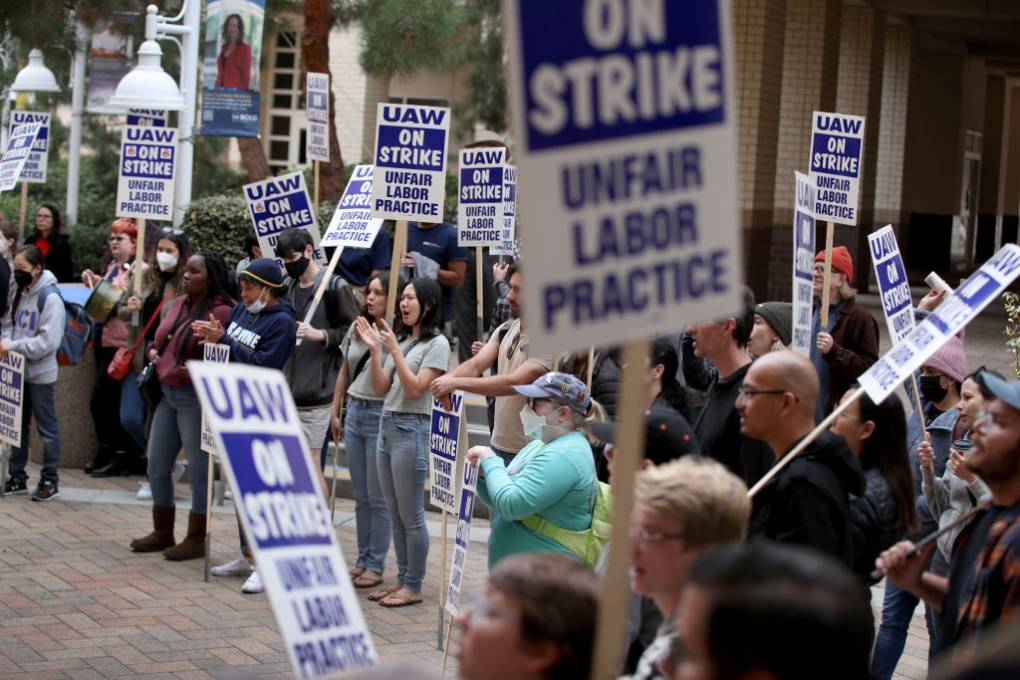
"caption": "University of California picketers protest at University of California, Irvine, on Dec. 6, 2022. Strikers consist of members of the United Auto Workers (UAW). It's finals week for UC students and tens of thousands of academic workers remain on strike, putting a huge wrench in how finals are administered, how undergraduates prepare for finals and when, how and whether grades are submitted. Some faculty are standing in solidarity with striking workers and refusing to submit grades until an agreement is reached.",
"description": null,
"title": "UC strike",
"credit": "Allen J. Schaben/Los Angeles Times via Getty Images",
"status": "inherit",
"altTag": "Striking students on campus holding signs and banners supporting the strike.",
"isLoading": false,
"fetchFailed": false
},
"news_11933519": {
"type": "attachments",
"id": "news_11933519",
"meta": {
"index": "attachments_1716263798",
"site": "news",
"id": "11933519",
"found": true
},
"parent": 11933511,
"imgSizes": {
"twentyfourteen-full-width": {
"file": "https://ww2.kqed.org/app/uploads/sites/10/2022/11/GettyImages-1430813255-1038x576.jpg",
"width": 1038,
"mimeType": "image/jpeg",
"height": 576
},
"thumbnail": {
"file": "https://ww2.kqed.org/app/uploads/sites/10/2022/11/GettyImages-1430813255-160x107.jpg",
"width": 160,
"mimeType": "image/jpeg",
"height": 107
},
"post-thumbnail": {
"file": "https://ww2.kqed.org/app/uploads/sites/10/2022/11/GettyImages-1430813255-672x372.jpg",
"width": 672,
"mimeType": "image/jpeg",
"height": 372
},
"kqedFullSize": {
"file": "https://ww2.kqed.org/app/uploads/sites/10/2022/11/GettyImages-1430813255.jpg",
"width": 2120,
"height": 1414
},
"2048x2048": {
"file": "https://ww2.kqed.org/app/uploads/sites/10/2022/11/GettyImages-1430813255-2048x1366.jpg",
"width": 2048,
"mimeType": "image/jpeg",
"height": 1366
},
"large": {
"file": "https://ww2.kqed.org/app/uploads/sites/10/2022/11/GettyImages-1430813255-1020x680.jpg",
"width": 1020,
"mimeType": "image/jpeg",
"height": 680
},
"1536x1536": {
"file": "https://ww2.kqed.org/app/uploads/sites/10/2022/11/GettyImages-1430813255-1536x1024.jpg",
"width": 1536,
"mimeType": "image/jpeg",
"height": 1024
},
"full-width": {
"file": "https://ww2.kqed.org/app/uploads/sites/10/2022/11/GettyImages-1430813255-1920x1281.jpg",
"width": 1920,
"mimeType": "image/jpeg",
"height": 1281
},
"medium": {
"file": "https://ww2.kqed.org/app/uploads/sites/10/2022/11/GettyImages-1430813255-800x534.jpg",
"width": 800,
"mimeType": "image/jpeg",
"height": 534
}
},
"publishDate": 1669767119,
"modified": 1669767251,
"caption": null,
"description": null,
"title": "An Unrecognizable Businesswoman Working On Her Computer",
"credit": "FreshSplash via Getty Images",
"status": "inherit",
"altTag": "A woman scrolling on her laptop with a coffee mug next to her..",
"isLoading": false,
"fetchFailed": false
},
"news_11933319": {
"type": "attachments",
"id": "news_11933319",
"meta": {
"index": "attachments_1716263798",
"site": "news",
"id": "11933319",
"found": true
},
"parent": 11933284,
"imgSizes": {
"twentyfourteen-full-width": {
"file": "https://ww2.kqed.org/app/uploads/sites/10/2022/11/GettyImages-1244836327-1024x576.jpg",
"width": 1024,
"mimeType": "image/jpeg",
"height": 576
},
"thumbnail": {
"file": "https://ww2.kqed.org/app/uploads/sites/10/2022/11/GettyImages-1244836327-160x107.jpg",
"width": 160,
"mimeType": "image/jpeg",
"height": 107
},
"post-thumbnail": {
"file": "https://ww2.kqed.org/app/uploads/sites/10/2022/11/GettyImages-1244836327-672x372.jpg",
"width": 672,
"mimeType": "image/jpeg",
"height": 372
},
"kqedFullSize": {
"file": "https://ww2.kqed.org/app/uploads/sites/10/2022/11/GettyImages-1244836327.jpg",
"width": 1024,
"height": 683
},
"large": {
"file": "https://ww2.kqed.org/app/uploads/sites/10/2022/11/GettyImages-1244836327-1020x680.jpg",
"width": 1020,
"mimeType": "image/jpeg",
"height": 680
},
"medium": {
"file": "https://ww2.kqed.org/app/uploads/sites/10/2022/11/GettyImages-1244836327-800x534.jpg",
"width": 800,
"mimeType": "image/jpeg",
"height": 534
}
},
"publishDate": 1669671157,
"modified": 1669686604,
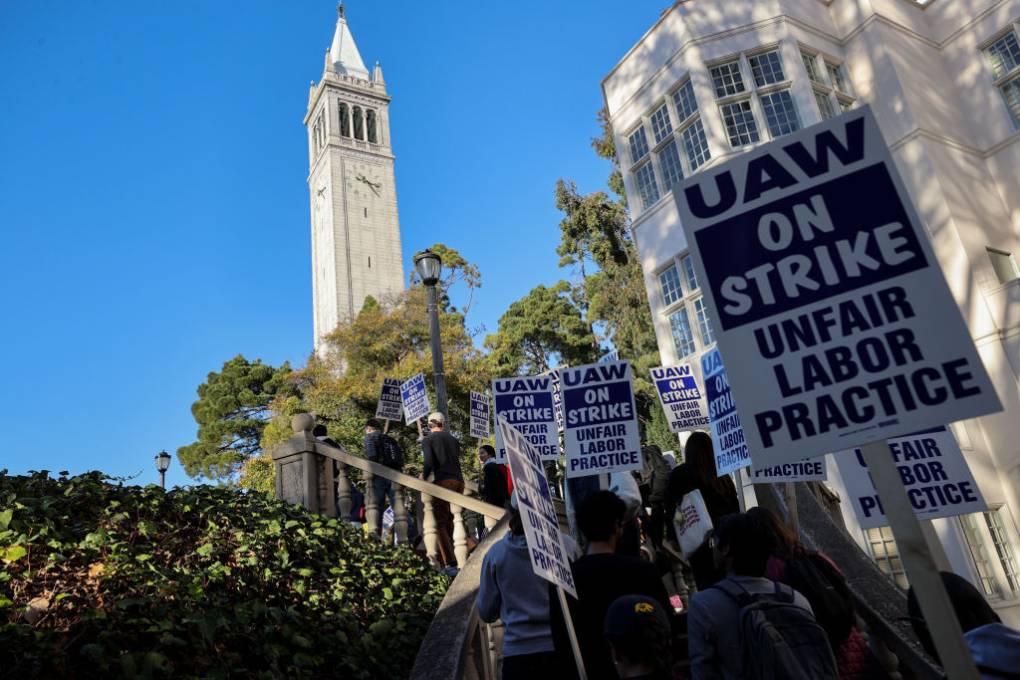
"caption": "Academic workers strike at UC Berkeley on Nov. 16, 2022. Nearly 48,000 unionized academic workers across the University of California's 10 campuses who perform much of the teaching and research at the state's premier higher-education system walked off the job on Nov. 14, calling for better pay and benefits.",
"description": null,
"title": "Academic workers strike for better pay and benefits at UC Berkeley",
"credit": "Tayfun Coskun/Anadolu Agency via Getty Images",
"status": "inherit",
"altTag": "a sign that reads 'UAW On Strike, Unfair Labor Practices' is held during a strike in front of UC Berkeley's campanile tower",
"isLoading": false,
"fetchFailed": false
},
"news_11932765": {
"type": "attachments",
"id": "news_11932765",
"meta": {
"index": "attachments_1716263798",
"site": "news",
"id": "11932765",
"found": true
},
"parent": 11932758,
"imgSizes": {
"twentyfourteen-full-width": {
"file": "https://ww2.kqed.org/app/uploads/sites/10/2022/11/RS59415_DSC03393-qut-1-1038x576.jpg",
"width": 1038,
"mimeType": "image/jpeg",
"height": 576
},
"thumbnail": {
"file": "https://ww2.kqed.org/app/uploads/sites/10/2022/11/RS59415_DSC03393-qut-1-160x107.jpg",
"width": 160,
"mimeType": "image/jpeg",
"height": 107
},
"post-thumbnail": {
"file": "https://ww2.kqed.org/app/uploads/sites/10/2022/11/RS59415_DSC03393-qut-1-672x372.jpg",
"width": 672,
"mimeType": "image/jpeg",
"height": 372
},
"kqedFullSize": {
"file": "https://ww2.kqed.org/app/uploads/sites/10/2022/11/RS59415_DSC03393-qut-1.jpg",
"width": 1920,
"height": 1280
},
"large": {
"file": "https://ww2.kqed.org/app/uploads/sites/10/2022/11/RS59415_DSC03393-qut-1-1020x680.jpg",
"width": 1020,
"mimeType": "image/jpeg",
"height": 680
},
"1536x1536": {
"file": "https://ww2.kqed.org/app/uploads/sites/10/2022/11/RS59415_DSC03393-qut-1-1536x1024.jpg",
"width": 1536,
"mimeType": "image/jpeg",
"height": 1024
},
"medium": {
"file": "https://ww2.kqed.org/app/uploads/sites/10/2022/11/RS59415_DSC03393-qut-1-800x533.jpg",
"width": 800,
"mimeType": "image/jpeg",
"height": 533
}
},
"publishDate": 1668818260,
"modified": 1669075837,
"caption": "A pedestrian walks into the Elihu M. Harris state building in Oakland, where Cal/OSHA's district offices are located, on Oct. 13, 2022. Only 21 inspectors at the agency were certified in a second language, including just one who speaks Cantonese and another who speaks Vietnamese.",
"description": null,
"title": "RS59415_DSC03393-qut (1)",
"credit": "Aryk Copley/KQED",
"status": "inherit",
"altTag": "Outside view of the entrance of a State of California office building.",
"isLoading": false,
"fetchFailed": false
},
"news_11932772": {
"type": "attachments",
"id": "news_11932772",
"meta": {
"index": "attachments_1716263798",
"site": "news",
"id": "11932772",
"found": true
},
"parent": 11932746,
"imgSizes": {
"twentyfourteen-full-width": {
"file": "https://ww2.kqed.org/app/uploads/sites/10/2022/11/GettyImages-1244836347-1024x576.jpg",
"width": 1024,
"mimeType": "image/jpeg",
"height": 576
},
"thumbnail": {
"file": "https://ww2.kqed.org/app/uploads/sites/10/2022/11/GettyImages-1244836347-160x107.jpg",
"width": 160,
"mimeType": "image/jpeg",
"height": 107
},
"post-thumbnail": {
"file": "https://ww2.kqed.org/app/uploads/sites/10/2022/11/GettyImages-1244836347-672x372.jpg",
"width": 672,
"mimeType": "image/jpeg",
"height": 372
},
"kqedFullSize": {
"file": "https://ww2.kqed.org/app/uploads/sites/10/2022/11/GettyImages-1244836347.jpg",
"width": 1024,
"height": 683
},
"large": {
"file": "https://ww2.kqed.org/app/uploads/sites/10/2022/11/GettyImages-1244836347-1020x680.jpg",
"width": 1020,
"mimeType": "image/jpeg",
"height": 680
},
"medium": {
"file": "https://ww2.kqed.org/app/uploads/sites/10/2022/11/GettyImages-1244836347-800x534.jpg",
"width": 800,
"mimeType": "image/jpeg",
"height": 534
}
},
"publishDate": 1668819376,
"modified": 1669899968,
"caption": null,
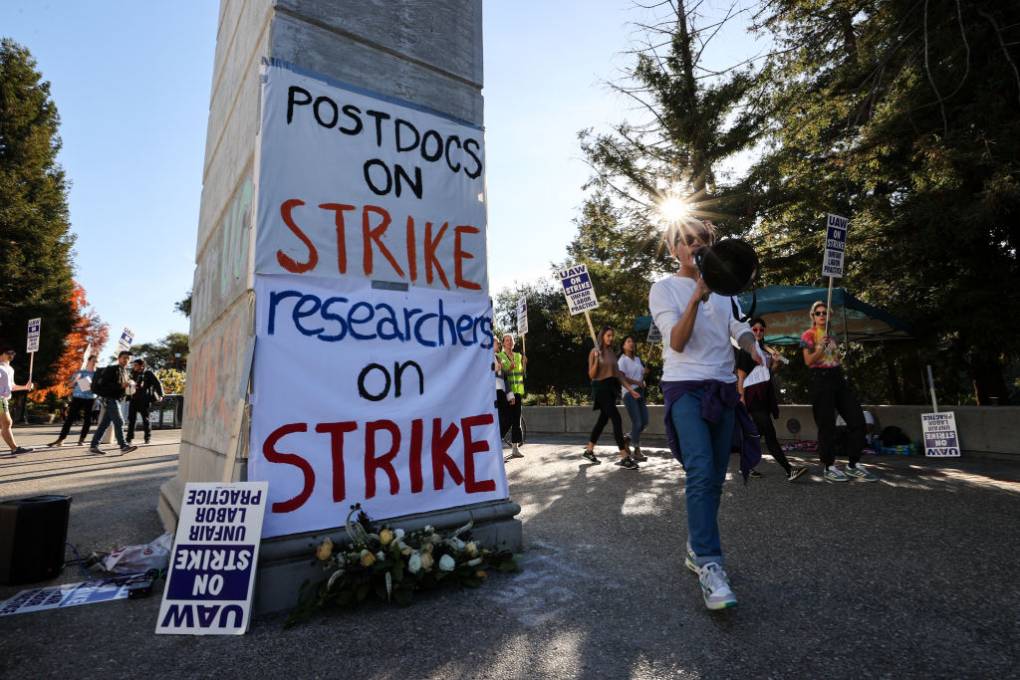
"description": "Academic workers strike at UC Berkeley on Nov. 16, 2022. About 48,000 unionized academic workers across the University of California's 10 campuses, who perform much of the teaching and research at the state's premier higher-education system, walked off the job Monday morning, Nov. 14, calling for better pay and benefits. (Tayfun Coskun/Anadolu Agency via Getty Images)",
"title": "Academic workers strike for better pay and benefits at UC Berkeley",
"credit": "Tayfun Coskun/Anadolu Agency via Getty Images",
"status": "inherit",
"altTag": "a person in jeans with a blowhorn stands in front of signs that say 'postdocs on strike' and 'researchers on strike' at a college campus",
"isLoading": false,
"fetchFailed": false
},
"news_11932720": {
"type": "attachments",
"id": "news_11932720",
"meta": {
"index": "attachments_1716263798",
"site": "news",
"id": "11932720",
"found": true
},
"parent": 11932703,
"imgSizes": {
"twentyfourteen-full-width": {
"file": "https://ww2.kqed.org/app/uploads/sites/10/2022/11/GettyImages-450371259-1024x576.jpg",
"width": 1024,
"mimeType": "image/jpeg",
"height": 576
},
"thumbnail": {
"file": "https://ww2.kqed.org/app/uploads/sites/10/2022/11/GettyImages-450371259-160x107.jpg",
"width": 160,
"mimeType": "image/jpeg",
"height": 107
},
"post-thumbnail": {
"file": "https://ww2.kqed.org/app/uploads/sites/10/2022/11/GettyImages-450371259-672x372.jpg",
"width": 672,
"mimeType": "image/jpeg",
"height": 372
},
"kqedFullSize": {
"file": "https://ww2.kqed.org/app/uploads/sites/10/2022/11/GettyImages-450371259.jpg",
"width": 1024,
"height": 686
},
"large": {
"file": "https://ww2.kqed.org/app/uploads/sites/10/2022/11/GettyImages-450371259-1020x683.jpg",
"width": 1020,
"mimeType": "image/jpeg",
"height": 683
},
"medium": {
"file": "https://ww2.kqed.org/app/uploads/sites/10/2022/11/GettyImages-450371259-800x536.jpg",
"width": 800,
"mimeType": "image/jpeg",
"height": 536
}
},
"publishDate": 1668804101,
"modified": 1668811846,
"caption": "An immigrant detainee makes a call from his 'segregation cell' at the Adelanto ICE Processing Center, which is owned and operated by The GEO Group. Detainees have been striking for several months at two other for-profit detention centers owned by the company, and some say they've been retaliated against with solitary confinement.",
"description": null,
"title": "ICE Holds Immigrants At Adelanto Detention Facility",
"credit": "John Moore/Getty Images",
"status": "inherit",
"altTag": "a hand reaches out of a solitary confinement cell to hold a black telephone",
"isLoading": false,
"fetchFailed": false
},
"news_11932636": {
"type": "attachments",
"id": "news_11932636",
"meta": {
"index": "attachments_1716263798",
"site": "news",
"id": "11932636",
"found": true
},
"parent": 11932633,
"imgSizes": {
"twentyfourteen-full-width": {
"file": "https://ww2.kqed.org/app/uploads/sites/10/2022/11/RS60149_018_KQED_UCStrike_11152022-qut-1038x576.jpg",
"width": 1038,
"mimeType": "image/jpeg",
"height": 576
},
"thumbnail": {
"file": "https://ww2.kqed.org/app/uploads/sites/10/2022/11/RS60149_018_KQED_UCStrike_11152022-qut-160x107.jpg",
"width": 160,
"mimeType": "image/jpeg",
"height": 107
},
"post-thumbnail": {
"file": "https://ww2.kqed.org/app/uploads/sites/10/2022/11/RS60149_018_KQED_UCStrike_11152022-qut-672x372.jpg",
"width": 672,
"mimeType": "image/jpeg",
"height": 372
},
"kqedFullSize": {
"file": "https://ww2.kqed.org/app/uploads/sites/10/2022/11/RS60149_018_KQED_UCStrike_11152022-qut.jpg",
"width": 1920,
"height": 1280
},
"large": {
"file": "https://ww2.kqed.org/app/uploads/sites/10/2022/11/RS60149_018_KQED_UCStrike_11152022-qut-1020x680.jpg",
"width": 1020,
"mimeType": "image/jpeg",
"height": 680
},
"1536x1536": {
"file": "https://ww2.kqed.org/app/uploads/sites/10/2022/11/RS60149_018_KQED_UCStrike_11152022-qut-1536x1024.jpg",
"width": 1536,
"mimeType": "image/jpeg",
"height": 1024
},
"medium": {
"file": "https://ww2.kqed.org/app/uploads/sites/10/2022/11/RS60149_018_KQED_UCStrike_11152022-qut-800x533.jpg",
"width": 800,
"mimeType": "image/jpeg",
"height": 533
}
},
"publishDate": 1668729173,
"modified": 1668729187,
"caption": "Staff members demonstrate at the UCSF Mission Bay campus on Nov. 15, 2022, during a strike among some 48,000 academic workers across all 10 University of California campuses.",
"description": null,
"title": "RS60149_018_KQED_UCStrike_11152022-qut",
"credit": "KQED / Beth LaBerge",
"status": "inherit",
"altTag": null,
"isLoading": false,
"fetchFailed": false
},
"news_11932491": {
"type": "attachments",
"id": "news_11932491",
"meta": {
"index": "attachments_1716263798",
"site": "news",
"id": "11932491",
"found": true
},
"parent": 11932471,
"imgSizes": {
"twentyfourteen-full-width": {
"file": "https://ww2.kqed.org/app/uploads/sites/10/2022/11/Screen-Shot-2022-11-16-at-2.44.42-PM-1038x576.png",
"width": 1038,
"mimeType": "image/png",
"height": 576
},
"thumbnail": {
"file": "https://ww2.kqed.org/app/uploads/sites/10/2022/11/Screen-Shot-2022-11-16-at-2.44.42-PM-160x99.png",
"width": 160,
"mimeType": "image/png",
"height": 99
},
"post-thumbnail": {
"file": "https://ww2.kqed.org/app/uploads/sites/10/2022/11/Screen-Shot-2022-11-16-at-2.44.42-PM-672x372.png",
"width": 672,
"mimeType": "image/png",
"height": 372
},
"kqedFullSize": {
"file": "https://ww2.kqed.org/app/uploads/sites/10/2022/11/Screen-Shot-2022-11-16-at-2.44.42-PM.png",
"width": 1176,
"height": 726
},
"large": {
"file": "https://ww2.kqed.org/app/uploads/sites/10/2022/11/Screen-Shot-2022-11-16-at-2.44.42-PM-1020x630.png",
"width": 1020,
"mimeType": "image/png",
"height": 630
},
"medium": {
"file": "https://ww2.kqed.org/app/uploads/sites/10/2022/11/Screen-Shot-2022-11-16-at-2.44.42-PM-800x494.png",
"width": 800,
"mimeType": "image/png",
"height": 494
}
},
"publishDate": 1668645020,
"modified": 1668645150,
"caption": "Workers form a picket line at UC Berkeley on Nov. 15, 2022.",
"description": null,
"title": "Screen Shot 2022-11-16 at 2.44.42 PM",
"credit": "Andrew Reed/EdSource",
"status": "inherit",
"altTag": null,
"isLoading": false,
"fetchFailed": false
},
"news_11932196": {
"type": "attachments",
"id": "news_11932196",
"meta": {
"index": "attachments_1716263798",
"site": "news",
"id": "11932196",
"found": true
},
"parent": 11932147,
"imgSizes": {
"twentyfourteen-full-width": {
"file": "https://ww2.kqed.org/app/uploads/sites/10/2022/11/UC-featured-1038x576.jpg",
"width": 1038,
"mimeType": "image/jpeg",
"height": 576
},
"thumbnail": {
"file": "https://ww2.kqed.org/app/uploads/sites/10/2022/11/UC-featured-160x103.jpg",
"width": 160,
"mimeType": "image/jpeg",
"height": 103
},
"post-thumbnail": {
"file": "https://ww2.kqed.org/app/uploads/sites/10/2022/11/UC-featured-672x372.jpg",
"width": 672,
"mimeType": "image/jpeg",
"height": 372
},
"kqedFullSize": {
"file": "https://ww2.kqed.org/app/uploads/sites/10/2022/11/UC-featured.jpg",
"width": 1920,
"height": 1240
},
"large": {
"file": "https://ww2.kqed.org/app/uploads/sites/10/2022/11/UC-featured-1020x659.jpg",
"width": 1020,
"mimeType": "image/jpeg",
"height": 659
},
"1536x1536": {
"file": "https://ww2.kqed.org/app/uploads/sites/10/2022/11/UC-featured-1536x992.jpg",
"width": 1536,
"mimeType": "image/jpeg",
"height": 992
},
"medium": {
"file": "https://ww2.kqed.org/app/uploads/sites/10/2022/11/UC-featured-800x517.jpg",
"width": 800,
"mimeType": "image/jpeg",
"height": 517
}
},
"publishDate": 1668458351,
"modified": 1668458863,
"caption": "Hundreds of staff members at UC Berkeley demonstrate on Monday morning, the first day of a massive strike among some 48,000 academic workers across all 10 University of California campuses.",
"description": null,
"title": "UC-featured",
"credit": "Jean Zamora/UC Berkeley",
"status": "inherit",
"altTag": "A large crowd of people stand outside on a college campus holding signs that say 'UAW on Strike Unfair Labor Practice.'",
"isLoading": false,
"fetchFailed": false
},
"news_11930086": {
"type": "attachments",
"id": "news_11930086",
"meta": {
"index": "attachments_1716263798",
"site": "news",
"id": "11930086",
"found": true
},
"parent": 11930085,
"imgSizes": {
"twentyfourteen-full-width": {
"file": "https://ww2.kqed.org/app/uploads/sites/10/2022/10/102122-Wage-Theft-Prosecutions-CM-1038x576.jpg",
"width": 1038,
"mimeType": "image/jpeg",
"height": 576
},
"thumbnail": {
"file": "https://ww2.kqed.org/app/uploads/sites/10/2022/10/102122-Wage-Theft-Prosecutions-CM-160x107.jpg",
"width": 160,
"mimeType": "image/jpeg",
"height": 107
},
"post-thumbnail": {
"file": "https://ww2.kqed.org/app/uploads/sites/10/2022/10/102122-Wage-Theft-Prosecutions-CM-672x372.jpg",
"width": 672,
"mimeType": "image/jpeg",
"height": 372
},
"kqedFullSize": {
"file": "https://ww2.kqed.org/app/uploads/sites/10/2022/10/102122-Wage-Theft-Prosecutions-CM.jpg",
"width": 2000,
"height": 1333
},
"large": {
"file": "https://ww2.kqed.org/app/uploads/sites/10/2022/10/102122-Wage-Theft-Prosecutions-CM-1020x680.jpg",
"width": 1020,
"mimeType": "image/jpeg",
"height": 680
},
"1536x1536": {
"file": "https://ww2.kqed.org/app/uploads/sites/10/2022/10/102122-Wage-Theft-Prosecutions-CM-1536x1024.jpg",
"width": 1536,
"mimeType": "image/jpeg",
"height": 1024
},
"full-width": {
"file": "https://ww2.kqed.org/app/uploads/sites/10/2022/10/102122-Wage-Theft-Prosecutions-CM-1920x1280.jpg",
"width": 1920,
"mimeType": "image/jpeg",
"height": 1280
},
"medium": {
"file": "https://ww2.kqed.org/app/uploads/sites/10/2022/10/102122-Wage-Theft-Prosecutions-CM-800x533.jpg",
"width": 800,
"mimeType": "image/jpeg",
"height": 533
}
},
"publishDate": 1666716516,
"modified": 1666728475,
"caption": "A new felony law could help prosecutors in California pursue legal action against employers committing wage theft.",
"description": null,
"title": "102122-Wage-Theft-Prosecutions-CM",
"credit": "Illustration by Miguel Gutierrez Jr./CalMatters/iStock",
"status": "inherit",
"altTag": "an illustration of a statue and wage workers",
"isLoading": false,
"fetchFailed": false
},
"news_11930035": {
"type": "attachments",
"id": "news_11930035",
"meta": {
"index": "attachments_1716263798",
"site": "news",
"id": "11930035",
"found": true
},
"parent": 11929860,
"imgSizes": {
"twentyfourteen-full-width": {
"file": "https://ww2.kqed.org/app/uploads/sites/10/2022/10/RS59623_003_KQED_SutterRNStrikeBerkeley_10242022-qut-1038x576.jpg",
"width": 1038,
"mimeType": "image/jpeg",
"height": 576
},
"thumbnail": {
"file": "https://ww2.kqed.org/app/uploads/sites/10/2022/10/RS59623_003_KQED_SutterRNStrikeBerkeley_10242022-qut-160x107.jpg",
"width": 160,
"mimeType": "image/jpeg",
"height": 107
},
"post-thumbnail": {
"file": "https://ww2.kqed.org/app/uploads/sites/10/2022/10/RS59623_003_KQED_SutterRNStrikeBerkeley_10242022-qut-672x372.jpg",
"width": 672,
"mimeType": "image/jpeg",
"height": 372
},
"kqedFullSize": {
"file": "https://ww2.kqed.org/app/uploads/sites/10/2022/10/RS59623_003_KQED_SutterRNStrikeBerkeley_10242022-qut.jpg",
"width": 1920,
"height": 1280
},
"large": {
"file": "https://ww2.kqed.org/app/uploads/sites/10/2022/10/RS59623_003_KQED_SutterRNStrikeBerkeley_10242022-qut-1020x680.jpg",
"width": 1020,
"mimeType": "image/jpeg",
"height": 680
},
"1536x1536": {
"file": "https://ww2.kqed.org/app/uploads/sites/10/2022/10/RS59623_003_KQED_SutterRNStrikeBerkeley_10242022-qut-1536x1024.jpg",
"width": 1536,
"mimeType": "image/jpeg",
"height": 1024
},
"medium": {
"file": "https://ww2.kqed.org/app/uploads/sites/10/2022/10/RS59623_003_KQED_SutterRNStrikeBerkeley_10242022-qut-800x533.jpg",
"width": 800,
"mimeType": "image/jpeg",
"height": 533
}
},
"publishDate": 1666654426,
"modified": 1666656880,
"caption": "Nurses begin a five-day strike at Alta Bates Summit Medical Center in Berkeley on Oct. 24, 2022.",
"description": null,
"title": "RS59623_003_KQED_SutterRNStrikeBerkeley_10242022-qut",
"credit": "Beth LaBerge/KQED",
"status": "inherit",
"altTag": "People holding yellow and red signs and wearing red nurse outfits stand outside.",
"isLoading": false,
"fetchFailed": false
},
"news_11929741": {
"type": "attachments",
"id": "news_11929741",
"meta": {
"index": "attachments_1716263798",
"site": "news",
"id": "11929741",
"found": true
},
"parent": 11929713,
"imgSizes": {
"twentyfourteen-full-width": {
"file": "https://ww2.kqed.org/app/uploads/sites/10/2022/10/RS57909_042_KQED_KaiserStrikeOakland_08192022-qut-1038x576.jpg",
"width": 1038,
"mimeType": "image/jpeg",
"height": 576
},
"thumbnail": {
"file": "https://ww2.kqed.org/app/uploads/sites/10/2022/10/RS57909_042_KQED_KaiserStrikeOakland_08192022-qut-160x107.jpg",
"width": 160,
"mimeType": "image/jpeg",
"height": 107
},
"post-thumbnail": {
"file": "https://ww2.kqed.org/app/uploads/sites/10/2022/10/RS57909_042_KQED_KaiserStrikeOakland_08192022-qut-672x372.jpg",
"width": 672,
"mimeType": "image/jpeg",
"height": 372
},
"kqedFullSize": {
"file": "https://ww2.kqed.org/app/uploads/sites/10/2022/10/RS57909_042_KQED_KaiserStrikeOakland_08192022-qut.jpg",
"width": 1920,
"height": 1280
},
"large": {
"file": "https://ww2.kqed.org/app/uploads/sites/10/2022/10/RS57909_042_KQED_KaiserStrikeOakland_08192022-qut-1020x680.jpg",
"width": 1020,
"mimeType": "image/jpeg",
"height": 680
},
"1536x1536": {
"file": "https://ww2.kqed.org/app/uploads/sites/10/2022/10/RS57909_042_KQED_KaiserStrikeOakland_08192022-qut-1536x1024.jpg",
"width": 1536,
"mimeType": "image/jpeg",
"height": 1024
},
"medium": {
"file": "https://ww2.kqed.org/app/uploads/sites/10/2022/10/RS57909_042_KQED_KaiserStrikeOakland_08192022-qut-800x533.jpg",
"width": 800,
"mimeType": "image/jpeg",
"height": 533
}
},
"publishDate": 1666321010,
"modified": 1666372464,
"caption": "Kaiser Permanente mental health care workers and supporters march from the health care giant's Oakland medical center to its corporate headquarters, on Aug. 19, 2022, the fifth day of a strike that ultimately dragged on for 10 weeks.",
"description": null,
"title": "RS57909_042_KQED_KaiserStrikeOakland_08192022-qut",
"credit": "Beth LaBerge/KQED",
"status": "inherit",
"altTag": "A person speaks into a bullhorn during a street protest.",
"isLoading": false,
"fetchFailed": false
}
},
"audioPlayerReducer": {
"postId": "stream_live",
"isPaused": true,
"isPlaying": false,
"pfsActive": false,
"pledgeModalIsOpen": true,
"playerDrawerIsOpen": false,
"liveAudioPlayStartedAt": 0,
"liveAudioPlayContext": ""
},
"authorsReducer": {
"byline_news_11934922": {
"type": "authors",
"id": "byline_news_11934922",
"meta": {
"override": true
},
"slug": "byline_news_11934922",
"name": "\u003ca href=\"https://twitter.com/olgarrod\">Olga R. Rodriguez\u003c/a>\u003cbr>The Associated Press",
"isLoading": false
},
"byline_news_11932471": {
"type": "authors",
"id": "byline_news_11932471",
"meta": {
"override": true
},
"slug": "byline_news_11932471",
"name": "\u003ca href=\"https://edsource.org/author/bmarquez\">Betty Marquez Rosales\u003c/a>",
"isLoading": false
},
"byline_news_11930085": {
"type": "authors",
"id": "byline_news_11930085",
"meta": {
"override": true
},
"slug": "byline_news_11930085",
"name": "\u003ca href=\"https://calmatters.org/author/jeanne-kuang/\">Jeanne Kuang\u003c/a> and \u003ca href=\"https://calmatters.org/author/lil-kalish/\">Lil Kalish\u003c/a>",
"isLoading": false
},
"kqed": {
"type": "authors",
"id": "236",
"meta": {
"index": "authors_1716337520",
"id": "236",
"found": true
},
"name": "KQED News Staff",
"firstName": "KQED News Staff",
"lastName": null,
"slug": "kqed",
"email": "faq@kqed.org",
"display_author_email": false,
"staff_mastheads": [],
"title": null,
"bio": null,
"avatar": "https://secure.gravatar.com/avatar/ef0e801a68c4c54afa9180db14084167?s=600&d=blank&r=g",
"twitter": null,
"facebook": null,
"instagram": null,
"linkedin": null,
"sites": [
{
"site": "arts",
"roles": [
"contributor"
]
},
{
"site": "news",
"roles": [
"editor"
]
},
{
"site": "futureofyou",
"roles": [
"author"
]
}
],
"headData": {
"title": "KQED News Staff | KQED",
"description": null,
"ogImgSrc": "https://secure.gravatar.com/avatar/ef0e801a68c4c54afa9180db14084167?s=600&d=blank&r=g",
"twImgSrc": "https://secure.gravatar.com/avatar/ef0e801a68c4c54afa9180db14084167?s=600&d=blank&r=g"
},
"isLoading": false,
"link": "/author/kqed"
},
"rachael-myrow": {
"type": "authors",
"id": "251",
"meta": {
"index": "authors_1716337520",
"id": "251",
"found": true
},
"name": "Rachael Myrow",
"firstName": "Rachael",
"lastName": "Myrow",
"slug": "rachael-myrow",
"email": "rmyrow@kqed.org",
"display_author_email": true,
"staff_mastheads": [
"news"
],
"title": "Senior Editor of KQED's Silicon Valley News Desk",
"bio": "• I write and edit stories about how Silicon Valley power and policies shape everyday life in California. I’m also passionate about making Bay Area history and culture more accessible to a broad public. • I’ve been a journalist for most of my life, starting in high school with The Franklin Press in Los Angeles, where I grew up. While earning my first degree in English at UC Berkeley, I got my start in public radio at KALX-FM. After completing a second degree in journalism at Cal, I landed my first professional job at Marketplace, then moved on to KPCC (now LAist), and then KQED, where I hosted The California Report for more than seven years. • My reporting has appeared on NPR, The World, WBUR’s \u003ci>Here & Now\u003c/i>, and the BBC. I also guest host for KQED’s \u003ci>Forum\u003c/i>, as well as the Commonwealth Club in San Francisco. • I speak periodically on media, democracy and technology issues, and do voiceover work for documentaries and educational video projects. • Outside of the studio, you'll find me hiking Bay Area trails and whipping up Insta-ready meals in my kitchen. • I do not accept gifts, money, or favors from anyone connected to my reporting, I don't pay people for information, and I do not support or donate to political causes. • I strive to treat the people I report on with fairness, honesty, and respect. I also recognize there are often multiple sides to a story and work to verify information through multiple sources and documentation. If I get something wrong, I correct it.",
"avatar": "https://secure.gravatar.com/avatar/3ed8a3c5f26025e4a805ba634cda8cd764906b97438a6d9ce216b044e340da4e?s=600&d=blank&r=g",
"twitter": "rachaelmyrow",
"bluesky": null,
"facebook": null,
"instagram": null,
"linkedin": "https://www.linkedin.com/in/rachaelmyrow/",
"sites": [
{
"site": "arts",
"roles": [
"administrator"
]
},
{
"site": "news",
"roles": [
"edit_others_posts",
"editor"
]
},
{
"site": "futureofyou",
"roles": [
"editor"
]
},
{
"site": "bayareabites",
"roles": [
"editor"
]
},
{
"site": "stateofhealth",
"roles": [
"editor"
]
},
{
"site": "science",
"roles": [
"editor"
]
},
{
"site": "food",
"roles": [
"editor"
]
},
{
"site": "forum",
"roles": [
"editor"
]
},
{
"site": "liveblog",
"roles": [
"author"
]
}
],
"headData": {
"title": "Rachael Myrow | KQED",
"description": "Senior Editor of KQED's Silicon Valley News Desk",
"ogImgSrc": "https://secure.gravatar.com/avatar/3ed8a3c5f26025e4a805ba634cda8cd764906b97438a6d9ce216b044e340da4e?s=600&d=blank&r=g",
"twImgSrc": "https://secure.gravatar.com/avatar/3ed8a3c5f26025e4a805ba634cda8cd764906b97438a6d9ce216b044e340da4e?s=600&d=blank&r=g"
},
"isLoading": false,
"link": "/author/rachael-myrow"
},
"tarasiler": {
"type": "authors",
"id": "257",
"meta": {
"index": "authors_1716337520",
"id": "257",
"found": true
},
"name": "Tara Siler",
"firstName": "Tara",
"lastName": "Siler",
"slug": "tarasiler",
"email": "tsiler@kqed.org",
"display_author_email": false,
"staff_mastheads": [
"news"
],
"title": "KQED Contributor",
"bio": "Tara reports and anchors for KQED news. She covers a range of issues from community-police relations to local politics. Tara started out in community radio in the Bay Area, where she was raised. She eventually moved to Washington DC where she covered Congress for eight years for Pacifica and Monitor Radio. Her stories have also been heard on NPR's All Things Considered, Morning Edition and The World.\r\n\r\nTara lives with her husband in Oakland-- where they raised their two sons. She enjoys spending time with her family, gardening and hiking in the Oakland hills... and keeping up with the news.",
"avatar": "https://secure.gravatar.com/avatar/99802f9746fb80b65fd8ec6c57954450?s=600&d=blank&r=g",
"twitter": null,
"facebook": null,
"instagram": null,
"linkedin": null,
"sites": [
{
"site": "news",
"roles": [
"contributor",
"edit_others_posts"
]
},
{
"site": "stateofhealth",
"roles": [
"author"
]
}
],
"headData": {
"title": "Tara Siler | KQED",
"description": "KQED Contributor",
"ogImgSrc": "https://secure.gravatar.com/avatar/99802f9746fb80b65fd8ec6c57954450?s=600&d=blank&r=g",
"twImgSrc": "https://secure.gravatar.com/avatar/99802f9746fb80b65fd8ec6c57954450?s=600&d=blank&r=g"
},
"isLoading": false,
"link": "/author/tarasiler"
},
"matthewgreen": {
"type": "authors",
"id": "1263",
"meta": {
"index": "authors_1716337520",
"id": "1263",
"found": true
},
"name": "Matthew Green",
"firstName": "Matthew",
"lastName": "Green",
"slug": "matthewgreen",
"email": "mgreen@kqed.org",
"display_author_email": false,
"staff_mastheads": [],
"title": "KQED Editor/Reporter",
"bio": "Matthew Green is a digital media producer for KQED News. He previously produced \u003ca href=\"http://www.kqed.org/lowdown\">The Lowdown\u003c/a>, KQED’s multimedia news education blog. Matthew's written for numerous Bay Area publications, including the Oakland Tribune and San Francisco Chronicle. He also taught journalism classes at Fremont High School in East Oakland.\r\n\r\nEmail: mgreen@kqed.org; Twitter: @MGreenKQED",
"avatar": "https://secure.gravatar.com/avatar/3bf498d1267ca02c8494f33d8cfc575e?s=600&d=blank&r=g",
"twitter": "MGreenKQED",
"facebook": null,
"instagram": null,
"linkedin": null,
"sites": [
{
"site": "news",
"roles": []
},
{
"site": "lowdown",
"roles": []
},
{
"site": "science",
"roles": []
},
{
"site": "education",
"roles": []
},
{
"site": "quest",
"roles": []
},
{
"site": "liveblog",
"roles": []
}
],
"headData": {
"title": "Matthew Green | KQED",
"description": "KQED Editor/Reporter",
"ogImgSrc": "https://secure.gravatar.com/avatar/3bf498d1267ca02c8494f33d8cfc575e?s=600&d=blank&r=g",
"twImgSrc": "https://secure.gravatar.com/avatar/3bf498d1267ca02c8494f33d8cfc575e?s=600&d=blank&r=g"
},
"isLoading": false,
"link": "/author/matthewgreen"
},
"esilvers": {
"type": "authors",
"id": "7237",
"meta": {
"index": "authors_1716337520",
"id": "7237",
"found": true
},
"name": "Emma Silvers",
"firstName": "Emma",
"lastName": "Silvers",
"slug": "esilvers",
"email": "esilvers@kqed.org",
"display_author_email": false,
"staff_mastheads": [],
"title": "KQED Contributor",
"bio": "Emma Silvers is an editor at KQED Arts and a former digital producer at KQED News. Born and raised in the Bay Area, she has previously been an arts and entertainment editor at the \u003cem>San Francisco Chronicle\u003c/em>, \u003cem>SF Weekly\u003c/em> and the \u003cem>San Francisco Bay Guardian.\u003c/em> \u003ca href=\"https://www.emmasilvers.com\">Her work\u003c/a> has also appeared in \u003cem>Rolling Stone\u003c/em>, Pitchfork and \u003cem>Mother Jones\u003c/em>. In 2017 she was the recipient of the Society of Professional Journalists-Northern California's award for arts and culture reporting. In 1993 she \u003ca href=\"https://www.kqed.org/pop/16759/wait-what-my-coworker-was-a-voice-over-hyperventilator-for-jurassic-park\">hyperventilated in \u003cem>Jurassic Park\u003c/em>\u003c/a>.",
"avatar": "https://secure.gravatar.com/avatar/247beada39b88ea5759db1f51dba05cf?s=600&d=blank&r=g",
"twitter": "emmaruthless",
"facebook": null,
"instagram": null,
"linkedin": null,
"sites": [
{
"site": "arts",
"roles": [
"editor"
]
},
{
"site": "news",
"roles": [
"editor"
]
},
{
"site": "pop",
"roles": [
"contributor"
]
},
{
"site": "bayareabites",
"roles": [
"editor"
]
},
{
"site": "food",
"roles": [
"contributor"
]
},
{
"site": "liveblog",
"roles": [
"editor"
]
}
],
"headData": {
"title": "Emma Silvers | KQED",
"description": "KQED Contributor",
"ogImgSrc": "https://secure.gravatar.com/avatar/247beada39b88ea5759db1f51dba05cf?s=600&d=blank&r=g",
"twImgSrc": "https://secure.gravatar.com/avatar/247beada39b88ea5759db1f51dba05cf?s=600&d=blank&r=g"
},
"isLoading": false,
"link": "/author/esilvers"
},
"ecruzguevarra": {
"type": "authors",
"id": "8654",
"meta": {
"index": "authors_1716337520",
"id": "8654",
"found": true
},
"name": "Ericka Cruz Guevarra",
"firstName": "Ericka",
"lastName": "Cruz Guevarra",
"slug": "ecruzguevarra",
"email": "ecruzguevarra@kqed.org",
"display_author_email": true,
"staff_mastheads": [
"news"
],
"title": "Producer, The Bay Podcast",
"bio": "Ericka Cruz Guevarra is host of \u003ca href=\"https://www.kqed.org/podcasts/thebay\">\u003cem>The Bay\u003c/em>\u003c/a> podcast at KQED. Before host, she was the show’s producer. Her work in that capacity includes a three-part reported series on policing in Vallejo, which won a 2020 excellence in journalism award from the Society of Professional Journalists. Ericka has worked as a breaking news reporter at Oregon Public Broadcasting, helped produce the Code Switch podcast, and was KQED’s inaugural Raul Ramirez Diversity Fund intern. She’s also an alumna of NPR’s Next Generation Radio program. Send her an email if you have strong feelings about whether Fairfield and Suisun City are the Bay. Ericka is represented by SAG-AFTRA.",
"avatar": "https://secure.gravatar.com/avatar/accefc1de4bafc7e234b69bcb9b6f6536c130fd84709bc3069ef11a78787e1bb?s=600&d=blank&r=g",
"twitter": "NotoriousECG",
"bluesky": null,
"facebook": null,
"instagram": null,
"linkedin": null,
"sites": [
{
"site": "arts",
"roles": [
"subscriber"
]
},
{
"site": "news",
"roles": [
"editor",
"manage_categories"
]
},
{
"site": "futureofyou",
"roles": [
"subscriber"
]
},
{
"site": "stateofhealth",
"roles": [
"subscriber"
]
},
{
"site": "science",
"roles": [
"editor"
]
},
{
"site": "forum",
"roles": [
"subscriber"
]
}
],
"headData": {
"title": "Ericka Cruz Guevarra | KQED",
"description": "Producer, The Bay Podcast",
"ogImgSrc": "https://secure.gravatar.com/avatar/accefc1de4bafc7e234b69bcb9b6f6536c130fd84709bc3069ef11a78787e1bb?s=600&d=blank&r=g",
"twImgSrc": "https://secure.gravatar.com/avatar/accefc1de4bafc7e234b69bcb9b6f6536c130fd84709bc3069ef11a78787e1bb?s=600&d=blank&r=g"
},
"isLoading": false,
"link": "/author/ecruzguevarra"
},
"fjhabvala": {
"type": "authors",
"id": "8659",
"meta": {
"index": "authors_1716337520",
"id": "8659",
"found": true
},
"name": "Farida Jhabvala Romero",
"firstName": "Farida",
"lastName": "Jhabvala Romero",
"slug": "fjhabvala",
"email": "fjhabvala@kqed.org",
"display_author_email": true,
"staff_mastheads": [
"news"
],
"title": "KQED Contributor",
"bio": "Farida Jhabvala Romero is a Labor Correspondent for KQED. She previously covered immigration. Farida was \u003ca href=\"https://www.ccnma.org/2022-most-influential-latina-journalists\">named\u003c/a> one of the 10 Most Influential Latina Journalists in California in 2022 by the California Chicano News Media Association. Her work has won awards from the Society of Professional Journalists (Northern California), as well as a national and regional Edward M. Murrow Award for the collaborative reporting projects “Dangerous Air” and “Graying California.” Before joining KQED, Farida worked as a producer at Radio Bilingüe, a national public radio network. Farida earned her master’s degree in journalism from Stanford University.",
"avatar": "https://secure.gravatar.com/avatar/f9f022d4e2609741874222a1e9d41f48fea74011aa7c615eef91d9a50c944ebe?s=600&d=blank&r=g",
"twitter": "FaridaJhabvala",
"bluesky": null,
"facebook": null,
"instagram": null,
"linkedin": "https://www.linkedin.com/in/faridajhabvala/",
"sites": [
{
"site": "news",
"roles": [
"editor"
]
},
{
"site": "stateofhealth",
"roles": [
"author"
]
},
{
"site": "liveblog",
"roles": [
"author"
]
}
],
"headData": {
"title": "Farida Jhabvala Romero | KQED",
"description": "KQED Contributor",
"ogImgSrc": "https://secure.gravatar.com/avatar/f9f022d4e2609741874222a1e9d41f48fea74011aa7c615eef91d9a50c944ebe?s=600&d=blank&r=g",
"twImgSrc": "https://secure.gravatar.com/avatar/f9f022d4e2609741874222a1e9d41f48fea74011aa7c615eef91d9a50c944ebe?s=600&d=blank&r=g"
},
"isLoading": false,
"link": "/author/fjhabvala"
},
"amontecillo": {
"type": "authors",
"id": "11649",
"meta": {
"index": "authors_1716337520",
"id": "11649",
"found": true
},
"name": "Alan Montecillo",
"firstName": "Alan",
"lastName": "Montecillo",
"slug": "amontecillo",
"email": "amontecillo@kqed.org",
"display_author_email": false,
"staff_mastheads": [
"news"
],
"title": "KQED Contributor",
"bio": "Alan Montecillo is the senior editor of \u003cem>\u003ca href=\"http://kqed.org/thebay\">The Bay\u003c/a>, \u003c/em> KQED's local news podcast. Before moving to the Bay Area, he worked as a senior talk show producer for WILL in Champaign-Urbana, Illinois and at Oregon Public Broadcasting in Portland, Oregon. He has won journalism awards from the Society of Professional Journalists Northern California, the Public Media Journalists Association, The Signal Awards, and has also received a regional Edward R. Murrow award. Alan is a Filipino American from Hong Kong and a graduate of Reed College.",
"avatar": "https://secure.gravatar.com/avatar/268f53a2066899ea9efdd8a5900218b17c822d9862cbc9326cccec53ef41d349?s=600&d=blank&r=g",
"twitter": "alanmontecillo",
"bluesky": null,
"facebook": null,
"instagram": null,
"linkedin": null,
"sites": [
{
"site": "",
"roles": [
"editor"
]
},
{
"site": "news",
"roles": [
"editor",
"manage_categories"
]
}
],
"headData": {
"title": "Alan Montecillo | KQED",
"description": "KQED Contributor",
"ogImgSrc": "https://secure.gravatar.com/avatar/268f53a2066899ea9efdd8a5900218b17c822d9862cbc9326cccec53ef41d349?s=600&d=blank&r=g",
"twImgSrc": "https://secure.gravatar.com/avatar/268f53a2066899ea9efdd8a5900218b17c822d9862cbc9326cccec53ef41d349?s=600&d=blank&r=g"
},
"isLoading": false,
"link": "/author/amontecillo"
},
"swhitney": {
"type": "authors",
"id": "11784",
"meta": {
"index": "authors_1716337520",
"id": "11784",
"found": true
},
"name": "Spencer Whitney",
"firstName": "Spencer",
"lastName": "Whitney",
"slug": "swhitney",
"email": "swhitney@kqed.org",
"display_author_email": false,
"staff_mastheads": [],
"title": "KQED Digital Editor",
"bio": "Spencer Whitney is currently a Digital Editor for KQED News. Prior to joining KQED News, Spencer worked as the Multimedia Editor at the Oakland Post and an Assistant Editor in the Editorial department at the San Francisco Chronicle. He attended Howard University as an undergraduate and interned with SiriusXM. He also attended UC Berkeley's Graduate School of Journalism and had the opportunity to write for the hyperlocal news sites Richmond Confidential and Oakland North.",
"avatar": "https://secure.gravatar.com/avatar/e33ff4fd8b8f0d2796f36472fb32607ca8fc46ef5e537dcfdbdee688d8ea5b80?s=600&d=mm&r=g",
"twitter": null,
"bluesky": null,
"facebook": null,
"instagram": null,
"linkedin": null,
"sites": [
{
"site": "arts",
"roles": [
"editor"
]
},
{
"site": "news",
"roles": [
"editor"
]
},
{
"site": "science",
"roles": [
"editor"
]
},
{
"site": "perspectives",
"roles": [
"editor"
]
}
],
"headData": {
"title": "Spencer Whitney | KQED",
"description": "KQED Digital Editor",
"ogImgSrc": "https://secure.gravatar.com/avatar/e33ff4fd8b8f0d2796f36472fb32607ca8fc46ef5e537dcfdbdee688d8ea5b80?s=600&d=mm&r=g",
"twImgSrc": "https://secure.gravatar.com/avatar/e33ff4fd8b8f0d2796f36472fb32607ca8fc46ef5e537dcfdbdee688d8ea5b80?s=600&d=mm&r=g"
},
"isLoading": false,
"link": "/author/swhitney"
},
"mesquinca": {
"type": "authors",
"id": "11802",
"meta": {
"index": "authors_1716337520",
"id": "11802",
"found": true
},
"name": "Maria Esquinca",
"firstName": "Maria",
"lastName": "Esquinca",
"slug": "mesquinca",
"email": "mesquinca@kqed.org",
"display_author_email": false,
"staff_mastheads": [],
"title": "Producer, The Bay",
"bio": "María Esquinca is a producer of The Bay. Before that, she was a New York Women’s Foundation IGNITE Fellow at Latino USA. She worked at Radio Bilingue where she covered the San Joaquin Valley. Maria has interned at WLRN, News 21, The New York Times Student Journalism Institute and at Crain’s Detroit Business as a Dow Jones News Fund Business Reporting Intern. She is an MFA graduate from the University of Miami. In 2017, she graduated from the Walter Cronkite School of Journalism and Mass Communication with a Master of Mass Communication. A fronteriza, she was born in Ciudad Juárez, Chihuahua, Mexico and grew up in El Paso, Texas.",
"avatar": "https://secure.gravatar.com/avatar/77cedba18aae91da775038ba06dcd8d0?s=600&d=blank&r=g",
"twitter": "@m_esquinca",
"facebook": null,
"instagram": null,
"linkedin": null,
"sites": [
{
"site": "news",
"roles": []
}
],
"headData": {
"title": "Maria Esquinca | KQED",
"description": "Producer, The Bay",
"ogImgSrc": "https://secure.gravatar.com/avatar/77cedba18aae91da775038ba06dcd8d0?s=600&d=blank&r=g",
"twImgSrc": "https://secure.gravatar.com/avatar/77cedba18aae91da775038ba06dcd8d0?s=600&d=blank&r=g"
},
"isLoading": false,
"link": "/author/mesquinca"
},
"apelit": {
"type": "authors",
"id": "11812",
"meta": {
"index": "authors_1716337520",
"id": "11812",
"found": true
},
"name": "Attila Pelit",
"firstName": "Attila",
"lastName": "Pelit",
"slug": "apelit",
"email": "apelit@kqed.org",
"display_author_email": false,
"staff_mastheads": [],
"title": "KQED Contributor",
"bio": null,
"avatar": "https://secure.gravatar.com/avatar/9b7b8a9e595d58a1f4d853f8608ae584?s=600&d=mm&r=g",
"twitter": null,
"facebook": null,
"instagram": null,
"linkedin": null,
"sites": [
{
"site": "news",
"roles": [
"editor"
]
},
{
"site": "science",
"roles": [
"editor"
]
},
{
"site": "elections",
"roles": [
"editor"
]
},
{
"site": "liveblog",
"roles": [
"editor"
]
}
],
"headData": {
"title": "Attila Pelit | KQED",
"description": "KQED Contributor",
"ogImgSrc": "https://secure.gravatar.com/avatar/9b7b8a9e595d58a1f4d853f8608ae584?s=600&d=mm&r=g",
"twImgSrc": "https://secure.gravatar.com/avatar/9b7b8a9e595d58a1f4d853f8608ae584?s=600&d=mm&r=g"
},
"isLoading": false,
"link": "/author/apelit"
}
},
"pagesReducer": {
"news_tag_labor": {
"type": "terms",
"id": "news_19904",
"meta": {
"index": "terms_1716263798",
"site": "news",
"id": "19904",
"score": 8.558133
},
"name": "Labor",
"slug": "labor",
"taxonomy": "tag",
"description": null,
"featImg": null,
"headData": {
"title": "Labor | KQED News",
"description": null,
"ogTitle": null,
"ogDescription": null,
"ogImgId": null,
"twTitle": null,
"twDescription": null,
"twImgId": null
},
"ttid": 19921,
"isLoading": false,
"title": "Labor",
"pageMeta": {
"site": "news",
"WpPageTemplate": "page-topic-editorial",
"currentPage": 41
},
"blocks": [
{
"blockName": "kqed/post-list",
"attrs": {
"layout": "cardArticle2",
"query": "posts/news?tag=labor",
"seeMore": false,
"paginated": true,
"page": 41
}
},
{
"blockName": "kqed/ad"
}
]
}
},
"pfsSessionReducer": {},
"postsReducer": {
"stream_live": {
"type": "live",
"id": "stream_live",
"audioUrl": "https://streams.kqed.org/kqedradio",
"title": "Live Stream",
"excerpt": "Live Stream information currently unavailable.",
"link": "/radio",
"featImg": "",
"label": {
"name": "KQED Live",
"link": "/"
}
},
"stream_kqedNewscast": {
"type": "posts",
"id": "stream_kqedNewscast",
"audioUrl": "https://www.kqed.org/.stream/anon/radio/RDnews/newscast.mp3?_=1",
"title": "KQED Newscast",
"featImg": "",
"label": {
"name": "88.5 FM",
"link": "/"
}
},
"news_11934922": {
"type": "posts",
"id": "news_11934922",
"meta": {
"index": "posts_1716263798",
"site": "news",
"id": "11934922",
"score": null,
"sort": [
1670713819000
]
},
"guestAuthors": [],
"slug": "striking-academic-workers-agree-to-mediation-with-uc-as-standoff-takes-toll-on-stressed-undergrads",
"title": "Academic Workers Agree to Mediation With UC Amid Monthlong Strike",
"publishDate": 1670713819,
"format": "standard",
"headTitle": "Academic Workers Agree to Mediation With UC Amid Monthlong Strike | KQED",
"labelTerm": {
"site": "news"
},
"content": "\u003cp>The union that represents student academic workers across the University of California system agreed on Friday to neutral third-party mediation to resolve the month-long strike across 10 UC campuses.\u003c/p>\n\u003cp>The bargaining teams for \u003ca href=\"https://uaw2865.org/\">United Auto Workers 2865\u003c/a> — which represents around 19,000 of the student academic employees — met Friday morning, with a majority voting to enter into voluntary mediation.\u003c/p>\n\u003cp>“Throughout the bargaining process, UC’s negotiators have consistently been unprepared and unserious, and have \u003ca href=\"https://protect-us.mimecast.com/s/kAnICxklQwfQxJmOf8qMbo?domain=fairucnow.org\">broken the law\u003c/a> repeatedly. We feel that in order to make progress, it is time for somebody else to step in,” said Tarini Hardikar, a bargaining team member from UC Berkeley, in a media release Friday. “Our goal has always been to make UC a more just, equitable place to work — a place where everyone, not just those with independent or generational wealth, can participate. We look forward to working with a professional mediator to resolve the issues still on the table. Until then, we remain on strike.”\u003c/p>\n\u003cp>In an official statement released Friday, the Office of the President of UC welcomed the UAW’s decision to use a mediator.\u003c/p>\n\u003cp>“The University is pleased that the UAW has agreed to neutral private mediation so that we may resolve our differences and end the strike that has been impacting our students, faculty, and staff,” said Letitia Silas, executive director of systemwide labor relations. “We remain committed to securing a fair and reasonable contract with the union that honors the hard work of our valued graduate student employees. With the help of a neutral mediator, we hope to secure that agreement quickly.”\u003c/p>\n\u003cp>A month into the nation’s largest strike involving higher education, the work stoppage by University of California academic workers at 10 campuses is causing stress for many students who are facing canceled classes, no one to answer their questions and uncertainty about how they will be graded as they wrap up the year.\u003c/p>\n\u003cp>\u003ca href=\"https://apnews.com/article/business-education-california-los-angeles-san-diego-1bbc74636442d8e2bf6c64e2c7c69cc7\">Some 48,000 student employees walked off the job\u003c/a> on Nov. 14 to demand higher wages and better benefits. The employees, represented by the United Auto Workers Local 5810, say they were left with no other choice but to strike to demand increased wages necessary to keep up with high rent in cities such as Berkeley, San Diego and Los Angeles.\u003c/p>\n\u003cp>Last week, university officials \u003ca href=\"https://apnews.com/article/business-education-california-strikes-university-of-ca9184132a3ac51512fb638f653f7e5c\">agreed to a 29% pay hike for postdoctoral employees and academic researchers\u003c/a> who make up about 12,000 of the 48,000 workers. The university system also agreed to provide more family leave time, child care subsidies and job security.[pullquote align=\"right\" size=\"medium\" citation=\"Jana Nassar, sophomore, UC Berkeley\"]‘It’s like a breaking point. It’ll probably affect us for the rest of our undergraduate careers.’[/pullquote]\u003c/p>\n\u003cp>But the postdoctoral employees and researchers have refused to return to work until a deal is also reached for the 36,000 graduate student teaching assistants, tutors and researchers who are bargaining separately for increased pay and benefits. The strike is being closely watched and could have a ripple effect at schools across the country.\u003c/p>\n\u003cp>It’s now hoped that third-party involvement may break the deadlock and lead to a resolution, but a timeline for the mediation has not yet been set.\u003c/p>\n\u003cp>Colleges and universities increasingly rely on graduate student employees to do teaching, grade papers and conduct research that previously was handled by tenured faculty.\u003c/p>\n\u003cp>Many University of California students fear the strike may extend well into next year, disrupting their plans to apply to degree programs.\u003c/p>\n\u003cp>University of California, Berkeley sophomore Jana Nassar said she believes academic workers should be better paid, but she is growing concerned as the strike continues. She was counting on final review sessions with her graduate student instructor for one of her economics classes before she takes the final exam next week. But now, the 18-year-old said, that’s not an option.\u003c/p>\n\u003cp>Before the strike, she said, she attended lectures for that class three times a week and two discussion sessions with the graduate student instructor. She is required to complete the class before she can declare a major in economics next year.\u003c/p>\n\u003cp>“This is the hardest I have studied in all of my semesters here, and I feel the least prepared,” she said. “It’s really disheartening to know that I might have to declare late or maybe I won’t be able to declare econ and will have to choose another major.”\u003c/p>\n\u003cp>Susana Sotelo, a UC Berkeley sophomore who plans to major in psychology, said four of her five classes were taught by graduate student instructors or lecturers. Those classes have been canceled or moved online and turned optional.\u003c/p>\n\u003cp>The one class taught by a psychology professor also moved online, and he told the students that no new material would be taught for the rest of the semester to support the strike, she said.[aside label=\"Related Stories\" postID=\"news_11932746,news_11934464,news_11933284\"]Sotelo, 19, said she is not yet sure how she will be graded for her classes except for her psychology class, which will be considered successfully completed if she turns in her research project. Ironically, her research work is about the stress undergraduate students go through when choosing a major.\u003c/p>\n\u003cp>“My one professor has been very understanding. He sent various emails saying that to support the strikers, he would not give any assignments and would cancel discussions,” Sotelo said.\u003c/p>\n\u003cp>The average pay for UC student employees is about $24,000 annually, and many academic workers say they have to skip meals or take additional work to make ends meet.\u003c/p>\n\u003cp>Jonathan Mackris, who is pursuing a doctorate in film and media at UC Berkeley, said he teaches an undergraduate class about silent film history but often must take on other jobs, including grading papers or teaching reading and composition.\u003c/p>\n\u003cp>He said he brings in $2,100 a month and pays $1,870 for a studio apartment near campus. His landlord recently told him his rent will increase to $1,950.\u003c/p>\n\u003cp>“I go through phases where sometimes I’ll wake up at like two in the morning and like be really stressed about it,” he said.\u003c/p>\n\u003cp>The bargaining units say they are demanding the university agree to pay that will lift workers out of “rent burden,” which the federal government defines as having to pay at least a third of your salary toward rent.\u003c/p>\n\u003cp>The student workers are also demanding child care, no more supplemental tuition for international students and better protection from harassment in the workplace, especially for scientific researchers who can be pressured into working long hours into the night and on weekends.\u003c/p>\n\u003cp>UC officials said in a statement they believe the proposals they have made to the bargaining units “are fair, reasonable and honor the important contributions these bargaining unit members make toward the University’s mission of education and research.”\u003c/p>\n\u003cp>The university said it has proposed salaries for part-time workers to range from $47,000 to $75,000 by Oct. 2024. Those amounts include the university covering tuition and fees, and the actual take-home compensation for academic workers would range from $29,000 to $49,000. The union has proposed a minimum salary of $43,000.\u003c/p>\n\u003cp>“The proposals offered by the university to the UAW would place our graduate students and academic employees at the top of the pay scale across major public universities and on par with top private universities,” the university said in a statement.[pullquote align=\"right\" size=\"medium\" citation=\"Jonathan Mackris, doctoral student in film and media, UC Berkeley\"]‘I go through phases where sometimes I’ll wake up at like two in the morning and like be really stressed about it.’[/pullquote]Tim Cain, associate professor of higher education at the University of Georgia, said the massive strike is being closely watched across the country because if graduate employees and researchers win better pay at the UC system, it could prompt similar changes at colleges that compete with UC or where graduate workers are organizing unions.\u003c/p>\n\u003cp>“If the unions succeed in getting close to what they’re seeking, it will be eye-opening,” he said, adding that “if the conditions fundamentally change at the UC schools, then the marketplace changes for other schools as well.”\u003c/p>\n\u003cp>Across the country, 75% of the academic work, including research in labs, libraries and archives, and the teaching of undergraduate courses, is done by nontenured professors, Cain said.\u003c/p>\n\u003cp>Cain sees the strike as part of a broader shift in U.S. labor after the pandemic placed a heavier burden on workers and drew attention to nationwide wage disparities.\u003c/p>\n\u003cp>“We’re in a moment where there is a great deal of labor activity among workers who are not well-treated by larger systems, and I think a number of people working in higher education see themselves as part of that larger disruption,” he said.\u003c/p>\n\u003cp>What the effects of the disruption will be on UC undergraduate students whose education had already been in disarray because of the pandemic remains to be seen. But for Nassar, who isn’t certain she’ll be able to declare an economics major, the effect seems long-lasting.\u003c/p>\n\u003cp>“It’s like a breaking point,” she said. “It’ll probably affect us for the rest of our undergraduate careers.”\u003c/p>\n\u003cp>\u003cem>KQED News staff contributed to this story.\u003c/em>\u003c/p>\n\u003cp>[ad fullwidth]\u003c/p>\n\u003cp>[ad floatright]\u003c/p>\n",
"blocks": [],
"excerpt": "Stressed undergrads who face canceled classes, no one to answer their questions, and uncertainty about how they will be graded, will be watching closely as UC and UAW try to resolve their differences through neutral third-party mediation.",
"status": "publish",
"parent": 0,
"modified": 1721135638,
"stats": {
"hasAudio": false,
"hasVideo": false,
"hasChartOrMap": false,
"iframeSrcs": [],
"hasGoogleForm": false,
"hasGallery": false,
"hasHearkenModule": false,
"hasPolis": false,
"paragraphCount": 36,
"wordCount": 1616
},
"headData": {
"title": "Academic Workers Agree to Mediation With UC Amid Monthlong Strike | KQED",
"description": "Stressed undergrads who face canceled classes, no one to answer their questions, and uncertainty about how they will be graded, will be watching closely as UC and UAW try to resolve their differences through neutral third-party mediation.",
"ogTitle": "",
"ogDescription": "",
"ogImgId": "",
"twTitle": "",
"twDescription": "",
"twImgId": "",
"schema": {
"@context": "https://schema.org",
"@type": "NewsArticle",
"headline": "Academic Workers Agree to Mediation With UC Amid Monthlong Strike",
"datePublished": "2022-12-10T15:10:19-08:00",
"dateModified": "2024-07-16T06:13:58-07:00",
"image": "https://cdn.kqed.org/wp-content/uploads/2020/02/KQED-OG-Image@1x.png",
"isAccessibleForFree": "True",
"publisher": {
"@type": "NewsMediaOrganization",
"@id": "https://www.kqed.org/#organization",
"name": "KQED",
"logo": "https://cdn.kqed.org/wp-content/uploads/2020/02/KQED-OG-Image@1x.png",
"url": "https://www.kqed.org",
"sameAs": [
"https://www.facebook.com/KQED",
"https://twitter.com/KQED",
"https://www.instagram.com/kqed/",
"https://www.tiktok.com/@kqedofficial",
"https://www.linkedin.com/company/kqed",
"https://www.youtube.com/channel/UCeC0IOo7i1P_61zVUWbJ4nw"
]
}
}
},
"sticky": false,
"nprByline": "\u003ca href=\"https://twitter.com/olgarrod\">Olga R. Rodriguez\u003c/a>\u003cbr>The Associated Press",
"excludeFromSiteSearch": "Include",
"showOnAuthorArchivePages": "No",
"articleAge": "0",
"path": "/news/11934922/striking-academic-workers-agree-to-mediation-with-uc-as-standoff-takes-toll-on-stressed-undergrads",
"audioTrackLength": null,
"parsedContent": [
{
"type": "contentString",
"content": "\u003cdiv class=\"post-body\">\u003cp>\u003cp>The union that represents student academic workers across the University of California system agreed on Friday to neutral third-party mediation to resolve the month-long strike across 10 UC campuses.\u003c/p>\n\u003cp>The bargaining teams for \u003ca href=\"https://uaw2865.org/\">United Auto Workers 2865\u003c/a> — which represents around 19,000 of the student academic employees — met Friday morning, with a majority voting to enter into voluntary mediation.\u003c/p>\n\u003cp>“Throughout the bargaining process, UC’s negotiators have consistently been unprepared and unserious, and have \u003ca href=\"https://protect-us.mimecast.com/s/kAnICxklQwfQxJmOf8qMbo?domain=fairucnow.org\">broken the law\u003c/a> repeatedly. We feel that in order to make progress, it is time for somebody else to step in,” said Tarini Hardikar, a bargaining team member from UC Berkeley, in a media release Friday. “Our goal has always been to make UC a more just, equitable place to work — a place where everyone, not just those with independent or generational wealth, can participate. We look forward to working with a professional mediator to resolve the issues still on the table. Until then, we remain on strike.”\u003c/p>\n\u003cp>In an official statement released Friday, the Office of the President of UC welcomed the UAW’s decision to use a mediator.\u003c/p>\n\u003cp>“The University is pleased that the UAW has agreed to neutral private mediation so that we may resolve our differences and end the strike that has been impacting our students, faculty, and staff,” said Letitia Silas, executive director of systemwide labor relations. “We remain committed to securing a fair and reasonable contract with the union that honors the hard work of our valued graduate student employees. With the help of a neutral mediator, we hope to secure that agreement quickly.”\u003c/p>\n\u003cp>A month into the nation’s largest strike involving higher education, the work stoppage by University of California academic workers at 10 campuses is causing stress for many students who are facing canceled classes, no one to answer their questions and uncertainty about how they will be graded as they wrap up the year.\u003c/p>\n\u003cp>\u003ca href=\"https://apnews.com/article/business-education-california-los-angeles-san-diego-1bbc74636442d8e2bf6c64e2c7c69cc7\">Some 48,000 student employees walked off the job\u003c/a> on Nov. 14 to demand higher wages and better benefits. The employees, represented by the United Auto Workers Local 5810, say they were left with no other choice but to strike to demand increased wages necessary to keep up with high rent in cities such as Berkeley, San Diego and Los Angeles.\u003c/p>\n\u003cp>Last week, university officials \u003ca href=\"https://apnews.com/article/business-education-california-strikes-university-of-ca9184132a3ac51512fb638f653f7e5c\">agreed to a 29% pay hike for postdoctoral employees and academic researchers\u003c/a> who make up about 12,000 of the 48,000 workers. The university system also agreed to provide more family leave time, child care subsidies and job security.\u003c/p>\u003c/div>",
"attributes": {
"named": {},
"numeric": []
}
},
{
"type": "component",
"content": "‘It’s like a breaking point. It’ll probably affect us for the rest of our undergraduate careers.’",
"name": "pullquote",
"attributes": {
"named": {
"align": "right",
"size": "medium",
"citation": "Jana Nassar, sophomore, UC Berkeley",
"label": ""
},
"numeric": []
}
},
{
"type": "contentString",
"content": "\u003cdiv class=\"post-body\">\u003cp>\u003c/p>\n\u003cp>But the postdoctoral employees and researchers have refused to return to work until a deal is also reached for the 36,000 graduate student teaching assistants, tutors and researchers who are bargaining separately for increased pay and benefits. The strike is being closely watched and could have a ripple effect at schools across the country.\u003c/p>\n\u003cp>It’s now hoped that third-party involvement may break the deadlock and lead to a resolution, but a timeline for the mediation has not yet been set.\u003c/p>\n\u003cp>Colleges and universities increasingly rely on graduate student employees to do teaching, grade papers and conduct research that previously was handled by tenured faculty.\u003c/p>\n\u003cp>Many University of California students fear the strike may extend well into next year, disrupting their plans to apply to degree programs.\u003c/p>\n\u003cp>University of California, Berkeley sophomore Jana Nassar said she believes academic workers should be better paid, but she is growing concerned as the strike continues. She was counting on final review sessions with her graduate student instructor for one of her economics classes before she takes the final exam next week. But now, the 18-year-old said, that’s not an option.\u003c/p>\n\u003cp>Before the strike, she said, she attended lectures for that class three times a week and two discussion sessions with the graduate student instructor. She is required to complete the class before she can declare a major in economics next year.\u003c/p>\n\u003cp>“This is the hardest I have studied in all of my semesters here, and I feel the least prepared,” she said. “It’s really disheartening to know that I might have to declare late or maybe I won’t be able to declare econ and will have to choose another major.”\u003c/p>\n\u003cp>Susana Sotelo, a UC Berkeley sophomore who plans to major in psychology, said four of her five classes were taught by graduate student instructors or lecturers. Those classes have been canceled or moved online and turned optional.\u003c/p>\n\u003cp>The one class taught by a psychology professor also moved online, and he told the students that no new material would be taught for the rest of the semester to support the strike, she said.\u003c/p>\u003c/div>",
"attributes": {
"named": {},
"numeric": []
}
},
{
"type": "component",
"content": "",
"name": "aside",
"attributes": {
"named": {
"label": "Related Stories ",
"postid": "news_11932746,news_11934464,news_11933284"
},
"numeric": []
}
},
{
"type": "contentString",
"content": "\u003cdiv class=\"post-body\">\u003cp>Sotelo, 19, said she is not yet sure how she will be graded for her classes except for her psychology class, which will be considered successfully completed if she turns in her research project. Ironically, her research work is about the stress undergraduate students go through when choosing a major.\u003c/p>\n\u003cp>“My one professor has been very understanding. He sent various emails saying that to support the strikers, he would not give any assignments and would cancel discussions,” Sotelo said.\u003c/p>\n\u003cp>The average pay for UC student employees is about $24,000 annually, and many academic workers say they have to skip meals or take additional work to make ends meet.\u003c/p>\n\u003cp>Jonathan Mackris, who is pursuing a doctorate in film and media at UC Berkeley, said he teaches an undergraduate class about silent film history but often must take on other jobs, including grading papers or teaching reading and composition.\u003c/p>\n\u003cp>He said he brings in $2,100 a month and pays $1,870 for a studio apartment near campus. His landlord recently told him his rent will increase to $1,950.\u003c/p>\n\u003cp>“I go through phases where sometimes I’ll wake up at like two in the morning and like be really stressed about it,” he said.\u003c/p>\n\u003cp>The bargaining units say they are demanding the university agree to pay that will lift workers out of “rent burden,” which the federal government defines as having to pay at least a third of your salary toward rent.\u003c/p>\n\u003cp>The student workers are also demanding child care, no more supplemental tuition for international students and better protection from harassment in the workplace, especially for scientific researchers who can be pressured into working long hours into the night and on weekends.\u003c/p>\n\u003cp>UC officials said in a statement they believe the proposals they have made to the bargaining units “are fair, reasonable and honor the important contributions these bargaining unit members make toward the University’s mission of education and research.”\u003c/p>\n\u003cp>The university said it has proposed salaries for part-time workers to range from $47,000 to $75,000 by Oct. 2024. Those amounts include the university covering tuition and fees, and the actual take-home compensation for academic workers would range from $29,000 to $49,000. The union has proposed a minimum salary of $43,000.\u003c/p>\n\u003cp>“The proposals offered by the university to the UAW would place our graduate students and academic employees at the top of the pay scale across major public universities and on par with top private universities,” the university said in a statement.\u003c/p>\u003c/div>",
"attributes": {
"named": {},
"numeric": []
}
},
{
"type": "component",
"content": "‘I go through phases where sometimes I’ll wake up at like two in the morning and like be really stressed about it.’",
"name": "pullquote",
"attributes": {
"named": {
"align": "right",
"size": "medium",
"citation": "Jonathan Mackris, doctoral student in film and media, UC Berkeley",
"label": ""
},
"numeric": []
}
},
{
"type": "contentString",
"content": "\u003cdiv class=\"post-body\">\u003cp>Tim Cain, associate professor of higher education at the University of Georgia, said the massive strike is being closely watched across the country because if graduate employees and researchers win better pay at the UC system, it could prompt similar changes at colleges that compete with UC or where graduate workers are organizing unions.\u003c/p>\n\u003cp>“If the unions succeed in getting close to what they’re seeking, it will be eye-opening,” he said, adding that “if the conditions fundamentally change at the UC schools, then the marketplace changes for other schools as well.”\u003c/p>\n\u003cp>Across the country, 75% of the academic work, including research in labs, libraries and archives, and the teaching of undergraduate courses, is done by nontenured professors, Cain said.\u003c/p>\n\u003cp>Cain sees the strike as part of a broader shift in U.S. labor after the pandemic placed a heavier burden on workers and drew attention to nationwide wage disparities.\u003c/p>\n\u003cp>“We’re in a moment where there is a great deal of labor activity among workers who are not well-treated by larger systems, and I think a number of people working in higher education see themselves as part of that larger disruption,” he said.\u003c/p>\n\u003cp>What the effects of the disruption will be on UC undergraduate students whose education had already been in disarray because of the pandemic remains to be seen. But for Nassar, who isn’t certain she’ll be able to declare an economics major, the effect seems long-lasting.\u003c/p>\n\u003cp>“It’s like a breaking point,” she said. “It’ll probably affect us for the rest of our undergraduate careers.”\u003c/p>\n\u003cp>\u003cem>KQED News staff contributed to this story.\u003c/em>\u003c/p>\n\u003cp>\u003c/p>\u003c/div>",
"attributes": {
"named": {},
"numeric": []
}
},
{
"type": "component",
"content": "",
"name": "ad",
"attributes": {
"named": {
"label": "fullwidth"
},
"numeric": [
"fullwidth"
]
}
},
{
"type": "contentString",
"content": "\u003cdiv class=\"post-body\">\u003cp>\u003c/p>\n\u003cp>\u003c/p>\u003c/div>",
"attributes": {
"named": {},
"numeric": []
}
},
{
"type": "component",
"content": "",
"name": "ad",
"attributes": {
"named": {
"label": "floatright"
},
"numeric": [
"floatright"
]
}
},
{
"type": "contentString",
"content": "\u003cdiv class=\"post-body\">\u003cp>\u003c/p>\n\u003c/div>\u003c/p>",
"attributes": {
"named": {},
"numeric": []
}
}
],
"link": "/news/11934922/striking-academic-workers-agree-to-mediation-with-uc-as-standoff-takes-toll-on-stressed-undergrads",
"authors": [
"byline_news_11934922"
],
"categories": [
"news_8"
],
"tags": [
"news_19904",
"news_379",
"news_23180"
],
"featImg": "news_11934941",
"label": "news"
},
"news_11933511": {
"type": "posts",
"id": "news_11933511",
"meta": {
"index": "posts_1716263798",
"site": "news",
"id": "11933511",
"score": null,
"sort": [
1669780716000
]
},
"guestAuthors": [],
"slug": "mass-bay-area-tech-layoffs-thrust-thousands-of-h-1b-visa-holders-into-frantic-job-hunt",
"title": "Mass Bay Area Tech Layoffs Thrust Thousands of H-1B Visa Holders Into Frantic Job Hunt",
"publishDate": 1669780716,
"format": "standard",
"headTitle": "Mass Bay Area Tech Layoffs Thrust Thousands of H-1B Visa Holders Into Frantic Job Hunt | KQED",
"labelTerm": {
"site": "news"
},
"content": "\u003cp>\u003ca href=\"https://layoffs.fyi/\">Mass layoffs\u003c/a> have pitched thousands of Bay Area workers into a desperate search to find another employer before they’re required to self-deport.\u003c/p>\n\u003cp>[pullquote size=\"medium\" align=\"right\" citation=\"Vidhi Agrawal, commercial operations director, Databricks\"]‘It’s a sudden thing that happens, and you have family, you have kids here, who’ve grown up here. And to uproot, sell everything and move back to your home country, within two months. For any human, any individual, it’s hard.’[/pullquote]An unemployed H-1B visa holder has to find a new employer, or “sponsor,” within 60 days, or leave the country. Thousands of Bay Area tech and biotech workers have surged onto sites like LinkedIn, frantically looking for friendly faces, like 36-year-old \u003ca href=\"https://www.linkedin.com/in/vidhiagrawal/\">Vidhi Agrawal\u003c/a> of San Francisco.\u003c/p>\n\u003cp>An H-1B visa holder herself, Agrawal works at the San Francisco software company Databricks. She and a friend have been running an informal database linking H-1B visa holders with prospective employers. In the last two weeks, the off-hours project has exploded from roughly 50 friends and acquaintances to over 500 people nationwide. She’s also in contact with about 100 hiring managers and recruiters from multiple companies.\u003c/p>\n\u003cp>“It’s a sudden thing that happens, and you have family, you have kids here, who’ve grown up here,” said Agrawal. “And to uproot, sell everything and move back to your home country, within two months. For any human, any individual, it’s hard.” To make matters worse, \u003ca href=\"https://www.kqed.org/news/11913665/200000-documented-dreamers-are-literally-waiting-a-lifetime-for-a-green-card\">many Indian H-1B holders are in a years-long queue to get a green card\u003c/a>, and leaving the country is tantamount to letting go of a huge investment of time and patience.\u003c/p>\n\u003cp>Agrawal added that H-1B visa workers are always particularly vulnerable to layoffs. “We did sign up for this. When we come on work visas, we know what we’re signing up for. It’s not, like, things have changed on us,” she said.[aside postID=\"news_11913665,news_11931311,forum_2010101891200\" label=\"Related Posts\"]\u003c/p>\n\u003cp>At the very least, \u003ca href=\"https://www.immihelp.com/h-1b-visa-layoff-and-60-days-grace-period/\">employers are required to notify federal immigration authorities and cover the cost of a plane flight back to the home country\u003c/a> when they lay off H-1B workers. Many companies, however, offer more support than that.\u003c/p>\n\u003cp>Remarking on the mass layoffs at Meta, \u003ca href=\"https://about.fb.com/news/2022/11/mark-zuckerberg-layoff-message-to-employees/\">Mark Zuckerberg, for instance, wrote\u003c/a>, “I know this is especially difficult if you’re here on a visa. There’s a notice period before termination and some visa grace periods, which means everyone will have time to make plans and work through their immigration status. We have dedicated immigration specialists to help guide you based on what you and your family need.” Private attorneys, of course, are eager to help for a fee.\u003c/p>\n\u003cp>\u003ca href=\"https://www.lyft.com/blog/posts/an-update-on-our-team\">Lyft\u003c/a> offers those on visas \u003ca href=\"https://www.lyft.com/blog/posts/an-update-on-our-team\">the option to extend employment (with no expectation to work)\u003c/a> for an additional eight weeks in lieu of eight weeks of severance.\u003c/p>\n\u003cp>“That’s a huge benefit, because it means they have a greater time runway,” said Sophie Alcorn, who runs \u003ca href=\"https://www.alcorn.law/\">Alcorn Immigration Law\u003c/a> in Mountain View and writes about immigration for \u003ca href=\"https://techcrunch.com/2022/11/07/dear-sophie-how-can-i-stay-in-the-us-if-ive-been-laid-off/\">TechCrunch\u003c/a>.\u003c/p>\n\u003cp>“A lot of the laid-off tech workers have plenty of savings. They could find another job eventually. But getting through the holiday season with Thanksgiving just now and the December holidays, plus the hiring freezes, it’s going to be really hard to get an offer within the 60-day grace period that would allow the future employer to have enough prep time to do the three to four weeks of work that it takes to get an H-1B ready for filing with the government,” she said.\u003c/p>\n\u003cp>A number of people familiar with American immigration law say the 60-day grace period doesn’t accurately reflect the panic many workers and their families are in right now because of the paperwork involved in transitioning to a new job. “There’s a whole prefiling subcomponent with a totally different government agency besides USCIS (United States Citizenship and Immigration Services) and the Department of Homeland Security,” Alcorn explained.\u003c/p>\n\u003cp>“You have to get a certified labor condition application approved with the Department of Labor. Plus, many of the companies that have the funds to hire right now are early stage tech companies who listen to their venture capitalists and preserve their cash. So now they can hire, which is great. But if they’re new to the immigration process, getting set up as a petitioning employer takes additional time. So I’ve been advising people to try to get interviews as soon as possible and, if at all possible, try to accept an offer before the end of the first month of the H-1B grace period.”\u003c/p>\n\u003cp>“I’ve been lucky, for the most part,” said 39-year-old \u003ca href=\"https://www.linkedin.com/in/gutgutia/\">Abhishek Gutgutia\u003c/a> of San José. “Companies I’ve worked with have been wonderful. But there are definitely companies out there who take advantage of immigrant workers, H1-B workers, because they are afraid of losing status, or they just don’t know, and that’s not OK.”\u003c/p>\n\u003cp>Gutgutia arrived in the U.S. in 2012 to get his MBA. After graduation, he got an H-1B, then transitioned to an \u003ca href=\"https://www.uscis.gov/working-in-the-united-states/permanent-workers/employment-based-immigration-first-preference-eb-1\">EB1-A\u003c/a>, and got a green card after 10 years of waiting.\u003c/p>\n\u003cp>The entrepreneur saw the mass layoffs as an opportunity to start a new company, \u003ca href=\"http://www.gozeno.io/\">Zeno\u003c/a>, which he characterizes as TurboTax for DIY-minded immigrants. “I’ve been on H-1B visa in the past,” said Gutgutia. “So I know the pain points all too well, which also inspired me to start this venture.”\u003c/p>\n\u003cp>Is there any chance of a fix, even a temporary one, in Washington D.C.? Alcorn says she’s talking about it with lawmakers and professional associations. “We’re putting together a coalition to request executive action to temporarily extend the 60-day grace period for this group of people to 180 days, so that there’s more time runway to stay in the country and look for other jobs, or self-petition green cards or, without illegally working, create a funded start-up that could then be their employer in the future.”\u003c/p>\n\u003cp>[ad fullwidth]\u003c/p>\n\u003cp>\u003c/p>\n",
"blocks": [],
"excerpt": "Mass layoffs have pitched thousands of Bay Area H-1B visa holders into a desperate search to find another employer, or 'sponsor,' within 60 days before they're required to self-deport. ",
"status": "publish",
"parent": 0,
"modified": 1740180803,
"stats": {
"hasAudio": false,
"hasVideo": false,
"hasChartOrMap": false,
"iframeSrcs": [],
"hasGoogleForm": false,
"hasGallery": false,
"hasHearkenModule": false,
"hasPolis": false,
"paragraphCount": 18,
"wordCount": 1076
},
"headData": {
"title": "Mass Bay Area Tech Layoffs Thrust Thousands of H-1B Visa Holders Into Frantic Job Hunt | KQED",
"description": "Mass layoffs have pitched thousands of Bay Area H-1B visa holders into a desperate search to find another employer, or 'sponsor,' within 60 days before they're required to self-deport. ",
"ogTitle": "",
"ogDescription": "",
"ogImgId": "",
"twTitle": "",
"twDescription": "",
"twImgId": "",
"schema": {
"@context": "https://schema.org",
"@type": "NewsArticle",
"headline": "Mass Bay Area Tech Layoffs Thrust Thousands of H-1B Visa Holders Into Frantic Job Hunt",
"datePublished": "2022-11-29T19:58:36-08:00",
"dateModified": "2025-02-21T15:33:23-08:00",
"image": "https://cdn.kqed.org/wp-content/uploads/2020/02/KQED-OG-Image@1x.png",
"isAccessibleForFree": "True",
"publisher": {
"@type": "NewsMediaOrganization",
"@id": "https://www.kqed.org/#organization",
"name": "KQED",
"logo": "https://cdn.kqed.org/wp-content/uploads/2020/02/KQED-OG-Image@1x.png",
"url": "https://www.kqed.org",
"sameAs": [
"https://www.facebook.com/KQED",
"https://twitter.com/KQED",
"https://www.instagram.com/kqed/",
"https://www.tiktok.com/@kqedofficial",
"https://www.linkedin.com/company/kqed",
"https://www.youtube.com/channel/UCeC0IOo7i1P_61zVUWbJ4nw"
]
}
}
},
"audioUrl": "https://traffic.omny.fm/d/clips/0af137ef-751e-4b19-a055-aaef00d2d578/ffca7e9f-6831-41c5-bcaf-aaef00f5a073/c5c56331-d4ba-46ca-9237-af5c01351684/audio.mp3?download=true",
"sticky": false,
"excludeFromSiteSearch": "Include",
"path": "/news/11933511/mass-bay-area-tech-layoffs-thrust-thousands-of-h-1b-visa-holders-into-frantic-job-hunt",
"audioTrackLength": null,
"parsedContent": [
{
"type": "contentString",
"content": "\u003cdiv class=\"post-body\">\u003cp>\u003cp>\u003ca href=\"https://layoffs.fyi/\">Mass layoffs\u003c/a> have pitched thousands of Bay Area workers into a desperate search to find another employer before they’re required to self-deport.\u003c/p>\n\u003cp>\u003c/p>\u003c/div>",
"attributes": {
"named": {},
"numeric": []
}
},
{
"type": "component",
"content": "‘It’s a sudden thing that happens, and you have family, you have kids here, who’ve grown up here. And to uproot, sell everything and move back to your home country, within two months. For any human, any individual, it’s hard.’",
"name": "pullquote",
"attributes": {
"named": {
"size": "medium",
"align": "right",
"citation": "Vidhi Agrawal, commercial operations director, Databricks",
"label": ""
},
"numeric": []
}
},
{
"type": "contentString",
"content": "\u003cdiv class=\"post-body\">\u003cp>An unemployed H-1B visa holder has to find a new employer, or “sponsor,” within 60 days, or leave the country. Thousands of Bay Area tech and biotech workers have surged onto sites like LinkedIn, frantically looking for friendly faces, like 36-year-old \u003ca href=\"https://www.linkedin.com/in/vidhiagrawal/\">Vidhi Agrawal\u003c/a> of San Francisco.\u003c/p>\n\u003cp>An H-1B visa holder herself, Agrawal works at the San Francisco software company Databricks. She and a friend have been running an informal database linking H-1B visa holders with prospective employers. In the last two weeks, the off-hours project has exploded from roughly 50 friends and acquaintances to over 500 people nationwide. She’s also in contact with about 100 hiring managers and recruiters from multiple companies.\u003c/p>\n\u003cp>“It’s a sudden thing that happens, and you have family, you have kids here, who’ve grown up here,” said Agrawal. “And to uproot, sell everything and move back to your home country, within two months. For any human, any individual, it’s hard.” To make matters worse, \u003ca href=\"https://www.kqed.org/news/11913665/200000-documented-dreamers-are-literally-waiting-a-lifetime-for-a-green-card\">many Indian H-1B holders are in a years-long queue to get a green card\u003c/a>, and leaving the country is tantamount to letting go of a huge investment of time and patience.\u003c/p>\n\u003cp>Agrawal added that H-1B visa workers are always particularly vulnerable to layoffs. “We did sign up for this. When we come on work visas, we know what we’re signing up for. It’s not, like, things have changed on us,” she said.\u003c/p>\u003c/div>",
"attributes": {
"named": {},
"numeric": []
}
},
{
"type": "component",
"content": "",
"name": "aside",
"attributes": {
"named": {
"postid": "news_11913665,news_11931311,forum_2010101891200",
"label": "Related Posts "
},
"numeric": []
}
},
{
"type": "contentString",
"content": "\u003cdiv class=\"post-body\">\u003cp>\u003c/p>\n\u003cp>At the very least, \u003ca href=\"https://www.immihelp.com/h-1b-visa-layoff-and-60-days-grace-period/\">employers are required to notify federal immigration authorities and cover the cost of a plane flight back to the home country\u003c/a> when they lay off H-1B workers. Many companies, however, offer more support than that.\u003c/p>\n\u003cp>Remarking on the mass layoffs at Meta, \u003ca href=\"https://about.fb.com/news/2022/11/mark-zuckerberg-layoff-message-to-employees/\">Mark Zuckerberg, for instance, wrote\u003c/a>, “I know this is especially difficult if you’re here on a visa. There’s a notice period before termination and some visa grace periods, which means everyone will have time to make plans and work through their immigration status. We have dedicated immigration specialists to help guide you based on what you and your family need.” Private attorneys, of course, are eager to help for a fee.\u003c/p>\n\u003cp>\u003ca href=\"https://www.lyft.com/blog/posts/an-update-on-our-team\">Lyft\u003c/a> offers those on visas \u003ca href=\"https://www.lyft.com/blog/posts/an-update-on-our-team\">the option to extend employment (with no expectation to work)\u003c/a> for an additional eight weeks in lieu of eight weeks of severance.\u003c/p>\n\u003cp>“That’s a huge benefit, because it means they have a greater time runway,” said Sophie Alcorn, who runs \u003ca href=\"https://www.alcorn.law/\">Alcorn Immigration Law\u003c/a> in Mountain View and writes about immigration for \u003ca href=\"https://techcrunch.com/2022/11/07/dear-sophie-how-can-i-stay-in-the-us-if-ive-been-laid-off/\">TechCrunch\u003c/a>.\u003c/p>\n\u003cp>“A lot of the laid-off tech workers have plenty of savings. They could find another job eventually. But getting through the holiday season with Thanksgiving just now and the December holidays, plus the hiring freezes, it’s going to be really hard to get an offer within the 60-day grace period that would allow the future employer to have enough prep time to do the three to four weeks of work that it takes to get an H-1B ready for filing with the government,” she said.\u003c/p>\n\u003cp>A number of people familiar with American immigration law say the 60-day grace period doesn’t accurately reflect the panic many workers and their families are in right now because of the paperwork involved in transitioning to a new job. “There’s a whole prefiling subcomponent with a totally different government agency besides USCIS (United States Citizenship and Immigration Services) and the Department of Homeland Security,” Alcorn explained.\u003c/p>\n\u003cp>“You have to get a certified labor condition application approved with the Department of Labor. Plus, many of the companies that have the funds to hire right now are early stage tech companies who listen to their venture capitalists and preserve their cash. So now they can hire, which is great. But if they’re new to the immigration process, getting set up as a petitioning employer takes additional time. So I’ve been advising people to try to get interviews as soon as possible and, if at all possible, try to accept an offer before the end of the first month of the H-1B grace period.”\u003c/p>\n\u003cp>“I’ve been lucky, for the most part,” said 39-year-old \u003ca href=\"https://www.linkedin.com/in/gutgutia/\">Abhishek Gutgutia\u003c/a> of San José. “Companies I’ve worked with have been wonderful. But there are definitely companies out there who take advantage of immigrant workers, H1-B workers, because they are afraid of losing status, or they just don’t know, and that’s not OK.”\u003c/p>\n\u003cp>Gutgutia arrived in the U.S. in 2012 to get his MBA. After graduation, he got an H-1B, then transitioned to an \u003ca href=\"https://www.uscis.gov/working-in-the-united-states/permanent-workers/employment-based-immigration-first-preference-eb-1\">EB1-A\u003c/a>, and got a green card after 10 years of waiting.\u003c/p>\n\u003cp>The entrepreneur saw the mass layoffs as an opportunity to start a new company, \u003ca href=\"http://www.gozeno.io/\">Zeno\u003c/a>, which he characterizes as TurboTax for DIY-minded immigrants. “I’ve been on H-1B visa in the past,” said Gutgutia. “So I know the pain points all too well, which also inspired me to start this venture.”\u003c/p>\n\u003cp>Is there any chance of a fix, even a temporary one, in Washington D.C.? Alcorn says she’s talking about it with lawmakers and professional associations. “We’re putting together a coalition to request executive action to temporarily extend the 60-day grace period for this group of people to 180 days, so that there’s more time runway to stay in the country and look for other jobs, or self-petition green cards or, without illegally working, create a funded start-up that could then be their employer in the future.”\u003c/p>\n\u003cp>\u003c/p>\u003c/div>",
"attributes": {
"named": {},
"numeric": []
}
},
{
"type": "component",
"content": "",
"name": "ad",
"attributes": {
"named": {
"label": "fullwidth"
},
"numeric": [
"fullwidth"
]
}
},
{
"type": "contentString",
"content": "\u003cdiv class=\"post-body\">\u003cp>\u003c/p>\n\u003cp>\u003c/p>\n\u003c/div>\u003c/p>",
"attributes": {
"named": {},
"numeric": []
}
}
],
"link": "/news/11933511/mass-bay-area-tech-layoffs-thrust-thousands-of-h-1b-visa-holders-into-frantic-job-hunt",
"authors": [
"251"
],
"categories": [
"news_34551",
"news_8",
"news_248"
],
"tags": [
"news_18123",
"news_20526",
"news_22750",
"news_19904",
"news_2011",
"news_1631"
],
"featImg": "news_11933519",
"label": "news"
},
"news_11933284": {
"type": "posts",
"id": "news_11933284",
"meta": {
"index": "posts_1716263798",
"site": "news",
"id": "11933284",
"score": null,
"sort": [
1669748434000
]
},
"guestAuthors": [],
"slug": "unconscionable-academic-workers-accuse-uc-of-stalling-as-strike-enters-third-week",
"title": "Striking Academic Researchers and Postdocs Reach 'Historic' Tentative Agreement With UC",
"publishDate": 1669748434,
"format": "standard",
"headTitle": "Striking Academic Researchers and Postdocs Reach ‘Historic’ Tentative Agreement With UC | KQED",
"labelTerm": {
"site": "news"
},
"content": "\u003cp>\u003cstrong>Update, 10 a.m. Tuesday:\u003c/strong> University of California academic researchers and postdoctoral scholars agreed on a tentative contract with the university system, 15 days into a massive, statewide strike, union leaders announced Tuesday morning.\u003c/p>\n\u003cp>The proposed five-year deal, reached after midnight, addresses workers’ key demands, including significant cost-of-living wage increases — of up to $12,000 by next year — as well as paid family leave and stronger job security, according to a union press release.\u003c/p>\n\u003cp>Neal Sweeney, president of United Auto Workers Local 5810, which represents the two bargaining units involved, called the concessions “historic,” saying they would amount to “the largest salary increase of a postdoctoral scholars’ union contract that I’ve seen.”\u003c/p>\n\u003cp>“These two contracts and the contracts that will come hopefully in a short number of days [for the other bargaining units] really set the standard,” Sweeney said. “I think it’s the start of a reconsideration of how university researchers are treated across the country.”\u003c/p>\n\u003cp>https://twitter.com/stealyrcarbon/status/1597626560005038080\u003c/p>\n\u003cp>The roughly 12,000 workers who would be covered under the agreement make up just about a quarter of the nearly 48,000 academic workers striking statewide. Those still in negotiations with UC include some 19,000 part-time graduate student instructors and teaching assistants and about 17,000 student researchers.\u003c/p>\n\u003cp>Sweeney said the postdoctoral scholars and academic researchers his union represents plan to remain on the picket line until the agreement is ratified — possibly by next week — and are pledging to continue striking in solidarity with the remaining 36,000 academic workers still seeking a deal.\u003c/p>\n\u003cp>“We’re calling on the university to seriously come to the table, make serious proposals to academic student employees and student researchers who are still bargaining, and to make sure that they can reach fair agreements to recognize the contributions that our colleagues make,” Sweeney said.\u003c/p>\n\u003cp>In a statement, UC officials called the workers “vital to UC’s research activities,” and said the terms of the agreement “uphold our tradition of supporting these employees with compensation and benefits packages that are among the best in the country.”\u003c/p>\n\u003cp>For most postdoctoral scholars, the tentative agreement includes:\u003c/p>\n\u003cul>\n\u003cli>A 20%–23% salary increase (of up to $12,000) by October 2023, with the lowest-paid postdoctoral workers slated to receive a 57% bump over five years.\u003c/li>\n\u003cli>Annual increases of 3% to 7.2% for most postdoctoral workers.\u003c/li>\n\u003cli>Eight weeks of paid parental and family leave (up from the current four weeks), paid at 100%.\u003c/li>\n\u003cli>New child care subsidies starting at $2,500 annually and increasing to $2,800.\u003c/li>\n\u003cli>Longer appointments to improve job security, and stronger protections against bullying and to support workers with disabilities.\u003c/li>\n\u003cli>Transportation benefits, including a commitment for free transit passes within three years and an e-bike discount of at least 15%.\u003c/li>\n\u003c/ul>\n\u003cp>For academic researchers, the agreement includes similar enhanced job-protection and family-leave benefits, as well as an average 29% salary increase over the five-year contract.\u003c/p>\n\u003cp>\u003cstrong>Original story, 6 p.m. Monday:\u003c/strong>\u003cbr>\nThe strike by University of California academic workers is now entering its third week, continuing what organizers have called the largest higher-education labor action in U.S. history.\u003c/p>\n\u003cp>With final exams and the end-of-semester grading period looming, nearly 48,000 graduate students, post-docs and researchers from across the system’s 10 campuses have continued to participate in the work stoppage, which began Nov. 14. Union organizers say little progress has been made in meeting \u003ca href=\"https://www.fairucnow.org/cola/\">their key demands\u003c/a>, which include significant wage increases tied to the cost of housing; transportation and child care subsidies; and guaranteed accommodations for workers with disabilities.[aside label=\"Related Stories\" postID=\"news_11932746,forum_2010101891301,news_11932147\"]“It’s been 11 days now since the university bargained with us at all over the most important thing right now, which is compensation and generally the economic portions of our contract. So the university is just choosing to stall us out at the moment, and we find that unconscionable,” said Tanzil Chowdhury, a graduate student research assistant at the Lawrence Berkeley National Laboratory and a bargaining team member for Student Researchers United, one of the four academic worker bargaining units represented by the United Auto Workers.\u003c/p>\n\u003cp>“It shows that they’re willing to put just about everything that this university stands for at risk,” he added. “The research that we do [and] the teaching that we provide are very important to the functioning of the university and, I think, to the whole state.”\u003c/p>\n\u003cp>In an emailed statement, a representative for the university system said that there had been a pause in negotiations after Nov. 23 for the Thanksgiving break, and that talks were scheduled to resume this week. Ryan King, associate director of media relations at UC’s Office of the President, emphasized that there have been more than 50 bargaining sessions with union leaders since last spring that have yielded 95 tentative agreements “on issues ranging from workplace accessibility, to respectful work environments, to nondiscrimination in employment.”\u003c/p>\n\u003cp>However, “the union’s proposal to tie wages and pay increases to housing rents would have a large-scale and unpredictable financial impact on the University,” King said in the email. He added that “the rents assessed to graduate and undergraduate students for University housing are already 20-25 percent below market rates, with some campuses providing even deeper discounts.”\u003c/p>\n\u003cp>UAW has accused UC of unfair bargaining practices, alleging that UC has improperly withheld information about wages and stipends on some campuses — in one case for two years. Another allegation stems from UC San Francisco, where the union says the university unilaterally changed wages without bargaining. The state’s Public Employment Relations Board reported that it has issued seven complaints against the university since the strike began on Nov. 14. UC officials have repeatedly denied the allegations.\u003c/p>\n\u003cp>UC officials have also called for a private third-party mediator to join negotiations, a move the union has so far rejected.\u003c/p>\n\u003cp>“Theoretically we’re not opposed to anything that could help us get a deal done, but at this stage … [when] the university is refusing to sit down and talk to us, we think that the path forward right now is open, face-to-face negotiations,” said Chowdhury, noting that his team has been ready to bargain “at all times of day.”\u003c/p>\n\u003cfigure id=\"attachment_11933355\" class=\"wp-caption alignnone\" style=\"max-width: 800px\">\u003ca href=\"https://ww2.kqed.org/app/uploads/sites/10/2022/11/GettyImages-1441767222.jpg\">\u003cimg loading=\"lazy\" decoding=\"async\" class=\"size-medium wp-image-11933355\" src=\"https://ww2.kqed.org/app/uploads/sites/10/2022/11/GettyImages-1441767222-800x523.jpg\" alt=\"a labor strike at UCLA, with people marching and holding signs\" width=\"800\" height=\"523\" srcset=\"https://cdn.kqed.org/wp-content/uploads/sites/10/2022/11/GettyImages-1441767222-800x523.jpg 800w, https://cdn.kqed.org/wp-content/uploads/sites/10/2022/11/GettyImages-1441767222-1020x666.jpg 1020w, https://cdn.kqed.org/wp-content/uploads/sites/10/2022/11/GettyImages-1441767222-160x105.jpg 160w, https://cdn.kqed.org/wp-content/uploads/sites/10/2022/11/GettyImages-1441767222.jpg 1024w\" sizes=\"auto, (max-width: 800px) 100vw, 800px\">\u003c/a>\u003cfigcaption class=\"wp-caption-text\">Union academic workers and supporters march and picket at the UCLA campus amid a statewide strike by nearly 48,000 University of California unionized workers on Nov. 15, 2022. Strikers are calling for improved wages and benefits at the 10 UC public university campuses across California. \u003ccite>(Mario Tama/Getty Images)\u003c/cite>\u003c/figcaption>\u003c/figure>\n\u003cp>As the strike drags on, a growing number of professors across the UC system have voiced support for the workers: As of Monday, around 300 faculty members have signed a \u003ca href=\"https://sites.google.com/view/ucfacultypledgeofsolidarity/home\">solidarity pledge\u003c/a> promising to honor the workers’ picket lines by, among other actions, “withdrawing our instructional labor, including teaching classes (with or without TA’s; virtual or in-person), advising, and grading, for as long as the strike endures.”\u003c/p>\n\u003cp>The list of signatories includes notable names such as renowned activist Angela Davis, who teaches at UC Santa Cruz, and philosopher and gender theorist Judith Butler, of UC Berkeley, as well as UCSF doctor and musician \u003ca href=\"https://www.kqed.org/arts/13855177/doctor-musician-and-activist-rupa-marya-offers-a-healing-balm-on-new-april-fishes-album\">Rupa Marya\u003c/a>.\u003c/p>\n\u003cp>Chowdhury said the striking workers have received “overwhelmingly positive” support from undergraduate students as well.\u003c/p>\n\u003cp>“I think undergrads know how critical we are to the mission of the university,” he said. “I think they understand that the working conditions we face result in worse learning conditions for them. I’ve heard of classes where students have to wait three-plus hours to get some one-on-one time with a teaching assistant, to get their homework done, because the university just does not fully fund staff [or] pay enough workers enough to actually be doing those jobs.”\u003c/p>\n\u003cp>With final exams just weeks away, the absence of academic workers will be felt even more severely, Chowdhury added.\u003c/p>\n\u003cp>“We love our students. We want to make sure that we have the best universities for all of us, not just for ourselves,” he said. “But I think the longer the university drags this out, the more serious the impact is going to become.”\u003c/p>\n\u003cp>Chowdhury said the ball is in the university’s court. “The university could come and bargain fairly with us and settle their contracts at any time,” he said. “So I’m hoping they come to their senses and do that. But if not, we’re prepared to be out here for as long as it takes.”\u003c/p>\n\u003cp>In his emailed statement, Ryan King said UC has “appropriate measures in place to ensure instructional continuity and are encouraging faculty departments and academic units to provide additional support and resources for student learning.”\u003c/p>\n\u003cp>Campuses, he added, “will be prepared for contingencies in the event a strike impacts the conclusion of the academic term.”\u003c/p>\n\u003cp>\u003ci>KQED’s Matthew Green contributed additional reporting to this story.\u003c/i>\u003cbr>\n[ad fullwidth]\u003c/p>\n\u003cp>[ad floatright]\u003c/p>\n",
"blocks": [],
"excerpt": "The tentative agreement, which includes significant wage increases, would cover roughly a quarter of the nearly 48,000 academic workers who are now into the third week of a statewide strike.",
"status": "publish",
"parent": 0,
"modified": 1740182105,
"stats": {
"hasAudio": false,
"hasVideo": false,
"hasChartOrMap": false,
"iframeSrcs": [],
"hasGoogleForm": false,
"hasGallery": false,
"hasHearkenModule": false,
"hasPolis": false,
"paragraphCount": 29,
"wordCount": 1570
},
"headData": {
"title": "Striking Academic Researchers and Postdocs Reach 'Historic' Tentative Agreement With UC | KQED",
"description": "The tentative agreement, which includes significant wage increases, would cover roughly a quarter of the nearly 48,000 academic workers who are now into the third week of a statewide strike.",
"ogTitle": "",
"ogDescription": "",
"ogImgId": "",
"twTitle": "",
"twDescription": "",
"twImgId": "",
"schema": {
"@context": "https://schema.org",
"@type": "NewsArticle",
"headline": "Striking Academic Researchers and Postdocs Reach 'Historic' Tentative Agreement With UC",
"datePublished": "2022-11-29T11:00:34-08:00",
"dateModified": "2025-02-21T15:55:05-08:00",
"image": "https://cdn.kqed.org/wp-content/uploads/2020/02/KQED-OG-Image@1x.png",
"isAccessibleForFree": "True",
"publisher": {
"@type": "NewsMediaOrganization",
"@id": "https://www.kqed.org/#organization",
"name": "KQED",
"logo": "https://cdn.kqed.org/wp-content/uploads/2020/02/KQED-OG-Image@1x.png",
"url": "https://www.kqed.org",
"sameAs": [
"https://www.facebook.com/KQED",
"https://twitter.com/KQED",
"https://www.instagram.com/kqed/",
"https://www.tiktok.com/@kqedofficial",
"https://www.linkedin.com/company/kqed",
"https://www.youtube.com/channel/UCeC0IOo7i1P_61zVUWbJ4nw"
]
}
}
},
"sticky": false,
"excludeFromSiteSearch": "Include",
"path": "/news/11933284/unconscionable-academic-workers-accuse-uc-of-stalling-as-strike-enters-third-week",
"audioTrackLength": null,
"parsedContent": [
{
"type": "contentString",
"content": "\u003cdiv class=\"post-body\">\u003cp>\u003cp>\u003cstrong>Update, 10 a.m. Tuesday:\u003c/strong> University of California academic researchers and postdoctoral scholars agreed on a tentative contract with the university system, 15 days into a massive, statewide strike, union leaders announced Tuesday morning.\u003c/p>\n\u003cp>The proposed five-year deal, reached after midnight, addresses workers’ key demands, including significant cost-of-living wage increases — of up to $12,000 by next year — as well as paid family leave and stronger job security, according to a union press release.\u003c/p>\n\u003cp>Neal Sweeney, president of United Auto Workers Local 5810, which represents the two bargaining units involved, called the concessions “historic,” saying they would amount to “the largest salary increase of a postdoctoral scholars’ union contract that I’ve seen.”\u003c/p>\n\u003cp>“These two contracts and the contracts that will come hopefully in a short number of days [for the other bargaining units] really set the standard,” Sweeney said. “I think it’s the start of a reconsideration of how university researchers are treated across the country.”\u003c/p>\u003c/p>\u003c/div>",
"attributes": {
"named": {},
"numeric": []
}
},
{
"type": "component",
"content": "",
"name": "singleTwitterStatus",
"attributes": {
"named": {
"id": "1597626560005038080"
},
"numeric": []
}
},
{
"type": "contentString",
"content": "\u003cdiv class=\"post-body\">\u003cp>\n\u003cp>The roughly 12,000 workers who would be covered under the agreement make up just about a quarter of the nearly 48,000 academic workers striking statewide. Those still in negotiations with UC include some 19,000 part-time graduate student instructors and teaching assistants and about 17,000 student researchers.\u003c/p>\n\u003cp>Sweeney said the postdoctoral scholars and academic researchers his union represents plan to remain on the picket line until the agreement is ratified — possibly by next week — and are pledging to continue striking in solidarity with the remaining 36,000 academic workers still seeking a deal.\u003c/p>\n\u003cp>“We’re calling on the university to seriously come to the table, make serious proposals to academic student employees and student researchers who are still bargaining, and to make sure that they can reach fair agreements to recognize the contributions that our colleagues make,” Sweeney said.\u003c/p>\n\u003cp>In a statement, UC officials called the workers “vital to UC’s research activities,” and said the terms of the agreement “uphold our tradition of supporting these employees with compensation and benefits packages that are among the best in the country.”\u003c/p>\n\u003cp>For most postdoctoral scholars, the tentative agreement includes:\u003c/p>\n\u003cul>\n\u003cli>A 20%–23% salary increase (of up to $12,000) by October 2023, with the lowest-paid postdoctoral workers slated to receive a 57% bump over five years.\u003c/li>\n\u003cli>Annual increases of 3% to 7.2% for most postdoctoral workers.\u003c/li>\n\u003cli>Eight weeks of paid parental and family leave (up from the current four weeks), paid at 100%.\u003c/li>\n\u003cli>New child care subsidies starting at $2,500 annually and increasing to $2,800.\u003c/li>\n\u003cli>Longer appointments to improve job security, and stronger protections against bullying and to support workers with disabilities.\u003c/li>\n\u003cli>Transportation benefits, including a commitment for free transit passes within three years and an e-bike discount of at least 15%.\u003c/li>\n\u003c/ul>\n\u003cp>For academic researchers, the agreement includes similar enhanced job-protection and family-leave benefits, as well as an average 29% salary increase over the five-year contract.\u003c/p>\n\u003cp>\u003cstrong>Original story, 6 p.m. Monday:\u003c/strong>\u003cbr>\nThe strike by University of California academic workers is now entering its third week, continuing what organizers have called the largest higher-education labor action in U.S. history.\u003c/p>\n\u003cp>With final exams and the end-of-semester grading period looming, nearly 48,000 graduate students, post-docs and researchers from across the system’s 10 campuses have continued to participate in the work stoppage, which began Nov. 14. Union organizers say little progress has been made in meeting \u003ca href=\"https://www.fairucnow.org/cola/\">their key demands\u003c/a>, which include significant wage increases tied to the cost of housing; transportation and child care subsidies; and guaranteed accommodations for workers with disabilities.\u003c/p>\u003c/div>",
"attributes": {
"named": {},
"numeric": []
}
},
{
"type": "component",
"content": "",
"name": "aside",
"attributes": {
"named": {
"label": "Related Stories ",
"postid": "news_11932746,forum_2010101891301,news_11932147"
},
"numeric": []
}
},
{
"type": "contentString",
"content": "\u003cdiv class=\"post-body\">\u003cp>“It’s been 11 days now since the university bargained with us at all over the most important thing right now, which is compensation and generally the economic portions of our contract. So the university is just choosing to stall us out at the moment, and we find that unconscionable,” said Tanzil Chowdhury, a graduate student research assistant at the Lawrence Berkeley National Laboratory and a bargaining team member for Student Researchers United, one of the four academic worker bargaining units represented by the United Auto Workers.\u003c/p>\n\u003cp>“It shows that they’re willing to put just about everything that this university stands for at risk,” he added. “The research that we do [and] the teaching that we provide are very important to the functioning of the university and, I think, to the whole state.”\u003c/p>\n\u003cp>In an emailed statement, a representative for the university system said that there had been a pause in negotiations after Nov. 23 for the Thanksgiving break, and that talks were scheduled to resume this week. Ryan King, associate director of media relations at UC’s Office of the President, emphasized that there have been more than 50 bargaining sessions with union leaders since last spring that have yielded 95 tentative agreements “on issues ranging from workplace accessibility, to respectful work environments, to nondiscrimination in employment.”\u003c/p>\n\u003cp>However, “the union’s proposal to tie wages and pay increases to housing rents would have a large-scale and unpredictable financial impact on the University,” King said in the email. He added that “the rents assessed to graduate and undergraduate students for University housing are already 20-25 percent below market rates, with some campuses providing even deeper discounts.”\u003c/p>\n\u003cp>UAW has accused UC of unfair bargaining practices, alleging that UC has improperly withheld information about wages and stipends on some campuses — in one case for two years. Another allegation stems from UC San Francisco, where the union says the university unilaterally changed wages without bargaining. The state’s Public Employment Relations Board reported that it has issued seven complaints against the university since the strike began on Nov. 14. UC officials have repeatedly denied the allegations.\u003c/p>\n\u003cp>UC officials have also called for a private third-party mediator to join negotiations, a move the union has so far rejected.\u003c/p>\n\u003cp>“Theoretically we’re not opposed to anything that could help us get a deal done, but at this stage … [when] the university is refusing to sit down and talk to us, we think that the path forward right now is open, face-to-face negotiations,” said Chowdhury, noting that his team has been ready to bargain “at all times of day.”\u003c/p>\n\u003cfigure id=\"attachment_11933355\" class=\"wp-caption alignnone\" style=\"max-width: 800px\">\u003ca href=\"https://ww2.kqed.org/app/uploads/sites/10/2022/11/GettyImages-1441767222.jpg\">\u003cimg loading=\"lazy\" decoding=\"async\" class=\"size-medium wp-image-11933355\" src=\"https://ww2.kqed.org/app/uploads/sites/10/2022/11/GettyImages-1441767222-800x523.jpg\" alt=\"a labor strike at UCLA, with people marching and holding signs\" width=\"800\" height=\"523\" srcset=\"https://cdn.kqed.org/wp-content/uploads/sites/10/2022/11/GettyImages-1441767222-800x523.jpg 800w, https://cdn.kqed.org/wp-content/uploads/sites/10/2022/11/GettyImages-1441767222-1020x666.jpg 1020w, https://cdn.kqed.org/wp-content/uploads/sites/10/2022/11/GettyImages-1441767222-160x105.jpg 160w, https://cdn.kqed.org/wp-content/uploads/sites/10/2022/11/GettyImages-1441767222.jpg 1024w\" sizes=\"auto, (max-width: 800px) 100vw, 800px\">\u003c/a>\u003cfigcaption class=\"wp-caption-text\">Union academic workers and supporters march and picket at the UCLA campus amid a statewide strike by nearly 48,000 University of California unionized workers on Nov. 15, 2022. Strikers are calling for improved wages and benefits at the 10 UC public university campuses across California. \u003ccite>(Mario Tama/Getty Images)\u003c/cite>\u003c/figcaption>\u003c/figure>\n\u003cp>As the strike drags on, a growing number of professors across the UC system have voiced support for the workers: As of Monday, around 300 faculty members have signed a \u003ca href=\"https://sites.google.com/view/ucfacultypledgeofsolidarity/home\">solidarity pledge\u003c/a> promising to honor the workers’ picket lines by, among other actions, “withdrawing our instructional labor, including teaching classes (with or without TA’s; virtual or in-person), advising, and grading, for as long as the strike endures.”\u003c/p>\n\u003cp>The list of signatories includes notable names such as renowned activist Angela Davis, who teaches at UC Santa Cruz, and philosopher and gender theorist Judith Butler, of UC Berkeley, as well as UCSF doctor and musician \u003ca href=\"https://www.kqed.org/arts/13855177/doctor-musician-and-activist-rupa-marya-offers-a-healing-balm-on-new-april-fishes-album\">Rupa Marya\u003c/a>.\u003c/p>\n\u003cp>Chowdhury said the striking workers have received “overwhelmingly positive” support from undergraduate students as well.\u003c/p>\n\u003cp>“I think undergrads know how critical we are to the mission of the university,” he said. “I think they understand that the working conditions we face result in worse learning conditions for them. I’ve heard of classes where students have to wait three-plus hours to get some one-on-one time with a teaching assistant, to get their homework done, because the university just does not fully fund staff [or] pay enough workers enough to actually be doing those jobs.”\u003c/p>\n\u003cp>With final exams just weeks away, the absence of academic workers will be felt even more severely, Chowdhury added.\u003c/p>\n\u003cp>“We love our students. We want to make sure that we have the best universities for all of us, not just for ourselves,” he said. “But I think the longer the university drags this out, the more serious the impact is going to become.”\u003c/p>\n\u003cp>Chowdhury said the ball is in the university’s court. “The university could come and bargain fairly with us and settle their contracts at any time,” he said. “So I’m hoping they come to their senses and do that. But if not, we’re prepared to be out here for as long as it takes.”\u003c/p>\n\u003cp>In his emailed statement, Ryan King said UC has “appropriate measures in place to ensure instructional continuity and are encouraging faculty departments and academic units to provide additional support and resources for student learning.”\u003c/p>\n\u003cp>Campuses, he added, “will be prepared for contingencies in the event a strike impacts the conclusion of the academic term.”\u003c/p>\n\u003cp>\u003ci>KQED’s Matthew Green contributed additional reporting to this story.\u003c/i>\u003cbr>\n\u003c/p>\u003c/div>",
"attributes": {
"named": {},
"numeric": []
}
},
{
"type": "component",
"content": "",
"name": "ad",
"attributes": {
"named": {
"label": "fullwidth"
},
"numeric": [
"fullwidth"
]
}
},
{
"type": "contentString",
"content": "\u003cdiv class=\"post-body\">\u003cp>\u003c/p>\n\u003cp>\u003c/p>\u003c/div>",
"attributes": {
"named": {},
"numeric": []
}
},
{
"type": "component",
"content": "",
"name": "ad",
"attributes": {
"named": {
"label": "floatright"
},
"numeric": [
"floatright"
]
}
},
{
"type": "contentString",
"content": "\u003cdiv class=\"post-body\">\u003cp>\u003c/p>\n\u003c/div>\u003c/p>",
"attributes": {
"named": {},
"numeric": []
}
}
],
"link": "/news/11933284/unconscionable-academic-workers-accuse-uc-of-stalling-as-strike-enters-third-week",
"authors": [
"7237"
],
"categories": [
"news_31795",
"news_18540",
"news_8"
],
"tags": [
"news_27626",
"news_19904",
"news_24590",
"news_20482",
"news_794",
"news_206"
],
"featImg": "news_11933319",
"label": "news"
},
"news_11932758": {
"type": "posts",
"id": "news_11932758",
"meta": {
"index": "posts_1716263798",
"site": "news",
"id": "11932758",
"score": null,
"sort": [
1669079671000
]
},
"guestAuthors": [],
"slug": "health-and-safety-are-at-risk-only-1-california-safety-inspector-is-bilingual-in-chinese-or-vietnamese",
"title": "'Health and Safety Are at Risk': Only 1 California Safety Inspector Is Bilingual in Chinese or Vietnamese",
"publishDate": 1669079671,
"format": "standard",
"headTitle": "‘Health and Safety Are at Risk’: Only 1 California Safety Inspector Is Bilingual in Chinese or Vietnamese | KQED",
"labelTerm": {
"site": "news"
},
"content": "\u003cp>In the nearly 30 years since Thomas Xiao arrived in San Francisco, he said he’s seen co-workers get injured at restaurants, factories and other jobs. Xiao himself suffered tendons that tore apart in his right shoulder in 2019, a stress injury he believes came from tossing a heavy frier with potatoes over and over for years.\u003c/p>\n\u003cp>“It became really painful. I couldn’t even lift my hand,” Xiao said in Cantonese through an interpreter with the Chinese Progressive Association, a nonprofit in San Francisco.\u003c/p>\n\u003cp>But until recently, the 66-year-old Chinese immigrant never considered filing a complaint with California regulators tasked with protecting health and safety in the workplace. Xiao, who now works as a janitor, said he didn’t know Cal/OSHA existed, let alone that the agency can investigate workplace hazards like repetitive-motion injuries.\u003c/p>\n\u003cp>In one of the country’s most linguistically diverse states, Cal/OSHA officials maintain that a \u003ca href=\"https://www.dir.ca.gov/dosh/reports/State-OSHA-Annual-Report-(SOAR)-FY-2021.pdf\">high priority (PDF)\u003c/a> is “direct communication” with workers who have limited English proficiency. Because of a lack of English skills or legal status, many immigrants work some of the \u003ca href=\"https://www.annualreviews.org/doi/10.1146/annurev-publhealth-040617-013714\">most dangerous low-wage jobs\u003c/a>.\u003c/p>\n\u003cp>Cal/OSHA’s critical services remain largely inaccessible to those very laborers, leaving them less protected, according to labor experts and worker advocates. A substantial issue is the agency’s woefully insufficient number of bilingual safety inspectors who are required to interview employees while investigating complaints, injuries or deaths at worksites.\u003c/p>\n\u003cp>That’s even though \u003ca href=\"https://codes.findlaw.com/ca/government-code/gov-sect-11135.html\">state\u003c/a> and federal \u003ca href=\"https://calcivilrights.ca.gov/wp-content/uploads/sites/32/2022/04/DFEH-Language-Access-Implementation-Plan.pdf\">laws (PDF)\u003c/a> require public agencies like Cal/OSHA, officially known as the Division of Occupational Safety and Health, to take reasonable steps to provide full and equal access to their services to people who don’t speak English well.\u003c/p>\n\u003cp>\u003ca href=\"https://ww2.kqed.org/app/uploads/sites/10/2022/11/Screen-Shot-2022-11-28-at-2.35.53-PM.png\">\u003cimg loading=\"lazy\" decoding=\"async\" class=\"alignnone size-full wp-image-11933334\" src=\"https://ww2.kqed.org/app/uploads/sites/10/2022/11/Screen-Shot-2022-11-28-at-2.35.53-PM.png\" alt=\"A table showing the number of Cal/OSHA bilingual-certified inspectors and the estimated number of LEP workers.\" width=\"2276\" height=\"1110\" srcset=\"https://cdn.kqed.org/wp-content/uploads/sites/10/2022/11/Screen-Shot-2022-11-28-at-2.35.53-PM.png 2276w, https://cdn.kqed.org/wp-content/uploads/sites/10/2022/11/Screen-Shot-2022-11-28-at-2.35.53-PM-800x390.png 800w, https://cdn.kqed.org/wp-content/uploads/sites/10/2022/11/Screen-Shot-2022-11-28-at-2.35.53-PM-1020x497.png 1020w, https://cdn.kqed.org/wp-content/uploads/sites/10/2022/11/Screen-Shot-2022-11-28-at-2.35.53-PM-160x78.png 160w, https://cdn.kqed.org/wp-content/uploads/sites/10/2022/11/Screen-Shot-2022-11-28-at-2.35.53-PM-1536x749.png 1536w, https://cdn.kqed.org/wp-content/uploads/sites/10/2022/11/Screen-Shot-2022-11-28-at-2.35.53-PM-2048x999.png 2048w, https://cdn.kqed.org/wp-content/uploads/sites/10/2022/11/Screen-Shot-2022-11-28-at-2.35.53-PM-1920x936.png 1920w\" sizes=\"(max-width: 2276px) 100vw, 2276px\">\u003c/a>\u003c/p>\n\u003cp>Cal/OSHA’s language access gaps are especially pronounced for workers in the state’s large Asian communities, particularly in the Bay Area and Los Angeles and Orange counties.\u003c/p>\n\u003cp>An analysis of 2019 census data by the USC \u003ca href=\"https://dornsife.usc.edu/eri\">Equity Research Institute\u003c/a> conducted for KQED shows the state’s most prevalent languages after English and Spanish are Chinese, Filipino and Vietnamese, which are spoken by roughly 600,000 combined workers with limited English proficiency or none at all.\u003c/p>\n\u003cp>Of the 214 inspectors employed by Cal/OSHA, just 21 were certified in a second language as of October, personnel records show. Nineteen were Spanish speakers, while only one was fluent in Cantonese and one in Vietnamese.\u003c/p>\n\u003cp>“This is very surprising, disturbing and disappointing information,” said David Chiu, c\u003cspan style=\"font-weight: 400;\">ity attorney of San Francisco, where more workers speak Chinese at home than Spanish, unlike elsewhere in the state. \u003c/span>\u003c/p>\n\u003cp>“When you have literally millions of Californians who speak other languages, who are particularly vulnerable to workplace exploitation, the lack of language ability on the part of Cal/OSHA staff means we don’t know what’s happening at these jobs, we can’t enforce the law, and workers’ lives and health and safety are at risk,” Chiu said.\u003c/p>\n\u003cp>Cal/OSHA declined interview requests by KQED.\u003c/p>\n\u003cp>\u003ca href=\"https://ww2.kqed.org/app/uploads/sites/10/2022/11/Screen-Shot-2022-11-21-at-4.33.00-PM.png\">\u003cimg loading=\"lazy\" decoding=\"async\" class=\"alignnone size-full wp-image-11933002\" src=\"https://ww2.kqed.org/app/uploads/sites/10/2022/11/Screen-Shot-2022-11-21-at-4.33.00-PM.png\" alt=\"A line chart showing the estimated total number of LEP workers in California, 2010-2019\" width=\"2244\" height=\"1434\" srcset=\"https://cdn.kqed.org/wp-content/uploads/sites/10/2022/11/Screen-Shot-2022-11-21-at-4.33.00-PM.png 2244w, https://cdn.kqed.org/wp-content/uploads/sites/10/2022/11/Screen-Shot-2022-11-21-at-4.33.00-PM-800x511.png 800w, https://cdn.kqed.org/wp-content/uploads/sites/10/2022/11/Screen-Shot-2022-11-21-at-4.33.00-PM-1020x652.png 1020w, https://cdn.kqed.org/wp-content/uploads/sites/10/2022/11/Screen-Shot-2022-11-21-at-4.33.00-PM-160x102.png 160w, https://cdn.kqed.org/wp-content/uploads/sites/10/2022/11/Screen-Shot-2022-11-21-at-4.33.00-PM-1536x982.png 1536w, https://cdn.kqed.org/wp-content/uploads/sites/10/2022/11/Screen-Shot-2022-11-21-at-4.33.00-PM-2048x1309.png 2048w, https://cdn.kqed.org/wp-content/uploads/sites/10/2022/11/Screen-Shot-2022-11-21-at-4.33.00-PM-1920x1227.png 1920w\" sizes=\"(max-width: 2244px) 100vw, 2244px\">\u003c/a>\u003c/p>\n\u003cp>The agency is committed to communicating with workers and employers in their preferred language, said a spokesperson for the California Department of Industrial Relations, which oversees Cal/OSHA and other labor enforcement divisions. Cal/OSHA has additional personnel who speak a second language but are not \u003ca href=\"https://www.dgs.ca.gov/OHR/Resources/Page-Content/Office-of-Human-Resources-Resources-List-Folder/Personnel-Operations-Manual/Bilingual-Pay\">certified as bilingual\u003c/a>, which involves passing an oral fluency exam, the spokesperson said.\u003c/p>\n\u003cp>Still, two former Cal/OSHA inspectors, also known as compliance safety and health officers, told KQED that the inadequate number of bilingual-certified inspectors suggests how ill-equipped the agency is to conduct investigations involving workers who primarily speak languages other than English.\u003c/p>\n\u003cp>“I think that’s pretty obvious that they don’t have the same protections as an English-speaking worker,” said Michael Horowitz, a retired Cal/OSHA inspector and enforcement district manager in Oakland. “It’s a lot more difficult for their problems and hazards to be brought clearly to the attention of a state health and safety inspector.”\u003c/p>\n\u003cp>Since mid-2019, Cal/OSHA has lost about a third of its bilingual-certified inspectors, all Spanish speakers, according to a KQED analysis of agency rosters of employees paid a monthly \u003ca href=\"https://www.dgs.ca.gov/OHR/Resources/Page-Content/Office-of-Human-Resources-Resources-List-Folder/Personnel-Operations-Manual/Bilingual-Pay\">bilingual premium\u003c/a> after they are certified in another language.\u003c/p>\n\u003cp>As of last month, just 5% of the agency’s total 964 \u003ca href=\"https://www.ebudget.ca.gov/budget/2022-23EN/#/Department/7350\">budgeted positions\u003c/a>, including outreach workers, managers and legal secretaries, were filled with personnel receiving bilingual pay.\u003c/p>\n\u003cp>This comes as the number of California workers with limited English proficiency has climbed to 3.4 million — nearly 1 in 5 of the state’s labor force, according to the USC Equity Research Institute analysis.\u003c/p>\n\u003cfigure id=\"attachment_11932762\" class=\"wp-caption alignnone\" style=\"max-width: 1920px\">\u003ca href=\"https://ww2.kqed.org/app/uploads/sites/10/2022/11/RS60292_IMG_2590-Thomas-Xiao-qut.jpg\">\u003cimg loading=\"lazy\" decoding=\"async\" class=\"size-full wp-image-11932762\" src=\"https://ww2.kqed.org/app/uploads/sites/10/2022/11/RS60292_IMG_2590-Thomas-Xiao-qut.jpg\" alt=\"A portrait of a middle-aged man.\" width=\"1920\" height=\"1280\" srcset=\"https://cdn.kqed.org/wp-content/uploads/sites/10/2022/11/RS60292_IMG_2590-Thomas-Xiao-qut.jpg 1920w, https://cdn.kqed.org/wp-content/uploads/sites/10/2022/11/RS60292_IMG_2590-Thomas-Xiao-qut-800x533.jpg 800w, https://cdn.kqed.org/wp-content/uploads/sites/10/2022/11/RS60292_IMG_2590-Thomas-Xiao-qut-1020x680.jpg 1020w, https://cdn.kqed.org/wp-content/uploads/sites/10/2022/11/RS60292_IMG_2590-Thomas-Xiao-qut-160x107.jpg 160w, https://cdn.kqed.org/wp-content/uploads/sites/10/2022/11/RS60292_IMG_2590-Thomas-Xiao-qut-1536x1024.jpg 1536w\" sizes=\"(max-width: 1920px) 100vw, 1920px\">\u003c/a>\u003cfigcaption class=\"wp-caption-text\">Thomas Xiao, 66, stands at The Women’s Building in San Francisco, after attending a town hall for essential workers on Sept. 28, 2022. Xiao, who works as a janitor, said he had never heard of Cal/OSHA until recently. \u003ccite>(Farida Jhabvala Romero/KQED)\u003c/cite>\u003c/figcaption>\u003c/figure>\n\u003cp>Using the estimated number of workers who speak other languages at home but report limited English proficiency, KQED calculated a rough ratio of inspectors who can communicate fluently with them.\u003c/p>\n\u003cp>Chinese-speaking workers experience the largest access gap, with one inspector certified in Cantonese for every 309,000 workers. For Vietnamese-speaking employees, Cal/OSHA has one inspector for every 167,000 workers. And for Spanish speakers, there is one inspector for every 124,000 workers.\u003c/p>\n\u003cp>Though far from ideal when compared to other states, the ratio of safety and health compliance officers for workers who speak English as a native language or very well is much more protective: one inspector for every 72,000 workers.\u003c/p>\n\u003ch2>‘A lot is lost in translation’\u003c/h2>\n\u003cp>Many immigrant employees in high-risk industries are reluctant to speak up to inspectors about problems they’ve witnessed because they fear losing their jobs or distrust government agencies.\u003c/p>\n\u003cp>If inspectors are unable to chat directly with workers and gain their trust, they may miss serious health and safety hazards, said Horowitz, who worked for Cal/OSHA for more than 17 years. Effective investigations could eventually lead to fines for employers and safer conditions for employees.\u003c/p>\n\u003cp>Horowitz said inspectors may rely on a foreman or manager to interpret, but workers will be less likely to speak candidly if their boss is present.\u003c/p>\n\u003cp>“That is not a good situation to get a true picture of what the workplace hazards might be,” said Horowitz. “A lot is lost in translation. Clearly money could be spent on it, but it’s certainly not a priority that I’ve seen in the state.”[pullquote align=\"right\" size=\"medium\" citation=\"Kent Wong, director, UCLA Labor Center\"]‘It is the responsibility of the state of California to ensure that perpetual lawbreakers are brought to justice, and that is not happening. And until you have enough bilingual inspectors to address the labor law violations in the state of California, including health and safety violations, these conditions will continue.’[/pullquote]Cal/OSHA does contract with interpreting services available by phone, but interactions can be clunky and awkward because, according to Horowitz, the inspector often communicates with the interpreter while passing a phone back and forth with the worker.\u003c/p>\n\u003cp>In 2002, 26 Cal/OSHA staffers passed the state’s language certification exam. That number increased to 65 by 2019, but plunged to 48 bilingual-certified staffers as of last month.\u003c/p>\n\u003cp>“If we don’t have enough inspectors who speak the language of the workers, that leads to an incomplete investigation,” said Assembly member Ash Kalra (D-San José), who heads the Assembly’s Committee on Labor and Employment. “We have to work harder to ensure we are doing everything we can to properly recruit and retain those who do have language skills.”\u003c/p>\n\u003ch2>Challenges to recruiting bilingual staffers\u003c/h2>\n\u003cp>With 29% of positions vacant at Cal/OSHA as of October, agency officials said they are focused first on hiring qualified staff. Any second-language skills are a bonus.\u003c/p>\n\u003cp>“We diligently seek to hire a diverse and inclusive workforce, and are particularly interested in attracting bilingual candidates,” the DIR spokesperson said. “But, of course, our first priority is to hire qualified safety and health professionals.”\u003c/p>\n\u003cp>“As many employers are experiencing, it is challenging to recruit and retain qualified professionals with experience and, in our case, that is especially true for safety engineers and industrial hygienists with expertise in health and safety,” they added.\u003c/p>\n\u003cp>Former inspectors and other observers point out that \u003ca href=\"https://www.kqed.org/news/11913910/despite-record-budget-surplus-california-unlikely-to-fix-massive-wage-theft-claim-delays-anytime-soon\">DIR has been especially slow to hire\u003c/a> in a challenging labor market where bilingual professionals can get a job faster in the private sector, which also tends to pay more.\u003c/p>\n\u003cp>To make the agency more competitive, the Legislature and the administration must “put money where their values are,” said Kalra, adding that he is planning to hold hearings next year to try to find solutions to fill vacancies at Cal/OSHA and improve language access.\u003c/p>\n\u003cp>“It means we have to not just pay more, but do other kinds of incentives to be able to hire,” said Kalra, whose district includes Little Saigon in Santa Clara County, home to the state’s second-largest Vietnamese-speaking community. “And part of that falls on the Legislature to make sure the administration is prioritizing these roles in Cal/OSHA.”\u003c/p>\n\u003cp>Katie Hagen, DIR’s director, told occupational safety advocates at a \u003ca href=\"https://www.dir.ca.gov/dosh/doshreg/Calosha-Advisory-Meetings/Agenda.2022-Nov-10.pdf\">public meeting (PDF)\u003c/a> earlier this month that the department is reviewing their levels of bilingual-certified staffing, as well as the cultural competence of web content and materials.\u003c/p>\n\u003cp>In the meantime, the agency continues to leave many lower-wage workers in the garment industry, agriculture, construction, food processing and other sectors laboring in risky conditions. They toil without protective equipment while being exposed to toxics or excessive heat. They often slog through long hours bent over in positions that hurt the body over time, according to Kent Wong, director of the UCLA Labor Center.\u003c/p>\n\u003cp>“It is the responsibility of the state of California to ensure that perpetual lawbreakers are brought to justice, and that is not happening,” said Wong. “And until you have enough bilingual inspectors to address the labor law violations in the state of California, including health and safety violations, these conditions will continue.”\u003c/p>\n\u003cp>In Alameda County, Mong Thu Pham, a 62-year-old nail salon worker, worries that daily exposure to acetone and other harmful chemicals at her job has led to her frequent headaches, runny nose and, more recently, blurred eyesight.\u003c/p>\n\u003cp>The mother of four, who didn’t know Cal/OSHA existed until recently, has worked at nail salons for 13 years. She said she believes more Vietnamese-speaking inspectors are needed to help improve conditions at workplaces like hers. In California, \u003ca href=\"https://www.labor.ucla.edu/wp-content/uploads/2018/11/NAILFILES_2019jan09_FINAL_5a.pdf\">nearly 70% of the workforce in the nail salon industry are immigrants from Vietnam (PDF)\u003c/a>, according to a UCLA report.\u003c/p>\n\u003cp>“It’s not fair, because a lot of workers at nail salons don’t speak a lot of English, and it’s very difficult for them to complain or try to alert the authorities,” Pham said in Vietnamese through an interpreter at the California Healthy Nail Salon Collaborative. “I wish someone could stop by at the shop and help make the environment less toxic for us.”\u003c/p>\n\u003cp>The Civil Rights Department, the state agency charged with protecting Californians from discrimination in public services, is currently working on regulations that are expected to provide more specific guidelines for public agencies to meet language access statutes, said Joann Lee, special counsel on language justice at the Legal Aid Foundation of Los Angeles. The department did not return requests for comment on when it plans to issue those regulations.\u003c/p>\n\u003cp>“The lack of language access on a systemic level leads people to be so completely shut out that they are almost not even seen or considered when new outreach, programs or technologies are created,” said Lee, who speaks Korean and has provided legal services to Asian immigrants for decades. “The cause of their exclusion is also the cause of the silence.”\u003c/p>\n\u003cp>\u003cem>Correction (Nov. 28): Mandarin, rather than Cantonese, was incorrectly listed among the languages in an initial version of the chart “Cal/OSHA Bilingual Certified Inspectors.” The error has since been corrected.\u003c/em>\u003c/p>\n\u003cp>[ad fullwidth]\u003c/p>\n\u003cp>[ad floatright]\u003c/p>\n",
"blocks": [],
"excerpt": "Of the 214 inspectors employed by Cal/OSHA, just 21 were certified in a second language as of October, personnel records show. Nineteen were Spanish speakers, while only one was fluent in Cantonese and one in Vietnamese.",
"status": "publish",
"parent": 0,
"modified": 1721135727,
"stats": {
"hasAudio": false,
"hasVideo": false,
"hasChartOrMap": false,
"iframeSrcs": [],
"hasGoogleForm": false,
"hasGallery": false,
"hasHearkenModule": false,
"hasPolis": false,
"paragraphCount": 46,
"wordCount": 2096
},
"headData": {
"title": "'Health and Safety Are at Risk': Only 1 California Safety Inspector Is Bilingual in Chinese or Vietnamese | KQED",
"description": "Of the 214 inspectors employed by Cal/OSHA, just 21 were certified in a second language as of October, personnel records show. Nineteen were Spanish speakers, while only one was fluent in Cantonese and one in Vietnamese.",
"ogTitle": "",
"ogDescription": "",
"ogImgId": "",
"twTitle": "",
"twDescription": "",
"twImgId": "",
"schema": {
"@context": "https://schema.org",
"@type": "NewsArticle",
"headline": "'Health and Safety Are at Risk': Only 1 California Safety Inspector Is Bilingual in Chinese or Vietnamese",
"datePublished": "2022-11-21T17:14:31-08:00",
"dateModified": "2024-07-16T06:15:27-07:00",
"image": "https://cdn.kqed.org/wp-content/uploads/2020/02/KQED-OG-Image@1x.png",
"isAccessibleForFree": "True",
"publisher": {
"@type": "NewsMediaOrganization",
"@id": "https://www.kqed.org/#organization",
"name": "KQED",
"logo": "https://cdn.kqed.org/wp-content/uploads/2020/02/KQED-OG-Image@1x.png",
"url": "https://www.kqed.org",
"sameAs": [
"https://www.facebook.com/KQED",
"https://twitter.com/KQED",
"https://www.instagram.com/kqed/",
"https://www.tiktok.com/@kqedofficial",
"https://www.linkedin.com/company/kqed",
"https://www.youtube.com/channel/UCeC0IOo7i1P_61zVUWbJ4nw"
]
}
}
},
"audioUrl": "https://traffic.omny.fm/d/clips/0af137ef-751e-4b19-a055-aaef00d2d578/ffca7e9f-6831-41c5-bcaf-aaef00f5a073/99c03b8e-c4cb-4447-babb-af5401185d24/audio.mp3",
"sticky": false,
"excludeFromSiteSearch": "Include",
"path": "/news/11932758/health-and-safety-are-at-risk-only-1-california-safety-inspector-is-bilingual-in-chinese-or-vietnamese",
"audioTrackLength": null,
"parsedContent": [
{
"type": "contentString",
"content": "\u003cdiv class=\"post-body\">\u003cp>\u003cp>In the nearly 30 years since Thomas Xiao arrived in San Francisco, he said he’s seen co-workers get injured at restaurants, factories and other jobs. Xiao himself suffered tendons that tore apart in his right shoulder in 2019, a stress injury he believes came from tossing a heavy frier with potatoes over and over for years.\u003c/p>\n\u003cp>“It became really painful. I couldn’t even lift my hand,” Xiao said in Cantonese through an interpreter with the Chinese Progressive Association, a nonprofit in San Francisco.\u003c/p>\n\u003cp>But until recently, the 66-year-old Chinese immigrant never considered filing a complaint with California regulators tasked with protecting health and safety in the workplace. Xiao, who now works as a janitor, said he didn’t know Cal/OSHA existed, let alone that the agency can investigate workplace hazards like repetitive-motion injuries.\u003c/p>\n\u003cp>In one of the country’s most linguistically diverse states, Cal/OSHA officials maintain that a \u003ca href=\"https://www.dir.ca.gov/dosh/reports/State-OSHA-Annual-Report-(SOAR)-FY-2021.pdf\">high priority (PDF)\u003c/a> is “direct communication” with workers who have limited English proficiency. Because of a lack of English skills or legal status, many immigrants work some of the \u003ca href=\"https://www.annualreviews.org/doi/10.1146/annurev-publhealth-040617-013714\">most dangerous low-wage jobs\u003c/a>.\u003c/p>\n\u003cp>Cal/OSHA’s critical services remain largely inaccessible to those very laborers, leaving them less protected, according to labor experts and worker advocates. A substantial issue is the agency’s woefully insufficient number of bilingual safety inspectors who are required to interview employees while investigating complaints, injuries or deaths at worksites.\u003c/p>\n\u003cp>That’s even though \u003ca href=\"https://codes.findlaw.com/ca/government-code/gov-sect-11135.html\">state\u003c/a> and federal \u003ca href=\"https://calcivilrights.ca.gov/wp-content/uploads/sites/32/2022/04/DFEH-Language-Access-Implementation-Plan.pdf\">laws (PDF)\u003c/a> require public agencies like Cal/OSHA, officially known as the Division of Occupational Safety and Health, to take reasonable steps to provide full and equal access to their services to people who don’t speak English well.\u003c/p>\n\u003cp>\u003ca href=\"https://ww2.kqed.org/app/uploads/sites/10/2022/11/Screen-Shot-2022-11-28-at-2.35.53-PM.png\">\u003cimg loading=\"lazy\" decoding=\"async\" class=\"alignnone size-full wp-image-11933334\" src=\"https://ww2.kqed.org/app/uploads/sites/10/2022/11/Screen-Shot-2022-11-28-at-2.35.53-PM.png\" alt=\"A table showing the number of Cal/OSHA bilingual-certified inspectors and the estimated number of LEP workers.\" width=\"2276\" height=\"1110\" srcset=\"https://cdn.kqed.org/wp-content/uploads/sites/10/2022/11/Screen-Shot-2022-11-28-at-2.35.53-PM.png 2276w, https://cdn.kqed.org/wp-content/uploads/sites/10/2022/11/Screen-Shot-2022-11-28-at-2.35.53-PM-800x390.png 800w, https://cdn.kqed.org/wp-content/uploads/sites/10/2022/11/Screen-Shot-2022-11-28-at-2.35.53-PM-1020x497.png 1020w, https://cdn.kqed.org/wp-content/uploads/sites/10/2022/11/Screen-Shot-2022-11-28-at-2.35.53-PM-160x78.png 160w, https://cdn.kqed.org/wp-content/uploads/sites/10/2022/11/Screen-Shot-2022-11-28-at-2.35.53-PM-1536x749.png 1536w, https://cdn.kqed.org/wp-content/uploads/sites/10/2022/11/Screen-Shot-2022-11-28-at-2.35.53-PM-2048x999.png 2048w, https://cdn.kqed.org/wp-content/uploads/sites/10/2022/11/Screen-Shot-2022-11-28-at-2.35.53-PM-1920x936.png 1920w\" sizes=\"(max-width: 2276px) 100vw, 2276px\">\u003c/a>\u003c/p>\n\u003cp>Cal/OSHA’s language access gaps are especially pronounced for workers in the state’s large Asian communities, particularly in the Bay Area and Los Angeles and Orange counties.\u003c/p>\n\u003cp>An analysis of 2019 census data by the USC \u003ca href=\"https://dornsife.usc.edu/eri\">Equity Research Institute\u003c/a> conducted for KQED shows the state’s most prevalent languages after English and Spanish are Chinese, Filipino and Vietnamese, which are spoken by roughly 600,000 combined workers with limited English proficiency or none at all.\u003c/p>\n\u003cp>Of the 214 inspectors employed by Cal/OSHA, just 21 were certified in a second language as of October, personnel records show. Nineteen were Spanish speakers, while only one was fluent in Cantonese and one in Vietnamese.\u003c/p>\n\u003cp>“This is very surprising, disturbing and disappointing information,” said David Chiu, c\u003cspan style=\"font-weight: 400;\">ity attorney of San Francisco, where more workers speak Chinese at home than Spanish, unlike elsewhere in the state. \u003c/span>\u003c/p>\n\u003cp>“When you have literally millions of Californians who speak other languages, who are particularly vulnerable to workplace exploitation, the lack of language ability on the part of Cal/OSHA staff means we don’t know what’s happening at these jobs, we can’t enforce the law, and workers’ lives and health and safety are at risk,” Chiu said.\u003c/p>\n\u003cp>Cal/OSHA declined interview requests by KQED.\u003c/p>\n\u003cp>\u003ca href=\"https://ww2.kqed.org/app/uploads/sites/10/2022/11/Screen-Shot-2022-11-21-at-4.33.00-PM.png\">\u003cimg loading=\"lazy\" decoding=\"async\" class=\"alignnone size-full wp-image-11933002\" src=\"https://ww2.kqed.org/app/uploads/sites/10/2022/11/Screen-Shot-2022-11-21-at-4.33.00-PM.png\" alt=\"A line chart showing the estimated total number of LEP workers in California, 2010-2019\" width=\"2244\" height=\"1434\" srcset=\"https://cdn.kqed.org/wp-content/uploads/sites/10/2022/11/Screen-Shot-2022-11-21-at-4.33.00-PM.png 2244w, https://cdn.kqed.org/wp-content/uploads/sites/10/2022/11/Screen-Shot-2022-11-21-at-4.33.00-PM-800x511.png 800w, https://cdn.kqed.org/wp-content/uploads/sites/10/2022/11/Screen-Shot-2022-11-21-at-4.33.00-PM-1020x652.png 1020w, https://cdn.kqed.org/wp-content/uploads/sites/10/2022/11/Screen-Shot-2022-11-21-at-4.33.00-PM-160x102.png 160w, https://cdn.kqed.org/wp-content/uploads/sites/10/2022/11/Screen-Shot-2022-11-21-at-4.33.00-PM-1536x982.png 1536w, https://cdn.kqed.org/wp-content/uploads/sites/10/2022/11/Screen-Shot-2022-11-21-at-4.33.00-PM-2048x1309.png 2048w, https://cdn.kqed.org/wp-content/uploads/sites/10/2022/11/Screen-Shot-2022-11-21-at-4.33.00-PM-1920x1227.png 1920w\" sizes=\"(max-width: 2244px) 100vw, 2244px\">\u003c/a>\u003c/p>\n\u003cp>The agency is committed to communicating with workers and employers in their preferred language, said a spokesperson for the California Department of Industrial Relations, which oversees Cal/OSHA and other labor enforcement divisions. Cal/OSHA has additional personnel who speak a second language but are not \u003ca href=\"https://www.dgs.ca.gov/OHR/Resources/Page-Content/Office-of-Human-Resources-Resources-List-Folder/Personnel-Operations-Manual/Bilingual-Pay\">certified as bilingual\u003c/a>, which involves passing an oral fluency exam, the spokesperson said.\u003c/p>\n\u003cp>Still, two former Cal/OSHA inspectors, also known as compliance safety and health officers, told KQED that the inadequate number of bilingual-certified inspectors suggests how ill-equipped the agency is to conduct investigations involving workers who primarily speak languages other than English.\u003c/p>\n\u003cp>“I think that’s pretty obvious that they don’t have the same protections as an English-speaking worker,” said Michael Horowitz, a retired Cal/OSHA inspector and enforcement district manager in Oakland. “It’s a lot more difficult for their problems and hazards to be brought clearly to the attention of a state health and safety inspector.”\u003c/p>\n\u003cp>Since mid-2019, Cal/OSHA has lost about a third of its bilingual-certified inspectors, all Spanish speakers, according to a KQED analysis of agency rosters of employees paid a monthly \u003ca href=\"https://www.dgs.ca.gov/OHR/Resources/Page-Content/Office-of-Human-Resources-Resources-List-Folder/Personnel-Operations-Manual/Bilingual-Pay\">bilingual premium\u003c/a> after they are certified in another language.\u003c/p>\n\u003cp>As of last month, just 5% of the agency’s total 964 \u003ca href=\"https://www.ebudget.ca.gov/budget/2022-23EN/#/Department/7350\">budgeted positions\u003c/a>, including outreach workers, managers and legal secretaries, were filled with personnel receiving bilingual pay.\u003c/p>\n\u003cp>This comes as the number of California workers with limited English proficiency has climbed to 3.4 million — nearly 1 in 5 of the state’s labor force, according to the USC Equity Research Institute analysis.\u003c/p>\n\u003cfigure id=\"attachment_11932762\" class=\"wp-caption alignnone\" style=\"max-width: 1920px\">\u003ca href=\"https://ww2.kqed.org/app/uploads/sites/10/2022/11/RS60292_IMG_2590-Thomas-Xiao-qut.jpg\">\u003cimg loading=\"lazy\" decoding=\"async\" class=\"size-full wp-image-11932762\" src=\"https://ww2.kqed.org/app/uploads/sites/10/2022/11/RS60292_IMG_2590-Thomas-Xiao-qut.jpg\" alt=\"A portrait of a middle-aged man.\" width=\"1920\" height=\"1280\" srcset=\"https://cdn.kqed.org/wp-content/uploads/sites/10/2022/11/RS60292_IMG_2590-Thomas-Xiao-qut.jpg 1920w, https://cdn.kqed.org/wp-content/uploads/sites/10/2022/11/RS60292_IMG_2590-Thomas-Xiao-qut-800x533.jpg 800w, https://cdn.kqed.org/wp-content/uploads/sites/10/2022/11/RS60292_IMG_2590-Thomas-Xiao-qut-1020x680.jpg 1020w, https://cdn.kqed.org/wp-content/uploads/sites/10/2022/11/RS60292_IMG_2590-Thomas-Xiao-qut-160x107.jpg 160w, https://cdn.kqed.org/wp-content/uploads/sites/10/2022/11/RS60292_IMG_2590-Thomas-Xiao-qut-1536x1024.jpg 1536w\" sizes=\"(max-width: 1920px) 100vw, 1920px\">\u003c/a>\u003cfigcaption class=\"wp-caption-text\">Thomas Xiao, 66, stands at The Women’s Building in San Francisco, after attending a town hall for essential workers on Sept. 28, 2022. Xiao, who works as a janitor, said he had never heard of Cal/OSHA until recently. \u003ccite>(Farida Jhabvala Romero/KQED)\u003c/cite>\u003c/figcaption>\u003c/figure>\n\u003cp>Using the estimated number of workers who speak other languages at home but report limited English proficiency, KQED calculated a rough ratio of inspectors who can communicate fluently with them.\u003c/p>\n\u003cp>Chinese-speaking workers experience the largest access gap, with one inspector certified in Cantonese for every 309,000 workers. For Vietnamese-speaking employees, Cal/OSHA has one inspector for every 167,000 workers. And for Spanish speakers, there is one inspector for every 124,000 workers.\u003c/p>\n\u003cp>Though far from ideal when compared to other states, the ratio of safety and health compliance officers for workers who speak English as a native language or very well is much more protective: one inspector for every 72,000 workers.\u003c/p>\n\u003ch2>‘A lot is lost in translation’\u003c/h2>\n\u003cp>Many immigrant employees in high-risk industries are reluctant to speak up to inspectors about problems they’ve witnessed because they fear losing their jobs or distrust government agencies.\u003c/p>\n\u003cp>If inspectors are unable to chat directly with workers and gain their trust, they may miss serious health and safety hazards, said Horowitz, who worked for Cal/OSHA for more than 17 years. Effective investigations could eventually lead to fines for employers and safer conditions for employees.\u003c/p>\n\u003cp>Horowitz said inspectors may rely on a foreman or manager to interpret, but workers will be less likely to speak candidly if their boss is present.\u003c/p>\n\u003cp>“That is not a good situation to get a true picture of what the workplace hazards might be,” said Horowitz. “A lot is lost in translation. Clearly money could be spent on it, but it’s certainly not a priority that I’ve seen in the state.”\u003c/p>\u003c/div>",
"attributes": {
"named": {},
"numeric": []
}
},
{
"type": "component",
"content": "‘It is the responsibility of the state of California to ensure that perpetual lawbreakers are brought to justice, and that is not happening. And until you have enough bilingual inspectors to address the labor law violations in the state of California, including health and safety violations, these conditions will continue.’",
"name": "pullquote",
"attributes": {
"named": {
"align": "right",
"size": "medium",
"citation": "Kent Wong, director, UCLA Labor Center",
"label": ""
},
"numeric": []
}
},
{
"type": "contentString",
"content": "\u003cdiv class=\"post-body\">\u003cp>Cal/OSHA does contract with interpreting services available by phone, but interactions can be clunky and awkward because, according to Horowitz, the inspector often communicates with the interpreter while passing a phone back and forth with the worker.\u003c/p>\n\u003cp>In 2002, 26 Cal/OSHA staffers passed the state’s language certification exam. That number increased to 65 by 2019, but plunged to 48 bilingual-certified staffers as of last month.\u003c/p>\n\u003cp>“If we don’t have enough inspectors who speak the language of the workers, that leads to an incomplete investigation,” said Assembly member Ash Kalra (D-San José), who heads the Assembly’s Committee on Labor and Employment. “We have to work harder to ensure we are doing everything we can to properly recruit and retain those who do have language skills.”\u003c/p>\n\u003ch2>Challenges to recruiting bilingual staffers\u003c/h2>\n\u003cp>With 29% of positions vacant at Cal/OSHA as of October, agency officials said they are focused first on hiring qualified staff. Any second-language skills are a bonus.\u003c/p>\n\u003cp>“We diligently seek to hire a diverse and inclusive workforce, and are particularly interested in attracting bilingual candidates,” the DIR spokesperson said. “But, of course, our first priority is to hire qualified safety and health professionals.”\u003c/p>\n\u003cp>“As many employers are experiencing, it is challenging to recruit and retain qualified professionals with experience and, in our case, that is especially true for safety engineers and industrial hygienists with expertise in health and safety,” they added.\u003c/p>\n\u003cp>Former inspectors and other observers point out that \u003ca href=\"https://www.kqed.org/news/11913910/despite-record-budget-surplus-california-unlikely-to-fix-massive-wage-theft-claim-delays-anytime-soon\">DIR has been especially slow to hire\u003c/a> in a challenging labor market where bilingual professionals can get a job faster in the private sector, which also tends to pay more.\u003c/p>\n\u003cp>To make the agency more competitive, the Legislature and the administration must “put money where their values are,” said Kalra, adding that he is planning to hold hearings next year to try to find solutions to fill vacancies at Cal/OSHA and improve language access.\u003c/p>\n\u003cp>“It means we have to not just pay more, but do other kinds of incentives to be able to hire,” said Kalra, whose district includes Little Saigon in Santa Clara County, home to the state’s second-largest Vietnamese-speaking community. “And part of that falls on the Legislature to make sure the administration is prioritizing these roles in Cal/OSHA.”\u003c/p>\n\u003cp>Katie Hagen, DIR’s director, told occupational safety advocates at a \u003ca href=\"https://www.dir.ca.gov/dosh/doshreg/Calosha-Advisory-Meetings/Agenda.2022-Nov-10.pdf\">public meeting (PDF)\u003c/a> earlier this month that the department is reviewing their levels of bilingual-certified staffing, as well as the cultural competence of web content and materials.\u003c/p>\n\u003cp>In the meantime, the agency continues to leave many lower-wage workers in the garment industry, agriculture, construction, food processing and other sectors laboring in risky conditions. They toil without protective equipment while being exposed to toxics or excessive heat. They often slog through long hours bent over in positions that hurt the body over time, according to Kent Wong, director of the UCLA Labor Center.\u003c/p>\n\u003cp>“It is the responsibility of the state of California to ensure that perpetual lawbreakers are brought to justice, and that is not happening,” said Wong. “And until you have enough bilingual inspectors to address the labor law violations in the state of California, including health and safety violations, these conditions will continue.”\u003c/p>\n\u003cp>In Alameda County, Mong Thu Pham, a 62-year-old nail salon worker, worries that daily exposure to acetone and other harmful chemicals at her job has led to her frequent headaches, runny nose and, more recently, blurred eyesight.\u003c/p>\n\u003cp>The mother of four, who didn’t know Cal/OSHA existed until recently, has worked at nail salons for 13 years. She said she believes more Vietnamese-speaking inspectors are needed to help improve conditions at workplaces like hers. In California, \u003ca href=\"https://www.labor.ucla.edu/wp-content/uploads/2018/11/NAILFILES_2019jan09_FINAL_5a.pdf\">nearly 70% of the workforce in the nail salon industry are immigrants from Vietnam (PDF)\u003c/a>, according to a UCLA report.\u003c/p>\n\u003cp>“It’s not fair, because a lot of workers at nail salons don’t speak a lot of English, and it’s very difficult for them to complain or try to alert the authorities,” Pham said in Vietnamese through an interpreter at the California Healthy Nail Salon Collaborative. “I wish someone could stop by at the shop and help make the environment less toxic for us.”\u003c/p>\n\u003cp>The Civil Rights Department, the state agency charged with protecting Californians from discrimination in public services, is currently working on regulations that are expected to provide more specific guidelines for public agencies to meet language access statutes, said Joann Lee, special counsel on language justice at the Legal Aid Foundation of Los Angeles. The department did not return requests for comment on when it plans to issue those regulations.\u003c/p>\n\u003cp>“The lack of language access on a systemic level leads people to be so completely shut out that they are almost not even seen or considered when new outreach, programs or technologies are created,” said Lee, who speaks Korean and has provided legal services to Asian immigrants for decades. “The cause of their exclusion is also the cause of the silence.”\u003c/p>\n\u003cp>\u003cem>Correction (Nov. 28): Mandarin, rather than Cantonese, was incorrectly listed among the languages in an initial version of the chart “Cal/OSHA Bilingual Certified Inspectors.” The error has since been corrected.\u003c/em>\u003c/p>\n\u003cp>\u003c/p>\u003c/div>",
"attributes": {
"named": {},
"numeric": []
}
},
{
"type": "component",
"content": "",
"name": "ad",
"attributes": {
"named": {
"label": "fullwidth"
},
"numeric": [
"fullwidth"
]
}
},
{
"type": "contentString",
"content": "\u003cdiv class=\"post-body\">\u003cp>\u003c/p>\n\u003cp>\u003c/p>\u003c/div>",
"attributes": {
"named": {},
"numeric": []
}
},
{
"type": "component",
"content": "",
"name": "ad",
"attributes": {
"named": {
"label": "floatright"
},
"numeric": [
"floatright"
]
}
},
{
"type": "contentString",
"content": "\u003cdiv class=\"post-body\">\u003cp>\u003c/p>\n\u003c/div>\u003c/p>",
"attributes": {
"named": {},
"numeric": []
}
}
],
"link": "/news/11932758/health-and-safety-are-at-risk-only-1-california-safety-inspector-is-bilingual-in-chinese-or-vietnamese",
"authors": [
"8659"
],
"categories": [
"news_8"
],
"tags": [
"news_5043",
"news_27626",
"news_19904"
],
"featImg": "news_11932765",
"label": "news"
},
"news_11932746": {
"type": "posts",
"id": "news_11932746",
"meta": {
"index": "posts_1716263798",
"site": "news",
"id": "11932746",
"score": null,
"sort": [
1668884431000
]
},
"guestAuthors": [],
"slug": "why-uc-berkeley-academic-workers-are-striking",
"title": "Why UC Berkeley Academic Workers Are Striking",
"publishDate": 1668884431,
"format": "standard",
"headTitle": "Why UC Berkeley Academic Workers Are Striking | KQED",
"labelTerm": {
"site": "news"
},
"content": "\u003cp>Saturday marks day six of what labor leaders are calling the largest strike in the history of U.S. higher education. Nearly 48,000 University of California academic workers — including graduate students, post-docs and researchers across the university’s 10 campuses — walked off the job Nov. 14 to demand better pay and benefits and an end to what they describe as unfair negotiating tactics by the UC. The strike has disrupted instruction across the university system, just weeks ahead of final exams.\u003c/p>\n\u003cp>University leaders say they have bargained in good faith and that they have made generous offers. On Wednesday afternoon, one UC senior leader also warned that certain union demands were financially unfeasible for the university to consider.\u003c/p>\n\u003ch2>Why are academic workers striking?\u003c/h2>\n\u003cp>The majority of UC graduate students spend more than a third of their income on rent, according to a union survey, with an average income of around $24,000 a year — hardly enough to make ends meet in cities like Berkeley, Los Angeles or San Diego.\u003c/p>\n\u003cp>Demonstrators are demanding a minimum annual salary of $54,000 for graduate workers and $70,000 for postdoctoral workers, and a 14% pay bump for academic researchers, which they say would reflect the cost-of-living increase in the state. The union is also pushing UC to offer child care subsidies, better health care for dependents, public-transit passes, better accessibility for workers with disabilities and lower tuition costs for international scholars.[aside label=\"Related Stories\" postID=\"news_11932147,news_11932471,forum_2010101891301\"]Neal Sweeney, a postdoctoral scholar in molecular biology at UC Santa Cruz, is the president of UAW 5810, the union that represents postdocs and academic researchers. But up until taking his union position, said Sweeney, he and his family were struggling to get by while he was working between 50 and 60 hours each week.\u003c/p>\n\u003cp>“The salary was so low that every month I really had to think about if I would make it through that month,” Sweeney \u003ca href=\"https://www.kqed.org/forum/2010101891301/48000-academic-workers-strike-across-university-of-california-campuse\">told KQED Forum\u003c/a>. “Just getting coffee — I had to think about every single expense. I had two small children. My partner was a full-time student. We lived in campus family housing, and we went to the campus food bank every month due to make sure we had food.”\u003c/p>\n\u003cp>Meanwhile, he notes, “My research was bringing in millions of dollars in funding for the university.”\u003c/p>\n\u003cp>Among teaching assistants and other academic student employees — who are represented by a different local, UAW 2865 — it’s not uncommon to hear stories of graduate students resorting to three or more jobs, or even experiencing homelessness, said Sweeney, pointing to a UCLA teaching assistant, Bernard Rumley, who lived out of his car for the 2018-19 academic year. A doctoral student at UC Riverside, Jacob Kemner, supplements his $28,000 annual salary with twice-weekly blood plasma donations for an extra $200.\u003c/p>\n\u003cp>Demonstrators are also protesting what they’ve called unfair bargaining tactics by the university over the course of negotiations, which began in the spring of 2021. UAW has filed at least 25 unfair labor practice claims against the university with California’s Public Employment Relations Board, and the board has issued complaints in six cases, according to \u003ca href=\"https://www.latimes.com/california/story/2022-11-14/university-of-california-strike-academic-workers-graduate-students\">The Los Angeles Times\u003c/a>. The university has denied these allegations.\u003cstrong> \u003c/strong>\u003c/p>\n\u003ch2>How has the university responded?\u003c/h2>\n\u003cp>In negotiations, the university has \u003ca href=\"https://www.universityofcalifornia.edu/UAW#offers\">offered academic workers a $2,500 reimbursement for child care\u003c/a>, expanded parental leave, a pre-tax commuter benefit and multiyear pay increases that vary per bargaining unit.\u003c/p>\n\u003cp>In a letter to the \u003ca href=\"https://www.documentcloud.org/documents/23309878-provostletter\">system’s 10 chancellors (PDF)\u003c/a>, released Wednesday, UC Provost Michael T. Brown said “I respect their choice” to strike, and acknowledged the “significant challenge” that California’s soaring housing costs create for students and employees. But he said that the union demand to tie compensation to housing costs “could have overwhelming financial impacts on the University.”\u003c/p>\n\u003cp>Letitia Silas, executive director of systemwide labor relations for UC’s Office of the President, echoed that on KQED Forum.\u003c/p>\n\u003cp>“We are in negotiations and we will proceed as we have for the last year in good faith. [But] we talk about housing and tying wages to rental rates, that is very dangerous,” she said. “That could have an overwhelming financial impact on the university … as you know, the UC does not control rental rates for non-UC housing, and the UC can’t predict nor responsibly budget for such subsidies.”\u003c/p>\n\u003cfigure id=\"attachment_11932491\" class=\"wp-caption aligncenter\" style=\"max-width: 800px\">\u003ca href=\"https://ww2.kqed.org/app/uploads/sites/10/2022/11/Screen-Shot-2022-11-16-at-2.44.42-PM.png\">\u003cimg loading=\"lazy\" decoding=\"async\" class=\"wp-image-11932491 size-medium\" src=\"https://ww2.kqed.org/app/uploads/sites/10/2022/11/Screen-Shot-2022-11-16-at-2.44.42-PM-800x494.png\" alt='A variety of smiling, mostly young, multiethnic people wearing casual clothing march in a line holding white and blue signs affixed to wooden poles that say \"UAW On Strike, Unfair Labor Practice,\" along a city sidewalk in the dappled shade of large trees.' width=\"800\" height=\"494\" srcset=\"https://cdn.kqed.org/wp-content/uploads/sites/10/2022/11/Screen-Shot-2022-11-16-at-2.44.42-PM-800x494.png 800w, https://cdn.kqed.org/wp-content/uploads/sites/10/2022/11/Screen-Shot-2022-11-16-at-2.44.42-PM-1020x630.png 1020w, https://cdn.kqed.org/wp-content/uploads/sites/10/2022/11/Screen-Shot-2022-11-16-at-2.44.42-PM-160x99.png 160w, https://cdn.kqed.org/wp-content/uploads/sites/10/2022/11/Screen-Shot-2022-11-16-at-2.44.42-PM.png 1176w\" sizes=\"auto, (max-width: 800px) 100vw, 800px\">\u003c/a>\u003cfigcaption class=\"wp-caption-text\">Workers form a picket line at UC Berkeley on Nov. 15, 2022. \u003ccite>(Andrew Reed/EdSource)\u003c/cite>\u003c/figcaption>\u003c/figure>\n\u003cp>“Tying wages to rental rates could have the unintended consequence of subsidizing private landlords and companies and further exacerbating rental costs for other Californians,” she said. “So we’re mindful of all these factors as we have continued to propose fair wage increases for these employees.”\u003c/p>\n\u003cp>Silas also emphasized that many teaching assistants are working part-time, at 20 hours per week.\u003c/p>\n\u003cp>In his letter, Brown pushed back against the demand to waive out-of-state tuition for international scholars. “If we were to provide remission of out-of state supplemental tuition, non-California student employees would in effect receive a larger compensation package than California resident student employees for doing the same work,” he said.\u003c/p>\n\u003cp>Brown noted that the university’s offer of multiyear pay raises includes up to 10% increases within the first year of employment.\u003c/p>\n\u003cp>But those raises fall far short of the increases the union is pushing for. Organizers argue their demands are essential for academic workers to earn a living wage, and would total no more than 3% of UC’s entire $44 billion budget.\u003c/p>\n\u003cp>“It’s the money that we need to be able to address the cost of living and housing in California,” said Sweeney.\u003c/p>\n\u003ch2>How have undergraduate students been affected?\u003c/h2>\n\u003cp>UC officials have told students they should plan to continue attending their classes, but warned that some could be canceled depending on how many people participate in the strike.\u003c/p>\n\u003cp>“Department chairs and faculty will work together to ensure the least amount of disruption to the delivery of instruction and grading, as well as research,” UC Berkeley wrote in an email to its students.\u003c/p>\n\u003cp>On some campuses, students joined in solidarity. Lex Von Klark, a 22-year-old political science student at UCLA, was among several hundred people on campus holding signs and participating in the picket line on Monday, the first day of the strike.\u003c/p>\n\u003cp>“I am out here primarily because these people are my teachers, and their working conditions are my learning conditions,” he said. “Basically, if my teachers are getting paid less than a living wage and have to work multiple jobs, it makes it hard for me to get a high-end education.”[pullquote align=\"right\" size=\"medium\" citation=\"John Logan, director, Labor and Employment Studies department, SFSU\"]‘I think there’s going to be tremendous pressure from a whole variety of quarters on university administration to get serious and to resume bargaining in good faith and to come to an agreement that’s acceptable to both parties.’[/pullquote]At UC Davis, some undergraduates appeared to have mixed feelings about the strike, \u003ca href=\"https://www.kqed.org/news/11932471/uc-undergraduate-students-divided-in-reaction-to-strike\">according to EdSource\u003c/a>, but many were supportive.\u003c/p>\n\u003cp>Solan Castro, a first-year undergraduate studying public health and molecular cell biology, joined the picket line on Wednesday instead of attending class. He said that even with finals coming up, he’s not worried about how the strike might affect his grades. “A lot of professors have opened up more office hours, also in solidarity with the graduate student instructors,” he said, noting that he believes graduate student teaching assistants are often key to undergraduates’ success.\u003c/p>\n\u003ch2>Is this part of a wider trend?\u003c/h2>\n\u003cp>The UC academic workers’ strike comes on the heels of a surge of high-profile labor actions and union organizing this year, both in California and across the country, as demand for workers in multiple industries has spiked. In recent months, the Bay Area has been a hotbed of labor activism, particularly among nurses and other health care workers.\u003c/p>\n\u003cp>But according to John Logan, director of the Labor and Employment Studies department at San Francisco State University, it’s part of a groundswell of organizing in education as well. “I think it’s important to understand that this is part of a national trend that’s been happening for a number of decades now,” Logan told KQED Forum, noting that unionization began at Berkeley in the 1980s, but the union only began bargaining in 2000.\u003c/p>\n\u003cp>Under the Obama administration, the National Labor Relations Board in 2016 allowed private university graduate students to organize as well, leading to unions in recent years at Harvard, M.I.T., Columbia, New York University, Brown University, Georgetown, the University of Chicago and Boston University, he said.\u003c/p>\n\u003cp>“So we’re now talking about upwards of 100,000 unionized graduate students, employees throughout the country. And the issues, quite frankly, are similar,” said Logan. “I think they’re more severe in California because of the astronomical living costs and particularly the housing costs … and so [there’s a] huge gulf that exists between what the university is offering in terms of pay and other benefits and what the graduate students say is necessary for absolute basic quality of life and livable wage.”\u003c/p>\n\u003cp>“If over 90% of graduate student employees are paying more than 30% of their income on housing costs, it’s simply not sustainable,” he said.\u003c/p>\n\u003ch2>What happens next?\u003c/h2>\n\u003cp>Negotiations are expected to continue between the UC and the union over the coming week. SFSU’s Logan said he expects the university to ultimately revise their offer in the student workers’ favor.\u003c/p>\n\u003cp>“I think there’s going to be tremendous pressure from a whole variety of quarters on university administration to get serious and to resume bargaining in good faith and to come to an agreement that’s acceptable to both parties,” he said. “They’re very far apart at the moment, but they cannot operate without the labor of these people, and I don’t think they can win this dispute. I think the graduate student workers will get a significant part of what they’re asking for.”\u003c/p>\n\u003cp>\u003cem>KQED’s Emma Silvers and Matthew Green contributed to this report.\u003c/em>\u003c/p>\n\u003cp>[ad fullwidth]\u003c/p>\n\u003cp>[ad floatright]\u003c/p>\n",
"blocks": [],
"excerpt": "The largest higher education strike in US history and the biggest strike of the year enters day six as 48,000 academic workers demand wage increases from UC with no resolution in sight.",
"status": "publish",
"parent": 0,
"modified": 1740612707,
"stats": {
"hasAudio": false,
"hasVideo": false,
"hasChartOrMap": false,
"iframeSrcs": [],
"hasGoogleForm": false,
"hasGallery": false,
"hasHearkenModule": false,
"hasPolis": false,
"paragraphCount": 33,
"wordCount": 1788
},
"headData": {
"title": "Why UC Berkeley Academic Workers Are Striking | KQED",
"description": "The largest higher education strike in US history and the biggest strike of the year enters day six as 48,000 academic workers demand wage increases from UC with no resolution in sight.",
"ogTitle": "",
"ogDescription": "",
"ogImgId": "",
"twTitle": "",
"twDescription": "",
"twImgId": "",
"schema": {
"@context": "https://schema.org",
"@type": "NewsArticle",
"headline": "Why UC Berkeley Academic Workers Are Striking",
"datePublished": "2022-11-19T11:00:31-08:00",
"dateModified": "2025-02-26T15:31:47-08:00",
"image": "https://cdn.kqed.org/wp-content/uploads/2020/02/KQED-OG-Image@1x.png",
"isAccessibleForFree": "True",
"publisher": {
"@type": "NewsMediaOrganization",
"@id": "https://www.kqed.org/#organization",
"name": "KQED",
"logo": "https://cdn.kqed.org/wp-content/uploads/2020/02/KQED-OG-Image@1x.png",
"url": "https://www.kqed.org",
"sameAs": [
"https://www.facebook.com/KQED",
"https://twitter.com/KQED",
"https://www.instagram.com/kqed/",
"https://www.tiktok.com/@kqedofficial",
"https://www.linkedin.com/company/kqed",
"https://www.youtube.com/channel/UCeC0IOo7i1P_61zVUWbJ4nw"
]
}
}
},
"sticky": false,
"excludeFromSiteSearch": "Include",
"path": "/news/11932746/why-uc-berkeley-academic-workers-are-striking",
"audioTrackLength": null,
"parsedContent": [
{
"type": "contentString",
"content": "\u003cdiv class=\"post-body\">\u003cp>\u003cp>Saturday marks day six of what labor leaders are calling the largest strike in the history of U.S. higher education. Nearly 48,000 University of California academic workers — including graduate students, post-docs and researchers across the university’s 10 campuses — walked off the job Nov. 14 to demand better pay and benefits and an end to what they describe as unfair negotiating tactics by the UC. The strike has disrupted instruction across the university system, just weeks ahead of final exams.\u003c/p>\n\u003cp>University leaders say they have bargained in good faith and that they have made generous offers. On Wednesday afternoon, one UC senior leader also warned that certain union demands were financially unfeasible for the university to consider.\u003c/p>\n\u003ch2>Why are academic workers striking?\u003c/h2>\n\u003cp>The majority of UC graduate students spend more than a third of their income on rent, according to a union survey, with an average income of around $24,000 a year — hardly enough to make ends meet in cities like Berkeley, Los Angeles or San Diego.\u003c/p>\n\u003cp>Demonstrators are demanding a minimum annual salary of $54,000 for graduate workers and $70,000 for postdoctoral workers, and a 14% pay bump for academic researchers, which they say would reflect the cost-of-living increase in the state. The union is also pushing UC to offer child care subsidies, better health care for dependents, public-transit passes, better accessibility for workers with disabilities and lower tuition costs for international scholars.\u003c/p>\u003c/div>",
"attributes": {
"named": {},
"numeric": []
}
},
{
"type": "component",
"content": "",
"name": "aside",
"attributes": {
"named": {
"label": "Related Stories ",
"postid": "news_11932147,news_11932471,forum_2010101891301"
},
"numeric": []
}
},
{
"type": "contentString",
"content": "\u003cdiv class=\"post-body\">\u003cp>Neal Sweeney, a postdoctoral scholar in molecular biology at UC Santa Cruz, is the president of UAW 5810, the union that represents postdocs and academic researchers. But up until taking his union position, said Sweeney, he and his family were struggling to get by while he was working between 50 and 60 hours each week.\u003c/p>\n\u003cp>“The salary was so low that every month I really had to think about if I would make it through that month,” Sweeney \u003ca href=\"https://www.kqed.org/forum/2010101891301/48000-academic-workers-strike-across-university-of-california-campuse\">told KQED Forum\u003c/a>. “Just getting coffee — I had to think about every single expense. I had two small children. My partner was a full-time student. We lived in campus family housing, and we went to the campus food bank every month due to make sure we had food.”\u003c/p>\n\u003cp>Meanwhile, he notes, “My research was bringing in millions of dollars in funding for the university.”\u003c/p>\n\u003cp>Among teaching assistants and other academic student employees — who are represented by a different local, UAW 2865 — it’s not uncommon to hear stories of graduate students resorting to three or more jobs, or even experiencing homelessness, said Sweeney, pointing to a UCLA teaching assistant, Bernard Rumley, who lived out of his car for the 2018-19 academic year. A doctoral student at UC Riverside, Jacob Kemner, supplements his $28,000 annual salary with twice-weekly blood plasma donations for an extra $200.\u003c/p>\n\u003cp>Demonstrators are also protesting what they’ve called unfair bargaining tactics by the university over the course of negotiations, which began in the spring of 2021. UAW has filed at least 25 unfair labor practice claims against the university with California’s Public Employment Relations Board, and the board has issued complaints in six cases, according to \u003ca href=\"https://www.latimes.com/california/story/2022-11-14/university-of-california-strike-academic-workers-graduate-students\">The Los Angeles Times\u003c/a>. The university has denied these allegations.\u003cstrong> \u003c/strong>\u003c/p>\n\u003ch2>How has the university responded?\u003c/h2>\n\u003cp>In negotiations, the university has \u003ca href=\"https://www.universityofcalifornia.edu/UAW#offers\">offered academic workers a $2,500 reimbursement for child care\u003c/a>, expanded parental leave, a pre-tax commuter benefit and multiyear pay increases that vary per bargaining unit.\u003c/p>\n\u003cp>In a letter to the \u003ca href=\"https://www.documentcloud.org/documents/23309878-provostletter\">system’s 10 chancellors (PDF)\u003c/a>, released Wednesday, UC Provost Michael T. Brown said “I respect their choice” to strike, and acknowledged the “significant challenge” that California’s soaring housing costs create for students and employees. But he said that the union demand to tie compensation to housing costs “could have overwhelming financial impacts on the University.”\u003c/p>\n\u003cp>Letitia Silas, executive director of systemwide labor relations for UC’s Office of the President, echoed that on KQED Forum.\u003c/p>\n\u003cp>“We are in negotiations and we will proceed as we have for the last year in good faith. [But] we talk about housing and tying wages to rental rates, that is very dangerous,” she said. “That could have an overwhelming financial impact on the university … as you know, the UC does not control rental rates for non-UC housing, and the UC can’t predict nor responsibly budget for such subsidies.”\u003c/p>\n\u003cfigure id=\"attachment_11932491\" class=\"wp-caption aligncenter\" style=\"max-width: 800px\">\u003ca href=\"https://ww2.kqed.org/app/uploads/sites/10/2022/11/Screen-Shot-2022-11-16-at-2.44.42-PM.png\">\u003cimg loading=\"lazy\" decoding=\"async\" class=\"wp-image-11932491 size-medium\" src=\"https://ww2.kqed.org/app/uploads/sites/10/2022/11/Screen-Shot-2022-11-16-at-2.44.42-PM-800x494.png\" alt='A variety of smiling, mostly young, multiethnic people wearing casual clothing march in a line holding white and blue signs affixed to wooden poles that say \"UAW On Strike, Unfair Labor Practice,\" along a city sidewalk in the dappled shade of large trees.' width=\"800\" height=\"494\" srcset=\"https://cdn.kqed.org/wp-content/uploads/sites/10/2022/11/Screen-Shot-2022-11-16-at-2.44.42-PM-800x494.png 800w, https://cdn.kqed.org/wp-content/uploads/sites/10/2022/11/Screen-Shot-2022-11-16-at-2.44.42-PM-1020x630.png 1020w, https://cdn.kqed.org/wp-content/uploads/sites/10/2022/11/Screen-Shot-2022-11-16-at-2.44.42-PM-160x99.png 160w, https://cdn.kqed.org/wp-content/uploads/sites/10/2022/11/Screen-Shot-2022-11-16-at-2.44.42-PM.png 1176w\" sizes=\"auto, (max-width: 800px) 100vw, 800px\">\u003c/a>\u003cfigcaption class=\"wp-caption-text\">Workers form a picket line at UC Berkeley on Nov. 15, 2022. \u003ccite>(Andrew Reed/EdSource)\u003c/cite>\u003c/figcaption>\u003c/figure>\n\u003cp>“Tying wages to rental rates could have the unintended consequence of subsidizing private landlords and companies and further exacerbating rental costs for other Californians,” she said. “So we’re mindful of all these factors as we have continued to propose fair wage increases for these employees.”\u003c/p>\n\u003cp>Silas also emphasized that many teaching assistants are working part-time, at 20 hours per week.\u003c/p>\n\u003cp>In his letter, Brown pushed back against the demand to waive out-of-state tuition for international scholars. “If we were to provide remission of out-of state supplemental tuition, non-California student employees would in effect receive a larger compensation package than California resident student employees for doing the same work,” he said.\u003c/p>\n\u003cp>Brown noted that the university’s offer of multiyear pay raises includes up to 10% increases within the first year of employment.\u003c/p>\n\u003cp>But those raises fall far short of the increases the union is pushing for. Organizers argue their demands are essential for academic workers to earn a living wage, and would total no more than 3% of UC’s entire $44 billion budget.\u003c/p>\n\u003cp>“It’s the money that we need to be able to address the cost of living and housing in California,” said Sweeney.\u003c/p>\n\u003ch2>How have undergraduate students been affected?\u003c/h2>\n\u003cp>UC officials have told students they should plan to continue attending their classes, but warned that some could be canceled depending on how many people participate in the strike.\u003c/p>\n\u003cp>“Department chairs and faculty will work together to ensure the least amount of disruption to the delivery of instruction and grading, as well as research,” UC Berkeley wrote in an email to its students.\u003c/p>\n\u003cp>On some campuses, students joined in solidarity. Lex Von Klark, a 22-year-old political science student at UCLA, was among several hundred people on campus holding signs and participating in the picket line on Monday, the first day of the strike.\u003c/p>\n\u003cp>“I am out here primarily because these people are my teachers, and their working conditions are my learning conditions,” he said. “Basically, if my teachers are getting paid less than a living wage and have to work multiple jobs, it makes it hard for me to get a high-end education.”\u003c/p>\u003c/div>",
"attributes": {
"named": {},
"numeric": []
}
},
{
"type": "component",
"content": "‘I think there’s going to be tremendous pressure from a whole variety of quarters on university administration to get serious and to resume bargaining in good faith and to come to an agreement that’s acceptable to both parties.’",
"name": "pullquote",
"attributes": {
"named": {
"align": "right",
"size": "medium",
"citation": "John Logan, director, Labor and Employment Studies department, SFSU",
"label": ""
},
"numeric": []
}
},
{
"type": "contentString",
"content": "\u003cdiv class=\"post-body\">\u003cp>At UC Davis, some undergraduates appeared to have mixed feelings about the strike, \u003ca href=\"https://www.kqed.org/news/11932471/uc-undergraduate-students-divided-in-reaction-to-strike\">according to EdSource\u003c/a>, but many were supportive.\u003c/p>\n\u003cp>Solan Castro, a first-year undergraduate studying public health and molecular cell biology, joined the picket line on Wednesday instead of attending class. He said that even with finals coming up, he’s not worried about how the strike might affect his grades. “A lot of professors have opened up more office hours, also in solidarity with the graduate student instructors,” he said, noting that he believes graduate student teaching assistants are often key to undergraduates’ success.\u003c/p>\n\u003ch2>Is this part of a wider trend?\u003c/h2>\n\u003cp>The UC academic workers’ strike comes on the heels of a surge of high-profile labor actions and union organizing this year, both in California and across the country, as demand for workers in multiple industries has spiked. In recent months, the Bay Area has been a hotbed of labor activism, particularly among nurses and other health care workers.\u003c/p>\n\u003cp>But according to John Logan, director of the Labor and Employment Studies department at San Francisco State University, it’s part of a groundswell of organizing in education as well. “I think it’s important to understand that this is part of a national trend that’s been happening for a number of decades now,” Logan told KQED Forum, noting that unionization began at Berkeley in the 1980s, but the union only began bargaining in 2000.\u003c/p>\n\u003cp>Under the Obama administration, the National Labor Relations Board in 2016 allowed private university graduate students to organize as well, leading to unions in recent years at Harvard, M.I.T., Columbia, New York University, Brown University, Georgetown, the University of Chicago and Boston University, he said.\u003c/p>\n\u003cp>“So we’re now talking about upwards of 100,000 unionized graduate students, employees throughout the country. And the issues, quite frankly, are similar,” said Logan. “I think they’re more severe in California because of the astronomical living costs and particularly the housing costs … and so [there’s a] huge gulf that exists between what the university is offering in terms of pay and other benefits and what the graduate students say is necessary for absolute basic quality of life and livable wage.”\u003c/p>\n\u003cp>“If over 90% of graduate student employees are paying more than 30% of their income on housing costs, it’s simply not sustainable,” he said.\u003c/p>\n\u003ch2>What happens next?\u003c/h2>\n\u003cp>Negotiations are expected to continue between the UC and the union over the coming week. SFSU’s Logan said he expects the university to ultimately revise their offer in the student workers’ favor.\u003c/p>\n\u003cp>“I think there’s going to be tremendous pressure from a whole variety of quarters on university administration to get serious and to resume bargaining in good faith and to come to an agreement that’s acceptable to both parties,” he said. “They’re very far apart at the moment, but they cannot operate without the labor of these people, and I don’t think they can win this dispute. I think the graduate student workers will get a significant part of what they’re asking for.”\u003c/p>\n\u003cp>\u003cem>KQED’s Emma Silvers and Matthew Green contributed to this report.\u003c/em>\u003c/p>\n\u003cp>\u003c/p>\u003c/div>",
"attributes": {
"named": {},
"numeric": []
}
},
{
"type": "component",
"content": "",
"name": "ad",
"attributes": {
"named": {
"label": "fullwidth"
},
"numeric": [
"fullwidth"
]
}
},
{
"type": "contentString",
"content": "\u003cdiv class=\"post-body\">\u003cp>\u003c/p>\n\u003cp>\u003c/p>\u003c/div>",
"attributes": {
"named": {},
"numeric": []
}
},
{
"type": "component",
"content": "",
"name": "ad",
"attributes": {
"named": {
"label": "floatright"
},
"numeric": [
"floatright"
]
}
},
{
"type": "contentString",
"content": "\u003cdiv class=\"post-body\">\u003cp>\u003c/p>\n\u003c/div>\u003c/p>",
"attributes": {
"named": {},
"numeric": []
}
}
],
"link": "/news/11932746/why-uc-berkeley-academic-workers-are-striking",
"authors": [
"236"
],
"categories": [
"news_18540",
"news_8"
],
"tags": [
"news_20013",
"news_19904",
"news_24590",
"news_17597",
"news_794"
],
"featImg": "news_11932772",
"label": "news"
},
"news_11932703": {
"type": "posts",
"id": "news_11932703",
"meta": {
"index": "posts_1716263798",
"site": "news",
"id": "11932703",
"score": null,
"sort": [
1668812347000
]
},
"guestAuthors": [],
"slug": "immigrant-detainees-continue-strike-over-slavery-wages-of-1-a-day-report-retaliation",
"title": "Immigrant Detainees Continue Strike Over 'Slavery' Wages of $1 a Day, Report Retaliation",
"publishDate": 1668812347,
"format": "standard",
"headTitle": "Immigrant Detainees Continue Strike Over ‘Slavery’ Wages of $1 a Day, Report Retaliation | KQED",
"labelTerm": {
"term": 72,
"site": "news"
},
"content": "\u003cp>\u003cem>Immigrant advocates say more than 90 detainees are continuing to strike at the for-profit Mesa Verde and Golden State Annex detention centers near Bakersfield. The work stoppage has reached the six-month mark at one facility. On this week’s California Report Magazine, host Sasha Khokha checks in with KQED labor correspondent Farida Jhabvala Romero, who has been speaking to striking detainees from inside the facilities, even when some have been held in solitary confinement.\u003c/em>\u003c/p>\n\u003cp>Detainees at Mesa Verde and Golden State Annex detention centers are demanding California’s minimum wage for jobs like folding laundry, scrubbing toilets and working as barbers inside the detention facilities. Currently, they make only $1 a day, even when working a full-time shift.\u003c/p>\n\u003cp>[aside label=\"Related Stories\" postID=\"news_11919161,news_11919749,news_11923753\"]“I stand up against unfair treatment. It’s like that slavery rate of $1 a day,” said Mohammed Mousa, 41, an immigrant from Egypt who said detention center staff held him in solitary confinement for more than 40 days for supporting the strike.\u003c/p>\n\u003cp>In an official civil liberties complaint and \u003ca href=\"https://www.kqed.org/news/11919749/ice-detainees-making-1-a-day-sue-over-alleged-wage-theft\">a lawsuit\u003c/a>, some strikers alleged The GEO Group, the private company operating the detention centers, retaliated against them, including subjecting them to \u003ca href=\"https://www.kqed.org/news/11919161/ice-detainees-protested-1-a-day-wage-now-theyre-in-solitary-confinement\">solitary confinement\u003c/a>.\u003c/p>\n\u003cp>“This is what they’re doing to retaliate against people who speak up. This is what they’re doing to intimidate us,” Pedro Figueroa, 34, told KQED by phone from solitary confinement. Records show guards moved him to segregation shortly after he and other people in his dormitory joined the work stoppage.\u003c/p>\n\u003cp>[ad fullwidth]\u003c/p>\n\u003cp>Figueroa said he spent 40 hours a week scrubbing floors and cleaning bathrooms inside the Mesa Verde ICE Processing Facility in Bakersfield. “I chose not to work and voice my opinion respectfully, and that’s within my right,” he said.\u003c/p>\n\u003cp>The legal challenge by Figueroa and eight other detainees charges the multinational prison company The GEO Group with “systematic and unlawful wage theft, unjust enrichment and forced labor” at Mesa Verde and the nearby Golden State Annex in McFarland.\u003c/p>\n\u003cp>U.S. District Judge Ana de Alba is set to hear the case in federal court in Fresno next month. Additional lawsuits in Washington and other states also claim GEO, which reported \u003ca href=\"https://www.businesswire.com/news/home/20220216006284/en/The-GEO-Group-Reports-Fourth-Quarter-and-Full-Year-2021-Results\">revenues of $2.26 billion last year\u003c/a>, should pay detained workers minimum wage or more.\u003c/p>\n\u003cp>[pullquote align=\"right\" size=\"medium\" citation=\"Pedro Figueroa, detainee, who was moved to solitary confinement after participating in a work stoppage\"]‘This is what they’re doing to retaliate against people who speak up. This is what they’re doing to intimidate us.’[/pullquote]A GEO spokesperson declined an interview with KQED, but strongly rejected allegations of retaliation. He said the company is meeting all federal detention standards while committing to ensuring a humane and safe environment at their facilities.\u003c/p>\n\u003cp>The spokesperson has repeatedly denied that a labor strike is taking place at Mesa Verde and Golden State Annex, as the work program is deemed voluntary and established under federal detention guidelines.\u003c/p>\n\u003cp>“We firmly deny any allegations of retaliation, direct or indirect, against persons housed at the centers for any reason whatsoever,” he said in a statement. “Under no circumstances are any detainees forced to participate in the Voluntary Work Program.”\u003c/p>\n\u003cp>The Office of the Immigration Detention Ombudsman, to whom detainees submitted a complaint, confirmed that \u003ca href=\"http://www.dhs.gov/oido\">a staff member is regularly visiting Mesa Verde and Golden State Annex\u003c/a>, but declined to comment on any investigation.\u003c/p>\n\u003cp>In September, more than a dozen members of Congress from California \u003ca href=\"https://www.kqed.org/news/11925791/california-lawmakers-call-for-investigation-into-detainee-complaints-of-solitary-confinement\">requested top federal immigration officials investigate\u003c/a> reports of “disturbing conditions and abusive and retaliatory behavior towards detainees.”\u003c/p>\n\u003cp>South Bay Rep. Zoe Lofgren, chair of the House Immigration and Citizenship Subcommittee, told KQED that if the complaints of retaliation are found valid, Immigration and Customs Enforcement should terminate its contracts with GEO for these facilities.\u003c/p>\n\u003cp>As of this week, the Departments of Homeland Security and Immigration and Customs Enforcement have not responded to the \u003ca href=\"https://lofgren.house.gov/media/press-releases/lofgren-padilla-correa-ca-dems-call-dhs-investigation-ca-detention-centers\">lawmakers’ request\u003c/a>, according to Lofgren’s office.\u003c/p>\n\u003cp>DHS declined requests for comment. An ICE spokesperson said the agency will respond to congressional correspondence “through official channels and by appropriate officials at the agency.”\u003c/p>\n\u003cp>ICE detention guidelines establish that detainees volunteering to work must be paid “at least” $1 per day. The low wage rate has operated with the blessing of Congress, which has the authority to increase pay but has not done so for decades.\u003c/p>\n\u003cp>Meanwhile, Figueroa and other detainees at Mesa Verde said some conditions have worsened since the strike began and guards are now more frequently frisking them with invasive pat-downs whenever they leave their dormitory. GEO and ICE declined to comment directly on those allegations.\u003c/p>\n\u003cp>“It’s a constant invasion of privacy,” said Figueroa. “And we are not prisoners, we shouldn’t be treated as prisoners.”\u003c/p>\n\u003cp>That argument is key to why detainees are asking for minimum wage. While people incarcerated in federal or state prisons often earn very low wages for jobs inside those facilities, immigration detention is classified as a civil — not criminal — matter and is not intended to be punitive.\u003c/p>\n\u003cp>\u003c/p>\n\u003cp>ICE officials say they determine on a case-by-case basis whether to jail immigrants while they fight deportation proceedings in court.\u003c/p>\n\n",
"blocks": [],
"excerpt": "Six months into a work stoppage inside two for-profit detention centers near Bakersfield, immigrant detainees say they're being retaliated against for participating — including being subjected to solitary confinement.",
"status": "publish",
"parent": 0,
"modified": 1721128159,
"stats": {
"hasAudio": false,
"hasVideo": false,
"hasChartOrMap": false,
"iframeSrcs": [],
"hasGoogleForm": false,
"hasGallery": false,
"hasHearkenModule": false,
"hasPolis": false,
"paragraphCount": 23,
"wordCount": 899
},
"headData": {
"title": "Immigrant Detainees Continue Strike Over 'Slavery' Wages of $1 a Day, Report Retaliation | KQED",
"description": "Six months into a work stoppage inside two for-profit detention centers near Bakersfield, immigrant detainees say they're being retaliated against for participating — including being subjected to solitary confinement.",
"ogTitle": "",
"ogDescription": "",
"ogImgId": "",
"twTitle": "",
"twDescription": "",
"twImgId": "",
"schema": {
"@context": "https://schema.org",
"@type": "NewsArticle",
"headline": "Immigrant Detainees Continue Strike Over 'Slavery' Wages of $1 a Day, Report Retaliation",
"datePublished": "2022-11-18T14:59:07-08:00",
"dateModified": "2024-07-16T04:09:19-07:00",
"image": "https://cdn.kqed.org/wp-content/uploads/2020/02/KQED-OG-Image@1x.png",
"isAccessibleForFree": "True",
"publisher": {
"@type": "NewsMediaOrganization",
"@id": "https://www.kqed.org/#organization",
"name": "KQED",
"logo": "https://cdn.kqed.org/wp-content/uploads/2020/02/KQED-OG-Image@1x.png",
"url": "https://www.kqed.org",
"sameAs": [
"https://www.facebook.com/KQED",
"https://twitter.com/KQED",
"https://www.instagram.com/kqed/",
"https://www.tiktok.com/@kqedofficial",
"https://www.linkedin.com/company/kqed",
"https://www.youtube.com/channel/UCeC0IOo7i1P_61zVUWbJ4nw"
]
}
}
},
"audioUrl": "https://traffic.omny.fm/d/clips/0af137ef-751e-4b19-a055-aaef00d2d578/ffca7e9f-6831-41c5-bcaf-aaef00f5a073/b1ad6218-bdf9-4d9f-88b5-af5001794016/audio.mp3",
"sticky": false,
"excludeFromSiteSearch": "Include",
"path": "/news/11932703/immigrant-detainees-continue-strike-over-slavery-wages-of-1-a-day-report-retaliation",
"audioTrackLength": null,
"parsedContent": [
{
"type": "contentString",
"content": "\u003cdiv class=\"post-body\">\u003cp>\u003cp>\u003cem>Immigrant advocates say more than 90 detainees are continuing to strike at the for-profit Mesa Verde and Golden State Annex detention centers near Bakersfield. The work stoppage has reached the six-month mark at one facility. On this week’s California Report Magazine, host Sasha Khokha checks in with KQED labor correspondent Farida Jhabvala Romero, who has been speaking to striking detainees from inside the facilities, even when some have been held in solitary confinement.\u003c/em>\u003c/p>\n\u003cp>Detainees at Mesa Verde and Golden State Annex detention centers are demanding California’s minimum wage for jobs like folding laundry, scrubbing toilets and working as barbers inside the detention facilities. Currently, they make only $1 a day, even when working a full-time shift.\u003c/p>\n\u003cp>\u003c/p>\u003c/div>",
"attributes": {
"named": {},
"numeric": []
}
},
{
"type": "component",
"content": "",
"name": "aside",
"attributes": {
"named": {
"label": "Related Stories ",
"postid": "news_11919161,news_11919749,news_11923753"
},
"numeric": []
}
},
{
"type": "contentString",
"content": "\u003cdiv class=\"post-body\">\u003cp>“I stand up against unfair treatment. It’s like that slavery rate of $1 a day,” said Mohammed Mousa, 41, an immigrant from Egypt who said detention center staff held him in solitary confinement for more than 40 days for supporting the strike.\u003c/p>\n\u003cp>In an official civil liberties complaint and \u003ca href=\"https://www.kqed.org/news/11919749/ice-detainees-making-1-a-day-sue-over-alleged-wage-theft\">a lawsuit\u003c/a>, some strikers alleged The GEO Group, the private company operating the detention centers, retaliated against them, including subjecting them to \u003ca href=\"https://www.kqed.org/news/11919161/ice-detainees-protested-1-a-day-wage-now-theyre-in-solitary-confinement\">solitary confinement\u003c/a>.\u003c/p>\n\u003cp>“This is what they’re doing to retaliate against people who speak up. This is what they’re doing to intimidate us,” Pedro Figueroa, 34, told KQED by phone from solitary confinement. Records show guards moved him to segregation shortly after he and other people in his dormitory joined the work stoppage.\u003c/p>\n\u003cp>\u003c/p>\u003c/div>",
"attributes": {
"named": {},
"numeric": []
}
},
{
"type": "component",
"content": "",
"name": "ad",
"attributes": {
"named": {
"label": "fullwidth"
},
"numeric": [
"fullwidth"
]
}
},
{
"type": "contentString",
"content": "\u003cdiv class=\"post-body\">\u003cp>\u003c/p>\n\u003cp>Figueroa said he spent 40 hours a week scrubbing floors and cleaning bathrooms inside the Mesa Verde ICE Processing Facility in Bakersfield. “I chose not to work and voice my opinion respectfully, and that’s within my right,” he said.\u003c/p>\n\u003cp>The legal challenge by Figueroa and eight other detainees charges the multinational prison company The GEO Group with “systematic and unlawful wage theft, unjust enrichment and forced labor” at Mesa Verde and the nearby Golden State Annex in McFarland.\u003c/p>\n\u003cp>U.S. District Judge Ana de Alba is set to hear the case in federal court in Fresno next month. Additional lawsuits in Washington and other states also claim GEO, which reported \u003ca href=\"https://www.businesswire.com/news/home/20220216006284/en/The-GEO-Group-Reports-Fourth-Quarter-and-Full-Year-2021-Results\">revenues of $2.26 billion last year\u003c/a>, should pay detained workers minimum wage or more.\u003c/p>\n\u003cp>\u003c/p>\u003c/div>",
"attributes": {
"named": {},
"numeric": []
}
},
{
"type": "component",
"content": "‘This is what they’re doing to retaliate against people who speak up. This is what they’re doing to intimidate us.’",
"name": "pullquote",
"attributes": {
"named": {
"align": "right",
"size": "medium",
"citation": "Pedro Figueroa, detainee, who was moved to solitary confinement after participating in a work stoppage",
"label": ""
},
"numeric": []
}
},
{
"type": "contentString",
"content": "\u003cdiv class=\"post-body\">\u003cp>A GEO spokesperson declined an interview with KQED, but strongly rejected allegations of retaliation. He said the company is meeting all federal detention standards while committing to ensuring a humane and safe environment at their facilities.\u003c/p>\n\u003cp>The spokesperson has repeatedly denied that a labor strike is taking place at Mesa Verde and Golden State Annex, as the work program is deemed voluntary and established under federal detention guidelines.\u003c/p>\n\u003cp>“We firmly deny any allegations of retaliation, direct or indirect, against persons housed at the centers for any reason whatsoever,” he said in a statement. “Under no circumstances are any detainees forced to participate in the Voluntary Work Program.”\u003c/p>\n\u003cp>The Office of the Immigration Detention Ombudsman, to whom detainees submitted a complaint, confirmed that \u003ca href=\"http://www.dhs.gov/oido\">a staff member is regularly visiting Mesa Verde and Golden State Annex\u003c/a>, but declined to comment on any investigation.\u003c/p>\n\u003cp>In September, more than a dozen members of Congress from California \u003ca href=\"https://www.kqed.org/news/11925791/california-lawmakers-call-for-investigation-into-detainee-complaints-of-solitary-confinement\">requested top federal immigration officials investigate\u003c/a> reports of “disturbing conditions and abusive and retaliatory behavior towards detainees.”\u003c/p>\n\u003cp>South Bay Rep. Zoe Lofgren, chair of the House Immigration and Citizenship Subcommittee, told KQED that if the complaints of retaliation are found valid, Immigration and Customs Enforcement should terminate its contracts with GEO for these facilities.\u003c/p>\n\u003cp>As of this week, the Departments of Homeland Security and Immigration and Customs Enforcement have not responded to the \u003ca href=\"https://lofgren.house.gov/media/press-releases/lofgren-padilla-correa-ca-dems-call-dhs-investigation-ca-detention-centers\">lawmakers’ request\u003c/a>, according to Lofgren’s office.\u003c/p>\n\u003cp>DHS declined requests for comment. An ICE spokesperson said the agency will respond to congressional correspondence “through official channels and by appropriate officials at the agency.”\u003c/p>\n\u003cp>ICE detention guidelines establish that detainees volunteering to work must be paid “at least” $1 per day. The low wage rate has operated with the blessing of Congress, which has the authority to increase pay but has not done so for decades.\u003c/p>\n\u003cp>Meanwhile, Figueroa and other detainees at Mesa Verde said some conditions have worsened since the strike began and guards are now more frequently frisking them with invasive pat-downs whenever they leave their dormitory. GEO and ICE declined to comment directly on those allegations.\u003c/p>\n\u003cp>“It’s a constant invasion of privacy,” said Figueroa. “And we are not prisoners, we shouldn’t be treated as prisoners.”\u003c/p>\n\u003cp>That argument is key to why detainees are asking for minimum wage. While people incarcerated in federal or state prisons often earn very low wages for jobs inside those facilities, immigration detention is classified as a civil — not criminal — matter and is not intended to be punitive.\u003c/p>\n\u003cp>\u003c/p>\n\u003cp>ICE officials say they determine on a case-by-case basis whether to jail immigrants while they fight deportation proceedings in court.\u003c/p>\n\n\u003c/div>\u003c/p>",
"attributes": {
"named": {},
"numeric": []
}
}
],
"link": "/news/11932703/immigrant-detainees-continue-strike-over-slavery-wages-of-1-a-day-report-retaliation",
"authors": [
"8659"
],
"programs": [
"news_72"
],
"categories": [
"news_1169",
"news_6188",
"news_8"
],
"tags": [
"news_6884",
"news_23687",
"news_22215",
"news_19904",
"news_24590"
],
"featImg": "news_11932720",
"label": "news_72"
},
"news_11932633": {
"type": "posts",
"id": "news_11932633",
"meta": {
"index": "posts_1716263798",
"site": "news",
"id": "11932633",
"score": null,
"sort": [
1668769203000
]
},
"guestAuthors": [],
"slug": "thousands-of-uc-academic-workers-are-on-strike",
"title": "Thousands of UC Academic Workers Are on Strike",
"publishDate": 1668769203,
"format": "audio",
"headTitle": "Thousands of UC Academic Workers Are on Strike | KQED",
"labelTerm": {},
"content": "\u003cp>\u003cspan style=\"font-weight: 400\">Universities across the country rely on students and academic workers to grade papers, run classes, conduct research, and provide student support. It’s demanding work, often for little pay. \u003c/span>\u003c/p>\n\u003cp>\u003cspan style=\"font-weight: 400\">But now, the unions representing 48,000 University of California students and academic workers say they’ve had enough, and on Monday thousands of people across the system’s 10 campuses went on strike. \u003c/span>\u003c/p>\n\u003cp>\u003cb>Guest: \u003c/b>\u003cspan style=\"font-weight: 400\">\u003ca href=\"https://twitter.com/SuggsBria\">Bria Suggs\u003c/a>, journalist and graduate student at UC Berkeley’s Graduate School of Journalism\u003c/span>\u003c/p>\n\u003cdiv class=\"card card--enclosed grey\">\n\u003cp id=\"embed-code\" class=\"inconsolata\">\n\u003c!-- iframe plugin v.4.3 wordpress.org/plugins/iframe/ -->\u003cbr>\n\u003ciframe loading=\"lazy\" frameborder=\"0\" height=\"200\" scrolling=\"no\" src=\"https://playlist.megaphone.fm?e=KQINC9487900272&light=true\" width=\"100%\" class=\"iframe-class\">\u003c/iframe>\n\u003c/p>\n\u003cp>\u003ca href=\"https://bit.ly/3Y9isbZ\" target=\"_blank\" rel=\"noopener noreferrer\">\u003cem>Episode Transcript\u003c/em>\u003c/a>\u003c/p>\n\u003c/div>\n\u003cp>\u003cem>Your support makes KQED podcasts possible. You can show your love by going to \u003ca class=\"c-link\" href=\"https://kqed.org/donate/podcasts\" target=\"_blank\" rel=\"noopener noreferrer\" data-stringify-link=\"https://kqed.org/donate/podcasts\" data-sk=\"tooltip_parent\" data-remove-tab-index=\"true\" aria-describedby=\"sk-tooltip-4175\">https://kqed.org/donate/podcasts.\u003c/a>\u003c/em>\u003c/p>\n\u003cp>[ad fullwidth]\u003c/p>\u003cp>\u003c/p>\n",
"blocks": [],
"excerpt": "Thousands of students and academic workers at the UC system have gone on strike.",
"status": "publish",
"parent": 0,
"modified": 1721131850,
"stats": {
"hasAudio": true,
"hasVideo": false,
"hasChartOrMap": false,
"iframeSrcs": [],
"hasGoogleForm": false,
"hasGallery": false,
"hasHearkenModule": false,
"hasPolis": false,
"paragraphCount": 7,
"wordCount": 107
},
"headData": {
"title": "Thousands of UC Academic Workers Are on Strike | KQED",
"description": "Thousands of students and academic workers at the UC system have gone on strike.",
"ogTitle": "",
"ogDescription": "",
"ogImgId": "",
"twTitle": "",
"twDescription": "",
"twImgId": "",
"schema": {
"@context": "https://schema.org",
"@type": "NewsArticle",
"headline": "Thousands of UC Academic Workers Are on Strike",
"datePublished": "2022-11-18T03:00:03-08:00",
"dateModified": "2024-07-16T05:10:50-07:00",
"image": "https://cdn.kqed.org/wp-content/uploads/2020/02/KQED-OG-Image@1x.png",
"isAccessibleForFree": "True",
"publisher": {
"@type": "NewsMediaOrganization",
"@id": "https://www.kqed.org/#organization",
"name": "KQED",
"logo": "https://cdn.kqed.org/wp-content/uploads/2020/02/KQED-OG-Image@1x.png",
"url": "https://www.kqed.org",
"sameAs": [
"https://www.facebook.com/KQED",
"https://twitter.com/KQED",
"https://www.instagram.com/kqed/",
"https://www.tiktok.com/@kqedofficial",
"https://www.linkedin.com/company/kqed",
"https://www.youtube.com/channel/UCeC0IOo7i1P_61zVUWbJ4nw"
]
}
}
},
"source": "The Bay",
"sourceUrl": "https://www.kqed.org/podcasts/thebay",
"audioUrl": "https://www.podtrac.com/pts/redirect.mp3/traffic.megaphone.fm/KQINC9487900272.mp3",
"sticky": false,
"excludeFromSiteSearch": "Include",
"path": "/news/11932633/thousands-of-uc-academic-workers-are-on-strike",
"audioTrackLength": null,
"parsedContent": [
{
"type": "contentString",
"content": "\u003cdiv class=\"post-body\">\u003cp>\u003cp>\u003cspan style=\"font-weight: 400\">Universities across the country rely on students and academic workers to grade papers, run classes, conduct research, and provide student support. It’s demanding work, often for little pay. \u003c/span>\u003c/p>\n\u003cp>\u003cspan style=\"font-weight: 400\">But now, the unions representing 48,000 University of California students and academic workers say they’ve had enough, and on Monday thousands of people across the system’s 10 campuses went on strike. \u003c/span>\u003c/p>\n\u003cp>\u003cb>Guest: \u003c/b>\u003cspan style=\"font-weight: 400\">\u003ca href=\"https://twitter.com/SuggsBria\">Bria Suggs\u003c/a>, journalist and graduate student at UC Berkeley’s Graduate School of Journalism\u003c/span>\u003c/p>\n\u003cdiv class=\"card card--enclosed grey\">\n\u003cp id=\"embed-code\" class=\"inconsolata\">\n\u003c!-- iframe plugin v.4.3 wordpress.org/plugins/iframe/ -->\u003cbr>\n\u003ciframe loading=\"lazy\" frameborder=\"0\" height=\"200\" scrolling=\"no\" src=\"https://playlist.megaphone.fm?e=KQINC9487900272&light=true\" width=\"100%\" class=\"iframe-class\">\u003c/iframe>\n\u003c/p>\n\u003cp>\u003ca href=\"https://bit.ly/3Y9isbZ\" target=\"_blank\" rel=\"noopener noreferrer\">\u003cem>Episode Transcript\u003c/em>\u003c/a>\u003c/p>\n\u003c/div>\n\u003cp>\u003cem>Your support makes KQED podcasts possible. You can show your love by going to \u003ca class=\"c-link\" href=\"https://kqed.org/donate/podcasts\" target=\"_blank\" rel=\"noopener noreferrer\" data-stringify-link=\"https://kqed.org/donate/podcasts\" data-sk=\"tooltip_parent\" data-remove-tab-index=\"true\" aria-describedby=\"sk-tooltip-4175\">https://kqed.org/donate/podcasts.\u003c/a>\u003c/em>\u003c/p>\n\u003cp>\u003c/p>\u003c/div>",
"attributes": {
"named": {},
"numeric": []
}
},
{
"type": "component",
"content": "",
"name": "ad",
"attributes": {
"named": {
"label": "fullwidth"
},
"numeric": [
"fullwidth"
]
}
},
{
"type": "contentString",
"content": "\u003cdiv class=\"post-body\">\u003cp>\u003c/p>\u003cp>\u003c/p>\n\u003c/div>\u003c/p>",
"attributes": {
"named": {},
"numeric": []
}
}
],
"link": "/news/11932633/thousands-of-uc-academic-workers-are-on-strike",
"authors": [
"8654",
"11802",
"11649"
],
"programs": [
"news_28779"
],
"categories": [
"news_8",
"news_33520"
],
"tags": [
"news_20013",
"news_19904",
"news_2759",
"news_22598",
"news_379"
],
"featImg": "news_11932636",
"label": "source_news_11932633"
},
"news_11932471": {
"type": "posts",
"id": "news_11932471",
"meta": {
"index": "posts_1716263798",
"site": "news",
"id": "11932471",
"score": null,
"sort": [
1668651033000
]
},
"guestAuthors": [],
"slug": "uc-undergraduate-students-divided-in-reaction-to-strike",
"title": "UC Undergraduate Students Divided in Reaction to Strike",
"publishDate": 1668651033,
"format": "standard",
"headTitle": "UC Undergraduate Students Divided in Reaction to Strike | KQED",
"labelTerm": {},
"content": "\u003cp>As the strike of nearly 48,000 University of California graduate student academic workers enters its third day Wednesday and many classes remain canceled, undergraduates appear divided in their reactions.\u003c/p>\n\u003cp>Some are worried about the impact on their grades and studies as the current term draws to a close and have continued attending any classes that haven’t been canceled. Others have skipped class and joined the picket line in solidarity with the strikers.\u003c/p>\n\u003cp>Students milling around midday at UC Davis seemed aware of the strike even if they were not participating.\u003c/p>\n\u003cp>At the busy Coffee House, third-year human development student Noura Sabbagh said, “I want to support the grad students. UC Davis might be good academically but not at supporting students.”\u003c/p>\n\u003cp>However, Sabbagh said she was unable to join the strikers’ call to skip all classes because she cannot miss classes at this point in the quarter. She said she’s sharing resources with other students to help them understand what the strike is about.[pullquote size=\"medium\" align=\"right\" citation=\"Life California, undergraduate student, UC Berkeley\"]‘To me, striking with the union for fair working wages and a better contract is vital for the sustainability of the institution.’[/pullquote]\u003c/p>\n\u003cp>When asked how her classes have been affected, Sabbagh said, “My professors have not been supportive. I had an exam today, and they [first] said, ‘We’ll let you know if it’s postponed.’ Then it wasn’t.” She felt like the original consideration to postpone the test was about logistics rather than potentially showing support for striking graduate students.\u003c/p>\n\u003cp>At UC Berkeley on Tuesday, the loud cheers from the large crowd of students on strike resonated across the school’s main entrances and around the bell tower as they marched across campus. Dozens of students lingered around the crowds, either joining in the chants or taking photos of them.\u003c/p>\n\u003cp>Life California, a first-year undergraduate student, was at the rally at noon Tuesday at a time when she would typically have been in class. But her professor for that class was one of several who had canceled classes and instead encouraged students to attend the strike event.[aside postID=\"forum_2010101891301,news_11932147,forum_2010101876230\" label=\"Related Posts\"]“To me, striking with the union for fair working wages and a better contract is vital for the sustainability of the institution,” said California, who is double majoring in African American studies and political science with a minor in global public health. “Specifically, this is for the graduate student instructors who are living paycheck to paycheck, the graduate student instructors who are Black, the ones who are disabled, who are genuinely most at risk of all that comes with not having fair living wages.”\u003c/p>\n\u003cp>But in other parts of campus, students continued about their days. Some students were doing schoolwork on their laptops as if it were a normal day. Inside the Martin Luther King Jr. Student Union building, where students can often be found studying for hours at a time, not a single table was vacant on the first two floors around noon Tuesday.\u003c/p>\n\u003cp>Many students across campus, whether on the picket line or not, were either wearing T-shirts or carrying signs in support of the strike.\u003c/p>\n\u003cp>The strike, which began Monday morning, involves postdoctoral scholars, academic student employees such as teaching assistants, graduate student researchers and academic researchers in California’s preeminent public research university system. They teach many undergraduate classes and often lead discussion sections in courses. Strikers, who are members of the United Auto Workers union, are seeking higher pay, more benefits and job security.\u003c/p>\n\u003cp>It is unclear how many classes on the Berkeley campus and others were either canceled or affected by the strike.\u003c/p>\n\u003cp>“We don’t have data points. All info is anecdotal,” said Janet Gilmore, UC Berkeley’s senior director of strategic communications. “We are hoping to have a better sense of the general observations by the end of the week.”\u003c/p>\n\u003cp>\u003ciframe loading=\"lazy\" title=\"University of California disrupted as 48,000 academic workers continue strike\" width=\"500\" height=\"281\" src=\"https://www.youtube.com/embed/TNwQL5HZiiA?feature=oembed\" frameborder=\"0\" allow=\"accelerometer; autoplay; clipboard-write; encrypted-media; gyroscope; picture-in-picture; web-share\" referrerpolicy=\"strict-origin-when-cross-origin\" allowfullscreen>\u003c/iframe>\u003c/p>\n\u003cp>The UC system has insisted that their leaders have negotiated “in good faith” and have proposed that the UC and union enter mediation to resolve several of the issues on the bargaining table.\u003c/p>\n\u003cp>UC President Michael V. Drake, speaking Wednesday during a meeting of the system’s board of regents, reiterated UC’s position that it continues to negotiate in good faith and considers its offers “generous and fair.”\u003c/p>\n\u003cp>“If the current university’s offer were accepted, our graduate student support would exceed that available to other top public research universities across the country and keep us on par with the top private research universities as well,” Drake said.\u003c/p>\n\u003cp>“We offer this kind of support not only because it is the right thing to do, but because we want to continue to attract and retain the top students from across California and around the world to our graduate programs. We’re committed to listening to the union carefully with an open mind and a genuine willingness to compromise, and I’m confident that we can achieve a fair and equitable contract soon. I look forward to it.”\u003c/p>\n\u003cfigure id=\"attachment_11932489\" class=\"wp-caption aligncenter\" style=\"max-width: 564px\">\u003ca href=\"https://ww2.kqed.org/app/uploads/sites/10/2022/11/Screen-Shot-2022-11-16-at-2.45.04-PM.png\">\u003cimg loading=\"lazy\" decoding=\"async\" class=\"size-full wp-image-11932489\" src=\"https://ww2.kqed.org/app/uploads/sites/10/2022/11/Screen-Shot-2022-11-16-at-2.45.04-PM.png\" alt=\"A woman standing outside wearing a striped scarf and neon green vest.\" width=\"564\" height=\"546\" srcset=\"https://cdn.kqed.org/wp-content/uploads/sites/10/2022/11/Screen-Shot-2022-11-16-at-2.45.04-PM.png 564w, https://cdn.kqed.org/wp-content/uploads/sites/10/2022/11/Screen-Shot-2022-11-16-at-2.45.04-PM-160x155.png 160w\" sizes=\"(max-width: 564px) 100vw, 564px\">\u003c/a>\u003cfigcaption class=\"wp-caption-text\">First-year physics doctoral student Hadley Santana Queiroz was one of the students on strike Tuesday at UC Berkeley. \u003ccite>(Andrew Reed/EdSource)\u003c/cite>\u003c/figcaption>\u003c/figure>\n\u003cp>First-year physics doctoral student Hadley Santana Queiroz was one of the students on strike Tuesday. Her department pays an additional amount above base salary that not all departments at UC Berkeley receive, but “it’s still barely enough to live in the area,” she said. She added that she spends more than half her earnings on rent alone.\u003c/p>\n\u003cp>In addition to the demands for higher pay, Santana Queiroz is also on strike for stronger mediation procedures for students.\u003c/p>\n\u003cp>Solan Castro, a first-year undergraduate student, was also on the picket line instead of attending class. Even with upcoming finals, he’s not worried about how the strike might affect his grades.\u003c/p>\n\u003cp>“A lot of professors have opened up more office hours, also in solidarity with the graduate student instructors,” said Castro, who is studying both public health and molecular cell biology.\u003c/p>\n\u003cp>Only a few months into his time as a UC Berkeley student, he said he’s learned that graduate students are often key to undergraduate students’ success.\u003c/p>\n\u003cp>As Castro took a break from the picket line, he shared that he recently learned about a class on campus that some students had failed at least three times. Those students were finally able to pass the class once a graduate student instructor stepped in and offered additional office hours for students who needed extra support.\u003c/p>\n\u003cp>Fifth-year history major Carlos Martinez also supports the workers on strike. “I like what they’re doing, I understand why it’s a good thing,” he said. He expressed regret that he did not join the protest on the UC Davis campus, adding, “It’s good that people are stepping up to advocate for their rights. Props to them.\u003c/p>\n\u003cp>“I went to class today,” Martinez continued, “because I myself am getting to the end. I don’t have room to slip up.”\u003c/p>\n\u003cp>A common thread among many of the students interviewed by EdSource was the wish to return to the classroom and continue working.\u003c/p>\n\u003cp>“I wouldn’t be doing this if I didn’t love my program,” said Santana Queiroz. “I hope that this strike shows we wouldn’t be here if we didn’t genuinely care about this place and care about each other.”\u003c/p>\n\u003cp>\u003cem>EdSource reporter Michael Burke and California Student Journalism Corps coordinator Tanya Perez contributed to this story.\u003c/em>\u003c/p>\n\u003cp>\u003ca href=\"https://edsource.org/2022/uc-undergraduate-students-divided-in-reaction-to-strike/681364\">\u003ci>\u003cspan style=\"font-weight: 400\">This story originally appeared in EdSource.\u003c/span>\u003c/i>\u003c/a>\u003c/p>\n\u003cp>[ad fullwidth]\u003c/p>\n\u003cp>[ad floatright]\u003c/p>\n",
"blocks": [],
"excerpt": "As the strike of nearly 48,000 University of California graduate student academic workers enters its third day Wednesday and many classes remain canceled, undergraduates appear divided in their reactions.",
"status": "publish",
"parent": 0,
"modified": 1721135642,
"stats": {
"hasAudio": false,
"hasVideo": true,
"hasChartOrMap": false,
"iframeSrcs": [],
"hasGoogleForm": false,
"hasGallery": false,
"hasHearkenModule": false,
"hasPolis": false,
"paragraphCount": 32,
"wordCount": 1329
},
"headData": {
"title": "UC Undergraduate Students Divided in Reaction to Strike | KQED",
"description": "As the strike of nearly 48,000 University of California graduate student academic workers enters its third day Wednesday and many classes remain canceled, undergraduates appear divided in their reactions.",
"ogTitle": "",
"ogDescription": "",
"ogImgId": "",
"twTitle": "",
"twDescription": "",
"twImgId": "",
"schema": {
"@context": "https://schema.org",
"@type": "NewsArticle",
"headline": "UC Undergraduate Students Divided in Reaction to Strike",
"datePublished": "2022-11-16T18:10:33-08:00",
"dateModified": "2024-07-16T06:14:02-07:00",
"image": "https://cdn.kqed.org/wp-content/uploads/2020/02/KQED-OG-Image@1x.png",
"isAccessibleForFree": "True",
"publisher": {
"@type": "NewsMediaOrganization",
"@id": "https://www.kqed.org/#organization",
"name": "KQED",
"logo": "https://cdn.kqed.org/wp-content/uploads/2020/02/KQED-OG-Image@1x.png",
"url": "https://www.kqed.org",
"sameAs": [
"https://www.facebook.com/KQED",
"https://twitter.com/KQED",
"https://www.instagram.com/kqed/",
"https://www.tiktok.com/@kqedofficial",
"https://www.linkedin.com/company/kqed",
"https://www.youtube.com/channel/UCeC0IOo7i1P_61zVUWbJ4nw"
]
}
}
},
"source": "EdSource",
"sourceUrl": "https://edsource.org",
"sticky": false,
"nprByline": "\u003ca href=\"https://edsource.org/author/bmarquez\">Betty Marquez Rosales\u003c/a>",
"excludeFromSiteSearch": "Include",
"showOnAuthorArchivePages": "No",
"path": "/news/11932471/uc-undergraduate-students-divided-in-reaction-to-strike",
"audioTrackLength": null,
"parsedContent": [
{
"type": "contentString",
"content": "\u003cdiv class=\"post-body\">\u003cp>\u003cp>As the strike of nearly 48,000 University of California graduate student academic workers enters its third day Wednesday and many classes remain canceled, undergraduates appear divided in their reactions.\u003c/p>\n\u003cp>Some are worried about the impact on their grades and studies as the current term draws to a close and have continued attending any classes that haven’t been canceled. Others have skipped class and joined the picket line in solidarity with the strikers.\u003c/p>\n\u003cp>Students milling around midday at UC Davis seemed aware of the strike even if they were not participating.\u003c/p>\n\u003cp>At the busy Coffee House, third-year human development student Noura Sabbagh said, “I want to support the grad students. UC Davis might be good academically but not at supporting students.”\u003c/p>\n\u003cp>However, Sabbagh said she was unable to join the strikers’ call to skip all classes because she cannot miss classes at this point in the quarter. She said she’s sharing resources with other students to help them understand what the strike is about.\u003c/p>\u003c/div>",
"attributes": {
"named": {},
"numeric": []
}
},
{
"type": "component",
"content": "‘To me, striking with the union for fair working wages and a better contract is vital for the sustainability of the institution.’",
"name": "pullquote",
"attributes": {
"named": {
"size": "medium",
"align": "right",
"citation": "Life California, undergraduate student, UC Berkeley",
"label": ""
},
"numeric": []
}
},
{
"type": "contentString",
"content": "\u003cdiv class=\"post-body\">\u003cp>\u003c/p>\n\u003cp>When asked how her classes have been affected, Sabbagh said, “My professors have not been supportive. I had an exam today, and they [first] said, ‘We’ll let you know if it’s postponed.’ Then it wasn’t.” She felt like the original consideration to postpone the test was about logistics rather than potentially showing support for striking graduate students.\u003c/p>\n\u003cp>At UC Berkeley on Tuesday, the loud cheers from the large crowd of students on strike resonated across the school’s main entrances and around the bell tower as they marched across campus. Dozens of students lingered around the crowds, either joining in the chants or taking photos of them.\u003c/p>\n\u003cp>Life California, a first-year undergraduate student, was at the rally at noon Tuesday at a time when she would typically have been in class. But her professor for that class was one of several who had canceled classes and instead encouraged students to attend the strike event.\u003c/p>\u003c/div>",
"attributes": {
"named": {},
"numeric": []
}
},
{
"type": "component",
"content": "",
"name": "aside",
"attributes": {
"named": {
"postid": "forum_2010101891301,news_11932147,forum_2010101876230",
"label": "Related Posts "
},
"numeric": []
}
},
{
"type": "contentString",
"content": "\u003cdiv class=\"post-body\">\u003cp>“To me, striking with the union for fair working wages and a better contract is vital for the sustainability of the institution,” said California, who is double majoring in African American studies and political science with a minor in global public health. “Specifically, this is for the graduate student instructors who are living paycheck to paycheck, the graduate student instructors who are Black, the ones who are disabled, who are genuinely most at risk of all that comes with not having fair living wages.”\u003c/p>\n\u003cp>But in other parts of campus, students continued about their days. Some students were doing schoolwork on their laptops as if it were a normal day. Inside the Martin Luther King Jr. Student Union building, where students can often be found studying for hours at a time, not a single table was vacant on the first two floors around noon Tuesday.\u003c/p>\n\u003cp>Many students across campus, whether on the picket line or not, were either wearing T-shirts or carrying signs in support of the strike.\u003c/p>\n\u003cp>The strike, which began Monday morning, involves postdoctoral scholars, academic student employees such as teaching assistants, graduate student researchers and academic researchers in California’s preeminent public research university system. They teach many undergraduate classes and often lead discussion sections in courses. Strikers, who are members of the United Auto Workers union, are seeking higher pay, more benefits and job security.\u003c/p>\n\u003cp>It is unclear how many classes on the Berkeley campus and others were either canceled or affected by the strike.\u003c/p>\n\u003cp>“We don’t have data points. All info is anecdotal,” said Janet Gilmore, UC Berkeley’s senior director of strategic communications. “We are hoping to have a better sense of the general observations by the end of the week.”\u003c/p>\n\u003cp>\u003ciframe loading=\"lazy\" title=\"University of California disrupted as 48,000 academic workers continue strike\" width=\"500\" height=\"281\" src=\"https://www.youtube.com/embed/TNwQL5HZiiA?feature=oembed\" frameborder=\"0\" allow=\"accelerometer; autoplay; clipboard-write; encrypted-media; gyroscope; picture-in-picture; web-share\" referrerpolicy=\"strict-origin-when-cross-origin\" allowfullscreen>\u003c/iframe>\u003c/p>\n\u003cp>The UC system has insisted that their leaders have negotiated “in good faith” and have proposed that the UC and union enter mediation to resolve several of the issues on the bargaining table.\u003c/p>\n\u003cp>UC President Michael V. Drake, speaking Wednesday during a meeting of the system’s board of regents, reiterated UC’s position that it continues to negotiate in good faith and considers its offers “generous and fair.”\u003c/p>\n\u003cp>“If the current university’s offer were accepted, our graduate student support would exceed that available to other top public research universities across the country and keep us on par with the top private research universities as well,” Drake said.\u003c/p>\n\u003cp>“We offer this kind of support not only because it is the right thing to do, but because we want to continue to attract and retain the top students from across California and around the world to our graduate programs. We’re committed to listening to the union carefully with an open mind and a genuine willingness to compromise, and I’m confident that we can achieve a fair and equitable contract soon. I look forward to it.”\u003c/p>\n\u003cfigure id=\"attachment_11932489\" class=\"wp-caption aligncenter\" style=\"max-width: 564px\">\u003ca href=\"https://ww2.kqed.org/app/uploads/sites/10/2022/11/Screen-Shot-2022-11-16-at-2.45.04-PM.png\">\u003cimg loading=\"lazy\" decoding=\"async\" class=\"size-full wp-image-11932489\" src=\"https://ww2.kqed.org/app/uploads/sites/10/2022/11/Screen-Shot-2022-11-16-at-2.45.04-PM.png\" alt=\"A woman standing outside wearing a striped scarf and neon green vest.\" width=\"564\" height=\"546\" srcset=\"https://cdn.kqed.org/wp-content/uploads/sites/10/2022/11/Screen-Shot-2022-11-16-at-2.45.04-PM.png 564w, https://cdn.kqed.org/wp-content/uploads/sites/10/2022/11/Screen-Shot-2022-11-16-at-2.45.04-PM-160x155.png 160w\" sizes=\"(max-width: 564px) 100vw, 564px\">\u003c/a>\u003cfigcaption class=\"wp-caption-text\">First-year physics doctoral student Hadley Santana Queiroz was one of the students on strike Tuesday at UC Berkeley. \u003ccite>(Andrew Reed/EdSource)\u003c/cite>\u003c/figcaption>\u003c/figure>\n\u003cp>First-year physics doctoral student Hadley Santana Queiroz was one of the students on strike Tuesday. Her department pays an additional amount above base salary that not all departments at UC Berkeley receive, but “it’s still barely enough to live in the area,” she said. She added that she spends more than half her earnings on rent alone.\u003c/p>\n\u003cp>In addition to the demands for higher pay, Santana Queiroz is also on strike for stronger mediation procedures for students.\u003c/p>\n\u003cp>Solan Castro, a first-year undergraduate student, was also on the picket line instead of attending class. Even with upcoming finals, he’s not worried about how the strike might affect his grades.\u003c/p>\n\u003cp>“A lot of professors have opened up more office hours, also in solidarity with the graduate student instructors,” said Castro, who is studying both public health and molecular cell biology.\u003c/p>\n\u003cp>Only a few months into his time as a UC Berkeley student, he said he’s learned that graduate students are often key to undergraduate students’ success.\u003c/p>\n\u003cp>As Castro took a break from the picket line, he shared that he recently learned about a class on campus that some students had failed at least three times. Those students were finally able to pass the class once a graduate student instructor stepped in and offered additional office hours for students who needed extra support.\u003c/p>\n\u003cp>Fifth-year history major Carlos Martinez also supports the workers on strike. “I like what they’re doing, I understand why it’s a good thing,” he said. He expressed regret that he did not join the protest on the UC Davis campus, adding, “It’s good that people are stepping up to advocate for their rights. Props to them.\u003c/p>\n\u003cp>“I went to class today,” Martinez continued, “because I myself am getting to the end. I don’t have room to slip up.”\u003c/p>\n\u003cp>A common thread among many of the students interviewed by EdSource was the wish to return to the classroom and continue working.\u003c/p>\n\u003cp>“I wouldn’t be doing this if I didn’t love my program,” said Santana Queiroz. “I hope that this strike shows we wouldn’t be here if we didn’t genuinely care about this place and care about each other.”\u003c/p>\n\u003cp>\u003cem>EdSource reporter Michael Burke and California Student Journalism Corps coordinator Tanya Perez contributed to this story.\u003c/em>\u003c/p>\n\u003cp>\u003ca href=\"https://edsource.org/2022/uc-undergraduate-students-divided-in-reaction-to-strike/681364\">\u003ci>\u003cspan style=\"font-weight: 400\">This story originally appeared in EdSource.\u003c/span>\u003c/i>\u003c/a>\u003c/p>\n\u003cp>\u003c/p>\u003c/div>",
"attributes": {
"named": {},
"numeric": []
}
},
{
"type": "component",
"content": "",
"name": "ad",
"attributes": {
"named": {
"label": "fullwidth"
},
"numeric": [
"fullwidth"
]
}
},
{
"type": "contentString",
"content": "\u003cdiv class=\"post-body\">\u003cp>\u003c/p>\n\u003cp>\u003c/p>\u003c/div>",
"attributes": {
"named": {},
"numeric": []
}
},
{
"type": "component",
"content": "",
"name": "ad",
"attributes": {
"named": {
"label": "floatright"
},
"numeric": [
"floatright"
]
}
},
{
"type": "contentString",
"content": "\u003cdiv class=\"post-body\">\u003cp>\u003c/p>\n\u003c/div>\u003c/p>",
"attributes": {
"named": {},
"numeric": []
}
}
],
"link": "/news/11932471/uc-undergraduate-students-divided-in-reaction-to-strike",
"authors": [
"byline_news_11932471"
],
"categories": [
"news_8"
],
"tags": [
"news_19904",
"news_745",
"news_23180",
"news_4606"
],
"featImg": "news_11932491",
"label": "source_news_11932471"
},
"news_11932147": {
"type": "posts",
"id": "news_11932147",
"meta": {
"index": "posts_1716263798",
"site": "news",
"id": "11932147",
"score": null,
"sort": [
1668643233000
]
},
"guestAuthors": [],
"slug": "uc-has-left-us-no-choice-48000-academic-workers-walk-off-job-in-demand-for-better-pay-benefits",
"title": "48,000 UC Academic Workers Continue Massive Statewide Strike, Demanding Living Wage",
"publishDate": 1668643233,
"format": "standard",
"headTitle": "48,000 UC Academic Workers Continue Massive Statewide Strike, Demanding Living Wage | KQED",
"labelTerm": {
"site": "news"
},
"content": "\u003cp>\u003cb>Update, 4 p.m. Wednesday: \u003c/b>On the third day of a massive open-ended strike among tens of thousands of University of California academic employees, a UC senior leader warned that certain union demands were financially unfeasible for the university to consider.\u003c/p>\n\u003cp>In a \u003ca class=\"link\" href=\"https://www.documentcloud.org/documents/23309878-provostletter\">letter to the system’s 10 chancellors (PDF)\u003c/a>, released Wednesday, UC Provost Michael T. Brown said, “I respect their choice” to strike, and acknowledged the “significant challenge” that California’s soaring housing costs create for students and employees.\u003c/p>\n\u003cp>But he said that the union demand to tie compensation to housing costs “could have overwhelming financial impacts on the University.”\u003c/p>\n\u003cp>“One review of the Union’s proposal predicts an annual unfunded obligation of at least several hundred million dollars, with inflationary pressure and no cap,” he said.\u003c/p>\n\u003cp>Brown also pushed back against the demand to waive out-of-state tuition for international scholars.\u003c/p>\n\u003cp>“If we were to provide remission of out-of state supplemental tuition, non-California student employees would in effect receive a larger compensation package than California resident student employees for doing the same work,” he said.\u003c/p>\n\u003cp>Brown noted that the university is offering academic workers multiyear pay raises — including up to 10% increases within the first year.\u003c/p>\n\u003cp>But that is far short of the 100% increases the union is pushing for. Organizers argue their demands are essential for academic workers to earn a living wage, and would total no more than 3% of UC’s entire $44 billion budget.\u003c/p>\n\u003cp>“It’s the money that we need to be able to address the cost of living and housing in California,” said Neal Sweeney, president of United Auto Workers Local 5810, which represents postdoctoral instructors.\u003c/p>\n\u003cp>Academic workers have long been underpaid and undervalued, he added, noting that “our work brings in about $5 billion in research grants each year.”\u003c/p>\n\u003cp>On Wednesday, the California Labor Federation, which sanctioned the strike, called on guest speakers and elected officials to cancel scheduled events at UC campuses until a fair agreement is reached. But organizers stopped short of asking students to boycott classes.\u003c/p>\n\u003cp>\u003cstrong>Original post, 1 p.m. Monday: \u003c/strong>Nearly 48,000 University of California academic workers across the 10-campus system walked off the job Monday, demanding better pay and benefits in what organizers are calling the largest strike in the history of U.S. higher education.\u003c/p>\n\u003cp>The strike by researchers, postdoctoral scholars, tutors, teaching assistants and graders – including scores of workers at UC Berkeley and the Lawrence Berkeley National Laboratory – threatens to disrupt instruction across the university system, just weeks ahead of final exams.\u003c/p>\n\u003cp>At campuses across the state, picket lines went up at 8 a.m., with workers — represented by various local chapters of the United Auto Workers — insisting they need significant pay raises to afford to live in cities like Los Angeles, San Diego and Berkeley, where housing and other living costs have soared.\u003c/p>\n\u003cp>“Extremely low compensation — many workers make less than $24,000 a year — is leaving workers severely rent-burdened and struggling to remain in academia,” Rafael Jaime, president of United Auto Workers 2865, which represents some 19,000 academic workers involved in the strike, said earlier this month. “UC’s failure to support a diverse workforce undermines the quality of research and education across the system.”\u003c/p>\n\u003cp>Contract talks produced “good progress” on Monday, but UC negotiators subsequently informed the union that they wouldn’t resume bargaining until Wednesday, according to Jaime.\u003c/p>\n\u003cp>“Workers are really frustrated by the slow process so far,” he said while demonstrating at UCLA, where he’s a teaching assistant. “They’re willing to be out here for as long as it takes.”\u003c/p>\n\u003cp>https://twitter.com/only_tanz/status/1592271003211948033\u003c/p>\n\u003cp>\u003ca href=\"https://www.fairucnow.org/cola/\">Demonstrators are demanding\u003c/a> a minimum annual salary of $54,000 for graduate workers and $70,000 for postdoctoral workers, and a 14% pay bump for academic researchers. The union is also pushing UC to offer child-care subsidies, better health care for dependents, public-transit passes, better accessibility for workers with disabilities and lower tuition costs for international scholars.\u003c/p>\n\u003cp>Pê Feijó, a graduate student instructor in UC Berkeley’s Rhetoric Department, was among the throng of academic workers who walked off the job Monday morning. Feijó said about 75% of the $26,000 a year they earn goes toward rent.\u003c/p>\n\u003cp>“It’s not just and not fair. It’s completely absurd,” Feijó said. “The amount of stress and pressure that we are under is ridiculous.”\u003c/p>\n\u003cp>Feijo also has to pay thousands of dollars each year in nonresident fees, an extra burden that union negotiators are seeking to reduce.\u003c/p>\n\u003cfigure id=\"attachment_11932309\" class=\"wp-caption alignnone\" style=\"max-width: 2560px\">\u003ca href=\"https://ww2.kqed.org/app/uploads/sites/10/2022/11/IMG_0145-scaled.jpg\">\u003cimg loading=\"lazy\" decoding=\"async\" class=\"size-full wp-image-11932309\" src=\"https://ww2.kqed.org/app/uploads/sites/10/2022/11/IMG_0145-scaled.jpg\" alt=\"A woman with a baby strapped to her chest holds a sign that says: 'Our working conditions = their learning conditions"\" width=\"2560\" height=\"1920\" srcset=\"https://cdn.kqed.org/wp-content/uploads/sites/10/2022/11/IMG_0145-scaled.jpg 2560w, https://cdn.kqed.org/wp-content/uploads/sites/10/2022/11/IMG_0145-800x600.jpg 800w, https://cdn.kqed.org/wp-content/uploads/sites/10/2022/11/IMG_0145-1020x765.jpg 1020w, https://cdn.kqed.org/wp-content/uploads/sites/10/2022/11/IMG_0145-160x120.jpg 160w, https://cdn.kqed.org/wp-content/uploads/sites/10/2022/11/IMG_0145-1536x1152.jpg 1536w, https://cdn.kqed.org/wp-content/uploads/sites/10/2022/11/IMG_0145-2048x1536.jpg 2048w, https://cdn.kqed.org/wp-content/uploads/sites/10/2022/11/IMG_0145-1920x1440.jpg 1920w\" sizes=\"auto, (max-width: 2560px) 100vw, 2560px\">\u003c/a>\u003cfigcaption class=\"wp-caption-text\">Anaya Hall, a graduate student instructor at UC Berkeley, brought her baby Mazie to the picket line on the west side of campus Monday. \u003ccite>(Jean Zamora/UC Berkeley)\u003c/cite>\u003c/figcaption>\u003c/figure>\n\u003cp>“We are not just here in a symbolic demonstration,” Feijó said. “We are really intended on disrupting this university until the administration is forced to recognize how much they depend on us and our labor.”\u003c/p>\n\u003cp>The strike comes amid a surge of labor actions and union organizing this year, both in California and across the country, as demand for workers in multiple industries has spiked. In recent months, the Bay Area has been a hotbed of labor activism, \u003ca href=\"https://www.kqed.org/news/tag/nurses-strike\">particularly among nurses\u003c/a> and \u003ca href=\"https://www.kqed.org/news/11929713/kaiser-mental-health-workers-appove-new-contract-ending-10-week-strike\">other health care workers\u003c/a>.\u003c/p>\n\u003cp>In a statement, \u003ca href=\"https://www.universityofcalifornia.edu/UAW\">UC officials said they had entered the talks with a “genuine willingness to compromise,”\u003c/a> adding that “many tentative agreements” on issues such as health and safety had been reached.[aside label=\"Related Stories\" postID=\"news_11931122,news_11801554,forum_2010101876230\"]“UC’s primary goal in these negotiations is multiyear agreements that recognize these employees’ important and highly valued contributions to UC’s teaching and research mission with fair pay, quality health and family-friendly benefits, and a supportive and respectful work environment,” the statement said.\u003c/p>\n\u003cp>UC also said it had offered multiyear wage increases, ranging from 4% to 26%, depending on the bargaining unit.\u003c/p>\n\u003cp>But Neal Sweeney, president of UAW 5810, which represents more than 11,000 postdoctoral scholars and academic researchers, said negotiations had dragged on for more than a year, and accused UC officials of failing to bargain in good faith.\u003c/p>\n\u003cp>“UC has left us no choice but to escalate our campaigns,” he said, earlier this month. “Rather than coming to fair agreements, the university has engaged in a wide variety of unlawful tactics. The UAW locals at UC have been forced to file more than 20 unfair labor practices to address their refusal to provide the information we need to bargain unilateral changes to our working conditions and more.”\u003c/p>\n\u003cp>Last week, \u003ca href=\"https://www.fairucnow.org/wp-content/uploads/2022/11/CA-Leg-Letter.pdf\">a group of 33 state lawmakers sent a letter in support of the academic workers\u003c/a>, urging UC President Michael Drake “to avert strikes by ceasing to commit unfair labor practices.”\u003c/p>\n\u003cp>“The UC is one of the top public university systems and research institutions in the world, in no small part because of its ability to attract the most talented scholars from a wide array of backgrounds,” the letter reads. “But the UC system cannot live up to its mission and reputation if its own employees do not feel respected.”\u003c/p>\n\u003cp>UC officials told students they should plan to continue attending their classes, but warned that some could be canceled depending on how many people participated in the strike.\u003c/p>\n\u003cp>“Department chairs and faculty will work together to ensure the least amount of disruption to the delivery of instruction and grading, as well as research,” UC Berkeley wrote in an email to its students.\u003c/p>\n\u003cfigure id=\"attachment_11932391\" class=\"wp-caption alignnone\" style=\"max-width: 1920px\">\u003ca href=\"https://ww2.kqed.org/app/uploads/sites/10/2022/11/RS60144_010_KQED_UCStrike_11152022-qut.jpg\">\u003cimg loading=\"lazy\" decoding=\"async\" class=\"size-full wp-image-11932391\" src=\"https://ww2.kqed.org/app/uploads/sites/10/2022/11/RS60144_010_KQED_UCStrike_11152022-qut.jpg\" alt=\"People holding signs demonstrate on a sidewalk, near a UCSF bus.\" width=\"1920\" height=\"1280\" srcset=\"https://cdn.kqed.org/wp-content/uploads/sites/10/2022/11/RS60144_010_KQED_UCStrike_11152022-qut.jpg 1920w, https://cdn.kqed.org/wp-content/uploads/sites/10/2022/11/RS60144_010_KQED_UCStrike_11152022-qut-800x533.jpg 800w, https://cdn.kqed.org/wp-content/uploads/sites/10/2022/11/RS60144_010_KQED_UCStrike_11152022-qut-1020x680.jpg 1020w, https://cdn.kqed.org/wp-content/uploads/sites/10/2022/11/RS60144_010_KQED_UCStrike_11152022-qut-160x107.jpg 160w, https://cdn.kqed.org/wp-content/uploads/sites/10/2022/11/RS60144_010_KQED_UCStrike_11152022-qut-1536x1024.jpg 1536w\" sizes=\"auto, (max-width: 1920px) 100vw, 1920px\">\u003c/a>\u003cfigcaption class=\"wp-caption-text\">Workers demonstrate at the UCSF Mission Bay campus on Nov. 15, 2022, the second day of an open-ended strike among nearly 48,000 academic employees across all 10 University of California campuses. \u003ccite>(Beth LaBerge/KQED)\u003c/cite>\u003c/figcaption>\u003c/figure>\n\u003cp>Demonstrators were out in force Monday at UC’s 10 campuses across the state, which are attended by some 300,000 students. On some campuses, students joined in solidarity.\u003c/p>\n\u003cp>Lex Von Klark, a 22-year-old political science student at UCLA, was among several hundred people on campus holding signs and participating in the picket line.\u003c/p>\n\u003cp>“I am out here primarily because these people are my teachers, and their working conditions are my learning conditions,” he said. “Basically, if my teachers are getting paid less than a living wage and have to work multiple jobs, it makes it hard for me to get a high-end education.”\u003c/p>\n\u003cp>Even at UC Merced, the system’s newest campus, which is located in one of California’s most affordable regions, academic workers on the picket line said inflation and the rising costs of rent make it tough to get by on their low salaries.\u003c/p>\n\u003cp>“It used to be very cheap to rent apartments here, and now it’s not that way anymore,” said Albert Dibenedetto, a graduate student in the school’s physics department, who makes just over $30,000 as teaching assistant.\u003c/p>\n\u003cp>Back at UC Berkeley, Mariagrazia De Luca, a doctoral student in the Italian Studies program, makes only slightly more than that, despite living in one of the most expensive parts of the state. Her $34,000 salary, she said, is not nearly enough to cover her rent and the rising child care expenses she has to pay for her only child.\u003c/p>\n\u003cp>“I would love to have a second one, but I’m a little bit scared and concerned about the financial burden, so we stick with one,” she said.\u003c/p>\n\u003cp>\u003cem>This story includes reporting from The Associated Press, KQED’s Julia McEvoy and KVPR’s Esther Quintanilla.\u003c/em>\u003cbr>\n[ad fullwidth]\u003c/p>\n\u003cp>[ad floatright]\u003c/p>\n",
"blocks": [],
"excerpt": "The massive strike by researchers, postdoctoral scholars, tutors, teaching assistants and graders on all 10 University of California campuses threatens to disrupt classroom and laboratory instruction across the statewide system, just weeks ahead of final exams.",
"status": "publish",
"parent": 0,
"modified": 1740182117,
"stats": {
"hasAudio": false,
"hasVideo": false,
"hasChartOrMap": false,
"iframeSrcs": [],
"hasGoogleForm": false,
"hasGallery": false,
"hasHearkenModule": false,
"hasPolis": false,
"paragraphCount": 40,
"wordCount": 1667
},
"headData": {
"title": "48,000 UC Academic Workers Continue Massive Statewide Strike, Demanding Living Wage | KQED",
"description": "The massive strike by researchers, postdoctoral scholars, tutors, teaching assistants and graders on all 10 University of California campuses threatens to disrupt classroom and laboratory instruction across the statewide system, just weeks ahead of final exams.",
"ogTitle": "",
"ogDescription": "",
"ogImgId": "",
"twTitle": "",
"twDescription": "",
"twImgId": "",
"schema": {
"@context": "https://schema.org",
"@type": "NewsArticle",
"headline": "48,000 UC Academic Workers Continue Massive Statewide Strike, Demanding Living Wage",
"datePublished": "2022-11-16T16:00:33-08:00",
"dateModified": "2025-02-21T15:55:17-08:00",
"image": "https://cdn.kqed.org/wp-content/uploads/2020/02/KQED-OG-Image@1x.png",
"isAccessibleForFree": "True",
"publisher": {
"@type": "NewsMediaOrganization",
"@id": "https://www.kqed.org/#organization",
"name": "KQED",
"logo": "https://cdn.kqed.org/wp-content/uploads/2020/02/KQED-OG-Image@1x.png",
"url": "https://www.kqed.org",
"sameAs": [
"https://www.facebook.com/KQED",
"https://twitter.com/KQED",
"https://www.instagram.com/kqed/",
"https://www.tiktok.com/@kqedofficial",
"https://www.linkedin.com/company/kqed",
"https://www.youtube.com/channel/UCeC0IOo7i1P_61zVUWbJ4nw"
]
}
}
},
"audioUrl": "https://traffic.omny.fm/d/clips/0af137ef-751e-4b19-a055-aaef00d2d578/ffca7e9f-6831-41c5-bcaf-aaef00f5a073/526d8540-c363-409d-bdad-af50011b7be5/audio.mp3",
"sticky": false,
"excludeFromSiteSearch": "Include",
"path": "/news/11932147/uc-has-left-us-no-choice-48000-academic-workers-walk-off-job-in-demand-for-better-pay-benefits",
"audioTrackLength": null,
"parsedContent": [
{
"type": "contentString",
"content": "\u003cdiv class=\"post-body\">\u003cp>\u003cp>\u003cb>Update, 4 p.m. Wednesday: \u003c/b>On the third day of a massive open-ended strike among tens of thousands of University of California academic employees, a UC senior leader warned that certain union demands were financially unfeasible for the university to consider.\u003c/p>\n\u003cp>In a \u003ca class=\"link\" href=\"https://www.documentcloud.org/documents/23309878-provostletter\">letter to the system’s 10 chancellors (PDF)\u003c/a>, released Wednesday, UC Provost Michael T. Brown said, “I respect their choice” to strike, and acknowledged the “significant challenge” that California’s soaring housing costs create for students and employees.\u003c/p>\n\u003cp>But he said that the union demand to tie compensation to housing costs “could have overwhelming financial impacts on the University.”\u003c/p>\n\u003cp>“One review of the Union’s proposal predicts an annual unfunded obligation of at least several hundred million dollars, with inflationary pressure and no cap,” he said.\u003c/p>\n\u003cp>Brown also pushed back against the demand to waive out-of-state tuition for international scholars.\u003c/p>\n\u003cp>“If we were to provide remission of out-of state supplemental tuition, non-California student employees would in effect receive a larger compensation package than California resident student employees for doing the same work,” he said.\u003c/p>\n\u003cp>Brown noted that the university is offering academic workers multiyear pay raises — including up to 10% increases within the first year.\u003c/p>\n\u003cp>But that is far short of the 100% increases the union is pushing for. Organizers argue their demands are essential for academic workers to earn a living wage, and would total no more than 3% of UC’s entire $44 billion budget.\u003c/p>\n\u003cp>“It’s the money that we need to be able to address the cost of living and housing in California,” said Neal Sweeney, president of United Auto Workers Local 5810, which represents postdoctoral instructors.\u003c/p>\n\u003cp>Academic workers have long been underpaid and undervalued, he added, noting that “our work brings in about $5 billion in research grants each year.”\u003c/p>\n\u003cp>On Wednesday, the California Labor Federation, which sanctioned the strike, called on guest speakers and elected officials to cancel scheduled events at UC campuses until a fair agreement is reached. But organizers stopped short of asking students to boycott classes.\u003c/p>\n\u003cp>\u003cstrong>Original post, 1 p.m. Monday: \u003c/strong>Nearly 48,000 University of California academic workers across the 10-campus system walked off the job Monday, demanding better pay and benefits in what organizers are calling the largest strike in the history of U.S. higher education.\u003c/p>\n\u003cp>The strike by researchers, postdoctoral scholars, tutors, teaching assistants and graders – including scores of workers at UC Berkeley and the Lawrence Berkeley National Laboratory – threatens to disrupt instruction across the university system, just weeks ahead of final exams.\u003c/p>\n\u003cp>At campuses across the state, picket lines went up at 8 a.m., with workers — represented by various local chapters of the United Auto Workers — insisting they need significant pay raises to afford to live in cities like Los Angeles, San Diego and Berkeley, where housing and other living costs have soared.\u003c/p>\n\u003cp>“Extremely low compensation — many workers make less than $24,000 a year — is leaving workers severely rent-burdened and struggling to remain in academia,” Rafael Jaime, president of United Auto Workers 2865, which represents some 19,000 academic workers involved in the strike, said earlier this month. “UC’s failure to support a diverse workforce undermines the quality of research and education across the system.”\u003c/p>\n\u003cp>Contract talks produced “good progress” on Monday, but UC negotiators subsequently informed the union that they wouldn’t resume bargaining until Wednesday, according to Jaime.\u003c/p>\n\u003cp>“Workers are really frustrated by the slow process so far,” he said while demonstrating at UCLA, where he’s a teaching assistant. “They’re willing to be out here for as long as it takes.”\u003c/p>\u003c/p>\u003c/div>",
"attributes": {
"named": {},
"numeric": []
}
},
{
"type": "component",
"content": "",
"name": "singleTwitterStatus",
"attributes": {
"named": {
"id": "1592271003211948033"
},
"numeric": []
}
},
{
"type": "contentString",
"content": "\u003cdiv class=\"post-body\">\u003cp>\n\u003cp>\u003ca href=\"https://www.fairucnow.org/cola/\">Demonstrators are demanding\u003c/a> a minimum annual salary of $54,000 for graduate workers and $70,000 for postdoctoral workers, and a 14% pay bump for academic researchers. The union is also pushing UC to offer child-care subsidies, better health care for dependents, public-transit passes, better accessibility for workers with disabilities and lower tuition costs for international scholars.\u003c/p>\n\u003cp>Pê Feijó, a graduate student instructor in UC Berkeley’s Rhetoric Department, was among the throng of academic workers who walked off the job Monday morning. Feijó said about 75% of the $26,000 a year they earn goes toward rent.\u003c/p>\n\u003cp>“It’s not just and not fair. It’s completely absurd,” Feijó said. “The amount of stress and pressure that we are under is ridiculous.”\u003c/p>\n\u003cp>Feijo also has to pay thousands of dollars each year in nonresident fees, an extra burden that union negotiators are seeking to reduce.\u003c/p>\n\u003cfigure id=\"attachment_11932309\" class=\"wp-caption alignnone\" style=\"max-width: 2560px\">\u003ca href=\"https://ww2.kqed.org/app/uploads/sites/10/2022/11/IMG_0145-scaled.jpg\">\u003cimg loading=\"lazy\" decoding=\"async\" class=\"size-full wp-image-11932309\" src=\"https://ww2.kqed.org/app/uploads/sites/10/2022/11/IMG_0145-scaled.jpg\" alt=\"A woman with a baby strapped to her chest holds a sign that says: 'Our working conditions = their learning conditions"\" width=\"2560\" height=\"1920\" srcset=\"https://cdn.kqed.org/wp-content/uploads/sites/10/2022/11/IMG_0145-scaled.jpg 2560w, https://cdn.kqed.org/wp-content/uploads/sites/10/2022/11/IMG_0145-800x600.jpg 800w, https://cdn.kqed.org/wp-content/uploads/sites/10/2022/11/IMG_0145-1020x765.jpg 1020w, https://cdn.kqed.org/wp-content/uploads/sites/10/2022/11/IMG_0145-160x120.jpg 160w, https://cdn.kqed.org/wp-content/uploads/sites/10/2022/11/IMG_0145-1536x1152.jpg 1536w, https://cdn.kqed.org/wp-content/uploads/sites/10/2022/11/IMG_0145-2048x1536.jpg 2048w, https://cdn.kqed.org/wp-content/uploads/sites/10/2022/11/IMG_0145-1920x1440.jpg 1920w\" sizes=\"auto, (max-width: 2560px) 100vw, 2560px\">\u003c/a>\u003cfigcaption class=\"wp-caption-text\">Anaya Hall, a graduate student instructor at UC Berkeley, brought her baby Mazie to the picket line on the west side of campus Monday. \u003ccite>(Jean Zamora/UC Berkeley)\u003c/cite>\u003c/figcaption>\u003c/figure>\n\u003cp>“We are not just here in a symbolic demonstration,” Feijó said. “We are really intended on disrupting this university until the administration is forced to recognize how much they depend on us and our labor.”\u003c/p>\n\u003cp>The strike comes amid a surge of labor actions and union organizing this year, both in California and across the country, as demand for workers in multiple industries has spiked. In recent months, the Bay Area has been a hotbed of labor activism, \u003ca href=\"https://www.kqed.org/news/tag/nurses-strike\">particularly among nurses\u003c/a> and \u003ca href=\"https://www.kqed.org/news/11929713/kaiser-mental-health-workers-appove-new-contract-ending-10-week-strike\">other health care workers\u003c/a>.\u003c/p>\n\u003cp>In a statement, \u003ca href=\"https://www.universityofcalifornia.edu/UAW\">UC officials said they had entered the talks with a “genuine willingness to compromise,”\u003c/a> adding that “many tentative agreements” on issues such as health and safety had been reached.\u003c/p>\u003c/div>",
"attributes": {
"named": {},
"numeric": []
}
},
{
"type": "component",
"content": "",
"name": "aside",
"attributes": {
"named": {
"label": "Related Stories ",
"postid": "news_11931122,news_11801554,forum_2010101876230"
},
"numeric": []
}
},
{
"type": "contentString",
"content": "\u003cdiv class=\"post-body\">\u003cp>“UC’s primary goal in these negotiations is multiyear agreements that recognize these employees’ important and highly valued contributions to UC’s teaching and research mission with fair pay, quality health and family-friendly benefits, and a supportive and respectful work environment,” the statement said.\u003c/p>\n\u003cp>UC also said it had offered multiyear wage increases, ranging from 4% to 26%, depending on the bargaining unit.\u003c/p>\n\u003cp>But Neal Sweeney, president of UAW 5810, which represents more than 11,000 postdoctoral scholars and academic researchers, said negotiations had dragged on for more than a year, and accused UC officials of failing to bargain in good faith.\u003c/p>\n\u003cp>“UC has left us no choice but to escalate our campaigns,” he said, earlier this month. “Rather than coming to fair agreements, the university has engaged in a wide variety of unlawful tactics. The UAW locals at UC have been forced to file more than 20 unfair labor practices to address their refusal to provide the information we need to bargain unilateral changes to our working conditions and more.”\u003c/p>\n\u003cp>Last week, \u003ca href=\"https://www.fairucnow.org/wp-content/uploads/2022/11/CA-Leg-Letter.pdf\">a group of 33 state lawmakers sent a letter in support of the academic workers\u003c/a>, urging UC President Michael Drake “to avert strikes by ceasing to commit unfair labor practices.”\u003c/p>\n\u003cp>“The UC is one of the top public university systems and research institutions in the world, in no small part because of its ability to attract the most talented scholars from a wide array of backgrounds,” the letter reads. “But the UC system cannot live up to its mission and reputation if its own employees do not feel respected.”\u003c/p>\n\u003cp>UC officials told students they should plan to continue attending their classes, but warned that some could be canceled depending on how many people participated in the strike.\u003c/p>\n\u003cp>“Department chairs and faculty will work together to ensure the least amount of disruption to the delivery of instruction and grading, as well as research,” UC Berkeley wrote in an email to its students.\u003c/p>\n\u003cfigure id=\"attachment_11932391\" class=\"wp-caption alignnone\" style=\"max-width: 1920px\">\u003ca href=\"https://ww2.kqed.org/app/uploads/sites/10/2022/11/RS60144_010_KQED_UCStrike_11152022-qut.jpg\">\u003cimg loading=\"lazy\" decoding=\"async\" class=\"size-full wp-image-11932391\" src=\"https://ww2.kqed.org/app/uploads/sites/10/2022/11/RS60144_010_KQED_UCStrike_11152022-qut.jpg\" alt=\"People holding signs demonstrate on a sidewalk, near a UCSF bus.\" width=\"1920\" height=\"1280\" srcset=\"https://cdn.kqed.org/wp-content/uploads/sites/10/2022/11/RS60144_010_KQED_UCStrike_11152022-qut.jpg 1920w, https://cdn.kqed.org/wp-content/uploads/sites/10/2022/11/RS60144_010_KQED_UCStrike_11152022-qut-800x533.jpg 800w, https://cdn.kqed.org/wp-content/uploads/sites/10/2022/11/RS60144_010_KQED_UCStrike_11152022-qut-1020x680.jpg 1020w, https://cdn.kqed.org/wp-content/uploads/sites/10/2022/11/RS60144_010_KQED_UCStrike_11152022-qut-160x107.jpg 160w, https://cdn.kqed.org/wp-content/uploads/sites/10/2022/11/RS60144_010_KQED_UCStrike_11152022-qut-1536x1024.jpg 1536w\" sizes=\"auto, (max-width: 1920px) 100vw, 1920px\">\u003c/a>\u003cfigcaption class=\"wp-caption-text\">Workers demonstrate at the UCSF Mission Bay campus on Nov. 15, 2022, the second day of an open-ended strike among nearly 48,000 academic employees across all 10 University of California campuses. \u003ccite>(Beth LaBerge/KQED)\u003c/cite>\u003c/figcaption>\u003c/figure>\n\u003cp>Demonstrators were out in force Monday at UC’s 10 campuses across the state, which are attended by some 300,000 students. On some campuses, students joined in solidarity.\u003c/p>\n\u003cp>Lex Von Klark, a 22-year-old political science student at UCLA, was among several hundred people on campus holding signs and participating in the picket line.\u003c/p>\n\u003cp>“I am out here primarily because these people are my teachers, and their working conditions are my learning conditions,” he said. “Basically, if my teachers are getting paid less than a living wage and have to work multiple jobs, it makes it hard for me to get a high-end education.”\u003c/p>\n\u003cp>Even at UC Merced, the system’s newest campus, which is located in one of California’s most affordable regions, academic workers on the picket line said inflation and the rising costs of rent make it tough to get by on their low salaries.\u003c/p>\n\u003cp>“It used to be very cheap to rent apartments here, and now it’s not that way anymore,” said Albert Dibenedetto, a graduate student in the school’s physics department, who makes just over $30,000 as teaching assistant.\u003c/p>\n\u003cp>Back at UC Berkeley, Mariagrazia De Luca, a doctoral student in the Italian Studies program, makes only slightly more than that, despite living in one of the most expensive parts of the state. Her $34,000 salary, she said, is not nearly enough to cover her rent and the rising child care expenses she has to pay for her only child.\u003c/p>\n\u003cp>“I would love to have a second one, but I’m a little bit scared and concerned about the financial burden, so we stick with one,” she said.\u003c/p>\n\u003cp>\u003cem>This story includes reporting from The Associated Press, KQED’s Julia McEvoy and KVPR’s Esther Quintanilla.\u003c/em>\u003cbr>\n\u003c/p>\u003c/div>",
"attributes": {
"named": {},
"numeric": []
}
},
{
"type": "component",
"content": "",
"name": "ad",
"attributes": {
"named": {
"label": "fullwidth"
},
"numeric": [
"fullwidth"
]
}
},
{
"type": "contentString",
"content": "\u003cdiv class=\"post-body\">\u003cp>\u003c/p>\n\u003cp>\u003c/p>\u003c/div>",
"attributes": {
"named": {},
"numeric": []
}
},
{
"type": "component",
"content": "",
"name": "ad",
"attributes": {
"named": {
"label": "floatright"
},
"numeric": [
"floatright"
]
}
},
{
"type": "contentString",
"content": "\u003cdiv class=\"post-body\">\u003cp>\u003c/p>\n\u003c/div>\u003c/p>",
"attributes": {
"named": {},
"numeric": []
}
}
],
"link": "/news/11932147/uc-has-left-us-no-choice-48000-academic-workers-walk-off-job-in-demand-for-better-pay-benefits",
"authors": [
"1263"
],
"categories": [
"news_18540",
"news_8"
],
"tags": [
"news_20013",
"news_27626",
"news_4843",
"news_19904",
"news_24863",
"news_17597",
"news_794",
"news_206"
],
"featImg": "news_11932196",
"label": "news"
},
"news_11930085": {
"type": "posts",
"id": "news_11930085",
"meta": {
"index": "posts_1716263798",
"site": "news",
"id": "11930085",
"score": null,
"sort": [
1666735232000
]
},
"guestAuthors": [],
"slug": "though-wage-theft-is-a-crime-few-california-das-file-charges-for-it",
"title": "Though Wage Theft Is a Crime, Few California DAs File Charges for It",
"publishDate": 1666735232,
"format": "standard",
"headTitle": "Though Wage Theft Is a Crime, Few California DAs File Charges for It | KQED",
"labelTerm": {
"term": 18481,
"site": "news"
},
"content": "\u003cp>It took two shifts to clean the five-story central Los Angeles office building where Edith Lopez worked as a janitor.\u003c/p>\n\u003cp>From morning to dusk she vacuumed, wiped down kitchens and took out trash, and her employer, Pacific Commercial Co., paid her like a regular employee. Then from 5 p.m. to 10 p.m. she did the same but Pacific classified her as an independent contractor and paid for those hours with personal checks that left out typical payroll deductions such as income tax or Social Security withholding, she said.\u003c/p>\n\u003cp>[aside label=\"Related Stories\" postID=\"news_11916303,news_11924013,news_11929398\"]Over her eight years working for Pacific Commercial, the company sometimes paid her late and cut her hours, she said, and she didn’t receive any time-and-a-half overtime premiums. Lopez, a single mother who emigrated from Durango, Mexico, fell behind on rent and worried about supporting her three daughters. A doctor warned the 52-year-old that stress was causing her blood pressure to spike.\u003c/p>\n\u003cp>In September, she got a break. She received $30,000 in restitution, the result of the successful criminal prosecution of her former boss, Moon Hyuk Hahn, by the Los Angeles District Attorney’s Office in partnership with the state’s Labor Commissioner, the California Department of Insurance and a janitorial industry watchdog group called the Maintenance Cooperation Trust Fund.\u003c/p>\n\u003cp>“It feels like retribution for the suffering that this company has put me through,” Lopez said. “This company has caused me to lose out on time with my family and made my family suffer.”\u003c/p>\n\u003ch2>Rare criminal charges\u003c/h2>\n\u003cp>Hahn, who owns Pacific Commercial, faced\u003ca href=\"http://www.janitorialwatch.org/2020/10/23/principal-of-mid-wilshire-area-janitorial-contractor-pacific-commercial-faces-26-felony-counts-at-upcoming-criminal-trial/\"> more than a dozen counts of grand theft of wages\u003c/a> and other allegations. He pleaded guilty to a count of insurance fraud and wage theft and has agreed to pay \u003ca href=\"https://calmatters.org/wp-content/uploads/2022/06/Restitution-Order-Moon-Hyuk-Hahn-Case-No.-BA488745_Redacted-1.pdf\">$1.6 million in restitution (PDF)\u003c/a>.\u003c/p>\n\u003cp>[ad fullwidth]\u003c/p>\n\u003cp>He declined to comment to CalMatters, but his attorney, Keith Kim, said the plea was a “safer route” than going to trial.\u003c/p>\n\u003cp>Most of California’s \u003ca href=\"https://calmatters.org/series/unpaid-wages-california-workers/\">wage theft cases\u003c/a> aren’t handled this way.\u003c/p>\n\u003cp>\u003ca href=\"https://www.cbsnews.com/sacramento/news/are-you-a-wage-theft-victim/\">Wage theft\u003c/a> has been a federal crime for decades, but in California, \u003ca href=\"https://calmatters.org/california-divide/2022/10/agency-battling-wage-theft/?series=unpaid-wages-california-workers\">where felony cases are punishable by up to three years in jail\u003c/a>, prosecutors across the state rarely file criminal charges based solely on wage theft.\u003c/p>\n\u003cfigure id=\"attachment_11930103\" class=\"wp-caption aligncenter\" style=\"max-width: 800px\">\u003ca href=\"https://ww2.kqed.org/app/uploads/sites/10/2022/10/102022_Edith_Lopez_PU_CM_7.jpg\">\u003cimg loading=\"lazy\" decoding=\"async\" class=\"size-medium wp-image-11930103\" src=\"https://ww2.kqed.org/app/uploads/sites/10/2022/10/102022_Edith_Lopez_PU_CM_7-800x534.jpg\" alt=\"an older Latina woman in a red shirt stands in front of a mural\" width=\"800\" height=\"534\" srcset=\"https://cdn.kqed.org/wp-content/uploads/sites/10/2022/10/102022_Edith_Lopez_PU_CM_7-800x534.jpg 800w, https://cdn.kqed.org/wp-content/uploads/sites/10/2022/10/102022_Edith_Lopez_PU_CM_7-1020x680.jpg 1020w, https://cdn.kqed.org/wp-content/uploads/sites/10/2022/10/102022_Edith_Lopez_PU_CM_7-160x107.jpg 160w, https://cdn.kqed.org/wp-content/uploads/sites/10/2022/10/102022_Edith_Lopez_PU_CM_7-1536x1025.jpg 1536w, https://cdn.kqed.org/wp-content/uploads/sites/10/2022/10/102022_Edith_Lopez_PU_CM_7.jpg 1568w\" sizes=\"(max-width: 800px) 100vw, 800px\">\u003c/a>\u003cfigcaption class=\"wp-caption-text\">Edith Lopez, 57, stands for a portrait at Eugene A. Obregon Park in East Los Angeles on Oct. 20, 2022. \u003ccite>(Pablo Unzueta/CalMatters)\u003c/cite>\u003c/figcaption>\u003c/figure>\n\u003cp>Some prosecutors say that is beginning to change.\u003c/p>\n\u003cp>Since 2015, the state’s Labor Commissioner’s Office has investigated 16 labor violation cases that resulted in criminal charges, spokesperson Paola Laverde said in an email. Eleven of those cases involved wage theft.\u003c/p>\n\u003cp>Few local prosecutors contacted across the state could tell CalMatters how many wage theft cases they’ve brought charges for since 2015.\u003c/p>\n\u003cp>By contrast, the Labor Commissioner’s Office conducted investigations of worksites and issued 141 minimum wage violation citations and 102 overtime violation citations in the 2019-2020 fiscal year. Those wage theft citations were handled administratively or in civil court.\u003c/p>\n\u003cp>Also workers who think their wages were stolen usually file claims with the Labor Commissioner’s Office, rather than reporting it to law enforcement. Last year California employees \u003ca href=\"https://calmatters.org/california-divide/2022/08/wage-theft-california-car-wash/?series=unpaid-wages-california-workers\">filed 19,000 unpaid wage claims\u003c/a> for a total of $320 million, which also are usually handled administratively.\u003c/p>\n\u003ch2>Prosecutors’ attention\u003c/h2>\n\u003cp>As California continues to grapple with the scope of wage theft, prosecutors say criminal charges could become more common. Several prosecutors offices in recent years have announced units that will focus on labor violations such as wage theft.\u003c/p>\n\u003cp>“The goal here is to increase our prosecutorial attention to wage theft,” said George Gascón, LA’s district attorney, who last year agreed to take referrals and investigate wage theft alongside the Labor Commissioner’s Office. “This (wage theft) is bad for the entire community.”\u003c/p>\n\u003cp>The initiatives coincide with an increase in what some call “\u003ca href=\"https://calmatters.org/politics/2022/06/chesa-boudin-criminal-justice-reform/\">progressive prosecutors\u003c/a>,” who seek to refocus their offices’ attention on issues that disproportionately affect lower-income residents and residents of color, such as labor violations and human trafficking. Studies show that wage theft primarily affects the most vulnerable workers: those who make low wages, who are often people of color or immigrants.\u003c/p>\n\u003cp>These efforts often draw on law enforcement that already is targeting related forms of white-collar crime, such as workers’ compensation fraud or tax evasion — where victims are other businesses or the government, rather than workers.\u003c/p>\n\u003cp>“Wage theft affects far more individual people who are living on the margins and therefore is a greater impact on public safety than many of the categories of crime that DAs traditionally focus their resources on,” said Chesa Boudin, a former San Francisco district attorney who created a unit investigating workplace crimes in 2020.\u003c/p>\n\u003cp>Five years ago, the criminal investigation unit in the Labor Commissioner’s Office forwarded three cases to prosecutors. So far this year, it has referred more than a dozen, Laverde said.\u003c/p>\n\u003ch2>‘More scary’\u003c/h2>\n\u003cp>Nationally there is \u003ca href=\"https://www.epi.org/publication/fighting-workplace-abuses-criminal-prosecutions-of-wage-theft-and-other-employer-crimes-against-workers/\">a rise in criminal prosecutions of labor abuses\u003c/a>, according to a report released last year by the left-leaning Economic Policy Institute. The study noted that since 2017, prosecutors in 15 states have brought new criminal cases against employers.\u003c/p>\n\u003cp>“My strong sense was that the employer community really responded differently to criminal versus civil cases,” said Terri Gerstein, the report’s author and a former labor bureau chief in New York’s Attorney General’s office. “It felt different when there was a criminal case. It was much more scary.”\u003c/p>\n\u003cfigure id=\"attachment_11930102\" class=\"wp-caption aligncenter\" style=\"max-width: 800px\">\u003ca href=\"https://ww2.kqed.org/app/uploads/sites/10/2022/10/GettyImages-1408774696.jpg\">\u003cimg loading=\"lazy\" decoding=\"async\" class=\"size-medium wp-image-11930102\" src=\"https://ww2.kqed.org/app/uploads/sites/10/2022/10/GettyImages-1408774696-800x551.jpg\" alt=\"a young white man with a beard stands in a blue suit outside a gray building\" width=\"800\" height=\"551\" srcset=\"https://cdn.kqed.org/wp-content/uploads/sites/10/2022/10/GettyImages-1408774696-800x551.jpg 800w, https://cdn.kqed.org/wp-content/uploads/sites/10/2022/10/GettyImages-1408774696-1020x702.jpg 1020w, https://cdn.kqed.org/wp-content/uploads/sites/10/2022/10/GettyImages-1408774696-160x110.jpg 160w, https://cdn.kqed.org/wp-content/uploads/sites/10/2022/10/GettyImages-1408774696.jpg 1024w\" sizes=\"(max-width: 800px) 100vw, 800px\">\u003c/a>\u003cfigcaption class=\"wp-caption-text\">Former District Attorney Chesa Boudin is seen outside the Hall of Justice in San Francisco on Dec. 30, 2020. As DA, he created a unit investigating workplace crimes. \u003ccite>(Paul Chinn/The San Francisco Chronicle via Getty Images)\u003c/cite>\u003c/figcaption>\u003c/figure>\n\u003cp>Some labor experts question whether criminal prosecution is an effective tool for recovering money. After all, many workers who win civil wage judgments against their bosses still end up collecting nothing, and some businesses operating in the so-called underground economy don’t even have liquid assets, workers’ attorneys say.\u003c/p>\n\u003cp>When a business owner gets convicted, “if they’re behind bars, they’re definitely not paying their workers,” said Tia Koonse, legal and policy research manager at the UCLA Labor Center.\u003c/p>\n\u003cp>Others say the threat of jail time and the negative press associated with criminal charges are stronger deterrents than other labor enforcement methods.\u003c/p>\n\u003cp>The prospect of jail also can force a business owner to pay restitution, said Joel McComb, deputy district attorney in San Mateo County.\u003c/p>\n\u003cp>Recently a Half Moon Bay hemp farmer paid $128,000 in restitution to 31 former employees whom, authorities say, he had stopped paying in December 2020 and January 2021. Initially the farmer faced 33 felony counts of theft of labor, but he pleaded no contest to two counts and was \u003ca href=\"https://www.smcgov.org/da/news/hemp-farm-owner-sentenced-theft-labor-tax-evasion-and-failure-maintain-workers-0\">sentenced to a year in jail\u003c/a>, to serve concurrently with a two-year sentence in an unrelated case, McComb said.\u003c/p>\n\u003ch2>Risks and benefits\u003c/h2>\n\u003cp>In the Pacific Commercial case in Los Angeles, Lopez and 16 other workers received a total of $240,000 in restitution. The money came from $522,000 the California Department of Insurance seized from the company during the investigation. The state kept the rest for back taxes.\u003c/p>\n\u003cp>Hahn still owes about $1 million, to be split among the state and two insurance companies authorities say he defrauded, a spokesperson for Gascón’s office said.\u003c/p>\n\u003cp>In that investigation, Gascón said, his office focused on returning money to victims, and the cash seizure created a “clear path” for repayment.\u003c/p>\n\u003cp>[pullquote align=\"right\" size=\"medium\" citation=\"George Gascón, Los Angeles district attorney\"]‘We want to make sure that we are not creating a situation where … you’re gonna have a whole bunch of unemployed people as well.’[/pullquote]But a cash payout isn’t always possible in wage theft cases, he said, and prosecutors have to weigh the risks and benefits of criminal charges.\u003c/p>\n\u003cp>The threat of losing a business is a “substantial deterrent” to wage theft, he said.\u003c/p>\n\u003cp>“But we’re also cognizant of the fact that there are many people working in this company that depend on this work for their livelihood,” he said. “And then the evaluation is, we want to make sure that we are not creating a situation where … you’re gonna have a whole bunch of unemployed people as well. So it’s really striking a balance.”\u003c/p>\n\u003ch2>The human toll\u003c/h2>\n\u003cp>As a Santa Clara County district attorney’s investigator focused on insurance fraud, Michael Whittington said he often saw employers paying employees off the books or shorting their wages.\u003c/p>\n\u003cp>But few workers were willing to come forward to testify as victims, he said, so his office was charging wage theft “intermittently, when we could identify it.”\u003c/p>\n\u003cp>In the wake of nationwide protests for racial equity in the criminal legal system, the Santa Clara County District Attorney’s Office announced in 2020 it was forming a Worker Exploitation Task Force, bringing together state and federal labor agencies to refer wage theft cases to the prosecutor’s office.\u003c/p>\n\u003cp>“We truly turned our focus to finding what we called the human toll of fraud investigations, and focusing on wage theft first,” said Whittington, captain of the office’s Bureau of Investigation. He said the partnership has helped encourage workers to come forward and cooperate with law enforcement; now he hears from workers who want to report cases directly to him.\u003c/p>\n\u003ch2>The right thing\u003c/h2>\n\u003cp>Alongside the task force launch, the DA’s office announced charges against Robert Foster, then a San José police officer, and his wife, whom they accused of running an off-the-books private security business. Prosecutors said the business engaged in insurance fraud, tax evasion and money laundering and that Foster failed to pay workers overtime, underreported worker injuries, and \u003ca href=\"https://countyda.sccgov.org/news/news-release/san-jose-police-officer-charged-worker-exploitation-multi-million-dollar-fraud\">threatened employees\u003c/a>.\u003c/p>\n\u003cp>He pleaded no contest in January and this March was \u003ca href=\"https://countyda.sccgov.org/news/news-release/former-san-jose-police-officer-sentenced-jail-multi-million-dollar-fraud-scheme\">sentenced to three years in jail\u003c/a>.\u003c/p>\n\u003cp>His attorney, Ronald Richards, said Foster has paid full restitution, including money owed to workers and $1.13 million to the state and to insurance companies.\u003c/p>\n\u003cp>Richards said his client got caught up in his bookkeeper’s business decisions and “wanted to rectify the situation and do the right thing.” The case hinged on whether the workers could be classified as contractors rather than employees, he said.\u003c/p>\n\u003ch2>When to charge the crime\u003c/h2>\n\u003cp>Richards opined that Foster should have had a chance to pay a penalty and settle the matter outside of criminal court.\u003c/p>\n\u003cp>“He wasn’t stealing any wages,” Richards said. “A lot of times people pay after an audit. Why are you going to discourage people from paying? If you charge them criminally, they’re just going to pay the criminal lawyer.”[pullquote align=\"right\" size=\"medium\" citation=\"Chesa Boudin, former San Francisco district attorney\"]‘Wage theft affects more people who are living on the margins and therefore is a greater impact on public safety than many of the categories of crime that DAs traditionally focus their resources on.’[/pullquote]Similarly, in San Diego County, District Attorney Summer Stephan last year \u003ca href=\"https://www.sdcda.org/content/office/newsroom/tempDownloads/33d8e703-5a68-4ef5-8c54-3d19888df233_Workplace%20Justice%20News%20Release%202-22-2021.pdf\">launched a Workplace Justice Unit (PDF)\u003c/a> dedicated to investigating wage and hour violations and labor trafficking.\u003c/p>\n\u003cp>Before, the office had charged wage theft when it was secondary to insurance fraud or tax evasion cases.\u003c/p>\n\u003cp>So far, the unit has secured a guilty plea in one wage theft case, a spokesperson said.\u003c/p>\n\u003cp>Several prosecutors said there aren’t general rules about when to file criminal charges in wage theft cases; they decide on a case-by-case basis.\u003c/p>\n\u003cp>Criminal cases come with a higher burden of proof than civil ones; prosecutors must prove an employer is guilty beyond a “reasonable doubt.” And to convict an employer of wage theft under California law, a prosecutor also must prove that nonpayment was intentional, not merely an oversight.\u003c/p>\n\u003ch2>More victims\u003c/h2>\n\u003cp>Last year California lawmakers gave law enforcement additional flexibility when charging wage theft as a felony.\u003c/p>\n\u003cp>While the state’s felony grand theft statute already includes stolen wages of at least $950 from a single worker in a one-year period, the new statute allows charges if multiple workers lose at least $2,350 in unpaid wages combined.\u003c/p>\n\u003cp>The new law “allows us to aggregate the losses of multiple employees of the same company,” said Tanya Sierra, spokesperson for the San Diego County district attorney. “This would allow us to prosecute cases where an employer steals a little bit from many employees rather than a large sum from just one employee.”\u003c/p>\n\u003cp>Several DA offices and the California District Attorneys Association said they know of no cases filed under the new law, which went into effect in January.\u003c/p>\n\u003cp>Boudin said his office in San Francisco was conducting multiple investigations under the new statute prior to his recall by voters last spring.\u003c/p>\n\u003cp>[ad floatright]\u003c/p>\n\u003cp>A spokesperson for Gascón’s office in Los Angeles said officials expect to file at least one case under the new statute by the end of the year.\u003c/p>\n\n",
"blocks": [],
"excerpt": "To help fight wage theft, some prosecutors are partnering with the state on more cases, or forming special units to pursue labor abuses as crimes. A new felony law could also help, they say.",
"status": "publish",
"parent": 0,
"modified": 1721134003,
"stats": {
"hasAudio": false,
"hasVideo": false,
"hasChartOrMap": false,
"iframeSrcs": [],
"hasGoogleForm": false,
"hasGallery": false,
"hasHearkenModule": false,
"hasPolis": false,
"paragraphCount": 55,
"wordCount": 2254
},
"headData": {
"title": "Though Wage Theft Is a Crime, Few California DAs File Charges for It | KQED",
"description": "To help fight wage theft, some prosecutors are partnering with the state on more cases, or forming special units to pursue labor abuses as crimes. A new felony law could also help, they say.",
"ogTitle": "",
"ogDescription": "",
"ogImgId": "",
"twTitle": "",
"twDescription": "",
"twImgId": "",
"schema": {
"@context": "https://schema.org",
"@type": "NewsArticle",
"headline": "Though Wage Theft Is a Crime, Few California DAs File Charges for It",
"datePublished": "2022-10-25T15:00:32-07:00",
"dateModified": "2024-07-16T05:46:43-07:00",
"image": "https://cdn.kqed.org/wp-content/uploads/2020/02/KQED-OG-Image@1x.png",
"isAccessibleForFree": "True",
"publisher": {
"@type": "NewsMediaOrganization",
"@id": "https://www.kqed.org/#organization",
"name": "KQED",
"logo": "https://cdn.kqed.org/wp-content/uploads/2020/02/KQED-OG-Image@1x.png",
"url": "https://www.kqed.org",
"sameAs": [
"https://www.facebook.com/KQED",
"https://twitter.com/KQED",
"https://www.instagram.com/kqed/",
"https://www.tiktok.com/@kqedofficial",
"https://www.linkedin.com/company/kqed",
"https://www.youtube.com/channel/UCeC0IOo7i1P_61zVUWbJ4nw"
]
}
}
},
"sticky": false,
"nprByline": "\u003ca href=\"https://calmatters.org/author/jeanne-kuang/\">Jeanne Kuang\u003c/a> and \u003ca href=\"https://calmatters.org/author/lil-kalish/\">Lil Kalish\u003c/a>",
"excludeFromSiteSearch": "Include",
"showOnAuthorArchivePages": "No",
"path": "/news/11930085/though-wage-theft-is-a-crime-few-california-das-file-charges-for-it",
"audioTrackLength": null,
"parsedContent": [
{
"type": "contentString",
"content": "\u003cdiv class=\"post-body\">\u003cp>\u003cp>It took two shifts to clean the five-story central Los Angeles office building where Edith Lopez worked as a janitor.\u003c/p>\n\u003cp>From morning to dusk she vacuumed, wiped down kitchens and took out trash, and her employer, Pacific Commercial Co., paid her like a regular employee. Then from 5 p.m. to 10 p.m. she did the same but Pacific classified her as an independent contractor and paid for those hours with personal checks that left out typical payroll deductions such as income tax or Social Security withholding, she said.\u003c/p>\n\u003cp>\u003c/p>\u003c/div>",
"attributes": {
"named": {},
"numeric": []
}
},
{
"type": "component",
"content": "",
"name": "aside",
"attributes": {
"named": {
"label": "Related Stories ",
"postid": "news_11916303,news_11924013,news_11929398"
},
"numeric": []
}
},
{
"type": "contentString",
"content": "\u003cdiv class=\"post-body\">\u003cp>Over her eight years working for Pacific Commercial, the company sometimes paid her late and cut her hours, she said, and she didn’t receive any time-and-a-half overtime premiums. Lopez, a single mother who emigrated from Durango, Mexico, fell behind on rent and worried about supporting her three daughters. A doctor warned the 52-year-old that stress was causing her blood pressure to spike.\u003c/p>\n\u003cp>In September, she got a break. She received $30,000 in restitution, the result of the successful criminal prosecution of her former boss, Moon Hyuk Hahn, by the Los Angeles District Attorney’s Office in partnership with the state’s Labor Commissioner, the California Department of Insurance and a janitorial industry watchdog group called the Maintenance Cooperation Trust Fund.\u003c/p>\n\u003cp>“It feels like retribution for the suffering that this company has put me through,” Lopez said. “This company has caused me to lose out on time with my family and made my family suffer.”\u003c/p>\n\u003ch2>Rare criminal charges\u003c/h2>\n\u003cp>Hahn, who owns Pacific Commercial, faced\u003ca href=\"http://www.janitorialwatch.org/2020/10/23/principal-of-mid-wilshire-area-janitorial-contractor-pacific-commercial-faces-26-felony-counts-at-upcoming-criminal-trial/\"> more than a dozen counts of grand theft of wages\u003c/a> and other allegations. He pleaded guilty to a count of insurance fraud and wage theft and has agreed to pay \u003ca href=\"https://calmatters.org/wp-content/uploads/2022/06/Restitution-Order-Moon-Hyuk-Hahn-Case-No.-BA488745_Redacted-1.pdf\">$1.6 million in restitution (PDF)\u003c/a>.\u003c/p>\n\u003cp>\u003c/p>\u003c/div>",
"attributes": {
"named": {},
"numeric": []
}
},
{
"type": "component",
"content": "",
"name": "ad",
"attributes": {
"named": {
"label": "fullwidth"
},
"numeric": [
"fullwidth"
]
}
},
{
"type": "contentString",
"content": "\u003cdiv class=\"post-body\">\u003cp>\u003c/p>\n\u003cp>He declined to comment to CalMatters, but his attorney, Keith Kim, said the plea was a “safer route” than going to trial.\u003c/p>\n\u003cp>Most of California’s \u003ca href=\"https://calmatters.org/series/unpaid-wages-california-workers/\">wage theft cases\u003c/a> aren’t handled this way.\u003c/p>\n\u003cp>\u003ca href=\"https://www.cbsnews.com/sacramento/news/are-you-a-wage-theft-victim/\">Wage theft\u003c/a> has been a federal crime for decades, but in California, \u003ca href=\"https://calmatters.org/california-divide/2022/10/agency-battling-wage-theft/?series=unpaid-wages-california-workers\">where felony cases are punishable by up to three years in jail\u003c/a>, prosecutors across the state rarely file criminal charges based solely on wage theft.\u003c/p>\n\u003cfigure id=\"attachment_11930103\" class=\"wp-caption aligncenter\" style=\"max-width: 800px\">\u003ca href=\"https://ww2.kqed.org/app/uploads/sites/10/2022/10/102022_Edith_Lopez_PU_CM_7.jpg\">\u003cimg loading=\"lazy\" decoding=\"async\" class=\"size-medium wp-image-11930103\" src=\"https://ww2.kqed.org/app/uploads/sites/10/2022/10/102022_Edith_Lopez_PU_CM_7-800x534.jpg\" alt=\"an older Latina woman in a red shirt stands in front of a mural\" width=\"800\" height=\"534\" srcset=\"https://cdn.kqed.org/wp-content/uploads/sites/10/2022/10/102022_Edith_Lopez_PU_CM_7-800x534.jpg 800w, https://cdn.kqed.org/wp-content/uploads/sites/10/2022/10/102022_Edith_Lopez_PU_CM_7-1020x680.jpg 1020w, https://cdn.kqed.org/wp-content/uploads/sites/10/2022/10/102022_Edith_Lopez_PU_CM_7-160x107.jpg 160w, https://cdn.kqed.org/wp-content/uploads/sites/10/2022/10/102022_Edith_Lopez_PU_CM_7-1536x1025.jpg 1536w, https://cdn.kqed.org/wp-content/uploads/sites/10/2022/10/102022_Edith_Lopez_PU_CM_7.jpg 1568w\" sizes=\"(max-width: 800px) 100vw, 800px\">\u003c/a>\u003cfigcaption class=\"wp-caption-text\">Edith Lopez, 57, stands for a portrait at Eugene A. Obregon Park in East Los Angeles on Oct. 20, 2022. \u003ccite>(Pablo Unzueta/CalMatters)\u003c/cite>\u003c/figcaption>\u003c/figure>\n\u003cp>Some prosecutors say that is beginning to change.\u003c/p>\n\u003cp>Since 2015, the state’s Labor Commissioner’s Office has investigated 16 labor violation cases that resulted in criminal charges, spokesperson Paola Laverde said in an email. Eleven of those cases involved wage theft.\u003c/p>\n\u003cp>Few local prosecutors contacted across the state could tell CalMatters how many wage theft cases they’ve brought charges for since 2015.\u003c/p>\n\u003cp>By contrast, the Labor Commissioner’s Office conducted investigations of worksites and issued 141 minimum wage violation citations and 102 overtime violation citations in the 2019-2020 fiscal year. Those wage theft citations were handled administratively or in civil court.\u003c/p>\n\u003cp>Also workers who think their wages were stolen usually file claims with the Labor Commissioner’s Office, rather than reporting it to law enforcement. Last year California employees \u003ca href=\"https://calmatters.org/california-divide/2022/08/wage-theft-california-car-wash/?series=unpaid-wages-california-workers\">filed 19,000 unpaid wage claims\u003c/a> for a total of $320 million, which also are usually handled administratively.\u003c/p>\n\u003ch2>Prosecutors’ attention\u003c/h2>\n\u003cp>As California continues to grapple with the scope of wage theft, prosecutors say criminal charges could become more common. Several prosecutors offices in recent years have announced units that will focus on labor violations such as wage theft.\u003c/p>\n\u003cp>“The goal here is to increase our prosecutorial attention to wage theft,” said George Gascón, LA’s district attorney, who last year agreed to take referrals and investigate wage theft alongside the Labor Commissioner’s Office. “This (wage theft) is bad for the entire community.”\u003c/p>\n\u003cp>The initiatives coincide with an increase in what some call “\u003ca href=\"https://calmatters.org/politics/2022/06/chesa-boudin-criminal-justice-reform/\">progressive prosecutors\u003c/a>,” who seek to refocus their offices’ attention on issues that disproportionately affect lower-income residents and residents of color, such as labor violations and human trafficking. Studies show that wage theft primarily affects the most vulnerable workers: those who make low wages, who are often people of color or immigrants.\u003c/p>\n\u003cp>These efforts often draw on law enforcement that already is targeting related forms of white-collar crime, such as workers’ compensation fraud or tax evasion — where victims are other businesses or the government, rather than workers.\u003c/p>\n\u003cp>“Wage theft affects far more individual people who are living on the margins and therefore is a greater impact on public safety than many of the categories of crime that DAs traditionally focus their resources on,” said Chesa Boudin, a former San Francisco district attorney who created a unit investigating workplace crimes in 2020.\u003c/p>\n\u003cp>Five years ago, the criminal investigation unit in the Labor Commissioner’s Office forwarded three cases to prosecutors. So far this year, it has referred more than a dozen, Laverde said.\u003c/p>\n\u003ch2>‘More scary’\u003c/h2>\n\u003cp>Nationally there is \u003ca href=\"https://www.epi.org/publication/fighting-workplace-abuses-criminal-prosecutions-of-wage-theft-and-other-employer-crimes-against-workers/\">a rise in criminal prosecutions of labor abuses\u003c/a>, according to a report released last year by the left-leaning Economic Policy Institute. The study noted that since 2017, prosecutors in 15 states have brought new criminal cases against employers.\u003c/p>\n\u003cp>“My strong sense was that the employer community really responded differently to criminal versus civil cases,” said Terri Gerstein, the report’s author and a former labor bureau chief in New York’s Attorney General’s office. “It felt different when there was a criminal case. It was much more scary.”\u003c/p>\n\u003cfigure id=\"attachment_11930102\" class=\"wp-caption aligncenter\" style=\"max-width: 800px\">\u003ca href=\"https://ww2.kqed.org/app/uploads/sites/10/2022/10/GettyImages-1408774696.jpg\">\u003cimg loading=\"lazy\" decoding=\"async\" class=\"size-medium wp-image-11930102\" src=\"https://ww2.kqed.org/app/uploads/sites/10/2022/10/GettyImages-1408774696-800x551.jpg\" alt=\"a young white man with a beard stands in a blue suit outside a gray building\" width=\"800\" height=\"551\" srcset=\"https://cdn.kqed.org/wp-content/uploads/sites/10/2022/10/GettyImages-1408774696-800x551.jpg 800w, https://cdn.kqed.org/wp-content/uploads/sites/10/2022/10/GettyImages-1408774696-1020x702.jpg 1020w, https://cdn.kqed.org/wp-content/uploads/sites/10/2022/10/GettyImages-1408774696-160x110.jpg 160w, https://cdn.kqed.org/wp-content/uploads/sites/10/2022/10/GettyImages-1408774696.jpg 1024w\" sizes=\"(max-width: 800px) 100vw, 800px\">\u003c/a>\u003cfigcaption class=\"wp-caption-text\">Former District Attorney Chesa Boudin is seen outside the Hall of Justice in San Francisco on Dec. 30, 2020. As DA, he created a unit investigating workplace crimes. \u003ccite>(Paul Chinn/The San Francisco Chronicle via Getty Images)\u003c/cite>\u003c/figcaption>\u003c/figure>\n\u003cp>Some labor experts question whether criminal prosecution is an effective tool for recovering money. After all, many workers who win civil wage judgments against their bosses still end up collecting nothing, and some businesses operating in the so-called underground economy don’t even have liquid assets, workers’ attorneys say.\u003c/p>\n\u003cp>When a business owner gets convicted, “if they’re behind bars, they’re definitely not paying their workers,” said Tia Koonse, legal and policy research manager at the UCLA Labor Center.\u003c/p>\n\u003cp>Others say the threat of jail time and the negative press associated with criminal charges are stronger deterrents than other labor enforcement methods.\u003c/p>\n\u003cp>The prospect of jail also can force a business owner to pay restitution, said Joel McComb, deputy district attorney in San Mateo County.\u003c/p>\n\u003cp>Recently a Half Moon Bay hemp farmer paid $128,000 in restitution to 31 former employees whom, authorities say, he had stopped paying in December 2020 and January 2021. Initially the farmer faced 33 felony counts of theft of labor, but he pleaded no contest to two counts and was \u003ca href=\"https://www.smcgov.org/da/news/hemp-farm-owner-sentenced-theft-labor-tax-evasion-and-failure-maintain-workers-0\">sentenced to a year in jail\u003c/a>, to serve concurrently with a two-year sentence in an unrelated case, McComb said.\u003c/p>\n\u003ch2>Risks and benefits\u003c/h2>\n\u003cp>In the Pacific Commercial case in Los Angeles, Lopez and 16 other workers received a total of $240,000 in restitution. The money came from $522,000 the California Department of Insurance seized from the company during the investigation. The state kept the rest for back taxes.\u003c/p>\n\u003cp>Hahn still owes about $1 million, to be split among the state and two insurance companies authorities say he defrauded, a spokesperson for Gascón’s office said.\u003c/p>\n\u003cp>In that investigation, Gascón said, his office focused on returning money to victims, and the cash seizure created a “clear path” for repayment.\u003c/p>\n\u003cp>\u003c/p>\u003c/div>",
"attributes": {
"named": {},
"numeric": []
}
},
{
"type": "component",
"content": "‘We want to make sure that we are not creating a situation where … you’re gonna have a whole bunch of unemployed people as well.’",
"name": "pullquote",
"attributes": {
"named": {
"align": "right",
"size": "medium",
"citation": "George Gascón, Los Angeles district attorney",
"label": ""
},
"numeric": []
}
},
{
"type": "contentString",
"content": "\u003cdiv class=\"post-body\">\u003cp>But a cash payout isn’t always possible in wage theft cases, he said, and prosecutors have to weigh the risks and benefits of criminal charges.\u003c/p>\n\u003cp>The threat of losing a business is a “substantial deterrent” to wage theft, he said.\u003c/p>\n\u003cp>“But we’re also cognizant of the fact that there are many people working in this company that depend on this work for their livelihood,” he said. “And then the evaluation is, we want to make sure that we are not creating a situation where … you’re gonna have a whole bunch of unemployed people as well. So it’s really striking a balance.”\u003c/p>\n\u003ch2>The human toll\u003c/h2>\n\u003cp>As a Santa Clara County district attorney’s investigator focused on insurance fraud, Michael Whittington said he often saw employers paying employees off the books or shorting their wages.\u003c/p>\n\u003cp>But few workers were willing to come forward to testify as victims, he said, so his office was charging wage theft “intermittently, when we could identify it.”\u003c/p>\n\u003cp>In the wake of nationwide protests for racial equity in the criminal legal system, the Santa Clara County District Attorney’s Office announced in 2020 it was forming a Worker Exploitation Task Force, bringing together state and federal labor agencies to refer wage theft cases to the prosecutor’s office.\u003c/p>\n\u003cp>“We truly turned our focus to finding what we called the human toll of fraud investigations, and focusing on wage theft first,” said Whittington, captain of the office’s Bureau of Investigation. He said the partnership has helped encourage workers to come forward and cooperate with law enforcement; now he hears from workers who want to report cases directly to him.\u003c/p>\n\u003ch2>The right thing\u003c/h2>\n\u003cp>Alongside the task force launch, the DA’s office announced charges against Robert Foster, then a San José police officer, and his wife, whom they accused of running an off-the-books private security business. Prosecutors said the business engaged in insurance fraud, tax evasion and money laundering and that Foster failed to pay workers overtime, underreported worker injuries, and \u003ca href=\"https://countyda.sccgov.org/news/news-release/san-jose-police-officer-charged-worker-exploitation-multi-million-dollar-fraud\">threatened employees\u003c/a>.\u003c/p>\n\u003cp>He pleaded no contest in January and this March was \u003ca href=\"https://countyda.sccgov.org/news/news-release/former-san-jose-police-officer-sentenced-jail-multi-million-dollar-fraud-scheme\">sentenced to three years in jail\u003c/a>.\u003c/p>\n\u003cp>His attorney, Ronald Richards, said Foster has paid full restitution, including money owed to workers and $1.13 million to the state and to insurance companies.\u003c/p>\n\u003cp>Richards said his client got caught up in his bookkeeper’s business decisions and “wanted to rectify the situation and do the right thing.” The case hinged on whether the workers could be classified as contractors rather than employees, he said.\u003c/p>\n\u003ch2>When to charge the crime\u003c/h2>\n\u003cp>Richards opined that Foster should have had a chance to pay a penalty and settle the matter outside of criminal court.\u003c/p>\n\u003cp>“He wasn’t stealing any wages,” Richards said. “A lot of times people pay after an audit. Why are you going to discourage people from paying? If you charge them criminally, they’re just going to pay the criminal lawyer.”\u003c/p>\u003c/div>",
"attributes": {
"named": {},
"numeric": []
}
},
{
"type": "component",
"content": "‘Wage theft affects more people who are living on the margins and therefore is a greater impact on public safety than many of the categories of crime that DAs traditionally focus their resources on.’",
"name": "pullquote",
"attributes": {
"named": {
"align": "right",
"size": "medium",
"citation": "Chesa Boudin, former San Francisco district attorney",
"label": ""
},
"numeric": []
}
},
{
"type": "contentString",
"content": "\u003cdiv class=\"post-body\">\u003cp>Similarly, in San Diego County, District Attorney Summer Stephan last year \u003ca href=\"https://www.sdcda.org/content/office/newsroom/tempDownloads/33d8e703-5a68-4ef5-8c54-3d19888df233_Workplace%20Justice%20News%20Release%202-22-2021.pdf\">launched a Workplace Justice Unit (PDF)\u003c/a> dedicated to investigating wage and hour violations and labor trafficking.\u003c/p>\n\u003cp>Before, the office had charged wage theft when it was secondary to insurance fraud or tax evasion cases.\u003c/p>\n\u003cp>So far, the unit has secured a guilty plea in one wage theft case, a spokesperson said.\u003c/p>\n\u003cp>Several prosecutors said there aren’t general rules about when to file criminal charges in wage theft cases; they decide on a case-by-case basis.\u003c/p>\n\u003cp>Criminal cases come with a higher burden of proof than civil ones; prosecutors must prove an employer is guilty beyond a “reasonable doubt.” And to convict an employer of wage theft under California law, a prosecutor also must prove that nonpayment was intentional, not merely an oversight.\u003c/p>\n\u003ch2>More victims\u003c/h2>\n\u003cp>Last year California lawmakers gave law enforcement additional flexibility when charging wage theft as a felony.\u003c/p>\n\u003cp>While the state’s felony grand theft statute already includes stolen wages of at least $950 from a single worker in a one-year period, the new statute allows charges if multiple workers lose at least $2,350 in unpaid wages combined.\u003c/p>\n\u003cp>The new law “allows us to aggregate the losses of multiple employees of the same company,” said Tanya Sierra, spokesperson for the San Diego County district attorney. “This would allow us to prosecute cases where an employer steals a little bit from many employees rather than a large sum from just one employee.”\u003c/p>\n\u003cp>Several DA offices and the California District Attorneys Association said they know of no cases filed under the new law, which went into effect in January.\u003c/p>\n\u003cp>Boudin said his office in San Francisco was conducting multiple investigations under the new statute prior to his recall by voters last spring.\u003c/p>\n\u003cp>\u003c/p>\u003c/div>",
"attributes": {
"named": {},
"numeric": []
}
},
{
"type": "component",
"content": "",
"name": "ad",
"attributes": {
"named": {
"label": "floatright"
},
"numeric": [
"floatright"
]
}
},
{
"type": "contentString",
"content": "\u003cdiv class=\"post-body\">\u003cp>\u003c/p>\n\u003cp>A spokesperson for Gascón’s office in Los Angeles said officials expect to file at least one case under the new statute by the end of the year.\u003c/p>\n\n\u003c/div>\u003c/p>",
"attributes": {
"named": {},
"numeric": []
}
}
],
"link": "/news/11930085/though-wage-theft-is-a-crime-few-california-das-file-charges-for-it",
"authors": [
"byline_news_11930085"
],
"categories": [
"news_8"
],
"tags": [
"news_27626",
"news_19904",
"news_559",
"news_18208"
],
"affiliates": [
"news_18481"
],
"featImg": "news_11930086",
"label": "news_18481"
},
"news_11929860": {
"type": "posts",
"id": "news_11929860",
"meta": {
"index": "posts_1716263798",
"site": "news",
"id": "11929860",
"score": null,
"sort": [
1666657847000
]
},
"guestAuthors": [],
"slug": "multiple-strikes-in-bay-area-health-care-reflect-a-workforce-decimated-by-labor-shortage",
"title": "Multiple Bay Area Health Care Strikes Reflect a Workforce Under Increasing Strain",
"publishDate": 1666657847,
"format": "standard",
"headTitle": "Multiple Bay Area Health Care Strikes Reflect a Workforce Under Increasing Strain | KQED",
"labelTerm": {
"site": "news"
},
"content": "\u003cp>Nearly 2,000 registered nurses at Alta Bates Summit Medical Center campuses in Oakland and Berkeley began a five-day strike Monday in response to high turnover rates, staff shortages and workplace safety issues.\u003c/p>\n\u003cp>The nurses, represented by the California Nurses Association and National Nurses United, called on Sutter Health to implement workplace violence prevention plans, increase staffing and provide more robust safety resources, including better access to medical-grade safety equipment.\u003c/p>\n\u003cp>“I am seeing nurses leave the medical center for other nursing positions on a regular basis. We have nurses working overtime, and even double shifts, day after day to keep the hospital running,” said Mike Hill, a nurse in Sutter’s intensive care unit.\u003c/p>\n\u003cp>Hill said that while workplace violence in hospitals — mostly of patients toward staff — has always been a concern, there was an uptick in incidents during the pandemic, when many patients didn’t have the family support they needed.\u003c/p>\n\u003cp>“Sometimes it’s intentional. Other times, it’s from anger, fear or a medical condition that causes them to lash out at staff. Either way, it’s dangerous for us as professionals,” said Hill. “It’s not just physical violence. Sometimes it’s verbal threats.”\u003c/p>\n\u003cp>When workplace violence occurs, hospitals announce “code gray” on the intercom system to alert security, Hill said. But like the nursing team, the security department at Alta Bates is understaffed, and in some cases it takes too long for guards to arrive at the scene, Hill said, forcing other nurses to step in to help their colleagues. Hill said more security guards are needed both inside the hospital and in the parking garage, to prevent vehicle break-ins, thefts and attacks on staff.\u003c/p>\n\u003cp>Those concerns about violence, he added, are compounded by the hospital failing to take the necessary measures to effectively protect nurses from COVID exposure and other diseases.\u003c/p>\n\u003cp>Last year, the California Division of Occupational Safety and Health (Cal/OSHA) fined Sutter Health for violations tied to COVID-related workplace safety issues after an investigation was launched in response to the July 2021 \u003ca href=\"https://www.nationalnursesunited.org/press/calosha-finds-alta-bates-summit-medical-center-guilty-eight-serious-violations\">death of an Alta Bates nurse\u003c/a>, who contracted the disease.\u003c/p>\n\u003cp>“Sutter must create working conditions to enhance patient care while also providing a safe work environment that retains nurses,” said Hill.\u003c/p>\n\u003cp>Ann Gaebler, a registered nurse of over 40 years, said she has never seen Sutter “act this disrespectfully” toward nurses, and it’s causing experienced health care providers to leave.\u003c/p>\n\u003cp>“Without proper mentorship, we see young nurses suffering the moral injury and the moral distress of having to care for patients without the support they need, and so they leave,” Gaebler said in a statement. “This is not how you grow the next generation of nurses or how to take care of a community. We need Sutter to step up to address our concerns about retention, so we can continue to provide excellent care to our patients.”[pullquote size=\"medium\" align=\"right\" citation=\"Dr. Joanne Spetz, director, Philip R. Lee Institute for Health Policy Studies, UCSF\"]‘I think the pandemic revealed and exacerbated a lot of problems that existed already, and some of those problems were brewing around stress and burnout and workloads, as we’re hearing from physicians and nurses and other health care professionals.’[/pullquote]\u003c/p>\n\u003cp>In response to the walkout, Sutter management faulted local leaders in the nurses unions, accusing them of putting “politics above the patients and the nurses they represent” despite Sutter being willing to bargain, a spokesperson said in a statement on Monday.\u003c/p>\n\u003cp>“Our attention remains on providing safe, high-quality care to the patients and communities we’re honored to serve, and we are confident in our ability to manage this disruption,” the statement said. “We are hopeful the union shares our desire to reach an agreement and enable our nurses to turn their focus back to the patients the union has asked them to walk away from.”\u003c/p>\n\u003cfigure id=\"attachment_11930036\" class=\"wp-caption aligncenter\" style=\"max-width: 800px\">\u003ca href=\"https://ww2.kqed.org/app/uploads/sites/10/2022/10/RS59635_001_KQED_SutterRNStrikeOakland_10242022-qut.jpg\">\u003cimg loading=\"lazy\" decoding=\"async\" class=\"size-medium wp-image-11930036\" src=\"https://ww2.kqed.org/app/uploads/sites/10/2022/10/RS59635_001_KQED_SutterRNStrikeOakland_10242022-qut-800x533.jpg\" alt=\"People holding yellow and red signs and wearing red nurse outfits walk across the street.\" width=\"800\" height=\"533\" srcset=\"https://cdn.kqed.org/wp-content/uploads/sites/10/2022/10/RS59635_001_KQED_SutterRNStrikeOakland_10242022-qut-800x533.jpg 800w, https://cdn.kqed.org/wp-content/uploads/sites/10/2022/10/RS59635_001_KQED_SutterRNStrikeOakland_10242022-qut-1020x680.jpg 1020w, https://cdn.kqed.org/wp-content/uploads/sites/10/2022/10/RS59635_001_KQED_SutterRNStrikeOakland_10242022-qut-160x107.jpg 160w, https://cdn.kqed.org/wp-content/uploads/sites/10/2022/10/RS59635_001_KQED_SutterRNStrikeOakland_10242022-qut-1536x1024.jpg 1536w, https://cdn.kqed.org/wp-content/uploads/sites/10/2022/10/RS59635_001_KQED_SutterRNStrikeOakland_10242022-qut.jpg 1920w\" sizes=\"auto, (max-width: 800px) 100vw, 800px\">\u003c/a>\u003cfigcaption class=\"wp-caption-text\">Nurses begin a five-day strike at Alta Bates Summit Medical Center in Oakland on Oct. 24, 2022. \u003ccite>(Beth LaBerge/KQED)\u003c/cite>\u003c/figcaption>\u003c/figure>\n\u003cp>Sutter Health’s proposed contract includes a pay increase of more than 20% over four years and a commitment to pursuing initiatives aimed at promoting diversity and advancing equity among its employees, along with continued health coverage for nurses and their families.\u003c/p>\n\u003cp>The Sutter nurses strike is just the latest in a slew of labor actions in recent months among health care workers throughout the Bay Area, mirroring a larger nationwide trend.\u003c/p>\n\u003cp>The walkout comes less than a week after some 2,000 Kaiser Permanente mental health care employees approved \u003ca href=\"https://about.kaiserpermanente.org/who-we-are/labor-relations/new-4-year-agreement-ratified\">a four-year contract\u003c/a>, ending an unprecedented, grueling 10-week strike over staffing shortages, wages and patient care, and just days after the Valley Physicians Group, a union representing about 450 doctors employed by Santa Clara County, announced its intention to hit the picket line on November 1 over similar issues.[aside postID=\"news_11929713,news_11924980\" label=\"Related Posts\"]Even though \u003ca href=\"https://www.bls.gov/opub/ted/2020/union-membership-rate-8-point-6-percent-in-manufacturing-23-point-4-percent-in-utilities-in-2019.htm#:~:text=Bureau%20of%20Labor%20Statistics,-The%20Economics%20Daily&text=In%202019%2C%20the%20union%20membership,hunting%3B%20and%20finance%20and%20insurance.\">less than 7% of health care workers nationwide were unionized\u003c/a> as of 2020, the health care sector \u003ca href=\"https://www.npr.org/sections/health-shots/2021/01/11/955128562/for-health-care-workers-the-pandemic-is-fueling-renewed-interest-in-unions\">also has seen renewed interest in unionization since the pandemic\u003c/a>.\u003c/p>\n\u003cp>“I think the pandemic revealed and exacerbated a lot of problems that existed already, and some of those problems were brewing around stress and burnout and workloads, as we’re hearing from physicians and nurses and other health care professionals,” Dr. Joanne Spetz, director of the Philip R. Lee Institute for Health Policy Studies at UCSF, told KQED.\u003c/p>\n\u003cp>The pandemic, she added, also laid bare the extent of labor shortages across a wide range of essential jobs within health care settings, including custodial staff, nursing assistants, food-service workers and delivery people.\u003c/p>\n\u003cp>“When those jobs are all in short supply, that puts even more pressure on physicians, nurses and others,” Spetz said.\u003c/p>\n\u003cp>And many health care workers are finding that their most common demands — for reduced workloads, more support services, more time for administrative tasks and, in a growing number of instances, tougher security measures — are often not sufficiently met by employers, who often cite nationwide labor shortages and rising costs of doing business.\u003c/p>\n\u003cp>Unionization is more popular than it’s ever been, even across political lines, with \u003ca href=\"https://news.gallup.com/poll/398303/approval-labor-unions-highest-point-1965.aspx\">a recent Gallup poll showing that 71% of Americans approve of labor unions\u003c/a>, the highest approval rating since 1965.\u003c/p>\n\u003cp>But questions remain over how financially well positioned hospitals are to hire and train more people and meet their employees’ increasingly vocal — and organized — demands.\u003c/p>\n\u003cp>“Health care is competing against a lot of other industries and sectors that also are having difficulty recruiting,” Spetz said.\u003c/p>\n\u003cp>“A skilled trade or retail or a restaurant can change their prices pretty quickly, but for health care, they are in these often multiyear insurance contracts and they cannot immediately drum up more revenue in order to pay those higher wages,” said Spetz. “They’re likely to be going back to the insurance industry in the next few years as their contracts come up for renegotiation and ask for more money. And then the insurance companies eventually are going to need to figure out how to pass that on in the price of higher premiums.”\u003c/p>\n\u003cp>And, Spetz added, the pressure of keeping costs down at a time of rampant inflation in a labor-intensive field like health care is exacerbated by the rising costs of supplies and equipment.\u003c/p>\n\u003cp>“Because it takes a while to have the ability to raise revenue … that just puts more financial pressure,” Spetz said, adding that as the pandemic relief money fades, hospitals will be facing financial shortfalls and worrying about “how the money’s going to play out for them.”\u003c/p>\n\u003cp>“A lot of it comes down to building a workplace where health care workers really feel valued, are able to use all their skills, are respected as professionals, regardless of what level they work within the organization … and have the autonomy to use their knowledge and skills to the highest ability,” Spetz said. “You need to be adequately staffed in general. And so that’s going to be the big challenge for employers, is how to create that healthy, supportive work culture. And you have to do that while you’re dealing with labor shortages and plugging all the holes that need to be plugged.”\u003c/p>\n\u003cp>\u003cem>Additional reporting was contributed by Bay City News and KQED’s Laura Klivans.\u003c/em>\u003c/p>\n\u003cp>[ad fullwidth]\u003c/p>\n\u003cp>[ad floatright]\u003c/p>\n",
"blocks": [],
"excerpt": "Thousands of nurses at Alta Bates Summit Medical Center went on strike Monday, marking the latest in a slew of recent actions among health care workers throughout the region.",
"status": "publish",
"parent": 0,
"modified": 1738186432,
"stats": {
"hasAudio": false,
"hasVideo": false,
"hasChartOrMap": false,
"iframeSrcs": [],
"hasGoogleForm": false,
"hasGallery": false,
"hasHearkenModule": false,
"hasPolis": false,
"paragraphCount": 30,
"wordCount": 1455
},
"headData": {
"title": "Multiple Bay Area Health Care Strikes Reflect a Workforce Under Increasing Strain | KQED",
"description": "Thousands of nurses at Alta Bates Summit Medical Center went on strike Monday, marking the latest in a slew of recent actions among health care workers throughout the region.",
"ogTitle": "",
"ogDescription": "",
"ogImgId": "",
"twTitle": "",
"twDescription": "",
"twImgId": "",
"schema": {
"@context": "https://schema.org",
"@type": "NewsArticle",
"headline": "Multiple Bay Area Health Care Strikes Reflect a Workforce Under Increasing Strain",
"datePublished": "2022-10-24T17:30:47-07:00",
"dateModified": "2025-01-29T13:33:52-08:00",
"image": "https://cdn.kqed.org/wp-content/uploads/2020/02/KQED-OG-Image@1x.png",
"isAccessibleForFree": "True",
"publisher": {
"@type": "NewsMediaOrganization",
"@id": "https://www.kqed.org/#organization",
"name": "KQED",
"logo": "https://cdn.kqed.org/wp-content/uploads/2020/02/KQED-OG-Image@1x.png",
"url": "https://www.kqed.org",
"sameAs": [
"https://www.facebook.com/KQED",
"https://twitter.com/KQED",
"https://www.instagram.com/kqed/",
"https://www.tiktok.com/@kqedofficial",
"https://www.linkedin.com/company/kqed",
"https://www.youtube.com/channel/UCeC0IOo7i1P_61zVUWbJ4nw"
]
}
}
},
"audioUrl": "https://traffic.omny.fm/d/clips/0af137ef-751e-4b19-a055-aaef00d2d578/ffca7e9f-6831-4[…]/e3861ac6-5a6e-44bf-896d-af36000bd3d2/audio.mp3?download=true",
"sticky": false,
"excludeFromSiteSearch": "Include",
"path": "/news/11929860/multiple-strikes-in-bay-area-health-care-reflect-a-workforce-decimated-by-labor-shortage",
"audioTrackLength": null,
"parsedContent": [
{
"type": "contentString",
"content": "\u003cdiv class=\"post-body\">\u003cp>\u003cp>Nearly 2,000 registered nurses at Alta Bates Summit Medical Center campuses in Oakland and Berkeley began a five-day strike Monday in response to high turnover rates, staff shortages and workplace safety issues.\u003c/p>\n\u003cp>The nurses, represented by the California Nurses Association and National Nurses United, called on Sutter Health to implement workplace violence prevention plans, increase staffing and provide more robust safety resources, including better access to medical-grade safety equipment.\u003c/p>\n\u003cp>“I am seeing nurses leave the medical center for other nursing positions on a regular basis. We have nurses working overtime, and even double shifts, day after day to keep the hospital running,” said Mike Hill, a nurse in Sutter’s intensive care unit.\u003c/p>\n\u003cp>Hill said that while workplace violence in hospitals — mostly of patients toward staff — has always been a concern, there was an uptick in incidents during the pandemic, when many patients didn’t have the family support they needed.\u003c/p>\n\u003cp>“Sometimes it’s intentional. Other times, it’s from anger, fear or a medical condition that causes them to lash out at staff. Either way, it’s dangerous for us as professionals,” said Hill. “It’s not just physical violence. Sometimes it’s verbal threats.”\u003c/p>\n\u003cp>When workplace violence occurs, hospitals announce “code gray” on the intercom system to alert security, Hill said. But like the nursing team, the security department at Alta Bates is understaffed, and in some cases it takes too long for guards to arrive at the scene, Hill said, forcing other nurses to step in to help their colleagues. Hill said more security guards are needed both inside the hospital and in the parking garage, to prevent vehicle break-ins, thefts and attacks on staff.\u003c/p>\n\u003cp>Those concerns about violence, he added, are compounded by the hospital failing to take the necessary measures to effectively protect nurses from COVID exposure and other diseases.\u003c/p>\n\u003cp>Last year, the California Division of Occupational Safety and Health (Cal/OSHA) fined Sutter Health for violations tied to COVID-related workplace safety issues after an investigation was launched in response to the July 2021 \u003ca href=\"https://www.nationalnursesunited.org/press/calosha-finds-alta-bates-summit-medical-center-guilty-eight-serious-violations\">death of an Alta Bates nurse\u003c/a>, who contracted the disease.\u003c/p>\n\u003cp>“Sutter must create working conditions to enhance patient care while also providing a safe work environment that retains nurses,” said Hill.\u003c/p>\n\u003cp>Ann Gaebler, a registered nurse of over 40 years, said she has never seen Sutter “act this disrespectfully” toward nurses, and it’s causing experienced health care providers to leave.\u003c/p>\n\u003cp>“Without proper mentorship, we see young nurses suffering the moral injury and the moral distress of having to care for patients without the support they need, and so they leave,” Gaebler said in a statement. “This is not how you grow the next generation of nurses or how to take care of a community. We need Sutter to step up to address our concerns about retention, so we can continue to provide excellent care to our patients.”\u003c/p>\u003c/div>",
"attributes": {
"named": {},
"numeric": []
}
},
{
"type": "component",
"content": "‘I think the pandemic revealed and exacerbated a lot of problems that existed already, and some of those problems were brewing around stress and burnout and workloads, as we’re hearing from physicians and nurses and other health care professionals.’",
"name": "pullquote",
"attributes": {
"named": {
"size": "medium",
"align": "right",
"citation": "Dr. Joanne Spetz, director, Philip R. Lee Institute for Health Policy Studies, UCSF",
"label": ""
},
"numeric": []
}
},
{
"type": "contentString",
"content": "\u003cdiv class=\"post-body\">\u003cp>\u003c/p>\n\u003cp>In response to the walkout, Sutter management faulted local leaders in the nurses unions, accusing them of putting “politics above the patients and the nurses they represent” despite Sutter being willing to bargain, a spokesperson said in a statement on Monday.\u003c/p>\n\u003cp>“Our attention remains on providing safe, high-quality care to the patients and communities we’re honored to serve, and we are confident in our ability to manage this disruption,” the statement said. “We are hopeful the union shares our desire to reach an agreement and enable our nurses to turn their focus back to the patients the union has asked them to walk away from.”\u003c/p>\n\u003cfigure id=\"attachment_11930036\" class=\"wp-caption aligncenter\" style=\"max-width: 800px\">\u003ca href=\"https://ww2.kqed.org/app/uploads/sites/10/2022/10/RS59635_001_KQED_SutterRNStrikeOakland_10242022-qut.jpg\">\u003cimg loading=\"lazy\" decoding=\"async\" class=\"size-medium wp-image-11930036\" src=\"https://ww2.kqed.org/app/uploads/sites/10/2022/10/RS59635_001_KQED_SutterRNStrikeOakland_10242022-qut-800x533.jpg\" alt=\"People holding yellow and red signs and wearing red nurse outfits walk across the street.\" width=\"800\" height=\"533\" srcset=\"https://cdn.kqed.org/wp-content/uploads/sites/10/2022/10/RS59635_001_KQED_SutterRNStrikeOakland_10242022-qut-800x533.jpg 800w, https://cdn.kqed.org/wp-content/uploads/sites/10/2022/10/RS59635_001_KQED_SutterRNStrikeOakland_10242022-qut-1020x680.jpg 1020w, https://cdn.kqed.org/wp-content/uploads/sites/10/2022/10/RS59635_001_KQED_SutterRNStrikeOakland_10242022-qut-160x107.jpg 160w, https://cdn.kqed.org/wp-content/uploads/sites/10/2022/10/RS59635_001_KQED_SutterRNStrikeOakland_10242022-qut-1536x1024.jpg 1536w, https://cdn.kqed.org/wp-content/uploads/sites/10/2022/10/RS59635_001_KQED_SutterRNStrikeOakland_10242022-qut.jpg 1920w\" sizes=\"auto, (max-width: 800px) 100vw, 800px\">\u003c/a>\u003cfigcaption class=\"wp-caption-text\">Nurses begin a five-day strike at Alta Bates Summit Medical Center in Oakland on Oct. 24, 2022. \u003ccite>(Beth LaBerge/KQED)\u003c/cite>\u003c/figcaption>\u003c/figure>\n\u003cp>Sutter Health’s proposed contract includes a pay increase of more than 20% over four years and a commitment to pursuing initiatives aimed at promoting diversity and advancing equity among its employees, along with continued health coverage for nurses and their families.\u003c/p>\n\u003cp>The Sutter nurses strike is just the latest in a slew of labor actions in recent months among health care workers throughout the Bay Area, mirroring a larger nationwide trend.\u003c/p>\n\u003cp>The walkout comes less than a week after some 2,000 Kaiser Permanente mental health care employees approved \u003ca href=\"https://about.kaiserpermanente.org/who-we-are/labor-relations/new-4-year-agreement-ratified\">a four-year contract\u003c/a>, ending an unprecedented, grueling 10-week strike over staffing shortages, wages and patient care, and just days after the Valley Physicians Group, a union representing about 450 doctors employed by Santa Clara County, announced its intention to hit the picket line on November 1 over similar issues.\u003c/p>\u003c/div>",
"attributes": {
"named": {},
"numeric": []
}
},
{
"type": "component",
"content": "",
"name": "aside",
"attributes": {
"named": {
"postid": "news_11929713,news_11924980",
"label": "Related Posts "
},
"numeric": []
}
},
{
"type": "contentString",
"content": "\u003cdiv class=\"post-body\">\u003cp>Even though \u003ca href=\"https://www.bls.gov/opub/ted/2020/union-membership-rate-8-point-6-percent-in-manufacturing-23-point-4-percent-in-utilities-in-2019.htm#:~:text=Bureau%20of%20Labor%20Statistics,-The%20Economics%20Daily&text=In%202019%2C%20the%20union%20membership,hunting%3B%20and%20finance%20and%20insurance.\">less than 7% of health care workers nationwide were unionized\u003c/a> as of 2020, the health care sector \u003ca href=\"https://www.npr.org/sections/health-shots/2021/01/11/955128562/for-health-care-workers-the-pandemic-is-fueling-renewed-interest-in-unions\">also has seen renewed interest in unionization since the pandemic\u003c/a>.\u003c/p>\n\u003cp>“I think the pandemic revealed and exacerbated a lot of problems that existed already, and some of those problems were brewing around stress and burnout and workloads, as we’re hearing from physicians and nurses and other health care professionals,” Dr. Joanne Spetz, director of the Philip R. Lee Institute for Health Policy Studies at UCSF, told KQED.\u003c/p>\n\u003cp>The pandemic, she added, also laid bare the extent of labor shortages across a wide range of essential jobs within health care settings, including custodial staff, nursing assistants, food-service workers and delivery people.\u003c/p>\n\u003cp>“When those jobs are all in short supply, that puts even more pressure on physicians, nurses and others,” Spetz said.\u003c/p>\n\u003cp>And many health care workers are finding that their most common demands — for reduced workloads, more support services, more time for administrative tasks and, in a growing number of instances, tougher security measures — are often not sufficiently met by employers, who often cite nationwide labor shortages and rising costs of doing business.\u003c/p>\n\u003cp>Unionization is more popular than it’s ever been, even across political lines, with \u003ca href=\"https://news.gallup.com/poll/398303/approval-labor-unions-highest-point-1965.aspx\">a recent Gallup poll showing that 71% of Americans approve of labor unions\u003c/a>, the highest approval rating since 1965.\u003c/p>\n\u003cp>But questions remain over how financially well positioned hospitals are to hire and train more people and meet their employees’ increasingly vocal — and organized — demands.\u003c/p>\n\u003cp>“Health care is competing against a lot of other industries and sectors that also are having difficulty recruiting,” Spetz said.\u003c/p>\n\u003cp>“A skilled trade or retail or a restaurant can change their prices pretty quickly, but for health care, they are in these often multiyear insurance contracts and they cannot immediately drum up more revenue in order to pay those higher wages,” said Spetz. “They’re likely to be going back to the insurance industry in the next few years as their contracts come up for renegotiation and ask for more money. And then the insurance companies eventually are going to need to figure out how to pass that on in the price of higher premiums.”\u003c/p>\n\u003cp>And, Spetz added, the pressure of keeping costs down at a time of rampant inflation in a labor-intensive field like health care is exacerbated by the rising costs of supplies and equipment.\u003c/p>\n\u003cp>“Because it takes a while to have the ability to raise revenue … that just puts more financial pressure,” Spetz said, adding that as the pandemic relief money fades, hospitals will be facing financial shortfalls and worrying about “how the money’s going to play out for them.”\u003c/p>\n\u003cp>“A lot of it comes down to building a workplace where health care workers really feel valued, are able to use all their skills, are respected as professionals, regardless of what level they work within the organization … and have the autonomy to use their knowledge and skills to the highest ability,” Spetz said. “You need to be adequately staffed in general. And so that’s going to be the big challenge for employers, is how to create that healthy, supportive work culture. And you have to do that while you’re dealing with labor shortages and plugging all the holes that need to be plugged.”\u003c/p>\n\u003cp>\u003cem>Additional reporting was contributed by Bay City News and KQED’s Laura Klivans.\u003c/em>\u003c/p>\n\u003cp>\u003c/p>\u003c/div>",
"attributes": {
"named": {},
"numeric": []
}
},
{
"type": "component",
"content": "",
"name": "ad",
"attributes": {
"named": {
"label": "fullwidth"
},
"numeric": [
"fullwidth"
]
}
},
{
"type": "contentString",
"content": "\u003cdiv class=\"post-body\">\u003cp>\u003c/p>\n\u003cp>\u003c/p>\u003c/div>",
"attributes": {
"named": {},
"numeric": []
}
},
{
"type": "component",
"content": "",
"name": "ad",
"attributes": {
"named": {
"label": "floatright"
},
"numeric": [
"floatright"
]
}
},
{
"type": "contentString",
"content": "\u003cdiv class=\"post-body\">\u003cp>\u003c/p>\n\u003c/div>\u003c/p>",
"attributes": {
"named": {},
"numeric": []
}
}
],
"link": "/news/11929860/multiple-strikes-in-bay-area-health-care-reflect-a-workforce-decimated-by-labor-shortage",
"authors": [
"11812",
"257",
"11784"
],
"categories": [
"news_1758",
"news_457",
"news_34551",
"news_8",
"news_13"
],
"tags": [
"news_17606",
"news_18543",
"news_21790",
"news_19904",
"news_2109",
"news_21789"
],
"featImg": "news_11930035",
"label": "news"
},
"news_11929713": {
"type": "posts",
"id": "news_11929713",
"meta": {
"index": "posts_1716263798",
"site": "news",
"id": "11929713",
"score": null,
"sort": [
1666335662000
]
},
"guestAuthors": [],
"slug": "kaiser-mental-health-workers-appove-new-contract-ending-10-week-strike",
"title": "Kaiser Mental Health Workers Approve New Contract, Ending 10-Week Strike",
"publishDate": 1666335662,
"format": "standard",
"headTitle": "Kaiser Mental Health Workers Approve New Contract, Ending 10-Week Strike | KQED",
"labelTerm": {
"site": "news"
},
"content": "\u003cp>Some 2,000 Kaiser Permanente mental health care employees in Northern California are returning to work after voting almost unanimously to ratify a new contract on Thursday, ending a grueling 10-week standoff over staffing shortages, wages and patient care.\u003c/p>\n\u003cp>The four-year contract gives therapists nearly two hours of additional time per week to respond to patient emails, contact social service agencies and perform other administrative tasks. The deal also includes a commitment from Kaiser to hire more therapists, improve access to treatment for patients and increase initial consultation times for children.\u003c/p>\n\u003cp>“It took much longer than it should have to reach this agreement, but, in the end, we succeeded in securing important improvements in patient care that Kaiser negotiators told us across the bargaining table that they’d never agree to,” Jennifer Browning, a Kaiser social worker who served on the bargaining committee, said in a statement.[aside label=\"related coverage\" tag=\"kaiser-strike\"]The hard-fought deal between the Oakland-based health care giant and the National Union of Healthcare Workers — the union representing Kaiser therapists, social workers, chemical dependency counselors and other mental health staffers in the Bay Area and Central Valley — \u003ca href=\"https://about.kaiserpermanente.org/who-we-are/labor-relations/tentative-agreement-reached-with-nuhw-to-end-strike\">was reached earlier this week\u003c/a> after Sacramento Mayor Darrell Steinberg stepped in to mediate. Thursday’s official approval of the agreement ends the longest strike among mental health care workers in U.S. history, according to the union.\u003c/p>\n\u003cp>In a statement, Kaiser officials said they were “very pleased at the outcome” of the vote. \u003c/p>\n\u003cp>“We appreciate our therapists’ confidence in this agreement, which addresses the concerns they expressed, while upholding Kaiser Permanente’s commitment that any agreement must protect and enhance access to mental health for our members,” the statement said. “We are glad to have all our employees back, caring for their patients.”\u003c/p>\n\u003cp>\u003ca href=\"https://www.kqed.org/news/11922524/kaiser-mental-health-workers-in-northern-california-begin-open-ended-strike-over-staffing-shortages\">Workers first walked out on August 15\u003c/a>, amid accounts of widespread burnout, retention issues and unsafe therapist-to-client ratios — sometimes resulting in patients having to wait as long as three months to see a therapist, workers said. \u003c/p>\n\u003cp>Early on in the strike, Ilana Marcucci-Morris, a licensed clinical social worker in Kaiser’s psychiatry department in Oakland, said burnout and poor working conditions were contributing to dismal retention rates among employees, and making it difficult for the company to recruit new ones.\u003c/p>\n\u003cp>“There isn’t a shortage of clinicians. There’s only a shortage of clinicians that want to work for Kaiser,” Marcucci-Morris \u003ca href=\"https://www.kqed.org/news/11923034/were-drowning-why-kaiser-mental-health-workers-are-striking\">told KQED’s Forum in August\u003c/a>. “We get into this field to help people, and it’s hard to recruit therapists when Kaiser’s reputation is known to make people wait so long for therapy sessions. It’s really, really not ethical.”\u003c/p>\n\u003cp>Pressure mounted on Kaiser to resolve the impasse, as striking workers garnered support from notable state lawmakers, including Lt. Governor Eleni Kounalakis, state Senate President Pro Tempore Toni Atkins, state Sen. Scott Wiener (D-San Francisco), and Assembly Speaker Anthony Rendon.\u003c/p>\n\u003cp>“The day is going to come where the people of this country … truly have access to behavioral health care and mental health care that they need, that they deserve,” NUHW President Sal Rosselli told striking workers last Friday, speaking from the steps of Kaiser’s downtown Oakland offices, after announcing that Steinberg had agreed to mediate. “And when that day comes, historians are going to point to this strike, this union strike, as the catalyst that made it happen.”\u003c/p>\n\u003cp>Natalie Rogers, a Kaiser therapist in Santa Rosa, was among scores of employees who breathed a collective sigh of relief on Thursday, after not receiving any compensation for 10 weeks.\u003c/p>\n\u003cp>“I think we are all happy that we are going back to work. As you could imagine, it was definitely a financial strain, and an emotional strain,” Rogers said. “But I think that we have formed a unity like no other. I think that we now know … what we are capable of doing if we stick together.”\u003c/p>\n\u003cp>And because of that, she added, morale will be higher. “We will have the support from one another that we need to help push Kaiser to where we feel our patients will get the best care,” she said.\u003c/p>\n\u003cp>\u003ci>This story includes reporting from KQED’s Lesley McClurg.\u003c/i>\u003cbr>\n[ad fullwidth]\u003c/p>\n\u003cp>\u003c/p>\n",
"blocks": [],
"excerpt": "Along with pay increases, the four-year contract gives therapists additional time for administrative tasks, and includes a commitment from Kaiser to hire more therapists and improve access to treatment for patients.",
"status": "publish",
"parent": 0,
"modified": 1721134262,
"stats": {
"hasAudio": false,
"hasVideo": false,
"hasChartOrMap": false,
"iframeSrcs": [],
"hasGoogleForm": false,
"hasGallery": false,
"hasHearkenModule": false,
"hasPolis": false,
"paragraphCount": 15,
"wordCount": 743
},
"headData": {
"title": "Kaiser Mental Health Workers Approve New Contract, Ending 10-Week Strike | KQED",
"description": "Along with pay increases, the four-year contract gives therapists additional time for administrative tasks, and includes a commitment from Kaiser to hire more therapists and improve access to treatment for patients.",
"ogTitle": "",
"ogDescription": "",
"ogImgId": "",
"twTitle": "",
"twDescription": "",
"twImgId": "",
"schema": {
"@context": "https://schema.org",
"@type": "NewsArticle",
"headline": "Kaiser Mental Health Workers Approve New Contract, Ending 10-Week Strike",
"datePublished": "2022-10-21T00:01:02-07:00",
"dateModified": "2024-07-16T05:51:02-07:00",
"image": "https://cdn.kqed.org/wp-content/uploads/2020/02/KQED-OG-Image@1x.png",
"isAccessibleForFree": "True",
"publisher": {
"@type": "NewsMediaOrganization",
"@id": "https://www.kqed.org/#organization",
"name": "KQED",
"logo": "https://cdn.kqed.org/wp-content/uploads/2020/02/KQED-OG-Image@1x.png",
"url": "https://www.kqed.org",
"sameAs": [
"https://www.facebook.com/KQED",
"https://twitter.com/KQED",
"https://www.instagram.com/kqed/",
"https://www.tiktok.com/@kqedofficial",
"https://www.linkedin.com/company/kqed",
"https://www.youtube.com/channel/UCeC0IOo7i1P_61zVUWbJ4nw"
]
}
}
},
"sticky": false,
"excludeFromSiteSearch": "Include",
"path": "/news/11929713/kaiser-mental-health-workers-appove-new-contract-ending-10-week-strike",
"audioTrackLength": null,
"parsedContent": [
{
"type": "contentString",
"content": "\u003cdiv class=\"post-body\">\u003cp>\u003cp>Some 2,000 Kaiser Permanente mental health care employees in Northern California are returning to work after voting almost unanimously to ratify a new contract on Thursday, ending a grueling 10-week standoff over staffing shortages, wages and patient care.\u003c/p>\n\u003cp>The four-year contract gives therapists nearly two hours of additional time per week to respond to patient emails, contact social service agencies and perform other administrative tasks. The deal also includes a commitment from Kaiser to hire more therapists, improve access to treatment for patients and increase initial consultation times for children.\u003c/p>\n\u003cp>“It took much longer than it should have to reach this agreement, but, in the end, we succeeded in securing important improvements in patient care that Kaiser negotiators told us across the bargaining table that they’d never agree to,” Jennifer Browning, a Kaiser social worker who served on the bargaining committee, said in a statement.\u003c/p>\u003c/div>",
"attributes": {
"named": {},
"numeric": []
}
},
{
"type": "component",
"content": "",
"name": "aside",
"attributes": {
"named": {
"label": "related coverage ",
"tag": "kaiser-strike"
},
"numeric": []
}
},
{
"type": "contentString",
"content": "\u003cdiv class=\"post-body\">\u003cp>The hard-fought deal between the Oakland-based health care giant and the National Union of Healthcare Workers — the union representing Kaiser therapists, social workers, chemical dependency counselors and other mental health staffers in the Bay Area and Central Valley — \u003ca href=\"https://about.kaiserpermanente.org/who-we-are/labor-relations/tentative-agreement-reached-with-nuhw-to-end-strike\">was reached earlier this week\u003c/a> after Sacramento Mayor Darrell Steinberg stepped in to mediate. Thursday’s official approval of the agreement ends the longest strike among mental health care workers in U.S. history, according to the union.\u003c/p>\n\u003cp>In a statement, Kaiser officials said they were “very pleased at the outcome” of the vote. \u003c/p>\n\u003cp>“We appreciate our therapists’ confidence in this agreement, which addresses the concerns they expressed, while upholding Kaiser Permanente’s commitment that any agreement must protect and enhance access to mental health for our members,” the statement said. “We are glad to have all our employees back, caring for their patients.”\u003c/p>\n\u003cp>\u003ca href=\"https://www.kqed.org/news/11922524/kaiser-mental-health-workers-in-northern-california-begin-open-ended-strike-over-staffing-shortages\">Workers first walked out on August 15\u003c/a>, amid accounts of widespread burnout, retention issues and unsafe therapist-to-client ratios — sometimes resulting in patients having to wait as long as three months to see a therapist, workers said. \u003c/p>\n\u003cp>Early on in the strike, Ilana Marcucci-Morris, a licensed clinical social worker in Kaiser’s psychiatry department in Oakland, said burnout and poor working conditions were contributing to dismal retention rates among employees, and making it difficult for the company to recruit new ones.\u003c/p>\n\u003cp>“There isn’t a shortage of clinicians. There’s only a shortage of clinicians that want to work for Kaiser,” Marcucci-Morris \u003ca href=\"https://www.kqed.org/news/11923034/were-drowning-why-kaiser-mental-health-workers-are-striking\">told KQED’s Forum in August\u003c/a>. “We get into this field to help people, and it’s hard to recruit therapists when Kaiser’s reputation is known to make people wait so long for therapy sessions. It’s really, really not ethical.”\u003c/p>\n\u003cp>Pressure mounted on Kaiser to resolve the impasse, as striking workers garnered support from notable state lawmakers, including Lt. Governor Eleni Kounalakis, state Senate President Pro Tempore Toni Atkins, state Sen. Scott Wiener (D-San Francisco), and Assembly Speaker Anthony Rendon.\u003c/p>\n\u003cp>“The day is going to come where the people of this country … truly have access to behavioral health care and mental health care that they need, that they deserve,” NUHW President Sal Rosselli told striking workers last Friday, speaking from the steps of Kaiser’s downtown Oakland offices, after announcing that Steinberg had agreed to mediate. “And when that day comes, historians are going to point to this strike, this union strike, as the catalyst that made it happen.”\u003c/p>\n\u003cp>Natalie Rogers, a Kaiser therapist in Santa Rosa, was among scores of employees who breathed a collective sigh of relief on Thursday, after not receiving any compensation for 10 weeks.\u003c/p>\n\u003cp>“I think we are all happy that we are going back to work. As you could imagine, it was definitely a financial strain, and an emotional strain,” Rogers said. “But I think that we have formed a unity like no other. I think that we now know … what we are capable of doing if we stick together.”\u003c/p>\n\u003cp>And because of that, she added, morale will be higher. “We will have the support from one another that we need to help push Kaiser to where we feel our patients will get the best care,” she said.\u003c/p>\n\u003cp>\u003ci>This story includes reporting from KQED’s Lesley McClurg.\u003c/i>\u003cbr>\n\u003c/p>\u003c/div>",
"attributes": {
"named": {},
"numeric": []
}
},
{
"type": "component",
"content": "",
"name": "ad",
"attributes": {
"named": {
"label": "fullwidth"
},
"numeric": [
"fullwidth"
]
}
},
{
"type": "contentString",
"content": "\u003cdiv class=\"post-body\">\u003cp>\u003c/p>\n\u003cp>\u003c/p>\n\u003c/div>\u003c/p>",
"attributes": {
"named": {},
"numeric": []
}
}
],
"link": "/news/11929713/kaiser-mental-health-workers-appove-new-contract-ending-10-week-strike",
"authors": [
"1263"
],
"categories": [
"news_8"
],
"tags": [
"news_27626",
"news_421",
"news_6637",
"news_19904",
"news_2109"
],
"featImg": "news_11929741",
"label": "news"
}
},
"podcastsReducer": {
"isFetching": false,
"fetchFailed": false,
"hasFetched": false,
"podcasts": {}
},
"radioProgramsReducer": {
"isFetching": false,
"fetchFailed": false,
"hasFetched": false,
"radioPrograms": {}
},
"radioSearchSegmentsReducer": {},
"programsReducer": {
"all-things-considered": {
"id": "all-things-considered",
"title": "All Things Considered",
"info": "Every weekday, \u003cem>All Things Considered\u003c/em> hosts Robert Siegel, Audie Cornish, Ari Shapiro, and Kelly McEvers present the program's trademark mix of news, interviews, commentaries, reviews, and offbeat features. Michel Martin hosts on the weekends.",
"airtime": "MON-FRI 1pm-2pm, 4:30pm-6:30pm\u003cbr />SAT-SUN 5pm-6pm",
"imageSrc": "https://cdn.kqed.org/wp-content/uploads/2024/04/All-Things-Considered-Podcast-Tile-360x360-1.jpg",
"officialWebsiteLink": "https://www.npr.org/programs/all-things-considered/",
"meta": {
"site": "news",
"source": "npr"
},
"link": "/radio/program/all-things-considered"
},
"american-suburb-podcast": {
"id": "american-suburb-podcast",
"title": "American Suburb: The Podcast",
"tagline": "The flip side of gentrification, told through one town",
"info": "Gentrification is changing cities across America, forcing people from neighborhoods they have long called home. Call them the displaced. Now those priced out of the Bay Area are looking for a better life in an unlikely place. American Suburb follows this migration to one California town along the Delta, 45 miles from San Francisco. But is this once sleepy suburb ready for them?",
"imageSrc": "https://cdn.kqed.org/wp-content/uploads/2024/04/American-Suburb-Podcast-Tile-703x703-1.jpg",
"officialWebsiteLink": "/news/series/american-suburb-podcast",
"meta": {
"site": "news",
"source": "kqed",
"order": 19
},
"link": "/news/series/american-suburb-podcast/",
"subscribe": {
"npr": "https://rpb3r.app.goo.gl/RBrW",
"apple": "https://itunes.apple.com/WebObjects/MZStore.woa/wa/viewPodcast?mt=2&id=1287748328",
"tuneIn": "https://tunein.com/radio/American-Suburb-p1086805/",
"rss": "https://ww2.kqed.org/news/series/american-suburb-podcast/feed/podcast",
"google": "https://podcasts.google.com/feed/aHR0cHM6Ly9mZWVkcy5tZWdhcGhvbmUuZm0vS1FJTkMzMDExODgxNjA5"
}
},
"baycurious": {
"id": "baycurious",
"title": "Bay Curious",
"tagline": "Exploring the Bay Area, one question at a time",
"info": "KQED’s new podcast, Bay Curious, gets to the bottom of the mysteries — both profound and peculiar — that give the Bay Area its unique identity. And we’ll do it with your help! You ask the questions. You decide what Bay Curious investigates. And you join us on the journey to find the answers.",
"imageSrc": "https://cdn.kqed.org/wp-content/uploads/2024/04/Bay-Curious-Podcast-Tile-703x703-1.jpg",
"imageAlt": "KQED Bay Curious",
"officialWebsiteLink": "/news/series/baycurious",
"meta": {
"site": "news",
"source": "kqed",
"order": 3
},
"link": "/podcasts/baycurious",
"subscribe": {
"apple": "https://podcasts.apple.com/us/podcast/bay-curious/id1172473406",
"npr": "https://www.npr.org/podcasts/500557090/bay-curious",
"rss": "https://ww2.kqed.org/news/category/bay-curious-podcast/feed/podcast",
"amazon": "https://music.amazon.com/podcasts/9a90d476-aa04-455d-9a4c-0871ed6216d4/bay-curious",
"stitcher": "https://www.stitcher.com/podcast/kqed/bay-curious",
"spotify": "https://open.spotify.com/show/6O76IdmhixfijmhTZLIJ8k"
}
},
"bbc-world-service": {
"id": "bbc-world-service",
"title": "BBC World Service",
"info": "The day's top stories from BBC News compiled twice daily in the week, once at weekends.",
"airtime": "MON-FRI 9pm-10pm, TUE-FRI 1am-2am",
"imageSrc": "https://cdn.kqed.org/wp-content/uploads/2024/04/BBC-World-Service-Podcast-Tile-360x360-1.jpg",
"officialWebsiteLink": "https://www.bbc.co.uk/sounds/play/live:bbc_world_service",
"meta": {
"site": "news",
"source": "BBC World Service"
},
"link": "/radio/program/bbc-world-service",
"subscribe": {
"apple": "https://itunes.apple.com/us/podcast/global-news-podcast/id135067274?mt=2",
"tuneIn": "https://tunein.com/radio/BBC-World-Service-p455581/",
"rss": "https://podcasts.files.bbci.co.uk/p02nq0gn.rss"
}
},
"californiareport": {
"id": "californiareport",
"title": "The California Report",
"tagline": "California, day by day",
"info": "KQED’s statewide radio news program providing daily coverage of issues, trends and public policy decisions.",
"imageSrc": "https://cdn.kqed.org/wp-content/uploads/2024/04/The-California-Report-Podcast-Tile-703x703-1.jpg",
"imageAlt": "KQED The California Report",
"officialWebsiteLink": "/californiareport",
"meta": {
"site": "news",
"source": "kqed",
"order": 8
},
"link": "/californiareport",
"subscribe": {
"apple": "https://podcasts.apple.com/us/podcast/kqeds-the-california-report/id79681292",
"amazon": "https://music.amazon.com/podcasts/26099305-72af-4542-9dde-ac1807fe36d5/kqed-s-the-california-report",
"npr": "https://www.npr.org/podcasts/432285393/the-california-report",
"stitcher": "https://www.stitcher.com/podcast/kqedfm-kqeds-the-california-report-podcast-8838",
"rss": "https://ww2.kqed.org/news/tag/tcram/feed/podcast"
}
},
"californiareportmagazine": {
"id": "californiareportmagazine",
"title": "The California Report Magazine",
"tagline": "Your state, your stories",
"info": "Every week, The California Report Magazine takes you on a road trip for the ears: to visit the places and meet the people who make California unique. The in-depth storytelling podcast from the California Report.",
"airtime": "FRI 4:30pm-5pm, 6:30pm-7pm, 11pm-11:30pm",
"imageSrc": "https://cdn.kqed.org/wp-content/uploads/2024/04/The-California-Report-Magazine-Podcast-Tile-703x703-1.jpg",
"imageAlt": "KQED The California Report Magazine",
"officialWebsiteLink": "/californiareportmagazine",
"meta": {
"site": "news",
"source": "kqed",
"order": 10
},
"link": "/californiareportmagazine",
"subscribe": {
"apple": "https://podcasts.apple.com/us/podcast/the-california-report-magazine/id1314750545",
"google": "https://podcasts.google.com/feed/aHR0cHM6Ly9mZWVkcy5tZWdhcGhvbmUuZm0vS1FJTkM3NjkwNjk1OTAz",
"npr": "https://www.npr.org/podcasts/564733126/the-california-report-magazine",
"stitcher": "https://www.stitcher.com/podcast/kqed/the-california-report-magazine",
"rss": "https://ww2.kqed.org/news/tag/tcrmag/feed/podcast"
}
},
"city-arts": {
"id": "city-arts",
"title": "City Arts & Lectures",
"info": "A one-hour radio program to hear celebrated writers, artists and thinkers address contemporary ideas and values, often discussing the creative process. Please note: tapes or transcripts are not available",
"imageSrc": "https://ww2.kqed.org/radio/wp-content/uploads/sites/50/2018/05/cityartsandlecture-300x300.jpg",
"officialWebsiteLink": "https://www.cityarts.net/",
"airtime": "SUN 1pm-2pm, TUE 10pm, WED 1am",
"meta": {
"site": "news",
"source": "City Arts & Lectures"
},
"link": "https://www.cityarts.net",
"subscribe": {
"tuneIn": "https://tunein.com/radio/City-Arts-and-Lectures-p692/",
"rss": "https://www.cityarts.net/feed/"
}
},
"closealltabs": {
"id": "closealltabs",
"title": "Close All Tabs",
"tagline": "Your irreverent guide to the trends redefining our world",
"info": "Close All Tabs breaks down how digital culture shapes our world through thoughtful insights and irreverent humor.",
"imageSrc": "https://cdn.kqed.org/wp-content/uploads/2025/02/CAT_2_Tile-scaled.jpg",
"imageAlt": "KQED Close All Tabs",
"officialWebsiteLink": "/podcasts/closealltabs",
"meta": {
"site": "news",
"source": "kqed",
"order": 1
},
"link": "/podcasts/closealltabs",
"subscribe": {
"apple": "https://podcasts.apple.com/us/podcast/close-all-tabs/id214663465",
"rss": "https://feeds.megaphone.fm/KQINC6993880386",
"amazon": "https://music.amazon.com/podcasts/92d9d4ac-67a3-4eed-b10a-fb45d45b1ef2/close-all-tabs",
"spotify": "https://open.spotify.com/show/6LAJFHnGK1pYXYzv6SIol6?si=deb0cae19813417c"
}
},
"code-switch-life-kit": {
"id": "code-switch-life-kit",
"title": "Code Switch / Life Kit",
"info": "\u003cem>Code Switch\u003c/em>, which listeners will hear in the first part of the hour, has fearless and much-needed conversations about race. Hosted by journalists of color, the show tackles the subject of race head-on, exploring how it impacts every part of society — from politics and pop culture to history, sports and more.\u003cbr />\u003cbr />\u003cem>Life Kit\u003c/em>, which will be in the second part of the hour, guides you through spaces and feelings no one prepares you for — from finances to mental health, from workplace microaggressions to imposter syndrome, from relationships to parenting. The show features experts with real world experience and shares their knowledge. Because everyone needs a little help being human.\u003cbr />\u003cbr />\u003ca href=\"https://www.npr.org/podcasts/510312/codeswitch\">\u003cem>Code Switch\u003c/em> offical site and podcast\u003c/a>\u003cbr />\u003ca href=\"https://www.npr.org/lifekit\">\u003cem>Life Kit\u003c/em> offical site and podcast\u003c/a>\u003cbr />",
"airtime": "SUN 9pm-10pm",
"imageSrc": "https://cdn.kqed.org/wp-content/uploads/2024/04/Code-Switch-Life-Kit-Podcast-Tile-360x360-1.jpg",
"meta": {
"site": "radio",
"source": "npr"
},
"link": "/radio/program/code-switch-life-kit",
"subscribe": {
"apple": "https://podcasts.apple.com/podcast/1112190608?mt=2&at=11l79Y&ct=nprdirectory",
"google": "https://podcasts.google.com/feed/aHR0cHM6Ly93d3cubnByLm9yZy9yc3MvcG9kY2FzdC5waHA_aWQ9NTEwMzEy",
"spotify": "https://open.spotify.com/show/3bExJ9JQpkwNhoHvaIIuyV",
"rss": "https://feeds.npr.org/510312/podcast.xml"
}
},
"commonwealth-club": {
"id": "commonwealth-club",
"title": "Commonwealth Club of California Podcast",
"info": "The Commonwealth Club of California is the nation's oldest and largest public affairs forum. As a non-partisan forum, The Club brings to the public airwaves diverse viewpoints on important topics. The Club's weekly radio broadcast - the oldest in the U.S., dating back to 1924 - is carried across the nation on public radio stations and is now podcasting. Our website archive features audio of our recent programs, as well as selected speeches from our long and distinguished history. This podcast feed is usually updated twice a week and is always un-edited.",
"airtime": "THU 10pm, FRI 1am",
"imageSrc": "https://cdn.kqed.org/wp-content/uploads/2024/04/Commonwealth-Club-Podcast-Tile-360x360-1.jpg",
"officialWebsiteLink": "https://www.commonwealthclub.org/podcasts",
"meta": {
"site": "news",
"source": "Commonwealth Club of California"
},
"link": "/radio/program/commonwealth-club",
"subscribe": {
"apple": "https://itunes.apple.com/us/podcast/commonwealth-club-of-california-podcast/id976334034?mt=2",
"google": "https://podcasts.google.com/feed/aHR0cDovL3d3dy5jb21tb253ZWFsdGhjbHViLm9yZy9hdWRpby9wb2RjYXN0L3dlZWtseS54bWw",
"tuneIn": "https://tunein.com/radio/Commonwealth-Club-of-California-p1060/"
}
},
"forum": {
"id": "forum",
"title": "Forum",
"tagline": "The conversation starts here",
"info": "KQED’s live call-in program discussing local, state, national and international issues, as well as in-depth interviews.",
"airtime": "MON-FRI 9am-11am, 10pm-11pm",
"imageSrc": "https://cdn.kqed.org/wp-content/uploads/2024/04/Forum-Podcast-Tile-703x703-1.jpg",
"imageAlt": "KQED Forum with Mina Kim and Alexis Madrigal",
"officialWebsiteLink": "/forum",
"meta": {
"site": "news",
"source": "kqed",
"order": 9
},
"link": "/forum",
"subscribe": {
"apple": "https://podcasts.apple.com/us/podcast/kqeds-forum/id73329719",
"google": "https://podcasts.google.com/feed/aHR0cHM6Ly9mZWVkcy5tZWdhcGhvbmUuZm0vS1FJTkM5NTU3MzgxNjMz",
"npr": "https://www.npr.org/podcasts/432307980/forum",
"stitcher": "https://www.stitcher.com/podcast/kqedfm-kqeds-forum-podcast",
"rss": "https://feeds.megaphone.fm/KQINC9557381633"
}
},
"freakonomics-radio": {
"id": "freakonomics-radio",
"title": "Freakonomics Radio",
"info": "Freakonomics Radio is a one-hour award-winning podcast and public-radio project hosted by Stephen Dubner, with co-author Steve Levitt as a regular guest. It is produced in partnership with WNYC.",
"imageSrc": "https://ww2.kqed.org/news/wp-content/uploads/sites/10/2018/05/freakonomicsRadio.png",
"officialWebsiteLink": "http://freakonomics.com/",
"airtime": "SUN 1am-2am, SAT 3pm-4pm",
"meta": {
"site": "radio",
"source": "WNYC"
},
"link": "/radio/program/freakonomics-radio",
"subscribe": {
"npr": "https://rpb3r.app.goo.gl/4s8b",
"apple": "https://itunes.apple.com/us/podcast/freakonomics-radio/id354668519",
"tuneIn": "https://tunein.com/podcasts/WNYC-Podcasts/Freakonomics-Radio-p272293/",
"rss": "https://feeds.feedburner.com/freakonomicsradio"
}
},
"fresh-air": {
"id": "fresh-air",
"title": "Fresh Air",
"info": "Hosted by Terry Gross, \u003cem>Fresh Air from WHYY\u003c/em> is the Peabody Award-winning weekday magazine of contemporary arts and issues. One of public radio's most popular programs, Fresh Air features intimate conversations with today's biggest luminaries.",
"airtime": "MON-FRI 7pm-8pm",
"imageSrc": "https://cdn.kqed.org/wp-content/uploads/2024/04/Fresh-Air-Podcast-Tile-360x360-1.jpg",
"officialWebsiteLink": "https://www.npr.org/programs/fresh-air/",
"meta": {
"site": "radio",
"source": "npr"
},
"link": "/radio/program/fresh-air",
"subscribe": {
"npr": "https://rpb3r.app.goo.gl/4s8b",
"apple": "https://itunes.apple.com/WebObjects/MZStore.woa/wa/viewPodcast?s=143441&mt=2&id=214089682&at=11l79Y&ct=nprdirectory",
"tuneIn": "https://tunein.com/radio/Fresh-Air-p17/",
"rss": "https://feeds.npr.org/381444908/podcast.xml"
}
},
"here-and-now": {
"id": "here-and-now",
"title": "Here & Now",
"info": "A live production of NPR and WBUR Boston, in collaboration with stations across the country, Here & Now reflects the fluid world of news as it's happening in the middle of the day, with timely, in-depth news, interviews and conversation. Hosted by Robin Young, Jeremy Hobson and Tonya Mosley.",
"airtime": "MON-THU 11am-12pm",
"imageSrc": "https://cdn.kqed.org/wp-content/uploads/2024/04/Here-And-Now-Podcast-Tile-360x360-1.jpg",
"officialWebsiteLink": "http://www.wbur.org/hereandnow",
"meta": {
"site": "news",
"source": "npr"
},
"link": "/radio/program/here-and-now",
"subsdcribe": {
"apple": "https://itunes.apple.com/WebObjects/MZStore.woa/wa/viewPodcast?mt=2&id=426698661",
"tuneIn": "https://tunein.com/radio/Here--Now-p211/",
"rss": "https://feeds.npr.org/510051/podcast.xml"
}
},
"hidden-brain": {
"id": "hidden-brain",
"title": "Hidden Brain",
"info": "Shankar Vedantam uses science and storytelling to reveal the unconscious patterns that drive human behavior, shape our choices and direct our relationships.",
"imageSrc": "https://ww2.kqed.org/radio/wp-content/uploads/sites/50/2018/05/hiddenbrain.jpg",
"officialWebsiteLink": "https://www.npr.org/series/423302056/hidden-brain",
"airtime": "SUN 7pm-8pm",
"meta": {
"site": "news",
"source": "NPR"
},
"link": "/radio/program/hidden-brain",
"subscribe": {
"apple": "https://itunes.apple.com/us/podcast/hidden-brain/id1028908750?mt=2",
"tuneIn": "https://tunein.com/podcasts/Science-Podcasts/Hidden-Brain-p787503/",
"rss": "https://feeds.npr.org/510308/podcast.xml"
}
},
"how-i-built-this": {
"id": "how-i-built-this",
"title": "How I Built This with Guy Raz",
"info": "Guy Raz dives into the stories behind some of the world's best known companies. How I Built This weaves a narrative journey about innovators, entrepreneurs and idealists—and the movements they built.",
"imageSrc": "https://ww2.kqed.org/news/wp-content/uploads/sites/10/2018/05/howIBuiltThis.png",
"officialWebsiteLink": "https://www.npr.org/podcasts/510313/how-i-built-this",
"airtime": "SUN 7:30pm-8pm",
"meta": {
"site": "news",
"source": "npr"
},
"link": "/radio/program/how-i-built-this",
"subscribe": {
"npr": "https://rpb3r.app.goo.gl/3zxy",
"apple": "https://itunes.apple.com/us/podcast/how-i-built-this-with-guy-raz/id1150510297?mt=2",
"tuneIn": "https://tunein.com/podcasts/Arts--Culture-Podcasts/How-I-Built-This-p910896/",
"rss": "https://feeds.npr.org/510313/podcast.xml"
}
},
"hyphenacion": {
"id": "hyphenacion",
"title": "Hyphenación",
"tagline": "Where conversation and cultura meet",
"info": "What kind of no sabo word is Hyphenación? For us, it’s about living within a hyphenation. Like being a third-gen Mexican-American from the Texas border now living that Bay Area Chicano life. Like Xorje! Each week we bring together a couple of hyphenated Latinos to talk all about personal life choices: family, careers, relationships, belonging … everything is on the table. ",
"imageSrc": "https://cdn.kqed.org/wp-content/uploads/2025/03/Hyphenacion_FinalAssets_PodcastTile.png",
"imageAlt": "KQED Hyphenación",
"officialWebsiteLink": "/podcasts/hyphenacion",
"meta": {
"site": "news",
"source": "kqed",
"order": 15
},
"link": "/podcasts/hyphenacion",
"subscribe": {
"apple": "https://podcasts.apple.com/us/podcast/hyphenaci%C3%B3n/id1191591838",
"spotify": "https://open.spotify.com/show/2p3Fifq96nw9BPcmFdIq0o?si=39209f7b25774f38",
"youtube": "https://www.youtube.com/c/kqedarts",
"amazon": "https://music.amazon.com/podcasts/6c3dd23c-93fb-4aab-97ba-1725fa6315f1/hyphenaci%C3%B3n",
"rss": "https://feeds.megaphone.fm/KQINC2275451163"
}
},
"jerrybrown": {
"id": "jerrybrown",
"title": "The Political Mind of Jerry Brown",
"tagline": "Lessons from a lifetime in politics",
"info": "The Political Mind of Jerry Brown brings listeners the wisdom of the former Governor, Mayor, and presidential candidate. Scott Shafer interviewed Brown for more than 40 hours, covering the former governor's life and half-century in the political game – and Brown has some lessons he'd like to share. ",
"imageSrc": "https://cdn.kqed.org/wp-content/uploads/2024/04/The-Political-Mind-of-Jerry-Brown-Podcast-Tile-703x703-1.jpg",
"imageAlt": "KQED The Political Mind of Jerry Brown",
"officialWebsiteLink": "/podcasts/jerrybrown",
"meta": {
"site": "news",
"source": "kqed",
"order": 18
},
"link": "/podcasts/jerrybrown",
"subscribe": {
"npr": "https://www.npr.org/podcasts/790253322/the-political-mind-of-jerry-brown",
"apple": "https://itunes.apple.com/us/podcast/id1492194549",
"rss": "https://ww2.kqed.org/news/series/jerrybrown/feed/podcast/",
"tuneIn": "http://tun.in/pjGcK",
"stitcher": "https://www.stitcher.com/podcast/kqed/the-political-mind-of-jerry-brown",
"spotify": "https://open.spotify.com/show/54C1dmuyFyKMFttY6X2j6r?si=K8SgRCoISNK6ZbjpXrX5-w",
"amazon": "https://music.amazon.com/podcasts/44420f75-3b0e-4301-ab3b-16da6b09e543/the-political-mind-of-jerry-brown"
}
},
"latino-usa": {
"id": "latino-usa",
"title": "Latino USA",
"airtime": "MON 1am-2am, SUN 6pm-7pm",
"info": "Latino USA, the radio journal of news and culture, is the only national, English-language radio program produced from a Latino perspective.",
"imageSrc": "https://ww2.kqed.org/radio/wp-content/uploads/sites/50/2018/04/latinoUsa.jpg",
"officialWebsiteLink": "http://latinousa.org/",
"meta": {
"site": "news",
"source": "npr"
},
"link": "/radio/program/latino-usa",
"subscribe": {
"npr": "https://rpb3r.app.goo.gl/xtTd",
"apple": "https://itunes.apple.com/WebObjects/MZStore.woa/wa/viewPodcast?s=143441&mt=2&id=79681317&at=11l79Y&ct=nprdirectory",
"tuneIn": "https://tunein.com/radio/Latino-USA-p621/",
"rss": "https://feeds.npr.org/510016/podcast.xml"
}
},
"marketplace": {
"id": "marketplace",
"title": "Marketplace",
"info": "Our flagship program, helmed by Kai Ryssdal, examines what the day in money delivered, through stories, conversations, newsworthy numbers and more. Updated Monday through Friday at about 3:30 p.m. PT.",
"airtime": "MON-FRI 4pm-4:30pm, MON-WED 6:30pm-7pm",
"imageSrc": "https://cdn.kqed.org/wp-content/uploads/2024/04/Marketplace-Podcast-Tile-360x360-1.jpg",
"officialWebsiteLink": "https://www.marketplace.org/",
"meta": {
"site": "news",
"source": "American Public Media"
},
"link": "/radio/program/marketplace",
"subscribe": {
"apple": "https://itunes.apple.com/WebObjects/MZStore.woa/wa/viewPodcast?s=143441&mt=2&id=201853034&at=11l79Y&ct=nprdirectory",
"tuneIn": "https://tunein.com/radio/APM-Marketplace-p88/",
"rss": "https://feeds.publicradio.org/public_feeds/marketplace-pm/rss/rss"
}
},
"masters-of-scale": {
"id": "masters-of-scale",
"title": "Masters of Scale",
"info": "Masters of Scale is an original podcast in which LinkedIn co-founder and Greylock Partner Reid Hoffman sets out to describe and prove theories that explain how great entrepreneurs take their companies from zero to a gazillion in ingenious fashion.",
"airtime": "Every other Wednesday June 12 through October 16 at 8pm (repeats Thursdays at 2am)",
"imageSrc": "https://cdn.kqed.org/wp-content/uploads/2024/04/Masters-of-Scale-Podcast-Tile-360x360-1.jpg",
"officialWebsiteLink": "https://mastersofscale.com/",
"meta": {
"site": "radio",
"source": "WaitWhat"
},
"link": "/radio/program/masters-of-scale",
"subscribe": {
"apple": "http://mastersofscale.app.link/",
"rss": "https://rss.art19.com/masters-of-scale"
}
},
"mindshift": {
"id": "mindshift",
"title": "MindShift",
"tagline": "A podcast about the future of learning and how we raise our kids",
"info": "The MindShift podcast explores the innovations in education that are shaping how kids learn. Hosts Ki Sung and Katrina Schwartz introduce listeners to educators, researchers, parents and students who are developing effective ways to improve how kids learn. We cover topics like how fed-up administrators are developing surprising tactics to deal with classroom disruptions; how listening to podcasts are helping kids develop reading skills; the consequences of overparenting; and why interdisciplinary learning can engage students on all ends of the traditional achievement spectrum. This podcast is part of the MindShift education site, a division of KQED News. KQED is an NPR/PBS member station based in San Francisco. You can also visit the MindShift website for episodes and supplemental blog posts or tweet us \u003ca href=\"https://twitter.com/MindShiftKQED\">@MindShiftKQED\u003c/a> or visit us at \u003ca href=\"/mindshift\">MindShift.KQED.org\u003c/a>",
"imageSrc": "https://cdn.kqed.org/wp-content/uploads/2024/04/Mindshift-Podcast-Tile-703x703-1.jpg",
"imageAlt": "KQED MindShift: How We Will Learn",
"officialWebsiteLink": "/mindshift/",
"meta": {
"site": "news",
"source": "kqed",
"order": 12
},
"link": "/podcasts/mindshift",
"subscribe": {
"apple": "https://podcasts.apple.com/us/podcast/mindshift-podcast/id1078765985",
"google": "https://podcasts.google.com/feed/aHR0cHM6Ly9mZWVkcy5tZWdhcGhvbmUuZm0vS1FJTkM1NzY0NjAwNDI5",
"npr": "https://www.npr.org/podcasts/464615685/mind-shift-podcast",
"stitcher": "https://www.stitcher.com/podcast/kqed/stories-teachers-share",
"spotify": "https://open.spotify.com/show/0MxSpNYZKNprFLCl7eEtyx"
}
},
"morning-edition": {
"id": "morning-edition",
"title": "Morning Edition",
"info": "\u003cem>Morning Edition\u003c/em> takes listeners around the country and the world with multi-faceted stories and commentaries every weekday. Hosts Steve Inskeep, David Greene and Rachel Martin bring you the latest breaking news and features to prepare you for the day.",
"airtime": "MON-FRI 3am-9am",
"imageSrc": "https://cdn.kqed.org/wp-content/uploads/2024/04/Morning-Edition-Podcast-Tile-360x360-1.jpg",
"officialWebsiteLink": "https://www.npr.org/programs/morning-edition/",
"meta": {
"site": "news",
"source": "npr"
},
"link": "/radio/program/morning-edition"
},
"onourwatch": {
"id": "onourwatch",
"title": "On Our Watch",
"tagline": "Deeply-reported investigative journalism",
"info": "For decades, the process for how police police themselves has been inconsistent – if not opaque. In some states, like California, these proceedings were completely hidden. After a new police transparency law unsealed scores of internal affairs files, our reporters set out to examine these cases and the shadow world of police discipline. On Our Watch brings listeners into the rooms where officers are questioned and witnesses are interrogated to find out who this system is really protecting. Is it the officers, or the public they've sworn to serve?",
"imageSrc": "https://cdn.kqed.org/wp-content/uploads/2024/04/On-Our-Watch-Podcast-Tile-703x703-1.jpg",
"imageAlt": "On Our Watch from NPR and KQED",
"officialWebsiteLink": "/podcasts/onourwatch",
"meta": {
"site": "news",
"source": "kqed",
"order": 11
},
"link": "/podcasts/onourwatch",
"subscribe": {
"apple": "https://podcasts.apple.com/podcast/id1567098962",
"google": "https://podcasts.google.com/feed/aHR0cHM6Ly9mZWVkcy5ucHIub3JnLzUxMDM2MC9wb2RjYXN0LnhtbD9zYz1nb29nbGVwb2RjYXN0cw",
"npr": "https://rpb3r.app.goo.gl/onourwatch",
"spotify": "https://open.spotify.com/show/0OLWoyizopu6tY1XiuX70x",
"tuneIn": "https://tunein.com/radio/On-Our-Watch-p1436229/",
"stitcher": "https://www.stitcher.com/show/on-our-watch",
"rss": "https://feeds.npr.org/510360/podcast.xml"
}
},
"on-the-media": {
"id": "on-the-media",
"title": "On The Media",
"info": "Our weekly podcast explores how the media 'sausage' is made, casts an incisive eye on fluctuations in the marketplace of ideas, and examines threats to the freedom of information and expression in America and abroad. For one hour a week, the show tries to lift the veil from the process of \"making media,\" especially news media, because it's through that lens that we see the world and the world sees us",
"airtime": "SUN 2pm-3pm, MON 12am-1am",
"imageSrc": "https://ww2.kqed.org/radio/wp-content/uploads/sites/50/2018/04/onTheMedia.png",
"officialWebsiteLink": "https://www.wnycstudios.org/shows/otm",
"meta": {
"site": "news",
"source": "wnyc"
},
"link": "/radio/program/on-the-media",
"subscribe": {
"apple": "https://itunes.apple.com/us/podcast/on-the-media/id73330715?mt=2",
"tuneIn": "https://tunein.com/radio/On-the-Media-p69/",
"rss": "http://feeds.wnyc.org/onthemedia"
}
},
"pbs-newshour": {
"id": "pbs-newshour",
"title": "PBS NewsHour",
"info": "Analysis, background reports and updates from the PBS NewsHour putting today's news in context.",
"airtime": "MON-FRI 3pm-4pm",
"imageSrc": "https://cdn.kqed.org/wp-content/uploads/2024/04/PBS-News-Hour-Podcast-Tile-360x360-1.jpg",
"officialWebsiteLink": "https://www.pbs.org/newshour/",
"meta": {
"site": "news",
"source": "pbs"
},
"link": "/radio/program/pbs-newshour",
"subscribe": {
"apple": "https://itunes.apple.com/us/podcast/pbs-newshour-full-show/id394432287?mt=2",
"tuneIn": "https://tunein.com/radio/PBS-NewsHour---Full-Show-p425698/",
"rss": "https://www.pbs.org/newshour/feeds/rss/podcasts/show"
}
},
"perspectives": {
"id": "perspectives",
"title": "Perspectives",
"tagline": "KQED's series of daily listener commentaries since 1991",
"info": "KQED's series of daily listener commentaries since 1991.",
"imageSrc": "https://cdn.kqed.org/wp-content/uploads/2025/01/Perspectives_Tile_Final.jpg",
"imageAlt": "KQED Perspectives",
"officialWebsiteLink": "/perspectives/",
"meta": {
"site": "radio",
"source": "kqed",
"order": 14
},
"link": "/perspectives",
"subscribe": {
"apple": "https://podcasts.apple.com/us/podcast/id73801135",
"npr": "https://www.npr.org/podcasts/432309616/perspectives",
"rss": "https://ww2.kqed.org/perspectives/category/perspectives/feed/",
"google": "https://podcasts.google.com/feed/aHR0cHM6Ly93dzIua3FlZC5vcmcvcGVyc3BlY3RpdmVzL2NhdGVnb3J5L3BlcnNwZWN0aXZlcy9mZWVkLw"
}
},
"planet-money": {
"id": "planet-money",
"title": "Planet Money",
"info": "The economy explained. Imagine you could call up a friend and say, Meet me at the bar and tell me what's going on with the economy. Now imagine that's actually a fun evening.",
"airtime": "SUN 3pm-4pm",
"imageSrc": "https://ww2.kqed.org/radio/wp-content/uploads/sites/50/2018/04/planetmoney.jpg",
"officialWebsiteLink": "https://www.npr.org/sections/money/",
"meta": {
"site": "news",
"source": "npr"
},
"link": "/radio/program/planet-money",
"subscribe": {
"npr": "https://rpb3r.app.goo.gl/M4f5",
"apple": "https://itunes.apple.com/us/podcast/planet-money/id290783428?mt=2",
"tuneIn": "https://tunein.com/podcasts/Business--Economics-Podcasts/Planet-Money-p164680/",
"rss": "https://feeds.npr.org/510289/podcast.xml"
}
},
"politicalbreakdown": {
"id": "politicalbreakdown",
"title": "Political Breakdown",
"tagline": "Politics from a personal perspective",
"info": "Political Breakdown is a new series that explores the political intersection of California and the nation. Each week hosts Scott Shafer and Marisa Lagos are joined with a new special guest to unpack politics -- with personality — and offer an insider’s glimpse at how politics happens.",
"airtime": "THU 6:30pm-7pm",
"imageSrc": "https://cdn.kqed.org/wp-content/uploads/2024/04/Political-Breakdown-2024-Podcast-Tile-703x703-1.jpg",
"imageAlt": "KQED Political Breakdown",
"officialWebsiteLink": "/podcasts/politicalbreakdown",
"meta": {
"site": "radio",
"source": "kqed",
"order": 5
},
"link": "/podcasts/politicalbreakdown",
"subscribe": {
"apple": "https://podcasts.apple.com/us/podcast/political-breakdown/id1327641087",
"amazon": "https://music.amazon.com/podcasts/e0c2d153-ad36-4c8d-901d-f1da6a724824/political-breakdown",
"npr": "https://www.npr.org/podcasts/572155894/political-breakdown",
"stitcher": "https://www.stitcher.com/podcast/kqed/political-breakdown",
"spotify": "https://open.spotify.com/show/07RVyIjIdk2WDuVehvBMoN",
"rss": "https://ww2.kqed.org/news/tag/political-breakdown/feed/podcast"
}
},
"possible": {
"id": "possible",
"title": "Possible",
"info": "Possible is hosted by entrepreneur Reid Hoffman and writer Aria Finger. Together in Possible, Hoffman and Finger lead enlightening discussions about building a brighter collective future. The show features interviews with visionary guests like Trevor Noah, Sam Altman and Janette Sadik-Khan. Possible paints an optimistic portrait of the world we can create through science, policy, business, art and our shared humanity. It asks: What if everything goes right for once? How can we get there? Each episode also includes a short fiction story generated by advanced AI GPT-4, serving as a thought-provoking springboard to speculate how humanity could leverage technology for good.",
"airtime": "SUN 2pm",
"imageSrc": "https://cdn.kqed.org/wp-content/uploads/2024/04/Possible-Podcast-Tile-360x360-1.jpg",
"officialWebsiteLink": "https://www.possible.fm/",
"meta": {
"site": "news",
"source": "Possible"
},
"link": "/radio/program/possible",
"subscribe": {
"apple": "https://podcasts.apple.com/us/podcast/possible/id1677184070",
"spotify": "https://open.spotify.com/show/730YpdUSNlMyPQwNnyjp4k"
}
},
"pri-the-world": {
"id": "pri-the-world",
"title": "PRI's The World: Latest Edition",
"info": "Each weekday, host Marco Werman and his team of producers bring you the world's most interesting stories in an hour of radio that reminds us just how small our planet really is.",
"airtime": "MON-FRI 2pm-3pm",
"imageSrc": "https://cdn.kqed.org/wp-content/uploads/2024/04/The-World-Podcast-Tile-360x360-1.jpg",
"officialWebsiteLink": "https://www.pri.org/programs/the-world",
"meta": {
"site": "news",
"source": "PRI"
},
"link": "/radio/program/pri-the-world",
"subscribe": {
"apple": "https://itunes.apple.com/us/podcast/pris-the-world-latest-edition/id278196007?mt=2",
"tuneIn": "https://tunein.com/podcasts/News--Politics-Podcasts/PRIs-The-World-p24/",
"rss": "http://feeds.feedburner.com/pri/theworld"
}
},
"radiolab": {
"id": "radiolab",
"title": "Radiolab",
"info": "A two-time Peabody Award-winner, Radiolab is an investigation told through sounds and stories, and centered around one big idea. In the Radiolab world, information sounds like music and science and culture collide. Hosted by Jad Abumrad and Robert Krulwich, the show is designed for listeners who demand skepticism, but appreciate wonder. WNYC Studios is the producer of other leading podcasts including Freakonomics Radio, Death, Sex & Money, On the Media and many more.",
"airtime": "SUN 12am-1am, SAT 2pm-3pm",
"imageSrc": "https://ww2.kqed.org/radio/wp-content/uploads/sites/50/2018/04/radiolab1400.png",
"officialWebsiteLink": "https://www.wnycstudios.org/shows/radiolab/",
"meta": {
"site": "science",
"source": "WNYC"
},
"link": "/radio/program/radiolab",
"subscribe": {
"apple": "https://itunes.apple.com/us/podcast/radiolab/id152249110?mt=2",
"tuneIn": "https://tunein.com/radio/RadioLab-p68032/",
"rss": "https://feeds.wnyc.org/radiolab"
}
},
"reveal": {
"id": "reveal",
"title": "Reveal",
"info": "Created by The Center for Investigative Reporting and PRX, Reveal is public radios first one-hour weekly radio show and podcast dedicated to investigative reporting. Credible, fact based and without a partisan agenda, Reveal combines the power and artistry of driveway moment storytelling with data-rich reporting on critically important issues. The result is stories that inform and inspire, arming our listeners with information to right injustices, hold the powerful accountable and improve lives.Reveal is hosted by Al Letson and showcases the award-winning work of CIR and newsrooms large and small across the nation. In a radio and podcast market crowded with choices, Reveal focuses on important and often surprising stories that illuminate the world for our listeners.",
"airtime": "SAT 4pm-5pm",
"imageSrc": "https://ww2.kqed.org/radio/wp-content/uploads/sites/50/2018/04/reveal300px.png",
"officialWebsiteLink": "https://www.revealnews.org/episodes/",
"meta": {
"site": "news",
"source": "npr"
},
"link": "/radio/program/reveal",
"subscribe": {
"apple": "https://itunes.apple.com/us/podcast/reveal/id886009669",
"tuneIn": "https://tunein.com/radio/Reveal-p679597/",
"rss": "http://feeds.revealradio.org/revealpodcast"
}
},
"rightnowish": {
"id": "rightnowish",
"title": "Rightnowish",
"tagline": "Art is where you find it",
"info": "Rightnowish digs into life in the Bay Area right now… ish. Journalist Pendarvis Harshaw takes us to galleries painted on the sides of liquor stores in West Oakland. We'll dance in warehouses in the Bayview, make smoothies with kids in South Berkeley, and listen to classical music in a 1984 Cutlass Supreme in Richmond. Every week, Pen talks to movers and shakers about how the Bay Area shapes what they create, and how they shape the place we call home.",
"imageSrc": "https://cdn.kqed.org/wp-content/uploads/2024/04/Rightnowish-Podcast-Tile-500x500-1.jpg",
"imageAlt": "KQED Rightnowish with Pendarvis Harshaw",
"officialWebsiteLink": "/podcasts/rightnowish",
"meta": {
"site": "arts",
"source": "kqed",
"order": 16
},
"link": "/podcasts/rightnowish",
"subscribe": {
"npr": "https://www.npr.org/podcasts/721590300/rightnowish",
"rss": "https://ww2.kqed.org/arts/programs/rightnowish/feed/podcast",
"apple": "https://podcasts.apple.com/us/podcast/rightnowish/id1482187648",
"stitcher": "https://www.stitcher.com/podcast/kqed/rightnowish",
"google": "https://podcasts.google.com/feed/aHR0cHM6Ly9mZWVkcy5tZWdhcGhvbmUuZm0vS1FJTkMxMjU5MTY3NDc4",
"spotify": "https://open.spotify.com/show/7kEJuafTzTVan7B78ttz1I"
}
},
"science-friday": {
"id": "science-friday",
"title": "Science Friday",
"info": "Science Friday is a weekly science talk show, broadcast live over public radio stations nationwide. Each week, the show focuses on science topics that are in the news and tries to bring an educated, balanced discussion to bear on the scientific issues at hand. Panels of expert guests join host Ira Flatow, a veteran science journalist, to discuss science and to take questions from listeners during the call-in portion of the program.",
"airtime": "FRI 11am-1pm",
"imageSrc": "https://cdn.kqed.org/wp-content/uploads/2024/04/Science-Friday-Podcast-Tile-360x360-1.jpg",
"officialWebsiteLink": "https://www.wnycstudios.org/shows/science-friday",
"meta": {
"site": "news",
"source": "npr"
},
"link": "/radio/program/science-friday",
"subscribe": {
"apple": "https://itunes.apple.com/WebObjects/MZStore.woa/wa/viewPodcast?s=143441&mt=2&id=73329284&at=11l79Y&ct=nprdirectory",
"tuneIn": "https://tunein.com/radio/Science-Friday-p394/",
"rss": "http://feeds.wnyc.org/science-friday"
}
},
"snap-judgment": {
"id": "snap-judgment",
"title": "Snap Judgment",
"tagline": "Real stories with killer beats",
"info": "The Snap Judgment radio show and podcast mixes real stories with killer beats to produce cinematic, dramatic radio. Snap's musical brand of storytelling dares listeners to see the world through the eyes of another. This is storytelling... with a BEAT!! Snap first aired on public radio stations nationwide in July 2010. Today, Snap Judgment airs on over 450 public radio stations and is brought to the airwaves by KQED & PRX.",
"airtime": "SAT 1pm-2pm, 9pm-10pm",
"imageSrc": "https://cdn.kqed.org/wp-content/uploads/2024/05/Snap-Judgment-Podcast-Tile-703x703-1.jpg",
"imageAlt": "KQED Snap Judgment",
"officialWebsiteLink": "https://snapjudgment.org",
"meta": {
"site": "arts",
"source": "kqed",
"order": 4
},
"link": "https://snapjudgment.org",
"subscribe": {
"apple": "https://podcasts.apple.com/us/podcast/snap-judgment/id283657561",
"npr": "https://www.npr.org/podcasts/449018144/snap-judgment",
"stitcher": "https://www.pandora.com/podcast/snap-judgment/PC:241?source=stitcher-sunset",
"spotify": "https://open.spotify.com/show/3Cct7ZWmxHNAtLgBTqjC5v",
"rss": "https://snap.feed.snapjudgment.org/"
}
},
"soldout": {
"id": "soldout",
"title": "SOLD OUT: Rethinking Housing in America",
"tagline": "A new future for housing",
"info": "Sold Out: Rethinking Housing in America",
"imageSrc": "https://cdn.kqed.org/wp-content/uploads/2024/04/Sold-Out-Podcast-Tile-703x703-1.jpg",
"imageAlt": "KQED Sold Out: Rethinking Housing in America",
"officialWebsiteLink": "/podcasts/soldout",
"meta": {
"site": "news",
"source": "kqed",
"order": 13
},
"link": "/podcasts/soldout",
"subscribe": {
"npr": "https://www.npr.org/podcasts/911586047/s-o-l-d-o-u-t-a-new-future-for-housing",
"apple": "https://podcasts.apple.com/us/podcast/introducing-sold-out-rethinking-housing-in-america/id1531354937",
"rss": "https://feeds.megaphone.fm/soldout",
"spotify": "https://open.spotify.com/show/38dTBSk2ISFoPiyYNoKn1X",
"stitcher": "https://www.stitcher.com/podcast/kqed/sold-out-rethinking-housing-in-america",
"tunein": "https://tunein.com/radio/SOLD-OUT-Rethinking-Housing-in-America-p1365871/"
}
},
"spooked": {
"id": "spooked",
"title": "Spooked",
"tagline": "True-life supernatural stories",
"info": "",
"imageSrc": "https://cdn.kqed.org/wp-content/uploads/2024/10/Spooked-Podcast-Tile-703x703-1.jpg",
"imageAlt": "KQED Spooked",
"officialWebsiteLink": "https://spookedpodcast.org/",
"meta": {
"site": "news",
"source": "kqed",
"order": 7
},
"link": "https://spookedpodcast.org/",
"subscribe": {
"apple": "https://podcasts.apple.com/us/podcast/spooked/id1279361017",
"npr": "https://www.npr.org/podcasts/549547848/snap-judgment-presents-spooked",
"spotify": "https://open.spotify.com/show/76571Rfl3m7PLJQZKQIGCT",
"rss": "https://feeds.simplecast.com/TBotaapn"
}
},
"tech-nation": {
"id": "tech-nation",
"title": "Tech Nation Radio Podcast",
"info": "Tech Nation is a weekly public radio program, hosted by Dr. Moira Gunn. Founded in 1993, it has grown from a simple interview show to a multi-faceted production, featuring conversations with noted technology and science leaders, and a weekly science and technology-related commentary.",
"airtime": "FRI 10pm",
"imageSrc": "https://cdn.kqed.org/wp-content/uploads/2024/04/Tech-Nation-Radio-Podcast-Tile-360x360-1.jpg",
"officialWebsiteLink": "http://technation.podomatic.com/",
"meta": {
"site": "science",
"source": "Tech Nation Media"
},
"link": "/radio/program/tech-nation",
"subscribe": {
"rss": "https://technation.podomatic.com/rss2.xml"
}
},
"ted-radio-hour": {
"id": "ted-radio-hour",
"title": "TED Radio Hour",
"info": "The TED Radio Hour is a journey through fascinating ideas, astonishing inventions, fresh approaches to old problems, and new ways to think and create.",
"airtime": "SUN 3pm-4pm, SAT 10pm-11pm",
"imageSrc": "https://ww2.kqed.org/radio/wp-content/uploads/sites/50/2018/04/tedRadioHour.jpg",
"officialWebsiteLink": "https://www.npr.org/programs/ted-radio-hour/?showDate=2018-06-22",
"meta": {
"site": "news",
"source": "npr"
},
"link": "/radio/program/ted-radio-hour",
"subscribe": {
"npr": "https://rpb3r.app.goo.gl/8vsS",
"apple": "https://itunes.apple.com/WebObjects/MZStore.woa/wa/viewPodcast?s=143441&mt=2&id=523121474&at=11l79Y&ct=nprdirectory",
"tuneIn": "https://tunein.com/radio/TED-Radio-Hour-p418021/",
"rss": "https://feeds.npr.org/510298/podcast.xml"
}
},
"thebay": {
"id": "thebay",
"title": "The Bay",
"tagline": "Local news to keep you rooted",
"info": "Host Devin Katayama walks you through the biggest story of the day with reporters and newsmakers.",
"imageSrc": "https://cdn.kqed.org/wp-content/uploads/2024/04/The-Bay-Podcast-Tile-703x703-1.jpg",
"imageAlt": "KQED The Bay",
"officialWebsiteLink": "/podcasts/thebay",
"meta": {
"site": "radio",
"source": "kqed",
"order": 2
},
"link": "/podcasts/thebay",
"subscribe": {
"apple": "https://podcasts.apple.com/us/podcast/the-bay/id1350043452",
"amazon": "https://music.amazon.com/podcasts/d800ea4c-7a2c-42f2-b861-edaf78a5db0b/the-bay",
"npr": "https://www.npr.org/podcasts/586725995/the-bay",
"stitcher": "https://www.stitcher.com/podcast/kqed/the-bay",
"spotify": "https://open.spotify.com/show/4BIKBKIujizLHlIlBNaAqQ",
"rss": "https://feeds.megaphone.fm/KQINC8259786327"
}
},
"thelatest": {
"id": "thelatest",
"title": "The Latest",
"tagline": "Trusted local news in real time",
"info": "",
"imageSrc": "https://cdn.kqed.org/wp-content/uploads/2025/05/The-Latest-2025-Podcast-Tile-703x703-1.jpg",
"imageAlt": "KQED The Latest",
"officialWebsiteLink": "/thelatest",
"meta": {
"site": "news",
"source": "kqed",
"order": 6
},
"link": "/thelatest",
"subscribe": {
"apple": "https://podcasts.apple.com/us/podcast/the-latest-from-kqed/id1197721799",
"npr": "https://www.npr.org/podcasts/1257949365/the-latest-from-k-q-e-d",
"spotify": "https://open.spotify.com/show/5KIIXMgM9GTi5AepwOYvIZ?si=bd3053fec7244dba",
"rss": "https://feeds.megaphone.fm/KQINC9137121918"
}
},
"theleap": {
"id": "theleap",
"title": "The Leap",
"tagline": "What if you closed your eyes, and jumped?",
"info": "Stories about people making dramatic, risky changes, told by award-winning public radio reporter Judy Campbell.",
"imageSrc": "https://cdn.kqed.org/wp-content/uploads/2024/04/The-Leap-Podcast-Tile-703x703-1.jpg",
"imageAlt": "KQED The Leap",
"officialWebsiteLink": "/podcasts/theleap",
"meta": {
"site": "news",
"source": "kqed",
"order": 17
},
"link": "/podcasts/theleap",
"subscribe": {
"apple": "https://podcasts.apple.com/us/podcast/the-leap/id1046668171",
"npr": "https://www.npr.org/podcasts/447248267/the-leap",
"stitcher": "https://www.stitcher.com/podcast/kqed/the-leap",
"spotify": "https://open.spotify.com/show/3sSlVHHzU0ytLwuGs1SD1U",
"rss": "https://ww2.kqed.org/news/programs/the-leap/feed/podcast"
}
},
"the-moth-radio-hour": {
"id": "the-moth-radio-hour",
"title": "The Moth Radio Hour",
"info": "Since its launch in 1997, The Moth has presented thousands of true stories, told live and without notes, to standing-room-only crowds worldwide. Moth storytellers stand alone, under a spotlight, with only a microphone and a roomful of strangers. The storyteller and the audience embark on a high-wire act of shared experience which is both terrifying and exhilarating. Since 2008, The Moth podcast has featured many of our favorite stories told live on Moth stages around the country. For information on all of our programs and live events, visit themoth.org.",
"airtime": "SAT 8pm-9pm and SUN 11am-12pm",
"imageSrc": "https://ww2.kqed.org/radio/wp-content/uploads/sites/50/2018/04/theMoth.jpg",
"officialWebsiteLink": "https://themoth.org/",
"meta": {
"site": "arts",
"source": "prx"
},
"link": "/radio/program/the-moth-radio-hour",
"subscribe": {
"apple": "https://itunes.apple.com/us/podcast/the-moth-podcast/id275699983?mt=2",
"tuneIn": "https://tunein.com/radio/The-Moth-p273888/",
"rss": "http://feeds.themoth.org/themothpodcast"
}
},
"the-new-yorker-radio-hour": {
"id": "the-new-yorker-radio-hour",
"title": "The New Yorker Radio Hour",
"info": "The New Yorker Radio Hour is a weekly program presented by the magazine's editor, David Remnick, and produced by WNYC Studios and The New Yorker. Each episode features a diverse mix of interviews, profiles, storytelling, and an occasional burst of humor inspired by the magazine, and shaped by its writers, artists, and editors. This isn't a radio version of a magazine, but something all its own, reflecting the rich possibilities of audio storytelling and conversation. Theme music for the show was composed and performed by Merrill Garbus of tUnE-YArDs.",
"airtime": "SAT 10am-11am",
"imageSrc": "https://cdn.kqed.org/wp-content/uploads/2024/04/The-New-Yorker-Podcast-Tile-360x360-1.jpg",
"officialWebsiteLink": "https://www.wnycstudios.org/shows/tnyradiohour",
"meta": {
"site": "arts",
"source": "WNYC"
},
"link": "/radio/program/the-new-yorker-radio-hour",
"subscribe": {
"apple": "https://itunes.apple.com/us/podcast/id1050430296",
"tuneIn": "https://tunein.com/podcasts/WNYC-Podcasts/New-Yorker-Radio-Hour-p803804/",
"rss": "https://feeds.feedburner.com/newyorkerradiohour"
}
},
"the-sam-sanders-show": {
"id": "the-sam-sanders-show",
"title": "The Sam Sanders Show",
"info": "One of public radio's most dynamic voices, Sam Sanders helped launch The NPR Politics Podcast and hosted NPR's hit show It's Been A Minute. Now, the award-winning host returns with something brand new, The Sam Sanders Show. Every week, Sam Sanders and friends dig into the culture that shapes our lives: what's driving the biggest trends, how artists really think, and even the memes you can't stop scrolling past. Sam is beloved for his way of unpacking the world and bringing you up close to fresh currents and engaging conversations. The Sam Sanders Show is smart, funny and always a good time.",
"airtime": "FRI 12-1pm AND SAT 11am-12pm",
"imageSrc": "https://cdn.kqed.org/wp-content/uploads/2025/11/The-Sam-Sanders-Show-Podcast-Tile-400x400-1.jpg",
"officialWebsiteLink": "https://www.kcrw.com/shows/the-sam-sanders-show/latest",
"meta": {
"site": "arts",
"source": "KCRW"
},
"link": "https://www.kcrw.com/shows/the-sam-sanders-show/latest",
"subscribe": {
"rss": "https://feed.cdnstream1.com/zjb/feed/download/ac/28/59/ac28594c-e1d0-4231-8728-61865cdc80e8.xml"
}
},
"the-splendid-table": {
"id": "the-splendid-table",
"title": "The Splendid Table",
"info": "\u003cem>The Splendid Table\u003c/em> hosts our nation's conversations about cooking, sustainability and food culture.",
"imageSrc": "https://cdn.kqed.org/wp-content/uploads/2024/04/The-Splendid-Table-Podcast-Tile-360x360-1.jpg",
"officialWebsiteLink": "https://www.splendidtable.org/",
"airtime": "SUN 10-11 pm",
"meta": {
"site": "radio",
"source": "npr"
},
"link": "/radio/program/the-splendid-table"
},
"this-american-life": {
"id": "this-american-life",
"title": "This American Life",
"info": "This American Life is a weekly public radio show, heard by 2.2 million people on more than 500 stations. Another 2.5 million people download the weekly podcast. It is hosted by Ira Glass, produced in collaboration with Chicago Public Media, delivered to stations by PRX The Public Radio Exchange, and has won all of the major broadcasting awards.",
"airtime": "SAT 12pm-1pm, 7pm-8pm",
"imageSrc": "https://ww2.kqed.org/radio/wp-content/uploads/sites/50/2018/04/thisAmericanLife.png",
"officialWebsiteLink": "https://www.thisamericanlife.org/",
"meta": {
"site": "news",
"source": "wbez"
},
"link": "/radio/program/this-american-life",
"subscribe": {
"apple": "https://itunes.apple.com/WebObjects/MZStore.woa/wa/viewPodcast?s=143441&mt=2&id=201671138&at=11l79Y&ct=nprdirectory",
"rss": "https://www.thisamericanlife.org/podcast/rss.xml"
}
},
"tinydeskradio": {
"id": "tinydeskradio",
"title": "Tiny Desk Radio",
"info": "We're bringing the best of Tiny Desk to the airwaves, only on public radio.",
"airtime": "SUN 8pm and SAT 9pm",
"imageSrc": "https://cdn.kqed.org/wp-content/uploads/2025/04/300x300-For-Member-Station-Logo-Tiny-Desk-Radio-@2x.png",
"officialWebsiteLink": "https://www.npr.org/series/g-s1-52030/tiny-desk-radio",
"meta": {
"site": "news",
"source": "npr"
},
"link": "/radio/program/tinydeskradio",
"subscribe": {
"rss": "https://feeds.npr.org/g-s1-52030/rss.xml"
}
},
"wait-wait-dont-tell-me": {
"id": "wait-wait-dont-tell-me",
"title": "Wait Wait... Don't Tell Me!",
"info": "Peter Sagal and Bill Kurtis host the weekly NPR News quiz show alongside some of the best and brightest news and entertainment personalities.",
"airtime": "SUN 10am-11am, SAT 11am-12pm, SAT 6pm-7pm",
"imageSrc": "https://cdn.kqed.org/wp-content/uploads/2024/04/Wait-Wait-Podcast-Tile-300x300-1.jpg",
"officialWebsiteLink": "https://www.npr.org/programs/wait-wait-dont-tell-me/",
"meta": {
"site": "news",
"source": "npr"
},
"link": "/radio/program/wait-wait-dont-tell-me",
"subscribe": {
"npr": "https://rpb3r.app.goo.gl/Xogv",
"apple": "https://itunes.apple.com/WebObjects/MZStore.woa/wa/viewPodcast?s=143441&mt=2&id=121493804&at=11l79Y&ct=nprdirectory",
"tuneIn": "https://tunein.com/radio/Wait-Wait-Dont-Tell-Me-p46/",
"rss": "https://feeds.npr.org/344098539/podcast.xml"
}
},
"weekend-edition-saturday": {
"id": "weekend-edition-saturday",
"title": "Weekend Edition Saturday",
"info": "Weekend Edition Saturday wraps up the week's news and offers a mix of analysis and features on a wide range of topics, including arts, sports, entertainment, and human interest stories. The two-hour program is hosted by NPR's Peabody Award-winning Scott Simon.",
"airtime": "SAT 5am-10am",
"imageSrc": "https://cdn.kqed.org/wp-content/uploads/2024/04/Weekend-Edition-Podcast-Tile-360x360-1.jpg",
"officialWebsiteLink": "https://www.npr.org/programs/weekend-edition-saturday/",
"meta": {
"site": "news",
"source": "npr"
},
"link": "/radio/program/weekend-edition-saturday"
},
"weekend-edition-sunday": {
"id": "weekend-edition-sunday",
"title": "Weekend Edition Sunday",
"info": "Weekend Edition Sunday features interviews with newsmakers, artists, scientists, politicians, musicians, writers, theologians and historians. The program has covered news events from Nelson Mandela's 1990 release from a South African prison to the capture of Saddam Hussein.",
"airtime": "SUN 5am-10am",
"imageSrc": "https://cdn.kqed.org/wp-content/uploads/2024/04/Weekend-Edition-Podcast-Tile-360x360-1.jpg",
"officialWebsiteLink": "https://www.npr.org/programs/weekend-edition-sunday/",
"meta": {
"site": "news",
"source": "npr"
},
"link": "/radio/program/weekend-edition-sunday"
}
},
"racesReducer": {},
"racesGenElectionReducer": {},
"racesGenElection2026Reducer": {},
"radioSchedulesReducer": {},
"listsReducer": {
"posts/news?tag=labor": {
"isFetching": false,
"latestQuery": {
"from": 480,
"size": 12
},
"vitalsOnly": false,
"totalRequested": 12,
"isLoading": false,
"isLoadingMore": true,
"total": {
"value": 1073,
"relation": "eq"
},
"items": [
"news_11934922",
"news_11933511",
"news_11933284",
"news_11932758",
"news_11932746",
"news_11932703",
"news_11932633",
"news_11932471",
"news_11932147",
"news_11930085",
"news_11929860",
"news_11929713"
],
"complete": true
}
},
"recallGuideReducer": {
"intros": {},
"policy": {},
"candidates": {}
},
"savedArticleReducer": {
"articles": [],
"status": {}
},
"newslettersReducer": {
"isFetching": false,
"fetchFailed": false,
"hasFetched": false,
"newsletters": {},
"isSubscribing": false,
"isUnsubscribing": false,
"subscribedNewsletters": {}
},
"termsReducer": {
"about": {
"name": "About",
"type": "terms",
"id": "about",
"slug": "about",
"link": "/about",
"taxonomy": "site"
},
"arts": {
"name": "Arts & Culture",
"grouping": [
"arts",
"pop",
"trulyca"
],
"description": "KQED Arts provides daily in-depth coverage of the Bay Area's music, art, film, performing arts, literature and arts news, as well as cultural commentary and criticism.",
"type": "terms",
"id": "arts",
"slug": "arts",
"link": "/arts",
"taxonomy": "site"
},
"artschool": {
"name": "Art School",
"parent": "arts",
"type": "terms",
"id": "artschool",
"slug": "artschool",
"link": "/artschool",
"taxonomy": "site"
},
"bayareabites": {
"name": "KQED food",
"grouping": [
"food",
"bayareabites",
"checkplease"
],
"parent": "food",
"type": "terms",
"id": "bayareabites",
"slug": "bayareabites",
"link": "/food",
"taxonomy": "site"
},
"bayareahiphop": {
"name": "Bay Area Hiphop",
"type": "terms",
"id": "bayareahiphop",
"slug": "bayareahiphop",
"link": "/bayareahiphop",
"taxonomy": "site"
},
"campaign21": {
"name": "Campaign 21",
"type": "terms",
"id": "campaign21",
"slug": "campaign21",
"link": "/campaign21",
"taxonomy": "site"
},
"careers": {
"name": "Careers",
"type": "terms",
"id": "careers",
"slug": "careers",
"link": "/careers",
"taxonomy": "site"
},
"checkplease": {
"name": "KQED food",
"grouping": [
"food",
"bayareabites",
"checkplease"
],
"parent": "food",
"type": "terms",
"id": "checkplease",
"slug": "checkplease",
"link": "/food",
"taxonomy": "site"
},
"education": {
"name": "Education",
"grouping": [
"education"
],
"type": "terms",
"id": "education",
"slug": "education",
"link": "/education",
"taxonomy": "site"
},
"elections": {
"name": "Elections",
"type": "terms",
"id": "elections",
"slug": "elections",
"link": "/elections",
"taxonomy": "site"
},
"events": {
"name": "Events",
"type": "terms",
"id": "events",
"slug": "events",
"link": "/events",
"taxonomy": "site"
},
"event": {
"name": "Event",
"alias": "events",
"type": "terms",
"id": "event",
"slug": "event",
"link": "/event",
"taxonomy": "site"
},
"filmschoolshorts": {
"name": "Film School Shorts",
"type": "terms",
"id": "filmschoolshorts",
"slug": "filmschoolshorts",
"link": "/filmschoolshorts",
"taxonomy": "site"
},
"food": {
"name": "KQED food",
"grouping": [
"food",
"bayareabites",
"checkplease"
],
"type": "terms",
"id": "food",
"slug": "food",
"link": "/food",
"taxonomy": "site"
},
"forum": {
"name": "Forum",
"relatedContentQuery": "posts/forum?",
"parent": "news",
"type": "terms",
"id": "forum",
"slug": "forum",
"link": "/forum",
"taxonomy": "site"
},
"futureofyou": {
"name": "Future of You",
"grouping": [
"science",
"futureofyou"
],
"parent": "science",
"type": "terms",
"id": "futureofyou",
"slug": "futureofyou",
"link": "/futureofyou",
"taxonomy": "site"
},
"jpepinheart": {
"name": "KQED food",
"relatedContentQuery": "posts/food,bayareabites,checkplease",
"parent": "food",
"type": "terms",
"id": "jpepinheart",
"slug": "jpepinheart",
"link": "/food",
"taxonomy": "site"
},
"liveblog": {
"name": "Live Blog",
"type": "terms",
"id": "liveblog",
"slug": "liveblog",
"link": "/liveblog",
"taxonomy": "site"
},
"livetv": {
"name": "Live TV",
"parent": "tv",
"type": "terms",
"id": "livetv",
"slug": "livetv",
"link": "/livetv",
"taxonomy": "site"
},
"lowdown": {
"name": "The Lowdown",
"relatedContentQuery": "posts/lowdown?",
"parent": "news",
"type": "terms",
"id": "lowdown",
"slug": "lowdown",
"link": "/lowdown",
"taxonomy": "site"
},
"mindshift": {
"name": "Mindshift",
"parent": "news",
"description": "MindShift explores the future of education by highlighting the innovative – and sometimes counterintuitive – ways educators and parents are helping all children succeed.",
"type": "terms",
"id": "mindshift",
"slug": "mindshift",
"link": "/mindshift",
"taxonomy": "site"
},
"news": {
"name": "News",
"grouping": [
"news",
"forum"
],
"type": "terms",
"id": "news",
"slug": "news",
"link": "/news",
"taxonomy": "site"
},
"newsletters": {
"name": "newsletters",
"type": "terms",
"id": "newsletters",
"slug": "newsletters",
"link": "/newsletters",
"taxonomy": "site"
},
"perspectives": {
"name": "Perspectives",
"parent": "radio",
"type": "terms",
"id": "perspectives",
"slug": "perspectives",
"link": "/perspectives",
"taxonomy": "site"
},
"podcasts": {
"name": "Podcasts",
"type": "terms",
"id": "podcasts",
"slug": "podcasts",
"link": "/podcasts",
"taxonomy": "site"
},
"pop": {
"name": "Pop",
"parent": "arts",
"type": "terms",
"id": "pop",
"slug": "pop",
"link": "/pop",
"taxonomy": "site"
},
"pressroom": {
"name": "Pressroom",
"type": "terms",
"id": "pressroom",
"slug": "pressroom",
"link": "/pressroom",
"taxonomy": "site"
},
"quest": {
"name": "Quest",
"parent": "science",
"type": "terms",
"id": "quest",
"slug": "quest",
"link": "/quest",
"taxonomy": "site"
},
"radio": {
"name": "Radio",
"grouping": [
"forum",
"perspectives"
],
"description": "Listen to KQED Public Radio – home of Forum and The California Report – on 88.5 FM in San Francisco, 89.3 FM in Sacramento, 88.3 FM in Santa Rosa and 88.1 FM in Martinez.",
"type": "terms",
"id": "radio",
"slug": "radio",
"link": "/radio",
"taxonomy": "site"
},
"root": {
"name": "KQED",
"image": "https://ww2.kqed.org/app/uploads/2020/02/KQED-OG-Image@1x.png",
"imageWidth": 1200,
"imageHeight": 630,
"headData": {
"title": "KQED | News, Radio, Podcasts, TV | Public Media for Northern California",
"description": "KQED provides public radio, television, and independent reporting on issues that matter to the Bay Area. We’re the NPR and PBS member station for Northern California."
},
"type": "terms",
"id": "root",
"slug": "root",
"link": "/root",
"taxonomy": "site"
},
"science": {
"name": "Science",
"grouping": [
"science",
"futureofyou"
],
"description": "KQED Science brings you award-winning science and environment coverage from the Bay Area and beyond.",
"type": "terms",
"id": "science",
"slug": "science",
"link": "/science",
"taxonomy": "site"
},
"stateofhealth": {
"name": "State of Health",
"parent": "science",
"type": "terms",
"id": "stateofhealth",
"slug": "stateofhealth",
"link": "/stateofhealth",
"taxonomy": "site"
},
"support": {
"name": "Support",
"type": "terms",
"id": "support",
"slug": "support",
"link": "/support",
"taxonomy": "site"
},
"thedolist": {
"name": "The Do List",
"parent": "arts",
"type": "terms",
"id": "thedolist",
"slug": "thedolist",
"link": "/thedolist",
"taxonomy": "site"
},
"trulyca": {
"name": "Truly CA",
"grouping": [
"arts",
"pop",
"trulyca"
],
"parent": "arts",
"type": "terms",
"id": "trulyca",
"slug": "trulyca",
"link": "/trulyca",
"taxonomy": "site"
},
"tv": {
"name": "TV",
"type": "terms",
"id": "tv",
"slug": "tv",
"link": "/tv",
"taxonomy": "site"
},
"voterguide": {
"name": "Voter Guide",
"parent": "elections",
"alias": "elections",
"type": "terms",
"id": "voterguide",
"slug": "voterguide",
"link": "/voterguide",
"taxonomy": "site"
},
"guiaelectoral": {
"name": "Guia Electoral",
"parent": "elections",
"alias": "elections",
"type": "terms",
"id": "guiaelectoral",
"slug": "guiaelectoral",
"link": "/guiaelectoral",
"taxonomy": "site"
},
"news_tag_labor": {
"isLoading": true
},
"news_19904": {
"type": "terms",
"id": "news_19904",
"meta": {
"index": "terms_1716263798",
"site": "news",
"id": "19904",
"found": true
},
"relationships": {},
"name": "Labor",
"slug": "labor",
"taxonomy": "tag",
"description": null,
"featImg": null,
"headData": {
"title": "Labor | KQED News",
"description": null,
"ogTitle": null,
"ogDescription": null,
"ogImgId": null,
"twTitle": null,
"twDescription": null,
"twImgId": null
},
"ttid": 19921,
"isLoading": false,
"link": "/news/tag/labor"
},
"source_news_11932633": {
"type": "terms",
"id": "source_news_11932633",
"meta": {
"override": true
},
"name": "The Bay",
"link": "https://www.kqed.org/podcasts/thebay",
"isLoading": false
},
"source_news_11932471": {
"type": "terms",
"id": "source_news_11932471",
"meta": {
"override": true
},
"name": "EdSource",
"link": "https://edsource.org",
"isLoading": false
},
"news_8": {
"type": "terms",
"id": "news_8",
"meta": {
"index": "terms_1716263798",
"site": "news",
"id": "8",
"found": true
},
"relationships": {},
"featImg": null,
"name": "News",
"description": null,
"taxonomy": "category",
"headData": {
"twImgId": null,
"twTitle": null,
"ogTitle": null,
"ogImgId": null,
"twDescription": null,
"description": null,
"title": "News Archives | KQED News",
"ogDescription": null
},
"ttid": 8,
"slug": "news",
"isLoading": false,
"link": "/news/category/news"
},
"news_379": {
"type": "terms",
"id": "news_379",
"meta": {
"index": "terms_1716263798",
"site": "news",
"id": "379",
"found": true
},
"relationships": {},
"featImg": null,
"name": "UC",
"description": null,
"taxonomy": "tag",
"headData": {
"twImgId": null,
"twTitle": null,
"ogTitle": null,
"ogImgId": null,
"twDescription": null,
"description": null,
"title": "UC Archives | KQED News",
"ogDescription": null
},
"ttid": 387,
"slug": "uc",
"isLoading": false,
"link": "/news/tag/uc"
},
"news_23180": {
"type": "terms",
"id": "news_23180",
"meta": {
"index": "terms_1716263798",
"site": "news",
"id": "23180",
"found": true
},
"relationships": {},
"featImg": null,
"name": "UC strike",
"description": null,
"taxonomy": "tag",
"headData": {
"twImgId": null,
"twTitle": null,
"ogTitle": null,
"ogImgId": null,
"twDescription": null,
"description": null,
"title": "UC strike Archives | KQED News",
"ogDescription": null
},
"ttid": 23197,
"slug": "uc-strike",
"isLoading": false,
"link": "/news/tag/uc-strike"
},
"news_34551": {
"type": "terms",
"id": "news_34551",
"meta": {
"index": "terms_1716263798",
"site": "news",
"id": "34551",
"found": true
},
"relationships": {},
"name": "Labor",
"slug": "labor",
"taxonomy": "category",
"description": "We examine worker safety, workplace regulation, employment trends and union organizing.",
"featImg": null,
"headData": {
"title": "Labor | KQED News",
"description": "We examine worker safety, workplace regulation, employment trends and union organizing.",
"ogTitle": null,
"ogDescription": null,
"ogImgId": null,
"twTitle": null,
"twDescription": null,
"twImgId": null
},
"ttid": 34568,
"isLoading": false,
"link": "/news/category/labor"
},
"news_248": {
"type": "terms",
"id": "news_248",
"meta": {
"index": "terms_1716263798",
"site": "news",
"id": "248",
"found": true
},
"relationships": {},
"featImg": null,
"name": "Technology",
"description": null,
"taxonomy": "category",
"headData": {
"twImgId": null,
"twTitle": null,
"ogTitle": null,
"ogImgId": null,
"twDescription": null,
"description": null,
"title": "Technology Archives | KQED News",
"ogDescription": null
},
"ttid": 256,
"slug": "technology",
"isLoading": false,
"link": "/news/category/technology"
},
"news_18123": {
"type": "terms",
"id": "news_18123",
"meta": {
"index": "terms_1716263798",
"site": "news",
"id": "18123",
"found": true
},
"relationships": {},
"featImg": null,
"name": "deportation",
"description": null,
"taxonomy": "tag",
"headData": {
"twImgId": null,
"twTitle": null,
"ogTitle": null,
"ogImgId": null,
"twDescription": null,
"description": null,
"title": "deportation Archives | KQED News",
"ogDescription": null
},
"ttid": 18157,
"slug": "deportation",
"isLoading": false,
"link": "/news/tag/deportation"
},
"news_20526": {
"type": "terms",
"id": "news_20526",
"meta": {
"index": "terms_1716263798",
"site": "news",
"id": "20526",
"found": true
},
"relationships": {},
"featImg": null,
"name": "H-1B visas",
"description": null,
"taxonomy": "tag",
"headData": {
"twImgId": null,
"twTitle": null,
"ogTitle": null,
"ogImgId": null,
"twDescription": null,
"description": null,
"title": "H-1B visas Archives | KQED News",
"ogDescription": null
},
"ttid": 20543,
"slug": "h-1b-visas",
"isLoading": false,
"link": "/news/tag/h-1b-visas"
},
"news_22750": {
"type": "terms",
"id": "news_22750",
"meta": {
"index": "terms_1716263798",
"site": "news",
"id": "22750",
"found": true
},
"relationships": {},
"featImg": null,
"name": "Indians",
"description": null,
"taxonomy": "tag",
"headData": {
"twImgId": null,
"twTitle": null,
"ogTitle": null,
"ogImgId": null,
"twDescription": null,
"description": null,
"title": "Indians Archives | KQED News",
"ogDescription": null
},
"ttid": 22767,
"slug": "indians",
"isLoading": false,
"link": "/news/tag/indians"
},
"news_2011": {
"type": "terms",
"id": "news_2011",
"meta": {
"index": "terms_1716263798",
"site": "news",
"id": "2011",
"found": true
},
"relationships": {},
"featImg": null,
"name": "Rachael Myrow",
"description": null,
"taxonomy": "tag",
"headData": {
"twImgId": null,
"twTitle": null,
"ogTitle": null,
"ogImgId": null,
"twDescription": null,
"description": null,
"title": "Rachael Myrow Archives | KQED News",
"ogDescription": null
},
"ttid": 2026,
"slug": "rachael-myrow-2",
"isLoading": false,
"link": "/news/tag/rachael-myrow-2"
},
"news_1631": {
"type": "terms",
"id": "news_1631",
"meta": {
"index": "terms_1716263798",
"site": "news",
"id": "1631",
"found": true
},
"relationships": {},
"name": "Technology",
"slug": "technology",
"taxonomy": "tag",
"description": null,
"featImg": null,
"headData": {
"title": "Technology | KQED News",
"description": null,
"ogTitle": null,
"ogDescription": null,
"ogImgId": null,
"twTitle": null,
"twDescription": null,
"twImgId": null
},
"ttid": 1643,
"isLoading": false,
"link": "/news/tag/technology"
},
"news_31795": {
"type": "terms",
"id": "news_31795",
"meta": {
"index": "terms_1716263798",
"site": "news",
"id": "31795",
"found": true
},
"relationships": {},
"featImg": null,
"name": "California",
"description": null,
"taxonomy": "category",
"headData": {
"twImgId": null,
"twTitle": null,
"ogTitle": null,
"ogImgId": null,
"twDescription": null,
"description": null,
"title": "California Archives | KQED News",
"ogDescription": null
},
"ttid": 31812,
"slug": "california",
"isLoading": false,
"link": "/news/category/california"
},
"news_18540": {
"type": "terms",
"id": "news_18540",
"meta": {
"index": "terms_1716263798",
"site": "news",
"id": "18540",
"found": true
},
"relationships": {},
"featImg": null,
"name": "Education",
"description": null,
"taxonomy": "category",
"headData": {
"twImgId": null,
"twTitle": null,
"ogTitle": null,
"ogImgId": null,
"twDescription": null,
"description": null,
"title": "Education Archives | KQED News",
"ogDescription": null
},
"ttid": 2595,
"slug": "education",
"isLoading": false,
"link": "/news/category/education"
},
"news_27626": {
"type": "terms",
"id": "news_27626",
"meta": {
"index": "terms_1716263798",
"site": "news",
"id": "27626",
"found": true
},
"relationships": {},
"featImg": null,
"name": "featured-news",
"description": null,
"taxonomy": "tag",
"headData": {
"twImgId": null,
"twTitle": null,
"ogTitle": null,
"ogImgId": null,
"twDescription": null,
"description": null,
"title": "featured-news Archives | KQED News",
"ogDescription": null
},
"ttid": 27643,
"slug": "featured-news",
"isLoading": false,
"link": "/news/tag/featured-news"
},
"news_24590": {
"type": "terms",
"id": "news_24590",
"meta": {
"index": "terms_1716263798",
"site": "news",
"id": "24590",
"found": true
},
"relationships": {},
"featImg": null,
"name": "labor strikes",
"description": null,
"taxonomy": "tag",
"headData": {
"twImgId": null,
"twTitle": null,
"ogTitle": null,
"ogImgId": null,
"twDescription": null,
"description": null,
"title": "labor strikes Archives | KQED News",
"ogDescription": null
},
"ttid": 24607,
"slug": "labor-strikes",
"isLoading": false,
"link": "/news/tag/labor-strikes"
},
"news_20482": {
"type": "terms",
"id": "news_20482",
"meta": {
"index": "terms_1716263798",
"site": "news",
"id": "20482",
"found": true
},
"relationships": {},
"featImg": null,
"name": "labor unions",
"description": null,
"taxonomy": "tag",
"headData": {
"twImgId": null,
"twTitle": null,
"ogTitle": null,
"ogImgId": null,
"twDescription": null,
"description": null,
"title": "labor unions Archives | KQED News",
"ogDescription": null
},
"ttid": 20499,
"slug": "labor-unions",
"isLoading": false,
"link": "/news/tag/labor-unions"
},
"news_794": {
"type": "terms",
"id": "news_794",
"meta": {
"index": "terms_1716263798",
"site": "news",
"id": "794",
"found": true
},
"relationships": {},
"name": "Unions",
"slug": "unions",
"taxonomy": "tag",
"description": null,
"featImg": null,
"headData": {
"title": "Unions | KQED News",
"description": null,
"ogTitle": null,
"ogDescription": null,
"ogImgId": null,
"twTitle": null,
"twDescription": null,
"twImgId": null
},
"ttid": 804,
"isLoading": false,
"link": "/news/tag/unions"
},
"news_206": {
"type": "terms",
"id": "news_206",
"meta": {
"index": "terms_1716263798",
"site": "news",
"id": "206",
"found": true
},
"relationships": {},
"featImg": null,
"name": "University of California",
"description": null,
"taxonomy": "tag",
"headData": {
"twImgId": null,
"twTitle": null,
"ogTitle": null,
"ogImgId": null,
"twDescription": null,
"description": null,
"title": "University of California Archives | KQED News",
"ogDescription": null
},
"ttid": 214,
"slug": "university-of-california",
"isLoading": false,
"link": "/news/tag/university-of-california"
},
"news_5043": {
"type": "terms",
"id": "news_5043",
"meta": {
"index": "terms_1716263798",
"site": "news",
"id": "5043",
"found": true
},
"relationships": {},
"featImg": null,
"name": "CalOSHA",
"description": null,
"taxonomy": "tag",
"headData": {
"twImgId": null,
"twTitle": null,
"ogTitle": null,
"ogImgId": null,
"twDescription": null,
"description": null,
"title": "CalOSHA Archives | KQED News",
"ogDescription": null
},
"ttid": 5063,
"slug": "calosha",
"isLoading": false,
"link": "/news/tag/calosha"
},
"news_20013": {
"type": "terms",
"id": "news_20013",
"meta": {
"index": "terms_1716263798",
"site": "news",
"id": "20013",
"found": true
},
"relationships": {},
"featImg": null,
"name": "education",
"description": null,
"taxonomy": "tag",
"headData": {
"twImgId": null,
"twTitle": null,
"ogTitle": null,
"ogImgId": null,
"twDescription": null,
"description": null,
"title": "education Archives | KQED News",
"ogDescription": null
},
"ttid": 20030,
"slug": "education",
"isLoading": false,
"link": "/news/tag/education"
},
"news_17597": {
"type": "terms",
"id": "news_17597",
"meta": {
"index": "terms_1716263798",
"site": "news",
"id": "17597",
"found": true
},
"relationships": {},
"featImg": null,
"name": "UC Berkeley",
"description": null,
"taxonomy": "tag",
"headData": {
"twImgId": null,
"twTitle": null,
"ogTitle": null,
"ogImgId": null,
"twDescription": null,
"description": null,
"title": "UC Berkeley Archives | KQED News",
"ogDescription": null
},
"ttid": 17631,
"slug": "uc-berkeley",
"isLoading": false,
"link": "/news/tag/uc-berkeley"
},
"news_72": {
"type": "terms",
"id": "news_72",
"meta": {
"index": "terms_1716263798",
"site": "news",
"id": "72",
"found": true
},
"relationships": {},
"featImg": "https://ww2.kqed.org/app/uploads/sites/10/2014/10/TCR-2-Logo-Web-Banners-03.png",
"name": "The California Report",
"description": null,
"taxonomy": "program",
"headData": {
"twImgId": null,
"twTitle": null,
"ogTitle": null,
"ogImgId": null,
"twDescription": null,
"description": null,
"title": "The California Report Archives | KQED News",
"ogDescription": null
},
"ttid": 6969,
"slug": "the-california-report",
"isLoading": false,
"link": "/news/program/the-california-report"
},
"news_1169": {
"type": "terms",
"id": "news_1169",
"meta": {
"index": "terms_1716263798",
"site": "news",
"id": "1169",
"found": true
},
"relationships": {},
"featImg": null,
"name": "Immigration",
"description": null,
"taxonomy": "category",
"headData": {
"twImgId": null,
"twTitle": null,
"ogTitle": null,
"ogImgId": null,
"twDescription": null,
"description": null,
"title": "Immigration Archives | KQED News",
"ogDescription": null
},
"ttid": 1180,
"slug": "immigration",
"isLoading": false,
"link": "/news/category/immigration"
},
"news_6188": {
"type": "terms",
"id": "news_6188",
"meta": {
"index": "terms_1716263798",
"site": "news",
"id": "6188",
"found": true
},
"relationships": {},
"featImg": null,
"name": "Law and Justice",
"description": null,
"taxonomy": "category",
"headData": {
"twImgId": null,
"twTitle": null,
"ogTitle": null,
"ogImgId": null,
"twDescription": null,
"description": null,
"title": "Law and Justice Archives | KQED News",
"ogDescription": null
},
"ttid": 6212,
"slug": "law-and-justice",
"isLoading": false,
"link": "/news/category/law-and-justice"
},
"news_6884": {
"type": "terms",
"id": "news_6884",
"meta": {
"index": "terms_1716263798",
"site": "news",
"id": "6884",
"found": true
},
"relationships": {},
"featImg": null,
"name": "ICE detention",
"description": null,
"taxonomy": "tag",
"headData": {
"twImgId": null,
"twTitle": null,
"ogTitle": null,
"ogImgId": null,
"twDescription": null,
"description": null,
"title": "ICE detention Archives | KQED News",
"ogDescription": null
},
"ttid": 6908,
"slug": "ice-detention",
"isLoading": false,
"link": "/news/tag/ice-detention"
},
"news_23687": {
"type": "terms",
"id": "news_23687",
"meta": {
"index": "terms_1716263798",
"site": "news",
"id": "23687",
"found": true
},
"relationships": {},
"featImg": null,
"name": "immigrant detention",
"description": null,
"taxonomy": "tag",
"headData": {
"twImgId": null,
"twTitle": null,
"ogTitle": null,
"ogImgId": null,
"twDescription": null,
"description": null,
"title": "immigrant detention Archives | KQED News",
"ogDescription": null
},
"ttid": 23704,
"slug": "immigrant-detention",
"isLoading": false,
"link": "/news/tag/immigrant-detention"
},
"news_22215": {
"type": "terms",
"id": "news_22215",
"meta": {
"index": "terms_1716263798",
"site": "news",
"id": "22215",
"found": true
},
"relationships": {},
"featImg": null,
"name": "immigrant detention centers",
"description": null,
"taxonomy": "tag",
"headData": {
"twImgId": null,
"twTitle": null,
"ogTitle": null,
"ogImgId": null,
"twDescription": null,
"description": null,
"title": "immigrant detention centers Archives | KQED News",
"ogDescription": null
},
"ttid": 22232,
"slug": "immigrant-detention-centers",
"isLoading": false,
"link": "/news/tag/immigrant-detention-centers"
},
"news_28779": {
"type": "terms",
"id": "news_28779",
"meta": {
"index": "terms_1716263798",
"site": "news",
"id": "28779",
"found": true
},
"relationships": {},
"featImg": null,
"name": "The Bay",
"description": null,
"taxonomy": "program",
"headData": {
"twImgId": null,
"twTitle": null,
"ogTitle": null,
"ogImgId": null,
"twDescription": null,
"description": "The Bay is a daily news and culture program from KQED that covers the latest headlines, trends, and stories that matter to the Bay Area.",
"title": "The Bay Area Archives | KQED",
"ogDescription": null
},
"ttid": 28796,
"slug": "the-bay",
"isLoading": false,
"link": "/news/program/the-bay"
},
"news_33520": {
"type": "terms",
"id": "news_33520",
"meta": {
"index": "terms_1716263798",
"site": "news",
"id": "33520",
"found": true
},
"relationships": {},
"featImg": null,
"name": "Podcast",
"description": null,
"taxonomy": "category",
"headData": {
"twImgId": null,
"twTitle": null,
"ogTitle": null,
"ogImgId": null,
"twDescription": null,
"description": null,
"title": "Podcast Archives | KQED News",
"ogDescription": null
},
"ttid": 33537,
"slug": "podcast",
"isLoading": false,
"link": "/news/category/podcast"
},
"news_2759": {
"type": "terms",
"id": "news_2759",
"meta": {
"index": "terms_1716263798",
"site": "news",
"id": "2759",
"found": true
},
"relationships": {},
"featImg": null,
"name": "Strike",
"description": null,
"taxonomy": "tag",
"headData": {
"twImgId": null,
"twTitle": null,
"ogTitle": null,
"ogImgId": null,
"twDescription": null,
"description": null,
"title": "Strike Archives | KQED News",
"ogDescription": null
},
"ttid": 2777,
"slug": "strike",
"isLoading": false,
"link": "/news/tag/strike"
},
"news_22598": {
"type": "terms",
"id": "news_22598",
"meta": {
"index": "terms_1716263798",
"site": "news",
"id": "22598",
"found": true
},
"relationships": {},
"featImg": null,
"name": "The Bay",
"description": "\u003cimg class=\"alignnone size-medium wp-image-11638190\" src=\"https://ww2.kqed.org/news/wp-content/uploads/sites/10/2018/02/TheBay_1200x6301.png\" alt=\"\" />\r\n\u003cbr/>\r\n\r\nEvery good story starts local. So that’s where we start. \u003ci>The Bay\u003c/i> is storytelling for daily news. KQED host Devin Katayama talks with reporters to help us make sense of what’s happening in the Bay Area. One story. One conversation. One idea.\r\n\r\n\u003cstrong>Subscribe to The Bay:\u003c/strong>\r\n\r\n\u003ca href=\"https://itunes.apple.com/us/podcast/the-bay/id1350043452?mt=2\">\u003cimg src=\"https://ww2.kqed.org/news/wp-content/uploads/sites/10/2018/01/Listen_on_Apple_Podcasts_sRGB_US-e1515635079510.png\" />\u003c/a>",
"taxonomy": "tag",
"headData": {
"twImgId": null,
"twTitle": null,
"ogTitle": null,
"ogImgId": null,
"twDescription": null,
"description": "Every good story starts local. So that’s where we start. The Bay is storytelling for daily news. KQED host Devin Katayama talks with reporters to help us make sense of what’s happening in the Bay Area. One story. One conversation. One idea. Subscribe to The Bay:",
"title": "The Bay Archives | KQED News",
"ogDescription": null
},
"ttid": 22615,
"slug": "the-bay",
"isLoading": false,
"link": "/news/tag/the-bay"
},
"news_745": {
"type": "terms",
"id": "news_745",
"meta": {
"index": "terms_1716263798",
"site": "news",
"id": "745",
"found": true
},
"relationships": {},
"featImg": null,
"name": "protests",
"description": null,
"taxonomy": "tag",
"headData": {
"twImgId": null,
"twTitle": null,
"ogTitle": null,
"ogImgId": null,
"twDescription": null,
"description": null,
"title": "protests Archives | KQED News",
"ogDescription": null
},
"ttid": 754,
"slug": "protests",
"isLoading": false,
"link": "/news/tag/protests"
},
"news_4606": {
"type": "terms",
"id": "news_4606",
"meta": {
"index": "terms_1716263798",
"site": "news",
"id": "4606",
"found": true
},
"relationships": {},
"featImg": null,
"name": "UC system",
"description": null,
"taxonomy": "tag",
"headData": {
"twImgId": null,
"twTitle": null,
"ogTitle": null,
"ogImgId": null,
"twDescription": null,
"description": null,
"title": "UC system Archives | KQED News",
"ogDescription": null
},
"ttid": 4625,
"slug": "uc-system",
"isLoading": false,
"link": "/news/tag/uc-system"
},
"news_4843": {
"type": "terms",
"id": "news_4843",
"meta": {
"index": "terms_1716263798",
"site": "news",
"id": "4843",
"found": true
},
"relationships": {},
"featImg": null,
"name": "higher education",
"description": null,
"taxonomy": "tag",
"headData": {
"twImgId": null,
"twTitle": null,
"ogTitle": null,
"ogImgId": null,
"twDescription": null,
"description": null,
"title": "higher education Archives | KQED News",
"ogDescription": null
},
"ttid": 4862,
"slug": "higher-education",
"isLoading": false,
"link": "/news/tag/higher-education"
},
"news_24863": {
"type": "terms",
"id": "news_24863",
"meta": {
"index": "terms_1716263798",
"site": "news",
"id": "24863",
"found": true
},
"relationships": {},
"featImg": null,
"name": "labor disputes",
"description": null,
"taxonomy": "tag",
"headData": {
"twImgId": null,
"twTitle": null,
"ogTitle": null,
"ogImgId": null,
"twDescription": null,
"description": null,
"title": "labor disputes Archives | KQED News",
"ogDescription": null
},
"ttid": 24880,
"slug": "labor-disputes",
"isLoading": false,
"link": "/news/tag/labor-disputes"
},
"news_559": {
"type": "terms",
"id": "news_559",
"meta": {
"index": "terms_1716263798",
"site": "news",
"id": "559",
"found": true
},
"relationships": {},
"featImg": null,
"name": "San Francisco District Attorney",
"description": null,
"taxonomy": "tag",
"headData": {
"twImgId": null,
"twTitle": null,
"ogTitle": null,
"ogImgId": null,
"twDescription": null,
"description": null,
"title": "San Francisco District Attorney Archives | KQED News",
"ogDescription": null
},
"ttid": 568,
"slug": "san-francisco-district-attorney",
"isLoading": false,
"link": "/news/tag/san-francisco-district-attorney"
},
"news_18208": {
"type": "terms",
"id": "news_18208",
"meta": {
"index": "terms_1716263798",
"site": "news",
"id": "18208",
"found": true
},
"relationships": {},
"featImg": null,
"name": "wage theft",
"description": null,
"taxonomy": "tag",
"headData": {
"twImgId": null,
"twTitle": null,
"ogTitle": null,
"ogImgId": null,
"twDescription": null,
"description": null,
"title": "wage theft Archives | KQED News",
"ogDescription": null
},
"ttid": 18242,
"slug": "wage-theft",
"isLoading": false,
"link": "/news/tag/wage-theft"
},
"news_18481": {
"type": "terms",
"id": "news_18481",
"meta": {
"index": "terms_1716263798",
"site": "news",
"id": "18481",
"found": true
},
"relationships": {},
"featImg": null,
"name": "CALmatters",
"description": null,
"taxonomy": "affiliate",
"headData": {
"twImgId": null,
"twTitle": null,
"ogTitle": null,
"ogImgId": null,
"twDescription": null,
"description": null,
"title": "CALmatters Archives | KQED Arts",
"ogDescription": null
},
"ttid": 18515,
"slug": "calmatters",
"isLoading": false,
"link": "/news/affiliate/calmatters"
},
"news_1758": {
"type": "terms",
"id": "news_1758",
"meta": {
"index": "terms_1716263798",
"site": "news",
"id": "1758",
"found": true
},
"relationships": {},
"featImg": null,
"name": "Economy",
"description": null,
"taxonomy": "category",
"headData": {
"twImgId": null,
"twTitle": null,
"ogTitle": null,
"ogImgId": null,
"twDescription": null,
"description": "Full coverage of the economy",
"title": "Economy Archives | KQED News",
"ogDescription": null
},
"ttid": 2648,
"slug": "economy",
"isLoading": false,
"link": "/news/category/economy"
},
"news_457": {
"type": "terms",
"id": "news_457",
"meta": {
"index": "terms_1716263798",
"site": "news",
"id": "457",
"found": true
},
"relationships": {},
"featImg": null,
"name": "Health",
"description": null,
"taxonomy": "category",
"headData": {
"twImgId": null,
"twTitle": null,
"ogTitle": null,
"ogImgId": null,
"twDescription": null,
"description": null,
"title": "Health Archives | KQED News",
"ogDescription": null
},
"ttid": 16998,
"slug": "health",
"isLoading": false,
"link": "/news/category/health"
},
"news_13": {
"type": "terms",
"id": "news_13",
"meta": {
"index": "terms_1716263798",
"site": "news",
"id": "13",
"found": true
},
"relationships": {},
"name": "Politics",
"slug": "politics",
"taxonomy": "category",
"description": null,
"featImg": null,
"headData": {
"title": "Politics | KQED News",
"description": null,
"ogTitle": null,
"ogDescription": null,
"ogImgId": null,
"twTitle": null,
"twDescription": null,
"twImgId": null
},
"ttid": 13,
"isLoading": false,
"link": "/news/category/politics"
},
"news_17606": {
"type": "terms",
"id": "news_17606",
"meta": {
"index": "terms_1716263798",
"site": "news",
"id": "17606",
"found": true
},
"relationships": {},
"featImg": null,
"name": "doctors",
"description": null,
"taxonomy": "tag",
"headData": {
"twImgId": null,
"twTitle": null,
"ogTitle": null,
"ogImgId": null,
"twDescription": null,
"description": null,
"title": "doctors Archives | KQED News",
"ogDescription": null
},
"ttid": 17640,
"slug": "doctors",
"isLoading": false,
"link": "/news/tag/doctors"
},
"news_18543": {
"type": "terms",
"id": "news_18543",
"meta": {
"index": "terms_1716263798",
"site": "news",
"id": "18543",
"found": true
},
"relationships": {},
"featImg": null,
"name": "Health",
"description": null,
"taxonomy": "tag",
"headData": {
"twImgId": null,
"twTitle": null,
"ogTitle": null,
"ogImgId": null,
"twDescription": null,
"description": null,
"title": "Health Archives | KQED News",
"ogDescription": null
},
"ttid": 466,
"slug": "health",
"isLoading": false,
"link": "/news/tag/health"
},
"news_21790": {
"type": "terms",
"id": "news_21790",
"meta": {
"index": "terms_1716263798",
"site": "news",
"id": "21790",
"found": true
},
"relationships": {},
"featImg": null,
"name": "Kaiser",
"description": null,
"taxonomy": "tag",
"headData": {
"twImgId": null,
"twTitle": null,
"ogTitle": null,
"ogImgId": null,
"twDescription": null,
"description": null,
"title": "Kaiser Archives | KQED News",
"ogDescription": null
},
"ttid": 21807,
"slug": "kaiser",
"isLoading": false,
"link": "/news/tag/kaiser"
},
"news_2109": {
"type": "terms",
"id": "news_2109",
"meta": {
"index": "terms_1716263798",
"site": "news",
"id": "2109",
"found": true
},
"relationships": {},
"featImg": null,
"name": "mental health",
"description": null,
"taxonomy": "tag",
"headData": {
"twImgId": null,
"twTitle": null,
"ogTitle": null,
"ogImgId": null,
"twDescription": null,
"description": null,
"title": "mental health Archives | KQED News",
"ogDescription": null
},
"ttid": 2124,
"slug": "mental-health",
"isLoading": false,
"link": "/news/tag/mental-health"
},
"news_21789": {
"type": "terms",
"id": "news_21789",
"meta": {
"index": "terms_1716263798",
"site": "news",
"id": "21789",
"found": true
},
"relationships": {},
"featImg": null,
"name": "nurses",
"description": null,
"taxonomy": "tag",
"headData": {
"twImgId": null,
"twTitle": null,
"ogTitle": null,
"ogImgId": null,
"twDescription": null,
"description": null,
"title": "nurses Archives | KQED News",
"ogDescription": null
},
"ttid": 21806,
"slug": "nurses",
"isLoading": false,
"link": "/news/tag/nurses"
},
"news_421": {
"type": "terms",
"id": "news_421",
"meta": {
"index": "terms_1716263798",
"site": "news",
"id": "421",
"found": true
},
"relationships": {},
"featImg": null,
"name": "Kaiser Permanente",
"description": null,
"taxonomy": "tag",
"headData": {
"twImgId": null,
"twTitle": null,
"ogTitle": null,
"ogImgId": null,
"twDescription": null,
"description": null,
"title": "Kaiser Permanente Archives | KQED News",
"ogDescription": null
},
"ttid": 430,
"slug": "kaiser-permanente",
"isLoading": false,
"link": "/news/tag/kaiser-permanente"
},
"news_6637": {
"type": "terms",
"id": "news_6637",
"meta": {
"index": "terms_1716263798",
"site": "news",
"id": "6637",
"found": true
},
"relationships": {},
"featImg": null,
"name": "Kaiser Permanente mental health",
"description": null,
"taxonomy": "tag",
"headData": {
"twImgId": null,
"twTitle": null,
"ogTitle": null,
"ogImgId": null,
"twDescription": null,
"description": null,
"title": "Kaiser Permanente mental health Archives | KQED News",
"ogDescription": null
},
"ttid": 6661,
"slug": "kaiser-permanente-mental-health",
"isLoading": false,
"link": "/news/tag/kaiser-permanente-mental-health"
}
},
"userPermissionsReducer": {
"wpLoggedIn": false
},
"eventsReducer": {},
"fssReducer": {},
"tvDailyScheduleReducer": {},
"tvWeeklyScheduleReducer": {},
"tvPrimetimeScheduleReducer": {},
"tvMonthlyScheduleReducer": {},
"userAccountReducer": {
"user": {
"email": null,
"emailStatus": "EMAIL_UNVALIDATED",
"loggedStatus": "LOGGED_OUT",
"loggingChecked": false,
"articles": [],
"firstName": null,
"lastName": null,
"phoneNumber": null,
"fetchingMembership": false,
"membershipError": false,
"memberships": [
{
"id": null,
"startDate": null,
"firstName": null,
"lastName": null,
"familyNumber": null,
"memberNumber": null,
"memberSince": null,
"expirationDate": null,
"pfsEligible": false,
"isSustaining": false,
"membershipLevel": "Prospect",
"membershipStatus": "Non Member",
"lastGiftDate": null,
"renewalDate": null,
"lastDonationAmount": null
}
]
},
"authModal": {
"isOpen": false,
"view": "LANDING_VIEW"
},
"error": null
},
"youthMediaReducer": {},
"checkPleaseReducer": {
"filterData": {
"region": {
"key": "Restaurant Region",
"filters": [
"Any Region"
]
},
"cuisine": {
"key": "Restaurant Cuisine",
"filters": [
"Any Cuisine"
]
}
},
"restaurantDataById": {},
"restaurantIdsSorted": [],
"error": null
},
"userAgentReducer": {
"userAgent": "Mozilla/5.0 AppleWebKit/537.36 (KHTML, like Gecko; compatible; ClaudeBot/1.0; +claudebot@anthropic.com)",
"isBot": true
},
"requestOutcomesReducer": {
"notFound": []
}
}