window.__IS_SSR__=true
window.__INITIAL_STATE__={
"attachmentsReducer": {
"audio_0": {
"type": "attachments",
"id": "audio_0",
"imgSizes": {
"kqedFullSize": {
"file": "https://ww2.kqed.org/news/wp-content/themes/KQED-unified/img/audio_bgs/background0.jpg"
}
}
},
"audio_1": {
"type": "attachments",
"id": "audio_1",
"imgSizes": {
"kqedFullSize": {
"file": "https://ww2.kqed.org/news/wp-content/themes/KQED-unified/img/audio_bgs/background1.jpg"
}
}
},
"audio_2": {
"type": "attachments",
"id": "audio_2",
"imgSizes": {
"kqedFullSize": {
"file": "https://ww2.kqed.org/news/wp-content/themes/KQED-unified/img/audio_bgs/background2.jpg"
}
}
},
"audio_3": {
"type": "attachments",
"id": "audio_3",
"imgSizes": {
"kqedFullSize": {
"file": "https://ww2.kqed.org/news/wp-content/themes/KQED-unified/img/audio_bgs/background3.jpg"
}
}
},
"audio_4": {
"type": "attachments",
"id": "audio_4",
"imgSizes": {
"kqedFullSize": {
"file": "https://ww2.kqed.org/news/wp-content/themes/KQED-unified/img/audio_bgs/background4.jpg"
}
}
},
"placeholder": {
"type": "attachments",
"id": "placeholder",
"imgSizes": {
"thumbnail": {
"file": "https://cdn.kqed.org/wp-content/uploads/2024/12/KQED-Default-Image-816638274-2000x1333-1-160x107.jpg",
"width": 160,
"height": 107,
"mimeType": "image/jpeg"
},
"medium": {
"file": "https://cdn.kqed.org/wp-content/uploads/2024/12/KQED-Default-Image-816638274-2000x1333-1-800x533.jpg",
"width": 800,
"height": 533,
"mimeType": "image/jpeg"
},
"medium_large": {
"file": "https://cdn.kqed.org/wp-content/uploads/2024/12/KQED-Default-Image-816638274-2000x1333-1-768x512.jpg",
"width": 768,
"height": 512,
"mimeType": "image/jpeg"
},
"large": {
"file": "https://cdn.kqed.org/wp-content/uploads/2024/12/KQED-Default-Image-816638274-2000x1333-1-1020x680.jpg",
"width": 1020,
"height": 680,
"mimeType": "image/jpeg"
},
"1536x1536": {
"file": "https://cdn.kqed.org/wp-content/uploads/2024/12/KQED-Default-Image-816638274-2000x1333-1-1536x1024.jpg",
"width": 1536,
"height": 1024,
"mimeType": "image/jpeg"
},
"fd-lrg": {
"file": "https://cdn.kqed.org/wp-content/uploads/2024/12/KQED-Default-Image-816638274-2000x1333-1-1536x1024.jpg",
"width": 1536,
"height": 1024,
"mimeType": "image/jpeg"
},
"fd-med": {
"file": "https://cdn.kqed.org/wp-content/uploads/2024/12/KQED-Default-Image-816638274-2000x1333-1-1020x680.jpg",
"width": 1020,
"height": 680,
"mimeType": "image/jpeg"
},
"fd-sm": {
"file": "https://cdn.kqed.org/wp-content/uploads/2024/12/KQED-Default-Image-816638274-2000x1333-1-800x533.jpg",
"width": 800,
"height": 533,
"mimeType": "image/jpeg"
},
"post-thumbnail": {
"file": "https://cdn.kqed.org/wp-content/uploads/2024/12/KQED-Default-Image-816638274-2000x1333-1-672x372.jpg",
"width": 672,
"height": 372,
"mimeType": "image/jpeg"
},
"twentyfourteen-full-width": {
"file": "https://cdn.kqed.org/wp-content/uploads/2024/12/KQED-Default-Image-816638274-2000x1333-1-1038x576.jpg",
"width": 1038,
"height": 576,
"mimeType": "image/jpeg"
},
"xxsmall": {
"file": "https://cdn.kqed.org/wp-content/uploads/2024/12/KQED-Default-Image-816638274-2000x1333-1-160x107.jpg",
"width": 160,
"height": 107,
"mimeType": "image/jpeg"
},
"xsmall": {
"file": "https://cdn.kqed.org/wp-content/uploads/2024/12/KQED-Default-Image-816638274-2000x1333-1-672x372.jpg",
"width": 672,
"height": 372,
"mimeType": "image/jpeg"
},
"small": {
"file": "https://cdn.kqed.org/wp-content/uploads/2024/12/KQED-Default-Image-816638274-2000x1333-1-672x372.jpg",
"width": 672,
"height": 372,
"mimeType": "image/jpeg"
},
"xlarge": {
"file": "https://cdn.kqed.org/wp-content/uploads/2024/12/KQED-Default-Image-816638274-2000x1333-1-1020x680.jpg",
"width": 1020,
"height": 680,
"mimeType": "image/jpeg"
},
"full-width": {
"file": "https://cdn.kqed.org/wp-content/uploads/2024/12/KQED-Default-Image-816638274-2000x1333-1-1920x1280.jpg",
"width": 1920,
"height": 1280,
"mimeType": "image/jpeg"
},
"guest-author-32": {
"file": "https://cdn.kqed.org/wp-content/uploads/2025/01/KQED-Default-Image-816638274-1333x1333-1-160x160.jpg",
"width": 32,
"height": 32,
"mimeType": "image/jpeg"
},
"guest-author-50": {
"file": "https://cdn.kqed.org/wp-content/uploads/2025/01/KQED-Default-Image-816638274-1333x1333-1-160x160.jpg",
"width": 50,
"height": 50,
"mimeType": "image/jpeg"
},
"guest-author-64": {
"file": "https://cdn.kqed.org/wp-content/uploads/2025/01/KQED-Default-Image-816638274-1333x1333-1-160x160.jpg",
"width": 64,
"height": 64,
"mimeType": "image/jpeg"
},
"guest-author-96": {
"file": "https://cdn.kqed.org/wp-content/uploads/2025/01/KQED-Default-Image-816638274-1333x1333-1-160x160.jpg",
"width": 96,
"height": 96,
"mimeType": "image/jpeg"
},
"guest-author-128": {
"file": "https://cdn.kqed.org/wp-content/uploads/2025/01/KQED-Default-Image-816638274-1333x1333-1-160x160.jpg",
"width": 128,
"height": 128,
"mimeType": "image/jpeg"
},
"detail": {
"file": "https://cdn.kqed.org/wp-content/uploads/2025/01/KQED-Default-Image-816638274-1333x1333-1-160x160.jpg",
"width": 160,
"height": 160,
"mimeType": "image/jpeg"
},
"kqedFullSize": {
"file": "https://cdn.kqed.org/wp-content/uploads/2024/12/KQED-Default-Image-816638274-2000x1333-1.jpg",
"width": 2000,
"height": 1333
}
}
},
"news_11903449": {
"type": "attachments",
"id": "news_11903449",
"meta": {
"index": "attachments_1716263798",
"site": "news",
"id": "11903449",
"found": true
},
"parent": 11903440,
"imgSizes": {
"twentyfourteen-full-width": {
"file": "https://ww2.kqed.org/app/uploads/sites/10/2022/01/RS29483_GettyImages-802211570-qut-1038x576.jpg",
"width": 1038,
"mimeType": "image/jpeg",
"height": 576
},
"thumbnail": {
"file": "https://ww2.kqed.org/app/uploads/sites/10/2022/01/RS29483_GettyImages-802211570-qut-160x120.jpg",
"width": 160,
"mimeType": "image/jpeg",
"height": 120
},
"post-thumbnail": {
"file": "https://ww2.kqed.org/app/uploads/sites/10/2022/01/RS29483_GettyImages-802211570-qut-672x372.jpg",
"width": 672,
"mimeType": "image/jpeg",
"height": 372
},
"kqedFullSize": {
"file": "https://ww2.kqed.org/app/uploads/sites/10/2022/01/RS29483_GettyImages-802211570-qut.jpg",
"width": 1920,
"height": 1440
},
"large": {
"file": "https://ww2.kqed.org/app/uploads/sites/10/2022/01/RS29483_GettyImages-802211570-qut-1020x765.jpg",
"width": 1020,
"mimeType": "image/jpeg",
"height": 765
},
"1536x1536": {
"file": "https://ww2.kqed.org/app/uploads/sites/10/2022/01/RS29483_GettyImages-802211570-qut-1536x1152.jpg",
"width": 1536,
"mimeType": "image/jpeg",
"height": 1152
},
"medium": {
"file": "https://ww2.kqed.org/app/uploads/sites/10/2022/01/RS29483_GettyImages-802211570-qut-800x600.jpg",
"width": 800,
"mimeType": "image/jpeg",
"height": 600
}
},
"publishDate": 1643669801,
"modified": 1643741001,
"caption": "People rally in favor of single-payer health care for all Californians as the U.S. Senate prepared to vote on the Senate GOP health care bill, outside the office of California Assembly Speaker Anthony Rendon, June 27, 2017, in South Gate.",
"description": null,
"title": "US-POLITICS-HEALTHCARE-PROTEST",
"credit": "Robyn Beck/AFP/Getty Images",
"status": "inherit",
"altTag": "A person holds a sign that says \"Single Payer Now\" during a rally outside.",
"isLoading": false,
"fetchFailed": false
},
"news_11903295": {
"type": "attachments",
"id": "news_11903295",
"meta": {
"index": "attachments_1716263798",
"site": "news",
"id": "11903295",
"found": true
},
"parent": 11902998,
"imgSizes": {
"twentyfourteen-full-width": {
"file": "https://ww2.kqed.org/app/uploads/sites/10/2022/01/GettyImages-1322405018-1038x576.jpg",
"width": 1038,
"mimeType": "image/jpeg",
"height": 576
},
"thumbnail": {
"file": "https://ww2.kqed.org/app/uploads/sites/10/2022/01/GettyImages-1322405018-160x109.jpg",
"width": 160,
"mimeType": "image/jpeg",
"height": 109
},
"post-thumbnail": {
"file": "https://ww2.kqed.org/app/uploads/sites/10/2022/01/GettyImages-1322405018-672x372.jpg",
"width": 672,
"mimeType": "image/jpeg",
"height": 372
},
"kqedFullSize": {
"file": "https://ww2.kqed.org/app/uploads/sites/10/2022/01/GettyImages-1322405018.jpg",
"width": 1200,
"height": 821
},
"large": {
"file": "https://ww2.kqed.org/app/uploads/sites/10/2022/01/GettyImages-1322405018-1020x698.jpg",
"width": 1020,
"mimeType": "image/jpeg",
"height": 698
},
"medium": {
"file": "https://ww2.kqed.org/app/uploads/sites/10/2022/01/GettyImages-1322405018-800x547.jpg",
"width": 800,
"mimeType": "image/jpeg",
"height": 547
}
},
"publishDate": 1643413448,
"modified": 1643413921,
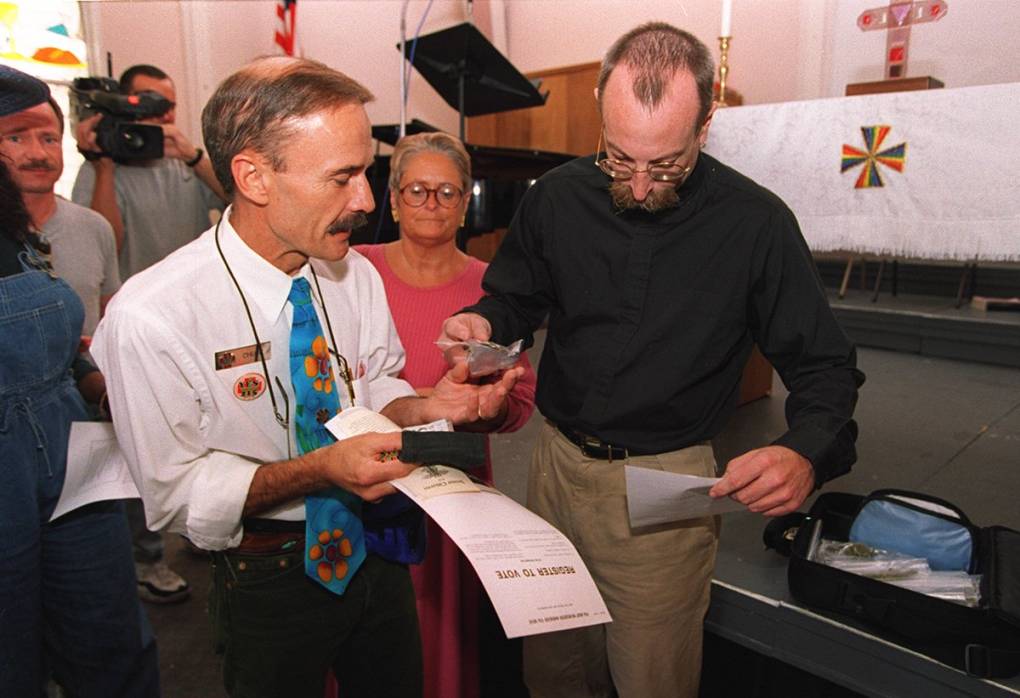
"caption": "Rev. Jim Mitulski (right), pastor of the Metropolitan Community Church of SF, hands a volunteer a bag of marijuana after church services as part of a relief effort in the summer of 1996 to help people suffering from AIDS. ",
"description": null,
"title": "MARIJUANA/C/18AUG96/MN/LS-Rev. Jim Mitulski (right) pastor of the Metropolitan Community Church of SF hands Chuck Jones, a CBC volunteer, a bag of marijuana during a medical marijuana relief effort sponsored by the church. BY LEA SUZUKI/THE CHRONICLE",
"credit": "Lea Suzuki/San Francisco Chronicle via Getty Images",
"status": "inherit",
"altTag": "One man gives another man a small bag of marijuana. A group of people stand behind them, including someone with a video camera.",
"isLoading": false,
"fetchFailed": false
},
"news_11902679": {
"type": "attachments",
"id": "news_11902679",
"meta": {
"index": "attachments_1716263798",
"site": "news",
"id": "11902679",
"found": true
},
"parent": 11902591,
"imgSizes": {
"twentyfourteen-full-width": {
"file": "https://ww2.kqed.org/app/uploads/sites/10/2022/01/RS53271_iStock-491407268-qut-1038x576.jpg",
"width": 1038,
"mimeType": "image/jpeg",
"height": 576
},
"thumbnail": {
"file": "https://ww2.kqed.org/app/uploads/sites/10/2022/01/RS53271_iStock-491407268-qut-160x93.jpg",
"width": 160,
"mimeType": "image/jpeg",
"height": 93
},
"post-thumbnail": {
"file": "https://ww2.kqed.org/app/uploads/sites/10/2022/01/RS53271_iStock-491407268-qut-672x372.jpg",
"width": 672,
"mimeType": "image/jpeg",
"height": 372
},
"kqedFullSize": {
"file": "https://ww2.kqed.org/app/uploads/sites/10/2022/01/RS53271_iStock-491407268-qut.jpg",
"width": 1920,
"height": 1112
},
"large": {
"file": "https://ww2.kqed.org/app/uploads/sites/10/2022/01/RS53271_iStock-491407268-qut-1020x591.jpg",
"width": 1020,
"mimeType": "image/jpeg",
"height": 591
},
"1536x1536": {
"file": "https://ww2.kqed.org/app/uploads/sites/10/2022/01/RS53271_iStock-491407268-qut-1536x890.jpg",
"width": 1536,
"mimeType": "image/jpeg",
"height": 890
},
"medium": {
"file": "https://ww2.kqed.org/app/uploads/sites/10/2022/01/RS53271_iStock-491407268-qut-800x463.jpg",
"width": 800,
"mimeType": "image/jpeg",
"height": 463
}
},
"publishDate": 1643156071,
"modified": 1643162310,
"caption": "Doctor opposition to single-payer health care in California may seem counterintuitive — but it's nothing new. Dr. Micah Johnson, author of 'Medicare for All: A Citizen's Guide,' says doctors have been 'double agents' in the debate, and are most concerned with changes to their pay and autonomy.",
"description": "Doctor opposition to single-payer health care in California may seem counterintuitive - but it's nothing new. Dr. Micah Johnson, author of 'Medicare For All: A Citizen’s Guide,' says doctors have been 'double agents' in the debate, and are most concerned with changes to their pay and autonomy.",
"title": "Doctor with stethoscope",
"credit": "Getty Images",
"status": "inherit",
"altTag": "generic photo of person wearing white doctors coat, standing with arms firmly crossed holding stethoscope",
"isLoading": false,
"fetchFailed": false
},
"news_11902462": {
"type": "attachments",
"id": "news_11902462",
"meta": {
"index": "attachments_1716263798",
"site": "news",
"id": "11902462",
"found": true
},
"parent": 11902461,
"imgSizes": {
"twentyfourteen-full-width": {
"file": "https://ww2.kqed.org/app/uploads/sites/10/2022/01/gettyimages-1237291550-dabc9b233c1a9c6516b0c2f0b08a5324dfcf86bc-804x576.jpg",
"width": 804,
"mimeType": "image/jpeg",
"height": 576
},
"thumbnail": {
"file": "https://ww2.kqed.org/app/uploads/sites/10/2022/01/gettyimages-1237291550-dabc9b233c1a9c6516b0c2f0b08a5324dfcf86bc-160x120.jpg",
"width": 160,
"mimeType": "image/jpeg",
"height": 120
},
"post-thumbnail": {
"file": "https://ww2.kqed.org/app/uploads/sites/10/2022/01/gettyimages-1237291550-dabc9b233c1a9c6516b0c2f0b08a5324dfcf86bc-672x372.jpg",
"width": 672,
"mimeType": "image/jpeg",
"height": 372
},
"kqedFullSize": {
"file": "https://ww2.kqed.org/app/uploads/sites/10/2022/01/gettyimages-1237291550-dabc9b233c1a9c6516b0c2f0b08a5324dfcf86bc.jpg",
"width": 804,
"height": 603
},
"medium": {
"file": "https://ww2.kqed.org/app/uploads/sites/10/2022/01/gettyimages-1237291550-dabc9b233c1a9c6516b0c2f0b08a5324dfcf86bc-800x600.jpg",
"width": 800,
"mimeType": "image/jpeg",
"height": 600
}
},
"publishDate": 1642980718,
"modified": 1643918508,
"caption": "Some audience members told KQED they felt intense shame and guilt about the ripple effects their positive diagnosis had created for others in their lives.",
"description": null,
"title": "Rapid tests can help you figure out if you have been infected with the coronavirus. But how accurate are they? Scientists trying to find out whether they are less sensitive to omicron and why.",
"credit": "Joseph Prezioso/AFP via Getty Images",
"status": "inherit",
"altTag": "A hand holding a white and red rapid antigen test.",
"isLoading": false,
"fetchFailed": false
},
"news_11902175": {
"type": "attachments",
"id": "news_11902175",
"meta": {
"index": "attachments_1716263798",
"site": "news",
"id": "11902175",
"found": true
},
"parent": 11902149,
"imgSizes": {
"twentyfourteen-full-width": {
"file": "https://ww2.kqed.org/app/uploads/sites/10/2022/01/RS53217_034_Richmond_LifelongCOVIDClinic_01192022-qut-1038x576.jpg",
"width": 1038,
"mimeType": "image/jpeg",
"height": 576
},
"thumbnail": {
"file": "https://ww2.kqed.org/app/uploads/sites/10/2022/01/RS53217_034_Richmond_LifelongCOVIDClinic_01192022-qut-160x107.jpg",
"width": 160,
"mimeType": "image/jpeg",
"height": 107
},
"post-thumbnail": {
"file": "https://ww2.kqed.org/app/uploads/sites/10/2022/01/RS53217_034_Richmond_LifelongCOVIDClinic_01192022-qut-672x372.jpg",
"width": 672,
"mimeType": "image/jpeg",
"height": 372
},
"kqedFullSize": {
"file": "https://ww2.kqed.org/app/uploads/sites/10/2022/01/RS53217_034_Richmond_LifelongCOVIDClinic_01192022-qut.jpg",
"width": 1920,
"height": 1280
},
"large": {
"file": "https://ww2.kqed.org/app/uploads/sites/10/2022/01/RS53217_034_Richmond_LifelongCOVIDClinic_01192022-qut-1020x680.jpg",
"width": 1020,
"mimeType": "image/jpeg",
"height": 680
},
"1536x1536": {
"file": "https://ww2.kqed.org/app/uploads/sites/10/2022/01/RS53217_034_Richmond_LifelongCOVIDClinic_01192022-qut-1536x1024.jpg",
"width": 1536,
"mimeType": "image/jpeg",
"height": 1024
},
"medium": {
"file": "https://ww2.kqed.org/app/uploads/sites/10/2022/01/RS53217_034_Richmond_LifelongCOVIDClinic_01192022-qut-800x533.jpg",
"width": 800,
"mimeType": "image/jpeg",
"height": 533
}
},
"publishDate": 1642715022,
"modified": 1642730431,
"caption": "Renna Khuner-Haber (center), who coordinates LifeLong Medical's testing sites in Richmond and San Pablo, talks with staff, as a registered nurse (right) talks with a patient at LifeLong's Brookside San Pablo Health Center on Jan. 19, 2022.",
"description": null,
"title": "RS53217_034_Richmond_LifelongCOVIDClinic_01192022-qut",
"credit": "Beth LaBerge/KQED",
"status": "inherit",
"altTag": "Two seated, masked women - a nurse and patient - talk in sunlit foreground as another masked woman stands in the background",
"isLoading": false,
"fetchFailed": false
},
"news_11902095": {
"type": "attachments",
"id": "news_11902095",
"meta": {
"index": "attachments_1716263798",
"site": "news",
"id": "11902095",
"found": true
},
"parent": 11902084,
"imgSizes": {
"twentyfourteen-full-width": {
"file": "https://ww2.kqed.org/app/uploads/sites/10/2022/01/KQED-Dembosky-New-Bill-Would-Raise-Penalties-Health-Insurers-Pay-When-They-Break-the-Law-iStock-BrianAJackson-1038x576.jpg",
"width": 1038,
"mimeType": "image/jpeg",
"height": 576
},
"thumbnail": {
"file": "https://ww2.kqed.org/app/uploads/sites/10/2022/01/KQED-Dembosky-New-Bill-Would-Raise-Penalties-Health-Insurers-Pay-When-They-Break-the-Law-iStock-BrianAJackson-160x107.jpg",
"width": 160,
"mimeType": "image/jpeg",
"height": 107
},
"post-thumbnail": {
"file": "https://ww2.kqed.org/app/uploads/sites/10/2022/01/KQED-Dembosky-New-Bill-Would-Raise-Penalties-Health-Insurers-Pay-When-They-Break-the-Law-iStock-BrianAJackson-672x372.jpg",
"width": 672,
"mimeType": "image/jpeg",
"height": 372
},
"kqedFullSize": {
"file": "https://ww2.kqed.org/app/uploads/sites/10/2022/01/KQED-Dembosky-New-Bill-Would-Raise-Penalties-Health-Insurers-Pay-When-They-Break-the-Law-iStock-BrianAJackson-e1642648714951.jpg",
"width": 1920,
"height": 1280
},
"2048x2048": {
"file": "https://ww2.kqed.org/app/uploads/sites/10/2022/01/KQED-Dembosky-New-Bill-Would-Raise-Penalties-Health-Insurers-Pay-When-They-Break-the-Law-iStock-BrianAJackson-2048x1365.jpg",
"width": 2048,
"mimeType": "image/jpeg",
"height": 1365
},
"large": {
"file": "https://ww2.kqed.org/app/uploads/sites/10/2022/01/KQED-Dembosky-New-Bill-Would-Raise-Penalties-Health-Insurers-Pay-When-They-Break-the-Law-iStock-BrianAJackson-1020x680.jpg",
"width": 1020,
"mimeType": "image/jpeg",
"height": 680
},
"1536x1536": {
"file": "https://ww2.kqed.org/app/uploads/sites/10/2022/01/KQED-Dembosky-New-Bill-Would-Raise-Penalties-Health-Insurers-Pay-When-They-Break-the-Law-iStock-BrianAJackson-1536x1024.jpg",
"width": 1536,
"mimeType": "image/jpeg",
"height": 1024
},
"full-width": {
"file": "https://ww2.kqed.org/app/uploads/sites/10/2022/01/KQED-Dembosky-New-Bill-Would-Raise-Penalties-Health-Insurers-Pay-When-They-Break-the-Law-iStock-BrianAJackson-1920x1280.jpg",
"width": 1920,
"mimeType": "image/jpeg",
"height": 1280
},
"medium": {
"file": "https://ww2.kqed.org/app/uploads/sites/10/2022/01/KQED-Dembosky-New-Bill-Would-Raise-Penalties-Health-Insurers-Pay-When-They-Break-the-Law-iStock-BrianAJackson-800x533.jpg",
"width": 800,
"mimeType": "image/jpeg",
"height": 533
}
},
"publishDate": 1642648688,
"modified": 1642648764,
"caption": null,
"description": null,
"title": null,
"credit": "BrianAJackson/iStock",
"status": "inherit",
"altTag": "Stethoscope, calculator and medical bills stock image",
"isLoading": false,
"fetchFailed": false
},
"news_11771722": {
"type": "attachments",
"id": "news_11771722",
"meta": {
"index": "attachments_1716263798",
"site": "news",
"id": "11771722",
"found": true
},
"parent": 11771713,
"imgSizes": {
"apple_news_ca_landscape_5_5": {
"file": "https://ww2.kqed.org/app/uploads/sites/10/2019/09/IMG_4014-1044x783.jpeg",
"width": 1044,
"mimeType": "image/jpeg",
"height": 783
},
"apple_news_ca_square_4_0": {
"file": "https://ww2.kqed.org/app/uploads/sites/10/2019/09/IMG_4014-470x470.jpeg",
"width": 470,
"mimeType": "image/jpeg",
"height": 470
},
"twentyfourteen-full-width": {
"file": "https://ww2.kqed.org/app/uploads/sites/10/2019/09/IMG_4014-1038x576.jpeg",
"width": 1038,
"mimeType": "image/jpeg",
"height": 576
},
"thumbnail": {
"file": "https://ww2.kqed.org/app/uploads/sites/10/2019/09/IMG_4014-160x120.jpeg",
"width": 160,
"mimeType": "image/jpeg",
"height": 120
},
"post-thumbnail": {
"file": "https://ww2.kqed.org/app/uploads/sites/10/2019/09/IMG_4014-672x372.jpeg",
"width": 672,
"mimeType": "image/jpeg",
"height": 372
},
"kqedFullSize": {
"file": "https://ww2.kqed.org/app/uploads/sites/10/2019/09/IMG_4014-e1567438911990.jpeg",
"width": 1920,
"height": 1440
},
"apple_news_ca_landscape_4_7": {
"file": "https://ww2.kqed.org/app/uploads/sites/10/2019/09/IMG_4014-632x474.jpeg",
"width": 632,
"mimeType": "image/jpeg",
"height": 474
},
"large": {
"file": "https://ww2.kqed.org/app/uploads/sites/10/2019/09/IMG_4014-1020x765.jpeg",
"width": 1020,
"mimeType": "image/jpeg",
"height": 765
},
"complete_open_graph": {
"file": "https://ww2.kqed.org/app/uploads/sites/10/2019/09/IMG_4014-1200x900.jpeg",
"width": 1200,
"mimeType": "image/jpeg",
"height": 900
},
"apple_news_ca_landscape_4_0": {
"file": "https://ww2.kqed.org/app/uploads/sites/10/2019/09/IMG_4014-536x402.jpeg",
"width": 536,
"mimeType": "image/jpeg",
"height": 402
},
"apple_news_ca_portrait_12_9": {
"file": "https://ww2.kqed.org/app/uploads/sites/10/2019/09/IMG_4014-1122x1496.jpeg",
"width": 1122,
"mimeType": "image/jpeg",
"height": 1496
},
"medium": {
"file": "https://ww2.kqed.org/app/uploads/sites/10/2019/09/IMG_4014-800x600.jpeg",
"width": 800,
"mimeType": "image/jpeg",
"height": 600
},
"apple_news_ca_portrait_4_0": {
"file": "https://ww2.kqed.org/app/uploads/sites/10/2019/09/IMG_4014-354x472.jpeg",
"width": 354,
"mimeType": "image/jpeg",
"height": 472
},
"apple_news_ca_portrait_9_7": {
"file": "https://ww2.kqed.org/app/uploads/sites/10/2019/09/IMG_4014-840x1120.jpeg",
"width": 840,
"mimeType": "image/jpeg",
"height": 1120
},
"apple_news_ca_landscape_12_9": {
"file": "https://ww2.kqed.org/app/uploads/sites/10/2019/09/IMG_4014-1832x1374.jpeg",
"width": 1832,
"mimeType": "image/jpeg",
"height": 1374
},
"apple_news_ca_square_9_7": {
"file": "https://ww2.kqed.org/app/uploads/sites/10/2019/09/IMG_4014-1104x1104.jpeg",
"width": 1104,
"mimeType": "image/jpeg",
"height": 1104
},
"apple_news_ca_portrait_4_7": {
"file": "https://ww2.kqed.org/app/uploads/sites/10/2019/09/IMG_4014-414x552.jpeg",
"width": 414,
"mimeType": "image/jpeg",
"height": 552
},
"apple_news_ca_square_12_9": {
"file": "https://ww2.kqed.org/app/uploads/sites/10/2019/09/IMG_4014-1472x1472.jpeg",
"width": 1472,
"mimeType": "image/jpeg",
"height": 1472
},
"apple_news_ca_portrait_5_5": {
"file": "https://ww2.kqed.org/app/uploads/sites/10/2019/09/IMG_4014-687x916.jpeg",
"width": 687,
"mimeType": "image/jpeg",
"height": 916
},
"full-width": {
"file": "https://ww2.kqed.org/app/uploads/sites/10/2019/09/IMG_4014-1920x1440.jpeg",
"width": 1920,
"mimeType": "image/jpeg",
"height": 1440
},
"apple_news_ca_square_4_7": {
"file": "https://ww2.kqed.org/app/uploads/sites/10/2019/09/IMG_4014-550x550.jpeg",
"width": 550,
"mimeType": "image/jpeg",
"height": 550
},
"apple_news_ca_landscape_9_7": {
"file": "https://ww2.kqed.org/app/uploads/sites/10/2019/09/IMG_4014-1376x1032.jpeg",
"width": 1376,
"mimeType": "image/jpeg",
"height": 1032
},
"apple_news_ca_square_5_5": {
"file": "https://ww2.kqed.org/app/uploads/sites/10/2019/09/IMG_4014-912x912.jpeg",
"width": 912,
"mimeType": "image/jpeg",
"height": 912
}
},
"publishDate": 1567438764,
"modified": 1642640443,
"caption": "An ambulance leaves the Coast Guard station in Oxnard on Sept. 2, 2019.",
"description": null,
"title": "IMG_4014",
"credit": "Saul Gonzalez/KQED",
"status": "inherit",
"altTag": "A white emergency vehicle with a yellow stripe.",
"isLoading": false,
"fetchFailed": false
},
"news_11901982": {
"type": "attachments",
"id": "news_11901982",
"meta": {
"index": "attachments_1716263798",
"site": "news",
"id": "11901982",
"found": true
},
"parent": 11901974,
"imgSizes": {
"twentyfourteen-full-width": {
"file": "https://ww2.kqed.org/app/uploads/sites/10/2022/01/tests_011822_final-1038x576.png",
"width": 1038,
"mimeType": "image/png",
"height": 576
},
"thumbnail": {
"file": "https://ww2.kqed.org/app/uploads/sites/10/2022/01/tests_011822_final-160x114.png",
"width": 160,
"mimeType": "image/png",
"height": 114
},
"post-thumbnail": {
"file": "https://ww2.kqed.org/app/uploads/sites/10/2022/01/tests_011822_final-672x372.png",
"width": 672,
"mimeType": "image/png",
"height": 372
},
"kqedFullSize": {
"file": "https://ww2.kqed.org/app/uploads/sites/10/2022/01/tests_011822_final.png",
"width": 1920,
"height": 1367
},
"large": {
"file": "https://ww2.kqed.org/app/uploads/sites/10/2022/01/tests_011822_final-1020x726.png",
"width": 1020,
"mimeType": "image/png",
"height": 726
},
"1536x1536": {
"file": "https://ww2.kqed.org/app/uploads/sites/10/2022/01/tests_011822_final-1536x1094.png",
"width": 1536,
"mimeType": "image/png",
"height": 1094
},
"medium": {
"file": "https://ww2.kqed.org/app/uploads/sites/10/2022/01/tests_011822_final-800x570.png",
"width": 800,
"mimeType": "image/png",
"height": 570
}
},
"publishDate": 1642546209,
"modified": 1642546284,
"caption": null,
"description": null,
"title": "tests_011822_final",
"credit": null,
"status": "inherit",
"altTag": "Cartoon: a rapid COVID test with lines for negative, positive, positively out of stock, not positive insurance will reimburse you, positive 4 tests will arrive soonish and was positive we'd have this figured out by now.",
"isLoading": false,
"fetchFailed": false
},
"news_11901971": {
"type": "attachments",
"id": "news_11901971",
"meta": {
"index": "attachments_1716263798",
"site": "news",
"id": "11901971",
"found": true
},
"parent": 11901945,
"imgSizes": {
"twentyfourteen-full-width": {
"file": "https://ww2.kqed.org/app/uploads/sites/10/2022/01/GettyImages-1231909722-1024x576.jpg",
"width": 1024,
"mimeType": "image/jpeg",
"height": 576
},
"thumbnail": {
"file": "https://ww2.kqed.org/app/uploads/sites/10/2022/01/GettyImages-1231909722-160x107.jpg",
"width": 160,
"mimeType": "image/jpeg",
"height": 107
},
"post-thumbnail": {
"file": "https://ww2.kqed.org/app/uploads/sites/10/2022/01/GettyImages-1231909722-672x372.jpg",
"width": 672,
"mimeType": "image/jpeg",
"height": 372
},
"kqedFullSize": {
"file": "https://ww2.kqed.org/app/uploads/sites/10/2022/01/GettyImages-1231909722.jpg",
"width": 1024,
"height": 683
},
"large": {
"file": "https://ww2.kqed.org/app/uploads/sites/10/2022/01/GettyImages-1231909722-1020x680.jpg",
"width": 1020,
"mimeType": "image/jpeg",
"height": 680
},
"medium": {
"file": "https://ww2.kqed.org/app/uploads/sites/10/2022/01/GettyImages-1231909722-800x534.jpg",
"width": 800,
"mimeType": "image/jpeg",
"height": 534
}
},
"publishDate": 1642545048,
"modified": 1642551902,
"caption": "A student receives a temperature check before class as they return to in-person learning at St. Anthony Catholic High School during the COVID-19 pandemic, on March 24, 2021, in Long Beach.",
"description": null,
"title": "US-HEALTH-VIRUS-SCHOOL",
"credit": "Patrick T. Fallon/AFP via Getty Images",
"status": "inherit",
"altTag": "A young woman wearing a mask stands as another woman wearing a masks holds a digital thermometer up to her head. A third women with a mask is seen in the background.",
"isLoading": false,
"fetchFailed": false
},
"news_11901834": {
"type": "attachments",
"id": "news_11901834",
"meta": {
"index": "attachments_1716263798",
"site": "news",
"id": "11901834",
"found": true
},
"parent": 11901829,
"imgSizes": {
"twentyfourteen-full-width": {
"file": "https://ww2.kqed.org/app/uploads/sites/10/2022/01/01112022_Long-Beach_Testing_Site_PU_CM_15-1038x576.jpeg",
"width": 1038,
"mimeType": "image/jpeg",
"height": 576
},
"thumbnail": {
"file": "https://ww2.kqed.org/app/uploads/sites/10/2022/01/01112022_Long-Beach_Testing_Site_PU_CM_15-160x107.jpeg",
"width": 160,
"mimeType": "image/jpeg",
"height": 107
},
"post-thumbnail": {
"file": "https://ww2.kqed.org/app/uploads/sites/10/2022/01/01112022_Long-Beach_Testing_Site_PU_CM_15-672x372.jpeg",
"width": 672,
"mimeType": "image/jpeg",
"height": 372
},
"kqedFullSize": {
"file": "https://ww2.kqed.org/app/uploads/sites/10/2022/01/01112022_Long-Beach_Testing_Site_PU_CM_15-e1642218789897.jpeg",
"width": 1920,
"height": 1280
},
"large": {
"file": "https://ww2.kqed.org/app/uploads/sites/10/2022/01/01112022_Long-Beach_Testing_Site_PU_CM_15-1020x680.jpeg",
"width": 1020,
"mimeType": "image/jpeg",
"height": 680
},
"1536x1536": {
"file": "https://ww2.kqed.org/app/uploads/sites/10/2022/01/01112022_Long-Beach_Testing_Site_PU_CM_15-1536x1024.jpeg",
"width": 1536,
"mimeType": "image/jpeg",
"height": 1024
},
"full-width": {
"file": "https://ww2.kqed.org/app/uploads/sites/10/2022/01/01112022_Long-Beach_Testing_Site_PU_CM_15-1920x1280.jpeg",
"width": 1920,
"mimeType": "image/jpeg",
"height": 1280
},
"medium": {
"file": "https://ww2.kqed.org/app/uploads/sites/10/2022/01/01112022_Long-Beach_Testing_Site_PU_CM_15-800x533.jpeg",
"width": 800,
"mimeType": "image/jpeg",
"height": 533
}
},
"publishDate": 1642218768,
"modified": 1642537744,
"caption": "Diane Ahern swabs herself for COVID-19 at a testing site at the Long Beach Airport in Long Beach on Jan. 11, 2022. 'I need to get tested every three days to be able to visit my parents at their retirement home,' Ahern said. 'I'm nervous.'",
"description": null,
"title": "01112022_Long-Beach_Testing_Site_PU_CM_15",
"credit": "Pablo Unzueta/CalMatters",
"status": "inherit",
"altTag": "Woman swabs her nose while seated in her caras part of a COVID test.",
"isLoading": false,
"fetchFailed": false
},
"news_11901672": {
"type": "attachments",
"id": "news_11901672",
"meta": {
"index": "attachments_1716263798",
"site": "news",
"id": "11901672",
"found": true
},
"parent": 11901520,
"imgSizes": {
"twentyfourteen-full-width": {
"file": "https://ww2.kqed.org/app/uploads/sites/10/2022/01/Image-from-iOS-1020x1241-1-1002x576.jpeg",
"width": 1002,
"mimeType": "image/jpeg",
"height": 576
},
"thumbnail": {
"file": "https://ww2.kqed.org/app/uploads/sites/10/2022/01/Image-from-iOS-1020x1241-1-160x140.jpeg",
"width": 160,
"mimeType": "image/jpeg",
"height": 140
},
"post-thumbnail": {
"file": "https://ww2.kqed.org/app/uploads/sites/10/2022/01/Image-from-iOS-1020x1241-1-672x372.jpeg",
"width": 672,
"mimeType": "image/jpeg",
"height": 372
},
"kqedFullSize": {
"file": "https://ww2.kqed.org/app/uploads/sites/10/2022/01/Image-from-iOS-1020x1241-1.jpeg",
"width": 1002,
"height": 878
},
"medium": {
"file": "https://ww2.kqed.org/app/uploads/sites/10/2022/01/Image-from-iOS-1020x1241-1-800x701.jpeg",
"width": 800,
"mimeType": "image/jpeg",
"height": 701
}
},
"publishDate": 1642111139,
"modified": 1642111164,
"caption": "Justin Phillips, a respiratory therapist with UCSF at Zuckerberg San Francisco General Hospital.",
"description": "Justin Phillips, a respiratory therapist with UCSF at Zuckerberg San Francisco General Hospital.",
"title": "Image-from-iOS-1020x1241",
"credit": "Courtesy of Justin Phillips",
"status": "inherit",
"altTag": "A man wearing glasses and a black zipped sweater that says UCSF on the right side stands with his arms crossed.",
"isLoading": false,
"fetchFailed": false
},
"news_11901383": {
"type": "attachments",
"id": "news_11901383",
"meta": {
"index": "attachments_1716263798",
"site": "news",
"id": "11901383",
"found": true
},
"parent": 11901347,
"imgSizes": {
"twentyfourteen-full-width": {
"file": "https://ww2.kqed.org/app/uploads/sites/10/2022/01/RS5067_NurseChecksBloodPressure-1038x576.jpg",
"width": 1038,
"mimeType": "image/jpeg",
"height": 576
},
"thumbnail": {
"file": "https://ww2.kqed.org/app/uploads/sites/10/2022/01/RS5067_NurseChecksBloodPressure-160x107.jpg",
"width": 160,
"mimeType": "image/jpeg",
"height": 107
},
"post-thumbnail": {
"file": "https://ww2.kqed.org/app/uploads/sites/10/2022/01/RS5067_NurseChecksBloodPressure-672x372.jpg",
"width": 672,
"mimeType": "image/jpeg",
"height": 372
},
"kqedFullSize": {
"file": "https://ww2.kqed.org/app/uploads/sites/10/2022/01/RS5067_NurseChecksBloodPressure-scaled-e1641938626135.jpg",
"width": 1920,
"height": 1280
},
"2048x2048": {
"file": "https://ww2.kqed.org/app/uploads/sites/10/2022/01/RS5067_NurseChecksBloodPressure-2048x1365.jpg",
"width": 2048,
"mimeType": "image/jpeg",
"height": 1365
},
"large": {
"file": "https://ww2.kqed.org/app/uploads/sites/10/2022/01/RS5067_NurseChecksBloodPressure-1020x680.jpg",
"width": 1020,
"mimeType": "image/jpeg",
"height": 680
},
"1536x1536": {
"file": "https://ww2.kqed.org/app/uploads/sites/10/2022/01/RS5067_NurseChecksBloodPressure-1536x1024.jpg",
"width": 1536,
"mimeType": "image/jpeg",
"height": 1024
},
"full-width": {
"file": "https://ww2.kqed.org/app/uploads/sites/10/2022/01/RS5067_NurseChecksBloodPressure-1920x1280.jpg",
"width": 1920,
"mimeType": "image/jpeg",
"height": 1280
},
"medium": {
"file": "https://ww2.kqed.org/app/uploads/sites/10/2022/01/RS5067_NurseChecksBloodPressure-800x533.jpg",
"width": 800,
"mimeType": "image/jpeg",
"height": 533
}
},
"publishDate": 1641938608,
"modified": 1641938828,
"caption": "A nurse checks a patient's blood pressure at a free health screening event in Los Angeles. The Assembly began debate Tuesday on a bill to establish a universal health care system in the state, called CalCare. ",
"description": null,
"title": "Health Care Activists Offer Free Health Screenings In Los Angeles",
"credit": "David McNew/Getty Images",
"status": "inherit",
"altTag": "closeup shot of a nurse's hand operating a blood pressure monitoring device",
"isLoading": false,
"fetchFailed": false
}
},
"audioPlayerReducer": {
"postId": "stream_live",
"isPaused": true,
"isPlaying": false,
"pfsActive": false,
"pledgeModalIsOpen": true,
"playerDrawerIsOpen": false,
"liveAudioPlayStartedAt": 0,
"liveAudioPlayContext": ""
},
"authorsReducer": {
"byline_news_11903440": {
"type": "authors",
"id": "byline_news_11903440",
"meta": {
"override": true
},
"slug": "byline_news_11903440",
"name": "Adam Beam\u003cbr>Associated Press",
"isLoading": false
},
"byline_news_11902461": {
"type": "authors",
"id": "byline_news_11902461",
"meta": {
"override": true
},
"slug": "byline_news_11902461",
"name": "Maria Godoy",
"isLoading": false
},
"byline_news_11902072": {
"type": "authors",
"id": "byline_news_11902072",
"meta": {
"override": true
},
"slug": "byline_news_11902072",
"name": "Amy Taxin\u003cbr>The Associated Press",
"isLoading": false
},
"byline_news_11901945": {
"type": "authors",
"id": "byline_news_11901945",
"meta": {
"override": true
},
"slug": "byline_news_11901945",
"name": "\u003ca href=\"https://edsource.org/author/kdsouza\">Karen D'Souza\u003c/a>",
"isLoading": false
},
"byline_news_11901829": {
"type": "authors",
"id": "byline_news_11901829",
"meta": {
"override": true
},
"slug": "byline_news_11901829",
"name": "\u003ca href=\"https://calmatters.org/author/anaibarra/\">Ana B. Ibarra\u003c/a>",
"isLoading": false
},
"kqednewsstaffandwires": {
"type": "authors",
"id": "237",
"meta": {
"index": "authors_1716337520",
"id": "237",
"found": true
},
"name": "KQED News Staff and Wires",
"firstName": "KQED News Staff and Wires",
"lastName": null,
"slug": "kqednewsstaffandwires",
"email": "onlinenewsstaff@kqed.org",
"display_author_email": false,
"staff_mastheads": [],
"title": null,
"bio": null,
"avatar": "https://secure.gravatar.com/avatar/72295af8ebbfbd19a4948f5271285664?s=600&d=blank&r=g",
"twitter": null,
"facebook": null,
"instagram": null,
"linkedin": null,
"sites": [
{
"site": "arts",
"roles": [
"contributor"
]
},
{
"site": "news",
"roles": [
"contributor"
]
},
{
"site": "lowdown",
"roles": [
"author"
]
},
{
"site": "stateofhealth",
"roles": [
"contributor"
]
},
{
"site": "food",
"roles": [
"author"
]
}
],
"headData": {
"title": "KQED News Staff and Wires | KQED",
"description": null,
"ogImgSrc": "https://secure.gravatar.com/avatar/72295af8ebbfbd19a4948f5271285664?s=600&d=blank&r=g",
"twImgSrc": "https://secure.gravatar.com/avatar/72295af8ebbfbd19a4948f5271285664?s=600&d=blank&r=g"
},
"isLoading": false,
"link": "/author/kqednewsstaffandwires"
},
"tgoldberg": {
"type": "authors",
"id": "258",
"meta": {
"index": "authors_1716337520",
"id": "258",
"found": true
},
"name": "Ted Goldberg",
"firstName": "Ted",
"lastName": "Goldberg",
"slug": "tgoldberg",
"email": "tgoldberg@kqed.org",
"display_author_email": true,
"staff_mastheads": [
"news"
],
"title": "KQED Managing Editor, News and Newscasts",
"bio": "Ted Goldberg is Managing Editor of News and Newscasts at KQED. His main reporting beat is the Bay Area's oil refining industry.\r\n\r\nPrior to joining KQED in 2014, Ted worked at CBS News and WCBS AM in New York and Bay City News and KCBS Radio in San Francisco. He graduated from Oberlin College in Ohio in 1998.",
"avatar": "https://secure.gravatar.com/avatar/30ce2e4fe89135e104f89be2394d16225b9d36c121b5b3cb7651ce642978b96f?s=600&d=blank&r=g",
"twitter": "TedrickG",
"bluesky": null,
"facebook": null,
"instagram": null,
"linkedin": null,
"sites": [
{
"site": "news",
"roles": [
"editor"
]
},
{
"site": "science",
"roles": [
"editor"
]
}
],
"headData": {
"title": "Ted Goldberg | KQED",
"description": "KQED Managing Editor, News and Newscasts",
"ogImgSrc": "https://secure.gravatar.com/avatar/30ce2e4fe89135e104f89be2394d16225b9d36c121b5b3cb7651ce642978b96f?s=600&d=blank&r=g",
"twImgSrc": "https://secure.gravatar.com/avatar/30ce2e4fe89135e104f89be2394d16225b9d36c121b5b3cb7651ce642978b96f?s=600&d=blank&r=g"
},
"isLoading": false,
"link": "/author/tgoldberg"
},
"adembosky": {
"type": "authors",
"id": "3205",
"meta": {
"index": "authors_1716337520",
"id": "3205",
"found": true
},
"name": "April Dembosky",
"firstName": "April",
"lastName": "Dembosky",
"slug": "adembosky",
"email": "adembosky@kqed.org",
"display_author_email": false,
"staff_mastheads": [
"news",
"science"
],
"title": "KQED Health Correspondent",
"bio": "April Dembosky is the health correspondent for KQED News and a regular contributor to NPR. She specializes in covering altered states of mind, from postpartum depression to methamphetamine-induced psychosis to the insanity defense. Her investigative series on insurance companies sidestepping mental health laws won multiple awards, including first place in beat reporting from the national Association of Health Care Journalists. She is the recipient of numerous other prizes and fellowships, including a national Edward R. Murrow award for investigative reporting, a Society of Professional Journalists award for long-form storytelling, and a Carter Center Fellowship for Mental Health Journalism.\r\n\r\nDembosky reported and produced \u003cem>Soundtrack of Silence\u003c/em>, an audio documentary about music and memory that is currently being made into a feature film by Paramount Pictures.\r\n\r\nBefore joining KQED in 2013, Dembosky covered technology and Silicon Valley for \u003cem>The Financial Times of London,\u003c/em> and contributed business and arts stories to \u003cem>Marketplace \u003c/em>and \u003cem>The New York Times.\u003c/em> She got her undergraduate degree in philosophy from Smith College and her master's in journalism from the University of California, Berkeley. She is a classically trained violinist and proud alum of the first symphony orchestra at Burning Man.",
"avatar": "https://secure.gravatar.com/avatar/d6593cd737b732102fe0b6250b5351c2d3bc9b2987566514aa3c9a106494d684?s=600&d=blank&r=g",
"twitter": "adembosky",
"bluesky": null,
"facebook": null,
"instagram": null,
"linkedin": null,
"sites": [
{
"site": "arts",
"roles": [
"author"
]
},
{
"site": "news",
"roles": [
"editor"
]
},
{
"site": "futureofyou",
"roles": [
"author"
]
},
{
"site": "stateofhealth",
"roles": [
"editor"
]
},
{
"site": "science",
"roles": [
"editor"
]
},
{
"site": "forum",
"roles": [
"editor"
]
}
],
"headData": {
"title": "April Dembosky | KQED",
"description": "KQED Health Correspondent",
"ogImgSrc": "https://secure.gravatar.com/avatar/d6593cd737b732102fe0b6250b5351c2d3bc9b2987566514aa3c9a106494d684?s=600&d=blank&r=g",
"twImgSrc": "https://secure.gravatar.com/avatar/d6593cd737b732102fe0b6250b5351c2d3bc9b2987566514aa3c9a106494d684?s=600&d=blank&r=g"
},
"isLoading": false,
"link": "/author/adembosky"
},
"markfiore": {
"type": "authors",
"id": "3236",
"meta": {
"index": "authors_1716337520",
"id": "3236",
"found": true
},
"name": "Mark Fiore",
"firstName": "Mark",
"lastName": "Fiore",
"slug": "markfiore",
"email": "mark@markfiore.com",
"display_author_email": false,
"staff_mastheads": [
"news"
],
"title": "KQED News Cartoonist",
"bio": "\u003ca href=\"http://www.MarkFiore.com\">MarkFiore.com\u003c/a> | \u003ca href=\"https://twitter.com/markfiore\">Follow on Twitter\u003c/a> | \u003ca href=\"https://www.facebook.com/pages/Mark-Fiore-Animated-Political-Cartoons/94451707396?ref=bookmarks\">Facebook\u003c/a> | \u003ca href=\"mailto:mark@markfiore.com\">email\u003c/a>\r\n\r\nPulitzer Prize-winner, Mark Fiore, who the Wall Street Journal has called “the undisputed guru of the form,” creates animated political cartoons in San Francisco, where his work has been featured regularly on the San Francisco Chronicle’s web site, SFGate.com. His work has appeared on Newsweek.com, Slate.com, CBSNews.com, MotherJones.com, DailyKos.com and NPR’s web site. Fiore’s political animation has appeared on CNN, Frontline, Bill Moyers Journal, Salon.com and cable and broadcast outlets across the globe.\r\n\r\nBeginning his professional life by drawing traditional political cartoons for newspapers, Fiore’s work appeared in publications ranging from the Washington Post to the Los Angeles Times. In the late 1990s, he began to experiment with animating political cartoons and, after a short stint at the San Jose Mercury News as their staff cartoonist, Fiore devoted all his energies to animation.\r\nGrowing up in California, Fiore also spent a good portion of his life in the backwoods of Idaho. It was this combination that shaped him politically. Mark majored in political science at Colorado College, where, in a perfect send-off for a cartoonist, he received his diploma in 1991 as commencement speaker Dick Cheney smiled approvingly.\r\nMark Fiore was awarded the Pulitzer Prize for political cartooning in 2010, a Robert F. Kennedy Journalism Award in 2004 and has twice received an Online Journalism Award for commentary from the Online News Association (2002, 2008). Fiore has received two awards for his work in new media from the National Cartoonists Society (2001, 2002), and in 2006 received The James Madison Freedom of Information Award from The Society of Professional Journalists.",
"avatar": "https://secure.gravatar.com/avatar/fc4e2a612b15b67bad0c6f0e1db4ca9b?s=600&d=blank&r=g",
"twitter": "MarkFiore",
"facebook": null,
"instagram": "https://www.instagram.com/markfiore/?hl=en",
"linkedin": null,
"sites": [
{
"site": "arts",
"roles": [
"contributor"
]
},
{
"site": "news",
"roles": [
"editor"
]
},
{
"site": "futureofyou",
"roles": [
"editor"
]
},
{
"site": "science",
"roles": [
"editor"
]
}
],
"headData": {
"title": "Mark Fiore | KQED",
"description": "KQED News Cartoonist",
"ogImgSrc": "https://secure.gravatar.com/avatar/fc4e2a612b15b67bad0c6f0e1db4ca9b?s=600&d=blank&r=g",
"twImgSrc": "https://secure.gravatar.com/avatar/fc4e2a612b15b67bad0c6f0e1db4ca9b?s=600&d=blank&r=g"
},
"isLoading": false,
"link": "/author/markfiore"
},
"bwatt": {
"type": "authors",
"id": "11238",
"meta": {
"index": "authors_1716337520",
"id": "11238",
"found": true
},
"name": "Brian Watt",
"firstName": "Brian",
"lastName": "Watt",
"slug": "bwatt",
"email": "bwatt@KQED.org",
"display_author_email": false,
"staff_mastheads": [
"news"
],
"title": "Morning News Anchor",
"bio": "Brian Watt is KQED's morning radio news anchor. He joined the KQED News team in April of 2016. Prior to that, he worked as a Reporter for KPCC in Los Angeles and a producer at \u003cem>Marketplace.\u003c/em>\r\n\r\nDuring eight years at KPCC, Brian covered business and economics, and his work won several awards. In 2008, he won the Los Angeles Press Club’s first-place award for Business and Financial Reporting, Broadcast. He’s also received honorable mention and been first runner up for the Press Club’s Radio Journalist of the Year. He won two Golden Mike awards from the Radio and TV News Association of Southern California.\r\n\r\nBrian holds degrees in theater from Yale University and the Sorbonne, and has worked as an actor in France, Italy, Brazil, Hungary and . . . Hollywood. He appeared in a few television shows, including \u003cem>The West Wing, Judging Amy\u003c/em> and \u003cem>The District.\u003c/em>\r\n\r\nEmail: bwatt@KQED.org Twitter: @RadioBWatt",
"avatar": "https://secure.gravatar.com/avatar/55393ff57ed34e2be773ba4789dd6a19?s=600&d=blank&r=g",
"twitter": "@RadioBWatt",
"facebook": null,
"instagram": null,
"linkedin": null,
"sites": [
{
"site": "arts",
"roles": [
"contributor"
]
},
{
"site": "news",
"roles": [
"editor"
]
}
],
"headData": {
"title": "Brian Watt | KQED",
"description": "Morning News Anchor",
"ogImgSrc": "https://secure.gravatar.com/avatar/55393ff57ed34e2be773ba4789dd6a19?s=600&d=blank&r=g",
"twImgSrc": "https://secure.gravatar.com/avatar/55393ff57ed34e2be773ba4789dd6a19?s=600&d=blank&r=g"
},
"isLoading": false,
"link": "/author/bwatt"
},
"rdillon": {
"type": "authors",
"id": "11495",
"meta": {
"index": "authors_1716337520",
"id": "11495",
"found": true
},
"name": "Raquel Maria Dillon",
"firstName": "Raquel Maria",
"lastName": "Dillon",
"slug": "rdillon",
"email": "rdillon@kqed.org",
"display_author_email": false,
"staff_mastheads": [],
"title": null,
"bio": "Raquel Maria Dillon was a reporter and host for KQED News. Previously, she produced the daily statewide California Report, edited newscasts, and covered health and education stories. Before returning to the Bay Area in 2016, she worked in Los Angeles as a wire reporter and one-woman-band video journalist for the Associated Press, where she shot, edited and reported breaking news and features across the West. Her work has appeared online and in print around the globe, and also on NPR’s Morning Edition, All Things Considered, Here and Now, Marketplace, On The Media, and Studio 360. She previously edited and mentored up-and-coming reporters at KALW, produced social videos for Timeline.com, and was a local TV news videographer for KTVU and digital producer for KNTV. She got her start as a Radio News Trainee at KQED, produced a weekly public affairs roundtable show for OPB, and covered health and politics at New Hampshire Public Radio. She has a BA in political science from Barnard College and a MA in video journalism from UC Berkeley, where she was awarded the Faith Fancher Scholarship and a Student Emmy. She has received numerous local awards from the Associated Press and the Society of Professional Journalists.",
"avatar": "https://secure.gravatar.com/avatar/b8e02ae982913d0950df605910267c1b?s=600&d=blank&r=g",
"twitter": "RaquelMDillon",
"facebook": null,
"instagram": null,
"linkedin": null,
"sites": [
{
"site": "news",
"roles": [
"subscriber"
]
},
{
"site": "stateofhealth",
"roles": [
"editor"
]
},
{
"site": "science",
"roles": [
"editor"
]
},
{
"site": "forum",
"roles": [
"editor"
]
}
],
"headData": {
"title": "Raquel Maria Dillon | KQED",
"description": null,
"ogImgSrc": "https://secure.gravatar.com/avatar/b8e02ae982913d0950df605910267c1b?s=600&d=blank&r=g",
"twImgSrc": "https://secure.gravatar.com/avatar/b8e02ae982913d0950df605910267c1b?s=600&d=blank&r=g"
},
"isLoading": false,
"link": "/author/rdillon"
},
"agonzalez": {
"type": "authors",
"id": "11724",
"meta": {
"index": "authors_1716337520",
"id": "11724",
"found": true
},
"name": "Alexander Gonzalez",
"firstName": "Alexander",
"lastName": "Gonzalez",
"slug": "agonzalez",
"email": "AlexanderGonzalez@KQED.org",
"display_author_email": false,
"staff_mastheads": [
"news"
],
"title": "KQED Contributor",
"bio": null,
"avatar": "https://secure.gravatar.com/avatar/9e291ed34e154df4c662edf858b641d70b4859939bfe40be478408f9dfd057d2?s=600&d=blank&r=g",
"twitter": null,
"bluesky": null,
"facebook": null,
"instagram": null,
"linkedin": null,
"sites": [
{
"site": "arts",
"roles": [
"editor"
]
},
{
"site": "news",
"roles": [
"editor"
]
},
{
"site": "science",
"roles": [
"editor"
]
}
],
"headData": {
"title": "Alexander Gonzalez | KQED",
"description": "KQED Contributor",
"ogImgSrc": "https://secure.gravatar.com/avatar/9e291ed34e154df4c662edf858b641d70b4859939bfe40be478408f9dfd057d2?s=600&d=blank&r=g",
"twImgSrc": "https://secure.gravatar.com/avatar/9e291ed34e154df4c662edf858b641d70b4859939bfe40be478408f9dfd057d2?s=600&d=blank&r=g"
},
"isLoading": false,
"link": "/author/agonzalez"
},
"cbeale": {
"type": "authors",
"id": "11749",
"meta": {
"index": "authors_1716337520",
"id": "11749",
"found": true
},
"name": "Christopher Beale",
"firstName": "Christopher",
"lastName": "Beale",
"slug": "cbeale",
"email": "cbeale@kqed.org",
"display_author_email": true,
"staff_mastheads": [
"news"
],
"title": "Engineer/Producer/Reporter",
"bio": "\u003ca href=\"https://linktr.ee/realchrisjbeale\" rel=\"noopener noreferrer\">Christopher J. Beale\u003c/a> is an award winning journalist, audio engineer, and media host living in San Francisco. \r\n\r\nChristopher works primarily as an audio engineer at KQED and serves as the sound designer for both the Bay Curious and Rightnowish podcasts. He is the host and producer of the LGBTQIA podcast and radio segment \u003ca href=\"https://stereotypespodcast.org\">Stereotypes\u003c/a>.",
"avatar": "https://secure.gravatar.com/avatar/dc485bf84788eb7e7414eb638e72407e?s=600&d=blank&r=g",
"twitter": "realchrisjbeale",
"facebook": null,
"instagram": "http://instagram.com/realchrisjbeale",
"linkedin": null,
"sites": [
{
"site": "arts",
"roles": [
"contributor"
]
},
{
"site": "news",
"roles": [
"editor"
]
},
{
"site": "forum",
"roles": [
"editor"
]
}
],
"headData": {
"title": "Christopher Beale | KQED",
"description": "Engineer/Producer/Reporter",
"ogImgSrc": "https://secure.gravatar.com/avatar/dc485bf84788eb7e7414eb638e72407e?s=600&d=blank&r=g",
"twImgSrc": "https://secure.gravatar.com/avatar/dc485bf84788eb7e7414eb638e72407e?s=600&d=blank&r=g"
},
"isLoading": false,
"link": "/author/cbeale"
}
},
"pagesReducer": {
"news_tag_health": {
"type": "terms",
"id": "news_18543",
"meta": {
"index": "terms_1716263798",
"site": "news",
"id": "18543",
"score": 6.8909874
},
"featImg": null,
"name": "Health",
"description": null,
"taxonomy": "tag",
"headData": {
"twImgId": null,
"twTitle": null,
"ogTitle": null,
"ogImgId": null,
"twDescription": null,
"description": null,
"title": "Health Archives | KQED News",
"ogDescription": null
},
"ttid": 466,
"slug": "health",
"isLoading": false,
"title": "Health",
"pageMeta": {
"site": "news",
"WpPageTemplate": "page-topic-editorial",
"currentPage": 59
},
"blocks": [
{
"blockName": "kqed/post-list",
"attrs": {
"layout": "cardArticle2",
"query": "posts/news?tag=health",
"seeMore": false,
"paginated": true,
"page": 59
}
},
{
"blockName": "kqed/ad"
}
]
}
},
"pfsSessionReducer": {},
"postsReducer": {
"stream_live": {
"type": "live",
"id": "stream_live",
"audioUrl": "https://hls.kqed.org/hls/kqed_app/playlist.m3u8",
"title": "Live Stream",
"excerpt": "Live Stream information currently unavailable.",
"link": "/radio",
"featImg": "",
"label": {
"name": "KQED Live",
"link": "/"
}
},
"stream_kqedNewscast": {
"type": "posts",
"id": "stream_kqedNewscast",
"audioUrl": "https://www.kqed.org/.stream/anon/radio/RDnews/newscast.mp3?_=1",
"title": "KQED Newscast",
"featImg": "",
"label": {
"name": "88.5 FM",
"link": "/"
}
},
"news_11903440": {
"type": "posts",
"id": "news_11903440",
"meta": {
"index": "posts_1716263798",
"site": "news",
"id": "11903440",
"score": null,
"sort": [
1643673406000
]
},
"guestAuthors": [],
"slug": "single-payer-health-care-faces-uphill-battle-in-state-legislature",
"title": "With Little Chance of Success, Single-Payer Health Care Bill Withdrawn Ahead of Vote in State Legislature",
"publishDate": 1643673406,
"format": "audio",
"headTitle": "With Little Chance of Success, Single-Payer Health Care Bill Withdrawn Ahead of Vote in State Legislature | KQED",
"labelTerm": {
"term": 72,
"site": "news"
},
"content": "\u003cp>California Democrats decided not to advance a bill that would make the government pay for everybody’s health care in the nation’s most populous state. Assemblymember Ash Kalra announced that he would withdraw AB 1400, California Guaranteed Health Care for All Act (CalCare), from a vote today after it became clear there would not be enough votes for it to pass.\u003c/p>\n\u003cp>“Despite heavy opposition and substantial misinformation from those that stand to profit from our current healthcare system, we were able to ignite a realistic and achievable path toward single-payer and bring AB 1400 to the floor of the Assembly,” said Kalra in a news release. “Although the bill did not pass the Assembly by today’s deadline, this is only a pause for the single-payer movement; our coalition, including the mighty California Nurses Association, will continue the fight for accessible, affordable, and equitable healthcare for all Californians.”\u003c/p>\n\u003cp>The bill would have created the nation’s only statewide universal health care system and set its rules — but it would not have paid for it. There’s another bill that would do that. It has a different deadline and does not have to pass on Monday.[pullquote size=\"medium\" align=\"right\" citation=\"Assemblymember Ash Kalra, D-San Jose\"]‘Although the bill did not pass the Assembly by today’s deadline, this is only a pause for the single-payer movement; our coalition, including the mighty California Nurses Association, will continue the fight for accessible, affordable, and equitable healthcare for all Californians.’[/pullquote]There were still many unanswered questions about financing, quality and how doctors would make decisions. Monday’s debate would likely have been dominated by concerns about cost. The latest estimate says it would cost taxpayers at least $356.5 billion per year to pay for the health care of nearly 40 million residents. California’s total operating budget — which pays for public schools, courts, roads and bridges and other important services — is roughly $262 billion this year.\u003c/p>\n\u003cp>In light of the news that the Assembly failed to vote on the bill, the California Nurses Association released a statement condemning the decision.\u003c/p>\n\u003cp>“Today, elected leaders in California had the opportunity to put patients first and set an example for the whole country by passing AB 1400, the California Guaranteed Health Care for All Act, in the State Assembly. Instead, Assembly Member Ash Kalra, the main author of the bill, chose not to hold a vote on this bill at all, providing cover for those who would have been forced to go on the record about where they stand on guaranteed health care for all people in California. Nurses condemn this failure by elected representatives to put patients above profits, especially during the worst surge of COVID-19 yet, at a time when it’s more clear than ever before that health care must be a right, not just a privilege for those who can afford it.”\u003c/p>\n\u003cp>Assembly Republican Leader Marie Waldron lauded Democrats who stood up to their base and joined Republicans to put an end to the bill she referred to as a “foolhardy plan.”\u003c/p>\n\u003cp>“Better late than never,” said Waldron in a news release. “The fact that a proposal for a government takeover of our state’s entire health care system even made it this far shows just how out of touch the Democratic party is from the needs of everyday Californians. Even though this plan is dead for now, every Democrat who supported it will have to answer for their effort to end Medicare, kick 20 million Californians off their existing plans, require the largest tax increase in state history and put bureaucrats in charge of health care.”\u003c/p>\n\u003cp>Other coalitions opposed to the bill expressed concern that its passage would have done more harm than good.\u003c/p>\n\u003cp>“Californians are already facing higher inflation and taxes while struggling with the many difficulties/hardships that the pandemic has caused,” said Ned Wigglesworth, a spokesperson for the Protect California Health Care coalition, in a news statement. “They should have the right to choose the coverage they want, and deserve a stable health care system they can always rely on. AB 1400 would have eliminated both Medicare for seniors and private coverage for everyone, with no guarantee that patients could keep their doctor. The bill would have irreparably damaged the health care that millions of Californians rely on every day — all in the middle of a pandemic. Today’s vote in the Assembly was a vote to protect their constituents from higher taxes and chaos in our health care system.”\u003c/p>\n\u003cp>Earlier this month, Democrats filed a proposed amendment to the state Constitution that would impose hefty new taxes on businesses and individuals to pay for the system. The taxes would generate roughly $163 billion per year, and the amendment would give lawmakers the power to raise those taxes to keep up with costs. Supporters hoped both proposals — the bill to create the system and the bill to pay for it — would move forward together this year.\u003c/p>\n\u003cp>But Monday’s deadline was only on the bill that would create the system.\u003c/p>\n\u003cp>Supporters say Californians and their employers are already paying exorbitant amounts for health care through high deductibles, co-pays and monthly insurance premiums. The bill would have eliminated all of those and replace them with taxes.\u003c/p>\n\u003cp>“Sure, there is sticker shock. But there should be sticker shock for how much we are paying now,” said Stephanie Roberson, director of government relations for the California Nurses Association.\u003c/p>\n\u003cp>“What are we getting? People are still uninsured. People are still underinsured. People are going into medical debt. People have to reach tens of thousands of dollars of deductibles. We’ll eliminate that under this program,” she said.\u003c/p>\n\u003cp>Right now, lots of people pay for California’s health care system, including patients, insurance companies and employers. The bill before the Legislature would change that to a single payer — the government. If enacted, it would unravel the private health insurance market. Private health insurance would still be allowed, but only for services not covered by the government.\u003c/p>\n\u003cp>Progressives have long dreamed of a single-payer health system in the U.S., believing it would control costs and save lives. But it’s never happened. Vermont enacted the nation’s first single-payer health care system in 2011, but later abandoned it because of the cost. Proposals in Congress have gone nowhere.[aside postID=\"news_11902591,news_11901347,news_11902585\" label=\"Related Posts\"]In California, voters overwhelmingly rejected a single-payer system in a 1994 ballot initiative. State lawmakers tried again in the 2000s, twice passing single-payer legislation only to have both bills vetoed by then-Gov. Arnold Schwarzenegger, a Republican. Another attempt in 2017 passed the Senate but died in the Assembly.\u003c/p>\n\u003cp>This year’s vote wouldn’t have been easy, even in famously liberal California. While this bill had the support of some Democratic leaders and powerful labor unions, it had intense opposition from business groups that are pressuring more moderate Democrats not to vote for it.\u003c/p>\n\u003cp>The bill needed 41 votes to survive on Monday. Democrats have 56 of the 80 seats in the Assembly. But they are missing three of their more liberal members, who have recently resigned to take other jobs, leaving little room for defections. The current idea for financing includes new taxes, and legislators will need to get voter approval for that.\u003c/p>\n\u003cp>Supporters did not get a boost from Newsom, who they thought would be an important ally. Newsom campaigned for a universal health care system during his 2018 run for governor. But since taking office, Newsom has focused mostly on expanding access to insurance coverage.\u003c/p>\n\u003cp>Newsom has said he still supports a single-payer system. A commission he established to study the idea is due to release its report later this year. But Newsom remained silent on this latest proposal ahead of Monday’s deadline.\u003c/p>\n\u003cp>“What we need right now is support from the governor on this bill,” Roberson said before the bill was withdrawn. “We welcome him to make good on his campaign promise.”\u003c/p>\n\u003cp>\u003cem>KQED’s April Dembosky contributed to this story.\u003c/em>\u003c/p>\n\u003cp>[ad fullwidth]\u003c/p>\n\u003cp>[ad floatright]\u003c/p>\n",
"blocks": [],
"excerpt": "Assemblymember Ash Kalra decided to withdraw his bill from a vote today that would have created a government-funded universal health care system in California. The bill would set the rules for a universal health care system, but it would not pay for it. ",
"status": "publish",
"parent": 0,
"modified": 1738186489,
"stats": {
"hasAudio": false,
"hasVideo": false,
"hasChartOrMap": false,
"iframeSrcs": [],
"hasGoogleForm": false,
"hasGallery": false,
"hasHearkenModule": false,
"hasPolis": false,
"paragraphCount": 24,
"wordCount": 1411
},
"headData": {
"title": "With Little Chance of Success, Single-Payer Health Care Bill Withdrawn Ahead of Vote in State Legislature | KQED",
"description": "Assemblymember Ash Kalra decided to withdraw his bill from a vote today that would have created a government-funded universal health care system in California. The bill would set the rules for a universal health care system, but it would not pay for it. ",
"ogTitle": "",
"ogDescription": "",
"ogImgId": "",
"twTitle": "",
"twDescription": "",
"twImgId": "",
"schema": {
"@context": "https://schema.org",
"@type": "NewsArticle",
"headline": "With Little Chance of Success, Single-Payer Health Care Bill Withdrawn Ahead of Vote in State Legislature",
"datePublished": "2022-01-31T15:56:46-08:00",
"dateModified": "2025-01-29T13:34:49-08:00",
"image": "https://cdn.kqed.org/wp-content/uploads/2020/02/KQED-OG-Image@1x.png",
"isAccessibleForFree": "True",
"publisher": {
"@type": "NewsMediaOrganization",
"@id": "https://www.kqed.org/#organization",
"name": "KQED",
"logo": "https://cdn.kqed.org/wp-content/uploads/2020/02/KQED-OG-Image@1x.png",
"url": "https://www.kqed.org",
"sameAs": [
"https://www.facebook.com/KQED",
"https://twitter.com/KQED",
"https://www.instagram.com/kqed/",
"https://www.tiktok.com/@kqedofficial",
"https://www.linkedin.com/company/kqed",
"https://www.youtube.com/channel/UCeC0IOo7i1P_61zVUWbJ4nw"
]
}
}
},
"audioUrl": "https://traffic.omny.fm/d/clips/0af137ef-751e-4b19-a055-aaef00d2d578/ffca7e9f-6831-41c5-bcaf-aaef00f5a073/1f9e5e24-0ec0-40f2-ac3c-ae2f0117d8cd/audio.mp3",
"sticky": false,
"nprByline": "Adam Beam\u003cbr>Associated Press",
"excludeFromSiteSearch": "Include",
"showOnAuthorArchivePages": "No",
"path": "/news/11903440/single-payer-health-care-faces-uphill-battle-in-state-legislature",
"audioTrackLength": null,
"parsedContent": [
{
"type": "contentString",
"content": "\u003cdiv class=\"post-body\">\u003cp>\u003cp>California Democrats decided not to advance a bill that would make the government pay for everybody’s health care in the nation’s most populous state. Assemblymember Ash Kalra announced that he would withdraw AB 1400, California Guaranteed Health Care for All Act (CalCare), from a vote today after it became clear there would not be enough votes for it to pass.\u003c/p>\n\u003cp>“Despite heavy opposition and substantial misinformation from those that stand to profit from our current healthcare system, we were able to ignite a realistic and achievable path toward single-payer and bring AB 1400 to the floor of the Assembly,” said Kalra in a news release. “Although the bill did not pass the Assembly by today’s deadline, this is only a pause for the single-payer movement; our coalition, including the mighty California Nurses Association, will continue the fight for accessible, affordable, and equitable healthcare for all Californians.”\u003c/p>\n\u003cp>The bill would have created the nation’s only statewide universal health care system and set its rules — but it would not have paid for it. There’s another bill that would do that. It has a different deadline and does not have to pass on Monday.\u003c/p>\u003c/div>",
"attributes": {
"named": {},
"numeric": []
}
},
{
"type": "component",
"content": "‘Although the bill did not pass the Assembly by today’s deadline, this is only a pause for the single-payer movement; our coalition, including the mighty California Nurses Association, will continue the fight for accessible, affordable, and equitable healthcare for all Californians.’",
"name": "pullquote",
"attributes": {
"named": {
"size": "medium",
"align": "right",
"citation": "Assemblymember Ash Kalra, D-San Jose",
"label": ""
},
"numeric": []
}
},
{
"type": "contentString",
"content": "\u003cdiv class=\"post-body\">\u003cp>There were still many unanswered questions about financing, quality and how doctors would make decisions. Monday’s debate would likely have been dominated by concerns about cost. The latest estimate says it would cost taxpayers at least $356.5 billion per year to pay for the health care of nearly 40 million residents. California’s total operating budget — which pays for public schools, courts, roads and bridges and other important services — is roughly $262 billion this year.\u003c/p>\n\u003cp>In light of the news that the Assembly failed to vote on the bill, the California Nurses Association released a statement condemning the decision.\u003c/p>\n\u003cp>“Today, elected leaders in California had the opportunity to put patients first and set an example for the whole country by passing AB 1400, the California Guaranteed Health Care for All Act, in the State Assembly. Instead, Assembly Member Ash Kalra, the main author of the bill, chose not to hold a vote on this bill at all, providing cover for those who would have been forced to go on the record about where they stand on guaranteed health care for all people in California. Nurses condemn this failure by elected representatives to put patients above profits, especially during the worst surge of COVID-19 yet, at a time when it’s more clear than ever before that health care must be a right, not just a privilege for those who can afford it.”\u003c/p>\n\u003cp>Assembly Republican Leader Marie Waldron lauded Democrats who stood up to their base and joined Republicans to put an end to the bill she referred to as a “foolhardy plan.”\u003c/p>\n\u003cp>“Better late than never,” said Waldron in a news release. “The fact that a proposal for a government takeover of our state’s entire health care system even made it this far shows just how out of touch the Democratic party is from the needs of everyday Californians. Even though this plan is dead for now, every Democrat who supported it will have to answer for their effort to end Medicare, kick 20 million Californians off their existing plans, require the largest tax increase in state history and put bureaucrats in charge of health care.”\u003c/p>\n\u003cp>Other coalitions opposed to the bill expressed concern that its passage would have done more harm than good.\u003c/p>\n\u003cp>“Californians are already facing higher inflation and taxes while struggling with the many difficulties/hardships that the pandemic has caused,” said Ned Wigglesworth, a spokesperson for the Protect California Health Care coalition, in a news statement. “They should have the right to choose the coverage they want, and deserve a stable health care system they can always rely on. AB 1400 would have eliminated both Medicare for seniors and private coverage for everyone, with no guarantee that patients could keep their doctor. The bill would have irreparably damaged the health care that millions of Californians rely on every day — all in the middle of a pandemic. Today’s vote in the Assembly was a vote to protect their constituents from higher taxes and chaos in our health care system.”\u003c/p>\n\u003cp>Earlier this month, Democrats filed a proposed amendment to the state Constitution that would impose hefty new taxes on businesses and individuals to pay for the system. The taxes would generate roughly $163 billion per year, and the amendment would give lawmakers the power to raise those taxes to keep up with costs. Supporters hoped both proposals — the bill to create the system and the bill to pay for it — would move forward together this year.\u003c/p>\n\u003cp>But Monday’s deadline was only on the bill that would create the system.\u003c/p>\n\u003cp>Supporters say Californians and their employers are already paying exorbitant amounts for health care through high deductibles, co-pays and monthly insurance premiums. The bill would have eliminated all of those and replace them with taxes.\u003c/p>\n\u003cp>“Sure, there is sticker shock. But there should be sticker shock for how much we are paying now,” said Stephanie Roberson, director of government relations for the California Nurses Association.\u003c/p>\n\u003cp>“What are we getting? People are still uninsured. People are still underinsured. People are going into medical debt. People have to reach tens of thousands of dollars of deductibles. We’ll eliminate that under this program,” she said.\u003c/p>\n\u003cp>Right now, lots of people pay for California’s health care system, including patients, insurance companies and employers. The bill before the Legislature would change that to a single payer — the government. If enacted, it would unravel the private health insurance market. Private health insurance would still be allowed, but only for services not covered by the government.\u003c/p>\n\u003cp>Progressives have long dreamed of a single-payer health system in the U.S., believing it would control costs and save lives. But it’s never happened. Vermont enacted the nation’s first single-payer health care system in 2011, but later abandoned it because of the cost. Proposals in Congress have gone nowhere.\u003c/p>\u003c/div>",
"attributes": {
"named": {},
"numeric": []
}
},
{
"type": "component",
"content": "",
"name": "aside",
"attributes": {
"named": {
"postid": "news_11902591,news_11901347,news_11902585",
"label": "Related Posts "
},
"numeric": []
}
},
{
"type": "contentString",
"content": "\u003cdiv class=\"post-body\">\u003cp>In California, voters overwhelmingly rejected a single-payer system in a 1994 ballot initiative. State lawmakers tried again in the 2000s, twice passing single-payer legislation only to have both bills vetoed by then-Gov. Arnold Schwarzenegger, a Republican. Another attempt in 2017 passed the Senate but died in the Assembly.\u003c/p>\n\u003cp>This year’s vote wouldn’t have been easy, even in famously liberal California. While this bill had the support of some Democratic leaders and powerful labor unions, it had intense opposition from business groups that are pressuring more moderate Democrats not to vote for it.\u003c/p>\n\u003cp>The bill needed 41 votes to survive on Monday. Democrats have 56 of the 80 seats in the Assembly. But they are missing three of their more liberal members, who have recently resigned to take other jobs, leaving little room for defections. The current idea for financing includes new taxes, and legislators will need to get voter approval for that.\u003c/p>\n\u003cp>Supporters did not get a boost from Newsom, who they thought would be an important ally. Newsom campaigned for a universal health care system during his 2018 run for governor. But since taking office, Newsom has focused mostly on expanding access to insurance coverage.\u003c/p>\n\u003cp>Newsom has said he still supports a single-payer system. A commission he established to study the idea is due to release its report later this year. But Newsom remained silent on this latest proposal ahead of Monday’s deadline.\u003c/p>\n\u003cp>“What we need right now is support from the governor on this bill,” Roberson said before the bill was withdrawn. “We welcome him to make good on his campaign promise.”\u003c/p>\n\u003cp>\u003cem>KQED’s April Dembosky contributed to this story.\u003c/em>\u003c/p>\n\u003cp>\u003c/p>\u003c/div>",
"attributes": {
"named": {},
"numeric": []
}
},
{
"type": "component",
"content": "",
"name": "ad",
"attributes": {
"named": {
"label": "fullwidth"
},
"numeric": [
"fullwidth"
]
}
},
{
"type": "contentString",
"content": "\u003cdiv class=\"post-body\">\u003cp>\u003c/p>\n\u003cp>\u003c/p>\u003c/div>",
"attributes": {
"named": {},
"numeric": []
}
},
{
"type": "component",
"content": "",
"name": "ad",
"attributes": {
"named": {
"label": "floatright"
},
"numeric": [
"floatright"
]
}
},
{
"type": "contentString",
"content": "\u003cdiv class=\"post-body\">\u003cp>\u003c/p>\n\u003c/div>\u003c/p>",
"attributes": {
"named": {},
"numeric": []
}
}
],
"link": "/news/11903440/single-payer-health-care-faces-uphill-battle-in-state-legislature",
"authors": [
"byline_news_11903440"
],
"programs": [
"news_72"
],
"categories": [
"news_457",
"news_8",
"news_33520",
"news_13"
],
"tags": [
"news_23922",
"news_18543",
"news_2605",
"news_20666"
],
"featImg": "news_11903449",
"label": "news_72"
},
"news_11902998": {
"type": "posts",
"id": "news_11902998",
"meta": {
"index": "posts_1716263798",
"site": "news",
"id": "11902998",
"score": null,
"sort": [
1643414516000
]
},
"guestAuthors": [],
"slug": "the-marijuana-minister-of-the-castro",
"title": "'Acts of Great Love': How the Marijuana Minister of the Castro Helped His Flock Endure the AIDS Epidemic",
"publishDate": 1643414516,
"format": "standard",
"headTitle": "‘Acts of Great Love’: How the Marijuana Minister of the Castro Helped His Flock Endure the AIDS Epidemic | KQED",
"labelTerm": {
"term": 26731,
"site": "news"
},
"content": "\u003cp>\u003cem>\u003ca href=\"http://itunes.apple.com/us/podcast/the-california-report-magazine/id1314750545?mt=2\" target=\"_blank\" rel=\"noopener noreferrer\" data-stringify-link=\"http://itunes.apple.com/us/podcast/the-california-report-magazine/id1314750545?mt=2\" data-sk=\"tooltip_parent\" data-remove-tab-index=\"true\">Listen to this and more in-depth storytelling by subscribing to The California Report Magazine podcast.\u003c/a>\u003c/em>\u003c/p>\n\u003cp>When you think of gay activists and icons in San Francisco history, leaders like Supervisor Harvey Milk and Sally Miller Gearhart or recording artist — and Castro staple — Sylvester might first come to mind.\u003c/p>\n\u003cp>These pioneers did their work in the public eye and are recognized for their achievements, but they weren’t the only ones on the front lines fighting for the rights of the city’s queer community.\u003c/p>\n\u003cp>In a small church a few blocks away from the Castro — during the height of the AIDS epidemic — a much lesser-known activist was fighting to provide comfort to a dying congregation of LGBTQIA Christians.\u003c/p>\n\u003ch3>Not your average pastor\u003c/h3>\n\u003cp>“My earliest survival skill in church was: Don’t listen if they’re talking, just pay attention when they’re singing,” said Rev. Jim Mitulski, the former senior pastor at the Metropolitan Community Church in San Francisco’s Castro district.\u003c/p>\n\u003cfigure id=\"attachment_11903193\" class=\"wp-caption aligncenter\" style=\"max-width: 2560px\">\u003ca href=\"https://ww2.kqed.org/app/uploads/sites/10/2022/01/272669153_3156595744556727_3278188865832847024_n-scaled.jpg\">\u003cimg loading=\"lazy\" decoding=\"async\" class=\"size-full wp-image-11903193\" src=\"https://ww2.kqed.org/app/uploads/sites/10/2022/01/272669153_3156595744556727_3278188865832847024_n-scaled.jpg\" alt=\"Two little boys sitting on the lap of their grandfather.\" width=\"2560\" height=\"1920\" srcset=\"https://cdn.kqed.org/wp-content/uploads/sites/10/2022/01/272669153_3156595744556727_3278188865832847024_n-scaled.jpg 2560w, https://cdn.kqed.org/wp-content/uploads/sites/10/2022/01/272669153_3156595744556727_3278188865832847024_n-800x600.jpg 800w, https://cdn.kqed.org/wp-content/uploads/sites/10/2022/01/272669153_3156595744556727_3278188865832847024_n-1020x765.jpg 1020w, https://cdn.kqed.org/wp-content/uploads/sites/10/2022/01/272669153_3156595744556727_3278188865832847024_n-160x120.jpg 160w, https://cdn.kqed.org/wp-content/uploads/sites/10/2022/01/272669153_3156595744556727_3278188865832847024_n-1536x1152.jpg 1536w, https://cdn.kqed.org/wp-content/uploads/sites/10/2022/01/272669153_3156595744556727_3278188865832847024_n-2048x1536.jpg 2048w, https://cdn.kqed.org/wp-content/uploads/sites/10/2022/01/272669153_3156595744556727_3278188865832847024_n-1920x1440.jpg 1920w\" sizes=\"(max-width: 2560px) 100vw, 2560px\">\u003c/a>\u003cfigcaption class=\"wp-caption-text\">Jim Mitulski (left), his grandfather Jack Downs, and cousin Jan. “I dressed gay then, too,” Mitulski said. \u003ccite>(Courtesy of Jim Mitulski)\u003c/cite>\u003c/figcaption>\u003c/figure>\n\u003cp>Growing up in northern Michigan, Mitulski, now 63, was immediately drawn to church: the ritual, the kindness and, most of all, the music. “I don’t think I’ve ever met a piece of music I didn’t like, especially in a religious setting,” he said.\u003c/p>\n\u003cp>Mitulski attended New York’s Columbia College in the 1970s (then an all-men’s school) and immediately felt at home there. “Who do you think goes to a men’s college in the ’70s?” he said. “Gay guys.”[pullquote align=\"right\" size=\"medium\" citation=\"Rev. Jim Mitulski\"]‘The greater the love, the greater the risk, and you will never regret acts of great love.’[/pullquote]While in New York, Mitulski says he was focused more on political activism and sex than on his schoolwork, “and my grades reflected it.” He eventually dropped out of college and continued to pursue his activism work. “I was a political gay,” he said.\u003c/p>\n\u003cp>After discovering the Metropolitan Community Church (MCC) in Manhattan’s Greenwich Village, Mitulski began considering a new career path. In this new gay denomination — founded in 1968 by and for LGBTQIA people — Jim found a spiritual family.\u003c/p>\n\u003cp>“It didn’t occur to me that you could be gay and be a priest,” he said.\u003c/p>\n\u003cp>Mitulski went back to school to become a pastor, and would help lead the MCC in New York for several years, a time he recalls as magical.\u003c/p>\n\u003cp>“It was church, not like church. We were anti-church,” he said. “We were ‘deconstructing Christianity’ church. We were ‘out in the streets protesting’ church. We were ‘wear T-shirts, not wear vestments’ church.”\u003c/p>\n\u003ch3>San Francisco in crisis\u003c/h3>\n\u003cp>In the mid 1980s, Mitulski moved to San Francisco to become the senior pastor of an MCC congregation in the historic Castro District. He arrived to find a city “in the midst of a terrible tragedy unfolding.”\u003c/p>\n\u003cp>“But still, it was a cool place to be,” he said. “It was still happy.”\u003c/p>\n\u003cp>Located a few blocks from the shops and gay bars of Castro Street, the church served as a de facto LGBTQIA community center, hosting meetings, same-sex weddings (which would not be legal for two more decades) and an ever-increasing number of funerals.\u003c/p>\n\u003cp>In 1988, \u003ca href=\"https://www.latimes.com/archives/la-xpm-1988-08-22-mn-551-story.html\">The LA Times\u003c/a>, under the headline “City Under Siege,” reported that about 4% of San Francisco’s population, including an astonishing half of the city’s estimated more than 60,000 gay men, had AIDS. Without a cure or effective treatment, most would end up dying within the next 10 years.\u003c/p>\n\u003cp>By 1992, HIV infection had become \u003ca href=\"https://www.cdc.gov/mmwr/preview/mmwrhtml/00022174.htm\">the No. 1 cause of death\u003c/a> among 25- to 44-year-old men in the United States.\u003c/p>\n\u003cfigure id=\"attachment_11903196\" class=\"wp-caption alignright\" style=\"max-width: 1036px\">\u003ca href=\"https://ww2.kqed.org/app/uploads/sites/10/2022/01/272445169_651379669343066_1985915600313202814_n.jpg\">\u003cimg loading=\"lazy\" decoding=\"async\" class=\"wp-image-11903196 size-full\" src=\"https://ww2.kqed.org/app/uploads/sites/10/2022/01/272445169_651379669343066_1985915600313202814_n.jpg\" alt=\"Three pastors wearing church garb sit near a microphone.\" width=\"1036\" height=\"1548\" srcset=\"https://cdn.kqed.org/wp-content/uploads/sites/10/2022/01/272445169_651379669343066_1985915600313202814_n.jpg 1036w, https://cdn.kqed.org/wp-content/uploads/sites/10/2022/01/272445169_651379669343066_1985915600313202814_n-800x1195.jpg 800w, https://cdn.kqed.org/wp-content/uploads/sites/10/2022/01/272445169_651379669343066_1985915600313202814_n-1020x1524.jpg 1020w, https://cdn.kqed.org/wp-content/uploads/sites/10/2022/01/272445169_651379669343066_1985915600313202814_n-160x239.jpg 160w, https://cdn.kqed.org/wp-content/uploads/sites/10/2022/01/272445169_651379669343066_1985915600313202814_n-1028x1536.jpg 1028w\" sizes=\"(max-width: 1036px) 100vw, 1036px\">\u003c/a>\u003cfigcaption class=\"wp-caption-text\">From left, Rev. Ron Russell-Coons, Rev. Jim Mitulski and Rev. Kit Cherry at the MCC of SF in 1989. \u003ccite>(Courtesy of Jim Mitulski)\u003c/cite>\u003c/figcaption>\u003c/figure>\n\u003cp>“I just wasn’t prepared for the sheer numbers of it,” Mitulski said. Seemingly healthy young men in his neighborhood, he recalled, would simply just disappear and be assumed dead.\u003c/p>\n\u003cp>In 1995, Mitulski received his own HIV diagnosis.\u003c/p>\n\u003cp>“Facing my own mortality made me realize we’re only here as long as we’re here. ‘What are you being so cautious about?’” he said he asked himself. “My ministry changed right after that.”\u003c/p>\n\u003ch3>\u003cstrong>Marijuana and AIDS\u003c/strong>\u003c/h3>\n\u003cp>Marijuana is known to help ease the nausea and pain associated with HIV and AIDS. The drug also enables many patients to eat by helping to increase their appetites, while providing pain relief and aiding in sleep.\u003c/p>\n\u003cp>“They would actually feel pain relief and relief from the stress around worrying about mortality,” Mitulski said. “It lasts for half an hour, an hour or whatever, not all day, not all night. But sometimes the freedom from the omnipresent anxiety is important. … It’s welcome.”\u003c/p>\n\u003cp>In California, marijuana is now legal for adult use, both recreationally and medically. But in the 1980s and early 1990s, things worked a bit differently. Medical marijuana clubs, the underground predecessors of dispensaries, provided the drug to people in need — and law enforcement generally looked the other way.\u003c/p>\n\u003cp>Enter California Attorney General Dan Lungren, the state’s top cop for much of the 1990s. In anticipation of his (ultimately unsuccessful) bid for governor in 1998, Lungren “saw [marijuana] as an issue that he thought could be a popular enforcement issue as a law-and-order guy,” Mitulski said. “And without consulting with city officials, [he] exercised his authority as a state official — probably with the support of the federal government — to crack down on and close, without warning, all of the marijuana outlets and distributors in San Francisco.”\u003c/p>\n\u003cp>Almost overnight, marijuana patients across the city, including those with HIV/AIDS, lost access to one of the few treatments that had been available. It wasn’t long before the gay community sprang into action.\u003c/p>\n\u003ch3>\u003cstrong>‘Acts of great love’\u003c/strong>\u003c/h3>\n\u003cp>Within a few days of the crackdown, Allen White — a queer journalist — approached Mitulski with the idea of distributing marijuana from his church to patients in need.\u003c/p>\n\u003cp>“They wanted to see who could they get to distribute marijuana that the government would think twice about arresting,” Mitulski said.\u003c/p>\n\u003cfigure id=\"attachment_11903216\" class=\"wp-caption aligncenter\" style=\"max-width: 2049px\">\u003ca href=\"https://ww2.kqed.org/app/uploads/sites/10/2022/01/08130841-DEC3-4E56-84A6-EA6C0BF39A3D.jpg\">\u003cimg loading=\"lazy\" decoding=\"async\" class=\"size-full wp-image-11903216\" src=\"https://ww2.kqed.org/app/uploads/sites/10/2022/01/08130841-DEC3-4E56-84A6-EA6C0BF39A3D.jpg\" alt=\"A man wearing a face mask stares up to the ceiling of a large vacant room.\" width=\"2049\" height=\"1536\" srcset=\"https://cdn.kqed.org/wp-content/uploads/sites/10/2022/01/08130841-DEC3-4E56-84A6-EA6C0BF39A3D.jpg 2049w, https://cdn.kqed.org/wp-content/uploads/sites/10/2022/01/08130841-DEC3-4E56-84A6-EA6C0BF39A3D-800x600.jpg 800w, https://cdn.kqed.org/wp-content/uploads/sites/10/2022/01/08130841-DEC3-4E56-84A6-EA6C0BF39A3D-1020x765.jpg 1020w, https://cdn.kqed.org/wp-content/uploads/sites/10/2022/01/08130841-DEC3-4E56-84A6-EA6C0BF39A3D-160x120.jpg 160w, https://cdn.kqed.org/wp-content/uploads/sites/10/2022/01/08130841-DEC3-4E56-84A6-EA6C0BF39A3D-1536x1151.jpg 1536w, https://cdn.kqed.org/wp-content/uploads/sites/10/2022/01/08130841-DEC3-4E56-84A6-EA6C0BF39A3D-1920x1439.jpg 1920w\" sizes=\"(max-width: 2049px) 100vw, 2049px\">\u003c/a>\u003cfigcaption class=\"wp-caption-text\">Rev. Jim Mitulski in 2021 revisiting the now-vacant Metropolitan Community Church building in the Castro District. \u003ccite>(Courtesy of Todd Atkins-Whitley)\u003c/cite>\u003c/figcaption>\u003c/figure>\n\u003cp>The risks were high: The federal government could seize the property of people found to be participating in a federal crime — including the distribution of marijuana.\u003c/p>\n\u003cp>In the summer of 1996, Mitulski began distributing small bags of marijuana to HIV/AIDS patients after his church services. The pot was all donated, no money could be exchanged, and the patients were required to have a doctor’s note.\u003c/p>\n\u003cp>[aside label=\"Related Coverage\" tag=\"aids\"]Mitulski said the media reported on it when he first started distributing marijuana in his church, but the police never cracked down on him. “I think they knew we were doing the right thing,” he said. “I think angels protected us.”\u003c/p>\n\u003cp>Despite Lungren’s campaign to stop it, voters in 1996 passed Proposition 215, legalizing medical marijuana statewide.\u003c/p>\n\u003cp>Mitulski shut down his marijuana ministry right after the results were announced. But the impact of his efforts was evident: In just over a few months, he had used prayer, music and marijuana to serve a few thousand people in dire need of comfort.\u003c/p>\n\u003cp>He has only one regret from that period of his life: “That we did all that activism on AIDS care in the ’80s and ’90s, and somehow did not end up with universal health care. Crazy.”\u003c/p>\n\u003cp>In 2000, Mitulski left the MCC in the Castro where he had served for more than two decades. He is now interim senior pastor of Peace United Church of Christ in Duluth, Minnesota, where he continues to push for marijuana legalization and gay rights.\u003c/p>\n\u003cp>“Let your acts of love guide you, even if it means great risk,” Mitulski said.\u003c/p>\n\u003cfigure id=\"attachment_11903117\" class=\"wp-caption aligncenter\" style=\"max-width: 2560px\">\u003ca href=\"https://ww2.kqed.org/app/uploads/sites/10/2022/01/194146336_326107285562520_8338172634866005523_n-scaled.jpg\">\u003cimg loading=\"lazy\" decoding=\"async\" class=\"size-full wp-image-11903117\" src=\"https://ww2.kqed.org/app/uploads/sites/10/2022/01/194146336_326107285562520_8338172634866005523_n-scaled.jpg\" alt=\"A man sitting outside on a chair by a lake.\" width=\"2560\" height=\"1920\" srcset=\"https://cdn.kqed.org/wp-content/uploads/sites/10/2022/01/194146336_326107285562520_8338172634866005523_n-scaled.jpg 2560w, https://cdn.kqed.org/wp-content/uploads/sites/10/2022/01/194146336_326107285562520_8338172634866005523_n-800x600.jpg 800w, https://cdn.kqed.org/wp-content/uploads/sites/10/2022/01/194146336_326107285562520_8338172634866005523_n-1020x765.jpg 1020w, https://cdn.kqed.org/wp-content/uploads/sites/10/2022/01/194146336_326107285562520_8338172634866005523_n-160x120.jpg 160w, https://cdn.kqed.org/wp-content/uploads/sites/10/2022/01/194146336_326107285562520_8338172634866005523_n-1536x1152.jpg 1536w, https://cdn.kqed.org/wp-content/uploads/sites/10/2022/01/194146336_326107285562520_8338172634866005523_n-2048x1536.jpg 2048w, https://cdn.kqed.org/wp-content/uploads/sites/10/2022/01/194146336_326107285562520_8338172634866005523_n-1920x1440.jpg 1920w\" sizes=\"(max-width: 2560px) 100vw, 2560px\">\u003c/a>\u003cfigcaption class=\"wp-caption-text\">Rev. Jim Mitulski at Lake Merritt in Oakland in 2021. \u003ccite>(Courtesy of Todd Atkins-Whitley)\u003c/cite>\u003c/figcaption>\u003c/figure>\n\u003cp>He’s still proud, he says, of the work he did at that little church in San Francisco more than 25 years ago.\u003c/p>\n\u003cp>“I took a risk. I used my body. I acted on a belief that was motivated by my desire to provide healing and comfort for my friends,” he said. “And I didn’t know what else to do that I could do, but this was something I could do. And I did it.”\u003c/p>\n\u003cp>Mitulski says he wouldn’t hesitate to do it all again.\u003c/p>\n\u003cp>“The greater the love, the greater the risk, and you will never regret acts of great love,” he said.\u003cbr>\n[ad fullwidth]\u003c/p>\n\u003cp>[ad floatright]\u003c/p>\n",
"blocks": [],
"excerpt": "In the summer of 1996, Rev. Jim Mitulski began distributing small bags of marijuana to HIV/AIDS patients at the ends of the services he led from his small church in the Castro district. ",
"status": "publish",
"parent": 0,
"modified": 1726005809,
"stats": {
"hasAudio": false,
"hasVideo": false,
"hasChartOrMap": false,
"iframeSrcs": [],
"hasGoogleForm": false,
"hasGallery": false,
"hasHearkenModule": false,
"hasPolis": false,
"paragraphCount": 39,
"wordCount": 1570
},
"headData": {
"title": "'Acts of Great Love': How the Marijuana Minister of the Castro Helped His Flock Endure the AIDS Epidemic | KQED",
"description": "In a small church a few blocks away from the Castro — during the height of the AIDS epidemic — one pastor fought to provide comfort to a dying congregation of LGBTQIA Christians.",
"ogTitle": "",
"ogDescription": "",
"ogImgId": "",
"twTitle": "",
"twDescription": "",
"twImgId": "",
"socialDescription": "In a small church a few blocks away from the Castro — during the height of the AIDS epidemic — one pastor fought to provide comfort to a dying congregation of LGBTQIA Christians.",
"schema": {
"@context": "https://schema.org",
"@type": "NewsArticle",
"headline": "'Acts of Great Love': How the Marijuana Minister of the Castro Helped His Flock Endure the AIDS Epidemic",
"datePublished": "2022-01-28T16:01:56-08:00",
"dateModified": "2024-09-10T15:03:29-07:00",
"image": "https://cdn.kqed.org/wp-content/uploads/2020/02/KQED-OG-Image@1x.png",
"isAccessibleForFree": "True",
"publisher": {
"@type": "NewsMediaOrganization",
"@id": "https://www.kqed.org/#organization",
"name": "KQED",
"logo": "https://cdn.kqed.org/wp-content/uploads/2020/02/KQED-OG-Image@1x.png",
"url": "https://www.kqed.org",
"sameAs": [
"https://www.facebook.com/KQED",
"https://twitter.com/KQED",
"https://www.instagram.com/kqed/",
"https://www.tiktok.com/@kqedofficial",
"https://www.linkedin.com/company/kqed",
"https://www.youtube.com/channel/UCeC0IOo7i1P_61zVUWbJ4nw"
]
}
}
},
"audioUrl": "https://www.podtrac.com/pts/redirect.mp3/traffic.megaphone.fm/KQINC8035844417.mp3?updated=1643325568",
"sticky": false,
"excludeFromSiteSearch": "Include",
"path": "/news/11902998/the-marijuana-minister-of-the-castro",
"audioTrackLength": null,
"parsedContent": [
{
"type": "contentString",
"content": "\u003cdiv class=\"post-body\">\u003cp>\u003cp>\u003cem>\u003ca href=\"http://itunes.apple.com/us/podcast/the-california-report-magazine/id1314750545?mt=2\" target=\"_blank\" rel=\"noopener noreferrer\" data-stringify-link=\"http://itunes.apple.com/us/podcast/the-california-report-magazine/id1314750545?mt=2\" data-sk=\"tooltip_parent\" data-remove-tab-index=\"true\">Listen to this and more in-depth storytelling by subscribing to The California Report Magazine podcast.\u003c/a>\u003c/em>\u003c/p>\n\u003cp>When you think of gay activists and icons in San Francisco history, leaders like Supervisor Harvey Milk and Sally Miller Gearhart or recording artist — and Castro staple — Sylvester might first come to mind.\u003c/p>\n\u003cp>These pioneers did their work in the public eye and are recognized for their achievements, but they weren’t the only ones on the front lines fighting for the rights of the city’s queer community.\u003c/p>\n\u003cp>In a small church a few blocks away from the Castro — during the height of the AIDS epidemic — a much lesser-known activist was fighting to provide comfort to a dying congregation of LGBTQIA Christians.\u003c/p>\n\u003ch3>Not your average pastor\u003c/h3>\n\u003cp>“My earliest survival skill in church was: Don’t listen if they’re talking, just pay attention when they’re singing,” said Rev. Jim Mitulski, the former senior pastor at the Metropolitan Community Church in San Francisco’s Castro district.\u003c/p>\n\u003cfigure id=\"attachment_11903193\" class=\"wp-caption aligncenter\" style=\"max-width: 2560px\">\u003ca href=\"https://ww2.kqed.org/app/uploads/sites/10/2022/01/272669153_3156595744556727_3278188865832847024_n-scaled.jpg\">\u003cimg loading=\"lazy\" decoding=\"async\" class=\"size-full wp-image-11903193\" src=\"https://ww2.kqed.org/app/uploads/sites/10/2022/01/272669153_3156595744556727_3278188865832847024_n-scaled.jpg\" alt=\"Two little boys sitting on the lap of their grandfather.\" width=\"2560\" height=\"1920\" srcset=\"https://cdn.kqed.org/wp-content/uploads/sites/10/2022/01/272669153_3156595744556727_3278188865832847024_n-scaled.jpg 2560w, https://cdn.kqed.org/wp-content/uploads/sites/10/2022/01/272669153_3156595744556727_3278188865832847024_n-800x600.jpg 800w, https://cdn.kqed.org/wp-content/uploads/sites/10/2022/01/272669153_3156595744556727_3278188865832847024_n-1020x765.jpg 1020w, https://cdn.kqed.org/wp-content/uploads/sites/10/2022/01/272669153_3156595744556727_3278188865832847024_n-160x120.jpg 160w, https://cdn.kqed.org/wp-content/uploads/sites/10/2022/01/272669153_3156595744556727_3278188865832847024_n-1536x1152.jpg 1536w, https://cdn.kqed.org/wp-content/uploads/sites/10/2022/01/272669153_3156595744556727_3278188865832847024_n-2048x1536.jpg 2048w, https://cdn.kqed.org/wp-content/uploads/sites/10/2022/01/272669153_3156595744556727_3278188865832847024_n-1920x1440.jpg 1920w\" sizes=\"(max-width: 2560px) 100vw, 2560px\">\u003c/a>\u003cfigcaption class=\"wp-caption-text\">Jim Mitulski (left), his grandfather Jack Downs, and cousin Jan. “I dressed gay then, too,” Mitulski said. \u003ccite>(Courtesy of Jim Mitulski)\u003c/cite>\u003c/figcaption>\u003c/figure>\n\u003cp>Growing up in northern Michigan, Mitulski, now 63, was immediately drawn to church: the ritual, the kindness and, most of all, the music. “I don’t think I’ve ever met a piece of music I didn’t like, especially in a religious setting,” he said.\u003c/p>\n\u003cp>Mitulski attended New York’s Columbia College in the 1970s (then an all-men’s school) and immediately felt at home there. “Who do you think goes to a men’s college in the ’70s?” he said. “Gay guys.”\u003c/p>\u003c/div>",
"attributes": {
"named": {},
"numeric": []
}
},
{
"type": "component",
"content": "‘The greater the love, the greater the risk, and you will never regret acts of great love.’",
"name": "pullquote",
"attributes": {
"named": {
"align": "right",
"size": "medium",
"citation": "Rev. Jim Mitulski",
"label": ""
},
"numeric": []
}
},
{
"type": "contentString",
"content": "\u003cdiv class=\"post-body\">\u003cp>While in New York, Mitulski says he was focused more on political activism and sex than on his schoolwork, “and my grades reflected it.” He eventually dropped out of college and continued to pursue his activism work. “I was a political gay,” he said.\u003c/p>\n\u003cp>After discovering the Metropolitan Community Church (MCC) in Manhattan’s Greenwich Village, Mitulski began considering a new career path. In this new gay denomination — founded in 1968 by and for LGBTQIA people — Jim found a spiritual family.\u003c/p>\n\u003cp>“It didn’t occur to me that you could be gay and be a priest,” he said.\u003c/p>\n\u003cp>Mitulski went back to school to become a pastor, and would help lead the MCC in New York for several years, a time he recalls as magical.\u003c/p>\n\u003cp>“It was church, not like church. We were anti-church,” he said. “We were ‘deconstructing Christianity’ church. We were ‘out in the streets protesting’ church. We were ‘wear T-shirts, not wear vestments’ church.”\u003c/p>\n\u003ch3>San Francisco in crisis\u003c/h3>\n\u003cp>In the mid 1980s, Mitulski moved to San Francisco to become the senior pastor of an MCC congregation in the historic Castro District. He arrived to find a city “in the midst of a terrible tragedy unfolding.”\u003c/p>\n\u003cp>“But still, it was a cool place to be,” he said. “It was still happy.”\u003c/p>\n\u003cp>Located a few blocks from the shops and gay bars of Castro Street, the church served as a de facto LGBTQIA community center, hosting meetings, same-sex weddings (which would not be legal for two more decades) and an ever-increasing number of funerals.\u003c/p>\n\u003cp>In 1988, \u003ca href=\"https://www.latimes.com/archives/la-xpm-1988-08-22-mn-551-story.html\">The LA Times\u003c/a>, under the headline “City Under Siege,” reported that about 4% of San Francisco’s population, including an astonishing half of the city’s estimated more than 60,000 gay men, had AIDS. Without a cure or effective treatment, most would end up dying within the next 10 years.\u003c/p>\n\u003cp>By 1992, HIV infection had become \u003ca href=\"https://www.cdc.gov/mmwr/preview/mmwrhtml/00022174.htm\">the No. 1 cause of death\u003c/a> among 25- to 44-year-old men in the United States.\u003c/p>\n\u003cfigure id=\"attachment_11903196\" class=\"wp-caption alignright\" style=\"max-width: 1036px\">\u003ca href=\"https://ww2.kqed.org/app/uploads/sites/10/2022/01/272445169_651379669343066_1985915600313202814_n.jpg\">\u003cimg loading=\"lazy\" decoding=\"async\" class=\"wp-image-11903196 size-full\" src=\"https://ww2.kqed.org/app/uploads/sites/10/2022/01/272445169_651379669343066_1985915600313202814_n.jpg\" alt=\"Three pastors wearing church garb sit near a microphone.\" width=\"1036\" height=\"1548\" srcset=\"https://cdn.kqed.org/wp-content/uploads/sites/10/2022/01/272445169_651379669343066_1985915600313202814_n.jpg 1036w, https://cdn.kqed.org/wp-content/uploads/sites/10/2022/01/272445169_651379669343066_1985915600313202814_n-800x1195.jpg 800w, https://cdn.kqed.org/wp-content/uploads/sites/10/2022/01/272445169_651379669343066_1985915600313202814_n-1020x1524.jpg 1020w, https://cdn.kqed.org/wp-content/uploads/sites/10/2022/01/272445169_651379669343066_1985915600313202814_n-160x239.jpg 160w, https://cdn.kqed.org/wp-content/uploads/sites/10/2022/01/272445169_651379669343066_1985915600313202814_n-1028x1536.jpg 1028w\" sizes=\"(max-width: 1036px) 100vw, 1036px\">\u003c/a>\u003cfigcaption class=\"wp-caption-text\">From left, Rev. Ron Russell-Coons, Rev. Jim Mitulski and Rev. Kit Cherry at the MCC of SF in 1989. \u003ccite>(Courtesy of Jim Mitulski)\u003c/cite>\u003c/figcaption>\u003c/figure>\n\u003cp>“I just wasn’t prepared for the sheer numbers of it,” Mitulski said. Seemingly healthy young men in his neighborhood, he recalled, would simply just disappear and be assumed dead.\u003c/p>\n\u003cp>In 1995, Mitulski received his own HIV diagnosis.\u003c/p>\n\u003cp>“Facing my own mortality made me realize we’re only here as long as we’re here. ‘What are you being so cautious about?’” he said he asked himself. “My ministry changed right after that.”\u003c/p>\n\u003ch3>\u003cstrong>Marijuana and AIDS\u003c/strong>\u003c/h3>\n\u003cp>Marijuana is known to help ease the nausea and pain associated with HIV and AIDS. The drug also enables many patients to eat by helping to increase their appetites, while providing pain relief and aiding in sleep.\u003c/p>\n\u003cp>“They would actually feel pain relief and relief from the stress around worrying about mortality,” Mitulski said. “It lasts for half an hour, an hour or whatever, not all day, not all night. But sometimes the freedom from the omnipresent anxiety is important. … It’s welcome.”\u003c/p>\n\u003cp>In California, marijuana is now legal for adult use, both recreationally and medically. But in the 1980s and early 1990s, things worked a bit differently. Medical marijuana clubs, the underground predecessors of dispensaries, provided the drug to people in need — and law enforcement generally looked the other way.\u003c/p>\n\u003cp>Enter California Attorney General Dan Lungren, the state’s top cop for much of the 1990s. In anticipation of his (ultimately unsuccessful) bid for governor in 1998, Lungren “saw [marijuana] as an issue that he thought could be a popular enforcement issue as a law-and-order guy,” Mitulski said. “And without consulting with city officials, [he] exercised his authority as a state official — probably with the support of the federal government — to crack down on and close, without warning, all of the marijuana outlets and distributors in San Francisco.”\u003c/p>\n\u003cp>Almost overnight, marijuana patients across the city, including those with HIV/AIDS, lost access to one of the few treatments that had been available. It wasn’t long before the gay community sprang into action.\u003c/p>\n\u003ch3>\u003cstrong>‘Acts of great love’\u003c/strong>\u003c/h3>\n\u003cp>Within a few days of the crackdown, Allen White — a queer journalist — approached Mitulski with the idea of distributing marijuana from his church to patients in need.\u003c/p>\n\u003cp>“They wanted to see who could they get to distribute marijuana that the government would think twice about arresting,” Mitulski said.\u003c/p>\n\u003cfigure id=\"attachment_11903216\" class=\"wp-caption aligncenter\" style=\"max-width: 2049px\">\u003ca href=\"https://ww2.kqed.org/app/uploads/sites/10/2022/01/08130841-DEC3-4E56-84A6-EA6C0BF39A3D.jpg\">\u003cimg loading=\"lazy\" decoding=\"async\" class=\"size-full wp-image-11903216\" src=\"https://ww2.kqed.org/app/uploads/sites/10/2022/01/08130841-DEC3-4E56-84A6-EA6C0BF39A3D.jpg\" alt=\"A man wearing a face mask stares up to the ceiling of a large vacant room.\" width=\"2049\" height=\"1536\" srcset=\"https://cdn.kqed.org/wp-content/uploads/sites/10/2022/01/08130841-DEC3-4E56-84A6-EA6C0BF39A3D.jpg 2049w, https://cdn.kqed.org/wp-content/uploads/sites/10/2022/01/08130841-DEC3-4E56-84A6-EA6C0BF39A3D-800x600.jpg 800w, https://cdn.kqed.org/wp-content/uploads/sites/10/2022/01/08130841-DEC3-4E56-84A6-EA6C0BF39A3D-1020x765.jpg 1020w, https://cdn.kqed.org/wp-content/uploads/sites/10/2022/01/08130841-DEC3-4E56-84A6-EA6C0BF39A3D-160x120.jpg 160w, https://cdn.kqed.org/wp-content/uploads/sites/10/2022/01/08130841-DEC3-4E56-84A6-EA6C0BF39A3D-1536x1151.jpg 1536w, https://cdn.kqed.org/wp-content/uploads/sites/10/2022/01/08130841-DEC3-4E56-84A6-EA6C0BF39A3D-1920x1439.jpg 1920w\" sizes=\"(max-width: 2049px) 100vw, 2049px\">\u003c/a>\u003cfigcaption class=\"wp-caption-text\">Rev. Jim Mitulski in 2021 revisiting the now-vacant Metropolitan Community Church building in the Castro District. \u003ccite>(Courtesy of Todd Atkins-Whitley)\u003c/cite>\u003c/figcaption>\u003c/figure>\n\u003cp>The risks were high: The federal government could seize the property of people found to be participating in a federal crime — including the distribution of marijuana.\u003c/p>\n\u003cp>In the summer of 1996, Mitulski began distributing small bags of marijuana to HIV/AIDS patients after his church services. The pot was all donated, no money could be exchanged, and the patients were required to have a doctor’s note.\u003c/p>\n\u003cp>\u003c/p>\u003c/div>",
"attributes": {
"named": {},
"numeric": []
}
},
{
"type": "component",
"content": "",
"name": "aside",
"attributes": {
"named": {
"label": "Related Coverage ",
"tag": "aids"
},
"numeric": []
}
},
{
"type": "contentString",
"content": "\u003cdiv class=\"post-body\">\u003cp>Mitulski said the media reported on it when he first started distributing marijuana in his church, but the police never cracked down on him. “I think they knew we were doing the right thing,” he said. “I think angels protected us.”\u003c/p>\n\u003cp>Despite Lungren’s campaign to stop it, voters in 1996 passed Proposition 215, legalizing medical marijuana statewide.\u003c/p>\n\u003cp>Mitulski shut down his marijuana ministry right after the results were announced. But the impact of his efforts was evident: In just over a few months, he had used prayer, music and marijuana to serve a few thousand people in dire need of comfort.\u003c/p>\n\u003cp>He has only one regret from that period of his life: “That we did all that activism on AIDS care in the ’80s and ’90s, and somehow did not end up with universal health care. Crazy.”\u003c/p>\n\u003cp>In 2000, Mitulski left the MCC in the Castro where he had served for more than two decades. He is now interim senior pastor of Peace United Church of Christ in Duluth, Minnesota, where he continues to push for marijuana legalization and gay rights.\u003c/p>\n\u003cp>“Let your acts of love guide you, even if it means great risk,” Mitulski said.\u003c/p>\n\u003cfigure id=\"attachment_11903117\" class=\"wp-caption aligncenter\" style=\"max-width: 2560px\">\u003ca href=\"https://ww2.kqed.org/app/uploads/sites/10/2022/01/194146336_326107285562520_8338172634866005523_n-scaled.jpg\">\u003cimg loading=\"lazy\" decoding=\"async\" class=\"size-full wp-image-11903117\" src=\"https://ww2.kqed.org/app/uploads/sites/10/2022/01/194146336_326107285562520_8338172634866005523_n-scaled.jpg\" alt=\"A man sitting outside on a chair by a lake.\" width=\"2560\" height=\"1920\" srcset=\"https://cdn.kqed.org/wp-content/uploads/sites/10/2022/01/194146336_326107285562520_8338172634866005523_n-scaled.jpg 2560w, https://cdn.kqed.org/wp-content/uploads/sites/10/2022/01/194146336_326107285562520_8338172634866005523_n-800x600.jpg 800w, https://cdn.kqed.org/wp-content/uploads/sites/10/2022/01/194146336_326107285562520_8338172634866005523_n-1020x765.jpg 1020w, https://cdn.kqed.org/wp-content/uploads/sites/10/2022/01/194146336_326107285562520_8338172634866005523_n-160x120.jpg 160w, https://cdn.kqed.org/wp-content/uploads/sites/10/2022/01/194146336_326107285562520_8338172634866005523_n-1536x1152.jpg 1536w, https://cdn.kqed.org/wp-content/uploads/sites/10/2022/01/194146336_326107285562520_8338172634866005523_n-2048x1536.jpg 2048w, https://cdn.kqed.org/wp-content/uploads/sites/10/2022/01/194146336_326107285562520_8338172634866005523_n-1920x1440.jpg 1920w\" sizes=\"(max-width: 2560px) 100vw, 2560px\">\u003c/a>\u003cfigcaption class=\"wp-caption-text\">Rev. Jim Mitulski at Lake Merritt in Oakland in 2021. \u003ccite>(Courtesy of Todd Atkins-Whitley)\u003c/cite>\u003c/figcaption>\u003c/figure>\n\u003cp>He’s still proud, he says, of the work he did at that little church in San Francisco more than 25 years ago.\u003c/p>\n\u003cp>“I took a risk. I used my body. I acted on a belief that was motivated by my desire to provide healing and comfort for my friends,” he said. “And I didn’t know what else to do that I could do, but this was something I could do. And I did it.”\u003c/p>\n\u003cp>Mitulski says he wouldn’t hesitate to do it all again.\u003c/p>\n\u003cp>“The greater the love, the greater the risk, and you will never regret acts of great love,” he said.\u003cbr>\n\u003c/p>\u003c/div>",
"attributes": {
"named": {},
"numeric": []
}
},
{
"type": "component",
"content": "",
"name": "ad",
"attributes": {
"named": {
"label": "fullwidth"
},
"numeric": [
"fullwidth"
]
}
},
{
"type": "contentString",
"content": "\u003cdiv class=\"post-body\">\u003cp>\u003c/p>\n\u003cp>\u003c/p>\u003c/div>",
"attributes": {
"named": {},
"numeric": []
}
},
{
"type": "component",
"content": "",
"name": "ad",
"attributes": {
"named": {
"label": "floatright"
},
"numeric": [
"floatright"
]
}
},
{
"type": "contentString",
"content": "\u003cdiv class=\"post-body\">\u003cp>\u003c/p>\n\u003c/div>\u003c/p>",
"attributes": {
"named": {},
"numeric": []
}
}
],
"link": "/news/11902998/the-marijuana-minister-of-the-castro",
"authors": [
"11749"
],
"programs": [
"news_26731"
],
"categories": [
"news_457",
"news_8"
],
"tags": [
"news_1510",
"news_21534",
"news_27626",
"news_18543",
"news_20004",
"news_102",
"news_38"
],
"featImg": "news_11903295",
"label": "news_26731"
},
"news_11902591": {
"type": "posts",
"id": "news_11902591",
"meta": {
"index": "posts_1716263798",
"site": "news",
"id": "11902591",
"score": null,
"sort": [
1643202119000
]
},
"guestAuthors": [],
"slug": "why-do-so-many-doctors-oppose-single-payer-health-care",
"title": "Why Do So Many Doctors Oppose Single-Payer Health Care?",
"publishDate": 1643202119,
"format": "audio",
"headTitle": "Why Do So Many Doctors Oppose Single-Payer Health Care? | KQED",
"labelTerm": {
"term": 72,
"site": "news"
},
"content": "\u003cp>Legislation that \u003ca href=\"https://www.kqed.org/news/11901347/will-california-create-nations-first-universal-health-care-system\">would help create a single-payer health care system in California\u003c/a>, the first of its kind in the nation, faces a crucial test in the next week. The bill — \u003ca href=\"https://leginfo.legislature.ca.gov/faces/billNavClient.xhtml?bill_id=202120220AB1400\" target=\"_blank\" rel=\"noopener noreferrer\">AB 1400\u003c/a> — must pass the full Assembly by Jan. 31, or it’s dead.\u003c/p>\n\u003cp>The California Nurses Association, the state’s nurses union, is leading the effort to pass AB 1400. But the state’s largest association of doctors, the California Medical Association, opposes the bill.\u003c/p>\n\u003cp>“It will disrupt people’s health care at the worst possible time,” said Ned Wigglesworth, a spokesperson for Protect California Health Care, a coalition formed to oppose AB 1400. The coalition includes the California Medical Association as a member.\u003c/p>\n\u003cp>“It will force all 40 million Californians into a new untested state government program and will prohibit them from being able to choose private coverage even if they want it,” he said.\u003c/p>\n\u003cp>In nearly all previous attempts to create a single-payer health system in the United States, the fiercest objections have come from doctors, said \u003ca href=\"https://medicareforallbook.com/\" target=\"_blank\" rel=\"noopener noreferrer\">Dr. Micah Johnson, co-author of the book “Medicare for All: A Citizen’s Guide”\u003c/a> and a practicing internal medicine physician in Boston.\u003c/p>\n\u003cp>Doctor opposition to single-payer may seem counterintuitive — but Johnson said doctors cannot help but view health reform through the lens of what’s best for them as well as what’s best for their patients. To the extent they’re most concerned with changes to their own pay and autonomy, Johnson called doctors “double agents in the health reform debate for the last century.”\u003c/p>\n\u003cp>Johnson spoke with KQED’s April Dembosky about the history of physician opposition to single-payer.\u003c/p>\n\u003cp>\u003cem>The following interview has been edited for length and clarity.\u003c/em>\u003c/p>\n\u003cp>[ad fullwidth]\u003c/p>\n\u003cp>\u003cstrong>April Dembosky: In your book, you call doctors the “perennial opponents of health reform.” What events led you to draw that conclusion? \u003c/strong>\u003c/p>\n\u003cp>\u003cstrong>Dr. Micah Johnson\u003c/strong>: Doctors have had a century-long history in the health reform debate, usually as the opponents. That started back in the 1910s during the progressive era of reforms. This is after Germany, in 1883, had passed health insurance. In 1911, Great Britain had passed health insurance. It seemed clear that the U.S. would be following suit. And initially, it looked like doctors and the American Medical Association were going to be supporters of the bill. But as the discussions unfolded, doctors turned.\u003c/p>\n\u003cp>\u003cstrong>What were their concerns?\u003c/strong>\u003c/p>\n\u003cp>The top one is really their own pay. And the second one is their autonomy in the practice of medicine. Going back to the 1910s and also in the 1940s, there’s this fear that if there is a universal public insurance plan, doctors are going to get paid less.\u003c/p>\n\u003cp>[pullquote size=\"medium\" align=\"right\" citation=\"Dr. Micah Johnson, physician and author\"]‘I think doctors have been double agents in the health reform debate for the last century … We wear the hat of medical experts, people who know a lot about what’s best for patients, and we also wear a hat that’s just our own personal financial interest.’[/pullquote]The most striking example is Harry Truman’s health care proposal in the 1940s. This is the first and really only time a sitting U.S. president gave a full-throated endorsement of a single-payer-style, truly universal national health insurance plan.\u003c/p>\n\u003cp>The American Medical Association were the top opponents of the plan. They hired a PR firm called Campaigns Inc. that rose to fame in California, helping to defeat a statewide universal health insurance plan. The American Medical Association put an incredible amount of money behind this at the time: $3.5 million. In today’s dollars, that’s about $40 million. It was the largest lobbying campaign the nation had ever seen — and it worked.\u003c/p>\n\u003cp>So at the beginning, the public was in support of this national health insurance plan. But then support dwindled over the years — and the vast majority of people had heard of the AMA’s opposition to the plan.\u003c/p>\n\u003cp>\u003cstrong>When I talk to doctors who are opposed to the single-payer proposals right now, they say their top concerns are their patients. \u003c/strong>\u003c/p>\n\u003cp>I think doctors have been double agents in the health reform debate for the last century.\u003c/p>\n\u003cp>We wear two hats in these conversations. We wear the hat of medical experts, people who know a lot about what’s best for patients, and we also wear a hat that’s just our own personal financial interest. I think these things can often get confused and, you know, can be leveraged against each other.\u003c/p>\n\u003cp>\u003cstrong>In the early ’60s, there was an early attempt to create a Medicare program for seniors, and back then, doctors hired \u003ca href=\"https://www.youtube.com/watch?v=AYrlDlrLDSQ\" target=\"_blank\" rel=\"noopener noreferrer\">actor Ronald Reagan to speak out\u003c/a> against the idea. He said, “One of the traditional methods of imposing state-ism or socialism on a people, has been by way of medicine. It’s very easy to disguise a medical program as a humanitarian project.”\u003c/strong>\u003c/p>\n\u003cp>Definitely a remarkable moment in the history of health reform, and even though Medicare passed, Ronald Reagan was also elected in a landslide in 1980 and ended up presiding over the Medicare program. So we have all these ironies in health reform.\u003c/p>\n\u003cp>[aside postID=news_11901347 hero='https://ww2.kqed.org/app/uploads/sites/10/2022/01/RS5067_NurseChecksBloodPressure-1020x680.jpg']\u003cstrong>How has doctors’ thinking evolved from the early 20th century to the Medicare days, to now? \u003c/strong>\u003c/p>\n\u003cp>I think we’re really seeing an evolution.\u003c/p>\n\u003cp>First, in seeing doctors support the Affordable Care Act in 2008, 2009. And then over the last 10 years, we’ve seen a lot of very interesting developments.\u003c/p>\n\u003cp>For one, a majority of doctors in most polls now support single-payer health care. Secondly, we’ve seen at the American Medical Association that there’s some internal debate about what the stance is going to be. In recent years, at one of the AMA’s big meetings, it was actually the medical student chapter that brought up a resolution to try to remove the AMA’s opposition to single-payer health care — and it very narrowly failed.\u003c/p>\n\u003cp>It got 47% support. So the AMA still opposes single-payer, but we can see signs that things are changing.\u003c/p>\n\u003cp>[ad floatright]\u003c/p>\n",
"blocks": [],
"excerpt": "Doctor opposition to single-payer in California may seem counterintuitive — but it's nothing new. Dr. Micah Johnson, author of 'Medicare for All: A Citizen's Guide,' says doctors are 'double agents' in the health care debate, and are most concerned with changes to their pay and autonomy.",
"status": "publish",
"parent": 0,
"modified": 1726005812,
"stats": {
"hasAudio": false,
"hasVideo": false,
"hasChartOrMap": false,
"iframeSrcs": [],
"hasGoogleForm": false,
"hasGallery": false,
"hasHearkenModule": false,
"hasPolis": false,
"paragraphCount": 27,
"wordCount": 1089
},
"headData": {
"title": "Why Do So Many Doctors Oppose Single-Payer Health Care? | KQED",
"description": "Doctor opposition to single-payer in California may seem counterintuitive — but it's nothing new. Dr. Micah Johnson, author of 'Medicare for All: A Citizen's Guide,' says doctors are 'double agents' in the health care debate, and are most concerned with changes to their pay and autonomy.",
"ogTitle": "",
"ogDescription": "",
"ogImgId": "",
"twTitle": "",
"twDescription": "",
"twImgId": "",
"schema": {
"@context": "https://schema.org",
"@type": "NewsArticle",
"headline": "Why Do So Many Doctors Oppose Single-Payer Health Care?",
"datePublished": "2022-01-26T05:01:59-08:00",
"dateModified": "2024-09-10T15:03:32-07:00",
"image": "https://cdn.kqed.org/wp-content/uploads/2020/02/KQED-OG-Image@1x.png",
"isAccessibleForFree": "True",
"publisher": {
"@type": "NewsMediaOrganization",
"@id": "https://www.kqed.org/#organization",
"name": "KQED",
"logo": "https://cdn.kqed.org/wp-content/uploads/2020/02/KQED-OG-Image@1x.png",
"url": "https://www.kqed.org",
"sameAs": [
"https://www.facebook.com/KQED",
"https://twitter.com/KQED",
"https://www.instagram.com/kqed/",
"https://www.tiktok.com/@kqedofficial",
"https://www.linkedin.com/company/kqed",
"https://www.youtube.com/channel/UCeC0IOo7i1P_61zVUWbJ4nw"
]
}
}
},
"audioUrl": "https://traffic.omny.fm/d/clips/0af137ef-751e-4b19-a055-aaef00d2d578/ffca7e9f-6831-41c5-bcaf-aaef00f5a073/00d2d454-591e-4c96-a803-ae28011298b7/audio.mp3",
"sticky": false,
"excludeFromSiteSearch": "Include",
"path": "/news/11902591/why-do-so-many-doctors-oppose-single-payer-health-care",
"audioTrackLength": null,
"parsedContent": [
{
"type": "contentString",
"content": "\u003cdiv class=\"post-body\">\u003cp>\u003cp>Legislation that \u003ca href=\"https://www.kqed.org/news/11901347/will-california-create-nations-first-universal-health-care-system\">would help create a single-payer health care system in California\u003c/a>, the first of its kind in the nation, faces a crucial test in the next week. The bill — \u003ca href=\"https://leginfo.legislature.ca.gov/faces/billNavClient.xhtml?bill_id=202120220AB1400\" target=\"_blank\" rel=\"noopener noreferrer\">AB 1400\u003c/a> — must pass the full Assembly by Jan. 31, or it’s dead.\u003c/p>\n\u003cp>The California Nurses Association, the state’s nurses union, is leading the effort to pass AB 1400. But the state’s largest association of doctors, the California Medical Association, opposes the bill.\u003c/p>\n\u003cp>“It will disrupt people’s health care at the worst possible time,” said Ned Wigglesworth, a spokesperson for Protect California Health Care, a coalition formed to oppose AB 1400. The coalition includes the California Medical Association as a member.\u003c/p>\n\u003cp>“It will force all 40 million Californians into a new untested state government program and will prohibit them from being able to choose private coverage even if they want it,” he said.\u003c/p>\n\u003cp>In nearly all previous attempts to create a single-payer health system in the United States, the fiercest objections have come from doctors, said \u003ca href=\"https://medicareforallbook.com/\" target=\"_blank\" rel=\"noopener noreferrer\">Dr. Micah Johnson, co-author of the book “Medicare for All: A Citizen’s Guide”\u003c/a> and a practicing internal medicine physician in Boston.\u003c/p>\n\u003cp>Doctor opposition to single-payer may seem counterintuitive — but Johnson said doctors cannot help but view health reform through the lens of what’s best for them as well as what’s best for their patients. To the extent they’re most concerned with changes to their own pay and autonomy, Johnson called doctors “double agents in the health reform debate for the last century.”\u003c/p>\n\u003cp>Johnson spoke with KQED’s April Dembosky about the history of physician opposition to single-payer.\u003c/p>\n\u003cp>\u003cem>The following interview has been edited for length and clarity.\u003c/em>\u003c/p>\n\u003cp>\u003c/p>\u003c/div>",
"attributes": {
"named": {},
"numeric": []
}
},
{
"type": "component",
"content": "",
"name": "ad",
"attributes": {
"named": {
"label": "fullwidth"
},
"numeric": [
"fullwidth"
]
}
},
{
"type": "contentString",
"content": "\u003cdiv class=\"post-body\">\u003cp>\u003c/p>\n\u003cp>\u003cstrong>April Dembosky: In your book, you call doctors the “perennial opponents of health reform.” What events led you to draw that conclusion? \u003c/strong>\u003c/p>\n\u003cp>\u003cstrong>Dr. Micah Johnson\u003c/strong>: Doctors have had a century-long history in the health reform debate, usually as the opponents. That started back in the 1910s during the progressive era of reforms. This is after Germany, in 1883, had passed health insurance. In 1911, Great Britain had passed health insurance. It seemed clear that the U.S. would be following suit. And initially, it looked like doctors and the American Medical Association were going to be supporters of the bill. But as the discussions unfolded, doctors turned.\u003c/p>\n\u003cp>\u003cstrong>What were their concerns?\u003c/strong>\u003c/p>\n\u003cp>The top one is really their own pay. And the second one is their autonomy in the practice of medicine. Going back to the 1910s and also in the 1940s, there’s this fear that if there is a universal public insurance plan, doctors are going to get paid less.\u003c/p>\n\u003cp>\u003c/p>\u003c/div>",
"attributes": {
"named": {},
"numeric": []
}
},
{
"type": "component",
"content": "‘I think doctors have been double agents in the health reform debate for the last century … We wear the hat of medical experts, people who know a lot about what’s best for patients, and we also wear a hat that’s just our own personal financial interest.’",
"name": "pullquote",
"attributes": {
"named": {
"size": "medium",
"align": "right",
"citation": "Dr. Micah Johnson, physician and author",
"label": ""
},
"numeric": []
}
},
{
"type": "contentString",
"content": "\u003cdiv class=\"post-body\">\u003cp>The most striking example is Harry Truman’s health care proposal in the 1940s. This is the first and really only time a sitting U.S. president gave a full-throated endorsement of a single-payer-style, truly universal national health insurance plan.\u003c/p>\n\u003cp>The American Medical Association were the top opponents of the plan. They hired a PR firm called Campaigns Inc. that rose to fame in California, helping to defeat a statewide universal health insurance plan. The American Medical Association put an incredible amount of money behind this at the time: $3.5 million. In today’s dollars, that’s about $40 million. It was the largest lobbying campaign the nation had ever seen — and it worked.\u003c/p>\n\u003cp>So at the beginning, the public was in support of this national health insurance plan. But then support dwindled over the years — and the vast majority of people had heard of the AMA’s opposition to the plan.\u003c/p>\n\u003cp>\u003cstrong>When I talk to doctors who are opposed to the single-payer proposals right now, they say their top concerns are their patients. \u003c/strong>\u003c/p>\n\u003cp>I think doctors have been double agents in the health reform debate for the last century.\u003c/p>\n\u003cp>We wear two hats in these conversations. We wear the hat of medical experts, people who know a lot about what’s best for patients, and we also wear a hat that’s just our own personal financial interest. I think these things can often get confused and, you know, can be leveraged against each other.\u003c/p>\n\u003cp>\u003cstrong>In the early ’60s, there was an early attempt to create a Medicare program for seniors, and back then, doctors hired \u003ca href=\"https://www.youtube.com/watch?v=AYrlDlrLDSQ\" target=\"_blank\" rel=\"noopener noreferrer\">actor Ronald Reagan to speak out\u003c/a> against the idea. He said, “One of the traditional methods of imposing state-ism or socialism on a people, has been by way of medicine. It’s very easy to disguise a medical program as a humanitarian project.”\u003c/strong>\u003c/p>\n\u003cp>Definitely a remarkable moment in the history of health reform, and even though Medicare passed, Ronald Reagan was also elected in a landslide in 1980 and ended up presiding over the Medicare program. So we have all these ironies in health reform.\u003c/p>\n\u003cp>\u003c/p>\u003c/div>",
"attributes": {
"named": {},
"numeric": []
}
},
{
"type": "component",
"content": "",
"name": "aside",
"attributes": {
"named": {
"postid": "news_11901347",
"hero": "https://ww2.kqed.org/app/uploads/sites/10/2022/01/RS5067_NurseChecksBloodPressure-1020x680.jpg",
"label": ""
},
"numeric": []
}
},
{
"type": "contentString",
"content": "\u003cdiv class=\"post-body\">\u003cp>\u003cstrong>How has doctors’ thinking evolved from the early 20th century to the Medicare days, to now? \u003c/strong>\u003c/p>\n\u003cp>I think we’re really seeing an evolution.\u003c/p>\n\u003cp>First, in seeing doctors support the Affordable Care Act in 2008, 2009. And then over the last 10 years, we’ve seen a lot of very interesting developments.\u003c/p>\n\u003cp>For one, a majority of doctors in most polls now support single-payer health care. Secondly, we’ve seen at the American Medical Association that there’s some internal debate about what the stance is going to be. In recent years, at one of the AMA’s big meetings, it was actually the medical student chapter that brought up a resolution to try to remove the AMA’s opposition to single-payer health care — and it very narrowly failed.\u003c/p>\n\u003cp>It got 47% support. So the AMA still opposes single-payer, but we can see signs that things are changing.\u003c/p>\n\u003cp>\u003c/p>\u003c/div>",
"attributes": {
"named": {},
"numeric": []
}
},
{
"type": "component",
"content": "",
"name": "ad",
"attributes": {
"named": {
"label": "floatright"
},
"numeric": [
"floatright"
]
}
},
{
"type": "contentString",
"content": "\u003cdiv class=\"post-body\">\u003cp>\u003c/p>\n\u003c/div>\u003c/p>",
"attributes": {
"named": {},
"numeric": []
}
}
],
"link": "/news/11902591/why-do-so-many-doctors-oppose-single-payer-health-care",
"authors": [
"3205"
],
"programs": [
"news_72"
],
"categories": [
"news_457",
"news_8"
],
"tags": [
"news_18538",
"news_17606",
"news_27626",
"news_18543",
"news_22597"
],
"featImg": "news_11902679",
"label": "news_72"
},
"news_11902461": {
"type": "posts",
"id": "news_11902461",
"meta": {
"index": "posts_1716263798",
"site": "news",
"id": "11902461",
"score": null,
"sort": [
1642987817000
]
},
"guestAuthors": [],
"slug": "researchers-look-for-ways-to-improve-detecting-omicron-in-rapid-antigen-tests",
"title": "Researchers Look for Ways to Improve Detecting Omicron in Rapid Antigen Tests",
"publishDate": 1642987817,
"format": "standard",
"headTitle": "Researchers Look for Ways to Improve Detecting Omicron in Rapid Antigen Tests | KQED",
"labelTerm": {},
"content": "\u003cp>How much should you trust the results of a rapid antigen test? That’s a question many people are asking these days, amid recent research and anecdotes suggesting these tests may be less sensitive to omicron. Researchers are working fast to figure out what’s going on and how to improve the tests.\u003c/p>\n\u003cp>That includes people like \u003ca href=\"https://winshipcancer.emory.edu/bios/faculty/lam-wilbur.html\">Dr. Wilbur Lam\u003c/a>, a professor of pediatrics and biomedical engineering at Emory University and one of the lead investigators assessing COVID-19 diagnostic tests for the federal government. His research team began evaluating rapid antigen tests against live samples of the omicron variant last December in the lab, and in early assessments, he says, some tests failed to detect the coronavirus “at a concentration that we would have expected them to catch it if it were another variant.”\u003c/p>\n\u003cp>That finding prompted the Food and Drug Administration to update its online guidance in late December to note that, while rapid antigen tests do detect the omicron variant, “they may have reduced sensitivity.”[pullquote size=\"medium\" align=\"right\" citation=\"Dr. Wilbur Lam, professor of pediatrics and biomedical engineering, Emory University \"]‘Hopefully, once we put it all together, we’ll be able to really answer the question of, where does omicron live and when?’[/pullquote]\u003c/p>\n\u003cp>A week later, a \u003ca href=\"https://www.medrxiv.org/content/10.1101/2022.01.04.22268770v1\">small preprint study\u003c/a> found that in 30 people infected with the omicron variant, rapid antigen tests only detected a positive case two or three days after a PCR test caught it — and “sometimes even longer,” says \u003ca href=\"https://ysph.yale.edu/profile/anne_wyllie/\">Anne Wyllie\u003c/a>, a microbiologist at Yale School of Public Health and one of the authors of that study.\u003c/p>\n\u003cp>Rapid tests have always worked best when people are symptomatic and have high viral loads, and so far, real-world data suggests they’re holding up well on that front. A \u003ca href=\"https://www.medrxiv.org/content/10.1101/2022.01.08.22268954v2.full\">recent study of 731 people\u003c/a> found that the Abbott BinaxNOW rapid tests performed about as well against omicron as they did with other variants when people were symptomatic and had high viral loads.[aside postID=\"news_11901829,news_11901928,news_11901008\" label=\"Related Posts\"]Lam says that’s also what he’s finding when assessing rapid antigen tests with symptomatic patients who come into the clinic.\u003c/p>\n\u003cp>“These tests — they work,” Lam says. “When patients come in and they have symptoms … we test them against the gold standard PCR test and then we test with [a rapid test]. And by and large, with omicron, we see that they’re performing as expected.”\u003c/p>\n\u003cp>What’s different now is that with omicron, many people seem to be coming down with symptoms earlier on in an infection — before tests detect a positive case. Anecdotal reports abound of people showing symptoms of COVID-19 and testing negative at first, before eventually testing positive.\u003c/p>\n\u003cp>Earlier this month, Dr. Robert Wachter, chair of the Department of Medicine at the University of California, San Francisco, \u003ca href=\"https://twitter.com/Bob_Wachter/status/1479913165039095810\">tweeted about his son’s experience with COVID-19\u003c/a>. Roughly 36 hours after hanging out with a friend who later turned out to be positive, his son woke up feeling terrible — with a sore throat, “dry cough, muscle aches, chills,” Wachter wrote. The son tested negative on a rapid antigen test that day, but came up positive on a second rapid test the next day.\u003c/p>\n\u003cp>Similar to observations made about the ability of the novel coronavirus, or SARS-CoV-2, to infect others, tests will still show positive even when no symptoms are present in an infectious person, despite concerns that they wouldn’t.\u003c/p>\n\u003ch3>What’s causing the tests’ sensitivity issues?\u003c/h3>\n\u003cp>To understand what’s going on, Lam’s lab is checking into several possibilities.\u003c/p>\n\u003cp>“This is all theoretical,” Lam stresses, but one idea is that people who are vaccinated start fighting off the infection as soon as it occurs. “And even though the virus may actually be living in the patient’s nose, the immune system might already be fighting it off, such that the viral load at that point in time of testing is too low to be detectable on the test,” he says.\u003c/p>\n\u003cp>Another possibility is that omicron might be showing up in different parts of the head first, so while at-home rapid tests require a nose swab, it could be that the virus is more heavily concentrated in the throat and mouth.\u003c/p>\n\u003cp>Lam’s lab is testing coronavirus-positive patients and their families daily with both PCR and rapid tests, taking samples from their throats, noses and mouths. The idea is to figure out when after an exposure people start showing symptoms, when their rapid tests turn positive — and which parts of the head have the most virus at different points in an infection.\u003c/p>\n\u003cp>“Hopefully, once we put it all together, we’ll be able to really answer the question of, where does omicron live and when?” Lam says.\u003c/p>\n\u003cp>Another idea is that maybe some subvariants of omicron produce fewer antigens — the proteins on the surface of the coronavirus that rapid tests detect — and that would make the tests less sensitive. To find out whether omicron, or some of its subvariants, produce less antigen, Lam’s team measures patients’ antigen levels.\u003c/p>\n\u003cp>Whenever patients test positive, the researchers genetically sequence their virus sample to figure out whether different omicron cases are genetically different. “If they are, could that actually be one of the reasons why some patients are detectable on rapid tests and some aren’t?” Lam says.\u003c/p>\n\u003cp>All of this information could potentially help rapid test manufacturers tweak their test design to make them more sensitive. For instance, if their data suggests that virus levels appear earlier or higher in the throat, Lam and his colleagues could recommend that the Food and Drug Administration ask test makers to add a throat swab to their test kits to make them more accurate. Lam says he thinks he will have enough data from patients within a few weeks to make a recommendation to the FDA.\u003c/p>\n\u003cp>Wyllie of Yale is among those hoping that throat swabs become a part of the rapid-testing toolkit here in the U.S.\u003c/p>\n\u003cp>“I think it would be incredibly short-sighted for companies not to work to expand their assays and also important for regulatory agencies to actually be pushing for this,” she says. In the U.K., rapid-test kits already call for taking a sample first from the throat, then from the nose using the same swab.\u003c/p>\n\u003cp>She notes that \u003ca href=\"https://www.medrxiv.org/content/10.1101/2021.12.01.21267147v2\">a recent preprint study \u003c/a>from the University of Maryland found that, in the early days of an infection, virus levels were about three times higher in saliva samples than in nasal samples.\u003c/p>\n\u003cp>Down the road, rapid antigen test accuracy is likely to improve as researchers learn more about the kinds of variations that occur in the coronavirus proteins these tests target, says \u003ca href=\"https://wyss.harvard.edu/team/core-faculty/david-walt/\">David Walt\u003c/a>, an expert in medical diagnostics at Harvard University. That may allow test manufacturers to target areas of proteins that don’t vary, Walt told reporters at a recent briefing.\u003c/p>\n\u003cp>“Using computational predictions of protein variants, we’ll see some tests that are perhaps going to be able to be as sensitive across the board for all the kinds of variants that they encounter,” he says.\u003c/p>\n\u003ch3>How to use the tests we have now, for greatest accuracy\u003c/h3>\n\u003cp>In the meantime, experts say there are ways to ensure we get the most accurate results possible from the rapid antigen tests we have today.\u003c/p>\n\u003cp>To start with, remember that these tests are most accurate when you’re symptomatic. That means if you have a limited supply of tests and “if you have symptoms, assume that you are omicron-positive, and don’t use your one test that day,” Dr. Michael Mina, an epidemiologist and the chief science officer at digital testing company eMed,\u003ca href=\"https://www.npr.org/2021/12/26/1068063606/what-to-know-about-covid-19-home-tests\"> told NPR recently.\u003c/a> “Wait a day, maybe two, into symptoms to use your test because people are becoming symptomatic a day or so before they’re turning positive.”\u003c/p>\n\u003cp>Also, test serially. If you’re symptomatic but negative on the first test, wait a day — or two — then test again. If you haven’t been symptomatic for long, it may be better to wait two days, says Walt. He says there’s a good chance that by that time, “the virus will have replicated and your viral load will then be high enough to give you a positive result.”\u003c/p>\n\u003cp>If you’re negative after two rapid tests but still experiencing symptoms, consider testing a third time with a rapid test or getting a PCR test if you can, says Lam.\u003c/p>\n\u003cp>If you’re simply testing before gathering with family or friends, but you have no symptoms or recent exposures that raise your probability of being infected, a single negative test is reassuring, but “it’s not just like an instantaneous free pass,” says \u003ca href=\"https://www.nibib.nih.gov/about-nibib/staff/bruce-j-tromberg\">Bruce Tromberg,\u003c/a> who leads the National Institutes of Health’s \u003ca href=\"https://www.nih.gov/research-training/medical-research-initiatives/radx/radx-programs\">RADx Tech program\u003c/a>, which aims to help the nation ramp up its testing capabilities.\u003c/p>\n\u003cp>Tromberg says a single negative test might make you feel better about running to the store with a mask on, or meeting a healthy friend for lunch. But if you’re using it to decide whether it’s safe to visit your grandmother at the nursing home, don’t rely on a single test alone, he says.\u003c/p>\n\u003cp>“If I’m going to the nursing home on Saturday, I would start to isolate and reduce my social contacts in the preceding week, and I would take a couple of tests,” he says.\u003c/p>\n\u003cp>In other words, a rapid test provides helpful information in the moment. Just keep in mind that false negatives happen, so it makes sense to add other strategies to stay safe.\u003c/p>\n\u003cp>One final note: If you’re positive, consider yourself positive for real, and isolate yourself. As a \u003ca href=\"https://jamanetwork.com/journals/jama/fullarticle/2788067\">recent study\u003c/a> found, false positives are quite rare.\u003c/p>\n\u003cp>\u003cem>Pien Huang contributed to this report. \u003c/em>\u003c/p>\n\u003cdiv class=\"fullattribution\">Copyright 2022 NPR. To see more, visit www.npr.org.\u003cimg decoding=\"async\" src=\"https://www.google-analytics.com/__utm.gif?utmac=UA-5828686-4&utmdt=Why+rapid+COVID+tests+aren%27t+more+accurate+and+how+scientists+hope+to+improve+them&utme=8(APIKey)9(MDAxOTAwOTE4MDEyMTkxMDAzNjczZDljZA004)\">\u003c/div>\n\u003cp>[ad fullwidth]\u003c/p>\n\u003cp>[ad floatright]\u003c/p>\n",
"blocks": [],
"excerpt": "Researchers are trying to improve the design of rapid antigen tests and their sensitivity to detecting the omicron variant. Tests will still show positive even when no symptoms are present in an infectious person, despite concerns that they wouldn't.",
"status": "publish",
"parent": 0,
"modified": 1726005816,
"stats": {
"hasAudio": false,
"hasVideo": false,
"hasChartOrMap": false,
"iframeSrcs": [],
"hasGoogleForm": false,
"hasGallery": false,
"hasHearkenModule": false,
"hasPolis": false,
"paragraphCount": 34,
"wordCount": 1732
},
"headData": {
"title": "Researchers Look for Ways to Improve Detecting Omicron in Rapid Antigen Tests | KQED",
"description": "Researchers are trying to improve the design of rapid antigen tests and their sensitivity to detecting the omicron variant. Tests will still show positive even when no symptoms are present in an infectious person, despite concerns that they wouldn't.",
"ogTitle": "",
"ogDescription": "",
"ogImgId": "",
"twTitle": "",
"twDescription": "",
"twImgId": "",
"schema": {
"@context": "https://schema.org",
"@type": "NewsArticle",
"headline": "Researchers Look for Ways to Improve Detecting Omicron in Rapid Antigen Tests",
"datePublished": "2022-01-23T17:30:17-08:00",
"dateModified": "2024-09-10T15:03:36-07:00",
"image": "https://cdn.kqed.org/wp-content/uploads/2020/02/KQED-OG-Image@1x.png",
"isAccessibleForFree": "True",
"publisher": {
"@type": "NewsMediaOrganization",
"@id": "https://www.kqed.org/#organization",
"name": "KQED",
"logo": "https://cdn.kqed.org/wp-content/uploads/2020/02/KQED-OG-Image@1x.png",
"url": "https://www.kqed.org",
"sameAs": [
"https://www.facebook.com/KQED",
"https://twitter.com/KQED",
"https://www.instagram.com/kqed/",
"https://www.tiktok.com/@kqedofficial",
"https://www.linkedin.com/company/kqed",
"https://www.youtube.com/channel/UCeC0IOo7i1P_61zVUWbJ4nw"
]
}
}
},
"source": "NPR",
"sourceUrl": "https://www.npr.org/",
"sticky": false,
"nprImageCredit": "JOSEPH PREZIOSO",
"nprByline": "Maria Godoy",
"nprImageAgency": "AFP via Getty Images",
"nprStoryId": "1074978193",
"nprApiLink": "http://api.npr.org/query?id=1074978193&apiKey=MDAxOTAwOTE4MDEyMTkxMDAzNjczZDljZA004",
"nprHtmlLink": "https://www.npr.org/sections/health-shots/2022/01/23/1074978193/rapid-covid-tests-omicron?ft=nprml&f=1074978193",
"nprRetrievedStory": "1",
"nprPubDate": "Sun, 23 Jan 2022 06:01:00 -0500",
"nprStoryDate": "Sun, 23 Jan 2022 06:01:20 -0500",
"nprLastModifiedDate": "Sun, 23 Jan 2022 06:01:20 -0500",
"excludeFromSiteSearch": "Include",
"showOnAuthorArchivePages": "No",
"path": "/news/11902461/researchers-look-for-ways-to-improve-detecting-omicron-in-rapid-antigen-tests",
"audioTrackLength": null,
"parsedContent": [
{
"type": "contentString",
"content": "\u003cdiv class=\"post-body\">\u003cp>\u003cp>How much should you trust the results of a rapid antigen test? That’s a question many people are asking these days, amid recent research and anecdotes suggesting these tests may be less sensitive to omicron. Researchers are working fast to figure out what’s going on and how to improve the tests.\u003c/p>\n\u003cp>That includes people like \u003ca href=\"https://winshipcancer.emory.edu/bios/faculty/lam-wilbur.html\">Dr. Wilbur Lam\u003c/a>, a professor of pediatrics and biomedical engineering at Emory University and one of the lead investigators assessing COVID-19 diagnostic tests for the federal government. His research team began evaluating rapid antigen tests against live samples of the omicron variant last December in the lab, and in early assessments, he says, some tests failed to detect the coronavirus “at a concentration that we would have expected them to catch it if it were another variant.”\u003c/p>\n\u003cp>That finding prompted the Food and Drug Administration to update its online guidance in late December to note that, while rapid antigen tests do detect the omicron variant, “they may have reduced sensitivity.”\u003c/p>\u003c/div>",
"attributes": {
"named": {},
"numeric": []
}
},
{
"type": "component",
"content": "‘Hopefully, once we put it all together, we’ll be able to really answer the question of, where does omicron live and when?’",
"name": "pullquote",
"attributes": {
"named": {
"size": "medium",
"align": "right",
"citation": "Dr. Wilbur Lam, professor of pediatrics and biomedical engineering, Emory University ",
"label": ""
},
"numeric": []
}
},
{
"type": "contentString",
"content": "\u003cdiv class=\"post-body\">\u003cp>\u003c/p>\n\u003cp>A week later, a \u003ca href=\"https://www.medrxiv.org/content/10.1101/2022.01.04.22268770v1\">small preprint study\u003c/a> found that in 30 people infected with the omicron variant, rapid antigen tests only detected a positive case two or three days after a PCR test caught it — and “sometimes even longer,” says \u003ca href=\"https://ysph.yale.edu/profile/anne_wyllie/\">Anne Wyllie\u003c/a>, a microbiologist at Yale School of Public Health and one of the authors of that study.\u003c/p>\n\u003cp>Rapid tests have always worked best when people are symptomatic and have high viral loads, and so far, real-world data suggests they’re holding up well on that front. A \u003ca href=\"https://www.medrxiv.org/content/10.1101/2022.01.08.22268954v2.full\">recent study of 731 people\u003c/a> found that the Abbott BinaxNOW rapid tests performed about as well against omicron as they did with other variants when people were symptomatic and had high viral loads.\u003c/p>\u003c/div>",
"attributes": {
"named": {},
"numeric": []
}
},
{
"type": "component",
"content": "",
"name": "aside",
"attributes": {
"named": {
"postid": "news_11901829,news_11901928,news_11901008",
"label": "Related Posts "
},
"numeric": []
}
},
{
"type": "contentString",
"content": "\u003cdiv class=\"post-body\">\u003cp>Lam says that’s also what he’s finding when assessing rapid antigen tests with symptomatic patients who come into the clinic.\u003c/p>\n\u003cp>“These tests — they work,” Lam says. “When patients come in and they have symptoms … we test them against the gold standard PCR test and then we test with [a rapid test]. And by and large, with omicron, we see that they’re performing as expected.”\u003c/p>\n\u003cp>What’s different now is that with omicron, many people seem to be coming down with symptoms earlier on in an infection — before tests detect a positive case. Anecdotal reports abound of people showing symptoms of COVID-19 and testing negative at first, before eventually testing positive.\u003c/p>\n\u003cp>Earlier this month, Dr. Robert Wachter, chair of the Department of Medicine at the University of California, San Francisco, \u003ca href=\"https://twitter.com/Bob_Wachter/status/1479913165039095810\">tweeted about his son’s experience with COVID-19\u003c/a>. Roughly 36 hours after hanging out with a friend who later turned out to be positive, his son woke up feeling terrible — with a sore throat, “dry cough, muscle aches, chills,” Wachter wrote. The son tested negative on a rapid antigen test that day, but came up positive on a second rapid test the next day.\u003c/p>\n\u003cp>Similar to observations made about the ability of the novel coronavirus, or SARS-CoV-2, to infect others, tests will still show positive even when no symptoms are present in an infectious person, despite concerns that they wouldn’t.\u003c/p>\n\u003ch3>What’s causing the tests’ sensitivity issues?\u003c/h3>\n\u003cp>To understand what’s going on, Lam’s lab is checking into several possibilities.\u003c/p>\n\u003cp>“This is all theoretical,” Lam stresses, but one idea is that people who are vaccinated start fighting off the infection as soon as it occurs. “And even though the virus may actually be living in the patient’s nose, the immune system might already be fighting it off, such that the viral load at that point in time of testing is too low to be detectable on the test,” he says.\u003c/p>\n\u003cp>Another possibility is that omicron might be showing up in different parts of the head first, so while at-home rapid tests require a nose swab, it could be that the virus is more heavily concentrated in the throat and mouth.\u003c/p>\n\u003cp>Lam’s lab is testing coronavirus-positive patients and their families daily with both PCR and rapid tests, taking samples from their throats, noses and mouths. The idea is to figure out when after an exposure people start showing symptoms, when their rapid tests turn positive — and which parts of the head have the most virus at different points in an infection.\u003c/p>\n\u003cp>“Hopefully, once we put it all together, we’ll be able to really answer the question of, where does omicron live and when?” Lam says.\u003c/p>\n\u003cp>Another idea is that maybe some subvariants of omicron produce fewer antigens — the proteins on the surface of the coronavirus that rapid tests detect — and that would make the tests less sensitive. To find out whether omicron, or some of its subvariants, produce less antigen, Lam’s team measures patients’ antigen levels.\u003c/p>\n\u003cp>Whenever patients test positive, the researchers genetically sequence their virus sample to figure out whether different omicron cases are genetically different. “If they are, could that actually be one of the reasons why some patients are detectable on rapid tests and some aren’t?” Lam says.\u003c/p>\n\u003cp>All of this information could potentially help rapid test manufacturers tweak their test design to make them more sensitive. For instance, if their data suggests that virus levels appear earlier or higher in the throat, Lam and his colleagues could recommend that the Food and Drug Administration ask test makers to add a throat swab to their test kits to make them more accurate. Lam says he thinks he will have enough data from patients within a few weeks to make a recommendation to the FDA.\u003c/p>\n\u003cp>Wyllie of Yale is among those hoping that throat swabs become a part of the rapid-testing toolkit here in the U.S.\u003c/p>\n\u003cp>“I think it would be incredibly short-sighted for companies not to work to expand their assays and also important for regulatory agencies to actually be pushing for this,” she says. In the U.K., rapid-test kits already call for taking a sample first from the throat, then from the nose using the same swab.\u003c/p>\n\u003cp>She notes that \u003ca href=\"https://www.medrxiv.org/content/10.1101/2021.12.01.21267147v2\">a recent preprint study \u003c/a>from the University of Maryland found that, in the early days of an infection, virus levels were about three times higher in saliva samples than in nasal samples.\u003c/p>\n\u003cp>Down the road, rapid antigen test accuracy is likely to improve as researchers learn more about the kinds of variations that occur in the coronavirus proteins these tests target, says \u003ca href=\"https://wyss.harvard.edu/team/core-faculty/david-walt/\">David Walt\u003c/a>, an expert in medical diagnostics at Harvard University. That may allow test manufacturers to target areas of proteins that don’t vary, Walt told reporters at a recent briefing.\u003c/p>\n\u003cp>“Using computational predictions of protein variants, we’ll see some tests that are perhaps going to be able to be as sensitive across the board for all the kinds of variants that they encounter,” he says.\u003c/p>\n\u003ch3>How to use the tests we have now, for greatest accuracy\u003c/h3>\n\u003cp>In the meantime, experts say there are ways to ensure we get the most accurate results possible from the rapid antigen tests we have today.\u003c/p>\n\u003cp>To start with, remember that these tests are most accurate when you’re symptomatic. That means if you have a limited supply of tests and “if you have symptoms, assume that you are omicron-positive, and don’t use your one test that day,” Dr. Michael Mina, an epidemiologist and the chief science officer at digital testing company eMed,\u003ca href=\"https://www.npr.org/2021/12/26/1068063606/what-to-know-about-covid-19-home-tests\"> told NPR recently.\u003c/a> “Wait a day, maybe two, into symptoms to use your test because people are becoming symptomatic a day or so before they’re turning positive.”\u003c/p>\n\u003cp>Also, test serially. If you’re symptomatic but negative on the first test, wait a day — or two — then test again. If you haven’t been symptomatic for long, it may be better to wait two days, says Walt. He says there’s a good chance that by that time, “the virus will have replicated and your viral load will then be high enough to give you a positive result.”\u003c/p>\n\u003cp>If you’re negative after two rapid tests but still experiencing symptoms, consider testing a third time with a rapid test or getting a PCR test if you can, says Lam.\u003c/p>\n\u003cp>If you’re simply testing before gathering with family or friends, but you have no symptoms or recent exposures that raise your probability of being infected, a single negative test is reassuring, but “it’s not just like an instantaneous free pass,” says \u003ca href=\"https://www.nibib.nih.gov/about-nibib/staff/bruce-j-tromberg\">Bruce Tromberg,\u003c/a> who leads the National Institutes of Health’s \u003ca href=\"https://www.nih.gov/research-training/medical-research-initiatives/radx/radx-programs\">RADx Tech program\u003c/a>, which aims to help the nation ramp up its testing capabilities.\u003c/p>\n\u003cp>Tromberg says a single negative test might make you feel better about running to the store with a mask on, or meeting a healthy friend for lunch. But if you’re using it to decide whether it’s safe to visit your grandmother at the nursing home, don’t rely on a single test alone, he says.\u003c/p>\n\u003cp>“If I’m going to the nursing home on Saturday, I would start to isolate and reduce my social contacts in the preceding week, and I would take a couple of tests,” he says.\u003c/p>\n\u003cp>In other words, a rapid test provides helpful information in the moment. Just keep in mind that false negatives happen, so it makes sense to add other strategies to stay safe.\u003c/p>\n\u003cp>One final note: If you’re positive, consider yourself positive for real, and isolate yourself. As a \u003ca href=\"https://jamanetwork.com/journals/jama/fullarticle/2788067\">recent study\u003c/a> found, false positives are quite rare.\u003c/p>\n\u003cp>\u003cem>Pien Huang contributed to this report. \u003c/em>\u003c/p>\n\u003cdiv class=\"fullattribution\">Copyright 2022 NPR. To see more, visit www.npr.org.\u003cimg decoding=\"async\" src=\"https://www.google-analytics.com/__utm.gif?utmac=UA-5828686-4&utmdt=Why+rapid+COVID+tests+aren%27t+more+accurate+and+how+scientists+hope+to+improve+them&utme=8(APIKey)9(MDAxOTAwOTE4MDEyMTkxMDAzNjczZDljZA004)\">\u003c/div>\n\u003cp>\u003c/p>\u003c/div>",
"attributes": {
"named": {},
"numeric": []
}
},
{
"type": "component",
"content": "",
"name": "ad",
"attributes": {
"named": {
"label": "fullwidth"
},
"numeric": [
"fullwidth"
]
}
},
{
"type": "contentString",
"content": "\u003cdiv class=\"post-body\">\u003cp>\u003c/p>\n\u003cp>\u003c/p>\u003c/div>",
"attributes": {
"named": {},
"numeric": []
}
},
{
"type": "component",
"content": "",
"name": "ad",
"attributes": {
"named": {
"label": "floatright"
},
"numeric": [
"floatright"
]
}
},
{
"type": "contentString",
"content": "\u003cdiv class=\"post-body\">\u003cp>\u003c/p>\n\u003c/div>\u003c/p>",
"attributes": {
"named": {},
"numeric": []
}
}
],
"link": "/news/11902461/researchers-look-for-ways-to-improve-detecting-omicron-in-rapid-antigen-tests",
"authors": [
"byline_news_11902461"
],
"categories": [
"news_457",
"news_8"
],
"tags": [
"news_18543",
"news_30306"
],
"featImg": "news_11902462",
"label": "source_news_11902461"
},
"news_11902149": {
"type": "posts",
"id": "news_11902149",
"meta": {
"index": "posts_1716263798",
"site": "news",
"id": "11902149",
"score": null,
"sort": [
1642770086000
]
},
"guestAuthors": [],
"slug": "community-covid-clinics-fill-crucial-need-in-underserved-communities-but-are-strapped-for-resources",
"title": "Community COVID Clinics Fill Crucial Need in Underserved Communities — But Are Strapped for Resources",
"publishDate": 1642770086,
"format": "audio",
"headTitle": "Community COVID Clinics Fill Crucial Need in Underserved Communities — But Are Strapped for Resources | KQED",
"labelTerm": {
"term": 72,
"site": "news"
},
"content": "\u003cp>Alejandra Felix, a house cleaner and grandmother from Richmond, had a cough and a sore throat. So she did the responsible thing in COVID times and called in sick.\u003c/p>\n\u003cp>Her symptoms were mild, but she wanted to get tested for COVID before she went back to work, so as not to spread the virus. She works for herself, and wants to keep her clients’ trust.\u003c/p>\n\u003cp>“First I need to know that I’ve taken all the precautions. I need to be sure it’s only a flu,” she says.\u003c/p>\n\u003cp>Felix had spent all morning driving around to pharmacies in Richmond and surrounding cities, looking for rapid antigen tests. There were none to be found.\u003c/p>\n\u003cp>The COVID testing site at her neighborhood clinic, LifeLong Medical Care, was fully booked. She called and called but waited so long on hold that she got discouraged and hung up. For Felix, a week with no work means losing up to $800 in income.\u003c/p>\n\u003cp>[ad fullwidth]\u003c/p>\n\u003cp>“That’s a lot because I need it to pay the bills,” she says with a nervous laugh. “I feel desperate because I have to cancel all my work this week. If they give me an appointment it’ll be tomorrow or the next day, so I have to cancel everything.”\u003c/p>\n\u003cp>[pullquote size=\"medium\" align=\"right\" citation=\"Renna Khuner-Haber, program manager, LifeLong Medical Care\"]‘Demand is through the roof. We don’t have staffing … [and] it’s so hard to prioritize. Everyone is coming because they were exposed, symptomatic, or needing to return to work or school. Everybody is top priority.’[/pullquote]Across the country, the spread of omicron has people scrambling to get tested for COVID. The lines are long, appointments get scooped up fast, and rapid antigen tests are hard to find. This problem is hitting essential workers — often people of color — particularly hard. Unlike many office workers, they can’t work from home, and their companies haven’t stockpiled tests. The result is lost wages, or risking infecting co-workers or family members.\u003c/p>\n\u003cp>Renna Khuner-Haber, who coordinates LifeLong Medical’s testing sites in the East Bay, including the Richmond facility, says the people who most need convenient home tests can’t get them. The disparity is glaring, especially in the Bay Area, where tech companies send boxes of rapid antigen tests to workers who have the option to work from home in a surge.\u003c/p>\n\u003cp>“Rapid tests — they’re not cheap. If you have a family of 10 people and everyone needs a rapid test and they’re each $10, that’s $100 right there. To test everyone twice, that adds up,” she says.\u003c/p>\n\u003cfigure id=\"attachment_11902203\" class=\"wp-caption aligncenter\" style=\"max-width: 1920px\">\u003cimg loading=\"lazy\" decoding=\"async\" class=\"size-full wp-image-11902203\" src=\"https://ww2.kqed.org/app/uploads/sites/10/2022/01/RS53220_037_Richmond_LifelongCOVIDClinic_01192022-qut.jpg\" alt=\"masked woman facing camera gestures with hands while masked woman with pink hair facing away from camera listens\" width=\"1920\" height=\"1280\" srcset=\"https://cdn.kqed.org/wp-content/uploads/sites/10/2022/01/RS53220_037_Richmond_LifelongCOVIDClinic_01192022-qut.jpg 1920w, https://cdn.kqed.org/wp-content/uploads/sites/10/2022/01/RS53220_037_Richmond_LifelongCOVIDClinic_01192022-qut-800x533.jpg 800w, https://cdn.kqed.org/wp-content/uploads/sites/10/2022/01/RS53220_037_Richmond_LifelongCOVIDClinic_01192022-qut-1020x680.jpg 1020w, https://cdn.kqed.org/wp-content/uploads/sites/10/2022/01/RS53220_037_Richmond_LifelongCOVIDClinic_01192022-qut-160x107.jpg 160w, https://cdn.kqed.org/wp-content/uploads/sites/10/2022/01/RS53220_037_Richmond_LifelongCOVIDClinic_01192022-qut-1536x1024.jpg 1536w\" sizes=\"auto, (max-width: 1920px) 100vw, 1920px\">\u003cfigcaption class=\"wp-caption-text\">Program manager Renna Khuner-Haber (center) speaks with medical assistant Jenna Tran at a COVID-19 vaccination clinic outside LifeLong Medical Care’s health center in San Pablo on Jan. 19, 2022. \u003ccite>(Beth LaBerge/KQED)\u003c/cite>\u003c/figcaption>\u003c/figure>\n\u003ch3>Community testing sites try to fill the gaps\u003c/h3>\n\u003cp>One solution that’s filling in the gaps is small neighborhood clinics like LifeLong Medical’s three testing sites in Richmond, San Pablo and East Oakland, which specifically serve lower-income communities, including Medi-Cal patients, Spanish-speaking immigrants, and essential workers who risk COVID exposure at their jobs.\u003c/p>\n\u003cp>[pullquote size=\"medium\" align=\"right\" citation=\"José Castro, LifeLong Medical patient\"]‘I need to have a negative test to be confident that I don’t transmit it to anyone at the job site. Also, my oldest son needs a test to go back to school.’[/pullquote]Since the beginning of the year, the demand for testing at the Richmond clinic has ballooned.\u003c/p>\n\u003cp>LifeLong’s COVID hotline also is getting about 1,000 COVID calls daily, up from about 250 in the fall.\u003c/p>\n\u003cp>José Castro was one of those callers. His whole family had the sniffles, so he brought his wife and three children, ages 3, 5, and 14, to get tested. He works as a house painter and spent the previous day driving all the way to San Francisco, trying to find a test.\u003c/p>\n\u003cp>“I waited about an hour or 90 minutes on the phone [with LifeLong] and finally got through to get an appointment. I need to have a negative test to be confident that I’m not positive so I don’t transmit it to anyone at the job site,” he says in Spanish. “Also, my oldest son needs a test to go back to school.”\u003c/p>\n\u003cp>Another LifeLong patient, Victoria Martin, works as a dental hygienist and was worried about being exposed after someone tested positive at work. She was frustrated to have caught a cold — hopefully not COVID — even after she canceled holiday plans.\u003c/p>\n\u003cp>“It’s very scary. I came here yesterday and made an appointment for today,” she says. “You try to stay safe by staying in a close circle and not going out, and then someone in your bubble gets it and what can you do?”\u003c/p>\n\u003ch3>Reaching underserved communities, but struggling to scale up\u003c/h3>\n\u003cp>LifeLong’s Richmond site can test only 60 people daily and can’t scale up. Compare that to a county site a 15-minute drive away in Berkeley run by a private lab, which can do up to 1,000 tests per day.\u003c/p>\n\u003cp>During the surge, these smaller clinics have been swamped, struggling to keep up with demand. Yet public health officials say the small scale is by design — a feature, not a flaw.\u003c/p>\n\u003cfigure id=\"attachment_11902211\" class=\"wp-caption aligncenter\" style=\"max-width: 1920px\">\u003cimg loading=\"lazy\" decoding=\"async\" class=\"size-full wp-image-11902211\" src=\"https://ww2.kqed.org/app/uploads/sites/10/2022/01/RS53202_018_Richmond_LifelongCOVIDClinic_01192022-qut.jpg\" alt=\"nurse clothed in full PPE administers COVID test through a car window while just the mouth and nose of a vehicle occupant are visible\" width=\"1920\" height=\"1280\" srcset=\"https://cdn.kqed.org/wp-content/uploads/sites/10/2022/01/RS53202_018_Richmond_LifelongCOVIDClinic_01192022-qut.jpg 1920w, https://cdn.kqed.org/wp-content/uploads/sites/10/2022/01/RS53202_018_Richmond_LifelongCOVIDClinic_01192022-qut-800x533.jpg 800w, https://cdn.kqed.org/wp-content/uploads/sites/10/2022/01/RS53202_018_Richmond_LifelongCOVIDClinic_01192022-qut-1020x680.jpg 1020w, https://cdn.kqed.org/wp-content/uploads/sites/10/2022/01/RS53202_018_Richmond_LifelongCOVIDClinic_01192022-qut-160x107.jpg 160w, https://cdn.kqed.org/wp-content/uploads/sites/10/2022/01/RS53202_018_Richmond_LifelongCOVIDClinic_01192022-qut-1536x1024.jpg 1536w\" sizes=\"auto, (max-width: 1920px) 100vw, 1920px\">\u003cfigcaption class=\"wp-caption-text\">Luciana Suelzle tests a family for COVID-19 at LifeLong Medical Care’s William Jenkins Health Center in Richmond on Jan. 19, 2022. \u003ccite>(Beth LaBerge/KQED)\u003c/cite>\u003c/figcaption>\u003c/figure>\n\u003cp>“It’s not always about quantity. But if we’re reaching those who have no other way to access testing resources, then we’re achieving our goal,” says Dr. Jocelyn Freeman Garrick, who leads COVID testing for Alameda County’s public health department.\u003c/p>\n\u003cp>With demand up 400% at county testing locations, Freeman Garrick says these smaller sites do what larger ones can’t: serve marginalized neighborhoods.\u003c/p>\n\u003cp>“We found at those smaller sites, their percent positivity rate was much higher than the general population. So the number [of tests] may be small, but that’s a pivotal role,” in serving people whose jobs and living situations put them at risk, Freeman Garrick says.\u003c/p>\n\u003cp>[pullquote size=\"medium\" align=\"right\" citation=\"Dr. Carina Marquez, co-founder, Unidos en Salud\"]‘These sites are for communities who don’t have health care and where people might not trust other sites.’[/pullquote]Another group in San Francisco’s Mission district, called \u003ca href=\"https://unitedinhealth.org/\">Unidos en Salud\u003c/a>, also provides COVID testing and vaccinations to undocumented people, essential workers, recent immigrants and the uninsured, through a partnership with UCSF and the Latino Task Force.\u003c/p>\n\u003cp>“These sites are for communities who don’t have health care and where people might not trust other sites,” says Dr. Carina Marquez, who founded the partnership. Still, she adds: “Size does matter when you’re in a surge.”\u003c/p>\n\u003cp>At Unidos’s Mission testing site, the number of daily tests rose from about 200 in early December to about 980 in early January as omicron hit and people spilled over from private and county-run sites in better-resourced parts of the city.\u003c/p>\n\u003cp>Her organization has decided not to require appointments, even though it’s a challenge to manage the line that stretches around the block.\u003c/p>\n\u003cfigure id=\"attachment_11902230\" class=\"wp-caption aligncenter\" style=\"max-width: 1920px\">\u003cimg loading=\"lazy\" decoding=\"async\" class=\"size-full wp-image-11902230\" src=\"https://ww2.kqed.org/app/uploads/sites/10/2022/01/RS46108_016_KQED_SanFrancisco_COVIDTesting_11302020-qut.jpg\" alt=\"nurse in full PPE prepares to swab man wearing a mask facing away from camera, outside in sunlight\" width=\"1920\" height=\"1280\" srcset=\"https://cdn.kqed.org/wp-content/uploads/sites/10/2022/01/RS46108_016_KQED_SanFrancisco_COVIDTesting_11302020-qut.jpg 1920w, https://cdn.kqed.org/wp-content/uploads/sites/10/2022/01/RS46108_016_KQED_SanFrancisco_COVIDTesting_11302020-qut-800x533.jpg 800w, https://cdn.kqed.org/wp-content/uploads/sites/10/2022/01/RS46108_016_KQED_SanFrancisco_COVIDTesting_11302020-qut-1020x680.jpg 1020w, https://cdn.kqed.org/wp-content/uploads/sites/10/2022/01/RS46108_016_KQED_SanFrancisco_COVIDTesting_11302020-qut-160x107.jpg 160w, https://cdn.kqed.org/wp-content/uploads/sites/10/2022/01/RS46108_016_KQED_SanFrancisco_COVIDTesting_11302020-qut-1536x1024.jpg 1536w\" sizes=\"auto, (max-width: 1920px) 100vw, 1920px\">\u003cfigcaption class=\"wp-caption-text\">Health care worker Olga Duran tests a patient for COVID-19 at an Unidos En Salud testing site on 24th and Mission streets in San Francisco on Nov. 30, 2020. Unidos en Salud (United in Health) is a collaboration between UCSF and the Latino Task Force to help working class, immigrant families through COVID-19. \u003ccite>(Beth LaBerge/KQED)\u003c/cite>\u003c/figcaption>\u003c/figure>\n\u003cp>At LifeLong, after a lull in demand since late summer, it’s been hard to meet the community’s testing needs.\u003c/p>\n\u003cp>“We’re in a moment in the surge where demand is through the roof. We don’t have staffing and we were never built to do that,” Khuner-Haber says. “It’s so hard to prioritize. Everyone is coming because they were exposed, symptomatic or needing to return to work or school. Everybody is top priority.”\u003c/p>\n\u003cp>With some of her employees calling in sick, Khuner-Haber has struggled to stay fully staffed and hire culturally competent, Spanish-speaking staff, who are essential to building trust with patients.\u003c/p>\n\u003ch3>Strapped for resources\u003c/h3>\n\u003cp>Andie Martinez Patterson, a vice president with the California Primary Care Association, says mission-minded health clinics need more resources so they can hire more staff.\u003c/p>\n\u003cp>“The point for health centers is that we are open-door access for anybody and in particular for vulnerable and underserved, disenfranchised populations,” she says. “It is the moral imperative in the mission of why community health centers exist.”\u003c/p>\n\u003cp>[pullquote size=\"medium\" align=\"right\" citation=\"Andie Martinez Patterson, vice president, California Primary Care Association\"]‘We are not reimbursed anywhere close to what we’re reimbursed for in the typical primary care setting. So in effect … you lose money immediately to achieve the moral imperative.’[/pullquote]Martinez Patterson says neighborhood clinics have stepped into testing and vaccination as part of their role as primary care providers.\u003c/p>\n\u003cp>But because these clinics primarily serve recipients of Medi-Cal — California’s Medicaid program — they’re not reimbursed at the same rates as other testing centers, many of which negotiated large contracts with county health departments.\u003c/p>\n\u003cp>“We are not reimbursed anywhere close to what we’re reimbursed for in the typical primary care setting. So you, in effect, take staff, you lose money immediately to achieve the moral imperative,” she says. If Medi-Cal reimbursed more, she says, clinics could hire more staff and serve more people.\u003c/p>\n\u003cp>The state provides tests and vaccines to these sites, but she argues that the current payment structure in a fee-for-service environment means clinics lose money when providing life-saving vaccines and COVID tests.\u003c/p>\n\u003cp>COVID is a chance to restart the policy conversation about how health centers get paid, so they can be part of the response to public health disasters in the future, Martinez Patterson says.\u003c/p>\n\u003cp>[aside label='COVID Resources' tag='coronavirus-resources-and-explainers']\u003c/p>\n\u003ch3>Easy testing access and follow-up care are critical\u003c/h3>\n\u003cp>There’s a big need for easy access to testing in the neighborhoods served by community clinics because the mostly lower-income Latino immigrant families who live there are more likely to live in multigenerational households, where one sick family member could expose more vulnerable ones.\u003c/p>\n\u003cp>That was Alejandra Felix’s situation. There are seven people living in her home, including her daughter, and a grandson who’s too young to get vaccinated.\u003c/p>\n\u003cp>“There’s a baby in my house. That’s why I’m worried. I wear gloves and a mask in my own home, because I want to protect the baby,” she says. When she got sick, she stopped cooking for her family and sent her husband to sleep on the living room couch.\u003c/p>\n\u003cp>Says Marquez from Unidos en Salud, “Easy walk-up access to testing is critical. You want a situation where you can bring the whole family down and get tested. … Testing should be low-barrier, easy to access, with no online registration, where people can wait in line and get results quickly. Then they need to get linked to care.”\u003c/p>\n\u003cfigure id=\"attachment_11902233\" class=\"wp-caption aligncenter\" style=\"max-width: 1920px\">\u003cimg loading=\"lazy\" decoding=\"async\" class=\"size-full wp-image-11902233\" src=\"https://ww2.kqed.org/app/uploads/sites/10/2022/01/RS53191_004_Richmond_LifelongCOVIDClinic_01192022-qut.jpg\" alt=\"masked woman stands looking down at another masked nurse seated at a portable table, under tents at an outdoor COVID vaccination clinic\" width=\"1920\" height=\"1280\" srcset=\"https://cdn.kqed.org/wp-content/uploads/sites/10/2022/01/RS53191_004_Richmond_LifelongCOVIDClinic_01192022-qut.jpg 1920w, https://cdn.kqed.org/wp-content/uploads/sites/10/2022/01/RS53191_004_Richmond_LifelongCOVIDClinic_01192022-qut-800x533.jpg 800w, https://cdn.kqed.org/wp-content/uploads/sites/10/2022/01/RS53191_004_Richmond_LifelongCOVIDClinic_01192022-qut-1020x680.jpg 1020w, https://cdn.kqed.org/wp-content/uploads/sites/10/2022/01/RS53191_004_Richmond_LifelongCOVIDClinic_01192022-qut-160x107.jpg 160w, https://cdn.kqed.org/wp-content/uploads/sites/10/2022/01/RS53191_004_Richmond_LifelongCOVIDClinic_01192022-qut-1536x1024.jpg 1536w\" sizes=\"auto, (max-width: 1920px) 100vw, 1920px\">\u003cfigcaption class=\"wp-caption-text\">Griselda Ramirez-Escamilla (center right), who runs LifeLong Medical’s urgent care center, speaks with medical assistant Jenna Tran in Richmond on Jan. 19, 2022. Ramirez-Escamilla says this surge is taking an emotional toll on her small staff. \u003ccite>(Beth LaBerge/KQED)\u003c/cite>\u003c/figcaption>\u003c/figure>\n\u003cp>Unidos also provides follow-up care to people who test positive, offering financial assistance, food, cleaning supplies and more medical care when appropriate.\u003c/p>\n\u003cp>“Sometimes people need guidance on how to isolate in crowded households, when they can go back to work and what to do on Day Five. Vulnerable workers and families want to prevent transmission, but a positive test has so many implications for them,” says Marquez.\u003c/p>\n\u003cp>[aside postID=news_11860883 hero='https://ww2.kqed.org/app/uploads/sites/10/2021/02/SanJose_COVIDTesting-1038x576.jpg']To improve testing access, Marquez sees potential in the \u003ca href=\"https://www.kqed.org/news/11860883/trusted-leaders-are-fighting-covid-19-vaccine-fears-in-black-and-latino-communities\">promotora model\u003c/a>, where community members are trained to conduct rapid antigen tests and counsel people, then can be called in to help deal with surges.\u003c/p>\n\u003cp>Primary care providers, schools and clinics also can be proactive in distributing at-home tests to their patients.\u003c/p>\n\u003cp>Meanwhile, staff at small community clinics are just trying to keep up with the surge. At LifeLong Medical, Griselda Ramirez-Escamilla, who runs the clinic’s urgent care center, says this surge is taking an emotional toll on her small staff.\u003c/p>\n\u003cp>“We get tired and we just got to step aside, take a breath. There are times where we cry a little,” she says, tearing up. “It’s hard! And we show up every morning. We have times where we do break down, but it’s just the nature of it. We have to lift our spirits and keep moving.”\u003c/p>\n\u003cp>Gaby Perez, a 24-year-old Richmond resident, knows how COVID can endanger multigenerational households — she lives with her 6-year-old son and her parents.\u003c/p>\n\u003cp>“Once somebody tests positive, it’s like there’s no way of getting away from it, unless you go to another home, but everyone you know has older relatives or little kids there, too,” she says. “You got to use the same bathroom, same bedroom, same kitchen. There’s not really a way around it.”\u003c/p>\n\u003cp>After her father got COVID last summer, Perez says she was inspired to switch careers to serve her community. She’s now a medical assistant at LifeLong Medical, with plans to become a nurse.\u003c/p>\n\u003cp>[ad floatright]\u003c/p>\n",
"blocks": [],
"excerpt": "Clinics like LifeLong Medical in Richmond provide crucial services to lower-income communities, including immigrants and essential workers who risk COVID exposure at work. But they're overwhelmed, and reimbursed at a far lower rate than other providers.",
"status": "publish",
"parent": 0,
"modified": 1738186496,
"stats": {
"hasAudio": false,
"hasVideo": false,
"hasChartOrMap": false,
"iframeSrcs": [],
"hasGoogleForm": false,
"hasGallery": false,
"hasHearkenModule": false,
"hasPolis": false,
"paragraphCount": 51,
"wordCount": 2397
},
"headData": {
"title": "Community COVID Clinics Fill Crucial Need in Underserved Communities — But Are Strapped for Resources | KQED",
"description": "Clinics like LifeLong Medical in Richmond provide crucial services to lower-income communities, including immigrants and essential workers who risk COVID exposure at work. But they're overwhelmed, and reimbursed at a far lower rate than other providers.",
"ogTitle": "",
"ogDescription": "",
"ogImgId": "",
"twTitle": "",
"twDescription": "",
"twImgId": "",
"schema": {
"@context": "https://schema.org",
"@type": "NewsArticle",
"headline": "Community COVID Clinics Fill Crucial Need in Underserved Communities — But Are Strapped for Resources",
"datePublished": "2022-01-21T05:01:26-08:00",
"dateModified": "2025-01-29T13:34:56-08:00",
"image": "https://cdn.kqed.org/wp-content/uploads/2020/02/KQED-OG-Image@1x.png",
"isAccessibleForFree": "True",
"publisher": {
"@type": "NewsMediaOrganization",
"@id": "https://www.kqed.org/#organization",
"name": "KQED",
"logo": "https://cdn.kqed.org/wp-content/uploads/2020/02/KQED-OG-Image@1x.png",
"url": "https://www.kqed.org",
"sameAs": [
"https://www.facebook.com/KQED",
"https://twitter.com/KQED",
"https://www.instagram.com/kqed/",
"https://www.tiktok.com/@kqedofficial",
"https://www.linkedin.com/company/kqed",
"https://www.youtube.com/channel/UCeC0IOo7i1P_61zVUWbJ4nw"
]
}
}
},
"audioUrl": "https://traffic.omny.fm/d/clips/0af137ef-751e-4b19-a055-aaef00d2d578/ffca7e9f-6831-41c5-bcaf-aaef00f5a073/a2f822fc-ad3a-409c-8257-ae16010539f5/audio.mp3",
"sticky": false,
"excludeFromSiteSearch": "Include",
"path": "/news/11902149/community-covid-clinics-fill-crucial-need-in-underserved-communities-but-are-strapped-for-resources",
"audioTrackLength": null,
"parsedContent": [
{
"type": "contentString",
"content": "\u003cdiv class=\"post-body\">\u003cp>\u003cp>Alejandra Felix, a house cleaner and grandmother from Richmond, had a cough and a sore throat. So she did the responsible thing in COVID times and called in sick.\u003c/p>\n\u003cp>Her symptoms were mild, but she wanted to get tested for COVID before she went back to work, so as not to spread the virus. She works for herself, and wants to keep her clients’ trust.\u003c/p>\n\u003cp>“First I need to know that I’ve taken all the precautions. I need to be sure it’s only a flu,” she says.\u003c/p>\n\u003cp>Felix had spent all morning driving around to pharmacies in Richmond and surrounding cities, looking for rapid antigen tests. There were none to be found.\u003c/p>\n\u003cp>The COVID testing site at her neighborhood clinic, LifeLong Medical Care, was fully booked. She called and called but waited so long on hold that she got discouraged and hung up. For Felix, a week with no work means losing up to $800 in income.\u003c/p>\n\u003cp>\u003c/p>\u003c/div>",
"attributes": {
"named": {},
"numeric": []
}
},
{
"type": "component",
"content": "",
"name": "ad",
"attributes": {
"named": {
"label": "fullwidth"
},
"numeric": [
"fullwidth"
]
}
},
{
"type": "contentString",
"content": "\u003cdiv class=\"post-body\">\u003cp>\u003c/p>\n\u003cp>“That’s a lot because I need it to pay the bills,” she says with a nervous laugh. “I feel desperate because I have to cancel all my work this week. If they give me an appointment it’ll be tomorrow or the next day, so I have to cancel everything.”\u003c/p>\n\u003cp>\u003c/p>\u003c/div>",
"attributes": {
"named": {},
"numeric": []
}
},
{
"type": "component",
"content": "‘Demand is through the roof. We don’t have staffing … [and] it’s so hard to prioritize. Everyone is coming because they were exposed, symptomatic, or needing to return to work or school. Everybody is top priority.’",
"name": "pullquote",
"attributes": {
"named": {
"size": "medium",
"align": "right",
"citation": "Renna Khuner-Haber, program manager, LifeLong Medical Care",
"label": ""
},
"numeric": []
}
},
{
"type": "contentString",
"content": "\u003cdiv class=\"post-body\">\u003cp>Across the country, the spread of omicron has people scrambling to get tested for COVID. The lines are long, appointments get scooped up fast, and rapid antigen tests are hard to find. This problem is hitting essential workers — often people of color — particularly hard. Unlike many office workers, they can’t work from home, and their companies haven’t stockpiled tests. The result is lost wages, or risking infecting co-workers or family members.\u003c/p>\n\u003cp>Renna Khuner-Haber, who coordinates LifeLong Medical’s testing sites in the East Bay, including the Richmond facility, says the people who most need convenient home tests can’t get them. The disparity is glaring, especially in the Bay Area, where tech companies send boxes of rapid antigen tests to workers who have the option to work from home in a surge.\u003c/p>\n\u003cp>“Rapid tests — they’re not cheap. If you have a family of 10 people and everyone needs a rapid test and they’re each $10, that’s $100 right there. To test everyone twice, that adds up,” she says.\u003c/p>\n\u003cfigure id=\"attachment_11902203\" class=\"wp-caption aligncenter\" style=\"max-width: 1920px\">\u003cimg loading=\"lazy\" decoding=\"async\" class=\"size-full wp-image-11902203\" src=\"https://ww2.kqed.org/app/uploads/sites/10/2022/01/RS53220_037_Richmond_LifelongCOVIDClinic_01192022-qut.jpg\" alt=\"masked woman facing camera gestures with hands while masked woman with pink hair facing away from camera listens\" width=\"1920\" height=\"1280\" srcset=\"https://cdn.kqed.org/wp-content/uploads/sites/10/2022/01/RS53220_037_Richmond_LifelongCOVIDClinic_01192022-qut.jpg 1920w, https://cdn.kqed.org/wp-content/uploads/sites/10/2022/01/RS53220_037_Richmond_LifelongCOVIDClinic_01192022-qut-800x533.jpg 800w, https://cdn.kqed.org/wp-content/uploads/sites/10/2022/01/RS53220_037_Richmond_LifelongCOVIDClinic_01192022-qut-1020x680.jpg 1020w, https://cdn.kqed.org/wp-content/uploads/sites/10/2022/01/RS53220_037_Richmond_LifelongCOVIDClinic_01192022-qut-160x107.jpg 160w, https://cdn.kqed.org/wp-content/uploads/sites/10/2022/01/RS53220_037_Richmond_LifelongCOVIDClinic_01192022-qut-1536x1024.jpg 1536w\" sizes=\"auto, (max-width: 1920px) 100vw, 1920px\">\u003cfigcaption class=\"wp-caption-text\">Program manager Renna Khuner-Haber (center) speaks with medical assistant Jenna Tran at a COVID-19 vaccination clinic outside LifeLong Medical Care’s health center in San Pablo on Jan. 19, 2022. \u003ccite>(Beth LaBerge/KQED)\u003c/cite>\u003c/figcaption>\u003c/figure>\n\u003ch3>Community testing sites try to fill the gaps\u003c/h3>\n\u003cp>One solution that’s filling in the gaps is small neighborhood clinics like LifeLong Medical’s three testing sites in Richmond, San Pablo and East Oakland, which specifically serve lower-income communities, including Medi-Cal patients, Spanish-speaking immigrants, and essential workers who risk COVID exposure at their jobs.\u003c/p>\n\u003cp>\u003c/p>\u003c/div>",
"attributes": {
"named": {},
"numeric": []
}
},
{
"type": "component",
"content": "‘I need to have a negative test to be confident that I don’t transmit it to anyone at the job site. Also, my oldest son needs a test to go back to school.’",
"name": "pullquote",
"attributes": {
"named": {
"size": "medium",
"align": "right",
"citation": "José Castro, LifeLong Medical patient",
"label": ""
},
"numeric": []
}
},
{
"type": "contentString",
"content": "\u003cdiv class=\"post-body\">\u003cp>Since the beginning of the year, the demand for testing at the Richmond clinic has ballooned.\u003c/p>\n\u003cp>LifeLong’s COVID hotline also is getting about 1,000 COVID calls daily, up from about 250 in the fall.\u003c/p>\n\u003cp>José Castro was one of those callers. His whole family had the sniffles, so he brought his wife and three children, ages 3, 5, and 14, to get tested. He works as a house painter and spent the previous day driving all the way to San Francisco, trying to find a test.\u003c/p>\n\u003cp>“I waited about an hour or 90 minutes on the phone [with LifeLong] and finally got through to get an appointment. I need to have a negative test to be confident that I’m not positive so I don’t transmit it to anyone at the job site,” he says in Spanish. “Also, my oldest son needs a test to go back to school.”\u003c/p>\n\u003cp>Another LifeLong patient, Victoria Martin, works as a dental hygienist and was worried about being exposed after someone tested positive at work. She was frustrated to have caught a cold — hopefully not COVID — even after she canceled holiday plans.\u003c/p>\n\u003cp>“It’s very scary. I came here yesterday and made an appointment for today,” she says. “You try to stay safe by staying in a close circle and not going out, and then someone in your bubble gets it and what can you do?”\u003c/p>\n\u003ch3>Reaching underserved communities, but struggling to scale up\u003c/h3>\n\u003cp>LifeLong’s Richmond site can test only 60 people daily and can’t scale up. Compare that to a county site a 15-minute drive away in Berkeley run by a private lab, which can do up to 1,000 tests per day.\u003c/p>\n\u003cp>During the surge, these smaller clinics have been swamped, struggling to keep up with demand. Yet public health officials say the small scale is by design — a feature, not a flaw.\u003c/p>\n\u003cfigure id=\"attachment_11902211\" class=\"wp-caption aligncenter\" style=\"max-width: 1920px\">\u003cimg loading=\"lazy\" decoding=\"async\" class=\"size-full wp-image-11902211\" src=\"https://ww2.kqed.org/app/uploads/sites/10/2022/01/RS53202_018_Richmond_LifelongCOVIDClinic_01192022-qut.jpg\" alt=\"nurse clothed in full PPE administers COVID test through a car window while just the mouth and nose of a vehicle occupant are visible\" width=\"1920\" height=\"1280\" srcset=\"https://cdn.kqed.org/wp-content/uploads/sites/10/2022/01/RS53202_018_Richmond_LifelongCOVIDClinic_01192022-qut.jpg 1920w, https://cdn.kqed.org/wp-content/uploads/sites/10/2022/01/RS53202_018_Richmond_LifelongCOVIDClinic_01192022-qut-800x533.jpg 800w, https://cdn.kqed.org/wp-content/uploads/sites/10/2022/01/RS53202_018_Richmond_LifelongCOVIDClinic_01192022-qut-1020x680.jpg 1020w, https://cdn.kqed.org/wp-content/uploads/sites/10/2022/01/RS53202_018_Richmond_LifelongCOVIDClinic_01192022-qut-160x107.jpg 160w, https://cdn.kqed.org/wp-content/uploads/sites/10/2022/01/RS53202_018_Richmond_LifelongCOVIDClinic_01192022-qut-1536x1024.jpg 1536w\" sizes=\"auto, (max-width: 1920px) 100vw, 1920px\">\u003cfigcaption class=\"wp-caption-text\">Luciana Suelzle tests a family for COVID-19 at LifeLong Medical Care’s William Jenkins Health Center in Richmond on Jan. 19, 2022. \u003ccite>(Beth LaBerge/KQED)\u003c/cite>\u003c/figcaption>\u003c/figure>\n\u003cp>“It’s not always about quantity. But if we’re reaching those who have no other way to access testing resources, then we’re achieving our goal,” says Dr. Jocelyn Freeman Garrick, who leads COVID testing for Alameda County’s public health department.\u003c/p>\n\u003cp>With demand up 400% at county testing locations, Freeman Garrick says these smaller sites do what larger ones can’t: serve marginalized neighborhoods.\u003c/p>\n\u003cp>“We found at those smaller sites, their percent positivity rate was much higher than the general population. So the number [of tests] may be small, but that’s a pivotal role,” in serving people whose jobs and living situations put them at risk, Freeman Garrick says.\u003c/p>\n\u003cp>\u003c/p>\u003c/div>",
"attributes": {
"named": {},
"numeric": []
}
},
{
"type": "component",
"content": "‘These sites are for communities who don’t have health care and where people might not trust other sites.’",
"name": "pullquote",
"attributes": {
"named": {
"size": "medium",
"align": "right",
"citation": "Dr. Carina Marquez, co-founder, Unidos en Salud",
"label": ""
},
"numeric": []
}
},
{
"type": "contentString",
"content": "\u003cdiv class=\"post-body\">\u003cp>Another group in San Francisco’s Mission district, called \u003ca href=\"https://unitedinhealth.org/\">Unidos en Salud\u003c/a>, also provides COVID testing and vaccinations to undocumented people, essential workers, recent immigrants and the uninsured, through a partnership with UCSF and the Latino Task Force.\u003c/p>\n\u003cp>“These sites are for communities who don’t have health care and where people might not trust other sites,” says Dr. Carina Marquez, who founded the partnership. Still, she adds: “Size does matter when you’re in a surge.”\u003c/p>\n\u003cp>At Unidos’s Mission testing site, the number of daily tests rose from about 200 in early December to about 980 in early January as omicron hit and people spilled over from private and county-run sites in better-resourced parts of the city.\u003c/p>\n\u003cp>Her organization has decided not to require appointments, even though it’s a challenge to manage the line that stretches around the block.\u003c/p>\n\u003cfigure id=\"attachment_11902230\" class=\"wp-caption aligncenter\" style=\"max-width: 1920px\">\u003cimg loading=\"lazy\" decoding=\"async\" class=\"size-full wp-image-11902230\" src=\"https://ww2.kqed.org/app/uploads/sites/10/2022/01/RS46108_016_KQED_SanFrancisco_COVIDTesting_11302020-qut.jpg\" alt=\"nurse in full PPE prepares to swab man wearing a mask facing away from camera, outside in sunlight\" width=\"1920\" height=\"1280\" srcset=\"https://cdn.kqed.org/wp-content/uploads/sites/10/2022/01/RS46108_016_KQED_SanFrancisco_COVIDTesting_11302020-qut.jpg 1920w, https://cdn.kqed.org/wp-content/uploads/sites/10/2022/01/RS46108_016_KQED_SanFrancisco_COVIDTesting_11302020-qut-800x533.jpg 800w, https://cdn.kqed.org/wp-content/uploads/sites/10/2022/01/RS46108_016_KQED_SanFrancisco_COVIDTesting_11302020-qut-1020x680.jpg 1020w, https://cdn.kqed.org/wp-content/uploads/sites/10/2022/01/RS46108_016_KQED_SanFrancisco_COVIDTesting_11302020-qut-160x107.jpg 160w, https://cdn.kqed.org/wp-content/uploads/sites/10/2022/01/RS46108_016_KQED_SanFrancisco_COVIDTesting_11302020-qut-1536x1024.jpg 1536w\" sizes=\"auto, (max-width: 1920px) 100vw, 1920px\">\u003cfigcaption class=\"wp-caption-text\">Health care worker Olga Duran tests a patient for COVID-19 at an Unidos En Salud testing site on 24th and Mission streets in San Francisco on Nov. 30, 2020. Unidos en Salud (United in Health) is a collaboration between UCSF and the Latino Task Force to help working class, immigrant families through COVID-19. \u003ccite>(Beth LaBerge/KQED)\u003c/cite>\u003c/figcaption>\u003c/figure>\n\u003cp>At LifeLong, after a lull in demand since late summer, it’s been hard to meet the community’s testing needs.\u003c/p>\n\u003cp>“We’re in a moment in the surge where demand is through the roof. We don’t have staffing and we were never built to do that,” Khuner-Haber says. “It’s so hard to prioritize. Everyone is coming because they were exposed, symptomatic or needing to return to work or school. Everybody is top priority.”\u003c/p>\n\u003cp>With some of her employees calling in sick, Khuner-Haber has struggled to stay fully staffed and hire culturally competent, Spanish-speaking staff, who are essential to building trust with patients.\u003c/p>\n\u003ch3>Strapped for resources\u003c/h3>\n\u003cp>Andie Martinez Patterson, a vice president with the California Primary Care Association, says mission-minded health clinics need more resources so they can hire more staff.\u003c/p>\n\u003cp>“The point for health centers is that we are open-door access for anybody and in particular for vulnerable and underserved, disenfranchised populations,” she says. “It is the moral imperative in the mission of why community health centers exist.”\u003c/p>\n\u003cp>\u003c/p>\u003c/div>",
"attributes": {
"named": {},
"numeric": []
}
},
{
"type": "component",
"content": "‘We are not reimbursed anywhere close to what we’re reimbursed for in the typical primary care setting. So in effect … you lose money immediately to achieve the moral imperative.’",
"name": "pullquote",
"attributes": {
"named": {
"size": "medium",
"align": "right",
"citation": "Andie Martinez Patterson, vice president, California Primary Care Association",
"label": ""
},
"numeric": []
}
},
{
"type": "contentString",
"content": "\u003cdiv class=\"post-body\">\u003cp>Martinez Patterson says neighborhood clinics have stepped into testing and vaccination as part of their role as primary care providers.\u003c/p>\n\u003cp>But because these clinics primarily serve recipients of Medi-Cal — California’s Medicaid program — they’re not reimbursed at the same rates as other testing centers, many of which negotiated large contracts with county health departments.\u003c/p>\n\u003cp>“We are not reimbursed anywhere close to what we’re reimbursed for in the typical primary care setting. So you, in effect, take staff, you lose money immediately to achieve the moral imperative,” she says. If Medi-Cal reimbursed more, she says, clinics could hire more staff and serve more people.\u003c/p>\n\u003cp>The state provides tests and vaccines to these sites, but she argues that the current payment structure in a fee-for-service environment means clinics lose money when providing life-saving vaccines and COVID tests.\u003c/p>\n\u003cp>COVID is a chance to restart the policy conversation about how health centers get paid, so they can be part of the response to public health disasters in the future, Martinez Patterson says.\u003c/p>\n\u003cp>\u003c/p>\u003c/div>",
"attributes": {
"named": {},
"numeric": []
}
},
{
"type": "component",
"content": "",
"name": "aside",
"attributes": {
"named": {
"label": "COVID Resources ",
"tag": "coronavirus-resources-and-explainers"
},
"numeric": []
}
},
{
"type": "contentString",
"content": "\u003cdiv class=\"post-body\">\u003cp>\u003c/p>\n\u003ch3>Easy testing access and follow-up care are critical\u003c/h3>\n\u003cp>There’s a big need for easy access to testing in the neighborhoods served by community clinics because the mostly lower-income Latino immigrant families who live there are more likely to live in multigenerational households, where one sick family member could expose more vulnerable ones.\u003c/p>\n\u003cp>That was Alejandra Felix’s situation. There are seven people living in her home, including her daughter, and a grandson who’s too young to get vaccinated.\u003c/p>\n\u003cp>“There’s a baby in my house. That’s why I’m worried. I wear gloves and a mask in my own home, because I want to protect the baby,” she says. When she got sick, she stopped cooking for her family and sent her husband to sleep on the living room couch.\u003c/p>\n\u003cp>Says Marquez from Unidos en Salud, “Easy walk-up access to testing is critical. You want a situation where you can bring the whole family down and get tested. … Testing should be low-barrier, easy to access, with no online registration, where people can wait in line and get results quickly. Then they need to get linked to care.”\u003c/p>\n\u003cfigure id=\"attachment_11902233\" class=\"wp-caption aligncenter\" style=\"max-width: 1920px\">\u003cimg loading=\"lazy\" decoding=\"async\" class=\"size-full wp-image-11902233\" src=\"https://ww2.kqed.org/app/uploads/sites/10/2022/01/RS53191_004_Richmond_LifelongCOVIDClinic_01192022-qut.jpg\" alt=\"masked woman stands looking down at another masked nurse seated at a portable table, under tents at an outdoor COVID vaccination clinic\" width=\"1920\" height=\"1280\" srcset=\"https://cdn.kqed.org/wp-content/uploads/sites/10/2022/01/RS53191_004_Richmond_LifelongCOVIDClinic_01192022-qut.jpg 1920w, https://cdn.kqed.org/wp-content/uploads/sites/10/2022/01/RS53191_004_Richmond_LifelongCOVIDClinic_01192022-qut-800x533.jpg 800w, https://cdn.kqed.org/wp-content/uploads/sites/10/2022/01/RS53191_004_Richmond_LifelongCOVIDClinic_01192022-qut-1020x680.jpg 1020w, https://cdn.kqed.org/wp-content/uploads/sites/10/2022/01/RS53191_004_Richmond_LifelongCOVIDClinic_01192022-qut-160x107.jpg 160w, https://cdn.kqed.org/wp-content/uploads/sites/10/2022/01/RS53191_004_Richmond_LifelongCOVIDClinic_01192022-qut-1536x1024.jpg 1536w\" sizes=\"auto, (max-width: 1920px) 100vw, 1920px\">\u003cfigcaption class=\"wp-caption-text\">Griselda Ramirez-Escamilla (center right), who runs LifeLong Medical’s urgent care center, speaks with medical assistant Jenna Tran in Richmond on Jan. 19, 2022. Ramirez-Escamilla says this surge is taking an emotional toll on her small staff. \u003ccite>(Beth LaBerge/KQED)\u003c/cite>\u003c/figcaption>\u003c/figure>\n\u003cp>Unidos also provides follow-up care to people who test positive, offering financial assistance, food, cleaning supplies and more medical care when appropriate.\u003c/p>\n\u003cp>“Sometimes people need guidance on how to isolate in crowded households, when they can go back to work and what to do on Day Five. Vulnerable workers and families want to prevent transmission, but a positive test has so many implications for them,” says Marquez.\u003c/p>\n\u003cp>\u003c/p>\u003c/div>",
"attributes": {
"named": {},
"numeric": []
}
},
{
"type": "component",
"content": "",
"name": "aside",
"attributes": {
"named": {
"postid": "news_11860883",
"hero": "https://ww2.kqed.org/app/uploads/sites/10/2021/02/SanJose_COVIDTesting-1038x576.jpg",
"label": ""
},
"numeric": []
}
},
{
"type": "contentString",
"content": "\u003cdiv class=\"post-body\">\u003cp>To improve testing access, Marquez sees potential in the \u003ca href=\"https://www.kqed.org/news/11860883/trusted-leaders-are-fighting-covid-19-vaccine-fears-in-black-and-latino-communities\">promotora model\u003c/a>, where community members are trained to conduct rapid antigen tests and counsel people, then can be called in to help deal with surges.\u003c/p>\n\u003cp>Primary care providers, schools and clinics also can be proactive in distributing at-home tests to their patients.\u003c/p>\n\u003cp>Meanwhile, staff at small community clinics are just trying to keep up with the surge. At LifeLong Medical, Griselda Ramirez-Escamilla, who runs the clinic’s urgent care center, says this surge is taking an emotional toll on her small staff.\u003c/p>\n\u003cp>“We get tired and we just got to step aside, take a breath. There are times where we cry a little,” she says, tearing up. “It’s hard! And we show up every morning. We have times where we do break down, but it’s just the nature of it. We have to lift our spirits and keep moving.”\u003c/p>\n\u003cp>Gaby Perez, a 24-year-old Richmond resident, knows how COVID can endanger multigenerational households — she lives with her 6-year-old son and her parents.\u003c/p>\n\u003cp>“Once somebody tests positive, it’s like there’s no way of getting away from it, unless you go to another home, but everyone you know has older relatives or little kids there, too,” she says. “You got to use the same bathroom, same bedroom, same kitchen. There’s not really a way around it.”\u003c/p>\n\u003cp>After her father got COVID last summer, Perez says she was inspired to switch careers to serve her community. She’s now a medical assistant at LifeLong Medical, with plans to become a nurse.\u003c/p>\n\u003cp>\u003c/p>\u003c/div>",
"attributes": {
"named": {},
"numeric": []
}
},
{
"type": "component",
"content": "",
"name": "ad",
"attributes": {
"named": {
"label": "floatright"
},
"numeric": [
"floatright"
]
}
},
{
"type": "contentString",
"content": "\u003cdiv class=\"post-body\">\u003cp>\u003c/p>\n\u003c/div>\u003c/p>",
"attributes": {
"named": {},
"numeric": []
}
}
],
"link": "/news/11902149/community-covid-clinics-fill-crucial-need-in-underserved-communities-but-are-strapped-for-resources",
"authors": [
"11495"
],
"programs": [
"news_72"
],
"categories": [
"news_457",
"news_8",
"news_33520"
],
"tags": [
"news_18538",
"news_27350",
"news_27646",
"news_29123",
"news_27698",
"news_27626",
"news_18543",
"news_2605",
"news_579",
"news_23011"
],
"featImg": "news_11902175",
"label": "news_72"
},
"news_11902084": {
"type": "posts",
"id": "news_11902084",
"meta": {
"index": "posts_1716263798",
"site": "news",
"id": "11902084",
"score": null,
"sort": [
1642654834000
]
},
"guestAuthors": [],
"slug": "updating-fines-set-in-1975-new-bill-would-raise-penalties-health-insurers-pay-when-they-break-the-law",
"title": "Updating Fines Set in 1975: New Bill Would Raise Penalties Health Insurers Pay When They Break the Law",
"publishDate": 1642654834,
"format": "audio",
"headTitle": "Updating Fines Set in 1975: New Bill Would Raise Penalties Health Insurers Pay When They Break the Law | KQED",
"labelTerm": {
"term": 72,
"site": "news"
},
"content": "\u003cp>California has some of the strongest patient health protections in the country, but they often carry such weak enforcement power that insurance companies find it cheaper to pay the fines for violating the law than to provide the health care patients are entitled to under it.\u003c/p>\n\u003cp>A new bill introduced Wednesday aims to change that by increasing the minimum penalties insurers have to pay for violations by a factor of 10, from $2,500 to $25,000.\u003c/p>\n\u003cp>“That will create a stronger incentive to follow the law and not just look at fines as a nuisance or a cost of doing business,” said Sen. Scott Wiener, D-San Francisco, author of the bill, \u003ca href=\"https://leginfo.legislature.ca.gov/faces/billNavClient.xhtml?bill_id=202120220SB858\" target=\"_blank\" rel=\"noopener noreferrer\">SB 858\u003c/a>.\u003c/p>\n\u003cp>Some of the original fine amounts were set in 1975, when, Wiener notes, the price of gasoline was around $0.59 a gallon\u003cspan style=\"font-weight: 400\"> and chicken was $0.59 a pound\u003c/span>. Meanwhile, in the last two decades, average monthly health premiums in California have quadrupled.\u003c/p>\n\u003cp>It’s only fair that the penalties insurers face rise in step with premium increases and inflation, says Diana Douglas, policy manager for \u003ca href=\"https://health-access.org/about-us/staff/\">Health Access\u003c/a>, a consumer advocacy group sponsoring the legislation.\u003c/p>\n\u003cp>[ad fullwidth]\u003c/p>\n\u003cp>The bill also would give state regulators greater flexibility when they assess fines. In addition to raising the floor for penalties and tying them to premiums, the bill would allow regulators to consider factors like: an insurer’s financial status, including profits and reserves; the insurer’s history of violations; the cost of the care that was denied; and the harm to patients, in coming up with a fine that is meaningful enough to deter denials of care.\u003c/p>\n\u003cp>“What we don’t want is to keep seeing plans making this determination that to provide this coverage would cost $100,000, but the penalty is only $2,000,” Douglas said.\u003c/p>\n\u003cp>The California Association of Health Plans, a trade group for insurance companies, declined to comment on the legislation Wednesday, saying it needed more time to review it.\u003c/p>\n\u003cp>Sen. Wiener also introduced a second bill Wednesday, \u003ca href=\"https://leginfo.legislature.ca.gov/faces/billNavClient.xhtml?bill_id=202120220SB853\" target=\"_blank\" rel=\"noopener noreferrer\">SB 853\u003c/a>, that would make it easier for patients to access specialty drugs. In cases where insurers deny coverage of an expensive drug and the patient appeals the decision, Wiener wants to make sure patients can still get the drug while they wait the weeks or months for the appeal to be resolved.\u003c/p>\n\u003cp>“If you are a patient who is having serious health problems and you need that medicine now, it’s unreasonable to say, ‘Hey, you need to wait potentially months for this appeal to run its course,’” Wiener said.\u003c/p>\n\u003cp>\u003c/p>\n\u003cp>Under the proposal, insurers would have to cover the cost of the drug pending appeal, and if the denial of the drug were ultimately upheld, insurers could not try to recoup the cost of covering it temporarily.\u003c/p>\n\n",
"blocks": [],
"excerpt": "Senate Bill 858 would increase the minimum penalties against health care insurers to $25,000. It's a 10-fold increase from the $2,500 minimum set in 1975.",
"status": "publish",
"parent": 0,
"modified": 1738186502,
"stats": {
"hasAudio": false,
"hasVideo": false,
"hasChartOrMap": false,
"iframeSrcs": [],
"hasGoogleForm": false,
"hasGallery": false,
"hasHearkenModule": false,
"hasPolis": false,
"paragraphCount": 13,
"wordCount": 476
},
"headData": {
"title": "Updating Fines Set in 1975: New Bill Would Raise Penalties Health Insurers Pay When They Break the Law | KQED",
"description": "Senate Bill 858 would increase the minimum penalties against healthcare insurers to $25,000. It’s a ten-fold increase from the $2,500 minimum set in 1975.",
"ogTitle": "",
"ogDescription": "",
"ogImgId": "",
"twTitle": "",
"twDescription": "",
"twImgId": "",
"socialDescription": "Senate Bill 858 would increase the minimum penalties against healthcare insurers to $25,000. It’s a ten-fold increase from the $2,500 minimum set in 1975.",
"schema": {
"@context": "https://schema.org",
"@type": "NewsArticle",
"headline": "Updating Fines Set in 1975: New Bill Would Raise Penalties Health Insurers Pay When They Break the Law",
"datePublished": "2022-01-19T21:00:34-08:00",
"dateModified": "2025-01-29T13:35:02-08:00",
"image": "https://cdn.kqed.org/wp-content/uploads/2020/02/KQED-OG-Image@1x.png",
"isAccessibleForFree": "True",
"publisher": {
"@type": "NewsMediaOrganization",
"@id": "https://www.kqed.org/#organization",
"name": "KQED",
"logo": "https://cdn.kqed.org/wp-content/uploads/2020/02/KQED-OG-Image@1x.png",
"url": "https://www.kqed.org",
"sameAs": [
"https://www.facebook.com/KQED",
"https://twitter.com/KQED",
"https://www.instagram.com/kqed/",
"https://www.tiktok.com/@kqedofficial",
"https://www.linkedin.com/company/kqed",
"https://www.youtube.com/channel/UCeC0IOo7i1P_61zVUWbJ4nw"
]
}
}
},
"audioUrl": "https://traffic.omny.fm/d/clips/0af137ef-751e-4b19-a055-aaef00d2d578/ffca7e9f-6831-41c5-bcaf-aaef00f5a073/325ff441-4f82-4988-8f61-ae23011d55bf/audio.mp3",
"sticky": false,
"subhead": "Proposed legislation would allow state regulators to consider an insurer's financial status, history of violations, and the premiums they charge when issuing fines.",
"excludeFromSiteSearch": "Include",
"path": "/news/11902084/updating-fines-set-in-1975-new-bill-would-raise-penalties-health-insurers-pay-when-they-break-the-law",
"audioTrackLength": null,
"parsedContent": [
{
"type": "contentString",
"content": "\u003cdiv class=\"post-body\">\u003cp>\u003cp>California has some of the strongest patient health protections in the country, but they often carry such weak enforcement power that insurance companies find it cheaper to pay the fines for violating the law than to provide the health care patients are entitled to under it.\u003c/p>\n\u003cp>A new bill introduced Wednesday aims to change that by increasing the minimum penalties insurers have to pay for violations by a factor of 10, from $2,500 to $25,000.\u003c/p>\n\u003cp>“That will create a stronger incentive to follow the law and not just look at fines as a nuisance or a cost of doing business,” said Sen. Scott Wiener, D-San Francisco, author of the bill, \u003ca href=\"https://leginfo.legislature.ca.gov/faces/billNavClient.xhtml?bill_id=202120220SB858\" target=\"_blank\" rel=\"noopener noreferrer\">SB 858\u003c/a>.\u003c/p>\n\u003cp>Some of the original fine amounts were set in 1975, when, Wiener notes, the price of gasoline was around $0.59 a gallon\u003cspan style=\"font-weight: 400\"> and chicken was $0.59 a pound\u003c/span>. Meanwhile, in the last two decades, average monthly health premiums in California have quadrupled.\u003c/p>\n\u003cp>It’s only fair that the penalties insurers face rise in step with premium increases and inflation, says Diana Douglas, policy manager for \u003ca href=\"https://health-access.org/about-us/staff/\">Health Access\u003c/a>, a consumer advocacy group sponsoring the legislation.\u003c/p>\n\u003cp>\u003c/p>\u003c/div>",
"attributes": {
"named": {},
"numeric": []
}
},
{
"type": "component",
"content": "",
"name": "ad",
"attributes": {
"named": {
"label": "fullwidth"
},
"numeric": [
"fullwidth"
]
}
},
{
"type": "contentString",
"content": "\u003cdiv class=\"post-body\">\u003cp>\u003c/p>\n\u003cp>The bill also would give state regulators greater flexibility when they assess fines. In addition to raising the floor for penalties and tying them to premiums, the bill would allow regulators to consider factors like: an insurer’s financial status, including profits and reserves; the insurer’s history of violations; the cost of the care that was denied; and the harm to patients, in coming up with a fine that is meaningful enough to deter denials of care.\u003c/p>\n\u003cp>“What we don’t want is to keep seeing plans making this determination that to provide this coverage would cost $100,000, but the penalty is only $2,000,” Douglas said.\u003c/p>\n\u003cp>The California Association of Health Plans, a trade group for insurance companies, declined to comment on the legislation Wednesday, saying it needed more time to review it.\u003c/p>\n\u003cp>Sen. Wiener also introduced a second bill Wednesday, \u003ca href=\"https://leginfo.legislature.ca.gov/faces/billNavClient.xhtml?bill_id=202120220SB853\" target=\"_blank\" rel=\"noopener noreferrer\">SB 853\u003c/a>, that would make it easier for patients to access specialty drugs. In cases where insurers deny coverage of an expensive drug and the patient appeals the decision, Wiener wants to make sure patients can still get the drug while they wait the weeks or months for the appeal to be resolved.\u003c/p>\n\u003cp>“If you are a patient who is having serious health problems and you need that medicine now, it’s unreasonable to say, ‘Hey, you need to wait potentially months for this appeal to run its course,’” Wiener said.\u003c/p>\n\u003cp>\u003c/p>\n\u003cp>Under the proposal, insurers would have to cover the cost of the drug pending appeal, and if the denial of the drug were ultimately upheld, insurers could not try to recoup the cost of covering it temporarily.\u003c/p>\n\n\u003c/div>\u003c/p>",
"attributes": {
"named": {},
"numeric": []
}
}
],
"link": "/news/11902084/updating-fines-set-in-1975-new-bill-would-raise-penalties-health-insurers-pay-when-they-break-the-law",
"authors": [
"3205"
],
"programs": [
"news_72"
],
"categories": [
"news_457",
"news_8",
"news_33520"
],
"tags": [
"news_18538",
"news_27626",
"news_18543",
"news_1054"
],
"featImg": "news_11902095",
"label": "news_72"
},
"news_11902072": {
"type": "posts",
"id": "news_11902072",
"meta": {
"index": "posts_1716263798",
"site": "news",
"id": "11902072",
"score": null,
"sort": [
1642640482000
]
},
"guestAuthors": [],
"slug": "omicron-means-ambulances-are-waiting-hours-to-get-patients-inside-hospitals",
"title": "Omicron Means Ambulances Are Waiting Hours to Get Patients Inside Hospitals",
"publishDate": 1642640482,
"format": "standard",
"headTitle": "Omicron Means Ambulances Are Waiting Hours to Get Patients Inside Hospitals | KQED",
"labelTerm": {
"site": "news"
},
"content": "\u003cp>Emergency health workers in California Wednesday blasted hours-long waits to transfer patients from ambulances to hospital emergency rooms, pointing to what they said were chronic delays worsened by the nearly two-year coronavirus pandemic.\u003c/p>\n\u003cp>During a legislative hearing, first responders said taking more than the anticipated 20 minutes to receive a patient at a hospital emergency room isn’t good for the patient and impedes their ability to head out on new emergency calls. Often, they said, they wind up waiting hours at hospitals because no one is available to receive new patients — a problem that doctors and a hospital administrator said stems from delays in lab work, X-rays and insurance authorizations.[pullquote size=\"medium\" align=\"right\" citation=\"Dr. Clayton Kazan, medical director, Los Angeles County Fire Department\"]‘It’s the equivalent of a plane crash every couple of days in my county alone, but every day we still have critical patients waiting for an ambulance at the scene of their emergency.’[/pullquote]\u003c/p>\n\u003cp>Dr. Clayton Kazan, medical director at the Los Angeles County Fire Department, said hospital challenges shouldn’t stymie the 911 system intended for the most critical emergencies. He said the system isn’t sustainable and is even more strained under the pandemic. Hospitals should be held accountable for stalling, and not all patients should be sent to hospitals for triage, he said.\u003c/p>\n\u003cp>“We’re in a disaster. It’s been going on for two years. It’s a slow-rolling disaster,” Kazan said during the hearing of the Assembly Committee on Emergency Management in Sacramento. “It’s the equivalent of a plane crash every couple of days in my county alone, but every day we still have critical patients waiting for an ambulance at the scene of their emergency.”\u003c/p>\n\u003cp>While delays have long plagued the relationship between ambulances and hospitals in California, the problem has been exacerbated by the COVID-19 pandemic. California is seeing a rise in hospitalizations following a spike in omicron variant infections that began late last month. More than 15,000 people were hospitalized with the virus on Wednesday — an increase of 89% from two weeks ago.\u003c/p>\n\u003cp>There have been some signs that infections could be slowing in the state of nearly 40 million people, such as sewage testing in Northern California that showed less prevalence of the virus. But health officials have said hospitalizations likely won’t peak until the end of the month, and hospitals are bracing for even more strain as their own workers also have been sidelined by coronavirus infections.\u003c/p>\n\u003cp>The omicron variant spreads even more easily than other coronavirus strains, but early studies show it is less likely to cause severe illness than the previous delta variant and vaccination and a booster still offer strong protection from serious illness, hospitalization and death.[aside postID=\"news_11901520,news_11900736,news_11901239\" label=\"Related Posts\"]Dr. Lori Morgan, president and chief executive officer of Huntington Hospital in Pasadena, said emergency room overcrowding has become common during the pandemic following a rise in non-urgent use of emergency departments for issues such as behavioral health and homelessness support. She said she also faces obstacles to discharging patients such as a lack of post-acute care beds and insurance delays.\u003c/p>\n\u003cp>On Wednesday, Morgan said she had 18 patients clinically ready for discharge but nowhere to send them. Meanwhile, eight in the emergency room needed to be admitted and another 15 were expected to follow, not counting patients in ambulances waiting to get in, she said.\u003c/p>\n\u003cp>“There is not a silver bullet,” she said.\u003c/p>\n\u003cp>First responders were adamant that hospitals need to do more to receive their patients quickly, enabling them to respond to more calls, as well as to take breaks and lunch. Several speakers suggested fining hospitals for failing to receive patients more quickly, or giving them economic incentives to do so, as well as ways to treat more non-acute patients through outside programs or in other settings beyond emergency rooms.\u003c/p>\n\u003cp>Sacramento Assistant Fire Chief Eric Saylors said every time ambulances are tied up with patients at hospitals, he sees response times in the community go up. Last week, he said a patient stopped breathing near a hospital where two ambulances were waiting with other patients for more than an hour. Another ambulance that was 8 miles away drove over to transport the patient to the hospital, he said.\u003c/p>\n\u003cp>“These are taxpayer resources that are being used right now to staff hospitals,” Saylors said. “This is nothing short of criminal.”\u003c/p>\n\u003cp>During the hearing, other ideas were floated to reduce the delays, including freeing up hospital nurses from some paperwork requirements and staffing ratios. Vicki Bermudez of the California Nurses Association pushed back, saying other states face similar delays and don’t have staffing ratios that ensure quality patient care in California and help prevent nurse burnout at a time when they are critically needed.\u003c/p>\n\u003cp>[ad fullwidth]\u003c/p>\n\u003cp>\u003c/p>\n",
"blocks": [],
"excerpt": "Emergency health workers in California say they're waiting hours to transfer patients from ambulances to hospital emergency rooms due to chronic delays worsened by the nearly two-year coronavirus pandemic.",
"status": "publish",
"parent": 0,
"modified": 1726005825,
"stats": {
"hasAudio": false,
"hasVideo": false,
"hasChartOrMap": false,
"iframeSrcs": [],
"hasGoogleForm": false,
"hasGallery": false,
"hasHearkenModule": false,
"hasPolis": false,
"paragraphCount": 15,
"wordCount": 839
},
"headData": {
"title": "Omicron Means Ambulances Are Waiting Hours to Get Patients Inside Hospitals | KQED",
"description": "Emergency health workers in California say they're waiting hours to transfer patients from ambulances to hospital emergency rooms due to chronic delays worsened by the nearly two-year coronavirus pandemic.",
"ogTitle": "",
"ogDescription": "",
"ogImgId": "",
"twTitle": "",
"twDescription": "",
"twImgId": "",
"schema": {
"@context": "https://schema.org",
"@type": "NewsArticle",
"headline": "Omicron Means Ambulances Are Waiting Hours to Get Patients Inside Hospitals",
"datePublished": "2022-01-19T17:01:22-08:00",
"dateModified": "2024-09-10T15:03:45-07:00",
"image": "https://cdn.kqed.org/wp-content/uploads/2020/02/KQED-OG-Image@1x.png",
"isAccessibleForFree": "True",
"publisher": {
"@type": "NewsMediaOrganization",
"@id": "https://www.kqed.org/#organization",
"name": "KQED",
"logo": "https://cdn.kqed.org/wp-content/uploads/2020/02/KQED-OG-Image@1x.png",
"url": "https://www.kqed.org",
"sameAs": [
"https://www.facebook.com/KQED",
"https://twitter.com/KQED",
"https://www.instagram.com/kqed/",
"https://www.tiktok.com/@kqedofficial",
"https://www.linkedin.com/company/kqed",
"https://www.youtube.com/channel/UCeC0IOo7i1P_61zVUWbJ4nw"
]
}
}
},
"sticky": false,
"nprByline": "Amy Taxin\u003cbr>The Associated Press",
"excludeFromSiteSearch": "Include",
"showOnAuthorArchivePages": "No",
"path": "/news/11902072/omicron-means-ambulances-are-waiting-hours-to-get-patients-inside-hospitals",
"audioTrackLength": null,
"parsedContent": [
{
"type": "contentString",
"content": "\u003cdiv class=\"post-body\">\u003cp>\u003cp>Emergency health workers in California Wednesday blasted hours-long waits to transfer patients from ambulances to hospital emergency rooms, pointing to what they said were chronic delays worsened by the nearly two-year coronavirus pandemic.\u003c/p>\n\u003cp>During a legislative hearing, first responders said taking more than the anticipated 20 minutes to receive a patient at a hospital emergency room isn’t good for the patient and impedes their ability to head out on new emergency calls. Often, they said, they wind up waiting hours at hospitals because no one is available to receive new patients — a problem that doctors and a hospital administrator said stems from delays in lab work, X-rays and insurance authorizations.\u003c/p>\u003c/div>",
"attributes": {
"named": {},
"numeric": []
}
},
{
"type": "component",
"content": "‘It’s the equivalent of a plane crash every couple of days in my county alone, but every day we still have critical patients waiting for an ambulance at the scene of their emergency.’",
"name": "pullquote",
"attributes": {
"named": {
"size": "medium",
"align": "right",
"citation": "Dr. Clayton Kazan, medical director, Los Angeles County Fire Department",
"label": ""
},
"numeric": []
}
},
{
"type": "contentString",
"content": "\u003cdiv class=\"post-body\">\u003cp>\u003c/p>\n\u003cp>Dr. Clayton Kazan, medical director at the Los Angeles County Fire Department, said hospital challenges shouldn’t stymie the 911 system intended for the most critical emergencies. He said the system isn’t sustainable and is even more strained under the pandemic. Hospitals should be held accountable for stalling, and not all patients should be sent to hospitals for triage, he said.\u003c/p>\n\u003cp>“We’re in a disaster. It’s been going on for two years. It’s a slow-rolling disaster,” Kazan said during the hearing of the Assembly Committee on Emergency Management in Sacramento. “It’s the equivalent of a plane crash every couple of days in my county alone, but every day we still have critical patients waiting for an ambulance at the scene of their emergency.”\u003c/p>\n\u003cp>While delays have long plagued the relationship between ambulances and hospitals in California, the problem has been exacerbated by the COVID-19 pandemic. California is seeing a rise in hospitalizations following a spike in omicron variant infections that began late last month. More than 15,000 people were hospitalized with the virus on Wednesday — an increase of 89% from two weeks ago.\u003c/p>\n\u003cp>There have been some signs that infections could be slowing in the state of nearly 40 million people, such as sewage testing in Northern California that showed less prevalence of the virus. But health officials have said hospitalizations likely won’t peak until the end of the month, and hospitals are bracing for even more strain as their own workers also have been sidelined by coronavirus infections.\u003c/p>\n\u003cp>The omicron variant spreads even more easily than other coronavirus strains, but early studies show it is less likely to cause severe illness than the previous delta variant and vaccination and a booster still offer strong protection from serious illness, hospitalization and death.\u003c/p>\u003c/div>",
"attributes": {
"named": {},
"numeric": []
}
},
{
"type": "component",
"content": "",
"name": "aside",
"attributes": {
"named": {
"postid": "news_11901520,news_11900736,news_11901239",
"label": "Related Posts "
},
"numeric": []
}
},
{
"type": "contentString",
"content": "\u003cdiv class=\"post-body\">\u003cp>Dr. Lori Morgan, president and chief executive officer of Huntington Hospital in Pasadena, said emergency room overcrowding has become common during the pandemic following a rise in non-urgent use of emergency departments for issues such as behavioral health and homelessness support. She said she also faces obstacles to discharging patients such as a lack of post-acute care beds and insurance delays.\u003c/p>\n\u003cp>On Wednesday, Morgan said she had 18 patients clinically ready for discharge but nowhere to send them. Meanwhile, eight in the emergency room needed to be admitted and another 15 were expected to follow, not counting patients in ambulances waiting to get in, she said.\u003c/p>\n\u003cp>“There is not a silver bullet,” she said.\u003c/p>\n\u003cp>First responders were adamant that hospitals need to do more to receive their patients quickly, enabling them to respond to more calls, as well as to take breaks and lunch. Several speakers suggested fining hospitals for failing to receive patients more quickly, or giving them economic incentives to do so, as well as ways to treat more non-acute patients through outside programs or in other settings beyond emergency rooms.\u003c/p>\n\u003cp>Sacramento Assistant Fire Chief Eric Saylors said every time ambulances are tied up with patients at hospitals, he sees response times in the community go up. Last week, he said a patient stopped breathing near a hospital where two ambulances were waiting with other patients for more than an hour. Another ambulance that was 8 miles away drove over to transport the patient to the hospital, he said.\u003c/p>\n\u003cp>“These are taxpayer resources that are being used right now to staff hospitals,” Saylors said. “This is nothing short of criminal.”\u003c/p>\n\u003cp>During the hearing, other ideas were floated to reduce the delays, including freeing up hospital nurses from some paperwork requirements and staffing ratios. Vicki Bermudez of the California Nurses Association pushed back, saying other states face similar delays and don’t have staffing ratios that ensure quality patient care in California and help prevent nurse burnout at a time when they are critically needed.\u003c/p>\n\u003cp>\u003c/p>\u003c/div>",
"attributes": {
"named": {},
"numeric": []
}
},
{
"type": "component",
"content": "",
"name": "ad",
"attributes": {
"named": {
"label": "fullwidth"
},
"numeric": [
"fullwidth"
]
}
},
{
"type": "contentString",
"content": "\u003cdiv class=\"post-body\">\u003cp>\u003c/p>\n\u003cp>\u003c/p>\n\u003c/div>\u003c/p>",
"attributes": {
"named": {},
"numeric": []
}
}
],
"link": "/news/11902072/omicron-means-ambulances-are-waiting-hours-to-get-patients-inside-hospitals",
"authors": [
"byline_news_11902072"
],
"categories": [
"news_457",
"news_8"
],
"tags": [
"news_18543",
"news_30306"
],
"featImg": "news_11771722",
"label": "news"
},
"news_11901974": {
"type": "posts",
"id": "news_11901974",
"meta": {
"index": "posts_1716263798",
"site": "news",
"id": "11901974",
"score": null,
"sort": [
1642547053000
]
},
"guestAuthors": [],
"slug": "watching-waiting",
"title": "Watching and Waiting ...",
"publishDate": 1642547053,
"format": "aside",
"headTitle": "Watching and Waiting … | KQED",
"labelTerm": {
"term": 18515,
"site": "news"
},
"content": "\u003cp>\u003ca href=\"https://ww2.kqed.org/app/uploads/sites/10/2022/01/tests_011822_final.png\">\u003cimg loading=\"lazy\" decoding=\"async\" class=\"alignnone size-full wp-image-11901982\" src=\"https://ww2.kqed.org/app/uploads/sites/10/2022/01/tests_011822_final.png\" alt=\"Cartoon: a rapid COVID test with lines for negative, positive, positively out of stock, not positive insurance will reimburse you, positive 4 tests will arrive soonish and was positive we'd have this figured out by now.\" width=\"1920\" height=\"1367\" srcset=\"https://cdn.kqed.org/wp-content/uploads/sites/10/2022/01/tests_011822_final.png 1920w, https://cdn.kqed.org/wp-content/uploads/sites/10/2022/01/tests_011822_final-800x570.png 800w, https://cdn.kqed.org/wp-content/uploads/sites/10/2022/01/tests_011822_final-1020x726.png 1020w, https://cdn.kqed.org/wp-content/uploads/sites/10/2022/01/tests_011822_final-160x114.png 160w, https://cdn.kqed.org/wp-content/uploads/sites/10/2022/01/tests_011822_final-1536x1094.png 1536w\" sizes=\"(max-width: 1920px) 100vw, 1920px\">\u003c/a>With rapid COVID-19 antigen tests currently in short supply, the Biden administration launched a program on Tuesday that allows you to \u003ca href=\"https://bit.ly/fioreuspstests\">order four free at-home test kits that will be delivered by the United States Postal Service\u003c/a>.\u003c/p>\n\u003cp>Never mind that this is something that should have been done within the first month that COVID-19 tests existed and that four tests per household is a tiny drop in the bucket of what is needed. Still, more tests are clearly better than fewer tests.\u003c/p>\n\u003cp>And don’t get me started on \u003ca href=\"https://www.npr.org/2020/05/07/851976464/new-postmaster-general-is-top-gop-fundraiser\">Postmaster General Louis DeJoy, a deep-pocketed supporter of the former COVID denier-in-chief, Donald Trump\u003c/a>.\u003c/p>\n\u003cp>I just hope \u003ca href=\"https://www.npr.org/2021/10/08/1044016873/postal-service-slow-mail-save-money\">DeJoy’s much-maligned cost-cutting measures\u003c/a> don’t include delaying delivery of at-home test kits.\u003c/p>\n\u003cp>[ad fullwidth]\u003c/p>\n\u003cp>\u003c/p>\n",
"blocks": [],
"excerpt": "With rapid COVID-19 antigen tests currently in short supply, the Biden administration launched a program on Tuesday that allows households to order four free at-home test kits that will be delivered by the United States Postal Service.",
"status": "publish",
"parent": 0,
"modified": 1726005828,
"stats": {
"hasAudio": false,
"hasVideo": false,
"hasChartOrMap": false,
"iframeSrcs": [],
"hasGoogleForm": false,
"hasGallery": false,
"hasHearkenModule": false,
"hasPolis": false,
"paragraphCount": 6,
"wordCount": 134
},
"headData": {
"title": "Watching and Waiting ... | KQED",
"description": "With rapid COVID-19 antigen tests currently in short supply, the Biden administration launched a program on Tuesday that allows households to order four free at-home test kits that will be delivered by the United States Postal Service.",
"ogTitle": "",
"ogDescription": "",
"ogImgId": "",
"twTitle": "",
"twDescription": "",
"twImgId": "",
"schema": {
"@context": "https://schema.org",
"@type": "NewsArticle",
"headline": "Watching and Waiting ...",
"datePublished": "2022-01-18T15:04:13-08:00",
"dateModified": "2024-09-10T15:03:48-07:00",
"image": "https://cdn.kqed.org/wp-content/uploads/2020/02/KQED-OG-Image@1x.png",
"isAccessibleForFree": "True",
"publisher": {
"@type": "NewsMediaOrganization",
"@id": "https://www.kqed.org/#organization",
"name": "KQED",
"logo": "https://cdn.kqed.org/wp-content/uploads/2020/02/KQED-OG-Image@1x.png",
"url": "https://www.kqed.org",
"sameAs": [
"https://www.facebook.com/KQED",
"https://twitter.com/KQED",
"https://www.instagram.com/kqed/",
"https://www.tiktok.com/@kqedofficial",
"https://www.linkedin.com/company/kqed",
"https://www.youtube.com/channel/UCeC0IOo7i1P_61zVUWbJ4nw"
]
}
}
},
"sticky": false,
"excludeFromSiteSearch": "Include",
"path": "/news/11901974/watching-waiting",
"audioTrackLength": null,
"parsedContent": [
{
"type": "contentString",
"content": "\u003cdiv class=\"post-body\">\u003cp>\u003cp>\u003ca href=\"https://ww2.kqed.org/app/uploads/sites/10/2022/01/tests_011822_final.png\">\u003cimg loading=\"lazy\" decoding=\"async\" class=\"alignnone size-full wp-image-11901982\" src=\"https://ww2.kqed.org/app/uploads/sites/10/2022/01/tests_011822_final.png\" alt=\"Cartoon: a rapid COVID test with lines for negative, positive, positively out of stock, not positive insurance will reimburse you, positive 4 tests will arrive soonish and was positive we'd have this figured out by now.\" width=\"1920\" height=\"1367\" srcset=\"https://cdn.kqed.org/wp-content/uploads/sites/10/2022/01/tests_011822_final.png 1920w, https://cdn.kqed.org/wp-content/uploads/sites/10/2022/01/tests_011822_final-800x570.png 800w, https://cdn.kqed.org/wp-content/uploads/sites/10/2022/01/tests_011822_final-1020x726.png 1020w, https://cdn.kqed.org/wp-content/uploads/sites/10/2022/01/tests_011822_final-160x114.png 160w, https://cdn.kqed.org/wp-content/uploads/sites/10/2022/01/tests_011822_final-1536x1094.png 1536w\" sizes=\"(max-width: 1920px) 100vw, 1920px\">\u003c/a>With rapid COVID-19 antigen tests currently in short supply, the Biden administration launched a program on Tuesday that allows you to \u003ca href=\"https://bit.ly/fioreuspstests\">order four free at-home test kits that will be delivered by the United States Postal Service\u003c/a>.\u003c/p>\n\u003cp>Never mind that this is something that should have been done within the first month that COVID-19 tests existed and that four tests per household is a tiny drop in the bucket of what is needed. Still, more tests are clearly better than fewer tests.\u003c/p>\n\u003cp>And don’t get me started on \u003ca href=\"https://www.npr.org/2020/05/07/851976464/new-postmaster-general-is-top-gop-fundraiser\">Postmaster General Louis DeJoy, a deep-pocketed supporter of the former COVID denier-in-chief, Donald Trump\u003c/a>.\u003c/p>\n\u003cp>I just hope \u003ca href=\"https://www.npr.org/2021/10/08/1044016873/postal-service-slow-mail-save-money\">DeJoy’s much-maligned cost-cutting measures\u003c/a> don’t include delaying delivery of at-home test kits.\u003c/p>\n\u003cp>\u003c/p>\u003c/div>",
"attributes": {
"named": {},
"numeric": []
}
},
{
"type": "component",
"content": "",
"name": "ad",
"attributes": {
"named": {
"label": "fullwidth"
},
"numeric": [
"fullwidth"
]
}
},
{
"type": "contentString",
"content": "\u003cdiv class=\"post-body\">\u003cp>\u003c/p>\n\u003cp>\u003c/p>\n\u003c/div>\u003c/p>",
"attributes": {
"named": {},
"numeric": []
}
}
],
"link": "/news/11901974/watching-waiting",
"authors": [
"3236"
],
"series": [
"news_18515"
],
"categories": [
"news_457",
"news_13"
],
"tags": [
"news_27350",
"news_27504",
"news_29122",
"news_18543",
"news_20949",
"news_27660",
"news_17968",
"news_5539",
"news_831"
],
"featImg": "news_11901982",
"label": "news_18515"
},
"news_11901945": {
"type": "posts",
"id": "news_11901945",
"meta": {
"index": "posts_1716263798",
"site": "news",
"id": "11901945",
"score": null,
"sort": [
1642546923000
]
},
"guestAuthors": [],
"slug": "stressed-out-parents-divided-over-sending-children-back-to-school-amid-omicron-surge",
"title": "Stressed-Out Parents Divided Over Sending Children Back to School Amid Omicron Surge",
"publishDate": 1642546923,
"format": "standard",
"headTitle": "Stressed-Out Parents Divided Over Sending Children Back to School Amid Omicron Surge | KQED",
"labelTerm": {},
"content": "\u003cp>Just when it seemed like a little normalcy might be returning to the lives of beleaguered California families at long last, the deep-seated angst and confusion that comes with parenting amid a pandemic has returned.[pullquote size=\"medium\" align=\"right\" citation=\"Janelle Scott, an Oakland mother\"]‘The excruciating parental calculations of what is safe during this surge for teenagers who want and need to be with friends are exhausting.’[/pullquote]\u003c/p>\n\u003cp data-reader-unique-id=\"4\">As the highly contagious omicron variant sweeps through the state and a new wave of schools shuts down due to outbreaks and staff shortages, many parents are feeling conflicted about sending their children back to school after winter break. The timing coincides with what may be the peak of the latest surge, as the infection count climbs and test kits and child-size masks are hard to come by, all of which puts more strain on frazzled parents.\u003c/p>\n\u003cp data-reader-unique-id=\"5\">“As a parent, I’m part of a community and an ecosystem where all of us are struggling right now,” said Janelle Scott, an Oakland mother of two children in their early teens. “Like a lot of parents, I can tell I’m nervous by how hard I’ve been clenching my jaw. The excruciating parental calculations of what is safe during this surge for teenagers who want and need to be with friends are exhausting.”\u003c/p>\n\u003cp data-reader-unique-id=\"6\">Some are most worried about schools shuttering again, fearful of remote learning, which led to emotional damage and learning loss for many families. Others, particularly those with children too young to be vaccinated, are keeping their children at home out of caution.\u003c/p>\n\u003cp data-reader-unique-id=\"7\">“We are afraid of sending our son back to his preschool,” said Amie Zheng, a Menlo Park mother of two who is keeping her 3-year-old son at home for now. “We feel health is the most important thing in our family. Mainly because we have a 6-month-old baby at home.”\u003c/p>\n\u003cp data-reader-unique-id=\"8\">The piercing uncertainty of the situation leaves many parents confused about how to proceed and what is safest for their children. The constant risk assessment can be draining.\u003c/p>\n\u003cp data-reader-unique-id=\"9\">“I would say we are worried about all of it,” said Qasim Ali, a father of two girls, ages 8 and 11, in Redwood City. “It’s a hard choice to make, but if I had to choose one thing I’m most worried about since both girls are thankfully vaccinated, I’d say we are most concerned about schools closing again.”\u003c/p>\n\u003cp data-reader-unique-id=\"10\">Many parents say they have been run ragged by navigating the ongoing volatility of the situation.\u003c/p>\n\u003cp data-reader-unique-id=\"11\">“It’s so frustrating. It’s been two years of this,” said Katharine Fitzpatrick, a mother of three who lives in San Diego County. “You reach a point of fatigue.”\u003c/p>\n\u003cp data-reader-unique-id=\"12\">Down to her last at-home test kit, she is scrambling to find more and take all necessary precautions with her three small children, ages 6, 5 and 3. However, even though her 3-year-old is too young to be vaccinated, Fitzpatrick remains committed to in-person learning.\u003c/p>\n\u003cp data-reader-unique-id=\"13\">“I know we need to be vigilant,” she said, “but at this point, I’m more worried about school shutting down than about anything else.”\u003c/p>\n\u003cp data-reader-unique-id=\"14\">Some parents feel strongly that safety measures have not been rigorous enough at school. Some have even switched their children from public to private schools as a result. Others are hoping that enhanced safety protocols will become more widespread as the public health crisis drags on.\u003c/p>\n\u003cp>[aside postID=\"forum_2010101887375,forum_2010101887248,news_11900637\" label=\"Related Posts\"]“This is yet another example of how the pandemic exacerbated issues of inequity,” said Jessica Reid Sliwerski, an Oakland mother of one. “I don’t feel worried about sending my child to school because she goes to a private school where they’ve implemented weekly pool testing and have outdoor classrooms they’ve set up for kids. They figured out how to safely reopen when so many other kids were at home doing remote school.”\u003c/p>\n\u003cp data-reader-unique-id=\"16\">Sliwerski, a former teacher who now runs an educational nonprofit, is mindful of her privilege in this regard.\u003c/p>\n\u003cp data-reader-unique-id=\"17\">“I feel insanely fortunate that I can afford private school,” she said, “and also very sad that what my child is receiving isn’t universally what all kids are getting.”\u003c/p>\n\u003cp data-reader-unique-id=\"18\">Meanwhile, some parents of vaccinated children are avoiding most indoor activities other than school, for which they are willing to make an exception.\u003c/p>\n\u003cp data-reader-unique-id=\"19\">“It can happen anywhere, so why should we stop kids from going to school?” said Gaurav Bharadwaj, a Fremont father of one. “The only thing to do is to take precautions, get the vaccine, wear a mask, wash hands and try to stay outdoors as much as possible.”\u003c/p>\n\u003cp data-reader-unique-id=\"20\">There are myriad trade-offs on the table. Staying at home might be best for a child’s physical health, for instance, keeping them safe from the virus, but it might also deepen the mental health crisis among youth. The\u003cspan class=\"apple-converted-space\"> \u003c/span>\u003ca href=\"https://www.hhs.gov/about/news/2021/12/07/us-surgeon-general-issues-advisory-on-youth-mental-health-crisis-further-exposed-by-covid-19-pandemic.html\" target=\"_blank\" rel=\"noopener noreferrer\" data-reader-unique-id=\"21\">surgeon general has called for urgent measures\u003c/a>\u003cspan class=\"apple-converted-space\"> \u003c/span>to grapple with the\u003ca href=\"https://www.aap.org/en/advocacy/child-and-adolescent-healthy-mental-development/aap-aacap-cha-declaration-of-a-national-emergency-in-child-and-adolescent-mental-health/\" target=\"_blank\" rel=\"noopener noreferrer\" data-reader-unique-id=\"22\">\u003cspan class=\"apple-converted-space\"> \u003c/span>national emergency\u003c/a>\u003cspan class=\"apple-converted-space\"> \u003c/span>in children’s mental health triggered by the pandemic.\u003c/p>\n\u003cp data-reader-unique-id=\"23\">“They need school to socialize,” Bharadwaj said. “And I am afraid if they stop school I don’t know if they will open again.”\u003c/p>\n\u003cp data-reader-unique-id=\"24\">Learning loss is also a concern.\u003cspan class=\"apple-converted-space\"> \u003c/span>\u003ca href=\"https://caaspp-elpac.cde.ca.gov/caaspp/DashViewReportSB?ps=true&lstTestYear=2021&lstTestType=B&lstGroup=1&lstSubGroup=1&lstSchoolType=A&lstGrade=13&lstCounty=00&lstDistrict=00000&lstSchool=0000000\" target=\"_blank\" rel=\"noopener noreferrer\" data-reader-unique-id=\"25\">Student test scores\u003c/a>\u003cspan class=\"apple-converted-space\"> \u003c/span>have plummeted in the wake of COVID-triggered remote learning. To make matters worse, the data shows that existing\u003cspan class=\"apple-converted-space\"> \u003c/span>\u003ca href=\"https://edsource.org/2022/standardized-test-scores-in-california-fell-during-year-in-distance-learning/665487\" data-reader-unique-id=\"26\">achievement gaps\u003c/a>\u003cspan class=\"apple-converted-space\"> \u003c/span>between Black and Latino students and their white and Asian peers have gotten even wider.\u003c/p>\n\u003cp data-reader-unique-id=\"27\">Many parents are concerned that children who fall behind now will struggle to catch up, shaping the course of their academic futures for the worse.\u003c/p>\n\u003cp data-reader-unique-id=\"28\">“I am a stay-at-home mom, but I can’t duplicate the academics or the social-emotional learning of being in the classroom,” Fitzpatrick said. “They really need that peer engagement.”\u003c/p>\n\u003cp data-reader-unique-id=\"29\">Children crave stability, as all parents know, and\u003cspan class=\"apple-converted-space\"> \u003c/span>\u003ca href=\"https://jamanetwork.com/journals/jamapediatrics/fullarticle/2787966\" target=\"_blank\" rel=\"noopener noreferrer\" data-reader-unique-id=\"30\">recent Harvard research\u003c/a>\u003cspan class=\"apple-converted-space\"> \u003c/span>shows that educational disruptions, a hallmark of the pandemic that includes school shutdowns and switching among in-person, hybrid and remote learning formats, negatively affect children’s social, emotional and behavioral well-being.\u003c/p>\n\u003cp data-reader-unique-id=\"31\">Juggling the shifting uncertainties and weighing the risks is no mean feat for stressed-out parents, some of whom are reluctant to let go of in-person learning and return to Zoom school.\u003c/p>\n\u003cp data-reader-unique-id=\"32\">“I’m so worn out. This has gone on for so long,” said Fitzpatrick, as her three children vie for her attention in the background. “Also, I can’t handle all the Zoom stuff.”\u003c/p>\n\u003cp data-reader-unique-id=\"33\">For others, the plan is to wait it out and hope for the best. Zheng, for one, intends to keep her little boy at home from preschool until the spike has passed.\u003c/p>\n\u003cp data-reader-unique-id=\"34\">“We will wait to see some numbers drop down,” she said. “Right now we are not comfortable when we are at the top of the pandemic wave.”\u003c/p>\n\u003cp data-reader-unique-id=\"35\">\u003ca href=\"https://edsource.org/2022/stressed-out-parents-divided-over-going-back-to-school-amid-surge/666205\">\u003ci>\u003cspan style=\"font-weight: 400\">This story originally appeared in EdSource.\u003c/span>\u003c/i>\u003c/a>\u003c/p>\n\u003cp data-reader-unique-id=\"35\">\u003ci>EdSource staffer Sunny Xie contributed to this report.\u003c/i>\u003c/p>\n\u003cp>[ad fullwidth]\u003c/p>\n\u003cp>[ad floatright]\u003c/p>\n",
"blocks": [],
"excerpt": "As the omicron variant sweeps through California, causing schools to shut down due to outbreaks and staff shortages, many parents are feeling conflicted about sending their children back to school after winter break.",
"status": "publish",
"parent": 0,
"modified": 1726005831,
"stats": {
"hasAudio": false,
"hasVideo": false,
"hasChartOrMap": false,
"iframeSrcs": [],
"hasGoogleForm": false,
"hasGallery": false,
"hasHearkenModule": false,
"hasPolis": false,
"paragraphCount": 4,
"wordCount": 1235
},
"headData": {
"title": "Stressed-Out Parents Divided Over Sending Children Back to School Amid Omicron Surge | KQED",
"description": "As the omicron variant sweeps through California, causing schools to shut down due to outbreaks and staff shortages, many parents are feeling conflicted about sending their children back to school after winter break.",
"ogTitle": "",
"ogDescription": "",
"ogImgId": "",
"twTitle": "",
"twDescription": "",
"twImgId": "",
"schema": {
"@context": "https://schema.org",
"@type": "NewsArticle",
"headline": "Stressed-Out Parents Divided Over Sending Children Back to School Amid Omicron Surge",
"datePublished": "2022-01-18T15:02:03-08:00",
"dateModified": "2024-09-10T15:03:51-07:00",
"image": "https://cdn.kqed.org/wp-content/uploads/2020/02/KQED-OG-Image@1x.png",
"isAccessibleForFree": "True",
"publisher": {
"@type": "NewsMediaOrganization",
"@id": "https://www.kqed.org/#organization",
"name": "KQED",
"logo": "https://cdn.kqed.org/wp-content/uploads/2020/02/KQED-OG-Image@1x.png",
"url": "https://www.kqed.org",
"sameAs": [
"https://www.facebook.com/KQED",
"https://twitter.com/KQED",
"https://www.instagram.com/kqed/",
"https://www.tiktok.com/@kqedofficial",
"https://www.linkedin.com/company/kqed",
"https://www.youtube.com/channel/UCeC0IOo7i1P_61zVUWbJ4nw"
]
}
}
},
"source": "EdSource",
"sourceUrl": "https://edsource.org/",
"sticky": false,
"nprByline": "\u003ca href=\"https://edsource.org/author/kdsouza\">Karen D'Souza\u003c/a>",
"excludeFromSiteSearch": "Include",
"showOnAuthorArchivePages": "No",
"path": "/news/11901945/stressed-out-parents-divided-over-sending-children-back-to-school-amid-omicron-surge",
"audioTrackLength": null,
"parsedContent": [
{
"type": "contentString",
"content": "\u003cdiv class=\"post-body\">\u003cp>\u003cp>Just when it seemed like a little normalcy might be returning to the lives of beleaguered California families at long last, the deep-seated angst and confusion that comes with parenting amid a pandemic has returned.\u003c/p>\u003c/div>",
"attributes": {
"named": {},
"numeric": []
}
},
{
"type": "component",
"content": "‘The excruciating parental calculations of what is safe during this surge for teenagers who want and need to be with friends are exhausting.’",
"name": "pullquote",
"attributes": {
"named": {
"size": "medium",
"align": "right",
"citation": "Janelle Scott, an Oakland mother",
"label": ""
},
"numeric": []
}
},
{
"type": "contentString",
"content": "\u003cdiv class=\"post-body\">\u003cp>\u003c/p>\n\u003cp data-reader-unique-id=\"4\">As the highly contagious omicron variant sweeps through the state and a new wave of schools shuts down due to outbreaks and staff shortages, many parents are feeling conflicted about sending their children back to school after winter break. The timing coincides with what may be the peak of the latest surge, as the infection count climbs and test kits and child-size masks are hard to come by, all of which puts more strain on frazzled parents.\u003c/p>\n\u003cp data-reader-unique-id=\"5\">“As a parent, I’m part of a community and an ecosystem where all of us are struggling right now,” said Janelle Scott, an Oakland mother of two children in their early teens. “Like a lot of parents, I can tell I’m nervous by how hard I’ve been clenching my jaw. The excruciating parental calculations of what is safe during this surge for teenagers who want and need to be with friends are exhausting.”\u003c/p>\n\u003cp data-reader-unique-id=\"6\">Some are most worried about schools shuttering again, fearful of remote learning, which led to emotional damage and learning loss for many families. Others, particularly those with children too young to be vaccinated, are keeping their children at home out of caution.\u003c/p>\n\u003cp data-reader-unique-id=\"7\">“We are afraid of sending our son back to his preschool,” said Amie Zheng, a Menlo Park mother of two who is keeping her 3-year-old son at home for now. “We feel health is the most important thing in our family. Mainly because we have a 6-month-old baby at home.”\u003c/p>\n\u003cp data-reader-unique-id=\"8\">The piercing uncertainty of the situation leaves many parents confused about how to proceed and what is safest for their children. The constant risk assessment can be draining.\u003c/p>\n\u003cp data-reader-unique-id=\"9\">“I would say we are worried about all of it,” said Qasim Ali, a father of two girls, ages 8 and 11, in Redwood City. “It’s a hard choice to make, but if I had to choose one thing I’m most worried about since both girls are thankfully vaccinated, I’d say we are most concerned about schools closing again.”\u003c/p>\n\u003cp data-reader-unique-id=\"10\">Many parents say they have been run ragged by navigating the ongoing volatility of the situation.\u003c/p>\n\u003cp data-reader-unique-id=\"11\">“It’s so frustrating. It’s been two years of this,” said Katharine Fitzpatrick, a mother of three who lives in San Diego County. “You reach a point of fatigue.”\u003c/p>\n\u003cp data-reader-unique-id=\"12\">Down to her last at-home test kit, she is scrambling to find more and take all necessary precautions with her three small children, ages 6, 5 and 3. However, even though her 3-year-old is too young to be vaccinated, Fitzpatrick remains committed to in-person learning.\u003c/p>\n\u003cp data-reader-unique-id=\"13\">“I know we need to be vigilant,” she said, “but at this point, I’m more worried about school shutting down than about anything else.”\u003c/p>\n\u003cp data-reader-unique-id=\"14\">Some parents feel strongly that safety measures have not been rigorous enough at school. Some have even switched their children from public to private schools as a result. Others are hoping that enhanced safety protocols will become more widespread as the public health crisis drags on.\u003c/p>\n\u003cp>\u003c/p>\u003c/div>",
"attributes": {
"named": {},
"numeric": []
}
},
{
"type": "component",
"content": "",
"name": "aside",
"attributes": {
"named": {
"postid": "forum_2010101887375,forum_2010101887248,news_11900637",
"label": "Related Posts "
},
"numeric": []
}
},
{
"type": "contentString",
"content": "\u003cdiv class=\"post-body\">\u003cp>“This is yet another example of how the pandemic exacerbated issues of inequity,” said Jessica Reid Sliwerski, an Oakland mother of one. “I don’t feel worried about sending my child to school because she goes to a private school where they’ve implemented weekly pool testing and have outdoor classrooms they’ve set up for kids. They figured out how to safely reopen when so many other kids were at home doing remote school.”\u003c/p>\n\u003cp data-reader-unique-id=\"16\">Sliwerski, a former teacher who now runs an educational nonprofit, is mindful of her privilege in this regard.\u003c/p>\n\u003cp data-reader-unique-id=\"17\">“I feel insanely fortunate that I can afford private school,” she said, “and also very sad that what my child is receiving isn’t universally what all kids are getting.”\u003c/p>\n\u003cp data-reader-unique-id=\"18\">Meanwhile, some parents of vaccinated children are avoiding most indoor activities other than school, for which they are willing to make an exception.\u003c/p>\n\u003cp data-reader-unique-id=\"19\">“It can happen anywhere, so why should we stop kids from going to school?” said Gaurav Bharadwaj, a Fremont father of one. “The only thing to do is to take precautions, get the vaccine, wear a mask, wash hands and try to stay outdoors as much as possible.”\u003c/p>\n\u003cp data-reader-unique-id=\"20\">There are myriad trade-offs on the table. Staying at home might be best for a child’s physical health, for instance, keeping them safe from the virus, but it might also deepen the mental health crisis among youth. The\u003cspan class=\"apple-converted-space\"> \u003c/span>\u003ca href=\"https://www.hhs.gov/about/news/2021/12/07/us-surgeon-general-issues-advisory-on-youth-mental-health-crisis-further-exposed-by-covid-19-pandemic.html\" target=\"_blank\" rel=\"noopener noreferrer\" data-reader-unique-id=\"21\">surgeon general has called for urgent measures\u003c/a>\u003cspan class=\"apple-converted-space\"> \u003c/span>to grapple with the\u003ca href=\"https://www.aap.org/en/advocacy/child-and-adolescent-healthy-mental-development/aap-aacap-cha-declaration-of-a-national-emergency-in-child-and-adolescent-mental-health/\" target=\"_blank\" rel=\"noopener noreferrer\" data-reader-unique-id=\"22\">\u003cspan class=\"apple-converted-space\"> \u003c/span>national emergency\u003c/a>\u003cspan class=\"apple-converted-space\"> \u003c/span>in children’s mental health triggered by the pandemic.\u003c/p>\n\u003cp data-reader-unique-id=\"23\">“They need school to socialize,” Bharadwaj said. “And I am afraid if they stop school I don’t know if they will open again.”\u003c/p>\n\u003cp data-reader-unique-id=\"24\">Learning loss is also a concern.\u003cspan class=\"apple-converted-space\"> \u003c/span>\u003ca href=\"https://caaspp-elpac.cde.ca.gov/caaspp/DashViewReportSB?ps=true&lstTestYear=2021&lstTestType=B&lstGroup=1&lstSubGroup=1&lstSchoolType=A&lstGrade=13&lstCounty=00&lstDistrict=00000&lstSchool=0000000\" target=\"_blank\" rel=\"noopener noreferrer\" data-reader-unique-id=\"25\">Student test scores\u003c/a>\u003cspan class=\"apple-converted-space\"> \u003c/span>have plummeted in the wake of COVID-triggered remote learning. To make matters worse, the data shows that existing\u003cspan class=\"apple-converted-space\"> \u003c/span>\u003ca href=\"https://edsource.org/2022/standardized-test-scores-in-california-fell-during-year-in-distance-learning/665487\" data-reader-unique-id=\"26\">achievement gaps\u003c/a>\u003cspan class=\"apple-converted-space\"> \u003c/span>between Black and Latino students and their white and Asian peers have gotten even wider.\u003c/p>\n\u003cp data-reader-unique-id=\"27\">Many parents are concerned that children who fall behind now will struggle to catch up, shaping the course of their academic futures for the worse.\u003c/p>\n\u003cp data-reader-unique-id=\"28\">“I am a stay-at-home mom, but I can’t duplicate the academics or the social-emotional learning of being in the classroom,” Fitzpatrick said. “They really need that peer engagement.”\u003c/p>\n\u003cp data-reader-unique-id=\"29\">Children crave stability, as all parents know, and\u003cspan class=\"apple-converted-space\"> \u003c/span>\u003ca href=\"https://jamanetwork.com/journals/jamapediatrics/fullarticle/2787966\" target=\"_blank\" rel=\"noopener noreferrer\" data-reader-unique-id=\"30\">recent Harvard research\u003c/a>\u003cspan class=\"apple-converted-space\"> \u003c/span>shows that educational disruptions, a hallmark of the pandemic that includes school shutdowns and switching among in-person, hybrid and remote learning formats, negatively affect children’s social, emotional and behavioral well-being.\u003c/p>\n\u003cp data-reader-unique-id=\"31\">Juggling the shifting uncertainties and weighing the risks is no mean feat for stressed-out parents, some of whom are reluctant to let go of in-person learning and return to Zoom school.\u003c/p>\n\u003cp data-reader-unique-id=\"32\">“I’m so worn out. This has gone on for so long,” said Fitzpatrick, as her three children vie for her attention in the background. “Also, I can’t handle all the Zoom stuff.”\u003c/p>\n\u003cp data-reader-unique-id=\"33\">For others, the plan is to wait it out and hope for the best. Zheng, for one, intends to keep her little boy at home from preschool until the spike has passed.\u003c/p>\n\u003cp data-reader-unique-id=\"34\">“We will wait to see some numbers drop down,” she said. “Right now we are not comfortable when we are at the top of the pandemic wave.”\u003c/p>\n\u003cp data-reader-unique-id=\"35\">\u003ca href=\"https://edsource.org/2022/stressed-out-parents-divided-over-going-back-to-school-amid-surge/666205\">\u003ci>\u003cspan style=\"font-weight: 400\">This story originally appeared in EdSource.\u003c/span>\u003c/i>\u003c/a>\u003c/p>\n\u003cp data-reader-unique-id=\"35\">\u003ci>EdSource staffer Sunny Xie contributed to this report.\u003c/i>\u003c/p>\n\u003cp>\u003c/p>\u003c/div>",
"attributes": {
"named": {},
"numeric": []
}
},
{
"type": "component",
"content": "",
"name": "ad",
"attributes": {
"named": {
"label": "fullwidth"
},
"numeric": [
"fullwidth"
]
}
},
{
"type": "contentString",
"content": "\u003cdiv class=\"post-body\">\u003cp>\u003c/p>\n\u003cp>\u003c/p>\u003c/div>",
"attributes": {
"named": {},
"numeric": []
}
},
{
"type": "component",
"content": "",
"name": "ad",
"attributes": {
"named": {
"label": "floatright"
},
"numeric": [
"floatright"
]
}
},
{
"type": "contentString",
"content": "\u003cdiv class=\"post-body\">\u003cp>\u003c/p>\n\u003c/div>\u003c/p>",
"attributes": {
"named": {},
"numeric": []
}
}
],
"link": "/news/11901945/stressed-out-parents-divided-over-sending-children-back-to-school-amid-omicron-surge",
"authors": [
"byline_news_11901945"
],
"categories": [
"news_18540",
"news_457",
"news_8"
],
"tags": [
"news_20013",
"news_18543",
"news_30306",
"news_28515"
],
"featImg": "news_11901971",
"label": "source_news_11901945"
},
"news_11901829": {
"type": "posts",
"id": "news_11901829",
"meta": {
"index": "posts_1716263798",
"site": "news",
"id": "11901829",
"score": null,
"sort": [
1642370226000
]
},
"guestAuthors": [],
"slug": "as-covid-surges-rapid-results-can-cost-a-couple-of-hundred-dollars",
"title": "As COVID Surges, Rapid Results Can Cost a Couple Hundred Dollars",
"publishDate": 1642370226,
"format": "standard",
"headTitle": "As COVID Surges, Rapid Results Can Cost a Couple Hundred Dollars | KQED",
"labelTerm": {},
"content": "\u003cp>When Rebecca Santucci of Lakewood learned that her sister, Stacy, may have been exposed to COVID-19, she set out to look for a rapid test. She needed to know quickly whether their 88-year-old father was at risk.\u003c/p>\n\u003cp>Pharmacies had been wiped out of home test kits, and testing clinics were booked solid for at least two weeks. On Amazon, she found a set of two at-home tests for $38, but they wouldn’t arrive until the following month. And anything that required waiting hours in line wouldn’t work for her sister, who has Down syndrome and anxiety.\u003c/p>\n\u003cp>Eventually she found a slot for a rapid antigen test at a private drive-thru clinic on the \u003ca href=\"https://www.lakewoodcity.org/Government/COVID-19-Updates/COVID-19-Test-Sites\">city of Lakewood’s website\u003c/a>. But the appointment was five days after Stacy learned of her potential exposure.\u003c/p>\n\u003cp>The price tag for the test: $129.\u003c/p>\n\u003cp>“We ended up paying the money but it killed me to do it,” Rebecca said. Stacy tested negative, so at least they finally got some peace of mind.\u003c/p>\n\u003cp>[ad fullwidth]\u003c/p>\n\u003cp>With the explosion of the highly transmissible omicron variant, more Californians find themselves seeking tests wherever they can find them. State and local testing sites offer free COVID-19 tests, but they are swamped, forcing people to seek private pop-up clinics.\u003c/p>\n\u003cp>Quick results often come with hefty upfront costs: Some clinics charge nearly $300 for a rapid PCR test.\u003c/p>\n\u003cp>Although state and federal regulations require COVID tests to be free or covered by health insurance, people often have to pay upfront, and the amount is unaffordable for many Californians.\u003c/p>\n\u003cp>Those who can’t afford to pay will often have to wait hours in line at local and state free testing sites, and then sometimes wait days for the lab results.\u003c/p>\n\u003cp>“There is a requirement that testing be free, but there is no requirement of how fast those test results need to be returned,” said Shira Shafir, a UCLA professor of epidemiology. “With this omicron surge, some people are again waiting four to five days for those lab results and at that point those results are essentially useless.”\u003c/p>\n\u003cp>Adding to the demand for quick results is that certain places demand proof of testing within a time frame of 24 to 72 hours. People need them \u003ca href=\"https://www.cdph.ca.gov/Programs/CID/DCDC/Pages/COVID-19/Order-of-the-State-Public-Health-Officer-Requirements-for-Visitors-in-Acute-Health-Care-and-Long-Term-Care-Settings.aspx\">to visit nursing and senior homes\u003c/a>, return to day care programs or board flights to Hawaii or overseas.\u003c/p>\n\u003cp>Pop-up sites at California’s international airports charge upfront. At San Francisco International Airport, \u003ca href=\"https://www.gohealthuc.com/dte/dignity/san-francisco-international-airport-covid-19-testing\">a rapid test is $275\u003c/a>. At \u003ca href=\"https://www.flylax.com/travelsafely\">Los Angeles International Airport\u003c/a>, a rapid PCR test with results in one hour costs $199. According to one LAX provider, \u003ca href=\"https://claritymv.com/faq/#1543992442921-43f43563-e92b\">Clarity Mobile Venture\u003c/a>, debit or credit card payments are required, although a receipt is provided for insurance reimbursement. At San Diego International Airport, \u003ca href=\"https://carbonhealth.com/locations/covid-19-travel-clearance-san-diego-airport\">the cost is $135 to $165\u003c/a>, and at Long Beach Airport, a test with \u003ca href=\"https://www.oaklandairport.com/hawaii-passengers-testing/\">1.5-hour results costs $250\u003c/a>.\u003c/p>\n\u003cp>At the \u003ca href=\"https://www.covidclinic.org/lakewood-ca/\">Lakewood clinic\u003c/a> where Santucci went, costs range from $129 for a rapid antigen test with one-hour results to $299 for a PCR test with two-hour results. The clinic also advertises a free standard PCR test with results in two or more days.\u003c/p>\n\u003cp>“With rapid tests, what people may be paying for is the guarantee of quick results,” said Shafir. “The test site is not always pitching it that way.”\u003c/p>\n\u003cp>PCR and antigen tests are both used to diagnose COVID-19; antigen tests can yield faster results but PCR tests are more sensitive to detecting the virus so they are considered more accurate.\u003c/p>\n\u003cp>Health experts say getting results quickly is vital to protecting people and avoiding long quarantines, but rapid tests have \u003ca href=\"https://calmatters.org/health/coronavirus/2021/09/covid-california-tests/\">long been in short supply\u003c/a>.\u003c/p>\n\u003ch3 id=\"h-save-your-receipts\">Save your receipts\u003c/h3>\n\u003cp>Californians have an array of places where they can be tested: a hodgepodge of pharmacies, community clinics, government mass-testing sites and private pop-up sites. Many of these are free, but they are booked for weeks. Some pop-up testing sites charge upfront, creating confusion as to why, since testing is supposed to be free.\u003c/p>\n\u003cp>At most pharmacies and doctor’s offices, providers do not charge people directly. Instead, they collect insurance information so they can be paid. But some private testing clinics charge individuals, who are then responsible for seeking reimbursement from an insurer. Claims can be filed online or sent to the insurer by mail.\u003c/p>\n\u003cp>But it’s not always a guarantee that they’ll get their money back.\u003c/p>\n\u003cp>Stacy Santucci is covered by Medicare, which covers people with disabilities. Rebecca said she did not receive a receipt after her sister’s test, but she had an email confirmation from the testing provider, Covid Clinic. When Rebecca called her sister’s Medicare plan, she was advised to print the email and send it in by snail mail, but there was no assurance she’d be reimbursed because the printed email might not suffice.\u003c/p>\n\u003cp>https://twitter.com/16thkid/status/1479580275688411139\u003c/p>\n\u003cp>Experts recommend checking receipts for extra service charges, such as a fee for expedited results.\u003c/p>\n\u003cp>Charging an extra fee for rapid results is deceptive, said state Sen. Richard Pan, a Democrat from Sacramento, who last year authored a bill, \u003ca href=\"https://leginfo.legislature.ca.gov/faces/billNavClient.xhtml?bill_id=202120220SB510\">SB 510\u003c/a>, that clarified rules around free testing. The law, which went into effect Jan. 1, codifies federal rules into state law, requiring insurance companies to cover testing without any cost sharing such as copays or deductibles.\u003c/p>\n\u003cp>Pan said his office is looking into cases of providers who are tacking on extra charges to a test — they’ll provide a procedure code for the test itself that patients can then submit to their insurer for repayment, but they won’t provide a reimbursement code for the mysterious extra charge.\u003c/p>\n\u003cp>“Trying to splice the bill in a way that continues to have a cost to the patient is certainly not in the spirit of the law,” Pan said.\u003c/p>\n\u003cp>The law also doesn’t address the issue of having to pay upfront. The challenge is that new test sites don’t usually have existing relationships with insurers, so instead they charge the individual, Pan said.\u003c/p>\n\u003cp>“They [testing clinics] just want to get paid. To them it doesn’t matter where that payment comes from,” Shafir said.\u003c/p>\n\u003cp>It’s been a \u003ca href=\"https://calmatters.org/health/coronavirus/2021/09/covid-california-tests/\">pattern throughout the pandemic\u003c/a> that those with fewer resources are less likely to access testing.\u003c/p>\n\u003cp>Upfront costs and long lines can deter people from getting tested and worsen health disparities, experts say. People without insurance don’t have the option to seek reimbursement. And testing requires free time or a flexible job, and sometimes the physical ability to stand in line or car ownership.\u003c/p>\n\u003ch3 id=\"h-state-is-reviewing-complaints\">State is reviewing complaints\u003c/h3>\n\u003cp>The California Department of Public Health told CalMatters in an unsigned email that it is aware of complaints regarding pop-up sites, including concerns around business practices related to pricing, but also around the validity of tests and sample handling.\u003c/p>\n\u003cp>The health department urges residents to look on its website for \u003ca href=\"https://covid19.ca.gov/get-tested/#how-to-get-tested\">verified testing sites\u003c/a> where there are no out-of-pocket costs, regardless of insurance situation.\u003c/p>\n\u003cfigure id=\"attachment_11901831\" class=\"wp-caption alignnone\" style=\"max-width: 1536px\">\u003cimg loading=\"lazy\" decoding=\"async\" class=\"size-full wp-image-11901831\" src=\"https://ww2.kqed.org/app/uploads/sites/10/2022/01/01042022-Oakland-Omicron-MHN-CM-07.jpeg\" alt=\"Person receives curbside COVID nasal swab testing in downtown Oakland\" width=\"1536\" height=\"1021\" srcset=\"https://cdn.kqed.org/wp-content/uploads/sites/10/2022/01/01042022-Oakland-Omicron-MHN-CM-07.jpeg 1536w, https://cdn.kqed.org/wp-content/uploads/sites/10/2022/01/01042022-Oakland-Omicron-MHN-CM-07-800x532.jpeg 800w, https://cdn.kqed.org/wp-content/uploads/sites/10/2022/01/01042022-Oakland-Omicron-MHN-CM-07-1020x678.jpeg 1020w, https://cdn.kqed.org/wp-content/uploads/sites/10/2022/01/01042022-Oakland-Omicron-MHN-CM-07-160x106.jpeg 160w\" sizes=\"(max-width: 1536px) 100vw, 1536px\">\u003cfigcaption class=\"wp-caption-text\">Eddie Daniels administers a rapid COVID-19 test at Greater St. Paul Church in downtown Oakland on Jan. 4, 2022. \u003ccite>(Martin do Nascimento/CalMatters)\u003c/cite>\u003c/figcaption>\u003c/figure>\n\u003cp>In recent press conferences, Gov. Gavin Newsom has touted the more than 6,200 verified testing locations in the state. About 90% of Californians are within a 30-minute drive of a verified testing site, according to the state health department.\u003c/p>\n\u003cp>“While that’s impressive, we recognize it’s not good enough, nor is the fact that there are lines appearing at sites like this all across the state,” Newsom said from a testing location in Paramount on Wednesday.\u003c/p>\n\u003cp>In response, Newsom has tapped the National Guard to help administer testing and introduced a \u003ca href=\"https://calmatters.org/newsletters/whatmatters/2022/01/covid-testing-california-budget/\">$2.7 billion COVID relief package\u003c/a> that includes dollars to increase capacity, staffing and hours at testing sites, as well as expand the number of COVID-19 antigen tests being sent to local health departments, community clinics and county offices of education and schools.\u003c/p>\n\u003cp>https://twitter.com/LACountyBOS/status/1481770317282349056\u003c/p>\n\u003cp>Testing sites are likely to be in high demand for several more weeks, especially as at-home test kits are still hard to come by.\u003c/p>\n\u003cp>For those who can find at-home tests, a new state order will add some protections for what people pay. Newsom \u003ca href=\"https://www.gov.ca.gov/2022/01/08/governor-newsom-signs-executive-order-to-prevent-price-gouging-on-at-home-covid-tests/\">signed an executive order\u003c/a> to protect people from price gouging of at-home test kits. The order prohibits the sale of test kits at a price that is more than 10% of the price the seller was charging on Dec. 1. New sellers may not charge a price greater than 50% of what they paid for the test kit.\u003c/p>\n\u003cp>Starting Saturday, a new federal rule will allow people who purchase at-home tests to get reimbursed from their insurer for up to eight at-home coronavirus tests per person per month. Again, the trick is finding those tests.\u003c/p>\n\u003cp>[ad floatright]\u003c/p>\n\u003cp>Also, U.S. residents can order free rapid at-home coronavirus tests online at \u003ca href=\"http://covidtests.gov/\" target=\"_blank\" rel=\"noreferrer noopener\">COVIDtests.gov\u003c/a> beginning Wednesday. The tests will ship 7 to 12 days later, according to federal officials.\u003c/p>\n\n",
"blocks": [],
"excerpt": "For those who can't wait in line for free tests, some clinics offer results for more than $100 for a PCR test. Faster results can cost a couple hundred more. ",
"status": "publish",
"parent": 0,
"modified": 1726005834,
"stats": {
"hasAudio": false,
"hasVideo": false,
"hasChartOrMap": false,
"iframeSrcs": [],
"hasGoogleForm": false,
"hasGallery": false,
"hasHearkenModule": false,
"hasPolis": false,
"paragraphCount": 39,
"wordCount": 1569
},
"headData": {
"title": "As COVID Surges, Rapid Results Can Cost a Couple Hundred Dollars | KQED",
"description": "For those who can't wait in line for free tests, some clinics offer results for more than $100 for a PCR test. Faster results can cost a couple hundred more. ",
"ogTitle": "",
"ogDescription": "",
"ogImgId": "",
"twTitle": "",
"twDescription": "",
"twImgId": "",
"schema": {
"@context": "https://schema.org",
"@type": "NewsArticle",
"headline": "As COVID Surges, Rapid Results Can Cost a Couple Hundred Dollars",
"datePublished": "2022-01-16T13:57:06-08:00",
"dateModified": "2024-09-10T15:03:54-07:00",
"image": "https://cdn.kqed.org/wp-content/uploads/2020/02/KQED-OG-Image@1x.png",
"isAccessibleForFree": "True",
"publisher": {
"@type": "NewsMediaOrganization",
"@id": "https://www.kqed.org/#organization",
"name": "KQED",
"logo": "https://cdn.kqed.org/wp-content/uploads/2020/02/KQED-OG-Image@1x.png",
"url": "https://www.kqed.org",
"sameAs": [
"https://www.facebook.com/KQED",
"https://twitter.com/KQED",
"https://www.instagram.com/kqed/",
"https://www.tiktok.com/@kqedofficial",
"https://www.linkedin.com/company/kqed",
"https://www.youtube.com/channel/UCeC0IOo7i1P_61zVUWbJ4nw"
]
}
}
},
"source": "CalMatters",
"sticky": false,
"nprByline": "\u003ca href=\"https://calmatters.org/author/anaibarra/\">Ana B. Ibarra\u003c/a>",
"excludeFromSiteSearch": "Include",
"showOnAuthorArchivePages": "No",
"path": "/news/11901829/as-covid-surges-rapid-results-can-cost-a-couple-of-hundred-dollars",
"audioTrackLength": null,
"parsedContent": [
{
"type": "contentString",
"content": "\u003cdiv class=\"post-body\">\u003cp>\u003cp>When Rebecca Santucci of Lakewood learned that her sister, Stacy, may have been exposed to COVID-19, she set out to look for a rapid test. She needed to know quickly whether their 88-year-old father was at risk.\u003c/p>\n\u003cp>Pharmacies had been wiped out of home test kits, and testing clinics were booked solid for at least two weeks. On Amazon, she found a set of two at-home tests for $38, but they wouldn’t arrive until the following month. And anything that required waiting hours in line wouldn’t work for her sister, who has Down syndrome and anxiety.\u003c/p>\n\u003cp>Eventually she found a slot for a rapid antigen test at a private drive-thru clinic on the \u003ca href=\"https://www.lakewoodcity.org/Government/COVID-19-Updates/COVID-19-Test-Sites\">city of Lakewood’s website\u003c/a>. But the appointment was five days after Stacy learned of her potential exposure.\u003c/p>\n\u003cp>The price tag for the test: $129.\u003c/p>\n\u003cp>“We ended up paying the money but it killed me to do it,” Rebecca said. Stacy tested negative, so at least they finally got some peace of mind.\u003c/p>\n\u003cp>\u003c/p>\u003c/div>",
"attributes": {
"named": {},
"numeric": []
}
},
{
"type": "component",
"content": "",
"name": "ad",
"attributes": {
"named": {
"label": "fullwidth"
},
"numeric": [
"fullwidth"
]
}
},
{
"type": "contentString",
"content": "\u003cdiv class=\"post-body\">\u003cp>\u003c/p>\n\u003cp>With the explosion of the highly transmissible omicron variant, more Californians find themselves seeking tests wherever they can find them. State and local testing sites offer free COVID-19 tests, but they are swamped, forcing people to seek private pop-up clinics.\u003c/p>\n\u003cp>Quick results often come with hefty upfront costs: Some clinics charge nearly $300 for a rapid PCR test.\u003c/p>\n\u003cp>Although state and federal regulations require COVID tests to be free or covered by health insurance, people often have to pay upfront, and the amount is unaffordable for many Californians.\u003c/p>\n\u003cp>Those who can’t afford to pay will often have to wait hours in line at local and state free testing sites, and then sometimes wait days for the lab results.\u003c/p>\n\u003cp>“There is a requirement that testing be free, but there is no requirement of how fast those test results need to be returned,” said Shira Shafir, a UCLA professor of epidemiology. “With this omicron surge, some people are again waiting four to five days for those lab results and at that point those results are essentially useless.”\u003c/p>\n\u003cp>Adding to the demand for quick results is that certain places demand proof of testing within a time frame of 24 to 72 hours. People need them \u003ca href=\"https://www.cdph.ca.gov/Programs/CID/DCDC/Pages/COVID-19/Order-of-the-State-Public-Health-Officer-Requirements-for-Visitors-in-Acute-Health-Care-and-Long-Term-Care-Settings.aspx\">to visit nursing and senior homes\u003c/a>, return to day care programs or board flights to Hawaii or overseas.\u003c/p>\n\u003cp>Pop-up sites at California’s international airports charge upfront. At San Francisco International Airport, \u003ca href=\"https://www.gohealthuc.com/dte/dignity/san-francisco-international-airport-covid-19-testing\">a rapid test is $275\u003c/a>. At \u003ca href=\"https://www.flylax.com/travelsafely\">Los Angeles International Airport\u003c/a>, a rapid PCR test with results in one hour costs $199. According to one LAX provider, \u003ca href=\"https://claritymv.com/faq/#1543992442921-43f43563-e92b\">Clarity Mobile Venture\u003c/a>, debit or credit card payments are required, although a receipt is provided for insurance reimbursement. At San Diego International Airport, \u003ca href=\"https://carbonhealth.com/locations/covid-19-travel-clearance-san-diego-airport\">the cost is $135 to $165\u003c/a>, and at Long Beach Airport, a test with \u003ca href=\"https://www.oaklandairport.com/hawaii-passengers-testing/\">1.5-hour results costs $250\u003c/a>.\u003c/p>\n\u003cp>At the \u003ca href=\"https://www.covidclinic.org/lakewood-ca/\">Lakewood clinic\u003c/a> where Santucci went, costs range from $129 for a rapid antigen test with one-hour results to $299 for a PCR test with two-hour results. The clinic also advertises a free standard PCR test with results in two or more days.\u003c/p>\n\u003cp>“With rapid tests, what people may be paying for is the guarantee of quick results,” said Shafir. “The test site is not always pitching it that way.”\u003c/p>\n\u003cp>PCR and antigen tests are both used to diagnose COVID-19; antigen tests can yield faster results but PCR tests are more sensitive to detecting the virus so they are considered more accurate.\u003c/p>\n\u003cp>Health experts say getting results quickly is vital to protecting people and avoiding long quarantines, but rapid tests have \u003ca href=\"https://calmatters.org/health/coronavirus/2021/09/covid-california-tests/\">long been in short supply\u003c/a>.\u003c/p>\n\u003ch3 id=\"h-save-your-receipts\">Save your receipts\u003c/h3>\n\u003cp>Californians have an array of places where they can be tested: a hodgepodge of pharmacies, community clinics, government mass-testing sites and private pop-up sites. Many of these are free, but they are booked for weeks. Some pop-up testing sites charge upfront, creating confusion as to why, since testing is supposed to be free.\u003c/p>\n\u003cp>At most pharmacies and doctor’s offices, providers do not charge people directly. Instead, they collect insurance information so they can be paid. But some private testing clinics charge individuals, who are then responsible for seeking reimbursement from an insurer. Claims can be filed online or sent to the insurer by mail.\u003c/p>\n\u003cp>But it’s not always a guarantee that they’ll get their money back.\u003c/p>\n\u003cp>Stacy Santucci is covered by Medicare, which covers people with disabilities. Rebecca said she did not receive a receipt after her sister’s test, but she had an email confirmation from the testing provider, Covid Clinic. When Rebecca called her sister’s Medicare plan, she was advised to print the email and send it in by snail mail, but there was no assurance she’d be reimbursed because the printed email might not suffice.\u003c/p>\u003c/p>\u003c/div>",
"attributes": {
"named": {},
"numeric": []
}
},
{
"type": "component",
"content": "",
"name": "singleTwitterStatus",
"attributes": {
"named": {
"id": "1479580275688411139"
},
"numeric": []
}
},
{
"type": "contentString",
"content": "\u003cdiv class=\"post-body\">\u003cp>\n\u003cp>Experts recommend checking receipts for extra service charges, such as a fee for expedited results.\u003c/p>\n\u003cp>Charging an extra fee for rapid results is deceptive, said state Sen. Richard Pan, a Democrat from Sacramento, who last year authored a bill, \u003ca href=\"https://leginfo.legislature.ca.gov/faces/billNavClient.xhtml?bill_id=202120220SB510\">SB 510\u003c/a>, that clarified rules around free testing. The law, which went into effect Jan. 1, codifies federal rules into state law, requiring insurance companies to cover testing without any cost sharing such as copays or deductibles.\u003c/p>\n\u003cp>Pan said his office is looking into cases of providers who are tacking on extra charges to a test — they’ll provide a procedure code for the test itself that patients can then submit to their insurer for repayment, but they won’t provide a reimbursement code for the mysterious extra charge.\u003c/p>\n\u003cp>“Trying to splice the bill in a way that continues to have a cost to the patient is certainly not in the spirit of the law,” Pan said.\u003c/p>\n\u003cp>The law also doesn’t address the issue of having to pay upfront. The challenge is that new test sites don’t usually have existing relationships with insurers, so instead they charge the individual, Pan said.\u003c/p>\n\u003cp>“They [testing clinics] just want to get paid. To them it doesn’t matter where that payment comes from,” Shafir said.\u003c/p>\n\u003cp>It’s been a \u003ca href=\"https://calmatters.org/health/coronavirus/2021/09/covid-california-tests/\">pattern throughout the pandemic\u003c/a> that those with fewer resources are less likely to access testing.\u003c/p>\n\u003cp>Upfront costs and long lines can deter people from getting tested and worsen health disparities, experts say. People without insurance don’t have the option to seek reimbursement. And testing requires free time or a flexible job, and sometimes the physical ability to stand in line or car ownership.\u003c/p>\n\u003ch3 id=\"h-state-is-reviewing-complaints\">State is reviewing complaints\u003c/h3>\n\u003cp>The California Department of Public Health told CalMatters in an unsigned email that it is aware of complaints regarding pop-up sites, including concerns around business practices related to pricing, but also around the validity of tests and sample handling.\u003c/p>\n\u003cp>The health department urges residents to look on its website for \u003ca href=\"https://covid19.ca.gov/get-tested/#how-to-get-tested\">verified testing sites\u003c/a> where there are no out-of-pocket costs, regardless of insurance situation.\u003c/p>\n\u003cfigure id=\"attachment_11901831\" class=\"wp-caption alignnone\" style=\"max-width: 1536px\">\u003cimg loading=\"lazy\" decoding=\"async\" class=\"size-full wp-image-11901831\" src=\"https://ww2.kqed.org/app/uploads/sites/10/2022/01/01042022-Oakland-Omicron-MHN-CM-07.jpeg\" alt=\"Person receives curbside COVID nasal swab testing in downtown Oakland\" width=\"1536\" height=\"1021\" srcset=\"https://cdn.kqed.org/wp-content/uploads/sites/10/2022/01/01042022-Oakland-Omicron-MHN-CM-07.jpeg 1536w, https://cdn.kqed.org/wp-content/uploads/sites/10/2022/01/01042022-Oakland-Omicron-MHN-CM-07-800x532.jpeg 800w, https://cdn.kqed.org/wp-content/uploads/sites/10/2022/01/01042022-Oakland-Omicron-MHN-CM-07-1020x678.jpeg 1020w, https://cdn.kqed.org/wp-content/uploads/sites/10/2022/01/01042022-Oakland-Omicron-MHN-CM-07-160x106.jpeg 160w\" sizes=\"(max-width: 1536px) 100vw, 1536px\">\u003cfigcaption class=\"wp-caption-text\">Eddie Daniels administers a rapid COVID-19 test at Greater St. Paul Church in downtown Oakland on Jan. 4, 2022. \u003ccite>(Martin do Nascimento/CalMatters)\u003c/cite>\u003c/figcaption>\u003c/figure>\n\u003cp>In recent press conferences, Gov. Gavin Newsom has touted the more than 6,200 verified testing locations in the state. About 90% of Californians are within a 30-minute drive of a verified testing site, according to the state health department.\u003c/p>\n\u003cp>“While that’s impressive, we recognize it’s not good enough, nor is the fact that there are lines appearing at sites like this all across the state,” Newsom said from a testing location in Paramount on Wednesday.\u003c/p>\n\u003cp>In response, Newsom has tapped the National Guard to help administer testing and introduced a \u003ca href=\"https://calmatters.org/newsletters/whatmatters/2022/01/covid-testing-california-budget/\">$2.7 billion COVID relief package\u003c/a> that includes dollars to increase capacity, staffing and hours at testing sites, as well as expand the number of COVID-19 antigen tests being sent to local health departments, community clinics and county offices of education and schools.\u003c/p>\u003c/p>\u003c/div>",
"attributes": {
"named": {},
"numeric": []
}
},
{
"type": "component",
"content": "",
"name": "singleTwitterStatus",
"attributes": {
"named": {
"id": "1481770317282349056"
},
"numeric": []
}
},
{
"type": "contentString",
"content": "\u003cdiv class=\"post-body\">\u003cp>\n\u003cp>Testing sites are likely to be in high demand for several more weeks, especially as at-home test kits are still hard to come by.\u003c/p>\n\u003cp>For those who can find at-home tests, a new state order will add some protections for what people pay. Newsom \u003ca href=\"https://www.gov.ca.gov/2022/01/08/governor-newsom-signs-executive-order-to-prevent-price-gouging-on-at-home-covid-tests/\">signed an executive order\u003c/a> to protect people from price gouging of at-home test kits. The order prohibits the sale of test kits at a price that is more than 10% of the price the seller was charging on Dec. 1. New sellers may not charge a price greater than 50% of what they paid for the test kit.\u003c/p>\n\u003cp>Starting Saturday, a new federal rule will allow people who purchase at-home tests to get reimbursed from their insurer for up to eight at-home coronavirus tests per person per month. Again, the trick is finding those tests.\u003c/p>\n\u003cp>\u003c/p>\u003c/div>",
"attributes": {
"named": {},
"numeric": []
}
},
{
"type": "component",
"content": "",
"name": "ad",
"attributes": {
"named": {
"label": "floatright"
},
"numeric": [
"floatright"
]
}
},
{
"type": "contentString",
"content": "\u003cdiv class=\"post-body\">\u003cp>\u003c/p>\n\u003cp>Also, U.S. residents can order free rapid at-home coronavirus tests online at \u003ca href=\"http://covidtests.gov/\" target=\"_blank\" rel=\"noreferrer noopener\">COVIDtests.gov\u003c/a> beginning Wednesday. The tests will ship 7 to 12 days later, according to federal officials.\u003c/p>\n\n\u003c/div>\u003c/p>",
"attributes": {
"named": {},
"numeric": []
}
}
],
"link": "/news/11901829/as-covid-surges-rapid-results-can-cost-a-couple-of-hundred-dollars",
"authors": [
"byline_news_11901829"
],
"categories": [
"news_457",
"news_8"
],
"tags": [
"news_1153",
"news_27989",
"news_27626",
"news_18543"
],
"featImg": "news_11901834",
"label": "source_news_11901829"
},
"news_11901520": {
"type": "posts",
"id": "news_11901520",
"meta": {
"index": "posts_1716263798",
"site": "news",
"id": "11901520",
"score": null,
"sort": [
1642035357000
]
},
"guestAuthors": [],
"slug": "it-just-takes-a-hit-on-the-morale-how-a-ucsf-respiratory-therapist-takes-on-the-omicron-surge",
"title": "'It Just Takes a Hit on the Morale': How a UCSF Respiratory Therapist Takes On the Omicron Surge",
"publishDate": 1642035357,
"format": "standard",
"headTitle": "‘It Just Takes a Hit on the Morale’: How a UCSF Respiratory Therapist Takes On the Omicron Surge | KQED",
"labelTerm": {
"site": "news"
},
"content": "\u003cp>As the omicron surge continues, emergency rooms across Bay Area hospitals are strained with an influx of COVID patients and staffing shortages.\u003c/p>\n\u003cp>“We have this new twist that we haven’t seen previously with a lot of health care workers who are out sick,” said Dr. Bob Wachter, chair of the Department of Medicine at UC San Francisco, on \u003ca href=\"https://www.kqed.org/news/11901328/governor-newsom-proposes-expanded-healthcare-coverage-for-californians\">The California Report\u003c/a> this week. “So at UCSF today [Tuesday], we’ve got about 70 COVID patients. It’s not our peak, but it’s a lot. But probably just as importantly, we have hundreds of doctors and nurses who are out.”\u003c/p>\n\u003cp>Now almost two years into the pandemic, many health care workers are tired. In some cases, they’re dealing with long days as colleagues call in sick. Just in San Francisco, case rates reached record highs, with over 1,200 people a day on average testing positive, according to Dr. Grant Colfax, the city’s public health director.\u003c/p>\n\u003cp>“From access to testing, to frontline staffing to first responders and hospital staff being out due to infections or exposures, to higher numbers of people in the hospital, we are in the middle of the worst of this omicron surge,” he said during a \u003ca href=\"https://www.youtube.com/watch?v=0YzAwkqk92c\">news conference\u003c/a> Tuesday. [pullquote size=\"medium\" align=\"right\" citation=\"Justin Phillips, UCSF respiratory therapist\"]‘The biggest thing that I’ve tried to uphold through the beginning of this and even outside of COVID when it comes to other health care issues is that I try to respect and believe in the science that highly educated people have provided us.’[/pullquote]\u003c/p>\n\u003cp>So to get a better sense of what’s happening inside hospitals, KQED’s Brian Watt spoke with Justin Phillips, a respiratory therapist with UCSF at Zuckerberg San Francisco General Hospital.\u003c/p>\n\u003cp>\u003cem>This interview has been edited for brevity and clarity.\u003c/em>\u003c/p>\n\u003cp>\u003cstrong>Brian Watt: What is it like to care for so many COVID patients at today’s pace?\u003c/strong>\u003c/p>\n\u003cp>\u003cstrong>Justin Phillips\u003c/strong>: As someone who’s been in health care for quite some time, I think it is quite upsetting because I see people on the spectrum of sickness, from less sick to super sick. You are provided the unique opportunity to talk to people who are very sick, who have lots of worries. And then on the other spectrum, you see the people that are so sick — they’re sedated with drugs and on breathing machines — that they can’t talk to you and you essentially see someone who’s laying there helpless and you’re trying to provide support while answering a lot of unanswered questions.\u003c/p>\n\u003cp>\u003cstrong>Are you ever in a situation where you’re discussing whether they got vaccinated? How they may have felt about getting vaccinated?\u003c/strong>\u003c/p>\n\u003cp>I think because of my unique position as someone who’s part of the ICU health care team and being right there, taking care of some of these patients, you are present for some of these uncomfortable conversations or you might overhear a conversation that has to do with vaccination status. And you know, the reality of it is, while you do want to respect people’s wishes, you do need to be upfront and let them know this is why they’re here, that you’ve contracted COVID and we’re here to take the best care of you possible.[aside postID=\"news_11901239,news_11900736,news_11900014\" label=\"Related Posts\"]\u003cstrong>What do the staffing shortages that we keep hearing about look like inside where you work?\u003c/strong>\u003c/p>\n\u003cp>As we go through ebbs and flows of waves and the days get longer for staff members because of staffing shortages, I think it just takes a hit on the morale, really, as people end up getting sick or have high-risk exposure and need to be out of work for long periods of times. Or they need the mental space to be off of work. What it does for the remaining staff members at the bedside, the days get longer. The work seemingly gets harder and we are kind of left in the position where we just have to push on to continue to provide care.\u003c/p>\n\u003cp>\u003cstrong>What are you talking about in terms of days getting longer? What’s the longest day you’ve worked and how normal is that?\u003c/strong>\u003c/p>\n\u003cp>I have had 16- to 18-hour days. A normal day for us is 12 hours, but I’ve been there for extended periods of time because I don’t want to leave my co-workers in a worse staffing position.\u003c/p>\n\u003cp>\u003cstrong>What has been your secret if you haven’t gotten COVID yet? Do you feel like there’s something you really make sure to do and then clear your mind once you’re out of the space of just thinking about COVID?\u003c/strong>\u003c/p>\n\u003cp>I don’t think I have a secret recipe per se. The biggest thing that I’ve tried to uphold through the beginning of this and even outside of COVID when it comes to other health care issues is that I try to respect and believe in the science that highly educated people have provided us. So I’ve followed vaccine mandates and so forth, and as sad as it has been for some individuals during the past, I guess over two years now, I’ve tried to respect the social distancing and constant masking and really reduce my exposure to people outside of, like, my small circle that I trust. So that has meant smaller Christmases and no big gatherings for me for quite some time and reducing the types of travel — things that I love. But it was really all at the cost of making sure that I’m still healthy. I have a great opportunity of getting sick at work, as I’ve told many of my co-workers. It would be quite upsetting to … as soon as I walk out of the door and become very lax and get sick.\u003c/p>\n\u003cp>\u003cstrong>Your colleagues who do get sick, who do get COVID, do you see them grappling with exactly when they should come back to work?\u003c/strong>\u003c/p>\n\u003cp>I don’t think anyone who is sick or out waiting for testing necessarily wants to leave their colleagues in a situation where they’re stressing about how they can take care of all the patients in the COVID unit, all the patients in the non-COVID units. We have a great dynamic team of health care professionals who are committed to the job that they love to do. So I think most of these individuals are ready to go back to work. They want to go back to work. They want to help out.\u003c/p>\n\u003cp>[ad fullwidth]\u003c/p>\n\u003cp>[ad floatright]\u003c/p>\n",
"blocks": [],
"excerpt": "Justin Phillips, a respiratory therapist with UCSF at Zuckerberg San Francisco General Hospital, explains to KQED's Brian Watt what's happening at hospitals dealing with the omicron variant surge.",
"status": "publish",
"parent": 0,
"modified": 1726005836,
"stats": {
"hasAudio": false,
"hasVideo": false,
"hasChartOrMap": false,
"iframeSrcs": [],
"hasGoogleForm": false,
"hasGallery": false,
"hasHearkenModule": false,
"hasPolis": false,
"paragraphCount": 19,
"wordCount": 1154
},
"headData": {
"title": "'It Just Takes a Hit on the Morale': How a UCSF Respiratory Therapist Takes On the Omicron Surge | KQED",
"description": "Justin Phillips, a respiratory therapist with UCSF at Zuckerberg San Francisco General Hospital, explains to KQED's Brian Watt what's happening at hospitals dealing with the omicron variant surge.",
"ogTitle": "",
"ogDescription": "",
"ogImgId": "",
"twTitle": "",
"twDescription": "",
"twImgId": "",
"schema": {
"@context": "https://schema.org",
"@type": "NewsArticle",
"headline": "'It Just Takes a Hit on the Morale': How a UCSF Respiratory Therapist Takes On the Omicron Surge",
"datePublished": "2022-01-12T16:55:57-08:00",
"dateModified": "2024-09-10T15:03:56-07:00",
"image": "https://cdn.kqed.org/wp-content/uploads/2020/02/KQED-OG-Image@1x.png",
"isAccessibleForFree": "True",
"publisher": {
"@type": "NewsMediaOrganization",
"@id": "https://www.kqed.org/#organization",
"name": "KQED",
"logo": "https://cdn.kqed.org/wp-content/uploads/2020/02/KQED-OG-Image@1x.png",
"url": "https://www.kqed.org",
"sameAs": [
"https://www.facebook.com/KQED",
"https://twitter.com/KQED",
"https://www.instagram.com/kqed/",
"https://www.tiktok.com/@kqedofficial",
"https://www.linkedin.com/company/kqed",
"https://www.youtube.com/channel/UCeC0IOo7i1P_61zVUWbJ4nw"
]
}
}
},
"audioUrl": "https://traffic.omny.fm/d/clips/0af137ef-751e-4b19-a055-aaef00d2d578/ffca7e9f-6831-41c5-bcaf-aaef00f5a073/e9bdc83e-9569-4520-8fe0-ae1b013da69e/audio.mp3",
"sticky": false,
"excludeFromSiteSearch": "Include",
"path": "/news/11901520/it-just-takes-a-hit-on-the-morale-how-a-ucsf-respiratory-therapist-takes-on-the-omicron-surge",
"audioTrackLength": null,
"parsedContent": [
{
"type": "contentString",
"content": "\u003cdiv class=\"post-body\">\u003cp>\u003cp>As the omicron surge continues, emergency rooms across Bay Area hospitals are strained with an influx of COVID patients and staffing shortages.\u003c/p>\n\u003cp>“We have this new twist that we haven’t seen previously with a lot of health care workers who are out sick,” said Dr. Bob Wachter, chair of the Department of Medicine at UC San Francisco, on \u003ca href=\"https://www.kqed.org/news/11901328/governor-newsom-proposes-expanded-healthcare-coverage-for-californians\">The California Report\u003c/a> this week. “So at UCSF today [Tuesday], we’ve got about 70 COVID patients. It’s not our peak, but it’s a lot. But probably just as importantly, we have hundreds of doctors and nurses who are out.”\u003c/p>\n\u003cp>Now almost two years into the pandemic, many health care workers are tired. In some cases, they’re dealing with long days as colleagues call in sick. Just in San Francisco, case rates reached record highs, with over 1,200 people a day on average testing positive, according to Dr. Grant Colfax, the city’s public health director.\u003c/p>\n\u003cp>“From access to testing, to frontline staffing to first responders and hospital staff being out due to infections or exposures, to higher numbers of people in the hospital, we are in the middle of the worst of this omicron surge,” he said during a \u003ca href=\"https://www.youtube.com/watch?v=0YzAwkqk92c\">news conference\u003c/a> Tuesday. \u003c/p>\u003c/div>",
"attributes": {
"named": {},
"numeric": []
}
},
{
"type": "component",
"content": "‘The biggest thing that I’ve tried to uphold through the beginning of this and even outside of COVID when it comes to other health care issues is that I try to respect and believe in the science that highly educated people have provided us.’",
"name": "pullquote",
"attributes": {
"named": {
"size": "medium",
"align": "right",
"citation": "Justin Phillips, UCSF respiratory therapist",
"label": ""
},
"numeric": []
}
},
{
"type": "contentString",
"content": "\u003cdiv class=\"post-body\">\u003cp>\u003c/p>\n\u003cp>So to get a better sense of what’s happening inside hospitals, KQED’s Brian Watt spoke with Justin Phillips, a respiratory therapist with UCSF at Zuckerberg San Francisco General Hospital.\u003c/p>\n\u003cp>\u003cem>This interview has been edited for brevity and clarity.\u003c/em>\u003c/p>\n\u003cp>\u003cstrong>Brian Watt: What is it like to care for so many COVID patients at today’s pace?\u003c/strong>\u003c/p>\n\u003cp>\u003cstrong>Justin Phillips\u003c/strong>: As someone who’s been in health care for quite some time, I think it is quite upsetting because I see people on the spectrum of sickness, from less sick to super sick. You are provided the unique opportunity to talk to people who are very sick, who have lots of worries. And then on the other spectrum, you see the people that are so sick — they’re sedated with drugs and on breathing machines — that they can’t talk to you and you essentially see someone who’s laying there helpless and you’re trying to provide support while answering a lot of unanswered questions.\u003c/p>\n\u003cp>\u003cstrong>Are you ever in a situation where you’re discussing whether they got vaccinated? How they may have felt about getting vaccinated?\u003c/strong>\u003c/p>\n\u003cp>I think because of my unique position as someone who’s part of the ICU health care team and being right there, taking care of some of these patients, you are present for some of these uncomfortable conversations or you might overhear a conversation that has to do with vaccination status. And you know, the reality of it is, while you do want to respect people’s wishes, you do need to be upfront and let them know this is why they’re here, that you’ve contracted COVID and we’re here to take the best care of you possible.\u003c/p>\u003c/div>",
"attributes": {
"named": {},
"numeric": []
}
},
{
"type": "component",
"content": "",
"name": "aside",
"attributes": {
"named": {
"postid": "news_11901239,news_11900736,news_11900014",
"label": "Related Posts "
},
"numeric": []
}
},
{
"type": "contentString",
"content": "\u003cdiv class=\"post-body\">\u003cp>\u003cstrong>What do the staffing shortages that we keep hearing about look like inside where you work?\u003c/strong>\u003c/p>\n\u003cp>As we go through ebbs and flows of waves and the days get longer for staff members because of staffing shortages, I think it just takes a hit on the morale, really, as people end up getting sick or have high-risk exposure and need to be out of work for long periods of times. Or they need the mental space to be off of work. What it does for the remaining staff members at the bedside, the days get longer. The work seemingly gets harder and we are kind of left in the position where we just have to push on to continue to provide care.\u003c/p>\n\u003cp>\u003cstrong>What are you talking about in terms of days getting longer? What’s the longest day you’ve worked and how normal is that?\u003c/strong>\u003c/p>\n\u003cp>I have had 16- to 18-hour days. A normal day for us is 12 hours, but I’ve been there for extended periods of time because I don’t want to leave my co-workers in a worse staffing position.\u003c/p>\n\u003cp>\u003cstrong>What has been your secret if you haven’t gotten COVID yet? Do you feel like there’s something you really make sure to do and then clear your mind once you’re out of the space of just thinking about COVID?\u003c/strong>\u003c/p>\n\u003cp>I don’t think I have a secret recipe per se. The biggest thing that I’ve tried to uphold through the beginning of this and even outside of COVID when it comes to other health care issues is that I try to respect and believe in the science that highly educated people have provided us. So I’ve followed vaccine mandates and so forth, and as sad as it has been for some individuals during the past, I guess over two years now, I’ve tried to respect the social distancing and constant masking and really reduce my exposure to people outside of, like, my small circle that I trust. So that has meant smaller Christmases and no big gatherings for me for quite some time and reducing the types of travel — things that I love. But it was really all at the cost of making sure that I’m still healthy. I have a great opportunity of getting sick at work, as I’ve told many of my co-workers. It would be quite upsetting to … as soon as I walk out of the door and become very lax and get sick.\u003c/p>\n\u003cp>\u003cstrong>Your colleagues who do get sick, who do get COVID, do you see them grappling with exactly when they should come back to work?\u003c/strong>\u003c/p>\n\u003cp>I don’t think anyone who is sick or out waiting for testing necessarily wants to leave their colleagues in a situation where they’re stressing about how they can take care of all the patients in the COVID unit, all the patients in the non-COVID units. We have a great dynamic team of health care professionals who are committed to the job that they love to do. So I think most of these individuals are ready to go back to work. They want to go back to work. They want to help out.\u003c/p>\n\u003cp>\u003c/p>\u003c/div>",
"attributes": {
"named": {},
"numeric": []
}
},
{
"type": "component",
"content": "",
"name": "ad",
"attributes": {
"named": {
"label": "fullwidth"
},
"numeric": [
"fullwidth"
]
}
},
{
"type": "contentString",
"content": "\u003cdiv class=\"post-body\">\u003cp>\u003c/p>\n\u003cp>\u003c/p>\u003c/div>",
"attributes": {
"named": {},
"numeric": []
}
},
{
"type": "component",
"content": "",
"name": "ad",
"attributes": {
"named": {
"label": "floatright"
},
"numeric": [
"floatright"
]
}
},
{
"type": "contentString",
"content": "\u003cdiv class=\"post-body\">\u003cp>\u003c/p>\n\u003c/div>\u003c/p>",
"attributes": {
"named": {},
"numeric": []
}
}
],
"link": "/news/11901520/it-just-takes-a-hit-on-the-morale-how-a-ucsf-respiratory-therapist-takes-on-the-omicron-surge",
"authors": [
"11724",
"11238",
"258"
],
"categories": [
"news_457",
"news_8"
],
"tags": [
"news_18543",
"news_30305",
"news_922"
],
"featImg": "news_11901672",
"label": "news"
},
"news_11901347": {
"type": "posts",
"id": "news_11901347",
"meta": {
"index": "posts_1716263798",
"site": "news",
"id": "11901347",
"score": null,
"sort": [
1641939350000
]
},
"guestAuthors": [],
"slug": "will-california-create-nations-first-universal-health-care-system",
"title": "Will California Create Nation's First Universal Health Care System?",
"publishDate": 1641939350,
"format": "standard",
"headTitle": "Will California Create Nation’s First Universal Health Care System? | KQED",
"labelTerm": {
"term": 72,
"site": "news"
},
"content": "\u003cp>\u003cem>Updated 2 p.m. Wednesday\u003c/em>\u003c/p>\n\u003cp>California Democrats on Tuesday took their first step toward abolishing the private health insurance market in the nation’s most populous state and replacing it with a government-run plan that they promised would never deny anyone the care they need.\u003c/p>\n\u003cp>But the proposal that cleared a legislative committee in the state Assembly is still a long way from becoming law. Assembly Bill 1400, \u003ca href=\"https://leginfo.legislature.ca.gov/faces/billNavClient.xhtml?bill_id=202120220AB1400\">which would create a universal health care system called CalCare\u003c/a>, faces strong opposition from powerful business interests who say it would cost too much. And even if it does become law, voters would have to approve a \u003ca href=\"https://leginfo.legislature.ca.gov/faces/billNavClient.xhtml?bill_id=202120220ACA11\">major income tax increase\u003c/a> to pay for it — a vote that might not happen until 2024.\u003c/p>\n\u003cp>Still, Democrats hailed Tuesday’s vote for jump-starting one of their long-stalled policy goals and signaling they won’t back away from a fight even during an election year. In an hours-long hearing, some lawmakers and advocates assailed a health care industry they say has benefited corporate interests at the expense of consumers.\u003c/p>\n\u003cp>Ady Barkan, a 38-year-old father of two, was diagnosed with ALS six years ago and now is mostly paralyzed. He testified at Tuesday’s hearing with the help of a computerized voice that spoke as he typed using technology that followed the movement of his eyes. Barkan said he has battled his private insurance carrier to get treatment he needed, including suing them to get a ventilator that keeps him alive.\u003c/p>\n\u003cp>[ad fullwidth]\u003c/p>\n\u003cp>“Even good health insurance, which I have, does not cover the cost of the care I need to survive,” he said.\u003c/p>\n\u003cp>The bill that advanced on Tuesday would create the universal health care system — CalCare — and set its rules. It cleared the Assembly Health Committee on an 11-3 vote. Republicans voted no, arguing the bill would cost too much and pay doctors and nurses less, potentially worsening a shortage of health care workers.\u003c/p>\n\u003cp>Assemblymember Ash Kalra, a Democrat from San Jos\u003cspan style=\"font-weight: 400\">é\u003c/span> and the author of the CalCare proposal, said Tuesday it could be 2024 before the tax increase proposal to pay for CalCare made it to the ballot.\u003c/p>\n\u003cp>An \u003ca href=\"https://calmatters.org/newsletters/whatmatters/2022/01/health-care-taxes-california/\">analysis from CalMatters\u003c/a> breaks down the proposed tax increase:\u003c/p>\n\u003cul>\n\u003cli>A 2.3% excise tax on businesses after their first $2 million in income\u003c/li>\n\u003cli>A 1.25% payroll tax on employers with 50-plus workers\u003c/li>\n\u003cli>An additional 1% payroll tax on wages for resident employees earning more than $49,900\u003c/li>\n\u003cli>A progressive income tax starting at 0.5% for Californians earning more than $149,500, up to 2.5% for people making about $2.5 million annually (with rates being adjusted for inflation)\u003c/li>\n\u003c/ul>\n\u003cp>The California Taxpayers Association, which opposes the plan, estimates it would raise taxes by about $163 billion per year.\u003c/p>\n\u003cp>“If government-run health care becomes law, millions of Californians will flee the state — either to avoid the $163 billion per year in new taxes or to escape the lengthy waits for care that will become the norm,” Assembly Republican Leader Marie Waldron said.\u003c/p>\n\u003cp>Even some Democrats who voted for the bill had sharp criticism for the proposal. Assemblymember Autumn Burke, a Democrat from Inglewood, said advancing the bill without a funding source made a mockery of the process.\u003c/p>\n\u003cp>“This bill has been sold to my community that it is going to change things now and that it is free. And neither one of those things are true,” she said.\u003c/p>\n\u003cp>Business groups, led by the California Chamber of Commerce, said the government-run health care system would be so expensive that the tax increase still wouldn’t be enough to pay for everything. In 2018, California’s total health care expenditures totaled $399.2 billion, accounting for 13.2% of the state’s gross domestic product, according to an analysis by the Healthy California for All Commission.\u003c/p>\n\u003cp>“Completely abolishing the current system in face of an unrelenting pandemic by annually taxing Californians hundreds of billions of dollars is not the solution,” said Preston Young, a policy advocate for the California Chamber of Commerce.\u003c/p>\n\u003cp>Kalra, the San Jos\u003cspan style=\"font-weight: 400\">é\u003c/span> Democrat and author of the proposal, said he knew opponents would focus on how much the plan would cost. But he said that argument distracts from the fact that Californians are already paying “the highest health tax in the world.”\u003c/p>\n\u003cp>“You may refer to it as premiums, deductibles, co-pays, denial of care,” Kalra said, saying none of those costs would exist under a universal health care system. “It’s clear as day they are being fleeced, and far too many understandably feel helpless about it.”\u003c/p>\n\u003cp>California’s health care system is paid for by multiple entities: patients, insurance companies, employers and government. But a universal health care system would be paid for by a single entity — the government, or the “single payer.”\u003c/p>\n\u003cp>A single-payer system has been a staple of California progressive political rhetoric for decades. But it’s not been easy to accomplish in a state where most people pay for private health insurance through their jobs. In 1994, voters overwhelmingly rejected a ballot initiative that would have created a universal health care system. Another attempt passed the state Senate in 2017, but it never got a vote in the state Assembly.\u003c/p>\n\u003cp>Questions about how to pay for a single-payer system have doomed previous plans. In 2011, Vermont enacted the nation’s first universal health care system in the country. But state officials abandoned it three years later because they said they couldn’t afford to pay for it.\u003c/p>\n\u003cp>[aside postID=news_11901253 hero='https://ww2.kqed.org/app/uploads/sites/10/2021/09/021_SanFrancisco_NewsomRecallEvent_09142021-1020x680.jpg']Gov. Gavin Newsom \u003ca href=\"https://calmatters.org/politics/2021/02/newsom-single-payer-health-care-dilemma/\">promised to do it when he ran for governor in 2018\u003c/a>, and voters elected him in a landslide. But in his first three years in office, Newsom has focused more on making sure everyone in California has health insurance. He has expanded Medi-Cal, the state’s health care program for lower-income Californians, to cover people 26 years old and younger and 50 years old and older, regardless of their immigration status. On Monday, \u003ca href=\"https://www.kqed.org/news/11901253/flush-with-cash-governor-newsom-wants-to-invest-in-pandemic-response-universal-health-access-fighting-inequality\">Newsom proposed extending Medi-Cal again, this time to all eligible Californians\u003c/a>, regardless of immigration status, older than 26 and younger than 50, at a potential cost of $2.7 billion per year.\u003c/p>\n\u003cp>Also on Monday, Newsom reiterated his support for a universal health care system, but declined to say whether he supported the plan in the Legislature \u003ca href=\"https://calmatters.org/newsletters/whatmatters/2022/01/california-health-insurance-newsom/\">because he said he had not read it\u003c/a>. Asked if he had “given up” on a universal health care system in California, Newsom pointed to a commission he founded that is examining such a system and how much it would cost.\u003c/p>\n\u003cp>He also said he’s working with President Joe Biden’s administration on the “flexibility” required for California to implement such a system.\u003c/p>\n\u003cp>“When you’re governor, you’ve got to be in the ‘how’ business,” Newsom said. “I believe in a single-payer financing model. The ‘how’ at the state level is the question that needs to be answered thoughtfully.”\u003c/p>\n\u003cp>[ad floatright]\u003c/p>\n\u003cp>\u003cem>This story includes reporting from Adam Beam of The Associated Press.\u003c/em>\u003c/p>\n\n",
"blocks": [],
"excerpt": "The Assembly on Tuesday took the first step toward establishing a universal health care system in the state, called CalCare. But it's a long way from becoming law.",
"status": "publish",
"parent": 0,
"modified": 1726005841,
"stats": {
"hasAudio": false,
"hasVideo": false,
"hasChartOrMap": false,
"iframeSrcs": [],
"hasGoogleForm": false,
"hasGallery": false,
"hasHearkenModule": false,
"hasPolis": false,
"paragraphCount": 27,
"wordCount": 1243
},
"headData": {
"title": "Will California Create Nation's First Universal Health Care System? | KQED",
"description": "The Assembly on Tuesday took the first step toward establishing a universal health care system in the state, called CalCare. But it's a long way from becoming law.",
"ogTitle": "",
"ogDescription": "",
"ogImgId": "",
"twTitle": "",
"twDescription": "",
"twImgId": "",
"schema": {
"@context": "https://schema.org",
"@type": "NewsArticle",
"headline": "Will California Create Nation's First Universal Health Care System?",
"datePublished": "2022-01-11T14:15:50-08:00",
"dateModified": "2024-09-10T15:04:01-07:00",
"image": "https://cdn.kqed.org/wp-content/uploads/2020/02/KQED-OG-Image@1x.png",
"isAccessibleForFree": "True",
"publisher": {
"@type": "NewsMediaOrganization",
"@id": "https://www.kqed.org/#organization",
"name": "KQED",
"logo": "https://cdn.kqed.org/wp-content/uploads/2020/02/KQED-OG-Image@1x.png",
"url": "https://www.kqed.org",
"sameAs": [
"https://www.facebook.com/KQED",
"https://twitter.com/KQED",
"https://www.instagram.com/kqed/",
"https://www.tiktok.com/@kqedofficial",
"https://www.linkedin.com/company/kqed",
"https://www.youtube.com/channel/UCeC0IOo7i1P_61zVUWbJ4nw"
]
}
}
},
"audioUrl": "https://traffic.omny.fm/d/clips/0af137ef-751e-4b19-a055-aaef00d2d578/ffca7e9f-6831-41c5-bcaf-aaef00f5a073/b966d5d9-9c66-445d-a0d5-ae1b0115cdd8/audio.mp3",
"sticky": false,
"excludeFromSiteSearch": "Include",
"showOnAuthorArchivePages": "No",
"path": "/news/11901347/will-california-create-nations-first-universal-health-care-system",
"audioTrackLength": null,
"parsedContent": [
{
"type": "contentString",
"content": "\u003cdiv class=\"post-body\">\u003cp>\u003cp>\u003cem>Updated 2 p.m. Wednesday\u003c/em>\u003c/p>\n\u003cp>California Democrats on Tuesday took their first step toward abolishing the private health insurance market in the nation’s most populous state and replacing it with a government-run plan that they promised would never deny anyone the care they need.\u003c/p>\n\u003cp>But the proposal that cleared a legislative committee in the state Assembly is still a long way from becoming law. Assembly Bill 1400, \u003ca href=\"https://leginfo.legislature.ca.gov/faces/billNavClient.xhtml?bill_id=202120220AB1400\">which would create a universal health care system called CalCare\u003c/a>, faces strong opposition from powerful business interests who say it would cost too much. And even if it does become law, voters would have to approve a \u003ca href=\"https://leginfo.legislature.ca.gov/faces/billNavClient.xhtml?bill_id=202120220ACA11\">major income tax increase\u003c/a> to pay for it — a vote that might not happen until 2024.\u003c/p>\n\u003cp>Still, Democrats hailed Tuesday’s vote for jump-starting one of their long-stalled policy goals and signaling they won’t back away from a fight even during an election year. In an hours-long hearing, some lawmakers and advocates assailed a health care industry they say has benefited corporate interests at the expense of consumers.\u003c/p>\n\u003cp>Ady Barkan, a 38-year-old father of two, was diagnosed with ALS six years ago and now is mostly paralyzed. He testified at Tuesday’s hearing with the help of a computerized voice that spoke as he typed using technology that followed the movement of his eyes. Barkan said he has battled his private insurance carrier to get treatment he needed, including suing them to get a ventilator that keeps him alive.\u003c/p>\n\u003cp>\u003c/p>\u003c/div>",
"attributes": {
"named": {},
"numeric": []
}
},
{
"type": "component",
"content": "",
"name": "ad",
"attributes": {
"named": {
"label": "fullwidth"
},
"numeric": [
"fullwidth"
]
}
},
{
"type": "contentString",
"content": "\u003cdiv class=\"post-body\">\u003cp>\u003c/p>\n\u003cp>“Even good health insurance, which I have, does not cover the cost of the care I need to survive,” he said.\u003c/p>\n\u003cp>The bill that advanced on Tuesday would create the universal health care system — CalCare — and set its rules. It cleared the Assembly Health Committee on an 11-3 vote. Republicans voted no, arguing the bill would cost too much and pay doctors and nurses less, potentially worsening a shortage of health care workers.\u003c/p>\n\u003cp>Assemblymember Ash Kalra, a Democrat from San Jos\u003cspan style=\"font-weight: 400\">é\u003c/span> and the author of the CalCare proposal, said Tuesday it could be 2024 before the tax increase proposal to pay for CalCare made it to the ballot.\u003c/p>\n\u003cp>An \u003ca href=\"https://calmatters.org/newsletters/whatmatters/2022/01/health-care-taxes-california/\">analysis from CalMatters\u003c/a> breaks down the proposed tax increase:\u003c/p>\n\u003cul>\n\u003cli>A 2.3% excise tax on businesses after their first $2 million in income\u003c/li>\n\u003cli>A 1.25% payroll tax on employers with 50-plus workers\u003c/li>\n\u003cli>An additional 1% payroll tax on wages for resident employees earning more than $49,900\u003c/li>\n\u003cli>A progressive income tax starting at 0.5% for Californians earning more than $149,500, up to 2.5% for people making about $2.5 million annually (with rates being adjusted for inflation)\u003c/li>\n\u003c/ul>\n\u003cp>The California Taxpayers Association, which opposes the plan, estimates it would raise taxes by about $163 billion per year.\u003c/p>\n\u003cp>“If government-run health care becomes law, millions of Californians will flee the state — either to avoid the $163 billion per year in new taxes or to escape the lengthy waits for care that will become the norm,” Assembly Republican Leader Marie Waldron said.\u003c/p>\n\u003cp>Even some Democrats who voted for the bill had sharp criticism for the proposal. Assemblymember Autumn Burke, a Democrat from Inglewood, said advancing the bill without a funding source made a mockery of the process.\u003c/p>\n\u003cp>“This bill has been sold to my community that it is going to change things now and that it is free. And neither one of those things are true,” she said.\u003c/p>\n\u003cp>Business groups, led by the California Chamber of Commerce, said the government-run health care system would be so expensive that the tax increase still wouldn’t be enough to pay for everything. In 2018, California’s total health care expenditures totaled $399.2 billion, accounting for 13.2% of the state’s gross domestic product, according to an analysis by the Healthy California for All Commission.\u003c/p>\n\u003cp>“Completely abolishing the current system in face of an unrelenting pandemic by annually taxing Californians hundreds of billions of dollars is not the solution,” said Preston Young, a policy advocate for the California Chamber of Commerce.\u003c/p>\n\u003cp>Kalra, the San Jos\u003cspan style=\"font-weight: 400\">é\u003c/span> Democrat and author of the proposal, said he knew opponents would focus on how much the plan would cost. But he said that argument distracts from the fact that Californians are already paying “the highest health tax in the world.”\u003c/p>\n\u003cp>“You may refer to it as premiums, deductibles, co-pays, denial of care,” Kalra said, saying none of those costs would exist under a universal health care system. “It’s clear as day they are being fleeced, and far too many understandably feel helpless about it.”\u003c/p>\n\u003cp>California’s health care system is paid for by multiple entities: patients, insurance companies, employers and government. But a universal health care system would be paid for by a single entity — the government, or the “single payer.”\u003c/p>\n\u003cp>A single-payer system has been a staple of California progressive political rhetoric for decades. But it’s not been easy to accomplish in a state where most people pay for private health insurance through their jobs. In 1994, voters overwhelmingly rejected a ballot initiative that would have created a universal health care system. Another attempt passed the state Senate in 2017, but it never got a vote in the state Assembly.\u003c/p>\n\u003cp>Questions about how to pay for a single-payer system have doomed previous plans. In 2011, Vermont enacted the nation’s first universal health care system in the country. But state officials abandoned it three years later because they said they couldn’t afford to pay for it.\u003c/p>\n\u003cp>\u003c/p>\u003c/div>",
"attributes": {
"named": {},
"numeric": []
}
},
{
"type": "component",
"content": "",
"name": "aside",
"attributes": {
"named": {
"postid": "news_11901253",
"hero": "https://ww2.kqed.org/app/uploads/sites/10/2021/09/021_SanFrancisco_NewsomRecallEvent_09142021-1020x680.jpg",
"label": ""
},
"numeric": []
}
},
{
"type": "contentString",
"content": "\u003cdiv class=\"post-body\">\u003cp>Gov. Gavin Newsom \u003ca href=\"https://calmatters.org/politics/2021/02/newsom-single-payer-health-care-dilemma/\">promised to do it when he ran for governor in 2018\u003c/a>, and voters elected him in a landslide. But in his first three years in office, Newsom has focused more on making sure everyone in California has health insurance. He has expanded Medi-Cal, the state’s health care program for lower-income Californians, to cover people 26 years old and younger and 50 years old and older, regardless of their immigration status. On Monday, \u003ca href=\"https://www.kqed.org/news/11901253/flush-with-cash-governor-newsom-wants-to-invest-in-pandemic-response-universal-health-access-fighting-inequality\">Newsom proposed extending Medi-Cal again, this time to all eligible Californians\u003c/a>, regardless of immigration status, older than 26 and younger than 50, at a potential cost of $2.7 billion per year.\u003c/p>\n\u003cp>Also on Monday, Newsom reiterated his support for a universal health care system, but declined to say whether he supported the plan in the Legislature \u003ca href=\"https://calmatters.org/newsletters/whatmatters/2022/01/california-health-insurance-newsom/\">because he said he had not read it\u003c/a>. Asked if he had “given up” on a universal health care system in California, Newsom pointed to a commission he founded that is examining such a system and how much it would cost.\u003c/p>\n\u003cp>He also said he’s working with President Joe Biden’s administration on the “flexibility” required for California to implement such a system.\u003c/p>\n\u003cp>“When you’re governor, you’ve got to be in the ‘how’ business,” Newsom said. “I believe in a single-payer financing model. The ‘how’ at the state level is the question that needs to be answered thoughtfully.”\u003c/p>\n\u003cp>\u003c/p>\u003c/div>",
"attributes": {
"named": {},
"numeric": []
}
},
{
"type": "component",
"content": "",
"name": "ad",
"attributes": {
"named": {
"label": "floatright"
},
"numeric": [
"floatright"
]
}
},
{
"type": "contentString",
"content": "\u003cdiv class=\"post-body\">\u003cp>\u003c/p>\n\u003cp>\u003cem>This story includes reporting from Adam Beam of The Associated Press.\u003c/em>\u003c/p>\n\n\u003c/div>\u003c/p>",
"attributes": {
"named": {},
"numeric": []
}
}
],
"link": "/news/11901347/will-california-create-nations-first-universal-health-care-system",
"authors": [
"237"
],
"programs": [
"news_72"
],
"categories": [
"news_457",
"news_8",
"news_13"
],
"tags": [
"news_18538",
"news_27626",
"news_16",
"news_18543",
"news_20202",
"news_2605",
"news_17968",
"news_22597"
],
"featImg": "news_11901383",
"label": "news_72"
}
},
"podcastsReducer": {
"isFetching": false,
"fetchFailed": false,
"hasFetched": false,
"podcasts": {}
},
"radioProgramsReducer": {
"isFetching": false,
"fetchFailed": false,
"hasFetched": false,
"radioPrograms": {}
},
"radioSearchSegmentsReducer": {},
"programsReducer": {
"all-things-considered": {
"id": "all-things-considered",
"title": "All Things Considered",
"info": "Every weekday, \u003cem>All Things Considered\u003c/em> hosts Robert Siegel, Audie Cornish, Ari Shapiro, and Kelly McEvers present the program's trademark mix of news, interviews, commentaries, reviews, and offbeat features. Michel Martin hosts on the weekends.",
"airtime": "MON-FRI 1pm-2pm, 4:30pm-6:30pm\u003cbr />SAT-SUN 5pm-6pm",
"imageSrc": "https://cdn.kqed.org/wp-content/uploads/2024/04/All-Things-Considered-Podcast-Tile-360x360-1.jpg",
"officialWebsiteLink": "https://www.npr.org/programs/all-things-considered/",
"meta": {
"site": "news",
"source": "npr"
},
"link": "/radio/program/all-things-considered"
},
"american-suburb-podcast": {
"id": "american-suburb-podcast",
"title": "American Suburb: The Podcast",
"tagline": "The flip side of gentrification, told through one town",
"info": "Gentrification is changing cities across America, forcing people from neighborhoods they have long called home. Call them the displaced. Now those priced out of the Bay Area are looking for a better life in an unlikely place. American Suburb follows this migration to one California town along the Delta, 45 miles from San Francisco. But is this once sleepy suburb ready for them?",
"imageSrc": "https://cdn.kqed.org/wp-content/uploads/2024/04/American-Suburb-Podcast-Tile-703x703-1.jpg",
"officialWebsiteLink": "/news/series/american-suburb-podcast",
"meta": {
"site": "news",
"source": "kqed",
"order": 19
},
"link": "/news/series/american-suburb-podcast/",
"subscribe": {
"npr": "https://rpb3r.app.goo.gl/RBrW",
"apple": "https://itunes.apple.com/WebObjects/MZStore.woa/wa/viewPodcast?mt=2&id=1287748328",
"tuneIn": "https://tunein.com/radio/American-Suburb-p1086805/",
"rss": "https://ww2.kqed.org/news/series/american-suburb-podcast/feed/podcast",
"google": "https://podcasts.google.com/feed/aHR0cHM6Ly9mZWVkcy5tZWdhcGhvbmUuZm0vS1FJTkMzMDExODgxNjA5"
}
},
"baycurious": {
"id": "baycurious",
"title": "Bay Curious",
"tagline": "Exploring the Bay Area, one question at a time",
"info": "KQED’s new podcast, Bay Curious, gets to the bottom of the mysteries — both profound and peculiar — that give the Bay Area its unique identity. And we’ll do it with your help! You ask the questions. You decide what Bay Curious investigates. And you join us on the journey to find the answers.",
"imageSrc": "https://cdn.kqed.org/wp-content/uploads/2024/04/Bay-Curious-Podcast-Tile-703x703-1.jpg",
"imageAlt": "KQED Bay Curious",
"officialWebsiteLink": "/news/series/baycurious",
"meta": {
"site": "news",
"source": "kqed",
"order": 3
},
"link": "/podcasts/baycurious",
"subscribe": {
"apple": "https://podcasts.apple.com/us/podcast/bay-curious/id1172473406",
"npr": "https://www.npr.org/podcasts/500557090/bay-curious",
"rss": "https://ww2.kqed.org/news/category/bay-curious-podcast/feed/podcast",
"amazon": "https://music.amazon.com/podcasts/9a90d476-aa04-455d-9a4c-0871ed6216d4/bay-curious",
"stitcher": "https://www.stitcher.com/podcast/kqed/bay-curious",
"spotify": "https://open.spotify.com/show/6O76IdmhixfijmhTZLIJ8k"
}
},
"bbc-world-service": {
"id": "bbc-world-service",
"title": "BBC World Service",
"info": "The day's top stories from BBC News compiled twice daily in the week, once at weekends.",
"airtime": "MON-FRI 9pm-10pm, TUE-FRI 1am-2am",
"imageSrc": "https://cdn.kqed.org/wp-content/uploads/2024/04/BBC-World-Service-Podcast-Tile-360x360-1.jpg",
"officialWebsiteLink": "https://www.bbc.co.uk/sounds/play/live:bbc_world_service",
"meta": {
"site": "news",
"source": "BBC World Service"
},
"link": "/radio/program/bbc-world-service",
"subscribe": {
"apple": "https://itunes.apple.com/us/podcast/global-news-podcast/id135067274?mt=2",
"tuneIn": "https://tunein.com/radio/BBC-World-Service-p455581/",
"rss": "https://podcasts.files.bbci.co.uk/p02nq0gn.rss"
}
},
"californiareport": {
"id": "californiareport",
"title": "The California Report",
"tagline": "California, day by day",
"info": "KQED’s statewide radio news program providing daily coverage of issues, trends and public policy decisions.",
"imageSrc": "https://cdn.kqed.org/wp-content/uploads/2024/04/The-California-Report-Podcast-Tile-703x703-1.jpg",
"imageAlt": "KQED The California Report",
"officialWebsiteLink": "/californiareport",
"meta": {
"site": "news",
"source": "kqed",
"order": 8
},
"link": "/californiareport",
"subscribe": {
"apple": "https://podcasts.apple.com/us/podcast/kqeds-the-california-report/id79681292",
"amazon": "https://music.amazon.com/podcasts/26099305-72af-4542-9dde-ac1807fe36d5/kqed-s-the-california-report",
"npr": "https://www.npr.org/podcasts/432285393/the-california-report",
"stitcher": "https://www.stitcher.com/podcast/kqedfm-kqeds-the-california-report-podcast-8838",
"rss": "https://ww2.kqed.org/news/tag/tcram/feed/podcast"
}
},
"californiareportmagazine": {
"id": "californiareportmagazine",
"title": "The California Report Magazine",
"tagline": "Your state, your stories",
"info": "Every week, The California Report Magazine takes you on a road trip for the ears: to visit the places and meet the people who make California unique. The in-depth storytelling podcast from the California Report.",
"airtime": "FRI 4:30pm-5pm, 6:30pm-7pm, 11pm-11:30pm",
"imageSrc": "https://cdn.kqed.org/wp-content/uploads/2024/04/The-California-Report-Magazine-Podcast-Tile-703x703-1.jpg",
"imageAlt": "KQED The California Report Magazine",
"officialWebsiteLink": "/californiareportmagazine",
"meta": {
"site": "news",
"source": "kqed",
"order": 10
},
"link": "/californiareportmagazine",
"subscribe": {
"apple": "https://podcasts.apple.com/us/podcast/the-california-report-magazine/id1314750545",
"google": "https://podcasts.google.com/feed/aHR0cHM6Ly9mZWVkcy5tZWdhcGhvbmUuZm0vS1FJTkM3NjkwNjk1OTAz",
"npr": "https://www.npr.org/podcasts/564733126/the-california-report-magazine",
"stitcher": "https://www.stitcher.com/podcast/kqed/the-california-report-magazine",
"rss": "https://ww2.kqed.org/news/tag/tcrmag/feed/podcast"
}
},
"city-arts": {
"id": "city-arts",
"title": "City Arts & Lectures",
"info": "A one-hour radio program to hear celebrated writers, artists and thinkers address contemporary ideas and values, often discussing the creative process. Please note: tapes or transcripts are not available",
"imageSrc": "https://ww2.kqed.org/radio/wp-content/uploads/sites/50/2018/05/cityartsandlecture-300x300.jpg",
"officialWebsiteLink": "https://www.cityarts.net/",
"airtime": "SUN 1pm-2pm, TUE 10pm, WED 1am",
"meta": {
"site": "news",
"source": "City Arts & Lectures"
},
"link": "https://www.cityarts.net",
"subscribe": {
"tuneIn": "https://tunein.com/radio/City-Arts-and-Lectures-p692/",
"rss": "https://www.cityarts.net/feed/"
}
},
"closealltabs": {
"id": "closealltabs",
"title": "Close All Tabs",
"tagline": "Your irreverent guide to the trends redefining our world",
"info": "Close All Tabs breaks down how digital culture shapes our world through thoughtful insights and irreverent humor.",
"imageSrc": "https://cdn.kqed.org/wp-content/uploads/2025/02/CAT_2_Tile-scaled.jpg",
"imageAlt": "KQED Close All Tabs",
"officialWebsiteLink": "/podcasts/closealltabs",
"meta": {
"site": "news",
"source": "kqed",
"order": 1
},
"link": "/podcasts/closealltabs",
"subscribe": {
"apple": "https://podcasts.apple.com/us/podcast/close-all-tabs/id214663465",
"rss": "https://feeds.megaphone.fm/KQINC6993880386",
"amazon": "https://music.amazon.com/podcasts/92d9d4ac-67a3-4eed-b10a-fb45d45b1ef2/close-all-tabs",
"spotify": "https://open.spotify.com/show/6LAJFHnGK1pYXYzv6SIol6?si=deb0cae19813417c"
}
},
"code-switch-life-kit": {
"id": "code-switch-life-kit",
"title": "Code Switch / Life Kit",
"info": "\u003cem>Code Switch\u003c/em>, which listeners will hear in the first part of the hour, has fearless and much-needed conversations about race. Hosted by journalists of color, the show tackles the subject of race head-on, exploring how it impacts every part of society — from politics and pop culture to history, sports and more.\u003cbr />\u003cbr />\u003cem>Life Kit\u003c/em>, which will be in the second part of the hour, guides you through spaces and feelings no one prepares you for — from finances to mental health, from workplace microaggressions to imposter syndrome, from relationships to parenting. The show features experts with real world experience and shares their knowledge. Because everyone needs a little help being human.\u003cbr />\u003cbr />\u003ca href=\"https://www.npr.org/podcasts/510312/codeswitch\">\u003cem>Code Switch\u003c/em> offical site and podcast\u003c/a>\u003cbr />\u003ca href=\"https://www.npr.org/lifekit\">\u003cem>Life Kit\u003c/em> offical site and podcast\u003c/a>\u003cbr />",
"airtime": "SUN 9pm-10pm",
"imageSrc": "https://cdn.kqed.org/wp-content/uploads/2024/04/Code-Switch-Life-Kit-Podcast-Tile-360x360-1.jpg",
"meta": {
"site": "radio",
"source": "npr"
},
"link": "/radio/program/code-switch-life-kit",
"subscribe": {
"apple": "https://podcasts.apple.com/podcast/1112190608?mt=2&at=11l79Y&ct=nprdirectory",
"google": "https://podcasts.google.com/feed/aHR0cHM6Ly93d3cubnByLm9yZy9yc3MvcG9kY2FzdC5waHA_aWQ9NTEwMzEy",
"spotify": "https://open.spotify.com/show/3bExJ9JQpkwNhoHvaIIuyV",
"rss": "https://feeds.npr.org/510312/podcast.xml"
}
},
"commonwealth-club": {
"id": "commonwealth-club",
"title": "Commonwealth Club of California Podcast",
"info": "The Commonwealth Club of California is the nation's oldest and largest public affairs forum. As a non-partisan forum, The Club brings to the public airwaves diverse viewpoints on important topics. The Club's weekly radio broadcast - the oldest in the U.S., dating back to 1924 - is carried across the nation on public radio stations and is now podcasting. Our website archive features audio of our recent programs, as well as selected speeches from our long and distinguished history. This podcast feed is usually updated twice a week and is always un-edited.",
"airtime": "THU 10pm, FRI 1am",
"imageSrc": "https://cdn.kqed.org/wp-content/uploads/2024/04/Commonwealth-Club-Podcast-Tile-360x360-1.jpg",
"officialWebsiteLink": "https://www.commonwealthclub.org/podcasts",
"meta": {
"site": "news",
"source": "Commonwealth Club of California"
},
"link": "/radio/program/commonwealth-club",
"subscribe": {
"apple": "https://itunes.apple.com/us/podcast/commonwealth-club-of-california-podcast/id976334034?mt=2",
"google": "https://podcasts.google.com/feed/aHR0cDovL3d3dy5jb21tb253ZWFsdGhjbHViLm9yZy9hdWRpby9wb2RjYXN0L3dlZWtseS54bWw",
"tuneIn": "https://tunein.com/radio/Commonwealth-Club-of-California-p1060/"
}
},
"forum": {
"id": "forum",
"title": "Forum",
"tagline": "The conversation starts here",
"info": "KQED’s live call-in program discussing local, state, national and international issues, as well as in-depth interviews.",
"airtime": "MON-FRI 9am-11am, 10pm-11pm",
"imageSrc": "https://cdn.kqed.org/wp-content/uploads/2024/04/Forum-Podcast-Tile-703x703-1.jpg",
"imageAlt": "KQED Forum with Mina Kim and Alexis Madrigal",
"officialWebsiteLink": "/forum",
"meta": {
"site": "news",
"source": "kqed",
"order": 9
},
"link": "/forum",
"subscribe": {
"apple": "https://podcasts.apple.com/us/podcast/kqeds-forum/id73329719",
"google": "https://podcasts.google.com/feed/aHR0cHM6Ly9mZWVkcy5tZWdhcGhvbmUuZm0vS1FJTkM5NTU3MzgxNjMz",
"npr": "https://www.npr.org/podcasts/432307980/forum",
"stitcher": "https://www.stitcher.com/podcast/kqedfm-kqeds-forum-podcast",
"rss": "https://feeds.megaphone.fm/KQINC9557381633"
}
},
"freakonomics-radio": {
"id": "freakonomics-radio",
"title": "Freakonomics Radio",
"info": "Freakonomics Radio is a one-hour award-winning podcast and public-radio project hosted by Stephen Dubner, with co-author Steve Levitt as a regular guest. It is produced in partnership with WNYC.",
"imageSrc": "https://ww2.kqed.org/news/wp-content/uploads/sites/10/2018/05/freakonomicsRadio.png",
"officialWebsiteLink": "http://freakonomics.com/",
"airtime": "SUN 1am-2am, SAT 3pm-4pm",
"meta": {
"site": "radio",
"source": "WNYC"
},
"link": "/radio/program/freakonomics-radio",
"subscribe": {
"npr": "https://rpb3r.app.goo.gl/4s8b",
"apple": "https://itunes.apple.com/us/podcast/freakonomics-radio/id354668519",
"tuneIn": "https://tunein.com/podcasts/WNYC-Podcasts/Freakonomics-Radio-p272293/",
"rss": "https://feeds.feedburner.com/freakonomicsradio"
}
},
"fresh-air": {
"id": "fresh-air",
"title": "Fresh Air",
"info": "Hosted by Terry Gross, \u003cem>Fresh Air from WHYY\u003c/em> is the Peabody Award-winning weekday magazine of contemporary arts and issues. One of public radio's most popular programs, Fresh Air features intimate conversations with today's biggest luminaries.",
"airtime": "MON-FRI 7pm-8pm",
"imageSrc": "https://cdn.kqed.org/wp-content/uploads/2024/04/Fresh-Air-Podcast-Tile-360x360-1.jpg",
"officialWebsiteLink": "https://www.npr.org/programs/fresh-air/",
"meta": {
"site": "radio",
"source": "npr"
},
"link": "/radio/program/fresh-air",
"subscribe": {
"npr": "https://rpb3r.app.goo.gl/4s8b",
"apple": "https://itunes.apple.com/WebObjects/MZStore.woa/wa/viewPodcast?s=143441&mt=2&id=214089682&at=11l79Y&ct=nprdirectory",
"tuneIn": "https://tunein.com/radio/Fresh-Air-p17/",
"rss": "https://feeds.npr.org/381444908/podcast.xml"
}
},
"here-and-now": {
"id": "here-and-now",
"title": "Here & Now",
"info": "A live production of NPR and WBUR Boston, in collaboration with stations across the country, Here & Now reflects the fluid world of news as it's happening in the middle of the day, with timely, in-depth news, interviews and conversation. Hosted by Robin Young, Jeremy Hobson and Tonya Mosley.",
"airtime": "MON-THU 11am-12pm",
"imageSrc": "https://cdn.kqed.org/wp-content/uploads/2024/04/Here-And-Now-Podcast-Tile-360x360-1.jpg",
"officialWebsiteLink": "http://www.wbur.org/hereandnow",
"meta": {
"site": "news",
"source": "npr"
},
"link": "/radio/program/here-and-now",
"subsdcribe": {
"apple": "https://itunes.apple.com/WebObjects/MZStore.woa/wa/viewPodcast?mt=2&id=426698661",
"tuneIn": "https://tunein.com/radio/Here--Now-p211/",
"rss": "https://feeds.npr.org/510051/podcast.xml"
}
},
"hidden-brain": {
"id": "hidden-brain",
"title": "Hidden Brain",
"info": "Shankar Vedantam uses science and storytelling to reveal the unconscious patterns that drive human behavior, shape our choices and direct our relationships.",
"imageSrc": "https://ww2.kqed.org/radio/wp-content/uploads/sites/50/2018/05/hiddenbrain.jpg",
"officialWebsiteLink": "https://www.npr.org/series/423302056/hidden-brain",
"airtime": "SUN 7pm-8pm",
"meta": {
"site": "news",
"source": "NPR"
},
"link": "/radio/program/hidden-brain",
"subscribe": {
"apple": "https://itunes.apple.com/us/podcast/hidden-brain/id1028908750?mt=2",
"tuneIn": "https://tunein.com/podcasts/Science-Podcasts/Hidden-Brain-p787503/",
"rss": "https://feeds.npr.org/510308/podcast.xml"
}
},
"how-i-built-this": {
"id": "how-i-built-this",
"title": "How I Built This with Guy Raz",
"info": "Guy Raz dives into the stories behind some of the world's best known companies. How I Built This weaves a narrative journey about innovators, entrepreneurs and idealists—and the movements they built.",
"imageSrc": "https://ww2.kqed.org/news/wp-content/uploads/sites/10/2018/05/howIBuiltThis.png",
"officialWebsiteLink": "https://www.npr.org/podcasts/510313/how-i-built-this",
"airtime": "SUN 7:30pm-8pm",
"meta": {
"site": "news",
"source": "npr"
},
"link": "/radio/program/how-i-built-this",
"subscribe": {
"npr": "https://rpb3r.app.goo.gl/3zxy",
"apple": "https://itunes.apple.com/us/podcast/how-i-built-this-with-guy-raz/id1150510297?mt=2",
"tuneIn": "https://tunein.com/podcasts/Arts--Culture-Podcasts/How-I-Built-This-p910896/",
"rss": "https://feeds.npr.org/510313/podcast.xml"
}
},
"hyphenacion": {
"id": "hyphenacion",
"title": "Hyphenación",
"tagline": "Where conversation and cultura meet",
"info": "What kind of no sabo word is Hyphenación? For us, it’s about living within a hyphenation. Like being a third-gen Mexican-American from the Texas border now living that Bay Area Chicano life. Like Xorje! Each week we bring together a couple of hyphenated Latinos to talk all about personal life choices: family, careers, relationships, belonging … everything is on the table. ",
"imageSrc": "https://cdn.kqed.org/wp-content/uploads/2025/03/Hyphenacion_FinalAssets_PodcastTile.png",
"imageAlt": "KQED Hyphenación",
"officialWebsiteLink": "/podcasts/hyphenacion",
"meta": {
"site": "news",
"source": "kqed",
"order": 15
},
"link": "/podcasts/hyphenacion",
"subscribe": {
"apple": "https://podcasts.apple.com/us/podcast/hyphenaci%C3%B3n/id1191591838",
"spotify": "https://open.spotify.com/show/2p3Fifq96nw9BPcmFdIq0o?si=39209f7b25774f38",
"youtube": "https://www.youtube.com/c/kqedarts",
"amazon": "https://music.amazon.com/podcasts/6c3dd23c-93fb-4aab-97ba-1725fa6315f1/hyphenaci%C3%B3n",
"rss": "https://feeds.megaphone.fm/KQINC2275451163"
}
},
"jerrybrown": {
"id": "jerrybrown",
"title": "The Political Mind of Jerry Brown",
"tagline": "Lessons from a lifetime in politics",
"info": "The Political Mind of Jerry Brown brings listeners the wisdom of the former Governor, Mayor, and presidential candidate. Scott Shafer interviewed Brown for more than 40 hours, covering the former governor's life and half-century in the political game – and Brown has some lessons he'd like to share. ",
"imageSrc": "https://cdn.kqed.org/wp-content/uploads/2024/04/The-Political-Mind-of-Jerry-Brown-Podcast-Tile-703x703-1.jpg",
"imageAlt": "KQED The Political Mind of Jerry Brown",
"officialWebsiteLink": "/podcasts/jerrybrown",
"meta": {
"site": "news",
"source": "kqed",
"order": 18
},
"link": "/podcasts/jerrybrown",
"subscribe": {
"npr": "https://www.npr.org/podcasts/790253322/the-political-mind-of-jerry-brown",
"apple": "https://itunes.apple.com/us/podcast/id1492194549",
"rss": "https://ww2.kqed.org/news/series/jerrybrown/feed/podcast/",
"tuneIn": "http://tun.in/pjGcK",
"stitcher": "https://www.stitcher.com/podcast/kqed/the-political-mind-of-jerry-brown",
"spotify": "https://open.spotify.com/show/54C1dmuyFyKMFttY6X2j6r?si=K8SgRCoISNK6ZbjpXrX5-w",
"amazon": "https://music.amazon.com/podcasts/44420f75-3b0e-4301-ab3b-16da6b09e543/the-political-mind-of-jerry-brown"
}
},
"latino-usa": {
"id": "latino-usa",
"title": "Latino USA",
"airtime": "MON 1am-2am, SUN 6pm-7pm",
"info": "Latino USA, the radio journal of news and culture, is the only national, English-language radio program produced from a Latino perspective.",
"imageSrc": "https://ww2.kqed.org/radio/wp-content/uploads/sites/50/2018/04/latinoUsa.jpg",
"officialWebsiteLink": "http://latinousa.org/",
"meta": {
"site": "news",
"source": "npr"
},
"link": "/radio/program/latino-usa",
"subscribe": {
"npr": "https://rpb3r.app.goo.gl/xtTd",
"apple": "https://itunes.apple.com/WebObjects/MZStore.woa/wa/viewPodcast?s=143441&mt=2&id=79681317&at=11l79Y&ct=nprdirectory",
"tuneIn": "https://tunein.com/radio/Latino-USA-p621/",
"rss": "https://feeds.npr.org/510016/podcast.xml"
}
},
"marketplace": {
"id": "marketplace",
"title": "Marketplace",
"info": "Our flagship program, helmed by Kai Ryssdal, examines what the day in money delivered, through stories, conversations, newsworthy numbers and more. Updated Monday through Friday at about 3:30 p.m. PT.",
"airtime": "MON-FRI 4pm-4:30pm, MON-WED 6:30pm-7pm",
"imageSrc": "https://cdn.kqed.org/wp-content/uploads/2024/04/Marketplace-Podcast-Tile-360x360-1.jpg",
"officialWebsiteLink": "https://www.marketplace.org/",
"meta": {
"site": "news",
"source": "American Public Media"
},
"link": "/radio/program/marketplace",
"subscribe": {
"apple": "https://itunes.apple.com/WebObjects/MZStore.woa/wa/viewPodcast?s=143441&mt=2&id=201853034&at=11l79Y&ct=nprdirectory",
"tuneIn": "https://tunein.com/radio/APM-Marketplace-p88/",
"rss": "https://feeds.publicradio.org/public_feeds/marketplace-pm/rss/rss"
}
},
"masters-of-scale": {
"id": "masters-of-scale",
"title": "Masters of Scale",
"info": "Masters of Scale is an original podcast in which LinkedIn co-founder and Greylock Partner Reid Hoffman sets out to describe and prove theories that explain how great entrepreneurs take their companies from zero to a gazillion in ingenious fashion.",
"airtime": "Every other Wednesday June 12 through October 16 at 8pm (repeats Thursdays at 2am)",
"imageSrc": "https://cdn.kqed.org/wp-content/uploads/2024/04/Masters-of-Scale-Podcast-Tile-360x360-1.jpg",
"officialWebsiteLink": "https://mastersofscale.com/",
"meta": {
"site": "radio",
"source": "WaitWhat"
},
"link": "/radio/program/masters-of-scale",
"subscribe": {
"apple": "http://mastersofscale.app.link/",
"rss": "https://rss.art19.com/masters-of-scale"
}
},
"mindshift": {
"id": "mindshift",
"title": "MindShift",
"tagline": "A podcast about the future of learning and how we raise our kids",
"info": "The MindShift podcast explores the innovations in education that are shaping how kids learn. Hosts Ki Sung and Katrina Schwartz introduce listeners to educators, researchers, parents and students who are developing effective ways to improve how kids learn. We cover topics like how fed-up administrators are developing surprising tactics to deal with classroom disruptions; how listening to podcasts are helping kids develop reading skills; the consequences of overparenting; and why interdisciplinary learning can engage students on all ends of the traditional achievement spectrum. This podcast is part of the MindShift education site, a division of KQED News. KQED is an NPR/PBS member station based in San Francisco. You can also visit the MindShift website for episodes and supplemental blog posts or tweet us \u003ca href=\"https://twitter.com/MindShiftKQED\">@MindShiftKQED\u003c/a> or visit us at \u003ca href=\"/mindshift\">MindShift.KQED.org\u003c/a>",
"imageSrc": "https://cdn.kqed.org/wp-content/uploads/2024/04/Mindshift-Podcast-Tile-703x703-1.jpg",
"imageAlt": "KQED MindShift: How We Will Learn",
"officialWebsiteLink": "/mindshift/",
"meta": {
"site": "news",
"source": "kqed",
"order": 12
},
"link": "/podcasts/mindshift",
"subscribe": {
"apple": "https://podcasts.apple.com/us/podcast/mindshift-podcast/id1078765985",
"google": "https://podcasts.google.com/feed/aHR0cHM6Ly9mZWVkcy5tZWdhcGhvbmUuZm0vS1FJTkM1NzY0NjAwNDI5",
"npr": "https://www.npr.org/podcasts/464615685/mind-shift-podcast",
"stitcher": "https://www.stitcher.com/podcast/kqed/stories-teachers-share",
"spotify": "https://open.spotify.com/show/0MxSpNYZKNprFLCl7eEtyx"
}
},
"morning-edition": {
"id": "morning-edition",
"title": "Morning Edition",
"info": "\u003cem>Morning Edition\u003c/em> takes listeners around the country and the world with multi-faceted stories and commentaries every weekday. Hosts Steve Inskeep, David Greene and Rachel Martin bring you the latest breaking news and features to prepare you for the day.",
"airtime": "MON-FRI 3am-9am",
"imageSrc": "https://cdn.kqed.org/wp-content/uploads/2024/04/Morning-Edition-Podcast-Tile-360x360-1.jpg",
"officialWebsiteLink": "https://www.npr.org/programs/morning-edition/",
"meta": {
"site": "news",
"source": "npr"
},
"link": "/radio/program/morning-edition"
},
"onourwatch": {
"id": "onourwatch",
"title": "On Our Watch",
"tagline": "Deeply-reported investigative journalism",
"info": "For decades, the process for how police police themselves has been inconsistent – if not opaque. In some states, like California, these proceedings were completely hidden. After a new police transparency law unsealed scores of internal affairs files, our reporters set out to examine these cases and the shadow world of police discipline. On Our Watch brings listeners into the rooms where officers are questioned and witnesses are interrogated to find out who this system is really protecting. Is it the officers, or the public they've sworn to serve?",
"imageSrc": "https://cdn.kqed.org/wp-content/uploads/2024/04/On-Our-Watch-Podcast-Tile-703x703-1.jpg",
"imageAlt": "On Our Watch from NPR and KQED",
"officialWebsiteLink": "/podcasts/onourwatch",
"meta": {
"site": "news",
"source": "kqed",
"order": 11
},
"link": "/podcasts/onourwatch",
"subscribe": {
"apple": "https://podcasts.apple.com/podcast/id1567098962",
"google": "https://podcasts.google.com/feed/aHR0cHM6Ly9mZWVkcy5ucHIub3JnLzUxMDM2MC9wb2RjYXN0LnhtbD9zYz1nb29nbGVwb2RjYXN0cw",
"npr": "https://rpb3r.app.goo.gl/onourwatch",
"spotify": "https://open.spotify.com/show/0OLWoyizopu6tY1XiuX70x",
"tuneIn": "https://tunein.com/radio/On-Our-Watch-p1436229/",
"stitcher": "https://www.stitcher.com/show/on-our-watch",
"rss": "https://feeds.npr.org/510360/podcast.xml"
}
},
"on-the-media": {
"id": "on-the-media",
"title": "On The Media",
"info": "Our weekly podcast explores how the media 'sausage' is made, casts an incisive eye on fluctuations in the marketplace of ideas, and examines threats to the freedom of information and expression in America and abroad. For one hour a week, the show tries to lift the veil from the process of \"making media,\" especially news media, because it's through that lens that we see the world and the world sees us",
"airtime": "SUN 2pm-3pm, MON 12am-1am",
"imageSrc": "https://ww2.kqed.org/radio/wp-content/uploads/sites/50/2018/04/onTheMedia.png",
"officialWebsiteLink": "https://www.wnycstudios.org/shows/otm",
"meta": {
"site": "news",
"source": "wnyc"
},
"link": "/radio/program/on-the-media",
"subscribe": {
"apple": "https://itunes.apple.com/us/podcast/on-the-media/id73330715?mt=2",
"tuneIn": "https://tunein.com/radio/On-the-Media-p69/",
"rss": "http://feeds.wnyc.org/onthemedia"
}
},
"pbs-newshour": {
"id": "pbs-newshour",
"title": "PBS NewsHour",
"info": "Analysis, background reports and updates from the PBS NewsHour putting today's news in context.",
"airtime": "MON-FRI 3pm-4pm",
"imageSrc": "https://cdn.kqed.org/wp-content/uploads/2024/04/PBS-News-Hour-Podcast-Tile-360x360-1.jpg",
"officialWebsiteLink": "https://www.pbs.org/newshour/",
"meta": {
"site": "news",
"source": "pbs"
},
"link": "/radio/program/pbs-newshour",
"subscribe": {
"apple": "https://itunes.apple.com/us/podcast/pbs-newshour-full-show/id394432287?mt=2",
"tuneIn": "https://tunein.com/radio/PBS-NewsHour---Full-Show-p425698/",
"rss": "https://www.pbs.org/newshour/feeds/rss/podcasts/show"
}
},
"perspectives": {
"id": "perspectives",
"title": "Perspectives",
"tagline": "KQED's series of daily listener commentaries since 1991",
"info": "KQED's series of daily listener commentaries since 1991.",
"imageSrc": "https://cdn.kqed.org/wp-content/uploads/2025/01/Perspectives_Tile_Final.jpg",
"imageAlt": "KQED Perspectives",
"officialWebsiteLink": "/perspectives/",
"meta": {
"site": "radio",
"source": "kqed",
"order": 14
},
"link": "/perspectives",
"subscribe": {
"apple": "https://podcasts.apple.com/us/podcast/id73801135",
"npr": "https://www.npr.org/podcasts/432309616/perspectives",
"rss": "https://ww2.kqed.org/perspectives/category/perspectives/feed/",
"google": "https://podcasts.google.com/feed/aHR0cHM6Ly93dzIua3FlZC5vcmcvcGVyc3BlY3RpdmVzL2NhdGVnb3J5L3BlcnNwZWN0aXZlcy9mZWVkLw"
}
},
"planet-money": {
"id": "planet-money",
"title": "Planet Money",
"info": "The economy explained. Imagine you could call up a friend and say, Meet me at the bar and tell me what's going on with the economy. Now imagine that's actually a fun evening.",
"airtime": "SUN 3pm-4pm",
"imageSrc": "https://ww2.kqed.org/radio/wp-content/uploads/sites/50/2018/04/planetmoney.jpg",
"officialWebsiteLink": "https://www.npr.org/sections/money/",
"meta": {
"site": "news",
"source": "npr"
},
"link": "/radio/program/planet-money",
"subscribe": {
"npr": "https://rpb3r.app.goo.gl/M4f5",
"apple": "https://itunes.apple.com/us/podcast/planet-money/id290783428?mt=2",
"tuneIn": "https://tunein.com/podcasts/Business--Economics-Podcasts/Planet-Money-p164680/",
"rss": "https://feeds.npr.org/510289/podcast.xml"
}
},
"politicalbreakdown": {
"id": "politicalbreakdown",
"title": "Political Breakdown",
"tagline": "Politics from a personal perspective",
"info": "Political Breakdown is a new series that explores the political intersection of California and the nation. Each week hosts Scott Shafer and Marisa Lagos are joined with a new special guest to unpack politics -- with personality — and offer an insider’s glimpse at how politics happens.",
"airtime": "THU 6:30pm-7pm",
"imageSrc": "https://cdn.kqed.org/wp-content/uploads/2024/04/Political-Breakdown-2024-Podcast-Tile-703x703-1.jpg",
"imageAlt": "KQED Political Breakdown",
"officialWebsiteLink": "/podcasts/politicalbreakdown",
"meta": {
"site": "radio",
"source": "kqed",
"order": 5
},
"link": "/podcasts/politicalbreakdown",
"subscribe": {
"apple": "https://podcasts.apple.com/us/podcast/political-breakdown/id1327641087",
"amazon": "https://music.amazon.com/podcasts/e0c2d153-ad36-4c8d-901d-f1da6a724824/political-breakdown",
"npr": "https://www.npr.org/podcasts/572155894/political-breakdown",
"stitcher": "https://www.stitcher.com/podcast/kqed/political-breakdown",
"spotify": "https://open.spotify.com/show/07RVyIjIdk2WDuVehvBMoN",
"rss": "https://ww2.kqed.org/news/tag/political-breakdown/feed/podcast"
}
},
"possible": {
"id": "possible",
"title": "Possible",
"info": "Possible is hosted by entrepreneur Reid Hoffman and writer Aria Finger. Together in Possible, Hoffman and Finger lead enlightening discussions about building a brighter collective future. The show features interviews with visionary guests like Trevor Noah, Sam Altman and Janette Sadik-Khan. Possible paints an optimistic portrait of the world we can create through science, policy, business, art and our shared humanity. It asks: What if everything goes right for once? How can we get there? Each episode also includes a short fiction story generated by advanced AI GPT-4, serving as a thought-provoking springboard to speculate how humanity could leverage technology for good.",
"airtime": "SUN 2pm",
"imageSrc": "https://cdn.kqed.org/wp-content/uploads/2024/04/Possible-Podcast-Tile-360x360-1.jpg",
"officialWebsiteLink": "https://www.possible.fm/",
"meta": {
"site": "news",
"source": "Possible"
},
"link": "/radio/program/possible",
"subscribe": {
"apple": "https://podcasts.apple.com/us/podcast/possible/id1677184070",
"spotify": "https://open.spotify.com/show/730YpdUSNlMyPQwNnyjp4k"
}
},
"pri-the-world": {
"id": "pri-the-world",
"title": "PRI's The World: Latest Edition",
"info": "Each weekday, host Marco Werman and his team of producers bring you the world's most interesting stories in an hour of radio that reminds us just how small our planet really is.",
"airtime": "MON-FRI 2pm-3pm",
"imageSrc": "https://cdn.kqed.org/wp-content/uploads/2024/04/The-World-Podcast-Tile-360x360-1.jpg",
"officialWebsiteLink": "https://www.pri.org/programs/the-world",
"meta": {
"site": "news",
"source": "PRI"
},
"link": "/radio/program/pri-the-world",
"subscribe": {
"apple": "https://itunes.apple.com/us/podcast/pris-the-world-latest-edition/id278196007?mt=2",
"tuneIn": "https://tunein.com/podcasts/News--Politics-Podcasts/PRIs-The-World-p24/",
"rss": "http://feeds.feedburner.com/pri/theworld"
}
},
"radiolab": {
"id": "radiolab",
"title": "Radiolab",
"info": "A two-time Peabody Award-winner, Radiolab is an investigation told through sounds and stories, and centered around one big idea. In the Radiolab world, information sounds like music and science and culture collide. Hosted by Jad Abumrad and Robert Krulwich, the show is designed for listeners who demand skepticism, but appreciate wonder. WNYC Studios is the producer of other leading podcasts including Freakonomics Radio, Death, Sex & Money, On the Media and many more.",
"airtime": "SUN 12am-1am, SAT 2pm-3pm",
"imageSrc": "https://ww2.kqed.org/radio/wp-content/uploads/sites/50/2018/04/radiolab1400.png",
"officialWebsiteLink": "https://www.wnycstudios.org/shows/radiolab/",
"meta": {
"site": "science",
"source": "WNYC"
},
"link": "/radio/program/radiolab",
"subscribe": {
"apple": "https://itunes.apple.com/us/podcast/radiolab/id152249110?mt=2",
"tuneIn": "https://tunein.com/radio/RadioLab-p68032/",
"rss": "https://feeds.wnyc.org/radiolab"
}
},
"reveal": {
"id": "reveal",
"title": "Reveal",
"info": "Created by The Center for Investigative Reporting and PRX, Reveal is public radios first one-hour weekly radio show and podcast dedicated to investigative reporting. Credible, fact based and without a partisan agenda, Reveal combines the power and artistry of driveway moment storytelling with data-rich reporting on critically important issues. The result is stories that inform and inspire, arming our listeners with information to right injustices, hold the powerful accountable and improve lives.Reveal is hosted by Al Letson and showcases the award-winning work of CIR and newsrooms large and small across the nation. In a radio and podcast market crowded with choices, Reveal focuses on important and often surprising stories that illuminate the world for our listeners.",
"airtime": "SAT 4pm-5pm",
"imageSrc": "https://ww2.kqed.org/radio/wp-content/uploads/sites/50/2018/04/reveal300px.png",
"officialWebsiteLink": "https://www.revealnews.org/episodes/",
"meta": {
"site": "news",
"source": "npr"
},
"link": "/radio/program/reveal",
"subscribe": {
"apple": "https://itunes.apple.com/us/podcast/reveal/id886009669",
"tuneIn": "https://tunein.com/radio/Reveal-p679597/",
"rss": "http://feeds.revealradio.org/revealpodcast"
}
},
"rightnowish": {
"id": "rightnowish",
"title": "Rightnowish",
"tagline": "Art is where you find it",
"info": "Rightnowish digs into life in the Bay Area right now… ish. Journalist Pendarvis Harshaw takes us to galleries painted on the sides of liquor stores in West Oakland. We'll dance in warehouses in the Bayview, make smoothies with kids in South Berkeley, and listen to classical music in a 1984 Cutlass Supreme in Richmond. Every week, Pen talks to movers and shakers about how the Bay Area shapes what they create, and how they shape the place we call home.",
"imageSrc": "https://cdn.kqed.org/wp-content/uploads/2024/04/Rightnowish-Podcast-Tile-500x500-1.jpg",
"imageAlt": "KQED Rightnowish with Pendarvis Harshaw",
"officialWebsiteLink": "/podcasts/rightnowish",
"meta": {
"site": "arts",
"source": "kqed",
"order": 16
},
"link": "/podcasts/rightnowish",
"subscribe": {
"npr": "https://www.npr.org/podcasts/721590300/rightnowish",
"rss": "https://ww2.kqed.org/arts/programs/rightnowish/feed/podcast",
"apple": "https://podcasts.apple.com/us/podcast/rightnowish/id1482187648",
"stitcher": "https://www.stitcher.com/podcast/kqed/rightnowish",
"google": "https://podcasts.google.com/feed/aHR0cHM6Ly9mZWVkcy5tZWdhcGhvbmUuZm0vS1FJTkMxMjU5MTY3NDc4",
"spotify": "https://open.spotify.com/show/7kEJuafTzTVan7B78ttz1I"
}
},
"science-friday": {
"id": "science-friday",
"title": "Science Friday",
"info": "Science Friday is a weekly science talk show, broadcast live over public radio stations nationwide. Each week, the show focuses on science topics that are in the news and tries to bring an educated, balanced discussion to bear on the scientific issues at hand. Panels of expert guests join host Ira Flatow, a veteran science journalist, to discuss science and to take questions from listeners during the call-in portion of the program.",
"airtime": "FRI 11am-1pm",
"imageSrc": "https://cdn.kqed.org/wp-content/uploads/2024/04/Science-Friday-Podcast-Tile-360x360-1.jpg",
"officialWebsiteLink": "https://www.wnycstudios.org/shows/science-friday",
"meta": {
"site": "news",
"source": "npr"
},
"link": "/radio/program/science-friday",
"subscribe": {
"apple": "https://itunes.apple.com/WebObjects/MZStore.woa/wa/viewPodcast?s=143441&mt=2&id=73329284&at=11l79Y&ct=nprdirectory",
"tuneIn": "https://tunein.com/radio/Science-Friday-p394/",
"rss": "http://feeds.wnyc.org/science-friday"
}
},
"snap-judgment": {
"id": "snap-judgment",
"title": "Snap Judgment",
"tagline": "Real stories with killer beats",
"info": "The Snap Judgment radio show and podcast mixes real stories with killer beats to produce cinematic, dramatic radio. Snap's musical brand of storytelling dares listeners to see the world through the eyes of another. This is storytelling... with a BEAT!! Snap first aired on public radio stations nationwide in July 2010. Today, Snap Judgment airs on over 450 public radio stations and is brought to the airwaves by KQED & PRX.",
"airtime": "SAT 1pm-2pm, 9pm-10pm",
"imageSrc": "https://cdn.kqed.org/wp-content/uploads/2024/05/Snap-Judgment-Podcast-Tile-703x703-1.jpg",
"imageAlt": "KQED Snap Judgment",
"officialWebsiteLink": "https://snapjudgment.org",
"meta": {
"site": "arts",
"source": "kqed",
"order": 4
},
"link": "https://snapjudgment.org",
"subscribe": {
"apple": "https://podcasts.apple.com/us/podcast/snap-judgment/id283657561",
"npr": "https://www.npr.org/podcasts/449018144/snap-judgment",
"stitcher": "https://www.pandora.com/podcast/snap-judgment/PC:241?source=stitcher-sunset",
"spotify": "https://open.spotify.com/show/3Cct7ZWmxHNAtLgBTqjC5v",
"rss": "https://snap.feed.snapjudgment.org/"
}
},
"soldout": {
"id": "soldout",
"title": "SOLD OUT: Rethinking Housing in America",
"tagline": "A new future for housing",
"info": "Sold Out: Rethinking Housing in America",
"imageSrc": "https://cdn.kqed.org/wp-content/uploads/2024/04/Sold-Out-Podcast-Tile-703x703-1.jpg",
"imageAlt": "KQED Sold Out: Rethinking Housing in America",
"officialWebsiteLink": "/podcasts/soldout",
"meta": {
"site": "news",
"source": "kqed",
"order": 13
},
"link": "/podcasts/soldout",
"subscribe": {
"npr": "https://www.npr.org/podcasts/911586047/s-o-l-d-o-u-t-a-new-future-for-housing",
"apple": "https://podcasts.apple.com/us/podcast/introducing-sold-out-rethinking-housing-in-america/id1531354937",
"rss": "https://feeds.megaphone.fm/soldout",
"spotify": "https://open.spotify.com/show/38dTBSk2ISFoPiyYNoKn1X",
"stitcher": "https://www.stitcher.com/podcast/kqed/sold-out-rethinking-housing-in-america",
"tunein": "https://tunein.com/radio/SOLD-OUT-Rethinking-Housing-in-America-p1365871/"
}
},
"spooked": {
"id": "spooked",
"title": "Spooked",
"tagline": "True-life supernatural stories",
"info": "",
"imageSrc": "https://cdn.kqed.org/wp-content/uploads/2024/10/Spooked-Podcast-Tile-703x703-1.jpg",
"imageAlt": "KQED Spooked",
"officialWebsiteLink": "https://spookedpodcast.org/",
"meta": {
"site": "news",
"source": "kqed",
"order": 7
},
"link": "https://spookedpodcast.org/",
"subscribe": {
"apple": "https://podcasts.apple.com/us/podcast/spooked/id1279361017",
"npr": "https://www.npr.org/podcasts/549547848/snap-judgment-presents-spooked",
"spotify": "https://open.spotify.com/show/76571Rfl3m7PLJQZKQIGCT",
"rss": "https://feeds.simplecast.com/TBotaapn"
}
},
"tech-nation": {
"id": "tech-nation",
"title": "Tech Nation Radio Podcast",
"info": "Tech Nation is a weekly public radio program, hosted by Dr. Moira Gunn. Founded in 1993, it has grown from a simple interview show to a multi-faceted production, featuring conversations with noted technology and science leaders, and a weekly science and technology-related commentary.",
"airtime": "FRI 10pm",
"imageSrc": "https://cdn.kqed.org/wp-content/uploads/2024/04/Tech-Nation-Radio-Podcast-Tile-360x360-1.jpg",
"officialWebsiteLink": "http://technation.podomatic.com/",
"meta": {
"site": "science",
"source": "Tech Nation Media"
},
"link": "/radio/program/tech-nation",
"subscribe": {
"rss": "https://technation.podomatic.com/rss2.xml"
}
},
"ted-radio-hour": {
"id": "ted-radio-hour",
"title": "TED Radio Hour",
"info": "The TED Radio Hour is a journey through fascinating ideas, astonishing inventions, fresh approaches to old problems, and new ways to think and create.",
"airtime": "SUN 3pm-4pm, SAT 10pm-11pm",
"imageSrc": "https://ww2.kqed.org/radio/wp-content/uploads/sites/50/2018/04/tedRadioHour.jpg",
"officialWebsiteLink": "https://www.npr.org/programs/ted-radio-hour/?showDate=2018-06-22",
"meta": {
"site": "news",
"source": "npr"
},
"link": "/radio/program/ted-radio-hour",
"subscribe": {
"npr": "https://rpb3r.app.goo.gl/8vsS",
"apple": "https://itunes.apple.com/WebObjects/MZStore.woa/wa/viewPodcast?s=143441&mt=2&id=523121474&at=11l79Y&ct=nprdirectory",
"tuneIn": "https://tunein.com/radio/TED-Radio-Hour-p418021/",
"rss": "https://feeds.npr.org/510298/podcast.xml"
}
},
"thebay": {
"id": "thebay",
"title": "The Bay",
"tagline": "Local news to keep you rooted",
"info": "Host Devin Katayama walks you through the biggest story of the day with reporters and newsmakers.",
"imageSrc": "https://cdn.kqed.org/wp-content/uploads/2024/04/The-Bay-Podcast-Tile-703x703-1.jpg",
"imageAlt": "KQED The Bay",
"officialWebsiteLink": "/podcasts/thebay",
"meta": {
"site": "radio",
"source": "kqed",
"order": 2
},
"link": "/podcasts/thebay",
"subscribe": {
"apple": "https://podcasts.apple.com/us/podcast/the-bay/id1350043452",
"amazon": "https://music.amazon.com/podcasts/d800ea4c-7a2c-42f2-b861-edaf78a5db0b/the-bay",
"npr": "https://www.npr.org/podcasts/586725995/the-bay",
"stitcher": "https://www.stitcher.com/podcast/kqed/the-bay",
"spotify": "https://open.spotify.com/show/4BIKBKIujizLHlIlBNaAqQ",
"rss": "https://feeds.megaphone.fm/KQINC8259786327"
}
},
"thelatest": {
"id": "thelatest",
"title": "The Latest",
"tagline": "Trusted local news in real time",
"info": "",
"imageSrc": "https://cdn.kqed.org/wp-content/uploads/2025/05/The-Latest-2025-Podcast-Tile-703x703-1.jpg",
"imageAlt": "KQED The Latest",
"officialWebsiteLink": "/thelatest",
"meta": {
"site": "news",
"source": "kqed",
"order": 6
},
"link": "/thelatest",
"subscribe": {
"apple": "https://podcasts.apple.com/us/podcast/the-latest-from-kqed/id1197721799",
"npr": "https://www.npr.org/podcasts/1257949365/the-latest-from-k-q-e-d",
"spotify": "https://open.spotify.com/show/5KIIXMgM9GTi5AepwOYvIZ?si=bd3053fec7244dba",
"rss": "https://feeds.megaphone.fm/KQINC9137121918"
}
},
"theleap": {
"id": "theleap",
"title": "The Leap",
"tagline": "What if you closed your eyes, and jumped?",
"info": "Stories about people making dramatic, risky changes, told by award-winning public radio reporter Judy Campbell.",
"imageSrc": "https://cdn.kqed.org/wp-content/uploads/2024/04/The-Leap-Podcast-Tile-703x703-1.jpg",
"imageAlt": "KQED The Leap",
"officialWebsiteLink": "/podcasts/theleap",
"meta": {
"site": "news",
"source": "kqed",
"order": 17
},
"link": "/podcasts/theleap",
"subscribe": {
"apple": "https://podcasts.apple.com/us/podcast/the-leap/id1046668171",
"npr": "https://www.npr.org/podcasts/447248267/the-leap",
"stitcher": "https://www.stitcher.com/podcast/kqed/the-leap",
"spotify": "https://open.spotify.com/show/3sSlVHHzU0ytLwuGs1SD1U",
"rss": "https://ww2.kqed.org/news/programs/the-leap/feed/podcast"
}
},
"the-moth-radio-hour": {
"id": "the-moth-radio-hour",
"title": "The Moth Radio Hour",
"info": "Since its launch in 1997, The Moth has presented thousands of true stories, told live and without notes, to standing-room-only crowds worldwide. Moth storytellers stand alone, under a spotlight, with only a microphone and a roomful of strangers. The storyteller and the audience embark on a high-wire act of shared experience which is both terrifying and exhilarating. Since 2008, The Moth podcast has featured many of our favorite stories told live on Moth stages around the country. For information on all of our programs and live events, visit themoth.org.",
"airtime": "SAT 8pm-9pm and SUN 11am-12pm",
"imageSrc": "https://ww2.kqed.org/radio/wp-content/uploads/sites/50/2018/04/theMoth.jpg",
"officialWebsiteLink": "https://themoth.org/",
"meta": {
"site": "arts",
"source": "prx"
},
"link": "/radio/program/the-moth-radio-hour",
"subscribe": {
"apple": "https://itunes.apple.com/us/podcast/the-moth-podcast/id275699983?mt=2",
"tuneIn": "https://tunein.com/radio/The-Moth-p273888/",
"rss": "http://feeds.themoth.org/themothpodcast"
}
},
"the-new-yorker-radio-hour": {
"id": "the-new-yorker-radio-hour",
"title": "The New Yorker Radio Hour",
"info": "The New Yorker Radio Hour is a weekly program presented by the magazine's editor, David Remnick, and produced by WNYC Studios and The New Yorker. Each episode features a diverse mix of interviews, profiles, storytelling, and an occasional burst of humor inspired by the magazine, and shaped by its writers, artists, and editors. This isn't a radio version of a magazine, but something all its own, reflecting the rich possibilities of audio storytelling and conversation. Theme music for the show was composed and performed by Merrill Garbus of tUnE-YArDs.",
"airtime": "SAT 10am-11am",
"imageSrc": "https://cdn.kqed.org/wp-content/uploads/2024/04/The-New-Yorker-Podcast-Tile-360x360-1.jpg",
"officialWebsiteLink": "https://www.wnycstudios.org/shows/tnyradiohour",
"meta": {
"site": "arts",
"source": "WNYC"
},
"link": "/radio/program/the-new-yorker-radio-hour",
"subscribe": {
"apple": "https://itunes.apple.com/us/podcast/id1050430296",
"tuneIn": "https://tunein.com/podcasts/WNYC-Podcasts/New-Yorker-Radio-Hour-p803804/",
"rss": "https://feeds.feedburner.com/newyorkerradiohour"
}
},
"the-sam-sanders-show": {
"id": "the-sam-sanders-show",
"title": "The Sam Sanders Show",
"info": "One of public radio's most dynamic voices, Sam Sanders helped launch The NPR Politics Podcast and hosted NPR's hit show It's Been A Minute. Now, the award-winning host returns with something brand new, The Sam Sanders Show. Every week, Sam Sanders and friends dig into the culture that shapes our lives: what's driving the biggest trends, how artists really think, and even the memes you can't stop scrolling past. Sam is beloved for his way of unpacking the world and bringing you up close to fresh currents and engaging conversations. The Sam Sanders Show is smart, funny and always a good time.",
"airtime": "FRI 12-1pm AND SAT 11am-12pm",
"imageSrc": "https://cdn.kqed.org/wp-content/uploads/2025/11/The-Sam-Sanders-Show-Podcast-Tile-400x400-1.jpg",
"officialWebsiteLink": "https://www.kcrw.com/shows/the-sam-sanders-show/latest",
"meta": {
"site": "arts",
"source": "KCRW"
},
"link": "https://www.kcrw.com/shows/the-sam-sanders-show/latest",
"subscribe": {
"rss": "https://feed.cdnstream1.com/zjb/feed/download/ac/28/59/ac28594c-e1d0-4231-8728-61865cdc80e8.xml"
}
},
"the-splendid-table": {
"id": "the-splendid-table",
"title": "The Splendid Table",
"info": "\u003cem>The Splendid Table\u003c/em> hosts our nation's conversations about cooking, sustainability and food culture.",
"imageSrc": "https://cdn.kqed.org/wp-content/uploads/2024/04/The-Splendid-Table-Podcast-Tile-360x360-1.jpg",
"officialWebsiteLink": "https://www.splendidtable.org/",
"airtime": "SUN 10-11 pm",
"meta": {
"site": "radio",
"source": "npr"
},
"link": "/radio/program/the-splendid-table"
},
"this-american-life": {
"id": "this-american-life",
"title": "This American Life",
"info": "This American Life is a weekly public radio show, heard by 2.2 million people on more than 500 stations. Another 2.5 million people download the weekly podcast. It is hosted by Ira Glass, produced in collaboration with Chicago Public Media, delivered to stations by PRX The Public Radio Exchange, and has won all of the major broadcasting awards.",
"airtime": "SAT 12pm-1pm, 7pm-8pm",
"imageSrc": "https://ww2.kqed.org/radio/wp-content/uploads/sites/50/2018/04/thisAmericanLife.png",
"officialWebsiteLink": "https://www.thisamericanlife.org/",
"meta": {
"site": "news",
"source": "wbez"
},
"link": "/radio/program/this-american-life",
"subscribe": {
"apple": "https://itunes.apple.com/WebObjects/MZStore.woa/wa/viewPodcast?s=143441&mt=2&id=201671138&at=11l79Y&ct=nprdirectory",
"rss": "https://www.thisamericanlife.org/podcast/rss.xml"
}
},
"tinydeskradio": {
"id": "tinydeskradio",
"title": "Tiny Desk Radio",
"info": "We're bringing the best of Tiny Desk to the airwaves, only on public radio.",
"airtime": "SUN 8pm and SAT 9pm",
"imageSrc": "https://cdn.kqed.org/wp-content/uploads/2025/04/300x300-For-Member-Station-Logo-Tiny-Desk-Radio-@2x.png",
"officialWebsiteLink": "https://www.npr.org/series/g-s1-52030/tiny-desk-radio",
"meta": {
"site": "news",
"source": "npr"
},
"link": "/radio/program/tinydeskradio",
"subscribe": {
"rss": "https://feeds.npr.org/g-s1-52030/rss.xml"
}
},
"wait-wait-dont-tell-me": {
"id": "wait-wait-dont-tell-me",
"title": "Wait Wait... Don't Tell Me!",
"info": "Peter Sagal and Bill Kurtis host the weekly NPR News quiz show alongside some of the best and brightest news and entertainment personalities.",
"airtime": "SUN 10am-11am, SAT 11am-12pm, SAT 6pm-7pm",
"imageSrc": "https://cdn.kqed.org/wp-content/uploads/2024/04/Wait-Wait-Podcast-Tile-300x300-1.jpg",
"officialWebsiteLink": "https://www.npr.org/programs/wait-wait-dont-tell-me/",
"meta": {
"site": "news",
"source": "npr"
},
"link": "/radio/program/wait-wait-dont-tell-me",
"subscribe": {
"npr": "https://rpb3r.app.goo.gl/Xogv",
"apple": "https://itunes.apple.com/WebObjects/MZStore.woa/wa/viewPodcast?s=143441&mt=2&id=121493804&at=11l79Y&ct=nprdirectory",
"tuneIn": "https://tunein.com/radio/Wait-Wait-Dont-Tell-Me-p46/",
"rss": "https://feeds.npr.org/344098539/podcast.xml"
}
},
"weekend-edition-saturday": {
"id": "weekend-edition-saturday",
"title": "Weekend Edition Saturday",
"info": "Weekend Edition Saturday wraps up the week's news and offers a mix of analysis and features on a wide range of topics, including arts, sports, entertainment, and human interest stories. The two-hour program is hosted by NPR's Peabody Award-winning Scott Simon.",
"airtime": "SAT 5am-10am",
"imageSrc": "https://cdn.kqed.org/wp-content/uploads/2024/04/Weekend-Edition-Podcast-Tile-360x360-1.jpg",
"officialWebsiteLink": "https://www.npr.org/programs/weekend-edition-saturday/",
"meta": {
"site": "news",
"source": "npr"
},
"link": "/radio/program/weekend-edition-saturday"
},
"weekend-edition-sunday": {
"id": "weekend-edition-sunday",
"title": "Weekend Edition Sunday",
"info": "Weekend Edition Sunday features interviews with newsmakers, artists, scientists, politicians, musicians, writers, theologians and historians. The program has covered news events from Nelson Mandela's 1990 release from a South African prison to the capture of Saddam Hussein.",
"airtime": "SUN 5am-10am",
"imageSrc": "https://cdn.kqed.org/wp-content/uploads/2024/04/Weekend-Edition-Podcast-Tile-360x360-1.jpg",
"officialWebsiteLink": "https://www.npr.org/programs/weekend-edition-sunday/",
"meta": {
"site": "news",
"source": "npr"
},
"link": "/radio/program/weekend-edition-sunday"
}
},
"racesReducer": {},
"racesGenElectionReducer": {},
"racesGenElection2026Reducer": {},
"racesGeneralEl2026Reducer": {},
"radioSchedulesReducer": {},
"listsReducer": {
"posts/news?tag=health": {
"isFetching": false,
"latestQuery": {
"from": 696,
"size": 12
},
"vitalsOnly": false,
"totalRequested": 12,
"isLoading": false,
"isLoadingMore": true,
"total": {
"value": 1663,
"relation": "eq"
},
"items": [
"news_11903440",
"news_11902998",
"news_11902591",
"news_11902461",
"news_11902149",
"news_11902084",
"news_11902072",
"news_11901974",
"news_11901945",
"news_11901829",
"news_11901520",
"news_11901347"
],
"complete": true
}
},
"recallGuideReducer": {
"intros": {},
"policy": {},
"candidates": {}
},
"savedArticleReducer": {
"articles": [],
"status": {}
},
"newslettersReducer": {
"isFetching": false,
"fetchFailed": false,
"hasFetched": false,
"newsletters": {},
"isSubscribing": false,
"isUnsubscribing": false,
"subscribedNewsletters": {}
},
"termsReducer": {
"about": {
"name": "About",
"type": "terms",
"id": "about",
"slug": "about",
"link": "/about",
"taxonomy": "site"
},
"arts": {
"name": "Arts & Culture",
"grouping": [
"arts",
"pop",
"trulyca"
],
"description": "KQED Arts provides daily in-depth coverage of the Bay Area's music, art, film, performing arts, literature and arts news, as well as cultural commentary and criticism.",
"type": "terms",
"id": "arts",
"slug": "arts",
"link": "/arts",
"taxonomy": "site"
},
"artschool": {
"name": "Art School",
"parent": "arts",
"type": "terms",
"id": "artschool",
"slug": "artschool",
"link": "/artschool",
"taxonomy": "site"
},
"bayareabites": {
"name": "KQED food",
"grouping": [
"food",
"bayareabites",
"checkplease"
],
"parent": "food",
"type": "terms",
"id": "bayareabites",
"slug": "bayareabites",
"link": "/food",
"taxonomy": "site"
},
"bayareahiphop": {
"name": "Bay Area Hiphop",
"type": "terms",
"id": "bayareahiphop",
"slug": "bayareahiphop",
"link": "/bayareahiphop",
"taxonomy": "site"
},
"campaign21": {
"name": "Campaign 21",
"type": "terms",
"id": "campaign21",
"slug": "campaign21",
"link": "/campaign21",
"taxonomy": "site"
},
"careers": {
"name": "Careers",
"type": "terms",
"id": "careers",
"slug": "careers",
"link": "/careers",
"taxonomy": "site"
},
"checkplease": {
"name": "KQED food",
"grouping": [
"food",
"bayareabites",
"checkplease"
],
"parent": "food",
"type": "terms",
"id": "checkplease",
"slug": "checkplease",
"link": "/food",
"taxonomy": "site"
},
"education": {
"name": "Education",
"grouping": [
"education"
],
"type": "terms",
"id": "education",
"slug": "education",
"link": "/education",
"taxonomy": "site"
},
"elections": {
"name": "Elections",
"type": "terms",
"id": "elections",
"slug": "elections",
"link": "/elections",
"taxonomy": "site"
},
"events": {
"name": "Events",
"type": "terms",
"id": "events",
"slug": "events",
"link": "/events",
"taxonomy": "site"
},
"event": {
"name": "Event",
"alias": "events",
"type": "terms",
"id": "event",
"slug": "event",
"link": "/event",
"taxonomy": "site"
},
"filmschoolshorts": {
"name": "Film School Shorts",
"type": "terms",
"id": "filmschoolshorts",
"slug": "filmschoolshorts",
"link": "/filmschoolshorts",
"taxonomy": "site"
},
"food": {
"name": "KQED food",
"grouping": [
"food",
"bayareabites",
"checkplease"
],
"type": "terms",
"id": "food",
"slug": "food",
"link": "/food",
"taxonomy": "site"
},
"forum": {
"name": "Forum",
"relatedContentQuery": "posts/forum?",
"parent": "news",
"type": "terms",
"id": "forum",
"slug": "forum",
"link": "/forum",
"taxonomy": "site"
},
"futureofyou": {
"name": "Future of You",
"grouping": [
"science",
"futureofyou"
],
"parent": "science",
"type": "terms",
"id": "futureofyou",
"slug": "futureofyou",
"link": "/futureofyou",
"taxonomy": "site"
},
"jpepinheart": {
"name": "KQED food",
"relatedContentQuery": "posts/food,bayareabites,checkplease",
"parent": "food",
"type": "terms",
"id": "jpepinheart",
"slug": "jpepinheart",
"link": "/food",
"taxonomy": "site"
},
"liveblog": {
"name": "Live Blog",
"type": "terms",
"id": "liveblog",
"slug": "liveblog",
"link": "/liveblog",
"taxonomy": "site"
},
"livetv": {
"name": "Live TV",
"parent": "tv",
"type": "terms",
"id": "livetv",
"slug": "livetv",
"link": "/livetv",
"taxonomy": "site"
},
"lowdown": {
"name": "The Lowdown",
"relatedContentQuery": "posts/lowdown?",
"parent": "news",
"type": "terms",
"id": "lowdown",
"slug": "lowdown",
"link": "/lowdown",
"taxonomy": "site"
},
"mindshift": {
"name": "Mindshift",
"parent": "news",
"description": "MindShift explores the future of education by highlighting the innovative – and sometimes counterintuitive – ways educators and parents are helping all children succeed.",
"type": "terms",
"id": "mindshift",
"slug": "mindshift",
"link": "/mindshift",
"taxonomy": "site"
},
"news": {
"name": "News",
"grouping": [
"news",
"forum"
],
"type": "terms",
"id": "news",
"slug": "news",
"link": "/news",
"taxonomy": "site"
},
"newsletters": {
"name": "newsletters",
"type": "terms",
"id": "newsletters",
"slug": "newsletters",
"link": "/newsletters",
"taxonomy": "site"
},
"perspectives": {
"name": "Perspectives",
"parent": "radio",
"type": "terms",
"id": "perspectives",
"slug": "perspectives",
"link": "/perspectives",
"taxonomy": "site"
},
"podcasts": {
"name": "Podcasts",
"type": "terms",
"id": "podcasts",
"slug": "podcasts",
"link": "/podcasts",
"taxonomy": "site"
},
"pop": {
"name": "Pop",
"parent": "arts",
"type": "terms",
"id": "pop",
"slug": "pop",
"link": "/pop",
"taxonomy": "site"
},
"pressroom": {
"name": "Pressroom",
"type": "terms",
"id": "pressroom",
"slug": "pressroom",
"link": "/pressroom",
"taxonomy": "site"
},
"quest": {
"name": "Quest",
"parent": "science",
"type": "terms",
"id": "quest",
"slug": "quest",
"link": "/quest",
"taxonomy": "site"
},
"radio": {
"name": "Radio",
"grouping": [
"forum",
"perspectives"
],
"description": "Listen to KQED Public Radio – home of Forum and The California Report – on 88.5 FM in San Francisco, 89.3 FM in Sacramento, 88.3 FM in Santa Rosa and 88.1 FM in Martinez.",
"type": "terms",
"id": "radio",
"slug": "radio",
"link": "/radio",
"taxonomy": "site"
},
"root": {
"name": "KQED",
"image": "https://ww2.kqed.org/app/uploads/2020/02/KQED-OG-Image@1x.png",
"imageWidth": 1200,
"imageHeight": 630,
"headData": {
"title": "KQED | News, Radio, Podcasts, TV | Public Media for Northern California",
"description": "KQED provides public radio, television, and independent reporting on issues that matter to the Bay Area. We’re the NPR and PBS member station for Northern California."
},
"type": "terms",
"id": "root",
"slug": "root",
"link": "/root",
"taxonomy": "site"
},
"science": {
"name": "Science",
"grouping": [
"science",
"futureofyou"
],
"description": "KQED Science brings you award-winning science and environment coverage from the Bay Area and beyond.",
"type": "terms",
"id": "science",
"slug": "science",
"link": "/science",
"taxonomy": "site"
},
"stateofhealth": {
"name": "State of Health",
"parent": "science",
"type": "terms",
"id": "stateofhealth",
"slug": "stateofhealth",
"link": "/stateofhealth",
"taxonomy": "site"
},
"support": {
"name": "Support",
"type": "terms",
"id": "support",
"slug": "support",
"link": "/support",
"taxonomy": "site"
},
"thedolist": {
"name": "The Do List",
"parent": "arts",
"type": "terms",
"id": "thedolist",
"slug": "thedolist",
"link": "/thedolist",
"taxonomy": "site"
},
"trulyca": {
"name": "Truly CA",
"grouping": [
"arts",
"pop",
"trulyca"
],
"parent": "arts",
"type": "terms",
"id": "trulyca",
"slug": "trulyca",
"link": "/trulyca",
"taxonomy": "site"
},
"tv": {
"name": "TV",
"type": "terms",
"id": "tv",
"slug": "tv",
"link": "/tv",
"taxonomy": "site"
},
"voterguide": {
"name": "Voter Guide",
"parent": "elections",
"alias": "elections",
"type": "terms",
"id": "voterguide",
"slug": "voterguide",
"link": "/voterguide",
"taxonomy": "site"
},
"guiaelectoral": {
"name": "Guia Electoral",
"parent": "elections",
"alias": "elections",
"type": "terms",
"id": "guiaelectoral",
"slug": "guiaelectoral",
"link": "/guiaelectoral",
"taxonomy": "site"
},
"news_tag_health": {
"isLoading": true
},
"news_18543": {
"type": "terms",
"id": "news_18543",
"meta": {
"index": "terms_1716263798",
"site": "news",
"id": "18543",
"found": true
},
"relationships": {},
"featImg": null,
"name": "Health",
"description": null,
"taxonomy": "tag",
"headData": {
"twImgId": null,
"twTitle": null,
"ogTitle": null,
"ogImgId": null,
"twDescription": null,
"description": null,
"title": "Health Archives | KQED News",
"ogDescription": null
},
"ttid": 466,
"slug": "health",
"isLoading": false,
"link": "/news/tag/health"
},
"source_news_11902461": {
"type": "terms",
"id": "source_news_11902461",
"meta": {
"override": true
},
"name": "NPR",
"link": "https://www.npr.org/",
"isLoading": false
},
"source_news_11901945": {
"type": "terms",
"id": "source_news_11901945",
"meta": {
"override": true
},
"name": "EdSource",
"link": "https://edsource.org/",
"isLoading": false
},
"source_news_11901829": {
"type": "terms",
"id": "source_news_11901829",
"meta": {
"override": true
},
"name": "CalMatters",
"isLoading": false
},
"news_72": {
"type": "terms",
"id": "news_72",
"meta": {
"index": "terms_1716263798",
"site": "news",
"id": "72",
"found": true
},
"relationships": {},
"featImg": "https://ww2.kqed.org/app/uploads/sites/10/2014/10/TCR-2-Logo-Web-Banners-03.png",
"name": "The California Report",
"description": null,
"taxonomy": "program",
"headData": {
"twImgId": null,
"twTitle": null,
"ogTitle": null,
"ogImgId": null,
"twDescription": null,
"description": null,
"title": "The California Report Archives | KQED News",
"ogDescription": null
},
"ttid": 6969,
"slug": "the-california-report",
"isLoading": false,
"link": "/news/program/the-california-report"
},
"news_457": {
"type": "terms",
"id": "news_457",
"meta": {
"index": "terms_1716263798",
"site": "news",
"id": "457",
"found": true
},
"relationships": {},
"featImg": null,
"name": "Health",
"description": null,
"taxonomy": "category",
"headData": {
"twImgId": null,
"twTitle": null,
"ogTitle": null,
"ogImgId": null,
"twDescription": null,
"description": null,
"title": "Health Archives | KQED News",
"ogDescription": null
},
"ttid": 16998,
"slug": "health",
"isLoading": false,
"link": "/news/category/health"
},
"news_8": {
"type": "terms",
"id": "news_8",
"meta": {
"index": "terms_1716263798",
"site": "news",
"id": "8",
"found": true
},
"relationships": {},
"featImg": null,
"name": "News",
"description": null,
"taxonomy": "category",
"headData": {
"twImgId": null,
"twTitle": null,
"ogTitle": null,
"ogImgId": null,
"twDescription": null,
"description": null,
"title": "News Archives | KQED News",
"ogDescription": null
},
"ttid": 8,
"slug": "news",
"isLoading": false,
"link": "/news/category/news"
},
"news_33520": {
"type": "terms",
"id": "news_33520",
"meta": {
"index": "terms_1716263798",
"site": "news",
"id": "33520",
"found": true
},
"relationships": {},
"featImg": null,
"name": "Podcast",
"description": null,
"taxonomy": "category",
"headData": {
"twImgId": null,
"twTitle": null,
"ogTitle": null,
"ogImgId": null,
"twDescription": null,
"description": null,
"title": "Podcast Archives | KQED News",
"ogDescription": null
},
"ttid": 33537,
"slug": "podcast",
"isLoading": false,
"link": "/news/category/podcast"
},
"news_13": {
"type": "terms",
"id": "news_13",
"meta": {
"index": "terms_1716263798",
"site": "news",
"id": "13",
"found": true
},
"relationships": {},
"name": "Politics",
"slug": "politics",
"taxonomy": "category",
"description": null,
"featImg": null,
"headData": {
"title": "Politics | KQED News",
"description": null,
"ogTitle": null,
"ogDescription": null,
"ogImgId": null,
"twTitle": null,
"twDescription": null,
"twImgId": null
},
"ttid": 13,
"isLoading": false,
"link": "/news/category/politics"
},
"news_23922": {
"type": "terms",
"id": "news_23922",
"meta": {
"index": "terms_1716263798",
"site": "news",
"id": "23922",
"found": true
},
"relationships": {},
"featImg": null,
"name": "California Chamber of Commerce",
"description": null,
"taxonomy": "tag",
"headData": {
"twImgId": null,
"twTitle": null,
"ogTitle": null,
"ogImgId": null,
"twDescription": null,
"description": null,
"title": "California Chamber of Commerce Archives | KQED News",
"ogDescription": null
},
"ttid": 23939,
"slug": "california-chamber-of-commerce",
"isLoading": false,
"link": "/news/tag/california-chamber-of-commerce"
},
"news_2605": {
"type": "terms",
"id": "news_2605",
"meta": {
"index": "terms_1716263798",
"site": "news",
"id": "2605",
"found": true
},
"relationships": {},
"featImg": null,
"name": "Medi-Cal",
"description": null,
"taxonomy": "tag",
"headData": {
"twImgId": null,
"twTitle": null,
"ogTitle": null,
"ogImgId": null,
"twDescription": null,
"description": null,
"title": "Medi-Cal Archives | KQED News",
"ogDescription": null
},
"ttid": 2621,
"slug": "medi-cal",
"isLoading": false,
"link": "/news/tag/medi-cal"
},
"news_20666": {
"type": "terms",
"id": "news_20666",
"meta": {
"index": "terms_1716263798",
"site": "news",
"id": "20666",
"found": true
},
"relationships": {},
"featImg": null,
"name": "Medicaid",
"description": null,
"taxonomy": "tag",
"headData": {
"twImgId": null,
"twTitle": null,
"ogTitle": null,
"ogImgId": null,
"twDescription": null,
"description": null,
"title": "Medicaid Archives | KQED News",
"ogDescription": null
},
"ttid": 20683,
"slug": "medicaid",
"isLoading": false,
"link": "/news/tag/medicaid"
},
"news_26731": {
"type": "terms",
"id": "news_26731",
"meta": {
"index": "terms_1716263798",
"site": "news",
"id": "26731",
"found": true
},
"relationships": {},
"featImg": null,
"name": "The California Report Magazine",
"description": null,
"taxonomy": "program",
"headData": {
"twImgId": null,
"twTitle": null,
"ogTitle": null,
"ogImgId": null,
"twDescription": null,
"description": null,
"title": "The California Report Magazine Archives | KQED News",
"ogDescription": null
},
"ttid": 26748,
"slug": "the-california-report-magazine",
"isLoading": false,
"link": "/news/program/the-california-report-magazine"
},
"news_1510": {
"type": "terms",
"id": "news_1510",
"meta": {
"index": "terms_1716263798",
"site": "news",
"id": "1510",
"found": true
},
"relationships": {},
"featImg": null,
"name": "AIDS",
"description": null,
"taxonomy": "tag",
"headData": {
"twImgId": null,
"twTitle": null,
"ogTitle": null,
"ogImgId": null,
"twDescription": null,
"description": null,
"title": "AIDS Archives | KQED News",
"ogDescription": null
},
"ttid": 1522,
"slug": "aids",
"isLoading": false,
"link": "/news/tag/aids"
},
"news_21534": {
"type": "terms",
"id": "news_21534",
"meta": {
"index": "terms_1716263798",
"site": "news",
"id": "21534",
"found": true
},
"relationships": {},
"featImg": null,
"name": "Castro",
"description": null,
"taxonomy": "tag",
"headData": {
"twImgId": null,
"twTitle": null,
"ogTitle": null,
"ogImgId": null,
"twDescription": null,
"description": null,
"title": "Castro Archives | KQED News",
"ogDescription": null
},
"ttid": 21551,
"slug": "castro",
"isLoading": false,
"link": "/news/tag/castro"
},
"news_27626": {
"type": "terms",
"id": "news_27626",
"meta": {
"index": "terms_1716263798",
"site": "news",
"id": "27626",
"found": true
},
"relationships": {},
"featImg": null,
"name": "featured-news",
"description": null,
"taxonomy": "tag",
"headData": {
"twImgId": null,
"twTitle": null,
"ogTitle": null,
"ogImgId": null,
"twDescription": null,
"description": null,
"title": "featured-news Archives | KQED News",
"ogDescription": null
},
"ttid": 27643,
"slug": "featured-news",
"isLoading": false,
"link": "/news/tag/featured-news"
},
"news_20004": {
"type": "terms",
"id": "news_20004",
"meta": {
"index": "terms_1716263798",
"site": "news",
"id": "20004",
"found": true
},
"relationships": {},
"featImg": null,
"name": "LGBTQ",
"description": null,
"taxonomy": "tag",
"headData": {
"twImgId": null,
"twTitle": null,
"ogTitle": null,
"ogImgId": null,
"twDescription": null,
"description": null,
"title": "LGBTQ Archives | KQED News",
"ogDescription": null
},
"ttid": 20021,
"slug": "lgbtq",
"isLoading": false,
"link": "/news/tag/lgbtq"
},
"news_102": {
"type": "terms",
"id": "news_102",
"meta": {
"index": "terms_1716263798",
"site": "news",
"id": "102",
"found": true
},
"relationships": {},
"featImg": null,
"name": "marijuana",
"description": null,
"taxonomy": "tag",
"headData": {
"twImgId": null,
"twTitle": null,
"ogTitle": null,
"ogImgId": null,
"twDescription": null,
"description": null,
"title": "marijuana Archives | KQED News",
"ogDescription": null
},
"ttid": 106,
"slug": "marijuana",
"isLoading": false,
"link": "/news/tag/marijuana"
},
"news_38": {
"type": "terms",
"id": "news_38",
"meta": {
"index": "terms_1716263798",
"site": "news",
"id": "38",
"found": true
},
"relationships": {},
"featImg": null,
"name": "San Francisco",
"description": null,
"taxonomy": "tag",
"headData": {
"twImgId": null,
"twTitle": null,
"ogTitle": null,
"ogImgId": null,
"twDescription": null,
"description": null,
"title": "San Francisco Archives | KQED News",
"ogDescription": null
},
"ttid": 58,
"slug": "san-francisco",
"isLoading": false,
"link": "/news/tag/san-francisco"
},
"news_18538": {
"type": "terms",
"id": "news_18538",
"meta": {
"index": "terms_1716263798",
"site": "news",
"id": "18538",
"found": true
},
"relationships": {},
"featImg": null,
"name": "California",
"description": null,
"taxonomy": "tag",
"headData": {
"twImgId": null,
"twTitle": null,
"ogTitle": null,
"ogImgId": null,
"twDescription": null,
"description": null,
"title": "California Archives | KQED News",
"ogDescription": null
},
"ttid": 31,
"slug": "california",
"isLoading": false,
"link": "/news/tag/california"
},
"news_17606": {
"type": "terms",
"id": "news_17606",
"meta": {
"index": "terms_1716263798",
"site": "news",
"id": "17606",
"found": true
},
"relationships": {},
"featImg": null,
"name": "doctors",
"description": null,
"taxonomy": "tag",
"headData": {
"twImgId": null,
"twTitle": null,
"ogTitle": null,
"ogImgId": null,
"twDescription": null,
"description": null,
"title": "doctors Archives | KQED News",
"ogDescription": null
},
"ttid": 17640,
"slug": "doctors",
"isLoading": false,
"link": "/news/tag/doctors"
},
"news_22597": {
"type": "terms",
"id": "news_22597",
"meta": {
"index": "terms_1716263798",
"site": "news",
"id": "22597",
"found": true
},
"relationships": {},
"featImg": null,
"name": "single payer",
"description": null,
"taxonomy": "tag",
"headData": {
"twImgId": null,
"twTitle": null,
"ogTitle": null,
"ogImgId": null,
"twDescription": null,
"description": null,
"title": "single payer Archives | KQED News",
"ogDescription": null
},
"ttid": 22614,
"slug": "single-payer",
"isLoading": false,
"link": "/news/tag/single-payer"
},
"news_30306": {
"type": "terms",
"id": "news_30306",
"meta": {
"index": "terms_1716263798",
"site": "news",
"id": "30306",
"found": true
},
"relationships": {},
"featImg": null,
"name": "omicron variant",
"description": null,
"taxonomy": "tag",
"headData": {
"twImgId": null,
"twTitle": null,
"ogTitle": null,
"ogImgId": null,
"twDescription": null,
"description": null,
"title": "omicron variant Archives | KQED News",
"ogDescription": null
},
"ttid": 30323,
"slug": "omicron-variant",
"isLoading": false,
"link": "/news/tag/omicron-variant"
},
"news_27350": {
"type": "terms",
"id": "news_27350",
"meta": {
"index": "terms_1716263798",
"site": "news",
"id": "27350",
"found": true
},
"relationships": {},
"featImg": null,
"name": "coronavirus",
"description": null,
"taxonomy": "tag",
"headData": {
"twImgId": null,
"twTitle": null,
"ogTitle": null,
"ogImgId": null,
"twDescription": null,
"description": null,
"title": "coronavirus Archives | KQED News",
"ogDescription": null
},
"ttid": 27367,
"slug": "coronavirus",
"isLoading": false,
"link": "/news/tag/coronavirus"
},
"news_27646": {
"type": "terms",
"id": "news_27646",
"meta": {
"index": "terms_1716263798",
"site": "news",
"id": "27646",
"found": true
},
"relationships": {},
"featImg": null,
"name": "coronavirus testing",
"description": null,
"taxonomy": "tag",
"headData": {
"twImgId": null,
"twTitle": null,
"ogTitle": null,
"ogImgId": null,
"twDescription": null,
"description": null,
"title": "coronavirus testing Archives | KQED News",
"ogDescription": null
},
"ttid": 27663,
"slug": "coronavirus-testing",
"isLoading": false,
"link": "/news/tag/coronavirus-testing"
},
"news_29123": {
"type": "terms",
"id": "news_29123",
"meta": {
"index": "terms_1716263798",
"site": "news",
"id": "29123",
"found": true
},
"relationships": {},
"featImg": null,
"name": "covid testing",
"description": null,
"taxonomy": "tag",
"headData": {
"twImgId": null,
"twTitle": null,
"ogTitle": null,
"ogImgId": null,
"twDescription": null,
"description": null,
"title": "covid testing Archives | KQED News",
"ogDescription": null
},
"ttid": 29140,
"slug": "covid-testing",
"isLoading": false,
"link": "/news/tag/covid-testing"
},
"news_27698": {
"type": "terms",
"id": "news_27698",
"meta": {
"index": "terms_1716263798",
"site": "news",
"id": "27698",
"found": true
},
"relationships": {},
"featImg": null,
"name": "essential workers",
"description": null,
"taxonomy": "tag",
"headData": {
"twImgId": null,
"twTitle": null,
"ogTitle": null,
"ogImgId": null,
"twDescription": null,
"description": null,
"title": "essential workers Archives | KQED News",
"ogDescription": null
},
"ttid": 27715,
"slug": "essential-workers",
"isLoading": false,
"link": "/news/tag/essential-workers"
},
"news_579": {
"type": "terms",
"id": "news_579",
"meta": {
"index": "terms_1716263798",
"site": "news",
"id": "579",
"found": true
},
"relationships": {},
"featImg": null,
"name": "Richmond",
"description": null,
"taxonomy": "tag",
"headData": {
"twImgId": null,
"twTitle": null,
"ogTitle": null,
"ogImgId": null,
"twDescription": null,
"description": null,
"title": "Richmond Archives | KQED News",
"ogDescription": null
},
"ttid": 2717,
"slug": "richmond",
"isLoading": false,
"link": "/news/tag/richmond"
},
"news_23011": {
"type": "terms",
"id": "news_23011",
"meta": {
"index": "terms_1716263798",
"site": "news",
"id": "23011",
"found": true
},
"relationships": {},
"featImg": null,
"name": "San Pablo",
"description": null,
"taxonomy": "tag",
"headData": {
"twImgId": null,
"twTitle": null,
"ogTitle": null,
"ogImgId": null,
"twDescription": null,
"description": null,
"title": "San Pablo Archives | KQED News",
"ogDescription": null
},
"ttid": 23028,
"slug": "san-pablo",
"isLoading": false,
"link": "/news/tag/san-pablo"
},
"news_1054": {
"type": "terms",
"id": "news_1054",
"meta": {
"index": "terms_1716263798",
"site": "news",
"id": "1054",
"found": true
},
"relationships": {},
"featImg": null,
"name": "health insurance",
"description": null,
"taxonomy": "tag",
"headData": {
"twImgId": null,
"twTitle": null,
"ogTitle": null,
"ogImgId": null,
"twDescription": null,
"description": null,
"title": "health insurance Archives | KQED News",
"ogDescription": null
},
"ttid": 1065,
"slug": "health-insurance",
"isLoading": false,
"link": "/news/tag/health-insurance"
},
"news_18515": {
"type": "terms",
"id": "news_18515",
"meta": {
"index": "terms_1716263798",
"site": "news",
"id": "18515",
"found": true
},
"relationships": {},
"featImg": "https://ww2.kqed.org/app/uploads/sites/10/2015/09/DrawnBayHeader.jpg",
"name": "Mark Fiore: Drawn to the Bay",
"description": "\"Mark Fiore: Drawn to the Bay\" is a look at the Bay Area through the eyes of a longtime local cartoonist. Sometimes current, sometimes quirky, always interesting and engaging, you can find Drawn to the Bay here and on KQED’s Facebook, Twitter and Instagram feeds Monday through Friday. Mark Fiore is a Pulitzer Prize-winning political animator and cartoonist who hatched in California before the Intertubes were even invented.\r\n",
"taxonomy": "series",
"headData": {
"twImgId": null,
"twTitle": null,
"ogTitle": null,
"ogImgId": null,
"twDescription": null,
"description": "\"Mark Fiore: Drawn to the Bay\" is a look at the Bay Area through the eyes of a longtime local cartoonist. Sometimes current, sometimes quirky, always interesting and engaging, you can find Drawn to the Bay here and on KQED’s Facebook, Twitter and Instagram feeds Monday through Friday. Mark Fiore is a Pulitzer Prize-winning political animator and cartoonist who hatched in California before the Intertubes were even invented.",
"title": "Mark Fiore: Drawn to the Bay Archives | KQED News",
"ogDescription": null
},
"ttid": 18549,
"slug": "mark-fiore-drawn-to-the-bay",
"isLoading": false,
"link": "/news/series/mark-fiore-drawn-to-the-bay"
},
"news_27504": {
"type": "terms",
"id": "news_27504",
"meta": {
"index": "terms_1716263798",
"site": "news",
"id": "27504",
"found": true
},
"relationships": {},
"featImg": null,
"name": "covid-19",
"description": null,
"taxonomy": "tag",
"headData": {
"twImgId": null,
"twTitle": null,
"ogTitle": null,
"ogImgId": null,
"twDescription": null,
"description": null,
"title": "covid-19 Archives | KQED News",
"ogDescription": null
},
"ttid": 27521,
"slug": "covid-19",
"isLoading": false,
"link": "/news/tag/covid-19"
},
"news_29122": {
"type": "terms",
"id": "news_29122",
"meta": {
"index": "terms_1716263798",
"site": "news",
"id": "29122",
"found": true
},
"relationships": {},
"featImg": null,
"name": "COVID-19 testing",
"description": null,
"taxonomy": "tag",
"headData": {
"twImgId": null,
"twTitle": null,
"ogTitle": null,
"ogImgId": null,
"twDescription": null,
"description": null,
"title": "COVID-19 testing Archives | KQED News",
"ogDescription": null
},
"ttid": 29139,
"slug": "covid-19-testing",
"isLoading": false,
"link": "/news/tag/covid-19-testing"
},
"news_20949": {
"type": "terms",
"id": "news_20949",
"meta": {
"index": "terms_1716263798",
"site": "news",
"id": "20949",
"found": true
},
"relationships": {},
"featImg": null,
"name": "mark-fiore-drawn-to-the-bay-featured",
"description": null,
"taxonomy": "tag",
"headData": {
"twImgId": null,
"twTitle": null,
"ogTitle": null,
"ogImgId": null,
"twDescription": null,
"description": null,
"title": "mark-fiore-drawn-to-the-bay-featured Archives | KQED News",
"ogDescription": null
},
"ttid": 20966,
"slug": "mark-fiore-drawn-to-the-bay-featured",
"isLoading": false,
"link": "/news/tag/mark-fiore-drawn-to-the-bay-featured"
},
"news_27660": {
"type": "terms",
"id": "news_27660",
"meta": {
"index": "terms_1716263798",
"site": "news",
"id": "27660",
"found": true
},
"relationships": {},
"featImg": null,
"name": "pandemic",
"description": null,
"taxonomy": "tag",
"headData": {
"twImgId": null,
"twTitle": null,
"ogTitle": null,
"ogImgId": null,
"twDescription": null,
"description": null,
"title": "pandemic Archives | KQED News",
"ogDescription": null
},
"ttid": 27677,
"slug": "pandemic",
"isLoading": false,
"link": "/news/tag/pandemic"
},
"news_17968": {
"type": "terms",
"id": "news_17968",
"meta": {
"index": "terms_1716263798",
"site": "news",
"id": "17968",
"found": true
},
"relationships": {},
"name": "Politics",
"slug": "politics",
"taxonomy": "tag",
"description": null,
"featImg": null,
"headData": {
"title": "Politics | KQED News",
"description": null,
"ogTitle": null,
"ogDescription": null,
"ogImgId": null,
"twTitle": null,
"twDescription": null,
"twImgId": null
},
"ttid": 18002,
"isLoading": false,
"link": "/news/tag/politics"
},
"news_5539": {
"type": "terms",
"id": "news_5539",
"meta": {
"index": "terms_1716263798",
"site": "news",
"id": "5539",
"found": true
},
"relationships": {},
"featImg": null,
"name": "U.S. Postal Service",
"description": null,
"taxonomy": "tag",
"headData": {
"twImgId": null,
"twTitle": null,
"ogTitle": null,
"ogImgId": null,
"twDescription": null,
"description": null,
"title": "U.S. Postal Service Archives | KQED News",
"ogDescription": null
},
"ttid": 5562,
"slug": "u-s-postal-service",
"isLoading": false,
"link": "/news/tag/u-s-postal-service"
},
"news_831": {
"type": "terms",
"id": "news_831",
"meta": {
"index": "terms_1716263798",
"site": "news",
"id": "831",
"found": true
},
"relationships": {},
"featImg": null,
"name": "usps",
"description": null,
"taxonomy": "tag",
"headData": {
"twImgId": null,
"twTitle": null,
"ogTitle": null,
"ogImgId": null,
"twDescription": null,
"description": null,
"title": "usps Archives | KQED News",
"ogDescription": null
},
"ttid": 841,
"slug": "usps",
"isLoading": false,
"link": "/news/tag/usps"
},
"news_18540": {
"type": "terms",
"id": "news_18540",
"meta": {
"index": "terms_1716263798",
"site": "news",
"id": "18540",
"found": true
},
"relationships": {},
"featImg": null,
"name": "Education",
"description": null,
"taxonomy": "category",
"headData": {
"twImgId": null,
"twTitle": null,
"ogTitle": null,
"ogImgId": null,
"twDescription": null,
"description": null,
"title": "Education Archives | KQED News",
"ogDescription": null
},
"ttid": 2595,
"slug": "education",
"isLoading": false,
"link": "/news/category/education"
},
"news_20013": {
"type": "terms",
"id": "news_20013",
"meta": {
"index": "terms_1716263798",
"site": "news",
"id": "20013",
"found": true
},
"relationships": {},
"featImg": null,
"name": "education",
"description": null,
"taxonomy": "tag",
"headData": {
"twImgId": null,
"twTitle": null,
"ogTitle": null,
"ogImgId": null,
"twDescription": null,
"description": null,
"title": "education Archives | KQED News",
"ogDescription": null
},
"ttid": 20030,
"slug": "education",
"isLoading": false,
"link": "/news/tag/education"
},
"news_28515": {
"type": "terms",
"id": "news_28515",
"meta": {
"index": "terms_1716263798",
"site": "news",
"id": "28515",
"found": true
},
"relationships": {},
"featImg": null,
"name": "remote learning",
"description": null,
"taxonomy": "tag",
"headData": {
"twImgId": null,
"twTitle": null,
"ogTitle": null,
"ogImgId": null,
"twDescription": null,
"description": null,
"title": "remote learning Archives | KQED News",
"ogDescription": null
},
"ttid": 28532,
"slug": "remote-learning",
"isLoading": false,
"link": "/news/tag/remote-learning"
},
"news_1153": {
"type": "terms",
"id": "news_1153",
"meta": {
"index": "terms_1716263798",
"site": "news",
"id": "1153",
"found": true
},
"relationships": {},
"featImg": null,
"name": "California Department of Public Health",
"description": null,
"taxonomy": "tag",
"headData": {
"twImgId": null,
"twTitle": null,
"ogTitle": null,
"ogImgId": null,
"twDescription": null,
"description": null,
"title": "California Department of Public Health Archives | KQED News",
"ogDescription": null
},
"ttid": 1164,
"slug": "california-department-of-public-health",
"isLoading": false,
"link": "/news/tag/california-department-of-public-health"
},
"news_27989": {
"type": "terms",
"id": "news_27989",
"meta": {
"index": "terms_1716263798",
"site": "news",
"id": "27989",
"found": true
},
"relationships": {},
"featImg": null,
"name": "covid",
"description": null,
"taxonomy": "tag",
"headData": {
"twImgId": null,
"twTitle": null,
"ogTitle": null,
"ogImgId": null,
"twDescription": null,
"description": null,
"title": "covid Archives | KQED News",
"ogDescription": null
},
"ttid": 28006,
"slug": "covid",
"isLoading": false,
"link": "/news/tag/covid"
},
"news_30305": {
"type": "terms",
"id": "news_30305",
"meta": {
"index": "terms_1716263798",
"site": "news",
"id": "30305",
"found": true
},
"relationships": {},
"featImg": null,
"name": "omicron",
"description": null,
"taxonomy": "tag",
"headData": {
"twImgId": null,
"twTitle": null,
"ogTitle": null,
"ogImgId": null,
"twDescription": null,
"description": null,
"title": "omicron Archives | KQED News",
"ogDescription": null
},
"ttid": 30322,
"slug": "omicron",
"isLoading": false,
"link": "/news/tag/omicron"
},
"news_922": {
"type": "terms",
"id": "news_922",
"meta": {
"index": "terms_1716263798",
"site": "news",
"id": "922",
"found": true
},
"relationships": {},
"featImg": null,
"name": "ucsf",
"description": null,
"taxonomy": "tag",
"headData": {
"twImgId": null,
"twTitle": null,
"ogTitle": null,
"ogImgId": null,
"twDescription": null,
"description": null,
"title": "ucsf Archives | KQED News",
"ogDescription": null
},
"ttid": 932,
"slug": "ucsf",
"isLoading": false,
"link": "/news/tag/ucsf"
},
"news_16": {
"type": "terms",
"id": "news_16",
"meta": {
"index": "terms_1716263798",
"site": "news",
"id": "16",
"found": true
},
"relationships": {},
"featImg": null,
"name": "Gavin Newsom",
"description": null,
"taxonomy": "tag",
"headData": {
"twImgId": null,
"twTitle": null,
"ogTitle": null,
"ogImgId": null,
"twDescription": null,
"description": null,
"title": "Gavin Newsom Archives | KQED News",
"ogDescription": null
},
"ttid": 16,
"slug": "gavin-newsom",
"isLoading": false,
"link": "/news/tag/gavin-newsom"
},
"news_20202": {
"type": "terms",
"id": "news_20202",
"meta": {
"index": "terms_1716263798",
"site": "news",
"id": "20202",
"found": true
},
"relationships": {},
"featImg": null,
"name": "immigration",
"description": null,
"taxonomy": "tag",
"headData": {
"twImgId": null,
"twTitle": null,
"ogTitle": null,
"ogImgId": null,
"twDescription": null,
"description": null,
"title": "immigration Archives | KQED News",
"ogDescription": null
},
"ttid": 20219,
"slug": "immigration",
"isLoading": false,
"link": "/news/tag/immigration"
}
},
"userPermissionsReducer": {
"wpLoggedIn": false
},
"eventsReducer": {},
"fssReducer": {},
"tvDailyScheduleReducer": {},
"tvWeeklyScheduleReducer": {},
"tvPrimetimeScheduleReducer": {},
"tvMonthlyScheduleReducer": {},
"userAccountReducer": {
"user": {
"email": null,
"emailStatus": "EMAIL_UNVALIDATED",
"loggedStatus": "LOGGED_OUT",
"loggingChecked": false,
"articles": [],
"firstName": null,
"lastName": null,
"phoneNumber": null,
"fetchingMembership": false,
"membershipError": false,
"memberships": [
{
"id": null,
"startDate": null,
"firstName": null,
"lastName": null,
"familyNumber": null,
"memberNumber": null,
"memberSince": null,
"expirationDate": null,
"pfsEligible": false,
"isSustaining": false,
"membershipLevel": "Prospect",
"membershipStatus": "Non Member",
"lastGiftDate": null,
"renewalDate": null,
"lastDonationAmount": null
}
]
},
"authModal": {
"isOpen": false,
"view": "LANDING_VIEW"
},
"error": null
},
"youthMediaReducer": {},
"checkPleaseReducer": {
"filterData": {
"region": {
"key": "Restaurant Region",
"filters": [
"Any Region"
]
},
"cuisine": {
"key": "Restaurant Cuisine",
"filters": [
"Any Cuisine"
]
}
},
"restaurantDataById": {},
"restaurantIdsSorted": [],
"error": null
},
"userAgentReducer": {
"userAgent": "Mozilla/5.0 AppleWebKit/537.36 (KHTML, like Gecko; compatible; ClaudeBot/1.0; +claudebot@anthropic.com)",
"isBot": true
},
"requestOutcomesReducer": {
"notFound": []
},
"navPromosReducer": {
"isFetching": false,
"fetchFailed": false,
"hasFetched": true,
"promos": {
"news": {},
"podcasts-radio": {},
"video-tv": {},
"events": {},
"support": {}
}
}
}