window.__IS_SSR__=true
window.__INITIAL_STATE__={
"attachmentsReducer": {
"audio_0": {
"type": "attachments",
"id": "audio_0",
"imgSizes": {
"kqedFullSize": {
"file": "https://ww2.kqed.org/news/wp-content/themes/KQED-unified/img/audio_bgs/background0.jpg"
}
}
},
"audio_1": {
"type": "attachments",
"id": "audio_1",
"imgSizes": {
"kqedFullSize": {
"file": "https://ww2.kqed.org/news/wp-content/themes/KQED-unified/img/audio_bgs/background1.jpg"
}
}
},
"audio_2": {
"type": "attachments",
"id": "audio_2",
"imgSizes": {
"kqedFullSize": {
"file": "https://ww2.kqed.org/news/wp-content/themes/KQED-unified/img/audio_bgs/background2.jpg"
}
}
},
"audio_3": {
"type": "attachments",
"id": "audio_3",
"imgSizes": {
"kqedFullSize": {
"file": "https://ww2.kqed.org/news/wp-content/themes/KQED-unified/img/audio_bgs/background3.jpg"
}
}
},
"audio_4": {
"type": "attachments",
"id": "audio_4",
"imgSizes": {
"kqedFullSize": {
"file": "https://ww2.kqed.org/news/wp-content/themes/KQED-unified/img/audio_bgs/background4.jpg"
}
}
},
"placeholder": {
"type": "attachments",
"id": "placeholder",
"imgSizes": {
"thumbnail": {
"file": "https://cdn.kqed.org/wp-content/uploads/2024/12/KQED-Default-Image-816638274-2000x1333-1-160x107.jpg",
"width": 160,
"height": 107,
"mimeType": "image/jpeg"
},
"medium": {
"file": "https://cdn.kqed.org/wp-content/uploads/2024/12/KQED-Default-Image-816638274-2000x1333-1-800x533.jpg",
"width": 800,
"height": 533,
"mimeType": "image/jpeg"
},
"medium_large": {
"file": "https://cdn.kqed.org/wp-content/uploads/2024/12/KQED-Default-Image-816638274-2000x1333-1-768x512.jpg",
"width": 768,
"height": 512,
"mimeType": "image/jpeg"
},
"large": {
"file": "https://cdn.kqed.org/wp-content/uploads/2024/12/KQED-Default-Image-816638274-2000x1333-1-1020x680.jpg",
"width": 1020,
"height": 680,
"mimeType": "image/jpeg"
},
"1536x1536": {
"file": "https://cdn.kqed.org/wp-content/uploads/2024/12/KQED-Default-Image-816638274-2000x1333-1-1536x1024.jpg",
"width": 1536,
"height": 1024,
"mimeType": "image/jpeg"
},
"fd-lrg": {
"file": "https://cdn.kqed.org/wp-content/uploads/2024/12/KQED-Default-Image-816638274-2000x1333-1-1536x1024.jpg",
"width": 1536,
"height": 1024,
"mimeType": "image/jpeg"
},
"fd-med": {
"file": "https://cdn.kqed.org/wp-content/uploads/2024/12/KQED-Default-Image-816638274-2000x1333-1-1020x680.jpg",
"width": 1020,
"height": 680,
"mimeType": "image/jpeg"
},
"fd-sm": {
"file": "https://cdn.kqed.org/wp-content/uploads/2024/12/KQED-Default-Image-816638274-2000x1333-1-800x533.jpg",
"width": 800,
"height": 533,
"mimeType": "image/jpeg"
},
"post-thumbnail": {
"file": "https://cdn.kqed.org/wp-content/uploads/2024/12/KQED-Default-Image-816638274-2000x1333-1-672x372.jpg",
"width": 672,
"height": 372,
"mimeType": "image/jpeg"
},
"twentyfourteen-full-width": {
"file": "https://cdn.kqed.org/wp-content/uploads/2024/12/KQED-Default-Image-816638274-2000x1333-1-1038x576.jpg",
"width": 1038,
"height": 576,
"mimeType": "image/jpeg"
},
"xxsmall": {
"file": "https://cdn.kqed.org/wp-content/uploads/2024/12/KQED-Default-Image-816638274-2000x1333-1-160x107.jpg",
"width": 160,
"height": 107,
"mimeType": "image/jpeg"
},
"xsmall": {
"file": "https://cdn.kqed.org/wp-content/uploads/2024/12/KQED-Default-Image-816638274-2000x1333-1-672x372.jpg",
"width": 672,
"height": 372,
"mimeType": "image/jpeg"
},
"small": {
"file": "https://cdn.kqed.org/wp-content/uploads/2024/12/KQED-Default-Image-816638274-2000x1333-1-672x372.jpg",
"width": 672,
"height": 372,
"mimeType": "image/jpeg"
},
"xlarge": {
"file": "https://cdn.kqed.org/wp-content/uploads/2024/12/KQED-Default-Image-816638274-2000x1333-1-1020x680.jpg",
"width": 1020,
"height": 680,
"mimeType": "image/jpeg"
},
"full-width": {
"file": "https://cdn.kqed.org/wp-content/uploads/2024/12/KQED-Default-Image-816638274-2000x1333-1-1920x1280.jpg",
"width": 1920,
"height": 1280,
"mimeType": "image/jpeg"
},
"guest-author-32": {
"file": "https://cdn.kqed.org/wp-content/uploads/2025/01/KQED-Default-Image-816638274-1333x1333-1-160x160.jpg",
"width": 32,
"height": 32,
"mimeType": "image/jpeg"
},
"guest-author-50": {
"file": "https://cdn.kqed.org/wp-content/uploads/2025/01/KQED-Default-Image-816638274-1333x1333-1-160x160.jpg",
"width": 50,
"height": 50,
"mimeType": "image/jpeg"
},
"guest-author-64": {
"file": "https://cdn.kqed.org/wp-content/uploads/2025/01/KQED-Default-Image-816638274-1333x1333-1-160x160.jpg",
"width": 64,
"height": 64,
"mimeType": "image/jpeg"
},
"guest-author-96": {
"file": "https://cdn.kqed.org/wp-content/uploads/2025/01/KQED-Default-Image-816638274-1333x1333-1-160x160.jpg",
"width": 96,
"height": 96,
"mimeType": "image/jpeg"
},
"guest-author-128": {
"file": "https://cdn.kqed.org/wp-content/uploads/2025/01/KQED-Default-Image-816638274-1333x1333-1-160x160.jpg",
"width": 128,
"height": 128,
"mimeType": "image/jpeg"
},
"detail": {
"file": "https://cdn.kqed.org/wp-content/uploads/2025/01/KQED-Default-Image-816638274-1333x1333-1-160x160.jpg",
"width": 160,
"height": 160,
"mimeType": "image/jpeg"
},
"kqedFullSize": {
"file": "https://cdn.kqed.org/wp-content/uploads/2024/12/KQED-Default-Image-816638274-2000x1333-1.jpg",
"width": 2000,
"height": 1333
}
}
},
"news_11950108": {
"type": "attachments",
"id": "news_11950108",
"meta": {
"index": "attachments_1716263798",
"site": "news",
"id": "11950108",
"found": true
},
"parent": 0,
"imgSizes": {
"twentyfourteen-full-width": {
"file": "https://ww2.kqed.org/app/uploads/sites/10/2023/05/RS62553_02022023_lagunahondapresser-705-qut-1038x576.jpg",
"width": 1038,
"mimeType": "image/jpeg",
"height": 576
},
"thumbnail": {
"file": "https://ww2.kqed.org/app/uploads/sites/10/2023/05/RS62553_02022023_lagunahondapresser-705-qut-160x106.jpg",
"width": 160,
"mimeType": "image/jpeg",
"height": 106
},
"post-thumbnail": {
"file": "https://ww2.kqed.org/app/uploads/sites/10/2023/05/RS62553_02022023_lagunahondapresser-705-qut-672x372.jpg",
"width": 672,
"mimeType": "image/jpeg",
"height": 372
},
"kqedFullSize": {
"file": "https://ww2.kqed.org/app/uploads/sites/10/2023/05/RS62553_02022023_lagunahondapresser-705-qut.jpg",
"width": 1920,
"height": 1277
},
"large": {
"file": "https://ww2.kqed.org/app/uploads/sites/10/2023/05/RS62553_02022023_lagunahondapresser-705-qut-1020x678.jpg",
"width": 1020,
"mimeType": "image/jpeg",
"height": 678
},
"1536x1536": {
"file": "https://ww2.kqed.org/app/uploads/sites/10/2023/05/RS62553_02022023_lagunahondapresser-705-qut-1536x1022.jpg",
"width": 1536,
"mimeType": "image/jpeg",
"height": 1022
},
"medium": {
"file": "https://ww2.kqed.org/app/uploads/sites/10/2023/05/RS62553_02022023_lagunahondapresser-705-qut-800x532.jpg",
"width": 800,
"mimeType": "image/jpeg",
"height": 532
}
},
"publishDate": 1684450469,
"modified": 1684466296,
"caption": "The entrance to Laguna Honda nursing home in San Francisco is seen during a protest against the discharge and transfer of patients from the facility on Thursday, Feb. 2, 2023. ",
"description": null,
"title": "RS62553_02022023_lagunahondapresser 705-qut",
"credit": "Kori Suzuki/KQED",
"status": "inherit",
"altTag": "The outside of Laguna Honda nursing home has its namesake over an archway in green letters. Pillars on either side have red, orange and blue artwork painted on them. A man with gray hair wear a black baseball cap and a dark hooded sweater stands out front.",
"isLoading": false,
"fetchFailed": false
},
"news_11949900": {
"type": "attachments",
"id": "news_11949900",
"meta": {
"index": "attachments_1716263798",
"site": "news",
"id": "11949900",
"found": true
},
"parent": 0,
"imgSizes": {
"twentyfourteen-full-width": {
"file": "https://ww2.kqed.org/app/uploads/sites/10/2023/05/GettyImages-1207569356-1038x576.jpg",
"width": 1038,
"mimeType": "image/jpeg",
"height": 576
},
"thumbnail": {
"file": "https://ww2.kqed.org/app/uploads/sites/10/2023/05/GettyImages-1207569356-160x107.jpg",
"width": 160,
"mimeType": "image/jpeg",
"height": 107
},
"post-thumbnail": {
"file": "https://ww2.kqed.org/app/uploads/sites/10/2023/05/GettyImages-1207569356-672x372.jpg",
"width": 672,
"mimeType": "image/jpeg",
"height": 372
},
"kqedFullSize": {
"file": "https://ww2.kqed.org/app/uploads/sites/10/2023/05/GettyImages-1207569356.jpg",
"width": 1920,
"height": 1280
},
"large": {
"file": "https://ww2.kqed.org/app/uploads/sites/10/2023/05/GettyImages-1207569356-1020x680.jpg",
"width": 1020,
"mimeType": "image/jpeg",
"height": 680
},
"1536x1536": {
"file": "https://ww2.kqed.org/app/uploads/sites/10/2023/05/GettyImages-1207569356-1536x1024.jpg",
"width": 1536,
"mimeType": "image/jpeg",
"height": 1024
},
"medium": {
"file": "https://ww2.kqed.org/app/uploads/sites/10/2023/05/GettyImages-1207569356-800x533.jpg",
"width": 800,
"mimeType": "image/jpeg",
"height": 533
}
},
"publishDate": 1684363525,
"modified": 1684363566,
"caption": "A Walgreens in San Francisco's Castro District on March 18, 2020.",
"description": null,
"title": "Coronavirus precautions in California",
"credit": "Neal Waters/Anadolu Agency via Getty Images",
"status": "inherit",
"altTag": "An after dark shot of the outside of the pharmacy, Walgreens. Its store name in cursive, red letters is illuminated above the entrance. A customer with a gray, hooded sweater stands near a fire hydrant outside of the store.",
"isLoading": false,
"fetchFailed": false
},
"news_11948627": {
"type": "attachments",
"id": "news_11948627",
"meta": {
"index": "attachments_1716263798",
"site": "news",
"id": "11948627",
"found": true
},
"parent": 11948611,
"imgSizes": {
"twentyfourteen-full-width": {
"file": "https://ww2.kqed.org/app/uploads/sites/10/2023/05/010423-MaderCommnityHospital-LV_05-CM-copy-1038x576.jpg",
"width": 1038,
"mimeType": "image/jpeg",
"height": 576
},
"thumbnail": {
"file": "https://ww2.kqed.org/app/uploads/sites/10/2023/05/010423-MaderCommnityHospital-LV_05-CM-copy-160x107.jpg",
"width": 160,
"mimeType": "image/jpeg",
"height": 107
},
"post-thumbnail": {
"file": "https://ww2.kqed.org/app/uploads/sites/10/2023/05/010423-MaderCommnityHospital-LV_05-CM-copy-672x372.jpg",
"width": 672,
"mimeType": "image/jpeg",
"height": 372
},
"kqedFullSize": {
"file": "https://ww2.kqed.org/app/uploads/sites/10/2023/05/010423-MaderCommnityHospital-LV_05-CM-copy.jpg",
"width": 2000,
"height": 1333
},
"large": {
"file": "https://ww2.kqed.org/app/uploads/sites/10/2023/05/010423-MaderCommnityHospital-LV_05-CM-copy-1020x680.jpg",
"width": 1020,
"mimeType": "image/jpeg",
"height": 680
},
"1536x1536": {
"file": "https://ww2.kqed.org/app/uploads/sites/10/2023/05/010423-MaderCommnityHospital-LV_05-CM-copy-1536x1024.jpg",
"width": 1536,
"mimeType": "image/jpeg",
"height": 1024
},
"full-width": {
"file": "https://ww2.kqed.org/app/uploads/sites/10/2023/05/010423-MaderCommnityHospital-LV_05-CM-copy-1920x1280.jpg",
"width": 1920,
"mimeType": "image/jpeg",
"height": 1280
},
"medium": {
"file": "https://ww2.kqed.org/app/uploads/sites/10/2023/05/010423-MaderCommnityHospital-LV_05-CM-copy-800x533.jpg",
"width": 800,
"mimeType": "image/jpeg",
"height": 533
}
},
"publishDate": 1683243221,
"modified": 1683313749,
"caption": "The outline of the Madera Community Hospital sign and crest on the main building of the hospital on Jan. 2, 2023. The sign was removed after the hospital announced its closure due to bankruptcy pushing the county into a state of emergency.",
"description": null,
"title": "010423-MaderCommnityHospital-LV_05-CM copy",
"credit": "Larry Valenzuela/CalMatters/CatchLight Local",
"status": "inherit",
"altTag": "A view of a defunct hospital with outlines of the old sign and name on the brown walls.",
"isLoading": false,
"fetchFailed": false
},
"news_11948623": {
"type": "attachments",
"id": "news_11948623",
"meta": {
"index": "attachments_1716263798",
"site": "news",
"id": "11948623",
"found": true
},
"parent": 11948588,
"imgSizes": {
"twentyfourteen-full-width": {
"file": "https://ww2.kqed.org/app/uploads/sites/10/2023/05/RS46093_001_KQED_SanFrancisco_COVIDTesting_11302020-qut-1038x576.jpg",
"width": 1038,
"mimeType": "image/jpeg",
"height": 576
},
"thumbnail": {
"file": "https://ww2.kqed.org/app/uploads/sites/10/2023/05/RS46093_001_KQED_SanFrancisco_COVIDTesting_11302020-qut-160x107.jpg",
"width": 160,
"mimeType": "image/jpeg",
"height": 107
},
"post-thumbnail": {
"file": "https://ww2.kqed.org/app/uploads/sites/10/2023/05/RS46093_001_KQED_SanFrancisco_COVIDTesting_11302020-qut-672x372.jpg",
"width": 672,
"mimeType": "image/jpeg",
"height": 372
},
"kqedFullSize": {
"file": "https://ww2.kqed.org/app/uploads/sites/10/2023/05/RS46093_001_KQED_SanFrancisco_COVIDTesting_11302020-qut.jpg",
"width": 1920,
"height": 1280
},
"large": {
"file": "https://ww2.kqed.org/app/uploads/sites/10/2023/05/RS46093_001_KQED_SanFrancisco_COVIDTesting_11302020-qut-1020x680.jpg",
"width": 1020,
"mimeType": "image/jpeg",
"height": 680
},
"1536x1536": {
"file": "https://ww2.kqed.org/app/uploads/sites/10/2023/05/RS46093_001_KQED_SanFrancisco_COVIDTesting_11302020-qut-1536x1024.jpg",
"width": 1536,
"mimeType": "image/jpeg",
"height": 1024
},
"medium": {
"file": "https://ww2.kqed.org/app/uploads/sites/10/2023/05/RS46093_001_KQED_SanFrancisco_COVIDTesting_11302020-qut-800x533.jpg",
"width": 800,
"mimeType": "image/jpeg",
"height": 533
}
},
"publishDate": 1683242879,
"modified": 1683245527,
"caption": "A rapid COVID-19 test held by a health care professional at a Unidos en Salud testing site, a collaboration of UCSF and the Latino Task Force, during a post-holiday COVID-19 outreach event on 24th and Mission streets in San Francisco on Nov. 30, 2020.",
"description": null,
"title": "arcturus-covid-variant-pinkeye",
"credit": "Beth LaBerge/KQED",
"status": "inherit",
"altTag": "A hand wearing a black latex glove holds a COVID test card out to the camera",
"isLoading": false,
"fetchFailed": false
},
"news_11948546": {
"type": "attachments",
"id": "news_11948546",
"meta": {
"index": "attachments_1716263798",
"site": "news",
"id": "11948546",
"found": true
},
"parent": 0,
"imgSizes": {
"twentyfourteen-full-width": {
"file": "https://ww2.kqed.org/app/uploads/sites/10/2023/05/RS64845_026_KQED_AnnetteNicholsonDaycare_04272023-qut-1038x576.jpg",
"width": 1038,
"mimeType": "image/jpeg",
"height": 576
},
"thumbnail": {
"file": "https://ww2.kqed.org/app/uploads/sites/10/2023/05/RS64845_026_KQED_AnnetteNicholsonDaycare_04272023-qut-160x107.jpg",
"width": 160,
"mimeType": "image/jpeg",
"height": 107
},
"post-thumbnail": {
"file": "https://ww2.kqed.org/app/uploads/sites/10/2023/05/RS64845_026_KQED_AnnetteNicholsonDaycare_04272023-qut-672x372.jpg",
"width": 672,
"mimeType": "image/jpeg",
"height": 372
},
"kqedFullSize": {
"file": "https://ww2.kqed.org/app/uploads/sites/10/2023/05/RS64845_026_KQED_AnnetteNicholsonDaycare_04272023-qut.jpg",
"width": 1920,
"height": 1280
},
"large": {
"file": "https://ww2.kqed.org/app/uploads/sites/10/2023/05/RS64845_026_KQED_AnnetteNicholsonDaycare_04272023-qut-1020x680.jpg",
"width": 1020,
"mimeType": "image/jpeg",
"height": 680
},
"1536x1536": {
"file": "https://ww2.kqed.org/app/uploads/sites/10/2023/05/RS64845_026_KQED_AnnetteNicholsonDaycare_04272023-qut-1536x1024.jpg",
"width": 1536,
"mimeType": "image/jpeg",
"height": 1024
},
"medium": {
"file": "https://ww2.kqed.org/app/uploads/sites/10/2023/05/RS64845_026_KQED_AnnetteNicholsonDaycare_04272023-qut-800x533.jpg",
"width": 800,
"mimeType": "image/jpeg",
"height": 533
}
},
"publishDate": 1683225384,
"modified": 1683241635,
"caption": "Annette Nicholson, also known as Gaga, sprays water from a hose while the children at her day care run through it on a hot day in Stockton on April 27, 2023.",
"description": null,
"title": "RS64845_026_KQED_AnnetteNicholsonDaycare_04272023-qut",
"credit": "Beth LaBerge/KQED",
"status": "inherit",
"altTag": "Children run around a tether ball pole amid long blade of green grass. Daycare aides are seen smiling nd playing along.",
"isLoading": false,
"fetchFailed": false
},
"news_11948325": {
"type": "attachments",
"id": "news_11948325",
"meta": {
"index": "attachments_1716263798",
"site": "news",
"id": "11948325",
"found": true
},
"parent": 11948316,
"imgSizes": {
"twentyfourteen-full-width": {
"file": "https://ww2.kqed.org/app/uploads/sites/10/2023/05/040_KQED_CarpentryTraining_03302023-1038x576.jpg",
"width": 1038,
"mimeType": "image/jpeg",
"height": 576
},
"thumbnail": {
"file": "https://ww2.kqed.org/app/uploads/sites/10/2023/05/040_KQED_CarpentryTraining_03302023-160x107.jpg",
"width": 160,
"mimeType": "image/jpeg",
"height": 107
},
"post-thumbnail": {
"file": "https://ww2.kqed.org/app/uploads/sites/10/2023/05/040_KQED_CarpentryTraining_03302023-672x372.jpg",
"width": 672,
"mimeType": "image/jpeg",
"height": 372
},
"kqedFullSize": {
"file": "https://ww2.kqed.org/app/uploads/sites/10/2023/05/040_KQED_CarpentryTraining_03302023.jpg",
"width": 1920,
"height": 1280
},
"large": {
"file": "https://ww2.kqed.org/app/uploads/sites/10/2023/05/040_KQED_CarpentryTraining_03302023-1020x680.jpg",
"width": 1020,
"mimeType": "image/jpeg",
"height": 680
},
"1536x1536": {
"file": "https://ww2.kqed.org/app/uploads/sites/10/2023/05/040_KQED_CarpentryTraining_03302023-1536x1024.jpg",
"width": 1536,
"mimeType": "image/jpeg",
"height": 1024
},
"medium": {
"file": "https://ww2.kqed.org/app/uploads/sites/10/2023/05/040_KQED_CarpentryTraining_03302023-800x533.jpg",
"width": 800,
"mimeType": "image/jpeg",
"height": 533
}
},
"publishDate": 1683059242,
"modified": 1683074646,
"caption": "Tamarra Hayward receives a certificate of completion after a six-week pre-apprenticeship training program at the Carpenters Training Committee for Northern California in Pleasanton on March 30, 2023. The program is a state-supported apprenticeship program to get more women and nonbinary people into the male-dominated construction and building industry.",
"description": null,
"title": "040_KQED_CarpentryTraining_03302023",
"credit": "Beth LaBerge/KQED",
"status": "inherit",
"altTag": "A woman wearing a construction uniform poses with a certificate in both hands as a person takes a picture with other people in construction uniforms stand behind her.",
"isLoading": false,
"fetchFailed": false
},
"news_11948035": {
"type": "attachments",
"id": "news_11948035",
"meta": {
"index": "attachments_1716263798",
"site": "news",
"id": "11948035",
"found": true
},
"parent": 11948032,
"imgSizes": {
"twentyfourteen-full-width": {
"file": "https://ww2.kqed.org/app/uploads/sites/10/2023/04/041423-Long-COVID-Mindy-Lym-CN-CM-09-1038x576.jpeg",
"width": 1038,
"mimeType": "image/jpeg",
"height": 576
},
"thumbnail": {
"file": "https://ww2.kqed.org/app/uploads/sites/10/2023/04/041423-Long-COVID-Mindy-Lym-CN-CM-09-160x107.jpeg",
"width": 160,
"mimeType": "image/jpeg",
"height": 107
},
"post-thumbnail": {
"file": "https://ww2.kqed.org/app/uploads/sites/10/2023/04/041423-Long-COVID-Mindy-Lym-CN-CM-09-672x372.jpeg",
"width": 672,
"mimeType": "image/jpeg",
"height": 372
},
"kqedFullSize": {
"file": "https://ww2.kqed.org/app/uploads/sites/10/2023/04/041423-Long-COVID-Mindy-Lym-CN-CM-09.jpeg",
"width": 2000,
"height": 1333
},
"large": {
"file": "https://ww2.kqed.org/app/uploads/sites/10/2023/04/041423-Long-COVID-Mindy-Lym-CN-CM-09-1020x680.jpeg",
"width": 1020,
"mimeType": "image/jpeg",
"height": 680
},
"1536x1536": {
"file": "https://ww2.kqed.org/app/uploads/sites/10/2023/04/041423-Long-COVID-Mindy-Lym-CN-CM-09-1536x1024.jpeg",
"width": 1536,
"mimeType": "image/jpeg",
"height": 1024
},
"full-width": {
"file": "https://ww2.kqed.org/app/uploads/sites/10/2023/04/041423-Long-COVID-Mindy-Lym-CN-CM-09-1920x1280.jpeg",
"width": 1920,
"mimeType": "image/jpeg",
"height": 1280
},
"medium": {
"file": "https://ww2.kqed.org/app/uploads/sites/10/2023/04/041423-Long-COVID-Mindy-Lym-CN-CM-09-800x533.jpeg",
"width": 800,
"mimeType": "image/jpeg",
"height": 533
}
},
"publishDate": 1682708490,
"modified": 1682722915,
"caption": "Mindy Lym has been living with long COVID since the summer of 2022. After months of bed rest, she's now living in Camas, Washington, where her symptoms are improving but still pose a day-to-day challenge.",
"description": null,
"title": "041423-Long-COVID-Mindy-Lym-CN-CM-09",
"credit": "Celeste Noche/CalMatters",
"status": "inherit",
"altTag": "A woman, in shadow, with her back to the camera, sits on a rolling walker and stares out the window.",
"isLoading": false,
"fetchFailed": false
},
"news_11948106": {
"type": "attachments",
"id": "news_11948106",
"meta": {
"index": "attachments_1716263798",
"site": "news",
"id": "11948106",
"found": true
},
"parent": 0,
"imgSizes": {
"twentyfourteen-full-width": {
"file": "https://ww2.kqed.org/app/uploads/sites/10/2023/04/RS28905_GettyImages-678967-qut-1038x576.jpg",
"width": 1038,
"mimeType": "image/jpeg",
"height": 576
},
"thumbnail": {
"file": "https://ww2.kqed.org/app/uploads/sites/10/2023/04/RS28905_GettyImages-678967-qut-160x110.jpg",
"width": 160,
"mimeType": "image/jpeg",
"height": 110
},
"post-thumbnail": {
"file": "https://ww2.kqed.org/app/uploads/sites/10/2023/04/RS28905_GettyImages-678967-qut-672x372.jpg",
"width": 672,
"mimeType": "image/jpeg",
"height": 372
},
"kqedFullSize": {
"file": "https://ww2.kqed.org/app/uploads/sites/10/2023/04/RS28905_GettyImages-678967-qut.jpg",
"width": 1920,
"height": 1320
},
"large": {
"file": "https://ww2.kqed.org/app/uploads/sites/10/2023/04/RS28905_GettyImages-678967-qut-1020x701.jpg",
"width": 1020,
"mimeType": "image/jpeg",
"height": 701
},
"1536x1536": {
"file": "https://ww2.kqed.org/app/uploads/sites/10/2023/04/RS28905_GettyImages-678967-qut-1536x1056.jpg",
"width": 1536,
"mimeType": "image/jpeg",
"height": 1056
},
"medium": {
"file": "https://ww2.kqed.org/app/uploads/sites/10/2023/04/RS28905_GettyImages-678967-qut-800x550.jpg",
"width": 800,
"mimeType": "image/jpeg",
"height": 550
}
},
"publishDate": 1682724819,
"modified": 1682730769,
"caption": "A California Highway Patrol car stands guard at the Golden Gate Bridge toll plaza on Nov. 2, 2001, in San Francisco. Gov. Gavin Newsom is utilizing the CHP and the National Guard to fight the city's fentanyl crisis.",
"description": null,
"title": "Golden Gate Bridge Security",
"credit": "Justin Sullivan/Getty Images",
"status": "inherit",
"altTag": "A black and white California High Patrol vehicle is parked near the Golden Gate Bridge in San Francisco. A gray car passes through the toll bridge.",
"isLoading": false,
"fetchFailed": false
},
"news_11947976": {
"type": "attachments",
"id": "news_11947976",
"meta": {
"index": "attachments_1716263798",
"site": "news",
"id": "11947976",
"found": true
},
"parent": 11947971,
"imgSizes": {
"twentyfourteen-full-width": {
"file": "https://ww2.kqed.org/app/uploads/sites/10/2023/04/gettyimages-1129916948_slide-5ea605ab57669e693727af34fd2485e8cd1ec870-s1600-c85-copy-1038x576.jpg",
"width": 1038,
"mimeType": "image/jpeg",
"height": 576
},
"thumbnail": {
"file": "https://ww2.kqed.org/app/uploads/sites/10/2023/04/gettyimages-1129916948_slide-5ea605ab57669e693727af34fd2485e8cd1ec870-s1600-c85-copy-160x106.jpg",
"width": 160,
"mimeType": "image/jpeg",
"height": 106
},
"post-thumbnail": {
"file": "https://ww2.kqed.org/app/uploads/sites/10/2023/04/gettyimages-1129916948_slide-5ea605ab57669e693727af34fd2485e8cd1ec870-s1600-c85-copy-672x372.jpg",
"width": 672,
"mimeType": "image/jpeg",
"height": 372
},
"kqedFullSize": {
"file": "https://ww2.kqed.org/app/uploads/sites/10/2023/04/gettyimages-1129916948_slide-5ea605ab57669e693727af34fd2485e8cd1ec870-s1600-c85-copy.jpg",
"width": 1600,
"height": 1064
},
"large": {
"file": "https://ww2.kqed.org/app/uploads/sites/10/2023/04/gettyimages-1129916948_slide-5ea605ab57669e693727af34fd2485e8cd1ec870-s1600-c85-copy-1020x678.jpg",
"width": 1020,
"mimeType": "image/jpeg",
"height": 678
},
"1536x1536": {
"file": "https://ww2.kqed.org/app/uploads/sites/10/2023/04/gettyimages-1129916948_slide-5ea605ab57669e693727af34fd2485e8cd1ec870-s1600-c85-copy-1536x1021.jpg",
"width": 1536,
"mimeType": "image/jpeg",
"height": 1021
},
"medium": {
"file": "https://ww2.kqed.org/app/uploads/sites/10/2023/04/gettyimages-1129916948_slide-5ea605ab57669e693727af34fd2485e8cd1ec870-s1600-c85-copy-800x532.jpg",
"width": 800,
"mimeType": "image/jpeg",
"height": 532
}
},
"publishDate": 1682644072,
"modified": 1682644204,
"caption": "For some with disabilities, the pandemic raised fears that they couldn't get the medical care they need. Now, groups are saying California's assisted suicide law also devalues their lives, and they have filed a lawsuit.",
"description": null,
"title": "gettyimages-1129916948_slide-5ea605ab57669e693727af34fd2485e8cd1ec870-s1600-c85 copy",
"credit": "Fanatic Studio/Gary Waters via Getty Images",
"status": "inherit",
"altTag": "An image of the silhouette of an elderly person pushing a person lying in a gurney",
"isLoading": false,
"fetchFailed": false
},
"news_11947671": {
"type": "attachments",
"id": "news_11947671",
"meta": {
"index": "attachments_1716263798",
"site": "news",
"id": "11947671",
"found": true
},
"parent": 11947640,
"imgSizes": {
"twentyfourteen-full-width": {
"file": "https://ww2.kqed.org/app/uploads/sites/10/2023/04/Screenshot-2023-04-25-at-2.23.13-PM-1038x576.png",
"width": 1038,
"mimeType": "image/png",
"height": 576
},
"thumbnail": {
"file": "https://ww2.kqed.org/app/uploads/sites/10/2023/04/Screenshot-2023-04-25-at-2.23.13-PM-160x101.png",
"width": 160,
"mimeType": "image/png",
"height": 101
},
"post-thumbnail": {
"file": "https://ww2.kqed.org/app/uploads/sites/10/2023/04/Screenshot-2023-04-25-at-2.23.13-PM-672x372.png",
"width": 672,
"mimeType": "image/png",
"height": 372
},
"kqedFullSize": {
"file": "https://ww2.kqed.org/app/uploads/sites/10/2023/04/Screenshot-2023-04-25-at-2.23.13-PM.png",
"width": 2374,
"height": 1504
},
"2048x2048": {
"file": "https://ww2.kqed.org/app/uploads/sites/10/2023/04/Screenshot-2023-04-25-at-2.23.13-PM-2048x1297.png",
"width": 2048,
"mimeType": "image/png",
"height": 1297
},
"large": {
"file": "https://ww2.kqed.org/app/uploads/sites/10/2023/04/Screenshot-2023-04-25-at-2.23.13-PM-1020x646.png",
"width": 1020,
"mimeType": "image/png",
"height": 646
},
"1536x1536": {
"file": "https://ww2.kqed.org/app/uploads/sites/10/2023/04/Screenshot-2023-04-25-at-2.23.13-PM-1536x973.png",
"width": 1536,
"mimeType": "image/png",
"height": 973
},
"full-width": {
"file": "https://ww2.kqed.org/app/uploads/sites/10/2023/04/Screenshot-2023-04-25-at-2.23.13-PM-1920x1216.png",
"width": 1920,
"mimeType": "image/png",
"height": 1216
},
"medium": {
"file": "https://ww2.kqed.org/app/uploads/sites/10/2023/04/Screenshot-2023-04-25-at-2.23.13-PM-800x507.png",
"width": 800,
"mimeType": "image/png",
"height": 507
}
},
"publishDate": 1682461449,
"modified": 1682538724,
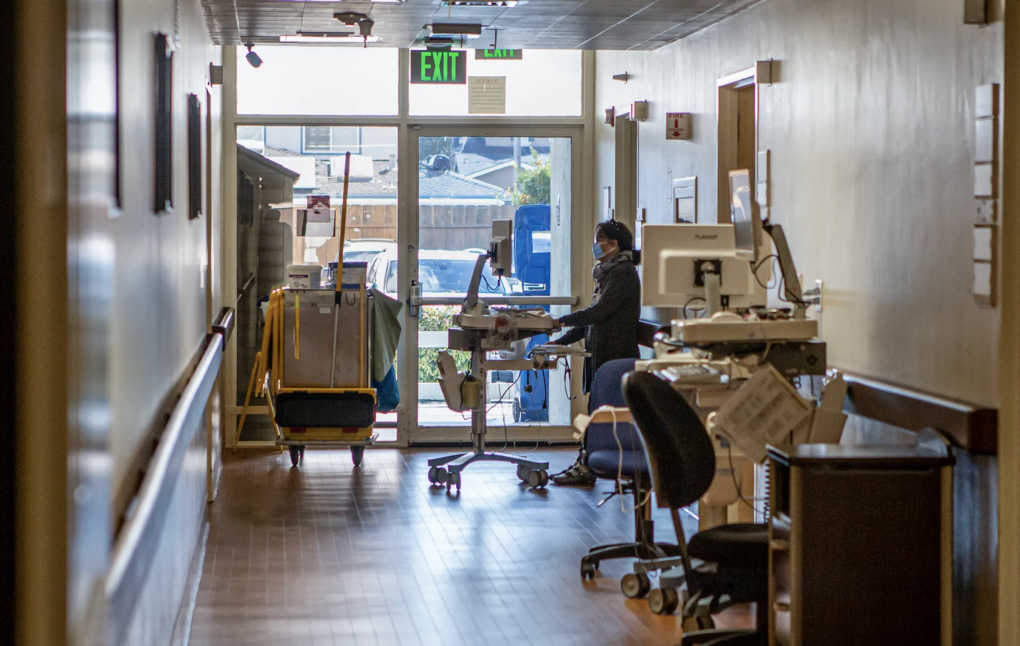
"caption": "A medical staffer working on a computer in the corridor of Hazel Hawkins Memorial Hospital in Hollister on March 30, 2023.",
"description": null,
"title": "Screenshot 2023-04-25 at 2.23.13 PM",
"credit": "Larry Valenzuela/CalMatters/CatchLight Local",
"status": "inherit",
"altTag": "A woman wearing a surgical masks stands in front of a computer screen and medical equipment in a hallway.",
"isLoading": false,
"fetchFailed": false
},
"news_11947462": {
"type": "attachments",
"id": "news_11947462",
"meta": {
"index": "attachments_1716263798",
"site": "news",
"id": "11947462",
"found": true
},
"parent": 11953672,
"imgSizes": {
"twentyfourteen-full-width": {
"file": "https://ww2.kqed.org/app/uploads/sites/10/2023/04/RS64551_011_KQED_MothershipHarmReduction_04112023-qut-1038x576.jpg",
"width": 1038,
"mimeType": "image/jpeg",
"height": 576
},
"thumbnail": {
"file": "https://ww2.kqed.org/app/uploads/sites/10/2023/04/RS64551_011_KQED_MothershipHarmReduction_04112023-qut-160x107.jpg",
"width": 160,
"mimeType": "image/jpeg",
"height": 107
},
"post-thumbnail": {
"file": "https://ww2.kqed.org/app/uploads/sites/10/2023/04/RS64551_011_KQED_MothershipHarmReduction_04112023-qut-672x372.jpg",
"width": 672,
"mimeType": "image/jpeg",
"height": 372
},
"kqedFullSize": {
"file": "https://ww2.kqed.org/app/uploads/sites/10/2023/04/RS64551_011_KQED_MothershipHarmReduction_04112023-qut.jpg",
"width": 1920,
"height": 1280
},
"large": {
"file": "https://ww2.kqed.org/app/uploads/sites/10/2023/04/RS64551_011_KQED_MothershipHarmReduction_04112023-qut-1020x680.jpg",
"width": 1020,
"mimeType": "image/jpeg",
"height": 680
},
"1536x1536": {
"file": "https://ww2.kqed.org/app/uploads/sites/10/2023/04/RS64551_011_KQED_MothershipHarmReduction_04112023-qut-1536x1024.jpg",
"width": 1536,
"mimeType": "image/jpeg",
"height": 1024
},
"medium": {
"file": "https://ww2.kqed.org/app/uploads/sites/10/2023/04/RS64551_011_KQED_MothershipHarmReduction_04112023-qut-800x533.jpg",
"width": 800,
"mimeType": "image/jpeg",
"height": 533
}
},
"publishDate": 1682364349,
"modified": 1687395869,
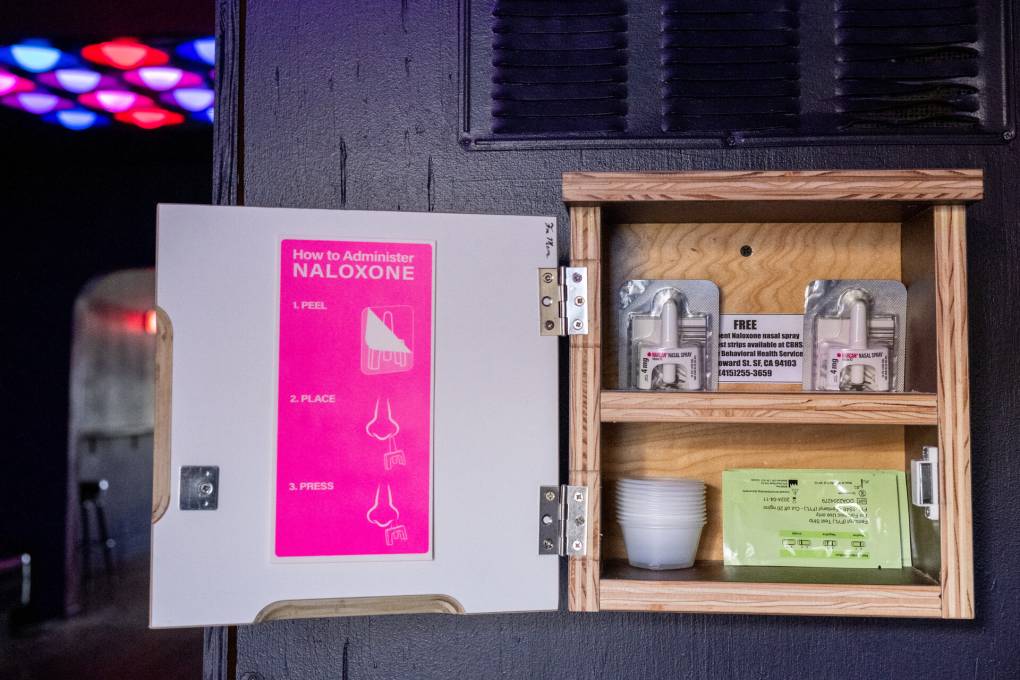
"caption": "A harm-reduction box created by Josh Yule hangs on the wall at Mothership bar in San Francisco on April 11, 2023. The boxes include Narcan and instructions on how to administer it, along with fentanyl test strips.",
"description": null,
"title": "RS64551_011_KQED_MothershipHarmReduction_04112023-qut",
"credit": "Beth LaBerge/KQED",
"status": "inherit",
"altTag": "A wooden box hanging on a bar wall is open, with medication, cups, instructions inside.",
"isLoading": false,
"fetchFailed": false
},
"news_11947190": {
"type": "attachments",
"id": "news_11947190",
"meta": {
"index": "attachments_1716263798",
"site": "news",
"id": "11947190",
"found": true
},
"title": "006_KQED_UCSFBenioffChildrensHospStrike_04192023",
"publishDate": 1681947432,
"status": "inherit",
"parent": 0,
"modified": 1771023942,
"caption": "Over 100 employees and their supporters gather for a rally outside UCSF Benioff Children's Hospital in Oakland on April 19, 2023, during a one-day strike authorized by more than 1,200 members of the National Union of Healthcare Workers.",
"credit": "Beth LaBerge/KQED",
"altTag": "Hundreds of protesters in red T-shirts hold red and yellow picket signs outside of UCSF Benioff Children's Hospital Oakland.",
"description": null,
"imgSizes": {
"medium": {
"file": "https://cdn.kqed.org/wp-content/uploads/sites/10/2023/04/006_KQED_UCSFBenioffChildrensHospStrike_04192023-800x533.jpg",
"width": 800,
"height": 533,
"mimeType": "image/jpeg"
},
"large": {
"file": "https://cdn.kqed.org/wp-content/uploads/sites/10/2023/04/006_KQED_UCSFBenioffChildrensHospStrike_04192023-1020x680.jpg",
"width": 1020,
"height": 680,
"mimeType": "image/jpeg"
},
"thumbnail": {
"file": "https://cdn.kqed.org/wp-content/uploads/sites/10/2023/04/006_KQED_UCSFBenioffChildrensHospStrike_04192023-160x107.jpg",
"width": 160,
"height": 107,
"mimeType": "image/jpeg"
},
"1536x1536": {
"file": "https://cdn.kqed.org/wp-content/uploads/sites/10/2023/04/006_KQED_UCSFBenioffChildrensHospStrike_04192023-1536x1024.jpg",
"width": 1536,
"height": 1024,
"mimeType": "image/jpeg"
},
"post-thumbnail": {
"file": "https://cdn.kqed.org/wp-content/uploads/sites/10/2023/04/006_KQED_UCSFBenioffChildrensHospStrike_04192023-672x372.jpg",
"width": 672,
"height": 372,
"mimeType": "image/jpeg"
},
"twentyfourteen-full-width": {
"file": "https://cdn.kqed.org/wp-content/uploads/sites/10/2023/04/006_KQED_UCSFBenioffChildrensHospStrike_04192023-1038x576.jpg",
"width": 1038,
"height": 576,
"mimeType": "image/jpeg"
},
"kqedFullSize": {
"file": "https://cdn.kqed.org/wp-content/uploads/sites/10/2023/04/006_KQED_UCSFBenioffChildrensHospStrike_04192023.jpg",
"width": 1920,
"height": 1280
}
},
"isLoading": false,
"fetchFailed": false
}
},
"audioPlayerReducer": {
"postId": "stream_live",
"isPaused": true,
"isPlaying": false,
"pfsActive": false,
"pledgeModalIsOpen": true,
"playerDrawerIsOpen": false,
"liveAudioPlayStartedAt": 0,
"liveAudioPlayContext": ""
},
"authorsReducer": {
"byline_news_11948611": {
"type": "authors",
"id": "byline_news_11948611",
"meta": {
"override": true
},
"slug": "byline_news_11948611",
"name": "\u003ca href=\"https://calmatters.org/author/anaibarra/\">Ana B. Ibarra\u003c/a>",
"isLoading": false
},
"byline_news_11948032": {
"type": "authors",
"id": "byline_news_11948032",
"meta": {
"override": true
},
"slug": "byline_news_11948032",
"name": "\u003ca href=\"https://calmatters.org/author/kristen-hwang/\">Kristen Hwang\u003c/a>",
"isLoading": false
},
"byline_news_11947971": {
"type": "authors",
"id": "byline_news_11947971",
"meta": {
"override": true
},
"slug": "byline_news_11947971",
"name": "\u003ca href=\"https://www.npr.org/people/2101159/joseph-shapiro\">Joseph Shapiro\u003c/a>",
"isLoading": false
},
"byline_news_11947640": {
"type": "authors",
"id": "byline_news_11947640",
"meta": {
"override": true
},
"slug": "byline_news_11947640",
"name": "\u003ca href=\"https://calmatters.org/author/anaibarra/\">Ana B. Ibarra\u003c/a>",
"isLoading": false
},
"matthewgreen": {
"type": "authors",
"id": "1263",
"meta": {
"index": "authors_1716337520",
"id": "1263",
"found": true
},
"name": "Matthew Green",
"firstName": "Matthew",
"lastName": "Green",
"slug": "matthewgreen",
"email": "mgreen@kqed.org",
"display_author_email": false,
"staff_mastheads": [],
"title": "KQED Editor/Reporter",
"bio": "Matthew Green is a digital media producer for KQED News. He previously produced \u003ca href=\"http://www.kqed.org/lowdown\">The Lowdown\u003c/a>, KQED’s multimedia news education blog. Matthew's written for numerous Bay Area publications, including the Oakland Tribune and San Francisco Chronicle. He also taught journalism classes at Fremont High School in East Oakland.\r\n\r\nEmail: mgreen@kqed.org; Twitter: @MGreenKQED",
"avatar": "https://secure.gravatar.com/avatar/3bf498d1267ca02c8494f33d8cfc575e?s=600&d=blank&r=g",
"twitter": "MGreenKQED",
"facebook": null,
"instagram": null,
"linkedin": null,
"sites": [
{
"site": "news",
"roles": []
},
{
"site": "lowdown",
"roles": []
},
{
"site": "science",
"roles": []
},
{
"site": "education",
"roles": []
},
{
"site": "quest",
"roles": []
},
{
"site": "liveblog",
"roles": []
}
],
"headData": {
"title": "Matthew Green | KQED",
"description": "KQED Editor/Reporter",
"ogImgSrc": "https://secure.gravatar.com/avatar/3bf498d1267ca02c8494f33d8cfc575e?s=600&d=blank&r=g",
"twImgSrc": "https://secure.gravatar.com/avatar/3bf498d1267ca02c8494f33d8cfc575e?s=600&d=blank&r=g"
},
"isLoading": false,
"link": "/author/matthewgreen"
},
"hmcdede": {
"type": "authors",
"id": "11635",
"meta": {
"index": "authors_1716337520",
"id": "11635",
"found": true
},
"name": "Holly McDede",
"firstName": "Holly",
"lastName": "McDede",
"slug": "hmcdede",
"email": "hmcdede@KQED.org",
"display_author_email": false,
"staff_mastheads": [],
"title": "KQED Contributor",
"bio": null,
"avatar": "https://secure.gravatar.com/avatar/999d9bf31bb3a2f0511932d99526cb3e?s=600&d=blank&r=g",
"twitter": null,
"facebook": null,
"instagram": null,
"linkedin": null,
"sites": [
{
"site": "arts",
"roles": [
"editor"
]
},
{
"site": "news",
"roles": [
"edit_others_posts",
"editor"
]
},
{
"site": "science",
"roles": [
"editor"
]
},
{
"site": "forum",
"roles": [
"editor"
]
},
{
"site": "perspectives",
"roles": [
"administrator"
]
}
],
"headData": {
"title": "Holly McDede | KQED",
"description": "KQED Contributor",
"ogImgSrc": "https://secure.gravatar.com/avatar/999d9bf31bb3a2f0511932d99526cb3e?s=600&d=blank&r=g",
"twImgSrc": "https://secure.gravatar.com/avatar/999d9bf31bb3a2f0511932d99526cb3e?s=600&d=blank&r=g"
},
"isLoading": false,
"link": "/author/hmcdede"
},
"daisynguyen": {
"type": "authors",
"id": "11829",
"meta": {
"index": "authors_1716337520",
"id": "11829",
"found": true
},
"name": "Daisy Nguyen",
"firstName": "Daisy",
"lastName": "Nguyen",
"slug": "daisynguyen",
"email": "daisynguyen@kqed.org",
"display_author_email": true,
"staff_mastheads": [
"news"
],
"title": "KQED Contributor",
"bio": "I have covered early childhood education and child care for KQED since 2022. I focus on policies aimed at increasing access to early care and education and how they shape individual lives. I've been a journalist for more than two decades, with most of that time devoted to covering breaking news throughout California for The Associated Press. I grew up in San Francisco and studied at UC Davis and Columbia University's Graduate School of Journalism. I live in Oakland with my husband and two kids.",
"avatar": "https://secure.gravatar.com/avatar/2da2127c27f7143b53ebd419800fd55f?s=600&d=blank&r=g",
"twitter": null,
"facebook": null,
"instagram": null,
"linkedin": "https://www.linkedin.com/in/daisynguyen/",
"sites": [
{
"site": "news",
"roles": [
"author"
]
},
{
"site": "liveblog",
"roles": [
"author"
]
}
],
"headData": {
"title": "Daisy Nguyen | KQED",
"description": "KQED Contributor",
"ogImgSrc": "https://secure.gravatar.com/avatar/2da2127c27f7143b53ebd419800fd55f?s=600&d=blank&r=g",
"twImgSrc": "https://secure.gravatar.com/avatar/2da2127c27f7143b53ebd419800fd55f?s=600&d=blank&r=g"
},
"isLoading": false,
"link": "/author/daisynguyen"
},
"sjohnson": {
"type": "authors",
"id": "11840",
"meta": {
"index": "authors_1716337520",
"id": "11840",
"found": true
},
"name": "Sydney Johnson",
"firstName": "Sydney",
"lastName": "Johnson",
"slug": "sjohnson",
"email": "sjohnson@kqed.org",
"display_author_email": false,
"staff_mastheads": [
"news"
],
"title": "KQED Reporter",
"bio": "Sydney Johnson is a general assignment reporter at KQED. She previously reported on public health and city government at the San Francisco Examiner, and before that, she covered statewide education policy for EdSource. Her reporting has won multiple local, state and national awards. Sydney is a graduate of the University of California, Berkeley and lives in San Francisco.",
"avatar": "https://secure.gravatar.com/avatar/97855f2719b72ad6190b7c535fe642c8?s=600&d=blank&r=g",
"twitter": "sydneyfjohnson",
"facebook": null,
"instagram": null,
"linkedin": null,
"sites": [
{
"site": "news",
"roles": [
"editor"
]
}
],
"headData": {
"title": "Sydney Johnson | KQED",
"description": "KQED Reporter",
"ogImgSrc": "https://secure.gravatar.com/avatar/97855f2719b72ad6190b7c535fe642c8?s=600&d=blank&r=g",
"twImgSrc": "https://secure.gravatar.com/avatar/97855f2719b72ad6190b7c535fe642c8?s=600&d=blank&r=g"
},
"isLoading": false,
"link": "/author/sjohnson"
}
},
"pagesReducer": {
"news_tag_health": {
"type": "terms",
"id": "news_18543",
"meta": {
"index": "terms_1716263798",
"site": "news",
"id": "18543",
"score": 6.886699
},
"featImg": null,
"name": "Health",
"description": null,
"taxonomy": "tag",
"headData": {
"twImgId": null,
"twTitle": null,
"ogTitle": null,
"ogImgId": null,
"twDescription": null,
"description": null,
"title": "Health Archives | KQED News",
"ogDescription": null
},
"ttid": 466,
"slug": "health",
"isLoading": false,
"title": "Health",
"pageMeta": {
"site": "news",
"WpPageTemplate": "page-topic-editorial",
"currentPage": 45
},
"blocks": [
{
"blockName": "kqed/post-list",
"attrs": {
"layout": "cardArticle2",
"query": "posts/news?tag=health",
"seeMore": false,
"paginated": true,
"page": 45
}
},
{
"blockName": "kqed/ad"
}
]
}
},
"pfsSessionReducer": {},
"postsReducer": {
"stream_live": {
"type": "live",
"id": "stream_live",
"audioUrl": "https://streams.kqed.org/kqedradio",
"title": "Live Stream",
"excerpt": "Live Stream information currently unavailable.",
"link": "/radio",
"featImg": "",
"label": {
"name": "KQED Live",
"link": "/"
}
},
"stream_kqedNewscast": {
"type": "posts",
"id": "stream_kqedNewscast",
"audioUrl": "https://www.kqed.org/.stream/anon/radio/RDnews/newscast.mp3?_=1",
"title": "KQED Newscast",
"featImg": "",
"label": {
"name": "88.5 FM",
"link": "/"
}
},
"news_11950092": {
"type": "posts",
"id": "news_11950092",
"meta": {
"index": "posts_1716263798",
"site": "news",
"id": "11950092",
"score": null,
"sort": [
1684455304000
]
},
"guestAuthors": [],
"slug": "san-francisco-laguna-honda-hospital-granted-extension",
"title": "Feds Grant SF’s Laguna Honda Hospital New Extension, Delaying Involuntary Patient Transfers",
"publishDate": 1684455304,
"format": "standard",
"headTitle": "Feds Grant SF’s Laguna Honda Hospital New Extension, Delaying Involuntary Patient Transfers | KQED",
"labelTerm": {
"site": "news"
},
"content": "\u003cp>Federal regulators have agreed to again put off involuntarily transferring residents at \u003ca href=\"https://www.kqed.org/news/11939987/feds-grant-reprieve-on-laguna-honda-patient-transfers-until-may\">Laguna Honda\u003c/a>, the state’s largest public nursing facility, which fell out of compliance in 2022.\u003c/p>\n\u003cp>The reprieve came just one day before the hospital would have been forced to implement a closure plan that involves assessing and discharging the facility’s more than 500 medically fragile patients in preparation for a possible closure.\u003c/p>\n\u003cp>Laguna Honda now has until Sept. 19, 2023, before involuntary transfers could resume, according to a letter from interim CEO Roland Pickens. In addition, health insurance coverage for the hospital’s majority of patients who are on Medi-Cal and Medicare will continue through March 19, 2024.\u003c/p>\n\u003cp>[ad fullwidth]\u003c/p>\n\u003cp>“Today’s good news is the result of positive changes taking place at Laguna Honda,” said Pickens in a note to families on Thursday. “The additional time provided by the extension allows us the opportunity we need [to] be in the best position to apply for recertification.”\u003c/p>\n\u003cp>The hospital is now working to regain certification with the Centers for Medicare and Medicaid Services, the federal regulatory body that Laguna Honda fell out of compliance with in April 2022.\u003c/p>\n\u003cp>[pullquote size=\"medium\" align=\"right\" citation=\"Roland Pickens, interim CEO, Laguna Honda Hospital\"]‘The additional time provided by the extension allows us the opportunity we need [to] be in the best position to apply for recertification.’[/pullquote]\u003c/p>\n\u003cp>The hospital was cited for a number of safety issues across multiple regulatory surveys that were triggered after \u003ca href=\"https://www.kqed.org/news/11949515/laguna-honda-faces-covid-outbreak-amid-looming-patient-transfer-deadline\">Laguna Honda self-reported two nonfatal overdoses\u003c/a> that occurred on-site.\u003c/p>\n\u003cp>As a result, federal regulators stripped Laguna Honda from Medicare and Medi-Cal, subsidized health care plans that cover the vast majority of residents at the facility, most of whom have extremely low incomes.\u003c/p>\n\u003cp>While Laguna Honda works to address its citations, CMS has simultaneously required that the hospital craft a closure plan to continue its health care funding. That plan involved assessing and relocating as many patients as possible in 2022.\u003c/p>\n\u003cfigure id=\"attachment_11950111\" class=\"wp-caption aligncenter\" style=\"max-width: 1920px\">\u003cimg loading=\"lazy\" decoding=\"async\" class=\"size-full wp-image-11950111\" src=\"https://ww2.kqed.org/app/uploads/sites/10/2023/05/RS62460_007_KQED_LagunaHondaHospital_01312023-qut.jpg\" alt='An outdoor shot of a big tan hospital building surrounded by tall trees, succulents and other green plants. The words \"Laguna Honda Hospital\" are seen over the main entryway.' width=\"1920\" height=\"1280\" srcset=\"https://cdn.kqed.org/wp-content/uploads/sites/10/2023/05/RS62460_007_KQED_LagunaHondaHospital_01312023-qut.jpg 1920w, https://cdn.kqed.org/wp-content/uploads/sites/10/2023/05/RS62460_007_KQED_LagunaHondaHospital_01312023-qut-800x533.jpg 800w, https://cdn.kqed.org/wp-content/uploads/sites/10/2023/05/RS62460_007_KQED_LagunaHondaHospital_01312023-qut-1020x680.jpg 1020w, https://cdn.kqed.org/wp-content/uploads/sites/10/2023/05/RS62460_007_KQED_LagunaHondaHospital_01312023-qut-160x107.jpg 160w, https://cdn.kqed.org/wp-content/uploads/sites/10/2023/05/RS62460_007_KQED_LagunaHondaHospital_01312023-qut-1536x1024.jpg 1536w\" sizes=\"auto, (max-width: 1920px) 100vw, 1920px\">\u003cfigcaption class=\"wp-caption-text\">The Laguna Honda Hospital administration building in San Francisco on Jan. 31, 2023. \u003ccite>(Beth LaBerge/KQED)\u003c/cite>\u003c/figcaption>\u003c/figure>\n\u003cp>Of 57 residents who were transferred or discharged during that process, 12 died shortly after their relocations. The city sued the federal government in response, and the transfer process was paused temporarily as part of a settlement agreement.\u003c/p>\n\u003cp>“Involuntary transfers caused our residents, their families, and our staff a great deal of distress. Laguna Honda and City leadership, as well as residents, families, and advocates, have strongly advocated against the involuntary transfers,” a spokesperson for the hospital wrote Tuesday in a media release. “This is the humane and compassionate path forward for our residents, their families, our staff, and all those who care about Laguna Honda.”\u003c/p>\n\u003cp>Following the city’s lawsuit in November 2022, the city and CMS reached a settlement agreement to pause the involuntary transfers until February 2023 and to continue health care payments through November 2023.\u003c/p>\n\u003cp>In February 2023, regulators agreed to extend the pause on transfers to May 19.\u003c/p>\n\u003cp>Today’s update moves the deadline yet again to Sept. 19, 2023, and payments will continue through March 19, 2024.[pullquote size=\"medium\" align=\"right\" citation=\"City Attorney David Chiu\"]‘The city and Laguna Honda have done a tremendous amount of work to come into compliance with the hundreds of requirements that have been asked of us and we believe we are in a good spot.’[/pullquote]“The city and Laguna Honda have done a tremendous amount of work to come into compliance with the hundreds of requirements that have been asked of us and we believe we are in a good spot,” said City Attorney David Chiu, whose office led the lawsuit against the federal regulators in 2022.\u003c/p>\n\u003cp>The hospital can apply for recertification after it successfully completes its next monitoring survey with CMS, which hospital officials say they expect to happen by the end of May or in June of this year.\u003c/p>\n\u003cp>“Laguna Honda is working diligently to make and sustain improvements that will serve our current residents and ensure Laguna Honda remains an essential part of the City and County of San Francisco’s commitment to public health,” the spokesperson said. “We remain confident that Laguna Honda is the best place for our residents to receive care.”[aside postID=news_11940765 hero='https://ww2.kqed.org/app/uploads/sites/10/2023/02/RS62526_02022023_lagunahondapresser-308-qut-1-1020x678.jpg']Meanwhile, senior and disability advocates have raised the alarm over the back-and-forth messaging that the hospital’s more than 500 residents and their families have endured throughout the regulatory spiral.\u003c/p>\n\u003cp>“Resuming evictions or whatever you want to call them is extremely dangerous,” said Teresa Palmer, who previously worked at Laguna Honda, in a recent town hall meeting about patients’ rights ahead of the looming discharges. “I don’t see how evictions and transfers can be resumed without severe consequences, not only to patients, but to the government agencies that are forcing them.”\u003c/p>\n\u003cp>\u003c/p>\n",
"blocks": [],
"excerpt": "'Today’s good news is the result of positive changes taking place at Laguna Honda,' said interim CEO Roland Pickens.",
"status": "publish",
"parent": 0,
"modified": 1738186366,
"stats": {
"hasAudio": false,
"hasVideo": false,
"hasChartOrMap": false,
"iframeSrcs": [],
"hasGoogleForm": false,
"hasGallery": false,
"hasHearkenModule": false,
"hasPolis": false,
"paragraphCount": 19,
"wordCount": 856
},
"headData": {
"title": "Feds Grant SF’s Laguna Honda Hospital New Extension, Delaying Involuntary Patient Transfers | KQED",
"description": "'Today’s good news is the result of positive changes taking place at Laguna Honda,' said interim CEO Roland Pickens.",
"ogTitle": "",
"ogDescription": "",
"ogImgId": "",
"twTitle": "",
"twDescription": "",
"twImgId": "",
"schema": {
"@context": "https://schema.org",
"@type": "NewsArticle",
"headline": "Feds Grant SF’s Laguna Honda Hospital New Extension, Delaying Involuntary Patient Transfers",
"datePublished": "2023-05-18T17:15:04-07:00",
"dateModified": "2025-01-29T13:32:46-08:00",
"image": "https://cdn.kqed.org/wp-content/uploads/2020/02/KQED-OG-Image@1x.png",
"isAccessibleForFree": "True",
"publisher": {
"@type": "NewsMediaOrganization",
"@id": "https://www.kqed.org/#organization",
"name": "KQED",
"logo": "https://cdn.kqed.org/wp-content/uploads/2020/02/KQED-OG-Image@1x.png",
"url": "https://www.kqed.org",
"sameAs": [
"https://www.facebook.com/KQED",
"https://twitter.com/KQED",
"https://www.instagram.com/kqed/",
"https://www.tiktok.com/@kqedofficial",
"https://www.linkedin.com/company/kqed",
"https://www.youtube.com/channel/UCeC0IOo7i1P_61zVUWbJ4nw"
]
}
}
},
"sticky": false,
"excludeFromSiteSearch": "Include",
"articleAge": "0",
"path": "/news/11950092/san-francisco-laguna-honda-hospital-granted-extension",
"audioTrackLength": null,
"parsedContent": [
{
"type": "contentString",
"content": "\u003cdiv class=\"post-body\">\u003cp>\u003cp>Federal regulators have agreed to again put off involuntarily transferring residents at \u003ca href=\"https://www.kqed.org/news/11939987/feds-grant-reprieve-on-laguna-honda-patient-transfers-until-may\">Laguna Honda\u003c/a>, the state’s largest public nursing facility, which fell out of compliance in 2022.\u003c/p>\n\u003cp>The reprieve came just one day before the hospital would have been forced to implement a closure plan that involves assessing and discharging the facility’s more than 500 medically fragile patients in preparation for a possible closure.\u003c/p>\n\u003cp>Laguna Honda now has until Sept. 19, 2023, before involuntary transfers could resume, according to a letter from interim CEO Roland Pickens. In addition, health insurance coverage for the hospital’s majority of patients who are on Medi-Cal and Medicare will continue through March 19, 2024.\u003c/p>\n\u003cp>\u003c/p>\u003c/div>",
"attributes": {
"named": {},
"numeric": []
}
},
{
"type": "component",
"content": "",
"name": "ad",
"attributes": {
"named": {
"label": "fullwidth"
},
"numeric": [
"fullwidth"
]
}
},
{
"type": "contentString",
"content": "\u003cdiv class=\"post-body\">\u003cp>\u003c/p>\n\u003cp>“Today’s good news is the result of positive changes taking place at Laguna Honda,” said Pickens in a note to families on Thursday. “The additional time provided by the extension allows us the opportunity we need [to] be in the best position to apply for recertification.”\u003c/p>\n\u003cp>The hospital is now working to regain certification with the Centers for Medicare and Medicaid Services, the federal regulatory body that Laguna Honda fell out of compliance with in April 2022.\u003c/p>\n\u003cp>\u003c/p>\u003c/div>",
"attributes": {
"named": {},
"numeric": []
}
},
{
"type": "component",
"content": "‘The additional time provided by the extension allows us the opportunity we need [to] be in the best position to apply for recertification.’",
"name": "pullquote",
"attributes": {
"named": {
"size": "medium",
"align": "right",
"citation": "Roland Pickens, interim CEO, Laguna Honda Hospital",
"label": ""
},
"numeric": []
}
},
{
"type": "contentString",
"content": "\u003cdiv class=\"post-body\">\u003cp>\u003c/p>\n\u003cp>The hospital was cited for a number of safety issues across multiple regulatory surveys that were triggered after \u003ca href=\"https://www.kqed.org/news/11949515/laguna-honda-faces-covid-outbreak-amid-looming-patient-transfer-deadline\">Laguna Honda self-reported two nonfatal overdoses\u003c/a> that occurred on-site.\u003c/p>\n\u003cp>As a result, federal regulators stripped Laguna Honda from Medicare and Medi-Cal, subsidized health care plans that cover the vast majority of residents at the facility, most of whom have extremely low incomes.\u003c/p>\n\u003cp>While Laguna Honda works to address its citations, CMS has simultaneously required that the hospital craft a closure plan to continue its health care funding. That plan involved assessing and relocating as many patients as possible in 2022.\u003c/p>\n\u003cfigure id=\"attachment_11950111\" class=\"wp-caption aligncenter\" style=\"max-width: 1920px\">\u003cimg loading=\"lazy\" decoding=\"async\" class=\"size-full wp-image-11950111\" src=\"https://ww2.kqed.org/app/uploads/sites/10/2023/05/RS62460_007_KQED_LagunaHondaHospital_01312023-qut.jpg\" alt='An outdoor shot of a big tan hospital building surrounded by tall trees, succulents and other green plants. The words \"Laguna Honda Hospital\" are seen over the main entryway.' width=\"1920\" height=\"1280\" srcset=\"https://cdn.kqed.org/wp-content/uploads/sites/10/2023/05/RS62460_007_KQED_LagunaHondaHospital_01312023-qut.jpg 1920w, https://cdn.kqed.org/wp-content/uploads/sites/10/2023/05/RS62460_007_KQED_LagunaHondaHospital_01312023-qut-800x533.jpg 800w, https://cdn.kqed.org/wp-content/uploads/sites/10/2023/05/RS62460_007_KQED_LagunaHondaHospital_01312023-qut-1020x680.jpg 1020w, https://cdn.kqed.org/wp-content/uploads/sites/10/2023/05/RS62460_007_KQED_LagunaHondaHospital_01312023-qut-160x107.jpg 160w, https://cdn.kqed.org/wp-content/uploads/sites/10/2023/05/RS62460_007_KQED_LagunaHondaHospital_01312023-qut-1536x1024.jpg 1536w\" sizes=\"auto, (max-width: 1920px) 100vw, 1920px\">\u003cfigcaption class=\"wp-caption-text\">The Laguna Honda Hospital administration building in San Francisco on Jan. 31, 2023. \u003ccite>(Beth LaBerge/KQED)\u003c/cite>\u003c/figcaption>\u003c/figure>\n\u003cp>Of 57 residents who were transferred or discharged during that process, 12 died shortly after their relocations. The city sued the federal government in response, and the transfer process was paused temporarily as part of a settlement agreement.\u003c/p>\n\u003cp>“Involuntary transfers caused our residents, their families, and our staff a great deal of distress. Laguna Honda and City leadership, as well as residents, families, and advocates, have strongly advocated against the involuntary transfers,” a spokesperson for the hospital wrote Tuesday in a media release. “This is the humane and compassionate path forward for our residents, their families, our staff, and all those who care about Laguna Honda.”\u003c/p>\n\u003cp>Following the city’s lawsuit in November 2022, the city and CMS reached a settlement agreement to pause the involuntary transfers until February 2023 and to continue health care payments through November 2023.\u003c/p>\n\u003cp>In February 2023, regulators agreed to extend the pause on transfers to May 19.\u003c/p>\n\u003cp>Today’s update moves the deadline yet again to Sept. 19, 2023, and payments will continue through March 19, 2024.\u003c/p>\u003c/div>",
"attributes": {
"named": {},
"numeric": []
}
},
{
"type": "component",
"content": "‘The city and Laguna Honda have done a tremendous amount of work to come into compliance with the hundreds of requirements that have been asked of us and we believe we are in a good spot.’",
"name": "pullquote",
"attributes": {
"named": {
"size": "medium",
"align": "right",
"citation": "City Attorney David Chiu",
"label": ""
},
"numeric": []
}
},
{
"type": "contentString",
"content": "\u003cdiv class=\"post-body\">\u003cp>“The city and Laguna Honda have done a tremendous amount of work to come into compliance with the hundreds of requirements that have been asked of us and we believe we are in a good spot,” said City Attorney David Chiu, whose office led the lawsuit against the federal regulators in 2022.\u003c/p>\n\u003cp>The hospital can apply for recertification after it successfully completes its next monitoring survey with CMS, which hospital officials say they expect to happen by the end of May or in June of this year.\u003c/p>\n\u003cp>“Laguna Honda is working diligently to make and sustain improvements that will serve our current residents and ensure Laguna Honda remains an essential part of the City and County of San Francisco’s commitment to public health,” the spokesperson said. “We remain confident that Laguna Honda is the best place for our residents to receive care.”\u003c/p>\u003c/div>",
"attributes": {
"named": {},
"numeric": []
}
},
{
"type": "component",
"content": "",
"name": "aside",
"attributes": {
"named": {
"postid": "news_11940765",
"hero": "https://ww2.kqed.org/app/uploads/sites/10/2023/02/RS62526_02022023_lagunahondapresser-308-qut-1-1020x678.jpg",
"label": ""
},
"numeric": []
}
},
{
"type": "contentString",
"content": "\u003cdiv class=\"post-body\">\u003cp>Meanwhile, senior and disability advocates have raised the alarm over the back-and-forth messaging that the hospital’s more than 500 residents and their families have endured throughout the regulatory spiral.\u003c/p>\n\u003cp>“Resuming evictions or whatever you want to call them is extremely dangerous,” said Teresa Palmer, who previously worked at Laguna Honda, in a recent town hall meeting about patients’ rights ahead of the looming discharges. “I don’t see how evictions and transfers can be resumed without severe consequences, not only to patients, but to the government agencies that are forcing them.”\u003c/p>\n\u003cp>\u003c/p>\n\u003c/div>\u003c/p>",
"attributes": {
"named": {},
"numeric": []
}
}
],
"link": "/news/11950092/san-francisco-laguna-honda-hospital-granted-extension",
"authors": [
"11840"
],
"categories": [
"news_457",
"news_8"
],
"tags": [
"news_27626",
"news_18543",
"news_26092",
"news_2605",
"news_26763"
],
"featImg": "news_11950108",
"label": "news"
},
"news_11949888": {
"type": "posts",
"id": "news_11949888",
"meta": {
"index": "posts_1716263798",
"site": "news",
"id": "11949888",
"score": null,
"sort": [
1684414369000
]
},
"guestAuthors": [],
"slug": "walgreens-pay-san-francisco-230-million-opioid-crisis",
"title": "Walgreens to Pay San Francisco $230 Million for Role in Opioid Crisis",
"publishDate": 1684414369,
"format": "standard",
"headTitle": "Walgreens to Pay San Francisco $230 Million for Role in Opioid Crisis | KQED",
"labelTerm": {
"site": "news"
},
"content": "\u003cp>Walgreens will pay San Francisco nearly $230 million over 14 years as part of a settlement agreement over the pharmacy giant’s role in the \u003ca href=\"https://www.kqed.org/news/11945418/san-francisco-has-doubled-participants-of-this-opioid-treatment-heres-why\">opioid epidemic\u003c/a>, city officials announced Wednesday.\u003c/p>\n\u003cp>The settlement stems from landmark litigation San Francisco brought against Walgreens in 2018, and comes as part of a larger legal effort against the drug industry for fueling the opioid industry.\u003c/p>\n\u003cp>“Opioids have wreaked havoc across our nation, leading to immense suffering and untold damage,” said City Attorney David Chiu. “This historic agreement ensures Walgreens is held accountable for the crisis they fueled and our city receives appropriate resources to combat the opioid crisis and bring relief to our communities.”\u003c/p>\n\u003cp>\u003cspan style=\"font-weight: 400\">[ad fullwidth]\u003c/span>\u003c/p>\n\u003cp>Although Walgreens will pay the settlement over 14 years, the bulk of the funding will be released sooner: Up to $57 million will be available in the city’s current budget cycle — part of $175 million San Francisco should receive by 2030, Chiu said.\u003c/p>\n\u003cp>“While we are grateful for the funding secured in this lawsuit, it won’t replace the thousands of lives lost to the opioid epidemic that is playing out across our country. Lives are being devastated, particularly with the rise of fentanyl, and cities are being left to respond to what is a generational crisis,” said San Francisco Mayor London Breed. “We will incorporate the plans to use this funding in our upcoming budget, which is currently being finalized and must be submitted to the Board of Supervisors by the end of the month. I look forward to working with the board members on this as part of our overall budget process.”\u003c/p>\n\u003cp>The litigation will now be dismissed, and Breed and the Board of Supervisors must next approve the settlement agreement.\u003c/p>\n\u003cp>\u003cspan style=\"font-weight: 400\">[aside label='More Stories on Health' tag='health']\u003c/span>\u003c/p>\n\u003cp>Since 2018, San Francisco has sued multiple opioid manufacturers, distributors and dispensers, and Walgreens was the last defendant to reach a settlement agreement with the city. In total, San Francisco stands to receive $352 million over the next 15 years.\u003c/p>\n\u003cp>In April, the city settled lawsuits over \u003ca href=\"https://www.kqed.org/news/11946346/walmart-cvs-set-to-pay-san-francisco-19-million-in-opioid-settlements\">Walmart’s and CVS Pharmacy’s alleged negligent oversight\u003c/a> of opioid prescription practices; San Francisco is slated to receive up to $18.8 million from those settlements. In 2022, the city attorney’s office secured a $10 million settlement from Endo, a pharmaceutical company, and $54 million from drug manufacturers Allergan and Teva. And, the city approved a $45 million settlement with Johnson & Johnson, which manufactures opioids, and distributors including Cardinal, AmerisourceBergen and McKesson.\u003c/p>\n\u003cp>“The evidence at trial established that from 2006 to 2020, Walgreens pharmacies in San Francisco dispensed hundreds of thousands of red-flag opioid prescriptions without performing adequate due diligence,” said presiding judge Charles Breyer of the U.S. District Court of the Northern District of California. “Tens of thousands of these prescriptions were written by doctors with suspect prescribing patterns.”\u003c/p>\n\u003cp>The funds are said to be earmarked for overdose prevention, such as distributing Narcan, a nasal spray or injectable that can reverse an opioid overdose.\u003c/p>\n\u003cp>Advocates for overdose prevention have also called for the millions of dollars in opioid litigation settlements to be used for \u003ca href=\"https://www.kqed.org/news/11943309/sf-supervisors-carve-path-for-privately-run-safe-consumption-sites-but-can-nonprofits-fund-them-alone\">safe consumption sites\u003c/a>, facilities where people can consume illicit substances under medical supervision. The idea is to have trained staff available to reverse an overdose if one takes place, and work with drug users to connect them to other health and social services. It also gives drug users a safer place to be rather than the street.[pullquote size=\"medium\" align=\"right\" citation=\"Judge Charles Breyer, US District Court of the Northern District of California\"]‘Tens of thousands of these prescriptions were written by doctors with suspect prescribing patterns.’[/pullquote]Supervisor Hillary Ronen said she is advocating for a portion of the settlement funds to cover overdose prevention services at “wellness hubs” the city plans to open in the Tenderloin, Mission and South of Market neighborhoods. She said she would also like to see the funding used to hire case managers who could do proactive outreach and trust-building with hard-to-reach people living on the street and experiencing substance use disorder.\u003c/p>\n\u003cp>Chiu said he supports safe consumption sites as a tool to combat overdoses, but has not agreed to use the opioid litigation funds for the sites because of legal disagreements over whether this would run afoul of state and federal law.\u003c/p>\n\u003cfigure id=\"attachment_11949901\" class=\"wp-caption aligncenter\" style=\"max-width: 720px\">\u003cimg loading=\"lazy\" decoding=\"async\" class=\"size-full wp-image-11949901\" src=\"https://ww2.kqed.org/app/uploads/sites/10/2023/05/image.png\" alt=\"Dozens of distinguished men and women in business suits and dress stand in front of a large, gray building with gold accents. Everyone is posing for a photograph.\" width=\"720\" height=\"540\" srcset=\"https://cdn.kqed.org/wp-content/uploads/sites/10/2023/05/image.png 720w, https://cdn.kqed.org/wp-content/uploads/sites/10/2023/05/image-160x120.png 160w\" sizes=\"auto, (max-width: 720px) 100vw, 720px\">\u003cfigcaption class=\"wp-caption-text\">City Attorney David Chiu (second row, center, in blue suit and yellow tie) stands with health director Grant Colfax (third row, center) and former City Attorney Louise Renne (second row, far left, in dark blue suit) and attorneys who led the case against Walgreens for its role in the opioid crisis. \u003ccite>(Sydney Johnson/KQED)\u003c/cite>\u003c/figcaption>\u003c/figure>\n\u003cp>In 2022, Gov. Gavin Newsom vetoed a bill that would have allowed San Francisco to pilot safe consumption sites, which are used in more than a dozen countries around the globe.\u003c/p>\n\u003cp>Rhode Island passed a similar bill, and is now planning to open a site in 2024 that would use some of that state’s funding from similar opioid litigation wins.\u003c/p>\n\u003cp>Meanwhile, New York City has been operating a safe consumption facility using a model that doesn’t rely on public funding — but long-term financing is an ongoing challenge. Staff at the site, run by the nonprofit OnPoint NYC, have reversed more than 800 overdoses, executive director Sam Rivera told Politico earlier this month. New York City Mayor Eric Adams has said he is looking to expand the model.\u003c/p>\n\u003cp>“I have been a long-time supporter of the possibility that San Francisco should consider safe consumption sites,” Chiu said. “In New York, there has been a nonprofit that has moved forward with safe consumption sites without city staff, funding or property. I think that would be appropriate for us to do here in San Francisco, but those conversations continue.”\u003c/p>\n\u003cp>\u003cspan style=\"font-weight: 400\">[aside postID=news_11944267 hero='https://ww2.kqed.org/app/uploads/sites/10/2023/03/RS51826_068_Oakland_HighlandHospitalBridgeProgram_10062021-qut-1020x680.jpg']\u003c/span>\u003c/p>\n\u003cp>But local nonprofits in San Francisco that want to operate safe consumption services say they will be hard to fully fund without support from the city’s opioid litigation funds.\u003c/p>\n\u003cp>Chiu said his office is in conversation with leaders in Rhode Island, but he stressed that Newsom’s veto in 2022 makes the situation harder here in San Francisco.\u003c/p>\n\u003cp>“Rhode Island is the only state in the country where the state legislature passed a law signed by the governor that would permit safe consumption sites,” he said. “That’s not the case here in California.”\u003c/p>\n\u003cp>[ad floatright]\u003c/p>\n",
"blocks": [],
"excerpt": "San Francisco projects it will receive a total of $350 million over the next 15 years from multiple settlements with opioid manufacturers, distributors and dispensers.",
"status": "publish",
"parent": 0,
"modified": 1738095929,
"stats": {
"hasAudio": false,
"hasVideo": false,
"hasChartOrMap": false,
"iframeSrcs": [],
"hasGoogleForm": false,
"hasGallery": false,
"hasHearkenModule": false,
"hasPolis": false,
"paragraphCount": 23,
"wordCount": 1122
},
"headData": {
"title": "Walgreens to Pay San Francisco $230 Million for Role in Opioid Crisis | KQED",
"description": "San Francisco projects it will receive a total of $350 million over the next 15 years from multiple settlements with opioid manufacturers, distributors and dispensers.",
"ogTitle": "",
"ogDescription": "",
"ogImgId": "",
"twTitle": "",
"twDescription": "",
"twImgId": "",
"schema": {
"@context": "https://schema.org",
"@type": "NewsArticle",
"headline": "Walgreens to Pay San Francisco $230 Million for Role in Opioid Crisis",
"datePublished": "2023-05-18T05:52:49-07:00",
"dateModified": "2025-01-28T12:25:29-08:00",
"image": "https://cdn.kqed.org/wp-content/uploads/2020/02/KQED-OG-Image@1x.png",
"isAccessibleForFree": "True",
"publisher": {
"@type": "NewsMediaOrganization",
"@id": "https://www.kqed.org/#organization",
"name": "KQED",
"logo": "https://cdn.kqed.org/wp-content/uploads/2020/02/KQED-OG-Image@1x.png",
"url": "https://www.kqed.org",
"sameAs": [
"https://www.facebook.com/KQED",
"https://twitter.com/KQED",
"https://www.instagram.com/kqed/",
"https://www.tiktok.com/@kqedofficial",
"https://www.linkedin.com/company/kqed",
"https://www.youtube.com/channel/UCeC0IOo7i1P_61zVUWbJ4nw"
]
}
}
},
"sticky": false,
"excludeFromSiteSearch": "Include",
"articleAge": "0",
"path": "/news/11949888/walgreens-pay-san-francisco-230-million-opioid-crisis",
"audioTrackLength": null,
"parsedContent": [
{
"type": "contentString",
"content": "\u003cdiv class=\"post-body\">\u003cp>\u003cp>Walgreens will pay San Francisco nearly $230 million over 14 years as part of a settlement agreement over the pharmacy giant’s role in the \u003ca href=\"https://www.kqed.org/news/11945418/san-francisco-has-doubled-participants-of-this-opioid-treatment-heres-why\">opioid epidemic\u003c/a>, city officials announced Wednesday.\u003c/p>\n\u003cp>The settlement stems from landmark litigation San Francisco brought against Walgreens in 2018, and comes as part of a larger legal effort against the drug industry for fueling the opioid industry.\u003c/p>\n\u003cp>“Opioids have wreaked havoc across our nation, leading to immense suffering and untold damage,” said City Attorney David Chiu. “This historic agreement ensures Walgreens is held accountable for the crisis they fueled and our city receives appropriate resources to combat the opioid crisis and bring relief to our communities.”\u003c/p>\n\u003cp>\u003cspan style=\"font-weight: 400\">\u003c/p>\u003c/div>",
"attributes": {
"named": {},
"numeric": []
}
},
{
"type": "component",
"content": "",
"name": "ad",
"attributes": {
"named": {
"label": "fullwidth"
},
"numeric": [
"fullwidth"
]
}
},
{
"type": "contentString",
"content": "\u003cdiv class=\"post-body\">\u003cp>\u003c/span>\u003c/p>\n\u003cp>Although Walgreens will pay the settlement over 14 years, the bulk of the funding will be released sooner: Up to $57 million will be available in the city’s current budget cycle — part of $175 million San Francisco should receive by 2030, Chiu said.\u003c/p>\n\u003cp>“While we are grateful for the funding secured in this lawsuit, it won’t replace the thousands of lives lost to the opioid epidemic that is playing out across our country. Lives are being devastated, particularly with the rise of fentanyl, and cities are being left to respond to what is a generational crisis,” said San Francisco Mayor London Breed. “We will incorporate the plans to use this funding in our upcoming budget, which is currently being finalized and must be submitted to the Board of Supervisors by the end of the month. I look forward to working with the board members on this as part of our overall budget process.”\u003c/p>\n\u003cp>The litigation will now be dismissed, and Breed and the Board of Supervisors must next approve the settlement agreement.\u003c/p>\n\u003cp>\u003cspan style=\"font-weight: 400\">\u003c/p>\u003c/div>",
"attributes": {
"named": {},
"numeric": []
}
},
{
"type": "component",
"content": "",
"name": "aside",
"attributes": {
"named": {
"label": "More Stories on Health ",
"tag": "health"
},
"numeric": []
}
},
{
"type": "contentString",
"content": "\u003cdiv class=\"post-body\">\u003cp>\u003c/span>\u003c/p>\n\u003cp>Since 2018, San Francisco has sued multiple opioid manufacturers, distributors and dispensers, and Walgreens was the last defendant to reach a settlement agreement with the city. In total, San Francisco stands to receive $352 million over the next 15 years.\u003c/p>\n\u003cp>In April, the city settled lawsuits over \u003ca href=\"https://www.kqed.org/news/11946346/walmart-cvs-set-to-pay-san-francisco-19-million-in-opioid-settlements\">Walmart’s and CVS Pharmacy’s alleged negligent oversight\u003c/a> of opioid prescription practices; San Francisco is slated to receive up to $18.8 million from those settlements. In 2022, the city attorney’s office secured a $10 million settlement from Endo, a pharmaceutical company, and $54 million from drug manufacturers Allergan and Teva. And, the city approved a $45 million settlement with Johnson & Johnson, which manufactures opioids, and distributors including Cardinal, AmerisourceBergen and McKesson.\u003c/p>\n\u003cp>“The evidence at trial established that from 2006 to 2020, Walgreens pharmacies in San Francisco dispensed hundreds of thousands of red-flag opioid prescriptions without performing adequate due diligence,” said presiding judge Charles Breyer of the U.S. District Court of the Northern District of California. “Tens of thousands of these prescriptions were written by doctors with suspect prescribing patterns.”\u003c/p>\n\u003cp>The funds are said to be earmarked for overdose prevention, such as distributing Narcan, a nasal spray or injectable that can reverse an opioid overdose.\u003c/p>\n\u003cp>Advocates for overdose prevention have also called for the millions of dollars in opioid litigation settlements to be used for \u003ca href=\"https://www.kqed.org/news/11943309/sf-supervisors-carve-path-for-privately-run-safe-consumption-sites-but-can-nonprofits-fund-them-alone\">safe consumption sites\u003c/a>, facilities where people can consume illicit substances under medical supervision. The idea is to have trained staff available to reverse an overdose if one takes place, and work with drug users to connect them to other health and social services. It also gives drug users a safer place to be rather than the street.\u003c/p>\u003c/div>",
"attributes": {
"named": {},
"numeric": []
}
},
{
"type": "component",
"content": "‘Tens of thousands of these prescriptions were written by doctors with suspect prescribing patterns.’",
"name": "pullquote",
"attributes": {
"named": {
"size": "medium",
"align": "right",
"citation": "Judge Charles Breyer, US District Court of the Northern District of California",
"label": ""
},
"numeric": []
}
},
{
"type": "contentString",
"content": "\u003cdiv class=\"post-body\">\u003cp>Supervisor Hillary Ronen said she is advocating for a portion of the settlement funds to cover overdose prevention services at “wellness hubs” the city plans to open in the Tenderloin, Mission and South of Market neighborhoods. She said she would also like to see the funding used to hire case managers who could do proactive outreach and trust-building with hard-to-reach people living on the street and experiencing substance use disorder.\u003c/p>\n\u003cp>Chiu said he supports safe consumption sites as a tool to combat overdoses, but has not agreed to use the opioid litigation funds for the sites because of legal disagreements over whether this would run afoul of state and federal law.\u003c/p>\n\u003cfigure id=\"attachment_11949901\" class=\"wp-caption aligncenter\" style=\"max-width: 720px\">\u003cimg loading=\"lazy\" decoding=\"async\" class=\"size-full wp-image-11949901\" src=\"https://ww2.kqed.org/app/uploads/sites/10/2023/05/image.png\" alt=\"Dozens of distinguished men and women in business suits and dress stand in front of a large, gray building with gold accents. Everyone is posing for a photograph.\" width=\"720\" height=\"540\" srcset=\"https://cdn.kqed.org/wp-content/uploads/sites/10/2023/05/image.png 720w, https://cdn.kqed.org/wp-content/uploads/sites/10/2023/05/image-160x120.png 160w\" sizes=\"auto, (max-width: 720px) 100vw, 720px\">\u003cfigcaption class=\"wp-caption-text\">City Attorney David Chiu (second row, center, in blue suit and yellow tie) stands with health director Grant Colfax (third row, center) and former City Attorney Louise Renne (second row, far left, in dark blue suit) and attorneys who led the case against Walgreens for its role in the opioid crisis. \u003ccite>(Sydney Johnson/KQED)\u003c/cite>\u003c/figcaption>\u003c/figure>\n\u003cp>In 2022, Gov. Gavin Newsom vetoed a bill that would have allowed San Francisco to pilot safe consumption sites, which are used in more than a dozen countries around the globe.\u003c/p>\n\u003cp>Rhode Island passed a similar bill, and is now planning to open a site in 2024 that would use some of that state’s funding from similar opioid litigation wins.\u003c/p>\n\u003cp>Meanwhile, New York City has been operating a safe consumption facility using a model that doesn’t rely on public funding — but long-term financing is an ongoing challenge. Staff at the site, run by the nonprofit OnPoint NYC, have reversed more than 800 overdoses, executive director Sam Rivera told Politico earlier this month. New York City Mayor Eric Adams has said he is looking to expand the model.\u003c/p>\n\u003cp>“I have been a long-time supporter of the possibility that San Francisco should consider safe consumption sites,” Chiu said. “In New York, there has been a nonprofit that has moved forward with safe consumption sites without city staff, funding or property. I think that would be appropriate for us to do here in San Francisco, but those conversations continue.”\u003c/p>\n\u003cp>\u003cspan style=\"font-weight: 400\">\u003c/p>\u003c/div>",
"attributes": {
"named": {},
"numeric": []
}
},
{
"type": "component",
"content": "",
"name": "aside",
"attributes": {
"named": {
"postid": "news_11944267",
"hero": "https://ww2.kqed.org/app/uploads/sites/10/2023/03/RS51826_068_Oakland_HighlandHospitalBridgeProgram_10062021-qut-1020x680.jpg",
"label": ""
},
"numeric": []
}
},
{
"type": "contentString",
"content": "\u003cdiv class=\"post-body\">\u003cp>\u003c/span>\u003c/p>\n\u003cp>But local nonprofits in San Francisco that want to operate safe consumption services say they will be hard to fully fund without support from the city’s opioid litigation funds.\u003c/p>\n\u003cp>Chiu said his office is in conversation with leaders in Rhode Island, but he stressed that Newsom’s veto in 2022 makes the situation harder here in San Francisco.\u003c/p>\n\u003cp>“Rhode Island is the only state in the country where the state legislature passed a law signed by the governor that would permit safe consumption sites,” he said. “That’s not the case here in California.”\u003c/p>\n\u003cp>\u003c/p>\u003c/div>",
"attributes": {
"named": {},
"numeric": []
}
},
{
"type": "component",
"content": "",
"name": "ad",
"attributes": {
"named": {
"label": "floatright"
},
"numeric": [
"floatright"
]
}
},
{
"type": "contentString",
"content": "\u003cdiv class=\"post-body\">\u003cp>\u003c/p>\n\u003c/div>\u003c/p>",
"attributes": {
"named": {},
"numeric": []
}
}
],
"link": "/news/11949888/walgreens-pay-san-francisco-230-million-opioid-crisis",
"authors": [
"11840"
],
"categories": [
"news_457",
"news_8"
],
"tags": [
"news_16",
"news_18543",
"news_24298",
"news_22774",
"news_38",
"news_3064",
"news_2211"
],
"featImg": "news_11949900",
"label": "news"
},
"news_11948611": {
"type": "posts",
"id": "news_11948611",
"meta": {
"index": "posts_1716263798",
"site": "news",
"id": "11948611",
"score": null,
"sort": [
1683313257000
]
},
"guestAuthors": [],
"slug": "california-lawmakers-fast-track-a-loan-program-to-prevent-hospital-closures",
"title": "California Legislators Fast-Track a Loan Program to Prevent Hospital Closures",
"publishDate": 1683313257,
"format": "standard",
"headTitle": "California Legislators Fast-Track a Loan Program to Prevent Hospital Closures | KQED",
"labelTerm": {
"term": 18481,
"site": "news"
},
"content": "\u003cp>California \u003ca href=\"https://calmatters.org/health/2023/04/hospital-closures-california/\">hospitals in financial trouble\u003c/a> will soon be able to apply for interest-free state loans, although key questions about the selection process aren’t yet resolved.\u003c/p>\n\u003cp>The Legislature on Thursday approved \u003ca href=\"https://leginfo.legislature.ca.gov/faces/billNavClient.xhtml?bill_id=202320240AB112\">a bill that will allocate a one-time sum of $150 million from the general fund to aid hospitals\u003c/a> that are facing severe financial distress and are at risk of closure, or that have closed but have a plan to reopen. The loans would have to be paid back within six years, although loans may be forgiven for hospitals that meet certain requirements. Gov. Gavin Newsom needs to sign the bill to enact the program.\u003c/p>\n\u003cp>Legislators and hospital administrators have acknowledged a loan program is only a stopgap for a number of hospitals that for months have warned of their precarious fiscal situations. Legislators fast-tracked action following \u003ca href=\"https://calmatters.org/health/2023/01/hospital-closure/\">the closure of Madera Community Hospital\u003c/a> at the start of this year, which left this San Joaquin Valley county of 160,000 people without a local emergency room.\u003c/p>\n\u003cp>Since then, another hospital, Beverly Hospital in the city of Montebello, has filed for bankruptcy.[aside label=\"Related Stories\" postID=\"science_1981588,news_11947640,news_11937928\"]“This bill, this money, will keep them (Beverly Hospital) open long enough to be able to perhaps sell, regroup, whatever, but they will keep their doors open,” Sen. Bob Archuleta, a Cerritos Democrat whose district includes Montebello, said on the Senate floor.\u003c/p>\n\u003cp>Loans under the new program would be available to nonprofit and public hospitals. Those that would most likely need and could benefit from the loans are independent and rural hospitals, some of which were struggling even prior to the pandemic, and that have had a difficult time managing cash flow after they stopped receiving federal COVID relief funds. Hospitals that apply will have to demonstrate need and viability to the California Department of Health Care Access and Information, which will oversee the program in conjunction with the state’s health department and the \u003ca href=\"https://www.treasurer.ca.gov/chffa/introduction.asp\">California Health Facilities Financing Authority\u003c/a>, a financing program within the State Treasurer’s Office.\u003c/p>\n\u003cp>It’s not clear exactly how many hospitals could qualify and how much each would get, according to officials from the state Department of Finance who testified in a budget committee hearing earlier this week. That will be determined by the agencies in charge, who will have to create eligibility criteria for these loans.\u003c/p>\n\u003cp>In hearings leading to Thursday’s vote, lawmakers asked why the state wasn’t conducting its own analysis of hospitals’ current situation so that the Legislature knows exactly which hospitals are in immediate need of relief.\u003c/p>\n\u003cp>“We don’t know how many hospitals, we don’t know which hospitals. We don’t know which areas those hospitals are (in), we don’t know anything. And now we’re asked to approve $150 million to be doled out without access to plans, without access to the finances that would give us the evidence to feel comfortable with this,” said Sen. Maria Elena Durazo, a Los Angeles Democrat, during a Senate budget committee hearing on Tuesday.[pullquote align=\"right\" size=\"medium\" citation=\"State Sen. Bob Archuleta (D-Cerritos)\"]‘This bill, this money, will keep them (Beverly Hospital) open long enough to be able to perhaps sell, regroup, whatever, but they will keep their doors open.’[/pullquote]Much of the information available to legislators has come from the California Hospital Association, whose job is to lobby on behalf of hospitals. According to a report commissioned by the association, \u003ca href=\"https://www.kaufmanhall.com/sites/default/files/2023-04/CHA-Financial-Impact-Report.pdf\">1 in 5 hospitals is at risk of closure (PDF)\u003c/a>, and half of California’s hospitals are losing money. The report did not list which hospitals are in immediate danger. The association has also not identified facilities, noting that when a hospital announces its financial troubles it can prematurely begin to lose workers and patients.\u003c/p>\n\u003cp>But aside from the now defunct Madera Community Hospital, at least seven other hospitals have publicly spoken about their financial troubles, either through op-ed pieces, news reports, notices on their website or communication to their staff. These include: \u003ca href=\"https://www.kvpr.org/local-news/2023-01-06/kaweah-medical-center-limping-toward-recovery-as-pandemic-costs-strain-the-hospital\">Kaweah Health Medical Center\u003c/a> in Visalia, \u003ca href=\"https://inewsource.org/2023/05/02/imperial-county-el-centro-hospital-money-problems-new-leader/\">El Centro Regional Medical Center\u003c/a> in Imperial County, \u003ca href=\"https://www.latimes.com/california/story/2023-04-20/beverly-hospital-in-montebello-files-for-bankruptcy-in-effort-to-avoid-closure\">Beverly Hospital\u003c/a> in Montebello, \u003ca href=\"https://www.beckershospitalreview.com/finance/20-of-california-hospitals-at-risk-of-closure-4-leaders-react.html\">MLK Jr. Community Hospital\u003c/a> in Los Angeles, \u003ca href=\"https://calmatters.org/health/2023/04/hospital-closures-california/\">Hazel Hawkins Memorial Hospital\u003c/a> in Hollister, \u003ca href=\"https://www.recorderonline.com/news/sierra-view-other-hospitals-face-financial-trouble/article_e9788152-da2d-11ed-bb7e-73821570dc31.html\">Sierra View Medical Center\u003c/a> in Porterville and \u003ca href=\"https://lostcoastoutpost.com/2023/feb/14/mad-river-hospital-suspends-home-health-services/\">Mad River Community Hospital\u003c/a> in Humboldt County.\u003c/p>\n\u003cp>[ad fullwidth]\u003c/p>\n\u003cp>During this week’s hearings, legislators also questioned how the state came up with the $150 million figure, given that the state does not yet know how many hospitals need a loan or would qualify.\u003c/p>\n\u003cp>“One hundred fifty million is something that we believe we can absorb at this time,” said Erika Li, with the state’s Department of Finance, during Tuesday’s budget hearing. “Trying to address an issue during fiscal constraints is always difficult because you’re always balancing lots of priorities.”\u003c/p>\n\u003cp>With eyes on the upcoming fiscal year, the California Hospital Association has asked the state for $1.5 billion in one-time relief, a tough request in a deficit year. But Senate Democrats are in support, \u003ca href=\"https://sbud.senate.ca.gov/sites/sbud.senate.ca.gov/files/Protect%20Our%20Progress%20Senate%20Budget%20Plan.pdf\">proposing that hospitals get $400 million annually for four years (PDF)\u003c/a> that would come with requirements and conditions, according to their budget proposal that is to be finalized this summer.\u003c/p>\n\u003cp>A spokesperson for the California Hospital Association said the loan program is welcome news and promising for hospitals on the financial brink, but more state support is necessary. Specifically, the association has been advocating to increase reimbursements for services provided to patients covered by Medi-Cal, the health insurance program for people with lower income, which covers about 15 million people in the state.[pullquote align=\"right\" size=\"medium\" citation=\"Jan Emerson-Shea, spokesperson, California Hospital Association\"]‘Beyond this short-term relief, a sustainable and systemic solution will be needed to protect care for Medi-Cal patients throughout the state for years to come.’[/pullquote]“Beyond this short-term relief, a sustainable and systemic solution will be needed to protect care for Medi-Cal patients throughout the state for years to come,” said Jan Emerson-Shea, a spokesperson for the California Hospital Association. “As California continues to reel from the long-lasting and negative impacts COVID-19 has wrought on the state’s health care system, the work must continue if we are to preserve critical hospital services in all communities.”\u003c/p>\n\u003cp>Seeking longer-term relief, Sen. Anna Caballero, a Merced Democrat whose district includes Madera, is also pushing separate legislation that calls for the state to renew a tax on managed care organizations that expired last year. That money would be used to increase Medi-Cal payments to hospitals and other providers, helping hospitals that disproportionately serve patients with lower income.\u003c/p>\n\u003cp>“Ensuring that our hospitals remain open and able to serve patients has been priority number one for me this year. The hospital closure in Madera and other looming closures would be catastrophic in both rural and urban communities,” Caballero said in a statement following Thursday’s vote. “To ensure proper oversight of public funds, I will continue to seek more transparency and frankly more accountability on hospital operations to ensure California preserves health care access for all.”\u003c/p>\n\u003cp>[ad floatright]\u003c/p>\n",
"blocks": [],
"excerpt": "Several hospitals have warned that they are struggling financially after the strains of the pandemic. A new loan program, if approved, could offer short-term relief, but legislators acknowledge the loans are a stopgap.",
"status": "publish",
"parent": 0,
"modified": 1738186371,
"stats": {
"hasAudio": false,
"hasVideo": false,
"hasChartOrMap": false,
"iframeSrcs": [],
"hasGoogleForm": false,
"hasGallery": false,
"hasHearkenModule": false,
"hasPolis": false,
"paragraphCount": 17,
"wordCount": 1249
},
"headData": {
"title": "California Legislators Fast-Track a Loan Program to Prevent Hospital Closures | KQED",
"description": "Several hospitals have warned that they are struggling financially after the strains of the pandemic. A new loan program, if approved, could offer short-term relief, but legislators acknowledge the loans are a stopgap.",
"ogTitle": "",
"ogDescription": "",
"ogImgId": "",
"twTitle": "",
"twDescription": "",
"twImgId": "",
"schema": {
"@context": "https://schema.org",
"@type": "NewsArticle",
"headline": "California Legislators Fast-Track a Loan Program to Prevent Hospital Closures",
"datePublished": "2023-05-05T12:00:57-07:00",
"dateModified": "2025-01-29T13:32:51-08:00",
"image": "https://cdn.kqed.org/wp-content/uploads/2020/02/KQED-OG-Image@1x.png",
"isAccessibleForFree": "True",
"publisher": {
"@type": "NewsMediaOrganization",
"@id": "https://www.kqed.org/#organization",
"name": "KQED",
"logo": "https://cdn.kqed.org/wp-content/uploads/2020/02/KQED-OG-Image@1x.png",
"url": "https://www.kqed.org",
"sameAs": [
"https://www.facebook.com/KQED",
"https://twitter.com/KQED",
"https://www.instagram.com/kqed/",
"https://www.tiktok.com/@kqedofficial",
"https://www.linkedin.com/company/kqed",
"https://www.youtube.com/channel/UCeC0IOo7i1P_61zVUWbJ4nw"
]
}
}
},
"sticky": false,
"nprByline": "\u003ca href=\"https://calmatters.org/author/anaibarra/\">Ana B. Ibarra\u003c/a>",
"excludeFromSiteSearch": "Include",
"showOnAuthorArchivePages": "No",
"articleAge": "0",
"path": "/news/11948611/california-lawmakers-fast-track-a-loan-program-to-prevent-hospital-closures",
"audioTrackLength": null,
"parsedContent": [
{
"type": "contentString",
"content": "\u003cdiv class=\"post-body\">\u003cp>\u003cp>California \u003ca href=\"https://calmatters.org/health/2023/04/hospital-closures-california/\">hospitals in financial trouble\u003c/a> will soon be able to apply for interest-free state loans, although key questions about the selection process aren’t yet resolved.\u003c/p>\n\u003cp>The Legislature on Thursday approved \u003ca href=\"https://leginfo.legislature.ca.gov/faces/billNavClient.xhtml?bill_id=202320240AB112\">a bill that will allocate a one-time sum of $150 million from the general fund to aid hospitals\u003c/a> that are facing severe financial distress and are at risk of closure, or that have closed but have a plan to reopen. The loans would have to be paid back within six years, although loans may be forgiven for hospitals that meet certain requirements. Gov. Gavin Newsom needs to sign the bill to enact the program.\u003c/p>\n\u003cp>Legislators and hospital administrators have acknowledged a loan program is only a stopgap for a number of hospitals that for months have warned of their precarious fiscal situations. Legislators fast-tracked action following \u003ca href=\"https://calmatters.org/health/2023/01/hospital-closure/\">the closure of Madera Community Hospital\u003c/a> at the start of this year, which left this San Joaquin Valley county of 160,000 people without a local emergency room.\u003c/p>\n\u003cp>Since then, another hospital, Beverly Hospital in the city of Montebello, has filed for bankruptcy.\u003c/p>\u003c/div>",
"attributes": {
"named": {},
"numeric": []
}
},
{
"type": "component",
"content": "",
"name": "aside",
"attributes": {
"named": {
"label": "Related Stories ",
"postid": "science_1981588,news_11947640,news_11937928"
},
"numeric": []
}
},
{
"type": "contentString",
"content": "\u003cdiv class=\"post-body\">\u003cp>“This bill, this money, will keep them (Beverly Hospital) open long enough to be able to perhaps sell, regroup, whatever, but they will keep their doors open,” Sen. Bob Archuleta, a Cerritos Democrat whose district includes Montebello, said on the Senate floor.\u003c/p>\n\u003cp>Loans under the new program would be available to nonprofit and public hospitals. Those that would most likely need and could benefit from the loans are independent and rural hospitals, some of which were struggling even prior to the pandemic, and that have had a difficult time managing cash flow after they stopped receiving federal COVID relief funds. Hospitals that apply will have to demonstrate need and viability to the California Department of Health Care Access and Information, which will oversee the program in conjunction with the state’s health department and the \u003ca href=\"https://www.treasurer.ca.gov/chffa/introduction.asp\">California Health Facilities Financing Authority\u003c/a>, a financing program within the State Treasurer’s Office.\u003c/p>\n\u003cp>It’s not clear exactly how many hospitals could qualify and how much each would get, according to officials from the state Department of Finance who testified in a budget committee hearing earlier this week. That will be determined by the agencies in charge, who will have to create eligibility criteria for these loans.\u003c/p>\n\u003cp>In hearings leading to Thursday’s vote, lawmakers asked why the state wasn’t conducting its own analysis of hospitals’ current situation so that the Legislature knows exactly which hospitals are in immediate need of relief.\u003c/p>\n\u003cp>“We don’t know how many hospitals, we don’t know which hospitals. We don’t know which areas those hospitals are (in), we don’t know anything. And now we’re asked to approve $150 million to be doled out without access to plans, without access to the finances that would give us the evidence to feel comfortable with this,” said Sen. Maria Elena Durazo, a Los Angeles Democrat, during a Senate budget committee hearing on Tuesday.\u003c/p>\u003c/div>",
"attributes": {
"named": {},
"numeric": []
}
},
{
"type": "component",
"content": "‘This bill, this money, will keep them (Beverly Hospital) open long enough to be able to perhaps sell, regroup, whatever, but they will keep their doors open.’",
"name": "pullquote",
"attributes": {
"named": {
"align": "right",
"size": "medium",
"citation": "State Sen. Bob Archuleta (D-Cerritos)",
"label": ""
},
"numeric": []
}
},
{
"type": "contentString",
"content": "\u003cdiv class=\"post-body\">\u003cp>Much of the information available to legislators has come from the California Hospital Association, whose job is to lobby on behalf of hospitals. According to a report commissioned by the association, \u003ca href=\"https://www.kaufmanhall.com/sites/default/files/2023-04/CHA-Financial-Impact-Report.pdf\">1 in 5 hospitals is at risk of closure (PDF)\u003c/a>, and half of California’s hospitals are losing money. The report did not list which hospitals are in immediate danger. The association has also not identified facilities, noting that when a hospital announces its financial troubles it can prematurely begin to lose workers and patients.\u003c/p>\n\u003cp>But aside from the now defunct Madera Community Hospital, at least seven other hospitals have publicly spoken about their financial troubles, either through op-ed pieces, news reports, notices on their website or communication to their staff. These include: \u003ca href=\"https://www.kvpr.org/local-news/2023-01-06/kaweah-medical-center-limping-toward-recovery-as-pandemic-costs-strain-the-hospital\">Kaweah Health Medical Center\u003c/a> in Visalia, \u003ca href=\"https://inewsource.org/2023/05/02/imperial-county-el-centro-hospital-money-problems-new-leader/\">El Centro Regional Medical Center\u003c/a> in Imperial County, \u003ca href=\"https://www.latimes.com/california/story/2023-04-20/beverly-hospital-in-montebello-files-for-bankruptcy-in-effort-to-avoid-closure\">Beverly Hospital\u003c/a> in Montebello, \u003ca href=\"https://www.beckershospitalreview.com/finance/20-of-california-hospitals-at-risk-of-closure-4-leaders-react.html\">MLK Jr. Community Hospital\u003c/a> in Los Angeles, \u003ca href=\"https://calmatters.org/health/2023/04/hospital-closures-california/\">Hazel Hawkins Memorial Hospital\u003c/a> in Hollister, \u003ca href=\"https://www.recorderonline.com/news/sierra-view-other-hospitals-face-financial-trouble/article_e9788152-da2d-11ed-bb7e-73821570dc31.html\">Sierra View Medical Center\u003c/a> in Porterville and \u003ca href=\"https://lostcoastoutpost.com/2023/feb/14/mad-river-hospital-suspends-home-health-services/\">Mad River Community Hospital\u003c/a> in Humboldt County.\u003c/p>\n\u003cp>\u003c/p>\u003c/div>",
"attributes": {
"named": {},
"numeric": []
}
},
{
"type": "component",
"content": "",
"name": "ad",
"attributes": {
"named": {
"label": "fullwidth"
},
"numeric": [
"fullwidth"
]
}
},
{
"type": "contentString",
"content": "\u003cdiv class=\"post-body\">\u003cp>\u003c/p>\n\u003cp>During this week’s hearings, legislators also questioned how the state came up with the $150 million figure, given that the state does not yet know how many hospitals need a loan or would qualify.\u003c/p>\n\u003cp>“One hundred fifty million is something that we believe we can absorb at this time,” said Erika Li, with the state’s Department of Finance, during Tuesday’s budget hearing. “Trying to address an issue during fiscal constraints is always difficult because you’re always balancing lots of priorities.”\u003c/p>\n\u003cp>With eyes on the upcoming fiscal year, the California Hospital Association has asked the state for $1.5 billion in one-time relief, a tough request in a deficit year. But Senate Democrats are in support, \u003ca href=\"https://sbud.senate.ca.gov/sites/sbud.senate.ca.gov/files/Protect%20Our%20Progress%20Senate%20Budget%20Plan.pdf\">proposing that hospitals get $400 million annually for four years (PDF)\u003c/a> that would come with requirements and conditions, according to their budget proposal that is to be finalized this summer.\u003c/p>\n\u003cp>A spokesperson for the California Hospital Association said the loan program is welcome news and promising for hospitals on the financial brink, but more state support is necessary. Specifically, the association has been advocating to increase reimbursements for services provided to patients covered by Medi-Cal, the health insurance program for people with lower income, which covers about 15 million people in the state.\u003c/p>\u003c/div>",
"attributes": {
"named": {},
"numeric": []
}
},
{
"type": "component",
"content": "‘Beyond this short-term relief, a sustainable and systemic solution will be needed to protect care for Medi-Cal patients throughout the state for years to come.’",
"name": "pullquote",
"attributes": {
"named": {
"align": "right",
"size": "medium",
"citation": "Jan Emerson-Shea, spokesperson, California Hospital Association",
"label": ""
},
"numeric": []
}
},
{
"type": "contentString",
"content": "\u003cdiv class=\"post-body\">\u003cp>“Beyond this short-term relief, a sustainable and systemic solution will be needed to protect care for Medi-Cal patients throughout the state for years to come,” said Jan Emerson-Shea, a spokesperson for the California Hospital Association. “As California continues to reel from the long-lasting and negative impacts COVID-19 has wrought on the state’s health care system, the work must continue if we are to preserve critical hospital services in all communities.”\u003c/p>\n\u003cp>Seeking longer-term relief, Sen. Anna Caballero, a Merced Democrat whose district includes Madera, is also pushing separate legislation that calls for the state to renew a tax on managed care organizations that expired last year. That money would be used to increase Medi-Cal payments to hospitals and other providers, helping hospitals that disproportionately serve patients with lower income.\u003c/p>\n\u003cp>“Ensuring that our hospitals remain open and able to serve patients has been priority number one for me this year. The hospital closure in Madera and other looming closures would be catastrophic in both rural and urban communities,” Caballero said in a statement following Thursday’s vote. “To ensure proper oversight of public funds, I will continue to seek more transparency and frankly more accountability on hospital operations to ensure California preserves health care access for all.”\u003c/p>\n\u003cp>\u003c/p>\u003c/div>",
"attributes": {
"named": {},
"numeric": []
}
},
{
"type": "component",
"content": "",
"name": "ad",
"attributes": {
"named": {
"label": "floatright"
},
"numeric": [
"floatright"
]
}
},
{
"type": "contentString",
"content": "\u003cdiv class=\"post-body\">\u003cp>\u003c/p>\n\u003c/div>\u003c/p>",
"attributes": {
"named": {},
"numeric": []
}
}
],
"link": "/news/11948611/california-lawmakers-fast-track-a-loan-program-to-prevent-hospital-closures",
"authors": [
"byline_news_11948611"
],
"categories": [
"news_31795",
"news_457",
"news_8",
"news_13"
],
"tags": [
"news_18538",
"news_18543",
"news_18659",
"news_17968"
],
"affiliates": [
"news_18481"
],
"featImg": "news_11948627",
"label": "news_18481"
},
"news_11948588": {
"type": "posts",
"id": "news_11948588",
"meta": {
"index": "posts_1716263798",
"site": "news",
"id": "11948588",
"score": null,
"sort": [
1683284406000
]
},
"guestAuthors": [],
"slug": "arcturus-covid-variant-bay-are-xbb116-pinkeye",
"title": "The 'Arcturus' COVID Variant Is Already in the Bay Area. What We Know About XBB.1.16",
"publishDate": 1683284406,
"format": "standard",
"headTitle": "The ‘Arcturus’ COVID Variant Is Already in the Bay Area. What We Know About XBB.1.16 | KQED",
"labelTerm": {
"site": "news"
},
"content": "\u003cp>\u003cem>This story was updated at 11 a.m. on Tuesday\u003c/em>\u003c/p>\n\u003cp>A new COVID-19 variant is making its way through the Bay Area. But health experts say there’s no need to panic yet.\u003c/p>\n\u003cp>The XBB.1.16 strain — \u003ca href=\"https://twitter.com/TRyanGregory/status/1635398471120482306\">dubbed “Arcturus” by some online\u003c/a> — was added to the World Health Organization’s list of variants of interest in April, and has been detected in California, according to wastewater surveillance systems.\u003c/p>\n\u003cul>\n\u003cli>\u003cstrong>Jump to: \u003ca href=\"#arcturuspinkeye\">What’s the connection between Arcturus and pink eye?\u003c/a>\u003c/strong>\u003c/li>\n\u003c/ul>\n\u003cp>It’s still early, but Arcturus is already “set to be the dominant strain by summer — and the rate of increase is very steep,” Dr. Peter Chin-Hong, an infectious disease expert at UCSF, told KQED.\u003c/p>\n\u003cp>As COVID continues to evolve with our lives, KQED is monitoring new variants and challenges the virus presents and how to stay safe. Keep reading for what we know so far about XBB.1.16, this omicron subvariant.\u003c/p>\n\u003ch2>Is the Arcturus strain present in the Bay Area?\u003c/h2>\n\u003cp>Yes. \u003ca href=\"https://wwscan.ghost.io/\">The Arcturus variant has been detected in San Francisco, Sacramento and San José\u003c/a>, according to wastewater data from Stanford University’s Sewer Coronavirus Alert Network, or SCAN, system.\u003c/p>\n\u003cp>“We are seeing it more frequently in the more recent samples,” said Alexandria Boehm, a professor at Stanford who oversees the SCAN system. The wastewater data takes two weeks to process, and the most recent showed that 10% of the genomes in the wastewater could be classified as XBB.1.16, i.e. the Arcturus variant.\u003c/p>\n\u003cul>\n\u003cli>\u003cstrong>\u003ca href=\"#tellus\">Tell us: What else do you need information about right now?\u003c/a>\u003c/strong>\u003c/li>\n\u003c/ul>\n\u003cp>More recent estimates based on COVID testing among patients at UCSF showed the omicron offshoot variant is now present in about 12% of identified cases of COVID-19, according to Chin-Hong. That’s way up from 2% back on April 1.\u003c/p>\n\u003cp>Because so \u003ca href=\"https://www.kqed.org/news/11940562/how-to-find-a-free-covid-test-near-you-in-2023-because-its-getting-harder\">many COVID testing resources have been wound down by officials in recent months\u003c/a>, the exact level of the virus in the community is difficult to measure. “We are not doing as much surveillance as we used to — but even though we don’t have formal numbers yet, it’s here,” said Chin-Hong.\u003c/p>\n\u003cp>The good news is that \u003ca href=\"https://covid19.ca.gov/state-dashboard/\">cases of COVID-19, including hospitalizations, are near their lowest levels\u003c/a> since the beginning of the pandemic.\u003c/p>\n\u003cfigure id=\"attachment_11902349\" class=\"wp-caption alignnone\" style=\"max-width: 1920px\">\u003cimg loading=\"lazy\" decoding=\"async\" class=\"wp-image-11902349 size-full\" src=\"https://ww2.kqed.org/app/uploads/sites/10/2022/01/RS53252_GettyImages-1237291550-qut.jpg\" alt=\"A hand holds an at-home COVID test, while another person's hand points to the test.\" width=\"1920\" height=\"1280\" srcset=\"https://cdn.kqed.org/wp-content/uploads/sites/10/2022/01/RS53252_GettyImages-1237291550-qut.jpg 1920w, https://cdn.kqed.org/wp-content/uploads/sites/10/2022/01/RS53252_GettyImages-1237291550-qut-800x533.jpg 800w, https://cdn.kqed.org/wp-content/uploads/sites/10/2022/01/RS53252_GettyImages-1237291550-qut-1020x680.jpg 1020w, https://cdn.kqed.org/wp-content/uploads/sites/10/2022/01/RS53252_GettyImages-1237291550-qut-160x107.jpg 160w, https://cdn.kqed.org/wp-content/uploads/sites/10/2022/01/RS53252_GettyImages-1237291550-qut-1536x1024.jpg 1536w\" sizes=\"(max-width: 1920px) 100vw, 1920px\">\u003cfigcaption class=\"wp-caption-text\">What should you know about the latest COVID variant? \u003ccite>(Joseph Prezioso/AFP via Getty Images)\u003c/cite>\u003c/figcaption>\u003c/figure>\n\u003ch2>How is the Arcturus strain different from previous strains of the coronavirus?\u003c/h2>\n\u003cp>As a strain of COVID, Arcturus is very similar to its predecessors and falls under the BA.2 omicron lineage. But it differs by having an extra protein.\u003c/p>\n\u003cp>Arcturus is expected to be more transmissible than past variants and that is why it is quickly outcompeting other variants, Chin-Hong said.\u003c/p>\n\u003cp>Most of what scientists know now about the latest variant comes from India, where it first rose to concern in January. And so far, there is little evidence that infections with this variant are more severe.\u003c/p>\n\u003cp>“The global risk assessment for XBB.1.16 is low as compared to XBB.1.5 and the other currently circulating variants, at this current time and with available evidence,” \u003ca href=\"https://www.who.int/docs/default-source/coronaviruse/21042023xbb.1.16ra-v2.pdf\">a risk assessment report from the WHO (PDF)\u003c/a> reads. “No changes in severity have been reported in countries where XBB.1.16 are reported to be circulating.\u003c/p>\n\u003cp>“In India and Indonesia, there has been a slight increase in bed occupancy numbers,” said the statement. “However, the levels are much lower than seen in previous variant waves.”\u003c/p>\n\u003ch2>\u003ca id=\"arcturuspinkeye\">\u003c/a>What’s the connection between the Arcturus variant and pink eye?\u003c/h2>\n\u003cp>Reports from India have anecdotally connected some cases of the latest variant with conjunctivitis, more commonly known as pink eye, in children who are infected.\u003c/p>\n\u003cp>While rare, it’s not a totally new response with COVID generally, according to Chin-Hong. About 1% to 3% of all COVID cases have included pink eye symptoms, which include a red coloring of the white part of the eyeball, eye irritation and tears. It can also cause discharge or crust around the eye area.\u003c/p>\n\u003cp>“Anecdotally, it seems there is more in this subvariant. But a lot of viruses can cause pink eye, like a regular cold virus, so that’s not unusual,” Chin-Hong explained. “Just like how COVID makes your nose run, it can affect other moist surfaces of the body like the nose or mouth, and the eye is one of the places that can get infected. Other viruses as well can cause that.”\u003c/p>\n\u003cp>In a statement to KQED, the San Francisco Department of Public Health noted this particular element among the symptoms to watch for this spring, saying that “while more research needs to be done regarding the symptoms of this [Arcturus] subvariant, people who are displaying common symptoms of COVID-19, as well as people who have pink eye, should stay home.”\u003c/p>\n\u003cp>[ad fullwidth]\u003c/p>\n\u003ch2>Who is most at risk of severe illness and hospitalization with Arcturus?\u003c/h2>\n\u003cp>As with nearly all other COVID variants, older populations are most at risk of serious illness, hospitalization or death.\u003c/p>\n\u003cp>“If you’re vulnerable to infection, it may be easier to get infected with this variant,” said Chin-Hong. “But for most people, getting infected may not be a huge deal because they have a lot of immunity and T cells and B cells from antibodies, other recent infections and vaccines.”\u003c/p>\n\u003cp>“We have the tools to make deaths close to zero, but we still have many more deaths with COVID than the regular flu virus,” he said. “So it’s important to protect the most vulnerable in our community.”\u003c/p>\n\u003cp>The San Francisco Department of Public Health says the agency continues to “strongly recommend that those eligible \u003ca href=\"https://www.kqed.org/news/11924327/where-can-i-find-a-new-omicron-covid-booster-shot-near-me\">seek the bivalent vaccine\u003c/a>, which provides protection against known variants that have been circulating,” and notes that \u003ca href=\"https://www.kqed.org/news/11945763/can-i-get-second-bivalent-booster-cdc-who-eligible\">people age 65 and over — as well as those with weak immune systems — may now get their second dose\u003c/a> of the bivalent vaccine.\u003c/p>\n\u003ch2>How can I protect myself and my community from this new variant?\u003c/h2>\n\u003cul>\n\u003cli>Stay up-to-date on vaccinations. \u003ca href=\"https://www.kqed.org/news/11941531/when-can-i-get-a-second-bivalent-covid-booster-heres-what-we-know-right-now\">Our guide has everything you need to know about boosters and annual shots.\u003c/a>\u003c/li>\n\u003cli>Get tested if you start feeling sick. Read more about finding \u003ca href=\"https://www.kqed.org/news/11940562/how-to-find-a-free-covid-test-near-you-in-2023-because-its-getting-harder\">free testing options near you\u003c/a>.\u003c/li>\n\u003cli>Have a plan to get treatments like Paxlovid. \u003ca href=\"https://www.kqed.org/news/11942172/should-everyone-be-trying-to-get-paxlovid-for-covid-now-yes-basically\">Read and share our guide for finding treatments and seeking coverage or reimbursement.\u003c/a>\u003c/li>\n\u003c/ul>\n\u003ch2>\u003ca id=\"tellus\">\u003c/a>Tell us: What else do you need information about?\u003c/h2>\n\u003cp>At KQED News, we know that it can sometimes be hard to track down the answers to navigate life in the Bay Area in 2023. We’ve published \u003ca href=\"https://www.kqed.org/news/tag/coronavirus-resources-and-explainers\">clear, practical explainers and guides about COVID\u003c/a>, \u003ca href=\"https://www.kqed.org/news/11936674/how-to-prepare-for-this-weeks-atmospheric-river-storm-sandbags-emergency-kits-and-more\">how to cope with intense winter weather\u003c/a> and \u003ca href=\"https://www.kqed.org/news/11821950/how-to-safely-attend-a-protest-in-the-bay-area\">how to exercise your right to protest safely\u003c/a>.\u003c/p>\n\u003cp>So tell us: What do you need to know more about? Tell us, and you could see your question answered online or on social media. What you submit will make our reporting stronger, and help us decide what to cover here on our site, and on KQED Public Radio, too.\u003c/p>\n\u003cp>[hearken id=\"10483\" src=\"https://modules.wearehearken.com/kqed/embed/10483.js\"]\u003c/p>\n\u003cp>[ad floatright]\u003c/p>\n",
"blocks": [],
"excerpt": "A new COVID variant has been detected in the Bay Area. But overall, levels of the virus are at their lowest yet.",
"status": "publish",
"parent": 0,
"modified": 1726004960,
"stats": {
"hasAudio": false,
"hasVideo": false,
"hasChartOrMap": false,
"iframeSrcs": [],
"hasGoogleForm": false,
"hasGallery": false,
"hasHearkenModule": true,
"hasPolis": false,
"paragraphCount": 28,
"wordCount": 1226
},
"headData": {
"title": "The 'Arcturus' COVID Variant Is Already in the Bay Area. What We Know About XBB.1.16 | KQED",
"description": "A new COVID variant has been detected in the Bay Area. But overall, levels of the virus are at their lowest yet.",
"ogTitle": "",
"ogDescription": "",
"ogImgId": "",
"twTitle": "",
"twDescription": "",
"twImgId": "",
"schema": {
"@context": "https://schema.org",
"@type": "NewsArticle",
"headline": "The 'Arcturus' COVID Variant Is Already in the Bay Area. What We Know About XBB.1.16",
"datePublished": "2023-05-05T04:00:06-07:00",
"dateModified": "2024-09-10T14:49:20-07:00",
"image": "https://cdn.kqed.org/wp-content/uploads/2020/02/KQED-OG-Image@1x.png",
"isAccessibleForFree": "True",
"publisher": {
"@type": "NewsMediaOrganization",
"@id": "https://www.kqed.org/#organization",
"name": "KQED",
"logo": "https://cdn.kqed.org/wp-content/uploads/2020/02/KQED-OG-Image@1x.png",
"url": "https://www.kqed.org",
"sameAs": [
"https://www.facebook.com/KQED",
"https://twitter.com/KQED",
"https://www.instagram.com/kqed/",
"https://www.tiktok.com/@kqedofficial",
"https://www.linkedin.com/company/kqed",
"https://www.youtube.com/channel/UCeC0IOo7i1P_61zVUWbJ4nw"
]
}
}
},
"sticky": false,
"excludeFromSiteSearch": "Include",
"articleAge": "0",
"path": "/news/11948588/arcturus-covid-variant-bay-are-xbb116-pinkeye",
"audioTrackLength": null,
"parsedContent": [
{
"type": "contentString",
"content": "\u003cdiv class=\"post-body\">\u003cp>\u003cp>\u003cem>This story was updated at 11 a.m. on Tuesday\u003c/em>\u003c/p>\n\u003cp>A new COVID-19 variant is making its way through the Bay Area. But health experts say there’s no need to panic yet.\u003c/p>\n\u003cp>The XBB.1.16 strain — \u003ca href=\"https://twitter.com/TRyanGregory/status/1635398471120482306\">dubbed “Arcturus” by some online\u003c/a> — was added to the World Health Organization’s list of variants of interest in April, and has been detected in California, according to wastewater surveillance systems.\u003c/p>\n\u003cul>\n\u003cli>\u003cstrong>Jump to: \u003ca href=\"#arcturuspinkeye\">What’s the connection between Arcturus and pink eye?\u003c/a>\u003c/strong>\u003c/li>\n\u003c/ul>\n\u003cp>It’s still early, but Arcturus is already “set to be the dominant strain by summer — and the rate of increase is very steep,” Dr. Peter Chin-Hong, an infectious disease expert at UCSF, told KQED.\u003c/p>\n\u003cp>As COVID continues to evolve with our lives, KQED is monitoring new variants and challenges the virus presents and how to stay safe. Keep reading for what we know so far about XBB.1.16, this omicron subvariant.\u003c/p>\n\u003ch2>Is the Arcturus strain present in the Bay Area?\u003c/h2>\n\u003cp>Yes. \u003ca href=\"https://wwscan.ghost.io/\">The Arcturus variant has been detected in San Francisco, Sacramento and San José\u003c/a>, according to wastewater data from Stanford University’s Sewer Coronavirus Alert Network, or SCAN, system.\u003c/p>\n\u003cp>“We are seeing it more frequently in the more recent samples,” said Alexandria Boehm, a professor at Stanford who oversees the SCAN system. The wastewater data takes two weeks to process, and the most recent showed that 10% of the genomes in the wastewater could be classified as XBB.1.16, i.e. the Arcturus variant.\u003c/p>\n\u003cul>\n\u003cli>\u003cstrong>\u003ca href=\"#tellus\">Tell us: What else do you need information about right now?\u003c/a>\u003c/strong>\u003c/li>\n\u003c/ul>\n\u003cp>More recent estimates based on COVID testing among patients at UCSF showed the omicron offshoot variant is now present in about 12% of identified cases of COVID-19, according to Chin-Hong. That’s way up from 2% back on April 1.\u003c/p>\n\u003cp>Because so \u003ca href=\"https://www.kqed.org/news/11940562/how-to-find-a-free-covid-test-near-you-in-2023-because-its-getting-harder\">many COVID testing resources have been wound down by officials in recent months\u003c/a>, the exact level of the virus in the community is difficult to measure. “We are not doing as much surveillance as we used to — but even though we don’t have formal numbers yet, it’s here,” said Chin-Hong.\u003c/p>\n\u003cp>The good news is that \u003ca href=\"https://covid19.ca.gov/state-dashboard/\">cases of COVID-19, including hospitalizations, are near their lowest levels\u003c/a> since the beginning of the pandemic.\u003c/p>\n\u003cfigure id=\"attachment_11902349\" class=\"wp-caption alignnone\" style=\"max-width: 1920px\">\u003cimg loading=\"lazy\" decoding=\"async\" class=\"wp-image-11902349 size-full\" src=\"https://ww2.kqed.org/app/uploads/sites/10/2022/01/RS53252_GettyImages-1237291550-qut.jpg\" alt=\"A hand holds an at-home COVID test, while another person's hand points to the test.\" width=\"1920\" height=\"1280\" srcset=\"https://cdn.kqed.org/wp-content/uploads/sites/10/2022/01/RS53252_GettyImages-1237291550-qut.jpg 1920w, https://cdn.kqed.org/wp-content/uploads/sites/10/2022/01/RS53252_GettyImages-1237291550-qut-800x533.jpg 800w, https://cdn.kqed.org/wp-content/uploads/sites/10/2022/01/RS53252_GettyImages-1237291550-qut-1020x680.jpg 1020w, https://cdn.kqed.org/wp-content/uploads/sites/10/2022/01/RS53252_GettyImages-1237291550-qut-160x107.jpg 160w, https://cdn.kqed.org/wp-content/uploads/sites/10/2022/01/RS53252_GettyImages-1237291550-qut-1536x1024.jpg 1536w\" sizes=\"(max-width: 1920px) 100vw, 1920px\">\u003cfigcaption class=\"wp-caption-text\">What should you know about the latest COVID variant? \u003ccite>(Joseph Prezioso/AFP via Getty Images)\u003c/cite>\u003c/figcaption>\u003c/figure>\n\u003ch2>How is the Arcturus strain different from previous strains of the coronavirus?\u003c/h2>\n\u003cp>As a strain of COVID, Arcturus is very similar to its predecessors and falls under the BA.2 omicron lineage. But it differs by having an extra protein.\u003c/p>\n\u003cp>Arcturus is expected to be more transmissible than past variants and that is why it is quickly outcompeting other variants, Chin-Hong said.\u003c/p>\n\u003cp>Most of what scientists know now about the latest variant comes from India, where it first rose to concern in January. And so far, there is little evidence that infections with this variant are more severe.\u003c/p>\n\u003cp>“The global risk assessment for XBB.1.16 is low as compared to XBB.1.5 and the other currently circulating variants, at this current time and with available evidence,” \u003ca href=\"https://www.who.int/docs/default-source/coronaviruse/21042023xbb.1.16ra-v2.pdf\">a risk assessment report from the WHO (PDF)\u003c/a> reads. “No changes in severity have been reported in countries where XBB.1.16 are reported to be circulating.\u003c/p>\n\u003cp>“In India and Indonesia, there has been a slight increase in bed occupancy numbers,” said the statement. “However, the levels are much lower than seen in previous variant waves.”\u003c/p>\n\u003ch2>\u003ca id=\"arcturuspinkeye\">\u003c/a>What’s the connection between the Arcturus variant and pink eye?\u003c/h2>\n\u003cp>Reports from India have anecdotally connected some cases of the latest variant with conjunctivitis, more commonly known as pink eye, in children who are infected.\u003c/p>\n\u003cp>While rare, it’s not a totally new response with COVID generally, according to Chin-Hong. About 1% to 3% of all COVID cases have included pink eye symptoms, which include a red coloring of the white part of the eyeball, eye irritation and tears. It can also cause discharge or crust around the eye area.\u003c/p>\n\u003cp>“Anecdotally, it seems there is more in this subvariant. But a lot of viruses can cause pink eye, like a regular cold virus, so that’s not unusual,” Chin-Hong explained. “Just like how COVID makes your nose run, it can affect other moist surfaces of the body like the nose or mouth, and the eye is one of the places that can get infected. Other viruses as well can cause that.”\u003c/p>\n\u003cp>In a statement to KQED, the San Francisco Department of Public Health noted this particular element among the symptoms to watch for this spring, saying that “while more research needs to be done regarding the symptoms of this [Arcturus] subvariant, people who are displaying common symptoms of COVID-19, as well as people who have pink eye, should stay home.”\u003c/p>\n\u003cp>\u003c/p>\u003c/div>",
"attributes": {
"named": {},
"numeric": []
}
},
{
"type": "component",
"content": "",
"name": "ad",
"attributes": {
"named": {
"label": "fullwidth"
},
"numeric": [
"fullwidth"
]
}
},
{
"type": "contentString",
"content": "\u003cdiv class=\"post-body\">\u003cp>\u003c/p>\n\u003ch2>Who is most at risk of severe illness and hospitalization with Arcturus?\u003c/h2>\n\u003cp>As with nearly all other COVID variants, older populations are most at risk of serious illness, hospitalization or death.\u003c/p>\n\u003cp>“If you’re vulnerable to infection, it may be easier to get infected with this variant,” said Chin-Hong. “But for most people, getting infected may not be a huge deal because they have a lot of immunity and T cells and B cells from antibodies, other recent infections and vaccines.”\u003c/p>\n\u003cp>“We have the tools to make deaths close to zero, but we still have many more deaths with COVID than the regular flu virus,” he said. “So it’s important to protect the most vulnerable in our community.”\u003c/p>\n\u003cp>The San Francisco Department of Public Health says the agency continues to “strongly recommend that those eligible \u003ca href=\"https://www.kqed.org/news/11924327/where-can-i-find-a-new-omicron-covid-booster-shot-near-me\">seek the bivalent vaccine\u003c/a>, which provides protection against known variants that have been circulating,” and notes that \u003ca href=\"https://www.kqed.org/news/11945763/can-i-get-second-bivalent-booster-cdc-who-eligible\">people age 65 and over — as well as those with weak immune systems — may now get their second dose\u003c/a> of the bivalent vaccine.\u003c/p>\n\u003ch2>How can I protect myself and my community from this new variant?\u003c/h2>\n\u003cul>\n\u003cli>Stay up-to-date on vaccinations. \u003ca href=\"https://www.kqed.org/news/11941531/when-can-i-get-a-second-bivalent-covid-booster-heres-what-we-know-right-now\">Our guide has everything you need to know about boosters and annual shots.\u003c/a>\u003c/li>\n\u003cli>Get tested if you start feeling sick. Read more about finding \u003ca href=\"https://www.kqed.org/news/11940562/how-to-find-a-free-covid-test-near-you-in-2023-because-its-getting-harder\">free testing options near you\u003c/a>.\u003c/li>\n\u003cli>Have a plan to get treatments like Paxlovid. \u003ca href=\"https://www.kqed.org/news/11942172/should-everyone-be-trying-to-get-paxlovid-for-covid-now-yes-basically\">Read and share our guide for finding treatments and seeking coverage or reimbursement.\u003c/a>\u003c/li>\n\u003c/ul>\n\u003ch2>\u003ca id=\"tellus\">\u003c/a>Tell us: What else do you need information about?\u003c/h2>\n\u003cp>At KQED News, we know that it can sometimes be hard to track down the answers to navigate life in the Bay Area in 2023. We’ve published \u003ca href=\"https://www.kqed.org/news/tag/coronavirus-resources-and-explainers\">clear, practical explainers and guides about COVID\u003c/a>, \u003ca href=\"https://www.kqed.org/news/11936674/how-to-prepare-for-this-weeks-atmospheric-river-storm-sandbags-emergency-kits-and-more\">how to cope with intense winter weather\u003c/a> and \u003ca href=\"https://www.kqed.org/news/11821950/how-to-safely-attend-a-protest-in-the-bay-area\">how to exercise your right to protest safely\u003c/a>.\u003c/p>\n\u003cp>So tell us: What do you need to know more about? Tell us, and you could see your question answered online or on social media. What you submit will make our reporting stronger, and help us decide what to cover here on our site, and on KQED Public Radio, too.\u003c/p>\n\u003cp>\u003c/p>\u003c/div>",
"attributes": {
"named": {},
"numeric": []
}
},
{
"type": "component",
"content": "",
"name": "hearken",
"attributes": {
"named": {
"id": "10483",
"src": "https://modules.wearehearken.com/kqed/embed/10483.js",
"label": ""
},
"numeric": []
}
},
{
"type": "contentString",
"content": "\u003cdiv class=\"post-body\">\u003cp>\u003c/p>\n\u003cp>\u003c/p>\u003c/div>",
"attributes": {
"named": {},
"numeric": []
}
},
{
"type": "component",
"content": "",
"name": "ad",
"attributes": {
"named": {
"label": "floatright"
},
"numeric": [
"floatright"
]
}
},
{
"type": "contentString",
"content": "\u003cdiv class=\"post-body\">\u003cp>\u003c/p>\n\u003c/div>\u003c/p>",
"attributes": {
"named": {},
"numeric": []
}
}
],
"link": "/news/11948588/arcturus-covid-variant-bay-are-xbb116-pinkeye",
"authors": [
"11840"
],
"categories": [
"news_457",
"news_8"
],
"tags": [
"news_32707",
"news_29029",
"news_27989",
"news_30304",
"news_18543"
],
"featImg": "news_11948623",
"label": "news"
},
"news_11948419": {
"type": "posts",
"id": "news_11948419",
"meta": {
"index": "posts_1716263798",
"site": "news",
"id": "11948419",
"score": null,
"sort": [
1683238210000
]
},
"guestAuthors": [],
"slug": "care-cant-wait-californias-child-care-workers-demand-better-funding-for-essential-services",
"title": "'Care Can't Wait': California's Child Care Workers Demand Better Funding for Essential Services",
"publishDate": 1683238210,
"format": "standard",
"headTitle": "‘Care Can’t Wait’: California’s Child Care Workers Demand Better Funding for Essential Services | KQED",
"labelTerm": {},
"content": "\u003cp>Every day, Annette Nicholson opens her door as early as 6 a.m. to welcome 10 kids into the child care business she runs out of her home in Stockton.\u003c/p>\n\u003cp>Nicholson lives on the north edge of town, where child care options are slim for working families. The parents who rely on her mostly work irregular hours, or need to drop off their kids early to commute long distances to the Bay Area.\u003c/p>\n\u003cp>Some leave babies as young as 6 weeks old with her. Some have even called her in tears, pleading with her to take care of a sick child because they can’t afford to miss work.\u003c/p>\n\u003cp>Throughout the day, Nicholson reads to the preschool-age children, plays with them, watches over their naps and cooks eggs, oatmeal and other hot meals for everyone until the last child gets picked up around 8 p.m.\u003c/p>\n\u003cp>[ad fullwidth]\u003c/p>\n\u003cp>She works long hours, yet barely gets by. At 62, Nicholson doesn’t have enough savings to retire because she has been underpaid.\u003c/p>\n\u003cp>“People still kind of see us as, I’ll say, babysitters, that’s really how people look at us,” Nicholson said. “We are actually the ones that are developing our next generation.”\u003c/p>\n\u003cp>Child care is a labor-intensive and essential service, yet people in the child care industry are some of the lowest-paid workers. The Center for the Study of Child Care Employment at UC Berkeley found that \u003ca href=\"https://cscce.berkeley.edu/wp-content/uploads/2022/12/CSCCE-Early-Educator-Compensation-California.pdf\">home-based providers make as little as $16,200 per year (PDF)\u003c/a> — that’s less than what\u003ca href=\"https://www.bls.gov/ooh/personal-care-and-service/animal-care-and-service-workers.htm\"> a dog trainer makes\u003c/a>. Like Nicholson, nearly all are women of color and many are immigrants, the study found.\u003c/p>\n\u003cfigure id=\"attachment_11948547\" class=\"wp-caption aligncenter\" style=\"max-width: 1920px\">\u003cimg loading=\"lazy\" decoding=\"async\" class=\"size-full wp-image-11948547\" src=\"https://ww2.kqed.org/app/uploads/sites/10/2023/05/RS64832_017_KQED_AnnetteNicholsonDaycare_04272023-qut.jpg\" alt=\"An at-home child care worker in a rainbow T-shirt helps a little boy in a red T-shirt untie a knot in his black sneaker laces.\" width=\"1920\" height=\"1280\" srcset=\"https://cdn.kqed.org/wp-content/uploads/sites/10/2023/05/RS64832_017_KQED_AnnetteNicholsonDaycare_04272023-qut.jpg 1920w, https://cdn.kqed.org/wp-content/uploads/sites/10/2023/05/RS64832_017_KQED_AnnetteNicholsonDaycare_04272023-qut-800x533.jpg 800w, https://cdn.kqed.org/wp-content/uploads/sites/10/2023/05/RS64832_017_KQED_AnnetteNicholsonDaycare_04272023-qut-1020x680.jpg 1020w, https://cdn.kqed.org/wp-content/uploads/sites/10/2023/05/RS64832_017_KQED_AnnetteNicholsonDaycare_04272023-qut-160x107.jpg 160w, https://cdn.kqed.org/wp-content/uploads/sites/10/2023/05/RS64832_017_KQED_AnnetteNicholsonDaycare_04272023-qut-1536x1024.jpg 1536w\" sizes=\"(max-width: 1920px) 100vw, 1920px\">\u003cfigcaption class=\"wp-caption-text\">Annette Nicholson, also known as Gaga, helps a child with a knot in his shoe at the day care Nicholson operates from her home in Stockton on April 27, 2023. \u003ccite>(Beth LaBerge/KQED)\u003c/cite>\u003c/figcaption>\u003c/figure>\n\u003cp>Nicholson follows a strict set of licensing requirements, such as meeting appropriate adult-to-child ratios in addition to meeting fire safety codes, sanitary food preparation standards and other requirements.\u003c/p>\n\u003cp>She also serves a wide demographic of families who pay private tuition, as well as lower-income families who receive public subsidies for child care. Still, those subsidies don’t adequately cover the cost of operating a licensed child care business, according to Nicholson.\u003c/p>\n\u003cp>“We provide all the meals, the location, toys, the assistant, the education piece, the tools to go with that,” she said.\u003c/p>\n\u003cp>The providers who care for the most marginalized children in California are paid at reimbursement rates based on \u003ca href=\"https://calbudgetcenter.org/resources/californias-child-care-providers-need-a-substantial-pay-raise/\">outdated prices\u003c/a> from at least five years ago that neither reflect the true cost of care nor keep pace with the cost of sustaining a business, according to an analysis by the California Budget and Policy Center.\u003c/p>\n\u003cp>An independent study commissioned by the state found \u003ca href=\"https://www.prenatal5fiscal.org/californiacostmodelreport2022\">the rates meet only 25% to 30% of the current costs to provide child care\u003c/a>. Yet, U.S. Department of Labor data shows parents are paying between \u003ca href=\"https://www.dol.gov/newsroom/releases/wb/wb20230124\">8% and 19%\u003c/a> of their median income for child care either at a home-based program or a center.\u003c/p>\n\u003cfigure id=\"attachment_11948554\" class=\"wp-caption aligncenter\" style=\"max-width: 1920px\">\u003cimg loading=\"lazy\" decoding=\"async\" class=\"size-full wp-image-11948554\" src=\"https://ww2.kqed.org/app/uploads/sites/10/2023/05/030_KQED_AnnetteNicholsonDaycare_04272023.jpg\" alt=\"A residential neighborhood with track homes and a cul-de-sac is pictured. Cars are parked in driveways and it's a sunny day.\" width=\"1920\" height=\"1280\" srcset=\"https://cdn.kqed.org/wp-content/uploads/sites/10/2023/05/030_KQED_AnnetteNicholsonDaycare_04272023.jpg 1920w, https://cdn.kqed.org/wp-content/uploads/sites/10/2023/05/030_KQED_AnnetteNicholsonDaycare_04272023-800x533.jpg 800w, https://cdn.kqed.org/wp-content/uploads/sites/10/2023/05/030_KQED_AnnetteNicholsonDaycare_04272023-1020x680.jpg 1020w, https://cdn.kqed.org/wp-content/uploads/sites/10/2023/05/030_KQED_AnnetteNicholsonDaycare_04272023-160x107.jpg 160w, https://cdn.kqed.org/wp-content/uploads/sites/10/2023/05/030_KQED_AnnetteNicholsonDaycare_04272023-1536x1024.jpg 1536w\" sizes=\"(max-width: 1920px) 100vw, 1920px\">\u003cfigcaption class=\"wp-caption-text\">Gaga’s House, a day care run by Annette Nicholson at her home at the end of a cul-de-sac in Stockton, on April 27, 2023. \u003ccite>(Beth LaBerge/KQED)\u003c/cite>\u003c/figcaption>\u003c/figure>\n\u003cp>The lack of available and affordable child care leads many parents of young children to leave their jobs. Economists call the \u003ca href=\"https://home.treasury.gov/system/files/136/The-Economics-of-Childcare-Supply-09-14-final.pdf\">untenable situation a market failure\u003c/a>.\u003c/p>\n\u003cp>Providers like Nicholson find themselves filling the gap between what parents can afford — and what the government pays for child care. Oftentimes, parents will take on credit card debt to make ends meet. Nicholson said she’s even dipped into her own savings to fix a fence that was damaged by a storm, so the children can play safely in her backyard.\u003c/p>\n\u003cp>Stagnant, meager wages are driving a \u003ca href=\"https://cscce.berkeley.edu/publications/brief/child-care-sector-jobs-bls-analysis/\">shortage of early educators\u003c/a>, causing child care centers to sometimes \u003ca href=\"https://www.kqed.org/news/11928111/teacher-shortages-force-dozens-of-california-preschools-to-close-classrooms\">close classrooms\u003c/a> when they don’t have enough staff to meet the adult-to-child ratio. For example, a study in Contra Costa County found that \u003ca href=\"https://www.first5coco.org/wp-content/uploads/2023/04/Contra-Costa-County-Opportunity-Gap-For-Children-3-30-2023-FINAL.pdf\">90 child care sites permanently closed\u003c/a> during the pandemic, leading to even longer waitlists for subsidized care.\u003c/p>\n\u003cp>[aside postID=news_11948316 hero='https://ww2.kqed.org/app/uploads/sites/10/2023/05/040_KQED_CarpentryTraining_03302023-1020x680.jpg']\u003c/p>\n\u003cp>The state tried to respond to the demand for child care by adding 200,000 new slots for lower-income families by 2025–26 — more than doubling what had been previously available. So far, the state has only filled about 146,000 of them. The situation prompted Gov. Gavin Newsom to propose \u003ca href=\"https://lao.ca.gov/Publications/Report/4672\">delaying funding for 20,000 additional slots\u003c/a> to help balance the budget.\u003c/p>\n\u003cp>Child advocates said the problem isn’t because families don’t need public assistance for child care. It’s because there aren’t enough workers or licensed facilities to fill the slots.\u003c/p>\n\u003cp>“It’s urgent that we take care of this now because, as many of our advocates have said, care can’t wait,” Assembly Majority Leader Eloise Gómez Reyes told KQED. Reyes is asking lawmakers to bump up the reimbursement rate for providers of subsidized child care — essentially giving them a raise.\u003c/p>\n\u003cp>“They’re taking care of the most precious people in our lives, and yet we are not paying them enough to keep their doors open,” she added.\u003c/p>\n\u003cp>Reyes said the increase will at least keep pace with the cost of living and stabilize the workforce, especially as federal pandemic aid dries up. Democrats in the state Senate agree and have proposed hiking certain business taxes to pay child care providers. A spokesperson for Newsom, however, told KQED that he won’t support the tax increases.[pullquote size=\"medium\" align=\"right\" citation=\"Assembly Majority Leader Eloise Gómez Reyes\"]‘They’re taking care of the most precious people in our lives, and yet we are not paying them enough to keep their doors open.’[/pullquote]Child Care Providers United, the union representing some 40,000 home-based child care workers in California, is going one step further. It wants an overhaul of the rate reimbursement system, to more accurately reflect the true cost of providing quality care and offer early educators a living wage.\u003c/p>\n\u003cp>Last year, a work group convened by the state to assess that system concluded “the chronic undervaluing of ‘women’s work’ and racial bias against women of color” contributed to the low rates for early educators. Their \u003ca href=\"https://cdss.ca.gov/Portals/9/CalWORKs/CCT/CCDD/Rate%20and%20Quality%20Stakeholder%20Workgroup%20Report_August%202022_FINAL%20ADA%20(2).pdf?ver=2022-08-24-081240-333\">report traces the pay inequities to America’s slavery past (PDF)\u003c/a>, when Black domestic servants cared for the children of white families for little or no pay.\u003c/p>\n\u003cfigure id=\"attachment_11948548\" class=\"wp-caption aligncenter\" style=\"max-width: 1920px\">\u003cimg loading=\"lazy\" decoding=\"async\" class=\"size-full wp-image-11948548\" src=\"https://ww2.kqed.org/app/uploads/sites/10/2023/05/RS64826_009_KQED_AnnetteNicholsonDaycare_04272023-qut.jpg\" alt=\"An at-home child care worker sits on a chair with children surrounding her who sit on a brown carpet. The worker is reading a story from a blue-colored story book about dinosaurs.\" width=\"1920\" height=\"1280\" srcset=\"https://cdn.kqed.org/wp-content/uploads/sites/10/2023/05/RS64826_009_KQED_AnnetteNicholsonDaycare_04272023-qut.jpg 1920w, https://cdn.kqed.org/wp-content/uploads/sites/10/2023/05/RS64826_009_KQED_AnnetteNicholsonDaycare_04272023-qut-800x533.jpg 800w, https://cdn.kqed.org/wp-content/uploads/sites/10/2023/05/RS64826_009_KQED_AnnetteNicholsonDaycare_04272023-qut-1020x680.jpg 1020w, https://cdn.kqed.org/wp-content/uploads/sites/10/2023/05/RS64826_009_KQED_AnnetteNicholsonDaycare_04272023-qut-160x107.jpg 160w, https://cdn.kqed.org/wp-content/uploads/sites/10/2023/05/RS64826_009_KQED_AnnetteNicholsonDaycare_04272023-qut-1536x1024.jpg 1536w\" sizes=\"(max-width: 1920px) 100vw, 1920px\">\u003cfigcaption class=\"wp-caption-text\">Annette Nicholson, also known as Gaga, reads a book to the children at the day care she operates from her home in Stockton, on April 27, 2023. \u003ccite>(Beth LaBerge/KQED)\u003c/cite>\u003c/figcaption>\u003c/figure>\n\u003cp>“If we were a male-dominated workforce, you wouldn’t even try to be this disrespectful with giving us a livable wage,” said LaWanda Wesley, a former early educator and advocate with Black Californians United for Early Care and Education.\u003c/p>\n\u003cp>“So these women of color … some of them are 67 years old, don’t have health benefits and have to work year-round. So now you won’t pay them well … you’re getting free labor almost (from them),” she said.\u003c/p>\n\u003cp>Nicholson said she hopes to see potential reform that recognizes her important role in nurturing young children during the most critical period of their brain development.\u003c/p>\n\u003cfigure id=\"attachment_11948549\" class=\"wp-caption aligncenter\" style=\"max-width: 1920px\">\u003cimg loading=\"lazy\" decoding=\"async\" class=\"size-full wp-image-11948549\" src=\"https://ww2.kqed.org/app/uploads/sites/10/2023/05/RS64827_014_KQED_AnnetteNicholsonDaycare_04272023-qut.jpg\" alt='An at-home child care worker hugs a little kid next to the book, \"Danny and the Dinosaur.\" A shelf filled with baskets of colorful toys are to the left.' width=\"1920\" height=\"1280\" srcset=\"https://cdn.kqed.org/wp-content/uploads/sites/10/2023/05/RS64827_014_KQED_AnnetteNicholsonDaycare_04272023-qut.jpg 1920w, https://cdn.kqed.org/wp-content/uploads/sites/10/2023/05/RS64827_014_KQED_AnnetteNicholsonDaycare_04272023-qut-800x533.jpg 800w, https://cdn.kqed.org/wp-content/uploads/sites/10/2023/05/RS64827_014_KQED_AnnetteNicholsonDaycare_04272023-qut-1020x680.jpg 1020w, https://cdn.kqed.org/wp-content/uploads/sites/10/2023/05/RS64827_014_KQED_AnnetteNicholsonDaycare_04272023-qut-160x107.jpg 160w, https://cdn.kqed.org/wp-content/uploads/sites/10/2023/05/RS64827_014_KQED_AnnetteNicholsonDaycare_04272023-qut-1536x1024.jpg 1536w\" sizes=\"(max-width: 1920px) 100vw, 1920px\">\u003cfigcaption class=\"wp-caption-text\">Annette Nicholson, also known as Gaga, hugs one of the children at the day care that she operates from her home in Stockton, on April 27, 2023. \u003ccite>(Beth LaBerge/KQED)\u003c/cite>\u003c/figcaption>\u003c/figure>\n\u003cp>She used to work as an administrator for Kaiser Permanente before deciding some 16 years ago to apply for a license and care for children inside her suburban tract home. She said her hospital job wasn’t fulfilling, and she wanted to return to her roots — helping her mother with her home-based child care business.\u003c/p>\n\u003cp>Nicholson said she has reached a stage where she’s caring for the children of people she helped raise many years ago.\u003c/p>\n\u003cp>“You have to not only take good care of kids, you’ve got to love kids ’cause kids can wear you down,” she said. “You have to love them even more, to know that you’re not going to get what you deserve at doing this job.”\u003c/p>\n\u003cp>[ad floatright]\u003c/p>\n",
"blocks": [],
"excerpt": "California’s early educators who care for the state’s most marginalized families are paid a fraction of what it costs to provide services. Now, providers are demanding that the state reform the way it funds child care.",
"status": "publish",
"parent": 0,
"modified": 1726004963,
"stats": {
"hasAudio": false,
"hasVideo": false,
"hasChartOrMap": false,
"iframeSrcs": [],
"hasGoogleForm": false,
"hasGallery": false,
"hasHearkenModule": false,
"hasPolis": false,
"paragraphCount": 30,
"wordCount": 1450
},
"headData": {
"title": "'Care Can't Wait': California's Child Care Workers Demand Better Funding for Essential Services | KQED",
"description": "California’s early educators who care for the state’s most marginalized families are paid a fraction of what it costs to provide services. Now, providers are demanding that the state reform the way it funds child care.",
"ogTitle": "",
"ogDescription": "",
"ogImgId": "",
"twTitle": "",
"twDescription": "",
"twImgId": "",
"schema": {
"@context": "https://schema.org",
"@type": "NewsArticle",
"headline": "'Care Can't Wait': California's Child Care Workers Demand Better Funding for Essential Services",
"datePublished": "2023-05-04T15:10:10-07:00",
"dateModified": "2024-09-10T14:49:23-07:00",
"image": "https://cdn.kqed.org/wp-content/uploads/2020/02/KQED-OG-Image@1x.png",
"isAccessibleForFree": "True",
"publisher": {
"@type": "NewsMediaOrganization",
"@id": "https://www.kqed.org/#organization",
"name": "KQED",
"logo": "https://cdn.kqed.org/wp-content/uploads/2020/02/KQED-OG-Image@1x.png",
"url": "https://www.kqed.org",
"sameAs": [
"https://www.facebook.com/KQED",
"https://twitter.com/KQED",
"https://www.instagram.com/kqed/",
"https://www.tiktok.com/@kqedofficial",
"https://www.linkedin.com/company/kqed",
"https://www.youtube.com/channel/UCeC0IOo7i1P_61zVUWbJ4nw"
]
}
}
},
"source": "The True Cost of Child Care",
"audioUrl": "https://traffic.omny.fm/d/clips/0af137ef-751e-4b19-a055-aaef00d2d578/ffca7e9f-6831-4[…]f-aaef00f5a073/f8df4ccd-dbfe-4885-9617-aff70100dd25/audio.mp3",
"sticky": false,
"excludeFromSiteSearch": "Include",
"articleAge": "0",
"path": "/news/11948419/care-cant-wait-californias-child-care-workers-demand-better-funding-for-essential-services",
"audioTrackLength": null,
"parsedContent": [
{
"type": "contentString",
"content": "\u003cdiv class=\"post-body\">\u003cp>\u003cp>Every day, Annette Nicholson opens her door as early as 6 a.m. to welcome 10 kids into the child care business she runs out of her home in Stockton.\u003c/p>\n\u003cp>Nicholson lives on the north edge of town, where child care options are slim for working families. The parents who rely on her mostly work irregular hours, or need to drop off their kids early to commute long distances to the Bay Area.\u003c/p>\n\u003cp>Some leave babies as young as 6 weeks old with her. Some have even called her in tears, pleading with her to take care of a sick child because they can’t afford to miss work.\u003c/p>\n\u003cp>Throughout the day, Nicholson reads to the preschool-age children, plays with them, watches over their naps and cooks eggs, oatmeal and other hot meals for everyone until the last child gets picked up around 8 p.m.\u003c/p>\n\u003cp>\u003c/p>\u003c/div>",
"attributes": {
"named": {},
"numeric": []
}
},
{
"type": "component",
"content": "",
"name": "ad",
"attributes": {
"named": {
"label": "fullwidth"
},
"numeric": [
"fullwidth"
]
}
},
{
"type": "contentString",
"content": "\u003cdiv class=\"post-body\">\u003cp>\u003c/p>\n\u003cp>She works long hours, yet barely gets by. At 62, Nicholson doesn’t have enough savings to retire because she has been underpaid.\u003c/p>\n\u003cp>“People still kind of see us as, I’ll say, babysitters, that’s really how people look at us,” Nicholson said. “We are actually the ones that are developing our next generation.”\u003c/p>\n\u003cp>Child care is a labor-intensive and essential service, yet people in the child care industry are some of the lowest-paid workers. The Center for the Study of Child Care Employment at UC Berkeley found that \u003ca href=\"https://cscce.berkeley.edu/wp-content/uploads/2022/12/CSCCE-Early-Educator-Compensation-California.pdf\">home-based providers make as little as $16,200 per year (PDF)\u003c/a> — that’s less than what\u003ca href=\"https://www.bls.gov/ooh/personal-care-and-service/animal-care-and-service-workers.htm\"> a dog trainer makes\u003c/a>. Like Nicholson, nearly all are women of color and many are immigrants, the study found.\u003c/p>\n\u003cfigure id=\"attachment_11948547\" class=\"wp-caption aligncenter\" style=\"max-width: 1920px\">\u003cimg loading=\"lazy\" decoding=\"async\" class=\"size-full wp-image-11948547\" src=\"https://ww2.kqed.org/app/uploads/sites/10/2023/05/RS64832_017_KQED_AnnetteNicholsonDaycare_04272023-qut.jpg\" alt=\"An at-home child care worker in a rainbow T-shirt helps a little boy in a red T-shirt untie a knot in his black sneaker laces.\" width=\"1920\" height=\"1280\" srcset=\"https://cdn.kqed.org/wp-content/uploads/sites/10/2023/05/RS64832_017_KQED_AnnetteNicholsonDaycare_04272023-qut.jpg 1920w, https://cdn.kqed.org/wp-content/uploads/sites/10/2023/05/RS64832_017_KQED_AnnetteNicholsonDaycare_04272023-qut-800x533.jpg 800w, https://cdn.kqed.org/wp-content/uploads/sites/10/2023/05/RS64832_017_KQED_AnnetteNicholsonDaycare_04272023-qut-1020x680.jpg 1020w, https://cdn.kqed.org/wp-content/uploads/sites/10/2023/05/RS64832_017_KQED_AnnetteNicholsonDaycare_04272023-qut-160x107.jpg 160w, https://cdn.kqed.org/wp-content/uploads/sites/10/2023/05/RS64832_017_KQED_AnnetteNicholsonDaycare_04272023-qut-1536x1024.jpg 1536w\" sizes=\"(max-width: 1920px) 100vw, 1920px\">\u003cfigcaption class=\"wp-caption-text\">Annette Nicholson, also known as Gaga, helps a child with a knot in his shoe at the day care Nicholson operates from her home in Stockton on April 27, 2023. \u003ccite>(Beth LaBerge/KQED)\u003c/cite>\u003c/figcaption>\u003c/figure>\n\u003cp>Nicholson follows a strict set of licensing requirements, such as meeting appropriate adult-to-child ratios in addition to meeting fire safety codes, sanitary food preparation standards and other requirements.\u003c/p>\n\u003cp>She also serves a wide demographic of families who pay private tuition, as well as lower-income families who receive public subsidies for child care. Still, those subsidies don’t adequately cover the cost of operating a licensed child care business, according to Nicholson.\u003c/p>\n\u003cp>“We provide all the meals, the location, toys, the assistant, the education piece, the tools to go with that,” she said.\u003c/p>\n\u003cp>The providers who care for the most marginalized children in California are paid at reimbursement rates based on \u003ca href=\"https://calbudgetcenter.org/resources/californias-child-care-providers-need-a-substantial-pay-raise/\">outdated prices\u003c/a> from at least five years ago that neither reflect the true cost of care nor keep pace with the cost of sustaining a business, according to an analysis by the California Budget and Policy Center.\u003c/p>\n\u003cp>An independent study commissioned by the state found \u003ca href=\"https://www.prenatal5fiscal.org/californiacostmodelreport2022\">the rates meet only 25% to 30% of the current costs to provide child care\u003c/a>. Yet, U.S. Department of Labor data shows parents are paying between \u003ca href=\"https://www.dol.gov/newsroom/releases/wb/wb20230124\">8% and 19%\u003c/a> of their median income for child care either at a home-based program or a center.\u003c/p>\n\u003cfigure id=\"attachment_11948554\" class=\"wp-caption aligncenter\" style=\"max-width: 1920px\">\u003cimg loading=\"lazy\" decoding=\"async\" class=\"size-full wp-image-11948554\" src=\"https://ww2.kqed.org/app/uploads/sites/10/2023/05/030_KQED_AnnetteNicholsonDaycare_04272023.jpg\" alt=\"A residential neighborhood with track homes and a cul-de-sac is pictured. Cars are parked in driveways and it's a sunny day.\" width=\"1920\" height=\"1280\" srcset=\"https://cdn.kqed.org/wp-content/uploads/sites/10/2023/05/030_KQED_AnnetteNicholsonDaycare_04272023.jpg 1920w, https://cdn.kqed.org/wp-content/uploads/sites/10/2023/05/030_KQED_AnnetteNicholsonDaycare_04272023-800x533.jpg 800w, https://cdn.kqed.org/wp-content/uploads/sites/10/2023/05/030_KQED_AnnetteNicholsonDaycare_04272023-1020x680.jpg 1020w, https://cdn.kqed.org/wp-content/uploads/sites/10/2023/05/030_KQED_AnnetteNicholsonDaycare_04272023-160x107.jpg 160w, https://cdn.kqed.org/wp-content/uploads/sites/10/2023/05/030_KQED_AnnetteNicholsonDaycare_04272023-1536x1024.jpg 1536w\" sizes=\"(max-width: 1920px) 100vw, 1920px\">\u003cfigcaption class=\"wp-caption-text\">Gaga’s House, a day care run by Annette Nicholson at her home at the end of a cul-de-sac in Stockton, on April 27, 2023. \u003ccite>(Beth LaBerge/KQED)\u003c/cite>\u003c/figcaption>\u003c/figure>\n\u003cp>The lack of available and affordable child care leads many parents of young children to leave their jobs. Economists call the \u003ca href=\"https://home.treasury.gov/system/files/136/The-Economics-of-Childcare-Supply-09-14-final.pdf\">untenable situation a market failure\u003c/a>.\u003c/p>\n\u003cp>Providers like Nicholson find themselves filling the gap between what parents can afford — and what the government pays for child care. Oftentimes, parents will take on credit card debt to make ends meet. Nicholson said she’s even dipped into her own savings to fix a fence that was damaged by a storm, so the children can play safely in her backyard.\u003c/p>\n\u003cp>Stagnant, meager wages are driving a \u003ca href=\"https://cscce.berkeley.edu/publications/brief/child-care-sector-jobs-bls-analysis/\">shortage of early educators\u003c/a>, causing child care centers to sometimes \u003ca href=\"https://www.kqed.org/news/11928111/teacher-shortages-force-dozens-of-california-preschools-to-close-classrooms\">close classrooms\u003c/a> when they don’t have enough staff to meet the adult-to-child ratio. For example, a study in Contra Costa County found that \u003ca href=\"https://www.first5coco.org/wp-content/uploads/2023/04/Contra-Costa-County-Opportunity-Gap-For-Children-3-30-2023-FINAL.pdf\">90 child care sites permanently closed\u003c/a> during the pandemic, leading to even longer waitlists for subsidized care.\u003c/p>\n\u003cp>\u003c/p>\u003c/div>",
"attributes": {
"named": {},
"numeric": []
}
},
{
"type": "component",
"content": "",
"name": "aside",
"attributes": {
"named": {
"postid": "news_11948316",
"hero": "https://ww2.kqed.org/app/uploads/sites/10/2023/05/040_KQED_CarpentryTraining_03302023-1020x680.jpg",
"label": ""
},
"numeric": []
}
},
{
"type": "contentString",
"content": "\u003cdiv class=\"post-body\">\u003cp>\u003c/p>\n\u003cp>The state tried to respond to the demand for child care by adding 200,000 new slots for lower-income families by 2025–26 — more than doubling what had been previously available. So far, the state has only filled about 146,000 of them. The situation prompted Gov. Gavin Newsom to propose \u003ca href=\"https://lao.ca.gov/Publications/Report/4672\">delaying funding for 20,000 additional slots\u003c/a> to help balance the budget.\u003c/p>\n\u003cp>Child advocates said the problem isn’t because families don’t need public assistance for child care. It’s because there aren’t enough workers or licensed facilities to fill the slots.\u003c/p>\n\u003cp>“It’s urgent that we take care of this now because, as many of our advocates have said, care can’t wait,” Assembly Majority Leader Eloise Gómez Reyes told KQED. Reyes is asking lawmakers to bump up the reimbursement rate for providers of subsidized child care — essentially giving them a raise.\u003c/p>\n\u003cp>“They’re taking care of the most precious people in our lives, and yet we are not paying them enough to keep their doors open,” she added.\u003c/p>\n\u003cp>Reyes said the increase will at least keep pace with the cost of living and stabilize the workforce, especially as federal pandemic aid dries up. Democrats in the state Senate agree and have proposed hiking certain business taxes to pay child care providers. A spokesperson for Newsom, however, told KQED that he won’t support the tax increases.\u003c/p>\u003c/div>",
"attributes": {
"named": {},
"numeric": []
}
},
{
"type": "component",
"content": "‘They’re taking care of the most precious people in our lives, and yet we are not paying them enough to keep their doors open.’",
"name": "pullquote",
"attributes": {
"named": {
"size": "medium",
"align": "right",
"citation": "Assembly Majority Leader Eloise Gómez Reyes",
"label": ""
},
"numeric": []
}
},
{
"type": "contentString",
"content": "\u003cdiv class=\"post-body\">\u003cp>Child Care Providers United, the union representing some 40,000 home-based child care workers in California, is going one step further. It wants an overhaul of the rate reimbursement system, to more accurately reflect the true cost of providing quality care and offer early educators a living wage.\u003c/p>\n\u003cp>Last year, a work group convened by the state to assess that system concluded “the chronic undervaluing of ‘women’s work’ and racial bias against women of color” contributed to the low rates for early educators. Their \u003ca href=\"https://cdss.ca.gov/Portals/9/CalWORKs/CCT/CCDD/Rate%20and%20Quality%20Stakeholder%20Workgroup%20Report_August%202022_FINAL%20ADA%20(2).pdf?ver=2022-08-24-081240-333\">report traces the pay inequities to America’s slavery past (PDF)\u003c/a>, when Black domestic servants cared for the children of white families for little or no pay.\u003c/p>\n\u003cfigure id=\"attachment_11948548\" class=\"wp-caption aligncenter\" style=\"max-width: 1920px\">\u003cimg loading=\"lazy\" decoding=\"async\" class=\"size-full wp-image-11948548\" src=\"https://ww2.kqed.org/app/uploads/sites/10/2023/05/RS64826_009_KQED_AnnetteNicholsonDaycare_04272023-qut.jpg\" alt=\"An at-home child care worker sits on a chair with children surrounding her who sit on a brown carpet. The worker is reading a story from a blue-colored story book about dinosaurs.\" width=\"1920\" height=\"1280\" srcset=\"https://cdn.kqed.org/wp-content/uploads/sites/10/2023/05/RS64826_009_KQED_AnnetteNicholsonDaycare_04272023-qut.jpg 1920w, https://cdn.kqed.org/wp-content/uploads/sites/10/2023/05/RS64826_009_KQED_AnnetteNicholsonDaycare_04272023-qut-800x533.jpg 800w, https://cdn.kqed.org/wp-content/uploads/sites/10/2023/05/RS64826_009_KQED_AnnetteNicholsonDaycare_04272023-qut-1020x680.jpg 1020w, https://cdn.kqed.org/wp-content/uploads/sites/10/2023/05/RS64826_009_KQED_AnnetteNicholsonDaycare_04272023-qut-160x107.jpg 160w, https://cdn.kqed.org/wp-content/uploads/sites/10/2023/05/RS64826_009_KQED_AnnetteNicholsonDaycare_04272023-qut-1536x1024.jpg 1536w\" sizes=\"(max-width: 1920px) 100vw, 1920px\">\u003cfigcaption class=\"wp-caption-text\">Annette Nicholson, also known as Gaga, reads a book to the children at the day care she operates from her home in Stockton, on April 27, 2023. \u003ccite>(Beth LaBerge/KQED)\u003c/cite>\u003c/figcaption>\u003c/figure>\n\u003cp>“If we were a male-dominated workforce, you wouldn’t even try to be this disrespectful with giving us a livable wage,” said LaWanda Wesley, a former early educator and advocate with Black Californians United for Early Care and Education.\u003c/p>\n\u003cp>“So these women of color … some of them are 67 years old, don’t have health benefits and have to work year-round. So now you won’t pay them well … you’re getting free labor almost (from them),” she said.\u003c/p>\n\u003cp>Nicholson said she hopes to see potential reform that recognizes her important role in nurturing young children during the most critical period of their brain development.\u003c/p>\n\u003cfigure id=\"attachment_11948549\" class=\"wp-caption aligncenter\" style=\"max-width: 1920px\">\u003cimg loading=\"lazy\" decoding=\"async\" class=\"size-full wp-image-11948549\" src=\"https://ww2.kqed.org/app/uploads/sites/10/2023/05/RS64827_014_KQED_AnnetteNicholsonDaycare_04272023-qut.jpg\" alt='An at-home child care worker hugs a little kid next to the book, \"Danny and the Dinosaur.\" A shelf filled with baskets of colorful toys are to the left.' width=\"1920\" height=\"1280\" srcset=\"https://cdn.kqed.org/wp-content/uploads/sites/10/2023/05/RS64827_014_KQED_AnnetteNicholsonDaycare_04272023-qut.jpg 1920w, https://cdn.kqed.org/wp-content/uploads/sites/10/2023/05/RS64827_014_KQED_AnnetteNicholsonDaycare_04272023-qut-800x533.jpg 800w, https://cdn.kqed.org/wp-content/uploads/sites/10/2023/05/RS64827_014_KQED_AnnetteNicholsonDaycare_04272023-qut-1020x680.jpg 1020w, https://cdn.kqed.org/wp-content/uploads/sites/10/2023/05/RS64827_014_KQED_AnnetteNicholsonDaycare_04272023-qut-160x107.jpg 160w, https://cdn.kqed.org/wp-content/uploads/sites/10/2023/05/RS64827_014_KQED_AnnetteNicholsonDaycare_04272023-qut-1536x1024.jpg 1536w\" sizes=\"(max-width: 1920px) 100vw, 1920px\">\u003cfigcaption class=\"wp-caption-text\">Annette Nicholson, also known as Gaga, hugs one of the children at the day care that she operates from her home in Stockton, on April 27, 2023. \u003ccite>(Beth LaBerge/KQED)\u003c/cite>\u003c/figcaption>\u003c/figure>\n\u003cp>She used to work as an administrator for Kaiser Permanente before deciding some 16 years ago to apply for a license and care for children inside her suburban tract home. She said her hospital job wasn’t fulfilling, and she wanted to return to her roots — helping her mother with her home-based child care business.\u003c/p>\n\u003cp>Nicholson said she has reached a stage where she’s caring for the children of people she helped raise many years ago.\u003c/p>\n\u003cp>“You have to not only take good care of kids, you’ve got to love kids ’cause kids can wear you down,” she said. “You have to love them even more, to know that you’re not going to get what you deserve at doing this job.”\u003c/p>\n\u003cp>\u003c/p>\u003c/div>",
"attributes": {
"named": {},
"numeric": []
}
},
{
"type": "component",
"content": "",
"name": "ad",
"attributes": {
"named": {
"label": "floatright"
},
"numeric": [
"floatright"
]
}
},
{
"type": "contentString",
"content": "\u003cdiv class=\"post-body\">\u003cp>\u003c/p>\n\u003c/div>\u003c/p>",
"attributes": {
"named": {},
"numeric": []
}
}
],
"link": "/news/11948419/care-cant-wait-californias-child-care-workers-demand-better-funding-for-essential-services",
"authors": [
"11829"
],
"programs": [
"news_72"
],
"categories": [
"news_457",
"news_8"
],
"tags": [
"news_25647",
"news_18538",
"news_20754",
"news_25966",
"news_16",
"news_18543",
"news_784",
"news_32697"
],
"featImg": "news_11948546",
"label": "source_news_11948419"
},
"news_11948316": {
"type": "posts",
"id": "news_11948316",
"meta": {
"index": "posts_1716263798",
"site": "news",
"id": "11948316",
"score": null,
"sort": [
1683111658000
]
},
"guestAuthors": [],
"slug": "the-construction-industry-wants-to-hire-more-women-but-child-care-barriers-are-getting-in-the-way",
"title": "The Construction Industry Wants to Hire More Women, but Child Care ‘Barriers’ Are Getting in the Way",
"publishDate": 1683111658,
"format": "standard",
"headTitle": "The Construction Industry Wants to Hire More Women, but Child Care ‘Barriers’ Are Getting in the Way | KQED",
"labelTerm": {},
"content": "\u003cp>Tamarra Hayward, 36, is a single mother of three with two dead-end jobs.\u003c/p>\n\u003cp>At night, she works the graveyard shift at an Amazon warehouse in the Sacramento area, picking out merchandise people have ordered online and sending it off to be packed and delivered.\u003c/p>\n\u003cp>The job pays $19 per hour, which she said isn’t enough to make ends meet. So she delivers food for DoorDash on the side, and while she’s working, she relies on family members to look after her children.\u003c/p>\n\u003cp>[pullquote size=\"medium\" align=\"right\" citation=\"Tamarra Hayward, apprentice construction worker\"]‘Two years of receiving a child care stipend will allow me to save two years of income that I would have taken away from my household for child care.’[/pullquote]“I’ve got someone different watching my kids every single day, and I’m struggling paycheck to paycheck right now,” she said.\u003c/p>\n\u003cp>When an aunt, who is a longtime carpenter, suggested she pursue a career in construction, Hayward jumped at the chance and signed up for a pre-apprenticeship — a boot camp-like program that teaches the basics of carpentry before a four-year apprenticeship.\u003c/p>\n\u003cfigure id=\"attachment_11948324\" class=\"wp-caption aligncenter\" style=\"max-width: 800px\">\u003ca href=\"https://ww2.kqed.org/app/uploads/sites/10/2023/05/029_KQED_CarpentryTraining_03302023.jpg\">\u003cimg loading=\"lazy\" decoding=\"async\" class=\"size-medium wp-image-11948324\" src=\"https://ww2.kqed.org/app/uploads/sites/10/2023/05/029_KQED_CarpentryTraining_03302023-800x533.jpg\" alt=\"A group of women wearing construction equipment survey a building area.\" width=\"800\" height=\"533\" srcset=\"https://cdn.kqed.org/wp-content/uploads/sites/10/2023/05/029_KQED_CarpentryTraining_03302023-800x533.jpg 800w, https://cdn.kqed.org/wp-content/uploads/sites/10/2023/05/029_KQED_CarpentryTraining_03302023-1020x680.jpg 1020w, https://cdn.kqed.org/wp-content/uploads/sites/10/2023/05/029_KQED_CarpentryTraining_03302023-160x107.jpg 160w, https://cdn.kqed.org/wp-content/uploads/sites/10/2023/05/029_KQED_CarpentryTraining_03302023-1536x1024.jpg 1536w, https://cdn.kqed.org/wp-content/uploads/sites/10/2023/05/029_KQED_CarpentryTraining_03302023.jpg 1920w\" sizes=\"(max-width: 800px) 100vw, 800px\">\u003c/a>\u003cfigcaption class=\"wp-caption-text\">An all-female group gets ready to pack up for the day. \u003ccite>(Beth LaBerge/KQED)\u003c/cite>\u003c/figcaption>\u003c/figure>\n\u003cp>Hayward is among a small but growing group of women California is trying to attract to the trades. The construction industry has historically been male-dominated, and the state is trying to get more women and nonbinary people into the pipeline by promoting state-regulated apprenticeships that will lead to better-paying jobs.\u003c/p>\n\u003cp>[ad fullwidth]\u003c/p>\n\u003cp>The industry itself needs \u003ca href=\"https://www.abc.org/News-Media/News-Releases/entryid/19777/construction-workforce-shortage-tops-half-a-million-in-2023-says-abc\">hundreds of thousands of skilled workers\u003c/a> to replace older workers who are retiring, and to meet the rising demand for new construction.\u003c/p>\n\u003cp>But only 3.5% of people enrolled in construction apprenticeships are women, and access to child care is keeping many of them from joining the trades.\u003c/p>\n\u003cp>“If you talk to women in the industry, they will likely share the challenge of finding affordable and accessible child care as a significant barrier,” said Katie Hagen, director of the California Department of Industrial Relations, at a news conference in March announcing $25 million in grants to help cover the cost of child care for women starting their careers in construction.\u003c/p>\n\u003cfigure id=\"attachment_11948322\" class=\"wp-caption aligncenter\" style=\"max-width: 800px\">\u003ca href=\"https://ww2.kqed.org/app/uploads/sites/10/2023/05/024_KQED_CarpentryTraining_03302023.jpg\">\u003cimg loading=\"lazy\" decoding=\"async\" class=\"size-medium wp-image-11948322\" src=\"https://ww2.kqed.org/app/uploads/sites/10/2023/05/024_KQED_CarpentryTraining_03302023-800x533.jpg\" alt=\"Two women wearing construction uniforms hold hammers near wooden boards at a construction site.\" width=\"800\" height=\"533\" srcset=\"https://cdn.kqed.org/wp-content/uploads/sites/10/2023/05/024_KQED_CarpentryTraining_03302023-800x533.jpg 800w, https://cdn.kqed.org/wp-content/uploads/sites/10/2023/05/024_KQED_CarpentryTraining_03302023-1020x680.jpg 1020w, https://cdn.kqed.org/wp-content/uploads/sites/10/2023/05/024_KQED_CarpentryTraining_03302023-160x107.jpg 160w, https://cdn.kqed.org/wp-content/uploads/sites/10/2023/05/024_KQED_CarpentryTraining_03302023-1536x1024.jpg 1536w, https://cdn.kqed.org/wp-content/uploads/sites/10/2023/05/024_KQED_CarpentryTraining_03302023.jpg 1920w\" sizes=\"(max-width: 800px) 100vw, 800px\">\u003c/a>\u003cfigcaption class=\"wp-caption-text\">Oshen Turman practices nailing techniques during the six-week training program. \u003ccite>(Beth LaBerge/KQED)\u003c/cite>\u003c/figcaption>\u003c/figure>\n\u003cp>Apprenticeships offer participants who don’t necessarily have a college degree a chance to earn money while they undergo training in various jobs. They’re a key part of the state’s strategy to develop a skilled workforce by offering apprenticeships to a half-million people by 2029.\u003c/p>\n\u003cp>Graduates from a construction apprenticeship program can expect to make $75,000 or more per year, said Hagen.[aside postID=\"news_11948283\" label=\"Related Post\"]“There aren’t very many jobs where you finish your training program and you can earn such a high wage,” she said.\u003c/p>\n\u003cp>Builders are trying to bolster the effort by supporting legislation that would \u003ca href=\"https://sd19.senate.ca.gov/news/2023/february/senator-limon-and-assembly-majority-leader-reyes-introduce-child-care-reform\">invest in more child care\u003c/a>.\u003c/p>\n\u003cp>Andrew Meredith, president of the State Building and Construction Trades Council, said construction workers often get to job sites before dawn, so they need child care that falls outside of normal working hours.\u003c/p>\n\u003cp>“Women are actually looking for programs that can take their children at 5 or 5:30 in the morning or, God forbid, even sometimes earlier than that,” he said.\u003c/p>\n\u003cfigure id=\"attachment_11948323\" class=\"wp-caption aligncenter\" style=\"max-width: 800px\">\u003ca href=\"https://ww2.kqed.org/app/uploads/sites/10/2023/05/026_KQED_CarpentryTraining_03302023.jpg\">\u003cimg loading=\"lazy\" decoding=\"async\" class=\"size-medium wp-image-11948323\" src=\"https://ww2.kqed.org/app/uploads/sites/10/2023/05/026_KQED_CarpentryTraining_03302023-800x533.jpg\" alt=\"A group of people wearing construction equipment hold a wooden structure as one person looks on while another works on a different wooden structure.\" width=\"800\" height=\"533\" srcset=\"https://cdn.kqed.org/wp-content/uploads/sites/10/2023/05/026_KQED_CarpentryTraining_03302023-800x533.jpg 800w, https://cdn.kqed.org/wp-content/uploads/sites/10/2023/05/026_KQED_CarpentryTraining_03302023-1020x680.jpg 1020w, https://cdn.kqed.org/wp-content/uploads/sites/10/2023/05/026_KQED_CarpentryTraining_03302023-160x107.jpg 160w, https://cdn.kqed.org/wp-content/uploads/sites/10/2023/05/026_KQED_CarpentryTraining_03302023-1536x1024.jpg 1536w, https://cdn.kqed.org/wp-content/uploads/sites/10/2023/05/026_KQED_CarpentryTraining_03302023.jpg 1920w\" sizes=\"(max-width: 800px) 100vw, 800px\">\u003c/a>\u003cfigcaption class=\"wp-caption-text\">Participants of the pre-apprenticeship working to become carpenters. \u003ccite>(Beth LaBerge/KQED)\u003c/cite>\u003c/figcaption>\u003c/figure>\n\u003cp>Parents had a hard time finding flexible child care hours long before the pandemic hit. Between 2008 and 2017, the number of home-based family child care sites that typically offered care beyond the 9-to-5 schedule \u003ca href=\"https://rrnetwork.org/publications/nontraditional-hours-and-child-care-study\">steadily declined by 30%\u003c/a>, according to the California Child Care Resource and Referral Network.\u003c/p>\n\u003cp>According to Gemma DiMatteo, research director for the network, these small businesses often struggle to stay afloat financially, and would have taken a harder hit during the pandemic if they hadn’t received federal aid.\u003c/p>\n\u003cp>Hayward said she anticipates that she’ll be on multiple waitlists for child care for her 12-month-old daughter, but it’s a step up from not being able to afford child care at all.\u003c/p>\n\u003cp>For six grueling weeks, Hayward drove 90 miles each way from her home in Sacramento to the Nor Cal Carpenters Training facility in the East Bay city of Pleasanton to undergo training with 10 other women. They’d start by running 1.5 miles around the massive building while wearing heavy tool belts and then spend the rest of the day learning how to use tools and machinery safely.\u003c/p>\n\u003cp>After graduating from the pre-apprenticeship, Hayward will receive $10,000 in stipends from the \u003ca href=\"https://www.dir.ca.gov/DAS/Grants/ERICA.html\">Equal Representation in Construction Apprenticeship\u003c/a>, or ERiCA, grant to help her get through the next phase of training.\u003c/p>\n\u003cfigure id=\"attachment_11948321\" class=\"wp-caption aligncenter\" style=\"max-width: 800px\">\u003ca href=\"https://ww2.kqed.org/app/uploads/sites/10/2023/05/017_KQED_CarpentryTraining_03302023.jpg\">\u003cimg loading=\"lazy\" decoding=\"async\" class=\"size-medium wp-image-11948321\" src=\"https://ww2.kqed.org/app/uploads/sites/10/2023/05/017_KQED_CarpentryTraining_03302023-800x533.jpg\" alt=\"Two women wearing construction uniforms hold hammers near wooden boards at a construction site.\" width=\"800\" height=\"533\" srcset=\"https://cdn.kqed.org/wp-content/uploads/sites/10/2023/05/017_KQED_CarpentryTraining_03302023-800x533.jpg 800w, https://cdn.kqed.org/wp-content/uploads/sites/10/2023/05/017_KQED_CarpentryTraining_03302023-1020x680.jpg 1020w, https://cdn.kqed.org/wp-content/uploads/sites/10/2023/05/017_KQED_CarpentryTraining_03302023-160x107.jpg 160w, https://cdn.kqed.org/wp-content/uploads/sites/10/2023/05/017_KQED_CarpentryTraining_03302023-1536x1024.jpg 1536w, https://cdn.kqed.org/wp-content/uploads/sites/10/2023/05/017_KQED_CarpentryTraining_03302023.jpg 1920w\" sizes=\"(max-width: 800px) 100vw, 800px\">\u003c/a>\u003cfigcaption class=\"wp-caption-text\">Tamarra Hayward practices nailing techniques. \u003ccite>(Beth LaBerge/KQED)\u003c/cite>\u003c/figcaption>\u003c/figure>\n\u003cp>As an apprentice, she’ll continue with classroom learning and be on call when a construction job comes up. The stipends are expected to cover the first two years of the apprenticeship, when starting pay ranges from $30 to $37 per hour, depending on the location of the job site. But as the program continues, workers will see their pay rise. By the fourth year, they could earn up to $47 to $54 per hour.\u003c/p>\n\u003cp>That means Hayward will make enough money to support her family with this one job — and child care will be subsidized.\u003c/p>\n\u003cp>“Two years of receiving a child care stipend will allow me to save two years of income that I would have taken away from my household for child care,” she said. “I’m also going to be able to save money to buy a house for my children.”\u003c/p>\n\u003cp>On the final day of the boot camp, Hayward said she woke up early, prepared bottles of milk for her baby, gave her a kiss and got in her car.\u003c/p>\n\u003cfigure id=\"attachment_11948326\" class=\"wp-caption aligncenter\" style=\"max-width: 800px\">\u003ca href=\"https://ww2.kqed.org/app/uploads/sites/10/2023/05/047_KQED_CarpentryTraining_03302023.jpg\">\u003cimg loading=\"lazy\" decoding=\"async\" class=\"size-medium wp-image-11948326\" src=\"https://ww2.kqed.org/app/uploads/sites/10/2023/05/047_KQED_CarpentryTraining_03302023-800x533.jpg\" alt=\"A group of people wearing construction uniforms pose holding certificates in a building.\" width=\"800\" height=\"533\" srcset=\"https://cdn.kqed.org/wp-content/uploads/sites/10/2023/05/047_KQED_CarpentryTraining_03302023-800x533.jpg 800w, https://cdn.kqed.org/wp-content/uploads/sites/10/2023/05/047_KQED_CarpentryTraining_03302023-1020x680.jpg 1020w, https://cdn.kqed.org/wp-content/uploads/sites/10/2023/05/047_KQED_CarpentryTraining_03302023-160x107.jpg 160w, https://cdn.kqed.org/wp-content/uploads/sites/10/2023/05/047_KQED_CarpentryTraining_03302023-1536x1024.jpg 1536w, https://cdn.kqed.org/wp-content/uploads/sites/10/2023/05/047_KQED_CarpentryTraining_03302023.jpg 1920w\" sizes=\"(max-width: 800px) 100vw, 800px\">\u003c/a>\u003cfigcaption class=\"wp-caption-text\">Tamarra Hayward (kneeling in orange jacket) and Oshen Turman (second row, far right), alongside their classmates, pose for a portrait after receiving their certificates of completion. \u003ccite>(Beth LaBerge/KQED)\u003c/cite>\u003c/figcaption>\u003c/figure>\n\u003cp>“I just finished giving her the last of the breast milk that I made. But I remind myself the reason why I came to this program is so that I don’t have to continue the cycle of struggle,” she said.\u003c/p>\n\u003cp>[ad floatright]\u003c/p>\n\u003cp>She said her kids and the promise of a better future motivate her to keep going.\u003c/p>\n\n",
"blocks": [],
"excerpt": "Carpenters Training Committee for Northern California, a state-supported apprenticeship program, is seeking to attract women and nonbinary people into the male-dominated construction and building industry by offering child care resources and stipends.",
"status": "publish",
"parent": 0,
"modified": 1726598192,
"stats": {
"hasAudio": false,
"hasVideo": false,
"hasChartOrMap": false,
"iframeSrcs": [],
"hasGoogleForm": false,
"hasGallery": false,
"hasHearkenModule": false,
"hasPolis": false,
"paragraphCount": 27,
"wordCount": 1102
},
"headData": {
"title": "The Construction Industry Wants to Hire More Women, but Child Care ‘Barriers’ Are Getting in the Way | KQED",
"description": "Carpenters Training Committee for Northern California, a state-supported apprenticeship program, is seeking to attract women and nonbinary people into the male-dominated construction and building industry by offering child care resources and stipends.",
"ogTitle": "",
"ogDescription": "",
"ogImgId": "",
"twTitle": "",
"twDescription": "",
"twImgId": "",
"schema": {
"@context": "https://schema.org",
"@type": "NewsArticle",
"headline": "The Construction Industry Wants to Hire More Women, but Child Care ‘Barriers’ Are Getting in the Way",
"datePublished": "2023-05-03T04:00:58-07:00",
"dateModified": "2024-09-17T11:36:32-07:00",
"image": "https://cdn.kqed.org/wp-content/uploads/2020/02/KQED-OG-Image@1x.png",
"isAccessibleForFree": "True",
"publisher": {
"@type": "NewsMediaOrganization",
"@id": "https://www.kqed.org/#organization",
"name": "KQED",
"logo": "https://cdn.kqed.org/wp-content/uploads/2020/02/KQED-OG-Image@1x.png",
"url": "https://www.kqed.org",
"sameAs": [
"https://www.facebook.com/KQED",
"https://twitter.com/KQED",
"https://www.instagram.com/kqed/",
"https://www.tiktok.com/@kqedofficial",
"https://www.linkedin.com/company/kqed",
"https://www.youtube.com/channel/UCeC0IOo7i1P_61zVUWbJ4nw"
]
}
}
},
"source": "The True Cost of Child Care",
"audioUrl": "https://traffic.omny.fm/d/clips/0af137ef-751e-4b19-a055-aaef00d2d578/ffca7e9f-6831-4[…]f-aaef00f5a073/c8c626e8-b976-451e-b67d-aff6010e9f35/audio.mp3",
"sticky": false,
"excludeFromSiteSearch": "Include",
"articleAge": "0",
"path": "/news/11948316/the-construction-industry-wants-to-hire-more-women-but-child-care-barriers-are-getting-in-the-way",
"audioTrackLength": null,
"parsedContent": [
{
"type": "contentString",
"content": "\u003cdiv class=\"post-body\">\u003cp>\u003cp>Tamarra Hayward, 36, is a single mother of three with two dead-end jobs.\u003c/p>\n\u003cp>At night, she works the graveyard shift at an Amazon warehouse in the Sacramento area, picking out merchandise people have ordered online and sending it off to be packed and delivered.\u003c/p>\n\u003cp>The job pays $19 per hour, which she said isn’t enough to make ends meet. So she delivers food for DoorDash on the side, and while she’s working, she relies on family members to look after her children.\u003c/p>\n\u003cp>\u003c/p>\u003c/div>",
"attributes": {
"named": {},
"numeric": []
}
},
{
"type": "component",
"content": "‘Two years of receiving a child care stipend will allow me to save two years of income that I would have taken away from my household for child care.’",
"name": "pullquote",
"attributes": {
"named": {
"size": "medium",
"align": "right",
"citation": "Tamarra Hayward, apprentice construction worker",
"label": ""
},
"numeric": []
}
},
{
"type": "contentString",
"content": "\u003cdiv class=\"post-body\">\u003cp>“I’ve got someone different watching my kids every single day, and I’m struggling paycheck to paycheck right now,” she said.\u003c/p>\n\u003cp>When an aunt, who is a longtime carpenter, suggested she pursue a career in construction, Hayward jumped at the chance and signed up for a pre-apprenticeship — a boot camp-like program that teaches the basics of carpentry before a four-year apprenticeship.\u003c/p>\n\u003cfigure id=\"attachment_11948324\" class=\"wp-caption aligncenter\" style=\"max-width: 800px\">\u003ca href=\"https://ww2.kqed.org/app/uploads/sites/10/2023/05/029_KQED_CarpentryTraining_03302023.jpg\">\u003cimg loading=\"lazy\" decoding=\"async\" class=\"size-medium wp-image-11948324\" src=\"https://ww2.kqed.org/app/uploads/sites/10/2023/05/029_KQED_CarpentryTraining_03302023-800x533.jpg\" alt=\"A group of women wearing construction equipment survey a building area.\" width=\"800\" height=\"533\" srcset=\"https://cdn.kqed.org/wp-content/uploads/sites/10/2023/05/029_KQED_CarpentryTraining_03302023-800x533.jpg 800w, https://cdn.kqed.org/wp-content/uploads/sites/10/2023/05/029_KQED_CarpentryTraining_03302023-1020x680.jpg 1020w, https://cdn.kqed.org/wp-content/uploads/sites/10/2023/05/029_KQED_CarpentryTraining_03302023-160x107.jpg 160w, https://cdn.kqed.org/wp-content/uploads/sites/10/2023/05/029_KQED_CarpentryTraining_03302023-1536x1024.jpg 1536w, https://cdn.kqed.org/wp-content/uploads/sites/10/2023/05/029_KQED_CarpentryTraining_03302023.jpg 1920w\" sizes=\"(max-width: 800px) 100vw, 800px\">\u003c/a>\u003cfigcaption class=\"wp-caption-text\">An all-female group gets ready to pack up for the day. \u003ccite>(Beth LaBerge/KQED)\u003c/cite>\u003c/figcaption>\u003c/figure>\n\u003cp>Hayward is among a small but growing group of women California is trying to attract to the trades. The construction industry has historically been male-dominated, and the state is trying to get more women and nonbinary people into the pipeline by promoting state-regulated apprenticeships that will lead to better-paying jobs.\u003c/p>\n\u003cp>\u003c/p>\u003c/div>",
"attributes": {
"named": {},
"numeric": []
}
},
{
"type": "component",
"content": "",
"name": "ad",
"attributes": {
"named": {
"label": "fullwidth"
},
"numeric": [
"fullwidth"
]
}
},
{
"type": "contentString",
"content": "\u003cdiv class=\"post-body\">\u003cp>\u003c/p>\n\u003cp>The industry itself needs \u003ca href=\"https://www.abc.org/News-Media/News-Releases/entryid/19777/construction-workforce-shortage-tops-half-a-million-in-2023-says-abc\">hundreds of thousands of skilled workers\u003c/a> to replace older workers who are retiring, and to meet the rising demand for new construction.\u003c/p>\n\u003cp>But only 3.5% of people enrolled in construction apprenticeships are women, and access to child care is keeping many of them from joining the trades.\u003c/p>\n\u003cp>“If you talk to women in the industry, they will likely share the challenge of finding affordable and accessible child care as a significant barrier,” said Katie Hagen, director of the California Department of Industrial Relations, at a news conference in March announcing $25 million in grants to help cover the cost of child care for women starting their careers in construction.\u003c/p>\n\u003cfigure id=\"attachment_11948322\" class=\"wp-caption aligncenter\" style=\"max-width: 800px\">\u003ca href=\"https://ww2.kqed.org/app/uploads/sites/10/2023/05/024_KQED_CarpentryTraining_03302023.jpg\">\u003cimg loading=\"lazy\" decoding=\"async\" class=\"size-medium wp-image-11948322\" src=\"https://ww2.kqed.org/app/uploads/sites/10/2023/05/024_KQED_CarpentryTraining_03302023-800x533.jpg\" alt=\"Two women wearing construction uniforms hold hammers near wooden boards at a construction site.\" width=\"800\" height=\"533\" srcset=\"https://cdn.kqed.org/wp-content/uploads/sites/10/2023/05/024_KQED_CarpentryTraining_03302023-800x533.jpg 800w, https://cdn.kqed.org/wp-content/uploads/sites/10/2023/05/024_KQED_CarpentryTraining_03302023-1020x680.jpg 1020w, https://cdn.kqed.org/wp-content/uploads/sites/10/2023/05/024_KQED_CarpentryTraining_03302023-160x107.jpg 160w, https://cdn.kqed.org/wp-content/uploads/sites/10/2023/05/024_KQED_CarpentryTraining_03302023-1536x1024.jpg 1536w, https://cdn.kqed.org/wp-content/uploads/sites/10/2023/05/024_KQED_CarpentryTraining_03302023.jpg 1920w\" sizes=\"(max-width: 800px) 100vw, 800px\">\u003c/a>\u003cfigcaption class=\"wp-caption-text\">Oshen Turman practices nailing techniques during the six-week training program. \u003ccite>(Beth LaBerge/KQED)\u003c/cite>\u003c/figcaption>\u003c/figure>\n\u003cp>Apprenticeships offer participants who don’t necessarily have a college degree a chance to earn money while they undergo training in various jobs. They’re a key part of the state’s strategy to develop a skilled workforce by offering apprenticeships to a half-million people by 2029.\u003c/p>\n\u003cp>Graduates from a construction apprenticeship program can expect to make $75,000 or more per year, said Hagen.\u003c/p>\u003c/div>",
"attributes": {
"named": {},
"numeric": []
}
},
{
"type": "component",
"content": "",
"name": "aside",
"attributes": {
"named": {
"postid": "news_11948283",
"label": "Related Post "
},
"numeric": []
}
},
{
"type": "contentString",
"content": "\u003cdiv class=\"post-body\">\u003cp>“There aren’t very many jobs where you finish your training program and you can earn such a high wage,” she said.\u003c/p>\n\u003cp>Builders are trying to bolster the effort by supporting legislation that would \u003ca href=\"https://sd19.senate.ca.gov/news/2023/february/senator-limon-and-assembly-majority-leader-reyes-introduce-child-care-reform\">invest in more child care\u003c/a>.\u003c/p>\n\u003cp>Andrew Meredith, president of the State Building and Construction Trades Council, said construction workers often get to job sites before dawn, so they need child care that falls outside of normal working hours.\u003c/p>\n\u003cp>“Women are actually looking for programs that can take their children at 5 or 5:30 in the morning or, God forbid, even sometimes earlier than that,” he said.\u003c/p>\n\u003cfigure id=\"attachment_11948323\" class=\"wp-caption aligncenter\" style=\"max-width: 800px\">\u003ca href=\"https://ww2.kqed.org/app/uploads/sites/10/2023/05/026_KQED_CarpentryTraining_03302023.jpg\">\u003cimg loading=\"lazy\" decoding=\"async\" class=\"size-medium wp-image-11948323\" src=\"https://ww2.kqed.org/app/uploads/sites/10/2023/05/026_KQED_CarpentryTraining_03302023-800x533.jpg\" alt=\"A group of people wearing construction equipment hold a wooden structure as one person looks on while another works on a different wooden structure.\" width=\"800\" height=\"533\" srcset=\"https://cdn.kqed.org/wp-content/uploads/sites/10/2023/05/026_KQED_CarpentryTraining_03302023-800x533.jpg 800w, https://cdn.kqed.org/wp-content/uploads/sites/10/2023/05/026_KQED_CarpentryTraining_03302023-1020x680.jpg 1020w, https://cdn.kqed.org/wp-content/uploads/sites/10/2023/05/026_KQED_CarpentryTraining_03302023-160x107.jpg 160w, https://cdn.kqed.org/wp-content/uploads/sites/10/2023/05/026_KQED_CarpentryTraining_03302023-1536x1024.jpg 1536w, https://cdn.kqed.org/wp-content/uploads/sites/10/2023/05/026_KQED_CarpentryTraining_03302023.jpg 1920w\" sizes=\"(max-width: 800px) 100vw, 800px\">\u003c/a>\u003cfigcaption class=\"wp-caption-text\">Participants of the pre-apprenticeship working to become carpenters. \u003ccite>(Beth LaBerge/KQED)\u003c/cite>\u003c/figcaption>\u003c/figure>\n\u003cp>Parents had a hard time finding flexible child care hours long before the pandemic hit. Between 2008 and 2017, the number of home-based family child care sites that typically offered care beyond the 9-to-5 schedule \u003ca href=\"https://rrnetwork.org/publications/nontraditional-hours-and-child-care-study\">steadily declined by 30%\u003c/a>, according to the California Child Care Resource and Referral Network.\u003c/p>\n\u003cp>According to Gemma DiMatteo, research director for the network, these small businesses often struggle to stay afloat financially, and would have taken a harder hit during the pandemic if they hadn’t received federal aid.\u003c/p>\n\u003cp>Hayward said she anticipates that she’ll be on multiple waitlists for child care for her 12-month-old daughter, but it’s a step up from not being able to afford child care at all.\u003c/p>\n\u003cp>For six grueling weeks, Hayward drove 90 miles each way from her home in Sacramento to the Nor Cal Carpenters Training facility in the East Bay city of Pleasanton to undergo training with 10 other women. They’d start by running 1.5 miles around the massive building while wearing heavy tool belts and then spend the rest of the day learning how to use tools and machinery safely.\u003c/p>\n\u003cp>After graduating from the pre-apprenticeship, Hayward will receive $10,000 in stipends from the \u003ca href=\"https://www.dir.ca.gov/DAS/Grants/ERICA.html\">Equal Representation in Construction Apprenticeship\u003c/a>, or ERiCA, grant to help her get through the next phase of training.\u003c/p>\n\u003cfigure id=\"attachment_11948321\" class=\"wp-caption aligncenter\" style=\"max-width: 800px\">\u003ca href=\"https://ww2.kqed.org/app/uploads/sites/10/2023/05/017_KQED_CarpentryTraining_03302023.jpg\">\u003cimg loading=\"lazy\" decoding=\"async\" class=\"size-medium wp-image-11948321\" src=\"https://ww2.kqed.org/app/uploads/sites/10/2023/05/017_KQED_CarpentryTraining_03302023-800x533.jpg\" alt=\"Two women wearing construction uniforms hold hammers near wooden boards at a construction site.\" width=\"800\" height=\"533\" srcset=\"https://cdn.kqed.org/wp-content/uploads/sites/10/2023/05/017_KQED_CarpentryTraining_03302023-800x533.jpg 800w, https://cdn.kqed.org/wp-content/uploads/sites/10/2023/05/017_KQED_CarpentryTraining_03302023-1020x680.jpg 1020w, https://cdn.kqed.org/wp-content/uploads/sites/10/2023/05/017_KQED_CarpentryTraining_03302023-160x107.jpg 160w, https://cdn.kqed.org/wp-content/uploads/sites/10/2023/05/017_KQED_CarpentryTraining_03302023-1536x1024.jpg 1536w, https://cdn.kqed.org/wp-content/uploads/sites/10/2023/05/017_KQED_CarpentryTraining_03302023.jpg 1920w\" sizes=\"(max-width: 800px) 100vw, 800px\">\u003c/a>\u003cfigcaption class=\"wp-caption-text\">Tamarra Hayward practices nailing techniques. \u003ccite>(Beth LaBerge/KQED)\u003c/cite>\u003c/figcaption>\u003c/figure>\n\u003cp>As an apprentice, she’ll continue with classroom learning and be on call when a construction job comes up. The stipends are expected to cover the first two years of the apprenticeship, when starting pay ranges from $30 to $37 per hour, depending on the location of the job site. But as the program continues, workers will see their pay rise. By the fourth year, they could earn up to $47 to $54 per hour.\u003c/p>\n\u003cp>That means Hayward will make enough money to support her family with this one job — and child care will be subsidized.\u003c/p>\n\u003cp>“Two years of receiving a child care stipend will allow me to save two years of income that I would have taken away from my household for child care,” she said. “I’m also going to be able to save money to buy a house for my children.”\u003c/p>\n\u003cp>On the final day of the boot camp, Hayward said she woke up early, prepared bottles of milk for her baby, gave her a kiss and got in her car.\u003c/p>\n\u003cfigure id=\"attachment_11948326\" class=\"wp-caption aligncenter\" style=\"max-width: 800px\">\u003ca href=\"https://ww2.kqed.org/app/uploads/sites/10/2023/05/047_KQED_CarpentryTraining_03302023.jpg\">\u003cimg loading=\"lazy\" decoding=\"async\" class=\"size-medium wp-image-11948326\" src=\"https://ww2.kqed.org/app/uploads/sites/10/2023/05/047_KQED_CarpentryTraining_03302023-800x533.jpg\" alt=\"A group of people wearing construction uniforms pose holding certificates in a building.\" width=\"800\" height=\"533\" srcset=\"https://cdn.kqed.org/wp-content/uploads/sites/10/2023/05/047_KQED_CarpentryTraining_03302023-800x533.jpg 800w, https://cdn.kqed.org/wp-content/uploads/sites/10/2023/05/047_KQED_CarpentryTraining_03302023-1020x680.jpg 1020w, https://cdn.kqed.org/wp-content/uploads/sites/10/2023/05/047_KQED_CarpentryTraining_03302023-160x107.jpg 160w, https://cdn.kqed.org/wp-content/uploads/sites/10/2023/05/047_KQED_CarpentryTraining_03302023-1536x1024.jpg 1536w, https://cdn.kqed.org/wp-content/uploads/sites/10/2023/05/047_KQED_CarpentryTraining_03302023.jpg 1920w\" sizes=\"(max-width: 800px) 100vw, 800px\">\u003c/a>\u003cfigcaption class=\"wp-caption-text\">Tamarra Hayward (kneeling in orange jacket) and Oshen Turman (second row, far right), alongside their classmates, pose for a portrait after receiving their certificates of completion. \u003ccite>(Beth LaBerge/KQED)\u003c/cite>\u003c/figcaption>\u003c/figure>\n\u003cp>“I just finished giving her the last of the breast milk that I made. But I remind myself the reason why I came to this program is so that I don’t have to continue the cycle of struggle,” she said.\u003c/p>\n\u003cp>\u003c/p>\u003c/div>",
"attributes": {
"named": {},
"numeric": []
}
},
{
"type": "component",
"content": "",
"name": "ad",
"attributes": {
"named": {
"label": "floatright"
},
"numeric": [
"floatright"
]
}
},
{
"type": "contentString",
"content": "\u003cdiv class=\"post-body\">\u003cp>\u003c/p>\n\u003cp>She said her kids and the promise of a better future motivate her to keep going.\u003c/p>\n\n\u003c/div>\u003c/p>",
"attributes": {
"named": {},
"numeric": []
}
}
],
"link": "/news/11948316/the-construction-industry-wants-to-hire-more-women-but-child-care-barriers-are-getting-in-the-way",
"authors": [
"11829"
],
"categories": [
"news_31795",
"news_457",
"news_8"
],
"tags": [
"news_32695",
"news_32102",
"news_27626",
"news_18543",
"news_32697"
],
"featImg": "news_11948325",
"label": "source_news_11948316"
},
"news_11948032": {
"type": "posts",
"id": "news_11948032",
"meta": {
"index": "posts_1716263798",
"site": "news",
"id": "11948032",
"score": null,
"sort": [
1682773202000
]
},
"guestAuthors": [],
"slug": "long-covid-in-california-a-pandemic-of-loneliness-and-social-isolation-and-rejection",
"title": "Long COVID in California: 'A Pandemic of Loneliness and Social Isolation and Rejection'",
"publishDate": 1682773202,
"format": "standard",
"headTitle": "Long COVID in California: ‘A Pandemic of Loneliness and Social Isolation and Rejection’ | KQED",
"labelTerm": {
"term": 18481,
"site": "news"
},
"content": "\u003cp>A bout with COVID-19 two years ago left Mindy Lym with such severe sensitivities to light and sound that she and her partner left their San Francisco home and moved to rural Washington, where there were fewer triggers. In the past two months, she has paid more than $7,500 out-of-pocket for medical care. Although she can afford it, she knows few people can do the same.\u003c/p>\n\u003cp>Stephen Mintz gets just $60 per week from state disability insurance, which he began receiving after the chronic fatigue from COVID-19 prevented him from holding a steady job. He spent all of his savings and borrowed money from family. Without more relief payments from the state, he doesn’t know how he’ll pay his bills.[pullquote align=\"right\" size=\"medium\" citation=\"Lisa McCorkell, co-founder, Patient-Led Research Collective\"]‘One of the big issues with long COVID … is that the people who are the most motivated to do something about it have the least amount of energy and ability to cause a scene.’[/pullquote]COVID-19 sent Janine Loftis to the hospital in 2020. She relies on a caretaker after lingering symptoms like brain fog, pain and fatigue have kept her from cooking or cleaning. But when Loftis’ caretaker took a monthlong leave of absence, shortages ravaging the health care workforce made it impossible to find a replacement.\u003c/p>\n\u003cp>These are three out of countless stories of \u003ca href=\"https://calmatters.org/health/coronavirus/2022/03/long-covid-inequities-california/\">Californians afflicted by long COVID\u003c/a>. Recent CDC surveys suggest \u003ca href=\"https://www.cdc.gov/nchs/covid19/pulse/long-covid.htm\">5.5% of California adults — roughly 1.5 million people — currently experience the ill-defined, mysterious and often debilitating collection of symptoms that make up long COVID\u003c/a>. More than 80% of them have some limits on their activity.\u003c/p>\n\u003cp>While most of society rushes eagerly back to pre-pandemic life, these patients, known as “long haulers,” have been largely overlooked, particularly by policymakers and the medical establishment.\u003c/p>\n\u003cp>“It’s a pandemic of loneliness and social isolation and rejection,” said Ibrahim Rashid, a long hauler and founder of \u003ca href=\"https://www.thestronghaulers.com/\">Strong Haulers\u003c/a>, a start-up app designed to make chronic symptom management easier.\u003c/p>\n\u003cp>[ad fullwidth]\u003c/p>\n\u003cp>California long haulers can face years-long wait times to get into specialized clinics. Oftentimes they have to fight for disability payments or to be taken seriously by doctors. And state lawmakers, despite holding hearings on the issue last year, have not introduced any proposals this session to assist them.\u003c/p>\n\u003cp>A \u003ca href=\"https://www.meaction.net/wp-content/uploads/2022/04/Budget-Request_Long-COVID-ASM-Quirk.pdf\">budget proposal to increase long COVID clinic capacity at University of California health centers failed (PDF)\u003c/a> last year, and it’s unlikely anything new will make it off the ground now, given the state’s likely budget deficit.\u003c/p>\n\u003cp>Former state Sen. Dr. Richard Pan, the Sacramento Democrat who co-chaired a special hearing on long COVID last year, told CalMatters in February, ahead of the deadline to introduce new bills, that he hoped “people are paying attention to this” because long COVID will put new stressors on the state’s health care, mental health and disability systems.\u003c/p>\n\u003cp>The state Senate Special Committee on Pandemic Emergency Response was not reinstated this year. A spokesperson for Sen. Josh Newman, a Democrat from Fullerton who chaired the committee last session, said there hasn’t been any conversation about long COVID this year.\u003c/p>\n\u003ch2>Patients at the forefront\u003c/h2>\n\u003cp>Instead, the policy legwork has fallen on two people: Lisa McCorkell, co-founder of the Patient-Led Research Collective who has had long COVID since March 2020, and Art Mirin, whose daughter has a \u003ca href=\"https://www.mdpi.com/1648-9144/57/5/418/htm?s=09\">similar post-viral condition\u003c/a> called \u003ca href=\"https://www.cdc.gov/me-cfs/about/index.html\">myalgic encephalomyelitis/chronic fatigue syndrome\u003c/a>. Together, McCorkell and Mirin have drafted budget proposals, solicited letters of support from disability advocacy groups, and met with legislators and staffers. They’re doing the work that political power players pay lobbyists millions of dollars to organize — so far to no avail.\u003c/p>\n\u003cp>“One of the big issues with long COVID … is that the people who are the most motivated to do something about it have the least amount of energy and ability to cause a scene,” McCorkell said.\u003c/p>\n\u003cp>Despite struggling with \u003ca href=\"https://my.clevelandclinic.org/health/diseases/16560-postural-orthostatic-tachycardia-syndrome-pots\">postural orthostatic tachycardia syndrome\u003c/a>, a blood circulation disorder that can cause fatigue and brain fog, as well as other disabling symptoms, McCorkell has \u003ca href=\"https://docs.house.gov/meetings/IF/IF14/20210428/112514/HHRG-117-IF14-Wstate-McCorkellL-20210428.pdf\">testified before Congress on long COVID\u003c/a>, \u003ca href=\"https://patientresearchcovid19.com/publication/\">conducted research\u003c/a> and pushed for California to do more for the population.[aside label=\"related coverage\" tag=\"long-covid\"]She and Mirin wrote last year’s budget proposal for the state to fund research, training and treatment centers at UC medical campuses and other academic centers. Mirin said it has been challenging to find a champion for this issue.\u003c/p>\n\u003cp>“People will say they support one thing or another, but when it comes down to an official public request, other things have a way of coming into play,” Mirin said.\u003c/p>\n\u003cp>Although five UC medical campuses have long COVID clinics, demand far exceeds capacity, said Dr. Anne Foster, chief clinical strategy officer for UC Health Systems.\u003c/p>\n\u003cp>“There are just a lot of patients out there,” she said, noting that UC Health supports McCorkell and Mirin’s proposal, but new state funding isn’t available for it.\u003c/p>\n\u003cp>Officials with the California Department of Public Health plan to create a new COVID-19 Control Branch to monitor variants and outbreaks and support long COVID research, said State Epidemiologist Dr. Erica Pan. The department is using some money from last year as well as seed money from \u003ca href=\"https://calmatters.org/health/coronavirus/2022/02/california-covid-plans/\">the state’s $1.8 billion long-term COVID-19 preparedness plan\u003c/a> to open the branch. However, \u003ca href=\"https://calmatters.org/california-budget/2023/01/california-budget-newsom-deficit/\">proposed budget cuts\u003c/a> make ongoing funding uncertain.\u003c/p>\n\u003cp>“We are looking at that and trying to advocate for ongoing resources,” Pan said.\u003c/p>\n\u003cp>Without additional money from the state, Foster said UC Health has pivoted to developing a \u003ca href=\"https://health.universityofcalifornia.edu/long-covid-education\">free continuing education training program for doctors on best practices to treat long COVID patients\u003c/a>.\u003c/p>\n\u003cp>McCorkell and Mirin say the training modules aren’t perfect, but they’re an important resource for primary care doctors, especially considering most people in the state live too far from a specialized clinic to get help.\u003c/p>\n\u003ch2>Many doctors haven’t heard of long COVID\u003c/h2>\n\u003cp>Stephen Mintz of Fresno is one such patient.\u003c/p>\n\u003cp>Mintz avoided COVID-19 for more than two years, but in August he went to a bar to celebrate his 59th birthday, and tested positive for the virus shortly thereafter. By September, Mintz found he didn’t have the physical or mental stamina to do much of anything. After two-and-a-half hours of activity, his limbs would get heavy and his thoughts would muddle.\u003c/p>\n\u003cp>“You could almost set a clock to it,” Mintz said. “Suddenly it would be very difficult to put one foot in front of the other.”\u003c/p>\n\u003cfigure id=\"attachment_11948034\" class=\"wp-caption alignnone\" style=\"max-width: 1568px\">\u003ca href=\"https://ww2.kqed.org/app/uploads/sites/10/2023/04/040323-Long-Covid-LV_CM-01.jpeg\">\u003cimg loading=\"lazy\" decoding=\"async\" class=\"size-full wp-image-11948034\" src=\"https://ww2.kqed.org/app/uploads/sites/10/2023/04/040323-Long-Covid-LV_CM-01.jpeg\" alt=\"A middle-aged white man with glasses sits on a couch in a dark, shade-drawn room.\" width=\"1568\" height=\"1045\" srcset=\"https://cdn.kqed.org/wp-content/uploads/sites/10/2023/04/040323-Long-Covid-LV_CM-01.jpeg 1568w, https://cdn.kqed.org/wp-content/uploads/sites/10/2023/04/040323-Long-Covid-LV_CM-01-800x533.jpeg 800w, https://cdn.kqed.org/wp-content/uploads/sites/10/2023/04/040323-Long-Covid-LV_CM-01-1020x680.jpeg 1020w, https://cdn.kqed.org/wp-content/uploads/sites/10/2023/04/040323-Long-Covid-LV_CM-01-160x107.jpeg 160w, https://cdn.kqed.org/wp-content/uploads/sites/10/2023/04/040323-Long-Covid-LV_CM-01-1536x1024.jpeg 1536w\" sizes=\"auto, (max-width: 1568px) 100vw, 1568px\">\u003c/a>\u003cfigcaption class=\"wp-caption-text\">Stephen Mintz sits at the side of his bed in his apartment in Fresno on March 3, 2023. Mintz was diagnosed with COVID-19 in September and has had chronic fatigue since then. \u003ccite>(Larry Valenzuela, CalMatters/CatchLight Local)\u003c/cite>\u003c/figcaption>\u003c/figure>\n\u003cp>In January, Mintz was stacking chairs at a local bar where he works as a security guard. Within 10 minutes he got dizzy and couldn’t lift his arms anymore. It’s a common condition associated with long COVID called \u003ca href=\"https://www.jospt.org/doi/10.2519/jospt.2021.0106\">post-exertional malaise\u003c/a> — pushing through the fatigue can worsen symptoms.\u003c/p>\n\u003cp>“I actually cried then. I’ve been depressed over this and frustrated,” Mintz said. “I couldn’t believe I’m so weak.”\u003c/p>\n\u003cp>Mintz went to his primary care doctor in Fresno for help. He said he thought he had long COVID and was met with skepticism.\u003c/p>\n\u003cp>“His first reaction was that he hadn’t really heard of it,” Mintz said.\u003c/p>\n\u003cp>On his disability paperwork, Mintz said the doctor wrote “general malaise and short-term amnesia” because he didn’t know how to diagnose Mintz and told him to call UCSF, nearly 200 miles away, for advice.\u003c/p>\n\u003cp>“The doctor there said, ‘Um, well, if you lived here you could be part of a research study,’” Mintz said.\u003c/p>\n\u003cp>It’s a common experience among people with long COVID-19. Though the pandemic has thrust \u003ca href=\"https://time.com/6240058/post-viral-illnesses-common-long-covid/\">post-viral illnesses\u003c/a> into the spotlight, most doctors still don’t have the experience to treat the collection of \u003ca href=\"https://www.nature.com/articles/s41579-022-00846-2\">more than 200 symptoms\u003c/a> that make up long COVID.\u003c/p>\n\u003cp>Each new variant of COVID-19 also changes \u003ca href=\"https://www.sciencedirect.com/science/article/pii/S1871402121001193\">which symptoms are most common\u003c/a>, making it doubly difficult for the average primary care doctor to diagnose, said Dr. Nisha Viswanathan, a primary care physician at UCLA Health’s long COVID clinic. The “vague nature” of many symptoms like fatigue and insomnia also lead to misdiagnosis and frustration among patients.\u003c/p>\n\u003cp>“It’s really challenging,” Viswanathan said. “If you’re not seeing a certain volume of long COVID patients, it can be difficult to recognize when a patient may be having it versus not.”\u003c/p>\n\u003ch2>‘I knew it had gotten into my brain’\u003c/h2>\n\u003cp>COVID-19 first hit Mindy Lym, a 37-year-old from San Francisco, like a mild flu, causing fever and congestion. But on Day 5 of her illness, she looked at a text from her girlfriend who was isolating in a separate room and couldn’t make sense of the words. It looked like gibberish.\u003c/p>\n\u003cp>“That really scared the shit out of me,” Lym said. “I knew it had gotten into my brain.”\u003c/p>\n\u003cp>She has spent every day since then chasing after an elusive recovery. Like McCorkell, Lym developed \u003ca href=\"https://my.clevelandclinic.org/health/diseases/16560-postural-orthostatic-tachycardia-syndrome-pots\">postural orthostatic tachycardia syndrome\u003c/a> and wears compression garments like stockings and a corset to improve blood circulation. She also has \u003ca href=\"https://www.aaaai.org/conditions-treatments/related-conditions/mcas\">mast cell activation syndrome\u003c/a>, which causes an immune response similar to a severe allergic reaction as well as chronic inflammation.\u003c/p>\n\u003cp>For three months, Lym, who formerly worked as a music teacher and theater performer in San Francisco, could barely walk and needed a full-time caretaker to dress and bathe. Even soft noises and dim lights caused her to feel “unbearable pain.” When construction outside her house led to weeks of jackhammering, Lym developed PTSD.\u003c/p>\n\u003cp>“We moved because of my long COVID,” Lym said. “Being in a city with city noises … was completely untenable.”\u003c/p>\n\u003cfigure id=\"attachment_11948036\" class=\"wp-caption alignnone\" style=\"max-width: 1568px\">\u003ca href=\"https://ww2.kqed.org/app/uploads/sites/10/2023/04/041423-Long-COVID-Mindy-Lym-CN-CM-18.jpeg\">\u003cimg loading=\"lazy\" decoding=\"async\" class=\"wp-image-11948036 size-full\" src=\"https://ww2.kqed.org/app/uploads/sites/10/2023/04/041423-Long-COVID-Mindy-Lym-CN-CM-18.jpeg\" alt=\"A woman with long dark hair and glasses sits on a couch, looking out the window. \" width=\"1568\" height=\"1045\" srcset=\"https://cdn.kqed.org/wp-content/uploads/sites/10/2023/04/041423-Long-COVID-Mindy-Lym-CN-CM-18.jpeg 1568w, https://cdn.kqed.org/wp-content/uploads/sites/10/2023/04/041423-Long-COVID-Mindy-Lym-CN-CM-18-800x533.jpeg 800w, https://cdn.kqed.org/wp-content/uploads/sites/10/2023/04/041423-Long-COVID-Mindy-Lym-CN-CM-18-1020x680.jpeg 1020w, https://cdn.kqed.org/wp-content/uploads/sites/10/2023/04/041423-Long-COVID-Mindy-Lym-CN-CM-18-160x107.jpeg 160w, https://cdn.kqed.org/wp-content/uploads/sites/10/2023/04/041423-Long-COVID-Mindy-Lym-CN-CM-18-1536x1024.jpeg 1536w\" sizes=\"auto, (max-width: 1568px) 100vw, 1568px\">\u003c/a>\u003cfigcaption class=\"wp-caption-text\">Mindy Lym has been living with long COVID since the summer of 2022. \u003ccite>(Celeste Noche/CalMatters)\u003c/cite>\u003c/figcaption>\u003c/figure>\n\u003cp>In September 2022, before moving out of state to rural Washington, Lym called the Post-Acute COVID-19 Syndrome clinic at Stanford Health Care. The clinic scheduled an appointment for her for October 2023.\u003c/p>\n\u003cp>“The demand has been extremely high,” said Dr. Linda Geng, co-director of Stanford’s long COVID clinic. The clinic sees about 12 to 15 new patients each week and has an eight-month average wait time.\u003c/p>\n\u003cp>Yet even as patients like Mintz and Lym struggle to get into a specialized clinic, UCLA physician Viswanathan said she has heard from multiple colleagues at other facilities that are considering closing their long COVID care clinics or reducing hours. Health systems are strapped for cash and facing a dire workforce shortage, said Dr. Anil Keswani, chief medical officer at Scripps Health in San Diego.\u003c/p>\n\u003cp>“We have increased supply costs. We have increased pharmacy costs. We have increased labor costs,” Keswani said. “How do health care systems invest in programs like long COVID clinics, like hiring more clinicians? Health care organizations have been battered over the last few years, but I don’t see any government relief.”\u003c/p>\n\u003cfigure id=\"attachment_11948037\" class=\"wp-caption alignnone\" style=\"max-width: 1568px\">\u003ca href=\"https://ww2.kqed.org/app/uploads/sites/10/2023/04/041423-Long-COVID-Mindy-Lym-CN-CM-25.jpeg\">\u003cimg loading=\"lazy\" decoding=\"async\" class=\"size-full wp-image-11948037\" src=\"https://ww2.kqed.org/app/uploads/sites/10/2023/04/041423-Long-COVID-Mindy-Lym-CN-CM-25.jpeg\" alt=\"Lots of medications in bottles on a table.\" width=\"1568\" height=\"1045\" srcset=\"https://cdn.kqed.org/wp-content/uploads/sites/10/2023/04/041423-Long-COVID-Mindy-Lym-CN-CM-25.jpeg 1568w, https://cdn.kqed.org/wp-content/uploads/sites/10/2023/04/041423-Long-COVID-Mindy-Lym-CN-CM-25-800x533.jpeg 800w, https://cdn.kqed.org/wp-content/uploads/sites/10/2023/04/041423-Long-COVID-Mindy-Lym-CN-CM-25-1020x680.jpeg 1020w, https://cdn.kqed.org/wp-content/uploads/sites/10/2023/04/041423-Long-COVID-Mindy-Lym-CN-CM-25-160x107.jpeg 160w, https://cdn.kqed.org/wp-content/uploads/sites/10/2023/04/041423-Long-COVID-Mindy-Lym-CN-CM-25-1536x1024.jpeg 1536w\" sizes=\"auto, (max-width: 1568px) 100vw, 1568px\">\u003c/a>\u003cfigcaption class=\"wp-caption-text\">Some of the many medications and supplements Mindy Lym takes for her long COVID symptoms. \u003ccite>(Celeste Noche/CalMatters)\u003c/cite>\u003c/figcaption>\u003c/figure>\n\u003ch2>Janine’s story\u003c/h2>\n\u003cp>A patient navigator could help someone like Janine Loftis, who has fought for nearly 2 1/2 years to be seen by a long COVID specialist.\u003c/p>\n\u003cp>The Elk Grove resident turned 73 in January, but physically, she feels much older. In November 2020, after laying in “the house for two weeks not knowing what to do,” Loftis called an ambulance. It was the middle of the night, she had COVID, and her oxygen level dropped. Family and caretakers couldn’t check on her for fear of infection. By the time Loftis was admitted to the hospital, she had viral and bacterial pneumonia and blood clots forming deep in her veins.\u003c/p>\n\u003cp>Loftis was already disabled from previous spinal injuries, but the persistent aftereffects of COVID-19 have floored her.\u003c/p>\n\u003cp>“It’s embarrassing how little I can do on my own,” Loftis said. “My body gives out on me. Things are just lost to my mind.”\u003c/p>\n\u003cfigure id=\"attachment_11948038\" class=\"wp-caption alignnone\" style=\"max-width: 1568px\">\u003ca href=\"https://ww2.kqed.org/app/uploads/sites/10/2023/04/042623-Long-Covid-Portraits-Janine-Loftis-RL-CM-01.jpeg\">\u003cimg loading=\"lazy\" decoding=\"async\" class=\"wp-image-11948038 size-full\" src=\"https://ww2.kqed.org/app/uploads/sites/10/2023/04/042623-Long-Covid-Portraits-Janine-Loftis-RL-CM-01.jpeg\" alt=\"An older white woman with neat, white, shoulder-length hair wearing a purple floral long-sleeved blouse poses outside her house.\" width=\"1568\" height=\"1045\" srcset=\"https://cdn.kqed.org/wp-content/uploads/sites/10/2023/04/042623-Long-Covid-Portraits-Janine-Loftis-RL-CM-01.jpeg 1568w, https://cdn.kqed.org/wp-content/uploads/sites/10/2023/04/042623-Long-Covid-Portraits-Janine-Loftis-RL-CM-01-800x533.jpeg 800w, https://cdn.kqed.org/wp-content/uploads/sites/10/2023/04/042623-Long-Covid-Portraits-Janine-Loftis-RL-CM-01-1020x680.jpeg 1020w, https://cdn.kqed.org/wp-content/uploads/sites/10/2023/04/042623-Long-Covid-Portraits-Janine-Loftis-RL-CM-01-160x107.jpeg 160w, https://cdn.kqed.org/wp-content/uploads/sites/10/2023/04/042623-Long-Covid-Portraits-Janine-Loftis-RL-CM-01-1536x1024.jpeg 1536w\" sizes=\"auto, (max-width: 1568px) 100vw, 1568px\">\u003c/a>\u003cfigcaption class=\"wp-caption-text\">Janine Loftis, 73, at her home in Elk Grove on April 26, 2023. Loftis has long COVID, including lingering symptoms from the original infection such as brain fog and chronic fatigue. \u003ccite>(Rahul Lal/CalMatters)\u003c/cite>\u003c/figcaption>\u003c/figure>\n\u003cp>The chronic fatigue and brain fog prevent her from going to in-person church services, and she recently gave her dog of nine years to an adoption agency after caring for her got too hard. When Loftis’ home caregiver took a leave of absence for four weeks, she couldn’t find a replacement, due to \u003ca href=\"https://laist.com/news/health/millions-of-californians-need-home-care-industry-in-crisis-ucla-labor-center-report\">long-standing workforce shortages that intensified during the pandemic\u003c/a>. Without anyone to help her, Loftis “struggled really horribly” to manage daily tasks, she said.\u003c/p>\n\u003cp>Juggling doctors’ appointments and navigating the byzantine health insurance system is an added obstacle for Loftis.\u003c/p>\n\u003cp>“My head is spinning just trying to talk about it again,” she said. “I don’t know how lay people, especially disabled ones with a lot of distractions like pain or like me, with brain fog … understand it.”[pullquote align=\"right\" size=\"medium\" citation=\"Mindy Lym\"]‘I feel like I have my personality back. My fatigue is no longer limiting how I express myself … which is amazing.’[/pullquote]Two months ago, Loftis finally convinced her primary care doctor to refer her to the UC Davis long COVID clinic, but she said her paperwork is now “lost in a pile of things that need authorization.”\u003c/p>\n\u003cp>“It takes everything just to keep up with anything,” Loftis said. “When things get ignored or I don’t know the process, I just have to wait for it to play out. I’m the middle man. I can’t do anything.”\u003c/p>\n\u003cp>No one from UC Davis Health’s long COVID clinic responded to a request for an interview. When asked about clinic capacity, the media relations division said that its post-COVID clinic has the ability to treat “an infinite number of patients.”\u003c/p>\n\u003ch2>Hope … with some caveats\u003c/h2>\n\u003cp>There is a decent chance of at least a partial recovery from long COVID within a year. Anecdotally, long COVID specialists interviewed by CalMatters said even if patients don’t make a full recovery, most see significant improvement over time.\u003c/p>\n\u003cp>“You look a year or 18 months out and the majority of people have had improvement if not complete resolution,” said Dr. Caitlin McAuley, a primary care physician at the USC Keck COVID Recovery Clinic.\u003c/p>\n\u003cp>A large study out of Israel found that \u003ca href=\"https://www.bmj.com/content/380/bmj-2022-072529\">among patients with mild COVID-19 infections, most symptoms resolved within one year\u003c/a>.\u003c/p>\n\u003cp>Other studies, however, paint \u003ca href=\"https://www.nature.com/articles/s41467-022-33415-5\">a less rosy picture\u003c/a>, with \u003ca href=\"https://www.thelancet.com/journals/lanres/article/PIIS2213-2600(22)00127-8/fulltext\">few patients reporting full recovery\u003c/a>. One study on French patients found \u003ca href=\"https://www.nature.com/articles/s41467-022-29513-z\">85% still reported long COVID symptoms\u003c/a> a year after onset.\u003c/p>\n\u003cp>On the plus side, Mintz, who has had long COVID for eight months, has slowly regained his energy over time. He can go five or six hours without crashing, compared to two hours in January.\u003c/p>\n\u003cp>And Lym, who has had long COVID for nine months, has also seen a marked improvement. In February, she enrolled in a private long COVID research and treatment clinic. Together with her doctor, Lym discovered certain foods exacerbated her most severe symptoms. Now, she has an 18-page list of foods she can’t eat and takes a medley of antihistamines, blood thinners and supplements daily. Though Lym is still disabled, her sensory issues are 95% better and her energy has steadily improved, she said.\u003c/p>\n\u003cp>“I feel like I have my personality back. My fatigue is no longer limiting how I express myself … which is amazing,” Lym said.\u003c/p>\n\u003cp>But Lym’s clinic isn’t covered by insurance, and costs $1,000 per month, plus the cost of any tests the doctor orders.\u003c/p>\n\u003cp>[ad floatright]\u003c/p>\n\u003cp>“It’s not accessible,” Lym said. “I know there are so many people going through what I’m going through but don’t have the resources.”\u003c/p>\n\n",
"blocks": [],
"excerpt": "There are currently no legislative proposals in California to help residents suffering from the debilitating effects of long COVID, despite long wait times for care and often unaffordable treatment options.",
"status": "publish",
"parent": 0,
"modified": 1738186376,
"stats": {
"hasAudio": false,
"hasVideo": false,
"hasChartOrMap": false,
"iframeSrcs": [],
"hasGoogleForm": false,
"hasGallery": false,
"hasHearkenModule": false,
"hasPolis": false,
"paragraphCount": 60,
"wordCount": 2850
},
"headData": {
"title": "Long COVID in California: 'A Pandemic of Loneliness and Social Isolation and Rejection' | KQED",
"description": "There are currently no legislative proposals in California to help residents suffering from the debilitating effects of long COVID, despite long wait times for care and often unaffordable treatment options.",
"ogTitle": "",
"ogDescription": "",
"ogImgId": "",
"twTitle": "",
"twDescription": "",
"twImgId": "",
"schema": {
"@context": "https://schema.org",
"@type": "NewsArticle",
"headline": "Long COVID in California: 'A Pandemic of Loneliness and Social Isolation and Rejection'",
"datePublished": "2023-04-29T06:00:02-07:00",
"dateModified": "2025-01-29T13:32:56-08:00",
"image": "https://cdn.kqed.org/wp-content/uploads/2020/02/KQED-OG-Image@1x.png",
"isAccessibleForFree": "True",
"publisher": {
"@type": "NewsMediaOrganization",
"@id": "https://www.kqed.org/#organization",
"name": "KQED",
"logo": "https://cdn.kqed.org/wp-content/uploads/2020/02/KQED-OG-Image@1x.png",
"url": "https://www.kqed.org",
"sameAs": [
"https://www.facebook.com/KQED",
"https://twitter.com/KQED",
"https://www.instagram.com/kqed/",
"https://www.tiktok.com/@kqedofficial",
"https://www.linkedin.com/company/kqed",
"https://www.youtube.com/channel/UCeC0IOo7i1P_61zVUWbJ4nw"
]
}
}
},
"sticky": false,
"nprByline": "\u003ca href=\"https://calmatters.org/author/kristen-hwang/\">Kristen Hwang\u003c/a>",
"excludeFromSiteSearch": "Include",
"showOnAuthorArchivePages": "No",
"articleAge": "0",
"path": "/news/11948032/long-covid-in-california-a-pandemic-of-loneliness-and-social-isolation-and-rejection",
"audioTrackLength": null,
"parsedContent": [
{
"type": "contentString",
"content": "\u003cdiv class=\"post-body\">\u003cp>\u003cp>A bout with COVID-19 two years ago left Mindy Lym with such severe sensitivities to light and sound that she and her partner left their San Francisco home and moved to rural Washington, where there were fewer triggers. In the past two months, she has paid more than $7,500 out-of-pocket for medical care. Although she can afford it, she knows few people can do the same.\u003c/p>\n\u003cp>Stephen Mintz gets just $60 per week from state disability insurance, which he began receiving after the chronic fatigue from COVID-19 prevented him from holding a steady job. He spent all of his savings and borrowed money from family. Without more relief payments from the state, he doesn’t know how he’ll pay his bills.\u003c/p>\u003c/div>",
"attributes": {
"named": {},
"numeric": []
}
},
{
"type": "component",
"content": "‘One of the big issues with long COVID … is that the people who are the most motivated to do something about it have the least amount of energy and ability to cause a scene.’",
"name": "pullquote",
"attributes": {
"named": {
"align": "right",
"size": "medium",
"citation": "Lisa McCorkell, co-founder, Patient-Led Research Collective",
"label": ""
},
"numeric": []
}
},
{
"type": "contentString",
"content": "\u003cdiv class=\"post-body\">\u003cp>COVID-19 sent Janine Loftis to the hospital in 2020. She relies on a caretaker after lingering symptoms like brain fog, pain and fatigue have kept her from cooking or cleaning. But when Loftis’ caretaker took a monthlong leave of absence, shortages ravaging the health care workforce made it impossible to find a replacement.\u003c/p>\n\u003cp>These are three out of countless stories of \u003ca href=\"https://calmatters.org/health/coronavirus/2022/03/long-covid-inequities-california/\">Californians afflicted by long COVID\u003c/a>. Recent CDC surveys suggest \u003ca href=\"https://www.cdc.gov/nchs/covid19/pulse/long-covid.htm\">5.5% of California adults — roughly 1.5 million people — currently experience the ill-defined, mysterious and often debilitating collection of symptoms that make up long COVID\u003c/a>. More than 80% of them have some limits on their activity.\u003c/p>\n\u003cp>While most of society rushes eagerly back to pre-pandemic life, these patients, known as “long haulers,” have been largely overlooked, particularly by policymakers and the medical establishment.\u003c/p>\n\u003cp>“It’s a pandemic of loneliness and social isolation and rejection,” said Ibrahim Rashid, a long hauler and founder of \u003ca href=\"https://www.thestronghaulers.com/\">Strong Haulers\u003c/a>, a start-up app designed to make chronic symptom management easier.\u003c/p>\n\u003cp>\u003c/p>\u003c/div>",
"attributes": {
"named": {},
"numeric": []
}
},
{
"type": "component",
"content": "",
"name": "ad",
"attributes": {
"named": {
"label": "fullwidth"
},
"numeric": [
"fullwidth"
]
}
},
{
"type": "contentString",
"content": "\u003cdiv class=\"post-body\">\u003cp>\u003c/p>\n\u003cp>California long haulers can face years-long wait times to get into specialized clinics. Oftentimes they have to fight for disability payments or to be taken seriously by doctors. And state lawmakers, despite holding hearings on the issue last year, have not introduced any proposals this session to assist them.\u003c/p>\n\u003cp>A \u003ca href=\"https://www.meaction.net/wp-content/uploads/2022/04/Budget-Request_Long-COVID-ASM-Quirk.pdf\">budget proposal to increase long COVID clinic capacity at University of California health centers failed (PDF)\u003c/a> last year, and it’s unlikely anything new will make it off the ground now, given the state’s likely budget deficit.\u003c/p>\n\u003cp>Former state Sen. Dr. Richard Pan, the Sacramento Democrat who co-chaired a special hearing on long COVID last year, told CalMatters in February, ahead of the deadline to introduce new bills, that he hoped “people are paying attention to this” because long COVID will put new stressors on the state’s health care, mental health and disability systems.\u003c/p>\n\u003cp>The state Senate Special Committee on Pandemic Emergency Response was not reinstated this year. A spokesperson for Sen. Josh Newman, a Democrat from Fullerton who chaired the committee last session, said there hasn’t been any conversation about long COVID this year.\u003c/p>\n\u003ch2>Patients at the forefront\u003c/h2>\n\u003cp>Instead, the policy legwork has fallen on two people: Lisa McCorkell, co-founder of the Patient-Led Research Collective who has had long COVID since March 2020, and Art Mirin, whose daughter has a \u003ca href=\"https://www.mdpi.com/1648-9144/57/5/418/htm?s=09\">similar post-viral condition\u003c/a> called \u003ca href=\"https://www.cdc.gov/me-cfs/about/index.html\">myalgic encephalomyelitis/chronic fatigue syndrome\u003c/a>. Together, McCorkell and Mirin have drafted budget proposals, solicited letters of support from disability advocacy groups, and met with legislators and staffers. They’re doing the work that political power players pay lobbyists millions of dollars to organize — so far to no avail.\u003c/p>\n\u003cp>“One of the big issues with long COVID … is that the people who are the most motivated to do something about it have the least amount of energy and ability to cause a scene,” McCorkell said.\u003c/p>\n\u003cp>Despite struggling with \u003ca href=\"https://my.clevelandclinic.org/health/diseases/16560-postural-orthostatic-tachycardia-syndrome-pots\">postural orthostatic tachycardia syndrome\u003c/a>, a blood circulation disorder that can cause fatigue and brain fog, as well as other disabling symptoms, McCorkell has \u003ca href=\"https://docs.house.gov/meetings/IF/IF14/20210428/112514/HHRG-117-IF14-Wstate-McCorkellL-20210428.pdf\">testified before Congress on long COVID\u003c/a>, \u003ca href=\"https://patientresearchcovid19.com/publication/\">conducted research\u003c/a> and pushed for California to do more for the population.\u003c/p>\u003c/div>",
"attributes": {
"named": {},
"numeric": []
}
},
{
"type": "component",
"content": "",
"name": "aside",
"attributes": {
"named": {
"label": "related coverage ",
"tag": "long-covid"
},
"numeric": []
}
},
{
"type": "contentString",
"content": "\u003cdiv class=\"post-body\">\u003cp>She and Mirin wrote last year’s budget proposal for the state to fund research, training and treatment centers at UC medical campuses and other academic centers. Mirin said it has been challenging to find a champion for this issue.\u003c/p>\n\u003cp>“People will say they support one thing or another, but when it comes down to an official public request, other things have a way of coming into play,” Mirin said.\u003c/p>\n\u003cp>Although five UC medical campuses have long COVID clinics, demand far exceeds capacity, said Dr. Anne Foster, chief clinical strategy officer for UC Health Systems.\u003c/p>\n\u003cp>“There are just a lot of patients out there,” she said, noting that UC Health supports McCorkell and Mirin’s proposal, but new state funding isn’t available for it.\u003c/p>\n\u003cp>Officials with the California Department of Public Health plan to create a new COVID-19 Control Branch to monitor variants and outbreaks and support long COVID research, said State Epidemiologist Dr. Erica Pan. The department is using some money from last year as well as seed money from \u003ca href=\"https://calmatters.org/health/coronavirus/2022/02/california-covid-plans/\">the state’s $1.8 billion long-term COVID-19 preparedness plan\u003c/a> to open the branch. However, \u003ca href=\"https://calmatters.org/california-budget/2023/01/california-budget-newsom-deficit/\">proposed budget cuts\u003c/a> make ongoing funding uncertain.\u003c/p>\n\u003cp>“We are looking at that and trying to advocate for ongoing resources,” Pan said.\u003c/p>\n\u003cp>Without additional money from the state, Foster said UC Health has pivoted to developing a \u003ca href=\"https://health.universityofcalifornia.edu/long-covid-education\">free continuing education training program for doctors on best practices to treat long COVID patients\u003c/a>.\u003c/p>\n\u003cp>McCorkell and Mirin say the training modules aren’t perfect, but they’re an important resource for primary care doctors, especially considering most people in the state live too far from a specialized clinic to get help.\u003c/p>\n\u003ch2>Many doctors haven’t heard of long COVID\u003c/h2>\n\u003cp>Stephen Mintz of Fresno is one such patient.\u003c/p>\n\u003cp>Mintz avoided COVID-19 for more than two years, but in August he went to a bar to celebrate his 59th birthday, and tested positive for the virus shortly thereafter. By September, Mintz found he didn’t have the physical or mental stamina to do much of anything. After two-and-a-half hours of activity, his limbs would get heavy and his thoughts would muddle.\u003c/p>\n\u003cp>“You could almost set a clock to it,” Mintz said. “Suddenly it would be very difficult to put one foot in front of the other.”\u003c/p>\n\u003cfigure id=\"attachment_11948034\" class=\"wp-caption alignnone\" style=\"max-width: 1568px\">\u003ca href=\"https://ww2.kqed.org/app/uploads/sites/10/2023/04/040323-Long-Covid-LV_CM-01.jpeg\">\u003cimg loading=\"lazy\" decoding=\"async\" class=\"size-full wp-image-11948034\" src=\"https://ww2.kqed.org/app/uploads/sites/10/2023/04/040323-Long-Covid-LV_CM-01.jpeg\" alt=\"A middle-aged white man with glasses sits on a couch in a dark, shade-drawn room.\" width=\"1568\" height=\"1045\" srcset=\"https://cdn.kqed.org/wp-content/uploads/sites/10/2023/04/040323-Long-Covid-LV_CM-01.jpeg 1568w, https://cdn.kqed.org/wp-content/uploads/sites/10/2023/04/040323-Long-Covid-LV_CM-01-800x533.jpeg 800w, https://cdn.kqed.org/wp-content/uploads/sites/10/2023/04/040323-Long-Covid-LV_CM-01-1020x680.jpeg 1020w, https://cdn.kqed.org/wp-content/uploads/sites/10/2023/04/040323-Long-Covid-LV_CM-01-160x107.jpeg 160w, https://cdn.kqed.org/wp-content/uploads/sites/10/2023/04/040323-Long-Covid-LV_CM-01-1536x1024.jpeg 1536w\" sizes=\"auto, (max-width: 1568px) 100vw, 1568px\">\u003c/a>\u003cfigcaption class=\"wp-caption-text\">Stephen Mintz sits at the side of his bed in his apartment in Fresno on March 3, 2023. Mintz was diagnosed with COVID-19 in September and has had chronic fatigue since then. \u003ccite>(Larry Valenzuela, CalMatters/CatchLight Local)\u003c/cite>\u003c/figcaption>\u003c/figure>\n\u003cp>In January, Mintz was stacking chairs at a local bar where he works as a security guard. Within 10 minutes he got dizzy and couldn’t lift his arms anymore. It’s a common condition associated with long COVID called \u003ca href=\"https://www.jospt.org/doi/10.2519/jospt.2021.0106\">post-exertional malaise\u003c/a> — pushing through the fatigue can worsen symptoms.\u003c/p>\n\u003cp>“I actually cried then. I’ve been depressed over this and frustrated,” Mintz said. “I couldn’t believe I’m so weak.”\u003c/p>\n\u003cp>Mintz went to his primary care doctor in Fresno for help. He said he thought he had long COVID and was met with skepticism.\u003c/p>\n\u003cp>“His first reaction was that he hadn’t really heard of it,” Mintz said.\u003c/p>\n\u003cp>On his disability paperwork, Mintz said the doctor wrote “general malaise and short-term amnesia” because he didn’t know how to diagnose Mintz and told him to call UCSF, nearly 200 miles away, for advice.\u003c/p>\n\u003cp>“The doctor there said, ‘Um, well, if you lived here you could be part of a research study,’” Mintz said.\u003c/p>\n\u003cp>It’s a common experience among people with long COVID-19. Though the pandemic has thrust \u003ca href=\"https://time.com/6240058/post-viral-illnesses-common-long-covid/\">post-viral illnesses\u003c/a> into the spotlight, most doctors still don’t have the experience to treat the collection of \u003ca href=\"https://www.nature.com/articles/s41579-022-00846-2\">more than 200 symptoms\u003c/a> that make up long COVID.\u003c/p>\n\u003cp>Each new variant of COVID-19 also changes \u003ca href=\"https://www.sciencedirect.com/science/article/pii/S1871402121001193\">which symptoms are most common\u003c/a>, making it doubly difficult for the average primary care doctor to diagnose, said Dr. Nisha Viswanathan, a primary care physician at UCLA Health’s long COVID clinic. The “vague nature” of many symptoms like fatigue and insomnia also lead to misdiagnosis and frustration among patients.\u003c/p>\n\u003cp>“It’s really challenging,” Viswanathan said. “If you’re not seeing a certain volume of long COVID patients, it can be difficult to recognize when a patient may be having it versus not.”\u003c/p>\n\u003ch2>‘I knew it had gotten into my brain’\u003c/h2>\n\u003cp>COVID-19 first hit Mindy Lym, a 37-year-old from San Francisco, like a mild flu, causing fever and congestion. But on Day 5 of her illness, she looked at a text from her girlfriend who was isolating in a separate room and couldn’t make sense of the words. It looked like gibberish.\u003c/p>\n\u003cp>“That really scared the shit out of me,” Lym said. “I knew it had gotten into my brain.”\u003c/p>\n\u003cp>She has spent every day since then chasing after an elusive recovery. Like McCorkell, Lym developed \u003ca href=\"https://my.clevelandclinic.org/health/diseases/16560-postural-orthostatic-tachycardia-syndrome-pots\">postural orthostatic tachycardia syndrome\u003c/a> and wears compression garments like stockings and a corset to improve blood circulation. She also has \u003ca href=\"https://www.aaaai.org/conditions-treatments/related-conditions/mcas\">mast cell activation syndrome\u003c/a>, which causes an immune response similar to a severe allergic reaction as well as chronic inflammation.\u003c/p>\n\u003cp>For three months, Lym, who formerly worked as a music teacher and theater performer in San Francisco, could barely walk and needed a full-time caretaker to dress and bathe. Even soft noises and dim lights caused her to feel “unbearable pain.” When construction outside her house led to weeks of jackhammering, Lym developed PTSD.\u003c/p>\n\u003cp>“We moved because of my long COVID,” Lym said. “Being in a city with city noises … was completely untenable.”\u003c/p>\n\u003cfigure id=\"attachment_11948036\" class=\"wp-caption alignnone\" style=\"max-width: 1568px\">\u003ca href=\"https://ww2.kqed.org/app/uploads/sites/10/2023/04/041423-Long-COVID-Mindy-Lym-CN-CM-18.jpeg\">\u003cimg loading=\"lazy\" decoding=\"async\" class=\"wp-image-11948036 size-full\" src=\"https://ww2.kqed.org/app/uploads/sites/10/2023/04/041423-Long-COVID-Mindy-Lym-CN-CM-18.jpeg\" alt=\"A woman with long dark hair and glasses sits on a couch, looking out the window. \" width=\"1568\" height=\"1045\" srcset=\"https://cdn.kqed.org/wp-content/uploads/sites/10/2023/04/041423-Long-COVID-Mindy-Lym-CN-CM-18.jpeg 1568w, https://cdn.kqed.org/wp-content/uploads/sites/10/2023/04/041423-Long-COVID-Mindy-Lym-CN-CM-18-800x533.jpeg 800w, https://cdn.kqed.org/wp-content/uploads/sites/10/2023/04/041423-Long-COVID-Mindy-Lym-CN-CM-18-1020x680.jpeg 1020w, https://cdn.kqed.org/wp-content/uploads/sites/10/2023/04/041423-Long-COVID-Mindy-Lym-CN-CM-18-160x107.jpeg 160w, https://cdn.kqed.org/wp-content/uploads/sites/10/2023/04/041423-Long-COVID-Mindy-Lym-CN-CM-18-1536x1024.jpeg 1536w\" sizes=\"auto, (max-width: 1568px) 100vw, 1568px\">\u003c/a>\u003cfigcaption class=\"wp-caption-text\">Mindy Lym has been living with long COVID since the summer of 2022. \u003ccite>(Celeste Noche/CalMatters)\u003c/cite>\u003c/figcaption>\u003c/figure>\n\u003cp>In September 2022, before moving out of state to rural Washington, Lym called the Post-Acute COVID-19 Syndrome clinic at Stanford Health Care. The clinic scheduled an appointment for her for October 2023.\u003c/p>\n\u003cp>“The demand has been extremely high,” said Dr. Linda Geng, co-director of Stanford’s long COVID clinic. The clinic sees about 12 to 15 new patients each week and has an eight-month average wait time.\u003c/p>\n\u003cp>Yet even as patients like Mintz and Lym struggle to get into a specialized clinic, UCLA physician Viswanathan said she has heard from multiple colleagues at other facilities that are considering closing their long COVID care clinics or reducing hours. Health systems are strapped for cash and facing a dire workforce shortage, said Dr. Anil Keswani, chief medical officer at Scripps Health in San Diego.\u003c/p>\n\u003cp>“We have increased supply costs. We have increased pharmacy costs. We have increased labor costs,” Keswani said. “How do health care systems invest in programs like long COVID clinics, like hiring more clinicians? Health care organizations have been battered over the last few years, but I don’t see any government relief.”\u003c/p>\n\u003cfigure id=\"attachment_11948037\" class=\"wp-caption alignnone\" style=\"max-width: 1568px\">\u003ca href=\"https://ww2.kqed.org/app/uploads/sites/10/2023/04/041423-Long-COVID-Mindy-Lym-CN-CM-25.jpeg\">\u003cimg loading=\"lazy\" decoding=\"async\" class=\"size-full wp-image-11948037\" src=\"https://ww2.kqed.org/app/uploads/sites/10/2023/04/041423-Long-COVID-Mindy-Lym-CN-CM-25.jpeg\" alt=\"Lots of medications in bottles on a table.\" width=\"1568\" height=\"1045\" srcset=\"https://cdn.kqed.org/wp-content/uploads/sites/10/2023/04/041423-Long-COVID-Mindy-Lym-CN-CM-25.jpeg 1568w, https://cdn.kqed.org/wp-content/uploads/sites/10/2023/04/041423-Long-COVID-Mindy-Lym-CN-CM-25-800x533.jpeg 800w, https://cdn.kqed.org/wp-content/uploads/sites/10/2023/04/041423-Long-COVID-Mindy-Lym-CN-CM-25-1020x680.jpeg 1020w, https://cdn.kqed.org/wp-content/uploads/sites/10/2023/04/041423-Long-COVID-Mindy-Lym-CN-CM-25-160x107.jpeg 160w, https://cdn.kqed.org/wp-content/uploads/sites/10/2023/04/041423-Long-COVID-Mindy-Lym-CN-CM-25-1536x1024.jpeg 1536w\" sizes=\"auto, (max-width: 1568px) 100vw, 1568px\">\u003c/a>\u003cfigcaption class=\"wp-caption-text\">Some of the many medications and supplements Mindy Lym takes for her long COVID symptoms. \u003ccite>(Celeste Noche/CalMatters)\u003c/cite>\u003c/figcaption>\u003c/figure>\n\u003ch2>Janine’s story\u003c/h2>\n\u003cp>A patient navigator could help someone like Janine Loftis, who has fought for nearly 2 1/2 years to be seen by a long COVID specialist.\u003c/p>\n\u003cp>The Elk Grove resident turned 73 in January, but physically, she feels much older. In November 2020, after laying in “the house for two weeks not knowing what to do,” Loftis called an ambulance. It was the middle of the night, she had COVID, and her oxygen level dropped. Family and caretakers couldn’t check on her for fear of infection. By the time Loftis was admitted to the hospital, she had viral and bacterial pneumonia and blood clots forming deep in her veins.\u003c/p>\n\u003cp>Loftis was already disabled from previous spinal injuries, but the persistent aftereffects of COVID-19 have floored her.\u003c/p>\n\u003cp>“It’s embarrassing how little I can do on my own,” Loftis said. “My body gives out on me. Things are just lost to my mind.”\u003c/p>\n\u003cfigure id=\"attachment_11948038\" class=\"wp-caption alignnone\" style=\"max-width: 1568px\">\u003ca href=\"https://ww2.kqed.org/app/uploads/sites/10/2023/04/042623-Long-Covid-Portraits-Janine-Loftis-RL-CM-01.jpeg\">\u003cimg loading=\"lazy\" decoding=\"async\" class=\"wp-image-11948038 size-full\" src=\"https://ww2.kqed.org/app/uploads/sites/10/2023/04/042623-Long-Covid-Portraits-Janine-Loftis-RL-CM-01.jpeg\" alt=\"An older white woman with neat, white, shoulder-length hair wearing a purple floral long-sleeved blouse poses outside her house.\" width=\"1568\" height=\"1045\" srcset=\"https://cdn.kqed.org/wp-content/uploads/sites/10/2023/04/042623-Long-Covid-Portraits-Janine-Loftis-RL-CM-01.jpeg 1568w, https://cdn.kqed.org/wp-content/uploads/sites/10/2023/04/042623-Long-Covid-Portraits-Janine-Loftis-RL-CM-01-800x533.jpeg 800w, https://cdn.kqed.org/wp-content/uploads/sites/10/2023/04/042623-Long-Covid-Portraits-Janine-Loftis-RL-CM-01-1020x680.jpeg 1020w, https://cdn.kqed.org/wp-content/uploads/sites/10/2023/04/042623-Long-Covid-Portraits-Janine-Loftis-RL-CM-01-160x107.jpeg 160w, https://cdn.kqed.org/wp-content/uploads/sites/10/2023/04/042623-Long-Covid-Portraits-Janine-Loftis-RL-CM-01-1536x1024.jpeg 1536w\" sizes=\"auto, (max-width: 1568px) 100vw, 1568px\">\u003c/a>\u003cfigcaption class=\"wp-caption-text\">Janine Loftis, 73, at her home in Elk Grove on April 26, 2023. Loftis has long COVID, including lingering symptoms from the original infection such as brain fog and chronic fatigue. \u003ccite>(Rahul Lal/CalMatters)\u003c/cite>\u003c/figcaption>\u003c/figure>\n\u003cp>The chronic fatigue and brain fog prevent her from going to in-person church services, and she recently gave her dog of nine years to an adoption agency after caring for her got too hard. When Loftis’ home caregiver took a leave of absence for four weeks, she couldn’t find a replacement, due to \u003ca href=\"https://laist.com/news/health/millions-of-californians-need-home-care-industry-in-crisis-ucla-labor-center-report\">long-standing workforce shortages that intensified during the pandemic\u003c/a>. Without anyone to help her, Loftis “struggled really horribly” to manage daily tasks, she said.\u003c/p>\n\u003cp>Juggling doctors’ appointments and navigating the byzantine health insurance system is an added obstacle for Loftis.\u003c/p>\n\u003cp>“My head is spinning just trying to talk about it again,” she said. “I don’t know how lay people, especially disabled ones with a lot of distractions like pain or like me, with brain fog … understand it.”\u003c/p>\u003c/div>",
"attributes": {
"named": {},
"numeric": []
}
},
{
"type": "component",
"content": "‘I feel like I have my personality back. My fatigue is no longer limiting how I express myself … which is amazing.’",
"name": "pullquote",
"attributes": {
"named": {
"align": "right",
"size": "medium",
"citation": "Mindy Lym",
"label": ""
},
"numeric": []
}
},
{
"type": "contentString",
"content": "\u003cdiv class=\"post-body\">\u003cp>Two months ago, Loftis finally convinced her primary care doctor to refer her to the UC Davis long COVID clinic, but she said her paperwork is now “lost in a pile of things that need authorization.”\u003c/p>\n\u003cp>“It takes everything just to keep up with anything,” Loftis said. “When things get ignored or I don’t know the process, I just have to wait for it to play out. I’m the middle man. I can’t do anything.”\u003c/p>\n\u003cp>No one from UC Davis Health’s long COVID clinic responded to a request for an interview. When asked about clinic capacity, the media relations division said that its post-COVID clinic has the ability to treat “an infinite number of patients.”\u003c/p>\n\u003ch2>Hope … with some caveats\u003c/h2>\n\u003cp>There is a decent chance of at least a partial recovery from long COVID within a year. Anecdotally, long COVID specialists interviewed by CalMatters said even if patients don’t make a full recovery, most see significant improvement over time.\u003c/p>\n\u003cp>“You look a year or 18 months out and the majority of people have had improvement if not complete resolution,” said Dr. Caitlin McAuley, a primary care physician at the USC Keck COVID Recovery Clinic.\u003c/p>\n\u003cp>A large study out of Israel found that \u003ca href=\"https://www.bmj.com/content/380/bmj-2022-072529\">among patients with mild COVID-19 infections, most symptoms resolved within one year\u003c/a>.\u003c/p>\n\u003cp>Other studies, however, paint \u003ca href=\"https://www.nature.com/articles/s41467-022-33415-5\">a less rosy picture\u003c/a>, with \u003ca href=\"https://www.thelancet.com/journals/lanres/article/PIIS2213-2600(22)00127-8/fulltext\">few patients reporting full recovery\u003c/a>. One study on French patients found \u003ca href=\"https://www.nature.com/articles/s41467-022-29513-z\">85% still reported long COVID symptoms\u003c/a> a year after onset.\u003c/p>\n\u003cp>On the plus side, Mintz, who has had long COVID for eight months, has slowly regained his energy over time. He can go five or six hours without crashing, compared to two hours in January.\u003c/p>\n\u003cp>And Lym, who has had long COVID for nine months, has also seen a marked improvement. In February, she enrolled in a private long COVID research and treatment clinic. Together with her doctor, Lym discovered certain foods exacerbated her most severe symptoms. Now, she has an 18-page list of foods she can’t eat and takes a medley of antihistamines, blood thinners and supplements daily. Though Lym is still disabled, her sensory issues are 95% better and her energy has steadily improved, she said.\u003c/p>\n\u003cp>“I feel like I have my personality back. My fatigue is no longer limiting how I express myself … which is amazing,” Lym said.\u003c/p>\n\u003cp>But Lym’s clinic isn’t covered by insurance, and costs $1,000 per month, plus the cost of any tests the doctor orders.\u003c/p>\n\u003cp>\u003c/p>\u003c/div>",
"attributes": {
"named": {},
"numeric": []
}
},
{
"type": "component",
"content": "",
"name": "ad",
"attributes": {
"named": {
"label": "floatright"
},
"numeric": [
"floatright"
]
}
},
{
"type": "contentString",
"content": "\u003cdiv class=\"post-body\">\u003cp>\u003c/p>\n\u003cp>“It’s not accessible,” Lym said. “I know there are so many people going through what I’m going through but don’t have the resources.”\u003c/p>\n\n\u003c/div>\u003c/p>",
"attributes": {
"named": {},
"numeric": []
}
}
],
"link": "/news/11948032/long-covid-in-california-a-pandemic-of-loneliness-and-social-isolation-and-rejection",
"authors": [
"byline_news_11948032"
],
"categories": [
"news_457",
"news_8"
],
"tags": [
"news_27989",
"news_27504",
"news_18543",
"news_30415"
],
"affiliates": [
"news_18481"
],
"featImg": "news_11948035",
"label": "news_18481"
},
"news_11948062": {
"type": "posts",
"id": "news_11948062",
"meta": {
"index": "posts_1716263798",
"site": "news",
"id": "11948062",
"score": null,
"sort": [
1682726271000
]
},
"guestAuthors": [],
"slug": "newsom-taps-chp-national-guard-to-fight-san-franciscos-fentanyl-crisis",
"title": "Newsom Taps California Highway Patrol, National Guard to Fight San Francisco’s Fentanyl Crisis",
"publishDate": 1682726271,
"format": "standard",
"headTitle": "Newsom Taps California Highway Patrol, National Guard to Fight San Francisco’s Fentanyl Crisis | KQED",
"labelTerm": {
"site": "news"
},
"content": "\u003cp>A new team of officers from the California Highway Patrol and the California National Guard will step in to train and assist San Francisco Police in \u003ca href=\"https://www.kqed.org/news/11947448/there-to-save-a-life-san-francisco-bars-fight-fentanyl-overdoses-with-narcan\">disrupting fentanyl\u003c/a> dealing and trafficking, Gov. Gavin Newsom announced Friday.\u003c/p>\n\u003cp>The mobilization comes as overdose rates in the city have increased 41% across \u003ca href=\"https://sf.gov/sites/default/files/2023-04/2023%2004_OCME%20Overdose%20Report_0.pdf\">the first three months of this year (PDF)\u003c/a> compared with \u003ca href=\"https://sf.gov/sites/default/files/2023-03/2022_OCME%20Overdose%20Report_0.pdf\">the same time period in 2022 (PDF)\u003c/a>, when the city was operating a supervised consumption site. Trained staff at \u003ca href=\"https://sf.gov/data/reducing-fatal-and-non-fatal-overdoses-tenderloin#overdoses-reversed-at-the-tenderloin-center\">the facility reversed 333 overdoses in 11 months\u003c/a> before the facility closed, according to city data.\u003c/p>\n\u003cp>“Those who traffic drugs, guns, and human beings are not welcome in our communities,” said Newsom in a press release. “That’s why we’re launching this operation. This is not about criminalizing people struggling with substance use — this is about taking down the prominent poison peddlers and their connected crime rings that prey on the most vulnerable, and harm our residents. While it’s true that San Francisco is safer than many cities its size, we cannot let rampant crime continue.”\u003c/p>\n\u003cfigure id=\"attachment_11948099\" class=\"wp-caption aligncenter\" style=\"max-width: 1920px\">\u003cimg loading=\"lazy\" decoding=\"async\" class=\"size-full wp-image-11948099\" src=\"https://ww2.kqed.org/app/uploads/sites/10/2023/04/RS31296_GettyImages-968048630-qut.jpg\" alt=\"A photo of a politician in a navy blue suit with navy and white tie, stands speaking from a podium with the U.S. and California state flags behind him.\" width=\"1920\" height=\"1280\" srcset=\"https://cdn.kqed.org/wp-content/uploads/sites/10/2023/04/RS31296_GettyImages-968048630-qut.jpg 1920w, https://cdn.kqed.org/wp-content/uploads/sites/10/2023/04/RS31296_GettyImages-968048630-qut-800x533.jpg 800w, https://cdn.kqed.org/wp-content/uploads/sites/10/2023/04/RS31296_GettyImages-968048630-qut-1020x680.jpg 1020w, https://cdn.kqed.org/wp-content/uploads/sites/10/2023/04/RS31296_GettyImages-968048630-qut-160x107.jpg 160w, https://cdn.kqed.org/wp-content/uploads/sites/10/2023/04/RS31296_GettyImages-968048630-qut-1536x1024.jpg 1536w\" sizes=\"auto, (max-width: 1920px) 100vw, 1920px\">\u003cfigcaption class=\"wp-caption-text\">Gov. Gavin Newsom announced on Friday, April 28, 2023, that a new team of officers from the California Highway Patrol and the California National Guard will step in to train and assist San Francisco police in disrupting fentanyl dealing and trafficking. \u003ccite>(Justin Sullivan/Getty Images)\u003c/cite>\u003c/figcaption>\u003c/figure>\n\u003cp>Starting May 1, CHP officers will help investigate opioid trafficking cases and train local police in identifying intoxicated drivers, city officials said on Friday. The effort will have a particular focus on the Tenderloin neighborhood, where the majority of overdose deaths have occurred this year.\u003c/p>\n\u003cp>Additional CHP units will also patrol hot spots for drug dealing in the city “as workload allows,” according to the press release about the plan. So far, 75 CHP officers have been stationed in the San Francisco area, CHP Commissioner Sean Duryee told reporters at a press conference on Friday. He said he expects that number to increase to 84 in the coming weeks.\u003c/p>\n\u003cp>[ad fullwidth]\u003c/p>\n\u003cp>Meanwhile, 14 members of the California National Guard (Cal Guard) will work remotely with SFPD on non-patrol operations such as improving administrative systems and responses to drug-related crime.\u003c/p>\n\u003cp>Since January, San Francisco police have made more than 300 arrests for possession with intent to sell and seized 150% more fentanyl in the first three months of 2023 compared to 2022, according to the mayor’s office. On Tuesday, District Attorney Brooke Jenkins announced multiple charges against a 23-year-old arrested for carrying 11 pounds of fentanyl, an opioid about 50 times more potent than heroin.\u003c/p>\n\u003cp>Fentanyl has been involved in the vast majority of recent overdose deaths in San Francisco, data from the Office of the Medical Examiner shows.\u003c/p>\n\u003cp>Officials on Friday did not state what the long-term plan for the intervention would entail, but seemed aware of how \u003ca href=\"https://sfstandard.com/politics/city-hall/analysis-political-history-haunts-mayor-breed-as-she-attempts-another-tenderloin-cleanup/\">similar crackdown efforts\u003c/a> in the neighborhood in the past and even \u003ca href=\"https://sfstandard.com/criminal-justice/da-jenkins-threatens-drug-dealers-with-more-jail-time-harsher-penalties-as-sf-fentanyl-crackdown-expands/\">more recently\u003c/a> have \u003ca href=\"https://www.sfchronicle.com/sf/article/drug-overdose-deaths-2023-17904060.php#:~:text=Quarterly%20accidental%20overdose%20deaths%20in%20San%20Francisco&text=Deaths%20reached%20a%20peak%20of,in%20Quarter%201%20of%202023.&text=Fentanyl%2Drelated-,The%20numbers%20are%20preliminary%20and%20subject%20to,more%20death%20investigations%20are%20completed.\">not shown success at slowing down sales, public drug use or overdose deaths\u003c/a> in the long run.\u003c/p>\n\u003cp>[aside label='More Stories on Fentanyl' tag='fentanyl']\u003c/p>\n\u003cp>“When we deploy large amounts of officers, the problem tends to go away while we are there,” said San Francisco Police Chief Bill Scott. “The last thing we want to do is clean the streets up for a week, a month, then everyone goes back to what they were doing again.”\u003c/p>\n\u003cp>The California Department of Justice and the San Francisco District Attorney’s Office, both of which have called for tougher enforcement around drug dealing as public scrutiny over the overdose crisis mounts, are also supportive of the plan.\u003c/p>\n\u003cp>“The fentanyl crisis is impacting our residents, workers, and businesses, and it requires all of us working together to disrupt the flow of drugs in San Francisco while also making sure we have treatment for those struggling with addiction,” San Francisco Mayor London Breed said in a press release.\u003c/p>\n\u003cp>“This will send a strong message to those who are perpetrating these crimes,” she later said at Friday’s press conference.[pullquote size=\"medium\" align=\"right\" citation=\"San Francisco Mayor London Breed\"]‘The fentanyl crisis is impacting our residents, workers, and businesses, and it requires all of us working together to disrupt the flow of drugs in San Francisco while also making sure we have treatment for those struggling with addiction.’[/pullquote]The proclamation Friday was reminiscent of Breed’s bold claim in 2021 that the city would crack down on the “bulls— that has destroyed our city,” which she said in \u003ca href=\"https://www.cbsnews.com/sanfrancisco/news/mayor-london-breed-declares-state-of-emergency-in-san-franciscos-troubled-tenderloin/\">announcing an emergency plan\u003c/a> to address the drug and overdose crisis in the Tenderloin.\u003c/p>\n\u003cp>That effort brought together multiple city agencies to ramp up enforcement of dealing, clear sidewalks and offer new public health responses to drug use such as opening what became a supervised consumption site called the Tenderloin Center.\u003c/p>\n\u003cp>The facility closed at the end of 2022, a few months after Newsom vetoed legislation that would have allowed San Francisco, Los Angeles and Oakland to pilot safe consumption sites. Breed said the plan was only meant to be temporary and, on Friday, added the center “didn’t quite work out.”\u003c/p>\n\u003cfigure id=\"attachment_11948101\" class=\"wp-caption aligncenter\" style=\"max-width: 1920px\">\u003cimg loading=\"lazy\" decoding=\"async\" class=\"size-full wp-image-11948101\" src=\"https://ww2.kqed.org/app/uploads/sites/10/2023/04/RS53605_010_SanFrancisco_TLLinkageCenter_02082022-qut.jpg\" alt='A blue and yellow sign reads, \"Tenderloin Linkage Center Entrance.\"' width=\"1920\" height=\"1280\" srcset=\"https://cdn.kqed.org/wp-content/uploads/sites/10/2023/04/RS53605_010_SanFrancisco_TLLinkageCenter_02082022-qut.jpg 1920w, https://cdn.kqed.org/wp-content/uploads/sites/10/2023/04/RS53605_010_SanFrancisco_TLLinkageCenter_02082022-qut-800x533.jpg 800w, https://cdn.kqed.org/wp-content/uploads/sites/10/2023/04/RS53605_010_SanFrancisco_TLLinkageCenter_02082022-qut-1020x680.jpg 1020w, https://cdn.kqed.org/wp-content/uploads/sites/10/2023/04/RS53605_010_SanFrancisco_TLLinkageCenter_02082022-qut-160x107.jpg 160w, https://cdn.kqed.org/wp-content/uploads/sites/10/2023/04/RS53605_010_SanFrancisco_TLLinkageCenter_02082022-qut-1536x1024.jpg 1536w\" sizes=\"auto, (max-width: 1920px) 100vw, 1920px\">\u003cfigcaption class=\"wp-caption-text\">Residents wait in line to get into the Tenderloin Linkage Center (also known as the Tenderloin Center), a now-defunct safe consumption site in San Francisco, on Feb. 8, 2022. \u003ccite>(Beth LaBerge/KQED)\u003c/cite>\u003c/figcaption>\u003c/figure>\n\u003cp>After the closing of the Tenderloin Center and the emergency plan’s winding down, overdose rates have again increased in 2023, data from the Office of the Medical Examiner shows.\u003c/p>\n\u003cp>Meanwhile, public safety advocates applauded the governor’s decision to increase law enforcement around the issue, at a time when the \u003ca href=\"https://missionlocal.org/2023/03/police-staffing-crisis-san-francisco/\">San Francisco Police Department is struggling\u003c/a> to recruit and retain a full workforce.\u003c/p>\n\u003cp>“Just the mere presence of our officers we believe will help deter and disrupt criminal activity,” Duryee said.\u003c/p>\n\u003cp>Newsom said that his plan “will not seek to criminalize those struggling with substance use and instead focus on disrupting the supply fueling the fentanyl crisis by holding drug suppliers and traffickers accountable,” according to a press release on the plan.\u003c/p>\n\u003cp>But addiction experts and advocates for people who use drugs say the move could nonetheless have unintended consequences, and negatively affect people who struggle with addiction and lack access to housing, health care or other support systems.[pullquote size=\"medium\" align=\"right\" citation=\"Dan Ciccarone, professor, UCSF\"]‘The outcome they want is to disturb the fentanyl supply. But usually these events are short-lived, and when they go away, the drug supply rebounds.’[/pullquote]“The outcome they want is to disturb the fentanyl supply. But usually these events are short-lived, and when they go away, the drug supply rebounds,” said Dan Ciccarone, professor and expert in addiction at UCSF. “When that happens, people die. People reduce their tolerance during the prohibition and go back to normal use when the supply rebounds and overdose rates shoot up.”\u003c/p>\n\u003cp>Reporters on Friday asked Breed whether she shared concerns from some community members that the federal support and stricter law enforcement approach could replicate some of the devastation of the war on drugs, which \u003ca href=\"https://ldi.upenn.edu/our-work/research-updates/the-war-on-drugs-as-structural-racism/\">fueled overrepresentation\u003c/a> of Black and Latino people imprisoned for drug-related crimes.\u003c/p>\n\u003cp>“I have more concerns about the number of people who are dying of drug overdoses and the families and people struggling in their neighborhoods,” Breed responded. “I want the streets to be safe … and part of that includes all of the great programs we are doing, but there has to be accountability attached to this.”\u003c/p>\n\u003cp>[ad floatright]\u003c/p>\n",
"blocks": [],
"excerpt": "Gov. Gavin Newsom’s approach has divided addiction experts and public safety advocates who share a similar goal in reducing drug-related violence and overdose deaths.",
"status": "publish",
"parent": 0,
"modified": 1738095931,
"stats": {
"hasAudio": false,
"hasVideo": false,
"hasChartOrMap": false,
"iframeSrcs": [],
"hasGoogleForm": false,
"hasGallery": false,
"hasHearkenModule": false,
"hasPolis": false,
"paragraphCount": 25,
"wordCount": 1299
},
"headData": {
"title": "Newsom Taps California Highway Patrol, National Guard to Fight San Francisco’s Fentanyl Crisis | KQED",
"description": "Gov. Gavin Newsom’s approach has divided addiction experts and public safety advocates who share a similar goal in reducing drug-related violence and overdose deaths.",
"ogTitle": "",
"ogDescription": "",
"ogImgId": "",
"twTitle": "",
"twDescription": "",
"twImgId": "",
"schema": {
"@context": "https://schema.org",
"@type": "NewsArticle",
"headline": "Newsom Taps California Highway Patrol, National Guard to Fight San Francisco’s Fentanyl Crisis",
"datePublished": "2023-04-28T16:57:51-07:00",
"dateModified": "2025-01-28T12:25:31-08:00",
"image": "https://cdn.kqed.org/wp-content/uploads/2020/02/KQED-OG-Image@1x.png",
"isAccessibleForFree": "True",
"publisher": {
"@type": "NewsMediaOrganization",
"@id": "https://www.kqed.org/#organization",
"name": "KQED",
"logo": "https://cdn.kqed.org/wp-content/uploads/2020/02/KQED-OG-Image@1x.png",
"url": "https://www.kqed.org",
"sameAs": [
"https://www.facebook.com/KQED",
"https://twitter.com/KQED",
"https://www.instagram.com/kqed/",
"https://www.tiktok.com/@kqedofficial",
"https://www.linkedin.com/company/kqed",
"https://www.youtube.com/channel/UCeC0IOo7i1P_61zVUWbJ4nw"
]
}
}
},
"sticky": false,
"excludeFromSiteSearch": "Include",
"articleAge": "0",
"path": "/news/11948062/newsom-taps-chp-national-guard-to-fight-san-franciscos-fentanyl-crisis",
"audioTrackLength": null,
"parsedContent": [
{
"type": "contentString",
"content": "\u003cdiv class=\"post-body\">\u003cp>\u003cp>A new team of officers from the California Highway Patrol and the California National Guard will step in to train and assist San Francisco Police in \u003ca href=\"https://www.kqed.org/news/11947448/there-to-save-a-life-san-francisco-bars-fight-fentanyl-overdoses-with-narcan\">disrupting fentanyl\u003c/a> dealing and trafficking, Gov. Gavin Newsom announced Friday.\u003c/p>\n\u003cp>The mobilization comes as overdose rates in the city have increased 41% across \u003ca href=\"https://sf.gov/sites/default/files/2023-04/2023%2004_OCME%20Overdose%20Report_0.pdf\">the first three months of this year (PDF)\u003c/a> compared with \u003ca href=\"https://sf.gov/sites/default/files/2023-03/2022_OCME%20Overdose%20Report_0.pdf\">the same time period in 2022 (PDF)\u003c/a>, when the city was operating a supervised consumption site. Trained staff at \u003ca href=\"https://sf.gov/data/reducing-fatal-and-non-fatal-overdoses-tenderloin#overdoses-reversed-at-the-tenderloin-center\">the facility reversed 333 overdoses in 11 months\u003c/a> before the facility closed, according to city data.\u003c/p>\n\u003cp>“Those who traffic drugs, guns, and human beings are not welcome in our communities,” said Newsom in a press release. “That’s why we’re launching this operation. This is not about criminalizing people struggling with substance use — this is about taking down the prominent poison peddlers and their connected crime rings that prey on the most vulnerable, and harm our residents. While it’s true that San Francisco is safer than many cities its size, we cannot let rampant crime continue.”\u003c/p>\n\u003cfigure id=\"attachment_11948099\" class=\"wp-caption aligncenter\" style=\"max-width: 1920px\">\u003cimg loading=\"lazy\" decoding=\"async\" class=\"size-full wp-image-11948099\" src=\"https://ww2.kqed.org/app/uploads/sites/10/2023/04/RS31296_GettyImages-968048630-qut.jpg\" alt=\"A photo of a politician in a navy blue suit with navy and white tie, stands speaking from a podium with the U.S. and California state flags behind him.\" width=\"1920\" height=\"1280\" srcset=\"https://cdn.kqed.org/wp-content/uploads/sites/10/2023/04/RS31296_GettyImages-968048630-qut.jpg 1920w, https://cdn.kqed.org/wp-content/uploads/sites/10/2023/04/RS31296_GettyImages-968048630-qut-800x533.jpg 800w, https://cdn.kqed.org/wp-content/uploads/sites/10/2023/04/RS31296_GettyImages-968048630-qut-1020x680.jpg 1020w, https://cdn.kqed.org/wp-content/uploads/sites/10/2023/04/RS31296_GettyImages-968048630-qut-160x107.jpg 160w, https://cdn.kqed.org/wp-content/uploads/sites/10/2023/04/RS31296_GettyImages-968048630-qut-1536x1024.jpg 1536w\" sizes=\"auto, (max-width: 1920px) 100vw, 1920px\">\u003cfigcaption class=\"wp-caption-text\">Gov. Gavin Newsom announced on Friday, April 28, 2023, that a new team of officers from the California Highway Patrol and the California National Guard will step in to train and assist San Francisco police in disrupting fentanyl dealing and trafficking. \u003ccite>(Justin Sullivan/Getty Images)\u003c/cite>\u003c/figcaption>\u003c/figure>\n\u003cp>Starting May 1, CHP officers will help investigate opioid trafficking cases and train local police in identifying intoxicated drivers, city officials said on Friday. The effort will have a particular focus on the Tenderloin neighborhood, where the majority of overdose deaths have occurred this year.\u003c/p>\n\u003cp>Additional CHP units will also patrol hot spots for drug dealing in the city “as workload allows,” according to the press release about the plan. So far, 75 CHP officers have been stationed in the San Francisco area, CHP Commissioner Sean Duryee told reporters at a press conference on Friday. He said he expects that number to increase to 84 in the coming weeks.\u003c/p>\n\u003cp>\u003c/p>\u003c/div>",
"attributes": {
"named": {},
"numeric": []
}
},
{
"type": "component",
"content": "",
"name": "ad",
"attributes": {
"named": {
"label": "fullwidth"
},
"numeric": [
"fullwidth"
]
}
},
{
"type": "contentString",
"content": "\u003cdiv class=\"post-body\">\u003cp>\u003c/p>\n\u003cp>Meanwhile, 14 members of the California National Guard (Cal Guard) will work remotely with SFPD on non-patrol operations such as improving administrative systems and responses to drug-related crime.\u003c/p>\n\u003cp>Since January, San Francisco police have made more than 300 arrests for possession with intent to sell and seized 150% more fentanyl in the first three months of 2023 compared to 2022, according to the mayor’s office. On Tuesday, District Attorney Brooke Jenkins announced multiple charges against a 23-year-old arrested for carrying 11 pounds of fentanyl, an opioid about 50 times more potent than heroin.\u003c/p>\n\u003cp>Fentanyl has been involved in the vast majority of recent overdose deaths in San Francisco, data from the Office of the Medical Examiner shows.\u003c/p>\n\u003cp>Officials on Friday did not state what the long-term plan for the intervention would entail, but seemed aware of how \u003ca href=\"https://sfstandard.com/politics/city-hall/analysis-political-history-haunts-mayor-breed-as-she-attempts-another-tenderloin-cleanup/\">similar crackdown efforts\u003c/a> in the neighborhood in the past and even \u003ca href=\"https://sfstandard.com/criminal-justice/da-jenkins-threatens-drug-dealers-with-more-jail-time-harsher-penalties-as-sf-fentanyl-crackdown-expands/\">more recently\u003c/a> have \u003ca href=\"https://www.sfchronicle.com/sf/article/drug-overdose-deaths-2023-17904060.php#:~:text=Quarterly%20accidental%20overdose%20deaths%20in%20San%20Francisco&text=Deaths%20reached%20a%20peak%20of,in%20Quarter%201%20of%202023.&text=Fentanyl%2Drelated-,The%20numbers%20are%20preliminary%20and%20subject%20to,more%20death%20investigations%20are%20completed.\">not shown success at slowing down sales, public drug use or overdose deaths\u003c/a> in the long run.\u003c/p>\n\u003cp>\u003c/p>\u003c/div>",
"attributes": {
"named": {},
"numeric": []
}
},
{
"type": "component",
"content": "",
"name": "aside",
"attributes": {
"named": {
"label": "More Stories on Fentanyl ",
"tag": "fentanyl"
},
"numeric": []
}
},
{
"type": "contentString",
"content": "\u003cdiv class=\"post-body\">\u003cp>\u003c/p>\n\u003cp>“When we deploy large amounts of officers, the problem tends to go away while we are there,” said San Francisco Police Chief Bill Scott. “The last thing we want to do is clean the streets up for a week, a month, then everyone goes back to what they were doing again.”\u003c/p>\n\u003cp>The California Department of Justice and the San Francisco District Attorney’s Office, both of which have called for tougher enforcement around drug dealing as public scrutiny over the overdose crisis mounts, are also supportive of the plan.\u003c/p>\n\u003cp>“The fentanyl crisis is impacting our residents, workers, and businesses, and it requires all of us working together to disrupt the flow of drugs in San Francisco while also making sure we have treatment for those struggling with addiction,” San Francisco Mayor London Breed said in a press release.\u003c/p>\n\u003cp>“This will send a strong message to those who are perpetrating these crimes,” she later said at Friday’s press conference.\u003c/p>\u003c/div>",
"attributes": {
"named": {},
"numeric": []
}
},
{
"type": "component",
"content": "‘The fentanyl crisis is impacting our residents, workers, and businesses, and it requires all of us working together to disrupt the flow of drugs in San Francisco while also making sure we have treatment for those struggling with addiction.’",
"name": "pullquote",
"attributes": {
"named": {
"size": "medium",
"align": "right",
"citation": "San Francisco Mayor London Breed",
"label": ""
},
"numeric": []
}
},
{
"type": "contentString",
"content": "\u003cdiv class=\"post-body\">\u003cp>The proclamation Friday was reminiscent of Breed’s bold claim in 2021 that the city would crack down on the “bulls— that has destroyed our city,” which she said in \u003ca href=\"https://www.cbsnews.com/sanfrancisco/news/mayor-london-breed-declares-state-of-emergency-in-san-franciscos-troubled-tenderloin/\">announcing an emergency plan\u003c/a> to address the drug and overdose crisis in the Tenderloin.\u003c/p>\n\u003cp>That effort brought together multiple city agencies to ramp up enforcement of dealing, clear sidewalks and offer new public health responses to drug use such as opening what became a supervised consumption site called the Tenderloin Center.\u003c/p>\n\u003cp>The facility closed at the end of 2022, a few months after Newsom vetoed legislation that would have allowed San Francisco, Los Angeles and Oakland to pilot safe consumption sites. Breed said the plan was only meant to be temporary and, on Friday, added the center “didn’t quite work out.”\u003c/p>\n\u003cfigure id=\"attachment_11948101\" class=\"wp-caption aligncenter\" style=\"max-width: 1920px\">\u003cimg loading=\"lazy\" decoding=\"async\" class=\"size-full wp-image-11948101\" src=\"https://ww2.kqed.org/app/uploads/sites/10/2023/04/RS53605_010_SanFrancisco_TLLinkageCenter_02082022-qut.jpg\" alt='A blue and yellow sign reads, \"Tenderloin Linkage Center Entrance.\"' width=\"1920\" height=\"1280\" srcset=\"https://cdn.kqed.org/wp-content/uploads/sites/10/2023/04/RS53605_010_SanFrancisco_TLLinkageCenter_02082022-qut.jpg 1920w, https://cdn.kqed.org/wp-content/uploads/sites/10/2023/04/RS53605_010_SanFrancisco_TLLinkageCenter_02082022-qut-800x533.jpg 800w, https://cdn.kqed.org/wp-content/uploads/sites/10/2023/04/RS53605_010_SanFrancisco_TLLinkageCenter_02082022-qut-1020x680.jpg 1020w, https://cdn.kqed.org/wp-content/uploads/sites/10/2023/04/RS53605_010_SanFrancisco_TLLinkageCenter_02082022-qut-160x107.jpg 160w, https://cdn.kqed.org/wp-content/uploads/sites/10/2023/04/RS53605_010_SanFrancisco_TLLinkageCenter_02082022-qut-1536x1024.jpg 1536w\" sizes=\"auto, (max-width: 1920px) 100vw, 1920px\">\u003cfigcaption class=\"wp-caption-text\">Residents wait in line to get into the Tenderloin Linkage Center (also known as the Tenderloin Center), a now-defunct safe consumption site in San Francisco, on Feb. 8, 2022. \u003ccite>(Beth LaBerge/KQED)\u003c/cite>\u003c/figcaption>\u003c/figure>\n\u003cp>After the closing of the Tenderloin Center and the emergency plan’s winding down, overdose rates have again increased in 2023, data from the Office of the Medical Examiner shows.\u003c/p>\n\u003cp>Meanwhile, public safety advocates applauded the governor’s decision to increase law enforcement around the issue, at a time when the \u003ca href=\"https://missionlocal.org/2023/03/police-staffing-crisis-san-francisco/\">San Francisco Police Department is struggling\u003c/a> to recruit and retain a full workforce.\u003c/p>\n\u003cp>“Just the mere presence of our officers we believe will help deter and disrupt criminal activity,” Duryee said.\u003c/p>\n\u003cp>Newsom said that his plan “will not seek to criminalize those struggling with substance use and instead focus on disrupting the supply fueling the fentanyl crisis by holding drug suppliers and traffickers accountable,” according to a press release on the plan.\u003c/p>\n\u003cp>But addiction experts and advocates for people who use drugs say the move could nonetheless have unintended consequences, and negatively affect people who struggle with addiction and lack access to housing, health care or other support systems.\u003c/p>\u003c/div>",
"attributes": {
"named": {},
"numeric": []
}
},
{
"type": "component",
"content": "‘The outcome they want is to disturb the fentanyl supply. But usually these events are short-lived, and when they go away, the drug supply rebounds.’",
"name": "pullquote",
"attributes": {
"named": {
"size": "medium",
"align": "right",
"citation": "Dan Ciccarone, professor, UCSF",
"label": ""
},
"numeric": []
}
},
{
"type": "contentString",
"content": "\u003cdiv class=\"post-body\">\u003cp>“The outcome they want is to disturb the fentanyl supply. But usually these events are short-lived, and when they go away, the drug supply rebounds,” said Dan Ciccarone, professor and expert in addiction at UCSF. “When that happens, people die. People reduce their tolerance during the prohibition and go back to normal use when the supply rebounds and overdose rates shoot up.”\u003c/p>\n\u003cp>Reporters on Friday asked Breed whether she shared concerns from some community members that the federal support and stricter law enforcement approach could replicate some of the devastation of the war on drugs, which \u003ca href=\"https://ldi.upenn.edu/our-work/research-updates/the-war-on-drugs-as-structural-racism/\">fueled overrepresentation\u003c/a> of Black and Latino people imprisoned for drug-related crimes.\u003c/p>\n\u003cp>“I have more concerns about the number of people who are dying of drug overdoses and the families and people struggling in their neighborhoods,” Breed responded. “I want the streets to be safe … and part of that includes all of the great programs we are doing, but there has to be accountability attached to this.”\u003c/p>\n\u003cp>\u003c/p>\u003c/div>",
"attributes": {
"named": {},
"numeric": []
}
},
{
"type": "component",
"content": "",
"name": "ad",
"attributes": {
"named": {
"label": "floatright"
},
"numeric": [
"floatright"
]
}
},
{
"type": "contentString",
"content": "\u003cdiv class=\"post-body\">\u003cp>\u003c/p>\n\u003c/div>\u003c/p>",
"attributes": {
"named": {},
"numeric": []
}
}
],
"link": "/news/11948062/newsom-taps-chp-national-guard-to-fight-san-franciscos-fentanyl-crisis",
"authors": [
"11840"
],
"categories": [
"news_34167",
"news_457",
"news_8"
],
"tags": [
"news_31298",
"news_18538",
"news_21546",
"news_20098",
"news_17725",
"news_25968",
"news_26003",
"news_25959",
"news_23051",
"news_29524",
"news_16",
"news_18543",
"news_6931",
"news_22774",
"news_29747",
"news_38",
"news_545"
],
"featImg": "news_11948106",
"label": "news"
},
"news_11947971": {
"type": "posts",
"id": "news_11947971",
"meta": {
"index": "posts_1716263798",
"site": "news",
"id": "11947971",
"score": null,
"sort": [
1682651614000
]
},
"guestAuthors": [],
"slug": "disability-groups-claim-californias-assisted-suicide-law-discriminates-against-them",
"title": "Disability Groups Claim California's Assisted Suicide Law Discriminates Against Them",
"publishDate": 1682651614,
"format": "standard",
"headTitle": "Disability Groups Claim California’s Assisted Suicide Law Discriminates Against Them | KQED",
"labelTerm": {
"term": 253,
"site": "news"
},
"content": "\u003cp>A group of people with disabilities is suing to upend California’s assisted suicide law, saying the bias they faced trying to get health care during the pandemic shows the system is too quick to offer death as an appropriate outcome.\u003c/p>\n\u003cp>The \u003ca href=\"https://endassistedsuicide.org/wp-content/uploads/2023/04/Complaint_Accessible.pdf\">lawsuit, filed against state officials and agencies (PDF)\u003c/a>, argues that California’s 7-year-old law that allows terminally ill people to choose to get lethal drugs to end their life — the \u003ca href=\"https://www.cdph.ca.gov/programs/chsi/pages/end-of-life-option-act-.aspx#:~:text=The%20End%20of%20Life%20Option,of%20Public%20Health%20(CDPH).\">End of Life Option Act\u003c/a> — puts disabled people at greater risk of being coerced into seeking assisted suicide.\u003c/p>\n\u003cp>The lawsuit says people with disabilities often face a denial of the medical care they need and, as a result, may be quick to seek assisted suicide as an option.\u003c/p>\n\u003cp>Ingrid Tischer, who is one of the plaintiffs in the lawsuit, says she experienced that.\u003c/p>\n\u003cp>Tischer, who lives with a form of muscular dystrophy, has been around doctors her entire life. In 2021, in the middle of the pandemic, Tischer was hospitalized for pneumonia. When she asked for therapy to regain her strength, the doctor said she didn’t qualify.\u003c/p>\n\u003cp>“He kind of looked at me and said, ‘Well, I mean, look at you, there’s nothing we can do for you. And you’ve known this is coming for a long time. So why are you surprised?'” Tischer says.\u003c/p>\n\u003cp>Tischer, who was 55 then, says she was devastated. She thought she was facing the end of her life. “For me, it was a very solid gut punch,” she says.\u003c/p>\n\u003cp>If a doctor had told her she should apply for California’s assisted suicide law, she says she might well have said yes.[pullquote align=\"right\" size=\"medium\" citation=\"Michael Bien, constitutional and civil rights attorney\"]‘Is it really a choice when society makes it very difficult to access home health care support?’[/pullquote]No doctor ever suggested that to Tischer. The lawsuit doesn’t mention any cases of that kind of coercion.\u003c/p>\n\u003cp>Tischer, instead, got another doctor, who gave her a different diagnosis. She left the hospital and recovered.\u003c/p>\n\u003cp>Tischer and the other plaintiffs raise fears of a subtle kind of discrimination — what Michael Bien, the lawyer who filed the challenge, calls “steering.” Bien says people who have difficulty getting the care they need may feel compelled, instead, to see assisted suicide as their best option.\u003c/p>\n\u003cp>The End of Life Option Act requires people to make a clear choice to end their lives. But, Bien argues, the choice of people with disabilities gets clouded by whether they get the medical care and support that helps them live.\u003c/p>\n\u003cp>“Is it really a choice,” Bien asks, “when society makes it very difficult to access home health care support?”\u003c/p>\n\u003cp>For many people in California with disabilities, there are long waits — often months long — to get a direct support professional to provide the in-home support that allows them to live independently. California is known to have a generous program. But a \u003ca href=\"https://www.auditor.ca.gov/pdfs/reports/2020-109.pdf\">report by the state auditor (PDF)\u003c/a> in 2021 found that even when people get into the In-Home Supportive Services Program, some 40,000 a month don’t get all the care they require. For someone with quadriplegia, getting an attendant to help them get in and out of bed may determine whether they can go to school or work, and stay out of a nursing home.\u003c/p>\n\u003cp>Lonnie VanHook, another individual plaintiff in the lawsuit, has quadriplegia and needs round-the-clock assistance, including people who can move him in his bed or wheelchair to prevent him from getting painful bedsores. But when he couldn’t get enough hours of care, he became depressed and considered assisted suicide.\u003c/p>\n\u003cp>Jules Steimnitz, a rehabilitation doctor, calls this “attendant deficiency diagnosis, that you can’t get attendants.” Steimnitz, who first treated VanHook more than three decades ago, kept in touch and helped talk him through that desperation. “This is his main problem. This is what’s causing his depression. He doesn’t need suicide. He needs attendants.”\u003c/p>\n\u003cp>“Over the years, it has been a continuous uphill battle” to get that assistance, VanHook told NPR. “It’s a mental drain. It’s debilitating.”\u003c/p>\n\u003cp>The lawsuit says VanHook, as a Black man with little income, is at an increased risk because of racial disparities in health care.\u003c/p>\n\u003cp>The limits of health care systems became more clear early in the pandemic. When health care providers feared possible shortages of ventilators and other treatments, \u003ca href=\"https://www.ncbi.nlm.nih.gov/pmc/articles/PMC8957387/\">states issued guidelines\u003c/a> — called “crisis standards of care” — that sometimes gave doctors and hospitals permission to put disabled and elderly people at the back of the line if care got scarce.\u003c/p>\n\u003cp>[ad fullwidth]\u003c/p>\n\u003cp>The U.S. Department of Health and Human Services stepped in and stopped it.\u003c/p>\n\u003cp>Among several states that agreed to rewrite their triage guidelines: \u003ca href=\"https://public3.pagefreezer.com/content/HHS.gov/31-12-2020T08:51/https:/www.hhs.gov/about/news/2020/06/26/ocr-resolves-complaint-tennessee-after-it-revises-its-triage-plans-protect-against-disability.html\">Tennessee\u003c/a> revised rules that let care be denied to people who already use a ventilator, those with advanced neuromuscular conditions like ALS, and some people with dementia and traumatic brain injuries. Officials in \u003ca href=\"https://public3.pagefreezer.com/content/HHS.gov/31-12-2020T08:51/https:/www.hhs.gov/about/news/2020/04/16/ocr-resolves-civil-rights-complaint-against-pennsylvania-after-it-revises-its-pandemic-health-care.html\">Pennsylvania\u003c/a> changed standards that told hospitals it was OK to cut off care to some people with chronic lung disease or cancer. \u003ca href=\"https://public3.pagefreezer.com/content/HHS.gov/31-12-2020T08:51/https:/www.hhs.gov/about/news/2020/04/08/ocr-reaches-early-case-resolution-alabama-after-it-removes-discriminatory-ventilator-triaging.html\">Alabama\u003c/a> rewrote rules that allowed the denial of ventilators to people with “moderate to severe dementia.”\u003c/p>\n\u003cp>People who work with California’s assisted suicide law acknowledge that disabled people often struggle to get adequate medical care, but they say the state’s end-of-life law is set up to avoid precisely that kind of discrimination.\u003c/p>\n\u003cp>“Having a disability would not qualify someone for aid-in-dying,” says Nathan Fairman, a psychiatrist and palliative care doctor who oversees cases at UC Davis Health in Sacramento. “Someone who’s disabled and has end-stage cancer would potentially qualify. And they would have to step through all of the safeguards that are set out in the law.”\u003c/p>\n\u003cp>Two doctors, he notes, need to confirm that someone is terminally ill and mentally competent to choose to die. Health care systems like his, Fairman says, add psychological and other evaluations that go beyond the state law to further protect against abuse.\u003c/p>\n\u003ch2>Oregon went first and other states followed\u003c/h2>\n\u003cp>The lawsuit was filed by four disability rights groups — United Spinal Association, which advocates for veterans and others with spinal cord injuries; Not Dead Yet and the Institute for Patients’ Rights, two groups that oppose assisted suicide laws; and CALIF, a Los Angeles nonprofit run by people with disabilities.\u003c/p>\n\u003cp>A spokesperson for the California Department of Public Health, the agency that keeps the statistics on who uses the assisted suicide law, said it “does not comment on litigation.”\u003c/p>\n\u003cp>Oregon was the first state to implement a right-to-die law, in 1997. Washington state was next, in 2009. Since then, such laws have spread quickly. Now, 10 states and the District of Columbia allow assisted suicide for terminally ill people who are competent to make that choice.\u003c/p>\n\u003cp>In California, between 2016, when the law took effect, and the end of 2021, 3,766 people got prescriptions for the medications and 64.3% of them are known to have taken those pills, according to the most recent \u003ca href=\"https://www.cdph.ca.gov/Programs/CHSI/CDPH%20Document%20Library/CDPH_End_of_Life%20_Option_Act_Report_2021_FINAL.pdf\">annual report (PDF)\u003c/a> by the California Department of Public Health.\u003c/p>\n\u003cp>The lawsuit, filed in the U.S. District Court for the Central District of California, argues that the state’s assisted suicide law violates due process protections guaranteed by the U.S. Constitution and violates the anti-discrimination provisions of the Americans with Disabilities Act.\u003c/p>\n\u003ch2>Some want to use the law to end their lives — but can’t\u003c/h2>\n\u003cp>But that’s not the only challenge to the law under the ADA. Dr. Lonny Shavelson, a proponent of assisted suicide laws, recently sued California on behalf of \u003ca href=\"https://www.bloomberg.com/news/features/2021-12-17/death-with-dignity-right-to-die-laws-leave-patients-with-impossible-choice\">disabled people who want to use the law to end their lives but can’t\u003c/a>.\u003c/p>\n\u003cp>The End of Life Option Act says that a person who gets lethal medications must be able to take those pills themselves. That’s a common safeguard in assisted suicide laws, to prevent coercion by family members or others.\u003c/p>\n\u003cp>But Shavelson, a co-founder of the American Clinicians Academy on Medical Aid in Dying, says it ends up discriminating against some of the people who most clearly want to use the law — but can’t take the pills themselves because of the progression of their disease, such as people with ALS and Parkinson’s.\u003c/p>\n\u003cp>They are denied “the same access to the law that able-bodied people receive because they’re unable to self-administer the medications, ” he says. “We’ve denied them assistance to a legal medical procedure.”\u003c/p>\n\u003cp>Shavelson’s lawsuit was rejected by one U.S. District Court in California and is now on appeal.\u003c/p>\n\u003cp>Today, Ingrid Tischer is working again, helping nonprofits do fundraising. She looks back at the time two years ago when she was hospitalized, having difficulty breathing and ready to give up. She says she was driven then by fear — of dying or moving to a nursing home and of a “mass of misplaced guilt” that she’d become a burden to her husband. “I just wanted out,” she says. “I don’t think I was thinking very clearly.”\u003c/p>\n\u003cp>But Tischer had resources that turned her around — that supportive spouse, a solid family income, a house, reliable health insurance and her long personal experience navigating the medical system.\u003c/p>\n\u003cp>“There are many people in this world who are a lot more vulnerable than I,” she says, and — as a result — more likely, she believes, to seek assisted suicide.\u003c/p>\n\u003cp>[ad floatright]\u003c/p>\n",
"blocks": [],
"excerpt": "They say the bias they faced trying to get health care during the pandemic shows the system is too quick to offer death as an appropriate outcome.",
"status": "publish",
"parent": 0,
"modified": 1738186383,
"stats": {
"hasAudio": false,
"hasVideo": false,
"hasChartOrMap": false,
"iframeSrcs": [],
"hasGoogleForm": false,
"hasGallery": false,
"hasHearkenModule": false,
"hasPolis": false,
"paragraphCount": 38,
"wordCount": 1671
},
"headData": {
"title": "Disability Groups Claim California's Assisted Suicide Law Discriminates Against Them | KQED",
"description": "They say the bias they faced trying to get health care during the pandemic shows the system is too quick to offer death as an appropriate outcome.",
"ogTitle": "",
"ogDescription": "",
"ogImgId": "",
"twTitle": "",
"twDescription": "",
"twImgId": "",
"schema": {
"@context": "https://schema.org",
"@type": "NewsArticle",
"headline": "Disability Groups Claim California's Assisted Suicide Law Discriminates Against Them",
"datePublished": "2023-04-27T20:13:34-07:00",
"dateModified": "2025-01-29T13:33:03-08:00",
"image": "https://cdn.kqed.org/wp-content/uploads/2020/02/KQED-OG-Image@1x.png",
"isAccessibleForFree": "True",
"publisher": {
"@type": "NewsMediaOrganization",
"@id": "https://www.kqed.org/#organization",
"name": "KQED",
"logo": "https://cdn.kqed.org/wp-content/uploads/2020/02/KQED-OG-Image@1x.png",
"url": "https://www.kqed.org",
"sameAs": [
"https://www.facebook.com/KQED",
"https://twitter.com/KQED",
"https://www.instagram.com/kqed/",
"https://www.tiktok.com/@kqedofficial",
"https://www.linkedin.com/company/kqed",
"https://www.youtube.com/channel/UCeC0IOo7i1P_61zVUWbJ4nw"
]
}
}
},
"sticky": false,
"nprByline": "\u003ca href=\"https://www.npr.org/people/2101159/joseph-shapiro\">Joseph Shapiro\u003c/a>",
"excludeFromSiteSearch": "Include",
"showOnAuthorArchivePages": "No",
"articleAge": "0",
"path": "/news/11947971/disability-groups-claim-californias-assisted-suicide-law-discriminates-against-them",
"audioTrackLength": null,
"parsedContent": [
{
"type": "contentString",
"content": "\u003cdiv class=\"post-body\">\u003cp>\u003cp>A group of people with disabilities is suing to upend California’s assisted suicide law, saying the bias they faced trying to get health care during the pandemic shows the system is too quick to offer death as an appropriate outcome.\u003c/p>\n\u003cp>The \u003ca href=\"https://endassistedsuicide.org/wp-content/uploads/2023/04/Complaint_Accessible.pdf\">lawsuit, filed against state officials and agencies (PDF)\u003c/a>, argues that California’s 7-year-old law that allows terminally ill people to choose to get lethal drugs to end their life — the \u003ca href=\"https://www.cdph.ca.gov/programs/chsi/pages/end-of-life-option-act-.aspx#:~:text=The%20End%20of%20Life%20Option,of%20Public%20Health%20(CDPH).\">End of Life Option Act\u003c/a> — puts disabled people at greater risk of being coerced into seeking assisted suicide.\u003c/p>\n\u003cp>The lawsuit says people with disabilities often face a denial of the medical care they need and, as a result, may be quick to seek assisted suicide as an option.\u003c/p>\n\u003cp>Ingrid Tischer, who is one of the plaintiffs in the lawsuit, says she experienced that.\u003c/p>\n\u003cp>Tischer, who lives with a form of muscular dystrophy, has been around doctors her entire life. In 2021, in the middle of the pandemic, Tischer was hospitalized for pneumonia. When she asked for therapy to regain her strength, the doctor said she didn’t qualify.\u003c/p>\n\u003cp>“He kind of looked at me and said, ‘Well, I mean, look at you, there’s nothing we can do for you. And you’ve known this is coming for a long time. So why are you surprised?'” Tischer says.\u003c/p>\n\u003cp>Tischer, who was 55 then, says she was devastated. She thought she was facing the end of her life. “For me, it was a very solid gut punch,” she says.\u003c/p>\n\u003cp>If a doctor had told her she should apply for California’s assisted suicide law, she says she might well have said yes.\u003c/p>\u003c/div>",
"attributes": {
"named": {},
"numeric": []
}
},
{
"type": "component",
"content": "‘Is it really a choice when society makes it very difficult to access home health care support?’",
"name": "pullquote",
"attributes": {
"named": {
"align": "right",
"size": "medium",
"citation": "Michael Bien, constitutional and civil rights attorney",
"label": ""
},
"numeric": []
}
},
{
"type": "contentString",
"content": "\u003cdiv class=\"post-body\">\u003cp>No doctor ever suggested that to Tischer. The lawsuit doesn’t mention any cases of that kind of coercion.\u003c/p>\n\u003cp>Tischer, instead, got another doctor, who gave her a different diagnosis. She left the hospital and recovered.\u003c/p>\n\u003cp>Tischer and the other plaintiffs raise fears of a subtle kind of discrimination — what Michael Bien, the lawyer who filed the challenge, calls “steering.” Bien says people who have difficulty getting the care they need may feel compelled, instead, to see assisted suicide as their best option.\u003c/p>\n\u003cp>The End of Life Option Act requires people to make a clear choice to end their lives. But, Bien argues, the choice of people with disabilities gets clouded by whether they get the medical care and support that helps them live.\u003c/p>\n\u003cp>“Is it really a choice,” Bien asks, “when society makes it very difficult to access home health care support?”\u003c/p>\n\u003cp>For many people in California with disabilities, there are long waits — often months long — to get a direct support professional to provide the in-home support that allows them to live independently. California is known to have a generous program. But a \u003ca href=\"https://www.auditor.ca.gov/pdfs/reports/2020-109.pdf\">report by the state auditor (PDF)\u003c/a> in 2021 found that even when people get into the In-Home Supportive Services Program, some 40,000 a month don’t get all the care they require. For someone with quadriplegia, getting an attendant to help them get in and out of bed may determine whether they can go to school or work, and stay out of a nursing home.\u003c/p>\n\u003cp>Lonnie VanHook, another individual plaintiff in the lawsuit, has quadriplegia and needs round-the-clock assistance, including people who can move him in his bed or wheelchair to prevent him from getting painful bedsores. But when he couldn’t get enough hours of care, he became depressed and considered assisted suicide.\u003c/p>\n\u003cp>Jules Steimnitz, a rehabilitation doctor, calls this “attendant deficiency diagnosis, that you can’t get attendants.” Steimnitz, who first treated VanHook more than three decades ago, kept in touch and helped talk him through that desperation. “This is his main problem. This is what’s causing his depression. He doesn’t need suicide. He needs attendants.”\u003c/p>\n\u003cp>“Over the years, it has been a continuous uphill battle” to get that assistance, VanHook told NPR. “It’s a mental drain. It’s debilitating.”\u003c/p>\n\u003cp>The lawsuit says VanHook, as a Black man with little income, is at an increased risk because of racial disparities in health care.\u003c/p>\n\u003cp>The limits of health care systems became more clear early in the pandemic. When health care providers feared possible shortages of ventilators and other treatments, \u003ca href=\"https://www.ncbi.nlm.nih.gov/pmc/articles/PMC8957387/\">states issued guidelines\u003c/a> — called “crisis standards of care” — that sometimes gave doctors and hospitals permission to put disabled and elderly people at the back of the line if care got scarce.\u003c/p>\n\u003cp>\u003c/p>\u003c/div>",
"attributes": {
"named": {},
"numeric": []
}
},
{
"type": "component",
"content": "",
"name": "ad",
"attributes": {
"named": {
"label": "fullwidth"
},
"numeric": [
"fullwidth"
]
}
},
{
"type": "contentString",
"content": "\u003cdiv class=\"post-body\">\u003cp>\u003c/p>\n\u003cp>The U.S. Department of Health and Human Services stepped in and stopped it.\u003c/p>\n\u003cp>Among several states that agreed to rewrite their triage guidelines: \u003ca href=\"https://public3.pagefreezer.com/content/HHS.gov/31-12-2020T08:51/https:/www.hhs.gov/about/news/2020/06/26/ocr-resolves-complaint-tennessee-after-it-revises-its-triage-plans-protect-against-disability.html\">Tennessee\u003c/a> revised rules that let care be denied to people who already use a ventilator, those with advanced neuromuscular conditions like ALS, and some people with dementia and traumatic brain injuries. Officials in \u003ca href=\"https://public3.pagefreezer.com/content/HHS.gov/31-12-2020T08:51/https:/www.hhs.gov/about/news/2020/04/16/ocr-resolves-civil-rights-complaint-against-pennsylvania-after-it-revises-its-pandemic-health-care.html\">Pennsylvania\u003c/a> changed standards that told hospitals it was OK to cut off care to some people with chronic lung disease or cancer. \u003ca href=\"https://public3.pagefreezer.com/content/HHS.gov/31-12-2020T08:51/https:/www.hhs.gov/about/news/2020/04/08/ocr-reaches-early-case-resolution-alabama-after-it-removes-discriminatory-ventilator-triaging.html\">Alabama\u003c/a> rewrote rules that allowed the denial of ventilators to people with “moderate to severe dementia.”\u003c/p>\n\u003cp>People who work with California’s assisted suicide law acknowledge that disabled people often struggle to get adequate medical care, but they say the state’s end-of-life law is set up to avoid precisely that kind of discrimination.\u003c/p>\n\u003cp>“Having a disability would not qualify someone for aid-in-dying,” says Nathan Fairman, a psychiatrist and palliative care doctor who oversees cases at UC Davis Health in Sacramento. “Someone who’s disabled and has end-stage cancer would potentially qualify. And they would have to step through all of the safeguards that are set out in the law.”\u003c/p>\n\u003cp>Two doctors, he notes, need to confirm that someone is terminally ill and mentally competent to choose to die. Health care systems like his, Fairman says, add psychological and other evaluations that go beyond the state law to further protect against abuse.\u003c/p>\n\u003ch2>Oregon went first and other states followed\u003c/h2>\n\u003cp>The lawsuit was filed by four disability rights groups — United Spinal Association, which advocates for veterans and others with spinal cord injuries; Not Dead Yet and the Institute for Patients’ Rights, two groups that oppose assisted suicide laws; and CALIF, a Los Angeles nonprofit run by people with disabilities.\u003c/p>\n\u003cp>A spokesperson for the California Department of Public Health, the agency that keeps the statistics on who uses the assisted suicide law, said it “does not comment on litigation.”\u003c/p>\n\u003cp>Oregon was the first state to implement a right-to-die law, in 1997. Washington state was next, in 2009. Since then, such laws have spread quickly. Now, 10 states and the District of Columbia allow assisted suicide for terminally ill people who are competent to make that choice.\u003c/p>\n\u003cp>In California, between 2016, when the law took effect, and the end of 2021, 3,766 people got prescriptions for the medications and 64.3% of them are known to have taken those pills, according to the most recent \u003ca href=\"https://www.cdph.ca.gov/Programs/CHSI/CDPH%20Document%20Library/CDPH_End_of_Life%20_Option_Act_Report_2021_FINAL.pdf\">annual report (PDF)\u003c/a> by the California Department of Public Health.\u003c/p>\n\u003cp>The lawsuit, filed in the U.S. District Court for the Central District of California, argues that the state’s assisted suicide law violates due process protections guaranteed by the U.S. Constitution and violates the anti-discrimination provisions of the Americans with Disabilities Act.\u003c/p>\n\u003ch2>Some want to use the law to end their lives — but can’t\u003c/h2>\n\u003cp>But that’s not the only challenge to the law under the ADA. Dr. Lonny Shavelson, a proponent of assisted suicide laws, recently sued California on behalf of \u003ca href=\"https://www.bloomberg.com/news/features/2021-12-17/death-with-dignity-right-to-die-laws-leave-patients-with-impossible-choice\">disabled people who want to use the law to end their lives but can’t\u003c/a>.\u003c/p>\n\u003cp>The End of Life Option Act says that a person who gets lethal medications must be able to take those pills themselves. That’s a common safeguard in assisted suicide laws, to prevent coercion by family members or others.\u003c/p>\n\u003cp>But Shavelson, a co-founder of the American Clinicians Academy on Medical Aid in Dying, says it ends up discriminating against some of the people who most clearly want to use the law — but can’t take the pills themselves because of the progression of their disease, such as people with ALS and Parkinson’s.\u003c/p>\n\u003cp>They are denied “the same access to the law that able-bodied people receive because they’re unable to self-administer the medications, ” he says. “We’ve denied them assistance to a legal medical procedure.”\u003c/p>\n\u003cp>Shavelson’s lawsuit was rejected by one U.S. District Court in California and is now on appeal.\u003c/p>\n\u003cp>Today, Ingrid Tischer is working again, helping nonprofits do fundraising. She looks back at the time two years ago when she was hospitalized, having difficulty breathing and ready to give up. She says she was driven then by fear — of dying or moving to a nursing home and of a “mass of misplaced guilt” that she’d become a burden to her husband. “I just wanted out,” she says. “I don’t think I was thinking very clearly.”\u003c/p>\n\u003cp>But Tischer had resources that turned her around — that supportive spouse, a solid family income, a house, reliable health insurance and her long personal experience navigating the medical system.\u003c/p>\n\u003cp>“There are many people in this world who are a lot more vulnerable than I,” she says, and — as a result — more likely, she believes, to seek assisted suicide.\u003c/p>\n\u003cp>\u003c/p>\u003c/div>",
"attributes": {
"named": {},
"numeric": []
}
},
{
"type": "component",
"content": "",
"name": "ad",
"attributes": {
"named": {
"label": "floatright"
},
"numeric": [
"floatright"
]
}
},
{
"type": "contentString",
"content": "\u003cdiv class=\"post-body\">\u003cp>\u003c/p>\n\u003c/div>\u003c/p>",
"attributes": {
"named": {},
"numeric": []
}
}
],
"link": "/news/11947971/disability-groups-claim-californias-assisted-suicide-law-discriminates-against-them",
"authors": [
"byline_news_11947971"
],
"categories": [
"news_31795",
"news_457",
"news_8"
],
"tags": [
"news_26991",
"news_29228",
"news_25262",
"news_18543"
],
"affiliates": [
"news_253"
],
"featImg": "news_11947976",
"label": "news_253"
},
"news_11947640": {
"type": "posts",
"id": "news_11947640",
"meta": {
"index": "posts_1716263798",
"site": "news",
"id": "11947640",
"score": null,
"sort": [
1682539238000
]
},
"guestAuthors": [],
"slug": "california-health-workers-want-higher-wages-industry-leaders-are-pushing-back",
"title": "California Health Workers Want Higher Wages. Industry Leaders Are Pushing Back",
"publishDate": 1682539238,
"format": "standard",
"headTitle": "California Health Workers Want Higher Wages. Industry Leaders Are Pushing Back | KQED",
"labelTerm": {
"term": 18481,
"site": "news"
},
"content": "\u003cp>Supporters of a proposal to raise the minimum wage for California health workers point to Inglewood, where last fall voters approved a wage hike that primarily applied to staff at dialysis clinics and the city’s only hospital. But the implementation of that local measure has been bumpy, signaling potential problems for the larger effort.\u003c/p>\n\u003cp>\u003ca href=\"https://calmatters.org/health/2022/10/health-care-workers/\">Inglewood’s ordinance\u003c/a> went into effect Jan. 1, raising the minimum wage for those workers to $25 an hour. Then in March, Centinela Hospital Medical Center, a 362-bed acute care facility owned by Prime Healthcare, \u003ca href=\"https://calmatters.org/wp-content/uploads/2022/06/CA_SUP_LAX_23STCV08047_d126900179e341_Complaint.pdf\">laid off 48 workers and reduced hours for others (PDF)\u003c/a>, according to a complaint filed earlier this month by Service Employees International Union-United Healthcare Workers West. The local union led Inglewood’s measure, and its parent organization, SEIU California, is sponsoring the statewide bill.\u003c/p>\n\u003cp>[pullquote size=\"medium\" align=\"right\" citation=\"Renee Saldaña, spokesperson, SEIU-UHW\"]‘It’s not asking for the moon. This is just the baseline of a fair wage for the people who provide vital treatment.’[/pullquote]The union alleges hospital administrators made the cuts in retaliation for the newly implemented wage increase, even though \u003ca href=\"https://calmatters.org/wp-content/uploads/2022/06/Inglewood-Ordinance-23-10.pdf\">the city ordinance prohibits health facilities from funding the pay increase by laying off workers or reducing their benefits (PDF)\u003c/a>.\u003c/p>\n\u003cp>Centinela officials maintain that the hospital is complying with Inglewood’s minimum wage ordinance. They say they laid off workers after a thorough assessment that determined the hospital was overstaffed in certain units. Centinela offered nearly half of the affected staff other positions within the hospital and many accepted, according to a hospital spokesperson.\u003c/p>\n\u003cp>“The recent reduction in force was entirely unrelated to the ordinance and affected 2% of the staff,” Susan Lowe, Centinela’s spokesperson, said in an email. “It was related to strategic changes in operational needs and improvement measures, and staff have been added in areas that positively impact patient care and address community needs.”\u003c/p>\n\u003cp>[ad fullwidth]\u003c/p>\n\u003cp>While the lawsuit is pending, the union is advocating for a broader pay hike for California health workers via \u003ca href=\"https://leginfo.legislature.ca.gov/faces/billNavClient.xhtml?bill_id=202320240SB525\">Senate Bill 525\u003c/a>, by Los Angeles Democratic Sen. Maria Elena Durazo, a longtime labor leader. Durazo’s bill calls for a minimum hourly wage of $25 that would be adjusted annually for inflation. California’s minimum wage is currently $15.50, although it’s higher in some cities and counties.\u003c/p>\n\u003cp>If the proposal becomes law, the new minimum wage would go into effect in January 2024 and benefit an estimated 469,000 health workers. It would include people who make slightly more than $25, \u003ca href=\"https://laborcenter.berkeley.edu/wp-content/uploads/2023/04/Proposed-health-care-minimum-wage-increase-FINAL.pdf\">who would likely get a corresponding pay increase (PDF)\u003c/a>, according to an analysis by UC Berkeley’s Labor Center.\u003c/p>\n\u003cp>Qualifying workers would receive an average increase of $5.74 per hour, which would increase operating costs at health facilities by about 3%, the report said. Some lower-paid workers in health facilities include nursing assistants, patient aides, medical technicians and janitorial workers.\u003c/p>\n\u003cp>The proposal faces a great deal of opposition from industry heavy hitters, including hospital executives, clinic leaders and the doctors lobby, which argue this isn’t something all providers can afford or easily implement, especially when they’re dealing with other stressors in their budgets. The California Chamber of Commerce lists \u003ca href=\"https://advocacy.calchamber.com/policy/bill-tracking/2023-job-killers/\">the bill as a “job killer.”\u003c/a>\u003c/p>\n\u003cp>[aside postID=\"news_11947102,news_11936507,forum_2010101892748\" label=\"Related Posts\"]But union leaders say the time is now, especially as the industry grapples with workforce shortages that are burning out current staff.\u003c/p>\n\u003cp>“Twenty-five dollars an hour breaks down to roughly $50,000 a year,” said Renee Saldaña, spokesperson for SEIU-UHW. “It’s not asking for the moon. This is just the baseline of a fair wage for the people who provide vital treatment.”\u003c/p>\n\u003ch2>Who would benefit\u003c/h2>\n\u003cp>Eneryk Santana last month joined the tens of thousands of people who commute daily across the San Diego-Tijuana border for work or school. He’s a medical assistant at San Ysidro Health Center in Chula Vista and the high cost of living on the U.S. side, he said, forced him to look for housing in Mexico.\u003c/p>\n\u003cp>To avoid rush-hour traffic at the border crossing, he tries to leave his place by 4 a.m. While the border cities are less than 20 miles apart, the process of crossing the border can take up to a few hours on busy days. The commute has been an adjustment, but, he said, his monthly rent in Tijuana is about $1,000 less than what he was paying in Chula Vista — a significant difference for someone making $22 an hour.\u003c/p>\n\u003cp>For Santana, a boost in pay would allow him to consider moving back to the U.S., he said. Ideally it could also mean more people being attracted to this type of work. “Being short-staffed, when someone calls off, we don’t have much staff who can cover,” Santana said. “And it’s hard not only for workers, but also for the patients, who sometimes have long wait times.”\u003c/p>\n\u003cp>Workers in clinics and hospitals account for about half of all workers who would see a boost in pay under Durazo’s bill, according to the analysis from the UC Berkeley Labor Center. Because of their current low earnings, workers in home health services and nursing homes would see the biggest difference — approximately a 40% increase.\u003c/p>\n\u003cp>Three-fourths of the workforce who would receive a raise under the bill are women, and almost half are Latino, according to the report.\u003c/p>\n\u003ch2>The fight against industry\u003c/h2>\n\u003cp>Hospitals are leading the opposition to the wage hike, arguing that some facilities are in precarious financial situations. A handful of \u003ca href=\"https://calmatters.org/health/2023/04/hospital-closures-california/\">hospitals in the state have reduced or plan to reduce services\u003c/a>. Last week, \u003ca href=\"https://www.latimes.com/california/story/2023-04-20/beverly-hospital-in-montebello-files-for-bankruptcy-in-effort-to-avoid-closure\">a Montebello hospital filed for bankruptcy\u003c/a>, and \u003ca href=\"https://calmatters.org/health/2023/01/hospital-closure/\">a hospital in the San Joaquin Valley closed its doors\u003c/a> at the beginning of this year.\u003c/p>\n\u003cp>Having to boost minimum wage pay, hospital leaders say, would only add to that strain. A wage hike at this time “takes a very serious problem and makes it impossible,” Carmela Coyle, president of the California Hospital Association, recently said in a call with reporters.\u003c/p>\n\u003cp>Punctuating its point, the hospital association released a report earlier this month that found that \u003ca href=\"https://www.kaufmanhall.com/sites/default/files/2023-04/CHA-Financial-Impact-Report.pdf?utm_source=CalMatters+Newsletters&utm_campaign=248c284920-WHATMATTERS&utm_medium=email&utm_term=0_faa7be558d-248c284920-150460103&mc_cid=248c284920&mc_eid=099a508f5c\">1 in 5 hospitals are in an “unsustainable financial position” and at risk of closing (PDF)\u003c/a>. Hospitals are considered at risk if their incomes aren’t covering costs, meaning they are losing money and have increasing debt, said the report, which sampled 114 hospitals.\u003c/p>\n\u003cp>Union leaders have pushed back on hospitals’ arguments, noting that most hospitals are part of large health systems that can weather rough patches.\u003c/p>\n\u003cp>Health economists have described the current landscape of California hospitals as a mixed bag, with independent and rural hospitals especially experiencing severe financial pressures.\u003c/p>\n\u003cp>During the peak of the pandemic, hospitals had increased expenses, but also received \u003ca href=\"https://www.kff.org/coronavirus-covid-19/issue-brief/funding-for-health-care-providers-during-the-pandemic-an-update/\">financial aid from the federal government\u003c/a>. That funding phased out in 2022. The state has not yet audited totals for this last fiscal year, but in 2021 California hospitals \u003ca href=\"https://data.chhs.ca.gov/dataset/hospital-annual-financial-data-selected-data-pivot-tables/resource/29bacfe7-a98d-4183-9282-a5803a3d4c6e\">posted total earnings of $11.9 billion\u003c/a>, up from the \u003ca href=\"https://data.chhs.ca.gov/dataset/hospital-annual-financial-data-selected-data-pivot-tables/resource/84d0a088-3689-40b4-ab82-6b04e8c0b213\">$8.5 billion hospitals recorded in 2019\u003c/a>, according to financial data from the Department of Health Care Access and Information.\u003c/p>\n\u003cp>A coalition of counties has also \u003ca href=\"https://calmatters.org/wp-content/uploads/2022/06/Counties-SB-525-Durazo-Sen-Labor-Oppose.pdf\">voiced its opposition to the bill (PDF)\u003c/a>, noting it would apply to workers at county public health and mental health departments, as well as clinics and hospitals operated by counties.\u003c/p>\n\u003cp>Implementing such a bill would cost the counties hundreds of millions of dollars annually, said Kalyn Dean, legislative advocate with the California State Association of Counties. To absorb that cost, she said, counties could be forced to reduce services and cut jobs in other government departments.\u003c/p>\n\u003cp>Meanwhile, clinic leaders say that while they support the idea of boosting pay for their workers, they are subject to strict reimbursement rules that do not allow them to take on the additional expense. \u003ca href=\"https://www.chcf.org/wp-content/uploads/2022/05/MediCalExplainedHealthCentersPaid.pdf\">The vast majority of community health centers’ patients are covered by Medi-Cal (PDF)\u003c/a>, the health insurance program for people with lower incomes. Medi-Cal pays these centers a fixed amount per patient visit. Modifying that amount to afford a wage increase would require both state and federal approval, said Dennis Cuevas-Romero, vice president of government affairs at the California Primary Care Association, which represents health centers.\u003c/p>\n\u003cp>“Unlike other businesses, we can’t just say, ‘OK, the state requires us to increase the minimum wage, let’s just increase the cost of our services.’ We are prohibited from doing so,” he said.\u003c/p>\n\u003cp>Some provider groups are likely to seek an exemption from this bill, but community health centers say they would like to find a way to make this work because a “nightmare” scenario would be for their clinic employees to leave for better-paying jobs at a nearby hospital.\u003c/p>\n\u003cp>[ad floatright]\u003c/p>\n\u003cp>“Our health centers want to get there,” Cuevas-Romero said. “I think the questions are: Where’s the money coming from? And how do we implement it?”\u003c/p>\n\n",
"blocks": [],
"excerpt": "As hospitals and other health care facilities struggle with staffing shortages, health workers could get a wage increase under a legislative proposal. But some smaller facilities already struggling financially say they can’t afford it.",
"status": "publish",
"parent": 0,
"modified": 1726004977,
"stats": {
"hasAudio": false,
"hasVideo": false,
"hasChartOrMap": false,
"iframeSrcs": [],
"hasGoogleForm": false,
"hasGallery": false,
"hasHearkenModule": false,
"hasPolis": false,
"paragraphCount": 30,
"wordCount": 1546
},
"headData": {
"title": "California Health Workers Want Higher Wages. Industry Leaders Are Pushing Back | KQED",
"description": "As hospitals and other health care facilities struggle with staffing shortages, health workers could get a wage increase under a legislative proposal. But some smaller facilities already struggling financially say they can’t afford it.",
"ogTitle": "",
"ogDescription": "",
"ogImgId": "",
"twTitle": "",
"twDescription": "",
"twImgId": "",
"schema": {
"@context": "https://schema.org",
"@type": "NewsArticle",
"headline": "California Health Workers Want Higher Wages. Industry Leaders Are Pushing Back",
"datePublished": "2023-04-26T13:00:38-07:00",
"dateModified": "2024-09-10T14:49:37-07:00",
"image": "https://cdn.kqed.org/wp-content/uploads/2020/02/KQED-OG-Image@1x.png",
"isAccessibleForFree": "True",
"publisher": {
"@type": "NewsMediaOrganization",
"@id": "https://www.kqed.org/#organization",
"name": "KQED",
"logo": "https://cdn.kqed.org/wp-content/uploads/2020/02/KQED-OG-Image@1x.png",
"url": "https://www.kqed.org",
"sameAs": [
"https://www.facebook.com/KQED",
"https://twitter.com/KQED",
"https://www.instagram.com/kqed/",
"https://www.tiktok.com/@kqedofficial",
"https://www.linkedin.com/company/kqed",
"https://www.youtube.com/channel/UCeC0IOo7i1P_61zVUWbJ4nw"
]
}
}
},
"sticky": false,
"nprByline": "\u003ca href=\"https://calmatters.org/author/anaibarra/\">Ana B. Ibarra\u003c/a>",
"excludeFromSiteSearch": "Include",
"showOnAuthorArchivePages": "No",
"articleAge": "0",
"path": "/news/11947640/california-health-workers-want-higher-wages-industry-leaders-are-pushing-back",
"audioTrackLength": null,
"parsedContent": [
{
"type": "contentString",
"content": "\u003cdiv class=\"post-body\">\u003cp>\u003cp>Supporters of a proposal to raise the minimum wage for California health workers point to Inglewood, where last fall voters approved a wage hike that primarily applied to staff at dialysis clinics and the city’s only hospital. But the implementation of that local measure has been bumpy, signaling potential problems for the larger effort.\u003c/p>\n\u003cp>\u003ca href=\"https://calmatters.org/health/2022/10/health-care-workers/\">Inglewood’s ordinance\u003c/a> went into effect Jan. 1, raising the minimum wage for those workers to $25 an hour. Then in March, Centinela Hospital Medical Center, a 362-bed acute care facility owned by Prime Healthcare, \u003ca href=\"https://calmatters.org/wp-content/uploads/2022/06/CA_SUP_LAX_23STCV08047_d126900179e341_Complaint.pdf\">laid off 48 workers and reduced hours for others (PDF)\u003c/a>, according to a complaint filed earlier this month by Service Employees International Union-United Healthcare Workers West. The local union led Inglewood’s measure, and its parent organization, SEIU California, is sponsoring the statewide bill.\u003c/p>\n\u003cp>\u003c/p>\u003c/div>",
"attributes": {
"named": {},
"numeric": []
}
},
{
"type": "component",
"content": "‘It’s not asking for the moon. This is just the baseline of a fair wage for the people who provide vital treatment.’",
"name": "pullquote",
"attributes": {
"named": {
"size": "medium",
"align": "right",
"citation": "Renee Saldaña, spokesperson, SEIU-UHW",
"label": ""
},
"numeric": []
}
},
{
"type": "contentString",
"content": "\u003cdiv class=\"post-body\">\u003cp>The union alleges hospital administrators made the cuts in retaliation for the newly implemented wage increase, even though \u003ca href=\"https://calmatters.org/wp-content/uploads/2022/06/Inglewood-Ordinance-23-10.pdf\">the city ordinance prohibits health facilities from funding the pay increase by laying off workers or reducing their benefits (PDF)\u003c/a>.\u003c/p>\n\u003cp>Centinela officials maintain that the hospital is complying with Inglewood’s minimum wage ordinance. They say they laid off workers after a thorough assessment that determined the hospital was overstaffed in certain units. Centinela offered nearly half of the affected staff other positions within the hospital and many accepted, according to a hospital spokesperson.\u003c/p>\n\u003cp>“The recent reduction in force was entirely unrelated to the ordinance and affected 2% of the staff,” Susan Lowe, Centinela’s spokesperson, said in an email. “It was related to strategic changes in operational needs and improvement measures, and staff have been added in areas that positively impact patient care and address community needs.”\u003c/p>\n\u003cp>\u003c/p>\u003c/div>",
"attributes": {
"named": {},
"numeric": []
}
},
{
"type": "component",
"content": "",
"name": "ad",
"attributes": {
"named": {
"label": "fullwidth"
},
"numeric": [
"fullwidth"
]
}
},
{
"type": "contentString",
"content": "\u003cdiv class=\"post-body\">\u003cp>\u003c/p>\n\u003cp>While the lawsuit is pending, the union is advocating for a broader pay hike for California health workers via \u003ca href=\"https://leginfo.legislature.ca.gov/faces/billNavClient.xhtml?bill_id=202320240SB525\">Senate Bill 525\u003c/a>, by Los Angeles Democratic Sen. Maria Elena Durazo, a longtime labor leader. Durazo’s bill calls for a minimum hourly wage of $25 that would be adjusted annually for inflation. California’s minimum wage is currently $15.50, although it’s higher in some cities and counties.\u003c/p>\n\u003cp>If the proposal becomes law, the new minimum wage would go into effect in January 2024 and benefit an estimated 469,000 health workers. It would include people who make slightly more than $25, \u003ca href=\"https://laborcenter.berkeley.edu/wp-content/uploads/2023/04/Proposed-health-care-minimum-wage-increase-FINAL.pdf\">who would likely get a corresponding pay increase (PDF)\u003c/a>, according to an analysis by UC Berkeley’s Labor Center.\u003c/p>\n\u003cp>Qualifying workers would receive an average increase of $5.74 per hour, which would increase operating costs at health facilities by about 3%, the report said. Some lower-paid workers in health facilities include nursing assistants, patient aides, medical technicians and janitorial workers.\u003c/p>\n\u003cp>The proposal faces a great deal of opposition from industry heavy hitters, including hospital executives, clinic leaders and the doctors lobby, which argue this isn’t something all providers can afford or easily implement, especially when they’re dealing with other stressors in their budgets. The California Chamber of Commerce lists \u003ca href=\"https://advocacy.calchamber.com/policy/bill-tracking/2023-job-killers/\">the bill as a “job killer.”\u003c/a>\u003c/p>\n\u003cp>\u003c/p>\u003c/div>",
"attributes": {
"named": {},
"numeric": []
}
},
{
"type": "component",
"content": "",
"name": "aside",
"attributes": {
"named": {
"postid": "news_11947102,news_11936507,forum_2010101892748",
"label": "Related Posts "
},
"numeric": []
}
},
{
"type": "contentString",
"content": "\u003cdiv class=\"post-body\">\u003cp>But union leaders say the time is now, especially as the industry grapples with workforce shortages that are burning out current staff.\u003c/p>\n\u003cp>“Twenty-five dollars an hour breaks down to roughly $50,000 a year,” said Renee Saldaña, spokesperson for SEIU-UHW. “It’s not asking for the moon. This is just the baseline of a fair wage for the people who provide vital treatment.”\u003c/p>\n\u003ch2>Who would benefit\u003c/h2>\n\u003cp>Eneryk Santana last month joined the tens of thousands of people who commute daily across the San Diego-Tijuana border for work or school. He’s a medical assistant at San Ysidro Health Center in Chula Vista and the high cost of living on the U.S. side, he said, forced him to look for housing in Mexico.\u003c/p>\n\u003cp>To avoid rush-hour traffic at the border crossing, he tries to leave his place by 4 a.m. While the border cities are less than 20 miles apart, the process of crossing the border can take up to a few hours on busy days. The commute has been an adjustment, but, he said, his monthly rent in Tijuana is about $1,000 less than what he was paying in Chula Vista — a significant difference for someone making $22 an hour.\u003c/p>\n\u003cp>For Santana, a boost in pay would allow him to consider moving back to the U.S., he said. Ideally it could also mean more people being attracted to this type of work. “Being short-staffed, when someone calls off, we don’t have much staff who can cover,” Santana said. “And it’s hard not only for workers, but also for the patients, who sometimes have long wait times.”\u003c/p>\n\u003cp>Workers in clinics and hospitals account for about half of all workers who would see a boost in pay under Durazo’s bill, according to the analysis from the UC Berkeley Labor Center. Because of their current low earnings, workers in home health services and nursing homes would see the biggest difference — approximately a 40% increase.\u003c/p>\n\u003cp>Three-fourths of the workforce who would receive a raise under the bill are women, and almost half are Latino, according to the report.\u003c/p>\n\u003ch2>The fight against industry\u003c/h2>\n\u003cp>Hospitals are leading the opposition to the wage hike, arguing that some facilities are in precarious financial situations. A handful of \u003ca href=\"https://calmatters.org/health/2023/04/hospital-closures-california/\">hospitals in the state have reduced or plan to reduce services\u003c/a>. Last week, \u003ca href=\"https://www.latimes.com/california/story/2023-04-20/beverly-hospital-in-montebello-files-for-bankruptcy-in-effort-to-avoid-closure\">a Montebello hospital filed for bankruptcy\u003c/a>, and \u003ca href=\"https://calmatters.org/health/2023/01/hospital-closure/\">a hospital in the San Joaquin Valley closed its doors\u003c/a> at the beginning of this year.\u003c/p>\n\u003cp>Having to boost minimum wage pay, hospital leaders say, would only add to that strain. A wage hike at this time “takes a very serious problem and makes it impossible,” Carmela Coyle, president of the California Hospital Association, recently said in a call with reporters.\u003c/p>\n\u003cp>Punctuating its point, the hospital association released a report earlier this month that found that \u003ca href=\"https://www.kaufmanhall.com/sites/default/files/2023-04/CHA-Financial-Impact-Report.pdf?utm_source=CalMatters+Newsletters&utm_campaign=248c284920-WHATMATTERS&utm_medium=email&utm_term=0_faa7be558d-248c284920-150460103&mc_cid=248c284920&mc_eid=099a508f5c\">1 in 5 hospitals are in an “unsustainable financial position” and at risk of closing (PDF)\u003c/a>. Hospitals are considered at risk if their incomes aren’t covering costs, meaning they are losing money and have increasing debt, said the report, which sampled 114 hospitals.\u003c/p>\n\u003cp>Union leaders have pushed back on hospitals’ arguments, noting that most hospitals are part of large health systems that can weather rough patches.\u003c/p>\n\u003cp>Health economists have described the current landscape of California hospitals as a mixed bag, with independent and rural hospitals especially experiencing severe financial pressures.\u003c/p>\n\u003cp>During the peak of the pandemic, hospitals had increased expenses, but also received \u003ca href=\"https://www.kff.org/coronavirus-covid-19/issue-brief/funding-for-health-care-providers-during-the-pandemic-an-update/\">financial aid from the federal government\u003c/a>. That funding phased out in 2022. The state has not yet audited totals for this last fiscal year, but in 2021 California hospitals \u003ca href=\"https://data.chhs.ca.gov/dataset/hospital-annual-financial-data-selected-data-pivot-tables/resource/29bacfe7-a98d-4183-9282-a5803a3d4c6e\">posted total earnings of $11.9 billion\u003c/a>, up from the \u003ca href=\"https://data.chhs.ca.gov/dataset/hospital-annual-financial-data-selected-data-pivot-tables/resource/84d0a088-3689-40b4-ab82-6b04e8c0b213\">$8.5 billion hospitals recorded in 2019\u003c/a>, according to financial data from the Department of Health Care Access and Information.\u003c/p>\n\u003cp>A coalition of counties has also \u003ca href=\"https://calmatters.org/wp-content/uploads/2022/06/Counties-SB-525-Durazo-Sen-Labor-Oppose.pdf\">voiced its opposition to the bill (PDF)\u003c/a>, noting it would apply to workers at county public health and mental health departments, as well as clinics and hospitals operated by counties.\u003c/p>\n\u003cp>Implementing such a bill would cost the counties hundreds of millions of dollars annually, said Kalyn Dean, legislative advocate with the California State Association of Counties. To absorb that cost, she said, counties could be forced to reduce services and cut jobs in other government departments.\u003c/p>\n\u003cp>Meanwhile, clinic leaders say that while they support the idea of boosting pay for their workers, they are subject to strict reimbursement rules that do not allow them to take on the additional expense. \u003ca href=\"https://www.chcf.org/wp-content/uploads/2022/05/MediCalExplainedHealthCentersPaid.pdf\">The vast majority of community health centers’ patients are covered by Medi-Cal (PDF)\u003c/a>, the health insurance program for people with lower incomes. Medi-Cal pays these centers a fixed amount per patient visit. Modifying that amount to afford a wage increase would require both state and federal approval, said Dennis Cuevas-Romero, vice president of government affairs at the California Primary Care Association, which represents health centers.\u003c/p>\n\u003cp>“Unlike other businesses, we can’t just say, ‘OK, the state requires us to increase the minimum wage, let’s just increase the cost of our services.’ We are prohibited from doing so,” he said.\u003c/p>\n\u003cp>Some provider groups are likely to seek an exemption from this bill, but community health centers say they would like to find a way to make this work because a “nightmare” scenario would be for their clinic employees to leave for better-paying jobs at a nearby hospital.\u003c/p>\n\u003cp>\u003c/p>\u003c/div>",
"attributes": {
"named": {},
"numeric": []
}
},
{
"type": "component",
"content": "",
"name": "ad",
"attributes": {
"named": {
"label": "floatright"
},
"numeric": [
"floatright"
]
}
},
{
"type": "contentString",
"content": "\u003cdiv class=\"post-body\">\u003cp>\u003c/p>\n\u003cp>“Our health centers want to get there,” Cuevas-Romero said. “I think the questions are: Where’s the money coming from? And how do we implement it?”\u003c/p>\n\n\u003c/div>\u003c/p>",
"attributes": {
"named": {},
"numeric": []
}
}
],
"link": "/news/11947640/california-health-workers-want-higher-wages-industry-leaders-are-pushing-back",
"authors": [
"byline_news_11947640"
],
"categories": [
"news_457",
"news_8"
],
"tags": [
"news_23922",
"news_18543",
"news_18659",
"news_2141"
],
"affiliates": [
"news_18481"
],
"featImg": "news_11947671",
"label": "news_18481"
},
"news_11947448": {
"type": "posts",
"id": "news_11947448",
"meta": {
"index": "posts_1716263798",
"site": "news",
"id": "11947448",
"score": null,
"sort": [
1682373085000
]
},
"guestAuthors": [],
"slug": "there-to-save-a-life-san-francisco-bars-fight-fentanyl-overdoses-with-narcan",
"title": "'There to Save a Life': San Francisco Bars Fight Fentanyl Overdoses With Narcan",
"publishDate": 1682373085,
"format": "standard",
"headTitle": "‘There to Save a Life’: San Francisco Bars Fight Fentanyl Overdoses With Narcan | KQED",
"labelTerm": {
"site": "news"
},
"content": "\u003cp>Tika Hall was at a music show in San Francisco’s Mission District in February when around 10 p.m. someone yelled out, “Does anyone have Narcan?”\u003c/p>\n\u003cp>Hall, who is an artist, a musician and a longtime San Francisco resident, understood this meant someone had overdosed, and that their survival could depend on finding Narcan, a naloxone nasal spray that reverses opioid overdoses.\u003c/p>\n\u003cp>Hall and a friend ran to the nearest bar, one of the few places still open that might carry it.\u003c/p>\n\u003cp>“When I go into crisis mode, I get a lizard brain, and I was like, ‘What we have to do is go get this thing,’” Hall said.\u003c/p>\n\u003cp>When the first bar did not have Narcan, they tried the next one, The Eagle, which did. The bartender gave them the medicine, no questions asked, and the Narcan was used to revive the person who had overdosed.\u003c/p>\n\u003cfigure id=\"attachment_11947461\" class=\"wp-caption alignnone\" style=\"max-width: 1920px\">\u003cimg loading=\"lazy\" decoding=\"async\" class=\"size-full wp-image-11947461\" src=\"https://ww2.kqed.org/app/uploads/sites/10/2023/04/RS64549_006_KQED_MothershipHarmReduction_04112023-qut.jpg\" alt=\"A closed white box with a pink asterisk logo hangs on a wall in a dimly lit bar with a bar counter further back and a bartender and two patrons.\" width=\"1920\" height=\"1280\" srcset=\"https://cdn.kqed.org/wp-content/uploads/sites/10/2023/04/RS64549_006_KQED_MothershipHarmReduction_04112023-qut.jpg 1920w, https://cdn.kqed.org/wp-content/uploads/sites/10/2023/04/RS64549_006_KQED_MothershipHarmReduction_04112023-qut-800x533.jpg 800w, https://cdn.kqed.org/wp-content/uploads/sites/10/2023/04/RS64549_006_KQED_MothershipHarmReduction_04112023-qut-1020x680.jpg 1020w, https://cdn.kqed.org/wp-content/uploads/sites/10/2023/04/RS64549_006_KQED_MothershipHarmReduction_04112023-qut-160x107.jpg 160w, https://cdn.kqed.org/wp-content/uploads/sites/10/2023/04/RS64549_006_KQED_MothershipHarmReduction_04112023-qut-1536x1024.jpg 1536w\" sizes=\"(max-width: 1920px) 100vw, 1920px\">\u003cfigcaption class=\"wp-caption-text\">A harm-reduction box created by Josh Yule hangs on the wall at Mothership bar in San Francisco on April 11, 2023. \u003ccite>(Beth LaBerge/KQED)\u003c/cite>\u003c/figcaption>\u003c/figure>\n\u003cp>“If this had happened somewhere there wasn’t a bar that had Narcan nearby, or if this had happened during the day when a bar wasn’t open, I don’t know what would have happened,” Hall said.\u003c/p>\n\u003cp>Now Hall carries Narcan with her everywhere, and the incident underscores the importance of making the antidote available for the public in places like bars. \u003ca href=\"https://sf.gov/sites/default/files/2023-04/2023%2004_OCME%20Overdose%20Report_0.pdf\">Two hundred people have fatally overdosed in San Francisco in the first three months of this year (PDF)\u003c/a>, and nationwide there has been a steep \u003ca href=\"https://apnews.com/article/health-opioids-synthetic-government-and-politics-8f64b776b82d6e8bc2e324b732e4b6e2\">rise in accidental overdoses\u003c/a>, as other illicit drugs — like cocaine and methamphetamines — have been increasingly \u003ca href=\"https://www.npr.org/2021/07/05/1013203805/party-drugs-are-being-increasingly-laced-with-fentanyl\">laced with fentanyl\u003c/a>.\u003c/p>\n\u003cp>Bay Area bar owners, staff and advocates are taking the initiative to keep patrons and the community safe. The nonprofit \u003ca href=\"https://fentcheck.org/\">FentCheck\u003c/a> brings Narcan and fentanyl test strips to bars and other community spaces, and bars are stocking the life-saving medication, as well as hosting trainings on how to administer it. Those promoting harm reduction in the nightlife community say the effort has also opened up a necessary conversation about the risks and realities of drug use.\u003c/p>\n\u003ch2>Harm-reduction boxes offer ‘a beacon for conversation’\u003c/h2>\n\u003cp>That push to reduce stigma and save lives is why Josh Yule has been building harm-reduction boxes and delivering them to bars since December. The bright, medical-white boxes contain Narcan; a neon pink, three-step guide to administering it; and fentanyl test strips.\u003c/p>\n\u003cp>Yule, a former bartender at The Knockout who still books shows there, makes the boxes at a friend’s woodshop in San Leandro. Nine San Francisco establishments house the boxes so far, including The Knockout, The Phone Booth, The Make Out Room and Mothership.\u003c/p>\n\u003cfigure id=\"attachment_11947458\" class=\"wp-caption alignnone\" style=\"max-width: 1920px\">\u003cimg loading=\"lazy\" decoding=\"async\" class=\"size-full wp-image-11947458\" src=\"https://ww2.kqed.org/app/uploads/sites/10/2023/04/RS62179_002_KQED_KnockoutNarcanTraining_12152022-qut.jpg\" alt=\"A white man with glasses looks at the camera as he gestures toward three white boxes with asterisk logos on them lined up next to each other in a bar.\" width=\"1920\" height=\"1280\" srcset=\"https://cdn.kqed.org/wp-content/uploads/sites/10/2023/04/RS62179_002_KQED_KnockoutNarcanTraining_12152022-qut.jpg 1920w, https://cdn.kqed.org/wp-content/uploads/sites/10/2023/04/RS62179_002_KQED_KnockoutNarcanTraining_12152022-qut-800x533.jpg 800w, https://cdn.kqed.org/wp-content/uploads/sites/10/2023/04/RS62179_002_KQED_KnockoutNarcanTraining_12152022-qut-1020x680.jpg 1020w, https://cdn.kqed.org/wp-content/uploads/sites/10/2023/04/RS62179_002_KQED_KnockoutNarcanTraining_12152022-qut-160x107.jpg 160w, https://cdn.kqed.org/wp-content/uploads/sites/10/2023/04/RS62179_002_KQED_KnockoutNarcanTraining_12152022-qut-1536x1024.jpg 1536w\" sizes=\"(max-width: 1920px) 100vw, 1920px\">\u003cfigcaption class=\"wp-caption-text\">Josh Yule shows a group of bar employees gathered for a Narcan training session the harm-reduction boxes he hopes to distribute to other Bay Area bars, at The Knockout in San Francisco on Dec. 15, 2022. \u003ccite>(Beth LaBerge/KQED)\u003c/cite>\u003c/figcaption>\u003c/figure>\n\u003cp>Each box is dedicated to Yule’s mother, Roberta Damron, who fatally overdosed on fentanyl in 2021. He signs the inside doors of the boxes “For Mom.”\u003c/p>\n\u003cp>“It is there to save a life. First and foremost, that’s what it does,” Yule said. “But it’s also there so people can talk to one another. People can feel safe that they know it’s there.”\u003c/p>\n\u003cp>Yule said his mother’s death, at age 66, was a shock. His mother was religious, straightlaced and hilarious.\u003c/p>\n\u003cp>“She was awesome,” Yule said.\u003c/p>\n\u003cp>He remembered how, when he was in middle school, his mom tore down a poster in his room of Sid Vicious, the bassist for The Sex Pistols who died of a drug overdose.\u003c/p>\n\u003cp>“She would be really embarrassed that this is how she passed away. I just know that. And I think about that often,” Yule said. “I never really understood what was going on. Maybe I didn’t really want to understand. I’m still figuring that one out.”\u003c/p>\n\u003cp>Yule had been studying graphic design at California College of the Arts, when he decided to pour his energy into work focused on destigmatizing opioid use disorders.\u003c/p>\n\u003cfigure id=\"attachment_11947463\" class=\"wp-caption alignnone\" style=\"max-width: 1920px\">\u003cimg loading=\"lazy\" decoding=\"async\" class=\"size-full wp-image-11947463\" src=\"https://ww2.kqed.org/app/uploads/sites/10/2023/04/RS64677_004_KQED_JoshYuleMomPhotos_04212023-qut.jpg\" alt=\"Two hands holding a few photos, with a mother and child in the topmost photo.\" width=\"1920\" height=\"1280\" srcset=\"https://cdn.kqed.org/wp-content/uploads/sites/10/2023/04/RS64677_004_KQED_JoshYuleMomPhotos_04212023-qut.jpg 1920w, https://cdn.kqed.org/wp-content/uploads/sites/10/2023/04/RS64677_004_KQED_JoshYuleMomPhotos_04212023-qut-800x533.jpg 800w, https://cdn.kqed.org/wp-content/uploads/sites/10/2023/04/RS64677_004_KQED_JoshYuleMomPhotos_04212023-qut-1020x680.jpg 1020w, https://cdn.kqed.org/wp-content/uploads/sites/10/2023/04/RS64677_004_KQED_JoshYuleMomPhotos_04212023-qut-160x107.jpg 160w, https://cdn.kqed.org/wp-content/uploads/sites/10/2023/04/RS64677_004_KQED_JoshYuleMomPhotos_04212023-qut-1536x1024.jpg 1536w\" sizes=\"(max-width: 1920px) 100vw, 1920px\">\u003cfigcaption class=\"wp-caption-text\">Josh Yule looks through the few photos he has of his mother, at his home in San Francisco on April 21, 2023. \u003ccite>(Beth LaBerge/KQED)\u003c/cite>\u003c/figcaption>\u003c/figure>\n\u003cp>He designed posters and stickers, but also wanted to create something physical that could become a “beacon for conversation.” The harm-reduction boxes became his thesis project.\u003c/p>\n\u003cp>Before his mother’s death, Yule had also lost two friends to fatal overdoses.\u003c/p>\n\u003cp>“We should be destigmatizing this disorder. It’s the only way to get anywhere. We’re just taking baby steps,” Yule said. “I wish that there was something that beckoned me to talk to my friend, or something I had seen. Maybe he would still be around. Maybe I would have put two and two together about my mom.”\u003c/p>\n\u003ch2>Bar staff train and prepare for emergencies\u003c/h2>\n\u003cp>Then, last winter, bar staff and community members were pushed to action after a string of near fatal overdoses in Mission District bars. Anita Ellis, a bartender at The Phone Booth and Pop’s Bar, organized a training for any interested bartenders in learning about Narcan as well as fentanyl test strips.\u003c/p>\n\u003cfigure id=\"attachment_11947611\" class=\"wp-caption aligncenter\" style=\"max-width: 1920px\">\u003cimg loading=\"lazy\" decoding=\"async\" src=\"https://ww2.kqed.org/app/uploads/sites/10/2023/04/RS64686_007_KQED_HarmReductionPhoneBooth_04172023-qut.jpg\" alt=\"A white woman stands behind a dimly lit bar as an older white man with a white beard speaks smilingly to her\" width=\"1920\" height=\"1280\" class=\"size-full wp-image-11947611\" srcset=\"https://cdn.kqed.org/wp-content/uploads/sites/10/2023/04/RS64686_007_KQED_HarmReductionPhoneBooth_04172023-qut.jpg 1920w, https://cdn.kqed.org/wp-content/uploads/sites/10/2023/04/RS64686_007_KQED_HarmReductionPhoneBooth_04172023-qut-800x533.jpg 800w, https://cdn.kqed.org/wp-content/uploads/sites/10/2023/04/RS64686_007_KQED_HarmReductionPhoneBooth_04172023-qut-1020x680.jpg 1020w, https://cdn.kqed.org/wp-content/uploads/sites/10/2023/04/RS64686_007_KQED_HarmReductionPhoneBooth_04172023-qut-160x107.jpg 160w, https://cdn.kqed.org/wp-content/uploads/sites/10/2023/04/RS64686_007_KQED_HarmReductionPhoneBooth_04172023-qut-1536x1024.jpg 1536w\" sizes=\"(max-width: 1920px) 100vw, 1920px\">\u003cfigcaption class=\"wp-caption-text\">A harm reduction box made by Josh Yule and painted by artist Chelsea Wong hangs at the end of the bar at the Phone Booth while Anita Ellis bartends. \u003ccite>(Beth LaBerge/KQED)\u003c/cite>\u003c/figcaption>\u003c/figure>\n\u003cp>At least 50 people showed up at The Knockout for the December training, many more than a similar training Ellis had organized years before.\u003c/p>\n\u003cp>“I felt a lot of community spirit, this feeling of, ‘Let’s take care of one another.’” Ellis said. “The idea of somebody losing their life because they want to do a little blow in the bathroom because it’s their birthday or whatever occasion, or no occasion at all, I find that to be ludicrous. That shouldn’t be happening.”\u003c/p>\n\u003cp>Yule talked about the harm-reduction boxes during the event, and about 20 people signed up for them. He’s still working through that list, and more people have signed up since then. He’s also looking to expand to restaurants, and hopes to gain enough traction that the city or state takes over to continue the effort.\u003c/p>\n\u003cfigure id=\"attachment_11947609\" class=\"wp-caption aligncenter\" style=\"max-width: 1920px\">\u003cimg loading=\"lazy\" decoding=\"async\" src=\"https://ww2.kqed.org/app/uploads/sites/10/2023/04/RS64693_018_KQED_KnockoutNarcanTraining_12152022-qut.jpg\" alt=\"People stand and listen at a bar\" width=\"1920\" height=\"1280\" class=\"size-full wp-image-11947609\" srcset=\"https://cdn.kqed.org/wp-content/uploads/sites/10/2023/04/RS64693_018_KQED_KnockoutNarcanTraining_12152022-qut.jpg 1920w, https://cdn.kqed.org/wp-content/uploads/sites/10/2023/04/RS64693_018_KQED_KnockoutNarcanTraining_12152022-qut-800x533.jpg 800w, https://cdn.kqed.org/wp-content/uploads/sites/10/2023/04/RS64693_018_KQED_KnockoutNarcanTraining_12152022-qut-1020x680.jpg 1020w, https://cdn.kqed.org/wp-content/uploads/sites/10/2023/04/RS64693_018_KQED_KnockoutNarcanTraining_12152022-qut-160x107.jpg 160w, https://cdn.kqed.org/wp-content/uploads/sites/10/2023/04/RS64693_018_KQED_KnockoutNarcanTraining_12152022-qut-1536x1024.jpg 1536w\" sizes=\"(max-width: 1920px) 100vw, 1920px\">\u003cfigcaption class=\"wp-caption-text\">A group of bar employees gathered for a Narcan training session listen to Josh Yule discuss harm reduction boxes he created to help prevent fentanyl overdoses in bars at The Knockout in San Francisco on Dec. 15, 2022. \u003ccite>(Beth LaBerge/KQED)\u003c/cite>\u003c/figcaption>\u003c/figure>\n\u003cp>Joanna Lioce, staff manager at Vesuvio Cafe in North Beach, picked up one of the harm-reduction boxes during that training. Years before, in response to overdoses in the alley outside the bar, Vesuvio staff were trained in administering Narcan. Lioce was able to reverse an overdose in the alleyway with Narcan.\u003c/p>\n\u003cp>“It’s like anything — if you see someone fall in a pool and you can get out and save them, you’re going to do it,” Lioce said.\u003c/p>\n\u003cp>She says Narcan is essential for bars in the age of fentanyl, like carrying a fire extinguisher.\u003c/p>\n\u003cp>Yule’s boxes alert patrons that Narcan is available in emergencies.\u003c/p>\n\u003cp>“We all kind of sound like grandmas now. Like, at least me and my friends are like, ‘Back in my day, you could buy cocaine in the Tenderloin and didn’t even have to worry about it.’ Now it’s like, ‘No, you can’t do anything like that,’” Lioce said.\u003c/p>\n\u003cfigure id=\"attachment_11947459\" class=\"wp-caption alignnone\" style=\"max-width: 1920px\">\u003cimg loading=\"lazy\" decoding=\"async\" class=\"size-full wp-image-11947459\" src=\"https://ww2.kqed.org/app/uploads/sites/10/2023/04/RS62181_012_KQED_KnockoutNarcanTraining_12152022-qut.jpg\" alt=\"A white man with glasses and a sweater opens a white wooden box with "How to Administer Naloxone" written in red on the inside of the box lid, as two women look on from the man's left.\" width=\"1920\" height=\"1280\" srcset=\"https://cdn.kqed.org/wp-content/uploads/sites/10/2023/04/RS62181_012_KQED_KnockoutNarcanTraining_12152022-qut.jpg 1920w, https://cdn.kqed.org/wp-content/uploads/sites/10/2023/04/RS62181_012_KQED_KnockoutNarcanTraining_12152022-qut-800x533.jpg 800w, https://cdn.kqed.org/wp-content/uploads/sites/10/2023/04/RS62181_012_KQED_KnockoutNarcanTraining_12152022-qut-1020x680.jpg 1020w, https://cdn.kqed.org/wp-content/uploads/sites/10/2023/04/RS62181_012_KQED_KnockoutNarcanTraining_12152022-qut-160x107.jpg 160w, https://cdn.kqed.org/wp-content/uploads/sites/10/2023/04/RS62181_012_KQED_KnockoutNarcanTraining_12152022-qut-1536x1024.jpg 1536w\" sizes=\"(max-width: 1920px) 100vw, 1920px\">\u003cfigcaption class=\"wp-caption-text\">Josh Yule shows local bar employee Joanna Lioce a harm-reduction box he created to help prevent fentanyl overdoses, after a Narcan training session at The Knockout in San Francisco on Dec. 15, 2022. \u003ccite>(Beth LaBerge/KQED)\u003c/cite>\u003c/figcaption>\u003c/figure>\n\u003cp>But there are still barriers to accessing Narcan for free, and Yule said one of the biggest challenges in completing his project was figuring out where to get Narcan. Now he goes to the city’s Community Behavioral Health Services pharmacy, where the public can get Narcan for free.\u003c/p>\n\u003ch2>A potential policy solution, and barriers in supply\u003c/h2>\n\u003cp>A bill from Assemblymember Matt Haney, \u003ca href=\"https://legiscan.com/CA/text/AB24/2023#:~:text=California%20Assembly%20Bill%2024&text=Bill%20Title%3A%20Emergency%20response%3A%20opioid%20antagonist%20kits.&text=An%20act%20to%20add%20Chapter,Code%2C%20relating%20to%20emergency%20response\">Assembly Bill 24\u003c/a>, could require libraries, gas stations, residential hotels and bars in areas hardest hit by drug overdoses to carry Narcan, or face $100 fines.\u003c/p>\n\u003cp>“There is enough Narcan to put in all of these establishments and also get into the hands of organizations who work directly with people who are using drugs. They really need to be in both places,” Haney said in an interview. “And we have to stop nickel-and-diming this if we are going to save lives.”[aside label=\"Related Stories\" postID=\"news_11944267,science_1982214,news_11945418\"]In a statement, San Francisco Entertainment Commission Senior Analyst Dylan Rice said the commission is identifying policy, supply chain and consumer price considerations that would make it possible to achieve a vision for Narcan to be available behind every bar in San Francisco.\u003c/p>\n\u003cp>Some harm reduction advocates remain worried about resources. Laura Guzman, acting executive director of the National Harm Reduction Coalition, said their organization primarily distributes overdose reversal medication to syringe exchange programs that serve residents most vulnerable to overdoses.\u003c/p>\n\u003cp>“In San Francisco, we are still waiting to see if there will be additional allocation of naloxone that we could be distributing throughout all of the supportive housing, shelters, etcetera,” Guzman said. “There hasn’t been in San Francisco or in the state yet an amplification of naloxone access.”\u003c/p>\n\u003cp>Gov. Gavin Newsom has pledged \u003ca href=\"https://www.kqed.org/news/11944267/newsom-doubles-down-on-naloxone-distribution-in-new-master-plan-to-curb-overdose-deaths\">$79 million to go toward distributing Narcan\u003c/a>.\u003c/p>\n\u003cp>The medication could also become available over the counter later this year, though the manufacturer has said it could cost as much as $50 per kit, \u003ca href=\"https://www.washingtonpost.com/health/2023/04/20/narcan-price-over-the-counter/\">a price tag advocates say puts it out of reach for people who need it most\u003c/a>.\u003c/p>\n\u003cp>[ad fullwidth]\u003c/p>\n\u003cp>Laura Thomas, director of HIV and harm reduction policy at the San Francisco AIDS Foundation who also sits on the San Francisco Entertainment Commission, said she wants to see a day where all venues have Narcan, but is also concerned about diverting scarce resources. She said the AIDS Foundation uses its own organizational funds to buy Narcan because it does not get enough supplies from the state.\u003c/p>\n\u003cp>“And that is a huge problem because we are distributing Narcan to people who are the most likely to be at the scene of an overdose and the most likely to reverse an overdose,” Thomas said.\u003c/p>\n\u003ch2>The community continues to educate each other\u003c/h2>\n\u003cp>If you’re looking to access Narcan or learn how to use it, you could also try \u003ca href=\"https://www.sfoasis.com/princess\">Princess\u003c/a>, the weekly Saturday night dance party and drag spectacular at Oasis.[pullquote align=\"right\" size=\"medium\" citation=\"Anita Ellis, bartender\"]‘The idea of somebody losing their life because they want to do a little blow in the bathroom … That shouldn’t be happening.’[/pullquote]Virtually every weekend for about 18 months, Cary Escovedo has offered overdose prevention education during the show, usually for about five minutes after intermission. Escovedo, whose drag name is Kochina Rude and who co-hosts the event with Lisa Frankenstein, has partnered with the \u003ca href=\"https://harmreduction.org/our-work/action/dope-project-san-francisco/\">Drug Overdose Prevention and Education\u003c/a> Project on the effort, and distributes about 24 doses of Narcan per show.\u003c/p>\n\u003cp>She starts off by asking the audience if they know what Narcan is, and then outlines a scenario that could happen in any club where a hypothetical person is found unresponsive.\u003c/p>\n\u003cp>In the scenario, friends call 911, administer Narcan and provide rescue breathing.\u003c/p>\n\u003cp>When the overdose is reversed, the audience cheers. Kochina Rude ends on a high note, focusing on how queer people are in a unique position to take care of each other.\u003c/p>\n\u003cp>“Because historically we have had to do so out of necessity,” she said.\u003c/p>\n\u003cfigure id=\"attachment_11947483\" class=\"wp-caption alignnone\" style=\"max-width: 1920px\">\u003cimg loading=\"lazy\" decoding=\"async\" class=\"size-full wp-image-11947483\" src=\"https://ww2.kqed.org/app/uploads/sites/10/2023/04/RS62150_020_KQED_HarmReductionBoxes_12072022-qut.jpg\" alt=\"Two white men with glasses talk over a white box in process of completion in a furniture store with carpentry equipment around them.\" width=\"1920\" height=\"1280\" srcset=\"https://cdn.kqed.org/wp-content/uploads/sites/10/2023/04/RS62150_020_KQED_HarmReductionBoxes_12072022-qut.jpg 1920w, https://cdn.kqed.org/wp-content/uploads/sites/10/2023/04/RS62150_020_KQED_HarmReductionBoxes_12072022-qut-800x533.jpg 800w, https://cdn.kqed.org/wp-content/uploads/sites/10/2023/04/RS62150_020_KQED_HarmReductionBoxes_12072022-qut-1020x680.jpg 1020w, https://cdn.kqed.org/wp-content/uploads/sites/10/2023/04/RS62150_020_KQED_HarmReductionBoxes_12072022-qut-160x107.jpg 160w, https://cdn.kqed.org/wp-content/uploads/sites/10/2023/04/RS62150_020_KQED_HarmReductionBoxes_12072022-qut-1536x1024.jpg 1536w\" sizes=\"(max-width: 1920px) 100vw, 1920px\">\u003cfigcaption class=\"wp-caption-text\">Josh Yule (left) and Jeremiah Nielsen work to make harm-reduction boxes at the Oakland handmade furniture manufacturing shop Jeremiah Collection, on Dec. 7, 2022. \u003ccite>(Beth LaBerge/KQED)\u003c/cite>\u003c/figcaption>\u003c/figure>\n\u003cp>Even if some bar owners may want to pretend drug use does not happen, bartenders can still come to Kochina Rude and access Narcan on their own, she said. During the weekly shows, she reminds the audience that they should not be scared to act.\u003c/p>\n\u003cp>“By taking this Narcan today, you now are serving as a community first responder in the event of an overdose, wherever you are,” she tells the audience. “And it can happen anytime and anywhere.”\u003c/p>\n\u003cp>[ad floatright]\u003c/p>\n",
"blocks": [],
"excerpt": "With the fentanyl epidemic showing no signs of abating, bar staff and nonprofits are pushing for Narcan to be widely available in bars as they train and prepare for a spike in fatal opioid overdoses on the San Francisco nightlife scene.",
"status": "publish",
"parent": 0,
"modified": 1726004980,
"stats": {
"hasAudio": false,
"hasVideo": false,
"hasChartOrMap": false,
"iframeSrcs": [],
"hasGoogleForm": false,
"hasGallery": false,
"hasHearkenModule": false,
"hasPolis": false,
"paragraphCount": 47,
"wordCount": 2152
},
"headData": {
"title": "'There to Save a Life': San Francisco Bars Fight Fentanyl Overdoses With Narcan | KQED",
"description": "With the fentanyl epidemic showing no signs of abating, bar staff and nonprofits are pushing for Narcan to be widely available in bars as they train and prepare for a spike in fatal opioid overdoses on the San Francisco nightlife scene.",
"ogTitle": "",
"ogDescription": "",
"ogImgId": "",
"twTitle": "",
"twDescription": "",
"twImgId": "",
"schema": {
"@context": "https://schema.org",
"@type": "NewsArticle",
"headline": "'There to Save a Life': San Francisco Bars Fight Fentanyl Overdoses With Narcan",
"datePublished": "2023-04-24T14:51:25-07:00",
"dateModified": "2024-09-10T14:49:40-07:00",
"image": "https://cdn.kqed.org/wp-content/uploads/2020/02/KQED-OG-Image@1x.png",
"isAccessibleForFree": "True",
"publisher": {
"@type": "NewsMediaOrganization",
"@id": "https://www.kqed.org/#organization",
"name": "KQED",
"logo": "https://cdn.kqed.org/wp-content/uploads/2020/02/KQED-OG-Image@1x.png",
"url": "https://www.kqed.org",
"sameAs": [
"https://www.facebook.com/KQED",
"https://twitter.com/KQED",
"https://www.instagram.com/kqed/",
"https://www.tiktok.com/@kqedofficial",
"https://www.linkedin.com/company/kqed",
"https://www.youtube.com/channel/UCeC0IOo7i1P_61zVUWbJ4nw"
]
}
}
},
"sticky": false,
"excludeFromSiteSearch": "Include",
"articleAge": "0",
"path": "/news/11947448/there-to-save-a-life-san-francisco-bars-fight-fentanyl-overdoses-with-narcan",
"audioTrackLength": null,
"parsedContent": [
{
"type": "contentString",
"content": "\u003cdiv class=\"post-body\">\u003cp>\u003cp>Tika Hall was at a music show in San Francisco’s Mission District in February when around 10 p.m. someone yelled out, “Does anyone have Narcan?”\u003c/p>\n\u003cp>Hall, who is an artist, a musician and a longtime San Francisco resident, understood this meant someone had overdosed, and that their survival could depend on finding Narcan, a naloxone nasal spray that reverses opioid overdoses.\u003c/p>\n\u003cp>Hall and a friend ran to the nearest bar, one of the few places still open that might carry it.\u003c/p>\n\u003cp>“When I go into crisis mode, I get a lizard brain, and I was like, ‘What we have to do is go get this thing,’” Hall said.\u003c/p>\n\u003cp>When the first bar did not have Narcan, they tried the next one, The Eagle, which did. The bartender gave them the medicine, no questions asked, and the Narcan was used to revive the person who had overdosed.\u003c/p>\n\u003cfigure id=\"attachment_11947461\" class=\"wp-caption alignnone\" style=\"max-width: 1920px\">\u003cimg loading=\"lazy\" decoding=\"async\" class=\"size-full wp-image-11947461\" src=\"https://ww2.kqed.org/app/uploads/sites/10/2023/04/RS64549_006_KQED_MothershipHarmReduction_04112023-qut.jpg\" alt=\"A closed white box with a pink asterisk logo hangs on a wall in a dimly lit bar with a bar counter further back and a bartender and two patrons.\" width=\"1920\" height=\"1280\" srcset=\"https://cdn.kqed.org/wp-content/uploads/sites/10/2023/04/RS64549_006_KQED_MothershipHarmReduction_04112023-qut.jpg 1920w, https://cdn.kqed.org/wp-content/uploads/sites/10/2023/04/RS64549_006_KQED_MothershipHarmReduction_04112023-qut-800x533.jpg 800w, https://cdn.kqed.org/wp-content/uploads/sites/10/2023/04/RS64549_006_KQED_MothershipHarmReduction_04112023-qut-1020x680.jpg 1020w, https://cdn.kqed.org/wp-content/uploads/sites/10/2023/04/RS64549_006_KQED_MothershipHarmReduction_04112023-qut-160x107.jpg 160w, https://cdn.kqed.org/wp-content/uploads/sites/10/2023/04/RS64549_006_KQED_MothershipHarmReduction_04112023-qut-1536x1024.jpg 1536w\" sizes=\"(max-width: 1920px) 100vw, 1920px\">\u003cfigcaption class=\"wp-caption-text\">A harm-reduction box created by Josh Yule hangs on the wall at Mothership bar in San Francisco on April 11, 2023. \u003ccite>(Beth LaBerge/KQED)\u003c/cite>\u003c/figcaption>\u003c/figure>\n\u003cp>“If this had happened somewhere there wasn’t a bar that had Narcan nearby, or if this had happened during the day when a bar wasn’t open, I don’t know what would have happened,” Hall said.\u003c/p>\n\u003cp>Now Hall carries Narcan with her everywhere, and the incident underscores the importance of making the antidote available for the public in places like bars. \u003ca href=\"https://sf.gov/sites/default/files/2023-04/2023%2004_OCME%20Overdose%20Report_0.pdf\">Two hundred people have fatally overdosed in San Francisco in the first three months of this year (PDF)\u003c/a>, and nationwide there has been a steep \u003ca href=\"https://apnews.com/article/health-opioids-synthetic-government-and-politics-8f64b776b82d6e8bc2e324b732e4b6e2\">rise in accidental overdoses\u003c/a>, as other illicit drugs — like cocaine and methamphetamines — have been increasingly \u003ca href=\"https://www.npr.org/2021/07/05/1013203805/party-drugs-are-being-increasingly-laced-with-fentanyl\">laced with fentanyl\u003c/a>.\u003c/p>\n\u003cp>Bay Area bar owners, staff and advocates are taking the initiative to keep patrons and the community safe. The nonprofit \u003ca href=\"https://fentcheck.org/\">FentCheck\u003c/a> brings Narcan and fentanyl test strips to bars and other community spaces, and bars are stocking the life-saving medication, as well as hosting trainings on how to administer it. Those promoting harm reduction in the nightlife community say the effort has also opened up a necessary conversation about the risks and realities of drug use.\u003c/p>\n\u003ch2>Harm-reduction boxes offer ‘a beacon for conversation’\u003c/h2>\n\u003cp>That push to reduce stigma and save lives is why Josh Yule has been building harm-reduction boxes and delivering them to bars since December. The bright, medical-white boxes contain Narcan; a neon pink, three-step guide to administering it; and fentanyl test strips.\u003c/p>\n\u003cp>Yule, a former bartender at The Knockout who still books shows there, makes the boxes at a friend’s woodshop in San Leandro. Nine San Francisco establishments house the boxes so far, including The Knockout, The Phone Booth, The Make Out Room and Mothership.\u003c/p>\n\u003cfigure id=\"attachment_11947458\" class=\"wp-caption alignnone\" style=\"max-width: 1920px\">\u003cimg loading=\"lazy\" decoding=\"async\" class=\"size-full wp-image-11947458\" src=\"https://ww2.kqed.org/app/uploads/sites/10/2023/04/RS62179_002_KQED_KnockoutNarcanTraining_12152022-qut.jpg\" alt=\"A white man with glasses looks at the camera as he gestures toward three white boxes with asterisk logos on them lined up next to each other in a bar.\" width=\"1920\" height=\"1280\" srcset=\"https://cdn.kqed.org/wp-content/uploads/sites/10/2023/04/RS62179_002_KQED_KnockoutNarcanTraining_12152022-qut.jpg 1920w, https://cdn.kqed.org/wp-content/uploads/sites/10/2023/04/RS62179_002_KQED_KnockoutNarcanTraining_12152022-qut-800x533.jpg 800w, https://cdn.kqed.org/wp-content/uploads/sites/10/2023/04/RS62179_002_KQED_KnockoutNarcanTraining_12152022-qut-1020x680.jpg 1020w, https://cdn.kqed.org/wp-content/uploads/sites/10/2023/04/RS62179_002_KQED_KnockoutNarcanTraining_12152022-qut-160x107.jpg 160w, https://cdn.kqed.org/wp-content/uploads/sites/10/2023/04/RS62179_002_KQED_KnockoutNarcanTraining_12152022-qut-1536x1024.jpg 1536w\" sizes=\"(max-width: 1920px) 100vw, 1920px\">\u003cfigcaption class=\"wp-caption-text\">Josh Yule shows a group of bar employees gathered for a Narcan training session the harm-reduction boxes he hopes to distribute to other Bay Area bars, at The Knockout in San Francisco on Dec. 15, 2022. \u003ccite>(Beth LaBerge/KQED)\u003c/cite>\u003c/figcaption>\u003c/figure>\n\u003cp>Each box is dedicated to Yule’s mother, Roberta Damron, who fatally overdosed on fentanyl in 2021. He signs the inside doors of the boxes “For Mom.”\u003c/p>\n\u003cp>“It is there to save a life. First and foremost, that’s what it does,” Yule said. “But it’s also there so people can talk to one another. People can feel safe that they know it’s there.”\u003c/p>\n\u003cp>Yule said his mother’s death, at age 66, was a shock. His mother was religious, straightlaced and hilarious.\u003c/p>\n\u003cp>“She was awesome,” Yule said.\u003c/p>\n\u003cp>He remembered how, when he was in middle school, his mom tore down a poster in his room of Sid Vicious, the bassist for The Sex Pistols who died of a drug overdose.\u003c/p>\n\u003cp>“She would be really embarrassed that this is how she passed away. I just know that. And I think about that often,” Yule said. “I never really understood what was going on. Maybe I didn’t really want to understand. I’m still figuring that one out.”\u003c/p>\n\u003cp>Yule had been studying graphic design at California College of the Arts, when he decided to pour his energy into work focused on destigmatizing opioid use disorders.\u003c/p>\n\u003cfigure id=\"attachment_11947463\" class=\"wp-caption alignnone\" style=\"max-width: 1920px\">\u003cimg loading=\"lazy\" decoding=\"async\" class=\"size-full wp-image-11947463\" src=\"https://ww2.kqed.org/app/uploads/sites/10/2023/04/RS64677_004_KQED_JoshYuleMomPhotos_04212023-qut.jpg\" alt=\"Two hands holding a few photos, with a mother and child in the topmost photo.\" width=\"1920\" height=\"1280\" srcset=\"https://cdn.kqed.org/wp-content/uploads/sites/10/2023/04/RS64677_004_KQED_JoshYuleMomPhotos_04212023-qut.jpg 1920w, https://cdn.kqed.org/wp-content/uploads/sites/10/2023/04/RS64677_004_KQED_JoshYuleMomPhotos_04212023-qut-800x533.jpg 800w, https://cdn.kqed.org/wp-content/uploads/sites/10/2023/04/RS64677_004_KQED_JoshYuleMomPhotos_04212023-qut-1020x680.jpg 1020w, https://cdn.kqed.org/wp-content/uploads/sites/10/2023/04/RS64677_004_KQED_JoshYuleMomPhotos_04212023-qut-160x107.jpg 160w, https://cdn.kqed.org/wp-content/uploads/sites/10/2023/04/RS64677_004_KQED_JoshYuleMomPhotos_04212023-qut-1536x1024.jpg 1536w\" sizes=\"(max-width: 1920px) 100vw, 1920px\">\u003cfigcaption class=\"wp-caption-text\">Josh Yule looks through the few photos he has of his mother, at his home in San Francisco on April 21, 2023. \u003ccite>(Beth LaBerge/KQED)\u003c/cite>\u003c/figcaption>\u003c/figure>\n\u003cp>He designed posters and stickers, but also wanted to create something physical that could become a “beacon for conversation.” The harm-reduction boxes became his thesis project.\u003c/p>\n\u003cp>Before his mother’s death, Yule had also lost two friends to fatal overdoses.\u003c/p>\n\u003cp>“We should be destigmatizing this disorder. It’s the only way to get anywhere. We’re just taking baby steps,” Yule said. “I wish that there was something that beckoned me to talk to my friend, or something I had seen. Maybe he would still be around. Maybe I would have put two and two together about my mom.”\u003c/p>\n\u003ch2>Bar staff train and prepare for emergencies\u003c/h2>\n\u003cp>Then, last winter, bar staff and community members were pushed to action after a string of near fatal overdoses in Mission District bars. Anita Ellis, a bartender at The Phone Booth and Pop’s Bar, organized a training for any interested bartenders in learning about Narcan as well as fentanyl test strips.\u003c/p>\n\u003cfigure id=\"attachment_11947611\" class=\"wp-caption aligncenter\" style=\"max-width: 1920px\">\u003cimg loading=\"lazy\" decoding=\"async\" src=\"https://ww2.kqed.org/app/uploads/sites/10/2023/04/RS64686_007_KQED_HarmReductionPhoneBooth_04172023-qut.jpg\" alt=\"A white woman stands behind a dimly lit bar as an older white man with a white beard speaks smilingly to her\" width=\"1920\" height=\"1280\" class=\"size-full wp-image-11947611\" srcset=\"https://cdn.kqed.org/wp-content/uploads/sites/10/2023/04/RS64686_007_KQED_HarmReductionPhoneBooth_04172023-qut.jpg 1920w, https://cdn.kqed.org/wp-content/uploads/sites/10/2023/04/RS64686_007_KQED_HarmReductionPhoneBooth_04172023-qut-800x533.jpg 800w, https://cdn.kqed.org/wp-content/uploads/sites/10/2023/04/RS64686_007_KQED_HarmReductionPhoneBooth_04172023-qut-1020x680.jpg 1020w, https://cdn.kqed.org/wp-content/uploads/sites/10/2023/04/RS64686_007_KQED_HarmReductionPhoneBooth_04172023-qut-160x107.jpg 160w, https://cdn.kqed.org/wp-content/uploads/sites/10/2023/04/RS64686_007_KQED_HarmReductionPhoneBooth_04172023-qut-1536x1024.jpg 1536w\" sizes=\"(max-width: 1920px) 100vw, 1920px\">\u003cfigcaption class=\"wp-caption-text\">A harm reduction box made by Josh Yule and painted by artist Chelsea Wong hangs at the end of the bar at the Phone Booth while Anita Ellis bartends. \u003ccite>(Beth LaBerge/KQED)\u003c/cite>\u003c/figcaption>\u003c/figure>\n\u003cp>At least 50 people showed up at The Knockout for the December training, many more than a similar training Ellis had organized years before.\u003c/p>\n\u003cp>“I felt a lot of community spirit, this feeling of, ‘Let’s take care of one another.’” Ellis said. “The idea of somebody losing their life because they want to do a little blow in the bathroom because it’s their birthday or whatever occasion, or no occasion at all, I find that to be ludicrous. That shouldn’t be happening.”\u003c/p>\n\u003cp>Yule talked about the harm-reduction boxes during the event, and about 20 people signed up for them. He’s still working through that list, and more people have signed up since then. He’s also looking to expand to restaurants, and hopes to gain enough traction that the city or state takes over to continue the effort.\u003c/p>\n\u003cfigure id=\"attachment_11947609\" class=\"wp-caption aligncenter\" style=\"max-width: 1920px\">\u003cimg loading=\"lazy\" decoding=\"async\" src=\"https://ww2.kqed.org/app/uploads/sites/10/2023/04/RS64693_018_KQED_KnockoutNarcanTraining_12152022-qut.jpg\" alt=\"People stand and listen at a bar\" width=\"1920\" height=\"1280\" class=\"size-full wp-image-11947609\" srcset=\"https://cdn.kqed.org/wp-content/uploads/sites/10/2023/04/RS64693_018_KQED_KnockoutNarcanTraining_12152022-qut.jpg 1920w, https://cdn.kqed.org/wp-content/uploads/sites/10/2023/04/RS64693_018_KQED_KnockoutNarcanTraining_12152022-qut-800x533.jpg 800w, https://cdn.kqed.org/wp-content/uploads/sites/10/2023/04/RS64693_018_KQED_KnockoutNarcanTraining_12152022-qut-1020x680.jpg 1020w, https://cdn.kqed.org/wp-content/uploads/sites/10/2023/04/RS64693_018_KQED_KnockoutNarcanTraining_12152022-qut-160x107.jpg 160w, https://cdn.kqed.org/wp-content/uploads/sites/10/2023/04/RS64693_018_KQED_KnockoutNarcanTraining_12152022-qut-1536x1024.jpg 1536w\" sizes=\"(max-width: 1920px) 100vw, 1920px\">\u003cfigcaption class=\"wp-caption-text\">A group of bar employees gathered for a Narcan training session listen to Josh Yule discuss harm reduction boxes he created to help prevent fentanyl overdoses in bars at The Knockout in San Francisco on Dec. 15, 2022. \u003ccite>(Beth LaBerge/KQED)\u003c/cite>\u003c/figcaption>\u003c/figure>\n\u003cp>Joanna Lioce, staff manager at Vesuvio Cafe in North Beach, picked up one of the harm-reduction boxes during that training. Years before, in response to overdoses in the alley outside the bar, Vesuvio staff were trained in administering Narcan. Lioce was able to reverse an overdose in the alleyway with Narcan.\u003c/p>\n\u003cp>“It’s like anything — if you see someone fall in a pool and you can get out and save them, you’re going to do it,” Lioce said.\u003c/p>\n\u003cp>She says Narcan is essential for bars in the age of fentanyl, like carrying a fire extinguisher.\u003c/p>\n\u003cp>Yule’s boxes alert patrons that Narcan is available in emergencies.\u003c/p>\n\u003cp>“We all kind of sound like grandmas now. Like, at least me and my friends are like, ‘Back in my day, you could buy cocaine in the Tenderloin and didn’t even have to worry about it.’ Now it’s like, ‘No, you can’t do anything like that,’” Lioce said.\u003c/p>\n\u003cfigure id=\"attachment_11947459\" class=\"wp-caption alignnone\" style=\"max-width: 1920px\">\u003cimg loading=\"lazy\" decoding=\"async\" class=\"size-full wp-image-11947459\" src=\"https://ww2.kqed.org/app/uploads/sites/10/2023/04/RS62181_012_KQED_KnockoutNarcanTraining_12152022-qut.jpg\" alt=\"A white man with glasses and a sweater opens a white wooden box with "How to Administer Naloxone" written in red on the inside of the box lid, as two women look on from the man's left.\" width=\"1920\" height=\"1280\" srcset=\"https://cdn.kqed.org/wp-content/uploads/sites/10/2023/04/RS62181_012_KQED_KnockoutNarcanTraining_12152022-qut.jpg 1920w, https://cdn.kqed.org/wp-content/uploads/sites/10/2023/04/RS62181_012_KQED_KnockoutNarcanTraining_12152022-qut-800x533.jpg 800w, https://cdn.kqed.org/wp-content/uploads/sites/10/2023/04/RS62181_012_KQED_KnockoutNarcanTraining_12152022-qut-1020x680.jpg 1020w, https://cdn.kqed.org/wp-content/uploads/sites/10/2023/04/RS62181_012_KQED_KnockoutNarcanTraining_12152022-qut-160x107.jpg 160w, https://cdn.kqed.org/wp-content/uploads/sites/10/2023/04/RS62181_012_KQED_KnockoutNarcanTraining_12152022-qut-1536x1024.jpg 1536w\" sizes=\"(max-width: 1920px) 100vw, 1920px\">\u003cfigcaption class=\"wp-caption-text\">Josh Yule shows local bar employee Joanna Lioce a harm-reduction box he created to help prevent fentanyl overdoses, after a Narcan training session at The Knockout in San Francisco on Dec. 15, 2022. \u003ccite>(Beth LaBerge/KQED)\u003c/cite>\u003c/figcaption>\u003c/figure>\n\u003cp>But there are still barriers to accessing Narcan for free, and Yule said one of the biggest challenges in completing his project was figuring out where to get Narcan. Now he goes to the city’s Community Behavioral Health Services pharmacy, where the public can get Narcan for free.\u003c/p>\n\u003ch2>A potential policy solution, and barriers in supply\u003c/h2>\n\u003cp>A bill from Assemblymember Matt Haney, \u003ca href=\"https://legiscan.com/CA/text/AB24/2023#:~:text=California%20Assembly%20Bill%2024&text=Bill%20Title%3A%20Emergency%20response%3A%20opioid%20antagonist%20kits.&text=An%20act%20to%20add%20Chapter,Code%2C%20relating%20to%20emergency%20response\">Assembly Bill 24\u003c/a>, could require libraries, gas stations, residential hotels and bars in areas hardest hit by drug overdoses to carry Narcan, or face $100 fines.\u003c/p>\n\u003cp>“There is enough Narcan to put in all of these establishments and also get into the hands of organizations who work directly with people who are using drugs. They really need to be in both places,” Haney said in an interview. “And we have to stop nickel-and-diming this if we are going to save lives.”\u003c/p>\u003c/div>",
"attributes": {
"named": {},
"numeric": []
}
},
{
"type": "component",
"content": "",
"name": "aside",
"attributes": {
"named": {
"label": "Related Stories ",
"postid": "news_11944267,science_1982214,news_11945418"
},
"numeric": []
}
},
{
"type": "contentString",
"content": "\u003cdiv class=\"post-body\">\u003cp>In a statement, San Francisco Entertainment Commission Senior Analyst Dylan Rice said the commission is identifying policy, supply chain and consumer price considerations that would make it possible to achieve a vision for Narcan to be available behind every bar in San Francisco.\u003c/p>\n\u003cp>Some harm reduction advocates remain worried about resources. Laura Guzman, acting executive director of the National Harm Reduction Coalition, said their organization primarily distributes overdose reversal medication to syringe exchange programs that serve residents most vulnerable to overdoses.\u003c/p>\n\u003cp>“In San Francisco, we are still waiting to see if there will be additional allocation of naloxone that we could be distributing throughout all of the supportive housing, shelters, etcetera,” Guzman said. “There hasn’t been in San Francisco or in the state yet an amplification of naloxone access.”\u003c/p>\n\u003cp>Gov. Gavin Newsom has pledged \u003ca href=\"https://www.kqed.org/news/11944267/newsom-doubles-down-on-naloxone-distribution-in-new-master-plan-to-curb-overdose-deaths\">$79 million to go toward distributing Narcan\u003c/a>.\u003c/p>\n\u003cp>The medication could also become available over the counter later this year, though the manufacturer has said it could cost as much as $50 per kit, \u003ca href=\"https://www.washingtonpost.com/health/2023/04/20/narcan-price-over-the-counter/\">a price tag advocates say puts it out of reach for people who need it most\u003c/a>.\u003c/p>\n\u003cp>\u003c/p>\u003c/div>",
"attributes": {
"named": {},
"numeric": []
}
},
{
"type": "component",
"content": "",
"name": "ad",
"attributes": {
"named": {
"label": "fullwidth"
},
"numeric": [
"fullwidth"
]
}
},
{
"type": "contentString",
"content": "\u003cdiv class=\"post-body\">\u003cp>\u003c/p>\n\u003cp>Laura Thomas, director of HIV and harm reduction policy at the San Francisco AIDS Foundation who also sits on the San Francisco Entertainment Commission, said she wants to see a day where all venues have Narcan, but is also concerned about diverting scarce resources. She said the AIDS Foundation uses its own organizational funds to buy Narcan because it does not get enough supplies from the state.\u003c/p>\n\u003cp>“And that is a huge problem because we are distributing Narcan to people who are the most likely to be at the scene of an overdose and the most likely to reverse an overdose,” Thomas said.\u003c/p>\n\u003ch2>The community continues to educate each other\u003c/h2>\n\u003cp>If you’re looking to access Narcan or learn how to use it, you could also try \u003ca href=\"https://www.sfoasis.com/princess\">Princess\u003c/a>, the weekly Saturday night dance party and drag spectacular at Oasis.\u003c/p>\u003c/div>",
"attributes": {
"named": {},
"numeric": []
}
},
{
"type": "component",
"content": "‘The idea of somebody losing their life because they want to do a little blow in the bathroom … That shouldn’t be happening.’",
"name": "pullquote",
"attributes": {
"named": {
"align": "right",
"size": "medium",
"citation": "Anita Ellis, bartender",
"label": ""
},
"numeric": []
}
},
{
"type": "contentString",
"content": "\u003cdiv class=\"post-body\">\u003cp>Virtually every weekend for about 18 months, Cary Escovedo has offered overdose prevention education during the show, usually for about five minutes after intermission. Escovedo, whose drag name is Kochina Rude and who co-hosts the event with Lisa Frankenstein, has partnered with the \u003ca href=\"https://harmreduction.org/our-work/action/dope-project-san-francisco/\">Drug Overdose Prevention and Education\u003c/a> Project on the effort, and distributes about 24 doses of Narcan per show.\u003c/p>\n\u003cp>She starts off by asking the audience if they know what Narcan is, and then outlines a scenario that could happen in any club where a hypothetical person is found unresponsive.\u003c/p>\n\u003cp>In the scenario, friends call 911, administer Narcan and provide rescue breathing.\u003c/p>\n\u003cp>When the overdose is reversed, the audience cheers. Kochina Rude ends on a high note, focusing on how queer people are in a unique position to take care of each other.\u003c/p>\n\u003cp>“Because historically we have had to do so out of necessity,” she said.\u003c/p>\n\u003cfigure id=\"attachment_11947483\" class=\"wp-caption alignnone\" style=\"max-width: 1920px\">\u003cimg loading=\"lazy\" decoding=\"async\" class=\"size-full wp-image-11947483\" src=\"https://ww2.kqed.org/app/uploads/sites/10/2023/04/RS62150_020_KQED_HarmReductionBoxes_12072022-qut.jpg\" alt=\"Two white men with glasses talk over a white box in process of completion in a furniture store with carpentry equipment around them.\" width=\"1920\" height=\"1280\" srcset=\"https://cdn.kqed.org/wp-content/uploads/sites/10/2023/04/RS62150_020_KQED_HarmReductionBoxes_12072022-qut.jpg 1920w, https://cdn.kqed.org/wp-content/uploads/sites/10/2023/04/RS62150_020_KQED_HarmReductionBoxes_12072022-qut-800x533.jpg 800w, https://cdn.kqed.org/wp-content/uploads/sites/10/2023/04/RS62150_020_KQED_HarmReductionBoxes_12072022-qut-1020x680.jpg 1020w, https://cdn.kqed.org/wp-content/uploads/sites/10/2023/04/RS62150_020_KQED_HarmReductionBoxes_12072022-qut-160x107.jpg 160w, https://cdn.kqed.org/wp-content/uploads/sites/10/2023/04/RS62150_020_KQED_HarmReductionBoxes_12072022-qut-1536x1024.jpg 1536w\" sizes=\"(max-width: 1920px) 100vw, 1920px\">\u003cfigcaption class=\"wp-caption-text\">Josh Yule (left) and Jeremiah Nielsen work to make harm-reduction boxes at the Oakland handmade furniture manufacturing shop Jeremiah Collection, on Dec. 7, 2022. \u003ccite>(Beth LaBerge/KQED)\u003c/cite>\u003c/figcaption>\u003c/figure>\n\u003cp>Even if some bar owners may want to pretend drug use does not happen, bartenders can still come to Kochina Rude and access Narcan on their own, she said. During the weekly shows, she reminds the audience that they should not be scared to act.\u003c/p>\n\u003cp>“By taking this Narcan today, you now are serving as a community first responder in the event of an overdose, wherever you are,” she tells the audience. “And it can happen anytime and anywhere.”\u003c/p>\n\u003cp>\u003c/p>\u003c/div>",
"attributes": {
"named": {},
"numeric": []
}
},
{
"type": "component",
"content": "",
"name": "ad",
"attributes": {
"named": {
"label": "floatright"
},
"numeric": [
"floatright"
]
}
},
{
"type": "contentString",
"content": "\u003cdiv class=\"post-body\">\u003cp>\u003c/p>\n\u003c/div>\u003c/p>",
"attributes": {
"named": {},
"numeric": []
}
}
],
"link": "/news/11947448/there-to-save-a-life-san-francisco-bars-fight-fentanyl-overdoses-with-narcan",
"authors": [
"11635"
],
"categories": [
"news_31795",
"news_457",
"news_8"
],
"tags": [
"news_1386",
"news_18538",
"news_27626",
"news_23051",
"news_29524",
"news_18543",
"news_30252",
"news_30965",
"news_22774",
"news_38"
],
"featImg": "news_11947462",
"label": "news"
},
"news_11947102": {
"type": "posts",
"id": "news_11947102",
"meta": {
"index": "posts_1716263798",
"site": "news",
"id": "11947102",
"score": null,
"sort": [
1681948532000
]
},
"guestAuthors": [],
"slug": "workers-at-oakland-childrens-hospital-stage-1-day-strike-demanding-better-working-conditions-and-services",
"title": "Workers at Oakland Children's Hospital Stage 1-Day Strike, Demanding Better Working Conditions and Services",
"publishDate": 1681948532,
"format": "standard",
"headTitle": "Workers at Oakland Children’s Hospital Stage 1-Day Strike, Demanding Better Working Conditions and Services | KQED",
"labelTerm": {},
"content": "\u003cp>Hundreds of workers at UCSF Benioff Children’s Hospital Oakland walked off the job Wednesday in a one-day strike over job security and protecting medical services in the East Bay, chanting, “UC, UC, you can’t hide … We can see your greedy side!”\u003c/p>\n\u003cp>Vocational nurses, mental health staff, physical therapists and housekeepers were among the broad swath of workers represented by the National Union of Healthcare Workers, who formed an early morning picket line as the sun rose outside the North Oakland hospital — in what the union is calling the largest strike in the hospital’s history.\u003c/p>\n\u003cp>The workers have been without contracts since last year, amid stalled negotiations with UCSF Health, which took over most hospital operations in 2014.\u003c/p>\n\u003cp>[ad fullwidth]\u003c/p>\n\u003cp>Since then, the union says, UCSF has cut crucial services and failed to adequately invest in its workforce, resulting in severe staffing shortages in some departments and reduced access to a variety of programs and procedures that many lower-income East Bay families have long relied on.\u003c/p>\n\u003cp>“Job security is the one thing that seems at the heart of all of this,” said Susana Yerian, a Spanish medical interpreter who translates for families who come in for pediatric surgery. “We just want to be able to provide care and not have anxiety about losing our job or not having a job.”\u003c/p>\n\u003cp>Fears of further cutbacks have only increased after UCSF recently projected a $200 million budget shortfall in 2023 and warned that it must “operate more efficiently,” according to the union.\u003c/p>\n\u003cfigure id=\"attachment_11947188\" class=\"wp-caption aligncenter\" style=\"max-width: 1920px\">\u003cimg loading=\"lazy\" decoding=\"async\" class=\"wp-image-11947188 size-full\" src=\"https://ww2.kqed.org/app/uploads/sites/10/2023/04/018_KQED_UCSFBenioffChildrensHospStrike_04192023.jpg\" alt=\"Throngs of protestors in red T-shirts hold red and yellow picket signs outside of UCSF Benioff Children's Hospital Oakland.\" width=\"1920\" height=\"1280\" srcset=\"https://cdn.kqed.org/wp-content/uploads/sites/10/2023/04/018_KQED_UCSFBenioffChildrensHospStrike_04192023.jpg 1920w, https://cdn.kqed.org/wp-content/uploads/sites/10/2023/04/018_KQED_UCSFBenioffChildrensHospStrike_04192023-800x533.jpg 800w, https://cdn.kqed.org/wp-content/uploads/sites/10/2023/04/018_KQED_UCSFBenioffChildrensHospStrike_04192023-1020x680.jpg 1020w, https://cdn.kqed.org/wp-content/uploads/sites/10/2023/04/018_KQED_UCSFBenioffChildrensHospStrike_04192023-160x107.jpg 160w, https://cdn.kqed.org/wp-content/uploads/sites/10/2023/04/018_KQED_UCSFBenioffChildrensHospStrike_04192023-1536x1024.jpg 1536w\" sizes=\"auto, (max-width: 1920px) 100vw, 1920px\">\u003cfigcaption class=\"wp-caption-text\">Hospital employees and supporters gather for a rally outside UCSF Benioff Children’s Hospital in Oakland on April 19, 2023, during a one-day strike authorized by more than 1,200 members of the National Union of Healthcare Workers at the Oakland and Walnut Creek hospitals. \u003ccite>(Beth LaBerge/KQED)\u003c/cite>\u003c/figcaption>\u003c/figure>\n\u003cp>“We’re understaffed, and patients are underserved,” said Stephanie Lum Ho, an office associate at the hospital’s Walnut Creek outpatient center, where workers also picketed on Wednesday.\u003c/p>\n\u003cp>Along with a push for expanded services at the facility, the union says UCSF has rejected its key demands that workers receive the same compensation as their counterparts at UCSF facilities in San Francisco and be guaranteed comparable jobs if the company takes full control of the hospital.\u003c/p>\n\u003cp>Wednesday’s walkout follows a long succession of recent local and national labor actions, particularly in the health care sector, including a \u003ca href=\"https://www.kqed.org/news/11929713/kaiser-mental-health-workers-appove-new-contract-ending-10-week-strike\">10-week strike last fall\u003c/a> waged by Kaiser Permanente mental health workers in Northern California, and a shorter walkout in late December \u003ca href=\"https://www.sfchronicle.com/bayarea/article/Nurses-at-Alta-Bates-Summit-plan-to-strike-17652715.php\">among registered nurses\u003c/a> at Alta Bates Summit Medical Center in Oakland and Berkeley.\u003c/p>\n\u003cp>[pullquote size=\"medium\" align=\"right\" citation=\"Jackie Schalit, children’s mental health clinician, UCSF Benioff Children’s Hospital Oakland\"]‘We love the population that we work with. We love the kids. But to be disrespected by UCSF, and to be told they know better than the folks on the front lines, is just really, really upsetting.’[/pullquote]\u003c/p>\n\u003cp>Jackie Schalit, a children’s mental health clinician at the hospital and part of the union’s bargaining team, says staffing in her department has been slashed in half under UCSF’s leadership, with a growing number of programs squeezed, shut down altogether or relocated to offices in San Francisco.\u003c/p>\n\u003cp>“We love the population that we work with. We love the kids,” she said. “But to be disrespected by UCSF, and to be told they know better than the folks on the front lines, is just really, really upsetting.”\u003c/p>\n\u003cp>UCSF Benioff Children’s Hospital Oakland is one of five Level One pediatric trauma centers in California; the hospital accepts all patients no matter their income level or insurance status, and more than 70% of patients get their health coverage through Medi-Cal.\u003c/p>\n\u003cp>Schalit, who has worked at the hospital for more than 20 years, said she was drawn to the Oakland institution for the community-centered services it has historically provided.\u003c/p>\n\u003cp>“I felt so proud to work there. And it’s changed,” she said, noting that many of her young patients now have to wait months for services like occupational therapy — and are forced to travel to San Francisco for an increasing number of other basic services, like speech therapy.\u003c/p>\n\u003cfigure id=\"attachment_11947189\" class=\"wp-caption aligncenter\" style=\"max-width: 1920px\">\u003cimg loading=\"lazy\" decoding=\"async\" class=\"wp-image-11947189 size-full\" src=\"https://ww2.kqed.org/app/uploads/sites/10/2023/04/013_KQED_UCSFBenioffChildrensHospStrike_04192023.jpg\" alt=\"Throngs of protestors in red T-shirts hold red and yellow picket signs outside of UCSF Benioff Children's Hospital Oakland.\" width=\"1920\" height=\"1280\" srcset=\"https://cdn.kqed.org/wp-content/uploads/sites/10/2023/04/013_KQED_UCSFBenioffChildrensHospStrike_04192023.jpg 1920w, https://cdn.kqed.org/wp-content/uploads/sites/10/2023/04/013_KQED_UCSFBenioffChildrensHospStrike_04192023-800x533.jpg 800w, https://cdn.kqed.org/wp-content/uploads/sites/10/2023/04/013_KQED_UCSFBenioffChildrensHospStrike_04192023-1020x680.jpg 1020w, https://cdn.kqed.org/wp-content/uploads/sites/10/2023/04/013_KQED_UCSFBenioffChildrensHospStrike_04192023-160x107.jpg 160w, https://cdn.kqed.org/wp-content/uploads/sites/10/2023/04/013_KQED_UCSFBenioffChildrensHospStrike_04192023-1536x1024.jpg 1536w\" sizes=\"auto, (max-width: 1920px) 100vw, 1920px\">\u003cfigcaption class=\"wp-caption-text\">A rally outside UCSF Benioff Children’s Hospital in Oakland on April 19, 2023. Workers staged a one-day strike demanding better working conditions and preserving services in the East Bay for their patients. \u003ccite>(Beth LaBerge/KQED)\u003c/cite>\u003c/figcaption>\u003c/figure>\n\u003cp>“How do you afford that? That’s not easy for a family that’s impacted by lots of different things,” Schalit said.\u003c/p>\n\u003cp>The hospital will continue to provide critical health care services throughout the day, with the help of replacement staff, and its emergency room will remain open, but all outpatient services throughout the region will be closed, UCSF said in a statement.[aside label='More Stories on Health Care' tag='health-care']In the statement, UCSF also said it had made its “last, best, and final offer” to the union on Friday, one that would provide most NUHW-represented employees a pay increase of at least 13%. The company said it had also agreed to most of the union’s job-security and enhanced severance demands.\u003c/p>\n\u003cp>“We worked hard to develop a proposal that honors the excellent work of our employees while preserving our ability to continue caring for children in our community,” UCSF said. “We’re disappointed the union rejected our final offer late Sunday night and is choosing to engage in a costly and disruptive strike.”\u003c/p>\n\u003cp>The union’s claim that UCSF was not committed to serving Oakland and East Bay communities was “simply not true,” the company said. It noted that the number of NUHW-represented employees at the hospital has steadily increased since 2018 and that UCSF is now investing $1.5 billion in modernizing its Oakland facilities and constructing a new hospital building to expand services.\u003c/p>\n\u003cp>\u003cem>This story includes reporting from KQED’s April Dembosky.\u003c/em>\u003c/p>\n\u003cp>\u003c/p>\n",
"blocks": [],
"excerpt": "Hospital workers represented by the National Union of Healthcare Workers have been without contracts since last year, amid stalled negotiations with hospital administrator UCSF Health.",
"status": "publish",
"parent": 0,
"modified": 1738186389,
"stats": {
"hasAudio": false,
"hasVideo": false,
"hasChartOrMap": false,
"iframeSrcs": [],
"hasGoogleForm": false,
"hasGallery": false,
"hasHearkenModule": false,
"hasPolis": false,
"paragraphCount": 22,
"wordCount": 1044
},
"headData": {
"title": "Workers at Oakland Children's Hospital Stage 1-Day Strike, Demanding Better Working Conditions and Services | KQED",
"description": "Hospital workers represented by the National Union of Healthcare Workers have been without contracts since last year, amid stalled negotiations with hospital administrator UCSF Health.",
"ogTitle": "",
"ogDescription": "",
"ogImgId": "",
"twTitle": "",
"twDescription": "",
"twImgId": "",
"schema": {
"@context": "https://schema.org",
"@type": "NewsArticle",
"headline": "Workers at Oakland Children's Hospital Stage 1-Day Strike, Demanding Better Working Conditions and Services",
"datePublished": "2023-04-19T16:55:32-07:00",
"dateModified": "2025-01-29T13:33:09-08:00",
"image": "https://cdn.kqed.org/wp-content/uploads/2020/02/KQED-OG-Image@1x.png",
"isAccessibleForFree": "True",
"publisher": {
"@type": "NewsMediaOrganization",
"@id": "https://www.kqed.org/#organization",
"name": "KQED",
"logo": "https://cdn.kqed.org/wp-content/uploads/2020/02/KQED-OG-Image@1x.png",
"url": "https://www.kqed.org",
"sameAs": [
"https://www.facebook.com/KQED",
"https://twitter.com/KQED",
"https://www.instagram.com/kqed/",
"https://www.tiktok.com/@kqedofficial",
"https://www.linkedin.com/company/kqed",
"https://www.youtube.com/channel/UCeC0IOo7i1P_61zVUWbJ4nw"
]
}
}
},
"source": "News",
"sticky": false,
"excludeFromSiteSearch": "Include",
"articleAge": "0",
"path": "/news/11947102/workers-at-oakland-childrens-hospital-stage-1-day-strike-demanding-better-working-conditions-and-services",
"audioTrackLength": null,
"parsedContent": [
{
"type": "contentString",
"content": "\u003cdiv class=\"post-body\">\u003cp>\u003cp>Hundreds of workers at UCSF Benioff Children’s Hospital Oakland walked off the job Wednesday in a one-day strike over job security and protecting medical services in the East Bay, chanting, “UC, UC, you can’t hide … We can see your greedy side!”\u003c/p>\n\u003cp>Vocational nurses, mental health staff, physical therapists and housekeepers were among the broad swath of workers represented by the National Union of Healthcare Workers, who formed an early morning picket line as the sun rose outside the North Oakland hospital — in what the union is calling the largest strike in the hospital’s history.\u003c/p>\n\u003cp>The workers have been without contracts since last year, amid stalled negotiations with UCSF Health, which took over most hospital operations in 2014.\u003c/p>\n\u003cp>\u003c/p>\u003c/div>",
"attributes": {
"named": {},
"numeric": []
}
},
{
"type": "component",
"content": "",
"name": "ad",
"attributes": {
"named": {
"label": "fullwidth"
},
"numeric": [
"fullwidth"
]
}
},
{
"type": "contentString",
"content": "\u003cdiv class=\"post-body\">\u003cp>\u003c/p>\n\u003cp>Since then, the union says, UCSF has cut crucial services and failed to adequately invest in its workforce, resulting in severe staffing shortages in some departments and reduced access to a variety of programs and procedures that many lower-income East Bay families have long relied on.\u003c/p>\n\u003cp>“Job security is the one thing that seems at the heart of all of this,” said Susana Yerian, a Spanish medical interpreter who translates for families who come in for pediatric surgery. “We just want to be able to provide care and not have anxiety about losing our job or not having a job.”\u003c/p>\n\u003cp>Fears of further cutbacks have only increased after UCSF recently projected a $200 million budget shortfall in 2023 and warned that it must “operate more efficiently,” according to the union.\u003c/p>\n\u003cfigure id=\"attachment_11947188\" class=\"wp-caption aligncenter\" style=\"max-width: 1920px\">\u003cimg loading=\"lazy\" decoding=\"async\" class=\"wp-image-11947188 size-full\" src=\"https://ww2.kqed.org/app/uploads/sites/10/2023/04/018_KQED_UCSFBenioffChildrensHospStrike_04192023.jpg\" alt=\"Throngs of protestors in red T-shirts hold red and yellow picket signs outside of UCSF Benioff Children's Hospital Oakland.\" width=\"1920\" height=\"1280\" srcset=\"https://cdn.kqed.org/wp-content/uploads/sites/10/2023/04/018_KQED_UCSFBenioffChildrensHospStrike_04192023.jpg 1920w, https://cdn.kqed.org/wp-content/uploads/sites/10/2023/04/018_KQED_UCSFBenioffChildrensHospStrike_04192023-800x533.jpg 800w, https://cdn.kqed.org/wp-content/uploads/sites/10/2023/04/018_KQED_UCSFBenioffChildrensHospStrike_04192023-1020x680.jpg 1020w, https://cdn.kqed.org/wp-content/uploads/sites/10/2023/04/018_KQED_UCSFBenioffChildrensHospStrike_04192023-160x107.jpg 160w, https://cdn.kqed.org/wp-content/uploads/sites/10/2023/04/018_KQED_UCSFBenioffChildrensHospStrike_04192023-1536x1024.jpg 1536w\" sizes=\"auto, (max-width: 1920px) 100vw, 1920px\">\u003cfigcaption class=\"wp-caption-text\">Hospital employees and supporters gather for a rally outside UCSF Benioff Children’s Hospital in Oakland on April 19, 2023, during a one-day strike authorized by more than 1,200 members of the National Union of Healthcare Workers at the Oakland and Walnut Creek hospitals. \u003ccite>(Beth LaBerge/KQED)\u003c/cite>\u003c/figcaption>\u003c/figure>\n\u003cp>“We’re understaffed, and patients are underserved,” said Stephanie Lum Ho, an office associate at the hospital’s Walnut Creek outpatient center, where workers also picketed on Wednesday.\u003c/p>\n\u003cp>Along with a push for expanded services at the facility, the union says UCSF has rejected its key demands that workers receive the same compensation as their counterparts at UCSF facilities in San Francisco and be guaranteed comparable jobs if the company takes full control of the hospital.\u003c/p>\n\u003cp>Wednesday’s walkout follows a long succession of recent local and national labor actions, particularly in the health care sector, including a \u003ca href=\"https://www.kqed.org/news/11929713/kaiser-mental-health-workers-appove-new-contract-ending-10-week-strike\">10-week strike last fall\u003c/a> waged by Kaiser Permanente mental health workers in Northern California, and a shorter walkout in late December \u003ca href=\"https://www.sfchronicle.com/bayarea/article/Nurses-at-Alta-Bates-Summit-plan-to-strike-17652715.php\">among registered nurses\u003c/a> at Alta Bates Summit Medical Center in Oakland and Berkeley.\u003c/p>\n\u003cp>\u003c/p>\u003c/div>",
"attributes": {
"named": {},
"numeric": []
}
},
{
"type": "component",
"content": "‘We love the population that we work with. We love the kids. But to be disrespected by UCSF, and to be told they know better than the folks on the front lines, is just really, really upsetting.’",
"name": "pullquote",
"attributes": {
"named": {
"size": "medium",
"align": "right",
"citation": "Jackie Schalit, children’s mental health clinician, UCSF Benioff Children’s Hospital Oakland",
"label": ""
},
"numeric": []
}
},
{
"type": "contentString",
"content": "\u003cdiv class=\"post-body\">\u003cp>\u003c/p>\n\u003cp>Jackie Schalit, a children’s mental health clinician at the hospital and part of the union’s bargaining team, says staffing in her department has been slashed in half under UCSF’s leadership, with a growing number of programs squeezed, shut down altogether or relocated to offices in San Francisco.\u003c/p>\n\u003cp>“We love the population that we work with. We love the kids,” she said. “But to be disrespected by UCSF, and to be told they know better than the folks on the front lines, is just really, really upsetting.”\u003c/p>\n\u003cp>UCSF Benioff Children’s Hospital Oakland is one of five Level One pediatric trauma centers in California; the hospital accepts all patients no matter their income level or insurance status, and more than 70% of patients get their health coverage through Medi-Cal.\u003c/p>\n\u003cp>Schalit, who has worked at the hospital for more than 20 years, said she was drawn to the Oakland institution for the community-centered services it has historically provided.\u003c/p>\n\u003cp>“I felt so proud to work there. And it’s changed,” she said, noting that many of her young patients now have to wait months for services like occupational therapy — and are forced to travel to San Francisco for an increasing number of other basic services, like speech therapy.\u003c/p>\n\u003cfigure id=\"attachment_11947189\" class=\"wp-caption aligncenter\" style=\"max-width: 1920px\">\u003cimg loading=\"lazy\" decoding=\"async\" class=\"wp-image-11947189 size-full\" src=\"https://ww2.kqed.org/app/uploads/sites/10/2023/04/013_KQED_UCSFBenioffChildrensHospStrike_04192023.jpg\" alt=\"Throngs of protestors in red T-shirts hold red and yellow picket signs outside of UCSF Benioff Children's Hospital Oakland.\" width=\"1920\" height=\"1280\" srcset=\"https://cdn.kqed.org/wp-content/uploads/sites/10/2023/04/013_KQED_UCSFBenioffChildrensHospStrike_04192023.jpg 1920w, https://cdn.kqed.org/wp-content/uploads/sites/10/2023/04/013_KQED_UCSFBenioffChildrensHospStrike_04192023-800x533.jpg 800w, https://cdn.kqed.org/wp-content/uploads/sites/10/2023/04/013_KQED_UCSFBenioffChildrensHospStrike_04192023-1020x680.jpg 1020w, https://cdn.kqed.org/wp-content/uploads/sites/10/2023/04/013_KQED_UCSFBenioffChildrensHospStrike_04192023-160x107.jpg 160w, https://cdn.kqed.org/wp-content/uploads/sites/10/2023/04/013_KQED_UCSFBenioffChildrensHospStrike_04192023-1536x1024.jpg 1536w\" sizes=\"auto, (max-width: 1920px) 100vw, 1920px\">\u003cfigcaption class=\"wp-caption-text\">A rally outside UCSF Benioff Children’s Hospital in Oakland on April 19, 2023. Workers staged a one-day strike demanding better working conditions and preserving services in the East Bay for their patients. \u003ccite>(Beth LaBerge/KQED)\u003c/cite>\u003c/figcaption>\u003c/figure>\n\u003cp>“How do you afford that? That’s not easy for a family that’s impacted by lots of different things,” Schalit said.\u003c/p>\n\u003cp>The hospital will continue to provide critical health care services throughout the day, with the help of replacement staff, and its emergency room will remain open, but all outpatient services throughout the region will be closed, UCSF said in a statement.\u003c/p>\u003c/div>",
"attributes": {
"named": {},
"numeric": []
}
},
{
"type": "component",
"content": "",
"name": "aside",
"attributes": {
"named": {
"label": "More Stories on Health Care ",
"tag": "health-care"
},
"numeric": []
}
},
{
"type": "contentString",
"content": "\u003cdiv class=\"post-body\">\u003cp>In the statement, UCSF also said it had made its “last, best, and final offer” to the union on Friday, one that would provide most NUHW-represented employees a pay increase of at least 13%. The company said it had also agreed to most of the union’s job-security and enhanced severance demands.\u003c/p>\n\u003cp>“We worked hard to develop a proposal that honors the excellent work of our employees while preserving our ability to continue caring for children in our community,” UCSF said. “We’re disappointed the union rejected our final offer late Sunday night and is choosing to engage in a costly and disruptive strike.”\u003c/p>\n\u003cp>The union’s claim that UCSF was not committed to serving Oakland and East Bay communities was “simply not true,” the company said. It noted that the number of NUHW-represented employees at the hospital has steadily increased since 2018 and that UCSF is now investing $1.5 billion in modernizing its Oakland facilities and constructing a new hospital building to expand services.\u003c/p>\n\u003cp>\u003cem>This story includes reporting from KQED’s April Dembosky.\u003c/em>\u003c/p>\n\u003cp>\u003c/p>\n\u003c/div>\u003c/p>",
"attributes": {
"named": {},
"numeric": []
}
}
],
"link": "/news/11947102/workers-at-oakland-childrens-hospital-stage-1-day-strike-demanding-better-working-conditions-and-services",
"authors": [
"1263"
],
"series": [
"news_17411"
],
"categories": [
"news_457",
"news_34551",
"news_8"
],
"tags": [
"news_27626",
"news_18543",
"news_19904",
"news_32652",
"news_34054",
"news_31295"
],
"featImg": "news_11947190",
"label": "source_news_11947102"
}
},
"podcastsReducer": {
"isFetching": false,
"fetchFailed": false,
"hasFetched": false,
"podcasts": {}
},
"radioProgramsReducer": {
"isFetching": false,
"fetchFailed": false,
"hasFetched": false,
"radioPrograms": {}
},
"radioSearchSegmentsReducer": {},
"programsReducer": {
"all-things-considered": {
"id": "all-things-considered",
"title": "All Things Considered",
"info": "Every weekday, \u003cem>All Things Considered\u003c/em> hosts Robert Siegel, Audie Cornish, Ari Shapiro, and Kelly McEvers present the program's trademark mix of news, interviews, commentaries, reviews, and offbeat features. Michel Martin hosts on the weekends.",
"airtime": "MON-FRI 1pm-2pm, 4:30pm-6:30pm\u003cbr />SAT-SUN 5pm-6pm",
"imageSrc": "https://cdn.kqed.org/wp-content/uploads/2024/04/All-Things-Considered-Podcast-Tile-360x360-1.jpg",
"officialWebsiteLink": "https://www.npr.org/programs/all-things-considered/",
"meta": {
"site": "news",
"source": "npr"
},
"link": "/radio/program/all-things-considered"
},
"american-suburb-podcast": {
"id": "american-suburb-podcast",
"title": "American Suburb: The Podcast",
"tagline": "The flip side of gentrification, told through one town",
"info": "Gentrification is changing cities across America, forcing people from neighborhoods they have long called home. Call them the displaced. Now those priced out of the Bay Area are looking for a better life in an unlikely place. American Suburb follows this migration to one California town along the Delta, 45 miles from San Francisco. But is this once sleepy suburb ready for them?",
"imageSrc": "https://cdn.kqed.org/wp-content/uploads/2024/04/American-Suburb-Podcast-Tile-703x703-1.jpg",
"officialWebsiteLink": "/news/series/american-suburb-podcast",
"meta": {
"site": "news",
"source": "kqed",
"order": 19
},
"link": "/news/series/american-suburb-podcast/",
"subscribe": {
"npr": "https://rpb3r.app.goo.gl/RBrW",
"apple": "https://itunes.apple.com/WebObjects/MZStore.woa/wa/viewPodcast?mt=2&id=1287748328",
"tuneIn": "https://tunein.com/radio/American-Suburb-p1086805/",
"rss": "https://ww2.kqed.org/news/series/american-suburb-podcast/feed/podcast",
"google": "https://podcasts.google.com/feed/aHR0cHM6Ly9mZWVkcy5tZWdhcGhvbmUuZm0vS1FJTkMzMDExODgxNjA5"
}
},
"baycurious": {
"id": "baycurious",
"title": "Bay Curious",
"tagline": "Exploring the Bay Area, one question at a time",
"info": "KQED’s new podcast, Bay Curious, gets to the bottom of the mysteries — both profound and peculiar — that give the Bay Area its unique identity. And we’ll do it with your help! You ask the questions. You decide what Bay Curious investigates. And you join us on the journey to find the answers.",
"imageSrc": "https://cdn.kqed.org/wp-content/uploads/2024/04/Bay-Curious-Podcast-Tile-703x703-1.jpg",
"imageAlt": "KQED Bay Curious",
"officialWebsiteLink": "/news/series/baycurious",
"meta": {
"site": "news",
"source": "kqed",
"order": 3
},
"link": "/podcasts/baycurious",
"subscribe": {
"apple": "https://podcasts.apple.com/us/podcast/bay-curious/id1172473406",
"npr": "https://www.npr.org/podcasts/500557090/bay-curious",
"rss": "https://ww2.kqed.org/news/category/bay-curious-podcast/feed/podcast",
"amazon": "https://music.amazon.com/podcasts/9a90d476-aa04-455d-9a4c-0871ed6216d4/bay-curious",
"stitcher": "https://www.stitcher.com/podcast/kqed/bay-curious",
"spotify": "https://open.spotify.com/show/6O76IdmhixfijmhTZLIJ8k"
}
},
"bbc-world-service": {
"id": "bbc-world-service",
"title": "BBC World Service",
"info": "The day's top stories from BBC News compiled twice daily in the week, once at weekends.",
"airtime": "MON-FRI 9pm-10pm, TUE-FRI 1am-2am",
"imageSrc": "https://cdn.kqed.org/wp-content/uploads/2024/04/BBC-World-Service-Podcast-Tile-360x360-1.jpg",
"officialWebsiteLink": "https://www.bbc.co.uk/sounds/play/live:bbc_world_service",
"meta": {
"site": "news",
"source": "BBC World Service"
},
"link": "/radio/program/bbc-world-service",
"subscribe": {
"apple": "https://itunes.apple.com/us/podcast/global-news-podcast/id135067274?mt=2",
"tuneIn": "https://tunein.com/radio/BBC-World-Service-p455581/",
"rss": "https://podcasts.files.bbci.co.uk/p02nq0gn.rss"
}
},
"californiareport": {
"id": "californiareport",
"title": "The California Report",
"tagline": "California, day by day",
"info": "KQED’s statewide radio news program providing daily coverage of issues, trends and public policy decisions.",
"imageSrc": "https://cdn.kqed.org/wp-content/uploads/2024/04/The-California-Report-Podcast-Tile-703x703-1.jpg",
"imageAlt": "KQED The California Report",
"officialWebsiteLink": "/californiareport",
"meta": {
"site": "news",
"source": "kqed",
"order": 8
},
"link": "/californiareport",
"subscribe": {
"apple": "https://podcasts.apple.com/us/podcast/kqeds-the-california-report/id79681292",
"amazon": "https://music.amazon.com/podcasts/26099305-72af-4542-9dde-ac1807fe36d5/kqed-s-the-california-report",
"npr": "https://www.npr.org/podcasts/432285393/the-california-report",
"stitcher": "https://www.stitcher.com/podcast/kqedfm-kqeds-the-california-report-podcast-8838",
"rss": "https://ww2.kqed.org/news/tag/tcram/feed/podcast"
}
},
"californiareportmagazine": {
"id": "californiareportmagazine",
"title": "The California Report Magazine",
"tagline": "Your state, your stories",
"info": "Every week, The California Report Magazine takes you on a road trip for the ears: to visit the places and meet the people who make California unique. The in-depth storytelling podcast from the California Report.",
"airtime": "FRI 4:30pm-5pm, 6:30pm-7pm, 11pm-11:30pm",
"imageSrc": "https://cdn.kqed.org/wp-content/uploads/2024/04/The-California-Report-Magazine-Podcast-Tile-703x703-1.jpg",
"imageAlt": "KQED The California Report Magazine",
"officialWebsiteLink": "/californiareportmagazine",
"meta": {
"site": "news",
"source": "kqed",
"order": 10
},
"link": "/californiareportmagazine",
"subscribe": {
"apple": "https://podcasts.apple.com/us/podcast/the-california-report-magazine/id1314750545",
"google": "https://podcasts.google.com/feed/aHR0cHM6Ly9mZWVkcy5tZWdhcGhvbmUuZm0vS1FJTkM3NjkwNjk1OTAz",
"npr": "https://www.npr.org/podcasts/564733126/the-california-report-magazine",
"stitcher": "https://www.stitcher.com/podcast/kqed/the-california-report-magazine",
"rss": "https://ww2.kqed.org/news/tag/tcrmag/feed/podcast"
}
},
"city-arts": {
"id": "city-arts",
"title": "City Arts & Lectures",
"info": "A one-hour radio program to hear celebrated writers, artists and thinkers address contemporary ideas and values, often discussing the creative process. Please note: tapes or transcripts are not available",
"imageSrc": "https://ww2.kqed.org/radio/wp-content/uploads/sites/50/2018/05/cityartsandlecture-300x300.jpg",
"officialWebsiteLink": "https://www.cityarts.net/",
"airtime": "SUN 1pm-2pm, TUE 10pm, WED 1am",
"meta": {
"site": "news",
"source": "City Arts & Lectures"
},
"link": "https://www.cityarts.net",
"subscribe": {
"tuneIn": "https://tunein.com/radio/City-Arts-and-Lectures-p692/",
"rss": "https://www.cityarts.net/feed/"
}
},
"closealltabs": {
"id": "closealltabs",
"title": "Close All Tabs",
"tagline": "Your irreverent guide to the trends redefining our world",
"info": "Close All Tabs breaks down how digital culture shapes our world through thoughtful insights and irreverent humor.",
"imageSrc": "https://cdn.kqed.org/wp-content/uploads/2025/02/CAT_2_Tile-scaled.jpg",
"imageAlt": "KQED Close All Tabs",
"officialWebsiteLink": "/podcasts/closealltabs",
"meta": {
"site": "news",
"source": "kqed",
"order": 1
},
"link": "/podcasts/closealltabs",
"subscribe": {
"apple": "https://podcasts.apple.com/us/podcast/close-all-tabs/id214663465",
"rss": "https://feeds.megaphone.fm/KQINC6993880386",
"amazon": "https://music.amazon.com/podcasts/92d9d4ac-67a3-4eed-b10a-fb45d45b1ef2/close-all-tabs",
"spotify": "https://open.spotify.com/show/6LAJFHnGK1pYXYzv6SIol6?si=deb0cae19813417c"
}
},
"code-switch-life-kit": {
"id": "code-switch-life-kit",
"title": "Code Switch / Life Kit",
"info": "\u003cem>Code Switch\u003c/em>, which listeners will hear in the first part of the hour, has fearless and much-needed conversations about race. Hosted by journalists of color, the show tackles the subject of race head-on, exploring how it impacts every part of society — from politics and pop culture to history, sports and more.\u003cbr />\u003cbr />\u003cem>Life Kit\u003c/em>, which will be in the second part of the hour, guides you through spaces and feelings no one prepares you for — from finances to mental health, from workplace microaggressions to imposter syndrome, from relationships to parenting. The show features experts with real world experience and shares their knowledge. Because everyone needs a little help being human.\u003cbr />\u003cbr />\u003ca href=\"https://www.npr.org/podcasts/510312/codeswitch\">\u003cem>Code Switch\u003c/em> offical site and podcast\u003c/a>\u003cbr />\u003ca href=\"https://www.npr.org/lifekit\">\u003cem>Life Kit\u003c/em> offical site and podcast\u003c/a>\u003cbr />",
"airtime": "SUN 9pm-10pm",
"imageSrc": "https://cdn.kqed.org/wp-content/uploads/2024/04/Code-Switch-Life-Kit-Podcast-Tile-360x360-1.jpg",
"meta": {
"site": "radio",
"source": "npr"
},
"link": "/radio/program/code-switch-life-kit",
"subscribe": {
"apple": "https://podcasts.apple.com/podcast/1112190608?mt=2&at=11l79Y&ct=nprdirectory",
"google": "https://podcasts.google.com/feed/aHR0cHM6Ly93d3cubnByLm9yZy9yc3MvcG9kY2FzdC5waHA_aWQ9NTEwMzEy",
"spotify": "https://open.spotify.com/show/3bExJ9JQpkwNhoHvaIIuyV",
"rss": "https://feeds.npr.org/510312/podcast.xml"
}
},
"commonwealth-club": {
"id": "commonwealth-club",
"title": "Commonwealth Club of California Podcast",
"info": "The Commonwealth Club of California is the nation's oldest and largest public affairs forum. As a non-partisan forum, The Club brings to the public airwaves diverse viewpoints on important topics. The Club's weekly radio broadcast - the oldest in the U.S., dating back to 1924 - is carried across the nation on public radio stations and is now podcasting. Our website archive features audio of our recent programs, as well as selected speeches from our long and distinguished history. This podcast feed is usually updated twice a week and is always un-edited.",
"airtime": "THU 10pm, FRI 1am",
"imageSrc": "https://cdn.kqed.org/wp-content/uploads/2024/04/Commonwealth-Club-Podcast-Tile-360x360-1.jpg",
"officialWebsiteLink": "https://www.commonwealthclub.org/podcasts",
"meta": {
"site": "news",
"source": "Commonwealth Club of California"
},
"link": "/radio/program/commonwealth-club",
"subscribe": {
"apple": "https://itunes.apple.com/us/podcast/commonwealth-club-of-california-podcast/id976334034?mt=2",
"google": "https://podcasts.google.com/feed/aHR0cDovL3d3dy5jb21tb253ZWFsdGhjbHViLm9yZy9hdWRpby9wb2RjYXN0L3dlZWtseS54bWw",
"tuneIn": "https://tunein.com/radio/Commonwealth-Club-of-California-p1060/"
}
},
"forum": {
"id": "forum",
"title": "Forum",
"tagline": "The conversation starts here",
"info": "KQED’s live call-in program discussing local, state, national and international issues, as well as in-depth interviews.",
"airtime": "MON-FRI 9am-11am, 10pm-11pm",
"imageSrc": "https://cdn.kqed.org/wp-content/uploads/2024/04/Forum-Podcast-Tile-703x703-1.jpg",
"imageAlt": "KQED Forum with Mina Kim and Alexis Madrigal",
"officialWebsiteLink": "/forum",
"meta": {
"site": "news",
"source": "kqed",
"order": 9
},
"link": "/forum",
"subscribe": {
"apple": "https://podcasts.apple.com/us/podcast/kqeds-forum/id73329719",
"google": "https://podcasts.google.com/feed/aHR0cHM6Ly9mZWVkcy5tZWdhcGhvbmUuZm0vS1FJTkM5NTU3MzgxNjMz",
"npr": "https://www.npr.org/podcasts/432307980/forum",
"stitcher": "https://www.stitcher.com/podcast/kqedfm-kqeds-forum-podcast",
"rss": "https://feeds.megaphone.fm/KQINC9557381633"
}
},
"freakonomics-radio": {
"id": "freakonomics-radio",
"title": "Freakonomics Radio",
"info": "Freakonomics Radio is a one-hour award-winning podcast and public-radio project hosted by Stephen Dubner, with co-author Steve Levitt as a regular guest. It is produced in partnership with WNYC.",
"imageSrc": "https://ww2.kqed.org/news/wp-content/uploads/sites/10/2018/05/freakonomicsRadio.png",
"officialWebsiteLink": "http://freakonomics.com/",
"airtime": "SUN 1am-2am, SAT 3pm-4pm",
"meta": {
"site": "radio",
"source": "WNYC"
},
"link": "/radio/program/freakonomics-radio",
"subscribe": {
"npr": "https://rpb3r.app.goo.gl/4s8b",
"apple": "https://itunes.apple.com/us/podcast/freakonomics-radio/id354668519",
"tuneIn": "https://tunein.com/podcasts/WNYC-Podcasts/Freakonomics-Radio-p272293/",
"rss": "https://feeds.feedburner.com/freakonomicsradio"
}
},
"fresh-air": {
"id": "fresh-air",
"title": "Fresh Air",
"info": "Hosted by Terry Gross, \u003cem>Fresh Air from WHYY\u003c/em> is the Peabody Award-winning weekday magazine of contemporary arts and issues. One of public radio's most popular programs, Fresh Air features intimate conversations with today's biggest luminaries.",
"airtime": "MON-FRI 7pm-8pm",
"imageSrc": "https://cdn.kqed.org/wp-content/uploads/2024/04/Fresh-Air-Podcast-Tile-360x360-1.jpg",
"officialWebsiteLink": "https://www.npr.org/programs/fresh-air/",
"meta": {
"site": "radio",
"source": "npr"
},
"link": "/radio/program/fresh-air",
"subscribe": {
"npr": "https://rpb3r.app.goo.gl/4s8b",
"apple": "https://itunes.apple.com/WebObjects/MZStore.woa/wa/viewPodcast?s=143441&mt=2&id=214089682&at=11l79Y&ct=nprdirectory",
"tuneIn": "https://tunein.com/radio/Fresh-Air-p17/",
"rss": "https://feeds.npr.org/381444908/podcast.xml"
}
},
"here-and-now": {
"id": "here-and-now",
"title": "Here & Now",
"info": "A live production of NPR and WBUR Boston, in collaboration with stations across the country, Here & Now reflects the fluid world of news as it's happening in the middle of the day, with timely, in-depth news, interviews and conversation. Hosted by Robin Young, Jeremy Hobson and Tonya Mosley.",
"airtime": "MON-THU 11am-12pm",
"imageSrc": "https://cdn.kqed.org/wp-content/uploads/2024/04/Here-And-Now-Podcast-Tile-360x360-1.jpg",
"officialWebsiteLink": "http://www.wbur.org/hereandnow",
"meta": {
"site": "news",
"source": "npr"
},
"link": "/radio/program/here-and-now",
"subsdcribe": {
"apple": "https://itunes.apple.com/WebObjects/MZStore.woa/wa/viewPodcast?mt=2&id=426698661",
"tuneIn": "https://tunein.com/radio/Here--Now-p211/",
"rss": "https://feeds.npr.org/510051/podcast.xml"
}
},
"hidden-brain": {
"id": "hidden-brain",
"title": "Hidden Brain",
"info": "Shankar Vedantam uses science and storytelling to reveal the unconscious patterns that drive human behavior, shape our choices and direct our relationships.",
"imageSrc": "https://ww2.kqed.org/radio/wp-content/uploads/sites/50/2018/05/hiddenbrain.jpg",
"officialWebsiteLink": "https://www.npr.org/series/423302056/hidden-brain",
"airtime": "SUN 7pm-8pm",
"meta": {
"site": "news",
"source": "NPR"
},
"link": "/radio/program/hidden-brain",
"subscribe": {
"apple": "https://itunes.apple.com/us/podcast/hidden-brain/id1028908750?mt=2",
"tuneIn": "https://tunein.com/podcasts/Science-Podcasts/Hidden-Brain-p787503/",
"rss": "https://feeds.npr.org/510308/podcast.xml"
}
},
"how-i-built-this": {
"id": "how-i-built-this",
"title": "How I Built This with Guy Raz",
"info": "Guy Raz dives into the stories behind some of the world's best known companies. How I Built This weaves a narrative journey about innovators, entrepreneurs and idealists—and the movements they built.",
"imageSrc": "https://ww2.kqed.org/news/wp-content/uploads/sites/10/2018/05/howIBuiltThis.png",
"officialWebsiteLink": "https://www.npr.org/podcasts/510313/how-i-built-this",
"airtime": "SUN 7:30pm-8pm",
"meta": {
"site": "news",
"source": "npr"
},
"link": "/radio/program/how-i-built-this",
"subscribe": {
"npr": "https://rpb3r.app.goo.gl/3zxy",
"apple": "https://itunes.apple.com/us/podcast/how-i-built-this-with-guy-raz/id1150510297?mt=2",
"tuneIn": "https://tunein.com/podcasts/Arts--Culture-Podcasts/How-I-Built-This-p910896/",
"rss": "https://feeds.npr.org/510313/podcast.xml"
}
},
"hyphenacion": {
"id": "hyphenacion",
"title": "Hyphenación",
"tagline": "Where conversation and cultura meet",
"info": "What kind of no sabo word is Hyphenación? For us, it’s about living within a hyphenation. Like being a third-gen Mexican-American from the Texas border now living that Bay Area Chicano life. Like Xorje! Each week we bring together a couple of hyphenated Latinos to talk all about personal life choices: family, careers, relationships, belonging … everything is on the table. ",
"imageSrc": "https://cdn.kqed.org/wp-content/uploads/2025/03/Hyphenacion_FinalAssets_PodcastTile.png",
"imageAlt": "KQED Hyphenación",
"officialWebsiteLink": "/podcasts/hyphenacion",
"meta": {
"site": "news",
"source": "kqed",
"order": 15
},
"link": "/podcasts/hyphenacion",
"subscribe": {
"apple": "https://podcasts.apple.com/us/podcast/hyphenaci%C3%B3n/id1191591838",
"spotify": "https://open.spotify.com/show/2p3Fifq96nw9BPcmFdIq0o?si=39209f7b25774f38",
"youtube": "https://www.youtube.com/c/kqedarts",
"amazon": "https://music.amazon.com/podcasts/6c3dd23c-93fb-4aab-97ba-1725fa6315f1/hyphenaci%C3%B3n",
"rss": "https://feeds.megaphone.fm/KQINC2275451163"
}
},
"jerrybrown": {
"id": "jerrybrown",
"title": "The Political Mind of Jerry Brown",
"tagline": "Lessons from a lifetime in politics",
"info": "The Political Mind of Jerry Brown brings listeners the wisdom of the former Governor, Mayor, and presidential candidate. Scott Shafer interviewed Brown for more than 40 hours, covering the former governor's life and half-century in the political game – and Brown has some lessons he'd like to share. ",
"imageSrc": "https://cdn.kqed.org/wp-content/uploads/2024/04/The-Political-Mind-of-Jerry-Brown-Podcast-Tile-703x703-1.jpg",
"imageAlt": "KQED The Political Mind of Jerry Brown",
"officialWebsiteLink": "/podcasts/jerrybrown",
"meta": {
"site": "news",
"source": "kqed",
"order": 18
},
"link": "/podcasts/jerrybrown",
"subscribe": {
"npr": "https://www.npr.org/podcasts/790253322/the-political-mind-of-jerry-brown",
"apple": "https://itunes.apple.com/us/podcast/id1492194549",
"rss": "https://ww2.kqed.org/news/series/jerrybrown/feed/podcast/",
"tuneIn": "http://tun.in/pjGcK",
"stitcher": "https://www.stitcher.com/podcast/kqed/the-political-mind-of-jerry-brown",
"spotify": "https://open.spotify.com/show/54C1dmuyFyKMFttY6X2j6r?si=K8SgRCoISNK6ZbjpXrX5-w",
"amazon": "https://music.amazon.com/podcasts/44420f75-3b0e-4301-ab3b-16da6b09e543/the-political-mind-of-jerry-brown"
}
},
"latino-usa": {
"id": "latino-usa",
"title": "Latino USA",
"airtime": "MON 1am-2am, SUN 6pm-7pm",
"info": "Latino USA, the radio journal of news and culture, is the only national, English-language radio program produced from a Latino perspective.",
"imageSrc": "https://ww2.kqed.org/radio/wp-content/uploads/sites/50/2018/04/latinoUsa.jpg",
"officialWebsiteLink": "http://latinousa.org/",
"meta": {
"site": "news",
"source": "npr"
},
"link": "/radio/program/latino-usa",
"subscribe": {
"npr": "https://rpb3r.app.goo.gl/xtTd",
"apple": "https://itunes.apple.com/WebObjects/MZStore.woa/wa/viewPodcast?s=143441&mt=2&id=79681317&at=11l79Y&ct=nprdirectory",
"tuneIn": "https://tunein.com/radio/Latino-USA-p621/",
"rss": "https://feeds.npr.org/510016/podcast.xml"
}
},
"marketplace": {
"id": "marketplace",
"title": "Marketplace",
"info": "Our flagship program, helmed by Kai Ryssdal, examines what the day in money delivered, through stories, conversations, newsworthy numbers and more. Updated Monday through Friday at about 3:30 p.m. PT.",
"airtime": "MON-FRI 4pm-4:30pm, MON-WED 6:30pm-7pm",
"imageSrc": "https://cdn.kqed.org/wp-content/uploads/2024/04/Marketplace-Podcast-Tile-360x360-1.jpg",
"officialWebsiteLink": "https://www.marketplace.org/",
"meta": {
"site": "news",
"source": "American Public Media"
},
"link": "/radio/program/marketplace",
"subscribe": {
"apple": "https://itunes.apple.com/WebObjects/MZStore.woa/wa/viewPodcast?s=143441&mt=2&id=201853034&at=11l79Y&ct=nprdirectory",
"tuneIn": "https://tunein.com/radio/APM-Marketplace-p88/",
"rss": "https://feeds.publicradio.org/public_feeds/marketplace-pm/rss/rss"
}
},
"masters-of-scale": {
"id": "masters-of-scale",
"title": "Masters of Scale",
"info": "Masters of Scale is an original podcast in which LinkedIn co-founder and Greylock Partner Reid Hoffman sets out to describe and prove theories that explain how great entrepreneurs take their companies from zero to a gazillion in ingenious fashion.",
"airtime": "Every other Wednesday June 12 through October 16 at 8pm (repeats Thursdays at 2am)",
"imageSrc": "https://cdn.kqed.org/wp-content/uploads/2024/04/Masters-of-Scale-Podcast-Tile-360x360-1.jpg",
"officialWebsiteLink": "https://mastersofscale.com/",
"meta": {
"site": "radio",
"source": "WaitWhat"
},
"link": "/radio/program/masters-of-scale",
"subscribe": {
"apple": "http://mastersofscale.app.link/",
"rss": "https://rss.art19.com/masters-of-scale"
}
},
"mindshift": {
"id": "mindshift",
"title": "MindShift",
"tagline": "A podcast about the future of learning and how we raise our kids",
"info": "The MindShift podcast explores the innovations in education that are shaping how kids learn. Hosts Ki Sung and Katrina Schwartz introduce listeners to educators, researchers, parents and students who are developing effective ways to improve how kids learn. We cover topics like how fed-up administrators are developing surprising tactics to deal with classroom disruptions; how listening to podcasts are helping kids develop reading skills; the consequences of overparenting; and why interdisciplinary learning can engage students on all ends of the traditional achievement spectrum. This podcast is part of the MindShift education site, a division of KQED News. KQED is an NPR/PBS member station based in San Francisco. You can also visit the MindShift website for episodes and supplemental blog posts or tweet us \u003ca href=\"https://twitter.com/MindShiftKQED\">@MindShiftKQED\u003c/a> or visit us at \u003ca href=\"/mindshift\">MindShift.KQED.org\u003c/a>",
"imageSrc": "https://cdn.kqed.org/wp-content/uploads/2024/04/Mindshift-Podcast-Tile-703x703-1.jpg",
"imageAlt": "KQED MindShift: How We Will Learn",
"officialWebsiteLink": "/mindshift/",
"meta": {
"site": "news",
"source": "kqed",
"order": 12
},
"link": "/podcasts/mindshift",
"subscribe": {
"apple": "https://podcasts.apple.com/us/podcast/mindshift-podcast/id1078765985",
"google": "https://podcasts.google.com/feed/aHR0cHM6Ly9mZWVkcy5tZWdhcGhvbmUuZm0vS1FJTkM1NzY0NjAwNDI5",
"npr": "https://www.npr.org/podcasts/464615685/mind-shift-podcast",
"stitcher": "https://www.stitcher.com/podcast/kqed/stories-teachers-share",
"spotify": "https://open.spotify.com/show/0MxSpNYZKNprFLCl7eEtyx"
}
},
"morning-edition": {
"id": "morning-edition",
"title": "Morning Edition",
"info": "\u003cem>Morning Edition\u003c/em> takes listeners around the country and the world with multi-faceted stories and commentaries every weekday. Hosts Steve Inskeep, David Greene and Rachel Martin bring you the latest breaking news and features to prepare you for the day.",
"airtime": "MON-FRI 3am-9am",
"imageSrc": "https://cdn.kqed.org/wp-content/uploads/2024/04/Morning-Edition-Podcast-Tile-360x360-1.jpg",
"officialWebsiteLink": "https://www.npr.org/programs/morning-edition/",
"meta": {
"site": "news",
"source": "npr"
},
"link": "/radio/program/morning-edition"
},
"onourwatch": {
"id": "onourwatch",
"title": "On Our Watch",
"tagline": "Deeply-reported investigative journalism",
"info": "For decades, the process for how police police themselves has been inconsistent – if not opaque. In some states, like California, these proceedings were completely hidden. After a new police transparency law unsealed scores of internal affairs files, our reporters set out to examine these cases and the shadow world of police discipline. On Our Watch brings listeners into the rooms where officers are questioned and witnesses are interrogated to find out who this system is really protecting. Is it the officers, or the public they've sworn to serve?",
"imageSrc": "https://cdn.kqed.org/wp-content/uploads/2024/04/On-Our-Watch-Podcast-Tile-703x703-1.jpg",
"imageAlt": "On Our Watch from NPR and KQED",
"officialWebsiteLink": "/podcasts/onourwatch",
"meta": {
"site": "news",
"source": "kqed",
"order": 11
},
"link": "/podcasts/onourwatch",
"subscribe": {
"apple": "https://podcasts.apple.com/podcast/id1567098962",
"google": "https://podcasts.google.com/feed/aHR0cHM6Ly9mZWVkcy5ucHIub3JnLzUxMDM2MC9wb2RjYXN0LnhtbD9zYz1nb29nbGVwb2RjYXN0cw",
"npr": "https://rpb3r.app.goo.gl/onourwatch",
"spotify": "https://open.spotify.com/show/0OLWoyizopu6tY1XiuX70x",
"tuneIn": "https://tunein.com/radio/On-Our-Watch-p1436229/",
"stitcher": "https://www.stitcher.com/show/on-our-watch",
"rss": "https://feeds.npr.org/510360/podcast.xml"
}
},
"on-the-media": {
"id": "on-the-media",
"title": "On The Media",
"info": "Our weekly podcast explores how the media 'sausage' is made, casts an incisive eye on fluctuations in the marketplace of ideas, and examines threats to the freedom of information and expression in America and abroad. For one hour a week, the show tries to lift the veil from the process of \"making media,\" especially news media, because it's through that lens that we see the world and the world sees us",
"airtime": "SUN 2pm-3pm, MON 12am-1am",
"imageSrc": "https://ww2.kqed.org/radio/wp-content/uploads/sites/50/2018/04/onTheMedia.png",
"officialWebsiteLink": "https://www.wnycstudios.org/shows/otm",
"meta": {
"site": "news",
"source": "wnyc"
},
"link": "/radio/program/on-the-media",
"subscribe": {
"apple": "https://itunes.apple.com/us/podcast/on-the-media/id73330715?mt=2",
"tuneIn": "https://tunein.com/radio/On-the-Media-p69/",
"rss": "http://feeds.wnyc.org/onthemedia"
}
},
"pbs-newshour": {
"id": "pbs-newshour",
"title": "PBS NewsHour",
"info": "Analysis, background reports and updates from the PBS NewsHour putting today's news in context.",
"airtime": "MON-FRI 3pm-4pm",
"imageSrc": "https://cdn.kqed.org/wp-content/uploads/2024/04/PBS-News-Hour-Podcast-Tile-360x360-1.jpg",
"officialWebsiteLink": "https://www.pbs.org/newshour/",
"meta": {
"site": "news",
"source": "pbs"
},
"link": "/radio/program/pbs-newshour",
"subscribe": {
"apple": "https://itunes.apple.com/us/podcast/pbs-newshour-full-show/id394432287?mt=2",
"tuneIn": "https://tunein.com/radio/PBS-NewsHour---Full-Show-p425698/",
"rss": "https://www.pbs.org/newshour/feeds/rss/podcasts/show"
}
},
"perspectives": {
"id": "perspectives",
"title": "Perspectives",
"tagline": "KQED's series of daily listener commentaries since 1991",
"info": "KQED's series of daily listener commentaries since 1991.",
"imageSrc": "https://cdn.kqed.org/wp-content/uploads/2025/01/Perspectives_Tile_Final.jpg",
"imageAlt": "KQED Perspectives",
"officialWebsiteLink": "/perspectives/",
"meta": {
"site": "radio",
"source": "kqed",
"order": 14
},
"link": "/perspectives",
"subscribe": {
"apple": "https://podcasts.apple.com/us/podcast/id73801135",
"npr": "https://www.npr.org/podcasts/432309616/perspectives",
"rss": "https://ww2.kqed.org/perspectives/category/perspectives/feed/",
"google": "https://podcasts.google.com/feed/aHR0cHM6Ly93dzIua3FlZC5vcmcvcGVyc3BlY3RpdmVzL2NhdGVnb3J5L3BlcnNwZWN0aXZlcy9mZWVkLw"
}
},
"planet-money": {
"id": "planet-money",
"title": "Planet Money",
"info": "The economy explained. Imagine you could call up a friend and say, Meet me at the bar and tell me what's going on with the economy. Now imagine that's actually a fun evening.",
"airtime": "SUN 3pm-4pm",
"imageSrc": "https://ww2.kqed.org/radio/wp-content/uploads/sites/50/2018/04/planetmoney.jpg",
"officialWebsiteLink": "https://www.npr.org/sections/money/",
"meta": {
"site": "news",
"source": "npr"
},
"link": "/radio/program/planet-money",
"subscribe": {
"npr": "https://rpb3r.app.goo.gl/M4f5",
"apple": "https://itunes.apple.com/us/podcast/planet-money/id290783428?mt=2",
"tuneIn": "https://tunein.com/podcasts/Business--Economics-Podcasts/Planet-Money-p164680/",
"rss": "https://feeds.npr.org/510289/podcast.xml"
}
},
"politicalbreakdown": {
"id": "politicalbreakdown",
"title": "Political Breakdown",
"tagline": "Politics from a personal perspective",
"info": "Political Breakdown is a new series that explores the political intersection of California and the nation. Each week hosts Scott Shafer and Marisa Lagos are joined with a new special guest to unpack politics -- with personality — and offer an insider’s glimpse at how politics happens.",
"airtime": "THU 6:30pm-7pm",
"imageSrc": "https://cdn.kqed.org/wp-content/uploads/2024/04/Political-Breakdown-2024-Podcast-Tile-703x703-1.jpg",
"imageAlt": "KQED Political Breakdown",
"officialWebsiteLink": "/podcasts/politicalbreakdown",
"meta": {
"site": "radio",
"source": "kqed",
"order": 5
},
"link": "/podcasts/politicalbreakdown",
"subscribe": {
"apple": "https://podcasts.apple.com/us/podcast/political-breakdown/id1327641087",
"amazon": "https://music.amazon.com/podcasts/e0c2d153-ad36-4c8d-901d-f1da6a724824/political-breakdown",
"npr": "https://www.npr.org/podcasts/572155894/political-breakdown",
"stitcher": "https://www.stitcher.com/podcast/kqed/political-breakdown",
"spotify": "https://open.spotify.com/show/07RVyIjIdk2WDuVehvBMoN",
"rss": "https://ww2.kqed.org/news/tag/political-breakdown/feed/podcast"
}
},
"possible": {
"id": "possible",
"title": "Possible",
"info": "Possible is hosted by entrepreneur Reid Hoffman and writer Aria Finger. Together in Possible, Hoffman and Finger lead enlightening discussions about building a brighter collective future. The show features interviews with visionary guests like Trevor Noah, Sam Altman and Janette Sadik-Khan. Possible paints an optimistic portrait of the world we can create through science, policy, business, art and our shared humanity. It asks: What if everything goes right for once? How can we get there? Each episode also includes a short fiction story generated by advanced AI GPT-4, serving as a thought-provoking springboard to speculate how humanity could leverage technology for good.",
"airtime": "SUN 2pm",
"imageSrc": "https://cdn.kqed.org/wp-content/uploads/2024/04/Possible-Podcast-Tile-360x360-1.jpg",
"officialWebsiteLink": "https://www.possible.fm/",
"meta": {
"site": "news",
"source": "Possible"
},
"link": "/radio/program/possible",
"subscribe": {
"apple": "https://podcasts.apple.com/us/podcast/possible/id1677184070",
"spotify": "https://open.spotify.com/show/730YpdUSNlMyPQwNnyjp4k"
}
},
"pri-the-world": {
"id": "pri-the-world",
"title": "PRI's The World: Latest Edition",
"info": "Each weekday, host Marco Werman and his team of producers bring you the world's most interesting stories in an hour of radio that reminds us just how small our planet really is.",
"airtime": "MON-FRI 2pm-3pm",
"imageSrc": "https://cdn.kqed.org/wp-content/uploads/2024/04/The-World-Podcast-Tile-360x360-1.jpg",
"officialWebsiteLink": "https://www.pri.org/programs/the-world",
"meta": {
"site": "news",
"source": "PRI"
},
"link": "/radio/program/pri-the-world",
"subscribe": {
"apple": "https://itunes.apple.com/us/podcast/pris-the-world-latest-edition/id278196007?mt=2",
"tuneIn": "https://tunein.com/podcasts/News--Politics-Podcasts/PRIs-The-World-p24/",
"rss": "http://feeds.feedburner.com/pri/theworld"
}
},
"radiolab": {
"id": "radiolab",
"title": "Radiolab",
"info": "A two-time Peabody Award-winner, Radiolab is an investigation told through sounds and stories, and centered around one big idea. In the Radiolab world, information sounds like music and science and culture collide. Hosted by Jad Abumrad and Robert Krulwich, the show is designed for listeners who demand skepticism, but appreciate wonder. WNYC Studios is the producer of other leading podcasts including Freakonomics Radio, Death, Sex & Money, On the Media and many more.",
"airtime": "SUN 12am-1am, SAT 2pm-3pm",
"imageSrc": "https://ww2.kqed.org/radio/wp-content/uploads/sites/50/2018/04/radiolab1400.png",
"officialWebsiteLink": "https://www.wnycstudios.org/shows/radiolab/",
"meta": {
"site": "science",
"source": "WNYC"
},
"link": "/radio/program/radiolab",
"subscribe": {
"apple": "https://itunes.apple.com/us/podcast/radiolab/id152249110?mt=2",
"tuneIn": "https://tunein.com/radio/RadioLab-p68032/",
"rss": "https://feeds.wnyc.org/radiolab"
}
},
"reveal": {
"id": "reveal",
"title": "Reveal",
"info": "Created by The Center for Investigative Reporting and PRX, Reveal is public radios first one-hour weekly radio show and podcast dedicated to investigative reporting. Credible, fact based and without a partisan agenda, Reveal combines the power and artistry of driveway moment storytelling with data-rich reporting on critically important issues. The result is stories that inform and inspire, arming our listeners with information to right injustices, hold the powerful accountable and improve lives.Reveal is hosted by Al Letson and showcases the award-winning work of CIR and newsrooms large and small across the nation. In a radio and podcast market crowded with choices, Reveal focuses on important and often surprising stories that illuminate the world for our listeners.",
"airtime": "SAT 4pm-5pm",
"imageSrc": "https://ww2.kqed.org/radio/wp-content/uploads/sites/50/2018/04/reveal300px.png",
"officialWebsiteLink": "https://www.revealnews.org/episodes/",
"meta": {
"site": "news",
"source": "npr"
},
"link": "/radio/program/reveal",
"subscribe": {
"apple": "https://itunes.apple.com/us/podcast/reveal/id886009669",
"tuneIn": "https://tunein.com/radio/Reveal-p679597/",
"rss": "http://feeds.revealradio.org/revealpodcast"
}
},
"rightnowish": {
"id": "rightnowish",
"title": "Rightnowish",
"tagline": "Art is where you find it",
"info": "Rightnowish digs into life in the Bay Area right now… ish. Journalist Pendarvis Harshaw takes us to galleries painted on the sides of liquor stores in West Oakland. We'll dance in warehouses in the Bayview, make smoothies with kids in South Berkeley, and listen to classical music in a 1984 Cutlass Supreme in Richmond. Every week, Pen talks to movers and shakers about how the Bay Area shapes what they create, and how they shape the place we call home.",
"imageSrc": "https://cdn.kqed.org/wp-content/uploads/2024/04/Rightnowish-Podcast-Tile-500x500-1.jpg",
"imageAlt": "KQED Rightnowish with Pendarvis Harshaw",
"officialWebsiteLink": "/podcasts/rightnowish",
"meta": {
"site": "arts",
"source": "kqed",
"order": 16
},
"link": "/podcasts/rightnowish",
"subscribe": {
"npr": "https://www.npr.org/podcasts/721590300/rightnowish",
"rss": "https://ww2.kqed.org/arts/programs/rightnowish/feed/podcast",
"apple": "https://podcasts.apple.com/us/podcast/rightnowish/id1482187648",
"stitcher": "https://www.stitcher.com/podcast/kqed/rightnowish",
"google": "https://podcasts.google.com/feed/aHR0cHM6Ly9mZWVkcy5tZWdhcGhvbmUuZm0vS1FJTkMxMjU5MTY3NDc4",
"spotify": "https://open.spotify.com/show/7kEJuafTzTVan7B78ttz1I"
}
},
"science-friday": {
"id": "science-friday",
"title": "Science Friday",
"info": "Science Friday is a weekly science talk show, broadcast live over public radio stations nationwide. Each week, the show focuses on science topics that are in the news and tries to bring an educated, balanced discussion to bear on the scientific issues at hand. Panels of expert guests join host Ira Flatow, a veteran science journalist, to discuss science and to take questions from listeners during the call-in portion of the program.",
"airtime": "FRI 11am-1pm",
"imageSrc": "https://cdn.kqed.org/wp-content/uploads/2024/04/Science-Friday-Podcast-Tile-360x360-1.jpg",
"officialWebsiteLink": "https://www.wnycstudios.org/shows/science-friday",
"meta": {
"site": "news",
"source": "npr"
},
"link": "/radio/program/science-friday",
"subscribe": {
"apple": "https://itunes.apple.com/WebObjects/MZStore.woa/wa/viewPodcast?s=143441&mt=2&id=73329284&at=11l79Y&ct=nprdirectory",
"tuneIn": "https://tunein.com/radio/Science-Friday-p394/",
"rss": "http://feeds.wnyc.org/science-friday"
}
},
"snap-judgment": {
"id": "snap-judgment",
"title": "Snap Judgment",
"tagline": "Real stories with killer beats",
"info": "The Snap Judgment radio show and podcast mixes real stories with killer beats to produce cinematic, dramatic radio. Snap's musical brand of storytelling dares listeners to see the world through the eyes of another. This is storytelling... with a BEAT!! Snap first aired on public radio stations nationwide in July 2010. Today, Snap Judgment airs on over 450 public radio stations and is brought to the airwaves by KQED & PRX.",
"airtime": "SAT 1pm-2pm, 9pm-10pm",
"imageSrc": "https://cdn.kqed.org/wp-content/uploads/2024/05/Snap-Judgment-Podcast-Tile-703x703-1.jpg",
"imageAlt": "KQED Snap Judgment",
"officialWebsiteLink": "https://snapjudgment.org",
"meta": {
"site": "arts",
"source": "kqed",
"order": 4
},
"link": "https://snapjudgment.org",
"subscribe": {
"apple": "https://podcasts.apple.com/us/podcast/snap-judgment/id283657561",
"npr": "https://www.npr.org/podcasts/449018144/snap-judgment",
"stitcher": "https://www.pandora.com/podcast/snap-judgment/PC:241?source=stitcher-sunset",
"spotify": "https://open.spotify.com/show/3Cct7ZWmxHNAtLgBTqjC5v",
"rss": "https://snap.feed.snapjudgment.org/"
}
},
"soldout": {
"id": "soldout",
"title": "SOLD OUT: Rethinking Housing in America",
"tagline": "A new future for housing",
"info": "Sold Out: Rethinking Housing in America",
"imageSrc": "https://cdn.kqed.org/wp-content/uploads/2024/04/Sold-Out-Podcast-Tile-703x703-1.jpg",
"imageAlt": "KQED Sold Out: Rethinking Housing in America",
"officialWebsiteLink": "/podcasts/soldout",
"meta": {
"site": "news",
"source": "kqed",
"order": 13
},
"link": "/podcasts/soldout",
"subscribe": {
"npr": "https://www.npr.org/podcasts/911586047/s-o-l-d-o-u-t-a-new-future-for-housing",
"apple": "https://podcasts.apple.com/us/podcast/introducing-sold-out-rethinking-housing-in-america/id1531354937",
"rss": "https://feeds.megaphone.fm/soldout",
"spotify": "https://open.spotify.com/show/38dTBSk2ISFoPiyYNoKn1X",
"stitcher": "https://www.stitcher.com/podcast/kqed/sold-out-rethinking-housing-in-america",
"tunein": "https://tunein.com/radio/SOLD-OUT-Rethinking-Housing-in-America-p1365871/"
}
},
"spooked": {
"id": "spooked",
"title": "Spooked",
"tagline": "True-life supernatural stories",
"info": "",
"imageSrc": "https://cdn.kqed.org/wp-content/uploads/2024/10/Spooked-Podcast-Tile-703x703-1.jpg",
"imageAlt": "KQED Spooked",
"officialWebsiteLink": "https://spookedpodcast.org/",
"meta": {
"site": "news",
"source": "kqed",
"order": 7
},
"link": "https://spookedpodcast.org/",
"subscribe": {
"apple": "https://podcasts.apple.com/us/podcast/spooked/id1279361017",
"npr": "https://www.npr.org/podcasts/549547848/snap-judgment-presents-spooked",
"spotify": "https://open.spotify.com/show/76571Rfl3m7PLJQZKQIGCT",
"rss": "https://feeds.simplecast.com/TBotaapn"
}
},
"tech-nation": {
"id": "tech-nation",
"title": "Tech Nation Radio Podcast",
"info": "Tech Nation is a weekly public radio program, hosted by Dr. Moira Gunn. Founded in 1993, it has grown from a simple interview show to a multi-faceted production, featuring conversations with noted technology and science leaders, and a weekly science and technology-related commentary.",
"airtime": "FRI 10pm",
"imageSrc": "https://cdn.kqed.org/wp-content/uploads/2024/04/Tech-Nation-Radio-Podcast-Tile-360x360-1.jpg",
"officialWebsiteLink": "http://technation.podomatic.com/",
"meta": {
"site": "science",
"source": "Tech Nation Media"
},
"link": "/radio/program/tech-nation",
"subscribe": {
"rss": "https://technation.podomatic.com/rss2.xml"
}
},
"ted-radio-hour": {
"id": "ted-radio-hour",
"title": "TED Radio Hour",
"info": "The TED Radio Hour is a journey through fascinating ideas, astonishing inventions, fresh approaches to old problems, and new ways to think and create.",
"airtime": "SUN 3pm-4pm, SAT 10pm-11pm",
"imageSrc": "https://ww2.kqed.org/radio/wp-content/uploads/sites/50/2018/04/tedRadioHour.jpg",
"officialWebsiteLink": "https://www.npr.org/programs/ted-radio-hour/?showDate=2018-06-22",
"meta": {
"site": "news",
"source": "npr"
},
"link": "/radio/program/ted-radio-hour",
"subscribe": {
"npr": "https://rpb3r.app.goo.gl/8vsS",
"apple": "https://itunes.apple.com/WebObjects/MZStore.woa/wa/viewPodcast?s=143441&mt=2&id=523121474&at=11l79Y&ct=nprdirectory",
"tuneIn": "https://tunein.com/radio/TED-Radio-Hour-p418021/",
"rss": "https://feeds.npr.org/510298/podcast.xml"
}
},
"thebay": {
"id": "thebay",
"title": "The Bay",
"tagline": "Local news to keep you rooted",
"info": "Host Devin Katayama walks you through the biggest story of the day with reporters and newsmakers.",
"imageSrc": "https://cdn.kqed.org/wp-content/uploads/2024/04/The-Bay-Podcast-Tile-703x703-1.jpg",
"imageAlt": "KQED The Bay",
"officialWebsiteLink": "/podcasts/thebay",
"meta": {
"site": "radio",
"source": "kqed",
"order": 2
},
"link": "/podcasts/thebay",
"subscribe": {
"apple": "https://podcasts.apple.com/us/podcast/the-bay/id1350043452",
"amazon": "https://music.amazon.com/podcasts/d800ea4c-7a2c-42f2-b861-edaf78a5db0b/the-bay",
"npr": "https://www.npr.org/podcasts/586725995/the-bay",
"stitcher": "https://www.stitcher.com/podcast/kqed/the-bay",
"spotify": "https://open.spotify.com/show/4BIKBKIujizLHlIlBNaAqQ",
"rss": "https://feeds.megaphone.fm/KQINC8259786327"
}
},
"thelatest": {
"id": "thelatest",
"title": "The Latest",
"tagline": "Trusted local news in real time",
"info": "",
"imageSrc": "https://cdn.kqed.org/wp-content/uploads/2025/05/The-Latest-2025-Podcast-Tile-703x703-1.jpg",
"imageAlt": "KQED The Latest",
"officialWebsiteLink": "/thelatest",
"meta": {
"site": "news",
"source": "kqed",
"order": 6
},
"link": "/thelatest",
"subscribe": {
"apple": "https://podcasts.apple.com/us/podcast/the-latest-from-kqed/id1197721799",
"npr": "https://www.npr.org/podcasts/1257949365/the-latest-from-k-q-e-d",
"spotify": "https://open.spotify.com/show/5KIIXMgM9GTi5AepwOYvIZ?si=bd3053fec7244dba",
"rss": "https://feeds.megaphone.fm/KQINC9137121918"
}
},
"theleap": {
"id": "theleap",
"title": "The Leap",
"tagline": "What if you closed your eyes, and jumped?",
"info": "Stories about people making dramatic, risky changes, told by award-winning public radio reporter Judy Campbell.",
"imageSrc": "https://cdn.kqed.org/wp-content/uploads/2024/04/The-Leap-Podcast-Tile-703x703-1.jpg",
"imageAlt": "KQED The Leap",
"officialWebsiteLink": "/podcasts/theleap",
"meta": {
"site": "news",
"source": "kqed",
"order": 17
},
"link": "/podcasts/theleap",
"subscribe": {
"apple": "https://podcasts.apple.com/us/podcast/the-leap/id1046668171",
"npr": "https://www.npr.org/podcasts/447248267/the-leap",
"stitcher": "https://www.stitcher.com/podcast/kqed/the-leap",
"spotify": "https://open.spotify.com/show/3sSlVHHzU0ytLwuGs1SD1U",
"rss": "https://ww2.kqed.org/news/programs/the-leap/feed/podcast"
}
},
"the-moth-radio-hour": {
"id": "the-moth-radio-hour",
"title": "The Moth Radio Hour",
"info": "Since its launch in 1997, The Moth has presented thousands of true stories, told live and without notes, to standing-room-only crowds worldwide. Moth storytellers stand alone, under a spotlight, with only a microphone and a roomful of strangers. The storyteller and the audience embark on a high-wire act of shared experience which is both terrifying and exhilarating. Since 2008, The Moth podcast has featured many of our favorite stories told live on Moth stages around the country. For information on all of our programs and live events, visit themoth.org.",
"airtime": "SAT 8pm-9pm and SUN 11am-12pm",
"imageSrc": "https://ww2.kqed.org/radio/wp-content/uploads/sites/50/2018/04/theMoth.jpg",
"officialWebsiteLink": "https://themoth.org/",
"meta": {
"site": "arts",
"source": "prx"
},
"link": "/radio/program/the-moth-radio-hour",
"subscribe": {
"apple": "https://itunes.apple.com/us/podcast/the-moth-podcast/id275699983?mt=2",
"tuneIn": "https://tunein.com/radio/The-Moth-p273888/",
"rss": "http://feeds.themoth.org/themothpodcast"
}
},
"the-new-yorker-radio-hour": {
"id": "the-new-yorker-radio-hour",
"title": "The New Yorker Radio Hour",
"info": "The New Yorker Radio Hour is a weekly program presented by the magazine's editor, David Remnick, and produced by WNYC Studios and The New Yorker. Each episode features a diverse mix of interviews, profiles, storytelling, and an occasional burst of humor inspired by the magazine, and shaped by its writers, artists, and editors. This isn't a radio version of a magazine, but something all its own, reflecting the rich possibilities of audio storytelling and conversation. Theme music for the show was composed and performed by Merrill Garbus of tUnE-YArDs.",
"airtime": "SAT 10am-11am",
"imageSrc": "https://cdn.kqed.org/wp-content/uploads/2024/04/The-New-Yorker-Podcast-Tile-360x360-1.jpg",
"officialWebsiteLink": "https://www.wnycstudios.org/shows/tnyradiohour",
"meta": {
"site": "arts",
"source": "WNYC"
},
"link": "/radio/program/the-new-yorker-radio-hour",
"subscribe": {
"apple": "https://itunes.apple.com/us/podcast/id1050430296",
"tuneIn": "https://tunein.com/podcasts/WNYC-Podcasts/New-Yorker-Radio-Hour-p803804/",
"rss": "https://feeds.feedburner.com/newyorkerradiohour"
}
},
"the-sam-sanders-show": {
"id": "the-sam-sanders-show",
"title": "The Sam Sanders Show",
"info": "One of public radio's most dynamic voices, Sam Sanders helped launch The NPR Politics Podcast and hosted NPR's hit show It's Been A Minute. Now, the award-winning host returns with something brand new, The Sam Sanders Show. Every week, Sam Sanders and friends dig into the culture that shapes our lives: what's driving the biggest trends, how artists really think, and even the memes you can't stop scrolling past. Sam is beloved for his way of unpacking the world and bringing you up close to fresh currents and engaging conversations. The Sam Sanders Show is smart, funny and always a good time.",
"airtime": "FRI 12-1pm AND SAT 11am-12pm",
"imageSrc": "https://cdn.kqed.org/wp-content/uploads/2025/11/The-Sam-Sanders-Show-Podcast-Tile-400x400-1.jpg",
"officialWebsiteLink": "https://www.kcrw.com/shows/the-sam-sanders-show/latest",
"meta": {
"site": "arts",
"source": "KCRW"
},
"link": "https://www.kcrw.com/shows/the-sam-sanders-show/latest",
"subscribe": {
"rss": "https://feed.cdnstream1.com/zjb/feed/download/ac/28/59/ac28594c-e1d0-4231-8728-61865cdc80e8.xml"
}
},
"the-splendid-table": {
"id": "the-splendid-table",
"title": "The Splendid Table",
"info": "\u003cem>The Splendid Table\u003c/em> hosts our nation's conversations about cooking, sustainability and food culture.",
"imageSrc": "https://cdn.kqed.org/wp-content/uploads/2024/04/The-Splendid-Table-Podcast-Tile-360x360-1.jpg",
"officialWebsiteLink": "https://www.splendidtable.org/",
"airtime": "SUN 10-11 pm",
"meta": {
"site": "radio",
"source": "npr"
},
"link": "/radio/program/the-splendid-table"
},
"this-american-life": {
"id": "this-american-life",
"title": "This American Life",
"info": "This American Life is a weekly public radio show, heard by 2.2 million people on more than 500 stations. Another 2.5 million people download the weekly podcast. It is hosted by Ira Glass, produced in collaboration with Chicago Public Media, delivered to stations by PRX The Public Radio Exchange, and has won all of the major broadcasting awards.",
"airtime": "SAT 12pm-1pm, 7pm-8pm",
"imageSrc": "https://ww2.kqed.org/radio/wp-content/uploads/sites/50/2018/04/thisAmericanLife.png",
"officialWebsiteLink": "https://www.thisamericanlife.org/",
"meta": {
"site": "news",
"source": "wbez"
},
"link": "/radio/program/this-american-life",
"subscribe": {
"apple": "https://itunes.apple.com/WebObjects/MZStore.woa/wa/viewPodcast?s=143441&mt=2&id=201671138&at=11l79Y&ct=nprdirectory",
"rss": "https://www.thisamericanlife.org/podcast/rss.xml"
}
},
"tinydeskradio": {
"id": "tinydeskradio",
"title": "Tiny Desk Radio",
"info": "We're bringing the best of Tiny Desk to the airwaves, only on public radio.",
"airtime": "SUN 8pm and SAT 9pm",
"imageSrc": "https://cdn.kqed.org/wp-content/uploads/2025/04/300x300-For-Member-Station-Logo-Tiny-Desk-Radio-@2x.png",
"officialWebsiteLink": "https://www.npr.org/series/g-s1-52030/tiny-desk-radio",
"meta": {
"site": "news",
"source": "npr"
},
"link": "/radio/program/tinydeskradio",
"subscribe": {
"rss": "https://feeds.npr.org/g-s1-52030/rss.xml"
}
},
"wait-wait-dont-tell-me": {
"id": "wait-wait-dont-tell-me",
"title": "Wait Wait... Don't Tell Me!",
"info": "Peter Sagal and Bill Kurtis host the weekly NPR News quiz show alongside some of the best and brightest news and entertainment personalities.",
"airtime": "SUN 10am-11am, SAT 11am-12pm, SAT 6pm-7pm",
"imageSrc": "https://cdn.kqed.org/wp-content/uploads/2024/04/Wait-Wait-Podcast-Tile-300x300-1.jpg",
"officialWebsiteLink": "https://www.npr.org/programs/wait-wait-dont-tell-me/",
"meta": {
"site": "news",
"source": "npr"
},
"link": "/radio/program/wait-wait-dont-tell-me",
"subscribe": {
"npr": "https://rpb3r.app.goo.gl/Xogv",
"apple": "https://itunes.apple.com/WebObjects/MZStore.woa/wa/viewPodcast?s=143441&mt=2&id=121493804&at=11l79Y&ct=nprdirectory",
"tuneIn": "https://tunein.com/radio/Wait-Wait-Dont-Tell-Me-p46/",
"rss": "https://feeds.npr.org/344098539/podcast.xml"
}
},
"weekend-edition-saturday": {
"id": "weekend-edition-saturday",
"title": "Weekend Edition Saturday",
"info": "Weekend Edition Saturday wraps up the week's news and offers a mix of analysis and features on a wide range of topics, including arts, sports, entertainment, and human interest stories. The two-hour program is hosted by NPR's Peabody Award-winning Scott Simon.",
"airtime": "SAT 5am-10am",
"imageSrc": "https://cdn.kqed.org/wp-content/uploads/2024/04/Weekend-Edition-Podcast-Tile-360x360-1.jpg",
"officialWebsiteLink": "https://www.npr.org/programs/weekend-edition-saturday/",
"meta": {
"site": "news",
"source": "npr"
},
"link": "/radio/program/weekend-edition-saturday"
},
"weekend-edition-sunday": {
"id": "weekend-edition-sunday",
"title": "Weekend Edition Sunday",
"info": "Weekend Edition Sunday features interviews with newsmakers, artists, scientists, politicians, musicians, writers, theologians and historians. The program has covered news events from Nelson Mandela's 1990 release from a South African prison to the capture of Saddam Hussein.",
"airtime": "SUN 5am-10am",
"imageSrc": "https://cdn.kqed.org/wp-content/uploads/2024/04/Weekend-Edition-Podcast-Tile-360x360-1.jpg",
"officialWebsiteLink": "https://www.npr.org/programs/weekend-edition-sunday/",
"meta": {
"site": "news",
"source": "npr"
},
"link": "/radio/program/weekend-edition-sunday"
}
},
"racesReducer": {},
"racesGenElectionReducer": {},
"racesGenElection2026Reducer": {},
"radioSchedulesReducer": {},
"listsReducer": {
"posts/news?tag=health": {
"isFetching": false,
"latestQuery": {
"from": 528,
"size": 12
},
"vitalsOnly": false,
"totalRequested": 12,
"isLoading": false,
"isLoadingMore": true,
"total": {
"value": 1634,
"relation": "eq"
},
"items": [
"news_11950092",
"news_11949888",
"news_11948611",
"news_11948588",
"news_11948419",
"news_11948316",
"news_11948032",
"news_11948062",
"news_11947971",
"news_11947640",
"news_11947448",
"news_11947102"
],
"complete": true
}
},
"recallGuideReducer": {
"intros": {},
"policy": {},
"candidates": {}
},
"savedArticleReducer": {
"articles": [],
"status": {}
},
"newslettersReducer": {
"isFetching": false,
"fetchFailed": false,
"hasFetched": false,
"newsletters": {},
"isSubscribing": false,
"isUnsubscribing": false,
"subscribedNewsletters": {}
},
"termsReducer": {
"about": {
"name": "About",
"type": "terms",
"id": "about",
"slug": "about",
"link": "/about",
"taxonomy": "site"
},
"arts": {
"name": "Arts & Culture",
"grouping": [
"arts",
"pop",
"trulyca"
],
"description": "KQED Arts provides daily in-depth coverage of the Bay Area's music, art, film, performing arts, literature and arts news, as well as cultural commentary and criticism.",
"type": "terms",
"id": "arts",
"slug": "arts",
"link": "/arts",
"taxonomy": "site"
},
"artschool": {
"name": "Art School",
"parent": "arts",
"type": "terms",
"id": "artschool",
"slug": "artschool",
"link": "/artschool",
"taxonomy": "site"
},
"bayareabites": {
"name": "KQED food",
"grouping": [
"food",
"bayareabites",
"checkplease"
],
"parent": "food",
"type": "terms",
"id": "bayareabites",
"slug": "bayareabites",
"link": "/food",
"taxonomy": "site"
},
"bayareahiphop": {
"name": "Bay Area Hiphop",
"type": "terms",
"id": "bayareahiphop",
"slug": "bayareahiphop",
"link": "/bayareahiphop",
"taxonomy": "site"
},
"campaign21": {
"name": "Campaign 21",
"type": "terms",
"id": "campaign21",
"slug": "campaign21",
"link": "/campaign21",
"taxonomy": "site"
},
"careers": {
"name": "Careers",
"type": "terms",
"id": "careers",
"slug": "careers",
"link": "/careers",
"taxonomy": "site"
},
"checkplease": {
"name": "KQED food",
"grouping": [
"food",
"bayareabites",
"checkplease"
],
"parent": "food",
"type": "terms",
"id": "checkplease",
"slug": "checkplease",
"link": "/food",
"taxonomy": "site"
},
"education": {
"name": "Education",
"grouping": [
"education"
],
"type": "terms",
"id": "education",
"slug": "education",
"link": "/education",
"taxonomy": "site"
},
"elections": {
"name": "Elections",
"type": "terms",
"id": "elections",
"slug": "elections",
"link": "/elections",
"taxonomy": "site"
},
"events": {
"name": "Events",
"type": "terms",
"id": "events",
"slug": "events",
"link": "/events",
"taxonomy": "site"
},
"event": {
"name": "Event",
"alias": "events",
"type": "terms",
"id": "event",
"slug": "event",
"link": "/event",
"taxonomy": "site"
},
"filmschoolshorts": {
"name": "Film School Shorts",
"type": "terms",
"id": "filmschoolshorts",
"slug": "filmschoolshorts",
"link": "/filmschoolshorts",
"taxonomy": "site"
},
"food": {
"name": "KQED food",
"grouping": [
"food",
"bayareabites",
"checkplease"
],
"type": "terms",
"id": "food",
"slug": "food",
"link": "/food",
"taxonomy": "site"
},
"forum": {
"name": "Forum",
"relatedContentQuery": "posts/forum?",
"parent": "news",
"type": "terms",
"id": "forum",
"slug": "forum",
"link": "/forum",
"taxonomy": "site"
},
"futureofyou": {
"name": "Future of You",
"grouping": [
"science",
"futureofyou"
],
"parent": "science",
"type": "terms",
"id": "futureofyou",
"slug": "futureofyou",
"link": "/futureofyou",
"taxonomy": "site"
},
"jpepinheart": {
"name": "KQED food",
"relatedContentQuery": "posts/food,bayareabites,checkplease",
"parent": "food",
"type": "terms",
"id": "jpepinheart",
"slug": "jpepinheart",
"link": "/food",
"taxonomy": "site"
},
"liveblog": {
"name": "Live Blog",
"type": "terms",
"id": "liveblog",
"slug": "liveblog",
"link": "/liveblog",
"taxonomy": "site"
},
"livetv": {
"name": "Live TV",
"parent": "tv",
"type": "terms",
"id": "livetv",
"slug": "livetv",
"link": "/livetv",
"taxonomy": "site"
},
"lowdown": {
"name": "The Lowdown",
"relatedContentQuery": "posts/lowdown?",
"parent": "news",
"type": "terms",
"id": "lowdown",
"slug": "lowdown",
"link": "/lowdown",
"taxonomy": "site"
},
"mindshift": {
"name": "Mindshift",
"parent": "news",
"description": "MindShift explores the future of education by highlighting the innovative – and sometimes counterintuitive – ways educators and parents are helping all children succeed.",
"type": "terms",
"id": "mindshift",
"slug": "mindshift",
"link": "/mindshift",
"taxonomy": "site"
},
"news": {
"name": "News",
"grouping": [
"news",
"forum"
],
"type": "terms",
"id": "news",
"slug": "news",
"link": "/news",
"taxonomy": "site"
},
"newsletters": {
"name": "newsletters",
"type": "terms",
"id": "newsletters",
"slug": "newsletters",
"link": "/newsletters",
"taxonomy": "site"
},
"perspectives": {
"name": "Perspectives",
"parent": "radio",
"type": "terms",
"id": "perspectives",
"slug": "perspectives",
"link": "/perspectives",
"taxonomy": "site"
},
"podcasts": {
"name": "Podcasts",
"type": "terms",
"id": "podcasts",
"slug": "podcasts",
"link": "/podcasts",
"taxonomy": "site"
},
"pop": {
"name": "Pop",
"parent": "arts",
"type": "terms",
"id": "pop",
"slug": "pop",
"link": "/pop",
"taxonomy": "site"
},
"pressroom": {
"name": "Pressroom",
"type": "terms",
"id": "pressroom",
"slug": "pressroom",
"link": "/pressroom",
"taxonomy": "site"
},
"quest": {
"name": "Quest",
"parent": "science",
"type": "terms",
"id": "quest",
"slug": "quest",
"link": "/quest",
"taxonomy": "site"
},
"radio": {
"name": "Radio",
"grouping": [
"forum",
"perspectives"
],
"description": "Listen to KQED Public Radio – home of Forum and The California Report – on 88.5 FM in San Francisco, 89.3 FM in Sacramento, 88.3 FM in Santa Rosa and 88.1 FM in Martinez.",
"type": "terms",
"id": "radio",
"slug": "radio",
"link": "/radio",
"taxonomy": "site"
},
"root": {
"name": "KQED",
"image": "https://ww2.kqed.org/app/uploads/2020/02/KQED-OG-Image@1x.png",
"imageWidth": 1200,
"imageHeight": 630,
"headData": {
"title": "KQED | News, Radio, Podcasts, TV | Public Media for Northern California",
"description": "KQED provides public radio, television, and independent reporting on issues that matter to the Bay Area. We’re the NPR and PBS member station for Northern California."
},
"type": "terms",
"id": "root",
"slug": "root",
"link": "/root",
"taxonomy": "site"
},
"science": {
"name": "Science",
"grouping": [
"science",
"futureofyou"
],
"description": "KQED Science brings you award-winning science and environment coverage from the Bay Area and beyond.",
"type": "terms",
"id": "science",
"slug": "science",
"link": "/science",
"taxonomy": "site"
},
"stateofhealth": {
"name": "State of Health",
"parent": "science",
"type": "terms",
"id": "stateofhealth",
"slug": "stateofhealth",
"link": "/stateofhealth",
"taxonomy": "site"
},
"support": {
"name": "Support",
"type": "terms",
"id": "support",
"slug": "support",
"link": "/support",
"taxonomy": "site"
},
"thedolist": {
"name": "The Do List",
"parent": "arts",
"type": "terms",
"id": "thedolist",
"slug": "thedolist",
"link": "/thedolist",
"taxonomy": "site"
},
"trulyca": {
"name": "Truly CA",
"grouping": [
"arts",
"pop",
"trulyca"
],
"parent": "arts",
"type": "terms",
"id": "trulyca",
"slug": "trulyca",
"link": "/trulyca",
"taxonomy": "site"
},
"tv": {
"name": "TV",
"type": "terms",
"id": "tv",
"slug": "tv",
"link": "/tv",
"taxonomy": "site"
},
"voterguide": {
"name": "Voter Guide",
"parent": "elections",
"alias": "elections",
"type": "terms",
"id": "voterguide",
"slug": "voterguide",
"link": "/voterguide",
"taxonomy": "site"
},
"guiaelectoral": {
"name": "Guia Electoral",
"parent": "elections",
"alias": "elections",
"type": "terms",
"id": "guiaelectoral",
"slug": "guiaelectoral",
"link": "/guiaelectoral",
"taxonomy": "site"
},
"news_tag_health": {
"isLoading": true
},
"news_18543": {
"type": "terms",
"id": "news_18543",
"meta": {
"index": "terms_1716263798",
"site": "news",
"id": "18543",
"found": true
},
"relationships": {},
"featImg": null,
"name": "Health",
"description": null,
"taxonomy": "tag",
"headData": {
"twImgId": null,
"twTitle": null,
"ogTitle": null,
"ogImgId": null,
"twDescription": null,
"description": null,
"title": "Health Archives | KQED News",
"ogDescription": null
},
"ttid": 466,
"slug": "health",
"isLoading": false,
"link": "/news/tag/health"
},
"source_news_11948419": {
"type": "terms",
"id": "source_news_11948419",
"meta": {
"override": true
},
"name": "The True Cost of Child Care",
"isLoading": false
},
"source_news_11948316": {
"type": "terms",
"id": "source_news_11948316",
"meta": {
"override": true
},
"name": "The True Cost of Child Care",
"isLoading": false
},
"source_news_11947102": {
"type": "terms",
"id": "source_news_11947102",
"meta": {
"override": true
},
"name": "News",
"isLoading": false
},
"news_457": {
"type": "terms",
"id": "news_457",
"meta": {
"index": "terms_1716263798",
"site": "news",
"id": "457",
"found": true
},
"relationships": {},
"featImg": null,
"name": "Health",
"description": null,
"taxonomy": "category",
"headData": {
"twImgId": null,
"twTitle": null,
"ogTitle": null,
"ogImgId": null,
"twDescription": null,
"description": null,
"title": "Health Archives | KQED News",
"ogDescription": null
},
"ttid": 16998,
"slug": "health",
"isLoading": false,
"link": "/news/category/health"
},
"news_8": {
"type": "terms",
"id": "news_8",
"meta": {
"index": "terms_1716263798",
"site": "news",
"id": "8",
"found": true
},
"relationships": {},
"featImg": null,
"name": "News",
"description": null,
"taxonomy": "category",
"headData": {
"twImgId": null,
"twTitle": null,
"ogTitle": null,
"ogImgId": null,
"twDescription": null,
"description": null,
"title": "News Archives | KQED News",
"ogDescription": null
},
"ttid": 8,
"slug": "news",
"isLoading": false,
"link": "/news/category/news"
},
"news_27626": {
"type": "terms",
"id": "news_27626",
"meta": {
"index": "terms_1716263798",
"site": "news",
"id": "27626",
"found": true
},
"relationships": {},
"featImg": null,
"name": "featured-news",
"description": null,
"taxonomy": "tag",
"headData": {
"twImgId": null,
"twTitle": null,
"ogTitle": null,
"ogImgId": null,
"twDescription": null,
"description": null,
"title": "featured-news Archives | KQED News",
"ogDescription": null
},
"ttid": 27643,
"slug": "featured-news",
"isLoading": false,
"link": "/news/tag/featured-news"
},
"news_26092": {
"type": "terms",
"id": "news_26092",
"meta": {
"index": "terms_1716263798",
"site": "news",
"id": "26092",
"found": true
},
"relationships": {},
"featImg": null,
"name": "laguna honda hospital",
"description": null,
"taxonomy": "tag",
"headData": {
"twImgId": null,
"twTitle": null,
"ogTitle": null,
"ogImgId": null,
"twDescription": null,
"description": null,
"title": "laguna honda hospital Archives | KQED News",
"ogDescription": null
},
"ttid": 26109,
"slug": "laguna-honda-hospital",
"isLoading": false,
"link": "/news/tag/laguna-honda-hospital"
},
"news_2605": {
"type": "terms",
"id": "news_2605",
"meta": {
"index": "terms_1716263798",
"site": "news",
"id": "2605",
"found": true
},
"relationships": {},
"featImg": null,
"name": "Medi-Cal",
"description": null,
"taxonomy": "tag",
"headData": {
"twImgId": null,
"twTitle": null,
"ogTitle": null,
"ogImgId": null,
"twDescription": null,
"description": null,
"title": "Medi-Cal Archives | KQED News",
"ogDescription": null
},
"ttid": 2621,
"slug": "medi-cal",
"isLoading": false,
"link": "/news/tag/medi-cal"
},
"news_26763": {
"type": "terms",
"id": "news_26763",
"meta": {
"index": "terms_1716263798",
"site": "news",
"id": "26763",
"found": true
},
"relationships": {},
"featImg": null,
"name": "Medicare",
"description": null,
"taxonomy": "tag",
"headData": {
"twImgId": null,
"twTitle": null,
"ogTitle": null,
"ogImgId": null,
"twDescription": null,
"description": null,
"title": "Medicare Archives | KQED News",
"ogDescription": null
},
"ttid": 26780,
"slug": "medicare",
"isLoading": false,
"link": "/news/tag/medicare"
},
"news_16": {
"type": "terms",
"id": "news_16",
"meta": {
"index": "terms_1716263798",
"site": "news",
"id": "16",
"found": true
},
"relationships": {},
"featImg": null,
"name": "Gavin Newsom",
"description": null,
"taxonomy": "tag",
"headData": {
"twImgId": null,
"twTitle": null,
"ogTitle": null,
"ogImgId": null,
"twDescription": null,
"description": null,
"title": "Gavin Newsom Archives | KQED News",
"ogDescription": null
},
"ttid": 16,
"slug": "gavin-newsom",
"isLoading": false,
"link": "/news/tag/gavin-newsom"
},
"news_24298": {
"type": "terms",
"id": "news_24298",
"meta": {
"index": "terms_1716263798",
"site": "news",
"id": "24298",
"found": true
},
"relationships": {},
"featImg": null,
"name": "hillary ronen",
"description": null,
"taxonomy": "tag",
"headData": {
"twImgId": null,
"twTitle": null,
"ogTitle": null,
"ogImgId": null,
"twDescription": null,
"description": null,
"title": "hillary ronen Archives | KQED News",
"ogDescription": null
},
"ttid": 24315,
"slug": "hillary-ronen",
"isLoading": false,
"link": "/news/tag/hillary-ronen"
},
"news_22774": {
"type": "terms",
"id": "news_22774",
"meta": {
"index": "terms_1716263798",
"site": "news",
"id": "22774",
"found": true
},
"relationships": {},
"featImg": null,
"name": "opioids",
"description": null,
"taxonomy": "tag",
"headData": {
"twImgId": null,
"twTitle": null,
"ogTitle": null,
"ogImgId": null,
"twDescription": null,
"description": null,
"title": "opioids Archives | KQED News",
"ogDescription": null
},
"ttid": 22791,
"slug": "opioids",
"isLoading": false,
"link": "/news/tag/opioids"
},
"news_38": {
"type": "terms",
"id": "news_38",
"meta": {
"index": "terms_1716263798",
"site": "news",
"id": "38",
"found": true
},
"relationships": {},
"featImg": null,
"name": "San Francisco",
"description": null,
"taxonomy": "tag",
"headData": {
"twImgId": null,
"twTitle": null,
"ogTitle": null,
"ogImgId": null,
"twDescription": null,
"description": null,
"title": "San Francisco Archives | KQED News",
"ogDescription": null
},
"ttid": 58,
"slug": "san-francisco",
"isLoading": false,
"link": "/news/tag/san-francisco"
},
"news_3064": {
"type": "terms",
"id": "news_3064",
"meta": {
"index": "terms_1716263798",
"site": "news",
"id": "3064",
"found": true
},
"relationships": {},
"featImg": null,
"name": "settlement",
"description": null,
"taxonomy": "tag",
"headData": {
"twImgId": null,
"twTitle": null,
"ogTitle": null,
"ogImgId": null,
"twDescription": null,
"description": null,
"title": "settlement Archives | KQED News",
"ogDescription": null
},
"ttid": 3082,
"slug": "settlement",
"isLoading": false,
"link": "/news/tag/settlement"
},
"news_2211": {
"type": "terms",
"id": "news_2211",
"meta": {
"index": "terms_1716263798",
"site": "news",
"id": "2211",
"found": true
},
"relationships": {},
"featImg": null,
"name": "Walgreens",
"description": null,
"taxonomy": "tag",
"headData": {
"twImgId": null,
"twTitle": null,
"ogTitle": null,
"ogImgId": null,
"twDescription": null,
"description": null,
"title": "Walgreens Archives | KQED News",
"ogDescription": null
},
"ttid": 2226,
"slug": "walgreens",
"isLoading": false,
"link": "/news/tag/walgreens"
},
"news_31795": {
"type": "terms",
"id": "news_31795",
"meta": {
"index": "terms_1716263798",
"site": "news",
"id": "31795",
"found": true
},
"relationships": {},
"featImg": null,
"name": "California",
"description": null,
"taxonomy": "category",
"headData": {
"twImgId": null,
"twTitle": null,
"ogTitle": null,
"ogImgId": null,
"twDescription": null,
"description": null,
"title": "California Archives | KQED News",
"ogDescription": null
},
"ttid": 31812,
"slug": "california",
"isLoading": false,
"link": "/news/category/california"
},
"news_13": {
"type": "terms",
"id": "news_13",
"meta": {
"index": "terms_1716263798",
"site": "news",
"id": "13",
"found": true
},
"relationships": {},
"name": "Politics",
"slug": "politics",
"taxonomy": "category",
"description": null,
"featImg": null,
"headData": {
"title": "Politics | KQED News",
"description": null,
"ogTitle": null,
"ogDescription": null,
"ogImgId": null,
"twTitle": null,
"twDescription": null,
"twImgId": null
},
"ttid": 13,
"isLoading": false,
"link": "/news/category/politics"
},
"news_18538": {
"type": "terms",
"id": "news_18538",
"meta": {
"index": "terms_1716263798",
"site": "news",
"id": "18538",
"found": true
},
"relationships": {},
"featImg": null,
"name": "California",
"description": null,
"taxonomy": "tag",
"headData": {
"twImgId": null,
"twTitle": null,
"ogTitle": null,
"ogImgId": null,
"twDescription": null,
"description": null,
"title": "California Archives | KQED News",
"ogDescription": null
},
"ttid": 31,
"slug": "california",
"isLoading": false,
"link": "/news/tag/california"
},
"news_18659": {
"type": "terms",
"id": "news_18659",
"meta": {
"index": "terms_1716263798",
"site": "news",
"id": "18659",
"found": true
},
"relationships": {},
"featImg": null,
"name": "hospitals",
"description": null,
"taxonomy": "tag",
"headData": {
"twImgId": null,
"twTitle": null,
"ogTitle": null,
"ogImgId": null,
"twDescription": null,
"description": null,
"title": "hospitals Archives | KQED News",
"ogDescription": null
},
"ttid": 18676,
"slug": "hospitals",
"isLoading": false,
"link": "/news/tag/hospitals"
},
"news_17968": {
"type": "terms",
"id": "news_17968",
"meta": {
"index": "terms_1716263798",
"site": "news",
"id": "17968",
"found": true
},
"relationships": {},
"name": "Politics",
"slug": "politics",
"taxonomy": "tag",
"description": null,
"featImg": null,
"headData": {
"title": "Politics | KQED News",
"description": null,
"ogTitle": null,
"ogDescription": null,
"ogImgId": null,
"twTitle": null,
"twDescription": null,
"twImgId": null
},
"ttid": 18002,
"isLoading": false,
"link": "/news/tag/politics"
},
"news_18481": {
"type": "terms",
"id": "news_18481",
"meta": {
"index": "terms_1716263798",
"site": "news",
"id": "18481",
"found": true
},
"relationships": {},
"featImg": null,
"name": "CALmatters",
"description": null,
"taxonomy": "affiliate",
"headData": {
"twImgId": null,
"twTitle": null,
"ogTitle": null,
"ogImgId": null,
"twDescription": null,
"description": null,
"title": "CALmatters Archives | KQED Arts",
"ogDescription": null
},
"ttid": 18515,
"slug": "calmatters",
"isLoading": false,
"link": "/news/affiliate/calmatters"
},
"news_32707": {
"type": "terms",
"id": "news_32707",
"meta": {
"index": "terms_1716263798",
"site": "news",
"id": "32707",
"found": true
},
"relationships": {},
"featImg": null,
"name": "audience-news",
"description": null,
"taxonomy": "tag",
"headData": {
"twImgId": null,
"twTitle": null,
"ogTitle": null,
"ogImgId": null,
"twDescription": null,
"description": null,
"title": "audience-news Archives | KQED News",
"ogDescription": null
},
"ttid": 32724,
"slug": "audience-news",
"isLoading": false,
"link": "/news/tag/audience-news"
},
"news_29029": {
"type": "terms",
"id": "news_29029",
"meta": {
"index": "terms_1716263798",
"site": "news",
"id": "29029",
"found": true
},
"relationships": {},
"featImg": null,
"name": "Coronavirus Resources and Explainers",
"description": null,
"taxonomy": "tag",
"headData": {
"twImgId": null,
"twTitle": null,
"ogTitle": null,
"ogImgId": null,
"twDescription": null,
"description": null,
"title": "Coronavirus Resources and Explainers Archives | KQED News",
"ogDescription": null
},
"ttid": 29046,
"slug": "coronavirus-resources-and-explainers",
"isLoading": false,
"link": "/news/tag/coronavirus-resources-and-explainers"
},
"news_27989": {
"type": "terms",
"id": "news_27989",
"meta": {
"index": "terms_1716263798",
"site": "news",
"id": "27989",
"found": true
},
"relationships": {},
"featImg": null,
"name": "covid",
"description": null,
"taxonomy": "tag",
"headData": {
"twImgId": null,
"twTitle": null,
"ogTitle": null,
"ogImgId": null,
"twDescription": null,
"description": null,
"title": "covid Archives | KQED News",
"ogDescription": null
},
"ttid": 28006,
"slug": "covid",
"isLoading": false,
"link": "/news/tag/covid"
},
"news_30304": {
"type": "terms",
"id": "news_30304",
"meta": {
"index": "terms_1716263798",
"site": "news",
"id": "30304",
"found": true
},
"relationships": {},
"featImg": null,
"name": "covid variants",
"description": null,
"taxonomy": "tag",
"headData": {
"twImgId": null,
"twTitle": null,
"ogTitle": null,
"ogImgId": null,
"twDescription": null,
"description": null,
"title": "covid variants Archives | KQED News",
"ogDescription": null
},
"ttid": 30321,
"slug": "covid-variants",
"isLoading": false,
"link": "/news/tag/covid-variants"
},
"news_72": {
"type": "terms",
"id": "news_72",
"meta": {
"index": "terms_1716263798",
"site": "news",
"id": "72",
"found": true
},
"relationships": {},
"featImg": "https://ww2.kqed.org/app/uploads/sites/10/2014/10/TCR-2-Logo-Web-Banners-03.png",
"name": "The California Report",
"description": null,
"taxonomy": "program",
"headData": {
"twImgId": null,
"twTitle": null,
"ogTitle": null,
"ogImgId": null,
"twDescription": null,
"description": null,
"title": "The California Report Archives | KQED News",
"ogDescription": null
},
"ttid": 6969,
"slug": "the-california-report",
"isLoading": false,
"link": "/news/program/the-california-report"
},
"news_25647": {
"type": "terms",
"id": "news_25647",
"meta": {
"index": "terms_1716263798",
"site": "news",
"id": "25647",
"found": true
},
"relationships": {},
"name": "affordable child care",
"slug": "affordable-child-care",
"taxonomy": "tag",
"description": null,
"featImg": null,
"headData": {
"title": "affordable child care | KQED News",
"description": null,
"ogTitle": null,
"ogDescription": null,
"ogImgId": null,
"twTitle": null,
"twDescription": null,
"twImgId": null,
"metaRobotsNoIndex": "noindex"
},
"ttid": 25664,
"isLoading": false,
"link": "/news/tag/affordable-child-care"
},
"news_20754": {
"type": "terms",
"id": "news_20754",
"meta": {
"index": "terms_1716263798",
"site": "news",
"id": "20754",
"found": true
},
"relationships": {},
"featImg": null,
"name": "child care",
"description": null,
"taxonomy": "tag",
"headData": {
"twImgId": null,
"twTitle": null,
"ogTitle": null,
"ogImgId": null,
"twDescription": null,
"description": null,
"title": "child care Archives | KQED News",
"ogDescription": null
},
"ttid": 20771,
"slug": "child-care",
"isLoading": false,
"link": "/news/tag/child-care"
},
"news_25966": {
"type": "terms",
"id": "news_25966",
"meta": {
"index": "terms_1716263798",
"site": "news",
"id": "25966",
"found": true
},
"relationships": {},
"featImg": null,
"name": "child care providers",
"description": null,
"taxonomy": "tag",
"headData": {
"twImgId": null,
"twTitle": null,
"ogTitle": null,
"ogImgId": null,
"twDescription": null,
"description": null,
"title": "child care providers Archives | KQED News",
"ogDescription": null
},
"ttid": 25983,
"slug": "child-care-providers",
"isLoading": false,
"link": "/news/tag/child-care-providers"
},
"news_784": {
"type": "terms",
"id": "news_784",
"meta": {
"index": "terms_1716263798",
"site": "news",
"id": "784",
"found": true
},
"relationships": {},
"featImg": null,
"name": "Stockton",
"description": null,
"taxonomy": "tag",
"headData": {
"twImgId": null,
"twTitle": null,
"ogTitle": null,
"ogImgId": null,
"twDescription": null,
"description": null,
"title": "Stockton Archives | KQED News",
"ogDescription": null
},
"ttid": 794,
"slug": "stockton",
"isLoading": false,
"link": "/news/tag/stockton"
},
"news_32697": {
"type": "terms",
"id": "news_32697",
"meta": {
"index": "terms_1716263798",
"site": "news",
"id": "32697",
"found": true
},
"relationships": {},
"name": "True Cost of Child Care",
"slug": "true-cost-of-child-care",
"taxonomy": "tag",
"description": null,
"featImg": null,
"headData": {
"title": "True Cost of Child Care | KQED News",
"description": null,
"ogTitle": null,
"ogDescription": null,
"ogImgId": null,
"twTitle": null,
"twDescription": null,
"twImgId": null,
"metaRobotsNoIndex": "noindex"
},
"ttid": 32714,
"isLoading": false,
"link": "/news/tag/true-cost-of-child-care"
},
"news_32695": {
"type": "terms",
"id": "news_32695",
"meta": {
"index": "terms_1716263798",
"site": "news",
"id": "32695",
"found": true
},
"relationships": {},
"featImg": null,
"name": "construction",
"description": null,
"taxonomy": "tag",
"headData": {
"twImgId": null,
"twTitle": null,
"ogTitle": null,
"ogImgId": null,
"twDescription": null,
"description": null,
"title": "construction Archives | KQED News",
"ogDescription": null
},
"ttid": 32712,
"slug": "construction",
"isLoading": false,
"link": "/news/tag/construction"
},
"news_32102": {
"type": "terms",
"id": "news_32102",
"meta": {
"index": "terms_1716263798",
"site": "news",
"id": "32102",
"found": true
},
"relationships": {},
"featImg": null,
"name": "early childhood education and care",
"description": null,
"taxonomy": "tag",
"headData": {
"twImgId": null,
"twTitle": null,
"ogTitle": null,
"ogImgId": null,
"twDescription": null,
"description": null,
"title": "early childhood education and care Archives | KQED News",
"ogDescription": null
},
"ttid": 32119,
"slug": "early-childhood-education-and-care",
"isLoading": false,
"link": "/news/tag/early-childhood-education-and-care"
},
"news_27504": {
"type": "terms",
"id": "news_27504",
"meta": {
"index": "terms_1716263798",
"site": "news",
"id": "27504",
"found": true
},
"relationships": {},
"featImg": null,
"name": "covid-19",
"description": null,
"taxonomy": "tag",
"headData": {
"twImgId": null,
"twTitle": null,
"ogTitle": null,
"ogImgId": null,
"twDescription": null,
"description": null,
"title": "covid-19 Archives | KQED News",
"ogDescription": null
},
"ttid": 27521,
"slug": "covid-19",
"isLoading": false,
"link": "/news/tag/covid-19"
},
"news_30415": {
"type": "terms",
"id": "news_30415",
"meta": {
"index": "terms_1716263798",
"site": "news",
"id": "30415",
"found": true
},
"relationships": {},
"featImg": null,
"name": "long covid",
"description": null,
"taxonomy": "tag",
"headData": {
"twImgId": null,
"twTitle": null,
"ogTitle": null,
"ogImgId": null,
"twDescription": null,
"description": null,
"title": "long covid Archives | KQED News",
"ogDescription": null
},
"ttid": 30432,
"slug": "long-covid",
"isLoading": false,
"link": "/news/tag/long-covid"
},
"news_34167": {
"type": "terms",
"id": "news_34167",
"meta": {
"index": "terms_1716263798",
"site": "news",
"id": "34167",
"found": true
},
"relationships": {},
"name": "Criminal Justice",
"slug": "criminal-justice",
"taxonomy": "category",
"description": null,
"featImg": null,
"headData": {
"title": "Criminal Justice Archives | KQED News",
"description": null,
"ogTitle": null,
"ogDescription": null,
"ogImgId": null,
"twTitle": null,
"twDescription": null,
"twImgId": null
},
"ttid": 34184,
"isLoading": false,
"link": "/news/category/criminal-justice"
},
"news_31298": {
"type": "terms",
"id": "news_31298",
"meta": {
"index": "terms_1716263798",
"site": "news",
"id": "31298",
"found": true
},
"relationships": {},
"name": "Brooke Jenkins",
"slug": "brooke-jenkins",
"taxonomy": "tag",
"description": null,
"featImg": null,
"headData": {
"title": "Brooke Jenkins | KQED News",
"description": null,
"ogTitle": null,
"ogDescription": null,
"ogImgId": null,
"twTitle": null,
"twDescription": null,
"twImgId": null,
"metaRobotsNoIndex": "index"
},
"ttid": 31315,
"isLoading": false,
"link": "/news/tag/brooke-jenkins"
},
"news_21546": {
"type": "terms",
"id": "news_21546",
"meta": {
"index": "terms_1716263798",
"site": "news",
"id": "21546",
"found": true
},
"relationships": {},
"featImg": null,
"name": "California Highway Patrol",
"description": null,
"taxonomy": "tag",
"headData": {
"twImgId": null,
"twTitle": null,
"ogTitle": null,
"ogImgId": null,
"twDescription": null,
"description": null,
"title": "California Highway Patrol Archives | KQED News",
"ogDescription": null
},
"ttid": 21563,
"slug": "california-highway-patrol",
"isLoading": false,
"link": "/news/tag/california-highway-patrol"
},
"news_20098": {
"type": "terms",
"id": "news_20098",
"meta": {
"index": "terms_1716263798",
"site": "news",
"id": "20098",
"found": true
},
"relationships": {},
"featImg": null,
"name": "California National Guard",
"description": null,
"taxonomy": "tag",
"headData": {
"twImgId": null,
"twTitle": null,
"ogTitle": null,
"ogImgId": null,
"twDescription": null,
"description": null,
"title": "California National Guard Archives | KQED News",
"ogDescription": null
},
"ttid": 20115,
"slug": "california-national-guard",
"isLoading": false,
"link": "/news/tag/california-national-guard"
},
"news_17725": {
"type": "terms",
"id": "news_17725",
"meta": {
"index": "terms_1716263798",
"site": "news",
"id": "17725",
"found": true
},
"relationships": {},
"featImg": null,
"name": "criminal justice",
"description": null,
"taxonomy": "tag",
"headData": {
"twImgId": null,
"twTitle": null,
"ogTitle": null,
"ogImgId": null,
"twDescription": null,
"description": null,
"title": "criminal justice Archives | KQED News",
"ogDescription": null
},
"ttid": 17759,
"slug": "criminal-justice",
"isLoading": false,
"link": "/news/tag/criminal-justice"
},
"news_25968": {
"type": "terms",
"id": "news_25968",
"meta": {
"index": "terms_1716263798",
"site": "news",
"id": "25968",
"found": true
},
"relationships": {},
"featImg": null,
"name": "drug addiction",
"description": null,
"taxonomy": "tag",
"headData": {
"twImgId": null,
"twTitle": null,
"ogTitle": null,
"ogImgId": null,
"twDescription": null,
"description": null,
"title": "drug addiction Archives | KQED News",
"ogDescription": null
},
"ttid": 25985,
"slug": "drug-addiction",
"isLoading": false,
"link": "/news/tag/drug-addiction"
},
"news_26003": {
"type": "terms",
"id": "news_26003",
"meta": {
"index": "terms_1716263798",
"site": "news",
"id": "26003",
"found": true
},
"relationships": {},
"featImg": null,
"name": "drug overdose",
"description": null,
"taxonomy": "tag",
"headData": {
"twImgId": null,
"twTitle": null,
"ogTitle": null,
"ogImgId": null,
"twDescription": null,
"description": null,
"title": "drug overdose Archives | KQED News",
"ogDescription": null
},
"ttid": 26020,
"slug": "drug-overdose",
"isLoading": false,
"link": "/news/tag/drug-overdose"
},
"news_25959": {
"type": "terms",
"id": "news_25959",
"meta": {
"index": "terms_1716263798",
"site": "news",
"id": "25959",
"found": true
},
"relationships": {},
"featImg": null,
"name": "drug treatment",
"description": null,
"taxonomy": "tag",
"headData": {
"twImgId": null,
"twTitle": null,
"ogTitle": null,
"ogImgId": null,
"twDescription": null,
"description": null,
"title": "drug treatment Archives | KQED News",
"ogDescription": null
},
"ttid": 25976,
"slug": "drug-treatment",
"isLoading": false,
"link": "/news/tag/drug-treatment"
},
"news_23051": {
"type": "terms",
"id": "news_23051",
"meta": {
"index": "terms_1716263798",
"site": "news",
"id": "23051",
"found": true
},
"relationships": {},
"featImg": null,
"name": "fentanyl",
"description": null,
"taxonomy": "tag",
"headData": {
"twImgId": null,
"twTitle": null,
"ogTitle": null,
"ogImgId": null,
"twDescription": null,
"description": null,
"title": "fentanyl Archives | KQED News",
"ogDescription": null
},
"ttid": 23068,
"slug": "fentanyl",
"isLoading": false,
"link": "/news/tag/fentanyl"
},
"news_29524": {
"type": "terms",
"id": "news_29524",
"meta": {
"index": "terms_1716263798",
"site": "news",
"id": "29524",
"found": true
},
"relationships": {},
"featImg": null,
"name": "Fentanyl overdoses",
"description": null,
"taxonomy": "tag",
"headData": {
"twImgId": null,
"twTitle": null,
"ogTitle": null,
"ogImgId": null,
"twDescription": null,
"description": null,
"title": "Fentanyl overdoses Archives | KQED News",
"ogDescription": null
},
"ttid": 29541,
"slug": "fentanyl-overdoses",
"isLoading": false,
"link": "/news/tag/fentanyl-overdoses"
},
"news_6931": {
"type": "terms",
"id": "news_6931",
"meta": {
"index": "terms_1716263798",
"site": "news",
"id": "6931",
"found": true
},
"relationships": {},
"featImg": null,
"name": "London Breed",
"description": null,
"taxonomy": "tag",
"headData": {
"twImgId": null,
"twTitle": null,
"ogTitle": null,
"ogImgId": null,
"twDescription": null,
"description": null,
"title": "London Breed Archives | KQED News",
"ogDescription": null
},
"ttid": 6955,
"slug": "london-breed",
"isLoading": false,
"link": "/news/tag/london-breed"
},
"news_29747": {
"type": "terms",
"id": "news_29747",
"meta": {
"index": "terms_1716263798",
"site": "news",
"id": "29747",
"found": true
},
"relationships": {},
"featImg": null,
"name": "overdose deaths",
"description": null,
"taxonomy": "tag",
"headData": {
"twImgId": null,
"twTitle": null,
"ogTitle": null,
"ogImgId": null,
"twDescription": null,
"description": null,
"title": "overdose deaths Archives | KQED News",
"ogDescription": null
},
"ttid": 29764,
"slug": "overdose-deaths",
"isLoading": false,
"link": "/news/tag/overdose-deaths"
},
"news_545": {
"type": "terms",
"id": "news_545",
"meta": {
"index": "terms_1716263798",
"site": "news",
"id": "545",
"found": true
},
"relationships": {},
"featImg": null,
"name": "San Francisco Police Department",
"description": null,
"taxonomy": "tag",
"headData": {
"twImgId": null,
"twTitle": null,
"ogTitle": null,
"ogImgId": null,
"twDescription": null,
"description": null,
"title": "San Francisco Police Department Archives | KQED News",
"ogDescription": null
},
"ttid": 554,
"slug": "san-francisco-police-department",
"isLoading": false,
"link": "/news/tag/san-francisco-police-department"
},
"news_26991": {
"type": "terms",
"id": "news_26991",
"meta": {
"index": "terms_1716263798",
"site": "news",
"id": "26991",
"found": true
},
"relationships": {},
"featImg": null,
"name": "Americans With Disabilities Act",
"description": null,
"taxonomy": "tag",
"headData": {
"twImgId": null,
"twTitle": null,
"ogTitle": null,
"ogImgId": null,
"twDescription": null,
"description": null,
"title": "Americans With Disabilities Act Archives | KQED News",
"ogDescription": null
},
"ttid": 27008,
"slug": "americans-with-disabilities-act",
"isLoading": false,
"link": "/news/tag/americans-with-disabilities-act"
},
"news_29228": {
"type": "terms",
"id": "news_29228",
"meta": {
"index": "terms_1716263798",
"site": "news",
"id": "29228",
"found": true
},
"relationships": {},
"featImg": null,
"name": "disability community",
"description": null,
"taxonomy": "tag",
"headData": {
"twImgId": null,
"twTitle": null,
"ogTitle": null,
"ogImgId": null,
"twDescription": null,
"description": null,
"title": "disability community Archives | KQED News",
"ogDescription": null
},
"ttid": 29245,
"slug": "disability-community",
"isLoading": false,
"link": "/news/tag/disability-community"
},
"news_25262": {
"type": "terms",
"id": "news_25262",
"meta": {
"index": "terms_1716263798",
"site": "news",
"id": "25262",
"found": true
},
"relationships": {},
"featImg": null,
"name": "disability rights",
"description": null,
"taxonomy": "tag",
"headData": {
"twImgId": null,
"twTitle": null,
"ogTitle": null,
"ogImgId": null,
"twDescription": null,
"description": null,
"title": "disability rights Archives | KQED News",
"ogDescription": null
},
"ttid": 25279,
"slug": "disability-rights",
"isLoading": false,
"link": "/news/tag/disability-rights"
},
"news_253": {
"type": "terms",
"id": "news_253",
"meta": {
"index": "terms_1716263798",
"site": "news",
"id": "253",
"found": true
},
"relationships": {},
"featImg": null,
"name": "NPR",
"description": null,
"taxonomy": "affiliate",
"headData": {
"twImgId": null,
"twTitle": null,
"ogTitle": null,
"ogImgId": null,
"twDescription": null,
"description": "KQED is the NPR station for the Bay Area, providing award-winning news, programming, and community engagement.",
"title": "NPR Archives - Get the Latest News and Reports from California | KQED",
"ogDescription": null
},
"ttid": 7083,
"slug": "npr",
"isLoading": false,
"link": "/news/affiliate/npr"
},
"news_23922": {
"type": "terms",
"id": "news_23922",
"meta": {
"index": "terms_1716263798",
"site": "news",
"id": "23922",
"found": true
},
"relationships": {},
"featImg": null,
"name": "California Chamber of Commerce",
"description": null,
"taxonomy": "tag",
"headData": {
"twImgId": null,
"twTitle": null,
"ogTitle": null,
"ogImgId": null,
"twDescription": null,
"description": null,
"title": "California Chamber of Commerce Archives | KQED News",
"ogDescription": null
},
"ttid": 23939,
"slug": "california-chamber-of-commerce",
"isLoading": false,
"link": "/news/tag/california-chamber-of-commerce"
},
"news_2141": {
"type": "terms",
"id": "news_2141",
"meta": {
"index": "terms_1716263798",
"site": "news",
"id": "2141",
"found": true
},
"relationships": {},
"featImg": null,
"name": "minimum wage",
"description": null,
"taxonomy": "tag",
"headData": {
"twImgId": null,
"twTitle": null,
"ogTitle": null,
"ogImgId": null,
"twDescription": null,
"description": null,
"title": "minimum wage Archives | KQED News",
"ogDescription": null
},
"ttid": 2156,
"slug": "minimum-wage",
"isLoading": false,
"link": "/news/tag/minimum-wage"
},
"news_1386": {
"type": "terms",
"id": "news_1386",
"meta": {
"index": "terms_1716263798",
"site": "news",
"id": "1386",
"found": true
},
"relationships": {},
"featImg": null,
"name": "Bay Area",
"description": null,
"taxonomy": "tag",
"headData": {
"twImgId": null,
"twTitle": null,
"ogTitle": null,
"ogImgId": null,
"twDescription": null,
"description": null,
"title": "Bay Area Archives | KQED News",
"ogDescription": null
},
"ttid": 1398,
"slug": "bay-area",
"isLoading": false,
"link": "/news/tag/bay-area"
},
"news_30252": {
"type": "terms",
"id": "news_30252",
"meta": {
"index": "terms_1716263798",
"site": "news",
"id": "30252",
"found": true
},
"relationships": {},
"featImg": null,
"name": "Naloxone",
"description": null,
"taxonomy": "tag",
"headData": {
"twImgId": null,
"twTitle": null,
"ogTitle": null,
"ogImgId": null,
"twDescription": null,
"description": null,
"title": "Naloxone Archives | KQED News",
"ogDescription": null
},
"ttid": 30269,
"slug": "naloxone",
"isLoading": false,
"link": "/news/tag/naloxone"
},
"news_30965": {
"type": "terms",
"id": "news_30965",
"meta": {
"index": "terms_1716263798",
"site": "news",
"id": "30965",
"found": true
},
"relationships": {},
"featImg": null,
"name": "Narcan",
"description": null,
"taxonomy": "tag",
"headData": {
"twImgId": null,
"twTitle": null,
"ogTitle": null,
"ogImgId": null,
"twDescription": null,
"description": null,
"title": "Narcan Archives | KQED News",
"ogDescription": null
},
"ttid": 30982,
"slug": "narcan",
"isLoading": false,
"link": "/news/tag/narcan"
},
"news_17411": {
"type": "terms",
"id": "news_17411",
"meta": {
"index": "terms_1716263798",
"site": "news",
"id": "17411",
"found": true
},
"relationships": {},
"featImg": "https://ww2.kqed.org/app/uploads/sites/10/2014/12/boomtown-logo-series.jpg",
"name": "Boomtown",
"description": "Boom-bust. Starting with the Gold Rush in 1849, the Bay Area has experienced dramatic up-and-down cycles that generate tremendous new wealth for some and trouble for others. Exhibit A is the current tech boom.\r\n\r\nKQED’s “Boomtown” series seeks to identify not only what is happening in real time in this boom but drawing out the causes and possible solutions to the conflicts and pressures between the old and the new.",
"taxonomy": "series",
"headData": {
"twImgId": null,
"twTitle": null,
"ogTitle": null,
"ogImgId": null,
"twDescription": null,
"description": "Boom-bust. Starting with the Gold Rush in 1849, the Bay Area has experienced dramatic up-and-down cycles that generate tremendous new wealth for some and trouble for others. Exhibit A is the current tech boom. KQED’s “Boomtown” series seeks to identify not only what is happening in real time in this boom but drawing out the causes and possible solutions to the conflicts and pressures between the old and the new.",
"title": "Boomtown Archives | KQED News",
"ogDescription": null
},
"ttid": 17444,
"slug": "boomtown",
"isLoading": false,
"link": "/news/series/boomtown"
},
"news_34551": {
"type": "terms",
"id": "news_34551",
"meta": {
"index": "terms_1716263798",
"site": "news",
"id": "34551",
"found": true
},
"relationships": {},
"name": "Labor",
"slug": "labor",
"taxonomy": "category",
"description": "We examine worker safety, workplace regulation, employment trends and union organizing.",
"featImg": null,
"headData": {
"title": "Labor | KQED News",
"description": "We examine worker safety, workplace regulation, employment trends and union organizing.",
"ogTitle": null,
"ogDescription": null,
"ogImgId": null,
"twTitle": null,
"twDescription": null,
"twImgId": null
},
"ttid": 34568,
"isLoading": false,
"link": "/news/category/labor"
},
"news_19904": {
"type": "terms",
"id": "news_19904",
"meta": {
"index": "terms_1716263798",
"site": "news",
"id": "19904",
"found": true
},
"relationships": {},
"name": "Labor",
"slug": "labor",
"taxonomy": "tag",
"description": null,
"featImg": null,
"headData": {
"title": "Labor | KQED News",
"description": null,
"ogTitle": null,
"ogDescription": null,
"ogImgId": null,
"twTitle": null,
"twDescription": null,
"twImgId": null
},
"ttid": 19921,
"isLoading": false,
"link": "/news/tag/labor"
},
"news_32652": {
"type": "terms",
"id": "news_32652",
"meta": {
"index": "terms_1716263798",
"site": "news",
"id": "32652",
"found": true
},
"relationships": {},
"name": "labor actions",
"slug": "labor-actions",
"taxonomy": "tag",
"description": null,
"featImg": null,
"headData": {
"title": "labor actions | KQED News",
"description": null,
"ogTitle": null,
"ogDescription": null,
"ogImgId": null,
"twTitle": null,
"twDescription": null,
"twImgId": null,
"metaRobotsNoIndex": "noindex"
},
"ttid": 32669,
"isLoading": false,
"link": "/news/tag/labor-actions"
},
"news_34054": {
"type": "terms",
"id": "news_34054",
"meta": {
"index": "terms_1716263798",
"site": "news",
"id": "34054",
"found": true
},
"relationships": {},
"featImg": null,
"name": "oakland",
"description": null,
"taxonomy": "tag",
"headData": {
"twImgId": null,
"twTitle": null,
"ogTitle": null,
"ogImgId": null,
"twDescription": null,
"description": null,
"title": "oakland Archives | KQED News",
"ogDescription": null
},
"ttid": 34071,
"slug": "oakland",
"isLoading": false,
"link": "/news/tag/oakland"
},
"news_31295": {
"type": "terms",
"id": "news_31295",
"meta": {
"index": "terms_1716263798",
"site": "news",
"id": "31295",
"found": true
},
"relationships": {},
"featImg": null,
"name": "UCSF Benioff Children's Hospital San Francisco",
"description": null,
"taxonomy": "tag",
"headData": {
"twImgId": null,
"twTitle": null,
"ogTitle": null,
"ogImgId": null,
"twDescription": null,
"description": null,
"title": "UCSF Benioff Children's Hospital San Francisco Archives | KQED News",
"ogDescription": null
},
"ttid": 31312,
"slug": "ucsf-benioff-childrens-hospital-san-francisco",
"isLoading": false,
"link": "/news/tag/ucsf-benioff-childrens-hospital-san-francisco"
}
},
"userPermissionsReducer": {
"wpLoggedIn": false
},
"eventsReducer": {},
"fssReducer": {},
"tvDailyScheduleReducer": {},
"tvWeeklyScheduleReducer": {},
"tvPrimetimeScheduleReducer": {},
"tvMonthlyScheduleReducer": {},
"userAccountReducer": {
"user": {
"email": null,
"emailStatus": "EMAIL_UNVALIDATED",
"loggedStatus": "LOGGED_OUT",
"loggingChecked": false,
"articles": [],
"firstName": null,
"lastName": null,
"phoneNumber": null,
"fetchingMembership": false,
"membershipError": false,
"memberships": [
{
"id": null,
"startDate": null,
"firstName": null,
"lastName": null,
"familyNumber": null,
"memberNumber": null,
"memberSince": null,
"expirationDate": null,
"pfsEligible": false,
"isSustaining": false,
"membershipLevel": "Prospect",
"membershipStatus": "Non Member",
"lastGiftDate": null,
"renewalDate": null,
"lastDonationAmount": null
}
]
},
"authModal": {
"isOpen": false,
"view": "LANDING_VIEW"
},
"error": null
},
"youthMediaReducer": {},
"checkPleaseReducer": {
"filterData": {
"region": {
"key": "Restaurant Region",
"filters": [
"Any Region"
]
},
"cuisine": {
"key": "Restaurant Cuisine",
"filters": [
"Any Cuisine"
]
}
},
"restaurantDataById": {},
"restaurantIdsSorted": [],
"error": null
},
"userAgentReducer": {
"userAgent": "Mozilla/5.0 AppleWebKit/537.36 (KHTML, like Gecko; compatible; ClaudeBot/1.0; +claudebot@anthropic.com)",
"isBot": true
},
"requestOutcomesReducer": {
"notFound": []
}
}