window.__IS_SSR__=true
window.__INITIAL_STATE__={
"attachmentsReducer": {
"audio_0": {
"type": "attachments",
"id": "audio_0",
"imgSizes": {
"kqedFullSize": {
"file": "https://ww2.kqed.org/news/wp-content/themes/KQED-unified/img/audio_bgs/background0.jpg"
}
}
},
"audio_1": {
"type": "attachments",
"id": "audio_1",
"imgSizes": {
"kqedFullSize": {
"file": "https://ww2.kqed.org/news/wp-content/themes/KQED-unified/img/audio_bgs/background1.jpg"
}
}
},
"audio_2": {
"type": "attachments",
"id": "audio_2",
"imgSizes": {
"kqedFullSize": {
"file": "https://ww2.kqed.org/news/wp-content/themes/KQED-unified/img/audio_bgs/background2.jpg"
}
}
},
"audio_3": {
"type": "attachments",
"id": "audio_3",
"imgSizes": {
"kqedFullSize": {
"file": "https://ww2.kqed.org/news/wp-content/themes/KQED-unified/img/audio_bgs/background3.jpg"
}
}
},
"audio_4": {
"type": "attachments",
"id": "audio_4",
"imgSizes": {
"kqedFullSize": {
"file": "https://ww2.kqed.org/news/wp-content/themes/KQED-unified/img/audio_bgs/background4.jpg"
}
}
},
"placeholder": {
"type": "attachments",
"id": "placeholder",
"imgSizes": {
"thumbnail": {
"file": "https://cdn.kqed.org/wp-content/uploads/2024/12/KQED-Default-Image-816638274-2000x1333-1-160x107.jpg",
"width": 160,
"height": 107,
"mimeType": "image/jpeg"
},
"medium": {
"file": "https://cdn.kqed.org/wp-content/uploads/2024/12/KQED-Default-Image-816638274-2000x1333-1-800x533.jpg",
"width": 800,
"height": 533,
"mimeType": "image/jpeg"
},
"medium_large": {
"file": "https://cdn.kqed.org/wp-content/uploads/2024/12/KQED-Default-Image-816638274-2000x1333-1-768x512.jpg",
"width": 768,
"height": 512,
"mimeType": "image/jpeg"
},
"large": {
"file": "https://cdn.kqed.org/wp-content/uploads/2024/12/KQED-Default-Image-816638274-2000x1333-1-1020x680.jpg",
"width": 1020,
"height": 680,
"mimeType": "image/jpeg"
},
"1536x1536": {
"file": "https://cdn.kqed.org/wp-content/uploads/2024/12/KQED-Default-Image-816638274-2000x1333-1-1536x1024.jpg",
"width": 1536,
"height": 1024,
"mimeType": "image/jpeg"
},
"fd-lrg": {
"file": "https://cdn.kqed.org/wp-content/uploads/2024/12/KQED-Default-Image-816638274-2000x1333-1-1536x1024.jpg",
"width": 1536,
"height": 1024,
"mimeType": "image/jpeg"
},
"fd-med": {
"file": "https://cdn.kqed.org/wp-content/uploads/2024/12/KQED-Default-Image-816638274-2000x1333-1-1020x680.jpg",
"width": 1020,
"height": 680,
"mimeType": "image/jpeg"
},
"fd-sm": {
"file": "https://cdn.kqed.org/wp-content/uploads/2024/12/KQED-Default-Image-816638274-2000x1333-1-800x533.jpg",
"width": 800,
"height": 533,
"mimeType": "image/jpeg"
},
"post-thumbnail": {
"file": "https://cdn.kqed.org/wp-content/uploads/2024/12/KQED-Default-Image-816638274-2000x1333-1-672x372.jpg",
"width": 672,
"height": 372,
"mimeType": "image/jpeg"
},
"twentyfourteen-full-width": {
"file": "https://cdn.kqed.org/wp-content/uploads/2024/12/KQED-Default-Image-816638274-2000x1333-1-1038x576.jpg",
"width": 1038,
"height": 576,
"mimeType": "image/jpeg"
},
"xxsmall": {
"file": "https://cdn.kqed.org/wp-content/uploads/2024/12/KQED-Default-Image-816638274-2000x1333-1-160x107.jpg",
"width": 160,
"height": 107,
"mimeType": "image/jpeg"
},
"xsmall": {
"file": "https://cdn.kqed.org/wp-content/uploads/2024/12/KQED-Default-Image-816638274-2000x1333-1-672x372.jpg",
"width": 672,
"height": 372,
"mimeType": "image/jpeg"
},
"small": {
"file": "https://cdn.kqed.org/wp-content/uploads/2024/12/KQED-Default-Image-816638274-2000x1333-1-672x372.jpg",
"width": 672,
"height": 372,
"mimeType": "image/jpeg"
},
"xlarge": {
"file": "https://cdn.kqed.org/wp-content/uploads/2024/12/KQED-Default-Image-816638274-2000x1333-1-1020x680.jpg",
"width": 1020,
"height": 680,
"mimeType": "image/jpeg"
},
"full-width": {
"file": "https://cdn.kqed.org/wp-content/uploads/2024/12/KQED-Default-Image-816638274-2000x1333-1-1920x1280.jpg",
"width": 1920,
"height": 1280,
"mimeType": "image/jpeg"
},
"guest-author-32": {
"file": "https://cdn.kqed.org/wp-content/uploads/2025/01/KQED-Default-Image-816638274-1333x1333-1-160x160.jpg",
"width": 32,
"height": 32,
"mimeType": "image/jpeg"
},
"guest-author-50": {
"file": "https://cdn.kqed.org/wp-content/uploads/2025/01/KQED-Default-Image-816638274-1333x1333-1-160x160.jpg",
"width": 50,
"height": 50,
"mimeType": "image/jpeg"
},
"guest-author-64": {
"file": "https://cdn.kqed.org/wp-content/uploads/2025/01/KQED-Default-Image-816638274-1333x1333-1-160x160.jpg",
"width": 64,
"height": 64,
"mimeType": "image/jpeg"
},
"guest-author-96": {
"file": "https://cdn.kqed.org/wp-content/uploads/2025/01/KQED-Default-Image-816638274-1333x1333-1-160x160.jpg",
"width": 96,
"height": 96,
"mimeType": "image/jpeg"
},
"guest-author-128": {
"file": "https://cdn.kqed.org/wp-content/uploads/2025/01/KQED-Default-Image-816638274-1333x1333-1-160x160.jpg",
"width": 128,
"height": 128,
"mimeType": "image/jpeg"
},
"detail": {
"file": "https://cdn.kqed.org/wp-content/uploads/2025/01/KQED-Default-Image-816638274-1333x1333-1-160x160.jpg",
"width": 160,
"height": 160,
"mimeType": "image/jpeg"
},
"kqedFullSize": {
"file": "https://cdn.kqed.org/wp-content/uploads/2024/12/KQED-Default-Image-816638274-2000x1333-1.jpg",
"width": 2000,
"height": 1333
}
}
},
"news_11945886": {
"type": "attachments",
"id": "news_11945886",
"meta": {
"index": "attachments_1716263798",
"site": "news",
"id": "11945886",
"found": true
},
"parent": 11945838,
"imgSizes": {
"twentyfourteen-full-width": {
"file": "https://ww2.kqed.org/app/uploads/sites/10/2023/04/GettyImages-1472366551-1024x576.jpg",
"width": 1024,
"mimeType": "image/jpeg",
"height": 576
},
"thumbnail": {
"file": "https://ww2.kqed.org/app/uploads/sites/10/2023/04/GettyImages-1472366551-160x106.jpg",
"width": 160,
"mimeType": "image/jpeg",
"height": 106
},
"post-thumbnail": {
"file": "https://ww2.kqed.org/app/uploads/sites/10/2023/04/GettyImages-1472366551-672x372.jpg",
"width": 672,
"mimeType": "image/jpeg",
"height": 372
},
"kqedFullSize": {
"file": "https://ww2.kqed.org/app/uploads/sites/10/2023/04/GettyImages-1472366551.jpg",
"width": 1024,
"height": 677
},
"large": {
"file": "https://ww2.kqed.org/app/uploads/sites/10/2023/04/GettyImages-1472366551-1020x674.jpg",
"width": 1020,
"mimeType": "image/jpeg",
"height": 674
},
"medium": {
"file": "https://ww2.kqed.org/app/uploads/sites/10/2023/04/GettyImages-1472366551-800x529.jpg",
"width": 800,
"mimeType": "image/jpeg",
"height": 529
}
},
"publishDate": 1680810210,
"modified": 1680815889,
"caption": "A Walgreens store in El Cerrito on March 9, 2023.",
"description": "Originally said this, but I don't see a sign? A sign is posted in front of a Walgreens store on March 9, 2023, in El Cerrito.",
"title": "State Of California Cuts Ties With Walgreens Over Company Not Carrying Abortion Pill In 21 States",
"credit": "Justin Sullivan/Getty Images",
"status": "inherit",
"altTag": "A building sign that reads \"Walgreens\" with \"Pharmacy\" and \"1-HR Photo\" on the left and right sides with a bush in the foreground.",
"isLoading": false,
"fetchFailed": false
},
"news_11945396": {
"type": "attachments",
"id": "news_11945396",
"meta": {
"index": "attachments_1716263798",
"site": "news",
"id": "11945396",
"found": true
},
"parent": 11945355,
"imgSizes": {
"twentyfourteen-full-width": {
"file": "https://ww2.kqed.org/app/uploads/sites/10/2023/03/ethnic-studies-01-103123-1038x576.png",
"width": 1038,
"mimeType": "image/png",
"height": 576
},
"thumbnail": {
"file": "https://ww2.kqed.org/app/uploads/sites/10/2023/03/ethnic-studies-01-103123-160x107.png",
"width": 160,
"mimeType": "image/png",
"height": 107
},
"post-thumbnail": {
"file": "https://ww2.kqed.org/app/uploads/sites/10/2023/03/ethnic-studies-01-103123-672x372.png",
"width": 672,
"mimeType": "image/png",
"height": 372
},
"kqedFullSize": {
"file": "https://ww2.kqed.org/app/uploads/sites/10/2023/03/ethnic-studies-01-103123.png",
"width": 1920,
"height": 1280
},
"large": {
"file": "https://ww2.kqed.org/app/uploads/sites/10/2023/03/ethnic-studies-01-103123-1020x680.png",
"width": 1020,
"mimeType": "image/png",
"height": 680
},
"1536x1536": {
"file": "https://ww2.kqed.org/app/uploads/sites/10/2023/03/ethnic-studies-01-103123-1536x1024.png",
"width": 1536,
"mimeType": "image/png",
"height": 1024
},
"medium": {
"file": "https://ww2.kqed.org/app/uploads/sites/10/2023/03/ethnic-studies-01-103123-800x533.png",
"width": 800,
"mimeType": "image/png",
"height": 533
}
},
"publishDate": 1680300966,
"modified": 1680551754,
"caption": "Marisa Silvestri listens to her student Oscar de la Torre during her ethnic studies class at Santa Monica High School in Los Angeles on March 28, 2023.",
"description": null,
"title": "ethnic-studies-01-103123",
"credit": "Lauren Justice/CalMatters",
"status": "inherit",
"altTag": "A woman crouches down next to a young man at a table. He has a laptop open and is typing something.",
"isLoading": false,
"fetchFailed": false
},
"news_11945153": {
"type": "attachments",
"id": "news_11945153",
"meta": {
"index": "attachments_1716263798",
"site": "news",
"id": "11945153",
"found": true
},
"parent": 0,
"imgSizes": {
"twentyfourteen-full-width": {
"file": "https://ww2.kqed.org/app/uploads/sites/10/2023/03/032423-STOCKTON-LEVEES-MHN-09-CM-1038x576.jpg",
"width": 1038,
"mimeType": "image/jpeg",
"height": 576
},
"thumbnail": {
"file": "https://ww2.kqed.org/app/uploads/sites/10/2023/03/032423-STOCKTON-LEVEES-MHN-09-CM-160x107.jpg",
"width": 160,
"mimeType": "image/jpeg",
"height": 107
},
"post-thumbnail": {
"file": "https://ww2.kqed.org/app/uploads/sites/10/2023/03/032423-STOCKTON-LEVEES-MHN-09-CM-672x372.jpg",
"width": 672,
"mimeType": "image/jpeg",
"height": 372
},
"kqedFullSize": {
"file": "https://ww2.kqed.org/app/uploads/sites/10/2023/03/032423-STOCKTON-LEVEES-MHN-09-CM.jpg",
"width": 2000,
"height": 1333
},
"large": {
"file": "https://ww2.kqed.org/app/uploads/sites/10/2023/03/032423-STOCKTON-LEVEES-MHN-09-CM-1020x680.jpg",
"width": 1020,
"mimeType": "image/jpeg",
"height": 680
},
"1536x1536": {
"file": "https://ww2.kqed.org/app/uploads/sites/10/2023/03/032423-STOCKTON-LEVEES-MHN-09-CM-1536x1024.jpg",
"width": 1536,
"mimeType": "image/jpeg",
"height": 1024
},
"full-width": {
"file": "https://ww2.kqed.org/app/uploads/sites/10/2023/03/032423-STOCKTON-LEVEES-MHN-09-CM-1920x1280.jpg",
"width": 1920,
"mimeType": "image/jpeg",
"height": 1280
},
"medium": {
"file": "https://ww2.kqed.org/app/uploads/sites/10/2023/03/032423-STOCKTON-LEVEES-MHN-09-CM-800x533.jpg",
"width": 800,
"mimeType": "image/jpeg",
"height": 533
}
},
"publishDate": 1680133686,
"modified": 1680201282,
"caption": "Walker Slough and the East San Joaquin River levee in Stockton on March 25, 2023. These lower-income neighborhoods could flood as water backs up from the San Joaquin River.",
"description": null,
"title": "032423-STOCKTON-LEVEES-MHN-09-CM",
"credit": "Martin do Nascimento/CalMatters",
"status": "inherit",
"altTag": "A brown river snakes alongside a town that is seen in the near distance. A red building stands out among green fields and tall, lush trees.",
"isLoading": false,
"fetchFailed": false
},
"news_11944934": {
"type": "attachments",
"id": "news_11944934",
"meta": {
"index": "attachments_1716263798",
"site": "news",
"id": "11944934",
"found": true
},
"title": "California Gas Prices",
"publishDate": 1679961846,
"status": "inherit",
"parent": 11944932,
"modified": 1727464210,
"caption": "The Bay Bridge rises behind the price board of a gas station in San Francisco on July 20, 2022. ",
"credit": "Jeff Chiu/AP",
"altTag": "A sign at a gas station shows very high gas prices, approaching $6 a gallon. The Bay Bridge can be scene in the background.",
"description": "The Bay Bridge rises behind the price board of a gas station in San Francisco on July 20, 2022. The California Assembly on Monday, March 27, 2023, approved a bill that would let the California Energy Commission decide whether to penalize oil companies for price gouging. The bill now heads to Gov. Gavin Newsom, who has said he will sign it into law.",
"imgSizes": {
"medium": {
"file": "https://cdn.kqed.org/wp-content/uploads/sites/10/2023/03/AP23086788063121-800x533.jpg",
"width": 800,
"height": 533,
"mimeType": "image/jpeg"
},
"large": {
"file": "https://cdn.kqed.org/wp-content/uploads/sites/10/2023/03/AP23086788063121-1020x680.jpg",
"width": 1020,
"height": 680,
"mimeType": "image/jpeg"
},
"thumbnail": {
"file": "https://cdn.kqed.org/wp-content/uploads/sites/10/2023/03/AP23086788063121-160x107.jpg",
"width": 160,
"height": 107,
"mimeType": "image/jpeg"
},
"1536x1536": {
"file": "https://cdn.kqed.org/wp-content/uploads/sites/10/2023/03/AP23086788063121-1536x1023.jpg",
"width": 1536,
"height": 1023,
"mimeType": "image/jpeg"
},
"2048x2048": {
"file": "https://cdn.kqed.org/wp-content/uploads/sites/10/2023/03/AP23086788063121-2048x1365.jpg",
"width": 2048,
"height": 1365,
"mimeType": "image/jpeg"
},
"post-thumbnail": {
"file": "https://cdn.kqed.org/wp-content/uploads/sites/10/2023/03/AP23086788063121-672x372.jpg",
"width": 672,
"height": 372,
"mimeType": "image/jpeg"
},
"twentyfourteen-full-width": {
"file": "https://cdn.kqed.org/wp-content/uploads/sites/10/2023/03/AP23086788063121-1038x576.jpg",
"width": 1038,
"height": 576,
"mimeType": "image/jpeg"
},
"full-width": {
"file": "https://cdn.kqed.org/wp-content/uploads/sites/10/2023/03/AP23086788063121-1920x1279.jpg",
"width": 1920,
"height": 1279,
"mimeType": "image/jpeg"
},
"kqedFullSize": {
"file": "https://cdn.kqed.org/wp-content/uploads/sites/10/2023/03/AP23086788063121-scaled-e1770414780894.jpg",
"width": 1980,
"height": 1319
}
},
"isLoading": false,
"fetchFailed": false
},
"news_11944665": {
"type": "attachments",
"id": "news_11944665",
"meta": {
"index": "attachments_1716263798",
"site": "news",
"id": "11944665",
"found": true
},
"parent": 11944613,
"imgSizes": {
"twentyfourteen-full-width": {
"file": "https://ww2.kqed.org/app/uploads/sites/10/2023/03/stephen_morton-7-resized-copy-1038x576.jpg",
"width": 1038,
"mimeType": "image/jpeg",
"height": 576
},
"thumbnail": {
"file": "https://ww2.kqed.org/app/uploads/sites/10/2023/03/stephen_morton-7-resized-copy-160x107.jpg",
"width": 160,
"mimeType": "image/jpeg",
"height": 107
},
"post-thumbnail": {
"file": "https://ww2.kqed.org/app/uploads/sites/10/2023/03/stephen_morton-7-resized-copy-672x372.jpg",
"width": 672,
"mimeType": "image/jpeg",
"height": 372
},
"kqedFullSize": {
"file": "https://ww2.kqed.org/app/uploads/sites/10/2023/03/stephen_morton-7-resized-copy.jpg",
"width": 2048,
"height": 1365
},
"large": {
"file": "https://ww2.kqed.org/app/uploads/sites/10/2023/03/stephen_morton-7-resized-copy-1020x680.jpg",
"width": 1020,
"mimeType": "image/jpeg",
"height": 680
},
"1536x1536": {
"file": "https://ww2.kqed.org/app/uploads/sites/10/2023/03/stephen_morton-7-resized-copy-1536x1024.jpg",
"width": 1536,
"mimeType": "image/jpeg",
"height": 1024
},
"full-width": {
"file": "https://ww2.kqed.org/app/uploads/sites/10/2023/03/stephen_morton-7-resized-copy-1920x1280.jpg",
"width": 1920,
"mimeType": "image/jpeg",
"height": 1280
},
"medium": {
"file": "https://ww2.kqed.org/app/uploads/sites/10/2023/03/stephen_morton-7-resized-copy-800x533.jpg",
"width": 800,
"mimeType": "image/jpeg",
"height": 533
}
},
"publishDate": 1679618149,
"modified": 1679619269,
"caption": "Stephen Morton lived in shelters and sometimes in his car for almost two years before finding permanent housing, moving into his Laguna Woods apartment in Orange County in December 2021. He has major health problems, including chronic heart disease, diabetes and asthma, but says his health has improved his moving into his new apartment and that he has been able to drop one of his diabetes medications. California wants to tap federal health care funding to cover rent for formerly homeless people.",
"description": null,
"title": "stephen_morton-7-resized copy",
"credit": "Heidi de Marco/KHN",
"status": "inherit",
"altTag": "A middle aged white man wearing a yellow polo shirt and shorts with white sneakers sits on the edge of his bed, seen through the doorway of another room where there is a computer to the side.",
"isLoading": false,
"fetchFailed": false
},
"news_11944733": {
"type": "attachments",
"id": "news_11944733",
"meta": {
"index": "attachments_1716263798",
"site": "news",
"id": "11944733",
"found": true
},
"parent": 11944710,
"imgSizes": {
"twentyfourteen-full-width": {
"file": "https://ww2.kqed.org/app/uploads/sites/10/2023/03/GettyImages-1249266584-1024x576.jpg",
"width": 1024,
"mimeType": "image/jpeg",
"height": 576
},
"thumbnail": {
"file": "https://ww2.kqed.org/app/uploads/sites/10/2023/03/GettyImages-1249266584-160x107.jpg",
"width": 160,
"mimeType": "image/jpeg",
"height": 107
},
"post-thumbnail": {
"file": "https://ww2.kqed.org/app/uploads/sites/10/2023/03/GettyImages-1249266584-672x372.jpg",
"width": 672,
"mimeType": "image/jpeg",
"height": 372
},
"kqedFullSize": {
"file": "https://ww2.kqed.org/app/uploads/sites/10/2023/03/GettyImages-1249266584.jpg",
"width": 1024,
"height": 683
},
"large": {
"file": "https://ww2.kqed.org/app/uploads/sites/10/2023/03/GettyImages-1249266584-1020x680.jpg",
"width": 1020,
"mimeType": "image/jpeg",
"height": 680
},
"medium": {
"file": "https://ww2.kqed.org/app/uploads/sites/10/2023/03/GettyImages-1249266584-800x534.jpg",
"width": 800,
"mimeType": "image/jpeg",
"height": 534
}
},
"publishDate": 1679688513,
"modified": 1679688679,
"caption": "The City of Los Angeles Department of Water and Power Los Angeles Aquaduct south of Owens Lake in the Owens Valley on Wednesday, March 22, 2023 in Olancha. Water flow from the Eastern Sierras flooded the area damaging the aquaduct causing it to breach.",
"description": null,
"title": "Flash flooding along the eastern Sierra Nevada a week ago caused an unprecedented breach in the City of Los Angeles Department of Water and Power Los Angeles Aqueduct, as well as other damage.",
"credit": "Gary Coronado/Los Angeles Times via Getty Images",
"status": "inherit",
"altTag": "A view of an aquaduct full of water with snow-covered peaks in the distance and clouds overhead.",
"isLoading": false,
"fetchFailed": false
},
"news_11944562": {
"type": "attachments",
"id": "news_11944562",
"meta": {
"index": "attachments_1716263798",
"site": "news",
"id": "11944562",
"found": true
},
"parent": 0,
"imgSizes": {
"twentyfourteen-full-width": {
"file": "https://ww2.kqed.org/app/uploads/sites/10/2023/03/RS8943_174246469-1038x576.jpg",
"width": 1038,
"mimeType": "image/jpeg",
"height": 576
},
"thumbnail": {
"file": "https://ww2.kqed.org/app/uploads/sites/10/2023/03/RS8943_174246469-160x110.jpg",
"width": 160,
"mimeType": "image/jpeg",
"height": 110
},
"post-thumbnail": {
"file": "https://ww2.kqed.org/app/uploads/sites/10/2023/03/RS8943_174246469-672x372.jpg",
"width": 672,
"mimeType": "image/jpeg",
"height": 372
},
"kqedFullSize": {
"file": "https://ww2.kqed.org/app/uploads/sites/10/2023/03/RS8943_174246469-scaled.jpg",
"width": 2560,
"height": 1753
},
"2048x2048": {
"file": "https://ww2.kqed.org/app/uploads/sites/10/2023/03/RS8943_174246469-2048x1402.jpg",
"width": 2048,
"mimeType": "image/jpeg",
"height": 1402
},
"large": {
"file": "https://ww2.kqed.org/app/uploads/sites/10/2023/03/RS8943_174246469-1020x698.jpg",
"width": 1020,
"mimeType": "image/jpeg",
"height": 698
},
"1536x1536": {
"file": "https://ww2.kqed.org/app/uploads/sites/10/2023/03/RS8943_174246469-1536x1052.jpg",
"width": 1536,
"mimeType": "image/jpeg",
"height": 1052
},
"full-width": {
"file": "https://ww2.kqed.org/app/uploads/sites/10/2023/03/RS8943_174246469-1920x1315.jpg",
"width": 1920,
"mimeType": "image/jpeg",
"height": 1315
},
"medium": {
"file": "https://ww2.kqed.org/app/uploads/sites/10/2023/03/RS8943_174246469-800x548.jpg",
"width": 800,
"mimeType": "image/jpeg",
"height": 548
}
},
"publishDate": 1679601804,
"modified": 1679613113,
"caption": "A customer prepares to pump gas into his truck at a Valero gas station on July 22, 2013, in Mill Valley. Prices for a gallon of gasoline in the state hit record highs at $6.44 per gallon.",
"description": null,
"title": "U.S. Gas Prices Rise 12 Cents In Past Week",
"credit": "Justin Sullivan/Getty Images",
"status": "inherit",
"altTag": "A man at a gas station prepares to fill up his diesel vehicle. He wears a ballcap and blue collared work shirt.",
"isLoading": false,
"fetchFailed": false
},
"news_11944149": {
"type": "attachments",
"id": "news_11944149",
"meta": {
"index": "attachments_1716263798",
"site": "news",
"id": "11944149",
"found": true
},
"parent": 11959818,
"imgSizes": {
"twentyfourteen-full-width": {
"file": "https://ww2.kqed.org/app/uploads/sites/10/2023/03/NewsomSQCMIngest-1038x576.jpg",
"width": 1038,
"mimeType": "image/jpeg",
"height": 576
},
"thumbnail": {
"file": "https://ww2.kqed.org/app/uploads/sites/10/2023/03/NewsomSQCMIngest-160x107.jpg",
"width": 160,
"mimeType": "image/jpeg",
"height": 107
},
"post-thumbnail": {
"file": "https://ww2.kqed.org/app/uploads/sites/10/2023/03/NewsomSQCMIngest-672x372.jpg",
"width": 672,
"mimeType": "image/jpeg",
"height": 372
},
"kqedFullSize": {
"file": "https://ww2.kqed.org/app/uploads/sites/10/2023/03/NewsomSQCMIngest.jpg",
"width": 2000,
"height": 1333
},
"large": {
"file": "https://ww2.kqed.org/app/uploads/sites/10/2023/03/NewsomSQCMIngest-1020x680.jpg",
"width": 1020,
"mimeType": "image/jpeg",
"height": 680
},
"1536x1536": {
"file": "https://ww2.kqed.org/app/uploads/sites/10/2023/03/NewsomSQCMIngest-1536x1024.jpg",
"width": 1536,
"mimeType": "image/jpeg",
"height": 1024
},
"full-width": {
"file": "https://ww2.kqed.org/app/uploads/sites/10/2023/03/NewsomSQCMIngest-1920x1280.jpg",
"width": 1920,
"mimeType": "image/jpeg",
"height": 1280
},
"medium": {
"file": "https://ww2.kqed.org/app/uploads/sites/10/2023/03/NewsomSQCMIngest-800x533.jpg",
"width": 800,
"mimeType": "image/jpeg",
"height": 533
}
},
"publishDate": 1679348705,
"modified": 1693522322,
"caption": "Gov. Gavin Newsom speaks at San Quentin State Prison announcing that the facility will be transformed to focus on training and rehabilitation on March 17, 2023.",
"description": null,
"title": "NewsomSQCMIngest",
"credit": "Martin do Nascimento/CalMatters",
"status": "inherit",
"altTag": "Gov. Gavin Newsom, wearing a navy suit, white-collared shirt, and blue necktie, points to his right as he speaks from a podium with a sign that reads, \"San Quentin Rehabilitation Center\" during his tour of the state of California.",
"isLoading": false,
"fetchFailed": false
},
"news_11941934": {
"type": "attachments",
"id": "news_11941934",
"meta": {
"index": "attachments_1716263798",
"site": "news",
"id": "11941934",
"found": true
},
"parent": 11941863,
"imgSizes": {
"twentyfourteen-full-width": {
"file": "https://ww2.kqed.org/app/uploads/sites/10/2023/02/RS63080_02172023_ksuzuki_tkprogress-121-qut-1-1038x576.jpg",
"width": 1038,
"mimeType": "image/jpeg",
"height": 576
},
"thumbnail": {
"file": "https://ww2.kqed.org/app/uploads/sites/10/2023/02/RS63080_02172023_ksuzuki_tkprogress-121-qut-1-160x106.jpg",
"width": 160,
"mimeType": "image/jpeg",
"height": 106
},
"post-thumbnail": {
"file": "https://ww2.kqed.org/app/uploads/sites/10/2023/02/RS63080_02172023_ksuzuki_tkprogress-121-qut-1-672x372.jpg",
"width": 672,
"mimeType": "image/jpeg",
"height": 372
},
"kqedFullSize": {
"file": "https://ww2.kqed.org/app/uploads/sites/10/2023/02/RS63080_02172023_ksuzuki_tkprogress-121-qut-1.jpg",
"width": 1920,
"height": 1277
},
"large": {
"file": "https://ww2.kqed.org/app/uploads/sites/10/2023/02/RS63080_02172023_ksuzuki_tkprogress-121-qut-1-1020x678.jpg",
"width": 1020,
"mimeType": "image/jpeg",
"height": 678
},
"1536x1536": {
"file": "https://ww2.kqed.org/app/uploads/sites/10/2023/02/RS63080_02172023_ksuzuki_tkprogress-121-qut-1-1536x1022.jpg",
"width": 1536,
"mimeType": "image/jpeg",
"height": 1022
},
"medium": {
"file": "https://ww2.kqed.org/app/uploads/sites/10/2023/02/RS63080_02172023_ksuzuki_tkprogress-121-qut-1-800x532.jpg",
"width": 800,
"mimeType": "image/jpeg",
"height": 532
}
},
"publishDate": 1677375587,
"modified": 1677545694,
"caption": "From left, Ariel Estrada, Camila Corona and Ayanna Hernandez listen to their teacher, Sandra Rivera, during playtime in a transitional kindergarten class at Cesar Chavez Early Learning Center in East San José on Feb. 17, 2023. This year, thousands of children began their schooling as part of California's ambitious plan to expand universal preschool statewide.",
"description": null,
"title": "RS63080_02172023_ksuzuki_tkprogress 121-qut (1)",
"credit": "Kori Suzuki/KQED",
"status": "inherit",
"altTag": "Three kids sit on the floor as they listen to their classroom teacher.",
"isLoading": false,
"fetchFailed": false
},
"news_11944022": {
"type": "attachments",
"id": "news_11944022",
"meta": {
"index": "attachments_1716263798",
"site": "news",
"id": "11944022",
"found": true
},
"parent": 11944008,
"imgSizes": {
"twentyfourteen-full-width": {
"file": "https://ww2.kqed.org/app/uploads/sites/10/2023/03/RS63693_IMG_7146-qut-1038x576.jpg",
"width": 1038,
"mimeType": "image/jpeg",
"height": 576
},
"thumbnail": {
"file": "https://ww2.kqed.org/app/uploads/sites/10/2023/03/RS63693_IMG_7146-qut-160x120.jpg",
"width": 160,
"mimeType": "image/jpeg",
"height": 120
},
"post-thumbnail": {
"file": "https://ww2.kqed.org/app/uploads/sites/10/2023/03/RS63693_IMG_7146-qut-672x372.jpg",
"width": 672,
"mimeType": "image/jpeg",
"height": 372
},
"kqedFullSize": {
"file": "https://ww2.kqed.org/app/uploads/sites/10/2023/03/RS63693_IMG_7146-qut.jpg",
"width": 1920,
"height": 1440
},
"large": {
"file": "https://ww2.kqed.org/app/uploads/sites/10/2023/03/RS63693_IMG_7146-qut-1020x765.jpg",
"width": 1020,
"mimeType": "image/jpeg",
"height": 765
},
"1536x1536": {
"file": "https://ww2.kqed.org/app/uploads/sites/10/2023/03/RS63693_IMG_7146-qut-1536x1152.jpg",
"width": 1536,
"mimeType": "image/jpeg",
"height": 1152
},
"medium": {
"file": "https://ww2.kqed.org/app/uploads/sites/10/2023/03/RS63693_IMG_7146-qut-800x600.jpg",
"width": 800,
"mimeType": "image/jpeg",
"height": 600
}
},
"publishDate": 1679103532,
"modified": 1679103629,
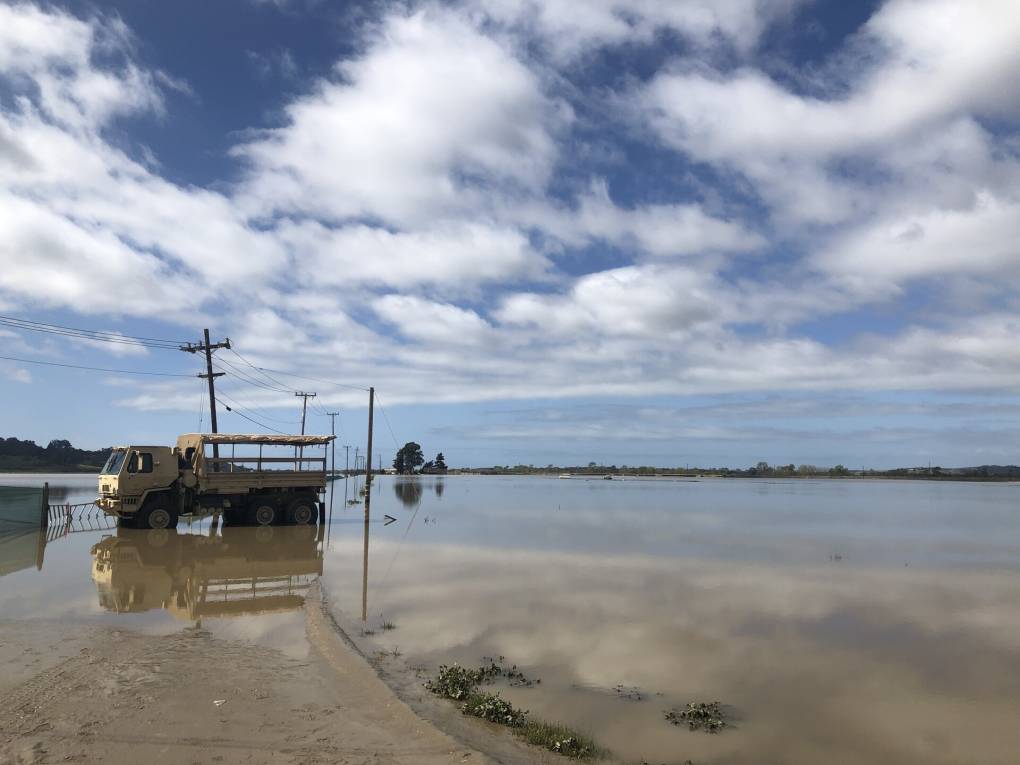
"caption": "A government emergency vehicle sits in flooded agricultural fields near Pajaro on March 15, 2023.",
"description": null,
"title": "RS63693_IMG_7146-qut",
"credit": "Farida Jhabvala Romero/KQED",
"status": "inherit",
"altTag": "A government emergency vehicle sits in flooded agricultural fields with clouds above.",
"isLoading": false,
"fetchFailed": false
},
"news_11943867": {
"type": "attachments",
"id": "news_11943867",
"meta": {
"index": "attachments_1716263798",
"site": "news",
"id": "11943867",
"found": true
},
"parent": 11943845,
"imgSizes": {
"twentyfourteen-full-width": {
"file": "https://ww2.kqed.org/app/uploads/sites/10/2023/03/GettyImages-1248040257-1024x576.jpg",
"width": 1024,
"mimeType": "image/jpeg",
"height": 576
},
"thumbnail": {
"file": "https://ww2.kqed.org/app/uploads/sites/10/2023/03/GettyImages-1248040257-160x92.jpg",
"width": 160,
"mimeType": "image/jpeg",
"height": 92
},
"post-thumbnail": {
"file": "https://ww2.kqed.org/app/uploads/sites/10/2023/03/GettyImages-1248040257-672x372.jpg",
"width": 672,
"mimeType": "image/jpeg",
"height": 372
},
"kqedFullSize": {
"file": "https://ww2.kqed.org/app/uploads/sites/10/2023/03/GettyImages-1248040257.jpg",
"width": 1024,
"height": 588
},
"large": {
"file": "https://ww2.kqed.org/app/uploads/sites/10/2023/03/GettyImages-1248040257-1020x586.jpg",
"width": 1020,
"mimeType": "image/jpeg",
"height": 586
},
"medium": {
"file": "https://ww2.kqed.org/app/uploads/sites/10/2023/03/GettyImages-1248040257-800x459.jpg",
"width": 800,
"mimeType": "image/jpeg",
"height": 459
}
},
"publishDate": 1679013326,
"modified": 1679015391,
"caption": "An aerial view shows a flooded neighborhood in the unincorporated community of Pajaro in Watsonville, on March 11, 2023. Residents were forced to evacuate in the middle of the night after an atmospheric river surge broke the Pajaro levee and sent floodwaters flowing into the community.",
"description": null,
"title": "US-WEATHER-CALIFORNIA-FLOOD",
"credit": "Josh Edelson/AFP via Getty Images",
"status": "inherit",
"altTag": "An aerial image of a flooded town with partially submerged houses and cars in brown flood waters.",
"isLoading": false,
"fetchFailed": false
},
"news_11892562": {
"type": "attachments",
"id": "news_11892562",
"meta": {
"index": "attachments_1716263798",
"site": "news",
"id": "11892562",
"found": true
},
"parent": 11892561,
"imgSizes": {
"twentyfourteen-full-width": {
"file": "https://ww2.kqed.org/app/uploads/sites/10/2021/10/RS44233_GettyImages-1253314486-qut-1038x576.jpg",
"width": 1038,
"mimeType": "image/jpeg",
"height": 576
},
"thumbnail": {
"file": "https://ww2.kqed.org/app/uploads/sites/10/2021/10/RS44233_GettyImages-1253314486-qut-160x104.jpg",
"width": 160,
"mimeType": "image/jpeg",
"height": 104
},
"post-thumbnail": {
"file": "https://ww2.kqed.org/app/uploads/sites/10/2021/10/RS44233_GettyImages-1253314486-qut-672x372.jpg",
"width": 672,
"mimeType": "image/jpeg",
"height": 372
},
"kqedFullSize": {
"file": "https://ww2.kqed.org/app/uploads/sites/10/2021/10/RS44233_GettyImages-1253314486-qut.jpg",
"width": 1920,
"height": 1250
},
"large": {
"file": "https://ww2.kqed.org/app/uploads/sites/10/2021/10/RS44233_GettyImages-1253314486-qut-1020x664.jpg",
"width": 1020,
"mimeType": "image/jpeg",
"height": 664
},
"1536x1536": {
"file": "https://ww2.kqed.org/app/uploads/sites/10/2021/10/RS44233_GettyImages-1253314486-qut-1536x1000.jpg",
"width": 1536,
"mimeType": "image/jpeg",
"height": 1000
},
"medium": {
"file": "https://ww2.kqed.org/app/uploads/sites/10/2021/10/RS44233_GettyImages-1253314486-qut-800x521.jpg",
"width": 800,
"mimeType": "image/jpeg",
"height": 521
}
},
"publishDate": 1634398751,
"modified": 1679013142,
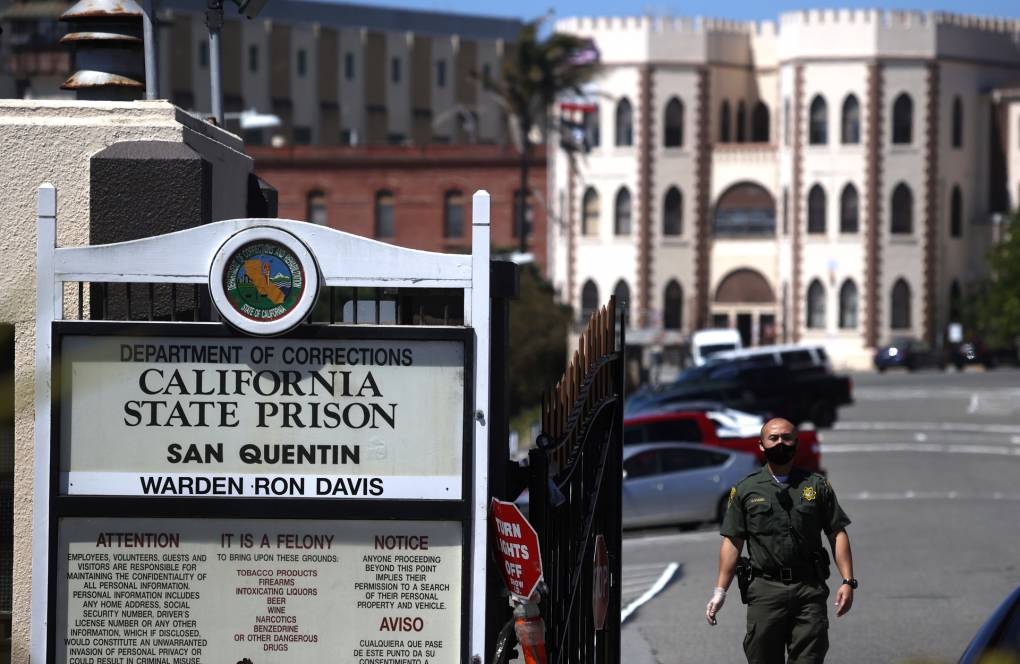
"caption": "A California Department of Corrections and Rehabilitation officer wears a protective mask as he stands guard at the front gate of San Quentin State Prison on June 29, 2020, in Marin County.",
"description": null,
"title": null,
"credit": "Justin Sullivan/Getty Images",
"status": "inherit",
"altTag": "A man in uniform stands next to a sign that says \"California State Prison, San Quentin,\" with the castle-like facade of the prison behind him.",
"isLoading": false,
"fetchFailed": false
}
},
"audioPlayerReducer": {
"postId": "stream_live",
"isPaused": true,
"isPlaying": false,
"pfsActive": false,
"pledgeModalIsOpen": true,
"playerDrawerIsOpen": false,
"liveAudioPlayStartedAt": 0,
"liveAudioPlayContext": ""
},
"authorsReducer": {
"byline_news_11945838": {
"type": "authors",
"id": "byline_news_11945838",
"meta": {
"override": true
},
"slug": "byline_news_11945838",
"name": "\u003ca href=\"https://californiahealthline.org/news/author/samantha-young/\">Samantha Young\u003c/a> ",
"isLoading": false
},
"byline_news_11945355": {
"type": "authors",
"id": "byline_news_11945355",
"meta": {
"override": true
},
"slug": "byline_news_11945355",
"name": "\u003ca href=\"https://calmatters.org/author/megan-tagami/\">Megan Tagami\u003c/a>",
"isLoading": false
},
"byline_news_11945113": {
"type": "authors",
"id": "byline_news_11945113",
"meta": {
"override": true
},
"slug": "byline_news_11945113",
"name": "\u003ca href=\"https://calmatters.org/author/alastair-bland/\">Alastair Bland\u003c/a>",
"isLoading": false
},
"byline_news_11944932": {
"type": "authors",
"id": "byline_news_11944932",
"meta": {
"override": true
},
"slug": "byline_news_11944932",
"name": "Adam Beam\u003cbr>The Associated Press",
"isLoading": false
},
"byline_news_11944613": {
"type": "authors",
"id": "byline_news_11944613",
"meta": {
"override": true
},
"slug": "byline_news_11944613",
"name": "\u003ca href=\"https://californiahealthline.org/news/author/angela-hart/\">Angela Hart\u003c/a>",
"isLoading": false
},
"byline_news_11944710": {
"type": "authors",
"id": "byline_news_11944710",
"meta": {
"override": true
},
"slug": "byline_news_11944710",
"name": "\u003ca href=\"https://calmatters.org/author/alastair-bland/\">Alastair Bland\u003c/a>",
"isLoading": false
},
"byline_news_11944554": {
"type": "authors",
"id": "byline_news_11944554",
"meta": {
"override": true
},
"slug": "byline_news_11944554",
"name": "\u003ca href=\"https://twitter.com/adambeam\">Adam Beam\u003c/a>\u003cbr>The Associated Press",
"isLoading": false
},
"byline_news_11944091": {
"type": "authors",
"id": "byline_news_11944091",
"meta": {
"override": true
},
"slug": "byline_news_11944091",
"name": " \u003ca href=\"https://calmatters.org/author/sameea-kamal/\">Sameea Kamal\u003c/a>, \u003ca href=\"https://calmatters.org/author/alexei-koseff/\">Alexei Koseff\u003c/a>",
"isLoading": false
},
"byline_news_11943845": {
"type": "authors",
"id": "byline_news_11943845",
"meta": {
"override": true
},
"slug": "byline_news_11943845",
"name": "\u003ca href=\"https://www.kazu.org/people/jerimiah-oetting\">Jerimiah Oetting\u003c/a>, \u003ca href=\"https://www.kazu.org/\">KAZU\u003c/a>",
"isLoading": false
},
"mlagos": {
"type": "authors",
"id": "3239",
"meta": {
"index": "authors_1716337520",
"id": "3239",
"found": true
},
"name": "Marisa Lagos",
"firstName": "Marisa",
"lastName": "Lagos",
"slug": "mlagos",
"email": "mlagos@kqed.org",
"display_author_email": false,
"staff_mastheads": [
"news"
],
"title": "KQED Contributor",
"bio": "Marisa Lagos is a correspondent for KQED’s California Politics and Government Desk and co-hosts the award-winning show and podcast, Political Breakdown. At KQED, Lagos also conducts reporting, analysis and investigations into state, local and national politics for radio, TV, online and onstage. In 2022, she and co-host, Scott Shafer, moderated the only gubernatorial debate in California. In 2020, the \u003ci>Washington Post\u003c/i> named her one of the top political journalists in California; she was nominated for a Peabody and won several other awards for her work investigating the 2017 California wildfires. She has worked at the \u003ci>San Francisco Chronicle\u003c/i>, \u003ci>San Francisco Examiner\u003c/i> and \u003ci>Los Angeles Times\u003c/i>. A UC Santa Barbara graduate, she lives in San Francisco with her two sons and husband.",
"avatar": "https://secure.gravatar.com/avatar/a261a0d3696fc066871ef96b85b5e7d2?s=600&d=blank&r=g",
"twitter": "@mlagos",
"facebook": null,
"instagram": null,
"linkedin": null,
"sites": [
{
"site": "arts",
"roles": [
"author"
]
},
{
"site": "news",
"roles": [
"editor"
]
},
{
"site": "science",
"roles": [
"editor"
]
},
{
"site": "forum",
"roles": [
"author"
]
},
{
"site": "liveblog",
"roles": [
"author"
]
}
],
"headData": {
"title": "Marisa Lagos | KQED",
"description": "KQED Contributor",
"ogImgSrc": "https://secure.gravatar.com/avatar/a261a0d3696fc066871ef96b85b5e7d2?s=600&d=blank&r=g",
"twImgSrc": "https://secure.gravatar.com/avatar/a261a0d3696fc066871ef96b85b5e7d2?s=600&d=blank&r=g"
},
"isLoading": false,
"link": "/author/mlagos"
},
"ecruzguevarra": {
"type": "authors",
"id": "8654",
"meta": {
"index": "authors_1716337520",
"id": "8654",
"found": true
},
"name": "Ericka Cruz Guevarra",
"firstName": "Ericka",
"lastName": "Cruz Guevarra",
"slug": "ecruzguevarra",
"email": "ecruzguevarra@kqed.org",
"display_author_email": true,
"staff_mastheads": [
"news"
],
"title": "Producer, The Bay Podcast",
"bio": "Ericka Cruz Guevarra is host of \u003ca href=\"https://www.kqed.org/podcasts/thebay\">\u003cem>The Bay\u003c/em>\u003c/a> podcast at KQED. Before host, she was the show’s producer. Her work in that capacity includes a three-part reported series on policing in Vallejo, which won a 2020 excellence in journalism award from the Society of Professional Journalists. Ericka has worked as a breaking news reporter at Oregon Public Broadcasting, helped produce the Code Switch podcast, and was KQED’s inaugural Raul Ramirez Diversity Fund intern. She’s also an alumna of NPR’s Next Generation Radio program. Send her an email if you have strong feelings about whether Fairfield and Suisun City are the Bay. Ericka is represented by SAG-AFTRA.",
"avatar": "https://secure.gravatar.com/avatar/accefc1de4bafc7e234b69bcb9b6f6536c130fd84709bc3069ef11a78787e1bb?s=600&d=blank&r=g",
"twitter": "NotoriousECG",
"bluesky": null,
"facebook": null,
"instagram": null,
"linkedin": null,
"sites": [
{
"site": "arts",
"roles": [
"subscriber"
]
},
{
"site": "news",
"roles": [
"editor",
"manage_categories"
]
},
{
"site": "futureofyou",
"roles": [
"subscriber"
]
},
{
"site": "stateofhealth",
"roles": [
"subscriber"
]
},
{
"site": "science",
"roles": [
"editor"
]
},
{
"site": "forum",
"roles": [
"subscriber"
]
}
],
"headData": {
"title": "Ericka Cruz Guevarra | KQED",
"description": "Producer, The Bay Podcast",
"ogImgSrc": "https://secure.gravatar.com/avatar/accefc1de4bafc7e234b69bcb9b6f6536c130fd84709bc3069ef11a78787e1bb?s=600&d=blank&r=g",
"twImgSrc": "https://secure.gravatar.com/avatar/accefc1de4bafc7e234b69bcb9b6f6536c130fd84709bc3069ef11a78787e1bb?s=600&d=blank&r=g"
},
"isLoading": false,
"link": "/author/ecruzguevarra"
},
"fjhabvala": {
"type": "authors",
"id": "8659",
"meta": {
"index": "authors_1716337520",
"id": "8659",
"found": true
},
"name": "Farida Jhabvala Romero",
"firstName": "Farida",
"lastName": "Jhabvala Romero",
"slug": "fjhabvala",
"email": "fjhabvala@kqed.org",
"display_author_email": true,
"staff_mastheads": [
"news"
],
"title": "KQED Contributor",
"bio": "Farida Jhabvala Romero is a Labor Correspondent for KQED. She previously covered immigration. Farida was \u003ca href=\"https://www.ccnma.org/2022-most-influential-latina-journalists\">named\u003c/a> one of the 10 Most Influential Latina Journalists in California in 2022 by the California Chicano News Media Association. Her work has won awards from the Society of Professional Journalists (Northern California), as well as a national and regional Edward M. Murrow Award for the collaborative reporting projects “Dangerous Air” and “Graying California.” Before joining KQED, Farida worked as a producer at Radio Bilingüe, a national public radio network. Farida earned her master’s degree in journalism from Stanford University.",
"avatar": "https://secure.gravatar.com/avatar/f9f022d4e2609741874222a1e9d41f48fea74011aa7c615eef91d9a50c944ebe?s=600&d=blank&r=g",
"twitter": "FaridaJhabvala",
"bluesky": null,
"facebook": null,
"instagram": null,
"linkedin": "https://www.linkedin.com/in/faridajhabvala/",
"sites": [
{
"site": "news",
"roles": [
"editor"
]
},
{
"site": "stateofhealth",
"roles": [
"author"
]
},
{
"site": "liveblog",
"roles": [
"author"
]
}
],
"headData": {
"title": "Farida Jhabvala Romero | KQED",
"description": "KQED Contributor",
"ogImgSrc": "https://secure.gravatar.com/avatar/f9f022d4e2609741874222a1e9d41f48fea74011aa7c615eef91d9a50c944ebe?s=600&d=blank&r=g",
"twImgSrc": "https://secure.gravatar.com/avatar/f9f022d4e2609741874222a1e9d41f48fea74011aa7c615eef91d9a50c944ebe?s=600&d=blank&r=g"
},
"isLoading": false,
"link": "/author/fjhabvala"
},
"amontecillo": {
"type": "authors",
"id": "11649",
"meta": {
"index": "authors_1716337520",
"id": "11649",
"found": true
},
"name": "Alan Montecillo",
"firstName": "Alan",
"lastName": "Montecillo",
"slug": "amontecillo",
"email": "amontecillo@kqed.org",
"display_author_email": false,
"staff_mastheads": [
"news"
],
"title": "KQED Contributor",
"bio": "Alan Montecillo is the senior editor of \u003cem>\u003ca href=\"http://kqed.org/thebay\">The Bay\u003c/a>, \u003c/em> KQED's local news podcast. Before moving to the Bay Area, he worked as a senior talk show producer for WILL in Champaign-Urbana, Illinois and at Oregon Public Broadcasting in Portland, Oregon. He has won journalism awards from the Society of Professional Journalists Northern California, the Public Media Journalists Association, The Signal Awards, and has also received a regional Edward R. Murrow award. Alan is a Filipino American from Hong Kong and a graduate of Reed College.",
"avatar": "https://secure.gravatar.com/avatar/268f53a2066899ea9efdd8a5900218b17c822d9862cbc9326cccec53ef41d349?s=600&d=blank&r=g",
"twitter": "alanmontecillo",
"bluesky": null,
"facebook": null,
"instagram": null,
"linkedin": null,
"sites": [
{
"site": "",
"roles": [
"editor"
]
},
{
"site": "news",
"roles": [
"editor",
"manage_categories"
]
}
],
"headData": {
"title": "Alan Montecillo | KQED",
"description": "KQED Contributor",
"ogImgSrc": "https://secure.gravatar.com/avatar/268f53a2066899ea9efdd8a5900218b17c822d9862cbc9326cccec53ef41d349?s=600&d=blank&r=g",
"twImgSrc": "https://secure.gravatar.com/avatar/268f53a2066899ea9efdd8a5900218b17c822d9862cbc9326cccec53ef41d349?s=600&d=blank&r=g"
},
"isLoading": false,
"link": "/author/amontecillo"
},
"mesquinca": {
"type": "authors",
"id": "11802",
"meta": {
"index": "authors_1716337520",
"id": "11802",
"found": true
},
"name": "Maria Esquinca",
"firstName": "Maria",
"lastName": "Esquinca",
"slug": "mesquinca",
"email": "mesquinca@kqed.org",
"display_author_email": false,
"staff_mastheads": [],
"title": "Producer, The Bay",
"bio": "María Esquinca is a producer of The Bay. Before that, she was a New York Women’s Foundation IGNITE Fellow at Latino USA. She worked at Radio Bilingue where she covered the San Joaquin Valley. Maria has interned at WLRN, News 21, The New York Times Student Journalism Institute and at Crain’s Detroit Business as a Dow Jones News Fund Business Reporting Intern. She is an MFA graduate from the University of Miami. In 2017, she graduated from the Walter Cronkite School of Journalism and Mass Communication with a Master of Mass Communication. A fronteriza, she was born in Ciudad Juárez, Chihuahua, Mexico and grew up in El Paso, Texas.",
"avatar": "https://secure.gravatar.com/avatar/77cedba18aae91da775038ba06dcd8d0?s=600&d=blank&r=g",
"twitter": "@m_esquinca",
"facebook": null,
"instagram": null,
"linkedin": null,
"sites": [
{
"site": "news",
"roles": []
}
],
"headData": {
"title": "Maria Esquinca | KQED",
"description": "Producer, The Bay",
"ogImgSrc": "https://secure.gravatar.com/avatar/77cedba18aae91da775038ba06dcd8d0?s=600&d=blank&r=g",
"twImgSrc": "https://secure.gravatar.com/avatar/77cedba18aae91da775038ba06dcd8d0?s=600&d=blank&r=g"
},
"isLoading": false,
"link": "/author/mesquinca"
},
"daisynguyen": {
"type": "authors",
"id": "11829",
"meta": {
"index": "authors_1716337520",
"id": "11829",
"found": true
},
"name": "Daisy Nguyen",
"firstName": "Daisy",
"lastName": "Nguyen",
"slug": "daisynguyen",
"email": "daisynguyen@kqed.org",
"display_author_email": true,
"staff_mastheads": [
"news"
],
"title": "KQED Contributor",
"bio": "I have covered early childhood education and child care for KQED since 2022. I focus on policies aimed at increasing access to early care and education and how they shape individual lives. I've been a journalist for more than two decades, with most of that time devoted to covering breaking news throughout California for The Associated Press. I grew up in San Francisco and studied at UC Davis and Columbia University's Graduate School of Journalism. I live in Oakland with my husband and two kids.",
"avatar": "https://secure.gravatar.com/avatar/2da2127c27f7143b53ebd419800fd55f?s=600&d=blank&r=g",
"twitter": null,
"facebook": null,
"instagram": null,
"linkedin": "https://www.linkedin.com/in/daisynguyen/",
"sites": [
{
"site": "news",
"roles": [
"author"
]
},
{
"site": "liveblog",
"roles": [
"author"
]
}
],
"headData": {
"title": "Daisy Nguyen | KQED",
"description": "KQED Contributor",
"ogImgSrc": "https://secure.gravatar.com/avatar/2da2127c27f7143b53ebd419800fd55f?s=600&d=blank&r=g",
"twImgSrc": "https://secure.gravatar.com/avatar/2da2127c27f7143b53ebd419800fd55f?s=600&d=blank&r=g"
},
"isLoading": false,
"link": "/author/daisynguyen"
}
},
"pagesReducer": {
"news_tag_gavin-newsom": {
"type": "terms",
"id": "news_16",
"meta": {
"index": "terms_1716263798",
"site": "news",
"id": "16",
"score": 8.937016
},
"featImg": null,
"name": "Gavin Newsom",
"description": null,
"taxonomy": "tag",
"headData": {
"twImgId": null,
"twTitle": null,
"ogTitle": null,
"ogImgId": null,
"twDescription": null,
"description": null,
"title": "Gavin Newsom Archives | KQED News",
"ogDescription": null
},
"ttid": 16,
"slug": "gavin-newsom",
"isLoading": false,
"title": "Gavin Newsom",
"pageMeta": {
"site": "news",
"WpPageTemplate": "page-topic-editorial",
"currentPage": 41
},
"blocks": [
{
"blockName": "kqed/post-list",
"attrs": {
"layout": "cardArticle2",
"query": "posts/news?tag=gavin-newsom",
"seeMore": false,
"paginated": true,
"page": 41
}
},
{
"blockName": "kqed/ad"
}
]
}
},
"pfsSessionReducer": {},
"postsReducer": {
"stream_live": {
"type": "live",
"id": "stream_live",
"audioUrl": "https://streams.kqed.org/kqedradio",
"title": "Live Stream",
"excerpt": "Live Stream information currently unavailable.",
"link": "/radio",
"featImg": "",
"label": {
"name": "KQED Live",
"link": "/"
}
},
"stream_kqedNewscast": {
"type": "posts",
"id": "stream_kqedNewscast",
"audioUrl": "https://www.kqed.org/.stream/anon/radio/RDnews/newscast.mp3?_=1",
"title": "KQED Newscast",
"featImg": "",
"label": {
"name": "88.5 FM",
"link": "/"
}
},
"news_11945838": {
"type": "posts",
"id": "news_11945838",
"meta": {
"index": "posts_1716263798",
"site": "news",
"id": "11945838",
"score": null,
"sort": [
1680815892000
]
},
"guestAuthors": [],
"slug": "feds-to-block-gov-newsom-from-cutting-ties-with-walgreens",
"title": "Feds to Block Gov. Newsom From Cutting Ties With Walgreens",
"publishDate": 1680815892,
"format": "standard",
"headTitle": "Feds to Block Gov. Newsom From Cutting Ties With Walgreens | KQED",
"labelTerm": {
"term": 20286,
"site": "news"
},
"content": "\u003cp>Gov. Gavin Newsom declared last month that \u003ca href=\"https://twitter.com/GavinNewsom/status/1632811406344192000?s=20\">California was “done” doing business with Walgreens\u003c/a> after the pharmacy chain said it would not distribute an abortion pill in 21 states where Republicans have threatened legal action. Since then, KHN has learned that the Democratic governor must compromise on his hard-line tweet.\u003c/p>\n\u003cp>California is legally bound to continue doing business with Walgreens through the state’s massive Medicaid program, health law experts said. And according to a public records request, the state paid Walgreens $1.5 billion last year.[pullquote size=\"medium\" align=\"right\" citation=\"Tony Cava, spokesperson, California Department of Health Care Services\"]‘California has no intention of taking any action that would violate federal Medicaid requirements, or that could undermine access for low-income individuals.’[/pullquote]\u003c/p>\n\u003cp>Newsom’s administration confirmed it will “continue to comply” with federal law by paying Walgreens through Medi-Cal, which provides health coverage to roughly 15 million residents with low incomes and disabilities. Were California to stop covering Medi-Cal prescriptions filled at Walgreens stores, legal scholars warned, the state would run afoul of federal law, which allows patients to get their medications at any approved pharmacy.\u003c/p>\n\u003cp>“California has no intention of taking any action that would violate federal Medicaid requirements, or that could undermine access for low-income individuals,” said Tony Cava, spokesperson for the California Department of Health Care Services, in a statement.\u003c/p>\n\u003cp>Newsom spokesperson Anthony York said, “Tweeting is not policy.” He added the governor will not “take any action that hurts people who need access to care.” Walgreens has even been reinvited to apply for \u003ca href=\"https://www.gov.ca.gov/2023/03/08/governor-newsom-california-pulls-back-renewal-of-walgreens-contract/\">a specialty drug contract that Newsom pulled back on renewing last month\u003c/a>, York said. Walgreens has received about $54 million from the state under the contract.\u003c/p>\n\u003cp>The dustup with the Illinois-based pharmacy chain illustrates Newsom’s panache for sweeping announcements on social media, where he garners national headlines but offers few specifics and little follow-through, political strategists said. Newsom has raised his national profile — and speculation of a presidential bid — by traveling to red states and launching \u003ca href=\"https://apnews.com/article/california-governor-newsom-president-democrats-2024-843877ca6aca701a5a68b8cb022203a2\">a new political action committee\u003c/a>.\u003c/p>\n\u003cp>“It’s much more about appearances and style and approach than it is about substance,” said David McCuan, political science department chair at Sonoma State University. Newsom and his administration “oversell their pronouncements and don’t actually deliver.”\u003c/p>\n\u003cp>On March 6, the governor tweeted, “California won’t be doing business with @walgreens — or any company that cowers to the extremists and puts women’s lives at risk,” after the second-largest U.S. pharmacy chain said it would not dispense mifepristone in states where it is illegal to dispense the pill or where the company would face potential lawsuits if it did so.\u003c/p>\n\u003cp>Democratic strategist Steve Maviglio said continuing to pay Walgreens through Medi-Cal doesn’t take away from Newsom’s support of abortion rights.\u003c/p>\n\u003cp>“He’s going to get the headline for protecting abortion rights, and this he can chalk up to a technical difficulty,” Maviglio said. “He will be rewarded for standing up to a corporation.”\u003c/p>\n\u003cp>Federal law is designed to ensure Medicaid patients have choices in where they get health care, including prescriptions. Approved providers like Walgreens are protected by \u003ca href=\"https://www.govinfo.gov/content/pkg/COMPS-8765/pdf/COMPS-8765.pdf#=page26\">Medicaid statute (PDF)\u003c/a>, which states that no health plan or entity can “restrict the choice of the qualified person from whom the individual may receive services.” Legal and Medicaid experts said that makes it extremely difficult for the Newsom administration to disqualify Walgreens.[aside postID=\"news_11942999,news_11922237\" label=\"Related Posts\"]“As long as Walgreens is performing for Medicaid beneficiaries as it should, dispensing all legal drugs in a manner that is consistent with permissible pharmacy practice, then I don’t see the basis for excluding them,” said Sara Rosenbaum, professor of health law and policy at George Washington University.\u003c/p>\n\u003cp>The \u003ca href=\"https://www.ecfr.gov/current/title-42/chapter-IV/subchapter-C/part-431/subpart-B/section-431.51\">federal regulations\u003c/a> that protect Walgreens are the same that have allowed Planned Parenthood to offer health care services to Medicaid enrollees in conservative states, where leaders have sought unsuccessfully to exclude the network of clinics from receiving taxpayer funding.\u003c/p>\n\u003cp>An approved pharmacy company can be excluded from state networks only if it has committed fraud or other contract violations, added Edwin Park, a research professor with expertise in Medicaid law at Georgetown University.\u003c/p>\n\u003cp>“Certainly, that wouldn’t be the case for Walgreens,” Park said.\u003c/p>\n\u003cp>It’s unclear whether Newsom was aware of how difficult it would be for California to unwind its Medi-Cal provider agreement with Walgreens, said Daniel Schnur, a Republican-turned-independent strategist who also teaches political science at the University of Southern California.\u003c/p>\n\u003cp>“The original announcement sounded like a seminal step for the state of California to take on principle, even at great financial expense,” Schnur said. “They’ve quietly backed away.”\u003c/p>\n\u003cp>Through a records request, KHN learned the state paid Walgreens $1.5 billion last year to buy and dispense prescriptions to Medi-Cal enrollees. The bulk of the payment, $1.4 billion, reimbursed Walgreens for the prescriptions it distributed. And the remaining $123 million went to dispensing fees, a payment to pharmacists for each prescription they fill. The federal government covers at least half the state’s payments, which are also offset by rebates from drug manufacturers.\u003c/p>\n\u003cp>A Walgreens spokesperson declined to comment on its business with California, referring to the same statement it issued in March: “Providing legally approved medications to patients is what pharmacies do, and is rooted in our commitment to the communities in which we operate.”\u003c/p>\n\u003cp>Walgreens said it plans to dispense mifepristone “in any jurisdiction where it is legally permissible to do so.” The company was responding to an \u003ca href=\"https://www.fda.gov/drugs/postmarket-drug-safety-information-patients-and-providers/information-about-mifepristone-medical-termination-pregnancy-through-ten-weeks-gestation\">FDA rule finalized in January that allows certified pharmacies to dispense the abortion pill\u003c/a>, which is the most common way people terminate pregnancies. Walgreens isn’t proposing to limit abortion pill sales in California or other states where abortion is legal and pharmacies are allowed to dispense it.\u003c/p>\n\u003cp>Democrats have \u003ca href=\"https://www.governor.state.nm.us/wp-content/uploads/2023/03/Governor-Letter-to-Pharmacy-Retail-Companies__3.14.23.docx.pdf\">urged pharmacy chains to sell the abortion pill (PDF)\u003c/a> even as GOP attorneys general threaten legal action. But many, including Walmart, Costco, Albertsons and Health Mart, have not waded into the fight. Only Rite Aid and CVS have said they plan to begin certification to dispense the pills.\u003c/p>\n\u003cp>Had Newsom been able to sever Medi-Cal’s relationship with Walgreens, he would have contradicted one of his signature health initiatives: When he took office in 2019, Newsom proposed the state take over prescription drug coverage for Medi-Cal patients, many of whom had been covered through managed-care plans.\u003c/p>\n\u003cp>Part of Newsom’s pitch: Patients could go to \u003ca href=\"https://www.medi-calrx.dhcs.ca.gov/home/education\">nearly any pharmacy\u003c/a> in California.\u003c/p>\n\u003cp>\u003ci>\u003cspan style=\"font-weight: 400\">California Healthline is a service of the California Health Care Foundation produced by Kaiser Health News.\u003c/span>\u003c/i>\u003c/p>\n\u003cp>[ad fullwidth]\u003c/p>\n\u003cp>[ad floatright]\u003c/p>\n",
"blocks": [],
"excerpt": "California is legally bound to continue doing business with Walgreens despite Gov. Gavin Newsom's tweet last month declaring the state would cut ties with the pharmacy chain over it's not distributing an abortion pill in 21 states where Republicans threatened legal action.",
"status": "publish",
"parent": 0,
"modified": 1722644220,
"stats": {
"hasAudio": false,
"hasVideo": false,
"hasChartOrMap": false,
"iframeSrcs": [],
"hasGoogleForm": false,
"hasGallery": false,
"hasHearkenModule": false,
"hasPolis": false,
"paragraphCount": 25,
"wordCount": 1173
},
"headData": {
"title": "Feds to Block Gov. Newsom From Cutting Ties With Walgreens | KQED",
"description": "California is legally bound to continue doing business with Walgreens despite Gov. Gavin Newsom's tweet last month declaring the state would cut ties with the pharmacy chain over it's not distributing an abortion pill in 21 states where Republicans threatened legal action.",
"ogTitle": "",
"ogDescription": "",
"ogImgId": "",
"twTitle": "",
"twDescription": "",
"twImgId": "",
"schema": {
"@context": "https://schema.org",
"@type": "NewsArticle",
"headline": "Feds to Block Gov. Newsom From Cutting Ties With Walgreens",
"datePublished": "2023-04-06T14:18:12-07:00",
"dateModified": "2024-08-02T17:17:00-07:00",
"image": "https://cdn.kqed.org/wp-content/uploads/2020/02/KQED-OG-Image@1x.png",
"isAccessibleForFree": "True",
"publisher": {
"@type": "NewsMediaOrganization",
"@id": "https://www.kqed.org/#organization",
"name": "KQED",
"logo": "https://cdn.kqed.org/wp-content/uploads/2020/02/KQED-OG-Image@1x.png",
"url": "https://www.kqed.org",
"sameAs": [
"https://www.facebook.com/KQED",
"https://twitter.com/KQED",
"https://www.instagram.com/kqed/",
"https://www.tiktok.com/@kqedofficial",
"https://www.linkedin.com/company/kqed",
"https://www.youtube.com/channel/UCeC0IOo7i1P_61zVUWbJ4nw"
]
}
}
},
"sticky": false,
"nprByline": "\u003ca href=\"https://californiahealthline.org/news/author/samantha-young/\">Samantha Young\u003c/a> ",
"excludeFromSiteSearch": "Include",
"showOnAuthorArchivePages": "No",
"articleAge": "0",
"path": "/news/11945838/feds-to-block-gov-newsom-from-cutting-ties-with-walgreens",
"audioTrackLength": null,
"parsedContent": [
{
"type": "contentString",
"content": "\u003cdiv class=\"post-body\">\u003cp>\u003cp>Gov. Gavin Newsom declared last month that \u003ca href=\"https://twitter.com/GavinNewsom/status/1632811406344192000?s=20\">California was “done” doing business with Walgreens\u003c/a> after the pharmacy chain said it would not distribute an abortion pill in 21 states where Republicans have threatened legal action. Since then, KHN has learned that the Democratic governor must compromise on his hard-line tweet.\u003c/p>\n\u003cp>California is legally bound to continue doing business with Walgreens through the state’s massive Medicaid program, health law experts said. And according to a public records request, the state paid Walgreens $1.5 billion last year.\u003c/p>\u003c/div>",
"attributes": {
"named": {},
"numeric": []
}
},
{
"type": "component",
"content": "‘California has no intention of taking any action that would violate federal Medicaid requirements, or that could undermine access for low-income individuals.’",
"name": "pullquote",
"attributes": {
"named": {
"size": "medium",
"align": "right",
"citation": "Tony Cava, spokesperson, California Department of Health Care Services",
"label": ""
},
"numeric": []
}
},
{
"type": "contentString",
"content": "\u003cdiv class=\"post-body\">\u003cp>\u003c/p>\n\u003cp>Newsom’s administration confirmed it will “continue to comply” with federal law by paying Walgreens through Medi-Cal, which provides health coverage to roughly 15 million residents with low incomes and disabilities. Were California to stop covering Medi-Cal prescriptions filled at Walgreens stores, legal scholars warned, the state would run afoul of federal law, which allows patients to get their medications at any approved pharmacy.\u003c/p>\n\u003cp>“California has no intention of taking any action that would violate federal Medicaid requirements, or that could undermine access for low-income individuals,” said Tony Cava, spokesperson for the California Department of Health Care Services, in a statement.\u003c/p>\n\u003cp>Newsom spokesperson Anthony York said, “Tweeting is not policy.” He added the governor will not “take any action that hurts people who need access to care.” Walgreens has even been reinvited to apply for \u003ca href=\"https://www.gov.ca.gov/2023/03/08/governor-newsom-california-pulls-back-renewal-of-walgreens-contract/\">a specialty drug contract that Newsom pulled back on renewing last month\u003c/a>, York said. Walgreens has received about $54 million from the state under the contract.\u003c/p>\n\u003cp>The dustup with the Illinois-based pharmacy chain illustrates Newsom’s panache for sweeping announcements on social media, where he garners national headlines but offers few specifics and little follow-through, political strategists said. Newsom has raised his national profile — and speculation of a presidential bid — by traveling to red states and launching \u003ca href=\"https://apnews.com/article/california-governor-newsom-president-democrats-2024-843877ca6aca701a5a68b8cb022203a2\">a new political action committee\u003c/a>.\u003c/p>\n\u003cp>“It’s much more about appearances and style and approach than it is about substance,” said David McCuan, political science department chair at Sonoma State University. Newsom and his administration “oversell their pronouncements and don’t actually deliver.”\u003c/p>\n\u003cp>On March 6, the governor tweeted, “California won’t be doing business with @walgreens — or any company that cowers to the extremists and puts women’s lives at risk,” after the second-largest U.S. pharmacy chain said it would not dispense mifepristone in states where it is illegal to dispense the pill or where the company would face potential lawsuits if it did so.\u003c/p>\n\u003cp>Democratic strategist Steve Maviglio said continuing to pay Walgreens through Medi-Cal doesn’t take away from Newsom’s support of abortion rights.\u003c/p>\n\u003cp>“He’s going to get the headline for protecting abortion rights, and this he can chalk up to a technical difficulty,” Maviglio said. “He will be rewarded for standing up to a corporation.”\u003c/p>\n\u003cp>Federal law is designed to ensure Medicaid patients have choices in where they get health care, including prescriptions. Approved providers like Walgreens are protected by \u003ca href=\"https://www.govinfo.gov/content/pkg/COMPS-8765/pdf/COMPS-8765.pdf#=page26\">Medicaid statute (PDF)\u003c/a>, which states that no health plan or entity can “restrict the choice of the qualified person from whom the individual may receive services.” Legal and Medicaid experts said that makes it extremely difficult for the Newsom administration to disqualify Walgreens.\u003c/p>\u003c/div>",
"attributes": {
"named": {},
"numeric": []
}
},
{
"type": "component",
"content": "",
"name": "aside",
"attributes": {
"named": {
"postid": "news_11942999,news_11922237",
"label": "Related Posts "
},
"numeric": []
}
},
{
"type": "contentString",
"content": "\u003cdiv class=\"post-body\">\u003cp>“As long as Walgreens is performing for Medicaid beneficiaries as it should, dispensing all legal drugs in a manner that is consistent with permissible pharmacy practice, then I don’t see the basis for excluding them,” said Sara Rosenbaum, professor of health law and policy at George Washington University.\u003c/p>\n\u003cp>The \u003ca href=\"https://www.ecfr.gov/current/title-42/chapter-IV/subchapter-C/part-431/subpart-B/section-431.51\">federal regulations\u003c/a> that protect Walgreens are the same that have allowed Planned Parenthood to offer health care services to Medicaid enrollees in conservative states, where leaders have sought unsuccessfully to exclude the network of clinics from receiving taxpayer funding.\u003c/p>\n\u003cp>An approved pharmacy company can be excluded from state networks only if it has committed fraud or other contract violations, added Edwin Park, a research professor with expertise in Medicaid law at Georgetown University.\u003c/p>\n\u003cp>“Certainly, that wouldn’t be the case for Walgreens,” Park said.\u003c/p>\n\u003cp>It’s unclear whether Newsom was aware of how difficult it would be for California to unwind its Medi-Cal provider agreement with Walgreens, said Daniel Schnur, a Republican-turned-independent strategist who also teaches political science at the University of Southern California.\u003c/p>\n\u003cp>“The original announcement sounded like a seminal step for the state of California to take on principle, even at great financial expense,” Schnur said. “They’ve quietly backed away.”\u003c/p>\n\u003cp>Through a records request, KHN learned the state paid Walgreens $1.5 billion last year to buy and dispense prescriptions to Medi-Cal enrollees. The bulk of the payment, $1.4 billion, reimbursed Walgreens for the prescriptions it distributed. And the remaining $123 million went to dispensing fees, a payment to pharmacists for each prescription they fill. The federal government covers at least half the state’s payments, which are also offset by rebates from drug manufacturers.\u003c/p>\n\u003cp>A Walgreens spokesperson declined to comment on its business with California, referring to the same statement it issued in March: “Providing legally approved medications to patients is what pharmacies do, and is rooted in our commitment to the communities in which we operate.”\u003c/p>\n\u003cp>Walgreens said it plans to dispense mifepristone “in any jurisdiction where it is legally permissible to do so.” The company was responding to an \u003ca href=\"https://www.fda.gov/drugs/postmarket-drug-safety-information-patients-and-providers/information-about-mifepristone-medical-termination-pregnancy-through-ten-weeks-gestation\">FDA rule finalized in January that allows certified pharmacies to dispense the abortion pill\u003c/a>, which is the most common way people terminate pregnancies. Walgreens isn’t proposing to limit abortion pill sales in California or other states where abortion is legal and pharmacies are allowed to dispense it.\u003c/p>\n\u003cp>Democrats have \u003ca href=\"https://www.governor.state.nm.us/wp-content/uploads/2023/03/Governor-Letter-to-Pharmacy-Retail-Companies__3.14.23.docx.pdf\">urged pharmacy chains to sell the abortion pill (PDF)\u003c/a> even as GOP attorneys general threaten legal action. But many, including Walmart, Costco, Albertsons and Health Mart, have not waded into the fight. Only Rite Aid and CVS have said they plan to begin certification to dispense the pills.\u003c/p>\n\u003cp>Had Newsom been able to sever Medi-Cal’s relationship with Walgreens, he would have contradicted one of his signature health initiatives: When he took office in 2019, Newsom proposed the state take over prescription drug coverage for Medi-Cal patients, many of whom had been covered through managed-care plans.\u003c/p>\n\u003cp>Part of Newsom’s pitch: Patients could go to \u003ca href=\"https://www.medi-calrx.dhcs.ca.gov/home/education\">nearly any pharmacy\u003c/a> in California.\u003c/p>\n\u003cp>\u003ci>\u003cspan style=\"font-weight: 400\">California Healthline is a service of the California Health Care Foundation produced by Kaiser Health News.\u003c/span>\u003c/i>\u003c/p>\n\u003cp>\u003c/p>\u003c/div>",
"attributes": {
"named": {},
"numeric": []
}
},
{
"type": "component",
"content": "",
"name": "ad",
"attributes": {
"named": {
"label": "fullwidth"
},
"numeric": [
"fullwidth"
]
}
},
{
"type": "contentString",
"content": "\u003cdiv class=\"post-body\">\u003cp>\u003c/p>\n\u003cp>\u003c/p>\u003c/div>",
"attributes": {
"named": {},
"numeric": []
}
},
{
"type": "component",
"content": "",
"name": "ad",
"attributes": {
"named": {
"label": "floatright"
},
"numeric": [
"floatright"
]
}
},
{
"type": "contentString",
"content": "\u003cdiv class=\"post-body\">\u003cp>\u003c/p>\n\u003c/div>\u003c/p>",
"attributes": {
"named": {},
"numeric": []
}
}
],
"link": "/news/11945838/feds-to-block-gov-newsom-from-cutting-ties-with-walgreens",
"authors": [
"byline_news_11945838"
],
"categories": [
"news_8"
],
"tags": [
"news_16",
"news_32610",
"news_2211"
],
"affiliates": [
"news_20286"
],
"featImg": "news_11945886",
"label": "news_20286"
},
"news_11945355": {
"type": "posts",
"id": "news_11945355",
"meta": {
"index": "posts_1716263798",
"site": "news",
"id": "11945355",
"score": null,
"sort": [
1680357614000
]
},
"parent": 0,
"labelTerm": {},
"blocks": [],
"publishDate": 1680357614,
"format": "standard",
"title": "California Is About to Require Ethnic Studies in High School. Should Teachers Get Special Training to Teach It?",
"headTitle": "KQED News",
"content": "\u003cp>On a rainy Friday afternoon at Santa Monica High School, ethnic studies teacher Marisa Silvestri introduced her class to the rap song \"Kenji.\" As singer Mike Shinoda narrated his family’s experiences in the Japanese American incarceration camps of World War II, Silvestri’s class fell silent. After the last bars of music had filled the room, the class set to work analyzing the song’s lyrics, agreeing that Shinoda humanized a historical event some students previously knew little about.\u003c/p>\n\u003cp>Now in her second year of teaching ethnic studies, Silvestri said she has gone through several iterations of her curriculum — and she expects more changes to come. She has studied California’s ethnic studies model curriculum, attended workshops at local universities and sought the advice of ethnic studies teachers from other school districts.\u003c/p>\n\u003cp>But Silvestri has never received a teaching credential in ethnic studies. Whether that’s important or not is a question California officials are weighing, now that \u003ca href=\"https://calmatters.org/education/k-12-education/2021/10/ethnic-studies-requirement/\">the state has become the first in the nation to require that high school students take at least one semester of ethnic studies\u003c/a> before graduation.\u003c/p>\n\u003cp>California needs more ethnic studies teachers, quickly. Under the new law, passed in 2021, high schools must begin offering ethnic studies courses in the 2025–26 school year, and students in the class of 2030 will be the first ones subject to the graduation requirement. As many high schools expand their course offerings ahead of schedule, universities are grappling with how best to prepare the next generation of teachers.\u003c/p>\n\u003cp>Some advocates and educators have called for the creation of a specific ethnic studies credential authorizing educators to teach the relatively new and politically fraught subject in middle and high schools. They say that without such a credential, the state risks having low-quality classes that can do more harm than good. But others worry that an additional requirement may make it even harder for the schools to find teachers for the subject.\u003c/p>\n\u003cp>[ad fullwidth]\u003c/p>\n\u003cp>State regulations allow teachers with a social science credential to teach ethnic studies, said Jonathon Howard, government relations manager for California’s Commission on Teacher Credentialing. However, when ethnic studies is combined with other subjects, such as reading or art, teachers from other subject areas are also eligible.\u003c/p>\n\u003cp>\"We have all these teachers who have great hearts, who are really social justice-minded, who really want to do ethnic studies because they’re thinking about themselves as, 'I’m a culturally responsive teacher,'\" said Theresa Montaño, professor of Chicana and Chicano studies at \u003cspan style=\"font-weight: 400\">California State University, Northridge\u003c/span>. \"But that isn’t enough to give you the knowledge you need.\"\u003c/p>\n\u003cp>Ideally, Montaño said, teachers should have an undergraduate degree in ethnic studies, plus an ethnic studies credential that would show them how to translate their expertise into classroom curriculum.[aside label=\"Related Stories\" tag=\"ethnic-studies\"]Assemblymember Wendy Carrillo agrees. In February, she \u003ca href=\"https://leginfo.legislature.ca.gov/faces/billTextClient.xhtml?bill_id=202320240AB1255\">introduced legislation requiring the Commission on Teacher Credentialing to begin creating an ethnic studies credential by 2025\u003c/a>.\u003c/p>\n\u003cp>\"The social science credential program does not cover ethnic studies sufficiently,\" Carrillo, a Democrat from Los Angeles, said by email. \"We maintain that at the present time there is no existing credential that sufficiently covers the depth and breadth of the multidisciplinary nature of Ethnic Studies.\"\u003c/p>\n\u003cp>The commission would need authorization from the Legislature to begin developing a new credential, Howard said.\u003c/p>\n\u003cp>However, some school districts say the current flexibility around teacher requirements has worked to their benefit, allowing them to expand their ethnic studies course offerings ahead of schedule.\u003c/p>\n\u003cp>Santa Rosa City Schools has been offering ethnic studies courses since 2020 and will require students in the class of 2025 to have taken a full year of the subject before graduation. Because several classes, from English to dance, incorporate ethnic studies into the course material, all teachers are eligible to teach the subject, said Tim Zalunardo, executive director of educational services. He added that this approach makes it easier for the school to recruit teachers who are excited and willing to teach ethnic studies.\u003c/p>\n\u003cp>\"It provides flexibility on both the students and on the school’s course offerings,\" Zalunardo said.\u003c/p>\n\u003ch2>A controversial subject\u003c/h2>\n\u003cp>Debates around ethnic studies are nothing new.\u003c/p>\n\u003cp>Ethnic studies began at San Francisco State University in the late 1960s as students pushed for the creation of classes dedicated to studying the histories and cultures of people of color. As the subject gained momentum — and criticism — across the nation, advocates began to push for its inclusion in K–12 schools.\u003c/p>\n\u003cp>In 2021, after two years of drafting and heated debate, \u003ca href=\"https://www.cde.ca.gov/ci/cr/cf/documents/esmcpreface.pdf\">the State Board of Education adopted an ethnic studies model curriculum (PDF)\u003c/a> that focuses primarily on the untold \"histories, cultures, struggles, and contributions\" of Black, Latino, Native American and Asian American and Pacific Islander communities. Although districts are not required to use the curriculum, it provides schools with guidance on how to implement the subject and offers sample lessons.\u003c/p>\n\u003cp>Later that year, Gov. Gavin Newsom signed the new graduation requirement into law, even as parents and \u003ca href=\"https://www.latimes.com/california/story/2021-04-28/ethnic-studies-slammed-as-anti-white-in-orange-county\">school board members denounced ethnic studies in Orange County\u003c/a> and other areas of the state. Future teachers still remain divided on the necessity of the subject.\u003c/p>\n\u003cp>Christine Soliva, a graduate student in UC Riverside’s teacher education program, said some of her peers critiqued an ethnic studies class they took in the fall, challenging the importance of incorporating an ethnic studies framework into their math or science courses. She added that while she would pursue an ethnic studies credential if it were available, she is unsure whether other teacher candidates would be equally receptive.\u003c/p>\n\u003cp>\"It really is just like, are educators willing to take that next step to be able to think outside the box and challenge themselves and their ideals to look at curriculum and content through an ethnic studies lens?\" Soliva said.[pullquote size='medium' align='left' citation=\"Christine Soliva, graduate student, UC Riverside\"]'It really is just like, are educators willing to take that next step to be able to think outside the box and challenge themselves and their ideals to look at curriculum and content through an ethnic studies lens?'[/pullquote]Former Assemblymember Jose Medina, who authored the legislation requiring ethnic studies in high schools, said he does not believe the controversy around the subject will prevent state leaders from having necessary conversations about how best to prepare teachers.\u003c/p>\n\u003cp>\"I think, despite the controversy, the state will be well-prepared to have teachers in place by the time of the requirement,\" he said.\u003c/p>\n\u003cp>But not everyone shares Medina’s optimism.\u003c/p>\n\u003cp>As hundreds of high schools begin rolling out new courses in the coming years, the state may face a shortage of ethnic studies teachers, said Lange Luntao, director of external relations at The Education Trust–West, a nonprofit that advocates for educational equity. Ethnic studies graduation requirements are already in effect at some of the state’s large school districts, including Los Angeles Unified, San Diego Unified and Fresno Unified.\u003c/p>\n\u003cp>\"I think one fear is that we’re going to open up enrollment for ethnic studies classes, and not have enough educators who have experience with this content,\" he said.\u003c/p>\n\u003ch2>Preparing future teachers\u003c/h2>\n\u003cp>In the absence of an ethnic studies credential, California’s universities have developed a range of programs preparing students to teach the subject. Some offer classes on ethnic studies teaching methods and curriculum development, while others place students in ethnic studies classrooms to gain firsthand experience.\u003c/p>\n\u003cp>At UC Riverside, \u003ca href=\"https://education.ucr.edu/tep/ethnic-studies\">students earning their teaching credential can pursue an ethnic studies pathway\u003c/a> made up of elective courses dedicated to ethnic studies teaching methods and curricula.\u003c/p>\n\u003cp>Karl Molina, a UC Riverside master’s student earning his social sciences credential through the program, works as a student teacher of high school economics, sociology and government in the Riverside Unified School District. Earlier in the school year, Molina introduced a sociology lesson named after rapper Tupac Shakur’s poem \"The Rose That Grew from Concrete.\" He instructed his students to analyze Shakur’s poem and reflect on how the concepts of social and familial capital applied to their own lives. In discussions, students decided that capital was more than monetary wealth — it included the languages, cultures and aspirations that shaped their lives, Molina said.\u003c/p>\n\u003cp>\"They were really, really into it,\" Molina said. \"I was really excited to get going and move forward.\"\u003c/p>\n\u003cfigure id=\"attachment_11945394\" class=\"wp-caption aligncenter\" style=\"max-width: 1920px\">\u003cimg decoding=\"async\" loading=\"lazy\" class=\"wp-image-11945394 size-full\" src=\"https://ww2.kqed.org/app/uploads/sites/10/2023/03/ethnic-studies-03-103123.png\" alt=\"A young Asian man wearing glasses, with thick black hair that comes to the tops of both ears, wears a dark jacket and white polo shirt as he looks at the camera with a steady gaze. \" width=\"1920\" height=\"1280\" srcset=\"https://ww2.kqed.org/app/uploads/sites/10/2023/03/ethnic-studies-03-103123.png 1920w, https://ww2.kqed.org/app/uploads/sites/10/2023/03/ethnic-studies-03-103123-800x533.png 800w, https://ww2.kqed.org/app/uploads/sites/10/2023/03/ethnic-studies-03-103123-1020x680.png 1020w, https://ww2.kqed.org/app/uploads/sites/10/2023/03/ethnic-studies-03-103123-160x107.png 160w, https://ww2.kqed.org/app/uploads/sites/10/2023/03/ethnic-studies-03-103123-1536x1024.png 1536w\" sizes=\"(max-width: 1920px) 100vw, 1920px\">\u003cfigcaption class=\"wp-caption-text\">Karl Molina, 25, who teaches sociology with an emphasis on ethnic studies, stands near the classroom where he teaches at Ramona High School in Riverside on March 28, 2023. \u003ccite>(Pablo Unzueta/CalMatters)\u003c/cite>\u003c/figcaption>\u003c/figure>\n\u003cp>But as a student teacher, Molina has limited control over the course curriculum and had to cut his lesson short. If he were teaching in an ethnic studies classroom as part of a formal ethnic studies credentialing program, he said, he might have had more freedom to pursue it.\u003c/p>\n\u003cp>\"We’re not indoctrinating these students,\" Molina said. \"We’re just telling them, 'You have so much wealth. Here’s where your wealth is, and here’s what it does for you.'\"\u003c/p>\n\u003cp>At San José State University, some students already have the opportunity to see ethnic studies taught in real time through the \u003ca href=\"https://www.sjsu.edu/teachered/docs/SJSU%20Ethnic%20Studies%20Residency%20Program%20Spring%202022.pdf\">Ethnic Studies Residency Program (PDF)\u003c/a>, which places students into an ethnic studies classroom for a full academic year.\u003c/p>\n\u003cp>In his residency at Evergreen Valley High School, Eduardo Zamora instructs his students to partner up, facing one another in concentric circles. He first asks students to answer a silly icebreaker — for example, \"Would you rather be in the history books or gossip magazines?\" — before moving onto questions about recent lessons. In one instance, he asked students to share one-minute reflections on the documentary \u003cem>Immigration Nation\u003c/em> and how it relates to their discussion on Central American migration and racism in the United States. The circles rotate so students talk to a new partner each time.\u003c/p>\n\u003cp>\"They’re moving, they’re talking and it’s educational,\" said Zamora, a student in SJSU’s teacher education program who is pursuing a social sciences credential.\u003c/p>\n\u003cp>He said he hopes to bring the same activity into his own ethnic studies classroom one day, adding that his residency has shown him the importance of building community and trust among his students.\u003c/p>\n\u003cp>Yet, while Zamora believes his residency program is preparing him well, he said an ethnic studies credential may be necessary for a widespread rollout of ethnic studies courses. Currently, SJSU’s residency program takes only three to four students a year.\u003c/p>\n\u003cp>\"One of the students came up to us saying that our class was very diverse, bringing in perspectives of people of color. And then she mentioned that her history teacher … said it’s easier to teach history just through ‘the normal way,’ I guess the Eurocentric way,\" Zamora said. \"So I think a specific ethnic studies credential is probably needed.\"\u003c/p>\n\u003ch2>Training the current workforce\u003c/h2>\n\u003cp>As universities shape the next generation of ethnic studies teachers, districts are left with the challenge of preparing their current workforce to teach the subject.\u003c/p>\n\u003cp>In Elk Grove Unified School District, high schools have offered ethnic studies courses since 2020. But Robyn Rodriguez, a parent in the district and former Asian American studies professor at UC Davis, said she’s concerned that Sacramento-area schools may be placing social studies teachers in ethnic studies classrooms without adequate preparation for the subject.\u003c/p>\n\u003cp>\"You either see very watered-down versions of ethnic studies, or ethnic studies being very nominally implemented,\" she said.\u003c/p>\n\u003cp>Rodriguez’s son is only in second grade, but she said she is already supplementing his language arts curriculum with other reading because the texts assigned were not from diverse authors. As for what ethnic studies might look like by the time her son reaches high school, Rodriguez said, \"I’m absolutely worried.\"\u003c/p>\n\u003cfigure id=\"attachment_11945395\" class=\"wp-caption aligncenter\" style=\"max-width: 1920px\">\u003cimg decoding=\"async\" loading=\"lazy\" class=\"wp-image-11945395 size-full\" src=\"https://ww2.kqed.org/app/uploads/sites/10/2023/03/ethnic-studies-02-103123.png\" alt=\"A white-presenting woman with long, dark curly hair and wearing a green top gestures with both hands as she stands and talks in front of students.\" width=\"1920\" height=\"1280\" srcset=\"https://ww2.kqed.org/app/uploads/sites/10/2023/03/ethnic-studies-02-103123.png 1920w, https://ww2.kqed.org/app/uploads/sites/10/2023/03/ethnic-studies-02-103123-800x533.png 800w, https://ww2.kqed.org/app/uploads/sites/10/2023/03/ethnic-studies-02-103123-1020x680.png 1020w, https://ww2.kqed.org/app/uploads/sites/10/2023/03/ethnic-studies-02-103123-160x107.png 160w, https://ww2.kqed.org/app/uploads/sites/10/2023/03/ethnic-studies-02-103123-1536x1024.png 1536w\" sizes=\"(max-width: 1920px) 100vw, 1920px\">\u003cfigcaption class=\"wp-caption-text\">Marisa Silvestri talks with students during her ethnic studies class at Santa Monica High School in Los Angeles on March 28, 2023. \u003ccite>(Lauren Justice/CalMatters)\u003c/cite>\u003c/figcaption>\u003c/figure>\n\u003cp>Silvestri, the Santa Monica High School teacher, said she is torn about the necessity of an ethnic studies credential, adding that she would not want it to prevent interested and passionate teachers from teaching the subject. However, she said, the credential could help streamline the professional development opportunities she has needed to seek out independently over the past few years.\u003c/p>\n\u003cp>The University of California’s California History-Social Science Project works to support people like Silvestri who are teaching ethnic studies for the first time. Dominique Williams, the project’s ethnic studies coordinator, offers workshops educating teachers about the history of ethnic studies instruction and shows them how they can teach historical narratives from new perspectives.\u003c/p>\n\u003cp>Williams draws on her own experience transitioning from teaching English and social studies to ethnic studies in the Sacramento City Unified School District.\u003c/p>\n\u003cp>\"In hindsight, I think that there is more training that I could have had, that I’m now trying to make sure that teachers are getting as they start their own journeys,\" Williams said.\u003c/p>\n\u003cp>As the debate surrounding ethnic studies teacher preparation continues, Jayla Johnson-Lake, a sophomore at Santa Monica High School, said a passion for teaching is just as important as any credential. Johnson-Lake said Silvestri’s ethnic studies class has surpassed her expectations, introducing her to new facts, such as the details of Japanese concentration camps and how the Black Codes worked to restrict Black people’s rights in the post-Civil War era.\u003c/p>\n\u003cp>\"I believe it’s important to have a teacher who wants to teach the class,\" Johnson-Lake said.\u003c/p>\n\u003cp>[ad floatright]\u003c/p>\n\u003cp>\u003cem>Megan Tagami is a fellow with the \u003ca href=\"https://calmatters.org/projects/college-journalism-network/\">CalMatters College Journalism Network\u003c/a>, a collaboration between CalMatters and student journalists from across California. This story and other higher education coverage are supported by the College Futures Foundation.\u003c/em>\u003c/p>\n\n",
"stats": {
"hasVideo": false,
"hasChartOrMap": false,
"hasAudio": false,
"hasPolis": false,
"wordCount": 2338,
"hasGoogleForm": false,
"hasGallery": false,
"hasHearkenModule": false,
"iframeSrcs": [],
"paragraphCount": 48
},
"modified": 1680551756,
"excerpt": "California high school students will be required to pass an ethnic studies class to graduate, starting with the class of 2030. That means the state needs lots of new ethnic studies teachers. But do educators need a special credential to teach ethnic studies? Some ethnic studies advocates say allowing any social science teacher to instruct the subject will lead to watered-down and ineffective courses, while school districts argue that flexibility is important if they're going to fill the roles.",
"headData": {
"twImgId": "",
"twTitle": "",
"ogTitle": "",
"ogImgId": "",
"twDescription": "",
"description": "California high school students will be required to pass an ethnic studies class to graduate, starting with the class of 2030. That means the state needs lots of new ethnic studies teachers. But do educators need a special credential to teach ethnic studies? Some ethnic studies advocates say allowing any social science teacher to instruct the subject will lead to watered-down and ineffective courses, while school districts argue that flexibility is important if they're going to fill the roles.",
"title": "California Is About to Require Ethnic Studies in High School. Should Teachers Get Special Training to Teach It? | KQED",
"ogDescription": "",
"schema": {
"@context": "https://schema.org",
"@type": "NewsArticle",
"headline": "California Is About to Require Ethnic Studies in High School. Should Teachers Get Special Training to Teach It?",
"datePublished": "2023-04-01T07:00:14-07:00",
"dateModified": "2023-04-03T12:55:56-07:00",
"image": "https://cdn.kqed.org/wp-content/uploads/2020/02/KQED-OG-Image@1x.png",
"isAccessibleForFree": "True",
"publisher": {
"@type": "NewsMediaOrganization",
"@id": "https://www.kqed.org/#organization",
"name": "KQED",
"logo": "https://cdn.kqed.org/wp-content/uploads/2020/02/KQED-OG-Image@1x.png",
"url": "https://www.kqed.org",
"sameAs": [
"https://www.facebook.com/KQED",
"https://twitter.com/KQED",
"https://www.instagram.com/kqed/",
"https://www.tiktok.com/@kqedofficial",
"https://www.linkedin.com/company/kqed",
"https://www.youtube.com/channel/UCeC0IOo7i1P_61zVUWbJ4nw"
]
}
}
},
"guestAuthors": [],
"slug": "california-is-about-to-require-ethnic-studies-in-high-school-should-teachers-get-special-training-to-teach-it",
"status": "publish",
"sourceUrl": "https://calmatters.org/education/higher-education/college-beat-higher-education/2023/03/california-high-schools-ethnic-studies/",
"nprByline": "\u003ca href=\"https://calmatters.org/author/megan-tagami/\">Megan Tagami\u003c/a>",
"excludeFromSiteSearch": "Include",
"source": "CalMatters",
"showOnAuthorArchivePages": "No",
"articleAge": "0",
"path": "/news/11945355/california-is-about-to-require-ethnic-studies-in-high-school-should-teachers-get-special-training-to-teach-it",
"audioTrackLength": null,
"parsedContent": [
{
"type": "contentString",
"content": "\u003cdiv class=\"post-body\">\u003cp>\u003cp>On a rainy Friday afternoon at Santa Monica High School, ethnic studies teacher Marisa Silvestri introduced her class to the rap song \"Kenji.\" As singer Mike Shinoda narrated his family’s experiences in the Japanese American incarceration camps of World War II, Silvestri’s class fell silent. After the last bars of music had filled the room, the class set to work analyzing the song’s lyrics, agreeing that Shinoda humanized a historical event some students previously knew little about.\u003c/p>\n\u003cp>Now in her second year of teaching ethnic studies, Silvestri said she has gone through several iterations of her curriculum — and she expects more changes to come. She has studied California’s ethnic studies model curriculum, attended workshops at local universities and sought the advice of ethnic studies teachers from other school districts.\u003c/p>\n\u003cp>But Silvestri has never received a teaching credential in ethnic studies. Whether that’s important or not is a question California officials are weighing, now that \u003ca href=\"https://calmatters.org/education/k-12-education/2021/10/ethnic-studies-requirement/\">the state has become the first in the nation to require that high school students take at least one semester of ethnic studies\u003c/a> before graduation.\u003c/p>\n\u003cp>California needs more ethnic studies teachers, quickly. Under the new law, passed in 2021, high schools must begin offering ethnic studies courses in the 2025–26 school year, and students in the class of 2030 will be the first ones subject to the graduation requirement. As many high schools expand their course offerings ahead of schedule, universities are grappling with how best to prepare the next generation of teachers.\u003c/p>\n\u003cp>Some advocates and educators have called for the creation of a specific ethnic studies credential authorizing educators to teach the relatively new and politically fraught subject in middle and high schools. They say that without such a credential, the state risks having low-quality classes that can do more harm than good. But others worry that an additional requirement may make it even harder for the schools to find teachers for the subject.\u003c/p>\n\u003cp>\u003c/p>\u003c/div>",
"attributes": {
"named": {},
"numeric": []
}
},
{
"type": "component",
"content": "",
"name": "ad",
"attributes": {
"named": {
"label": "fullwidth"
},
"numeric": [
"fullwidth"
]
}
},
{
"type": "contentString",
"content": "\u003cdiv class=\"post-body\">\u003cp>\u003c/p>\n\u003cp>State regulations allow teachers with a social science credential to teach ethnic studies, said Jonathon Howard, government relations manager for California’s Commission on Teacher Credentialing. However, when ethnic studies is combined with other subjects, such as reading or art, teachers from other subject areas are also eligible.\u003c/p>\n\u003cp>\"We have all these teachers who have great hearts, who are really social justice-minded, who really want to do ethnic studies because they’re thinking about themselves as, 'I’m a culturally responsive teacher,'\" said Theresa Montaño, professor of Chicana and Chicano studies at \u003cspan style=\"font-weight: 400\">California State University, Northridge\u003c/span>. \"But that isn’t enough to give you the knowledge you need.\"\u003c/p>\n\u003cp>Ideally, Montaño said, teachers should have an undergraduate degree in ethnic studies, plus an ethnic studies credential that would show them how to translate their expertise into classroom curriculum.\u003c/p>\u003c/div>",
"attributes": {
"named": {},
"numeric": []
}
},
{
"type": "component",
"content": "",
"name": "aside",
"attributes": {
"named": {
"label": "Related Stories ",
"tag": "ethnic-studies"
},
"numeric": []
}
},
{
"type": "contentString",
"content": "\u003cdiv class=\"post-body\">\u003cp>Assemblymember Wendy Carrillo agrees. In February, she \u003ca href=\"https://leginfo.legislature.ca.gov/faces/billTextClient.xhtml?bill_id=202320240AB1255\">introduced legislation requiring the Commission on Teacher Credentialing to begin creating an ethnic studies credential by 2025\u003c/a>.\u003c/p>\n\u003cp>\"The social science credential program does not cover ethnic studies sufficiently,\" Carrillo, a Democrat from Los Angeles, said by email. \"We maintain that at the present time there is no existing credential that sufficiently covers the depth and breadth of the multidisciplinary nature of Ethnic Studies.\"\u003c/p>\n\u003cp>The commission would need authorization from the Legislature to begin developing a new credential, Howard said.\u003c/p>\n\u003cp>However, some school districts say the current flexibility around teacher requirements has worked to their benefit, allowing them to expand their ethnic studies course offerings ahead of schedule.\u003c/p>\n\u003cp>Santa Rosa City Schools has been offering ethnic studies courses since 2020 and will require students in the class of 2025 to have taken a full year of the subject before graduation. Because several classes, from English to dance, incorporate ethnic studies into the course material, all teachers are eligible to teach the subject, said Tim Zalunardo, executive director of educational services. He added that this approach makes it easier for the school to recruit teachers who are excited and willing to teach ethnic studies.\u003c/p>\n\u003cp>\"It provides flexibility on both the students and on the school’s course offerings,\" Zalunardo said.\u003c/p>\n\u003ch2>A controversial subject\u003c/h2>\n\u003cp>Debates around ethnic studies are nothing new.\u003c/p>\n\u003cp>Ethnic studies began at San Francisco State University in the late 1960s as students pushed for the creation of classes dedicated to studying the histories and cultures of people of color. As the subject gained momentum — and criticism — across the nation, advocates began to push for its inclusion in K–12 schools.\u003c/p>\n\u003cp>In 2021, after two years of drafting and heated debate, \u003ca href=\"https://www.cde.ca.gov/ci/cr/cf/documents/esmcpreface.pdf\">the State Board of Education adopted an ethnic studies model curriculum (PDF)\u003c/a> that focuses primarily on the untold \"histories, cultures, struggles, and contributions\" of Black, Latino, Native American and Asian American and Pacific Islander communities. Although districts are not required to use the curriculum, it provides schools with guidance on how to implement the subject and offers sample lessons.\u003c/p>\n\u003cp>Later that year, Gov. Gavin Newsom signed the new graduation requirement into law, even as parents and \u003ca href=\"https://www.latimes.com/california/story/2021-04-28/ethnic-studies-slammed-as-anti-white-in-orange-county\">school board members denounced ethnic studies in Orange County\u003c/a> and other areas of the state. Future teachers still remain divided on the necessity of the subject.\u003c/p>\n\u003cp>Christine Soliva, a graduate student in UC Riverside’s teacher education program, said some of her peers critiqued an ethnic studies class they took in the fall, challenging the importance of incorporating an ethnic studies framework into their math or science courses. She added that while she would pursue an ethnic studies credential if it were available, she is unsure whether other teacher candidates would be equally receptive.\u003c/p>\n\u003cp>\"It really is just like, are educators willing to take that next step to be able to think outside the box and challenge themselves and their ideals to look at curriculum and content through an ethnic studies lens?\" Soliva said.\u003c/p>\u003c/div>",
"attributes": {
"named": {},
"numeric": []
}
},
{
"type": "component",
"content": "'It really is just like, are educators willing to take that next step to be able to think outside the box and challenge themselves and their ideals to look at curriculum and content through an ethnic studies lens?'",
"name": "pullquote",
"attributes": {
"named": {
"size": "medium",
"align": "left",
"citation": "Christine Soliva, graduate student, UC Riverside",
"label": ""
},
"numeric": []
}
},
{
"type": "contentString",
"content": "\u003cdiv class=\"post-body\">\u003cp>Former Assemblymember Jose Medina, who authored the legislation requiring ethnic studies in high schools, said he does not believe the controversy around the subject will prevent state leaders from having necessary conversations about how best to prepare teachers.\u003c/p>\n\u003cp>\"I think, despite the controversy, the state will be well-prepared to have teachers in place by the time of the requirement,\" he said.\u003c/p>\n\u003cp>But not everyone shares Medina’s optimism.\u003c/p>\n\u003cp>As hundreds of high schools begin rolling out new courses in the coming years, the state may face a shortage of ethnic studies teachers, said Lange Luntao, director of external relations at The Education Trust–West, a nonprofit that advocates for educational equity. Ethnic studies graduation requirements are already in effect at some of the state’s large school districts, including Los Angeles Unified, San Diego Unified and Fresno Unified.\u003c/p>\n\u003cp>\"I think one fear is that we’re going to open up enrollment for ethnic studies classes, and not have enough educators who have experience with this content,\" he said.\u003c/p>\n\u003ch2>Preparing future teachers\u003c/h2>\n\u003cp>In the absence of an ethnic studies credential, California’s universities have developed a range of programs preparing students to teach the subject. Some offer classes on ethnic studies teaching methods and curriculum development, while others place students in ethnic studies classrooms to gain firsthand experience.\u003c/p>\n\u003cp>At UC Riverside, \u003ca href=\"https://education.ucr.edu/tep/ethnic-studies\">students earning their teaching credential can pursue an ethnic studies pathway\u003c/a> made up of elective courses dedicated to ethnic studies teaching methods and curricula.\u003c/p>\n\u003cp>Karl Molina, a UC Riverside master’s student earning his social sciences credential through the program, works as a student teacher of high school economics, sociology and government in the Riverside Unified School District. Earlier in the school year, Molina introduced a sociology lesson named after rapper Tupac Shakur’s poem \"The Rose That Grew from Concrete.\" He instructed his students to analyze Shakur’s poem and reflect on how the concepts of social and familial capital applied to their own lives. In discussions, students decided that capital was more than monetary wealth — it included the languages, cultures and aspirations that shaped their lives, Molina said.\u003c/p>\n\u003cp>\"They were really, really into it,\" Molina said. \"I was really excited to get going and move forward.\"\u003c/p>\n\u003cfigure id=\"attachment_11945394\" class=\"wp-caption aligncenter\" style=\"max-width: 1920px\">\u003cimg decoding=\"async\" loading=\"lazy\" class=\"wp-image-11945394 size-full\" src=\"https://ww2.kqed.org/app/uploads/sites/10/2023/03/ethnic-studies-03-103123.png\" alt=\"A young Asian man wearing glasses, with thick black hair that comes to the tops of both ears, wears a dark jacket and white polo shirt as he looks at the camera with a steady gaze. \" width=\"1920\" height=\"1280\" srcset=\"https://ww2.kqed.org/app/uploads/sites/10/2023/03/ethnic-studies-03-103123.png 1920w, https://ww2.kqed.org/app/uploads/sites/10/2023/03/ethnic-studies-03-103123-800x533.png 800w, https://ww2.kqed.org/app/uploads/sites/10/2023/03/ethnic-studies-03-103123-1020x680.png 1020w, https://ww2.kqed.org/app/uploads/sites/10/2023/03/ethnic-studies-03-103123-160x107.png 160w, https://ww2.kqed.org/app/uploads/sites/10/2023/03/ethnic-studies-03-103123-1536x1024.png 1536w\" sizes=\"(max-width: 1920px) 100vw, 1920px\">\u003cfigcaption class=\"wp-caption-text\">Karl Molina, 25, who teaches sociology with an emphasis on ethnic studies, stands near the classroom where he teaches at Ramona High School in Riverside on March 28, 2023. \u003ccite>(Pablo Unzueta/CalMatters)\u003c/cite>\u003c/figcaption>\u003c/figure>\n\u003cp>But as a student teacher, Molina has limited control over the course curriculum and had to cut his lesson short. If he were teaching in an ethnic studies classroom as part of a formal ethnic studies credentialing program, he said, he might have had more freedom to pursue it.\u003c/p>\n\u003cp>\"We’re not indoctrinating these students,\" Molina said. \"We’re just telling them, 'You have so much wealth. Here’s where your wealth is, and here’s what it does for you.'\"\u003c/p>\n\u003cp>At San José State University, some students already have the opportunity to see ethnic studies taught in real time through the \u003ca href=\"https://www.sjsu.edu/teachered/docs/SJSU%20Ethnic%20Studies%20Residency%20Program%20Spring%202022.pdf\">Ethnic Studies Residency Program (PDF)\u003c/a>, which places students into an ethnic studies classroom for a full academic year.\u003c/p>\n\u003cp>In his residency at Evergreen Valley High School, Eduardo Zamora instructs his students to partner up, facing one another in concentric circles. He first asks students to answer a silly icebreaker — for example, \"Would you rather be in the history books or gossip magazines?\" — before moving onto questions about recent lessons. In one instance, he asked students to share one-minute reflections on the documentary \u003cem>Immigration Nation\u003c/em> and how it relates to their discussion on Central American migration and racism in the United States. The circles rotate so students talk to a new partner each time.\u003c/p>\n\u003cp>\"They’re moving, they’re talking and it’s educational,\" said Zamora, a student in SJSU’s teacher education program who is pursuing a social sciences credential.\u003c/p>\n\u003cp>He said he hopes to bring the same activity into his own ethnic studies classroom one day, adding that his residency has shown him the importance of building community and trust among his students.\u003c/p>\n\u003cp>Yet, while Zamora believes his residency program is preparing him well, he said an ethnic studies credential may be necessary for a widespread rollout of ethnic studies courses. Currently, SJSU’s residency program takes only three to four students a year.\u003c/p>\n\u003cp>\"One of the students came up to us saying that our class was very diverse, bringing in perspectives of people of color. And then she mentioned that her history teacher … said it’s easier to teach history just through ‘the normal way,’ I guess the Eurocentric way,\" Zamora said. \"So I think a specific ethnic studies credential is probably needed.\"\u003c/p>\n\u003ch2>Training the current workforce\u003c/h2>\n\u003cp>As universities shape the next generation of ethnic studies teachers, districts are left with the challenge of preparing their current workforce to teach the subject.\u003c/p>\n\u003cp>In Elk Grove Unified School District, high schools have offered ethnic studies courses since 2020. But Robyn Rodriguez, a parent in the district and former Asian American studies professor at UC Davis, said she’s concerned that Sacramento-area schools may be placing social studies teachers in ethnic studies classrooms without adequate preparation for the subject.\u003c/p>\n\u003cp>\"You either see very watered-down versions of ethnic studies, or ethnic studies being very nominally implemented,\" she said.\u003c/p>\n\u003cp>Rodriguez’s son is only in second grade, but she said she is already supplementing his language arts curriculum with other reading because the texts assigned were not from diverse authors. As for what ethnic studies might look like by the time her son reaches high school, Rodriguez said, \"I’m absolutely worried.\"\u003c/p>\n\u003cfigure id=\"attachment_11945395\" class=\"wp-caption aligncenter\" style=\"max-width: 1920px\">\u003cimg decoding=\"async\" loading=\"lazy\" class=\"wp-image-11945395 size-full\" src=\"https://ww2.kqed.org/app/uploads/sites/10/2023/03/ethnic-studies-02-103123.png\" alt=\"A white-presenting woman with long, dark curly hair and wearing a green top gestures with both hands as she stands and talks in front of students.\" width=\"1920\" height=\"1280\" srcset=\"https://ww2.kqed.org/app/uploads/sites/10/2023/03/ethnic-studies-02-103123.png 1920w, https://ww2.kqed.org/app/uploads/sites/10/2023/03/ethnic-studies-02-103123-800x533.png 800w, https://ww2.kqed.org/app/uploads/sites/10/2023/03/ethnic-studies-02-103123-1020x680.png 1020w, https://ww2.kqed.org/app/uploads/sites/10/2023/03/ethnic-studies-02-103123-160x107.png 160w, https://ww2.kqed.org/app/uploads/sites/10/2023/03/ethnic-studies-02-103123-1536x1024.png 1536w\" sizes=\"(max-width: 1920px) 100vw, 1920px\">\u003cfigcaption class=\"wp-caption-text\">Marisa Silvestri talks with students during her ethnic studies class at Santa Monica High School in Los Angeles on March 28, 2023. \u003ccite>(Lauren Justice/CalMatters)\u003c/cite>\u003c/figcaption>\u003c/figure>\n\u003cp>Silvestri, the Santa Monica High School teacher, said she is torn about the necessity of an ethnic studies credential, adding that she would not want it to prevent interested and passionate teachers from teaching the subject. However, she said, the credential could help streamline the professional development opportunities she has needed to seek out independently over the past few years.\u003c/p>\n\u003cp>The University of California’s California History-Social Science Project works to support people like Silvestri who are teaching ethnic studies for the first time. Dominique Williams, the project’s ethnic studies coordinator, offers workshops educating teachers about the history of ethnic studies instruction and shows them how they can teach historical narratives from new perspectives.\u003c/p>\n\u003cp>Williams draws on her own experience transitioning from teaching English and social studies to ethnic studies in the Sacramento City Unified School District.\u003c/p>\n\u003cp>\"In hindsight, I think that there is more training that I could have had, that I’m now trying to make sure that teachers are getting as they start their own journeys,\" Williams said.\u003c/p>\n\u003cp>As the debate surrounding ethnic studies teacher preparation continues, Jayla Johnson-Lake, a sophomore at Santa Monica High School, said a passion for teaching is just as important as any credential. Johnson-Lake said Silvestri’s ethnic studies class has surpassed her expectations, introducing her to new facts, such as the details of Japanese concentration camps and how the Black Codes worked to restrict Black people’s rights in the post-Civil War era.\u003c/p>\n\u003cp>\"I believe it’s important to have a teacher who wants to teach the class,\" Johnson-Lake said.\u003c/p>\n\u003cp>\u003c/p>\u003c/div>",
"attributes": {
"named": {},
"numeric": []
}
},
{
"type": "component",
"content": "",
"name": "ad",
"attributes": {
"named": {
"label": "floatright"
},
"numeric": [
"floatright"
]
}
},
{
"type": "contentString",
"content": "\u003cdiv class=\"post-body\">\u003cp>\u003c/p>\n\u003cp>\u003cem>Megan Tagami is a fellow with the \u003ca href=\"https://calmatters.org/projects/college-journalism-network/\">CalMatters College Journalism Network\u003c/a>, a collaboration between CalMatters and student journalists from across California. This story and other higher education coverage are supported by the College Futures Foundation.\u003c/em>\u003c/p>\n\n\u003c/div>\u003c/p>",
"attributes": {
"named": {},
"numeric": []
}
}
],
"link": "/news/11945355/california-is-about-to-require-ethnic-studies-in-high-school-should-teachers-get-special-training-to-teach-it",
"authors": [
"byline_news_11945355"
],
"categories": [
"news_18540",
"news_8"
],
"tags": [
"news_20013",
"news_19203",
"news_16"
],
"featImg": "news_11945396",
"label": "source_news_11945355"
},
"news_11945113": {
"type": "posts",
"id": "news_11945113",
"meta": {
"index": "posts_1716263798",
"site": "news",
"id": "11945113",
"score": null,
"sort": [
1680138008000
]
},
"guestAuthors": [],
"slug": "we-are-in-big-trouble-newsom-cuts-40-million-meant-to-restore-floodplains-near-vulnerable-san-joaquin-valley",
"title": "'We Are in Big Trouble': Newsom Cuts $40 Million Meant to Restore Floodplains Near Vulnerable San Joaquin Valley",
"publishDate": 1680138008,
"format": "standard",
"headTitle": "‘We Are in Big Trouble’: Newsom Cuts $40 Million Meant to Restore Floodplains Near Vulnerable San Joaquin Valley | KQED",
"labelTerm": {
"term": 18481,
"site": "news"
},
"content": "\u003cp>[dropcap]L[/dropcap]ast fall, when the state Legislature authorized $40 million for floodplain restoration, Julie Rentner knew just what she would do with it. Her group, River Partners, would spend more than a quarter of the funds buying a 500-acre dairy farm abutting the San Joaquin River in Stanislaus County.\u003c/p>\n\u003cp>Then millions more would be spent on removing debris, sheds, manure heaps and levees. They would plant native vegetation, and eventually restore the parcel to its natural state as a woodland and floodplain.\u003c/p>\n\u003cp>When floodplains like these are allowed to fill with water, they can reduce flooding impacts elsewhere along the river, so the project could protect communities downstream, including Stockton, which is highly vulnerable to flooding.\u003c/p>\n\u003cp>Rentner said crews of community members were ready to begin the work.\u003c/p>\n\u003cp>But in January, the money disappeared.\u003c/p>\n\u003cp>[ad fullwidth]\u003c/p>\n\u003cp>In a move that upset and baffled local leaders, conservationists and floodplain advocates, Gov. Gavin Newsom, in his \u003ca href=\"https://ebudget.ca.gov/2023-24/pdf/BudgetSummary/FullBudgetSummary.pdf\">2023–24 budget proposal (PDF)\u003c/a>, eliminated all $40 million that had been allocated for San Joaquin Valley floodplain restoration this year.\u003c/p>\n\u003cp>This year’s floods have highlighted the need for improved — and more equitably distributed — flood protection efforts throughout California. Restoring floodplains, many experts agree, is one of the most cost-effective ways to protect communities from flooding.\u003c/p>\n\u003cp>San Joaquin Valley lawmakers of both parties and local leaders say Newsom’s budget cut could endanger their communities, and that it signals a disparity in how the state distributes funding for flood protection. San Joaquin Valley communities vulnerable to flooding are largely home to underserved, lower-income Latino people.[pullquote size=\"medium\" align=\"right\" citation=\"State Sen. Susan Eggman\"]‘It is imperative that the Legislature reject the proposed $40 million cut for San Joaquin Valley floodplain restoration.’[/pullquote]Sen. Susan Eggman, a Stockton Democrat, said this winter’s storms “underscore the need for significant new investments for flood protection.”\u003c/p>\n\u003cp>“It is imperative that the Legislature reject the proposed $40 million cut for San Joaquin Valley floodplain restoration,” she said in an email to CalMatters.\u003c/p>\n\u003cp>To former \u003ca href=\"https://calmatters.org/legislator-tracker/adam-gray-1977/\">Assemblymember Adam Gray\u003c/a>, who rallied for floodplain restoration work in the valley, the governor’s proposed $40 million cut demonstrates\u003cem> \u003c/em>inequality in how the state distributes assistance. Gray and several lawmakers said the Central Valley’s lower-income, marginalized communities often get cut first.\u003c/p>\n\u003cp>“When money gets dedicated to our region, some of the other regions don’t mind taking from us,” said Gray, a Democrat from Merced who served in the Assembly from 2012 through 2022.\u003c/p>\n\u003cfigure id=\"attachment_11945164\" class=\"wp-caption aligncenter\" style=\"max-width: 1200px\">\u003cimg loading=\"lazy\" decoding=\"async\" class=\"size-full wp-image-11945164\" src=\"https://ww2.kqed.org/app/uploads/sites/10/2023/03/032423-STOCKTON-LEVEES-MHN-06-CM.jpg\" alt=\"Tents and other belongings are pictured next to an overflow of water near a small bridge. A city is pictured in the background.\" width=\"1200\" height=\"800\" srcset=\"https://cdn.kqed.org/wp-content/uploads/sites/10/2023/03/032423-STOCKTON-LEVEES-MHN-06-CM.jpg 1200w, https://cdn.kqed.org/wp-content/uploads/sites/10/2023/03/032423-STOCKTON-LEVEES-MHN-06-CM-800x533.jpg 800w, https://cdn.kqed.org/wp-content/uploads/sites/10/2023/03/032423-STOCKTON-LEVEES-MHN-06-CM-1020x680.jpg 1020w, https://cdn.kqed.org/wp-content/uploads/sites/10/2023/03/032423-STOCKTON-LEVEES-MHN-06-CM-160x107.jpg 160w\" sizes=\"auto, (max-width: 1200px) 100vw, 1200px\">\u003cfigcaption class=\"wp-caption-text\">Stockton faces a severe risk of flooding. Mormon Slough, shown here on March 24, 2023, is located near downtown Stockton. \u003ccite>(Martin do Nascimento/CalMatters)\u003c/cite>\u003c/figcaption>\u003c/figure>\n\u003cp>It’s unclear what effect the funding cut will have on future flooding in Stockton and the rest of the San Joaquin Valley. But Rentner said if the dairy farm project had gone as planned, the land could have been partially restored already, absorbing floodwaters and potentially lessening impacts along the river in Stockton.\u003c/p>\n\u003cp>It remains to be seen if the funding cut will be included in the May \u003ca href=\"https://ebudget.ca.gov/\">revised budget\u003c/a> and signed into law in the budget this summer. But California Resources Secretary Wade Crowfoot told CalMatters that the governor’s proposed budget, for now, renders all of the floodplain money unavailable.\u003c/p>\n\u003cp>In addition to the project in Stanislaus County, nine other projects for restoring 2,400 acres along the San Joaquin River had been slated to begin, with their $13 million in funding now in limbo, Rentner said.\u003c/p>\n\u003cp>“These projects were shovel-ready,” Rentner said.\u003c/p>\n\u003cp>Restoring a floodplain typically involves removing, lowering or setting back levees to allow swollen rivers to expand laterally onto uninhabited land. This reduces pressure on levees elsewhere, lessening the chances that they’ll rupture. Most of California’s historic floodplains have been separated from rivers by levees and converted to agriculture.[pullquote size=\"medium\" align=\"right\" citation=\"Josh Viers, professor of water resource management, UC Merced\"]‘Setting levees back gives the river room to roam.’[/pullquote]“Levees effectively straitjacket the river and either push floodwaters downstream to unprotected communities or actually bottleneck a river and cause flooding upstream,” said Josh Viers, a professor of water resource management at UC Merced who has studied floodplains for more than 20 years. “Setting levees back gives the river room to roam.”\u003c/p>\n\u003cp>As scientists, environmentalists and legislators recognize the benefits of floodplains, interest in restoring them has grown across party lines.\u003c/p>\n\u003cp>Floodplains also offer seasonal foraging ground for juvenile salmon and nesting grounds for waterfowl. And they can help recharge the San Joaquin Valley’s depleted groundwater basins.\u003c/p>\n\u003ch2>‘Nowhere for that water to go’\u003c/h2>\n\u003cp>Mike Machado, a farmer near Linden who served in the State Assembly and Senate for 14 years, until 2008, said the governor’s proposal is one of many examples of the state choosing to fund flood protection projects for wealthy regions but not for poorer ones like the San Joaquin Valley.[aside label='More California Flood Coverage' tag='flood']“They conduct cost-benefit analyses to determine if the value of what they’re protecting is greater than the cost of protecting it,” Machado said. “In places like Pajaro and low-lying areas of San Joaquin County, the value of lives seems to be discounted to the value of economic wealth.”\u003c/p>\n\u003cp>Earlier this month, the rising Pajaro River broke through an \u003ca href=\"https://www.latimes.com/california/story/2023-03-12/authorities-knew-the-levee-could-fail\">aging levee\u003c/a> that provides inadequate protection to the Monterey County \u003ca href=\"https://www.latimes.com/california/story/2023-03-20/a-long-history-of-racism-set-the-stage-for-pajaro-flooding\">town of Pajaro\u003c/a>, forcing about 3,000 residents — largely Latino farmworkers — to evacuate and damaging about 900 homes and buildings.\u003c/p>\n\u003cp>Republican \u003ca href=\"https://calmatters.org/legislator-tracker/heath-flora-1983/\">Assemblymember Heath Flora\u003c/a>, whose district includes the northern San Joaquin Valley, said the shortage of floodplain acreage along the San Joaquin River increases the region’s vulnerability to flooding. He said the near-record Sierra Nevada snowpack, when it melts, could cause even more flooding.\u003c/p>\n\u003cp>“If we get a warm spring, we are in big trouble,” Flora said. “We have nowhere for that water to go, and it’s coming, whether we like it or not.”\u003c/p>\n\u003cp>Flora said “it’s hard to understand” why the governor cut floodplain funds that have bipartisan support and could provide an array of benefits — not just for flood control but also creating new greenspaces and recreation opportunities.\u003c/p>\n\u003cp>“The low-income, underserved communities that the governor likes to talk about … this is their backyard, and so it’s interesting that we say we care about these people but inevitably the projects that affect them the most seem to be the first to get cut,” he said.\u003c/p>\n\u003cp>“To have [the floodplains funding] stripped away is incredibly frustrating.”\u003c/p>\n\u003cfigure id=\"attachment_11945150\" class=\"wp-caption aligncenter\" style=\"max-width: 1125px\">\u003cimg loading=\"lazy\" decoding=\"async\" class=\"size-full wp-image-11945150\" src=\"https://ww2.kqed.org/app/uploads/sites/10/2023/03/RS3305_delta120111.jpg\" alt=\"A dark green river curves along lush, green farmland.\" width=\"1125\" height=\"750\" srcset=\"https://cdn.kqed.org/wp-content/uploads/sites/10/2023/03/RS3305_delta120111.jpg 1125w, https://cdn.kqed.org/wp-content/uploads/sites/10/2023/03/RS3305_delta120111-800x533.jpg 800w, https://cdn.kqed.org/wp-content/uploads/sites/10/2023/03/RS3305_delta120111-1020x680.jpg 1020w, https://cdn.kqed.org/wp-content/uploads/sites/10/2023/03/RS3305_delta120111-160x107.jpg 160w\" sizes=\"auto, (max-width: 1125px) 100vw, 1125px\">\u003cfigcaption class=\"wp-caption-text\">The San Joaquin-Sacramento River Valley Delta. \u003ccite>(Courtesy Department of Water Resources)\u003c/cite>\u003c/figcaption>\u003c/figure>\n\u003cp>Rentner of River Partners said the sooner the state spends the money in the San Joaquin Valley, the better.\u003c/p>\n\u003cp>“It’s really a fractional downpayment on improvements that we would have reaped the benefits of — even this year,” Rentner said. “If we don’t pay now, we’re going to have to pay a lot more later.”\u003c/p>\n\u003cp>Explaining why the funding was cut, Crowfoot said the state in recent years enjoyed a budget surplus, allowing for “historic investments … in these multi-benefit floodplain investments.” But Newsom estimated in January that \u003ca href=\"https://calmatters.org/california-budget/2023/01/california-budget-newsom-deficit/\">California is facing a budget deficit of about $22.5 billion\u003c/a>.[pullquote size=\"medium\" align=\"right\" citation=\"Assemblymember Heath Flora\"]‘If we get a warm spring, we are in big trouble. We have nowhere for that water to go, and it’s coming, whether we like it or not.’[/pullquote]“Then fiscal conditions changed quite rapidly and we found ourselves having to make cuts, and that’s not easy because we’re cutting priorities that we acknowledge to be priorities, which is why we funded them in the first place,” Crowfoot said.\u003c/p>\n\u003cp>“This does not represent a change or diminishment of our long-term priority to significantly expand floodplains in the San Joaquin Valley and beyond,” Crowfoot said.\u003c/p>\n\u003cp>The $40 million may be restored in the next budget cycle, he said.\u003c/p>\n\u003cp>“If fiscal conditions improve, and the general fund improves, it will be automatically restored,” he said. This could happen by what’s referred to as a fiscal trigger process, though it wouldn’t be until January.\u003c/p>\n\u003cp>Newsom’s office did not respond to questions about his cuts to floodplain funding.\u003c/p>\n\u003ch2>A tale of two valleys\u003c/h2>\n\u003cp>Officials say vast differences in flood control infrastructure in the Sacramento and San Joaquin valleys illustrate the unequal investments in the two regions.\u003c/p>\n\u003cp>Along the Sacramento River, the vast Yolo Bypass, which covers tens of thousands of acres, is designed to take on floodwaters from the Sacramento River during and after storms. This helps ease pressure on the levees protecting Sacramento and ultimately reduces the risk of a devastating flood in the state’s capital. The smaller Sutter Bypass serves a similar function.\u003c/p>\n\u003cfigure id=\"attachment_11945152\" class=\"wp-caption aligncenter\" style=\"max-width: 1920px\">\u003cimg loading=\"lazy\" decoding=\"async\" class=\"size-full wp-image-11945152\" src=\"https://ww2.kqed.org/app/uploads/sites/10/2023/03/RS51470_SacramentoDelta-5-qut.jpg\" alt=\"A cloudy, blue sky rests on top of a calm river with healthy brush hugging the riverbend.\" width=\"1920\" height=\"1280\" srcset=\"https://cdn.kqed.org/wp-content/uploads/sites/10/2023/03/RS51470_SacramentoDelta-5-qut.jpg 1920w, https://cdn.kqed.org/wp-content/uploads/sites/10/2023/03/RS51470_SacramentoDelta-5-qut-800x533.jpg 800w, https://cdn.kqed.org/wp-content/uploads/sites/10/2023/03/RS51470_SacramentoDelta-5-qut-1020x680.jpg 1020w, https://cdn.kqed.org/wp-content/uploads/sites/10/2023/03/RS51470_SacramentoDelta-5-qut-160x107.jpg 160w, https://cdn.kqed.org/wp-content/uploads/sites/10/2023/03/RS51470_SacramentoDelta-5-qut-1536x1024.jpg 1536w\" sizes=\"auto, (max-width: 1920px) 100vw, 1920px\">\u003cfigcaption class=\"wp-caption-text\">Wetland marshes of Sherman Island on Threemile Slough, which is part of the Sacramento-San Joaquin Delta, on the morning of Friday, Sept. 10, 2021. The delta is the hub of California’s water supply, supplying freshwater to two-thirds of California’s population and millions of acres of farmland. \u003ccite>(Joyce Tsai/KQED)\u003c/cite>\u003c/figcaption>\u003c/figure>\n\u003cp>In comparison, the San Joaquin Valley lacks expansive areas where the river can sprawl.\u003c/p>\n\u003cp>River Partners is nearing completion on a 2,000-acre floodplain project called \u003ca href=\"https://riverpartners.org/project/dos-rios-ranch-preserve/\">Dos Rios Ranch Preserve\u003c/a> at the confluence of the San Joaquin and Tuolumne rivers. But Machado said other projects to restore the San Joaquin Valley’s floodplains have lagged.\u003c/p>\n\u003cp>While the Yolo Bypass, which runs between Davis and Sacramento, is undergoing a substantial expansion, “there’s a proposal to do the same type of project on the San Joaquin River [that’s] never [been] finished,” he said. The \u003ca href=\"https://southdeltawater.org/paradise-cut-expansion\">Paradise Cut Bypass Expansion Project\u003c/a>, just upstream from Stockton, has not moved past the planning stage. (The project has not been fully funded and is not part of the budget cuts.)\u003c/p>\n\u003cp>“It’s been, like, 15 years in the making,” said Barbara Barrigan-Parrilla, executive director of Restore the Delta, an environmental justice group in Stockton. “We always lose on infrastructure funding here.”\u003c/p>\n\u003cp>U.S. \u003ca href=\"https://harder.house.gov/about\">Representative Josh Harder\u003c/a>, who represents parts of the Delta region and San Joaquin Valley in the House, said the proposed cuts endanger a region he called “one of the most vulnerable in the nation to severe flooding.”\u003c/p>\n\u003cp>“Now is not the time to cut critical funding for floodplain management or any other flood mitigation efforts,” he said.\u003c/p>\n\u003cp>\u003ca href=\"https://a13.asmdc.org/district-map\">Assemblymember Carlos Villapudua\u003c/a> said the defunded projects were already underway, making Newsom’s cuts even more devastating.\u003c/p>\n\u003cp>“We’ve already moved the ball down the field,” said Villapudua, a Stockton Democrat. “The planning process takes a lot of time — man hours, labor hours. We understand that he (Newsom) needs to make cuts, but this is the one area he should not be taking money from, especially not right now.”\u003c/p>\n\u003cp>On March 24, Villapudua’s office asked lawmakers to sign a letter pleading with the governor to restore the funding. The letter has not yet been sent to Newsom as Villapudua gathers more signatures.\u003c/p>\n\u003cp>“It sometimes upsets me that he (Newsom) forgets about the Central Valley,” Villapudua said.\u003c/p>\n\u003cp>The threat of devastating flooding in the Central Valley is growing as levees age and erode. Climate change is a factor, too. In a paper published last summer, \u003ca href=\"https://www.science.org/doi/10.1126/sciadv.abq0995\">researchers warned that a large storm could drop 3 feet of rain in the Sierra Nevada over 30 days\u003c/a>, generating floods that cause “approximately $1 trillion in 2022 dollars, making it the most expensive geophysical disaster in global history to date.”\u003c/p>\n\u003cp>The state is currently spending about a quarter of what it should be on the region’s flood measures, according to a \u003ca href=\"http://cvfpb.ca.gov/wp-content/uploads/2022/12/Central_Valley_Flood_Protection_Plan_Update_2022_ADOPTED.pdf\">Central Valley plan (PDF)\u003c/a> by Crowfoot’s agency. About $3.2 billion in state/federal funding over the next five years is needed to protect against catastrophic flooding in the region, while the state has spent just $250 million a year. “More investment is needed,” the plan says.\u003c/p>\n\u003ch2>Stockton faces severe flooding risks\u003c/h2>\n\u003cp>Stockton, where 13% of its 322,000 people live in poverty and 45% are Latino, is grappling with the possibility of a devastating flood. Experts say much more protection is needed.\u003c/p>\n\u003cp>Barrigan-Parrilla of Restore the Delta said at least 17,000 houses in Stockton near Van Buskirk Park are at particular risk of flooding. Nearby a community of unhoused people lives beside Mormon Slough, which nearly spilled over its levee in January.\u003c/p>\n\u003cp>“That $40 million could have been used to finish up planning for floodplains from Merced all the way to Van Buskirk Park,” she said. “The more we can get floodplains back into use along the San Joaquin River system, the more we can keep people safe from flooding, especially in environmental justice communities.”\u003c/p>\n\u003cp>Rentner said the cut funding could have already opened up new floodplains to reduce impacts to \u003ca href=\"https://calmatters.org/environment/2023/01/california-floods-sacramento-valley/\">communities that were inundated in flood events since January\u003c/a>. The Stanislaus County dairy farm could have been purchased, partially restored and inundated by now “if we had access to these funds four months ago,” she said.\u003c/p>\n\u003cfigure id=\"attachment_11945151\" class=\"wp-caption aligncenter\" style=\"max-width: 2560px\">\u003cimg loading=\"lazy\" decoding=\"async\" class=\"size-full wp-image-11945151\" src=\"https://ww2.kqed.org/app/uploads/sites/10/2023/03/RS5667_P1010931-scaled.jpg\" alt='A diamond-shaped, yellow sign reads \"Winding Levee Road.\" To the right of the sign, a body of water ripples as wind turbines spin in the background.' width=\"2560\" height=\"1920\" srcset=\"https://cdn.kqed.org/wp-content/uploads/sites/10/2023/03/RS5667_P1010931-scaled.jpg 2560w, https://cdn.kqed.org/wp-content/uploads/sites/10/2023/03/RS5667_P1010931-800x600.jpg 800w, https://cdn.kqed.org/wp-content/uploads/sites/10/2023/03/RS5667_P1010931-1020x765.jpg 1020w, https://cdn.kqed.org/wp-content/uploads/sites/10/2023/03/RS5667_P1010931-160x120.jpg 160w, https://cdn.kqed.org/wp-content/uploads/sites/10/2023/03/RS5667_P1010931-1536x1152.jpg 1536w, https://cdn.kqed.org/wp-content/uploads/sites/10/2023/03/RS5667_P1010931-2048x1536.jpg 2048w, https://cdn.kqed.org/wp-content/uploads/sites/10/2023/03/RS5667_P1010931-1920x1440.jpg 1920w\" sizes=\"auto, (max-width: 2560px) 100vw, 2560px\">\u003cfigcaption class=\"wp-caption-text\">A levee in the Sacramento-San Joaquin Delta. \u003ccite>(Lauren Sommer/KQED)\u003c/cite>\u003c/figcaption>\u003c/figure>\n\u003cp>Chris Elias, executive director of the \u003ca href=\"https://www.sjafca.org/Home/Components/StaffDirectory/StaffDirectory/14/55\">San Joaquin Area Flood Control Agency\u003c/a>, said upgrading 23 miles of levees would protect almost half of the city’s 320,000 people. The agency is also studying ways to restore floodplains upstream, primarily with the long-awaited Paradise Cut expansion. This tract of land, when inundated, could reduce the river’s flood level by three feet in Stockton, he said.\u003c/p>\n\u003cp>The levee upgrades and the floodplain work could cost a whopping $1.9 billion, Elias said. The federal government will probably cover most of the cost, while the state is likely to fund about one-quarter. (Newsom’s proposed budget does not eliminate any of that funding.)\u003c/p>\n\u003cp>But the work is still years away from completion, so Elias said restoring smaller parcels along the San Joaquin — like the many River Partners projects that had funding cut — could increase flood protection for Stockton.\u003c/p>\n\u003ch2>Beyond flood control — wildlife and recreation, too\u003c/h2>\n\u003cp>Benefits of setting back, notching or removing levees go beyond flood protection. “The work creates jobs,” Flora said.\u003c/p>\n\u003cp>Floodplains also offer habitat for birds, fish and other wildlife, and restoring them is widely recognized as a key component of saving California’s \u003ca href=\"https://calmatters.org/environment/water/2023/03/california-salmon-fishery-shut-down/\">declining salmon runs\u003c/a>.\u003c/p>\n\u003cp>Over the right soil types, flooded land can also create settling basins where water can sink into the ground, replenishing \u003ca href=\"https://calmatters.org/environment/water/2023/02/california-depleted-groundwater-storms/\">depleted groundwater reserves\u003c/a>.\u003c/p>\n\u003cfigure id=\"attachment_11945146\" class=\"wp-caption aligncenter\" style=\"max-width: 1650px\">\u003cimg loading=\"lazy\" decoding=\"async\" class=\"size-full wp-image-11945146\" src=\"https://ww2.kqed.org/app/uploads/sites/10/2023/03/RS991_delta2-120111.jpg\" alt=\"An aerial shot of a serpentine-like river with farmland in various shades of green surrounding it.\" width=\"1650\" height=\"1050\" srcset=\"https://cdn.kqed.org/wp-content/uploads/sites/10/2023/03/RS991_delta2-120111.jpg 1650w, https://cdn.kqed.org/wp-content/uploads/sites/10/2023/03/RS991_delta2-120111-800x509.jpg 800w, https://cdn.kqed.org/wp-content/uploads/sites/10/2023/03/RS991_delta2-120111-1020x649.jpg 1020w, https://cdn.kqed.org/wp-content/uploads/sites/10/2023/03/RS991_delta2-120111-160x102.jpg 160w, https://cdn.kqed.org/wp-content/uploads/sites/10/2023/03/RS991_delta2-120111-1536x977.jpg 1536w\" sizes=\"auto, (max-width: 1650px) 100vw, 1650px\">\u003cfigcaption class=\"wp-caption-text\">An aerial view of the San Joaquin-Sacramento River Valley Delta. \u003ccite>(Courtesy of Department of Water Resources)\u003c/cite>\u003c/figcaption>\u003c/figure>\n\u003cp>They also represent potential recreation opportunities. For example, the \u003ca href=\"https://riverpartners.org/project/dos-rios-ranch-preserve/\">Dos Rios Ranch Preserve\u003c/a> is proposed to become a new state park.\u003c/p>\n\u003cp>Gray, the former Assemblymember, said floodplain restoration is a rare type of public works projects that has bipartisan, almost universal, support because of the many benefits it provides.\u003c/p>\n\u003cp>“It’s a win for the environment, it’s a win for agriculture, it’s a win for public safety,” Gray said.\u003c/p>\n\u003cp>[ad floatright]\u003c/p>\n",
"blocks": [],
"excerpt": "Gov. Gavin Newsom eliminated $40 million for restoring floodplains, halting projects that help protect vulnerable, marginalized communities like Stockton. San Joaquin Valley legislators are pushing back.",
"status": "publish",
"parent": 0,
"modified": 1738793685,
"stats": {
"hasAudio": false,
"hasVideo": false,
"hasChartOrMap": false,
"iframeSrcs": [],
"hasGoogleForm": false,
"hasGallery": false,
"hasHearkenModule": false,
"hasPolis": false,
"paragraphCount": 61,
"wordCount": 2659
},
"headData": {
"title": "'We Are in Big Trouble': Newsom Cuts $40 Million Meant to Restore Floodplains Near Vulnerable San Joaquin Valley | KQED",
"description": "Gov. Gavin Newsom eliminated $40 million for restoring floodplains, halting projects that help protect vulnerable, marginalized communities like Stockton. San Joaquin Valley legislators are pushing back.",
"ogTitle": "",
"ogDescription": "",
"ogImgId": "",
"twTitle": "",
"twDescription": "",
"twImgId": "",
"canonicalUrl": "https://calmatters.org/environment/water/2023/03/california-floods-funding-cut-san-joaquin-valley/",
"schema": {
"@context": "https://schema.org",
"@type": "NewsArticle",
"headline": "'We Are in Big Trouble': Newsom Cuts $40 Million Meant to Restore Floodplains Near Vulnerable San Joaquin Valley",
"datePublished": "2023-03-29T18:00:08-07:00",
"dateModified": "2025-02-05T14:14:45-08:00",
"image": "https://cdn.kqed.org/wp-content/uploads/2020/02/KQED-OG-Image@1x.png",
"isAccessibleForFree": "True",
"publisher": {
"@type": "NewsMediaOrganization",
"@id": "https://www.kqed.org/#organization",
"name": "KQED",
"logo": "https://cdn.kqed.org/wp-content/uploads/2020/02/KQED-OG-Image@1x.png",
"url": "https://www.kqed.org",
"sameAs": [
"https://www.facebook.com/KQED",
"https://twitter.com/KQED",
"https://www.instagram.com/kqed/",
"https://www.tiktok.com/@kqedofficial",
"https://www.linkedin.com/company/kqed",
"https://www.youtube.com/channel/UCeC0IOo7i1P_61zVUWbJ4nw"
]
}
}
},
"sticky": false,
"nprByline": "\u003ca href=\"https://calmatters.org/author/alastair-bland/\">Alastair Bland\u003c/a>",
"excludeFromSiteSearch": "Include",
"showOnAuthorArchivePages": "No",
"articleAge": "0",
"path": "https://calmatters.org/environment/water/2023/03/california-floods-funding-cut-san-joaquin-valley/",
"redirect": {
"type": "external",
"url": "https://calmatters.org/environment/water/2023/03/california-floods-funding-cut-san-joaquin-valley/"
},
"audioTrackLength": null,
"parsedContent": [
{
"type": "contentString",
"content": "\u003cdiv class=\"post-body\">\u003cp>\u003cp>\u003c/p>\u003cp>\u003cspan class=\"utils-parseShortcode-shortcodes-__dropcapShortcode__dropcap\">L\u003c/span>\u003c/p>\u003cp>ast fall, when the state Legislature authorized $40 million for floodplain restoration, Julie Rentner knew just what she would do with it. Her group, River Partners, would spend more than a quarter of the funds buying a 500-acre dairy farm abutting the San Joaquin River in Stanislaus County.\u003c/p>\n\u003cp>Then millions more would be spent on removing debris, sheds, manure heaps and levees. They would plant native vegetation, and eventually restore the parcel to its natural state as a woodland and floodplain.\u003c/p>\n\u003cp>When floodplains like these are allowed to fill with water, they can reduce flooding impacts elsewhere along the river, so the project could protect communities downstream, including Stockton, which is highly vulnerable to flooding.\u003c/p>\n\u003cp>Rentner said crews of community members were ready to begin the work.\u003c/p>\n\u003cp>But in January, the money disappeared.\u003c/p>\n\u003cp>\u003c/p>\u003c/div>",
"attributes": {
"named": {},
"numeric": []
}
},
{
"type": "component",
"content": "",
"name": "ad",
"attributes": {
"named": {
"label": "fullwidth"
},
"numeric": [
"fullwidth"
]
}
},
{
"type": "contentString",
"content": "\u003cdiv class=\"post-body\">\u003cp>\u003c/p>\n\u003cp>In a move that upset and baffled local leaders, conservationists and floodplain advocates, Gov. Gavin Newsom, in his \u003ca href=\"https://ebudget.ca.gov/2023-24/pdf/BudgetSummary/FullBudgetSummary.pdf\">2023–24 budget proposal (PDF)\u003c/a>, eliminated all $40 million that had been allocated for San Joaquin Valley floodplain restoration this year.\u003c/p>\n\u003cp>This year’s floods have highlighted the need for improved — and more equitably distributed — flood protection efforts throughout California. Restoring floodplains, many experts agree, is one of the most cost-effective ways to protect communities from flooding.\u003c/p>\n\u003cp>San Joaquin Valley lawmakers of both parties and local leaders say Newsom’s budget cut could endanger their communities, and that it signals a disparity in how the state distributes funding for flood protection. San Joaquin Valley communities vulnerable to flooding are largely home to underserved, lower-income Latino people.\u003c/p>\u003c/div>",
"attributes": {
"named": {},
"numeric": []
}
},
{
"type": "component",
"content": "‘It is imperative that the Legislature reject the proposed $40 million cut for San Joaquin Valley floodplain restoration.’",
"name": "pullquote",
"attributes": {
"named": {
"size": "medium",
"align": "right",
"citation": "State Sen. Susan Eggman",
"label": ""
},
"numeric": []
}
},
{
"type": "contentString",
"content": "\u003cdiv class=\"post-body\">\u003cp>Sen. Susan Eggman, a Stockton Democrat, said this winter’s storms “underscore the need for significant new investments for flood protection.”\u003c/p>\n\u003cp>“It is imperative that the Legislature reject the proposed $40 million cut for San Joaquin Valley floodplain restoration,” she said in an email to CalMatters.\u003c/p>\n\u003cp>To former \u003ca href=\"https://calmatters.org/legislator-tracker/adam-gray-1977/\">Assemblymember Adam Gray\u003c/a>, who rallied for floodplain restoration work in the valley, the governor’s proposed $40 million cut demonstrates\u003cem> \u003c/em>inequality in how the state distributes assistance. Gray and several lawmakers said the Central Valley’s lower-income, marginalized communities often get cut first.\u003c/p>\n\u003cp>“When money gets dedicated to our region, some of the other regions don’t mind taking from us,” said Gray, a Democrat from Merced who served in the Assembly from 2012 through 2022.\u003c/p>\n\u003cfigure id=\"attachment_11945164\" class=\"wp-caption aligncenter\" style=\"max-width: 1200px\">\u003cimg loading=\"lazy\" decoding=\"async\" class=\"size-full wp-image-11945164\" src=\"https://ww2.kqed.org/app/uploads/sites/10/2023/03/032423-STOCKTON-LEVEES-MHN-06-CM.jpg\" alt=\"Tents and other belongings are pictured next to an overflow of water near a small bridge. A city is pictured in the background.\" width=\"1200\" height=\"800\" srcset=\"https://cdn.kqed.org/wp-content/uploads/sites/10/2023/03/032423-STOCKTON-LEVEES-MHN-06-CM.jpg 1200w, https://cdn.kqed.org/wp-content/uploads/sites/10/2023/03/032423-STOCKTON-LEVEES-MHN-06-CM-800x533.jpg 800w, https://cdn.kqed.org/wp-content/uploads/sites/10/2023/03/032423-STOCKTON-LEVEES-MHN-06-CM-1020x680.jpg 1020w, https://cdn.kqed.org/wp-content/uploads/sites/10/2023/03/032423-STOCKTON-LEVEES-MHN-06-CM-160x107.jpg 160w\" sizes=\"auto, (max-width: 1200px) 100vw, 1200px\">\u003cfigcaption class=\"wp-caption-text\">Stockton faces a severe risk of flooding. Mormon Slough, shown here on March 24, 2023, is located near downtown Stockton. \u003ccite>(Martin do Nascimento/CalMatters)\u003c/cite>\u003c/figcaption>\u003c/figure>\n\u003cp>It’s unclear what effect the funding cut will have on future flooding in Stockton and the rest of the San Joaquin Valley. But Rentner said if the dairy farm project had gone as planned, the land could have been partially restored already, absorbing floodwaters and potentially lessening impacts along the river in Stockton.\u003c/p>\n\u003cp>It remains to be seen if the funding cut will be included in the May \u003ca href=\"https://ebudget.ca.gov/\">revised budget\u003c/a> and signed into law in the budget this summer. But California Resources Secretary Wade Crowfoot told CalMatters that the governor’s proposed budget, for now, renders all of the floodplain money unavailable.\u003c/p>\n\u003cp>In addition to the project in Stanislaus County, nine other projects for restoring 2,400 acres along the San Joaquin River had been slated to begin, with their $13 million in funding now in limbo, Rentner said.\u003c/p>\n\u003cp>“These projects were shovel-ready,” Rentner said.\u003c/p>\n\u003cp>Restoring a floodplain typically involves removing, lowering or setting back levees to allow swollen rivers to expand laterally onto uninhabited land. This reduces pressure on levees elsewhere, lessening the chances that they’ll rupture. Most of California’s historic floodplains have been separated from rivers by levees and converted to agriculture.\u003c/p>\u003c/div>",
"attributes": {
"named": {},
"numeric": []
}
},
{
"type": "component",
"content": "‘Setting levees back gives the river room to roam.’",
"name": "pullquote",
"attributes": {
"named": {
"size": "medium",
"align": "right",
"citation": "Josh Viers, professor of water resource management, UC Merced",
"label": ""
},
"numeric": []
}
},
{
"type": "contentString",
"content": "\u003cdiv class=\"post-body\">\u003cp>“Levees effectively straitjacket the river and either push floodwaters downstream to unprotected communities or actually bottleneck a river and cause flooding upstream,” said Josh Viers, a professor of water resource management at UC Merced who has studied floodplains for more than 20 years. “Setting levees back gives the river room to roam.”\u003c/p>\n\u003cp>As scientists, environmentalists and legislators recognize the benefits of floodplains, interest in restoring them has grown across party lines.\u003c/p>\n\u003cp>Floodplains also offer seasonal foraging ground for juvenile salmon and nesting grounds for waterfowl. And they can help recharge the San Joaquin Valley’s depleted groundwater basins.\u003c/p>\n\u003ch2>‘Nowhere for that water to go’\u003c/h2>\n\u003cp>Mike Machado, a farmer near Linden who served in the State Assembly and Senate for 14 years, until 2008, said the governor’s proposal is one of many examples of the state choosing to fund flood protection projects for wealthy regions but not for poorer ones like the San Joaquin Valley.\u003c/p>\u003c/div>",
"attributes": {
"named": {},
"numeric": []
}
},
{
"type": "component",
"content": "",
"name": "aside",
"attributes": {
"named": {
"label": "More California Flood Coverage ",
"tag": "flood"
},
"numeric": []
}
},
{
"type": "contentString",
"content": "\u003cdiv class=\"post-body\">\u003cp>“They conduct cost-benefit analyses to determine if the value of what they’re protecting is greater than the cost of protecting it,” Machado said. “In places like Pajaro and low-lying areas of San Joaquin County, the value of lives seems to be discounted to the value of economic wealth.”\u003c/p>\n\u003cp>Earlier this month, the rising Pajaro River broke through an \u003ca href=\"https://www.latimes.com/california/story/2023-03-12/authorities-knew-the-levee-could-fail\">aging levee\u003c/a> that provides inadequate protection to the Monterey County \u003ca href=\"https://www.latimes.com/california/story/2023-03-20/a-long-history-of-racism-set-the-stage-for-pajaro-flooding\">town of Pajaro\u003c/a>, forcing about 3,000 residents — largely Latino farmworkers — to evacuate and damaging about 900 homes and buildings.\u003c/p>\n\u003cp>Republican \u003ca href=\"https://calmatters.org/legislator-tracker/heath-flora-1983/\">Assemblymember Heath Flora\u003c/a>, whose district includes the northern San Joaquin Valley, said the shortage of floodplain acreage along the San Joaquin River increases the region’s vulnerability to flooding. He said the near-record Sierra Nevada snowpack, when it melts, could cause even more flooding.\u003c/p>\n\u003cp>“If we get a warm spring, we are in big trouble,” Flora said. “We have nowhere for that water to go, and it’s coming, whether we like it or not.”\u003c/p>\n\u003cp>Flora said “it’s hard to understand” why the governor cut floodplain funds that have bipartisan support and could provide an array of benefits — not just for flood control but also creating new greenspaces and recreation opportunities.\u003c/p>\n\u003cp>“The low-income, underserved communities that the governor likes to talk about … this is their backyard, and so it’s interesting that we say we care about these people but inevitably the projects that affect them the most seem to be the first to get cut,” he said.\u003c/p>\n\u003cp>“To have [the floodplains funding] stripped away is incredibly frustrating.”\u003c/p>\n\u003cfigure id=\"attachment_11945150\" class=\"wp-caption aligncenter\" style=\"max-width: 1125px\">\u003cimg loading=\"lazy\" decoding=\"async\" class=\"size-full wp-image-11945150\" src=\"https://ww2.kqed.org/app/uploads/sites/10/2023/03/RS3305_delta120111.jpg\" alt=\"A dark green river curves along lush, green farmland.\" width=\"1125\" height=\"750\" srcset=\"https://cdn.kqed.org/wp-content/uploads/sites/10/2023/03/RS3305_delta120111.jpg 1125w, https://cdn.kqed.org/wp-content/uploads/sites/10/2023/03/RS3305_delta120111-800x533.jpg 800w, https://cdn.kqed.org/wp-content/uploads/sites/10/2023/03/RS3305_delta120111-1020x680.jpg 1020w, https://cdn.kqed.org/wp-content/uploads/sites/10/2023/03/RS3305_delta120111-160x107.jpg 160w\" sizes=\"auto, (max-width: 1125px) 100vw, 1125px\">\u003cfigcaption class=\"wp-caption-text\">The San Joaquin-Sacramento River Valley Delta. \u003ccite>(Courtesy Department of Water Resources)\u003c/cite>\u003c/figcaption>\u003c/figure>\n\u003cp>Rentner of River Partners said the sooner the state spends the money in the San Joaquin Valley, the better.\u003c/p>\n\u003cp>“It’s really a fractional downpayment on improvements that we would have reaped the benefits of — even this year,” Rentner said. “If we don’t pay now, we’re going to have to pay a lot more later.”\u003c/p>\n\u003cp>Explaining why the funding was cut, Crowfoot said the state in recent years enjoyed a budget surplus, allowing for “historic investments … in these multi-benefit floodplain investments.” But Newsom estimated in January that \u003ca href=\"https://calmatters.org/california-budget/2023/01/california-budget-newsom-deficit/\">California is facing a budget deficit of about $22.5 billion\u003c/a>.\u003c/p>\u003c/div>",
"attributes": {
"named": {},
"numeric": []
}
},
{
"type": "component",
"content": "‘If we get a warm spring, we are in big trouble. We have nowhere for that water to go, and it’s coming, whether we like it or not.’",
"name": "pullquote",
"attributes": {
"named": {
"size": "medium",
"align": "right",
"citation": "Assemblymember Heath Flora",
"label": ""
},
"numeric": []
}
},
{
"type": "contentString",
"content": "\u003cdiv class=\"post-body\">\u003cp>“Then fiscal conditions changed quite rapidly and we found ourselves having to make cuts, and that’s not easy because we’re cutting priorities that we acknowledge to be priorities, which is why we funded them in the first place,” Crowfoot said.\u003c/p>\n\u003cp>“This does not represent a change or diminishment of our long-term priority to significantly expand floodplains in the San Joaquin Valley and beyond,” Crowfoot said.\u003c/p>\n\u003cp>The $40 million may be restored in the next budget cycle, he said.\u003c/p>\n\u003cp>“If fiscal conditions improve, and the general fund improves, it will be automatically restored,” he said. This could happen by what’s referred to as a fiscal trigger process, though it wouldn’t be until January.\u003c/p>\n\u003cp>Newsom’s office did not respond to questions about his cuts to floodplain funding.\u003c/p>\n\u003ch2>A tale of two valleys\u003c/h2>\n\u003cp>Officials say vast differences in flood control infrastructure in the Sacramento and San Joaquin valleys illustrate the unequal investments in the two regions.\u003c/p>\n\u003cp>Along the Sacramento River, the vast Yolo Bypass, which covers tens of thousands of acres, is designed to take on floodwaters from the Sacramento River during and after storms. This helps ease pressure on the levees protecting Sacramento and ultimately reduces the risk of a devastating flood in the state’s capital. The smaller Sutter Bypass serves a similar function.\u003c/p>\n\u003cfigure id=\"attachment_11945152\" class=\"wp-caption aligncenter\" style=\"max-width: 1920px\">\u003cimg loading=\"lazy\" decoding=\"async\" class=\"size-full wp-image-11945152\" src=\"https://ww2.kqed.org/app/uploads/sites/10/2023/03/RS51470_SacramentoDelta-5-qut.jpg\" alt=\"A cloudy, blue sky rests on top of a calm river with healthy brush hugging the riverbend.\" width=\"1920\" height=\"1280\" srcset=\"https://cdn.kqed.org/wp-content/uploads/sites/10/2023/03/RS51470_SacramentoDelta-5-qut.jpg 1920w, https://cdn.kqed.org/wp-content/uploads/sites/10/2023/03/RS51470_SacramentoDelta-5-qut-800x533.jpg 800w, https://cdn.kqed.org/wp-content/uploads/sites/10/2023/03/RS51470_SacramentoDelta-5-qut-1020x680.jpg 1020w, https://cdn.kqed.org/wp-content/uploads/sites/10/2023/03/RS51470_SacramentoDelta-5-qut-160x107.jpg 160w, https://cdn.kqed.org/wp-content/uploads/sites/10/2023/03/RS51470_SacramentoDelta-5-qut-1536x1024.jpg 1536w\" sizes=\"auto, (max-width: 1920px) 100vw, 1920px\">\u003cfigcaption class=\"wp-caption-text\">Wetland marshes of Sherman Island on Threemile Slough, which is part of the Sacramento-San Joaquin Delta, on the morning of Friday, Sept. 10, 2021. The delta is the hub of California’s water supply, supplying freshwater to two-thirds of California’s population and millions of acres of farmland. \u003ccite>(Joyce Tsai/KQED)\u003c/cite>\u003c/figcaption>\u003c/figure>\n\u003cp>In comparison, the San Joaquin Valley lacks expansive areas where the river can sprawl.\u003c/p>\n\u003cp>River Partners is nearing completion on a 2,000-acre floodplain project called \u003ca href=\"https://riverpartners.org/project/dos-rios-ranch-preserve/\">Dos Rios Ranch Preserve\u003c/a> at the confluence of the San Joaquin and Tuolumne rivers. But Machado said other projects to restore the San Joaquin Valley’s floodplains have lagged.\u003c/p>\n\u003cp>While the Yolo Bypass, which runs between Davis and Sacramento, is undergoing a substantial expansion, “there’s a proposal to do the same type of project on the San Joaquin River [that’s] never [been] finished,” he said. The \u003ca href=\"https://southdeltawater.org/paradise-cut-expansion\">Paradise Cut Bypass Expansion Project\u003c/a>, just upstream from Stockton, has not moved past the planning stage. (The project has not been fully funded and is not part of the budget cuts.)\u003c/p>\n\u003cp>“It’s been, like, 15 years in the making,” said Barbara Barrigan-Parrilla, executive director of Restore the Delta, an environmental justice group in Stockton. “We always lose on infrastructure funding here.”\u003c/p>\n\u003cp>U.S. \u003ca href=\"https://harder.house.gov/about\">Representative Josh Harder\u003c/a>, who represents parts of the Delta region and San Joaquin Valley in the House, said the proposed cuts endanger a region he called “one of the most vulnerable in the nation to severe flooding.”\u003c/p>\n\u003cp>“Now is not the time to cut critical funding for floodplain management or any other flood mitigation efforts,” he said.\u003c/p>\n\u003cp>\u003ca href=\"https://a13.asmdc.org/district-map\">Assemblymember Carlos Villapudua\u003c/a> said the defunded projects were already underway, making Newsom’s cuts even more devastating.\u003c/p>\n\u003cp>“We’ve already moved the ball down the field,” said Villapudua, a Stockton Democrat. “The planning process takes a lot of time — man hours, labor hours. We understand that he (Newsom) needs to make cuts, but this is the one area he should not be taking money from, especially not right now.”\u003c/p>\n\u003cp>On March 24, Villapudua’s office asked lawmakers to sign a letter pleading with the governor to restore the funding. The letter has not yet been sent to Newsom as Villapudua gathers more signatures.\u003c/p>\n\u003cp>“It sometimes upsets me that he (Newsom) forgets about the Central Valley,” Villapudua said.\u003c/p>\n\u003cp>The threat of devastating flooding in the Central Valley is growing as levees age and erode. Climate change is a factor, too. In a paper published last summer, \u003ca href=\"https://www.science.org/doi/10.1126/sciadv.abq0995\">researchers warned that a large storm could drop 3 feet of rain in the Sierra Nevada over 30 days\u003c/a>, generating floods that cause “approximately $1 trillion in 2022 dollars, making it the most expensive geophysical disaster in global history to date.”\u003c/p>\n\u003cp>The state is currently spending about a quarter of what it should be on the region’s flood measures, according to a \u003ca href=\"http://cvfpb.ca.gov/wp-content/uploads/2022/12/Central_Valley_Flood_Protection_Plan_Update_2022_ADOPTED.pdf\">Central Valley plan (PDF)\u003c/a> by Crowfoot’s agency. About $3.2 billion in state/federal funding over the next five years is needed to protect against catastrophic flooding in the region, while the state has spent just $250 million a year. “More investment is needed,” the plan says.\u003c/p>\n\u003ch2>Stockton faces severe flooding risks\u003c/h2>\n\u003cp>Stockton, where 13% of its 322,000 people live in poverty and 45% are Latino, is grappling with the possibility of a devastating flood. Experts say much more protection is needed.\u003c/p>\n\u003cp>Barrigan-Parrilla of Restore the Delta said at least 17,000 houses in Stockton near Van Buskirk Park are at particular risk of flooding. Nearby a community of unhoused people lives beside Mormon Slough, which nearly spilled over its levee in January.\u003c/p>\n\u003cp>“That $40 million could have been used to finish up planning for floodplains from Merced all the way to Van Buskirk Park,” she said. “The more we can get floodplains back into use along the San Joaquin River system, the more we can keep people safe from flooding, especially in environmental justice communities.”\u003c/p>\n\u003cp>Rentner said the cut funding could have already opened up new floodplains to reduce impacts to \u003ca href=\"https://calmatters.org/environment/2023/01/california-floods-sacramento-valley/\">communities that were inundated in flood events since January\u003c/a>. The Stanislaus County dairy farm could have been purchased, partially restored and inundated by now “if we had access to these funds four months ago,” she said.\u003c/p>\n\u003cfigure id=\"attachment_11945151\" class=\"wp-caption aligncenter\" style=\"max-width: 2560px\">\u003cimg loading=\"lazy\" decoding=\"async\" class=\"size-full wp-image-11945151\" src=\"https://ww2.kqed.org/app/uploads/sites/10/2023/03/RS5667_P1010931-scaled.jpg\" alt='A diamond-shaped, yellow sign reads \"Winding Levee Road.\" To the right of the sign, a body of water ripples as wind turbines spin in the background.' width=\"2560\" height=\"1920\" srcset=\"https://cdn.kqed.org/wp-content/uploads/sites/10/2023/03/RS5667_P1010931-scaled.jpg 2560w, https://cdn.kqed.org/wp-content/uploads/sites/10/2023/03/RS5667_P1010931-800x600.jpg 800w, https://cdn.kqed.org/wp-content/uploads/sites/10/2023/03/RS5667_P1010931-1020x765.jpg 1020w, https://cdn.kqed.org/wp-content/uploads/sites/10/2023/03/RS5667_P1010931-160x120.jpg 160w, https://cdn.kqed.org/wp-content/uploads/sites/10/2023/03/RS5667_P1010931-1536x1152.jpg 1536w, https://cdn.kqed.org/wp-content/uploads/sites/10/2023/03/RS5667_P1010931-2048x1536.jpg 2048w, https://cdn.kqed.org/wp-content/uploads/sites/10/2023/03/RS5667_P1010931-1920x1440.jpg 1920w\" sizes=\"auto, (max-width: 2560px) 100vw, 2560px\">\u003cfigcaption class=\"wp-caption-text\">A levee in the Sacramento-San Joaquin Delta. \u003ccite>(Lauren Sommer/KQED)\u003c/cite>\u003c/figcaption>\u003c/figure>\n\u003cp>Chris Elias, executive director of the \u003ca href=\"https://www.sjafca.org/Home/Components/StaffDirectory/StaffDirectory/14/55\">San Joaquin Area Flood Control Agency\u003c/a>, said upgrading 23 miles of levees would protect almost half of the city’s 320,000 people. The agency is also studying ways to restore floodplains upstream, primarily with the long-awaited Paradise Cut expansion. This tract of land, when inundated, could reduce the river’s flood level by three feet in Stockton, he said.\u003c/p>\n\u003cp>The levee upgrades and the floodplain work could cost a whopping $1.9 billion, Elias said. The federal government will probably cover most of the cost, while the state is likely to fund about one-quarter. (Newsom’s proposed budget does not eliminate any of that funding.)\u003c/p>\n\u003cp>But the work is still years away from completion, so Elias said restoring smaller parcels along the San Joaquin — like the many River Partners projects that had funding cut — could increase flood protection for Stockton.\u003c/p>\n\u003ch2>Beyond flood control — wildlife and recreation, too\u003c/h2>\n\u003cp>Benefits of setting back, notching or removing levees go beyond flood protection. “The work creates jobs,” Flora said.\u003c/p>\n\u003cp>Floodplains also offer habitat for birds, fish and other wildlife, and restoring them is widely recognized as a key component of saving California’s \u003ca href=\"https://calmatters.org/environment/water/2023/03/california-salmon-fishery-shut-down/\">declining salmon runs\u003c/a>.\u003c/p>\n\u003cp>Over the right soil types, flooded land can also create settling basins where water can sink into the ground, replenishing \u003ca href=\"https://calmatters.org/environment/water/2023/02/california-depleted-groundwater-storms/\">depleted groundwater reserves\u003c/a>.\u003c/p>\n\u003cfigure id=\"attachment_11945146\" class=\"wp-caption aligncenter\" style=\"max-width: 1650px\">\u003cimg loading=\"lazy\" decoding=\"async\" class=\"size-full wp-image-11945146\" src=\"https://ww2.kqed.org/app/uploads/sites/10/2023/03/RS991_delta2-120111.jpg\" alt=\"An aerial shot of a serpentine-like river with farmland in various shades of green surrounding it.\" width=\"1650\" height=\"1050\" srcset=\"https://cdn.kqed.org/wp-content/uploads/sites/10/2023/03/RS991_delta2-120111.jpg 1650w, https://cdn.kqed.org/wp-content/uploads/sites/10/2023/03/RS991_delta2-120111-800x509.jpg 800w, https://cdn.kqed.org/wp-content/uploads/sites/10/2023/03/RS991_delta2-120111-1020x649.jpg 1020w, https://cdn.kqed.org/wp-content/uploads/sites/10/2023/03/RS991_delta2-120111-160x102.jpg 160w, https://cdn.kqed.org/wp-content/uploads/sites/10/2023/03/RS991_delta2-120111-1536x977.jpg 1536w\" sizes=\"auto, (max-width: 1650px) 100vw, 1650px\">\u003cfigcaption class=\"wp-caption-text\">An aerial view of the San Joaquin-Sacramento River Valley Delta. \u003ccite>(Courtesy of Department of Water Resources)\u003c/cite>\u003c/figcaption>\u003c/figure>\n\u003cp>They also represent potential recreation opportunities. For example, the \u003ca href=\"https://riverpartners.org/project/dos-rios-ranch-preserve/\">Dos Rios Ranch Preserve\u003c/a> is proposed to become a new state park.\u003c/p>\n\u003cp>Gray, the former Assemblymember, said floodplain restoration is a rare type of public works projects that has bipartisan, almost universal, support because of the many benefits it provides.\u003c/p>\n\u003cp>“It’s a win for the environment, it’s a win for agriculture, it’s a win for public safety,” Gray said.\u003c/p>\n\u003cp>\u003c/p>\u003c/div>",
"attributes": {
"named": {},
"numeric": []
}
},
{
"type": "component",
"content": "",
"name": "ad",
"attributes": {
"named": {
"label": "floatright"
},
"numeric": [
"floatright"
]
}
},
{
"type": "contentString",
"content": "\u003cdiv class=\"post-body\">\u003cp>\u003c/p>\n\u003c/div>\u003c/p>",
"attributes": {
"named": {},
"numeric": []
}
}
],
"link": "https://calmatters.org/environment/water/2023/03/california-floods-funding-cut-san-joaquin-valley/",
"authors": [
"byline_news_11945113"
],
"categories": [
"news_19906",
"news_8"
],
"tags": [
"news_18538",
"news_20023",
"news_3431",
"news_16",
"news_312"
],
"affiliates": [
"news_18481"
],
"featImg": "news_11945153",
"label": "news_18481"
},
"news_11944932": {
"type": "posts",
"id": "news_11944932",
"meta": {
"index": "posts_1716263798",
"site": "news",
"id": "11944932",
"score": null,
"sort": [
1679964081000
]
},
"guestAuthors": [],
"slug": "california-lawmakers-approve-first-in-nation-penalty-on-oil-companies-for-gas-price-gouging",
"title": "California Lawmakers Approve First-in-Nation Penalty on Oil Companies for Gas Price Gouging",
"publishDate": 1679964081,
"format": "standard",
"headTitle": "California Lawmakers Approve First-in-Nation Penalty on Oil Companies for Gas Price Gouging | KQED",
"labelTerm": {
"site": "news"
},
"content": "\u003cp>California lawmakers on Monday approved the nation’s first penalty for price gouging at the pump, voting to give regulators the power to punish oil companies for profiting from the type of gas-price spikes that plagued the nation’s most populous state last summer.\u003c/p>\n\u003cp>The Democrats in charge of the state Legislature worked quickly to pass the bill on Monday, just one week after it was introduced. It was an unusually fast process for a controversial issue, especially one opposed by the powerful oil industry, which has spent millions of dollars to stop it.\u003c/p>\n\u003cp>Gov. Gavin Newsom used his political power to pass the bill, which grew out of his call last December for a special legislative session to pass \u003ca href=\"https://apnews.com/article/business-california-legislature-gavin-newsom-personal-taxes-e661495b9344e20a1ac474c4065db600\">a new tax on oil company profits\u003c/a>, following last summer’s record-high gas prices — which reached an average of $6.44 a gallon.\u003c/p>\n\u003cp>Taking on the oil industry has been a major policy priority for Newsom, who is widely viewed as a future presidential candidate.\u003c/p>\n\u003cp>“When you take on Big Oil, they usually roll you — that’s exactly what they’ve been doing to consumers for years and years and years,” Newsom told reporters after the vote. “The Legislature had the courage, conviction and the backbone to stand up to Big Oil.”[aside label=\"related coverage\" tag=\"gas-prices\"]He is expected to sign the bill into law Tuesday.\u003c/p>\n\u003cp>Legislative leaders rejected his initial call for a new tax because they feared it could discourage supply and lead to higher gas prices.\u003c/p>\n\u003cp>Instead, Newsom and lawmakers agreed to let the California Energy Commission decide whether to penalize oil companies for price gouging. But the crux of the bill isn’t the potential penalty. Instead, it’s the reams of new information oil companies would be required to disclose to state regulators about their pricing.\u003c/p>\n\u003cp>The companies will now have to report this information, most of it to be kept confidential, to a new state agency empowered to monitor and investigate the petroleum market and subpoena oil company executives. The commission will then rely on the work of this agency, plus a panel of experts, to decide whether to impose a penalty on oil company profits and how much that penalty should be.\u003c/p>\n\u003cp>“If we force folks to turn over this information, I actually don’t believe we’ll ever need a penalty, because the fact that they have to tell us what’s going on will stop them from gouging our consumers,” said Assemblymember Rebecca Bauer-Kahan, a Democrat from Orinda.\u003c/p>\n\u003cp>California’s gas prices are always higher than the rest of the country because of the state’s high taxes and relatively strict environmental regulations. California has the second-highest gas tax in the country, at $0.54 per gallon. And the state requires a special blend of gasoline that is better for the environment but more expensive to produce.\u003c/p>\n\u003cp>But state regulators say those taxes and fees aren’t enough to explain last summer’s spike, when the average cost of gasoline in California was more than $2.60 higher than the national average.\u003c/p>\n\u003cp>“There’s truly no other explanation for these historically high prices other than greed,” said Assemblymember Pilar Schiavo, a Democrat from Chatsworth. “The problem is we don’t have the information that we need to prove this, and we don’t have the ability to penalize the kind of historic price gouging we saw last year.”\u003c/p>\n\u003cp>The oil industry recorded massive profits last year, following years of huge losses during the pandemic when more people stayed home and fewer drivers were on the road.\u003c/p>\n\u003cp>Eloy Garcia, a lobbyist for the Western States Petroleum Association, said California’s high gas prices are the result of decades of public policy decisions that have made the state an island in the global petroleum market, and driven many local oil refiners away. He noted California does not have a pipeline to send oil into the state, meaning it has to ship what it can’t produce itself from the ocean, which takes longer and costs more.\u003c/p>\n\u003cp>“We’re not like Texas. We’re not like Louisiana. We’re not like the Northeast,” Garcia said. “We do not have a fungible fuel supply. We have chosen to do that. We have set ourself up by 30 years of public policy.”\u003c/p>\n\u003cp>Garcia said Monday’s vote “sends a clear signal not to invest in California.”\u003c/p>\n\u003cp>But Lauren Sanchez, Newsom’s senior climate adviser, said the state has plenty of supply, noting California oil refineries exported 12% of their product to other states last year.\u003c/p>\n\u003cp>“We’re also the third-largest gasoline market in the world for these companies,” she said.[ad fullwidth]\u003c/p>\n\u003cp>\u003c/p>\n",
"blocks": [],
"excerpt": "The bill would empower regulators to punish oil companies for profiting from price spikes at the pump and require them to disclose their pricing methodology. It now heads to Gov. Gavin Newsom, who said he will sign it into law.",
"status": "publish",
"parent": 0,
"modified": 1721135436,
"stats": {
"hasAudio": false,
"hasVideo": false,
"hasChartOrMap": false,
"iframeSrcs": [],
"hasGoogleForm": false,
"hasGallery": false,
"hasHearkenModule": false,
"hasPolis": false,
"paragraphCount": 19,
"wordCount": 828
},
"headData": {
"title": "California Lawmakers Approve First-in-Nation Penalty on Oil Companies for Gas Price Gouging | KQED",
"description": "The bill would empower regulators to punish oil companies for profiting from price spikes at the pump and require them to disclose their pricing methodology. It now heads to Gov. Gavin Newsom, who said he will sign it into law.",
"ogTitle": "",
"ogDescription": "",
"ogImgId": "",
"twTitle": "",
"twDescription": "",
"twImgId": "",
"schema": {
"@context": "https://schema.org",
"@type": "NewsArticle",
"headline": "California Lawmakers Approve First-in-Nation Penalty on Oil Companies for Gas Price Gouging",
"datePublished": "2023-03-27T17:41:21-07:00",
"dateModified": "2024-07-16T06:10:36-07:00",
"image": "https://cdn.kqed.org/wp-content/uploads/2020/02/KQED-OG-Image@1x.png",
"isAccessibleForFree": "True",
"publisher": {
"@type": "NewsMediaOrganization",
"@id": "https://www.kqed.org/#organization",
"name": "KQED",
"logo": "https://cdn.kqed.org/wp-content/uploads/2020/02/KQED-OG-Image@1x.png",
"url": "https://www.kqed.org",
"sameAs": [
"https://www.facebook.com/KQED",
"https://twitter.com/KQED",
"https://www.instagram.com/kqed/",
"https://www.tiktok.com/@kqedofficial",
"https://www.linkedin.com/company/kqed",
"https://www.youtube.com/channel/UCeC0IOo7i1P_61zVUWbJ4nw"
]
}
}
},
"sticky": false,
"nprByline": "Adam Beam\u003cbr>The Associated Press",
"excludeFromSiteSearch": "Include",
"showOnAuthorArchivePages": "No",
"articleAge": "0",
"path": "/news/11944932/california-lawmakers-approve-first-in-nation-penalty-on-oil-companies-for-gas-price-gouging",
"audioTrackLength": null,
"parsedContent": [
{
"type": "contentString",
"content": "\u003cdiv class=\"post-body\">\u003cp>\u003cp>California lawmakers on Monday approved the nation’s first penalty for price gouging at the pump, voting to give regulators the power to punish oil companies for profiting from the type of gas-price spikes that plagued the nation’s most populous state last summer.\u003c/p>\n\u003cp>The Democrats in charge of the state Legislature worked quickly to pass the bill on Monday, just one week after it was introduced. It was an unusually fast process for a controversial issue, especially one opposed by the powerful oil industry, which has spent millions of dollars to stop it.\u003c/p>\n\u003cp>Gov. Gavin Newsom used his political power to pass the bill, which grew out of his call last December for a special legislative session to pass \u003ca href=\"https://apnews.com/article/business-california-legislature-gavin-newsom-personal-taxes-e661495b9344e20a1ac474c4065db600\">a new tax on oil company profits\u003c/a>, following last summer’s record-high gas prices — which reached an average of $6.44 a gallon.\u003c/p>\n\u003cp>Taking on the oil industry has been a major policy priority for Newsom, who is widely viewed as a future presidential candidate.\u003c/p>\n\u003cp>“When you take on Big Oil, they usually roll you — that’s exactly what they’ve been doing to consumers for years and years and years,” Newsom told reporters after the vote. “The Legislature had the courage, conviction and the backbone to stand up to Big Oil.”\u003c/p>\u003c/div>",
"attributes": {
"named": {},
"numeric": []
}
},
{
"type": "component",
"content": "",
"name": "aside",
"attributes": {
"named": {
"label": "related coverage ",
"tag": "gas-prices"
},
"numeric": []
}
},
{
"type": "contentString",
"content": "\u003cdiv class=\"post-body\">\u003cp>He is expected to sign the bill into law Tuesday.\u003c/p>\n\u003cp>Legislative leaders rejected his initial call for a new tax because they feared it could discourage supply and lead to higher gas prices.\u003c/p>\n\u003cp>Instead, Newsom and lawmakers agreed to let the California Energy Commission decide whether to penalize oil companies for price gouging. But the crux of the bill isn’t the potential penalty. Instead, it’s the reams of new information oil companies would be required to disclose to state regulators about their pricing.\u003c/p>\n\u003cp>The companies will now have to report this information, most of it to be kept confidential, to a new state agency empowered to monitor and investigate the petroleum market and subpoena oil company executives. The commission will then rely on the work of this agency, plus a panel of experts, to decide whether to impose a penalty on oil company profits and how much that penalty should be.\u003c/p>\n\u003cp>“If we force folks to turn over this information, I actually don’t believe we’ll ever need a penalty, because the fact that they have to tell us what’s going on will stop them from gouging our consumers,” said Assemblymember Rebecca Bauer-Kahan, a Democrat from Orinda.\u003c/p>\n\u003cp>California’s gas prices are always higher than the rest of the country because of the state’s high taxes and relatively strict environmental regulations. California has the second-highest gas tax in the country, at $0.54 per gallon. And the state requires a special blend of gasoline that is better for the environment but more expensive to produce.\u003c/p>\n\u003cp>But state regulators say those taxes and fees aren’t enough to explain last summer’s spike, when the average cost of gasoline in California was more than $2.60 higher than the national average.\u003c/p>\n\u003cp>“There’s truly no other explanation for these historically high prices other than greed,” said Assemblymember Pilar Schiavo, a Democrat from Chatsworth. “The problem is we don’t have the information that we need to prove this, and we don’t have the ability to penalize the kind of historic price gouging we saw last year.”\u003c/p>\n\u003cp>The oil industry recorded massive profits last year, following years of huge losses during the pandemic when more people stayed home and fewer drivers were on the road.\u003c/p>\n\u003cp>Eloy Garcia, a lobbyist for the Western States Petroleum Association, said California’s high gas prices are the result of decades of public policy decisions that have made the state an island in the global petroleum market, and driven many local oil refiners away. He noted California does not have a pipeline to send oil into the state, meaning it has to ship what it can’t produce itself from the ocean, which takes longer and costs more.\u003c/p>\n\u003cp>“We’re not like Texas. We’re not like Louisiana. We’re not like the Northeast,” Garcia said. “We do not have a fungible fuel supply. We have chosen to do that. We have set ourself up by 30 years of public policy.”\u003c/p>\n\u003cp>Garcia said Monday’s vote “sends a clear signal not to invest in California.”\u003c/p>\n\u003cp>But Lauren Sanchez, Newsom’s senior climate adviser, said the state has plenty of supply, noting California oil refineries exported 12% of their product to other states last year.\u003c/p>\n\u003cp>“We’re also the third-largest gasoline market in the world for these companies,” she said.\u003c/p>\u003c/div>",
"attributes": {
"named": {},
"numeric": []
}
},
{
"type": "component",
"content": "",
"name": "ad",
"attributes": {
"named": {
"label": "fullwidth"
},
"numeric": [
"fullwidth"
]
}
},
{
"type": "contentString",
"content": "\u003cdiv class=\"post-body\">\u003cp>\u003c/p>\n\u003cp>\u003c/p>\n\u003c/div>\u003c/p>",
"attributes": {
"named": {},
"numeric": []
}
}
],
"link": "/news/11944932/california-lawmakers-approve-first-in-nation-penalty-on-oil-companies-for-gas-price-gouging",
"authors": [
"byline_news_11944932"
],
"categories": [
"news_8"
],
"tags": [
"news_2704",
"news_28708",
"news_641",
"news_16",
"news_3111"
],
"featImg": "news_11944934",
"label": "news"
},
"news_11944613": {
"type": "posts",
"id": "news_11944613",
"meta": {
"index": "posts_1716263798",
"site": "news",
"id": "11944613",
"score": null,
"sort": [
1679693057000
]
},
"guestAuthors": [],
"slug": "gov-newsoms-prescription-housing-plan-would-cover-6-months-rent-through-medi-cal",
"title": "Gov. Newsom's Prescription Housing Plan Would Cover 6 Months' Rent Through Medi-Cal",
"publishDate": 1679693057,
"format": "standard",
"headTitle": "Gov. Newsom’s Prescription Housing Plan Would Cover 6 Months’ Rent Through Medi-Cal | KQED",
"labelTerm": {
"term": 20286,
"site": "news"
},
"content": "\u003cp>Gov. Gavin Newsom, whose administration is struggling to contain a worsening homelessness crisis despite \u003ca href=\"https://khn.org/news/article/california-homeless-crisis-governor-gavin-newsom-political-future/\">record spending\u003c/a>, is trying something bold: tapping federal health care funding to cover rent for unhoused people and those at risk of losing their housing.\u003c/p>\n\u003cp>States are barred from using federal Medicaid dollars to pay directly for rent, but California’s governor is asking the administration of President Joe Biden, a fellow Democrat, to authorize a new program called “\u003ca href=\"https://ebudget.ca.gov/2023-24/pdf/BudgetSummary/HealthandHumanServices.pdf\">transitional rent (PDF)\u003c/a>,” which would provide up to six months of rent or temporary housing for\u003ca href=\"https://khn.org/news/article/californias-massive-medicaid-program-works-for-some-but-fails-many-others/\"> enrollees with \u003c/a>\u003ca href=\"https://khn.org/news/article/californias-massive-medicaid-program-works-for-some-but-fails-many-others/\">lower incomes\u003c/a> who rely on the state’s health care safety net — a new initiative to fight and prevent homelessness.\u003c/p>\n\u003cp>“I’ve been talking to the president. We cannot do this alone,” Newsom told California Healthline.\u003c/p>\n\u003cp>The governor is pushing California’s version of Medicaid, called Medi-Cal, to fund experimental housing subsidies for people experiencing homelessness, betting that it’s cheaper for taxpayers to cover rent than to allow people to fall into crisis or costly institutional care in hospitals, nursing homes and jails. Early in his tenure, \u003ca href=\"https://www.gov.ca.gov/2020/02/19/governor-newsom-delivers-state-of-the-state-address-on-homelessness/\">Newsom proclaimed\u003c/a> that “doctors should be able to write prescriptions for housing the same way they do for insulin or antibiotics.”\u003c/p>\n\u003cp>But it’s a risky endeavor in a high-cost state where \u003ca href=\"https://www.zillow.com/rental-manager/market-trends/ca/\">median rent is nearly $3,000 a month\u003c/a>, and even higher in coastal regions, where most of California’s unhoused people reside. Experts expect the Biden administration to scrutinize the plan to use health care money to pay rent, and also question its potential effectiveness in light of the state’s \u003ca href=\"https://calmatters.org/housing/2022/10/newsom-california-housing-crisis/\">housing crisis\u003c/a>.\u003c/p>\n\u003cp>“Part of the question is whether this is really Medicaid’s job,” said \u003ca href=\"https://counciloncj.org/vikki-wachino/\">Vikki Wachino\u003c/a>, who served as national Medicaid director in the Obama administration. “But there is a recognition that social factors like inadequate housing are driving health outcomes, and I think the federal government is open to developing approaches to try and address that.”\u003c/p>\n\u003cp>Bruce Alexander, spokesperson for the Centers for Medicare and Medicaid Services, declined to say whether the federal government would approve California’s request. Yet, Biden’s Medicaid officials have approved similar experimental programs in \u003ca href=\"https://www.oregon.gov/oha/HSD/Medicaid-Policy/Pages/Changes.aspx\">Oregon\u003c/a> and \u003ca href=\"https://www.hhs.gov/about/news/2022/10/14/hhs-approves-arizonas-medicaid-interventions-target-health-related-social-needs.html\">Arizona\u003c/a>, and California is modeling its program after them.[aside label=\"Related Stories\" postID=\"news_11934623,news_11932895,news_11927968\"]\u003ca href=\"https://www.ppic.org/blog/homeless-populations-are-rising-around-california/#:~:text=As%20of%202022%2C%2030%25%20of,of%20the%20nation's%20homeless%20population\">California is home to an estimated 30% of unhoused people in the U.S.\u003c/a>, despite representing just 12% of the country’s overall population. And Newsom has acknowledged that the numbers are likely far greater than official homelessness tallies show. Top health officials say that, to contain soaring safety-net spending and to help unhoused people get healthy, Medi-Cal has no choice but to combine social services with housing.\u003c/p>\n\u003cp>Statewide, 5% of Medi-Cal patients account for a staggering 44% of the program’s spending, according to state data. And many of the costliest patients lack stable housing: Nearly half of patients experiencing homelessness visited the emergency room four times or more in 2019 and were more likely than other adults with lower incomes to be admitted to the hospital, and a large majority of visits were covered by Medi-Cal, \u003ca href=\"https://www.ppic.org/publication/how-hospital-discharge-data-can-inform-state-homelessness-policy/\">according to the Public Policy Institute of California\u003c/a>.\u003c/p>\n\u003cp>“What we have today doesn’t work,” said \u003ca href=\"https://www.chhs.ca.gov/about/#secretary\">Dr. Mark Ghaly\u003c/a>, secretary of the California Health and Human Services Agency, explaining his argument that housing is a critical component of health care. “Why do we have to wait so long for people to be so sick?”\u003c/p>\n\u003cp>The federal government has already approved \u003ca href=\"https://khn.org/news/article/california-medicaid-makeover-newsom-california-medi-cal-homeless-public-funds/\">a massive social experiment in California\u003c/a>, known as \u003ca href=\"https://www.dhcs.ca.gov/calaim\">CalAIM\u003c/a>, which is transforming Medi-Cal. Over five years, the initiative is expected to pour $12 billion into new Medi-Cal services delivered outside of traditional health care. In communities across the state, it is already funding services for some patients with lower income, including paying rental security deposits for unhoused people and those facing eviction; \u003ca href=\"https://khn.org/news/article/california-medicaid-medically-tailored-meal-delivery-experiment/\">delivering prepared healthy meals\u003c/a> for people with diabetes; and helping formerly incarcerated people find jobs.\u003c/p>\n\u003cp>The transitional rent program would add another service to \u003ca href=\"https://www.dhcs.ca.gov/Documents/MCQMD/Community-Supports-Elections-by-MCP-and-County.pdf\">those already available (PDF)\u003c/a>, though \u003ca href=\"https://khn.org/news/article/california-governor-newsom-pricey-medicaid-reforms-leave-most-patients-behind/\">only a sliver of the 15.4 million Medi-Cal enrollees\u003c/a> actually receive those new and expensive social services.\u003c/p>\n\u003cp>Rent payments could begin as soon as 2025 and cost roughly $117 million per year once fully implemented. And while state officials say anyone who is homeless or at risk of becoming homeless would be eligible, not everyone who qualifies will receive new services due to capacity limits. Among those who stand to benefit are nearly 11,000 people already enrolled in \u003ca href=\"https://www.dhcs.ca.gov/CalAIM/Documents/CalAIM-HHI-a11y.pdf\">Medi-Cal housing services (PDF)\u003c/a>.\u003c/p>\n\u003cp>“The ongoing conversation is how do we convince the federal government that housing is a health care issue,” said \u003ca href=\"https://www.sellersdorsey.com/team-member/cantwell-mari/\">Mari Cantwell\u003c/a>, who served as Medi-Cal director from 2015 to 2020. “You have to convince them that you’re going to save money because you’re not going to have as many people showing up at the emergency room and in long-term hospitalizations.”\u003c/p>\n\u003cp>Health care experiments in California and around the country that funded housing supports have demonstrated early success in reducing costs and making people healthier. But while some programs paid for housing security deposits or participants’ first month of rent, none directly covered rent for an extended period.[pullquote align=\"right\" size=\"medium\" citation=\"Vikki Wachino, former national director, Medicaid\"]‘Part of the question is whether this is really Medicaid’s job. But there is a recognition that social factors like inadequate housing are driving health outcomes, and I think the federal government is open to developing approaches to try and address that.’[/pullquote]“Without that foundational support, we are playing in the margins,” Newsom said.\u003c/p>\n\u003cp>State health officials argue that paying for six months of rent will be even more successful at reducing health care costs and improving enrollees’ health, but experts say that, to work, the initiative must have strict accountability and be bundled with an array of social services.\u003c/p>\n\u003cp>In a precursor to the state’s current initiative, California experimented with a mix of housing assistance programs and social services through its “\u003ca href=\"https://apnews.com/article/california-health-8e353e5539ce36c9068a78f6ee7baeb7\">Whole Person Care\u003c/a>” pilot program. \u003ca href=\"https://healthpolicy.ucla.edu/about/staff/pages/detail.aspx?StaffID=94\">Nadereh Pourat\u003c/a>, of the UCLA Center for Health Policy Research, \u003ca href=\"https://healthpolicy.ucla.edu/publications/search/pages/detail.aspx?PubID=2385\">evaluated the program\u003c/a> for the state concluding that local trials reduced emergency visits and hospitalizations, saving an average of $383 per Medi-Cal beneficiary per year — a meager amount compared with the program’s cost.\u003c/p>\n\u003cp>Over five years, the state spent \u003ca href=\"https://healthpolicy.ucla.edu/publications/Documents/PDF/2023/Final-Evaluation-of-CA-Whole-Person-Care-Report.pdf#page=31\">$3.6 billion (PDF)\u003c/a> serving about 250,000 patients enrolled in \u003ca href=\"https://www.dhcs.ca.gov/services/Pages/WholePersonCarePilots.aspx\">local experiments\u003c/a>, Pourat said.\u003c/p>\n\u003cp>And \u003ca href=\"https://pubmed.ncbi.nlm.nih.gov/32976633/\">a randomized control trial\u003c/a> in Santa Clara County that provided supportive housing for unhoused people showed reductions in psychiatric emergency room visits and improvements in care. “Lives stabilized and we saw a huge uptick in substance-use care and mental health care, the things that everybody wants people to use to get healthier,” said \u003ca href=\"https://profiles.ucsf.edu/margot.kushel\">Dr. Margot Kushel\u003c/a>, director of the University of California-San Francisco’s Center for Vulnerable Populations at Zuckerberg San Francisco General Hospital and Trauma Center, who worked on the study.\u003c/p>\n\u003cp>But insurers implementing the broader Medi-Cal initiative say they are skeptical that spending health care money on housing will save the system money. And health care experts say that, while six months of rent can be a bridge while people wait for permanent housing, there’s a bigger obstacle: California’s affordable-housing shortage.\u003c/p>\n\u003cp>“We can design incredible Medicaid policies to alleviate homelessness and pay for all the necessary supportive services, but without the adequate housing, frankly, it’s not going to work,” Kushel said.\u003c/p>\n\u003cp>Newsom acknowledges that criticism. “The crisis of homelessness will never be solved without first solving the crisis of housing,” he said last week, arguing California should plow more money into housing for homeless people with severe mental health conditions or addiction disorders.[pullquote align=\"right\" size=\"medium\" citation=\"Dr. Margot Kushel, UCSF Center for Vulnerable Populations director, ZSFGH\"]‘We can design incredible Medicaid policies to alleviate homelessness and pay for all the necessary supportive services, but without the adequate housing, frankly, it’s not going to work.’[/pullquote]He will ask the legislature to put before voters a \u003ca href=\"https://www.latimes.com/california/story/2023-03-19/newsom-mental-health-housing-bond-measure-services-counties-substance-use-treatment\">2024 ballot initiative\u003c/a> that would infuse California’s mental health system with at least 6,000 new treatment beds and supportive housing units for people struggling with mental health and addiction disorders, \u003ca href=\"https://capitolweekly.net/newsom-takes-another-swing-at-getting-mentally-ill-homeless-off-the-streets/\">many of whom are experiencing homelessness\u003c/a>. The proposed bond measure would generate from $3 billion to $5 billion for psychiatric housing and treatment villages aimed at serving more than 10,000 additional people a year. The initiative also would ask voters to set aside at least $1 billion a year for supportive housing from an \u003ca href=\"https://www.dhcs.ca.gov/services/MH/Pages/MH_Prop63.aspx\">existing tax on California millionaires\u003c/a> that funds local mental health programs.\u003c/p>\n\u003cp>“People who are struggling with these issues, especially those who are on the streets or in other vulnerable conditions, will have more resources to get the help they need,” Newsom said.\u003c/p>\n\u003cp>For transitional rent, six months of payments would be available for select high-need residents enrolled in Medi-Cal, particularly those who are unhoused or at risk of becoming unhoused — and those transitioning from more costly institutions such as mental health crisis centers, jails and prisons, and foster care. Medi-Cal patients at risk of inpatient hospitalization or who frequent the emergency room would also be eligible.\u003c/p>\n\u003cp>“It’s a pretty big challenge; I’m not going to lie,” said \u003ca href=\"https://conference.healthmanagement.com/jacey-cooper/\">Jacey Cooper\u003c/a>, the Medi-Cal director. “But we know that people experiencing homelessness cycle in and out of emergency rooms, so we have a real role to play in both preventing and ending homelessness.”\u003c/p>\n\u003cp>Public health experts say the \u003ca href=\"https://khn.org/news/article/california-homeless-crisis-governor-gavin-newsom-political-future/\">problem will continue to explode\u003c/a> without creative thinking about how to fund housing in health care, but they warn the state must be wary of potential abuses of the program.\u003c/p>\n\u003cp>“It has to be designed carefully because, unfortunately, there are always people looking to game the system,” said \u003ca href=\"https://www.calendow.org/leadership/\">Dr. Tony Iton\u003c/a>, a public health expert who is now a senior vice president at the California Endowment. “Decisions must be made by clinicians — not housing organizations just looking for another source of revenue.”\u003c/p>\n\u003cp>For Stephen Morton, who lives in the Orange County community of Laguna Woods, the journey from homelessness into permanent housing illustrates the amount of public spending it can take for the effort to pay off.\u003c/p>\n\u003cfigure id=\"attachment_11944656\" class=\"wp-caption alignnone\" style=\"max-width: 800px\">\u003cimg loading=\"lazy\" decoding=\"async\" class=\"size-medium wp-image-11944656\" src=\"https://ww2.kqed.org/app/uploads/sites/10/2023/03/stephen_morton-6-resized-copy-800x533.jpg\" alt=\"A white middle aged man combs his hair in front of a mirror in a bedroom with a lamp, a speaker, a bottle of eau de toilette anfd a box with a card on a dresser in front of the mirror.\" width=\"800\" height=\"533\" srcset=\"https://cdn.kqed.org/wp-content/uploads/sites/10/2023/03/stephen_morton-6-resized-copy-800x533.jpg 800w, https://cdn.kqed.org/wp-content/uploads/sites/10/2023/03/stephen_morton-6-resized-copy-1020x680.jpg 1020w, https://cdn.kqed.org/wp-content/uploads/sites/10/2023/03/stephen_morton-6-resized-copy-160x107.jpg 160w, https://cdn.kqed.org/wp-content/uploads/sites/10/2023/03/stephen_morton-6-resized-copy-1536x1024.jpg 1536w, https://cdn.kqed.org/wp-content/uploads/sites/10/2023/03/stephen_morton-6-resized-copy-1920x1280.jpg 1920w, https://cdn.kqed.org/wp-content/uploads/sites/10/2023/03/stephen_morton-6-resized-copy.jpg 2048w\" sizes=\"(max-width: 800px) 100vw, 800px\">\u003cfigcaption class=\"wp-caption-text\">Stephen Morton, who lived in shelters and sometimes in his car for almost 2 years before finding permanent housing, receives weekly deliveries of medically tailored meals as part of a Medi-Cal initiative. Since getting his apartment, Morton says he’s been able to stop taking one diabetes medication and lose weight. \u003ccite>(Heidi de Marco/KHN)\u003c/cite>\u003c/figcaption>\u003c/figure>\n\u003cp>Morton, 60, bounced between shelters and his car for nearly two years and racked up extraordinary Medi-Cal costs due to prolonged hospitalizations and repeated emergency room trips to treat chronic heart disease, asthma and diabetes.\u003c/p>\n\u003cp>Medi-Cal covered Morton’s open-heart surgery and hospital stays, which lasted weeks. He landed temporary housing through a state-sponsored program called \u003ca href=\"https://www.cdss.ca.gov/inforesources/cdss-programs/housing-programs/project-roomkey\">Project Roomkey\u003c/a> before getting permanent housing through a federal low-income housing voucher — an ongoing benefit that covers all but $50 of his rent.\u003c/p>\n\u003cp>Since getting his apartment, Morton said, he’s been able to stop taking one diabetes medication and lose weight. He attributes improvements in his blood sugar levels to his housing and the healthy, home-delivered meals he receives via Medi-Cal.\u003c/p>\n\u003cp>“It’s usually scrambled eggs for breakfast and the fish menu for dinner. I’m shocked it’s so good,” Morton said. “Now I have a microwave and I’m indoors. I’m so grateful and so much healthier.”\u003c/p>\n\u003cp>\u003cem>California Healthline is a service of the California Health Care Foundation produced by Kaiser Health News.\u003c/em>\u003c/p>\n\u003cp>[ad fullwidth]\u003c/p>\n\u003cp>[ad floatright]\u003c/p>\n",
"blocks": [],
"excerpt": "California's bold new 'transitional rent' plan would save costs from frequent ER visits and lengthy hospital stays for Medi-Cal patients, but Newsom needs to convince Biden, saying, 'We cannot do this alone,' and lack of affordable housing across the state remains a concern.",
"status": "publish",
"parent": 0,
"modified": 1722644226,
"stats": {
"hasAudio": false,
"hasVideo": false,
"hasChartOrMap": false,
"iframeSrcs": [],
"hasGoogleForm": false,
"hasGallery": false,
"hasHearkenModule": false,
"hasPolis": false,
"paragraphCount": 34,
"wordCount": 2072
},
"headData": {
"title": "Gov. Newsom's Prescription Housing Plan Would Cover 6 Months' Rent Through Medi-Cal | KQED",
"description": "California's bold new 'transitional rent' plan would save costs from frequent ER visits and lengthy hospital stays for Medi-Cal patients, but Newsom needs to convince Biden, saying, 'We cannot do this alone,' and lack of affordable housing across the state remains a concern.",
"ogTitle": "",
"ogDescription": "",
"ogImgId": "",
"twTitle": "",
"twDescription": "",
"twImgId": "",
"schema": {
"@context": "https://schema.org",
"@type": "NewsArticle",
"headline": "Gov. Newsom's Prescription Housing Plan Would Cover 6 Months' Rent Through Medi-Cal",
"datePublished": "2023-03-24T14:24:17-07:00",
"dateModified": "2024-08-02T17:17:06-07:00",
"image": "https://cdn.kqed.org/wp-content/uploads/2020/02/KQED-OG-Image@1x.png",
"isAccessibleForFree": "True",
"publisher": {
"@type": "NewsMediaOrganization",
"@id": "https://www.kqed.org/#organization",
"name": "KQED",
"logo": "https://cdn.kqed.org/wp-content/uploads/2020/02/KQED-OG-Image@1x.png",
"url": "https://www.kqed.org",
"sameAs": [
"https://www.facebook.com/KQED",
"https://twitter.com/KQED",
"https://www.instagram.com/kqed/",
"https://www.tiktok.com/@kqedofficial",
"https://www.linkedin.com/company/kqed",
"https://www.youtube.com/channel/UCeC0IOo7i1P_61zVUWbJ4nw"
]
}
}
},
"sticky": false,
"nprByline": "\u003ca href=\"https://californiahealthline.org/news/author/angela-hart/\">Angela Hart\u003c/a>",
"excludeFromSiteSearch": "Include",
"showOnAuthorArchivePages": "No",
"articleAge": "0",
"path": "/news/11944613/gov-newsoms-prescription-housing-plan-would-cover-6-months-rent-through-medi-cal",
"audioTrackLength": null,
"parsedContent": [
{
"type": "contentString",
"content": "\u003cdiv class=\"post-body\">\u003cp>\u003cp>Gov. Gavin Newsom, whose administration is struggling to contain a worsening homelessness crisis despite \u003ca href=\"https://khn.org/news/article/california-homeless-crisis-governor-gavin-newsom-political-future/\">record spending\u003c/a>, is trying something bold: tapping federal health care funding to cover rent for unhoused people and those at risk of losing their housing.\u003c/p>\n\u003cp>States are barred from using federal Medicaid dollars to pay directly for rent, but California’s governor is asking the administration of President Joe Biden, a fellow Democrat, to authorize a new program called “\u003ca href=\"https://ebudget.ca.gov/2023-24/pdf/BudgetSummary/HealthandHumanServices.pdf\">transitional rent (PDF)\u003c/a>,” which would provide up to six months of rent or temporary housing for\u003ca href=\"https://khn.org/news/article/californias-massive-medicaid-program-works-for-some-but-fails-many-others/\"> enrollees with \u003c/a>\u003ca href=\"https://khn.org/news/article/californias-massive-medicaid-program-works-for-some-but-fails-many-others/\">lower incomes\u003c/a> who rely on the state’s health care safety net — a new initiative to fight and prevent homelessness.\u003c/p>\n\u003cp>“I’ve been talking to the president. We cannot do this alone,” Newsom told California Healthline.\u003c/p>\n\u003cp>The governor is pushing California’s version of Medicaid, called Medi-Cal, to fund experimental housing subsidies for people experiencing homelessness, betting that it’s cheaper for taxpayers to cover rent than to allow people to fall into crisis or costly institutional care in hospitals, nursing homes and jails. Early in his tenure, \u003ca href=\"https://www.gov.ca.gov/2020/02/19/governor-newsom-delivers-state-of-the-state-address-on-homelessness/\">Newsom proclaimed\u003c/a> that “doctors should be able to write prescriptions for housing the same way they do for insulin or antibiotics.”\u003c/p>\n\u003cp>But it’s a risky endeavor in a high-cost state where \u003ca href=\"https://www.zillow.com/rental-manager/market-trends/ca/\">median rent is nearly $3,000 a month\u003c/a>, and even higher in coastal regions, where most of California’s unhoused people reside. Experts expect the Biden administration to scrutinize the plan to use health care money to pay rent, and also question its potential effectiveness in light of the state’s \u003ca href=\"https://calmatters.org/housing/2022/10/newsom-california-housing-crisis/\">housing crisis\u003c/a>.\u003c/p>\n\u003cp>“Part of the question is whether this is really Medicaid’s job,” said \u003ca href=\"https://counciloncj.org/vikki-wachino/\">Vikki Wachino\u003c/a>, who served as national Medicaid director in the Obama administration. “But there is a recognition that social factors like inadequate housing are driving health outcomes, and I think the federal government is open to developing approaches to try and address that.”\u003c/p>\n\u003cp>Bruce Alexander, spokesperson for the Centers for Medicare and Medicaid Services, declined to say whether the federal government would approve California’s request. Yet, Biden’s Medicaid officials have approved similar experimental programs in \u003ca href=\"https://www.oregon.gov/oha/HSD/Medicaid-Policy/Pages/Changes.aspx\">Oregon\u003c/a> and \u003ca href=\"https://www.hhs.gov/about/news/2022/10/14/hhs-approves-arizonas-medicaid-interventions-target-health-related-social-needs.html\">Arizona\u003c/a>, and California is modeling its program after them.\u003c/p>\u003c/div>",
"attributes": {
"named": {},
"numeric": []
}
},
{
"type": "component",
"content": "",
"name": "aside",
"attributes": {
"named": {
"label": "Related Stories ",
"postid": "news_11934623,news_11932895,news_11927968"
},
"numeric": []
}
},
{
"type": "contentString",
"content": "\u003cdiv class=\"post-body\">\u003cp>\u003ca href=\"https://www.ppic.org/blog/homeless-populations-are-rising-around-california/#:~:text=As%20of%202022%2C%2030%25%20of,of%20the%20nation's%20homeless%20population\">California is home to an estimated 30% of unhoused people in the U.S.\u003c/a>, despite representing just 12% of the country’s overall population. And Newsom has acknowledged that the numbers are likely far greater than official homelessness tallies show. Top health officials say that, to contain soaring safety-net spending and to help unhoused people get healthy, Medi-Cal has no choice but to combine social services with housing.\u003c/p>\n\u003cp>Statewide, 5% of Medi-Cal patients account for a staggering 44% of the program’s spending, according to state data. And many of the costliest patients lack stable housing: Nearly half of patients experiencing homelessness visited the emergency room four times or more in 2019 and were more likely than other adults with lower incomes to be admitted to the hospital, and a large majority of visits were covered by Medi-Cal, \u003ca href=\"https://www.ppic.org/publication/how-hospital-discharge-data-can-inform-state-homelessness-policy/\">according to the Public Policy Institute of California\u003c/a>.\u003c/p>\n\u003cp>“What we have today doesn’t work,” said \u003ca href=\"https://www.chhs.ca.gov/about/#secretary\">Dr. Mark Ghaly\u003c/a>, secretary of the California Health and Human Services Agency, explaining his argument that housing is a critical component of health care. “Why do we have to wait so long for people to be so sick?”\u003c/p>\n\u003cp>The federal government has already approved \u003ca href=\"https://khn.org/news/article/california-medicaid-makeover-newsom-california-medi-cal-homeless-public-funds/\">a massive social experiment in California\u003c/a>, known as \u003ca href=\"https://www.dhcs.ca.gov/calaim\">CalAIM\u003c/a>, which is transforming Medi-Cal. Over five years, the initiative is expected to pour $12 billion into new Medi-Cal services delivered outside of traditional health care. In communities across the state, it is already funding services for some patients with lower income, including paying rental security deposits for unhoused people and those facing eviction; \u003ca href=\"https://khn.org/news/article/california-medicaid-medically-tailored-meal-delivery-experiment/\">delivering prepared healthy meals\u003c/a> for people with diabetes; and helping formerly incarcerated people find jobs.\u003c/p>\n\u003cp>The transitional rent program would add another service to \u003ca href=\"https://www.dhcs.ca.gov/Documents/MCQMD/Community-Supports-Elections-by-MCP-and-County.pdf\">those already available (PDF)\u003c/a>, though \u003ca href=\"https://khn.org/news/article/california-governor-newsom-pricey-medicaid-reforms-leave-most-patients-behind/\">only a sliver of the 15.4 million Medi-Cal enrollees\u003c/a> actually receive those new and expensive social services.\u003c/p>\n\u003cp>Rent payments could begin as soon as 2025 and cost roughly $117 million per year once fully implemented. And while state officials say anyone who is homeless or at risk of becoming homeless would be eligible, not everyone who qualifies will receive new services due to capacity limits. Among those who stand to benefit are nearly 11,000 people already enrolled in \u003ca href=\"https://www.dhcs.ca.gov/CalAIM/Documents/CalAIM-HHI-a11y.pdf\">Medi-Cal housing services (PDF)\u003c/a>.\u003c/p>\n\u003cp>“The ongoing conversation is how do we convince the federal government that housing is a health care issue,” said \u003ca href=\"https://www.sellersdorsey.com/team-member/cantwell-mari/\">Mari Cantwell\u003c/a>, who served as Medi-Cal director from 2015 to 2020. “You have to convince them that you’re going to save money because you’re not going to have as many people showing up at the emergency room and in long-term hospitalizations.”\u003c/p>\n\u003cp>Health care experiments in California and around the country that funded housing supports have demonstrated early success in reducing costs and making people healthier. But while some programs paid for housing security deposits or participants’ first month of rent, none directly covered rent for an extended period.\u003c/p>\u003c/div>",
"attributes": {
"named": {},
"numeric": []
}
},
{
"type": "component",
"content": "‘Part of the question is whether this is really Medicaid’s job. But there is a recognition that social factors like inadequate housing are driving health outcomes, and I think the federal government is open to developing approaches to try and address that.’",
"name": "pullquote",
"attributes": {
"named": {
"align": "right",
"size": "medium",
"citation": "Vikki Wachino, former national director, Medicaid",
"label": ""
},
"numeric": []
}
},
{
"type": "contentString",
"content": "\u003cdiv class=\"post-body\">\u003cp>“Without that foundational support, we are playing in the margins,” Newsom said.\u003c/p>\n\u003cp>State health officials argue that paying for six months of rent will be even more successful at reducing health care costs and improving enrollees’ health, but experts say that, to work, the initiative must have strict accountability and be bundled with an array of social services.\u003c/p>\n\u003cp>In a precursor to the state’s current initiative, California experimented with a mix of housing assistance programs and social services through its “\u003ca href=\"https://apnews.com/article/california-health-8e353e5539ce36c9068a78f6ee7baeb7\">Whole Person Care\u003c/a>” pilot program. \u003ca href=\"https://healthpolicy.ucla.edu/about/staff/pages/detail.aspx?StaffID=94\">Nadereh Pourat\u003c/a>, of the UCLA Center for Health Policy Research, \u003ca href=\"https://healthpolicy.ucla.edu/publications/search/pages/detail.aspx?PubID=2385\">evaluated the program\u003c/a> for the state concluding that local trials reduced emergency visits and hospitalizations, saving an average of $383 per Medi-Cal beneficiary per year — a meager amount compared with the program’s cost.\u003c/p>\n\u003cp>Over five years, the state spent \u003ca href=\"https://healthpolicy.ucla.edu/publications/Documents/PDF/2023/Final-Evaluation-of-CA-Whole-Person-Care-Report.pdf#page=31\">$3.6 billion (PDF)\u003c/a> serving about 250,000 patients enrolled in \u003ca href=\"https://www.dhcs.ca.gov/services/Pages/WholePersonCarePilots.aspx\">local experiments\u003c/a>, Pourat said.\u003c/p>\n\u003cp>And \u003ca href=\"https://pubmed.ncbi.nlm.nih.gov/32976633/\">a randomized control trial\u003c/a> in Santa Clara County that provided supportive housing for unhoused people showed reductions in psychiatric emergency room visits and improvements in care. “Lives stabilized and we saw a huge uptick in substance-use care and mental health care, the things that everybody wants people to use to get healthier,” said \u003ca href=\"https://profiles.ucsf.edu/margot.kushel\">Dr. Margot Kushel\u003c/a>, director of the University of California-San Francisco’s Center for Vulnerable Populations at Zuckerberg San Francisco General Hospital and Trauma Center, who worked on the study.\u003c/p>\n\u003cp>But insurers implementing the broader Medi-Cal initiative say they are skeptical that spending health care money on housing will save the system money. And health care experts say that, while six months of rent can be a bridge while people wait for permanent housing, there’s a bigger obstacle: California’s affordable-housing shortage.\u003c/p>\n\u003cp>“We can design incredible Medicaid policies to alleviate homelessness and pay for all the necessary supportive services, but without the adequate housing, frankly, it’s not going to work,” Kushel said.\u003c/p>\n\u003cp>Newsom acknowledges that criticism. “The crisis of homelessness will never be solved without first solving the crisis of housing,” he said last week, arguing California should plow more money into housing for homeless people with severe mental health conditions or addiction disorders.\u003c/p>\u003c/div>",
"attributes": {
"named": {},
"numeric": []
}
},
{
"type": "component",
"content": "‘We can design incredible Medicaid policies to alleviate homelessness and pay for all the necessary supportive services, but without the adequate housing, frankly, it’s not going to work.’",
"name": "pullquote",
"attributes": {
"named": {
"align": "right",
"size": "medium",
"citation": "Dr. Margot Kushel, UCSF Center for Vulnerable Populations director, ZSFGH",
"label": ""
},
"numeric": []
}
},
{
"type": "contentString",
"content": "\u003cdiv class=\"post-body\">\u003cp>He will ask the legislature to put before voters a \u003ca href=\"https://www.latimes.com/california/story/2023-03-19/newsom-mental-health-housing-bond-measure-services-counties-substance-use-treatment\">2024 ballot initiative\u003c/a> that would infuse California’s mental health system with at least 6,000 new treatment beds and supportive housing units for people struggling with mental health and addiction disorders, \u003ca href=\"https://capitolweekly.net/newsom-takes-another-swing-at-getting-mentally-ill-homeless-off-the-streets/\">many of whom are experiencing homelessness\u003c/a>. The proposed bond measure would generate from $3 billion to $5 billion for psychiatric housing and treatment villages aimed at serving more than 10,000 additional people a year. The initiative also would ask voters to set aside at least $1 billion a year for supportive housing from an \u003ca href=\"https://www.dhcs.ca.gov/services/MH/Pages/MH_Prop63.aspx\">existing tax on California millionaires\u003c/a> that funds local mental health programs.\u003c/p>\n\u003cp>“People who are struggling with these issues, especially those who are on the streets or in other vulnerable conditions, will have more resources to get the help they need,” Newsom said.\u003c/p>\n\u003cp>For transitional rent, six months of payments would be available for select high-need residents enrolled in Medi-Cal, particularly those who are unhoused or at risk of becoming unhoused — and those transitioning from more costly institutions such as mental health crisis centers, jails and prisons, and foster care. Medi-Cal patients at risk of inpatient hospitalization or who frequent the emergency room would also be eligible.\u003c/p>\n\u003cp>“It’s a pretty big challenge; I’m not going to lie,” said \u003ca href=\"https://conference.healthmanagement.com/jacey-cooper/\">Jacey Cooper\u003c/a>, the Medi-Cal director. “But we know that people experiencing homelessness cycle in and out of emergency rooms, so we have a real role to play in both preventing and ending homelessness.”\u003c/p>\n\u003cp>Public health experts say the \u003ca href=\"https://khn.org/news/article/california-homeless-crisis-governor-gavin-newsom-political-future/\">problem will continue to explode\u003c/a> without creative thinking about how to fund housing in health care, but they warn the state must be wary of potential abuses of the program.\u003c/p>\n\u003cp>“It has to be designed carefully because, unfortunately, there are always people looking to game the system,” said \u003ca href=\"https://www.calendow.org/leadership/\">Dr. Tony Iton\u003c/a>, a public health expert who is now a senior vice president at the California Endowment. “Decisions must be made by clinicians — not housing organizations just looking for another source of revenue.”\u003c/p>\n\u003cp>For Stephen Morton, who lives in the Orange County community of Laguna Woods, the journey from homelessness into permanent housing illustrates the amount of public spending it can take for the effort to pay off.\u003c/p>\n\u003cfigure id=\"attachment_11944656\" class=\"wp-caption alignnone\" style=\"max-width: 800px\">\u003cimg loading=\"lazy\" decoding=\"async\" class=\"size-medium wp-image-11944656\" src=\"https://ww2.kqed.org/app/uploads/sites/10/2023/03/stephen_morton-6-resized-copy-800x533.jpg\" alt=\"A white middle aged man combs his hair in front of a mirror in a bedroom with a lamp, a speaker, a bottle of eau de toilette anfd a box with a card on a dresser in front of the mirror.\" width=\"800\" height=\"533\" srcset=\"https://cdn.kqed.org/wp-content/uploads/sites/10/2023/03/stephen_morton-6-resized-copy-800x533.jpg 800w, https://cdn.kqed.org/wp-content/uploads/sites/10/2023/03/stephen_morton-6-resized-copy-1020x680.jpg 1020w, https://cdn.kqed.org/wp-content/uploads/sites/10/2023/03/stephen_morton-6-resized-copy-160x107.jpg 160w, https://cdn.kqed.org/wp-content/uploads/sites/10/2023/03/stephen_morton-6-resized-copy-1536x1024.jpg 1536w, https://cdn.kqed.org/wp-content/uploads/sites/10/2023/03/stephen_morton-6-resized-copy-1920x1280.jpg 1920w, https://cdn.kqed.org/wp-content/uploads/sites/10/2023/03/stephen_morton-6-resized-copy.jpg 2048w\" sizes=\"(max-width: 800px) 100vw, 800px\">\u003cfigcaption class=\"wp-caption-text\">Stephen Morton, who lived in shelters and sometimes in his car for almost 2 years before finding permanent housing, receives weekly deliveries of medically tailored meals as part of a Medi-Cal initiative. Since getting his apartment, Morton says he’s been able to stop taking one diabetes medication and lose weight. \u003ccite>(Heidi de Marco/KHN)\u003c/cite>\u003c/figcaption>\u003c/figure>\n\u003cp>Morton, 60, bounced between shelters and his car for nearly two years and racked up extraordinary Medi-Cal costs due to prolonged hospitalizations and repeated emergency room trips to treat chronic heart disease, asthma and diabetes.\u003c/p>\n\u003cp>Medi-Cal covered Morton’s open-heart surgery and hospital stays, which lasted weeks. He landed temporary housing through a state-sponsored program called \u003ca href=\"https://www.cdss.ca.gov/inforesources/cdss-programs/housing-programs/project-roomkey\">Project Roomkey\u003c/a> before getting permanent housing through a federal low-income housing voucher — an ongoing benefit that covers all but $50 of his rent.\u003c/p>\n\u003cp>Since getting his apartment, Morton said, he’s been able to stop taking one diabetes medication and lose weight. He attributes improvements in his blood sugar levels to his housing and the healthy, home-delivered meals he receives via Medi-Cal.\u003c/p>\n\u003cp>“It’s usually scrambled eggs for breakfast and the fish menu for dinner. I’m shocked it’s so good,” Morton said. “Now I have a microwave and I’m indoors. I’m so grateful and so much healthier.”\u003c/p>\n\u003cp>\u003cem>California Healthline is a service of the California Health Care Foundation produced by Kaiser Health News.\u003c/em>\u003c/p>\n\u003cp>\u003c/p>\u003c/div>",
"attributes": {
"named": {},
"numeric": []
}
},
{
"type": "component",
"content": "",
"name": "ad",
"attributes": {
"named": {
"label": "fullwidth"
},
"numeric": [
"fullwidth"
]
}
},
{
"type": "contentString",
"content": "\u003cdiv class=\"post-body\">\u003cp>\u003c/p>\n\u003cp>\u003c/p>\u003c/div>",
"attributes": {
"named": {},
"numeric": []
}
},
{
"type": "component",
"content": "",
"name": "ad",
"attributes": {
"named": {
"label": "floatright"
},
"numeric": [
"floatright"
]
}
},
{
"type": "contentString",
"content": "\u003cdiv class=\"post-body\">\u003cp>\u003c/p>\n\u003c/div>\u003c/p>",
"attributes": {
"named": {},
"numeric": []
}
}
],
"link": "/news/11944613/gov-newsoms-prescription-housing-plan-would-cover-6-months-rent-through-medi-cal",
"authors": [
"byline_news_11944613"
],
"categories": [
"news_31795",
"news_457",
"news_6266",
"news_8"
],
"tags": [
"news_16",
"news_1775",
"news_2605",
"news_20666"
],
"affiliates": [
"news_20286"
],
"featImg": "news_11944665",
"label": "news_20286"
},
"news_11944710": {
"type": "posts",
"id": "news_11944710",
"meta": {
"index": "posts_1716263798",
"site": "news",
"id": "11944710",
"score": null,
"sort": [
1679690943000
]
},
"guestAuthors": [],
"slug": "california-lifts-water-restrictions-amid-exceptionally-wet-winter",
"title": "California Lifts Water Restrictions, Amid Exceptionally Wet Winter",
"publishDate": 1679690943,
"format": "standard",
"headTitle": "California Lifts Water Restrictions, Amid Exceptionally Wet Winter | KQED",
"labelTerm": {
"term": 18481,
"site": "news"
},
"content": "\u003cp>With the Sierra Nevada smothered in snow, large swaths of the Central Valley flooded and many Californians weary of water, state officials announced today that they are lifting some drought-related provisions on water use.\u003c/p>\n\u003cp>“Our water supply conditions have improved markedly,” said Wade Crowfoot, secretary of the California Natural Resources Agency.\u003c/p>\n\u003cp>The state is rescinding its request for voluntary 15% water conservation statewide, which was issued in July 2021 and instead, Crowfoot said, shifting to an approach of making conservation a “way of life.”\u003c/p>\n\u003cp>“We need to maintain our vigilance,” he said. “It’s not about going back to normal anymore. It’s really adjusting to a new normal.”\u003c/p>\n\u003cp>Some of the state’s emergency provisions were ended and some were left in place. Wasteful uses of water, such as hosing down sidewalks and watering ornamental grass on commercial property, remain banned, according to state officials.\u003c/p>\n\u003cp>The state, however, is ending its requirement that local water agencies implement \u003ca href=\"https://www.waterboards.ca.gov/press_room/press_releases/2022/pr05242022-conservation-emergency-regulations.pdf#:~:text=Level%202%20water%20shortage%20contingency%20plans%20are%20meant,Level%202%20actions%20often%20include%20things%20such%20as%3A\">Level 2 drought contingency plans\u003c/a>, which are locally written water use regulations — such as limits on watering lawns — that are invoked during water shortages.[pullquote align=\"right\" size=\"medium\" citation=\"Heather Cooley, director of research, Pacific Institute\"]‘The reality is we don’t have water to waste in California. We need to continue investing in water efficiency to prepare for a hotter, drier future and more intense droughts.’[/pullquote]In total, 81 drought-related provisions were enacted since April 2021. Just 33 remain in place, said Gov. Gavin Newsom at a press briefing today.\u003c/p>\n\u003cp>State officials also announced today a large increase in the amounts of water that local suppliers will get from the State Water Project, increasing from 35% announced last month to 75% of requested supplies. The water is provided to 750,000 acres of farmland and 27 million people, mostly in Southern California.\u003c/p>\n\u003cp>The announcements come as some of the state’s reservoirs near capacity, with some of the state’s largest expected to fill by late spring. And the snowpack of the Sierra Nevada, nearing record levels in the southern portion of the range, continues to grow.\u003c/p>\n\u003cp>When Newsom \u003ca href=\"https://calmatters.org/environment/2021/07/california-water-use-drought/\">issued his voluntary conservation target\u003c/a> almost two years ago\u003ca href=\"https://calmatters.org/environment/2022/03/newsom-imposes-new-california-water-restrictions-leaves-details-to-locals/\">,\u003c/a> many water experts said he should have made it mandatory, as former Gov. Jerry Brown did during the previous drought. They also criticized him for failing to reduce use by farmers, who consume 80% of the state’s delivered water supply.\u003c/p>\n\u003cp>State officials say even though the 15% target was voluntary, it worked. However, the data does not back that up: Californians \u003ca href=\"https://calmatters.org/california-drought-monitor/\">used 6% less water from July 2021 through December 2022 compared to 2020 \u003c/a>— falling far short of Newsom’s 15% goal.\u003c/p>\n\u003cp>Heather Cooley, director of research at the Pacific Institute, an Oakland water supply think tank, said California must not relax its ethos of water conservation.\u003c/p>\n\u003cp>In spite of wet weather, the state’s largest water supply — its groundwater basins — remain depleted.[aside label=\"Related Stories\" postID=\"science_1981943,news_11931467,news_11929864\"]“Even though reservoirs are recovering, groundwater aquifers remain depleted. The Colorado River — a major water source for Southern California — is also facing a massive deficit,” Cooley said. “The reality is we don’t have water to waste in California. We need to continue investing in water efficiency to prepare for a hotter, drier future and more intense droughts.”\u003c/p>\n\u003cp>Mike McNutt, spokesperson for the Las Virgenes Municipal Water District in Los Angeles County, said the retraction of the conservation target “sends the wrong message” to the public.\u003c/p>\n\u003cp>“Why put out messaging that says something different, that says, ‘You can conserve if you want to, but you don’t need to’?” said McNutt, whose district serving 75,000 people is totally reliant on water from the state aqueduct.\u003c/p>\n\u003cp>“The next drought is certainly just around the corner,” he added.\u003c/p>\n\u003cp>Californians did cut their average water use by 600,000 acre-feet in almost two years\u003cem>. \u003c/em>That’s almost two-thirds the volume of Folsom Reservoir and enough water to serve 1.2 million households in a year.[pullquote align=\"right\" size=\"medium\" citation=\"Wade Crowfoot, secretary, California Natural Resources Agency\"]‘We need to maintain our vigilance. It’s not about going back to normal anymore. It’s really adjusting to a new normal.’[/pullquote]Crowfoot stressed that the drought is not over, noting that drought status “is not a completely binary situation.” In some parts of the state, drought conditions have dramatically eased, but not in others. Crowfoot said the Klamath River basin and the region of Southern California that relies on Colorado River water continue to face “acute water shortages.”\u003c/p>\n\u003cp>Thousands of households lack drinking water due to depleted groundwater basins, which have been overdrafted for decades, and experts agree they \u003ca href=\"https://calmatters.org/environment/water/2023/02/california-depleted-groundwater-storms/\">will not rebound in a single rainy winter.\u003c/a>\u003c/p>\n\u003cp>Joaquin Esquivel, chair of the State Water Resources Control Board, said the hope is that cities “are not just rebounding” to old ways of water use.\u003c/p>\n\u003cp>“Conservation remains a priority,” Crowfoot agreed.\u003c/p>\n\u003cp>Michael Anderson, climatologist with the California Department of Water Resources, said snowpack is at 278% of normal, with another storm system expected to hit the North Coast and move inland and south from there starting Monday. The system, he said, will deliver a relatively cold storm originating in the Gulf of Alaska, unlike some recent blasts of tropical moisture. This means it will drop more snow in the mountains.\u003c/p>\n\u003cp>“Not massive accumulations, but could be locally heavy,” he said.\u003c/p>\n\u003cp>[ad fullwidth]\u003c/p>\n\u003cp>\u003c/p>\n",
"blocks": [],
"excerpt": "California ended its voluntary statewide target to conserve water by 15%, but experts urged continued vigilance with many water supplies depleted and another drought 'around the corner.'",
"status": "publish",
"parent": 0,
"modified": 1722644233,
"stats": {
"hasAudio": false,
"hasVideo": false,
"hasChartOrMap": false,
"iframeSrcs": [],
"hasGoogleForm": false,
"hasGallery": false,
"hasHearkenModule": false,
"hasPolis": false,
"paragraphCount": 23,
"wordCount": 965
},
"headData": {
"title": "California Lifts Water Restrictions, Amid Exceptionally Wet Winter | KQED",
"description": "California ended its voluntary statewide target to conserve water by 15%, but experts urged continued vigilance with many water supplies depleted and another drought 'around the corner.'",
"ogTitle": "",
"ogDescription": "",
"ogImgId": "",
"twTitle": "",
"twDescription": "",
"twImgId": "",
"schema": {
"@context": "https://schema.org",
"@type": "NewsArticle",
"headline": "California Lifts Water Restrictions, Amid Exceptionally Wet Winter",
"datePublished": "2023-03-24T13:49:03-07:00",
"dateModified": "2024-08-02T17:17:13-07:00",
"image": "https://cdn.kqed.org/wp-content/uploads/2020/02/KQED-OG-Image@1x.png",
"isAccessibleForFree": "True",
"publisher": {
"@type": "NewsMediaOrganization",
"@id": "https://www.kqed.org/#organization",
"name": "KQED",
"logo": "https://cdn.kqed.org/wp-content/uploads/2020/02/KQED-OG-Image@1x.png",
"url": "https://www.kqed.org",
"sameAs": [
"https://www.facebook.com/KQED",
"https://twitter.com/KQED",
"https://www.instagram.com/kqed/",
"https://www.tiktok.com/@kqedofficial",
"https://www.linkedin.com/company/kqed",
"https://www.youtube.com/channel/UCeC0IOo7i1P_61zVUWbJ4nw"
]
}
}
},
"sticky": false,
"nprByline": "\u003ca href=\"https://calmatters.org/author/alastair-bland/\">Alastair Bland\u003c/a>",
"excludeFromSiteSearch": "Include",
"showOnAuthorArchivePages": "No",
"articleAge": "0",
"path": "/news/11944710/california-lifts-water-restrictions-amid-exceptionally-wet-winter",
"audioTrackLength": null,
"parsedContent": [
{
"type": "contentString",
"content": "\u003cdiv class=\"post-body\">\u003cp>\u003cp>With the Sierra Nevada smothered in snow, large swaths of the Central Valley flooded and many Californians weary of water, state officials announced today that they are lifting some drought-related provisions on water use.\u003c/p>\n\u003cp>“Our water supply conditions have improved markedly,” said Wade Crowfoot, secretary of the California Natural Resources Agency.\u003c/p>\n\u003cp>The state is rescinding its request for voluntary 15% water conservation statewide, which was issued in July 2021 and instead, Crowfoot said, shifting to an approach of making conservation a “way of life.”\u003c/p>\n\u003cp>“We need to maintain our vigilance,” he said. “It’s not about going back to normal anymore. It’s really adjusting to a new normal.”\u003c/p>\n\u003cp>Some of the state’s emergency provisions were ended and some were left in place. Wasteful uses of water, such as hosing down sidewalks and watering ornamental grass on commercial property, remain banned, according to state officials.\u003c/p>\n\u003cp>The state, however, is ending its requirement that local water agencies implement \u003ca href=\"https://www.waterboards.ca.gov/press_room/press_releases/2022/pr05242022-conservation-emergency-regulations.pdf#:~:text=Level%202%20water%20shortage%20contingency%20plans%20are%20meant,Level%202%20actions%20often%20include%20things%20such%20as%3A\">Level 2 drought contingency plans\u003c/a>, which are locally written water use regulations — such as limits on watering lawns — that are invoked during water shortages.\u003c/p>\u003c/div>",
"attributes": {
"named": {},
"numeric": []
}
},
{
"type": "component",
"content": "‘The reality is we don’t have water to waste in California. We need to continue investing in water efficiency to prepare for a hotter, drier future and more intense droughts.’",
"name": "pullquote",
"attributes": {
"named": {
"align": "right",
"size": "medium",
"citation": "Heather Cooley, director of research, Pacific Institute",
"label": ""
},
"numeric": []
}
},
{
"type": "contentString",
"content": "\u003cdiv class=\"post-body\">\u003cp>In total, 81 drought-related provisions were enacted since April 2021. Just 33 remain in place, said Gov. Gavin Newsom at a press briefing today.\u003c/p>\n\u003cp>State officials also announced today a large increase in the amounts of water that local suppliers will get from the State Water Project, increasing from 35% announced last month to 75% of requested supplies. The water is provided to 750,000 acres of farmland and 27 million people, mostly in Southern California.\u003c/p>\n\u003cp>The announcements come as some of the state’s reservoirs near capacity, with some of the state’s largest expected to fill by late spring. And the snowpack of the Sierra Nevada, nearing record levels in the southern portion of the range, continues to grow.\u003c/p>\n\u003cp>When Newsom \u003ca href=\"https://calmatters.org/environment/2021/07/california-water-use-drought/\">issued his voluntary conservation target\u003c/a> almost two years ago\u003ca href=\"https://calmatters.org/environment/2022/03/newsom-imposes-new-california-water-restrictions-leaves-details-to-locals/\">,\u003c/a> many water experts said he should have made it mandatory, as former Gov. Jerry Brown did during the previous drought. They also criticized him for failing to reduce use by farmers, who consume 80% of the state’s delivered water supply.\u003c/p>\n\u003cp>State officials say even though the 15% target was voluntary, it worked. However, the data does not back that up: Californians \u003ca href=\"https://calmatters.org/california-drought-monitor/\">used 6% less water from July 2021 through December 2022 compared to 2020 \u003c/a>— falling far short of Newsom’s 15% goal.\u003c/p>\n\u003cp>Heather Cooley, director of research at the Pacific Institute, an Oakland water supply think tank, said California must not relax its ethos of water conservation.\u003c/p>\n\u003cp>In spite of wet weather, the state’s largest water supply — its groundwater basins — remain depleted.\u003c/p>\u003c/div>",
"attributes": {
"named": {},
"numeric": []
}
},
{
"type": "component",
"content": "",
"name": "aside",
"attributes": {
"named": {
"label": "Related Stories ",
"postid": "science_1981943,news_11931467,news_11929864"
},
"numeric": []
}
},
{
"type": "contentString",
"content": "\u003cdiv class=\"post-body\">\u003cp>“Even though reservoirs are recovering, groundwater aquifers remain depleted. The Colorado River — a major water source for Southern California — is also facing a massive deficit,” Cooley said. “The reality is we don’t have water to waste in California. We need to continue investing in water efficiency to prepare for a hotter, drier future and more intense droughts.”\u003c/p>\n\u003cp>Mike McNutt, spokesperson for the Las Virgenes Municipal Water District in Los Angeles County, said the retraction of the conservation target “sends the wrong message” to the public.\u003c/p>\n\u003cp>“Why put out messaging that says something different, that says, ‘You can conserve if you want to, but you don’t need to’?” said McNutt, whose district serving 75,000 people is totally reliant on water from the state aqueduct.\u003c/p>\n\u003cp>“The next drought is certainly just around the corner,” he added.\u003c/p>\n\u003cp>Californians did cut their average water use by 600,000 acre-feet in almost two years\u003cem>. \u003c/em>That’s almost two-thirds the volume of Folsom Reservoir and enough water to serve 1.2 million households in a year.\u003c/p>\u003c/div>",
"attributes": {
"named": {},
"numeric": []
}
},
{
"type": "component",
"content": "‘We need to maintain our vigilance. It’s not about going back to normal anymore. It’s really adjusting to a new normal.’",
"name": "pullquote",
"attributes": {
"named": {
"align": "right",
"size": "medium",
"citation": "Wade Crowfoot, secretary, California Natural Resources Agency",
"label": ""
},
"numeric": []
}
},
{
"type": "contentString",
"content": "\u003cdiv class=\"post-body\">\u003cp>Crowfoot stressed that the drought is not over, noting that drought status “is not a completely binary situation.” In some parts of the state, drought conditions have dramatically eased, but not in others. Crowfoot said the Klamath River basin and the region of Southern California that relies on Colorado River water continue to face “acute water shortages.”\u003c/p>\n\u003cp>Thousands of households lack drinking water due to depleted groundwater basins, which have been overdrafted for decades, and experts agree they \u003ca href=\"https://calmatters.org/environment/water/2023/02/california-depleted-groundwater-storms/\">will not rebound in a single rainy winter.\u003c/a>\u003c/p>\n\u003cp>Joaquin Esquivel, chair of the State Water Resources Control Board, said the hope is that cities “are not just rebounding” to old ways of water use.\u003c/p>\n\u003cp>“Conservation remains a priority,” Crowfoot agreed.\u003c/p>\n\u003cp>Michael Anderson, climatologist with the California Department of Water Resources, said snowpack is at 278% of normal, with another storm system expected to hit the North Coast and move inland and south from there starting Monday. The system, he said, will deliver a relatively cold storm originating in the Gulf of Alaska, unlike some recent blasts of tropical moisture. This means it will drop more snow in the mountains.\u003c/p>\n\u003cp>“Not massive accumulations, but could be locally heavy,” he said.\u003c/p>\n\u003cp>\u003c/p>\u003c/div>",
"attributes": {
"named": {},
"numeric": []
}
},
{
"type": "component",
"content": "",
"name": "ad",
"attributes": {
"named": {
"label": "fullwidth"
},
"numeric": [
"fullwidth"
]
}
},
{
"type": "contentString",
"content": "\u003cdiv class=\"post-body\">\u003cp>\u003c/p>\n\u003cp>\u003c/p>\n\u003c/div>\u003c/p>",
"attributes": {
"named": {},
"numeric": []
}
}
],
"link": "/news/11944710/california-lifts-water-restrictions-amid-exceptionally-wet-winter",
"authors": [
"byline_news_11944710"
],
"categories": [
"news_31795",
"news_19906",
"news_8"
],
"tags": [
"news_18022",
"news_20447",
"news_20023",
"news_16"
],
"affiliates": [
"news_18481"
],
"featImg": "news_11944733",
"label": "news_18481"
},
"news_11944554": {
"type": "posts",
"id": "news_11944554",
"meta": {
"index": "posts_1716263798",
"site": "news",
"id": "11944554",
"score": null,
"sort": [
1679613422000
]
},
"guestAuthors": [],
"slug": "california-advances-bill-to-punish-oil-companies-for-price-gouging-at-the-pump",
"title": "California Advances Bill to Punish Oil Companies for Price Gouging at the Pump",
"publishDate": 1679613422,
"format": "standard",
"headTitle": "California Advances Bill to Punish Oil Companies for Price Gouging at the Pump | KQED",
"labelTerm": {
"site": "news"
},
"content": "\u003cp>A first-in-the-nation bill to punish oil companies for profiting from price spikes at the pump breezed through the California Senate on Thursday at the urging of Gov. Gavin Newsom, the first major vote in an effort to pass the law by month’s end.\u003c/p>\n\u003cp>The proposal is in response to sales last summer, when the average price of a gallon of gasoline in California soared to a record high of $6.44. Drivers in some places paid as much as $8 per gallon, prompting widespread outrage in an election year.\u003c/p>\n\u003cp>Newsom, seen as a possible presidential candidate beyond 2024, reacted by attacking the oil industry, specifically the five companies that provide 97% of gasoline in the state. He asked the Democrat-controlled Legislature to pass a new tax on oil company profits, arguing it would protect consumers by preventing price spikes.\u003c/p>\n\u003cp>[aside postID=news_11940489 hero='https://ww2.kqed.org/app/uploads/sites/10/2023/02/GettyImages-1076622970-1-1020x765.jpg']\u003c/p>\n\u003cp>That idea went nowhere in the Legislature, as lawmakers feared it would create chaos in the petroleum market and cause companies to make less gasoline, thus increasing prices.\u003c/p>\n\u003cp>Instead, lawmakers and Newsom settled on a bill that would let the California Energy Commission decide whether to impose civil penalties on oil companies for price gouging. The commission — a five-member panel appointed by the governor with the consent of the Senate — would rely on information from a new state agency that would have the power to monitor the market, including forcing companies to disclose financial information and having the power to subpoena oil executives to testify.\u003c/p>\n\u003cp>At a committee hearing on Wednesday, Newsom adviser Lauren Sanchez said California needs to have subpoena power.\u003c/p>\n\u003cp>“We need to make sure that we have better data on inventories, on production levels, on imports and exports of fuel,” she said. “The state doesn’t have a real-time picture of what is driving those supply issues.”[pullquote size=\"medium\" align=\"right\" citation=\"Sen. Nancy Skinner (D-Berkeley)\"]‘It is our role to protect our residents from any practices of any business that may harm them.’[/pullquote]The bill requires the state auditor to investigate the program in 10 years to find out whether it is working to reduce gas prices. If it’s not, the auditor can order the program to shut down — but lawmakers will have six months to review that decision and reverse it if they choose.\u003c/p>\n\u003cp>“It is our role to protect our residents from any practices of any business that may harm them,” said state Sen. Nancy Skinner, a Democrat from Berkeley and author of the bill.\u003c/p>\n\u003cp>[ad fullwidth]\u003c/p>\n\u003cp>The bill highlights the challenges of balancing the competing pressures of protecting consumers at the pump while at the same time pushing policies to end the state’s reliance on fossil fuels. \u003ca href=\"https://apnews.com/article/climate-technology-pollution-carbon-neutrality-d89c04fe08f09863eba5342b123c787d\">California’s climate strategy\u003c/a> — which includes \u003ca href=\"https://apnews.com/article/technology-california-air-resources-board-climate-and-environment-dc75c11280f85a8ab134cf392497be68\">banning the sale of most new gas-powered cars by 2035\u003c/a> — would reduce demand for gasoline by 94% by 2045.\u003c/p>\n\u003cp>“To sum it all up, it’s our energy policy — our energy policy and our efforts to replace fossil fuel with all electric in a very, very short amount of time,” said state Sen. Kelly Seyarto, a Republican from Murrieta who opposes the bill. “Why can’t we just tell our constituents that? That’s why your gas prices are so high.”\u003c/p>\n\u003cfigure id=\"attachment_11944575\" class=\"wp-caption aligncenter\" style=\"max-width: 1920px\">\u003cimg loading=\"lazy\" decoding=\"async\" class=\"size-full wp-image-11944575\" src=\"https://ww2.kqed.org/app/uploads/sites/10/2023/03/RS54117_003_KQED_GasStationSF_03082022-qut.jpg\" alt=\"A digital gas station sign at Circle K reads with record high numbers for the price of a gallon of gasoline. Premium Gasoline is listed at 5.99 per gallon.\" width=\"1920\" height=\"1278\" srcset=\"https://cdn.kqed.org/wp-content/uploads/sites/10/2023/03/RS54117_003_KQED_GasStationSF_03082022-qut.jpg 1920w, https://cdn.kqed.org/wp-content/uploads/sites/10/2023/03/RS54117_003_KQED_GasStationSF_03082022-qut-800x533.jpg 800w, https://cdn.kqed.org/wp-content/uploads/sites/10/2023/03/RS54117_003_KQED_GasStationSF_03082022-qut-1020x679.jpg 1020w, https://cdn.kqed.org/wp-content/uploads/sites/10/2023/03/RS54117_003_KQED_GasStationSF_03082022-qut-160x107.jpg 160w, https://cdn.kqed.org/wp-content/uploads/sites/10/2023/03/RS54117_003_KQED_GasStationSF_03082022-qut-1536x1022.jpg 1536w\" sizes=\"(max-width: 1920px) 100vw, 1920px\">\u003cfigcaption class=\"wp-caption-text\">A sign shows prices at $5.69 a gallon for regular gasoline at a Circle K gas station on Potrero Avenue and 17th Street in San Francisco on March 8, 2022. \u003ccite>(Beth LaBerge/KQED)\u003c/cite>\u003c/figcaption>\u003c/figure>\n\u003cp>California’s gasoline prices are already higher than most other states because of taxes, fees and environmental regulations. California’s gas tax is the second-highest in the country, at $0.54 per gallon. And the state requires that oil companies make a special blend of gasoline to sell in California that is better for the environment but more expensive to produce.\u003c/p>\n\u003cp>Republicans on Thursday tried to force a vote on a separate bill that would suspend the state’s gas tax and some gas-related regulations for one year. But Democrats voted not to bring the bill up for debate.\u003c/p>\n\u003cp>At one point last year, the average price of a gallon of gasoline in California was more than $2.60 higher than the national average — a difference regulators say is too large to be explained by taxes, fees and regulations.\u003c/p>\n\u003cp>Much of the oil industry’s complaints about the bill have focused on the new, independent state agency lawmakers would create to investigate the market. Oil companies would be required to disclose massive amounts of data to this agency, giving regulators a better sense of what could be driving price spikes. And, crucially, the agency would have subpoena power to compel oil company executives to testify.[aside label='More on California Gas Prices' tag='gas-prices']Kevin Slagle, spokesperson for the Western States Petroleum Association, said oil companies would have to report data on 15,000 transactions per day, what he called “a ridiculous level of reporting” that would drive up costs. He said the real problem with California’s gas prices are state laws and regulations that hinder the supply of fuel. He criticized Newsom and lawmakers for rushing the bill through the Legislature with little input from the oil industry.\u003c/p>\n\u003cp>“Why does the governor want to jam this through? Clearly it’s because the details of this are not good for California consumers,” Slagle said. “They don’t address the problem, but it provides him a political win.”\u003c/p>\n\u003cp>Dana Williamson, Newsom’s chief of staff, said she has repeatedly had meetings with representatives from the oil industry to discuss the bill, including meetings with specific companies and two meetings with the WSPA.\u003c/p>\n\u003cp>Newsom said the bill would end “the era of oil’s outsized influence” and hold the industry accountable.\u003c/p>\n\u003cp>\u003cem>This story includes reporting from KQED’s Ted Goldberg.\u003c/em>\u003c/p>\n\u003cp>\u003c/p>\n",
"blocks": [],
"excerpt": "The first-in-the-nation proposal to hold companies accountable for last summer's gas-price spikes sailed through the state Senate.",
"status": "publish",
"parent": 0,
"modified": 1721134523,
"stats": {
"hasAudio": false,
"hasVideo": false,
"hasChartOrMap": false,
"iframeSrcs": [],
"hasGoogleForm": false,
"hasGallery": false,
"hasHearkenModule": false,
"hasPolis": false,
"paragraphCount": 21,
"wordCount": 1036
},
"headData": {
"title": "California Advances Bill to Punish Oil Companies for Price Gouging at the Pump | KQED",
"description": "The first-in-the-nation proposal to hold companies accountable for last summer's gas-price spikes sailed through the state Senate.",
"ogTitle": "",
"ogDescription": "",
"ogImgId": "",
"twTitle": "",
"twDescription": "",
"twImgId": "",
"schema": {
"@context": "https://schema.org",
"@type": "NewsArticle",
"headline": "California Advances Bill to Punish Oil Companies for Price Gouging at the Pump",
"datePublished": "2023-03-23T16:17:02-07:00",
"dateModified": "2024-07-16T05:55:23-07:00",
"image": "https://cdn.kqed.org/wp-content/uploads/2020/02/KQED-OG-Image@1x.png",
"isAccessibleForFree": "True",
"publisher": {
"@type": "NewsMediaOrganization",
"@id": "https://www.kqed.org/#organization",
"name": "KQED",
"logo": "https://cdn.kqed.org/wp-content/uploads/2020/02/KQED-OG-Image@1x.png",
"url": "https://www.kqed.org",
"sameAs": [
"https://www.facebook.com/KQED",
"https://twitter.com/KQED",
"https://www.instagram.com/kqed/",
"https://www.tiktok.com/@kqedofficial",
"https://www.linkedin.com/company/kqed",
"https://www.youtube.com/channel/UCeC0IOo7i1P_61zVUWbJ4nw"
]
}
}
},
"sticky": false,
"nprByline": "\u003ca href=\"https://twitter.com/adambeam\">Adam Beam\u003c/a>\u003cbr>The Associated Press",
"excludeFromSiteSearch": "Include",
"showOnAuthorArchivePages": "No",
"articleAge": "0",
"path": "/news/11944554/california-advances-bill-to-punish-oil-companies-for-price-gouging-at-the-pump",
"audioTrackLength": null,
"parsedContent": [
{
"type": "contentString",
"content": "\u003cdiv class=\"post-body\">\u003cp>\u003cp>A first-in-the-nation bill to punish oil companies for profiting from price spikes at the pump breezed through the California Senate on Thursday at the urging of Gov. Gavin Newsom, the first major vote in an effort to pass the law by month’s end.\u003c/p>\n\u003cp>The proposal is in response to sales last summer, when the average price of a gallon of gasoline in California soared to a record high of $6.44. Drivers in some places paid as much as $8 per gallon, prompting widespread outrage in an election year.\u003c/p>\n\u003cp>Newsom, seen as a possible presidential candidate beyond 2024, reacted by attacking the oil industry, specifically the five companies that provide 97% of gasoline in the state. He asked the Democrat-controlled Legislature to pass a new tax on oil company profits, arguing it would protect consumers by preventing price spikes.\u003c/p>\n\u003cp>\u003c/p>\u003c/div>",
"attributes": {
"named": {},
"numeric": []
}
},
{
"type": "component",
"content": "",
"name": "aside",
"attributes": {
"named": {
"postid": "news_11940489",
"hero": "https://ww2.kqed.org/app/uploads/sites/10/2023/02/GettyImages-1076622970-1-1020x765.jpg",
"label": ""
},
"numeric": []
}
},
{
"type": "contentString",
"content": "\u003cdiv class=\"post-body\">\u003cp>\u003c/p>\n\u003cp>That idea went nowhere in the Legislature, as lawmakers feared it would create chaos in the petroleum market and cause companies to make less gasoline, thus increasing prices.\u003c/p>\n\u003cp>Instead, lawmakers and Newsom settled on a bill that would let the California Energy Commission decide whether to impose civil penalties on oil companies for price gouging. The commission — a five-member panel appointed by the governor with the consent of the Senate — would rely on information from a new state agency that would have the power to monitor the market, including forcing companies to disclose financial information and having the power to subpoena oil executives to testify.\u003c/p>\n\u003cp>At a committee hearing on Wednesday, Newsom adviser Lauren Sanchez said California needs to have subpoena power.\u003c/p>\n\u003cp>“We need to make sure that we have better data on inventories, on production levels, on imports and exports of fuel,” she said. “The state doesn’t have a real-time picture of what is driving those supply issues.”\u003c/p>\u003c/div>",
"attributes": {
"named": {},
"numeric": []
}
},
{
"type": "component",
"content": "‘It is our role to protect our residents from any practices of any business that may harm them.’",
"name": "pullquote",
"attributes": {
"named": {
"size": "medium",
"align": "right",
"citation": "Sen. Nancy Skinner (D-Berkeley)",
"label": ""
},
"numeric": []
}
},
{
"type": "contentString",
"content": "\u003cdiv class=\"post-body\">\u003cp>The bill requires the state auditor to investigate the program in 10 years to find out whether it is working to reduce gas prices. If it’s not, the auditor can order the program to shut down — but lawmakers will have six months to review that decision and reverse it if they choose.\u003c/p>\n\u003cp>“It is our role to protect our residents from any practices of any business that may harm them,” said state Sen. Nancy Skinner, a Democrat from Berkeley and author of the bill.\u003c/p>\n\u003cp>\u003c/p>\u003c/div>",
"attributes": {
"named": {},
"numeric": []
}
},
{
"type": "component",
"content": "",
"name": "ad",
"attributes": {
"named": {
"label": "fullwidth"
},
"numeric": [
"fullwidth"
]
}
},
{
"type": "contentString",
"content": "\u003cdiv class=\"post-body\">\u003cp>\u003c/p>\n\u003cp>The bill highlights the challenges of balancing the competing pressures of protecting consumers at the pump while at the same time pushing policies to end the state’s reliance on fossil fuels. \u003ca href=\"https://apnews.com/article/climate-technology-pollution-carbon-neutrality-d89c04fe08f09863eba5342b123c787d\">California’s climate strategy\u003c/a> — which includes \u003ca href=\"https://apnews.com/article/technology-california-air-resources-board-climate-and-environment-dc75c11280f85a8ab134cf392497be68\">banning the sale of most new gas-powered cars by 2035\u003c/a> — would reduce demand for gasoline by 94% by 2045.\u003c/p>\n\u003cp>“To sum it all up, it’s our energy policy — our energy policy and our efforts to replace fossil fuel with all electric in a very, very short amount of time,” said state Sen. Kelly Seyarto, a Republican from Murrieta who opposes the bill. “Why can’t we just tell our constituents that? That’s why your gas prices are so high.”\u003c/p>\n\u003cfigure id=\"attachment_11944575\" class=\"wp-caption aligncenter\" style=\"max-width: 1920px\">\u003cimg loading=\"lazy\" decoding=\"async\" class=\"size-full wp-image-11944575\" src=\"https://ww2.kqed.org/app/uploads/sites/10/2023/03/RS54117_003_KQED_GasStationSF_03082022-qut.jpg\" alt=\"A digital gas station sign at Circle K reads with record high numbers for the price of a gallon of gasoline. Premium Gasoline is listed at 5.99 per gallon.\" width=\"1920\" height=\"1278\" srcset=\"https://cdn.kqed.org/wp-content/uploads/sites/10/2023/03/RS54117_003_KQED_GasStationSF_03082022-qut.jpg 1920w, https://cdn.kqed.org/wp-content/uploads/sites/10/2023/03/RS54117_003_KQED_GasStationSF_03082022-qut-800x533.jpg 800w, https://cdn.kqed.org/wp-content/uploads/sites/10/2023/03/RS54117_003_KQED_GasStationSF_03082022-qut-1020x679.jpg 1020w, https://cdn.kqed.org/wp-content/uploads/sites/10/2023/03/RS54117_003_KQED_GasStationSF_03082022-qut-160x107.jpg 160w, https://cdn.kqed.org/wp-content/uploads/sites/10/2023/03/RS54117_003_KQED_GasStationSF_03082022-qut-1536x1022.jpg 1536w\" sizes=\"(max-width: 1920px) 100vw, 1920px\">\u003cfigcaption class=\"wp-caption-text\">A sign shows prices at $5.69 a gallon for regular gasoline at a Circle K gas station on Potrero Avenue and 17th Street in San Francisco on March 8, 2022. \u003ccite>(Beth LaBerge/KQED)\u003c/cite>\u003c/figcaption>\u003c/figure>\n\u003cp>California’s gasoline prices are already higher than most other states because of taxes, fees and environmental regulations. California’s gas tax is the second-highest in the country, at $0.54 per gallon. And the state requires that oil companies make a special blend of gasoline to sell in California that is better for the environment but more expensive to produce.\u003c/p>\n\u003cp>Republicans on Thursday tried to force a vote on a separate bill that would suspend the state’s gas tax and some gas-related regulations for one year. But Democrats voted not to bring the bill up for debate.\u003c/p>\n\u003cp>At one point last year, the average price of a gallon of gasoline in California was more than $2.60 higher than the national average — a difference regulators say is too large to be explained by taxes, fees and regulations.\u003c/p>\n\u003cp>Much of the oil industry’s complaints about the bill have focused on the new, independent state agency lawmakers would create to investigate the market. Oil companies would be required to disclose massive amounts of data to this agency, giving regulators a better sense of what could be driving price spikes. And, crucially, the agency would have subpoena power to compel oil company executives to testify.\u003c/p>\u003c/div>",
"attributes": {
"named": {},
"numeric": []
}
},
{
"type": "component",
"content": "",
"name": "aside",
"attributes": {
"named": {
"label": "More on California Gas Prices ",
"tag": "gas-prices"
},
"numeric": []
}
},
{
"type": "contentString",
"content": "\u003cdiv class=\"post-body\">\u003cp>Kevin Slagle, spokesperson for the Western States Petroleum Association, said oil companies would have to report data on 15,000 transactions per day, what he called “a ridiculous level of reporting” that would drive up costs. He said the real problem with California’s gas prices are state laws and regulations that hinder the supply of fuel. He criticized Newsom and lawmakers for rushing the bill through the Legislature with little input from the oil industry.\u003c/p>\n\u003cp>“Why does the governor want to jam this through? Clearly it’s because the details of this are not good for California consumers,” Slagle said. “They don’t address the problem, but it provides him a political win.”\u003c/p>\n\u003cp>Dana Williamson, Newsom’s chief of staff, said she has repeatedly had meetings with representatives from the oil industry to discuss the bill, including meetings with specific companies and two meetings with the WSPA.\u003c/p>\n\u003cp>Newsom said the bill would end “the era of oil’s outsized influence” and hold the industry accountable.\u003c/p>\n\u003cp>\u003cem>This story includes reporting from KQED’s Ted Goldberg.\u003c/em>\u003c/p>\n\u003cp>\u003c/p>\n\u003c/div>\u003c/p>",
"attributes": {
"named": {},
"numeric": []
}
}
],
"link": "/news/11944554/california-advances-bill-to-punish-oil-companies-for-price-gouging-at-the-pump",
"authors": [
"byline_news_11944554"
],
"categories": [
"news_31795",
"news_1758",
"news_19906",
"news_6188",
"news_8",
"news_13"
],
"tags": [
"news_18538",
"news_20023",
"news_641",
"news_19105",
"news_16",
"news_20517"
],
"featImg": "news_11944562",
"label": "news"
},
"news_11944091": {
"type": "posts",
"id": "news_11944091",
"meta": {
"index": "posts_1716263798",
"site": "news",
"id": "11944091",
"score": null,
"sort": [
1679362008000
]
},
"parent": 0,
"labelTerm": {
"site": "news",
"term": 18481
},
"blocks": [],
"publishDate": 1679362008,
"format": "standard",
"title": "'We Own This Moment': Homelessness, Rehabilitation and Health Care Took Center Stage in Newsom's State Tour",
"headTitle": "CALmatters | KQED News",
"content": "\u003cp>Gov. Gavin Newsom likes to talk about “the California way.” And as he barnstormed the state with sweeping plans to transform its approach to homelessness, criminal justice and health care, he laid out his ideas for what that “way” means — and his legacy.\u003c/p>\n\u003cp>Throughout his State of the State tour, the governor was often joking and jovial. But on Sunday, the fourth and final day, he took on a more somber tone, standing behind the lectern of a makeshift event space that was once a nine-bed emergency room to talk about improving mental health care.\u003c/p>\n\u003cp>[aside label=\"More on Gov. Gavin Newsom\" tag=\"gavin-newsom\"]\u003c/p>\n\u003cp>He emphasized the far-reaching consequences of inadequate care and shared his own experiences, losing someone he’d attended his high school prom with, as well as his grandfather, a veteran, to suicide.\u003c/p>\n\u003cp>“We own this. We own this moment,” he said. “But we have now the tools and the capacity to turn this ship around.”\u003c/p>\n\u003cp>As he dives into his second term, Newsom chose the tour \u003ca href=\"https://calmatters.org/newsletters/whatmatters/2023/03/newsom-walgreens-abortion-medicine/\">in place of the traditional speech\u003c/a> to a joint session of the Legislature. In many ways, the events echoed the priorities that he was focused on at this same point in his first term four years ago — before unexpected crises, a recall effort and a seemingly inescapable pandemic scrambled his agenda.\u003c/p>\n\u003cp>In his first act as governor, shortly after he took the oath of office in January 2019, Newsom signed an executive order aimed at lowering prescription drug costs by \u003ca href=\"https://calmatters.org/health/2019/01/lower-california-prescription-drug-costs/\">directing state agencies to negotiate collectively\u003c/a> with pharmaceutical companies for better prices.\u003c/p>\n\u003cp>On Saturday, he finally announced that California \u003ca href=\"https://khn.org/news/article/california-generic-insulin-contract-civica-rx-newsom/\">will partner with Utah-based generic drug company Civica\u003c/a> to manufacture its own insulin, available for $30 a vial. The $50 million deal is the first major development in a plan Newsom has pursued for the past three years to \u003ca href=\"https://calmatters.org/health/2022/04/insulin-costs-california/\">create a generic label\u003c/a> that can challenge an industry he has criticized for charging far too much for life-saving medications.\u003c/p>\n\u003cp>[pullquote size=\"medium\" align=\"right\" citation=\"Gov. Gavin Newsom\"]'We own this. We own this moment. But we have now the tools and the capacity to turn this ship around.'[/pullquote]Two months into his first term, in March 2019, Newsom \u003ca href=\"https://calmatters.org/justice/2019/03/gavin-newsom-halts-executions-california/\">enacted a moratorium on executions\u003c/a> and dismantled the lethal injection chamber at San Quentin State Prison. His decision stunned the political world by quickly reversing a campaign pledge to respect the will of California voters who have repeatedly upheld capital punishment.\u003c/p>\n\u003cp>On Friday, nearly four years to the day after that order, the governor was back at San Quentin, touting his vision to \u003ca href=\"https://calmatters.org/justice/2023/03/san-quentin-prison-gavin-newsom/\">transform California’s oldest correctional facility\u003c/a> from the home of condemned men to a center for rehabilitation and training before those incarcerated there are released back into society.\u003c/p>\n\u003cp>In \u003ca href=\"https://www.ppic.org/publication/ppic-statewide-survey-californians-and-their-government-february-2023/\">public poll after public poll\u003c/a>, these issues are not what Californians identify as the most pressing problems in the state. Yet by regularly resurfacing them, steadily chipping away at breakthroughs on his own terms, Newsom suggests that’s what they represent to him — the issues most fundamental to his platform, those with which he seeks to build his legacy.\u003c/p>\n\u003cp>Governors don’t always get to define their own legacies, however.\u003c/p>\n\u003cp>Growing public anger over California’s ever more visible homelessness crisis has made this seemingly intractable problem the inescapable force of Newsom’s tenure. He recognized it back in 2020, devoting \u003ca href=\"https://calmatters.org/housing/2020/02/newsom-trump-homelessness-state-of-state-proposals-california-crisis/\">his entire State of the State speech\u003c/a> to the topic, and COVID aside, no other issue has consumed more of his time and political capital since, a stark departure from his predecessor. For opponents — from \u003ca href=\"https://calmatters.org/politics/2021/07/newsom-recall-republicans-homelessness/\">those who unsuccessfully sought to recall him\u003c/a> from office in 2021 to those already seeking to stop any \u003ca href=\"https://calmatters.org/politics/election-2022/2022/10/gavin-newsom-campaign-president/\">presidential ambitions he may possess\u003c/a> — it is perhaps his greatest liability.\u003c/p>\n\u003cp>That was reflected in the central role that homelessness played in Newsom’s statewide tour, underlying his major announcements on two separate days.\u003c/p>\n\u003cp>The kick-off event, in Sacramento on Thursday, \u003ca href=\"https://calmatters.org/newsletters/whatmatters/2023/03/san-quentin-newsom/\">touted the governor’s successful push\u003c/a> to get local officials to adopt more aggressive targets for reducing the number of people living on the streets in their communities.\u003c/p>\n\u003cp>The final stop, in San Diego on Sunday, launched a campaign to ask California voters to \u003ca href=\"https://capitolweekly.net/newsom-takes-another-swing-at-getting-mentally-ill-homeless-off-the-streets/\">approve a $3 billion bond measure in 2024 for mental health housing and treatment beds\u003c/a>. It builds on Newsom’s signature policy achievement from last year: A new court system aimed at \u003ca href=\"https://calmatters.org/housing/2022/09/california-lawmakers-approved-care-court-what-comes-next/\">compelling people with several mental illnesses\u003c/a>, who often languish on the streets, into housing and treatment.\u003c/p>\n\u003cp>Wrapping up the tour, Newsom noted that the issues he discussed were connected, but especially housing and homelessness.\u003c/p>\n\u003cp>“I think those two issues truly do represent the twin challenges of this state — our fate and future,” he said Sunday in answer to a CalMatters question. “They’re connected to more of our challenges than any other two issues, and that’s really the thrust of this multiday effort.”\u003c/p>\n\u003cp>To achieve all his goals on homelessness and other issues, Newsom needs the buy-in of state lawmakers, local officials and frontline workers.\u003c/p>\n\u003cp>Still, by orchestrating four days of events across the state instead of delivering a single speech in Sacramento, the governor did succeed on one score: He drew a torrent of media coverage, though reporters were often held a distance away from him at each stop. Newsom’s messaging was \u003ca href=\"https://twitter.com/AssemblyDems/status/1637254095177420800?s=20\">amplified by friendly Democratic allies\u003c/a> at every event, and he called out key legislators whose help he needs.\u003c/p>\n\u003cp>Trying to compete, Republicans in the Legislature posted \u003ca href=\"https://twitter.com/AsmRepublicans/status/1636485199948316672?s=20\">social media videos warning\u003c/a> that California is in crisis — on cost of living, crime, homelessness, schools, water and wildfires — and asserting that they have solutions in what they call \u003ca href=\"https://asmrc.org/california-promise/\">the California Promise\u003c/a>. “Californians want solutions to their everyday problems,” \u003ca href=\"https://twitter.com/J_GallagherAD3/status/1637186799868211200?s=20\">tweeted\u003c/a> Assembly GOP leader \u003ca href=\"https://calmatters.org/legislator-tracker/james-gallagher-1981/\">James Gallagher\u003c/a> of Chico. “The Governor’s shiny object routine is tired.”\u003c/p>\n\u003cp>On each day, and at each event, Newsom was being Newsom — prone to sweeping pronouncements, but less clear on some of the details. At times, he was repackaging or rebranding programs already underway. At others, he urged Californians to imagine a vision for something that doesn’t exist.\u003c/p>\n\u003cp>Here are some key takeaways and impressions from four days on the road with the governor:\u003c/p>\n\u003cfigure id=\"attachment_11944150\" class=\"wp-caption aligncenter\" style=\"max-width: 1200px\">\u003cimg decoding=\"async\" loading=\"lazy\" class=\"size-full wp-image-11944150\" src=\"https://ww2.kqed.org/app/uploads/sites/10/2023/03/NewsomTinyHomeCMIngest.jpg\" alt=\"Gov. Gavin Newsom wearing a blue suit and white-collared shirt observes a tiny home site.\" width=\"1200\" height=\"800\" srcset=\"https://ww2.kqed.org/app/uploads/sites/10/2023/03/NewsomTinyHomeCMIngest.jpg 1200w, https://ww2.kqed.org/app/uploads/sites/10/2023/03/NewsomTinyHomeCMIngest-800x533.jpg 800w, https://ww2.kqed.org/app/uploads/sites/10/2023/03/NewsomTinyHomeCMIngest-1020x680.jpg 1020w, https://ww2.kqed.org/app/uploads/sites/10/2023/03/NewsomTinyHomeCMIngest-160x107.jpg 160w\" sizes=\"(max-width: 1200px) 100vw, 1200px\">\u003cfigcaption class=\"wp-caption-text\">Gov. Gavin Newsom tours a 'tiny home' after announcing the state's plan to address homelessness at Cal Expo in Sacramento, on March 16, 2023. \u003ccite>(Miguel Gutierrez Jr./CalMatters)\u003c/cite>\u003c/figcaption>\u003c/figure>\n\u003ch2>Day 1: Homelessness in Sacramento\u003c/h2>\n\u003cp>One area where California does lead the way is \u003ca href=\"https://calmatters.org/explainers/californias-homelessness-crisis-explained/\">homelessness\u003c/a> — but on the sheer numbers as much as on innovative policies. About \u003ca href=\"https://www.ppic.org/blog/homeless-populations-are-rising-around-california/#:~:text=As%20of%202022%2C%2030%25%20of,of%20the%20nation's%20homeless%20population.\">30% of people who are unhoused in the U.S. were in California\u003c/a> in 2022, according to the Public Policy Institute of California.\u003c/p>\n\u003cp>So it makes sense that Newsom’s first stop was Cal Expo, home of the California State Fair, and one site where the state plans to \u003ca href=\"https://www.gov.ca.gov/2023/03/16/governor-newsom-announces-1-billion-in-homelessness-funding-launches-states-largest-mobilization-of-small-homes/\">establish a community of “tiny homes” for unhoused individuals\u003c/a>.\u003c/p>\n\u003cp>Following his remarks, Newsom ducked into each of the “tiny home” models set up, on green turf with picnic tables off to the side, as the event’s backdrop.\u003c/p>\n\u003cp>The governor was flanked by industry officials and, as was the case throughout the tour, by state lawmakers and local elected leaders, including San José Mayor Matt Mahan, who spoke about a \u003ca href=\"https://sanjosespotlight.com/san-jose-housed-more-than-2500-people-but-still-falls-short/\">so-far successful pilot program\u003c/a> in his Bay Area city.\u003c/p>\n\u003cp>[ad fullwidth]\u003c/p>\n\u003cp>But how much Newsom reduces homelessness will be a hallmark of his tenure — regardless of how much, or how little, it’s under his control. He acknowledged some limitations: substance use disorders, mental health and wealth inequality. Success of the tiny homes, he said, depends on local governments ensuring the quality of the services in the long term.\u003c/p>\n\u003cp>“The entire homeless strategy in California is not the state of California,” he said. “Homeless strategy is realized not just locally but also begins locally and percolates up.”\u003c/p>\n\u003cp>[aside label=\"More on Housing\" tag=\"housing\"]The state’s willingness to fund local efforts came after “some tough conversations,” the governor noted. Just a few months ago, he threatened to withhold funding based on \u003ca href=\"https://calmatters.org/housing/homeless/2022/11/california-homeless-newsom-funding-reversal/\">plans cities and counties submitted\u003c/a>. With cities and counties pledging to get more people off the streets, he announced that his administration plans to free up $1 billion in state money to help them.\u003c/p>\n\u003cp>Newsom also highlighted programs that he launched during the pandemic: Project Roomkey, which places individuals in motel and hotel rooms as a short-term solution, and Project Homekey, where the state buys properties that can be converted into homes.\u003c/p>\n\u003cp>The “tiny home” program is not “‘it.’ This is a component of a larger strategy,” he said, pointing to the \u003ca href=\"https://www.usnews.com/news/best-states/california/articles/2023-01-10/california-budget-more-for-homelessness-less-for-climate\">$3.4 billion he put in his proposed budget\u003c/a> to address homelessness, despite what he projected as a $22.5 billion deficit.\u003c/p>\n\u003cp>For some, Newsom’s ambitious plan wasn’t enough. Senate Republican Leader \u003ca href=\"https://calmatters.org/legislator-tracker/brian-jones-1968/\">Brian Jones\u003c/a> of El Cajon \u003ca href=\"https://republicans.senate.ca.gov/content/newsom-slaps-another-band-aid-homeless-crisis\">called it another “Band-Aid on a crisis\u003c/a>.”\u003c/p>\n\u003cfigure id=\"attachment_11944147\" class=\"wp-caption aligncenter\" style=\"max-width: 2560px\">\u003cimg decoding=\"async\" loading=\"lazy\" class=\"size-full wp-image-11944147\" src=\"https://ww2.kqed.org/app/uploads/sites/10/2023/03/RS47374_Johnson_IMG_7568-scaled.jpg\" alt=\"Teal and orange tiny houses are in a neat row with colorfully painted wine barrels out front of each one with white flowers sprouting.\" width=\"2560\" height=\"1656\" srcset=\"https://ww2.kqed.org/app/uploads/sites/10/2023/03/RS47374_Johnson_IMG_7568-scaled.jpg 2560w, https://ww2.kqed.org/app/uploads/sites/10/2023/03/RS47374_Johnson_IMG_7568-800x518.jpg 800w, https://ww2.kqed.org/app/uploads/sites/10/2023/03/RS47374_Johnson_IMG_7568-1020x660.jpg 1020w, https://ww2.kqed.org/app/uploads/sites/10/2023/03/RS47374_Johnson_IMG_7568-160x104.jpg 160w, https://ww2.kqed.org/app/uploads/sites/10/2023/03/RS47374_Johnson_IMG_7568-1536x994.jpg 1536w, https://ww2.kqed.org/app/uploads/sites/10/2023/03/RS47374_Johnson_IMG_7568-2048x1325.jpg 2048w, https://ww2.kqed.org/app/uploads/sites/10/2023/03/RS47374_Johnson_IMG_7568-1920x1242.jpg 1920w\" sizes=\"(max-width: 2560px) 100vw, 2560px\">\u003cfigcaption class=\"wp-caption-text\">During Gov. Gavin Newsom's statewide tour, he stopped at Cal Expo in Sacramento, where he visited a site of tiny homes similar to these pictured at the Tiny House Empowerment Village in Oakland. \u003ccite>(MJ Johnson/KQED)\u003c/cite>\u003c/figcaption>\u003c/figure>\n\u003cp>For others, Newsom’s \u003cem>proposals\u003c/em> didn’t go far enough. Just before the governor’s event, the California State Association of Counties \u003ca href=\"https://twitter.com/CSAC_Counties/status/1636451132980752384?s=20\">urged state lawmakers to set up a new system\u003c/a> for routing state homelessness funding through regional plans with clear responsibilities assigned to local governments.\u003c/p>\n\u003cp>The 1,200 “tiny homes” will go to Los Angeles, San Diego County, San José and Sacramento — places Newsom said showed “enthusiasm.” But at least for now, the program excludes \u003ca href=\"https://sfstandard.com/public-health/homelessness/newsoms-homeless-plan-leaves-out-major-cities-hardest-hit-by-the-crisis/?utm_source=The+San+Francisco+Standard&utm_campaign=6dde48bdf3-EMAIL_CAMPAIGN_2022_06_21_02_54_COPY_01&utm_medium=email&utm_term=0_f81e82e2a3-6dde48bdf3-527994129\">San Francisco and other cities mired in crisis\u003c/a>.\u003c/p>\n\u003ch2>Day 2: Criminal justice at San Quentin\u003c/h2>\n\u003cp>San Quentin State Prison is already considered a model for rehabilitation in California — attested to by incarcerated people made available to the press. Programs such as a news service and a coding course have been transformational and, at a minimum, offer people incarcerated there a place outside their cells to breathe. Those incarcerated at other state prisons request transfers to San Quentin for the opportunities.\u003c/p>\n\u003cp>So at Friday’s event, when the governor \u003ca href=\"https://www.gov.ca.gov/2023/03/17/san-quentin-transformation/\">spoke in sweeping terms about a plan to “transform”\u003c/a> the prison into a “national model” for rehabilitation, questions prevailed: How long will it take? How much of the \u003ca href=\"https://calmatters.org/justice/2023/03/san-quentin-prison-gavin-newsom/\">Scandinavian model will it emulate\u003c/a>?\u003c/p>\n\u003cp>[pullquote size=\"medium\" align=\"right\" citation=\"Gov. Gavin Newsom\"]'I'm for people that are committed, not passively interested, in changing themselves, and in turn helping us keep our communities safe and changing our communities as a consequence.'[/pullquote]But the big question came from \u003ca href=\"https://sanquentinnews.com/steve-brooks-wins-prestigious-spj-award-sqnews-staff-writer-recognized-for-excellence-in-commentary/\">Steve Brooks, editor of the San Quentin News\u003c/a>: How will this model help incarcerated people with overcrowding and poor living conditions? And would the Scandinavian model mean violent offenders wouldn’t get to take part in the rehabilitation programs?\u003c/p>\n\u003cp>“No, quite the contrary,” Newsom replied, speaking inside a warehouse that is to be converted into a training center. “And I don’t refer to it as the Scandinavian model. This is the California model, the California way. ... I’m for people that are committed, not passively interested, in changing themselves, and in turn helping us keep our communities safe and changing our communities as a consequence.”\u003c/p>\n\u003cp>The new facility will be designed by an advisory committee that includes crime victims, formerly incarcerated people and academics, the governor’s office said. Newsom is also asking the Legislature for $20 million for the plan.\u003c/p>\n\u003cp>Asked whether he plans to ask voters to make permanent his \u003ca href=\"https://calmatters.org/politics/2022/02/california-death-penalty-end/\">moratorium on the death penalty\u003c/a>, Newsom didn’t commit to a ballot measure. As of March 8, there were \u003ca href=\"https://www.cdcr.ca.gov/capital-punishment/condemned-inmate-list-secure-request/\">668 people sentenced to death in California\u003c/a>.\u003c/p>\n\u003cfigure id=\"attachment_11944151\" class=\"wp-caption aligncenter\" style=\"max-width: 1200px\">\u003cimg decoding=\"async\" loading=\"lazy\" class=\"size-full wp-image-11944151\" src=\"https://ww2.kqed.org/app/uploads/sites/10/2023/03/SQPhotogCMIngest.jpg\" alt=\"Prisoners of San Quentin, wearing light blue shirts and navy pants, sit on chairs in rows observing a speech by Gov. Gavin Newsom. One man in the foreground holds a digital camera as he looks onward.\" width=\"1200\" height=\"800\" srcset=\"https://ww2.kqed.org/app/uploads/sites/10/2023/03/SQPhotogCMIngest.jpg 1200w, https://ww2.kqed.org/app/uploads/sites/10/2023/03/SQPhotogCMIngest-800x533.jpg 800w, https://ww2.kqed.org/app/uploads/sites/10/2023/03/SQPhotogCMIngest-1020x680.jpg 1020w, https://ww2.kqed.org/app/uploads/sites/10/2023/03/SQPhotogCMIngest-160x107.jpg 160w\" sizes=\"(max-width: 1200px) 100vw, 1200px\">\u003cfigcaption class=\"wp-caption-text\">Gregory Eskridge (right) and other incarcerated men who report for the San Quentin News attend Gov. Gavin Newsom’s press event at San Quentin State Prison announcing the transformation of the facility to focus on training and rehabilitation, on March 17, 2023. \u003ccite>(Martin do Nascimento/CalMatters)\u003c/cite>\u003c/figcaption>\u003c/figure>\n\u003cp>San Quentin currently houses 3,906 people, with security levels ranging from medium to maximum security. One person housed there is Angelo Mecchi. Newsom said that on a visit several weeks ago, Mecchi saw him and flagged that they’d played in the same Little League in Marin County.\u003c/p>\n\u003cp>“That spoke to me on a different level,” Newsom said. “We are many journeys, many parts — but one body. When one part suffers, we all suffer.”\u003c/p>\n\u003ch2>Day 3: Health care costs in Downey\u003c/h2>\n\u003cp>Three days into the tour, Newsom seemed particularly upbeat about Saturday’s announcement: \u003ca href=\"https://www.gov.ca.gov/2023/03/18/governor-newsom-announces-30-insulin-through-calrx/\">securing a contractor to produce insulin\u003c/a>, bringing the costs for patients with diabetes down to $30.\u003c/p>\n\u003cp>“What this does is a game changer,” he said. “This fundamentally lowers the cost, period, full stop.”\u003c/p>\n\u003cp>“I’m just really proud of this,” he added later, standing in front of a row of refrigerators that contained insulin medications at a Kaiser Permanente warehouse.\u003c/p>\n\u003cp>Advocacy groups were just as excited. “California’s investment to directly manufacture prescription drugs is a game-changer with national impact,” Anthony Wright, executive director of Health Access California said in a statement. “Even a modest decrease in the cost of key drugs could save hundreds of millions or even billions of dollars.”\u003c/p>\n\u003cp>If manufacturing begins as planned later this year, the state would then seek approval from the Food and Drug Administration and start distributing early next year.\u003c/p>\n\u003cp>The governor said the long-term plan is to have Civica make the insulin in California. “The future happens here first. We are America’s coming attraction,” he said during what turned out to be the shortest of the four stops.\u003c/p>\n\u003cp>And he doesn’t plan to stop with insulin. Newsom disclosed that the state’s Medi-Cal Rx is exploring making its own naloxone (better known by its brand name Narcan) to treat opioid overdoses.\u003c/p>\n\u003cp>He also said this push to lower health care costs builds on California’s record of universal health care regardless of preexisting conditions or immigration status.\u003c/p>\n\u003cp>“If we are arguably now the fourth-largest economy on planet Earth, we’ve got to start acting like it,” he said, adding one of his common boasts: “Only in California. Eat your heart out, the rest of the United States.”\u003c/p>\n\u003cfigure id=\"attachment_11944160\" class=\"wp-caption aligncenter\" style=\"max-width: 1200px\">\u003cimg decoding=\"async\" loading=\"lazy\" class=\"size-full wp-image-11944160\" src=\"https://ww2.kqed.org/app/uploads/sites/10/2023/03/CMIngestInsulin.jpg\" alt=\"A close up shot of a little girl's arm with an insulin patch. She's wearing a pink and purple floral dress.\" width=\"1200\" height=\"800\" srcset=\"https://ww2.kqed.org/app/uploads/sites/10/2023/03/CMIngestInsulin.jpg 1200w, https://ww2.kqed.org/app/uploads/sites/10/2023/03/CMIngestInsulin-800x533.jpg 800w, https://ww2.kqed.org/app/uploads/sites/10/2023/03/CMIngestInsulin-1020x680.jpg 1020w, https://ww2.kqed.org/app/uploads/sites/10/2023/03/CMIngestInsulin-160x107.jpg 160w\" sizes=\"(max-width: 1200px) 100vw, 1200px\">\u003cfigcaption class=\"wp-caption-text\">A girl shows off her insulin pod that continuously gives her insulin throughout the day to help manage her Type 1 diabetes. \u003ccite>(Anne Wernikoff/CalMatters)\u003c/cite>\u003c/figcaption>\u003c/figure>\n\u003ch2>Day 4: Mental health in San Diego\u003c/h2>\n\u003cp>Unlike the CalExpo and San Quentin stops, the settings over the weekend were less directly tied to the topics at hand. And in between the official tour events, Newsom made other stops, including at the City of Refuge social service nonprofit in Sacramento, at the Los Angeles River with Assembly Speaker Anthony Rendon, and at the Scripps Institution of Oceanography in San Diego.\u003c/p>\n\u003cp>So, on the final day of the tour, Newsom seemed a little less energized before his turn to speak at Alvarado Hospital Medical Center \u003ca href=\"https://www.gov.ca.gov/2023/03/19/governor-newsom-proposes-modernization-of-californias-behavioral-health-system-and-more-mental-health-housing/\">about his mental health initiative\u003c/a>.\u003c/p>\n\u003cp>Mark Ghaly, secretary of the California Health and Human Services Agency, who accompanied Newsom on both Saturday and Sunday, took on some of the more detailed policy questions, such as how many beds are needed.\u003c/p>\n\u003cp>Besides the $3 billion bond issue to build new treatment centers to treat 10,000 more people a year, \u003ca href=\"https://www.latimes.com/california/story/2023-03-19/newsom-mental-health-housing-bond-measure-services-counties-substance-use-treatment\">Newsom wants to redirect another $1 billion\u003c/a> from an income tax on millionaires — approved by voters in 2004 — to operate them. That concerns county officials, who say any loss of state behavioral health money could also cost them federal matching funds.\u003c/p>\n\u003cp>The governor’s packed schedule meant zipping off quickly to the next event, and his team declined an interview request for Newsom to discuss the tour as a whole.\u003c/p>\n\u003cp>And while details of the tour stops were closely guarded, protestors managed to get word of his Sunday appearance. About 10 people stood outside the hospital with signs asking Newsom to speak out against the construction of a \u003ca href=\"https://calmatters.org/newsletters/whatmatters/2023/01/monterey-park-shooting-gun-safety/#wm-story-3\">controversial barrier at Friendship Park\u003c/a>, which straddles the border of California and Mexico.\u003c/p>\n\u003cp>“The governor of California should understand this is not a sideline issue,” said John Fanestil, a member of the Friends of Friendship Park community group, who was at the protest. “It should be his central issue on a visit to San Diego.”\u003c/p>\n\u003cp>Newsom hasn’t made an official statement, but told reporters at the border Sunday that he was trying to understand the Biden administration’s support for the barrier.\u003c/p>\n\u003cp>But back on message, he also \u003ca href=\"https://twitter.com/WendyFry_/status/1637581231406850048?s=20\">announced $30 million to beef up the California National Guard’s efforts\u003c/a> to stop drug trafficking, especially fentanyl — and to shore up his legacy, this time on the opioid crisis.\u003c/p>\n\u003cp>[ad floatright]\u003c/p>\n",
"stats": {
"hasVideo": false,
"hasChartOrMap": false,
"hasAudio": false,
"hasPolis": false,
"wordCount": 2961,
"hasGoogleForm": false,
"hasGallery": false,
"hasHearkenModule": false,
"iframeSrcs": [],
"paragraphCount": 63
},
"modified": 1679430751,
"excerpt": "Gov. Gavin Newsom started defining his legacy on a four-day statewide tour that focuses on priorities interrupted by crisis and the COVID pandemic, including homelessness, criminal justice and health care.",
"headData": {
"twImgId": "",
"twTitle": "",
"ogTitle": "",
"ogImgId": "",
"twDescription": "",
"description": "Gov. Gavin Newsom started defining his legacy on a four-day statewide tour that focuses on priorities interrupted by crisis and the COVID pandemic, including homelessness, criminal justice and health care.",
"title": "'We Own This Moment': Homelessness, Rehabilitation and Health Care Took Center Stage in Newsom's State Tour | KQED",
"ogDescription": "",
"schema": {
"@context": "https://schema.org",
"@type": "NewsArticle",
"headline": "'We Own This Moment': Homelessness, Rehabilitation and Health Care Took Center Stage in Newsom's State Tour",
"datePublished": "2023-03-20T18:26:48-07:00",
"dateModified": "2023-03-21T13:32:31-07:00",
"image": "https://cdn.kqed.org/wp-content/uploads/2020/02/KQED-OG-Image@1x.png",
"isAccessibleForFree": "True",
"publisher": {
"@type": "NewsMediaOrganization",
"@id": "https://www.kqed.org/#organization",
"name": "KQED",
"logo": "https://cdn.kqed.org/wp-content/uploads/2020/02/KQED-OG-Image@1x.png",
"url": "https://www.kqed.org",
"sameAs": [
"https://www.facebook.com/KQED",
"https://twitter.com/KQED",
"https://www.instagram.com/kqed/",
"https://www.tiktok.com/@kqedofficial",
"https://www.linkedin.com/company/kqed",
"https://www.youtube.com/channel/UCeC0IOo7i1P_61zVUWbJ4nw"
]
}
}
},
"guestAuthors": [],
"slug": "we-own-this-moment-homelessness-rehabilitation-and-health-care-took-center-stage-in-newsoms-state-tour",
"status": "publish",
"nprByline": " \u003ca href=\"https://calmatters.org/author/sameea-kamal/\">Sameea Kamal\u003c/a>, \u003ca href=\"https://calmatters.org/author/alexei-koseff/\">Alexei Koseff\u003c/a>",
"excludeFromSiteSearch": "Include",
"showOnAuthorArchivePages": "No",
"articleAge": "0",
"path": "/news/11944091/we-own-this-moment-homelessness-rehabilitation-and-health-care-took-center-stage-in-newsoms-state-tour",
"audioTrackLength": null,
"parsedContent": [
{
"type": "contentString",
"content": "\u003cdiv class=\"post-body\">\u003cp>\u003cp>Gov. Gavin Newsom likes to talk about “the California way.” And as he barnstormed the state with sweeping plans to transform its approach to homelessness, criminal justice and health care, he laid out his ideas for what that “way” means — and his legacy.\u003c/p>\n\u003cp>Throughout his State of the State tour, the governor was often joking and jovial. But on Sunday, the fourth and final day, he took on a more somber tone, standing behind the lectern of a makeshift event space that was once a nine-bed emergency room to talk about improving mental health care.\u003c/p>\n\u003cp>\u003c/p>\u003c/div>",
"attributes": {
"named": {},
"numeric": []
}
},
{
"type": "component",
"content": "",
"name": "aside",
"attributes": {
"named": {
"label": "More on Gov. Gavin Newsom ",
"tag": "gavin-newsom"
},
"numeric": []
}
},
{
"type": "contentString",
"content": "\u003cdiv class=\"post-body\">\u003cp>\u003c/p>\n\u003cp>He emphasized the far-reaching consequences of inadequate care and shared his own experiences, losing someone he’d attended his high school prom with, as well as his grandfather, a veteran, to suicide.\u003c/p>\n\u003cp>“We own this. We own this moment,” he said. “But we have now the tools and the capacity to turn this ship around.”\u003c/p>\n\u003cp>As he dives into his second term, Newsom chose the tour \u003ca href=\"https://calmatters.org/newsletters/whatmatters/2023/03/newsom-walgreens-abortion-medicine/\">in place of the traditional speech\u003c/a> to a joint session of the Legislature. In many ways, the events echoed the priorities that he was focused on at this same point in his first term four years ago — before unexpected crises, a recall effort and a seemingly inescapable pandemic scrambled his agenda.\u003c/p>\n\u003cp>In his first act as governor, shortly after he took the oath of office in January 2019, Newsom signed an executive order aimed at lowering prescription drug costs by \u003ca href=\"https://calmatters.org/health/2019/01/lower-california-prescription-drug-costs/\">directing state agencies to negotiate collectively\u003c/a> with pharmaceutical companies for better prices.\u003c/p>\n\u003cp>On Saturday, he finally announced that California \u003ca href=\"https://khn.org/news/article/california-generic-insulin-contract-civica-rx-newsom/\">will partner with Utah-based generic drug company Civica\u003c/a> to manufacture its own insulin, available for $30 a vial. The $50 million deal is the first major development in a plan Newsom has pursued for the past three years to \u003ca href=\"https://calmatters.org/health/2022/04/insulin-costs-california/\">create a generic label\u003c/a> that can challenge an industry he has criticized for charging far too much for life-saving medications.\u003c/p>\n\u003cp>\u003c/p>\u003c/div>",
"attributes": {
"named": {},
"numeric": []
}
},
{
"type": "component",
"content": "'We own this. We own this moment. But we have now the tools and the capacity to turn this ship around.'",
"name": "pullquote",
"attributes": {
"named": {
"size": "medium",
"align": "right",
"citation": "Gov. Gavin Newsom",
"label": ""
},
"numeric": []
}
},
{
"type": "contentString",
"content": "\u003cdiv class=\"post-body\">\u003cp>Two months into his first term, in March 2019, Newsom \u003ca href=\"https://calmatters.org/justice/2019/03/gavin-newsom-halts-executions-california/\">enacted a moratorium on executions\u003c/a> and dismantled the lethal injection chamber at San Quentin State Prison. His decision stunned the political world by quickly reversing a campaign pledge to respect the will of California voters who have repeatedly upheld capital punishment.\u003c/p>\n\u003cp>On Friday, nearly four years to the day after that order, the governor was back at San Quentin, touting his vision to \u003ca href=\"https://calmatters.org/justice/2023/03/san-quentin-prison-gavin-newsom/\">transform California’s oldest correctional facility\u003c/a> from the home of condemned men to a center for rehabilitation and training before those incarcerated there are released back into society.\u003c/p>\n\u003cp>In \u003ca href=\"https://www.ppic.org/publication/ppic-statewide-survey-californians-and-their-government-february-2023/\">public poll after public poll\u003c/a>, these issues are not what Californians identify as the most pressing problems in the state. Yet by regularly resurfacing them, steadily chipping away at breakthroughs on his own terms, Newsom suggests that’s what they represent to him — the issues most fundamental to his platform, those with which he seeks to build his legacy.\u003c/p>\n\u003cp>Governors don’t always get to define their own legacies, however.\u003c/p>\n\u003cp>Growing public anger over California’s ever more visible homelessness crisis has made this seemingly intractable problem the inescapable force of Newsom’s tenure. He recognized it back in 2020, devoting \u003ca href=\"https://calmatters.org/housing/2020/02/newsom-trump-homelessness-state-of-state-proposals-california-crisis/\">his entire State of the State speech\u003c/a> to the topic, and COVID aside, no other issue has consumed more of his time and political capital since, a stark departure from his predecessor. For opponents — from \u003ca href=\"https://calmatters.org/politics/2021/07/newsom-recall-republicans-homelessness/\">those who unsuccessfully sought to recall him\u003c/a> from office in 2021 to those already seeking to stop any \u003ca href=\"https://calmatters.org/politics/election-2022/2022/10/gavin-newsom-campaign-president/\">presidential ambitions he may possess\u003c/a> — it is perhaps his greatest liability.\u003c/p>\n\u003cp>That was reflected in the central role that homelessness played in Newsom’s statewide tour, underlying his major announcements on two separate days.\u003c/p>\n\u003cp>The kick-off event, in Sacramento on Thursday, \u003ca href=\"https://calmatters.org/newsletters/whatmatters/2023/03/san-quentin-newsom/\">touted the governor’s successful push\u003c/a> to get local officials to adopt more aggressive targets for reducing the number of people living on the streets in their communities.\u003c/p>\n\u003cp>The final stop, in San Diego on Sunday, launched a campaign to ask California voters to \u003ca href=\"https://capitolweekly.net/newsom-takes-another-swing-at-getting-mentally-ill-homeless-off-the-streets/\">approve a $3 billion bond measure in 2024 for mental health housing and treatment beds\u003c/a>. It builds on Newsom’s signature policy achievement from last year: A new court system aimed at \u003ca href=\"https://calmatters.org/housing/2022/09/california-lawmakers-approved-care-court-what-comes-next/\">compelling people with several mental illnesses\u003c/a>, who often languish on the streets, into housing and treatment.\u003c/p>\n\u003cp>Wrapping up the tour, Newsom noted that the issues he discussed were connected, but especially housing and homelessness.\u003c/p>\n\u003cp>“I think those two issues truly do represent the twin challenges of this state — our fate and future,” he said Sunday in answer to a CalMatters question. “They’re connected to more of our challenges than any other two issues, and that’s really the thrust of this multiday effort.”\u003c/p>\n\u003cp>To achieve all his goals on homelessness and other issues, Newsom needs the buy-in of state lawmakers, local officials and frontline workers.\u003c/p>\n\u003cp>Still, by orchestrating four days of events across the state instead of delivering a single speech in Sacramento, the governor did succeed on one score: He drew a torrent of media coverage, though reporters were often held a distance away from him at each stop. Newsom’s messaging was \u003ca href=\"https://twitter.com/AssemblyDems/status/1637254095177420800?s=20\">amplified by friendly Democratic allies\u003c/a> at every event, and he called out key legislators whose help he needs.\u003c/p>\n\u003cp>Trying to compete, Republicans in the Legislature posted \u003ca href=\"https://twitter.com/AsmRepublicans/status/1636485199948316672?s=20\">social media videos warning\u003c/a> that California is in crisis — on cost of living, crime, homelessness, schools, water and wildfires — and asserting that they have solutions in what they call \u003ca href=\"https://asmrc.org/california-promise/\">the California Promise\u003c/a>. “Californians want solutions to their everyday problems,” \u003ca href=\"https://twitter.com/J_GallagherAD3/status/1637186799868211200?s=20\">tweeted\u003c/a> Assembly GOP leader \u003ca href=\"https://calmatters.org/legislator-tracker/james-gallagher-1981/\">James Gallagher\u003c/a> of Chico. “The Governor’s shiny object routine is tired.”\u003c/p>\n\u003cp>On each day, and at each event, Newsom was being Newsom — prone to sweeping pronouncements, but less clear on some of the details. At times, he was repackaging or rebranding programs already underway. At others, he urged Californians to imagine a vision for something that doesn’t exist.\u003c/p>\n\u003cp>Here are some key takeaways and impressions from four days on the road with the governor:\u003c/p>\n\u003cfigure id=\"attachment_11944150\" class=\"wp-caption aligncenter\" style=\"max-width: 1200px\">\u003cimg decoding=\"async\" loading=\"lazy\" class=\"size-full wp-image-11944150\" src=\"https://ww2.kqed.org/app/uploads/sites/10/2023/03/NewsomTinyHomeCMIngest.jpg\" alt=\"Gov. Gavin Newsom wearing a blue suit and white-collared shirt observes a tiny home site.\" width=\"1200\" height=\"800\" srcset=\"https://ww2.kqed.org/app/uploads/sites/10/2023/03/NewsomTinyHomeCMIngest.jpg 1200w, https://ww2.kqed.org/app/uploads/sites/10/2023/03/NewsomTinyHomeCMIngest-800x533.jpg 800w, https://ww2.kqed.org/app/uploads/sites/10/2023/03/NewsomTinyHomeCMIngest-1020x680.jpg 1020w, https://ww2.kqed.org/app/uploads/sites/10/2023/03/NewsomTinyHomeCMIngest-160x107.jpg 160w\" sizes=\"(max-width: 1200px) 100vw, 1200px\">\u003cfigcaption class=\"wp-caption-text\">Gov. Gavin Newsom tours a 'tiny home' after announcing the state's plan to address homelessness at Cal Expo in Sacramento, on March 16, 2023. \u003ccite>(Miguel Gutierrez Jr./CalMatters)\u003c/cite>\u003c/figcaption>\u003c/figure>\n\u003ch2>Day 1: Homelessness in Sacramento\u003c/h2>\n\u003cp>One area where California does lead the way is \u003ca href=\"https://calmatters.org/explainers/californias-homelessness-crisis-explained/\">homelessness\u003c/a> — but on the sheer numbers as much as on innovative policies. About \u003ca href=\"https://www.ppic.org/blog/homeless-populations-are-rising-around-california/#:~:text=As%20of%202022%2C%2030%25%20of,of%20the%20nation's%20homeless%20population.\">30% of people who are unhoused in the U.S. were in California\u003c/a> in 2022, according to the Public Policy Institute of California.\u003c/p>\n\u003cp>So it makes sense that Newsom’s first stop was Cal Expo, home of the California State Fair, and one site where the state plans to \u003ca href=\"https://www.gov.ca.gov/2023/03/16/governor-newsom-announces-1-billion-in-homelessness-funding-launches-states-largest-mobilization-of-small-homes/\">establish a community of “tiny homes” for unhoused individuals\u003c/a>.\u003c/p>\n\u003cp>Following his remarks, Newsom ducked into each of the “tiny home” models set up, on green turf with picnic tables off to the side, as the event’s backdrop.\u003c/p>\n\u003cp>The governor was flanked by industry officials and, as was the case throughout the tour, by state lawmakers and local elected leaders, including San José Mayor Matt Mahan, who spoke about a \u003ca href=\"https://sanjosespotlight.com/san-jose-housed-more-than-2500-people-but-still-falls-short/\">so-far successful pilot program\u003c/a> in his Bay Area city.\u003c/p>\n\u003cp>\u003c/p>\u003c/div>",
"attributes": {
"named": {},
"numeric": []
}
},
{
"type": "component",
"content": "",
"name": "ad",
"attributes": {
"named": {
"label": "fullwidth"
},
"numeric": [
"fullwidth"
]
}
},
{
"type": "contentString",
"content": "\u003cdiv class=\"post-body\">\u003cp>\u003c/p>\n\u003cp>But how much Newsom reduces homelessness will be a hallmark of his tenure — regardless of how much, or how little, it’s under his control. He acknowledged some limitations: substance use disorders, mental health and wealth inequality. Success of the tiny homes, he said, depends on local governments ensuring the quality of the services in the long term.\u003c/p>\n\u003cp>“The entire homeless strategy in California is not the state of California,” he said. “Homeless strategy is realized not just locally but also begins locally and percolates up.”\u003c/p>\n\u003cp>\u003c/p>\u003c/div>",
"attributes": {
"named": {},
"numeric": []
}
},
{
"type": "component",
"content": "",
"name": "aside",
"attributes": {
"named": {
"label": "More on Housing ",
"tag": "housing"
},
"numeric": []
}
},
{
"type": "contentString",
"content": "\u003cdiv class=\"post-body\">\u003cp>The state’s willingness to fund local efforts came after “some tough conversations,” the governor noted. Just a few months ago, he threatened to withhold funding based on \u003ca href=\"https://calmatters.org/housing/homeless/2022/11/california-homeless-newsom-funding-reversal/\">plans cities and counties submitted\u003c/a>. With cities and counties pledging to get more people off the streets, he announced that his administration plans to free up $1 billion in state money to help them.\u003c/p>\n\u003cp>Newsom also highlighted programs that he launched during the pandemic: Project Roomkey, which places individuals in motel and hotel rooms as a short-term solution, and Project Homekey, where the state buys properties that can be converted into homes.\u003c/p>\n\u003cp>The “tiny home” program is not “‘it.’ This is a component of a larger strategy,” he said, pointing to the \u003ca href=\"https://www.usnews.com/news/best-states/california/articles/2023-01-10/california-budget-more-for-homelessness-less-for-climate\">$3.4 billion he put in his proposed budget\u003c/a> to address homelessness, despite what he projected as a $22.5 billion deficit.\u003c/p>\n\u003cp>For some, Newsom’s ambitious plan wasn’t enough. Senate Republican Leader \u003ca href=\"https://calmatters.org/legislator-tracker/brian-jones-1968/\">Brian Jones\u003c/a> of El Cajon \u003ca href=\"https://republicans.senate.ca.gov/content/newsom-slaps-another-band-aid-homeless-crisis\">called it another “Band-Aid on a crisis\u003c/a>.”\u003c/p>\n\u003cfigure id=\"attachment_11944147\" class=\"wp-caption aligncenter\" style=\"max-width: 2560px\">\u003cimg decoding=\"async\" loading=\"lazy\" class=\"size-full wp-image-11944147\" src=\"https://ww2.kqed.org/app/uploads/sites/10/2023/03/RS47374_Johnson_IMG_7568-scaled.jpg\" alt=\"Teal and orange tiny houses are in a neat row with colorfully painted wine barrels out front of each one with white flowers sprouting.\" width=\"2560\" height=\"1656\" srcset=\"https://ww2.kqed.org/app/uploads/sites/10/2023/03/RS47374_Johnson_IMG_7568-scaled.jpg 2560w, https://ww2.kqed.org/app/uploads/sites/10/2023/03/RS47374_Johnson_IMG_7568-800x518.jpg 800w, https://ww2.kqed.org/app/uploads/sites/10/2023/03/RS47374_Johnson_IMG_7568-1020x660.jpg 1020w, https://ww2.kqed.org/app/uploads/sites/10/2023/03/RS47374_Johnson_IMG_7568-160x104.jpg 160w, https://ww2.kqed.org/app/uploads/sites/10/2023/03/RS47374_Johnson_IMG_7568-1536x994.jpg 1536w, https://ww2.kqed.org/app/uploads/sites/10/2023/03/RS47374_Johnson_IMG_7568-2048x1325.jpg 2048w, https://ww2.kqed.org/app/uploads/sites/10/2023/03/RS47374_Johnson_IMG_7568-1920x1242.jpg 1920w\" sizes=\"(max-width: 2560px) 100vw, 2560px\">\u003cfigcaption class=\"wp-caption-text\">During Gov. Gavin Newsom's statewide tour, he stopped at Cal Expo in Sacramento, where he visited a site of tiny homes similar to these pictured at the Tiny House Empowerment Village in Oakland. \u003ccite>(MJ Johnson/KQED)\u003c/cite>\u003c/figcaption>\u003c/figure>\n\u003cp>For others, Newsom’s \u003cem>proposals\u003c/em> didn’t go far enough. Just before the governor’s event, the California State Association of Counties \u003ca href=\"https://twitter.com/CSAC_Counties/status/1636451132980752384?s=20\">urged state lawmakers to set up a new system\u003c/a> for routing state homelessness funding through regional plans with clear responsibilities assigned to local governments.\u003c/p>\n\u003cp>The 1,200 “tiny homes” will go to Los Angeles, San Diego County, San José and Sacramento — places Newsom said showed “enthusiasm.” But at least for now, the program excludes \u003ca href=\"https://sfstandard.com/public-health/homelessness/newsoms-homeless-plan-leaves-out-major-cities-hardest-hit-by-the-crisis/?utm_source=The+San+Francisco+Standard&utm_campaign=6dde48bdf3-EMAIL_CAMPAIGN_2022_06_21_02_54_COPY_01&utm_medium=email&utm_term=0_f81e82e2a3-6dde48bdf3-527994129\">San Francisco and other cities mired in crisis\u003c/a>.\u003c/p>\n\u003ch2>Day 2: Criminal justice at San Quentin\u003c/h2>\n\u003cp>San Quentin State Prison is already considered a model for rehabilitation in California — attested to by incarcerated people made available to the press. Programs such as a news service and a coding course have been transformational and, at a minimum, offer people incarcerated there a place outside their cells to breathe. Those incarcerated at other state prisons request transfers to San Quentin for the opportunities.\u003c/p>\n\u003cp>So at Friday’s event, when the governor \u003ca href=\"https://www.gov.ca.gov/2023/03/17/san-quentin-transformation/\">spoke in sweeping terms about a plan to “transform”\u003c/a> the prison into a “national model” for rehabilitation, questions prevailed: How long will it take? How much of the \u003ca href=\"https://calmatters.org/justice/2023/03/san-quentin-prison-gavin-newsom/\">Scandinavian model will it emulate\u003c/a>?\u003c/p>\n\u003cp>\u003c/p>\u003c/div>",
"attributes": {
"named": {},
"numeric": []
}
},
{
"type": "component",
"content": "'I'm for people that are committed, not passively interested, in changing themselves, and in turn helping us keep our communities safe and changing our communities as a consequence.'",
"name": "pullquote",
"attributes": {
"named": {
"size": "medium",
"align": "right",
"citation": "Gov. Gavin Newsom",
"label": ""
},
"numeric": []
}
},
{
"type": "contentString",
"content": "\u003cdiv class=\"post-body\">\u003cp>But the big question came from \u003ca href=\"https://sanquentinnews.com/steve-brooks-wins-prestigious-spj-award-sqnews-staff-writer-recognized-for-excellence-in-commentary/\">Steve Brooks, editor of the San Quentin News\u003c/a>: How will this model help incarcerated people with overcrowding and poor living conditions? And would the Scandinavian model mean violent offenders wouldn’t get to take part in the rehabilitation programs?\u003c/p>\n\u003cp>“No, quite the contrary,” Newsom replied, speaking inside a warehouse that is to be converted into a training center. “And I don’t refer to it as the Scandinavian model. This is the California model, the California way. ... I’m for people that are committed, not passively interested, in changing themselves, and in turn helping us keep our communities safe and changing our communities as a consequence.”\u003c/p>\n\u003cp>The new facility will be designed by an advisory committee that includes crime victims, formerly incarcerated people and academics, the governor’s office said. Newsom is also asking the Legislature for $20 million for the plan.\u003c/p>\n\u003cp>Asked whether he plans to ask voters to make permanent his \u003ca href=\"https://calmatters.org/politics/2022/02/california-death-penalty-end/\">moratorium on the death penalty\u003c/a>, Newsom didn’t commit to a ballot measure. As of March 8, there were \u003ca href=\"https://www.cdcr.ca.gov/capital-punishment/condemned-inmate-list-secure-request/\">668 people sentenced to death in California\u003c/a>.\u003c/p>\n\u003cfigure id=\"attachment_11944151\" class=\"wp-caption aligncenter\" style=\"max-width: 1200px\">\u003cimg decoding=\"async\" loading=\"lazy\" class=\"size-full wp-image-11944151\" src=\"https://ww2.kqed.org/app/uploads/sites/10/2023/03/SQPhotogCMIngest.jpg\" alt=\"Prisoners of San Quentin, wearing light blue shirts and navy pants, sit on chairs in rows observing a speech by Gov. Gavin Newsom. One man in the foreground holds a digital camera as he looks onward.\" width=\"1200\" height=\"800\" srcset=\"https://ww2.kqed.org/app/uploads/sites/10/2023/03/SQPhotogCMIngest.jpg 1200w, https://ww2.kqed.org/app/uploads/sites/10/2023/03/SQPhotogCMIngest-800x533.jpg 800w, https://ww2.kqed.org/app/uploads/sites/10/2023/03/SQPhotogCMIngest-1020x680.jpg 1020w, https://ww2.kqed.org/app/uploads/sites/10/2023/03/SQPhotogCMIngest-160x107.jpg 160w\" sizes=\"(max-width: 1200px) 100vw, 1200px\">\u003cfigcaption class=\"wp-caption-text\">Gregory Eskridge (right) and other incarcerated men who report for the San Quentin News attend Gov. Gavin Newsom’s press event at San Quentin State Prison announcing the transformation of the facility to focus on training and rehabilitation, on March 17, 2023. \u003ccite>(Martin do Nascimento/CalMatters)\u003c/cite>\u003c/figcaption>\u003c/figure>\n\u003cp>San Quentin currently houses 3,906 people, with security levels ranging from medium to maximum security. One person housed there is Angelo Mecchi. Newsom said that on a visit several weeks ago, Mecchi saw him and flagged that they’d played in the same Little League in Marin County.\u003c/p>\n\u003cp>“That spoke to me on a different level,” Newsom said. “We are many journeys, many parts — but one body. When one part suffers, we all suffer.”\u003c/p>\n\u003ch2>Day 3: Health care costs in Downey\u003c/h2>\n\u003cp>Three days into the tour, Newsom seemed particularly upbeat about Saturday’s announcement: \u003ca href=\"https://www.gov.ca.gov/2023/03/18/governor-newsom-announces-30-insulin-through-calrx/\">securing a contractor to produce insulin\u003c/a>, bringing the costs for patients with diabetes down to $30.\u003c/p>\n\u003cp>“What this does is a game changer,” he said. “This fundamentally lowers the cost, period, full stop.”\u003c/p>\n\u003cp>“I’m just really proud of this,” he added later, standing in front of a row of refrigerators that contained insulin medications at a Kaiser Permanente warehouse.\u003c/p>\n\u003cp>Advocacy groups were just as excited. “California’s investment to directly manufacture prescription drugs is a game-changer with national impact,” Anthony Wright, executive director of Health Access California said in a statement. “Even a modest decrease in the cost of key drugs could save hundreds of millions or even billions of dollars.”\u003c/p>\n\u003cp>If manufacturing begins as planned later this year, the state would then seek approval from the Food and Drug Administration and start distributing early next year.\u003c/p>\n\u003cp>The governor said the long-term plan is to have Civica make the insulin in California. “The future happens here first. We are America’s coming attraction,” he said during what turned out to be the shortest of the four stops.\u003c/p>\n\u003cp>And he doesn’t plan to stop with insulin. Newsom disclosed that the state’s Medi-Cal Rx is exploring making its own naloxone (better known by its brand name Narcan) to treat opioid overdoses.\u003c/p>\n\u003cp>He also said this push to lower health care costs builds on California’s record of universal health care regardless of preexisting conditions or immigration status.\u003c/p>\n\u003cp>“If we are arguably now the fourth-largest economy on planet Earth, we’ve got to start acting like it,” he said, adding one of his common boasts: “Only in California. Eat your heart out, the rest of the United States.”\u003c/p>\n\u003cfigure id=\"attachment_11944160\" class=\"wp-caption aligncenter\" style=\"max-width: 1200px\">\u003cimg decoding=\"async\" loading=\"lazy\" class=\"size-full wp-image-11944160\" src=\"https://ww2.kqed.org/app/uploads/sites/10/2023/03/CMIngestInsulin.jpg\" alt=\"A close up shot of a little girl's arm with an insulin patch. She's wearing a pink and purple floral dress.\" width=\"1200\" height=\"800\" srcset=\"https://ww2.kqed.org/app/uploads/sites/10/2023/03/CMIngestInsulin.jpg 1200w, https://ww2.kqed.org/app/uploads/sites/10/2023/03/CMIngestInsulin-800x533.jpg 800w, https://ww2.kqed.org/app/uploads/sites/10/2023/03/CMIngestInsulin-1020x680.jpg 1020w, https://ww2.kqed.org/app/uploads/sites/10/2023/03/CMIngestInsulin-160x107.jpg 160w\" sizes=\"(max-width: 1200px) 100vw, 1200px\">\u003cfigcaption class=\"wp-caption-text\">A girl shows off her insulin pod that continuously gives her insulin throughout the day to help manage her Type 1 diabetes. \u003ccite>(Anne Wernikoff/CalMatters)\u003c/cite>\u003c/figcaption>\u003c/figure>\n\u003ch2>Day 4: Mental health in San Diego\u003c/h2>\n\u003cp>Unlike the CalExpo and San Quentin stops, the settings over the weekend were less directly tied to the topics at hand. And in between the official tour events, Newsom made other stops, including at the City of Refuge social service nonprofit in Sacramento, at the Los Angeles River with Assembly Speaker Anthony Rendon, and at the Scripps Institution of Oceanography in San Diego.\u003c/p>\n\u003cp>So, on the final day of the tour, Newsom seemed a little less energized before his turn to speak at Alvarado Hospital Medical Center \u003ca href=\"https://www.gov.ca.gov/2023/03/19/governor-newsom-proposes-modernization-of-californias-behavioral-health-system-and-more-mental-health-housing/\">about his mental health initiative\u003c/a>.\u003c/p>\n\u003cp>Mark Ghaly, secretary of the California Health and Human Services Agency, who accompanied Newsom on both Saturday and Sunday, took on some of the more detailed policy questions, such as how many beds are needed.\u003c/p>\n\u003cp>Besides the $3 billion bond issue to build new treatment centers to treat 10,000 more people a year, \u003ca href=\"https://www.latimes.com/california/story/2023-03-19/newsom-mental-health-housing-bond-measure-services-counties-substance-use-treatment\">Newsom wants to redirect another $1 billion\u003c/a> from an income tax on millionaires — approved by voters in 2004 — to operate them. That concerns county officials, who say any loss of state behavioral health money could also cost them federal matching funds.\u003c/p>\n\u003cp>The governor’s packed schedule meant zipping off quickly to the next event, and his team declined an interview request for Newsom to discuss the tour as a whole.\u003c/p>\n\u003cp>And while details of the tour stops were closely guarded, protestors managed to get word of his Sunday appearance. About 10 people stood outside the hospital with signs asking Newsom to speak out against the construction of a \u003ca href=\"https://calmatters.org/newsletters/whatmatters/2023/01/monterey-park-shooting-gun-safety/#wm-story-3\">controversial barrier at Friendship Park\u003c/a>, which straddles the border of California and Mexico.\u003c/p>\n\u003cp>“The governor of California should understand this is not a sideline issue,” said John Fanestil, a member of the Friends of Friendship Park community group, who was at the protest. “It should be his central issue on a visit to San Diego.”\u003c/p>\n\u003cp>Newsom hasn’t made an official statement, but told reporters at the border Sunday that he was trying to understand the Biden administration’s support for the barrier.\u003c/p>\n\u003cp>But back on message, he also \u003ca href=\"https://twitter.com/WendyFry_/status/1637581231406850048?s=20\">announced $30 million to beef up the California National Guard’s efforts\u003c/a> to stop drug trafficking, especially fentanyl — and to shore up his legacy, this time on the opioid crisis.\u003c/p>\n\u003cp>\u003c/p>\u003c/div>",
"attributes": {
"named": {},
"numeric": []
}
},
{
"type": "component",
"content": "",
"name": "ad",
"attributes": {
"named": {
"label": "floatright"
},
"numeric": [
"floatright"
]
}
},
{
"type": "contentString",
"content": "\u003cdiv class=\"post-body\">\u003cp>\u003c/p>\n\u003c/div>\u003c/p>",
"attributes": {
"named": {},
"numeric": []
}
}
],
"link": "/news/11944091/we-own-this-moment-homelessness-rehabilitation-and-health-care-took-center-stage-in-newsoms-state-tour",
"authors": [
"byline_news_11944091"
],
"categories": [
"news_31795",
"news_8",
"news_13"
],
"tags": [
"news_16"
],
"affiliates": [
"news_18481"
],
"featImg": "news_11944149",
"label": "news_18481"
},
"news_11943982": {
"type": "posts",
"id": "news_11943982",
"meta": {
"index": "posts_1716263798",
"site": "news",
"id": "11943982",
"score": null,
"sort": [
1679306436000
]
},
"guestAuthors": [],
"slug": "in-east-san-jose-one-district-is-seeing-success-with-universal-preschool",
"title": "In East San Jose, One District is Seeing Success with Universal Preschool",
"publishDate": 1679306436,
"format": "audio",
"headTitle": "In East San Jose, One District is Seeing Success with Universal Preschool | KQED",
"labelTerm": {},
"content": "\u003cp>\u003cspan style=\"font-weight: 400\">California is in the middle of rolling out a plan to make preschool universal across the state. Also known as “transitional kindergarten,” it’s all part of an ambitious plan to make childcare more accessible, and close some big learning gaps between children from low and high income families. So far, the implementation has been mixed.\u003c/span>\u003c/p>\n\u003cp>\u003cspan style=\"font-weight: 400\">But some districts have been providing transitional kindergarten already. The Alum Rock Union School District in East San Jose is one of them, and its program is attracting more and more interest from families. Today, we explain why. \u003c/span>\u003c/p>\n\u003cp>\u003ca href=\"https://drive.google.com/file/d/12txE2nlChD8tPW9bA7I_AN8C3tHtJzOm/view?usp=share_link\">\u003cem>Episode transcript\u003c/em>\u003c/a>\u003c/p>\n\u003cp>\u003cb>Guest: \u003c/b>\u003cspan style=\"font-weight: 400\">Daisy Nguyen \u003c/span>\u003cspan style=\"font-weight: 400\">Early Childhood Education and Care reporter for KQED.\u003c/span>\u003c/p>\n\u003cp id=\"embed-code\" class=\"inconsolata\">\n\u003c!-- iframe plugin v.4.3 wordpress.org/plugins/iframe/ -->\u003cbr>\n\u003ciframe loading=\"lazy\" frameborder=\"0\" height=\"200\" scrolling=\"no\" src=\"https://playlist.megaphone.fm/?e=KQINC8462357833&light=true\" width=\"100%\" class=\"iframe-class\">\u003c/iframe>\n\u003c/p>\n\u003cp>[ad fullwidth]\u003c/p>\n\u003cp>\u003c/p>\n\u003cp>\u003cb>Links:\u003c/b>\u003c/p>\n\u003cul>\n\u003cli>\u003ca href=\"https://www.kqed.org/about/17653/help-make-the-bay-even-better\" target=\"_blank\" rel=\"noopener\">The Bay Survey\u003c/a>\u003c/li>\n\u003cli>\u003ca href=\"https://www.kqed.org/news/11941863/universal-preschools-off-to-a-bumpy-start-but-east-san-jose-is-seeing-success-by-investing-in-future-students-earlier\" target=\"_blank\" rel=\"noopener\">\u003cspan style=\"font-weight: 400\">Universal Preschool’s Off to a Bumpy Start, but East San José Is Seeing Success. Here’s Why\u003c/span>\u003c/a>\u003c/li>\n\u003c/ul>\n\n",
"blocks": [],
"excerpt": "The Alum Rock Union School District in East San Jose been providing transitional kindergarten successfully, providing a model for California's ambitious plan to make preschool universal across the state. ",
"status": "publish",
"parent": 0,
"modified": 1726598200,
"stats": {
"hasAudio": true,
"hasVideo": false,
"hasChartOrMap": false,
"iframeSrcs": [],
"hasGoogleForm": false,
"hasGallery": false,
"hasHearkenModule": false,
"hasPolis": false,
"paragraphCount": 7,
"wordCount": 138
},
"headData": {
"title": "In East San Jose, One District is Seeing Success with Universal Preschool | KQED",
"description": "The Alum Rock Union School District in East San Jose been providing transitional kindergarten successfully, providing a model for California's ambitious plan to make preschool universal across the state. ",
"ogTitle": "",
"ogDescription": "",
"ogImgId": "",
"twTitle": "",
"twDescription": "",
"twImgId": "",
"schema": {
"@context": "https://schema.org",
"@type": "NewsArticle",
"headline": "In East San Jose, One District is Seeing Success with Universal Preschool",
"datePublished": "2023-03-20T03:00:36-07:00",
"dateModified": "2024-09-17T11:36:40-07:00",
"image": "https://cdn.kqed.org/wp-content/uploads/2020/02/KQED-OG-Image@1x.png",
"isAccessibleForFree": "True",
"publisher": {
"@type": "NewsMediaOrganization",
"@id": "https://www.kqed.org/#organization",
"name": "KQED",
"logo": "https://cdn.kqed.org/wp-content/uploads/2020/02/KQED-OG-Image@1x.png",
"url": "https://www.kqed.org",
"sameAs": [
"https://www.facebook.com/KQED",
"https://twitter.com/KQED",
"https://www.instagram.com/kqed/",
"https://www.tiktok.com/@kqedofficial",
"https://www.linkedin.com/company/kqed",
"https://www.youtube.com/channel/UCeC0IOo7i1P_61zVUWbJ4nw"
]
}
}
},
"source": "The Bay",
"sourceUrl": "https://www.kqed.org/podcasts/thebay",
"audioUrl": "https://www.podtrac.com/pts/redirect.mp3/chrt.fm/track/A511B8/traffic.megaphone.fm/KQINC8462357833.mp3?updated=1679096650",
"sticky": false,
"excludeFromSiteSearch": "Include",
"articleAge": "0",
"path": "/news/11943982/in-east-san-jose-one-district-is-seeing-success-with-universal-preschool",
"audioTrackLength": null,
"parsedContent": [
{
"type": "contentString",
"content": "\u003cdiv class=\"post-body\">\u003cp>\u003cp>\u003cspan style=\"font-weight: 400\">California is in the middle of rolling out a plan to make preschool universal across the state. Also known as “transitional kindergarten,” it’s all part of an ambitious plan to make childcare more accessible, and close some big learning gaps between children from low and high income families. So far, the implementation has been mixed.\u003c/span>\u003c/p>\n\u003cp>\u003cspan style=\"font-weight: 400\">But some districts have been providing transitional kindergarten already. The Alum Rock Union School District in East San Jose is one of them, and its program is attracting more and more interest from families. Today, we explain why. \u003c/span>\u003c/p>\n\u003cp>\u003ca href=\"https://drive.google.com/file/d/12txE2nlChD8tPW9bA7I_AN8C3tHtJzOm/view?usp=share_link\">\u003cem>Episode transcript\u003c/em>\u003c/a>\u003c/p>\n\u003cp>\u003cb>Guest: \u003c/b>\u003cspan style=\"font-weight: 400\">Daisy Nguyen \u003c/span>\u003cspan style=\"font-weight: 400\">Early Childhood Education and Care reporter for KQED.\u003c/span>\u003c/p>\n\u003cp id=\"embed-code\" class=\"inconsolata\">\n\u003c!-- iframe plugin v.4.3 wordpress.org/plugins/iframe/ -->\u003cbr>\n\u003ciframe loading=\"lazy\" frameborder=\"0\" height=\"200\" scrolling=\"no\" src=\"https://playlist.megaphone.fm/?e=KQINC8462357833&light=true\" width=\"100%\" class=\"iframe-class\">\u003c/iframe>\n\u003c/p>\n\u003cp>\u003c/p>\u003c/div>",
"attributes": {
"named": {},
"numeric": []
}
},
{
"type": "component",
"content": "",
"name": "ad",
"attributes": {
"named": {
"label": "fullwidth"
},
"numeric": [
"fullwidth"
]
}
},
{
"type": "contentString",
"content": "\u003cdiv class=\"post-body\">\u003cp>\u003c/p>\n\u003cp>\u003c/p>\n\u003cp>\u003cb>Links:\u003c/b>\u003c/p>\n\u003cul>\n\u003cli>\u003ca href=\"https://www.kqed.org/about/17653/help-make-the-bay-even-better\" target=\"_blank\" rel=\"noopener\">The Bay Survey\u003c/a>\u003c/li>\n\u003cli>\u003ca href=\"https://www.kqed.org/news/11941863/universal-preschools-off-to-a-bumpy-start-but-east-san-jose-is-seeing-success-by-investing-in-future-students-earlier\" target=\"_blank\" rel=\"noopener\">\u003cspan style=\"font-weight: 400\">Universal Preschool’s Off to a Bumpy Start, but East San José Is Seeing Success. Here’s Why\u003c/span>\u003c/a>\u003c/li>\n\u003c/ul>\n\n\u003c/div>\u003c/p>",
"attributes": {
"named": {},
"numeric": []
}
}
],
"link": "/news/11943982/in-east-san-jose-one-district-is-seeing-success-with-universal-preschool",
"authors": [
"8654",
"11649",
"11802",
"11829"
],
"programs": [
"news_28779"
],
"categories": [
"news_8",
"news_33520"
],
"tags": [
"news_32102",
"news_20013",
"news_16",
"news_22598",
"news_2252"
],
"featImg": "news_11941934",
"label": "source_news_11943982"
},
"news_11944008": {
"type": "posts",
"id": "news_11944008",
"meta": {
"index": "posts_1716263798",
"site": "news",
"id": "11944008",
"score": null,
"sort": [
1679172944000
]
},
"guestAuthors": [],
"slug": "we-have-nothing-pajaro-farmworkers-face-the-prospect-of-no-income-at-start-of-harvesting-season",
"title": "'We Have Nothing': Pajaro Farmworkers Face the Prospect of No Income at Start of Harvesting Season",
"publishDate": 1679172944,
"format": "standard",
"headTitle": "‘We Have Nothing’: Pajaro Farmworkers Face the Prospect of No Income at Start of Harvesting Season | KQED",
"labelTerm": {
"site": "news"
},
"content": "\u003cp>As \u003ca href=\"https://www.sfchronicle.com/weather/article/next-storm-atmospheric-river-california-impacts-17843272.php\">another atmospheric river storm approaches California\u003c/a>, thousands of farmworkers could be left with no income for months after \u003ca href=\"https://www.kqed.org/news/11943316/pajaro-river-levee-breached-where-to-find-evacuation-shelters\">a disastrous flood\u003c/a> submerged an “alarming” acreage of agricultural land in California’s Central Coast, according to Monterey County officials.\u003c/p>\n\u003cp>The community of Pajaro, where many farmworkers live, became \u003ca href=\"https://www.co.monterey.ca.us/government/departments-a-h/administrative-office/office-of-emergency-services/incidents/2023-pineapple-express\">the emergency\u003c/a>’s ground zero after a nearby river levee broke last week and residents were forced to evacuate their homes. Emergency crews have since patched up the Pajaro River levee breach, allowing floodwaters to recede from streets, homes and businesses. But all \u003ca href=\"https://censusreporter.org/profiles/16000US0655044-pajaro-ca/\">3,000 residents\u003c/a> continue to be displaced and are under evacuation orders.\u003c/p>\n\u003cp>“We have nothing. No money. No home,” said Juana Juarez, a longtime farmworker and single mother of three, in Spanish, as tears streamed down her face. “I feel like I’ve reached rock bottom.”\u003c/p>\n\u003cp>Juarez, 41, worried about how to pay for rent and food for her kids. She planned to start working this month, the usual start to harvesting season for strawberries — the county’s top crop. But now an overwhelming economic and housing uncertainty keeps her up at night.\u003c/p>\n\u003cfigure id=\"attachment_11944019\" class=\"wp-caption alignnone\" style=\"max-width: 800px\">\u003cimg loading=\"lazy\" decoding=\"async\" class=\"size-medium wp-image-11944019\" src=\"https://ww2.kqed.org/app/uploads/sites/10/2023/03/RS63697_IMG_7224-qut-800x600.jpg\" alt=\"Two Latina women packing clothes in a park.\" width=\"800\" height=\"600\" srcset=\"https://cdn.kqed.org/wp-content/uploads/sites/10/2023/03/RS63697_IMG_7224-qut-800x600.jpg 800w, https://cdn.kqed.org/wp-content/uploads/sites/10/2023/03/RS63697_IMG_7224-qut-1020x765.jpg 1020w, https://cdn.kqed.org/wp-content/uploads/sites/10/2023/03/RS63697_IMG_7224-qut-160x120.jpg 160w, https://cdn.kqed.org/wp-content/uploads/sites/10/2023/03/RS63697_IMG_7224-qut-1536x1152.jpg 1536w, https://cdn.kqed.org/wp-content/uploads/sites/10/2023/03/RS63697_IMG_7224-qut.jpg 1920w\" sizes=\"(max-width: 800px) 100vw, 800px\">\u003cfigcaption class=\"wp-caption-text\">Farmworker Juana Juarez (left) packs donated clothes for her family in Watsonville, on March 15, 2023. Juarez, a single mother of three, said she worries about the prospect of no work due to flooding damage. \u003ccite>(Farida Jhabvala Romero/KQED)\u003c/cite>\u003c/figcaption>\u003c/figure>\n\u003cp>The devastation in the mostly lower-income Latino community was clear earlier this week. Trucks sat partly inundated in parking lots, while tires, metal pots and other debris littered the deserted roads. A blue beauty salon on Main Street was missing part of its front wall.\u003c/p>\n\u003cp>Sister Rosa Dolores Rodriguez returned to her nonprofit, \u003ca href=\"https://www.casadelaculturacenter.org/\">Casa de la Cultura Center\u003c/a>, to find that water had left a mark on the brick walls more than 2 feet up from the ground. She carefully opened the building’s front door to find a thick, shiny layer of mud covering the ground floor.\u003c/p>\n\u003cp>“I’m OK. I’m OK,” she slowly assured herself. And then, “That’s going to require a lot of help to clean out the mud,” she said, as she began considering the impacts. The piano and some electronics would be damaged, she said. Mold might be growing in the walls.\u003c/p>\n\u003cp>Just outside the town, expansive farmlands looked like shimmering lakes. County officials have started the long process of assessing losses to the local agricultural industry, with a \u003ca href=\"https://www.co.monterey.ca.us/home/showpublisheddocument/113214/637970560105830000\">production gross value of $4.1 billion\u003c/a> in 2021.[aside label=\"Related Stories\" postID=\"news_11943316,news_11943845,news_11943590\"]Monterey County Agricultural Commissioner Juan Hidalgo said the current flood damage will be more extensive than the havoc wreaked during a series of storms last January, when roughly \u003ca href=\"https://www.ksbw.com/article/monterey-county-agriculture-storm-losses/43068481\">15,000 acres of farmland were affected\u003c/a>, at an estimated cost of $336 million.\u003c/p>\n\u003cp>“Some of the damages that we are seeing are quite alarming,” particularly for strawberry and raspberry fields that had already been planted, Hidalgo told reporters earlier this week. “From experience in previous flooding, we’re looking at anywhere from 30% to 50% yield losses” for those crops.\u003c/p>\n\u003cp>Because of food safety requirements, submerged farmlands will likely stay fallow for at least 60 days, he said. Regrowing harvests could take even longer.\u003c/p>\n\u003cp>For the region’s agricultural workforce, the economic impact could be devastating, particularly for Pajaro residents who are also facing additional losses due to flooded homes, said Luis Alejo, who chairs the Monterey County Board of Supervisors.\u003c/p>\n\u003cp>“They have so little but have lost so much,” said Alejo. “We need to get resources for those who don’t have any other means to pay the rent, put food on the table, provide for their families.”[pullquote align=\"right\" size=\"medium\" citation=\"Luis Alejo, chair, Monterey County Board of Supervisors\"]‘They have so little but have lost so much. We need to get resources for those who don’t have any other means to pay the rent, put food on the table, provide for their families.’[/pullquote]About \u003ca href=\"https://migration.ucdavis.edu/rmn/blog/post/?id=2770\">half of the farmworkers in California are undocumented\u003c/a>, according to the U.S. Department of Labor. That means they are ineligible for unemployment insurance benefits, but \u003ca href=\"https://www.cdss.ca.gov/Portals/13/DisasterAssistanceGuideforImmigrantCaliforniansFinal.pdf\">households with U.S. citizens or legal residents may apply (PDF)\u003c/a> for Federal Emergency Management Agency aid.\u003c/p>\n\u003cp>After touring the disaster area earlier this week, Gov. Gavin Newsom told reporters that he recognized the vulnerability of Pajaro and other disaster-stricken communities in the region. During his tenure, \u003ca href=\"https://www.gov.ca.gov/2022/10/19/medi-cal-expansion-provided-286000-undocumented-californians-with-comprehensive-health-care/#:~:text=The%20next%20step%20in%20California's,%2C%20effective%20January%201%2C%202024.\">Newsom has expanded the public health insurance program Medi-Cal\u003c/a> to cover hundreds of thousands of undocumented Californians. But the governor also \u003ca href=\"https://www.sfchronicle.com/bayarea/article/Gov-Newsom-vetoed-a-program-to-offer-17478927.php\">vetoed\u003c/a> a bill last year that would have set up temporary unemployment benefits for undocumented workers.\u003c/p>\n\u003cp>“There’s not a state in America, not one state, that does more for farmworkers than the state of California. And we don’t do enough,” said Newsom, standing by flooded farmlands outside Pajaro.\u003c/p>\n\u003cp>The governor touted a $42 million grant by the U.S. Department of Agriculture to the nonprofit United Way to provide financial assistance for farmworkers hit with flood losses, regardless of immigration status. People could readily start applying for the aid, he added.\u003c/p>\n\u003cp>Shortly after, United Ways of California representatives \u003ca href=\"https://www.kqed.org/news/11943845/gov-newsom-touts-42-million-in-aid-for-flooded-farmworkers-turns-out-its-months-old-covid-funding\">clarified\u003c/a> that only $300,000 of those funds — which were actually awarded months ago to the organization for \u003ca href=\"https://www.unitedwaysca.org/press-releases/610-usda-farmerworker-grant\">COVID relief\u003c/a> — will be distributed in Monterey County, including to storm victims. Applications for the $600 one-time cash cards are not open yet, said Katy Castagna, president of United Way Monterey County.\u003c/p>\n\u003cfigure id=\"attachment_11944020\" class=\"wp-caption alignright\" style=\"max-width: 800px\">\u003cimg loading=\"lazy\" decoding=\"async\" class=\"size-medium wp-image-11944020\" src=\"https://ww2.kqed.org/app/uploads/sites/10/2023/03/RS63695_IMG_7203-qut-800x600.jpg\" alt=\"An older Latina woman with white hair stands outside a building.\" width=\"800\" height=\"600\" srcset=\"https://cdn.kqed.org/wp-content/uploads/sites/10/2023/03/RS63695_IMG_7203-qut-800x600.jpg 800w, https://cdn.kqed.org/wp-content/uploads/sites/10/2023/03/RS63695_IMG_7203-qut-1020x765.jpg 1020w, https://cdn.kqed.org/wp-content/uploads/sites/10/2023/03/RS63695_IMG_7203-qut-160x120.jpg 160w, https://cdn.kqed.org/wp-content/uploads/sites/10/2023/03/RS63695_IMG_7203-qut-1536x1152.jpg 1536w, https://cdn.kqed.org/wp-content/uploads/sites/10/2023/03/RS63695_IMG_7203-qut.jpg 1920w\" sizes=\"(max-width: 800px) 100vw, 800px\">\u003cfigcaption class=\"wp-caption-text\">Sister Rosa Dolores Rodriguez surveys the damage at her nonprofit, Casa de la Cultura, in Pajaro on March 15, 2023. The floodwaters left a mark on the walls more than 2 feet from the ground. \u003ccite>(Farida Jhabvala Romero/KQED)\u003c/cite>\u003c/figcaption>\u003c/figure>\n\u003cp>For farmworker Juana Juarez, that cash amount won’t be nearly enough to cover the cost of replacing belongings she lost in the flooding, which she believes include her car, furniture, electronics and clothes. She didn’t know the total amount of her losses, as most Pajaro residents have not been allowed into town yet to survey their homes.\u003c/p>\n\u003cp>“It’s just too little … the governor should try to help us with more money,” said Juarez, who has been staying with her children at a relatives’ crowded home in the adjacent town of Watsonville.\u003c/p>\n\u003cp>A spokesperson for Newsom’s office said the administration is pursuing “additional support” for storm-affected residents who are ineligible for FEMA assistance due to immigration status.\u003c/p>\n\u003cp>An additional $300,000 in flood relief has been raised by local foundations and nonprofits for affected residents in the Pajaro Valley, said MaríaElena De La Garza, who directs the \u003ca href=\"https://cabinc.org/\">Community Action Board\u003c/a> of Santa Cruz County, one of the organizations tasked with distributing those funds.\u003c/p>\n\u003cp>“This is a critical situation,” De La Garza said. “We are working in collaboration to get out economic relief to families not only at the shelters, but anybody who’s been displaced.”\u003c/p>\n\u003cp>Before residents can return to their homes, Monterey County Sheriff Tina Nieto said several agencies must first check the safety of buildings, running water and other infrastructure — a process that could take weeks. \u003ca href=\"https://www.co.monterey.ca.us/government/departments-a-h/administrative-office/office-o%5B%E2%80%A6%5Dnts/2023-pineapple-express/2023-pineapple-express-recovery\">Cal Fire damage assessment teams have already started working\u003c/a> in Pajaro and other affected areas, according to a county spokesperson.\u003c/p>\n\u003cfigure id=\"attachment_11944021\" class=\"wp-caption alignnone\" style=\"max-width: 800px\">\u003cimg loading=\"lazy\" decoding=\"async\" class=\"wp-image-11944021 size-medium\" src=\"https://ww2.kqed.org/app/uploads/sites/10/2023/03/RS63692_IMG_1243-qut-800x600.jpg\" alt=\"A white semi facing the camera drives along a partially flooded road with completely submerged fields to both sides, alongside electric lines. In the background is a ranch-style house and thick tree cover.\" width=\"800\" height=\"600\" srcset=\"https://cdn.kqed.org/wp-content/uploads/sites/10/2023/03/RS63692_IMG_1243-qut-800x600.jpg 800w, https://cdn.kqed.org/wp-content/uploads/sites/10/2023/03/RS63692_IMG_1243-qut-1020x765.jpg 1020w, https://cdn.kqed.org/wp-content/uploads/sites/10/2023/03/RS63692_IMG_1243-qut-160x120.jpg 160w, https://cdn.kqed.org/wp-content/uploads/sites/10/2023/03/RS63692_IMG_1243-qut-1536x1152.jpg 1536w, https://cdn.kqed.org/wp-content/uploads/sites/10/2023/03/RS63692_IMG_1243-qut.jpg 1920w\" sizes=\"(max-width: 800px) 100vw, 800px\">\u003cfigcaption class=\"wp-caption-text\">A truck drives on a flooded road between agricultural fields near Pajaro on March 15, 2023. \u003ccite>(Farida Jhabvala Romero/KQED)\u003c/cite>\u003c/figcaption>\u003c/figure>\n\u003cp>Farmworkers from Watsonville whose homes were not flooded also are responding to the crisis. A group of volunteers raised donations through social media and dropped off bags of clothes and food to displaced residents near one of the blocked street entrances to Pajaro this week.\u003c/p>\n\u003cp>Yessica Ortiz, a strawberry picker who fears she won’t have work either, said she paid out of her own pocket for chicken and rice, pizza boxes and cookies that she offered to families with young children on the street.\u003c/p>\n\u003cp>“We have to try to help people in whatever way we can,” Ortiz said.\u003c/p>\n\u003ch2>To give money:\u003c/h2>\n\u003cul>\n\u003cli>\u003ca href=\"https://www.cfmco.org/impact/montereycountystormrelieffund/\">Community Foundation for Monterey County: Storm Relief Fund\u003c/a>\u003c/li>\n\u003cli>\u003ca href=\"https://www.cfscc.org/funds/disaster-fund\">Community Foundation Santa Cruz County: Santa Cruz County Disaster Fund\u003c/a>\u003c/li>\n\u003cli>\u003ca href=\"https://www.facebook.com/allinmonterey\">ALL IN in Monterey County: Donation distribution center at Monterey Fairgrounds\u003c/a>\u003c/li>\n\u003c/ul>\n\u003ch2>To volunteer:\u003c/h2>\n\u003cul>\n\u003cli>\u003ca href=\"https://allinmonterey.org/2023-pineapple-express-storm-relief\">Monterey County is seeking volunteers to sort donated items.\u003c/a>\u003c/li>\n\u003cli>\u003ca href=\"https://www.redcross.org/local/california/northern-california-coastal/volunteer.html\">The Red Cross is accepting volunteer applications.\u003c/a>\u003c/li>\n\u003c/ul>\n\u003ch2>Additional organizations:\u003c/h2>\n\u003cul>\n\u003cli>\u003ca href=\"https://www.unitedwaysc.org/\">United Way of Santa Cruz County\u003c/a>\u003c/li>\n\u003cli>\u003ca href=\"https://www.unitedwaymcca.org/\">United Way of Monterey County\u003c/a>\u003c/li>\n\u003cli>\u003ca href=\"https://cabinc.org/\">Community Action Board of Santa Cruz County\u003c/a>\u003c/li>\n\u003c/ul>\n\u003cp>[ad fullwidth]\u003c/p>\n\u003cp>[ad floatright]\u003c/p>\n",
"blocks": [],
"excerpt": "Displaced residents of Pajaro face severe economic losses after their homes were flooded, along with nearby agricultural farmlands where they work. Many are undocumented farmworkers who don't qualify for unemployment and other benefits because of their immigration status.",
"status": "publish",
"parent": 0,
"modified": 1722644239,
"stats": {
"hasAudio": false,
"hasVideo": false,
"hasChartOrMap": false,
"iframeSrcs": [],
"hasGoogleForm": false,
"hasGallery": false,
"hasHearkenModule": false,
"hasPolis": false,
"paragraphCount": 27,
"wordCount": 1449
},
"headData": {
"title": "'We Have Nothing': Pajaro Farmworkers Face the Prospect of No Income at Start of Harvesting Season | KQED",
"description": "Displaced residents of Pajaro face severe economic losses after their homes were flooded, along with nearby agricultural farmlands where they work. Many are undocumented farmworkers who don't qualify for unemployment and other benefits because of their immigration status.",
"ogTitle": "",
"ogDescription": "",
"ogImgId": "",
"twTitle": "",
"twDescription": "",
"twImgId": "",
"schema": {
"@context": "https://schema.org",
"@type": "NewsArticle",
"headline": "'We Have Nothing': Pajaro Farmworkers Face the Prospect of No Income at Start of Harvesting Season",
"datePublished": "2023-03-18T13:55:44-07:00",
"dateModified": "2024-08-02T17:17:19-07:00",
"image": "https://cdn.kqed.org/wp-content/uploads/2020/02/KQED-OG-Image@1x.png",
"isAccessibleForFree": "True",
"publisher": {
"@type": "NewsMediaOrganization",
"@id": "https://www.kqed.org/#organization",
"name": "KQED",
"logo": "https://cdn.kqed.org/wp-content/uploads/2020/02/KQED-OG-Image@1x.png",
"url": "https://www.kqed.org",
"sameAs": [
"https://www.facebook.com/KQED",
"https://twitter.com/KQED",
"https://www.instagram.com/kqed/",
"https://www.tiktok.com/@kqedofficial",
"https://www.linkedin.com/company/kqed",
"https://www.youtube.com/channel/UCeC0IOo7i1P_61zVUWbJ4nw"
]
}
}
},
"audioUrl": "https://traffic.omny.fm/d/clips/0af137ef-751e-4b19-a055-aaef00d2d578/ffca7e9f-6831-4[…]f-aaef00f5a073/3a0d7d9e-5cf0-4f56-941a-afc800ec9f20/audio.mp3",
"sticky": false,
"excludeFromSiteSearch": "Include",
"articleAge": "0",
"path": "/news/11944008/we-have-nothing-pajaro-farmworkers-face-the-prospect-of-no-income-at-start-of-harvesting-season",
"audioTrackLength": null,
"parsedContent": [
{
"type": "contentString",
"content": "\u003cdiv class=\"post-body\">\u003cp>\u003cp>As \u003ca href=\"https://www.sfchronicle.com/weather/article/next-storm-atmospheric-river-california-impacts-17843272.php\">another atmospheric river storm approaches California\u003c/a>, thousands of farmworkers could be left with no income for months after \u003ca href=\"https://www.kqed.org/news/11943316/pajaro-river-levee-breached-where-to-find-evacuation-shelters\">a disastrous flood\u003c/a> submerged an “alarming” acreage of agricultural land in California’s Central Coast, according to Monterey County officials.\u003c/p>\n\u003cp>The community of Pajaro, where many farmworkers live, became \u003ca href=\"https://www.co.monterey.ca.us/government/departments-a-h/administrative-office/office-of-emergency-services/incidents/2023-pineapple-express\">the emergency\u003c/a>’s ground zero after a nearby river levee broke last week and residents were forced to evacuate their homes. Emergency crews have since patched up the Pajaro River levee breach, allowing floodwaters to recede from streets, homes and businesses. But all \u003ca href=\"https://censusreporter.org/profiles/16000US0655044-pajaro-ca/\">3,000 residents\u003c/a> continue to be displaced and are under evacuation orders.\u003c/p>\n\u003cp>“We have nothing. No money. No home,” said Juana Juarez, a longtime farmworker and single mother of three, in Spanish, as tears streamed down her face. “I feel like I’ve reached rock bottom.”\u003c/p>\n\u003cp>Juarez, 41, worried about how to pay for rent and food for her kids. She planned to start working this month, the usual start to harvesting season for strawberries — the county’s top crop. But now an overwhelming economic and housing uncertainty keeps her up at night.\u003c/p>\n\u003cfigure id=\"attachment_11944019\" class=\"wp-caption alignnone\" style=\"max-width: 800px\">\u003cimg loading=\"lazy\" decoding=\"async\" class=\"size-medium wp-image-11944019\" src=\"https://ww2.kqed.org/app/uploads/sites/10/2023/03/RS63697_IMG_7224-qut-800x600.jpg\" alt=\"Two Latina women packing clothes in a park.\" width=\"800\" height=\"600\" srcset=\"https://cdn.kqed.org/wp-content/uploads/sites/10/2023/03/RS63697_IMG_7224-qut-800x600.jpg 800w, https://cdn.kqed.org/wp-content/uploads/sites/10/2023/03/RS63697_IMG_7224-qut-1020x765.jpg 1020w, https://cdn.kqed.org/wp-content/uploads/sites/10/2023/03/RS63697_IMG_7224-qut-160x120.jpg 160w, https://cdn.kqed.org/wp-content/uploads/sites/10/2023/03/RS63697_IMG_7224-qut-1536x1152.jpg 1536w, https://cdn.kqed.org/wp-content/uploads/sites/10/2023/03/RS63697_IMG_7224-qut.jpg 1920w\" sizes=\"(max-width: 800px) 100vw, 800px\">\u003cfigcaption class=\"wp-caption-text\">Farmworker Juana Juarez (left) packs donated clothes for her family in Watsonville, on March 15, 2023. Juarez, a single mother of three, said she worries about the prospect of no work due to flooding damage. \u003ccite>(Farida Jhabvala Romero/KQED)\u003c/cite>\u003c/figcaption>\u003c/figure>\n\u003cp>The devastation in the mostly lower-income Latino community was clear earlier this week. Trucks sat partly inundated in parking lots, while tires, metal pots and other debris littered the deserted roads. A blue beauty salon on Main Street was missing part of its front wall.\u003c/p>\n\u003cp>Sister Rosa Dolores Rodriguez returned to her nonprofit, \u003ca href=\"https://www.casadelaculturacenter.org/\">Casa de la Cultura Center\u003c/a>, to find that water had left a mark on the brick walls more than 2 feet up from the ground. She carefully opened the building’s front door to find a thick, shiny layer of mud covering the ground floor.\u003c/p>\n\u003cp>“I’m OK. I’m OK,” she slowly assured herself. And then, “That’s going to require a lot of help to clean out the mud,” she said, as she began considering the impacts. The piano and some electronics would be damaged, she said. Mold might be growing in the walls.\u003c/p>\n\u003cp>Just outside the town, expansive farmlands looked like shimmering lakes. County officials have started the long process of assessing losses to the local agricultural industry, with a \u003ca href=\"https://www.co.monterey.ca.us/home/showpublisheddocument/113214/637970560105830000\">production gross value of $4.1 billion\u003c/a> in 2021.\u003c/p>\u003c/div>",
"attributes": {
"named": {},
"numeric": []
}
},
{
"type": "component",
"content": "",
"name": "aside",
"attributes": {
"named": {
"label": "Related Stories ",
"postid": "news_11943316,news_11943845,news_11943590"
},
"numeric": []
}
},
{
"type": "contentString",
"content": "\u003cdiv class=\"post-body\">\u003cp>Monterey County Agricultural Commissioner Juan Hidalgo said the current flood damage will be more extensive than the havoc wreaked during a series of storms last January, when roughly \u003ca href=\"https://www.ksbw.com/article/monterey-county-agriculture-storm-losses/43068481\">15,000 acres of farmland were affected\u003c/a>, at an estimated cost of $336 million.\u003c/p>\n\u003cp>“Some of the damages that we are seeing are quite alarming,” particularly for strawberry and raspberry fields that had already been planted, Hidalgo told reporters earlier this week. “From experience in previous flooding, we’re looking at anywhere from 30% to 50% yield losses” for those crops.\u003c/p>\n\u003cp>Because of food safety requirements, submerged farmlands will likely stay fallow for at least 60 days, he said. Regrowing harvests could take even longer.\u003c/p>\n\u003cp>For the region’s agricultural workforce, the economic impact could be devastating, particularly for Pajaro residents who are also facing additional losses due to flooded homes, said Luis Alejo, who chairs the Monterey County Board of Supervisors.\u003c/p>\n\u003cp>“They have so little but have lost so much,” said Alejo. “We need to get resources for those who don’t have any other means to pay the rent, put food on the table, provide for their families.”\u003c/p>\u003c/div>",
"attributes": {
"named": {},
"numeric": []
}
},
{
"type": "component",
"content": "‘They have so little but have lost so much. We need to get resources for those who don’t have any other means to pay the rent, put food on the table, provide for their families.’",
"name": "pullquote",
"attributes": {
"named": {
"align": "right",
"size": "medium",
"citation": "Luis Alejo, chair, Monterey County Board of Supervisors",
"label": ""
},
"numeric": []
}
},
{
"type": "contentString",
"content": "\u003cdiv class=\"post-body\">\u003cp>About \u003ca href=\"https://migration.ucdavis.edu/rmn/blog/post/?id=2770\">half of the farmworkers in California are undocumented\u003c/a>, according to the U.S. Department of Labor. That means they are ineligible for unemployment insurance benefits, but \u003ca href=\"https://www.cdss.ca.gov/Portals/13/DisasterAssistanceGuideforImmigrantCaliforniansFinal.pdf\">households with U.S. citizens or legal residents may apply (PDF)\u003c/a> for Federal Emergency Management Agency aid.\u003c/p>\n\u003cp>After touring the disaster area earlier this week, Gov. Gavin Newsom told reporters that he recognized the vulnerability of Pajaro and other disaster-stricken communities in the region. During his tenure, \u003ca href=\"https://www.gov.ca.gov/2022/10/19/medi-cal-expansion-provided-286000-undocumented-californians-with-comprehensive-health-care/#:~:text=The%20next%20step%20in%20California's,%2C%20effective%20January%201%2C%202024.\">Newsom has expanded the public health insurance program Medi-Cal\u003c/a> to cover hundreds of thousands of undocumented Californians. But the governor also \u003ca href=\"https://www.sfchronicle.com/bayarea/article/Gov-Newsom-vetoed-a-program-to-offer-17478927.php\">vetoed\u003c/a> a bill last year that would have set up temporary unemployment benefits for undocumented workers.\u003c/p>\n\u003cp>“There’s not a state in America, not one state, that does more for farmworkers than the state of California. And we don’t do enough,” said Newsom, standing by flooded farmlands outside Pajaro.\u003c/p>\n\u003cp>The governor touted a $42 million grant by the U.S. Department of Agriculture to the nonprofit United Way to provide financial assistance for farmworkers hit with flood losses, regardless of immigration status. People could readily start applying for the aid, he added.\u003c/p>\n\u003cp>Shortly after, United Ways of California representatives \u003ca href=\"https://www.kqed.org/news/11943845/gov-newsom-touts-42-million-in-aid-for-flooded-farmworkers-turns-out-its-months-old-covid-funding\">clarified\u003c/a> that only $300,000 of those funds — which were actually awarded months ago to the organization for \u003ca href=\"https://www.unitedwaysca.org/press-releases/610-usda-farmerworker-grant\">COVID relief\u003c/a> — will be distributed in Monterey County, including to storm victims. Applications for the $600 one-time cash cards are not open yet, said Katy Castagna, president of United Way Monterey County.\u003c/p>\n\u003cfigure id=\"attachment_11944020\" class=\"wp-caption alignright\" style=\"max-width: 800px\">\u003cimg loading=\"lazy\" decoding=\"async\" class=\"size-medium wp-image-11944020\" src=\"https://ww2.kqed.org/app/uploads/sites/10/2023/03/RS63695_IMG_7203-qut-800x600.jpg\" alt=\"An older Latina woman with white hair stands outside a building.\" width=\"800\" height=\"600\" srcset=\"https://cdn.kqed.org/wp-content/uploads/sites/10/2023/03/RS63695_IMG_7203-qut-800x600.jpg 800w, https://cdn.kqed.org/wp-content/uploads/sites/10/2023/03/RS63695_IMG_7203-qut-1020x765.jpg 1020w, https://cdn.kqed.org/wp-content/uploads/sites/10/2023/03/RS63695_IMG_7203-qut-160x120.jpg 160w, https://cdn.kqed.org/wp-content/uploads/sites/10/2023/03/RS63695_IMG_7203-qut-1536x1152.jpg 1536w, https://cdn.kqed.org/wp-content/uploads/sites/10/2023/03/RS63695_IMG_7203-qut.jpg 1920w\" sizes=\"(max-width: 800px) 100vw, 800px\">\u003cfigcaption class=\"wp-caption-text\">Sister Rosa Dolores Rodriguez surveys the damage at her nonprofit, Casa de la Cultura, in Pajaro on March 15, 2023. The floodwaters left a mark on the walls more than 2 feet from the ground. \u003ccite>(Farida Jhabvala Romero/KQED)\u003c/cite>\u003c/figcaption>\u003c/figure>\n\u003cp>For farmworker Juana Juarez, that cash amount won’t be nearly enough to cover the cost of replacing belongings she lost in the flooding, which she believes include her car, furniture, electronics and clothes. She didn’t know the total amount of her losses, as most Pajaro residents have not been allowed into town yet to survey their homes.\u003c/p>\n\u003cp>“It’s just too little … the governor should try to help us with more money,” said Juarez, who has been staying with her children at a relatives’ crowded home in the adjacent town of Watsonville.\u003c/p>\n\u003cp>A spokesperson for Newsom’s office said the administration is pursuing “additional support” for storm-affected residents who are ineligible for FEMA assistance due to immigration status.\u003c/p>\n\u003cp>An additional $300,000 in flood relief has been raised by local foundations and nonprofits for affected residents in the Pajaro Valley, said MaríaElena De La Garza, who directs the \u003ca href=\"https://cabinc.org/\">Community Action Board\u003c/a> of Santa Cruz County, one of the organizations tasked with distributing those funds.\u003c/p>\n\u003cp>“This is a critical situation,” De La Garza said. “We are working in collaboration to get out economic relief to families not only at the shelters, but anybody who’s been displaced.”\u003c/p>\n\u003cp>Before residents can return to their homes, Monterey County Sheriff Tina Nieto said several agencies must first check the safety of buildings, running water and other infrastructure — a process that could take weeks. \u003ca href=\"https://www.co.monterey.ca.us/government/departments-a-h/administrative-office/office-o%5B%E2%80%A6%5Dnts/2023-pineapple-express/2023-pineapple-express-recovery\">Cal Fire damage assessment teams have already started working\u003c/a> in Pajaro and other affected areas, according to a county spokesperson.\u003c/p>\n\u003cfigure id=\"attachment_11944021\" class=\"wp-caption alignnone\" style=\"max-width: 800px\">\u003cimg loading=\"lazy\" decoding=\"async\" class=\"wp-image-11944021 size-medium\" src=\"https://ww2.kqed.org/app/uploads/sites/10/2023/03/RS63692_IMG_1243-qut-800x600.jpg\" alt=\"A white semi facing the camera drives along a partially flooded road with completely submerged fields to both sides, alongside electric lines. In the background is a ranch-style house and thick tree cover.\" width=\"800\" height=\"600\" srcset=\"https://cdn.kqed.org/wp-content/uploads/sites/10/2023/03/RS63692_IMG_1243-qut-800x600.jpg 800w, https://cdn.kqed.org/wp-content/uploads/sites/10/2023/03/RS63692_IMG_1243-qut-1020x765.jpg 1020w, https://cdn.kqed.org/wp-content/uploads/sites/10/2023/03/RS63692_IMG_1243-qut-160x120.jpg 160w, https://cdn.kqed.org/wp-content/uploads/sites/10/2023/03/RS63692_IMG_1243-qut-1536x1152.jpg 1536w, https://cdn.kqed.org/wp-content/uploads/sites/10/2023/03/RS63692_IMG_1243-qut.jpg 1920w\" sizes=\"(max-width: 800px) 100vw, 800px\">\u003cfigcaption class=\"wp-caption-text\">A truck drives on a flooded road between agricultural fields near Pajaro on March 15, 2023. \u003ccite>(Farida Jhabvala Romero/KQED)\u003c/cite>\u003c/figcaption>\u003c/figure>\n\u003cp>Farmworkers from Watsonville whose homes were not flooded also are responding to the crisis. A group of volunteers raised donations through social media and dropped off bags of clothes and food to displaced residents near one of the blocked street entrances to Pajaro this week.\u003c/p>\n\u003cp>Yessica Ortiz, a strawberry picker who fears she won’t have work either, said she paid out of her own pocket for chicken and rice, pizza boxes and cookies that she offered to families with young children on the street.\u003c/p>\n\u003cp>“We have to try to help people in whatever way we can,” Ortiz said.\u003c/p>\n\u003ch2>To give money:\u003c/h2>\n\u003cul>\n\u003cli>\u003ca href=\"https://www.cfmco.org/impact/montereycountystormrelieffund/\">Community Foundation for Monterey County: Storm Relief Fund\u003c/a>\u003c/li>\n\u003cli>\u003ca href=\"https://www.cfscc.org/funds/disaster-fund\">Community Foundation Santa Cruz County: Santa Cruz County Disaster Fund\u003c/a>\u003c/li>\n\u003cli>\u003ca href=\"https://www.facebook.com/allinmonterey\">ALL IN in Monterey County: Donation distribution center at Monterey Fairgrounds\u003c/a>\u003c/li>\n\u003c/ul>\n\u003ch2>To volunteer:\u003c/h2>\n\u003cul>\n\u003cli>\u003ca href=\"https://allinmonterey.org/2023-pineapple-express-storm-relief\">Monterey County is seeking volunteers to sort donated items.\u003c/a>\u003c/li>\n\u003cli>\u003ca href=\"https://www.redcross.org/local/california/northern-california-coastal/volunteer.html\">The Red Cross is accepting volunteer applications.\u003c/a>\u003c/li>\n\u003c/ul>\n\u003ch2>Additional organizations:\u003c/h2>\n\u003cul>\n\u003cli>\u003ca href=\"https://www.unitedwaysc.org/\">United Way of Santa Cruz County\u003c/a>\u003c/li>\n\u003cli>\u003ca href=\"https://www.unitedwaymcca.org/\">United Way of Monterey County\u003c/a>\u003c/li>\n\u003cli>\u003ca href=\"https://cabinc.org/\">Community Action Board of Santa Cruz County\u003c/a>\u003c/li>\n\u003c/ul>\n\u003cp>\u003c/p>\u003c/div>",
"attributes": {
"named": {},
"numeric": []
}
},
{
"type": "component",
"content": "",
"name": "ad",
"attributes": {
"named": {
"label": "fullwidth"
},
"numeric": [
"fullwidth"
]
}
},
{
"type": "contentString",
"content": "\u003cdiv class=\"post-body\">\u003cp>\u003c/p>\n\u003cp>\u003c/p>\u003c/div>",
"attributes": {
"named": {},
"numeric": []
}
},
{
"type": "component",
"content": "",
"name": "ad",
"attributes": {
"named": {
"label": "floatright"
},
"numeric": [
"floatright"
]
}
},
{
"type": "contentString",
"content": "\u003cdiv class=\"post-body\">\u003cp>\u003c/p>\n\u003c/div>\u003c/p>",
"attributes": {
"named": {},
"numeric": []
}
}
],
"link": "/news/11944008/we-have-nothing-pajaro-farmworkers-face-the-prospect-of-no-income-at-start-of-harvesting-season",
"authors": [
"8659"
],
"categories": [
"news_31795",
"news_1758",
"news_19906",
"news_1169",
"news_8"
],
"tags": [
"news_27626",
"news_16",
"news_19904",
"news_32519",
"news_32380"
],
"featImg": "news_11944022",
"label": "news"
},
"news_11943845": {
"type": "posts",
"id": "news_11943845",
"meta": {
"index": "posts_1716263798",
"site": "news",
"id": "11943845",
"score": null,
"sort": [
1679015463000
]
},
"guestAuthors": [],
"slug": "gov-newsom-touts-42-million-in-aid-for-flooded-farmworkers-turns-out-its-months-old-covid-funding",
"title": "Newsom's $42 Million in Aid for Flooded Farmworkers Is Actually Old COVID Funding",
"publishDate": 1679015463,
"format": "standard",
"headTitle": "Newsom’s $42 Million in Aid for Flooded Farmworkers Is Actually Old COVID Funding | KQED",
"labelTerm": {
"site": "news"
},
"content": "\u003cp>At a press conference in the flood-stricken Monterey County town of Pajaro on Wednesday, Gov. Gavin Newsom talked up a plan, paid for by the U.S. Department of Agriculture and managed by United Way, to provide financial aid to farmworkers affected by floods and recent winter storms.\u003c/p>\n\u003cp>“There’s not a state in America, not one state, no other state that does more for farmworkers than the state of California,” Newsom said. “I want folks to know … it’s important to reinforce today, March 15th, the United Way was able to get $42 million from USDA, and they’re starting to send out $600 checks for farmworkers, regardless of their immigration status.”\u003c/p>\n\u003cp>Newsom was not referring to a new program for farmworkers who are in financial straits due to recent flooding and severe weather. Rather, as KAZU, KQED and The California Newsroom have learned, Newsom was referring to a $42 million farmworker grant managed by United Way that was announced in October of 2022, and has nothing to do with economic hardships due to recent storms.\u003c/p>\n\u003cfigure id=\"attachment_11943858\" class=\"wp-caption alignright\" style=\"max-width: 800px\">\u003cimg loading=\"lazy\" decoding=\"async\" class=\"size-medium wp-image-11943858\" src=\"https://ww2.kqed.org/app/uploads/sites/10/2023/03/GettyImages-1248353374-800x534.jpg\" alt=\"A white middle-aged man stands in front of press microphones with various uniformed officials standing behind him and a river in the background, with the far banks of the river visible in the distance.\" width=\"800\" height=\"534\" srcset=\"https://cdn.kqed.org/wp-content/uploads/sites/10/2023/03/GettyImages-1248353374-800x534.jpg 800w, https://cdn.kqed.org/wp-content/uploads/sites/10/2023/03/GettyImages-1248353374-1020x680.jpg 1020w, https://cdn.kqed.org/wp-content/uploads/sites/10/2023/03/GettyImages-1248353374-160x107.jpg 160w, https://cdn.kqed.org/wp-content/uploads/sites/10/2023/03/GettyImages-1248353374.jpg 1024w\" sizes=\"(max-width: 800px) 100vw, 800px\">\u003cfigcaption class=\"wp-caption-text\">Gov. Gavin Newsom holds a press conference near Pajaro flooding after he toured damaged areas in Pajaro of Monterey County, on March 15, 2023, as atmospheric river storms hit California. \u003ccite>(Tayfun Coskun/Anadolu Agency via Getty Images)\u003c/cite>\u003c/figcaption>\u003c/figure>\n\u003cp>The existing $42 million grant was created to provide “a one-time direct relief payment of $600 … to qualifying frontline farm, grocery, and meatpacking workers for expenses incurred due to the COVID-19 pandemic,” according to the USDA’s website.\u003c/p>\n\u003cp>Newsom’s office confirmed the $42 million he referred to in the press conference was in fact from the Farm and Food Workers Relief Grant Program, which is funded under the \u003ca href=\"https://www.congress.gov/bill/116th-congress/house-bill/133/text\">Consolidated Appropriations Act of 2021\u003c/a>.\u003c/p>\n\u003cp>When asked whether waivers would be granted to flood-stricken farmworkers who do not meet the pandemic hardship requirements, USDA spokesperson Marissa Perry reiterated that the FFWR program was specific to those suffering COVID-related economic hardship.\u003c/p>\n\u003cp>At the press conference yesterday, Newsom also said money from the $42 million in aid would be available immediately. “Those dollars start going out today,” he said.\u003c/p>\n\u003cp>According to Katy Castagna, president of United Way Monterey County, the application is not yet open in Monterey. And, of the $42 million, $300,000 has been allocated to Monterey County, which would amount to 500 cash cards worth $600 each.[aside label=\"Related Stories\" postID=\"news_11943590,news_11943316,news_11943713\"]In a Zoom meeting on Thursday, Castagna addressed questions about Newsom’s reference to FFWR funds being available to storm victims. The $42 million grant, she confirmed, “completely predated the current winter storm situation.”\u003c/p>\n\u003cp>However, she acknowledged that there is likely significant overlap between flood-stricken farmworkers and those experiencing pandemic-related hardships. “The good news about this really is I think it’s a pretty broad qualification for COVID impact,” she said.\u003c/p>\n\u003cp>When asked for comment, a spokesperson for Newsom said, “The administration is also pursuing additional supports for individuals recovering from January storms who are ineligible for FEMA assistance due to immigration status.”\u003c/p>\n\u003cp>Monterey County Supervisor Luis Alejo described the community of Pajaro as “mostly Latino, low-income farmworkers and immigrants.”\u003c/p>\n\u003cp>Nearly a week after the county issued evacuation notices due to the failing Pajaro levee, residents are still unable to return home.\u003c/p>\n\u003cp>“We still have a packed shelter full of Pajaro evacuees,” Alejo said.[pullquote align=\"right\" size=\"medium\" citation=\"Katy Castagna, president, United Way Monterey County\"]‘The good news about this really is I think it’s a pretty broad qualification for COVID impact.’[/pullquote]The displaced residents weren’t just forced out of their homes — they may be out of work, too: Tens of thousands of acres of farmland have been flooded in the Salinas and Pajaro valleys. Alejo says the fields will need to remain fallow for at least 60 days due to potential contamination from floodwaters.\u003c/p>\n\u003cp>“It’s going to take months to regrow harvests on these fields,” Alejo said. “So we also need to get resources for those who don’t have any other means to pay the rent, put food on the table and provide for their families.”\u003c/p>\n\u003cp>The town of Pajaro has a population of under 3,000 and is mostly Hispanic, according to 2020 census figures.\u003c/p>\n\u003cp>Alejo described area residents as “people who are salt of the earth, but the people who have the most to lose here. They have so little but have lost so much,” he said.\u003c/p>\n\u003cp>\u003cem>This story includes additional reporting by KQED’s Farida Jhabvala Romero.\u003c/em>\u003c/p>\n\u003cp>[ad fullwidth]\u003c/p>\n\u003cp>\u003c/p>\n",
"blocks": [],
"excerpt": "Newsom's announcement raised questions as to whether — and how — farmworkers affected by recent storms and flooding would be eligible for the USDA funds that have been explicitly set aside for 'expenses incurred due to the COVID-19 pandemic.'",
"status": "publish",
"parent": 0,
"modified": 1721146369,
"stats": {
"hasAudio": false,
"hasVideo": false,
"hasChartOrMap": false,
"iframeSrcs": [],
"hasGoogleForm": false,
"hasGallery": false,
"hasHearkenModule": false,
"hasPolis": false,
"paragraphCount": 19,
"wordCount": 798
},
"headData": {
"title": "Newsom's $42 Million in Aid for Flooded Farmworkers Is Actually Old COVID Funding | KQED",
"description": "Newsom's announcement raised questions as to whether — and how — farmworkers affected by recent storms and flooding would be eligible for the USDA funds that have been explicitly set aside for 'expenses incurred due to the COVID-19 pandemic.'",
"ogTitle": "",
"ogDescription": "",
"ogImgId": "",
"twTitle": "",
"twDescription": "",
"twImgId": "",
"schema": {
"@context": "https://schema.org",
"@type": "NewsArticle",
"headline": "Newsom's $42 Million in Aid for Flooded Farmworkers Is Actually Old COVID Funding",
"datePublished": "2023-03-16T18:11:03-07:00",
"dateModified": "2024-07-16T09:12:49-07:00",
"image": "https://cdn.kqed.org/wp-content/uploads/2020/02/KQED-OG-Image@1x.png",
"isAccessibleForFree": "True",
"publisher": {
"@type": "NewsMediaOrganization",
"@id": "https://www.kqed.org/#organization",
"name": "KQED",
"logo": "https://cdn.kqed.org/wp-content/uploads/2020/02/KQED-OG-Image@1x.png",
"url": "https://www.kqed.org",
"sameAs": [
"https://www.facebook.com/KQED",
"https://twitter.com/KQED",
"https://www.instagram.com/kqed/",
"https://www.tiktok.com/@kqedofficial",
"https://www.linkedin.com/company/kqed",
"https://www.youtube.com/channel/UCeC0IOo7i1P_61zVUWbJ4nw"
]
}
}
},
"sticky": false,
"nprByline": "\u003ca href=\"https://www.kazu.org/people/jerimiah-oetting\">Jerimiah Oetting\u003c/a>, \u003ca href=\"https://www.kazu.org/\">KAZU\u003c/a>",
"excludeFromSiteSearch": "Include",
"showOnAuthorArchivePages": "No",
"articleAge": "0",
"path": "/news/11943845/gov-newsom-touts-42-million-in-aid-for-flooded-farmworkers-turns-out-its-months-old-covid-funding",
"audioTrackLength": null,
"parsedContent": [
{
"type": "contentString",
"content": "\u003cdiv class=\"post-body\">\u003cp>\u003cp>At a press conference in the flood-stricken Monterey County town of Pajaro on Wednesday, Gov. Gavin Newsom talked up a plan, paid for by the U.S. Department of Agriculture and managed by United Way, to provide financial aid to farmworkers affected by floods and recent winter storms.\u003c/p>\n\u003cp>“There’s not a state in America, not one state, no other state that does more for farmworkers than the state of California,” Newsom said. “I want folks to know … it’s important to reinforce today, March 15th, the United Way was able to get $42 million from USDA, and they’re starting to send out $600 checks for farmworkers, regardless of their immigration status.”\u003c/p>\n\u003cp>Newsom was not referring to a new program for farmworkers who are in financial straits due to recent flooding and severe weather. Rather, as KAZU, KQED and The California Newsroom have learned, Newsom was referring to a $42 million farmworker grant managed by United Way that was announced in October of 2022, and has nothing to do with economic hardships due to recent storms.\u003c/p>\n\u003cfigure id=\"attachment_11943858\" class=\"wp-caption alignright\" style=\"max-width: 800px\">\u003cimg loading=\"lazy\" decoding=\"async\" class=\"size-medium wp-image-11943858\" src=\"https://ww2.kqed.org/app/uploads/sites/10/2023/03/GettyImages-1248353374-800x534.jpg\" alt=\"A white middle-aged man stands in front of press microphones with various uniformed officials standing behind him and a river in the background, with the far banks of the river visible in the distance.\" width=\"800\" height=\"534\" srcset=\"https://cdn.kqed.org/wp-content/uploads/sites/10/2023/03/GettyImages-1248353374-800x534.jpg 800w, https://cdn.kqed.org/wp-content/uploads/sites/10/2023/03/GettyImages-1248353374-1020x680.jpg 1020w, https://cdn.kqed.org/wp-content/uploads/sites/10/2023/03/GettyImages-1248353374-160x107.jpg 160w, https://cdn.kqed.org/wp-content/uploads/sites/10/2023/03/GettyImages-1248353374.jpg 1024w\" sizes=\"(max-width: 800px) 100vw, 800px\">\u003cfigcaption class=\"wp-caption-text\">Gov. Gavin Newsom holds a press conference near Pajaro flooding after he toured damaged areas in Pajaro of Monterey County, on March 15, 2023, as atmospheric river storms hit California. \u003ccite>(Tayfun Coskun/Anadolu Agency via Getty Images)\u003c/cite>\u003c/figcaption>\u003c/figure>\n\u003cp>The existing $42 million grant was created to provide “a one-time direct relief payment of $600 … to qualifying frontline farm, grocery, and meatpacking workers for expenses incurred due to the COVID-19 pandemic,” according to the USDA’s website.\u003c/p>\n\u003cp>Newsom’s office confirmed the $42 million he referred to in the press conference was in fact from the Farm and Food Workers Relief Grant Program, which is funded under the \u003ca href=\"https://www.congress.gov/bill/116th-congress/house-bill/133/text\">Consolidated Appropriations Act of 2021\u003c/a>.\u003c/p>\n\u003cp>When asked whether waivers would be granted to flood-stricken farmworkers who do not meet the pandemic hardship requirements, USDA spokesperson Marissa Perry reiterated that the FFWR program was specific to those suffering COVID-related economic hardship.\u003c/p>\n\u003cp>At the press conference yesterday, Newsom also said money from the $42 million in aid would be available immediately. “Those dollars start going out today,” he said.\u003c/p>\n\u003cp>According to Katy Castagna, president of United Way Monterey County, the application is not yet open in Monterey. And, of the $42 million, $300,000 has been allocated to Monterey County, which would amount to 500 cash cards worth $600 each.\u003c/p>\u003c/div>",
"attributes": {
"named": {},
"numeric": []
}
},
{
"type": "component",
"content": "",
"name": "aside",
"attributes": {
"named": {
"label": "Related Stories ",
"postid": "news_11943590,news_11943316,news_11943713"
},
"numeric": []
}
},
{
"type": "contentString",
"content": "\u003cdiv class=\"post-body\">\u003cp>In a Zoom meeting on Thursday, Castagna addressed questions about Newsom’s reference to FFWR funds being available to storm victims. The $42 million grant, she confirmed, “completely predated the current winter storm situation.”\u003c/p>\n\u003cp>However, she acknowledged that there is likely significant overlap between flood-stricken farmworkers and those experiencing pandemic-related hardships. “The good news about this really is I think it’s a pretty broad qualification for COVID impact,” she said.\u003c/p>\n\u003cp>When asked for comment, a spokesperson for Newsom said, “The administration is also pursuing additional supports for individuals recovering from January storms who are ineligible for FEMA assistance due to immigration status.”\u003c/p>\n\u003cp>Monterey County Supervisor Luis Alejo described the community of Pajaro as “mostly Latino, low-income farmworkers and immigrants.”\u003c/p>\n\u003cp>Nearly a week after the county issued evacuation notices due to the failing Pajaro levee, residents are still unable to return home.\u003c/p>\n\u003cp>“We still have a packed shelter full of Pajaro evacuees,” Alejo said.\u003c/p>\u003c/div>",
"attributes": {
"named": {},
"numeric": []
}
},
{
"type": "component",
"content": "‘The good news about this really is I think it’s a pretty broad qualification for COVID impact.’",
"name": "pullquote",
"attributes": {
"named": {
"align": "right",
"size": "medium",
"citation": "Katy Castagna, president, United Way Monterey County",
"label": ""
},
"numeric": []
}
},
{
"type": "contentString",
"content": "\u003cdiv class=\"post-body\">\u003cp>The displaced residents weren’t just forced out of their homes — they may be out of work, too: Tens of thousands of acres of farmland have been flooded in the Salinas and Pajaro valleys. Alejo says the fields will need to remain fallow for at least 60 days due to potential contamination from floodwaters.\u003c/p>\n\u003cp>“It’s going to take months to regrow harvests on these fields,” Alejo said. “So we also need to get resources for those who don’t have any other means to pay the rent, put food on the table and provide for their families.”\u003c/p>\n\u003cp>The town of Pajaro has a population of under 3,000 and is mostly Hispanic, according to 2020 census figures.\u003c/p>\n\u003cp>Alejo described area residents as “people who are salt of the earth, but the people who have the most to lose here. They have so little but have lost so much,” he said.\u003c/p>\n\u003cp>\u003cem>This story includes additional reporting by KQED’s Farida Jhabvala Romero.\u003c/em>\u003c/p>\n\u003cp>\u003c/p>\u003c/div>",
"attributes": {
"named": {},
"numeric": []
}
},
{
"type": "component",
"content": "",
"name": "ad",
"attributes": {
"named": {
"label": "fullwidth"
},
"numeric": [
"fullwidth"
]
}
},
{
"type": "contentString",
"content": "\u003cdiv class=\"post-body\">\u003cp>\u003c/p>\n\u003cp>\u003c/p>\n\u003c/div>\u003c/p>",
"attributes": {
"named": {},
"numeric": []
}
}
],
"link": "/news/11943845/gov-newsom-touts-42-million-in-aid-for-flooded-farmworkers-turns-out-its-months-old-covid-funding",
"authors": [
"byline_news_11943845"
],
"categories": [
"news_31795",
"news_19906",
"news_1169",
"news_8",
"news_13"
],
"tags": [
"news_18538",
"news_27504",
"news_18269",
"news_333",
"news_16",
"news_4084",
"news_32519"
],
"featImg": "news_11943867",
"label": "news"
},
"news_11943855": {
"type": "posts",
"id": "news_11943855",
"meta": {
"index": "posts_1716263798",
"site": "news",
"id": "11943855",
"score": null,
"sort": [
1679014156000
]
},
"guestAuthors": [],
"slug": "were-turning-a-new-page-infamous-san-quentin-prison-to-be-transformed-into-rehabilitation-center",
"title": "'Turning a New Page': Infamous San Quentin Prison to Become Hub for Rehabilitation",
"publishDate": 1679014156,
"format": "standard",
"headTitle": "‘Turning a New Page’: Infamous San Quentin Prison to Become Hub for Rehabilitation | KQED",
"labelTerm": {
"site": "news"
},
"content": "\u003cp>\u003ci data-stringify-type=\"italic\">Updated 1:30 p.m., Friday\u003c/i>\u003c/p>\n\u003cp>San Quentin, California’s \u003ca href=\"https://www.cdcr.ca.gov/facility-locator/sq/\">oldest state prison\u003c/a>, and among its most notorious, will be transformed into a rehabilitative facility, where incarcerated people at lower risk of misconduct can receive education and training in preparation for their release, Gov. Gavin Newsom announced Friday.\u003c/p>\n\u003cp>Under the proposal, the Marin County lockup, which currently \u003ca href=\"https://www.cdcr.ca.gov/research/wp-content/uploads/sites/174/2023/03/Tpop1d230315.pdf\">incarcerates about 3,900 people\u003c/a>, including 546 on death row, will be transformed by 2025 into what Newsom hopes will be a world-class rehabilitation center based loosely on a Scandinavian model of incarceration.\u003c/p>\n\u003cp>“We want to be the preeminent restorative justice facility in the world — that’s the goal,” Newsom said Friday, \u003ca href=\"https://www.youtube.com/watch?v=Qo1caB_7Sok\">during a visit to the prison\u003c/a>, which he said will be renamed the San Quentin Rehabilitation Center.\u003c/p>\n\u003cp>Full details of the plan were not immediately clear, but Newsom said it would build on the innovative programs San Quentin is already known for, such as an accredited junior college and an \u003ca href=\"https://sanquentinnews.com/\">award-winning newspaper\u003c/a> and \u003ca href=\"https://www.earhustlesq.com/\">podcast\u003c/a>.\u003c/p>\n\u003cp>The new direction — which Newsom dubbed the “California Model” — will be aimed at ensuring people inside the prison receive the tools and resources they need — from therapy to education and job training — to succeed in the outside world and steer clear of additional criminal behavior, he said.\u003c/p>\n\u003cp>The transformation will be data-driven, Newsom said, and inspired by “wildly successful” approaches in places like Norway, which has one of the lowest recidivism rates in the world.\u003c/p>\n\u003cp>In \u003ca href=\"https://apnews.com/article/science-norway-europe-oslo-crime-bdd56073c42dc2066640095d7e62b048\">maximum-security Norwegian prisons\u003c/a>, cells often look more like dorm rooms with additional furniture such as chairs, desks and even TVs, and incarcerated people have access to kitchens and activities like basketball.\u003c/p>\n\u003cp>The announcement comes \u003ca href=\"https://www.kqed.org/news/11732471/gov-newsom-to-end-death-penalty-by-executive-order-political-fallout-likely\">four years after Newsom declared a moratorium on the death penalty in California\u003c/a>, with all remaining people on San Quentin’s death row \u003ca href=\"https://apnews.com/article/california-death-row-closed-prisons-gavin-newsom-d59ae606239abadb2dfa03be71e54649\">slated to eventually be transferred\u003c/a> to other prisons in the state.\u003c/p>\n\u003cp>“Sentences are not being changed, I want to make that crystal clear,” said Newsom, a staunch opponent of the death penalty. He noted that those currently on San Quentin’s death row will be assessed individually to determine risk of violent behavior, with the goal of integrating them all into the general prison population by the end of 2024.\u003c/p>\n\u003cp>California’s prison population has been falling for years, the result of criminal justice reforms instituted after the U.S. Supreme Court in 2011 \u003ca href=\"https://www.npr.org/2011/05/23/136579580/california-is-ordered-to-cut-its-prison-population\">ordered the state to slim down its overcrowded lockups\u003c/a>. Newsom already shut down one prison in 2021, with a second scheduled to shutter this summer and a third set to close by 2025.\u003c/p>\n\u003cp>[aside postID=news_11888753,news_11942302 \u003cspan style=\"font-weight: 400;\">align\u003c/span>\u003ci>\u003cspan style=\"font-weight: 400;\">='\u003c/span>\u003c/i>\u003cspan style=\"font-weight: 400;\">left' \u003c/span> label='More on the history of San Quentin']Just the first two closures will save the state about $300 million a year, officials estimate.\u003c/p>\n\u003cp>But Newsom’s attempted transformation of San Quentin — a facility located on a scenic point jutting into the San Francisco Bay, in one of the wealthiest areas of the state — will be his most visible prison reform to date.\u003c/p>\n\u003cp>The prison, which has the largest death row population in the country, is widely recognized for having housed a slew of high-profile people convicted of heinous offenses, including cult leader Charles Manson and Scott Peterson, and was the site of violent uprisings in the 1960s and ’70s. More recently, however, the facility has garnered attention for adopting some of the \u003ca href=\"https://www.neh.gov/about/awards/national-humanities-medals/prison-university-project#:~:text=The%20Prison%20University%20Project%20at,earn%20college%20credits%2C%20tuition%20free.\">most innovative prison education and training programs\u003c/a> in the nation.\u003c/p>\n\u003cp>“We’re making progress. But we’re not doing justice to the ‘R’ in ‘CDCR,’” Newsom said, referring to the California Department of Corrections and Rehabilitation, which oversees the state’s sprawling prison system. “We have to be in the homecoming business. It’s not just about rehabilitation, it’s about homecoming. You want folks coming back feeling better.”\u003c/p>\n\u003cp>Although California’s recidivism rate has declined in recent years, it remains stubbornly high: \u003ca href=\"https://www.bsa.ca.gov/pdfs/reports/2018-113.pdf\">On average nearly 50% of people who leave the prison system reoffend\u003c/a>, according to a 2019 state audit.\u003c/p>\n\u003cp>“Where’s the public safety in that?” said Newsom. He noted that 800 people are released from San Quentin every year, and the primary goal should be keeping them from committing another crime and ending back in the system.\u003c/p>\n\u003cp>Supporters of criminal justice reform cheered the announcement. Among them was Jay Jordan, CEO of the Alliance for Safety and Justice, a national network of crime survivors that advocates for less incarceration and more support for both criminal offenders and victims.\u003c/p>\n\u003cp>Jordan spent years in California prisons after being convicted of robbery at the age of 18. Behind bars, he was able to receive therapy for the first time in his life, and that alone helped change everything, he said.\u003c/p>\n\u003cp>Making San Quentin an institution entirely dedicated to providing that kind of support marks a huge shift in California’s approach to punishment and rehabilitation, Jordan added.\u003c/p>\n\u003cp>“It signifies that we’re turning a new page in California’s history. We’re not just going to warehouse people in prison and then they get out and they’re not successful,” he said. “We’re actually going to have solutions where people … are going to places to get what they need to stop the cycle of crime.”\u003c/p>\n\u003cp>Many of the details remain to be worked out, including specific timelines and how to physically transform a 171-year-old building full of concrete cells and outdated buildings into a rehabilitative space. Newsom included $20 million in his January budget proposal to aid in San Quentin’s transition, and he plans to name a group of experts to oversee the changes.\u003c/p>\n\u003cp>Dan Seeman, who advised both Newsom and his predecessor, Gov. Jerry Brown, on criminal justice policy, said the plan will not only save money but eventually make California safer.\u003c/p>\n\u003cp>“You close the prisons — but this is the next step to make sure it’s successful,” he said. “We have the ability, due to the lower population, to realize savings from prison closures, but that in and of itself can’t be the only approach. We have to pair it with efforts to reduce recidivism, and initiatives like this are ways to do that at relatively low cost to taxpayers.”\u003c/p>\n\u003cp>Seeman said the Norway model Newsom is so inspired by is based on a wholly different philosophy of incarceration.\u003c/p>\n\u003cp>“I think in other countries such as Norway, they view the loss of liberty as the punishment,” he said. “They’re more intentional about what is done during folks’ time in custody to make sure they come out better neighbors and productive members of society.”\u003c/p>\n\u003cp>That means using the time people spend behind bars to help them move past all the things that drove them to commit crimes in the first place, he said.\u003c/p>\n\u003cp>\u003cem>Correction (March 17): This story originally stated there were nearly 700 people on death row in San Quentin. In fact, there are currently a total of 668 people — including 21 women — on death row in all of California. Of those, 546 men are now on San Quentin’s death row. Since the \u003ca href=\"https://ballotpedia.org/California_Proposition_66,_Death_Penalty_Procedures_(2016)\">passage of Proposition 66\u003c/a> in 2016, 101 other people formerly on death row have been transferred to other institutions. \u003c/em>\u003c/p>\n\u003cp>\u003ci>This story includes reporting from KQED’s Matthew Green and The Associated Press.\u003c/i>\u003cbr>\n[ad fullwidth]\u003c/p>\n\u003cp>[ad floatright]\u003c/p>\n",
"blocks": [],
"excerpt": "Under a plan Gov. Gavin Newsom is expected to announce Friday, the state will attempt to transform the 171-year-old Marin County lockup into a world-class rehabilitation center based loosely on a Scandinavian criminal justice model.",
"status": "publish",
"parent": 0,
"modified": 1730494442,
"stats": {
"hasAudio": false,
"hasVideo": false,
"hasChartOrMap": false,
"iframeSrcs": [],
"hasGoogleForm": false,
"hasGallery": false,
"hasHearkenModule": false,
"hasPolis": false,
"paragraphCount": 30,
"wordCount": 1274
},
"headData": {
"title": "'Turning a New Page': Infamous San Quentin Prison to Become Hub for Rehabilitation | KQED",
"description": "Under a plan Gov. Gavin Newsom is expected to announce Friday, the state will attempt to transform the 171-year-old Marin County lockup into a world-class rehabilitation center based loosely on a Scandinavian criminal justice model.",
"ogTitle": "",
"ogDescription": "",
"ogImgId": "",
"twTitle": "",
"twDescription": "",
"twImgId": "",
"schema": {
"@context": "https://schema.org",
"@type": "NewsArticle",
"headline": "'Turning a New Page': Infamous San Quentin Prison to Become Hub for Rehabilitation",
"datePublished": "2023-03-16T17:49:16-07:00",
"dateModified": "2024-11-01T13:54:02-07:00",
"image": "https://cdn.kqed.org/wp-content/uploads/2020/02/KQED-OG-Image@1x.png",
"isAccessibleForFree": "True",
"publisher": {
"@type": "NewsMediaOrganization",
"@id": "https://www.kqed.org/#organization",
"name": "KQED",
"logo": "https://cdn.kqed.org/wp-content/uploads/2020/02/KQED-OG-Image@1x.png",
"url": "https://www.kqed.org",
"sameAs": [
"https://www.facebook.com/KQED",
"https://twitter.com/KQED",
"https://www.instagram.com/kqed/",
"https://www.tiktok.com/@kqedofficial",
"https://www.linkedin.com/company/kqed",
"https://www.youtube.com/channel/UCeC0IOo7i1P_61zVUWbJ4nw"
]
}
}
},
"sticky": false,
"excludeFromSiteSearch": "Include",
"articleAge": "0",
"path": "/news/11943855/were-turning-a-new-page-infamous-san-quentin-prison-to-be-transformed-into-rehabilitation-center",
"audioTrackLength": null,
"parsedContent": [
{
"type": "contentString",
"content": "\u003cdiv class=\"post-body\">\u003cp>\u003cp>\u003ci data-stringify-type=\"italic\">Updated 1:30 p.m., Friday\u003c/i>\u003c/p>\n\u003cp>San Quentin, California’s \u003ca href=\"https://www.cdcr.ca.gov/facility-locator/sq/\">oldest state prison\u003c/a>, and among its most notorious, will be transformed into a rehabilitative facility, where incarcerated people at lower risk of misconduct can receive education and training in preparation for their release, Gov. Gavin Newsom announced Friday.\u003c/p>\n\u003cp>Under the proposal, the Marin County lockup, which currently \u003ca href=\"https://www.cdcr.ca.gov/research/wp-content/uploads/sites/174/2023/03/Tpop1d230315.pdf\">incarcerates about 3,900 people\u003c/a>, including 546 on death row, will be transformed by 2025 into what Newsom hopes will be a world-class rehabilitation center based loosely on a Scandinavian model of incarceration.\u003c/p>\n\u003cp>“We want to be the preeminent restorative justice facility in the world — that’s the goal,” Newsom said Friday, \u003ca href=\"https://www.youtube.com/watch?v=Qo1caB_7Sok\">during a visit to the prison\u003c/a>, which he said will be renamed the San Quentin Rehabilitation Center.\u003c/p>\n\u003cp>Full details of the plan were not immediately clear, but Newsom said it would build on the innovative programs San Quentin is already known for, such as an accredited junior college and an \u003ca href=\"https://sanquentinnews.com/\">award-winning newspaper\u003c/a> and \u003ca href=\"https://www.earhustlesq.com/\">podcast\u003c/a>.\u003c/p>\n\u003cp>The new direction — which Newsom dubbed the “California Model” — will be aimed at ensuring people inside the prison receive the tools and resources they need — from therapy to education and job training — to succeed in the outside world and steer clear of additional criminal behavior, he said.\u003c/p>\n\u003cp>The transformation will be data-driven, Newsom said, and inspired by “wildly successful” approaches in places like Norway, which has one of the lowest recidivism rates in the world.\u003c/p>\n\u003cp>In \u003ca href=\"https://apnews.com/article/science-norway-europe-oslo-crime-bdd56073c42dc2066640095d7e62b048\">maximum-security Norwegian prisons\u003c/a>, cells often look more like dorm rooms with additional furniture such as chairs, desks and even TVs, and incarcerated people have access to kitchens and activities like basketball.\u003c/p>\n\u003cp>The announcement comes \u003ca href=\"https://www.kqed.org/news/11732471/gov-newsom-to-end-death-penalty-by-executive-order-political-fallout-likely\">four years after Newsom declared a moratorium on the death penalty in California\u003c/a>, with all remaining people on San Quentin’s death row \u003ca href=\"https://apnews.com/article/california-death-row-closed-prisons-gavin-newsom-d59ae606239abadb2dfa03be71e54649\">slated to eventually be transferred\u003c/a> to other prisons in the state.\u003c/p>\n\u003cp>“Sentences are not being changed, I want to make that crystal clear,” said Newsom, a staunch opponent of the death penalty. He noted that those currently on San Quentin’s death row will be assessed individually to determine risk of violent behavior, with the goal of integrating them all into the general prison population by the end of 2024.\u003c/p>\n\u003cp>California’s prison population has been falling for years, the result of criminal justice reforms instituted after the U.S. Supreme Court in 2011 \u003ca href=\"https://www.npr.org/2011/05/23/136579580/california-is-ordered-to-cut-its-prison-population\">ordered the state to slim down its overcrowded lockups\u003c/a>. Newsom already shut down one prison in 2021, with a second scheduled to shutter this summer and a third set to close by 2025.\u003c/p>\n\u003cp>\u003c/p>\u003c/div>",
"attributes": {
"named": {},
"numeric": []
}
},
{
"type": "component",
"content": "",
"name": "aside",
"attributes": {
"named": {
"postid": "news_11888753,news_11942302",
"label": "More on the history of San Quentin \u003cspan style=\"font-weight: 400;\">align\u003c/span>\u003ci>\u003cspan style=\"font-weight: 400;\">='\u003c/span>\u003c/i>\u003cspan style=\"font-weight: 400;\">left' \u003c/span>"
},
"numeric": [
"\u003cspan",
"style=\"font-weight:",
"400;\">align\u003c/span>\u003ci>\u003cspan",
"style=\"font-weight:",
"400;\">='\u003c/span>\u003c/i>\u003cspan",
"style=\"font-weight:",
"400;\">left'",
"\u003c/span>"
]
}
},
{
"type": "contentString",
"content": "\u003cdiv class=\"post-body\">\u003cp>Just the first two closures will save the state about $300 million a year, officials estimate.\u003c/p>\n\u003cp>But Newsom’s attempted transformation of San Quentin — a facility located on a scenic point jutting into the San Francisco Bay, in one of the wealthiest areas of the state — will be his most visible prison reform to date.\u003c/p>\n\u003cp>The prison, which has the largest death row population in the country, is widely recognized for having housed a slew of high-profile people convicted of heinous offenses, including cult leader Charles Manson and Scott Peterson, and was the site of violent uprisings in the 1960s and ’70s. More recently, however, the facility has garnered attention for adopting some of the \u003ca href=\"https://www.neh.gov/about/awards/national-humanities-medals/prison-university-project#:~:text=The%20Prison%20University%20Project%20at,earn%20college%20credits%2C%20tuition%20free.\">most innovative prison education and training programs\u003c/a> in the nation.\u003c/p>\n\u003cp>“We’re making progress. But we’re not doing justice to the ‘R’ in ‘CDCR,’” Newsom said, referring to the California Department of Corrections and Rehabilitation, which oversees the state’s sprawling prison system. “We have to be in the homecoming business. It’s not just about rehabilitation, it’s about homecoming. You want folks coming back feeling better.”\u003c/p>\n\u003cp>Although California’s recidivism rate has declined in recent years, it remains stubbornly high: \u003ca href=\"https://www.bsa.ca.gov/pdfs/reports/2018-113.pdf\">On average nearly 50% of people who leave the prison system reoffend\u003c/a>, according to a 2019 state audit.\u003c/p>\n\u003cp>“Where’s the public safety in that?” said Newsom. He noted that 800 people are released from San Quentin every year, and the primary goal should be keeping them from committing another crime and ending back in the system.\u003c/p>\n\u003cp>Supporters of criminal justice reform cheered the announcement. Among them was Jay Jordan, CEO of the Alliance for Safety and Justice, a national network of crime survivors that advocates for less incarceration and more support for both criminal offenders and victims.\u003c/p>\n\u003cp>Jordan spent years in California prisons after being convicted of robbery at the age of 18. Behind bars, he was able to receive therapy for the first time in his life, and that alone helped change everything, he said.\u003c/p>\n\u003cp>Making San Quentin an institution entirely dedicated to providing that kind of support marks a huge shift in California’s approach to punishment and rehabilitation, Jordan added.\u003c/p>\n\u003cp>“It signifies that we’re turning a new page in California’s history. We’re not just going to warehouse people in prison and then they get out and they’re not successful,” he said. “We’re actually going to have solutions where people … are going to places to get what they need to stop the cycle of crime.”\u003c/p>\n\u003cp>Many of the details remain to be worked out, including specific timelines and how to physically transform a 171-year-old building full of concrete cells and outdated buildings into a rehabilitative space. Newsom included $20 million in his January budget proposal to aid in San Quentin’s transition, and he plans to name a group of experts to oversee the changes.\u003c/p>\n\u003cp>Dan Seeman, who advised both Newsom and his predecessor, Gov. Jerry Brown, on criminal justice policy, said the plan will not only save money but eventually make California safer.\u003c/p>\n\u003cp>“You close the prisons — but this is the next step to make sure it’s successful,” he said. “We have the ability, due to the lower population, to realize savings from prison closures, but that in and of itself can’t be the only approach. We have to pair it with efforts to reduce recidivism, and initiatives like this are ways to do that at relatively low cost to taxpayers.”\u003c/p>\n\u003cp>Seeman said the Norway model Newsom is so inspired by is based on a wholly different philosophy of incarceration.\u003c/p>\n\u003cp>“I think in other countries such as Norway, they view the loss of liberty as the punishment,” he said. “They’re more intentional about what is done during folks’ time in custody to make sure they come out better neighbors and productive members of society.”\u003c/p>\n\u003cp>That means using the time people spend behind bars to help them move past all the things that drove them to commit crimes in the first place, he said.\u003c/p>\n\u003cp>\u003cem>Correction (March 17): This story originally stated there were nearly 700 people on death row in San Quentin. In fact, there are currently a total of 668 people — including 21 women — on death row in all of California. Of those, 546 men are now on San Quentin’s death row. Since the \u003ca href=\"https://ballotpedia.org/California_Proposition_66,_Death_Penalty_Procedures_(2016)\">passage of Proposition 66\u003c/a> in 2016, 101 other people formerly on death row have been transferred to other institutions. \u003c/em>\u003c/p>\n\u003cp>\u003ci>This story includes reporting from KQED’s Matthew Green and The Associated Press.\u003c/i>\u003cbr>\n\u003c/p>\u003c/div>",
"attributes": {
"named": {},
"numeric": []
}
},
{
"type": "component",
"content": "",
"name": "ad",
"attributes": {
"named": {
"label": "fullwidth"
},
"numeric": [
"fullwidth"
]
}
},
{
"type": "contentString",
"content": "\u003cdiv class=\"post-body\">\u003cp>\u003c/p>\n\u003cp>\u003c/p>\u003c/div>",
"attributes": {
"named": {},
"numeric": []
}
},
{
"type": "component",
"content": "",
"name": "ad",
"attributes": {
"named": {
"label": "floatright"
},
"numeric": [
"floatright"
]
}
},
{
"type": "contentString",
"content": "\u003cdiv class=\"post-body\">\u003cp>\u003c/p>\n\u003c/div>\u003c/p>",
"attributes": {
"named": {},
"numeric": []
}
}
],
"link": "/news/11943855/were-turning-a-new-page-infamous-san-quentin-prison-to-be-transformed-into-rehabilitation-center",
"authors": [
"3239"
],
"categories": [
"news_8",
"news_13"
],
"tags": [
"news_18538",
"news_616",
"news_17725",
"news_16",
"news_17968",
"news_486",
"news_23"
],
"featImg": "news_11892562",
"label": "news"
}
},
"podcastsReducer": {
"isFetching": false,
"fetchFailed": false,
"hasFetched": false,
"podcasts": {}
},
"radioProgramsReducer": {
"isFetching": false,
"fetchFailed": false,
"hasFetched": false,
"radioPrograms": {}
},
"radioSearchSegmentsReducer": {},
"programsReducer": {
"all-things-considered": {
"id": "all-things-considered",
"title": "All Things Considered",
"info": "Every weekday, \u003cem>All Things Considered\u003c/em> hosts Robert Siegel, Audie Cornish, Ari Shapiro, and Kelly McEvers present the program's trademark mix of news, interviews, commentaries, reviews, and offbeat features. Michel Martin hosts on the weekends.",
"airtime": "MON-FRI 1pm-2pm, 4:30pm-6:30pm\u003cbr />SAT-SUN 5pm-6pm",
"imageSrc": "https://cdn.kqed.org/wp-content/uploads/2024/04/All-Things-Considered-Podcast-Tile-360x360-1.jpg",
"officialWebsiteLink": "https://www.npr.org/programs/all-things-considered/",
"meta": {
"site": "news",
"source": "npr"
},
"link": "/radio/program/all-things-considered"
},
"american-suburb-podcast": {
"id": "american-suburb-podcast",
"title": "American Suburb: The Podcast",
"tagline": "The flip side of gentrification, told through one town",
"info": "Gentrification is changing cities across America, forcing people from neighborhoods they have long called home. Call them the displaced. Now those priced out of the Bay Area are looking for a better life in an unlikely place. American Suburb follows this migration to one California town along the Delta, 45 miles from San Francisco. But is this once sleepy suburb ready for them?",
"imageSrc": "https://cdn.kqed.org/wp-content/uploads/2024/04/American-Suburb-Podcast-Tile-703x703-1.jpg",
"officialWebsiteLink": "/news/series/american-suburb-podcast",
"meta": {
"site": "news",
"source": "kqed",
"order": 19
},
"link": "/news/series/american-suburb-podcast/",
"subscribe": {
"npr": "https://rpb3r.app.goo.gl/RBrW",
"apple": "https://itunes.apple.com/WebObjects/MZStore.woa/wa/viewPodcast?mt=2&id=1287748328",
"tuneIn": "https://tunein.com/radio/American-Suburb-p1086805/",
"rss": "https://ww2.kqed.org/news/series/american-suburb-podcast/feed/podcast",
"google": "https://podcasts.google.com/feed/aHR0cHM6Ly9mZWVkcy5tZWdhcGhvbmUuZm0vS1FJTkMzMDExODgxNjA5"
}
},
"baycurious": {
"id": "baycurious",
"title": "Bay Curious",
"tagline": "Exploring the Bay Area, one question at a time",
"info": "KQED’s new podcast, Bay Curious, gets to the bottom of the mysteries — both profound and peculiar — that give the Bay Area its unique identity. And we’ll do it with your help! You ask the questions. You decide what Bay Curious investigates. And you join us on the journey to find the answers.",
"imageSrc": "https://cdn.kqed.org/wp-content/uploads/2024/04/Bay-Curious-Podcast-Tile-703x703-1.jpg",
"imageAlt": "KQED Bay Curious",
"officialWebsiteLink": "/news/series/baycurious",
"meta": {
"site": "news",
"source": "kqed",
"order": 3
},
"link": "/podcasts/baycurious",
"subscribe": {
"apple": "https://podcasts.apple.com/us/podcast/bay-curious/id1172473406",
"npr": "https://www.npr.org/podcasts/500557090/bay-curious",
"rss": "https://ww2.kqed.org/news/category/bay-curious-podcast/feed/podcast",
"amazon": "https://music.amazon.com/podcasts/9a90d476-aa04-455d-9a4c-0871ed6216d4/bay-curious",
"stitcher": "https://www.stitcher.com/podcast/kqed/bay-curious",
"spotify": "https://open.spotify.com/show/6O76IdmhixfijmhTZLIJ8k"
}
},
"bbc-world-service": {
"id": "bbc-world-service",
"title": "BBC World Service",
"info": "The day's top stories from BBC News compiled twice daily in the week, once at weekends.",
"airtime": "MON-FRI 9pm-10pm, TUE-FRI 1am-2am",
"imageSrc": "https://cdn.kqed.org/wp-content/uploads/2024/04/BBC-World-Service-Podcast-Tile-360x360-1.jpg",
"officialWebsiteLink": "https://www.bbc.co.uk/sounds/play/live:bbc_world_service",
"meta": {
"site": "news",
"source": "BBC World Service"
},
"link": "/radio/program/bbc-world-service",
"subscribe": {
"apple": "https://itunes.apple.com/us/podcast/global-news-podcast/id135067274?mt=2",
"tuneIn": "https://tunein.com/radio/BBC-World-Service-p455581/",
"rss": "https://podcasts.files.bbci.co.uk/p02nq0gn.rss"
}
},
"californiareport": {
"id": "californiareport",
"title": "The California Report",
"tagline": "California, day by day",
"info": "KQED’s statewide radio news program providing daily coverage of issues, trends and public policy decisions.",
"imageSrc": "https://cdn.kqed.org/wp-content/uploads/2024/04/The-California-Report-Podcast-Tile-703x703-1.jpg",
"imageAlt": "KQED The California Report",
"officialWebsiteLink": "/californiareport",
"meta": {
"site": "news",
"source": "kqed",
"order": 8
},
"link": "/californiareport",
"subscribe": {
"apple": "https://podcasts.apple.com/us/podcast/kqeds-the-california-report/id79681292",
"amazon": "https://music.amazon.com/podcasts/26099305-72af-4542-9dde-ac1807fe36d5/kqed-s-the-california-report",
"npr": "https://www.npr.org/podcasts/432285393/the-california-report",
"stitcher": "https://www.stitcher.com/podcast/kqedfm-kqeds-the-california-report-podcast-8838",
"rss": "https://ww2.kqed.org/news/tag/tcram/feed/podcast"
}
},
"californiareportmagazine": {
"id": "californiareportmagazine",
"title": "The California Report Magazine",
"tagline": "Your state, your stories",
"info": "Every week, The California Report Magazine takes you on a road trip for the ears: to visit the places and meet the people who make California unique. The in-depth storytelling podcast from the California Report.",
"airtime": "FRI 4:30pm-5pm, 6:30pm-7pm, 11pm-11:30pm",
"imageSrc": "https://cdn.kqed.org/wp-content/uploads/2024/04/The-California-Report-Magazine-Podcast-Tile-703x703-1.jpg",
"imageAlt": "KQED The California Report Magazine",
"officialWebsiteLink": "/californiareportmagazine",
"meta": {
"site": "news",
"source": "kqed",
"order": 10
},
"link": "/californiareportmagazine",
"subscribe": {
"apple": "https://podcasts.apple.com/us/podcast/the-california-report-magazine/id1314750545",
"google": "https://podcasts.google.com/feed/aHR0cHM6Ly9mZWVkcy5tZWdhcGhvbmUuZm0vS1FJTkM3NjkwNjk1OTAz",
"npr": "https://www.npr.org/podcasts/564733126/the-california-report-magazine",
"stitcher": "https://www.stitcher.com/podcast/kqed/the-california-report-magazine",
"rss": "https://ww2.kqed.org/news/tag/tcrmag/feed/podcast"
}
},
"city-arts": {
"id": "city-arts",
"title": "City Arts & Lectures",
"info": "A one-hour radio program to hear celebrated writers, artists and thinkers address contemporary ideas and values, often discussing the creative process. Please note: tapes or transcripts are not available",
"imageSrc": "https://ww2.kqed.org/radio/wp-content/uploads/sites/50/2018/05/cityartsandlecture-300x300.jpg",
"officialWebsiteLink": "https://www.cityarts.net/",
"airtime": "SUN 1pm-2pm, TUE 10pm, WED 1am",
"meta": {
"site": "news",
"source": "City Arts & Lectures"
},
"link": "https://www.cityarts.net",
"subscribe": {
"tuneIn": "https://tunein.com/radio/City-Arts-and-Lectures-p692/",
"rss": "https://www.cityarts.net/feed/"
}
},
"closealltabs": {
"id": "closealltabs",
"title": "Close All Tabs",
"tagline": "Your irreverent guide to the trends redefining our world",
"info": "Close All Tabs breaks down how digital culture shapes our world through thoughtful insights and irreverent humor.",
"imageSrc": "https://cdn.kqed.org/wp-content/uploads/2025/02/CAT_2_Tile-scaled.jpg",
"imageAlt": "KQED Close All Tabs",
"officialWebsiteLink": "/podcasts/closealltabs",
"meta": {
"site": "news",
"source": "kqed",
"order": 1
},
"link": "/podcasts/closealltabs",
"subscribe": {
"apple": "https://podcasts.apple.com/us/podcast/close-all-tabs/id214663465",
"rss": "https://feeds.megaphone.fm/KQINC6993880386",
"amazon": "https://music.amazon.com/podcasts/92d9d4ac-67a3-4eed-b10a-fb45d45b1ef2/close-all-tabs",
"spotify": "https://open.spotify.com/show/6LAJFHnGK1pYXYzv6SIol6?si=deb0cae19813417c"
}
},
"code-switch-life-kit": {
"id": "code-switch-life-kit",
"title": "Code Switch / Life Kit",
"info": "\u003cem>Code Switch\u003c/em>, which listeners will hear in the first part of the hour, has fearless and much-needed conversations about race. Hosted by journalists of color, the show tackles the subject of race head-on, exploring how it impacts every part of society — from politics and pop culture to history, sports and more.\u003cbr />\u003cbr />\u003cem>Life Kit\u003c/em>, which will be in the second part of the hour, guides you through spaces and feelings no one prepares you for — from finances to mental health, from workplace microaggressions to imposter syndrome, from relationships to parenting. The show features experts with real world experience and shares their knowledge. Because everyone needs a little help being human.\u003cbr />\u003cbr />\u003ca href=\"https://www.npr.org/podcasts/510312/codeswitch\">\u003cem>Code Switch\u003c/em> offical site and podcast\u003c/a>\u003cbr />\u003ca href=\"https://www.npr.org/lifekit\">\u003cem>Life Kit\u003c/em> offical site and podcast\u003c/a>\u003cbr />",
"airtime": "SUN 9pm-10pm",
"imageSrc": "https://cdn.kqed.org/wp-content/uploads/2024/04/Code-Switch-Life-Kit-Podcast-Tile-360x360-1.jpg",
"meta": {
"site": "radio",
"source": "npr"
},
"link": "/radio/program/code-switch-life-kit",
"subscribe": {
"apple": "https://podcasts.apple.com/podcast/1112190608?mt=2&at=11l79Y&ct=nprdirectory",
"google": "https://podcasts.google.com/feed/aHR0cHM6Ly93d3cubnByLm9yZy9yc3MvcG9kY2FzdC5waHA_aWQ9NTEwMzEy",
"spotify": "https://open.spotify.com/show/3bExJ9JQpkwNhoHvaIIuyV",
"rss": "https://feeds.npr.org/510312/podcast.xml"
}
},
"commonwealth-club": {
"id": "commonwealth-club",
"title": "Commonwealth Club of California Podcast",
"info": "The Commonwealth Club of California is the nation's oldest and largest public affairs forum. As a non-partisan forum, The Club brings to the public airwaves diverse viewpoints on important topics. The Club's weekly radio broadcast - the oldest in the U.S., dating back to 1924 - is carried across the nation on public radio stations and is now podcasting. Our website archive features audio of our recent programs, as well as selected speeches from our long and distinguished history. This podcast feed is usually updated twice a week and is always un-edited.",
"airtime": "THU 10pm, FRI 1am",
"imageSrc": "https://cdn.kqed.org/wp-content/uploads/2024/04/Commonwealth-Club-Podcast-Tile-360x360-1.jpg",
"officialWebsiteLink": "https://www.commonwealthclub.org/podcasts",
"meta": {
"site": "news",
"source": "Commonwealth Club of California"
},
"link": "/radio/program/commonwealth-club",
"subscribe": {
"apple": "https://itunes.apple.com/us/podcast/commonwealth-club-of-california-podcast/id976334034?mt=2",
"google": "https://podcasts.google.com/feed/aHR0cDovL3d3dy5jb21tb253ZWFsdGhjbHViLm9yZy9hdWRpby9wb2RjYXN0L3dlZWtseS54bWw",
"tuneIn": "https://tunein.com/radio/Commonwealth-Club-of-California-p1060/"
}
},
"forum": {
"id": "forum",
"title": "Forum",
"tagline": "The conversation starts here",
"info": "KQED’s live call-in program discussing local, state, national and international issues, as well as in-depth interviews.",
"airtime": "MON-FRI 9am-11am, 10pm-11pm",
"imageSrc": "https://cdn.kqed.org/wp-content/uploads/2024/04/Forum-Podcast-Tile-703x703-1.jpg",
"imageAlt": "KQED Forum with Mina Kim and Alexis Madrigal",
"officialWebsiteLink": "/forum",
"meta": {
"site": "news",
"source": "kqed",
"order": 9
},
"link": "/forum",
"subscribe": {
"apple": "https://podcasts.apple.com/us/podcast/kqeds-forum/id73329719",
"google": "https://podcasts.google.com/feed/aHR0cHM6Ly9mZWVkcy5tZWdhcGhvbmUuZm0vS1FJTkM5NTU3MzgxNjMz",
"npr": "https://www.npr.org/podcasts/432307980/forum",
"stitcher": "https://www.stitcher.com/podcast/kqedfm-kqeds-forum-podcast",
"rss": "https://feeds.megaphone.fm/KQINC9557381633"
}
},
"freakonomics-radio": {
"id": "freakonomics-radio",
"title": "Freakonomics Radio",
"info": "Freakonomics Radio is a one-hour award-winning podcast and public-radio project hosted by Stephen Dubner, with co-author Steve Levitt as a regular guest. It is produced in partnership with WNYC.",
"imageSrc": "https://ww2.kqed.org/news/wp-content/uploads/sites/10/2018/05/freakonomicsRadio.png",
"officialWebsiteLink": "http://freakonomics.com/",
"airtime": "SUN 1am-2am, SAT 3pm-4pm",
"meta": {
"site": "radio",
"source": "WNYC"
},
"link": "/radio/program/freakonomics-radio",
"subscribe": {
"npr": "https://rpb3r.app.goo.gl/4s8b",
"apple": "https://itunes.apple.com/us/podcast/freakonomics-radio/id354668519",
"tuneIn": "https://tunein.com/podcasts/WNYC-Podcasts/Freakonomics-Radio-p272293/",
"rss": "https://feeds.feedburner.com/freakonomicsradio"
}
},
"fresh-air": {
"id": "fresh-air",
"title": "Fresh Air",
"info": "Hosted by Terry Gross, \u003cem>Fresh Air from WHYY\u003c/em> is the Peabody Award-winning weekday magazine of contemporary arts and issues. One of public radio's most popular programs, Fresh Air features intimate conversations with today's biggest luminaries.",
"airtime": "MON-FRI 7pm-8pm",
"imageSrc": "https://cdn.kqed.org/wp-content/uploads/2024/04/Fresh-Air-Podcast-Tile-360x360-1.jpg",
"officialWebsiteLink": "https://www.npr.org/programs/fresh-air/",
"meta": {
"site": "radio",
"source": "npr"
},
"link": "/radio/program/fresh-air",
"subscribe": {
"npr": "https://rpb3r.app.goo.gl/4s8b",
"apple": "https://itunes.apple.com/WebObjects/MZStore.woa/wa/viewPodcast?s=143441&mt=2&id=214089682&at=11l79Y&ct=nprdirectory",
"tuneIn": "https://tunein.com/radio/Fresh-Air-p17/",
"rss": "https://feeds.npr.org/381444908/podcast.xml"
}
},
"here-and-now": {
"id": "here-and-now",
"title": "Here & Now",
"info": "A live production of NPR and WBUR Boston, in collaboration with stations across the country, Here & Now reflects the fluid world of news as it's happening in the middle of the day, with timely, in-depth news, interviews and conversation. Hosted by Robin Young, Jeremy Hobson and Tonya Mosley.",
"airtime": "MON-THU 11am-12pm",
"imageSrc": "https://cdn.kqed.org/wp-content/uploads/2024/04/Here-And-Now-Podcast-Tile-360x360-1.jpg",
"officialWebsiteLink": "http://www.wbur.org/hereandnow",
"meta": {
"site": "news",
"source": "npr"
},
"link": "/radio/program/here-and-now",
"subsdcribe": {
"apple": "https://itunes.apple.com/WebObjects/MZStore.woa/wa/viewPodcast?mt=2&id=426698661",
"tuneIn": "https://tunein.com/radio/Here--Now-p211/",
"rss": "https://feeds.npr.org/510051/podcast.xml"
}
},
"hidden-brain": {
"id": "hidden-brain",
"title": "Hidden Brain",
"info": "Shankar Vedantam uses science and storytelling to reveal the unconscious patterns that drive human behavior, shape our choices and direct our relationships.",
"imageSrc": "https://ww2.kqed.org/radio/wp-content/uploads/sites/50/2018/05/hiddenbrain.jpg",
"officialWebsiteLink": "https://www.npr.org/series/423302056/hidden-brain",
"airtime": "SUN 7pm-8pm",
"meta": {
"site": "news",
"source": "NPR"
},
"link": "/radio/program/hidden-brain",
"subscribe": {
"apple": "https://itunes.apple.com/us/podcast/hidden-brain/id1028908750?mt=2",
"tuneIn": "https://tunein.com/podcasts/Science-Podcasts/Hidden-Brain-p787503/",
"rss": "https://feeds.npr.org/510308/podcast.xml"
}
},
"how-i-built-this": {
"id": "how-i-built-this",
"title": "How I Built This with Guy Raz",
"info": "Guy Raz dives into the stories behind some of the world's best known companies. How I Built This weaves a narrative journey about innovators, entrepreneurs and idealists—and the movements they built.",
"imageSrc": "https://ww2.kqed.org/news/wp-content/uploads/sites/10/2018/05/howIBuiltThis.png",
"officialWebsiteLink": "https://www.npr.org/podcasts/510313/how-i-built-this",
"airtime": "SUN 7:30pm-8pm",
"meta": {
"site": "news",
"source": "npr"
},
"link": "/radio/program/how-i-built-this",
"subscribe": {
"npr": "https://rpb3r.app.goo.gl/3zxy",
"apple": "https://itunes.apple.com/us/podcast/how-i-built-this-with-guy-raz/id1150510297?mt=2",
"tuneIn": "https://tunein.com/podcasts/Arts--Culture-Podcasts/How-I-Built-This-p910896/",
"rss": "https://feeds.npr.org/510313/podcast.xml"
}
},
"hyphenacion": {
"id": "hyphenacion",
"title": "Hyphenación",
"tagline": "Where conversation and cultura meet",
"info": "What kind of no sabo word is Hyphenación? For us, it’s about living within a hyphenation. Like being a third-gen Mexican-American from the Texas border now living that Bay Area Chicano life. Like Xorje! Each week we bring together a couple of hyphenated Latinos to talk all about personal life choices: family, careers, relationships, belonging … everything is on the table. ",
"imageSrc": "https://cdn.kqed.org/wp-content/uploads/2025/03/Hyphenacion_FinalAssets_PodcastTile.png",
"imageAlt": "KQED Hyphenación",
"officialWebsiteLink": "/podcasts/hyphenacion",
"meta": {
"site": "news",
"source": "kqed",
"order": 15
},
"link": "/podcasts/hyphenacion",
"subscribe": {
"apple": "https://podcasts.apple.com/us/podcast/hyphenaci%C3%B3n/id1191591838",
"spotify": "https://open.spotify.com/show/2p3Fifq96nw9BPcmFdIq0o?si=39209f7b25774f38",
"youtube": "https://www.youtube.com/c/kqedarts",
"amazon": "https://music.amazon.com/podcasts/6c3dd23c-93fb-4aab-97ba-1725fa6315f1/hyphenaci%C3%B3n",
"rss": "https://feeds.megaphone.fm/KQINC2275451163"
}
},
"jerrybrown": {
"id": "jerrybrown",
"title": "The Political Mind of Jerry Brown",
"tagline": "Lessons from a lifetime in politics",
"info": "The Political Mind of Jerry Brown brings listeners the wisdom of the former Governor, Mayor, and presidential candidate. Scott Shafer interviewed Brown for more than 40 hours, covering the former governor's life and half-century in the political game – and Brown has some lessons he'd like to share. ",
"imageSrc": "https://cdn.kqed.org/wp-content/uploads/2024/04/The-Political-Mind-of-Jerry-Brown-Podcast-Tile-703x703-1.jpg",
"imageAlt": "KQED The Political Mind of Jerry Brown",
"officialWebsiteLink": "/podcasts/jerrybrown",
"meta": {
"site": "news",
"source": "kqed",
"order": 18
},
"link": "/podcasts/jerrybrown",
"subscribe": {
"npr": "https://www.npr.org/podcasts/790253322/the-political-mind-of-jerry-brown",
"apple": "https://itunes.apple.com/us/podcast/id1492194549",
"rss": "https://ww2.kqed.org/news/series/jerrybrown/feed/podcast/",
"tuneIn": "http://tun.in/pjGcK",
"stitcher": "https://www.stitcher.com/podcast/kqed/the-political-mind-of-jerry-brown",
"spotify": "https://open.spotify.com/show/54C1dmuyFyKMFttY6X2j6r?si=K8SgRCoISNK6ZbjpXrX5-w",
"amazon": "https://music.amazon.com/podcasts/44420f75-3b0e-4301-ab3b-16da6b09e543/the-political-mind-of-jerry-brown"
}
},
"latino-usa": {
"id": "latino-usa",
"title": "Latino USA",
"airtime": "MON 1am-2am, SUN 6pm-7pm",
"info": "Latino USA, the radio journal of news and culture, is the only national, English-language radio program produced from a Latino perspective.",
"imageSrc": "https://ww2.kqed.org/radio/wp-content/uploads/sites/50/2018/04/latinoUsa.jpg",
"officialWebsiteLink": "http://latinousa.org/",
"meta": {
"site": "news",
"source": "npr"
},
"link": "/radio/program/latino-usa",
"subscribe": {
"npr": "https://rpb3r.app.goo.gl/xtTd",
"apple": "https://itunes.apple.com/WebObjects/MZStore.woa/wa/viewPodcast?s=143441&mt=2&id=79681317&at=11l79Y&ct=nprdirectory",
"tuneIn": "https://tunein.com/radio/Latino-USA-p621/",
"rss": "https://feeds.npr.org/510016/podcast.xml"
}
},
"marketplace": {
"id": "marketplace",
"title": "Marketplace",
"info": "Our flagship program, helmed by Kai Ryssdal, examines what the day in money delivered, through stories, conversations, newsworthy numbers and more. Updated Monday through Friday at about 3:30 p.m. PT.",
"airtime": "MON-FRI 4pm-4:30pm, MON-WED 6:30pm-7pm",
"imageSrc": "https://cdn.kqed.org/wp-content/uploads/2024/04/Marketplace-Podcast-Tile-360x360-1.jpg",
"officialWebsiteLink": "https://www.marketplace.org/",
"meta": {
"site": "news",
"source": "American Public Media"
},
"link": "/radio/program/marketplace",
"subscribe": {
"apple": "https://itunes.apple.com/WebObjects/MZStore.woa/wa/viewPodcast?s=143441&mt=2&id=201853034&at=11l79Y&ct=nprdirectory",
"tuneIn": "https://tunein.com/radio/APM-Marketplace-p88/",
"rss": "https://feeds.publicradio.org/public_feeds/marketplace-pm/rss/rss"
}
},
"masters-of-scale": {
"id": "masters-of-scale",
"title": "Masters of Scale",
"info": "Masters of Scale is an original podcast in which LinkedIn co-founder and Greylock Partner Reid Hoffman sets out to describe and prove theories that explain how great entrepreneurs take their companies from zero to a gazillion in ingenious fashion.",
"airtime": "Every other Wednesday June 12 through October 16 at 8pm (repeats Thursdays at 2am)",
"imageSrc": "https://cdn.kqed.org/wp-content/uploads/2024/04/Masters-of-Scale-Podcast-Tile-360x360-1.jpg",
"officialWebsiteLink": "https://mastersofscale.com/",
"meta": {
"site": "radio",
"source": "WaitWhat"
},
"link": "/radio/program/masters-of-scale",
"subscribe": {
"apple": "http://mastersofscale.app.link/",
"rss": "https://rss.art19.com/masters-of-scale"
}
},
"mindshift": {
"id": "mindshift",
"title": "MindShift",
"tagline": "A podcast about the future of learning and how we raise our kids",
"info": "The MindShift podcast explores the innovations in education that are shaping how kids learn. Hosts Ki Sung and Katrina Schwartz introduce listeners to educators, researchers, parents and students who are developing effective ways to improve how kids learn. We cover topics like how fed-up administrators are developing surprising tactics to deal with classroom disruptions; how listening to podcasts are helping kids develop reading skills; the consequences of overparenting; and why interdisciplinary learning can engage students on all ends of the traditional achievement spectrum. This podcast is part of the MindShift education site, a division of KQED News. KQED is an NPR/PBS member station based in San Francisco. You can also visit the MindShift website for episodes and supplemental blog posts or tweet us \u003ca href=\"https://twitter.com/MindShiftKQED\">@MindShiftKQED\u003c/a> or visit us at \u003ca href=\"/mindshift\">MindShift.KQED.org\u003c/a>",
"imageSrc": "https://cdn.kqed.org/wp-content/uploads/2024/04/Mindshift-Podcast-Tile-703x703-1.jpg",
"imageAlt": "KQED MindShift: How We Will Learn",
"officialWebsiteLink": "/mindshift/",
"meta": {
"site": "news",
"source": "kqed",
"order": 12
},
"link": "/podcasts/mindshift",
"subscribe": {
"apple": "https://podcasts.apple.com/us/podcast/mindshift-podcast/id1078765985",
"google": "https://podcasts.google.com/feed/aHR0cHM6Ly9mZWVkcy5tZWdhcGhvbmUuZm0vS1FJTkM1NzY0NjAwNDI5",
"npr": "https://www.npr.org/podcasts/464615685/mind-shift-podcast",
"stitcher": "https://www.stitcher.com/podcast/kqed/stories-teachers-share",
"spotify": "https://open.spotify.com/show/0MxSpNYZKNprFLCl7eEtyx"
}
},
"morning-edition": {
"id": "morning-edition",
"title": "Morning Edition",
"info": "\u003cem>Morning Edition\u003c/em> takes listeners around the country and the world with multi-faceted stories and commentaries every weekday. Hosts Steve Inskeep, David Greene and Rachel Martin bring you the latest breaking news and features to prepare you for the day.",
"airtime": "MON-FRI 3am-9am",
"imageSrc": "https://cdn.kqed.org/wp-content/uploads/2024/04/Morning-Edition-Podcast-Tile-360x360-1.jpg",
"officialWebsiteLink": "https://www.npr.org/programs/morning-edition/",
"meta": {
"site": "news",
"source": "npr"
},
"link": "/radio/program/morning-edition"
},
"onourwatch": {
"id": "onourwatch",
"title": "On Our Watch",
"tagline": "Deeply-reported investigative journalism",
"info": "For decades, the process for how police police themselves has been inconsistent – if not opaque. In some states, like California, these proceedings were completely hidden. After a new police transparency law unsealed scores of internal affairs files, our reporters set out to examine these cases and the shadow world of police discipline. On Our Watch brings listeners into the rooms where officers are questioned and witnesses are interrogated to find out who this system is really protecting. Is it the officers, or the public they've sworn to serve?",
"imageSrc": "https://cdn.kqed.org/wp-content/uploads/2024/04/On-Our-Watch-Podcast-Tile-703x703-1.jpg",
"imageAlt": "On Our Watch from NPR and KQED",
"officialWebsiteLink": "/podcasts/onourwatch",
"meta": {
"site": "news",
"source": "kqed",
"order": 11
},
"link": "/podcasts/onourwatch",
"subscribe": {
"apple": "https://podcasts.apple.com/podcast/id1567098962",
"google": "https://podcasts.google.com/feed/aHR0cHM6Ly9mZWVkcy5ucHIub3JnLzUxMDM2MC9wb2RjYXN0LnhtbD9zYz1nb29nbGVwb2RjYXN0cw",
"npr": "https://rpb3r.app.goo.gl/onourwatch",
"spotify": "https://open.spotify.com/show/0OLWoyizopu6tY1XiuX70x",
"tuneIn": "https://tunein.com/radio/On-Our-Watch-p1436229/",
"stitcher": "https://www.stitcher.com/show/on-our-watch",
"rss": "https://feeds.npr.org/510360/podcast.xml"
}
},
"on-the-media": {
"id": "on-the-media",
"title": "On The Media",
"info": "Our weekly podcast explores how the media 'sausage' is made, casts an incisive eye on fluctuations in the marketplace of ideas, and examines threats to the freedom of information and expression in America and abroad. For one hour a week, the show tries to lift the veil from the process of \"making media,\" especially news media, because it's through that lens that we see the world and the world sees us",
"airtime": "SUN 2pm-3pm, MON 12am-1am",
"imageSrc": "https://ww2.kqed.org/radio/wp-content/uploads/sites/50/2018/04/onTheMedia.png",
"officialWebsiteLink": "https://www.wnycstudios.org/shows/otm",
"meta": {
"site": "news",
"source": "wnyc"
},
"link": "/radio/program/on-the-media",
"subscribe": {
"apple": "https://itunes.apple.com/us/podcast/on-the-media/id73330715?mt=2",
"tuneIn": "https://tunein.com/radio/On-the-Media-p69/",
"rss": "http://feeds.wnyc.org/onthemedia"
}
},
"pbs-newshour": {
"id": "pbs-newshour",
"title": "PBS NewsHour",
"info": "Analysis, background reports and updates from the PBS NewsHour putting today's news in context.",
"airtime": "MON-FRI 3pm-4pm",
"imageSrc": "https://cdn.kqed.org/wp-content/uploads/2024/04/PBS-News-Hour-Podcast-Tile-360x360-1.jpg",
"officialWebsiteLink": "https://www.pbs.org/newshour/",
"meta": {
"site": "news",
"source": "pbs"
},
"link": "/radio/program/pbs-newshour",
"subscribe": {
"apple": "https://itunes.apple.com/us/podcast/pbs-newshour-full-show/id394432287?mt=2",
"tuneIn": "https://tunein.com/radio/PBS-NewsHour---Full-Show-p425698/",
"rss": "https://www.pbs.org/newshour/feeds/rss/podcasts/show"
}
},
"perspectives": {
"id": "perspectives",
"title": "Perspectives",
"tagline": "KQED's series of daily listener commentaries since 1991",
"info": "KQED's series of daily listener commentaries since 1991.",
"imageSrc": "https://cdn.kqed.org/wp-content/uploads/2025/01/Perspectives_Tile_Final.jpg",
"imageAlt": "KQED Perspectives",
"officialWebsiteLink": "/perspectives/",
"meta": {
"site": "radio",
"source": "kqed",
"order": 14
},
"link": "/perspectives",
"subscribe": {
"apple": "https://podcasts.apple.com/us/podcast/id73801135",
"npr": "https://www.npr.org/podcasts/432309616/perspectives",
"rss": "https://ww2.kqed.org/perspectives/category/perspectives/feed/",
"google": "https://podcasts.google.com/feed/aHR0cHM6Ly93dzIua3FlZC5vcmcvcGVyc3BlY3RpdmVzL2NhdGVnb3J5L3BlcnNwZWN0aXZlcy9mZWVkLw"
}
},
"planet-money": {
"id": "planet-money",
"title": "Planet Money",
"info": "The economy explained. Imagine you could call up a friend and say, Meet me at the bar and tell me what's going on with the economy. Now imagine that's actually a fun evening.",
"airtime": "SUN 3pm-4pm",
"imageSrc": "https://ww2.kqed.org/radio/wp-content/uploads/sites/50/2018/04/planetmoney.jpg",
"officialWebsiteLink": "https://www.npr.org/sections/money/",
"meta": {
"site": "news",
"source": "npr"
},
"link": "/radio/program/planet-money",
"subscribe": {
"npr": "https://rpb3r.app.goo.gl/M4f5",
"apple": "https://itunes.apple.com/us/podcast/planet-money/id290783428?mt=2",
"tuneIn": "https://tunein.com/podcasts/Business--Economics-Podcasts/Planet-Money-p164680/",
"rss": "https://feeds.npr.org/510289/podcast.xml"
}
},
"politicalbreakdown": {
"id": "politicalbreakdown",
"title": "Political Breakdown",
"tagline": "Politics from a personal perspective",
"info": "Political Breakdown is a new series that explores the political intersection of California and the nation. Each week hosts Scott Shafer and Marisa Lagos are joined with a new special guest to unpack politics -- with personality — and offer an insider’s glimpse at how politics happens.",
"airtime": "THU 6:30pm-7pm",
"imageSrc": "https://cdn.kqed.org/wp-content/uploads/2024/04/Political-Breakdown-2024-Podcast-Tile-703x703-1.jpg",
"imageAlt": "KQED Political Breakdown",
"officialWebsiteLink": "/podcasts/politicalbreakdown",
"meta": {
"site": "radio",
"source": "kqed",
"order": 5
},
"link": "/podcasts/politicalbreakdown",
"subscribe": {
"apple": "https://podcasts.apple.com/us/podcast/political-breakdown/id1327641087",
"amazon": "https://music.amazon.com/podcasts/e0c2d153-ad36-4c8d-901d-f1da6a724824/political-breakdown",
"npr": "https://www.npr.org/podcasts/572155894/political-breakdown",
"stitcher": "https://www.stitcher.com/podcast/kqed/political-breakdown",
"spotify": "https://open.spotify.com/show/07RVyIjIdk2WDuVehvBMoN",
"rss": "https://ww2.kqed.org/news/tag/political-breakdown/feed/podcast"
}
},
"possible": {
"id": "possible",
"title": "Possible",
"info": "Possible is hosted by entrepreneur Reid Hoffman and writer Aria Finger. Together in Possible, Hoffman and Finger lead enlightening discussions about building a brighter collective future. The show features interviews with visionary guests like Trevor Noah, Sam Altman and Janette Sadik-Khan. Possible paints an optimistic portrait of the world we can create through science, policy, business, art and our shared humanity. It asks: What if everything goes right for once? How can we get there? Each episode also includes a short fiction story generated by advanced AI GPT-4, serving as a thought-provoking springboard to speculate how humanity could leverage technology for good.",
"airtime": "SUN 2pm",
"imageSrc": "https://cdn.kqed.org/wp-content/uploads/2024/04/Possible-Podcast-Tile-360x360-1.jpg",
"officialWebsiteLink": "https://www.possible.fm/",
"meta": {
"site": "news",
"source": "Possible"
},
"link": "/radio/program/possible",
"subscribe": {
"apple": "https://podcasts.apple.com/us/podcast/possible/id1677184070",
"spotify": "https://open.spotify.com/show/730YpdUSNlMyPQwNnyjp4k"
}
},
"pri-the-world": {
"id": "pri-the-world",
"title": "PRI's The World: Latest Edition",
"info": "Each weekday, host Marco Werman and his team of producers bring you the world's most interesting stories in an hour of radio that reminds us just how small our planet really is.",
"airtime": "MON-FRI 2pm-3pm",
"imageSrc": "https://cdn.kqed.org/wp-content/uploads/2024/04/The-World-Podcast-Tile-360x360-1.jpg",
"officialWebsiteLink": "https://www.pri.org/programs/the-world",
"meta": {
"site": "news",
"source": "PRI"
},
"link": "/radio/program/pri-the-world",
"subscribe": {
"apple": "https://itunes.apple.com/us/podcast/pris-the-world-latest-edition/id278196007?mt=2",
"tuneIn": "https://tunein.com/podcasts/News--Politics-Podcasts/PRIs-The-World-p24/",
"rss": "http://feeds.feedburner.com/pri/theworld"
}
},
"radiolab": {
"id": "radiolab",
"title": "Radiolab",
"info": "A two-time Peabody Award-winner, Radiolab is an investigation told through sounds and stories, and centered around one big idea. In the Radiolab world, information sounds like music and science and culture collide. Hosted by Jad Abumrad and Robert Krulwich, the show is designed for listeners who demand skepticism, but appreciate wonder. WNYC Studios is the producer of other leading podcasts including Freakonomics Radio, Death, Sex & Money, On the Media and many more.",
"airtime": "SUN 12am-1am, SAT 2pm-3pm",
"imageSrc": "https://ww2.kqed.org/radio/wp-content/uploads/sites/50/2018/04/radiolab1400.png",
"officialWebsiteLink": "https://www.wnycstudios.org/shows/radiolab/",
"meta": {
"site": "science",
"source": "WNYC"
},
"link": "/radio/program/radiolab",
"subscribe": {
"apple": "https://itunes.apple.com/us/podcast/radiolab/id152249110?mt=2",
"tuneIn": "https://tunein.com/radio/RadioLab-p68032/",
"rss": "https://feeds.wnyc.org/radiolab"
}
},
"reveal": {
"id": "reveal",
"title": "Reveal",
"info": "Created by The Center for Investigative Reporting and PRX, Reveal is public radios first one-hour weekly radio show and podcast dedicated to investigative reporting. Credible, fact based and without a partisan agenda, Reveal combines the power and artistry of driveway moment storytelling with data-rich reporting on critically important issues. The result is stories that inform and inspire, arming our listeners with information to right injustices, hold the powerful accountable and improve lives.Reveal is hosted by Al Letson and showcases the award-winning work of CIR and newsrooms large and small across the nation. In a radio and podcast market crowded with choices, Reveal focuses on important and often surprising stories that illuminate the world for our listeners.",
"airtime": "SAT 4pm-5pm",
"imageSrc": "https://ww2.kqed.org/radio/wp-content/uploads/sites/50/2018/04/reveal300px.png",
"officialWebsiteLink": "https://www.revealnews.org/episodes/",
"meta": {
"site": "news",
"source": "npr"
},
"link": "/radio/program/reveal",
"subscribe": {
"apple": "https://itunes.apple.com/us/podcast/reveal/id886009669",
"tuneIn": "https://tunein.com/radio/Reveal-p679597/",
"rss": "http://feeds.revealradio.org/revealpodcast"
}
},
"rightnowish": {
"id": "rightnowish",
"title": "Rightnowish",
"tagline": "Art is where you find it",
"info": "Rightnowish digs into life in the Bay Area right now… ish. Journalist Pendarvis Harshaw takes us to galleries painted on the sides of liquor stores in West Oakland. We'll dance in warehouses in the Bayview, make smoothies with kids in South Berkeley, and listen to classical music in a 1984 Cutlass Supreme in Richmond. Every week, Pen talks to movers and shakers about how the Bay Area shapes what they create, and how they shape the place we call home.",
"imageSrc": "https://cdn.kqed.org/wp-content/uploads/2024/04/Rightnowish-Podcast-Tile-500x500-1.jpg",
"imageAlt": "KQED Rightnowish with Pendarvis Harshaw",
"officialWebsiteLink": "/podcasts/rightnowish",
"meta": {
"site": "arts",
"source": "kqed",
"order": 16
},
"link": "/podcasts/rightnowish",
"subscribe": {
"npr": "https://www.npr.org/podcasts/721590300/rightnowish",
"rss": "https://ww2.kqed.org/arts/programs/rightnowish/feed/podcast",
"apple": "https://podcasts.apple.com/us/podcast/rightnowish/id1482187648",
"stitcher": "https://www.stitcher.com/podcast/kqed/rightnowish",
"google": "https://podcasts.google.com/feed/aHR0cHM6Ly9mZWVkcy5tZWdhcGhvbmUuZm0vS1FJTkMxMjU5MTY3NDc4",
"spotify": "https://open.spotify.com/show/7kEJuafTzTVan7B78ttz1I"
}
},
"science-friday": {
"id": "science-friday",
"title": "Science Friday",
"info": "Science Friday is a weekly science talk show, broadcast live over public radio stations nationwide. Each week, the show focuses on science topics that are in the news and tries to bring an educated, balanced discussion to bear on the scientific issues at hand. Panels of expert guests join host Ira Flatow, a veteran science journalist, to discuss science and to take questions from listeners during the call-in portion of the program.",
"airtime": "FRI 11am-1pm",
"imageSrc": "https://cdn.kqed.org/wp-content/uploads/2024/04/Science-Friday-Podcast-Tile-360x360-1.jpg",
"officialWebsiteLink": "https://www.wnycstudios.org/shows/science-friday",
"meta": {
"site": "news",
"source": "npr"
},
"link": "/radio/program/science-friday",
"subscribe": {
"apple": "https://itunes.apple.com/WebObjects/MZStore.woa/wa/viewPodcast?s=143441&mt=2&id=73329284&at=11l79Y&ct=nprdirectory",
"tuneIn": "https://tunein.com/radio/Science-Friday-p394/",
"rss": "http://feeds.wnyc.org/science-friday"
}
},
"snap-judgment": {
"id": "snap-judgment",
"title": "Snap Judgment",
"tagline": "Real stories with killer beats",
"info": "The Snap Judgment radio show and podcast mixes real stories with killer beats to produce cinematic, dramatic radio. Snap's musical brand of storytelling dares listeners to see the world through the eyes of another. This is storytelling... with a BEAT!! Snap first aired on public radio stations nationwide in July 2010. Today, Snap Judgment airs on over 450 public radio stations and is brought to the airwaves by KQED & PRX.",
"airtime": "SAT 1pm-2pm, 9pm-10pm",
"imageSrc": "https://cdn.kqed.org/wp-content/uploads/2024/05/Snap-Judgment-Podcast-Tile-703x703-1.jpg",
"imageAlt": "KQED Snap Judgment",
"officialWebsiteLink": "https://snapjudgment.org",
"meta": {
"site": "arts",
"source": "kqed",
"order": 4
},
"link": "https://snapjudgment.org",
"subscribe": {
"apple": "https://podcasts.apple.com/us/podcast/snap-judgment/id283657561",
"npr": "https://www.npr.org/podcasts/449018144/snap-judgment",
"stitcher": "https://www.pandora.com/podcast/snap-judgment/PC:241?source=stitcher-sunset",
"spotify": "https://open.spotify.com/show/3Cct7ZWmxHNAtLgBTqjC5v",
"rss": "https://snap.feed.snapjudgment.org/"
}
},
"soldout": {
"id": "soldout",
"title": "SOLD OUT: Rethinking Housing in America",
"tagline": "A new future for housing",
"info": "Sold Out: Rethinking Housing in America",
"imageSrc": "https://cdn.kqed.org/wp-content/uploads/2024/04/Sold-Out-Podcast-Tile-703x703-1.jpg",
"imageAlt": "KQED Sold Out: Rethinking Housing in America",
"officialWebsiteLink": "/podcasts/soldout",
"meta": {
"site": "news",
"source": "kqed",
"order": 13
},
"link": "/podcasts/soldout",
"subscribe": {
"npr": "https://www.npr.org/podcasts/911586047/s-o-l-d-o-u-t-a-new-future-for-housing",
"apple": "https://podcasts.apple.com/us/podcast/introducing-sold-out-rethinking-housing-in-america/id1531354937",
"rss": "https://feeds.megaphone.fm/soldout",
"spotify": "https://open.spotify.com/show/38dTBSk2ISFoPiyYNoKn1X",
"stitcher": "https://www.stitcher.com/podcast/kqed/sold-out-rethinking-housing-in-america",
"tunein": "https://tunein.com/radio/SOLD-OUT-Rethinking-Housing-in-America-p1365871/"
}
},
"spooked": {
"id": "spooked",
"title": "Spooked",
"tagline": "True-life supernatural stories",
"info": "",
"imageSrc": "https://cdn.kqed.org/wp-content/uploads/2024/10/Spooked-Podcast-Tile-703x703-1.jpg",
"imageAlt": "KQED Spooked",
"officialWebsiteLink": "https://spookedpodcast.org/",
"meta": {
"site": "news",
"source": "kqed",
"order": 7
},
"link": "https://spookedpodcast.org/",
"subscribe": {
"apple": "https://podcasts.apple.com/us/podcast/spooked/id1279361017",
"npr": "https://www.npr.org/podcasts/549547848/snap-judgment-presents-spooked",
"spotify": "https://open.spotify.com/show/76571Rfl3m7PLJQZKQIGCT",
"rss": "https://feeds.simplecast.com/TBotaapn"
}
},
"tech-nation": {
"id": "tech-nation",
"title": "Tech Nation Radio Podcast",
"info": "Tech Nation is a weekly public radio program, hosted by Dr. Moira Gunn. Founded in 1993, it has grown from a simple interview show to a multi-faceted production, featuring conversations with noted technology and science leaders, and a weekly science and technology-related commentary.",
"airtime": "FRI 10pm",
"imageSrc": "https://cdn.kqed.org/wp-content/uploads/2024/04/Tech-Nation-Radio-Podcast-Tile-360x360-1.jpg",
"officialWebsiteLink": "http://technation.podomatic.com/",
"meta": {
"site": "science",
"source": "Tech Nation Media"
},
"link": "/radio/program/tech-nation",
"subscribe": {
"rss": "https://technation.podomatic.com/rss2.xml"
}
},
"ted-radio-hour": {
"id": "ted-radio-hour",
"title": "TED Radio Hour",
"info": "The TED Radio Hour is a journey through fascinating ideas, astonishing inventions, fresh approaches to old problems, and new ways to think and create.",
"airtime": "SUN 3pm-4pm, SAT 10pm-11pm",
"imageSrc": "https://ww2.kqed.org/radio/wp-content/uploads/sites/50/2018/04/tedRadioHour.jpg",
"officialWebsiteLink": "https://www.npr.org/programs/ted-radio-hour/?showDate=2018-06-22",
"meta": {
"site": "news",
"source": "npr"
},
"link": "/radio/program/ted-radio-hour",
"subscribe": {
"npr": "https://rpb3r.app.goo.gl/8vsS",
"apple": "https://itunes.apple.com/WebObjects/MZStore.woa/wa/viewPodcast?s=143441&mt=2&id=523121474&at=11l79Y&ct=nprdirectory",
"tuneIn": "https://tunein.com/radio/TED-Radio-Hour-p418021/",
"rss": "https://feeds.npr.org/510298/podcast.xml"
}
},
"thebay": {
"id": "thebay",
"title": "The Bay",
"tagline": "Local news to keep you rooted",
"info": "Host Devin Katayama walks you through the biggest story of the day with reporters and newsmakers.",
"imageSrc": "https://cdn.kqed.org/wp-content/uploads/2024/04/The-Bay-Podcast-Tile-703x703-1.jpg",
"imageAlt": "KQED The Bay",
"officialWebsiteLink": "/podcasts/thebay",
"meta": {
"site": "radio",
"source": "kqed",
"order": 2
},
"link": "/podcasts/thebay",
"subscribe": {
"apple": "https://podcasts.apple.com/us/podcast/the-bay/id1350043452",
"amazon": "https://music.amazon.com/podcasts/d800ea4c-7a2c-42f2-b861-edaf78a5db0b/the-bay",
"npr": "https://www.npr.org/podcasts/586725995/the-bay",
"stitcher": "https://www.stitcher.com/podcast/kqed/the-bay",
"spotify": "https://open.spotify.com/show/4BIKBKIujizLHlIlBNaAqQ",
"rss": "https://feeds.megaphone.fm/KQINC8259786327"
}
},
"thelatest": {
"id": "thelatest",
"title": "The Latest",
"tagline": "Trusted local news in real time",
"info": "",
"imageSrc": "https://cdn.kqed.org/wp-content/uploads/2025/05/The-Latest-2025-Podcast-Tile-703x703-1.jpg",
"imageAlt": "KQED The Latest",
"officialWebsiteLink": "/thelatest",
"meta": {
"site": "news",
"source": "kqed",
"order": 6
},
"link": "/thelatest",
"subscribe": {
"apple": "https://podcasts.apple.com/us/podcast/the-latest-from-kqed/id1197721799",
"npr": "https://www.npr.org/podcasts/1257949365/the-latest-from-k-q-e-d",
"spotify": "https://open.spotify.com/show/5KIIXMgM9GTi5AepwOYvIZ?si=bd3053fec7244dba",
"rss": "https://feeds.megaphone.fm/KQINC9137121918"
}
},
"theleap": {
"id": "theleap",
"title": "The Leap",
"tagline": "What if you closed your eyes, and jumped?",
"info": "Stories about people making dramatic, risky changes, told by award-winning public radio reporter Judy Campbell.",
"imageSrc": "https://cdn.kqed.org/wp-content/uploads/2024/04/The-Leap-Podcast-Tile-703x703-1.jpg",
"imageAlt": "KQED The Leap",
"officialWebsiteLink": "/podcasts/theleap",
"meta": {
"site": "news",
"source": "kqed",
"order": 17
},
"link": "/podcasts/theleap",
"subscribe": {
"apple": "https://podcasts.apple.com/us/podcast/the-leap/id1046668171",
"npr": "https://www.npr.org/podcasts/447248267/the-leap",
"stitcher": "https://www.stitcher.com/podcast/kqed/the-leap",
"spotify": "https://open.spotify.com/show/3sSlVHHzU0ytLwuGs1SD1U",
"rss": "https://ww2.kqed.org/news/programs/the-leap/feed/podcast"
}
},
"the-moth-radio-hour": {
"id": "the-moth-radio-hour",
"title": "The Moth Radio Hour",
"info": "Since its launch in 1997, The Moth has presented thousands of true stories, told live and without notes, to standing-room-only crowds worldwide. Moth storytellers stand alone, under a spotlight, with only a microphone and a roomful of strangers. The storyteller and the audience embark on a high-wire act of shared experience which is both terrifying and exhilarating. Since 2008, The Moth podcast has featured many of our favorite stories told live on Moth stages around the country. For information on all of our programs and live events, visit themoth.org.",
"airtime": "SAT 8pm-9pm and SUN 11am-12pm",
"imageSrc": "https://ww2.kqed.org/radio/wp-content/uploads/sites/50/2018/04/theMoth.jpg",
"officialWebsiteLink": "https://themoth.org/",
"meta": {
"site": "arts",
"source": "prx"
},
"link": "/radio/program/the-moth-radio-hour",
"subscribe": {
"apple": "https://itunes.apple.com/us/podcast/the-moth-podcast/id275699983?mt=2",
"tuneIn": "https://tunein.com/radio/The-Moth-p273888/",
"rss": "http://feeds.themoth.org/themothpodcast"
}
},
"the-new-yorker-radio-hour": {
"id": "the-new-yorker-radio-hour",
"title": "The New Yorker Radio Hour",
"info": "The New Yorker Radio Hour is a weekly program presented by the magazine's editor, David Remnick, and produced by WNYC Studios and The New Yorker. Each episode features a diverse mix of interviews, profiles, storytelling, and an occasional burst of humor inspired by the magazine, and shaped by its writers, artists, and editors. This isn't a radio version of a magazine, but something all its own, reflecting the rich possibilities of audio storytelling and conversation. Theme music for the show was composed and performed by Merrill Garbus of tUnE-YArDs.",
"airtime": "SAT 10am-11am",
"imageSrc": "https://cdn.kqed.org/wp-content/uploads/2024/04/The-New-Yorker-Podcast-Tile-360x360-1.jpg",
"officialWebsiteLink": "https://www.wnycstudios.org/shows/tnyradiohour",
"meta": {
"site": "arts",
"source": "WNYC"
},
"link": "/radio/program/the-new-yorker-radio-hour",
"subscribe": {
"apple": "https://itunes.apple.com/us/podcast/id1050430296",
"tuneIn": "https://tunein.com/podcasts/WNYC-Podcasts/New-Yorker-Radio-Hour-p803804/",
"rss": "https://feeds.feedburner.com/newyorkerradiohour"
}
},
"the-sam-sanders-show": {
"id": "the-sam-sanders-show",
"title": "The Sam Sanders Show",
"info": "One of public radio's most dynamic voices, Sam Sanders helped launch The NPR Politics Podcast and hosted NPR's hit show It's Been A Minute. Now, the award-winning host returns with something brand new, The Sam Sanders Show. Every week, Sam Sanders and friends dig into the culture that shapes our lives: what's driving the biggest trends, how artists really think, and even the memes you can't stop scrolling past. Sam is beloved for his way of unpacking the world and bringing you up close to fresh currents and engaging conversations. The Sam Sanders Show is smart, funny and always a good time.",
"airtime": "FRI 12-1pm AND SAT 11am-12pm",
"imageSrc": "https://cdn.kqed.org/wp-content/uploads/2025/11/The-Sam-Sanders-Show-Podcast-Tile-400x400-1.jpg",
"officialWebsiteLink": "https://www.kcrw.com/shows/the-sam-sanders-show/latest",
"meta": {
"site": "arts",
"source": "KCRW"
},
"link": "https://www.kcrw.com/shows/the-sam-sanders-show/latest",
"subscribe": {
"rss": "https://feed.cdnstream1.com/zjb/feed/download/ac/28/59/ac28594c-e1d0-4231-8728-61865cdc80e8.xml"
}
},
"the-splendid-table": {
"id": "the-splendid-table",
"title": "The Splendid Table",
"info": "\u003cem>The Splendid Table\u003c/em> hosts our nation's conversations about cooking, sustainability and food culture.",
"imageSrc": "https://cdn.kqed.org/wp-content/uploads/2024/04/The-Splendid-Table-Podcast-Tile-360x360-1.jpg",
"officialWebsiteLink": "https://www.splendidtable.org/",
"airtime": "SUN 10-11 pm",
"meta": {
"site": "radio",
"source": "npr"
},
"link": "/radio/program/the-splendid-table"
},
"this-american-life": {
"id": "this-american-life",
"title": "This American Life",
"info": "This American Life is a weekly public radio show, heard by 2.2 million people on more than 500 stations. Another 2.5 million people download the weekly podcast. It is hosted by Ira Glass, produced in collaboration with Chicago Public Media, delivered to stations by PRX The Public Radio Exchange, and has won all of the major broadcasting awards.",
"airtime": "SAT 12pm-1pm, 7pm-8pm",
"imageSrc": "https://ww2.kqed.org/radio/wp-content/uploads/sites/50/2018/04/thisAmericanLife.png",
"officialWebsiteLink": "https://www.thisamericanlife.org/",
"meta": {
"site": "news",
"source": "wbez"
},
"link": "/radio/program/this-american-life",
"subscribe": {
"apple": "https://itunes.apple.com/WebObjects/MZStore.woa/wa/viewPodcast?s=143441&mt=2&id=201671138&at=11l79Y&ct=nprdirectory",
"rss": "https://www.thisamericanlife.org/podcast/rss.xml"
}
},
"tinydeskradio": {
"id": "tinydeskradio",
"title": "Tiny Desk Radio",
"info": "We're bringing the best of Tiny Desk to the airwaves, only on public radio.",
"airtime": "SUN 8pm and SAT 9pm",
"imageSrc": "https://cdn.kqed.org/wp-content/uploads/2025/04/300x300-For-Member-Station-Logo-Tiny-Desk-Radio-@2x.png",
"officialWebsiteLink": "https://www.npr.org/series/g-s1-52030/tiny-desk-radio",
"meta": {
"site": "news",
"source": "npr"
},
"link": "/radio/program/tinydeskradio",
"subscribe": {
"rss": "https://feeds.npr.org/g-s1-52030/rss.xml"
}
},
"wait-wait-dont-tell-me": {
"id": "wait-wait-dont-tell-me",
"title": "Wait Wait... Don't Tell Me!",
"info": "Peter Sagal and Bill Kurtis host the weekly NPR News quiz show alongside some of the best and brightest news and entertainment personalities.",
"airtime": "SUN 10am-11am, SAT 11am-12pm, SAT 6pm-7pm",
"imageSrc": "https://cdn.kqed.org/wp-content/uploads/2024/04/Wait-Wait-Podcast-Tile-300x300-1.jpg",
"officialWebsiteLink": "https://www.npr.org/programs/wait-wait-dont-tell-me/",
"meta": {
"site": "news",
"source": "npr"
},
"link": "/radio/program/wait-wait-dont-tell-me",
"subscribe": {
"npr": "https://rpb3r.app.goo.gl/Xogv",
"apple": "https://itunes.apple.com/WebObjects/MZStore.woa/wa/viewPodcast?s=143441&mt=2&id=121493804&at=11l79Y&ct=nprdirectory",
"tuneIn": "https://tunein.com/radio/Wait-Wait-Dont-Tell-Me-p46/",
"rss": "https://feeds.npr.org/344098539/podcast.xml"
}
},
"weekend-edition-saturday": {
"id": "weekend-edition-saturday",
"title": "Weekend Edition Saturday",
"info": "Weekend Edition Saturday wraps up the week's news and offers a mix of analysis and features on a wide range of topics, including arts, sports, entertainment, and human interest stories. The two-hour program is hosted by NPR's Peabody Award-winning Scott Simon.",
"airtime": "SAT 5am-10am",
"imageSrc": "https://cdn.kqed.org/wp-content/uploads/2024/04/Weekend-Edition-Podcast-Tile-360x360-1.jpg",
"officialWebsiteLink": "https://www.npr.org/programs/weekend-edition-saturday/",
"meta": {
"site": "news",
"source": "npr"
},
"link": "/radio/program/weekend-edition-saturday"
},
"weekend-edition-sunday": {
"id": "weekend-edition-sunday",
"title": "Weekend Edition Sunday",
"info": "Weekend Edition Sunday features interviews with newsmakers, artists, scientists, politicians, musicians, writers, theologians and historians. The program has covered news events from Nelson Mandela's 1990 release from a South African prison to the capture of Saddam Hussein.",
"airtime": "SUN 5am-10am",
"imageSrc": "https://cdn.kqed.org/wp-content/uploads/2024/04/Weekend-Edition-Podcast-Tile-360x360-1.jpg",
"officialWebsiteLink": "https://www.npr.org/programs/weekend-edition-sunday/",
"meta": {
"site": "news",
"source": "npr"
},
"link": "/radio/program/weekend-edition-sunday"
}
},
"racesReducer": {},
"racesGenElectionReducer": {},
"racesGenElection2026Reducer": {},
"radioSchedulesReducer": {},
"listsReducer": {
"posts/news?tag=gavin-newsom": {
"isFetching": false,
"latestQuery": {
"from": 480,
"size": 12
},
"vitalsOnly": false,
"totalRequested": 12,
"isLoading": false,
"isLoadingMore": true,
"total": {
"value": 1221,
"relation": "eq"
},
"items": [
"news_11945838",
"news_11945355",
"news_11945113",
"news_11944932",
"news_11944613",
"news_11944710",
"news_11944554",
"news_11944091",
"news_11943982",
"news_11944008",
"news_11943845",
"news_11943855"
],
"complete": true
}
},
"recallGuideReducer": {
"intros": {},
"policy": {},
"candidates": {}
},
"savedArticleReducer": {
"articles": [],
"status": {}
},
"newslettersReducer": {
"isFetching": false,
"fetchFailed": false,
"hasFetched": false,
"newsletters": {},
"isSubscribing": false,
"isUnsubscribing": false,
"subscribedNewsletters": {}
},
"termsReducer": {
"about": {
"name": "About",
"type": "terms",
"id": "about",
"slug": "about",
"link": "/about",
"taxonomy": "site"
},
"arts": {
"name": "Arts & Culture",
"grouping": [
"arts",
"pop",
"trulyca"
],
"description": "KQED Arts provides daily in-depth coverage of the Bay Area's music, art, film, performing arts, literature and arts news, as well as cultural commentary and criticism.",
"type": "terms",
"id": "arts",
"slug": "arts",
"link": "/arts",
"taxonomy": "site"
},
"artschool": {
"name": "Art School",
"parent": "arts",
"type": "terms",
"id": "artschool",
"slug": "artschool",
"link": "/artschool",
"taxonomy": "site"
},
"bayareabites": {
"name": "KQED food",
"grouping": [
"food",
"bayareabites",
"checkplease"
],
"parent": "food",
"type": "terms",
"id": "bayareabites",
"slug": "bayareabites",
"link": "/food",
"taxonomy": "site"
},
"bayareahiphop": {
"name": "Bay Area Hiphop",
"type": "terms",
"id": "bayareahiphop",
"slug": "bayareahiphop",
"link": "/bayareahiphop",
"taxonomy": "site"
},
"campaign21": {
"name": "Campaign 21",
"type": "terms",
"id": "campaign21",
"slug": "campaign21",
"link": "/campaign21",
"taxonomy": "site"
},
"careers": {
"name": "Careers",
"type": "terms",
"id": "careers",
"slug": "careers",
"link": "/careers",
"taxonomy": "site"
},
"checkplease": {
"name": "KQED food",
"grouping": [
"food",
"bayareabites",
"checkplease"
],
"parent": "food",
"type": "terms",
"id": "checkplease",
"slug": "checkplease",
"link": "/food",
"taxonomy": "site"
},
"education": {
"name": "Education",
"grouping": [
"education"
],
"type": "terms",
"id": "education",
"slug": "education",
"link": "/education",
"taxonomy": "site"
},
"elections": {
"name": "Elections",
"type": "terms",
"id": "elections",
"slug": "elections",
"link": "/elections",
"taxonomy": "site"
},
"events": {
"name": "Events",
"type": "terms",
"id": "events",
"slug": "events",
"link": "/events",
"taxonomy": "site"
},
"event": {
"name": "Event",
"alias": "events",
"type": "terms",
"id": "event",
"slug": "event",
"link": "/event",
"taxonomy": "site"
},
"filmschoolshorts": {
"name": "Film School Shorts",
"type": "terms",
"id": "filmschoolshorts",
"slug": "filmschoolshorts",
"link": "/filmschoolshorts",
"taxonomy": "site"
},
"food": {
"name": "KQED food",
"grouping": [
"food",
"bayareabites",
"checkplease"
],
"type": "terms",
"id": "food",
"slug": "food",
"link": "/food",
"taxonomy": "site"
},
"forum": {
"name": "Forum",
"relatedContentQuery": "posts/forum?",
"parent": "news",
"type": "terms",
"id": "forum",
"slug": "forum",
"link": "/forum",
"taxonomy": "site"
},
"futureofyou": {
"name": "Future of You",
"grouping": [
"science",
"futureofyou"
],
"parent": "science",
"type": "terms",
"id": "futureofyou",
"slug": "futureofyou",
"link": "/futureofyou",
"taxonomy": "site"
},
"jpepinheart": {
"name": "KQED food",
"relatedContentQuery": "posts/food,bayareabites,checkplease",
"parent": "food",
"type": "terms",
"id": "jpepinheart",
"slug": "jpepinheart",
"link": "/food",
"taxonomy": "site"
},
"liveblog": {
"name": "Live Blog",
"type": "terms",
"id": "liveblog",
"slug": "liveblog",
"link": "/liveblog",
"taxonomy": "site"
},
"livetv": {
"name": "Live TV",
"parent": "tv",
"type": "terms",
"id": "livetv",
"slug": "livetv",
"link": "/livetv",
"taxonomy": "site"
},
"lowdown": {
"name": "The Lowdown",
"relatedContentQuery": "posts/lowdown?",
"parent": "news",
"type": "terms",
"id": "lowdown",
"slug": "lowdown",
"link": "/lowdown",
"taxonomy": "site"
},
"mindshift": {
"name": "Mindshift",
"parent": "news",
"description": "MindShift explores the future of education by highlighting the innovative – and sometimes counterintuitive – ways educators and parents are helping all children succeed.",
"type": "terms",
"id": "mindshift",
"slug": "mindshift",
"link": "/mindshift",
"taxonomy": "site"
},
"news": {
"name": "News",
"grouping": [
"news",
"forum"
],
"type": "terms",
"id": "news",
"slug": "news",
"link": "/news",
"taxonomy": "site"
},
"newsletters": {
"name": "newsletters",
"type": "terms",
"id": "newsletters",
"slug": "newsletters",
"link": "/newsletters",
"taxonomy": "site"
},
"perspectives": {
"name": "Perspectives",
"parent": "radio",
"type": "terms",
"id": "perspectives",
"slug": "perspectives",
"link": "/perspectives",
"taxonomy": "site"
},
"podcasts": {
"name": "Podcasts",
"type": "terms",
"id": "podcasts",
"slug": "podcasts",
"link": "/podcasts",
"taxonomy": "site"
},
"pop": {
"name": "Pop",
"parent": "arts",
"type": "terms",
"id": "pop",
"slug": "pop",
"link": "/pop",
"taxonomy": "site"
},
"pressroom": {
"name": "Pressroom",
"type": "terms",
"id": "pressroom",
"slug": "pressroom",
"link": "/pressroom",
"taxonomy": "site"
},
"quest": {
"name": "Quest",
"parent": "science",
"type": "terms",
"id": "quest",
"slug": "quest",
"link": "/quest",
"taxonomy": "site"
},
"radio": {
"name": "Radio",
"grouping": [
"forum",
"perspectives"
],
"description": "Listen to KQED Public Radio – home of Forum and The California Report – on 88.5 FM in San Francisco, 89.3 FM in Sacramento, 88.3 FM in Santa Rosa and 88.1 FM in Martinez.",
"type": "terms",
"id": "radio",
"slug": "radio",
"link": "/radio",
"taxonomy": "site"
},
"root": {
"name": "KQED",
"image": "https://ww2.kqed.org/app/uploads/2020/02/KQED-OG-Image@1x.png",
"imageWidth": 1200,
"imageHeight": 630,
"headData": {
"title": "KQED | News, Radio, Podcasts, TV | Public Media for Northern California",
"description": "KQED provides public radio, television, and independent reporting on issues that matter to the Bay Area. We’re the NPR and PBS member station for Northern California."
},
"type": "terms",
"id": "root",
"slug": "root",
"link": "/root",
"taxonomy": "site"
},
"science": {
"name": "Science",
"grouping": [
"science",
"futureofyou"
],
"description": "KQED Science brings you award-winning science and environment coverage from the Bay Area and beyond.",
"type": "terms",
"id": "science",
"slug": "science",
"link": "/science",
"taxonomy": "site"
},
"stateofhealth": {
"name": "State of Health",
"parent": "science",
"type": "terms",
"id": "stateofhealth",
"slug": "stateofhealth",
"link": "/stateofhealth",
"taxonomy": "site"
},
"support": {
"name": "Support",
"type": "terms",
"id": "support",
"slug": "support",
"link": "/support",
"taxonomy": "site"
},
"thedolist": {
"name": "The Do List",
"parent": "arts",
"type": "terms",
"id": "thedolist",
"slug": "thedolist",
"link": "/thedolist",
"taxonomy": "site"
},
"trulyca": {
"name": "Truly CA",
"grouping": [
"arts",
"pop",
"trulyca"
],
"parent": "arts",
"type": "terms",
"id": "trulyca",
"slug": "trulyca",
"link": "/trulyca",
"taxonomy": "site"
},
"tv": {
"name": "TV",
"type": "terms",
"id": "tv",
"slug": "tv",
"link": "/tv",
"taxonomy": "site"
},
"voterguide": {
"name": "Voter Guide",
"parent": "elections",
"alias": "elections",
"type": "terms",
"id": "voterguide",
"slug": "voterguide",
"link": "/voterguide",
"taxonomy": "site"
},
"guiaelectoral": {
"name": "Guia Electoral",
"parent": "elections",
"alias": "elections",
"type": "terms",
"id": "guiaelectoral",
"slug": "guiaelectoral",
"link": "/guiaelectoral",
"taxonomy": "site"
},
"news_tag_gavin-newsom": {
"isLoading": true
},
"news_16": {
"type": "terms",
"id": "news_16",
"meta": {
"index": "terms_1716263798",
"site": "news",
"id": "16",
"found": true
},
"relationships": {},
"featImg": null,
"name": "Gavin Newsom",
"description": null,
"taxonomy": "tag",
"headData": {
"twImgId": null,
"twTitle": null,
"ogTitle": null,
"ogImgId": null,
"twDescription": null,
"description": null,
"title": "Gavin Newsom Archives | KQED News",
"ogDescription": null
},
"ttid": 16,
"slug": "gavin-newsom",
"isLoading": false,
"link": "/news/tag/gavin-newsom"
},
"source_news_11945355": {
"type": "terms",
"id": "source_news_11945355",
"meta": {
"override": true
},
"name": "CalMatters",
"link": "https://calmatters.org/education/higher-education/college-beat-higher-education/2023/03/california-high-schools-ethnic-studies/",
"isLoading": false
},
"source_news_11943982": {
"type": "terms",
"id": "source_news_11943982",
"meta": {
"override": true
},
"name": "The Bay",
"link": "https://www.kqed.org/podcasts/thebay",
"isLoading": false
},
"news_8": {
"type": "terms",
"id": "news_8",
"meta": {
"index": "terms_1716263798",
"site": "news",
"id": "8",
"found": true
},
"relationships": {},
"featImg": null,
"name": "News",
"description": null,
"taxonomy": "category",
"headData": {
"twImgId": null,
"twTitle": null,
"ogTitle": null,
"ogImgId": null,
"twDescription": null,
"description": null,
"title": "News Archives | KQED News",
"ogDescription": null
},
"ttid": 8,
"slug": "news",
"isLoading": false,
"link": "/news/category/news"
},
"news_32610": {
"type": "terms",
"id": "news_32610",
"meta": {
"index": "terms_1716263798",
"site": "news",
"id": "32610",
"found": true
},
"relationships": {},
"featImg": null,
"name": "pharmacy",
"description": null,
"taxonomy": "tag",
"headData": {
"twImgId": null,
"twTitle": null,
"ogTitle": null,
"ogImgId": null,
"twDescription": null,
"description": null,
"title": "pharmacy Archives | KQED News",
"ogDescription": null
},
"ttid": 32627,
"slug": "pharmacy",
"isLoading": false,
"link": "/news/tag/pharmacy"
},
"news_2211": {
"type": "terms",
"id": "news_2211",
"meta": {
"index": "terms_1716263798",
"site": "news",
"id": "2211",
"found": true
},
"relationships": {},
"featImg": null,
"name": "Walgreens",
"description": null,
"taxonomy": "tag",
"headData": {
"twImgId": null,
"twTitle": null,
"ogTitle": null,
"ogImgId": null,
"twDescription": null,
"description": null,
"title": "Walgreens Archives | KQED News",
"ogDescription": null
},
"ttid": 2226,
"slug": "walgreens",
"isLoading": false,
"link": "/news/tag/walgreens"
},
"news_20286": {
"type": "terms",
"id": "news_20286",
"meta": {
"index": "terms_1716263798",
"site": "news",
"id": "20286",
"found": true
},
"relationships": {},
"featImg": null,
"name": "California Healthline",
"description": null,
"taxonomy": "affiliate",
"headData": {
"twImgId": null,
"twTitle": null,
"ogTitle": null,
"ogImgId": null,
"twDescription": null,
"description": null,
"title": "California Healthline Archives | KQED Arts",
"ogDescription": null
},
"ttid": 20303,
"slug": "california-healthline",
"isLoading": false,
"link": "/news/affiliate/california-healthline"
},
"news_18540": {
"type": "terms",
"id": "news_18540",
"meta": {
"index": "terms_1716263798",
"site": "news",
"id": "18540",
"found": true
},
"relationships": {},
"featImg": null,
"name": "Education",
"description": null,
"taxonomy": "category",
"headData": {
"twImgId": null,
"twTitle": null,
"ogTitle": null,
"ogImgId": null,
"twDescription": null,
"description": null,
"title": "Education Archives | KQED News",
"ogDescription": null
},
"ttid": 2595,
"slug": "education",
"isLoading": false,
"link": "/news/category/education"
},
"news_20013": {
"type": "terms",
"id": "news_20013",
"meta": {
"index": "terms_1716263798",
"site": "news",
"id": "20013",
"found": true
},
"relationships": {},
"featImg": null,
"name": "education",
"description": null,
"taxonomy": "tag",
"headData": {
"twImgId": null,
"twTitle": null,
"ogTitle": null,
"ogImgId": null,
"twDescription": null,
"description": null,
"title": "education Archives | KQED News",
"ogDescription": null
},
"ttid": 20030,
"slug": "education",
"isLoading": false,
"link": "/news/tag/education"
},
"news_19203": {
"type": "terms",
"id": "news_19203",
"meta": {
"index": "terms_1716263798",
"site": "news",
"id": "19203",
"found": true
},
"relationships": {},
"featImg": null,
"name": "ethnic studies",
"description": null,
"taxonomy": "tag",
"headData": {
"twImgId": null,
"twTitle": null,
"ogTitle": null,
"ogImgId": null,
"twDescription": null,
"description": null,
"title": "ethnic studies Archives | KQED News",
"ogDescription": null
},
"ttid": 19220,
"slug": "ethnic-studies",
"isLoading": false,
"link": "/news/tag/ethnic-studies"
},
"news_19906": {
"type": "terms",
"id": "news_19906",
"meta": {
"index": "terms_1716263798",
"site": "news",
"id": "19906",
"found": true
},
"relationships": {},
"featImg": null,
"name": "Environment",
"description": null,
"taxonomy": "category",
"headData": {
"twImgId": null,
"twTitle": null,
"ogTitle": null,
"ogImgId": null,
"twDescription": null,
"description": null,
"title": "Environment Archives | KQED News",
"ogDescription": null
},
"ttid": 19923,
"slug": "environment",
"isLoading": false,
"link": "/news/category/environment"
},
"news_18538": {
"type": "terms",
"id": "news_18538",
"meta": {
"index": "terms_1716263798",
"site": "news",
"id": "18538",
"found": true
},
"relationships": {},
"featImg": null,
"name": "California",
"description": null,
"taxonomy": "tag",
"headData": {
"twImgId": null,
"twTitle": null,
"ogTitle": null,
"ogImgId": null,
"twDescription": null,
"description": null,
"title": "California Archives | KQED News",
"ogDescription": null
},
"ttid": 31,
"slug": "california",
"isLoading": false,
"link": "/news/tag/california"
},
"news_20023": {
"type": "terms",
"id": "news_20023",
"meta": {
"index": "terms_1716263798",
"site": "news",
"id": "20023",
"found": true
},
"relationships": {},
"featImg": null,
"name": "environment",
"description": null,
"taxonomy": "tag",
"headData": {
"twImgId": null,
"twTitle": null,
"ogTitle": null,
"ogImgId": null,
"twDescription": null,
"description": null,
"title": "environment Archives | KQED News",
"ogDescription": null
},
"ttid": 20040,
"slug": "environment",
"isLoading": false,
"link": "/news/tag/environment"
},
"news_3431": {
"type": "terms",
"id": "news_3431",
"meta": {
"index": "terms_1716263798",
"site": "news",
"id": "3431",
"found": true
},
"relationships": {},
"name": "Flooding",
"slug": "flooding",
"taxonomy": "tag",
"description": null,
"featImg": null,
"headData": {
"title": "Flooding | KQED News",
"description": null,
"ogTitle": null,
"ogDescription": null,
"ogImgId": null,
"twTitle": null,
"twDescription": null,
"twImgId": null
},
"ttid": 3449,
"isLoading": false,
"link": "/news/tag/flooding"
},
"news_312": {
"type": "terms",
"id": "news_312",
"meta": {
"index": "terms_1716263798",
"site": "news",
"id": "312",
"found": true
},
"relationships": {},
"featImg": null,
"name": "San Joaquin Valley",
"description": null,
"taxonomy": "tag",
"headData": {
"twImgId": null,
"twTitle": null,
"ogTitle": null,
"ogImgId": null,
"twDescription": null,
"description": null,
"title": "San Joaquin Valley Archives | KQED News",
"ogDescription": null
},
"ttid": 320,
"slug": "san-joaquin-valley",
"isLoading": false,
"link": "/news/tag/san-joaquin-valley"
},
"news_18481": {
"type": "terms",
"id": "news_18481",
"meta": {
"index": "terms_1716263798",
"site": "news",
"id": "18481",
"found": true
},
"relationships": {},
"featImg": null,
"name": "CALmatters",
"description": null,
"taxonomy": "affiliate",
"headData": {
"twImgId": null,
"twTitle": null,
"ogTitle": null,
"ogImgId": null,
"twDescription": null,
"description": null,
"title": "CALmatters Archives | KQED Arts",
"ogDescription": null
},
"ttid": 18515,
"slug": "calmatters",
"isLoading": false,
"link": "/news/affiliate/calmatters"
},
"news_2704": {
"type": "terms",
"id": "news_2704",
"meta": {
"index": "terms_1716263798",
"site": "news",
"id": "2704",
"found": true
},
"relationships": {},
"featImg": null,
"name": "California Legislature",
"description": null,
"taxonomy": "tag",
"headData": {
"twImgId": null,
"twTitle": null,
"ogTitle": null,
"ogImgId": null,
"twDescription": null,
"description": null,
"title": "California Legislature Archives | KQED News",
"ogDescription": null
},
"ttid": 2722,
"slug": "california-legislature",
"isLoading": false,
"link": "/news/tag/california-legislature"
},
"news_28708": {
"type": "terms",
"id": "news_28708",
"meta": {
"index": "terms_1716263798",
"site": "news",
"id": "28708",
"found": true
},
"relationships": {},
"featImg": null,
"name": "california oil",
"description": null,
"taxonomy": "tag",
"headData": {
"twImgId": null,
"twTitle": null,
"ogTitle": null,
"ogImgId": null,
"twDescription": null,
"description": null,
"title": "california oil Archives | KQED News",
"ogDescription": null
},
"ttid": 28725,
"slug": "california-oil",
"isLoading": false,
"link": "/news/tag/california-oil"
},
"news_641": {
"type": "terms",
"id": "news_641",
"meta": {
"index": "terms_1716263798",
"site": "news",
"id": "641",
"found": true
},
"relationships": {},
"featImg": null,
"name": "gas prices",
"description": null,
"taxonomy": "tag",
"headData": {
"twImgId": null,
"twTitle": null,
"ogTitle": null,
"ogImgId": null,
"twDescription": null,
"description": null,
"title": "gas prices Archives | KQED News",
"ogDescription": null
},
"ttid": 650,
"slug": "gas-prices",
"isLoading": false,
"link": "/news/tag/gas-prices"
},
"news_3111": {
"type": "terms",
"id": "news_3111",
"meta": {
"index": "terms_1716263798",
"site": "news",
"id": "3111",
"found": true
},
"relationships": {},
"featImg": null,
"name": "oil",
"description": null,
"taxonomy": "tag",
"headData": {
"twImgId": null,
"twTitle": null,
"ogTitle": null,
"ogImgId": null,
"twDescription": null,
"description": null,
"title": "oil Archives | KQED News",
"ogDescription": null
},
"ttid": 3129,
"slug": "oil",
"isLoading": false,
"link": "/news/tag/oil"
},
"news_31795": {
"type": "terms",
"id": "news_31795",
"meta": {
"index": "terms_1716263798",
"site": "news",
"id": "31795",
"found": true
},
"relationships": {},
"featImg": null,
"name": "California",
"description": null,
"taxonomy": "category",
"headData": {
"twImgId": null,
"twTitle": null,
"ogTitle": null,
"ogImgId": null,
"twDescription": null,
"description": null,
"title": "California Archives | KQED News",
"ogDescription": null
},
"ttid": 31812,
"slug": "california",
"isLoading": false,
"link": "/news/category/california"
},
"news_457": {
"type": "terms",
"id": "news_457",
"meta": {
"index": "terms_1716263798",
"site": "news",
"id": "457",
"found": true
},
"relationships": {},
"featImg": null,
"name": "Health",
"description": null,
"taxonomy": "category",
"headData": {
"twImgId": null,
"twTitle": null,
"ogTitle": null,
"ogImgId": null,
"twDescription": null,
"description": null,
"title": "Health Archives | KQED News",
"ogDescription": null
},
"ttid": 16998,
"slug": "health",
"isLoading": false,
"link": "/news/category/health"
},
"news_6266": {
"type": "terms",
"id": "news_6266",
"meta": {
"index": "terms_1716263798",
"site": "news",
"id": "6266",
"found": true
},
"relationships": {},
"featImg": null,
"name": "Housing",
"description": null,
"taxonomy": "category",
"headData": {
"twImgId": null,
"twTitle": null,
"ogTitle": null,
"ogImgId": null,
"twDescription": null,
"description": null,
"title": "Housing Archives | KQED News",
"ogDescription": null
},
"ttid": 6290,
"slug": "housing",
"isLoading": false,
"link": "/news/category/housing"
},
"news_1775": {
"type": "terms",
"id": "news_1775",
"meta": {
"index": "terms_1716263798",
"site": "news",
"id": "1775",
"found": true
},
"relationships": {},
"featImg": null,
"name": "housing",
"description": null,
"taxonomy": "tag",
"headData": {
"twImgId": null,
"twTitle": null,
"ogTitle": null,
"ogImgId": null,
"twDescription": null,
"description": null,
"title": "housing Archives | KQED News",
"ogDescription": null
},
"ttid": 1790,
"slug": "housing",
"isLoading": false,
"link": "/news/tag/housing"
},
"news_2605": {
"type": "terms",
"id": "news_2605",
"meta": {
"index": "terms_1716263798",
"site": "news",
"id": "2605",
"found": true
},
"relationships": {},
"featImg": null,
"name": "Medi-Cal",
"description": null,
"taxonomy": "tag",
"headData": {
"twImgId": null,
"twTitle": null,
"ogTitle": null,
"ogImgId": null,
"twDescription": null,
"description": null,
"title": "Medi-Cal Archives | KQED News",
"ogDescription": null
},
"ttid": 2621,
"slug": "medi-cal",
"isLoading": false,
"link": "/news/tag/medi-cal"
},
"news_20666": {
"type": "terms",
"id": "news_20666",
"meta": {
"index": "terms_1716263798",
"site": "news",
"id": "20666",
"found": true
},
"relationships": {},
"featImg": null,
"name": "Medicaid",
"description": null,
"taxonomy": "tag",
"headData": {
"twImgId": null,
"twTitle": null,
"ogTitle": null,
"ogImgId": null,
"twDescription": null,
"description": null,
"title": "Medicaid Archives | KQED News",
"ogDescription": null
},
"ttid": 20683,
"slug": "medicaid",
"isLoading": false,
"link": "/news/tag/medicaid"
},
"news_18022": {
"type": "terms",
"id": "news_18022",
"meta": {
"index": "terms_1716263798",
"site": "news",
"id": "18022",
"found": true
},
"relationships": {},
"featImg": null,
"name": "California Drought",
"description": null,
"taxonomy": "tag",
"headData": {
"twImgId": null,
"twTitle": null,
"ogTitle": null,
"ogImgId": null,
"twDescription": null,
"description": null,
"title": "California Drought Archives | KQED News",
"ogDescription": null
},
"ttid": 18056,
"slug": "california-drought",
"isLoading": false,
"link": "/news/tag/california-drought"
},
"news_20447": {
"type": "terms",
"id": "news_20447",
"meta": {
"index": "terms_1716263798",
"site": "news",
"id": "20447",
"found": true
},
"relationships": {},
"featImg": null,
"name": "California water",
"description": null,
"taxonomy": "tag",
"headData": {
"twImgId": null,
"twTitle": null,
"ogTitle": null,
"ogImgId": null,
"twDescription": null,
"description": null,
"title": "California water Archives | KQED News",
"ogDescription": null
},
"ttid": 20464,
"slug": "california-water",
"isLoading": false,
"link": "/news/tag/california-water"
},
"news_1758": {
"type": "terms",
"id": "news_1758",
"meta": {
"index": "terms_1716263798",
"site": "news",
"id": "1758",
"found": true
},
"relationships": {},
"featImg": null,
"name": "Economy",
"description": null,
"taxonomy": "category",
"headData": {
"twImgId": null,
"twTitle": null,
"ogTitle": null,
"ogImgId": null,
"twDescription": null,
"description": "Full coverage of the economy",
"title": "Economy Archives | KQED News",
"ogDescription": null
},
"ttid": 2648,
"slug": "economy",
"isLoading": false,
"link": "/news/category/economy"
},
"news_6188": {
"type": "terms",
"id": "news_6188",
"meta": {
"index": "terms_1716263798",
"site": "news",
"id": "6188",
"found": true
},
"relationships": {},
"featImg": null,
"name": "Law and Justice",
"description": null,
"taxonomy": "category",
"headData": {
"twImgId": null,
"twTitle": null,
"ogTitle": null,
"ogImgId": null,
"twDescription": null,
"description": null,
"title": "Law and Justice Archives | KQED News",
"ogDescription": null
},
"ttid": 6212,
"slug": "law-and-justice",
"isLoading": false,
"link": "/news/category/law-and-justice"
},
"news_13": {
"type": "terms",
"id": "news_13",
"meta": {
"index": "terms_1716263798",
"site": "news",
"id": "13",
"found": true
},
"relationships": {},
"name": "Politics",
"slug": "politics",
"taxonomy": "category",
"description": null,
"featImg": null,
"headData": {
"title": "Politics | KQED News",
"description": null,
"ogTitle": null,
"ogDescription": null,
"ogImgId": null,
"twTitle": null,
"twDescription": null,
"twImgId": null
},
"ttid": 13,
"isLoading": false,
"link": "/news/category/politics"
},
"news_19105": {
"type": "terms",
"id": "news_19105",
"meta": {
"index": "terms_1716263798",
"site": "news",
"id": "19105",
"found": true
},
"relationships": {},
"featImg": null,
"name": "gas tax",
"description": null,
"taxonomy": "tag",
"headData": {
"twImgId": null,
"twTitle": null,
"ogTitle": null,
"ogImgId": null,
"twDescription": null,
"description": null,
"title": "gas tax Archives | KQED News",
"ogDescription": null
},
"ttid": 19122,
"slug": "gas-tax",
"isLoading": false,
"link": "/news/tag/gas-tax"
},
"news_20517": {
"type": "terms",
"id": "news_20517",
"meta": {
"index": "terms_1716263798",
"site": "news",
"id": "20517",
"found": true
},
"relationships": {},
"featImg": null,
"name": "transportation",
"description": null,
"taxonomy": "tag",
"headData": {
"twImgId": null,
"twTitle": null,
"ogTitle": null,
"ogImgId": null,
"twDescription": null,
"description": null,
"title": "transportation Archives | KQED News",
"ogDescription": null
},
"ttid": 20534,
"slug": "transportation",
"isLoading": false,
"link": "/news/tag/transportation"
},
"news_28779": {
"type": "terms",
"id": "news_28779",
"meta": {
"index": "terms_1716263798",
"site": "news",
"id": "28779",
"found": true
},
"relationships": {},
"featImg": null,
"name": "The Bay",
"description": null,
"taxonomy": "program",
"headData": {
"twImgId": null,
"twTitle": null,
"ogTitle": null,
"ogImgId": null,
"twDescription": null,
"description": "The Bay is a daily news and culture program from KQED that covers the latest headlines, trends, and stories that matter to the Bay Area.",
"title": "The Bay Area Archives | KQED",
"ogDescription": null
},
"ttid": 28796,
"slug": "the-bay",
"isLoading": false,
"link": "/news/program/the-bay"
},
"news_33520": {
"type": "terms",
"id": "news_33520",
"meta": {
"index": "terms_1716263798",
"site": "news",
"id": "33520",
"found": true
},
"relationships": {},
"featImg": null,
"name": "Podcast",
"description": null,
"taxonomy": "category",
"headData": {
"twImgId": null,
"twTitle": null,
"ogTitle": null,
"ogImgId": null,
"twDescription": null,
"description": null,
"title": "Podcast Archives | KQED News",
"ogDescription": null
},
"ttid": 33537,
"slug": "podcast",
"isLoading": false,
"link": "/news/category/podcast"
},
"news_32102": {
"type": "terms",
"id": "news_32102",
"meta": {
"index": "terms_1716263798",
"site": "news",
"id": "32102",
"found": true
},
"relationships": {},
"featImg": null,
"name": "early childhood education and care",
"description": null,
"taxonomy": "tag",
"headData": {
"twImgId": null,
"twTitle": null,
"ogTitle": null,
"ogImgId": null,
"twDescription": null,
"description": null,
"title": "early childhood education and care Archives | KQED News",
"ogDescription": null
},
"ttid": 32119,
"slug": "early-childhood-education-and-care",
"isLoading": false,
"link": "/news/tag/early-childhood-education-and-care"
},
"news_22598": {
"type": "terms",
"id": "news_22598",
"meta": {
"index": "terms_1716263798",
"site": "news",
"id": "22598",
"found": true
},
"relationships": {},
"featImg": null,
"name": "The Bay",
"description": "\u003cimg class=\"alignnone size-medium wp-image-11638190\" src=\"https://ww2.kqed.org/news/wp-content/uploads/sites/10/2018/02/TheBay_1200x6301.png\" alt=\"\" />\r\n\u003cbr/>\r\n\r\nEvery good story starts local. So that’s where we start. \u003ci>The Bay\u003c/i> is storytelling for daily news. KQED host Devin Katayama talks with reporters to help us make sense of what’s happening in the Bay Area. One story. One conversation. One idea.\r\n\r\n\u003cstrong>Subscribe to The Bay:\u003c/strong>\r\n\r\n\u003ca href=\"https://itunes.apple.com/us/podcast/the-bay/id1350043452?mt=2\">\u003cimg src=\"https://ww2.kqed.org/news/wp-content/uploads/sites/10/2018/01/Listen_on_Apple_Podcasts_sRGB_US-e1515635079510.png\" />\u003c/a>",
"taxonomy": "tag",
"headData": {
"twImgId": null,
"twTitle": null,
"ogTitle": null,
"ogImgId": null,
"twDescription": null,
"description": "Every good story starts local. So that’s where we start. The Bay is storytelling for daily news. KQED host Devin Katayama talks with reporters to help us make sense of what’s happening in the Bay Area. One story. One conversation. One idea. Subscribe to The Bay:",
"title": "The Bay Archives | KQED News",
"ogDescription": null
},
"ttid": 22615,
"slug": "the-bay",
"isLoading": false,
"link": "/news/tag/the-bay"
},
"news_2252": {
"type": "terms",
"id": "news_2252",
"meta": {
"index": "terms_1716263798",
"site": "news",
"id": "2252",
"found": true
},
"relationships": {},
"featImg": null,
"name": "transitional kindergarten",
"description": null,
"taxonomy": "tag",
"headData": {
"twImgId": null,
"twTitle": null,
"ogTitle": null,
"ogImgId": null,
"twDescription": null,
"description": null,
"title": "transitional kindergarten Archives | KQED News",
"ogDescription": null
},
"ttid": 2267,
"slug": "transitional-kindergarten",
"isLoading": false,
"link": "/news/tag/transitional-kindergarten"
},
"news_1169": {
"type": "terms",
"id": "news_1169",
"meta": {
"index": "terms_1716263798",
"site": "news",
"id": "1169",
"found": true
},
"relationships": {},
"featImg": null,
"name": "Immigration",
"description": null,
"taxonomy": "category",
"headData": {
"twImgId": null,
"twTitle": null,
"ogTitle": null,
"ogImgId": null,
"twDescription": null,
"description": null,
"title": "Immigration Archives | KQED News",
"ogDescription": null
},
"ttid": 1180,
"slug": "immigration",
"isLoading": false,
"link": "/news/category/immigration"
},
"news_27626": {
"type": "terms",
"id": "news_27626",
"meta": {
"index": "terms_1716263798",
"site": "news",
"id": "27626",
"found": true
},
"relationships": {},
"featImg": null,
"name": "featured-news",
"description": null,
"taxonomy": "tag",
"headData": {
"twImgId": null,
"twTitle": null,
"ogTitle": null,
"ogImgId": null,
"twDescription": null,
"description": null,
"title": "featured-news Archives | KQED News",
"ogDescription": null
},
"ttid": 27643,
"slug": "featured-news",
"isLoading": false,
"link": "/news/tag/featured-news"
},
"news_19904": {
"type": "terms",
"id": "news_19904",
"meta": {
"index": "terms_1716263798",
"site": "news",
"id": "19904",
"found": true
},
"relationships": {},
"name": "Labor",
"slug": "labor",
"taxonomy": "tag",
"description": null,
"featImg": null,
"headData": {
"title": "Labor | KQED News",
"description": null,
"ogTitle": null,
"ogDescription": null,
"ogImgId": null,
"twTitle": null,
"twDescription": null,
"twImgId": null
},
"ttid": 19921,
"isLoading": false,
"link": "/news/tag/labor"
},
"news_32519": {
"type": "terms",
"id": "news_32519",
"meta": {
"index": "terms_1716263798",
"site": "news",
"id": "32519",
"found": true
},
"relationships": {},
"featImg": null,
"name": "pajaro",
"description": null,
"taxonomy": "tag",
"headData": {
"twImgId": null,
"twTitle": null,
"ogTitle": null,
"ogImgId": null,
"twDescription": null,
"description": null,
"title": "pajaro Archives | KQED News",
"ogDescription": null
},
"ttid": 32536,
"slug": "pajaro",
"isLoading": false,
"link": "/news/tag/pajaro"
},
"news_32380": {
"type": "terms",
"id": "news_32380",
"meta": {
"index": "terms_1716263798",
"site": "news",
"id": "32380",
"found": true
},
"relationships": {},
"featImg": null,
"name": "undocumented workers",
"description": null,
"taxonomy": "tag",
"headData": {
"twImgId": null,
"twTitle": null,
"ogTitle": null,
"ogImgId": null,
"twDescription": null,
"description": null,
"title": "undocumented workers Archives | KQED News",
"ogDescription": null
},
"ttid": 32397,
"slug": "undocumented-workers",
"isLoading": false,
"link": "/news/tag/undocumented-workers"
},
"news_27504": {
"type": "terms",
"id": "news_27504",
"meta": {
"index": "terms_1716263798",
"site": "news",
"id": "27504",
"found": true
},
"relationships": {},
"featImg": null,
"name": "covid-19",
"description": null,
"taxonomy": "tag",
"headData": {
"twImgId": null,
"twTitle": null,
"ogTitle": null,
"ogImgId": null,
"twDescription": null,
"description": null,
"title": "covid-19 Archives | KQED News",
"ogDescription": null
},
"ttid": 27521,
"slug": "covid-19",
"isLoading": false,
"link": "/news/tag/covid-19"
},
"news_18269": {
"type": "terms",
"id": "news_18269",
"meta": {
"index": "terms_1716263798",
"site": "news",
"id": "18269",
"found": true
},
"relationships": {},
"featImg": null,
"name": "farmworkers",
"description": null,
"taxonomy": "tag",
"headData": {
"twImgId": null,
"twTitle": null,
"ogTitle": null,
"ogImgId": null,
"twDescription": null,
"description": null,
"title": "farmworkers Archives | KQED News",
"ogDescription": null
},
"ttid": 18303,
"slug": "farmworkers",
"isLoading": false,
"link": "/news/tag/farmworkers"
},
"news_333": {
"type": "terms",
"id": "news_333",
"meta": {
"index": "terms_1716263798",
"site": "news",
"id": "333",
"found": true
},
"relationships": {},
"featImg": null,
"name": "Food",
"description": null,
"taxonomy": "tag",
"headData": {
"twImgId": null,
"twTitle": null,
"ogTitle": null,
"ogImgId": null,
"twDescription": null,
"description": null,
"title": "Food Archives | KQED News",
"ogDescription": null
},
"ttid": 341,
"slug": "food",
"isLoading": false,
"link": "/news/tag/food"
},
"news_4084": {
"type": "terms",
"id": "news_4084",
"meta": {
"index": "terms_1716263798",
"site": "news",
"id": "4084",
"found": true
},
"relationships": {},
"featImg": null,
"name": "Monterey County",
"description": null,
"taxonomy": "tag",
"headData": {
"twImgId": null,
"twTitle": null,
"ogTitle": null,
"ogImgId": null,
"twDescription": null,
"description": null,
"title": "Monterey County Archives | KQED News",
"ogDescription": null
},
"ttid": 4103,
"slug": "monterey-county",
"isLoading": false,
"link": "/news/tag/monterey-county"
},
"news_616": {
"type": "terms",
"id": "news_616",
"meta": {
"index": "terms_1716263798",
"site": "news",
"id": "616",
"found": true
},
"relationships": {},
"featImg": null,
"name": "California prisons",
"description": null,
"taxonomy": "tag",
"headData": {
"twImgId": null,
"twTitle": null,
"ogTitle": null,
"ogImgId": null,
"twDescription": null,
"description": null,
"title": "California prisons Archives | KQED News",
"ogDescription": null
},
"ttid": 625,
"slug": "california-prisons",
"isLoading": false,
"link": "/news/tag/california-prisons"
},
"news_17725": {
"type": "terms",
"id": "news_17725",
"meta": {
"index": "terms_1716263798",
"site": "news",
"id": "17725",
"found": true
},
"relationships": {},
"featImg": null,
"name": "criminal justice",
"description": null,
"taxonomy": "tag",
"headData": {
"twImgId": null,
"twTitle": null,
"ogTitle": null,
"ogImgId": null,
"twDescription": null,
"description": null,
"title": "criminal justice Archives | KQED News",
"ogDescription": null
},
"ttid": 17759,
"slug": "criminal-justice",
"isLoading": false,
"link": "/news/tag/criminal-justice"
},
"news_17968": {
"type": "terms",
"id": "news_17968",
"meta": {
"index": "terms_1716263798",
"site": "news",
"id": "17968",
"found": true
},
"relationships": {},
"name": "Politics",
"slug": "politics",
"taxonomy": "tag",
"description": null,
"featImg": null,
"headData": {
"title": "Politics | KQED News",
"description": null,
"ogTitle": null,
"ogDescription": null,
"ogImgId": null,
"twTitle": null,
"twDescription": null,
"twImgId": null
},
"ttid": 18002,
"isLoading": false,
"link": "/news/tag/politics"
},
"news_486": {
"type": "terms",
"id": "news_486",
"meta": {
"index": "terms_1716263798",
"site": "news",
"id": "486",
"found": true
},
"relationships": {},
"featImg": null,
"name": "San Quentin",
"description": null,
"taxonomy": "tag",
"headData": {
"twImgId": null,
"twTitle": null,
"ogTitle": null,
"ogImgId": null,
"twDescription": null,
"description": null,
"title": "San Quentin Archives | KQED News",
"ogDescription": null
},
"ttid": 495,
"slug": "san-quentin",
"isLoading": false,
"link": "/news/tag/san-quentin"
},
"news_23": {
"type": "terms",
"id": "news_23",
"meta": {
"index": "terms_1716263798",
"site": "news",
"id": "23",
"found": true
},
"relationships": {},
"featImg": null,
"name": "San Quentin State Prison",
"description": null,
"taxonomy": "tag",
"headData": {
"twImgId": null,
"twTitle": null,
"ogTitle": null,
"ogImgId": null,
"twDescription": null,
"description": null,
"title": "San Quentin State Prison Archives | KQED News",
"ogDescription": null
},
"ttid": 23,
"slug": "san-quentin-state-prison",
"isLoading": false,
"link": "/news/tag/san-quentin-state-prison"
}
},
"userPermissionsReducer": {
"wpLoggedIn": false
},
"eventsReducer": {},
"fssReducer": {},
"tvDailyScheduleReducer": {},
"tvWeeklyScheduleReducer": {},
"tvPrimetimeScheduleReducer": {},
"tvMonthlyScheduleReducer": {},
"userAccountReducer": {
"user": {
"email": null,
"emailStatus": "EMAIL_UNVALIDATED",
"loggedStatus": "LOGGED_OUT",
"loggingChecked": false,
"articles": [],
"firstName": null,
"lastName": null,
"phoneNumber": null,
"fetchingMembership": false,
"membershipError": false,
"memberships": [
{
"id": null,
"startDate": null,
"firstName": null,
"lastName": null,
"familyNumber": null,
"memberNumber": null,
"memberSince": null,
"expirationDate": null,
"pfsEligible": false,
"isSustaining": false,
"membershipLevel": "Prospect",
"membershipStatus": "Non Member",
"lastGiftDate": null,
"renewalDate": null,
"lastDonationAmount": null
}
]
},
"authModal": {
"isOpen": false,
"view": "LANDING_VIEW"
},
"error": null
},
"youthMediaReducer": {},
"checkPleaseReducer": {
"filterData": {
"region": {
"key": "Restaurant Region",
"filters": [
"Any Region"
]
},
"cuisine": {
"key": "Restaurant Cuisine",
"filters": [
"Any Cuisine"
]
}
},
"restaurantDataById": {},
"restaurantIdsSorted": [],
"error": null
},
"userAgentReducer": {
"userAgent": "Mozilla/5.0 AppleWebKit/537.36 (KHTML, like Gecko; compatible; ClaudeBot/1.0; +claudebot@anthropic.com)",
"isBot": true
},
"requestOutcomesReducer": {
"notFound": []
}
}