window.__IS_SSR__=true
window.__INITIAL_STATE__={
"attachmentsReducer": {
"audio_0": {
"type": "attachments",
"id": "audio_0",
"imgSizes": {
"kqedFullSize": {
"file": "https://ww2.kqed.org/news/wp-content/themes/KQED-unified/img/audio_bgs/background0.jpg"
}
}
},
"audio_1": {
"type": "attachments",
"id": "audio_1",
"imgSizes": {
"kqedFullSize": {
"file": "https://ww2.kqed.org/news/wp-content/themes/KQED-unified/img/audio_bgs/background1.jpg"
}
}
},
"audio_2": {
"type": "attachments",
"id": "audio_2",
"imgSizes": {
"kqedFullSize": {
"file": "https://ww2.kqed.org/news/wp-content/themes/KQED-unified/img/audio_bgs/background2.jpg"
}
}
},
"audio_3": {
"type": "attachments",
"id": "audio_3",
"imgSizes": {
"kqedFullSize": {
"file": "https://ww2.kqed.org/news/wp-content/themes/KQED-unified/img/audio_bgs/background3.jpg"
}
}
},
"audio_4": {
"type": "attachments",
"id": "audio_4",
"imgSizes": {
"kqedFullSize": {
"file": "https://ww2.kqed.org/news/wp-content/themes/KQED-unified/img/audio_bgs/background4.jpg"
}
}
},
"placeholder": {
"type": "attachments",
"id": "placeholder",
"imgSizes": {
"thumbnail": {
"file": "https://cdn.kqed.org/wp-content/uploads/2024/12/KQED-Default-Image-816638274-2000x1333-1-160x107.jpg",
"width": 160,
"height": 107,
"mimeType": "image/jpeg"
},
"medium": {
"file": "https://cdn.kqed.org/wp-content/uploads/2024/12/KQED-Default-Image-816638274-2000x1333-1-800x533.jpg",
"width": 800,
"height": 533,
"mimeType": "image/jpeg"
},
"medium_large": {
"file": "https://cdn.kqed.org/wp-content/uploads/2024/12/KQED-Default-Image-816638274-2000x1333-1-768x512.jpg",
"width": 768,
"height": 512,
"mimeType": "image/jpeg"
},
"large": {
"file": "https://cdn.kqed.org/wp-content/uploads/2024/12/KQED-Default-Image-816638274-2000x1333-1-1020x680.jpg",
"width": 1020,
"height": 680,
"mimeType": "image/jpeg"
},
"1536x1536": {
"file": "https://cdn.kqed.org/wp-content/uploads/2024/12/KQED-Default-Image-816638274-2000x1333-1-1536x1024.jpg",
"width": 1536,
"height": 1024,
"mimeType": "image/jpeg"
},
"fd-lrg": {
"file": "https://cdn.kqed.org/wp-content/uploads/2024/12/KQED-Default-Image-816638274-2000x1333-1-1536x1024.jpg",
"width": 1536,
"height": 1024,
"mimeType": "image/jpeg"
},
"fd-med": {
"file": "https://cdn.kqed.org/wp-content/uploads/2024/12/KQED-Default-Image-816638274-2000x1333-1-1020x680.jpg",
"width": 1020,
"height": 680,
"mimeType": "image/jpeg"
},
"fd-sm": {
"file": "https://cdn.kqed.org/wp-content/uploads/2024/12/KQED-Default-Image-816638274-2000x1333-1-800x533.jpg",
"width": 800,
"height": 533,
"mimeType": "image/jpeg"
},
"post-thumbnail": {
"file": "https://cdn.kqed.org/wp-content/uploads/2024/12/KQED-Default-Image-816638274-2000x1333-1-672x372.jpg",
"width": 672,
"height": 372,
"mimeType": "image/jpeg"
},
"twentyfourteen-full-width": {
"file": "https://cdn.kqed.org/wp-content/uploads/2024/12/KQED-Default-Image-816638274-2000x1333-1-1038x576.jpg",
"width": 1038,
"height": 576,
"mimeType": "image/jpeg"
},
"xxsmall": {
"file": "https://cdn.kqed.org/wp-content/uploads/2024/12/KQED-Default-Image-816638274-2000x1333-1-160x107.jpg",
"width": 160,
"height": 107,
"mimeType": "image/jpeg"
},
"xsmall": {
"file": "https://cdn.kqed.org/wp-content/uploads/2024/12/KQED-Default-Image-816638274-2000x1333-1-672x372.jpg",
"width": 672,
"height": 372,
"mimeType": "image/jpeg"
},
"small": {
"file": "https://cdn.kqed.org/wp-content/uploads/2024/12/KQED-Default-Image-816638274-2000x1333-1-672x372.jpg",
"width": 672,
"height": 372,
"mimeType": "image/jpeg"
},
"xlarge": {
"file": "https://cdn.kqed.org/wp-content/uploads/2024/12/KQED-Default-Image-816638274-2000x1333-1-1020x680.jpg",
"width": 1020,
"height": 680,
"mimeType": "image/jpeg"
},
"full-width": {
"file": "https://cdn.kqed.org/wp-content/uploads/2024/12/KQED-Default-Image-816638274-2000x1333-1-1920x1280.jpg",
"width": 1920,
"height": 1280,
"mimeType": "image/jpeg"
},
"guest-author-32": {
"file": "https://cdn.kqed.org/wp-content/uploads/2025/01/KQED-Default-Image-816638274-1333x1333-1-160x160.jpg",
"width": 32,
"height": 32,
"mimeType": "image/jpeg"
},
"guest-author-50": {
"file": "https://cdn.kqed.org/wp-content/uploads/2025/01/KQED-Default-Image-816638274-1333x1333-1-160x160.jpg",
"width": 50,
"height": 50,
"mimeType": "image/jpeg"
},
"guest-author-64": {
"file": "https://cdn.kqed.org/wp-content/uploads/2025/01/KQED-Default-Image-816638274-1333x1333-1-160x160.jpg",
"width": 64,
"height": 64,
"mimeType": "image/jpeg"
},
"guest-author-96": {
"file": "https://cdn.kqed.org/wp-content/uploads/2025/01/KQED-Default-Image-816638274-1333x1333-1-160x160.jpg",
"width": 96,
"height": 96,
"mimeType": "image/jpeg"
},
"guest-author-128": {
"file": "https://cdn.kqed.org/wp-content/uploads/2025/01/KQED-Default-Image-816638274-1333x1333-1-160x160.jpg",
"width": 128,
"height": 128,
"mimeType": "image/jpeg"
},
"detail": {
"file": "https://cdn.kqed.org/wp-content/uploads/2025/01/KQED-Default-Image-816638274-1333x1333-1-160x160.jpg",
"width": 160,
"height": 160,
"mimeType": "image/jpeg"
},
"kqedFullSize": {
"file": "https://cdn.kqed.org/wp-content/uploads/2024/12/KQED-Default-Image-816638274-2000x1333-1.jpg",
"width": 2000,
"height": 1333
}
}
},
"news_11786238": {
"type": "attachments",
"id": "news_11786238",
"meta": {
"index": "attachments_1716263798",
"site": "news",
"id": "11786238",
"found": true
},
"parent": 11786231,
"imgSizes": {
"apple_news_ca_landscape_5_5": {
"file": "https://ww2.kqed.org/app/uploads/sites/10/2019/11/dreamers_111219_final-1044x783.jpg",
"width": 1044,
"mimeType": "image/jpeg",
"height": 783
},
"apple_news_ca_square_4_0": {
"file": "https://ww2.kqed.org/app/uploads/sites/10/2019/11/dreamers_111219_final-470x470.jpg",
"width": 470,
"mimeType": "image/jpeg",
"height": 470
},
"twentyfourteen-full-width": {
"file": "https://ww2.kqed.org/app/uploads/sites/10/2019/11/dreamers_111219_final-1038x576.jpg",
"width": 1038,
"mimeType": "image/jpeg",
"height": 576
},
"thumbnail": {
"file": "https://ww2.kqed.org/app/uploads/sites/10/2019/11/dreamers_111219_final-160x111.jpg",
"width": 160,
"mimeType": "image/jpeg",
"height": 111
},
"post-thumbnail": {
"file": "https://ww2.kqed.org/app/uploads/sites/10/2019/11/dreamers_111219_final-672x372.jpg",
"width": 672,
"mimeType": "image/jpeg",
"height": 372
},
"kqedFullSize": {
"file": "https://ww2.kqed.org/app/uploads/sites/10/2019/11/dreamers_111219_final.jpg",
"width": 1920,
"height": 1328
},
"apple_news_ca_landscape_4_7": {
"file": "https://ww2.kqed.org/app/uploads/sites/10/2019/11/dreamers_111219_final-632x474.jpg",
"width": 632,
"mimeType": "image/jpeg",
"height": 474
},
"large": {
"file": "https://ww2.kqed.org/app/uploads/sites/10/2019/11/dreamers_111219_final-1020x706.jpg",
"width": 1020,
"mimeType": "image/jpeg",
"height": 706
},
"complete_open_graph": {
"file": "https://ww2.kqed.org/app/uploads/sites/10/2019/11/dreamers_111219_final-1200x830.jpg",
"width": 1200,
"mimeType": "image/jpeg",
"height": 830
},
"apple_news_ca_landscape_4_0": {
"file": "https://ww2.kqed.org/app/uploads/sites/10/2019/11/dreamers_111219_final-536x402.jpg",
"width": 536,
"mimeType": "image/jpeg",
"height": 402
},
"apple_news_ca_portrait_12_9": {
"file": "https://ww2.kqed.org/app/uploads/sites/10/2019/11/dreamers_111219_final-1122x1328.jpg",
"width": 1122,
"mimeType": "image/jpeg",
"height": 1328
},
"medium": {
"file": "https://ww2.kqed.org/app/uploads/sites/10/2019/11/dreamers_111219_final-800x553.jpg",
"width": 800,
"mimeType": "image/jpeg",
"height": 553
},
"apple_news_ca_portrait_4_0": {
"file": "https://ww2.kqed.org/app/uploads/sites/10/2019/11/dreamers_111219_final-354x472.jpg",
"width": 354,
"mimeType": "image/jpeg",
"height": 472
},
"apple_news_ca_portrait_9_7": {
"file": "https://ww2.kqed.org/app/uploads/sites/10/2019/11/dreamers_111219_final-840x1120.jpg",
"width": 840,
"mimeType": "image/jpeg",
"height": 1120
},
"apple_news_ca_landscape_12_9": {
"file": "https://ww2.kqed.org/app/uploads/sites/10/2019/11/dreamers_111219_final-1832x1328.jpg",
"width": 1832,
"mimeType": "image/jpeg",
"height": 1328
},
"apple_news_ca_square_9_7": {
"file": "https://ww2.kqed.org/app/uploads/sites/10/2019/11/dreamers_111219_final-1104x1104.jpg",
"width": 1104,
"mimeType": "image/jpeg",
"height": 1104
},
"apple_news_ca_portrait_4_7": {
"file": "https://ww2.kqed.org/app/uploads/sites/10/2019/11/dreamers_111219_final-414x552.jpg",
"width": 414,
"mimeType": "image/jpeg",
"height": 552
},
"apple_news_ca_square_12_9": {
"file": "https://ww2.kqed.org/app/uploads/sites/10/2019/11/dreamers_111219_final-1472x1328.jpg",
"width": 1472,
"mimeType": "image/jpeg",
"height": 1328
},
"apple_news_ca_portrait_5_5": {
"file": "https://ww2.kqed.org/app/uploads/sites/10/2019/11/dreamers_111219_final-687x916.jpg",
"width": 687,
"mimeType": "image/jpeg",
"height": 916
},
"full-width": {
"file": "https://ww2.kqed.org/app/uploads/sites/10/2019/11/dreamers_111219_final-1920x1328.jpg",
"width": 1920,
"mimeType": "image/jpeg",
"height": 1328
},
"apple_news_ca_square_4_7": {
"file": "https://ww2.kqed.org/app/uploads/sites/10/2019/11/dreamers_111219_final-550x550.jpg",
"width": 550,
"mimeType": "image/jpeg",
"height": 550
},
"apple_news_ca_landscape_9_7": {
"file": "https://ww2.kqed.org/app/uploads/sites/10/2019/11/dreamers_111219_final-1376x1032.jpg",
"width": 1376,
"mimeType": "image/jpeg",
"height": 1032
},
"apple_news_ca_square_5_5": {
"file": "https://ww2.kqed.org/app/uploads/sites/10/2019/11/dreamers_111219_final-912x912.jpg",
"width": 912,
"mimeType": "image/jpeg",
"height": 912
}
},
"publishDate": 1573604127,
"modified": 1573604152,
"caption": null,
"description": null,
"title": "dreamers_111219_final",
"credit": null,
"status": "inherit",
"isLoading": false,
"fetchFailed": false
},
"news_11786156": {
"type": "attachments",
"id": "news_11786156",
"meta": {
"index": "attachments_1716263798",
"site": "news",
"id": "11786156",
"found": true
},
"parent": 11786151,
"imgSizes": {
"apple_news_ca_landscape_5_5": {
"file": "https://ww2.kqed.org/app/uploads/sites/10/2019/11/xavier-becerra-supreme-court-1920-1044x783.jpg",
"width": 1044,
"mimeType": "image/jpeg",
"height": 783
},
"apple_news_ca_square_4_0": {
"file": "https://ww2.kqed.org/app/uploads/sites/10/2019/11/xavier-becerra-supreme-court-1920-470x470.jpg",
"width": 470,
"mimeType": "image/jpeg",
"height": 470
},
"twentyfourteen-full-width": {
"file": "https://ww2.kqed.org/app/uploads/sites/10/2019/11/xavier-becerra-supreme-court-1920-1038x576.jpg",
"width": 1038,
"mimeType": "image/jpeg",
"height": 576
},
"thumbnail": {
"file": "https://ww2.kqed.org/app/uploads/sites/10/2019/11/xavier-becerra-supreme-court-1920-160x107.jpg",
"width": 160,
"mimeType": "image/jpeg",
"height": 107
},
"post-thumbnail": {
"file": "https://ww2.kqed.org/app/uploads/sites/10/2019/11/xavier-becerra-supreme-court-1920-672x372.jpg",
"width": 672,
"mimeType": "image/jpeg",
"height": 372
},
"kqedFullSize": {
"file": "https://ww2.kqed.org/app/uploads/sites/10/2019/11/xavier-becerra-supreme-court-1920.jpg",
"width": 1920,
"height": 1280
},
"apple_news_ca_landscape_4_7": {
"file": "https://ww2.kqed.org/app/uploads/sites/10/2019/11/xavier-becerra-supreme-court-1920-632x474.jpg",
"width": 632,
"mimeType": "image/jpeg",
"height": 474
},
"large": {
"file": "https://ww2.kqed.org/app/uploads/sites/10/2019/11/xavier-becerra-supreme-court-1920-1020x680.jpg",
"width": 1020,
"mimeType": "image/jpeg",
"height": 680
},
"complete_open_graph": {
"file": "https://ww2.kqed.org/app/uploads/sites/10/2019/11/xavier-becerra-supreme-court-1920-1200x800.jpg",
"width": 1200,
"mimeType": "image/jpeg",
"height": 800
},
"apple_news_ca_landscape_4_0": {
"file": "https://ww2.kqed.org/app/uploads/sites/10/2019/11/xavier-becerra-supreme-court-1920-536x402.jpg",
"width": 536,
"mimeType": "image/jpeg",
"height": 402
},
"apple_news_ca_portrait_12_9": {
"file": "https://ww2.kqed.org/app/uploads/sites/10/2019/11/xavier-becerra-supreme-court-1920-1122x1280.jpg",
"width": 1122,
"mimeType": "image/jpeg",
"height": 1280
},
"medium": {
"file": "https://ww2.kqed.org/app/uploads/sites/10/2019/11/xavier-becerra-supreme-court-1920-800x533.jpg",
"width": 800,
"mimeType": "image/jpeg",
"height": 533
},
"apple_news_ca_portrait_4_0": {
"file": "https://ww2.kqed.org/app/uploads/sites/10/2019/11/xavier-becerra-supreme-court-1920-354x472.jpg",
"width": 354,
"mimeType": "image/jpeg",
"height": 472
},
"apple_news_ca_portrait_9_7": {
"file": "https://ww2.kqed.org/app/uploads/sites/10/2019/11/xavier-becerra-supreme-court-1920-840x1120.jpg",
"width": 840,
"mimeType": "image/jpeg",
"height": 1120
},
"apple_news_ca_landscape_12_9": {
"file": "https://ww2.kqed.org/app/uploads/sites/10/2019/11/xavier-becerra-supreme-court-1920-1832x1280.jpg",
"width": 1832,
"mimeType": "image/jpeg",
"height": 1280
},
"apple_news_ca_square_9_7": {
"file": "https://ww2.kqed.org/app/uploads/sites/10/2019/11/xavier-becerra-supreme-court-1920-1104x1104.jpg",
"width": 1104,
"mimeType": "image/jpeg",
"height": 1104
},
"apple_news_ca_portrait_4_7": {
"file": "https://ww2.kqed.org/app/uploads/sites/10/2019/11/xavier-becerra-supreme-court-1920-414x552.jpg",
"width": 414,
"mimeType": "image/jpeg",
"height": 552
},
"apple_news_ca_square_12_9": {
"file": "https://ww2.kqed.org/app/uploads/sites/10/2019/11/xavier-becerra-supreme-court-1920-1472x1280.jpg",
"width": 1472,
"mimeType": "image/jpeg",
"height": 1280
},
"apple_news_ca_portrait_5_5": {
"file": "https://ww2.kqed.org/app/uploads/sites/10/2019/11/xavier-becerra-supreme-court-1920-687x916.jpg",
"width": 687,
"mimeType": "image/jpeg",
"height": 916
},
"full-width": {
"file": "https://ww2.kqed.org/app/uploads/sites/10/2019/11/xavier-becerra-supreme-court-1920-1920x1280.jpg",
"width": 1920,
"mimeType": "image/jpeg",
"height": 1280
},
"apple_news_ca_square_4_7": {
"file": "https://ww2.kqed.org/app/uploads/sites/10/2019/11/xavier-becerra-supreme-court-1920-550x550.jpg",
"width": 550,
"mimeType": "image/jpeg",
"height": 550
},
"apple_news_ca_landscape_9_7": {
"file": "https://ww2.kqed.org/app/uploads/sites/10/2019/11/xavier-becerra-supreme-court-1920-1376x1032.jpg",
"width": 1376,
"mimeType": "image/jpeg",
"height": 1032
},
"apple_news_ca_square_5_5": {
"file": "https://ww2.kqed.org/app/uploads/sites/10/2019/11/xavier-becerra-supreme-court-1920-912x912.jpg",
"width": 912,
"mimeType": "image/jpeg",
"height": 912
}
},
"publishDate": 1573591203,
"modified": 1573591283,
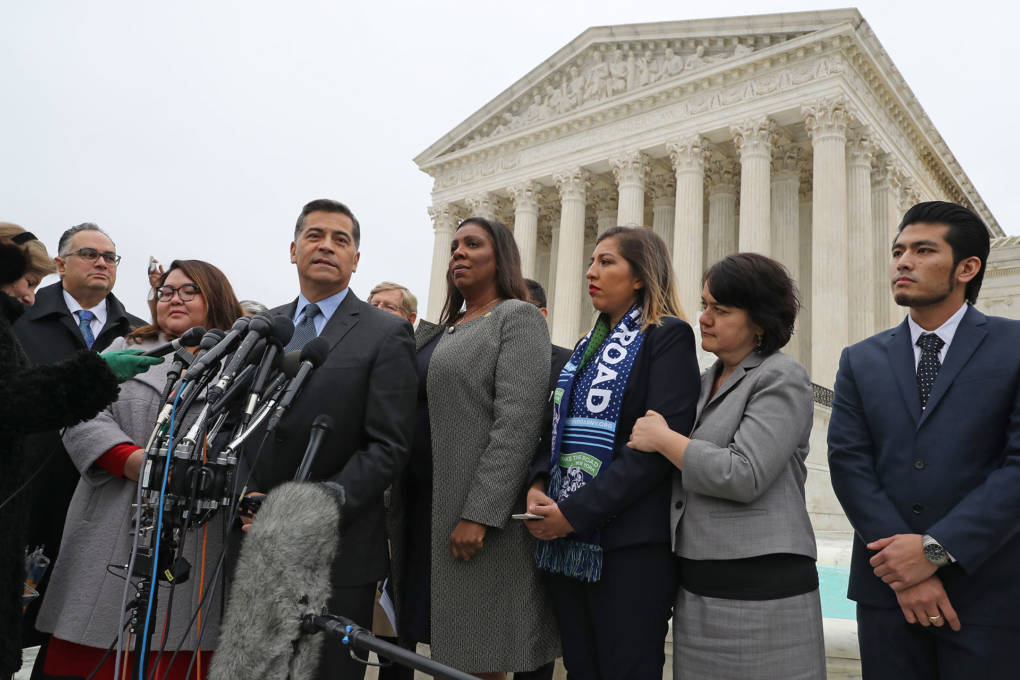
"caption": "California Attorney General Xavier Becerra (3rd L) and New York State Attorney General Letitia James (4th L) join plaintiffs Eliana Fernandez (3rd R) and Jirayut Latthivongskorn (R) as they talk to reporters outside U.S. Supreme Court following arguments in a case about the Deferred Action on Childhood Arrivals program Nov. 12, 2019, in Washington, D.C.",
"description": "California Attorney General Xavier Becerra (3rd L) and New York State Attorney General Letitia James (4th L) join plaintiffs Eliana Fernandez (3rd R) and Jirayut Latthivongskorn (R) as they talk to reporters outside U.S. Supreme Court following arguments in a case about the Deferred Action on Childhood Arrivals program Nov. 12, 2019, in Washington, D.C.",
"title": "xavier-becerra-supreme-court-1920",
"credit": "Chip Somodevilla/Getty Images",
"status": "inherit",
"isLoading": false,
"fetchFailed": false
},
"news_11785895": {
"type": "attachments",
"id": "news_11785895",
"meta": {
"index": "attachments_1716263798",
"site": "news",
"id": "11785895",
"found": true
},
"parent": 11785839,
"imgSizes": {
"apple_news_ca_landscape_5_5": {
"file": "https://ww2.kqed.org/app/uploads/sites/10/2019/11/DACA-Protester-SCOTUS-1044x783.jpg",
"width": 1044,
"mimeType": "image/jpeg",
"height": 783
},
"apple_news_ca_square_4_0": {
"file": "https://ww2.kqed.org/app/uploads/sites/10/2019/11/DACA-Protester-SCOTUS-470x470.jpg",
"width": 470,
"mimeType": "image/jpeg",
"height": 470
},
"twentyfourteen-full-width": {
"file": "https://ww2.kqed.org/app/uploads/sites/10/2019/11/DACA-Protester-SCOTUS-1038x576.jpg",
"width": 1038,
"mimeType": "image/jpeg",
"height": 576
},
"thumbnail": {
"file": "https://ww2.kqed.org/app/uploads/sites/10/2019/11/DACA-Protester-SCOTUS-160x107.jpg",
"width": 160,
"mimeType": "image/jpeg",
"height": 107
},
"post-thumbnail": {
"file": "https://ww2.kqed.org/app/uploads/sites/10/2019/11/DACA-Protester-SCOTUS-672x372.jpg",
"width": 672,
"mimeType": "image/jpeg",
"height": 372
},
"kqedFullSize": {
"file": "https://ww2.kqed.org/app/uploads/sites/10/2019/11/DACA-Protester-SCOTUS.jpg",
"width": 1920,
"height": 1280
},
"apple_news_ca_landscape_4_7": {
"file": "https://ww2.kqed.org/app/uploads/sites/10/2019/11/DACA-Protester-SCOTUS-632x474.jpg",
"width": 632,
"mimeType": "image/jpeg",
"height": 474
},
"large": {
"file": "https://ww2.kqed.org/app/uploads/sites/10/2019/11/DACA-Protester-SCOTUS-1020x680.jpg",
"width": 1020,
"mimeType": "image/jpeg",
"height": 680
},
"complete_open_graph": {
"file": "https://ww2.kqed.org/app/uploads/sites/10/2019/11/DACA-Protester-SCOTUS-1200x800.jpg",
"width": 1200,
"mimeType": "image/jpeg",
"height": 800
},
"apple_news_ca_landscape_4_0": {
"file": "https://ww2.kqed.org/app/uploads/sites/10/2019/11/DACA-Protester-SCOTUS-536x402.jpg",
"width": 536,
"mimeType": "image/jpeg",
"height": 402
},
"apple_news_ca_portrait_12_9": {
"file": "https://ww2.kqed.org/app/uploads/sites/10/2019/11/DACA-Protester-SCOTUS-1122x1280.jpg",
"width": 1122,
"mimeType": "image/jpeg",
"height": 1280
},
"medium": {
"file": "https://ww2.kqed.org/app/uploads/sites/10/2019/11/DACA-Protester-SCOTUS-800x533.jpg",
"width": 800,
"mimeType": "image/jpeg",
"height": 533
},
"apple_news_ca_portrait_4_0": {
"file": "https://ww2.kqed.org/app/uploads/sites/10/2019/11/DACA-Protester-SCOTUS-354x472.jpg",
"width": 354,
"mimeType": "image/jpeg",
"height": 472
},
"apple_news_ca_portrait_9_7": {
"file": "https://ww2.kqed.org/app/uploads/sites/10/2019/11/DACA-Protester-SCOTUS-840x1120.jpg",
"width": 840,
"mimeType": "image/jpeg",
"height": 1120
},
"apple_news_ca_landscape_12_9": {
"file": "https://ww2.kqed.org/app/uploads/sites/10/2019/11/DACA-Protester-SCOTUS-1832x1280.jpg",
"width": 1832,
"mimeType": "image/jpeg",
"height": 1280
},
"apple_news_ca_square_9_7": {
"file": "https://ww2.kqed.org/app/uploads/sites/10/2019/11/DACA-Protester-SCOTUS-1104x1104.jpg",
"width": 1104,
"mimeType": "image/jpeg",
"height": 1104
},
"apple_news_ca_portrait_4_7": {
"file": "https://ww2.kqed.org/app/uploads/sites/10/2019/11/DACA-Protester-SCOTUS-414x552.jpg",
"width": 414,
"mimeType": "image/jpeg",
"height": 552
},
"apple_news_ca_square_12_9": {
"file": "https://ww2.kqed.org/app/uploads/sites/10/2019/11/DACA-Protester-SCOTUS-1472x1280.jpg",
"width": 1472,
"mimeType": "image/jpeg",
"height": 1280
},
"apple_news_ca_portrait_5_5": {
"file": "https://ww2.kqed.org/app/uploads/sites/10/2019/11/DACA-Protester-SCOTUS-687x916.jpg",
"width": 687,
"mimeType": "image/jpeg",
"height": 916
},
"full-width": {
"file": "https://ww2.kqed.org/app/uploads/sites/10/2019/11/DACA-Protester-SCOTUS-1920x1280.jpg",
"width": 1920,
"mimeType": "image/jpeg",
"height": 1280
},
"apple_news_ca_square_4_7": {
"file": "https://ww2.kqed.org/app/uploads/sites/10/2019/11/DACA-Protester-SCOTUS-550x550.jpg",
"width": 550,
"mimeType": "image/jpeg",
"height": 550
},
"apple_news_ca_landscape_9_7": {
"file": "https://ww2.kqed.org/app/uploads/sites/10/2019/11/DACA-Protester-SCOTUS-1376x1032.jpg",
"width": 1376,
"mimeType": "image/jpeg",
"height": 1032
},
"apple_news_ca_square_5_5": {
"file": "https://ww2.kqed.org/app/uploads/sites/10/2019/11/DACA-Protester-SCOTUS-912x912.jpg",
"width": 912,
"mimeType": "image/jpeg",
"height": 912
}
},
"publishDate": 1573255587,
"modified": 1573260411,
"caption": "DACA student Anahi Figueroa Flores, who attends Georgetown University, speaks during a rally defending Deferred Action for Childhood Arrivals (DACA) in front of the U.S. Supreme Court after they walked out from area high schools and universities on Nov. 8, 2019, in Washington, D.C. The Supreme Court will hear oral arguments on President Trump’s decision to end the DACA program on Tuesday.",
"description": "DACA student Anahi Figueroa Flores, who attends Georgetown University, speaks during a rally defending Deferred Action for Childhood Arrivals (DACA) in front of the U.S. Supreme Court after they walked out from area high schools and universities on Nov. 8, 2019 in Washington, DC. The Supreme Court will hear oral arguments on President Trump’s decision to end the DACA program on Tuesday.",
"title": "DACA-Protester-SCOTUS",
"credit": "Alex Wong/Getty Images",
"status": "inherit",
"isLoading": false,
"fetchFailed": false
},
"news_11785865": {
"type": "attachments",
"id": "news_11785865",
"meta": {
"index": "attachments_1716263798",
"site": "news",
"id": "11785865",
"found": true
},
"parent": 11785848,
"imgSizes": {
"apple_news_ca_landscape_5_5": {
"file": "https://ww2.kqed.org/app/uploads/sites/10/2019/11/reunification_110819_final-1044x783.jpg",
"width": 1044,
"mimeType": "image/jpeg",
"height": 783
},
"apple_news_ca_square_4_0": {
"file": "https://ww2.kqed.org/app/uploads/sites/10/2019/11/reunification_110819_final-470x470.jpg",
"width": 470,
"mimeType": "image/jpeg",
"height": 470
},
"twentyfourteen-full-width": {
"file": "https://ww2.kqed.org/app/uploads/sites/10/2019/11/reunification_110819_final-1038x576.jpg",
"width": 1038,
"mimeType": "image/jpeg",
"height": 576
},
"thumbnail": {
"file": "https://ww2.kqed.org/app/uploads/sites/10/2019/11/reunification_110819_final-160x114.jpg",
"width": 160,
"mimeType": "image/jpeg",
"height": 114
},
"post-thumbnail": {
"file": "https://ww2.kqed.org/app/uploads/sites/10/2019/11/reunification_110819_final-672x372.jpg",
"width": 672,
"mimeType": "image/jpeg",
"height": 372
},
"kqedFullSize": {
"file": "https://ww2.kqed.org/app/uploads/sites/10/2019/11/reunification_110819_final.jpg",
"width": 1920,
"height": 1365
},
"apple_news_ca_landscape_4_7": {
"file": "https://ww2.kqed.org/app/uploads/sites/10/2019/11/reunification_110819_final-632x474.jpg",
"width": 632,
"mimeType": "image/jpeg",
"height": 474
},
"large": {
"file": "https://ww2.kqed.org/app/uploads/sites/10/2019/11/reunification_110819_final-1020x725.jpg",
"width": 1020,
"mimeType": "image/jpeg",
"height": 725
},
"complete_open_graph": {
"file": "https://ww2.kqed.org/app/uploads/sites/10/2019/11/reunification_110819_final-1200x853.jpg",
"width": 1200,
"mimeType": "image/jpeg",
"height": 853
},
"apple_news_ca_landscape_4_0": {
"file": "https://ww2.kqed.org/app/uploads/sites/10/2019/11/reunification_110819_final-536x402.jpg",
"width": 536,
"mimeType": "image/jpeg",
"height": 402
},
"apple_news_ca_portrait_12_9": {
"file": "https://ww2.kqed.org/app/uploads/sites/10/2019/11/reunification_110819_final-1122x1365.jpg",
"width": 1122,
"mimeType": "image/jpeg",
"height": 1365
},
"medium": {
"file": "https://ww2.kqed.org/app/uploads/sites/10/2019/11/reunification_110819_final-800x569.jpg",
"width": 800,
"mimeType": "image/jpeg",
"height": 569
},
"apple_news_ca_portrait_4_0": {
"file": "https://ww2.kqed.org/app/uploads/sites/10/2019/11/reunification_110819_final-354x472.jpg",
"width": 354,
"mimeType": "image/jpeg",
"height": 472
},
"apple_news_ca_portrait_9_7": {
"file": "https://ww2.kqed.org/app/uploads/sites/10/2019/11/reunification_110819_final-840x1120.jpg",
"width": 840,
"mimeType": "image/jpeg",
"height": 1120
},
"apple_news_ca_landscape_12_9": {
"file": "https://ww2.kqed.org/app/uploads/sites/10/2019/11/reunification_110819_final-1832x1365.jpg",
"width": 1832,
"mimeType": "image/jpeg",
"height": 1365
},
"apple_news_ca_square_9_7": {
"file": "https://ww2.kqed.org/app/uploads/sites/10/2019/11/reunification_110819_final-1104x1104.jpg",
"width": 1104,
"mimeType": "image/jpeg",
"height": 1104
},
"apple_news_ca_portrait_4_7": {
"file": "https://ww2.kqed.org/app/uploads/sites/10/2019/11/reunification_110819_final-414x552.jpg",
"width": 414,
"mimeType": "image/jpeg",
"height": 552
},
"apple_news_ca_square_12_9": {
"file": "https://ww2.kqed.org/app/uploads/sites/10/2019/11/reunification_110819_final-1472x1365.jpg",
"width": 1472,
"mimeType": "image/jpeg",
"height": 1365
},
"apple_news_ca_portrait_5_5": {
"file": "https://ww2.kqed.org/app/uploads/sites/10/2019/11/reunification_110819_final-687x916.jpg",
"width": 687,
"mimeType": "image/jpeg",
"height": 916
},
"full-width": {
"file": "https://ww2.kqed.org/app/uploads/sites/10/2019/11/reunification_110819_final-1920x1365.jpg",
"width": 1920,
"mimeType": "image/jpeg",
"height": 1365
},
"apple_news_ca_square_4_7": {
"file": "https://ww2.kqed.org/app/uploads/sites/10/2019/11/reunification_110819_final-550x550.jpg",
"width": 550,
"mimeType": "image/jpeg",
"height": 550
},
"apple_news_ca_landscape_9_7": {
"file": "https://ww2.kqed.org/app/uploads/sites/10/2019/11/reunification_110819_final-1376x1032.jpg",
"width": 1376,
"mimeType": "image/jpeg",
"height": 1032
},
"apple_news_ca_square_5_5": {
"file": "https://ww2.kqed.org/app/uploads/sites/10/2019/11/reunification_110819_final-912x912.jpg",
"width": 912,
"mimeType": "image/jpeg",
"height": 912
}
},
"publishDate": 1573250688,
"modified": 1573250717,
"caption": null,
"description": null,
"title": "reunification_110819_final",
"credit": null,
"status": "inherit",
"isLoading": false,
"fetchFailed": false
},
"news_11784905": {
"type": "attachments",
"id": "news_11784905",
"meta": {
"index": "attachments_1716263798",
"site": "news",
"id": "11784905",
"found": true
},
"parent": 11784895,
"imgSizes": {
"apple_news_ca_landscape_5_5": {
"file": "https://ww2.kqed.org/app/uploads/sites/10/2019/11/responders_110419_final-1044x783.jpg",
"width": 1044,
"mimeType": "image/jpeg",
"height": 783
},
"apple_news_ca_square_4_0": {
"file": "https://ww2.kqed.org/app/uploads/sites/10/2019/11/responders_110419_final-470x470.jpg",
"width": 470,
"mimeType": "image/jpeg",
"height": 470
},
"twentyfourteen-full-width": {
"file": "https://ww2.kqed.org/app/uploads/sites/10/2019/11/responders_110419_final-1038x576.jpg",
"width": 1038,
"mimeType": "image/jpeg",
"height": 576
},
"thumbnail": {
"file": "https://ww2.kqed.org/app/uploads/sites/10/2019/11/responders_110419_final-160x120.jpg",
"width": 160,
"mimeType": "image/jpeg",
"height": 120
},
"post-thumbnail": {
"file": "https://ww2.kqed.org/app/uploads/sites/10/2019/11/responders_110419_final-672x372.jpg",
"width": 672,
"mimeType": "image/jpeg",
"height": 372
},
"kqedFullSize": {
"file": "https://ww2.kqed.org/app/uploads/sites/10/2019/11/responders_110419_final.jpg",
"width": 1920,
"height": 1435
},
"apple_news_ca_landscape_4_7": {
"file": "https://ww2.kqed.org/app/uploads/sites/10/2019/11/responders_110419_final-632x474.jpg",
"width": 632,
"mimeType": "image/jpeg",
"height": 474
},
"large": {
"file": "https://ww2.kqed.org/app/uploads/sites/10/2019/11/responders_110419_final-1020x762.jpg",
"width": 1020,
"mimeType": "image/jpeg",
"height": 762
},
"complete_open_graph": {
"file": "https://ww2.kqed.org/app/uploads/sites/10/2019/11/responders_110419_final-1200x897.jpg",
"width": 1200,
"mimeType": "image/jpeg",
"height": 897
},
"apple_news_ca_landscape_4_0": {
"file": "https://ww2.kqed.org/app/uploads/sites/10/2019/11/responders_110419_final-536x402.jpg",
"width": 536,
"mimeType": "image/jpeg",
"height": 402
},
"apple_news_ca_portrait_12_9": {
"file": "https://ww2.kqed.org/app/uploads/sites/10/2019/11/responders_110419_final-1122x1435.jpg",
"width": 1122,
"mimeType": "image/jpeg",
"height": 1435
},
"medium": {
"file": "https://ww2.kqed.org/app/uploads/sites/10/2019/11/responders_110419_final-800x598.jpg",
"width": 800,
"mimeType": "image/jpeg",
"height": 598
},
"apple_news_ca_portrait_4_0": {
"file": "https://ww2.kqed.org/app/uploads/sites/10/2019/11/responders_110419_final-354x472.jpg",
"width": 354,
"mimeType": "image/jpeg",
"height": 472
},
"apple_news_ca_portrait_9_7": {
"file": "https://ww2.kqed.org/app/uploads/sites/10/2019/11/responders_110419_final-840x1120.jpg",
"width": 840,
"mimeType": "image/jpeg",
"height": 1120
},
"apple_news_ca_landscape_12_9": {
"file": "https://ww2.kqed.org/app/uploads/sites/10/2019/11/responders_110419_final-1832x1374.jpg",
"width": 1832,
"mimeType": "image/jpeg",
"height": 1374
},
"apple_news_ca_square_9_7": {
"file": "https://ww2.kqed.org/app/uploads/sites/10/2019/11/responders_110419_final-1104x1104.jpg",
"width": 1104,
"mimeType": "image/jpeg",
"height": 1104
},
"apple_news_ca_portrait_4_7": {
"file": "https://ww2.kqed.org/app/uploads/sites/10/2019/11/responders_110419_final-414x552.jpg",
"width": 414,
"mimeType": "image/jpeg",
"height": 552
},
"apple_news_ca_square_12_9": {
"file": "https://ww2.kqed.org/app/uploads/sites/10/2019/11/responders_110419_final-1472x1435.jpg",
"width": 1472,
"mimeType": "image/jpeg",
"height": 1435
},
"apple_news_ca_portrait_5_5": {
"file": "https://ww2.kqed.org/app/uploads/sites/10/2019/11/responders_110419_final-687x916.jpg",
"width": 687,
"mimeType": "image/jpeg",
"height": 916
},
"full-width": {
"file": "https://ww2.kqed.org/app/uploads/sites/10/2019/11/responders_110419_final-1920x1435.jpg",
"width": 1920,
"mimeType": "image/jpeg",
"height": 1435
},
"apple_news_ca_square_4_7": {
"file": "https://ww2.kqed.org/app/uploads/sites/10/2019/11/responders_110419_final-550x550.jpg",
"width": 550,
"mimeType": "image/jpeg",
"height": 550
},
"apple_news_ca_landscape_9_7": {
"file": "https://ww2.kqed.org/app/uploads/sites/10/2019/11/responders_110419_final-1376x1032.jpg",
"width": 1376,
"mimeType": "image/jpeg",
"height": 1032
},
"apple_news_ca_square_5_5": {
"file": "https://ww2.kqed.org/app/uploads/sites/10/2019/11/responders_110419_final-912x912.jpg",
"width": 912,
"mimeType": "image/jpeg",
"height": 912
}
},
"publishDate": 1572915303,
"modified": 1572915330,
"caption": null,
"description": null,
"title": "responders_110419_final",
"credit": null,
"status": "inherit",
"isLoading": false,
"fetchFailed": false
},
"news_11784774": {
"type": "attachments",
"id": "news_11784774",
"meta": {
"index": "attachments_1716263798",
"site": "news",
"id": "11784774",
"found": true
},
"parent": 11784769,
"imgSizes": {
"apple_news_ca_landscape_5_5": {
"file": "https://ww2.kqed.org/app/uploads/sites/10/2019/11/gavin-newsom-1920-1044x783.jpg",
"width": 1044,
"mimeType": "image/jpeg",
"height": 783
},
"apple_news_ca_square_4_0": {
"file": "https://ww2.kqed.org/app/uploads/sites/10/2019/11/gavin-newsom-1920-470x470.jpg",
"width": 470,
"mimeType": "image/jpeg",
"height": 470
},
"twentyfourteen-full-width": {
"file": "https://ww2.kqed.org/app/uploads/sites/10/2019/11/gavin-newsom-1920-1038x576.jpg",
"width": 1038,
"mimeType": "image/jpeg",
"height": 576
},
"thumbnail": {
"file": "https://ww2.kqed.org/app/uploads/sites/10/2019/11/gavin-newsom-1920-160x113.jpg",
"width": 160,
"mimeType": "image/jpeg",
"height": 113
},
"post-thumbnail": {
"file": "https://ww2.kqed.org/app/uploads/sites/10/2019/11/gavin-newsom-1920-672x372.jpg",
"width": 672,
"mimeType": "image/jpeg",
"height": 372
},
"kqedFullSize": {
"file": "https://ww2.kqed.org/app/uploads/sites/10/2019/11/gavin-newsom-1920.jpg",
"width": 1920,
"height": 1360
},
"apple_news_ca_landscape_4_7": {
"file": "https://ww2.kqed.org/app/uploads/sites/10/2019/11/gavin-newsom-1920-632x474.jpg",
"width": 632,
"mimeType": "image/jpeg",
"height": 474
},
"large": {
"file": "https://ww2.kqed.org/app/uploads/sites/10/2019/11/gavin-newsom-1920-1020x723.jpg",
"width": 1020,
"mimeType": "image/jpeg",
"height": 723
},
"complete_open_graph": {
"file": "https://ww2.kqed.org/app/uploads/sites/10/2019/11/gavin-newsom-1920-1200x850.jpg",
"width": 1200,
"mimeType": "image/jpeg",
"height": 850
},
"apple_news_ca_landscape_4_0": {
"file": "https://ww2.kqed.org/app/uploads/sites/10/2019/11/gavin-newsom-1920-536x402.jpg",
"width": 536,
"mimeType": "image/jpeg",
"height": 402
},
"apple_news_ca_portrait_12_9": {
"file": "https://ww2.kqed.org/app/uploads/sites/10/2019/11/gavin-newsom-1920-1122x1360.jpg",
"width": 1122,
"mimeType": "image/jpeg",
"height": 1360
},
"medium": {
"file": "https://ww2.kqed.org/app/uploads/sites/10/2019/11/gavin-newsom-1920-800x567.jpg",
"width": 800,
"mimeType": "image/jpeg",
"height": 567
},
"apple_news_ca_portrait_4_0": {
"file": "https://ww2.kqed.org/app/uploads/sites/10/2019/11/gavin-newsom-1920-354x472.jpg",
"width": 354,
"mimeType": "image/jpeg",
"height": 472
},
"apple_news_ca_portrait_9_7": {
"file": "https://ww2.kqed.org/app/uploads/sites/10/2019/11/gavin-newsom-1920-840x1120.jpg",
"width": 840,
"mimeType": "image/jpeg",
"height": 1120
},
"apple_news_ca_landscape_12_9": {
"file": "https://ww2.kqed.org/app/uploads/sites/10/2019/11/gavin-newsom-1920-1832x1360.jpg",
"width": 1832,
"mimeType": "image/jpeg",
"height": 1360
},
"apple_news_ca_square_9_7": {
"file": "https://ww2.kqed.org/app/uploads/sites/10/2019/11/gavin-newsom-1920-1104x1104.jpg",
"width": 1104,
"mimeType": "image/jpeg",
"height": 1104
},
"apple_news_ca_portrait_4_7": {
"file": "https://ww2.kqed.org/app/uploads/sites/10/2019/11/gavin-newsom-1920-414x552.jpg",
"width": 414,
"mimeType": "image/jpeg",
"height": 552
},
"apple_news_ca_square_12_9": {
"file": "https://ww2.kqed.org/app/uploads/sites/10/2019/11/gavin-newsom-1920-1472x1360.jpg",
"width": 1472,
"mimeType": "image/jpeg",
"height": 1360
},
"apple_news_ca_portrait_5_5": {
"file": "https://ww2.kqed.org/app/uploads/sites/10/2019/11/gavin-newsom-1920-687x916.jpg",
"width": 687,
"mimeType": "image/jpeg",
"height": 916
},
"full-width": {
"file": "https://ww2.kqed.org/app/uploads/sites/10/2019/11/gavin-newsom-1920-1920x1360.jpg",
"width": 1920,
"mimeType": "image/jpeg",
"height": 1360
},
"apple_news_ca_square_4_7": {
"file": "https://ww2.kqed.org/app/uploads/sites/10/2019/11/gavin-newsom-1920-550x550.jpg",
"width": 550,
"mimeType": "image/jpeg",
"height": 550
},
"apple_news_ca_landscape_9_7": {
"file": "https://ww2.kqed.org/app/uploads/sites/10/2019/11/gavin-newsom-1920-1376x1032.jpg",
"width": 1376,
"mimeType": "image/jpeg",
"height": 1032
},
"apple_news_ca_square_5_5": {
"file": "https://ww2.kqed.org/app/uploads/sites/10/2019/11/gavin-newsom-1920-912x912.jpg",
"width": 912,
"mimeType": "image/jpeg",
"height": 912
}
},
"publishDate": 1572894782,
"modified": 1620067483,
"caption": "California Gov. Gavin Newsom speaks during a news conference at the California Justice Department on Sept. 18, 2019 in Sacramento.",
"description": "California Gov. Gavin Newsom speaks during a news conference at the California Justice Department on Sept. 18, 2019, in Sacramento.",
"title": "gavin-newsom-1920",
"credit": "Justin Sullivan/Getty Images",
"status": "inherit",
"altTag": "California Gov. Gavin Newsom speaks during a news conference at the California Justice Department on Sept. 18, 2019, in Sacramento.",
"isLoading": false,
"fetchFailed": false
},
"news_11784694": {
"type": "attachments",
"id": "news_11784694",
"meta": {
"index": "attachments_1716263798",
"site": "news",
"id": "11784694",
"found": true
},
"parent": 11784681,
"imgSizes": {
"apple_news_ca_landscape_5_5": {
"file": "https://ww2.kqed.org/app/uploads/sites/10/2019/11/RS40077_GettyImages-1179391471-qut-1044x783.jpg",
"width": 1044,
"mimeType": "image/jpeg",
"height": 783
},
"apple_news_ca_square_4_0": {
"file": "https://ww2.kqed.org/app/uploads/sites/10/2019/11/RS40077_GettyImages-1179391471-qut-470x470.jpg",
"width": 470,
"mimeType": "image/jpeg",
"height": 470
},
"twentyfourteen-full-width": {
"file": "https://ww2.kqed.org/app/uploads/sites/10/2019/11/RS40077_GettyImages-1179391471-qut-1038x576.jpg",
"width": 1038,
"mimeType": "image/jpeg",
"height": 576
},
"thumbnail": {
"file": "https://ww2.kqed.org/app/uploads/sites/10/2019/11/RS40077_GettyImages-1179391471-qut-160x108.jpg",
"width": 160,
"mimeType": "image/jpeg",
"height": 108
},
"post-thumbnail": {
"file": "https://ww2.kqed.org/app/uploads/sites/10/2019/11/RS40077_GettyImages-1179391471-qut-672x372.jpg",
"width": 672,
"mimeType": "image/jpeg",
"height": 372
},
"kqedFullSize": {
"file": "https://ww2.kqed.org/app/uploads/sites/10/2019/11/RS40077_GettyImages-1179391471-qut.jpg",
"width": 1920,
"height": 1294
},
"apple_news_ca_landscape_4_7": {
"file": "https://ww2.kqed.org/app/uploads/sites/10/2019/11/RS40077_GettyImages-1179391471-qut-632x474.jpg",
"width": 632,
"mimeType": "image/jpeg",
"height": 474
},
"large": {
"file": "https://ww2.kqed.org/app/uploads/sites/10/2019/11/RS40077_GettyImages-1179391471-qut-1020x687.jpg",
"width": 1020,
"mimeType": "image/jpeg",
"height": 687
},
"complete_open_graph": {
"file": "https://ww2.kqed.org/app/uploads/sites/10/2019/11/RS40077_GettyImages-1179391471-qut-1200x809.jpg",
"width": 1200,
"mimeType": "image/jpeg",
"height": 809
},
"apple_news_ca_landscape_4_0": {
"file": "https://ww2.kqed.org/app/uploads/sites/10/2019/11/RS40077_GettyImages-1179391471-qut-536x402.jpg",
"width": 536,
"mimeType": "image/jpeg",
"height": 402
},
"apple_news_ca_portrait_12_9": {
"file": "https://ww2.kqed.org/app/uploads/sites/10/2019/11/RS40077_GettyImages-1179391471-qut-1122x1294.jpg",
"width": 1122,
"mimeType": "image/jpeg",
"height": 1294
},
"medium": {
"file": "https://ww2.kqed.org/app/uploads/sites/10/2019/11/RS40077_GettyImages-1179391471-qut-800x539.jpg",
"width": 800,
"mimeType": "image/jpeg",
"height": 539
},
"apple_news_ca_portrait_4_0": {
"file": "https://ww2.kqed.org/app/uploads/sites/10/2019/11/RS40077_GettyImages-1179391471-qut-354x472.jpg",
"width": 354,
"mimeType": "image/jpeg",
"height": 472
},
"apple_news_ca_portrait_9_7": {
"file": "https://ww2.kqed.org/app/uploads/sites/10/2019/11/RS40077_GettyImages-1179391471-qut-840x1120.jpg",
"width": 840,
"mimeType": "image/jpeg",
"height": 1120
},
"apple_news_ca_landscape_12_9": {
"file": "https://ww2.kqed.org/app/uploads/sites/10/2019/11/RS40077_GettyImages-1179391471-qut-1832x1294.jpg",
"width": 1832,
"mimeType": "image/jpeg",
"height": 1294
},
"apple_news_ca_square_9_7": {
"file": "https://ww2.kqed.org/app/uploads/sites/10/2019/11/RS40077_GettyImages-1179391471-qut-1104x1104.jpg",
"width": 1104,
"mimeType": "image/jpeg",
"height": 1104
},
"apple_news_ca_portrait_4_7": {
"file": "https://ww2.kqed.org/app/uploads/sites/10/2019/11/RS40077_GettyImages-1179391471-qut-414x552.jpg",
"width": 414,
"mimeType": "image/jpeg",
"height": 552
},
"apple_news_ca_square_12_9": {
"file": "https://ww2.kqed.org/app/uploads/sites/10/2019/11/RS40077_GettyImages-1179391471-qut-1472x1294.jpg",
"width": 1472,
"mimeType": "image/jpeg",
"height": 1294
},
"apple_news_ca_portrait_5_5": {
"file": "https://ww2.kqed.org/app/uploads/sites/10/2019/11/RS40077_GettyImages-1179391471-qut-687x916.jpg",
"width": 687,
"mimeType": "image/jpeg",
"height": 916
},
"full-width": {
"file": "https://ww2.kqed.org/app/uploads/sites/10/2019/11/RS40077_GettyImages-1179391471-qut-1920x1294.jpg",
"width": 1920,
"mimeType": "image/jpeg",
"height": 1294
},
"apple_news_ca_square_4_7": {
"file": "https://ww2.kqed.org/app/uploads/sites/10/2019/11/RS40077_GettyImages-1179391471-qut-550x550.jpg",
"width": 550,
"mimeType": "image/jpeg",
"height": 550
},
"apple_news_ca_landscape_9_7": {
"file": "https://ww2.kqed.org/app/uploads/sites/10/2019/11/RS40077_GettyImages-1179391471-qut-1376x1032.jpg",
"width": 1376,
"mimeType": "image/jpeg",
"height": 1032
},
"apple_news_ca_square_5_5": {
"file": "https://ww2.kqed.org/app/uploads/sites/10/2019/11/RS40077_GettyImages-1179391471-qut-912x912.jpg",
"width": 912,
"mimeType": "image/jpeg",
"height": 912
}
},
"publishDate": 1572802571,
"modified": 1574126945,
"caption": "President Trump has threatened to eliminate government funding for the state of California on various occasions, among the multiple factors that make him particularly unpopular here.",
"description": "President Donald Trump has threatened to eliminate government funding for the state of California on various occasions.",
"title": "US-POLITICS-TRUMP",
"credit": "JIM WATSON/AFP via Getty Images",
"status": "inherit",
"isLoading": false,
"fetchFailed": false
},
"news_11784360": {
"type": "attachments",
"id": "news_11784360",
"meta": {
"index": "attachments_1716263798",
"site": "news",
"id": "11784360",
"found": true
},
"parent": 11784351,
"imgSizes": {
"apple_news_ca_landscape_5_5": {
"file": "https://ww2.kqed.org/app/uploads/sites/10/2019/11/MarqueeNR705-1044x783.jpg",
"width": 1044,
"mimeType": "image/jpeg",
"height": 783
},
"apple_news_ca_square_4_0": {
"file": "https://ww2.kqed.org/app/uploads/sites/10/2019/11/MarqueeNR705-470x470.jpg",
"width": 470,
"mimeType": "image/jpeg",
"height": 470
},
"twentyfourteen-full-width": {
"file": "https://ww2.kqed.org/app/uploads/sites/10/2019/11/MarqueeNR705-1038x576.jpg",
"width": 1038,
"mimeType": "image/jpeg",
"height": 576
},
"thumbnail": {
"file": "https://ww2.kqed.org/app/uploads/sites/10/2019/11/MarqueeNR705-160x90.jpg",
"width": 160,
"mimeType": "image/jpeg",
"height": 90
},
"post-thumbnail": {
"file": "https://ww2.kqed.org/app/uploads/sites/10/2019/11/MarqueeNR705-672x372.jpg",
"width": 672,
"mimeType": "image/jpeg",
"height": 372
},
"kqedFullSize": {
"file": "https://ww2.kqed.org/app/uploads/sites/10/2019/11/MarqueeNR705.jpg",
"width": 1920,
"height": 1080
},
"apple_news_ca_landscape_4_7": {
"file": "https://ww2.kqed.org/app/uploads/sites/10/2019/11/MarqueeNR705-632x474.jpg",
"width": 632,
"mimeType": "image/jpeg",
"height": 474
},
"large": {
"file": "https://ww2.kqed.org/app/uploads/sites/10/2019/11/MarqueeNR705-1020x574.jpg",
"width": 1020,
"mimeType": "image/jpeg",
"height": 574
},
"complete_open_graph": {
"file": "https://ww2.kqed.org/app/uploads/sites/10/2019/11/MarqueeNR705-1200x675.jpg",
"width": 1200,
"mimeType": "image/jpeg",
"height": 675
},
"apple_news_ca_landscape_4_0": {
"file": "https://ww2.kqed.org/app/uploads/sites/10/2019/11/MarqueeNR705-536x402.jpg",
"width": 536,
"mimeType": "image/jpeg",
"height": 402
},
"apple_news_ca_portrait_12_9": {
"file": "https://ww2.kqed.org/app/uploads/sites/10/2019/11/MarqueeNR705-1122x1080.jpg",
"width": 1122,
"mimeType": "image/jpeg",
"height": 1080
},
"medium": {
"file": "https://ww2.kqed.org/app/uploads/sites/10/2019/11/MarqueeNR705-800x450.jpg",
"width": 800,
"mimeType": "image/jpeg",
"height": 450
},
"apple_news_ca_portrait_4_0": {
"file": "https://ww2.kqed.org/app/uploads/sites/10/2019/11/MarqueeNR705-354x472.jpg",
"width": 354,
"mimeType": "image/jpeg",
"height": 472
},
"apple_news_ca_portrait_9_7": {
"file": "https://ww2.kqed.org/app/uploads/sites/10/2019/11/MarqueeNR705-840x1080.jpg",
"width": 840,
"mimeType": "image/jpeg",
"height": 1080
},
"apple_news_ca_landscape_12_9": {
"file": "https://ww2.kqed.org/app/uploads/sites/10/2019/11/MarqueeNR705-1832x1080.jpg",
"width": 1832,
"mimeType": "image/jpeg",
"height": 1080
},
"apple_news_ca_square_9_7": {
"file": "https://ww2.kqed.org/app/uploads/sites/10/2019/11/MarqueeNR705-1104x1080.jpg",
"width": 1104,
"mimeType": "image/jpeg",
"height": 1080
},
"apple_news_ca_portrait_4_7": {
"file": "https://ww2.kqed.org/app/uploads/sites/10/2019/11/MarqueeNR705-414x552.jpg",
"width": 414,
"mimeType": "image/jpeg",
"height": 552
},
"apple_news_ca_square_12_9": {
"file": "https://ww2.kqed.org/app/uploads/sites/10/2019/11/MarqueeNR705-1472x1080.jpg",
"width": 1472,
"mimeType": "image/jpeg",
"height": 1080
},
"apple_news_ca_portrait_5_5": {
"file": "https://ww2.kqed.org/app/uploads/sites/10/2019/11/MarqueeNR705-687x916.jpg",
"width": 687,
"mimeType": "image/jpeg",
"height": 916
},
"full-width": {
"file": "https://ww2.kqed.org/app/uploads/sites/10/2019/11/MarqueeNR705-1920x1080.jpg",
"width": 1920,
"mimeType": "image/jpeg",
"height": 1080
},
"apple_news_ca_square_4_7": {
"file": "https://ww2.kqed.org/app/uploads/sites/10/2019/11/MarqueeNR705-550x550.jpg",
"width": 550,
"mimeType": "image/jpeg",
"height": 550
},
"apple_news_ca_landscape_9_7": {
"file": "https://ww2.kqed.org/app/uploads/sites/10/2019/11/MarqueeNR705-1376x1032.jpg",
"width": 1376,
"mimeType": "image/jpeg",
"height": 1032
},
"apple_news_ca_square_5_5": {
"file": "https://ww2.kqed.org/app/uploads/sites/10/2019/11/MarqueeNR705-912x912.jpg",
"width": 912,
"mimeType": "image/jpeg",
"height": 912
}
},
"publishDate": 1572635199,
"modified": 1572635199,
"caption": null,
"description": null,
"title": "MarqueeNR705",
"credit": null,
"status": "inherit",
"isLoading": false,
"fetchFailed": false
},
"news_11784037": {
"type": "attachments",
"id": "news_11784037",
"meta": {
"index": "attachments_1716263798",
"site": "news",
"id": "11784037",
"found": true
},
"parent": 11784008,
"imgSizes": {
"apple_news_ca_landscape_5_5": {
"file": "https://ww2.kqed.org/app/uploads/sites/10/2019/10/gettyimages-1179197127_wide-72882c7c2a1cd50c9e9664b5c5709ee93d99e89d-s1600-c85-1044x783.jpg",
"width": 1044,
"mimeType": "image/jpeg",
"height": 783
},
"apple_news_ca_square_4_0": {
"file": "https://ww2.kqed.org/app/uploads/sites/10/2019/10/gettyimages-1179197127_wide-72882c7c2a1cd50c9e9664b5c5709ee93d99e89d-s1600-c85-470x470.jpg",
"width": 470,
"mimeType": "image/jpeg",
"height": 470
},
"twentyfourteen-full-width": {
"file": "https://ww2.kqed.org/app/uploads/sites/10/2019/10/gettyimages-1179197127_wide-72882c7c2a1cd50c9e9664b5c5709ee93d99e89d-s1600-c85-1038x576.jpg",
"width": 1038,
"mimeType": "image/jpeg",
"height": 576
},
"thumbnail": {
"file": "https://ww2.kqed.org/app/uploads/sites/10/2019/10/gettyimages-1179197127_wide-72882c7c2a1cd50c9e9664b5c5709ee93d99e89d-s1600-c85-160x90.jpg",
"width": 160,
"mimeType": "image/jpeg",
"height": 90
},
"post-thumbnail": {
"file": "https://ww2.kqed.org/app/uploads/sites/10/2019/10/gettyimages-1179197127_wide-72882c7c2a1cd50c9e9664b5c5709ee93d99e89d-s1600-c85-672x372.jpg",
"width": 672,
"mimeType": "image/jpeg",
"height": 372
},
"kqedFullSize": {
"file": "https://ww2.kqed.org/app/uploads/sites/10/2019/10/gettyimages-1179197127_wide-72882c7c2a1cd50c9e9664b5c5709ee93d99e89d-s1600-c85.jpg",
"width": 1600,
"height": 899
},
"apple_news_ca_landscape_4_7": {
"file": "https://ww2.kqed.org/app/uploads/sites/10/2019/10/gettyimages-1179197127_wide-72882c7c2a1cd50c9e9664b5c5709ee93d99e89d-s1600-c85-632x474.jpg",
"width": 632,
"mimeType": "image/jpeg",
"height": 474
},
"large": {
"file": "https://ww2.kqed.org/app/uploads/sites/10/2019/10/gettyimages-1179197127_wide-72882c7c2a1cd50c9e9664b5c5709ee93d99e89d-s1600-c85-1020x573.jpg",
"width": 1020,
"mimeType": "image/jpeg",
"height": 573
},
"complete_open_graph": {
"file": "https://ww2.kqed.org/app/uploads/sites/10/2019/10/gettyimages-1179197127_wide-72882c7c2a1cd50c9e9664b5c5709ee93d99e89d-s1600-c85-1200x674.jpg",
"width": 1200,
"mimeType": "image/jpeg",
"height": 674
},
"apple_news_ca_landscape_4_0": {
"file": "https://ww2.kqed.org/app/uploads/sites/10/2019/10/gettyimages-1179197127_wide-72882c7c2a1cd50c9e9664b5c5709ee93d99e89d-s1600-c85-536x402.jpg",
"width": 536,
"mimeType": "image/jpeg",
"height": 402
},
"apple_news_ca_portrait_12_9": {
"file": "https://ww2.kqed.org/app/uploads/sites/10/2019/10/gettyimages-1179197127_wide-72882c7c2a1cd50c9e9664b5c5709ee93d99e89d-s1600-c85-1122x899.jpg",
"width": 1122,
"mimeType": "image/jpeg",
"height": 899
},
"medium": {
"file": "https://ww2.kqed.org/app/uploads/sites/10/2019/10/gettyimages-1179197127_wide-72882c7c2a1cd50c9e9664b5c5709ee93d99e89d-s1600-c85-800x450.jpg",
"width": 800,
"mimeType": "image/jpeg",
"height": 450
},
"apple_news_ca_portrait_4_0": {
"file": "https://ww2.kqed.org/app/uploads/sites/10/2019/10/gettyimages-1179197127_wide-72882c7c2a1cd50c9e9664b5c5709ee93d99e89d-s1600-c85-354x472.jpg",
"width": 354,
"mimeType": "image/jpeg",
"height": 472
},
"apple_news_ca_portrait_9_7": {
"file": "https://ww2.kqed.org/app/uploads/sites/10/2019/10/gettyimages-1179197127_wide-72882c7c2a1cd50c9e9664b5c5709ee93d99e89d-s1600-c85-840x899.jpg",
"width": 840,
"mimeType": "image/jpeg",
"height": 899
},
"apple_news_ca_square_9_7": {
"file": "https://ww2.kqed.org/app/uploads/sites/10/2019/10/gettyimages-1179197127_wide-72882c7c2a1cd50c9e9664b5c5709ee93d99e89d-s1600-c85-1104x899.jpg",
"width": 1104,
"mimeType": "image/jpeg",
"height": 899
},
"apple_news_ca_portrait_4_7": {
"file": "https://ww2.kqed.org/app/uploads/sites/10/2019/10/gettyimages-1179197127_wide-72882c7c2a1cd50c9e9664b5c5709ee93d99e89d-s1600-c85-414x552.jpg",
"width": 414,
"mimeType": "image/jpeg",
"height": 552
},
"apple_news_ca_square_12_9": {
"file": "https://ww2.kqed.org/app/uploads/sites/10/2019/10/gettyimages-1179197127_wide-72882c7c2a1cd50c9e9664b5c5709ee93d99e89d-s1600-c85-1472x899.jpg",
"width": 1472,
"mimeType": "image/jpeg",
"height": 899
},
"apple_news_ca_portrait_5_5": {
"file": "https://ww2.kqed.org/app/uploads/sites/10/2019/10/gettyimages-1179197127_wide-72882c7c2a1cd50c9e9664b5c5709ee93d99e89d-s1600-c85-687x899.jpg",
"width": 687,
"mimeType": "image/jpeg",
"height": 899
},
"apple_news_ca_square_4_7": {
"file": "https://ww2.kqed.org/app/uploads/sites/10/2019/10/gettyimages-1179197127_wide-72882c7c2a1cd50c9e9664b5c5709ee93d99e89d-s1600-c85-550x550.jpg",
"width": 550,
"mimeType": "image/jpeg",
"height": 550
},
"apple_news_ca_landscape_9_7": {
"file": "https://ww2.kqed.org/app/uploads/sites/10/2019/10/gettyimages-1179197127_wide-72882c7c2a1cd50c9e9664b5c5709ee93d99e89d-s1600-c85-1376x899.jpg",
"width": 1376,
"mimeType": "image/jpeg",
"height": 899
},
"apple_news_ca_square_5_5": {
"file": "https://ww2.kqed.org/app/uploads/sites/10/2019/10/gettyimages-1179197127_wide-72882c7c2a1cd50c9e9664b5c5709ee93d99e89d-s1600-c85-912x899.jpg",
"width": 912,
"mimeType": "image/jpeg",
"height": 899
}
},
"publishDate": 1572544834,
"modified": 1572544868,
"caption": "Speaker of the House Nancy Pelosi leaves her weekly press conference on Capitol Hill on Thursday as the House prepared to vote — then pass — a resolution formalizing its impeachment inquiry into President Trump.",
"description": "Speaker of the House Nancy Pelosi leaves her weekly press conference on Capitol Hill on Thursday as the House prepared to vote — then pass — a resolution formalizing its impeachment inquiry into President Trump.",
"title": "gettyimages-1179197127_wide-72882c7c2a1cd50c9e9664b5c5709ee93d99e89d-s1600-c85",
"credit": "Saul Loeb/AFP via Getty Images",
"status": "inherit",
"isLoading": false,
"fetchFailed": false
},
"news_11783582": {
"type": "attachments",
"id": "news_11783582",
"meta": {
"index": "attachments_1716263798",
"site": "news",
"id": "11783582",
"found": true
},
"parent": 11783572,
"imgSizes": {
"apple_news_ca_landscape_5_5": {
"file": "https://ww2.kqed.org/app/uploads/sites/10/2019/10/los-angeles-traffic-1044x783.jpg",
"width": 1044,
"mimeType": "image/jpeg",
"height": 783
},
"apple_news_ca_square_4_0": {
"file": "https://ww2.kqed.org/app/uploads/sites/10/2019/10/los-angeles-traffic-470x470.jpg",
"width": 470,
"mimeType": "image/jpeg",
"height": 470
},
"twentyfourteen-full-width": {
"file": "https://ww2.kqed.org/app/uploads/sites/10/2019/10/los-angeles-traffic-1038x576.jpg",
"width": 1038,
"mimeType": "image/jpeg",
"height": 576
},
"thumbnail": {
"file": "https://ww2.kqed.org/app/uploads/sites/10/2019/10/los-angeles-traffic-160x107.jpg",
"width": 160,
"mimeType": "image/jpeg",
"height": 107
},
"post-thumbnail": {
"file": "https://ww2.kqed.org/app/uploads/sites/10/2019/10/los-angeles-traffic-672x372.jpg",
"width": 672,
"mimeType": "image/jpeg",
"height": 372
},
"kqedFullSize": {
"file": "https://ww2.kqed.org/app/uploads/sites/10/2019/10/los-angeles-traffic.jpg",
"width": 1920,
"height": 1278
},
"apple_news_ca_landscape_4_7": {
"file": "https://ww2.kqed.org/app/uploads/sites/10/2019/10/los-angeles-traffic-632x474.jpg",
"width": 632,
"mimeType": "image/jpeg",
"height": 474
},
"large": {
"file": "https://ww2.kqed.org/app/uploads/sites/10/2019/10/los-angeles-traffic-1020x679.jpg",
"width": 1020,
"mimeType": "image/jpeg",
"height": 679
},
"complete_open_graph": {
"file": "https://ww2.kqed.org/app/uploads/sites/10/2019/10/los-angeles-traffic-1200x799.jpg",
"width": 1200,
"mimeType": "image/jpeg",
"height": 799
},
"apple_news_ca_landscape_4_0": {
"file": "https://ww2.kqed.org/app/uploads/sites/10/2019/10/los-angeles-traffic-536x402.jpg",
"width": 536,
"mimeType": "image/jpeg",
"height": 402
},
"apple_news_ca_portrait_12_9": {
"file": "https://ww2.kqed.org/app/uploads/sites/10/2019/10/los-angeles-traffic-1122x1278.jpg",
"width": 1122,
"mimeType": "image/jpeg",
"height": 1278
},
"medium": {
"file": "https://ww2.kqed.org/app/uploads/sites/10/2019/10/los-angeles-traffic-800x533.jpg",
"width": 800,
"mimeType": "image/jpeg",
"height": 533
},
"apple_news_ca_portrait_4_0": {
"file": "https://ww2.kqed.org/app/uploads/sites/10/2019/10/los-angeles-traffic-354x472.jpg",
"width": 354,
"mimeType": "image/jpeg",
"height": 472
},
"apple_news_ca_portrait_9_7": {
"file": "https://ww2.kqed.org/app/uploads/sites/10/2019/10/los-angeles-traffic-840x1120.jpg",
"width": 840,
"mimeType": "image/jpeg",
"height": 1120
},
"apple_news_ca_landscape_12_9": {
"file": "https://ww2.kqed.org/app/uploads/sites/10/2019/10/los-angeles-traffic-1832x1278.jpg",
"width": 1832,
"mimeType": "image/jpeg",
"height": 1278
},
"apple_news_ca_square_9_7": {
"file": "https://ww2.kqed.org/app/uploads/sites/10/2019/10/los-angeles-traffic-1104x1104.jpg",
"width": 1104,
"mimeType": "image/jpeg",
"height": 1104
},
"apple_news_ca_portrait_4_7": {
"file": "https://ww2.kqed.org/app/uploads/sites/10/2019/10/los-angeles-traffic-414x552.jpg",
"width": 414,
"mimeType": "image/jpeg",
"height": 552
},
"apple_news_ca_square_12_9": {
"file": "https://ww2.kqed.org/app/uploads/sites/10/2019/10/los-angeles-traffic-1472x1278.jpg",
"width": 1472,
"mimeType": "image/jpeg",
"height": 1278
},
"apple_news_ca_portrait_5_5": {
"file": "https://ww2.kqed.org/app/uploads/sites/10/2019/10/los-angeles-traffic-687x916.jpg",
"width": 687,
"mimeType": "image/jpeg",
"height": 916
},
"full-width": {
"file": "https://ww2.kqed.org/app/uploads/sites/10/2019/10/los-angeles-traffic-1920x1278.jpg",
"width": 1920,
"mimeType": "image/jpeg",
"height": 1278
},
"apple_news_ca_square_4_7": {
"file": "https://ww2.kqed.org/app/uploads/sites/10/2019/10/los-angeles-traffic-550x550.jpg",
"width": 550,
"mimeType": "image/jpeg",
"height": 550
},
"apple_news_ca_landscape_9_7": {
"file": "https://ww2.kqed.org/app/uploads/sites/10/2019/10/los-angeles-traffic-1376x1032.jpg",
"width": 1376,
"mimeType": "image/jpeg",
"height": 1032
},
"apple_news_ca_square_5_5": {
"file": "https://ww2.kqed.org/app/uploads/sites/10/2019/10/los-angeles-traffic-912x912.jpg",
"width": 912,
"mimeType": "image/jpeg",
"height": 912
}
},
"publishDate": 1572372880,
"modified": 1572385203,
"caption": "Vehicles on the 101 freeway in Los Angeles on Sept. 17, 2019.",
"description": "Vehicles on the 101 freeway in Los Angeles on Sept. 17, 2019.",
"title": "los-angeles-traffic",
"credit": "Robyn Beck/AFP/Getty Images",
"status": "inherit",
"isLoading": false,
"fetchFailed": false
},
"news_11782853": {
"type": "attachments",
"id": "news_11782853",
"meta": {
"index": "attachments_1716263798",
"site": "news",
"id": "11782853",
"found": true
},
"parent": 11782852,
"imgSizes": {
"apple_news_ca_landscape_5_5": {
"file": "https://ww2.kqed.org/app/uploads/sites/10/2019/10/ap_19252529363058-271c122c3dbf4815996aef38c76aa894fa34d3e0-1044x783.jpg",
"width": 1044,
"mimeType": "image/jpeg",
"height": 783
},
"apple_news_ca_square_4_0": {
"file": "https://ww2.kqed.org/app/uploads/sites/10/2019/10/ap_19252529363058-271c122c3dbf4815996aef38c76aa894fa34d3e0-470x470.jpg",
"width": 470,
"mimeType": "image/jpeg",
"height": 470
},
"twentyfourteen-full-width": {
"file": "https://ww2.kqed.org/app/uploads/sites/10/2019/10/ap_19252529363058-271c122c3dbf4815996aef38c76aa894fa34d3e0-1038x576.jpg",
"width": 1038,
"mimeType": "image/jpeg",
"height": 576
},
"thumbnail": {
"file": "https://ww2.kqed.org/app/uploads/sites/10/2019/10/ap_19252529363058-271c122c3dbf4815996aef38c76aa894fa34d3e0-160x120.jpg",
"width": 160,
"mimeType": "image/jpeg",
"height": 120
},
"post-thumbnail": {
"file": "https://ww2.kqed.org/app/uploads/sites/10/2019/10/ap_19252529363058-271c122c3dbf4815996aef38c76aa894fa34d3e0-672x372.jpg",
"width": 672,
"mimeType": "image/jpeg",
"height": 372
},
"kqedFullSize": {
"file": "https://ww2.kqed.org/app/uploads/sites/10/2019/10/ap_19252529363058-271c122c3dbf4815996aef38c76aa894fa34d3e0-e1572106010998.jpg",
"width": 1920,
"height": 1440
},
"apple_news_ca_landscape_4_7": {
"file": "https://ww2.kqed.org/app/uploads/sites/10/2019/10/ap_19252529363058-271c122c3dbf4815996aef38c76aa894fa34d3e0-632x474.jpg",
"width": 632,
"mimeType": "image/jpeg",
"height": 474
},
"large": {
"file": "https://ww2.kqed.org/app/uploads/sites/10/2019/10/ap_19252529363058-271c122c3dbf4815996aef38c76aa894fa34d3e0-1020x765.jpg",
"width": 1020,
"mimeType": "image/jpeg",
"height": 765
},
"complete_open_graph": {
"file": "https://ww2.kqed.org/app/uploads/sites/10/2019/10/ap_19252529363058-271c122c3dbf4815996aef38c76aa894fa34d3e0-1200x900.jpg",
"width": 1200,
"mimeType": "image/jpeg",
"height": 900
},
"apple_news_ca_landscape_4_0": {
"file": "https://ww2.kqed.org/app/uploads/sites/10/2019/10/ap_19252529363058-271c122c3dbf4815996aef38c76aa894fa34d3e0-536x402.jpg",
"width": 536,
"mimeType": "image/jpeg",
"height": 402
},
"apple_news_ca_portrait_12_9": {
"file": "https://ww2.kqed.org/app/uploads/sites/10/2019/10/ap_19252529363058-271c122c3dbf4815996aef38c76aa894fa34d3e0-1122x1496.jpg",
"width": 1122,
"mimeType": "image/jpeg",
"height": 1496
},
"medium": {
"file": "https://ww2.kqed.org/app/uploads/sites/10/2019/10/ap_19252529363058-271c122c3dbf4815996aef38c76aa894fa34d3e0-800x600.jpg",
"width": 800,
"mimeType": "image/jpeg",
"height": 600
},
"apple_news_ca_portrait_4_0": {
"file": "https://ww2.kqed.org/app/uploads/sites/10/2019/10/ap_19252529363058-271c122c3dbf4815996aef38c76aa894fa34d3e0-354x472.jpg",
"width": 354,
"mimeType": "image/jpeg",
"height": 472
},
"apple_news_ca_portrait_9_7": {
"file": "https://ww2.kqed.org/app/uploads/sites/10/2019/10/ap_19252529363058-271c122c3dbf4815996aef38c76aa894fa34d3e0-840x1120.jpg",
"width": 840,
"mimeType": "image/jpeg",
"height": 1120
},
"apple_news_ca_landscape_12_9": {
"file": "https://ww2.kqed.org/app/uploads/sites/10/2019/10/ap_19252529363058-271c122c3dbf4815996aef38c76aa894fa34d3e0-1832x1374.jpg",
"width": 1832,
"mimeType": "image/jpeg",
"height": 1374
},
"apple_news_ca_square_9_7": {
"file": "https://ww2.kqed.org/app/uploads/sites/10/2019/10/ap_19252529363058-271c122c3dbf4815996aef38c76aa894fa34d3e0-1104x1104.jpg",
"width": 1104,
"mimeType": "image/jpeg",
"height": 1104
},
"apple_news_ca_portrait_4_7": {
"file": "https://ww2.kqed.org/app/uploads/sites/10/2019/10/ap_19252529363058-271c122c3dbf4815996aef38c76aa894fa34d3e0-414x552.jpg",
"width": 414,
"mimeType": "image/jpeg",
"height": 552
},
"apple_news_ca_square_12_9": {
"file": "https://ww2.kqed.org/app/uploads/sites/10/2019/10/ap_19252529363058-271c122c3dbf4815996aef38c76aa894fa34d3e0-1472x1472.jpg",
"width": 1472,
"mimeType": "image/jpeg",
"height": 1472
},
"apple_news_ca_portrait_5_5": {
"file": "https://ww2.kqed.org/app/uploads/sites/10/2019/10/ap_19252529363058-271c122c3dbf4815996aef38c76aa894fa34d3e0-687x916.jpg",
"width": 687,
"mimeType": "image/jpeg",
"height": 916
},
"full-width": {
"file": "https://ww2.kqed.org/app/uploads/sites/10/2019/10/ap_19252529363058-271c122c3dbf4815996aef38c76aa894fa34d3e0-1920x1440.jpg",
"width": 1920,
"mimeType": "image/jpeg",
"height": 1440
},
"apple_news_ca_square_4_7": {
"file": "https://ww2.kqed.org/app/uploads/sites/10/2019/10/ap_19252529363058-271c122c3dbf4815996aef38c76aa894fa34d3e0-550x550.jpg",
"width": 550,
"mimeType": "image/jpeg",
"height": 550
},
"apple_news_ca_landscape_9_7": {
"file": "https://ww2.kqed.org/app/uploads/sites/10/2019/10/ap_19252529363058-271c122c3dbf4815996aef38c76aa894fa34d3e0-1376x1032.jpg",
"width": 1376,
"mimeType": "image/jpeg",
"height": 1032
},
"apple_news_ca_square_5_5": {
"file": "https://ww2.kqed.org/app/uploads/sites/10/2019/10/ap_19252529363058-271c122c3dbf4815996aef38c76aa894fa34d3e0-912x912.jpg",
"width": 912,
"mimeType": "image/jpeg",
"height": 912
}
},
"publishDate": 1572033674,
"modified": 1572106000,
"caption": "President Trump's Twitter feed had more than 66 million followers as of October 2019.",
"description": "President Trump's Twitter feed had more than 66 million followers as of October 2019.",
"title": "President Trump's Twitter feed had more than 66 million followers as of October 2019.",
"credit": "J. David Ake/AP",
"status": "inherit",
"isLoading": false,
"fetchFailed": false
},
"news_11782817": {
"type": "attachments",
"id": "news_11782817",
"meta": {
"index": "attachments_1716263798",
"site": "news",
"id": "11782817",
"found": true
},
"parent": 11782685,
"imgSizes": {
"apple_news_ca_landscape_5_5": {
"file": "https://ww2.kqed.org/app/uploads/sites/10/2019/10/RS35002_Sindy_Ortiz_Flores_reunion_013019-qut-1044x783.jpg",
"width": 1044,
"mimeType": "image/jpeg",
"height": 783
},
"apple_news_ca_square_4_0": {
"file": "https://ww2.kqed.org/app/uploads/sites/10/2019/10/RS35002_Sindy_Ortiz_Flores_reunion_013019-qut-470x470.jpg",
"width": 470,
"mimeType": "image/jpeg",
"height": 470
},
"twentyfourteen-full-width": {
"file": "https://ww2.kqed.org/app/uploads/sites/10/2019/10/RS35002_Sindy_Ortiz_Flores_reunion_013019-qut-1038x576.jpg",
"width": 1038,
"mimeType": "image/jpeg",
"height": 576
},
"thumbnail": {
"file": "https://ww2.kqed.org/app/uploads/sites/10/2019/10/RS35002_Sindy_Ortiz_Flores_reunion_013019-qut-160x120.jpg",
"width": 160,
"mimeType": "image/jpeg",
"height": 120
},
"post-thumbnail": {
"file": "https://ww2.kqed.org/app/uploads/sites/10/2019/10/RS35002_Sindy_Ortiz_Flores_reunion_013019-qut-672x372.jpg",
"width": 672,
"mimeType": "image/jpeg",
"height": 372
},
"kqedFullSize": {
"file": "https://ww2.kqed.org/app/uploads/sites/10/2019/10/RS35002_Sindy_Ortiz_Flores_reunion_013019-qut.jpg",
"width": 1290,
"height": 968
},
"apple_news_ca_landscape_4_7": {
"file": "https://ww2.kqed.org/app/uploads/sites/10/2019/10/RS35002_Sindy_Ortiz_Flores_reunion_013019-qut-632x474.jpg",
"width": 632,
"mimeType": "image/jpeg",
"height": 474
},
"large": {
"file": "https://ww2.kqed.org/app/uploads/sites/10/2019/10/RS35002_Sindy_Ortiz_Flores_reunion_013019-qut-1020x765.jpg",
"width": 1020,
"mimeType": "image/jpeg",
"height": 765
},
"complete_open_graph": {
"file": "https://ww2.kqed.org/app/uploads/sites/10/2019/10/RS35002_Sindy_Ortiz_Flores_reunion_013019-qut-1200x900.jpg",
"width": 1200,
"mimeType": "image/jpeg",
"height": 900
},
"apple_news_ca_landscape_4_0": {
"file": "https://ww2.kqed.org/app/uploads/sites/10/2019/10/RS35002_Sindy_Ortiz_Flores_reunion_013019-qut-536x402.jpg",
"width": 536,
"mimeType": "image/jpeg",
"height": 402
},
"apple_news_ca_portrait_12_9": {
"file": "https://ww2.kqed.org/app/uploads/sites/10/2019/10/RS35002_Sindy_Ortiz_Flores_reunion_013019-qut-1122x968.jpg",
"width": 1122,
"mimeType": "image/jpeg",
"height": 968
},
"medium": {
"file": "https://ww2.kqed.org/app/uploads/sites/10/2019/10/RS35002_Sindy_Ortiz_Flores_reunion_013019-qut-800x600.jpg",
"width": 800,
"mimeType": "image/jpeg",
"height": 600
},
"apple_news_ca_portrait_4_0": {
"file": "https://ww2.kqed.org/app/uploads/sites/10/2019/10/RS35002_Sindy_Ortiz_Flores_reunion_013019-qut-354x472.jpg",
"width": 354,
"mimeType": "image/jpeg",
"height": 472
},
"apple_news_ca_portrait_9_7": {
"file": "https://ww2.kqed.org/app/uploads/sites/10/2019/10/RS35002_Sindy_Ortiz_Flores_reunion_013019-qut-840x968.jpg",
"width": 840,
"mimeType": "image/jpeg",
"height": 968
},
"apple_news_ca_square_9_7": {
"file": "https://ww2.kqed.org/app/uploads/sites/10/2019/10/RS35002_Sindy_Ortiz_Flores_reunion_013019-qut-1104x968.jpg",
"width": 1104,
"mimeType": "image/jpeg",
"height": 968
},
"apple_news_ca_portrait_4_7": {
"file": "https://ww2.kqed.org/app/uploads/sites/10/2019/10/RS35002_Sindy_Ortiz_Flores_reunion_013019-qut-414x552.jpg",
"width": 414,
"mimeType": "image/jpeg",
"height": 552
},
"apple_news_ca_portrait_5_5": {
"file": "https://ww2.kqed.org/app/uploads/sites/10/2019/10/RS35002_Sindy_Ortiz_Flores_reunion_013019-qut-687x916.jpg",
"width": 687,
"mimeType": "image/jpeg",
"height": 916
},
"apple_news_ca_square_4_7": {
"file": "https://ww2.kqed.org/app/uploads/sites/10/2019/10/RS35002_Sindy_Ortiz_Flores_reunion_013019-qut-550x550.jpg",
"width": 550,
"mimeType": "image/jpeg",
"height": 550
},
"apple_news_ca_square_5_5": {
"file": "https://ww2.kqed.org/app/uploads/sites/10/2019/10/RS35002_Sindy_Ortiz_Flores_reunion_013019-qut-912x912.jpg",
"width": 912,
"mimeType": "image/jpeg",
"height": 912
}
},
"publishDate": 1572030901,
"modified": 1572039870,
"caption": "Sindy Ortiz Flores hugs her toddler for the first time in more than a month at San Francisco International Airport on Jan. 29, 2019, as cameras surround them. The baby, Grethshell Juliet, spent a month under government custody, after immigration authorities separated her from her father at the border.",
"description": null,
"title": "RS35002_Sindy_Ortiz_Flores_reunion_013019-qut",
"credit": "Farida Jhabvala Romero/KQED",
"status": "inherit",
"isLoading": false,
"fetchFailed": false
}
},
"audioPlayerReducer": {
"postId": "stream_live",
"isPaused": true,
"isPlaying": false,
"pfsActive": false,
"pledgeModalIsOpen": true,
"playerDrawerIsOpen": false,
"liveAudioPlayStartedAt": 0,
"liveAudioPlayContext": ""
},
"authorsReducer": {
"byline_news_11786151": {
"type": "authors",
"id": "byline_news_11786151",
"meta": {
"override": true
},
"slug": "byline_news_11786151",
"name": "Mark Sherman\u003cbr />Associated Press",
"isLoading": false
},
"byline_news_11784681": {
"type": "authors",
"id": "byline_news_11784681",
"meta": {
"override": true
},
"slug": "byline_news_11784681",
"name": "Associated Press",
"isLoading": false
},
"byline_news_11784008": {
"type": "authors",
"id": "byline_news_11784008",
"meta": {
"override": true
},
"slug": "byline_news_11784008",
"name": "Brandon Carter",
"isLoading": false
},
"byline_news_11783572": {
"type": "authors",
"id": "byline_news_11783572",
"meta": {
"override": true
},
"slug": "byline_news_11783572",
"name": "\u003cstrong>Tom Krisher and Ellen Knickmeyer\u003cbr />Associated Press\u003c/strong>",
"isLoading": false
},
"byline_news_11782852": {
"type": "authors",
"id": "byline_news_11782852",
"meta": {
"override": true
},
"slug": "byline_news_11782852",
"name": "Rachel Treisman",
"isLoading": false
},
"kqed": {
"type": "authors",
"id": "236",
"meta": {
"index": "authors_1716337520",
"id": "236",
"found": true
},
"name": "KQED News Staff",
"firstName": "KQED News Staff",
"lastName": null,
"slug": "kqed",
"email": "faq@kqed.org",
"display_author_email": false,
"staff_mastheads": [],
"title": null,
"bio": null,
"avatar": "https://secure.gravatar.com/avatar/ef0e801a68c4c54afa9180db14084167?s=600&d=blank&r=g",
"twitter": null,
"facebook": null,
"instagram": null,
"linkedin": null,
"sites": [
{
"site": "arts",
"roles": [
"contributor"
]
},
{
"site": "news",
"roles": [
"editor"
]
},
{
"site": "futureofyou",
"roles": [
"author"
]
}
],
"headData": {
"title": "KQED News Staff | KQED",
"description": null,
"ogImgSrc": "https://secure.gravatar.com/avatar/ef0e801a68c4c54afa9180db14084167?s=600&d=blank&r=g",
"twImgSrc": "https://secure.gravatar.com/avatar/ef0e801a68c4c54afa9180db14084167?s=600&d=blank&r=g"
},
"isLoading": false,
"link": "/author/kqed"
},
"kqednewsstaffandwires": {
"type": "authors",
"id": "237",
"meta": {
"index": "authors_1716337520",
"id": "237",
"found": true
},
"name": "KQED News Staff and Wires",
"firstName": "KQED News Staff and Wires",
"lastName": null,
"slug": "kqednewsstaffandwires",
"email": "onlinenewsstaff@kqed.org",
"display_author_email": false,
"staff_mastheads": [],
"title": null,
"bio": null,
"avatar": "https://secure.gravatar.com/avatar/72295af8ebbfbd19a4948f5271285664?s=600&d=blank&r=g",
"twitter": null,
"facebook": null,
"instagram": null,
"linkedin": null,
"sites": [
{
"site": "arts",
"roles": [
"contributor"
]
},
{
"site": "news",
"roles": [
"contributor"
]
},
{
"site": "lowdown",
"roles": [
"author"
]
},
{
"site": "stateofhealth",
"roles": [
"contributor"
]
},
{
"site": "food",
"roles": [
"author"
]
}
],
"headData": {
"title": "KQED News Staff and Wires | KQED",
"description": null,
"ogImgSrc": "https://secure.gravatar.com/avatar/72295af8ebbfbd19a4948f5271285664?s=600&d=blank&r=g",
"twImgSrc": "https://secure.gravatar.com/avatar/72295af8ebbfbd19a4948f5271285664?s=600&d=blank&r=g"
},
"isLoading": false,
"link": "/author/kqednewsstaffandwires"
},
"tychehendricks": {
"type": "authors",
"id": "259",
"meta": {
"index": "authors_1716337520",
"id": "259",
"found": true
},
"name": "Tyche Hendricks",
"firstName": "Tyche",
"lastName": "Hendricks",
"slug": "tychehendricks",
"email": "thendricks@kqed.org",
"display_author_email": true,
"staff_mastheads": [
"news"
],
"title": "KQED Senior Editor, Immigration",
"bio": "Tyche Hendricks is KQED’s senior editor for immigration, leading coverage of the policy and politics that affect California’s immigrant communities. Her work for KQED’s radio and online audiences is also carried on NPR and other national outlets. She has been recognized with awards from the Radio and Television News Directors Association, the Society for Professional Journalists; the Education Writers Association; the Best of the West and the National Federation of Community Broadcasters. Before joining KQED in 2010, Tyche spent more than a dozen years as a newspaper reporter, notably at the \u003ci>San Francisco Chronicle\u003c/i>. At different times she has covered criminal justice, government and politics and urban planning. Tyche has taught in the MFA Creative Writing program at the University of San Francisco and at UC Berkeley’s Graduate School of Journalism, where she was co-director of a national immigration symposium for professional journalists. She is the author of \u003ci>The Wind Doesn't Need a Passport: Stories from the U.S.-Mexico Borderlands\u003c/i> (University of California Press). ",
"avatar": "https://secure.gravatar.com/avatar/2a0bd7f2418d4be9198f23bf99a161f3f7a98fb9bf6d3820763d49b5c5f8fc81?s=600&d=blank&r=g",
"twitter": "tychehendricks",
"bluesky": null,
"facebook": null,
"instagram": null,
"linkedin": null,
"sites": [
{
"site": "news",
"roles": [
"editor"
]
},
{
"site": "stateofhealth",
"roles": [
"editor"
]
},
{
"site": "liveblog",
"roles": [
"author"
]
}
],
"headData": {
"title": "Tyche Hendricks | KQED",
"description": "KQED Senior Editor, Immigration",
"ogImgSrc": "https://secure.gravatar.com/avatar/2a0bd7f2418d4be9198f23bf99a161f3f7a98fb9bf6d3820763d49b5c5f8fc81?s=600&d=blank&r=g",
"twImgSrc": "https://secure.gravatar.com/avatar/2a0bd7f2418d4be9198f23bf99a161f3f7a98fb9bf6d3820763d49b5c5f8fc81?s=600&d=blank&r=g"
},
"isLoading": false,
"link": "/author/tychehendricks"
},
"markfiore": {
"type": "authors",
"id": "3236",
"meta": {
"index": "authors_1716337520",
"id": "3236",
"found": true
},
"name": "Mark Fiore",
"firstName": "Mark",
"lastName": "Fiore",
"slug": "markfiore",
"email": "mark@markfiore.com",
"display_author_email": false,
"staff_mastheads": [
"news"
],
"title": "KQED News Cartoonist",
"bio": "\u003ca href=\"http://www.MarkFiore.com\">MarkFiore.com\u003c/a> | \u003ca href=\"https://twitter.com/markfiore\">Follow on Twitter\u003c/a> | \u003ca href=\"https://www.facebook.com/pages/Mark-Fiore-Animated-Political-Cartoons/94451707396?ref=bookmarks\">Facebook\u003c/a> | \u003ca href=\"mailto:mark@markfiore.com\">email\u003c/a>\r\n\r\nPulitzer Prize-winner, Mark Fiore, who the Wall Street Journal has called “the undisputed guru of the form,” creates animated political cartoons in San Francisco, where his work has been featured regularly on the San Francisco Chronicle’s web site, SFGate.com. His work has appeared on Newsweek.com, Slate.com, CBSNews.com, MotherJones.com, DailyKos.com and NPR’s web site. Fiore’s political animation has appeared on CNN, Frontline, Bill Moyers Journal, Salon.com and cable and broadcast outlets across the globe.\r\n\r\nBeginning his professional life by drawing traditional political cartoons for newspapers, Fiore’s work appeared in publications ranging from the Washington Post to the Los Angeles Times. In the late 1990s, he began to experiment with animating political cartoons and, after a short stint at the San Jose Mercury News as their staff cartoonist, Fiore devoted all his energies to animation.\r\nGrowing up in California, Fiore also spent a good portion of his life in the backwoods of Idaho. It was this combination that shaped him politically. Mark majored in political science at Colorado College, where, in a perfect send-off for a cartoonist, he received his diploma in 1991 as commencement speaker Dick Cheney smiled approvingly.\r\nMark Fiore was awarded the Pulitzer Prize for political cartooning in 2010, a Robert F. Kennedy Journalism Award in 2004 and has twice received an Online Journalism Award for commentary from the Online News Association (2002, 2008). Fiore has received two awards for his work in new media from the National Cartoonists Society (2001, 2002), and in 2006 received The James Madison Freedom of Information Award from The Society of Professional Journalists.",
"avatar": "https://secure.gravatar.com/avatar/fc4e2a612b15b67bad0c6f0e1db4ca9b?s=600&d=blank&r=g",
"twitter": "MarkFiore",
"facebook": null,
"instagram": "https://www.instagram.com/markfiore/?hl=en",
"linkedin": null,
"sites": [
{
"site": "arts",
"roles": [
"contributor"
]
},
{
"site": "news",
"roles": [
"editor"
]
},
{
"site": "futureofyou",
"roles": [
"editor"
]
},
{
"site": "science",
"roles": [
"editor"
]
}
],
"headData": {
"title": "Mark Fiore | KQED",
"description": "KQED News Cartoonist",
"ogImgSrc": "https://secure.gravatar.com/avatar/fc4e2a612b15b67bad0c6f0e1db4ca9b?s=600&d=blank&r=g",
"twImgSrc": "https://secure.gravatar.com/avatar/fc4e2a612b15b67bad0c6f0e1db4ca9b?s=600&d=blank&r=g"
},
"isLoading": false,
"link": "/author/markfiore"
},
"fjhabvala": {
"type": "authors",
"id": "8659",
"meta": {
"index": "authors_1716337520",
"id": "8659",
"found": true
},
"name": "Farida Jhabvala Romero",
"firstName": "Farida",
"lastName": "Jhabvala Romero",
"slug": "fjhabvala",
"email": "fjhabvala@kqed.org",
"display_author_email": true,
"staff_mastheads": [
"news"
],
"title": "KQED Contributor",
"bio": "Farida Jhabvala Romero is a Labor Correspondent for KQED. She previously covered immigration. Farida was \u003ca href=\"https://www.ccnma.org/2022-most-influential-latina-journalists\">named\u003c/a> one of the 10 Most Influential Latina Journalists in California in 2022 by the California Chicano News Media Association. Her work has won awards from the Society of Professional Journalists (Northern California), as well as a national and regional Edward M. Murrow Award for the collaborative reporting projects “Dangerous Air” and “Graying California.” Before joining KQED, Farida worked as a producer at Radio Bilingüe, a national public radio network. Farida earned her master’s degree in journalism from Stanford University.",
"avatar": "https://secure.gravatar.com/avatar/f9f022d4e2609741874222a1e9d41f48fea74011aa7c615eef91d9a50c944ebe?s=600&d=blank&r=g",
"twitter": "FaridaJhabvala",
"bluesky": null,
"facebook": null,
"instagram": null,
"linkedin": "https://www.linkedin.com/in/faridajhabvala/",
"sites": [
{
"site": "news",
"roles": [
"editor"
]
},
{
"site": "stateofhealth",
"roles": [
"author"
]
},
{
"site": "liveblog",
"roles": [
"author"
]
}
],
"headData": {
"title": "Farida Jhabvala Romero | KQED",
"description": "KQED Contributor",
"ogImgSrc": "https://secure.gravatar.com/avatar/f9f022d4e2609741874222a1e9d41f48fea74011aa7c615eef91d9a50c944ebe?s=600&d=blank&r=g",
"twImgSrc": "https://secure.gravatar.com/avatar/f9f022d4e2609741874222a1e9d41f48fea74011aa7c615eef91d9a50c944ebe?s=600&d=blank&r=g"
},
"isLoading": false,
"link": "/author/fjhabvala"
}
},
"pagesReducer": {
"news_tag_donald-trump": {
"type": "terms",
"id": "news_1323",
"meta": {
"index": "terms_1716263798",
"site": "news",
"id": "1323",
"score": 8.561914
},
"featImg": null,
"name": "Donald Trump",
"description": null,
"taxonomy": "tag",
"headData": {
"twImgId": null,
"twTitle": null,
"ogTitle": null,
"ogImgId": null,
"twDescription": null,
"description": null,
"title": "Donald Trump Archives | KQED News",
"ogDescription": null
},
"ttid": 1335,
"slug": "donald-trump",
"isLoading": false,
"title": "Donald Trump",
"pageMeta": {
"site": "news",
"WpPageTemplate": "page-topic-editorial",
"currentPage": 98
},
"blocks": [
{
"blockName": "kqed/post-list",
"attrs": {
"layout": "cardArticle2",
"query": "posts/news?tag=donald-trump",
"seeMore": false,
"paginated": true,
"page": 98
}
},
{
"blockName": "kqed/ad"
}
]
}
},
"pfsSessionReducer": {},
"postsReducer": {
"stream_live": {
"type": "live",
"id": "stream_live",
"audioUrl": "https://hls.kqed.org/hls/kqed_app/playlist.m3u8",
"title": "Live Stream",
"excerpt": "Live Stream information currently unavailable.",
"link": "/radio",
"featImg": "",
"label": {
"name": "KQED Live",
"link": "/"
}
},
"stream_kqedNewscast": {
"type": "posts",
"id": "stream_kqedNewscast",
"audioUrl": "https://www.kqed.org/.stream/anon/radio/RDnews/newscast.mp3?_=1",
"title": "KQED Newscast",
"featImg": "",
"label": {
"name": "88.5 FM",
"link": "/"
}
},
"news_11786231": {
"type": "posts",
"id": "news_11786231",
"meta": {
"index": "posts_1716263798",
"site": "news",
"id": "11786231",
"score": null,
"sort": [
1573605355000
]
},
"parent": 0,
"labelTerm": {
"site": "news",
"term": 18515
},
"blocks": [],
"publishDate": 1573605355,
"format": "standard",
"disqusTitle": "President Trump Warns of Nightmare Dreamers",
"title": "President Trump Warns of Nightmare Dreamers",
"headTitle": "Mark Fiore: Drawn to the Bay | KQED News",
"content": "\u003cp>President Trump falsely claimed that some Deferred Action for Childhood Arrivals recipients \"are very tough, hardened criminals\" on the same day the \u003ca href=\"http://bit.ly/fiorescotusdaca\" target=\"_blank\" rel=\"noopener\">Supreme Court heard arguments\u003c/a> about the immigration program.\u003c/p>\n\u003cp>The DACA program bars anyone with a felony conviction — and even serious misdemeanors — from participating.\u003c/p>\n\u003cp>Now we can add tough, hardened DACA criminals to Trump's fever dreams of \"\u003ca href=\"https://www.washingtonpost.com/politics/2019/01/10/unbelievable-vehicles-used-smuggle-immigrants-are-mostly-factory-issue-sedans/?utm_term=.507e20a25a5c\" target=\"_blank\" rel=\"noopener\">unbelievable vehicles\u003c/a>\" and the \u003ca href=\"https://www.thedailybeast.com/trumps-missing-dnc-server-is-neither-missing-nor-a-server\" target=\"_blank\" rel=\"noopener\">missing server\u003c/a> in Ukraine.\u003c/p>\n\u003cp>[ad fullwidth]\u003c/p>\n\u003cp>\u003c/p>\n",
"disqusIdentifier": "11786231 https://ww2.kqed.org/news/?p=11786231",
"disqusUrl": "https://ww2.kqed.org/news/2019/11/12/president-trump-warns-of-nightmare-dreamers/",
"stats": {
"hasVideo": false,
"hasChartOrMap": false,
"hasAudio": false,
"hasPolis": false,
"wordCount": 71,
"hasGoogleForm": false,
"hasGallery": false,
"hasHearkenModule": false,
"iframeSrcs": [],
"paragraphCount": 5
},
"modified": 1573607991,
"excerpt": "President Trump falsely claimed that some DACA recipients 'are very tough, hardened criminals' on the same day the Supreme Court heard arguments about the immigration program.",
"headData": {
"twImgId": "",
"twTitle": "",
"ogTitle": "",
"ogImgId": "",
"twDescription": "",
"description": "President Trump falsely claimed that some DACA recipients 'are very tough, hardened criminals' on the same day the Supreme Court heard arguments about the immigration program.",
"title": "President Trump Warns of Nightmare Dreamers | KQED",
"ogDescription": "",
"schema": {
"@context": "https://schema.org",
"@type": "NewsArticle",
"headline": "President Trump Warns of Nightmare Dreamers",
"datePublished": "2019-11-12T16:35:55-08:00",
"dateModified": "2019-11-12T17:19:51-08:00",
"image": "https://cdn.kqed.org/wp-content/uploads/2020/02/KQED-OG-Image@1x.png",
"isAccessibleForFree": "True",
"publisher": {
"@type": "NewsMediaOrganization",
"@id": "https://www.kqed.org/#organization",
"name": "KQED",
"logo": "https://cdn.kqed.org/wp-content/uploads/2020/02/KQED-OG-Image@1x.png",
"url": "https://www.kqed.org",
"sameAs": [
"https://www.facebook.com/KQED",
"https://twitter.com/KQED",
"https://www.instagram.com/kqed/",
"https://www.tiktok.com/@kqedofficial",
"https://www.linkedin.com/company/kqed",
"https://www.youtube.com/channel/UCeC0IOo7i1P_61zVUWbJ4nw"
]
}
}
},
"guestAuthors": [],
"slug": "president-trump-warns-of-nightmare-dreamers",
"status": "publish",
"path": "/news/11786231/president-trump-warns-of-nightmare-dreamers",
"audioTrackLength": null,
"parsedContent": [
{
"type": "contentString",
"content": "\u003cdiv class=\"post-body\">\u003cp>\u003cp>President Trump falsely claimed that some Deferred Action for Childhood Arrivals recipients \"are very tough, hardened criminals\" on the same day the \u003ca href=\"http://bit.ly/fiorescotusdaca\" target=\"_blank\" rel=\"noopener\">Supreme Court heard arguments\u003c/a> about the immigration program.\u003c/p>\n\u003cp>The DACA program bars anyone with a felony conviction — and even serious misdemeanors — from participating.\u003c/p>\n\u003cp>Now we can add tough, hardened DACA criminals to Trump's fever dreams of \"\u003ca href=\"https://www.washingtonpost.com/politics/2019/01/10/unbelievable-vehicles-used-smuggle-immigrants-are-mostly-factory-issue-sedans/?utm_term=.507e20a25a5c\" target=\"_blank\" rel=\"noopener\">unbelievable vehicles\u003c/a>\" and the \u003ca href=\"https://www.thedailybeast.com/trumps-missing-dnc-server-is-neither-missing-nor-a-server\" target=\"_blank\" rel=\"noopener\">missing server\u003c/a> in Ukraine.\u003c/p>\n\u003cp>\u003c/p>\u003c/div>",
"attributes": {
"named": {},
"numeric": []
}
},
{
"type": "component",
"content": "",
"name": "ad",
"attributes": {
"named": {
"label": "fullwidth"
},
"numeric": [
"fullwidth"
]
}
},
{
"type": "contentString",
"content": "\u003cdiv class=\"post-body\">\u003cp>\u003c/p>\n\u003cp>\u003c/p>\n\u003c/div>\u003c/p>",
"attributes": {
"named": {},
"numeric": []
}
}
],
"link": "/news/11786231/president-trump-warns-of-nightmare-dreamers",
"authors": [
"3236"
],
"series": [
"news_18515"
],
"categories": [
"news_1169",
"news_6188",
"news_8",
"news_13"
],
"tags": [
"news_20226",
"news_21021",
"news_1323",
"news_20949",
"news_201",
"news_932",
"news_18037"
],
"featImg": "news_11786238",
"label": "news_18515"
},
"news_11786151": {
"type": "posts",
"id": "news_11786151",
"meta": {
"index": "posts_1716263798",
"site": "news",
"id": "11786151",
"score": null,
"sort": [
1573601426000
]
},
"parent": 0,
"labelTerm": {
"site": "news",
"term": 72
},
"blocks": [],
"publishDate": 1573601426,
"format": "audio",
"disqusTitle": "Supreme Court's Conservatives Seem to Back Trump on DACA",
"title": "Supreme Court's Conservatives Seem to Back Trump on DACA",
"headTitle": "The California Report | KQED News",
"content": "\u003cp>WASHINGTON — The Supreme Court's conservative majority seems prepared to let the Trump administration end a program that allows some undocumented immigrants to work legally in the United States and protects them from deportation.\u003c/p>\n\u003cp>There did not appear to be any support among the five conservatives in extended arguments Tuesday for blocking the administration's decision to wind down the Deferred Action for Childhood Arrivals program. It currently protects 660,000 immigrants who came to the United States as children and are here illegally.\u003c/p>\n\u003cp>Chief Justice John Roberts and Justice Brett Kavanaugh were among the justices who indicated that the administration has provided sufficient reason for wanting to do away with the program. Justices Neil Gorsuch and Samuel Alito raised questions about whether courts should even be reviewing the executive branch's discretionary decisions.\u003c/p>\n\u003cp>Outside the Supreme Court, more than 1,000 DACA recipients and supporters rallied and chanted, “Sin papeles. Sin miedo. Undocumented. Unafraid.”\u003c/p>\n\u003cp>Jirayut \"New\" Latthivongskorn, a medical resident at Zuckerberg San Francisco General Hospital and DACA recipient, traveled to the hearing and said he could hear the chants from inside the building.\u003c/p>\n\u003cp>[ad fullwidth]\u003c/p>\n\u003cp>“My nerves were all gone,” said Latthivongskorn, who is also one of the plaintiffs challenging the Trump administration's decision to end DACA. “It was more so pride and just certainty in our community that showed us they had the courage to be here today to say we will not go down without a fight.”\u003c/p>\n\u003cp>The high court's decision is expected by June, at the height of the 2020 presidential campaign.\u003c/p>\n\u003cp>The program was begun under President Barack Obama. The Trump administration announced in September 2017 that it would end DACA protections, but lower federal courts have stepped in to keep the program alive.\u003c/p>\n\u003cp>President Trump tweeted Tuesday that if the Supreme Court overturns the immigrants' protections \"a deal will be made with the Dems for them to stay!\" But Trump's past promises to work with Democrats on a legislative solution for these immigrants have not led to an agreement.\u003c/p>\n\u003cp>https://twitter.com/realDonaldTrump/status/1194219655717642240\u003c/p>\n\u003cp>Trump said in his tweet that many program participants are \"far from 'angels,' \" and he falsely claimed that \"some are very tough, hardened criminals.\" The program bars anyone with a felony conviction from participating. Serious misdemeanors may also bar eligibility.\u003c/p>\n\u003cp>Justice Sonia Sotomayor made the only direct reference to Trump, saying he told DACA recipients \"that they were safe under him and that he'd find a way to keep them here. And he hasn't.\"\u003c/p>\n\u003cp>She also complained that the administration's rationale has shifted over time and that it has mainly relied on the view that DACA is illegal, leaving no choice but to end it.\u003c/p>\n\u003cp>In her most pointed comment, Sotomayor said the administration has failed to plainly say, \"This is about our choice to destroy lives.\"\u003c/p>\n\u003cp>Solicitor General Noel Francisco, Trump's top Supreme Court lawyer, did not directly respond to Sotomayor. But near the end of the 80-minute arguments, he asserted that the administration has taken responsibility for its decision and is not relying only on its belief that DACA is illegal. \"We own this,\" Francisco said.\u003c/p>\n\u003cp>[aside postID='news_11785839' hero='https://ww2.kqed.org/news/wp-content/uploads/sites/10/2019/11/DACA-Protester-SCOTUS-1020x680.jpg']\u003c/p>\n\u003cp>Roberts, who could hold the pivotal vote on the court, aimed his few questions at lawyers representing DACA recipients and their supporters. He did not seriously question the administration's argument.\u003c/p>\n\u003cp>However, in June the chief justice surprised many observers when he cast the deciding vote to prevent the administration from adding a citizenship question to the 2020 census, despite not voicing much skepticism during arguments in the case.\u003c/p>\n\u003cp>Some DACA recipients who are part of the lawsuit against Trump's action were in the courtroom for the arguments. Many people camped out in front of the court for days for a chance at some of the few seats available to the general public. Roberts rejected a request to provide live or same-day audio of the arguments. The court will post the audio on its website on Friday.\u003c/p>\n\u003cp>If the court agrees with the administration in the DACA case, Congress could follow up by putting the program on surer legal footing. But the absence of comprehensive immigration reform from Congress is what prompted Obama to create DACA in 2012, giving people two-year renewable reprieves from the threat of deportation while also allowing them to work.\u003c/p>\n\u003cp>Federal courts struck down an expansion of DACA and the creation of similar protections for undocumented immigrants whose children are U.S. citizens.\u003c/p>\n\u003cp>Trump's anti-immigrant rhetoric was a key part of his presidential campaign in 2016, and his administration pointed to the invalidation of the expansion and the threat of a lawsuit against DACA by Texas and other Republican-led states as reasons to bring the program to a halt.\u003c/p>\n\u003cp>Young immigrants, civil rights groups, universities and Democratic-led cities and states sued to block the administration. They persuaded courts in New York, San Francisco and Washington, D.C., that the administration had been \"arbitrary and capricious\" in its actions, in violation of a federal law that requires policy changes to be done in an orderly way.\u003c/p>\n\u003cp>California Attorney General Xavier Becerra called Tuesday an important day for DACA recipients, also known as Dreamers, and for the country.\u003c/p>\n\u003cp>\"It was a fight for the values that have made America the beacon of hope around the world, the place that people wish to come to live out their dreams,\" Becerra said. \"And I believe that nine justices heard why we must continue to have that as our legacy ... I think it also stood out that the actions by the Trump administration were not only unlawful, but were unwise and would be consequential for so many Americans.\"\u003c/p>\n\u003cp>\u003c/p>\n\u003cp>\u003cem>KQED's Farida Jhabvala Romero contributed reporting to this post.\u003c/em>\u003c/p>\n\n",
"disqusIdentifier": "11786151 https://ww2.kqed.org/news/?p=11786151",
"disqusUrl": "https://ww2.kqed.org/news/2019/11/12/supreme-courts-conservatives-seem-to-back-trump-on-immigration/",
"stats": {
"hasVideo": false,
"hasChartOrMap": false,
"hasAudio": false,
"hasPolis": false,
"wordCount": 990,
"hasGoogleForm": false,
"hasGallery": false,
"hasHearkenModule": false,
"iframeSrcs": [],
"paragraphCount": 27
},
"modified": 1573609953,
"excerpt": "The court's conservative majority seems prepared to allow the Trump administration to end the Deferred Action for Childhood Arrivals program that allows some undocumented immigrants to work legally in the U.S. and protects them from deportation.",
"headData": {
"twImgId": "",
"twTitle": "",
"ogTitle": "",
"ogImgId": "",
"twDescription": "",
"description": "The court's conservative majority seems prepared to allow the Trump administration to end the Deferred Action for Childhood Arrivals program that allows some undocumented immigrants to work legally in the U.S. and protects them from deportation.",
"title": "Supreme Court's Conservatives Seem to Back Trump on DACA | KQED",
"ogDescription": "",
"schema": {
"@context": "https://schema.org",
"@type": "NewsArticle",
"headline": "Supreme Court's Conservatives Seem to Back Trump on DACA",
"datePublished": "2019-11-12T15:30:26-08:00",
"dateModified": "2019-11-12T17:52:33-08:00",
"image": "https://cdn.kqed.org/wp-content/uploads/2020/02/KQED-OG-Image@1x.png",
"isAccessibleForFree": "True",
"publisher": {
"@type": "NewsMediaOrganization",
"@id": "https://www.kqed.org/#organization",
"name": "KQED",
"logo": "https://cdn.kqed.org/wp-content/uploads/2020/02/KQED-OG-Image@1x.png",
"url": "https://www.kqed.org",
"sameAs": [
"https://www.facebook.com/KQED",
"https://twitter.com/KQED",
"https://www.instagram.com/kqed/",
"https://www.tiktok.com/@kqedofficial",
"https://www.linkedin.com/company/kqed",
"https://www.youtube.com/channel/UCeC0IOo7i1P_61zVUWbJ4nw"
]
}
}
},
"guestAuthors": [],
"slug": "supreme-courts-conservatives-seem-to-back-trump-on-immigration",
"status": "publish",
"audioUrl": "https://www.kqed.org/.stream/anon/radio/RDnews/2019/11/Romero2wayDACA.mp3",
"nprByline": "Mark Sherman\u003cbr />Associated Press",
"audioTrackLength": 249,
"path": "/news/11786151/supreme-courts-conservatives-seem-to-back-trump-on-immigration",
"audioDuration": 250000,
"parsedContent": [
{
"type": "contentString",
"content": "\u003cdiv class=\"post-body\">\u003cp>\u003cp>WASHINGTON — The Supreme Court's conservative majority seems prepared to let the Trump administration end a program that allows some undocumented immigrants to work legally in the United States and protects them from deportation.\u003c/p>\n\u003cp>There did not appear to be any support among the five conservatives in extended arguments Tuesday for blocking the administration's decision to wind down the Deferred Action for Childhood Arrivals program. It currently protects 660,000 immigrants who came to the United States as children and are here illegally.\u003c/p>\n\u003cp>Chief Justice John Roberts and Justice Brett Kavanaugh were among the justices who indicated that the administration has provided sufficient reason for wanting to do away with the program. Justices Neil Gorsuch and Samuel Alito raised questions about whether courts should even be reviewing the executive branch's discretionary decisions.\u003c/p>\n\u003cp>Outside the Supreme Court, more than 1,000 DACA recipients and supporters rallied and chanted, “Sin papeles. Sin miedo. Undocumented. Unafraid.”\u003c/p>\n\u003cp>Jirayut \"New\" Latthivongskorn, a medical resident at Zuckerberg San Francisco General Hospital and DACA recipient, traveled to the hearing and said he could hear the chants from inside the building.\u003c/p>\n\u003cp>\u003c/p>\u003c/div>",
"attributes": {
"named": {},
"numeric": []
}
},
{
"type": "component",
"content": "",
"name": "ad",
"attributes": {
"named": {
"label": "fullwidth"
},
"numeric": [
"fullwidth"
]
}
},
{
"type": "contentString",
"content": "\u003cdiv class=\"post-body\">\u003cp>\u003c/p>\n\u003cp>“My nerves were all gone,” said Latthivongskorn, who is also one of the plaintiffs challenging the Trump administration's decision to end DACA. “It was more so pride and just certainty in our community that showed us they had the courage to be here today to say we will not go down without a fight.”\u003c/p>\n\u003cp>The high court's decision is expected by June, at the height of the 2020 presidential campaign.\u003c/p>\n\u003cp>The program was begun under President Barack Obama. The Trump administration announced in September 2017 that it would end DACA protections, but lower federal courts have stepped in to keep the program alive.\u003c/p>\n\u003cp>President Trump tweeted Tuesday that if the Supreme Court overturns the immigrants' protections \"a deal will be made with the Dems for them to stay!\" But Trump's past promises to work with Democrats on a legislative solution for these immigrants have not led to an agreement.\u003c/p>\u003c/p>\u003c/div>",
"attributes": {
"named": {},
"numeric": []
}
},
{
"type": "component",
"content": "",
"name": "singleTwitterStatus",
"attributes": {
"named": {
"id": "1194219655717642240"
},
"numeric": []
}
},
{
"type": "contentString",
"content": "\u003cdiv class=\"post-body\">\u003cp>\n\u003cp>Trump said in his tweet that many program participants are \"far from 'angels,' \" and he falsely claimed that \"some are very tough, hardened criminals.\" The program bars anyone with a felony conviction from participating. Serious misdemeanors may also bar eligibility.\u003c/p>\n\u003cp>Justice Sonia Sotomayor made the only direct reference to Trump, saying he told DACA recipients \"that they were safe under him and that he'd find a way to keep them here. And he hasn't.\"\u003c/p>\n\u003cp>She also complained that the administration's rationale has shifted over time and that it has mainly relied on the view that DACA is illegal, leaving no choice but to end it.\u003c/p>\n\u003cp>In her most pointed comment, Sotomayor said the administration has failed to plainly say, \"This is about our choice to destroy lives.\"\u003c/p>\n\u003cp>Solicitor General Noel Francisco, Trump's top Supreme Court lawyer, did not directly respond to Sotomayor. But near the end of the 80-minute arguments, he asserted that the administration has taken responsibility for its decision and is not relying only on its belief that DACA is illegal. \"We own this,\" Francisco said.\u003c/p>\n\u003cp>\u003c/p>\u003c/div>",
"attributes": {
"named": {},
"numeric": []
}
},
{
"type": "component",
"content": "",
"name": "aside",
"attributes": {
"named": {
"postid": "news_11785839",
"hero": "https://ww2.kqed.org/news/wp-content/uploads/sites/10/2019/11/DACA-Protester-SCOTUS-1020x680.jpg",
"label": ""
},
"numeric": []
}
},
{
"type": "contentString",
"content": "\u003cdiv class=\"post-body\">\u003cp>\u003c/p>\n\u003cp>Roberts, who could hold the pivotal vote on the court, aimed his few questions at lawyers representing DACA recipients and their supporters. He did not seriously question the administration's argument.\u003c/p>\n\u003cp>However, in June the chief justice surprised many observers when he cast the deciding vote to prevent the administration from adding a citizenship question to the 2020 census, despite not voicing much skepticism during arguments in the case.\u003c/p>\n\u003cp>Some DACA recipients who are part of the lawsuit against Trump's action were in the courtroom for the arguments. Many people camped out in front of the court for days for a chance at some of the few seats available to the general public. Roberts rejected a request to provide live or same-day audio of the arguments. The court will post the audio on its website on Friday.\u003c/p>\n\u003cp>If the court agrees with the administration in the DACA case, Congress could follow up by putting the program on surer legal footing. But the absence of comprehensive immigration reform from Congress is what prompted Obama to create DACA in 2012, giving people two-year renewable reprieves from the threat of deportation while also allowing them to work.\u003c/p>\n\u003cp>Federal courts struck down an expansion of DACA and the creation of similar protections for undocumented immigrants whose children are U.S. citizens.\u003c/p>\n\u003cp>Trump's anti-immigrant rhetoric was a key part of his presidential campaign in 2016, and his administration pointed to the invalidation of the expansion and the threat of a lawsuit against DACA by Texas and other Republican-led states as reasons to bring the program to a halt.\u003c/p>\n\u003cp>Young immigrants, civil rights groups, universities and Democratic-led cities and states sued to block the administration. They persuaded courts in New York, San Francisco and Washington, D.C., that the administration had been \"arbitrary and capricious\" in its actions, in violation of a federal law that requires policy changes to be done in an orderly way.\u003c/p>\n\u003cp>California Attorney General Xavier Becerra called Tuesday an important day for DACA recipients, also known as Dreamers, and for the country.\u003c/p>\n\u003cp>\"It was a fight for the values that have made America the beacon of hope around the world, the place that people wish to come to live out their dreams,\" Becerra said. \"And I believe that nine justices heard why we must continue to have that as our legacy ... I think it also stood out that the actions by the Trump administration were not only unlawful, but were unwise and would be consequential for so many Americans.\"\u003c/p>\n\u003cp>\u003c/p>\n\u003cp>\u003cem>KQED's Farida Jhabvala Romero contributed reporting to this post.\u003c/em>\u003c/p>\n\n\u003c/div>\u003c/p>",
"attributes": {
"named": {},
"numeric": []
}
}
],
"link": "/news/11786151/supreme-courts-conservatives-seem-to-back-trump-on-immigration",
"authors": [
"byline_news_11786151"
],
"programs": [
"news_72"
],
"categories": [
"news_1169",
"news_6188",
"news_8",
"news_13"
],
"tags": [
"news_20226",
"news_21021",
"news_1323",
"news_19542",
"news_932"
],
"featImg": "news_11786156",
"label": "news_72"
},
"news_11785839": {
"type": "posts",
"id": "news_11785839",
"meta": {
"index": "posts_1716263798",
"site": "news",
"id": "11785839",
"score": null,
"sort": [
1573480993000
]
},
"guestAuthors": [],
"slug": "u-s-supreme-court-takes-on-daca-and-the-fate-of-nearly-200000-california-dreamers",
"title": "U.S. Supreme Court Takes on DACA – and Fate of Nearly 200,000 California Dreamers",
"publishDate": 1573480993,
"format": "audio",
"headTitle": "U.S. Supreme Court Takes on DACA – and Fate of Nearly 200,000 California Dreamers | KQED",
"labelTerm": {
"term": 72,
"site": "news"
},
"content": "\u003cp>These days, Dr. Jirayut “New” Latthivongskorn spends long hours in the adult inpatient unit at Zuckerberg San Francisco General Hospital and Trauma Center, treating patients with cancer, heart failure, diabetes and other illnesses as a first-year medical resident.\u003c/p>\n\u003cp>But on Tuesday, Latthivongskorn will be in Washington, D.C., at a U.S. Supreme Court hearing instead. He is one of the plaintiffs fighting the ending of Deferred Action for Childhood Arrivals, commonly known as DACA — a program that protects him and more than 660,000 undocumented young adults nationwide from deportation.\u003c/p>\n\u003cp>“I have to admit, I’m nervous,” said Latthivongskorn, 29, the first undocumented student to graduate from UCSF School of Medicine in its 155-year history. “But I do remain hopeful.”\u003c/p>\n\u003cp>[pullquote size='small' align='right' citation='Dr. Jirayut “New” Latthivongskorn']‘Any little thing in our mind could lead to the possibility of being detained and deported.’[/pullquote]The nine justices will consider whether the Trump administration’s decision to wind down DACA two years ago was arbitrary and capricious, and violated a U.S. law that controls how government agencies can make and change rules.\u003c/p>\n\u003cp>The administration maintains that the Obama-era program, which grants temporary protection from deportation to young undocumented adults brought to the U.S. as children, is unlawful.\u003c/p>\n\u003cp>[ad fullwidth]\u003c/p>\n\u003cp>“Such an open-ended circumvention of immigration laws was an unconstitutional exercise of authority by the Executive Branch,” then Attorney General Jeff Sessions \u003ca href=\"https://www.justice.gov/opa/speech/attorney-general-sessions-delivers-remarks-daca\">said\u003c/a> in September 2017. “Simply put, if we are to further our goal of strengthening the constitutional order and the rule of law in America, the Department of Justice cannot defend this type of overreach.”\u003c/p>\n\u003cp>But federal judges in San Francisco, Washington, D.C., and New York have since ordered the government to keep the protections in place for existing DACA recipients after the University of California, the state of California, DACA recipients and others sued.\u003c/p>\n\u003cp>The Trump administration appealed, and the fight over protections for so-called Dreamers made its way up to the highest court in the land.\u003c/p>\n\u003cp>“The last two years have been an extended limbo,” said Latthivongskorn, who fears he won’t be able to work as a doctor if the court allows the Trump administration to end the program.\u003c/p>\n\u003cp>Nationwide, about 27,000 DACA recipients, including Latthivongskorn, work in health care, according to \u003ca href=\"https://www.americanprogress.org/issues/immigration/news/2019/09/05/474177/know-daca-recipients-united-states/\" target=\"_blank\" rel=\"noopener\">a report\u003c/a> by the liberal Center for American Progress.\u003c/p>\n\u003cfigure id=\"attachment_11785847\" class=\"wp-caption aligncenter\" style=\"max-width: 1920px\">\u003cimg loading=\"lazy\" decoding=\"async\" class=\"size-full wp-image-11785847\" src=\"https://ww2.kqed.org/news/wp-content/uploads/sites/10/2019/11/RS40171_FullSizeRender-qut-1.jpg\" alt=\"\" width=\"1920\" height=\"1440\" srcset=\"https://cdn.kqed.org/wp-content/uploads/sites/10/2019/11/RS40171_FullSizeRender-qut-1.jpg 1920w, https://cdn.kqed.org/wp-content/uploads/sites/10/2019/11/RS40171_FullSizeRender-qut-1-160x120.jpg 160w, https://cdn.kqed.org/wp-content/uploads/sites/10/2019/11/RS40171_FullSizeRender-qut-1-800x600.jpg 800w, https://cdn.kqed.org/wp-content/uploads/sites/10/2019/11/RS40171_FullSizeRender-qut-1-1020x765.jpg 1020w, https://cdn.kqed.org/wp-content/uploads/sites/10/2019/11/RS40171_FullSizeRender-qut-1-1200x900.jpg 1200w, https://cdn.kqed.org/wp-content/uploads/sites/10/2019/11/RS40171_FullSizeRender-qut-1-1832x1374.jpg 1832w, https://cdn.kqed.org/wp-content/uploads/sites/10/2019/11/RS40171_FullSizeRender-qut-1-1376x1032.jpg 1376w, https://cdn.kqed.org/wp-content/uploads/sites/10/2019/11/RS40171_FullSizeRender-qut-1-1044x783.jpg 1044w, https://cdn.kqed.org/wp-content/uploads/sites/10/2019/11/RS40171_FullSizeRender-qut-1-632x474.jpg 632w, https://cdn.kqed.org/wp-content/uploads/sites/10/2019/11/RS40171_FullSizeRender-qut-1-536x402.jpg 536w\" sizes=\"auto, (max-width: 1920px) 100vw, 1920px\">\u003cfigcaption class=\"wp-caption-text\">Jirayut “New” Latthivongskorn, a DACA recipient, finishes a shift as a medical resident at Zuckerberg San Francisco General Hospital and Trauma Center on Nov. 4, 2019. \u003ccite>(Farida Jhabvala Romero/KQED)\u003c/cite>\u003c/figcaption>\u003c/figure>\n\u003cp>\u003cstrong>Any Little Thing Could Lead to Deportation\u003c/strong>\u003c/p>\n\u003cp>Latthivongskorn was 9 when his family came to the U.S. from Thailand on a tourist visa. They never left: He grew up in Milpitas and Sacramento, where his parents worked low-wage jobs in restaurants.\u003c/p>\n\u003cp>For many years, the fear of deportation permeated the family’s life, Latthivongskorn said.\u003c/p>\n\u003cp>“We were afraid of going to the doctor’s clinic and what that could do. We were afraid of a traffic light that we could get stopped at,” he said. “Because any little thing in our mind could lead to the possibility of being detained and deported.”\u003c/p>\n\u003cp>[pullquote]‘The administration maintains that the Obama-era program, which grants temporary protection from deportation to young undocumented adults brought to the U.S. as children, is unlawful.’[/pullquote]Growing up, Latthivongskorn dedicated his energy to excelling at school. He graduated from high school in Sacramento and won private scholarships that enabled him to get through UC Berkeley.\u003c/p>\n\u003cp>After college, Latthivongskorn and two other undocumented friends, Denisse Rojas and Angel Ku, founded Pre-Health Dreamers, an organization dedicated to helping undocumented students pursue careers in science and health.\u003c/p>\n\u003cp>\u003cstrong>Obama Announces DACA\u003c/strong>\u003c/p>\n\u003cp>On June 15, 2012, just a month after Latthivongskorn earned his bachelor’s degree in molecular and cell biology at UC Berkeley, President Barack Obama announced \u003ca href=\"https://obamawhitehouse.archives.gov/blog/2012/08/15/deferred-action-childhood-arrivals-who-can-be-considered\" target=\"_blank\" rel=\"noopener\">DACA\u003c/a>.\u003c/p>\n\u003cp>Undocumented immigrants, who had arrived in the U.S. before age 16 and were under 31 years old, passed background checks and had finished high school or were enrolled in school, would be eligible for renewable, two-year work permits and protection from deportation.\u003c/p>\n\u003cp>Obama billed the new policy as a temporary fix, while Congress debated a permanent legalization for Dreamers that never materialized.\u003c/p>\n\u003cp>“This is a temporary stopgap measure that lets us focus our resources wisely while giving a degree of relief and hope to talented, driven, patriotic young people,” he \u003ca href=\"https://obamawhitehouse.archives.gov/the-press-office/2012/06/15/remarks-president-immigration\" target=\"_blank\" rel=\"noopener\">said\u003c/a>.\u003c/p>\n\u003cp>Young, undocumented people came out of the shadows in droves, trusting the federal government with their addresses and personal information.\u003c/p>\n\u003cp>Then-Homeland Security Secretary Janet Napolitano put the program into action. Now, she is a plaintiff in one of the lawsuits to protect DACA, as president of the University of California, where about 1,700 DACA students are enrolled.\u003c/p>\n\u003cp>“DACA students are an important part of the university community,” Napolitano said. “They become doctors, they become lawyers, they become teachers, they become taxpayers. All of that return on investment is lost if DACA goes away.”\u003c/p>\n\u003cp>During her tenure, the university has allocated “several millions of dollars” to support student centers and free legal services for undocumented students, said Napolitano, who recently \u003ca href=\"https://www.universityofcalifornia.edu/press-room/university-california-president-janet-napolitano-announces-decision-step-down-next-year\" target=\"_blank\" rel=\"noopener\">announced\u003c/a> that she will step down from her post next summer.\u003c/p>\n\u003cp>\u003cstrong>DACA Benefits\u003c/strong>\u003c/p>\n\u003cp>Repealing DACA and deporting its beneficiaries would cost the U.S. about $215 billion in lost economic growth, and $60 billion in lost federal taxes over the next decade, according to a 2017 \u003ca href=\"https://www.cato.org/blog/economic-fiscal-impact-repealing-daca\" target=\"_blank\" rel=\"noopener\">study\u003c/a> by researchers at the libertarian Cato Institute.\u003c/p>\n\u003cp>The vast majority of DACA recipients are employed, and the program helps them support their families. Many of these young adults are parents, with an estimated 250,000 U.S. citizen children, including almost 73,000 kids in California, according to an \u003ca href=\"https://www.americanprogress.org/issues/immigration/news/2019/09/12/474422/know-daca-recipients-state/\" target=\"_blank\" rel=\"noopener\">analysis\u003c/a> by the Center for American Progress.\u003c/p>\n\u003cfigure id=\"attachment_11785850\" class=\"wp-caption aligncenter\" style=\"max-width: 1920px\">\u003cimg loading=\"lazy\" decoding=\"async\" class=\"size-full wp-image-11785850\" src=\"https://ww2.kqed.org/news/wp-content/uploads/sites/10/2019/11/RS40173_IMG_1734-qut.jpg\" alt=\"\" width=\"1920\" height=\"1440\" srcset=\"https://cdn.kqed.org/wp-content/uploads/sites/10/2019/11/RS40173_IMG_1734-qut.jpg 1920w, https://cdn.kqed.org/wp-content/uploads/sites/10/2019/11/RS40173_IMG_1734-qut-160x120.jpg 160w, https://cdn.kqed.org/wp-content/uploads/sites/10/2019/11/RS40173_IMG_1734-qut-800x600.jpg 800w, https://cdn.kqed.org/wp-content/uploads/sites/10/2019/11/RS40173_IMG_1734-qut-1020x765.jpg 1020w, https://cdn.kqed.org/wp-content/uploads/sites/10/2019/11/RS40173_IMG_1734-qut-1200x900.jpg 1200w, https://cdn.kqed.org/wp-content/uploads/sites/10/2019/11/RS40173_IMG_1734-qut-1832x1374.jpg 1832w, https://cdn.kqed.org/wp-content/uploads/sites/10/2019/11/RS40173_IMG_1734-qut-1376x1032.jpg 1376w, https://cdn.kqed.org/wp-content/uploads/sites/10/2019/11/RS40173_IMG_1734-qut-1044x783.jpg 1044w, https://cdn.kqed.org/wp-content/uploads/sites/10/2019/11/RS40173_IMG_1734-qut-632x474.jpg 632w, https://cdn.kqed.org/wp-content/uploads/sites/10/2019/11/RS40173_IMG_1734-qut-536x402.jpg 536w\" sizes=\"auto, (max-width: 1920px) 100vw, 1920px\">\u003cfigcaption class=\"wp-caption-text\">Jirayut “New” Latthivongskorn, a plaintiff challenging the Trump administration’s decision to end DACA, holds his badge at Zuckerberg San Francisco General Hospital and Trauma Center on Nov. 4, 2019. Latthivongskorn needs DACA to continue working as a medical resident at the hospital. \u003ccite>(Farida Jhabvala Romero/KQED)\u003c/cite>\u003c/figcaption>\u003c/figure>\n\u003cp>The principle behind DACA enjoys bipartisan support among the public, with a 2018 Pew Research Center \u003ca href=\"https://www.pewresearch.org/fact-tank/2018/01/19/public-backs-legal-status-for-immigrants-brought-to-u-s-illegally-as-children-but-not-a-bigger-border-wall/\" target=\"_blank\" rel=\"noopener\">survey\u003c/a> finding 74% of respondents favored permanent legal status for immigrants brought illegally to the U.S. as kids.\u003c/p>\n\u003cp>[pullquote size='small' align='right' citation='Janet Napolitano, University of California president']‘They (DACA students become doctors, they become lawyers, they become teachers, they become taxpayers. All of that return on investment is lost if DACA goes away.’[/pullquote]But Latthivongskorn worries that if the conservative-leaning Supreme Court allows President Trump to end DACA, the prospect of legalization for the additional 10 million undocumented people in the country will become even bleaker.\u003c/p>\n\u003cp>“If we can’t even hold up a policy like DACA, that has been shown in many ways to have positive impacts on the rest of the country, then that does scare me of what comes next,” he said.\u003c/p>\n\u003cp>Arguing for the plaintiffs will be California Solicitor General Michael Mongan, and Theodore Olson, a former solicitor general of the United States under President George W. Bush.\u003c/p>\n\u003cp>[aside tag='dreamers' label='Related Coverage']Olson’s extensive experience litigating cases before the Supreme Court, including winning President Bush’s recount dispute against Al Gore, and his conservative credentials, will be a plus for DACA supporters before the court, according to plaintiff attorneys.\u003c/p>\n\u003cp>The Supreme Court is expected to rule on DACA by June 30, 2020.\u003c/p>\n\u003cp>On Tuesday, hundreds of Dreamers and their supporters are expected to rally outside the Supreme Court, according to organizers with the nonprofit United We Dream. Elsewhere in the country, in Los Angeles, Santa Cruz and other cities, students are planning to stage school walkouts.\u003c/p>\n\u003cp>Latthivongskorn will take a red-eye flight across the country to attend the hearing in person Tuesday morning before the nine justices.\u003c/p>\n\u003cp>[ad floatright]\u003c/p>\n\u003cp>“So they see me, So I see them,” he said. “So I hear them. I hear exactly how our case, our lives are being talked about.”\u003c/p>\n\n",
"blocks": [],
"excerpt": "Justices will consider whether the Trump administration’s decision in September 2017 to wind down DACA was unlawful. The program protects nearly 700,000 undocumented young adults nationwide from deportation.",
"status": "publish",
"parent": 0,
"modified": 1739493821,
"stats": {
"hasAudio": false,
"hasVideo": false,
"hasChartOrMap": false,
"iframeSrcs": [],
"hasGoogleForm": false,
"hasGallery": false,
"hasHearkenModule": false,
"hasPolis": false,
"paragraphCount": 39,
"wordCount": 1393
},
"headData": {
"title": "U.S. Supreme Court Takes on DACA – and Fate of Nearly 200,000 California Dreamers | KQED",
"description": "Justices will consider whether the Trump administration’s decision in September 2017 to wind down DACA was unlawful. The program protects nearly 700,000 undocumented young adults nationwide from deportation.",
"ogTitle": "",
"ogDescription": "",
"ogImgId": "",
"twTitle": "",
"twDescription": "",
"twImgId": "",
"schema": {
"@context": "https://schema.org",
"@type": "NewsArticle",
"headline": "U.S. Supreme Court Takes on DACA – and Fate of Nearly 200,000 California Dreamers",
"datePublished": "2019-11-11T06:03:13-08:00",
"dateModified": "2025-02-13T16:43:41-08:00",
"image": "https://cdn.kqed.org/wp-content/uploads/2020/02/KQED-OG-Image@1x.png",
"isAccessibleForFree": "True",
"publisher": {
"@type": "NewsMediaOrganization",
"@id": "https://www.kqed.org/#organization",
"name": "KQED",
"logo": "https://cdn.kqed.org/wp-content/uploads/2020/02/KQED-OG-Image@1x.png",
"url": "https://www.kqed.org",
"sameAs": [
"https://www.facebook.com/KQED",
"https://twitter.com/KQED",
"https://www.instagram.com/kqed/",
"https://www.tiktok.com/@kqedofficial",
"https://www.linkedin.com/company/kqed",
"https://www.youtube.com/channel/UCeC0IOo7i1P_61zVUWbJ4nw"
]
}
}
},
"audioUrl": "https://www.kqed.org/.stream/anon/radio/RDnews/2019/11/RomeroDACASCOTUS.mp3",
"sticky": false,
"audioTrackLength": 229,
"path": "/news/11785839/u-s-supreme-court-takes-on-daca-and-the-fate-of-nearly-200000-california-dreamers",
"audioDuration": 229000,
"parsedContent": [
{
"type": "contentString",
"content": "\u003cdiv class=\"post-body\">\u003cp>\u003cp>These days, Dr. Jirayut “New” Latthivongskorn spends long hours in the adult inpatient unit at Zuckerberg San Francisco General Hospital and Trauma Center, treating patients with cancer, heart failure, diabetes and other illnesses as a first-year medical resident.\u003c/p>\n\u003cp>But on Tuesday, Latthivongskorn will be in Washington, D.C., at a U.S. Supreme Court hearing instead. He is one of the plaintiffs fighting the ending of Deferred Action for Childhood Arrivals, commonly known as DACA — a program that protects him and more than 660,000 undocumented young adults nationwide from deportation.\u003c/p>\n\u003cp>“I have to admit, I’m nervous,” said Latthivongskorn, 29, the first undocumented student to graduate from UCSF School of Medicine in its 155-year history. “But I do remain hopeful.”\u003c/p>\n\u003cp>\u003c/p>\u003c/div>",
"attributes": {
"named": {},
"numeric": []
}
},
{
"type": "component",
"content": "‘Any little thing in our mind could lead to the possibility of being detained and deported.’",
"name": "pullquote",
"attributes": {
"named": {
"size": "small",
"align": "right",
"citation": "Dr. Jirayut “New” Latthivongskorn",
"label": ""
},
"numeric": []
}
},
{
"type": "contentString",
"content": "\u003cdiv class=\"post-body\">\u003cp>The nine justices will consider whether the Trump administration’s decision to wind down DACA two years ago was arbitrary and capricious, and violated a U.S. law that controls how government agencies can make and change rules.\u003c/p>\n\u003cp>The administration maintains that the Obama-era program, which grants temporary protection from deportation to young undocumented adults brought to the U.S. as children, is unlawful.\u003c/p>\n\u003cp>\u003c/p>\u003c/div>",
"attributes": {
"named": {},
"numeric": []
}
},
{
"type": "component",
"content": "",
"name": "ad",
"attributes": {
"named": {
"label": "fullwidth"
},
"numeric": [
"fullwidth"
]
}
},
{
"type": "contentString",
"content": "\u003cdiv class=\"post-body\">\u003cp>\u003c/p>\n\u003cp>“Such an open-ended circumvention of immigration laws was an unconstitutional exercise of authority by the Executive Branch,” then Attorney General Jeff Sessions \u003ca href=\"https://www.justice.gov/opa/speech/attorney-general-sessions-delivers-remarks-daca\">said\u003c/a> in September 2017. “Simply put, if we are to further our goal of strengthening the constitutional order and the rule of law in America, the Department of Justice cannot defend this type of overreach.”\u003c/p>\n\u003cp>But federal judges in San Francisco, Washington, D.C., and New York have since ordered the government to keep the protections in place for existing DACA recipients after the University of California, the state of California, DACA recipients and others sued.\u003c/p>\n\u003cp>The Trump administration appealed, and the fight over protections for so-called Dreamers made its way up to the highest court in the land.\u003c/p>\n\u003cp>“The last two years have been an extended limbo,” said Latthivongskorn, who fears he won’t be able to work as a doctor if the court allows the Trump administration to end the program.\u003c/p>\n\u003cp>Nationwide, about 27,000 DACA recipients, including Latthivongskorn, work in health care, according to \u003ca href=\"https://www.americanprogress.org/issues/immigration/news/2019/09/05/474177/know-daca-recipients-united-states/\" target=\"_blank\" rel=\"noopener\">a report\u003c/a> by the liberal Center for American Progress.\u003c/p>\n\u003cfigure id=\"attachment_11785847\" class=\"wp-caption aligncenter\" style=\"max-width: 1920px\">\u003cimg loading=\"lazy\" decoding=\"async\" class=\"size-full wp-image-11785847\" src=\"https://ww2.kqed.org/news/wp-content/uploads/sites/10/2019/11/RS40171_FullSizeRender-qut-1.jpg\" alt=\"\" width=\"1920\" height=\"1440\" srcset=\"https://cdn.kqed.org/wp-content/uploads/sites/10/2019/11/RS40171_FullSizeRender-qut-1.jpg 1920w, https://cdn.kqed.org/wp-content/uploads/sites/10/2019/11/RS40171_FullSizeRender-qut-1-160x120.jpg 160w, https://cdn.kqed.org/wp-content/uploads/sites/10/2019/11/RS40171_FullSizeRender-qut-1-800x600.jpg 800w, https://cdn.kqed.org/wp-content/uploads/sites/10/2019/11/RS40171_FullSizeRender-qut-1-1020x765.jpg 1020w, https://cdn.kqed.org/wp-content/uploads/sites/10/2019/11/RS40171_FullSizeRender-qut-1-1200x900.jpg 1200w, https://cdn.kqed.org/wp-content/uploads/sites/10/2019/11/RS40171_FullSizeRender-qut-1-1832x1374.jpg 1832w, https://cdn.kqed.org/wp-content/uploads/sites/10/2019/11/RS40171_FullSizeRender-qut-1-1376x1032.jpg 1376w, https://cdn.kqed.org/wp-content/uploads/sites/10/2019/11/RS40171_FullSizeRender-qut-1-1044x783.jpg 1044w, https://cdn.kqed.org/wp-content/uploads/sites/10/2019/11/RS40171_FullSizeRender-qut-1-632x474.jpg 632w, https://cdn.kqed.org/wp-content/uploads/sites/10/2019/11/RS40171_FullSizeRender-qut-1-536x402.jpg 536w\" sizes=\"auto, (max-width: 1920px) 100vw, 1920px\">\u003cfigcaption class=\"wp-caption-text\">Jirayut “New” Latthivongskorn, a DACA recipient, finishes a shift as a medical resident at Zuckerberg San Francisco General Hospital and Trauma Center on Nov. 4, 2019. \u003ccite>(Farida Jhabvala Romero/KQED)\u003c/cite>\u003c/figcaption>\u003c/figure>\n\u003cp>\u003cstrong>Any Little Thing Could Lead to Deportation\u003c/strong>\u003c/p>\n\u003cp>Latthivongskorn was 9 when his family came to the U.S. from Thailand on a tourist visa. They never left: He grew up in Milpitas and Sacramento, where his parents worked low-wage jobs in restaurants.\u003c/p>\n\u003cp>For many years, the fear of deportation permeated the family’s life, Latthivongskorn said.\u003c/p>\n\u003cp>“We were afraid of going to the doctor’s clinic and what that could do. We were afraid of a traffic light that we could get stopped at,” he said. “Because any little thing in our mind could lead to the possibility of being detained and deported.”\u003c/p>\n\u003cp>\u003c/p>\u003c/div>",
"attributes": {
"named": {},
"numeric": []
}
},
{
"type": "component",
"content": "‘The administration maintains that the Obama-era program, which grants temporary protection from deportation to young undocumented adults brought to the U.S. as children, is unlawful.’",
"name": "pullquote",
"attributes": {
"named": {
"label": ""
},
"numeric": []
}
},
{
"type": "contentString",
"content": "\u003cdiv class=\"post-body\">\u003cp>Growing up, Latthivongskorn dedicated his energy to excelling at school. He graduated from high school in Sacramento and won private scholarships that enabled him to get through UC Berkeley.\u003c/p>\n\u003cp>After college, Latthivongskorn and two other undocumented friends, Denisse Rojas and Angel Ku, founded Pre-Health Dreamers, an organization dedicated to helping undocumented students pursue careers in science and health.\u003c/p>\n\u003cp>\u003cstrong>Obama Announces DACA\u003c/strong>\u003c/p>\n\u003cp>On June 15, 2012, just a month after Latthivongskorn earned his bachelor’s degree in molecular and cell biology at UC Berkeley, President Barack Obama announced \u003ca href=\"https://obamawhitehouse.archives.gov/blog/2012/08/15/deferred-action-childhood-arrivals-who-can-be-considered\" target=\"_blank\" rel=\"noopener\">DACA\u003c/a>.\u003c/p>\n\u003cp>Undocumented immigrants, who had arrived in the U.S. before age 16 and were under 31 years old, passed background checks and had finished high school or were enrolled in school, would be eligible for renewable, two-year work permits and protection from deportation.\u003c/p>\n\u003cp>Obama billed the new policy as a temporary fix, while Congress debated a permanent legalization for Dreamers that never materialized.\u003c/p>\n\u003cp>“This is a temporary stopgap measure that lets us focus our resources wisely while giving a degree of relief and hope to talented, driven, patriotic young people,” he \u003ca href=\"https://obamawhitehouse.archives.gov/the-press-office/2012/06/15/remarks-president-immigration\" target=\"_blank\" rel=\"noopener\">said\u003c/a>.\u003c/p>\n\u003cp>Young, undocumented people came out of the shadows in droves, trusting the federal government with their addresses and personal information.\u003c/p>\n\u003cp>Then-Homeland Security Secretary Janet Napolitano put the program into action. Now, she is a plaintiff in one of the lawsuits to protect DACA, as president of the University of California, where about 1,700 DACA students are enrolled.\u003c/p>\n\u003cp>“DACA students are an important part of the university community,” Napolitano said. “They become doctors, they become lawyers, they become teachers, they become taxpayers. All of that return on investment is lost if DACA goes away.”\u003c/p>\n\u003cp>During her tenure, the university has allocated “several millions of dollars” to support student centers and free legal services for undocumented students, said Napolitano, who recently \u003ca href=\"https://www.universityofcalifornia.edu/press-room/university-california-president-janet-napolitano-announces-decision-step-down-next-year\" target=\"_blank\" rel=\"noopener\">announced\u003c/a> that she will step down from her post next summer.\u003c/p>\n\u003cp>\u003cstrong>DACA Benefits\u003c/strong>\u003c/p>\n\u003cp>Repealing DACA and deporting its beneficiaries would cost the U.S. about $215 billion in lost economic growth, and $60 billion in lost federal taxes over the next decade, according to a 2017 \u003ca href=\"https://www.cato.org/blog/economic-fiscal-impact-repealing-daca\" target=\"_blank\" rel=\"noopener\">study\u003c/a> by researchers at the libertarian Cato Institute.\u003c/p>\n\u003cp>The vast majority of DACA recipients are employed, and the program helps them support their families. Many of these young adults are parents, with an estimated 250,000 U.S. citizen children, including almost 73,000 kids in California, according to an \u003ca href=\"https://www.americanprogress.org/issues/immigration/news/2019/09/12/474422/know-daca-recipients-state/\" target=\"_blank\" rel=\"noopener\">analysis\u003c/a> by the Center for American Progress.\u003c/p>\n\u003cfigure id=\"attachment_11785850\" class=\"wp-caption aligncenter\" style=\"max-width: 1920px\">\u003cimg loading=\"lazy\" decoding=\"async\" class=\"size-full wp-image-11785850\" src=\"https://ww2.kqed.org/news/wp-content/uploads/sites/10/2019/11/RS40173_IMG_1734-qut.jpg\" alt=\"\" width=\"1920\" height=\"1440\" srcset=\"https://cdn.kqed.org/wp-content/uploads/sites/10/2019/11/RS40173_IMG_1734-qut.jpg 1920w, https://cdn.kqed.org/wp-content/uploads/sites/10/2019/11/RS40173_IMG_1734-qut-160x120.jpg 160w, https://cdn.kqed.org/wp-content/uploads/sites/10/2019/11/RS40173_IMG_1734-qut-800x600.jpg 800w, https://cdn.kqed.org/wp-content/uploads/sites/10/2019/11/RS40173_IMG_1734-qut-1020x765.jpg 1020w, https://cdn.kqed.org/wp-content/uploads/sites/10/2019/11/RS40173_IMG_1734-qut-1200x900.jpg 1200w, https://cdn.kqed.org/wp-content/uploads/sites/10/2019/11/RS40173_IMG_1734-qut-1832x1374.jpg 1832w, https://cdn.kqed.org/wp-content/uploads/sites/10/2019/11/RS40173_IMG_1734-qut-1376x1032.jpg 1376w, https://cdn.kqed.org/wp-content/uploads/sites/10/2019/11/RS40173_IMG_1734-qut-1044x783.jpg 1044w, https://cdn.kqed.org/wp-content/uploads/sites/10/2019/11/RS40173_IMG_1734-qut-632x474.jpg 632w, https://cdn.kqed.org/wp-content/uploads/sites/10/2019/11/RS40173_IMG_1734-qut-536x402.jpg 536w\" sizes=\"auto, (max-width: 1920px) 100vw, 1920px\">\u003cfigcaption class=\"wp-caption-text\">Jirayut “New” Latthivongskorn, a plaintiff challenging the Trump administration’s decision to end DACA, holds his badge at Zuckerberg San Francisco General Hospital and Trauma Center on Nov. 4, 2019. Latthivongskorn needs DACA to continue working as a medical resident at the hospital. \u003ccite>(Farida Jhabvala Romero/KQED)\u003c/cite>\u003c/figcaption>\u003c/figure>\n\u003cp>The principle behind DACA enjoys bipartisan support among the public, with a 2018 Pew Research Center \u003ca href=\"https://www.pewresearch.org/fact-tank/2018/01/19/public-backs-legal-status-for-immigrants-brought-to-u-s-illegally-as-children-but-not-a-bigger-border-wall/\" target=\"_blank\" rel=\"noopener\">survey\u003c/a> finding 74% of respondents favored permanent legal status for immigrants brought illegally to the U.S. as kids.\u003c/p>\n\u003cp>\u003c/p>\u003c/div>",
"attributes": {
"named": {},
"numeric": []
}
},
{
"type": "component",
"content": "‘They (DACA students become doctors, they become lawyers, they become teachers, they become taxpayers. All of that return on investment is lost if DACA goes away.’",
"name": "pullquote",
"attributes": {
"named": {
"size": "small",
"align": "right",
"citation": "Janet Napolitano, University of California president",
"label": ""
},
"numeric": []
}
},
{
"type": "contentString",
"content": "\u003cdiv class=\"post-body\">\u003cp>But Latthivongskorn worries that if the conservative-leaning Supreme Court allows President Trump to end DACA, the prospect of legalization for the additional 10 million undocumented people in the country will become even bleaker.\u003c/p>\n\u003cp>“If we can’t even hold up a policy like DACA, that has been shown in many ways to have positive impacts on the rest of the country, then that does scare me of what comes next,” he said.\u003c/p>\n\u003cp>Arguing for the plaintiffs will be California Solicitor General Michael Mongan, and Theodore Olson, a former solicitor general of the United States under President George W. Bush.\u003c/p>\n\u003cp>\u003c/p>\u003c/div>",
"attributes": {
"named": {},
"numeric": []
}
},
{
"type": "component",
"content": "",
"name": "aside",
"attributes": {
"named": {
"tag": "dreamers",
"label": "Related Coverage "
},
"numeric": []
}
},
{
"type": "contentString",
"content": "\u003cdiv class=\"post-body\">\u003cp>Olson’s extensive experience litigating cases before the Supreme Court, including winning President Bush’s recount dispute against Al Gore, and his conservative credentials, will be a plus for DACA supporters before the court, according to plaintiff attorneys.\u003c/p>\n\u003cp>The Supreme Court is expected to rule on DACA by June 30, 2020.\u003c/p>\n\u003cp>On Tuesday, hundreds of Dreamers and their supporters are expected to rally outside the Supreme Court, according to organizers with the nonprofit United We Dream. Elsewhere in the country, in Los Angeles, Santa Cruz and other cities, students are planning to stage school walkouts.\u003c/p>\n\u003cp>Latthivongskorn will take a red-eye flight across the country to attend the hearing in person Tuesday morning before the nine justices.\u003c/p>\n\u003cp>\u003c/p>\u003c/div>",
"attributes": {
"named": {},
"numeric": []
}
},
{
"type": "component",
"content": "",
"name": "ad",
"attributes": {
"named": {
"label": "floatright"
},
"numeric": [
"floatright"
]
}
},
{
"type": "contentString",
"content": "\u003cdiv class=\"post-body\">\u003cp>\u003c/p>\n\u003cp>“So they see me, So I see them,” he said. “So I hear them. I hear exactly how our case, our lives are being talked about.”\u003c/p>\n\n\u003c/div>\u003c/p>",
"attributes": {
"named": {},
"numeric": []
}
}
],
"link": "/news/11785839/u-s-supreme-court-takes-on-daca-and-the-fate-of-nearly-200000-california-dreamers",
"authors": [
"8659"
],
"programs": [
"news_72"
],
"categories": [
"news_1169",
"news_6188",
"news_8",
"news_33520",
"news_13"
],
"tags": [
"news_20226",
"news_1323",
"news_20415",
"news_19542",
"news_20202",
"news_201",
"news_17041",
"news_1172",
"news_25305",
"news_244"
],
"featImg": "news_11785895",
"label": "news_72"
},
"news_11785848": {
"type": "posts",
"id": "news_11785848",
"meta": {
"index": "posts_1716263798",
"site": "news",
"id": "11785848",
"score": null,
"sort": [
1573251778000
]
},
"parent": 0,
"labelTerm": {
"site": "news",
"term": 18515
},
"blocks": [],
"publishDate": 1573251778,
"format": "standard",
"disqusTitle": "Still Searching for Missing Family Pieces",
"title": "Still Searching for Missing Family Pieces",
"headTitle": "Mark Fiore: Drawn to the Bay | KQED News",
"content": "\u003cp>Advocates for migrant families are continuing their efforts to \u003ca href=\"http://bit.ly/fioreseparationpuzzle\" target=\"_blank\" rel=\"noopener\">reunify parents and children\u003c/a> who were forcibly separated by the Trump administration.\u003c/p>\n\u003cp>Family separation is a human rights abuse that is much harder to undo than it was to enact.\u003c/p>\n\u003cp>Under court order, the government released a new, higher tally of \u003ca href=\"https://www.kqed.org/news/11782685/new-tally-totals-over-5500-kids-taken-from-parents-at-the-border\" target=\"_blank\" rel=\"noopener\">nearly 5,500 children\u003c/a> who were separated from their parents at the border.\u003c/p>\n\u003cp>Meanwhile, the top architect and chief enforcer of this cruel policy, Jeff Sessions, just announced he's \u003ca href=\"https://www.npr.org/2019/11/07/777430100/jeff-sessions-says-he-will-run-to-regain-his-old-senate-seat-from-alabama\" target=\"_blank\" rel=\"noopener\">running for his old Senate seat\u003c/a>.\u003c/p>\n\u003cp>[ad fullwidth]\u003c/p>\n\u003cp>\u003c/p>\n",
"disqusIdentifier": "11785848 https://ww2.kqed.org/news/?p=11785848",
"disqusUrl": "https://ww2.kqed.org/news/2019/11/08/still-searching-for-missing-family-pieces/",
"stats": {
"hasVideo": false,
"hasChartOrMap": false,
"hasAudio": false,
"hasPolis": false,
"wordCount": 88,
"hasGoogleForm": false,
"hasGallery": false,
"hasHearkenModule": false,
"iframeSrcs": [],
"paragraphCount": 6
},
"modified": 1573251778,
"excerpt": "Advocates for migrant families are continuing their efforts to reunify parents and children who were forcibly separated by the Trump administration.",
"headData": {
"twImgId": "",
"twTitle": "",
"ogTitle": "",
"ogImgId": "",
"twDescription": "",
"description": "Advocates for migrant families are continuing their efforts to reunify parents and children who were forcibly separated by the Trump administration.",
"title": "Still Searching for Missing Family Pieces | KQED",
"ogDescription": "",
"schema": {
"@context": "https://schema.org",
"@type": "NewsArticle",
"headline": "Still Searching for Missing Family Pieces",
"datePublished": "2019-11-08T14:22:58-08:00",
"dateModified": "2019-11-08T14:22:58-08:00",
"image": "https://cdn.kqed.org/wp-content/uploads/2020/02/KQED-OG-Image@1x.png",
"isAccessibleForFree": "True",
"publisher": {
"@type": "NewsMediaOrganization",
"@id": "https://www.kqed.org/#organization",
"name": "KQED",
"logo": "https://cdn.kqed.org/wp-content/uploads/2020/02/KQED-OG-Image@1x.png",
"url": "https://www.kqed.org",
"sameAs": [
"https://www.facebook.com/KQED",
"https://twitter.com/KQED",
"https://www.instagram.com/kqed/",
"https://www.tiktok.com/@kqedofficial",
"https://www.linkedin.com/company/kqed",
"https://www.youtube.com/channel/UCeC0IOo7i1P_61zVUWbJ4nw"
]
}
}
},
"guestAuthors": [],
"slug": "still-searching-for-missing-family-pieces",
"status": "publish",
"path": "/news/11785848/still-searching-for-missing-family-pieces",
"audioTrackLength": null,
"parsedContent": [
{
"type": "contentString",
"content": "\u003cdiv class=\"post-body\">\u003cp>\u003cp>Advocates for migrant families are continuing their efforts to \u003ca href=\"http://bit.ly/fioreseparationpuzzle\" target=\"_blank\" rel=\"noopener\">reunify parents and children\u003c/a> who were forcibly separated by the Trump administration.\u003c/p>\n\u003cp>Family separation is a human rights abuse that is much harder to undo than it was to enact.\u003c/p>\n\u003cp>Under court order, the government released a new, higher tally of \u003ca href=\"https://www.kqed.org/news/11782685/new-tally-totals-over-5500-kids-taken-from-parents-at-the-border\" target=\"_blank\" rel=\"noopener\">nearly 5,500 children\u003c/a> who were separated from their parents at the border.\u003c/p>\n\u003cp>Meanwhile, the top architect and chief enforcer of this cruel policy, Jeff Sessions, just announced he's \u003ca href=\"https://www.npr.org/2019/11/07/777430100/jeff-sessions-says-he-will-run-to-regain-his-old-senate-seat-from-alabama\" target=\"_blank\" rel=\"noopener\">running for his old Senate seat\u003c/a>.\u003c/p>\n\u003cp>\u003c/p>\u003c/div>",
"attributes": {
"named": {},
"numeric": []
}
},
{
"type": "component",
"content": "",
"name": "ad",
"attributes": {
"named": {
"label": "fullwidth"
},
"numeric": [
"fullwidth"
]
}
},
{
"type": "contentString",
"content": "\u003cdiv class=\"post-body\">\u003cp>\u003c/p>\n\u003cp>\u003c/p>\n\u003c/div>\u003c/p>",
"attributes": {
"named": {},
"numeric": []
}
}
],
"link": "/news/11785848/still-searching-for-missing-family-pieces",
"authors": [
"3236"
],
"series": [
"news_18515"
],
"categories": [
"news_1169",
"news_6188",
"news_8",
"news_13"
],
"tags": [
"news_350",
"news_1323",
"news_23720",
"news_23456",
"news_686",
"news_20377",
"news_20949"
],
"featImg": "news_11785865",
"label": "news_18515"
},
"news_11784895": {
"type": "posts",
"id": "news_11784895",
"meta": {
"index": "posts_1716263798",
"site": "news",
"id": "11784895",
"score": null,
"sort": [
1572915929000
]
},
"guestAuthors": [],
"slug": "trump-demands-california-clean-forests",
"title": "Trump Demands California 'Clean' Forests",
"publishDate": 1572915929,
"format": "standard",
"headTitle": "Trump Demands California ‘Clean’ Forests | KQED",
"labelTerm": {
"term": 18515,
"site": "news"
},
"content": "\u003cp>Soon after wildfire evacuation orders were lifted, President Trump \u003ca href=\"http://bit.ly/fioretrumpnewsomfire\" target=\"_blank\" rel=\"noopener\">threatened to withhold federal aid\u003c/a> from California.\u003c/p>\n\u003cp>\u003ca href=\"https://www.kqed.org/forum/2010101867839/trump-blames-california-for-wildfires-threatens-to-cut-federal-assistance\" target=\"_blank\" rel=\"noopener\">Again.\u003c/a>\u003c/p>\n\u003cp>This time around, Trump harshly criticized Gov. Gavin Newsom saying, “he’s like a child. He doesn’t know what he’s doing.”\u003c/p>\n\u003cp>Even though the majority of the state’s forests are federally managed, the president put the blame squarely on Newsom, Pelosi and mysterious “\u003ca href=\"https://twitter.com/realDonaldTrump/status/1190995034163892226\" target=\"_blank\" rel=\"noopener\">water lanes coming down from the North\u003c/a>.”\u003c/p>\n\u003cp>Sigh.\u003c/p>\n\u003cp>[ad fullwidth]\u003c/p>\n\u003cp>\u003c/p>\n",
"blocks": [],
"excerpt": "Soon after wildfire evacuation orders were lifted, President Trump threatened to withhold federal aid from California. Again.",
"status": "publish",
"parent": 0,
"modified": 1722632540,
"stats": {
"hasAudio": false,
"hasVideo": false,
"hasChartOrMap": false,
"iframeSrcs": [],
"hasGoogleForm": false,
"hasGallery": false,
"hasHearkenModule": false,
"hasPolis": false,
"paragraphCount": 7,
"wordCount": 81
},
"headData": {
"title": "Trump Demands California 'Clean' Forests | KQED",
"description": "Soon after wildfire evacuation orders were lifted, President Trump threatened to withhold federal aid from California. Again.",
"ogTitle": "",
"ogDescription": "",
"ogImgId": "",
"twTitle": "",
"twDescription": "",
"twImgId": "",
"schema": {
"@context": "https://schema.org",
"@type": "NewsArticle",
"headline": "Trump Demands California 'Clean' Forests",
"datePublished": "2019-11-04T17:05:29-08:00",
"dateModified": "2024-08-02T14:02:20-07:00",
"image": "https://cdn.kqed.org/wp-content/uploads/2020/02/KQED-OG-Image@1x.png",
"isAccessibleForFree": "True",
"publisher": {
"@type": "NewsMediaOrganization",
"@id": "https://www.kqed.org/#organization",
"name": "KQED",
"logo": "https://cdn.kqed.org/wp-content/uploads/2020/02/KQED-OG-Image@1x.png",
"url": "https://www.kqed.org",
"sameAs": [
"https://www.facebook.com/KQED",
"https://twitter.com/KQED",
"https://www.instagram.com/kqed/",
"https://www.tiktok.com/@kqedofficial",
"https://www.linkedin.com/company/kqed",
"https://www.youtube.com/channel/UCeC0IOo7i1P_61zVUWbJ4nw"
]
}
}
},
"sticky": false,
"path": "/news/11784895/trump-demands-california-clean-forests",
"audioTrackLength": null,
"parsedContent": [
{
"type": "contentString",
"content": "\u003cdiv class=\"post-body\">\u003cp>\u003cp>Soon after wildfire evacuation orders were lifted, President Trump \u003ca href=\"http://bit.ly/fioretrumpnewsomfire\" target=\"_blank\" rel=\"noopener\">threatened to withhold federal aid\u003c/a> from California.\u003c/p>\n\u003cp>\u003ca href=\"https://www.kqed.org/forum/2010101867839/trump-blames-california-for-wildfires-threatens-to-cut-federal-assistance\" target=\"_blank\" rel=\"noopener\">Again.\u003c/a>\u003c/p>\n\u003cp>This time around, Trump harshly criticized Gov. Gavin Newsom saying, “he’s like a child. He doesn’t know what he’s doing.”\u003c/p>\n\u003cp>Even though the majority of the state’s forests are federally managed, the president put the blame squarely on Newsom, Pelosi and mysterious “\u003ca href=\"https://twitter.com/realDonaldTrump/status/1190995034163892226\" target=\"_blank\" rel=\"noopener\">water lanes coming down from the North\u003c/a>.”\u003c/p>\n\u003cp>Sigh.\u003c/p>\n\u003cp>\u003c/p>\u003c/div>",
"attributes": {
"named": {},
"numeric": []
}
},
{
"type": "component",
"content": "",
"name": "ad",
"attributes": {
"named": {
"label": "fullwidth"
},
"numeric": [
"fullwidth"
]
}
},
{
"type": "contentString",
"content": "\u003cdiv class=\"post-body\">\u003cp>\u003c/p>\n\u003cp>\u003c/p>\n\u003c/div>\u003c/p>",
"attributes": {
"named": {},
"numeric": []
}
}
],
"link": "/news/11784895/trump-demands-california-clean-forests",
"authors": [
"3236"
],
"series": [
"news_18515"
],
"categories": [
"news_19906",
"news_8",
"news_13"
],
"tags": [
"news_1323",
"news_16",
"news_20949",
"news_4463"
],
"featImg": "news_11784905",
"label": "news_18515"
},
"news_11784769": {
"type": "posts",
"id": "news_11784769",
"meta": {
"index": "posts_1716263798",
"site": "news",
"id": "11784769",
"score": null,
"sort": [
1572910914000
]
},
"guestAuthors": [],
"slug": "newsom-on-trumps-threat-to-cut-wildfire-funding-what-he-wants-is-the-headline-this-distraction",
"title": "Newsom on Trump’s Threat to Cut Wildfire Funding: 'What He Wants is the Headline, This Distraction'",
"publishDate": 1572910914,
"format": "audio",
"headTitle": "Newsom on Trump’s Threat to Cut Wildfire Funding: ‘What He Wants is the Headline, This Distraction’ | KQED",
"labelTerm": {
"term": 72,
"site": "news"
},
"content": "\u003cp>President Trump threatened Sunday to cut federal aid to California for wildfires that have burned across the state this fall. Trump cited state forest mismanagement as a reason for threatening to pull funding, though most of California’s forests are actually controlled by the federal government.\u003c/p>\n\u003cp>Trump tweeted Sunday that Gov. Gavin Newsom has done a “terrible job of forest management.” He tweeted that when fires rage, the governor comes to the federal government for help. “No more,” Trump tweeted.\u003c/p>\n\u003cp>https://twitter.com/realDonaldTrump/status/1190995034163892226?s=20\u003c/p>\n\u003cp>“Get your act together Governor. You don’t see close to the level of burn in other states…But our teams are working well together in…putting these massive, and many, fires out,” Trump continued on Twitter.\u003c/p>\n\u003cp>Newsom responded on Twitter: “You don’t believe in climate change. You are excused from this conversation.”\u003c/p>\n\u003cp>https://twitter.com/GavinNewsom/status/1191032777463889920?s=20\u003c/p>\n\u003cp>Trump has criticized state management of wildfires before — accusing California of “gross mismanagement” of forests and threatening to withhold aid after the fires that devastated Malibu and Paradise.\u003c/p>\n\u003cp>In late 2018, he accused the state of diverting water from firefighting efforts — something experts said was \u003ca href=\"https://www.kqed.org/science/1928770/no-president-trump-calif-isnt-diverting-its-water-supply-away-from-wildfires\" target=\"_blank\" rel=\"noopener\">not the case\u003c/a>.\u003c/p>\n\u003cp>https://twitter.com/realdonaldtrump/status/1026587142989008897\u003c/p>\n\u003cp>At the time Newsom defended California’s wildfire prevention efforts while criticizing the federal government for not doing enough to help protect the state.\u003c/p>\n\u003cp>This isn’t the first time the administration has threatened to cut off federal funding. Since he was elected, Trump has attacked California issues, from \u003ca href=\"https://www.kqed.org/news/11195003/donald-trump-wants-to-cut-funding-from-sanctuary-cities-but-can-he\" target=\"_blank\" rel=\"noopener\">sanctuary cities\u003c/a> to \u003ca href=\"https://www.kqed.org/news/11747776/trump-administration-pulls-1b-from-california-high-speed-rail\" target=\"_blank\" rel=\"noopener\">high-speed rail\u003c/a> to wildfire aid.\u003c/p>\n\u003cp>KQED’s Mina Kim spoke with Newsom on Monday regarding Trump’s threat to cut funding to California.\u003c/p>\n\u003cp>\u003cem>The following interview has been edited for clarity and brevity.\u003c/em>\u003c/p>\n\u003cp>\u003cstrong>How concerned are you that the president will follow through on his threat to withhold federal aid even if his facts don’t add up?\u003c/strong>\u003c/p>\n\u003cp>[aside postID='news_11717027,news_1928770,news_11707107']We’re always concerned about that, but this is a golden oldie, as you suggest, not the first time. He did this during the [Gov.] Brown years. He’s done this as it relates to sanctuary policy, trying to take public safety money away. He not only has threatened Ukraine from foreign support, but he’s threatening his own states with federal support, including just two weeks ago threatening transportation funding in the state of California. So not a week goes by, respectfully, not a month goes by where he’s not threatening some form of retaliation, economically or otherwise, against the American people that just happen to live in blue states, but particularly California.\u003c/p>\n\u003cp>\u003cstrong>He did, though, withhold some money, \u003ca href=\"https://www.kqed.org/news/11749067/fire-officials-trump-administration-owes-california-9-2m-dispute-could-affect-response-times\" target=\"_blank\" rel=\"noopener\">some reimbursement money for California battling wildfires\u003c/a>, right?\u003c/strong>\u003c/p>\n\u003cp>Yeah, but we were successful and this is the secret weapon: Speaker Nancy Pelosi. I cannot impress upon you how important she is in this equation. The appropriations have to eventually go through the speaker of the House and the majority there. … Democrats that have our backs. And this is typical Trump. What he wants is the headline. What he wants is to gin up the kind of conversation we’re having, while he moves on to the next. … and often, unfortunately, has no capacity to follow through because he forgets what he does hour to hour or was never even fully aware of what he did in that previous hour. And that of course is advantageous from our perspective. And number two, the courts are ultimately the biggest advantage we have. The Constitution, the law of which on the vast majority of cases, we have prevailed, if indeed we get into the more difficult issues, the more stubborn and gray area issues as we have on so many occasions.\u003c/p>\n\u003cp>\u003cstrong>It sounds, then, governor, that you were aware that engaging in this way with the president could play into his game of potentially drawing attention away from his own troubles in Washington, namely impeachment, for example.\u003c/strong>\u003c/p>\n\u003cp>I tried my best last week. And in fact, I got some criticism from some friends and supporters that said, ‘Why are you being so generous to Donald Trump? He hasn’t even returned your phone call in the middle of all these fires,’ which he didn’t. But I said ‘Look, we have to rise above this. We have to work together, in the final analysis.’ People want to see that, and they deserve that. I praised his administration for their eight FMAG declarations. That’s the Fire Management Assistance Grant declarations of which we were afforded. But that was his administration, and I separate that from Donald Trump himself.\u003c/p>\n\u003cp>He, himself, to your point and my broader point, he’s had a tough week. He’s been booed at two major events because he’s gone outside of the realm of his own base in the rallies. He obviously has lost a major lawsuit today on his tax returns. And he’s facing the inevitable, which is impeachment, maybe removal from office. So I cut him a break in that respect.\u003c/p>\n\u003cp>[aside postID='news_11784681']But what I don’t give him is any slack for attacking people of this state and attacking the extraordinary heroism of our firefighters and others that are still battling fires as we speak. And yet he still can’t help himself, but to threaten their support with money that goes directly to those firefighters to support suppression and recovery efforts. It’s a rather remarkable moment in American history we’re living in.\u003c/p>\n\u003cp>\u003cstrong>Many have voiced frustration at the president’s lack of acknowledgement and empathy for fire victims and firefighters. What do you make of that?\u003c/strong>\u003c/p>\n\u003cp>It’s a political vendetta. I’m not a psychologist, but, you know, this is someone who hasn’t matured and he’s struggling in his position and role, and it doesn’t look like he has the capacity to mature into it. I respect the presidency. I hope one day he does as well. But until then, he is the devil we know. And we have to work with him. And I will continue to try to find ways where we can work together.\u003c/p>\n\u003cp>Emergency preparedness, emergency management has been, despite these tweets and this back and forth, an area where we have found some common ground. I hope he got what he wanted, which was all the headlines, conversations like the one we’re having, and this distraction, and then ultimately we get back to the hard work of protecting people from these power shutoffs, protecting people from these wildfires, and doing justice to what people elected us to do in the first place — and that’s to keep them safe.\u003c/p>\n\u003cp>\u003cem>Reporting from the Associated Press was used in this post.\u003c/em>\u003c/p>\n\u003cp>[ad fullwidth]\u003c/p>\n\u003cp>[ad floatright]\u003c/p>\n",
"blocks": [],
"excerpt": "The president tweeted Sunday that California's governor has done a \"terrible job of forest management.\" Newsom responds in this Q&A.",
"status": "publish",
"parent": 0,
"modified": 1722638404,
"stats": {
"hasAudio": false,
"hasVideo": false,
"hasChartOrMap": false,
"iframeSrcs": [],
"hasGoogleForm": false,
"hasGallery": false,
"hasHearkenModule": false,
"hasPolis": false,
"paragraphCount": 24,
"wordCount": 1180
},
"headData": {
"title": "Newsom on Trump’s Threat to Cut Wildfire Funding: 'What He Wants is the Headline, This Distraction' | KQED",
"description": "The president tweeted Sunday that California's governor has done a "terrible job of forest management." Newsom responds in this Q&A.",
"ogTitle": "",
"ogDescription": "",
"ogImgId": "",
"twTitle": "",
"twDescription": "",
"twImgId": "",
"schema": {
"@context": "https://schema.org",
"@type": "NewsArticle",
"headline": "Newsom on Trump’s Threat to Cut Wildfire Funding: 'What He Wants is the Headline, This Distraction'",
"datePublished": "2019-11-04T15:41:54-08:00",
"dateModified": "2024-08-02T15:40:04-07:00",
"image": "https://cdn.kqed.org/wp-content/uploads/2020/02/KQED-OG-Image@1x.png",
"isAccessibleForFree": "True",
"publisher": {
"@type": "NewsMediaOrganization",
"@id": "https://www.kqed.org/#organization",
"name": "KQED",
"logo": "https://cdn.kqed.org/wp-content/uploads/2020/02/KQED-OG-Image@1x.png",
"url": "https://www.kqed.org",
"sameAs": [
"https://www.facebook.com/KQED",
"https://twitter.com/KQED",
"https://www.instagram.com/kqed/",
"https://www.tiktok.com/@kqedofficial",
"https://www.linkedin.com/company/kqed",
"https://www.youtube.com/channel/UCeC0IOo7i1P_61zVUWbJ4nw"
]
}
}
},
"audioUrl": "https://www.kqed.org/.stream/anon/radio/RDnews/2019/11/Kim2wayNewsomExtended.mp3",
"sticky": false,
"audioTrackLength": 340,
"path": "/news/11784769/newsom-on-trumps-threat-to-cut-wildfire-funding-what-he-wants-is-the-headline-this-distraction",
"audioDuration": 339000,
"parsedContent": [
{
"type": "contentString",
"content": "\u003cdiv class=\"post-body\">\u003cp>\u003cp>President Trump threatened Sunday to cut federal aid to California for wildfires that have burned across the state this fall. Trump cited state forest mismanagement as a reason for threatening to pull funding, though most of California’s forests are actually controlled by the federal government.\u003c/p>\n\u003cp>Trump tweeted Sunday that Gov. Gavin Newsom has done a “terrible job of forest management.” He tweeted that when fires rage, the governor comes to the federal government for help. “No more,” Trump tweeted.\u003c/p>\u003c/p>\u003c/div>",
"attributes": {
"named": {},
"numeric": []
}
},
{
"type": "component",
"content": "",
"name": "singleTwitterStatus",
"attributes": {
"named": {
"id": "1190995034163892226"
},
"numeric": []
}
},
{
"type": "contentString",
"content": "\u003cdiv class=\"post-body\">\u003cp>\n\u003cp>“Get your act together Governor. You don’t see close to the level of burn in other states…But our teams are working well together in…putting these massive, and many, fires out,” Trump continued on Twitter.\u003c/p>\n\u003cp>Newsom responded on Twitter: “You don’t believe in climate change. You are excused from this conversation.”\u003c/p>\u003c/p>\u003c/div>",
"attributes": {
"named": {},
"numeric": []
}
},
{
"type": "component",
"content": "",
"name": "singleTwitterStatus",
"attributes": {
"named": {
"id": "1191032777463889920"
},
"numeric": []
}
},
{
"type": "contentString",
"content": "\u003cdiv class=\"post-body\">\u003cp>\n\u003cp>Trump has criticized state management of wildfires before — accusing California of “gross mismanagement” of forests and threatening to withhold aid after the fires that devastated Malibu and Paradise.\u003c/p>\n\u003cp>In late 2018, he accused the state of diverting water from firefighting efforts — something experts said was \u003ca href=\"https://www.kqed.org/science/1928770/no-president-trump-calif-isnt-diverting-its-water-supply-away-from-wildfires\" target=\"_blank\" rel=\"noopener\">not the case\u003c/a>.\u003c/p>\u003c/p>\u003c/div>",
"attributes": {
"named": {},
"numeric": []
}
},
{
"type": "component",
"content": "",
"name": "singleTwitterStatus",
"attributes": {
"named": {
"id": "1026587142989008897"
},
"numeric": []
}
},
{
"type": "contentString",
"content": "\u003cdiv class=\"post-body\">\u003cp>\n\u003cp>At the time Newsom defended California’s wildfire prevention efforts while criticizing the federal government for not doing enough to help protect the state.\u003c/p>\n\u003cp>This isn’t the first time the administration has threatened to cut off federal funding. Since he was elected, Trump has attacked California issues, from \u003ca href=\"https://www.kqed.org/news/11195003/donald-trump-wants-to-cut-funding-from-sanctuary-cities-but-can-he\" target=\"_blank\" rel=\"noopener\">sanctuary cities\u003c/a> to \u003ca href=\"https://www.kqed.org/news/11747776/trump-administration-pulls-1b-from-california-high-speed-rail\" target=\"_blank\" rel=\"noopener\">high-speed rail\u003c/a> to wildfire aid.\u003c/p>\n\u003cp>KQED’s Mina Kim spoke with Newsom on Monday regarding Trump’s threat to cut funding to California.\u003c/p>\n\u003cp>\u003cem>The following interview has been edited for clarity and brevity.\u003c/em>\u003c/p>\n\u003cp>\u003cstrong>How concerned are you that the president will follow through on his threat to withhold federal aid even if his facts don’t add up?\u003c/strong>\u003c/p>\n\u003cp>\u003c/p>\u003c/div>",
"attributes": {
"named": {},
"numeric": []
}
},
{
"type": "component",
"content": "",
"name": "aside",
"attributes": {
"named": {
"postid": "news_11717027,news_1928770,news_11707107",
"label": ""
},
"numeric": []
}
},
{
"type": "contentString",
"content": "\u003cdiv class=\"post-body\">\u003cp>We’re always concerned about that, but this is a golden oldie, as you suggest, not the first time. He did this during the [Gov.] Brown years. He’s done this as it relates to sanctuary policy, trying to take public safety money away. He not only has threatened Ukraine from foreign support, but he’s threatening his own states with federal support, including just two weeks ago threatening transportation funding in the state of California. So not a week goes by, respectfully, not a month goes by where he’s not threatening some form of retaliation, economically or otherwise, against the American people that just happen to live in blue states, but particularly California.\u003c/p>\n\u003cp>\u003cstrong>He did, though, withhold some money, \u003ca href=\"https://www.kqed.org/news/11749067/fire-officials-trump-administration-owes-california-9-2m-dispute-could-affect-response-times\" target=\"_blank\" rel=\"noopener\">some reimbursement money for California battling wildfires\u003c/a>, right?\u003c/strong>\u003c/p>\n\u003cp>Yeah, but we were successful and this is the secret weapon: Speaker Nancy Pelosi. I cannot impress upon you how important she is in this equation. The appropriations have to eventually go through the speaker of the House and the majority there. … Democrats that have our backs. And this is typical Trump. What he wants is the headline. What he wants is to gin up the kind of conversation we’re having, while he moves on to the next. … and often, unfortunately, has no capacity to follow through because he forgets what he does hour to hour or was never even fully aware of what he did in that previous hour. And that of course is advantageous from our perspective. And number two, the courts are ultimately the biggest advantage we have. The Constitution, the law of which on the vast majority of cases, we have prevailed, if indeed we get into the more difficult issues, the more stubborn and gray area issues as we have on so many occasions.\u003c/p>\n\u003cp>\u003cstrong>It sounds, then, governor, that you were aware that engaging in this way with the president could play into his game of potentially drawing attention away from his own troubles in Washington, namely impeachment, for example.\u003c/strong>\u003c/p>\n\u003cp>I tried my best last week. And in fact, I got some criticism from some friends and supporters that said, ‘Why are you being so generous to Donald Trump? He hasn’t even returned your phone call in the middle of all these fires,’ which he didn’t. But I said ‘Look, we have to rise above this. We have to work together, in the final analysis.’ People want to see that, and they deserve that. I praised his administration for their eight FMAG declarations. That’s the Fire Management Assistance Grant declarations of which we were afforded. But that was his administration, and I separate that from Donald Trump himself.\u003c/p>\n\u003cp>He, himself, to your point and my broader point, he’s had a tough week. He’s been booed at two major events because he’s gone outside of the realm of his own base in the rallies. He obviously has lost a major lawsuit today on his tax returns. And he’s facing the inevitable, which is impeachment, maybe removal from office. So I cut him a break in that respect.\u003c/p>\n\u003cp>\u003c/p>\u003c/div>",
"attributes": {
"named": {},
"numeric": []
}
},
{
"type": "component",
"content": "",
"name": "aside",
"attributes": {
"named": {
"postid": "news_11784681",
"label": ""
},
"numeric": []
}
},
{
"type": "contentString",
"content": "\u003cdiv class=\"post-body\">\u003cp>But what I don’t give him is any slack for attacking people of this state and attacking the extraordinary heroism of our firefighters and others that are still battling fires as we speak. And yet he still can’t help himself, but to threaten their support with money that goes directly to those firefighters to support suppression and recovery efforts. It’s a rather remarkable moment in American history we’re living in.\u003c/p>\n\u003cp>\u003cstrong>Many have voiced frustration at the president’s lack of acknowledgement and empathy for fire victims and firefighters. What do you make of that?\u003c/strong>\u003c/p>\n\u003cp>It’s a political vendetta. I’m not a psychologist, but, you know, this is someone who hasn’t matured and he’s struggling in his position and role, and it doesn’t look like he has the capacity to mature into it. I respect the presidency. I hope one day he does as well. But until then, he is the devil we know. And we have to work with him. And I will continue to try to find ways where we can work together.\u003c/p>\n\u003cp>Emergency preparedness, emergency management has been, despite these tweets and this back and forth, an area where we have found some common ground. I hope he got what he wanted, which was all the headlines, conversations like the one we’re having, and this distraction, and then ultimately we get back to the hard work of protecting people from these power shutoffs, protecting people from these wildfires, and doing justice to what people elected us to do in the first place — and that’s to keep them safe.\u003c/p>\n\u003cp>\u003cem>Reporting from the Associated Press was used in this post.\u003c/em>\u003c/p>\n\u003cp>\u003c/p>\u003c/div>",
"attributes": {
"named": {},
"numeric": []
}
},
{
"type": "component",
"content": "",
"name": "ad",
"attributes": {
"named": {
"label": "fullwidth"
},
"numeric": [
"fullwidth"
]
}
},
{
"type": "contentString",
"content": "\u003cdiv class=\"post-body\">\u003cp>\u003c/p>\n\u003cp>\u003c/p>\u003c/div>",
"attributes": {
"named": {},
"numeric": []
}
},
{
"type": "component",
"content": "",
"name": "ad",
"attributes": {
"named": {
"label": "floatright"
},
"numeric": [
"floatright"
]
}
},
{
"type": "contentString",
"content": "\u003cdiv class=\"post-body\">\u003cp>\u003c/p>\n\u003c/div>\u003c/p>",
"attributes": {
"named": {},
"numeric": []
}
}
],
"link": "/news/11784769/newsom-on-trumps-threat-to-cut-wildfire-funding-what-he-wants-is-the-headline-this-distraction",
"authors": [
"237"
],
"programs": [
"news_72"
],
"categories": [
"news_19906",
"news_8",
"news_13"
],
"tags": [
"news_1323",
"news_16",
"news_4463"
],
"featImg": "news_11784774",
"label": "news_72"
},
"news_11784681": {
"type": "posts",
"id": "news_11784681",
"meta": {
"index": "posts_1716263798",
"site": "news",
"id": "11784681",
"score": null,
"sort": [
1572803049000
]
},
"guestAuthors": [],
"slug": "no-more-trump-threatens-to-cut-funding-for-california-wildfires",
"title": "'No More': Trump Threatens to Cut Funding for California Wildfires",
"publishDate": 1572803049,
"format": "standard",
"headTitle": "‘No More’: Trump Threatens to Cut Funding for California Wildfires | KQED",
"labelTerm": {},
"content": "\u003cp>President Donald Trump is \u003ca href=\"https://twitter.com/realDonaldTrump/status/1190995034163892226\" target=\"_blank\" rel=\"noopener\">threatening\u003c/a> to cut U.S. funding to California for aid \u003ca href=\"https://www.kqed.org/search?q=fires&site=news\" target=\"_blank\" rel=\"noopener\">during wildfires\u003c/a> that have burned across the state during dry winds this fall.\u003c/p>\n\u003cp>Trump tweeted Sunday that California Gov. Gavin Newsom has done a “terrible job of forest management.” He tweeted that when fires rage, the governor comes to the federal government for help. “No more,” the president tweeted.\u003c/p>\n\u003cp>https://twitter.com/realDonaldTrump/status/1190995034163892226\u003c/p>\n\u003cp>“Get your act together Governor. You don’t see close to the level of burn in other states…But our teams are working well together in…putting these massive, and many, fires out,” Trump continued on Twitter.\u003c/p>\n\u003cp>“You don’t believe in climate change. You are excused from this conversation,” Newsom responded on Twitter.\u003c/p>\n\u003cp>https://twitter.com/GavinNewsom/status/1191032777463889920\u003c/p>\n\u003cp>However, the state controls just a small percentage of forest land. The federal government manages most of it.\u003c/p>\n\u003cp>Last year Trump made a similar threat as wildfires devastated Malibu and Paradise, California — accusing the state of “gross mismanagement” of forests.\u003c/p>\n\u003cp>At the time Newsom defended California’s wildfire prevention efforts while criticizing the federal government for not doing enough to help protect the state.\u003c/p>\n\u003cp>This isn’t the first time the administration has threatened to cut off federal funding. Since he was elected, Trump has attacked California issues, from \u003ca href=\"https://www.kqed.org/news/11195003/donald-trump-wants-to-cut-funding-from-sanctuary-cities-but-can-he\" target=\"_blank\" rel=\"noopener\">sanctuary cities\u003c/a> to \u003ca href=\"https://www.kqed.org/news/11747776/trump-administration-pulls-1b-from-california-high-speed-rail\" target=\"_blank\" rel=\"noopener\">high speed rail\u003c/a> to \u003ca href=\"https://www.npr.org/2019/01/09/683731984/trump-threatens-to-cut-californias-fema-funding-for-wildfire-relief\" target=\"_blank\" rel=\"noopener\">wildfire aid\u003c/a>.\u003c/p>\n\u003cp>[aside postID='news_11782852,news_11783572,news_11775244' label='RELATED STORIES']\u003c/p>\n\u003cp>One of the most recent California issues challenged by the Trump administration was whether or not the state can set its own greenhouse gas emissions and \u003ca href=\"https://www.kqed.org/news/11783572/automakers-side-with-trump-administration-in-legal-fight-with-california\" target=\"_blank\" rel=\"noopener\">fuel economy standards\u003c/a>.\u003c/p>\n\u003cp>A few days after revoking the state’s right, the Environmental Protection Agency \u003ca href=\"http://bit.ly/fiorecleanair\" target=\"_blank\" rel=\"noopener\">threatened to withhold federal highway funds\u003c/a> if the state doesn’t improve air quality.\u003c/p>\n\u003cp>General Motors, Fiat Chrysler,Toyota and the Association of Global Automakers, announced they \u003ca href=\"https://www.kqed.org/news/11783572/automakers-side-with-trump-administration-in-legal-fight-with-california\" target=\"_blank\" rel=\"noopener\">plan to intervene\u003c/a> in a lawsuit filed by the Environmental Defense Fund against Trump’s administration, which is planning to roll back pollution and gas mileage standards that took effect under the Obama administration.\u003c/p>\n\u003cp>During a September visit to California, the president \u003ca href=\"https://www.kqed.org/news/11775244/trump-threatens-epa-action-against-san-francisco-over-homeless-pollution\" target=\"_blank\" rel=\"noopener\">alleged\u003c/a> that used needles and other waste from San Francisco’s homeless population is flowing through storm drains into the ocean.\u003c/p>\n\u003cp>“They’re in total violation — we’re going to be giving them a notice very soon,” Trump told reporters on Air Force One as he returned to Washington from the visit. “They have to clean it up. We can’t have our cities going to hell.”\u003c/p>\n\u003cp>\u003cem>With information from KQED’s Marisa Lagos, Kevin Stark and Jon Brooks.\u003c/em>\u003c/p>\n\u003cp>[ad fullwidth]\u003c/p>\n\u003cp>\u003c/p>\n",
"blocks": [],
"excerpt": "The President has once more attacked Governor Gavin Newsom and the state of California through Twitter.",
"status": "publish",
"parent": 0,
"modified": 1738178943,
"stats": {
"hasAudio": false,
"hasVideo": false,
"hasChartOrMap": false,
"iframeSrcs": [],
"hasGoogleForm": false,
"hasGallery": false,
"hasHearkenModule": false,
"hasPolis": false,
"paragraphCount": 17,
"wordCount": 467
},
"headData": {
"title": "'No More': Trump Threatens to Cut Funding for California Wildfires | KQED",
"description": "The President has once more attacked Governor Gavin Newsom and the state of California through Twitter.",
"ogTitle": "",
"ogDescription": "",
"ogImgId": "",
"twTitle": "",
"twDescription": "",
"twImgId": "",
"schema": {
"@context": "https://schema.org",
"@type": "NewsArticle",
"headline": "'No More': Trump Threatens to Cut Funding for California Wildfires",
"datePublished": "2019-11-03T09:44:09-08:00",
"dateModified": "2025-01-29T11:29:03-08:00",
"image": "https://cdn.kqed.org/wp-content/uploads/2020/02/KQED-OG-Image@1x.png",
"isAccessibleForFree": "True",
"publisher": {
"@type": "NewsMediaOrganization",
"@id": "https://www.kqed.org/#organization",
"name": "KQED",
"logo": "https://cdn.kqed.org/wp-content/uploads/2020/02/KQED-OG-Image@1x.png",
"url": "https://www.kqed.org",
"sameAs": [
"https://www.facebook.com/KQED",
"https://twitter.com/KQED",
"https://www.instagram.com/kqed/",
"https://www.tiktok.com/@kqedofficial",
"https://www.linkedin.com/company/kqed",
"https://www.youtube.com/channel/UCeC0IOo7i1P_61zVUWbJ4nw"
]
}
}
},
"source": "ASSOCIATED PRESS",
"sticky": false,
"nprByline": "Associated Press",
"path": "/news/11784681/no-more-trump-threatens-to-cut-funding-for-california-wildfires",
"audioTrackLength": null,
"parsedContent": [
{
"type": "contentString",
"content": "\u003cdiv class=\"post-body\">\u003cp>\u003cp>President Donald Trump is \u003ca href=\"https://twitter.com/realDonaldTrump/status/1190995034163892226\" target=\"_blank\" rel=\"noopener\">threatening\u003c/a> to cut U.S. funding to California for aid \u003ca href=\"https://www.kqed.org/search?q=fires&site=news\" target=\"_blank\" rel=\"noopener\">during wildfires\u003c/a> that have burned across the state during dry winds this fall.\u003c/p>\n\u003cp>Trump tweeted Sunday that California Gov. Gavin Newsom has done a “terrible job of forest management.” He tweeted that when fires rage, the governor comes to the federal government for help. “No more,” the president tweeted.\u003c/p>\u003c/p>\u003c/div>",
"attributes": {
"named": {},
"numeric": []
}
},
{
"type": "component",
"content": "",
"name": "singleTwitterStatus",
"attributes": {
"named": {
"id": "1190995034163892226"
},
"numeric": []
}
},
{
"type": "contentString",
"content": "\u003cdiv class=\"post-body\">\u003cp>\n\u003cp>“Get your act together Governor. You don’t see close to the level of burn in other states…But our teams are working well together in…putting these massive, and many, fires out,” Trump continued on Twitter.\u003c/p>\n\u003cp>“You don’t believe in climate change. You are excused from this conversation,” Newsom responded on Twitter.\u003c/p>\u003c/p>\u003c/div>",
"attributes": {
"named": {},
"numeric": []
}
},
{
"type": "component",
"content": "",
"name": "singleTwitterStatus",
"attributes": {
"named": {
"id": "1191032777463889920"
},
"numeric": []
}
},
{
"type": "contentString",
"content": "\u003cdiv class=\"post-body\">\u003cp>\n\u003cp>However, the state controls just a small percentage of forest land. The federal government manages most of it.\u003c/p>\n\u003cp>Last year Trump made a similar threat as wildfires devastated Malibu and Paradise, California — accusing the state of “gross mismanagement” of forests.\u003c/p>\n\u003cp>At the time Newsom defended California’s wildfire prevention efforts while criticizing the federal government for not doing enough to help protect the state.\u003c/p>\n\u003cp>This isn’t the first time the administration has threatened to cut off federal funding. Since he was elected, Trump has attacked California issues, from \u003ca href=\"https://www.kqed.org/news/11195003/donald-trump-wants-to-cut-funding-from-sanctuary-cities-but-can-he\" target=\"_blank\" rel=\"noopener\">sanctuary cities\u003c/a> to \u003ca href=\"https://www.kqed.org/news/11747776/trump-administration-pulls-1b-from-california-high-speed-rail\" target=\"_blank\" rel=\"noopener\">high speed rail\u003c/a> to \u003ca href=\"https://www.npr.org/2019/01/09/683731984/trump-threatens-to-cut-californias-fema-funding-for-wildfire-relief\" target=\"_blank\" rel=\"noopener\">wildfire aid\u003c/a>.\u003c/p>\n\u003cp>\u003c/p>\u003c/div>",
"attributes": {
"named": {},
"numeric": []
}
},
{
"type": "component",
"content": "",
"name": "aside",
"attributes": {
"named": {
"postid": "news_11782852,news_11783572,news_11775244",
"label": "RELATED STORIES "
},
"numeric": []
}
},
{
"type": "contentString",
"content": "\u003cdiv class=\"post-body\">\u003cp>\u003c/p>\n\u003cp>One of the most recent California issues challenged by the Trump administration was whether or not the state can set its own greenhouse gas emissions and \u003ca href=\"https://www.kqed.org/news/11783572/automakers-side-with-trump-administration-in-legal-fight-with-california\" target=\"_blank\" rel=\"noopener\">fuel economy standards\u003c/a>.\u003c/p>\n\u003cp>A few days after revoking the state’s right, the Environmental Protection Agency \u003ca href=\"http://bit.ly/fiorecleanair\" target=\"_blank\" rel=\"noopener\">threatened to withhold federal highway funds\u003c/a> if the state doesn’t improve air quality.\u003c/p>\n\u003cp>General Motors, Fiat Chrysler,Toyota and the Association of Global Automakers, announced they \u003ca href=\"https://www.kqed.org/news/11783572/automakers-side-with-trump-administration-in-legal-fight-with-california\" target=\"_blank\" rel=\"noopener\">plan to intervene\u003c/a> in a lawsuit filed by the Environmental Defense Fund against Trump’s administration, which is planning to roll back pollution and gas mileage standards that took effect under the Obama administration.\u003c/p>\n\u003cp>During a September visit to California, the president \u003ca href=\"https://www.kqed.org/news/11775244/trump-threatens-epa-action-against-san-francisco-over-homeless-pollution\" target=\"_blank\" rel=\"noopener\">alleged\u003c/a> that used needles and other waste from San Francisco’s homeless population is flowing through storm drains into the ocean.\u003c/p>\n\u003cp>“They’re in total violation — we’re going to be giving them a notice very soon,” Trump told reporters on Air Force One as he returned to Washington from the visit. “They have to clean it up. We can’t have our cities going to hell.”\u003c/p>\n\u003cp>\u003cem>With information from KQED’s Marisa Lagos, Kevin Stark and Jon Brooks.\u003c/em>\u003c/p>\n\u003cp>\u003c/p>\u003c/div>",
"attributes": {
"named": {},
"numeric": []
}
},
{
"type": "component",
"content": "",
"name": "ad",
"attributes": {
"named": {
"label": "fullwidth"
},
"numeric": [
"fullwidth"
]
}
},
{
"type": "contentString",
"content": "\u003cdiv class=\"post-body\">\u003cp>\u003c/p>\n\u003cp>\u003c/p>\n\u003c/div>\u003c/p>",
"attributes": {
"named": {},
"numeric": []
}
}
],
"link": "/news/11784681/no-more-trump-threatens-to-cut-funding-for-california-wildfires",
"authors": [
"byline_news_11784681"
],
"categories": [
"news_8",
"news_13"
],
"tags": [
"news_1323",
"news_16",
"news_26914",
"news_4463"
],
"featImg": "news_11784694",
"label": "source_news_11784681"
},
"news_11784351": {
"type": "posts",
"id": "news_11784351",
"meta": {
"index": "posts_1716263798",
"site": "news",
"id": "11784351",
"score": null,
"sort": [
1572643062000
]
},
"guestAuthors": [],
"slug": "kincade-fire-and-evacuees-house-impeachment-vote-wildfires-and-health",
"title": "Kincade Fire and Evacuees, House Impeachment Vote, Wildfires and Health",
"publishDate": 1572643062,
"format": "video",
"headTitle": "Kincade Fire and Evacuees, House Impeachment Vote, Wildfires and Health | KQED",
"labelTerm": {
"term": 7052,
"site": "news"
},
"content": "\u003cp>\u003cb>Evacuees Return as Cal Fire Contains Kincade Fire\u003cbr>\n\u003c/b>\u003cspan style=\"font-weight: 400\">By Friday morning, Cal Fire crews had contained the Kincade Fire by roughly 70 percent. The blaze has burned more than 77,000 acres and destroyed more than 300 structures in Sonoma County. On Wednesday, evacuation orders began being lifted for parts of the county, allowing thousands to return to their homes in Santa Rosa, Windsor and other communities after spending several days in evacuation centers in Petaluma and Santa Rosa. Some evacuees are returning to homes that have been burned or damaged in the fire or are struggling with lost income or business from not only the fire but also power outages imposed by PG&E that shut off the lights beginning Saturday night for nearly 100,000 customers in Sonoma County alone.\u003c/span>\u003c/p>\n\u003cp>\u003cspan style=\"font-weight: 400\"> \u003c/span>\u003cb>Guests:\u003c/b>\u003cspan style=\"font-weight: 400\"> \u003c/span>\u003c/p>\n\u003cul>\n\u003cli style=\"font-weight: 400\">\u003cspan style=\"font-weight: 400\"> Martha Bodell, Sonoma County business owner \u003c/span>\u003c/li>\n\u003cli style=\"font-weight: 400\">\u003cspan style=\"font-weight: 400\"> Terri Hardesty, Kincade Fire evacuee\u003c/span>\u003c/li>\n\u003c/ul>\n\u003cp>\u003cb>House Democrats Pass Resolution on Impeachment Inquiry\u003cbr>\n\u003c/b>\u003cspan style=\"font-weight: 400\">On Thursday, House Democrats passed a resolution laying out the rules and procedures to guide their impeachment investigation into President Trump. The measure will also establish due process rights for the White House and marks a new public phase of the probe, which stems from a whistleblower’s complaint that Trump uged Ukraine’s president to open an investigation into Joe Biden and his son, Hunter, during a call in late July. Meanwhile, a decorated Army officer and Ukraine expert in the White House, Lt. Col. Alexander Vindman, testified on Capitol Hill. Vindman is the first White House official to testify who listened in on the phone call between President Trump and Ukraine’s leader. \u003c/span>\u003c/p>\n\u003cp>\u003cb>Guests:\u003c/b>\u003cspan style=\"font-weight: 400\"> \u003c/span>\u003c/p>\n\u003cul>\n\u003cli style=\"font-weight: 400\">\u003cspan style=\"font-weight: 400\">Marisa Lagos, KQED politics and government correspondent\u003c/span>\u003c/li>\n\u003cli style=\"font-weight: 400\">\u003cspan style=\"font-weight: 400\">Ron Elving, senior editor and correspondent, NPR \u003c/span>\u003c/li>\n\u003c/ul>\n\u003cp>\u003cb>Wildfire Smoke and Health\u003cbr>\n\u003c/b>\u003cspan style=\"font-weight: 400\">On Thursday, the Bay Area Air Quality Management District issued a fourth consecutive “Spare the Air” alert this week due to smoke from the Kincade Fire that has burned more than 77,000 acres in Sonoma County. Wildfire smoke contains particulate matter that can irritate airways and be harmful when inhaled into the lungs, especially for children and those with respiratory illnesses like asthma. And while a mask can help filter tiny airborne particles, it’s important to know the right one to use and the correct way to use it. \u003c/span>\u003c/p>\n\u003cp>[ad fullwidth]\u003c/p>\n\u003cp>\u003c/p>\n\u003cp>\u003cb>Guest:\u003c/b>\u003cspan style=\"font-weight: 400\"> \u003c/span>\u003c/p>\n\u003cul>\n\u003cli style=\"font-weight: 400\">\u003cspan style=\"font-weight: 400\">Dr. John Balmes, professor of medicine, UCSF\u003c/span>\u003c/li>\n\u003c/ul>\n\n",
"blocks": [],
"excerpt": "By Friday morning, Cal Fire crews had contained the Kincade Fire by roughly 70 percent.",
"status": "publish",
"parent": 0,
"modified": 1721155293,
"stats": {
"hasAudio": false,
"hasVideo": false,
"hasChartOrMap": false,
"iframeSrcs": [],
"hasGoogleForm": false,
"hasGallery": false,
"hasHearkenModule": false,
"hasPolis": false,
"paragraphCount": 7,
"wordCount": 405
},
"headData": {
"title": "Kincade Fire and Evacuees, House Impeachment Vote, Wildfires and Health | KQED",
"description": "By Friday morning, Cal Fire crews had contained the Kincade Fire by roughly 70 percent.",
"ogTitle": "",
"ogDescription": "",
"ogImgId": "",
"twTitle": "",
"twDescription": "",
"twImgId": "",
"schema": {
"@context": "https://schema.org",
"@type": "NewsArticle",
"headline": "Kincade Fire and Evacuees, House Impeachment Vote, Wildfires and Health",
"datePublished": "2019-11-01T14:17:42-07:00",
"dateModified": "2024-07-16T11:41:33-07:00",
"image": "https://cdn.kqed.org/wp-content/uploads/2020/02/KQED-OG-Image@1x.png",
"isAccessibleForFree": "True",
"publisher": {
"@type": "NewsMediaOrganization",
"@id": "https://www.kqed.org/#organization",
"name": "KQED",
"logo": "https://cdn.kqed.org/wp-content/uploads/2020/02/KQED-OG-Image@1x.png",
"url": "https://www.kqed.org",
"sameAs": [
"https://www.facebook.com/KQED",
"https://twitter.com/KQED",
"https://www.instagram.com/kqed/",
"https://www.tiktok.com/@kqedofficial",
"https://www.linkedin.com/company/kqed",
"https://www.youtube.com/channel/UCeC0IOo7i1P_61zVUWbJ4nw"
]
}
}
},
"videoEmbed": "https://youtu.be/6X3ZPzXLwhM",
"sticky": false,
"path": "/news/11784351/kincade-fire-and-evacuees-house-impeachment-vote-wildfires-and-health",
"audioTrackLength": null,
"parsedContent": [
{
"type": "contentString",
"content": "\u003cdiv class=\"post-body\">\u003cp>\u003cp>\u003cb>Evacuees Return as Cal Fire Contains Kincade Fire\u003cbr>\n\u003c/b>\u003cspan style=\"font-weight: 400\">By Friday morning, Cal Fire crews had contained the Kincade Fire by roughly 70 percent. The blaze has burned more than 77,000 acres and destroyed more than 300 structures in Sonoma County. On Wednesday, evacuation orders began being lifted for parts of the county, allowing thousands to return to their homes in Santa Rosa, Windsor and other communities after spending several days in evacuation centers in Petaluma and Santa Rosa. Some evacuees are returning to homes that have been burned or damaged in the fire or are struggling with lost income or business from not only the fire but also power outages imposed by PG&E that shut off the lights beginning Saturday night for nearly 100,000 customers in Sonoma County alone.\u003c/span>\u003c/p>\n\u003cp>\u003cspan style=\"font-weight: 400\"> \u003c/span>\u003cb>Guests:\u003c/b>\u003cspan style=\"font-weight: 400\"> \u003c/span>\u003c/p>\n\u003cul>\n\u003cli style=\"font-weight: 400\">\u003cspan style=\"font-weight: 400\"> Martha Bodell, Sonoma County business owner \u003c/span>\u003c/li>\n\u003cli style=\"font-weight: 400\">\u003cspan style=\"font-weight: 400\"> Terri Hardesty, Kincade Fire evacuee\u003c/span>\u003c/li>\n\u003c/ul>\n\u003cp>\u003cb>House Democrats Pass Resolution on Impeachment Inquiry\u003cbr>\n\u003c/b>\u003cspan style=\"font-weight: 400\">On Thursday, House Democrats passed a resolution laying out the rules and procedures to guide their impeachment investigation into President Trump. The measure will also establish due process rights for the White House and marks a new public phase of the probe, which stems from a whistleblower’s complaint that Trump uged Ukraine’s president to open an investigation into Joe Biden and his son, Hunter, during a call in late July. Meanwhile, a decorated Army officer and Ukraine expert in the White House, Lt. Col. Alexander Vindman, testified on Capitol Hill. Vindman is the first White House official to testify who listened in on the phone call between President Trump and Ukraine’s leader. \u003c/span>\u003c/p>\n\u003cp>\u003cb>Guests:\u003c/b>\u003cspan style=\"font-weight: 400\"> \u003c/span>\u003c/p>\n\u003cul>\n\u003cli style=\"font-weight: 400\">\u003cspan style=\"font-weight: 400\">Marisa Lagos, KQED politics and government correspondent\u003c/span>\u003c/li>\n\u003cli style=\"font-weight: 400\">\u003cspan style=\"font-weight: 400\">Ron Elving, senior editor and correspondent, NPR \u003c/span>\u003c/li>\n\u003c/ul>\n\u003cp>\u003cb>Wildfire Smoke and Health\u003cbr>\n\u003c/b>\u003cspan style=\"font-weight: 400\">On Thursday, the Bay Area Air Quality Management District issued a fourth consecutive “Spare the Air” alert this week due to smoke from the Kincade Fire that has burned more than 77,000 acres in Sonoma County. Wildfire smoke contains particulate matter that can irritate airways and be harmful when inhaled into the lungs, especially for children and those with respiratory illnesses like asthma. And while a mask can help filter tiny airborne particles, it’s important to know the right one to use and the correct way to use it. \u003c/span>\u003c/p>\n\u003cp>\u003c/p>\u003c/div>",
"attributes": {
"named": {},
"numeric": []
}
},
{
"type": "component",
"content": "",
"name": "ad",
"attributes": {
"named": {
"label": "fullwidth"
},
"numeric": [
"fullwidth"
]
}
},
{
"type": "contentString",
"content": "\u003cdiv class=\"post-body\">\u003cp>\u003c/p>\n\u003cp>\u003c/p>\n\u003cp>\u003cb>Guest:\u003c/b>\u003cspan style=\"font-weight: 400\"> \u003c/span>\u003c/p>\n\u003cul>\n\u003cli style=\"font-weight: 400\">\u003cspan style=\"font-weight: 400\">Dr. John Balmes, professor of medicine, UCSF\u003c/span>\u003c/li>\n\u003c/ul>\n\n\u003c/div>\u003c/p>",
"attributes": {
"named": {},
"numeric": []
}
}
],
"link": "/news/11784351/kincade-fire-and-evacuees-house-impeachment-vote-wildfires-and-health",
"authors": [
"236"
],
"programs": [
"news_7052"
],
"categories": [
"news_19906",
"news_6188",
"news_8",
"news_13"
],
"tags": [
"news_1323",
"news_26743",
"news_717",
"news_20297",
"news_19177",
"news_20562",
"news_177",
"news_26868",
"news_26783",
"news_2726"
],
"featImg": "news_11784360",
"label": "news_7052"
},
"news_11784008": {
"type": "posts",
"id": "news_11784008",
"meta": {
"index": "posts_1716263798",
"site": "news",
"id": "11784008",
"score": null,
"sort": [
1572538029000
]
},
"parent": 0,
"labelTerm": {},
"blocks": [],
"publishDate": 1572538029,
"format": "standard",
"disqusTitle": "House Passes Resolution Formalizing Impeachment Inquiry",
"title": "House Passes Resolution Formalizing Impeachment Inquiry",
"headTitle": "The California Report | KQED News",
"content": "\u003cp>\u003cstrong>Updated at 1 p.m. ET\u003c/strong>\u003c/p>\n\u003cp>The House of Representatives voted Thursday 232-196 to pass a resolution formalizing its impeachment inquiry into President Trump. Just two Democrats voted no — Reps. Collin Peterson of Minnesota and Jeff Van Drew of New Jersey.\u003c/p>\n\u003cp>Amid the debate, House Speaker Nancy Pelosi, D-Calif., called it a \"sad day.\"\u003c/p>\n\u003cp>\"It's a sad day because nobody comes to Congress to impeach a president of the United States. No one,\" she told reporters. \"We come here to do the work, make the future better for our children, for America's future. We take an oath to protect and defend the Constitution, and that's what we cannot ignore and will not ignore when the president's behavior indicates that that investigation, that inquiry, is necessary.\"\u003c/p>\n\u003cp>House Democrats released \u003ca href=\"https://www.npr.org/774380175\">a draft version of the resolution\u003c/a>, which outlines the next steps of the inquiry, on Tuesday. The resolution authorizes the chairman of the House Intelligence Committee to conduct open hearings and allows the president and his attorneys to cross-examine witnesses.\u003c/p>\n\u003cp>[ad fullwidth]\u003c/p>\n\u003cp>The resolution also directs the House committees leading the inquiry to report their findings to the House Judiciary Committee, which will decide whether to recommend moving forward with articles of impeachment.\u003c/p>\n\u003cp>In her press conference ahead of the vote, Pelosi pushed back on Republican claims that the process is a \"sham\" and unfair to the president. The procedures in the resolution are \"very transparent and open,\" she said, \"giving more privileges to the president and his argument than were given in the past.\"\u003c/p>\n\u003cp>Republican leadership after the vote \u003ca href=\"https://www.c-span.org/video/?465945-1/house-republicans-hold-news-conference-impeachment-inquiry-resolution-vote&live&vod\">slammed what they called a \"Soviet-style process.\"\u003c/a> House Minority Leader Kevin McCarthy asserted, \"There's nothing the president did to be impeached.\"\u003c/p>\n\u003cp>House Minority Whip Steve Scalise, R-La., noted that not only did all Republicans vote against the resolution, but so did two Democrats. \"The House deserves better, the people of this country deserve better. We should be tackling real problems,\" he said, arguing that Pelosi is \"infatuated\" with impeachment.\u003c/p>\n\u003cp>Immediately after the vote, \u003ca href=\"https://twitter.com/realDonaldTrump/status/1189927952168996865\">Trump tweeted\u003c/a>, \"The Greatest Witch Hunt In American History!\" Press secretary Stephanie Grisham called the proceedings \"illegitimate.\"\u003c/p>\n\u003cp>\"The President has done nothing wrong, and the Democrats know it,\" she said in a statement.\u003c/p>\n\u003cp>Witnesses continue to testify behind closed doors in the inquiry, which centers on whether Trump improperly pressed Ukraine — including by withholding military aid — to conduct investigations that would help him politically.\u003c/p>\n\u003cp>Thursday's witness, Trump's Russia director Tim Morrison, is set to leave the National Security Council, \u003ca href=\"https://www.npr.org/2019/10/30/774815627/trumps-russia-director-to-leave-national-security-council-amid-impeachment-inqui\">as NPR first reported\u003c/a>. On Wednesday, \u003ca href=\"https://www.npr.org/2019/10/30/774541046/state-dept-officials-to-testify-giuliani-was-seen-as-obstacle-on-ukraine\">two State Department officials spoke with House investigators\u003c/a> about their work on U.S.-Ukraine issues and the role of Trump's personal attorney Rudy Giuliani in Ukraine policy.\u003c/p>\n\u003cp>Lawmakers also heard this week from Lt. Col. Alexander Vindman, who testified about \u003ca href=\"https://www.npr.org/2019/10/28/774266978/top-ukraine-expert-reported-concerns-about-trumps-july-call-with-ukraine-preside\">repeatedly raising concerns to his superiors\u003c/a> about Trump's demands that Ukraine investigate former Vice President Joe Biden and his son Hunter.\u003c/p>\n\u003cp>\u003c/p>\n\u003cp>\u003ca href=\"https://www.npr.org/2019/10/28/774256868/read-ukraine-expert-lt-col-alexander-vindmans-opening-statement\">Vindman also told lawmakers\u003c/a> that he feared Ukraine complying with the president's demands would lead to the loss of bipartisan support and would \"undermine U.S. national security.\"\u003c/p>\n\u003cdiv class=\"fullattribution\">Copyright 2019 NPR. To see more, visit https://www.npr.org.\u003cimg src=\"https://www.google-analytics.com/__utm.gif?utmac=UA-5828686-4&utmdt=House+Passes+Resolution+Formalizing+Impeachment+Inquiry&utme=8(APIKey)9(MDAxOTAwOTE4MDEyMTkxMDAzNjczZDljZA004)\">\u003c/div>\n\n",
"disqusIdentifier": "11784008 https://ww2.kqed.org/news/?p=11784008",
"disqusUrl": "https://ww2.kqed.org/news/2019/10/31/house-passes-resolution-formalizing-impeachment-inquiry/",
"stats": {
"hasVideo": false,
"hasChartOrMap": false,
"hasAudio": false,
"hasPolis": false,
"wordCount": 535,
"hasGoogleForm": false,
"hasGallery": false,
"hasHearkenModule": false,
"iframeSrcs": [],
"paragraphCount": 17
},
"modified": 1572559632,
"excerpt": "In a press conference ahead of the vote, Speaker Nancy Pelosi pushed back on Republican claims that the process is unfair to the president, saying the procedures are \"very transparent and open.\" ",
"headData": {
"twImgId": "",
"twTitle": "",
"ogTitle": "",
"ogImgId": "",
"twDescription": "",
"description": "In a press conference ahead of the vote, Speaker Nancy Pelosi pushed back on Republican claims that the process is unfair to the president, saying the procedures are "very transparent and open." ",
"title": "House Passes Resolution Formalizing Impeachment Inquiry | KQED",
"ogDescription": "",
"schema": {
"@context": "https://schema.org",
"@type": "NewsArticle",
"headline": "House Passes Resolution Formalizing Impeachment Inquiry",
"datePublished": "2019-10-31T09:07:09-07:00",
"dateModified": "2019-10-31T15:07:12-07:00",
"image": "https://cdn.kqed.org/wp-content/uploads/2020/02/KQED-OG-Image@1x.png",
"isAccessibleForFree": "True",
"publisher": {
"@type": "NewsMediaOrganization",
"@id": "https://www.kqed.org/#organization",
"name": "KQED",
"logo": "https://cdn.kqed.org/wp-content/uploads/2020/02/KQED-OG-Image@1x.png",
"url": "https://www.kqed.org",
"sameAs": [
"https://www.facebook.com/KQED",
"https://twitter.com/KQED",
"https://www.instagram.com/kqed/",
"https://www.tiktok.com/@kqedofficial",
"https://www.linkedin.com/company/kqed",
"https://www.youtube.com/channel/UCeC0IOo7i1P_61zVUWbJ4nw"
]
}
}
},
"guestAuthors": [],
"slug": "house-passes-resolution-formalizing-impeachment-inquiry",
"status": "publish",
"sourceUrl": "https://www.npr.org/",
"nprApiLink": "http://api.npr.org/query?id=774777869&apiKey=MDAxOTAwOTE4MDEyMTkxMDAzNjczZDljZA004",
"nprByline": "Brandon Carter",
"nprStoryDate": "Thu, 31 Oct 2019 09:07:09 -0400",
"nprLastModifiedDate": "Thu, 31 Oct 2019 13:58:38 -0400",
"nprHtmlLink": "https://www.npr.org/2019/10/31/774777869/house-to-vote-to-formalize-outline-impeachment-inquiry?ft=nprml&f=774777869",
"nprImageAgency": "NPR",
"nprImageCredit": "Liam James Doyle",
"source": "NPR",
"nprStoryId": "774777869",
"nprRetrievedStory": "1",
"nprPubDate": "Thu, 31 Oct 2019 13:58:00 -0400",
"path": "/news/11784008/house-passes-resolution-formalizing-impeachment-inquiry",
"audioTrackLength": null,
"parsedContent": [
{
"type": "contentString",
"content": "\u003cdiv class=\"post-body\">\u003cp>\u003cp>\u003cstrong>Updated at 1 p.m. ET\u003c/strong>\u003c/p>\n\u003cp>The House of Representatives voted Thursday 232-196 to pass a resolution formalizing its impeachment inquiry into President Trump. Just two Democrats voted no — Reps. Collin Peterson of Minnesota and Jeff Van Drew of New Jersey.\u003c/p>\n\u003cp>Amid the debate, House Speaker Nancy Pelosi, D-Calif., called it a \"sad day.\"\u003c/p>\n\u003cp>\"It's a sad day because nobody comes to Congress to impeach a president of the United States. No one,\" she told reporters. \"We come here to do the work, make the future better for our children, for America's future. We take an oath to protect and defend the Constitution, and that's what we cannot ignore and will not ignore when the president's behavior indicates that that investigation, that inquiry, is necessary.\"\u003c/p>\n\u003cp>House Democrats released \u003ca href=\"https://www.npr.org/774380175\">a draft version of the resolution\u003c/a>, which outlines the next steps of the inquiry, on Tuesday. The resolution authorizes the chairman of the House Intelligence Committee to conduct open hearings and allows the president and his attorneys to cross-examine witnesses.\u003c/p>\n\u003cp>\u003c/p>\u003c/div>",
"attributes": {
"named": {},
"numeric": []
}
},
{
"type": "component",
"content": "",
"name": "ad",
"attributes": {
"named": {
"label": "fullwidth"
},
"numeric": [
"fullwidth"
]
}
},
{
"type": "contentString",
"content": "\u003cdiv class=\"post-body\">\u003cp>\u003c/p>\n\u003cp>The resolution also directs the House committees leading the inquiry to report their findings to the House Judiciary Committee, which will decide whether to recommend moving forward with articles of impeachment.\u003c/p>\n\u003cp>In her press conference ahead of the vote, Pelosi pushed back on Republican claims that the process is a \"sham\" and unfair to the president. The procedures in the resolution are \"very transparent and open,\" she said, \"giving more privileges to the president and his argument than were given in the past.\"\u003c/p>\n\u003cp>Republican leadership after the vote \u003ca href=\"https://www.c-span.org/video/?465945-1/house-republicans-hold-news-conference-impeachment-inquiry-resolution-vote&live&vod\">slammed what they called a \"Soviet-style process.\"\u003c/a> House Minority Leader Kevin McCarthy asserted, \"There's nothing the president did to be impeached.\"\u003c/p>\n\u003cp>House Minority Whip Steve Scalise, R-La., noted that not only did all Republicans vote against the resolution, but so did two Democrats. \"The House deserves better, the people of this country deserve better. We should be tackling real problems,\" he said, arguing that Pelosi is \"infatuated\" with impeachment.\u003c/p>\n\u003cp>Immediately after the vote, \u003ca href=\"https://twitter.com/realDonaldTrump/status/1189927952168996865\">Trump tweeted\u003c/a>, \"The Greatest Witch Hunt In American History!\" Press secretary Stephanie Grisham called the proceedings \"illegitimate.\"\u003c/p>\n\u003cp>\"The President has done nothing wrong, and the Democrats know it,\" she said in a statement.\u003c/p>\n\u003cp>Witnesses continue to testify behind closed doors in the inquiry, which centers on whether Trump improperly pressed Ukraine — including by withholding military aid — to conduct investigations that would help him politically.\u003c/p>\n\u003cp>Thursday's witness, Trump's Russia director Tim Morrison, is set to leave the National Security Council, \u003ca href=\"https://www.npr.org/2019/10/30/774815627/trumps-russia-director-to-leave-national-security-council-amid-impeachment-inqui\">as NPR first reported\u003c/a>. On Wednesday, \u003ca href=\"https://www.npr.org/2019/10/30/774541046/state-dept-officials-to-testify-giuliani-was-seen-as-obstacle-on-ukraine\">two State Department officials spoke with House investigators\u003c/a> about their work on U.S.-Ukraine issues and the role of Trump's personal attorney Rudy Giuliani in Ukraine policy.\u003c/p>\n\u003cp>Lawmakers also heard this week from Lt. Col. Alexander Vindman, who testified about \u003ca href=\"https://www.npr.org/2019/10/28/774266978/top-ukraine-expert-reported-concerns-about-trumps-july-call-with-ukraine-preside\">repeatedly raising concerns to his superiors\u003c/a> about Trump's demands that Ukraine investigate former Vice President Joe Biden and his son Hunter.\u003c/p>\n\u003cp>\u003c/p>\n\u003cp>\u003ca href=\"https://www.npr.org/2019/10/28/774256868/read-ukraine-expert-lt-col-alexander-vindmans-opening-statement\">Vindman also told lawmakers\u003c/a> that he feared Ukraine complying with the president's demands would lead to the loss of bipartisan support and would \"undermine U.S. national security.\"\u003c/p>\n\u003cdiv class=\"fullattribution\">Copyright 2019 NPR. To see more, visit https://www.npr.org.\u003cimg src=\"https://www.google-analytics.com/__utm.gif?utmac=UA-5828686-4&utmdt=House+Passes+Resolution+Formalizing+Impeachment+Inquiry&utme=8(APIKey)9(MDAxOTAwOTE4MDEyMTkxMDAzNjczZDljZA004)\">\u003c/div>\n\n\u003c/div>\u003c/p>",
"attributes": {
"named": {},
"numeric": []
}
}
],
"link": "/news/11784008/house-passes-resolution-formalizing-impeachment-inquiry",
"authors": [
"byline_news_11784008"
],
"programs": [
"news_72"
],
"categories": [
"news_6188",
"news_8",
"news_13"
],
"tags": [
"news_1323",
"news_21116",
"news_26743"
],
"affiliates": [
"news_253"
],
"featImg": "news_11784037",
"label": "source_news_11784008"
},
"news_11783572": {
"type": "posts",
"id": "news_11783572",
"meta": {
"index": "posts_1716263798",
"site": "news",
"id": "11783572",
"score": null,
"sort": [
1572376973000
]
},
"guestAuthors": [],
"slug": "automakers-side-with-trump-administration-in-legal-fight-with-california",
"title": "Automakers Side With Trump Administration in Legal Fight With California",
"publishDate": 1572376973,
"format": "standard",
"headTitle": "Automakers Side With Trump Administration in Legal Fight With California | KQED",
"labelTerm": {
"term": 72,
"site": "news"
},
"content": "\u003cp>WASHINGTON — General Motors, Fiat Chrysler, Toyota and many others in the auto industry are siding with the Trump administration in a lawsuit over whether California has the right to set its own greenhouse gas emissions and fuel economy standards.\u003c/p>\n\u003cp>The three companies, plus a trade association called the Association of Global Automakers, said Monday they plan to intervene in a lawsuit filed by the Environmental Defense Fund against the administration, which is planning to roll back national pollution and gas mileage standards enacted under the Obama administration.\u003c/p>\n\u003cp>In the past, most of the industry had taken the stance that it wanted one standard, and it preferred that California and the Trump administration work out differences to develop it. Negotiations haven’t gone anywhere, and in September, President Trump announced his administration would seek to revoke California’s congressionally granted authority to set standards that are stricter than those issued by federal regulators.\u003c/p>\n\u003cp>[aside postID='news_11772675' label='Related Coverage']\u003c/p>\n\u003cp>The automakers decided to intervene in the lawsuit over the issue of California’s right to set standards. By intervening, the automakers changed their stance to siding with the Trump administration against the state. The automakers’ group, called the Coalition for Sustainable Automotive Regulation, also includes Nissan, Hyundai, Kia, Isuzu, Maserati, McLaren, Aston-Martin and Ferrari.\u003c/p>\n\u003cp>“The certainty of one national program, with reasonable, achievable standards, is the surest way to reduce emissions in the timeliest manner,” said John Bozzella, CEO of Global Automakers and spokesman for the coalition. “With our industry facing the possibility of multiple, overlapping and inconsistent standards that drive up costs and penalize consumers, we had an obligation to intervene.”\u003c/p>\n\u003cp>The group made the decision to intervene on how the standards should be applied, Bozzella said, even though the group wanted more environmentally friendly standards than the only proposal released so far by the Trump administration. “There’s a middle ground that supports year-over-year increases in fuel economy,” and promotes electric cars and innovation, he said.\u003c/p>\n\u003cp>[pullquote size='medium' align='right' citation='John Bozzella, CEO of Global Automakers']‘The certainty of one national program, with reasonable, achievable standards, is the surest way to reduce emissions in the timeliest manner. With our industry facing the possibility of multiple, overlapping and inconsistent standards that drive up costs and penalize consumers, we had an obligation to intervene.’[/pullquote]\u003c/p>\n\u003cp>Four other major automakers — Ford, BMW, Honda and Volkswagen — reached a deal with California in July to toughen the gas mileage and greenhouse gas emissions standards, bypassing the Trump administration’s push to relax them nationwide.\u003c/p>\n\u003cp>Ford, BMW, Honda and Volkswagen signed the deal with the California Air Resources Board, the state’s air pollution regulator, which had been at odds with the Trump administration for months.\u003c/p>\n\u003cp>The Trump administration has proposed freezing the standards at 2021 levels through 2025. A final proposal is expected by the end of the year. Many automakers have said they support increasing the standards, but not as much as those affirmed in the waning days of the Obama administration in 2016.\u003c/p>\n\u003cp>Under the Obama administration requirements, the fleet of new vehicles would have to average 30 mpg in real-world driving by 2021, rising to 36 mpg in 2025. Currently the standard is 26 mpg.\u003c/p>\n\u003cp>[ad fullwidth]\u003c/p>\n\u003cp>The Trump administration contends that freezing the fuel economy standards will reduce the average sticker price of new vehicles by about $2,700 by 2025, though that predicted savings is disputed by environmental groups and is more than double the EPA estimates from the prior administration. The administration says the freeze would make the roads safer by making newer, safer cars more affordable.\u003c/p>\n\u003cp>Environmental groups say the figures don’t include money consumers would save at the gas pump if cars got better mileage. A study released by Consumer Reports in August found that the owner of a 2026 vehicle will pay over $3,300 more for gasoline during the life of a vehicle if the standards are frozen at 2021 levels.\u003c/p>\n\u003cp>California’s authority to set its own, tougher emissions standards goes back to a waiver issued by Congress during passage of the Clean Air Act in 1970. In 2007, when Republican Arnold Schwarzenegger was governor, President George W. Bush’s administration denied California’s bid to place first-in-the-nation greenhouse gas limits on cars and trucks. But the state asked the EPA to reconsider its decision, and in 2009 — when Democratic President Barack Obama took office — the feds granted California’s request.\u003c/p>\n\u003cp>California has 35 million registered vehicles, the most of any state. A dozen other states and the District of Columbia also follow California’s fuel economy standards.\u003c/p>\n\u003cp>\u003cem>Tom Krisher reported from Detroit.\u003c/em>\u003c/p>\n\u003cp>\u003c/p>\n",
"blocks": [],
"excerpt": "The automakers decided to intervene in the lawsuit over the issue of California's right to set standards.",
"status": "publish",
"parent": 0,
"modified": 1738180066,
"stats": {
"hasAudio": false,
"hasVideo": false,
"hasChartOrMap": false,
"iframeSrcs": [],
"hasGoogleForm": false,
"hasGallery": false,
"hasHearkenModule": false,
"hasPolis": false,
"paragraphCount": 19,
"wordCount": 806
},
"headData": {
"title": "Automakers Side With Trump Administration in Legal Fight With California | KQED",
"description": "The automakers decided to intervene in the lawsuit over the issue of California's right to set standards.",
"ogTitle": "",
"ogDescription": "",
"ogImgId": "",
"twTitle": "",
"twDescription": "",
"twImgId": "",
"schema": {
"@context": "https://schema.org",
"@type": "NewsArticle",
"headline": "Automakers Side With Trump Administration in Legal Fight With California",
"datePublished": "2019-10-29T12:22:53-07:00",
"dateModified": "2025-01-29T11:47:46-08:00",
"image": "https://cdn.kqed.org/wp-content/uploads/2020/02/KQED-OG-Image@1x.png",
"isAccessibleForFree": "True",
"publisher": {
"@type": "NewsMediaOrganization",
"@id": "https://www.kqed.org/#organization",
"name": "KQED",
"logo": "https://cdn.kqed.org/wp-content/uploads/2020/02/KQED-OG-Image@1x.png",
"url": "https://www.kqed.org",
"sameAs": [
"https://www.facebook.com/KQED",
"https://twitter.com/KQED",
"https://www.instagram.com/kqed/",
"https://www.tiktok.com/@kqedofficial",
"https://www.linkedin.com/company/kqed",
"https://www.youtube.com/channel/UCeC0IOo7i1P_61zVUWbJ4nw"
]
}
}
},
"sticky": false,
"nprByline": "\u003cstrong>Tom Krisher and Ellen Knickmeyer\u003cbr />Associated Press\u003c/strong>",
"path": "/news/11783572/automakers-side-with-trump-administration-in-legal-fight-with-california",
"audioTrackLength": null,
"parsedContent": [
{
"type": "contentString",
"content": "\u003cdiv class=\"post-body\">\u003cp>\u003cp>WASHINGTON — General Motors, Fiat Chrysler, Toyota and many others in the auto industry are siding with the Trump administration in a lawsuit over whether California has the right to set its own greenhouse gas emissions and fuel economy standards.\u003c/p>\n\u003cp>The three companies, plus a trade association called the Association of Global Automakers, said Monday they plan to intervene in a lawsuit filed by the Environmental Defense Fund against the administration, which is planning to roll back national pollution and gas mileage standards enacted under the Obama administration.\u003c/p>\n\u003cp>In the past, most of the industry had taken the stance that it wanted one standard, and it preferred that California and the Trump administration work out differences to develop it. Negotiations haven’t gone anywhere, and in September, President Trump announced his administration would seek to revoke California’s congressionally granted authority to set standards that are stricter than those issued by federal regulators.\u003c/p>\n\u003cp>\u003c/p>\u003c/div>",
"attributes": {
"named": {},
"numeric": []
}
},
{
"type": "component",
"content": "",
"name": "aside",
"attributes": {
"named": {
"postid": "news_11772675",
"label": "Related Coverage "
},
"numeric": []
}
},
{
"type": "contentString",
"content": "\u003cdiv class=\"post-body\">\u003cp>\u003c/p>\n\u003cp>The automakers decided to intervene in the lawsuit over the issue of California’s right to set standards. By intervening, the automakers changed their stance to siding with the Trump administration against the state. The automakers’ group, called the Coalition for Sustainable Automotive Regulation, also includes Nissan, Hyundai, Kia, Isuzu, Maserati, McLaren, Aston-Martin and Ferrari.\u003c/p>\n\u003cp>“The certainty of one national program, with reasonable, achievable standards, is the surest way to reduce emissions in the timeliest manner,” said John Bozzella, CEO of Global Automakers and spokesman for the coalition. “With our industry facing the possibility of multiple, overlapping and inconsistent standards that drive up costs and penalize consumers, we had an obligation to intervene.”\u003c/p>\n\u003cp>The group made the decision to intervene on how the standards should be applied, Bozzella said, even though the group wanted more environmentally friendly standards than the only proposal released so far by the Trump administration. “There’s a middle ground that supports year-over-year increases in fuel economy,” and promotes electric cars and innovation, he said.\u003c/p>\n\u003cp>\u003c/p>\u003c/div>",
"attributes": {
"named": {},
"numeric": []
}
},
{
"type": "component",
"content": "‘The certainty of one national program, with reasonable, achievable standards, is the surest way to reduce emissions in the timeliest manner. With our industry facing the possibility of multiple, overlapping and inconsistent standards that drive up costs and penalize consumers, we had an obligation to intervene.’",
"name": "pullquote",
"attributes": {
"named": {
"size": "medium",
"align": "right",
"citation": "John Bozzella, CEO of Global Automakers",
"label": ""
},
"numeric": []
}
},
{
"type": "contentString",
"content": "\u003cdiv class=\"post-body\">\u003cp>\u003c/p>\n\u003cp>Four other major automakers — Ford, BMW, Honda and Volkswagen — reached a deal with California in July to toughen the gas mileage and greenhouse gas emissions standards, bypassing the Trump administration’s push to relax them nationwide.\u003c/p>\n\u003cp>Ford, BMW, Honda and Volkswagen signed the deal with the California Air Resources Board, the state’s air pollution regulator, which had been at odds with the Trump administration for months.\u003c/p>\n\u003cp>The Trump administration has proposed freezing the standards at 2021 levels through 2025. A final proposal is expected by the end of the year. Many automakers have said they support increasing the standards, but not as much as those affirmed in the waning days of the Obama administration in 2016.\u003c/p>\n\u003cp>Under the Obama administration requirements, the fleet of new vehicles would have to average 30 mpg in real-world driving by 2021, rising to 36 mpg in 2025. Currently the standard is 26 mpg.\u003c/p>\n\u003cp>\u003c/p>\u003c/div>",
"attributes": {
"named": {},
"numeric": []
}
},
{
"type": "component",
"content": "",
"name": "ad",
"attributes": {
"named": {
"label": "fullwidth"
},
"numeric": [
"fullwidth"
]
}
},
{
"type": "contentString",
"content": "\u003cdiv class=\"post-body\">\u003cp>\u003c/p>\n\u003cp>The Trump administration contends that freezing the fuel economy standards will reduce the average sticker price of new vehicles by about $2,700 by 2025, though that predicted savings is disputed by environmental groups and is more than double the EPA estimates from the prior administration. The administration says the freeze would make the roads safer by making newer, safer cars more affordable.\u003c/p>\n\u003cp>Environmental groups say the figures don’t include money consumers would save at the gas pump if cars got better mileage. A study released by Consumer Reports in August found that the owner of a 2026 vehicle will pay over $3,300 more for gasoline during the life of a vehicle if the standards are frozen at 2021 levels.\u003c/p>\n\u003cp>California’s authority to set its own, tougher emissions standards goes back to a waiver issued by Congress during passage of the Clean Air Act in 1970. In 2007, when Republican Arnold Schwarzenegger was governor, President George W. Bush’s administration denied California’s bid to place first-in-the-nation greenhouse gas limits on cars and trucks. But the state asked the EPA to reconsider its decision, and in 2009 — when Democratic President Barack Obama took office — the feds granted California’s request.\u003c/p>\n\u003cp>California has 35 million registered vehicles, the most of any state. A dozen other states and the District of Columbia also follow California’s fuel economy standards.\u003c/p>\n\u003cp>\u003cem>Tom Krisher reported from Detroit.\u003c/em>\u003c/p>\n\u003cp>\u003c/p>\n\u003c/div>\u003c/p>",
"attributes": {
"named": {},
"numeric": []
}
}
],
"link": "/news/11783572/automakers-side-with-trump-administration-in-legal-fight-with-california",
"authors": [
"byline_news_11783572"
],
"programs": [
"news_72"
],
"categories": [
"news_19906",
"news_8",
"news_33520",
"news_356",
"news_1397"
],
"tags": [
"news_21693",
"news_1323"
],
"featImg": "news_11783582",
"label": "news_72"
},
"news_11782852": {
"type": "posts",
"id": "news_11782852",
"meta": {
"index": "posts_1716263798",
"site": "news",
"id": "11782852",
"score": null,
"sort": [
1572111603000
]
},
"guestAuthors": [],
"slug": "as-president-trump-tweets-and-deletes-the-historical-record-takes-shape",
"title": "As President Trump Tweets and Deletes, the Historical Record Takes Shape",
"publishDate": 1572111603,
"format": "standard",
"headTitle": "As President Trump Tweets and Deletes, the Historical Record Takes Shape | KQED",
"labelTerm": {},
"content": "\u003cp>President Trump made a high-profile, short-lived typo this past weekend when he referred to Defense Secretary Mark Esper as “Mark Esperanto” in a tweet that was deleted after an hour.\u003c/p>\n\u003cp>Trump has made unprecedented use of Twitter from the Oval Office and regularly uses it to share thoughts and announcements on politics and diplomacy. For many experts, his penchant for deletion is cause for concern: Under the \u003ca href=\"https://www.archives.gov/presidential-libraries/laws/1978-act.html\" target=\"_blank\" rel=\"noopener\">1978 Presidential Records Act\u003c/a>, Trump’s electronic communications are considered public property, and living history.\u003c/p>\n\u003cp>Trump has spoken about the power of Twitter and the political importance of his tweets. He told \u003ca href=\"https://www.theguardian.com/us-news/2017/mar/15/donald-trump-twitter-fox-news-interview-wiretapping\" target=\"_blank\" rel=\"noopener\">Fox News’ Tucker Carlson in 2017 \u003c/a>that he might not have been elected without the platform and viewed it as an effective means of communication as president.\u003c/p>\n\u003cp>“My use of social media is not Presidential — it’s MODERN DAY PRESIDENTIAL,” he \u003ca href=\"https://twitter.com/realdonaldtrump/status/881281755017355264\" target=\"_blank\" rel=\"noopener\">tweeted \u003c/a>in July 2017.\u003c/p>\n\u003cp>https://twitter.com/realdonaldtrump/status/881281755017355264\u003c/p>\n\u003cp>[ad fullwidth]\u003c/p>\n\u003cp>The president’s tweets are an important window into his communications with other politicians, his supporters and the public, said Dan Mahaffee, senior vice president and director of policy at the Center for the Study of the Presidency and Congress.\u003c/p>\n\u003cp>“Whether you support the president or not, this is similar to how [Franklin Delano Roosevelt] approached fireside chats or how John F. Kennedy used television to relate to his supporters and the American people,” Mahaffee said. “And each time you get into a new technology of communication, that record is very revealing in how technology was used and how the president thought it helped achieve his goals.”\u003c/p>\n\u003cp>Access to complete presidential records makes fuller historical research and scholarship possible. For instance, new work on the early years of the Cold War is only coming out now that certain documents and parts of the policy record are declassified, Mahaffee said.\u003c/p>\n\u003cp>Trump’s tweets constitute an important part of the presidential record and should be preserved for the public as such, according to Sarah Quigley, the chairperson of the Society of American Archivists’ Committee on Public Policy. Quigley believes this issue is as much about statutory compliance as it as about democratic health.\u003c/p>\n\u003cp>“Records of the federal government and of the executive office are how we hold our elected officials accountable for their decisions and for the actions that they take on our behalf and the way that we know what they do … and judge the decisions that they’re making is through access to these records,” Quigley said.\u003c/p>\n\u003ch3>\u003cstrong>The Stakes of Twitter Diplomacy\u003c/strong>\u003c/h3>\n\u003cp>\u003ca href=\"https://s22.q4cdn.com/826641620/files/doc_financials/2019/q1/Q1-2019-Slide-Presentation.pdf\" target=\"_blank\" rel=\"noopener\">Twitter says\u003c/a> about 40% of its 330 million monthly active users visit the site on a daily basis, a relatively small audience compared with those of \u003ca href=\"https://zephoria.com/top-15-valuable-facebook-statistics/\" target=\"_blank\" rel=\"noopener\">Facebook \u003c/a>and \u003ca href=\"https://techcrunch.com/2018/06/20/instagram-1-billion-users/\" target=\"_blank\" rel=\"noopener\">Instagram\u003c/a>. But the platform wields disproportionate amounts of influence, experts say, because of who uses it.\u003c/p>\n\u003cp>“I think that Twitter is an important platform if for no other reason that some very high-profile political figures, the president included, have made it their platform of choice,” said R. Kelly Garrett, a professor at the Ohio State University’s School of Communication who researches online political communication. He compared Twitter to a “personal newswire,” as journalists amplify what politicians tweet.\u003c/p>\n\u003cp>The president joined Twitter as\u003ca href=\"https://twitter.com/realDonaldTrump\" target=\"_blank\" rel=\"noopener\"> @realDonaldTrump\u003c/a> in 2009, well before he officially entered politics. And though he \u003ca href=\"https://www.nytimes.com/2017/01/20/us/politics/trump-takes-over-the-potus-account-on-twitter.html\" target=\"_blank\" rel=\"noopener\">inherited the @POTUS account\u003c/a> upon inauguration, the president has continued to tweet from his original handle, so the official account consists mostly of retweets from his personal account.\u003c/p>\n\u003cfigure id=\"attachment_11783060\" class=\"wp-caption aligncenter\" style=\"max-width: 800px\">\u003cimg loading=\"lazy\" decoding=\"async\" class=\"size-medium wp-image-11783060\" src=\"https://ww2.kqed.org/news/wp-content/uploads/sites/10/2019/10/esperanto_custom-587ce658168423e8ed1e467e89338674e330482b-s800-c85-800x382.jpg\" alt=\"Screengrab of deleted Trump tweet\" width=\"800\" height=\"382\" srcset=\"https://cdn.kqed.org/wp-content/uploads/sites/10/2019/10/esperanto_custom-587ce658168423e8ed1e467e89338674e330482b-s800-c85.jpg 800w, https://cdn.kqed.org/wp-content/uploads/sites/10/2019/10/esperanto_custom-587ce658168423e8ed1e467e89338674e330482b-s800-c85-160x76.jpg 160w\" sizes=\"auto, (max-width: 800px) 100vw, 800px\">\u003cfigcaption class=\"wp-caption-text\">Screengrab of deleted Trump tweet from Oct. 20. \u003ccite>(PolitWoops/Screenshot by NPR)\u003c/cite>\u003c/figcaption>\u003c/figure>\n\u003cp>According to Shontavia Johnson, an attorney who focuses on the intersection of law and social media, Trump’s tweets should be considered part of the presidential record no matter which account publishes them because of their political import and historical significance.\u003c/p>\n\u003cp>She cited examples of such tweets from the last several years: \u003ca href=\"https://media-cdn.factba.se/realdonaldtrump-twitter/817328258085769218.jpg\" target=\"_blank\" rel=\"noopener\">one\u003c/a> stating Mexico would reimburse Americans for Trump’s proposed border wall,\u003ca href=\"https://media-cdn.factba.se/realdonaldtrump-twitter/810099766063493120.jpg\" target=\"_blank\" rel=\"noopener\"> one\u003c/a> accusing China of stealing a U.S. Navy research drone, \u003ca href=\"https://www.theguardian.com/us-news/2017/nov/29/donald-trump-theresa-may-tweet-uk-us\" target=\"_blank\" rel=\"noopener\">one\u003c/a> rebuking then-British Prime Minister Theresa May but tagging the wrong username, and \u003ca href=\"https://media-cdn.factba.se/realdonaldtrump-twitter/811555413942566912.jpg\" target=\"_blank\" rel=\"noopener\">one\u003c/a> disparaging the Electoral College system.\u003c/p>\n\u003cp>“Even though it’s a ‘unofficial’ Twitter account, it is being used to create or provoke responses that certainly have diplomatic national ripple effects,” Johnson said. “So I don’t think the fact that it’s @realDonaldTrump means that those tweets are not presidential records.”\u003c/p>\n\u003ch3>\u003cstrong>The Reason for the Record\u003c/strong>\u003c/h3>\n\u003cp>Congress passed the Presidential Records Act in 1978 out of concern that President Richard Nixon would destroy the tapes that ultimately led to his resignation. The law designated records of the president and executive office as public property and established guidelines for their preservation.\u003c/p>\n\u003cp>The act \u003ca href=\"https://www.archives.gov/about/laws/presidential-records.html#2202\" target=\"_blank\" rel=\"noopener\">defines presidential records\u003c/a> as any materials created or received by the president “in the course of conducting activities which relate to or have an effect upon the carrying out of the constitutional, statutory, or other official or ceremonial duties of the President.”\u003c/p>\n\u003cp>It excludes personal records like diaries and allows presidents to dispose of certain public records “once the views of the Archivist of the United States on the proposed disposal have been obtained in writing.”\u003c/p>\n\u003cp>Prior to the act, presidents could do whatever they pleased with their papers upon leaving office, said Johnson. Many intentionally destroyed their record to protect their personal privacy or national security interests. \u003ca href=\"http://www.cs.umd.edu/hcil/ndl/ndldemo/coolidge1/coolnotes.html\" target=\"_blank\" rel=\"noopener\">President Calvin Coolidge destroyed\u003c/a> most of his personal papers, leaving his private secretary scrambling to preserve whatever he could. Even some of President Abraham Lincoln’s papers were destroyed by his son, Johnson said.\u003c/p>\n\u003cp>Franklin Delano Roosevelt established the informal tradition of donating his presidential records back to the people in the form of a presidential library, according to Quigley. This tradition was formally codified by the Records Act.\u003c/p>\n\u003cp>\u003ca href=\"https://www.congress.gov/113/plaws/publ187/PLAW-113publ187.pdf\" target=\"_blank\" rel=\"noopener\">The Presidential and Federal Records Amendments of 2014\u003c/a> expanded the PRA’s definition of records to include electronic content, which Johnson said has been interpreted as an umbrella term encompassing text messages, emails, social media and the like.\u003c/p>\n\u003cp>“It’s not the media that makes it a record, or the platform, it’s the content,” Quigley said. “A presidential record is anything — any record, on any platform or in any media — created by the president or his office in the conduct of his business as president. And all of those records are considered permanent by the National Archives and the Presidential Records Act.”\u003c/p>\n\u003ch3>\u003cstrong>Archives in the Digital Age\u003c/strong>\u003c/h3>\n\u003cp>President Barack Obama was the first to tweet as @POTUS, and his administration complied with the 2014 amendments by\u003ca href=\"https://www.apnews.com/60fd5d6a7ad942a083d1e6388b0c7b87\"> auto-archiving his posts\u003c/a>. It also published a \u003ca href=\"http://obamawhitehouse.gov.archivesocial.com/\">searchable archive\u003c/a> of Obama’s tweets shortly before he left office in January 2017.\u003c/p>\n\u003cp>Obama used Twitter unprecedentedly, but differently than his successor did. He joined Twitter as @BarackObama in 2007, though a \u003ca href=\"https://gadgetwise.blogs.nytimes.com/2011/06/20/obama-starts-tweeting-for-himself/\">White House spokesman said\u003c/a> Democratic National Committee staffers authored posts from that account. Obama also tweeted through the @WhiteHouse account, which was run solely by White House staffers until 2011, when he \u003ca href=\"https://gadgetwise.blogs.nytimes.com/2011/06/20/obama-starts-tweeting-for-himself/\">started writing and initialing\u003c/a> his own occasional tweets.\u003c/p>\n\u003cp>It is unclear how the Trump administration is preserving his tweets, according to experts.\u003c/p>\n\u003cp>[pullquote size='medium' align='left' citation='Dan Mahaffee']‘Whether you support the president or not, this is similar to how [Franklin Delano Roosevelt] approached fireside chats or how John F. Kennedy used television to relate to his supporters and the American people.’[/pullquote]\u003c/p>\n\u003cp>Then-White House Press Secretary Sean Spicer \u003ca href=\"https://www.c-span.org/video/?c4672393/sean-spicer-presidents-tweets-official-statements\">said in 2017 \u003c/a>that Trump’s tweets should be considered official statements. Kelly Love, then a White House spokeswoman, \u003ca href=\"https://www.cnn.com/2017/02/18/politics/presidential-records-act-donald-trump-twitter/index.html\">told CNN that same year\u003c/a> that the administration had “systems in place to capture all tweets and preserve them as presidential records; even if they have been deleted,” but it did not elaborate on whether those systems applied equally to both accounts.\u003c/p>\n\u003cp>In 2017, Sens. Claire McCaskill and Tom Carper voiced concerns about the Trump administration’s compliance with the Records Act in \u003ca href=\"https://www.archives.gov/files/press/press-releases/2017-03-07-mccaskill-carper-letter%20to-aotus%283%29.pdf\">a letter\u003c/a> to Archivist of the United States David Ferriero. They specifically asked whether the National Records and Archives Administration had determined if Trump’s altered or deleted tweets constituted presidential records.\u003c/p>\n\u003cp>\u003ca href=\"https://www.archives.gov/files/press/press-releases/aotus-to-sens-mccaskill-carper.pdf\">Ferriero responded\u003c/a> that “records management authority is vested in the president” and that the agency does not make such determinations but rather “provides advice and guidance concerning the Records Act upon the request of the White House.”\u003c/p>\n\u003cp>“NARA has advised the White House that it should capture and preserve all tweets that the President posts in the course of his official duties, including those that are subsequently deleted, as Presidential records, and NARA has been informed by White House officials that they are, in fact, doing so,” Ferriera wrote.\u003c/p>\n\u003cp>When asked about preserving the president’s tweets, including deleted tweets, the White House told NPR in a statement, “The White House complies with the relevant records laws, including as they apply to social media platforms.”\u003c/p>\n\u003cp>\u003ca href=\"https://www.archives.gov/files/presidential-records-guidance.pdf\">Official guidance on presidential records preservation\u003c/a> says records are automatically transferred to the legal custody of NARA and the Archivist of the United States at the end of each administration. The Records Act permits public access to these records after five years, and they will ultimately be preserved and housed in a presidential library.\u003c/p>\n\u003cp> [aside tag='twitter' label='RELATED STORIES']\u003c/p>\n\u003cp>This means the extent of the Trump administration’s records preservation may not be apparent for some time. Once established, digital and physical archives are governed by the same rules and restrictions, Quigley said, even if digital records are easier to access.\u003c/p>\n\u003cp>“Generally speaking, the access policies are the same with that one difference where digital records are already digital and don’t require reformatting to make them available online,” Quigley said.\u003c/p>\n\u003ch3>\u003cstrong>Pros and Cons of the Internet Stepping In\u003c/strong>\u003c/h3>\n\u003cp>In the meantime, several grassroots entities have taken it upon themselves to document Trump’s tweets.\u003c/p>\n\u003cp>Websites such as \u003ca href=\"http://www.trumptwitterarchive.com\">Trump Twitter Archive\u003c/a> and \u003ca href=\"https://factba.se/topic/deleted-tweets\">Factba.se\u003c/a> have archived the president’s Twitter account in its entirety, and the \u003ca href=\"https://projects.propublica.org/politwoops/user/realDonaldTrump\">Politwoops database\u003c/a>, which is maintained by ProPublica and the Sunlight Foundation, preserves the deleted tweets of Trump and other politicians.\u003c/p>\n\u003cp>“I think it’s natural that in a digital era, one that gives us Wikipedia, you’re going to see a lot more crowdsourcing of presidential history, presidential records,” said Mahaffee, of the Center for the Study of the Presidency and Congress.\u003c/p>\n\u003cp>Experts expressed mixed views on these grassroots efforts.\u003c/p>\n\u003cp>Quigley, from the Society of American Archivists, said she understands why ordinary citizens may distrust the government and want to hold it accountable themselves, but believes they should not have to.\u003c/p>\n\u003cp>“It’s always heartening when citizens or activist organizations sort of get involved in these issues and take responsibility for the preservation and maintenance of these documents, and recognize their ongoing value,” Quigley said. “But the fact remains that this is an obligation of the executive office and it is not the responsibility of the people to be doing this work.”\u003c/p>\n\u003cp>Johnson said while these websites and databases perform an important function, they could have “unintended consequences.” For example, she said, presidents prior to the digital age had more “wiggle room” to make mistakes such as typos in their communications with the public. And while she believes preserving this record is important, she recognizes that digitally documenting every typo “creates so much information that sometimes it can be hard for people to understand the importance of it.”\u003c/p>\n\u003ch3>\u003cstrong>What’s Next for Presidential Records Preservation?\u003c/strong>\u003c/h3>\n\u003cp>Because each president has their own relationship to NARA and the Records Act, it is unclear what, if any, precedent the Trump administration is setting with its handling of tweets.\u003c/p>\n\u003cp>Presidents have always been reluctant to make their records public, and in that sense, this is nothing new, Quigley said. For example, President George W. Bush \u003ca href=\"https://fas.org/irp/offdocs/eo/eo-13233.htm\">signed an executive order\u003c/a> in 2001 that limited the public’s ability to access presidential records. It was revoked by President Barack Obama in 2009.\u003c/p>\n\u003cp>“The difference with President Trump is that he uses Twitter in a way that no one has before, and is using it as a policy platform in a way that other presidents have not,” Quigley said. “And that makes it a more critical document.”\u003c/p>\n\u003cfigure id=\"attachment_11782857\" class=\"wp-caption aligncenter\" style=\"max-width: 331px\">\u003cimg loading=\"lazy\" decoding=\"async\" class=\"size-full wp-image-11782857\" src=\"https://ww2.kqed.org/news/wp-content/uploads/sites/10/2019/10/trump-screenshot-8d0458835d31db31a6fb66f8e5b2f0d4618e5fd1.jpg\" alt=\"Photo of a tweet by President Trump \" width=\"331\" height=\"248\" srcset=\"https://cdn.kqed.org/wp-content/uploads/sites/10/2019/10/trump-screenshot-8d0458835d31db31a6fb66f8e5b2f0d4618e5fd1.jpg 331w, https://cdn.kqed.org/wp-content/uploads/sites/10/2019/10/trump-screenshot-8d0458835d31db31a6fb66f8e5b2f0d4618e5fd1-160x120.jpg 160w\" sizes=\"auto, (max-width: 331px) 100vw, 331px\">\u003cfigcaption class=\"wp-caption-text\">A tweet by President Trump caused a stir with its mention of “negative press covfefe.” \u003ccite>( @POTUS/Screenshot by NPR)\u003c/cite>\u003c/figcaption>\u003c/figure>\n\u003cp>If future presidents continue to use the platform this way, the importance of archiving and accessing tweets will grow, Quigley said.\u003c/p>\n\u003cp>[pullquote size=\"medium\" align=\"right\" citation=\"Desus Nice\"]‘The challenge is when you write a very prescriptive law regime, how do you ensure that you have the flexibility for, you know, God forbid, who’s going to be the first president or candidate on TikTok?’[/pullquote]\u003c/p>\n\u003cp>The Records Act provides guidance for record management but offers no way to check or enforce the executive office if it does not comply, Johnson said. She pointed to a \u003ca href=\"https://www.citizensforethics.org/lawsuit/crew-v-donald-j-trump-executive-office-president/\" target=\"_blank\" rel=\"noopener\">2017 case pending on appeal to the D.C. Circuit Court\u003c/a> that alleges in part that Trump’s deletion of tweets violates the Records Act. While the U.S. District Court acknowledged the underlying arguments had merit, it dismissed the case because it lacked “\u003ca href=\"https://s3.amazonaws.com/storage.citizensforethics.org/wp-content/uploads/2017/06/22181249/2018-3-20-Dkt.-21-Memorandum-Opinion.pdf\" target=\"_blank\" rel=\"noopener\">a valid cause of action … to proceed to the merits\u003c/a>.”\u003c/p>\n\u003cp>“The law creates a really clear system, but it’s a system that can’t be checked once the President makes a decision to create, manage or delete a given record,” Johnson explained. “It really doesn’t give private citizens a way to sue the president if they think he’s violated any of the standards within the act.”\u003c/p>\n\u003cp>There have also been recent legislative efforts to modernize the Records Act. Rep. Mike Quigley, D-Ill., introduced the \u003ca href=\"https://www.npr.org/sections/thetwo-way/2017/06/12/532651827/the-covfefe-act-has-a-silly-name-but-it-addresses-a-real-quandary\" target=\"_blank\" rel=\"noopener\">COVFEFE Act\u003c/a> — an acronym drawn from one of Trump’s most well-known, ultimately-deleted \u003ca href=\"https://www.npr.org/sections/thetwo-way/2017/05/31/530861002/trump-asks-who-can-figure-out-covfefe-and-the-internets-hands-shoot-up\" target=\"_blank\" rel=\"noopener\">tweets\u003c/a> — in 2017, which would explicitly include the term “social media” in the Records Act.\u003c/p>\n\u003cp>Mahaffee believes amending the Records Act is important but “low-hanging fruit,” as technology will always move faster than law. He said it comes down to a culture of transparency that presidents should be cultivating in their administrations from their first day onward.\u003c/p>\n\u003cp>“The challenge is when you write a very prescriptive law regime, how do you ensure that you have the flexibility for, you know, God forbid, who’s going to be the first president or candidate on TikTok?” Mahaffee said.\u003c/p>\n\u003cp>[ad floatright]\u003c/p>\n\u003cp>\u003cem>Rachel Treisman is an intern on NPR’s National Desk.\u003c/em>\u003c/p>\n\u003cdiv class=\"fullattribution\">\u003cem>Copyright 2019 NPR. To see more, visit www.npr.org.\u003cimg decoding=\"async\" src=\"https://www.google-analytics.com/__utm.gif?utmac=UA-5828686-4&utmdt=As+President+Trump+Tweets+And+Deletes%2C+The+Historical+Record+Takes+Shape&utme=8(APIKey)9(MDAxOTAwOTE4MDEyMTkxMDAzNjczZDljZA004)\">\u003c/em>\u003c/div>\n\n",
"blocks": [],
"excerpt": "Trump's tweets are considered part of the presidential record, which federal law says must be preserved. His deleted posts are alarming experts and prompting grassroots archival efforts.",
"status": "publish",
"parent": 0,
"modified": 1738178948,
"stats": {
"hasAudio": false,
"hasVideo": false,
"hasChartOrMap": false,
"iframeSrcs": [],
"hasGoogleForm": false,
"hasGallery": false,
"hasHearkenModule": false,
"hasPolis": false,
"paragraphCount": 55,
"wordCount": 2509
},
"headData": {
"title": "As President Trump Tweets and Deletes, the Historical Record Takes Shape | KQED",
"description": "Trump's tweets are considered part of the presidential record, which federal law says must be preserved. His deleted posts are alarming experts and prompting grassroots archival efforts.",
"ogTitle": "",
"ogDescription": "",
"ogImgId": "",
"twTitle": "",
"twDescription": "",
"twImgId": "",
"schema": {
"@context": "https://schema.org",
"@type": "NewsArticle",
"headline": "As President Trump Tweets and Deletes, the Historical Record Takes Shape",
"datePublished": "2019-10-26T10:40:03-07:00",
"dateModified": "2025-01-29T11:29:08-08:00",
"image": "https://cdn.kqed.org/wp-content/uploads/2020/02/KQED-OG-Image@1x.png",
"isAccessibleForFree": "True",
"publisher": {
"@type": "NewsMediaOrganization",
"@id": "https://www.kqed.org/#organization",
"name": "KQED",
"logo": "https://cdn.kqed.org/wp-content/uploads/2020/02/KQED-OG-Image@1x.png",
"url": "https://www.kqed.org",
"sameAs": [
"https://www.facebook.com/KQED",
"https://twitter.com/KQED",
"https://www.instagram.com/kqed/",
"https://www.tiktok.com/@kqedofficial",
"https://www.linkedin.com/company/kqed",
"https://www.youtube.com/channel/UCeC0IOo7i1P_61zVUWbJ4nw"
]
}
}
},
"source": "NPR",
"sourceUrl": "www.npr.org",
"sticky": false,
"nprImageCredit": "J. David Ake",
"nprByline": "Rachel Treisman",
"nprImageAgency": "AP",
"nprStoryId": "772325133",
"nprApiLink": "http://api.npr.org/query?id=772325133&apiKey=MDAxOTAwOTE4MDEyMTkxMDAzNjczZDljZA004",
"nprHtmlLink": "https://www.npr.org/2019/10/25/772325133/as-president-trump-tweets-and-deletes-the-historical-record-takes-shape?ft=nprml&f=772325133",
"nprRetrievedStory": "1",
"nprPubDate": "Fri, 25 Oct 2019 11:24:00 -0400",
"nprStoryDate": "Fri, 25 Oct 2019 09:17:32 -0400",
"nprLastModifiedDate": "Fri, 25 Oct 2019 11:24:04 -0400",
"path": "/news/11782852/as-president-trump-tweets-and-deletes-the-historical-record-takes-shape",
"audioTrackLength": null,
"parsedContent": [
{
"type": "contentString",
"content": "\u003cdiv class=\"post-body\">\u003cp>\u003cp>President Trump made a high-profile, short-lived typo this past weekend when he referred to Defense Secretary Mark Esper as “Mark Esperanto” in a tweet that was deleted after an hour.\u003c/p>\n\u003cp>Trump has made unprecedented use of Twitter from the Oval Office and regularly uses it to share thoughts and announcements on politics and diplomacy. For many experts, his penchant for deletion is cause for concern: Under the \u003ca href=\"https://www.archives.gov/presidential-libraries/laws/1978-act.html\" target=\"_blank\" rel=\"noopener\">1978 Presidential Records Act\u003c/a>, Trump’s electronic communications are considered public property, and living history.\u003c/p>\n\u003cp>Trump has spoken about the power of Twitter and the political importance of his tweets. He told \u003ca href=\"https://www.theguardian.com/us-news/2017/mar/15/donald-trump-twitter-fox-news-interview-wiretapping\" target=\"_blank\" rel=\"noopener\">Fox News’ Tucker Carlson in 2017 \u003c/a>that he might not have been elected without the platform and viewed it as an effective means of communication as president.\u003c/p>\n\u003cp>“My use of social media is not Presidential — it’s MODERN DAY PRESIDENTIAL,” he \u003ca href=\"https://twitter.com/realdonaldtrump/status/881281755017355264\" target=\"_blank\" rel=\"noopener\">tweeted \u003c/a>in July 2017.\u003c/p>\u003c/p>\u003c/div>",
"attributes": {
"named": {},
"numeric": []
}
},
{
"type": "component",
"content": "",
"name": "singleTwitterStatus",
"attributes": {
"named": {
"id": "881281755017355264"
},
"numeric": []
}
},
{
"type": "contentString",
"content": "\u003cdiv class=\"post-body\">\u003cp>\n\u003cp>\u003c/p>\u003c/div>",
"attributes": {
"named": {},
"numeric": []
}
},
{
"type": "component",
"content": "",
"name": "ad",
"attributes": {
"named": {
"label": "fullwidth"
},
"numeric": [
"fullwidth"
]
}
},
{
"type": "contentString",
"content": "\u003cdiv class=\"post-body\">\u003cp>\u003c/p>\n\u003cp>The president’s tweets are an important window into his communications with other politicians, his supporters and the public, said Dan Mahaffee, senior vice president and director of policy at the Center for the Study of the Presidency and Congress.\u003c/p>\n\u003cp>“Whether you support the president or not, this is similar to how [Franklin Delano Roosevelt] approached fireside chats or how John F. Kennedy used television to relate to his supporters and the American people,” Mahaffee said. “And each time you get into a new technology of communication, that record is very revealing in how technology was used and how the president thought it helped achieve his goals.”\u003c/p>\n\u003cp>Access to complete presidential records makes fuller historical research and scholarship possible. For instance, new work on the early years of the Cold War is only coming out now that certain documents and parts of the policy record are declassified, Mahaffee said.\u003c/p>\n\u003cp>Trump’s tweets constitute an important part of the presidential record and should be preserved for the public as such, according to Sarah Quigley, the chairperson of the Society of American Archivists’ Committee on Public Policy. Quigley believes this issue is as much about statutory compliance as it as about democratic health.\u003c/p>\n\u003cp>“Records of the federal government and of the executive office are how we hold our elected officials accountable for their decisions and for the actions that they take on our behalf and the way that we know what they do … and judge the decisions that they’re making is through access to these records,” Quigley said.\u003c/p>\n\u003ch3>\u003cstrong>The Stakes of Twitter Diplomacy\u003c/strong>\u003c/h3>\n\u003cp>\u003ca href=\"https://s22.q4cdn.com/826641620/files/doc_financials/2019/q1/Q1-2019-Slide-Presentation.pdf\" target=\"_blank\" rel=\"noopener\">Twitter says\u003c/a> about 40% of its 330 million monthly active users visit the site on a daily basis, a relatively small audience compared with those of \u003ca href=\"https://zephoria.com/top-15-valuable-facebook-statistics/\" target=\"_blank\" rel=\"noopener\">Facebook \u003c/a>and \u003ca href=\"https://techcrunch.com/2018/06/20/instagram-1-billion-users/\" target=\"_blank\" rel=\"noopener\">Instagram\u003c/a>. But the platform wields disproportionate amounts of influence, experts say, because of who uses it.\u003c/p>\n\u003cp>“I think that Twitter is an important platform if for no other reason that some very high-profile political figures, the president included, have made it their platform of choice,” said R. Kelly Garrett, a professor at the Ohio State University’s School of Communication who researches online political communication. He compared Twitter to a “personal newswire,” as journalists amplify what politicians tweet.\u003c/p>\n\u003cp>The president joined Twitter as\u003ca href=\"https://twitter.com/realDonaldTrump\" target=\"_blank\" rel=\"noopener\"> @realDonaldTrump\u003c/a> in 2009, well before he officially entered politics. And though he \u003ca href=\"https://www.nytimes.com/2017/01/20/us/politics/trump-takes-over-the-potus-account-on-twitter.html\" target=\"_blank\" rel=\"noopener\">inherited the @POTUS account\u003c/a> upon inauguration, the president has continued to tweet from his original handle, so the official account consists mostly of retweets from his personal account.\u003c/p>\n\u003cfigure id=\"attachment_11783060\" class=\"wp-caption aligncenter\" style=\"max-width: 800px\">\u003cimg loading=\"lazy\" decoding=\"async\" class=\"size-medium wp-image-11783060\" src=\"https://ww2.kqed.org/news/wp-content/uploads/sites/10/2019/10/esperanto_custom-587ce658168423e8ed1e467e89338674e330482b-s800-c85-800x382.jpg\" alt=\"Screengrab of deleted Trump tweet\" width=\"800\" height=\"382\" srcset=\"https://cdn.kqed.org/wp-content/uploads/sites/10/2019/10/esperanto_custom-587ce658168423e8ed1e467e89338674e330482b-s800-c85.jpg 800w, https://cdn.kqed.org/wp-content/uploads/sites/10/2019/10/esperanto_custom-587ce658168423e8ed1e467e89338674e330482b-s800-c85-160x76.jpg 160w\" sizes=\"auto, (max-width: 800px) 100vw, 800px\">\u003cfigcaption class=\"wp-caption-text\">Screengrab of deleted Trump tweet from Oct. 20. \u003ccite>(PolitWoops/Screenshot by NPR)\u003c/cite>\u003c/figcaption>\u003c/figure>\n\u003cp>According to Shontavia Johnson, an attorney who focuses on the intersection of law and social media, Trump’s tweets should be considered part of the presidential record no matter which account publishes them because of their political import and historical significance.\u003c/p>\n\u003cp>She cited examples of such tweets from the last several years: \u003ca href=\"https://media-cdn.factba.se/realdonaldtrump-twitter/817328258085769218.jpg\" target=\"_blank\" rel=\"noopener\">one\u003c/a> stating Mexico would reimburse Americans for Trump’s proposed border wall,\u003ca href=\"https://media-cdn.factba.se/realdonaldtrump-twitter/810099766063493120.jpg\" target=\"_blank\" rel=\"noopener\"> one\u003c/a> accusing China of stealing a U.S. Navy research drone, \u003ca href=\"https://www.theguardian.com/us-news/2017/nov/29/donald-trump-theresa-may-tweet-uk-us\" target=\"_blank\" rel=\"noopener\">one\u003c/a> rebuking then-British Prime Minister Theresa May but tagging the wrong username, and \u003ca href=\"https://media-cdn.factba.se/realdonaldtrump-twitter/811555413942566912.jpg\" target=\"_blank\" rel=\"noopener\">one\u003c/a> disparaging the Electoral College system.\u003c/p>\n\u003cp>“Even though it’s a ‘unofficial’ Twitter account, it is being used to create or provoke responses that certainly have diplomatic national ripple effects,” Johnson said. “So I don’t think the fact that it’s @realDonaldTrump means that those tweets are not presidential records.”\u003c/p>\n\u003ch3>\u003cstrong>The Reason for the Record\u003c/strong>\u003c/h3>\n\u003cp>Congress passed the Presidential Records Act in 1978 out of concern that President Richard Nixon would destroy the tapes that ultimately led to his resignation. The law designated records of the president and executive office as public property and established guidelines for their preservation.\u003c/p>\n\u003cp>The act \u003ca href=\"https://www.archives.gov/about/laws/presidential-records.html#2202\" target=\"_blank\" rel=\"noopener\">defines presidential records\u003c/a> as any materials created or received by the president “in the course of conducting activities which relate to or have an effect upon the carrying out of the constitutional, statutory, or other official or ceremonial duties of the President.”\u003c/p>\n\u003cp>It excludes personal records like diaries and allows presidents to dispose of certain public records “once the views of the Archivist of the United States on the proposed disposal have been obtained in writing.”\u003c/p>\n\u003cp>Prior to the act, presidents could do whatever they pleased with their papers upon leaving office, said Johnson. Many intentionally destroyed their record to protect their personal privacy or national security interests. \u003ca href=\"http://www.cs.umd.edu/hcil/ndl/ndldemo/coolidge1/coolnotes.html\" target=\"_blank\" rel=\"noopener\">President Calvin Coolidge destroyed\u003c/a> most of his personal papers, leaving his private secretary scrambling to preserve whatever he could. Even some of President Abraham Lincoln’s papers were destroyed by his son, Johnson said.\u003c/p>\n\u003cp>Franklin Delano Roosevelt established the informal tradition of donating his presidential records back to the people in the form of a presidential library, according to Quigley. This tradition was formally codified by the Records Act.\u003c/p>\n\u003cp>\u003ca href=\"https://www.congress.gov/113/plaws/publ187/PLAW-113publ187.pdf\" target=\"_blank\" rel=\"noopener\">The Presidential and Federal Records Amendments of 2014\u003c/a> expanded the PRA’s definition of records to include electronic content, which Johnson said has been interpreted as an umbrella term encompassing text messages, emails, social media and the like.\u003c/p>\n\u003cp>“It’s not the media that makes it a record, or the platform, it’s the content,” Quigley said. “A presidential record is anything — any record, on any platform or in any media — created by the president or his office in the conduct of his business as president. And all of those records are considered permanent by the National Archives and the Presidential Records Act.”\u003c/p>\n\u003ch3>\u003cstrong>Archives in the Digital Age\u003c/strong>\u003c/h3>\n\u003cp>President Barack Obama was the first to tweet as @POTUS, and his administration complied with the 2014 amendments by\u003ca href=\"https://www.apnews.com/60fd5d6a7ad942a083d1e6388b0c7b87\"> auto-archiving his posts\u003c/a>. It also published a \u003ca href=\"http://obamawhitehouse.gov.archivesocial.com/\">searchable archive\u003c/a> of Obama’s tweets shortly before he left office in January 2017.\u003c/p>\n\u003cp>Obama used Twitter unprecedentedly, but differently than his successor did. He joined Twitter as @BarackObama in 2007, though a \u003ca href=\"https://gadgetwise.blogs.nytimes.com/2011/06/20/obama-starts-tweeting-for-himself/\">White House spokesman said\u003c/a> Democratic National Committee staffers authored posts from that account. Obama also tweeted through the @WhiteHouse account, which was run solely by White House staffers until 2011, when he \u003ca href=\"https://gadgetwise.blogs.nytimes.com/2011/06/20/obama-starts-tweeting-for-himself/\">started writing and initialing\u003c/a> his own occasional tweets.\u003c/p>\n\u003cp>It is unclear how the Trump administration is preserving his tweets, according to experts.\u003c/p>\n\u003cp>\u003c/p>\u003c/div>",
"attributes": {
"named": {},
"numeric": []
}
},
{
"type": "component",
"content": "‘Whether you support the president or not, this is similar to how [Franklin Delano Roosevelt] approached fireside chats or how John F. Kennedy used television to relate to his supporters and the American people.’",
"name": "pullquote",
"attributes": {
"named": {
"size": "medium",
"align": "left",
"citation": "Dan Mahaffee",
"label": ""
},
"numeric": []
}
},
{
"type": "contentString",
"content": "\u003cdiv class=\"post-body\">\u003cp>\u003c/p>\n\u003cp>Then-White House Press Secretary Sean Spicer \u003ca href=\"https://www.c-span.org/video/?c4672393/sean-spicer-presidents-tweets-official-statements\">said in 2017 \u003c/a>that Trump’s tweets should be considered official statements. Kelly Love, then a White House spokeswoman, \u003ca href=\"https://www.cnn.com/2017/02/18/politics/presidential-records-act-donald-trump-twitter/index.html\">told CNN that same year\u003c/a> that the administration had “systems in place to capture all tweets and preserve them as presidential records; even if they have been deleted,” but it did not elaborate on whether those systems applied equally to both accounts.\u003c/p>\n\u003cp>In 2017, Sens. Claire McCaskill and Tom Carper voiced concerns about the Trump administration’s compliance with the Records Act in \u003ca href=\"https://www.archives.gov/files/press/press-releases/2017-03-07-mccaskill-carper-letter%20to-aotus%283%29.pdf\">a letter\u003c/a> to Archivist of the United States David Ferriero. They specifically asked whether the National Records and Archives Administration had determined if Trump’s altered or deleted tweets constituted presidential records.\u003c/p>\n\u003cp>\u003ca href=\"https://www.archives.gov/files/press/press-releases/aotus-to-sens-mccaskill-carper.pdf\">Ferriero responded\u003c/a> that “records management authority is vested in the president” and that the agency does not make such determinations but rather “provides advice and guidance concerning the Records Act upon the request of the White House.”\u003c/p>\n\u003cp>“NARA has advised the White House that it should capture and preserve all tweets that the President posts in the course of his official duties, including those that are subsequently deleted, as Presidential records, and NARA has been informed by White House officials that they are, in fact, doing so,” Ferriera wrote.\u003c/p>\n\u003cp>When asked about preserving the president’s tweets, including deleted tweets, the White House told NPR in a statement, “The White House complies with the relevant records laws, including as they apply to social media platforms.”\u003c/p>\n\u003cp>\u003ca href=\"https://www.archives.gov/files/presidential-records-guidance.pdf\">Official guidance on presidential records preservation\u003c/a> says records are automatically transferred to the legal custody of NARA and the Archivist of the United States at the end of each administration. The Records Act permits public access to these records after five years, and they will ultimately be preserved and housed in a presidential library.\u003c/p>\n\u003cp> \u003c/p>\u003c/div>",
"attributes": {
"named": {},
"numeric": []
}
},
{
"type": "component",
"content": "",
"name": "aside",
"attributes": {
"named": {
"tag": "twitter",
"label": "RELATED STORIES "
},
"numeric": []
}
},
{
"type": "contentString",
"content": "\u003cdiv class=\"post-body\">\u003cp>\u003c/p>\n\u003cp>This means the extent of the Trump administration’s records preservation may not be apparent for some time. Once established, digital and physical archives are governed by the same rules and restrictions, Quigley said, even if digital records are easier to access.\u003c/p>\n\u003cp>“Generally speaking, the access policies are the same with that one difference where digital records are already digital and don’t require reformatting to make them available online,” Quigley said.\u003c/p>\n\u003ch3>\u003cstrong>Pros and Cons of the Internet Stepping In\u003c/strong>\u003c/h3>\n\u003cp>In the meantime, several grassroots entities have taken it upon themselves to document Trump’s tweets.\u003c/p>\n\u003cp>Websites such as \u003ca href=\"http://www.trumptwitterarchive.com\">Trump Twitter Archive\u003c/a> and \u003ca href=\"https://factba.se/topic/deleted-tweets\">Factba.se\u003c/a> have archived the president’s Twitter account in its entirety, and the \u003ca href=\"https://projects.propublica.org/politwoops/user/realDonaldTrump\">Politwoops database\u003c/a>, which is maintained by ProPublica and the Sunlight Foundation, preserves the deleted tweets of Trump and other politicians.\u003c/p>\n\u003cp>“I think it’s natural that in a digital era, one that gives us Wikipedia, you’re going to see a lot more crowdsourcing of presidential history, presidential records,” said Mahaffee, of the Center for the Study of the Presidency and Congress.\u003c/p>\n\u003cp>Experts expressed mixed views on these grassroots efforts.\u003c/p>\n\u003cp>Quigley, from the Society of American Archivists, said she understands why ordinary citizens may distrust the government and want to hold it accountable themselves, but believes they should not have to.\u003c/p>\n\u003cp>“It’s always heartening when citizens or activist organizations sort of get involved in these issues and take responsibility for the preservation and maintenance of these documents, and recognize their ongoing value,” Quigley said. “But the fact remains that this is an obligation of the executive office and it is not the responsibility of the people to be doing this work.”\u003c/p>\n\u003cp>Johnson said while these websites and databases perform an important function, they could have “unintended consequences.” For example, she said, presidents prior to the digital age had more “wiggle room” to make mistakes such as typos in their communications with the public. And while she believes preserving this record is important, she recognizes that digitally documenting every typo “creates so much information that sometimes it can be hard for people to understand the importance of it.”\u003c/p>\n\u003ch3>\u003cstrong>What’s Next for Presidential Records Preservation?\u003c/strong>\u003c/h3>\n\u003cp>Because each president has their own relationship to NARA and the Records Act, it is unclear what, if any, precedent the Trump administration is setting with its handling of tweets.\u003c/p>\n\u003cp>Presidents have always been reluctant to make their records public, and in that sense, this is nothing new, Quigley said. For example, President George W. Bush \u003ca href=\"https://fas.org/irp/offdocs/eo/eo-13233.htm\">signed an executive order\u003c/a> in 2001 that limited the public’s ability to access presidential records. It was revoked by President Barack Obama in 2009.\u003c/p>\n\u003cp>“The difference with President Trump is that he uses Twitter in a way that no one has before, and is using it as a policy platform in a way that other presidents have not,” Quigley said. “And that makes it a more critical document.”\u003c/p>\n\u003cfigure id=\"attachment_11782857\" class=\"wp-caption aligncenter\" style=\"max-width: 331px\">\u003cimg loading=\"lazy\" decoding=\"async\" class=\"size-full wp-image-11782857\" src=\"https://ww2.kqed.org/news/wp-content/uploads/sites/10/2019/10/trump-screenshot-8d0458835d31db31a6fb66f8e5b2f0d4618e5fd1.jpg\" alt=\"Photo of a tweet by President Trump \" width=\"331\" height=\"248\" srcset=\"https://cdn.kqed.org/wp-content/uploads/sites/10/2019/10/trump-screenshot-8d0458835d31db31a6fb66f8e5b2f0d4618e5fd1.jpg 331w, https://cdn.kqed.org/wp-content/uploads/sites/10/2019/10/trump-screenshot-8d0458835d31db31a6fb66f8e5b2f0d4618e5fd1-160x120.jpg 160w\" sizes=\"auto, (max-width: 331px) 100vw, 331px\">\u003cfigcaption class=\"wp-caption-text\">A tweet by President Trump caused a stir with its mention of “negative press covfefe.” \u003ccite>( @POTUS/Screenshot by NPR)\u003c/cite>\u003c/figcaption>\u003c/figure>\n\u003cp>If future presidents continue to use the platform this way, the importance of archiving and accessing tweets will grow, Quigley said.\u003c/p>\n\u003cp>\u003c/p>\u003c/div>",
"attributes": {
"named": {},
"numeric": []
}
},
{
"type": "component",
"content": "‘The challenge is when you write a very prescriptive law regime, how do you ensure that you have the flexibility for, you know, God forbid, who’s going to be the first president or candidate on TikTok?’",
"name": "pullquote",
"attributes": {
"named": {
"size": "medium",
"align": "right",
"citation": "Desus Nice",
"label": ""
},
"numeric": []
}
},
{
"type": "contentString",
"content": "\u003cdiv class=\"post-body\">\u003cp>\u003c/p>\n\u003cp>The Records Act provides guidance for record management but offers no way to check or enforce the executive office if it does not comply, Johnson said. She pointed to a \u003ca href=\"https://www.citizensforethics.org/lawsuit/crew-v-donald-j-trump-executive-office-president/\" target=\"_blank\" rel=\"noopener\">2017 case pending on appeal to the D.C. Circuit Court\u003c/a> that alleges in part that Trump’s deletion of tweets violates the Records Act. While the U.S. District Court acknowledged the underlying arguments had merit, it dismissed the case because it lacked “\u003ca href=\"https://s3.amazonaws.com/storage.citizensforethics.org/wp-content/uploads/2017/06/22181249/2018-3-20-Dkt.-21-Memorandum-Opinion.pdf\" target=\"_blank\" rel=\"noopener\">a valid cause of action … to proceed to the merits\u003c/a>.”\u003c/p>\n\u003cp>“The law creates a really clear system, but it’s a system that can’t be checked once the President makes a decision to create, manage or delete a given record,” Johnson explained. “It really doesn’t give private citizens a way to sue the president if they think he’s violated any of the standards within the act.”\u003c/p>\n\u003cp>There have also been recent legislative efforts to modernize the Records Act. Rep. Mike Quigley, D-Ill., introduced the \u003ca href=\"https://www.npr.org/sections/thetwo-way/2017/06/12/532651827/the-covfefe-act-has-a-silly-name-but-it-addresses-a-real-quandary\" target=\"_blank\" rel=\"noopener\">COVFEFE Act\u003c/a> — an acronym drawn from one of Trump’s most well-known, ultimately-deleted \u003ca href=\"https://www.npr.org/sections/thetwo-way/2017/05/31/530861002/trump-asks-who-can-figure-out-covfefe-and-the-internets-hands-shoot-up\" target=\"_blank\" rel=\"noopener\">tweets\u003c/a> — in 2017, which would explicitly include the term “social media” in the Records Act.\u003c/p>\n\u003cp>Mahaffee believes amending the Records Act is important but “low-hanging fruit,” as technology will always move faster than law. He said it comes down to a culture of transparency that presidents should be cultivating in their administrations from their first day onward.\u003c/p>\n\u003cp>“The challenge is when you write a very prescriptive law regime, how do you ensure that you have the flexibility for, you know, God forbid, who’s going to be the first president or candidate on TikTok?” Mahaffee said.\u003c/p>\n\u003cp>\u003c/p>\u003c/div>",
"attributes": {
"named": {},
"numeric": []
}
},
{
"type": "component",
"content": "",
"name": "ad",
"attributes": {
"named": {
"label": "floatright"
},
"numeric": [
"floatright"
]
}
},
{
"type": "contentString",
"content": "\u003cdiv class=\"post-body\">\u003cp>\u003c/p>\n\u003cp>\u003cem>Rachel Treisman is an intern on NPR’s National Desk.\u003c/em>\u003c/p>\n\u003cdiv class=\"fullattribution\">\u003cem>Copyright 2019 NPR. To see more, visit www.npr.org.\u003cimg decoding=\"async\" src=\"https://www.google-analytics.com/__utm.gif?utmac=UA-5828686-4&utmdt=As+President+Trump+Tweets+And+Deletes%2C+The+Historical+Record+Takes+Shape&utme=8(APIKey)9(MDAxOTAwOTE4MDEyMTkxMDAzNjczZDljZA004)\">\u003c/em>\u003c/div>\n\n\u003c/div>\u003c/p>",
"attributes": {
"named": {},
"numeric": []
}
}
],
"link": "/news/11782852/as-president-trump-tweets-and-deletes-the-historical-record-takes-shape",
"authors": [
"byline_news_11782852"
],
"categories": [
"news_8",
"news_248"
],
"tags": [
"news_1323",
"news_346"
],
"featImg": "news_11782853",
"label": "source_news_11782852"
},
"news_11782685": {
"type": "posts",
"id": "news_11782685",
"meta": {
"index": "posts_1716263798",
"site": "news",
"id": "11782685",
"score": null,
"sort": [
1572037515000
]
},
"guestAuthors": [],
"slug": "new-tally-totals-over-5500-kids-taken-from-parents-at-the-border",
"title": "New Tally Totals Almost 5,500 Kids Taken From Parents at the Border",
"publishDate": 1572037515,
"format": "standard",
"headTitle": "New Tally Totals Almost 5,500 Kids Taken From Parents at the Border | KQED",
"labelTerm": {
"term": 72,
"site": "news"
},
"content": "\u003cp>More than 1,500 migrant families were forcibly separated at the U.S.-Mexico border in the year before a federal judge ordered a halt to the practice, according to a government tally released Thursday by the American Civil Liberties Union, which sued to end family separations. \u003c/p>\n\u003cp>The new numbers brings the total to almost 5,500 immigrant children who were taken from their parents since July 2017, when the Trump administration began ramping up prosecutions of parents who entered the United States unlawfully. \u003c/p>\n\u003cp>The prosecutions and family separations were part of the administration’s push to deter families — most of them Central American — from seeking refuge in this country.\u003c/p>\n\u003cp>[pullquote size='medium' align='right' citation=\"Lee Gelernt, ACLU attorney\"]‘[The hundreds of kids] we’ve just learned about … are not only very young children, but they’ve been separated for possibly two or more years. We are desperate to find these children and parents.’[/pullquote]\u003c/p>\n\u003cp>“When we launched the lawsuit we thought there were maybe a few hundred families that were separated and we were shocked,” said Lee Gelernt, the lead ACLU attorney on the case.\u003c/p>\n\u003cp>“We had no idea that there would be thousands, that there would be babies and toddlers separated, or that we’d be looking all over the world for these families. This has been far worse than I think anybody could have anticipated,” Lee said.\u003c/p>\n\u003cp>Under court order, the federal government released a final list Thursday to the ACLU, naming 1,556 additional migrant parents whose children were \u003ca href=\"https://www.kqed.org/news/11731845/judge-immigration-must-identify-thousands-more-migrant-kids-separated-from-parents\">taken away starting July 1, 2017\u003c/a>, but were no longer in government custody on June 26, 2018, when U.S. District Judge Dana Sabraw issued an \u003ca href=\"https://www.aclu.org/legal-document/ms-l-v-ice-order-granting-plaintiffs-motion-classwide-preliminary-injunction\">injunction\u003c/a> ending most separations, and ordering families to be reunited.\u003c/p>\n\u003cp>Gelernt said this included more than 200 children under the age of 5 — including 71 babies and toddlers, ages 2 or younger — when border agents took them from their mothers or fathers.\u003c/p>\n\u003cp>“These we’ve just learned about … are not only very young children but they’ve been separated for possibly two or more years,” he said. “We are desperate to find these children and parents.”\u003c/p>\n\u003cp>[ad fullwidth]\u003c/p>\n\u003cp>A committee of immigrant and child welfare advocates is working to find the parents, and has already made more than 4,000 phone calls to track down them down. Some committee members are in Central America attempting to locate parents in person. That effort is likely to ramp up now that the ACLU has a full list of names.\u003c/p>\n\u003cp>[aside tag=\"immigration,migration\" label=\"Related Stories\"]“We think many if not most [of the children] are still without their parents,” said Gelernt. “We suspect, from what we’ve learned so far, that the majority of parents were deported without their children.”\u003c/p>\n\u003cp>This group of 1,556 is in addition to 2,814 separated children who were in federal custody at the time of Sabraw’s June 2018 injunction and were previously identified in the ACLU’s class action lawsuit, \u003ca href=\"https://www.aclu.org/cases/ms-l-v-ice\" target=\"_blank\" rel=\"noopener noreferrer\">Ms. L. v. U.S. Immigration and Customs Enforcement\u003c/a>.\u003c/p>\n\u003cp>As a result of the judge’s order, the majority of those children were reunited with their parents. However, more than 600 were released to other relatives or sponsors. Two dozen children still remain in government-run shelters.\u003c/p>\n\u003cp>A \u003ca href=\"https://www.kqed.org/news/11775527/more-than-1000-families-have-been-separated-at-the-border-despite-court-order\">third group of children,\u003c/a> identified earlier this year, had been taken from their parents after Judge Sabraw blocked family separations. His injunction included a provision that allows Homeland Security officials to separate parents from their children if the parents are considered “unfit” or “a danger to child.”\u003c/p>\n\u003cp>Officials say they do that only rarely. As of this week, Gelernt said they had removed 1,090 children from their parents for such reasons, and every month the government reports additional separations from “unfit” parents.\u003c/p>\n\u003cp>ACLU attorneys say the government has taken children from their parents based on minor criminal convictions and unsubstantiated allegations of wrongdoing. They have asked the judge to reassess the original injunction and provide tighter guidelines for when children can be taken away from parents with a criminal history. Sabraw is considering that motion, and has ordered both parties to return to court on Nov. 8.\u003c/p>\n\u003cp>\u003c/p>\n",
"blocks": [],
"excerpt": "The Trump administration has separated almost 5,500 children from their parents since July 2017. '[The hundreds of very young kids] we’ve just learned about ... have been separated for possibly two or more years,' said an ACLU attorney.",
"status": "publish",
"parent": 0,
"modified": 1721123291,
"stats": {
"hasAudio": false,
"hasVideo": false,
"hasChartOrMap": false,
"iframeSrcs": [],
"hasGoogleForm": false,
"hasGallery": false,
"hasHearkenModule": false,
"hasPolis": false,
"paragraphCount": 18,
"wordCount": 732
},
"headData": {
"title": "New Tally Totals Almost 5,500 Kids Taken From Parents at the Border | KQED",
"description": "The Trump administration has separated almost 5,500 children from their parents since July 2017. ' we’ve just learned about ... have been separated for possibly two or more years,' said an ACLU attorney.",
"ogTitle": "",
"ogDescription": "",
"ogImgId": "",
"twTitle": "",
"twDescription": "",
"twImgId": "",
"schema": {
"@context": "https://schema.org",
"@type": "NewsArticle",
"headline": "New Tally Totals Almost 5,500 Kids Taken From Parents at the Border",
"datePublished": "2019-10-25T14:05:15-07:00",
"dateModified": "2024-07-16T02:48:11-07:00",
"image": "https://cdn.kqed.org/wp-content/uploads/2020/02/KQED-OG-Image@1x.png",
"isAccessibleForFree": "True",
"publisher": {
"@type": "NewsMediaOrganization",
"@id": "https://www.kqed.org/#organization",
"name": "KQED",
"logo": "https://cdn.kqed.org/wp-content/uploads/2020/02/KQED-OG-Image@1x.png",
"url": "https://www.kqed.org",
"sameAs": [
"https://www.facebook.com/KQED",
"https://twitter.com/KQED",
"https://www.instagram.com/kqed/",
"https://www.tiktok.com/@kqedofficial",
"https://www.linkedin.com/company/kqed",
"https://www.youtube.com/channel/UCeC0IOo7i1P_61zVUWbJ4nw"
]
}
}
},
"sticky": false,
"path": "/news/11782685/new-tally-totals-over-5500-kids-taken-from-parents-at-the-border",
"audioTrackLength": null,
"parsedContent": [
{
"type": "contentString",
"content": "\u003cdiv class=\"post-body\">\u003cp>\u003cp>More than 1,500 migrant families were forcibly separated at the U.S.-Mexico border in the year before a federal judge ordered a halt to the practice, according to a government tally released Thursday by the American Civil Liberties Union, which sued to end family separations. \u003c/p>\n\u003cp>The new numbers brings the total to almost 5,500 immigrant children who were taken from their parents since July 2017, when the Trump administration began ramping up prosecutions of parents who entered the United States unlawfully. \u003c/p>\n\u003cp>The prosecutions and family separations were part of the administration’s push to deter families — most of them Central American — from seeking refuge in this country.\u003c/p>\n\u003cp>\u003c/p>\u003c/div>",
"attributes": {
"named": {},
"numeric": []
}
},
{
"type": "component",
"content": "‘[The hundreds of kids] we’ve just learned about … are not only very young children, but they’ve been separated for possibly two or more years. We are desperate to find these children and parents.’",
"name": "pullquote",
"attributes": {
"named": {
"size": "medium",
"align": "right",
"citation": "Lee Gelernt, ACLU attorney",
"label": ""
},
"numeric": []
}
},
{
"type": "contentString",
"content": "\u003cdiv class=\"post-body\">\u003cp>\u003c/p>\n\u003cp>“When we launched the lawsuit we thought there were maybe a few hundred families that were separated and we were shocked,” said Lee Gelernt, the lead ACLU attorney on the case.\u003c/p>\n\u003cp>“We had no idea that there would be thousands, that there would be babies and toddlers separated, or that we’d be looking all over the world for these families. This has been far worse than I think anybody could have anticipated,” Lee said.\u003c/p>\n\u003cp>Under court order, the federal government released a final list Thursday to the ACLU, naming 1,556 additional migrant parents whose children were \u003ca href=\"https://www.kqed.org/news/11731845/judge-immigration-must-identify-thousands-more-migrant-kids-separated-from-parents\">taken away starting July 1, 2017\u003c/a>, but were no longer in government custody on June 26, 2018, when U.S. District Judge Dana Sabraw issued an \u003ca href=\"https://www.aclu.org/legal-document/ms-l-v-ice-order-granting-plaintiffs-motion-classwide-preliminary-injunction\">injunction\u003c/a> ending most separations, and ordering families to be reunited.\u003c/p>\n\u003cp>Gelernt said this included more than 200 children under the age of 5 — including 71 babies and toddlers, ages 2 or younger — when border agents took them from their mothers or fathers.\u003c/p>\n\u003cp>“These we’ve just learned about … are not only very young children but they’ve been separated for possibly two or more years,” he said. “We are desperate to find these children and parents.”\u003c/p>\n\u003cp>\u003c/p>\u003c/div>",
"attributes": {
"named": {},
"numeric": []
}
},
{
"type": "component",
"content": "",
"name": "ad",
"attributes": {
"named": {
"label": "fullwidth"
},
"numeric": [
"fullwidth"
]
}
},
{
"type": "contentString",
"content": "\u003cdiv class=\"post-body\">\u003cp>\u003c/p>\n\u003cp>A committee of immigrant and child welfare advocates is working to find the parents, and has already made more than 4,000 phone calls to track down them down. Some committee members are in Central America attempting to locate parents in person. That effort is likely to ramp up now that the ACLU has a full list of names.\u003c/p>\n\u003cp>\u003c/p>\u003c/div>",
"attributes": {
"named": {},
"numeric": []
}
},
{
"type": "component",
"content": "",
"name": "aside",
"attributes": {
"named": {
"tag": "immigration,migration",
"label": "Related Stories "
},
"numeric": []
}
},
{
"type": "contentString",
"content": "\u003cdiv class=\"post-body\">\u003cp>“We think many if not most [of the children] are still without their parents,” said Gelernt. “We suspect, from what we’ve learned so far, that the majority of parents were deported without their children.”\u003c/p>\n\u003cp>This group of 1,556 is in addition to 2,814 separated children who were in federal custody at the time of Sabraw’s June 2018 injunction and were previously identified in the ACLU’s class action lawsuit, \u003ca href=\"https://www.aclu.org/cases/ms-l-v-ice\" target=\"_blank\" rel=\"noopener noreferrer\">Ms. L. v. U.S. Immigration and Customs Enforcement\u003c/a>.\u003c/p>\n\u003cp>As a result of the judge’s order, the majority of those children were reunited with their parents. However, more than 600 were released to other relatives or sponsors. Two dozen children still remain in government-run shelters.\u003c/p>\n\u003cp>A \u003ca href=\"https://www.kqed.org/news/11775527/more-than-1000-families-have-been-separated-at-the-border-despite-court-order\">third group of children,\u003c/a> identified earlier this year, had been taken from their parents after Judge Sabraw blocked family separations. His injunction included a provision that allows Homeland Security officials to separate parents from their children if the parents are considered “unfit” or “a danger to child.”\u003c/p>\n\u003cp>Officials say they do that only rarely. As of this week, Gelernt said they had removed 1,090 children from their parents for such reasons, and every month the government reports additional separations from “unfit” parents.\u003c/p>\n\u003cp>ACLU attorneys say the government has taken children from their parents based on minor criminal convictions and unsubstantiated allegations of wrongdoing. They have asked the judge to reassess the original injunction and provide tighter guidelines for when children can be taken away from parents with a criminal history. Sabraw is considering that motion, and has ordered both parties to return to court on Nov. 8.\u003c/p>\n\u003cp>\u003c/p>\n\u003c/div>\u003c/p>",
"attributes": {
"named": {},
"numeric": []
}
}
],
"link": "/news/11782685/new-tally-totals-over-5500-kids-taken-from-parents-at-the-border",
"authors": [
"259"
],
"programs": [
"news_72"
],
"categories": [
"news_1169",
"news_6188",
"news_8",
"news_13"
],
"tags": [
"news_350",
"news_3716",
"news_1323",
"news_23456",
"news_20202",
"news_23867",
"news_23524",
"news_21038"
],
"featImg": "news_11782817",
"label": "news_72"
}
},
"podcastsReducer": {
"isFetching": false,
"fetchFailed": false,
"hasFetched": false,
"podcasts": {}
},
"radioProgramsReducer": {
"isFetching": false,
"fetchFailed": false,
"hasFetched": false,
"radioPrograms": {}
},
"radioSearchSegmentsReducer": {},
"programsReducer": {
"all-things-considered": {
"id": "all-things-considered",
"title": "All Things Considered",
"info": "Every weekday, \u003cem>All Things Considered\u003c/em> hosts Robert Siegel, Audie Cornish, Ari Shapiro, and Kelly McEvers present the program's trademark mix of news, interviews, commentaries, reviews, and offbeat features. Michel Martin hosts on the weekends.",
"airtime": "MON-FRI 1pm-2pm, 4:30pm-6:30pm\u003cbr />SAT-SUN 5pm-6pm",
"imageSrc": "https://cdn.kqed.org/wp-content/uploads/2024/04/All-Things-Considered-Podcast-Tile-360x360-1.jpg",
"officialWebsiteLink": "https://www.npr.org/programs/all-things-considered/",
"meta": {
"site": "news",
"source": "npr"
},
"link": "/radio/program/all-things-considered"
},
"american-suburb-podcast": {
"id": "american-suburb-podcast",
"title": "American Suburb: The Podcast",
"tagline": "The flip side of gentrification, told through one town",
"info": "Gentrification is changing cities across America, forcing people from neighborhoods they have long called home. Call them the displaced. Now those priced out of the Bay Area are looking for a better life in an unlikely place. American Suburb follows this migration to one California town along the Delta, 45 miles from San Francisco. But is this once sleepy suburb ready for them?",
"imageSrc": "https://cdn.kqed.org/wp-content/uploads/2024/04/American-Suburb-Podcast-Tile-703x703-1.jpg",
"officialWebsiteLink": "/news/series/american-suburb-podcast",
"meta": {
"site": "news",
"source": "kqed",
"order": 19
},
"link": "/news/series/american-suburb-podcast/",
"subscribe": {
"npr": "https://rpb3r.app.goo.gl/RBrW",
"apple": "https://itunes.apple.com/WebObjects/MZStore.woa/wa/viewPodcast?mt=2&id=1287748328",
"tuneIn": "https://tunein.com/radio/American-Suburb-p1086805/",
"rss": "https://ww2.kqed.org/news/series/american-suburb-podcast/feed/podcast",
"google": "https://podcasts.google.com/feed/aHR0cHM6Ly9mZWVkcy5tZWdhcGhvbmUuZm0vS1FJTkMzMDExODgxNjA5"
}
},
"baycurious": {
"id": "baycurious",
"title": "Bay Curious",
"tagline": "Exploring the Bay Area, one question at a time",
"info": "KQED’s new podcast, Bay Curious, gets to the bottom of the mysteries — both profound and peculiar — that give the Bay Area its unique identity. And we’ll do it with your help! You ask the questions. You decide what Bay Curious investigates. And you join us on the journey to find the answers.",
"imageSrc": "https://cdn.kqed.org/wp-content/uploads/2024/04/Bay-Curious-Podcast-Tile-703x703-1.jpg",
"imageAlt": "KQED Bay Curious",
"officialWebsiteLink": "/news/series/baycurious",
"meta": {
"site": "news",
"source": "kqed",
"order": 3
},
"link": "/podcasts/baycurious",
"subscribe": {
"apple": "https://podcasts.apple.com/us/podcast/bay-curious/id1172473406",
"npr": "https://www.npr.org/podcasts/500557090/bay-curious",
"rss": "https://ww2.kqed.org/news/category/bay-curious-podcast/feed/podcast",
"amazon": "https://music.amazon.com/podcasts/9a90d476-aa04-455d-9a4c-0871ed6216d4/bay-curious",
"stitcher": "https://www.stitcher.com/podcast/kqed/bay-curious",
"spotify": "https://open.spotify.com/show/6O76IdmhixfijmhTZLIJ8k"
}
},
"bbc-world-service": {
"id": "bbc-world-service",
"title": "BBC World Service",
"info": "The day's top stories from BBC News compiled twice daily in the week, once at weekends.",
"airtime": "MON-FRI 9pm-10pm, TUE-FRI 1am-2am",
"imageSrc": "https://cdn.kqed.org/wp-content/uploads/2024/04/BBC-World-Service-Podcast-Tile-360x360-1.jpg",
"officialWebsiteLink": "https://www.bbc.co.uk/sounds/play/live:bbc_world_service",
"meta": {
"site": "news",
"source": "BBC World Service"
},
"link": "/radio/program/bbc-world-service",
"subscribe": {
"apple": "https://itunes.apple.com/us/podcast/global-news-podcast/id135067274?mt=2",
"tuneIn": "https://tunein.com/radio/BBC-World-Service-p455581/",
"rss": "https://podcasts.files.bbci.co.uk/p02nq0gn.rss"
}
},
"californiareport": {
"id": "californiareport",
"title": "The California Report",
"tagline": "California, day by day",
"info": "KQED’s statewide radio news program providing daily coverage of issues, trends and public policy decisions.",
"imageSrc": "https://cdn.kqed.org/wp-content/uploads/2024/04/The-California-Report-Podcast-Tile-703x703-1.jpg",
"imageAlt": "KQED The California Report",
"officialWebsiteLink": "/californiareport",
"meta": {
"site": "news",
"source": "kqed",
"order": 8
},
"link": "/californiareport",
"subscribe": {
"apple": "https://podcasts.apple.com/us/podcast/kqeds-the-california-report/id79681292",
"amazon": "https://music.amazon.com/podcasts/26099305-72af-4542-9dde-ac1807fe36d5/kqed-s-the-california-report",
"npr": "https://www.npr.org/podcasts/432285393/the-california-report",
"stitcher": "https://www.stitcher.com/podcast/kqedfm-kqeds-the-california-report-podcast-8838",
"rss": "https://ww2.kqed.org/news/tag/tcram/feed/podcast"
}
},
"californiareportmagazine": {
"id": "californiareportmagazine",
"title": "The California Report Magazine",
"tagline": "Your state, your stories",
"info": "Every week, The California Report Magazine takes you on a road trip for the ears: to visit the places and meet the people who make California unique. The in-depth storytelling podcast from the California Report.",
"airtime": "FRI 4:30pm-5pm, 6:30pm-7pm, 11pm-11:30pm",
"imageSrc": "https://cdn.kqed.org/wp-content/uploads/2024/04/The-California-Report-Magazine-Podcast-Tile-703x703-1.jpg",
"imageAlt": "KQED The California Report Magazine",
"officialWebsiteLink": "/californiareportmagazine",
"meta": {
"site": "news",
"source": "kqed",
"order": 10
},
"link": "/californiareportmagazine",
"subscribe": {
"apple": "https://podcasts.apple.com/us/podcast/the-california-report-magazine/id1314750545",
"google": "https://podcasts.google.com/feed/aHR0cHM6Ly9mZWVkcy5tZWdhcGhvbmUuZm0vS1FJTkM3NjkwNjk1OTAz",
"npr": "https://www.npr.org/podcasts/564733126/the-california-report-magazine",
"stitcher": "https://www.stitcher.com/podcast/kqed/the-california-report-magazine",
"rss": "https://ww2.kqed.org/news/tag/tcrmag/feed/podcast"
}
},
"city-arts": {
"id": "city-arts",
"title": "City Arts & Lectures",
"info": "A one-hour radio program to hear celebrated writers, artists and thinkers address contemporary ideas and values, often discussing the creative process. Please note: tapes or transcripts are not available",
"imageSrc": "https://ww2.kqed.org/radio/wp-content/uploads/sites/50/2018/05/cityartsandlecture-300x300.jpg",
"officialWebsiteLink": "https://www.cityarts.net/",
"airtime": "SUN 1pm-2pm, TUE 10pm, WED 1am",
"meta": {
"site": "news",
"source": "City Arts & Lectures"
},
"link": "https://www.cityarts.net",
"subscribe": {
"tuneIn": "https://tunein.com/radio/City-Arts-and-Lectures-p692/",
"rss": "https://www.cityarts.net/feed/"
}
},
"closealltabs": {
"id": "closealltabs",
"title": "Close All Tabs",
"tagline": "Your irreverent guide to the trends redefining our world",
"info": "Close All Tabs breaks down how digital culture shapes our world through thoughtful insights and irreverent humor.",
"imageSrc": "https://cdn.kqed.org/wp-content/uploads/2025/02/CAT_2_Tile-scaled.jpg",
"imageAlt": "KQED Close All Tabs",
"officialWebsiteLink": "/podcasts/closealltabs",
"meta": {
"site": "news",
"source": "kqed",
"order": 1
},
"link": "/podcasts/closealltabs",
"subscribe": {
"apple": "https://podcasts.apple.com/us/podcast/close-all-tabs/id214663465",
"rss": "https://feeds.megaphone.fm/KQINC6993880386",
"amazon": "https://music.amazon.com/podcasts/92d9d4ac-67a3-4eed-b10a-fb45d45b1ef2/close-all-tabs",
"spotify": "https://open.spotify.com/show/6LAJFHnGK1pYXYzv6SIol6?si=deb0cae19813417c"
}
},
"code-switch-life-kit": {
"id": "code-switch-life-kit",
"title": "Code Switch / Life Kit",
"info": "\u003cem>Code Switch\u003c/em>, which listeners will hear in the first part of the hour, has fearless and much-needed conversations about race. Hosted by journalists of color, the show tackles the subject of race head-on, exploring how it impacts every part of society — from politics and pop culture to history, sports and more.\u003cbr />\u003cbr />\u003cem>Life Kit\u003c/em>, which will be in the second part of the hour, guides you through spaces and feelings no one prepares you for — from finances to mental health, from workplace microaggressions to imposter syndrome, from relationships to parenting. The show features experts with real world experience and shares their knowledge. Because everyone needs a little help being human.\u003cbr />\u003cbr />\u003ca href=\"https://www.npr.org/podcasts/510312/codeswitch\">\u003cem>Code Switch\u003c/em> offical site and podcast\u003c/a>\u003cbr />\u003ca href=\"https://www.npr.org/lifekit\">\u003cem>Life Kit\u003c/em> offical site and podcast\u003c/a>\u003cbr />",
"airtime": "SUN 9pm-10pm",
"imageSrc": "https://cdn.kqed.org/wp-content/uploads/2024/04/Code-Switch-Life-Kit-Podcast-Tile-360x360-1.jpg",
"meta": {
"site": "radio",
"source": "npr"
},
"link": "/radio/program/code-switch-life-kit",
"subscribe": {
"apple": "https://podcasts.apple.com/podcast/1112190608?mt=2&at=11l79Y&ct=nprdirectory",
"google": "https://podcasts.google.com/feed/aHR0cHM6Ly93d3cubnByLm9yZy9yc3MvcG9kY2FzdC5waHA_aWQ9NTEwMzEy",
"spotify": "https://open.spotify.com/show/3bExJ9JQpkwNhoHvaIIuyV",
"rss": "https://feeds.npr.org/510312/podcast.xml"
}
},
"commonwealth-club": {
"id": "commonwealth-club",
"title": "Commonwealth Club of California Podcast",
"info": "The Commonwealth Club of California is the nation's oldest and largest public affairs forum. As a non-partisan forum, The Club brings to the public airwaves diverse viewpoints on important topics. The Club's weekly radio broadcast - the oldest in the U.S., dating back to 1924 - is carried across the nation on public radio stations and is now podcasting. Our website archive features audio of our recent programs, as well as selected speeches from our long and distinguished history. This podcast feed is usually updated twice a week and is always un-edited.",
"airtime": "THU 10pm, FRI 1am",
"imageSrc": "https://cdn.kqed.org/wp-content/uploads/2024/04/Commonwealth-Club-Podcast-Tile-360x360-1.jpg",
"officialWebsiteLink": "https://www.commonwealthclub.org/podcasts",
"meta": {
"site": "news",
"source": "Commonwealth Club of California"
},
"link": "/radio/program/commonwealth-club",
"subscribe": {
"apple": "https://itunes.apple.com/us/podcast/commonwealth-club-of-california-podcast/id976334034?mt=2",
"google": "https://podcasts.google.com/feed/aHR0cDovL3d3dy5jb21tb253ZWFsdGhjbHViLm9yZy9hdWRpby9wb2RjYXN0L3dlZWtseS54bWw",
"tuneIn": "https://tunein.com/radio/Commonwealth-Club-of-California-p1060/"
}
},
"forum": {
"id": "forum",
"title": "Forum",
"tagline": "The conversation starts here",
"info": "KQED’s live call-in program discussing local, state, national and international issues, as well as in-depth interviews.",
"airtime": "MON-FRI 9am-11am, 10pm-11pm",
"imageSrc": "https://cdn.kqed.org/wp-content/uploads/2024/04/Forum-Podcast-Tile-703x703-1.jpg",
"imageAlt": "KQED Forum with Mina Kim and Alexis Madrigal",
"officialWebsiteLink": "/forum",
"meta": {
"site": "news",
"source": "kqed",
"order": 9
},
"link": "/forum",
"subscribe": {
"apple": "https://podcasts.apple.com/us/podcast/kqeds-forum/id73329719",
"google": "https://podcasts.google.com/feed/aHR0cHM6Ly9mZWVkcy5tZWdhcGhvbmUuZm0vS1FJTkM5NTU3MzgxNjMz",
"npr": "https://www.npr.org/podcasts/432307980/forum",
"stitcher": "https://www.stitcher.com/podcast/kqedfm-kqeds-forum-podcast",
"rss": "https://feeds.megaphone.fm/KQINC9557381633"
}
},
"freakonomics-radio": {
"id": "freakonomics-radio",
"title": "Freakonomics Radio",
"info": "Freakonomics Radio is a one-hour award-winning podcast and public-radio project hosted by Stephen Dubner, with co-author Steve Levitt as a regular guest. It is produced in partnership with WNYC.",
"imageSrc": "https://ww2.kqed.org/news/wp-content/uploads/sites/10/2018/05/freakonomicsRadio.png",
"officialWebsiteLink": "http://freakonomics.com/",
"airtime": "SUN 1am-2am, SAT 3pm-4pm",
"meta": {
"site": "radio",
"source": "WNYC"
},
"link": "/radio/program/freakonomics-radio",
"subscribe": {
"npr": "https://rpb3r.app.goo.gl/4s8b",
"apple": "https://itunes.apple.com/us/podcast/freakonomics-radio/id354668519",
"tuneIn": "https://tunein.com/podcasts/WNYC-Podcasts/Freakonomics-Radio-p272293/",
"rss": "https://feeds.feedburner.com/freakonomicsradio"
}
},
"fresh-air": {
"id": "fresh-air",
"title": "Fresh Air",
"info": "Hosted by Terry Gross, \u003cem>Fresh Air from WHYY\u003c/em> is the Peabody Award-winning weekday magazine of contemporary arts and issues. One of public radio's most popular programs, Fresh Air features intimate conversations with today's biggest luminaries.",
"airtime": "MON-FRI 7pm-8pm",
"imageSrc": "https://cdn.kqed.org/wp-content/uploads/2024/04/Fresh-Air-Podcast-Tile-360x360-1.jpg",
"officialWebsiteLink": "https://www.npr.org/programs/fresh-air/",
"meta": {
"site": "radio",
"source": "npr"
},
"link": "/radio/program/fresh-air",
"subscribe": {
"npr": "https://rpb3r.app.goo.gl/4s8b",
"apple": "https://itunes.apple.com/WebObjects/MZStore.woa/wa/viewPodcast?s=143441&mt=2&id=214089682&at=11l79Y&ct=nprdirectory",
"tuneIn": "https://tunein.com/radio/Fresh-Air-p17/",
"rss": "https://feeds.npr.org/381444908/podcast.xml"
}
},
"here-and-now": {
"id": "here-and-now",
"title": "Here & Now",
"info": "A live production of NPR and WBUR Boston, in collaboration with stations across the country, Here & Now reflects the fluid world of news as it's happening in the middle of the day, with timely, in-depth news, interviews and conversation. Hosted by Robin Young, Jeremy Hobson and Tonya Mosley.",
"airtime": "MON-THU 11am-12pm",
"imageSrc": "https://cdn.kqed.org/wp-content/uploads/2024/04/Here-And-Now-Podcast-Tile-360x360-1.jpg",
"officialWebsiteLink": "http://www.wbur.org/hereandnow",
"meta": {
"site": "news",
"source": "npr"
},
"link": "/radio/program/here-and-now",
"subsdcribe": {
"apple": "https://itunes.apple.com/WebObjects/MZStore.woa/wa/viewPodcast?mt=2&id=426698661",
"tuneIn": "https://tunein.com/radio/Here--Now-p211/",
"rss": "https://feeds.npr.org/510051/podcast.xml"
}
},
"hidden-brain": {
"id": "hidden-brain",
"title": "Hidden Brain",
"info": "Shankar Vedantam uses science and storytelling to reveal the unconscious patterns that drive human behavior, shape our choices and direct our relationships.",
"imageSrc": "https://ww2.kqed.org/radio/wp-content/uploads/sites/50/2018/05/hiddenbrain.jpg",
"officialWebsiteLink": "https://www.npr.org/series/423302056/hidden-brain",
"airtime": "SUN 7pm-8pm",
"meta": {
"site": "news",
"source": "NPR"
},
"link": "/radio/program/hidden-brain",
"subscribe": {
"apple": "https://itunes.apple.com/us/podcast/hidden-brain/id1028908750?mt=2",
"tuneIn": "https://tunein.com/podcasts/Science-Podcasts/Hidden-Brain-p787503/",
"rss": "https://feeds.npr.org/510308/podcast.xml"
}
},
"how-i-built-this": {
"id": "how-i-built-this",
"title": "How I Built This with Guy Raz",
"info": "Guy Raz dives into the stories behind some of the world's best known companies. How I Built This weaves a narrative journey about innovators, entrepreneurs and idealists—and the movements they built.",
"imageSrc": "https://ww2.kqed.org/news/wp-content/uploads/sites/10/2018/05/howIBuiltThis.png",
"officialWebsiteLink": "https://www.npr.org/podcasts/510313/how-i-built-this",
"airtime": "SUN 7:30pm-8pm",
"meta": {
"site": "news",
"source": "npr"
},
"link": "/radio/program/how-i-built-this",
"subscribe": {
"npr": "https://rpb3r.app.goo.gl/3zxy",
"apple": "https://itunes.apple.com/us/podcast/how-i-built-this-with-guy-raz/id1150510297?mt=2",
"tuneIn": "https://tunein.com/podcasts/Arts--Culture-Podcasts/How-I-Built-This-p910896/",
"rss": "https://feeds.npr.org/510313/podcast.xml"
}
},
"hyphenacion": {
"id": "hyphenacion",
"title": "Hyphenación",
"tagline": "Where conversation and cultura meet",
"info": "What kind of no sabo word is Hyphenación? For us, it’s about living within a hyphenation. Like being a third-gen Mexican-American from the Texas border now living that Bay Area Chicano life. Like Xorje! Each week we bring together a couple of hyphenated Latinos to talk all about personal life choices: family, careers, relationships, belonging … everything is on the table. ",
"imageSrc": "https://cdn.kqed.org/wp-content/uploads/2025/03/Hyphenacion_FinalAssets_PodcastTile.png",
"imageAlt": "KQED Hyphenación",
"officialWebsiteLink": "/podcasts/hyphenacion",
"meta": {
"site": "news",
"source": "kqed",
"order": 15
},
"link": "/podcasts/hyphenacion",
"subscribe": {
"apple": "https://podcasts.apple.com/us/podcast/hyphenaci%C3%B3n/id1191591838",
"spotify": "https://open.spotify.com/show/2p3Fifq96nw9BPcmFdIq0o?si=39209f7b25774f38",
"youtube": "https://www.youtube.com/c/kqedarts",
"amazon": "https://music.amazon.com/podcasts/6c3dd23c-93fb-4aab-97ba-1725fa6315f1/hyphenaci%C3%B3n",
"rss": "https://feeds.megaphone.fm/KQINC2275451163"
}
},
"jerrybrown": {
"id": "jerrybrown",
"title": "The Political Mind of Jerry Brown",
"tagline": "Lessons from a lifetime in politics",
"info": "The Political Mind of Jerry Brown brings listeners the wisdom of the former Governor, Mayor, and presidential candidate. Scott Shafer interviewed Brown for more than 40 hours, covering the former governor's life and half-century in the political game – and Brown has some lessons he'd like to share. ",
"imageSrc": "https://cdn.kqed.org/wp-content/uploads/2024/04/The-Political-Mind-of-Jerry-Brown-Podcast-Tile-703x703-1.jpg",
"imageAlt": "KQED The Political Mind of Jerry Brown",
"officialWebsiteLink": "/podcasts/jerrybrown",
"meta": {
"site": "news",
"source": "kqed",
"order": 18
},
"link": "/podcasts/jerrybrown",
"subscribe": {
"npr": "https://www.npr.org/podcasts/790253322/the-political-mind-of-jerry-brown",
"apple": "https://itunes.apple.com/us/podcast/id1492194549",
"rss": "https://ww2.kqed.org/news/series/jerrybrown/feed/podcast/",
"tuneIn": "http://tun.in/pjGcK",
"stitcher": "https://www.stitcher.com/podcast/kqed/the-political-mind-of-jerry-brown",
"spotify": "https://open.spotify.com/show/54C1dmuyFyKMFttY6X2j6r?si=K8SgRCoISNK6ZbjpXrX5-w",
"amazon": "https://music.amazon.com/podcasts/44420f75-3b0e-4301-ab3b-16da6b09e543/the-political-mind-of-jerry-brown"
}
},
"latino-usa": {
"id": "latino-usa",
"title": "Latino USA",
"airtime": "MON 1am-2am, SUN 6pm-7pm",
"info": "Latino USA, the radio journal of news and culture, is the only national, English-language radio program produced from a Latino perspective.",
"imageSrc": "https://ww2.kqed.org/radio/wp-content/uploads/sites/50/2018/04/latinoUsa.jpg",
"officialWebsiteLink": "http://latinousa.org/",
"meta": {
"site": "news",
"source": "npr"
},
"link": "/radio/program/latino-usa",
"subscribe": {
"npr": "https://rpb3r.app.goo.gl/xtTd",
"apple": "https://itunes.apple.com/WebObjects/MZStore.woa/wa/viewPodcast?s=143441&mt=2&id=79681317&at=11l79Y&ct=nprdirectory",
"tuneIn": "https://tunein.com/radio/Latino-USA-p621/",
"rss": "https://feeds.npr.org/510016/podcast.xml"
}
},
"marketplace": {
"id": "marketplace",
"title": "Marketplace",
"info": "Our flagship program, helmed by Kai Ryssdal, examines what the day in money delivered, through stories, conversations, newsworthy numbers and more. Updated Monday through Friday at about 3:30 p.m. PT.",
"airtime": "MON-FRI 4pm-4:30pm, MON-WED 6:30pm-7pm",
"imageSrc": "https://cdn.kqed.org/wp-content/uploads/2024/04/Marketplace-Podcast-Tile-360x360-1.jpg",
"officialWebsiteLink": "https://www.marketplace.org/",
"meta": {
"site": "news",
"source": "American Public Media"
},
"link": "/radio/program/marketplace",
"subscribe": {
"apple": "https://itunes.apple.com/WebObjects/MZStore.woa/wa/viewPodcast?s=143441&mt=2&id=201853034&at=11l79Y&ct=nprdirectory",
"tuneIn": "https://tunein.com/radio/APM-Marketplace-p88/",
"rss": "https://feeds.publicradio.org/public_feeds/marketplace-pm/rss/rss"
}
},
"masters-of-scale": {
"id": "masters-of-scale",
"title": "Masters of Scale",
"info": "Masters of Scale is an original podcast in which LinkedIn co-founder and Greylock Partner Reid Hoffman sets out to describe and prove theories that explain how great entrepreneurs take their companies from zero to a gazillion in ingenious fashion.",
"airtime": "Every other Wednesday June 12 through October 16 at 8pm (repeats Thursdays at 2am)",
"imageSrc": "https://cdn.kqed.org/wp-content/uploads/2024/04/Masters-of-Scale-Podcast-Tile-360x360-1.jpg",
"officialWebsiteLink": "https://mastersofscale.com/",
"meta": {
"site": "radio",
"source": "WaitWhat"
},
"link": "/radio/program/masters-of-scale",
"subscribe": {
"apple": "http://mastersofscale.app.link/",
"rss": "https://rss.art19.com/masters-of-scale"
}
},
"mindshift": {
"id": "mindshift",
"title": "MindShift",
"tagline": "A podcast about the future of learning and how we raise our kids",
"info": "The MindShift podcast explores the innovations in education that are shaping how kids learn. Hosts Ki Sung and Katrina Schwartz introduce listeners to educators, researchers, parents and students who are developing effective ways to improve how kids learn. We cover topics like how fed-up administrators are developing surprising tactics to deal with classroom disruptions; how listening to podcasts are helping kids develop reading skills; the consequences of overparenting; and why interdisciplinary learning can engage students on all ends of the traditional achievement spectrum. This podcast is part of the MindShift education site, a division of KQED News. KQED is an NPR/PBS member station based in San Francisco. You can also visit the MindShift website for episodes and supplemental blog posts or tweet us \u003ca href=\"https://twitter.com/MindShiftKQED\">@MindShiftKQED\u003c/a> or visit us at \u003ca href=\"/mindshift\">MindShift.KQED.org\u003c/a>",
"imageSrc": "https://cdn.kqed.org/wp-content/uploads/2024/04/Mindshift-Podcast-Tile-703x703-1.jpg",
"imageAlt": "KQED MindShift: How We Will Learn",
"officialWebsiteLink": "/mindshift/",
"meta": {
"site": "news",
"source": "kqed",
"order": 12
},
"link": "/podcasts/mindshift",
"subscribe": {
"apple": "https://podcasts.apple.com/us/podcast/mindshift-podcast/id1078765985",
"google": "https://podcasts.google.com/feed/aHR0cHM6Ly9mZWVkcy5tZWdhcGhvbmUuZm0vS1FJTkM1NzY0NjAwNDI5",
"npr": "https://www.npr.org/podcasts/464615685/mind-shift-podcast",
"stitcher": "https://www.stitcher.com/podcast/kqed/stories-teachers-share",
"spotify": "https://open.spotify.com/show/0MxSpNYZKNprFLCl7eEtyx"
}
},
"morning-edition": {
"id": "morning-edition",
"title": "Morning Edition",
"info": "\u003cem>Morning Edition\u003c/em> takes listeners around the country and the world with multi-faceted stories and commentaries every weekday. Hosts Steve Inskeep, David Greene and Rachel Martin bring you the latest breaking news and features to prepare you for the day.",
"airtime": "MON-FRI 3am-9am",
"imageSrc": "https://cdn.kqed.org/wp-content/uploads/2024/04/Morning-Edition-Podcast-Tile-360x360-1.jpg",
"officialWebsiteLink": "https://www.npr.org/programs/morning-edition/",
"meta": {
"site": "news",
"source": "npr"
},
"link": "/radio/program/morning-edition"
},
"onourwatch": {
"id": "onourwatch",
"title": "On Our Watch",
"tagline": "Deeply-reported investigative journalism",
"info": "For decades, the process for how police police themselves has been inconsistent – if not opaque. In some states, like California, these proceedings were completely hidden. After a new police transparency law unsealed scores of internal affairs files, our reporters set out to examine these cases and the shadow world of police discipline. On Our Watch brings listeners into the rooms where officers are questioned and witnesses are interrogated to find out who this system is really protecting. Is it the officers, or the public they've sworn to serve?",
"imageSrc": "https://cdn.kqed.org/wp-content/uploads/2024/04/On-Our-Watch-Podcast-Tile-703x703-1.jpg",
"imageAlt": "On Our Watch from NPR and KQED",
"officialWebsiteLink": "/podcasts/onourwatch",
"meta": {
"site": "news",
"source": "kqed",
"order": 11
},
"link": "/podcasts/onourwatch",
"subscribe": {
"apple": "https://podcasts.apple.com/podcast/id1567098962",
"google": "https://podcasts.google.com/feed/aHR0cHM6Ly9mZWVkcy5ucHIub3JnLzUxMDM2MC9wb2RjYXN0LnhtbD9zYz1nb29nbGVwb2RjYXN0cw",
"npr": "https://rpb3r.app.goo.gl/onourwatch",
"spotify": "https://open.spotify.com/show/0OLWoyizopu6tY1XiuX70x",
"tuneIn": "https://tunein.com/radio/On-Our-Watch-p1436229/",
"stitcher": "https://www.stitcher.com/show/on-our-watch",
"rss": "https://feeds.npr.org/510360/podcast.xml"
}
},
"on-the-media": {
"id": "on-the-media",
"title": "On The Media",
"info": "Our weekly podcast explores how the media 'sausage' is made, casts an incisive eye on fluctuations in the marketplace of ideas, and examines threats to the freedom of information and expression in America and abroad. For one hour a week, the show tries to lift the veil from the process of \"making media,\" especially news media, because it's through that lens that we see the world and the world sees us",
"airtime": "SUN 2pm-3pm, MON 12am-1am",
"imageSrc": "https://ww2.kqed.org/radio/wp-content/uploads/sites/50/2018/04/onTheMedia.png",
"officialWebsiteLink": "https://www.wnycstudios.org/shows/otm",
"meta": {
"site": "news",
"source": "wnyc"
},
"link": "/radio/program/on-the-media",
"subscribe": {
"apple": "https://itunes.apple.com/us/podcast/on-the-media/id73330715?mt=2",
"tuneIn": "https://tunein.com/radio/On-the-Media-p69/",
"rss": "http://feeds.wnyc.org/onthemedia"
}
},
"pbs-newshour": {
"id": "pbs-newshour",
"title": "PBS NewsHour",
"info": "Analysis, background reports and updates from the PBS NewsHour putting today's news in context.",
"airtime": "MON-FRI 3pm-4pm",
"imageSrc": "https://cdn.kqed.org/wp-content/uploads/2024/04/PBS-News-Hour-Podcast-Tile-360x360-1.jpg",
"officialWebsiteLink": "https://www.pbs.org/newshour/",
"meta": {
"site": "news",
"source": "pbs"
},
"link": "/radio/program/pbs-newshour",
"subscribe": {
"apple": "https://itunes.apple.com/us/podcast/pbs-newshour-full-show/id394432287?mt=2",
"tuneIn": "https://tunein.com/radio/PBS-NewsHour---Full-Show-p425698/",
"rss": "https://www.pbs.org/newshour/feeds/rss/podcasts/show"
}
},
"perspectives": {
"id": "perspectives",
"title": "Perspectives",
"tagline": "KQED's series of daily listener commentaries since 1991",
"info": "KQED's series of daily listener commentaries since 1991.",
"imageSrc": "https://cdn.kqed.org/wp-content/uploads/2025/01/Perspectives_Tile_Final.jpg",
"imageAlt": "KQED Perspectives",
"officialWebsiteLink": "/perspectives/",
"meta": {
"site": "radio",
"source": "kqed",
"order": 14
},
"link": "/perspectives",
"subscribe": {
"apple": "https://podcasts.apple.com/us/podcast/id73801135",
"npr": "https://www.npr.org/podcasts/432309616/perspectives",
"rss": "https://ww2.kqed.org/perspectives/category/perspectives/feed/",
"google": "https://podcasts.google.com/feed/aHR0cHM6Ly93dzIua3FlZC5vcmcvcGVyc3BlY3RpdmVzL2NhdGVnb3J5L3BlcnNwZWN0aXZlcy9mZWVkLw"
}
},
"planet-money": {
"id": "planet-money",
"title": "Planet Money",
"info": "The economy explained. Imagine you could call up a friend and say, Meet me at the bar and tell me what's going on with the economy. Now imagine that's actually a fun evening.",
"airtime": "SUN 3pm-4pm",
"imageSrc": "https://ww2.kqed.org/radio/wp-content/uploads/sites/50/2018/04/planetmoney.jpg",
"officialWebsiteLink": "https://www.npr.org/sections/money/",
"meta": {
"site": "news",
"source": "npr"
},
"link": "/radio/program/planet-money",
"subscribe": {
"npr": "https://rpb3r.app.goo.gl/M4f5",
"apple": "https://itunes.apple.com/us/podcast/planet-money/id290783428?mt=2",
"tuneIn": "https://tunein.com/podcasts/Business--Economics-Podcasts/Planet-Money-p164680/",
"rss": "https://feeds.npr.org/510289/podcast.xml"
}
},
"politicalbreakdown": {
"id": "politicalbreakdown",
"title": "Political Breakdown",
"tagline": "Politics from a personal perspective",
"info": "Political Breakdown is a new series that explores the political intersection of California and the nation. Each week hosts Scott Shafer and Marisa Lagos are joined with a new special guest to unpack politics -- with personality — and offer an insider’s glimpse at how politics happens.",
"airtime": "THU 6:30pm-7pm",
"imageSrc": "https://cdn.kqed.org/wp-content/uploads/2024/04/Political-Breakdown-2024-Podcast-Tile-703x703-1.jpg",
"imageAlt": "KQED Political Breakdown",
"officialWebsiteLink": "/podcasts/politicalbreakdown",
"meta": {
"site": "radio",
"source": "kqed",
"order": 5
},
"link": "/podcasts/politicalbreakdown",
"subscribe": {
"apple": "https://podcasts.apple.com/us/podcast/political-breakdown/id1327641087",
"amazon": "https://music.amazon.com/podcasts/e0c2d153-ad36-4c8d-901d-f1da6a724824/political-breakdown",
"npr": "https://www.npr.org/podcasts/572155894/political-breakdown",
"stitcher": "https://www.stitcher.com/podcast/kqed/political-breakdown",
"spotify": "https://open.spotify.com/show/07RVyIjIdk2WDuVehvBMoN",
"rss": "https://ww2.kqed.org/news/tag/political-breakdown/feed/podcast"
}
},
"possible": {
"id": "possible",
"title": "Possible",
"info": "Possible is hosted by entrepreneur Reid Hoffman and writer Aria Finger. Together in Possible, Hoffman and Finger lead enlightening discussions about building a brighter collective future. The show features interviews with visionary guests like Trevor Noah, Sam Altman and Janette Sadik-Khan. Possible paints an optimistic portrait of the world we can create through science, policy, business, art and our shared humanity. It asks: What if everything goes right for once? How can we get there? Each episode also includes a short fiction story generated by advanced AI GPT-4, serving as a thought-provoking springboard to speculate how humanity could leverage technology for good.",
"airtime": "SUN 2pm",
"imageSrc": "https://cdn.kqed.org/wp-content/uploads/2024/04/Possible-Podcast-Tile-360x360-1.jpg",
"officialWebsiteLink": "https://www.possible.fm/",
"meta": {
"site": "news",
"source": "Possible"
},
"link": "/radio/program/possible",
"subscribe": {
"apple": "https://podcasts.apple.com/us/podcast/possible/id1677184070",
"spotify": "https://open.spotify.com/show/730YpdUSNlMyPQwNnyjp4k"
}
},
"pri-the-world": {
"id": "pri-the-world",
"title": "PRI's The World: Latest Edition",
"info": "Each weekday, host Marco Werman and his team of producers bring you the world's most interesting stories in an hour of radio that reminds us just how small our planet really is.",
"airtime": "MON-FRI 2pm-3pm",
"imageSrc": "https://cdn.kqed.org/wp-content/uploads/2024/04/The-World-Podcast-Tile-360x360-1.jpg",
"officialWebsiteLink": "https://www.pri.org/programs/the-world",
"meta": {
"site": "news",
"source": "PRI"
},
"link": "/radio/program/pri-the-world",
"subscribe": {
"apple": "https://itunes.apple.com/us/podcast/pris-the-world-latest-edition/id278196007?mt=2",
"tuneIn": "https://tunein.com/podcasts/News--Politics-Podcasts/PRIs-The-World-p24/",
"rss": "http://feeds.feedburner.com/pri/theworld"
}
},
"radiolab": {
"id": "radiolab",
"title": "Radiolab",
"info": "A two-time Peabody Award-winner, Radiolab is an investigation told through sounds and stories, and centered around one big idea. In the Radiolab world, information sounds like music and science and culture collide. Hosted by Jad Abumrad and Robert Krulwich, the show is designed for listeners who demand skepticism, but appreciate wonder. WNYC Studios is the producer of other leading podcasts including Freakonomics Radio, Death, Sex & Money, On the Media and many more.",
"airtime": "SUN 12am-1am, SAT 2pm-3pm",
"imageSrc": "https://ww2.kqed.org/radio/wp-content/uploads/sites/50/2018/04/radiolab1400.png",
"officialWebsiteLink": "https://www.wnycstudios.org/shows/radiolab/",
"meta": {
"site": "science",
"source": "WNYC"
},
"link": "/radio/program/radiolab",
"subscribe": {
"apple": "https://itunes.apple.com/us/podcast/radiolab/id152249110?mt=2",
"tuneIn": "https://tunein.com/radio/RadioLab-p68032/",
"rss": "https://feeds.wnyc.org/radiolab"
}
},
"reveal": {
"id": "reveal",
"title": "Reveal",
"info": "Created by The Center for Investigative Reporting and PRX, Reveal is public radios first one-hour weekly radio show and podcast dedicated to investigative reporting. Credible, fact based and without a partisan agenda, Reveal combines the power and artistry of driveway moment storytelling with data-rich reporting on critically important issues. The result is stories that inform and inspire, arming our listeners with information to right injustices, hold the powerful accountable and improve lives.Reveal is hosted by Al Letson and showcases the award-winning work of CIR and newsrooms large and small across the nation. In a radio and podcast market crowded with choices, Reveal focuses on important and often surprising stories that illuminate the world for our listeners.",
"airtime": "SAT 4pm-5pm",
"imageSrc": "https://ww2.kqed.org/radio/wp-content/uploads/sites/50/2018/04/reveal300px.png",
"officialWebsiteLink": "https://www.revealnews.org/episodes/",
"meta": {
"site": "news",
"source": "npr"
},
"link": "/radio/program/reveal",
"subscribe": {
"apple": "https://itunes.apple.com/us/podcast/reveal/id886009669",
"tuneIn": "https://tunein.com/radio/Reveal-p679597/",
"rss": "http://feeds.revealradio.org/revealpodcast"
}
},
"rightnowish": {
"id": "rightnowish",
"title": "Rightnowish",
"tagline": "Art is where you find it",
"info": "Rightnowish digs into life in the Bay Area right now… ish. Journalist Pendarvis Harshaw takes us to galleries painted on the sides of liquor stores in West Oakland. We'll dance in warehouses in the Bayview, make smoothies with kids in South Berkeley, and listen to classical music in a 1984 Cutlass Supreme in Richmond. Every week, Pen talks to movers and shakers about how the Bay Area shapes what they create, and how they shape the place we call home.",
"imageSrc": "https://cdn.kqed.org/wp-content/uploads/2024/04/Rightnowish-Podcast-Tile-500x500-1.jpg",
"imageAlt": "KQED Rightnowish with Pendarvis Harshaw",
"officialWebsiteLink": "/podcasts/rightnowish",
"meta": {
"site": "arts",
"source": "kqed",
"order": 16
},
"link": "/podcasts/rightnowish",
"subscribe": {
"npr": "https://www.npr.org/podcasts/721590300/rightnowish",
"rss": "https://ww2.kqed.org/arts/programs/rightnowish/feed/podcast",
"apple": "https://podcasts.apple.com/us/podcast/rightnowish/id1482187648",
"stitcher": "https://www.stitcher.com/podcast/kqed/rightnowish",
"google": "https://podcasts.google.com/feed/aHR0cHM6Ly9mZWVkcy5tZWdhcGhvbmUuZm0vS1FJTkMxMjU5MTY3NDc4",
"spotify": "https://open.spotify.com/show/7kEJuafTzTVan7B78ttz1I"
}
},
"science-friday": {
"id": "science-friday",
"title": "Science Friday",
"info": "Science Friday is a weekly science talk show, broadcast live over public radio stations nationwide. Each week, the show focuses on science topics that are in the news and tries to bring an educated, balanced discussion to bear on the scientific issues at hand. Panels of expert guests join host Ira Flatow, a veteran science journalist, to discuss science and to take questions from listeners during the call-in portion of the program.",
"airtime": "FRI 11am-1pm",
"imageSrc": "https://cdn.kqed.org/wp-content/uploads/2024/04/Science-Friday-Podcast-Tile-360x360-1.jpg",
"officialWebsiteLink": "https://www.wnycstudios.org/shows/science-friday",
"meta": {
"site": "news",
"source": "npr"
},
"link": "/radio/program/science-friday",
"subscribe": {
"apple": "https://itunes.apple.com/WebObjects/MZStore.woa/wa/viewPodcast?s=143441&mt=2&id=73329284&at=11l79Y&ct=nprdirectory",
"tuneIn": "https://tunein.com/radio/Science-Friday-p394/",
"rss": "http://feeds.wnyc.org/science-friday"
}
},
"snap-judgment": {
"id": "snap-judgment",
"title": "Snap Judgment",
"tagline": "Real stories with killer beats",
"info": "The Snap Judgment radio show and podcast mixes real stories with killer beats to produce cinematic, dramatic radio. Snap's musical brand of storytelling dares listeners to see the world through the eyes of another. This is storytelling... with a BEAT!! Snap first aired on public radio stations nationwide in July 2010. Today, Snap Judgment airs on over 450 public radio stations and is brought to the airwaves by KQED & PRX.",
"airtime": "SAT 1pm-2pm, 9pm-10pm",
"imageSrc": "https://cdn.kqed.org/wp-content/uploads/2024/05/Snap-Judgment-Podcast-Tile-703x703-1.jpg",
"imageAlt": "KQED Snap Judgment",
"officialWebsiteLink": "https://snapjudgment.org",
"meta": {
"site": "arts",
"source": "kqed",
"order": 4
},
"link": "https://snapjudgment.org",
"subscribe": {
"apple": "https://podcasts.apple.com/us/podcast/snap-judgment/id283657561",
"npr": "https://www.npr.org/podcasts/449018144/snap-judgment",
"stitcher": "https://www.pandora.com/podcast/snap-judgment/PC:241?source=stitcher-sunset",
"spotify": "https://open.spotify.com/show/3Cct7ZWmxHNAtLgBTqjC5v",
"rss": "https://snap.feed.snapjudgment.org/"
}
},
"soldout": {
"id": "soldout",
"title": "SOLD OUT: Rethinking Housing in America",
"tagline": "A new future for housing",
"info": "Sold Out: Rethinking Housing in America",
"imageSrc": "https://cdn.kqed.org/wp-content/uploads/2024/04/Sold-Out-Podcast-Tile-703x703-1.jpg",
"imageAlt": "KQED Sold Out: Rethinking Housing in America",
"officialWebsiteLink": "/podcasts/soldout",
"meta": {
"site": "news",
"source": "kqed",
"order": 13
},
"link": "/podcasts/soldout",
"subscribe": {
"npr": "https://www.npr.org/podcasts/911586047/s-o-l-d-o-u-t-a-new-future-for-housing",
"apple": "https://podcasts.apple.com/us/podcast/introducing-sold-out-rethinking-housing-in-america/id1531354937",
"rss": "https://feeds.megaphone.fm/soldout",
"spotify": "https://open.spotify.com/show/38dTBSk2ISFoPiyYNoKn1X",
"stitcher": "https://www.stitcher.com/podcast/kqed/sold-out-rethinking-housing-in-america",
"tunein": "https://tunein.com/radio/SOLD-OUT-Rethinking-Housing-in-America-p1365871/"
}
},
"spooked": {
"id": "spooked",
"title": "Spooked",
"tagline": "True-life supernatural stories",
"info": "",
"imageSrc": "https://cdn.kqed.org/wp-content/uploads/2024/10/Spooked-Podcast-Tile-703x703-1.jpg",
"imageAlt": "KQED Spooked",
"officialWebsiteLink": "https://spookedpodcast.org/",
"meta": {
"site": "news",
"source": "kqed",
"order": 7
},
"link": "https://spookedpodcast.org/",
"subscribe": {
"apple": "https://podcasts.apple.com/us/podcast/spooked/id1279361017",
"npr": "https://www.npr.org/podcasts/549547848/snap-judgment-presents-spooked",
"spotify": "https://open.spotify.com/show/76571Rfl3m7PLJQZKQIGCT",
"rss": "https://feeds.simplecast.com/TBotaapn"
}
},
"tech-nation": {
"id": "tech-nation",
"title": "Tech Nation Radio Podcast",
"info": "Tech Nation is a weekly public radio program, hosted by Dr. Moira Gunn. Founded in 1993, it has grown from a simple interview show to a multi-faceted production, featuring conversations with noted technology and science leaders, and a weekly science and technology-related commentary.",
"airtime": "FRI 10pm",
"imageSrc": "https://cdn.kqed.org/wp-content/uploads/2024/04/Tech-Nation-Radio-Podcast-Tile-360x360-1.jpg",
"officialWebsiteLink": "http://technation.podomatic.com/",
"meta": {
"site": "science",
"source": "Tech Nation Media"
},
"link": "/radio/program/tech-nation",
"subscribe": {
"rss": "https://technation.podomatic.com/rss2.xml"
}
},
"ted-radio-hour": {
"id": "ted-radio-hour",
"title": "TED Radio Hour",
"info": "The TED Radio Hour is a journey through fascinating ideas, astonishing inventions, fresh approaches to old problems, and new ways to think and create.",
"airtime": "SUN 3pm-4pm, SAT 10pm-11pm",
"imageSrc": "https://ww2.kqed.org/radio/wp-content/uploads/sites/50/2018/04/tedRadioHour.jpg",
"officialWebsiteLink": "https://www.npr.org/programs/ted-radio-hour/?showDate=2018-06-22",
"meta": {
"site": "news",
"source": "npr"
},
"link": "/radio/program/ted-radio-hour",
"subscribe": {
"npr": "https://rpb3r.app.goo.gl/8vsS",
"apple": "https://itunes.apple.com/WebObjects/MZStore.woa/wa/viewPodcast?s=143441&mt=2&id=523121474&at=11l79Y&ct=nprdirectory",
"tuneIn": "https://tunein.com/radio/TED-Radio-Hour-p418021/",
"rss": "https://feeds.npr.org/510298/podcast.xml"
}
},
"thebay": {
"id": "thebay",
"title": "The Bay",
"tagline": "Local news to keep you rooted",
"info": "Host Devin Katayama walks you through the biggest story of the day with reporters and newsmakers.",
"imageSrc": "https://cdn.kqed.org/wp-content/uploads/2024/04/The-Bay-Podcast-Tile-703x703-1.jpg",
"imageAlt": "KQED The Bay",
"officialWebsiteLink": "/podcasts/thebay",
"meta": {
"site": "radio",
"source": "kqed",
"order": 2
},
"link": "/podcasts/thebay",
"subscribe": {
"apple": "https://podcasts.apple.com/us/podcast/the-bay/id1350043452",
"amazon": "https://music.amazon.com/podcasts/d800ea4c-7a2c-42f2-b861-edaf78a5db0b/the-bay",
"npr": "https://www.npr.org/podcasts/586725995/the-bay",
"stitcher": "https://www.stitcher.com/podcast/kqed/the-bay",
"spotify": "https://open.spotify.com/show/4BIKBKIujizLHlIlBNaAqQ",
"rss": "https://feeds.megaphone.fm/KQINC8259786327"
}
},
"thelatest": {
"id": "thelatest",
"title": "The Latest",
"tagline": "Trusted local news in real time",
"info": "",
"imageSrc": "https://cdn.kqed.org/wp-content/uploads/2025/05/The-Latest-2025-Podcast-Tile-703x703-1.jpg",
"imageAlt": "KQED The Latest",
"officialWebsiteLink": "/thelatest",
"meta": {
"site": "news",
"source": "kqed",
"order": 6
},
"link": "/thelatest",
"subscribe": {
"apple": "https://podcasts.apple.com/us/podcast/the-latest-from-kqed/id1197721799",
"npr": "https://www.npr.org/podcasts/1257949365/the-latest-from-k-q-e-d",
"spotify": "https://open.spotify.com/show/5KIIXMgM9GTi5AepwOYvIZ?si=bd3053fec7244dba",
"rss": "https://feeds.megaphone.fm/KQINC9137121918"
}
},
"theleap": {
"id": "theleap",
"title": "The Leap",
"tagline": "What if you closed your eyes, and jumped?",
"info": "Stories about people making dramatic, risky changes, told by award-winning public radio reporter Judy Campbell.",
"imageSrc": "https://cdn.kqed.org/wp-content/uploads/2024/04/The-Leap-Podcast-Tile-703x703-1.jpg",
"imageAlt": "KQED The Leap",
"officialWebsiteLink": "/podcasts/theleap",
"meta": {
"site": "news",
"source": "kqed",
"order": 17
},
"link": "/podcasts/theleap",
"subscribe": {
"apple": "https://podcasts.apple.com/us/podcast/the-leap/id1046668171",
"npr": "https://www.npr.org/podcasts/447248267/the-leap",
"stitcher": "https://www.stitcher.com/podcast/kqed/the-leap",
"spotify": "https://open.spotify.com/show/3sSlVHHzU0ytLwuGs1SD1U",
"rss": "https://ww2.kqed.org/news/programs/the-leap/feed/podcast"
}
},
"the-moth-radio-hour": {
"id": "the-moth-radio-hour",
"title": "The Moth Radio Hour",
"info": "Since its launch in 1997, The Moth has presented thousands of true stories, told live and without notes, to standing-room-only crowds worldwide. Moth storytellers stand alone, under a spotlight, with only a microphone and a roomful of strangers. The storyteller and the audience embark on a high-wire act of shared experience which is both terrifying and exhilarating. Since 2008, The Moth podcast has featured many of our favorite stories told live on Moth stages around the country. For information on all of our programs and live events, visit themoth.org.",
"airtime": "SAT 8pm-9pm and SUN 11am-12pm",
"imageSrc": "https://ww2.kqed.org/radio/wp-content/uploads/sites/50/2018/04/theMoth.jpg",
"officialWebsiteLink": "https://themoth.org/",
"meta": {
"site": "arts",
"source": "prx"
},
"link": "/radio/program/the-moth-radio-hour",
"subscribe": {
"apple": "https://itunes.apple.com/us/podcast/the-moth-podcast/id275699983?mt=2",
"tuneIn": "https://tunein.com/radio/The-Moth-p273888/",
"rss": "http://feeds.themoth.org/themothpodcast"
}
},
"the-new-yorker-radio-hour": {
"id": "the-new-yorker-radio-hour",
"title": "The New Yorker Radio Hour",
"info": "The New Yorker Radio Hour is a weekly program presented by the magazine's editor, David Remnick, and produced by WNYC Studios and The New Yorker. Each episode features a diverse mix of interviews, profiles, storytelling, and an occasional burst of humor inspired by the magazine, and shaped by its writers, artists, and editors. This isn't a radio version of a magazine, but something all its own, reflecting the rich possibilities of audio storytelling and conversation. Theme music for the show was composed and performed by Merrill Garbus of tUnE-YArDs.",
"airtime": "SAT 10am-11am",
"imageSrc": "https://cdn.kqed.org/wp-content/uploads/2024/04/The-New-Yorker-Podcast-Tile-360x360-1.jpg",
"officialWebsiteLink": "https://www.wnycstudios.org/shows/tnyradiohour",
"meta": {
"site": "arts",
"source": "WNYC"
},
"link": "/radio/program/the-new-yorker-radio-hour",
"subscribe": {
"apple": "https://itunes.apple.com/us/podcast/id1050430296",
"tuneIn": "https://tunein.com/podcasts/WNYC-Podcasts/New-Yorker-Radio-Hour-p803804/",
"rss": "https://feeds.feedburner.com/newyorkerradiohour"
}
},
"the-sam-sanders-show": {
"id": "the-sam-sanders-show",
"title": "The Sam Sanders Show",
"info": "One of public radio's most dynamic voices, Sam Sanders helped launch The NPR Politics Podcast and hosted NPR's hit show It's Been A Minute. Now, the award-winning host returns with something brand new, The Sam Sanders Show. Every week, Sam Sanders and friends dig into the culture that shapes our lives: what's driving the biggest trends, how artists really think, and even the memes you can't stop scrolling past. Sam is beloved for his way of unpacking the world and bringing you up close to fresh currents and engaging conversations. The Sam Sanders Show is smart, funny and always a good time.",
"airtime": "FRI 12-1pm AND SAT 11am-12pm",
"imageSrc": "https://cdn.kqed.org/wp-content/uploads/2025/11/The-Sam-Sanders-Show-Podcast-Tile-400x400-1.jpg",
"officialWebsiteLink": "https://www.kcrw.com/shows/the-sam-sanders-show/latest",
"meta": {
"site": "arts",
"source": "KCRW"
},
"link": "https://www.kcrw.com/shows/the-sam-sanders-show/latest",
"subscribe": {
"rss": "https://feed.cdnstream1.com/zjb/feed/download/ac/28/59/ac28594c-e1d0-4231-8728-61865cdc80e8.xml"
}
},
"the-splendid-table": {
"id": "the-splendid-table",
"title": "The Splendid Table",
"info": "\u003cem>The Splendid Table\u003c/em> hosts our nation's conversations about cooking, sustainability and food culture.",
"imageSrc": "https://cdn.kqed.org/wp-content/uploads/2024/04/The-Splendid-Table-Podcast-Tile-360x360-1.jpg",
"officialWebsiteLink": "https://www.splendidtable.org/",
"airtime": "SUN 10-11 pm",
"meta": {
"site": "radio",
"source": "npr"
},
"link": "/radio/program/the-splendid-table"
},
"this-american-life": {
"id": "this-american-life",
"title": "This American Life",
"info": "This American Life is a weekly public radio show, heard by 2.2 million people on more than 500 stations. Another 2.5 million people download the weekly podcast. It is hosted by Ira Glass, produced in collaboration with Chicago Public Media, delivered to stations by PRX The Public Radio Exchange, and has won all of the major broadcasting awards.",
"airtime": "SAT 12pm-1pm, 7pm-8pm",
"imageSrc": "https://ww2.kqed.org/radio/wp-content/uploads/sites/50/2018/04/thisAmericanLife.png",
"officialWebsiteLink": "https://www.thisamericanlife.org/",
"meta": {
"site": "news",
"source": "wbez"
},
"link": "/radio/program/this-american-life",
"subscribe": {
"apple": "https://itunes.apple.com/WebObjects/MZStore.woa/wa/viewPodcast?s=143441&mt=2&id=201671138&at=11l79Y&ct=nprdirectory",
"rss": "https://www.thisamericanlife.org/podcast/rss.xml"
}
},
"tinydeskradio": {
"id": "tinydeskradio",
"title": "Tiny Desk Radio",
"info": "We're bringing the best of Tiny Desk to the airwaves, only on public radio.",
"airtime": "SUN 8pm and SAT 9pm",
"imageSrc": "https://cdn.kqed.org/wp-content/uploads/2025/04/300x300-For-Member-Station-Logo-Tiny-Desk-Radio-@2x.png",
"officialWebsiteLink": "https://www.npr.org/series/g-s1-52030/tiny-desk-radio",
"meta": {
"site": "news",
"source": "npr"
},
"link": "/radio/program/tinydeskradio",
"subscribe": {
"rss": "https://feeds.npr.org/g-s1-52030/rss.xml"
}
},
"wait-wait-dont-tell-me": {
"id": "wait-wait-dont-tell-me",
"title": "Wait Wait... Don't Tell Me!",
"info": "Peter Sagal and Bill Kurtis host the weekly NPR News quiz show alongside some of the best and brightest news and entertainment personalities.",
"airtime": "SUN 10am-11am, SAT 11am-12pm, SAT 6pm-7pm",
"imageSrc": "https://cdn.kqed.org/wp-content/uploads/2024/04/Wait-Wait-Podcast-Tile-300x300-1.jpg",
"officialWebsiteLink": "https://www.npr.org/programs/wait-wait-dont-tell-me/",
"meta": {
"site": "news",
"source": "npr"
},
"link": "/radio/program/wait-wait-dont-tell-me",
"subscribe": {
"npr": "https://rpb3r.app.goo.gl/Xogv",
"apple": "https://itunes.apple.com/WebObjects/MZStore.woa/wa/viewPodcast?s=143441&mt=2&id=121493804&at=11l79Y&ct=nprdirectory",
"tuneIn": "https://tunein.com/radio/Wait-Wait-Dont-Tell-Me-p46/",
"rss": "https://feeds.npr.org/344098539/podcast.xml"
}
},
"weekend-edition-saturday": {
"id": "weekend-edition-saturday",
"title": "Weekend Edition Saturday",
"info": "Weekend Edition Saturday wraps up the week's news and offers a mix of analysis and features on a wide range of topics, including arts, sports, entertainment, and human interest stories. The two-hour program is hosted by NPR's Peabody Award-winning Scott Simon.",
"airtime": "SAT 5am-10am",
"imageSrc": "https://cdn.kqed.org/wp-content/uploads/2024/04/Weekend-Edition-Podcast-Tile-360x360-1.jpg",
"officialWebsiteLink": "https://www.npr.org/programs/weekend-edition-saturday/",
"meta": {
"site": "news",
"source": "npr"
},
"link": "/radio/program/weekend-edition-saturday"
},
"weekend-edition-sunday": {
"id": "weekend-edition-sunday",
"title": "Weekend Edition Sunday",
"info": "Weekend Edition Sunday features interviews with newsmakers, artists, scientists, politicians, musicians, writers, theologians and historians. The program has covered news events from Nelson Mandela's 1990 release from a South African prison to the capture of Saddam Hussein.",
"airtime": "SUN 5am-10am",
"imageSrc": "https://cdn.kqed.org/wp-content/uploads/2024/04/Weekend-Edition-Podcast-Tile-360x360-1.jpg",
"officialWebsiteLink": "https://www.npr.org/programs/weekend-edition-sunday/",
"meta": {
"site": "news",
"source": "npr"
},
"link": "/radio/program/weekend-edition-sunday"
}
},
"racesReducer": {},
"racesGenElectionReducer": {},
"racesGenElection2026Reducer": {},
"racesGeneralEl2026Reducer": {},
"radioSchedulesReducer": {},
"listsReducer": {
"posts/news?tag=donald-trump": {
"isFetching": false,
"latestQuery": {
"from": 1164,
"size": 12
},
"vitalsOnly": false,
"totalRequested": 12,
"isLoading": false,
"isLoadingMore": true,
"total": {
"value": 2327,
"relation": "eq"
},
"items": [
"news_11786231",
"news_11786151",
"news_11785839",
"news_11785848",
"news_11784895",
"news_11784769",
"news_11784681",
"news_11784351",
"news_11784008",
"news_11783572",
"news_11782852",
"news_11782685"
],
"complete": true
}
},
"recallGuideReducer": {
"intros": {},
"policy": {},
"candidates": {}
},
"savedArticleReducer": {
"articles": [],
"status": {}
},
"newslettersReducer": {
"isFetching": false,
"fetchFailed": false,
"hasFetched": false,
"newsletters": {},
"isSubscribing": false,
"isUnsubscribing": false,
"subscribedNewsletters": {}
},
"termsReducer": {
"about": {
"name": "About",
"type": "terms",
"id": "about",
"slug": "about",
"link": "/about",
"taxonomy": "site"
},
"arts": {
"name": "Arts & Culture",
"grouping": [
"arts",
"pop",
"trulyca"
],
"description": "KQED Arts provides daily in-depth coverage of the Bay Area's music, art, film, performing arts, literature and arts news, as well as cultural commentary and criticism.",
"type": "terms",
"id": "arts",
"slug": "arts",
"link": "/arts",
"taxonomy": "site"
},
"artschool": {
"name": "Art School",
"parent": "arts",
"type": "terms",
"id": "artschool",
"slug": "artschool",
"link": "/artschool",
"taxonomy": "site"
},
"bayareabites": {
"name": "KQED food",
"grouping": [
"food",
"bayareabites",
"checkplease"
],
"parent": "food",
"type": "terms",
"id": "bayareabites",
"slug": "bayareabites",
"link": "/food",
"taxonomy": "site"
},
"bayareahiphop": {
"name": "Bay Area Hiphop",
"type": "terms",
"id": "bayareahiphop",
"slug": "bayareahiphop",
"link": "/bayareahiphop",
"taxonomy": "site"
},
"campaign21": {
"name": "Campaign 21",
"type": "terms",
"id": "campaign21",
"slug": "campaign21",
"link": "/campaign21",
"taxonomy": "site"
},
"careers": {
"name": "Careers",
"type": "terms",
"id": "careers",
"slug": "careers",
"link": "/careers",
"taxonomy": "site"
},
"checkplease": {
"name": "KQED food",
"grouping": [
"food",
"bayareabites",
"checkplease"
],
"parent": "food",
"type": "terms",
"id": "checkplease",
"slug": "checkplease",
"link": "/food",
"taxonomy": "site"
},
"education": {
"name": "Education",
"grouping": [
"education"
],
"type": "terms",
"id": "education",
"slug": "education",
"link": "/education",
"taxonomy": "site"
},
"elections": {
"name": "Elections",
"type": "terms",
"id": "elections",
"slug": "elections",
"link": "/elections",
"taxonomy": "site"
},
"events": {
"name": "Events",
"type": "terms",
"id": "events",
"slug": "events",
"link": "/events",
"taxonomy": "site"
},
"event": {
"name": "Event",
"alias": "events",
"type": "terms",
"id": "event",
"slug": "event",
"link": "/event",
"taxonomy": "site"
},
"filmschoolshorts": {
"name": "Film School Shorts",
"type": "terms",
"id": "filmschoolshorts",
"slug": "filmschoolshorts",
"link": "/filmschoolshorts",
"taxonomy": "site"
},
"food": {
"name": "KQED food",
"grouping": [
"food",
"bayareabites",
"checkplease"
],
"type": "terms",
"id": "food",
"slug": "food",
"link": "/food",
"taxonomy": "site"
},
"forum": {
"name": "Forum",
"relatedContentQuery": "posts/forum?",
"parent": "news",
"type": "terms",
"id": "forum",
"slug": "forum",
"link": "/forum",
"taxonomy": "site"
},
"futureofyou": {
"name": "Future of You",
"grouping": [
"science",
"futureofyou"
],
"parent": "science",
"type": "terms",
"id": "futureofyou",
"slug": "futureofyou",
"link": "/futureofyou",
"taxonomy": "site"
},
"jpepinheart": {
"name": "KQED food",
"relatedContentQuery": "posts/food,bayareabites,checkplease",
"parent": "food",
"type": "terms",
"id": "jpepinheart",
"slug": "jpepinheart",
"link": "/food",
"taxonomy": "site"
},
"liveblog": {
"name": "Live Blog",
"type": "terms",
"id": "liveblog",
"slug": "liveblog",
"link": "/liveblog",
"taxonomy": "site"
},
"livetv": {
"name": "Live TV",
"parent": "tv",
"type": "terms",
"id": "livetv",
"slug": "livetv",
"link": "/livetv",
"taxonomy": "site"
},
"lowdown": {
"name": "The Lowdown",
"relatedContentQuery": "posts/lowdown?",
"parent": "news",
"type": "terms",
"id": "lowdown",
"slug": "lowdown",
"link": "/lowdown",
"taxonomy": "site"
},
"mindshift": {
"name": "Mindshift",
"parent": "news",
"description": "MindShift explores the future of education by highlighting the innovative – and sometimes counterintuitive – ways educators and parents are helping all children succeed.",
"type": "terms",
"id": "mindshift",
"slug": "mindshift",
"link": "/mindshift",
"taxonomy": "site"
},
"news": {
"name": "News",
"grouping": [
"news",
"forum"
],
"type": "terms",
"id": "news",
"slug": "news",
"link": "/news",
"taxonomy": "site"
},
"newsletters": {
"name": "newsletters",
"type": "terms",
"id": "newsletters",
"slug": "newsletters",
"link": "/newsletters",
"taxonomy": "site"
},
"perspectives": {
"name": "Perspectives",
"parent": "radio",
"type": "terms",
"id": "perspectives",
"slug": "perspectives",
"link": "/perspectives",
"taxonomy": "site"
},
"podcasts": {
"name": "Podcasts",
"type": "terms",
"id": "podcasts",
"slug": "podcasts",
"link": "/podcasts",
"taxonomy": "site"
},
"pop": {
"name": "Pop",
"parent": "arts",
"type": "terms",
"id": "pop",
"slug": "pop",
"link": "/pop",
"taxonomy": "site"
},
"pressroom": {
"name": "Pressroom",
"type": "terms",
"id": "pressroom",
"slug": "pressroom",
"link": "/pressroom",
"taxonomy": "site"
},
"quest": {
"name": "Quest",
"parent": "science",
"type": "terms",
"id": "quest",
"slug": "quest",
"link": "/quest",
"taxonomy": "site"
},
"radio": {
"name": "Radio",
"grouping": [
"forum",
"perspectives"
],
"description": "Listen to KQED Public Radio – home of Forum and The California Report – on 88.5 FM in San Francisco, 89.3 FM in Sacramento, 88.3 FM in Santa Rosa and 88.1 FM in Martinez.",
"type": "terms",
"id": "radio",
"slug": "radio",
"link": "/radio",
"taxonomy": "site"
},
"root": {
"name": "KQED",
"image": "https://ww2.kqed.org/app/uploads/2020/02/KQED-OG-Image@1x.png",
"imageWidth": 1200,
"imageHeight": 630,
"headData": {
"title": "KQED | News, Radio, Podcasts, TV | Public Media for Northern California",
"description": "KQED provides public radio, television, and independent reporting on issues that matter to the Bay Area. We’re the NPR and PBS member station for Northern California."
},
"type": "terms",
"id": "root",
"slug": "root",
"link": "/root",
"taxonomy": "site"
},
"science": {
"name": "Science",
"grouping": [
"science",
"futureofyou"
],
"description": "KQED Science brings you award-winning science and environment coverage from the Bay Area and beyond.",
"type": "terms",
"id": "science",
"slug": "science",
"link": "/science",
"taxonomy": "site"
},
"stateofhealth": {
"name": "State of Health",
"parent": "science",
"type": "terms",
"id": "stateofhealth",
"slug": "stateofhealth",
"link": "/stateofhealth",
"taxonomy": "site"
},
"support": {
"name": "Support",
"type": "terms",
"id": "support",
"slug": "support",
"link": "/support",
"taxonomy": "site"
},
"thedolist": {
"name": "The Do List",
"parent": "arts",
"type": "terms",
"id": "thedolist",
"slug": "thedolist",
"link": "/thedolist",
"taxonomy": "site"
},
"trulyca": {
"name": "Truly CA",
"grouping": [
"arts",
"pop",
"trulyca"
],
"parent": "arts",
"type": "terms",
"id": "trulyca",
"slug": "trulyca",
"link": "/trulyca",
"taxonomy": "site"
},
"tv": {
"name": "TV",
"type": "terms",
"id": "tv",
"slug": "tv",
"link": "/tv",
"taxonomy": "site"
},
"voterguide": {
"name": "Voter Guide",
"parent": "elections",
"alias": "elections",
"type": "terms",
"id": "voterguide",
"slug": "voterguide",
"link": "/voterguide",
"taxonomy": "site"
},
"guiaelectoral": {
"name": "Guia Electoral",
"parent": "elections",
"alias": "elections",
"type": "terms",
"id": "guiaelectoral",
"slug": "guiaelectoral",
"link": "/guiaelectoral",
"taxonomy": "site"
},
"news_tag_donald-trump": {
"isLoading": true
},
"news_1323": {
"type": "terms",
"id": "news_1323",
"meta": {
"index": "terms_1716263798",
"site": "news",
"id": "1323",
"found": true
},
"relationships": {},
"featImg": null,
"name": "Donald Trump",
"description": null,
"taxonomy": "tag",
"headData": {
"twImgId": null,
"twTitle": null,
"ogTitle": null,
"ogImgId": null,
"twDescription": null,
"description": null,
"title": "Donald Trump Archives | KQED News",
"ogDescription": null
},
"ttid": 1335,
"slug": "donald-trump",
"isLoading": false,
"link": "/news/tag/donald-trump"
},
"source_news_11784681": {
"type": "terms",
"id": "source_news_11784681",
"meta": {
"override": true
},
"name": "ASSOCIATED PRESS",
"isLoading": false
},
"source_news_11784008": {
"type": "terms",
"id": "source_news_11784008",
"meta": {
"override": true
},
"name": "NPR",
"link": "https://www.npr.org/",
"isLoading": false
},
"source_news_11782852": {
"type": "terms",
"id": "source_news_11782852",
"meta": {
"override": true
},
"name": "NPR",
"link": "www.npr.org",
"isLoading": false
},
"news_18515": {
"type": "terms",
"id": "news_18515",
"meta": {
"index": "terms_1716263798",
"site": "news",
"id": "18515",
"found": true
},
"relationships": {},
"featImg": "https://ww2.kqed.org/app/uploads/sites/10/2015/09/DrawnBayHeader.jpg",
"name": "Mark Fiore: Drawn to the Bay",
"description": "\"Mark Fiore: Drawn to the Bay\" is a look at the Bay Area through the eyes of a longtime local cartoonist. Sometimes current, sometimes quirky, always interesting and engaging, you can find Drawn to the Bay here and on KQED’s Facebook, Twitter and Instagram feeds Monday through Friday. Mark Fiore is a Pulitzer Prize-winning political animator and cartoonist who hatched in California before the Intertubes were even invented.\r\n",
"taxonomy": "series",
"headData": {
"twImgId": null,
"twTitle": null,
"ogTitle": null,
"ogImgId": null,
"twDescription": null,
"description": "\"Mark Fiore: Drawn to the Bay\" is a look at the Bay Area through the eyes of a longtime local cartoonist. Sometimes current, sometimes quirky, always interesting and engaging, you can find Drawn to the Bay here and on KQED’s Facebook, Twitter and Instagram feeds Monday through Friday. Mark Fiore is a Pulitzer Prize-winning political animator and cartoonist who hatched in California before the Intertubes were even invented.",
"title": "Mark Fiore: Drawn to the Bay Archives | KQED News",
"ogDescription": null
},
"ttid": 18549,
"slug": "mark-fiore-drawn-to-the-bay",
"isLoading": false,
"link": "/news/series/mark-fiore-drawn-to-the-bay"
},
"news_1169": {
"type": "terms",
"id": "news_1169",
"meta": {
"index": "terms_1716263798",
"site": "news",
"id": "1169",
"found": true
},
"relationships": {},
"featImg": null,
"name": "Immigration",
"description": null,
"taxonomy": "category",
"headData": {
"twImgId": null,
"twTitle": null,
"ogTitle": null,
"ogImgId": null,
"twDescription": null,
"description": null,
"title": "Immigration Archives | KQED News",
"ogDescription": null
},
"ttid": 1180,
"slug": "immigration",
"isLoading": false,
"link": "/news/category/immigration"
},
"news_6188": {
"type": "terms",
"id": "news_6188",
"meta": {
"index": "terms_1716263798",
"site": "news",
"id": "6188",
"found": true
},
"relationships": {},
"featImg": null,
"name": "Law and Justice",
"description": null,
"taxonomy": "category",
"headData": {
"twImgId": null,
"twTitle": null,
"ogTitle": null,
"ogImgId": null,
"twDescription": null,
"description": null,
"title": "Law and Justice Archives | KQED News",
"ogDescription": null
},
"ttid": 6212,
"slug": "law-and-justice",
"isLoading": false,
"link": "/news/category/law-and-justice"
},
"news_8": {
"type": "terms",
"id": "news_8",
"meta": {
"index": "terms_1716263798",
"site": "news",
"id": "8",
"found": true
},
"relationships": {},
"featImg": null,
"name": "News",
"description": null,
"taxonomy": "category",
"headData": {
"twImgId": null,
"twTitle": null,
"ogTitle": null,
"ogImgId": null,
"twDescription": null,
"description": null,
"title": "News Archives | KQED News",
"ogDescription": null
},
"ttid": 8,
"slug": "news",
"isLoading": false,
"link": "/news/category/news"
},
"news_13": {
"type": "terms",
"id": "news_13",
"meta": {
"index": "terms_1716263798",
"site": "news",
"id": "13",
"found": true
},
"relationships": {},
"name": "Politics",
"slug": "politics",
"taxonomy": "category",
"description": null,
"featImg": null,
"headData": {
"title": "Politics | KQED News",
"description": null,
"ogTitle": null,
"ogDescription": null,
"ogImgId": null,
"twTitle": null,
"twDescription": null,
"twImgId": null
},
"ttid": 13,
"isLoading": false,
"link": "/news/category/politics"
},
"news_20226": {
"type": "terms",
"id": "news_20226",
"meta": {
"index": "terms_1716263798",
"site": "news",
"id": "20226",
"found": true
},
"relationships": {},
"featImg": null,
"name": "DACA",
"description": null,
"taxonomy": "tag",
"headData": {
"twImgId": null,
"twTitle": null,
"ogTitle": null,
"ogImgId": null,
"twDescription": null,
"description": null,
"title": "DACA Archives | KQED News",
"ogDescription": null
},
"ttid": 20243,
"slug": "daca",
"isLoading": false,
"link": "/news/tag/daca"
},
"news_21021": {
"type": "terms",
"id": "news_21021",
"meta": {
"index": "terms_1716263798",
"site": "news",
"id": "21021",
"found": true
},
"relationships": {},
"featImg": null,
"name": "Deferred Action for Childhood Arrivals",
"description": null,
"taxonomy": "tag",
"headData": {
"twImgId": null,
"twTitle": null,
"ogTitle": null,
"ogImgId": null,
"twDescription": null,
"description": null,
"title": "Deferred Action for Childhood Arrivals Archives | KQED News",
"ogDescription": null
},
"ttid": 21038,
"slug": "deferred-action-for-childhood-arrivals",
"isLoading": false,
"link": "/news/tag/deferred-action-for-childhood-arrivals"
},
"news_20949": {
"type": "terms",
"id": "news_20949",
"meta": {
"index": "terms_1716263798",
"site": "news",
"id": "20949",
"found": true
},
"relationships": {},
"featImg": null,
"name": "mark-fiore-drawn-to-the-bay-featured",
"description": null,
"taxonomy": "tag",
"headData": {
"twImgId": null,
"twTitle": null,
"ogTitle": null,
"ogImgId": null,
"twDescription": null,
"description": null,
"title": "mark-fiore-drawn-to-the-bay-featured Archives | KQED News",
"ogDescription": null
},
"ttid": 20966,
"slug": "mark-fiore-drawn-to-the-bay-featured",
"isLoading": false,
"link": "/news/tag/mark-fiore-drawn-to-the-bay-featured"
},
"news_201": {
"type": "terms",
"id": "news_201",
"meta": {
"index": "terms_1716263798",
"site": "news",
"id": "201",
"found": true
},
"relationships": {},
"featImg": null,
"name": "SCOTUS",
"description": null,
"taxonomy": "tag",
"headData": {
"twImgId": null,
"twTitle": null,
"ogTitle": null,
"ogImgId": null,
"twDescription": null,
"description": null,
"title": "SCOTUS Archives | KQED News",
"ogDescription": null
},
"ttid": 209,
"slug": "scotus",
"isLoading": false,
"link": "/news/tag/scotus"
},
"news_932": {
"type": "terms",
"id": "news_932",
"meta": {
"index": "terms_1716263798",
"site": "news",
"id": "932",
"found": true
},
"relationships": {},
"featImg": null,
"name": "supreme court",
"description": null,
"taxonomy": "tag",
"headData": {
"twImgId": null,
"twTitle": null,
"ogTitle": null,
"ogImgId": null,
"twDescription": null,
"description": null,
"title": "supreme court Archives | KQED News",
"ogDescription": null
},
"ttid": 942,
"slug": "supreme-court",
"isLoading": false,
"link": "/news/tag/supreme-court"
},
"news_18037": {
"type": "terms",
"id": "news_18037",
"meta": {
"index": "terms_1716263798",
"site": "news",
"id": "18037",
"found": true
},
"relationships": {},
"featImg": null,
"name": "Supreme Court of the United States",
"description": null,
"taxonomy": "tag",
"headData": {
"twImgId": null,
"twTitle": null,
"ogTitle": null,
"ogImgId": null,
"twDescription": null,
"description": null,
"title": "Supreme Court of the United States Archives | KQED News",
"ogDescription": null
},
"ttid": 18071,
"slug": "supreme-court-of-the-united-states",
"isLoading": false,
"link": "/news/tag/supreme-court-of-the-united-states"
},
"news_72": {
"type": "terms",
"id": "news_72",
"meta": {
"index": "terms_1716263798",
"site": "news",
"id": "72",
"found": true
},
"relationships": {},
"featImg": "https://ww2.kqed.org/app/uploads/sites/10/2014/10/TCR-2-Logo-Web-Banners-03.png",
"name": "The California Report",
"description": null,
"taxonomy": "program",
"headData": {
"twImgId": null,
"twTitle": null,
"ogTitle": null,
"ogImgId": null,
"twDescription": null,
"description": null,
"title": "The California Report Archives | KQED News",
"ogDescription": null
},
"ttid": 6969,
"slug": "the-california-report",
"isLoading": false,
"link": "/news/program/the-california-report"
},
"news_19542": {
"type": "terms",
"id": "news_19542",
"meta": {
"index": "terms_1716263798",
"site": "news",
"id": "19542",
"found": true
},
"relationships": {},
"featImg": null,
"name": "featured",
"description": null,
"taxonomy": "tag",
"headData": {
"twImgId": null,
"twTitle": null,
"ogTitle": null,
"ogImgId": null,
"twDescription": null,
"description": null,
"title": "featured Archives | KQED News",
"ogDescription": null
},
"ttid": 19559,
"slug": "featured",
"isLoading": false,
"link": "/news/tag/featured"
},
"news_33520": {
"type": "terms",
"id": "news_33520",
"meta": {
"index": "terms_1716263798",
"site": "news",
"id": "33520",
"found": true
},
"relationships": {},
"featImg": null,
"name": "Podcast",
"description": null,
"taxonomy": "category",
"headData": {
"twImgId": null,
"twTitle": null,
"ogTitle": null,
"ogImgId": null,
"twDescription": null,
"description": null,
"title": "Podcast Archives | KQED News",
"ogDescription": null
},
"ttid": 33537,
"slug": "podcast",
"isLoading": false,
"link": "/news/category/podcast"
},
"news_20415": {
"type": "terms",
"id": "news_20415",
"meta": {
"index": "terms_1716263798",
"site": "news",
"id": "20415",
"found": true
},
"relationships": {},
"featImg": null,
"name": "dreamers",
"description": null,
"taxonomy": "tag",
"headData": {
"twImgId": null,
"twTitle": null,
"ogTitle": null,
"ogImgId": null,
"twDescription": null,
"description": null,
"title": "dreamers Archives | KQED News",
"ogDescription": null
},
"ttid": 20432,
"slug": "dreamers",
"isLoading": false,
"link": "/news/tag/dreamers"
},
"news_20202": {
"type": "terms",
"id": "news_20202",
"meta": {
"index": "terms_1716263798",
"site": "news",
"id": "20202",
"found": true
},
"relationships": {},
"featImg": null,
"name": "immigration",
"description": null,
"taxonomy": "tag",
"headData": {
"twImgId": null,
"twTitle": null,
"ogTitle": null,
"ogImgId": null,
"twDescription": null,
"description": null,
"title": "immigration Archives | KQED News",
"ogDescription": null
},
"ttid": 20219,
"slug": "immigration",
"isLoading": false,
"link": "/news/tag/immigration"
},
"news_17041": {
"type": "terms",
"id": "news_17041",
"meta": {
"index": "terms_1716263798",
"site": "news",
"id": "17041",
"found": true
},
"relationships": {},
"featImg": null,
"name": "the-california-report-featured",
"description": null,
"taxonomy": "tag",
"headData": {
"twImgId": null,
"twTitle": null,
"ogTitle": null,
"ogImgId": null,
"twDescription": null,
"description": null,
"title": "the-california-report-featured Archives | KQED News",
"ogDescription": null
},
"ttid": 17067,
"slug": "the-california-report-featured",
"isLoading": false,
"link": "/news/tag/the-california-report-featured"
},
"news_1172": {
"type": "terms",
"id": "news_1172",
"meta": {
"index": "terms_1716263798",
"site": "news",
"id": "1172",
"found": true
},
"relationships": {},
"featImg": null,
"name": "U.S. Supreme Court",
"description": null,
"taxonomy": "tag",
"headData": {
"twImgId": null,
"twTitle": null,
"ogTitle": null,
"ogImgId": null,
"twDescription": null,
"description": null,
"title": "U.S. Supreme Court Archives | KQED News",
"ogDescription": null
},
"ttid": 1183,
"slug": "u-s-supreme-court",
"isLoading": false,
"link": "/news/tag/u-s-supreme-court"
},
"news_25305": {
"type": "terms",
"id": "news_25305",
"meta": {
"index": "terms_1716263798",
"site": "news",
"id": "25305",
"found": true
},
"relationships": {},
"featImg": null,
"name": "undocumented immigrant",
"description": null,
"taxonomy": "tag",
"headData": {
"twImgId": null,
"twTitle": null,
"ogTitle": null,
"ogImgId": null,
"twDescription": null,
"description": null,
"title": "undocumented immigrant Archives | KQED News",
"ogDescription": null
},
"ttid": 25322,
"slug": "undocumented-immigrant",
"isLoading": false,
"link": "/news/tag/undocumented-immigrant"
},
"news_244": {
"type": "terms",
"id": "news_244",
"meta": {
"index": "terms_1716263798",
"site": "news",
"id": "244",
"found": true
},
"relationships": {},
"featImg": null,
"name": "undocumented immigrants",
"description": null,
"taxonomy": "tag",
"headData": {
"twImgId": null,
"twTitle": null,
"ogTitle": null,
"ogImgId": null,
"twDescription": null,
"description": null,
"title": "undocumented immigrants Archives | KQED News",
"ogDescription": null
},
"ttid": 252,
"slug": "undocumented-immigrants",
"isLoading": false,
"link": "/news/tag/undocumented-immigrants"
},
"news_350": {
"type": "terms",
"id": "news_350",
"meta": {
"index": "terms_1716263798",
"site": "news",
"id": "350",
"found": true
},
"relationships": {},
"featImg": null,
"name": "ACLU",
"description": null,
"taxonomy": "tag",
"headData": {
"twImgId": null,
"twTitle": null,
"ogTitle": null,
"ogImgId": null,
"twDescription": null,
"description": null,
"title": "ACLU Archives | KQED News",
"ogDescription": null
},
"ttid": 358,
"slug": "aclu",
"isLoading": false,
"link": "/news/tag/aclu"
},
"news_23720": {
"type": "terms",
"id": "news_23720",
"meta": {
"index": "terms_1716263798",
"site": "news",
"id": "23720",
"found": true
},
"relationships": {},
"featImg": null,
"name": "family reunification",
"description": null,
"taxonomy": "tag",
"headData": {
"twImgId": null,
"twTitle": null,
"ogTitle": null,
"ogImgId": null,
"twDescription": null,
"description": null,
"title": "family reunification Archives | KQED News",
"ogDescription": null
},
"ttid": 23737,
"slug": "family-reunification",
"isLoading": false,
"link": "/news/tag/family-reunification"
},
"news_23456": {
"type": "terms",
"id": "news_23456",
"meta": {
"index": "terms_1716263798",
"site": "news",
"id": "23456",
"found": true
},
"relationships": {},
"featImg": null,
"name": "family separation",
"description": null,
"taxonomy": "tag",
"headData": {
"twImgId": null,
"twTitle": null,
"ogTitle": null,
"ogImgId": null,
"twDescription": null,
"description": null,
"title": "family separation Archives | KQED News",
"ogDescription": null
},
"ttid": 23473,
"slug": "family-separation",
"isLoading": false,
"link": "/news/tag/family-separation"
},
"news_686": {
"type": "terms",
"id": "news_686",
"meta": {
"index": "terms_1716263798",
"site": "news",
"id": "686",
"found": true
},
"relationships": {},
"featImg": null,
"name": "Human Rights",
"description": null,
"taxonomy": "tag",
"headData": {
"twImgId": null,
"twTitle": null,
"ogTitle": null,
"ogImgId": null,
"twDescription": null,
"description": null,
"title": "Human Rights Archives | KQED News",
"ogDescription": null
},
"ttid": 695,
"slug": "human-rights",
"isLoading": false,
"link": "/news/tag/human-rights"
},
"news_20377": {
"type": "terms",
"id": "news_20377",
"meta": {
"index": "terms_1716263798",
"site": "news",
"id": "20377",
"found": true
},
"relationships": {},
"featImg": null,
"name": "jeff sessions",
"description": null,
"taxonomy": "tag",
"headData": {
"twImgId": null,
"twTitle": null,
"ogTitle": null,
"ogImgId": null,
"twDescription": null,
"description": null,
"title": "jeff sessions Archives | KQED News",
"ogDescription": null
},
"ttid": 20394,
"slug": "jeff-sessions",
"isLoading": false,
"link": "/news/tag/jeff-sessions"
},
"news_19906": {
"type": "terms",
"id": "news_19906",
"meta": {
"index": "terms_1716263798",
"site": "news",
"id": "19906",
"found": true
},
"relationships": {},
"featImg": null,
"name": "Environment",
"description": null,
"taxonomy": "category",
"headData": {
"twImgId": null,
"twTitle": null,
"ogTitle": null,
"ogImgId": null,
"twDescription": null,
"description": null,
"title": "Environment Archives | KQED News",
"ogDescription": null
},
"ttid": 19923,
"slug": "environment",
"isLoading": false,
"link": "/news/category/environment"
},
"news_16": {
"type": "terms",
"id": "news_16",
"meta": {
"index": "terms_1716263798",
"site": "news",
"id": "16",
"found": true
},
"relationships": {},
"featImg": null,
"name": "Gavin Newsom",
"description": null,
"taxonomy": "tag",
"headData": {
"twImgId": null,
"twTitle": null,
"ogTitle": null,
"ogImgId": null,
"twDescription": null,
"description": null,
"title": "Gavin Newsom Archives | KQED News",
"ogDescription": null
},
"ttid": 16,
"slug": "gavin-newsom",
"isLoading": false,
"link": "/news/tag/gavin-newsom"
},
"news_4463": {
"type": "terms",
"id": "news_4463",
"meta": {
"index": "terms_1716263798",
"site": "news",
"id": "4463",
"found": true
},
"relationships": {},
"featImg": null,
"name": "wildfires",
"description": null,
"taxonomy": "tag",
"headData": {
"twImgId": null,
"twTitle": null,
"ogTitle": null,
"ogImgId": null,
"twDescription": null,
"description": null,
"title": "wildfires Archives | KQED News",
"ogDescription": null
},
"ttid": 4482,
"slug": "wildfires",
"isLoading": false,
"link": "/news/tag/wildfires"
},
"news_26914": {
"type": "terms",
"id": "news_26914",
"meta": {
"index": "terms_1716263798",
"site": "news",
"id": "26914",
"found": true
},
"relationships": {},
"featImg": null,
"name": "Kincade Fire",
"description": null,
"taxonomy": "tag",
"headData": {
"twImgId": null,
"twTitle": null,
"ogTitle": null,
"ogImgId": null,
"twDescription": null,
"description": null,
"title": "Kincade Fire Archives | KQED News",
"ogDescription": null
},
"ttid": 26931,
"slug": "kincade-fire",
"isLoading": false,
"link": "/news/tag/kincade-fire"
},
"news_7052": {
"type": "terms",
"id": "news_7052",
"meta": {
"index": "terms_1716263798",
"site": "news",
"id": "7052",
"found": true
},
"relationships": {
"ogImgId": {
"data": {
"type": "attachments",
"id": "news_117396"
}
}
},
"featImg": "https://ww2.kqed.org/app/uploads/sites/10/2014/10/KQED-Newsroom-Logo-Web-Banners-051.png",
"name": "KQED Newsroom",
"description": null,
"taxonomy": "program",
"headData": {
"twImgId": null,
"twTitle": null,
"ogTitle": "KQED Newsroom",
"ogImgId": "news_117396",
"twDescription": null,
"description": "KQED Newsroom airs every Friday on KQED-9",
"title": "KQED Newsroom | KQED Arts",
"ogDescription": "KQED Newsroom is our weekly show highlighting the issues that matter most to the people of Northern California."
},
"ttid": 7078,
"slug": "kqed-newsroom",
"isLoading": false,
"link": "/news/program/kqed-newsroom"
},
"news_26743": {
"type": "terms",
"id": "news_26743",
"meta": {
"index": "terms_1716263798",
"site": "news",
"id": "26743",
"found": true
},
"relationships": {},
"featImg": null,
"name": "impeachment inquiry",
"description": null,
"taxonomy": "tag",
"headData": {
"twImgId": null,
"twTitle": null,
"ogTitle": null,
"ogImgId": null,
"twDescription": null,
"description": null,
"title": "impeachment inquiry Archives | KQED News",
"ogDescription": null
},
"ttid": 26760,
"slug": "impeachment-inquiry",
"isLoading": false,
"link": "/news/tag/impeachment-inquiry"
},
"news_717": {
"type": "terms",
"id": "news_717",
"meta": {
"index": "terms_1716263798",
"site": "news",
"id": "717",
"found": true
},
"relationships": {},
"featImg": null,
"name": "Joe Biden",
"description": null,
"taxonomy": "tag",
"headData": {
"twImgId": null,
"twTitle": null,
"ogTitle": null,
"ogImgId": null,
"twDescription": null,
"description": null,
"title": "Joe Biden Archives | KQED News",
"ogDescription": null
},
"ttid": 726,
"slug": "joe-biden",
"isLoading": false,
"link": "/news/tag/joe-biden"
},
"news_20297": {
"type": "terms",
"id": "news_20297",
"meta": {
"index": "terms_1716263798",
"site": "news",
"id": "20297",
"found": true
},
"relationships": {},
"featImg": "https://ww2.kqed.org/app/uploads/sites/10/2014/10/KQED-Newsroom-Logo-Web-Banners-051.png",
"name": "KQED Newsroom Full Episodes",
"description": null,
"taxonomy": "tag",
"headData": {
"twImgId": null,
"twTitle": null,
"ogTitle": null,
"ogImgId": null,
"twDescription": null,
"description": null,
"title": "KQED Newsroom Full Episodes Archives | KQED News",
"ogDescription": null
},
"ttid": 20314,
"slug": "kqed-newsroom-episode",
"isLoading": false,
"link": "/news/tag/kqed-newsroom-episode"
},
"news_19177": {
"type": "terms",
"id": "news_19177",
"meta": {
"index": "terms_1716263798",
"site": "news",
"id": "19177",
"found": true
},
"relationships": {},
"featImg": null,
"name": "kqed-newsroom-featured",
"description": null,
"taxonomy": "tag",
"headData": {
"twImgId": null,
"twTitle": null,
"ogTitle": null,
"ogImgId": null,
"twDescription": null,
"description": null,
"title": "kqed-newsroom-featured Archives | KQED News",
"ogDescription": null
},
"ttid": 19194,
"slug": "kqed-newsroom-featured",
"isLoading": false,
"link": "/news/tag/kqed-newsroom-featured"
},
"news_20562": {
"type": "terms",
"id": "news_20562",
"meta": {
"index": "terms_1716263798",
"site": "news",
"id": "20562",
"found": true
},
"relationships": {},
"featImg": null,
"name": "Marisa Lagos",
"description": null,
"taxonomy": "tag",
"headData": {
"twImgId": null,
"twTitle": null,
"ogTitle": null,
"ogImgId": null,
"twDescription": null,
"description": null,
"title": "Marisa Lagos Archives | KQED News",
"ogDescription": null
},
"ttid": 20579,
"slug": "marisa-lagos",
"isLoading": false,
"link": "/news/tag/marisa-lagos"
},
"news_177": {
"type": "terms",
"id": "news_177",
"meta": {
"index": "terms_1716263798",
"site": "news",
"id": "177",
"found": true
},
"relationships": {},
"featImg": null,
"name": "Nancy Pelosi",
"description": null,
"taxonomy": "tag",
"headData": {
"twImgId": null,
"twTitle": null,
"ogTitle": null,
"ogImgId": null,
"twDescription": null,
"description": null,
"title": "Nancy Pelosi Archives | KQED News",
"ogDescription": null
},
"ttid": 184,
"slug": "nancy-pelosi",
"isLoading": false,
"link": "/news/tag/nancy-pelosi"
},
"news_26868": {
"type": "terms",
"id": "news_26868",
"meta": {
"index": "terms_1716263798",
"site": "news",
"id": "26868",
"found": true
},
"relationships": {},
"featImg": null,
"name": "PG&E power shutoffs",
"description": null,
"taxonomy": "tag",
"headData": {
"twImgId": null,
"twTitle": null,
"ogTitle": null,
"ogImgId": null,
"twDescription": null,
"description": null,
"title": "PG&E power shutoffs Archives | KQED News",
"ogDescription": null
},
"ttid": 26885,
"slug": "pge-power-shutoffs",
"isLoading": false,
"link": "/news/tag/pge-power-shutoffs"
},
"news_26783": {
"type": "terms",
"id": "news_26783",
"meta": {
"index": "terms_1716263798",
"site": "news",
"id": "26783",
"found": true
},
"relationships": {},
"featImg": null,
"name": "ron elving",
"description": null,
"taxonomy": "tag",
"headData": {
"twImgId": null,
"twTitle": null,
"ogTitle": null,
"ogImgId": null,
"twDescription": null,
"description": null,
"title": "ron elving Archives | KQED News",
"ogDescription": null
},
"ttid": 26800,
"slug": "ron-elving",
"isLoading": false,
"link": "/news/tag/ron-elving"
},
"news_2726": {
"type": "terms",
"id": "news_2726",
"meta": {
"index": "terms_1716263798",
"site": "news",
"id": "2726",
"found": true
},
"relationships": {},
"featImg": null,
"name": "spare the air",
"description": null,
"taxonomy": "tag",
"headData": {
"twImgId": null,
"twTitle": null,
"ogTitle": null,
"ogImgId": null,
"twDescription": null,
"description": null,
"title": "spare the air Archives | KQED News",
"ogDescription": null
},
"ttid": 2744,
"slug": "spare-the-air",
"isLoading": false,
"link": "/news/tag/spare-the-air"
},
"news_21116": {
"type": "terms",
"id": "news_21116",
"meta": {
"index": "terms_1716263798",
"site": "news",
"id": "21116",
"found": true
},
"relationships": {},
"featImg": null,
"name": "impeachment",
"description": null,
"taxonomy": "tag",
"headData": {
"twImgId": null,
"twTitle": null,
"ogTitle": null,
"ogImgId": null,
"twDescription": null,
"description": null,
"title": "impeachment Archives | KQED News",
"ogDescription": null
},
"ttid": 21133,
"slug": "impeachment",
"isLoading": false,
"link": "/news/tag/impeachment"
},
"news_253": {
"type": "terms",
"id": "news_253",
"meta": {
"index": "terms_1716263798",
"site": "news",
"id": "253",
"found": true
},
"relationships": {},
"featImg": null,
"name": "NPR",
"description": null,
"taxonomy": "affiliate",
"headData": {
"twImgId": null,
"twTitle": null,
"ogTitle": null,
"ogImgId": null,
"twDescription": null,
"description": "KQED is the NPR station for the Bay Area, providing award-winning news, programming, and community engagement.",
"title": "NPR Archives - Get the Latest News and Reports from California | KQED",
"ogDescription": null
},
"ttid": 7083,
"slug": "npr",
"isLoading": false,
"link": "/news/affiliate/npr"
},
"news_356": {
"type": "terms",
"id": "news_356",
"meta": {
"index": "terms_1716263798",
"site": "news",
"id": "356",
"found": true
},
"relationships": {},
"featImg": null,
"name": "Science",
"description": null,
"taxonomy": "category",
"headData": {
"twImgId": null,
"twTitle": null,
"ogTitle": null,
"ogImgId": null,
"twDescription": null,
"description": null,
"title": "Science Archives | KQED News",
"ogDescription": null
},
"ttid": 364,
"slug": "science",
"isLoading": false,
"link": "/news/category/science"
},
"news_1397": {
"type": "terms",
"id": "news_1397",
"meta": {
"index": "terms_1716263798",
"site": "news",
"id": "1397",
"found": true
},
"relationships": {},
"featImg": null,
"name": "Transportation",
"description": null,
"taxonomy": "category",
"headData": {
"twImgId": null,
"twTitle": null,
"ogTitle": null,
"ogImgId": null,
"twDescription": null,
"description": null,
"title": "Transportation Archives | KQED News",
"ogDescription": null
},
"ttid": 1409,
"slug": "transportation",
"isLoading": false,
"link": "/news/category/transportation"
},
"news_21693": {
"type": "terms",
"id": "news_21693",
"meta": {
"index": "terms_1716263798",
"site": "news",
"id": "21693",
"found": true
},
"relationships": {},
"featImg": null,
"name": "Car emissions",
"description": null,
"taxonomy": "tag",
"headData": {
"twImgId": null,
"twTitle": null,
"ogTitle": null,
"ogImgId": null,
"twDescription": null,
"description": null,
"title": "Car emissions Archives | KQED News",
"ogDescription": null
},
"ttid": 21710,
"slug": "car-emissions",
"isLoading": false,
"link": "/news/tag/car-emissions"
},
"news_248": {
"type": "terms",
"id": "news_248",
"meta": {
"index": "terms_1716263798",
"site": "news",
"id": "248",
"found": true
},
"relationships": {},
"featImg": null,
"name": "Technology",
"description": null,
"taxonomy": "category",
"headData": {
"twImgId": null,
"twTitle": null,
"ogTitle": null,
"ogImgId": null,
"twDescription": null,
"description": null,
"title": "Technology Archives | KQED News",
"ogDescription": null
},
"ttid": 256,
"slug": "technology",
"isLoading": false,
"link": "/news/category/technology"
},
"news_346": {
"type": "terms",
"id": "news_346",
"meta": {
"index": "terms_1716263798",
"site": "news",
"id": "346",
"found": true
},
"relationships": {},
"featImg": null,
"name": "Twitter",
"description": null,
"taxonomy": "tag",
"headData": {
"twImgId": null,
"twTitle": null,
"ogTitle": null,
"ogImgId": null,
"twDescription": null,
"description": null,
"title": "Twitter Archives | KQED News",
"ogDescription": null
},
"ttid": 354,
"slug": "twitter",
"isLoading": false,
"link": "/news/tag/twitter"
},
"news_3716": {
"type": "terms",
"id": "news_3716",
"meta": {
"index": "terms_1716263798",
"site": "news",
"id": "3716",
"found": true
},
"relationships": {},
"featImg": null,
"name": "Department of Homeland Security",
"description": null,
"taxonomy": "tag",
"headData": {
"twImgId": null,
"twTitle": null,
"ogTitle": null,
"ogImgId": null,
"twDescription": null,
"description": null,
"title": "Department of Homeland Security Archives | KQED News",
"ogDescription": null
},
"ttid": 3734,
"slug": "department-of-homeland-security",
"isLoading": false,
"link": "/news/tag/department-of-homeland-security"
},
"news_23867": {
"type": "terms",
"id": "news_23867",
"meta": {
"index": "terms_1716263798",
"site": "news",
"id": "23867",
"found": true
},
"relationships": {},
"featImg": null,
"name": "Judge Dana M. Sabraw",
"description": null,
"taxonomy": "tag",
"headData": {
"twImgId": null,
"twTitle": null,
"ogTitle": null,
"ogImgId": null,
"twDescription": null,
"description": null,
"title": "Judge Dana M. Sabraw Archives | KQED News",
"ogDescription": null
},
"ttid": 23884,
"slug": "judge-dana-m-sabraw",
"isLoading": false,
"link": "/news/tag/judge-dana-m-sabraw"
},
"news_23524": {
"type": "terms",
"id": "news_23524",
"meta": {
"index": "terms_1716263798",
"site": "news",
"id": "23524",
"found": true
},
"relationships": {},
"featImg": null,
"name": "migrant children",
"description": null,
"taxonomy": "tag",
"headData": {
"twImgId": null,
"twTitle": null,
"ogTitle": null,
"ogImgId": null,
"twDescription": null,
"description": null,
"title": "migrant children Archives | KQED News",
"ogDescription": null
},
"ttid": 23541,
"slug": "migrant-children",
"isLoading": false,
"link": "/news/tag/migrant-children"
},
"news_21038": {
"type": "terms",
"id": "news_21038",
"meta": {
"index": "terms_1716263798",
"site": "news",
"id": "21038",
"found": true
},
"relationships": {},
"featImg": null,
"name": "U.S. Mexico border",
"description": null,
"taxonomy": "tag",
"headData": {
"twImgId": null,
"twTitle": null,
"ogTitle": null,
"ogImgId": null,
"twDescription": null,
"description": null,
"title": "U.S. Mexico border Archives | KQED News",
"ogDescription": null
},
"ttid": 21055,
"slug": "u-s-mexico-border",
"isLoading": false,
"link": "/news/tag/u-s-mexico-border"
}
},
"userPermissionsReducer": {
"wpLoggedIn": false
},
"eventsReducer": {},
"fssReducer": {},
"tvDailyScheduleReducer": {},
"tvWeeklyScheduleReducer": {},
"tvPrimetimeScheduleReducer": {},
"tvMonthlyScheduleReducer": {},
"userAccountReducer": {
"user": {
"email": null,
"emailStatus": "EMAIL_UNVALIDATED",
"loggedStatus": "LOGGED_OUT",
"loggingChecked": false,
"articles": [],
"firstName": null,
"lastName": null,
"phoneNumber": null,
"fetchingMembership": false,
"membershipError": false,
"memberships": [
{
"id": null,
"startDate": null,
"firstName": null,
"lastName": null,
"familyNumber": null,
"memberNumber": null,
"memberSince": null,
"expirationDate": null,
"pfsEligible": false,
"isSustaining": false,
"membershipLevel": "Prospect",
"membershipStatus": "Non Member",
"lastGiftDate": null,
"renewalDate": null,
"lastDonationAmount": null
}
]
},
"authModal": {
"isOpen": false,
"view": "LANDING_VIEW"
},
"error": null
},
"youthMediaReducer": {},
"checkPleaseReducer": {
"filterData": {
"region": {
"key": "Restaurant Region",
"filters": [
"Any Region"
]
},
"cuisine": {
"key": "Restaurant Cuisine",
"filters": [
"Any Cuisine"
]
}
},
"restaurantDataById": {},
"restaurantIdsSorted": [],
"error": null
},
"userAgentReducer": {
"userAgent": "Mozilla/5.0 AppleWebKit/537.36 (KHTML, like Gecko; compatible; ClaudeBot/1.0; +claudebot@anthropic.com)",
"isBot": true
},
"requestOutcomesReducer": {
"notFound": []
},
"navPromosReducer": {
"isFetching": false,
"fetchFailed": false,
"hasFetched": true,
"promos": {
"news": {},
"podcasts-radio": {},
"video-tv": {},
"events": {},
"support": {
"name": "Shop exclusive Bay Area offers",
"link": "https://shop.kqed.org/",
"imageURL": "https://cdn.kqed.org/wp-content/uploads/2026/11/Nav-Support-KQED-Marketplace@2x-e29b8111.png",
"description": "100% of net proceeds go to support KQED’s mission."
}
}
}
}