window.__IS_SSR__=true
window.__INITIAL_STATE__={
"attachmentsReducer": {
"audio_0": {
"type": "attachments",
"id": "audio_0",
"imgSizes": {
"kqedFullSize": {
"file": "https://ww2.kqed.org/news/wp-content/themes/KQED-unified/img/audio_bgs/background0.jpg"
}
}
},
"audio_1": {
"type": "attachments",
"id": "audio_1",
"imgSizes": {
"kqedFullSize": {
"file": "https://ww2.kqed.org/news/wp-content/themes/KQED-unified/img/audio_bgs/background1.jpg"
}
}
},
"audio_2": {
"type": "attachments",
"id": "audio_2",
"imgSizes": {
"kqedFullSize": {
"file": "https://ww2.kqed.org/news/wp-content/themes/KQED-unified/img/audio_bgs/background2.jpg"
}
}
},
"audio_3": {
"type": "attachments",
"id": "audio_3",
"imgSizes": {
"kqedFullSize": {
"file": "https://ww2.kqed.org/news/wp-content/themes/KQED-unified/img/audio_bgs/background3.jpg"
}
}
},
"audio_4": {
"type": "attachments",
"id": "audio_4",
"imgSizes": {
"kqedFullSize": {
"file": "https://ww2.kqed.org/news/wp-content/themes/KQED-unified/img/audio_bgs/background4.jpg"
}
}
},
"placeholder": {
"type": "attachments",
"id": "placeholder",
"imgSizes": {
"thumbnail": {
"file": "https://cdn.kqed.org/wp-content/uploads/2024/12/KQED-Default-Image-816638274-2000x1333-1-160x107.jpg",
"width": 160,
"height": 107,
"mimeType": "image/jpeg"
},
"medium": {
"file": "https://cdn.kqed.org/wp-content/uploads/2024/12/KQED-Default-Image-816638274-2000x1333-1-800x533.jpg",
"width": 800,
"height": 533,
"mimeType": "image/jpeg"
},
"medium_large": {
"file": "https://cdn.kqed.org/wp-content/uploads/2024/12/KQED-Default-Image-816638274-2000x1333-1-768x512.jpg",
"width": 768,
"height": 512,
"mimeType": "image/jpeg"
},
"large": {
"file": "https://cdn.kqed.org/wp-content/uploads/2024/12/KQED-Default-Image-816638274-2000x1333-1-1020x680.jpg",
"width": 1020,
"height": 680,
"mimeType": "image/jpeg"
},
"1536x1536": {
"file": "https://cdn.kqed.org/wp-content/uploads/2024/12/KQED-Default-Image-816638274-2000x1333-1-1536x1024.jpg",
"width": 1536,
"height": 1024,
"mimeType": "image/jpeg"
},
"fd-lrg": {
"file": "https://cdn.kqed.org/wp-content/uploads/2024/12/KQED-Default-Image-816638274-2000x1333-1-1536x1024.jpg",
"width": 1536,
"height": 1024,
"mimeType": "image/jpeg"
},
"fd-med": {
"file": "https://cdn.kqed.org/wp-content/uploads/2024/12/KQED-Default-Image-816638274-2000x1333-1-1020x680.jpg",
"width": 1020,
"height": 680,
"mimeType": "image/jpeg"
},
"fd-sm": {
"file": "https://cdn.kqed.org/wp-content/uploads/2024/12/KQED-Default-Image-816638274-2000x1333-1-800x533.jpg",
"width": 800,
"height": 533,
"mimeType": "image/jpeg"
},
"post-thumbnail": {
"file": "https://cdn.kqed.org/wp-content/uploads/2024/12/KQED-Default-Image-816638274-2000x1333-1-672x372.jpg",
"width": 672,
"height": 372,
"mimeType": "image/jpeg"
},
"twentyfourteen-full-width": {
"file": "https://cdn.kqed.org/wp-content/uploads/2024/12/KQED-Default-Image-816638274-2000x1333-1-1038x576.jpg",
"width": 1038,
"height": 576,
"mimeType": "image/jpeg"
},
"xxsmall": {
"file": "https://cdn.kqed.org/wp-content/uploads/2024/12/KQED-Default-Image-816638274-2000x1333-1-160x107.jpg",
"width": 160,
"height": 107,
"mimeType": "image/jpeg"
},
"xsmall": {
"file": "https://cdn.kqed.org/wp-content/uploads/2024/12/KQED-Default-Image-816638274-2000x1333-1-672x372.jpg",
"width": 672,
"height": 372,
"mimeType": "image/jpeg"
},
"small": {
"file": "https://cdn.kqed.org/wp-content/uploads/2024/12/KQED-Default-Image-816638274-2000x1333-1-672x372.jpg",
"width": 672,
"height": 372,
"mimeType": "image/jpeg"
},
"xlarge": {
"file": "https://cdn.kqed.org/wp-content/uploads/2024/12/KQED-Default-Image-816638274-2000x1333-1-1020x680.jpg",
"width": 1020,
"height": 680,
"mimeType": "image/jpeg"
},
"full-width": {
"file": "https://cdn.kqed.org/wp-content/uploads/2024/12/KQED-Default-Image-816638274-2000x1333-1-1920x1280.jpg",
"width": 1920,
"height": 1280,
"mimeType": "image/jpeg"
},
"guest-author-32": {
"file": "https://cdn.kqed.org/wp-content/uploads/2025/01/KQED-Default-Image-816638274-1333x1333-1-160x160.jpg",
"width": 32,
"height": 32,
"mimeType": "image/jpeg"
},
"guest-author-50": {
"file": "https://cdn.kqed.org/wp-content/uploads/2025/01/KQED-Default-Image-816638274-1333x1333-1-160x160.jpg",
"width": 50,
"height": 50,
"mimeType": "image/jpeg"
},
"guest-author-64": {
"file": "https://cdn.kqed.org/wp-content/uploads/2025/01/KQED-Default-Image-816638274-1333x1333-1-160x160.jpg",
"width": 64,
"height": 64,
"mimeType": "image/jpeg"
},
"guest-author-96": {
"file": "https://cdn.kqed.org/wp-content/uploads/2025/01/KQED-Default-Image-816638274-1333x1333-1-160x160.jpg",
"width": 96,
"height": 96,
"mimeType": "image/jpeg"
},
"guest-author-128": {
"file": "https://cdn.kqed.org/wp-content/uploads/2025/01/KQED-Default-Image-816638274-1333x1333-1-160x160.jpg",
"width": 128,
"height": 128,
"mimeType": "image/jpeg"
},
"detail": {
"file": "https://cdn.kqed.org/wp-content/uploads/2025/01/KQED-Default-Image-816638274-1333x1333-1-160x160.jpg",
"width": 160,
"height": 160,
"mimeType": "image/jpeg"
},
"kqedFullSize": {
"file": "https://cdn.kqed.org/wp-content/uploads/2024/12/KQED-Default-Image-816638274-2000x1333-1.jpg",
"width": 2000,
"height": 1333
}
}
},
"news_11944379": {
"type": "attachments",
"id": "news_11944379",
"meta": {
"index": "attachments_1716263798",
"site": "news",
"id": "11944379",
"found": true
},
"title": "RS16535_IMG_0443.JPG",
"publishDate": 1679513384,
"status": "inherit",
"parent": 11944344,
"modified": 1786382854,
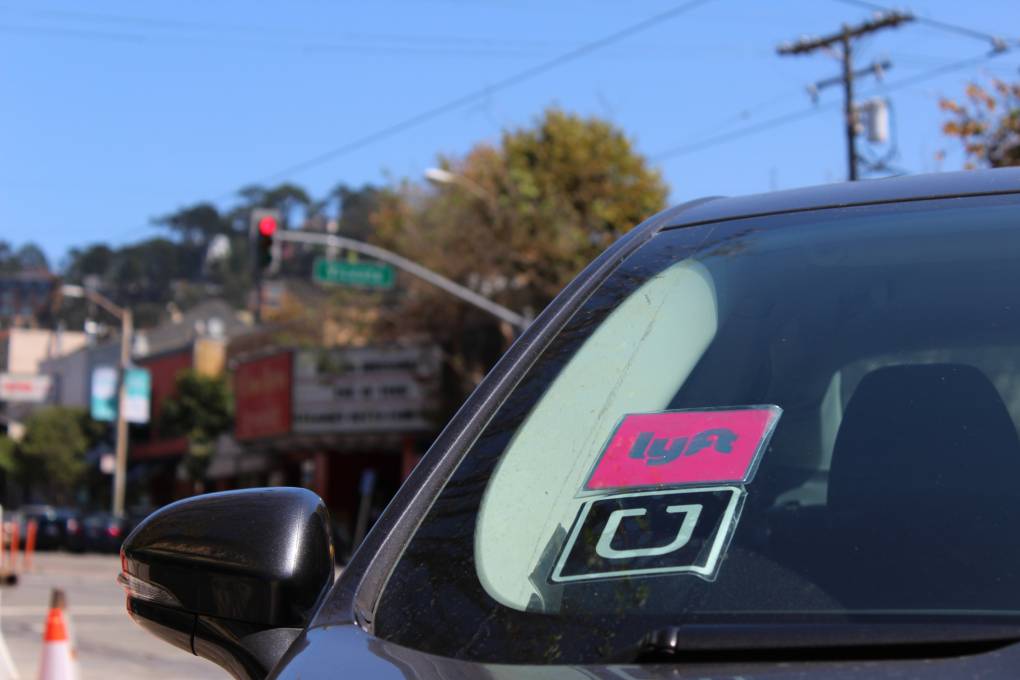
"caption": "A car used by a ride-hail driver for Lyft and Uber. The ride-hail drivers would remain independent contractors but would be able to negotiate with the companies for better pay and benefits. ",
"credit": "Ericka Cruz Guevarra/KQED",
"altTag": "A close-up shot of a black vehicle with a pink Lyft sticker and a black-and-white Uber sticker on the left side of its windshield. The vehicle sits idle, waiting to pick up a customer.",
"description": null,
"imgSizes": {
"medium": {
"file": "https://cdn.kqed.org/wp-content/uploads/sites/10/2023/03/RS16535_IMG_0443.JPG-800x533.jpg",
"width": 800,
"height": 533,
"mimeType": "image/jpeg"
},
"large": {
"file": "https://cdn.kqed.org/wp-content/uploads/sites/10/2023/03/RS16535_IMG_0443.JPG-1020x680.jpg",
"width": 1020,
"height": 680,
"mimeType": "image/jpeg"
},
"thumbnail": {
"file": "https://cdn.kqed.org/wp-content/uploads/sites/10/2023/03/RS16535_IMG_0443.JPG-160x107.jpg",
"width": 160,
"height": 107,
"mimeType": "image/jpeg"
},
"1536x1536": {
"file": "https://cdn.kqed.org/wp-content/uploads/sites/10/2023/03/RS16535_IMG_0443.JPG-1536x1024.jpg",
"width": 1536,
"height": 1024,
"mimeType": "image/jpeg"
},
"2048x2048": {
"file": "https://cdn.kqed.org/wp-content/uploads/sites/10/2023/03/RS16535_IMG_0443.JPG-2048x1365.jpg",
"width": 2048,
"height": 1365,
"mimeType": "image/jpeg"
},
"post-thumbnail": {
"file": "https://cdn.kqed.org/wp-content/uploads/sites/10/2023/03/RS16535_IMG_0443.JPG-672x372.jpg",
"width": 672,
"height": 372,
"mimeType": "image/jpeg"
},
"twentyfourteen-full-width": {
"file": "https://cdn.kqed.org/wp-content/uploads/sites/10/2023/03/RS16535_IMG_0443.JPG-1038x576.jpg",
"width": 1038,
"height": 576,
"mimeType": "image/jpeg"
},
"full-width": {
"file": "https://cdn.kqed.org/wp-content/uploads/sites/10/2023/03/RS16535_IMG_0443.JPG-1920x1280.jpg",
"width": 1920,
"height": 1280,
"mimeType": "image/jpeg"
},
"kqedFullSize": {
"file": "https://cdn.kqed.org/wp-content/uploads/sites/10/2023/03/RS16535_IMG_0443.JPG-scaled-e1764810192572.jpg",
"width": 2000,
"height": 1334
}
},
"isLoading": false,
"fetchFailed": false
},
"news_12013895": {
"type": "attachments",
"id": "news_12013895",
"meta": {
"index": "attachments_1716263798",
"site": "news",
"id": "12013895",
"found": true
},
"title": "240129-EVFILE-KSM-26_qed",
"publishDate": 1731189616,
"status": "inherit",
"parent": 12013891,
"modified": 1784234191,
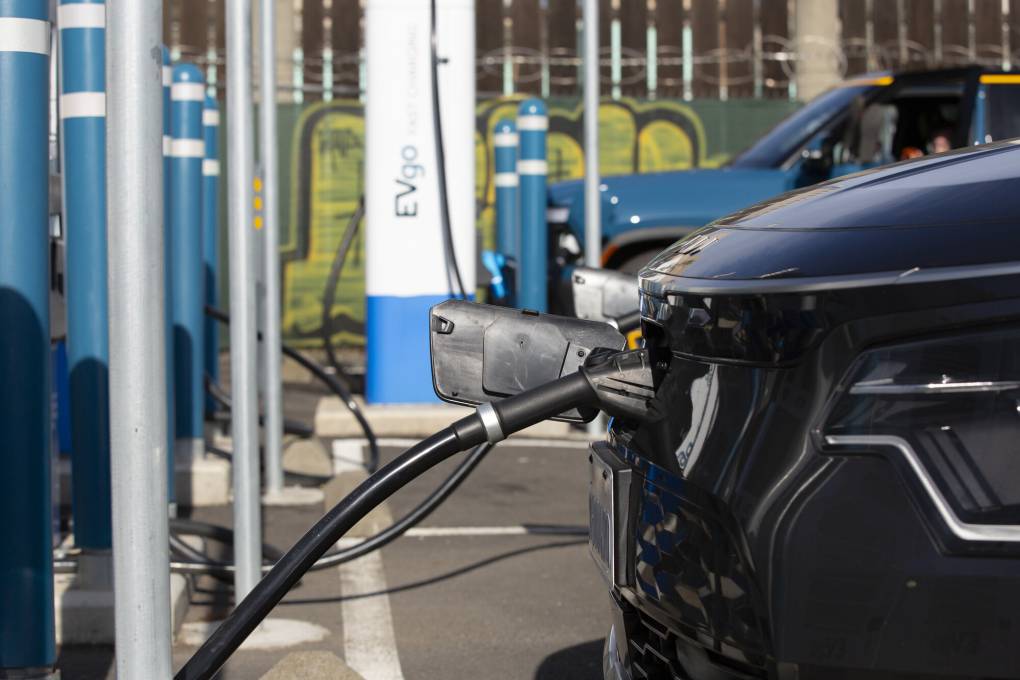
"caption": "Electric vehicles charge at an EVgo fast charging station in Oakland on Jan. 29, 2024.",
"credit": "Kathryn Styer Martínez/KQED",
"altTag": null,
"description": null,
"imgSizes": {
"medium": {
"file": "https://cdn.kqed.org/wp-content/uploads/sites/10/2024/11/240129-EVFILE-KSM-26_qed-800x533.jpg",
"width": 800,
"height": 533,
"mimeType": "image/jpeg"
},
"large": {
"file": "https://cdn.kqed.org/wp-content/uploads/sites/10/2024/11/240129-EVFILE-KSM-26_qed-1020x680.jpg",
"width": 1020,
"height": 680,
"mimeType": "image/jpeg"
},
"thumbnail": {
"file": "https://cdn.kqed.org/wp-content/uploads/sites/10/2024/11/240129-EVFILE-KSM-26_qed-160x107.jpg",
"width": 160,
"height": 107,
"mimeType": "image/jpeg"
},
"1536x1536": {
"file": "https://cdn.kqed.org/wp-content/uploads/sites/10/2024/11/240129-EVFILE-KSM-26_qed-1536x1024.jpg",
"width": 1536,
"height": 1024,
"mimeType": "image/jpeg"
},
"post-thumbnail": {
"file": "https://cdn.kqed.org/wp-content/uploads/sites/10/2024/11/240129-EVFILE-KSM-26_qed-672x372.jpg",
"width": 672,
"height": 372,
"mimeType": "image/jpeg"
},
"twentyfourteen-full-width": {
"file": "https://cdn.kqed.org/wp-content/uploads/sites/10/2024/11/240129-EVFILE-KSM-26_qed-1038x576.jpg",
"width": 1038,
"height": 576,
"mimeType": "image/jpeg"
},
"full-width": {
"file": "https://cdn.kqed.org/wp-content/uploads/sites/10/2024/11/240129-EVFILE-KSM-26_qed-1920x1280.jpg",
"width": 1920,
"height": 1280,
"mimeType": "image/jpeg"
},
"kqedFullSize": {
"file": "https://cdn.kqed.org/wp-content/uploads/sites/10/2024/11/240129-EVFILE-KSM-26_qed.jpg",
"width": 2000,
"height": 1333
}
},
"isLoading": false,
"fetchFailed": false
},
"news_12094400": {
"type": "attachments",
"id": "news_12094400",
"meta": {
"index": "attachments_1716263798",
"site": "news",
"id": "12094400",
"found": true
},
"title": "Governor Newsom press conference in Oakland, California",
"publishDate": 1786136897,
"status": "inherit",
"parent": 12094373,
"modified": 1786136974,
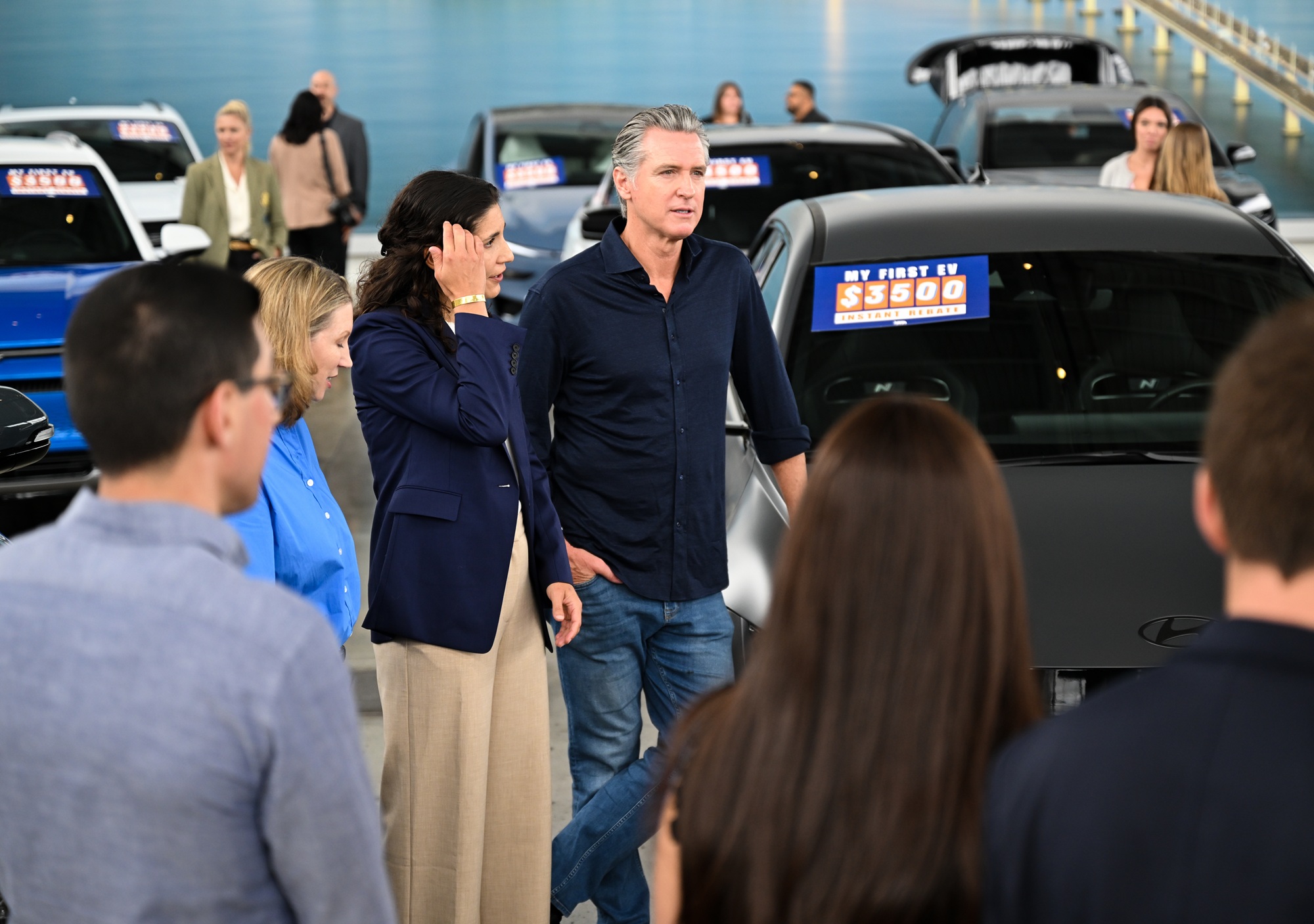
"caption": "Gov. Gavin Newsom (right) announces new savings for California car buyers, a major milestone in the state's clean energy future, at the Bridge Yard Facility in Oakland, California, on Aug. 7, 2026.",
"credit": "Tayfun Coskun/Anadolu via Getty Images",
"altTag": null,
"description": null,
"imgSizes": {
"thumbnail": {
"file": "https://cdn.kqed.org/wp-content/uploads/sites/10/2026/08/GavinNewsomEVRebateGetty-160x113.jpg",
"width": 160,
"height": 113,
"mimeType": "image/jpeg"
},
"1536x1536": {
"file": "https://cdn.kqed.org/wp-content/uploads/sites/10/2026/08/GavinNewsomEVRebateGetty-1536x1081.jpg",
"width": 1536,
"height": 1081,
"mimeType": "image/jpeg"
},
"post-thumbnail": {
"file": "https://cdn.kqed.org/wp-content/uploads/sites/10/2026/08/GavinNewsomEVRebateGetty-672x372.jpg",
"width": 672,
"height": 372,
"mimeType": "image/jpeg"
},
"twentyfourteen-full-width": {
"file": "https://cdn.kqed.org/wp-content/uploads/sites/10/2026/08/GavinNewsomEVRebateGetty-1038x576.jpg",
"width": 1038,
"height": 576,
"mimeType": "image/jpeg"
},
"npr-cds-wide": {
"file": "https://cdn.kqed.org/wp-content/uploads/sites/10/2026/08/GavinNewsomEVRebateGetty-1200x675.jpg",
"width": 1200,
"height": 675,
"mimeType": "image/jpeg"
},
"npr-cds-square": {
"file": "https://cdn.kqed.org/wp-content/uploads/sites/10/2026/08/GavinNewsomEVRebateGetty-600x600.jpg",
"width": 600,
"height": 600,
"mimeType": "image/jpeg"
},
"kqedFullSize": {
"file": "https://cdn.kqed.org/wp-content/uploads/sites/10/2026/08/GavinNewsomEVRebateGetty.jpg",
"width": 2000,
"height": 1407
}
},
"isLoading": false,
"fetchFailed": false
},
"news_12068789": {
"type": "attachments",
"id": "news_12068789",
"meta": {
"index": "attachments_1716263798",
"site": "news",
"id": "12068789",
"found": true
},
"title": "IMG_7569",
"publishDate": 1767725817,
"status": "inherit",
"parent": 12068758,
"modified": 1767726097,
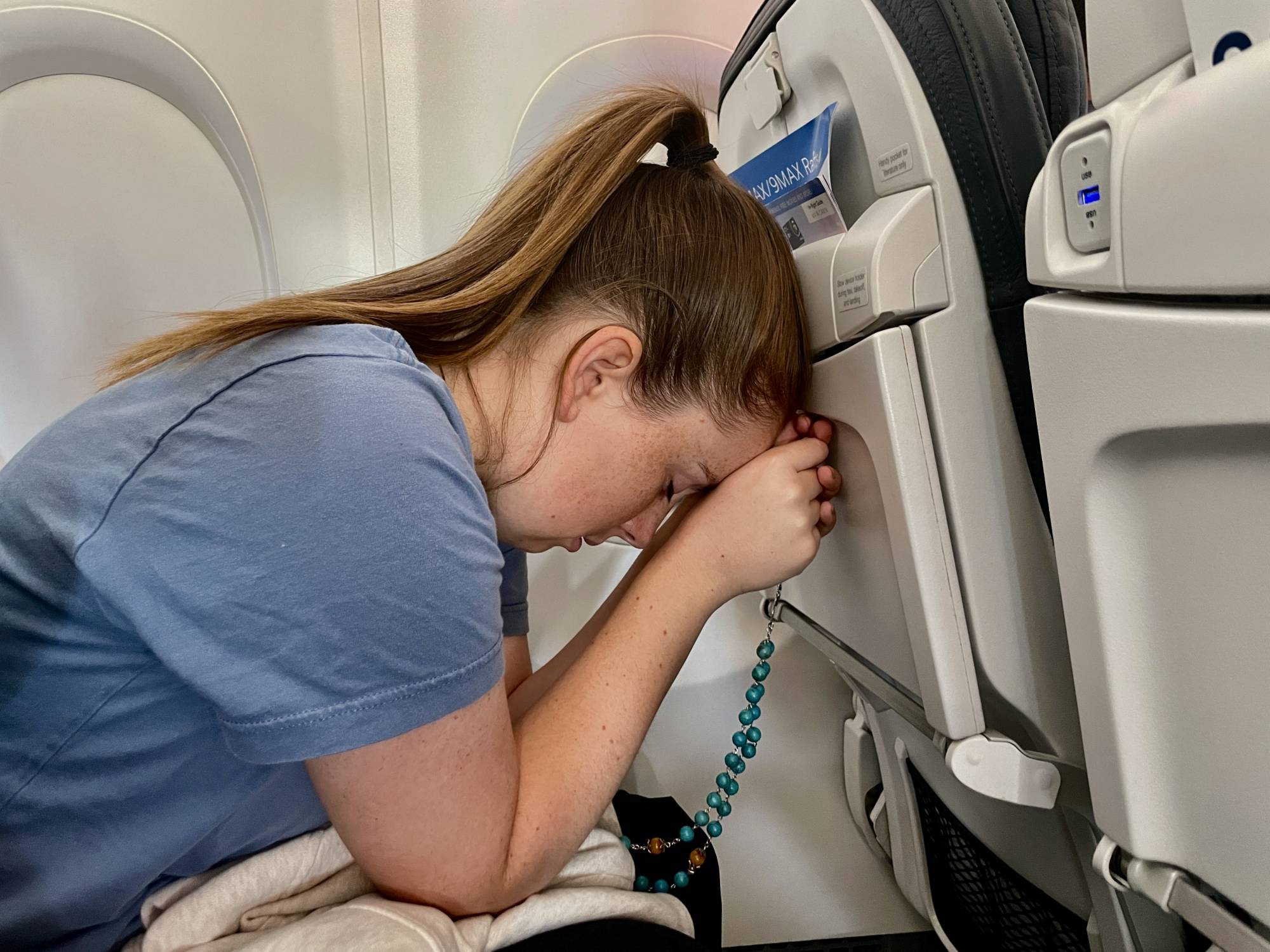
"caption": "Collette Vance, a participant in the Fear of Flying Clinic, prays before takeoff. ",
"credit": "Evan Roberts/KQED",
"altTag": null,
"description": null,
"imgSizes": {
"medium": {
"file": "https://cdn.kqed.org/wp-content/uploads/sites/10/2026/01/IMG_7569-2000x1500.jpg",
"width": 2000,
"height": 1500,
"mimeType": "image/jpeg"
},
"large": {
"file": "https://cdn.kqed.org/wp-content/uploads/sites/10/2026/01/IMG_7569-2000x1500.jpg",
"width": 2000,
"height": 1500,
"mimeType": "image/jpeg"
},
"thumbnail": {
"file": "https://cdn.kqed.org/wp-content/uploads/sites/10/2026/01/IMG_7569-160x120.jpg",
"width": 160,
"height": 120,
"mimeType": "image/jpeg"
},
"1536x1536": {
"file": "https://cdn.kqed.org/wp-content/uploads/sites/10/2026/01/IMG_7569-1536x1152.jpg",
"width": 1536,
"height": 1152,
"mimeType": "image/jpeg"
},
"2048x2048": {
"file": "https://cdn.kqed.org/wp-content/uploads/sites/10/2026/01/IMG_7569-2048x1536.jpg",
"width": 2048,
"height": 1536,
"mimeType": "image/jpeg"
},
"post-thumbnail": {
"file": "https://cdn.kqed.org/wp-content/uploads/sites/10/2026/01/IMG_7569-672x372.jpg",
"width": 672,
"height": 372,
"mimeType": "image/jpeg"
},
"twentyfourteen-full-width": {
"file": "https://cdn.kqed.org/wp-content/uploads/sites/10/2026/01/IMG_7569-1038x576.jpg",
"width": 1038,
"height": 576,
"mimeType": "image/jpeg"
},
"full-width": {
"file": "https://cdn.kqed.org/wp-content/uploads/sites/10/2026/01/IMG_7569-2000x1500.jpg",
"width": 2000,
"height": 1500,
"mimeType": "image/jpeg"
},
"npr-cds-wide": {
"file": "https://cdn.kqed.org/wp-content/uploads/sites/10/2026/01/IMG_7569-1200x675.jpg",
"width": 1200,
"height": 675,
"mimeType": "image/jpeg"
},
"kqedFullSize": {
"file": "https://cdn.kqed.org/wp-content/uploads/sites/10/2026/01/IMG_7569-scaled-e1767726106793.jpg",
"width": 2000,
"height": 1500
}
},
"isLoading": false,
"fetchFailed": false
},
"news_12094251": {
"type": "attachments",
"id": "news_12094251",
"meta": {
"index": "attachments_1716263798",
"site": "news",
"id": "12094251",
"found": true
},
"title": "Santa Monica Farmers Market",
"publishDate": 1786057601,
"status": "inherit",
"parent": 12094247,
"modified": 1786057666,
"caption": "A vendor sells a bag of beets to a customer at the Santa Monica Farmers Market in Santa Monica on July 18, 2026. ",
"credit": "Genaro Molina/Los Angeles Times via Getty Images",
"altTag": null,
"description": null,
"imgSizes": {
"thumbnail": {
"file": "https://cdn.kqed.org/wp-content/uploads/sites/10/2026/08/GettyImages-2286222445-160x120.jpg",
"width": 160,
"height": 120,
"mimeType": "image/jpeg"
},
"1536x1536": {
"file": "https://cdn.kqed.org/wp-content/uploads/sites/10/2026/08/GettyImages-2286222445-1536x1148.jpg",
"width": 1536,
"height": 1148,
"mimeType": "image/jpeg"
},
"post-thumbnail": {
"file": "https://cdn.kqed.org/wp-content/uploads/sites/10/2026/08/GettyImages-2286222445-672x372.jpg",
"width": 672,
"height": 372,
"mimeType": "image/jpeg"
},
"twentyfourteen-full-width": {
"file": "https://cdn.kqed.org/wp-content/uploads/sites/10/2026/08/GettyImages-2286222445-1038x576.jpg",
"width": 1038,
"height": 576,
"mimeType": "image/jpeg"
},
"npr-cds-wide": {
"file": "https://cdn.kqed.org/wp-content/uploads/sites/10/2026/08/GettyImages-2286222445-1200x675.jpg",
"width": 1200,
"height": 675,
"mimeType": "image/jpeg"
},
"npr-cds-square": {
"file": "https://cdn.kqed.org/wp-content/uploads/sites/10/2026/08/GettyImages-2286222445-600x600.jpg",
"width": 600,
"height": 600,
"mimeType": "image/jpeg"
},
"kqedFullSize": {
"file": "https://cdn.kqed.org/wp-content/uploads/sites/10/2026/08/GettyImages-2286222445.jpg",
"width": 1980,
"height": 1480
}
},
"isLoading": false,
"fetchFailed": false
},
"news_12094107": {
"type": "attachments",
"id": "news_12094107",
"meta": {
"index": "attachments_1716263798",
"site": "news",
"id": "12094107",
"found": true
},
"title": "080526-I580STUDY-04-MC-KQED",
"publishDate": 1786042235,
"status": "inherit",
"parent": 0,
"modified": 1786060284,
"caption": "Cameron Oakes speaks to a member of the public about results from the study at a public information event for Oakland residents to ask questions about newly released findings from the Interstate 580 Truck Access Study on Aug. 5, 2026, in Oakland.",
"credit": "Miles Cull/KQED",
"altTag": null,
"description": null,
"imgSizes": {
"thumbnail": {
"file": "https://cdn.kqed.org/wp-content/uploads/sites/10/2026/08/080526-I580STUDY-04-MC-KQED-160x107.jpg",
"width": 160,
"height": 107,
"mimeType": "image/jpeg"
},
"1536x1536": {
"file": "https://cdn.kqed.org/wp-content/uploads/sites/10/2026/08/080526-I580STUDY-04-MC-KQED-1536x1025.jpg",
"width": 1536,
"height": 1025,
"mimeType": "image/jpeg"
},
"post-thumbnail": {
"file": "https://cdn.kqed.org/wp-content/uploads/sites/10/2026/08/080526-I580STUDY-04-MC-KQED-672x372.jpg",
"width": 672,
"height": 372,
"mimeType": "image/jpeg"
},
"twentyfourteen-full-width": {
"file": "https://cdn.kqed.org/wp-content/uploads/sites/10/2026/08/080526-I580STUDY-04-MC-KQED-1038x576.jpg",
"width": 1038,
"height": 576,
"mimeType": "image/jpeg"
},
"npr-cds-wide": {
"file": "https://cdn.kqed.org/wp-content/uploads/sites/10/2026/08/080526-I580STUDY-04-MC-KQED-1200x675.jpg",
"width": 1200,
"height": 675,
"mimeType": "image/jpeg"
},
"npr-cds-square": {
"file": "https://cdn.kqed.org/wp-content/uploads/sites/10/2026/08/080526-I580STUDY-04-MC-KQED-600x600.jpg",
"width": 600,
"height": 600,
"mimeType": "image/jpeg"
},
"kqedFullSize": {
"file": "https://cdn.kqed.org/wp-content/uploads/sites/10/2026/08/080526-I580STUDY-04-MC-KQED.jpg",
"width": 2000,
"height": 1334
}
},
"isLoading": false,
"fetchFailed": false
},
"news_12094098": {
"type": "attachments",
"id": "news_12094098",
"meta": {
"index": "attachments_1716263798",
"site": "news",
"id": "12094098",
"found": true
},
"title": "California Wildfire",
"publishDate": 1786041109,
"status": "inherit",
"parent": 12094075,
"modified": 1786041228,
"caption": "During the Gann Fire near Angels Camp in Calaveras County, California, on Tuesday, Aug. 4, 2026. ",
"credit": "Stephen Lam/San Francisco Chronicle via Getty Images",
"altTag": null,
"description": null,
"imgSizes": {
"thumbnail": {
"file": "https://cdn.kqed.org/wp-content/uploads/sites/10/2026/08/gannfiregetty4-160x107.jpg",
"width": 160,
"height": 107,
"mimeType": "image/jpeg"
},
"1536x1536": {
"file": "https://cdn.kqed.org/wp-content/uploads/sites/10/2026/08/gannfiregetty4-1536x1024.jpg",
"width": 1536,
"height": 1024,
"mimeType": "image/jpeg"
},
"post-thumbnail": {
"file": "https://cdn.kqed.org/wp-content/uploads/sites/10/2026/08/gannfiregetty4-672x372.jpg",
"width": 672,
"height": 372,
"mimeType": "image/jpeg"
},
"twentyfourteen-full-width": {
"file": "https://cdn.kqed.org/wp-content/uploads/sites/10/2026/08/gannfiregetty4-1038x576.jpg",
"width": 1038,
"height": 576,
"mimeType": "image/jpeg"
},
"npr-cds-wide": {
"file": "https://cdn.kqed.org/wp-content/uploads/sites/10/2026/08/gannfiregetty4-1200x675.jpg",
"width": 1200,
"height": 675,
"mimeType": "image/jpeg"
},
"npr-cds-square": {
"file": "https://cdn.kqed.org/wp-content/uploads/sites/10/2026/08/gannfiregetty4-600x600.jpg",
"width": 600,
"height": 600,
"mimeType": "image/jpeg"
},
"kqedFullSize": {
"file": "https://cdn.kqed.org/wp-content/uploads/sites/10/2026/08/gannfiregetty4.jpg",
"width": 2000,
"height": 1333
}
},
"isLoading": false,
"fetchFailed": false
},
"news_12093941": {
"type": "attachments",
"id": "news_12093941",
"meta": {
"index": "attachments_1716263798",
"site": "news",
"id": "12093941",
"found": true
},
"title": "California Wildfire",
"publishDate": 1785949492,
"status": "inherit",
"parent": 12093925,
"modified": 1785949529,
"caption": "A structure is engulfed in flames during the Gann Fire near Angels Camp in Calaveras County, California, on Tuesday, Aug. 4, 2026. ",
"credit": "Stephen Lam/San Francisco Chronicle via Getty Images",
"altTag": null,
"description": null,
"imgSizes": {
"thumbnail": {
"file": "https://cdn.kqed.org/wp-content/uploads/sites/10/2026/08/GannFireGetty1-160x107.jpg",
"width": 160,
"height": 107,
"mimeType": "image/jpeg"
},
"1536x1536": {
"file": "https://cdn.kqed.org/wp-content/uploads/sites/10/2026/08/GannFireGetty1-1536x1024.jpg",
"width": 1536,
"height": 1024,
"mimeType": "image/jpeg"
},
"post-thumbnail": {
"file": "https://cdn.kqed.org/wp-content/uploads/sites/10/2026/08/GannFireGetty1-672x372.jpg",
"width": 672,
"height": 372,
"mimeType": "image/jpeg"
},
"twentyfourteen-full-width": {
"file": "https://cdn.kqed.org/wp-content/uploads/sites/10/2026/08/GannFireGetty1-1038x576.jpg",
"width": 1038,
"height": 576,
"mimeType": "image/jpeg"
},
"npr-cds-wide": {
"file": "https://cdn.kqed.org/wp-content/uploads/sites/10/2026/08/GannFireGetty1-1200x675.jpg",
"width": 1200,
"height": 675,
"mimeType": "image/jpeg"
},
"npr-cds-square": {
"file": "https://cdn.kqed.org/wp-content/uploads/sites/10/2026/08/GannFireGetty1-600x600.jpg",
"width": 600,
"height": 600,
"mimeType": "image/jpeg"
},
"kqedFullSize": {
"file": "https://cdn.kqed.org/wp-content/uploads/sites/10/2026/08/GannFireGetty1.jpg",
"width": 2000,
"height": 1333
}
},
"isLoading": false,
"fetchFailed": false
},
"news_12093728": {
"type": "attachments",
"id": "news_12093728",
"meta": {
"index": "attachments_1716263798",
"site": "news",
"id": "12093728",
"found": true
},
"title": "US-POLITICS-BILLIONAIRE-TAXATION",
"publishDate": 1785793384,
"status": "inherit",
"parent": 12093726,
"modified": 1785801077,
"caption": "A T-shirt with a campaign message is seen before the start of a rally led by U.S. Sen. Bernie Sanders, an Independent from Vermont, during the campaign kickoff for the California Billionaire Tax Act at The Wiltern in Los Angeles, on Feb. 18, 2026. Sanders is seeking the support of California voters for a November ballot initiative of an emergency tax on billionaires to help the state's healthcare system.",
"credit": "Patrick T. Fallon/AFP via Getty Images",
"altTag": null,
"description": null,
"imgSizes": {
"thumbnail": {
"file": "https://cdn.kqed.org/wp-content/uploads/sites/10/2026/08/CaliforniaBillionairesTaxGetty-160x107.jpg",
"width": 160,
"height": 107,
"mimeType": "image/jpeg"
},
"1536x1536": {
"file": "https://cdn.kqed.org/wp-content/uploads/sites/10/2026/08/CaliforniaBillionairesTaxGetty-1536x1024.jpg",
"width": 1536,
"height": 1024,
"mimeType": "image/jpeg"
},
"post-thumbnail": {
"file": "https://cdn.kqed.org/wp-content/uploads/sites/10/2026/08/CaliforniaBillionairesTaxGetty-672x372.jpg",
"width": 672,
"height": 372,
"mimeType": "image/jpeg"
},
"twentyfourteen-full-width": {
"file": "https://cdn.kqed.org/wp-content/uploads/sites/10/2026/08/CaliforniaBillionairesTaxGetty-1038x576.jpg",
"width": 1038,
"height": 576,
"mimeType": "image/jpeg"
},
"npr-cds-wide": {
"file": "https://cdn.kqed.org/wp-content/uploads/sites/10/2026/08/CaliforniaBillionairesTaxGetty-1200x675.jpg",
"width": 1200,
"height": 675,
"mimeType": "image/jpeg"
},
"npr-cds-square": {
"file": "https://cdn.kqed.org/wp-content/uploads/sites/10/2026/08/CaliforniaBillionairesTaxGetty-600x600.jpg",
"width": 600,
"height": 600,
"mimeType": "image/jpeg"
},
"kqedFullSize": {
"file": "https://cdn.kqed.org/wp-content/uploads/sites/10/2026/08/CaliforniaBillionairesTaxGetty.jpg",
"width": 2000,
"height": 1333
}
},
"isLoading": false,
"fetchFailed": false
},
"news_12083273": {
"type": "attachments",
"id": "news_12083273",
"meta": {
"index": "attachments_1716263798",
"site": "news",
"id": "12083273",
"found": true
},
"title": "260512-Lyle Prijoles-04-KQED",
"publishDate": 1778604540,
"status": "inherit",
"parent": 0,
"modified": 1785522309,
"caption": "Activists in the Bay Area hold a memorial for activist Lyle Prijoles. Families of the slain human rights advocates have urged the Philippine Government for an independent investigation, sharing testimonies of their loved ones and putting into question what the AFP has called a “legitimate military operation.”",
"credit": "Courtesy of Bayan USA",
"altTag": null,
"description": null,
"imgSizes": {
"thumbnail": {
"file": "https://cdn.kqed.org/wp-content/uploads/sites/10/2026/05/260512-Lyle-Prijoles-04-KQED-160x107.jpg",
"width": 160,
"height": 107,
"mimeType": "image/jpeg"
},
"1536x1536": {
"file": "https://cdn.kqed.org/wp-content/uploads/sites/10/2026/05/260512-Lyle-Prijoles-04-KQED-1536x1024.jpg",
"width": 1536,
"height": 1024,
"mimeType": "image/jpeg"
},
"post-thumbnail": {
"file": "https://cdn.kqed.org/wp-content/uploads/sites/10/2026/05/260512-Lyle-Prijoles-04-KQED-672x372.jpg",
"width": 672,
"height": 372,
"mimeType": "image/jpeg"
},
"twentyfourteen-full-width": {
"file": "https://cdn.kqed.org/wp-content/uploads/sites/10/2026/05/260512-Lyle-Prijoles-04-KQED-1038x576.jpg",
"width": 1038,
"height": 576,
"mimeType": "image/jpeg"
},
"npr-cds-wide": {
"file": "https://cdn.kqed.org/wp-content/uploads/sites/10/2026/05/260512-Lyle-Prijoles-04-KQED-1200x675.jpg",
"width": 1200,
"height": 675,
"mimeType": "image/jpeg"
},
"npr-cds-square": {
"file": "https://cdn.kqed.org/wp-content/uploads/sites/10/2026/05/260512-Lyle-Prijoles-04-KQED-600x600.jpg",
"width": 600,
"height": 600,
"mimeType": "image/jpeg"
},
"kqedFullSize": {
"file": "https://cdn.kqed.org/wp-content/uploads/sites/10/2026/05/260512-Lyle-Prijoles-04-KQED.jpg",
"width": 2000,
"height": 1333
}
},
"isLoading": false,
"fetchFailed": false
},
"news_12093651": {
"type": "attachments",
"id": "news_12093651",
"meta": {
"index": "attachments_1716263798",
"site": "news",
"id": "12093651",
"found": true
},
"title": "CMLunch1",
"publishDate": 1785778161,
"status": "inherit",
"parent": 12093646,
"modified": 1785778186,
"caption": "Daniela Castillo packs freshly picked tomatoes into smaller cartons at Fiery Ginger Farm in West Sacramento on July 28, 2026. Much of the produce grown at Fiery Ginger Farm is distributed to school districts and other institutions through Spork Food Hub. ",
"credit": "Anna Hoch-Kenney/CalMatters",
"altTag": null,
"description": null,
"imgSizes": {
"thumbnail": {
"file": "https://cdn.kqed.org/wp-content/uploads/sites/10/2026/08/CMLunch1-160x107.jpg",
"width": 160,
"height": 107,
"mimeType": "image/jpeg"
},
"1536x1536": {
"file": "https://cdn.kqed.org/wp-content/uploads/sites/10/2026/08/CMLunch1-1536x1024.jpg",
"width": 1536,
"height": 1024,
"mimeType": "image/jpeg"
},
"post-thumbnail": {
"file": "https://cdn.kqed.org/wp-content/uploads/sites/10/2026/08/CMLunch1-672x372.jpg",
"width": 672,
"height": 372,
"mimeType": "image/jpeg"
},
"twentyfourteen-full-width": {
"file": "https://cdn.kqed.org/wp-content/uploads/sites/10/2026/08/CMLunch1-1038x576.jpg",
"width": 1038,
"height": 576,
"mimeType": "image/jpeg"
},
"npr-cds-wide": {
"file": "https://cdn.kqed.org/wp-content/uploads/sites/10/2026/08/CMLunch1-1200x675.jpg",
"width": 1200,
"height": 675,
"mimeType": "image/jpeg"
},
"npr-cds-square": {
"file": "https://cdn.kqed.org/wp-content/uploads/sites/10/2026/08/CMLunch1-600x600.jpg",
"width": 600,
"height": 600,
"mimeType": "image/jpeg"
},
"kqedFullSize": {
"file": "https://cdn.kqed.org/wp-content/uploads/sites/10/2026/08/CMLunch1.jpg",
"width": 2000,
"height": 1333
}
},
"isLoading": false,
"fetchFailed": false
},
"news_12091848": {
"type": "attachments",
"id": "news_12091848",
"meta": {
"index": "attachments_1716263798",
"site": "news",
"id": "12091848",
"found": true
},
"title": "20260716_ClimateSolutionsCapTrade_GC-6-KQED",
"publishDate": 1784567951,
"status": "inherit",
"parent": 0,
"modified": 1784568035,
"caption": "The construction site of RISE, an affordable housing development, across the street from the Berryessa/North San Jose BART Station, in San Jose on July 16, 2026. The 10-story building will have 195 units.",
"credit": "Gina Castro for KQED",
"altTag": null,
"description": null,
"imgSizes": {
"thumbnail": {
"file": "https://cdn.kqed.org/wp-content/uploads/sites/10/2026/07/20260716_ClimateSolutionsCapTrade_GC-6-KQED-160x107.jpg",
"width": 160,
"height": 107,
"mimeType": "image/jpeg"
},
"1536x1536": {
"file": "https://cdn.kqed.org/wp-content/uploads/sites/10/2026/07/20260716_ClimateSolutionsCapTrade_GC-6-KQED-1536x1024.jpg",
"width": 1536,
"height": 1024,
"mimeType": "image/jpeg"
},
"post-thumbnail": {
"file": "https://cdn.kqed.org/wp-content/uploads/sites/10/2026/07/20260716_ClimateSolutionsCapTrade_GC-6-KQED-672x372.jpg",
"width": 672,
"height": 372,
"mimeType": "image/jpeg"
},
"twentyfourteen-full-width": {
"file": "https://cdn.kqed.org/wp-content/uploads/sites/10/2026/07/20260716_ClimateSolutionsCapTrade_GC-6-KQED-1038x576.jpg",
"width": 1038,
"height": 576,
"mimeType": "image/jpeg"
},
"npr-cds-wide": {
"file": "https://cdn.kqed.org/wp-content/uploads/sites/10/2026/07/20260716_ClimateSolutionsCapTrade_GC-6-KQED-1200x675.jpg",
"width": 1200,
"height": 675,
"mimeType": "image/jpeg"
},
"npr-cds-square": {
"file": "https://cdn.kqed.org/wp-content/uploads/sites/10/2026/07/20260716_ClimateSolutionsCapTrade_GC-6-KQED-600x600.jpg",
"width": 600,
"height": 600,
"mimeType": "image/jpeg"
},
"kqedFullSize": {
"file": "https://cdn.kqed.org/wp-content/uploads/sites/10/2026/07/20260716_ClimateSolutionsCapTrade_GC-6-KQED.jpg",
"width": 2000,
"height": 1333
}
},
"isLoading": false,
"fetchFailed": false
}
},
"audioPlayerReducer": {
"postId": "stream_live",
"isPaused": true,
"isPlaying": false,
"pfsActive": false,
"pledgeModalIsOpen": true,
"playerDrawerIsOpen": false,
"liveAudioPlayStartedAt": 0,
"liveAudioPlayContext": ""
},
"authorsReducer": {
"byline_news_12093646": {
"type": "authors",
"id": "byline_news_12093646",
"meta": {
"override": true
},
"slug": "byline_news_12093646",
"name": "Carolyn Jones, CalMatters",
"isLoading": false
},
"gmarzorati": {
"type": "authors",
"id": "227",
"meta": {
"index": "authors_1716337520",
"id": "227",
"found": true
},
"name": "Guy Marzorati",
"firstName": "Guy",
"lastName": "Marzorati",
"slug": "gmarzorati",
"email": "gmarzorati@KQED.org",
"display_author_email": true,
"staff_mastheads": [
"news"
],
"title": "Correspondent",
"bio": "Guy Marzorati is a correspondent on KQED's California Politics and Government Desk, based in San Jose. A graduate of Santa Clara University, Guy joined KQED in 2013. He reports on state and local politics and produces KQED's digital voter guide.",
"avatar": "https://secure.gravatar.com/avatar/e7038b8dbfd55b104369b76b1cd0b9de?s=600&d=blank&r=g",
"twitter": "guymarzorati",
"facebook": null,
"instagram": null,
"linkedin": null,
"sites": [
{
"site": "",
"roles": [
"editor"
]
},
{
"site": "news",
"roles": [
"editor"
]
},
{
"site": "science",
"roles": [
"editor"
]
},
{
"site": "forum",
"roles": [
"editor"
]
},
{
"site": "elections",
"roles": [
"editor"
]
},
{
"site": "liveblog",
"roles": [
"editor"
]
}
],
"headData": {
"title": "Guy Marzorati | KQED",
"description": "Correspondent",
"ogImgSrc": "https://secure.gravatar.com/avatar/e7038b8dbfd55b104369b76b1cd0b9de?s=600&d=blank&r=g",
"twImgSrc": "https://secure.gravatar.com/avatar/e7038b8dbfd55b104369b76b1cd0b9de?s=600&d=blank&r=g"
},
"isLoading": false,
"link": "/author/gmarzorati"
},
"kqed": {
"type": "authors",
"id": "236",
"meta": {
"index": "authors_1716337520",
"id": "236",
"found": true
},
"name": "KQED News Staff",
"firstName": "KQED News Staff",
"lastName": null,
"slug": "kqed",
"email": "faq@kqed.org",
"display_author_email": false,
"staff_mastheads": [],
"title": null,
"bio": null,
"avatar": "https://secure.gravatar.com/avatar/ef0e801a68c4c54afa9180db14084167?s=600&d=blank&r=g",
"twitter": null,
"facebook": null,
"instagram": null,
"linkedin": null,
"sites": [
{
"site": "arts",
"roles": [
"contributor"
]
},
{
"site": "news",
"roles": [
"editor"
]
},
{
"site": "futureofyou",
"roles": [
"author"
]
}
],
"headData": {
"title": "KQED News Staff | KQED",
"description": null,
"ogImgSrc": "https://secure.gravatar.com/avatar/ef0e801a68c4c54afa9180db14084167?s=600&d=blank&r=g",
"twImgSrc": "https://secure.gravatar.com/avatar/ef0e801a68c4c54afa9180db14084167?s=600&d=blank&r=g"
},
"isLoading": false,
"link": "/author/kqed"
},
"carlysevern": {
"type": "authors",
"id": "3243",
"meta": {
"index": "authors_1716337520",
"id": "3243",
"found": true
},
"name": "Carly Severn",
"firstName": "Carly",
"lastName": "Severn",
"slug": "carlysevern",
"email": "csevern@kqed.org",
"display_author_email": false,
"staff_mastheads": [
"news"
],
"title": "Senior Editor, Audience News ",
"bio": "Carly is KQED's Senior Editor of Audience News on the Digital News team, and has reported for the California Report Magazine, Bay Curious and KQED Arts. She's formerly the host of \u003ca href=\"http://ww2.kqed.org/pop/category/the-cooler/\" rel=\"noopener noreferrer\">The Cooler\u003c/a> podcast.",
"avatar": "https://secure.gravatar.com/avatar/54037bf5c128fe678f0ef26cec97a93f2e7f220a22d7285703328f12c42c1b1d?s=600&d=blank&r=g",
"twitter": "teacupinthebay",
"bluesky": null,
"facebook": null,
"instagram": null,
"linkedin": null,
"sites": [
{
"site": "",
"roles": [
"editor"
]
},
{
"site": "arts",
"roles": [
"editor"
]
},
{
"site": "news",
"roles": [
"administrator"
]
},
{
"site": "pop",
"roles": [
"editor"
]
},
{
"site": "futureofyou",
"roles": [
"editor"
]
},
{
"site": "about",
"roles": [
"administrator"
]
},
{
"site": "mindshift",
"roles": [
"editor"
]
},
{
"site": "bayareabites",
"roles": [
"editor"
]
},
{
"site": "stateofhealth",
"roles": [
"editor"
]
},
{
"site": "science",
"roles": [
"editor"
]
},
{
"site": "food",
"roles": [
"contributor"
]
},
{
"site": "forum",
"roles": [
"editor"
]
},
{
"site": "perspectives",
"roles": [
"administrator"
]
},
{
"site": "liveblog",
"roles": [
"editor"
]
}
],
"headData": {
"title": "Carly Severn | KQED",
"description": "Senior Editor, Audience News ",
"ogImgSrc": "https://secure.gravatar.com/avatar/54037bf5c128fe678f0ef26cec97a93f2e7f220a22d7285703328f12c42c1b1d?s=600&d=blank&r=g",
"twImgSrc": "https://secure.gravatar.com/avatar/54037bf5c128fe678f0ef26cec97a93f2e7f220a22d7285703328f12c42c1b1d?s=600&d=blank&r=g"
},
"isLoading": false,
"link": "/author/carlysevern"
},
"ccabreralomeli": {
"type": "authors",
"id": "11708",
"meta": {
"index": "authors_1716337520",
"id": "11708",
"found": true
},
"name": "Carlos Cabrera-Lomelí",
"firstName": "Carlos",
"lastName": "Cabrera-Lomelí",
"slug": "ccabreralomeli",
"email": "ccabreralomeli@KQED.org",
"display_author_email": true,
"staff_mastheads": [
"news"
],
"title": "Community Reporter",
"bio": "Carlos Cabrera-Lomelí is a community reporter with KQED's digital engagement team. He also reports and co-produces for KQED's bilingual news hub KQED en Español. He grew up in San Francisco's Mission District and has previously worked with Univision, 48 Hills and REFORMA in Mexico City.",
"avatar": "https://secure.gravatar.com/avatar/c309be9665e484f887b818c89e273ecc673004f426f36b24d00a4d813a2e0518?s=600&d=blank&r=g",
"twitter": "@LomeliCabrera",
"bluesky": null,
"facebook": null,
"instagram": null,
"linkedin": null,
"sites": [
{
"site": "arts",
"roles": [
"editor"
]
},
{
"site": "news",
"roles": [
"editor"
]
},
{
"site": "about",
"roles": [
"editor"
]
},
{
"site": "science",
"roles": [
"editor"
]
},
{
"site": "perspectives",
"roles": [
"editor"
]
},
{
"site": "elections",
"roles": [
"editor"
]
},
{
"site": "liveblog",
"roles": [
"contributor"
]
}
],
"headData": {
"title": "Carlos Cabrera-Lomelí | KQED",
"description": "Community Reporter",
"ogImgSrc": "https://secure.gravatar.com/avatar/c309be9665e484f887b818c89e273ecc673004f426f36b24d00a4d813a2e0518?s=600&d=blank&r=g",
"twImgSrc": "https://secure.gravatar.com/avatar/c309be9665e484f887b818c89e273ecc673004f426f36b24d00a4d813a2e0518?s=600&d=blank&r=g"
},
"isLoading": false,
"link": "/author/ccabreralomeli"
},
"ibloom": {
"type": "authors",
"id": "11805",
"meta": {
"index": "authors_1716337520",
"id": "11805",
"found": true
},
"name": "Izzy Bloom",
"firstName": "Izzy",
"lastName": "Bloom",
"slug": "ibloom",
"email": "ibloom@kqed.org",
"display_author_email": false,
"staff_mastheads": [],
"title": "KQED Reporter & Producer",
"bio": "Izzy is a reporter and producer on KQED's California Politics & Government Desk. She joined the desk in 2024 to produce Political Breakdown, covering local and national elections and attending the RNC and DNC in Milwaukee and Chicago. \r\n\r\nBefore that, Izzy was a producer on The California Report and reported long-form stories for The California Report Magazine. She was a finalist for the Third Coast/Richard H. Driehaus Foundation Competition and was awarded for her reporting on indigenous land back by the Society of Professional Journalists. Izzy received her master's in journalism from the University of California, Berkeley.",
"avatar": "https://secure.gravatar.com/avatar/cc4d272ca430783ee1a8efac470a6b1e0fdd082c3beb61da019801d0ff751c8c?s=600&d=blank&r=g",
"twitter": null,
"bluesky": null,
"facebook": null,
"instagram": null,
"linkedin": null,
"sites": [
{
"site": "news",
"roles": [
"editor"
]
},
{
"site": "perspectives",
"roles": [
"editor"
]
}
],
"headData": {
"title": "Izzy Bloom | KQED",
"description": "KQED Reporter & Producer",
"ogImgSrc": "https://secure.gravatar.com/avatar/cc4d272ca430783ee1a8efac470a6b1e0fdd082c3beb61da019801d0ff751c8c?s=600&d=blank&r=g",
"twImgSrc": "https://secure.gravatar.com/avatar/cc4d272ca430783ee1a8efac470a6b1e0fdd082c3beb61da019801d0ff751c8c?s=600&d=blank&r=g"
},
"isLoading": false,
"link": "/author/ibloom"
},
"skennedy": {
"type": "authors",
"id": "11935",
"meta": {
"index": "authors_1716337520",
"id": "11935",
"found": true
},
"name": "Samantha Kennedy",
"firstName": "Samantha",
"lastName": "Kennedy",
"slug": "skennedy",
"email": "SKennedy@kqed.org",
"display_author_email": false,
"staff_mastheads": [],
"title": "KQED Contributor",
"bio": null,
"avatar": "https://secure.gravatar.com/avatar/adc7b14bf1e801793202a156ecc864d4ad505b0fd63162a2f3da0e5ba57222d0?s=600&d=blank&r=g",
"twitter": null,
"bluesky": null,
"facebook": null,
"instagram": null,
"linkedin": null,
"sites": [
{
"site": "arts",
"roles": [
"author"
]
},
{
"site": "news",
"roles": [
"editor"
]
},
{
"site": "science",
"roles": [
"editor"
]
}
],
"headData": {
"title": "Samantha Kennedy | KQED",
"description": "KQED Contributor",
"ogImgSrc": "https://secure.gravatar.com/avatar/adc7b14bf1e801793202a156ecc864d4ad505b0fd63162a2f3da0e5ba57222d0?s=600&d=blank&r=g",
"twImgSrc": "https://secure.gravatar.com/avatar/adc7b14bf1e801793202a156ecc864d4ad505b0fd63162a2f3da0e5ba57222d0?s=600&d=blank&r=g"
},
"isLoading": false,
"link": "/author/skennedy"
},
"aaliahmad": {
"type": "authors",
"id": "11986",
"meta": {
"index": "authors_1716337520",
"id": "11986",
"found": true
},
"name": "Ayah Ali-Ahmad",
"firstName": "Ayah",
"lastName": "Ali-Ahmad",
"slug": "aaliahmad",
"email": "aaliahmad@KQED.org",
"display_author_email": false,
"staff_mastheads": [],
"title": "KQED Contributor",
"bio": null,
"avatar": "https://secure.gravatar.com/avatar/1cf54f187a5e1064b2cfef3f3d2f1e4f93e453395d56912aca6382a6071ec3ed?s=600&d=blank&r=g",
"twitter": "ayahaliahmad",
"bluesky": null,
"facebook": null,
"instagram": null,
"linkedin": null,
"sites": [
{
"site": "news",
"roles": [
"subscriber"
]
}
],
"headData": {
"title": "Ayah Ali-Ahmad | KQED",
"description": "KQED Contributor",
"ogImgSrc": "https://secure.gravatar.com/avatar/1cf54f187a5e1064b2cfef3f3d2f1e4f93e453395d56912aca6382a6071ec3ed?s=600&d=blank&r=g",
"twImgSrc": "https://secure.gravatar.com/avatar/1cf54f187a5e1064b2cfef3f3d2f1e4f93e453395d56912aca6382a6071ec3ed?s=600&d=blank&r=g"
},
"isLoading": false,
"link": "/author/aaliahmad"
},
"ejackson": {
"type": "authors",
"id": "12003",
"meta": {
"index": "authors_1716337520",
"id": "12003",
"found": true
},
"name": "Ella Jackson",
"firstName": "Ella",
"lastName": "Jackson",
"slug": "ejackson",
"email": "ejackson@kqed.org",
"display_author_email": false,
"staff_mastheads": [],
"title": "KQED Contributor",
"bio": null,
"avatar": "https://secure.gravatar.com/avatar/3c688edc62aec1dcae096e1475956d245f72bde99cff316455871c9b22a7205b?s=600&d=blank&r=g",
"twitter": null,
"bluesky": null,
"facebook": null,
"instagram": null,
"linkedin": null,
"sites": [
{
"site": "news",
"roles": [
"author"
]
},
{
"site": "science",
"roles": [
"author"
]
}
],
"headData": {
"title": "Ella Jackson | KQED",
"description": "KQED Contributor",
"ogImgSrc": "https://secure.gravatar.com/avatar/3c688edc62aec1dcae096e1475956d245f72bde99cff316455871c9b22a7205b?s=600&d=blank&r=g",
"twImgSrc": "https://secure.gravatar.com/avatar/3c688edc62aec1dcae096e1475956d245f72bde99cff316455871c9b22a7205b?s=600&d=blank&r=g"
},
"isLoading": false,
"link": "/author/ejackson"
}
},
"pagesReducer": {
"news_tag_california": {
"type": "terms",
"id": "news_18538",
"meta": {
"index": "terms_1716263798",
"site": "news",
"id": "18538",
"score": 6.847839
},
"featImg": null,
"name": "California",
"description": null,
"taxonomy": "tag",
"headData": {
"twImgId": null,
"twTitle": null,
"ogTitle": null,
"ogImgId": null,
"twDescription": null,
"description": null,
"title": "California Archives | KQED News",
"ogDescription": null
},
"ttid": 31,
"slug": "california",
"isLoading": false,
"title": "California",
"pageMeta": {
"site": "news",
"WpPageTemplate": "page-topic-editorial",
"currentPage": 9
},
"blocks": [
{
"blockName": "kqed/post-list",
"attrs": {
"layout": "cardArticle2",
"query": "posts/news?tag=california",
"seeMore": false,
"paginated": true,
"page": 9
}
},
{
"blockName": "kqed/ad"
}
]
}
},
"pfsSessionReducer": {},
"postsReducer": {
"stream_live": {
"type": "live",
"id": "stream_live",
"audioUrl": "https://streams.kqed.org/kqedradio",
"title": "Live Stream",
"excerpt": "Live Stream information currently unavailable.",
"link": "/radio",
"featImg": "",
"label": {
"name": "KQED Live",
"link": "/"
}
},
"stream_kqedNewscast": {
"type": "posts",
"id": "stream_kqedNewscast",
"audioUrl": "https://www.kqed.org/.stream/anon/radio/RDnews/newscast.mp3?_=1",
"title": "KQED Newscast",
"featImg": "",
"label": {
"name": "88.5 FM",
"link": "/"
}
},
"news_12094475": {
"type": "posts",
"id": "news_12094475",
"meta": {
"index": "posts_1716263798",
"site": "news",
"id": "12094475",
"score": null,
"sort": [
1786273200000
]
},
"guestAuthors": [],
"slug": "uber-lyft-drivers-prepared-to-form-union",
"title": "Uber and Lyft Drivers Prepared to Form Union",
"publishDate": 1786273200,
"format": "standard",
"headTitle": "Uber and Lyft Drivers Prepared to Form Union | KQED",
"labelTerm": {
"site": "news"
},
"content": "\u003cp>Hundreds of thousands of independent contractors for ride-hailing companies in California could be part of a union next month, putting to bed \u003ca href=\"https://www.kqed.org/news/12057798/california-gives-uber-lyft-drivers-collective-bargaining-rights\">a yearslong struggle for a place at the bargaining table\u003c/a> to fight for better pay and benefits. \u003c/p>\n\n\n\n\u003cp>The California Gig Workers Union, which represents thousands of app-based drivers in the state, met a required 30% threshold of active drivers who are supportive of the effort, according to the state’s Public Employment Relations Board. Under a state law that went into effect this year, that support sets the stage for state regulators to certify the union within 30 days. \u003c/p>\n\n\n\n\u003cp>Drivers for ride-hailing giants like Uber and Lyft and other companies are classified as independent contractors and don’t qualify for overtime pay and other protections granted under federal law. However, state lawmakers \u003ca href=\"https://www.kqed.org/news/12034860/california-bill-would-allow-uber-lyft-drivers-bargain-collectively\">passed AB 1340 last year\u003c/a>, giving drivers a path to form a union and bargain for protections. \u003c/p>\n\n\n\n\u003cfigure class=\"wp-block-image size-full\">\u003cimg loading=\"lazy\" decoding=\"async\" width=\"1024\" height=\"683\" src=\"https://cdn.kqed.org/wp-content/uploads/sites/10/2024/07/GettyImages-2003719181.jpg\" alt=\"\" class=\"wp-image-11997574\" srcset=\"https://cdn.kqed.org/wp-content/uploads/sites/10/2024/07/GettyImages-2003719181.jpg 1024w, https://cdn.kqed.org/wp-content/uploads/sites/10/2024/07/GettyImages-2003719181-800x534.jpg 800w, https://cdn.kqed.org/wp-content/uploads/sites/10/2024/07/GettyImages-2003719181-1020x680.jpg 1020w, https://cdn.kqed.org/wp-content/uploads/sites/10/2024/07/GettyImages-2003719181-160x107.jpg 160w\" sizes=\"auto, (max-width: 1024px) 100vw, 1024px\">\u003cfigcaption class=\"wp-element-caption\">Members of the Rideshare Drivers United organization protest against Uber and Lyft during a demonstration in Los Angeles, California, on Feb.14, 2024. (Frederic J. Brown/AFP via Getty Images)\u003c/figcaption>\u003c/figure>\n\n\n\n\u003cp>CGWU said it expects the union certification to go through since, according to PERB, “no other driver organization is currently eligible to submit proof of support during [the waiting] period.”\u003c/p>\n\n\n\n\u003cp>If it does, CGWU will become the exclusive bargaining representative for Uber and Lyft drivers. \u003c/p>\n\n\n\n\u003cp>[ad fullwidth]\u003c/p>\n\u003cp>Hector Castellanos, who has been driving for Uber and Lyft for about a dozen years, said that would change the lives of thousands of families. \u003c/p>\n\n\n\n\u003cfigure class=\"wp-block-image size-full\">\u003cimg loading=\"lazy\" decoding=\"async\" width=\"1920\" height=\"1440\" src=\"https://cdn.kqed.org/wp-content/uploads/sites/10/2022/10/RS59361_IMG_5929-qut.jpg\" alt=\"A man with a microphone speaks while protestors holding signs rally behind him.\" class=\"wp-image-11928851\" srcset=\"https://cdn.kqed.org/wp-content/uploads/sites/10/2022/10/RS59361_IMG_5929-qut.jpg 1920w, https://cdn.kqed.org/wp-content/uploads/sites/10/2022/10/RS59361_IMG_5929-qut-800x600.jpg 800w, https://cdn.kqed.org/wp-content/uploads/sites/10/2022/10/RS59361_IMG_5929-qut-1020x765.jpg 1020w, https://cdn.kqed.org/wp-content/uploads/sites/10/2022/10/RS59361_IMG_5929-qut-160x120.jpg 160w, https://cdn.kqed.org/wp-content/uploads/sites/10/2022/10/RS59361_IMG_5929-qut-1536x1152.jpg 1536w\" sizes=\"auto, (max-width: 1920px) 100vw, 1920px\">\u003cfigcaption class=\"wp-element-caption\">Hector Castellanos, an Uber and Lyft driver from Antioch, speaks at a rally to announce the formation of the California Gig Workers Union before Uber’s headquarters in San Francisco on Oct. 12, 2022. (Farida Jhabvala Romero/KQED)\u003c/figcaption>\u003c/figure>\n\n\n\n\u003cp>“It’s so incredible that we’re fighting for so long and finally we’re certified as a union,” Castellanos said. “Exciting, crying, I mean, it’s been that rollercoaster going up and down.” \u003c/p>\n\n\n\n\u003cp>Castellanos said pay and benefits are the top two things drivers will be looking to bargain about with the companies. Drivers said the share that Lyft and Uber take out of fares — that could otherwise go to them — is too much. Lyft said on its website that it caps its own fees at 30% of a fare, with varying external fees.\u003c/p>\n\n\n\n\u003cp>The fight for better driver conditions started long before AB 1340’s passage.\u003c/p>\n\n\n\n\n\n\u003cp>Rideshare drivers, with organizing help from unions like Service Employees International Union Local 1021, have clashed with Uber and Lyft over the independent contractor designation. In 2020, voters across the state approved a measure known as Proposition 22 that confirmed drivers’ classification as contractors instead of employees, leaving them without healthcare and other benefits. \u003c/p>\n\n\n\n\u003cp>Castellanos was one of the plaintiffs who appealed the measure, calling it unconstitutional. The California Supreme Court upheld the measure in 2024. \u003c/p>\n\n\n\n\u003cp>Now, the companies say they look forward to engaging with the drivers.\u003c/p>\n\n\n\n\u003cp>CJ Macklin, a spokesperson for Lyft, said it was committed to doing so in good faith and focused on keeping the service dependable for users. \u003c/p>\n\n\n\n\u003cp>Ramona Prieto, head of Uber public policy and communications in the Western U.S., said the certification was the next step in what she called the “historic compromise” of AB 1340 that gave drivers a path to representation “while preserving the independence and flexibility they’ve consistently said they value most.” \u003c/p>\n\n\n\n\u003cp>The California Gig Workers Union said that if certified, it would be the largest union made up of gig drivers in the world. \u003c/p>\n\n\n\n\u003cp>\u003c/p>\n\u003cp>\u003cem>KQED’s \u003c/em>\u003ca href=\"https://www.kqed.org/author/fjhabvala\">\u003cem>Farida Jhabvala Romero \u003c/em>\u003c/a>\u003cem>contributed to this report.\u003c/em>\u003c/p>\n\n",
"blocks": [
{
"blockName": "core/paragraph",
"attrs": [],
"innerHTML": "\n\u003cp>Hundreds of thousands of independent contractors for ride-hailing companies in California could be part of a union next month, putting to bed \u003ca href=\"https://www.kqed.org/news/12057798/california-gives-uber-lyft-drivers-collective-bargaining-rights\">a yearslong struggle for a place at the bargaining table\u003c/a> to fight for better pay and benefits. \u003c/p>\n",
"innerContent": [
"\n\u003cp>Hundreds of thousands of independent contractors for ride-hailing companies in California could be part of a union next month, putting to bed \u003ca href=\"https://www.kqed.org/news/12057798/california-gives-uber-lyft-drivers-collective-bargaining-rights\">a yearslong struggle for a place at the bargaining table\u003c/a> to fight for better pay and benefits. \u003c/p>\n"
],
"innerBlocks": []
},
{
"blockName": "core/paragraph",
"attrs": [],
"innerHTML": "\n\u003cp>The California Gig Workers Union, which represents thousands of app-based drivers in the state, met a required 30% threshold of active drivers who are supportive of the effort, according to the state’s Public Employment Relations Board. Under a state law that went into effect this year, that support sets the stage for state regulators to certify the union within 30 days. \u003c/p>\n",
"innerContent": [
"\n\u003cp>The California Gig Workers Union, which represents thousands of app-based drivers in the state, met a required 30% threshold of active drivers who are supportive of the effort, according to the state’s Public Employment Relations Board. Under a state law that went into effect this year, that support sets the stage for state regulators to certify the union within 30 days. \u003c/p>\n"
],
"innerBlocks": []
},
{
"blockName": "core/paragraph",
"attrs": [],
"innerHTML": "\n\u003cp>Drivers for ride-hailing giants like Uber and Lyft and other companies are classified as independent contractors and don’t qualify for overtime pay and other protections granted under federal law. However, state lawmakers \u003ca href=\"https://www.kqed.org/news/12034860/california-bill-would-allow-uber-lyft-drivers-bargain-collectively\">passed AB 1340 last year\u003c/a>, giving drivers a path to form a union and bargain for protections. \u003c/p>\n",
"innerContent": [
"\n\u003cp>Drivers for ride-hailing giants like Uber and Lyft and other companies are classified as independent contractors and don’t qualify for overtime pay and other protections granted under federal law. However, state lawmakers \u003ca href=\"https://www.kqed.org/news/12034860/california-bill-would-allow-uber-lyft-drivers-bargain-collectively\">passed AB 1340 last year\u003c/a>, giving drivers a path to form a union and bargain for protections. \u003c/p>\n"
],
"innerBlocks": []
},
{
"blockName": "core/image",
"attrs": {
"id": 11997574,
"sizeSlug": "full",
"linkDestination": "none",
"imageCredit": "Frederic J. Brown/AFP via Getty Images",
"srcset": "https://cdn.kqed.org/wp-content/uploads/sites/10/2024/07/GettyImages-2003719181.jpg 1024w, https://cdn.kqed.org/wp-content/uploads/sites/10/2024/07/GettyImages-2003719181-800x534.jpg 800w, https://cdn.kqed.org/wp-content/uploads/sites/10/2024/07/GettyImages-2003719181-1020x680.jpg 1020w, https://cdn.kqed.org/wp-content/uploads/sites/10/2024/07/GettyImages-2003719181-160x107.jpg 160w",
"sizes": "(min-width: 992px) min(100vw, 1536px), (min-width: 768px) min(100vw, 1280px), min(100vw, 1020px)"
},
"innerHTML": "\n\u003cfigure class=\"wp-block-image size-full\">\u003cimg src=\"https://cdn.kqed.org/wp-content/uploads/sites/10/2024/07/GettyImages-2003719181.jpg\" alt=\"\" class=\"wp-image-11997574\" srcset=\"https://cdn.kqed.org/wp-content/uploads/sites/10/2024/07/GettyImages-2003719181.jpg 1024w, https://cdn.kqed.org/wp-content/uploads/sites/10/2024/07/GettyImages-2003719181-800x534.jpg 800w, https://cdn.kqed.org/wp-content/uploads/sites/10/2024/07/GettyImages-2003719181-1020x680.jpg 1020w, https://cdn.kqed.org/wp-content/uploads/sites/10/2024/07/GettyImages-2003719181-160x107.jpg 160w\" sizes=\"(min-width: 992px) min(100vw, 1536px), (min-width: 768px) min(100vw, 1280px), min(100vw, 1020px)\" />\u003cfigcaption class=\"wp-element-caption\">Members of the Rideshare Drivers United organization protest against Uber and Lyft during a demonstration in Los Angeles, California, on Feb.14, 2024. \u003c/figcaption>\u003c/figure>\n",
"innerContent": [
"\n\u003cfigure class=\"wp-block-image size-full\">\u003cimg src=\"https://cdn.kqed.org/wp-content/uploads/sites/10/2024/07/GettyImages-2003719181.jpg\" alt=\"\" class=\"wp-image-11997574\" />\u003cfigcaption class=\"wp-element-caption\">Members of the Rideshare Drivers United organization protest against Uber and Lyft during a demonstration in Los Angeles, California, on Feb.14, 2024. \u003c/figcaption>\u003c/figure>\n"
],
"innerBlocks": []
},
{
"blockName": "core/paragraph",
"attrs": [],
"innerHTML": "\n\u003cp>CGWU said it expects the union certification to go through since, according to PERB, “no other driver organization is currently eligible to submit proof of support during [the waiting] period.”\u003c/p>\n",
"innerContent": [
"\n\u003cp>CGWU said it expects the union certification to go through since, according to PERB, “no other driver organization is currently eligible to submit proof of support during [the waiting] period.”\u003c/p>\n"
],
"innerBlocks": []
},
{
"blockName": "core/paragraph",
"attrs": [],
"innerHTML": "\n\u003cp>If it does, CGWU will become the exclusive bargaining representative for Uber and Lyft drivers. \u003c/p>\n",
"innerContent": [
"\n\u003cp>If it does, CGWU will become the exclusive bargaining representative for Uber and Lyft drivers. \u003c/p>\n"
],
"innerBlocks": []
},
{
"blockName": "kqed/ad",
"attrs": {
"format": "fullwidth"
},
"innerBlocks": [],
"innerHTML": "",
"innerContent": []
},
{
"blockName": "core/paragraph",
"attrs": [],
"innerHTML": "\n\u003cp>Hector Castellanos, who has been driving for Uber and Lyft for about a dozen years, said that would change the lives of thousands of families. \u003c/p>\n",
"innerContent": [
"\n\u003cp>Hector Castellanos, who has been driving for Uber and Lyft for about a dozen years, said that would change the lives of thousands of families. \u003c/p>\n"
],
"innerBlocks": []
},
{
"blockName": "core/image",
"attrs": {
"id": 11928851,
"sizeSlug": "full",
"linkDestination": "none",
"imageCredit": "Farida Jhabvala Romero/KQED",
"srcset": "https://cdn.kqed.org/wp-content/uploads/sites/10/2022/10/RS59361_IMG_5929-qut.jpg 1920w, https://cdn.kqed.org/wp-content/uploads/sites/10/2022/10/RS59361_IMG_5929-qut-800x600.jpg 800w, https://cdn.kqed.org/wp-content/uploads/sites/10/2022/10/RS59361_IMG_5929-qut-1020x765.jpg 1020w, https://cdn.kqed.org/wp-content/uploads/sites/10/2022/10/RS59361_IMG_5929-qut-160x120.jpg 160w, https://cdn.kqed.org/wp-content/uploads/sites/10/2022/10/RS59361_IMG_5929-qut-1536x1152.jpg 1536w",
"sizes": "(min-width: 992px) min(100vw, 1536px), (min-width: 768px) min(100vw, 1280px), min(100vw, 1020px)"
},
"innerHTML": "\n\u003cfigure class=\"wp-block-image size-full\">\u003cimg src=\"https://cdn.kqed.org/wp-content/uploads/sites/10/2022/10/RS59361_IMG_5929-qut.jpg\" alt=\"A man with a microphone speaks while protestors holding signs rally behind him.\" class=\"wp-image-11928851\" srcset=\"https://cdn.kqed.org/wp-content/uploads/sites/10/2022/10/RS59361_IMG_5929-qut.jpg 1920w, https://cdn.kqed.org/wp-content/uploads/sites/10/2022/10/RS59361_IMG_5929-qut-800x600.jpg 800w, https://cdn.kqed.org/wp-content/uploads/sites/10/2022/10/RS59361_IMG_5929-qut-1020x765.jpg 1020w, https://cdn.kqed.org/wp-content/uploads/sites/10/2022/10/RS59361_IMG_5929-qut-160x120.jpg 160w, https://cdn.kqed.org/wp-content/uploads/sites/10/2022/10/RS59361_IMG_5929-qut-1536x1152.jpg 1536w\" sizes=\"(min-width: 992px) min(100vw, 1536px), (min-width: 768px) min(100vw, 1280px), min(100vw, 1020px)\" />\u003cfigcaption class=\"wp-element-caption\">Hector Castellanos, an Uber and Lyft driver from Antioch, speaks at a rally to announce the formation of the California Gig Workers Union before Uber’s headquarters in San Francisco on Oct. 12, 2022.\u003c/figcaption>\u003c/figure>\n",
"innerContent": [
"\n\u003cfigure class=\"wp-block-image size-full\">\u003cimg src=\"https://cdn.kqed.org/wp-content/uploads/sites/10/2022/10/RS59361_IMG_5929-qut.jpg\" alt=\"A man with a microphone speaks while protestors holding signs rally behind him.\" class=\"wp-image-11928851\" />\u003cfigcaption class=\"wp-element-caption\">Hector Castellanos, an Uber and Lyft driver from Antioch, speaks at a rally to announce the formation of the California Gig Workers Union before Uber’s headquarters in San Francisco on Oct. 12, 2022.\u003c/figcaption>\u003c/figure>\n"
],
"innerBlocks": []
},
{
"blockName": "core/paragraph",
"attrs": [],
"innerHTML": "\n\u003cp>“It’s so incredible that we’re fighting for so long and finally we’re certified as a union,” Castellanos said. “Exciting, crying, I mean, it’s been that rollercoaster going up and down.” \u003c/p>\n",
"innerContent": [
"\n\u003cp>“It’s so incredible that we’re fighting for so long and finally we’re certified as a union,” Castellanos said. “Exciting, crying, I mean, it’s been that rollercoaster going up and down.” \u003c/p>\n"
],
"innerBlocks": []
},
{
"blockName": "core/paragraph",
"attrs": [],
"innerHTML": "\n\u003cp>Castellanos said pay and benefits are the top two things drivers will be looking to bargain about with the companies. Drivers said the share that Lyft and Uber take out of fares — that could otherwise go to them — is too much. Lyft said on its website that it caps its own fees at 30% of a fare, with varying external fees.\u003c/p>\n",
"innerContent": [
"\n\u003cp>Castellanos said pay and benefits are the top two things drivers will be looking to bargain about with the companies. Drivers said the share that Lyft and Uber take out of fares — that could otherwise go to them — is too much. Lyft said on its website that it caps its own fees at 30% of a fare, with varying external fees.\u003c/p>\n"
],
"innerBlocks": []
},
{
"blockName": "core/paragraph",
"attrs": [],
"innerHTML": "\n\u003cp>The fight for better driver conditions started long before AB 1340’s passage.\u003c/p>\n",
"innerContent": [
"\n\u003cp>The fight for better driver conditions started long before AB 1340’s passage.\u003c/p>\n"
],
"innerBlocks": []
},
{
"blockName": "kqed-v2/related-articles",
"attrs": {
"postIds": [
"news_12033648"
],
"label": "Related Articles",
"maxPosts": 1,
"showImages": false,
"heroImage": "https://cdn.kqed.org/wp-content/uploads/sites/10/2025/03/240625-UBERSANJOSE-JG-1-1.jpg"
},
"innerHTML": "",
"innerContent": [],
"innerBlocks": []
},
{
"blockName": "core/paragraph",
"attrs": [],
"innerHTML": "\n\u003cp>Rideshare drivers, with organizing help from unions like Service Employees International Union Local 1021, have clashed with Uber and Lyft over the independent contractor designation. In 2020, voters across the state approved a measure known as Proposition 22 that confirmed drivers’ classification as contractors instead of employees, leaving them without healthcare and other benefits. \u003c/p>\n",
"innerContent": [
"\n\u003cp>Rideshare drivers, with organizing help from unions like Service Employees International Union Local 1021, have clashed with Uber and Lyft over the independent contractor designation. In 2020, voters across the state approved a measure known as Proposition 22 that confirmed drivers’ classification as contractors instead of employees, leaving them without healthcare and other benefits. \u003c/p>\n"
],
"innerBlocks": []
},
{
"blockName": "core/paragraph",
"attrs": [],
"innerHTML": "\n\u003cp>Castellanos was one of the plaintiffs who appealed the measure, calling it unconstitutional. The California Supreme Court upheld the measure in 2024. \u003c/p>\n",
"innerContent": [
"\n\u003cp>Castellanos was one of the plaintiffs who appealed the measure, calling it unconstitutional. The California Supreme Court upheld the measure in 2024. \u003c/p>\n"
],
"innerBlocks": []
},
{
"blockName": "core/paragraph",
"attrs": [],
"innerHTML": "\n\u003cp>Now, the companies say they look forward to engaging with the drivers.\u003c/p>\n",
"innerContent": [
"\n\u003cp>Now, the companies say they look forward to engaging with the drivers.\u003c/p>\n"
],
"innerBlocks": []
},
{
"blockName": "core/paragraph",
"attrs": [],
"innerHTML": "\n\u003cp>CJ Macklin, a spokesperson for Lyft, said it was committed to doing so in good faith and focused on keeping the service dependable for users. \u003c/p>\n",
"innerContent": [
"\n\u003cp>CJ Macklin, a spokesperson for Lyft, said it was committed to doing so in good faith and focused on keeping the service dependable for users. \u003c/p>\n"
],
"innerBlocks": []
},
{
"blockName": "core/paragraph",
"attrs": [],
"innerHTML": "\n\u003cp>Ramona Prieto, head of Uber public policy and communications in the Western U.S., said the certification was the next step in what she called the “historic compromise” of AB 1340 that gave drivers a path to representation “while preserving the independence and flexibility they’ve consistently said they value most.” \u003c/p>\n",
"innerContent": [
"\n\u003cp>Ramona Prieto, head of Uber public policy and communications in the Western U.S., said the certification was the next step in what she called the “historic compromise” of AB 1340 that gave drivers a path to representation “while preserving the independence and flexibility they’ve consistently said they value most.” \u003c/p>\n"
],
"innerBlocks": []
},
{
"blockName": "core/paragraph",
"attrs": [],
"innerHTML": "\n\u003cp>The California Gig Workers Union said that if certified, it would be the largest union made up of gig drivers in the world. \u003c/p>\n",
"innerContent": [
"\n\u003cp>The California Gig Workers Union said that if certified, it would be the largest union made up of gig drivers in the world. \u003c/p>\n"
],
"innerBlocks": []
},
{
"blockName": "kqed/ad",
"attrs": {
"format": "floatright"
},
"innerBlocks": [],
"innerHTML": "",
"innerContent": []
},
{
"blockName": "core/paragraph",
"attrs": [],
"innerHTML": "\n\u003cp>\u003cem>KQED’s \u003c/em>\u003ca href=\"https://www.kqed.org/author/fjhabvala\">\u003cem>Farida Jhabvala Romero \u003c/em>\u003c/a>\u003cem>contributed to this report.\u003c/em>\u003c/p>\n",
"innerContent": [
"\n\u003cp>\u003cem>KQED’s \u003c/em>\u003ca href=\"https://www.kqed.org/author/fjhabvala\">\u003cem>Farida Jhabvala Romero \u003c/em>\u003c/a>\u003cem>contributed to this report.\u003c/em>\u003c/p>\n"
],
"innerBlocks": []
}
],
"excerpt": "The ride-hail drivers would remain independent contractors but would be able to negotiate with the companies for better pay and benefits. ",
"status": "publish",
"parent": 0,
"modified": 1786382868,
"stats": {
"hasAudio": false,
"hasVideo": false,
"hasChartOrMap": false,
"iframeSrcs": [],
"hasGoogleForm": false,
"hasGallery": false,
"hasHearkenModule": false,
"hasPolis": false,
"paragraphCount": 18,
"wordCount": 632
},
"headData": {
"title": "Uber and Lyft Drivers Prepared to Form Union | KQED",
"description": "The ride-hail drivers would remain independent contractors but would be able to negotiate with the companies for better pay and benefits. ",
"ogTitle": "",
"ogDescription": "",
"ogImgId": "",
"twTitle": "",
"twDescription": "",
"twImgId": "",
"schema": {
"@context": "https://schema.org",
"@type": "NewsArticle",
"headline": "Uber and Lyft Drivers Prepared to Form Union",
"datePublished": "2026-08-09T04:00:00-07:00",
"dateModified": "2026-08-10T10:27:48-07:00",
"image": "https://cdn.kqed.org/wp-content/uploads/2020/02/KQED-OG-Image@1x.png",
"isAccessibleForFree": "True",
"publisher": {
"@type": "NewsMediaOrganization",
"@id": "https://www.kqed.org/#organization",
"name": "KQED",
"logo": "https://cdn.kqed.org/wp-content/uploads/2020/02/KQED-OG-Image@1x.png",
"url": "https://www.kqed.org",
"sameAs": [
"https://www.facebook.com/KQED",
"https://twitter.com/KQED",
"https://www.instagram.com/kqed/",
"https://www.tiktok.com/@kqedofficial",
"https://www.linkedin.com/company/kqed",
"https://www.youtube.com/channel/UCeC0IOo7i1P_61zVUWbJ4nw"
]
}
}
},
"primaryCategory": {
"termId": 34551,
"slug": "labor",
"name": "Labor"
},
"sticky": false,
"nprStoryId": "kqed-12094475",
"templateType": "standard",
"featuredImageType": "standard",
"excludeFromSiteSearch": "Include",
"articleAge": "0",
"path": "/news/12094475/uber-lyft-drivers-prepared-to-form-union",
"audioTrackLength": null,
"parsedContent": [
{
"type": "contentString",
"content": "\u003cdiv class=\"post-body\">\u003cp>\u003cp>Hundreds of thousands of independent contractors for ride-hailing companies in California could be part of a union next month, putting to bed \u003ca href=\"https://www.kqed.org/news/12057798/california-gives-uber-lyft-drivers-collective-bargaining-rights\">a yearslong struggle for a place at the bargaining table\u003c/a> to fight for better pay and benefits. \u003c/p>\n\n\n\n\u003cp>The California Gig Workers Union, which represents thousands of app-based drivers in the state, met a required 30% threshold of active drivers who are supportive of the effort, according to the state’s Public Employment Relations Board. Under a state law that went into effect this year, that support sets the stage for state regulators to certify the union within 30 days. \u003c/p>\n\n\n\n\u003cp>Drivers for ride-hailing giants like Uber and Lyft and other companies are classified as independent contractors and don’t qualify for overtime pay and other protections granted under federal law. However, state lawmakers \u003ca href=\"https://www.kqed.org/news/12034860/california-bill-would-allow-uber-lyft-drivers-bargain-collectively\">passed AB 1340 last year\u003c/a>, giving drivers a path to form a union and bargain for protections. \u003c/p>\n\n\n\n\u003cfigure class=\"wp-block-image size-full\">\u003cimg loading=\"lazy\" decoding=\"async\" width=\"1024\" height=\"683\" src=\"https://cdn.kqed.org/wp-content/uploads/sites/10/2024/07/GettyImages-2003719181.jpg\" alt=\"\" class=\"wp-image-11997574\" srcset=\"https://cdn.kqed.org/wp-content/uploads/sites/10/2024/07/GettyImages-2003719181.jpg 1024w, https://cdn.kqed.org/wp-content/uploads/sites/10/2024/07/GettyImages-2003719181-800x534.jpg 800w, https://cdn.kqed.org/wp-content/uploads/sites/10/2024/07/GettyImages-2003719181-1020x680.jpg 1020w, https://cdn.kqed.org/wp-content/uploads/sites/10/2024/07/GettyImages-2003719181-160x107.jpg 160w\" sizes=\"auto, (max-width: 1024px) 100vw, 1024px\">\u003cfigcaption class=\"wp-element-caption\">Members of the Rideshare Drivers United organization protest against Uber and Lyft during a demonstration in Los Angeles, California, on Feb.14, 2024. (Frederic J. Brown/AFP via Getty Images)\u003c/figcaption>\u003c/figure>\n\n\n\n\u003cp>CGWU said it expects the union certification to go through since, according to PERB, “no other driver organization is currently eligible to submit proof of support during [the waiting] period.”\u003c/p>\n\n\n\n\u003cp>If it does, CGWU will become the exclusive bargaining representative for Uber and Lyft drivers. \u003c/p>\n\n\n\n\u003cp>\u003c/p>\u003c/div>",
"attributes": {
"named": {},
"numeric": []
}
},
{
"type": "component",
"content": "",
"name": "ad",
"attributes": {
"named": {
"label": "fullwidth"
},
"numeric": [
"fullwidth"
]
}
},
{
"type": "contentString",
"content": "\u003cdiv class=\"post-body\">\u003cp>\u003c/p>\n\u003cp>Hector Castellanos, who has been driving for Uber and Lyft for about a dozen years, said that would change the lives of thousands of families. \u003c/p>\n\n\n\n\u003cfigure class=\"wp-block-image size-full\">\u003cimg loading=\"lazy\" decoding=\"async\" width=\"1920\" height=\"1440\" src=\"https://cdn.kqed.org/wp-content/uploads/sites/10/2022/10/RS59361_IMG_5929-qut.jpg\" alt=\"A man with a microphone speaks while protestors holding signs rally behind him.\" class=\"wp-image-11928851\" srcset=\"https://cdn.kqed.org/wp-content/uploads/sites/10/2022/10/RS59361_IMG_5929-qut.jpg 1920w, https://cdn.kqed.org/wp-content/uploads/sites/10/2022/10/RS59361_IMG_5929-qut-800x600.jpg 800w, https://cdn.kqed.org/wp-content/uploads/sites/10/2022/10/RS59361_IMG_5929-qut-1020x765.jpg 1020w, https://cdn.kqed.org/wp-content/uploads/sites/10/2022/10/RS59361_IMG_5929-qut-160x120.jpg 160w, https://cdn.kqed.org/wp-content/uploads/sites/10/2022/10/RS59361_IMG_5929-qut-1536x1152.jpg 1536w\" sizes=\"auto, (max-width: 1920px) 100vw, 1920px\">\u003cfigcaption class=\"wp-element-caption\">Hector Castellanos, an Uber and Lyft driver from Antioch, speaks at a rally to announce the formation of the California Gig Workers Union before Uber’s headquarters in San Francisco on Oct. 12, 2022. (Farida Jhabvala Romero/KQED)\u003c/figcaption>\u003c/figure>\n\n\n\n\u003cp>“It’s so incredible that we’re fighting for so long and finally we’re certified as a union,” Castellanos said. “Exciting, crying, I mean, it’s been that rollercoaster going up and down.” \u003c/p>\n\n\n\n\u003cp>Castellanos said pay and benefits are the top two things drivers will be looking to bargain about with the companies. Drivers said the share that Lyft and Uber take out of fares — that could otherwise go to them — is too much. Lyft said on its website that it caps its own fees at 30% of a fare, with varying external fees.\u003c/p>\n\n\n\n\u003cp>The fight for better driver conditions started long before AB 1340’s passage.\u003c/p>\n\n\n\n\n\n\u003cp>Rideshare drivers, with organizing help from unions like Service Employees International Union Local 1021, have clashed with Uber and Lyft over the independent contractor designation. In 2020, voters across the state approved a measure known as Proposition 22 that confirmed drivers’ classification as contractors instead of employees, leaving them without healthcare and other benefits. \u003c/p>\n\n\n\n\u003cp>Castellanos was one of the plaintiffs who appealed the measure, calling it unconstitutional. The California Supreme Court upheld the measure in 2024. \u003c/p>\n\n\n\n\u003cp>Now, the companies say they look forward to engaging with the drivers.\u003c/p>\n\n\n\n\u003cp>CJ Macklin, a spokesperson for Lyft, said it was committed to doing so in good faith and focused on keeping the service dependable for users. \u003c/p>\n\n\n\n\u003cp>Ramona Prieto, head of Uber public policy and communications in the Western U.S., said the certification was the next step in what she called the “historic compromise” of AB 1340 that gave drivers a path to representation “while preserving the independence and flexibility they’ve consistently said they value most.” \u003c/p>\n\n\n\n\u003cp>The California Gig Workers Union said that if certified, it would be the largest union made up of gig drivers in the world. \u003c/p>\n\n\n\n\u003cp>\u003c/p>\n\u003cp>\u003cem>KQED’s \u003c/em>\u003ca href=\"https://www.kqed.org/author/fjhabvala\">\u003cem>Farida Jhabvala Romero \u003c/em>\u003c/a>\u003cem>contributed to this report.\u003c/em>\u003c/p>\n\n\u003c/div>\u003c/p>",
"attributes": {
"named": {},
"numeric": []
}
}
],
"link": "/news/12094475/uber-lyft-drivers-prepared-to-form-union",
"authors": [
"11935"
],
"categories": [
"news_31795",
"news_34551",
"news_8"
],
"tags": [
"news_18538",
"news_19904",
"news_34052",
"news_4524",
"news_17996",
"news_20517",
"news_4523"
],
"featImg": "news_11944379",
"label": "news"
},
"news_12091276": {
"type": "posts",
"id": "news_12091276",
"meta": {
"index": "posts_1716263798",
"site": "news",
"id": "12091276",
"score": null,
"sort": [
1786141832000
]
},
"guestAuthors": [],
"slug": "how-does-californias-3500-ev-rebate-work",
"title": "How Does California’s $3,500 EV Rebate Work?",
"publishDate": 1786141832,
"format": "standard",
"headTitle": "How Does California’s $3,500 EV Rebate Work? | KQED",
"labelTerm": {
"site": "news"
},
"content": "\u003cp>Thinking about buying or leasing an \u003ca href=\"https://www.kqed.org/news/tag/evs\">electric car\u003c/a> in the near future? California will soon be making that cheaper.\u003c/p>\n\n\n\n\u003cp>On Friday, Gov. Gavin Newsom launched “\u003ca href=\"https://ww2.arb.ca.gov/myfirstev\">MyFirstEV\u003c/a>,” a new state program that sets aside millions of dollars to fund rebates for residents who buy or lease a zero-emission vehicle — a category that includes battery-electric cars and \u003ca href=\"https://driveclean.ca.gov/hydrogen-fuel-cell\">hydrogen fuel cell-powered vehicles\u003c/a>.\u003c/p>\n\n\n\n\u003cp>First-time EV buyers can qualify for a $3,500 discount when buying or leasing a new electric vehicle, as long as the retail price is under $50,000. If you’re looking for a \u003cem>used\u003c/em> electric car, there’s still a price reduction available — a smaller one, however: $1,750 off for vehicles retailing for under $25,000.\u003c/p>\n\n\n\n\u003cfigure class=\"wp-block-image size-full\">\u003cimg loading=\"lazy\" decoding=\"async\" width=\"2000\" height=\"1333\" src=\"https://cdn.kqed.org/wp-content/uploads/sites/10/2024/12/GavinNewsomAP.jpg\" alt=\"\" class=\"wp-image-12018474\" srcset=\"https://cdn.kqed.org/wp-content/uploads/sites/10/2024/12/GavinNewsomAP.jpg 2000w, https://cdn.kqed.org/wp-content/uploads/sites/10/2024/12/GavinNewsomAP-800x533.jpg 800w, https://cdn.kqed.org/wp-content/uploads/sites/10/2024/12/GavinNewsomAP-1020x680.jpg 1020w, https://cdn.kqed.org/wp-content/uploads/sites/10/2024/12/GavinNewsomAP-160x107.jpg 160w, https://cdn.kqed.org/wp-content/uploads/sites/10/2024/12/GavinNewsomAP-1536x1024.jpg 1536w, https://cdn.kqed.org/wp-content/uploads/sites/10/2024/12/GavinNewsomAP-1920x1280.jpg 1920w\" sizes=\"auto, (max-width: 2000px) 100vw, 2000px\">\u003cfigcaption class=\"wp-element-caption\">Gov. Gavin Newsom speaks during a press conference in Los Angeles on Sept. 25, 2024. (Eric Thayer/AP Photo)\u003c/figcaption>\u003c/figure>\n\n\n\n\u003cp>The state’s program comes a year after President Donald Trump’s massive spending and tax plan known as the One Big Beautiful Bill \u003ca href=\"https://www.irs.gov/newsroom/faqs-for-modification-of-sections-25c-25d-25e-30c-30d-45l-45w-and-179d-under-public-law-119-21-139-stat-72-july-4-2025-commonly-known-as-the-one-big-beautiful-bill-obbb\">ended\u003c/a> federal tax credits for EVs nationwide. Previously, American consumers could claim a $7,500 tax credit after buying a new EV or $4,000 for used EVs.\u003c/p>\n\n\n\n\u003cp>When announcing the program in July, Newsom said that as the federal government pulls back from supporting EVs, California would instead be “putting its foot on the accelerator” — and that the instant rebate program would “[make] it easier for families to drive clean, breathe clean and keep more money in their pockets.”\u003c/p>\n\n\n\n\u003cp>[ad fullwidth]\u003c/p>\n\u003cp>The program has secured $270 million in funding — half of that from the state budget and the other from participating EV automakers. \u003c/p>\n\n\n\n\u003cp>\u003cstrong>Who qualifies for this program?\u003c/strong>\u003c/p>\n\n\n\n\u003cp>Only California residents who are buying or leasing an EV for the first time are eligible for this rebate.\u003c/p>\n\n\n\n\u003cp>And consumers will have to confirm that this is the first time they are buying or leasing an EV before taking their car home, said Lindsay Buckley, communications director of the California Air Resources Board, the agency tasked with managing the program.\u003c/p>\n\n\n\n\n\n\u003cp>“Participants will be required to sign a legal document declaring that this is in fact their first purchase or lease of an electric vehicle,” she said.\u003c/p>\n\n\n\n\u003cp>“So if you’ve already bought or leased an electric vehicle in the past, then you wouldn’t be eligible for this program.”\u003c/p>\n\n\n\n\u003cp>Limiting the program to first-time buyers could actually help boost the popularity of EVs among people who have never bought them, said Scott Moura, a UC Berkeley professor of civil engineering.\u003c/p>\n\n\n\n\u003cp>“Providing incentive to people who have bought EVs before isn’t really adding to the number of people who purchase EVs,” he said. “The funds can be used most effectively if they’re targeted towards first-time EV buyers.”\u003c/p>\n\n\n\n\u003cp>\u003cstrong>Do I need to apply ahead of time?\u003c/strong>\u003c/p>\n\n\n\n\u003cp>No — there’s no application to fill out ahead of time. All you need to do is go to a dealership of one of the \u003ca href=\"https://ww2.arb.ca.gov/myfirstev-participating-manufacturers\">15\u003c/a> participating automakers. \u003c/p>\n\n\n\n\u003cp>Hyundai, Lucid and Tesla rebates are available starting today. The other participants will launch their programs throughout the fall.\u003c/p>\n\n\n\n\u003cp>This is different from other past state rebate programs — like the now-terminated \u003ca href=\"https://www.kqed.org/news/12062645/california-quietly-kills-electric-bike-vouchers-sending-money-to-ev-incentives-instead\">Electric Bicycle Incentive Program\u003c/a> — which have required participants to fill out an application \u003cem>before \u003c/em>making a purchase.\u003c/p>\n\n\n\n\u003cfigure class=\"wp-block-image size-full\">\u003cimg loading=\"lazy\" decoding=\"async\" width=\"2560\" height=\"1920\" src=\"https://cdn.kqed.org/wp-content/uploads/sites/10/2024/12/IMG_5809-scaled.jpg\" alt=\"\" class=\"wp-image-12016485\" srcset=\"https://cdn.kqed.org/wp-content/uploads/sites/10/2024/12/IMG_5809-scaled.jpg 2560w, https://cdn.kqed.org/wp-content/uploads/sites/10/2024/12/IMG_5809-800x600.jpg 800w, https://cdn.kqed.org/wp-content/uploads/sites/10/2024/12/IMG_5809-1020x765.jpg 1020w, https://cdn.kqed.org/wp-content/uploads/sites/10/2024/12/IMG_5809-160x120.jpg 160w, https://cdn.kqed.org/wp-content/uploads/sites/10/2024/12/IMG_5809-1536x1152.jpg 1536w, https://cdn.kqed.org/wp-content/uploads/sites/10/2024/12/IMG_5809-2048x1536.jpg 2048w, https://cdn.kqed.org/wp-content/uploads/sites/10/2024/12/IMG_5809-1920x1440.jpg 1920w\" sizes=\"auto, (max-width: 2560px) 100vw, 2560px\">\u003cfigcaption class=\"wp-element-caption\">A Toyota electric vehicle on display at the Los Angeles Auto Show in 2024. (Saul Gonzalez/KQED)\u003c/figcaption>\u003c/figure>\n\n\n\n\u003cp>If you move forward with making a purchase or lease, confirm two things with the salesperson and the financing team:\u003c/p>\n\n\n\n\u003cul class=\"wp-block-list\">\n\u003cli>That you qualify for the MyFirstEV discount\u003c/li>\n\n\n\n\u003cli>That there are still state funds available for this specific car brand.\u003c/li>\n\u003c/ul>\n\n\n\n\u003cp>When federal EV rebates were available, buyers had to initially wait until they filed their taxes the year after buying their car to request this money back. But state officials say that folks interested in the FirstEV discount won’t have to wait so long.\u003c/p>\n\n\n\n\u003cp>“Californians will be able to go down to participating automakers’ dealerships and access the rebates at the point of sale,” Buckley said. “They won’t have any delay in getting this discount.”\u003c/p>\n\n\n\n\u003cp>\u003cstrong>Can the program help me pay for \u003cem>any\u003c/em> EV I want?\u003c/strong>\u003c/p>\n\n\n\n\u003cp>No — MyFirstEV discounts will only cover battery-electric cars and hydrogen fuel cell-powered vehicles from automakers participating in the program. \u003c/p>\n\n\n\n\u003cp>Hybrid vehicles are also not included in MyFirstEV, state officials confirmed with KQED. \u003c/p>\n\n\n\n\u003cp>There’s also a price limit: The EV you choose must cost under $50,000 if it’s a new car, and $25,000 if it’s used. \u003c/p>\n\n\n\n\u003cfigure class=\"wp-block-image size-full\">\u003cimg loading=\"lazy\" decoding=\"async\" width=\"2274\" height=\"1706\" src=\"https://cdn.kqed.org/wp-content/uploads/sites/10/2023/12/gettyimages-1576817852-98c5c2b1e80ed40f3e2b7969add10f2d9535efdf.jpg\" alt=\"An aerial view of a parking lot that has EV chargers, with three cars parked in 'EV Charging Only' spots, and a fourth car pulling in to another one.\" class=\"wp-image-11971075\" srcset=\"https://cdn.kqed.org/wp-content/uploads/sites/10/2023/12/gettyimages-1576817852-98c5c2b1e80ed40f3e2b7969add10f2d9535efdf.jpg 2274w, https://cdn.kqed.org/wp-content/uploads/sites/10/2023/12/gettyimages-1576817852-98c5c2b1e80ed40f3e2b7969add10f2d9535efdf-800x600.jpg 800w, https://cdn.kqed.org/wp-content/uploads/sites/10/2023/12/gettyimages-1576817852-98c5c2b1e80ed40f3e2b7969add10f2d9535efdf-1020x765.jpg 1020w, https://cdn.kqed.org/wp-content/uploads/sites/10/2023/12/gettyimages-1576817852-98c5c2b1e80ed40f3e2b7969add10f2d9535efdf-160x120.jpg 160w, https://cdn.kqed.org/wp-content/uploads/sites/10/2023/12/gettyimages-1576817852-98c5c2b1e80ed40f3e2b7969add10f2d9535efdf-1536x1152.jpg 1536w, https://cdn.kqed.org/wp-content/uploads/sites/10/2023/12/gettyimages-1576817852-98c5c2b1e80ed40f3e2b7969add10f2d9535efdf-2048x1536.jpg 2048w, https://cdn.kqed.org/wp-content/uploads/sites/10/2023/12/gettyimages-1576817852-98c5c2b1e80ed40f3e2b7969add10f2d9535efdf-1920x1440.jpg 1920w\" sizes=\"auto, (max-width: 2274px) 100vw, 2274px\">\u003cfigcaption class=\"wp-element-caption\">A Polestar electric car prepares to park at an EV charging station on July 28, 2023, in Corte Madera. (Justin Sullivan/Getty Images)\u003c/figcaption>\u003c/figure>\n\n\n\n\u003cp>There is, however, a \u003ca href=\"https://leginfo.legislature.ca.gov/faces/billTextClient.xhtml?bill_id=202520260SB168\">small exception\u003c/a> to this price rule if the automaker is headquartered in California — in which case the discounts will apply regardless of the manufacturer’s retail price. \u003c/p>\n\n\n\n\u003cp>More than a \u003ca href=\"https://www.builtinsf.com/articles/silicon-valley-electric-car-companies\">dozen electric car brands\u003c/a> are based in the Golden State, with several selling models priced beyond the $50,000 limit.\u003c/p>\n\n\n\n\u003ch2 class=\"wp-block-heading\">Can low-income buyers get additional support?\u003c/h2>\n\n\n\n\u003cp>While the MyFirstEV discount will not vary based on income, consumers can stack the discount with other incentive programs, including the \u003ca href=\"https://ww2.arb.ca.gov/our-work/programs/driving-clean-assistance-program\">Driving Clean Assistance Program\u003c/a> and \u003ca href=\"https://ww2.arb.ca.gov/our-work/programs/clean-cars-4-all\">Clean Cars 4 All\u003c/a>. \u003c/p>\n\n\n\n\u003cp>To qualify for Clean Cars 4 All, residents must have an income of less than or equal to 300% of the federal poverty level. This program could unlock up to $12,000 in additional savings. \u003c/p>\n\n\n\n\u003cp>\u003cstrong>Will some carmakers have more rebates available than others?\u003c/strong>\u003c/p>\n\n\n\n\u003cp>No — funds will be divided equally among the participating automakers.\u003c/p>\n\n\n\n\u003cp>However, there may be greater demand for some brands, which could mean that rebates may run out faster at some dealerships.\u003c/p>\n\n\n\n\u003cp>\u003c/p>\n\u003cp>\u003cem>This article includes reporting from KQED’s \u003ca href=\"https://www.kqed.org/author/lklivans\">Laura Klivans.\u003c/a>\u003c/em>\u003c/p>\n\n",
"blocks": [
{
"blockName": "core/paragraph",
"attrs": [],
"innerHTML": "\n\u003cp>Thinking about buying or leasing an \u003ca href=\"https://www.kqed.org/news/tag/evs\">electric car\u003c/a> in the near future? California will soon be making that cheaper.\u003c/p>\n",
"innerContent": [
"\n\u003cp>Thinking about buying or leasing an \u003ca href=\"https://www.kqed.org/news/tag/evs\">electric car\u003c/a> in the near future? California will soon be making that cheaper.\u003c/p>\n"
],
"innerBlocks": []
},
{
"blockName": "core/paragraph",
"attrs": [],
"innerHTML": "\n\u003cp>On Friday, Gov. Gavin Newsom launched “\u003ca href=\"https://ww2.arb.ca.gov/myfirstev\">MyFirstEV\u003c/a>,” a new state program that sets aside millions of dollars to fund rebates for residents who buy or lease a zero-emission vehicle — a category that includes battery-electric cars and \u003ca href=\"https://driveclean.ca.gov/hydrogen-fuel-cell\">hydrogen fuel cell-powered vehicles\u003c/a>.\u003c/p>\n",
"innerContent": [
"\n\u003cp>On Friday, Gov. Gavin Newsom launched “\u003ca href=\"https://ww2.arb.ca.gov/myfirstev\">MyFirstEV\u003c/a>,” a new state program that sets aside millions of dollars to fund rebates for residents who buy or lease a zero-emission vehicle — a category that includes battery-electric cars and \u003ca href=\"https://driveclean.ca.gov/hydrogen-fuel-cell\">hydrogen fuel cell-powered vehicles\u003c/a>.\u003c/p>\n"
],
"innerBlocks": []
},
{
"blockName": "core/paragraph",
"attrs": [],
"innerHTML": "\n\u003cp>First-time EV buyers can qualify for a $3,500 discount when buying or leasing a new electric vehicle, as long as the retail price is under $50,000. If you’re looking for a \u003cem>used\u003c/em> electric car, there’s still a price reduction available — a smaller one, however: $1,750 off for vehicles retailing for under $25,000.\u003c/p>\n",
"innerContent": [
"\n\u003cp>First-time EV buyers can qualify for a $3,500 discount when buying or leasing a new electric vehicle, as long as the retail price is under $50,000. If you’re looking for a \u003cem>used\u003c/em> electric car, there’s still a price reduction available — a smaller one, however: $1,750 off for vehicles retailing for under $25,000.\u003c/p>\n"
],
"innerBlocks": []
},
{
"blockName": "core/image",
"attrs": {
"id": 12018474,
"sizeSlug": "full",
"linkDestination": "none",
"imageCredit": "Eric Thayer/AP Photo",
"srcset": "https://cdn.kqed.org/wp-content/uploads/sites/10/2024/12/GavinNewsomAP.jpg 2000w, https://cdn.kqed.org/wp-content/uploads/sites/10/2024/12/GavinNewsomAP-800x533.jpg 800w, https://cdn.kqed.org/wp-content/uploads/sites/10/2024/12/GavinNewsomAP-1020x680.jpg 1020w, https://cdn.kqed.org/wp-content/uploads/sites/10/2024/12/GavinNewsomAP-160x107.jpg 160w, https://cdn.kqed.org/wp-content/uploads/sites/10/2024/12/GavinNewsomAP-1536x1024.jpg 1536w, https://cdn.kqed.org/wp-content/uploads/sites/10/2024/12/GavinNewsomAP-1920x1280.jpg 1920w",
"sizes": "(min-width: 992px) min(100vw, 1536px), (min-width: 768px) min(100vw, 1280px), min(100vw, 1020px)"
},
"innerHTML": "\n\u003cfigure class=\"wp-block-image size-full\">\u003cimg src=\"https://cdn.kqed.org/wp-content/uploads/sites/10/2024/12/GavinNewsomAP.jpg\" alt=\"\" class=\"wp-image-12018474\" srcset=\"https://cdn.kqed.org/wp-content/uploads/sites/10/2024/12/GavinNewsomAP.jpg 2000w, https://cdn.kqed.org/wp-content/uploads/sites/10/2024/12/GavinNewsomAP-800x533.jpg 800w, https://cdn.kqed.org/wp-content/uploads/sites/10/2024/12/GavinNewsomAP-1020x680.jpg 1020w, https://cdn.kqed.org/wp-content/uploads/sites/10/2024/12/GavinNewsomAP-160x107.jpg 160w, https://cdn.kqed.org/wp-content/uploads/sites/10/2024/12/GavinNewsomAP-1536x1024.jpg 1536w, https://cdn.kqed.org/wp-content/uploads/sites/10/2024/12/GavinNewsomAP-1920x1280.jpg 1920w\" sizes=\"(min-width: 992px) min(100vw, 1536px), (min-width: 768px) min(100vw, 1280px), min(100vw, 1020px)\" />\u003cfigcaption class=\"wp-element-caption\">Gov. Gavin Newsom speaks during a press conference in Los Angeles on Sept. 25, 2024.\u003c/figcaption>\u003c/figure>\n",
"innerContent": [
"\n\u003cfigure class=\"wp-block-image size-full\">\u003cimg src=\"https://cdn.kqed.org/wp-content/uploads/sites/10/2024/12/GavinNewsomAP.jpg\" alt=\"\" class=\"wp-image-12018474\" />\u003cfigcaption class=\"wp-element-caption\">Gov. Gavin Newsom speaks during a press conference in Los Angeles on Sept. 25, 2024.\u003c/figcaption>\u003c/figure>\n"
],
"innerBlocks": []
},
{
"blockName": "core/paragraph",
"attrs": [],
"innerHTML": "\n\u003cp>The state’s program comes a year after President Donald Trump’s massive spending and tax plan known as the One Big Beautiful Bill \u003ca href=\"https://www.irs.gov/newsroom/faqs-for-modification-of-sections-25c-25d-25e-30c-30d-45l-45w-and-179d-under-public-law-119-21-139-stat-72-july-4-2025-commonly-known-as-the-one-big-beautiful-bill-obbb\">ended\u003c/a> federal tax credits for EVs nationwide. Previously, American consumers could claim a $7,500 tax credit after buying a new EV or $4,000 for used EVs.\u003c/p>\n",
"innerContent": [
"\n\u003cp>The state’s program comes a year after President Donald Trump’s massive spending and tax plan known as the One Big Beautiful Bill \u003ca href=\"https://www.irs.gov/newsroom/faqs-for-modification-of-sections-25c-25d-25e-30c-30d-45l-45w-and-179d-under-public-law-119-21-139-stat-72-july-4-2025-commonly-known-as-the-one-big-beautiful-bill-obbb\">ended\u003c/a> federal tax credits for EVs nationwide. Previously, American consumers could claim a $7,500 tax credit after buying a new EV or $4,000 for used EVs.\u003c/p>\n"
],
"innerBlocks": []
},
{
"blockName": "core/paragraph",
"attrs": [],
"innerHTML": "\n\u003cp>When announcing the program in July, Newsom said that as the federal government pulls back from supporting EVs, California would instead be “putting its foot on the accelerator” — and that the instant rebate program would “[make] it easier for families to drive clean, breathe clean and keep more money in their pockets.”\u003c/p>\n",
"innerContent": [
"\n\u003cp>When announcing the program in July, Newsom said that as the federal government pulls back from supporting EVs, California would instead be “putting its foot on the accelerator” — and that the instant rebate program would “[make] it easier for families to drive clean, breathe clean and keep more money in their pockets.”\u003c/p>\n"
],
"innerBlocks": []
},
{
"blockName": "kqed/ad",
"attrs": {
"format": "fullwidth"
},
"innerBlocks": [],
"innerHTML": "",
"innerContent": []
},
{
"blockName": "core/paragraph",
"attrs": [],
"innerHTML": "\n\u003cp>The program has secured $270 million in funding — half of that from the state budget and the other from participating EV automakers. \u003c/p>\n",
"innerContent": [
"\n\u003cp>The program has secured $270 million in funding — half of that from the state budget and the other from participating EV automakers. \u003c/p>\n"
],
"innerBlocks": []
},
{
"blockName": "core/paragraph",
"attrs": [],
"innerHTML": "\n\u003cp>\u003cstrong>Who qualifies for this program?\u003c/strong>\u003c/p>\n",
"innerContent": [
"\n\u003cp>\u003cstrong>Who qualifies for this program?\u003c/strong>\u003c/p>\n"
],
"innerBlocks": []
},
{
"blockName": "core/paragraph",
"attrs": [],
"innerHTML": "\n\u003cp>Only California residents who are buying or leasing an EV for the first time are eligible for this rebate.\u003c/p>\n",
"innerContent": [
"\n\u003cp>Only California residents who are buying or leasing an EV for the first time are eligible for this rebate.\u003c/p>\n"
],
"innerBlocks": []
},
{
"blockName": "core/paragraph",
"attrs": [],
"innerHTML": "\n\u003cp>And consumers will have to confirm that this is the first time they are buying or leasing an EV before taking their car home, said Lindsay Buckley, communications director of the California Air Resources Board, the agency tasked with managing the program.\u003c/p>\n",
"innerContent": [
"\n\u003cp>And consumers will have to confirm that this is the first time they are buying or leasing an EV before taking their car home, said Lindsay Buckley, communications director of the California Air Resources Board, the agency tasked with managing the program.\u003c/p>\n"
],
"innerBlocks": []
},
{
"blockName": "kqed-v2/related-articles",
"attrs": {
"postIds": [
"news_12090212"
],
"label": "Related Articles",
"maxPosts": 1,
"showImages": false,
"heroImage": "https://cdn.kqed.org/wp-content/uploads/sites/10/2024/06/060723_BART_AP_CM_01-copy.jpg"
},
"innerHTML": "",
"innerContent": [],
"innerBlocks": []
},
{
"blockName": "core/paragraph",
"attrs": [],
"innerHTML": "\n\u003cp>“Participants will be required to sign a legal document declaring that this is in fact their first purchase or lease of an electric vehicle,” she said.\u003c/p>\n",
"innerContent": [
"\n\u003cp>“Participants will be required to sign a legal document declaring that this is in fact their first purchase or lease of an electric vehicle,” she said.\u003c/p>\n"
],
"innerBlocks": []
},
{
"blockName": "core/paragraph",
"attrs": [],
"innerHTML": "\n\u003cp>“So if you’ve already bought or leased an electric vehicle in the past, then you wouldn’t be eligible for this program.”\u003c/p>\n",
"innerContent": [
"\n\u003cp>“So if you’ve already bought or leased an electric vehicle in the past, then you wouldn’t be eligible for this program.”\u003c/p>\n"
],
"innerBlocks": []
},
{
"blockName": "core/paragraph",
"attrs": [],
"innerHTML": "\n\u003cp>Limiting the program to first-time buyers could actually help boost the popularity of EVs among people who have never bought them, said Scott Moura, a UC Berkeley professor of civil engineering.\u003c/p>\n",
"innerContent": [
"\n\u003cp>Limiting the program to first-time buyers could actually help boost the popularity of EVs among people who have never bought them, said Scott Moura, a UC Berkeley professor of civil engineering.\u003c/p>\n"
],
"innerBlocks": []
},
{
"blockName": "core/paragraph",
"attrs": [],
"innerHTML": "\n\u003cp>“Providing incentive to people who have bought EVs before isn’t really adding to the number of people who purchase EVs,” he said. “The funds can be used most effectively if they’re targeted towards first-time EV buyers.”\u003c/p>\n",
"innerContent": [
"\n\u003cp>“Providing incentive to people who have bought EVs before isn’t really adding to the number of people who purchase EVs,” he said. “The funds can be used most effectively if they’re targeted towards first-time EV buyers.”\u003c/p>\n"
],
"innerBlocks": []
},
{
"blockName": "core/paragraph",
"attrs": [],
"innerHTML": "\n\u003cp>\u003cstrong>Do I need to apply ahead of time?\u003c/strong>\u003c/p>\n",
"innerContent": [
"\n\u003cp>\u003cstrong>Do I need to apply ahead of time?\u003c/strong>\u003c/p>\n"
],
"innerBlocks": []
},
{
"blockName": "core/paragraph",
"attrs": [],
"innerHTML": "\n\u003cp>No — there’s no application to fill out ahead of time. All you need to do is go to a dealership of one of the \u003ca href=\"https://ww2.arb.ca.gov/myfirstev-participating-manufacturers\">15\u003c/a> participating automakers. \u003c/p>\n",
"innerContent": [
"\n\u003cp>No — there’s no application to fill out ahead of time. All you need to do is go to a dealership of one of the \u003ca href=\"https://ww2.arb.ca.gov/myfirstev-participating-manufacturers\">15\u003c/a> participating automakers. \u003c/p>\n"
],
"innerBlocks": []
},
{
"blockName": "core/paragraph",
"attrs": [],
"innerHTML": "\n\u003cp>Hyundai, Lucid and Tesla rebates are available starting today. The other participants will launch their programs throughout the fall.\u003c/p>\n",
"innerContent": [
"\n\u003cp>Hyundai, Lucid and Tesla rebates are available starting today. The other participants will launch their programs throughout the fall.\u003c/p>\n"
],
"innerBlocks": []
},
{
"blockName": "core/paragraph",
"attrs": [],
"innerHTML": "\n\u003cp>This is different from other past state rebate programs — like the now-terminated \u003ca href=\"https://www.kqed.org/news/12062645/california-quietly-kills-electric-bike-vouchers-sending-money-to-ev-incentives-instead\">Electric Bicycle Incentive Program\u003c/a> — which have required participants to fill out an application \u003cem>before \u003c/em>making a purchase.\u003c/p>\n",
"innerContent": [
"\n\u003cp>This is different from other past state rebate programs — like the now-terminated \u003ca href=\"https://www.kqed.org/news/12062645/california-quietly-kills-electric-bike-vouchers-sending-money-to-ev-incentives-instead\">Electric Bicycle Incentive Program\u003c/a> — which have required participants to fill out an application \u003cem>before \u003c/em>making a purchase.\u003c/p>\n"
],
"innerBlocks": []
},
{
"blockName": "core/image",
"attrs": {
"id": 12016485,
"sizeSlug": "full",
"linkDestination": "none",
"imageCredit": "Saul Gonzalez/KQED",
"srcset": "https://cdn.kqed.org/wp-content/uploads/sites/10/2024/12/IMG_5809-scaled.jpg 2560w, https://cdn.kqed.org/wp-content/uploads/sites/10/2024/12/IMG_5809-800x600.jpg 800w, https://cdn.kqed.org/wp-content/uploads/sites/10/2024/12/IMG_5809-1020x765.jpg 1020w, https://cdn.kqed.org/wp-content/uploads/sites/10/2024/12/IMG_5809-160x120.jpg 160w, https://cdn.kqed.org/wp-content/uploads/sites/10/2024/12/IMG_5809-1536x1152.jpg 1536w, https://cdn.kqed.org/wp-content/uploads/sites/10/2024/12/IMG_5809-2048x1536.jpg 2048w, https://cdn.kqed.org/wp-content/uploads/sites/10/2024/12/IMG_5809-1920x1440.jpg 1920w",
"sizes": "(min-width: 992px) min(100vw, 1536px), (min-width: 768px) min(100vw, 1280px), min(100vw, 1020px)"
},
"innerHTML": "\n\u003cfigure class=\"wp-block-image size-full\">\u003cimg src=\"https://cdn.kqed.org/wp-content/uploads/sites/10/2024/12/IMG_5809-scaled.jpg\" alt=\"\" class=\"wp-image-12016485\" srcset=\"https://cdn.kqed.org/wp-content/uploads/sites/10/2024/12/IMG_5809-scaled.jpg 2560w, https://cdn.kqed.org/wp-content/uploads/sites/10/2024/12/IMG_5809-800x600.jpg 800w, https://cdn.kqed.org/wp-content/uploads/sites/10/2024/12/IMG_5809-1020x765.jpg 1020w, https://cdn.kqed.org/wp-content/uploads/sites/10/2024/12/IMG_5809-160x120.jpg 160w, https://cdn.kqed.org/wp-content/uploads/sites/10/2024/12/IMG_5809-1536x1152.jpg 1536w, https://cdn.kqed.org/wp-content/uploads/sites/10/2024/12/IMG_5809-2048x1536.jpg 2048w, https://cdn.kqed.org/wp-content/uploads/sites/10/2024/12/IMG_5809-1920x1440.jpg 1920w\" sizes=\"(min-width: 992px) min(100vw, 1536px), (min-width: 768px) min(100vw, 1280px), min(100vw, 1020px)\" />\u003cfigcaption class=\"wp-element-caption\">A Toyota electric vehicle on display at the Los Angeles Auto Show in 2024.\u003c/figcaption>\u003c/figure>\n",
"innerContent": [
"\n\u003cfigure class=\"wp-block-image size-full\">\u003cimg src=\"https://cdn.kqed.org/wp-content/uploads/sites/10/2024/12/IMG_5809-scaled.jpg\" alt=\"\" class=\"wp-image-12016485\" />\u003cfigcaption class=\"wp-element-caption\">A Toyota electric vehicle on display at the Los Angeles Auto Show in 2024.\u003c/figcaption>\u003c/figure>\n"
],
"innerBlocks": []
},
{
"blockName": "core/paragraph",
"attrs": [],
"innerHTML": "\n\u003cp>If you move forward with making a purchase or lease, confirm two things with the salesperson and the financing team:\u003c/p>\n",
"innerContent": [
"\n\u003cp>If you move forward with making a purchase or lease, confirm two things with the salesperson and the financing team:\u003c/p>\n"
],
"innerBlocks": []
},
{
"blockName": "core/list",
"attrs": {
"items": [
"That you qualify for the MyFirstEV discount",
"That there are still state funds available for this specific car brand."
]
},
"innerHTML": "\n\u003cul class=\"wp-block-list\">\n\n\u003c/ul>\n",
"innerContent": [
"\n\u003cul class=\"wp-block-list\">",
null,
"\n\n",
null,
"\u003c/ul>\n"
],
"innerBlocks": [
{
"blockName": "core/list-item",
"attrs": [],
"innerBlocks": [],
"innerHTML": "\n\u003cli>That you qualify for the MyFirstEV discount\u003c/li>\n",
"innerContent": [
"\n\u003cli>That you qualify for the MyFirstEV discount\u003c/li>\n"
]
},
{
"blockName": "core/list-item",
"attrs": [],
"innerBlocks": [],
"innerHTML": "\n\u003cli>That there are still state funds available for this specific car brand.\u003c/li>\n",
"innerContent": [
"\n\u003cli>That there are still state funds available for this specific car brand.\u003c/li>\n"
]
}
]
},
{
"blockName": "core/paragraph",
"attrs": [],
"innerHTML": "\n\u003cp>When federal EV rebates were available, buyers had to initially wait until they filed their taxes the year after buying their car to request this money back. But state officials say that folks interested in the FirstEV discount won’t have to wait so long.\u003c/p>\n",
"innerContent": [
"\n\u003cp>When federal EV rebates were available, buyers had to initially wait until they filed their taxes the year after buying their car to request this money back. But state officials say that folks interested in the FirstEV discount won’t have to wait so long.\u003c/p>\n"
],
"innerBlocks": []
},
{
"blockName": "core/paragraph",
"attrs": [],
"innerHTML": "\n\u003cp>“Californians will be able to go down to participating automakers’ dealerships and access the rebates at the point of sale,” Buckley said. “They won’t have any delay in getting this discount.”\u003c/p>\n",
"innerContent": [
"\n\u003cp>“Californians will be able to go down to participating automakers’ dealerships and access the rebates at the point of sale,” Buckley said. “They won’t have any delay in getting this discount.”\u003c/p>\n"
],
"innerBlocks": []
},
{
"blockName": "core/paragraph",
"attrs": [],
"innerHTML": "\n\u003cp>\u003cstrong>Can the program help me pay for \u003cem>any\u003c/em> EV I want?\u003c/strong>\u003c/p>\n",
"innerContent": [
"\n\u003cp>\u003cstrong>Can the program help me pay for \u003cem>any\u003c/em> EV I want?\u003c/strong>\u003c/p>\n"
],
"innerBlocks": []
},
{
"blockName": "core/paragraph",
"attrs": [],
"innerHTML": "\n\u003cp>No — MyFirstEV discounts will only cover battery-electric cars and hydrogen fuel cell-powered vehicles from automakers participating in the program. \u003c/p>\n",
"innerContent": [
"\n\u003cp>No — MyFirstEV discounts will only cover battery-electric cars and hydrogen fuel cell-powered vehicles from automakers participating in the program. \u003c/p>\n"
],
"innerBlocks": []
},
{
"blockName": "core/paragraph",
"attrs": [],
"innerHTML": "\n\u003cp>Hybrid vehicles are also not included in MyFirstEV, state officials confirmed with KQED. \u003c/p>\n",
"innerContent": [
"\n\u003cp>Hybrid vehicles are also not included in MyFirstEV, state officials confirmed with KQED. \u003c/p>\n"
],
"innerBlocks": []
},
{
"blockName": "core/paragraph",
"attrs": [],
"innerHTML": "\n\u003cp>There’s also a price limit: The EV you choose must cost under $50,000 if it’s a new car, and $25,000 if it’s used. \u003c/p>\n",
"innerContent": [
"\n\u003cp>There’s also a price limit: The EV you choose must cost under $50,000 if it’s a new car, and $25,000 if it’s used. \u003c/p>\n"
],
"innerBlocks": []
},
{
"blockName": "core/image",
"attrs": {
"id": 11971075,
"sizeSlug": "full",
"linkDestination": "none",
"imageCredit": "Justin Sullivan/Getty Images",
"srcset": "https://cdn.kqed.org/wp-content/uploads/sites/10/2023/12/gettyimages-1576817852-98c5c2b1e80ed40f3e2b7969add10f2d9535efdf.jpg 2274w, https://cdn.kqed.org/wp-content/uploads/sites/10/2023/12/gettyimages-1576817852-98c5c2b1e80ed40f3e2b7969add10f2d9535efdf-800x600.jpg 800w, https://cdn.kqed.org/wp-content/uploads/sites/10/2023/12/gettyimages-1576817852-98c5c2b1e80ed40f3e2b7969add10f2d9535efdf-1020x765.jpg 1020w, https://cdn.kqed.org/wp-content/uploads/sites/10/2023/12/gettyimages-1576817852-98c5c2b1e80ed40f3e2b7969add10f2d9535efdf-160x120.jpg 160w, https://cdn.kqed.org/wp-content/uploads/sites/10/2023/12/gettyimages-1576817852-98c5c2b1e80ed40f3e2b7969add10f2d9535efdf-1536x1152.jpg 1536w, https://cdn.kqed.org/wp-content/uploads/sites/10/2023/12/gettyimages-1576817852-98c5c2b1e80ed40f3e2b7969add10f2d9535efdf-2048x1536.jpg 2048w, https://cdn.kqed.org/wp-content/uploads/sites/10/2023/12/gettyimages-1576817852-98c5c2b1e80ed40f3e2b7969add10f2d9535efdf-1920x1440.jpg 1920w",
"sizes": "(min-width: 992px) min(100vw, 1536px), (min-width: 768px) min(100vw, 1280px), min(100vw, 1020px)"
},
"innerHTML": "\n\u003cfigure class=\"wp-block-image size-full\">\u003cimg src=\"https://cdn.kqed.org/wp-content/uploads/sites/10/2023/12/gettyimages-1576817852-98c5c2b1e80ed40f3e2b7969add10f2d9535efdf.jpg\" alt=\"An aerial view of a parking lot that has EV chargers, with three cars parked in 'EV Charging Only' spots, and a fourth car pulling in to another one.\" class=\"wp-image-11971075\" srcset=\"https://cdn.kqed.org/wp-content/uploads/sites/10/2023/12/gettyimages-1576817852-98c5c2b1e80ed40f3e2b7969add10f2d9535efdf.jpg 2274w, https://cdn.kqed.org/wp-content/uploads/sites/10/2023/12/gettyimages-1576817852-98c5c2b1e80ed40f3e2b7969add10f2d9535efdf-800x600.jpg 800w, https://cdn.kqed.org/wp-content/uploads/sites/10/2023/12/gettyimages-1576817852-98c5c2b1e80ed40f3e2b7969add10f2d9535efdf-1020x765.jpg 1020w, https://cdn.kqed.org/wp-content/uploads/sites/10/2023/12/gettyimages-1576817852-98c5c2b1e80ed40f3e2b7969add10f2d9535efdf-160x120.jpg 160w, https://cdn.kqed.org/wp-content/uploads/sites/10/2023/12/gettyimages-1576817852-98c5c2b1e80ed40f3e2b7969add10f2d9535efdf-1536x1152.jpg 1536w, https://cdn.kqed.org/wp-content/uploads/sites/10/2023/12/gettyimages-1576817852-98c5c2b1e80ed40f3e2b7969add10f2d9535efdf-2048x1536.jpg 2048w, https://cdn.kqed.org/wp-content/uploads/sites/10/2023/12/gettyimages-1576817852-98c5c2b1e80ed40f3e2b7969add10f2d9535efdf-1920x1440.jpg 1920w\" sizes=\"(min-width: 992px) min(100vw, 1536px), (min-width: 768px) min(100vw, 1280px), min(100vw, 1020px)\" />\u003cfigcaption class=\"wp-element-caption\">A Polestar electric car prepares to park at an EV charging station on July 28, 2023, in Corte Madera.\u003c/figcaption>\u003c/figure>\n",
"innerContent": [
"\n\u003cfigure class=\"wp-block-image size-full\">\u003cimg src=\"https://cdn.kqed.org/wp-content/uploads/sites/10/2023/12/gettyimages-1576817852-98c5c2b1e80ed40f3e2b7969add10f2d9535efdf.jpg\" alt=\"An aerial view of a parking lot that has EV chargers, with three cars parked in 'EV Charging Only' spots, and a fourth car pulling in to another one.\" class=\"wp-image-11971075\" />\u003cfigcaption class=\"wp-element-caption\">A Polestar electric car prepares to park at an EV charging station on July 28, 2023, in Corte Madera.\u003c/figcaption>\u003c/figure>\n"
],
"innerBlocks": []
},
{
"blockName": "core/paragraph",
"attrs": [],
"innerHTML": "\n\u003cp>There is, however, a \u003ca href=\"https://leginfo.legislature.ca.gov/faces/billTextClient.xhtml?bill_id=202520260SB168\">small exception\u003c/a> to this price rule if the automaker is headquartered in California — in which case the discounts will apply regardless of the manufacturer’s retail price. \u003c/p>\n",
"innerContent": [
"\n\u003cp>There is, however, a \u003ca href=\"https://leginfo.legislature.ca.gov/faces/billTextClient.xhtml?bill_id=202520260SB168\">small exception\u003c/a> to this price rule if the automaker is headquartered in California — in which case the discounts will apply regardless of the manufacturer’s retail price. \u003c/p>\n"
],
"innerBlocks": []
},
{
"blockName": "core/paragraph",
"attrs": [],
"innerHTML": "\n\u003cp>More than a \u003ca href=\"https://www.builtinsf.com/articles/silicon-valley-electric-car-companies\">dozen electric car brands\u003c/a> are based in the Golden State, with several selling models priced beyond the $50,000 limit.\u003c/p>\n",
"innerContent": [
"\n\u003cp>More than a \u003ca href=\"https://www.builtinsf.com/articles/silicon-valley-electric-car-companies\">dozen electric car brands\u003c/a> are based in the Golden State, with several selling models priced beyond the $50,000 limit.\u003c/p>\n"
],
"innerBlocks": []
},
{
"blockName": "core/heading",
"attrs": {
"text": "Can low-income buyers get additional support?",
"level": 2
},
"innerHTML": "\n\u003ch2 class=\"wp-block-heading\">Can low-income buyers get additional support?\u003c/h2>\n",
"innerContent": [
"\n\u003ch2 class=\"wp-block-heading\">Can low-income buyers get additional support?\u003c/h2>\n"
],
"innerBlocks": []
},
{
"blockName": "core/paragraph",
"attrs": [],
"innerHTML": "\n\u003cp>While the MyFirstEV discount will not vary based on income, consumers can stack the discount with other incentive programs, including the \u003ca href=\"https://ww2.arb.ca.gov/our-work/programs/driving-clean-assistance-program\">Driving Clean Assistance Program\u003c/a> and \u003ca href=\"https://ww2.arb.ca.gov/our-work/programs/clean-cars-4-all\">Clean Cars 4 All\u003c/a>. \u003c/p>\n",
"innerContent": [
"\n\u003cp>While the MyFirstEV discount will not vary based on income, consumers can stack the discount with other incentive programs, including the \u003ca href=\"https://ww2.arb.ca.gov/our-work/programs/driving-clean-assistance-program\">Driving Clean Assistance Program\u003c/a> and \u003ca href=\"https://ww2.arb.ca.gov/our-work/programs/clean-cars-4-all\">Clean Cars 4 All\u003c/a>. \u003c/p>\n"
],
"innerBlocks": []
},
{
"blockName": "core/paragraph",
"attrs": [],
"innerHTML": "\n\u003cp>To qualify for Clean Cars 4 All, residents must have an income of less than or equal to 300% of the federal poverty level. This program could unlock up to $12,000 in additional savings. \u003c/p>\n",
"innerContent": [
"\n\u003cp>To qualify for Clean Cars 4 All, residents must have an income of less than or equal to 300% of the federal poverty level. This program could unlock up to $12,000 in additional savings. \u003c/p>\n"
],
"innerBlocks": []
},
{
"blockName": "core/paragraph",
"attrs": [],
"innerHTML": "\n\u003cp>\u003cstrong>Will some carmakers have more rebates available than others?\u003c/strong>\u003c/p>\n",
"innerContent": [
"\n\u003cp>\u003cstrong>Will some carmakers have more rebates available than others?\u003c/strong>\u003c/p>\n"
],
"innerBlocks": []
},
{
"blockName": "core/paragraph",
"attrs": [],
"innerHTML": "\n\u003cp>No — funds will be divided equally among the participating automakers.\u003c/p>\n",
"innerContent": [
"\n\u003cp>No — funds will be divided equally among the participating automakers.\u003c/p>\n"
],
"innerBlocks": []
},
{
"blockName": "core/paragraph",
"attrs": [],
"innerHTML": "\n\u003cp>However, there may be greater demand for some brands, which could mean that rebates may run out faster at some dealerships.\u003c/p>\n",
"innerContent": [
"\n\u003cp>However, there may be greater demand for some brands, which could mean that rebates may run out faster at some dealerships.\u003c/p>\n"
],
"innerBlocks": []
},
{
"blockName": "kqed/ad",
"attrs": {
"format": "floatright"
},
"innerBlocks": [],
"innerHTML": "",
"innerContent": []
},
{
"blockName": "core/paragraph",
"attrs": [],
"innerHTML": "\n\u003cp>\u003cem>This article includes reporting from KQED’s \u003ca href=\"https://www.kqed.org/author/lklivans\">Laura Klivans.\u003c/a>\u003c/em>\u003c/p>\n",
"innerContent": [
"\n\u003cp>\u003cem>This article includes reporting from KQED’s \u003ca href=\"https://www.kqed.org/author/lklivans\">Laura Klivans.\u003c/a>\u003c/em>\u003c/p>\n"
],
"innerBlocks": []
}
],
"excerpt": "First-time electric vehicle buyers in California could soon get thousands of dollars off the sticker price. Here’s how to apply.",
"status": "publish",
"parent": 0,
"modified": 1786146188,
"stats": {
"hasAudio": false,
"hasVideo": false,
"hasChartOrMap": false,
"iframeSrcs": [],
"hasGoogleForm": false,
"hasGallery": false,
"hasHearkenModule": false,
"hasPolis": false,
"paragraphCount": 34,
"wordCount": 994
},
"headData": {
"title": "How Does California’s $3,500 EV Rebate Work? | KQED",
"description": "First-time electric vehicle buyers in California could soon get thousands of dollars off the sticker price. Here’s how to apply.",
"ogTitle": "",
"ogDescription": "",
"ogImgId": "",
"twTitle": "",
"twDescription": "",
"twImgId": "",
"schema": {
"@context": "https://schema.org",
"@type": "NewsArticle",
"headline": "How Does California’s $3,500 EV Rebate Work?",
"datePublished": "2026-08-07T15:30:32-07:00",
"dateModified": "2026-08-07T16:43:08-07:00",
"image": "https://cdn.kqed.org/wp-content/uploads/2020/02/KQED-OG-Image@1x.png",
"isAccessibleForFree": "True",
"publisher": {
"@type": "NewsMediaOrganization",
"@id": "https://www.kqed.org/#organization",
"name": "KQED",
"logo": "https://cdn.kqed.org/wp-content/uploads/2020/02/KQED-OG-Image@1x.png",
"url": "https://www.kqed.org",
"sameAs": [
"https://www.facebook.com/KQED",
"https://twitter.com/KQED",
"https://www.instagram.com/kqed/",
"https://www.tiktok.com/@kqedofficial",
"https://www.linkedin.com/company/kqed",
"https://www.youtube.com/channel/UCeC0IOo7i1P_61zVUWbJ4nw"
]
}
}
},
"primaryCategory": {
"termId": 34168,
"slug": "guides-and-explainers",
"name": "Guides and Explainers"
},
"audioUrl": "https://traffic.omny.fm/d/clips/0af137ef-751e-4b19-a055-aaef00d2d578/87fdd794-f90e-4280-920f-ab89016e8062/ef945a49-1ec3-4910-8e64-b48f016d59f4/audio.mp3",
"sticky": false,
"nprStoryId": "kqed-12091276",
"templateType": "standard",
"featuredImageType": "standard",
"excludeFromSiteSearch": "Include",
"articleAge": "0",
"path": "/news/12091276/how-does-californias-3500-ev-rebate-work",
"audioTrackLength": null,
"parsedContent": [
{
"type": "contentString",
"content": "\u003cdiv class=\"post-body\">\u003cp>\u003cp>Thinking about buying or leasing an \u003ca href=\"https://www.kqed.org/news/tag/evs\">electric car\u003c/a> in the near future? California will soon be making that cheaper.\u003c/p>\n\n\n\n\u003cp>On Friday, Gov. Gavin Newsom launched “\u003ca href=\"https://ww2.arb.ca.gov/myfirstev\">MyFirstEV\u003c/a>,” a new state program that sets aside millions of dollars to fund rebates for residents who buy or lease a zero-emission vehicle — a category that includes battery-electric cars and \u003ca href=\"https://driveclean.ca.gov/hydrogen-fuel-cell\">hydrogen fuel cell-powered vehicles\u003c/a>.\u003c/p>\n\n\n\n\u003cp>First-time EV buyers can qualify for a $3,500 discount when buying or leasing a new electric vehicle, as long as the retail price is under $50,000. If you’re looking for a \u003cem>used\u003c/em> electric car, there’s still a price reduction available — a smaller one, however: $1,750 off for vehicles retailing for under $25,000.\u003c/p>\n\n\n\n\u003cfigure class=\"wp-block-image size-full\">\u003cimg loading=\"lazy\" decoding=\"async\" width=\"2000\" height=\"1333\" src=\"https://cdn.kqed.org/wp-content/uploads/sites/10/2024/12/GavinNewsomAP.jpg\" alt=\"\" class=\"wp-image-12018474\" srcset=\"https://cdn.kqed.org/wp-content/uploads/sites/10/2024/12/GavinNewsomAP.jpg 2000w, https://cdn.kqed.org/wp-content/uploads/sites/10/2024/12/GavinNewsomAP-800x533.jpg 800w, https://cdn.kqed.org/wp-content/uploads/sites/10/2024/12/GavinNewsomAP-1020x680.jpg 1020w, https://cdn.kqed.org/wp-content/uploads/sites/10/2024/12/GavinNewsomAP-160x107.jpg 160w, https://cdn.kqed.org/wp-content/uploads/sites/10/2024/12/GavinNewsomAP-1536x1024.jpg 1536w, https://cdn.kqed.org/wp-content/uploads/sites/10/2024/12/GavinNewsomAP-1920x1280.jpg 1920w\" sizes=\"auto, (max-width: 2000px) 100vw, 2000px\">\u003cfigcaption class=\"wp-element-caption\">Gov. Gavin Newsom speaks during a press conference in Los Angeles on Sept. 25, 2024. (Eric Thayer/AP Photo)\u003c/figcaption>\u003c/figure>\n\n\n\n\u003cp>The state’s program comes a year after President Donald Trump’s massive spending and tax plan known as the One Big Beautiful Bill \u003ca href=\"https://www.irs.gov/newsroom/faqs-for-modification-of-sections-25c-25d-25e-30c-30d-45l-45w-and-179d-under-public-law-119-21-139-stat-72-july-4-2025-commonly-known-as-the-one-big-beautiful-bill-obbb\">ended\u003c/a> federal tax credits for EVs nationwide. Previously, American consumers could claim a $7,500 tax credit after buying a new EV or $4,000 for used EVs.\u003c/p>\n\n\n\n\u003cp>When announcing the program in July, Newsom said that as the federal government pulls back from supporting EVs, California would instead be “putting its foot on the accelerator” — and that the instant rebate program would “[make] it easier for families to drive clean, breathe clean and keep more money in their pockets.”\u003c/p>\n\n\n\n\u003cp>\u003c/p>\u003c/div>",
"attributes": {
"named": {},
"numeric": []
}
},
{
"type": "component",
"content": "",
"name": "ad",
"attributes": {
"named": {
"label": "fullwidth"
},
"numeric": [
"fullwidth"
]
}
},
{
"type": "contentString",
"content": "\u003cdiv class=\"post-body\">\u003cp>\u003c/p>\n\u003cp>The program has secured $270 million in funding — half of that from the state budget and the other from participating EV automakers. \u003c/p>\n\n\n\n\u003cp>\u003cstrong>Who qualifies for this program?\u003c/strong>\u003c/p>\n\n\n\n\u003cp>Only California residents who are buying or leasing an EV for the first time are eligible for this rebate.\u003c/p>\n\n\n\n\u003cp>And consumers will have to confirm that this is the first time they are buying or leasing an EV before taking their car home, said Lindsay Buckley, communications director of the California Air Resources Board, the agency tasked with managing the program.\u003c/p>\n\n\n\n\n\n\u003cp>“Participants will be required to sign a legal document declaring that this is in fact their first purchase or lease of an electric vehicle,” she said.\u003c/p>\n\n\n\n\u003cp>“So if you’ve already bought or leased an electric vehicle in the past, then you wouldn’t be eligible for this program.”\u003c/p>\n\n\n\n\u003cp>Limiting the program to first-time buyers could actually help boost the popularity of EVs among people who have never bought them, said Scott Moura, a UC Berkeley professor of civil engineering.\u003c/p>\n\n\n\n\u003cp>“Providing incentive to people who have bought EVs before isn’t really adding to the number of people who purchase EVs,” he said. “The funds can be used most effectively if they’re targeted towards first-time EV buyers.”\u003c/p>\n\n\n\n\u003cp>\u003cstrong>Do I need to apply ahead of time?\u003c/strong>\u003c/p>\n\n\n\n\u003cp>No — there’s no application to fill out ahead of time. All you need to do is go to a dealership of one of the \u003ca href=\"https://ww2.arb.ca.gov/myfirstev-participating-manufacturers\">15\u003c/a> participating automakers. \u003c/p>\n\n\n\n\u003cp>Hyundai, Lucid and Tesla rebates are available starting today. The other participants will launch their programs throughout the fall.\u003c/p>\n\n\n\n\u003cp>This is different from other past state rebate programs — like the now-terminated \u003ca href=\"https://www.kqed.org/news/12062645/california-quietly-kills-electric-bike-vouchers-sending-money-to-ev-incentives-instead\">Electric Bicycle Incentive Program\u003c/a> — which have required participants to fill out an application \u003cem>before \u003c/em>making a purchase.\u003c/p>\n\n\n\n\u003cfigure class=\"wp-block-image size-full\">\u003cimg loading=\"lazy\" decoding=\"async\" width=\"2560\" height=\"1920\" src=\"https://cdn.kqed.org/wp-content/uploads/sites/10/2024/12/IMG_5809-scaled.jpg\" alt=\"\" class=\"wp-image-12016485\" srcset=\"https://cdn.kqed.org/wp-content/uploads/sites/10/2024/12/IMG_5809-scaled.jpg 2560w, https://cdn.kqed.org/wp-content/uploads/sites/10/2024/12/IMG_5809-800x600.jpg 800w, https://cdn.kqed.org/wp-content/uploads/sites/10/2024/12/IMG_5809-1020x765.jpg 1020w, https://cdn.kqed.org/wp-content/uploads/sites/10/2024/12/IMG_5809-160x120.jpg 160w, https://cdn.kqed.org/wp-content/uploads/sites/10/2024/12/IMG_5809-1536x1152.jpg 1536w, https://cdn.kqed.org/wp-content/uploads/sites/10/2024/12/IMG_5809-2048x1536.jpg 2048w, https://cdn.kqed.org/wp-content/uploads/sites/10/2024/12/IMG_5809-1920x1440.jpg 1920w\" sizes=\"auto, (max-width: 2560px) 100vw, 2560px\">\u003cfigcaption class=\"wp-element-caption\">A Toyota electric vehicle on display at the Los Angeles Auto Show in 2024. (Saul Gonzalez/KQED)\u003c/figcaption>\u003c/figure>\n\n\n\n\u003cp>If you move forward with making a purchase or lease, confirm two things with the salesperson and the financing team:\u003c/p>\n\n\n\n\u003cul class=\"wp-block-list\">\n\u003cli>That you qualify for the MyFirstEV discount\u003c/li>\n\n\n\n\u003cli>That there are still state funds available for this specific car brand.\u003c/li>\n\u003c/ul>\n\n\n\n\u003cp>When federal EV rebates were available, buyers had to initially wait until they filed their taxes the year after buying their car to request this money back. But state officials say that folks interested in the FirstEV discount won’t have to wait so long.\u003c/p>\n\n\n\n\u003cp>“Californians will be able to go down to participating automakers’ dealerships and access the rebates at the point of sale,” Buckley said. “They won’t have any delay in getting this discount.”\u003c/p>\n\n\n\n\u003cp>\u003cstrong>Can the program help me pay for \u003cem>any\u003c/em> EV I want?\u003c/strong>\u003c/p>\n\n\n\n\u003cp>No — MyFirstEV discounts will only cover battery-electric cars and hydrogen fuel cell-powered vehicles from automakers participating in the program. \u003c/p>\n\n\n\n\u003cp>Hybrid vehicles are also not included in MyFirstEV, state officials confirmed with KQED. \u003c/p>\n\n\n\n\u003cp>There’s also a price limit: The EV you choose must cost under $50,000 if it’s a new car, and $25,000 if it’s used. \u003c/p>\n\n\n\n\u003cfigure class=\"wp-block-image size-full\">\u003cimg loading=\"lazy\" decoding=\"async\" width=\"2274\" height=\"1706\" src=\"https://cdn.kqed.org/wp-content/uploads/sites/10/2023/12/gettyimages-1576817852-98c5c2b1e80ed40f3e2b7969add10f2d9535efdf.jpg\" alt=\"An aerial view of a parking lot that has EV chargers, with three cars parked in 'EV Charging Only' spots, and a fourth car pulling in to another one.\" class=\"wp-image-11971075\" srcset=\"https://cdn.kqed.org/wp-content/uploads/sites/10/2023/12/gettyimages-1576817852-98c5c2b1e80ed40f3e2b7969add10f2d9535efdf.jpg 2274w, https://cdn.kqed.org/wp-content/uploads/sites/10/2023/12/gettyimages-1576817852-98c5c2b1e80ed40f3e2b7969add10f2d9535efdf-800x600.jpg 800w, https://cdn.kqed.org/wp-content/uploads/sites/10/2023/12/gettyimages-1576817852-98c5c2b1e80ed40f3e2b7969add10f2d9535efdf-1020x765.jpg 1020w, https://cdn.kqed.org/wp-content/uploads/sites/10/2023/12/gettyimages-1576817852-98c5c2b1e80ed40f3e2b7969add10f2d9535efdf-160x120.jpg 160w, https://cdn.kqed.org/wp-content/uploads/sites/10/2023/12/gettyimages-1576817852-98c5c2b1e80ed40f3e2b7969add10f2d9535efdf-1536x1152.jpg 1536w, https://cdn.kqed.org/wp-content/uploads/sites/10/2023/12/gettyimages-1576817852-98c5c2b1e80ed40f3e2b7969add10f2d9535efdf-2048x1536.jpg 2048w, https://cdn.kqed.org/wp-content/uploads/sites/10/2023/12/gettyimages-1576817852-98c5c2b1e80ed40f3e2b7969add10f2d9535efdf-1920x1440.jpg 1920w\" sizes=\"auto, (max-width: 2274px) 100vw, 2274px\">\u003cfigcaption class=\"wp-element-caption\">A Polestar electric car prepares to park at an EV charging station on July 28, 2023, in Corte Madera. (Justin Sullivan/Getty Images)\u003c/figcaption>\u003c/figure>\n\n\n\n\u003cp>There is, however, a \u003ca href=\"https://leginfo.legislature.ca.gov/faces/billTextClient.xhtml?bill_id=202520260SB168\">small exception\u003c/a> to this price rule if the automaker is headquartered in California — in which case the discounts will apply regardless of the manufacturer’s retail price. \u003c/p>\n\n\n\n\u003cp>More than a \u003ca href=\"https://www.builtinsf.com/articles/silicon-valley-electric-car-companies\">dozen electric car brands\u003c/a> are based in the Golden State, with several selling models priced beyond the $50,000 limit.\u003c/p>\n\n\n\n\u003ch2 class=\"wp-block-heading\">Can low-income buyers get additional support?\u003c/h2>\n\n\n\n\u003cp>While the MyFirstEV discount will not vary based on income, consumers can stack the discount with other incentive programs, including the \u003ca href=\"https://ww2.arb.ca.gov/our-work/programs/driving-clean-assistance-program\">Driving Clean Assistance Program\u003c/a> and \u003ca href=\"https://ww2.arb.ca.gov/our-work/programs/clean-cars-4-all\">Clean Cars 4 All\u003c/a>. \u003c/p>\n\n\n\n\u003cp>To qualify for Clean Cars 4 All, residents must have an income of less than or equal to 300% of the federal poverty level. This program could unlock up to $12,000 in additional savings. \u003c/p>\n\n\n\n\u003cp>\u003cstrong>Will some carmakers have more rebates available than others?\u003c/strong>\u003c/p>\n\n\n\n\u003cp>No — funds will be divided equally among the participating automakers.\u003c/p>\n\n\n\n\u003cp>However, there may be greater demand for some brands, which could mean that rebates may run out faster at some dealerships.\u003c/p>\n\n\n\n\u003cp>\u003c/p>\n\u003cp>\u003cem>This article includes reporting from KQED’s \u003ca href=\"https://www.kqed.org/author/lklivans\">Laura Klivans.\u003c/a>\u003c/em>\u003c/p>\n\n\u003c/div>\u003c/p>",
"attributes": {
"named": {},
"numeric": []
}
}
],
"link": "/news/12091276/how-does-californias-3500-ev-rebate-work",
"authors": [
"11708",
"12003"
],
"categories": [
"news_34168",
"news_8",
"news_1397"
],
"tags": [
"news_32707",
"news_18538",
"news_35478",
"news_36306",
"news_31831",
"news_16",
"news_20517"
],
"featImg": "news_12013895",
"label": "news"
},
"news_12094373": {
"type": "posts",
"id": "news_12094373",
"meta": {
"index": "posts_1716263798",
"site": "news",
"id": "12094373",
"score": null,
"sort": [
1786141800000
]
},
"guestAuthors": [],
"slug": "california-announces-3500-instant-rebate-for-new-ev-purchases-available-now",
"title": "California Announces $3,500 Instant Rebate for New EV Purchases, Available Now",
"publishDate": 1786141800,
"format": "standard",
"headTitle": "California Announces $3,500 Instant Rebate for New EV Purchases, Available Now | KQED",
"labelTerm": {
"site": "news"
},
"content": "\u003cp>Electric-vehicle-curious Californians can now receive an \u003ca href=\"https://www.kqed.org/news/12091276/how-does-californias-3500-ev-rebate-work\">instant $3,500 rebate\u003c/a> when they purchase their first EV through a new state program.\u003c/p>\n\n\n\n\u003cp>Gov. Gavin Newsom announced Friday that $135.5 million is available for \u003ca href=\"https://ww2.arb.ca.gov/myfirstev/about\">“MyFirstEV\u003c/a>,” enough to pay for about 73,000 new zero-emission vehicles. \u003c/p>\n\n\n\n\u003cp>These rebates come after President Donald Trump \u003ca href=\"https://www.kqed.org/news/12091276/how-does-californias-3500-ev-rebate-work\">ended\u003c/a> federal tax credits for a number of clean energy technologies, including a $7,500 tax credit for new EVs and a $4,000 tax credit for used EVs. Trump also \u003ca href=\"https://www.kqed.org/science/1997300/trump-blocks-californias-ev-rules-state-sues-in-response\">attempted\u003c/a> to block the state’s EV sales mandate and its diesel engine rules, though \u003ca href=\"https://www.kqed.org/science/1996968/senate-votes-block-californias-electric-vehicle-mandate\">California is currently\u003c/a> fighting these challenges in court. \u003c/p>\n\n\n\n\u003cfigure class=\"wp-block-image size-full\">\u003cimg loading=\"lazy\" decoding=\"async\" width=\"2000\" height=\"1333\" src=\"https://cdn.kqed.org/wp-content/uploads/sites/10/2026/02/072922-Tesla-EV-Charging-RL-CM-18.jpeg\" alt=\"\" class=\"wp-image-12072642\" srcset=\"https://cdn.kqed.org/wp-content/uploads/sites/10/2026/02/072922-Tesla-EV-Charging-RL-CM-18.jpeg 2000w, https://cdn.kqed.org/wp-content/uploads/sites/10/2026/02/072922-Tesla-EV-Charging-RL-CM-18-160x107.jpeg 160w, https://cdn.kqed.org/wp-content/uploads/sites/10/2026/02/072922-Tesla-EV-Charging-RL-CM-18-1536x1024.jpeg 1536w\" sizes=\"auto, (max-width: 2000px) 100vw, 2000px\">\u003cfigcaption class=\"wp-element-caption\">A Tesla charging at a station in Sacramento, on July 29, 2022. (Rahul Lal/CalMatters)\u003c/figcaption>\u003c/figure>\n\n\n\n\u003cp>Despite federal headwinds, California is pushing forward with its own incentives to protect \u003ca href=\"https://ww2.arb.ca.gov/myfirstev\">public health\u003c/a>, reduce the \u003ca href=\"https://www.kqed.org/news/11979516/california-fails-to-meet-climate-change-mandates-and-greenhouse-emission-goals-study-finds\">greenhouse gas emissions\u003c/a> and, according to Gov. Gavin Newsom, support California-based companies and reduce dependence on petrol states — a nod to the \u003ca href=\"https://www.kqed.org/news/12080093/as-some-oil-deliveries-to-us-stop-flowing-california-braces-for-an-energy-crisis\">impacts\u003c/a> the war in Iran had on fuel prices across the country. \u003c/p>\n\n\n\n\u003cp>“We’re past the debate,” Newsom said Friday in Alameda County, at a press conference where he called gasoline an inferior product. \u003c/p>\n\n\n\n\u003cp>[ad fullwidth]\u003c/p>\n\u003cp>Newsom also said that this purchase credit is about giving consumers a choice. In July, the \u003ca href=\"https://www.energy.ca.gov/news/2026-07/ev-sales-rebound-trumps-war-iran-rages\">California Energy Commission\u003c/a> reported that EVs currently represent 19% of new car sales — a 3% increase just this year. \u003c/p>\n\n\n\n\n\n\u003cp>The state program covers both battery electric vehicles and hydrogen-powered, \u003ca href=\"https://www.kqed.org/news/12091276/how-does-californias-3500-ev-rebate-work\">fuel cell\u003c/a> electric vehicles model year 2026 and newer that are under $50,000. \u003c/p>\n\n\n\n\u003cp>It also covers used vehicles, though the rebate will only go up to $1,750 for pre-loved EVs that cost less than $25,000. \u003c/p>\n\n\n\n\u003cp>Low-income residents are eligible for larger incentives through the existing \u003ca href=\"https://ww2.arb.ca.gov/resources/fact-sheets/clean-cars-4-all\">Clean Cars 4 All\u003c/a> program.\u003c/p>\n\n\n\n\u003cp>Research indicates that Californians could see savings for years after purchase. A \u003ca href=\"https://yaleclimateconnections.org/2026/04/whats-cheaper-fueling-your-car-with-gas-or-electricity/\">report\u003c/a> from Yale found that the electric equivalent of a gallon of gasoline is just $2.72 in California. The average price of gasoline in the state, by comparison, has not consistently dipped below $4.00 since 2021, according to the \u003ca href=\"https://www.eia.gov/dnav/pet/hist/LeafHandler.ashx?n=PET&s=EMM_EPMR_PTE_SCA_DPG&f=W\">Energy Information Administration\u003c/a>. \u003c/p>\n\n\n\n\u003cp>The vehicles must be purchased through one of the \u003ca href=\"https://ww2.arb.ca.gov/myfirstev-participating-manufacturers\">15\u003c/a> participating automakers, who will match the government’s investment dollar-for-dollar. \u003c/p>\n\n\n\n\u003cp>\u003c/p>\n\u003cp>Californians interested in buying their first EV can check out KQED’s \u003ca href=\"https://www.kqed.org/news/12091276/how-does-californias-3500-ev-rebate-work\">guide\u003c/a> for more information on the credits and how to get one.\u003c/p>\n\n",
"blocks": [
{
"blockName": "core/paragraph",
"attrs": [],
"innerHTML": "\n\u003cp>Electric-vehicle-curious Californians can now receive an \u003ca href=\"https://www.kqed.org/news/12091276/how-does-californias-3500-ev-rebate-work\">instant $3,500 rebate\u003c/a> when they purchase their first EV through a new state program.\u003c/p>\n",
"innerContent": [
"\n\u003cp>Electric-vehicle-curious Californians can now receive an \u003ca href=\"https://www.kqed.org/news/12091276/how-does-californias-3500-ev-rebate-work\">instant $3,500 rebate\u003c/a> when they purchase their first EV through a new state program.\u003c/p>\n"
],
"innerBlocks": []
},
{
"blockName": "core/paragraph",
"attrs": [],
"innerHTML": "\n\u003cp>Gov. Gavin Newsom announced Friday that $135.5 million is available for \u003ca href=\"https://ww2.arb.ca.gov/myfirstev/about\">“MyFirstEV\u003c/a>,” enough to pay for about 73,000 new zero-emission vehicles. \u003c/p>\n",
"innerContent": [
"\n\u003cp>Gov. Gavin Newsom announced Friday that $135.5 million is available for \u003ca href=\"https://ww2.arb.ca.gov/myfirstev/about\">“MyFirstEV\u003c/a>,” enough to pay for about 73,000 new zero-emission vehicles. \u003c/p>\n"
],
"innerBlocks": []
},
{
"blockName": "core/paragraph",
"attrs": [],
"innerHTML": "\n\u003cp>These rebates come after President Donald Trump \u003ca href=\"https://www.kqed.org/news/12091276/how-does-californias-3500-ev-rebate-work\">ended\u003c/a> federal tax credits for a number of clean energy technologies, including a $7,500 tax credit for new EVs and a $4,000 tax credit for used EVs. Trump also \u003ca href=\"https://www.kqed.org/science/1997300/trump-blocks-californias-ev-rules-state-sues-in-response\">attempted\u003c/a> to block the state’s EV sales mandate and its diesel engine rules, though \u003ca href=\"https://www.kqed.org/science/1996968/senate-votes-block-californias-electric-vehicle-mandate\">California is currently\u003c/a> fighting these challenges in court. \u003c/p>\n",
"innerContent": [
"\n\u003cp>These rebates come after President Donald Trump \u003ca href=\"https://www.kqed.org/news/12091276/how-does-californias-3500-ev-rebate-work\">ended\u003c/a> federal tax credits for a number of clean energy technologies, including a $7,500 tax credit for new EVs and a $4,000 tax credit for used EVs. Trump also \u003ca href=\"https://www.kqed.org/science/1997300/trump-blocks-californias-ev-rules-state-sues-in-response\">attempted\u003c/a> to block the state’s EV sales mandate and its diesel engine rules, though \u003ca href=\"https://www.kqed.org/science/1996968/senate-votes-block-californias-electric-vehicle-mandate\">California is currently\u003c/a> fighting these challenges in court. \u003c/p>\n"
],
"innerBlocks": []
},
{
"blockName": "core/image",
"attrs": {
"id": 12072642,
"sizeSlug": "full",
"linkDestination": "none",
"imageCredit": "Rahul Lal/CalMatters",
"srcset": "https://cdn.kqed.org/wp-content/uploads/sites/10/2026/02/072922-Tesla-EV-Charging-RL-CM-18.jpeg 2000w, https://cdn.kqed.org/wp-content/uploads/sites/10/2026/02/072922-Tesla-EV-Charging-RL-CM-18-160x107.jpeg 160w, https://cdn.kqed.org/wp-content/uploads/sites/10/2026/02/072922-Tesla-EV-Charging-RL-CM-18-1536x1024.jpeg 1536w",
"sizes": "(min-width: 992px) min(100vw, 1536px), (min-width: 768px) min(100vw, 1280px), min(100vw, 1020px)"
},
"innerHTML": "\n\u003cfigure class=\"wp-block-image size-full\">\u003cimg src=\"https://cdn.kqed.org/wp-content/uploads/sites/10/2026/02/072922-Tesla-EV-Charging-RL-CM-18.jpeg\" alt=\"\" class=\"wp-image-12072642\" srcset=\"https://cdn.kqed.org/wp-content/uploads/sites/10/2026/02/072922-Tesla-EV-Charging-RL-CM-18.jpeg 2000w, https://cdn.kqed.org/wp-content/uploads/sites/10/2026/02/072922-Tesla-EV-Charging-RL-CM-18-160x107.jpeg 160w, https://cdn.kqed.org/wp-content/uploads/sites/10/2026/02/072922-Tesla-EV-Charging-RL-CM-18-1536x1024.jpeg 1536w\" sizes=\"(min-width: 992px) min(100vw, 1536px), (min-width: 768px) min(100vw, 1280px), min(100vw, 1020px)\"/>\u003cfigcaption class=\"wp-element-caption\">A Tesla charging at a station in Sacramento, on July 29, 2022. \u003c/figcaption>\u003c/figure>\n",
"innerContent": [
"\n\u003cfigure class=\"wp-block-image size-full\">\u003cimg src=\"https://cdn.kqed.org/wp-content/uploads/sites/10/2026/02/072922-Tesla-EV-Charging-RL-CM-18.jpeg\" alt=\"\" class=\"wp-image-12072642\"/>\u003cfigcaption class=\"wp-element-caption\">A Tesla charging at a station in Sacramento, on July 29, 2022. \u003c/figcaption>\u003c/figure>\n"
],
"innerBlocks": []
},
{
"blockName": "core/paragraph",
"attrs": [],
"innerHTML": "\n\u003cp>Despite federal headwinds, California is pushing forward with its own incentives to protect \u003ca href=\"https://ww2.arb.ca.gov/myfirstev\">public health\u003c/a>, reduce the \u003ca href=\"https://www.kqed.org/news/11979516/california-fails-to-meet-climate-change-mandates-and-greenhouse-emission-goals-study-finds\">greenhouse gas emissions\u003c/a> and, according to Gov. Gavin Newsom, support California-based companies and reduce dependence on petrol states — a nod to the \u003ca href=\"https://www.kqed.org/news/12080093/as-some-oil-deliveries-to-us-stop-flowing-california-braces-for-an-energy-crisis\">impacts\u003c/a> the war in Iran had on fuel prices across the country. \u003c/p>\n",
"innerContent": [
"\n\u003cp>Despite federal headwinds, California is pushing forward with its own incentives to protect \u003ca href=\"https://ww2.arb.ca.gov/myfirstev\">public health\u003c/a>, reduce the \u003ca href=\"https://www.kqed.org/news/11979516/california-fails-to-meet-climate-change-mandates-and-greenhouse-emission-goals-study-finds\">greenhouse gas emissions\u003c/a> and, according to Gov. Gavin Newsom, support California-based companies and reduce dependence on petrol states — a nod to the \u003ca href=\"https://www.kqed.org/news/12080093/as-some-oil-deliveries-to-us-stop-flowing-california-braces-for-an-energy-crisis\">impacts\u003c/a> the war in Iran had on fuel prices across the country. \u003c/p>\n"
],
"innerBlocks": []
},
{
"blockName": "core/paragraph",
"attrs": [],
"innerHTML": "\n\u003cp>“We’re past the debate,” Newsom said Friday in Alameda County, at a press conference where he called gasoline an inferior product. \u003c/p>\n",
"innerContent": [
"\n\u003cp>“We’re past the debate,” Newsom said Friday in Alameda County, at a press conference where he called gasoline an inferior product. \u003c/p>\n"
],
"innerBlocks": []
},
{
"blockName": "kqed/ad",
"attrs": {
"format": "fullwidth"
},
"innerBlocks": [],
"innerHTML": "",
"innerContent": []
},
{
"blockName": "core/paragraph",
"attrs": [],
"innerHTML": "\n\u003cp>Newsom also said that this purchase credit is about giving consumers a choice. In July, the \u003ca href=\"https://www.energy.ca.gov/news/2026-07/ev-sales-rebound-trumps-war-iran-rages\">California Energy Commission\u003c/a> reported that EVs currently represent 19% of new car sales — a 3% increase just this year. \u003c/p>\n",
"innerContent": [
"\n\u003cp>Newsom also said that this purchase credit is about giving consumers a choice. In July, the \u003ca href=\"https://www.energy.ca.gov/news/2026-07/ev-sales-rebound-trumps-war-iran-rages\">California Energy Commission\u003c/a> reported that EVs currently represent 19% of new car sales — a 3% increase just this year. \u003c/p>\n"
],
"innerBlocks": []
},
{
"blockName": "kqed-v2/related-articles",
"attrs": {
"postIds": [
"news_12091276"
],
"label": "Related Articles",
"maxPosts": 1,
"showImages": false,
"heroImage": "https://cdn.kqed.org/wp-content/uploads/sites/10/2024/11/240129-EVFILE-KSM-26_qed.jpg"
},
"innerHTML": "",
"innerContent": [],
"innerBlocks": []
},
{
"blockName": "core/paragraph",
"attrs": [],
"innerHTML": "\n\u003cp>The state program covers both battery electric vehicles and hydrogen-powered, \u003ca href=\"https://www.kqed.org/news/12091276/how-does-californias-3500-ev-rebate-work\">fuel cell\u003c/a> electric vehicles model year 2026 and newer that are under $50,000. \u003c/p>\n",
"innerContent": [
"\n\u003cp>The state program covers both battery electric vehicles and hydrogen-powered, \u003ca href=\"https://www.kqed.org/news/12091276/how-does-californias-3500-ev-rebate-work\">fuel cell\u003c/a> electric vehicles model year 2026 and newer that are under $50,000. \u003c/p>\n"
],
"innerBlocks": []
},
{
"blockName": "core/paragraph",
"attrs": [],
"innerHTML": "\n\u003cp>It also covers used vehicles, though the rebate will only go up to $1,750 for pre-loved EVs that cost less than $25,000. \u003c/p>\n",
"innerContent": [
"\n\u003cp>It also covers used vehicles, though the rebate will only go up to $1,750 for pre-loved EVs that cost less than $25,000. \u003c/p>\n"
],
"innerBlocks": []
},
{
"blockName": "core/paragraph",
"attrs": [],
"innerHTML": "\n\u003cp>Low-income residents are eligible for larger incentives through the existing \u003ca href=\"https://ww2.arb.ca.gov/resources/fact-sheets/clean-cars-4-all\">Clean Cars 4 All\u003c/a> program.\u003c/p>\n",
"innerContent": [
"\n\u003cp>Low-income residents are eligible for larger incentives through the existing \u003ca href=\"https://ww2.arb.ca.gov/resources/fact-sheets/clean-cars-4-all\">Clean Cars 4 All\u003c/a> program.\u003c/p>\n"
],
"innerBlocks": []
},
{
"blockName": "core/paragraph",
"attrs": [],
"innerHTML": "\n\u003cp>Research indicates that Californians could see savings for years after purchase. A \u003ca href=\"https://yaleclimateconnections.org/2026/04/whats-cheaper-fueling-your-car-with-gas-or-electricity/\">report\u003c/a> from Yale found that the electric equivalent of a gallon of gasoline is just $2.72 in California. The average price of gasoline in the state, by comparison, has not consistently dipped below $4.00 since 2021, according to the \u003ca href=\"https://www.eia.gov/dnav/pet/hist/LeafHandler.ashx?n=PET&s=EMM_EPMR_PTE_SCA_DPG&f=W\">Energy Information Administration\u003c/a>. \u003c/p>\n",
"innerContent": [
"\n\u003cp>Research indicates that Californians could see savings for years after purchase. A \u003ca href=\"https://yaleclimateconnections.org/2026/04/whats-cheaper-fueling-your-car-with-gas-or-electricity/\">report\u003c/a> from Yale found that the electric equivalent of a gallon of gasoline is just $2.72 in California. The average price of gasoline in the state, by comparison, has not consistently dipped below $4.00 since 2021, according to the \u003ca href=\"https://www.eia.gov/dnav/pet/hist/LeafHandler.ashx?n=PET&s=EMM_EPMR_PTE_SCA_DPG&f=W\">Energy Information Administration\u003c/a>. \u003c/p>\n"
],
"innerBlocks": []
},
{
"blockName": "core/paragraph",
"attrs": [],
"innerHTML": "\n\u003cp>The vehicles must be purchased through one of the \u003ca href=\"https://ww2.arb.ca.gov/myfirstev-participating-manufacturers\">15\u003c/a> participating automakers, who will match the government’s investment dollar-for-dollar. \u003c/p>\n",
"innerContent": [
"\n\u003cp>The vehicles must be purchased through one of the \u003ca href=\"https://ww2.arb.ca.gov/myfirstev-participating-manufacturers\">15\u003c/a> participating automakers, who will match the government’s investment dollar-for-dollar. \u003c/p>\n"
],
"innerBlocks": []
},
{
"blockName": "core/paragraph",
"attrs": [],
"innerHTML": "\n\u003cp>Californians interested in buying their first EV can check out KQED’s \u003ca href=\"https://www.kqed.org/news/12091276/how-does-californias-3500-ev-rebate-work\">guide\u003c/a> for more information on the credits and how to get one.\u003c/p>\n",
"innerContent": [
"\n\u003cp>Californians interested in buying their first EV can check out KQED’s \u003ca href=\"https://www.kqed.org/news/12091276/how-does-californias-3500-ev-rebate-work\">guide\u003c/a> for more information on the credits and how to get one.\u003c/p>\n"
],
"innerBlocks": []
}
],
"excerpt": "A state program allocates $135 million for incentives, with participating automakers like Tesla and Hyundai matching the funds.",
"status": "publish",
"parent": 0,
"modified": 1786142120,
"stats": {
"hasAudio": false,
"hasVideo": false,
"hasChartOrMap": false,
"iframeSrcs": [],
"hasGoogleForm": false,
"hasGallery": false,
"hasHearkenModule": false,
"hasPolis": false,
"paragraphCount": 14,
"wordCount": 422
},
"headData": {
"title": "California Announces $3,500 Instant Rebate for New EV Purchases, Available Now | KQED",
"description": "A state program allocates $135 million for incentives, with participating automakers like Tesla and Hyundai matching the funds.",
"ogTitle": "",
"ogDescription": "",
"ogImgId": "",
"twTitle": "",
"twDescription": "",
"twImgId": "",
"schema": {
"@context": "https://schema.org",
"@type": "NewsArticle",
"headline": "California Announces $3,500 Instant Rebate for New EV Purchases, Available Now",
"datePublished": "2026-08-07T15:30:00-07:00",
"dateModified": "2026-08-07T15:35:20-07:00",
"image": "https://cdn.kqed.org/wp-content/uploads/2020/02/KQED-OG-Image@1x.png",
"isAccessibleForFree": "True",
"publisher": {
"@type": "NewsMediaOrganization",
"@id": "https://www.kqed.org/#organization",
"name": "KQED",
"logo": "https://cdn.kqed.org/wp-content/uploads/2020/02/KQED-OG-Image@1x.png",
"url": "https://www.kqed.org",
"sameAs": [
"https://www.facebook.com/KQED",
"https://twitter.com/KQED",
"https://www.instagram.com/kqed/",
"https://www.tiktok.com/@kqedofficial",
"https://www.linkedin.com/company/kqed",
"https://www.youtube.com/channel/UCeC0IOo7i1P_61zVUWbJ4nw"
]
}
}
},
"primaryCategory": {
"termId": 31795,
"slug": "california",
"name": "California"
},
"sticky": false,
"nprStoryId": "kqed-12094373",
"templateType": "standard",
"featuredImageType": "standard",
"excludeFromSiteSearch": "Include",
"articleAge": "0",
"path": "/news/12094373/california-announces-3500-instant-rebate-for-new-ev-purchases-available-now",
"audioTrackLength": null,
"parsedContent": [
{
"type": "contentString",
"content": "\u003cdiv class=\"post-body\">\u003cp>\u003cp>Electric-vehicle-curious Californians can now receive an \u003ca href=\"https://www.kqed.org/news/12091276/how-does-californias-3500-ev-rebate-work\">instant $3,500 rebate\u003c/a> when they purchase their first EV through a new state program.\u003c/p>\n\n\n\n\u003cp>Gov. Gavin Newsom announced Friday that $135.5 million is available for \u003ca href=\"https://ww2.arb.ca.gov/myfirstev/about\">“MyFirstEV\u003c/a>,” enough to pay for about 73,000 new zero-emission vehicles. \u003c/p>\n\n\n\n\u003cp>These rebates come after President Donald Trump \u003ca href=\"https://www.kqed.org/news/12091276/how-does-californias-3500-ev-rebate-work\">ended\u003c/a> federal tax credits for a number of clean energy technologies, including a $7,500 tax credit for new EVs and a $4,000 tax credit for used EVs. Trump also \u003ca href=\"https://www.kqed.org/science/1997300/trump-blocks-californias-ev-rules-state-sues-in-response\">attempted\u003c/a> to block the state’s EV sales mandate and its diesel engine rules, though \u003ca href=\"https://www.kqed.org/science/1996968/senate-votes-block-californias-electric-vehicle-mandate\">California is currently\u003c/a> fighting these challenges in court. \u003c/p>\n\n\n\n\u003cfigure class=\"wp-block-image size-full\">\u003cimg loading=\"lazy\" decoding=\"async\" width=\"2000\" height=\"1333\" src=\"https://cdn.kqed.org/wp-content/uploads/sites/10/2026/02/072922-Tesla-EV-Charging-RL-CM-18.jpeg\" alt=\"\" class=\"wp-image-12072642\" srcset=\"https://cdn.kqed.org/wp-content/uploads/sites/10/2026/02/072922-Tesla-EV-Charging-RL-CM-18.jpeg 2000w, https://cdn.kqed.org/wp-content/uploads/sites/10/2026/02/072922-Tesla-EV-Charging-RL-CM-18-160x107.jpeg 160w, https://cdn.kqed.org/wp-content/uploads/sites/10/2026/02/072922-Tesla-EV-Charging-RL-CM-18-1536x1024.jpeg 1536w\" sizes=\"auto, (max-width: 2000px) 100vw, 2000px\">\u003cfigcaption class=\"wp-element-caption\">A Tesla charging at a station in Sacramento, on July 29, 2022. (Rahul Lal/CalMatters)\u003c/figcaption>\u003c/figure>\n\n\n\n\u003cp>Despite federal headwinds, California is pushing forward with its own incentives to protect \u003ca href=\"https://ww2.arb.ca.gov/myfirstev\">public health\u003c/a>, reduce the \u003ca href=\"https://www.kqed.org/news/11979516/california-fails-to-meet-climate-change-mandates-and-greenhouse-emission-goals-study-finds\">greenhouse gas emissions\u003c/a> and, according to Gov. Gavin Newsom, support California-based companies and reduce dependence on petrol states — a nod to the \u003ca href=\"https://www.kqed.org/news/12080093/as-some-oil-deliveries-to-us-stop-flowing-california-braces-for-an-energy-crisis\">impacts\u003c/a> the war in Iran had on fuel prices across the country. \u003c/p>\n\n\n\n\u003cp>“We’re past the debate,” Newsom said Friday in Alameda County, at a press conference where he called gasoline an inferior product. \u003c/p>\n\n\n\n\u003cp>\u003c/p>\u003c/div>",
"attributes": {
"named": {},
"numeric": []
}
},
{
"type": "component",
"content": "",
"name": "ad",
"attributes": {
"named": {
"label": "fullwidth"
},
"numeric": [
"fullwidth"
]
}
},
{
"type": "contentString",
"content": "\u003cdiv class=\"post-body\">\u003cp>\u003c/p>\n\u003cp>Newsom also said that this purchase credit is about giving consumers a choice. In July, the \u003ca href=\"https://www.energy.ca.gov/news/2026-07/ev-sales-rebound-trumps-war-iran-rages\">California Energy Commission\u003c/a> reported that EVs currently represent 19% of new car sales — a 3% increase just this year. \u003c/p>\n\n\n\n\n\n\u003cp>The state program covers both battery electric vehicles and hydrogen-powered, \u003ca href=\"https://www.kqed.org/news/12091276/how-does-californias-3500-ev-rebate-work\">fuel cell\u003c/a> electric vehicles model year 2026 and newer that are under $50,000. \u003c/p>\n\n\n\n\u003cp>It also covers used vehicles, though the rebate will only go up to $1,750 for pre-loved EVs that cost less than $25,000. \u003c/p>\n\n\n\n\u003cp>Low-income residents are eligible for larger incentives through the existing \u003ca href=\"https://ww2.arb.ca.gov/resources/fact-sheets/clean-cars-4-all\">Clean Cars 4 All\u003c/a> program.\u003c/p>\n\n\n\n\u003cp>Research indicates that Californians could see savings for years after purchase. A \u003ca href=\"https://yaleclimateconnections.org/2026/04/whats-cheaper-fueling-your-car-with-gas-or-electricity/\">report\u003c/a> from Yale found that the electric equivalent of a gallon of gasoline is just $2.72 in California. The average price of gasoline in the state, by comparison, has not consistently dipped below $4.00 since 2021, according to the \u003ca href=\"https://www.eia.gov/dnav/pet/hist/LeafHandler.ashx?n=PET&s=EMM_EPMR_PTE_SCA_DPG&f=W\">Energy Information Administration\u003c/a>. \u003c/p>\n\n\n\n\u003cp>The vehicles must be purchased through one of the \u003ca href=\"https://ww2.arb.ca.gov/myfirstev-participating-manufacturers\">15\u003c/a> participating automakers, who will match the government’s investment dollar-for-dollar. \u003c/p>\n\n\n\n\u003cp>\u003c/p>\n\u003cp>Californians interested in buying their first EV can check out KQED’s \u003ca href=\"https://www.kqed.org/news/12091276/how-does-californias-3500-ev-rebate-work\">guide\u003c/a> for more information on the credits and how to get one.\u003c/p>\n\n\u003c/div>\u003c/p>",
"attributes": {
"named": {},
"numeric": []
}
}
],
"link": "/news/12094373/california-announces-3500-instant-rebate-for-new-ev-purchases-available-now",
"authors": [
"12003"
],
"categories": [
"news_31795",
"news_34165",
"news_8",
"news_1397"
],
"tags": [
"news_18538",
"news_31831",
"news_33300",
"news_16",
"news_5175",
"news_57",
"news_20517"
],
"featImg": "news_12094400",
"label": "news"
},
"news_12093720": {
"type": "posts",
"id": "news_12093720",
"meta": {
"index": "posts_1716263798",
"site": "news",
"id": "12093720",
"score": null,
"sort": [
1786125600000
]
},
"guestAuthors": [],
"slug": "encore-sfos-class-for-fearful-flyers-meet-the-batman-of-san-jose",
"title": "Encore: SFO's Class for Fearful Flyers; Meet the 'Batman of San Jose'",
"publishDate": 1786125600,
"format": "standard",
"headTitle": "Encore: SFO’s Class for Fearful Flyers; Meet the ‘Batman of San Jose’ | KQED",
"labelTerm": {},
"content": "\u003cp>\u003cem>\u003ca href=\"http://itunes.apple.com/us/podcast/the-california-report-magazine/id1314750545?mt=2\" target=\"_blank\" rel=\"noopener noreferrer\">Listen to this and more in-depth storytelling by subscribing to The California Report Magazine podcast.\u003c/a>\u003c/em>\u003ci> \u003c/i>\u003c/p>\n\n\n\n\u003ch2 class=\"wp-block-heading\">\u003ca href=\"https://www.kqed.org/news/12068758/san-francisco-airports-fear-of-flying-clinic-welcomes-nervous-passengers-aboard\">\u003cstrong>San Francisco Airport’s Fear of Flying Clinic Welcomes Nervous Passengers Aboard\u003c/strong>\u003c/a>\u003c/h2>\n\n\n\n\u003cp>If your stomach drops at the thought of getting on an airplane, you’re not alone. Millions of Americans share a fear of flying. Some psychologists say the way through it is to rewire the brain, by gradually facing the very thing that feels dangerous. But you can’t just hop on a plane whenever you want to practice. That’s where a Bay Area program hosted at San Francisco International Airport can help. It’s called the Fear of Flying clinic and for nearly 50 years, they’ve been helping uneasy travelers get back in the air. In this story from January, reporter Evan Roberts brought us the story from five miles up.\u003c/p>\n\n\n\n\u003ch2 class=\"wp-block-heading\">\u003ca href=\"https://www.kqed.org/news/12069815/san-joses-batman-fighting-for-the-unhoused-is-the-real-life-superhero-we-need\">\u003cstrong>San José’s Batman, Fighting for the Unhoused, Is the Real Life Superhero ‘We Need’\u003c/strong>\u003c/a>\u003c/h2>\n\n\n\n\u003cp>If you happen to be in downtown San José at night, you might spot a man in a mask, wearing a black and purple cape and toting a cart full of supplies.. This is the Batman of San José — a volunteer who has spent nearly eight years walking the city at night to help unhoused residents. He’s a far cry from the vigilantes of comic books. He isn’t swooping from rooftops, seeking revenge or delivering justice through fists. His superpower is noticing people who feel ignored, and offering them food, first aid supplies, and sometimes, being someone they can confide in. KQED’s Srishti Prabha brought us this story earlier this year as part of our Community Connections series.\u003c/p>\n\u003cp>[ad fullwidth]\u003c/p>\u003cp>\u003c/p>\n",
"blocks": [
{
"blockName": "core/paragraph",
"attrs": [],
"innerHTML": "\n\u003cp>\u003cem>\u003ca href=\"http://itunes.apple.com/us/podcast/the-california-report-magazine/id1314750545?mt=2\" target=\"_blank\" rel=\"noopener noreferrer\">Listen to this and more in-depth storytelling by subscribing to The California Report Magazine podcast.\u003c/a>\u003c/em>\u003ci> \u003c/i>\u003c/p>\n",
"innerContent": [
"\n\u003cp>\u003cem>\u003ca href=\"http://itunes.apple.com/us/podcast/the-california-report-magazine/id1314750545?mt=2\" target=\"_blank\" rel=\"noopener noreferrer\">Listen to this and more in-depth storytelling by subscribing to The California Report Magazine podcast.\u003c/a>\u003c/em>\u003ci> \u003c/i>\u003c/p>\n"
],
"innerBlocks": []
},
{
"blockName": "core/heading",
"attrs": {
"text": "San Francisco Airport’s Fear of Flying Clinic Welcomes Nervous Passengers Aboard",
"level": 2
},
"innerHTML": "\n\u003ch2 class=\"wp-block-heading\">\u003ca href=\"https://www.kqed.org/news/12068758/san-francisco-airports-fear-of-flying-clinic-welcomes-nervous-passengers-aboard\">\u003cstrong>San Francisco Airport’s Fear of Flying Clinic Welcomes Nervous Passengers Aboard\u003c/strong>\u003c/a>\u003c/h2>\n",
"innerContent": [
"\n\u003ch2 class=\"wp-block-heading\">\u003ca href=\"https://www.kqed.org/news/12068758/san-francisco-airports-fear-of-flying-clinic-welcomes-nervous-passengers-aboard\">\u003cstrong>San Francisco Airport’s Fear of Flying Clinic Welcomes Nervous Passengers Aboard\u003c/strong>\u003c/a>\u003c/h2>\n"
],
"innerBlocks": []
},
{
"blockName": "core/paragraph",
"attrs": [],
"innerHTML": "\n\u003cp>If your stomach drops at the thought of getting on an airplane, you’re not alone. Millions of Americans share a fear of flying. Some psychologists say the way through it is to rewire the brain, by gradually facing the very thing that feels dangerous. But you can’t just hop on a plane whenever you want to practice. That’s where a Bay Area program hosted at San Francisco International Airport can help. It’s called the Fear of Flying clinic and for nearly 50 years, they’ve been helping uneasy travelers get back in the air. In this story from January, reporter Evan Roberts brought us the story from five miles up.\u003c/p>\n",
"innerContent": [
"\n\u003cp>If your stomach drops at the thought of getting on an airplane, you’re not alone. Millions of Americans share a fear of flying. Some psychologists say the way through it is to rewire the brain, by gradually facing the very thing that feels dangerous. But you can’t just hop on a plane whenever you want to practice. That’s where a Bay Area program hosted at San Francisco International Airport can help. It’s called the Fear of Flying clinic and for nearly 50 years, they’ve been helping uneasy travelers get back in the air. In this story from January, reporter Evan Roberts brought us the story from five miles up.\u003c/p>\n"
],
"innerBlocks": []
},
{
"blockName": "core/heading",
"attrs": {
"text": "San José’s Batman, Fighting for the Unhoused, Is the Real Life Superhero ‘We Need’",
"level": 2
},
"innerHTML": "\n\u003ch2 class=\"wp-block-heading\">\u003ca href=\"https://www.kqed.org/news/12069815/san-joses-batman-fighting-for-the-unhoused-is-the-real-life-superhero-we-need\">\u003cstrong>San José’s Batman, Fighting for the Unhoused, Is the Real Life Superhero ‘We Need’\u003c/strong>\u003c/a>\u003c/h2>\n",
"innerContent": [
"\n\u003ch2 class=\"wp-block-heading\">\u003ca href=\"https://www.kqed.org/news/12069815/san-joses-batman-fighting-for-the-unhoused-is-the-real-life-superhero-we-need\">\u003cstrong>San José’s Batman, Fighting for the Unhoused, Is the Real Life Superhero ‘We Need’\u003c/strong>\u003c/a>\u003c/h2>\n"
],
"innerBlocks": []
},
{
"blockName": "core/paragraph",
"attrs": [],
"innerHTML": "\n\u003cp>If you happen to be in downtown San José at night, you might spot a man in a mask, wearing a black and purple cape and toting a cart full of supplies.. This is the Batman of San José — a volunteer who has spent nearly eight years walking the city at night to help unhoused residents. He’s a far cry from the vigilantes of comic books. He isn’t swooping from rooftops, seeking revenge or delivering justice through fists. His superpower is noticing people who feel ignored, and offering them food, first aid supplies, and sometimes, being someone they can confide in. KQED’s Srishti Prabha brought us this story earlier this year as part of our Community Connections series.\u003c/p>\n",
"innerContent": [
"\n\u003cp>If you happen to be in downtown San José at night, you might spot a man in a mask, wearing a black and purple cape and toting a cart full of supplies.. This is the Batman of San José — a volunteer who has spent nearly eight years walking the city at night to help unhoused residents. He’s a far cry from the vigilantes of comic books. He isn’t swooping from rooftops, seeking revenge or delivering justice through fists. His superpower is noticing people who feel ignored, and offering them food, first aid supplies, and sometimes, being someone they can confide in. KQED’s Srishti Prabha brought us this story earlier this year as part of our Community Connections series.\u003c/p>\n"
],
"innerBlocks": []
},
{
"blockName": "kqed/ad",
"attrs": {
"format": "fullwidth"
},
"innerBlocks": [],
"innerHTML": "",
"innerContent": []
}
],
"excerpt": null,
"status": "publish",
"parent": 0,
"modified": 1785798859,
"stats": {
"hasAudio": false,
"hasVideo": false,
"hasChartOrMap": false,
"iframeSrcs": [],
"hasGoogleForm": false,
"hasGallery": false,
"hasHearkenModule": false,
"hasPolis": false,
"paragraphCount": 5,
"wordCount": 297
},
"headData": {
"title": "Encore: SFO's Class for Fearful Flyers; Meet the 'Batman of San Jose' | KQED",
"description": "Listen to this and more in-depth storytelling by subscribing to The California Report Magazine podcast. San Francisco Airport’s Fear of Flying Clinic Welcomes Nervous Passengers Aboard If your stomach drops at the thought of getting on an airplane, you’re not alone. Millions of Americans share a fear of flying. Some psychologists say the way through",
"ogTitle": "",
"ogDescription": "",
"ogImgId": "",
"twTitle": "",
"twDescription": "",
"twImgId": "",
"schema": {
"@context": "https://schema.org",
"@type": "NewsArticle",
"headline": "Encore: SFO's Class for Fearful Flyers; Meet the 'Batman of San Jose'",
"datePublished": "2026-08-07T11:00:00-07:00",
"dateModified": "2026-08-03T16:14:19-07:00",
"image": "https://cdn.kqed.org/wp-content/uploads/2020/02/KQED-OG-Image@1x.png",
"isAccessibleForFree": "True",
"publisher": {
"@type": "NewsMediaOrganization",
"@id": "https://www.kqed.org/#organization",
"name": "KQED",
"logo": "https://cdn.kqed.org/wp-content/uploads/2020/02/KQED-OG-Image@1x.png",
"url": "https://www.kqed.org",
"sameAs": [
"https://www.facebook.com/KQED",
"https://twitter.com/KQED",
"https://www.instagram.com/kqed/",
"https://www.tiktok.com/@kqedofficial",
"https://www.linkedin.com/company/kqed",
"https://www.youtube.com/channel/UCeC0IOo7i1P_61zVUWbJ4nw"
]
}
}
},
"primaryCategory": {
"termId": 31795,
"slug": "california",
"name": "California"
},
"source": "The California Report Magazine",
"sourceUrl": "https://www.kqed.org/news/tag/tcrmag/ ",
"audioUrl": "https://www.podtrac.com/pts/redirect.mp3/traffic.megaphone.fm/KQINC2119937939.mp3",
"sticky": false,
"templateType": "standard",
"featuredImageType": "standard",
"excludeFromSiteSearch": "Include",
"articleAge": "0",
"path": "/news/12093720/encore-sfos-class-for-fearful-flyers-meet-the-batman-of-san-jose",
"audioTrackLength": null,
"parsedContent": [
{
"type": "contentString",
"content": "\u003cdiv class=\"post-body\">\u003cp>\u003cp>\u003cem>\u003ca href=\"http://itunes.apple.com/us/podcast/the-california-report-magazine/id1314750545?mt=2\" target=\"_blank\" rel=\"noopener noreferrer\">Listen to this and more in-depth storytelling by subscribing to The California Report Magazine podcast.\u003c/a>\u003c/em>\u003ci> \u003c/i>\u003c/p>\n\n\n\n\u003ch2 class=\"wp-block-heading\">\u003ca href=\"https://www.kqed.org/news/12068758/san-francisco-airports-fear-of-flying-clinic-welcomes-nervous-passengers-aboard\">\u003cstrong>San Francisco Airport’s Fear of Flying Clinic Welcomes Nervous Passengers Aboard\u003c/strong>\u003c/a>\u003c/h2>\n\n\n\n\u003cp>If your stomach drops at the thought of getting on an airplane, you’re not alone. Millions of Americans share a fear of flying. Some psychologists say the way through it is to rewire the brain, by gradually facing the very thing that feels dangerous. But you can’t just hop on a plane whenever you want to practice. That’s where a Bay Area program hosted at San Francisco International Airport can help. It’s called the Fear of Flying clinic and for nearly 50 years, they’ve been helping uneasy travelers get back in the air. In this story from January, reporter Evan Roberts brought us the story from five miles up.\u003c/p>\n\n\n\n\u003ch2 class=\"wp-block-heading\">\u003ca href=\"https://www.kqed.org/news/12069815/san-joses-batman-fighting-for-the-unhoused-is-the-real-life-superhero-we-need\">\u003cstrong>San José’s Batman, Fighting for the Unhoused, Is the Real Life Superhero ‘We Need’\u003c/strong>\u003c/a>\u003c/h2>\n\n\n\n\u003cp>If you happen to be in downtown San José at night, you might spot a man in a mask, wearing a black and purple cape and toting a cart full of supplies.. This is the Batman of San José — a volunteer who has spent nearly eight years walking the city at night to help unhoused residents. He’s a far cry from the vigilantes of comic books. He isn’t swooping from rooftops, seeking revenge or delivering justice through fists. His superpower is noticing people who feel ignored, and offering them food, first aid supplies, and sometimes, being someone they can confide in. KQED’s Srishti Prabha brought us this story earlier this year as part of our Community Connections series.\u003c/p>\n\u003cp>\u003c/p>\u003c/div>",
"attributes": {
"named": {},
"numeric": []
}
},
{
"type": "component",
"content": "",
"name": "ad",
"attributes": {
"named": {
"label": "fullwidth"
},
"numeric": [
"fullwidth"
]
}
},
{
"type": "contentString",
"content": "\u003cdiv class=\"post-body\">\u003cp>\u003c/p>\u003cp>\u003c/p>\n\u003c/div>\u003c/p>",
"attributes": {
"named": {},
"numeric": []
}
}
],
"link": "/news/12093720/encore-sfos-class-for-fearful-flyers-meet-the-batman-of-san-jose",
"authors": [
"236"
],
"programs": [
"news_72",
"news_26731"
],
"categories": [
"news_31795",
"news_33520"
],
"tags": [
"news_18538"
],
"featImg": "news_12068789",
"label": "source_news_12093720"
},
"news_12094247": {
"type": "posts",
"id": "news_12094247",
"meta": {
"index": "posts_1716263798",
"site": "news",
"id": "12094247",
"score": null,
"sort": [
1786120596000
]
},
"guestAuthors": [],
"slug": "cyclosporiasis-cyclospora-outbreak-rise-californaia-cases-symptoms-parasite-explosive-diarrhea-lettuce",
"title": "Cyclosporiasis Cases in California Are Way Up — but Officials Say It’s Not the National Outbreak. What’s Happening?",
"publishDate": 1786120596,
"format": "standard",
"headTitle": "Cyclosporiasis Cases in California Are Way Up — but Officials Say It’s Not the National Outbreak. What’s Happening? | KQED",
"labelTerm": {
"site": "news"
},
"content": "\u003cp>Amid the \u003ca href=\"https://www.kqed.org/news/12090791/cyclosporiasis-symptoms-california-parasite-explosive-diarrhea-foodborne-cyclospora-michigan-outbreak-fruits-vegetables-incubation-antibiotics#california-cases\">national outbreaks \u003c/a>of cyclospora — a foodborne parasite that causes explosive diarrhea, has sickened tens of thousands of people nationally and led to \u003ca href=\"https://apnews.com/article/michigan-cyclospora-outbreak-deaths-cf058908cdfd1bfd405d15e7079bed14\">two reported deaths\u003c/a> — California health officials have reassured residents: The state remains one of the few unaffected by the outbreak.\u003c/p>\n\n\n\n\u003cp>But even as the California Department of Public Health confirmed that none of the iceberg lettuce being investigated as a source of the outbreak was distributed in the state, cases of cyclosporiasis in California have nonetheless jumped up in the last few months.\u003c/p>\n\n\n\n\u003cp>After reporting only 41 cyclosporiasis cases from January to June this year, \u003ca href=\"https://www.cdph.ca.gov/Programs/CID/DCDC/Pages/Cyclosporiasis.aspx\">CDPH’s most recent data \u003c/a>shows that the 2026 number has now risen to 215 “confirmed and probable” cases as of July 15, including 13 hospitalizations. \u003c/p>\n\n\n\n\u003cfigure class=\"wp-block-image size-full\">\u003cimg loading=\"lazy\" decoding=\"async\" width=\"1980\" height=\"1486\" src=\"https://cdn.kqed.org/wp-content/uploads/sites/10/2026/08/GettyImages-2286222694.jpg\" alt=\"\" class=\"wp-image-12094254\" srcset=\"https://cdn.kqed.org/wp-content/uploads/sites/10/2026/08/GettyImages-2286222694.jpg 1980w, https://cdn.kqed.org/wp-content/uploads/sites/10/2026/08/GettyImages-2286222694-160x120.jpg 160w, https://cdn.kqed.org/wp-content/uploads/sites/10/2026/08/GettyImages-2286222694-1536x1153.jpg 1536w\" sizes=\"auto, (max-width: 1980px) 100vw, 1980px\">\u003cfigcaption class=\"wp-element-caption\">Beets being sold at the Santa Monica Farmers Market in Santa Monica on July 18, 2026. (Genaro Molina/Los Angeles Times via Getty Images)\u003c/figcaption>\u003c/figure>\n\n\n\n\u003cp>For context, based on their 2015-2025 figures, CDPH’s annual average for cyclosporiasis cases is 106. \u003c/p>\n\n\n\n\u003cp>So if California’s rise in cases isn’t attributed to the national outbreak, what’s going on — and how worried should you be about your personal salad-eating habits? \u003c/p>\n\n\n\n\u003cp>[ad fullwidth]\u003c/p>\n\u003cp>Keep reading to find out what we know.\u003c/p>\n\n\n\n\u003ch2 class=\"wp-block-heading\">Why officials believe cyclosporiasis cases among Californians are up\u003c/h2>\n\n\n\n\u003cp>Cyclosporiasis — pronounced “\u003ca href=\"https://www.cdph.ca.gov/Programs/CID/DCDC/Pages/Cyclosporiasis.aspx\">sigh-clo-spore-EYE-uh-sis\u003c/a>,” similarly to “psoriasis” — is a gastrointestinal disease caused by the minuscule cyclospora parasite, which lives in the poop of infected people.\u003c/p>\n\n\n\n\u003cp>Other people can also become infected by ingesting food or drink that’s contaminated with those feces — for example, fresh fruits or vegetables that have been washed with contaminated water. \u003c/p>\n\n\n\n\u003cp>It’s not a new disease, and CDPH said that “every year, \u003ca href=\"https://www.cdph.ca.gov/Programs/CID/DCDC/Pages/Cyclosporiasis.aspx\">cases of cyclosporiasis are reported in California\u003c/a>.” The disease is also considered seasonal in the United States: Case counts go up during the spring and summer months every year, according to the Centers for Disease Control and Prevention, which frames \u003ca href=\"https://www.cdc.gov/han/php/notices/han00531.html\">May 1 through Aug. 31\u003c/a> as cyclosporiasis season in the U.S.\u003c/p>\n\n\n\n\u003cfigure class=\"wp-block-image size-full\">\u003cimg loading=\"lazy\" decoding=\"async\" width=\"1920\" height=\"1280\" src=\"https://cdn.kqed.org/wp-content/uploads/sites/10/2015/08/RS5166_5Maricruz-e1441057327171.jpg\" alt=\"\" class=\"wp-image-10663621\">\u003cfigcaption class=\"wp-element-caption\">An inspector examines lettuce at a plant in Salinas. (Grace Rubenstein/KQED)\u003c/figcaption>\u003c/figure>\n\n\n\n\u003cp>However, since 2015, California’s annual average caseload of just over 100 is far lower than the \u003ca href=\"https://www.cdph.ca.gov/Programs/CID/DCDC/Pages/Cyclosporiasis.aspx\">201 cases reported since May 1 alone\u003c/a> this year.\u003c/p>\n\n\n\n\u003cp>While the state’s cyclospora dashboard said that “this is a normal seasonal pattern and mostly associated with travel to other countries,” a statement from the agency emailed Wednesday to KQED acknowledged that despite the lack of any connection to the national outbreaks, “our cases are now higher than what we might expect for this point in the season, based on historical data.”\u003c/p>\n\n\n\n\u003cp>The agency said it’s “still investigating cases and the cause of the increase,” but suggested it could be due to “a number of reasons,” including:\u003c/p>\n\n\n\n\u003ch3 class=\"wp-block-heading\">A possible increase in travel \u003c/h3>\n\n\n\n\u003cp>\u003ca href=\"https://www.cdph.ca.gov/Programs/OPA/Pages/NR26-024.aspx\">“Most cases”\u003c/a> of cyclospora in California tend to be linked to residents traveling to international destinations with cyclosporiasis outbreaks, CDPH said.\u003c/p>\n\n\n\n\u003cp>But the agency also suspects that this year there have been “increased cases in travelers to areas with cyclosporiasis outbreaks, whether international or domestic.” \u003c/p>\n\n\n\n\u003cp>Of the 201 cases reported since May 1, CDPH said just 39 of them were “domestically acquired,” and 15 of those people said they’d traveled to other states — meaning that the majority of California cases were instead due to international travel.\u003c/p>\n\n\n\n\u003cfigure class=\"wp-block-image size-full\">\u003cimg loading=\"lazy\" decoding=\"async\" width=\"2000\" height=\"1333\" src=\"https://cdn.kqed.org/wp-content/uploads/sites/10/2026/03/SFOEmiratesFlightGetty.jpg\" alt=\"\" class=\"wp-image-12075191\" srcset=\"https://cdn.kqed.org/wp-content/uploads/sites/10/2026/03/SFOEmiratesFlightGetty.jpg 2000w, https://cdn.kqed.org/wp-content/uploads/sites/10/2026/03/SFOEmiratesFlightGetty-160x107.jpg 160w, https://cdn.kqed.org/wp-content/uploads/sites/10/2026/03/SFOEmiratesFlightGetty-1536x1024.jpg 1536w\" sizes=\"auto, (max-width: 2000px) 100vw, 2000px\">\u003cfigcaption class=\"wp-element-caption\">An Emirates Airlines A-380 plane prepares for takeoff at San Francisco International Airport in San Francisco, California, on June 8, 2023. (Tayfun CoSkun/Anadolu Agency via Getty Images)\u003c/figcaption>\u003c/figure>\n\n\n\n\u003cp>“California is a relatively large population, a lot of people travel,” said Dr. Peter Chin-Hong, an infectious disease expert at UCSF. \u003c/p>\n\n\n\n\u003cp>So whether Californians picked up their cyclosporiasis cases from one of the outbreaks within the U.S. or abroad, “it’s all about \u003cem>where \u003c/em>people are infected in terms of being worried versus the numbers, even if the numbers continue to go up,” he said.\u003c/p>\n\n\n\n\u003cp>Remember, cyclospora is a foodborne parasite and infected people usually don’t transmit it to other people — because the parasitic cells pooped out by someone infected with cyclosporiasis need to be in the environment a good while (“days to weeks,” according to CDPH) and then be activated by enough heat to actually become infectious themselves. \u003c/p>\n\n\n\n\u003ch3 class=\"wp-block-heading\">Heightened awareness about cyclospora symptoms\u003c/h3>\n\n\n\n\u003cp>Increased awareness of cyclosporiasis amid these national outbreaks has “likely led to increased testing for the illness,” CDPH said, meaning “we may be identifying more cases than we have in previous years.”\u003c/p>\n\n\n\n\n\n\u003cp>In other words, someone with persistent diarrhea in 2025 might have written off their symptoms as a bad bout of food poisoning — but in summer 2026, surrounded by cyclospora headlines, they might be more likely to suspect it’s cyclosporiasis instead.\u003c/p>\n\n\n\n\u003cp>In his own practice, while Chin-Hong hasn’t personally encountered a cyclospora diagnosis in the last few months, he nonetheless has “a lot of people asking and wondering about it” here in the Bay Area. \u003c/p>\n\n\n\n\u003cp>But “clinicians are also more aware, even if the patient didn’t bring it up,” he said.\u003c/p>\n\n\n\n\u003cp>On the public health side, CDPH said the recent increase in California cases could be due to “overall improvements to our surveillance and data collection methods over time,” too. \u003c/p>\n\n\n\n\u003cp>Chin-Hong also noted that \u003ca href=\"https://www.cdph.ca.gov/Programs/OPA/Pages/NR26-024.aspx\">the low January-June figures \u003c/a>provided by the agency didn’t reflect the timeline of the U.S. outbreaks, which \u003ca href=\"https://www.fda.gov/food/outbreaks-foodborne-illness/investigation-15-state-outbreak-cyclospora-illnesses-iceberg-lettuce-july-2026\">the Food and Drug Administration said began on June 22.\u003c/a>\u003c/p>\n\n\n\n\u003ch2 class=\"wp-block-heading\">Amid this rise in cases, how should I be thinking about cyclospora in California right now?\u003c/h2>\n\n\n\n\u003cp>“I personally would still continue to eat fruits and vegetables,” Chin-Hong said. “The benefits to me outweigh the potential disadvantages.”\u003c/p>\n\n\n\n\u003cp>But even if your head knows all the facts about the national outbreaks not affecting California, your gut might still feel a little weird about fully enjoying fresh produce — especially lettuce — right now. \u003c/p>\n\n\n\n\u003ch3 class=\"wp-block-heading\">Know how to prep and wash produce at home\u003c/h3>\n\n\n\n\u003cp>When it comes to food hygiene, “I definitely think this is a great opportunity to reinforce basics,” Chin-Hong said. “We focus on cyclospora because of what’s happening nationally, but there are lots of other foodborne diseases, like E. coli and salmonella.” \u003c/p>\n\n\n\n\u003cp>Cooking your produce to an internal temperature of at least 158 degrees will kill cyclospora. But cooking your fruits and vegetables this way might not always be realistic. \u003c/p>\n\n\n\n\u003cfigure class=\"wp-block-image size-full\">\u003cimg loading=\"lazy\" decoding=\"async\" width=\"2000\" height=\"1334\" src=\"https://cdn.kqed.org/wp-content/uploads/sites/10/2026/02/02122026_LBR3_3SISGDN-113-KQED.jpg\" alt=\"\" class=\"wp-image-12073465\" srcset=\"https://cdn.kqed.org/wp-content/uploads/sites/10/2026/02/02122026_LBR3_3SISGDN-113-KQED.jpg 2000w, https://cdn.kqed.org/wp-content/uploads/sites/10/2026/02/02122026_LBR3_3SISGDN-113-KQED-160x107.jpg 160w, https://cdn.kqed.org/wp-content/uploads/sites/10/2026/02/02122026_LBR3_3SISGDN-113-KQED-1536x1025.jpg 1536w\" sizes=\"auto, (max-width: 2000px) 100vw, 2000px\">\u003cfigcaption class=\"wp-element-caption\">Kenny McDowell plants onion microgreens at Three Sisters Garden in West Sacramento on Feb. 12, 2026. (Louis Bryant III for KQED)\u003c/figcaption>\u003c/figure>\n\n\n\n\u003cp>And while washing produce \u003ca href=\"https://www.npr.org/2026/07/10/nx-s1-5887517/cyclospora-outbreaks-grow-in-the-midwest\">isn’t guaranteed to remove all traces of cyclospora\u003c/a>, when done thoroughly, it could help reduce your risk of infection. \u003c/p>\n\n\n\n\u003cp>Dr. Erika Noel, an assistant professor at Hawaii’s medical school and a pediatrician on the island of Kauai, shared \u003ca href=\"https://apnews.com/article/cyclospora-produce-washing-tips-022730ccbc514e15b1f0021c47bf1b68\">the following tips\u003c/a> for washing produce with the Associated Press:\u003c/p>\n\n\n\n\u003cul class=\"wp-block-list\">\n\u003cli>When washing items like cilantro and basil, separate the leaves.\u003c/li>\n\n\n\n\u003cli>For green onions, cut off the roots, remove the outer layer and run them under water while rubbing the surface.\u003c/li>\n\n\n\n\u003cli>Research shows that washing fruits and vegetables in vinegar can be helpful. Vinegar won’t kill the parasite but can help remove it. Noel recommends submerging produce in a bowl filled with three parts water and one part vinegar and swishing it around for a few minutes. Using a salad spinner to rinse with water can help get rid of the vinegary taste.\u003c/li>\n\n\n\n\u003cli>Instead of purchasing pre-mixed salad and washing individual leaves, opt for a head of lettuce and remove the outer layer.\u003c/li>\n\n\n\n\u003cli>For melons, scrub the outside before cutting through, as the knife can carry germs from the rind into the fruit inside.\u003c/li>\n\n\n\n\u003cli>Peel fruits and vegetables as much as possible.\u003c/li>\n\u003c/ul>\n\n\n\n\u003cp>Don’t forget to wash cutting boards and countertops. Alcohol-based hand sanitizers don’t kill cyclospora, but soap and water are highly effective at killing or removing the parasite from hands.\u003c/p>\n\n\n\n\u003ch3 class=\"wp-block-heading\">Buy local — and “peelable”\u003c/h3>\n\n\n\n\u003cp>If you’re anxious about inadvertently eating foods that might be linked to the current outbreaks in the Midwest, you might consider sourcing your produce from local California farms to be more secure in where your food has come from, Chin-Hong said. \u003c/p>\n\n\n\n\u003cp>“It’s easier to enforce safety standards locally and in farmers markets,” he said. And if you’re eating out, don’t be afraid to ask the restaurant where \u003cem>they\u003c/em> source their produce, he said.\u003c/p>\n\n\n\n\u003cp>Still worried? Chin-Hong said you could avoid higher-risk items that have traditionally been implicated in previous cyclosporiasis outbreaks, like leafy greens in bagged salad mixes, fresh herbs like cilantro and berries.\u003c/p>\n\n\n\n\u003cfigure class=\"wp-block-image size-full\">\u003cimg loading=\"lazy\" decoding=\"async\" width=\"2000\" height=\"1333\" src=\"https://cdn.kqed.org/wp-content/uploads/sites/10/2025/03/20250305_TARIFFSIMPACT_GC-1-KQED.jpg\" alt=\"\" class=\"wp-image-12029899\" srcset=\"https://cdn.kqed.org/wp-content/uploads/sites/10/2025/03/20250305_TARIFFSIMPACT_GC-1-KQED.jpg 2000w, https://cdn.kqed.org/wp-content/uploads/sites/10/2025/03/20250305_TARIFFSIMPACT_GC-1-KQED-800x533.jpg 800w, https://cdn.kqed.org/wp-content/uploads/sites/10/2025/03/20250305_TARIFFSIMPACT_GC-1-KQED-1020x680.jpg 1020w, https://cdn.kqed.org/wp-content/uploads/sites/10/2025/03/20250305_TARIFFSIMPACT_GC-1-KQED-160x107.jpg 160w, https://cdn.kqed.org/wp-content/uploads/sites/10/2025/03/20250305_TARIFFSIMPACT_GC-1-KQED-1536x1024.jpg 1536w, https://cdn.kqed.org/wp-content/uploads/sites/10/2025/03/20250305_TARIFFSIMPACT_GC-1-KQED-1920x1280.jpg 1920w\" sizes=\"auto, (max-width: 2000px) 100vw, 2000px\">\u003cfigcaption class=\"wp-element-caption\">Avocados, imported from Mexico, for sale at Casa Lucas Market on 24th Street in San Francisco on March 5, 2025. (Gina Castro/KQED)\u003c/figcaption>\u003c/figure>\n\n\n\n\u003cp>Instead, he said you could opt for “lower-risk choices” like bananas, oranges, avocados, melon and mangoes, because these options have rinds or skin that are removed before eating. \u003c/p>\n\n\n\n\u003cp>When cutting into thick-skinned produce like melon, be sure to wash not just its outside but also your knife and your hands, to make sure you’re not accidentally pushing any contamination from the skin into the flesh. \u003c/p>\n\n\n\n\u003cp>[ad floatright]\u003c/p>\n\u003cp>And as tough as the symptoms are, remember that effective antibiotic treatment for cyclosporiasis is available should the worst happen, he said.\u003c/p>\n\n",
"blocks": [
{
"blockName": "core/paragraph",
"attrs": [],
"innerHTML": "\n\u003cp>Amid the \u003ca href=\"https://www.kqed.org/news/12090791/cyclosporiasis-symptoms-california-parasite-explosive-diarrhea-foodborne-cyclospora-michigan-outbreak-fruits-vegetables-incubation-antibiotics#california-cases\">national outbreaks \u003c/a>of cyclospora — a foodborne parasite that causes explosive diarrhea, has sickened tens of thousands of people nationally and led to \u003ca href=\"https://apnews.com/article/michigan-cyclospora-outbreak-deaths-cf058908cdfd1bfd405d15e7079bed14\">two reported deaths\u003c/a> — California health officials have reassured residents: The state remains one of the few unaffected by the outbreak.\u003c/p>\n",
"innerContent": [
"\n\u003cp>Amid the \u003ca href=\"https://www.kqed.org/news/12090791/cyclosporiasis-symptoms-california-parasite-explosive-diarrhea-foodborne-cyclospora-michigan-outbreak-fruits-vegetables-incubation-antibiotics#california-cases\">national outbreaks \u003c/a>of cyclospora — a foodborne parasite that causes explosive diarrhea, has sickened tens of thousands of people nationally and led to \u003ca href=\"https://apnews.com/article/michigan-cyclospora-outbreak-deaths-cf058908cdfd1bfd405d15e7079bed14\">two reported deaths\u003c/a> — California health officials have reassured residents: The state remains one of the few unaffected by the outbreak.\u003c/p>\n"
],
"innerBlocks": []
},
{
"blockName": "core/paragraph",
"attrs": [],
"innerHTML": "\n\u003cp>But even as the California Department of Public Health confirmed that none of the iceberg lettuce being investigated as a source of the outbreak was distributed in the state, cases of cyclosporiasis in California have nonetheless jumped up in the last few months.\u003c/p>\n",
"innerContent": [
"\n\u003cp>But even as the California Department of Public Health confirmed that none of the iceberg lettuce being investigated as a source of the outbreak was distributed in the state, cases of cyclosporiasis in California have nonetheless jumped up in the last few months.\u003c/p>\n"
],
"innerBlocks": []
},
{
"blockName": "core/paragraph",
"attrs": [],
"innerHTML": "\n\u003cp>After reporting only 41 cyclosporiasis cases from January to June this year, \u003ca href=\"https://www.cdph.ca.gov/Programs/CID/DCDC/Pages/Cyclosporiasis.aspx\">CDPH’s most recent data \u003c/a>shows that the 2026 number has now risen to 215 “confirmed and probable” cases as of July 15, including 13 hospitalizations. \u003c/p>\n",
"innerContent": [
"\n\u003cp>After reporting only 41 cyclosporiasis cases from January to June this year, \u003ca href=\"https://www.cdph.ca.gov/Programs/CID/DCDC/Pages/Cyclosporiasis.aspx\">CDPH’s most recent data \u003c/a>shows that the 2026 number has now risen to 215 “confirmed and probable” cases as of July 15, including 13 hospitalizations. \u003c/p>\n"
],
"innerBlocks": []
},
{
"blockName": "core/image",
"attrs": {
"id": 12094254,
"sizeSlug": "full",
"linkDestination": "none",
"imageCredit": "Genaro Molina/Los Angeles Times via Getty Images",
"srcset": "https://cdn.kqed.org/wp-content/uploads/sites/10/2026/08/GettyImages-2286222694.jpg 1980w, https://cdn.kqed.org/wp-content/uploads/sites/10/2026/08/GettyImages-2286222694-160x120.jpg 160w, https://cdn.kqed.org/wp-content/uploads/sites/10/2026/08/GettyImages-2286222694-1536x1153.jpg 1536w",
"sizes": "(min-width: 992px) min(100vw, 1536px), (min-width: 768px) min(100vw, 1280px), min(100vw, 1020px)"
},
"innerHTML": "\n\u003cfigure class=\"wp-block-image size-full\">\u003cimg src=\"https://cdn.kqed.org/wp-content/uploads/sites/10/2026/08/GettyImages-2286222694.jpg\" alt=\"\" class=\"wp-image-12094254\" srcset=\"https://cdn.kqed.org/wp-content/uploads/sites/10/2026/08/GettyImages-2286222694.jpg 1980w, https://cdn.kqed.org/wp-content/uploads/sites/10/2026/08/GettyImages-2286222694-160x120.jpg 160w, https://cdn.kqed.org/wp-content/uploads/sites/10/2026/08/GettyImages-2286222694-1536x1153.jpg 1536w\" sizes=\"(min-width: 992px) min(100vw, 1536px), (min-width: 768px) min(100vw, 1280px), min(100vw, 1020px)\" />\u003cfigcaption class=\"wp-element-caption\">Beets being sold at the Santa Monica Farmers Market in Santa Monica on July 18, 2026. \u003c/figcaption>\u003c/figure>\n",
"innerContent": [
"\n\u003cfigure class=\"wp-block-image size-full\">\u003cimg src=\"https://cdn.kqed.org/wp-content/uploads/sites/10/2026/08/GettyImages-2286222694.jpg\" alt=\"\" class=\"wp-image-12094254\" />\u003cfigcaption class=\"wp-element-caption\">Beets being sold at the Santa Monica Farmers Market in Santa Monica on July 18, 2026. \u003c/figcaption>\u003c/figure>\n"
],
"innerBlocks": []
},
{
"blockName": "core/paragraph",
"attrs": [],
"innerHTML": "\n\u003cp>For context, based on their 2015-2025 figures, CDPH’s annual average for cyclosporiasis cases is 106. \u003c/p>\n",
"innerContent": [
"\n\u003cp>For context, based on their 2015-2025 figures, CDPH’s annual average for cyclosporiasis cases is 106. \u003c/p>\n"
],
"innerBlocks": []
},
{
"blockName": "core/paragraph",
"attrs": [],
"innerHTML": "\n\u003cp>So if California’s rise in cases isn’t attributed to the national outbreak, what’s going on — and how worried should you be about your personal salad-eating habits? \u003c/p>\n",
"innerContent": [
"\n\u003cp>So if California’s rise in cases isn’t attributed to the national outbreak, what’s going on — and how worried should you be about your personal salad-eating habits? \u003c/p>\n"
],
"innerBlocks": []
},
{
"blockName": "kqed/ad",
"attrs": {
"format": "fullwidth"
},
"innerBlocks": [],
"innerHTML": "",
"innerContent": []
},
{
"blockName": "core/paragraph",
"attrs": [],
"innerHTML": "\n\u003cp>Keep reading to find out what we know.\u003c/p>\n",
"innerContent": [
"\n\u003cp>Keep reading to find out what we know.\u003c/p>\n"
],
"innerBlocks": []
},
{
"blockName": "core/heading",
"attrs": {
"text": "Why officials believe cyclosporiasis cases among Californians are up",
"level": 2
},
"innerHTML": "\n\u003ch2 class=\"wp-block-heading\">Why officials believe cyclosporiasis cases among Californians are up\u003c/h2>\n",
"innerContent": [
"\n\u003ch2 class=\"wp-block-heading\">Why officials believe cyclosporiasis cases among Californians are up\u003c/h2>\n"
],
"innerBlocks": []
},
{
"blockName": "core/paragraph",
"attrs": [],
"innerHTML": "\n\u003cp>Cyclosporiasis — pronounced “\u003ca href=\"https://www.cdph.ca.gov/Programs/CID/DCDC/Pages/Cyclosporiasis.aspx\">sigh-clo-spore-EYE-uh-sis\u003c/a>,” similarly to “psoriasis” — is a gastrointestinal disease caused by the minuscule cyclospora parasite, which lives in the poop of infected people.\u003c/p>\n",
"innerContent": [
"\n\u003cp>Cyclosporiasis — pronounced “\u003ca href=\"https://www.cdph.ca.gov/Programs/CID/DCDC/Pages/Cyclosporiasis.aspx\">sigh-clo-spore-EYE-uh-sis\u003c/a>,” similarly to “psoriasis” — is a gastrointestinal disease caused by the minuscule cyclospora parasite, which lives in the poop of infected people.\u003c/p>\n"
],
"innerBlocks": []
},
{
"blockName": "core/paragraph",
"attrs": [],
"innerHTML": "\n\u003cp>Other people can also become infected by ingesting food or drink that’s contaminated with those feces — for example, fresh fruits or vegetables that have been washed with contaminated water. \u003c/p>\n",
"innerContent": [
"\n\u003cp>Other people can also become infected by ingesting food or drink that’s contaminated with those feces — for example, fresh fruits or vegetables that have been washed with contaminated water. \u003c/p>\n"
],
"innerBlocks": []
},
{
"blockName": "core/paragraph",
"attrs": [],
"innerHTML": "\n\u003cp>It’s not a new disease, and CDPH said that “every year, \u003ca href=\"https://www.cdph.ca.gov/Programs/CID/DCDC/Pages/Cyclosporiasis.aspx\">cases of cyclosporiasis are reported in California\u003c/a>.” The disease is also considered seasonal in the United States: Case counts go up during the spring and summer months every year, according to the Centers for Disease Control and Prevention, which frames \u003ca href=\"https://www.cdc.gov/han/php/notices/han00531.html\">May 1 through Aug. 31\u003c/a> as cyclosporiasis season in the U.S.\u003c/p>\n",
"innerContent": [
"\n\u003cp>It’s not a new disease, and CDPH said that “every year, \u003ca href=\"https://www.cdph.ca.gov/Programs/CID/DCDC/Pages/Cyclosporiasis.aspx\">cases of cyclosporiasis are reported in California\u003c/a>.” The disease is also considered seasonal in the United States: Case counts go up during the spring and summer months every year, according to the Centers for Disease Control and Prevention, which frames \u003ca href=\"https://www.cdc.gov/han/php/notices/han00531.html\">May 1 through Aug. 31\u003c/a> as cyclosporiasis season in the U.S.\u003c/p>\n"
],
"innerBlocks": []
},
{
"blockName": "core/image",
"attrs": {
"id": 10663621,
"sizeSlug": "full",
"linkDestination": "none",
"imageCredit": " Grace Rubenstein/KQED"
},
"innerHTML": "\n\u003cfigure class=\"wp-block-image size-full\">\u003cimg src=\"https://cdn.kqed.org/wp-content/uploads/sites/10/2015/08/RS5166_5Maricruz-e1441057327171.jpg\" alt=\"\" class=\"wp-image-10663621\" />\u003cfigcaption class=\"wp-element-caption\">An inspector examines lettuce at a plant in Salinas. \u003c/figcaption>\u003c/figure>\n",
"innerContent": [
"\n\u003cfigure class=\"wp-block-image size-full\">\u003cimg src=\"https://cdn.kqed.org/wp-content/uploads/sites/10/2015/08/RS5166_5Maricruz-e1441057327171.jpg\" alt=\"\" class=\"wp-image-10663621\" />\u003cfigcaption class=\"wp-element-caption\">An inspector examines lettuce at a plant in Salinas. \u003c/figcaption>\u003c/figure>\n"
],
"innerBlocks": []
},
{
"blockName": "core/paragraph",
"attrs": [],
"innerHTML": "\n\u003cp>However, since 2015, California’s annual average caseload of just over 100 is far lower than the \u003ca href=\"https://www.cdph.ca.gov/Programs/CID/DCDC/Pages/Cyclosporiasis.aspx\">201 cases reported since May 1 alone\u003c/a> this year.\u003c/p>\n",
"innerContent": [
"\n\u003cp>However, since 2015, California’s annual average caseload of just over 100 is far lower than the \u003ca href=\"https://www.cdph.ca.gov/Programs/CID/DCDC/Pages/Cyclosporiasis.aspx\">201 cases reported since May 1 alone\u003c/a> this year.\u003c/p>\n"
],
"innerBlocks": []
},
{
"blockName": "core/paragraph",
"attrs": [],
"innerHTML": "\n\u003cp>While the state’s cyclospora dashboard said that “this is a normal seasonal pattern and mostly associated with travel to other countries,” a statement from the agency emailed Wednesday to KQED acknowledged that despite the lack of any connection to the national outbreaks, “our cases are now higher than what we might expect for this point in the season, based on historical data.”\u003c/p>\n",
"innerContent": [
"\n\u003cp>While the state’s cyclospora dashboard said that “this is a normal seasonal pattern and mostly associated with travel to other countries,” a statement from the agency emailed Wednesday to KQED acknowledged that despite the lack of any connection to the national outbreaks, “our cases are now higher than what we might expect for this point in the season, based on historical data.”\u003c/p>\n"
],
"innerBlocks": []
},
{
"blockName": "core/paragraph",
"attrs": [],
"innerHTML": "\n\u003cp>The agency said it’s “still investigating cases and the cause of the increase,” but suggested it could be due to “a number of reasons,” including:\u003c/p>\n",
"innerContent": [
"\n\u003cp>The agency said it’s “still investigating cases and the cause of the increase,” but suggested it could be due to “a number of reasons,” including:\u003c/p>\n"
],
"innerBlocks": []
},
{
"blockName": "core/heading",
"attrs": {
"level": 3,
"text": "A possible increase in travel "
},
"innerHTML": "\n\u003ch3 class=\"wp-block-heading\">A possible increase in travel \u003c/h3>\n",
"innerContent": [
"\n\u003ch3 class=\"wp-block-heading\">A possible increase in travel \u003c/h3>\n"
],
"innerBlocks": []
},
{
"blockName": "core/paragraph",
"attrs": [],
"innerHTML": "\n\u003cp>\u003ca href=\"https://www.cdph.ca.gov/Programs/OPA/Pages/NR26-024.aspx\">“Most cases”\u003c/a> of cyclospora in California tend to be linked to residents traveling to international destinations with cyclosporiasis outbreaks, CDPH said.\u003c/p>\n",
"innerContent": [
"\n\u003cp>\u003ca href=\"https://www.cdph.ca.gov/Programs/OPA/Pages/NR26-024.aspx\">“Most cases”\u003c/a> of cyclospora in California tend to be linked to residents traveling to international destinations with cyclosporiasis outbreaks, CDPH said.\u003c/p>\n"
],
"innerBlocks": []
},
{
"blockName": "core/paragraph",
"attrs": [],
"innerHTML": "\n\u003cp>But the agency also suspects that this year there have been “increased cases in travelers to areas with cyclosporiasis outbreaks, whether international or domestic.” \u003c/p>\n",
"innerContent": [
"\n\u003cp>But the agency also suspects that this year there have been “increased cases in travelers to areas with cyclosporiasis outbreaks, whether international or domestic.” \u003c/p>\n"
],
"innerBlocks": []
},
{
"blockName": "core/paragraph",
"attrs": [],
"innerHTML": "\n\u003cp>Of the 201 cases reported since May 1, CDPH said just 39 of them were “domestically acquired,” and 15 of those people said they’d traveled to other states — meaning that the majority of California cases were instead due to international travel.\u003c/p>\n",
"innerContent": [
"\n\u003cp>Of the 201 cases reported since May 1, CDPH said just 39 of them were “domestically acquired,” and 15 of those people said they’d traveled to other states — meaning that the majority of California cases were instead due to international travel.\u003c/p>\n"
],
"innerBlocks": []
},
{
"blockName": "core/image",
"attrs": {
"id": 12075191,
"sizeSlug": "full",
"linkDestination": "none",
"imageCredit": "Tayfun CoSkun/Anadolu Agency via Getty Images",
"srcset": "https://cdn.kqed.org/wp-content/uploads/sites/10/2026/03/SFOEmiratesFlightGetty.jpg 2000w, https://cdn.kqed.org/wp-content/uploads/sites/10/2026/03/SFOEmiratesFlightGetty-160x107.jpg 160w, https://cdn.kqed.org/wp-content/uploads/sites/10/2026/03/SFOEmiratesFlightGetty-1536x1024.jpg 1536w",
"sizes": "(min-width: 992px) min(100vw, 1536px), (min-width: 768px) min(100vw, 1280px), min(100vw, 1020px)"
},
"innerHTML": "\n\u003cfigure class=\"wp-block-image size-full\">\u003cimg src=\"https://cdn.kqed.org/wp-content/uploads/sites/10/2026/03/SFOEmiratesFlightGetty.jpg\" alt=\"\" class=\"wp-image-12075191\" srcset=\"https://cdn.kqed.org/wp-content/uploads/sites/10/2026/03/SFOEmiratesFlightGetty.jpg 2000w, https://cdn.kqed.org/wp-content/uploads/sites/10/2026/03/SFOEmiratesFlightGetty-160x107.jpg 160w, https://cdn.kqed.org/wp-content/uploads/sites/10/2026/03/SFOEmiratesFlightGetty-1536x1024.jpg 1536w\" sizes=\"(min-width: 992px) min(100vw, 1536px), (min-width: 768px) min(100vw, 1280px), min(100vw, 1020px)\" />\u003cfigcaption class=\"wp-element-caption\">An Emirates Airlines A-380 plane prepares for takeoff at San Francisco International Airport in San Francisco, California, on June 8, 2023. \u003c/figcaption>\u003c/figure>\n",
"innerContent": [
"\n\u003cfigure class=\"wp-block-image size-full\">\u003cimg src=\"https://cdn.kqed.org/wp-content/uploads/sites/10/2026/03/SFOEmiratesFlightGetty.jpg\" alt=\"\" class=\"wp-image-12075191\" />\u003cfigcaption class=\"wp-element-caption\">An Emirates Airlines A-380 plane prepares for takeoff at San Francisco International Airport in San Francisco, California, on June 8, 2023. \u003c/figcaption>\u003c/figure>\n"
],
"innerBlocks": []
},
{
"blockName": "core/paragraph",
"attrs": [],
"innerHTML": "\n\u003cp>“California is a relatively large population, a lot of people travel,” said Dr. Peter Chin-Hong, an infectious disease expert at UCSF. \u003c/p>\n",
"innerContent": [
"\n\u003cp>“California is a relatively large population, a lot of people travel,” said Dr. Peter Chin-Hong, an infectious disease expert at UCSF. \u003c/p>\n"
],
"innerBlocks": []
},
{
"blockName": "core/paragraph",
"attrs": [],
"innerHTML": "\n\u003cp>So whether Californians picked up their cyclosporiasis cases from one of the outbreaks within the U.S. or abroad, “it’s all about \u003cem>where \u003c/em>people are infected in terms of being worried versus the numbers, even if the numbers continue to go up,” he said.\u003c/p>\n",
"innerContent": [
"\n\u003cp>So whether Californians picked up their cyclosporiasis cases from one of the outbreaks within the U.S. or abroad, “it’s all about \u003cem>where \u003c/em>people are infected in terms of being worried versus the numbers, even if the numbers continue to go up,” he said.\u003c/p>\n"
],
"innerBlocks": []
},
{
"blockName": "core/paragraph",
"attrs": [],
"innerHTML": "\n\u003cp>Remember, cyclospora is a foodborne parasite and infected people usually don’t transmit it to other people — because the parasitic cells pooped out by someone infected with cyclosporiasis need to be in the environment a good while (“days to weeks,” according to CDPH) and then be activated by enough heat to actually become infectious themselves. \u003c/p>\n",
"innerContent": [
"\n\u003cp>Remember, cyclospora is a foodborne parasite and infected people usually don’t transmit it to other people — because the parasitic cells pooped out by someone infected with cyclosporiasis need to be in the environment a good while (“days to weeks,” according to CDPH) and then be activated by enough heat to actually become infectious themselves. \u003c/p>\n"
],
"innerBlocks": []
},
{
"blockName": "core/heading",
"attrs": {
"level": 3,
"text": "Heightened awareness about cyclospora symptoms"
},
"innerHTML": "\n\u003ch3 class=\"wp-block-heading\">Heightened awareness about cyclospora symptoms\u003c/h3>\n",
"innerContent": [
"\n\u003ch3 class=\"wp-block-heading\">Heightened awareness about cyclospora symptoms\u003c/h3>\n"
],
"innerBlocks": []
},
{
"blockName": "core/paragraph",
"attrs": [],
"innerHTML": "\n\u003cp>Increased awareness of cyclosporiasis amid these national outbreaks has “likely led to increased testing for the illness,” CDPH said, meaning “we may be identifying more cases than we have in previous years.”\u003c/p>\n",
"innerContent": [
"\n\u003cp>Increased awareness of cyclosporiasis amid these national outbreaks has “likely led to increased testing for the illness,” CDPH said, meaning “we may be identifying more cases than we have in previous years.”\u003c/p>\n"
],
"innerBlocks": []
},
{
"blockName": "kqed-v2/related-articles",
"attrs": {
"postIds": [
"news_12090791"
],
"label": "Related Articles",
"maxPosts": 1,
"showImages": false,
"heroImage": "https://ww2.kqed.org/app/uploads/sites/10/2018/04/GettyImages-950407328-e1524947017908.jpg"
},
"innerHTML": "",
"innerContent": [],
"innerBlocks": []
},
{
"blockName": "core/paragraph",
"attrs": [],
"innerHTML": "\n\u003cp>In other words, someone with persistent diarrhea in 2025 might have written off their symptoms as a bad bout of food poisoning — but in summer 2026, surrounded by cyclospora headlines, they might be more likely to suspect it’s cyclosporiasis instead.\u003c/p>\n",
"innerContent": [
"\n\u003cp>In other words, someone with persistent diarrhea in 2025 might have written off their symptoms as a bad bout of food poisoning — but in summer 2026, surrounded by cyclospora headlines, they might be more likely to suspect it’s cyclosporiasis instead.\u003c/p>\n"
],
"innerBlocks": []
},
{
"blockName": "core/paragraph",
"attrs": [],
"innerHTML": "\n\u003cp>In his own practice, while Chin-Hong hasn’t personally encountered a cyclospora diagnosis in the last few months, he nonetheless has “a lot of people asking and wondering about it” here in the Bay Area. \u003c/p>\n",
"innerContent": [
"\n\u003cp>In his own practice, while Chin-Hong hasn’t personally encountered a cyclospora diagnosis in the last few months, he nonetheless has “a lot of people asking and wondering about it” here in the Bay Area. \u003c/p>\n"
],
"innerBlocks": []
},
{
"blockName": "core/paragraph",
"attrs": [],
"innerHTML": "\n\u003cp>But “clinicians are also more aware, even if the patient didn’t bring it up,” he said.\u003c/p>\n",
"innerContent": [
"\n\u003cp>But “clinicians are also more aware, even if the patient didn’t bring it up,” he said.\u003c/p>\n"
],
"innerBlocks": []
},
{
"blockName": "core/paragraph",
"attrs": [],
"innerHTML": "\n\u003cp>On the public health side, CDPH said the recent increase in California cases could be due to “overall improvements to our surveillance and data collection methods over time,” too. \u003c/p>\n",
"innerContent": [
"\n\u003cp>On the public health side, CDPH said the recent increase in California cases could be due to “overall improvements to our surveillance and data collection methods over time,” too. \u003c/p>\n"
],
"innerBlocks": []
},
{
"blockName": "core/paragraph",
"attrs": [],
"innerHTML": "\n\u003cp>Chin-Hong also noted that \u003ca href=\"https://www.cdph.ca.gov/Programs/OPA/Pages/NR26-024.aspx\">the low January-June figures \u003c/a>provided by the agency didn’t reflect the timeline of the U.S. outbreaks, which \u003ca href=\"https://www.fda.gov/food/outbreaks-foodborne-illness/investigation-15-state-outbreak-cyclospora-illnesses-iceberg-lettuce-july-2026\">the Food and Drug Administration said began on June 22.\u003c/a>\u003c/p>\n",
"innerContent": [
"\n\u003cp>Chin-Hong also noted that \u003ca href=\"https://www.cdph.ca.gov/Programs/OPA/Pages/NR26-024.aspx\">the low January-June figures \u003c/a>provided by the agency didn’t reflect the timeline of the U.S. outbreaks, which \u003ca href=\"https://www.fda.gov/food/outbreaks-foodborne-illness/investigation-15-state-outbreak-cyclospora-illnesses-iceberg-lettuce-july-2026\">the Food and Drug Administration said began on June 22.\u003c/a>\u003c/p>\n"
],
"innerBlocks": []
},
{
"blockName": "core/heading",
"attrs": {
"text": "Amid this rise in cases, how should I be thinking about cyclospora in California right now?",
"level": 2
},
"innerHTML": "\n\u003ch2 class=\"wp-block-heading\">Amid this rise in cases, how should I be thinking about cyclospora in California right now?\u003c/h2>\n",
"innerContent": [
"\n\u003ch2 class=\"wp-block-heading\">Amid this rise in cases, how should I be thinking about cyclospora in California right now?\u003c/h2>\n"
],
"innerBlocks": []
},
{
"blockName": "core/paragraph",
"attrs": [],
"innerHTML": "\n\u003cp>“I personally would still continue to eat fruits and vegetables,” Chin-Hong said. “The benefits to me outweigh the potential disadvantages.”\u003c/p>\n",
"innerContent": [
"\n\u003cp>“I personally would still continue to eat fruits and vegetables,” Chin-Hong said. “The benefits to me outweigh the potential disadvantages.”\u003c/p>\n"
],
"innerBlocks": []
},
{
"blockName": "core/paragraph",
"attrs": [],
"innerHTML": "\n\u003cp>But even if your head knows all the facts about the national outbreaks not affecting California, your gut might still feel a little weird about fully enjoying fresh produce — especially lettuce — right now. \u003c/p>\n",
"innerContent": [
"\n\u003cp>But even if your head knows all the facts about the national outbreaks not affecting California, your gut might still feel a little weird about fully enjoying fresh produce — especially lettuce — right now. \u003c/p>\n"
],
"innerBlocks": []
},
{
"blockName": "core/heading",
"attrs": {
"level": 3,
"text": "Know how to prep and wash produce at home"
},
"innerHTML": "\n\u003ch3 class=\"wp-block-heading\">Know how to prep and wash produce at home\u003c/h3>\n",
"innerContent": [
"\n\u003ch3 class=\"wp-block-heading\">Know how to prep and wash produce at home\u003c/h3>\n"
],
"innerBlocks": []
},
{
"blockName": "core/paragraph",
"attrs": [],
"innerHTML": "\n\u003cp>When it comes to food hygiene, “I definitely think this is a great opportunity to reinforce basics,” Chin-Hong said. “We focus on cyclospora because of what’s happening nationally, but there are lots of other foodborne diseases, like E. coli and salmonella.” \u003c/p>\n",
"innerContent": [
"\n\u003cp>When it comes to food hygiene, “I definitely think this is a great opportunity to reinforce basics,” Chin-Hong said. “We focus on cyclospora because of what’s happening nationally, but there are lots of other foodborne diseases, like E. coli and salmonella.” \u003c/p>\n"
],
"innerBlocks": []
},
{
"blockName": "core/paragraph",
"attrs": [],
"innerHTML": "\n\u003cp>Cooking your produce to an internal temperature of at least 158 degrees will kill cyclospora. But cooking your fruits and vegetables this way might not always be realistic. \u003c/p>\n",
"innerContent": [
"\n\u003cp>Cooking your produce to an internal temperature of at least 158 degrees will kill cyclospora. But cooking your fruits and vegetables this way might not always be realistic. \u003c/p>\n"
],
"innerBlocks": []
},
{
"blockName": "core/image",
"attrs": {
"id": 12073465,
"sizeSlug": "full",
"linkDestination": "none",
"imageCredit": "Louis Bryant III for KQED",
"srcset": "https://cdn.kqed.org/wp-content/uploads/sites/10/2026/02/02122026_LBR3_3SISGDN-113-KQED.jpg 2000w, https://cdn.kqed.org/wp-content/uploads/sites/10/2026/02/02122026_LBR3_3SISGDN-113-KQED-160x107.jpg 160w, https://cdn.kqed.org/wp-content/uploads/sites/10/2026/02/02122026_LBR3_3SISGDN-113-KQED-1536x1025.jpg 1536w",
"sizes": "(min-width: 992px) min(100vw, 1536px), (min-width: 768px) min(100vw, 1280px), min(100vw, 1020px)"
},
"innerHTML": "\n\u003cfigure class=\"wp-block-image size-full\">\u003cimg src=\"https://cdn.kqed.org/wp-content/uploads/sites/10/2026/02/02122026_LBR3_3SISGDN-113-KQED.jpg\" alt=\"\" class=\"wp-image-12073465\" srcset=\"https://cdn.kqed.org/wp-content/uploads/sites/10/2026/02/02122026_LBR3_3SISGDN-113-KQED.jpg 2000w, https://cdn.kqed.org/wp-content/uploads/sites/10/2026/02/02122026_LBR3_3SISGDN-113-KQED-160x107.jpg 160w, https://cdn.kqed.org/wp-content/uploads/sites/10/2026/02/02122026_LBR3_3SISGDN-113-KQED-1536x1025.jpg 1536w\" sizes=\"(min-width: 992px) min(100vw, 1536px), (min-width: 768px) min(100vw, 1280px), min(100vw, 1020px)\" />\u003cfigcaption class=\"wp-element-caption\">Kenny McDowell plants onion microgreens at Three Sisters Garden in West Sacramento on Feb. 12, 2026.\u003c/figcaption>\u003c/figure>\n",
"innerContent": [
"\n\u003cfigure class=\"wp-block-image size-full\">\u003cimg src=\"https://cdn.kqed.org/wp-content/uploads/sites/10/2026/02/02122026_LBR3_3SISGDN-113-KQED.jpg\" alt=\"\" class=\"wp-image-12073465\" />\u003cfigcaption class=\"wp-element-caption\">Kenny McDowell plants onion microgreens at Three Sisters Garden in West Sacramento on Feb. 12, 2026.\u003c/figcaption>\u003c/figure>\n"
],
"innerBlocks": []
},
{
"blockName": "core/paragraph",
"attrs": [],
"innerHTML": "\n\u003cp>And while washing produce \u003ca href=\"https://www.npr.org/2026/07/10/nx-s1-5887517/cyclospora-outbreaks-grow-in-the-midwest\">isn’t guaranteed to remove all traces of cyclospora\u003c/a>, when done thoroughly, it could help reduce your risk of infection. \u003c/p>\n",
"innerContent": [
"\n\u003cp>And while washing produce \u003ca href=\"https://www.npr.org/2026/07/10/nx-s1-5887517/cyclospora-outbreaks-grow-in-the-midwest\">isn’t guaranteed to remove all traces of cyclospora\u003c/a>, when done thoroughly, it could help reduce your risk of infection. \u003c/p>\n"
],
"innerBlocks": []
},
{
"blockName": "core/paragraph",
"attrs": [],
"innerHTML": "\n\u003cp>Dr. Erika Noel, an assistant professor at Hawaii’s medical school and a pediatrician on the island of Kauai, shared \u003ca href=\"https://apnews.com/article/cyclospora-produce-washing-tips-022730ccbc514e15b1f0021c47bf1b68\">the following tips\u003c/a> for washing produce with the Associated Press:\u003c/p>\n",
"innerContent": [
"\n\u003cp>Dr. Erika Noel, an assistant professor at Hawaii’s medical school and a pediatrician on the island of Kauai, shared \u003ca href=\"https://apnews.com/article/cyclospora-produce-washing-tips-022730ccbc514e15b1f0021c47bf1b68\">the following tips\u003c/a> for washing produce with the Associated Press:\u003c/p>\n"
],
"innerBlocks": []
},
{
"blockName": "core/list",
"attrs": {
"items": [
"When washing items like cilantro and basil, separate the leaves.",
"For green onions, cut off the roots, remove the outer layer and run them under water while rubbing the surface.",
"Research shows that washing fruits and vegetables in vinegar can be helpful. Vinegar won’t kill the parasite but can help remove it. Noel recommends submerging produce in a bowl filled with three parts water and one part vinegar and swishing it around for a few minutes. Using a salad spinner to rinse with water can help get rid of the vinegary taste.",
"Instead of purchasing pre-mixed salad and washing individual leaves, opt for a head of lettuce and remove the outer layer.",
"For melons, scrub the outside before cutting through, as the knife can carry germs from the rind into the fruit inside.",
"Peel fruits and vegetables as much as possible."
]
},
"innerHTML": "\n\u003cul class=\"wp-block-list\">\n\n\n\n\n\n\n\n\n\n\u003c/ul>\n",
"innerContent": [
"\n\u003cul class=\"wp-block-list\">",
null,
"\n\n",
null,
"\n\n",
null,
"\n\n",
null,
"\n\n",
null,
"\n\n",
null,
"\u003c/ul>\n"
],
"innerBlocks": [
{
"blockName": "core/list-item",
"attrs": [],
"innerBlocks": [],
"innerHTML": "\n\u003cli>When washing items like cilantro and basil, separate the leaves.\u003c/li>\n",
"innerContent": [
"\n\u003cli>When washing items like cilantro and basil, separate the leaves.\u003c/li>\n"
]
},
{
"blockName": "core/list-item",
"attrs": [],
"innerBlocks": [],
"innerHTML": "\n\u003cli>For green onions, cut off the roots, remove the outer layer and run them under water while rubbing the surface.\u003c/li>\n",
"innerContent": [
"\n\u003cli>For green onions, cut off the roots, remove the outer layer and run them under water while rubbing the surface.\u003c/li>\n"
]
},
{
"blockName": "core/list-item",
"attrs": [],
"innerBlocks": [],
"innerHTML": "\n\u003cli>Research shows that washing fruits and vegetables in vinegar can be helpful. Vinegar won’t kill the parasite but can help remove it. Noel recommends submerging produce in a bowl filled with three parts water and one part vinegar and swishing it around for a few minutes. Using a salad spinner to rinse with water can help get rid of the vinegary taste.\u003c/li>\n",
"innerContent": [
"\n\u003cli>Research shows that washing fruits and vegetables in vinegar can be helpful. Vinegar won’t kill the parasite but can help remove it. Noel recommends submerging produce in a bowl filled with three parts water and one part vinegar and swishing it around for a few minutes. Using a salad spinner to rinse with water can help get rid of the vinegary taste.\u003c/li>\n"
]
},
{
"blockName": "core/list-item",
"attrs": [],
"innerBlocks": [],
"innerHTML": "\n\u003cli>Instead of purchasing pre-mixed salad and washing individual leaves, opt for a head of lettuce and remove the outer layer.\u003c/li>\n",
"innerContent": [
"\n\u003cli>Instead of purchasing pre-mixed salad and washing individual leaves, opt for a head of lettuce and remove the outer layer.\u003c/li>\n"
]
},
{
"blockName": "core/list-item",
"attrs": [],
"innerBlocks": [],
"innerHTML": "\n\u003cli>For melons, scrub the outside before cutting through, as the knife can carry germs from the rind into the fruit inside.\u003c/li>\n",
"innerContent": [
"\n\u003cli>For melons, scrub the outside before cutting through, as the knife can carry germs from the rind into the fruit inside.\u003c/li>\n"
]
},
{
"blockName": "core/list-item",
"attrs": [],
"innerBlocks": [],
"innerHTML": "\n\u003cli>Peel fruits and vegetables as much as possible.\u003c/li>\n",
"innerContent": [
"\n\u003cli>Peel fruits and vegetables as much as possible.\u003c/li>\n"
]
}
]
},
{
"blockName": "core/paragraph",
"attrs": [],
"innerHTML": "\n\u003cp>Don’t forget to wash cutting boards and countertops. Alcohol-based hand sanitizers don’t kill cyclospora, but soap and water are highly effective at killing or removing the parasite from hands.\u003c/p>\n",
"innerContent": [
"\n\u003cp>Don’t forget to wash cutting boards and countertops. Alcohol-based hand sanitizers don’t kill cyclospora, but soap and water are highly effective at killing or removing the parasite from hands.\u003c/p>\n"
],
"innerBlocks": []
},
{
"blockName": "core/heading",
"attrs": {
"level": 3,
"text": "Buy local — and “peelable”"
},
"innerHTML": "\n\u003ch3 class=\"wp-block-heading\">Buy local — and “peelable”\u003c/h3>\n",
"innerContent": [
"\n\u003ch3 class=\"wp-block-heading\">Buy local — and “peelable”\u003c/h3>\n"
],
"innerBlocks": []
},
{
"blockName": "core/paragraph",
"attrs": [],
"innerHTML": "\n\u003cp>If you’re anxious about inadvertently eating foods that might be linked to the current outbreaks in the Midwest, you might consider sourcing your produce from local California farms to be more secure in where your food has come from, Chin-Hong said. \u003c/p>\n",
"innerContent": [
"\n\u003cp>If you’re anxious about inadvertently eating foods that might be linked to the current outbreaks in the Midwest, you might consider sourcing your produce from local California farms to be more secure in where your food has come from, Chin-Hong said. \u003c/p>\n"
],
"innerBlocks": []
},
{
"blockName": "core/paragraph",
"attrs": [],
"innerHTML": "\n\u003cp>“It’s easier to enforce safety standards locally and in farmers markets,” he said. And if you’re eating out, don’t be afraid to ask the restaurant where \u003cem>they\u003c/em> source their produce, he said.\u003c/p>\n",
"innerContent": [
"\n\u003cp>“It’s easier to enforce safety standards locally and in farmers markets,” he said. And if you’re eating out, don’t be afraid to ask the restaurant where \u003cem>they\u003c/em> source their produce, he said.\u003c/p>\n"
],
"innerBlocks": []
},
{
"blockName": "core/paragraph",
"attrs": [],
"innerHTML": "\n\u003cp>Still worried? Chin-Hong said you could avoid higher-risk items that have traditionally been implicated in previous cyclosporiasis outbreaks, like leafy greens in bagged salad mixes, fresh herbs like cilantro and berries.\u003c/p>\n",
"innerContent": [
"\n\u003cp>Still worried? Chin-Hong said you could avoid higher-risk items that have traditionally been implicated in previous cyclosporiasis outbreaks, like leafy greens in bagged salad mixes, fresh herbs like cilantro and berries.\u003c/p>\n"
],
"innerBlocks": []
},
{
"blockName": "core/image",
"attrs": {
"id": 12029899,
"sizeSlug": "full",
"linkDestination": "none",
"imageCredit": "Gina Castro/KQED",
"srcset": "https://cdn.kqed.org/wp-content/uploads/sites/10/2025/03/20250305_TARIFFSIMPACT_GC-1-KQED.jpg 2000w, https://cdn.kqed.org/wp-content/uploads/sites/10/2025/03/20250305_TARIFFSIMPACT_GC-1-KQED-800x533.jpg 800w, https://cdn.kqed.org/wp-content/uploads/sites/10/2025/03/20250305_TARIFFSIMPACT_GC-1-KQED-1020x680.jpg 1020w, https://cdn.kqed.org/wp-content/uploads/sites/10/2025/03/20250305_TARIFFSIMPACT_GC-1-KQED-160x107.jpg 160w, https://cdn.kqed.org/wp-content/uploads/sites/10/2025/03/20250305_TARIFFSIMPACT_GC-1-KQED-1536x1024.jpg 1536w, https://cdn.kqed.org/wp-content/uploads/sites/10/2025/03/20250305_TARIFFSIMPACT_GC-1-KQED-1920x1280.jpg 1920w",
"sizes": "(min-width: 992px) min(100vw, 1536px), (min-width: 768px) min(100vw, 1280px), min(100vw, 1020px)"
},
"innerHTML": "\n\u003cfigure class=\"wp-block-image size-full\">\u003cimg src=\"https://cdn.kqed.org/wp-content/uploads/sites/10/2025/03/20250305_TARIFFSIMPACT_GC-1-KQED.jpg\" alt=\"\" class=\"wp-image-12029899\" srcset=\"https://cdn.kqed.org/wp-content/uploads/sites/10/2025/03/20250305_TARIFFSIMPACT_GC-1-KQED.jpg 2000w, https://cdn.kqed.org/wp-content/uploads/sites/10/2025/03/20250305_TARIFFSIMPACT_GC-1-KQED-800x533.jpg 800w, https://cdn.kqed.org/wp-content/uploads/sites/10/2025/03/20250305_TARIFFSIMPACT_GC-1-KQED-1020x680.jpg 1020w, https://cdn.kqed.org/wp-content/uploads/sites/10/2025/03/20250305_TARIFFSIMPACT_GC-1-KQED-160x107.jpg 160w, https://cdn.kqed.org/wp-content/uploads/sites/10/2025/03/20250305_TARIFFSIMPACT_GC-1-KQED-1536x1024.jpg 1536w, https://cdn.kqed.org/wp-content/uploads/sites/10/2025/03/20250305_TARIFFSIMPACT_GC-1-KQED-1920x1280.jpg 1920w\" sizes=\"(min-width: 992px) min(100vw, 1536px), (min-width: 768px) min(100vw, 1280px), min(100vw, 1020px)\" />\u003cfigcaption class=\"wp-element-caption\">Avocados, imported from Mexico, for sale at Casa Lucas Market on 24th Street in San Francisco on March 5, 2025.\u003c/figcaption>\u003c/figure>\n",
"innerContent": [
"\n\u003cfigure class=\"wp-block-image size-full\">\u003cimg src=\"https://cdn.kqed.org/wp-content/uploads/sites/10/2025/03/20250305_TARIFFSIMPACT_GC-1-KQED.jpg\" alt=\"\" class=\"wp-image-12029899\" />\u003cfigcaption class=\"wp-element-caption\">Avocados, imported from Mexico, for sale at Casa Lucas Market on 24th Street in San Francisco on March 5, 2025.\u003c/figcaption>\u003c/figure>\n"
],
"innerBlocks": []
},
{
"blockName": "core/paragraph",
"attrs": [],
"innerHTML": "\n\u003cp>Instead, he said you could opt for “lower-risk choices” like bananas, oranges, avocados, melon and mangoes, because these options have rinds or skin that are removed before eating. \u003c/p>\n",
"innerContent": [
"\n\u003cp>Instead, he said you could opt for “lower-risk choices” like bananas, oranges, avocados, melon and mangoes, because these options have rinds or skin that are removed before eating. \u003c/p>\n"
],
"innerBlocks": []
},
{
"blockName": "core/paragraph",
"attrs": [],
"innerHTML": "\n\u003cp>When cutting into thick-skinned produce like melon, be sure to wash not just its outside but also your knife and your hands, to make sure you’re not accidentally pushing any contamination from the skin into the flesh. \u003c/p>\n",
"innerContent": [
"\n\u003cp>When cutting into thick-skinned produce like melon, be sure to wash not just its outside but also your knife and your hands, to make sure you’re not accidentally pushing any contamination from the skin into the flesh. \u003c/p>\n"
],
"innerBlocks": []
},
{
"blockName": "kqed/ad",
"attrs": {
"format": "floatright"
},
"innerBlocks": [],
"innerHTML": "",
"innerContent": []
},
{
"blockName": "core/paragraph",
"attrs": [],
"innerHTML": "\n\u003cp>And as tough as the symptoms are, remember that effective antibiotic treatment for cyclosporiasis is available should the worst happen, he said.\u003c/p>\n",
"innerContent": [
"\n\u003cp>And as tough as the symptoms are, remember that effective antibiotic treatment for cyclosporiasis is available should the worst happen, he said.\u003c/p>\n"
],
"innerBlocks": []
}
],
"excerpt": "California remains unaffected by the national outbreak of the foodborne stomach parasite that’s sickened tens of thousands — but cases have still risen sharply statewide. Why?",
"status": "publish",
"parent": 0,
"modified": 1786125122,
"stats": {
"hasAudio": false,
"hasVideo": false,
"hasChartOrMap": false,
"iframeSrcs": [],
"hasGoogleForm": false,
"hasGallery": false,
"hasHearkenModule": false,
"hasPolis": false,
"paragraphCount": 39,
"wordCount": 1640
},
"headData": {
"title": "Cyclosporiasis Cases in California Are Way Up — but Officials Say It’s Not the National Outbreak. What’s Happening? | KQED",
"description": "California remains unaffected by the national outbreak of the foodborne stomach parasite that’s sickened tens of thousands — but cases have still risen sharply statewide. Why?",
"ogTitle": "",
"ogDescription": "",
"ogImgId": "",
"twTitle": "",
"twDescription": "",
"twImgId": "",
"schema": {
"@context": "https://schema.org",
"@type": "NewsArticle",
"headline": "Cyclosporiasis Cases in California Are Way Up — but Officials Say It’s Not the National Outbreak. What’s Happening?",
"datePublished": "2026-08-07T09:36:36-07:00",
"dateModified": "2026-08-07T10:52:02-07:00",
"image": "https://cdn.kqed.org/wp-content/uploads/2020/02/KQED-OG-Image@1x.png",
"isAccessibleForFree": "True",
"publisher": {
"@type": "NewsMediaOrganization",
"@id": "https://www.kqed.org/#organization",
"name": "KQED",
"logo": "https://cdn.kqed.org/wp-content/uploads/2020/02/KQED-OG-Image@1x.png",
"url": "https://www.kqed.org",
"sameAs": [
"https://www.facebook.com/KQED",
"https://twitter.com/KQED",
"https://www.instagram.com/kqed/",
"https://www.tiktok.com/@kqedofficial",
"https://www.linkedin.com/company/kqed",
"https://www.youtube.com/channel/UCeC0IOo7i1P_61zVUWbJ4nw"
]
}
}
},
"primaryCategory": {
"termId": 34168,
"slug": "guides-and-explainers",
"name": "Guides and Explainers"
},
"sticky": false,
"nprStoryId": "kqed-12094247",
"templateType": "standard",
"featuredImageType": "standard",
"excludeFromSiteSearch": "Include",
"articleAge": "0",
"path": "/news/12094247/cyclosporiasis-cyclospora-outbreak-rise-californaia-cases-symptoms-parasite-explosive-diarrhea-lettuce",
"audioTrackLength": null,
"parsedContent": [
{
"type": "contentString",
"content": "\u003cdiv class=\"post-body\">\u003cp>\u003cp>Amid the \u003ca href=\"https://www.kqed.org/news/12090791/cyclosporiasis-symptoms-california-parasite-explosive-diarrhea-foodborne-cyclospora-michigan-outbreak-fruits-vegetables-incubation-antibiotics#california-cases\">national outbreaks \u003c/a>of cyclospora — a foodborne parasite that causes explosive diarrhea, has sickened tens of thousands of people nationally and led to \u003ca href=\"https://apnews.com/article/michigan-cyclospora-outbreak-deaths-cf058908cdfd1bfd405d15e7079bed14\">two reported deaths\u003c/a> — California health officials have reassured residents: The state remains one of the few unaffected by the outbreak.\u003c/p>\n\n\n\n\u003cp>But even as the California Department of Public Health confirmed that none of the iceberg lettuce being investigated as a source of the outbreak was distributed in the state, cases of cyclosporiasis in California have nonetheless jumped up in the last few months.\u003c/p>\n\n\n\n\u003cp>After reporting only 41 cyclosporiasis cases from January to June this year, \u003ca href=\"https://www.cdph.ca.gov/Programs/CID/DCDC/Pages/Cyclosporiasis.aspx\">CDPH’s most recent data \u003c/a>shows that the 2026 number has now risen to 215 “confirmed and probable” cases as of July 15, including 13 hospitalizations. \u003c/p>\n\n\n\n\u003cfigure class=\"wp-block-image size-full\">\u003cimg loading=\"lazy\" decoding=\"async\" width=\"1980\" height=\"1486\" src=\"https://cdn.kqed.org/wp-content/uploads/sites/10/2026/08/GettyImages-2286222694.jpg\" alt=\"\" class=\"wp-image-12094254\" srcset=\"https://cdn.kqed.org/wp-content/uploads/sites/10/2026/08/GettyImages-2286222694.jpg 1980w, https://cdn.kqed.org/wp-content/uploads/sites/10/2026/08/GettyImages-2286222694-160x120.jpg 160w, https://cdn.kqed.org/wp-content/uploads/sites/10/2026/08/GettyImages-2286222694-1536x1153.jpg 1536w\" sizes=\"auto, (max-width: 1980px) 100vw, 1980px\">\u003cfigcaption class=\"wp-element-caption\">Beets being sold at the Santa Monica Farmers Market in Santa Monica on July 18, 2026. (Genaro Molina/Los Angeles Times via Getty Images)\u003c/figcaption>\u003c/figure>\n\n\n\n\u003cp>For context, based on their 2015-2025 figures, CDPH’s annual average for cyclosporiasis cases is 106. \u003c/p>\n\n\n\n\u003cp>So if California’s rise in cases isn’t attributed to the national outbreak, what’s going on — and how worried should you be about your personal salad-eating habits? \u003c/p>\n\n\n\n\u003cp>\u003c/p>\u003c/div>",
"attributes": {
"named": {},
"numeric": []
}
},
{
"type": "component",
"content": "",
"name": "ad",
"attributes": {
"named": {
"label": "fullwidth"
},
"numeric": [
"fullwidth"
]
}
},
{
"type": "contentString",
"content": "\u003cdiv class=\"post-body\">\u003cp>\u003c/p>\n\u003cp>Keep reading to find out what we know.\u003c/p>\n\n\n\n\u003ch2 class=\"wp-block-heading\">Why officials believe cyclosporiasis cases among Californians are up\u003c/h2>\n\n\n\n\u003cp>Cyclosporiasis — pronounced “\u003ca href=\"https://www.cdph.ca.gov/Programs/CID/DCDC/Pages/Cyclosporiasis.aspx\">sigh-clo-spore-EYE-uh-sis\u003c/a>,” similarly to “psoriasis” — is a gastrointestinal disease caused by the minuscule cyclospora parasite, which lives in the poop of infected people.\u003c/p>\n\n\n\n\u003cp>Other people can also become infected by ingesting food or drink that’s contaminated with those feces — for example, fresh fruits or vegetables that have been washed with contaminated water. \u003c/p>\n\n\n\n\u003cp>It’s not a new disease, and CDPH said that “every year, \u003ca href=\"https://www.cdph.ca.gov/Programs/CID/DCDC/Pages/Cyclosporiasis.aspx\">cases of cyclosporiasis are reported in California\u003c/a>.” The disease is also considered seasonal in the United States: Case counts go up during the spring and summer months every year, according to the Centers for Disease Control and Prevention, which frames \u003ca href=\"https://www.cdc.gov/han/php/notices/han00531.html\">May 1 through Aug. 31\u003c/a> as cyclosporiasis season in the U.S.\u003c/p>\n\n\n\n\u003cfigure class=\"wp-block-image size-full\">\u003cimg loading=\"lazy\" decoding=\"async\" width=\"1920\" height=\"1280\" src=\"https://cdn.kqed.org/wp-content/uploads/sites/10/2015/08/RS5166_5Maricruz-e1441057327171.jpg\" alt=\"\" class=\"wp-image-10663621\">\u003cfigcaption class=\"wp-element-caption\">An inspector examines lettuce at a plant in Salinas. (Grace Rubenstein/KQED)\u003c/figcaption>\u003c/figure>\n\n\n\n\u003cp>However, since 2015, California’s annual average caseload of just over 100 is far lower than the \u003ca href=\"https://www.cdph.ca.gov/Programs/CID/DCDC/Pages/Cyclosporiasis.aspx\">201 cases reported since May 1 alone\u003c/a> this year.\u003c/p>\n\n\n\n\u003cp>While the state’s cyclospora dashboard said that “this is a normal seasonal pattern and mostly associated with travel to other countries,” a statement from the agency emailed Wednesday to KQED acknowledged that despite the lack of any connection to the national outbreaks, “our cases are now higher than what we might expect for this point in the season, based on historical data.”\u003c/p>\n\n\n\n\u003cp>The agency said it’s “still investigating cases and the cause of the increase,” but suggested it could be due to “a number of reasons,” including:\u003c/p>\n\n\n\n\u003ch3 class=\"wp-block-heading\">A possible increase in travel \u003c/h3>\n\n\n\n\u003cp>\u003ca href=\"https://www.cdph.ca.gov/Programs/OPA/Pages/NR26-024.aspx\">“Most cases”\u003c/a> of cyclospora in California tend to be linked to residents traveling to international destinations with cyclosporiasis outbreaks, CDPH said.\u003c/p>\n\n\n\n\u003cp>But the agency also suspects that this year there have been “increased cases in travelers to areas with cyclosporiasis outbreaks, whether international or domestic.” \u003c/p>\n\n\n\n\u003cp>Of the 201 cases reported since May 1, CDPH said just 39 of them were “domestically acquired,” and 15 of those people said they’d traveled to other states — meaning that the majority of California cases were instead due to international travel.\u003c/p>\n\n\n\n\u003cfigure class=\"wp-block-image size-full\">\u003cimg loading=\"lazy\" decoding=\"async\" width=\"2000\" height=\"1333\" src=\"https://cdn.kqed.org/wp-content/uploads/sites/10/2026/03/SFOEmiratesFlightGetty.jpg\" alt=\"\" class=\"wp-image-12075191\" srcset=\"https://cdn.kqed.org/wp-content/uploads/sites/10/2026/03/SFOEmiratesFlightGetty.jpg 2000w, https://cdn.kqed.org/wp-content/uploads/sites/10/2026/03/SFOEmiratesFlightGetty-160x107.jpg 160w, https://cdn.kqed.org/wp-content/uploads/sites/10/2026/03/SFOEmiratesFlightGetty-1536x1024.jpg 1536w\" sizes=\"auto, (max-width: 2000px) 100vw, 2000px\">\u003cfigcaption class=\"wp-element-caption\">An Emirates Airlines A-380 plane prepares for takeoff at San Francisco International Airport in San Francisco, California, on June 8, 2023. (Tayfun CoSkun/Anadolu Agency via Getty Images)\u003c/figcaption>\u003c/figure>\n\n\n\n\u003cp>“California is a relatively large population, a lot of people travel,” said Dr. Peter Chin-Hong, an infectious disease expert at UCSF. \u003c/p>\n\n\n\n\u003cp>So whether Californians picked up their cyclosporiasis cases from one of the outbreaks within the U.S. or abroad, “it’s all about \u003cem>where \u003c/em>people are infected in terms of being worried versus the numbers, even if the numbers continue to go up,” he said.\u003c/p>\n\n\n\n\u003cp>Remember, cyclospora is a foodborne parasite and infected people usually don’t transmit it to other people — because the parasitic cells pooped out by someone infected with cyclosporiasis need to be in the environment a good while (“days to weeks,” according to CDPH) and then be activated by enough heat to actually become infectious themselves. \u003c/p>\n\n\n\n\u003ch3 class=\"wp-block-heading\">Heightened awareness about cyclospora symptoms\u003c/h3>\n\n\n\n\u003cp>Increased awareness of cyclosporiasis amid these national outbreaks has “likely led to increased testing for the illness,” CDPH said, meaning “we may be identifying more cases than we have in previous years.”\u003c/p>\n\n\n\n\n\n\u003cp>In other words, someone with persistent diarrhea in 2025 might have written off their symptoms as a bad bout of food poisoning — but in summer 2026, surrounded by cyclospora headlines, they might be more likely to suspect it’s cyclosporiasis instead.\u003c/p>\n\n\n\n\u003cp>In his own practice, while Chin-Hong hasn’t personally encountered a cyclospora diagnosis in the last few months, he nonetheless has “a lot of people asking and wondering about it” here in the Bay Area. \u003c/p>\n\n\n\n\u003cp>But “clinicians are also more aware, even if the patient didn’t bring it up,” he said.\u003c/p>\n\n\n\n\u003cp>On the public health side, CDPH said the recent increase in California cases could be due to “overall improvements to our surveillance and data collection methods over time,” too. \u003c/p>\n\n\n\n\u003cp>Chin-Hong also noted that \u003ca href=\"https://www.cdph.ca.gov/Programs/OPA/Pages/NR26-024.aspx\">the low January-June figures \u003c/a>provided by the agency didn’t reflect the timeline of the U.S. outbreaks, which \u003ca href=\"https://www.fda.gov/food/outbreaks-foodborne-illness/investigation-15-state-outbreak-cyclospora-illnesses-iceberg-lettuce-july-2026\">the Food and Drug Administration said began on June 22.\u003c/a>\u003c/p>\n\n\n\n\u003ch2 class=\"wp-block-heading\">Amid this rise in cases, how should I be thinking about cyclospora in California right now?\u003c/h2>\n\n\n\n\u003cp>“I personally would still continue to eat fruits and vegetables,” Chin-Hong said. “The benefits to me outweigh the potential disadvantages.”\u003c/p>\n\n\n\n\u003cp>But even if your head knows all the facts about the national outbreaks not affecting California, your gut might still feel a little weird about fully enjoying fresh produce — especially lettuce — right now. \u003c/p>\n\n\n\n\u003ch3 class=\"wp-block-heading\">Know how to prep and wash produce at home\u003c/h3>\n\n\n\n\u003cp>When it comes to food hygiene, “I definitely think this is a great opportunity to reinforce basics,” Chin-Hong said. “We focus on cyclospora because of what’s happening nationally, but there are lots of other foodborne diseases, like E. coli and salmonella.” \u003c/p>\n\n\n\n\u003cp>Cooking your produce to an internal temperature of at least 158 degrees will kill cyclospora. But cooking your fruits and vegetables this way might not always be realistic. \u003c/p>\n\n\n\n\u003cfigure class=\"wp-block-image size-full\">\u003cimg loading=\"lazy\" decoding=\"async\" width=\"2000\" height=\"1334\" src=\"https://cdn.kqed.org/wp-content/uploads/sites/10/2026/02/02122026_LBR3_3SISGDN-113-KQED.jpg\" alt=\"\" class=\"wp-image-12073465\" srcset=\"https://cdn.kqed.org/wp-content/uploads/sites/10/2026/02/02122026_LBR3_3SISGDN-113-KQED.jpg 2000w, https://cdn.kqed.org/wp-content/uploads/sites/10/2026/02/02122026_LBR3_3SISGDN-113-KQED-160x107.jpg 160w, https://cdn.kqed.org/wp-content/uploads/sites/10/2026/02/02122026_LBR3_3SISGDN-113-KQED-1536x1025.jpg 1536w\" sizes=\"auto, (max-width: 2000px) 100vw, 2000px\">\u003cfigcaption class=\"wp-element-caption\">Kenny McDowell plants onion microgreens at Three Sisters Garden in West Sacramento on Feb. 12, 2026. (Louis Bryant III for KQED)\u003c/figcaption>\u003c/figure>\n\n\n\n\u003cp>And while washing produce \u003ca href=\"https://www.npr.org/2026/07/10/nx-s1-5887517/cyclospora-outbreaks-grow-in-the-midwest\">isn’t guaranteed to remove all traces of cyclospora\u003c/a>, when done thoroughly, it could help reduce your risk of infection. \u003c/p>\n\n\n\n\u003cp>Dr. Erika Noel, an assistant professor at Hawaii’s medical school and a pediatrician on the island of Kauai, shared \u003ca href=\"https://apnews.com/article/cyclospora-produce-washing-tips-022730ccbc514e15b1f0021c47bf1b68\">the following tips\u003c/a> for washing produce with the Associated Press:\u003c/p>\n\n\n\n\u003cul class=\"wp-block-list\">\n\u003cli>When washing items like cilantro and basil, separate the leaves.\u003c/li>\n\n\n\n\u003cli>For green onions, cut off the roots, remove the outer layer and run them under water while rubbing the surface.\u003c/li>\n\n\n\n\u003cli>Research shows that washing fruits and vegetables in vinegar can be helpful. Vinegar won’t kill the parasite but can help remove it. Noel recommends submerging produce in a bowl filled with three parts water and one part vinegar and swishing it around for a few minutes. Using a salad spinner to rinse with water can help get rid of the vinegary taste.\u003c/li>\n\n\n\n\u003cli>Instead of purchasing pre-mixed salad and washing individual leaves, opt for a head of lettuce and remove the outer layer.\u003c/li>\n\n\n\n\u003cli>For melons, scrub the outside before cutting through, as the knife can carry germs from the rind into the fruit inside.\u003c/li>\n\n\n\n\u003cli>Peel fruits and vegetables as much as possible.\u003c/li>\n\u003c/ul>\n\n\n\n\u003cp>Don’t forget to wash cutting boards and countertops. Alcohol-based hand sanitizers don’t kill cyclospora, but soap and water are highly effective at killing or removing the parasite from hands.\u003c/p>\n\n\n\n\u003ch3 class=\"wp-block-heading\">Buy local — and “peelable”\u003c/h3>\n\n\n\n\u003cp>If you’re anxious about inadvertently eating foods that might be linked to the current outbreaks in the Midwest, you might consider sourcing your produce from local California farms to be more secure in where your food has come from, Chin-Hong said. \u003c/p>\n\n\n\n\u003cp>“It’s easier to enforce safety standards locally and in farmers markets,” he said. And if you’re eating out, don’t be afraid to ask the restaurant where \u003cem>they\u003c/em> source their produce, he said.\u003c/p>\n\n\n\n\u003cp>Still worried? Chin-Hong said you could avoid higher-risk items that have traditionally been implicated in previous cyclosporiasis outbreaks, like leafy greens in bagged salad mixes, fresh herbs like cilantro and berries.\u003c/p>\n\n\n\n\u003cfigure class=\"wp-block-image size-full\">\u003cimg loading=\"lazy\" decoding=\"async\" width=\"2000\" height=\"1333\" src=\"https://cdn.kqed.org/wp-content/uploads/sites/10/2025/03/20250305_TARIFFSIMPACT_GC-1-KQED.jpg\" alt=\"\" class=\"wp-image-12029899\" srcset=\"https://cdn.kqed.org/wp-content/uploads/sites/10/2025/03/20250305_TARIFFSIMPACT_GC-1-KQED.jpg 2000w, https://cdn.kqed.org/wp-content/uploads/sites/10/2025/03/20250305_TARIFFSIMPACT_GC-1-KQED-800x533.jpg 800w, https://cdn.kqed.org/wp-content/uploads/sites/10/2025/03/20250305_TARIFFSIMPACT_GC-1-KQED-1020x680.jpg 1020w, https://cdn.kqed.org/wp-content/uploads/sites/10/2025/03/20250305_TARIFFSIMPACT_GC-1-KQED-160x107.jpg 160w, https://cdn.kqed.org/wp-content/uploads/sites/10/2025/03/20250305_TARIFFSIMPACT_GC-1-KQED-1536x1024.jpg 1536w, https://cdn.kqed.org/wp-content/uploads/sites/10/2025/03/20250305_TARIFFSIMPACT_GC-1-KQED-1920x1280.jpg 1920w\" sizes=\"auto, (max-width: 2000px) 100vw, 2000px\">\u003cfigcaption class=\"wp-element-caption\">Avocados, imported from Mexico, for sale at Casa Lucas Market on 24th Street in San Francisco on March 5, 2025. (Gina Castro/KQED)\u003c/figcaption>\u003c/figure>\n\n\n\n\u003cp>Instead, he said you could opt for “lower-risk choices” like bananas, oranges, avocados, melon and mangoes, because these options have rinds or skin that are removed before eating. \u003c/p>\n\n\n\n\u003cp>When cutting into thick-skinned produce like melon, be sure to wash not just its outside but also your knife and your hands, to make sure you’re not accidentally pushing any contamination from the skin into the flesh. \u003c/p>\n\n\n\n\u003cp>\u003c/p>\u003c/div>",
"attributes": {
"named": {},
"numeric": []
}
},
{
"type": "component",
"content": "",
"name": "ad",
"attributes": {
"named": {
"label": "floatright"
},
"numeric": [
"floatright"
]
}
},
{
"type": "contentString",
"content": "\u003cdiv class=\"post-body\">\u003cp>\u003c/p>\n\u003cp>And as tough as the symptoms are, remember that effective antibiotic treatment for cyclosporiasis is available should the worst happen, he said.\u003c/p>\n\n\u003c/div>\u003c/p>",
"attributes": {
"named": {},
"numeric": []
}
}
],
"link": "/news/12094247/cyclosporiasis-cyclospora-outbreak-rise-californaia-cases-symptoms-parasite-explosive-diarrhea-lettuce",
"authors": [
"3243"
],
"categories": [
"news_34168",
"news_457",
"news_8"
],
"tags": [
"news_32707",
"news_1386",
"news_18538",
"news_22221",
"news_6456",
"news_37209",
"news_35888",
"news_18543"
],
"featImg": "news_12094251",
"label": "news"
},
"news_12094076": {
"type": "posts",
"id": "news_12094076",
"meta": {
"index": "posts_1716263798",
"site": "news",
"id": "12094076",
"score": null,
"sort": [
1786100400000
]
},
"guestAuthors": [],
"slug": "caltrans-i-580-truck-ban-study-finds-modest-health-gains-major-traffic-shifts",
"title": "Caltrans I-580 Truck Ban Study Finds Modest Health Gains, Major Traffic Shifts",
"publishDate": 1786100400,
"format": "standard",
"headTitle": "Caltrans I-580 Truck Ban Study Finds Modest Health Gains, Major Traffic Shifts | KQED",
"labelTerm": {
"site": "news"
},
"content": "\u003cp>In a long-awaited preliminary study, Caltrans found that lifting a decades-old \u003ca href=\"https://www.kqed.org/news/12032217/caltrans-launches-long-awaited-study-on-i-580-truck-ban-and-pollution-impact\">truck ban on Interstate 580 \u003c/a>would add about 3,800 large vehicles to the highway daily — and reduce truck traffic along parallel Interstate 880. \u003c/p>\n\n\n\n\u003cp>The findings come as the state’s transportation department examines the potential traffic, health and equity impacts of removing a more than 70-year-old ban on trucks heavier than 9,000 pounds, with the exception of some buses and paratransit vehicles, from the highway running along the base of the East Bay Hills in Oakland and San Leandro.\u003c/p>\n\n\n\n\u003cp>Oakland residents have \u003ca href=\"https://www.kqed.org/news/11879641/trucks-are-banned-on-oaklands-i-580-these-sixth-graders-wondered-why\">raised concerns\u003c/a> for years about the health impacts of the ban, which diverts most truck traffic coming through the East Bay to I-880. \u003c/p>\n\n\n\n\u003cfigure class=\"wp-block-image size-full\">\u003cimg loading=\"lazy\" decoding=\"async\" width=\"2000\" height=\"1334\" src=\"https://cdn.kqed.org/wp-content/uploads/sites/10/2026/08/080526-I580STUDY-09-MC-KQED.jpg\" alt=\"\" class=\"wp-image-12094111\" srcset=\"https://cdn.kqed.org/wp-content/uploads/sites/10/2026/08/080526-I580STUDY-09-MC-KQED.jpg 2000w, https://cdn.kqed.org/wp-content/uploads/sites/10/2026/08/080526-I580STUDY-09-MC-KQED-160x107.jpg 160w, https://cdn.kqed.org/wp-content/uploads/sites/10/2026/08/080526-I580STUDY-09-MC-KQED-1536x1025.jpg 1536w\" sizes=\"auto, (max-width: 2000px) 100vw, 2000px\">\u003cfigcaption class=\"wp-element-caption\">Cameron Oakes (left) and John Xu pose for a photo at a public information event for Oakland residents to ask questions about newly released findings from the Interstate 580 Truck Access Study on Aug. 5, 2026, in Oakland. (Miles Cull/KQED)\u003c/figcaption>\u003c/figure>\n\n\n\n\u003cp>As the trucks bring goods to the East Oakland port, they also deliver noise, air pollution and a heightened risk of asthma and cancer. \u003c/p>\n\n\n\n\u003cp>More than half of residents living along I-880 are environmentally burdened — meaning they carry the heaviest pollution, health, and economic burdens — compared to just 8.7% of residents living along I-580, according to the Caltrans study. \u003c/p>\n\n\n\n\u003cp>[ad fullwidth]\u003c/p>\n\u003cp>Caltrans said the study will not result in any change to the status of the ban or produce a recommendation around keeping or removing the ban. Only the state Legislature can lift the ban. \u003c/p>\n\n\n\n\n\n\u003cp>Even so, the study has drawn criticism from \u003ca href=\"https://www.kqed.org/news/12085096/east-bay-residents-push-back-as-caltrans-studies-lifting-i-580-truck-ban\">residents\u003c/a> who worry that removing the ban will spread more pollution throughout the East Bay.\u003c/p>\n\n\n\n\u003cp>On Wednesday, Caltrans presented its initial findings with a poster session at the Oakland Public Library’s West Oakland branch as part of a series of community engagement events. \u003c/p>\n\n\n\n\u003cp>Diane Russell, a member of No Big-Rigs on I-580 — which opposes lifting the ban — attended and said she learned about the projected impacts on cancer and asthma as well as the projected traffic flows from the poster session. \u003c/p>\n\n\n\n\u003cp>Russell said she opposed the ban because there are a higher number of sensitive sites like hospitals along I-580.\u003c/p>\n\n\n\n\u003cp>“Keep the ban and mitigate the bad influences along 880 for the people who live there, because it is inequitable,” Russell said. \u003c/p>\n\n\n\n\u003cp>Cameron Oakes, deputy district director of transportation and local assistance at Caltrans, said that the study is responding to concerns around freight traffic raised in community action plans from West and East Oakland focused on \u003ca href=\"https://www.baaqmd.gov/community-health/community-health-protection-program/west-oakland-community-action-plan\">air quality\u003c/a> and \u003ca href=\"https://www.oaklandca.gov/Government/Oakland-Improvement-Projects/East-Oakland-Mobility-Action-Plan\">transit equity\u003c/a>. \u003c/p>\n\n\n\n\u003cfigure class=\"wp-block-image size-full\">\u003cimg loading=\"lazy\" decoding=\"async\" width=\"2000\" height=\"1334\" src=\"https://cdn.kqed.org/wp-content/uploads/sites/10/2026/08/080526-I580STUDY-05-MC-KQED.jpg\" alt=\"\" class=\"wp-image-12094108\" srcset=\"https://cdn.kqed.org/wp-content/uploads/sites/10/2026/08/080526-I580STUDY-05-MC-KQED.jpg 2000w, https://cdn.kqed.org/wp-content/uploads/sites/10/2026/08/080526-I580STUDY-05-MC-KQED-160x107.jpg 160w, https://cdn.kqed.org/wp-content/uploads/sites/10/2026/08/080526-I580STUDY-05-MC-KQED-1536x1025.jpg 1536w\" sizes=\"auto, (max-width: 2000px) 100vw, 2000px\">\u003cfigcaption class=\"wp-element-caption\">Flyers are displayed showing results from the study at a public information event for Oakland residents to ask questions about newly released findings from the Interstate 580 Truck Access Study on Aug. 5, 2026, in Oakland. (Miles Cull/KQED)\u003c/figcaption>\u003c/figure>\n\n\n\n\u003cp>Caltrans examined the potential impacts of lifting the I-580 truck ban for communities living along both highways by modeling traffic flows and air quality scenarios along each road in 2035. \u003c/p>\n\n\n\n\u003cp>The study found that lifting the ban would reduce truck traffic along I-880 from roughly 9,200 trucks per day to about 6,200.\u003c/p>\n\n\n\n\u003cp>However, the study found environmentally burdened communities would see only a slightly lower cancer risk with the ban removed. A \u003ca href=\"https://apps.fehrandpeers.com/i580_equity_explorer/\">“no-ban”\u003c/a> scenario would shift the cancer risk from 9 cases per million to 8 cases per million.\u003c/p>\n\n\n\n\u003cp>The initial findings do suggest, though, an overall reduction in cancer risk in the entire study area through 2035 — largely due to projected improvements in trucking fuels as California moves to meet higher air quality standards, Oakes said. \u003c/p>\n\n\n\n\u003cp>The current analysis is based on old diesel-powered trucks being replaced by new diesel-powered trucks, not electric or hydrogen, according to Oakes. \u003c/p>\n\n\n\n\u003cfigure class=\"wp-block-image size-full\">\u003cimg loading=\"lazy\" decoding=\"async\" width=\"2560\" height=\"1707\" src=\"https://cdn.kqed.org/wp-content/uploads/sites/10/2026/08/251021-I-580-MD-03-scaled.jpg\" alt=\"\" class=\"wp-image-12094103\" srcset=\"https://cdn.kqed.org/wp-content/uploads/sites/10/2026/08/251021-I-580-MD-03-scaled.jpg 2560w, https://cdn.kqed.org/wp-content/uploads/sites/10/2026/08/251021-I-580-MD-03-2000x1333.jpg 2000w, https://cdn.kqed.org/wp-content/uploads/sites/10/2026/08/251021-I-580-MD-03-160x107.jpg 160w, https://cdn.kqed.org/wp-content/uploads/sites/10/2026/08/251021-I-580-MD-03-1536x1024.jpg 1536w, https://cdn.kqed.org/wp-content/uploads/sites/10/2026/08/251021-I-580-MD-03-2048x1365.jpg 2048w\" sizes=\"auto, (max-width: 2560px) 100vw, 2560px\">\u003cfigcaption class=\"wp-element-caption\">The 580 freeway in Oakland on Oct. 21, 2025. (Martin do Nascimento/KQED)\u003c/figcaption>\u003c/figure>\n\n\n\n\u003cp>Caltrans will continue to share the study’s preliminary findings and seek input on other ways to reduce the impact of freight traffic on communities. The final sharing session will take place Aug. 11 at the South Berkeley Farmers Market. \u003c/p>\n\n\n\n\u003cp>Other solutions included constructing sound walls, expanding support for zero-emission truck standards, increasing tree planting and centering restorative justice. \u003c/p>\n\n\n\n\u003cp>\u003c/p>\n\u003cp>Caltrans’ survey asking community members how the study findings impact their opinion on lifting the ban is now \u003ca href=\"https://www.surveymonkey.com/r/i580TAS-Survey\">live\u003c/a>. They plan to release their final report this winter.\u003c/p>\n\n",
"blocks": [
{
"blockName": "core/paragraph",
"attrs": [],
"innerHTML": "\n\u003cp>In a long-awaited preliminary study, Caltrans found that lifting a decades-old \u003ca href=\"https://www.kqed.org/news/12032217/caltrans-launches-long-awaited-study-on-i-580-truck-ban-and-pollution-impact\">truck ban on Interstate 580 \u003c/a>would add about 3,800 large vehicles to the highway daily — and reduce truck traffic along parallel Interstate 880. \u003c/p>\n",
"innerContent": [
"\n\u003cp>In a long-awaited preliminary study, Caltrans found that lifting a decades-old \u003ca href=\"https://www.kqed.org/news/12032217/caltrans-launches-long-awaited-study-on-i-580-truck-ban-and-pollution-impact\">truck ban on Interstate 580 \u003c/a>would add about 3,800 large vehicles to the highway daily — and reduce truck traffic along parallel Interstate 880. \u003c/p>\n"
],
"innerBlocks": []
},
{
"blockName": "core/paragraph",
"attrs": [],
"innerHTML": "\n\u003cp>The findings come as the state’s transportation department examines the potential traffic, health and equity impacts of removing a more than 70-year-old ban on trucks heavier than 9,000 pounds, with the exception of some buses and paratransit vehicles, from the highway running along the base of the East Bay Hills in Oakland and San Leandro.\u003c/p>\n",
"innerContent": [
"\n\u003cp>The findings come as the state’s transportation department examines the potential traffic, health and equity impacts of removing a more than 70-year-old ban on trucks heavier than 9,000 pounds, with the exception of some buses and paratransit vehicles, from the highway running along the base of the East Bay Hills in Oakland and San Leandro.\u003c/p>\n"
],
"innerBlocks": []
},
{
"blockName": "core/paragraph",
"attrs": [],
"innerHTML": "\n\u003cp>Oakland residents have \u003ca href=\"https://www.kqed.org/news/11879641/trucks-are-banned-on-oaklands-i-580-these-sixth-graders-wondered-why\">raised concerns\u003c/a> for years about the health impacts of the ban, which diverts most truck traffic coming through the East Bay to I-880. \u003c/p>\n",
"innerContent": [
"\n\u003cp>Oakland residents have \u003ca href=\"https://www.kqed.org/news/11879641/trucks-are-banned-on-oaklands-i-580-these-sixth-graders-wondered-why\">raised concerns\u003c/a> for years about the health impacts of the ban, which diverts most truck traffic coming through the East Bay to I-880. \u003c/p>\n"
],
"innerBlocks": []
},
{
"blockName": "core/image",
"attrs": {
"id": 12094111,
"sizeSlug": "full",
"linkDestination": "none",
"imageCredit": "Miles Cull/KQED",
"srcset": "https://cdn.kqed.org/wp-content/uploads/sites/10/2026/08/080526-I580STUDY-09-MC-KQED.jpg 2000w, https://cdn.kqed.org/wp-content/uploads/sites/10/2026/08/080526-I580STUDY-09-MC-KQED-160x107.jpg 160w, https://cdn.kqed.org/wp-content/uploads/sites/10/2026/08/080526-I580STUDY-09-MC-KQED-1536x1025.jpg 1536w",
"sizes": "(min-width: 992px) min(100vw, 1536px), (min-width: 768px) min(100vw, 1280px), min(100vw, 1020px)"
},
"innerHTML": "\n\u003cfigure class=\"wp-block-image size-full\">\u003cimg src=\"https://cdn.kqed.org/wp-content/uploads/sites/10/2026/08/080526-I580STUDY-09-MC-KQED.jpg\" alt=\"\" class=\"wp-image-12094111\" srcset=\"https://cdn.kqed.org/wp-content/uploads/sites/10/2026/08/080526-I580STUDY-09-MC-KQED.jpg 2000w, https://cdn.kqed.org/wp-content/uploads/sites/10/2026/08/080526-I580STUDY-09-MC-KQED-160x107.jpg 160w, https://cdn.kqed.org/wp-content/uploads/sites/10/2026/08/080526-I580STUDY-09-MC-KQED-1536x1025.jpg 1536w\" sizes=\"(min-width: 992px) min(100vw, 1536px), (min-width: 768px) min(100vw, 1280px), min(100vw, 1020px)\" />\u003cfigcaption class=\"wp-element-caption\">Cameron Oakes (left) and John Xu pose for a photo at a public information event for Oakland residents to ask questions about newly released findings from the Interstate 580 Truck Access Study on Aug. 5, 2026, in Oakland.\u003c/figcaption>\u003c/figure>\n",
"innerContent": [
"\n\u003cfigure class=\"wp-block-image size-full\">\u003cimg src=\"https://cdn.kqed.org/wp-content/uploads/sites/10/2026/08/080526-I580STUDY-09-MC-KQED.jpg\" alt=\"\" class=\"wp-image-12094111\" />\u003cfigcaption class=\"wp-element-caption\">Cameron Oakes (left) and John Xu pose for a photo at a public information event for Oakland residents to ask questions about newly released findings from the Interstate 580 Truck Access Study on Aug. 5, 2026, in Oakland.\u003c/figcaption>\u003c/figure>\n"
],
"innerBlocks": []
},
{
"blockName": "core/paragraph",
"attrs": [],
"innerHTML": "\n\u003cp>As the trucks bring goods to the East Oakland port, they also deliver noise, air pollution and a heightened risk of asthma and cancer. \u003c/p>\n",
"innerContent": [
"\n\u003cp>As the trucks bring goods to the East Oakland port, they also deliver noise, air pollution and a heightened risk of asthma and cancer. \u003c/p>\n"
],
"innerBlocks": []
},
{
"blockName": "core/paragraph",
"attrs": [],
"innerHTML": "\n\u003cp>More than half of residents living along I-880 are environmentally burdened — meaning they carry the heaviest pollution, health, and economic burdens — compared to just 8.7% of residents living along I-580, according to the Caltrans study. \u003c/p>\n",
"innerContent": [
"\n\u003cp>More than half of residents living along I-880 are environmentally burdened — meaning they carry the heaviest pollution, health, and economic burdens — compared to just 8.7% of residents living along I-580, according to the Caltrans study. \u003c/p>\n"
],
"innerBlocks": []
},
{
"blockName": "kqed/ad",
"attrs": {
"format": "fullwidth"
},
"innerBlocks": [],
"innerHTML": "",
"innerContent": []
},
{
"blockName": "core/paragraph",
"attrs": [],
"innerHTML": "\n\u003cp>Caltrans said the study will not result in any change to the status of the ban or produce a recommendation around keeping or removing the ban. Only the state Legislature can lift the ban. \u003c/p>\n",
"innerContent": [
"\n\u003cp>Caltrans said the study will not result in any change to the status of the ban or produce a recommendation around keeping or removing the ban. Only the state Legislature can lift the ban. \u003c/p>\n"
],
"innerBlocks": []
},
{
"blockName": "kqed-v2/related-articles",
"attrs": {
"postIds": [
"news_12032217"
],
"label": "Related Articles",
"maxPosts": 1,
"showImages": false,
"heroImage": "https://cdn.kqed.org/wp-content/uploads/sites/10/2025/03/SemiTrucksInterstate880.jpg"
},
"innerHTML": "",
"innerContent": [],
"innerBlocks": []
},
{
"blockName": "core/paragraph",
"attrs": [],
"innerHTML": "\n\u003cp>Even so, the study has drawn criticism from \u003ca href=\"https://www.kqed.org/news/12085096/east-bay-residents-push-back-as-caltrans-studies-lifting-i-580-truck-ban\">residents\u003c/a> who worry that removing the ban will spread more pollution throughout the East Bay.\u003c/p>\n",
"innerContent": [
"\n\u003cp>Even so, the study has drawn criticism from \u003ca href=\"https://www.kqed.org/news/12085096/east-bay-residents-push-back-as-caltrans-studies-lifting-i-580-truck-ban\">residents\u003c/a> who worry that removing the ban will spread more pollution throughout the East Bay.\u003c/p>\n"
],
"innerBlocks": []
},
{
"blockName": "core/paragraph",
"attrs": [],
"innerHTML": "\n\u003cp>On Wednesday, Caltrans presented its initial findings with a poster session at the Oakland Public Library’s West Oakland branch as part of a series of community engagement events. \u003c/p>\n",
"innerContent": [
"\n\u003cp>On Wednesday, Caltrans presented its initial findings with a poster session at the Oakland Public Library’s West Oakland branch as part of a series of community engagement events. \u003c/p>\n"
],
"innerBlocks": []
},
{
"blockName": "core/paragraph",
"attrs": [],
"innerHTML": "\n\u003cp>Diane Russell, a member of No Big-Rigs on I-580 — which opposes lifting the ban — attended and said she learned about the projected impacts on cancer and asthma as well as the projected traffic flows from the poster session. \u003c/p>\n",
"innerContent": [
"\n\u003cp>Diane Russell, a member of No Big-Rigs on I-580 — which opposes lifting the ban — attended and said she learned about the projected impacts on cancer and asthma as well as the projected traffic flows from the poster session. \u003c/p>\n"
],
"innerBlocks": []
},
{
"blockName": "core/paragraph",
"attrs": [],
"innerHTML": "\n\u003cp>Russell said she opposed the ban because there are a higher number of sensitive sites like hospitals along I-580.\u003c/p>\n",
"innerContent": [
"\n\u003cp>Russell said she opposed the ban because there are a higher number of sensitive sites like hospitals along I-580.\u003c/p>\n"
],
"innerBlocks": []
},
{
"blockName": "core/paragraph",
"attrs": [],
"innerHTML": "\n\u003cp>“Keep the ban and mitigate the bad influences along 880 for the people who live there, because it is inequitable,” Russell said. \u003c/p>\n",
"innerContent": [
"\n\u003cp>“Keep the ban and mitigate the bad influences along 880 for the people who live there, because it is inequitable,” Russell said. \u003c/p>\n"
],
"innerBlocks": []
},
{
"blockName": "core/paragraph",
"attrs": [],
"innerHTML": "\n\u003cp>Cameron Oakes, deputy district director of transportation and local assistance at Caltrans, said that the study is responding to concerns around freight traffic raised in community action plans from West and East Oakland focused on \u003ca href=\"https://www.baaqmd.gov/community-health/community-health-protection-program/west-oakland-community-action-plan\">air quality\u003c/a> and \u003ca href=\"https://www.oaklandca.gov/Government/Oakland-Improvement-Projects/East-Oakland-Mobility-Action-Plan\">transit equity\u003c/a>. \u003c/p>\n",
"innerContent": [
"\n\u003cp>Cameron Oakes, deputy district director of transportation and local assistance at Caltrans, said that the study is responding to concerns around freight traffic raised in community action plans from West and East Oakland focused on \u003ca href=\"https://www.baaqmd.gov/community-health/community-health-protection-program/west-oakland-community-action-plan\">air quality\u003c/a> and \u003ca href=\"https://www.oaklandca.gov/Government/Oakland-Improvement-Projects/East-Oakland-Mobility-Action-Plan\">transit equity\u003c/a>. \u003c/p>\n"
],
"innerBlocks": []
},
{
"blockName": "core/image",
"attrs": {
"id": 12094108,
"sizeSlug": "full",
"linkDestination": "none",
"imageCredit": "Miles Cull/KQED",
"srcset": "https://cdn.kqed.org/wp-content/uploads/sites/10/2026/08/080526-I580STUDY-05-MC-KQED.jpg 2000w, https://cdn.kqed.org/wp-content/uploads/sites/10/2026/08/080526-I580STUDY-05-MC-KQED-160x107.jpg 160w, https://cdn.kqed.org/wp-content/uploads/sites/10/2026/08/080526-I580STUDY-05-MC-KQED-1536x1025.jpg 1536w",
"sizes": "(min-width: 992px) min(100vw, 1536px), (min-width: 768px) min(100vw, 1280px), min(100vw, 1020px)"
},
"innerHTML": "\n\u003cfigure class=\"wp-block-image size-full\">\u003cimg src=\"https://cdn.kqed.org/wp-content/uploads/sites/10/2026/08/080526-I580STUDY-05-MC-KQED.jpg\" alt=\"\" class=\"wp-image-12094108\" srcset=\"https://cdn.kqed.org/wp-content/uploads/sites/10/2026/08/080526-I580STUDY-05-MC-KQED.jpg 2000w, https://cdn.kqed.org/wp-content/uploads/sites/10/2026/08/080526-I580STUDY-05-MC-KQED-160x107.jpg 160w, https://cdn.kqed.org/wp-content/uploads/sites/10/2026/08/080526-I580STUDY-05-MC-KQED-1536x1025.jpg 1536w\" sizes=\"(min-width: 992px) min(100vw, 1536px), (min-width: 768px) min(100vw, 1280px), min(100vw, 1020px)\" />\u003cfigcaption class=\"wp-element-caption\">Flyers are displayed showing results from the study at a public information event for Oakland residents to ask questions about newly released findings from the Interstate 580 Truck Access Study on Aug. 5, 2026, in Oakland.\u003c/figcaption>\u003c/figure>\n",
"innerContent": [
"\n\u003cfigure class=\"wp-block-image size-full\">\u003cimg src=\"https://cdn.kqed.org/wp-content/uploads/sites/10/2026/08/080526-I580STUDY-05-MC-KQED.jpg\" alt=\"\" class=\"wp-image-12094108\" />\u003cfigcaption class=\"wp-element-caption\">Flyers are displayed showing results from the study at a public information event for Oakland residents to ask questions about newly released findings from the Interstate 580 Truck Access Study on Aug. 5, 2026, in Oakland.\u003c/figcaption>\u003c/figure>\n"
],
"innerBlocks": []
},
{
"blockName": "core/paragraph",
"attrs": [],
"innerHTML": "\n\u003cp>Caltrans examined the potential impacts of lifting the I-580 truck ban for communities living along both highways by modeling traffic flows and air quality scenarios along each road in 2035. \u003c/p>\n",
"innerContent": [
"\n\u003cp>Caltrans examined the potential impacts of lifting the I-580 truck ban for communities living along both highways by modeling traffic flows and air quality scenarios along each road in 2035. \u003c/p>\n"
],
"innerBlocks": []
},
{
"blockName": "core/paragraph",
"attrs": [],
"innerHTML": "\n\u003cp>The study found that lifting the ban would reduce truck traffic along I-880 from roughly 9,200 trucks per day to about 6,200.\u003c/p>\n",
"innerContent": [
"\n\u003cp>The study found that lifting the ban would reduce truck traffic along I-880 from roughly 9,200 trucks per day to about 6,200.\u003c/p>\n"
],
"innerBlocks": []
},
{
"blockName": "core/paragraph",
"attrs": [],
"innerHTML": "\n\u003cp>However, the study found environmentally burdened communities would see only a slightly lower cancer risk with the ban removed. A \u003ca href=\"https://apps.fehrandpeers.com/i580_equity_explorer/\">“no-ban”\u003c/a> scenario would shift the cancer risk from 9 cases per million to 8 cases per million.\u003c/p>\n",
"innerContent": [
"\n\u003cp>However, the study found environmentally burdened communities would see only a slightly lower cancer risk with the ban removed. A \u003ca href=\"https://apps.fehrandpeers.com/i580_equity_explorer/\">“no-ban”\u003c/a> scenario would shift the cancer risk from 9 cases per million to 8 cases per million.\u003c/p>\n"
],
"innerBlocks": []
},
{
"blockName": "core/paragraph",
"attrs": [],
"innerHTML": "\n\u003cp>The initial findings do suggest, though, an overall reduction in cancer risk in the entire study area through 2035 — largely due to projected improvements in trucking fuels as California moves to meet higher air quality standards, Oakes said. \u003c/p>\n",
"innerContent": [
"\n\u003cp>The initial findings do suggest, though, an overall reduction in cancer risk in the entire study area through 2035 — largely due to projected improvements in trucking fuels as California moves to meet higher air quality standards, Oakes said. \u003c/p>\n"
],
"innerBlocks": []
},
{
"blockName": "core/paragraph",
"attrs": [],
"innerHTML": "\n\u003cp>The current analysis is based on old diesel-powered trucks being replaced by new diesel-powered trucks, not electric or hydrogen, according to Oakes. \u003c/p>\n",
"innerContent": [
"\n\u003cp>The current analysis is based on old diesel-powered trucks being replaced by new diesel-powered trucks, not electric or hydrogen, according to Oakes. \u003c/p>\n"
],
"innerBlocks": []
},
{
"blockName": "core/image",
"attrs": {
"id": 12094103,
"sizeSlug": "full",
"linkDestination": "none",
"imageCredit": "Martin do Nascimento/KQED",
"srcset": "https://cdn.kqed.org/wp-content/uploads/sites/10/2026/08/251021-I-580-MD-03-scaled.jpg 2560w, https://cdn.kqed.org/wp-content/uploads/sites/10/2026/08/251021-I-580-MD-03-2000x1333.jpg 2000w, https://cdn.kqed.org/wp-content/uploads/sites/10/2026/08/251021-I-580-MD-03-160x107.jpg 160w, https://cdn.kqed.org/wp-content/uploads/sites/10/2026/08/251021-I-580-MD-03-1536x1024.jpg 1536w, https://cdn.kqed.org/wp-content/uploads/sites/10/2026/08/251021-I-580-MD-03-2048x1365.jpg 2048w",
"sizes": "(min-width: 992px) min(100vw, 1536px), (min-width: 768px) min(100vw, 1280px), min(100vw, 1020px)"
},
"innerHTML": "\n\u003cfigure class=\"wp-block-image size-full\">\u003cimg src=\"https://cdn.kqed.org/wp-content/uploads/sites/10/2026/08/251021-I-580-MD-03-scaled.jpg\" alt=\"\" class=\"wp-image-12094103\" srcset=\"https://cdn.kqed.org/wp-content/uploads/sites/10/2026/08/251021-I-580-MD-03-scaled.jpg 2560w, https://cdn.kqed.org/wp-content/uploads/sites/10/2026/08/251021-I-580-MD-03-2000x1333.jpg 2000w, https://cdn.kqed.org/wp-content/uploads/sites/10/2026/08/251021-I-580-MD-03-160x107.jpg 160w, https://cdn.kqed.org/wp-content/uploads/sites/10/2026/08/251021-I-580-MD-03-1536x1024.jpg 1536w, https://cdn.kqed.org/wp-content/uploads/sites/10/2026/08/251021-I-580-MD-03-2048x1365.jpg 2048w\" sizes=\"(min-width: 992px) min(100vw, 1536px), (min-width: 768px) min(100vw, 1280px), min(100vw, 1020px)\" />\u003cfigcaption class=\"wp-element-caption\">The 580 freeway in Oakland on Oct. 21, 2025.\u003c/figcaption>\u003c/figure>\n",
"innerContent": [
"\n\u003cfigure class=\"wp-block-image size-full\">\u003cimg src=\"https://cdn.kqed.org/wp-content/uploads/sites/10/2026/08/251021-I-580-MD-03-scaled.jpg\" alt=\"\" class=\"wp-image-12094103\" />\u003cfigcaption class=\"wp-element-caption\">The 580 freeway in Oakland on Oct. 21, 2025.\u003c/figcaption>\u003c/figure>\n"
],
"innerBlocks": []
},
{
"blockName": "core/paragraph",
"attrs": [],
"innerHTML": "\n\u003cp>Caltrans will continue to share the study’s preliminary findings and seek input on other ways to reduce the impact of freight traffic on communities. The final sharing session will take place Aug. 11 at the South Berkeley Farmers Market. \u003c/p>\n",
"innerContent": [
"\n\u003cp>Caltrans will continue to share the study’s preliminary findings and seek input on other ways to reduce the impact of freight traffic on communities. The final sharing session will take place Aug. 11 at the South Berkeley Farmers Market. \u003c/p>\n"
],
"innerBlocks": []
},
{
"blockName": "core/paragraph",
"attrs": [],
"innerHTML": "\n\u003cp>Other solutions included constructing sound walls, expanding support for zero-emission truck standards, increasing tree planting and centering restorative justice. \u003c/p>\n",
"innerContent": [
"\n\u003cp>Other solutions included constructing sound walls, expanding support for zero-emission truck standards, increasing tree planting and centering restorative justice. \u003c/p>\n"
],
"innerBlocks": []
},
{
"blockName": "kqed/ad",
"attrs": {
"format": "floatright"
},
"innerBlocks": [],
"innerHTML": "",
"innerContent": []
},
{
"blockName": "core/paragraph",
"attrs": [],
"innerHTML": "\n\u003cp>Caltrans’ survey asking community members how the study findings impact their opinion on lifting the ban is now \u003ca href=\"https://www.surveymonkey.com/r/i580TAS-Survey\">live\u003c/a>. They plan to release their final report this winter.\u003c/p>\n",
"innerContent": [
"\n\u003cp>Caltrans’ survey asking community members how the study findings impact their opinion on lifting the ban is now \u003ca href=\"https://www.surveymonkey.com/r/i580TAS-Survey\">live\u003c/a>. They plan to release their final report this winter.\u003c/p>\n"
],
"innerBlocks": []
}
],
"excerpt": "Trucks haven’t been allowed to drive on Interstate 580 since the 1950s. Caltrans is now exploring the impact of lifting the ban.",
"status": "publish",
"parent": 0,
"modified": 1786061608,
"stats": {
"hasAudio": false,
"hasVideo": false,
"hasChartOrMap": false,
"iframeSrcs": [],
"hasGoogleForm": false,
"hasGallery": false,
"hasHearkenModule": false,
"hasPolis": false,
"paragraphCount": 22,
"wordCount": 758
},
"headData": {
"title": "Caltrans I-580 Truck Ban Study Finds Modest Health Gains, Major Traffic Shifts | KQED",
"description": "Trucks haven’t been allowed to drive on Interstate 580 since the 1950s. Caltrans is now exploring the impact of lifting the ban.",
"ogTitle": "",
"ogDescription": "",
"ogImgId": "",
"twTitle": "",
"twDescription": "",
"twImgId": "",
"schema": {
"@context": "https://schema.org",
"@type": "NewsArticle",
"headline": "Caltrans I-580 Truck Ban Study Finds Modest Health Gains, Major Traffic Shifts",
"datePublished": "2026-08-07T04:00:00-07:00",
"dateModified": "2026-08-06T17:13:28-07:00",
"image": "https://cdn.kqed.org/wp-content/uploads/2020/02/KQED-OG-Image@1x.png",
"isAccessibleForFree": "True",
"publisher": {
"@type": "NewsMediaOrganization",
"@id": "https://www.kqed.org/#organization",
"name": "KQED",
"logo": "https://cdn.kqed.org/wp-content/uploads/2020/02/KQED-OG-Image@1x.png",
"url": "https://www.kqed.org",
"sameAs": [
"https://www.facebook.com/KQED",
"https://twitter.com/KQED",
"https://www.instagram.com/kqed/",
"https://www.tiktok.com/@kqedofficial",
"https://www.linkedin.com/company/kqed",
"https://www.youtube.com/channel/UCeC0IOo7i1P_61zVUWbJ4nw"
]
}
}
},
"primaryCategory": {
"termId": 1397,
"slug": "transportation",
"name": "Transportation"
},
"sticky": false,
"templateType": "standard",
"featuredImageType": "standard",
"excludeFromSiteSearch": "Include",
"articleAge": "0",
"path": "/news/12094076/caltrans-i-580-truck-ban-study-finds-modest-health-gains-major-traffic-shifts",
"audioTrackLength": null,
"parsedContent": [
{
"type": "contentString",
"content": "\u003cdiv class=\"post-body\">\u003cp>\u003cp>In a long-awaited preliminary study, Caltrans found that lifting a decades-old \u003ca href=\"https://www.kqed.org/news/12032217/caltrans-launches-long-awaited-study-on-i-580-truck-ban-and-pollution-impact\">truck ban on Interstate 580 \u003c/a>would add about 3,800 large vehicles to the highway daily — and reduce truck traffic along parallel Interstate 880. \u003c/p>\n\n\n\n\u003cp>The findings come as the state’s transportation department examines the potential traffic, health and equity impacts of removing a more than 70-year-old ban on trucks heavier than 9,000 pounds, with the exception of some buses and paratransit vehicles, from the highway running along the base of the East Bay Hills in Oakland and San Leandro.\u003c/p>\n\n\n\n\u003cp>Oakland residents have \u003ca href=\"https://www.kqed.org/news/11879641/trucks-are-banned-on-oaklands-i-580-these-sixth-graders-wondered-why\">raised concerns\u003c/a> for years about the health impacts of the ban, which diverts most truck traffic coming through the East Bay to I-880. \u003c/p>\n\n\n\n\u003cfigure class=\"wp-block-image size-full\">\u003cimg loading=\"lazy\" decoding=\"async\" width=\"2000\" height=\"1334\" src=\"https://cdn.kqed.org/wp-content/uploads/sites/10/2026/08/080526-I580STUDY-09-MC-KQED.jpg\" alt=\"\" class=\"wp-image-12094111\" srcset=\"https://cdn.kqed.org/wp-content/uploads/sites/10/2026/08/080526-I580STUDY-09-MC-KQED.jpg 2000w, https://cdn.kqed.org/wp-content/uploads/sites/10/2026/08/080526-I580STUDY-09-MC-KQED-160x107.jpg 160w, https://cdn.kqed.org/wp-content/uploads/sites/10/2026/08/080526-I580STUDY-09-MC-KQED-1536x1025.jpg 1536w\" sizes=\"auto, (max-width: 2000px) 100vw, 2000px\">\u003cfigcaption class=\"wp-element-caption\">Cameron Oakes (left) and John Xu pose for a photo at a public information event for Oakland residents to ask questions about newly released findings from the Interstate 580 Truck Access Study on Aug. 5, 2026, in Oakland. (Miles Cull/KQED)\u003c/figcaption>\u003c/figure>\n\n\n\n\u003cp>As the trucks bring goods to the East Oakland port, they also deliver noise, air pollution and a heightened risk of asthma and cancer. \u003c/p>\n\n\n\n\u003cp>More than half of residents living along I-880 are environmentally burdened — meaning they carry the heaviest pollution, health, and economic burdens — compared to just 8.7% of residents living along I-580, according to the Caltrans study. \u003c/p>\n\n\n\n\u003cp>\u003c/p>\u003c/div>",
"attributes": {
"named": {},
"numeric": []
}
},
{
"type": "component",
"content": "",
"name": "ad",
"attributes": {
"named": {
"label": "fullwidth"
},
"numeric": [
"fullwidth"
]
}
},
{
"type": "contentString",
"content": "\u003cdiv class=\"post-body\">\u003cp>\u003c/p>\n\u003cp>Caltrans said the study will not result in any change to the status of the ban or produce a recommendation around keeping or removing the ban. Only the state Legislature can lift the ban. \u003c/p>\n\n\n\n\n\n\u003cp>Even so, the study has drawn criticism from \u003ca href=\"https://www.kqed.org/news/12085096/east-bay-residents-push-back-as-caltrans-studies-lifting-i-580-truck-ban\">residents\u003c/a> who worry that removing the ban will spread more pollution throughout the East Bay.\u003c/p>\n\n\n\n\u003cp>On Wednesday, Caltrans presented its initial findings with a poster session at the Oakland Public Library’s West Oakland branch as part of a series of community engagement events. \u003c/p>\n\n\n\n\u003cp>Diane Russell, a member of No Big-Rigs on I-580 — which opposes lifting the ban — attended and said she learned about the projected impacts on cancer and asthma as well as the projected traffic flows from the poster session. \u003c/p>\n\n\n\n\u003cp>Russell said she opposed the ban because there are a higher number of sensitive sites like hospitals along I-580.\u003c/p>\n\n\n\n\u003cp>“Keep the ban and mitigate the bad influences along 880 for the people who live there, because it is inequitable,” Russell said. \u003c/p>\n\n\n\n\u003cp>Cameron Oakes, deputy district director of transportation and local assistance at Caltrans, said that the study is responding to concerns around freight traffic raised in community action plans from West and East Oakland focused on \u003ca href=\"https://www.baaqmd.gov/community-health/community-health-protection-program/west-oakland-community-action-plan\">air quality\u003c/a> and \u003ca href=\"https://www.oaklandca.gov/Government/Oakland-Improvement-Projects/East-Oakland-Mobility-Action-Plan\">transit equity\u003c/a>. \u003c/p>\n\n\n\n\u003cfigure class=\"wp-block-image size-full\">\u003cimg loading=\"lazy\" decoding=\"async\" width=\"2000\" height=\"1334\" src=\"https://cdn.kqed.org/wp-content/uploads/sites/10/2026/08/080526-I580STUDY-05-MC-KQED.jpg\" alt=\"\" class=\"wp-image-12094108\" srcset=\"https://cdn.kqed.org/wp-content/uploads/sites/10/2026/08/080526-I580STUDY-05-MC-KQED.jpg 2000w, https://cdn.kqed.org/wp-content/uploads/sites/10/2026/08/080526-I580STUDY-05-MC-KQED-160x107.jpg 160w, https://cdn.kqed.org/wp-content/uploads/sites/10/2026/08/080526-I580STUDY-05-MC-KQED-1536x1025.jpg 1536w\" sizes=\"auto, (max-width: 2000px) 100vw, 2000px\">\u003cfigcaption class=\"wp-element-caption\">Flyers are displayed showing results from the study at a public information event for Oakland residents to ask questions about newly released findings from the Interstate 580 Truck Access Study on Aug. 5, 2026, in Oakland. (Miles Cull/KQED)\u003c/figcaption>\u003c/figure>\n\n\n\n\u003cp>Caltrans examined the potential impacts of lifting the I-580 truck ban for communities living along both highways by modeling traffic flows and air quality scenarios along each road in 2035. \u003c/p>\n\n\n\n\u003cp>The study found that lifting the ban would reduce truck traffic along I-880 from roughly 9,200 trucks per day to about 6,200.\u003c/p>\n\n\n\n\u003cp>However, the study found environmentally burdened communities would see only a slightly lower cancer risk with the ban removed. A \u003ca href=\"https://apps.fehrandpeers.com/i580_equity_explorer/\">“no-ban”\u003c/a> scenario would shift the cancer risk from 9 cases per million to 8 cases per million.\u003c/p>\n\n\n\n\u003cp>The initial findings do suggest, though, an overall reduction in cancer risk in the entire study area through 2035 — largely due to projected improvements in trucking fuels as California moves to meet higher air quality standards, Oakes said. \u003c/p>\n\n\n\n\u003cp>The current analysis is based on old diesel-powered trucks being replaced by new diesel-powered trucks, not electric or hydrogen, according to Oakes. \u003c/p>\n\n\n\n\u003cfigure class=\"wp-block-image size-full\">\u003cimg loading=\"lazy\" decoding=\"async\" width=\"2560\" height=\"1707\" src=\"https://cdn.kqed.org/wp-content/uploads/sites/10/2026/08/251021-I-580-MD-03-scaled.jpg\" alt=\"\" class=\"wp-image-12094103\" srcset=\"https://cdn.kqed.org/wp-content/uploads/sites/10/2026/08/251021-I-580-MD-03-scaled.jpg 2560w, https://cdn.kqed.org/wp-content/uploads/sites/10/2026/08/251021-I-580-MD-03-2000x1333.jpg 2000w, https://cdn.kqed.org/wp-content/uploads/sites/10/2026/08/251021-I-580-MD-03-160x107.jpg 160w, https://cdn.kqed.org/wp-content/uploads/sites/10/2026/08/251021-I-580-MD-03-1536x1024.jpg 1536w, https://cdn.kqed.org/wp-content/uploads/sites/10/2026/08/251021-I-580-MD-03-2048x1365.jpg 2048w\" sizes=\"auto, (max-width: 2560px) 100vw, 2560px\">\u003cfigcaption class=\"wp-element-caption\">The 580 freeway in Oakland on Oct. 21, 2025. (Martin do Nascimento/KQED)\u003c/figcaption>\u003c/figure>\n\n\n\n\u003cp>Caltrans will continue to share the study’s preliminary findings and seek input on other ways to reduce the impact of freight traffic on communities. The final sharing session will take place Aug. 11 at the South Berkeley Farmers Market. \u003c/p>\n\n\n\n\u003cp>Other solutions included constructing sound walls, expanding support for zero-emission truck standards, increasing tree planting and centering restorative justice. \u003c/p>\n\n\n\n\u003cp>\u003c/p>\n\u003cp>Caltrans’ survey asking community members how the study findings impact their opinion on lifting the ban is now \u003ca href=\"https://www.surveymonkey.com/r/i580TAS-Survey\">live\u003c/a>. They plan to release their final report this winter.\u003c/p>\n\n\u003c/div>\u003c/p>",
"attributes": {
"named": {},
"numeric": []
}
}
],
"link": "/news/12094076/caltrans-i-580-truck-ban-study-finds-modest-health-gains-major-traffic-shifts",
"authors": [
"12003"
],
"categories": [
"news_31795",
"news_19906",
"news_28250",
"news_8",
"news_1397"
],
"tags": [
"news_2036",
"news_1386",
"news_18538",
"news_943",
"news_27626",
"news_18543",
"news_92",
"news_20517"
],
"featImg": "news_12094107",
"label": "news"
},
"news_12094075": {
"type": "posts",
"id": "news_12094075",
"meta": {
"index": "posts_1716263798",
"site": "news",
"id": "12094075",
"score": null,
"sort": [
1786047141000
]
},
"guestAuthors": [],
"slug": "suspect-arrested-for-recklessly-sparking-10000-acre-gann-fire",
"title": "Suspect Arrested for ‘Recklessly’ Sparking 10,000-Acre Gann Fire",
"publishDate": 1786047141,
"format": "standard",
"headTitle": "Suspect Arrested for ‘Recklessly’ Sparking 10,000-Acre Gann Fire | KQED",
"labelTerm": {
"site": "news"
},
"content": "\u003cp>Cal Fire investigators have arrested a Valley Springs man on suspicion of recklessly causing the \u003ca href=\"https://www.kqed.org/news/12093925/northern-california-gann-fire-burns-9363-acres-more-than-1400-under-evacuation-orders\">Gann Fire\u003c/a>, the Calaveras County blaze that has burned 10,373 acres and destroyed seven structures since Monday.\u003c/p>\n\n\n\n\u003cp>Herbert Wayne Smith, 65, was arrested Monday, the same day the fire started, following an origin and cause investigation, according to a \u003ca href=\"https://www.facebook.com/CALFIRETCU/posts/pfbid02FDuuV3CFX7MKjhpAdeXz96hS28jbwFFXSC2NUaNVL1EN48UhsYkYYML58x196aAql\">news release\u003c/a>. Investigators concluded Smith violated state law by operating spark-producing equipment in dry vegetation without clearing brush or keeping firefighting tools nearby. The resulting fire escaped his control and spread beyond the property, the release stated.\u003c/p>\n\n\n\n\u003cp>The case has been submitted to the Calaveras County District Attorney’s Office for review. Tim Voigt, a Cal Fire spokesperson, said the agency is “still actively investigating this incident” and had nothing further as of time of publication.\u003c/p>\n\n\n\n\u003cfigure class=\"wp-block-image size-full\">\u003cimg loading=\"lazy\" decoding=\"async\" width=\"2000\" height=\"1334\" src=\"https://cdn.kqed.org/wp-content/uploads/sites/10/2026/08/gannfiregetty5.jpg\" alt=\"\" class=\"wp-image-12094097\" srcset=\"https://cdn.kqed.org/wp-content/uploads/sites/10/2026/08/gannfiregetty5.jpg 2000w, https://cdn.kqed.org/wp-content/uploads/sites/10/2026/08/gannfiregetty5-160x107.jpg 160w, https://cdn.kqed.org/wp-content/uploads/sites/10/2026/08/gannfiregetty5-1536x1025.jpg 1536w\" sizes=\"auto, (max-width: 2000px) 100vw, 2000px\">\u003cfigcaption class=\"wp-element-caption\">A structure destroyed by the Gann Fire is seen on a hilltop near Angels Camp in Calaveras County, California, on Tuesday, Aug. 4, 2026. (Stephen Lam/San Francisco Chronicle via Getty Images)\u003c/figcaption>\u003c/figure>\n\n\n\n\u003cp>The fire ignited near Hogan Dam Road and Gann Road in Valley Springs, a rural area in the Sierra Nevada foothills, at 5:27 p.m. Monday. As of Thursday morning, Voigt said the fire saw no growth overnight and is holding at 10,373 acres with containment up to 26%, with 2,715 personnel assigned. \u003c/p>\n\n\n\n\u003cp>One firefighter has been treated and released with minor injuries. Seven structures have been destroyed, and Voigt said damage assessment teams are still in the field.\u003c/p>\n\n\n\n\u003cp>[ad fullwidth]\u003c/p>\n\u003cp>Voigt added that residents who watched a heavy column of smoke rise over the fire area on Wednesday were seeing an unrelated planned burn, not new growth of the Gann Fire. Crews ran a firing operation to consume unburned fuel between the flames and their containment lines. The smoke has since thinned, though he said firefighters will spend several more days strengthening lines.\u003c/p>\n\n\n\n\n\n\u003cp>Ross Stollerheide, the incident’s fire behavior analyst, told an \u003ca href=\"https://www.youtube.com/live/5u24duesick\">operations briefing on Thursday morning\u003c/a> that temperatures over the fire would reach about 100 degrees and that humidity climbed back only to about 24% overnight, leaving grass, brush and logs dry enough to carry fire. \u003c/p>\n\n\n\n\u003cp>Afternoon gusts could reach 20 mph. \u003c/p>\n\n\n\n\u003cp>“Any ignition within the fire perimeter or outside for that matter has the potential to outpace our suppression efforts,” he said.\u003c/p>\n\n\n\n\u003cp>In the evacuation zones, Calaveras County Sheriff’s Lt. Jason Waite said his agency is fully staffed, and the fire has not pulled deputies off normal patrol. Local, state and mutual aid deputies are patrolling heavily and going door to door, he said, and there have been no reports of looting or trespassing and no other arrests.\u003c/p>\n\n\n\n\u003cp>Deputies have been escorting residents back in to drop feed and fill water troughs when resources allow, though life-safety calls come first.\u003c/p>\n\n\n\n\u003cp>“We’re a big livestock community,” Waite said.\u003c/p>\n\n\n\n\u003cp>Some ranchers have trailered their cattle out entirely. Voigt said evacuees could bring large animals to the Calaveras County Fairgrounds and small animals to other evacuation centers.\u003c/p>\n\n\n\n\u003cp>Waite asked drivers to slow down for engines and water tenders staged along highways and for firefighters working near roadways.\u003c/p>\n\n\n\n\u003cp>\u003c/p>\n\u003cp>“People have been extremely patient,” he said. “We’re doing our best to get this thing wrapped up for everybody.”\u003c/p>\n\n",
"blocks": [
{
"blockName": "core/paragraph",
"attrs": [],
"innerHTML": "\n\u003cp>Cal Fire investigators have arrested a Valley Springs man on suspicion of recklessly causing the \u003ca href=\"https://www.kqed.org/news/12093925/northern-california-gann-fire-burns-9363-acres-more-than-1400-under-evacuation-orders\">Gann Fire\u003c/a>, the Calaveras County blaze that has burned 10,373 acres and destroyed seven structures since Monday.\u003c/p>\n",
"innerContent": [
"\n\u003cp>Cal Fire investigators have arrested a Valley Springs man on suspicion of recklessly causing the \u003ca href=\"https://www.kqed.org/news/12093925/northern-california-gann-fire-burns-9363-acres-more-than-1400-under-evacuation-orders\">Gann Fire\u003c/a>, the Calaveras County blaze that has burned 10,373 acres and destroyed seven structures since Monday.\u003c/p>\n"
],
"innerBlocks": []
},
{
"blockName": "core/paragraph",
"attrs": [],
"innerHTML": "\n\u003cp>Herbert Wayne Smith, 65, was arrested Monday, the same day the fire started, following an origin and cause investigation, according to a \u003ca href=\"https://www.facebook.com/CALFIRETCU/posts/pfbid02FDuuV3CFX7MKjhpAdeXz96hS28jbwFFXSC2NUaNVL1EN48UhsYkYYML58x196aAql\">news release\u003c/a>. Investigators concluded Smith violated state law by operating spark-producing equipment in dry vegetation without clearing brush or keeping firefighting tools nearby. The resulting fire escaped his control and spread beyond the property, the release stated.\u003c/p>\n",
"innerContent": [
"\n\u003cp>Herbert Wayne Smith, 65, was arrested Monday, the same day the fire started, following an origin and cause investigation, according to a \u003ca href=\"https://www.facebook.com/CALFIRETCU/posts/pfbid02FDuuV3CFX7MKjhpAdeXz96hS28jbwFFXSC2NUaNVL1EN48UhsYkYYML58x196aAql\">news release\u003c/a>. Investigators concluded Smith violated state law by operating spark-producing equipment in dry vegetation without clearing brush or keeping firefighting tools nearby. The resulting fire escaped his control and spread beyond the property, the release stated.\u003c/p>\n"
],
"innerBlocks": []
},
{
"blockName": "core/paragraph",
"attrs": [],
"innerHTML": "\n\u003cp>The case has been submitted to the Calaveras County District Attorney’s Office for review. Tim Voigt, a Cal Fire spokesperson, said the agency is “still actively investigating this incident” and had nothing further as of time of publication.\u003c/p>\n",
"innerContent": [
"\n\u003cp>The case has been submitted to the Calaveras County District Attorney’s Office for review. Tim Voigt, a Cal Fire spokesperson, said the agency is “still actively investigating this incident” and had nothing further as of time of publication.\u003c/p>\n"
],
"innerBlocks": []
},
{
"blockName": "core/image",
"attrs": {
"id": 12094097,
"sizeSlug": "full",
"linkDestination": "none",
"imageCredit": "Stephen Lam/San Francisco Chronicle via Getty Images",
"srcset": "https://cdn.kqed.org/wp-content/uploads/sites/10/2026/08/gannfiregetty5.jpg 2000w, https://cdn.kqed.org/wp-content/uploads/sites/10/2026/08/gannfiregetty5-160x107.jpg 160w, https://cdn.kqed.org/wp-content/uploads/sites/10/2026/08/gannfiregetty5-1536x1025.jpg 1536w",
"sizes": "(min-width: 992px) min(100vw, 1536px), (min-width: 768px) min(100vw, 1280px), min(100vw, 1020px)"
},
"innerHTML": "\n\u003cfigure class=\"wp-block-image size-full\">\u003cimg src=\"https://cdn.kqed.org/wp-content/uploads/sites/10/2026/08/gannfiregetty5.jpg\" alt=\"\" class=\"wp-image-12094097\" srcset=\"https://cdn.kqed.org/wp-content/uploads/sites/10/2026/08/gannfiregetty5.jpg 2000w, https://cdn.kqed.org/wp-content/uploads/sites/10/2026/08/gannfiregetty5-160x107.jpg 160w, https://cdn.kqed.org/wp-content/uploads/sites/10/2026/08/gannfiregetty5-1536x1025.jpg 1536w\" sizes=\"(min-width: 992px) min(100vw, 1536px), (min-width: 768px) min(100vw, 1280px), min(100vw, 1020px)\" />\u003cfigcaption class=\"wp-element-caption\">A structure destroyed by the Gann Fire is seen on a hilltop near Angels Camp in Calaveras County, California, on Tuesday, Aug. 4, 2026.\u003c/figcaption>\u003c/figure>\n",
"innerContent": [
"\n\u003cfigure class=\"wp-block-image size-full\">\u003cimg src=\"https://cdn.kqed.org/wp-content/uploads/sites/10/2026/08/gannfiregetty5.jpg\" alt=\"\" class=\"wp-image-12094097\" />\u003cfigcaption class=\"wp-element-caption\">A structure destroyed by the Gann Fire is seen on a hilltop near Angels Camp in Calaveras County, California, on Tuesday, Aug. 4, 2026.\u003c/figcaption>\u003c/figure>\n"
],
"innerBlocks": []
},
{
"blockName": "core/paragraph",
"attrs": [],
"innerHTML": "\n\u003cp>The fire ignited near Hogan Dam Road and Gann Road in Valley Springs, a rural area in the Sierra Nevada foothills, at 5:27 p.m. Monday. As of Thursday morning, Voigt said the fire saw no growth overnight and is holding at 10,373 acres with containment up to 26%, with 2,715 personnel assigned. \u003c/p>\n",
"innerContent": [
"\n\u003cp>The fire ignited near Hogan Dam Road and Gann Road in Valley Springs, a rural area in the Sierra Nevada foothills, at 5:27 p.m. Monday. As of Thursday morning, Voigt said the fire saw no growth overnight and is holding at 10,373 acres with containment up to 26%, with 2,715 personnel assigned. \u003c/p>\n"
],
"innerBlocks": []
},
{
"blockName": "core/paragraph",
"attrs": [],
"innerHTML": "\n\u003cp>One firefighter has been treated and released with minor injuries. Seven structures have been destroyed, and Voigt said damage assessment teams are still in the field.\u003c/p>\n",
"innerContent": [
"\n\u003cp>One firefighter has been treated and released with minor injuries. Seven structures have been destroyed, and Voigt said damage assessment teams are still in the field.\u003c/p>\n"
],
"innerBlocks": []
},
{
"blockName": "kqed/ad",
"attrs": {
"format": "fullwidth"
},
"innerBlocks": [],
"innerHTML": "",
"innerContent": []
},
{
"blockName": "core/paragraph",
"attrs": [],
"innerHTML": "\n\u003cp>Voigt added that residents who watched a heavy column of smoke rise over the fire area on Wednesday were seeing an unrelated planned burn, not new growth of the Gann Fire. Crews ran a firing operation to consume unburned fuel between the flames and their containment lines. The smoke has since thinned, though he said firefighters will spend several more days strengthening lines.\u003c/p>\n",
"innerContent": [
"\n\u003cp>Voigt added that residents who watched a heavy column of smoke rise over the fire area on Wednesday were seeing an unrelated planned burn, not new growth of the Gann Fire. Crews ran a firing operation to consume unburned fuel between the flames and their containment lines. The smoke has since thinned, though he said firefighters will spend several more days strengthening lines.\u003c/p>\n"
],
"innerBlocks": []
},
{
"blockName": "kqed-v2/related-articles",
"attrs": {
"postIds": [
"news_12093925"
],
"label": "Related Articles",
"maxPosts": 1,
"showImages": false,
"heroImage": "https://cdn.kqed.org/wp-content/uploads/sites/10/2026/08/GannFireGetty1.jpg"
},
"innerHTML": "",
"innerContent": [],
"innerBlocks": []
},
{
"blockName": "core/paragraph",
"attrs": [],
"innerHTML": "\n\u003cp>Ross Stollerheide, the incident’s fire behavior analyst, told an \u003ca href=\"https://www.youtube.com/live/5u24duesick\">operations briefing on Thursday morning\u003c/a> that temperatures over the fire would reach about 100 degrees and that humidity climbed back only to about 24% overnight, leaving grass, brush and logs dry enough to carry fire. \u003c/p>\n",
"innerContent": [
"\n\u003cp>Ross Stollerheide, the incident’s fire behavior analyst, told an \u003ca href=\"https://www.youtube.com/live/5u24duesick\">operations briefing on Thursday morning\u003c/a> that temperatures over the fire would reach about 100 degrees and that humidity climbed back only to about 24% overnight, leaving grass, brush and logs dry enough to carry fire. \u003c/p>\n"
],
"innerBlocks": []
},
{
"blockName": "core/paragraph",
"attrs": [],
"innerHTML": "\n\u003cp>Afternoon gusts could reach 20 mph. \u003c/p>\n",
"innerContent": [
"\n\u003cp>Afternoon gusts could reach 20 mph. \u003c/p>\n"
],
"innerBlocks": []
},
{
"blockName": "core/paragraph",
"attrs": [],
"innerHTML": "\n\u003cp>“Any ignition within the fire perimeter or outside for that matter has the potential to outpace our suppression efforts,” he said.\u003c/p>\n",
"innerContent": [
"\n\u003cp>“Any ignition within the fire perimeter or outside for that matter has the potential to outpace our suppression efforts,” he said.\u003c/p>\n"
],
"innerBlocks": []
},
{
"blockName": "core/paragraph",
"attrs": [],
"innerHTML": "\n\u003cp>In the evacuation zones, Calaveras County Sheriff’s Lt. Jason Waite said his agency is fully staffed, and the fire has not pulled deputies off normal patrol. Local, state and mutual aid deputies are patrolling heavily and going door to door, he said, and there have been no reports of looting or trespassing and no other arrests.\u003c/p>\n",
"innerContent": [
"\n\u003cp>In the evacuation zones, Calaveras County Sheriff’s Lt. Jason Waite said his agency is fully staffed, and the fire has not pulled deputies off normal patrol. Local, state and mutual aid deputies are patrolling heavily and going door to door, he said, and there have been no reports of looting or trespassing and no other arrests.\u003c/p>\n"
],
"innerBlocks": []
},
{
"blockName": "core/paragraph",
"attrs": [],
"innerHTML": "\n\u003cp>Deputies have been escorting residents back in to drop feed and fill water troughs when resources allow, though life-safety calls come first.\u003c/p>\n",
"innerContent": [
"\n\u003cp>Deputies have been escorting residents back in to drop feed and fill water troughs when resources allow, though life-safety calls come first.\u003c/p>\n"
],
"innerBlocks": []
},
{
"blockName": "core/paragraph",
"attrs": [],
"innerHTML": "\n\u003cp>“We’re a big livestock community,” Waite said.\u003c/p>\n",
"innerContent": [
"\n\u003cp>“We’re a big livestock community,” Waite said.\u003c/p>\n"
],
"innerBlocks": []
},
{
"blockName": "core/paragraph",
"attrs": [],
"innerHTML": "\n\u003cp>Some ranchers have trailered their cattle out entirely. Voigt said evacuees could bring large animals to the Calaveras County Fairgrounds and small animals to other evacuation centers.\u003c/p>\n",
"innerContent": [
"\n\u003cp>Some ranchers have trailered their cattle out entirely. Voigt said evacuees could bring large animals to the Calaveras County Fairgrounds and small animals to other evacuation centers.\u003c/p>\n"
],
"innerBlocks": []
},
{
"blockName": "core/paragraph",
"attrs": [],
"innerHTML": "\n\u003cp>Waite asked drivers to slow down for engines and water tenders staged along highways and for firefighters working near roadways.\u003c/p>\n",
"innerContent": [
"\n\u003cp>Waite asked drivers to slow down for engines and water tenders staged along highways and for firefighters working near roadways.\u003c/p>\n"
],
"innerBlocks": []
},
{
"blockName": "kqed/ad",
"attrs": {
"format": "floatright"
},
"innerBlocks": [],
"innerHTML": "",
"innerContent": []
},
{
"blockName": "core/paragraph",
"attrs": [],
"innerHTML": "\n\u003cp>“People have been extremely patient,” he said. “We’re doing our best to get this thing wrapped up for everybody.”\u003c/p>\n",
"innerContent": [
"\n\u003cp>“People have been extremely patient,” he said. “We’re doing our best to get this thing wrapped up for everybody.”\u003c/p>\n"
],
"innerBlocks": []
}
],
"excerpt": "Cal Fire said a Valley Springs man was running spark-producing equipment near dry vegetation when the Northern California fire ignited Monday.",
"status": "publish",
"parent": 0,
"modified": 1786056021,
"stats": {
"hasAudio": false,
"hasVideo": false,
"hasChartOrMap": false,
"iframeSrcs": [],
"hasGoogleForm": false,
"hasGallery": false,
"hasHearkenModule": false,
"hasPolis": false,
"paragraphCount": 17,
"wordCount": 556
},
"headData": {
"title": "Suspect Arrested for ‘Recklessly’ Sparking 10,000-Acre Gann Fire | KQED",
"description": "Cal Fire said a Valley Springs man was running spark-producing equipment near dry vegetation when the Northern California fire ignited Monday.",
"ogTitle": "",
"ogDescription": "",
"ogImgId": "",
"twTitle": "",
"twDescription": "",
"twImgId": "",
"schema": {
"@context": "https://schema.org",
"@type": "NewsArticle",
"headline": "Suspect Arrested for ‘Recklessly’ Sparking 10,000-Acre Gann Fire",
"datePublished": "2026-08-06T13:12:21-07:00",
"dateModified": "2026-08-06T15:40:21-07:00",
"image": "https://cdn.kqed.org/wp-content/uploads/2020/02/KQED-OG-Image@1x.png",
"isAccessibleForFree": "True",
"publisher": {
"@type": "NewsMediaOrganization",
"@id": "https://www.kqed.org/#organization",
"name": "KQED",
"logo": "https://cdn.kqed.org/wp-content/uploads/2020/02/KQED-OG-Image@1x.png",
"url": "https://www.kqed.org",
"sameAs": [
"https://www.facebook.com/KQED",
"https://twitter.com/KQED",
"https://www.instagram.com/kqed/",
"https://www.tiktok.com/@kqedofficial",
"https://www.linkedin.com/company/kqed",
"https://www.youtube.com/channel/UCeC0IOo7i1P_61zVUWbJ4nw"
]
}
}
},
"primaryCategory": {
"termId": 34167,
"slug": "criminal-justice",
"name": "Criminal Justice"
},
"sticky": false,
"nprStoryId": "kqed-12094075",
"templateType": "standard",
"featuredImageType": "standard",
"excludeFromSiteSearch": "Include",
"articleAge": "0",
"path": "/news/12094075/suspect-arrested-for-recklessly-sparking-10000-acre-gann-fire",
"audioTrackLength": null,
"parsedContent": [
{
"type": "contentString",
"content": "\u003cdiv class=\"post-body\">\u003cp>\u003cp>Cal Fire investigators have arrested a Valley Springs man on suspicion of recklessly causing the \u003ca href=\"https://www.kqed.org/news/12093925/northern-california-gann-fire-burns-9363-acres-more-than-1400-under-evacuation-orders\">Gann Fire\u003c/a>, the Calaveras County blaze that has burned 10,373 acres and destroyed seven structures since Monday.\u003c/p>\n\n\n\n\u003cp>Herbert Wayne Smith, 65, was arrested Monday, the same day the fire started, following an origin and cause investigation, according to a \u003ca href=\"https://www.facebook.com/CALFIRETCU/posts/pfbid02FDuuV3CFX7MKjhpAdeXz96hS28jbwFFXSC2NUaNVL1EN48UhsYkYYML58x196aAql\">news release\u003c/a>. Investigators concluded Smith violated state law by operating spark-producing equipment in dry vegetation without clearing brush or keeping firefighting tools nearby. The resulting fire escaped his control and spread beyond the property, the release stated.\u003c/p>\n\n\n\n\u003cp>The case has been submitted to the Calaveras County District Attorney’s Office for review. Tim Voigt, a Cal Fire spokesperson, said the agency is “still actively investigating this incident” and had nothing further as of time of publication.\u003c/p>\n\n\n\n\u003cfigure class=\"wp-block-image size-full\">\u003cimg loading=\"lazy\" decoding=\"async\" width=\"2000\" height=\"1334\" src=\"https://cdn.kqed.org/wp-content/uploads/sites/10/2026/08/gannfiregetty5.jpg\" alt=\"\" class=\"wp-image-12094097\" srcset=\"https://cdn.kqed.org/wp-content/uploads/sites/10/2026/08/gannfiregetty5.jpg 2000w, https://cdn.kqed.org/wp-content/uploads/sites/10/2026/08/gannfiregetty5-160x107.jpg 160w, https://cdn.kqed.org/wp-content/uploads/sites/10/2026/08/gannfiregetty5-1536x1025.jpg 1536w\" sizes=\"auto, (max-width: 2000px) 100vw, 2000px\">\u003cfigcaption class=\"wp-element-caption\">A structure destroyed by the Gann Fire is seen on a hilltop near Angels Camp in Calaveras County, California, on Tuesday, Aug. 4, 2026. (Stephen Lam/San Francisco Chronicle via Getty Images)\u003c/figcaption>\u003c/figure>\n\n\n\n\u003cp>The fire ignited near Hogan Dam Road and Gann Road in Valley Springs, a rural area in the Sierra Nevada foothills, at 5:27 p.m. Monday. As of Thursday morning, Voigt said the fire saw no growth overnight and is holding at 10,373 acres with containment up to 26%, with 2,715 personnel assigned. \u003c/p>\n\n\n\n\u003cp>One firefighter has been treated and released with minor injuries. Seven structures have been destroyed, and Voigt said damage assessment teams are still in the field.\u003c/p>\n\n\n\n\u003cp>\u003c/p>\u003c/div>",
"attributes": {
"named": {},
"numeric": []
}
},
{
"type": "component",
"content": "",
"name": "ad",
"attributes": {
"named": {
"label": "fullwidth"
},
"numeric": [
"fullwidth"
]
}
},
{
"type": "contentString",
"content": "\u003cdiv class=\"post-body\">\u003cp>\u003c/p>\n\u003cp>Voigt added that residents who watched a heavy column of smoke rise over the fire area on Wednesday were seeing an unrelated planned burn, not new growth of the Gann Fire. Crews ran a firing operation to consume unburned fuel between the flames and their containment lines. The smoke has since thinned, though he said firefighters will spend several more days strengthening lines.\u003c/p>\n\n\n\n\n\n\u003cp>Ross Stollerheide, the incident’s fire behavior analyst, told an \u003ca href=\"https://www.youtube.com/live/5u24duesick\">operations briefing on Thursday morning\u003c/a> that temperatures over the fire would reach about 100 degrees and that humidity climbed back only to about 24% overnight, leaving grass, brush and logs dry enough to carry fire. \u003c/p>\n\n\n\n\u003cp>Afternoon gusts could reach 20 mph. \u003c/p>\n\n\n\n\u003cp>“Any ignition within the fire perimeter or outside for that matter has the potential to outpace our suppression efforts,” he said.\u003c/p>\n\n\n\n\u003cp>In the evacuation zones, Calaveras County Sheriff’s Lt. Jason Waite said his agency is fully staffed, and the fire has not pulled deputies off normal patrol. Local, state and mutual aid deputies are patrolling heavily and going door to door, he said, and there have been no reports of looting or trespassing and no other arrests.\u003c/p>\n\n\n\n\u003cp>Deputies have been escorting residents back in to drop feed and fill water troughs when resources allow, though life-safety calls come first.\u003c/p>\n\n\n\n\u003cp>“We’re a big livestock community,” Waite said.\u003c/p>\n\n\n\n\u003cp>Some ranchers have trailered their cattle out entirely. Voigt said evacuees could bring large animals to the Calaveras County Fairgrounds and small animals to other evacuation centers.\u003c/p>\n\n\n\n\u003cp>Waite asked drivers to slow down for engines and water tenders staged along highways and for firefighters working near roadways.\u003c/p>\n\n\n\n\u003cp>\u003c/p>\n\u003cp>“People have been extremely patient,” he said. “We’re doing our best to get this thing wrapped up for everybody.”\u003c/p>\n\n\u003c/div>\u003c/p>",
"attributes": {
"named": {},
"numeric": []
}
}
],
"link": "/news/12094075/suspect-arrested-for-recklessly-sparking-10000-acre-gann-fire",
"authors": [
"11986"
],
"categories": [
"news_31795",
"news_34165",
"news_34167",
"news_19906",
"news_8",
"news_356"
],
"tags": [
"news_6383",
"news_20158",
"news_18538",
"news_19204",
"news_17725",
"news_20023",
"news_28199",
"news_3187",
"news_4463"
],
"featImg": "news_12094098",
"label": "news"
},
"news_12093925": {
"type": "posts",
"id": "news_12093925",
"meta": {
"index": "posts_1716263798",
"site": "news",
"id": "12093925",
"score": null,
"sort": [
1785963701000
]
},
"guestAuthors": [],
"slug": "northern-california-gann-fire-burns-9363-acres-more-than-1400-under-evacuation-orders",
"title": "Northern California Gann Fire Burns 9,363 Acres; More Than 1,400 Under Evacuation Orders",
"publishDate": 1785963701,
"format": "standard",
"headTitle": "Northern California Gann Fire Burns 9,363 Acres; More Than 1,400 Under Evacuation Orders | KQED",
"labelTerm": {
"site": "news"
},
"content": "\u003cp>The \u003ca href=\"https://www.kqed.org/wildfires\">Gann Fire \u003c/a>raging east of Stockton has reached 9,363 acres as of Wednesday afternoon. \u003c/p>\n\n\n\n\u003cp>The fire has forced evacuation for 1,473 residents, according to a \u003ca href=\"https://www.gov.ca.gov/2026/08/04/governor-newsom-secures-federal-assistance-to-support-response-to-gann-fire-in-calaveras-county/\">press release\u003c/a> from Gov. Gavin Newsom’s office. Another 1,400 are under evacuation warnings.\u003c/p>\n\n\n\n\u003cp>Fire crews have contained only 10% of the blaze, which ignited near Hogan Dam Road and Gann Road in Calaveras County on Monday evening. \u003c/p>\n\n\n\n\u003cp>Over 1,500 personnel are fighting the fire with helicopters, engines and dozers, according to Ricardo Coronado, a Cal Fire spokesperson. Coronado described the terrain as “steep and rugged,” surrounded by brush and woodlands, making it difficult to contain the fire. \u003c/p>\n\n\n\n\u003cfigure class=\"wp-block-image size-full\">\u003cimg loading=\"lazy\" decoding=\"async\" width=\"2000\" height=\"1333\" src=\"https://cdn.kqed.org/wp-content/uploads/sites/10/2026/08/GannFireGetty2.jpg\" alt=\"\" class=\"wp-image-12093942\" srcset=\"https://cdn.kqed.org/wp-content/uploads/sites/10/2026/08/GannFireGetty2.jpg 2000w, https://cdn.kqed.org/wp-content/uploads/sites/10/2026/08/GannFireGetty2-160x107.jpg 160w, https://cdn.kqed.org/wp-content/uploads/sites/10/2026/08/GannFireGetty2-1536x1024.jpg 1536w\" sizes=\"auto, (max-width: 2000px) 100vw, 2000px\">\u003cfigcaption class=\"wp-element-caption\">Cal Fire hand crew members from the Madera-Mariposa-Merced Unit’s Castle Fire Center watch for spot fires while battling the Gann Fire near Angels Camp in Calaveras County, California, on Tuesday, Aug. 4, 2026. (Stephen Lam/San Francisco Chronicle via Getty Images)\u003c/figcaption>\u003c/figure>\n\n\n\n\u003cp>“Aerial resources are very vital when it comes to responding to these fire incidents,” Coronado said.\u003c/p>\n\n\n\n\u003cp>[ad fullwidth]\u003c/p>\n\u003cp>Coronado said he believes more resources should be coming in from across the state as fire continues spreading northeast, with smoke settling near Valley Springs and Copperopolis in the Sierra Nevada foothills. \u003c/p>\n\n\n\n\u003cp>An evacuation shelter has been opened at \u003ca href=\"https://www.fire.ca.gov/incidents/2026/8/3/gann-fire#section--evac-alerts\">Valley Springs Veterans Memorial\u003c/a>. This shelter accepts small animals, with another animal shelter at the Calaveras County Fairgrounds. \u003c/p>\n\n\n\n\u003cp>Schools across the Calaveras Unified School District are closed Wednesday, according to the district’s Facebook \u003ca href=\"https://www.facebook.com/calaverasunified\">page\u003c/a>. This closure comes less than a week after schools \u003ca href=\"https://www.calaverasusd.com/our_district/cusd_news/what_s_new/back_to_school_7_29_2026\">opened\u003c/a> for the 2026-27 school year. \u003c/p>\n\n\n\n\n\n\u003cp>“Based on current air quality conditions, the ongoing impacts of wildfire smoke, and the potential for conditions to change rapidly as winds shift, we believe closing all schools is the safest course of action,” wrote Kassie Meeks, Calaveras Unified School District superintendent. \u003c/p>\n\n\n\n\u003cp>On Tuesday, Newsom announced that California secured a Fire Management Assistance Grant from FEMA to mobilize additional resources for the fire. \u003c/p>\n\n\n\n\u003cp>That same day, California \u003ca href=\"https://www.gov.ca.gov/2026/08/04/governor-newsom-announced-the-deployment-of-additional-firefighting-resources-and-specialized-personnel-to-washington-and-oregon/\">deployed \u003c/a>personnel to support ongoing firefighting efforts in both Oregon and Washington. \u003c/p>\n\n\n\n\u003cp>The Fire Management Assistance Grant allows local, state and tribal agencies responding to major disasters to apply for a 75% reimbursement of fire suppression costs — \u003ca href=\"https://www.caloes.ca.gov/office-of-the-director/operations/recovery-directorate/recovery-operations/fire-management-assistance-grant/\">including\u003c/a> field camps, tools, equipment use and other supplies. According to the California Office of Emergency Services, this is California’s third grant in 2026. \u003c/p>\n\n\n\n\u003cp>Coronado said that there have not been any injuries reported and that a team has been ordered to go out and assess areas for potential building damage. \u003c/p>\n\n\n\n\u003cp>\u003c/p>\n\u003cp>He also urged those impacted by the fire to continue checking the Calaveras County Sheriff’s social media accounts for the latest information.\u003c/p>\n\n",
"blocks": [
{
"blockName": "core/paragraph",
"attrs": [],
"innerHTML": "\n\u003cp>The \u003ca href=\"https://www.kqed.org/wildfires\">Gann Fire \u003c/a>raging east of Stockton has reached 9,363 acres as of Wednesday afternoon. \u003c/p>\n",
"innerContent": [
"\n\u003cp>The \u003ca href=\"https://www.kqed.org/wildfires\">Gann Fire \u003c/a>raging east of Stockton has reached 9,363 acres as of Wednesday afternoon. \u003c/p>\n"
],
"innerBlocks": []
},
{
"blockName": "core/paragraph",
"attrs": [],
"innerHTML": "\n\u003cp>The fire has forced evacuation for 1,473 residents, according to a \u003ca href=\"https://www.gov.ca.gov/2026/08/04/governor-newsom-secures-federal-assistance-to-support-response-to-gann-fire-in-calaveras-county/\">press release\u003c/a> from Gov. Gavin Newsom’s office. Another 1,400 are under evacuation warnings.\u003c/p>\n",
"innerContent": [
"\n\u003cp>The fire has forced evacuation for 1,473 residents, according to a \u003ca href=\"https://www.gov.ca.gov/2026/08/04/governor-newsom-secures-federal-assistance-to-support-response-to-gann-fire-in-calaveras-county/\">press release\u003c/a> from Gov. Gavin Newsom’s office. Another 1,400 are under evacuation warnings.\u003c/p>\n"
],
"innerBlocks": []
},
{
"blockName": "core/paragraph",
"attrs": [],
"innerHTML": "\n\u003cp>Fire crews have contained only 10% of the blaze, which ignited near Hogan Dam Road and Gann Road in Calaveras County on Monday evening. \u003c/p>\n",
"innerContent": [
"\n\u003cp>Fire crews have contained only 10% of the blaze, which ignited near Hogan Dam Road and Gann Road in Calaveras County on Monday evening. \u003c/p>\n"
],
"innerBlocks": []
},
{
"blockName": "core/paragraph",
"attrs": [],
"innerHTML": "\n\u003cp>Over 1,500 personnel are fighting the fire with helicopters, engines and dozers, according to Ricardo Coronado, a Cal Fire spokesperson. Coronado described the terrain as “steep and rugged,” surrounded by brush and woodlands, making it difficult to contain the fire. \u003c/p>\n",
"innerContent": [
"\n\u003cp>Over 1,500 personnel are fighting the fire with helicopters, engines and dozers, according to Ricardo Coronado, a Cal Fire spokesperson. Coronado described the terrain as “steep and rugged,” surrounded by brush and woodlands, making it difficult to contain the fire. \u003c/p>\n"
],
"innerBlocks": []
},
{
"blockName": "core/image",
"attrs": {
"id": 12093942,
"sizeSlug": "full",
"linkDestination": "none",
"imageCredit": "Stephen Lam/San Francisco Chronicle via Getty Images",
"srcset": "https://cdn.kqed.org/wp-content/uploads/sites/10/2026/08/GannFireGetty2.jpg 2000w, https://cdn.kqed.org/wp-content/uploads/sites/10/2026/08/GannFireGetty2-160x107.jpg 160w, https://cdn.kqed.org/wp-content/uploads/sites/10/2026/08/GannFireGetty2-1536x1024.jpg 1536w",
"sizes": "(min-width: 992px) min(100vw, 1536px), (min-width: 768px) min(100vw, 1280px), min(100vw, 1020px)"
},
"innerHTML": "\n\u003cfigure class=\"wp-block-image size-full\">\u003cimg src=\"https://cdn.kqed.org/wp-content/uploads/sites/10/2026/08/GannFireGetty2.jpg\" alt=\"\" class=\"wp-image-12093942\" srcset=\"https://cdn.kqed.org/wp-content/uploads/sites/10/2026/08/GannFireGetty2.jpg 2000w, https://cdn.kqed.org/wp-content/uploads/sites/10/2026/08/GannFireGetty2-160x107.jpg 160w, https://cdn.kqed.org/wp-content/uploads/sites/10/2026/08/GannFireGetty2-1536x1024.jpg 1536w\" sizes=\"(min-width: 992px) min(100vw, 1536px), (min-width: 768px) min(100vw, 1280px), min(100vw, 1020px)\" />\u003cfigcaption class=\"wp-element-caption\">Cal Fire hand crew members from the Madera-Mariposa-Merced Unit’s Castle Fire Center watch for spot fires while battling the Gann Fire near Angels Camp in Calaveras County, California, on Tuesday, Aug. 4, 2026. \u003c/figcaption>\u003c/figure>\n",
"innerContent": [
"\n\u003cfigure class=\"wp-block-image size-full\">\u003cimg src=\"https://cdn.kqed.org/wp-content/uploads/sites/10/2026/08/GannFireGetty2.jpg\" alt=\"\" class=\"wp-image-12093942\" />\u003cfigcaption class=\"wp-element-caption\">Cal Fire hand crew members from the Madera-Mariposa-Merced Unit’s Castle Fire Center watch for spot fires while battling the Gann Fire near Angels Camp in Calaveras County, California, on Tuesday, Aug. 4, 2026. \u003c/figcaption>\u003c/figure>\n"
],
"innerBlocks": []
},
{
"blockName": "core/paragraph",
"attrs": [],
"innerHTML": "\n\u003cp>“Aerial resources are very vital when it comes to responding to these fire incidents,” Coronado said.\u003c/p>\n",
"innerContent": [
"\n\u003cp>“Aerial resources are very vital when it comes to responding to these fire incidents,” Coronado said.\u003c/p>\n"
],
"innerBlocks": []
},
{
"blockName": "kqed/ad",
"attrs": {
"format": "fullwidth"
},
"innerBlocks": [],
"innerHTML": "",
"innerContent": []
},
{
"blockName": "core/paragraph",
"attrs": [],
"innerHTML": "\n\u003cp>Coronado said he believes more resources should be coming in from across the state as fire continues spreading northeast, with smoke settling near Valley Springs and Copperopolis in the Sierra Nevada foothills. \u003c/p>\n",
"innerContent": [
"\n\u003cp>Coronado said he believes more resources should be coming in from across the state as fire continues spreading northeast, with smoke settling near Valley Springs and Copperopolis in the Sierra Nevada foothills. \u003c/p>\n"
],
"innerBlocks": []
},
{
"blockName": "core/paragraph",
"attrs": [],
"innerHTML": "\n\u003cp>An evacuation shelter has been opened at \u003ca href=\"https://www.fire.ca.gov/incidents/2026/8/3/gann-fire#section--evac-alerts\">Valley Springs Veterans Memorial\u003c/a>. This shelter accepts small animals, with another animal shelter at the Calaveras County Fairgrounds. \u003c/p>\n",
"innerContent": [
"\n\u003cp>An evacuation shelter has been opened at \u003ca href=\"https://www.fire.ca.gov/incidents/2026/8/3/gann-fire#section--evac-alerts\">Valley Springs Veterans Memorial\u003c/a>. This shelter accepts small animals, with another animal shelter at the Calaveras County Fairgrounds. \u003c/p>\n"
],
"innerBlocks": []
},
{
"blockName": "core/paragraph",
"attrs": [],
"innerHTML": "\n\u003cp>Schools across the Calaveras Unified School District are closed Wednesday, according to the district’s Facebook \u003ca href=\"https://www.facebook.com/calaverasunified\">page\u003c/a>. This closure comes less than a week after schools \u003ca href=\"https://www.calaverasusd.com/our_district/cusd_news/what_s_new/back_to_school_7_29_2026\">opened\u003c/a> for the 2026-27 school year. \u003c/p>\n",
"innerContent": [
"\n\u003cp>Schools across the Calaveras Unified School District are closed Wednesday, according to the district’s Facebook \u003ca href=\"https://www.facebook.com/calaverasunified\">page\u003c/a>. This closure comes less than a week after schools \u003ca href=\"https://www.calaverasusd.com/our_district/cusd_news/what_s_new/back_to_school_7_29_2026\">opened\u003c/a> for the 2026-27 school year. \u003c/p>\n"
],
"innerBlocks": []
},
{
"blockName": "kqed-v2/related-articles",
"attrs": {
"postIds": [
"science_1926793"
],
"label": "Related Articles",
"maxPosts": 1,
"showImages": false,
"heroImage": "https://ww2.kqed.org/app/uploads/sites/35/2020/08/RS58543_GettyImages-1334977490-qut.jpg"
},
"innerHTML": "",
"innerContent": [],
"innerBlocks": []
},
{
"blockName": "core/paragraph",
"attrs": [],
"innerHTML": "\n\u003cp>“Based on current air quality conditions, the ongoing impacts of wildfire smoke, and the potential for conditions to change rapidly as winds shift, we believe closing all schools is the safest course of action,” wrote Kassie Meeks, Calaveras Unified School District superintendent. \u003c/p>\n",
"innerContent": [
"\n\u003cp>“Based on current air quality conditions, the ongoing impacts of wildfire smoke, and the potential for conditions to change rapidly as winds shift, we believe closing all schools is the safest course of action,” wrote Kassie Meeks, Calaveras Unified School District superintendent. \u003c/p>\n"
],
"innerBlocks": []
},
{
"blockName": "core/paragraph",
"attrs": [],
"innerHTML": "\n\u003cp>On Tuesday, Newsom announced that California secured a Fire Management Assistance Grant from FEMA to mobilize additional resources for the fire. \u003c/p>\n",
"innerContent": [
"\n\u003cp>On Tuesday, Newsom announced that California secured a Fire Management Assistance Grant from FEMA to mobilize additional resources for the fire. \u003c/p>\n"
],
"innerBlocks": []
},
{
"blockName": "core/paragraph",
"attrs": [],
"innerHTML": "\n\u003cp>That same day, California \u003ca href=\"https://www.gov.ca.gov/2026/08/04/governor-newsom-announced-the-deployment-of-additional-firefighting-resources-and-specialized-personnel-to-washington-and-oregon/\">deployed \u003c/a>personnel to support ongoing firefighting efforts in both Oregon and Washington. \u003c/p>\n",
"innerContent": [
"\n\u003cp>That same day, California \u003ca href=\"https://www.gov.ca.gov/2026/08/04/governor-newsom-announced-the-deployment-of-additional-firefighting-resources-and-specialized-personnel-to-washington-and-oregon/\">deployed \u003c/a>personnel to support ongoing firefighting efforts in both Oregon and Washington. \u003c/p>\n"
],
"innerBlocks": []
},
{
"blockName": "core/paragraph",
"attrs": [],
"innerHTML": "\n\u003cp>The Fire Management Assistance Grant allows local, state and tribal agencies responding to major disasters to apply for a 75% reimbursement of fire suppression costs — \u003ca href=\"https://www.caloes.ca.gov/office-of-the-director/operations/recovery-directorate/recovery-operations/fire-management-assistance-grant/\">including\u003c/a> field camps, tools, equipment use and other supplies. According to the California Office of Emergency Services, this is California’s third grant in 2026. \u003c/p>\n",
"innerContent": [
"\n\u003cp>The Fire Management Assistance Grant allows local, state and tribal agencies responding to major disasters to apply for a 75% reimbursement of fire suppression costs — \u003ca href=\"https://www.caloes.ca.gov/office-of-the-director/operations/recovery-directorate/recovery-operations/fire-management-assistance-grant/\">including\u003c/a> field camps, tools, equipment use and other supplies. According to the California Office of Emergency Services, this is California’s third grant in 2026. \u003c/p>\n"
],
"innerBlocks": []
},
{
"blockName": "core/paragraph",
"attrs": [],
"innerHTML": "\n\u003cp>Coronado said that there have not been any injuries reported and that a team has been ordered to go out and assess areas for potential building damage. \u003c/p>\n",
"innerContent": [
"\n\u003cp>Coronado said that there have not been any injuries reported and that a team has been ordered to go out and assess areas for potential building damage. \u003c/p>\n"
],
"innerBlocks": []
},
{
"blockName": "core/paragraph",
"attrs": [],
"innerHTML": "\n\u003cp>He also urged those impacted by the fire to continue checking the Calaveras County Sheriff’s social media accounts for the latest information.\u003c/p>\n",
"innerContent": [
"\n\u003cp>He also urged those impacted by the fire to continue checking the Calaveras County Sheriff’s social media accounts for the latest information.\u003c/p>\n"
],
"innerBlocks": []
}
],
"excerpt": "Schools close, and residents evacuate as the wildfire expands across Calaveras County, only 10% contained. ",
"status": "publish",
"parent": 0,
"modified": 1785964655,
"stats": {
"hasAudio": false,
"hasVideo": false,
"hasChartOrMap": false,
"iframeSrcs": [],
"hasGoogleForm": false,
"hasGallery": false,
"hasHearkenModule": false,
"hasPolis": false,
"paragraphCount": 16,
"wordCount": 462
},
"headData": {
"title": "Northern California Gann Fire Burns 9,363 Acres; More Than 1,400 Under Evacuation Orders | KQED",
"description": "Schools close, and residents evacuate as the wildfire expands across Calaveras County, only 10% contained. ",
"ogTitle": "",
"ogDescription": "",
"ogImgId": "",
"twTitle": "",
"twDescription": "",
"twImgId": "",
"schema": {
"@context": "https://schema.org",
"@type": "NewsArticle",
"headline": "Northern California Gann Fire Burns 9,363 Acres; More Than 1,400 Under Evacuation Orders",
"datePublished": "2026-08-05T14:01:41-07:00",
"dateModified": "2026-08-05T14:17:35-07:00",
"image": "https://cdn.kqed.org/wp-content/uploads/2020/02/KQED-OG-Image@1x.png",
"isAccessibleForFree": "True",
"publisher": {
"@type": "NewsMediaOrganization",
"@id": "https://www.kqed.org/#organization",
"name": "KQED",
"logo": "https://cdn.kqed.org/wp-content/uploads/2020/02/KQED-OG-Image@1x.png",
"url": "https://www.kqed.org",
"sameAs": [
"https://www.facebook.com/KQED",
"https://twitter.com/KQED",
"https://www.instagram.com/kqed/",
"https://www.tiktok.com/@kqedofficial",
"https://www.linkedin.com/company/kqed",
"https://www.youtube.com/channel/UCeC0IOo7i1P_61zVUWbJ4nw"
]
}
}
},
"primaryCategory": {
"termId": 8,
"slug": "news",
"name": "News"
},
"sticky": false,
"nprStoryId": "kqed-12093925",
"templateType": "standard",
"featuredImageType": "standard",
"excludeFromSiteSearch": "Include",
"articleAge": "0",
"path": "/news/12093925/northern-california-gann-fire-burns-9363-acres-more-than-1400-under-evacuation-orders",
"audioTrackLength": null,
"parsedContent": [
{
"type": "contentString",
"content": "\u003cdiv class=\"post-body\">\u003cp>\u003cp>The \u003ca href=\"https://www.kqed.org/wildfires\">Gann Fire \u003c/a>raging east of Stockton has reached 9,363 acres as of Wednesday afternoon. \u003c/p>\n\n\n\n\u003cp>The fire has forced evacuation for 1,473 residents, according to a \u003ca href=\"https://www.gov.ca.gov/2026/08/04/governor-newsom-secures-federal-assistance-to-support-response-to-gann-fire-in-calaveras-county/\">press release\u003c/a> from Gov. Gavin Newsom’s office. Another 1,400 are under evacuation warnings.\u003c/p>\n\n\n\n\u003cp>Fire crews have contained only 10% of the blaze, which ignited near Hogan Dam Road and Gann Road in Calaveras County on Monday evening. \u003c/p>\n\n\n\n\u003cp>Over 1,500 personnel are fighting the fire with helicopters, engines and dozers, according to Ricardo Coronado, a Cal Fire spokesperson. Coronado described the terrain as “steep and rugged,” surrounded by brush and woodlands, making it difficult to contain the fire. \u003c/p>\n\n\n\n\u003cfigure class=\"wp-block-image size-full\">\u003cimg loading=\"lazy\" decoding=\"async\" width=\"2000\" height=\"1333\" src=\"https://cdn.kqed.org/wp-content/uploads/sites/10/2026/08/GannFireGetty2.jpg\" alt=\"\" class=\"wp-image-12093942\" srcset=\"https://cdn.kqed.org/wp-content/uploads/sites/10/2026/08/GannFireGetty2.jpg 2000w, https://cdn.kqed.org/wp-content/uploads/sites/10/2026/08/GannFireGetty2-160x107.jpg 160w, https://cdn.kqed.org/wp-content/uploads/sites/10/2026/08/GannFireGetty2-1536x1024.jpg 1536w\" sizes=\"auto, (max-width: 2000px) 100vw, 2000px\">\u003cfigcaption class=\"wp-element-caption\">Cal Fire hand crew members from the Madera-Mariposa-Merced Unit’s Castle Fire Center watch for spot fires while battling the Gann Fire near Angels Camp in Calaveras County, California, on Tuesday, Aug. 4, 2026. (Stephen Lam/San Francisco Chronicle via Getty Images)\u003c/figcaption>\u003c/figure>\n\n\n\n\u003cp>“Aerial resources are very vital when it comes to responding to these fire incidents,” Coronado said.\u003c/p>\n\n\n\n\u003cp>\u003c/p>\u003c/div>",
"attributes": {
"named": {},
"numeric": []
}
},
{
"type": "component",
"content": "",
"name": "ad",
"attributes": {
"named": {
"label": "fullwidth"
},
"numeric": [
"fullwidth"
]
}
},
{
"type": "contentString",
"content": "\u003cdiv class=\"post-body\">\u003cp>\u003c/p>\n\u003cp>Coronado said he believes more resources should be coming in from across the state as fire continues spreading northeast, with smoke settling near Valley Springs and Copperopolis in the Sierra Nevada foothills. \u003c/p>\n\n\n\n\u003cp>An evacuation shelter has been opened at \u003ca href=\"https://www.fire.ca.gov/incidents/2026/8/3/gann-fire#section--evac-alerts\">Valley Springs Veterans Memorial\u003c/a>. This shelter accepts small animals, with another animal shelter at the Calaveras County Fairgrounds. \u003c/p>\n\n\n\n\u003cp>Schools across the Calaveras Unified School District are closed Wednesday, according to the district’s Facebook \u003ca href=\"https://www.facebook.com/calaverasunified\">page\u003c/a>. This closure comes less than a week after schools \u003ca href=\"https://www.calaverasusd.com/our_district/cusd_news/what_s_new/back_to_school_7_29_2026\">opened\u003c/a> for the 2026-27 school year. \u003c/p>\n\n\n\n\n\n\u003cp>“Based on current air quality conditions, the ongoing impacts of wildfire smoke, and the potential for conditions to change rapidly as winds shift, we believe closing all schools is the safest course of action,” wrote Kassie Meeks, Calaveras Unified School District superintendent. \u003c/p>\n\n\n\n\u003cp>On Tuesday, Newsom announced that California secured a Fire Management Assistance Grant from FEMA to mobilize additional resources for the fire. \u003c/p>\n\n\n\n\u003cp>That same day, California \u003ca href=\"https://www.gov.ca.gov/2026/08/04/governor-newsom-announced-the-deployment-of-additional-firefighting-resources-and-specialized-personnel-to-washington-and-oregon/\">deployed \u003c/a>personnel to support ongoing firefighting efforts in both Oregon and Washington. \u003c/p>\n\n\n\n\u003cp>The Fire Management Assistance Grant allows local, state and tribal agencies responding to major disasters to apply for a 75% reimbursement of fire suppression costs — \u003ca href=\"https://www.caloes.ca.gov/office-of-the-director/operations/recovery-directorate/recovery-operations/fire-management-assistance-grant/\">including\u003c/a> field camps, tools, equipment use and other supplies. According to the California Office of Emergency Services, this is California’s third grant in 2026. \u003c/p>\n\n\n\n\u003cp>Coronado said that there have not been any injuries reported and that a team has been ordered to go out and assess areas for potential building damage. \u003c/p>\n\n\n\n\u003cp>\u003c/p>\n\u003cp>He also urged those impacted by the fire to continue checking the Calaveras County Sheriff’s social media accounts for the latest information.\u003c/p>\n\n\u003c/div>\u003c/p>",
"attributes": {
"named": {},
"numeric": []
}
}
],
"link": "/news/12093925/northern-california-gann-fire-burns-9363-acres-more-than-1400-under-evacuation-orders",
"authors": [
"12003"
],
"categories": [
"news_8"
],
"tags": [
"news_1386",
"news_20158",
"news_18538",
"news_19204",
"news_20023",
"news_27626",
"news_28199",
"news_3187",
"news_4463"
],
"featImg": "news_12093941",
"label": "news"
},
"news_12093726": {
"type": "posts",
"id": "news_12093726",
"meta": {
"index": "posts_1716263798",
"site": "news",
"id": "12093726",
"score": null,
"sort": [
1785800746000
]
},
"guestAuthors": [],
"slug": "california-democratic-party-endorses-billionaire-tax-splitting-with-newsom",
"title": "California Democratic Party Endorses Billionaire Tax, Splitting with Newsom",
"publishDate": 1785800746,
"format": "standard",
"headTitle": "California Democratic Party Endorses Billionaire Tax, Splitting with Newsom | KQED",
"labelTerm": {
"site": "news"
},
"content": "\u003cp>California Democrats’ internal conflict over the \u003ca href=\"https://www.kqed.org/news/tag/billionaire-tax\">billionaire tax\u003c/a> measure on November’s ballot ramped up Sunday with an endorsement from the state Democratic Party, pitting party activists against the state’s Democratic governor. \u003c/p>\n\n\n\n\u003cp>At a meeting in San Diego to take positions on Proposition 40 and other ballot initiatives, the party’s executive board voted to endorse the one-time wealth tax measure by a narrow margin of 61.7%, just above the 60% threshold needed to pass. \u003c/p>\n\n\n\n\u003cp>SEIU-UHW, the healthcare union behind the proposal, framed the endorsement vote as a huge boost to their campaign and a sign that the party is rallying behind the measure, which Gov. Gavin Newsom and some other powerful labor unions oppose. \u003c/p>\n\n\n\n\u003cfigure class=\"wp-block-image size-full\">\u003cimg loading=\"lazy\" decoding=\"async\" width=\"2000\" height=\"1333\" src=\"https://cdn.kqed.org/wp-content/uploads/sites/10/2026/03/BillionaireTaxAP.jpg\" alt=\"\" class=\"wp-image-12077053\" srcset=\"https://cdn.kqed.org/wp-content/uploads/sites/10/2026/03/BillionaireTaxAP.jpg 2000w, https://cdn.kqed.org/wp-content/uploads/sites/10/2026/03/BillionaireTaxAP-160x107.jpg 160w, https://cdn.kqed.org/wp-content/uploads/sites/10/2026/03/BillionaireTaxAP-1536x1024.jpg 1536w\" sizes=\"auto, (max-width: 2000px) 100vw, 2000px\">\u003cfigcaption class=\"wp-element-caption\">A man’s shirt and sticker are displayed at the Billionaire Tax Now booth at the 2026 California Democratic Party State Convention in San Francisco, on Saturday, Feb. 21, 2026. (Jeff Chiu/AP Photo)\u003c/figcaption>\u003c/figure>\n\n\n\n\u003cp>“What it shows is that Democrats are united across California to support the billionaire tax,” \u003ca href=\"https://www.kqed.org/news/12093303/the-union-man-taking-on-the-democratic-establishment-with-a-billionaire-tax\">union President Dave Regan\u003c/a> told KQED. “All of the efforts by people to give a different impression have just shown to be false.”\u003c/p>\n\n\n\n\u003cp>Nancy Tung, chair of the San Francisco Democratic Party and one of the voting executive board members, disputed that framing, pointing to how contentious and tight the final vote was. \u003c/p>\n\n\n\n\u003cp>[ad fullwidth]\u003c/p>\n\u003cp>“I wouldn’t say there’s overwhelming support,” Tung said. “That ignores the fact that this barely passed.”\u003c/p>\n\n\n\n\u003cp>The endorsement followed a first vote that fell short at 59.2%. A follow-up motion to take “no position, ” which needed a supermajority vote, also failed.\u003c/p>\n\n\n\n\n\n\u003cp>The 235 executive board members represent a small percentage of the thousands of Democratic State Central Committee members. The board includes both Democratic elected officials and activists from county Democratic committees and party caucuses.\u003c/p>\n\n\n\n\u003cp>“The e-board is made up of people who are very committed to the party,” Democratic strategist Andrew Acosta said. “They’re not your average bear; they’re probably more progressive than the rest of the world, but I don’t know if they’re as progressive as the Progressive Caucus within the Democratic Party.” \u003c/p>\n\n\n\n\u003cp>Rep. Maxine Waters of Los Angeles attended the Sunday board meeting, helping the Proposition 40 campaign whip the votes needed to secure an endorsement. She joins other high-ranking Democrats supporting the measure, including Vermont Sen. Bernie Sanders and South Bay Rep. Ro Khanna. \u003c/p>\n\n\n\n\u003cp>On the other side, Newsom, gubernatorial candidate Xavier Becerra and labor groups including the California Teachers Association oppose it. \u003c/p>\n\n\n\n\u003cp>This divide within the party complicates the value of the endorsement, according to Christian Grose, a political science professor at the University of Southern California.\u003c/p>\n\n\n\n\u003cfigure class=\"wp-block-image size-full\">\u003cimg loading=\"lazy\" decoding=\"async\" width=\"2000\" height=\"1333\" src=\"https://cdn.kqed.org/wp-content/uploads/sites/10/2026/06/Xavier-Becerra-Getty.jpg\" alt=\"\" class=\"wp-image-12086476\" srcset=\"https://cdn.kqed.org/wp-content/uploads/sites/10/2026/06/Xavier-Becerra-Getty.jpg 2000w, https://cdn.kqed.org/wp-content/uploads/sites/10/2026/06/Xavier-Becerra-Getty-160x107.jpg 160w, https://cdn.kqed.org/wp-content/uploads/sites/10/2026/06/Xavier-Becerra-Getty-1536x1024.jpg 1536w\" sizes=\"auto, (max-width: 2000px) 100vw, 2000px\">\u003cfigcaption class=\"wp-element-caption\">Xavier Becerra, a candidate for governor, speaks to supporters on election night on June 2, 2026. (David Crane/MediaNews Group/Los Angeles Daily News via Getty Images)\u003c/figcaption>\u003c/figure>\n\n\n\n\u003cp>“A Democratic Party endorsement in California is always going to help a ballot proposition because there are so many Democrats in the state,” Grose said. “It’s not as strong of a signal when there’s high-profile Democrats who are also opposed.”\u003c/p>\n\n\n\n\u003cp>The party endorsement doesn’t come with additional funding, messaging or organizing muscle. It allows the Proposition 40 campaign to claim party support on their mailers and ads instead of listing individual Democratic endorsers. \u003c/p>\n\n\n\n\u003cp>“Now what? The party is not going to spend $10 million to go promote Yes on Prop. 40,” Acosta said. “So whatever the Yes on Prop. 40 campaign wants to do with that endorsement, they’re going to have to figure out how to go tell the rest of the world what happened.”\u003c/p>\n\n\n\n\u003cp>Public opinion polls show early support for the measure. A May poll from the \u003ca href=\"https://www.ppic.org/press-release/becerra-hilton-lead-governors-race-majority-back-billionaire-wealth-tax/\">Public Policy Institute of California\u003c/a> shows 54% of likely voters and 76% of Democrats would vote for it.\u003c/p>\n\n\n\n\u003cp>Opponents argue the measure, if passed, will push wealthy residents and their tax dollars out of the state. Newsom has also argued a billionaire tax should be enacted at the federal, not state, level. \u003c/p>\n\n\n\n\u003cp>The opposition, including Google co-founder Sergey Brin, has already spent more than $100 million to undermine the measure and is expected to shell out tens of millions more before November. The state party also voted Sunday to oppose two measures funded by Brin, Propositions 41 and 42, seen as poison pill attempts to undercut the billionaire tax measure. \u003c/p>\n\n\n\n\u003cfigure class=\"wp-block-image size-full\">\u003cimg loading=\"lazy\" decoding=\"async\" width=\"1980\" height=\"1320\" src=\"https://cdn.kqed.org/wp-content/uploads/sites/10/2026/01/GettyImages-2256657926.jpg\" alt=\"\" class=\"wp-image-12070782\" srcset=\"https://cdn.kqed.org/wp-content/uploads/sites/10/2026/01/GettyImages-2256657926.jpg 1980w, https://cdn.kqed.org/wp-content/uploads/sites/10/2026/01/GettyImages-2256657926-160x107.jpg 160w, https://cdn.kqed.org/wp-content/uploads/sites/10/2026/01/GettyImages-2256657926-1536x1024.jpg 1536w\" sizes=\"auto, (max-width: 1980px) 100vw, 1980px\">\u003cfigcaption class=\"wp-element-caption\">Gov. Gavin Newsom speaks to the press on the sidelines of the World Economic Forum (WEF) annual meeting in Davos on Jan. 20, 2026. (Fabrice Coffrini/AFP)\u003c/figcaption>\u003c/figure>\n\n\n\n\u003cp>“Governor Newsom, Democratic Candidate for Governor Xavier Becerra, the California Teachers Association, California Professional Firefighters, Planned Parenthood Affiliates of California, and so many others are standing together against Prop. 40 because it’s bad for our budget, bad for our economy, and bad for our future,” the No on 40 campaign said in a statement. “We need smart, durable solutions to our biggest challenges, not unreliable, untested schemes that shortchange healthcare, education, and public safety.”\u003c/p>\n\n\n\n\u003cp>Newsom’s office did not respond to a request for an interview. Becerra’s office pointed to his earlier \u003ca href=\"https://www.politico.com/newsletters/california-playbook/2026/01/16/gov-field-isnt-buying-the-wealth-tax-00733083\">statement to \u003c/a>\u003cem>\u003ca href=\"https://www.politico.com/newsletters/california-playbook/2026/01/16/gov-field-isnt-buying-the-wealth-tax-00733083\">Politico\u003c/a> \u003c/em>warning against “half measures.” \u003c/p>\n\n\n\n\u003cp>“Every Californian must pay their fair share, and no billionaire should pay taxes at rates lower than teachers, firefighters or nurses. But this is sketchy policy,” Becerra said in the statement. \u003c/p>\n\n\n\n\u003cp>Regan said he hopes Newsom and Becerra will reconsider their positions to align with “the people who they relied on to be elected to office.”\u003c/p>\n\n\n\n\u003cp>\u003c/p>\n\u003cp>“The fact that Gov. Newsom and Secretary Becerra are opposed, I think, says more about them than it does about Democrats,” Regan said. “They are clearly out of step with a supermajority of the voters.”\u003c/p>\n\n",
"blocks": [
{
"blockName": "core/paragraph",
"attrs": [],
"innerHTML": "\n\u003cp>California Democrats’ internal conflict over the \u003ca href=\"https://www.kqed.org/news/tag/billionaire-tax\">billionaire tax\u003c/a> measure on November’s ballot ramped up Sunday with an endorsement from the state Democratic Party, pitting party activists against the state’s Democratic governor. \u003c/p>\n",
"innerContent": [
"\n\u003cp>California Democrats’ internal conflict over the \u003ca href=\"https://www.kqed.org/news/tag/billionaire-tax\">billionaire tax\u003c/a> measure on November’s ballot ramped up Sunday with an endorsement from the state Democratic Party, pitting party activists against the state’s Democratic governor. \u003c/p>\n"
],
"innerBlocks": []
},
{
"blockName": "core/paragraph",
"attrs": [],
"innerHTML": "\n\u003cp>At a meeting in San Diego to take positions on Proposition 40 and other ballot initiatives, the party’s executive board voted to endorse the one-time wealth tax measure by a narrow margin of 61.7%, just above the 60% threshold needed to pass. \u003c/p>\n",
"innerContent": [
"\n\u003cp>At a meeting in San Diego to take positions on Proposition 40 and other ballot initiatives, the party’s executive board voted to endorse the one-time wealth tax measure by a narrow margin of 61.7%, just above the 60% threshold needed to pass. \u003c/p>\n"
],
"innerBlocks": []
},
{
"blockName": "core/paragraph",
"attrs": [],
"innerHTML": "\n\u003cp>SEIU-UHW, the healthcare union behind the proposal, framed the endorsement vote as a huge boost to their campaign and a sign that the party is rallying behind the measure, which Gov. Gavin Newsom and some other powerful labor unions oppose. \u003c/p>\n",
"innerContent": [
"\n\u003cp>SEIU-UHW, the healthcare union behind the proposal, framed the endorsement vote as a huge boost to their campaign and a sign that the party is rallying behind the measure, which Gov. Gavin Newsom and some other powerful labor unions oppose. \u003c/p>\n"
],
"innerBlocks": []
},
{
"blockName": "core/image",
"attrs": {
"id": 12077053,
"sizeSlug": "full",
"linkDestination": "none",
"imageCredit": "Jeff Chiu/AP Photo",
"srcset": "https://cdn.kqed.org/wp-content/uploads/sites/10/2026/03/BillionaireTaxAP.jpg 2000w, https://cdn.kqed.org/wp-content/uploads/sites/10/2026/03/BillionaireTaxAP-160x107.jpg 160w, https://cdn.kqed.org/wp-content/uploads/sites/10/2026/03/BillionaireTaxAP-1536x1024.jpg 1536w",
"sizes": "(min-width: 992px) min(100vw, 1536px), (min-width: 768px) min(100vw, 1280px), min(100vw, 1020px)"
},
"innerHTML": "\n\u003cfigure class=\"wp-block-image size-full\">\u003cimg src=\"https://cdn.kqed.org/wp-content/uploads/sites/10/2026/03/BillionaireTaxAP.jpg\" alt=\"\" class=\"wp-image-12077053\" srcset=\"https://cdn.kqed.org/wp-content/uploads/sites/10/2026/03/BillionaireTaxAP.jpg 2000w, https://cdn.kqed.org/wp-content/uploads/sites/10/2026/03/BillionaireTaxAP-160x107.jpg 160w, https://cdn.kqed.org/wp-content/uploads/sites/10/2026/03/BillionaireTaxAP-1536x1024.jpg 1536w\" sizes=\"(min-width: 992px) min(100vw, 1536px), (min-width: 768px) min(100vw, 1280px), min(100vw, 1020px)\" />\u003cfigcaption class=\"wp-element-caption\">A man’s shirt and sticker are displayed at the Billionaire Tax Now booth at the 2026 California Democratic Party State Convention in San Francisco, on Saturday, Feb. 21, 2026. \u003c/figcaption>\u003c/figure>\n",
"innerContent": [
"\n\u003cfigure class=\"wp-block-image size-full\">\u003cimg src=\"https://cdn.kqed.org/wp-content/uploads/sites/10/2026/03/BillionaireTaxAP.jpg\" alt=\"\" class=\"wp-image-12077053\" />\u003cfigcaption class=\"wp-element-caption\">A man’s shirt and sticker are displayed at the Billionaire Tax Now booth at the 2026 California Democratic Party State Convention in San Francisco, on Saturday, Feb. 21, 2026. \u003c/figcaption>\u003c/figure>\n"
],
"innerBlocks": []
},
{
"blockName": "core/paragraph",
"attrs": [],
"innerHTML": "\n\u003cp>“What it shows is that Democrats are united across California to support the billionaire tax,” \u003ca href=\"https://www.kqed.org/news/12093303/the-union-man-taking-on-the-democratic-establishment-with-a-billionaire-tax\">union President Dave Regan\u003c/a> told KQED. “All of the efforts by people to give a different impression have just shown to be false.”\u003c/p>\n",
"innerContent": [
"\n\u003cp>“What it shows is that Democrats are united across California to support the billionaire tax,” \u003ca href=\"https://www.kqed.org/news/12093303/the-union-man-taking-on-the-democratic-establishment-with-a-billionaire-tax\">union President Dave Regan\u003c/a> told KQED. “All of the efforts by people to give a different impression have just shown to be false.”\u003c/p>\n"
],
"innerBlocks": []
},
{
"blockName": "core/paragraph",
"attrs": [],
"innerHTML": "\n\u003cp>Nancy Tung, chair of the San Francisco Democratic Party and one of the voting executive board members, disputed that framing, pointing to how contentious and tight the final vote was. \u003c/p>\n",
"innerContent": [
"\n\u003cp>Nancy Tung, chair of the San Francisco Democratic Party and one of the voting executive board members, disputed that framing, pointing to how contentious and tight the final vote was. \u003c/p>\n"
],
"innerBlocks": []
},
{
"blockName": "kqed/ad",
"attrs": {
"format": "fullwidth"
},
"innerBlocks": [],
"innerHTML": "",
"innerContent": []
},
{
"blockName": "core/paragraph",
"attrs": [],
"innerHTML": "\n\u003cp>“I wouldn’t say there’s overwhelming support,” Tung said. “That ignores the fact that this barely passed.”\u003c/p>\n",
"innerContent": [
"\n\u003cp>“I wouldn’t say there’s overwhelming support,” Tung said. “That ignores the fact that this barely passed.”\u003c/p>\n"
],
"innerBlocks": []
},
{
"blockName": "core/paragraph",
"attrs": [],
"innerHTML": "\n\u003cp>The endorsement followed a first vote that fell short at 59.2%. A follow-up motion to take “no position, ” which needed a supermajority vote, also failed.\u003c/p>\n",
"innerContent": [
"\n\u003cp>The endorsement followed a first vote that fell short at 59.2%. A follow-up motion to take “no position, ” which needed a supermajority vote, also failed.\u003c/p>\n"
],
"innerBlocks": []
},
{
"blockName": "kqed-v2/related-articles",
"attrs": {
"postIds": [
"news_12081502"
],
"label": "Related Articles",
"maxPosts": 1,
"showImages": false,
"heroImage": "https://cdn.kqed.org/wp-content/uploads/sites/10/2026/04/BillionaireTaxGetty.jpg"
},
"innerHTML": "",
"innerContent": [],
"innerBlocks": []
},
{
"blockName": "core/paragraph",
"attrs": [],
"innerHTML": "\n\u003cp>The 235 executive board members represent a small percentage of the thousands of Democratic State Central Committee members. The board includes both Democratic elected officials and activists from county Democratic committees and party caucuses.\u003c/p>\n",
"innerContent": [
"\n\u003cp>The 235 executive board members represent a small percentage of the thousands of Democratic State Central Committee members. The board includes both Democratic elected officials and activists from county Democratic committees and party caucuses.\u003c/p>\n"
],
"innerBlocks": []
},
{
"blockName": "core/paragraph",
"attrs": [],
"innerHTML": "\n\u003cp>“The e-board is made up of people who are very committed to the party,” Democratic strategist Andrew Acosta said. “They’re not your average bear; they’re probably more progressive than the rest of the world, but I don’t know if they’re as progressive as the Progressive Caucus within the Democratic Party.” \u003c/p>\n",
"innerContent": [
"\n\u003cp>“The e-board is made up of people who are very committed to the party,” Democratic strategist Andrew Acosta said. “They’re not your average bear; they’re probably more progressive than the rest of the world, but I don’t know if they’re as progressive as the Progressive Caucus within the Democratic Party.” \u003c/p>\n"
],
"innerBlocks": []
},
{
"blockName": "core/paragraph",
"attrs": [],
"innerHTML": "\n\u003cp>Rep. Maxine Waters of Los Angeles attended the Sunday board meeting, helping the Proposition 40 campaign whip the votes needed to secure an endorsement. She joins other high-ranking Democrats supporting the measure, including Vermont Sen. Bernie Sanders and South Bay Rep. Ro Khanna. \u003c/p>\n",
"innerContent": [
"\n\u003cp>Rep. Maxine Waters of Los Angeles attended the Sunday board meeting, helping the Proposition 40 campaign whip the votes needed to secure an endorsement. She joins other high-ranking Democrats supporting the measure, including Vermont Sen. Bernie Sanders and South Bay Rep. Ro Khanna. \u003c/p>\n"
],
"innerBlocks": []
},
{
"blockName": "core/paragraph",
"attrs": [],
"innerHTML": "\n\u003cp>On the other side, Newsom, gubernatorial candidate Xavier Becerra and labor groups including the California Teachers Association oppose it. \u003c/p>\n",
"innerContent": [
"\n\u003cp>On the other side, Newsom, gubernatorial candidate Xavier Becerra and labor groups including the California Teachers Association oppose it. \u003c/p>\n"
],
"innerBlocks": []
},
{
"blockName": "core/paragraph",
"attrs": [],
"innerHTML": "\n\u003cp>This divide within the party complicates the value of the endorsement, according to Christian Grose, a political science professor at the University of Southern California.\u003c/p>\n",
"innerContent": [
"\n\u003cp>This divide within the party complicates the value of the endorsement, according to Christian Grose, a political science professor at the University of Southern California.\u003c/p>\n"
],
"innerBlocks": []
},
{
"blockName": "core/image",
"attrs": {
"id": 12086476,
"sizeSlug": "full",
"linkDestination": "none",
"imageCredit": "David Crane/MediaNews Group/Los Angeles Daily News via Getty Images",
"srcset": "https://cdn.kqed.org/wp-content/uploads/sites/10/2026/06/Xavier-Becerra-Getty.jpg 2000w, https://cdn.kqed.org/wp-content/uploads/sites/10/2026/06/Xavier-Becerra-Getty-160x107.jpg 160w, https://cdn.kqed.org/wp-content/uploads/sites/10/2026/06/Xavier-Becerra-Getty-1536x1024.jpg 1536w",
"sizes": "(min-width: 992px) min(100vw, 1536px), (min-width: 768px) min(100vw, 1280px), min(100vw, 1020px)"
},
"innerHTML": "\n\u003cfigure class=\"wp-block-image size-full\">\u003cimg src=\"https://cdn.kqed.org/wp-content/uploads/sites/10/2026/06/Xavier-Becerra-Getty.jpg\" alt=\"\" class=\"wp-image-12086476\" srcset=\"https://cdn.kqed.org/wp-content/uploads/sites/10/2026/06/Xavier-Becerra-Getty.jpg 2000w, https://cdn.kqed.org/wp-content/uploads/sites/10/2026/06/Xavier-Becerra-Getty-160x107.jpg 160w, https://cdn.kqed.org/wp-content/uploads/sites/10/2026/06/Xavier-Becerra-Getty-1536x1024.jpg 1536w\" sizes=\"(min-width: 992px) min(100vw, 1536px), (min-width: 768px) min(100vw, 1280px), min(100vw, 1020px)\" />\u003cfigcaption class=\"wp-element-caption\">Xavier Becerra, a candidate for governor, speaks to supporters on election night on June 2, 2026. \u003c/figcaption>\u003c/figure>\n",
"innerContent": [
"\n\u003cfigure class=\"wp-block-image size-full\">\u003cimg src=\"https://cdn.kqed.org/wp-content/uploads/sites/10/2026/06/Xavier-Becerra-Getty.jpg\" alt=\"\" class=\"wp-image-12086476\" />\u003cfigcaption class=\"wp-element-caption\">Xavier Becerra, a candidate for governor, speaks to supporters on election night on June 2, 2026. \u003c/figcaption>\u003c/figure>\n"
],
"innerBlocks": []
},
{
"blockName": "core/paragraph",
"attrs": [],
"innerHTML": "\n\u003cp>“A Democratic Party endorsement in California is always going to help a ballot proposition because there are so many Democrats in the state,” Grose said. “It’s not as strong of a signal when there’s high-profile Democrats who are also opposed.”\u003c/p>\n",
"innerContent": [
"\n\u003cp>“A Democratic Party endorsement in California is always going to help a ballot proposition because there are so many Democrats in the state,” Grose said. “It’s not as strong of a signal when there’s high-profile Democrats who are also opposed.”\u003c/p>\n"
],
"innerBlocks": []
},
{
"blockName": "core/paragraph",
"attrs": [],
"innerHTML": "\n\u003cp>The party endorsement doesn’t come with additional funding, messaging or organizing muscle. It allows the Proposition 40 campaign to claim party support on their mailers and ads instead of listing individual Democratic endorsers. \u003c/p>\n",
"innerContent": [
"\n\u003cp>The party endorsement doesn’t come with additional funding, messaging or organizing muscle. It allows the Proposition 40 campaign to claim party support on their mailers and ads instead of listing individual Democratic endorsers. \u003c/p>\n"
],
"innerBlocks": []
},
{
"blockName": "core/paragraph",
"attrs": [],
"innerHTML": "\n\u003cp>“Now what? The party is not going to spend $10 million to go promote Yes on Prop. 40,” Acosta said. “So whatever the Yes on Prop. 40 campaign wants to do with that endorsement, they’re going to have to figure out how to go tell the rest of the world what happened.”\u003c/p>\n",
"innerContent": [
"\n\u003cp>“Now what? The party is not going to spend $10 million to go promote Yes on Prop. 40,” Acosta said. “So whatever the Yes on Prop. 40 campaign wants to do with that endorsement, they’re going to have to figure out how to go tell the rest of the world what happened.”\u003c/p>\n"
],
"innerBlocks": []
},
{
"blockName": "core/paragraph",
"attrs": [],
"innerHTML": "\n\u003cp>Public opinion polls show early support for the measure. A May poll from the \u003ca href=\"https://www.ppic.org/press-release/becerra-hilton-lead-governors-race-majority-back-billionaire-wealth-tax/\">Public Policy Institute of California\u003c/a> shows 54% of likely voters and 76% of Democrats would vote for it.\u003c/p>\n",
"innerContent": [
"\n\u003cp>Public opinion polls show early support for the measure. A May poll from the \u003ca href=\"https://www.ppic.org/press-release/becerra-hilton-lead-governors-race-majority-back-billionaire-wealth-tax/\">Public Policy Institute of California\u003c/a> shows 54% of likely voters and 76% of Democrats would vote for it.\u003c/p>\n"
],
"innerBlocks": []
},
{
"blockName": "core/paragraph",
"attrs": [],
"innerHTML": "\n\u003cp>Opponents argue the measure, if passed, will push wealthy residents and their tax dollars out of the state. Newsom has also argued a billionaire tax should be enacted at the federal, not state, level. \u003c/p>\n",
"innerContent": [
"\n\u003cp>Opponents argue the measure, if passed, will push wealthy residents and their tax dollars out of the state. Newsom has also argued a billionaire tax should be enacted at the federal, not state, level. \u003c/p>\n"
],
"innerBlocks": []
},
{
"blockName": "core/paragraph",
"attrs": [],
"innerHTML": "\n\u003cp>The opposition, including Google co-founder Sergey Brin, has already spent more than $100 million to undermine the measure and is expected to shell out tens of millions more before November. The state party also voted Sunday to oppose two measures funded by Brin, Propositions 41 and 42, seen as poison pill attempts to undercut the billionaire tax measure. \u003c/p>\n",
"innerContent": [
"\n\u003cp>The opposition, including Google co-founder Sergey Brin, has already spent more than $100 million to undermine the measure and is expected to shell out tens of millions more before November. The state party also voted Sunday to oppose two measures funded by Brin, Propositions 41 and 42, seen as poison pill attempts to undercut the billionaire tax measure. \u003c/p>\n"
],
"innerBlocks": []
},
{
"blockName": "core/image",
"attrs": {
"id": 12070782,
"sizeSlug": "full",
"linkDestination": "none",
"imageCredit": "Fabrice Coffrini/AFP",
"srcset": "https://cdn.kqed.org/wp-content/uploads/sites/10/2026/01/GettyImages-2256657926.jpg 1980w, https://cdn.kqed.org/wp-content/uploads/sites/10/2026/01/GettyImages-2256657926-160x107.jpg 160w, https://cdn.kqed.org/wp-content/uploads/sites/10/2026/01/GettyImages-2256657926-1536x1024.jpg 1536w",
"sizes": "(min-width: 992px) min(100vw, 1536px), (min-width: 768px) min(100vw, 1280px), min(100vw, 1020px)"
},
"innerHTML": "\n\u003cfigure class=\"wp-block-image size-full\">\u003cimg src=\"https://cdn.kqed.org/wp-content/uploads/sites/10/2026/01/GettyImages-2256657926.jpg\" alt=\"\" class=\"wp-image-12070782\" srcset=\"https://cdn.kqed.org/wp-content/uploads/sites/10/2026/01/GettyImages-2256657926.jpg 1980w, https://cdn.kqed.org/wp-content/uploads/sites/10/2026/01/GettyImages-2256657926-160x107.jpg 160w, https://cdn.kqed.org/wp-content/uploads/sites/10/2026/01/GettyImages-2256657926-1536x1024.jpg 1536w\" sizes=\"(min-width: 992px) min(100vw, 1536px), (min-width: 768px) min(100vw, 1280px), min(100vw, 1020px)\" />\u003cfigcaption class=\"wp-element-caption\">Gov. Gavin Newsom speaks to the press on the sidelines of the World Economic Forum (WEF) annual meeting in Davos on Jan. 20, 2026.\u003c/figcaption>\u003c/figure>\n",
"innerContent": [
"\n\u003cfigure class=\"wp-block-image size-full\">\u003cimg src=\"https://cdn.kqed.org/wp-content/uploads/sites/10/2026/01/GettyImages-2256657926.jpg\" alt=\"\" class=\"wp-image-12070782\" />\u003cfigcaption class=\"wp-element-caption\">Gov. Gavin Newsom speaks to the press on the sidelines of the World Economic Forum (WEF) annual meeting in Davos on Jan. 20, 2026.\u003c/figcaption>\u003c/figure>\n"
],
"innerBlocks": []
},
{
"blockName": "core/paragraph",
"attrs": [],
"innerHTML": "\n\u003cp>“Governor Newsom, Democratic Candidate for Governor Xavier Becerra, the California Teachers Association, California Professional Firefighters, Planned Parenthood Affiliates of California, and so many others are standing together against Prop. 40 because it’s bad for our budget, bad for our economy, and bad for our future,” the No on 40 campaign said in a statement. “We need smart, durable solutions to our biggest challenges, not unreliable, untested schemes that shortchange healthcare, education, and public safety.”\u003c/p>\n",
"innerContent": [
"\n\u003cp>“Governor Newsom, Democratic Candidate for Governor Xavier Becerra, the California Teachers Association, California Professional Firefighters, Planned Parenthood Affiliates of California, and so many others are standing together against Prop. 40 because it’s bad for our budget, bad for our economy, and bad for our future,” the No on 40 campaign said in a statement. “We need smart, durable solutions to our biggest challenges, not unreliable, untested schemes that shortchange healthcare, education, and public safety.”\u003c/p>\n"
],
"innerBlocks": []
},
{
"blockName": "core/paragraph",
"attrs": [],
"innerHTML": "\n\u003cp>Newsom’s office did not respond to a request for an interview. Becerra’s office pointed to his earlier \u003ca href=\"https://www.politico.com/newsletters/california-playbook/2026/01/16/gov-field-isnt-buying-the-wealth-tax-00733083\">statement to \u003c/a>\u003cem>\u003ca href=\"https://www.politico.com/newsletters/california-playbook/2026/01/16/gov-field-isnt-buying-the-wealth-tax-00733083\">Politico\u003c/a> \u003c/em>warning against “half measures.” \u003c/p>\n",
"innerContent": [
"\n\u003cp>Newsom’s office did not respond to a request for an interview. Becerra’s office pointed to his earlier \u003ca href=\"https://www.politico.com/newsletters/california-playbook/2026/01/16/gov-field-isnt-buying-the-wealth-tax-00733083\">statement to \u003c/a>\u003cem>\u003ca href=\"https://www.politico.com/newsletters/california-playbook/2026/01/16/gov-field-isnt-buying-the-wealth-tax-00733083\">Politico\u003c/a> \u003c/em>warning against “half measures.” \u003c/p>\n"
],
"innerBlocks": []
},
{
"blockName": "core/paragraph",
"attrs": [],
"innerHTML": "\n\u003cp>“Every Californian must pay their fair share, and no billionaire should pay taxes at rates lower than teachers, firefighters or nurses. But this is sketchy policy,” Becerra said in the statement. \u003c/p>\n",
"innerContent": [
"\n\u003cp>“Every Californian must pay their fair share, and no billionaire should pay taxes at rates lower than teachers, firefighters or nurses. But this is sketchy policy,” Becerra said in the statement. \u003c/p>\n"
],
"innerBlocks": []
},
{
"blockName": "core/paragraph",
"attrs": [],
"innerHTML": "\n\u003cp>Regan said he hopes Newsom and Becerra will reconsider their positions to align with “the people who they relied on to be elected to office.”\u003c/p>\n",
"innerContent": [
"\n\u003cp>Regan said he hopes Newsom and Becerra will reconsider their positions to align with “the people who they relied on to be elected to office.”\u003c/p>\n"
],
"innerBlocks": []
},
{
"blockName": "kqed/ad",
"attrs": {
"format": "floatright"
},
"innerBlocks": [],
"innerHTML": "",
"innerContent": []
},
{
"blockName": "core/paragraph",
"attrs": [],
"innerHTML": "\n\u003cp>“The fact that Gov. Newsom and Secretary Becerra are opposed, I think, says more about them than it does about Democrats,” Regan said. “They are clearly out of step with a supermajority of the voters.”\u003c/p>\n",
"innerContent": [
"\n\u003cp>“The fact that Gov. Newsom and Secretary Becerra are opposed, I think, says more about them than it does about Democrats,” Regan said. “They are clearly out of step with a supermajority of the voters.”\u003c/p>\n"
],
"innerBlocks": []
}
],
"excerpt": "The party narrowly endorsed the billionaire tax measure, which still faces high-profile opposition. How much will it help the Proposition 40 campaign?",
"status": "publish",
"parent": 0,
"modified": 1785802591,
"stats": {
"hasAudio": false,
"hasVideo": false,
"hasChartOrMap": false,
"iframeSrcs": [],
"hasGoogleForm": false,
"hasGallery": false,
"hasHearkenModule": false,
"hasPolis": false,
"paragraphCount": 25,
"wordCount": 1012
},
"headData": {
"title": "California Democratic Party Endorses Billionaire Tax, Splitting with Newsom | KQED",
"description": "The party narrowly endorsed the billionaire tax measure, which still faces high-profile opposition. How much will it help the Proposition 40 campaign?",
"ogTitle": "",
"ogDescription": "",
"ogImgId": "",
"twTitle": "",
"twDescription": "",
"twImgId": "",
"schema": {
"@context": "https://schema.org",
"@type": "NewsArticle",
"headline": "California Democratic Party Endorses Billionaire Tax, Splitting with Newsom",
"datePublished": "2026-08-03T16:45:46-07:00",
"dateModified": "2026-08-03T17:16:31-07:00",
"image": "https://cdn.kqed.org/wp-content/uploads/2020/02/KQED-OG-Image@1x.png",
"isAccessibleForFree": "True",
"publisher": {
"@type": "NewsMediaOrganization",
"@id": "https://www.kqed.org/#organization",
"name": "KQED",
"logo": "https://cdn.kqed.org/wp-content/uploads/2020/02/KQED-OG-Image@1x.png",
"url": "https://www.kqed.org",
"sameAs": [
"https://www.facebook.com/KQED",
"https://twitter.com/KQED",
"https://www.instagram.com/kqed/",
"https://www.tiktok.com/@kqedofficial",
"https://www.linkedin.com/company/kqed",
"https://www.youtube.com/channel/UCeC0IOo7i1P_61zVUWbJ4nw"
]
}
}
},
"primaryCategory": {
"termId": 13,
"slug": "politics",
"name": "Politics"
},
"sticky": false,
"nprStoryId": "kqed-12093726",
"templateType": "standard",
"featuredImageType": "standard",
"excludeFromSiteSearch": "Include",
"articleAge": "0",
"path": "/news/12093726/california-democratic-party-endorses-billionaire-tax-splitting-with-newsom",
"audioTrackLength": null,
"parsedContent": [
{
"type": "contentString",
"content": "\u003cdiv class=\"post-body\">\u003cp>\u003cp>California Democrats’ internal conflict over the \u003ca href=\"https://www.kqed.org/news/tag/billionaire-tax\">billionaire tax\u003c/a> measure on November’s ballot ramped up Sunday with an endorsement from the state Democratic Party, pitting party activists against the state’s Democratic governor. \u003c/p>\n\n\n\n\u003cp>At a meeting in San Diego to take positions on Proposition 40 and other ballot initiatives, the party’s executive board voted to endorse the one-time wealth tax measure by a narrow margin of 61.7%, just above the 60% threshold needed to pass. \u003c/p>\n\n\n\n\u003cp>SEIU-UHW, the healthcare union behind the proposal, framed the endorsement vote as a huge boost to their campaign and a sign that the party is rallying behind the measure, which Gov. Gavin Newsom and some other powerful labor unions oppose. \u003c/p>\n\n\n\n\u003cfigure class=\"wp-block-image size-full\">\u003cimg loading=\"lazy\" decoding=\"async\" width=\"2000\" height=\"1333\" src=\"https://cdn.kqed.org/wp-content/uploads/sites/10/2026/03/BillionaireTaxAP.jpg\" alt=\"\" class=\"wp-image-12077053\" srcset=\"https://cdn.kqed.org/wp-content/uploads/sites/10/2026/03/BillionaireTaxAP.jpg 2000w, https://cdn.kqed.org/wp-content/uploads/sites/10/2026/03/BillionaireTaxAP-160x107.jpg 160w, https://cdn.kqed.org/wp-content/uploads/sites/10/2026/03/BillionaireTaxAP-1536x1024.jpg 1536w\" sizes=\"auto, (max-width: 2000px) 100vw, 2000px\">\u003cfigcaption class=\"wp-element-caption\">A man’s shirt and sticker are displayed at the Billionaire Tax Now booth at the 2026 California Democratic Party State Convention in San Francisco, on Saturday, Feb. 21, 2026. (Jeff Chiu/AP Photo)\u003c/figcaption>\u003c/figure>\n\n\n\n\u003cp>“What it shows is that Democrats are united across California to support the billionaire tax,” \u003ca href=\"https://www.kqed.org/news/12093303/the-union-man-taking-on-the-democratic-establishment-with-a-billionaire-tax\">union President Dave Regan\u003c/a> told KQED. “All of the efforts by people to give a different impression have just shown to be false.”\u003c/p>\n\n\n\n\u003cp>Nancy Tung, chair of the San Francisco Democratic Party and one of the voting executive board members, disputed that framing, pointing to how contentious and tight the final vote was. \u003c/p>\n\n\n\n\u003cp>\u003c/p>\u003c/div>",
"attributes": {
"named": {},
"numeric": []
}
},
{
"type": "component",
"content": "",
"name": "ad",
"attributes": {
"named": {
"label": "fullwidth"
},
"numeric": [
"fullwidth"
]
}
},
{
"type": "contentString",
"content": "\u003cdiv class=\"post-body\">\u003cp>\u003c/p>\n\u003cp>“I wouldn’t say there’s overwhelming support,” Tung said. “That ignores the fact that this barely passed.”\u003c/p>\n\n\n\n\u003cp>The endorsement followed a first vote that fell short at 59.2%. A follow-up motion to take “no position, ” which needed a supermajority vote, also failed.\u003c/p>\n\n\n\n\n\n\u003cp>The 235 executive board members represent a small percentage of the thousands of Democratic State Central Committee members. The board includes both Democratic elected officials and activists from county Democratic committees and party caucuses.\u003c/p>\n\n\n\n\u003cp>“The e-board is made up of people who are very committed to the party,” Democratic strategist Andrew Acosta said. “They’re not your average bear; they’re probably more progressive than the rest of the world, but I don’t know if they’re as progressive as the Progressive Caucus within the Democratic Party.” \u003c/p>\n\n\n\n\u003cp>Rep. Maxine Waters of Los Angeles attended the Sunday board meeting, helping the Proposition 40 campaign whip the votes needed to secure an endorsement. She joins other high-ranking Democrats supporting the measure, including Vermont Sen. Bernie Sanders and South Bay Rep. Ro Khanna. \u003c/p>\n\n\n\n\u003cp>On the other side, Newsom, gubernatorial candidate Xavier Becerra and labor groups including the California Teachers Association oppose it. \u003c/p>\n\n\n\n\u003cp>This divide within the party complicates the value of the endorsement, according to Christian Grose, a political science professor at the University of Southern California.\u003c/p>\n\n\n\n\u003cfigure class=\"wp-block-image size-full\">\u003cimg loading=\"lazy\" decoding=\"async\" width=\"2000\" height=\"1333\" src=\"https://cdn.kqed.org/wp-content/uploads/sites/10/2026/06/Xavier-Becerra-Getty.jpg\" alt=\"\" class=\"wp-image-12086476\" srcset=\"https://cdn.kqed.org/wp-content/uploads/sites/10/2026/06/Xavier-Becerra-Getty.jpg 2000w, https://cdn.kqed.org/wp-content/uploads/sites/10/2026/06/Xavier-Becerra-Getty-160x107.jpg 160w, https://cdn.kqed.org/wp-content/uploads/sites/10/2026/06/Xavier-Becerra-Getty-1536x1024.jpg 1536w\" sizes=\"auto, (max-width: 2000px) 100vw, 2000px\">\u003cfigcaption class=\"wp-element-caption\">Xavier Becerra, a candidate for governor, speaks to supporters on election night on June 2, 2026. (David Crane/MediaNews Group/Los Angeles Daily News via Getty Images)\u003c/figcaption>\u003c/figure>\n\n\n\n\u003cp>“A Democratic Party endorsement in California is always going to help a ballot proposition because there are so many Democrats in the state,” Grose said. “It’s not as strong of a signal when there’s high-profile Democrats who are also opposed.”\u003c/p>\n\n\n\n\u003cp>The party endorsement doesn’t come with additional funding, messaging or organizing muscle. It allows the Proposition 40 campaign to claim party support on their mailers and ads instead of listing individual Democratic endorsers. \u003c/p>\n\n\n\n\u003cp>“Now what? The party is not going to spend $10 million to go promote Yes on Prop. 40,” Acosta said. “So whatever the Yes on Prop. 40 campaign wants to do with that endorsement, they’re going to have to figure out how to go tell the rest of the world what happened.”\u003c/p>\n\n\n\n\u003cp>Public opinion polls show early support for the measure. A May poll from the \u003ca href=\"https://www.ppic.org/press-release/becerra-hilton-lead-governors-race-majority-back-billionaire-wealth-tax/\">Public Policy Institute of California\u003c/a> shows 54% of likely voters and 76% of Democrats would vote for it.\u003c/p>\n\n\n\n\u003cp>Opponents argue the measure, if passed, will push wealthy residents and their tax dollars out of the state. Newsom has also argued a billionaire tax should be enacted at the federal, not state, level. \u003c/p>\n\n\n\n\u003cp>The opposition, including Google co-founder Sergey Brin, has already spent more than $100 million to undermine the measure and is expected to shell out tens of millions more before November. The state party also voted Sunday to oppose two measures funded by Brin, Propositions 41 and 42, seen as poison pill attempts to undercut the billionaire tax measure. \u003c/p>\n\n\n\n\u003cfigure class=\"wp-block-image size-full\">\u003cimg loading=\"lazy\" decoding=\"async\" width=\"1980\" height=\"1320\" src=\"https://cdn.kqed.org/wp-content/uploads/sites/10/2026/01/GettyImages-2256657926.jpg\" alt=\"\" class=\"wp-image-12070782\" srcset=\"https://cdn.kqed.org/wp-content/uploads/sites/10/2026/01/GettyImages-2256657926.jpg 1980w, https://cdn.kqed.org/wp-content/uploads/sites/10/2026/01/GettyImages-2256657926-160x107.jpg 160w, https://cdn.kqed.org/wp-content/uploads/sites/10/2026/01/GettyImages-2256657926-1536x1024.jpg 1536w\" sizes=\"auto, (max-width: 1980px) 100vw, 1980px\">\u003cfigcaption class=\"wp-element-caption\">Gov. Gavin Newsom speaks to the press on the sidelines of the World Economic Forum (WEF) annual meeting in Davos on Jan. 20, 2026. (Fabrice Coffrini/AFP)\u003c/figcaption>\u003c/figure>\n\n\n\n\u003cp>“Governor Newsom, Democratic Candidate for Governor Xavier Becerra, the California Teachers Association, California Professional Firefighters, Planned Parenthood Affiliates of California, and so many others are standing together against Prop. 40 because it’s bad for our budget, bad for our economy, and bad for our future,” the No on 40 campaign said in a statement. “We need smart, durable solutions to our biggest challenges, not unreliable, untested schemes that shortchange healthcare, education, and public safety.”\u003c/p>\n\n\n\n\u003cp>Newsom’s office did not respond to a request for an interview. Becerra’s office pointed to his earlier \u003ca href=\"https://www.politico.com/newsletters/california-playbook/2026/01/16/gov-field-isnt-buying-the-wealth-tax-00733083\">statement to \u003c/a>\u003cem>\u003ca href=\"https://www.politico.com/newsletters/california-playbook/2026/01/16/gov-field-isnt-buying-the-wealth-tax-00733083\">Politico\u003c/a> \u003c/em>warning against “half measures.” \u003c/p>\n\n\n\n\u003cp>“Every Californian must pay their fair share, and no billionaire should pay taxes at rates lower than teachers, firefighters or nurses. But this is sketchy policy,” Becerra said in the statement. \u003c/p>\n\n\n\n\u003cp>Regan said he hopes Newsom and Becerra will reconsider their positions to align with “the people who they relied on to be elected to office.”\u003c/p>\n\n\n\n\u003cp>\u003c/p>\n\u003cp>“The fact that Gov. Newsom and Secretary Becerra are opposed, I think, says more about them than it does about Democrats,” Regan said. “They are clearly out of step with a supermajority of the voters.”\u003c/p>\n\n\u003c/div>\u003c/p>",
"attributes": {
"named": {},
"numeric": []
}
}
],
"link": "/news/12093726/california-democratic-party-endorses-billionaire-tax-splitting-with-newsom",
"authors": [
"11805",
"227"
],
"categories": [
"news_31795",
"news_8",
"news_13"
],
"tags": [
"news_34061",
"news_18538",
"news_20251",
"news_176",
"news_27626",
"news_34377",
"news_25694",
"news_17968",
"news_423"
],
"featImg": "news_12093728",
"label": "news"
},
"news_12093422": {
"type": "posts",
"id": "news_12093422",
"meta": {
"index": "posts_1716263798",
"site": "news",
"id": "12093422",
"score": null,
"sort": [
1785791340000
]
},
"guestAuthors": [],
"slug": "congress-probes-hayward-mans-death-in-philippines-military-operation",
"title": "A Hayward Man Died in a Philippine Military Operation. Members of Congress Want Answers",
"publishDate": 1785791340,
"format": "standard",
"headTitle": "A Hayward Man Died in a Philippine Military Operation. Members of Congress Want Answers | KQED",
"labelTerm": {
"site": "news"
},
"content": "\u003cp>\u003ca href=\"https://www.kqed.org/news/tag/east-bay\">Hayward\u003c/a> resident Lyle Prijoles was 40 years old when he was killed in a military operation in the Philippines, along with 18 other people. \u003c/p>\n\n\n\n\u003cp>Lyle spent years traveling to the Philippines to document the conditions impacting rural farming communities. In April, he went to Negros Occidental, planning to stay for about three months and live among sugarcane workers. On April 19, he was killed there in a Philippine Army operation. Another American, 26-year-old Kai Sorem of Seattle, was also killed.\u003c/p>\n\n\n\n\u003cp>Three months later, in a \u003ca href=\"https://jayapal.house.gov/wp-content/uploads/2026/07/Toboso-Killings-Letter.pdf\">letter\u003c/a> delivered to Philippine Ambassador Jose Manuel Romualdez, U.S. Rep. Pramila Jayapal, D-Seattle, and 10 other members of Congress urged the Philippine government to ensure an “independent, impartial, and credible” inquiry into the killings.\u003c/p>\n\n\n\n\u003cp>What exactly happened in Toboso remains disputed. According to reporting by \u003ca href=\"https://apnews.com/article/communist-new-peoples-army-rebels-philippines-americans-71d868ad48c27476348ea2ae16ee7b97\">\u003cem>the Associated Press\u003c/em>,\u003c/a> the Philippine government’s National Task Force to End Local Communist Armed Conflict suspected those 19 people to be part of the New People’s Army — the armed wing of the Philippines’ communist insurgency. \u003c/p>\n\n\n\n\u003cp>The 79th Infantry Battalion of the Philippine Army’s 3rd Infantry Division carried out the operation, according to Troy Osaki with the People’s Lawyers of the Philippines. Osaki added that reports indicate up to nine of those killed were civilians, including a local journalist, a university student, two land rights activists and two minors.\u003c/p>\n\n\n\n\u003cfigure class=\"wp-block-image size-full\">\u003cimg loading=\"lazy\" decoding=\"async\" width=\"2000\" height=\"1333\" src=\"https://cdn.kqed.org/wp-content/uploads/sites/10/2026/05/260512-Lyle-Prijoles-06-KQED.jpg\" alt=\"\" class=\"wp-image-12083275\" srcset=\"https://cdn.kqed.org/wp-content/uploads/sites/10/2026/05/260512-Lyle-Prijoles-06-KQED.jpg 2000w, https://cdn.kqed.org/wp-content/uploads/sites/10/2026/05/260512-Lyle-Prijoles-06-KQED-160x107.jpg 160w, https://cdn.kqed.org/wp-content/uploads/sites/10/2026/05/260512-Lyle-Prijoles-06-KQED-1536x1024.jpg 1536w\" sizes=\"auto, (max-width: 2000px) 100vw, 2000px\">\u003cfigcaption class=\"wp-element-caption\">Activists in the Bay Area remember Lyle Prijoles. Lawmakers signed a letter demanding an independent and credible investigation from an entity outside of the Philippine government. (Courtesy of Bayan USA)\u003c/figcaption>\u003c/figure>\n\n\n\n\u003cp>Sen. Adam Schiff signed the July 21 letter, along with Sens. Jeff Merkley, Chris Van Hollen and eight U.S. House members. Families of both Prijoles and Sorem, along with human rights lawyers and union members, held an online press conference on Thursday to push the letter into public view. \u003c/p>\n\n\n\n\u003cp>[ad fullwidth]\u003c/p>\n\u003cp>Human rights organizations, including the International Coalition for Human Rights in the Philippines, BAYAN USA and Malaya Movement USA, described the operation as a “massacre executed by the Armed Forces of the Philippines who conducted indiscriminate firing.” \u003c/p>\n\n\n\n\u003cp>The Philippine Commission on Human Rights opened its own \u003ca href=\"https://chr.gov.ph/statement-of-the-commission-on-human-rights-on-the-armed-clash-in-negros-occidental/\">investigation\u003c/a> on April 26, citing “inconsistencies in the identities of those dead” and reports that more than a hundred families were displaced. \u003c/p>\n\n\n\n\u003cp>Prijoles was the youngest of three siblings in a family that settled in San Diego. He followed his sister, Lily, to the Bay Area and enrolled at San Francisco State University, where he joined the League of Filipino Students on campus. He also worked as a box office manager at Bindlestiff Studio, a Filipino American theater in San Francisco.\u003c/p>\n\n\n\n\u003cp>The family first traveled to the Philippines together in 2000, Lily told KQED. “He just wanted to make the Philippines a better place,” she said. \u003c/p>\n\n\n\n\n\n\u003cp>She rejects any suggestion that her brother wandered into something he did not understand. \u003c/p>\n\n\n\n\u003cp>“This is the work he dedicated his heart to,” she said. “He understood the sacrifice he might have to make.” \u003c/p>\n\n\n\n\u003cp>The family learned of his death two days after it happened, when Lyle’s wife got word through Filipino community organizations. She then drove from Union City to Lily’s home in Hercules at 3 a.m, to deliver the news of Lyle’s passing.\u003c/p>\n\n\n\n\u003cp>Lily and her sister-in-law flew to the Philippines to identify and claim his body. \u003c/p>\n\n\n\n\u003cp>“Our family has come to terms that we will never get the type of justice found with a jury and a judge or even jail time,” she said at the press conference. “The Philippine Army should not be shooting at civilians and hiding their mistakes.” \u003c/p>\n\n\n\n\u003cp>International Longshore and Warehouse Union Local 10 passed a resolution condemning the Army’s actions in Negros, where sugar farmers have long organized. The resolution passed during ILWU Local 6’s strike at the C&H sugar refinery in Crockett, California, which sources sugar from Negros. \u003c/p>\n\n\n\n\u003cp>Negros produces more than 2 million metric tons of sugar a year, and the Crockett refinery sources close to 100,000 metric tons of it annually, according to Local 10’s resolution. The union passed it during a strike by Local 6 warehouse workers in Crockett that began June 15.\u003c/p>\n\n\n\n\u003cp>Jayapal’s letter argued that inquiry from within the Philippine government cannot stand on its own, pointing to a lack of cooperation from security forces and their refusal to hand over key evidence. \u003c/p>\n\n\n\n\u003cp>“We really cannot expect a fair and independent and thorough investigation from these agencies,” said AK Guillen, an attorney with the National Union of Peoples’ Lawyers in the Philippines, “because any investigation conducted by the Philippine government is spearheaded by the very same agencies leading the Philippine counterinsurgency campaign.” \u003c/p>\n\n\n\n\u003cp>Both families describe a chaotic recovery. Lily Prijoles said relatives were told that if her brother’s body remained unclaimed, it would be placed in a mass grave, and that a local organizer was the only person permitted at the scene after two days of restricted access. She said her brother’s body had been dressed in a shirt that was not his, and that she was never able to obtain his clothing or belongings.\u003c/p>\n\n\n\n\u003cfigure class=\"wp-block-image size-full\">\u003cimg loading=\"lazy\" decoding=\"async\" width=\"2000\" height=\"1333\" src=\"https://cdn.kqed.org/wp-content/uploads/sites/10/2026/05/260512-Lyle-Prijoles-03-KQED.jpg\" alt=\"\" class=\"wp-image-12083272\" srcset=\"https://cdn.kqed.org/wp-content/uploads/sites/10/2026/05/260512-Lyle-Prijoles-03-KQED.jpg 2000w, https://cdn.kqed.org/wp-content/uploads/sites/10/2026/05/260512-Lyle-Prijoles-03-KQED-160x107.jpg 160w, https://cdn.kqed.org/wp-content/uploads/sites/10/2026/05/260512-Lyle-Prijoles-03-KQED-1536x1024.jpg 1536w\" sizes=\"auto, (max-width: 2000px) 100vw, 2000px\">\u003cfigcaption class=\"wp-element-caption\">Activists in the Bay Area hold a memorial for activist Lyle Prijoles. (Courtesy of Bayan USA)\u003c/figcaption>\u003c/figure>\n\n\n\n\u003cp>PJ Sorem, Kai’s sibling, said their sister’s body was wrapped in a sheet with no clothing when the family identified her. Both families confirmed that another family affected had received the wrong body entirely.\u003c/p>\n\n\n\n\u003cp>“Her humanity was stripped from her along with her clothes,” PJ Sorem said. Neither family says it received meaningful help from the U.S. government. Lily Prijoles said the embassy was “not much help.” PJ said the embassy in Manila made contact but misspelled the family’s name, and that community organizations and Filipino human rights lawyers did the work of locating the bodies and handling paperwork.\u003c/p>\n\n\n\n\u003cp>Independent investigators were denied access to the scene immediately after the killings, according to a statement from the Robert & Ethel Kennedy Human Rights Center, read at the press conference. Dr. Raquel Fortun, a forensic pathologist, conducted autopsies in April, at the request of victims’ relatives, presenting her initial findings on May 7. She said the bodies were decomposed, misidentified, left in water and missing clothing. \u003c/p>\n\n\n\n\u003cp>For Filipino Americans in the Bay Area, the case is not the first of its kind. Prijoles met\u003c/p>\n\n\n\n\u003cp>Brandon Lee, a San Francisco activist, in an Asian American studies class in 2004. Lee moved to the Philippines and was \u003ca href=\"https://www.kqed.org/news/11767453/bay-area-filipinos-stand-up-for-activist-shot-in-the-philippines\">shot outside his home in 2019\u003c/a>, an attack that left him quadriplegic.. \u003c/p>\n\n\n\n\u003cp>Rev. Sadie Stone, pastor of Jones Memorial United Methodist Church in San Francisco and a friend of Prijoles for more than a decade, said she flew to Manila on May 12 to join an international fact-finding mission into the killings and was stopped at immigration, questioned about her human rights work and denied entry. \u003c/p>\n\n\n\n\u003cp>“I carry a Bible and a passport, not a weapon,” Stone said. “You shut out witnesses when you are afraid of what they will find.” \u003c/p>\n\n\n\n\u003cp>According to \u003ca href=\"https://ph.usembassy.gov/fact-sheet-u-s-philippines-defense-and-security-partnership/\">U.S. Embassy data\u003c/a>, the Philippines is the largest recipient of U.S. military assistance in the Indo-Pacific region. Since 2015, it has received more than $1.14 billion (the equivalent of 57 billion Philippine pesos) in equipment, training and defense funding.\u003c/p>\n\n\n\n\u003cp>PJ said justice would mean answers through an impartial investigation, and an end to U.S. military funding of the Philippine armed forces. \u003c/p>\n\n\n\n\u003cp>For Lily, she said she wants to see actual evidence, including the shirt her brother was wearing when he was shot. \u003c/p>\n\n\n\n\u003cp>“We just want someone to acknowledge your family member matters,” she said. \u003c/p>\n\n\n\n\u003cp>[ad floatright]\u003c/p>\n\u003cp>\u003cem>KQED’s \u003c/em>\u003ca href=\"https://www.kqed.org/author/ccabreralomeli\">\u003cem>Carlos Cabrera-Lomelí\u003c/em>\u003c/a>\u003cem> contributed to this reporting.\u003c/em>\u003c/p>\n\n",
"blocks": [
{
"blockName": "core/paragraph",
"attrs": [],
"innerHTML": "\n\u003cp>\u003ca href=\"https://www.kqed.org/news/tag/east-bay\">Hayward\u003c/a> resident Lyle Prijoles was 40 years old when he was killed in a military operation in the Philippines, along with 18 other people. \u003c/p>\n",
"innerContent": [
"\n\u003cp>\u003ca href=\"https://www.kqed.org/news/tag/east-bay\">Hayward\u003c/a> resident Lyle Prijoles was 40 years old when he was killed in a military operation in the Philippines, along with 18 other people. \u003c/p>\n"
],
"innerBlocks": []
},
{
"blockName": "core/paragraph",
"attrs": [],
"innerHTML": "\n\u003cp>Lyle spent years traveling to the Philippines to document the conditions impacting rural farming communities. In April, he went to Negros Occidental, planning to stay for about three months and live among sugarcane workers. On April 19, he was killed there in a Philippine Army operation. Another American, 26-year-old Kai Sorem of Seattle, was also killed.\u003c/p>\n",
"innerContent": [
"\n\u003cp>Lyle spent years traveling to the Philippines to document the conditions impacting rural farming communities. In April, he went to Negros Occidental, planning to stay for about three months and live among sugarcane workers. On April 19, he was killed there in a Philippine Army operation. Another American, 26-year-old Kai Sorem of Seattle, was also killed.\u003c/p>\n"
],
"innerBlocks": []
},
{
"blockName": "core/paragraph",
"attrs": [],
"innerHTML": "\n\u003cp>Three months later, in a \u003ca href=\"https://jayapal.house.gov/wp-content/uploads/2026/07/Toboso-Killings-Letter.pdf\">letter\u003c/a> delivered to Philippine Ambassador Jose Manuel Romualdez, U.S. Rep. Pramila Jayapal, D-Seattle, and 10 other members of Congress urged the Philippine government to ensure an “independent, impartial, and credible” inquiry into the killings.\u003c/p>\n",
"innerContent": [
"\n\u003cp>Three months later, in a \u003ca href=\"https://jayapal.house.gov/wp-content/uploads/2026/07/Toboso-Killings-Letter.pdf\">letter\u003c/a> delivered to Philippine Ambassador Jose Manuel Romualdez, U.S. Rep. Pramila Jayapal, D-Seattle, and 10 other members of Congress urged the Philippine government to ensure an “independent, impartial, and credible” inquiry into the killings.\u003c/p>\n"
],
"innerBlocks": []
},
{
"blockName": "core/paragraph",
"attrs": [],
"innerHTML": "\n\u003cp>What exactly happened in Toboso remains disputed. According to reporting by \u003ca href=\"https://apnews.com/article/communist-new-peoples-army-rebels-philippines-americans-71d868ad48c27476348ea2ae16ee7b97\">\u003cem>the Associated Press\u003c/em>,\u003c/a> the Philippine government’s National Task Force to End Local Communist Armed Conflict suspected those 19 people to be part of the New People’s Army — the armed wing of the Philippines’ communist insurgency. \u003c/p>\n",
"innerContent": [
"\n\u003cp>What exactly happened in Toboso remains disputed. According to reporting by \u003ca href=\"https://apnews.com/article/communist-new-peoples-army-rebels-philippines-americans-71d868ad48c27476348ea2ae16ee7b97\">\u003cem>the Associated Press\u003c/em>,\u003c/a> the Philippine government’s National Task Force to End Local Communist Armed Conflict suspected those 19 people to be part of the New People’s Army — the armed wing of the Philippines’ communist insurgency. \u003c/p>\n"
],
"innerBlocks": []
},
{
"blockName": "core/paragraph",
"attrs": [],
"innerHTML": "\n\u003cp>The 79th Infantry Battalion of the Philippine Army’s 3rd Infantry Division carried out the operation, according to Troy Osaki with the People’s Lawyers of the Philippines. Osaki added that reports indicate up to nine of those killed were civilians, including a local journalist, a university student, two land rights activists and two minors.\u003c/p>\n",
"innerContent": [
"\n\u003cp>The 79th Infantry Battalion of the Philippine Army’s 3rd Infantry Division carried out the operation, according to Troy Osaki with the People’s Lawyers of the Philippines. Osaki added that reports indicate up to nine of those killed were civilians, including a local journalist, a university student, two land rights activists and two minors.\u003c/p>\n"
],
"innerBlocks": []
},
{
"blockName": "core/image",
"attrs": {
"id": 12083275,
"sizeSlug": "full",
"linkDestination": "none",
"imageCredit": "Courtesy of Bayan USA",
"srcset": "https://cdn.kqed.org/wp-content/uploads/sites/10/2026/05/260512-Lyle-Prijoles-06-KQED.jpg 2000w, https://cdn.kqed.org/wp-content/uploads/sites/10/2026/05/260512-Lyle-Prijoles-06-KQED-160x107.jpg 160w, https://cdn.kqed.org/wp-content/uploads/sites/10/2026/05/260512-Lyle-Prijoles-06-KQED-1536x1024.jpg 1536w",
"sizes": "(min-width: 992px) min(100vw, 1536px), (min-width: 768px) min(100vw, 1280px), min(100vw, 1020px)"
},
"innerHTML": "\n\u003cfigure class=\"wp-block-image size-full\">\u003cimg src=\"https://cdn.kqed.org/wp-content/uploads/sites/10/2026/05/260512-Lyle-Prijoles-06-KQED.jpg\" alt=\"\" class=\"wp-image-12083275\" srcset=\"https://cdn.kqed.org/wp-content/uploads/sites/10/2026/05/260512-Lyle-Prijoles-06-KQED.jpg 2000w, https://cdn.kqed.org/wp-content/uploads/sites/10/2026/05/260512-Lyle-Prijoles-06-KQED-160x107.jpg 160w, https://cdn.kqed.org/wp-content/uploads/sites/10/2026/05/260512-Lyle-Prijoles-06-KQED-1536x1024.jpg 1536w\" sizes=\"(min-width: 992px) min(100vw, 1536px), (min-width: 768px) min(100vw, 1280px), min(100vw, 1020px)\"/>\u003cfigcaption class=\"wp-element-caption\">Activists in the Bay Area remember Lyle Prijoles. Lawmakers signed a letter demanding an independent and credible investigation from an entity outside of the Philippine government.\u003c/figcaption>\u003c/figure>\n",
"innerContent": [
"\n\u003cfigure class=\"wp-block-image size-full\">\u003cimg src=\"https://cdn.kqed.org/wp-content/uploads/sites/10/2026/05/260512-Lyle-Prijoles-06-KQED.jpg\" alt=\"\" class=\"wp-image-12083275\"/>\u003cfigcaption class=\"wp-element-caption\">Activists in the Bay Area remember Lyle Prijoles. Lawmakers signed a letter demanding an independent and credible investigation from an entity outside of the Philippine government.\u003c/figcaption>\u003c/figure>\n"
],
"innerBlocks": []
},
{
"blockName": "core/paragraph",
"attrs": [],
"innerHTML": "\n\u003cp>Sen. Adam Schiff signed the July 21 letter, along with Sens. Jeff Merkley, Chris Van Hollen and eight U.S. House members. Families of both Prijoles and Sorem, along with human rights lawyers and union members, held an online press conference on Thursday to push the letter into public view. \u003c/p>\n",
"innerContent": [
"\n\u003cp>Sen. Adam Schiff signed the July 21 letter, along with Sens. Jeff Merkley, Chris Van Hollen and eight U.S. House members. Families of both Prijoles and Sorem, along with human rights lawyers and union members, held an online press conference on Thursday to push the letter into public view. \u003c/p>\n"
],
"innerBlocks": []
},
{
"blockName": "kqed/ad",
"attrs": {
"format": "fullwidth"
},
"innerBlocks": [],
"innerHTML": "",
"innerContent": []
},
{
"blockName": "core/paragraph",
"attrs": [],
"innerHTML": "\n\u003cp>Human rights organizations, including the International Coalition for Human Rights in the Philippines, BAYAN USA and Malaya Movement USA, described the operation as a “massacre executed by the Armed Forces of the Philippines who conducted indiscriminate firing.” \u003c/p>\n",
"innerContent": [
"\n\u003cp>Human rights organizations, including the International Coalition for Human Rights in the Philippines, BAYAN USA and Malaya Movement USA, described the operation as a “massacre executed by the Armed Forces of the Philippines who conducted indiscriminate firing.” \u003c/p>\n"
],
"innerBlocks": []
},
{
"blockName": "core/paragraph",
"attrs": [],
"innerHTML": "\n\u003cp>The Philippine Commission on Human Rights opened its own \u003ca href=\"https://chr.gov.ph/statement-of-the-commission-on-human-rights-on-the-armed-clash-in-negros-occidental/\">investigation\u003c/a> on April 26, citing “inconsistencies in the identities of those dead” and reports that more than a hundred families were displaced. \u003c/p>\n",
"innerContent": [
"\n\u003cp>The Philippine Commission on Human Rights opened its own \u003ca href=\"https://chr.gov.ph/statement-of-the-commission-on-human-rights-on-the-armed-clash-in-negros-occidental/\">investigation\u003c/a> on April 26, citing “inconsistencies in the identities of those dead” and reports that more than a hundred families were displaced. \u003c/p>\n"
],
"innerBlocks": []
},
{
"blockName": "core/paragraph",
"attrs": [],
"innerHTML": "\n\u003cp>Prijoles was the youngest of three siblings in a family that settled in San Diego. He followed his sister, Lily, to the Bay Area and enrolled at San Francisco State University, where he joined the League of Filipino Students on campus. He also worked as a box office manager at Bindlestiff Studio, a Filipino American theater in San Francisco.\u003c/p>\n",
"innerContent": [
"\n\u003cp>Prijoles was the youngest of three siblings in a family that settled in San Diego. He followed his sister, Lily, to the Bay Area and enrolled at San Francisco State University, where he joined the League of Filipino Students on campus. He also worked as a box office manager at Bindlestiff Studio, a Filipino American theater in San Francisco.\u003c/p>\n"
],
"innerBlocks": []
},
{
"blockName": "core/paragraph",
"attrs": [],
"innerHTML": "\n\u003cp>The family first traveled to the Philippines together in 2000, Lily told KQED. “He just wanted to make the Philippines a better place,” she said. \u003c/p>\n",
"innerContent": [
"\n\u003cp>The family first traveled to the Philippines together in 2000, Lily told KQED. “He just wanted to make the Philippines a better place,” she said. \u003c/p>\n"
],
"innerBlocks": []
},
{
"blockName": "kqed-v2/related-articles",
"attrs": {
"postIds": [
"news_12093249"
],
"label": "Related Articles",
"maxPosts": 1,
"showImages": false,
"heroImage": "https://cdn.kqed.org/wp-content/uploads/sites/10/2026/07/IMG_1585.jpg"
},
"innerHTML": "",
"innerContent": [],
"innerBlocks": []
},
{
"blockName": "core/paragraph",
"attrs": [],
"innerHTML": "\n\u003cp>She rejects any suggestion that her brother wandered into something he did not understand. \u003c/p>\n",
"innerContent": [
"\n\u003cp>She rejects any suggestion that her brother wandered into something he did not understand. \u003c/p>\n"
],
"innerBlocks": []
},
{
"blockName": "core/paragraph",
"attrs": [],
"innerHTML": "\n\u003cp>“This is the work he dedicated his heart to,” she said. “He understood the sacrifice he might have to make.” \u003c/p>\n",
"innerContent": [
"\n\u003cp>“This is the work he dedicated his heart to,” she said. “He understood the sacrifice he might have to make.” \u003c/p>\n"
],
"innerBlocks": []
},
{
"blockName": "core/paragraph",
"attrs": [],
"innerHTML": "\n\u003cp>The family learned of his death two days after it happened, when Lyle’s wife got word through Filipino community organizations. She then drove from Union City to Lily’s home in Hercules at 3 a.m, to deliver the news of Lyle’s passing.\u003c/p>\n",
"innerContent": [
"\n\u003cp>The family learned of his death two days after it happened, when Lyle’s wife got word through Filipino community organizations. She then drove from Union City to Lily’s home in Hercules at 3 a.m, to deliver the news of Lyle’s passing.\u003c/p>\n"
],
"innerBlocks": []
},
{
"blockName": "core/paragraph",
"attrs": [],
"innerHTML": "\n\u003cp>Lily and her sister-in-law flew to the Philippines to identify and claim his body. \u003c/p>\n",
"innerContent": [
"\n\u003cp>Lily and her sister-in-law flew to the Philippines to identify and claim his body. \u003c/p>\n"
],
"innerBlocks": []
},
{
"blockName": "core/paragraph",
"attrs": [],
"innerHTML": "\n\u003cp>“Our family has come to terms that we will never get the type of justice found with a jury and a judge or even jail time,” she said at the press conference. “The Philippine Army should not be shooting at civilians and hiding their mistakes.” \u003c/p>\n",
"innerContent": [
"\n\u003cp>“Our family has come to terms that we will never get the type of justice found with a jury and a judge or even jail time,” she said at the press conference. “The Philippine Army should not be shooting at civilians and hiding their mistakes.” \u003c/p>\n"
],
"innerBlocks": []
},
{
"blockName": "core/paragraph",
"attrs": [],
"innerHTML": "\n\u003cp>International Longshore and Warehouse Union Local 10 passed a resolution condemning the Army’s actions in Negros, where sugar farmers have long organized. The resolution passed during ILWU Local 6’s strike at the C&H sugar refinery in Crockett, California, which sources sugar from Negros. \u003c/p>\n",
"innerContent": [
"\n\u003cp>International Longshore and Warehouse Union Local 10 passed a resolution condemning the Army’s actions in Negros, where sugar farmers have long organized. The resolution passed during ILWU Local 6’s strike at the C&H sugar refinery in Crockett, California, which sources sugar from Negros. \u003c/p>\n"
],
"innerBlocks": []
},
{
"blockName": "core/paragraph",
"attrs": [],
"innerHTML": "\n\u003cp>Negros produces more than 2 million metric tons of sugar a year, and the Crockett refinery sources close to 100,000 metric tons of it annually, according to Local 10’s resolution. The union passed it during a strike by Local 6 warehouse workers in Crockett that began June 15.\u003c/p>\n",
"innerContent": [
"\n\u003cp>Negros produces more than 2 million metric tons of sugar a year, and the Crockett refinery sources close to 100,000 metric tons of it annually, according to Local 10’s resolution. The union passed it during a strike by Local 6 warehouse workers in Crockett that began June 15.\u003c/p>\n"
],
"innerBlocks": []
},
{
"blockName": "core/paragraph",
"attrs": [],
"innerHTML": "\n\u003cp>Jayapal’s letter argued that inquiry from within the Philippine government cannot stand on its own, pointing to a lack of cooperation from security forces and their refusal to hand over key evidence. \u003c/p>\n",
"innerContent": [
"\n\u003cp>Jayapal’s letter argued that inquiry from within the Philippine government cannot stand on its own, pointing to a lack of cooperation from security forces and their refusal to hand over key evidence. \u003c/p>\n"
],
"innerBlocks": []
},
{
"blockName": "core/paragraph",
"attrs": [],
"innerHTML": "\n\u003cp>“We really cannot expect a fair and independent and thorough investigation from these agencies,” said AK Guillen, an attorney with the National Union of Peoples’ Lawyers in the Philippines, “because any investigation conducted by the Philippine government is spearheaded by the very same agencies leading the Philippine counterinsurgency campaign.” \u003c/p>\n",
"innerContent": [
"\n\u003cp>“We really cannot expect a fair and independent and thorough investigation from these agencies,” said AK Guillen, an attorney with the National Union of Peoples’ Lawyers in the Philippines, “because any investigation conducted by the Philippine government is spearheaded by the very same agencies leading the Philippine counterinsurgency campaign.” \u003c/p>\n"
],
"innerBlocks": []
},
{
"blockName": "core/paragraph",
"attrs": [],
"innerHTML": "\n\u003cp>Both families describe a chaotic recovery. Lily Prijoles said relatives were told that if her brother’s body remained unclaimed, it would be placed in a mass grave, and that a local organizer was the only person permitted at the scene after two days of restricted access. She said her brother’s body had been dressed in a shirt that was not his, and that she was never able to obtain his clothing or belongings.\u003c/p>\n",
"innerContent": [
"\n\u003cp>Both families describe a chaotic recovery. Lily Prijoles said relatives were told that if her brother’s body remained unclaimed, it would be placed in a mass grave, and that a local organizer was the only person permitted at the scene after two days of restricted access. She said her brother’s body had been dressed in a shirt that was not his, and that she was never able to obtain his clothing or belongings.\u003c/p>\n"
],
"innerBlocks": []
},
{
"blockName": "core/image",
"attrs": {
"id": 12083272,
"sizeSlug": "full",
"linkDestination": "none",
"imageCredit": "Courtesy of Bayan USA",
"srcset": "https://cdn.kqed.org/wp-content/uploads/sites/10/2026/05/260512-Lyle-Prijoles-03-KQED.jpg 2000w, https://cdn.kqed.org/wp-content/uploads/sites/10/2026/05/260512-Lyle-Prijoles-03-KQED-160x107.jpg 160w, https://cdn.kqed.org/wp-content/uploads/sites/10/2026/05/260512-Lyle-Prijoles-03-KQED-1536x1024.jpg 1536w",
"sizes": "(min-width: 992px) min(100vw, 1536px), (min-width: 768px) min(100vw, 1280px), min(100vw, 1020px)"
},
"innerHTML": "\n\u003cfigure class=\"wp-block-image size-full\">\u003cimg src=\"https://cdn.kqed.org/wp-content/uploads/sites/10/2026/05/260512-Lyle-Prijoles-03-KQED.jpg\" alt=\"\" class=\"wp-image-12083272\" srcset=\"https://cdn.kqed.org/wp-content/uploads/sites/10/2026/05/260512-Lyle-Prijoles-03-KQED.jpg 2000w, https://cdn.kqed.org/wp-content/uploads/sites/10/2026/05/260512-Lyle-Prijoles-03-KQED-160x107.jpg 160w, https://cdn.kqed.org/wp-content/uploads/sites/10/2026/05/260512-Lyle-Prijoles-03-KQED-1536x1024.jpg 1536w\" sizes=\"(min-width: 992px) min(100vw, 1536px), (min-width: 768px) min(100vw, 1280px), min(100vw, 1020px)\"/>\u003cfigcaption class=\"wp-element-caption\">Activists in the Bay Area hold a memorial for activist Lyle Prijoles. \u003c/figcaption>\u003c/figure>\n",
"innerContent": [
"\n\u003cfigure class=\"wp-block-image size-full\">\u003cimg src=\"https://cdn.kqed.org/wp-content/uploads/sites/10/2026/05/260512-Lyle-Prijoles-03-KQED.jpg\" alt=\"\" class=\"wp-image-12083272\"/>\u003cfigcaption class=\"wp-element-caption\">Activists in the Bay Area hold a memorial for activist Lyle Prijoles. \u003c/figcaption>\u003c/figure>\n"
],
"innerBlocks": []
},
{
"blockName": "core/paragraph",
"attrs": [],
"innerHTML": "\n\u003cp>PJ Sorem, Kai’s sibling, said their sister’s body was wrapped in a sheet with no clothing when the family identified her. Both families confirmed that another family affected had received the wrong body entirely.\u003c/p>\n",
"innerContent": [
"\n\u003cp>PJ Sorem, Kai’s sibling, said their sister’s body was wrapped in a sheet with no clothing when the family identified her. Both families confirmed that another family affected had received the wrong body entirely.\u003c/p>\n"
],
"innerBlocks": []
},
{
"blockName": "core/paragraph",
"attrs": [],
"innerHTML": "\n\u003cp>“Her humanity was stripped from her along with her clothes,” PJ Sorem said. Neither family says it received meaningful help from the U.S. government. Lily Prijoles said the embassy was “not much help.” PJ said the embassy in Manila made contact but misspelled the family’s name, and that community organizations and Filipino human rights lawyers did the work of locating the bodies and handling paperwork.\u003c/p>\n",
"innerContent": [
"\n\u003cp>“Her humanity was stripped from her along with her clothes,” PJ Sorem said. Neither family says it received meaningful help from the U.S. government. Lily Prijoles said the embassy was “not much help.” PJ said the embassy in Manila made contact but misspelled the family’s name, and that community organizations and Filipino human rights lawyers did the work of locating the bodies and handling paperwork.\u003c/p>\n"
],
"innerBlocks": []
},
{
"blockName": "core/paragraph",
"attrs": [],
"innerHTML": "\n\u003cp>Independent investigators were denied access to the scene immediately after the killings, according to a statement from the Robert & Ethel Kennedy Human Rights Center, read at the press conference. Dr. Raquel Fortun, a forensic pathologist, conducted autopsies in April, at the request of victims’ relatives, presenting her initial findings on May 7. She said the bodies were decomposed, misidentified, left in water and missing clothing. \u003c/p>\n",
"innerContent": [
"\n\u003cp>Independent investigators were denied access to the scene immediately after the killings, according to a statement from the Robert & Ethel Kennedy Human Rights Center, read at the press conference. Dr. Raquel Fortun, a forensic pathologist, conducted autopsies in April, at the request of victims’ relatives, presenting her initial findings on May 7. She said the bodies were decomposed, misidentified, left in water and missing clothing. \u003c/p>\n"
],
"innerBlocks": []
},
{
"blockName": "core/paragraph",
"attrs": [],
"innerHTML": "\n\u003cp>For Filipino Americans in the Bay Area, the case is not the first of its kind. Prijoles met\u003c/p>\n",
"innerContent": [
"\n\u003cp>For Filipino Americans in the Bay Area, the case is not the first of its kind. Prijoles met\u003c/p>\n"
],
"innerBlocks": []
},
{
"blockName": "core/paragraph",
"attrs": [],
"innerHTML": "\n\u003cp>Brandon Lee, a San Francisco activist, in an Asian American studies class in 2004. Lee moved to the Philippines and was \u003ca href=\"https://www.kqed.org/news/11767453/bay-area-filipinos-stand-up-for-activist-shot-in-the-philippines\">shot outside his home in 2019\u003c/a>, an attack that left him quadriplegic.. \u003c/p>\n",
"innerContent": [
"\n\u003cp>Brandon Lee, a San Francisco activist, in an Asian American studies class in 2004. Lee moved to the Philippines and was \u003ca href=\"https://www.kqed.org/news/11767453/bay-area-filipinos-stand-up-for-activist-shot-in-the-philippines\">shot outside his home in 2019\u003c/a>, an attack that left him quadriplegic.. \u003c/p>\n"
],
"innerBlocks": []
},
{
"blockName": "core/paragraph",
"attrs": [],
"innerHTML": "\n\u003cp>Rev. Sadie Stone, pastor of Jones Memorial United Methodist Church in San Francisco and a friend of Prijoles for more than a decade, said she flew to Manila on May 12 to join an international fact-finding mission into the killings and was stopped at immigration, questioned about her human rights work and denied entry. \u003c/p>\n",
"innerContent": [
"\n\u003cp>Rev. Sadie Stone, pastor of Jones Memorial United Methodist Church in San Francisco and a friend of Prijoles for more than a decade, said she flew to Manila on May 12 to join an international fact-finding mission into the killings and was stopped at immigration, questioned about her human rights work and denied entry. \u003c/p>\n"
],
"innerBlocks": []
},
{
"blockName": "core/paragraph",
"attrs": [],
"innerHTML": "\n\u003cp>“I carry a Bible and a passport, not a weapon,” Stone said. “You shut out witnesses when you are afraid of what they will find.” \u003c/p>\n",
"innerContent": [
"\n\u003cp>“I carry a Bible and a passport, not a weapon,” Stone said. “You shut out witnesses when you are afraid of what they will find.” \u003c/p>\n"
],
"innerBlocks": []
},
{
"blockName": "core/paragraph",
"attrs": [],
"innerHTML": "\n\u003cp>According to \u003ca href=\"https://ph.usembassy.gov/fact-sheet-u-s-philippines-defense-and-security-partnership/\">U.S. Embassy data\u003c/a>, the Philippines is the largest recipient of U.S. military assistance in the Indo-Pacific region. Since 2015, it has received more than $1.14 billion (the equivalent of 57 billion Philippine pesos) in equipment, training and defense funding.\u003c/p>\n",
"innerContent": [
"\n\u003cp>According to \u003ca href=\"https://ph.usembassy.gov/fact-sheet-u-s-philippines-defense-and-security-partnership/\">U.S. Embassy data\u003c/a>, the Philippines is the largest recipient of U.S. military assistance in the Indo-Pacific region. Since 2015, it has received more than $1.14 billion (the equivalent of 57 billion Philippine pesos) in equipment, training and defense funding.\u003c/p>\n"
],
"innerBlocks": []
},
{
"blockName": "core/paragraph",
"attrs": [],
"innerHTML": "\n\u003cp>PJ said justice would mean answers through an impartial investigation, and an end to U.S. military funding of the Philippine armed forces. \u003c/p>\n",
"innerContent": [
"\n\u003cp>PJ said justice would mean answers through an impartial investigation, and an end to U.S. military funding of the Philippine armed forces. \u003c/p>\n"
],
"innerBlocks": []
},
{
"blockName": "core/paragraph",
"attrs": [],
"innerHTML": "\n\u003cp>For Lily, she said she wants to see actual evidence, including the shirt her brother was wearing when he was shot. \u003c/p>\n",
"innerContent": [
"\n\u003cp>For Lily, she said she wants to see actual evidence, including the shirt her brother was wearing when he was shot. \u003c/p>\n"
],
"innerBlocks": []
},
{
"blockName": "core/paragraph",
"attrs": [],
"innerHTML": "\n\u003cp>“We just want someone to acknowledge your family member matters,” she said. \u003c/p>\n",
"innerContent": [
"\n\u003cp>“We just want someone to acknowledge your family member matters,” she said. \u003c/p>\n"
],
"innerBlocks": []
},
{
"blockName": "kqed/ad",
"attrs": {
"format": "floatright"
},
"innerBlocks": [],
"innerHTML": "",
"innerContent": []
},
{
"blockName": "core/paragraph",
"attrs": [],
"innerHTML": "\n\u003cp>\u003cem>KQED’s \u003c/em>\u003ca href=\"https://www.kqed.org/author/ccabreralomeli\">\u003cem>Carlos Cabrera-Lomelí\u003c/em>\u003c/a>\u003cem> contributed to this reporting.\u003c/em>\u003c/p>\n",
"innerContent": [
"\n\u003cp>\u003cem>KQED’s \u003c/em>\u003ca href=\"https://www.kqed.org/author/ccabreralomeli\">\u003cem>Carlos Cabrera-Lomelí\u003c/em>\u003c/a>\u003cem> contributed to this reporting.\u003c/em>\u003c/p>\n"
],
"innerBlocks": []
}
],
"excerpt": "Lyle Prijoles of Hayward was one of 19 people killed by the Philippine military in an April operation, and 11 members of Congress are now pushing for an investigation.",
"status": "publish",
"parent": 0,
"modified": 1785792596,
"stats": {
"hasAudio": false,
"hasVideo": false,
"hasChartOrMap": false,
"iframeSrcs": [],
"hasGoogleForm": false,
"hasGallery": false,
"hasHearkenModule": false,
"hasPolis": false,
"paragraphCount": 34,
"wordCount": 1353
},
"headData": {
"title": "A Hayward Man Died in a Philippine Military Operation. Members of Congress Want Answers | KQED",
"description": "Lyle Prijoles of Hayward was one of 19 people killed by the Philippine military in an April operation, and 11 members of Congress are now pushing for an investigation.",
"ogTitle": "",
"ogDescription": "",
"ogImgId": "",
"twTitle": "",
"twDescription": "",
"twImgId": "",
"schema": {
"@context": "https://schema.org",
"@type": "NewsArticle",
"headline": "A Hayward Man Died in a Philippine Military Operation. Members of Congress Want Answers",
"datePublished": "2026-08-03T14:09:00-07:00",
"dateModified": "2026-08-03T14:29:56-07:00",
"image": "https://cdn.kqed.org/wp-content/uploads/2020/02/KQED-OG-Image@1x.png",
"isAccessibleForFree": "True",
"publisher": {
"@type": "NewsMediaOrganization",
"@id": "https://www.kqed.org/#organization",
"name": "KQED",
"logo": "https://cdn.kqed.org/wp-content/uploads/2020/02/KQED-OG-Image@1x.png",
"url": "https://www.kqed.org",
"sameAs": [
"https://www.facebook.com/KQED",
"https://twitter.com/KQED",
"https://www.instagram.com/kqed/",
"https://www.tiktok.com/@kqedofficial",
"https://www.linkedin.com/company/kqed",
"https://www.youtube.com/channel/UCeC0IOo7i1P_61zVUWbJ4nw"
]
}
}
},
"primaryCategory": {
"termId": 6188,
"slug": "law-and-justice",
"name": "Law and Justice"
},
"sticky": false,
"nprStoryId": "kqed-12093422",
"templateType": "standard",
"featuredImageType": "standard",
"excludeFromSiteSearch": "Include",
"articleAge": "0",
"path": "/news/12093422/congress-probes-hayward-mans-death-in-philippines-military-operation",
"audioTrackLength": null,
"parsedContent": [
{
"type": "contentString",
"content": "\u003cdiv class=\"post-body\">\u003cp>\u003cp>\u003ca href=\"https://www.kqed.org/news/tag/east-bay\">Hayward\u003c/a> resident Lyle Prijoles was 40 years old when he was killed in a military operation in the Philippines, along with 18 other people. \u003c/p>\n\n\n\n\u003cp>Lyle spent years traveling to the Philippines to document the conditions impacting rural farming communities. In April, he went to Negros Occidental, planning to stay for about three months and live among sugarcane workers. On April 19, he was killed there in a Philippine Army operation. Another American, 26-year-old Kai Sorem of Seattle, was also killed.\u003c/p>\n\n\n\n\u003cp>Three months later, in a \u003ca href=\"https://jayapal.house.gov/wp-content/uploads/2026/07/Toboso-Killings-Letter.pdf\">letter\u003c/a> delivered to Philippine Ambassador Jose Manuel Romualdez, U.S. Rep. Pramila Jayapal, D-Seattle, and 10 other members of Congress urged the Philippine government to ensure an “independent, impartial, and credible” inquiry into the killings.\u003c/p>\n\n\n\n\u003cp>What exactly happened in Toboso remains disputed. According to reporting by \u003ca href=\"https://apnews.com/article/communist-new-peoples-army-rebels-philippines-americans-71d868ad48c27476348ea2ae16ee7b97\">\u003cem>the Associated Press\u003c/em>,\u003c/a> the Philippine government’s National Task Force to End Local Communist Armed Conflict suspected those 19 people to be part of the New People’s Army — the armed wing of the Philippines’ communist insurgency. \u003c/p>\n\n\n\n\u003cp>The 79th Infantry Battalion of the Philippine Army’s 3rd Infantry Division carried out the operation, according to Troy Osaki with the People’s Lawyers of the Philippines. Osaki added that reports indicate up to nine of those killed were civilians, including a local journalist, a university student, two land rights activists and two minors.\u003c/p>\n\n\n\n\u003cfigure class=\"wp-block-image size-full\">\u003cimg loading=\"lazy\" decoding=\"async\" width=\"2000\" height=\"1333\" src=\"https://cdn.kqed.org/wp-content/uploads/sites/10/2026/05/260512-Lyle-Prijoles-06-KQED.jpg\" alt=\"\" class=\"wp-image-12083275\" srcset=\"https://cdn.kqed.org/wp-content/uploads/sites/10/2026/05/260512-Lyle-Prijoles-06-KQED.jpg 2000w, https://cdn.kqed.org/wp-content/uploads/sites/10/2026/05/260512-Lyle-Prijoles-06-KQED-160x107.jpg 160w, https://cdn.kqed.org/wp-content/uploads/sites/10/2026/05/260512-Lyle-Prijoles-06-KQED-1536x1024.jpg 1536w\" sizes=\"auto, (max-width: 2000px) 100vw, 2000px\">\u003cfigcaption class=\"wp-element-caption\">Activists in the Bay Area remember Lyle Prijoles. Lawmakers signed a letter demanding an independent and credible investigation from an entity outside of the Philippine government. (Courtesy of Bayan USA)\u003c/figcaption>\u003c/figure>\n\n\n\n\u003cp>Sen. Adam Schiff signed the July 21 letter, along with Sens. Jeff Merkley, Chris Van Hollen and eight U.S. House members. Families of both Prijoles and Sorem, along with human rights lawyers and union members, held an online press conference on Thursday to push the letter into public view. \u003c/p>\n\n\n\n\u003cp>\u003c/p>\u003c/div>",
"attributes": {
"named": {},
"numeric": []
}
},
{
"type": "component",
"content": "",
"name": "ad",
"attributes": {
"named": {
"label": "fullwidth"
},
"numeric": [
"fullwidth"
]
}
},
{
"type": "contentString",
"content": "\u003cdiv class=\"post-body\">\u003cp>\u003c/p>\n\u003cp>Human rights organizations, including the International Coalition for Human Rights in the Philippines, BAYAN USA and Malaya Movement USA, described the operation as a “massacre executed by the Armed Forces of the Philippines who conducted indiscriminate firing.” \u003c/p>\n\n\n\n\u003cp>The Philippine Commission on Human Rights opened its own \u003ca href=\"https://chr.gov.ph/statement-of-the-commission-on-human-rights-on-the-armed-clash-in-negros-occidental/\">investigation\u003c/a> on April 26, citing “inconsistencies in the identities of those dead” and reports that more than a hundred families were displaced. \u003c/p>\n\n\n\n\u003cp>Prijoles was the youngest of three siblings in a family that settled in San Diego. He followed his sister, Lily, to the Bay Area and enrolled at San Francisco State University, where he joined the League of Filipino Students on campus. He also worked as a box office manager at Bindlestiff Studio, a Filipino American theater in San Francisco.\u003c/p>\n\n\n\n\u003cp>The family first traveled to the Philippines together in 2000, Lily told KQED. “He just wanted to make the Philippines a better place,” she said. \u003c/p>\n\n\n\n\n\n\u003cp>She rejects any suggestion that her brother wandered into something he did not understand. \u003c/p>\n\n\n\n\u003cp>“This is the work he dedicated his heart to,” she said. “He understood the sacrifice he might have to make.” \u003c/p>\n\n\n\n\u003cp>The family learned of his death two days after it happened, when Lyle’s wife got word through Filipino community organizations. She then drove from Union City to Lily’s home in Hercules at 3 a.m, to deliver the news of Lyle’s passing.\u003c/p>\n\n\n\n\u003cp>Lily and her sister-in-law flew to the Philippines to identify and claim his body. \u003c/p>\n\n\n\n\u003cp>“Our family has come to terms that we will never get the type of justice found with a jury and a judge or even jail time,” she said at the press conference. “The Philippine Army should not be shooting at civilians and hiding their mistakes.” \u003c/p>\n\n\n\n\u003cp>International Longshore and Warehouse Union Local 10 passed a resolution condemning the Army’s actions in Negros, where sugar farmers have long organized. The resolution passed during ILWU Local 6’s strike at the C&H sugar refinery in Crockett, California, which sources sugar from Negros. \u003c/p>\n\n\n\n\u003cp>Negros produces more than 2 million metric tons of sugar a year, and the Crockett refinery sources close to 100,000 metric tons of it annually, according to Local 10’s resolution. The union passed it during a strike by Local 6 warehouse workers in Crockett that began June 15.\u003c/p>\n\n\n\n\u003cp>Jayapal’s letter argued that inquiry from within the Philippine government cannot stand on its own, pointing to a lack of cooperation from security forces and their refusal to hand over key evidence. \u003c/p>\n\n\n\n\u003cp>“We really cannot expect a fair and independent and thorough investigation from these agencies,” said AK Guillen, an attorney with the National Union of Peoples’ Lawyers in the Philippines, “because any investigation conducted by the Philippine government is spearheaded by the very same agencies leading the Philippine counterinsurgency campaign.” \u003c/p>\n\n\n\n\u003cp>Both families describe a chaotic recovery. Lily Prijoles said relatives were told that if her brother’s body remained unclaimed, it would be placed in a mass grave, and that a local organizer was the only person permitted at the scene after two days of restricted access. She said her brother’s body had been dressed in a shirt that was not his, and that she was never able to obtain his clothing or belongings.\u003c/p>\n\n\n\n\u003cfigure class=\"wp-block-image size-full\">\u003cimg loading=\"lazy\" decoding=\"async\" width=\"2000\" height=\"1333\" src=\"https://cdn.kqed.org/wp-content/uploads/sites/10/2026/05/260512-Lyle-Prijoles-03-KQED.jpg\" alt=\"\" class=\"wp-image-12083272\" srcset=\"https://cdn.kqed.org/wp-content/uploads/sites/10/2026/05/260512-Lyle-Prijoles-03-KQED.jpg 2000w, https://cdn.kqed.org/wp-content/uploads/sites/10/2026/05/260512-Lyle-Prijoles-03-KQED-160x107.jpg 160w, https://cdn.kqed.org/wp-content/uploads/sites/10/2026/05/260512-Lyle-Prijoles-03-KQED-1536x1024.jpg 1536w\" sizes=\"auto, (max-width: 2000px) 100vw, 2000px\">\u003cfigcaption class=\"wp-element-caption\">Activists in the Bay Area hold a memorial for activist Lyle Prijoles. (Courtesy of Bayan USA)\u003c/figcaption>\u003c/figure>\n\n\n\n\u003cp>PJ Sorem, Kai’s sibling, said their sister’s body was wrapped in a sheet with no clothing when the family identified her. Both families confirmed that another family affected had received the wrong body entirely.\u003c/p>\n\n\n\n\u003cp>“Her humanity was stripped from her along with her clothes,” PJ Sorem said. Neither family says it received meaningful help from the U.S. government. Lily Prijoles said the embassy was “not much help.” PJ said the embassy in Manila made contact but misspelled the family’s name, and that community organizations and Filipino human rights lawyers did the work of locating the bodies and handling paperwork.\u003c/p>\n\n\n\n\u003cp>Independent investigators were denied access to the scene immediately after the killings, according to a statement from the Robert & Ethel Kennedy Human Rights Center, read at the press conference. Dr. Raquel Fortun, a forensic pathologist, conducted autopsies in April, at the request of victims’ relatives, presenting her initial findings on May 7. She said the bodies were decomposed, misidentified, left in water and missing clothing. \u003c/p>\n\n\n\n\u003cp>For Filipino Americans in the Bay Area, the case is not the first of its kind. Prijoles met\u003c/p>\n\n\n\n\u003cp>Brandon Lee, a San Francisco activist, in an Asian American studies class in 2004. Lee moved to the Philippines and was \u003ca href=\"https://www.kqed.org/news/11767453/bay-area-filipinos-stand-up-for-activist-shot-in-the-philippines\">shot outside his home in 2019\u003c/a>, an attack that left him quadriplegic.. \u003c/p>\n\n\n\n\u003cp>Rev. Sadie Stone, pastor of Jones Memorial United Methodist Church in San Francisco and a friend of Prijoles for more than a decade, said she flew to Manila on May 12 to join an international fact-finding mission into the killings and was stopped at immigration, questioned about her human rights work and denied entry. \u003c/p>\n\n\n\n\u003cp>“I carry a Bible and a passport, not a weapon,” Stone said. “You shut out witnesses when you are afraid of what they will find.” \u003c/p>\n\n\n\n\u003cp>According to \u003ca href=\"https://ph.usembassy.gov/fact-sheet-u-s-philippines-defense-and-security-partnership/\">U.S. Embassy data\u003c/a>, the Philippines is the largest recipient of U.S. military assistance in the Indo-Pacific region. Since 2015, it has received more than $1.14 billion (the equivalent of 57 billion Philippine pesos) in equipment, training and defense funding.\u003c/p>\n\n\n\n\u003cp>PJ said justice would mean answers through an impartial investigation, and an end to U.S. military funding of the Philippine armed forces. \u003c/p>\n\n\n\n\u003cp>For Lily, she said she wants to see actual evidence, including the shirt her brother was wearing when he was shot. \u003c/p>\n\n\n\n\u003cp>“We just want someone to acknowledge your family member matters,” she said. \u003c/p>\n\n\n\n\u003cp>\u003c/p>\u003c/div>",
"attributes": {
"named": {},
"numeric": []
}
},
{
"type": "component",
"content": "",
"name": "ad",
"attributes": {
"named": {
"label": "floatright"
},
"numeric": [
"floatright"
]
}
},
{
"type": "contentString",
"content": "\u003cdiv class=\"post-body\">\u003cp>\u003c/p>\n\u003cp>\u003cem>KQED’s \u003c/em>\u003ca href=\"https://www.kqed.org/author/ccabreralomeli\">\u003cem>Carlos Cabrera-Lomelí\u003c/em>\u003c/a>\u003cem> contributed to this reporting.\u003c/em>\u003c/p>\n\n\u003c/div>\u003c/p>",
"attributes": {
"named": {},
"numeric": []
}
}
],
"link": "/news/12093422/congress-probes-hayward-mans-death-in-philippines-military-operation",
"authors": [
"12003",
"11986"
],
"categories": [
"news_31795",
"news_34167",
"news_6188",
"news_28250",
"news_8"
],
"tags": [
"news_1386",
"news_18538",
"news_17626",
"news_17725",
"news_22434",
"news_18352",
"news_35354",
"news_2997",
"news_19954",
"news_5055",
"news_17968"
],
"featImg": "news_12083273",
"label": "news"
},
"news_12093646": {
"type": "posts",
"id": "news_12093646",
"meta": {
"index": "posts_1716263798",
"site": "news",
"id": "12093646",
"score": null,
"sort": [
1785783600000
]
},
"guestAuthors": [],
"slug": "kids-are-actually-eating-the-food-state-expands-lunch-program-that-pairs-schools-with-farms",
"title": "‘Kids Are Actually Eating the Food’: State Expands Lunch Program That Pairs Schools With Farms",
"publishDate": 1785783600,
"format": "standard",
"headTitle": "‘Kids Are Actually Eating the Food’: State Expands Lunch Program That Pairs Schools With Farms | KQED",
"labelTerm": {},
"content": "\u003cp>\u003cem>This story was originally published by \u003ca href=\"https://calmatters.org/\">CalMatters\u003c/a>. \u003ca href=\"https://calmatters.org/subscribe-to-calmatters/\">Sign up\u003c/a> for their newsletters.\u003c/em>\u003c/p>\n\n\n\n\u003cp>In school lunchrooms around Lake Tahoe, students line up for a red, hairy fruit called a rambutan. On pozole day, they shout, “We want more!” And when the salad bar runs dry, they ask the staff to refill it – over and over.\u003c/p>\n\n\n\n\u003cp>This brings joy to the cafeteria crew, but Gage Gautheier recently bestowed the highest possible praise from a middle-schooler: “I have literally never heard anyone complain about the food.”\u003c/p>\n\n\n\n\u003cp>Tahoe-Truckee Unified is among 500 California school districts that get their food through the state’s Farm to School program, which pairs local farmers, ranchers and other food producers with school districts to provide fresh meals to students. The program has been \u003ca href=\"https://calmatters.org/education/k-12-education/2023/08/school-lunches/\">so successful\u003c/a> since it started in 2021 that this month the state \u003ca href=\"https://calmatters.digitaldemocracy.org/bills/ca_202520260sb172\">expanded it\u003c/a> and made it a permanent part of the Department of Food and Agriculture.\u003c/p>\n\n\n\n\u003cp>“I’m so relieved the state decided to step it up and make this program permanent,” said Christina Lawson, director of nutrition services at Western Placer Unified in Lincoln, a Sacramento suburb. “That’s been my abiding fear – that our funding would dry up after all this work we’ve done.”\u003c/p>\n\n\n\n\u003cp>[ad fullwidth]\u003c/p>\n\u003cp>The Farm to School program is part of a broader state effort to improve school meals, which for decades consisted mostly of soggy hot dogs and frozen pizzas. Through the program, schools get grant money to obtain fresh, local food; send students on field trips to farms; and send cafeteria workers to culinary academies so they can learn to cook things like braised short ribs and roasted root vegetables.\u003c/p>\n\n\n\n\u003cfigure class=\"wp-block-gallery has-nested-images columns-default is-cropped wp-block-gallery-1 is-layout-flex wp-block-gallery-is-layout-flex\">\n\u003cfigure class=\"wp-block-image size-large\">\u003cimg loading=\"lazy\" decoding=\"async\" width=\"2000\" height=\"1333\" data-id=\"12093654\" src=\"https://cdn.kqed.org/wp-content/uploads/sites/10/2026/08/CMLunch2.jpg\" alt=\"\" class=\"wp-image-12093654\" srcset=\"https://cdn.kqed.org/wp-content/uploads/sites/10/2026/08/CMLunch2.jpg 2000w, https://cdn.kqed.org/wp-content/uploads/sites/10/2026/08/CMLunch2-160x107.jpg 160w, https://cdn.kqed.org/wp-content/uploads/sites/10/2026/08/CMLunch2-1536x1024.jpg 1536w\" sizes=\"auto, (max-width: 2000px) 100vw, 2000px\">\u003cfigcaption class=\"wp-element-caption\">First: The Spork Food Hub warehouse, surrounded by an orchard, in Davis on July 28, 2026. (Anna Hoch-Kenney/CalMatters)\u003c/figcaption>\u003c/figure>\n\n\n\n\u003cfigure class=\"wp-block-image size-large\">\u003cimg loading=\"lazy\" decoding=\"async\" width=\"2000\" height=\"1333\" data-id=\"12093655\" src=\"https://cdn.kqed.org/wp-content/uploads/sites/10/2026/08/CMLunch3.jpg\" alt=\"\" class=\"wp-image-12093655\" srcset=\"https://cdn.kqed.org/wp-content/uploads/sites/10/2026/08/CMLunch3.jpg 2000w, https://cdn.kqed.org/wp-content/uploads/sites/10/2026/08/CMLunch3-160x107.jpg 160w, https://cdn.kqed.org/wp-content/uploads/sites/10/2026/08/CMLunch3-1536x1024.jpg 1536w\" sizes=\"auto, (max-width: 2000px) 100vw, 2000px\">\u003cfigcaption class=\"wp-element-caption\">Last: Jacob Weiss, the general manager of Spork Food Hub in Davis, messages directly with a local farmer about ripening crops on July 28, 2026. (Anna Hoch-Kenney/CalMatters)\u003c/figcaption>\u003c/figure>\n\u003c/figure>\n\n\n\u003cdiv class=\"wp-block-image\">\n\u003cfigure class=\"aligncenter size-full\">\u003cimg loading=\"lazy\" decoding=\"async\" width=\"2000\" height=\"1333\" src=\"https://cdn.kqed.org/wp-content/uploads/sites/10/2026/08/CMLunch4.jpg\" alt=\"\" class=\"wp-image-12093656\" srcset=\"https://cdn.kqed.org/wp-content/uploads/sites/10/2026/08/CMLunch4.jpg 2000w, https://cdn.kqed.org/wp-content/uploads/sites/10/2026/08/CMLunch4-160x107.jpg 160w, https://cdn.kqed.org/wp-content/uploads/sites/10/2026/08/CMLunch4-1536x1024.jpg 1536w\" sizes=\"auto, (max-width: 2000px) 100vw, 2000px\">\u003cfigcaption class=\"wp-element-caption\">Warehouse Supervisor Lucas Morace removes a pallet of strawberries from a walk-in refrigerator to prepare for delivery at the Spork Food Hub warehouse in Davis on July 28, 2026. (Anna Hoch-Kenney/CalMatters)\u003c/figcaption>\u003c/figure>\n\u003c/div>\n\n\n\u003cp>Another grant program helps schools upgrade their kitchens. And during the pandemic, the state started offering universal school meals to all students. In all, the state has invested well over $1 billion in healthy school meals since 2021.\u003c/p>\n\n\n\n\u003cp>“Our goal is not only to ensure every California child has access to nutritious, locally grown, regenerative organic meals that fuel their full potential, but to continue setting the national standard for what school food can and should be,” said First Partner Jennifer Siebel Newsom, a longtime champion of the state’s overhaul of school meals. “When we invest in healthy, thriving kids, everyone benefits.”\u003c/p>\n\n\n\n\u003cp>One of the most helpful parts of the Farm to School Program, according to school nutrition directors, is that it pays for food hubs to act as intermediaries between schools and farms. The food hubs place orders with farmers, deliver produce to schools and handle much of the logistical paperwork – tasks that can be overwhelming for harried cafeteria workers.\u003c/p>\n\n\n\n\u003cp>Spork is a food hub based in Davis that works with more than 100 small farms and 40 school districts from Crescent City to Los Angeles Unified. Crews deliver up to 120 tons – or 720 truckloads – of produce a week to school kitchens.\u003c/p>\n\n\n\n\u003cp>Deliveries include items like vine-ripened cherry tomatoes, purple daikon radishes, Hakurei turnips, and something called a painted serpent cucumber – a snake-like, striped vegetable with a thin skin and a sweet, mild flavor.\u003c/p>\n\n\n\n\u003cp>“What we’re trying to do is change kids’ eating habits at a young age by showing them how great fruits and vegetables can be,” said Jacob Weiss, general manager of Spork. “People think kids don’t like vegetables, but we found that if you give them fresh, delicious vegetables, they love it.”\u003c/p>\n\n\n\n\u003ch2 class=\"wp-block-heading\">A boost to local farms \u003c/h2>\n\n\n\n\u003cp>Another goal of Farm to School is to give a boost to small farmers, who often struggle with fluctuating markets and customers’ fickle tastes. A farmer might plant a field of a specialty item like heirloom tomatoes, for example, but only sell half of them. Contracting with schools can provide a stable, predictable market, allowing farmers to plan crops more efficiently. Overall, the program works with nearly 600 small farmers in California.\u003c/p>\n\n\n\n\u003cp>Patrick Bollinger co-owns Foothill Roots Farm in Meadow Vista in Placer County. On 20 rolling acres in the Sierra foothills, he and his crew grow 50 different crops, much of it for the Tahoe Food Hub, which distributes to Tahoe-Truckee Unified and other sources.\u003c/p>\n\n\n\n\u003cp>“If we get an order for watermelon radishes, I know we’ll be able to sell them before we even get the seeds in the ground,” Bollinger said. “And when we sell to the food hub, we don’t have to do the deliveries or marketing. … It’s been incredibly advantageous for us.”\u003c/p>\n\n\n\n\u003cfigure class=\"wp-block-gallery has-nested-images columns-default is-cropped wp-block-gallery-2 is-layout-flex wp-block-gallery-is-layout-flex\">\n\u003cfigure class=\"wp-block-image size-large\">\u003cimg loading=\"lazy\" decoding=\"async\" width=\"2000\" height=\"1333\" data-id=\"12093658\" src=\"https://cdn.kqed.org/wp-content/uploads/sites/10/2026/08/CMLunch5.jpg\" alt=\"\" class=\"wp-image-12093658\" srcset=\"https://cdn.kqed.org/wp-content/uploads/sites/10/2026/08/CMLunch5.jpg 2000w, https://cdn.kqed.org/wp-content/uploads/sites/10/2026/08/CMLunch5-160x107.jpg 160w, https://cdn.kqed.org/wp-content/uploads/sites/10/2026/08/CMLunch5-1536x1024.jpg 1536w\" sizes=\"auto, (max-width: 2000px) 100vw, 2000px\">\u003cfigcaption class=\"wp-element-caption\">First: Daniela Castillo, manager at Fiery Ginger Farm in West Sacramento, picks sungold tomatoes on July 28, 2026. Fiery Ginger Farm is one of over 100 small local farms that partner with Spork Food Hub. (Anna Hoch-Kenney/CalMatters)\u003c/figcaption>\u003c/figure>\n\n\n\n\u003cfigure class=\"wp-block-image size-large\">\u003cimg loading=\"lazy\" decoding=\"async\" width=\"2000\" height=\"1333\" data-id=\"12093659\" src=\"https://cdn.kqed.org/wp-content/uploads/sites/10/2026/08/CMLunch6.jpg\" alt=\"\" class=\"wp-image-12093659\" srcset=\"https://cdn.kqed.org/wp-content/uploads/sites/10/2026/08/CMLunch6.jpg 2000w, https://cdn.kqed.org/wp-content/uploads/sites/10/2026/08/CMLunch6-160x107.jpg 160w, https://cdn.kqed.org/wp-content/uploads/sites/10/2026/08/CMLunch6-1536x1024.jpg 1536w\" sizes=\"auto, (max-width: 2000px) 100vw, 2000px\">\u003cfigcaption class=\"wp-element-caption\">Last: A cart of ripe tomatoes stays cool in a walk-in refrigerator at the Spork Food Hub warehouse in Davis on July 28, 2026. (Anna Hoch-Kenney/CalMatters)\u003c/figcaption>\u003c/figure>\n\u003c/figure>\n\n\n\n\u003cp>The state \u003ca href=\"https://www.cdfa.ca.gov/pdfs/2026_CDFA_F2S_Impact.pdf\">estimates\u003c/a> that every dollar spent through Farm to School results in $2.10 in local economic growth. Bollinger said he’s saved enough money to retain more employees year-round and lease an additional 8 acres since he started working with the Farm to School program. It’s also allowed him to plan more strategically, growing more salad greens, carrots and winter squash while still saving room for things like beets, herbs and chard.\u003c/p>\n\n\n\n\u003cp>At Tahoe-Truckee Unified, Kat Soltanmorad has never been happier in her 25 years as a school nutrition worker. \u003c/p>\n\n\n\n\u003cp>“We now have access to the richness of California agriculture,” said Soltanmorad, director of the district’s food services department. “It’s good for the economy, it’s good for the environment, it’s good for student wellness.”\u003c/p>\n\n\n\n\u003cp>She and her crew come up with menu items like barbecue ribs with whole grain garlic bread, organic mashed potatoes and kale caesar salad; mango lassis; and potstickers with oven-baked pancit and cilantro lime brown rice.\u003c/p>\n\n\n\n\n\n\u003cp>They taste-test new menu items with students and offer a wide variety of options at the salad bar so everyone can find something they like.\u003c/p>\n\n\n\n\u003cp>“I have become a radish expert,” Soltanmorad said, noting that the district offers radish varieties such as baby French breakfast and Easter egg from small farms near her district. “We dress them up with Tajin and lime juice or cilantro, and the students love it.”\u003c/p>\n\n\n\n\u003cp>Gauthier, who just finished eighth grade, transferred to Tahoe-Truckee two years ago from Reno, where he said the school food was unimpressive.\u003c/p>\n\n\n\n\u003cp>“In Reno they’d give us little sandwiches in plastic bags. Not cooked or anything, just a cold sandwich,” he said. “Here, they actually make an effort. They try.”\u003c/p>\n\n\n\n\u003cp>Back in Lincoln, Lawson choked up when describing the changes to her district’s lunch program thanks to Farm to School. The 8,200-student district now offers things like homemade muffins made from locally milled flour, low-sugar Greek yogurt from Sierra Nevada Creamery, local homemade tortillas and pupusas, and fresh produce ranging from kumquats to canary melons to finger limes.\u003c/p>\n\n\n\n\u003cp>The staff, too, has benefitted. Because there’s more work for them, they’re getting more hours and bigger paychecks, plus greater job satisfaction, she said.\u003c/p>\n\n\n\n\u003cp>“It’s the best thing that’s ever happened to school food service,” Lawson said. “The staff is happier, the farmers are benefiting. And the kids are actually eating the food.”\u003c/p>\n\n\n\n\u003cp>\u003cem>This article was \u003ca href=\"https://calmatters.org/education/k-12-education/2026/08/school-lunch-california/\">originally published on CalMatters\u003c/a> and was republished under the \u003ca href=\"https://creativecommons.org/licenses/by-nc-nd/4.0/\">Creative Commons Attribution-NonCommercial-NoDerivatives\u003c/a> license.\u003c/em>\u003c/p>\n\n\n\n\u003cp>[ad floatright]\u003c/p>\n\u003cp>\u003c/p>\n\n",
"blocks": [
{
"blockName": "core/paragraph",
"attrs": [],
"innerHTML": "\n\u003cp>\u003cem>This story was originally published by \u003ca href=\"https://calmatters.org/\">CalMatters\u003c/a>. \u003ca href=\"https://calmatters.org/subscribe-to-calmatters/\">Sign up\u003c/a> for their newsletters.\u003c/em>\u003c/p>\n",
"innerContent": [
"\n\u003cp>\u003cem>This story was originally published by \u003ca href=\"https://calmatters.org/\">CalMatters\u003c/a>. \u003ca href=\"https://calmatters.org/subscribe-to-calmatters/\">Sign up\u003c/a> for their newsletters.\u003c/em>\u003c/p>\n"
],
"innerBlocks": []
},
{
"blockName": "core/paragraph",
"attrs": [],
"innerHTML": "\n\u003cp>In school lunchrooms around Lake Tahoe, students line up for a red, hairy fruit called a rambutan. On pozole day, they shout, “We want more!” And when the salad bar runs dry, they ask the staff to refill it – over and over.\u003c/p>\n",
"innerContent": [
"\n\u003cp>In school lunchrooms around Lake Tahoe, students line up for a red, hairy fruit called a rambutan. On pozole day, they shout, “We want more!” And when the salad bar runs dry, they ask the staff to refill it – over and over.\u003c/p>\n"
],
"innerBlocks": []
},
{
"blockName": "core/paragraph",
"attrs": [],
"innerHTML": "\n\u003cp>This brings joy to the cafeteria crew, but Gage Gautheier recently bestowed the highest possible praise from a middle-schooler: “I have literally never heard anyone complain about the food.”\u003c/p>\n",
"innerContent": [
"\n\u003cp>This brings joy to the cafeteria crew, but Gage Gautheier recently bestowed the highest possible praise from a middle-schooler: “I have literally never heard anyone complain about the food.”\u003c/p>\n"
],
"innerBlocks": []
},
{
"blockName": "core/paragraph",
"attrs": [],
"innerHTML": "\n\u003cp>Tahoe-Truckee Unified is among 500 California school districts that get their food through the state’s Farm to School program, which pairs local farmers, ranchers and other food producers with school districts to provide fresh meals to students. The program has been \u003ca href=\"https://calmatters.org/education/k-12-education/2023/08/school-lunches/\">so successful\u003c/a> since it started in 2021 that this month the state \u003ca href=\"https://calmatters.digitaldemocracy.org/bills/ca_202520260sb172\">expanded it\u003c/a> and made it a permanent part of the Department of Food and Agriculture.\u003c/p>\n",
"innerContent": [
"\n\u003cp>Tahoe-Truckee Unified is among 500 California school districts that get their food through the state’s Farm to School program, which pairs local farmers, ranchers and other food producers with school districts to provide fresh meals to students. The program has been \u003ca href=\"https://calmatters.org/education/k-12-education/2023/08/school-lunches/\">so successful\u003c/a> since it started in 2021 that this month the state \u003ca href=\"https://calmatters.digitaldemocracy.org/bills/ca_202520260sb172\">expanded it\u003c/a> and made it a permanent part of the Department of Food and Agriculture.\u003c/p>\n"
],
"innerBlocks": []
},
{
"blockName": "core/paragraph",
"attrs": [],
"innerHTML": "\n\u003cp>“I’m so relieved the state decided to step it up and make this program permanent,” said Christina Lawson, director of nutrition services at Western Placer Unified in Lincoln, a Sacramento suburb. “That’s been my abiding fear – that our funding would dry up after all this work we’ve done.”\u003c/p>\n",
"innerContent": [
"\n\u003cp>“I’m so relieved the state decided to step it up and make this program permanent,” said Christina Lawson, director of nutrition services at Western Placer Unified in Lincoln, a Sacramento suburb. “That’s been my abiding fear – that our funding would dry up after all this work we’ve done.”\u003c/p>\n"
],
"innerBlocks": []
},
{
"blockName": "kqed/ad",
"attrs": {
"format": "fullwidth"
},
"innerBlocks": [],
"innerHTML": "",
"innerContent": []
},
{
"blockName": "core/paragraph",
"attrs": [],
"innerHTML": "\n\u003cp>The Farm to School program is part of a broader state effort to improve school meals, which for decades consisted mostly of soggy hot dogs and frozen pizzas. Through the program, schools get grant money to obtain fresh, local food; send students on field trips to farms; and send cafeteria workers to culinary academies so they can learn to cook things like braised short ribs and roasted root vegetables.\u003c/p>\n",
"innerContent": [
"\n\u003cp>The Farm to School program is part of a broader state effort to improve school meals, which for decades consisted mostly of soggy hot dogs and frozen pizzas. Through the program, schools get grant money to obtain fresh, local food; send students on field trips to farms; and send cafeteria workers to culinary academies so they can learn to cook things like braised short ribs and roasted root vegetables.\u003c/p>\n"
],
"innerBlocks": []
},
{
"blockName": "core/gallery",
"attrs": {
"linkTo": "none"
},
"innerHTML": "\n\u003cfigure class=\"wp-block-gallery has-nested-images columns-default is-cropped\">\n\n\u003c/figure>\n",
"innerContent": [
"\n\u003cfigure class=\"wp-block-gallery has-nested-images columns-default is-cropped\">",
null,
"\n\n",
null,
"\u003c/figure>\n"
],
"innerBlocks": [
{
"blockName": "core/image",
"attrs": {
"id": 12093654,
"sizeSlug": "large",
"linkDestination": "none"
},
"innerBlocks": [],
"innerHTML": "\n\u003cfigure class=\"wp-block-image size-large\">\u003cimg src=\"https://cdn.kqed.org/wp-content/uploads/sites/10/2026/08/CMLunch2.jpg\" alt=\"\" class=\"wp-image-12093654\"/>\u003cfigcaption class=\"wp-element-caption\">First: The Spork Food Hub warehouse, surrounded by an orchard, in Davis on July 28, 2026. \u003c/figcaption>\u003c/figure>\n",
"innerContent": [
"\n\u003cfigure class=\"wp-block-image size-large\">\u003cimg src=\"https://cdn.kqed.org/wp-content/uploads/sites/10/2026/08/CMLunch2.jpg\" alt=\"\" class=\"wp-image-12093654\"/>\u003cfigcaption class=\"wp-element-caption\">First: The Spork Food Hub warehouse, surrounded by an orchard, in Davis on July 28, 2026. \u003c/figcaption>\u003c/figure>\n"
]
},
{
"blockName": "core/image",
"attrs": {
"id": 12093655,
"sizeSlug": "large",
"linkDestination": "none"
},
"innerBlocks": [],
"innerHTML": "\n\u003cfigure class=\"wp-block-image size-large\">\u003cimg src=\"https://cdn.kqed.org/wp-content/uploads/sites/10/2026/08/CMLunch3.jpg\" alt=\"\" class=\"wp-image-12093655\"/>\u003cfigcaption class=\"wp-element-caption\">Last: Jacob Weiss, the general manager of Spork Food Hub in Davis, messages directly with a local farmer about ripening crops on July 28, 2026. \u003c/figcaption>\u003c/figure>\n",
"innerContent": [
"\n\u003cfigure class=\"wp-block-image size-large\">\u003cimg src=\"https://cdn.kqed.org/wp-content/uploads/sites/10/2026/08/CMLunch3.jpg\" alt=\"\" class=\"wp-image-12093655\"/>\u003cfigcaption class=\"wp-element-caption\">Last: Jacob Weiss, the general manager of Spork Food Hub in Davis, messages directly with a local farmer about ripening crops on July 28, 2026. \u003c/figcaption>\u003c/figure>\n"
]
}
]
},
{
"blockName": "core/image",
"attrs": {
"id": 12093656,
"sizeSlug": "full",
"linkDestination": "none",
"align": "center",
"imageCredit": "Anna Hoch-Kenney/CalMatters",
"srcset": "https://cdn.kqed.org/wp-content/uploads/sites/10/2026/08/CMLunch4.jpg 2000w, https://cdn.kqed.org/wp-content/uploads/sites/10/2026/08/CMLunch4-160x107.jpg 160w, https://cdn.kqed.org/wp-content/uploads/sites/10/2026/08/CMLunch4-1536x1024.jpg 1536w",
"sizes": "(min-width: 992px) min(100vw, 1536px), (min-width: 768px) min(100vw, 1280px), min(100vw, 1020px)"
},
"innerHTML": "\n\u003cfigure class=\"wp-block-image aligncenter size-full\">\u003cimg src=\"https://cdn.kqed.org/wp-content/uploads/sites/10/2026/08/CMLunch4.jpg\" alt=\"\" class=\"wp-image-12093656\" srcset=\"https://cdn.kqed.org/wp-content/uploads/sites/10/2026/08/CMLunch4.jpg 2000w, https://cdn.kqed.org/wp-content/uploads/sites/10/2026/08/CMLunch4-160x107.jpg 160w, https://cdn.kqed.org/wp-content/uploads/sites/10/2026/08/CMLunch4-1536x1024.jpg 1536w\" sizes=\"(min-width: 992px) min(100vw, 1536px), (min-width: 768px) min(100vw, 1280px), min(100vw, 1020px)\"/>\u003cfigcaption class=\"wp-element-caption\">Warehouse Supervisor Lucas Morace removes a pallet of strawberries from a walk-in refrigerator to prepare for delivery at the Spork Food Hub warehouse in Davis on July 28, 2026.\u003c/figcaption>\u003c/figure>\n",
"innerContent": [
"\n\u003cfigure class=\"wp-block-image aligncenter size-full\">\u003cimg src=\"https://cdn.kqed.org/wp-content/uploads/sites/10/2026/08/CMLunch4.jpg\" alt=\"\" class=\"wp-image-12093656\"/>\u003cfigcaption class=\"wp-element-caption\">Warehouse Supervisor Lucas Morace removes a pallet of strawberries from a walk-in refrigerator to prepare for delivery at the Spork Food Hub warehouse in Davis on July 28, 2026.\u003c/figcaption>\u003c/figure>\n"
],
"innerBlocks": []
},
{
"blockName": "core/paragraph",
"attrs": [],
"innerHTML": "\n\u003cp>Another grant program helps schools upgrade their kitchens. And during the pandemic, the state started offering universal school meals to all students. In all, the state has invested well over $1 billion in healthy school meals since 2021.\u003c/p>\n",
"innerContent": [
"\n\u003cp>Another grant program helps schools upgrade their kitchens. And during the pandemic, the state started offering universal school meals to all students. In all, the state has invested well over $1 billion in healthy school meals since 2021.\u003c/p>\n"
],
"innerBlocks": []
},
{
"blockName": "core/paragraph",
"attrs": [],
"innerHTML": "\n\u003cp>“Our goal is not only to ensure every California child has access to nutritious, locally grown, regenerative organic meals that fuel their full potential, but to continue setting the national standard for what school food can and should be,” said First Partner Jennifer Siebel Newsom, a longtime champion of the state’s overhaul of school meals. “When we invest in healthy, thriving kids, everyone benefits.”\u003c/p>\n",
"innerContent": [
"\n\u003cp>“Our goal is not only to ensure every California child has access to nutritious, locally grown, regenerative organic meals that fuel their full potential, but to continue setting the national standard for what school food can and should be,” said First Partner Jennifer Siebel Newsom, a longtime champion of the state’s overhaul of school meals. “When we invest in healthy, thriving kids, everyone benefits.”\u003c/p>\n"
],
"innerBlocks": []
},
{
"blockName": "core/paragraph",
"attrs": [],
"innerHTML": "\n\u003cp>One of the most helpful parts of the Farm to School Program, according to school nutrition directors, is that it pays for food hubs to act as intermediaries between schools and farms. The food hubs place orders with farmers, deliver produce to schools and handle much of the logistical paperwork – tasks that can be overwhelming for harried cafeteria workers.\u003c/p>\n",
"innerContent": [
"\n\u003cp>One of the most helpful parts of the Farm to School Program, according to school nutrition directors, is that it pays for food hubs to act as intermediaries between schools and farms. The food hubs place orders with farmers, deliver produce to schools and handle much of the logistical paperwork – tasks that can be overwhelming for harried cafeteria workers.\u003c/p>\n"
],
"innerBlocks": []
},
{
"blockName": "core/paragraph",
"attrs": [],
"innerHTML": "\n\u003cp>Spork is a food hub based in Davis that works with more than 100 small farms and 40 school districts from Crescent City to Los Angeles Unified. Crews deliver up to 120 tons – or 720 truckloads – of produce a week to school kitchens.\u003c/p>\n",
"innerContent": [
"\n\u003cp>Spork is a food hub based in Davis that works with more than 100 small farms and 40 school districts from Crescent City to Los Angeles Unified. Crews deliver up to 120 tons – or 720 truckloads – of produce a week to school kitchens.\u003c/p>\n"
],
"innerBlocks": []
},
{
"blockName": "core/paragraph",
"attrs": [],
"innerHTML": "\n\u003cp>Deliveries include items like vine-ripened cherry tomatoes, purple daikon radishes, Hakurei turnips, and something called a painted serpent cucumber – a snake-like, striped vegetable with a thin skin and a sweet, mild flavor.\u003c/p>\n",
"innerContent": [
"\n\u003cp>Deliveries include items like vine-ripened cherry tomatoes, purple daikon radishes, Hakurei turnips, and something called a painted serpent cucumber – a snake-like, striped vegetable with a thin skin and a sweet, mild flavor.\u003c/p>\n"
],
"innerBlocks": []
},
{
"blockName": "core/paragraph",
"attrs": [],
"innerHTML": "\n\u003cp>“What we’re trying to do is change kids’ eating habits at a young age by showing them how great fruits and vegetables can be,” said Jacob Weiss, general manager of Spork. “People think kids don’t like vegetables, but we found that if you give them fresh, delicious vegetables, they love it.”\u003c/p>\n",
"innerContent": [
"\n\u003cp>“What we’re trying to do is change kids’ eating habits at a young age by showing them how great fruits and vegetables can be,” said Jacob Weiss, general manager of Spork. “People think kids don’t like vegetables, but we found that if you give them fresh, delicious vegetables, they love it.”\u003c/p>\n"
],
"innerBlocks": []
},
{
"blockName": "core/heading",
"attrs": {
"text": "A boost to local farms",
"level": 2
},
"innerHTML": "\n\u003ch2 class=\"wp-block-heading\">A boost to local farms \u003c/h2>\n",
"innerContent": [
"\n\u003ch2 class=\"wp-block-heading\">A boost to local farms \u003c/h2>\n"
],
"innerBlocks": []
},
{
"blockName": "core/paragraph",
"attrs": [],
"innerHTML": "\n\u003cp>Another goal of Farm to School is to give a boost to small farmers, who often struggle with fluctuating markets and customers’ fickle tastes. A farmer might plant a field of a specialty item like heirloom tomatoes, for example, but only sell half of them. Contracting with schools can provide a stable, predictable market, allowing farmers to plan crops more efficiently. Overall, the program works with nearly 600 small farmers in California.\u003c/p>\n",
"innerContent": [
"\n\u003cp>Another goal of Farm to School is to give a boost to small farmers, who often struggle with fluctuating markets and customers’ fickle tastes. A farmer might plant a field of a specialty item like heirloom tomatoes, for example, but only sell half of them. Contracting with schools can provide a stable, predictable market, allowing farmers to plan crops more efficiently. Overall, the program works with nearly 600 small farmers in California.\u003c/p>\n"
],
"innerBlocks": []
},
{
"blockName": "core/paragraph",
"attrs": [],
"innerHTML": "\n\u003cp>Patrick Bollinger co-owns Foothill Roots Farm in Meadow Vista in Placer County. On 20 rolling acres in the Sierra foothills, he and his crew grow 50 different crops, much of it for the Tahoe Food Hub, which distributes to Tahoe-Truckee Unified and other sources.\u003c/p>\n",
"innerContent": [
"\n\u003cp>Patrick Bollinger co-owns Foothill Roots Farm in Meadow Vista in Placer County. On 20 rolling acres in the Sierra foothills, he and his crew grow 50 different crops, much of it for the Tahoe Food Hub, which distributes to Tahoe-Truckee Unified and other sources.\u003c/p>\n"
],
"innerBlocks": []
},
{
"blockName": "core/paragraph",
"attrs": [],
"innerHTML": "\n\u003cp>“If we get an order for watermelon radishes, I know we’ll be able to sell them before we even get the seeds in the ground,” Bollinger said. “And when we sell to the food hub, we don’t have to do the deliveries or marketing. … It’s been incredibly advantageous for us.”\u003c/p>\n",
"innerContent": [
"\n\u003cp>“If we get an order for watermelon radishes, I know we’ll be able to sell them before we even get the seeds in the ground,” Bollinger said. “And when we sell to the food hub, we don’t have to do the deliveries or marketing. … It’s been incredibly advantageous for us.”\u003c/p>\n"
],
"innerBlocks": []
},
{
"blockName": "core/gallery",
"attrs": {
"linkTo": "none"
},
"innerHTML": "\n\u003cfigure class=\"wp-block-gallery has-nested-images columns-default is-cropped\">\n\n\u003c/figure>\n",
"innerContent": [
"\n\u003cfigure class=\"wp-block-gallery has-nested-images columns-default is-cropped\">",
null,
"\n\n",
null,
"\u003c/figure>\n"
],
"innerBlocks": [
{
"blockName": "core/image",
"attrs": {
"id": 12093658,
"sizeSlug": "large",
"linkDestination": "none"
},
"innerBlocks": [],
"innerHTML": "\n\u003cfigure class=\"wp-block-image size-large\">\u003cimg src=\"https://cdn.kqed.org/wp-content/uploads/sites/10/2026/08/CMLunch5.jpg\" alt=\"\" class=\"wp-image-12093658\"/>\u003cfigcaption class=\"wp-element-caption\">First: Daniela Castillo, manager at Fiery Ginger Farm in West Sacramento, picks sungold tomatoes on July 28, 2026. Fiery Ginger Farm is one of over 100 small local farms that partner with Spork Food Hub. \u003c/figcaption>\u003c/figure>\n",
"innerContent": [
"\n\u003cfigure class=\"wp-block-image size-large\">\u003cimg src=\"https://cdn.kqed.org/wp-content/uploads/sites/10/2026/08/CMLunch5.jpg\" alt=\"\" class=\"wp-image-12093658\"/>\u003cfigcaption class=\"wp-element-caption\">First: Daniela Castillo, manager at Fiery Ginger Farm in West Sacramento, picks sungold tomatoes on July 28, 2026. Fiery Ginger Farm is one of over 100 small local farms that partner with Spork Food Hub. \u003c/figcaption>\u003c/figure>\n"
]
},
{
"blockName": "core/image",
"attrs": {
"id": 12093659,
"sizeSlug": "large",
"linkDestination": "none"
},
"innerBlocks": [],
"innerHTML": "\n\u003cfigure class=\"wp-block-image size-large\">\u003cimg src=\"https://cdn.kqed.org/wp-content/uploads/sites/10/2026/08/CMLunch6.jpg\" alt=\"\" class=\"wp-image-12093659\"/>\u003cfigcaption class=\"wp-element-caption\">Last: A cart of ripe tomatoes stays cool in a walk-in refrigerator at the Spork Food Hub warehouse in Davis on July 28, 2026.\u003c/figcaption>\u003c/figure>\n",
"innerContent": [
"\n\u003cfigure class=\"wp-block-image size-large\">\u003cimg src=\"https://cdn.kqed.org/wp-content/uploads/sites/10/2026/08/CMLunch6.jpg\" alt=\"\" class=\"wp-image-12093659\"/>\u003cfigcaption class=\"wp-element-caption\">Last: A cart of ripe tomatoes stays cool in a walk-in refrigerator at the Spork Food Hub warehouse in Davis on July 28, 2026.\u003c/figcaption>\u003c/figure>\n"
]
}
]
},
{
"blockName": "core/paragraph",
"attrs": [],
"innerHTML": "\n\u003cp>The state \u003ca href=\"https://www.cdfa.ca.gov/pdfs/2026_CDFA_F2S_Impact.pdf\">estimates\u003c/a> that every dollar spent through Farm to School results in $2.10 in local economic growth. Bollinger said he’s saved enough money to retain more employees year-round and lease an additional 8 acres since he started working with the Farm to School program. It’s also allowed him to plan more strategically, growing more salad greens, carrots and winter squash while still saving room for things like beets, herbs and chard.\u003c/p>\n",
"innerContent": [
"\n\u003cp>The state \u003ca href=\"https://www.cdfa.ca.gov/pdfs/2026_CDFA_F2S_Impact.pdf\">estimates\u003c/a> that every dollar spent through Farm to School results in $2.10 in local economic growth. Bollinger said he’s saved enough money to retain more employees year-round and lease an additional 8 acres since he started working with the Farm to School program. It’s also allowed him to plan more strategically, growing more salad greens, carrots and winter squash while still saving room for things like beets, herbs and chard.\u003c/p>\n"
],
"innerBlocks": []
},
{
"blockName": "core/paragraph",
"attrs": [],
"innerHTML": "\n\u003cp>At Tahoe-Truckee Unified, Kat Soltanmorad has never been happier in her 25 years as a school nutrition worker. \u003c/p>\n",
"innerContent": [
"\n\u003cp>At Tahoe-Truckee Unified, Kat Soltanmorad has never been happier in her 25 years as a school nutrition worker. \u003c/p>\n"
],
"innerBlocks": []
},
{
"blockName": "core/paragraph",
"attrs": [],
"innerHTML": "\n\u003cp>“We now have access to the richness of California agriculture,” said Soltanmorad, director of the district’s food services department. “It’s good for the economy, it’s good for the environment, it’s good for student wellness.”\u003c/p>\n",
"innerContent": [
"\n\u003cp>“We now have access to the richness of California agriculture,” said Soltanmorad, director of the district’s food services department. “It’s good for the economy, it’s good for the environment, it’s good for student wellness.”\u003c/p>\n"
],
"innerBlocks": []
},
{
"blockName": "core/paragraph",
"attrs": [],
"innerHTML": "\n\u003cp>She and her crew come up with menu items like barbecue ribs with whole grain garlic bread, organic mashed potatoes and kale caesar salad; mango lassis; and potstickers with oven-baked pancit and cilantro lime brown rice.\u003c/p>\n",
"innerContent": [
"\n\u003cp>She and her crew come up with menu items like barbecue ribs with whole grain garlic bread, organic mashed potatoes and kale caesar salad; mango lassis; and potstickers with oven-baked pancit and cilantro lime brown rice.\u003c/p>\n"
],
"innerBlocks": []
},
{
"blockName": "kqed-v2/related-articles",
"attrs": {
"postIds": [
"news_12093249"
],
"label": "Related Articles",
"maxPosts": 1,
"showImages": false,
"heroImage": "https://cdn.kqed.org/wp-content/uploads/sites/10/2026/07/IMG_1585.jpg"
},
"innerHTML": "",
"innerContent": [],
"innerBlocks": []
},
{
"blockName": "core/paragraph",
"attrs": [],
"innerHTML": "\n\u003cp>They taste-test new menu items with students and offer a wide variety of options at the salad bar so everyone can find something they like.\u003c/p>\n",
"innerContent": [
"\n\u003cp>They taste-test new menu items with students and offer a wide variety of options at the salad bar so everyone can find something they like.\u003c/p>\n"
],
"innerBlocks": []
},
{
"blockName": "core/paragraph",
"attrs": [],
"innerHTML": "\n\u003cp>“I have become a radish expert,” Soltanmorad said, noting that the district offers radish varieties such as baby French breakfast and Easter egg from small farms near her district. “We dress them up with Tajin and lime juice or cilantro, and the students love it.”\u003c/p>\n",
"innerContent": [
"\n\u003cp>“I have become a radish expert,” Soltanmorad said, noting that the district offers radish varieties such as baby French breakfast and Easter egg from small farms near her district. “We dress them up with Tajin and lime juice or cilantro, and the students love it.”\u003c/p>\n"
],
"innerBlocks": []
},
{
"blockName": "core/paragraph",
"attrs": [],
"innerHTML": "\n\u003cp>Gauthier, who just finished eighth grade, transferred to Tahoe-Truckee two years ago from Reno, where he said the school food was unimpressive.\u003c/p>\n",
"innerContent": [
"\n\u003cp>Gauthier, who just finished eighth grade, transferred to Tahoe-Truckee two years ago from Reno, where he said the school food was unimpressive.\u003c/p>\n"
],
"innerBlocks": []
},
{
"blockName": "core/paragraph",
"attrs": [],
"innerHTML": "\n\u003cp>“In Reno they’d give us little sandwiches in plastic bags. Not cooked or anything, just a cold sandwich,” he said. “Here, they actually make an effort. They try.”\u003c/p>\n",
"innerContent": [
"\n\u003cp>“In Reno they’d give us little sandwiches in plastic bags. Not cooked or anything, just a cold sandwich,” he said. “Here, they actually make an effort. They try.”\u003c/p>\n"
],
"innerBlocks": []
},
{
"blockName": "core/paragraph",
"attrs": [],
"innerHTML": "\n\u003cp>Back in Lincoln, Lawson choked up when describing the changes to her district’s lunch program thanks to Farm to School. The 8,200-student district now offers things like homemade muffins made from locally milled flour, low-sugar Greek yogurt from Sierra Nevada Creamery, local homemade tortillas and pupusas, and fresh produce ranging from kumquats to canary melons to finger limes.\u003c/p>\n",
"innerContent": [
"\n\u003cp>Back in Lincoln, Lawson choked up when describing the changes to her district’s lunch program thanks to Farm to School. The 8,200-student district now offers things like homemade muffins made from locally milled flour, low-sugar Greek yogurt from Sierra Nevada Creamery, local homemade tortillas and pupusas, and fresh produce ranging from kumquats to canary melons to finger limes.\u003c/p>\n"
],
"innerBlocks": []
},
{
"blockName": "core/paragraph",
"attrs": [],
"innerHTML": "\n\u003cp>The staff, too, has benefitted. Because there’s more work for them, they’re getting more hours and bigger paychecks, plus greater job satisfaction, she said.\u003c/p>\n",
"innerContent": [
"\n\u003cp>The staff, too, has benefitted. Because there’s more work for them, they’re getting more hours and bigger paychecks, plus greater job satisfaction, she said.\u003c/p>\n"
],
"innerBlocks": []
},
{
"blockName": "core/paragraph",
"attrs": [],
"innerHTML": "\n\u003cp>“It’s the best thing that’s ever happened to school food service,” Lawson said. “The staff is happier, the farmers are benefiting. And the kids are actually eating the food.”\u003c/p>\n",
"innerContent": [
"\n\u003cp>“It’s the best thing that’s ever happened to school food service,” Lawson said. “The staff is happier, the farmers are benefiting. And the kids are actually eating the food.”\u003c/p>\n"
],
"innerBlocks": []
},
{
"blockName": "core/paragraph",
"attrs": [],
"innerHTML": "\n\u003cp>\u003cem>This article was \u003ca href=\"https://calmatters.org/education/k-12-education/2026/08/school-lunch-california/\">originally published on CalMatters\u003c/a> and was republished under the \u003ca href=\"https://creativecommons.org/licenses/by-nc-nd/4.0/\">Creative Commons Attribution-NonCommercial-NoDerivatives\u003c/a> license.\u003c/em>\u003c/p>\n",
"innerContent": [
"\n\u003cp>\u003cem>This article was \u003ca href=\"https://calmatters.org/education/k-12-education/2026/08/school-lunch-california/\">originally published on CalMatters\u003c/a> and was republished under the \u003ca href=\"https://creativecommons.org/licenses/by-nc-nd/4.0/\">Creative Commons Attribution-NonCommercial-NoDerivatives\u003c/a> license.\u003c/em>\u003c/p>\n"
],
"innerBlocks": []
},
{
"blockName": "kqed/ad",
"attrs": {
"format": "floatright"
},
"innerBlocks": [],
"innerHTML": "",
"innerContent": []
},
{
"blockName": "core/paragraph",
"attrs": [],
"innerHTML": "\n\u003cp>\u003c/p>\n",
"innerContent": [
"\n\u003cp>\u003c/p>\n"
],
"innerBlocks": []
}
],
"excerpt": "Through the Farm to School program, schools get grant money to obtain fresh, local food, send students on field trips to farms and send cafeteria workers to culinary academies.",
"status": "publish",
"parent": 0,
"modified": 1785782757,
"stats": {
"hasAudio": false,
"hasVideo": false,
"hasChartOrMap": false,
"iframeSrcs": [],
"hasGoogleForm": false,
"hasGallery": false,
"hasHearkenModule": false,
"hasPolis": false,
"paragraphCount": 30,
"wordCount": 1400
},
"headData": {
"title": "‘Kids Are Actually Eating the Food’: State Expands Lunch Program That Pairs Schools With Farms | KQED",
"description": "Through the Farm to School program, schools get grant money to obtain fresh, local food, send students on field trips to farms and send cafeteria workers to culinary academies.",
"ogTitle": "",
"ogDescription": "",
"ogImgId": "",
"twTitle": "",
"twDescription": "",
"twImgId": "",
"schema": {
"@context": "https://schema.org",
"@type": "NewsArticle",
"headline": "‘Kids Are Actually Eating the Food’: State Expands Lunch Program That Pairs Schools With Farms",
"datePublished": "2026-08-03T12:00:00-07:00",
"dateModified": "2026-08-03T11:45:57-07:00",
"image": "https://cdn.kqed.org/wp-content/uploads/2020/02/KQED-OG-Image@1x.png",
"isAccessibleForFree": "True",
"publisher": {
"@type": "NewsMediaOrganization",
"@id": "https://www.kqed.org/#organization",
"name": "KQED",
"logo": "https://cdn.kqed.org/wp-content/uploads/2020/02/KQED-OG-Image@1x.png",
"url": "https://www.kqed.org",
"sameAs": [
"https://www.facebook.com/KQED",
"https://twitter.com/KQED",
"https://www.instagram.com/kqed/",
"https://www.tiktok.com/@kqedofficial",
"https://www.linkedin.com/company/kqed",
"https://www.youtube.com/channel/UCeC0IOo7i1P_61zVUWbJ4nw"
]
}
}
},
"primaryCategory": {
"termId": 18540,
"slug": "education",
"name": "Education"
},
"source": "CalMatters",
"sourceUrl": "https://calmatters.org/",
"sticky": false,
"nprByline": "Carolyn Jones, CalMatters",
"templateType": "standard",
"featuredImageType": "standard",
"excludeFromSiteSearch": "Include",
"showOnAuthorArchivePages": "No",
"articleAge": "0",
"path": "/news/12093646/kids-are-actually-eating-the-food-state-expands-lunch-program-that-pairs-schools-with-farms",
"audioTrackLength": null,
"parsedContent": [
{
"type": "contentString",
"content": "\u003cdiv class=\"post-body\">\u003cp>\u003cp>\u003cem>This story was originally published by \u003ca href=\"https://calmatters.org/\">CalMatters\u003c/a>. \u003ca href=\"https://calmatters.org/subscribe-to-calmatters/\">Sign up\u003c/a> for their newsletters.\u003c/em>\u003c/p>\n\n\n\n\u003cp>In school lunchrooms around Lake Tahoe, students line up for a red, hairy fruit called a rambutan. On pozole day, they shout, “We want more!” And when the salad bar runs dry, they ask the staff to refill it – over and over.\u003c/p>\n\n\n\n\u003cp>This brings joy to the cafeteria crew, but Gage Gautheier recently bestowed the highest possible praise from a middle-schooler: “I have literally never heard anyone complain about the food.”\u003c/p>\n\n\n\n\u003cp>Tahoe-Truckee Unified is among 500 California school districts that get their food through the state’s Farm to School program, which pairs local farmers, ranchers and other food producers with school districts to provide fresh meals to students. The program has been \u003ca href=\"https://calmatters.org/education/k-12-education/2023/08/school-lunches/\">so successful\u003c/a> since it started in 2021 that this month the state \u003ca href=\"https://calmatters.digitaldemocracy.org/bills/ca_202520260sb172\">expanded it\u003c/a> and made it a permanent part of the Department of Food and Agriculture.\u003c/p>\n\n\n\n\u003cp>“I’m so relieved the state decided to step it up and make this program permanent,” said Christina Lawson, director of nutrition services at Western Placer Unified in Lincoln, a Sacramento suburb. “That’s been my abiding fear – that our funding would dry up after all this work we’ve done.”\u003c/p>\n\n\n\n\u003cp>\u003c/p>\u003c/div>",
"attributes": {
"named": {},
"numeric": []
}
},
{
"type": "component",
"content": "",
"name": "ad",
"attributes": {
"named": {
"label": "fullwidth"
},
"numeric": [
"fullwidth"
]
}
},
{
"type": "contentString",
"content": "\u003cdiv class=\"post-body\">\u003cp>\u003c/p>\n\u003cp>The Farm to School program is part of a broader state effort to improve school meals, which for decades consisted mostly of soggy hot dogs and frozen pizzas. Through the program, schools get grant money to obtain fresh, local food; send students on field trips to farms; and send cafeteria workers to culinary academies so they can learn to cook things like braised short ribs and roasted root vegetables.\u003c/p>\n\n\n\n\u003cfigure class=\"wp-block-gallery has-nested-images columns-default is-cropped wp-block-gallery-1 is-layout-flex wp-block-gallery-is-layout-flex\">\n\u003cfigure class=\"wp-block-image size-large\">\u003cimg loading=\"lazy\" decoding=\"async\" width=\"2000\" height=\"1333\" data-id=\"12093654\" src=\"https://cdn.kqed.org/wp-content/uploads/sites/10/2026/08/CMLunch2.jpg\" alt=\"\" class=\"wp-image-12093654\" srcset=\"https://cdn.kqed.org/wp-content/uploads/sites/10/2026/08/CMLunch2.jpg 2000w, https://cdn.kqed.org/wp-content/uploads/sites/10/2026/08/CMLunch2-160x107.jpg 160w, https://cdn.kqed.org/wp-content/uploads/sites/10/2026/08/CMLunch2-1536x1024.jpg 1536w\" sizes=\"auto, (max-width: 2000px) 100vw, 2000px\">\u003cfigcaption class=\"wp-element-caption\">First: The Spork Food Hub warehouse, surrounded by an orchard, in Davis on July 28, 2026. (Anna Hoch-Kenney/CalMatters)\u003c/figcaption>\u003c/figure>\n\n\n\n\u003cfigure class=\"wp-block-image size-large\">\u003cimg loading=\"lazy\" decoding=\"async\" width=\"2000\" height=\"1333\" data-id=\"12093655\" src=\"https://cdn.kqed.org/wp-content/uploads/sites/10/2026/08/CMLunch3.jpg\" alt=\"\" class=\"wp-image-12093655\" srcset=\"https://cdn.kqed.org/wp-content/uploads/sites/10/2026/08/CMLunch3.jpg 2000w, https://cdn.kqed.org/wp-content/uploads/sites/10/2026/08/CMLunch3-160x107.jpg 160w, https://cdn.kqed.org/wp-content/uploads/sites/10/2026/08/CMLunch3-1536x1024.jpg 1536w\" sizes=\"auto, (max-width: 2000px) 100vw, 2000px\">\u003cfigcaption class=\"wp-element-caption\">Last: Jacob Weiss, the general manager of Spork Food Hub in Davis, messages directly with a local farmer about ripening crops on July 28, 2026. (Anna Hoch-Kenney/CalMatters)\u003c/figcaption>\u003c/figure>\n\u003c/figure>\n\n\n\u003cdiv class=\"wp-block-image\">\n\u003cfigure class=\"aligncenter size-full\">\u003cimg loading=\"lazy\" decoding=\"async\" width=\"2000\" height=\"1333\" src=\"https://cdn.kqed.org/wp-content/uploads/sites/10/2026/08/CMLunch4.jpg\" alt=\"\" class=\"wp-image-12093656\" srcset=\"https://cdn.kqed.org/wp-content/uploads/sites/10/2026/08/CMLunch4.jpg 2000w, https://cdn.kqed.org/wp-content/uploads/sites/10/2026/08/CMLunch4-160x107.jpg 160w, https://cdn.kqed.org/wp-content/uploads/sites/10/2026/08/CMLunch4-1536x1024.jpg 1536w\" sizes=\"auto, (max-width: 2000px) 100vw, 2000px\">\u003cfigcaption class=\"wp-element-caption\">Warehouse Supervisor Lucas Morace removes a pallet of strawberries from a walk-in refrigerator to prepare for delivery at the Spork Food Hub warehouse in Davis on July 28, 2026. (Anna Hoch-Kenney/CalMatters)\u003c/figcaption>\u003c/figure>\n\u003c/div>\n\n\n\u003cp>Another grant program helps schools upgrade their kitchens. And during the pandemic, the state started offering universal school meals to all students. In all, the state has invested well over $1 billion in healthy school meals since 2021.\u003c/p>\n\n\n\n\u003cp>“Our goal is not only to ensure every California child has access to nutritious, locally grown, regenerative organic meals that fuel their full potential, but to continue setting the national standard for what school food can and should be,” said First Partner Jennifer Siebel Newsom, a longtime champion of the state’s overhaul of school meals. “When we invest in healthy, thriving kids, everyone benefits.”\u003c/p>\n\n\n\n\u003cp>One of the most helpful parts of the Farm to School Program, according to school nutrition directors, is that it pays for food hubs to act as intermediaries between schools and farms. The food hubs place orders with farmers, deliver produce to schools and handle much of the logistical paperwork – tasks that can be overwhelming for harried cafeteria workers.\u003c/p>\n\n\n\n\u003cp>Spork is a food hub based in Davis that works with more than 100 small farms and 40 school districts from Crescent City to Los Angeles Unified. Crews deliver up to 120 tons – or 720 truckloads – of produce a week to school kitchens.\u003c/p>\n\n\n\n\u003cp>Deliveries include items like vine-ripened cherry tomatoes, purple daikon radishes, Hakurei turnips, and something called a painted serpent cucumber – a snake-like, striped vegetable with a thin skin and a sweet, mild flavor.\u003c/p>\n\n\n\n\u003cp>“What we’re trying to do is change kids’ eating habits at a young age by showing them how great fruits and vegetables can be,” said Jacob Weiss, general manager of Spork. “People think kids don’t like vegetables, but we found that if you give them fresh, delicious vegetables, they love it.”\u003c/p>\n\n\n\n\u003ch2 class=\"wp-block-heading\">A boost to local farms \u003c/h2>\n\n\n\n\u003cp>Another goal of Farm to School is to give a boost to small farmers, who often struggle with fluctuating markets and customers’ fickle tastes. A farmer might plant a field of a specialty item like heirloom tomatoes, for example, but only sell half of them. Contracting with schools can provide a stable, predictable market, allowing farmers to plan crops more efficiently. Overall, the program works with nearly 600 small farmers in California.\u003c/p>\n\n\n\n\u003cp>Patrick Bollinger co-owns Foothill Roots Farm in Meadow Vista in Placer County. On 20 rolling acres in the Sierra foothills, he and his crew grow 50 different crops, much of it for the Tahoe Food Hub, which distributes to Tahoe-Truckee Unified and other sources.\u003c/p>\n\n\n\n\u003cp>“If we get an order for watermelon radishes, I know we’ll be able to sell them before we even get the seeds in the ground,” Bollinger said. “And when we sell to the food hub, we don’t have to do the deliveries or marketing. … It’s been incredibly advantageous for us.”\u003c/p>\n\n\n\n\u003cfigure class=\"wp-block-gallery has-nested-images columns-default is-cropped wp-block-gallery-2 is-layout-flex wp-block-gallery-is-layout-flex\">\n\u003cfigure class=\"wp-block-image size-large\">\u003cimg loading=\"lazy\" decoding=\"async\" width=\"2000\" height=\"1333\" data-id=\"12093658\" src=\"https://cdn.kqed.org/wp-content/uploads/sites/10/2026/08/CMLunch5.jpg\" alt=\"\" class=\"wp-image-12093658\" srcset=\"https://cdn.kqed.org/wp-content/uploads/sites/10/2026/08/CMLunch5.jpg 2000w, https://cdn.kqed.org/wp-content/uploads/sites/10/2026/08/CMLunch5-160x107.jpg 160w, https://cdn.kqed.org/wp-content/uploads/sites/10/2026/08/CMLunch5-1536x1024.jpg 1536w\" sizes=\"auto, (max-width: 2000px) 100vw, 2000px\">\u003cfigcaption class=\"wp-element-caption\">First: Daniela Castillo, manager at Fiery Ginger Farm in West Sacramento, picks sungold tomatoes on July 28, 2026. Fiery Ginger Farm is one of over 100 small local farms that partner with Spork Food Hub. (Anna Hoch-Kenney/CalMatters)\u003c/figcaption>\u003c/figure>\n\n\n\n\u003cfigure class=\"wp-block-image size-large\">\u003cimg loading=\"lazy\" decoding=\"async\" width=\"2000\" height=\"1333\" data-id=\"12093659\" src=\"https://cdn.kqed.org/wp-content/uploads/sites/10/2026/08/CMLunch6.jpg\" alt=\"\" class=\"wp-image-12093659\" srcset=\"https://cdn.kqed.org/wp-content/uploads/sites/10/2026/08/CMLunch6.jpg 2000w, https://cdn.kqed.org/wp-content/uploads/sites/10/2026/08/CMLunch6-160x107.jpg 160w, https://cdn.kqed.org/wp-content/uploads/sites/10/2026/08/CMLunch6-1536x1024.jpg 1536w\" sizes=\"auto, (max-width: 2000px) 100vw, 2000px\">\u003cfigcaption class=\"wp-element-caption\">Last: A cart of ripe tomatoes stays cool in a walk-in refrigerator at the Spork Food Hub warehouse in Davis on July 28, 2026. (Anna Hoch-Kenney/CalMatters)\u003c/figcaption>\u003c/figure>\n\u003c/figure>\n\n\n\n\u003cp>The state \u003ca href=\"https://www.cdfa.ca.gov/pdfs/2026_CDFA_F2S_Impact.pdf\">estimates\u003c/a> that every dollar spent through Farm to School results in $2.10 in local economic growth. Bollinger said he’s saved enough money to retain more employees year-round and lease an additional 8 acres since he started working with the Farm to School program. It’s also allowed him to plan more strategically, growing more salad greens, carrots and winter squash while still saving room for things like beets, herbs and chard.\u003c/p>\n\n\n\n\u003cp>At Tahoe-Truckee Unified, Kat Soltanmorad has never been happier in her 25 years as a school nutrition worker. \u003c/p>\n\n\n\n\u003cp>“We now have access to the richness of California agriculture,” said Soltanmorad, director of the district’s food services department. “It’s good for the economy, it’s good for the environment, it’s good for student wellness.”\u003c/p>\n\n\n\n\u003cp>She and her crew come up with menu items like barbecue ribs with whole grain garlic bread, organic mashed potatoes and kale caesar salad; mango lassis; and potstickers with oven-baked pancit and cilantro lime brown rice.\u003c/p>\n\n\n\n\n\n\u003cp>They taste-test new menu items with students and offer a wide variety of options at the salad bar so everyone can find something they like.\u003c/p>\n\n\n\n\u003cp>“I have become a radish expert,” Soltanmorad said, noting that the district offers radish varieties such as baby French breakfast and Easter egg from small farms near her district. “We dress them up with Tajin and lime juice or cilantro, and the students love it.”\u003c/p>\n\n\n\n\u003cp>Gauthier, who just finished eighth grade, transferred to Tahoe-Truckee two years ago from Reno, where he said the school food was unimpressive.\u003c/p>\n\n\n\n\u003cp>“In Reno they’d give us little sandwiches in plastic bags. Not cooked or anything, just a cold sandwich,” he said. “Here, they actually make an effort. They try.”\u003c/p>\n\n\n\n\u003cp>Back in Lincoln, Lawson choked up when describing the changes to her district’s lunch program thanks to Farm to School. The 8,200-student district now offers things like homemade muffins made from locally milled flour, low-sugar Greek yogurt from Sierra Nevada Creamery, local homemade tortillas and pupusas, and fresh produce ranging from kumquats to canary melons to finger limes.\u003c/p>\n\n\n\n\u003cp>The staff, too, has benefitted. Because there’s more work for them, they’re getting more hours and bigger paychecks, plus greater job satisfaction, she said.\u003c/p>\n\n\n\n\u003cp>“It’s the best thing that’s ever happened to school food service,” Lawson said. “The staff is happier, the farmers are benefiting. And the kids are actually eating the food.”\u003c/p>\n\n\n\n\u003cp>\u003cem>This article was \u003ca href=\"https://calmatters.org/education/k-12-education/2026/08/school-lunch-california/\">originally published on CalMatters\u003c/a> and was republished under the \u003ca href=\"https://creativecommons.org/licenses/by-nc-nd/4.0/\">Creative Commons Attribution-NonCommercial-NoDerivatives\u003c/a> license.\u003c/em>\u003c/p>\n\n\n\n\u003cp>\u003c/p>\u003c/div>",
"attributes": {
"named": {},
"numeric": []
}
},
{
"type": "component",
"content": "",
"name": "ad",
"attributes": {
"named": {
"label": "floatright"
},
"numeric": [
"floatright"
]
}
},
{
"type": "contentString",
"content": "\u003cdiv class=\"post-body\">\u003cp>\u003c/p>\n\u003cp>\u003c/p>\n\n\u003c/div>\u003c/p>",
"attributes": {
"named": {},
"numeric": []
}
}
],
"link": "/news/12093646/kids-are-actually-eating-the-food-state-expands-lunch-program-that-pairs-schools-with-farms",
"authors": [
"byline_news_12093646"
],
"categories": [
"news_31795",
"news_18540",
"news_457",
"news_8"
],
"tags": [
"news_4092",
"news_18538",
"news_33552",
"news_20013",
"news_26800",
"news_34683",
"news_35572",
"news_18543",
"news_20516",
"news_3365"
],
"affiliates": [
"news_18481"
],
"featImg": "news_12093651",
"label": "source_news_12093646"
},
"news_12093409": {
"type": "posts",
"id": "news_12093409",
"meta": {
"index": "posts_1716263798",
"site": "news",
"id": "12093409",
"score": null,
"sort": [
1785772172000
]
},
"guestAuthors": [],
"slug": "inside-the-fight-for-the-future-of-californias-climate-dollars",
"title": "Inside the Fight for the Future of California’s Climate Dollars",
"publishDate": 1785772172,
"format": "standard",
"headTitle": "Inside the Fight for the Future of California’s Climate Dollars | KQED",
"labelTerm": {
"site": "news"
},
"content": "\n\u003cp>\u003cem>This story is part of KQED’s series “Flipping the Switch,” examining California’s transition to clean energy and what it means for you. Find the series and more of our climate coverage \u003c/em>\u003ca href=\"https://www.kqed.org/climate\">\u003cem>here\u003c/em>\u003c/a>\u003cem>. \u003c/em>\u003c/p>\n\n\n\n\u003cp>As state lawmakers return to the Capitol from summer recess on Monday, Democrats are spoiling for a fight with Gov. \u003ca href=\"https://www.kqed.org/news/tag/gavin-newsom\">Gavin Newsom\u003c/a> over the future of California’s signature climate fund. \u003c/p>\n\n\n\n\u003cp>Less than a year ago, Newsom and the Legislature \u003ca href=\"https://www.kqed.org/science/1998536/newsom-signs-climate-energy-bills-charting-state-course-through-perilous-mid-transition\">extended\u003c/a> the cap-and-trade program to 2045, renaming it cap-and-invest — a clear signal about lawmakers’ thoughts on the fiscal benefits of \u003ca href=\"https://www.kqed.org/news/12052825/whats-next-for-californias-landmark-climate-program\">the system\u003c/a>. By requiring major polluters to purchase permits to account for their emissions, it raises billions of dollars a year for programs ranging from high-speed rail to affordable housing. \u003c/p>\n\n\n\n\u003cp>But the climate fund could shrink by as much as half due to new rules governing cap-and-invest, forcing lawmakers to make tough choices about how to spend the polluter proceeds — all while Newsom argues the program was never meant to be a permanent source of revenue. Their negotiations could come to a head in the next few weeks, before the final legislative session of the governor’s tenure comes to a close. \u003c/p>\n\n\n\n\u003cfigure class=\"wp-block-image size-full\">\u003cimg loading=\"lazy\" decoding=\"async\" width=\"1999\" height=\"1333\" src=\"https://cdn.kqed.org/wp-content/uploads/sites/10/2025/05/250509-BeniciaRefinery-30-BL_qed.jpg\" alt=\"\" class=\"wp-image-12040943\" srcset=\"https://cdn.kqed.org/wp-content/uploads/sites/10/2025/05/250509-BeniciaRefinery-30-BL_qed.jpg 1999w, https://cdn.kqed.org/wp-content/uploads/sites/10/2025/05/250509-BeniciaRefinery-30-BL_qed-800x533.jpg 800w, https://cdn.kqed.org/wp-content/uploads/sites/10/2025/05/250509-BeniciaRefinery-30-BL_qed-1020x680.jpg 1020w, https://cdn.kqed.org/wp-content/uploads/sites/10/2025/05/250509-BeniciaRefinery-30-BL_qed-160x107.jpg 160w, https://cdn.kqed.org/wp-content/uploads/sites/10/2025/05/250509-BeniciaRefinery-30-BL_qed-1536x1024.jpg 1536w, https://cdn.kqed.org/wp-content/uploads/sites/10/2025/05/250509-BeniciaRefinery-30-BL_qed-1920x1280.jpg 1920w\" sizes=\"auto, (max-width: 1999px) 100vw, 1999px\" />\u003cfigcaption class=\"wp-element-caption\">The Valero Benicia Refinery in Benicia, on May 8, 2025, processes up to 170,000 barrels of oil a day, making gasoline, diesel, and other fuels for California. Valero plans to shut down the Benicia refinery by April 2026, citing high costs and strict environmental rules. (Beth LaBerge/KQED)\u003c/figcaption>\u003c/figure>\n\n\n\n\u003cp>The cap-and-invest rules, \u003ca href=\"https://www.kqed.org/news/12085401/amid-opposition-california-regulators-approve-major-changes-to-cap-and-trade-program\">approved\u003c/a> by the California Air Resources Board this spring, are expected to drastically reduce the number of pollution permits, known as allowances, that are auctioned off to fill the Greenhouse Gas Reduction Fund over the next three years. \u003c/p>\n\n\n\n\u003cp>Instead, more pollution allowances will be given away to companies covered by the cap, such as oil refineries and factories, to prevent them from leaving California. \u003c/p>\n\n\n\n\u003cp>“There is tension here insofar as there was an effort to rebrand the program as cap-and-invest — and now there are some serious concerns about the magnitude of the investments that will be coming out of this program,” said Kyle Meng, a professor of environmental economics at UC Santa Barbara. \u003c/p>\n\n\n\n\u003ch2 class=\"wp-block-heading\">Regulations boost industry\u003c/h2>\n\n\n\n\u003cp>Newsom signed the reauthorization of cap-and-invest in September, as part of \u003ca href=\"https://www.kqed.org/news/12055461/california-lawmakers-reach-last-minute-deals-on-climate-energy\">sweeping negotiations\u003c/a> on climate and energy that included a bill meant to boost the state’s oil industry by making it easier to drill in Kern County. \u003c/p>\n\n\n\n\u003cp>Air regulators at CARB got to work designing a cap that would allow the state to achieve its climate goals — including reaching net-zero greenhouse gas emissions by 2045 — while also \u003ca href=\"https://www.kqed.org/news/12053867/affordability-concerns-at-center-of-cap-and-trade-renewal-debate\">addressing affordability\u003c/a>, a top priority for lawmakers during last year’s reauthorization debate. \u003c/p>\n\n\n\n\u003cp>The first set of cap-and-invest rules unveiled in January drew fierce lobbying from the oil industry, which had already seen the \u003ca href=\"https://www.kqed.org/forum/2010101910826/california-considers-more-drilling-and-other-concessions-to-big-oil-as-gas-prices-rise\">closure of refineries\u003c/a> in Los Angeles and Benicia in the last two years that supplied roughly 20% of the state’s refining capacity. A Chevron executive \u003ca href=\"https://www.chevron.com/newsroom/2026/q1/californias-economy-faces-threats-with-new-energy-policy-changes\">warned\u003c/a> in a March letter that the regulations would “cripple the survivability of the state’s remaining refineries.”\u003c/p>\n\n\n\n\u003cfigure class=\"wp-block-image size-full\">\u003cimg loading=\"lazy\" decoding=\"async\" width=\"1920\" height=\"1099\" src=\"https://cdn.kqed.org/wp-content/uploads/sites/10/2020/04/49114191696_1eaabc25a9_o-e1589575094581.jpg\" alt=\"Pumpjacks in western Kern County's South Belridge oil field as seen in November 2019.\" class=\"wp-image-11814822\"/>\u003cfigcaption class=\"wp-element-caption\">Pumpjacks in western Kern County’s South Belridge oil field as seen in November 2019. (Dan Brekke/KQED)\u003c/figcaption>\u003c/figure>\n\n\n\n\u003cp>CARB’s final blueprint, approved in May, increased the free allowances granted to polluters over the next three years. It also created the Manufacturing Decarbonization Incentive, which could grant companies additional allowances above the cap if they make investments in clean air technologies. The initiative is still being developed, but critics worry it could increase emissions and depress demand for allowances. \u003c/p>\n\n\n\n\u003cp>“I think that a big focus of these regulations, it seems to me, was to try to provide additional benefits to industry … to prevent businesses from leaving the state, and also help them decarbonize their production processes,” said Helen Kerstein, an analyst with the Legislative Analyst’s Office. \u003c/p>\n\n\n\n\u003cp>The tradeoff is a decline in the allowances given to utilities (which help fund a Climate Credit on customers’ bills) and a significant drop in allowances auctioned off to fill the Greenhouse Gas Reduction Fund. \u003c/p>\n\n\n\n\u003cp>As a result, CARB projects $2 billion annually will be deposited into the fund, roughly half the amount in recent years. \u003c/p>\n\n\n\n\u003ch2 class=\"wp-block-heading\">A revenue program?\u003c/h2>\n\n\n\n\u003cp>In an interview with KQED, Newsom defended CARB’s work as a pragmatic response to rising costs at the pump. \u003c/p>\n\n\n\n\u003cp>Cap-and-invest has historically added roughly $0.25 to the price of a gallon of gas in California. As the state lowers the cap on emissions by issuing fewer pollution allowances over time, the price of each allowance is expected to rise — increasing compliance costs for California’s embattled oil refineries and further complicating the state’s transition away from fossil fuels. \u003c/p>\n\n\n\n\u003cp>“As we accelerate that transition, we also need to stabilize the market so that we don’t have $10 gasoline,” Newsom told KQED. “And so there was some rebalancing and consideration in that space, especially in the impacts of refineries.”\u003c/p>\n\n\n\n\u003cfigure class=\"wp-block-image size-full\">\u003cimg loading=\"lazy\" decoding=\"async\" width=\"2000\" height=\"1211\" src=\"https://cdn.kqed.org/wp-content/uploads/sites/10/2026/03/GettyImages-2265237194-scaled-e1778026995886.jpg\" alt=\"\" class=\"wp-image-12076853\"/>\u003cfigcaption class=\"wp-element-caption\">High gas prices are listed at a Chevron gas station in Los Angeles on March 9, 2026, as gasoline prices surge amid the ongoing war with Iran. (Frederic J. Brown/AFP via Getty Images)\u003c/figcaption>\u003c/figure>\n\n\n\n\u003cp>Newsom and CARB officials have argued that the central purpose of cap-and-invest is to cost-effectively reduce emissions — not bankroll state programs through the revenue that goes to the Greenhouse Gas Reduction Fund. \u003c/p>\n\n\n\n\u003cp>“The whole idea was to reduce the allowances to reduce pollution — it was never to create a fund to subsidize [programs] in perpetuity,” Newsom said. “But now people have become so used to it, it’s become an ongoing funding source. So now everyone’s fighting for more and more resources.” \u003c/p>\n\n\n\n\u003cp>That argument has come as cold comfort to lawmakers who have eyed the fund to pay for housing, transit and wildfire mitigation in otherwise tight budget times. Even Newsom is banking on cap-and-invest revenue for the construction of high-speed rail in the Central Valley. \u003c/p>\n\n\n\n\n\n\u003cp>In fact, the most quantifiable benefit of cap-and-invest has been its ability to print cash. While it’s difficult to pinpoint exactly how much the program has reduced emissions or precisely how many businesses have been retained because of its market design, the carbon allowance auctions have raised $36.1 billion for the GGRF since they began in 2013. \u003c/p>\n\n\n\n\u003cp>Lawmakers see the revenue as key to the political survival of the state’s climate ambitions, by ensuring that a strict emissions cap will result in tangible benefits to California households beyond the avoided costs of climate damages.\u003c/p>\n\n\n\n\u003cp>“You can say cap-and-invest isn’t a revenue program, but we live and die on revenue programs,” state Sen. Dave Cortese, D-San José, said. “So you’re going to need to point us to where we’re going to get the revenue to backfill these programs because they’re not going to go away — I think that’s going to be the standoff.” \u003c/p>\n\n\n\n\u003cp>‘\u003cstrong>Mission critical’ \u003c/strong>\u003c/p>\n\n\n\n\u003cp>In North San José, money from the Greenhouse Gas Reduction Fund is helping transform a vacant lot next to the Berryessa BART station into an apartment complex with 195 units of affordable housing. \u003c/p>\n\n\n\n\u003cp>The development broke ground in May and is expected to open in 2028. On a recent weekday afternoon, construction crews were at work preparing the site’s foundation as BART trains whizzed by. \u003c/p>\n\n\n\n\u003cp>The project received $29 million from the state’s Affordable Housing and Sustainable Communities program, which uses money in the climate fund to build affordable housing near transit. \u003c/p>\n\n\n\n\u003cfigure class=\"wp-block-image size-full\">\u003cimg loading=\"lazy\" decoding=\"async\" width=\"2000\" height=\"1333\" src=\"https://cdn.kqed.org/wp-content/uploads/sites/10/2026/07/20260716_ClimateSolutionsCapTrade_GC-2-KQED.jpg\" alt=\"\" class=\"wp-image-12091847\" srcset=\"https://cdn.kqed.org/wp-content/uploads/sites/10/2026/07/20260716_ClimateSolutionsCapTrade_GC-2-KQED.jpg 2000w, https://cdn.kqed.org/wp-content/uploads/sites/10/2026/07/20260716_ClimateSolutionsCapTrade_GC-2-KQED-160x107.jpg 160w, https://cdn.kqed.org/wp-content/uploads/sites/10/2026/07/20260716_ClimateSolutionsCapTrade_GC-2-KQED-1536x1024.jpg 1536w\" sizes=\"auto, (max-width: 2000px) 100vw, 2000px\" />\u003cfigcaption class=\"wp-element-caption\">Construction crews work at the site of RISE, an affordable housing development, across the street from the Berryessa/North San José BART Station, in San José on July 16, 2026. (Gina Castro for KQED)\u003c/figcaption>\u003c/figure>\n\n\n\n\u003cp>“When your front door is at a station area, the people who live there are much more likely to hop on transit and not utilize a single-occupancy vehicle to get to their destinations,” said Jessie O’Malley Solis, the Santa Clara Valley Transportation Authority’s director of multimodal planning and real estate. \u003c/p>\n\n\n\n\u003cp>VTA has a pipeline of 2,900 affordable units envisioned for future development projects at transit stations in San José, Campbell and Milpitas. All would rely on the AHSC funding generated by cap-and-invest. \u003c/p>\n\n\n\n\u003cp>“It’s critical,” Solis said. “Mission critical.” \u003c/p>\n\n\n\n\u003cp>But AHSC funding could be completely eliminated under the new cap-and-invest rules, according to the state’s Legislative Analyst’s Office.\u003c/p>\n\n\n\n\u003cp>Under a deal Newsom struck last year with Democratic lawmakers on how to spend Greenhouse Gas Reduction Fund revenue, programs would no longer be guaranteed a percentage share of the fund’s proceeds. \u003c/p>\n\n\n\n\u003cp>Instead, a fixed $1 billion a year would go toward the state’s high-speed rail system, a top Newsom priority, and $1 billion would be set aside for discretionary spending. Funding for housing, transit and reducing pollution in low-income hotspots fell further down the list. \u003c/p>\n\n\n\n\u003cfigure class=\"wp-block-image size-full\">\u003cimg loading=\"lazy\" decoding=\"async\" width=\"2000\" height=\"1333\" src=\"https://cdn.kqed.org/wp-content/uploads/sites/10/2026/07/20260716_ClimateSolutionsCapTrade_GC-10-KQED.jpg\" alt=\"\" class=\"wp-image-12091850\" srcset=\"https://cdn.kqed.org/wp-content/uploads/sites/10/2026/07/20260716_ClimateSolutionsCapTrade_GC-10-KQED.jpg 2000w, https://cdn.kqed.org/wp-content/uploads/sites/10/2026/07/20260716_ClimateSolutionsCapTrade_GC-10-KQED-160x107.jpg 160w, https://cdn.kqed.org/wp-content/uploads/sites/10/2026/07/20260716_ClimateSolutionsCapTrade_GC-10-KQED-1536x1024.jpg 1536w\" sizes=\"auto, (max-width: 2000px) 100vw, 2000px\" />\u003cfigcaption class=\"wp-element-caption\">The construction site of RISE, an affordable housing development, next to the Berryessa/North San José BART Station, in San José on July 16, 2026. The 10-story building will have 195 units. (Gina Castro for KQED)\u003c/figcaption>\u003c/figure>\n\n\n\n\u003cp>If that spending blueprint remains unchanged, the Legislative Analyst’s Office estimated that there would be no money in the climate account left earmarked for housing, transit, wildfire resilience or the Community Air Protection Program, which was \u003ca href=\"https://www.kqed.org/news/12050096/californias-clean-air-program-for-polluted-communities-faces-crossroads\">created to reduce\u003c/a> local air pollution.\u003c/p>\n\n\n\n\u003cp>“When you cut funding for things like this, you’re undercutting years of community work,” said Lauren Gallagher, an attorney with Communities for a Better Environment. “The agreements that were made last year in the legislative process were not honored in this rulemaking.” \u003c/p>\n\n\n\n\u003cp>Communities for a Better Environment has sued CARB to block the new cap-and-invest rules, accusing the agency of failing to properly consider the environmental impacts of changes that would leave less money in the Greenhouse Gas Reduction Fund. \u003c/p>\n\n\n\n\u003cp>The new fiscal reality could upend the deal between Newsom and legislative Democrats on climate spending. \u003c/p>\n\n\n\n\u003ch2 class=\"wp-block-heading\">Competing priorities \u003c/h2>\n\n\n\n\u003cp>The governor has been steadfast in his desire to prioritize Greenhouse Gas Reduction Fund dollars for high-speed rail. \u003c/p>\n\n\n\n\u003cp>Rail officials have vowed that an annual $1 billion commitment will allow them to borrow enough money to complete an initial segment from Merced to Bakersfield.\u003c/p>\n\n\n\n\u003cp>“All those folks that are out there shaking their head on the high-speed rail, we can’t make up for the last 20, 30 years, but right now we’re laying damn tracks,” Newsom said. “I believe when it is done, people will look back and go, boy, this was worthwhile.” \u003c/p>\n\n\n\n\u003cp>But lawmakers and analysts have questioned the agency’s plan to complete even the initial segment, let alone the Los Angeles-to-San Francisco line that was promised to voters. \u003c/p>\n\n\n\n\u003cfigure class=\"wp-block-image size-full\">\u003cimg loading=\"lazy\" decoding=\"async\" width=\"2000\" height=\"1333\" src=\"https://cdn.kqed.org/wp-content/uploads/sites/10/2025/12/251208-BART-SILICON-VALLEY-TOUR-MD-03-KQED.jpg\" alt=\"\" class=\"wp-image-12066410\" srcset=\"https://cdn.kqed.org/wp-content/uploads/sites/10/2025/12/251208-BART-SILICON-VALLEY-TOUR-MD-03-KQED.jpg 2000w, https://cdn.kqed.org/wp-content/uploads/sites/10/2025/12/251208-BART-SILICON-VALLEY-TOUR-MD-03-KQED-160x107.jpg 160w, https://cdn.kqed.org/wp-content/uploads/sites/10/2025/12/251208-BART-SILICON-VALLEY-TOUR-MD-03-KQED-1536x1024.jpg 1536w\" sizes=\"auto, (max-width: 2000px) 100vw, 2000px\" />\u003cfigcaption class=\"wp-element-caption\">The tunnel under construction at the West Portal Site of the BART Silicon Valley Phase II Project in San José on Dec. 8, 2025. (Martin do Nascimento/KQED)\u003c/figcaption>\u003c/figure>\n\n\n\n\u003cp>Meanwhile, local transit agencies from BART to Metrolink face ongoing budget shortfalls. The GGRF has historically funded daily transit operations as well as long-term capital improvements, such as VTA’s Eastridge light-rail extension in San José and the expansion of SMART train service in Sonoma County. \u003c/p>\n\n\n\n\u003cp>“Right now, we have high-speed rail in the tier that’s above transit, and I don’t think that makes sense,” Sen. Catherine Blakespear, D-Encinitas, said. “High-speed rail shouldn’t get a billion dollars, and then we’ll starve all the other transit agencies in the state.” \u003c/p>\n\n\n\n\u003cp>Others have advocated for prioritizing adaptation to the climate costs already piling up for Californians. Hotter temperatures and longer droughts have increased the frequency and severity of wildfires, which have raised costs for electric utilities and rattled California’s home insurance market. \u003c/p>\n\n\n\n\u003cp>Researchers at Stanford’s Climate & Energy Policy Program warned against eliminating GGRF funding used to manage forests and harden communities vulnerable to wildfires. \u003c/p>\n\n\n\n\u003cp>“Now is not the time to cut wildfire resilience funding,” they \u003ca href=\"https://cepp.substack.com/p/california-wildfire-resilience-funding\">wrote\u003c/a> on Substack. “Otherwise, we risk losing lives, property, and ecosystems while exacerbating the utility and insurance affordability crises, worsening air quality, and increasing greenhouse gas emissions.” \u003c/p>\n\n\n\n\u003cp>Not all legislators are jumping into the spending fight. Four members of the bipartisan California Problem Solvers Caucus \u003ca href=\"https://www.documentcloud.org/documents/28127828-psc-letter-to-carb-15-day-cap-and-invest-comments-final/\">penned a letter\u003c/a> to CARB supporting the agency’s decision to return pollution allowances to industry and utilities rather than leaving them for lawmakers to divert to pet projects.\u003c/p>\n\n\n\n\u003cp>“Value preserved through free allocation … stays in California,” they wrote. “It stays in worker wages, facility operations, local tax bases, fuel price stability, and ratepayer credits.” \u003c/p>\n\n\n\n\u003cfigure class=\"wp-block-image size-full\">\u003cimg loading=\"lazy\" decoding=\"async\" width=\"2000\" height=\"1334\" src=\"https://cdn.kqed.org/wp-content/uploads/sites/10/2025/12/251208-BART-SILICON-VALLEY-TOUR-MD-09-KQED.jpg\" alt=\"\" class=\"wp-image-12066415\" srcset=\"https://cdn.kqed.org/wp-content/uploads/sites/10/2025/12/251208-BART-SILICON-VALLEY-TOUR-MD-09-KQED.jpg 2000w, https://cdn.kqed.org/wp-content/uploads/sites/10/2025/12/251208-BART-SILICON-VALLEY-TOUR-MD-09-KQED-160x107.jpg 160w, https://cdn.kqed.org/wp-content/uploads/sites/10/2025/12/251208-BART-SILICON-VALLEY-TOUR-MD-09-KQED-1536x1025.jpg 1536w\" sizes=\"auto, (max-width: 2000px) 100vw, 2000px\" />\u003cfigcaption class=\"wp-element-caption\">A crew works to install cross braces in the tunnel under construction at the West Portal Site of the BART Silicon Valley Phase II Project in San José on Dec. 8, 2025. (Martin do Nascimento/KQED)\u003c/figcaption>\u003c/figure>\n\n\n\n\u003cp>Air regulators have stressed that the shift in allowances is only temporary — a three-year adjustment to weather a turbulent energy transition. Come 2030, CARB will again consider a new distribution of pollution permits. \u003c/p>\n\n\n\n\u003cp>But in the meantime, Kerstein said, lawmakers are left with tough choices over prized programs. \u003c/p>\n\n\n\n\u003cp>“In the face of this uncertainty and this potential volatility, what are its priorities?” Kerstein said. “And how does it want to make sure that its top priorities are funded?” \u003c/p>\n\n\n\n\u003cp>For Newsom, there is an added element of time pressure. The last legislative session of his tenure comes to an end Aug. 31 — giving the governor less than a month to leave his mark on the future of California’s climate spending. \u003c/p>\n\n\n\n\u003cp>\u003cem>KQED’s \u003c/em>\u003ca href=\"https://www.kqed.org/author/scottshafer\">\u003cem>Scott Shafer\u003c/em>\u003c/a>\u003cem> contributed to this report.\u003c/em>\u003c/p>\n\n\n\n\u003cimg loading=\"lazy\" decoding=\"async\" class=\"size-medium aligncenter\" style=\"width: 500px; margin: 80px auto 40px;\" src=\"https://cdn.kqed.org/wp-content/uploads/2026/06/KQED-membership-your-support-makes-this-work-possible-500x353@2x.png\" alt=\"Your support makes this work possible.\" width=\"1000\" height=\"706\" />\n\nFrom KQED’s Climate desk, “Flipping the Switch” documents California’s transition to clean energy and what it means for you. What works? What doesn’t? How much does it cost? Help us find these answers and more by donating today.\n\n\u003ca href=\"https://donate.kqed.org/sojo?ms=W2510EANXXXX26\" target=\"_blank\" rel=\"noopener\">\u003cimg loading=\"lazy\" decoding=\"async\" class=\"aligncenter\" style=\"width: 272px; margin: 40px auto;\" src=\"https://cdn.kqed.org/wp-content/uploads/2026/06/KQED-membership-support-kqed-journalism-272x57@2x.png\" alt=\"Button: Support KQED journalism\" width=\"544\" height=\"114\" />\u003c/a>\n",
"blocks": [
{
"blockName": "core/paragraph",
"attrs": {
"dropCap": false
},
"innerHTML": "\n\u003cp>\u003cem>This story is part of KQED’s series “Flipping the Switch,” examining California’s transition to clean energy and what it means for you. Find the series and more of our climate coverage \u003c/em>\u003ca href=\"https://www.kqed.org/climate\">\u003cem>here\u003c/em>\u003c/a>\u003cem>. \u003c/em>\u003c/p>\n",
"innerContent": [
"\n\u003cp>\u003cem>This story is part of KQED’s series “Flipping the Switch,” examining California’s transition to clean energy and what it means for you. Find the series and more of our climate coverage \u003c/em>\u003ca href=\"https://www.kqed.org/climate\">\u003cem>here\u003c/em>\u003c/a>\u003cem>. \u003c/em>\u003c/p>\n"
],
"innerBlocks": []
},
{
"blockName": "core/paragraph",
"attrs": {
"dropCap": false
},
"innerHTML": "\n\u003cp>As state lawmakers return to the Capitol from summer recess on Monday, Democrats are spoiling for a fight with Gov. \u003ca href=\"https://www.kqed.org/news/tag/gavin-newsom\">Gavin Newsom\u003c/a> over the future of California’s signature climate fund. \u003c/p>\n",
"innerContent": [
"\n\u003cp>As state lawmakers return to the Capitol from summer recess on Monday, Democrats are spoiling for a fight with Gov. \u003ca href=\"https://www.kqed.org/news/tag/gavin-newsom\">Gavin Newsom\u003c/a> over the future of California’s signature climate fund. \u003c/p>\n"
],
"innerBlocks": []
},
{
"blockName": "core/paragraph",
"attrs": {
"dropCap": false
},
"innerHTML": "\n\u003cp>Less than a year ago, Newsom and the Legislature \u003ca href=\"https://www.kqed.org/science/1998536/newsom-signs-climate-energy-bills-charting-state-course-through-perilous-mid-transition\">extended\u003c/a> the cap-and-trade program to 2045, renaming it cap-and-invest — a clear signal about lawmakers’ thoughts on the fiscal benefits of \u003ca href=\"https://www.kqed.org/news/12052825/whats-next-for-californias-landmark-climate-program\">the system\u003c/a>. By requiring major polluters to purchase permits to account for their emissions, it raises billions of dollars a year for programs ranging from high-speed rail to affordable housing. \u003c/p>\n",
"innerContent": [
"\n\u003cp>Less than a year ago, Newsom and the Legislature \u003ca href=\"https://www.kqed.org/science/1998536/newsom-signs-climate-energy-bills-charting-state-course-through-perilous-mid-transition\">extended\u003c/a> the cap-and-trade program to 2045, renaming it cap-and-invest — a clear signal about lawmakers’ thoughts on the fiscal benefits of \u003ca href=\"https://www.kqed.org/news/12052825/whats-next-for-californias-landmark-climate-program\">the system\u003c/a>. By requiring major polluters to purchase permits to account for their emissions, it raises billions of dollars a year for programs ranging from high-speed rail to affordable housing. \u003c/p>\n"
],
"innerBlocks": []
},
{
"blockName": "core/paragraph",
"attrs": {
"dropCap": false
},
"innerHTML": "\n\u003cp>But the climate fund could shrink by as much as half due to new rules governing cap-and-invest, forcing lawmakers to make tough choices about how to spend the polluter proceeds — all while Newsom argues the program was never meant to be a permanent source of revenue. Their negotiations could come to a head in the next few weeks, before the final legislative session of the governor’s tenure comes to a close. \u003c/p>\n",
"innerContent": [
"\n\u003cp>But the climate fund could shrink by as much as half due to new rules governing cap-and-invest, forcing lawmakers to make tough choices about how to spend the polluter proceeds — all while Newsom argues the program was never meant to be a permanent source of revenue. Their negotiations could come to a head in the next few weeks, before the final legislative session of the governor’s tenure comes to a close. \u003c/p>\n"
],
"innerBlocks": []
},
{
"blockName": "core/image",
"attrs": {
"id": 12040943,
"sizeSlug": "full",
"linkDestination": "none",
"alt": "",
"srcset": "https://cdn.kqed.org/wp-content/uploads/sites/10/2025/05/250509-BeniciaRefinery-30-BL_qed.jpg 1999w, https://cdn.kqed.org/wp-content/uploads/sites/10/2025/05/250509-BeniciaRefinery-30-BL_qed-800x533.jpg 800w, https://cdn.kqed.org/wp-content/uploads/sites/10/2025/05/250509-BeniciaRefinery-30-BL_qed-1020x680.jpg 1020w, https://cdn.kqed.org/wp-content/uploads/sites/10/2025/05/250509-BeniciaRefinery-30-BL_qed-160x107.jpg 160w, https://cdn.kqed.org/wp-content/uploads/sites/10/2025/05/250509-BeniciaRefinery-30-BL_qed-1536x1024.jpg 1536w, https://cdn.kqed.org/wp-content/uploads/sites/10/2025/05/250509-BeniciaRefinery-30-BL_qed-1920x1280.jpg 1920w",
"sizes": "(min-width: 992px) min(100vw, 1536px), (min-width: 768px) min(100vw, 1280px), min(100vw, 1020px)"
},
"innerHTML": "\n\u003cfigure class=\"wp-block-image size-full\">\u003cimg src=\"https://cdn.kqed.org/wp-content/uploads/sites/10/2025/05/250509-BeniciaRefinery-30-BL_qed.jpg\" alt=\"\" class=\"wp-image-12040943\" srcset=\"https://cdn.kqed.org/wp-content/uploads/sites/10/2025/05/250509-BeniciaRefinery-30-BL_qed.jpg 1999w, https://cdn.kqed.org/wp-content/uploads/sites/10/2025/05/250509-BeniciaRefinery-30-BL_qed-800x533.jpg 800w, https://cdn.kqed.org/wp-content/uploads/sites/10/2025/05/250509-BeniciaRefinery-30-BL_qed-1020x680.jpg 1020w, https://cdn.kqed.org/wp-content/uploads/sites/10/2025/05/250509-BeniciaRefinery-30-BL_qed-160x107.jpg 160w, https://cdn.kqed.org/wp-content/uploads/sites/10/2025/05/250509-BeniciaRefinery-30-BL_qed-1536x1024.jpg 1536w, https://cdn.kqed.org/wp-content/uploads/sites/10/2025/05/250509-BeniciaRefinery-30-BL_qed-1920x1280.jpg 1920w\" sizes=\"(min-width: 992px) min(100vw, 1536px), (min-width: 768px) min(100vw, 1280px), min(100vw, 1020px)\"/>\u003cfigcaption class=\"wp-element-caption\">The Valero Benicia Refinery in Benicia, on May 8, 2025, processes up to 170,000 barrels of oil a day, making gasoline, diesel, and other fuels for California. Valero plans to shut down the Benicia refinery by April 2026, citing high costs and strict environmental rules.\u003ccite class=\"wp-inline-image-credit\"> (Beth LaBerge/KQED)\u003c/cite>\u003c/figcaption>\u003c/figure>\n",
"innerContent": [
"\n\u003cfigure class=\"wp-block-image size-full\">\u003cimg src=\"https://cdn.kqed.org/wp-content/uploads/sites/10/2025/05/250509-BeniciaRefinery-30-BL_qed.jpg\" alt=\"\" class=\"wp-image-12040943\"/>\u003cfigcaption class=\"wp-element-caption\">The Valero Benicia Refinery in Benicia, on May 8, 2025, processes up to 170,000 barrels of oil a day, making gasoline, diesel, and other fuels for California. Valero plans to shut down the Benicia refinery by April 2026, citing high costs and strict environmental rules.\u003ccite class=\"wp-inline-image-credit\"> (Beth LaBerge/KQED)\u003c/cite>\u003c/figcaption>\u003c/figure>\n"
],
"innerBlocks": []
},
{
"blockName": "core/paragraph",
"attrs": {
"dropCap": false
},
"innerHTML": "\n\u003cp>The cap-and-invest rules, \u003ca href=\"https://www.kqed.org/news/12085401/amid-opposition-california-regulators-approve-major-changes-to-cap-and-trade-program\">approved\u003c/a> by the California Air Resources Board this spring, are expected to drastically reduce the number of pollution permits, known as allowances, that are auctioned off to fill the Greenhouse Gas Reduction Fund over the next three years. \u003c/p>\n",
"innerContent": [
"\n\u003cp>The cap-and-invest rules, \u003ca href=\"https://www.kqed.org/news/12085401/amid-opposition-california-regulators-approve-major-changes-to-cap-and-trade-program\">approved\u003c/a> by the California Air Resources Board this spring, are expected to drastically reduce the number of pollution permits, known as allowances, that are auctioned off to fill the Greenhouse Gas Reduction Fund over the next three years. \u003c/p>\n"
],
"innerBlocks": []
},
{
"blockName": "core/paragraph",
"attrs": {
"dropCap": false
},
"innerHTML": "\n\u003cp>Instead, more pollution allowances will be given away to companies covered by the cap, such as oil refineries and factories, to prevent them from leaving California. \u003c/p>\n",
"innerContent": [
"\n\u003cp>Instead, more pollution allowances will be given away to companies covered by the cap, such as oil refineries and factories, to prevent them from leaving California. \u003c/p>\n"
],
"innerBlocks": []
},
{
"blockName": "core/paragraph",
"attrs": {
"dropCap": false
},
"innerHTML": "\n\u003cp>“There is tension here insofar as there was an effort to rebrand the program as cap-and-invest — and now there are some serious concerns about the magnitude of the investments that will be coming out of this program,” said Kyle Meng, a professor of environmental economics at UC Santa Barbara. \u003c/p>\n",
"innerContent": [
"\n\u003cp>“There is tension here insofar as there was an effort to rebrand the program as cap-and-invest — and now there are some serious concerns about the magnitude of the investments that will be coming out of this program,” said Kyle Meng, a professor of environmental economics at UC Santa Barbara. \u003c/p>\n"
],
"innerBlocks": []
},
{
"blockName": "core/heading",
"attrs": {
"text": "Regulations boost industry",
"level": 2
},
"innerHTML": "\n\u003ch2 class=\"wp-block-heading\">Regulations boost industry\u003c/h2>\n",
"innerContent": [
"\n\u003ch2 class=\"wp-block-heading\">Regulations boost industry\u003c/h2>\n"
],
"innerBlocks": []
},
{
"blockName": "core/paragraph",
"attrs": {
"dropCap": false
},
"innerHTML": "\n\u003cp>Newsom signed the reauthorization of cap-and-invest in September, as part of \u003ca href=\"https://www.kqed.org/news/12055461/california-lawmakers-reach-last-minute-deals-on-climate-energy\">sweeping negotiations\u003c/a> on climate and energy that included a bill meant to boost the state’s oil industry by making it easier to drill in Kern County. \u003c/p>\n",
"innerContent": [
"\n\u003cp>Newsom signed the reauthorization of cap-and-invest in September, as part of \u003ca href=\"https://www.kqed.org/news/12055461/california-lawmakers-reach-last-minute-deals-on-climate-energy\">sweeping negotiations\u003c/a> on climate and energy that included a bill meant to boost the state’s oil industry by making it easier to drill in Kern County. \u003c/p>\n"
],
"innerBlocks": []
},
{
"blockName": "core/paragraph",
"attrs": {
"dropCap": false
},
"innerHTML": "\n\u003cp>Air regulators at CARB got to work designing a cap that would allow the state to achieve its climate goals — including reaching net-zero greenhouse gas emissions by 2045 — while also \u003ca href=\"https://www.kqed.org/news/12053867/affordability-concerns-at-center-of-cap-and-trade-renewal-debate\">addressing affordability\u003c/a>, a top priority for lawmakers during last year’s reauthorization debate. \u003c/p>\n",
"innerContent": [
"\n\u003cp>Air regulators at CARB got to work designing a cap that would allow the state to achieve its climate goals — including reaching net-zero greenhouse gas emissions by 2045 — while also \u003ca href=\"https://www.kqed.org/news/12053867/affordability-concerns-at-center-of-cap-and-trade-renewal-debate\">addressing affordability\u003c/a>, a top priority for lawmakers during last year’s reauthorization debate. \u003c/p>\n"
],
"innerBlocks": []
},
{
"blockName": "core/paragraph",
"attrs": {
"dropCap": false
},
"innerHTML": "\n\u003cp>The first set of cap-and-invest rules unveiled in January drew fierce lobbying from the oil industry, which had already seen the \u003ca href=\"https://www.kqed.org/forum/2010101910826/california-considers-more-drilling-and-other-concessions-to-big-oil-as-gas-prices-rise\">closure of refineries\u003c/a> in Los Angeles and Benicia in the last two years that supplied roughly 20% of the state’s refining capacity. A Chevron executive \u003ca href=\"https://www.chevron.com/newsroom/2026/q1/californias-economy-faces-threats-with-new-energy-policy-changes\">warned\u003c/a> in a March letter that the regulations would “cripple the survivability of the state’s remaining refineries.”\u003c/p>\n",
"innerContent": [
"\n\u003cp>The first set of cap-and-invest rules unveiled in January drew fierce lobbying from the oil industry, which had already seen the \u003ca href=\"https://www.kqed.org/forum/2010101910826/california-considers-more-drilling-and-other-concessions-to-big-oil-as-gas-prices-rise\">closure of refineries\u003c/a> in Los Angeles and Benicia in the last two years that supplied roughly 20% of the state’s refining capacity. A Chevron executive \u003ca href=\"https://www.chevron.com/newsroom/2026/q1/californias-economy-faces-threats-with-new-energy-policy-changes\">warned\u003c/a> in a March letter that the regulations would “cripple the survivability of the state’s remaining refineries.”\u003c/p>\n"
],
"innerBlocks": []
},
{
"blockName": "core/image",
"attrs": {
"id": 11814822,
"sizeSlug": "full",
"linkDestination": "none",
"alt": "Pumpjacks in western Kern County's South Belridge oil field as seen in November 2019."
},
"innerHTML": "\n\u003cfigure class=\"wp-block-image size-full\">\u003cimg src=\"https://cdn.kqed.org/wp-content/uploads/sites/10/2020/04/49114191696_1eaabc25a9_o-e1589575094581.jpg\" alt=\"Pumpjacks in western Kern County's South Belridge oil field as seen in November 2019.\" class=\"wp-image-11814822\"/>\u003cfigcaption class=\"wp-element-caption\">Pumpjacks in western Kern County’s South Belridge oil field as seen in November 2019. \u003ccite class=\"wp-inline-image-credit\"> (Dan Brekke/KQED)\u003c/cite>\u003c/figcaption>\u003c/figure>\n",
"innerContent": [
"\n\u003cfigure class=\"wp-block-image size-full\">\u003cimg src=\"https://cdn.kqed.org/wp-content/uploads/sites/10/2020/04/49114191696_1eaabc25a9_o-e1589575094581.jpg\" alt=\"Pumpjacks in western Kern County's South Belridge oil field as seen in November 2019.\" class=\"wp-image-11814822\"/>\u003cfigcaption class=\"wp-element-caption\">Pumpjacks in western Kern County’s South Belridge oil field as seen in November 2019. \u003ccite class=\"wp-inline-image-credit\"> (Dan Brekke/KQED)\u003c/cite>\u003c/figcaption>\u003c/figure>\n"
],
"innerBlocks": []
},
{
"blockName": "core/paragraph",
"attrs": {
"dropCap": false
},
"innerHTML": "\n\u003cp>CARB’s final blueprint, approved in May, increased the free allowances granted to polluters over the next three years. It also created the Manufacturing Decarbonization Incentive, which could grant companies additional allowances above the cap if they make investments in clean air technologies. The initiative is still being developed, but critics worry it could increase emissions and depress demand for allowances. \u003c/p>\n",
"innerContent": [
"\n\u003cp>CARB’s final blueprint, approved in May, increased the free allowances granted to polluters over the next three years. It also created the Manufacturing Decarbonization Incentive, which could grant companies additional allowances above the cap if they make investments in clean air technologies. The initiative is still being developed, but critics worry it could increase emissions and depress demand for allowances. \u003c/p>\n"
],
"innerBlocks": []
},
{
"blockName": "core/paragraph",
"attrs": {
"dropCap": false
},
"innerHTML": "\n\u003cp>“I think that a big focus of these regulations, it seems to me, was to try to provide additional benefits to industry … to prevent businesses from leaving the state, and also help them decarbonize their production processes,” said Helen Kerstein, an analyst with the Legislative Analyst’s Office. \u003c/p>\n",
"innerContent": [
"\n\u003cp>“I think that a big focus of these regulations, it seems to me, was to try to provide additional benefits to industry … to prevent businesses from leaving the state, and also help them decarbonize their production processes,” said Helen Kerstein, an analyst with the Legislative Analyst’s Office. \u003c/p>\n"
],
"innerBlocks": []
},
{
"blockName": "core/paragraph",
"attrs": {
"dropCap": false
},
"innerHTML": "\n\u003cp>The tradeoff is a decline in the allowances given to utilities (which help fund a Climate Credit on customers’ bills) and a significant drop in allowances auctioned off to fill the Greenhouse Gas Reduction Fund. \u003c/p>\n",
"innerContent": [
"\n\u003cp>The tradeoff is a decline in the allowances given to utilities (which help fund a Climate Credit on customers’ bills) and a significant drop in allowances auctioned off to fill the Greenhouse Gas Reduction Fund. \u003c/p>\n"
],
"innerBlocks": []
},
{
"blockName": "core/paragraph",
"attrs": {
"dropCap": false
},
"innerHTML": "\n\u003cp>As a result, CARB projects $2 billion annually will be deposited into the fund, roughly half the amount in recent years. \u003c/p>\n",
"innerContent": [
"\n\u003cp>As a result, CARB projects $2 billion annually will be deposited into the fund, roughly half the amount in recent years. \u003c/p>\n"
],
"innerBlocks": []
},
{
"blockName": "core/heading",
"attrs": {
"text": "A revenue program?",
"level": 2
},
"innerHTML": "\n\u003ch2 class=\"wp-block-heading\">A revenue program?\u003c/h2>\n",
"innerContent": [
"\n\u003ch2 class=\"wp-block-heading\">A revenue program?\u003c/h2>\n"
],
"innerBlocks": []
},
{
"blockName": "core/paragraph",
"attrs": {
"dropCap": false
},
"innerHTML": "\n\u003cp>In an interview with KQED, Newsom defended CARB’s work as a pragmatic response to rising costs at the pump. \u003c/p>\n",
"innerContent": [
"\n\u003cp>In an interview with KQED, Newsom defended CARB’s work as a pragmatic response to rising costs at the pump. \u003c/p>\n"
],
"innerBlocks": []
},
{
"blockName": "core/paragraph",
"attrs": {
"dropCap": false
},
"innerHTML": "\n\u003cp>Cap-and-invest has historically added roughly $0.25 to the price of a gallon of gas in California. As the state lowers the cap on emissions by issuing fewer pollution allowances over time, the price of each allowance is expected to rise — increasing compliance costs for California’s embattled oil refineries and further complicating the state’s transition away from fossil fuels. \u003c/p>\n",
"innerContent": [
"\n\u003cp>Cap-and-invest has historically added roughly $0.25 to the price of a gallon of gas in California. As the state lowers the cap on emissions by issuing fewer pollution allowances over time, the price of each allowance is expected to rise — increasing compliance costs for California’s embattled oil refineries and further complicating the state’s transition away from fossil fuels. \u003c/p>\n"
],
"innerBlocks": []
},
{
"blockName": "core/paragraph",
"attrs": {
"dropCap": false
},
"innerHTML": "\n\u003cp>“As we accelerate that transition, we also need to stabilize the market so that we don’t have $10 gasoline,” Newsom told KQED. “And so there was some rebalancing and consideration in that space, especially in the impacts of refineries.”\u003c/p>\n",
"innerContent": [
"\n\u003cp>“As we accelerate that transition, we also need to stabilize the market so that we don’t have $10 gasoline,” Newsom told KQED. “And so there was some rebalancing and consideration in that space, especially in the impacts of refineries.”\u003c/p>\n"
],
"innerBlocks": []
},
{
"blockName": "core/image",
"attrs": {
"id": 12076853,
"sizeSlug": "full",
"linkDestination": "none",
"alt": ""
},
"innerHTML": "\n\u003cfigure class=\"wp-block-image size-full\">\u003cimg src=\"https://cdn.kqed.org/wp-content/uploads/sites/10/2026/03/GettyImages-2265237194-scaled-e1778026995886.jpg\" alt=\"\" class=\"wp-image-12076853\"/>\u003cfigcaption class=\"wp-element-caption\">High gas prices are listed at a Chevron gas station in Los Angeles on March 9, 2026, as gasoline prices surge amid the ongoing war with Iran.\u003ccite class=\"wp-inline-image-credit\"> (Frederic J. Brown/AFP via Getty Images)\u003c/cite>\u003c/figcaption>\u003c/figure>\n",
"innerContent": [
"\n\u003cfigure class=\"wp-block-image size-full\">\u003cimg src=\"https://cdn.kqed.org/wp-content/uploads/sites/10/2026/03/GettyImages-2265237194-scaled-e1778026995886.jpg\" alt=\"\" class=\"wp-image-12076853\"/>\u003cfigcaption class=\"wp-element-caption\">High gas prices are listed at a Chevron gas station in Los Angeles on March 9, 2026, as gasoline prices surge amid the ongoing war with Iran.\u003ccite class=\"wp-inline-image-credit\"> (Frederic J. Brown/AFP via Getty Images)\u003c/cite>\u003c/figcaption>\u003c/figure>\n"
],
"innerBlocks": []
},
{
"blockName": "core/paragraph",
"attrs": {
"dropCap": false
},
"innerHTML": "\n\u003cp>Newsom and CARB officials have argued that the central purpose of cap-and-invest is to cost-effectively reduce emissions — not bankroll state programs through the revenue that goes to the Greenhouse Gas Reduction Fund. \u003c/p>\n",
"innerContent": [
"\n\u003cp>Newsom and CARB officials have argued that the central purpose of cap-and-invest is to cost-effectively reduce emissions — not bankroll state programs through the revenue that goes to the Greenhouse Gas Reduction Fund. \u003c/p>\n"
],
"innerBlocks": []
},
{
"blockName": "core/paragraph",
"attrs": {
"dropCap": false
},
"innerHTML": "\n\u003cp>“The whole idea was to reduce the allowances to reduce pollution — it was never to create a fund to subsidize [programs] in perpetuity,” Newsom said. “But now people have become so used to it, it’s become an ongoing funding source. So now everyone’s fighting for more and more resources.” \u003c/p>\n",
"innerContent": [
"\n\u003cp>“The whole idea was to reduce the allowances to reduce pollution — it was never to create a fund to subsidize [programs] in perpetuity,” Newsom said. “But now people have become so used to it, it’s become an ongoing funding source. So now everyone’s fighting for more and more resources.” \u003c/p>\n"
],
"innerBlocks": []
},
{
"blockName": "core/paragraph",
"attrs": {
"dropCap": false
},
"innerHTML": "\n\u003cp>That argument has come as cold comfort to lawmakers who have eyed the fund to pay for housing, transit and wildfire mitigation in otherwise tight budget times. Even Newsom is banking on cap-and-invest revenue for the construction of high-speed rail in the Central Valley. \u003c/p>\n",
"innerContent": [
"\n\u003cp>That argument has come as cold comfort to lawmakers who have eyed the fund to pay for housing, transit and wildfire mitigation in otherwise tight budget times. Even Newsom is banking on cap-and-invest revenue for the construction of high-speed rail in the Central Valley. \u003c/p>\n"
],
"innerBlocks": []
},
{
"blockName": "kqed-v2/related-articles",
"attrs": {
"postIds": [
"news_12055461"
],
"label": "Related Articles",
"maxPosts": 1,
"showImages": false,
"heroImage": "https://cdn.kqed.org/wp-content/uploads/sites/10/2025/09/250509-BeniciaRefinery-31-BL_qed.jpg",
"query": "",
"labelWasCleared": false,
"heroImageAlt": "",
"heroImageLink": "",
"labelLink": "",
"alignment": "right",
"target": "_self",
"manualLinks": [],
"posts": []
},
"innerHTML": "",
"innerContent": [],
"innerBlocks": []
},
{
"blockName": "core/paragraph",
"attrs": {
"dropCap": false
},
"innerHTML": "\n\u003cp>In fact, the most quantifiable benefit of cap-and-invest has been its ability to print cash. While it’s difficult to pinpoint exactly how much the program has reduced emissions or precisely how many businesses have been retained because of its market design, the carbon allowance auctions have raised $36.1 billion for the GGRF since they began in 2013. \u003c/p>\n",
"innerContent": [
"\n\u003cp>In fact, the most quantifiable benefit of cap-and-invest has been its ability to print cash. While it’s difficult to pinpoint exactly how much the program has reduced emissions or precisely how many businesses have been retained because of its market design, the carbon allowance auctions have raised $36.1 billion for the GGRF since they began in 2013. \u003c/p>\n"
],
"innerBlocks": []
},
{
"blockName": "core/paragraph",
"attrs": {
"dropCap": false
},
"innerHTML": "\n\u003cp>Lawmakers see the revenue as key to the political survival of the state’s climate ambitions, by ensuring that a strict emissions cap will result in tangible benefits to California households beyond the avoided costs of climate damages.\u003c/p>\n",
"innerContent": [
"\n\u003cp>Lawmakers see the revenue as key to the political survival of the state’s climate ambitions, by ensuring that a strict emissions cap will result in tangible benefits to California households beyond the avoided costs of climate damages.\u003c/p>\n"
],
"innerBlocks": []
},
{
"blockName": "core/paragraph",
"attrs": {
"dropCap": false
},
"innerHTML": "\n\u003cp>“You can say cap-and-invest isn’t a revenue program, but we live and die on revenue programs,” state Sen. Dave Cortese, D-San José, said. “So you’re going to need to point us to where we’re going to get the revenue to backfill these programs because they’re not going to go away — I think that’s going to be the standoff.” \u003c/p>\n",
"innerContent": [
"\n\u003cp>“You can say cap-and-invest isn’t a revenue program, but we live and die on revenue programs,” state Sen. Dave Cortese, D-San José, said. “So you’re going to need to point us to where we’re going to get the revenue to backfill these programs because they’re not going to go away — I think that’s going to be the standoff.” \u003c/p>\n"
],
"innerBlocks": []
},
{
"blockName": "core/paragraph",
"attrs": {
"dropCap": false
},
"innerHTML": "\n\u003cp>‘\u003cstrong>Mission critical’ \u003c/strong>\u003c/p>\n",
"innerContent": [
"\n\u003cp>‘\u003cstrong>Mission critical’ \u003c/strong>\u003c/p>\n"
],
"innerBlocks": []
},
{
"blockName": "core/paragraph",
"attrs": {
"dropCap": false
},
"innerHTML": "\n\u003cp>In North San José, money from the Greenhouse Gas Reduction Fund is helping transform a vacant lot next to the Berryessa BART station into an apartment complex with 195 units of affordable housing. \u003c/p>\n",
"innerContent": [
"\n\u003cp>In North San José, money from the Greenhouse Gas Reduction Fund is helping transform a vacant lot next to the Berryessa BART station into an apartment complex with 195 units of affordable housing. \u003c/p>\n"
],
"innerBlocks": []
},
{
"blockName": "core/paragraph",
"attrs": {
"dropCap": false
},
"innerHTML": "\n\u003cp>The development broke ground in May and is expected to open in 2028. On a recent weekday afternoon, construction crews were at work preparing the site’s foundation as BART trains whizzed by. \u003c/p>\n",
"innerContent": [
"\n\u003cp>The development broke ground in May and is expected to open in 2028. On a recent weekday afternoon, construction crews were at work preparing the site’s foundation as BART trains whizzed by. \u003c/p>\n"
],
"innerBlocks": []
},
{
"blockName": "core/paragraph",
"attrs": {
"dropCap": false
},
"innerHTML": "\n\u003cp>The project received $29 million from the state’s Affordable Housing and Sustainable Communities program, which uses money in the climate fund to build affordable housing near transit. \u003c/p>\n",
"innerContent": [
"\n\u003cp>The project received $29 million from the state’s Affordable Housing and Sustainable Communities program, which uses money in the climate fund to build affordable housing near transit. \u003c/p>\n"
],
"innerBlocks": []
},
{
"blockName": "core/image",
"attrs": {
"id": 12091847,
"sizeSlug": "full",
"linkDestination": "none",
"alt": "",
"srcset": "https://cdn.kqed.org/wp-content/uploads/sites/10/2026/07/20260716_ClimateSolutionsCapTrade_GC-2-KQED.jpg 2000w, https://cdn.kqed.org/wp-content/uploads/sites/10/2026/07/20260716_ClimateSolutionsCapTrade_GC-2-KQED-160x107.jpg 160w, https://cdn.kqed.org/wp-content/uploads/sites/10/2026/07/20260716_ClimateSolutionsCapTrade_GC-2-KQED-1536x1024.jpg 1536w",
"sizes": "(min-width: 992px) min(100vw, 1536px), (min-width: 768px) min(100vw, 1280px), min(100vw, 1020px)"
},
"innerHTML": "\n\u003cfigure class=\"wp-block-image size-full\">\u003cimg src=\"https://cdn.kqed.org/wp-content/uploads/sites/10/2026/07/20260716_ClimateSolutionsCapTrade_GC-2-KQED.jpg\" alt=\"\" class=\"wp-image-12091847\" srcset=\"https://cdn.kqed.org/wp-content/uploads/sites/10/2026/07/20260716_ClimateSolutionsCapTrade_GC-2-KQED.jpg 2000w, https://cdn.kqed.org/wp-content/uploads/sites/10/2026/07/20260716_ClimateSolutionsCapTrade_GC-2-KQED-160x107.jpg 160w, https://cdn.kqed.org/wp-content/uploads/sites/10/2026/07/20260716_ClimateSolutionsCapTrade_GC-2-KQED-1536x1024.jpg 1536w\" sizes=\"(min-width: 992px) min(100vw, 1536px), (min-width: 768px) min(100vw, 1280px), min(100vw, 1020px)\"/>\u003cfigcaption class=\"wp-element-caption\">Construction crews work at the site of RISE, an affordable housing development, across the street from the Berryessa/North San José BART Station, in San José on July 16, 2026.\u003ccite class=\"wp-inline-image-credit\"> (Gina Castro for KQED)\u003c/cite>\u003c/figcaption>\u003c/figure>\n",
"innerContent": [
"\n\u003cfigure class=\"wp-block-image size-full\">\u003cimg src=\"https://cdn.kqed.org/wp-content/uploads/sites/10/2026/07/20260716_ClimateSolutionsCapTrade_GC-2-KQED.jpg\" alt=\"\" class=\"wp-image-12091847\"/>\u003cfigcaption class=\"wp-element-caption\">Construction crews work at the site of RISE, an affordable housing development, across the street from the Berryessa/North San José BART Station, in San José on July 16, 2026.\u003ccite class=\"wp-inline-image-credit\"> (Gina Castro for KQED)\u003c/cite>\u003c/figcaption>\u003c/figure>\n"
],
"innerBlocks": []
},
{
"blockName": "core/paragraph",
"attrs": {
"dropCap": false
},
"innerHTML": "\n\u003cp>“When your front door is at a station area, the people who live there are much more likely to hop on transit and not utilize a single-occupancy vehicle to get to their destinations,” said Jessie O’Malley Solis, the Santa Clara Valley Transportation Authority’s director of multimodal planning and real estate. \u003c/p>\n",
"innerContent": [
"\n\u003cp>“When your front door is at a station area, the people who live there are much more likely to hop on transit and not utilize a single-occupancy vehicle to get to their destinations,” said Jessie O’Malley Solis, the Santa Clara Valley Transportation Authority’s director of multimodal planning and real estate. \u003c/p>\n"
],
"innerBlocks": []
},
{
"blockName": "core/paragraph",
"attrs": {
"dropCap": false
},
"innerHTML": "\n\u003cp>VTA has a pipeline of 2,900 affordable units envisioned for future development projects at transit stations in San José, Campbell and Milpitas. All would rely on the AHSC funding generated by cap-and-invest. \u003c/p>\n",
"innerContent": [
"\n\u003cp>VTA has a pipeline of 2,900 affordable units envisioned for future development projects at transit stations in San José, Campbell and Milpitas. All would rely on the AHSC funding generated by cap-and-invest. \u003c/p>\n"
],
"innerBlocks": []
},
{
"blockName": "core/paragraph",
"attrs": {
"dropCap": false
},
"innerHTML": "\n\u003cp>“It’s critical,” Solis said. “Mission critical.” \u003c/p>\n",
"innerContent": [
"\n\u003cp>“It’s critical,” Solis said. “Mission critical.” \u003c/p>\n"
],
"innerBlocks": []
},
{
"blockName": "core/paragraph",
"attrs": {
"dropCap": false
},
"innerHTML": "\n\u003cp>But AHSC funding could be completely eliminated under the new cap-and-invest rules, according to the state’s Legislative Analyst’s Office.\u003c/p>\n",
"innerContent": [
"\n\u003cp>But AHSC funding could be completely eliminated under the new cap-and-invest rules, according to the state’s Legislative Analyst’s Office.\u003c/p>\n"
],
"innerBlocks": []
},
{
"blockName": "core/paragraph",
"attrs": {
"dropCap": false
},
"innerHTML": "\n\u003cp>Under a deal Newsom struck last year with Democratic lawmakers on how to spend Greenhouse Gas Reduction Fund revenue, programs would no longer be guaranteed a percentage share of the fund’s proceeds. \u003c/p>\n",
"innerContent": [
"\n\u003cp>Under a deal Newsom struck last year with Democratic lawmakers on how to spend Greenhouse Gas Reduction Fund revenue, programs would no longer be guaranteed a percentage share of the fund’s proceeds. \u003c/p>\n"
],
"innerBlocks": []
},
{
"blockName": "core/paragraph",
"attrs": {
"dropCap": false
},
"innerHTML": "\n\u003cp>Instead, a fixed $1 billion a year would go toward the state’s high-speed rail system, a top Newsom priority, and $1 billion would be set aside for discretionary spending. Funding for housing, transit and reducing pollution in low-income hotspots fell further down the list. \u003c/p>\n",
"innerContent": [
"\n\u003cp>Instead, a fixed $1 billion a year would go toward the state’s high-speed rail system, a top Newsom priority, and $1 billion would be set aside for discretionary spending. Funding for housing, transit and reducing pollution in low-income hotspots fell further down the list. \u003c/p>\n"
],
"innerBlocks": []
},
{
"blockName": "core/image",
"attrs": {
"id": 12091850,
"sizeSlug": "full",
"linkDestination": "none",
"alt": "",
"srcset": "https://cdn.kqed.org/wp-content/uploads/sites/10/2026/07/20260716_ClimateSolutionsCapTrade_GC-10-KQED.jpg 2000w, https://cdn.kqed.org/wp-content/uploads/sites/10/2026/07/20260716_ClimateSolutionsCapTrade_GC-10-KQED-160x107.jpg 160w, https://cdn.kqed.org/wp-content/uploads/sites/10/2026/07/20260716_ClimateSolutionsCapTrade_GC-10-KQED-1536x1024.jpg 1536w",
"sizes": "(min-width: 992px) min(100vw, 1536px), (min-width: 768px) min(100vw, 1280px), min(100vw, 1020px)"
},
"innerHTML": "\n\u003cfigure class=\"wp-block-image size-full\">\u003cimg src=\"https://cdn.kqed.org/wp-content/uploads/sites/10/2026/07/20260716_ClimateSolutionsCapTrade_GC-10-KQED.jpg\" alt=\"\" class=\"wp-image-12091850\" srcset=\"https://cdn.kqed.org/wp-content/uploads/sites/10/2026/07/20260716_ClimateSolutionsCapTrade_GC-10-KQED.jpg 2000w, https://cdn.kqed.org/wp-content/uploads/sites/10/2026/07/20260716_ClimateSolutionsCapTrade_GC-10-KQED-160x107.jpg 160w, https://cdn.kqed.org/wp-content/uploads/sites/10/2026/07/20260716_ClimateSolutionsCapTrade_GC-10-KQED-1536x1024.jpg 1536w\" sizes=\"(min-width: 992px) min(100vw, 1536px), (min-width: 768px) min(100vw, 1280px), min(100vw, 1020px)\"/>\u003cfigcaption class=\"wp-element-caption\">The construction site of RISE, an affordable housing development, next to the Berryessa/North San José BART Station, in San José on July 16, 2026. The 10-story building will have 195 units.\u003ccite class=\"wp-inline-image-credit\"> (Gina Castro for KQED)\u003c/cite>\u003c/figcaption>\u003c/figure>\n",
"innerContent": [
"\n\u003cfigure class=\"wp-block-image size-full\">\u003cimg src=\"https://cdn.kqed.org/wp-content/uploads/sites/10/2026/07/20260716_ClimateSolutionsCapTrade_GC-10-KQED.jpg\" alt=\"\" class=\"wp-image-12091850\"/>\u003cfigcaption class=\"wp-element-caption\">The construction site of RISE, an affordable housing development, next to the Berryessa/North San José BART Station, in San José on July 16, 2026. The 10-story building will have 195 units.\u003ccite class=\"wp-inline-image-credit\"> (Gina Castro for KQED)\u003c/cite>\u003c/figcaption>\u003c/figure>\n"
],
"innerBlocks": []
},
{
"blockName": "core/paragraph",
"attrs": {
"dropCap": false
},
"innerHTML": "\n\u003cp>If that spending blueprint remains unchanged, the Legislative Analyst’s Office estimated that there would be no money in the climate account left earmarked for housing, transit, wildfire resilience or the Community Air Protection Program, which was \u003ca href=\"https://www.kqed.org/news/12050096/californias-clean-air-program-for-polluted-communities-faces-crossroads\">created to reduce\u003c/a> local air pollution.\u003c/p>\n",
"innerContent": [
"\n\u003cp>If that spending blueprint remains unchanged, the Legislative Analyst’s Office estimated that there would be no money in the climate account left earmarked for housing, transit, wildfire resilience or the Community Air Protection Program, which was \u003ca href=\"https://www.kqed.org/news/12050096/californias-clean-air-program-for-polluted-communities-faces-crossroads\">created to reduce\u003c/a> local air pollution.\u003c/p>\n"
],
"innerBlocks": []
},
{
"blockName": "core/paragraph",
"attrs": {
"dropCap": false
},
"innerHTML": "\n\u003cp>“When you cut funding for things like this, you’re undercutting years of community work,” said Lauren Gallagher, an attorney with Communities for a Better Environment. “The agreements that were made last year in the legislative process were not honored in this rulemaking.” \u003c/p>\n",
"innerContent": [
"\n\u003cp>“When you cut funding for things like this, you’re undercutting years of community work,” said Lauren Gallagher, an attorney with Communities for a Better Environment. “The agreements that were made last year in the legislative process were not honored in this rulemaking.” \u003c/p>\n"
],
"innerBlocks": []
},
{
"blockName": "core/paragraph",
"attrs": {
"dropCap": false
},
"innerHTML": "\n\u003cp>Communities for a Better Environment has sued CARB to block the new cap-and-invest rules, accusing the agency of failing to properly consider the environmental impacts of changes that would leave less money in the Greenhouse Gas Reduction Fund. \u003c/p>\n",
"innerContent": [
"\n\u003cp>Communities for a Better Environment has sued CARB to block the new cap-and-invest rules, accusing the agency of failing to properly consider the environmental impacts of changes that would leave less money in the Greenhouse Gas Reduction Fund. \u003c/p>\n"
],
"innerBlocks": []
},
{
"blockName": "core/paragraph",
"attrs": {
"dropCap": false
},
"innerHTML": "\n\u003cp>The new fiscal reality could upend the deal between Newsom and legislative Democrats on climate spending. \u003c/p>\n",
"innerContent": [
"\n\u003cp>The new fiscal reality could upend the deal between Newsom and legislative Democrats on climate spending. \u003c/p>\n"
],
"innerBlocks": []
},
{
"blockName": "core/heading",
"attrs": {
"text": "Competing priorities ",
"level": 2
},
"innerHTML": "\n\u003ch2 class=\"wp-block-heading\">Competing priorities \u003c/h2>\n",
"innerContent": [
"\n\u003ch2 class=\"wp-block-heading\">Competing priorities \u003c/h2>\n"
],
"innerBlocks": []
},
{
"blockName": "core/paragraph",
"attrs": {
"dropCap": false
},
"innerHTML": "\n\u003cp>The governor has been steadfast in his desire to prioritize Greenhouse Gas Reduction Fund dollars for high-speed rail. \u003c/p>\n",
"innerContent": [
"\n\u003cp>The governor has been steadfast in his desire to prioritize Greenhouse Gas Reduction Fund dollars for high-speed rail. \u003c/p>\n"
],
"innerBlocks": []
},
{
"blockName": "core/paragraph",
"attrs": {
"dropCap": false
},
"innerHTML": "\n\u003cp>Rail officials have vowed that an annual $1 billion commitment will allow them to borrow enough money to complete an initial segment from Merced to Bakersfield.\u003c/p>\n",
"innerContent": [
"\n\u003cp>Rail officials have vowed that an annual $1 billion commitment will allow them to borrow enough money to complete an initial segment from Merced to Bakersfield.\u003c/p>\n"
],
"innerBlocks": []
},
{
"blockName": "core/paragraph",
"attrs": {
"dropCap": false
},
"innerHTML": "\n\u003cp>“All those folks that are out there shaking their head on the high-speed rail, we can’t make up for the last 20, 30 years, but right now we’re laying damn tracks,” Newsom said. “I believe when it is done, people will look back and go, boy, this was worthwhile.” \u003c/p>\n",
"innerContent": [
"\n\u003cp>“All those folks that are out there shaking their head on the high-speed rail, we can’t make up for the last 20, 30 years, but right now we’re laying damn tracks,” Newsom said. “I believe when it is done, people will look back and go, boy, this was worthwhile.” \u003c/p>\n"
],
"innerBlocks": []
},
{
"blockName": "core/paragraph",
"attrs": {
"dropCap": false
},
"innerHTML": "\n\u003cp>But lawmakers and analysts have questioned the agency’s plan to complete even the initial segment, let alone the Los Angeles-to-San Francisco line that was promised to voters. \u003c/p>\n",
"innerContent": [
"\n\u003cp>But lawmakers and analysts have questioned the agency’s plan to complete even the initial segment, let alone the Los Angeles-to-San Francisco line that was promised to voters. \u003c/p>\n"
],
"innerBlocks": []
},
{
"blockName": "core/image",
"attrs": {
"id": 12066410,
"sizeSlug": "full",
"linkDestination": "none",
"alt": "",
"srcset": "https://cdn.kqed.org/wp-content/uploads/sites/10/2025/12/251208-BART-SILICON-VALLEY-TOUR-MD-03-KQED.jpg 2000w, https://cdn.kqed.org/wp-content/uploads/sites/10/2025/12/251208-BART-SILICON-VALLEY-TOUR-MD-03-KQED-160x107.jpg 160w, https://cdn.kqed.org/wp-content/uploads/sites/10/2025/12/251208-BART-SILICON-VALLEY-TOUR-MD-03-KQED-1536x1024.jpg 1536w",
"sizes": "(min-width: 992px) min(100vw, 1536px), (min-width: 768px) min(100vw, 1280px), min(100vw, 1020px)"
},
"innerHTML": "\n\u003cfigure class=\"wp-block-image size-full\">\u003cimg src=\"https://cdn.kqed.org/wp-content/uploads/sites/10/2025/12/251208-BART-SILICON-VALLEY-TOUR-MD-03-KQED.jpg\" alt=\"\" class=\"wp-image-12066410\" srcset=\"https://cdn.kqed.org/wp-content/uploads/sites/10/2025/12/251208-BART-SILICON-VALLEY-TOUR-MD-03-KQED.jpg 2000w, https://cdn.kqed.org/wp-content/uploads/sites/10/2025/12/251208-BART-SILICON-VALLEY-TOUR-MD-03-KQED-160x107.jpg 160w, https://cdn.kqed.org/wp-content/uploads/sites/10/2025/12/251208-BART-SILICON-VALLEY-TOUR-MD-03-KQED-1536x1024.jpg 1536w\" sizes=\"(min-width: 992px) min(100vw, 1536px), (min-width: 768px) min(100vw, 1280px), min(100vw, 1020px)\"/>\u003cfigcaption class=\"wp-element-caption\">The tunnel under construction at the West Portal Site of the BART Silicon Valley Phase II Project in San José on Dec. 8, 2025.\u003ccite class=\"wp-inline-image-credit\"> (Martin do Nascimento/KQED)\u003c/cite>\u003c/figcaption>\u003c/figure>\n",
"innerContent": [
"\n\u003cfigure class=\"wp-block-image size-full\">\u003cimg src=\"https://cdn.kqed.org/wp-content/uploads/sites/10/2025/12/251208-BART-SILICON-VALLEY-TOUR-MD-03-KQED.jpg\" alt=\"\" class=\"wp-image-12066410\"/>\u003cfigcaption class=\"wp-element-caption\">The tunnel under construction at the West Portal Site of the BART Silicon Valley Phase II Project in San José on Dec. 8, 2025.\u003ccite class=\"wp-inline-image-credit\"> (Martin do Nascimento/KQED)\u003c/cite>\u003c/figcaption>\u003c/figure>\n"
],
"innerBlocks": []
},
{
"blockName": "core/paragraph",
"attrs": {
"dropCap": false
},
"innerHTML": "\n\u003cp>Meanwhile, local transit agencies from BART to Metrolink face ongoing budget shortfalls. The GGRF has historically funded daily transit operations as well as long-term capital improvements, such as VTA’s Eastridge light-rail extension in San José and the expansion of SMART train service in Sonoma County. \u003c/p>\n",
"innerContent": [
"\n\u003cp>Meanwhile, local transit agencies from BART to Metrolink face ongoing budget shortfalls. The GGRF has historically funded daily transit operations as well as long-term capital improvements, such as VTA’s Eastridge light-rail extension in San José and the expansion of SMART train service in Sonoma County. \u003c/p>\n"
],
"innerBlocks": []
},
{
"blockName": "core/paragraph",
"attrs": {
"dropCap": false
},
"innerHTML": "\n\u003cp>“Right now, we have high-speed rail in the tier that’s above transit, and I don’t think that makes sense,” Sen. Catherine Blakespear, D-Encinitas, said. “High-speed rail shouldn’t get a billion dollars, and then we’ll starve all the other transit agencies in the state.” \u003c/p>\n",
"innerContent": [
"\n\u003cp>“Right now, we have high-speed rail in the tier that’s above transit, and I don’t think that makes sense,” Sen. Catherine Blakespear, D-Encinitas, said. “High-speed rail shouldn’t get a billion dollars, and then we’ll starve all the other transit agencies in the state.” \u003c/p>\n"
],
"innerBlocks": []
},
{
"blockName": "core/paragraph",
"attrs": {
"dropCap": false
},
"innerHTML": "\n\u003cp>Others have advocated for prioritizing adaptation to the climate costs already piling up for Californians. Hotter temperatures and longer droughts have increased the frequency and severity of wildfires, which have raised costs for electric utilities and rattled California’s home insurance market. \u003c/p>\n",
"innerContent": [
"\n\u003cp>Others have advocated for prioritizing adaptation to the climate costs already piling up for Californians. Hotter temperatures and longer droughts have increased the frequency and severity of wildfires, which have raised costs for electric utilities and rattled California’s home insurance market. \u003c/p>\n"
],
"innerBlocks": []
},
{
"blockName": "core/paragraph",
"attrs": {
"dropCap": false
},
"innerHTML": "\n\u003cp>Researchers at Stanford’s Climate & Energy Policy Program warned against eliminating GGRF funding used to manage forests and harden communities vulnerable to wildfires. \u003c/p>\n",
"innerContent": [
"\n\u003cp>Researchers at Stanford’s Climate & Energy Policy Program warned against eliminating GGRF funding used to manage forests and harden communities vulnerable to wildfires. \u003c/p>\n"
],
"innerBlocks": []
},
{
"blockName": "core/paragraph",
"attrs": {
"dropCap": false
},
"innerHTML": "\n\u003cp>“Now is not the time to cut wildfire resilience funding,” they \u003ca href=\"https://cepp.substack.com/p/california-wildfire-resilience-funding\">wrote\u003c/a> on Substack. “Otherwise, we risk losing lives, property, and ecosystems while exacerbating the utility and insurance affordability crises, worsening air quality, and increasing greenhouse gas emissions.” \u003c/p>\n",
"innerContent": [
"\n\u003cp>“Now is not the time to cut wildfire resilience funding,” they \u003ca href=\"https://cepp.substack.com/p/california-wildfire-resilience-funding\">wrote\u003c/a> on Substack. “Otherwise, we risk losing lives, property, and ecosystems while exacerbating the utility and insurance affordability crises, worsening air quality, and increasing greenhouse gas emissions.” \u003c/p>\n"
],
"innerBlocks": []
},
{
"blockName": "core/paragraph",
"attrs": {
"dropCap": false
},
"innerHTML": "\n\u003cp>Not all legislators are jumping into the spending fight. Four members of the bipartisan California Problem Solvers Caucus \u003ca href=\"https://www.documentcloud.org/documents/28127828-psc-letter-to-carb-15-day-cap-and-invest-comments-final/\">penned a letter\u003c/a> to CARB supporting the agency’s decision to return pollution allowances to industry and utilities rather than leaving them for lawmakers to divert to pet projects.\u003c/p>\n",
"innerContent": [
"\n\u003cp>Not all legislators are jumping into the spending fight. Four members of the bipartisan California Problem Solvers Caucus \u003ca href=\"https://www.documentcloud.org/documents/28127828-psc-letter-to-carb-15-day-cap-and-invest-comments-final/\">penned a letter\u003c/a> to CARB supporting the agency’s decision to return pollution allowances to industry and utilities rather than leaving them for lawmakers to divert to pet projects.\u003c/p>\n"
],
"innerBlocks": []
},
{
"blockName": "core/paragraph",
"attrs": {
"dropCap": false
},
"innerHTML": "\n\u003cp>“Value preserved through free allocation … stays in California,” they wrote. “It stays in worker wages, facility operations, local tax bases, fuel price stability, and ratepayer credits.” \u003c/p>\n",
"innerContent": [
"\n\u003cp>“Value preserved through free allocation … stays in California,” they wrote. “It stays in worker wages, facility operations, local tax bases, fuel price stability, and ratepayer credits.” \u003c/p>\n"
],
"innerBlocks": []
},
{
"blockName": "core/image",
"attrs": {
"id": 12066415,
"sizeSlug": "full",
"linkDestination": "none",
"alt": "",
"srcset": "https://cdn.kqed.org/wp-content/uploads/sites/10/2025/12/251208-BART-SILICON-VALLEY-TOUR-MD-09-KQED.jpg 2000w, https://cdn.kqed.org/wp-content/uploads/sites/10/2025/12/251208-BART-SILICON-VALLEY-TOUR-MD-09-KQED-160x107.jpg 160w, https://cdn.kqed.org/wp-content/uploads/sites/10/2025/12/251208-BART-SILICON-VALLEY-TOUR-MD-09-KQED-1536x1025.jpg 1536w",
"sizes": "(min-width: 992px) min(100vw, 1536px), (min-width: 768px) min(100vw, 1280px), min(100vw, 1020px)"
},
"innerHTML": "\n\u003cfigure class=\"wp-block-image size-full\">\u003cimg src=\"https://cdn.kqed.org/wp-content/uploads/sites/10/2025/12/251208-BART-SILICON-VALLEY-TOUR-MD-09-KQED.jpg\" alt=\"\" class=\"wp-image-12066415\" srcset=\"https://cdn.kqed.org/wp-content/uploads/sites/10/2025/12/251208-BART-SILICON-VALLEY-TOUR-MD-09-KQED.jpg 2000w, https://cdn.kqed.org/wp-content/uploads/sites/10/2025/12/251208-BART-SILICON-VALLEY-TOUR-MD-09-KQED-160x107.jpg 160w, https://cdn.kqed.org/wp-content/uploads/sites/10/2025/12/251208-BART-SILICON-VALLEY-TOUR-MD-09-KQED-1536x1025.jpg 1536w\" sizes=\"(min-width: 992px) min(100vw, 1536px), (min-width: 768px) min(100vw, 1280px), min(100vw, 1020px)\"/>\u003cfigcaption class=\"wp-element-caption\">A crew works to install cross braces in the tunnel under construction at the West Portal Site of the BART Silicon Valley Phase II Project in San José on Dec. 8, 2025.\u003ccite class=\"wp-inline-image-credit\"> (Martin do Nascimento/KQED)\u003c/cite>\u003c/figcaption>\u003c/figure>\n",
"innerContent": [
"\n\u003cfigure class=\"wp-block-image size-full\">\u003cimg src=\"https://cdn.kqed.org/wp-content/uploads/sites/10/2025/12/251208-BART-SILICON-VALLEY-TOUR-MD-09-KQED.jpg\" alt=\"\" class=\"wp-image-12066415\"/>\u003cfigcaption class=\"wp-element-caption\">A crew works to install cross braces in the tunnel under construction at the West Portal Site of the BART Silicon Valley Phase II Project in San José on Dec. 8, 2025.\u003ccite class=\"wp-inline-image-credit\"> (Martin do Nascimento/KQED)\u003c/cite>\u003c/figcaption>\u003c/figure>\n"
],
"innerBlocks": []
},
{
"blockName": "core/paragraph",
"attrs": {
"dropCap": false
},
"innerHTML": "\n\u003cp>Air regulators have stressed that the shift in allowances is only temporary — a three-year adjustment to weather a turbulent energy transition. Come 2030, CARB will again consider a new distribution of pollution permits. \u003c/p>\n",
"innerContent": [
"\n\u003cp>Air regulators have stressed that the shift in allowances is only temporary — a three-year adjustment to weather a turbulent energy transition. Come 2030, CARB will again consider a new distribution of pollution permits. \u003c/p>\n"
],
"innerBlocks": []
},
{
"blockName": "core/paragraph",
"attrs": {
"dropCap": false
},
"innerHTML": "\n\u003cp>But in the meantime, Kerstein said, lawmakers are left with tough choices over prized programs. \u003c/p>\n",
"innerContent": [
"\n\u003cp>But in the meantime, Kerstein said, lawmakers are left with tough choices over prized programs. \u003c/p>\n"
],
"innerBlocks": []
},
{
"blockName": "core/paragraph",
"attrs": {
"dropCap": false
},
"innerHTML": "\n\u003cp>“In the face of this uncertainty and this potential volatility, what are its priorities?” Kerstein said. “And how does it want to make sure that its top priorities are funded?” \u003c/p>\n",
"innerContent": [
"\n\u003cp>“In the face of this uncertainty and this potential volatility, what are its priorities?” Kerstein said. “And how does it want to make sure that its top priorities are funded?” \u003c/p>\n"
],
"innerBlocks": []
},
{
"blockName": "core/paragraph",
"attrs": {
"dropCap": false
},
"innerHTML": "\n\u003cp>For Newsom, there is an added element of time pressure. The last legislative session of his tenure comes to an end Aug. 31 — giving the governor less than a month to leave his mark on the future of California’s climate spending. \u003c/p>\n",
"innerContent": [
"\n\u003cp>For Newsom, there is an added element of time pressure. The last legislative session of his tenure comes to an end Aug. 31 — giving the governor less than a month to leave his mark on the future of California’s climate spending. \u003c/p>\n"
],
"innerBlocks": []
},
{
"blockName": "core/paragraph",
"attrs": {
"dropCap": false
},
"innerHTML": "\n\u003cp>\u003cem>KQED’s \u003c/em>\u003ca href=\"https://www.kqed.org/author/scottshafer\">\u003cem>Scott Shafer\u003c/em>\u003c/a>\u003cem> contributed to this report.\u003c/em>\u003c/p>\n",
"innerContent": [
"\n\u003cp>\u003cem>KQED’s \u003c/em>\u003ca href=\"https://www.kqed.org/author/scottshafer\">\u003cem>Scott Shafer\u003c/em>\u003c/a>\u003cem> contributed to this report.\u003c/em>\u003c/p>\n"
],
"innerBlocks": []
},
{
"blockName": "core/html",
"attrs": [],
"innerHTML": "\n\u003cimg class=\"size-medium aligncenter\" style=\"width: 500px; margin: 80px auto 40px;\" src=\"https://cdn.kqed.org/wp-content/uploads/2026/06/KQED-membership-your-support-makes-this-work-possible-500x353@2x.png\" alt=\"Your support makes this work possible.\" width=\"1000\" height=\"706\" />\n\nFrom KQED’s Climate desk, “Flipping the Switch” documents California’s transition to clean energy and what it means for you. What works? What doesn’t? How much does it cost? Help us find these answers and more by donating today.\n\n\u003ca href=\"https://donate.kqed.org/sojo?ms=W2510EANXXXX26\" target=\"_blank\" rel=\"noopener\">\u003cimg class=\"aligncenter\" style=\"width: 272px; margin: 40px auto;\" src=\"https://cdn.kqed.org/wp-content/uploads/2026/06/KQED-membership-support-kqed-journalism-272x57@2x.png\" alt=\"Button: Support KQED journalism\" width=\"544\" height=\"114\" />\u003c/a>\n",
"innerContent": [
"\n\u003cimg class=\"size-medium aligncenter\" style=\"width: 500px; margin: 80px auto 40px;\" src=\"https://cdn.kqed.org/wp-content/uploads/2026/06/KQED-membership-your-support-makes-this-work-possible-500x353@2x.png\" alt=\"Your support makes this work possible.\" width=\"1000\" height=\"706\" />\n\nFrom KQED’s Climate desk, “Flipping the Switch” documents California’s transition to clean energy and what it means for you. What works? What doesn’t? How much does it cost? Help us find these answers and more by donating today.\n\n\u003ca href=\"https://donate.kqed.org/sojo?ms=W2510EANXXXX26\" target=\"_blank\" rel=\"noopener\">\u003cimg class=\"aligncenter\" style=\"width: 272px; margin: 40px auto;\" src=\"https://cdn.kqed.org/wp-content/uploads/2026/06/KQED-membership-support-kqed-journalism-272x57@2x.png\" alt=\"Button: Support KQED journalism\" width=\"544\" height=\"114\" />\u003c/a>\n"
],
"innerBlocks": []
}
],
"excerpt": "Changes to the state’s cap-and-invest program could leave billions of dollars less for housing, transit or high-speed rail — forcing lawmakers to make tough spending choices.",
"status": "publish",
"parent": 0,
"modified": 1787939862,
"stats": {
"hasAudio": false,
"hasVideo": false,
"hasChartOrMap": false,
"iframeSrcs": [],
"hasGoogleForm": false,
"hasGallery": false,
"hasHearkenModule": false,
"hasPolis": false,
"paragraphCount": 53,
"wordCount": 2377
},
"headData": {
"title": "Inside the Fight for the Future of California’s Climate Dollars | KQED",
"description": "Changes to the state’s cap-and-invest program could leave billions of dollars less for housing, transit or high-speed rail — forcing lawmakers to make tough spending choices.",
"ogTitle": "",
"ogDescription": "",
"ogImgId": "",
"twTitle": "",
"twDescription": "",
"twImgId": "",
"schema": {
"@context": "https://schema.org",
"@type": "NewsArticle",
"headline": "Inside the Fight for the Future of California’s Climate Dollars",
"datePublished": "2026-08-03T08:49:32-07:00",
"dateModified": "2026-08-28T10:57:42-07:00",
"image": "https://cdn.kqed.org/wp-content/uploads/2020/02/KQED-OG-Image@1x.png",
"isAccessibleForFree": "True",
"publisher": {
"@type": "NewsMediaOrganization",
"@id": "https://www.kqed.org/#organization",
"name": "KQED",
"logo": "https://cdn.kqed.org/wp-content/uploads/2020/02/KQED-OG-Image@1x.png",
"url": "https://www.kqed.org",
"sameAs": [
"https://www.facebook.com/KQED",
"https://twitter.com/KQED",
"https://www.instagram.com/kqed/",
"https://www.tiktok.com/@kqedofficial",
"https://www.linkedin.com/company/kqed",
"https://www.youtube.com/channel/UCeC0IOo7i1P_61zVUWbJ4nw"
]
}
}
},
"primaryCategory": {
"termId": 13,
"slug": "politics",
"name": "Politics"
},
"sticky": false,
"nprStoryId": "kqed-12093409",
"templateType": "standard",
"featuredImageType": "standard",
"excludeFromSiteSearch": "Include",
"articleAge": "0",
"path": "/news/12093409/inside-the-fight-for-the-future-of-californias-climate-dollars",
"audioTrackLength": null,
"parsedContent": [
{
"type": "contentString",
"content": "\u003cdiv class=\"post-body\">\u003cp>\n\u003cp>\u003cem>This story is part of KQED’s series “Flipping the Switch,” examining California’s transition to clean energy and what it means for you. Find the series and more of our climate coverage \u003c/em>\u003ca href=\"https://www.kqed.org/climate\">\u003cem>here\u003c/em>\u003c/a>\u003cem>. \u003c/em>\u003c/p>\n\n\n\n\u003cp>As state lawmakers return to the Capitol from summer recess on Monday, Democrats are spoiling for a fight with Gov. \u003ca href=\"https://www.kqed.org/news/tag/gavin-newsom\">Gavin Newsom\u003c/a> over the future of California’s signature climate fund. \u003c/p>\n\n\n\n\u003cp>Less than a year ago, Newsom and the Legislature \u003ca href=\"https://www.kqed.org/science/1998536/newsom-signs-climate-energy-bills-charting-state-course-through-perilous-mid-transition\">extended\u003c/a> the cap-and-trade program to 2045, renaming it cap-and-invest — a clear signal about lawmakers’ thoughts on the fiscal benefits of \u003ca href=\"https://www.kqed.org/news/12052825/whats-next-for-californias-landmark-climate-program\">the system\u003c/a>. By requiring major polluters to purchase permits to account for their emissions, it raises billions of dollars a year for programs ranging from high-speed rail to affordable housing. \u003c/p>\n\n\n\n\u003cp>But the climate fund could shrink by as much as half due to new rules governing cap-and-invest, forcing lawmakers to make tough choices about how to spend the polluter proceeds — all while Newsom argues the program was never meant to be a permanent source of revenue. Their negotiations could come to a head in the next few weeks, before the final legislative session of the governor’s tenure comes to a close. \u003c/p>\n\n\n\n\u003cfigure class=\"wp-block-image size-full\">\u003cimg loading=\"lazy\" decoding=\"async\" width=\"1999\" height=\"1333\" src=\"https://cdn.kqed.org/wp-content/uploads/sites/10/2025/05/250509-BeniciaRefinery-30-BL_qed.jpg\" alt=\"\" class=\"wp-image-12040943\" srcset=\"https://cdn.kqed.org/wp-content/uploads/sites/10/2025/05/250509-BeniciaRefinery-30-BL_qed.jpg 1999w, https://cdn.kqed.org/wp-content/uploads/sites/10/2025/05/250509-BeniciaRefinery-30-BL_qed-800x533.jpg 800w, https://cdn.kqed.org/wp-content/uploads/sites/10/2025/05/250509-BeniciaRefinery-30-BL_qed-1020x680.jpg 1020w, https://cdn.kqed.org/wp-content/uploads/sites/10/2025/05/250509-BeniciaRefinery-30-BL_qed-160x107.jpg 160w, https://cdn.kqed.org/wp-content/uploads/sites/10/2025/05/250509-BeniciaRefinery-30-BL_qed-1536x1024.jpg 1536w, https://cdn.kqed.org/wp-content/uploads/sites/10/2025/05/250509-BeniciaRefinery-30-BL_qed-1920x1280.jpg 1920w\" sizes=\"auto, (max-width: 1999px) 100vw, 1999px\" />\u003cfigcaption class=\"wp-element-caption\">The Valero Benicia Refinery in Benicia, on May 8, 2025, processes up to 170,000 barrels of oil a day, making gasoline, diesel, and other fuels for California. Valero plans to shut down the Benicia refinery by April 2026, citing high costs and strict environmental rules. (Beth LaBerge/KQED)\u003c/figcaption>\u003c/figure>\n\n\n\n\u003cp>The cap-and-invest rules, \u003ca href=\"https://www.kqed.org/news/12085401/amid-opposition-california-regulators-approve-major-changes-to-cap-and-trade-program\">approved\u003c/a> by the California Air Resources Board this spring, are expected to drastically reduce the number of pollution permits, known as allowances, that are auctioned off to fill the Greenhouse Gas Reduction Fund over the next three years. \u003c/p>\n\n\n\n\u003cp>Instead, more pollution allowances will be given away to companies covered by the cap, such as oil refineries and factories, to prevent them from leaving California. \u003c/p>\n\n\n\n\u003cp>“There is tension here insofar as there was an effort to rebrand the program as cap-and-invest — and now there are some serious concerns about the magnitude of the investments that will be coming out of this program,” said Kyle Meng, a professor of environmental economics at UC Santa Barbara. \u003c/p>\n\n\n\n\u003ch2 class=\"wp-block-heading\">Regulations boost industry\u003c/h2>\n\n\n\n\u003cp>Newsom signed the reauthorization of cap-and-invest in September, as part of \u003ca href=\"https://www.kqed.org/news/12055461/california-lawmakers-reach-last-minute-deals-on-climate-energy\">sweeping negotiations\u003c/a> on climate and energy that included a bill meant to boost the state’s oil industry by making it easier to drill in Kern County. \u003c/p>\n\n\n\n\u003cp>Air regulators at CARB got to work designing a cap that would allow the state to achieve its climate goals — including reaching net-zero greenhouse gas emissions by 2045 — while also \u003ca href=\"https://www.kqed.org/news/12053867/affordability-concerns-at-center-of-cap-and-trade-renewal-debate\">addressing affordability\u003c/a>, a top priority for lawmakers during last year’s reauthorization debate. \u003c/p>\n\n\n\n\u003cp>The first set of cap-and-invest rules unveiled in January drew fierce lobbying from the oil industry, which had already seen the \u003ca href=\"https://www.kqed.org/forum/2010101910826/california-considers-more-drilling-and-other-concessions-to-big-oil-as-gas-prices-rise\">closure of refineries\u003c/a> in Los Angeles and Benicia in the last two years that supplied roughly 20% of the state’s refining capacity. A Chevron executive \u003ca href=\"https://www.chevron.com/newsroom/2026/q1/californias-economy-faces-threats-with-new-energy-policy-changes\">warned\u003c/a> in a March letter that the regulations would “cripple the survivability of the state’s remaining refineries.”\u003c/p>\n\n\n\n\u003cfigure class=\"wp-block-image size-full\">\u003cimg loading=\"lazy\" decoding=\"async\" width=\"1920\" height=\"1099\" src=\"https://cdn.kqed.org/wp-content/uploads/sites/10/2020/04/49114191696_1eaabc25a9_o-e1589575094581.jpg\" alt=\"Pumpjacks in western Kern County's South Belridge oil field as seen in November 2019.\" class=\"wp-image-11814822\"/>\u003cfigcaption class=\"wp-element-caption\">Pumpjacks in western Kern County’s South Belridge oil field as seen in November 2019. (Dan Brekke/KQED)\u003c/figcaption>\u003c/figure>\n\n\n\n\u003cp>CARB’s final blueprint, approved in May, increased the free allowances granted to polluters over the next three years. It also created the Manufacturing Decarbonization Incentive, which could grant companies additional allowances above the cap if they make investments in clean air technologies. The initiative is still being developed, but critics worry it could increase emissions and depress demand for allowances. \u003c/p>\n\n\n\n\u003cp>“I think that a big focus of these regulations, it seems to me, was to try to provide additional benefits to industry … to prevent businesses from leaving the state, and also help them decarbonize their production processes,” said Helen Kerstein, an analyst with the Legislative Analyst’s Office. \u003c/p>\n\n\n\n\u003cp>The tradeoff is a decline in the allowances given to utilities (which help fund a Climate Credit on customers’ bills) and a significant drop in allowances auctioned off to fill the Greenhouse Gas Reduction Fund. \u003c/p>\n\n\n\n\u003cp>As a result, CARB projects $2 billion annually will be deposited into the fund, roughly half the amount in recent years. \u003c/p>\n\n\n\n\u003ch2 class=\"wp-block-heading\">A revenue program?\u003c/h2>\n\n\n\n\u003cp>In an interview with KQED, Newsom defended CARB’s work as a pragmatic response to rising costs at the pump. \u003c/p>\n\n\n\n\u003cp>Cap-and-invest has historically added roughly $0.25 to the price of a gallon of gas in California. As the state lowers the cap on emissions by issuing fewer pollution allowances over time, the price of each allowance is expected to rise — increasing compliance costs for California’s embattled oil refineries and further complicating the state’s transition away from fossil fuels. \u003c/p>\n\n\n\n\u003cp>“As we accelerate that transition, we also need to stabilize the market so that we don’t have $10 gasoline,” Newsom told KQED. “And so there was some rebalancing and consideration in that space, especially in the impacts of refineries.”\u003c/p>\n\n\n\n\u003cfigure class=\"wp-block-image size-full\">\u003cimg loading=\"lazy\" decoding=\"async\" width=\"2000\" height=\"1211\" src=\"https://cdn.kqed.org/wp-content/uploads/sites/10/2026/03/GettyImages-2265237194-scaled-e1778026995886.jpg\" alt=\"\" class=\"wp-image-12076853\"/>\u003cfigcaption class=\"wp-element-caption\">High gas prices are listed at a Chevron gas station in Los Angeles on March 9, 2026, as gasoline prices surge amid the ongoing war with Iran. (Frederic J. Brown/AFP via Getty Images)\u003c/figcaption>\u003c/figure>\n\n\n\n\u003cp>Newsom and CARB officials have argued that the central purpose of cap-and-invest is to cost-effectively reduce emissions — not bankroll state programs through the revenue that goes to the Greenhouse Gas Reduction Fund. \u003c/p>\n\n\n\n\u003cp>“The whole idea was to reduce the allowances to reduce pollution — it was never to create a fund to subsidize [programs] in perpetuity,” Newsom said. “But now people have become so used to it, it’s become an ongoing funding source. So now everyone’s fighting for more and more resources.” \u003c/p>\n\n\n\n\u003cp>That argument has come as cold comfort to lawmakers who have eyed the fund to pay for housing, transit and wildfire mitigation in otherwise tight budget times. Even Newsom is banking on cap-and-invest revenue for the construction of high-speed rail in the Central Valley. \u003c/p>\n\n\n\n\n\n\u003cp>In fact, the most quantifiable benefit of cap-and-invest has been its ability to print cash. While it’s difficult to pinpoint exactly how much the program has reduced emissions or precisely how many businesses have been retained because of its market design, the carbon allowance auctions have raised $36.1 billion for the GGRF since they began in 2013. \u003c/p>\n\n\n\n\u003cp>Lawmakers see the revenue as key to the political survival of the state’s climate ambitions, by ensuring that a strict emissions cap will result in tangible benefits to California households beyond the avoided costs of climate damages.\u003c/p>\n\n\n\n\u003cp>“You can say cap-and-invest isn’t a revenue program, but we live and die on revenue programs,” state Sen. Dave Cortese, D-San José, said. “So you’re going to need to point us to where we’re going to get the revenue to backfill these programs because they’re not going to go away — I think that’s going to be the standoff.” \u003c/p>\n\n\n\n\u003cp>‘\u003cstrong>Mission critical’ \u003c/strong>\u003c/p>\n\n\n\n\u003cp>In North San José, money from the Greenhouse Gas Reduction Fund is helping transform a vacant lot next to the Berryessa BART station into an apartment complex with 195 units of affordable housing. \u003c/p>\n\n\n\n\u003cp>The development broke ground in May and is expected to open in 2028. On a recent weekday afternoon, construction crews were at work preparing the site’s foundation as BART trains whizzed by. \u003c/p>\n\n\n\n\u003cp>The project received $29 million from the state’s Affordable Housing and Sustainable Communities program, which uses money in the climate fund to build affordable housing near transit. \u003c/p>\n\n\n\n\u003cfigure class=\"wp-block-image size-full\">\u003cimg loading=\"lazy\" decoding=\"async\" width=\"2000\" height=\"1333\" src=\"https://cdn.kqed.org/wp-content/uploads/sites/10/2026/07/20260716_ClimateSolutionsCapTrade_GC-2-KQED.jpg\" alt=\"\" class=\"wp-image-12091847\" srcset=\"https://cdn.kqed.org/wp-content/uploads/sites/10/2026/07/20260716_ClimateSolutionsCapTrade_GC-2-KQED.jpg 2000w, https://cdn.kqed.org/wp-content/uploads/sites/10/2026/07/20260716_ClimateSolutionsCapTrade_GC-2-KQED-160x107.jpg 160w, https://cdn.kqed.org/wp-content/uploads/sites/10/2026/07/20260716_ClimateSolutionsCapTrade_GC-2-KQED-1536x1024.jpg 1536w\" sizes=\"auto, (max-width: 2000px) 100vw, 2000px\" />\u003cfigcaption class=\"wp-element-caption\">Construction crews work at the site of RISE, an affordable housing development, across the street from the Berryessa/North San José BART Station, in San José on July 16, 2026. (Gina Castro for KQED)\u003c/figcaption>\u003c/figure>\n\n\n\n\u003cp>“When your front door is at a station area, the people who live there are much more likely to hop on transit and not utilize a single-occupancy vehicle to get to their destinations,” said Jessie O’Malley Solis, the Santa Clara Valley Transportation Authority’s director of multimodal planning and real estate. \u003c/p>\n\n\n\n\u003cp>VTA has a pipeline of 2,900 affordable units envisioned for future development projects at transit stations in San José, Campbell and Milpitas. All would rely on the AHSC funding generated by cap-and-invest. \u003c/p>\n\n\n\n\u003cp>“It’s critical,” Solis said. “Mission critical.” \u003c/p>\n\n\n\n\u003cp>But AHSC funding could be completely eliminated under the new cap-and-invest rules, according to the state’s Legislative Analyst’s Office.\u003c/p>\n\n\n\n\u003cp>Under a deal Newsom struck last year with Democratic lawmakers on how to spend Greenhouse Gas Reduction Fund revenue, programs would no longer be guaranteed a percentage share of the fund’s proceeds. \u003c/p>\n\n\n\n\u003cp>Instead, a fixed $1 billion a year would go toward the state’s high-speed rail system, a top Newsom priority, and $1 billion would be set aside for discretionary spending. Funding for housing, transit and reducing pollution in low-income hotspots fell further down the list. \u003c/p>\n\n\n\n\u003cfigure class=\"wp-block-image size-full\">\u003cimg loading=\"lazy\" decoding=\"async\" width=\"2000\" height=\"1333\" src=\"https://cdn.kqed.org/wp-content/uploads/sites/10/2026/07/20260716_ClimateSolutionsCapTrade_GC-10-KQED.jpg\" alt=\"\" class=\"wp-image-12091850\" srcset=\"https://cdn.kqed.org/wp-content/uploads/sites/10/2026/07/20260716_ClimateSolutionsCapTrade_GC-10-KQED.jpg 2000w, https://cdn.kqed.org/wp-content/uploads/sites/10/2026/07/20260716_ClimateSolutionsCapTrade_GC-10-KQED-160x107.jpg 160w, https://cdn.kqed.org/wp-content/uploads/sites/10/2026/07/20260716_ClimateSolutionsCapTrade_GC-10-KQED-1536x1024.jpg 1536w\" sizes=\"auto, (max-width: 2000px) 100vw, 2000px\" />\u003cfigcaption class=\"wp-element-caption\">The construction site of RISE, an affordable housing development, next to the Berryessa/North San José BART Station, in San José on July 16, 2026. The 10-story building will have 195 units. (Gina Castro for KQED)\u003c/figcaption>\u003c/figure>\n\n\n\n\u003cp>If that spending blueprint remains unchanged, the Legislative Analyst’s Office estimated that there would be no money in the climate account left earmarked for housing, transit, wildfire resilience or the Community Air Protection Program, which was \u003ca href=\"https://www.kqed.org/news/12050096/californias-clean-air-program-for-polluted-communities-faces-crossroads\">created to reduce\u003c/a> local air pollution.\u003c/p>\n\n\n\n\u003cp>“When you cut funding for things like this, you’re undercutting years of community work,” said Lauren Gallagher, an attorney with Communities for a Better Environment. “The agreements that were made last year in the legislative process were not honored in this rulemaking.” \u003c/p>\n\n\n\n\u003cp>Communities for a Better Environment has sued CARB to block the new cap-and-invest rules, accusing the agency of failing to properly consider the environmental impacts of changes that would leave less money in the Greenhouse Gas Reduction Fund. \u003c/p>\n\n\n\n\u003cp>The new fiscal reality could upend the deal between Newsom and legislative Democrats on climate spending. \u003c/p>\n\n\n\n\u003ch2 class=\"wp-block-heading\">Competing priorities \u003c/h2>\n\n\n\n\u003cp>The governor has been steadfast in his desire to prioritize Greenhouse Gas Reduction Fund dollars for high-speed rail. \u003c/p>\n\n\n\n\u003cp>Rail officials have vowed that an annual $1 billion commitment will allow them to borrow enough money to complete an initial segment from Merced to Bakersfield.\u003c/p>\n\n\n\n\u003cp>“All those folks that are out there shaking their head on the high-speed rail, we can’t make up for the last 20, 30 years, but right now we’re laying damn tracks,” Newsom said. “I believe when it is done, people will look back and go, boy, this was worthwhile.” \u003c/p>\n\n\n\n\u003cp>But lawmakers and analysts have questioned the agency’s plan to complete even the initial segment, let alone the Los Angeles-to-San Francisco line that was promised to voters. \u003c/p>\n\n\n\n\u003cfigure class=\"wp-block-image size-full\">\u003cimg loading=\"lazy\" decoding=\"async\" width=\"2000\" height=\"1333\" src=\"https://cdn.kqed.org/wp-content/uploads/sites/10/2025/12/251208-BART-SILICON-VALLEY-TOUR-MD-03-KQED.jpg\" alt=\"\" class=\"wp-image-12066410\" srcset=\"https://cdn.kqed.org/wp-content/uploads/sites/10/2025/12/251208-BART-SILICON-VALLEY-TOUR-MD-03-KQED.jpg 2000w, https://cdn.kqed.org/wp-content/uploads/sites/10/2025/12/251208-BART-SILICON-VALLEY-TOUR-MD-03-KQED-160x107.jpg 160w, https://cdn.kqed.org/wp-content/uploads/sites/10/2025/12/251208-BART-SILICON-VALLEY-TOUR-MD-03-KQED-1536x1024.jpg 1536w\" sizes=\"auto, (max-width: 2000px) 100vw, 2000px\" />\u003cfigcaption class=\"wp-element-caption\">The tunnel under construction at the West Portal Site of the BART Silicon Valley Phase II Project in San José on Dec. 8, 2025. (Martin do Nascimento/KQED)\u003c/figcaption>\u003c/figure>\n\n\n\n\u003cp>Meanwhile, local transit agencies from BART to Metrolink face ongoing budget shortfalls. The GGRF has historically funded daily transit operations as well as long-term capital improvements, such as VTA’s Eastridge light-rail extension in San José and the expansion of SMART train service in Sonoma County. \u003c/p>\n\n\n\n\u003cp>“Right now, we have high-speed rail in the tier that’s above transit, and I don’t think that makes sense,” Sen. Catherine Blakespear, D-Encinitas, said. “High-speed rail shouldn’t get a billion dollars, and then we’ll starve all the other transit agencies in the state.” \u003c/p>\n\n\n\n\u003cp>Others have advocated for prioritizing adaptation to the climate costs already piling up for Californians. Hotter temperatures and longer droughts have increased the frequency and severity of wildfires, which have raised costs for electric utilities and rattled California’s home insurance market. \u003c/p>\n\n\n\n\u003cp>Researchers at Stanford’s Climate & Energy Policy Program warned against eliminating GGRF funding used to manage forests and harden communities vulnerable to wildfires. \u003c/p>\n\n\n\n\u003cp>“Now is not the time to cut wildfire resilience funding,” they \u003ca href=\"https://cepp.substack.com/p/california-wildfire-resilience-funding\">wrote\u003c/a> on Substack. “Otherwise, we risk losing lives, property, and ecosystems while exacerbating the utility and insurance affordability crises, worsening air quality, and increasing greenhouse gas emissions.” \u003c/p>\n\n\n\n\u003cp>Not all legislators are jumping into the spending fight. Four members of the bipartisan California Problem Solvers Caucus \u003ca href=\"https://www.documentcloud.org/documents/28127828-psc-letter-to-carb-15-day-cap-and-invest-comments-final/\">penned a letter\u003c/a> to CARB supporting the agency’s decision to return pollution allowances to industry and utilities rather than leaving them for lawmakers to divert to pet projects.\u003c/p>\n\n\n\n\u003cp>“Value preserved through free allocation … stays in California,” they wrote. “It stays in worker wages, facility operations, local tax bases, fuel price stability, and ratepayer credits.” \u003c/p>\n\n\n\n\u003cfigure class=\"wp-block-image size-full\">\u003cimg loading=\"lazy\" decoding=\"async\" width=\"2000\" height=\"1334\" src=\"https://cdn.kqed.org/wp-content/uploads/sites/10/2025/12/251208-BART-SILICON-VALLEY-TOUR-MD-09-KQED.jpg\" alt=\"\" class=\"wp-image-12066415\" srcset=\"https://cdn.kqed.org/wp-content/uploads/sites/10/2025/12/251208-BART-SILICON-VALLEY-TOUR-MD-09-KQED.jpg 2000w, https://cdn.kqed.org/wp-content/uploads/sites/10/2025/12/251208-BART-SILICON-VALLEY-TOUR-MD-09-KQED-160x107.jpg 160w, https://cdn.kqed.org/wp-content/uploads/sites/10/2025/12/251208-BART-SILICON-VALLEY-TOUR-MD-09-KQED-1536x1025.jpg 1536w\" sizes=\"auto, (max-width: 2000px) 100vw, 2000px\" />\u003cfigcaption class=\"wp-element-caption\">A crew works to install cross braces in the tunnel under construction at the West Portal Site of the BART Silicon Valley Phase II Project in San José on Dec. 8, 2025. (Martin do Nascimento/KQED)\u003c/figcaption>\u003c/figure>\n\n\n\n\u003cp>Air regulators have stressed that the shift in allowances is only temporary — a three-year adjustment to weather a turbulent energy transition. Come 2030, CARB will again consider a new distribution of pollution permits. \u003c/p>\n\n\n\n\u003cp>But in the meantime, Kerstein said, lawmakers are left with tough choices over prized programs. \u003c/p>\n\n\n\n\u003cp>“In the face of this uncertainty and this potential volatility, what are its priorities?” Kerstein said. “And how does it want to make sure that its top priorities are funded?” \u003c/p>\n\n\n\n\u003cp>For Newsom, there is an added element of time pressure. The last legislative session of his tenure comes to an end Aug. 31 — giving the governor less than a month to leave his mark on the future of California’s climate spending. \u003c/p>\n\n\n\n\u003cp>\u003cem>KQED’s \u003c/em>\u003ca href=\"https://www.kqed.org/author/scottshafer\">\u003cem>Scott Shafer\u003c/em>\u003c/a>\u003cem> contributed to this report.\u003c/em>\u003c/p>\n\n\n\n\u003cimg loading=\"lazy\" decoding=\"async\" class=\"size-medium aligncenter\" style=\"width: 500px; margin: 80px auto 40px;\" src=\"https://cdn.kqed.org/wp-content/uploads/2026/06/KQED-membership-your-support-makes-this-work-possible-500x353@2x.png\" alt=\"Your support makes this work possible.\" width=\"1000\" height=\"706\" />\n\nFrom KQED’s Climate desk, “Flipping the Switch” documents California’s transition to clean energy and what it means for you. What works? What doesn’t? How much does it cost? Help us find these answers and more by donating today.\n\n\u003ca href=\"https://donate.kqed.org/sojo?ms=W2510EANXXXX26\" target=\"_blank\" rel=\"noopener\">\u003cimg loading=\"lazy\" decoding=\"async\" class=\"aligncenter\" style=\"width: 272px; margin: 40px auto;\" src=\"https://cdn.kqed.org/wp-content/uploads/2026/06/KQED-membership-support-kqed-journalism-272x57@2x.png\" alt=\"Button: Support KQED journalism\" width=\"544\" height=\"114\" />\u003c/a>\n\u003c/div>\u003c/p>",
"attributes": {
"named": {},
"numeric": []
}
}
],
"link": "/news/12093409/inside-the-fight-for-the-future-of-californias-climate-dollars",
"authors": [
"227"
],
"categories": [
"news_31795",
"news_34165",
"news_28250",
"news_8",
"news_13",
"news_356"
],
"tags": [
"news_1386",
"news_18538",
"news_782",
"news_19204",
"news_255",
"news_34353",
"news_20023",
"news_37378",
"news_17968",
"news_3187"
],
"featImg": "news_12091848",
"label": "news"
}
},
"podcastsReducer": {
"isFetching": false,
"fetchFailed": false,
"hasFetched": false,
"podcasts": {}
},
"radioProgramsReducer": {
"isFetching": false,
"fetchFailed": false,
"hasFetched": false,
"radioPrograms": {}
},
"radioSearchSegmentsReducer": {},
"programsReducer": {
"all-things-considered": {
"id": "all-things-considered",
"title": "All Things Considered",
"info": "Every weekday, \u003cem>All Things Considered\u003c/em> hosts Robert Siegel, Audie Cornish, Ari Shapiro, and Kelly McEvers present the program's trademark mix of news, interviews, commentaries, reviews, and offbeat features. Michel Martin hosts on the weekends.",
"airtime": "MON-FRI 1pm-2pm, 4:30pm-6:30pm\u003cbr />SAT-SUN 5pm-6pm",
"imageSrc": "https://cdn.kqed.org/wp-content/uploads/2024/04/All-Things-Considered-Podcast-Tile-360x360-1.jpg",
"officialWebsiteLink": "https://www.npr.org/programs/all-things-considered/",
"meta": {
"site": "news",
"source": "npr"
},
"link": "/radio/program/all-things-considered"
},
"american-suburb-podcast": {
"id": "american-suburb-podcast",
"title": "American Suburb: The Podcast",
"tagline": "The flip side of gentrification, told through one town",
"info": "Gentrification is changing cities across America, forcing people from neighborhoods they have long called home. Call them the displaced. Now those priced out of the Bay Area are looking for a better life in an unlikely place. American Suburb follows this migration to one California town along the Delta, 45 miles from San Francisco. But is this once sleepy suburb ready for them?",
"imageSrc": "https://cdn.kqed.org/wp-content/uploads/2024/04/American-Suburb-Podcast-Tile-703x703-1.jpg",
"officialWebsiteLink": "/news/series/american-suburb-podcast",
"meta": {
"site": "news",
"source": "kqed",
"order": 19
},
"link": "/news/series/american-suburb-podcast/",
"subscribe": {
"npr": "https://rpb3r.app.goo.gl/RBrW",
"apple": "https://itunes.apple.com/WebObjects/MZStore.woa/wa/viewPodcast?mt=2&id=1287748328",
"tuneIn": "https://tunein.com/radio/American-Suburb-p1086805/",
"rss": "https://ww2.kqed.org/news/series/american-suburb-podcast/feed/podcast",
"google": "https://podcasts.google.com/feed/aHR0cHM6Ly9mZWVkcy5tZWdhcGhvbmUuZm0vS1FJTkMzMDExODgxNjA5"
}
},
"baycurious": {
"id": "baycurious",
"title": "Bay Curious",
"tagline": "Exploring the Bay Area, one question at a time",
"info": "KQED’s new podcast, Bay Curious, gets to the bottom of the mysteries — both profound and peculiar — that give the Bay Area its unique identity. And we’ll do it with your help! You ask the questions. You decide what Bay Curious investigates. And you join us on the journey to find the answers.",
"imageSrc": "https://cdn.kqed.org/wp-content/uploads/2024/04/Bay-Curious-Podcast-Tile-703x703-1.jpg",
"imageAlt": "KQED Bay Curious",
"officialWebsiteLink": "/news/series/baycurious",
"meta": {
"site": "news",
"source": "kqed",
"order": 3
},
"link": "/podcasts/baycurious",
"subscribe": {
"apple": "https://podcasts.apple.com/us/podcast/bay-curious/id1172473406",
"npr": "https://www.npr.org/podcasts/500557090/bay-curious",
"rss": "https://ww2.kqed.org/news/category/bay-curious-podcast/feed/podcast",
"amazon": "https://music.amazon.com/podcasts/9a90d476-aa04-455d-9a4c-0871ed6216d4/bay-curious",
"stitcher": "https://www.stitcher.com/podcast/kqed/bay-curious",
"spotify": "https://open.spotify.com/show/6O76IdmhixfijmhTZLIJ8k"
}
},
"bbc-world-service": {
"id": "bbc-world-service",
"title": "BBC World Service",
"info": "The day's top stories from BBC News compiled twice daily in the week, once at weekends.",
"airtime": "MON-FRI 9pm-10pm, TUE-FRI 1am-2am",
"imageSrc": "https://cdn.kqed.org/wp-content/uploads/2024/04/BBC-World-Service-Podcast-Tile-360x360-1.jpg",
"officialWebsiteLink": "https://www.bbc.co.uk/sounds/play/live:bbc_world_service",
"meta": {
"site": "news",
"source": "BBC World Service"
},
"link": "/radio/program/bbc-world-service",
"subscribe": {
"apple": "https://itunes.apple.com/us/podcast/global-news-podcast/id135067274?mt=2",
"tuneIn": "https://tunein.com/radio/BBC-World-Service-p455581/",
"rss": "https://podcasts.files.bbci.co.uk/p02nq0gn.rss"
}
},
"californiareport": {
"id": "californiareport",
"title": "The California Report",
"tagline": "California, day by day",
"info": "KQED’s statewide radio news program providing daily coverage of issues, trends and public policy decisions.",
"imageSrc": "https://cdn.kqed.org/wp-content/uploads/2024/04/The-California-Report-Podcast-Tile-703x703-1.jpg",
"imageAlt": "KQED The California Report",
"officialWebsiteLink": "/californiareport",
"meta": {
"site": "news",
"source": "kqed",
"order": 8
},
"link": "/californiareport",
"subscribe": {
"apple": "https://podcasts.apple.com/us/podcast/kqeds-the-california-report/id79681292",
"amazon": "https://music.amazon.com/podcasts/26099305-72af-4542-9dde-ac1807fe36d5/kqed-s-the-california-report",
"npr": "https://www.npr.org/podcasts/432285393/the-california-report",
"stitcher": "https://www.stitcher.com/podcast/kqedfm-kqeds-the-california-report-podcast-8838",
"rss": "https://ww2.kqed.org/news/tag/tcram/feed/podcast"
}
},
"californiareportmagazine": {
"id": "californiareportmagazine",
"title": "The California Report Magazine",
"tagline": "Your state, your stories",
"info": "Every week, The California Report Magazine takes you on a road trip for the ears: to visit the places and meet the people who make California unique. The in-depth storytelling podcast from the California Report.",
"airtime": "FRI 4:30pm-5pm, 6:30pm-7pm, 11pm-11:30pm",
"imageSrc": "https://cdn.kqed.org/wp-content/uploads/2024/04/The-California-Report-Magazine-Podcast-Tile-703x703-1.jpg",
"imageAlt": "KQED The California Report Magazine",
"officialWebsiteLink": "/californiareportmagazine",
"meta": {
"site": "news",
"source": "kqed",
"order": 10
},
"link": "/californiareportmagazine",
"subscribe": {
"apple": "https://podcasts.apple.com/us/podcast/the-california-report-magazine/id1314750545",
"google": "https://podcasts.google.com/feed/aHR0cHM6Ly9mZWVkcy5tZWdhcGhvbmUuZm0vS1FJTkM3NjkwNjk1OTAz",
"npr": "https://www.npr.org/podcasts/564733126/the-california-report-magazine",
"stitcher": "https://www.stitcher.com/podcast/kqed/the-california-report-magazine",
"rss": "https://ww2.kqed.org/news/tag/tcrmag/feed/podcast"
}
},
"city-arts": {
"id": "city-arts",
"title": "City Arts & Lectures",
"info": "A one-hour radio program to hear celebrated writers, artists and thinkers address contemporary ideas and values, often discussing the creative process. Please note: tapes or transcripts are not available",
"imageSrc": "https://ww2.kqed.org/radio/wp-content/uploads/sites/50/2018/05/cityartsandlecture-300x300.jpg",
"officialWebsiteLink": "https://www.cityarts.net/",
"airtime": "SUN 1pm-2pm, TUE 10pm, WED 1am",
"meta": {
"site": "news",
"source": "City Arts & Lectures"
},
"link": "https://www.cityarts.net",
"subscribe": {
"tuneIn": "https://tunein.com/radio/City-Arts-and-Lectures-p692/",
"rss": "https://www.cityarts.net/feed/"
}
},
"closealltabs": {
"id": "closealltabs",
"title": "Close All Tabs",
"tagline": "Your irreverent guide to the trends redefining our world",
"info": "Close All Tabs breaks down how digital culture shapes our world through thoughtful insights and irreverent humor.",
"imageSrc": "https://cdn.kqed.org/wp-content/uploads/2025/02/CAT_2_Tile-scaled.jpg",
"imageAlt": "KQED Close All Tabs",
"officialWebsiteLink": "/podcasts/closealltabs",
"meta": {
"site": "news",
"source": "kqed",
"order": 1
},
"link": "/podcasts/closealltabs",
"subscribe": {
"apple": "https://podcasts.apple.com/us/podcast/close-all-tabs/id214663465",
"rss": "https://feeds.megaphone.fm/KQINC6993880386",
"amazon": "https://music.amazon.com/podcasts/92d9d4ac-67a3-4eed-b10a-fb45d45b1ef2/close-all-tabs",
"spotify": "https://open.spotify.com/show/6LAJFHnGK1pYXYzv6SIol6?si=deb0cae19813417c"
}
},
"code-switch-life-kit": {
"id": "code-switch-life-kit",
"title": "Code Switch / Life Kit",
"info": "\u003cem>Code Switch\u003c/em>, which listeners will hear in the first part of the hour, has fearless and much-needed conversations about race. Hosted by journalists of color, the show tackles the subject of race head-on, exploring how it impacts every part of society — from politics and pop culture to history, sports and more.\u003cbr />\u003cbr />\u003cem>Life Kit\u003c/em>, which will be in the second part of the hour, guides you through spaces and feelings no one prepares you for — from finances to mental health, from workplace microaggressions to imposter syndrome, from relationships to parenting. The show features experts with real world experience and shares their knowledge. Because everyone needs a little help being human.\u003cbr />\u003cbr />\u003ca href=\"https://www.npr.org/podcasts/510312/codeswitch\">\u003cem>Code Switch\u003c/em> offical site and podcast\u003c/a>\u003cbr />\u003ca href=\"https://www.npr.org/lifekit\">\u003cem>Life Kit\u003c/em> offical site and podcast\u003c/a>\u003cbr />",
"airtime": "SUN 9pm-10pm",
"imageSrc": "https://cdn.kqed.org/wp-content/uploads/2024/04/Code-Switch-Life-Kit-Podcast-Tile-360x360-1.jpg",
"meta": {
"site": "radio",
"source": "npr"
},
"link": "/radio/program/code-switch-life-kit",
"subscribe": {
"apple": "https://podcasts.apple.com/podcast/1112190608?mt=2&at=11l79Y&ct=nprdirectory",
"google": "https://podcasts.google.com/feed/aHR0cHM6Ly93d3cubnByLm9yZy9yc3MvcG9kY2FzdC5waHA_aWQ9NTEwMzEy",
"spotify": "https://open.spotify.com/show/3bExJ9JQpkwNhoHvaIIuyV",
"rss": "https://feeds.npr.org/510312/podcast.xml"
}
},
"commonwealth-club": {
"id": "commonwealth-club",
"title": "Commonwealth Club of California Podcast",
"info": "The Commonwealth Club of California is the nation's oldest and largest public affairs forum. As a non-partisan forum, The Club brings to the public airwaves diverse viewpoints on important topics. The Club's weekly radio broadcast - the oldest in the U.S., dating back to 1924 - is carried across the nation on public radio stations and is now podcasting. Our website archive features audio of our recent programs, as well as selected speeches from our long and distinguished history. This podcast feed is usually updated twice a week and is always un-edited.",
"airtime": "THU 10pm, FRI 1am",
"imageSrc": "https://cdn.kqed.org/wp-content/uploads/2024/04/Commonwealth-Club-Podcast-Tile-360x360-1.jpg",
"officialWebsiteLink": "https://www.commonwealthclub.org/podcasts",
"meta": {
"site": "news",
"source": "Commonwealth Club of California"
},
"link": "/radio/program/commonwealth-club",
"subscribe": {
"apple": "https://itunes.apple.com/us/podcast/commonwealth-club-of-california-podcast/id976334034?mt=2",
"google": "https://podcasts.google.com/feed/aHR0cDovL3d3dy5jb21tb253ZWFsdGhjbHViLm9yZy9hdWRpby9wb2RjYXN0L3dlZWtseS54bWw",
"tuneIn": "https://tunein.com/radio/Commonwealth-Club-of-California-p1060/"
}
},
"forum": {
"id": "forum",
"title": "Forum",
"tagline": "The conversation starts here",
"info": "KQED’s live call-in program discussing local, state, national and international issues, as well as in-depth interviews.",
"airtime": "MON-FRI 9am-11am, 10pm-11pm",
"imageSrc": "https://cdn.kqed.org/wp-content/uploads/2024/04/Forum-Podcast-Tile-703x703-1.jpg",
"imageAlt": "KQED Forum with Mina Kim and Alexis Madrigal",
"officialWebsiteLink": "/forum",
"meta": {
"site": "news",
"source": "kqed",
"order": 9
},
"link": "/forum",
"subscribe": {
"apple": "https://podcasts.apple.com/us/podcast/kqeds-forum/id73329719",
"google": "https://podcasts.google.com/feed/aHR0cHM6Ly9mZWVkcy5tZWdhcGhvbmUuZm0vS1FJTkM5NTU3MzgxNjMz",
"npr": "https://www.npr.org/podcasts/432307980/forum",
"stitcher": "https://www.stitcher.com/podcast/kqedfm-kqeds-forum-podcast",
"rss": "https://feeds.megaphone.fm/KQINC9557381633"
}
},
"freakonomics-radio": {
"id": "freakonomics-radio",
"title": "Freakonomics Radio",
"info": "Freakonomics Radio is a one-hour award-winning podcast and public-radio project hosted by Stephen Dubner, with co-author Steve Levitt as a regular guest. It is produced in partnership with WNYC.",
"imageSrc": "https://ww2.kqed.org/news/wp-content/uploads/sites/10/2018/05/freakonomicsRadio.png",
"officialWebsiteLink": "http://freakonomics.com/",
"airtime": "SUN 1am-2am, SAT 3pm-4pm",
"meta": {
"site": "radio",
"source": "WNYC"
},
"link": "/radio/program/freakonomics-radio",
"subscribe": {
"npr": "https://rpb3r.app.goo.gl/4s8b",
"apple": "https://itunes.apple.com/us/podcast/freakonomics-radio/id354668519",
"tuneIn": "https://tunein.com/podcasts/WNYC-Podcasts/Freakonomics-Radio-p272293/",
"rss": "https://feeds.feedburner.com/freakonomicsradio"
}
},
"fresh-air": {
"id": "fresh-air",
"title": "Fresh Air",
"info": "Hosted by Terry Gross, \u003cem>Fresh Air from WHYY\u003c/em> is the Peabody Award-winning weekday magazine of contemporary arts and issues. One of public radio's most popular programs, Fresh Air features intimate conversations with today's biggest luminaries.",
"airtime": "MON-FRI 7pm-8pm",
"imageSrc": "https://cdn.kqed.org/wp-content/uploads/2024/04/Fresh-Air-Podcast-Tile-360x360-1.jpg",
"officialWebsiteLink": "https://www.npr.org/programs/fresh-air/",
"meta": {
"site": "radio",
"source": "npr"
},
"link": "/radio/program/fresh-air",
"subscribe": {
"npr": "https://rpb3r.app.goo.gl/4s8b",
"apple": "https://itunes.apple.com/WebObjects/MZStore.woa/wa/viewPodcast?s=143441&mt=2&id=214089682&at=11l79Y&ct=nprdirectory",
"tuneIn": "https://tunein.com/radio/Fresh-Air-p17/",
"rss": "https://feeds.npr.org/381444908/podcast.xml"
}
},
"here-and-now": {
"id": "here-and-now",
"title": "Here & Now",
"info": "A live production of NPR and WBUR Boston, in collaboration with stations across the country, Here & Now reflects the fluid world of news as it's happening in the middle of the day, with timely, in-depth news, interviews and conversation. Hosted by Robin Young, Jeremy Hobson and Tonya Mosley.",
"airtime": "MON-THU 11am-12pm",
"imageSrc": "https://cdn.kqed.org/wp-content/uploads/2024/04/Here-And-Now-Podcast-Tile-360x360-1.jpg",
"officialWebsiteLink": "http://www.wbur.org/hereandnow",
"meta": {
"site": "news",
"source": "npr"
},
"link": "/radio/program/here-and-now",
"subsdcribe": {
"apple": "https://itunes.apple.com/WebObjects/MZStore.woa/wa/viewPodcast?mt=2&id=426698661",
"tuneIn": "https://tunein.com/radio/Here--Now-p211/",
"rss": "https://feeds.npr.org/510051/podcast.xml"
}
},
"hidden-brain": {
"id": "hidden-brain",
"title": "Hidden Brain",
"info": "Shankar Vedantam uses science and storytelling to reveal the unconscious patterns that drive human behavior, shape our choices and direct our relationships.",
"imageSrc": "https://ww2.kqed.org/radio/wp-content/uploads/sites/50/2018/05/hiddenbrain.jpg",
"officialWebsiteLink": "https://www.npr.org/series/423302056/hidden-brain",
"airtime": "SUN 7pm-8pm",
"meta": {
"site": "news",
"source": "NPR"
},
"link": "/radio/program/hidden-brain",
"subscribe": {
"apple": "https://itunes.apple.com/us/podcast/hidden-brain/id1028908750?mt=2",
"tuneIn": "https://tunein.com/podcasts/Science-Podcasts/Hidden-Brain-p787503/",
"rss": "https://feeds.npr.org/510308/podcast.xml"
}
},
"how-i-built-this": {
"id": "how-i-built-this",
"title": "How I Built This with Guy Raz",
"info": "Guy Raz dives into the stories behind some of the world's best known companies. How I Built This weaves a narrative journey about innovators, entrepreneurs and idealists—and the movements they built.",
"imageSrc": "https://ww2.kqed.org/news/wp-content/uploads/sites/10/2018/05/howIBuiltThis.png",
"officialWebsiteLink": "https://www.npr.org/podcasts/510313/how-i-built-this",
"airtime": "SUN 7:30pm-8pm",
"meta": {
"site": "news",
"source": "npr"
},
"link": "/radio/program/how-i-built-this",
"subscribe": {
"npr": "https://rpb3r.app.goo.gl/3zxy",
"apple": "https://itunes.apple.com/us/podcast/how-i-built-this-with-guy-raz/id1150510297?mt=2",
"tuneIn": "https://tunein.com/podcasts/Arts--Culture-Podcasts/How-I-Built-This-p910896/",
"rss": "https://feeds.npr.org/510313/podcast.xml"
}
},
"hyphenacion": {
"id": "hyphenacion",
"title": "Hyphenación",
"tagline": "Where conversation and cultura meet",
"info": "What kind of no sabo word is Hyphenación? For us, it’s about living within a hyphenation. Like being a third-gen Mexican-American from the Texas border now living that Bay Area Chicano life. Like Xorje! Each week we bring together a couple of hyphenated Latinos to talk all about personal life choices: family, careers, relationships, belonging … everything is on the table. ",
"imageSrc": "https://cdn.kqed.org/wp-content/uploads/2025/03/Hyphenacion_FinalAssets_PodcastTile.png",
"imageAlt": "KQED Hyphenación",
"officialWebsiteLink": "/podcasts/hyphenacion",
"meta": {
"site": "news",
"source": "kqed",
"order": 15
},
"link": "/podcasts/hyphenacion",
"subscribe": {
"apple": "https://podcasts.apple.com/us/podcast/hyphenaci%C3%B3n/id1191591838",
"spotify": "https://open.spotify.com/show/2p3Fifq96nw9BPcmFdIq0o?si=39209f7b25774f38",
"youtube": "https://www.youtube.com/c/kqedarts",
"amazon": "https://music.amazon.com/podcasts/6c3dd23c-93fb-4aab-97ba-1725fa6315f1/hyphenaci%C3%B3n",
"rss": "https://feeds.megaphone.fm/KQINC2275451163"
}
},
"jerrybrown": {
"id": "jerrybrown",
"title": "The Political Mind of Jerry Brown",
"tagline": "Lessons from a lifetime in politics",
"info": "The Political Mind of Jerry Brown brings listeners the wisdom of the former Governor, Mayor, and presidential candidate. Scott Shafer interviewed Brown for more than 40 hours, covering the former governor's life and half-century in the political game – and Brown has some lessons he'd like to share. ",
"imageSrc": "https://cdn.kqed.org/wp-content/uploads/2024/04/The-Political-Mind-of-Jerry-Brown-Podcast-Tile-703x703-1.jpg",
"imageAlt": "KQED The Political Mind of Jerry Brown",
"officialWebsiteLink": "/podcasts/jerrybrown",
"meta": {
"site": "news",
"source": "kqed",
"order": 18
},
"link": "/podcasts/jerrybrown",
"subscribe": {
"npr": "https://www.npr.org/podcasts/790253322/the-political-mind-of-jerry-brown",
"apple": "https://itunes.apple.com/us/podcast/id1492194549",
"rss": "https://ww2.kqed.org/news/series/jerrybrown/feed/podcast/",
"tuneIn": "http://tun.in/pjGcK",
"stitcher": "https://www.stitcher.com/podcast/kqed/the-political-mind-of-jerry-brown",
"spotify": "https://open.spotify.com/show/54C1dmuyFyKMFttY6X2j6r?si=K8SgRCoISNK6ZbjpXrX5-w",
"amazon": "https://music.amazon.com/podcasts/44420f75-3b0e-4301-ab3b-16da6b09e543/the-political-mind-of-jerry-brown"
}
},
"latino-usa": {
"id": "latino-usa",
"title": "Latino USA",
"airtime": "MON 1am-2am, SUN 6pm-7pm",
"info": "Latino USA, the radio journal of news and culture, is the only national, English-language radio program produced from a Latino perspective.",
"imageSrc": "https://ww2.kqed.org/radio/wp-content/uploads/sites/50/2018/04/latinoUsa.jpg",
"officialWebsiteLink": "http://latinousa.org/",
"meta": {
"site": "news",
"source": "npr"
},
"link": "/radio/program/latino-usa",
"subscribe": {
"npr": "https://rpb3r.app.goo.gl/xtTd",
"apple": "https://itunes.apple.com/WebObjects/MZStore.woa/wa/viewPodcast?s=143441&mt=2&id=79681317&at=11l79Y&ct=nprdirectory",
"tuneIn": "https://tunein.com/radio/Latino-USA-p621/",
"rss": "https://feeds.npr.org/510016/podcast.xml"
}
},
"marketplace": {
"id": "marketplace",
"title": "Marketplace",
"info": "Our flagship program, helmed by Kai Ryssdal, examines what the day in money delivered, through stories, conversations, newsworthy numbers and more. Updated Monday through Friday at about 3:30 p.m. PT.",
"airtime": "MON-FRI 4pm-4:30pm, MON-WED 6:30pm-7pm",
"imageSrc": "https://cdn.kqed.org/wp-content/uploads/2024/04/Marketplace-Podcast-Tile-360x360-1.jpg",
"officialWebsiteLink": "https://www.marketplace.org/",
"meta": {
"site": "news",
"source": "American Public Media"
},
"link": "/radio/program/marketplace",
"subscribe": {
"apple": "https://itunes.apple.com/WebObjects/MZStore.woa/wa/viewPodcast?s=143441&mt=2&id=201853034&at=11l79Y&ct=nprdirectory",
"tuneIn": "https://tunein.com/radio/APM-Marketplace-p88/",
"rss": "https://feeds.publicradio.org/public_feeds/marketplace-pm/rss/rss"
}
},
"masters-of-scale": {
"id": "masters-of-scale",
"title": "Masters of Scale",
"info": "Masters of Scale is an original podcast in which LinkedIn co-founder and Greylock Partner Reid Hoffman sets out to describe and prove theories that explain how great entrepreneurs take their companies from zero to a gazillion in ingenious fashion.",
"airtime": "Every other Wednesday June 12 through October 16 at 8pm (repeats Thursdays at 2am)",
"imageSrc": "https://cdn.kqed.org/wp-content/uploads/2024/04/Masters-of-Scale-Podcast-Tile-360x360-1.jpg",
"officialWebsiteLink": "https://mastersofscale.com/",
"meta": {
"site": "radio",
"source": "WaitWhat"
},
"link": "/radio/program/masters-of-scale",
"subscribe": {
"apple": "http://mastersofscale.app.link/",
"rss": "https://rss.art19.com/masters-of-scale"
}
},
"mindshift": {
"id": "mindshift",
"title": "MindShift",
"tagline": "A podcast about the future of learning and how we raise our kids",
"info": "The MindShift podcast explores the innovations in education that are shaping how kids learn. Hosts Ki Sung and Katrina Schwartz introduce listeners to educators, researchers, parents and students who are developing effective ways to improve how kids learn. We cover topics like how fed-up administrators are developing surprising tactics to deal with classroom disruptions; how listening to podcasts are helping kids develop reading skills; the consequences of overparenting; and why interdisciplinary learning can engage students on all ends of the traditional achievement spectrum. This podcast is part of the MindShift education site, a division of KQED News. KQED is an NPR/PBS member station based in San Francisco. You can also visit the MindShift website for episodes and supplemental blog posts or tweet us \u003ca href=\"https://twitter.com/MindShiftKQED\">@MindShiftKQED\u003c/a> or visit us at \u003ca href=\"/mindshift\">MindShift.KQED.org\u003c/a>",
"imageSrc": "https://cdn.kqed.org/wp-content/uploads/2024/04/Mindshift-Podcast-Tile-703x703-1.jpg",
"imageAlt": "KQED MindShift: How We Will Learn",
"officialWebsiteLink": "/mindshift/",
"meta": {
"site": "news",
"source": "kqed",
"order": 12
},
"link": "/podcasts/mindshift",
"subscribe": {
"apple": "https://podcasts.apple.com/us/podcast/mindshift-podcast/id1078765985",
"google": "https://podcasts.google.com/feed/aHR0cHM6Ly9mZWVkcy5tZWdhcGhvbmUuZm0vS1FJTkM1NzY0NjAwNDI5",
"npr": "https://www.npr.org/podcasts/464615685/mind-shift-podcast",
"stitcher": "https://www.stitcher.com/podcast/kqed/stories-teachers-share",
"spotify": "https://open.spotify.com/show/0MxSpNYZKNprFLCl7eEtyx"
}
},
"morning-edition": {
"id": "morning-edition",
"title": "Morning Edition",
"info": "\u003cem>Morning Edition\u003c/em> takes listeners around the country and the world with multi-faceted stories and commentaries every weekday. Hosts Steve Inskeep, David Greene and Rachel Martin bring you the latest breaking news and features to prepare you for the day.",
"airtime": "MON-FRI 3am-9am",
"imageSrc": "https://cdn.kqed.org/wp-content/uploads/2024/04/Morning-Edition-Podcast-Tile-360x360-1.jpg",
"officialWebsiteLink": "https://www.npr.org/programs/morning-edition/",
"meta": {
"site": "news",
"source": "npr"
},
"link": "/radio/program/morning-edition"
},
"onourwatch": {
"id": "onourwatch",
"title": "On Our Watch",
"tagline": "Deeply-reported investigative journalism",
"info": "For decades, the process for how police police themselves has been inconsistent – if not opaque. In some states, like California, these proceedings were completely hidden. After a new police transparency law unsealed scores of internal affairs files, our reporters set out to examine these cases and the shadow world of police discipline. On Our Watch brings listeners into the rooms where officers are questioned and witnesses are interrogated to find out who this system is really protecting. Is it the officers, or the public they've sworn to serve?",
"imageSrc": "https://cdn.kqed.org/wp-content/uploads/2024/04/On-Our-Watch-Podcast-Tile-703x703-1.jpg",
"imageAlt": "On Our Watch from NPR and KQED",
"officialWebsiteLink": "/podcasts/onourwatch",
"meta": {
"site": "news",
"source": "kqed",
"order": 11
},
"link": "/podcasts/onourwatch",
"subscribe": {
"apple": "https://podcasts.apple.com/podcast/id1567098962",
"google": "https://podcasts.google.com/feed/aHR0cHM6Ly9mZWVkcy5ucHIub3JnLzUxMDM2MC9wb2RjYXN0LnhtbD9zYz1nb29nbGVwb2RjYXN0cw",
"npr": "https://rpb3r.app.goo.gl/onourwatch",
"spotify": "https://open.spotify.com/show/0OLWoyizopu6tY1XiuX70x",
"tuneIn": "https://tunein.com/radio/On-Our-Watch-p1436229/",
"stitcher": "https://www.stitcher.com/show/on-our-watch",
"rss": "https://feeds.npr.org/510360/podcast.xml"
}
},
"on-the-media": {
"id": "on-the-media",
"title": "On The Media",
"info": "Our weekly podcast explores how the media 'sausage' is made, casts an incisive eye on fluctuations in the marketplace of ideas, and examines threats to the freedom of information and expression in America and abroad. For one hour a week, the show tries to lift the veil from the process of \"making media,\" especially news media, because it's through that lens that we see the world and the world sees us",
"airtime": "SUN 2pm-3pm, MON 12am-1am",
"imageSrc": "https://ww2.kqed.org/radio/wp-content/uploads/sites/50/2018/04/onTheMedia.png",
"officialWebsiteLink": "https://www.wnycstudios.org/shows/otm",
"meta": {
"site": "news",
"source": "wnyc"
},
"link": "/radio/program/on-the-media",
"subscribe": {
"apple": "https://itunes.apple.com/us/podcast/on-the-media/id73330715?mt=2",
"tuneIn": "https://tunein.com/radio/On-the-Media-p69/",
"rss": "http://feeds.wnyc.org/onthemedia"
}
},
"pbs-newshour": {
"id": "pbs-newshour",
"title": "PBS NewsHour",
"info": "Analysis, background reports and updates from the PBS NewsHour putting today's news in context.",
"airtime": "MON-FRI 3pm-4pm",
"imageSrc": "https://cdn.kqed.org/wp-content/uploads/2024/04/PBS-News-Hour-Podcast-Tile-360x360-1.jpg",
"officialWebsiteLink": "https://www.pbs.org/newshour/",
"meta": {
"site": "news",
"source": "pbs"
},
"link": "/radio/program/pbs-newshour",
"subscribe": {
"apple": "https://itunes.apple.com/us/podcast/pbs-newshour-full-show/id394432287?mt=2",
"tuneIn": "https://tunein.com/radio/PBS-NewsHour---Full-Show-p425698/",
"rss": "https://www.pbs.org/newshour/feeds/rss/podcasts/show"
}
},
"perspectives": {
"id": "perspectives",
"title": "Perspectives",
"tagline": "KQED's series of daily listener commentaries since 1991",
"info": "KQED's series of daily listener commentaries since 1991.",
"imageSrc": "https://cdn.kqed.org/wp-content/uploads/2025/01/Perspectives_Tile_Final.jpg",
"imageAlt": "KQED Perspectives",
"officialWebsiteLink": "/perspectives/",
"meta": {
"site": "radio",
"source": "kqed",
"order": 14
},
"link": "/perspectives",
"subscribe": {
"apple": "https://podcasts.apple.com/us/podcast/id73801135",
"npr": "https://www.npr.org/podcasts/432309616/perspectives",
"rss": "https://ww2.kqed.org/perspectives/category/perspectives/feed/",
"google": "https://podcasts.google.com/feed/aHR0cHM6Ly93dzIua3FlZC5vcmcvcGVyc3BlY3RpdmVzL2NhdGVnb3J5L3BlcnNwZWN0aXZlcy9mZWVkLw"
}
},
"planet-money": {
"id": "planet-money",
"title": "Planet Money",
"info": "The economy explained. Imagine you could call up a friend and say, Meet me at the bar and tell me what's going on with the economy. Now imagine that's actually a fun evening.",
"airtime": "SUN 3pm-4pm",
"imageSrc": "https://ww2.kqed.org/radio/wp-content/uploads/sites/50/2018/04/planetmoney.jpg",
"officialWebsiteLink": "https://www.npr.org/sections/money/",
"meta": {
"site": "news",
"source": "npr"
},
"link": "/radio/program/planet-money",
"subscribe": {
"npr": "https://rpb3r.app.goo.gl/M4f5",
"apple": "https://itunes.apple.com/us/podcast/planet-money/id290783428?mt=2",
"tuneIn": "https://tunein.com/podcasts/Business--Economics-Podcasts/Planet-Money-p164680/",
"rss": "https://feeds.npr.org/510289/podcast.xml"
}
},
"politicalbreakdown": {
"id": "politicalbreakdown",
"title": "Political Breakdown",
"tagline": "Politics from a personal perspective",
"info": "Political Breakdown is a new series that explores the political intersection of California and the nation. Each week hosts Scott Shafer and Marisa Lagos are joined with a new special guest to unpack politics -- with personality — and offer an insider’s glimpse at how politics happens.",
"airtime": "THU 6:30pm-7pm",
"imageSrc": "https://cdn.kqed.org/wp-content/uploads/2024/04/Political-Breakdown-2024-Podcast-Tile-703x703-1.jpg",
"imageAlt": "KQED Political Breakdown",
"officialWebsiteLink": "/podcasts/politicalbreakdown",
"meta": {
"site": "radio",
"source": "kqed",
"order": 5
},
"link": "/podcasts/politicalbreakdown",
"subscribe": {
"apple": "https://podcasts.apple.com/us/podcast/political-breakdown/id1327641087",
"amazon": "https://music.amazon.com/podcasts/e0c2d153-ad36-4c8d-901d-f1da6a724824/political-breakdown",
"npr": "https://www.npr.org/podcasts/572155894/political-breakdown",
"stitcher": "https://www.stitcher.com/podcast/kqed/political-breakdown",
"spotify": "https://open.spotify.com/show/07RVyIjIdk2WDuVehvBMoN",
"rss": "https://ww2.kqed.org/news/tag/political-breakdown/feed/podcast"
}
},
"possible": {
"id": "possible",
"title": "Possible",
"info": "Possible is hosted by entrepreneur Reid Hoffman and writer Aria Finger. Together in Possible, Hoffman and Finger lead enlightening discussions about building a brighter collective future. The show features interviews with visionary guests like Trevor Noah, Sam Altman and Janette Sadik-Khan. Possible paints an optimistic portrait of the world we can create through science, policy, business, art and our shared humanity. It asks: What if everything goes right for once? How can we get there? Each episode also includes a short fiction story generated by advanced AI GPT-4, serving as a thought-provoking springboard to speculate how humanity could leverage technology for good.",
"airtime": "SUN 2pm",
"imageSrc": "https://cdn.kqed.org/wp-content/uploads/2024/04/Possible-Podcast-Tile-360x360-1.jpg",
"officialWebsiteLink": "https://www.possible.fm/",
"meta": {
"site": "news",
"source": "Possible"
},
"link": "/radio/program/possible",
"subscribe": {
"apple": "https://podcasts.apple.com/us/podcast/possible/id1677184070",
"spotify": "https://open.spotify.com/show/730YpdUSNlMyPQwNnyjp4k"
}
},
"pri-the-world": {
"id": "pri-the-world",
"title": "PRI's The World: Latest Edition",
"info": "Each weekday, host Marco Werman and his team of producers bring you the world's most interesting stories in an hour of radio that reminds us just how small our planet really is.",
"airtime": "MON-FRI 2pm-3pm",
"imageSrc": "https://cdn.kqed.org/wp-content/uploads/2024/04/The-World-Podcast-Tile-360x360-1.jpg",
"officialWebsiteLink": "https://www.pri.org/programs/the-world",
"meta": {
"site": "news",
"source": "PRI"
},
"link": "/radio/program/pri-the-world",
"subscribe": {
"apple": "https://itunes.apple.com/us/podcast/pris-the-world-latest-edition/id278196007?mt=2",
"tuneIn": "https://tunein.com/podcasts/News--Politics-Podcasts/PRIs-The-World-p24/",
"rss": "http://feeds.feedburner.com/pri/theworld"
}
},
"radiolab": {
"id": "radiolab",
"title": "Radiolab",
"info": "A two-time Peabody Award-winner, Radiolab is an investigation told through sounds and stories, and centered around one big idea. In the Radiolab world, information sounds like music and science and culture collide. Hosted by Jad Abumrad and Robert Krulwich, the show is designed for listeners who demand skepticism, but appreciate wonder. WNYC Studios is the producer of other leading podcasts including Freakonomics Radio, Death, Sex & Money, On the Media and many more.",
"airtime": "SUN 12am-1am, SAT 2pm-3pm",
"imageSrc": "https://ww2.kqed.org/radio/wp-content/uploads/sites/50/2018/04/radiolab1400.png",
"officialWebsiteLink": "https://www.wnycstudios.org/shows/radiolab/",
"meta": {
"site": "science",
"source": "WNYC"
},
"link": "/radio/program/radiolab",
"subscribe": {
"apple": "https://itunes.apple.com/us/podcast/radiolab/id152249110?mt=2",
"tuneIn": "https://tunein.com/radio/RadioLab-p68032/",
"rss": "https://feeds.wnyc.org/radiolab"
}
},
"reveal": {
"id": "reveal",
"title": "Reveal",
"info": "Created by The Center for Investigative Reporting and PRX, Reveal is public radios first one-hour weekly radio show and podcast dedicated to investigative reporting. Credible, fact based and without a partisan agenda, Reveal combines the power and artistry of driveway moment storytelling with data-rich reporting on critically important issues. The result is stories that inform and inspire, arming our listeners with information to right injustices, hold the powerful accountable and improve lives.Reveal is hosted by Al Letson and showcases the award-winning work of CIR and newsrooms large and small across the nation. In a radio and podcast market crowded with choices, Reveal focuses on important and often surprising stories that illuminate the world for our listeners.",
"airtime": "SAT 4pm-5pm",
"imageSrc": "https://ww2.kqed.org/radio/wp-content/uploads/sites/50/2018/04/reveal300px.png",
"officialWebsiteLink": "https://www.revealnews.org/episodes/",
"meta": {
"site": "news",
"source": "npr"
},
"link": "/radio/program/reveal",
"subscribe": {
"apple": "https://itunes.apple.com/us/podcast/reveal/id886009669",
"tuneIn": "https://tunein.com/radio/Reveal-p679597/",
"rss": "http://feeds.revealradio.org/revealpodcast"
}
},
"rightnowish": {
"id": "rightnowish",
"title": "Rightnowish",
"tagline": "Art is where you find it",
"info": "Rightnowish digs into life in the Bay Area right now… ish. Journalist Pendarvis Harshaw takes us to galleries painted on the sides of liquor stores in West Oakland. We'll dance in warehouses in the Bayview, make smoothies with kids in South Berkeley, and listen to classical music in a 1984 Cutlass Supreme in Richmond. Every week, Pen talks to movers and shakers about how the Bay Area shapes what they create, and how they shape the place we call home.",
"imageSrc": "https://cdn.kqed.org/wp-content/uploads/2024/04/Rightnowish-Podcast-Tile-500x500-1.jpg",
"imageAlt": "KQED Rightnowish with Pendarvis Harshaw",
"officialWebsiteLink": "/podcasts/rightnowish",
"meta": {
"site": "arts",
"source": "kqed",
"order": 16
},
"link": "/podcasts/rightnowish",
"subscribe": {
"npr": "https://www.npr.org/podcasts/721590300/rightnowish",
"rss": "https://ww2.kqed.org/arts/programs/rightnowish/feed/podcast",
"apple": "https://podcasts.apple.com/us/podcast/rightnowish/id1482187648",
"stitcher": "https://www.stitcher.com/podcast/kqed/rightnowish",
"google": "https://podcasts.google.com/feed/aHR0cHM6Ly9mZWVkcy5tZWdhcGhvbmUuZm0vS1FJTkMxMjU5MTY3NDc4",
"spotify": "https://open.spotify.com/show/7kEJuafTzTVan7B78ttz1I"
}
},
"science-friday": {
"id": "science-friday",
"title": "Science Friday",
"info": "Science Friday is a weekly science talk show, broadcast live over public radio stations nationwide. Each week, the show focuses on science topics that are in the news and tries to bring an educated, balanced discussion to bear on the scientific issues at hand. Panels of expert guests join host Ira Flatow, a veteran science journalist, to discuss science and to take questions from listeners during the call-in portion of the program.",
"airtime": "FRI 11am-1pm",
"imageSrc": "https://cdn.kqed.org/wp-content/uploads/2024/04/Science-Friday-Podcast-Tile-360x360-1.jpg",
"officialWebsiteLink": "https://www.wnycstudios.org/shows/science-friday",
"meta": {
"site": "news",
"source": "npr"
},
"link": "/radio/program/science-friday",
"subscribe": {
"apple": "https://itunes.apple.com/WebObjects/MZStore.woa/wa/viewPodcast?s=143441&mt=2&id=73329284&at=11l79Y&ct=nprdirectory",
"tuneIn": "https://tunein.com/radio/Science-Friday-p394/",
"rss": "http://feeds.wnyc.org/science-friday"
}
},
"snap-judgment": {
"id": "snap-judgment",
"title": "Snap Judgment",
"tagline": "Real stories with killer beats",
"info": "The Snap Judgment radio show and podcast mixes real stories with killer beats to produce cinematic, dramatic radio. Snap's musical brand of storytelling dares listeners to see the world through the eyes of another. This is storytelling... with a BEAT!! Snap first aired on public radio stations nationwide in July 2010. Today, Snap Judgment airs on over 450 public radio stations and is brought to the airwaves by KQED & PRX.",
"airtime": "SAT 1pm-2pm, 9pm-10pm",
"imageSrc": "https://cdn.kqed.org/wp-content/uploads/2024/05/Snap-Judgment-Podcast-Tile-703x703-1.jpg",
"imageAlt": "KQED Snap Judgment",
"officialWebsiteLink": "https://snapjudgment.org",
"meta": {
"site": "arts",
"source": "kqed",
"order": 4
},
"link": "https://snapjudgment.org",
"subscribe": {
"apple": "https://podcasts.apple.com/us/podcast/snap-judgment/id283657561",
"npr": "https://www.npr.org/podcasts/449018144/snap-judgment",
"stitcher": "https://www.pandora.com/podcast/snap-judgment/PC:241?source=stitcher-sunset",
"spotify": "https://open.spotify.com/show/3Cct7ZWmxHNAtLgBTqjC5v",
"rss": "https://snap.feed.snapjudgment.org/"
}
},
"soldout": {
"id": "soldout",
"title": "SOLD OUT: Rethinking Housing in America",
"tagline": "A new future for housing",
"info": "Sold Out: Rethinking Housing in America",
"imageSrc": "https://cdn.kqed.org/wp-content/uploads/2024/04/Sold-Out-Podcast-Tile-703x703-1.jpg",
"imageAlt": "KQED Sold Out: Rethinking Housing in America",
"officialWebsiteLink": "/podcasts/soldout",
"meta": {
"site": "news",
"source": "kqed",
"order": 13
},
"link": "/podcasts/soldout",
"subscribe": {
"npr": "https://www.npr.org/podcasts/911586047/s-o-l-d-o-u-t-a-new-future-for-housing",
"apple": "https://podcasts.apple.com/us/podcast/introducing-sold-out-rethinking-housing-in-america/id1531354937",
"rss": "https://feeds.megaphone.fm/soldout",
"spotify": "https://open.spotify.com/show/38dTBSk2ISFoPiyYNoKn1X",
"stitcher": "https://www.stitcher.com/podcast/kqed/sold-out-rethinking-housing-in-america",
"tunein": "https://tunein.com/radio/SOLD-OUT-Rethinking-Housing-in-America-p1365871/"
}
},
"spooked": {
"id": "spooked",
"title": "Spooked",
"tagline": "True-life supernatural stories",
"info": "",
"imageSrc": "https://cdn.kqed.org/wp-content/uploads/2024/10/Spooked-Podcast-Tile-703x703-1.jpg",
"imageAlt": "KQED Spooked",
"officialWebsiteLink": "https://spookedpodcast.org/",
"meta": {
"site": "news",
"source": "kqed",
"order": 7
},
"link": "https://spookedpodcast.org/",
"subscribe": {
"apple": "https://podcasts.apple.com/us/podcast/spooked/id1279361017",
"npr": "https://www.npr.org/podcasts/549547848/snap-judgment-presents-spooked",
"spotify": "https://open.spotify.com/show/76571Rfl3m7PLJQZKQIGCT",
"rss": "https://feeds.simplecast.com/TBotaapn"
}
},
"tech-nation": {
"id": "tech-nation",
"title": "Tech Nation Radio Podcast",
"info": "Tech Nation is a weekly public radio program, hosted by Dr. Moira Gunn. Founded in 1993, it has grown from a simple interview show to a multi-faceted production, featuring conversations with noted technology and science leaders, and a weekly science and technology-related commentary.",
"airtime": "FRI 10pm",
"imageSrc": "https://cdn.kqed.org/wp-content/uploads/2024/04/Tech-Nation-Radio-Podcast-Tile-360x360-1.jpg",
"officialWebsiteLink": "http://technation.podomatic.com/",
"meta": {
"site": "science",
"source": "Tech Nation Media"
},
"link": "/radio/program/tech-nation",
"subscribe": {
"rss": "https://technation.podomatic.com/rss2.xml"
}
},
"ted-radio-hour": {
"id": "ted-radio-hour",
"title": "TED Radio Hour",
"info": "The TED Radio Hour is a journey through fascinating ideas, astonishing inventions, fresh approaches to old problems, and new ways to think and create.",
"airtime": "SUN 3pm-4pm, SAT 10pm-11pm",
"imageSrc": "https://ww2.kqed.org/radio/wp-content/uploads/sites/50/2018/04/tedRadioHour.jpg",
"officialWebsiteLink": "https://www.npr.org/programs/ted-radio-hour/?showDate=2018-06-22",
"meta": {
"site": "news",
"source": "npr"
},
"link": "/radio/program/ted-radio-hour",
"subscribe": {
"npr": "https://rpb3r.app.goo.gl/8vsS",
"apple": "https://itunes.apple.com/WebObjects/MZStore.woa/wa/viewPodcast?s=143441&mt=2&id=523121474&at=11l79Y&ct=nprdirectory",
"tuneIn": "https://tunein.com/radio/TED-Radio-Hour-p418021/",
"rss": "https://feeds.npr.org/510298/podcast.xml"
}
},
"thebay": {
"id": "thebay",
"title": "The Bay",
"tagline": "Local news to keep you rooted",
"info": "Host Devin Katayama walks you through the biggest story of the day with reporters and newsmakers.",
"imageSrc": "https://cdn.kqed.org/wp-content/uploads/2024/04/The-Bay-Podcast-Tile-703x703-1.jpg",
"imageAlt": "KQED The Bay",
"officialWebsiteLink": "/podcasts/thebay",
"meta": {
"site": "radio",
"source": "kqed",
"order": 2
},
"link": "/podcasts/thebay",
"subscribe": {
"apple": "https://podcasts.apple.com/us/podcast/the-bay/id1350043452",
"amazon": "https://music.amazon.com/podcasts/d800ea4c-7a2c-42f2-b861-edaf78a5db0b/the-bay",
"npr": "https://www.npr.org/podcasts/586725995/the-bay",
"stitcher": "https://www.stitcher.com/podcast/kqed/the-bay",
"spotify": "https://open.spotify.com/show/4BIKBKIujizLHlIlBNaAqQ",
"rss": "https://feeds.megaphone.fm/KQINC8259786327"
}
},
"thelatest": {
"id": "thelatest",
"title": "The Latest",
"tagline": "Trusted local news in real time",
"info": "",
"imageSrc": "https://cdn.kqed.org/wp-content/uploads/2025/05/The-Latest-2025-Podcast-Tile-703x703-1.jpg",
"imageAlt": "KQED The Latest",
"officialWebsiteLink": "/thelatest",
"meta": {
"site": "news",
"source": "kqed",
"order": 6
},
"link": "/thelatest",
"subscribe": {
"apple": "https://podcasts.apple.com/us/podcast/the-latest-from-kqed/id1197721799",
"npr": "https://www.npr.org/podcasts/1257949365/the-latest-from-k-q-e-d",
"spotify": "https://open.spotify.com/show/5KIIXMgM9GTi5AepwOYvIZ?si=bd3053fec7244dba",
"rss": "https://feeds.megaphone.fm/KQINC9137121918"
}
},
"theleap": {
"id": "theleap",
"title": "The Leap",
"tagline": "What if you closed your eyes, and jumped?",
"info": "Stories about people making dramatic, risky changes, told by award-winning public radio reporter Judy Campbell.",
"imageSrc": "https://cdn.kqed.org/wp-content/uploads/2024/04/The-Leap-Podcast-Tile-703x703-1.jpg",
"imageAlt": "KQED The Leap",
"officialWebsiteLink": "/podcasts/theleap",
"meta": {
"site": "news",
"source": "kqed",
"order": 17
},
"link": "/podcasts/theleap",
"subscribe": {
"apple": "https://podcasts.apple.com/us/podcast/the-leap/id1046668171",
"npr": "https://www.npr.org/podcasts/447248267/the-leap",
"stitcher": "https://www.stitcher.com/podcast/kqed/the-leap",
"spotify": "https://open.spotify.com/show/3sSlVHHzU0ytLwuGs1SD1U",
"rss": "https://ww2.kqed.org/news/programs/the-leap/feed/podcast"
}
},
"the-moth-radio-hour": {
"id": "the-moth-radio-hour",
"title": "The Moth Radio Hour",
"info": "Since its launch in 1997, The Moth has presented thousands of true stories, told live and without notes, to standing-room-only crowds worldwide. Moth storytellers stand alone, under a spotlight, with only a microphone and a roomful of strangers. The storyteller and the audience embark on a high-wire act of shared experience which is both terrifying and exhilarating. Since 2008, The Moth podcast has featured many of our favorite stories told live on Moth stages around the country. For information on all of our programs and live events, visit themoth.org.",
"airtime": "SAT 8pm-9pm and SUN 11am-12pm",
"imageSrc": "https://ww2.kqed.org/radio/wp-content/uploads/sites/50/2018/04/theMoth.jpg",
"officialWebsiteLink": "https://themoth.org/",
"meta": {
"site": "arts",
"source": "prx"
},
"link": "/radio/program/the-moth-radio-hour",
"subscribe": {
"apple": "https://itunes.apple.com/us/podcast/the-moth-podcast/id275699983?mt=2",
"tuneIn": "https://tunein.com/radio/The-Moth-p273888/",
"rss": "http://feeds.themoth.org/themothpodcast"
}
},
"the-new-yorker-radio-hour": {
"id": "the-new-yorker-radio-hour",
"title": "The New Yorker Radio Hour",
"info": "The New Yorker Radio Hour is a weekly program presented by the magazine's editor, David Remnick, and produced by WNYC Studios and The New Yorker. Each episode features a diverse mix of interviews, profiles, storytelling, and an occasional burst of humor inspired by the magazine, and shaped by its writers, artists, and editors. This isn't a radio version of a magazine, but something all its own, reflecting the rich possibilities of audio storytelling and conversation. Theme music for the show was composed and performed by Merrill Garbus of tUnE-YArDs.",
"airtime": "SAT 10am-11am",
"imageSrc": "https://cdn.kqed.org/wp-content/uploads/2024/04/The-New-Yorker-Podcast-Tile-360x360-1.jpg",
"officialWebsiteLink": "https://www.wnycstudios.org/shows/tnyradiohour",
"meta": {
"site": "arts",
"source": "WNYC"
},
"link": "/radio/program/the-new-yorker-radio-hour",
"subscribe": {
"apple": "https://itunes.apple.com/us/podcast/id1050430296",
"tuneIn": "https://tunein.com/podcasts/WNYC-Podcasts/New-Yorker-Radio-Hour-p803804/",
"rss": "https://feeds.feedburner.com/newyorkerradiohour"
}
},
"the-sam-sanders-show": {
"id": "the-sam-sanders-show",
"title": "The Sam Sanders Show",
"info": "One of public radio's most dynamic voices, Sam Sanders helped launch The NPR Politics Podcast and hosted NPR's hit show It's Been A Minute. Now, the award-winning host returns with something brand new, The Sam Sanders Show. Every week, Sam Sanders and friends dig into the culture that shapes our lives: what's driving the biggest trends, how artists really think, and even the memes you can't stop scrolling past. Sam is beloved for his way of unpacking the world and bringing you up close to fresh currents and engaging conversations. The Sam Sanders Show is smart, funny and always a good time.",
"airtime": "FRI 12-1pm AND SAT 11am-12pm",
"imageSrc": "https://cdn.kqed.org/wp-content/uploads/2025/11/The-Sam-Sanders-Show-Podcast-Tile-400x400-1.jpg",
"officialWebsiteLink": "https://www.kcrw.com/shows/the-sam-sanders-show/latest",
"meta": {
"site": "arts",
"source": "KCRW"
},
"link": "https://www.kcrw.com/shows/the-sam-sanders-show/latest",
"subscribe": {
"rss": "https://feed.cdnstream1.com/zjb/feed/download/ac/28/59/ac28594c-e1d0-4231-8728-61865cdc80e8.xml"
}
},
"the-splendid-table": {
"id": "the-splendid-table",
"title": "The Splendid Table",
"info": "\u003cem>The Splendid Table\u003c/em> hosts our nation's conversations about cooking, sustainability and food culture.",
"imageSrc": "https://cdn.kqed.org/wp-content/uploads/2024/04/The-Splendid-Table-Podcast-Tile-360x360-1.jpg",
"officialWebsiteLink": "https://www.splendidtable.org/",
"airtime": "SUN 10-11 pm",
"meta": {
"site": "radio",
"source": "npr"
},
"link": "/radio/program/the-splendid-table"
},
"this-american-life": {
"id": "this-american-life",
"title": "This American Life",
"info": "This American Life is a weekly public radio show, heard by 2.2 million people on more than 500 stations. Another 2.5 million people download the weekly podcast. It is hosted by Ira Glass, produced in collaboration with Chicago Public Media, delivered to stations by PRX The Public Radio Exchange, and has won all of the major broadcasting awards.",
"airtime": "SAT 12pm-1pm, 7pm-8pm",
"imageSrc": "https://ww2.kqed.org/radio/wp-content/uploads/sites/50/2018/04/thisAmericanLife.png",
"officialWebsiteLink": "https://www.thisamericanlife.org/",
"meta": {
"site": "news",
"source": "wbez"
},
"link": "/radio/program/this-american-life",
"subscribe": {
"apple": "https://itunes.apple.com/WebObjects/MZStore.woa/wa/viewPodcast?s=143441&mt=2&id=201671138&at=11l79Y&ct=nprdirectory",
"rss": "https://www.thisamericanlife.org/podcast/rss.xml"
}
},
"tinydeskradio": {
"id": "tinydeskradio",
"title": "Tiny Desk Radio",
"info": "We're bringing the best of Tiny Desk to the airwaves, only on public radio.",
"airtime": "SUN 8pm and SAT 9pm",
"imageSrc": "https://cdn.kqed.org/wp-content/uploads/2025/04/300x300-For-Member-Station-Logo-Tiny-Desk-Radio-@2x.png",
"officialWebsiteLink": "https://www.npr.org/series/g-s1-52030/tiny-desk-radio",
"meta": {
"site": "news",
"source": "npr"
},
"link": "/radio/program/tinydeskradio",
"subscribe": {
"rss": "https://feeds.npr.org/g-s1-52030/rss.xml"
}
},
"wait-wait-dont-tell-me": {
"id": "wait-wait-dont-tell-me",
"title": "Wait Wait... Don't Tell Me!",
"info": "Peter Sagal and Bill Kurtis host the weekly NPR News quiz show alongside some of the best and brightest news and entertainment personalities.",
"airtime": "SUN 10am-11am, SAT 11am-12pm, SAT 6pm-7pm",
"imageSrc": "https://cdn.kqed.org/wp-content/uploads/2024/04/Wait-Wait-Podcast-Tile-300x300-1.jpg",
"officialWebsiteLink": "https://www.npr.org/programs/wait-wait-dont-tell-me/",
"meta": {
"site": "news",
"source": "npr"
},
"link": "/radio/program/wait-wait-dont-tell-me",
"subscribe": {
"npr": "https://rpb3r.app.goo.gl/Xogv",
"apple": "https://itunes.apple.com/WebObjects/MZStore.woa/wa/viewPodcast?s=143441&mt=2&id=121493804&at=11l79Y&ct=nprdirectory",
"tuneIn": "https://tunein.com/radio/Wait-Wait-Dont-Tell-Me-p46/",
"rss": "https://feeds.npr.org/344098539/podcast.xml"
}
},
"weekend-edition-saturday": {
"id": "weekend-edition-saturday",
"title": "Weekend Edition Saturday",
"info": "Weekend Edition Saturday wraps up the week's news and offers a mix of analysis and features on a wide range of topics, including arts, sports, entertainment, and human interest stories. The two-hour program is hosted by NPR's Peabody Award-winning Scott Simon.",
"airtime": "SAT 5am-10am",
"imageSrc": "https://cdn.kqed.org/wp-content/uploads/2024/04/Weekend-Edition-Podcast-Tile-360x360-1.jpg",
"officialWebsiteLink": "https://www.npr.org/programs/weekend-edition-saturday/",
"meta": {
"site": "news",
"source": "npr"
},
"link": "/radio/program/weekend-edition-saturday"
},
"weekend-edition-sunday": {
"id": "weekend-edition-sunday",
"title": "Weekend Edition Sunday",
"info": "Weekend Edition Sunday features interviews with newsmakers, artists, scientists, politicians, musicians, writers, theologians and historians. The program has covered news events from Nelson Mandela's 1990 release from a South African prison to the capture of Saddam Hussein.",
"airtime": "SUN 5am-10am",
"imageSrc": "https://cdn.kqed.org/wp-content/uploads/2024/04/Weekend-Edition-Podcast-Tile-360x360-1.jpg",
"officialWebsiteLink": "https://www.npr.org/programs/weekend-edition-sunday/",
"meta": {
"site": "news",
"source": "npr"
},
"link": "/radio/program/weekend-edition-sunday"
}
},
"racesReducer": {},
"racesGenElectionReducer": {},
"racesGenElection2026Reducer": {},
"radioSchedulesReducer": {},
"listsReducer": {
"posts/news?tag=california": {
"isFetching": false,
"latestQuery": {
"from": 96,
"size": 12
},
"vitalsOnly": false,
"totalRequested": 12,
"isLoading": false,
"isLoadingMore": true,
"total": {
"value": 2891,
"relation": "eq"
},
"items": [
"news_12094475",
"news_12091276",
"news_12094373",
"news_12093720",
"news_12094247",
"news_12094076",
"news_12094075",
"news_12093925",
"news_12093726",
"news_12093422",
"news_12093646",
"news_12093409"
],
"complete": true
}
},
"recallGuideReducer": {
"intros": {},
"policy": {},
"candidates": {}
},
"savedArticleReducer": {
"articles": [],
"status": {}
},
"newslettersReducer": {
"isFetching": false,
"fetchFailed": false,
"hasFetched": false,
"newsletters": {},
"isSubscribing": false,
"isUnsubscribing": false,
"subscribedNewsletters": {}
},
"termsReducer": {
"about": {
"name": "About",
"type": "terms",
"id": "about",
"slug": "about",
"link": "/about",
"taxonomy": "site"
},
"arts": {
"name": "Arts & Culture",
"grouping": [
"arts",
"pop",
"trulyca"
],
"description": "KQED Arts provides daily in-depth coverage of the Bay Area's music, art, film, performing arts, literature and arts news, as well as cultural commentary and criticism.",
"type": "terms",
"id": "arts",
"slug": "arts",
"link": "/arts",
"taxonomy": "site"
},
"artschool": {
"name": "Art School",
"parent": "arts",
"type": "terms",
"id": "artschool",
"slug": "artschool",
"link": "/artschool",
"taxonomy": "site"
},
"bayareabites": {
"name": "KQED food",
"grouping": [
"food",
"bayareabites",
"checkplease"
],
"parent": "food",
"type": "terms",
"id": "bayareabites",
"slug": "bayareabites",
"link": "/food",
"taxonomy": "site"
},
"bayareahiphop": {
"name": "Bay Area Hiphop",
"type": "terms",
"id": "bayareahiphop",
"slug": "bayareahiphop",
"link": "/bayareahiphop",
"taxonomy": "site"
},
"campaign21": {
"name": "Campaign 21",
"type": "terms",
"id": "campaign21",
"slug": "campaign21",
"link": "/campaign21",
"taxonomy": "site"
},
"careers": {
"name": "Careers",
"type": "terms",
"id": "careers",
"slug": "careers",
"link": "/careers",
"taxonomy": "site"
},
"checkplease": {
"name": "KQED food",
"grouping": [
"food",
"bayareabites",
"checkplease"
],
"parent": "food",
"type": "terms",
"id": "checkplease",
"slug": "checkplease",
"link": "/food",
"taxonomy": "site"
},
"education": {
"name": "Education",
"grouping": [
"education"
],
"type": "terms",
"id": "education",
"slug": "education",
"link": "/education",
"taxonomy": "site"
},
"elections": {
"name": "Elections",
"type": "terms",
"id": "elections",
"slug": "elections",
"link": "/elections",
"taxonomy": "site"
},
"events": {
"name": "Events",
"type": "terms",
"id": "events",
"slug": "events",
"link": "/events",
"taxonomy": "site"
},
"event": {
"name": "Event",
"alias": "events",
"type": "terms",
"id": "event",
"slug": "event",
"link": "/event",
"taxonomy": "site"
},
"filmschoolshorts": {
"name": "Film School Shorts",
"type": "terms",
"id": "filmschoolshorts",
"slug": "filmschoolshorts",
"link": "/filmschoolshorts",
"taxonomy": "site"
},
"food": {
"name": "KQED food",
"grouping": [
"food",
"bayareabites",
"checkplease"
],
"type": "terms",
"id": "food",
"slug": "food",
"link": "/food",
"taxonomy": "site"
},
"forum": {
"name": "Forum",
"relatedContentQuery": "posts/forum?",
"parent": "news",
"type": "terms",
"id": "forum",
"slug": "forum",
"link": "/forum",
"taxonomy": "site"
},
"futureofyou": {
"name": "Future of You",
"grouping": [
"science",
"futureofyou"
],
"parent": "science",
"type": "terms",
"id": "futureofyou",
"slug": "futureofyou",
"link": "/futureofyou",
"taxonomy": "site"
},
"jpepinheart": {
"name": "KQED food",
"relatedContentQuery": "posts/food,bayareabites,checkplease",
"parent": "food",
"type": "terms",
"id": "jpepinheart",
"slug": "jpepinheart",
"link": "/food",
"taxonomy": "site"
},
"liveblog": {
"name": "Live Blog",
"type": "terms",
"id": "liveblog",
"slug": "liveblog",
"link": "/liveblog",
"taxonomy": "site"
},
"livetv": {
"name": "Live TV",
"parent": "tv",
"type": "terms",
"id": "livetv",
"slug": "livetv",
"link": "/livetv",
"taxonomy": "site"
},
"lowdown": {
"name": "The Lowdown",
"relatedContentQuery": "posts/lowdown?",
"parent": "news",
"type": "terms",
"id": "lowdown",
"slug": "lowdown",
"link": "/lowdown",
"taxonomy": "site"
},
"mindshift": {
"name": "Mindshift",
"parent": "news",
"description": "MindShift explores the future of education by highlighting the innovative – and sometimes counterintuitive – ways educators and parents are helping all children succeed.",
"type": "terms",
"id": "mindshift",
"slug": "mindshift",
"link": "/mindshift",
"taxonomy": "site"
},
"news": {
"name": "News",
"grouping": [
"news",
"forum"
],
"type": "terms",
"id": "news",
"slug": "news",
"link": "/news",
"taxonomy": "site"
},
"newsletters": {
"name": "newsletters",
"type": "terms",
"id": "newsletters",
"slug": "newsletters",
"link": "/newsletters",
"taxonomy": "site"
},
"perspectives": {
"name": "Perspectives",
"parent": "radio",
"type": "terms",
"id": "perspectives",
"slug": "perspectives",
"link": "/perspectives",
"taxonomy": "site"
},
"podcasts": {
"name": "Podcasts",
"type": "terms",
"id": "podcasts",
"slug": "podcasts",
"link": "/podcasts",
"taxonomy": "site"
},
"pop": {
"name": "Pop",
"parent": "arts",
"type": "terms",
"id": "pop",
"slug": "pop",
"link": "/pop",
"taxonomy": "site"
},
"pressroom": {
"name": "Pressroom",
"type": "terms",
"id": "pressroom",
"slug": "pressroom",
"link": "/pressroom",
"taxonomy": "site"
},
"quest": {
"name": "Quest",
"parent": "science",
"type": "terms",
"id": "quest",
"slug": "quest",
"link": "/quest",
"taxonomy": "site"
},
"radio": {
"name": "Radio",
"grouping": [
"forum",
"perspectives"
],
"description": "Listen to KQED Public Radio – home of Forum and The California Report – on 88.5 FM in San Francisco, 89.3 FM in Sacramento, 88.3 FM in Santa Rosa and 88.1 FM in Martinez.",
"type": "terms",
"id": "radio",
"slug": "radio",
"link": "/radio",
"taxonomy": "site"
},
"root": {
"name": "KQED",
"image": "https://ww2.kqed.org/app/uploads/2020/02/KQED-OG-Image@1x.png",
"imageWidth": 1200,
"imageHeight": 630,
"headData": {
"title": "KQED | News, Radio, Podcasts, TV | Public Media for Northern California",
"description": "KQED provides public radio, television, and independent reporting on issues that matter to the Bay Area. We’re the NPR and PBS member station for Northern California."
},
"type": "terms",
"id": "root",
"slug": "root",
"link": "/root",
"taxonomy": "site"
},
"science": {
"name": "Science",
"grouping": [
"science",
"futureofyou"
],
"description": "KQED Science brings you award-winning science and environment coverage from the Bay Area and beyond.",
"type": "terms",
"id": "science",
"slug": "science",
"link": "/science",
"taxonomy": "site"
},
"stateofhealth": {
"name": "State of Health",
"parent": "science",
"type": "terms",
"id": "stateofhealth",
"slug": "stateofhealth",
"link": "/stateofhealth",
"taxonomy": "site"
},
"support": {
"name": "Support",
"type": "terms",
"id": "support",
"slug": "support",
"link": "/support",
"taxonomy": "site"
},
"thedolist": {
"name": "The Do List",
"parent": "arts",
"type": "terms",
"id": "thedolist",
"slug": "thedolist",
"link": "/thedolist",
"taxonomy": "site"
},
"trulyca": {
"name": "Truly CA",
"grouping": [
"arts",
"pop",
"trulyca"
],
"parent": "arts",
"type": "terms",
"id": "trulyca",
"slug": "trulyca",
"link": "/trulyca",
"taxonomy": "site"
},
"tv": {
"name": "TV",
"type": "terms",
"id": "tv",
"slug": "tv",
"link": "/tv",
"taxonomy": "site"
},
"voterguide": {
"name": "Voter Guide",
"parent": "elections",
"alias": "elections",
"type": "terms",
"id": "voterguide",
"slug": "voterguide",
"link": "/voterguide",
"taxonomy": "site"
},
"guiaelectoral": {
"name": "Guia Electoral",
"parent": "elections",
"alias": "elections",
"type": "terms",
"id": "guiaelectoral",
"slug": "guiaelectoral",
"link": "/guiaelectoral",
"taxonomy": "site"
},
"news_tag_california": {
"isLoading": true
},
"news_18538": {
"type": "terms",
"id": "news_18538",
"meta": {
"index": "terms_1716263798",
"site": "news",
"id": "18538",
"found": true
},
"relationships": {},
"featImg": null,
"name": "California",
"description": null,
"taxonomy": "tag",
"headData": {
"twImgId": null,
"twTitle": null,
"ogTitle": null,
"ogImgId": null,
"twDescription": null,
"description": null,
"title": "California Archives | KQED News",
"ogDescription": null
},
"ttid": 31,
"slug": "california",
"isLoading": false,
"link": "/news/tag/california"
},
"source_news_12093720": {
"type": "terms",
"id": "source_news_12093720",
"meta": {
"override": true
},
"name": "The California Report Magazine",
"link": "https://www.kqed.org/news/tag/tcrmag/ ",
"isLoading": false
},
"source_news_12093646": {
"type": "terms",
"id": "source_news_12093646",
"meta": {
"override": true
},
"name": "CalMatters",
"link": "https://calmatters.org/",
"isLoading": false
},
"news_31795": {
"type": "terms",
"id": "news_31795",
"meta": {
"index": "terms_1716263798",
"site": "news",
"id": "31795",
"found": true
},
"relationships": {},
"featImg": null,
"name": "California",
"description": null,
"taxonomy": "category",
"headData": {
"twImgId": null,
"twTitle": null,
"ogTitle": null,
"ogImgId": null,
"twDescription": null,
"description": null,
"title": "California Archives | KQED News",
"ogDescription": null
},
"ttid": 31812,
"slug": "california",
"isLoading": false,
"link": "/news/category/california"
},
"news_34551": {
"type": "terms",
"id": "news_34551",
"meta": {
"index": "terms_1716263798",
"site": "news",
"id": "34551",
"found": true
},
"relationships": {},
"name": "Labor",
"slug": "labor",
"taxonomy": "category",
"description": "We examine worker safety, workplace regulation, employment trends and union organizing.",
"featImg": null,
"headData": {
"title": "Labor | KQED News",
"description": "We examine worker safety, workplace regulation, employment trends and union organizing.",
"ogTitle": null,
"ogDescription": null,
"ogImgId": null,
"twTitle": null,
"twDescription": null,
"twImgId": null
},
"ttid": 34568,
"isLoading": false,
"link": "/news/category/labor"
},
"news_8": {
"type": "terms",
"id": "news_8",
"meta": {
"index": "terms_1716263798",
"site": "news",
"id": "8",
"found": true
},
"relationships": {},
"featImg": null,
"name": "News",
"description": null,
"taxonomy": "category",
"headData": {
"twImgId": null,
"twTitle": null,
"ogTitle": null,
"ogImgId": null,
"twDescription": null,
"description": null,
"title": "News Archives | KQED News",
"ogDescription": null
},
"ttid": 8,
"slug": "news",
"isLoading": false,
"link": "/news/category/news"
},
"news_19904": {
"type": "terms",
"id": "news_19904",
"meta": {
"index": "terms_1716263798",
"site": "news",
"id": "19904",
"found": true
},
"relationships": {},
"name": "Labor",
"slug": "labor",
"taxonomy": "tag",
"description": null,
"featImg": null,
"headData": {
"title": "Labor | KQED News",
"description": null,
"ogTitle": null,
"ogDescription": null,
"ogImgId": null,
"twTitle": null,
"twDescription": null,
"twImgId": null
},
"ttid": 19921,
"isLoading": false,
"link": "/news/tag/labor"
},
"news_34052": {
"type": "terms",
"id": "news_34052",
"meta": {
"index": "terms_1716263798",
"site": "news",
"id": "34052",
"found": true
},
"relationships": {},
"featImg": null,
"name": "labor union",
"description": null,
"taxonomy": "tag",
"headData": {
"twImgId": null,
"twTitle": null,
"ogTitle": null,
"ogImgId": null,
"twDescription": null,
"description": null,
"title": "labor union Archives | KQED News",
"ogDescription": null
},
"ttid": 34069,
"slug": "labor-union",
"isLoading": false,
"link": "/news/tag/labor-union"
},
"news_4524": {
"type": "terms",
"id": "news_4524",
"meta": {
"index": "terms_1716263798",
"site": "news",
"id": "4524",
"found": true
},
"relationships": {},
"featImg": null,
"name": "Lyft",
"description": null,
"taxonomy": "tag",
"headData": {
"twImgId": null,
"twTitle": null,
"ogTitle": null,
"ogImgId": null,
"twDescription": null,
"description": null,
"title": "Lyft Archives | KQED News",
"ogDescription": null
},
"ttid": 4543,
"slug": "lyft",
"isLoading": false,
"link": "/news/tag/lyft"
},
"news_17996": {
"type": "terms",
"id": "news_17996",
"meta": {
"index": "terms_1716263798",
"site": "news",
"id": "17996",
"found": true
},
"relationships": {},
"featImg": null,
"name": "News",
"description": null,
"taxonomy": "tag",
"headData": {
"twImgId": null,
"twTitle": null,
"ogTitle": null,
"ogImgId": null,
"twDescription": null,
"description": null,
"title": "News Archives | KQED News",
"ogDescription": null
},
"ttid": 18030,
"slug": "news",
"isLoading": false,
"link": "/news/tag/news"
},
"news_20517": {
"type": "terms",
"id": "news_20517",
"meta": {
"index": "terms_1716263798",
"site": "news",
"id": "20517",
"found": true
},
"relationships": {},
"featImg": null,
"name": "transportation",
"description": null,
"taxonomy": "tag",
"headData": {
"twImgId": null,
"twTitle": null,
"ogTitle": null,
"ogImgId": null,
"twDescription": null,
"description": null,
"title": "transportation Archives | KQED News",
"ogDescription": null
},
"ttid": 20534,
"slug": "transportation",
"isLoading": false,
"link": "/news/tag/transportation"
},
"news_4523": {
"type": "terms",
"id": "news_4523",
"meta": {
"index": "terms_1716263798",
"site": "news",
"id": "4523",
"found": true
},
"relationships": {},
"featImg": null,
"name": "Uber",
"description": null,
"taxonomy": "tag",
"headData": {
"twImgId": null,
"twTitle": null,
"ogTitle": null,
"ogImgId": null,
"twDescription": null,
"description": null,
"title": "Uber Archives | KQED News",
"ogDescription": null
},
"ttid": 4542,
"slug": "uber",
"isLoading": false,
"link": "/news/tag/uber"
},
"news_33738": {
"type": "terms",
"id": "news_33738",
"meta": {
"index": "terms_1716263798",
"site": "news",
"id": "33738",
"found": true
},
"relationships": {},
"featImg": null,
"name": "California",
"description": null,
"taxonomy": "interest",
"headData": {
"twImgId": null,
"twTitle": null,
"ogTitle": null,
"ogImgId": null,
"twDescription": null,
"description": null,
"title": "California Archives | KQED News",
"ogDescription": null
},
"ttid": 33755,
"slug": "california",
"isLoading": false,
"link": "/news/interest/california"
},
"news_33733": {
"type": "terms",
"id": "news_33733",
"meta": {
"index": "terms_1716263798",
"site": "news",
"id": "33733",
"found": true
},
"relationships": {},
"featImg": null,
"name": "News",
"description": null,
"taxonomy": "interest",
"headData": {
"twImgId": null,
"twTitle": null,
"ogTitle": null,
"ogImgId": null,
"twDescription": null,
"description": null,
"title": "News Archives | KQED News",
"ogDescription": null
},
"ttid": 33750,
"slug": "news",
"isLoading": false,
"link": "/news/interest/news"
},
"news_34168": {
"type": "terms",
"id": "news_34168",
"meta": {
"index": "terms_1716263798",
"site": "news",
"id": "34168",
"found": true
},
"relationships": {},
"name": "Guides and Explainers",
"slug": "guides-and-explainers",
"taxonomy": "category",
"description": null,
"featImg": null,
"headData": {
"title": "Guides and Explainers Archives | KQED News",
"description": null,
"ogTitle": null,
"ogDescription": null,
"ogImgId": null,
"twTitle": null,
"twDescription": null,
"twImgId": null
},
"ttid": 34185,
"isLoading": false,
"link": "/news/category/guides-and-explainers"
},
"news_1397": {
"type": "terms",
"id": "news_1397",
"meta": {
"index": "terms_1716263798",
"site": "news",
"id": "1397",
"found": true
},
"relationships": {},
"featImg": null,
"name": "Transportation",
"description": null,
"taxonomy": "category",
"headData": {
"twImgId": null,
"twTitle": null,
"ogTitle": null,
"ogImgId": null,
"twDescription": null,
"description": null,
"title": "Transportation Archives | KQED News",
"ogDescription": null
},
"ttid": 1409,
"slug": "transportation",
"isLoading": false,
"link": "/news/category/transportation"
},
"news_32707": {
"type": "terms",
"id": "news_32707",
"meta": {
"index": "terms_1716263798",
"site": "news",
"id": "32707",
"found": true
},
"relationships": {},
"featImg": null,
"name": "audience-news",
"description": null,
"taxonomy": "tag",
"headData": {
"twImgId": null,
"twTitle": null,
"ogTitle": null,
"ogImgId": null,
"twDescription": null,
"description": null,
"title": "audience-news Archives | KQED News",
"ogDescription": null
},
"ttid": 32724,
"slug": "audience-news",
"isLoading": false,
"link": "/news/tag/audience-news"
},
"news_35478": {
"type": "terms",
"id": "news_35478",
"meta": {
"index": "terms_1716263798",
"site": "news",
"id": "35478",
"found": true
},
"relationships": {},
"name": "clean air",
"slug": "clean-air",
"taxonomy": "tag",
"description": null,
"featImg": null,
"headData": {
"title": "clean air | KQED News",
"description": null,
"ogTitle": null,
"ogDescription": null,
"ogImgId": null,
"twTitle": null,
"twDescription": null,
"twImgId": null
},
"ttid": 35495,
"isLoading": false,
"link": "/news/tag/clean-air"
},
"news_36306": {
"type": "terms",
"id": "news_36306",
"meta": {
"index": "terms_1716263798",
"site": "news",
"id": "36306",
"found": true
},
"relationships": {},
"name": "e-bikes",
"slug": "e-bikes",
"taxonomy": "tag",
"description": null,
"featImg": null,
"headData": {
"title": "e-bikes | KQED News",
"description": null,
"ogTitle": null,
"ogDescription": null,
"ogImgId": null,
"twTitle": null,
"twDescription": null,
"twImgId": null
},
"ttid": 36323,
"isLoading": false,
"link": "/news/tag/e-bikes"
},
"news_31831": {
"type": "terms",
"id": "news_31831",
"meta": {
"index": "terms_1716263798",
"site": "news",
"id": "31831",
"found": true
},
"relationships": {},
"name": "EV",
"slug": "ev",
"taxonomy": "tag",
"description": null,
"featImg": null,
"headData": {
"title": "EV | KQED News",
"description": null,
"ogTitle": null,
"ogDescription": null,
"ogImgId": null,
"twTitle": null,
"twDescription": null,
"twImgId": null,
"metaRobotsNoIndex": "noindex"
},
"ttid": 31848,
"isLoading": false,
"link": "/news/tag/ev"
},
"news_16": {
"type": "terms",
"id": "news_16",
"meta": {
"index": "terms_1716263798",
"site": "news",
"id": "16",
"found": true
},
"relationships": {},
"featImg": null,
"name": "Gavin Newsom",
"description": null,
"taxonomy": "tag",
"headData": {
"twImgId": null,
"twTitle": null,
"ogTitle": null,
"ogImgId": null,
"twDescription": null,
"description": null,
"title": "Gavin Newsom Archives | KQED News",
"ogDescription": null
},
"ttid": 16,
"slug": "gavin-newsom",
"isLoading": false,
"link": "/news/tag/gavin-newsom"
},
"news_33732": {
"type": "terms",
"id": "news_33732",
"meta": {
"index": "terms_1716263798",
"site": "news",
"id": "33732",
"found": true
},
"relationships": {},
"featImg": null,
"name": "Technology",
"description": null,
"taxonomy": "interest",
"headData": {
"twImgId": null,
"twTitle": null,
"ogTitle": null,
"ogImgId": null,
"twDescription": null,
"description": null,
"title": "Technology Archives | KQED News",
"ogDescription": null
},
"ttid": 33749,
"slug": "technology",
"isLoading": false,
"link": "/news/interest/technology"
},
"news_34165": {
"type": "terms",
"id": "news_34165",
"meta": {
"index": "terms_1716263798",
"site": "news",
"id": "34165",
"found": true
},
"relationships": {},
"name": "Climate",
"slug": "climate",
"taxonomy": "category",
"description": null,
"featImg": null,
"headData": {
"title": "Climate Archives | KQED News",
"description": null,
"ogTitle": null,
"ogDescription": null,
"ogImgId": null,
"twTitle": null,
"twDescription": null,
"twImgId": null
},
"ttid": 34182,
"isLoading": false,
"link": "/news/category/climate"
},
"news_33300": {
"type": "terms",
"id": "news_33300",
"meta": {
"index": "terms_1716263798",
"site": "news",
"id": "33300",
"found": true
},
"relationships": {},
"name": "EV tax credit",
"slug": "ev-tax-credit",
"taxonomy": "tag",
"description": null,
"featImg": null,
"headData": {
"title": "EV tax credit | KQED News",
"description": null,
"ogTitle": null,
"ogDescription": null,
"ogImgId": null,
"twTitle": null,
"twDescription": null,
"twImgId": null,
"metaRobotsNoIndex": "noindex"
},
"ttid": 33317,
"isLoading": false,
"link": "/news/tag/ev-tax-credit"
},
"news_5175": {
"type": "terms",
"id": "news_5175",
"meta": {
"index": "terms_1716263798",
"site": "news",
"id": "5175",
"found": true
},
"relationships": {},
"name": "Hyundai",
"slug": "hyundai",
"taxonomy": "tag",
"description": null,
"featImg": null,
"headData": {
"title": "Hyundai | KQED News",
"description": null,
"ogTitle": null,
"ogDescription": null,
"ogImgId": null,
"twTitle": null,
"twDescription": null,
"twImgId": null,
"metaRobotsNoIndex": "noindex"
},
"ttid": 5196,
"isLoading": false,
"link": "/news/tag/hyundai"
},
"news_57": {
"type": "terms",
"id": "news_57",
"meta": {
"index": "terms_1716263798",
"site": "news",
"id": "57",
"found": true
},
"relationships": {},
"featImg": null,
"name": "Tesla",
"description": null,
"taxonomy": "tag",
"headData": {
"twImgId": null,
"twTitle": null,
"ogTitle": null,
"ogImgId": null,
"twDescription": null,
"description": null,
"title": "Tesla Archives | KQED News",
"ogDescription": null
},
"ttid": 57,
"slug": "tesla",
"isLoading": false,
"link": "/news/tag/tesla"
},
"news_72": {
"type": "terms",
"id": "news_72",
"meta": {
"index": "terms_1716263798",
"site": "news",
"id": "72",
"found": true
},
"relationships": {},
"featImg": "https://ww2.kqed.org/app/uploads/sites/10/2014/10/TCR-2-Logo-Web-Banners-03.png",
"name": "The California Report",
"description": null,
"taxonomy": "program",
"headData": {
"twImgId": null,
"twTitle": null,
"ogTitle": null,
"ogImgId": null,
"twDescription": null,
"description": null,
"title": "The California Report Archives | KQED News",
"ogDescription": null
},
"ttid": 6969,
"slug": "the-california-report",
"isLoading": false,
"link": "/news/program/the-california-report"
},
"news_26731": {
"type": "terms",
"id": "news_26731",
"meta": {
"index": "terms_1716263798",
"site": "news",
"id": "26731",
"found": true
},
"relationships": {},
"featImg": null,
"name": "The California Report Magazine",
"description": null,
"taxonomy": "program",
"headData": {
"twImgId": null,
"twTitle": null,
"ogTitle": null,
"ogImgId": null,
"twDescription": null,
"description": null,
"title": "The California Report Magazine Archives | KQED News",
"ogDescription": null
},
"ttid": 26748,
"slug": "the-california-report-magazine",
"isLoading": false,
"link": "/news/program/the-california-report-magazine"
},
"news_33520": {
"type": "terms",
"id": "news_33520",
"meta": {
"index": "terms_1716263798",
"site": "news",
"id": "33520",
"found": true
},
"relationships": {},
"featImg": null,
"name": "Podcast",
"description": null,
"taxonomy": "category",
"headData": {
"twImgId": null,
"twTitle": null,
"ogTitle": null,
"ogImgId": null,
"twDescription": null,
"description": null,
"title": "Podcast Archives | KQED News",
"ogDescription": null
},
"ttid": 33537,
"slug": "podcast",
"isLoading": false,
"link": "/news/category/podcast"
},
"news_457": {
"type": "terms",
"id": "news_457",
"meta": {
"index": "terms_1716263798",
"site": "news",
"id": "457",
"found": true
},
"relationships": {},
"featImg": null,
"name": "Health",
"description": null,
"taxonomy": "category",
"headData": {
"twImgId": null,
"twTitle": null,
"ogTitle": null,
"ogImgId": null,
"twDescription": null,
"description": null,
"title": "Health Archives | KQED News",
"ogDescription": null
},
"ttid": 16998,
"slug": "health",
"isLoading": false,
"link": "/news/category/health"
},
"news_1386": {
"type": "terms",
"id": "news_1386",
"meta": {
"index": "terms_1716263798",
"site": "news",
"id": "1386",
"found": true
},
"relationships": {},
"featImg": null,
"name": "Bay Area",
"description": null,
"taxonomy": "tag",
"headData": {
"twImgId": null,
"twTitle": null,
"ogTitle": null,
"ogImgId": null,
"twDescription": null,
"description": null,
"title": "Bay Area Archives | KQED News",
"ogDescription": null
},
"ttid": 1398,
"slug": "bay-area",
"isLoading": false,
"link": "/news/tag/bay-area"
},
"news_22221": {
"type": "terms",
"id": "news_22221",
"meta": {
"index": "terms_1716263798",
"site": "news",
"id": "22221",
"found": true
},
"relationships": {},
"featImg": null,
"name": "cdc",
"description": null,
"taxonomy": "tag",
"headData": {
"twImgId": null,
"twTitle": null,
"ogTitle": null,
"ogImgId": null,
"twDescription": null,
"description": null,
"title": "cdc Archives | KQED News",
"ogDescription": null
},
"ttid": 22238,
"slug": "cdc",
"isLoading": false,
"link": "/news/tag/cdc"
},
"news_6456": {
"type": "terms",
"id": "news_6456",
"meta": {
"index": "terms_1716263798",
"site": "news",
"id": "6456",
"found": true
},
"relationships": {},
"featImg": null,
"name": "CDPH",
"description": null,
"taxonomy": "tag",
"headData": {
"twImgId": null,
"twTitle": null,
"ogTitle": null,
"ogImgId": null,
"twDescription": null,
"description": null,
"title": "CDPH Archives | KQED News",
"ogDescription": null
},
"ttid": 6480,
"slug": "cdph",
"isLoading": false,
"link": "/news/tag/cdph"
},
"news_37209": {
"type": "terms",
"id": "news_37209",
"meta": {
"index": "terms_1716263798",
"site": "news",
"id": "37209",
"found": true
},
"relationships": {},
"name": "cyclosporiasis",
"slug": "cyclosporiasis",
"taxonomy": "tag",
"description": null,
"featImg": null,
"headData": {
"title": "cyclosporiasis | KQED News",
"description": null,
"ogTitle": null,
"ogDescription": null,
"ogImgId": null,
"twTitle": null,
"twDescription": null,
"twImgId": null
},
"ttid": 37226,
"isLoading": false,
"link": "/news/tag/cyclosporiasis"
},
"news_35888": {
"type": "terms",
"id": "news_35888",
"meta": {
"index": "terms_1716263798",
"site": "news",
"id": "35888",
"found": true
},
"relationships": {},
"name": "featured-audience-news",
"slug": "featured-audience-news",
"taxonomy": "tag",
"description": null,
"featImg": null,
"headData": {
"title": "featured-audience-news | KQED News",
"description": null,
"ogTitle": null,
"ogDescription": null,
"ogImgId": null,
"twTitle": null,
"twDescription": null,
"twImgId": null
},
"ttid": 35905,
"isLoading": false,
"link": "/news/tag/featured-audience-news"
},
"news_18543": {
"type": "terms",
"id": "news_18543",
"meta": {
"index": "terms_1716263798",
"site": "news",
"id": "18543",
"found": true
},
"relationships": {},
"featImg": null,
"name": "Health",
"description": null,
"taxonomy": "tag",
"headData": {
"twImgId": null,
"twTitle": null,
"ogTitle": null,
"ogImgId": null,
"twDescription": null,
"description": null,
"title": "Health Archives | KQED News",
"ogDescription": null
},
"ttid": 466,
"slug": "health",
"isLoading": false,
"link": "/news/tag/health"
},
"news_33747": {
"type": "terms",
"id": "news_33747",
"meta": {
"index": "terms_1716263798",
"site": "news",
"id": "33747",
"found": true
},
"relationships": {},
"featImg": null,
"name": "Health",
"description": null,
"taxonomy": "interest",
"headData": {
"twImgId": null,
"twTitle": null,
"ogTitle": null,
"ogImgId": null,
"twDescription": null,
"description": null,
"title": "Health Archives | KQED News",
"ogDescription": null
},
"ttid": 33764,
"slug": "health",
"isLoading": false,
"link": "/news/interest/health"
},
"news_19906": {
"type": "terms",
"id": "news_19906",
"meta": {
"index": "terms_1716263798",
"site": "news",
"id": "19906",
"found": true
},
"relationships": {},
"featImg": null,
"name": "Environment",
"description": null,
"taxonomy": "category",
"headData": {
"twImgId": null,
"twTitle": null,
"ogTitle": null,
"ogImgId": null,
"twDescription": null,
"description": null,
"title": "Environment Archives | KQED News",
"ogDescription": null
},
"ttid": 19923,
"slug": "environment",
"isLoading": false,
"link": "/news/category/environment"
},
"news_28250": {
"type": "terms",
"id": "news_28250",
"meta": {
"index": "terms_1716263798",
"site": "news",
"id": "28250",
"found": true
},
"relationships": {},
"featImg": null,
"name": "Local",
"description": null,
"taxonomy": "category",
"headData": {
"twImgId": null,
"twTitle": null,
"ogTitle": null,
"ogImgId": null,
"twDescription": null,
"description": null,
"title": "Local Archives | KQED News",
"ogDescription": null
},
"ttid": 28267,
"slug": "local",
"isLoading": false,
"link": "/news/category/local"
},
"news_2036": {
"type": "terms",
"id": "news_2036",
"meta": {
"index": "terms_1716263798",
"site": "news",
"id": "2036",
"found": true
},
"relationships": {},
"featImg": null,
"name": "air pollution",
"description": null,
"taxonomy": "tag",
"headData": {
"twImgId": null,
"twTitle": null,
"ogTitle": null,
"ogImgId": null,
"twDescription": null,
"description": null,
"title": "air pollution Archives | KQED News",
"ogDescription": null
},
"ttid": 2051,
"slug": "air-pollution",
"isLoading": false,
"link": "/news/tag/air-pollution"
},
"news_943": {
"type": "terms",
"id": "news_943",
"meta": {
"index": "terms_1716263798",
"site": "news",
"id": "943",
"found": true
},
"relationships": {},
"featImg": null,
"name": "Caltrans",
"description": null,
"taxonomy": "tag",
"headData": {
"twImgId": null,
"twTitle": null,
"ogTitle": null,
"ogImgId": null,
"twDescription": null,
"description": null,
"title": "Caltrans Archives | KQED News",
"ogDescription": null
},
"ttid": 953,
"slug": "caltrans",
"isLoading": false,
"link": "/news/tag/caltrans"
},
"news_27626": {
"type": "terms",
"id": "news_27626",
"meta": {
"index": "terms_1716263798",
"site": "news",
"id": "27626",
"found": true
},
"relationships": {},
"featImg": null,
"name": "featured-news",
"description": null,
"taxonomy": "tag",
"headData": {
"twImgId": null,
"twTitle": null,
"ogTitle": null,
"ogImgId": null,
"twDescription": null,
"description": null,
"title": "featured-news Archives | KQED News",
"ogDescription": null
},
"ttid": 27643,
"slug": "featured-news",
"isLoading": false,
"link": "/news/tag/featured-news"
},
"news_92": {
"type": "terms",
"id": "news_92",
"meta": {
"index": "terms_1716263798",
"site": "news",
"id": "92",
"found": true
},
"relationships": {},
"featImg": null,
"name": "traffic",
"description": null,
"taxonomy": "tag",
"headData": {
"twImgId": null,
"twTitle": null,
"ogTitle": null,
"ogImgId": null,
"twDescription": null,
"description": null,
"title": "traffic Archives | KQED News",
"ogDescription": null
},
"ttid": 95,
"slug": "traffic",
"isLoading": false,
"link": "/news/tag/traffic"
},
"news_34167": {
"type": "terms",
"id": "news_34167",
"meta": {
"index": "terms_1716263798",
"site": "news",
"id": "34167",
"found": true
},
"relationships": {},
"name": "Criminal Justice",
"slug": "criminal-justice",
"taxonomy": "category",
"description": null,
"featImg": null,
"headData": {
"title": "Criminal Justice Archives | KQED News",
"description": null,
"ogTitle": null,
"ogDescription": null,
"ogImgId": null,
"twTitle": null,
"twDescription": null,
"twImgId": null
},
"ttid": 34184,
"isLoading": false,
"link": "/news/category/criminal-justice"
},
"news_356": {
"type": "terms",
"id": "news_356",
"meta": {
"index": "terms_1716263798",
"site": "news",
"id": "356",
"found": true
},
"relationships": {},
"featImg": null,
"name": "Science",
"description": null,
"taxonomy": "category",
"headData": {
"twImgId": null,
"twTitle": null,
"ogTitle": null,
"ogImgId": null,
"twDescription": null,
"description": null,
"title": "Science Archives | KQED News",
"ogDescription": null
},
"ttid": 364,
"slug": "science",
"isLoading": false,
"link": "/news/category/science"
},
"news_6383": {
"type": "terms",
"id": "news_6383",
"meta": {
"index": "terms_1716263798",
"site": "news",
"id": "6383",
"found": true
},
"relationships": {},
"featImg": null,
"name": "Cal Fire",
"description": null,
"taxonomy": "tag",
"headData": {
"twImgId": null,
"twTitle": null,
"ogTitle": null,
"ogImgId": null,
"twDescription": null,
"description": null,
"title": "Cal Fire Archives | KQED News",
"ogDescription": null
},
"ttid": 6407,
"slug": "cal-fire",
"isLoading": false,
"link": "/news/tag/cal-fire"
},
"news_20158": {
"type": "terms",
"id": "news_20158",
"meta": {
"index": "terms_1716263798",
"site": "news",
"id": "20158",
"found": true
},
"relationships": {},
"featImg": null,
"name": "Calaveras County",
"description": null,
"taxonomy": "tag",
"headData": {
"twImgId": null,
"twTitle": null,
"ogTitle": null,
"ogImgId": null,
"twDescription": null,
"description": null,
"title": "Calaveras County Archives | KQED News",
"ogDescription": null
},
"ttid": 20175,
"slug": "calaveras-county",
"isLoading": false,
"link": "/news/tag/calaveras-county"
},
"news_19204": {
"type": "terms",
"id": "news_19204",
"meta": {
"index": "terms_1716263798",
"site": "news",
"id": "19204",
"found": true
},
"relationships": {},
"featImg": null,
"name": "climate",
"description": null,
"taxonomy": "tag",
"headData": {
"twImgId": null,
"twTitle": null,
"ogTitle": null,
"ogImgId": null,
"twDescription": null,
"description": null,
"title": "climate Archives | KQED News",
"ogDescription": null
},
"ttid": 19221,
"slug": "climate",
"isLoading": false,
"link": "/news/tag/climate"
},
"news_17725": {
"type": "terms",
"id": "news_17725",
"meta": {
"index": "terms_1716263798",
"site": "news",
"id": "17725",
"found": true
},
"relationships": {},
"featImg": null,
"name": "criminal justice",
"description": null,
"taxonomy": "tag",
"headData": {
"twImgId": null,
"twTitle": null,
"ogTitle": null,
"ogImgId": null,
"twDescription": null,
"description": null,
"title": "criminal justice Archives | KQED News",
"ogDescription": null
},
"ttid": 17759,
"slug": "criminal-justice",
"isLoading": false,
"link": "/news/tag/criminal-justice"
},
"news_20023": {
"type": "terms",
"id": "news_20023",
"meta": {
"index": "terms_1716263798",
"site": "news",
"id": "20023",
"found": true
},
"relationships": {},
"featImg": null,
"name": "environment",
"description": null,
"taxonomy": "tag",
"headData": {
"twImgId": null,
"twTitle": null,
"ogTitle": null,
"ogImgId": null,
"twDescription": null,
"description": null,
"title": "environment Archives | KQED News",
"ogDescription": null
},
"ttid": 20040,
"slug": "environment",
"isLoading": false,
"link": "/news/tag/environment"
},
"news_28199": {
"type": "terms",
"id": "news_28199",
"meta": {
"index": "terms_1716263798",
"site": "news",
"id": "28199",
"found": true
},
"relationships": {},
"featImg": null,
"name": "featured-science",
"description": null,
"taxonomy": "tag",
"headData": {
"twImgId": null,
"twTitle": null,
"ogTitle": null,
"ogImgId": null,
"twDescription": null,
"description": null,
"title": "featured-science Archives | KQED News",
"ogDescription": null
},
"ttid": 28216,
"slug": "featured-science",
"isLoading": false,
"link": "/news/tag/featured-science"
},
"news_3187": {
"type": "terms",
"id": "news_3187",
"meta": {
"index": "terms_1716263798",
"site": "news",
"id": "3187",
"found": true
},
"relationships": {},
"featImg": null,
"name": "science",
"description": null,
"taxonomy": "tag",
"headData": {
"twImgId": null,
"twTitle": null,
"ogTitle": null,
"ogImgId": null,
"twDescription": null,
"description": null,
"title": "science Archives | KQED News",
"ogDescription": null
},
"ttid": 3205,
"slug": "science-2",
"isLoading": false,
"link": "/news/tag/science-2"
},
"news_4463": {
"type": "terms",
"id": "news_4463",
"meta": {
"index": "terms_1716263798",
"site": "news",
"id": "4463",
"found": true
},
"relationships": {},
"featImg": null,
"name": "wildfires",
"description": null,
"taxonomy": "tag",
"headData": {
"twImgId": null,
"twTitle": null,
"ogTitle": null,
"ogImgId": null,
"twDescription": null,
"description": null,
"title": "wildfires Archives | KQED News",
"ogDescription": null
},
"ttid": 4482,
"slug": "wildfires",
"isLoading": false,
"link": "/news/tag/wildfires"
},
"news_33745": {
"type": "terms",
"id": "news_33745",
"meta": {
"index": "terms_1716263798",
"site": "news",
"id": "33745",
"found": true
},
"relationships": {},
"featImg": null,
"name": "Criminal Justice",
"description": null,
"taxonomy": "interest",
"headData": {
"twImgId": null,
"twTitle": null,
"ogTitle": null,
"ogImgId": null,
"twDescription": null,
"description": null,
"title": "Criminal Justice Archives | KQED News",
"ogDescription": null
},
"ttid": 33762,
"slug": "criminal-justice",
"isLoading": false,
"link": "/news/interest/criminal-justice"
},
"news_33750": {
"type": "terms",
"id": "news_33750",
"meta": {
"index": "terms_1716263798",
"site": "news",
"id": "33750",
"found": true
},
"relationships": {},
"featImg": null,
"name": "Climate",
"description": null,
"taxonomy": "interest",
"headData": {
"twImgId": null,
"twTitle": null,
"ogTitle": null,
"ogImgId": null,
"twDescription": null,
"description": null,
"title": "Climate Archives | KQED News",
"ogDescription": null
},
"ttid": 33767,
"slug": "climate",
"isLoading": false,
"link": "/news/interest/climate"
},
"news_13": {
"type": "terms",
"id": "news_13",
"meta": {
"index": "terms_1716263798",
"site": "news",
"id": "13",
"found": true
},
"relationships": {},
"name": "Politics",
"slug": "politics",
"taxonomy": "category",
"description": null,
"featImg": null,
"headData": {
"title": "Politics | KQED News",
"description": null,
"ogTitle": null,
"ogDescription": null,
"ogImgId": null,
"twTitle": null,
"twDescription": null,
"twImgId": null
},
"ttid": 13,
"isLoading": false,
"link": "/news/category/politics"
},
"news_34061": {
"type": "terms",
"id": "news_34061",
"meta": {
"index": "terms_1716263798",
"site": "news",
"id": "34061",
"found": true
},
"relationships": {},
"featImg": null,
"name": "billionaires",
"description": null,
"taxonomy": "tag",
"headData": {
"twImgId": null,
"twTitle": null,
"ogTitle": null,
"ogImgId": null,
"twDescription": null,
"description": null,
"title": "billionaires Archives | KQED News",
"ogDescription": null
},
"ttid": 34078,
"slug": "billionaires",
"isLoading": false,
"link": "/news/tag/billionaires"
},
"news_20251": {
"type": "terms",
"id": "news_20251",
"meta": {
"index": "terms_1716263798",
"site": "news",
"id": "20251",
"found": true
},
"relationships": {},
"featImg": null,
"name": "California Democrats",
"description": null,
"taxonomy": "tag",
"headData": {
"twImgId": null,
"twTitle": null,
"ogTitle": null,
"ogImgId": null,
"twDescription": null,
"description": null,
"title": "California Democrats Archives | KQED News",
"ogDescription": null
},
"ttid": 20268,
"slug": "california-democrats",
"isLoading": false,
"link": "/news/tag/california-democrats"
},
"news_176": {
"type": "terms",
"id": "news_176",
"meta": {
"index": "terms_1716263798",
"site": "news",
"id": "176",
"found": true
},
"relationships": {},
"featImg": null,
"name": "Democrats",
"description": null,
"taxonomy": "tag",
"headData": {
"twImgId": null,
"twTitle": null,
"ogTitle": null,
"ogImgId": null,
"twDescription": null,
"description": null,
"title": "Democrats Archives | KQED News",
"ogDescription": null
},
"ttid": 183,
"slug": "democrats",
"isLoading": false,
"link": "/news/tag/democrats"
},
"news_34377": {
"type": "terms",
"id": "news_34377",
"meta": {
"index": "terms_1716263798",
"site": "news",
"id": "34377",
"found": true
},
"relationships": {},
"name": "featured-politics",
"slug": "featured-politics",
"taxonomy": "tag",
"description": null,
"featImg": null,
"headData": {
"title": "featured-politics Archives | KQED News",
"description": null,
"ogTitle": null,
"ogDescription": null,
"ogImgId": null,
"twTitle": null,
"twDescription": null,
"twImgId": null
},
"ttid": 34394,
"isLoading": false,
"link": "/news/tag/featured-politics"
},
"news_25694": {
"type": "terms",
"id": "news_25694",
"meta": {
"index": "terms_1716263798",
"site": "news",
"id": "25694",
"found": true
},
"relationships": {},
"featImg": null,
"name": "income taxes",
"description": null,
"taxonomy": "tag",
"headData": {
"twImgId": null,
"twTitle": null,
"ogTitle": null,
"ogImgId": null,
"twDescription": null,
"description": null,
"title": "income taxes Archives | KQED News",
"ogDescription": null
},
"ttid": 25711,
"slug": "income-taxes",
"isLoading": false,
"link": "/news/tag/income-taxes"
},
"news_17968": {
"type": "terms",
"id": "news_17968",
"meta": {
"index": "terms_1716263798",
"site": "news",
"id": "17968",
"found": true
},
"relationships": {},
"name": "Politics",
"slug": "politics",
"taxonomy": "tag",
"description": null,
"featImg": null,
"headData": {
"title": "Politics | KQED News",
"description": null,
"ogTitle": null,
"ogDescription": null,
"ogImgId": null,
"twTitle": null,
"twDescription": null,
"twImgId": null
},
"ttid": 18002,
"isLoading": false,
"link": "/news/tag/politics"
},
"news_423": {
"type": "terms",
"id": "news_423",
"meta": {
"index": "terms_1716263798",
"site": "news",
"id": "423",
"found": true
},
"relationships": {},
"featImg": null,
"name": "taxes",
"description": null,
"taxonomy": "tag",
"headData": {
"twImgId": null,
"twTitle": null,
"ogTitle": null,
"ogImgId": null,
"twDescription": null,
"description": null,
"title": "taxes Archives | KQED News",
"ogDescription": null
},
"ttid": 432,
"slug": "taxes",
"isLoading": false,
"link": "/news/tag/taxes"
},
"news_33734": {
"type": "terms",
"id": "news_33734",
"meta": {
"index": "terms_1716263798",
"site": "news",
"id": "33734",
"found": true
},
"relationships": {},
"featImg": null,
"name": "Local Politics",
"description": null,
"taxonomy": "interest",
"headData": {
"twImgId": null,
"twTitle": null,
"ogTitle": null,
"ogImgId": null,
"twDescription": null,
"description": null,
"title": "Local Politics Archives | KQED News",
"ogDescription": null
},
"ttid": 33751,
"slug": "local-politics",
"isLoading": false,
"link": "/news/interest/local-politics"
},
"news_6188": {
"type": "terms",
"id": "news_6188",
"meta": {
"index": "terms_1716263798",
"site": "news",
"id": "6188",
"found": true
},
"relationships": {},
"featImg": null,
"name": "Law and Justice",
"description": null,
"taxonomy": "category",
"headData": {
"twImgId": null,
"twTitle": null,
"ogTitle": null,
"ogImgId": null,
"twDescription": null,
"description": null,
"title": "Law and Justice Archives | KQED News",
"ogDescription": null
},
"ttid": 6212,
"slug": "law-and-justice",
"isLoading": false,
"link": "/news/category/law-and-justice"
},
"news_17626": {
"type": "terms",
"id": "news_17626",
"meta": {
"index": "terms_1716263798",
"site": "news",
"id": "17626",
"found": true
},
"relationships": {},
"featImg": null,
"name": "crime",
"description": null,
"taxonomy": "tag",
"headData": {
"twImgId": null,
"twTitle": null,
"ogTitle": null,
"ogImgId": null,
"twDescription": null,
"description": null,
"title": "crime Archives | KQED News",
"ogDescription": null
},
"ttid": 17660,
"slug": "crime",
"isLoading": false,
"link": "/news/tag/crime"
},
"news_22434": {
"type": "terms",
"id": "news_22434",
"meta": {
"index": "terms_1716263798",
"site": "news",
"id": "22434",
"found": true
},
"relationships": {},
"featImg": null,
"name": "death",
"description": null,
"taxonomy": "tag",
"headData": {
"twImgId": null,
"twTitle": null,
"ogTitle": null,
"ogImgId": null,
"twDescription": null,
"description": null,
"title": "death Archives | KQED News",
"ogDescription": null
},
"ttid": 22451,
"slug": "death",
"isLoading": false,
"link": "/news/tag/death"
},
"news_18352": {
"type": "terms",
"id": "news_18352",
"meta": {
"index": "terms_1716263798",
"site": "news",
"id": "18352",
"found": true
},
"relationships": {},
"featImg": null,
"name": "East Bay",
"description": null,
"taxonomy": "tag",
"headData": {
"twImgId": null,
"twTitle": null,
"ogTitle": null,
"ogImgId": null,
"twDescription": null,
"description": null,
"title": "East Bay Archives | KQED News",
"ogDescription": null
},
"ttid": 18386,
"slug": "east-bay",
"isLoading": false,
"link": "/news/tag/east-bay"
},
"news_35354": {
"type": "terms",
"id": "news_35354",
"meta": {
"index": "terms_1716263798",
"site": "news",
"id": "35354",
"found": true
},
"relationships": {},
"name": "investigation",
"slug": "investigation",
"taxonomy": "tag",
"description": null,
"featImg": null,
"headData": {
"title": "investigation | KQED News",
"description": null,
"ogTitle": null,
"ogDescription": null,
"ogImgId": null,
"twTitle": null,
"twDescription": null,
"twImgId": null
},
"ttid": 35371,
"isLoading": false,
"link": "/news/tag/investigation"
},
"news_2997": {
"type": "terms",
"id": "news_2997",
"meta": {
"index": "terms_1716263798",
"site": "news",
"id": "2997",
"found": true
},
"relationships": {},
"featImg": null,
"name": "justice",
"description": null,
"taxonomy": "tag",
"headData": {
"twImgId": null,
"twTitle": null,
"ogTitle": null,
"ogImgId": null,
"twDescription": null,
"description": null,
"title": "justice Archives | KQED News",
"ogDescription": null
},
"ttid": 3015,
"slug": "justice",
"isLoading": false,
"link": "/news/tag/justice"
},
"news_19954": {
"type": "terms",
"id": "news_19954",
"meta": {
"index": "terms_1716263798",
"site": "news",
"id": "19954",
"found": true
},
"relationships": {},
"featImg": null,
"name": "Law and Justice",
"description": null,
"taxonomy": "tag",
"headData": {
"twImgId": null,
"twTitle": null,
"ogTitle": null,
"ogImgId": null,
"twDescription": null,
"description": null,
"title": "Law and Justice Archives | KQED News",
"ogDescription": null
},
"ttid": 19971,
"slug": "law-and-justice",
"isLoading": false,
"link": "/news/tag/law-and-justice"
},
"news_5055": {
"type": "terms",
"id": "news_5055",
"meta": {
"index": "terms_1716263798",
"site": "news",
"id": "5055",
"found": true
},
"relationships": {},
"featImg": null,
"name": "Philippines",
"description": null,
"taxonomy": "tag",
"headData": {
"twImgId": null,
"twTitle": null,
"ogTitle": null,
"ogImgId": null,
"twDescription": null,
"description": null,
"title": "Philippines Archives | KQED News",
"ogDescription": null
},
"ttid": 5076,
"slug": "philippines",
"isLoading": false,
"link": "/news/tag/philippines"
},
"news_33741": {
"type": "terms",
"id": "news_33741",
"meta": {
"index": "terms_1716263798",
"site": "news",
"id": "33741",
"found": true
},
"relationships": {},
"featImg": null,
"name": "East Bay",
"description": null,
"taxonomy": "interest",
"headData": {
"twImgId": null,
"twTitle": null,
"ogTitle": null,
"ogImgId": null,
"twDescription": null,
"description": null,
"title": "East Bay Archives | KQED News",
"ogDescription": null
},
"ttid": 33758,
"slug": "east-bay",
"isLoading": false,
"link": "/news/interest/east-bay"
},
"news_18540": {
"type": "terms",
"id": "news_18540",
"meta": {
"index": "terms_1716263798",
"site": "news",
"id": "18540",
"found": true
},
"relationships": {},
"featImg": null,
"name": "Education",
"description": null,
"taxonomy": "category",
"headData": {
"twImgId": null,
"twTitle": null,
"ogTitle": null,
"ogImgId": null,
"twDescription": null,
"description": null,
"title": "Education Archives | KQED News",
"ogDescription": null
},
"ttid": 2595,
"slug": "education",
"isLoading": false,
"link": "/news/category/education"
},
"news_4092": {
"type": "terms",
"id": "news_4092",
"meta": {
"index": "terms_1716263798",
"site": "news",
"id": "4092",
"found": true
},
"relationships": {},
"featImg": null,
"name": "agriculture",
"description": null,
"taxonomy": "tag",
"headData": {
"twImgId": null,
"twTitle": null,
"ogTitle": null,
"ogImgId": null,
"twDescription": null,
"description": null,
"title": "agriculture Archives | KQED News",
"ogDescription": null
},
"ttid": 4111,
"slug": "agriculture-2",
"isLoading": false,
"link": "/news/tag/agriculture-2"
},
"news_33552": {
"type": "terms",
"id": "news_33552",
"meta": {
"index": "terms_1716263798",
"site": "news",
"id": "33552",
"found": true
},
"relationships": {},
"featImg": null,
"name": "california school funding",
"description": null,
"taxonomy": "tag",
"headData": {
"twImgId": null,
"twTitle": null,
"ogTitle": null,
"ogImgId": null,
"twDescription": null,
"description": null,
"title": "california school funding Archives | KQED News",
"ogDescription": null
},
"ttid": 33569,
"slug": "california-school-funding",
"isLoading": false,
"link": "/news/tag/california-school-funding"
},
"news_20013": {
"type": "terms",
"id": "news_20013",
"meta": {
"index": "terms_1716263798",
"site": "news",
"id": "20013",
"found": true
},
"relationships": {},
"featImg": null,
"name": "education",
"description": null,
"taxonomy": "tag",
"headData": {
"twImgId": null,
"twTitle": null,
"ogTitle": null,
"ogImgId": null,
"twDescription": null,
"description": null,
"title": "education Archives | KQED News",
"ogDescription": null
},
"ttid": 20030,
"slug": "education",
"isLoading": false,
"link": "/news/tag/education"
},
"news_26800": {
"type": "terms",
"id": "news_26800",
"meta": {
"index": "terms_1716263798",
"site": "news",
"id": "26800",
"found": true
},
"relationships": {},
"featImg": null,
"name": "farm workers",
"description": null,
"taxonomy": "tag",
"headData": {
"twImgId": null,
"twTitle": null,
"ogTitle": null,
"ogImgId": null,
"twDescription": null,
"description": null,
"title": "farm workers Archives | KQED News",
"ogDescription": null
},
"ttid": 26817,
"slug": "farm-workers",
"isLoading": false,
"link": "/news/tag/farm-workers"
},
"news_34683": {
"type": "terms",
"id": "news_34683",
"meta": {
"index": "terms_1716263798",
"site": "news",
"id": "34683",
"found": true
},
"relationships": {},
"name": "farming",
"slug": "farming",
"taxonomy": "tag",
"description": null,
"featImg": null,
"headData": {
"title": "farming | KQED News",
"description": null,
"ogTitle": null,
"ogDescription": null,
"ogImgId": null,
"twTitle": null,
"twDescription": null,
"twImgId": null
},
"ttid": 34700,
"isLoading": false,
"link": "/news/tag/farming"
},
"news_35572": {
"type": "terms",
"id": "news_35572",
"meta": {
"index": "terms_1716263798",
"site": "news",
"id": "35572",
"found": true
},
"relationships": {},
"name": "grants",
"slug": "grants",
"taxonomy": "tag",
"description": null,
"featImg": null,
"headData": {
"title": "grants | KQED News",
"description": null,
"ogTitle": null,
"ogDescription": null,
"ogImgId": null,
"twTitle": null,
"twDescription": null,
"twImgId": null
},
"ttid": 35589,
"isLoading": false,
"link": "/news/tag/grants"
},
"news_20516": {
"type": "terms",
"id": "news_20516",
"meta": {
"index": "terms_1716263798",
"site": "news",
"id": "20516",
"found": true
},
"relationships": {},
"featImg": null,
"name": "public schools",
"description": null,
"taxonomy": "tag",
"headData": {
"twImgId": null,
"twTitle": null,
"ogTitle": null,
"ogImgId": null,
"twDescription": null,
"description": null,
"title": "public schools Archives | KQED News",
"ogDescription": null
},
"ttid": 20533,
"slug": "public-schools",
"isLoading": false,
"link": "/news/tag/public-schools"
},
"news_3365": {
"type": "terms",
"id": "news_3365",
"meta": {
"index": "terms_1716263798",
"site": "news",
"id": "3365",
"found": true
},
"relationships": {},
"featImg": null,
"name": "school lunch",
"description": null,
"taxonomy": "tag",
"headData": {
"twImgId": null,
"twTitle": null,
"ogTitle": null,
"ogImgId": null,
"twDescription": null,
"description": null,
"title": "school lunch Archives | KQED News",
"ogDescription": null
},
"ttid": 3383,
"slug": "school-lunch",
"isLoading": false,
"link": "/news/tag/school-lunch"
},
"news_18481": {
"type": "terms",
"id": "news_18481",
"meta": {
"index": "terms_1716263798",
"site": "news",
"id": "18481",
"found": true
},
"relationships": {},
"featImg": null,
"name": "CALmatters",
"description": null,
"taxonomy": "affiliate",
"headData": {
"twImgId": null,
"twTitle": null,
"ogTitle": null,
"ogImgId": null,
"twDescription": null,
"description": null,
"title": "CALmatters Archives | KQED Arts",
"ogDescription": null
},
"ttid": 18515,
"slug": "calmatters",
"isLoading": false,
"link": "/news/affiliate/calmatters"
},
"news_33746": {
"type": "terms",
"id": "news_33746",
"meta": {
"index": "terms_1716263798",
"site": "news",
"id": "33746",
"found": true
},
"relationships": {},
"featImg": null,
"name": "Education",
"description": null,
"taxonomy": "interest",
"headData": {
"twImgId": null,
"twTitle": null,
"ogTitle": null,
"ogImgId": null,
"twDescription": null,
"description": null,
"title": "Education Archives | KQED News",
"ogDescription": null
},
"ttid": 33763,
"slug": "education",
"isLoading": false,
"link": "/news/interest/education"
},
"news_782": {
"type": "terms",
"id": "news_782",
"meta": {
"index": "terms_1716263798",
"site": "news",
"id": "782",
"found": true
},
"relationships": {},
"featImg": null,
"name": "cap and trade",
"description": null,
"taxonomy": "tag",
"headData": {
"twImgId": null,
"twTitle": null,
"ogTitle": null,
"ogImgId": null,
"twDescription": null,
"description": null,
"title": "cap and trade Archives | KQED News",
"ogDescription": null
},
"ttid": 791,
"slug": "cap-and-trade",
"isLoading": false,
"link": "/news/tag/cap-and-trade"
},
"news_255": {
"type": "terms",
"id": "news_255",
"meta": {
"index": "terms_1716263798",
"site": "news",
"id": "255",
"found": true
},
"relationships": {},
"featImg": null,
"name": "climate change",
"description": null,
"taxonomy": "tag",
"headData": {
"twImgId": null,
"twTitle": null,
"ogTitle": null,
"ogImgId": null,
"twDescription": null,
"description": null,
"title": "climate change Archives | KQED News",
"ogDescription": null
},
"ttid": 263,
"slug": "climate-change",
"isLoading": false,
"link": "/news/tag/climate-change"
},
"news_34353": {
"type": "terms",
"id": "news_34353",
"meta": {
"index": "terms_1716263798",
"site": "news",
"id": "34353",
"found": true
},
"relationships": {},
"name": "climate solutions",
"slug": "climate-solutions",
"taxonomy": "tag",
"description": null,
"featImg": null,
"headData": {
"title": "climate solutions | KQED News",
"description": null,
"ogTitle": null,
"ogDescription": null,
"ogImgId": null,
"twTitle": null,
"twDescription": null,
"twImgId": null,
"metaRobotsNoIndex": "noindex"
},
"ttid": 34370,
"isLoading": false,
"link": "/news/tag/climate-solutions"
},
"news_37378": {
"type": "terms",
"id": "news_37378",
"meta": {
"index": "terms_1716263798",
"site": "news",
"id": "37378",
"found": true
},
"relationships": {},
"name": "flipping-the-switch",
"slug": "flipping-the-switch-2",
"taxonomy": "tag",
"description": null,
"featImg": null,
"headData": {
"title": "flipping-the-switch | KQED News",
"description": null,
"ogTitle": null,
"ogDescription": null,
"ogImgId": null,
"twTitle": null,
"twDescription": null,
"twImgId": null
},
"ttid": 37395,
"isLoading": false,
"link": "/news/tag/flipping-the-switch-2"
}
},
"userPermissionsReducer": {
"wpLoggedIn": false
},
"eventsReducer": {},
"fssReducer": {},
"tvDailyScheduleReducer": {},
"tvWeeklyScheduleReducer": {},
"tvPrimetimeScheduleReducer": {},
"tvMonthlyScheduleReducer": {},
"userAccountReducer": {
"user": {
"email": null,
"emailStatus": "EMAIL_UNVALIDATED",
"loggedStatus": "LOGGED_OUT",
"loggingChecked": false,
"articles": [],
"firstName": null,
"lastName": null,
"phoneNumber": null,
"fetchingMembership": false,
"membershipError": false,
"memberships": [
{
"id": null,
"startDate": null,
"firstName": null,
"lastName": null,
"familyNumber": null,
"memberNumber": null,
"memberSince": null,
"expirationDate": null,
"pfsEligible": false,
"isSustaining": false,
"membershipLevel": "Prospect",
"membershipStatus": "Non Member",
"lastGiftDate": null,
"renewalDate": null,
"lastDonationAmount": null
}
]
},
"authModal": {
"isOpen": false,
"view": "LANDING_VIEW"
},
"error": null
},
"youthMediaReducer": {},
"checkPleaseReducer": {
"filterData": {
"region": {
"key": "Restaurant Region",
"filters": [
"Any Region"
]
},
"cuisine": {
"key": "Restaurant Cuisine",
"filters": [
"Any Cuisine"
]
}
},
"restaurantDataById": {},
"restaurantIdsSorted": [],
"error": null
},
"userAgentReducer": {
"userAgent": "Mozilla/5.0 AppleWebKit/537.36 (KHTML, like Gecko; compatible; ClaudeBot/1.0; +claudebot@anthropic.com)",
"isBot": true
},
"requestOutcomesReducer": {
"notFound": []
}
}