San Francisco’s Breakup With PG&E Could Cost $22.5 Billion, Utility Tells State
A government takeover of PG&E’s grid in San Francisco comes with a whopping $22.5 billion price tag, the company told state regulators on Tuesday.
PG&E said in testimony to the California Public Utilities Commission, which determines the value of the company’s assets, that the move to a government-run utility would incur costs of $13.9 billion for electric and property assets in the city, $7.6 billion in damages for business severance and $1 billion for physical separation severance.
The costs are significantly more than San Francisco’s earlier valuation of around $3.4 billion, which the company said only includes fair-market value of assets.
City Attorney David Chiu said the company’s asking price is bold after the city experienced 40 large-scale blackouts — roughly one a week — since a huge outage hit more than 100,000 residents last December.
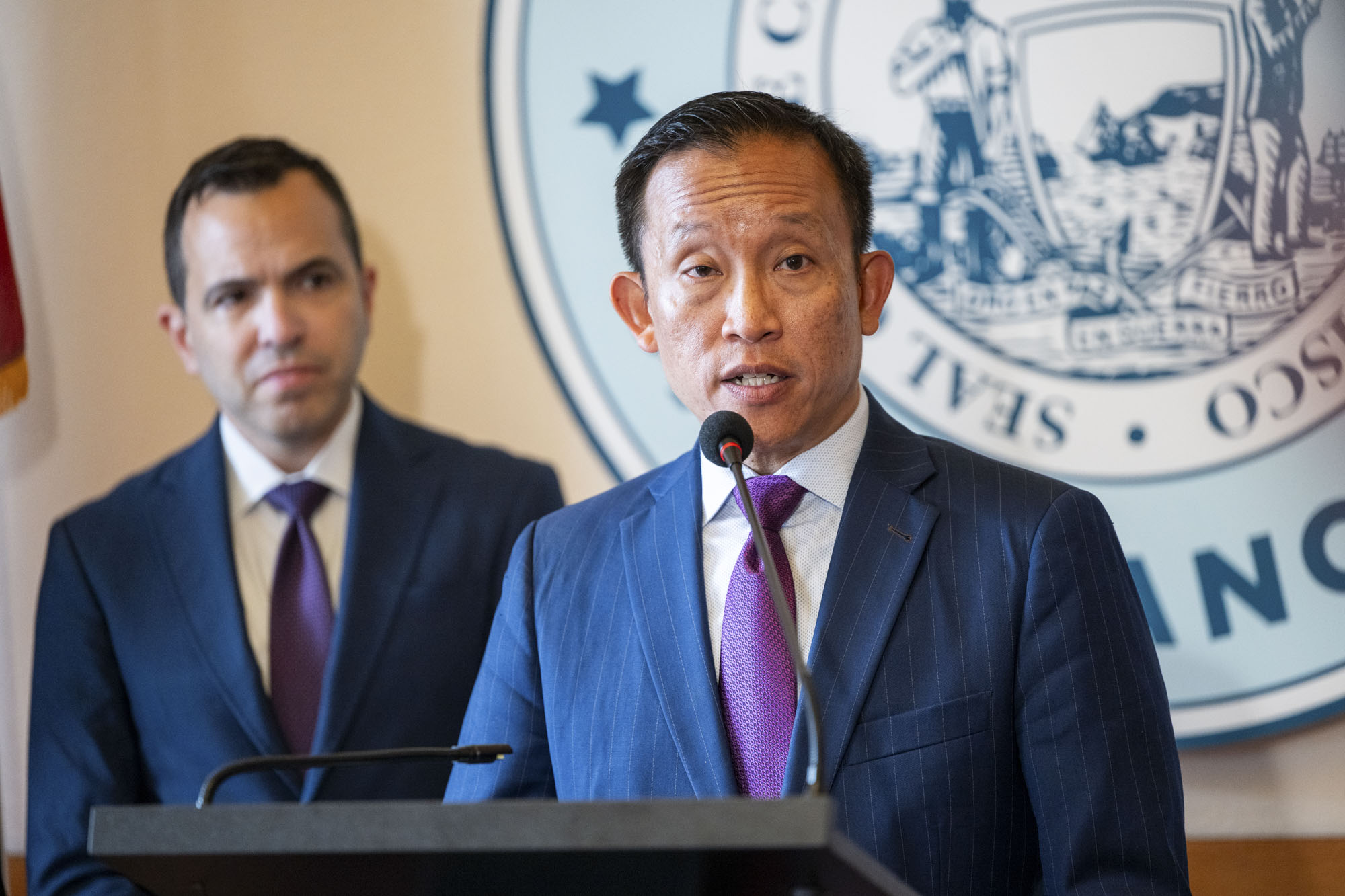
“A utility with a financial interest in protecting its monopoly doesn’t have the last word on what its assets are worth. There’s a process to determine the true cost,” Chiu said. “We look forward to learning more through the CPUC’s valuation process on this absurdly inflated number.”
Separately, city officials have called on state regulators to investigate the company for the blackouts that have plagued residents, along with a litany of other issues, including recent fires caused by PG&E equipment and delayed infrastructure projects.
Officials have long explored the possibility of cutting the cord with the utility giant, submitting a valuation petition to state regulators back in July 2021 to initiate the process of determining the value of the company’s assets.

State Sen. Scott Wiener, D-San Francisco, who authored legislation that would help the city break with PG&E, said in a statement that the estimate is an attempt to rip off customers.
“PG&E’s credibility with the public was already low, but this absurd estimate — which appears to demand taxpayers foot the bill for billions of dollars in made-up business expenses — managed to reach a new low,” Wiener said.
District 1 Supervisor Connie Chan said officials were expecting a hefty estimate from the company.
“For them to come in to declare an evaluation of over $20 billion for this infrastructure brings up a lot of questions about how they’ve been maintaining it, and the true value of the system,” Chan said.
Nancy Hayden Crowley, a spokesperson for the SFPUC, said the commission is still reviewing the utility’s filings, but noted that the company’s entire system is worth $60 billion — “about 5% of PG&E’s electricity system demand,” she wrote in a statement.
“We’ve gone to the state utility regulator to get an impartial assessment of what the assets San Francisco wants to buy are really worth,” Hayden Crowley said.
PG&E said the city “significantly undervalues” the company’s assets, assigning no value to 2,000 real estate interests in the city. In addition, the underground distribution system in the city has higher construction costs that PG&E said the city failed to include.
“A government takeover of our grid is not the right solution for our San Francisco customers,” PG&E Corporation CEO Patti Poppe said in a statement. “We have decades of specialized expertise operating San Francisco’s complex electric system. And now our filing shows that a takeover doesn’t make financial sense for customers.”
When asked about PG&E’s claim about the city not including certain costs in its valuation, Chiu said they were still reviewing the filings, but that “their explanations don’t make sense.”
Wiener said the company is not entitled to separation severance, and called the request “unprecedented.”
Michael Wara, a senior researcher at the Stanford Woods Center for the Environment, said both valuations are missing costs.
PG&E’s customer service arm that deals with billing and managing meters is not something San Francisco has set up, and is “an expensive system” the city would have to recreate.
“All of this has to happen at a cost that is lower than the current PG&E cost to provide service to San Francisco,” Wara said.
The true cost of the transition, he said, is probably somewhere in the middle. PG&E’s estimate is likely the ceiling.
“But the challenge [for officials] is that if you go much above $3.4 billion as the purchase price, you’re no longer saving money for San Franciscans,” Wara said. “Because the city would have to come up with $3.4 billion.”
CPUC previously expected to make a final decision on the asset values in 2027, but proceedings are likely to take longer than that.