window.__IS_SSR__=true
window.__INITIAL_STATE__={
"attachmentsReducer": {
"audio_0": {
"type": "attachments",
"id": "audio_0",
"imgSizes": {
"kqedFullSize": {
"file": "https://ww2.kqed.org/news/wp-content/themes/KQED-unified/img/audio_bgs/background0.jpg"
}
}
},
"audio_1": {
"type": "attachments",
"id": "audio_1",
"imgSizes": {
"kqedFullSize": {
"file": "https://ww2.kqed.org/news/wp-content/themes/KQED-unified/img/audio_bgs/background1.jpg"
}
}
},
"audio_2": {
"type": "attachments",
"id": "audio_2",
"imgSizes": {
"kqedFullSize": {
"file": "https://ww2.kqed.org/news/wp-content/themes/KQED-unified/img/audio_bgs/background2.jpg"
}
}
},
"audio_3": {
"type": "attachments",
"id": "audio_3",
"imgSizes": {
"kqedFullSize": {
"file": "https://ww2.kqed.org/news/wp-content/themes/KQED-unified/img/audio_bgs/background3.jpg"
}
}
},
"audio_4": {
"type": "attachments",
"id": "audio_4",
"imgSizes": {
"kqedFullSize": {
"file": "https://ww2.kqed.org/news/wp-content/themes/KQED-unified/img/audio_bgs/background4.jpg"
}
}
},
"placeholder": {
"type": "attachments",
"id": "placeholder",
"imgSizes": {
"thumbnail": {
"file": "https://cdn.kqed.org/wp-content/uploads/2024/12/KQED-Default-Image-816638274-2000x1333-1-160x107.jpg",
"width": 160,
"height": 107,
"mimeType": "image/jpeg"
},
"medium": {
"file": "https://cdn.kqed.org/wp-content/uploads/2024/12/KQED-Default-Image-816638274-2000x1333-1-800x533.jpg",
"width": 800,
"height": 533,
"mimeType": "image/jpeg"
},
"medium_large": {
"file": "https://cdn.kqed.org/wp-content/uploads/2024/12/KQED-Default-Image-816638274-2000x1333-1-768x512.jpg",
"width": 768,
"height": 512,
"mimeType": "image/jpeg"
},
"large": {
"file": "https://cdn.kqed.org/wp-content/uploads/2024/12/KQED-Default-Image-816638274-2000x1333-1-1020x680.jpg",
"width": 1020,
"height": 680,
"mimeType": "image/jpeg"
},
"1536x1536": {
"file": "https://cdn.kqed.org/wp-content/uploads/2024/12/KQED-Default-Image-816638274-2000x1333-1-1536x1024.jpg",
"width": 1536,
"height": 1024,
"mimeType": "image/jpeg"
},
"fd-lrg": {
"file": "https://cdn.kqed.org/wp-content/uploads/2024/12/KQED-Default-Image-816638274-2000x1333-1-1536x1024.jpg",
"width": 1536,
"height": 1024,
"mimeType": "image/jpeg"
},
"fd-med": {
"file": "https://cdn.kqed.org/wp-content/uploads/2024/12/KQED-Default-Image-816638274-2000x1333-1-1020x680.jpg",
"width": 1020,
"height": 680,
"mimeType": "image/jpeg"
},
"fd-sm": {
"file": "https://cdn.kqed.org/wp-content/uploads/2024/12/KQED-Default-Image-816638274-2000x1333-1-800x533.jpg",
"width": 800,
"height": 533,
"mimeType": "image/jpeg"
},
"post-thumbnail": {
"file": "https://cdn.kqed.org/wp-content/uploads/2024/12/KQED-Default-Image-816638274-2000x1333-1-672x372.jpg",
"width": 672,
"height": 372,
"mimeType": "image/jpeg"
},
"twentyfourteen-full-width": {
"file": "https://cdn.kqed.org/wp-content/uploads/2024/12/KQED-Default-Image-816638274-2000x1333-1-1038x576.jpg",
"width": 1038,
"height": 576,
"mimeType": "image/jpeg"
},
"xxsmall": {
"file": "https://cdn.kqed.org/wp-content/uploads/2024/12/KQED-Default-Image-816638274-2000x1333-1-160x107.jpg",
"width": 160,
"height": 107,
"mimeType": "image/jpeg"
},
"xsmall": {
"file": "https://cdn.kqed.org/wp-content/uploads/2024/12/KQED-Default-Image-816638274-2000x1333-1-672x372.jpg",
"width": 672,
"height": 372,
"mimeType": "image/jpeg"
},
"small": {
"file": "https://cdn.kqed.org/wp-content/uploads/2024/12/KQED-Default-Image-816638274-2000x1333-1-672x372.jpg",
"width": 672,
"height": 372,
"mimeType": "image/jpeg"
},
"xlarge": {
"file": "https://cdn.kqed.org/wp-content/uploads/2024/12/KQED-Default-Image-816638274-2000x1333-1-1020x680.jpg",
"width": 1020,
"height": 680,
"mimeType": "image/jpeg"
},
"full-width": {
"file": "https://cdn.kqed.org/wp-content/uploads/2024/12/KQED-Default-Image-816638274-2000x1333-1-1920x1280.jpg",
"width": 1920,
"height": 1280,
"mimeType": "image/jpeg"
},
"guest-author-32": {
"file": "https://cdn.kqed.org/wp-content/uploads/2025/01/KQED-Default-Image-816638274-1333x1333-1-160x160.jpg",
"width": 32,
"height": 32,
"mimeType": "image/jpeg"
},
"guest-author-50": {
"file": "https://cdn.kqed.org/wp-content/uploads/2025/01/KQED-Default-Image-816638274-1333x1333-1-160x160.jpg",
"width": 50,
"height": 50,
"mimeType": "image/jpeg"
},
"guest-author-64": {
"file": "https://cdn.kqed.org/wp-content/uploads/2025/01/KQED-Default-Image-816638274-1333x1333-1-160x160.jpg",
"width": 64,
"height": 64,
"mimeType": "image/jpeg"
},
"guest-author-96": {
"file": "https://cdn.kqed.org/wp-content/uploads/2025/01/KQED-Default-Image-816638274-1333x1333-1-160x160.jpg",
"width": 96,
"height": 96,
"mimeType": "image/jpeg"
},
"guest-author-128": {
"file": "https://cdn.kqed.org/wp-content/uploads/2025/01/KQED-Default-Image-816638274-1333x1333-1-160x160.jpg",
"width": 128,
"height": 128,
"mimeType": "image/jpeg"
},
"detail": {
"file": "https://cdn.kqed.org/wp-content/uploads/2025/01/KQED-Default-Image-816638274-1333x1333-1-160x160.jpg",
"width": 160,
"height": 160,
"mimeType": "image/jpeg"
},
"kqedFullSize": {
"file": "https://cdn.kqed.org/wp-content/uploads/2024/12/KQED-Default-Image-816638274-2000x1333-1.jpg",
"width": 2000,
"height": 1333
}
}
},
"news_11896455": {
"type": "attachments",
"id": "news_11896455",
"meta": {
"index": "attachments_1716263798",
"site": "news",
"id": "11896455",
"found": true
},
"parent": 11896443,
"imgSizes": {
"twentyfourteen-full-width": {
"file": "https://ww2.kqed.org/app/uploads/sites/10/2021/11/coalstorage_111621_final-1038x576.png",
"width": 1038,
"mimeType": "image/png",
"height": 576
},
"thumbnail": {
"file": "https://ww2.kqed.org/app/uploads/sites/10/2021/11/coalstorage_111621_final-160x114.png",
"width": 160,
"mimeType": "image/png",
"height": 114
},
"post-thumbnail": {
"file": "https://ww2.kqed.org/app/uploads/sites/10/2021/11/coalstorage_111621_final-672x372.png",
"width": 672,
"mimeType": "image/png",
"height": 372
},
"kqedFullSize": {
"file": "https://ww2.kqed.org/app/uploads/sites/10/2021/11/coalstorage_111621_final.png",
"width": 1920,
"height": 1364
},
"large": {
"file": "https://ww2.kqed.org/app/uploads/sites/10/2021/11/coalstorage_111621_final-1020x725.png",
"width": 1020,
"mimeType": "image/png",
"height": 725
},
"1536x1536": {
"file": "https://ww2.kqed.org/app/uploads/sites/10/2021/11/coalstorage_111621_final-1536x1091.png",
"width": 1536,
"mimeType": "image/png",
"height": 1091
},
"medium": {
"file": "https://ww2.kqed.org/app/uploads/sites/10/2021/11/coalstorage_111621_final-800x568.png",
"width": 800,
"mimeType": "image/png",
"height": 568
}
},
"publishDate": 1637107397,
"modified": 1637116440,
"caption": null,
"description": null,
"title": "coalstorage_111621_final",
"credit": null,
"status": "inherit",
"altTag": "Cartoon: A dirty coal train port terminal with a young boy and girl walking by. The boy says, \"the good news is they're banning coal storage by 2027, the bad news is it's 2021.\"",
"isLoading": false,
"fetchFailed": false
},
"news_11896268": {
"type": "attachments",
"id": "news_11896268",
"meta": {
"index": "attachments_1716263798",
"site": "news",
"id": "11896268",
"found": true
},
"parent": 11896256,
"imgSizes": {
"twentyfourteen-full-width": {
"file": "https://ww2.kqed.org/app/uploads/sites/10/2021/11/bitcoin_111521_final-1038x576.png",
"width": 1038,
"mimeType": "image/png",
"height": 576
},
"thumbnail": {
"file": "https://ww2.kqed.org/app/uploads/sites/10/2021/11/bitcoin_111521_final-160x109.png",
"width": 160,
"mimeType": "image/png",
"height": 109
},
"post-thumbnail": {
"file": "https://ww2.kqed.org/app/uploads/sites/10/2021/11/bitcoin_111521_final-672x372.png",
"width": 672,
"mimeType": "image/png",
"height": 372
},
"kqedFullSize": {
"file": "https://ww2.kqed.org/app/uploads/sites/10/2021/11/bitcoin_111521_final.png",
"width": 1920,
"height": 1307
},
"large": {
"file": "https://ww2.kqed.org/app/uploads/sites/10/2021/11/bitcoin_111521_final-1020x694.png",
"width": 1020,
"mimeType": "image/png",
"height": 694
},
"1536x1536": {
"file": "https://ww2.kqed.org/app/uploads/sites/10/2021/11/bitcoin_111521_final-1536x1046.png",
"width": 1536,
"mimeType": "image/png",
"height": 1046
},
"medium": {
"file": "https://ww2.kqed.org/app/uploads/sites/10/2021/11/bitcoin_111521_final-800x545.png",
"width": 800,
"mimeType": "image/png",
"height": 545
}
},
"publishDate": 1637020679,
"modified": 1637027760,
"caption": null,
"description": null,
"title": "bitcoin_111521_final",
"credit": null,
"status": "inherit",
"altTag": "Cartoon: A man on a ladder before a stock-ticker arrow pointing up. A woman asks him, \"Bitcoin?\" He answers, \"My bridge toll debt.\"",
"isLoading": false,
"fetchFailed": false
},
"news_11895597": {
"type": "attachments",
"id": "news_11895597",
"meta": {
"index": "attachments_1716263798",
"site": "news",
"id": "11895597",
"found": true
},
"parent": 11895338,
"imgSizes": {
"twentyfourteen-full-width": {
"file": "https://ww2.kqed.org/app/uploads/sites/10/2021/11/GettyImages-172490893-1024x576.jpg",
"width": 1024,
"mimeType": "image/jpeg",
"height": 576
},
"thumbnail": {
"file": "https://ww2.kqed.org/app/uploads/sites/10/2021/11/GettyImages-172490893-160x99.jpg",
"width": 160,
"mimeType": "image/jpeg",
"height": 99
},
"post-thumbnail": {
"file": "https://ww2.kqed.org/app/uploads/sites/10/2021/11/GettyImages-172490893-672x372.jpg",
"width": 672,
"mimeType": "image/jpeg",
"height": 372
},
"kqedFullSize": {
"file": "https://ww2.kqed.org/app/uploads/sites/10/2021/11/GettyImages-172490893.jpg",
"width": 1024,
"height": 634
},
"large": {
"file": "https://ww2.kqed.org/app/uploads/sites/10/2021/11/GettyImages-172490893-1020x632.jpg",
"width": 1020,
"mimeType": "image/jpeg",
"height": 632
},
"medium": {
"file": "https://ww2.kqed.org/app/uploads/sites/10/2021/11/GettyImages-172490893-800x495.jpg",
"width": 800,
"mimeType": "image/jpeg",
"height": 495
}
},
"publishDate": 1636418429,
"modified": 1636488257,
"caption": "Commuter traffic backs up at the toll plaza to the San Francisco-Oakland Bay Bridge on July 2, 2013, in Oakland (when cash was still accepted).",
"description": null,
"title": "Bay Area Transit Workers Go On Strike",
"credit": "Justin Sullivan/Getty Images",
"status": "inherit",
"altTag": "Aerial view of six lands of bumper-to-bumper traffic backed up at a toll plaza in the distance.",
"isLoading": false,
"fetchFailed": false
},
"news_11684488": {
"type": "attachments",
"id": "news_11684488",
"meta": {
"index": "attachments_1716263798",
"site": "news",
"id": "11684488",
"found": true
},
"parent": 11684478,
"imgSizes": {
"small": {
"file": "https://ww2.kqed.org/app/uploads/sites/10/2018/08/RS7013_175333538-520x348.jpg",
"width": 520,
"mimeType": "image/jpeg",
"height": 348
},
"twentyfourteen-full-width": {
"file": "https://ww2.kqed.org/app/uploads/sites/10/2018/08/RS7013_175333538-1038x576.jpg",
"width": 1038,
"mimeType": "image/jpeg",
"height": 576
},
"thumbnail": {
"file": "https://ww2.kqed.org/app/uploads/sites/10/2018/08/RS7013_175333538-160x107.jpg",
"width": 160,
"mimeType": "image/jpeg",
"height": 107
},
"fd-sm": {
"file": "https://ww2.kqed.org/app/uploads/sites/10/2018/08/RS7013_175333538-960x642.jpg",
"width": 960,
"mimeType": "image/jpeg",
"height": 642
},
"post-thumbnail": {
"file": "https://ww2.kqed.org/app/uploads/sites/10/2018/08/RS7013_175333538-672x372.jpg",
"width": 672,
"mimeType": "image/jpeg",
"height": 372
},
"xsmall": {
"file": "https://ww2.kqed.org/app/uploads/sites/10/2018/08/RS7013_175333538-375x251.jpg",
"width": 375,
"mimeType": "image/jpeg",
"height": 251
},
"kqedFullSize": {
"file": "https://ww2.kqed.org/app/uploads/sites/10/2018/08/RS7013_175333538-e1634255281256.jpg",
"width": 1920,
"height": 1284
},
"large": {
"file": "https://ww2.kqed.org/app/uploads/sites/10/2018/08/RS7013_175333538-1020x682.jpg",
"width": 1020,
"mimeType": "image/jpeg",
"height": 682
},
"xlarge": {
"file": "https://ww2.kqed.org/app/uploads/sites/10/2018/08/RS7013_175333538-1180x789.jpg",
"width": 1180,
"mimeType": "image/jpeg",
"height": 789
},
"complete_open_graph": {
"file": "https://ww2.kqed.org/app/uploads/sites/10/2018/08/RS7013_175333538-1200x803.jpg",
"width": 1200,
"mimeType": "image/jpeg",
"height": 803
},
"guest-author-50": {
"file": "https://ww2.kqed.org/app/uploads/sites/10/2018/08/RS7013_175333538-50x50.jpg",
"width": 50,
"mimeType": "image/jpeg",
"height": 50
},
"guest-author-96": {
"file": "https://ww2.kqed.org/app/uploads/sites/10/2018/08/RS7013_175333538-96x96.jpg",
"width": 96,
"mimeType": "image/jpeg",
"height": 96
},
"medium": {
"file": "https://ww2.kqed.org/app/uploads/sites/10/2018/08/RS7013_175333538-800x535.jpg",
"width": 800,
"mimeType": "image/jpeg",
"height": 535
},
"guest-author-64": {
"file": "https://ww2.kqed.org/app/uploads/sites/10/2018/08/RS7013_175333538-64x64.jpg",
"width": 64,
"mimeType": "image/jpeg",
"height": 64
},
"guest-author-32": {
"file": "https://ww2.kqed.org/app/uploads/sites/10/2018/08/RS7013_175333538-32x32.jpg",
"width": 32,
"mimeType": "image/jpeg",
"height": 32
},
"fd-lrg": {
"file": "https://ww2.kqed.org/app/uploads/sites/10/2018/08/RS7013_175333538-1920x1284.jpg",
"width": 1920,
"mimeType": "image/jpeg",
"height": 1284
},
"fd-med": {
"file": "https://ww2.kqed.org/app/uploads/sites/10/2018/08/RS7013_175333538-1180x789.jpg",
"width": 1180,
"mimeType": "image/jpeg",
"height": 789
},
"full-width": {
"file": "https://ww2.kqed.org/app/uploads/sites/10/2018/08/RS7013_175333538-1920x1284.jpg",
"width": 1920,
"mimeType": "image/jpeg",
"height": 1284
},
"detail": {
"file": "https://ww2.kqed.org/app/uploads/sites/10/2018/08/RS7013_175333538-150x150.jpg",
"width": 150,
"mimeType": "image/jpeg",
"height": 150
},
"guest-author-128": {
"file": "https://ww2.kqed.org/app/uploads/sites/10/2018/08/RS7013_175333538-128x128.jpg",
"width": 128,
"mimeType": "image/jpeg",
"height": 128
},
"xxsmall": {
"file": "https://ww2.kqed.org/app/uploads/sites/10/2018/08/RS7013_175333538-240x161.jpg",
"width": 240,
"mimeType": "image/jpeg",
"height": 161
}
},
"publishDate": 1533250091,
"modified": 1634257757,
"caption": "A BART train pulls away from Rockridge Station in Oakland.",
"description": null,
"title": "Bay Area Transportation Workers Strike Looms Ahead Of Monday Deadline",
"credit": "Justin Sullivan/Getty Images",
"status": "inherit",
"altTag": "A BART Train in Oakland.",
"isLoading": false,
"fetchFailed": false
},
"news_11892163": {
"type": "attachments",
"id": "news_11892163",
"meta": {
"index": "attachments_1716263798",
"site": "news",
"id": "11892163",
"found": true
},
"parent": 11892152,
"imgSizes": {
"twentyfourteen-full-width": {
"file": "https://ww2.kqed.org/app/uploads/sites/10/2021/10/20210930_093846-1038x576.jpeg",
"width": 1038,
"mimeType": "image/jpeg",
"height": 576
},
"thumbnail": {
"file": "https://ww2.kqed.org/app/uploads/sites/10/2021/10/20210930_093846-160x120.jpeg",
"width": 160,
"mimeType": "image/jpeg",
"height": 120
},
"post-thumbnail": {
"file": "https://ww2.kqed.org/app/uploads/sites/10/2021/10/20210930_093846-672x372.jpeg",
"width": 672,
"mimeType": "image/jpeg",
"height": 372
},
"kqedFullSize": {
"file": "https://ww2.kqed.org/app/uploads/sites/10/2021/10/20210930_093846.jpeg",
"width": 1890,
"height": 1418
},
"large": {
"file": "https://ww2.kqed.org/app/uploads/sites/10/2021/10/20210930_093846-1020x765.jpeg",
"width": 1020,
"mimeType": "image/jpeg",
"height": 765
},
"1536x1536": {
"file": "https://ww2.kqed.org/app/uploads/sites/10/2021/10/20210930_093846-1536x1152.jpeg",
"width": 1536,
"mimeType": "image/jpeg",
"height": 1152
},
"medium": {
"file": "https://ww2.kqed.org/app/uploads/sites/10/2021/10/20210930_093846-800x600.jpeg",
"width": 800,
"mimeType": "image/jpeg",
"height": 600
}
},
"publishDate": 1634159169,
"modified": 1634237914,
"caption": "The original Bay Bridge troll guarded over the bridge for 24 years. When the new eastern span was completed, he was retired and now lives at the Caltrans office at 111 Grand Ave. in Oakland.",
"description": "A skinny troll made of steel. He has a long tongue and is holding a metal tool. ",
"title": "20210930_093846",
"credit": "Christopher Beale/KQED",
"status": "inherit",
"altTag": "A light-colored metal figurine with two arms and two legs, holding a very long wrench to turn a bolt.",
"isLoading": false,
"fetchFailed": false
},
"news_11891763": {
"type": "attachments",
"id": "news_11891763",
"meta": {
"index": "attachments_1716263798",
"site": "news",
"id": "11891763",
"found": true
},
"parent": 11889092,
"imgSizes": {
"twentyfourteen-full-width": {
"file": "https://ww2.kqed.org/app/uploads/sites/10/2021/10/GettyImages-1233144469-1038x576.jpg",
"width": 1038,
"mimeType": "image/jpeg",
"height": 576
},
"thumbnail": {
"file": "https://ww2.kqed.org/app/uploads/sites/10/2021/10/GettyImages-1233144469-160x107.jpg",
"width": 160,
"mimeType": "image/jpeg",
"height": 107
},
"post-thumbnail": {
"file": "https://ww2.kqed.org/app/uploads/sites/10/2021/10/GettyImages-1233144469-672x372.jpg",
"width": 672,
"mimeType": "image/jpeg",
"height": 372
},
"kqedFullSize": {
"file": "https://ww2.kqed.org/app/uploads/sites/10/2021/10/GettyImages-1233144469-scaled-e1633896843251.jpg",
"width": 1920,
"height": 1280
},
"2048x2048": {
"file": "https://ww2.kqed.org/app/uploads/sites/10/2021/10/GettyImages-1233144469-2048x1365.jpg",
"width": 2048,
"mimeType": "image/jpeg",
"height": 1365
},
"large": {
"file": "https://ww2.kqed.org/app/uploads/sites/10/2021/10/GettyImages-1233144469-1020x680.jpg",
"width": 1020,
"mimeType": "image/jpeg",
"height": 680
},
"1536x1536": {
"file": "https://ww2.kqed.org/app/uploads/sites/10/2021/10/GettyImages-1233144469-1536x1024.jpg",
"width": 1536,
"mimeType": "image/jpeg",
"height": 1024
},
"full-width": {
"file": "https://ww2.kqed.org/app/uploads/sites/10/2021/10/GettyImages-1233144469-1920x1280.jpg",
"width": 1920,
"mimeType": "image/jpeg",
"height": 1280
},
"medium": {
"file": "https://ww2.kqed.org/app/uploads/sites/10/2021/10/GettyImages-1233144469-800x533.jpg",
"width": 800,
"mimeType": "image/jpeg",
"height": 533
}
},
"publishDate": 1633896817,
"modified": 1633994702,
"caption": "VTA employees pay their respects at a memorial where family, friends and community members attend a vigil for the victims of a shooting, at San José City Hall in San José, California, on May 27, 2021. ",
"description": null,
"title": "US-SHOOTING-CALIFORNIA-CRIME",
"credit": "Photo by AMY OSBORNE/AFP via Getty Images",
"status": "inherit",
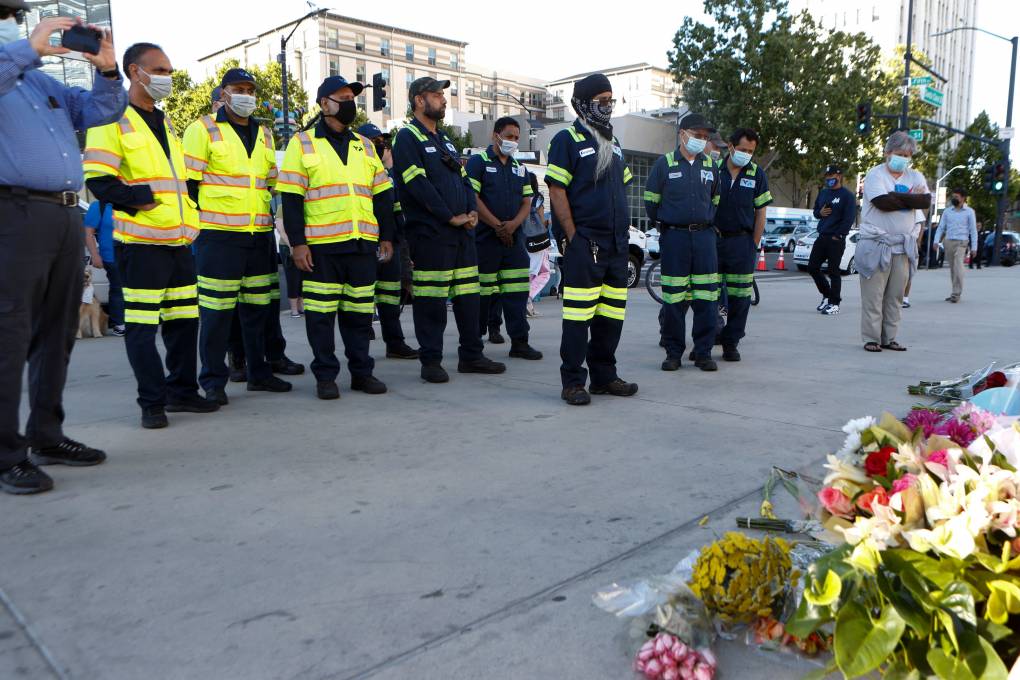
"altTag": "A line of people in uniform -- neon yellow jackets and dark blue pants with reflective stripes at the knees -- stand before a collection of flowers.",
"isLoading": false,
"fetchFailed": false
},
"news_11882808": {
"type": "attachments",
"id": "news_11882808",
"meta": {
"index": "attachments_1716263798",
"site": "news",
"id": "11882808",
"found": true
},
"parent": 11882379,
"imgSizes": {
"twentyfourteen-full-width": {
"file": "https://ww2.kqed.org/app/uploads/sites/10/2021/07/07272021_MinoBucheli_DalyCity-0272-1038x576.jpg",
"width": 1038,
"mimeType": "image/jpeg",
"height": 576
},
"thumbnail": {
"file": "https://ww2.kqed.org/app/uploads/sites/10/2021/07/07272021_MinoBucheli_DalyCity-0272-160x107.jpg",
"width": 160,
"mimeType": "image/jpeg",
"height": 107
},
"post-thumbnail": {
"file": "https://ww2.kqed.org/app/uploads/sites/10/2021/07/07272021_MinoBucheli_DalyCity-0272-672x372.jpg",
"width": 672,
"mimeType": "image/jpeg",
"height": 372
},
"kqedFullSize": {
"file": "https://ww2.kqed.org/app/uploads/sites/10/2021/07/07272021_MinoBucheli_DalyCity-0272.jpg",
"width": 2500,
"height": 1667
},
"2048x2048": {
"file": "https://ww2.kqed.org/app/uploads/sites/10/2021/07/07272021_MinoBucheli_DalyCity-0272-2048x1366.jpg",
"width": 2048,
"mimeType": "image/jpeg",
"height": 1366
},
"large": {
"file": "https://ww2.kqed.org/app/uploads/sites/10/2021/07/07272021_MinoBucheli_DalyCity-0272-1020x680.jpg",
"width": 1020,
"mimeType": "image/jpeg",
"height": 680
},
"1536x1536": {
"file": "https://ww2.kqed.org/app/uploads/sites/10/2021/07/07272021_MinoBucheli_DalyCity-0272-1536x1024.jpg",
"width": 1536,
"mimeType": "image/jpeg",
"height": 1024
},
"full-width": {
"file": "https://ww2.kqed.org/app/uploads/sites/10/2021/07/07272021_MinoBucheli_DalyCity-0272-1920x1280.jpg",
"width": 1920,
"mimeType": "image/jpeg",
"height": 1280
},
"medium": {
"file": "https://ww2.kqed.org/app/uploads/sites/10/2021/07/07272021_MinoBucheli_DalyCity-0272-800x533.jpg",
"width": 800,
"mimeType": "image/jpeg",
"height": 533
}
},
"publishDate": 1627503119,
"modified": 1628104133,
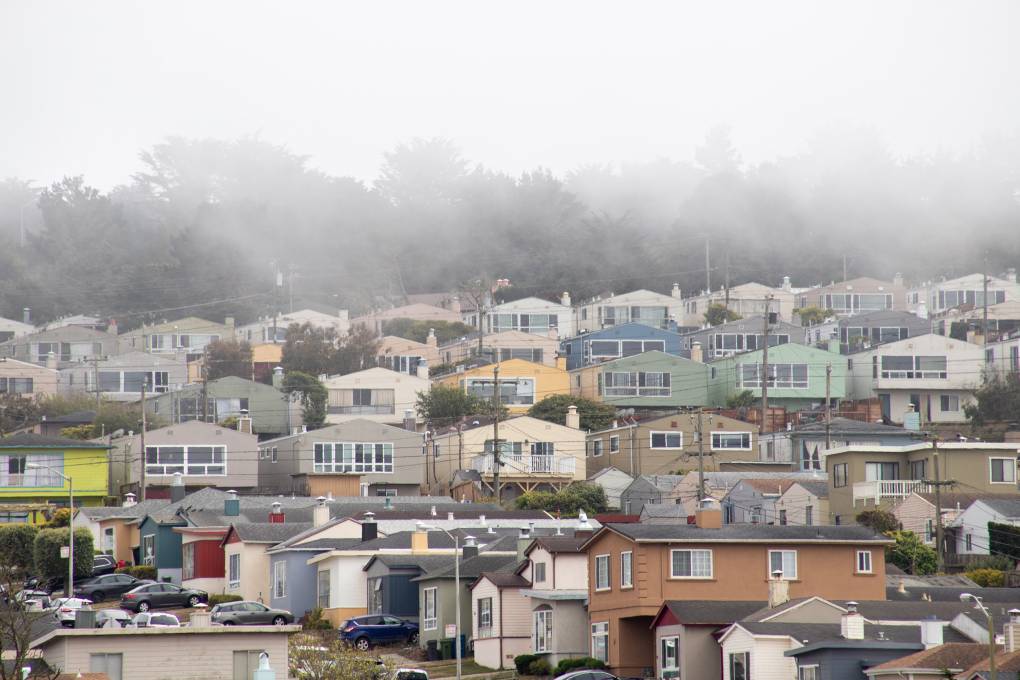
"caption": "A view from the Saint Francis neighborhood in Daly City. ",
"description": "A view from the Saint Francis neighborhood in Daly City. ",
"title": "07272021_MinoBucheli_DalyCity-0272",
"credit": "Sebastian Miño-Bucheli/KQED",
"status": "inherit",
"altTag": "A view from the Saint Francis neighborhood in Daly City.",
"isLoading": false,
"fetchFailed": false
},
"news_11685494": {
"type": "attachments",
"id": "news_11685494",
"meta": {
"index": "attachments_1716263798",
"site": "news",
"id": "11685494",
"found": true
},
"parent": 11685038,
"imgSizes": {
"small": {
"file": "https://ww2.kqed.org/app/uploads/sites/10/2018/08/GettyImages-3188658-520x338.jpg",
"width": 520,
"mimeType": "image/jpeg",
"height": 338
},
"twentyfourteen-full-width": {
"file": "https://ww2.kqed.org/app/uploads/sites/10/2018/08/GettyImages-3188658-1038x576.jpg",
"width": 1038,
"mimeType": "image/jpeg",
"height": 576
},
"thumbnail": {
"file": "https://ww2.kqed.org/app/uploads/sites/10/2018/08/GettyImages-3188658-160x104.jpg",
"width": 160,
"mimeType": "image/jpeg",
"height": 104
},
"fd-sm": {
"file": "https://ww2.kqed.org/app/uploads/sites/10/2018/08/GettyImages-3188658-960x623.jpg",
"width": 960,
"mimeType": "image/jpeg",
"height": 623
},
"post-thumbnail": {
"file": "https://ww2.kqed.org/app/uploads/sites/10/2018/08/GettyImages-3188658-672x372.jpg",
"width": 672,
"mimeType": "image/jpeg",
"height": 372
},
"xsmall": {
"file": "https://ww2.kqed.org/app/uploads/sites/10/2018/08/GettyImages-3188658-375x244.jpg",
"width": 375,
"mimeType": "image/jpeg",
"height": 244
},
"kqedFullSize": {
"file": "https://ww2.kqed.org/app/uploads/sites/10/2018/08/GettyImages-3188658-e1552593074481.jpg",
"width": 1920,
"height": 1247
},
"large": {
"file": "https://ww2.kqed.org/app/uploads/sites/10/2018/08/GettyImages-3188658-1020x662.jpg",
"width": 1020,
"mimeType": "image/jpeg",
"height": 662
},
"xlarge": {
"file": "https://ww2.kqed.org/app/uploads/sites/10/2018/08/GettyImages-3188658-1180x766.jpg",
"width": 1180,
"mimeType": "image/jpeg",
"height": 766
},
"complete_open_graph": {
"file": "https://ww2.kqed.org/app/uploads/sites/10/2018/08/GettyImages-3188658-1200x779.jpg",
"width": 1200,
"mimeType": "image/jpeg",
"height": 779
},
"guest-author-50": {
"file": "https://ww2.kqed.org/app/uploads/sites/10/2018/08/GettyImages-3188658-50x50.jpg",
"width": 50,
"mimeType": "image/jpeg",
"height": 50
},
"guest-author-96": {
"file": "https://ww2.kqed.org/app/uploads/sites/10/2018/08/GettyImages-3188658-96x96.jpg",
"width": 96,
"mimeType": "image/jpeg",
"height": 96
},
"medium": {
"file": "https://ww2.kqed.org/app/uploads/sites/10/2018/08/GettyImages-3188658-800x519.jpg",
"width": 800,
"mimeType": "image/jpeg",
"height": 519
},
"guest-author-64": {
"file": "https://ww2.kqed.org/app/uploads/sites/10/2018/08/GettyImages-3188658-64x64.jpg",
"width": 64,
"mimeType": "image/jpeg",
"height": 64
},
"guest-author-32": {
"file": "https://ww2.kqed.org/app/uploads/sites/10/2018/08/GettyImages-3188658-32x32.jpg",
"width": 32,
"mimeType": "image/jpeg",
"height": 32
},
"fd-lrg": {
"file": "https://ww2.kqed.org/app/uploads/sites/10/2018/08/GettyImages-3188658-1920x1247.jpg",
"width": 1920,
"mimeType": "image/jpeg",
"height": 1247
},
"fd-med": {
"file": "https://ww2.kqed.org/app/uploads/sites/10/2018/08/GettyImages-3188658-1180x766.jpg",
"width": 1180,
"mimeType": "image/jpeg",
"height": 766
},
"full-width": {
"file": "https://ww2.kqed.org/app/uploads/sites/10/2018/08/GettyImages-3188658-1920x1247.jpg",
"width": 1920,
"mimeType": "image/jpeg",
"height": 1247
},
"detail": {
"file": "https://ww2.kqed.org/app/uploads/sites/10/2018/08/GettyImages-3188658-150x150.jpg",
"width": 150,
"mimeType": "image/jpeg",
"height": 150
},
"guest-author-128": {
"file": "https://ww2.kqed.org/app/uploads/sites/10/2018/08/GettyImages-3188658-128x128.jpg",
"width": 128,
"mimeType": "image/jpeg",
"height": 128
},
"xxsmall": {
"file": "https://ww2.kqed.org/app/uploads/sites/10/2018/08/GettyImages-3188658-240x156.jpg",
"width": 240,
"mimeType": "image/jpeg",
"height": 156
}
},
"publishDate": 1533677464,
"modified": 1626902651,
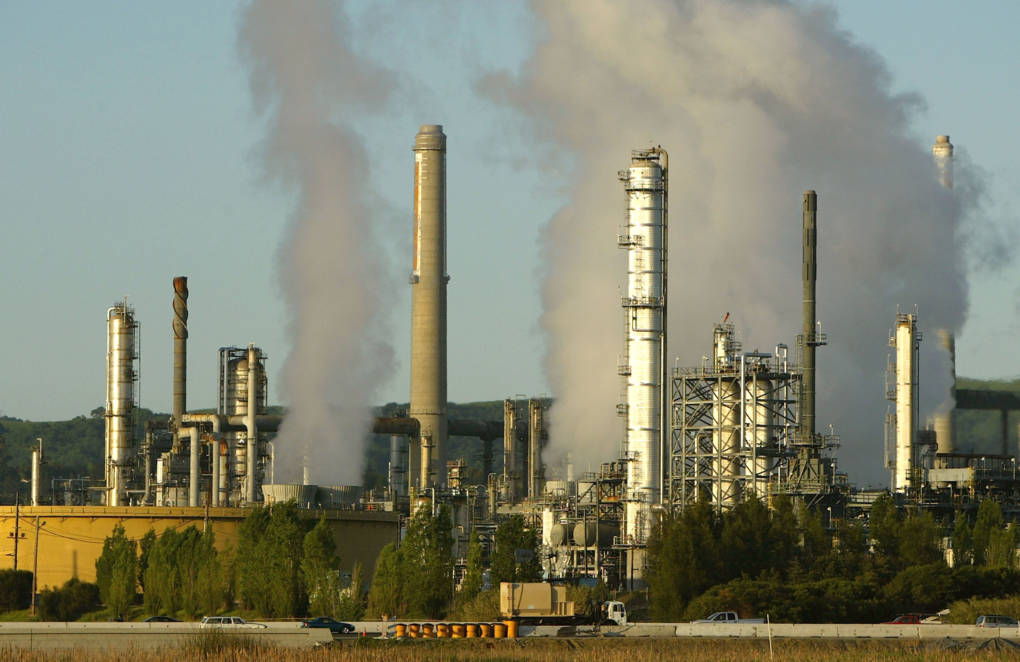
"caption": "The PBF Energy refinery in Martinez, pictured in August 2018 when it was owned by Shell. ",
"description": "The PBF Energy refinery in Martinez, pictured in August 2018 when it was owned by Shell. ",
"title": "The Martinez Refining Company Refinery",
"credit": "Justin Sullivan/Getty Images",
"status": "inherit",
"altTag": null,
"isLoading": false,
"fetchFailed": false
},
"news_11644119": {
"type": "attachments",
"id": "news_11644119",
"meta": {
"index": "attachments_1716263798",
"site": "news",
"id": "11644119",
"found": true
},
"parent": 11642644,
"imgSizes": {
"small": {
"file": "https://ww2.kqed.org/app/uploads/sites/10/2018/01/bridgemodel-520x293.jpg",
"width": 520,
"mimeType": "image/jpeg",
"height": 293
},
"thumbnail": {
"file": "https://ww2.kqed.org/app/uploads/sites/10/2018/01/bridgemodel-160x90.jpg",
"width": 160,
"mimeType": "image/jpeg",
"height": 90
},
"post-thumbnail": {
"file": "https://ww2.kqed.org/app/uploads/sites/10/2018/01/bridgemodel-672x372.jpg",
"width": 672,
"mimeType": "image/jpeg",
"height": 372
},
"xsmall": {
"file": "https://ww2.kqed.org/app/uploads/sites/10/2018/01/bridgemodel-375x211.jpg",
"width": 375,
"mimeType": "image/jpeg",
"height": 211
},
"kqedFullSize": {
"file": "https://ww2.kqed.org/app/uploads/sites/10/2018/01/bridgemodel.jpg",
"width": 800,
"height": 450
},
"guest-author-50": {
"file": "https://ww2.kqed.org/app/uploads/sites/10/2018/01/bridgemodel-50x50.jpg",
"width": 50,
"mimeType": "image/jpeg",
"height": 50
},
"guest-author-96": {
"file": "https://ww2.kqed.org/app/uploads/sites/10/2018/01/bridgemodel-96x96.jpg",
"width": 96,
"mimeType": "image/jpeg",
"height": 96
},
"medium": {
"file": "https://ww2.kqed.org/app/uploads/sites/10/2018/01/bridgemodel-800x450.jpg",
"width": 800,
"mimeType": "image/jpeg",
"height": 450
},
"guest-author-64": {
"file": "https://ww2.kqed.org/app/uploads/sites/10/2018/01/bridgemodel-64x64.jpg",
"width": 64,
"mimeType": "image/jpeg",
"height": 64
},
"guest-author-32": {
"file": "https://ww2.kqed.org/app/uploads/sites/10/2018/01/bridgemodel-32x32.jpg",
"width": 32,
"mimeType": "image/jpeg",
"height": 32
},
"detail": {
"file": "https://ww2.kqed.org/app/uploads/sites/10/2018/01/bridgemodel-150x150.jpg",
"width": 150,
"mimeType": "image/jpeg",
"height": 150
},
"guest-author-128": {
"file": "https://ww2.kqed.org/app/uploads/sites/10/2018/01/bridgemodel-128x128.jpg",
"width": 128,
"mimeType": "image/jpeg",
"height": 128
},
"xxsmall": {
"file": "https://ww2.kqed.org/app/uploads/sites/10/2018/01/bridgemodel-240x135.jpg",
"width": 240,
"mimeType": "image/jpeg",
"height": 135
}
},
"publishDate": 1516840686,
"modified": 1516843057,
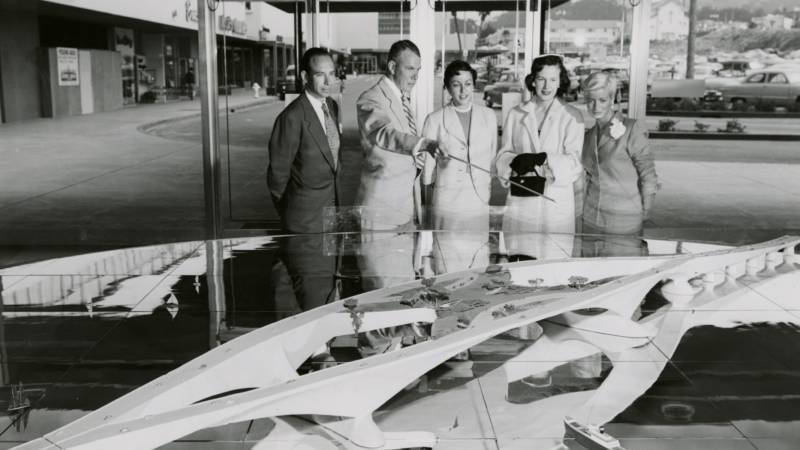
"caption": "Model of the Butterfly Bridge at Stonestown Shopping Center, San Francisco, 1953. L to R: Aaron Green, Arthur Haggard, Mrs. Donald Magnin, Mary Lee Futernick and Carol Weingarten. ",
"description": "Model of the Butterfly Bridge at Stonestown Shopping Center, San Francisco, 1953. L to R: Aaron Green, Arthur Haggard, Mrs. Donald Magnin, Mary Lee Futernick, and Carol Weingarten. ",
"title": "bridgemodel",
"credit": "Courtesy of Robot Skelton, San Francisco Call-Bulletin",
"status": "inherit",
"isLoading": false,
"fetchFailed": false
},
"news_11877465": {
"type": "attachments",
"id": "news_11877465",
"meta": {
"index": "attachments_1716263798",
"site": "news",
"id": "11877465",
"found": true
},
"parent": 11876977,
"imgSizes": {
"twentyfourteen-full-width": {
"file": "https://ww2.kqed.org/app/uploads/sites/10/2021/06/Motorized-wheelchair-vehicle-lift-lyft-1038x576.jpg",
"width": 1038,
"mimeType": "image/jpeg",
"height": 576
},
"thumbnail": {
"file": "https://ww2.kqed.org/app/uploads/sites/10/2021/06/Motorized-wheelchair-vehicle-lift-lyft-160x107.jpg",
"width": 160,
"mimeType": "image/jpeg",
"height": 107
},
"post-thumbnail": {
"file": "https://ww2.kqed.org/app/uploads/sites/10/2021/06/Motorized-wheelchair-vehicle-lift-lyft-672x372.jpg",
"width": 672,
"mimeType": "image/jpeg",
"height": 372
},
"kqedFullSize": {
"file": "https://ww2.kqed.org/app/uploads/sites/10/2021/06/Motorized-wheelchair-vehicle-lift-lyft.jpg",
"width": 1920,
"height": 1280
},
"large": {
"file": "https://ww2.kqed.org/app/uploads/sites/10/2021/06/Motorized-wheelchair-vehicle-lift-lyft-1020x680.jpg",
"width": 1020,
"mimeType": "image/jpeg",
"height": 680
},
"1536x1536": {
"file": "https://ww2.kqed.org/app/uploads/sites/10/2021/06/Motorized-wheelchair-vehicle-lift-lyft-1536x1024.jpg",
"width": 1536,
"mimeType": "image/jpeg",
"height": 1024
},
"medium": {
"file": "https://ww2.kqed.org/app/uploads/sites/10/2021/06/Motorized-wheelchair-vehicle-lift-lyft-800x533.jpg",
"width": 800,
"mimeType": "image/jpeg",
"height": 533
}
},
"publishDate": 1623277044,
"modified": 1623277530,
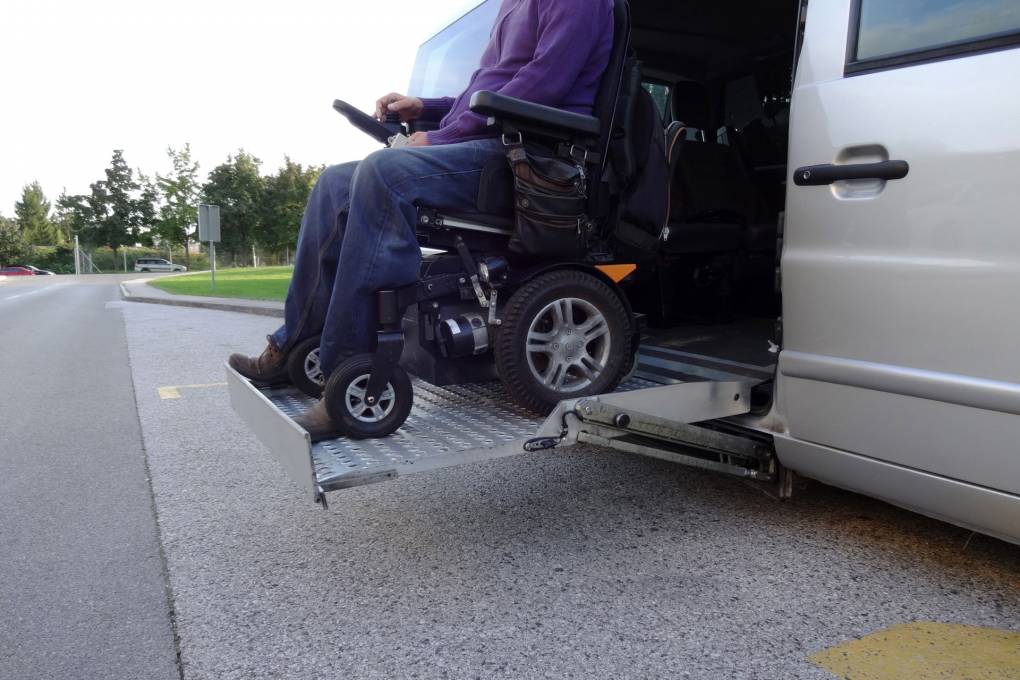
"caption": "A class-action lawsuit filed in 2019 alleges Lyft violates the ADA by failing to provide service for those who require special wheelchair accessible vehicles. ",
"description": "A class-action lawsuit filed in 2019 alleges Lyft violates the ADA by failing to provide service for those who require special wheelchair accessible vehicles. ",
"title": "Motorized-wheelchair-vehicle-lift-lyft",
"credit": "Getty Images",
"status": "inherit",
"altTag": "Man on motorized wheelchair on a lift on a wheelchair accessible vehicle",
"isLoading": false,
"fetchFailed": false
},
"news_11875591": {
"type": "attachments",
"id": "news_11875591",
"meta": {
"index": "attachments_1716263798",
"site": "news",
"id": "11875591",
"found": true
},
"parent": 11875580,
"imgSizes": {
"twentyfourteen-full-width": {
"file": "https://ww2.kqed.org/app/uploads/sites/10/2021/05/vta_052721_final-1038x576.png",
"width": 1038,
"mimeType": "image/png",
"height": 576
},
"thumbnail": {
"file": "https://ww2.kqed.org/app/uploads/sites/10/2021/05/vta_052721_final-160x138.png",
"width": 160,
"mimeType": "image/png",
"height": 138
},
"post-thumbnail": {
"file": "https://ww2.kqed.org/app/uploads/sites/10/2021/05/vta_052721_final-672x372.png",
"width": 672,
"mimeType": "image/png",
"height": 372
},
"kqedFullSize": {
"file": "https://ww2.kqed.org/app/uploads/sites/10/2021/05/vta_052721_final.png",
"width": 1920,
"height": 1658
},
"large": {
"file": "https://ww2.kqed.org/app/uploads/sites/10/2021/05/vta_052721_final-1020x881.png",
"width": 1020,
"mimeType": "image/png",
"height": 881
},
"1536x1536": {
"file": "https://ww2.kqed.org/app/uploads/sites/10/2021/05/vta_052721_final-1536x1326.png",
"width": 1536,
"mimeType": "image/png",
"height": 1326
},
"medium": {
"file": "https://ww2.kqed.org/app/uploads/sites/10/2021/05/vta_052721_final-800x691.png",
"width": 800,
"mimeType": "image/png",
"height": 691
}
},
"publishDate": 1622127609,
"modified": 1622127673,
"caption": null,
"description": null,
"title": "vta_052721_final",
"credit": null,
"status": "inherit",
"altTag": "A Mark Fiore cartoon following the mass shooting at the Valley Transportation Authority rail yard shows a heart that is made of a light rail track, with \"VTA\" in the center of the heart and a light rail car atop the rails.",
"isLoading": false,
"fetchFailed": false
},
"news_11870996": {
"type": "attachments",
"id": "news_11870996",
"meta": {
"index": "attachments_1716263798",
"site": "news",
"id": "11870996",
"found": true
},
"parent": 11870993,
"imgSizes": {
"thumbnail": {
"file": "https://ww2.kqed.org/app/uploads/sites/10/2021/04/Hwy1Reopen-160x105.jpg",
"width": 160,
"mimeType": "image/jpeg",
"height": 105
},
"post-thumbnail": {
"file": "https://ww2.kqed.org/app/uploads/sites/10/2021/04/Hwy1Reopen-672x372.jpg",
"width": 672,
"mimeType": "image/jpeg",
"height": 372
},
"kqedFullSize": {
"file": "https://ww2.kqed.org/app/uploads/sites/10/2021/04/Hwy1Reopen.jpg",
"width": 800,
"height": 523
}
},
"publishDate": 1619217758,
"modified": 1619223218,
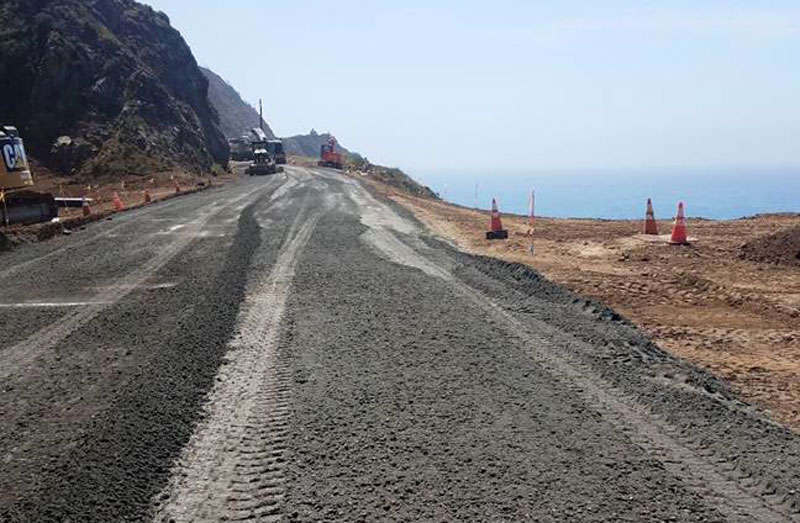
"caption": "Crews work to finish repairs on a section of Highway 1 near Rat Creek south of Big Sur, which washed away after winter storms in January. The section of road opened well ahead of schedule on Friday.",
"description": null,
"title": "Hwy1Reopen",
"credit": "Caltrans District 5/Twitter",
"status": "inherit",
"altTag": null,
"isLoading": false,
"fetchFailed": false
}
},
"audioPlayerReducer": {
"postId": "stream_live",
"isPaused": true,
"isPlaying": false,
"pfsActive": false,
"pledgeModalIsOpen": true,
"playerDrawerIsOpen": false,
"liveAudioPlayStartedAt": 0,
"liveAudioPlayContext": ""
},
"authorsReducer": {
"astupi": {
"type": "authors",
"id": "70",
"meta": {
"index": "authors_1716337520",
"id": "70",
"found": true
},
"name": "Amanda Stupi",
"firstName": "Amanda",
"lastName": "Stupi",
"slug": "astupi",
"email": "astupi@kqed.org",
"display_author_email": false,
"staff_mastheads": [],
"title": "Senior Engagement Producer",
"bio": "Amanda joined KQED Science’s engagement team as a Senior Audience Engagement Strategist in the spring of 2019. She has helped craft messaging around wildfires, the coronavirus pandemic, climate change and many other stories. She has also brought KQED Science to new platforms such as Reddit’s Ask Me Anything series. Prior to joining KQED Science, Amanda spent seven years as an engagement producer with Forum, KQED’s daily live call-in show. She got her start in radio at KALW's weekly call in show, City Visions, before going on to an internship and stint at NPR's Talk of the Nation.\r\n\r\nPrior to journalism, Amanda taught English at Lowell High School. She's a native of Petaluma and currently lives under the \"South San Francisco the Industrial City\" sign in South City. She believes that engagement is vital to news’s future and that good journalism listens as much as it asks questions.",
"avatar": "https://secure.gravatar.com/avatar/e981c503e5c162da701dcaccfbf87e35?s=600&d=blank&r=g",
"twitter": null,
"facebook": null,
"instagram": null,
"linkedin": null,
"sites": [
{
"site": "arts",
"roles": [
"Contributor"
]
},
{
"site": "news",
"roles": [
"editor"
]
},
{
"site": "pop",
"roles": [
"contributor"
]
},
{
"site": "stateofhealth",
"roles": [
"editor"
]
},
{
"site": "science",
"roles": []
},
{
"site": "perspectives",
"roles": [
"editor"
]
}
],
"headData": {
"title": "Amanda Stupi | KQED",
"description": "Senior Engagement Producer",
"ogImgSrc": "https://secure.gravatar.com/avatar/e981c503e5c162da701dcaccfbf87e35?s=600&d=blank&r=g",
"twImgSrc": "https://secure.gravatar.com/avatar/e981c503e5c162da701dcaccfbf87e35?s=600&d=blank&r=g"
},
"isLoading": false,
"link": "/author/astupi"
},
"danbrekke": {
"type": "authors",
"id": "222",
"meta": {
"index": "authors_1716337520",
"id": "222",
"found": true
},
"name": "Dan Brekke",
"firstName": "Dan",
"lastName": "Brekke",
"slug": "danbrekke",
"email": "dbrekke@kqed.org",
"display_author_email": true,
"staff_mastheads": [
"news",
"science"
],
"title": "KQED Editor and Reporter",
"bio": "Dan Brekke is a reporter and editor for KQED News, responsible for coverage of topics ranging from California water issues to the Bay Area's transportation challenges. In a newsroom career that began in Chicago in 1972, Dan has worked for \u003cem>The San Francisco Examiner,\u003c/em> Wired and TechTV and has been published in The New York Times, The New York Times Magazine, Business 2.0, Salon and elsewhere.\r\n\r\nSince joining KQED in 2007, Dan has reported, edited and produced both radio and online features and breaking news pieces. He has shared as both editor and reporter in four Society of Professional Journalists Norcal Excellence in Journalism awards and one Edward R. Murrow regional award. He was chosen for a spring 2017 residency at the Mesa Refuge to advance his research on California salmon.\r\n\r\nEmail Dan at: \u003ca href=\"mailto:dbrekke@kqed.org\">dbrekke@kqed.org\u003c/a>\r\n\r\n\u003cstrong>Twitter:\u003c/strong> \u003ca href=\"https://twitter.com/danbrekke\" rel=\"noopener noreferrer\">twitter.com/danbrekke\u003c/a>\r\n\u003cstrong>Facebook:\u003c/strong> \u003ca href=\"https://www.facebook.com/danbrekke\" rel=\"noopener noreferrer\">www.facebook.com/danbrekke\u003c/a>\r\n\u003cstrong>LinkedIn:\u003c/strong> \u003ca href=\"https://www.linkedin.com/in/danbrekke\" rel=\"noopener noreferrer\">www.linkedin.com/in/danbrekke\u003c/a>",
"avatar": "https://secure.gravatar.com/avatar/8f1f0d2a978fb3b23426c922c7e2af558fa36905b49c4ce76a97dc3c72d27226?s=600&d=mm&r=g",
"twitter": "danbrekke",
"bluesky": null,
"facebook": null,
"instagram": "https://www.instagram.com/dan.brekke/",
"linkedin": "https://www.linkedin.com/in/danbrekke/",
"sites": [
{
"site": "news",
"roles": [
"administrator",
"create_posts"
]
},
{
"site": "stateofhealth",
"roles": [
"editor"
]
},
{
"site": "science",
"roles": [
"editor"
]
},
{
"site": "quest",
"roles": [
"contributor"
]
},
{
"site": "food",
"roles": [
"contributor"
]
},
{
"site": "forum",
"roles": [
"contributor"
]
},
{
"site": "elections",
"roles": [
"editor"
]
},
{
"site": "liveblog",
"roles": [
"editor"
]
}
],
"headData": {
"title": "Dan Brekke | KQED",
"description": "KQED Editor and Reporter",
"ogImgSrc": "https://secure.gravatar.com/avatar/8f1f0d2a978fb3b23426c922c7e2af558fa36905b49c4ce76a97dc3c72d27226?s=600&d=mm&r=g",
"twImgSrc": "https://secure.gravatar.com/avatar/8f1f0d2a978fb3b23426c922c7e2af558fa36905b49c4ce76a97dc3c72d27226?s=600&d=mm&r=g"
},
"isLoading": false,
"link": "/author/danbrekke"
},
"kqednewsstaffandwires": {
"type": "authors",
"id": "237",
"meta": {
"index": "authors_1716337520",
"id": "237",
"found": true
},
"name": "KQED News Staff and Wires",
"firstName": "KQED News Staff and Wires",
"lastName": null,
"slug": "kqednewsstaffandwires",
"email": "onlinenewsstaff@kqed.org",
"display_author_email": false,
"staff_mastheads": [],
"title": null,
"bio": null,
"avatar": "https://secure.gravatar.com/avatar/72295af8ebbfbd19a4948f5271285664?s=600&d=blank&r=g",
"twitter": null,
"facebook": null,
"instagram": null,
"linkedin": null,
"sites": [
{
"site": "arts",
"roles": [
"contributor"
]
},
{
"site": "news",
"roles": [
"contributor"
]
},
{
"site": "lowdown",
"roles": [
"author"
]
},
{
"site": "stateofhealth",
"roles": [
"contributor"
]
},
{
"site": "food",
"roles": [
"author"
]
}
],
"headData": {
"title": "KQED News Staff and Wires | KQED",
"description": null,
"ogImgSrc": "https://secure.gravatar.com/avatar/72295af8ebbfbd19a4948f5271285664?s=600&d=blank&r=g",
"twImgSrc": "https://secure.gravatar.com/avatar/72295af8ebbfbd19a4948f5271285664?s=600&d=blank&r=g"
},
"isLoading": false,
"link": "/author/kqednewsstaffandwires"
},
"rachael-myrow": {
"type": "authors",
"id": "251",
"meta": {
"index": "authors_1716337520",
"id": "251",
"found": true
},
"name": "Rachael Myrow",
"firstName": "Rachael",
"lastName": "Myrow",
"slug": "rachael-myrow",
"email": "rmyrow@kqed.org",
"display_author_email": true,
"staff_mastheads": [
"news"
],
"title": "Senior Editor of KQED's Silicon Valley News Desk",
"bio": "• I write and edit stories about how Silicon Valley power and policies shape everyday life in California. I’m also passionate about making Bay Area history and culture more accessible to a broad public. • I’ve been a journalist for most of my life, starting in high school with The Franklin Press in Los Angeles, where I grew up. While earning my first degree in English at UC Berkeley, I got my start in public radio at KALX-FM. After completing a second degree in journalism at Cal, I landed my first professional job at Marketplace, then moved on to KPCC (now LAist), and then KQED, where I hosted The California Report for more than seven years. • My reporting has appeared on NPR, The World, WBUR’s \u003ci>Here & Now\u003c/i>, and the BBC. I also guest host for KQED’s \u003ci>Forum\u003c/i>, as well as the Commonwealth Club in San Francisco. • I speak periodically on media, democracy and technology issues, and do voiceover work for documentaries and educational video projects. • Outside of the studio, you'll find me hiking Bay Area trails and whipping up Insta-ready meals in my kitchen. • I do not accept gifts, money, or favors from anyone connected to my reporting, I don't pay people for information, and I do not support or donate to political causes. • I strive to treat the people I report on with fairness, honesty, and respect. I also recognize there are often multiple sides to a story and work to verify information through multiple sources and documentation. If I get something wrong, I correct it.",
"avatar": "https://secure.gravatar.com/avatar/3ed8a3c5f26025e4a805ba634cda8cd764906b97438a6d9ce216b044e340da4e?s=600&d=blank&r=g",
"twitter": "rachaelmyrow",
"bluesky": null,
"facebook": null,
"instagram": null,
"linkedin": "https://www.linkedin.com/in/rachaelmyrow/",
"sites": [
{
"site": "arts",
"roles": [
"administrator"
]
},
{
"site": "news",
"roles": [
"edit_others_posts",
"editor"
]
},
{
"site": "futureofyou",
"roles": [
"editor"
]
},
{
"site": "bayareabites",
"roles": [
"editor"
]
},
{
"site": "stateofhealth",
"roles": [
"editor"
]
},
{
"site": "science",
"roles": [
"editor"
]
},
{
"site": "food",
"roles": [
"editor"
]
},
{
"site": "forum",
"roles": [
"editor"
]
},
{
"site": "liveblog",
"roles": [
"author"
]
}
],
"headData": {
"title": "Rachael Myrow | KQED",
"description": "Senior Editor of KQED's Silicon Valley News Desk",
"ogImgSrc": "https://secure.gravatar.com/avatar/3ed8a3c5f26025e4a805ba634cda8cd764906b97438a6d9ce216b044e340da4e?s=600&d=blank&r=g",
"twImgSrc": "https://secure.gravatar.com/avatar/3ed8a3c5f26025e4a805ba634cda8cd764906b97438a6d9ce216b044e340da4e?s=600&d=blank&r=g"
},
"isLoading": false,
"link": "/author/rachael-myrow"
},
"tgoldberg": {
"type": "authors",
"id": "258",
"meta": {
"index": "authors_1716337520",
"id": "258",
"found": true
},
"name": "Ted Goldberg",
"firstName": "Ted",
"lastName": "Goldberg",
"slug": "tgoldberg",
"email": "tgoldberg@kqed.org",
"display_author_email": true,
"staff_mastheads": [
"news"
],
"title": "KQED Managing Editor, News and Newscasts",
"bio": "Ted Goldberg is Managing Editor of News and Newscasts at KQED. His main reporting beat is the Bay Area's oil refining industry.\r\n\r\nPrior to joining KQED in 2014, Ted worked at CBS News and WCBS AM in New York and Bay City News and KCBS Radio in San Francisco. He graduated from Oberlin College in Ohio in 1998.",
"avatar": "https://secure.gravatar.com/avatar/30ce2e4fe89135e104f89be2394d16225b9d36c121b5b3cb7651ce642978b96f?s=600&d=blank&r=g",
"twitter": "TedrickG",
"bluesky": null,
"facebook": null,
"instagram": null,
"linkedin": null,
"sites": [
{
"site": "news",
"roles": [
"editor"
]
},
{
"site": "science",
"roles": [
"editor"
]
}
],
"headData": {
"title": "Ted Goldberg | KQED",
"description": "KQED Managing Editor, News and Newscasts",
"ogImgSrc": "https://secure.gravatar.com/avatar/30ce2e4fe89135e104f89be2394d16225b9d36c121b5b3cb7651ce642978b96f?s=600&d=blank&r=g",
"twImgSrc": "https://secure.gravatar.com/avatar/30ce2e4fe89135e104f89be2394d16225b9d36c121b5b3cb7651ce642978b96f?s=600&d=blank&r=g"
},
"isLoading": false,
"link": "/author/tgoldberg"
},
"markfiore": {
"type": "authors",
"id": "3236",
"meta": {
"index": "authors_1716337520",
"id": "3236",
"found": true
},
"name": "Mark Fiore",
"firstName": "Mark",
"lastName": "Fiore",
"slug": "markfiore",
"email": "mark@markfiore.com",
"display_author_email": false,
"staff_mastheads": [
"news"
],
"title": "KQED News Cartoonist",
"bio": "\u003ca href=\"http://www.MarkFiore.com\">MarkFiore.com\u003c/a> | \u003ca href=\"https://twitter.com/markfiore\">Follow on Twitter\u003c/a> | \u003ca href=\"https://www.facebook.com/pages/Mark-Fiore-Animated-Political-Cartoons/94451707396?ref=bookmarks\">Facebook\u003c/a> | \u003ca href=\"mailto:mark@markfiore.com\">email\u003c/a>\r\n\r\nPulitzer Prize-winner, Mark Fiore, who the Wall Street Journal has called “the undisputed guru of the form,” creates animated political cartoons in San Francisco, where his work has been featured regularly on the San Francisco Chronicle’s web site, SFGate.com. His work has appeared on Newsweek.com, Slate.com, CBSNews.com, MotherJones.com, DailyKos.com and NPR’s web site. Fiore’s political animation has appeared on CNN, Frontline, Bill Moyers Journal, Salon.com and cable and broadcast outlets across the globe.\r\n\r\nBeginning his professional life by drawing traditional political cartoons for newspapers, Fiore’s work appeared in publications ranging from the Washington Post to the Los Angeles Times. In the late 1990s, he began to experiment with animating political cartoons and, after a short stint at the San Jose Mercury News as their staff cartoonist, Fiore devoted all his energies to animation.\r\nGrowing up in California, Fiore also spent a good portion of his life in the backwoods of Idaho. It was this combination that shaped him politically. Mark majored in political science at Colorado College, where, in a perfect send-off for a cartoonist, he received his diploma in 1991 as commencement speaker Dick Cheney smiled approvingly.\r\nMark Fiore was awarded the Pulitzer Prize for political cartooning in 2010, a Robert F. Kennedy Journalism Award in 2004 and has twice received an Online Journalism Award for commentary from the Online News Association (2002, 2008). Fiore has received two awards for his work in new media from the National Cartoonists Society (2001, 2002), and in 2006 received The James Madison Freedom of Information Award from The Society of Professional Journalists.",
"avatar": "https://secure.gravatar.com/avatar/fc4e2a612b15b67bad0c6f0e1db4ca9b?s=600&d=blank&r=g",
"twitter": "MarkFiore",
"facebook": null,
"instagram": "https://www.instagram.com/markfiore/?hl=en",
"linkedin": null,
"sites": [
{
"site": "arts",
"roles": [
"contributor"
]
},
{
"site": "news",
"roles": [
"editor"
]
},
{
"site": "futureofyou",
"roles": [
"editor"
]
},
{
"site": "science",
"roles": [
"editor"
]
}
],
"headData": {
"title": "Mark Fiore | KQED",
"description": "KQED News Cartoonist",
"ogImgSrc": "https://secure.gravatar.com/avatar/fc4e2a612b15b67bad0c6f0e1db4ca9b?s=600&d=blank&r=g",
"twImgSrc": "https://secure.gravatar.com/avatar/fc4e2a612b15b67bad0c6f0e1db4ca9b?s=600&d=blank&r=g"
},
"isLoading": false,
"link": "/author/markfiore"
},
"jrodriguez": {
"type": "authors",
"id": "11690",
"meta": {
"index": "authors_1716337520",
"id": "11690",
"found": true
},
"name": "Joe Fitzgerald Rodriguez",
"firstName": "Joe",
"lastName": "Fitzgerald Rodriguez",
"slug": "jrodriguez",
"email": "jrodriguez@kqed.org",
"display_author_email": true,
"staff_mastheads": [
"news"
],
"title": "Reporter and Producer",
"bio": "Joe Fitzgerald Rodriguez is a reporter and digital producer for KQED covering politics. Joe most recently wrote for the \u003cem>San Francisco Examiner\u003c/em> as a political columnist covering The City. He was raised in San Francisco and has spent his reporting career in his beloved, foggy, city by the bay. Joe was 12-years-old when he conducted his first interview in journalism, grilling former San Francisco Mayor Willie Brown for the Marina Middle School newspaper, \u003cem>The Penguin Press, \u003c/em>and he continues to report on the San Francisco Bay Area to this day.",
"avatar": "https://secure.gravatar.com/avatar/2247beb0564c1e9c62228d5649d2edac?s=600&d=blank&r=g",
"twitter": "FitztheReporter",
"facebook": null,
"instagram": "https://www.instagram.com/fitzthereporter/",
"linkedin": null,
"sites": [
{
"site": "",
"roles": [
"editor"
]
},
{
"site": "arts",
"roles": [
"editor"
]
},
{
"site": "news",
"roles": [
"editor"
]
},
{
"site": "science",
"roles": [
"editor"
]
},
{
"site": "elections",
"roles": [
"editor"
]
},
{
"site": "liveblog",
"roles": [
"editor"
]
}
],
"headData": {
"title": "Joe Fitzgerald Rodriguez | KQED",
"description": "Reporter and Producer",
"ogImgSrc": "https://secure.gravatar.com/avatar/2247beb0564c1e9c62228d5649d2edac?s=600&d=blank&r=g",
"twImgSrc": "https://secure.gravatar.com/avatar/2247beb0564c1e9c62228d5649d2edac?s=600&d=blank&r=g"
},
"isLoading": false,
"link": "/author/jrodriguez"
},
"cbeale": {
"type": "authors",
"id": "11749",
"meta": {
"index": "authors_1716337520",
"id": "11749",
"found": true
},
"name": "Christopher Beale",
"firstName": "Christopher",
"lastName": "Beale",
"slug": "cbeale",
"email": "cbeale@kqed.org",
"display_author_email": true,
"staff_mastheads": [
"news"
],
"title": "Engineer/Producer/Reporter",
"bio": "\u003ca href=\"https://linktr.ee/realchrisjbeale\" rel=\"noopener noreferrer\">Christopher J. Beale\u003c/a> is an award winning journalist, audio engineer, and media host living in San Francisco. \r\n\r\nChristopher works primarily as an audio engineer at KQED and serves as the sound designer for both the Bay Curious and Rightnowish podcasts. He is the host and producer of the LGBTQIA podcast and radio segment \u003ca href=\"https://stereotypespodcast.org\">Stereotypes\u003c/a>.",
"avatar": "https://secure.gravatar.com/avatar/dc485bf84788eb7e7414eb638e72407e?s=600&d=blank&r=g",
"twitter": "realchrisjbeale",
"facebook": null,
"instagram": "http://instagram.com/realchrisjbeale",
"linkedin": null,
"sites": [
{
"site": "arts",
"roles": [
"contributor"
]
},
{
"site": "news",
"roles": [
"editor"
]
},
{
"site": "forum",
"roles": [
"editor"
]
}
],
"headData": {
"title": "Christopher Beale | KQED",
"description": "Engineer/Producer/Reporter",
"ogImgSrc": "https://secure.gravatar.com/avatar/dc485bf84788eb7e7414eb638e72407e?s=600&d=blank&r=g",
"twImgSrc": "https://secure.gravatar.com/avatar/dc485bf84788eb7e7414eb638e72407e?s=600&d=blank&r=g"
},
"isLoading": false,
"link": "/author/cbeale"
}
},
"pagesReducer": {
"news_category_transportation": {
"type": "terms",
"id": "news_1397",
"meta": {
"index": "terms_1716263798",
"site": "news",
"id": "1397",
"score": 12.939901
},
"featImg": null,
"name": "Transportation",
"description": null,
"taxonomy": "category",
"headData": {
"twImgId": null,
"twTitle": null,
"ogTitle": null,
"ogImgId": null,
"twDescription": null,
"description": null,
"title": "Transportation Archives | KQED News",
"ogDescription": null
},
"ttid": 1409,
"slug": "transportation",
"isLoading": false,
"title": "Transportation",
"pageMeta": {
"site": "news",
"WpPageTemplate": "page-topic-editorial",
"currentPage": 32
},
"blocks": [
{
"blockName": "kqed/post-list",
"attrs": {
"layout": "cardArticle2",
"query": "posts/news?category=transportation",
"seeMore": false,
"paginated": true,
"page": 32
}
},
{
"blockName": "kqed/ad"
}
]
}
},
"pfsSessionReducer": {},
"postsReducer": {
"stream_live": {
"type": "live",
"id": "stream_live",
"audioUrl": "https://streams.kqed.org/kqedradio",
"title": "Live Stream",
"excerpt": "Live Stream information currently unavailable.",
"link": "/radio",
"featImg": "",
"label": {
"name": "KQED Live",
"link": "/"
}
},
"stream_kqedNewscast": {
"type": "posts",
"id": "stream_kqedNewscast",
"audioUrl": "https://www.kqed.org/.stream/anon/radio/RDnews/newscast.mp3?_=1",
"title": "KQED Newscast",
"featImg": "",
"label": {
"name": "88.5 FM",
"link": "/"
}
},
"news_11896443": {
"type": "posts",
"id": "news_11896443",
"meta": {
"index": "posts_1716263798",
"site": "news",
"id": "11896443",
"score": null,
"sort": [
1637115798000
]
},
"guestAuthors": [],
"slug": "time-to-switch-tracks",
"title": "Time to Switch Tracks",
"publishDate": 1637115798,
"format": "aside",
"headTitle": "Time to Switch Tracks | KQED",
"labelTerm": {
"term": 18515,
"site": "news"
},
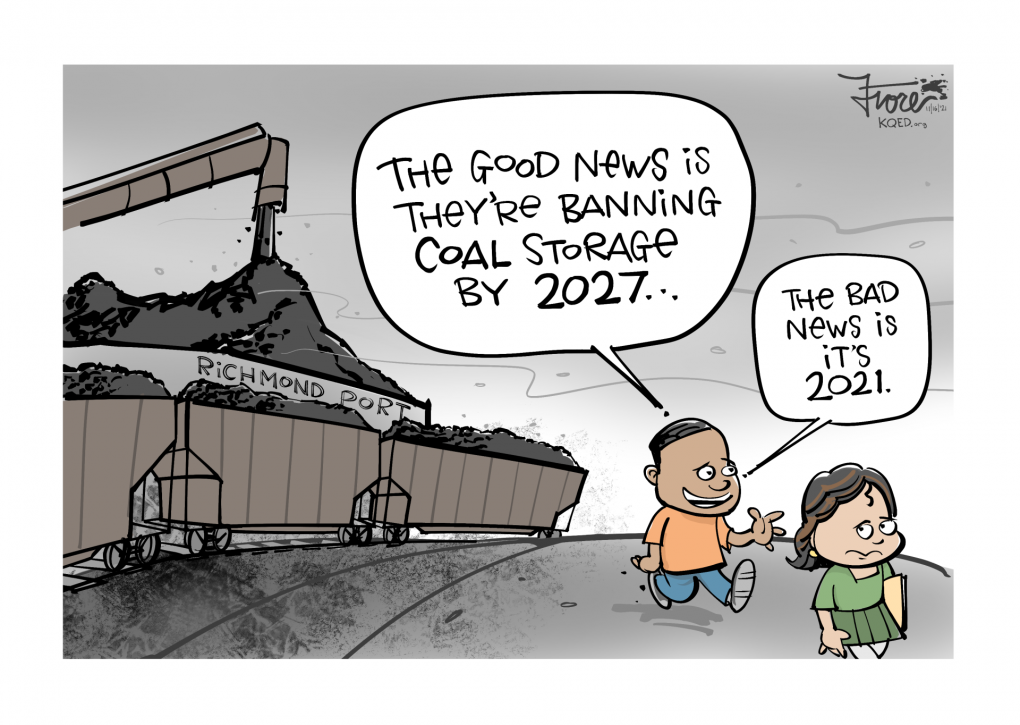
"content": "\u003cp>\u003ca href=\"https://ww2.kqed.org/app/uploads/sites/10/2021/11/coalstorage_111621_final.png\">\u003cimg loading=\"lazy\" decoding=\"async\" class=\"alignnone size-full wp-image-11896455\" src=\"https://ww2.kqed.org/app/uploads/sites/10/2021/11/coalstorage_111621_final.png\" alt=\"Cartoon: a dirty coal train port terminal with a young boy and girl walking by. The boy says, "the good news is they're banning coal storage by 2027, the bad news is it's 2021."\" width=\"1920\" height=\"1364\" srcset=\"https://cdn.kqed.org/wp-content/uploads/sites/10/2021/11/coalstorage_111621_final.png 1920w, https://cdn.kqed.org/wp-content/uploads/sites/10/2021/11/coalstorage_111621_final-800x568.png 800w, https://cdn.kqed.org/wp-content/uploads/sites/10/2021/11/coalstorage_111621_final-1020x725.png 1020w, https://cdn.kqed.org/wp-content/uploads/sites/10/2021/11/coalstorage_111621_final-160x114.png 160w, https://cdn.kqed.org/wp-content/uploads/sites/10/2021/11/coalstorage_111621_final-1536x1091.png 1536w\" sizes=\"(max-width: 1920px) 100vw, 1920px\">\u003c/a>Richmond officials reached a settlement with port operator Levin-Richmond Terminal Corp., along with two fossil fuel companies and the state of Utah, to \u003ca href=\"https://bit.ly/fiorerichmondcoalban\">ban coal storage at the port\u003c/a>.\u003c/p>\n\u003cp>The coal currently going through the shipping terminal is mined in Utah, transported by train across the West, stored for a while at the port and then loaded on a ship and sent to Japan or other destinations in Asia.\u003c/p>\n\u003cp>This is definitely not the most efficient or climate-friendly operation, and the declining market for coal in the United States has led desperate fossil fuel companies to look abroad for their profits.\u003c/p>\n\u003cp>Along the way, the health of people in Richmond suffers alongside the health of the planet.\u003c/p>\n\u003cp>This settlement is great news. I only wish we didn’t have to wait until 2027 to stop coal trafficking through Richmond.\u003c/p>\n\u003cp>[ad fullwidth]\u003c/p>\n\u003cp>\u003c/p>\n",
"blocks": [],
"excerpt": "Richmond officials reached a settlement with port operator Levin-Richmond Terminal Corp., along with two fossil fuel companies and the state of Utah, to ban coal storage at the port.",
"status": "publish",
"parent": 0,
"modified": 1726004063,
"stats": {
"hasAudio": false,
"hasVideo": false,
"hasChartOrMap": false,
"iframeSrcs": [],
"hasGoogleForm": false,
"hasGallery": false,
"hasHearkenModule": false,
"hasPolis": false,
"paragraphCount": 7,
"wordCount": 144
},
"headData": {
"title": "Time to Switch Tracks | KQED",
"description": "Richmond officials reached a settlement with port operator Levin-Richmond Terminal Corp., along with two fossil fuel companies and the state of Utah, to ban coal storage at the port.",
"ogTitle": "",
"ogDescription": "",
"ogImgId": "",
"twTitle": "",
"twDescription": "",
"twImgId": "",
"schema": {
"@context": "https://schema.org",
"@type": "NewsArticle",
"headline": "Time to Switch Tracks",
"datePublished": "2021-11-16T18:23:18-08:00",
"dateModified": "2024-09-10T14:34:23-07:00",
"image": "https://cdn.kqed.org/wp-content/uploads/2020/02/KQED-OG-Image@1x.png",
"isAccessibleForFree": "True",
"publisher": {
"@type": "NewsMediaOrganization",
"@id": "https://www.kqed.org/#organization",
"name": "KQED",
"logo": "https://cdn.kqed.org/wp-content/uploads/2020/02/KQED-OG-Image@1x.png",
"url": "https://www.kqed.org",
"sameAs": [
"https://www.facebook.com/KQED",
"https://twitter.com/KQED",
"https://www.instagram.com/kqed/",
"https://www.tiktok.com/@kqedofficial",
"https://www.linkedin.com/company/kqed",
"https://www.youtube.com/channel/UCeC0IOo7i1P_61zVUWbJ4nw"
]
}
}
},
"sticky": false,
"excludeFromSiteSearch": "Include",
"path": "/news/11896443/time-to-switch-tracks",
"audioTrackLength": null,
"parsedContent": [
{
"type": "contentString",
"content": "\u003cdiv class=\"post-body\">\u003cp>\u003cp>\u003ca href=\"https://ww2.kqed.org/app/uploads/sites/10/2021/11/coalstorage_111621_final.png\">\u003cimg loading=\"lazy\" decoding=\"async\" class=\"alignnone size-full wp-image-11896455\" src=\"https://ww2.kqed.org/app/uploads/sites/10/2021/11/coalstorage_111621_final.png\" alt=\"Cartoon: a dirty coal train port terminal with a young boy and girl walking by. The boy says, "the good news is they're banning coal storage by 2027, the bad news is it's 2021."\" width=\"1920\" height=\"1364\" srcset=\"https://cdn.kqed.org/wp-content/uploads/sites/10/2021/11/coalstorage_111621_final.png 1920w, https://cdn.kqed.org/wp-content/uploads/sites/10/2021/11/coalstorage_111621_final-800x568.png 800w, https://cdn.kqed.org/wp-content/uploads/sites/10/2021/11/coalstorage_111621_final-1020x725.png 1020w, https://cdn.kqed.org/wp-content/uploads/sites/10/2021/11/coalstorage_111621_final-160x114.png 160w, https://cdn.kqed.org/wp-content/uploads/sites/10/2021/11/coalstorage_111621_final-1536x1091.png 1536w\" sizes=\"(max-width: 1920px) 100vw, 1920px\">\u003c/a>Richmond officials reached a settlement with port operator Levin-Richmond Terminal Corp., along with two fossil fuel companies and the state of Utah, to \u003ca href=\"https://bit.ly/fiorerichmondcoalban\">ban coal storage at the port\u003c/a>.\u003c/p>\n\u003cp>The coal currently going through the shipping terminal is mined in Utah, transported by train across the West, stored for a while at the port and then loaded on a ship and sent to Japan or other destinations in Asia.\u003c/p>\n\u003cp>This is definitely not the most efficient or climate-friendly operation, and the declining market for coal in the United States has led desperate fossil fuel companies to look abroad for their profits.\u003c/p>\n\u003cp>Along the way, the health of people in Richmond suffers alongside the health of the planet.\u003c/p>\n\u003cp>This settlement is great news. I only wish we didn’t have to wait until 2027 to stop coal trafficking through Richmond.\u003c/p>\n\u003cp>\u003c/p>\u003c/div>",
"attributes": {
"named": {},
"numeric": []
}
},
{
"type": "component",
"content": "",
"name": "ad",
"attributes": {
"named": {
"label": "fullwidth"
},
"numeric": [
"fullwidth"
]
}
},
{
"type": "contentString",
"content": "\u003cdiv class=\"post-body\">\u003cp>\u003c/p>\n\u003cp>\u003c/p>\n\u003c/div>\u003c/p>",
"attributes": {
"named": {},
"numeric": []
}
}
],
"link": "/news/11896443/time-to-switch-tracks",
"authors": [
"3236"
],
"series": [
"news_18515"
],
"categories": [
"news_34165",
"news_19906",
"news_8",
"news_1397"
],
"tags": [
"news_255",
"news_6253",
"news_30247",
"news_328",
"news_20949",
"news_579"
],
"featImg": "news_11896455",
"label": "news_18515"
},
"news_11896256": {
"type": "posts",
"id": "news_11896256",
"meta": {
"index": "posts_1716263798",
"site": "news",
"id": "11896256",
"score": null,
"sort": [
1637025247000
]
},
"guestAuthors": [],
"slug": "a-fine-mess",
"title": "A Fine Mess",
"publishDate": 1637025247,
"format": "aside",
"headTitle": "A Fine Mess | KQED",
"labelTerm": {
"term": 18515,
"site": "news"
},
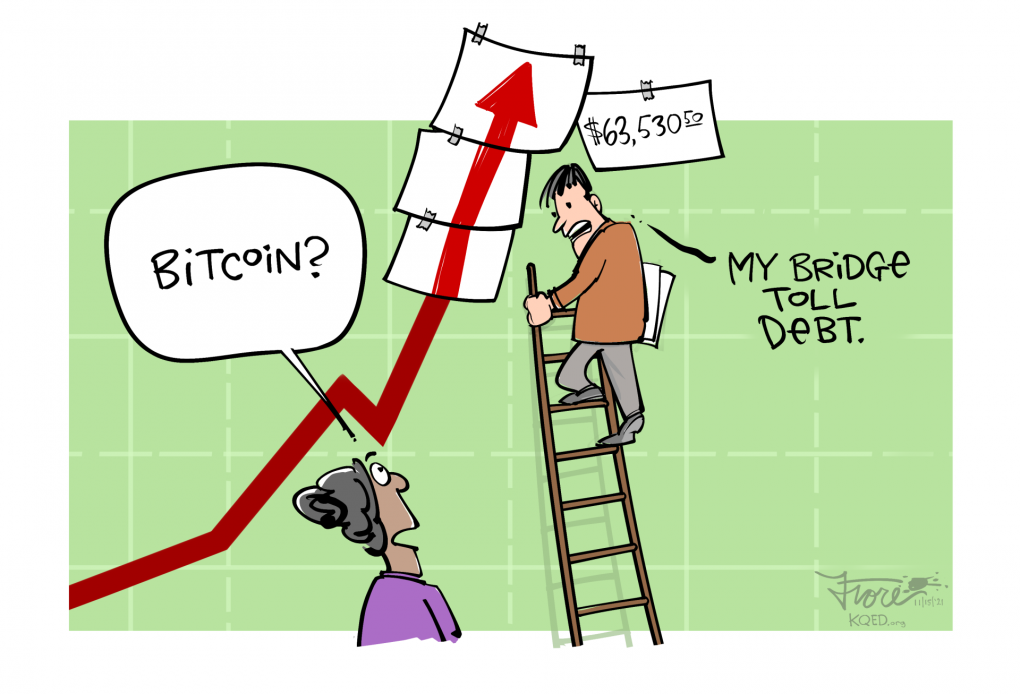
"content": "\u003cp>\u003ca href=\"https://ww2.kqed.org/app/uploads/sites/10/2021/11/bitcoin_111521_final.png\">\u003cimg loading=\"lazy\" decoding=\"async\" class=\"alignnone size-full wp-image-11896268\" src=\"https://ww2.kqed.org/app/uploads/sites/10/2021/11/bitcoin_111521_final.png\" alt='Cartoon: a man on a ladder before a stock-ticker arrow pointing up. A woman asks him, \"Bitcoin?\" He answers, \"my bridge toll debt.\"' width=\"1920\" height=\"1307\" srcset=\"https://cdn.kqed.org/wp-content/uploads/sites/10/2021/11/bitcoin_111521_final.png 1920w, https://cdn.kqed.org/wp-content/uploads/sites/10/2021/11/bitcoin_111521_final-800x545.png 800w, https://cdn.kqed.org/wp-content/uploads/sites/10/2021/11/bitcoin_111521_final-1020x694.png 1020w, https://cdn.kqed.org/wp-content/uploads/sites/10/2021/11/bitcoin_111521_final-160x109.png 160w, https://cdn.kqed.org/wp-content/uploads/sites/10/2021/11/bitcoin_111521_final-1536x1046.png 1536w\" sizes=\"(max-width: 1920px) 100vw, 1920px\">\u003c/a>\u003c/p>\n\u003cp>A handful of \u003ca href=\"https://bit.ly/fiorebridgetolldebt\">unpaid $6 bridge tolls can easily grow to hundreds or thousands of dollars in fees\u003c/a> and penalties.\u003c/p>\n\u003cp>Economic justice advocates in the Bay Area want to change that.\u003c/p>\n\u003cp>Having been on the receiving end of this extreme system of late payments and penalties (and eventual vehicle registration hold), I can attest to the fact that these charges can pile up ridiculously fast.\u003c/p>\n\u003cp>Fortunately, \u003ca href=\"https://www.spur.org/publications/spur-report/2021-11-04/bridging-gap\">SPUR has shined a spotlight on the overly punitive toll collections system\u003c/a> (one that predominantly affects lower-income drivers) and the Bay Area Toll Authority (BATA) recently voted to reduce late fees and fines.\u003c/p>\n\u003cp>As for those of you who already have tens of thousands of dollars in toll debt … BATA is still working on that.\u003c/p>\n\u003cp>[ad fullwidth]\u003c/p>\n\u003cp>\u003c/p>\n",
"blocks": [],
"excerpt": "An unpaid $6 bridge toll can easily grow to hundreds or thousands of dollars in fees and penalties. Economic justice advocates in the Bay Area want to change that.",
"status": "publish",
"parent": 0,
"modified": 1721131459,
"stats": {
"hasAudio": false,
"hasVideo": false,
"hasChartOrMap": false,
"iframeSrcs": [],
"hasGoogleForm": false,
"hasGallery": false,
"hasHearkenModule": false,
"hasPolis": false,
"paragraphCount": 8,
"wordCount": 125
},
"headData": {
"title": "A Fine Mess | KQED",
"description": "An unpaid $6 bridge toll can easily grow to hundreds or thousands of dollars in fees and penalties. Economic justice advocates in the Bay Area want to change that.",
"ogTitle": "",
"ogDescription": "",
"ogImgId": "",
"twTitle": "",
"twDescription": "",
"twImgId": "",
"schema": {
"@context": "https://schema.org",
"@type": "NewsArticle",
"headline": "A Fine Mess",
"datePublished": "2021-11-15T17:14:07-08:00",
"dateModified": "2024-07-16T05:04:19-07:00",
"image": "https://cdn.kqed.org/wp-content/uploads/2020/02/KQED-OG-Image@1x.png",
"isAccessibleForFree": "True",
"publisher": {
"@type": "NewsMediaOrganization",
"@id": "https://www.kqed.org/#organization",
"name": "KQED",
"logo": "https://cdn.kqed.org/wp-content/uploads/2020/02/KQED-OG-Image@1x.png",
"url": "https://www.kqed.org",
"sameAs": [
"https://www.facebook.com/KQED",
"https://twitter.com/KQED",
"https://www.instagram.com/kqed/",
"https://www.tiktok.com/@kqedofficial",
"https://www.linkedin.com/company/kqed",
"https://www.youtube.com/channel/UCeC0IOo7i1P_61zVUWbJ4nw"
]
}
}
},
"sticky": false,
"excludeFromSiteSearch": "Include",
"path": "/news/11896256/a-fine-mess",
"audioTrackLength": null,
"parsedContent": [
{
"type": "contentString",
"content": "\u003cdiv class=\"post-body\">\u003cp>\u003cp>\u003ca href=\"https://ww2.kqed.org/app/uploads/sites/10/2021/11/bitcoin_111521_final.png\">\u003cimg loading=\"lazy\" decoding=\"async\" class=\"alignnone size-full wp-image-11896268\" src=\"https://ww2.kqed.org/app/uploads/sites/10/2021/11/bitcoin_111521_final.png\" alt='Cartoon: a man on a ladder before a stock-ticker arrow pointing up. A woman asks him, \"Bitcoin?\" He answers, \"my bridge toll debt.\"' width=\"1920\" height=\"1307\" srcset=\"https://cdn.kqed.org/wp-content/uploads/sites/10/2021/11/bitcoin_111521_final.png 1920w, https://cdn.kqed.org/wp-content/uploads/sites/10/2021/11/bitcoin_111521_final-800x545.png 800w, https://cdn.kqed.org/wp-content/uploads/sites/10/2021/11/bitcoin_111521_final-1020x694.png 1020w, https://cdn.kqed.org/wp-content/uploads/sites/10/2021/11/bitcoin_111521_final-160x109.png 160w, https://cdn.kqed.org/wp-content/uploads/sites/10/2021/11/bitcoin_111521_final-1536x1046.png 1536w\" sizes=\"(max-width: 1920px) 100vw, 1920px\">\u003c/a>\u003c/p>\n\u003cp>A handful of \u003ca href=\"https://bit.ly/fiorebridgetolldebt\">unpaid $6 bridge tolls can easily grow to hundreds or thousands of dollars in fees\u003c/a> and penalties.\u003c/p>\n\u003cp>Economic justice advocates in the Bay Area want to change that.\u003c/p>\n\u003cp>Having been on the receiving end of this extreme system of late payments and penalties (and eventual vehicle registration hold), I can attest to the fact that these charges can pile up ridiculously fast.\u003c/p>\n\u003cp>Fortunately, \u003ca href=\"https://www.spur.org/publications/spur-report/2021-11-04/bridging-gap\">SPUR has shined a spotlight on the overly punitive toll collections system\u003c/a> (one that predominantly affects lower-income drivers) and the Bay Area Toll Authority (BATA) recently voted to reduce late fees and fines.\u003c/p>\n\u003cp>As for those of you who already have tens of thousands of dollars in toll debt … BATA is still working on that.\u003c/p>\n\u003cp>\u003c/p>\u003c/div>",
"attributes": {
"named": {},
"numeric": []
}
},
{
"type": "component",
"content": "",
"name": "ad",
"attributes": {
"named": {
"label": "fullwidth"
},
"numeric": [
"fullwidth"
]
}
},
{
"type": "contentString",
"content": "\u003cdiv class=\"post-body\">\u003cp>\u003c/p>\n\u003cp>\u003c/p>\n\u003c/div>\u003c/p>",
"attributes": {
"named": {},
"numeric": []
}
}
],
"link": "/news/11896256/a-fine-mess",
"authors": [
"3236"
],
"series": [
"news_18515"
],
"categories": [
"news_8",
"news_1397"
],
"tags": [
"news_23368",
"news_20949",
"news_20008",
"news_3532",
"news_20517"
],
"featImg": "news_11896268",
"label": "news_18515"
},
"news_11895338": {
"type": "posts",
"id": "news_11895338",
"meta": {
"index": "posts_1716263798",
"site": "news",
"id": "11895338",
"score": null,
"sort": [
1636466442000
]
},
"guestAuthors": [],
"slug": "high-pain-low-gain-how-bridge-toll-penalties-pile-debt-on-low-income-drivers",
"title": "'High Pain, Low Gain': How Bridge Toll Penalties Pile Debt on Lower-Income Drivers",
"publishDate": 1636466442,
"format": "audio",
"headTitle": "‘High Pain, Low Gain’: How Bridge Toll Penalties Pile Debt on Lower-Income Drivers | KQED",
"labelTerm": {
"site": "news"
},
"content": "\u003cp>\u003cem>This story contains a \u003ca href=\"#correction\">correction\u003c/a>.\u003c/em>\u003c/p>\n\u003cp>A new report from a Bay Area public policy group is calling for a major overhaul of the region’s system of penalties for late payment of bridge tolls — one that economic justice advocates say has become a debt trap for thousands of Bay Area drivers.\u003c/p>\n\u003cp>[pullquote align=\"right\" size=\"medium\" citation=\"Rio Scharf, attorney with the Lawyers' Committee for Civil Rights of the San Francisco Bay Area\"]‘For people who lack the funds to pay, they are hit with enormous financial penalties that punish them at a rate that is really pretty exceptional, even compared to how we punish people for failure to pay in the traffic court system or the criminal court system.’[/pullquote]\u003ca href=\"https://www.spur.org/publications/spur-report/2021-11-04/bridging-gap\">The report from SPUR, a San Francisco urban planning research organization\u003c/a>, analyzes a system that mails out millions of violation notices each year, many of which never get to the drivers they’re addressed to.\u003c/p>\n\u003cp>The system has left some motorists facing the possibility that what may start out as a handful of unpaid $6 tolls can metastasize into hundreds or even thousands of dollars in fees and penalties they have little hope of paying — and which can lead to their vehicle registrations getting blocked.\u003c/p>\n\u003cp>“They’re pushing me into bankruptcy, basically,” said Kelly Cadwallader, an Alameda resident facing a bill of over $30,000 — more than 90% of it in penalties. “It’s inevitable at this point, because they’re not letting me make a deal.”\u003c/p>\n\u003ch3>Lower-income drivers bear heaviest burden\u003c/h3>\n\u003cp>The SPUR study, “Bridging the Gap,” finds the biggest debt burden tends to fall on lower-income drivers and Bay Area neighborhoods with substantial populations of people of color and non-English-speaking residents.\u003c/p>\n\u003cp>Jacob Denney, SPUR’s economic justice policy director and one of the report’s authors, said breaking down 2019 toll penalty data by ZIP code shows that “our lowest-income communities and our most diverse communities were the ones who are disproportionately receiving toll violations. We’re talking about per capita rates of more than one toll violation per person living there.”\u003c/p>\n\u003cfigure id=\"attachment_11895607\" class=\"wp-caption aligncenter\" style=\"max-width: 2000px\">\u003ca href=\"https://ww2.kqed.org/app/uploads/sites/10/2021/11/map_fig-3.png\">\u003cimg loading=\"lazy\" decoding=\"async\" class=\"size-full wp-image-11895607\" src=\"https://ww2.kqed.org/app/uploads/sites/10/2021/11/map_fig-3.png\" alt=\"\" width=\"2000\" height=\"1502\" srcset=\"https://cdn.kqed.org/wp-content/uploads/sites/10/2021/11/map_fig-3.png 2000w, https://cdn.kqed.org/wp-content/uploads/sites/10/2021/11/map_fig-3-800x601.png 800w, https://cdn.kqed.org/wp-content/uploads/sites/10/2021/11/map_fig-3-1020x766.png 1020w, https://cdn.kqed.org/wp-content/uploads/sites/10/2021/11/map_fig-3-160x120.png 160w, https://cdn.kqed.org/wp-content/uploads/sites/10/2021/11/map_fig-3-1536x1154.png 1536w, https://cdn.kqed.org/wp-content/uploads/sites/10/2021/11/map_fig-3-1920x1442.png 1920w\" sizes=\"(max-width: 2000px) 100vw, 2000px\">\u003c/a>\u003cfigcaption class=\"wp-caption-text\">This map shows the rate of violations per capita by Bay Area ZIP code, as compared to poverty rates by ZIP code. The SPUR study found that lower-income communities in the Bay Area have much higher rates of unpaid tolls than wealthier ZIP codes. Source: MTC toll violation data and the Census Bureau’s 2019 American Community Survey five-year estimates. \u003ccite>(SPUR)\u003c/cite>\u003c/figcaption>\u003c/figure>\n\u003cp>Among the communities cited in the SPUR report and in a parallel Metropolitan Transportation Commission analysis as having high levels of violations are parts of Oakland, Richmond, Vallejo, Pittsburg, Antioch and San Francisco’s Bayview-Hunters Point neighborhood.\u003c/p>\n\u003ch3>\u003cstrong>Not much cash recovered\u003c/strong>\u003c/h3>\n\u003cp>The SPUR report also finds that the penalties, administered by the \u003ca href=\"https://www.bayareafastrak.org/en/home/index.shtml\" target=\"_blank\" rel=\"noopener noreferrer\">FasTrak\u003c/a> toll collection system, are largely ineffective at getting drivers to pay tolls they’ve missed.\u003c/p>\n\u003cp>MTC statistics show that just 12% of the 5.1 million “second notice” violations issued between Jan. 1 and Aug. 31, 2021 — which carry the maximum penalty of $70, plus the original $6 toll — were actually paid.\u003c/p>\n\u003cp>Rio Scharf, an attorney with the Lawyers’ Committee for Civil Rights of the San Francisco Bay Area, who represents Cadwallader and other clients facing similar debt burdens, characterizes the system as “high pain and low gain.”\u003c/p>\n\u003cp>“It results in very little additional revenue, but it causes a variety of pretty severe consequences for the people that it does impact,” Scharf said. “… For people who lack the funds to pay, they are hit with enormous financial penalties that punish them at a rate that is really pretty exceptional, even compared to how we punish people for failure to pay in the traffic court system or the criminal court system.”\u003c/p>\n\u003cp>The SPUR report comes as the MTC and the Bay Area Toll Authority, or BATA, an MTC sister agency that manages toll revenue and FasTrak, have taken the first steps to lighten the burden of toll penalties. As part of a new equity action plan adopted earlier this year, BATA recently voted to sharply cut late-payment fines and fees and take other steps, such as reducing the cost of getting and using a FasTrak toll tag.\u003c/p>\n\u003cp>This week, a BATA committee will discuss further steps, such as how to create payment plans for those with high levels of toll debt.\u003c/p>\n\u003cp>Under a series of measures approved by Bay Area voters over the last three decades, bridge tolls pay for ongoing maintenance of the region’s \u003ca href=\"https://511.org/driving/bridges\" target=\"_blank\" rel=\"noopener noreferrer\">seven state-owned bridges\u003c/a> and serve as a source of funding for billions of dollars of other highway, transit and transportation needs around the region. Toll penalties have been imposed, in large part, to guarantee revenue needed to repay bonds issued to fund those projects.\u003c/p>\n\u003ch3>The penalty system\u003c/h3>\n\u003cp>The penalty system works like this: When drivers cross one of those seven bridges, they’re charged a $6 toll. Drivers can pay with a FasTrak toll tag or a FasTrak license plate account, both of which require registration and a prepaid balance.\u003c/p>\n\u003cp>If drivers don’t have a FasTrak account set up, cameras capture their license plate numbers and send an invoice to each vehicle’s registered address. (When this cashless toll system took effect at the beginning of the pandemic in March 2020, every crossing generated a separate invoice, resulting in a blizzard of notices sent to non-FasTrak users. Now, the system generates just one invoice per vehicle per month.)\u003c/p>\n\u003cp>Drivers currently have three weeks to pay their toll invoices. But under the system that had been in place before the recent BATA changes, failure to pay on time would result in a $25 penalty for each bridge crossing on the invoice. For example, paying late for 10 bridge trips would result in $250 in late penalties plus the original $60 in tolls owed, for a total of $310.[aside label=\"Related Stories\" postID=\"news_11868435,news_11807874\"]If that bill were to remain unpaid for 60 days after the first notice, drivers would get a “second notice of delinquent toll evasion,” and FasTrak would tack on an extra $45 per crossing — adding up to an additional $450 in penalties for 10 bridge trips, or $760 in all.\u003c/p>\n\u003cp>At that point, if the bill still remained unpaid, FasTrak could turn the account over to a collection agency or to the DMV for a registration hold.\u003c/p>\n\u003cp>BATA’s new policy cuts the first-notice fee from $25 to $5 per crossing, with second-notice fees dropping from $45 to $10, for a total of $15 in penalties. In the 10-trip example, that would drop the total owed in tolls and penalties to $210 for those who incurred second violation notices — still more than three times the original toll. The new fee schedule is retroactive to Jan. 1, 2021. FasTrak will issue refunds to those who paid penalties this year at the former higher levels.\u003c/p>\n\u003cp>The new policy does not cover the Golden Gate Bridge, \u003ca href=\"https://www.goldengate.org/\">which is owned and operated by a separate transportation district\u003c/a> and uses the FasTrak toll collection system with the higher penalties in force. That district says it’s “evaluating options and impacts associated with reducing the penalties for unpaid tolls.”\u003c/p>\n\u003cp>FasTrak monitors license plates, not individual drivers, so it’s hard to say with any certainty how many people may be buried in toll debt. But MTC statistics show that between Jan. 1 and Aug. 31, 2021, 6,000 vehicles had racked up 75 or more unpaid tolls. The minimum total due for each of those vehicles, including added penalties for failure to pay on time. would be $5,700.\u003c/p>\n\u003cp>Bills that high, or even higher, are not hypothetical. Public commenters at BATA meetings last month testified to bills that have reached into the tens of thousands of dollars.\u003c/p>\n\u003ch3>‘A Kafkaesque bureaucracy’\u003c/h3>\n\u003cp>Paul Briley, who lives in the East Bay, told the panel that his troubles started when Caltrans pulled toll collectors from the bridge at the start of the pandemic. Since then, he said, FasTrak violation notices were sent to his old address rather than his current post office box listed with the DMV, with $588 in missed tolls mushrooming to a debt of more than $6,500.\u003c/p>\n\u003cp>“I have a reputation for paying my dues,” Briley said. “If there was still a person in the booth, I would have paid my dues … whereas now I have to come and find you and pay you your money. And if I don’t have your money, you’re telling me you want 10 times the amount.”\u003c/p>\n\u003cp>Kelly Cadwallader, the Alameda resident, said $2,500 in missed toll payments for her have ballooned to $31,000 in penalties. FasTrak has sent her case to the DMV, she said, which has since blocked her vehicle registration.\u003c/p>\n\u003cp>“A lot of this is my fault,” Cadwallader said in an interview last week. She said she racked up the unpaid tolls — which date back to before the pandemic and aren’t eligible for the lower fees BATA just approved — during a period where she had lost steady employment and was working as a gig driver to make ends meet. A single parent, she said the sheer scale of the debt leaves her with few options.\u003c/p>\n\u003cp>“What am I going to do?” she asked. “I’m going to be forced into bankruptcy.”\u003c/p>\n\u003cp>Cadwallader’s inability to register her vehicle makes her situation even more precarious.\u003c/p>\n\u003cp>“I’m driving a car that can be taken away from me at any time, a 2015 Honda Civic that I have two more payments on,” she said. “At any moment, any time now, I could be pulled over and that car can just be taken away from me and it’ll be gone.”\u003c/p>\n\u003cp>Scharf, Cadwallader’s attorney, said the process of trying to work with FasTrak to get penalties reduced or to have clients pay off the original tolls they missed is also flawed.\u003c/p>\n\u003cp>[pullquote align=\"right\" size=\"medium\" citation=\"Anne Stuhldreher, director of San Francisco's Financial Justice Project\"]‘I think it’s really important to keep in mind who’s going over the bridge these days. It’s not people like me who can often work from home. It’s essential workers.’[/pullquote]“I have multiple clients where we said, ‘Let me pay you, please let me pay you the tolls. But as long as you’re charging me $70 penalties on each toll, I am not in a position to pay off my complete balance,'” Scharf said.\u003c/p>\n\u003cp>“It’s a Kafkaesque bureaucracy — each person you talk to has a different understanding of what the policies are,” he said. “Some people believe that there’s payment plans available. Some people believe that you can get fines and penalties reduced at least once in your lifetime. Other people are very supportive and helpful with trying to reduce people’s outstanding balance. But the penalty structure that exists is ineffective because it prevents many people from making the base payments.”\u003c/p>\n\u003cp>Denney from SPUR, and others who have examined the impact of toll penalties on lower-income drivers, say they welcome BATA’s vote to reduce fines, but argue that reforms need to go much further. Among other problems they say BATA needs to address are making the FasTrak billing and notification system more reliable and creating payment plans for those who need more time to pay their accumulated tolls.\u003c/p>\n\u003cp>“I think chief on that list for me is establishing a payment plan for people for both unpaid fines and unpaid tolls,” Denney said. “So people can pay over time what they owe in a way that’s realistic for them.”\u003c/p>\n\u003cp>He says FasTrak can borrow from other agencies to improve its notification system. “We have great evidence from other states and places where they do everything, where you get a text, an app notification, an email and a mailed letter every time you pass a toll bridge,” he said. “I would love to see them building on that.”\u003c/p>\n\u003ch3>No relief for lower-income drivers\u003c/h3>\n\u003cp>Those types of changes are also top priorities for Anne Stuhldreher, who heads San Francisco’s \u003ca href=\"https://sfgov.org/financialjustice/\" target=\"_blank\" rel=\"noopener noreferrer\">Financial Justice Project\u003c/a>, a city-funded office aimed at reducing the impact of government-imposed fees and fines on residents with lower incomes and communities of color.\u003c/p>\n\u003cp>“Right now, there’s no payment plan offered,” Stuhldreher said. “So if someone misses these [violation] notices, what they owe can add up quite quickly and exceed their ability to pay it. … There’s no relief option for people with low incomes.”\u003c/p>\n\u003cp>She says even the reduced penalties weigh heavily on drivers with lower incomes.\u003c/p>\n\u003cp>“I think it’s really important to keep in mind who’s going over the bridge these days,” Stuhldreher said. “It’s not people like me who can often work from home. It’s essential workers. It’s people who are working at schools or working in hospitals, it’s service workers. That’s really who these penalties are hitting right now.”\u003c/p>\n\u003cp>In addition to recommending the use of payment plans for toll debt and improving the system of violation notices, the SPUR report calls on BATA to grant amnesty on all existing toll debts; cut fines to a maximum of $3 per violation; limit the total fine imposed against each driver to a maximum of $100; end the use of DMV holds and collection agencies; and develop a system of discount tolls for drivers with low incomes.\u003c/p>\n\u003ch3>‘An issue of fairness’\u003c/h3>\n\u003cp>John Goodwin, a spokesperson for BATA and the MTC, said the evolving FasTrak equity plan is trying to address the fact that toll debt “falls disproportionately on people of lesser means.” He said one challenge is doing that while meeting the bridge agency’s obligation to bondholders and not letting those who would have no problem paying but simply refuse to off the hook.\u003c/p>\n\u003cp>“It’s an issue of fairness, that we’re all in this together,” Goodwin said. “There are some folks who just don’t want to play by the rules and we need to have mechanisms in place.”\u003c/p>\n\u003cp>Nick Josefowitz, the MTC’s vice chair and SPUR’s chief policy officer, said there should be “no tolerance” for drivers who are simply taking advantage of the toll payment system to get free rides across the bridges.\u003c/p>\n\u003cp>“But we can’t create a system which is only designed for them and ends up creating huge, additional, disproportionate burdens to low-income people. … Government agencies shouldn’t be driving people into poverty because of mistakes they’ve made, especially mistakes that are so small, like forgetting to pay a toll or not updating their address at the DMV.”\u003c/p>\n\u003cp>\u003ca id=\"correction\">\u003c/a>\u003cem>Nov. 17: This story has been edited to correct the revised toll penalty schedule adopted by the Bay Area Toll Authority in October 2021. BATA’s new policy cuts the fee for the first notice of a late toll payment from $25 to $5 per crossing, with second-notice fees dropping from $45 to $10, for a total of $15 in penalties per crossing.\u003c/em> \u003c/p>\n\u003cp>[ad fullwidth]\u003c/p>\n\u003cp>[ad floatright]\u003c/p>\n",
"blocks": [],
"excerpt": "Economic justice advocates are calling for major reforms in a system that has left scores of drivers, often with lower incomes, facing debts of thousands or even tens of thousands of dollars. ",
"status": "publish",
"parent": 0,
"modified": 1721148224,
"stats": {
"hasAudio": false,
"hasVideo": false,
"hasChartOrMap": false,
"iframeSrcs": [],
"hasGoogleForm": false,
"hasGallery": false,
"hasHearkenModule": false,
"hasPolis": false,
"paragraphCount": 48,
"wordCount": 2664
},
"headData": {
"title": "'High Pain, Low Gain': How Bridge Toll Penalties Pile Debt on Lower-Income Drivers | KQED",
"description": "Economic justice advocates are calling for major reforms in a system that has left scores of drivers, often with lower incomes, facing debts of thousands or even tens of thousands of dollars. ",
"ogTitle": "",
"ogDescription": "",
"ogImgId": "",
"twTitle": "",
"twDescription": "",
"twImgId": "",
"schema": {
"@context": "https://schema.org",
"@type": "NewsArticle",
"headline": "'High Pain, Low Gain': How Bridge Toll Penalties Pile Debt on Lower-Income Drivers",
"datePublished": "2021-11-09T06:00:42-08:00",
"dateModified": "2024-07-16T09:43:44-07:00",
"image": "https://cdn.kqed.org/wp-content/uploads/2020/02/KQED-OG-Image@1x.png",
"isAccessibleForFree": "True",
"publisher": {
"@type": "NewsMediaOrganization",
"@id": "https://www.kqed.org/#organization",
"name": "KQED",
"logo": "https://cdn.kqed.org/wp-content/uploads/2020/02/KQED-OG-Image@1x.png",
"url": "https://www.kqed.org",
"sameAs": [
"https://www.facebook.com/KQED",
"https://twitter.com/KQED",
"https://www.instagram.com/kqed/",
"https://www.tiktok.com/@kqedofficial",
"https://www.linkedin.com/company/kqed",
"https://www.youtube.com/channel/UCeC0IOo7i1P_61zVUWbJ4nw"
]
}
}
},
"audioUrl": "https://traffic.omny.fm/d/clips/0af137ef-751e-4b19-a055-aaef00d2d578/ffca7e9f-6831-41c5-bcaf-aaef00f5a073/ec0d499d-508b-4637-aa10-addd012d1cc3/audio.mp3",
"airdate": "1636588800",
"sticky": false,
"excludeFromSiteSearch": "Include",
"path": "/news/11895338/high-pain-low-gain-how-bridge-toll-penalties-pile-debt-on-low-income-drivers",
"audioTrackLength": null,
"parsedContent": [
{
"type": "contentString",
"content": "\u003cdiv class=\"post-body\">\u003cp>\u003cp>\u003cem>This story contains a \u003ca href=\"#correction\">correction\u003c/a>.\u003c/em>\u003c/p>\n\u003cp>A new report from a Bay Area public policy group is calling for a major overhaul of the region’s system of penalties for late payment of bridge tolls — one that economic justice advocates say has become a debt trap for thousands of Bay Area drivers.\u003c/p>\n\u003cp>\u003c/p>\u003c/div>",
"attributes": {
"named": {},
"numeric": []
}
},
{
"type": "component",
"content": "‘For people who lack the funds to pay, they are hit with enormous financial penalties that punish them at a rate that is really pretty exceptional, even compared to how we punish people for failure to pay in the traffic court system or the criminal court system.’",
"name": "pullquote",
"attributes": {
"named": {
"align": "right",
"size": "medium",
"citation": "Rio Scharf, attorney with the Lawyers' Committee for Civil Rights of the San Francisco Bay Area",
"label": ""
},
"numeric": []
}
},
{
"type": "contentString",
"content": "\u003cdiv class=\"post-body\">\u003cp>\u003ca href=\"https://www.spur.org/publications/spur-report/2021-11-04/bridging-gap\">The report from SPUR, a San Francisco urban planning research organization\u003c/a>, analyzes a system that mails out millions of violation notices each year, many of which never get to the drivers they’re addressed to.\u003c/p>\n\u003cp>The system has left some motorists facing the possibility that what may start out as a handful of unpaid $6 tolls can metastasize into hundreds or even thousands of dollars in fees and penalties they have little hope of paying — and which can lead to their vehicle registrations getting blocked.\u003c/p>\n\u003cp>“They’re pushing me into bankruptcy, basically,” said Kelly Cadwallader, an Alameda resident facing a bill of over $30,000 — more than 90% of it in penalties. “It’s inevitable at this point, because they’re not letting me make a deal.”\u003c/p>\n\u003ch3>Lower-income drivers bear heaviest burden\u003c/h3>\n\u003cp>The SPUR study, “Bridging the Gap,” finds the biggest debt burden tends to fall on lower-income drivers and Bay Area neighborhoods with substantial populations of people of color and non-English-speaking residents.\u003c/p>\n\u003cp>Jacob Denney, SPUR’s economic justice policy director and one of the report’s authors, said breaking down 2019 toll penalty data by ZIP code shows that “our lowest-income communities and our most diverse communities were the ones who are disproportionately receiving toll violations. We’re talking about per capita rates of more than one toll violation per person living there.”\u003c/p>\n\u003cfigure id=\"attachment_11895607\" class=\"wp-caption aligncenter\" style=\"max-width: 2000px\">\u003ca href=\"https://ww2.kqed.org/app/uploads/sites/10/2021/11/map_fig-3.png\">\u003cimg loading=\"lazy\" decoding=\"async\" class=\"size-full wp-image-11895607\" src=\"https://ww2.kqed.org/app/uploads/sites/10/2021/11/map_fig-3.png\" alt=\"\" width=\"2000\" height=\"1502\" srcset=\"https://cdn.kqed.org/wp-content/uploads/sites/10/2021/11/map_fig-3.png 2000w, https://cdn.kqed.org/wp-content/uploads/sites/10/2021/11/map_fig-3-800x601.png 800w, https://cdn.kqed.org/wp-content/uploads/sites/10/2021/11/map_fig-3-1020x766.png 1020w, https://cdn.kqed.org/wp-content/uploads/sites/10/2021/11/map_fig-3-160x120.png 160w, https://cdn.kqed.org/wp-content/uploads/sites/10/2021/11/map_fig-3-1536x1154.png 1536w, https://cdn.kqed.org/wp-content/uploads/sites/10/2021/11/map_fig-3-1920x1442.png 1920w\" sizes=\"(max-width: 2000px) 100vw, 2000px\">\u003c/a>\u003cfigcaption class=\"wp-caption-text\">This map shows the rate of violations per capita by Bay Area ZIP code, as compared to poverty rates by ZIP code. The SPUR study found that lower-income communities in the Bay Area have much higher rates of unpaid tolls than wealthier ZIP codes. Source: MTC toll violation data and the Census Bureau’s 2019 American Community Survey five-year estimates. \u003ccite>(SPUR)\u003c/cite>\u003c/figcaption>\u003c/figure>\n\u003cp>Among the communities cited in the SPUR report and in a parallel Metropolitan Transportation Commission analysis as having high levels of violations are parts of Oakland, Richmond, Vallejo, Pittsburg, Antioch and San Francisco’s Bayview-Hunters Point neighborhood.\u003c/p>\n\u003ch3>\u003cstrong>Not much cash recovered\u003c/strong>\u003c/h3>\n\u003cp>The SPUR report also finds that the penalties, administered by the \u003ca href=\"https://www.bayareafastrak.org/en/home/index.shtml\" target=\"_blank\" rel=\"noopener noreferrer\">FasTrak\u003c/a> toll collection system, are largely ineffective at getting drivers to pay tolls they’ve missed.\u003c/p>\n\u003cp>MTC statistics show that just 12% of the 5.1 million “second notice” violations issued between Jan. 1 and Aug. 31, 2021 — which carry the maximum penalty of $70, plus the original $6 toll — were actually paid.\u003c/p>\n\u003cp>Rio Scharf, an attorney with the Lawyers’ Committee for Civil Rights of the San Francisco Bay Area, who represents Cadwallader and other clients facing similar debt burdens, characterizes the system as “high pain and low gain.”\u003c/p>\n\u003cp>“It results in very little additional revenue, but it causes a variety of pretty severe consequences for the people that it does impact,” Scharf said. “… For people who lack the funds to pay, they are hit with enormous financial penalties that punish them at a rate that is really pretty exceptional, even compared to how we punish people for failure to pay in the traffic court system or the criminal court system.”\u003c/p>\n\u003cp>The SPUR report comes as the MTC and the Bay Area Toll Authority, or BATA, an MTC sister agency that manages toll revenue and FasTrak, have taken the first steps to lighten the burden of toll penalties. As part of a new equity action plan adopted earlier this year, BATA recently voted to sharply cut late-payment fines and fees and take other steps, such as reducing the cost of getting and using a FasTrak toll tag.\u003c/p>\n\u003cp>This week, a BATA committee will discuss further steps, such as how to create payment plans for those with high levels of toll debt.\u003c/p>\n\u003cp>Under a series of measures approved by Bay Area voters over the last three decades, bridge tolls pay for ongoing maintenance of the region’s \u003ca href=\"https://511.org/driving/bridges\" target=\"_blank\" rel=\"noopener noreferrer\">seven state-owned bridges\u003c/a> and serve as a source of funding for billions of dollars of other highway, transit and transportation needs around the region. Toll penalties have been imposed, in large part, to guarantee revenue needed to repay bonds issued to fund those projects.\u003c/p>\n\u003ch3>The penalty system\u003c/h3>\n\u003cp>The penalty system works like this: When drivers cross one of those seven bridges, they’re charged a $6 toll. Drivers can pay with a FasTrak toll tag or a FasTrak license plate account, both of which require registration and a prepaid balance.\u003c/p>\n\u003cp>If drivers don’t have a FasTrak account set up, cameras capture their license plate numbers and send an invoice to each vehicle’s registered address. (When this cashless toll system took effect at the beginning of the pandemic in March 2020, every crossing generated a separate invoice, resulting in a blizzard of notices sent to non-FasTrak users. Now, the system generates just one invoice per vehicle per month.)\u003c/p>\n\u003cp>Drivers currently have three weeks to pay their toll invoices. But under the system that had been in place before the recent BATA changes, failure to pay on time would result in a $25 penalty for each bridge crossing on the invoice. For example, paying late for 10 bridge trips would result in $250 in late penalties plus the original $60 in tolls owed, for a total of $310.\u003c/p>\u003c/div>",
"attributes": {
"named": {},
"numeric": []
}
},
{
"type": "component",
"content": "",
"name": "aside",
"attributes": {
"named": {
"label": "Related Stories ",
"postid": "news_11868435,news_11807874"
},
"numeric": []
}
},
{
"type": "contentString",
"content": "\u003cdiv class=\"post-body\">\u003cp>If that bill were to remain unpaid for 60 days after the first notice, drivers would get a “second notice of delinquent toll evasion,” and FasTrak would tack on an extra $45 per crossing — adding up to an additional $450 in penalties for 10 bridge trips, or $760 in all.\u003c/p>\n\u003cp>At that point, if the bill still remained unpaid, FasTrak could turn the account over to a collection agency or to the DMV for a registration hold.\u003c/p>\n\u003cp>BATA’s new policy cuts the first-notice fee from $25 to $5 per crossing, with second-notice fees dropping from $45 to $10, for a total of $15 in penalties. In the 10-trip example, that would drop the total owed in tolls and penalties to $210 for those who incurred second violation notices — still more than three times the original toll. The new fee schedule is retroactive to Jan. 1, 2021. FasTrak will issue refunds to those who paid penalties this year at the former higher levels.\u003c/p>\n\u003cp>The new policy does not cover the Golden Gate Bridge, \u003ca href=\"https://www.goldengate.org/\">which is owned and operated by a separate transportation district\u003c/a> and uses the FasTrak toll collection system with the higher penalties in force. That district says it’s “evaluating options and impacts associated with reducing the penalties for unpaid tolls.”\u003c/p>\n\u003cp>FasTrak monitors license plates, not individual drivers, so it’s hard to say with any certainty how many people may be buried in toll debt. But MTC statistics show that between Jan. 1 and Aug. 31, 2021, 6,000 vehicles had racked up 75 or more unpaid tolls. The minimum total due for each of those vehicles, including added penalties for failure to pay on time. would be $5,700.\u003c/p>\n\u003cp>Bills that high, or even higher, are not hypothetical. Public commenters at BATA meetings last month testified to bills that have reached into the tens of thousands of dollars.\u003c/p>\n\u003ch3>‘A Kafkaesque bureaucracy’\u003c/h3>\n\u003cp>Paul Briley, who lives in the East Bay, told the panel that his troubles started when Caltrans pulled toll collectors from the bridge at the start of the pandemic. Since then, he said, FasTrak violation notices were sent to his old address rather than his current post office box listed with the DMV, with $588 in missed tolls mushrooming to a debt of more than $6,500.\u003c/p>\n\u003cp>“I have a reputation for paying my dues,” Briley said. “If there was still a person in the booth, I would have paid my dues … whereas now I have to come and find you and pay you your money. And if I don’t have your money, you’re telling me you want 10 times the amount.”\u003c/p>\n\u003cp>Kelly Cadwallader, the Alameda resident, said $2,500 in missed toll payments for her have ballooned to $31,000 in penalties. FasTrak has sent her case to the DMV, she said, which has since blocked her vehicle registration.\u003c/p>\n\u003cp>“A lot of this is my fault,” Cadwallader said in an interview last week. She said she racked up the unpaid tolls — which date back to before the pandemic and aren’t eligible for the lower fees BATA just approved — during a period where she had lost steady employment and was working as a gig driver to make ends meet. A single parent, she said the sheer scale of the debt leaves her with few options.\u003c/p>\n\u003cp>“What am I going to do?” she asked. “I’m going to be forced into bankruptcy.”\u003c/p>\n\u003cp>Cadwallader’s inability to register her vehicle makes her situation even more precarious.\u003c/p>\n\u003cp>“I’m driving a car that can be taken away from me at any time, a 2015 Honda Civic that I have two more payments on,” she said. “At any moment, any time now, I could be pulled over and that car can just be taken away from me and it’ll be gone.”\u003c/p>\n\u003cp>Scharf, Cadwallader’s attorney, said the process of trying to work with FasTrak to get penalties reduced or to have clients pay off the original tolls they missed is also flawed.\u003c/p>\n\u003cp>\u003c/p>\u003c/div>",
"attributes": {
"named": {},
"numeric": []
}
},
{
"type": "component",
"content": "‘I think it’s really important to keep in mind who’s going over the bridge these days. It’s not people like me who can often work from home. It’s essential workers.’",
"name": "pullquote",
"attributes": {
"named": {
"align": "right",
"size": "medium",
"citation": "Anne Stuhldreher, director of San Francisco's Financial Justice Project",
"label": ""
},
"numeric": []
}
},
{
"type": "contentString",
"content": "\u003cdiv class=\"post-body\">\u003cp>“I have multiple clients where we said, ‘Let me pay you, please let me pay you the tolls. But as long as you’re charging me $70 penalties on each toll, I am not in a position to pay off my complete balance,'” Scharf said.\u003c/p>\n\u003cp>“It’s a Kafkaesque bureaucracy — each person you talk to has a different understanding of what the policies are,” he said. “Some people believe that there’s payment plans available. Some people believe that you can get fines and penalties reduced at least once in your lifetime. Other people are very supportive and helpful with trying to reduce people’s outstanding balance. But the penalty structure that exists is ineffective because it prevents many people from making the base payments.”\u003c/p>\n\u003cp>Denney from SPUR, and others who have examined the impact of toll penalties on lower-income drivers, say they welcome BATA’s vote to reduce fines, but argue that reforms need to go much further. Among other problems they say BATA needs to address are making the FasTrak billing and notification system more reliable and creating payment plans for those who need more time to pay their accumulated tolls.\u003c/p>\n\u003cp>“I think chief on that list for me is establishing a payment plan for people for both unpaid fines and unpaid tolls,” Denney said. “So people can pay over time what they owe in a way that’s realistic for them.”\u003c/p>\n\u003cp>He says FasTrak can borrow from other agencies to improve its notification system. “We have great evidence from other states and places where they do everything, where you get a text, an app notification, an email and a mailed letter every time you pass a toll bridge,” he said. “I would love to see them building on that.”\u003c/p>\n\u003ch3>No relief for lower-income drivers\u003c/h3>\n\u003cp>Those types of changes are also top priorities for Anne Stuhldreher, who heads San Francisco’s \u003ca href=\"https://sfgov.org/financialjustice/\" target=\"_blank\" rel=\"noopener noreferrer\">Financial Justice Project\u003c/a>, a city-funded office aimed at reducing the impact of government-imposed fees and fines on residents with lower incomes and communities of color.\u003c/p>\n\u003cp>“Right now, there’s no payment plan offered,” Stuhldreher said. “So if someone misses these [violation] notices, what they owe can add up quite quickly and exceed their ability to pay it. … There’s no relief option for people with low incomes.”\u003c/p>\n\u003cp>She says even the reduced penalties weigh heavily on drivers with lower incomes.\u003c/p>\n\u003cp>“I think it’s really important to keep in mind who’s going over the bridge these days,” Stuhldreher said. “It’s not people like me who can often work from home. It’s essential workers. It’s people who are working at schools or working in hospitals, it’s service workers. That’s really who these penalties are hitting right now.”\u003c/p>\n\u003cp>In addition to recommending the use of payment plans for toll debt and improving the system of violation notices, the SPUR report calls on BATA to grant amnesty on all existing toll debts; cut fines to a maximum of $3 per violation; limit the total fine imposed against each driver to a maximum of $100; end the use of DMV holds and collection agencies; and develop a system of discount tolls for drivers with low incomes.\u003c/p>\n\u003ch3>‘An issue of fairness’\u003c/h3>\n\u003cp>John Goodwin, a spokesperson for BATA and the MTC, said the evolving FasTrak equity plan is trying to address the fact that toll debt “falls disproportionately on people of lesser means.” He said one challenge is doing that while meeting the bridge agency’s obligation to bondholders and not letting those who would have no problem paying but simply refuse to off the hook.\u003c/p>\n\u003cp>“It’s an issue of fairness, that we’re all in this together,” Goodwin said. “There are some folks who just don’t want to play by the rules and we need to have mechanisms in place.”\u003c/p>\n\u003cp>Nick Josefowitz, the MTC’s vice chair and SPUR’s chief policy officer, said there should be “no tolerance” for drivers who are simply taking advantage of the toll payment system to get free rides across the bridges.\u003c/p>\n\u003cp>“But we can’t create a system which is only designed for them and ends up creating huge, additional, disproportionate burdens to low-income people. … Government agencies shouldn’t be driving people into poverty because of mistakes they’ve made, especially mistakes that are so small, like forgetting to pay a toll or not updating their address at the DMV.”\u003c/p>\n\u003cp>\u003ca id=\"correction\">\u003c/a>\u003cem>Nov. 17: This story has been edited to correct the revised toll penalty schedule adopted by the Bay Area Toll Authority in October 2021. BATA’s new policy cuts the fee for the first notice of a late toll payment from $25 to $5 per crossing, with second-notice fees dropping from $45 to $10, for a total of $15 in penalties per crossing.\u003c/em> \u003c/p>\n\u003cp>\u003c/p>\u003c/div>",
"attributes": {
"named": {},
"numeric": []
}
},
{
"type": "component",
"content": "",
"name": "ad",
"attributes": {
"named": {
"label": "fullwidth"
},
"numeric": [
"fullwidth"
]
}
},
{
"type": "contentString",
"content": "\u003cdiv class=\"post-body\">\u003cp>\u003c/p>\n\u003cp>\u003c/p>\u003c/div>",
"attributes": {
"named": {},
"numeric": []
}
},
{
"type": "component",
"content": "",
"name": "ad",
"attributes": {
"named": {
"label": "floatright"
},
"numeric": [
"floatright"
]
}
},
{
"type": "contentString",
"content": "\u003cdiv class=\"post-body\">\u003cp>\u003c/p>\n\u003c/div>\u003c/p>",
"attributes": {
"named": {},
"numeric": []
}
}
],
"link": "/news/11895338/high-pain-low-gain-how-bridge-toll-penalties-pile-debt-on-low-income-drivers",
"authors": [
"222"
],
"categories": [
"news_8",
"news_1397"
],
"tags": [
"news_231",
"news_30208",
"news_21405",
"news_27626",
"news_20008"
],
"featImg": "news_11895597",
"label": "news"
},
"news_11892332": {
"type": "posts",
"id": "news_11892332",
"meta": {
"index": "posts_1716263798",
"site": "news",
"id": "11892332",
"score": null,
"sort": [
1634257612000
]
},
"parent": 0,
"labelTerm": {
"site": "news"
},
"blocks": [],
"publishDate": 1634257612,
"format": "standard",
"disqusTitle": "BART Board OKs Policy Requiring Workers to Get COVID Shots by Mid-December",
"title": "BART Board OKs Policy Requiring Workers to Get COVID Shots by Mid-December",
"headTitle": "KQED News",
"content": "\u003cp>BART's Board of Directors approved a policy Thursday that will require transit agency employees to be vaccinated against COVID-19 by mid-December.\u003c/p>\n\u003cp>The policy — sponsored by board members Rebecca Saltzman, Lateefah Simon, Bevan Dufty and Janice Li — directs BART General Manager Robert Powers to negotiate details of the vaccination requirement with the agency's labor unions.\u003c/p>\n\u003cp>\"By adopting this policy today, nobody is getting fired tomorrow,\" Li said during Thursday's meeting, following the board's 8-1 vote in favor of the measure. \"No one is being forced to get the vaccine, but this policy states that being vaccinated is a condition of employment.\"\u003c/p>\n\u003cp>[pullquote align=\"right\" size=\"medium\" citation=\"Janice Li, BART board member\"]'No one is being forced to get the vaccine, but this policy states that being vaccinated is a condition of employment.'[/pullquote]As it currently stands, the policy would cover all employees and board members except those who qualify for exemptions on medical or religious grounds. The measure would also apply to contractors whose employees work on BART property.\u003c/p>\n\u003cp>BART says 833 of its roughly 4,000 employees, or 21% of the workforce, have not yet received COVID-19 shots. Saltzman, who represents a transit district that includes parts of Berkeley and Oakland, said last week that unvaccinated transit workers pose a threat to the health of their colleagues and to riders, and could jeopardize the agency's ability to run reliable train service.\u003c/p>\n\u003cp>Simon, whose district encompasses slices of Contra Costa, Alameda and San Francisco counties, said passing the policy would send a strong message to BART employees and patrons.\u003c/p>\n\u003cp>\"I need them to know, and also the women and men and children connected to our employee circle, that we're doing everything possible to prevent preventable death and hospitalization,\" Simon said at Thursday's board meeting.\u003c/p>\n\u003cp>But a number of public commenters at the meeting, including several who identified themselves as BART police officers, as well as the leader of one of the transit agency's biggest unions, voiced opposition to the policy.\u003c/p>\n\u003cp>John Arantes, president of the BART chapter of SEIU Local 1021, which represents mechanics and custodians, praised the agency for the wide range of measures it has taken to protect workers and riders during the pandemic — including making vaccines available at its larger work sites. But he said the new policy infringes on workers' rights.\u003c/p>\n\u003cp>\"It would be a shame to now take the extreme position to mandate that the workforce be vaccinated and force them to make the choice between losing their jobs or give up their right to freedom of choice,\" Arantes said.\u003c/p>\n\u003cp>He urged the agency to consider other alternatives, including requiring testing for unvaccinated workers. Without such a choice, he said, \"I am very concerned with the district's ability to continue to provide safe service for our patrons.\"\u003c/p>\n\u003cp>The policy approved Thursday does not include an option for frequent testing for those who decline to get vaccinated.\u003c/p>\n\u003cp>Contra Costa board member Debora Allen, who cast the only \"no\" vote on the policy, said she took issue with that lack of flexibility, and argued that the agency should not infringe on its employees' medical decisions.\u003c/p>\n\u003cp>Allen added that she got fully vaccinated this summer after initially being skeptical that the vaccine's protection would be more robust than the antibodies she acquired from contracting the virus.\u003c/p>\n\u003cp>\"I think each person should have the right to research and make their own medical decisions as I did without threats from their employer of losing their job,\" she said. \"So I come down on the side of every person making their own choice as to these medical treatments.\"\u003c/p>\n\u003cp>[aside label=\"related coverage\" tag=\"bart\"]Board President Mark Foley, who represents Antioch and eastern Contra Costa, said he empathizes with those who are hesitant to get the COVID vaccine, noting that he opposed some vaccinations for \"more than a decade\" after his then-1-year-old daughter was diagnosed with autism.\u003c/p>\n\u003cp>But Foley said he and his daughter are now fully vaccinated against COVID-19, adding that he \"allowed science to lead\" in deciding to also have his daughter receive her other scheduled vaccinations when she entered high school.\u003c/p>\n\u003cp>\"I can see where people come from,\" he said. \"I understand. Coming from that perspective, I had doubts, I had concerns. But I also allowed myself to be guided by experts. And I was not the expert, Google was not the expert, fake news was not the expert.\"\u003c/p>\n\u003cp>Foley noted that while there is no testing option in the current policy, it also does not prevent the introduction of such a component during bargaining discussions with Powers and BART's labor unions.\u003c/p>\n\u003cp>\"This policy allows for labor to negotiate over how to protect their members. ... It puts the power in the labor leaders' hands and the general manager to craft a document that helps us move forward,\" he said. \"So I'm going to put my faith in their hands that they can come up with something that meets their needs.\"\u003c/p>\n\u003cp>The BART board vote comes a day after the AC Transit Board of Directors deadlocked, 3-3, on a proposal to require employees to get vaccinated. The agency has said fewer than half of its operators have gotten COVID-19 shots.\u003c/p>\n\u003cp>In San Francisco, Muni employees are included in a policy requiring all city workers to be fully vaccinated by Nov. 1, or face termination. The city's Municipal Transportation Agency said earlier this month that 640 of its employees had either still not been vaccinated or had failed to report their vaccination status.\u003c/p>\n\u003cp>The mass firing of unvaccinated workers would likely force sharp reductions in Muni service, the agency warned.\u003c/p>\n\u003cp>\u003cem>This story includes reporting from KQED's Dan Brekke and Bay City News.\u003c/em>\u003cbr>\n[ad fullwidth]\u003c/p>\n\u003cp>\u003c/p>\n",
"disqusIdentifier": "11892332 https://ww2.kqed.org/news/?p=11892332",
"disqusUrl": "https://ww2.kqed.org/news/2021/10/14/bart-board-oks-policy-requiring-workers-to-get-covid-shots-by-mid-december/",
"stats": {
"hasVideo": false,
"hasChartOrMap": false,
"hasAudio": false,
"hasPolis": false,
"wordCount": 972,
"hasGoogleForm": false,
"hasGallery": false,
"hasHearkenModule": false,
"iframeSrcs": [],
"paragraphCount": 25
},
"modified": 1634258574,
"excerpt": "The board directed its general manager to negotiate details of a new vaccination requirement with the district's labor unions, some of whom have declared opposition to the policy. ",
"headData": {
"twImgId": "",
"twTitle": "",
"ogTitle": "",
"ogImgId": "",
"twDescription": "",
"description": "The board directed its general manager to negotiate details of a new vaccination requirement with the district's labor unions, some of whom have declared opposition to the policy. ",
"title": "BART Board OKs Policy Requiring Workers to Get COVID Shots by Mid-December | KQED",
"ogDescription": "",
"schema": {
"@context": "https://schema.org",
"@type": "NewsArticle",
"headline": "BART Board OKs Policy Requiring Workers to Get COVID Shots by Mid-December",
"datePublished": "2021-10-14T17:26:52-07:00",
"dateModified": "2021-10-14T17:42:54-07:00",
"image": "https://cdn.kqed.org/wp-content/uploads/2020/02/KQED-OG-Image@1x.png",
"isAccessibleForFree": "True",
"publisher": {
"@type": "NewsMediaOrganization",
"@id": "https://www.kqed.org/#organization",
"name": "KQED",
"logo": "https://cdn.kqed.org/wp-content/uploads/2020/02/KQED-OG-Image@1x.png",
"url": "https://www.kqed.org",
"sameAs": [
"https://www.facebook.com/KQED",
"https://twitter.com/KQED",
"https://www.instagram.com/kqed/",
"https://www.tiktok.com/@kqedofficial",
"https://www.linkedin.com/company/kqed",
"https://www.youtube.com/channel/UCeC0IOo7i1P_61zVUWbJ4nw"
]
}
}
},
"guestAuthors": [],
"slug": "bart-board-oks-policy-requiring-workers-to-get-covid-shots-by-mid-december",
"status": "publish",
"path": "/news/11892332/bart-board-oks-policy-requiring-workers-to-get-covid-shots-by-mid-december",
"audioTrackLength": null,
"parsedContent": [
{
"type": "contentString",
"content": "\u003cdiv class=\"post-body\">\u003cp>\u003cp>BART's Board of Directors approved a policy Thursday that will require transit agency employees to be vaccinated against COVID-19 by mid-December.\u003c/p>\n\u003cp>The policy — sponsored by board members Rebecca Saltzman, Lateefah Simon, Bevan Dufty and Janice Li — directs BART General Manager Robert Powers to negotiate details of the vaccination requirement with the agency's labor unions.\u003c/p>\n\u003cp>\"By adopting this policy today, nobody is getting fired tomorrow,\" Li said during Thursday's meeting, following the board's 8-1 vote in favor of the measure. \"No one is being forced to get the vaccine, but this policy states that being vaccinated is a condition of employment.\"\u003c/p>\n\u003cp>\u003c/p>\u003c/div>",
"attributes": {
"named": {},
"numeric": []
}
},
{
"type": "component",
"content": "'No one is being forced to get the vaccine, but this policy states that being vaccinated is a condition of employment.'",
"name": "pullquote",
"attributes": {
"named": {
"align": "right",
"size": "medium",
"citation": "Janice Li, BART board member",
"label": ""
},
"numeric": []
}
},
{
"type": "contentString",
"content": "\u003cdiv class=\"post-body\">\u003cp>As it currently stands, the policy would cover all employees and board members except those who qualify for exemptions on medical or religious grounds. The measure would also apply to contractors whose employees work on BART property.\u003c/p>\n\u003cp>BART says 833 of its roughly 4,000 employees, or 21% of the workforce, have not yet received COVID-19 shots. Saltzman, who represents a transit district that includes parts of Berkeley and Oakland, said last week that unvaccinated transit workers pose a threat to the health of their colleagues and to riders, and could jeopardize the agency's ability to run reliable train service.\u003c/p>\n\u003cp>Simon, whose district encompasses slices of Contra Costa, Alameda and San Francisco counties, said passing the policy would send a strong message to BART employees and patrons.\u003c/p>\n\u003cp>\"I need them to know, and also the women and men and children connected to our employee circle, that we're doing everything possible to prevent preventable death and hospitalization,\" Simon said at Thursday's board meeting.\u003c/p>\n\u003cp>But a number of public commenters at the meeting, including several who identified themselves as BART police officers, as well as the leader of one of the transit agency's biggest unions, voiced opposition to the policy.\u003c/p>\n\u003cp>John Arantes, president of the BART chapter of SEIU Local 1021, which represents mechanics and custodians, praised the agency for the wide range of measures it has taken to protect workers and riders during the pandemic — including making vaccines available at its larger work sites. But he said the new policy infringes on workers' rights.\u003c/p>\n\u003cp>\"It would be a shame to now take the extreme position to mandate that the workforce be vaccinated and force them to make the choice between losing their jobs or give up their right to freedom of choice,\" Arantes said.\u003c/p>\n\u003cp>He urged the agency to consider other alternatives, including requiring testing for unvaccinated workers. Without such a choice, he said, \"I am very concerned with the district's ability to continue to provide safe service for our patrons.\"\u003c/p>\n\u003cp>The policy approved Thursday does not include an option for frequent testing for those who decline to get vaccinated.\u003c/p>\n\u003cp>Contra Costa board member Debora Allen, who cast the only \"no\" vote on the policy, said she took issue with that lack of flexibility, and argued that the agency should not infringe on its employees' medical decisions.\u003c/p>\n\u003cp>Allen added that she got fully vaccinated this summer after initially being skeptical that the vaccine's protection would be more robust than the antibodies she acquired from contracting the virus.\u003c/p>\n\u003cp>\"I think each person should have the right to research and make their own medical decisions as I did without threats from their employer of losing their job,\" she said. \"So I come down on the side of every person making their own choice as to these medical treatments.\"\u003c/p>\n\u003cp>\u003c/p>\u003c/div>",
"attributes": {
"named": {},
"numeric": []
}
},
{
"type": "component",
"content": "",
"name": "aside",
"attributes": {
"named": {
"label": "related coverage ",
"tag": "bart"
},
"numeric": []
}
},
{
"type": "contentString",
"content": "\u003cdiv class=\"post-body\">\u003cp>Board President Mark Foley, who represents Antioch and eastern Contra Costa, said he empathizes with those who are hesitant to get the COVID vaccine, noting that he opposed some vaccinations for \"more than a decade\" after his then-1-year-old daughter was diagnosed with autism.\u003c/p>\n\u003cp>But Foley said he and his daughter are now fully vaccinated against COVID-19, adding that he \"allowed science to lead\" in deciding to also have his daughter receive her other scheduled vaccinations when she entered high school.\u003c/p>\n\u003cp>\"I can see where people come from,\" he said. \"I understand. Coming from that perspective, I had doubts, I had concerns. But I also allowed myself to be guided by experts. And I was not the expert, Google was not the expert, fake news was not the expert.\"\u003c/p>\n\u003cp>Foley noted that while there is no testing option in the current policy, it also does not prevent the introduction of such a component during bargaining discussions with Powers and BART's labor unions.\u003c/p>\n\u003cp>\"This policy allows for labor to negotiate over how to protect their members. ... It puts the power in the labor leaders' hands and the general manager to craft a document that helps us move forward,\" he said. \"So I'm going to put my faith in their hands that they can come up with something that meets their needs.\"\u003c/p>\n\u003cp>The BART board vote comes a day after the AC Transit Board of Directors deadlocked, 3-3, on a proposal to require employees to get vaccinated. The agency has said fewer than half of its operators have gotten COVID-19 shots.\u003c/p>\n\u003cp>In San Francisco, Muni employees are included in a policy requiring all city workers to be fully vaccinated by Nov. 1, or face termination. The city's Municipal Transportation Agency said earlier this month that 640 of its employees had either still not been vaccinated or had failed to report their vaccination status.\u003c/p>\n\u003cp>The mass firing of unvaccinated workers would likely force sharp reductions in Muni service, the agency warned.\u003c/p>\n\u003cp>\u003cem>This story includes reporting from KQED's Dan Brekke and Bay City News.\u003c/em>\u003cbr>\n\u003c/p>\u003c/div>",
"attributes": {
"named": {},
"numeric": []
}
},
{
"type": "component",
"content": "",
"name": "ad",
"attributes": {
"named": {
"label": "fullwidth"
},
"numeric": [
"fullwidth"
]
}
},
{
"type": "contentString",
"content": "\u003cdiv class=\"post-body\">\u003cp>\u003c/p>\n\u003cp>\u003c/p>\n\u003c/div>\u003c/p>",
"attributes": {
"named": {},
"numeric": []
}
}
],
"link": "/news/11892332/bart-board-oks-policy-requiring-workers-to-get-covid-shots-by-mid-december",
"authors": [
"237"
],
"categories": [
"news_457",
"news_8",
"news_1397"
],
"tags": [
"news_269",
"news_28801",
"news_27504",
"news_1764"
],
"featImg": "news_11684488",
"label": "news"
},
"news_11892152": {
"type": "posts",
"id": "news_11892152",
"meta": {
"index": "posts_1716263798",
"site": "news",
"id": "11892152",
"score": null,
"sort": [
1634205604000
]
},
"guestAuthors": [],
"slug": "the-tale-of-the-bay-bridge-troll",
"title": "The Tale of the Bay Bridge Troll",
"publishDate": 1634205604,
"format": "standard",
"headTitle": "The Tale of the Bay Bridge Troll | KQED",
"labelTerm": {},
"content": "\u003cp>Every month, about 4 million trips are made across the San Francisco Bay Bridge — making it the busiest bridge in the Bay Area.\u003c/p>\n\u003cp>It’s a beautiful bridge with sweeping views, but driving across it can be harrowing. All those drivers, rushing to their busy lives. It can get a little dicey out there! So you might be relieved to hear this bridge has a secret guardian lurking under the eastern span, keeping us all safe: the Bay Bridge troll.\u003c/p>\n\u003cp>There have been a few trolls on the bridge over the years, but the legend of the first Bay Bridge troll begins in 1989.\u003c/p>\n\u003cp>The Loma Prieta earthquake — a magnitude 6.9 on the Richter scale — collapsed a large section of the upper deck of the Bay Bridge, “and honestly, if the earthquake would have continued for a few more seconds, the entire Eastern span would have collapsed,” said Bart Ney of Caltrans.\u003c/p>\n\u003cp>The repair work was done in about a month.\u003c/p>\n\u003cp>[ad fullwidth]\u003c/p>\n\u003cp>“The contractors and the state were working together out there around the clock, seven days a week,” said Ney. Crews on the bridge worked to install steel pieces fabricated, in part, at a shop in Oakland.\u003c/p>\n\u003cp>Workers from the Oakland shop contacted a local blacksmith and artist named Bill Roan with an idea — to build a gargoyle to protect the repaired bridge section.\u003c/p>\n\u003cp>Roan did his research and found that gargoyles are not typically bridge guardians, so he proposed something a little more useful.\u003c/p>\n\u003ch2>The troll is born\u003c/h2>\n\u003cblockquote>\u003cp>\u003cem>“Who’s that tripping over my bridge?” roared the troll … “Now, I’m coming to gobble you up.” — from “The Three Billy Goats Gruff”\u003c/em>\u003c/p>\u003c/blockquote>\n\u003cp>The connection between trolls and bridges reaches back to the Norwegian fairy tale “The Three Billy Goats Gruff,” published in the 1840s. The tale finds three billy goats trying to cross a bridge under which lives a scary troll. The three goats outsmart the troll to pass. The story was translated into English in the 1850s, and since then, trolls and bridges became inextricably linked in pop culture. As for what a troll actually looks like or does, that changes from culture to culture, bridge to bridge.\u003c/p>\n\u003cp>Roan decided a troll was what the repaired Bay Bridge needed to ward off evil spirits — seismic or supernatural. The result, said Ney, was, “particularly special. It was crafted out of a piece of metal that was from the [collapsed] bridge. Bill said he was trying to make a particularly fierce troll.”\u003c/p>\n\u003cp>Ney said the troll has webbed feet and hands, for swimming. He’s holding “a giant wrench welded into a bolt. And, he has a really long tongue, I mean his tongue is almost as long as half of his body.”\u003c/p>\n\u003cp>One night, under the cover of darkness, “[the troll] was placed on the bridge segment, facing the outside so no one else would really see it,” said Ney. After the retrofit was completed, the troll stayed on the bridge.\u003c/p>\n\u003cp>“Ultimately (the troll) did a good job out there for 24 years because we had no further, bigger earthquakes that impacted the structure,” said Ney.\u003c/p>\n\u003cp>When Caltrans began construction on the new eastern span of the San Francisco-Oakland Bay Bridge in 2002, the troll’s artist, Bill Roan, offered to make a new troll for the new bridge. Ney said they turned him down: “You can’t bring that sort of thing in the front door! This is where we talk about science and technology. That’s magic. The original troll came to Caltrans, we didn’t ask for him, and a new troll would need to be of the same ilk.”\u003c/p>\n\u003cp>No formal plans were made for a new troll. In fact, Caltrans’s official policy was “benign noninterference.” But when the new eastern span opened in 2013, a new, slightly taller troll was unveiled one night. Perched high atop a pier, the 2-foot troll is made of solid steel. He’s got a beard and tools in his hands.\u003c/p>\n\u003ch2>Finding the troll\u003c/h2>\n\u003cp>https://twitter.com/realchrisjbeale/status/1448421406631292928?t=Ud8Cy-cZn2nY-479Mp0V_g&s=19\u003c/p>\n\u003cp> \u003c/p>\n\u003cfigure id=\"attachment_11892166\" class=\"wp-caption aligncenter\" style=\"max-width: 800px\">\u003cimg loading=\"lazy\" decoding=\"async\" class=\"wp-image-11892166 size-medium\" src=\"https://ww2.kqed.org/app/uploads/sites/10/2021/10/20210929_121734-800x600.jpeg\" alt=\"A view of painted white iron beams, with one metal figurine of a troll on a lower level in shadow, and a white-painted one in the light.\" width=\"800\" height=\"600\" srcset=\"https://cdn.kqed.org/wp-content/uploads/sites/10/2021/10/20210929_121734-800x600.jpeg 800w, https://cdn.kqed.org/wp-content/uploads/sites/10/2021/10/20210929_121734-1020x765.jpeg 1020w, https://cdn.kqed.org/wp-content/uploads/sites/10/2021/10/20210929_121734-160x120.jpeg 160w, https://cdn.kqed.org/wp-content/uploads/sites/10/2021/10/20210929_121734-1536x1152.jpeg 1536w, https://cdn.kqed.org/wp-content/uploads/sites/10/2021/10/20210929_121734.jpeg 1890w\" sizes=\"(max-width: 800px) 100vw, 800px\">\u003cfigcaption class=\"wp-caption-text\">When searching for the Bay Bridge troll, you’ll find that there are at least two on the bridge. The lower troll is considered “the” troll. \u003ccite>(Christopher Beale/KQED)\u003c/cite>\u003c/figcaption>\u003c/figure>\n\u003cp>Head out onto the \u003ca href=\"https://511.org/biking/bay-bridge-trail\">Bay Bridge Trail\u003c/a>, a few miles in, \u003ca href=\"https://maps.app.goo.gl/WSghR5uRTkX3w5rn8\">where the cable connects to the bridge deck\u003c/a>, look down under the roadway, and you’ll spot the modern Bay Bridge troll in the shadows, spinning magic to this day.\u003c/p>\n\u003cfigure id=\"attachment_11892167\" class=\"wp-caption aligncenter\" style=\"max-width: 800px\">\u003cimg loading=\"lazy\" decoding=\"async\" class=\"wp-image-11892167 size-medium\" src=\"https://ww2.kqed.org/app/uploads/sites/10/2021/10/20210929_121724-800x600.jpeg\" alt=\"An angular dark metal figurine with legs and arms, holding tools, its feet affixed to the cement below it.\" width=\"800\" height=\"600\" srcset=\"https://cdn.kqed.org/wp-content/uploads/sites/10/2021/10/20210929_121724-800x600.jpeg 800w, https://cdn.kqed.org/wp-content/uploads/sites/10/2021/10/20210929_121724-1020x765.jpeg 1020w, https://cdn.kqed.org/wp-content/uploads/sites/10/2021/10/20210929_121724-160x120.jpeg 160w, https://cdn.kqed.org/wp-content/uploads/sites/10/2021/10/20210929_121724-1536x1152.jpeg 1536w, https://cdn.kqed.org/wp-content/uploads/sites/10/2021/10/20210929_121724.jpeg 1890w\" sizes=\"(max-width: 800px) 100vw, 800px\">\u003cfigcaption class=\"wp-caption-text\">The troll is always in shadow. Apparently trolls don’t like the sun. \u003ccite>(Christopher Beale/KQED)\u003c/cite>\u003c/figcaption>\u003c/figure>\n\u003cp>The original troll, from the old bridge, now lives in retirement at the Caltrans office in Oakland, where Ney said the troll never allows himself to be forgotten.\u003c/p>\n\u003cp>“I’ll be dead and gone and people will still be talking about the troll,” Ney said. “Every time I get off the elevator and I see him there, I just have to give him a wink. I never miss him.”\u003c/p>\n\u003cp>\u003c/p>\n\u003cp>If you’d like to visit the original troll, visit him at the Caltrans office at 111 Grand Ave. in Oakland, California.\u003c/p>\n\u003cfigure id=\"attachment_11892168\" class=\"wp-caption aligncenter\" style=\"max-width: 800px\">\u003cimg loading=\"lazy\" decoding=\"async\" class=\"wp-image-11892168 size-medium\" src=\"https://ww2.kqed.org/app/uploads/sites/10/2021/10/20210930_095400-800x600.jpeg\" alt=\"A smiling man in a black jacket and black pants poses in front of a glass case that hold a metal figurine of a fairly human-looking troll.\" width=\"800\" height=\"600\" srcset=\"https://cdn.kqed.org/wp-content/uploads/sites/10/2021/10/20210930_095400-800x600.jpeg 800w, https://cdn.kqed.org/wp-content/uploads/sites/10/2021/10/20210930_095400-1020x765.jpeg 1020w, https://cdn.kqed.org/wp-content/uploads/sites/10/2021/10/20210930_095400-160x120.jpeg 160w, https://cdn.kqed.org/wp-content/uploads/sites/10/2021/10/20210930_095400-1536x1152.jpeg 1536w, https://cdn.kqed.org/wp-content/uploads/sites/10/2021/10/20210930_095400.jpeg 1890w\" sizes=\"(max-width: 800px) 100vw, 800px\">\u003cfigcaption class=\"wp-caption-text\">Talking about the troll can be a bit of an annoyance for Bart Ney, the chief of public affairs at Caltrans District 4. But he admits that he gives the troll a wink every time he gets off the elevator. \u003ccite>(Christopher Beale/KQED)\u003c/cite>\u003c/figcaption>\u003c/figure>\n\n",
"blocks": [],
"excerpt": "A sculpture has been guarding the bridge since the old eastern span was repaired following the Loma Prieta earthquake. ",
"status": "publish",
"parent": 0,
"modified": 1721110497,
"stats": {
"hasAudio": false,
"hasVideo": false,
"hasChartOrMap": false,
"iframeSrcs": [],
"hasGoogleForm": false,
"hasGallery": false,
"hasHearkenModule": false,
"hasPolis": false,
"paragraphCount": 22,
"wordCount": 957
},
"headData": {
"title": "The Tale of the Bay Bridge Troll | KQED",
"description": "A sculpture has been guarding the bridge since the old eastern span was repaired following the Loma Prieta earthquake. ",
"ogTitle": "",
"ogDescription": "",
"ogImgId": "",
"twTitle": "",
"twDescription": "",
"twImgId": "",
"schema": {
"@context": "https://schema.org",
"@type": "NewsArticle",
"headline": "The Tale of the Bay Bridge Troll",
"datePublished": "2021-10-14T03:00:04-07:00",
"dateModified": "2024-07-15T23:14:57-07:00",
"image": "https://cdn.kqed.org/wp-content/uploads/2020/02/KQED-OG-Image@1x.png",
"isAccessibleForFree": "True",
"publisher": {
"@type": "NewsMediaOrganization",
"@id": "https://www.kqed.org/#organization",
"name": "KQED",
"logo": "https://cdn.kqed.org/wp-content/uploads/2020/02/KQED-OG-Image@1x.png",
"url": "https://www.kqed.org",
"sameAs": [
"https://www.facebook.com/KQED",
"https://twitter.com/KQED",
"https://www.instagram.com/kqed/",
"https://www.tiktok.com/@kqedofficial",
"https://www.linkedin.com/company/kqed",
"https://www.youtube.com/channel/UCeC0IOo7i1P_61zVUWbJ4nw"
]
}
}
},
"source": "Bay Curious",
"sourceUrl": "https://www.kqed.org/podcasts/baycurious",
"audioUrl": "https://www.podtrac.com/pts/redirect.mp3/traffic.megaphone.fm/KQINC8652651281.mp3?updated=1634164480",
"sticky": false,
"path": "/news/11892152/the-tale-of-the-bay-bridge-troll",
"audioTrackLength": null,
"parsedContent": [
{
"type": "contentString",
"content": "\u003cdiv class=\"post-body\">\u003cp>\u003cp>Every month, about 4 million trips are made across the San Francisco Bay Bridge — making it the busiest bridge in the Bay Area.\u003c/p>\n\u003cp>It’s a beautiful bridge with sweeping views, but driving across it can be harrowing. All those drivers, rushing to their busy lives. It can get a little dicey out there! So you might be relieved to hear this bridge has a secret guardian lurking under the eastern span, keeping us all safe: the Bay Bridge troll.\u003c/p>\n\u003cp>There have been a few trolls on the bridge over the years, but the legend of the first Bay Bridge troll begins in 1989.\u003c/p>\n\u003cp>The Loma Prieta earthquake — a magnitude 6.9 on the Richter scale — collapsed a large section of the upper deck of the Bay Bridge, “and honestly, if the earthquake would have continued for a few more seconds, the entire Eastern span would have collapsed,” said Bart Ney of Caltrans.\u003c/p>\n\u003cp>The repair work was done in about a month.\u003c/p>\n\u003cp>\u003c/p>\u003c/div>",
"attributes": {
"named": {},
"numeric": []
}
},
{
"type": "component",
"content": "",
"name": "ad",
"attributes": {
"named": {
"label": "fullwidth"
},
"numeric": [
"fullwidth"
]
}
},
{
"type": "contentString",
"content": "\u003cdiv class=\"post-body\">\u003cp>\u003c/p>\n\u003cp>“The contractors and the state were working together out there around the clock, seven days a week,” said Ney. Crews on the bridge worked to install steel pieces fabricated, in part, at a shop in Oakland.\u003c/p>\n\u003cp>Workers from the Oakland shop contacted a local blacksmith and artist named Bill Roan with an idea — to build a gargoyle to protect the repaired bridge section.\u003c/p>\n\u003cp>Roan did his research and found that gargoyles are not typically bridge guardians, so he proposed something a little more useful.\u003c/p>\n\u003ch2>The troll is born\u003c/h2>\n\u003cblockquote>\u003cp>\u003cem>“Who’s that tripping over my bridge?” roared the troll … “Now, I’m coming to gobble you up.” — from “The Three Billy Goats Gruff”\u003c/em>\u003c/p>\u003c/blockquote>\n\u003cp>The connection between trolls and bridges reaches back to the Norwegian fairy tale “The Three Billy Goats Gruff,” published in the 1840s. The tale finds three billy goats trying to cross a bridge under which lives a scary troll. The three goats outsmart the troll to pass. The story was translated into English in the 1850s, and since then, trolls and bridges became inextricably linked in pop culture. As for what a troll actually looks like or does, that changes from culture to culture, bridge to bridge.\u003c/p>\n\u003cp>Roan decided a troll was what the repaired Bay Bridge needed to ward off evil spirits — seismic or supernatural. The result, said Ney, was, “particularly special. It was crafted out of a piece of metal that was from the [collapsed] bridge. Bill said he was trying to make a particularly fierce troll.”\u003c/p>\n\u003cp>Ney said the troll has webbed feet and hands, for swimming. He’s holding “a giant wrench welded into a bolt. And, he has a really long tongue, I mean his tongue is almost as long as half of his body.”\u003c/p>\n\u003cp>One night, under the cover of darkness, “[the troll] was placed on the bridge segment, facing the outside so no one else would really see it,” said Ney. After the retrofit was completed, the troll stayed on the bridge.\u003c/p>\n\u003cp>“Ultimately (the troll) did a good job out there for 24 years because we had no further, bigger earthquakes that impacted the structure,” said Ney.\u003c/p>\n\u003cp>When Caltrans began construction on the new eastern span of the San Francisco-Oakland Bay Bridge in 2002, the troll’s artist, Bill Roan, offered to make a new troll for the new bridge. Ney said they turned him down: “You can’t bring that sort of thing in the front door! This is where we talk about science and technology. That’s magic. The original troll came to Caltrans, we didn’t ask for him, and a new troll would need to be of the same ilk.”\u003c/p>\n\u003cp>No formal plans were made for a new troll. In fact, Caltrans’s official policy was “benign noninterference.” But when the new eastern span opened in 2013, a new, slightly taller troll was unveiled one night. Perched high atop a pier, the 2-foot troll is made of solid steel. He’s got a beard and tools in his hands.\u003c/p>\n\u003ch2>Finding the troll\u003c/h2>\u003c/p>\u003c/div>",
"attributes": {
"named": {},
"numeric": []
}
},
{
"type": "component",
"content": "",
"name": "singleTwitterStatus",
"attributes": {
"named": {
"id": "1448421406631292928"
},
"numeric": []
}
},
{
"type": "contentString",
"content": "\u003cdiv class=\"post-body\">\u003cp>\n\u003cp> \u003c/p>\n\u003cfigure id=\"attachment_11892166\" class=\"wp-caption aligncenter\" style=\"max-width: 800px\">\u003cimg loading=\"lazy\" decoding=\"async\" class=\"wp-image-11892166 size-medium\" src=\"https://ww2.kqed.org/app/uploads/sites/10/2021/10/20210929_121734-800x600.jpeg\" alt=\"A view of painted white iron beams, with one metal figurine of a troll on a lower level in shadow, and a white-painted one in the light.\" width=\"800\" height=\"600\" srcset=\"https://cdn.kqed.org/wp-content/uploads/sites/10/2021/10/20210929_121734-800x600.jpeg 800w, https://cdn.kqed.org/wp-content/uploads/sites/10/2021/10/20210929_121734-1020x765.jpeg 1020w, https://cdn.kqed.org/wp-content/uploads/sites/10/2021/10/20210929_121734-160x120.jpeg 160w, https://cdn.kqed.org/wp-content/uploads/sites/10/2021/10/20210929_121734-1536x1152.jpeg 1536w, https://cdn.kqed.org/wp-content/uploads/sites/10/2021/10/20210929_121734.jpeg 1890w\" sizes=\"(max-width: 800px) 100vw, 800px\">\u003cfigcaption class=\"wp-caption-text\">When searching for the Bay Bridge troll, you’ll find that there are at least two on the bridge. The lower troll is considered “the” troll. \u003ccite>(Christopher Beale/KQED)\u003c/cite>\u003c/figcaption>\u003c/figure>\n\u003cp>Head out onto the \u003ca href=\"https://511.org/biking/bay-bridge-trail\">Bay Bridge Trail\u003c/a>, a few miles in, \u003ca href=\"https://maps.app.goo.gl/WSghR5uRTkX3w5rn8\">where the cable connects to the bridge deck\u003c/a>, look down under the roadway, and you’ll spot the modern Bay Bridge troll in the shadows, spinning magic to this day.\u003c/p>\n\u003cfigure id=\"attachment_11892167\" class=\"wp-caption aligncenter\" style=\"max-width: 800px\">\u003cimg loading=\"lazy\" decoding=\"async\" class=\"wp-image-11892167 size-medium\" src=\"https://ww2.kqed.org/app/uploads/sites/10/2021/10/20210929_121724-800x600.jpeg\" alt=\"An angular dark metal figurine with legs and arms, holding tools, its feet affixed to the cement below it.\" width=\"800\" height=\"600\" srcset=\"https://cdn.kqed.org/wp-content/uploads/sites/10/2021/10/20210929_121724-800x600.jpeg 800w, https://cdn.kqed.org/wp-content/uploads/sites/10/2021/10/20210929_121724-1020x765.jpeg 1020w, https://cdn.kqed.org/wp-content/uploads/sites/10/2021/10/20210929_121724-160x120.jpeg 160w, https://cdn.kqed.org/wp-content/uploads/sites/10/2021/10/20210929_121724-1536x1152.jpeg 1536w, https://cdn.kqed.org/wp-content/uploads/sites/10/2021/10/20210929_121724.jpeg 1890w\" sizes=\"(max-width: 800px) 100vw, 800px\">\u003cfigcaption class=\"wp-caption-text\">The troll is always in shadow. Apparently trolls don’t like the sun. \u003ccite>(Christopher Beale/KQED)\u003c/cite>\u003c/figcaption>\u003c/figure>\n\u003cp>The original troll, from the old bridge, now lives in retirement at the Caltrans office in Oakland, where Ney said the troll never allows himself to be forgotten.\u003c/p>\n\u003cp>“I’ll be dead and gone and people will still be talking about the troll,” Ney said. “Every time I get off the elevator and I see him there, I just have to give him a wink. I never miss him.”\u003c/p>\n\u003cp>\u003c/p>\n\u003cp>If you’d like to visit the original troll, visit him at the Caltrans office at 111 Grand Ave. in Oakland, California.\u003c/p>\n\u003cfigure id=\"attachment_11892168\" class=\"wp-caption aligncenter\" style=\"max-width: 800px\">\u003cimg loading=\"lazy\" decoding=\"async\" class=\"wp-image-11892168 size-medium\" src=\"https://ww2.kqed.org/app/uploads/sites/10/2021/10/20210930_095400-800x600.jpeg\" alt=\"A smiling man in a black jacket and black pants poses in front of a glass case that hold a metal figurine of a fairly human-looking troll.\" width=\"800\" height=\"600\" srcset=\"https://cdn.kqed.org/wp-content/uploads/sites/10/2021/10/20210930_095400-800x600.jpeg 800w, https://cdn.kqed.org/wp-content/uploads/sites/10/2021/10/20210930_095400-1020x765.jpeg 1020w, https://cdn.kqed.org/wp-content/uploads/sites/10/2021/10/20210930_095400-160x120.jpeg 160w, https://cdn.kqed.org/wp-content/uploads/sites/10/2021/10/20210930_095400-1536x1152.jpeg 1536w, https://cdn.kqed.org/wp-content/uploads/sites/10/2021/10/20210930_095400.jpeg 1890w\" sizes=\"(max-width: 800px) 100vw, 800px\">\u003cfigcaption class=\"wp-caption-text\">Talking about the troll can be a bit of an annoyance for Bart Ney, the chief of public affairs at Caltrans District 4. But he admits that he gives the troll a wink every time he gets off the elevator. \u003ccite>(Christopher Beale/KQED)\u003c/cite>\u003c/figcaption>\u003c/figure>\n\n\u003c/div>\u003c/p>",
"attributes": {
"named": {},
"numeric": []
}
}
],
"link": "/news/11892152/the-tale-of-the-bay-bridge-troll",
"authors": [
"11749"
],
"programs": [
"news_33523"
],
"series": [
"news_17986"
],
"categories": [
"news_223",
"news_8",
"news_33520",
"news_1397"
],
"tags": [
"news_19133",
"news_231",
"news_943"
],
"featImg": "news_11892163",
"label": "source_news_11892152"
},
"news_11889092": {
"type": "posts",
"id": "news_11889092",
"meta": {
"index": "posts_1716263798",
"site": "news",
"id": "11889092",
"score": null,
"sort": [
1633898953000
]
},
"guestAuthors": [],
"slug": "in-the-wake-of-the-vta-mass-shooting-a-cultural-shift-to-mental-health-for-bus-and-train-workers",
"title": "In the Wake of the VTA Mass Shooting, a Cultural Shift to Mental Health for Bus and Train Workers",
"publishDate": 1633898953,
"format": "image",
"headTitle": "In the Wake of the VTA Mass Shooting, a Cultural Shift to Mental Health for Bus and Train Workers | KQED",
"labelTerm": {
"site": "news"
},
"content": "\u003cp>\u003cem>If you or someone you know is having suicidal thoughts, reach out for help. The \u003c/em>\u003ca href=\"https://suicidepreventionlifeline.org/\">\u003cem>National Suicide Prevention Lifeline\u003c/em>\u003c/a>\u003cem> is open 24 hours a day at (800) 273-8255.\u003c/em>\u003c/p>\n\u003cp>The mass shooting at a Valley Transportation Authority rail yard that left nine people dead in May was heartbreaking enough. But the tragedy also rippled throughout the region in other ways.\u003c/p>\n\u003cp>Valley transit riders waited as service gaps — intentionally created while train and bus operators took the necessary time to heal — were slowly restored over the course of months.\u003c/p>\n\u003cp>Five months later\u003cstrong>,\u003c/strong> with the return of the light-rail Green Line from Winchester Station to Old Ironsides Station\u003cstrong>,\u003c/strong> transit service systemwide was finally restored.\u003c/p>\n\u003cp>“We’ve been waiting for this,” said Iqbal Dhillon, a VTA train operator. Dhillon spoke to KQED in September, the day of the system-wide reopening and mere minutes before he hopped behind the controls of his train to ferry passengers on the newly restored Green Line.\u003c/p>\n\u003cfigure id=\"attachment_11891761\" class=\"wp-caption alignnone\" style=\"max-width: 800px\">\u003cimg loading=\"lazy\" decoding=\"async\" class=\"wp-image-11891761 size-medium\" src=\"https://ww2.kqed.org/app/uploads/sites/10/2021/10/VTA_Iqbal_2-800x600.jpg\" alt=\"A man wearing a blue work jacket with an American flag patch on the left shoulder sits at the controls of a train, looking through the windshield.\" width=\"800\" height=\"600\" srcset=\"https://cdn.kqed.org/wp-content/uploads/sites/10/2021/10/VTA_Iqbal_2-800x600.jpg 800w, https://cdn.kqed.org/wp-content/uploads/sites/10/2021/10/VTA_Iqbal_2-1020x765.jpg 1020w, https://cdn.kqed.org/wp-content/uploads/sites/10/2021/10/VTA_Iqbal_2-160x120.jpg 160w, https://cdn.kqed.org/wp-content/uploads/sites/10/2021/10/VTA_Iqbal_2-1536x1152.jpg 1536w, https://cdn.kqed.org/wp-content/uploads/sites/10/2021/10/VTA_Iqbal_2-1920x1440.jpg 1920w, https://cdn.kqed.org/wp-content/uploads/sites/10/2021/10/VTA_Iqbal_2.jpg 2016w\" sizes=\"(max-width: 800px) 100vw, 800px\">\u003cfigcaption class=\"wp-caption-text\">Iqbal Dhillon, a VTA train operator, hops behind the controls of a train on the Green Line the first day the route was fully back in service on Sept. 18, 2021. The day marked the first that all VTA routes were restored following the May mass shooting that led to the death of 9 VTA employees. \u003ccite>(Photo courtesy VTA)\u003c/cite>\u003c/figcaption>\u003c/figure>\n\u003cp>“There’s no words to express how I felt that day,” he said. The people who died, and the survivors, will forever be with him, Dhillon said. “There’s no day we are not remembering them. Every day we walk through those doors.”\u003c/p>\n\u003cp>While operators described the restoration of train service as a symbolic win, it isn’t a full return to normalcy. True healing will take time, effort and intentional mental health support.\u003c/p>\n\u003cp>That need to heal the hearts and minds of VTA employees may lead to a culture shift in the agency, its management and union told KQED, one that prioritizes mental health not just for traumatic incidents like May’s mass shooting, but the constant emotional challenges faced every day by workers who sit behind a wheel.\u003c/p>\n\u003cp>“Through this experience, this horrible experience, we’re starting to identify all the many traumas in our lives as bus operators and as train operators, as mechanics and maintenance folks who work in the public,” said John Courtney, head of Amalgamated Transit Union, or ATU, Local 265. “Every time that door opens we don’t know if we’re going to get assaulted, spat on, cursed at. These are little traumas, mini-traumas, that happen every single day.”[pullquote size=\"medium\" align=\"right\" citation=\"John Courtney, head of ATU Local 265\"]‘Every time that door opens we don’t know if we’re going to get assaulted, spat on, cursed at. These are little traumas, mini-traumas, that happen every single day.’[/pullquote]\u003c/p>\n\u003cp>ATU Local 265 represents VTA operators, and Courtney in particular is charged with charting a path forward for his members with a focus on their mental health.\u003c/p>\n\u003cp>“That’s where we’re at right now,” he said, “we need to figure out what’s long term for all of our people.”\u003c/p>\n\u003cp>Yet the agency’s mental health crossroads comes at a similar moment for the transit workers nationally. The COVID-19 pandemic has brought a strain on transit agencies from San Francisco to New York City, which is beginning to see workers’ unions respond to a rising need for mental health support.[aside postID=\"arts_13881725\" label=\"More resources\"]\u003c/p>\n\u003cp>From the ashes of tragedy, Courtney thinks that VTA can build a new future that prioritizes mental health, laying down tracks for the nation’s transit agencies to follow.\u003c/p>\n\u003ch3>\u003cstrong>Starting the process\u003c/strong>\u003c/h3>\n\u003cp>Courtney was raised in a row home in Philadelphia, from what he called a tough part of town. In that environment, he said, you’re taught not to tell people how you feel.\u003c/p>\n\u003cp>“I don’t even think I heard the word ‘feelings’ my whole life,” he said.\u003c/p>\n\u003cp>That’s the same culture VTA and other transit agencies still have, some officials said.\u003c/p>\n\u003cp>“It’s very kind of, you know, strap your boots up and go to work and get behind that wheel,” said Brandi Childress, a spokesperson for the VTA.\u003c/p>\n\u003cp>When it comes to getting work done, that kind of mentality can be a plus. But it doesn’t leave much room to discuss mental health, Courtney and others said.\u003c/p>\n\u003cp>That changed May 26, when Samuel James Cassidy, 57, a disgruntled VTA employee, opened fire at a Santa Clara Valley Transportation Authority rail yard in San José. He killed nine people, then fatally turned the gun on himself.\u003c/p>\n\u003cp>Courtney was there. So were at least another hundred of his union members.\u003c/p>\n\u003cp>“I watched,” he said.\u003c/p>\n\u003cp>It’s an enormous thing to go through. Courtney began to open up to the need for not only crisis counseling, but long-term therapy that may benefit all of his members.\u003c/p>\n\u003cp>Healing took time — or rather, is still taking time. And not everyone made it through that journey.\u003c/p>\n\u003cp>One of ATU 265’s board members, Henry Gonzales, \u003ca href=\"https://sanjosespotlight.com/san-jose-union-blames-vta-after-worker-suicide/\">took his own life three months after the shooting\u003c/a>, further highlighting the need to support the workers.\u003c/p>\n\u003cfigure id=\"attachment_11891764\" class=\"wp-caption alignnone\" style=\"max-width: 800px\">\u003cimg loading=\"lazy\" decoding=\"async\" class=\"wp-image-11891764 size-medium\" src=\"https://ww2.kqed.org/app/uploads/sites/10/2021/10/GettyImages-1233144756-800x533.jpg\" alt='A nighttime shot of dozens of glassed-in candles lining a low wall alongside a sign that reads, \"VTA [heart] San Jose.\"' width=\"800\" height=\"533\" srcset=\"https://cdn.kqed.org/wp-content/uploads/sites/10/2021/10/GettyImages-1233144756-800x533.jpg 800w, https://cdn.kqed.org/wp-content/uploads/sites/10/2021/10/GettyImages-1233144756-1020x680.jpg 1020w, https://cdn.kqed.org/wp-content/uploads/sites/10/2021/10/GettyImages-1233144756-160x107.jpg 160w, https://cdn.kqed.org/wp-content/uploads/sites/10/2021/10/GettyImages-1233144756-1536x1024.jpg 1536w, https://cdn.kqed.org/wp-content/uploads/sites/10/2021/10/GettyImages-1233144756-2048x1365.jpg 2048w, https://cdn.kqed.org/wp-content/uploads/sites/10/2021/10/GettyImages-1233144756-1920x1280.jpg 1920w\" sizes=\"(max-width: 800px) 100vw, 800px\">\u003cfigcaption class=\"wp-caption-text\">A memorial with candles for the victims of the San José VTA rail yard shooting is seen at San José City Hall in San José, California, on May 27, 2021. \u003ccite>(Amy Osborne / AFP) (Photo by AMY OSBORNE/AFP via Getty Images)\u003c/cite>\u003c/figcaption>\u003c/figure>\n\u003cp>“I’m fighting my own demons, and regarding Henry, that was so hard, because he was so strong, for so many. He was there immediately afterward, a pillar of strength. And we didn’t recognize it. There’s a level of, I don’t want to say guilt, but we didn’t recognize Henry’s pain, because he was so strong for others,” Courtney said.\u003c/p>\n\u003cp>VTA has ushered in resources for its employees: discussion and support groups, behavioral health clinicians, Kaiser psychiatry, support from the Bill Wilson Center’s Centre for Living with Dying and its Critical Incident Response, and onsite counseling. Employees who were at the Guadalupe Railyard, the site of the shooting, were reassigned to other VTA locations.\u003c/p>\n\u003cp>For Courtney, relief didn’t come until he took the time to directly address his own trauma. He, like many, was focused on supporting the healing of others — even at his own expense.\u003c/p>\n\u003cp>“I was trying to support my family, my wife and kids … and trying to be there for all of those folks. And I wasn’t dealing with my own demons,” he said.\u003c/p>\n\u003cp>But he buckled down and got help. Courtney went to a retreat in Florida and met with experts who specialize in acute post-traumatic stress disorder, which he has. And for someone who’d never been comfortable expressing his feelings, suddenly things started to click.\u003c/p>\n\u003cp>“The light bulb went on, you know, in my head about all the traumas that I’ve gone through in my lifetime — not only this one — and how they accumulate and cumulatively can really just kind of hold you back from being a complete person,” he said, “So definitely an awakening after this.”\u003c/p>\n\u003cp>But despite efforts from the VTA and amplified conversations around mental health, employees are still struggling. Workers have previously described \u003ca href=\"https://sanjosespotlight.com/vta-is-not-a-family-san-jose-transit-agency-seeks-help-to-fix-toxic-work-culture/\">VTA’s workplace culture as toxic\u003c/a>, according to a recent report from San José Spotlight, which obtained records where \u003ca href=\"https://sanjosespotlight.com/san-jose-fare-inspectors-faced-hostile-work-environment-vta-records-show/\" target=\"_blank\" rel=\"noopener noreferrer\">workers complained of a hostile environment\u003c/a>. In it, they claim that the VTA is “largely unresponsive” to complaints filed to the Office of Civil Rights, and some workers feel their concerns are being cast aside.\u003c/p>\n\u003cp>Part of the long-term work at VTA, then, is changing its culture, Courtney said.\u003c/p>\n\u003cp>“They’re trying to do the right thing,” he said. “They were so entrenched in their old ways.”\u003c/p>\n\u003cp>Investment is needed for that cultural change. State Sen. Dave Cortese and Assemblymember Ash Kalra obtained $20 million in state funding to make that process a reality.\u003c/p>\n\u003cp>Part of that funding may already have found a use. In August, Santa Clara County Supervisor Cindy Chavez, who is also a member of the VTA Board of Directors, proposed a new trauma center that would help VTA survivors with their mental health recovery, but also serve as a future recovery center for anyone facing stark trauma in the county.\u003c/p>\n\u003cp>While that trauma center is still going through an approval process, a joint union/management committee is determining how best to spend that $20 million toward worker mental health, and to change the agency’s work culture to wrap around emotional well-being. All of this money also brings a level of scrutiny to how the VTA figures out its worker support moving forward.\u003c/p>\n\u003cp>“It’s a blessing and a curse,” Childress, the VTA spokesperson, said. “Now we are under a microscope. We’re in a spotlight of how we figure this out.”\u003c/p>\n\u003cp>But, she said, no matter what disagreements may come, there is a lot of support toward their shared goal, both inside and outside VTA.\u003c/p>\n\u003cp>“There’s a lot of people who are really, you know, they’re really believing in this and they’re really supporting it,” she said.\u003c/p>\n\u003cp>With more than 400 employees who worked at the Guadalupe Rail Yard, the site of the shooting, the need was great, she said. Whereas before, protocol may only have centered on vehicle safety checks — necessary mechanical measures — now staffers are trying to check in on each other’s well-being as often as on the trains they operate. That includes a “red flag training” protocol, to ensure warning signs of future disgruntled employees are seen so interventions can happen sooner.\u003c/p>\n\u003cfigure id=\"attachment_11891772\" class=\"wp-caption alignnone\" style=\"max-width: 1920px\">\u003cimg loading=\"lazy\" decoding=\"async\" class=\"wp-image-11891772 size-full\" src=\"https://ww2.kqed.org/app/uploads/sites/10/2021/10/GettyImages-1233121565-1.jpg\" alt=\"A faraway shot of a rail yard with a line of trains, as a small crowd of people in tactical gear walk toward the camera. \" width=\"1920\" height=\"1280\" srcset=\"https://cdn.kqed.org/wp-content/uploads/sites/10/2021/10/GettyImages-1233121565-1.jpg 1920w, https://cdn.kqed.org/wp-content/uploads/sites/10/2021/10/GettyImages-1233121565-1-800x533.jpg 800w, https://cdn.kqed.org/wp-content/uploads/sites/10/2021/10/GettyImages-1233121565-1-1020x680.jpg 1020w, https://cdn.kqed.org/wp-content/uploads/sites/10/2021/10/GettyImages-1233121565-1-160x107.jpg 160w, https://cdn.kqed.org/wp-content/uploads/sites/10/2021/10/GettyImages-1233121565-1-1536x1024.jpg 1536w\" sizes=\"(max-width: 1920px) 100vw, 1920px\">\u003cfigcaption class=\"wp-caption-text\">Tactical law enforcement officers move through the Valley Transportation Authority (VTA) light-rail yard where a mass shooting occurred on May 26, 2021, in San José, California. \u003ccite>(Philip Pacheco/Getty Images)\u003c/cite>\u003c/figcaption>\u003c/figure>\n\u003cp>While these efforts are currently designed for those who experienced the trauma of the May shooting, Courtney says this kind of mental health support is needed nationally — not just for incidents like mass shootings, but for the everyday trauma experienced by transit workers.\u003c/p>\n\u003ch3>Everyday traumas\u003c/h3>\n\u003cp>Imagine a job where every day, a spat between you and another person is as regular as punching in your time card. You may get into a heated argument, punched from behind, sworn at, or even — yes, this has happened — \u003ca href=\"https://www.sfexaminer.com/news/muni-operators-tell-assault-stories-plead-for-safety/\">vomited on\u003c/a>.\u003c/p>\n\u003cp>Welcome to the life of a transit operator.[aside tag=\"vta, vta-shooting\" label=\"More Related Stories\"]\u003c/p>\n\u003cp>Those incidents, and the associated traumas, add up — day in, day out — forming emotional gunk in a person’s emotional framework that builds up over days, months and years, Courtney said.\u003c/p>\n\u003cp>“It’s cumulative,” Courtney said. “As a bus operator, I know that a lot of folks, when I drove a bus, they took out what they were going through on me.”\u003c/p>\n\u003cp>And that’s not just at VTA, it’s all over the country. Just ask Tony Utano, president of Transport Workers Union Local 100 in New York City.\u003c/p>\n\u003cp>“We’ve been getting assaulted, spit on, stabbed, punched, slapped,” he told KQED. “And you know, when that stuff happens, it’s traumatic. You go home, you think about it, and it’s a hard thing to get over. You need, in most cases, you need some psychiatric help to get over it.”\u003c/p>\n\u003cp>And, Utano said, mental health for transit workers has only gotten worse during the pandemic. In New York, they decided to study the extent of it.\u003c/p>\n\u003cp>An NYU School of Global Public Health Survey of nearly 700 New York transit operators \u003ca href=\"https://www.nyu.edu/about/news-publications/news/2020/october/transit-workers-covid-pilot-study.html\" target=\"_blank\" rel=\"noopener noreferrer\">found fear and work stress tied directly to the pandemic\u003c/a>. Nearly 70% of respondents feared for their safety at work, specifically due to riders not wearing masks, getting angry when asked to wear a mask, attacking them if asked to wear a mask or attacking them if they didn’t enforce mask use on other riders.\u003c/p>\n\u003cp>Utano said his union wants that study to go even deeper. He also noted some New York operators he’s spoken to have some of the same hesitancy to get the help they need that Courtney mentioned about San José.\u003c/p>\n\u003cp>“I can tell you from experience what people have said. ‘What are you depressed about? You got a good job. You got money. You’re doing well,'” Utano said.\u003c/p>\n\u003cp>That’s why speaking out about mental health can be so powerful. People who are suffering can recognize that they’re not alone, and punch through that culture of silence.\u003c/p>\n\u003cp>“They don’t have to hide it,” Utano said. “There’s millions of people who are having this problem.”\u003c/p>\n\u003cp>[ad fullwidth]\u003c/p>\n\u003ch3>Spreading the word\u003c/h3>\n\u003cp>Despite initial hesitancy, a new appreciation for mental health care may be spreading in the transit industry, Utano said. At the Transport Workers Union’s annual convention in Las Vegas last month, representatives from transit unions across the country convened and talked. And mental health was on the lips of some.\u003c/p>\n\u003cp>One of those union leaders in Las Vegas was Roger Marenco, the president of TWU Local 250A, representing familiar figures in Bay Area transit — \u003ca href=\"https://www.sfexaminer.com/news/muni-operators-tell-assault-stories-plead-for-safety/\" target=\"_blank\" rel=\"noopener noreferrer\">San Francisco Muni operators.\u003c/a>\u003c/p>\n\u003cp>Marenco thinks the self-care ethos being birthed at VTA, just 50 miles south, should make its way up the peninsula to the San Francisco Municipal Transportation Agency.\u003c/p>\n\u003cp>“In terms of mental health and wellness, we at TWU are fearful what happened with San José may happen in San Francisco with SFMTA because of the harassment, trauma and stress,” Marenco said.\u003c/p>\n\u003cp>While physical assault heals, mental trauma, Marenco said, “stays with them day after day, year after year.”\u003c/p>\n\u003cp>But, Marenco said, it doesn’t have to.\u003c/p>\n\u003ch3>\u003cstrong>More resources\u003c/strong>\u003c/h3>\n\u003cul>\n\u003cli>\u003ca href=\"https://www.kqed.org/news/11860611/covid-could-impact-mental-health-for-years-to-come-heres-how-to-cope\" target=\"_blank\" rel=\"noopener noreferrer\">COVID Could Impact Mental Health for Years to Come. Here’s How to Cope\u003c/a>\u003c/li>\n\u003cli>\u003ca href=\"https://www.kqed.org/arts/13881725/where-to-find-affordable-culturally-competent-therapy-in-bay-area-and-beyond\" target=\"_blank\" rel=\"noopener noreferrer\">Where to Find Affordable, Culturally Competent Therapy in Bay Area and Beyond\u003c/a>\u003c/li>\n\u003c/ul>\n\u003cp>\u003cem>If you or someone you know is having suicidal thoughts, reach out for help. The \u003c/em>\u003ca href=\"https://suicidepreventionlifeline.org/\" target=\"_blank\" rel=\"noopener noreferrer\">\u003cem>National Suicide Prevention Lifeline\u003c/em>\u003c/a>\u003cem> is open 24 hours a day at (800) 273-8255\u003c/em>\u003c/p>\n\u003cp>\u003cem>KQED’s Michelle Wiley contributed to this story.\u003c/em>\u003c/p>\n\u003cp>[ad floatright]\u003c/p>\n",
"blocks": [],
"excerpt": "Valley Transportation Authority workers are pushing for more mental health consideration in the workplace, while also hoping their culture change takes hold in transit agencies nationally.",
"status": "publish",
"parent": 0,
"modified": 1721128989,
"stats": {
"hasAudio": false,
"hasVideo": false,
"hasChartOrMap": false,
"iframeSrcs": [],
"hasGoogleForm": false,
"hasGallery": false,
"hasHearkenModule": false,
"hasPolis": false,
"paragraphCount": 63,
"wordCount": 2487
},
"headData": {
"title": "In the Wake of the VTA Mass Shooting, a Cultural Shift to Mental Health for Bus and Train Workers | KQED",
"description": "Valley Transportation Authority workers are pushing for more mental health consideration in the workplace, while also hoping their culture change takes hold in transit agencies nationally.",
"ogTitle": "",
"ogDescription": "",
"ogImgId": "",
"twTitle": "",
"twDescription": "",
"twImgId": "",
"schema": {
"@context": "https://schema.org",
"@type": "NewsArticle",
"headline": "In the Wake of the VTA Mass Shooting, a Cultural Shift to Mental Health for Bus and Train Workers",
"datePublished": "2021-10-10T13:49:13-07:00",
"dateModified": "2024-07-16T04:23:09-07:00",
"image": "https://cdn.kqed.org/wp-content/uploads/2020/02/KQED-OG-Image@1x.png",
"isAccessibleForFree": "True",
"publisher": {
"@type": "NewsMediaOrganization",
"@id": "https://www.kqed.org/#organization",
"name": "KQED",
"logo": "https://cdn.kqed.org/wp-content/uploads/2020/02/KQED-OG-Image@1x.png",
"url": "https://www.kqed.org",
"sameAs": [
"https://www.facebook.com/KQED",
"https://twitter.com/KQED",
"https://www.instagram.com/kqed/",
"https://www.tiktok.com/@kqedofficial",
"https://www.linkedin.com/company/kqed",
"https://www.youtube.com/channel/UCeC0IOo7i1P_61zVUWbJ4nw"
]
}
}
},
"sticky": false,
"path": "/news/11889092/in-the-wake-of-the-vta-mass-shooting-a-cultural-shift-to-mental-health-for-bus-and-train-workers",
"audioTrackLength": null,
"parsedContent": [
{
"type": "contentString",
"content": "\u003cdiv class=\"post-body\">\u003cp>\u003cp>\u003cem>If you or someone you know is having suicidal thoughts, reach out for help. The \u003c/em>\u003ca href=\"https://suicidepreventionlifeline.org/\">\u003cem>National Suicide Prevention Lifeline\u003c/em>\u003c/a>\u003cem> is open 24 hours a day at (800) 273-8255.\u003c/em>\u003c/p>\n\u003cp>The mass shooting at a Valley Transportation Authority rail yard that left nine people dead in May was heartbreaking enough. But the tragedy also rippled throughout the region in other ways.\u003c/p>\n\u003cp>Valley transit riders waited as service gaps — intentionally created while train and bus operators took the necessary time to heal — were slowly restored over the course of months.\u003c/p>\n\u003cp>Five months later\u003cstrong>,\u003c/strong> with the return of the light-rail Green Line from Winchester Station to Old Ironsides Station\u003cstrong>,\u003c/strong> transit service systemwide was finally restored.\u003c/p>\n\u003cp>“We’ve been waiting for this,” said Iqbal Dhillon, a VTA train operator. Dhillon spoke to KQED in September, the day of the system-wide reopening and mere minutes before he hopped behind the controls of his train to ferry passengers on the newly restored Green Line.\u003c/p>\n\u003cfigure id=\"attachment_11891761\" class=\"wp-caption alignnone\" style=\"max-width: 800px\">\u003cimg loading=\"lazy\" decoding=\"async\" class=\"wp-image-11891761 size-medium\" src=\"https://ww2.kqed.org/app/uploads/sites/10/2021/10/VTA_Iqbal_2-800x600.jpg\" alt=\"A man wearing a blue work jacket with an American flag patch on the left shoulder sits at the controls of a train, looking through the windshield.\" width=\"800\" height=\"600\" srcset=\"https://cdn.kqed.org/wp-content/uploads/sites/10/2021/10/VTA_Iqbal_2-800x600.jpg 800w, https://cdn.kqed.org/wp-content/uploads/sites/10/2021/10/VTA_Iqbal_2-1020x765.jpg 1020w, https://cdn.kqed.org/wp-content/uploads/sites/10/2021/10/VTA_Iqbal_2-160x120.jpg 160w, https://cdn.kqed.org/wp-content/uploads/sites/10/2021/10/VTA_Iqbal_2-1536x1152.jpg 1536w, https://cdn.kqed.org/wp-content/uploads/sites/10/2021/10/VTA_Iqbal_2-1920x1440.jpg 1920w, https://cdn.kqed.org/wp-content/uploads/sites/10/2021/10/VTA_Iqbal_2.jpg 2016w\" sizes=\"(max-width: 800px) 100vw, 800px\">\u003cfigcaption class=\"wp-caption-text\">Iqbal Dhillon, a VTA train operator, hops behind the controls of a train on the Green Line the first day the route was fully back in service on Sept. 18, 2021. The day marked the first that all VTA routes were restored following the May mass shooting that led to the death of 9 VTA employees. \u003ccite>(Photo courtesy VTA)\u003c/cite>\u003c/figcaption>\u003c/figure>\n\u003cp>“There’s no words to express how I felt that day,” he said. The people who died, and the survivors, will forever be with him, Dhillon said. “There’s no day we are not remembering them. Every day we walk through those doors.”\u003c/p>\n\u003cp>While operators described the restoration of train service as a symbolic win, it isn’t a full return to normalcy. True healing will take time, effort and intentional mental health support.\u003c/p>\n\u003cp>That need to heal the hearts and minds of VTA employees may lead to a culture shift in the agency, its management and union told KQED, one that prioritizes mental health not just for traumatic incidents like May’s mass shooting, but the constant emotional challenges faced every day by workers who sit behind a wheel.\u003c/p>\n\u003cp>“Through this experience, this horrible experience, we’re starting to identify all the many traumas in our lives as bus operators and as train operators, as mechanics and maintenance folks who work in the public,” said John Courtney, head of Amalgamated Transit Union, or ATU, Local 265. “Every time that door opens we don’t know if we’re going to get assaulted, spat on, cursed at. These are little traumas, mini-traumas, that happen every single day.”\u003c/p>\u003c/div>",
"attributes": {
"named": {},
"numeric": []
}
},
{
"type": "component",
"content": "‘Every time that door opens we don’t know if we’re going to get assaulted, spat on, cursed at. These are little traumas, mini-traumas, that happen every single day.’",
"name": "pullquote",
"attributes": {
"named": {
"size": "medium",
"align": "right",
"citation": "John Courtney, head of ATU Local 265",
"label": ""
},
"numeric": []
}
},
{
"type": "contentString",
"content": "\u003cdiv class=\"post-body\">\u003cp>\u003c/p>\n\u003cp>ATU Local 265 represents VTA operators, and Courtney in particular is charged with charting a path forward for his members with a focus on their mental health.\u003c/p>\n\u003cp>“That’s where we’re at right now,” he said, “we need to figure out what’s long term for all of our people.”\u003c/p>\n\u003cp>Yet the agency’s mental health crossroads comes at a similar moment for the transit workers nationally. The COVID-19 pandemic has brought a strain on transit agencies from San Francisco to New York City, which is beginning to see workers’ unions respond to a rising need for mental health support.\u003c/p>\u003c/div>",
"attributes": {
"named": {},
"numeric": []
}
},
{
"type": "component",
"content": "",
"name": "aside",
"attributes": {
"named": {
"postid": "arts_13881725",
"label": "More resources "
},
"numeric": []
}
},
{
"type": "contentString",
"content": "\u003cdiv class=\"post-body\">\u003cp>\u003c/p>\n\u003cp>From the ashes of tragedy, Courtney thinks that VTA can build a new future that prioritizes mental health, laying down tracks for the nation’s transit agencies to follow.\u003c/p>\n\u003ch3>\u003cstrong>Starting the process\u003c/strong>\u003c/h3>\n\u003cp>Courtney was raised in a row home in Philadelphia, from what he called a tough part of town. In that environment, he said, you’re taught not to tell people how you feel.\u003c/p>\n\u003cp>“I don’t even think I heard the word ‘feelings’ my whole life,” he said.\u003c/p>\n\u003cp>That’s the same culture VTA and other transit agencies still have, some officials said.\u003c/p>\n\u003cp>“It’s very kind of, you know, strap your boots up and go to work and get behind that wheel,” said Brandi Childress, a spokesperson for the VTA.\u003c/p>\n\u003cp>When it comes to getting work done, that kind of mentality can be a plus. But it doesn’t leave much room to discuss mental health, Courtney and others said.\u003c/p>\n\u003cp>That changed May 26, when Samuel James Cassidy, 57, a disgruntled VTA employee, opened fire at a Santa Clara Valley Transportation Authority rail yard in San José. He killed nine people, then fatally turned the gun on himself.\u003c/p>\n\u003cp>Courtney was there. So were at least another hundred of his union members.\u003c/p>\n\u003cp>“I watched,” he said.\u003c/p>\n\u003cp>It’s an enormous thing to go through. Courtney began to open up to the need for not only crisis counseling, but long-term therapy that may benefit all of his members.\u003c/p>\n\u003cp>Healing took time — or rather, is still taking time. And not everyone made it through that journey.\u003c/p>\n\u003cp>One of ATU 265’s board members, Henry Gonzales, \u003ca href=\"https://sanjosespotlight.com/san-jose-union-blames-vta-after-worker-suicide/\">took his own life three months after the shooting\u003c/a>, further highlighting the need to support the workers.\u003c/p>\n\u003cfigure id=\"attachment_11891764\" class=\"wp-caption alignnone\" style=\"max-width: 800px\">\u003cimg loading=\"lazy\" decoding=\"async\" class=\"wp-image-11891764 size-medium\" src=\"https://ww2.kqed.org/app/uploads/sites/10/2021/10/GettyImages-1233144756-800x533.jpg\" alt='A nighttime shot of dozens of glassed-in candles lining a low wall alongside a sign that reads, \"VTA [heart] San Jose.\"' width=\"800\" height=\"533\" srcset=\"https://cdn.kqed.org/wp-content/uploads/sites/10/2021/10/GettyImages-1233144756-800x533.jpg 800w, https://cdn.kqed.org/wp-content/uploads/sites/10/2021/10/GettyImages-1233144756-1020x680.jpg 1020w, https://cdn.kqed.org/wp-content/uploads/sites/10/2021/10/GettyImages-1233144756-160x107.jpg 160w, https://cdn.kqed.org/wp-content/uploads/sites/10/2021/10/GettyImages-1233144756-1536x1024.jpg 1536w, https://cdn.kqed.org/wp-content/uploads/sites/10/2021/10/GettyImages-1233144756-2048x1365.jpg 2048w, https://cdn.kqed.org/wp-content/uploads/sites/10/2021/10/GettyImages-1233144756-1920x1280.jpg 1920w\" sizes=\"(max-width: 800px) 100vw, 800px\">\u003cfigcaption class=\"wp-caption-text\">A memorial with candles for the victims of the San José VTA rail yard shooting is seen at San José City Hall in San José, California, on May 27, 2021. \u003ccite>(Amy Osborne / AFP) (Photo by AMY OSBORNE/AFP via Getty Images)\u003c/cite>\u003c/figcaption>\u003c/figure>\n\u003cp>“I’m fighting my own demons, and regarding Henry, that was so hard, because he was so strong, for so many. He was there immediately afterward, a pillar of strength. And we didn’t recognize it. There’s a level of, I don’t want to say guilt, but we didn’t recognize Henry’s pain, because he was so strong for others,” Courtney said.\u003c/p>\n\u003cp>VTA has ushered in resources for its employees: discussion and support groups, behavioral health clinicians, Kaiser psychiatry, support from the Bill Wilson Center’s Centre for Living with Dying and its Critical Incident Response, and onsite counseling. Employees who were at the Guadalupe Railyard, the site of the shooting, were reassigned to other VTA locations.\u003c/p>\n\u003cp>For Courtney, relief didn’t come until he took the time to directly address his own trauma. He, like many, was focused on supporting the healing of others — even at his own expense.\u003c/p>\n\u003cp>“I was trying to support my family, my wife and kids … and trying to be there for all of those folks. And I wasn’t dealing with my own demons,” he said.\u003c/p>\n\u003cp>But he buckled down and got help. Courtney went to a retreat in Florida and met with experts who specialize in acute post-traumatic stress disorder, which he has. And for someone who’d never been comfortable expressing his feelings, suddenly things started to click.\u003c/p>\n\u003cp>“The light bulb went on, you know, in my head about all the traumas that I’ve gone through in my lifetime — not only this one — and how they accumulate and cumulatively can really just kind of hold you back from being a complete person,” he said, “So definitely an awakening after this.”\u003c/p>\n\u003cp>But despite efforts from the VTA and amplified conversations around mental health, employees are still struggling. Workers have previously described \u003ca href=\"https://sanjosespotlight.com/vta-is-not-a-family-san-jose-transit-agency-seeks-help-to-fix-toxic-work-culture/\">VTA’s workplace culture as toxic\u003c/a>, according to a recent report from San José Spotlight, which obtained records where \u003ca href=\"https://sanjosespotlight.com/san-jose-fare-inspectors-faced-hostile-work-environment-vta-records-show/\" target=\"_blank\" rel=\"noopener noreferrer\">workers complained of a hostile environment\u003c/a>. In it, they claim that the VTA is “largely unresponsive” to complaints filed to the Office of Civil Rights, and some workers feel their concerns are being cast aside.\u003c/p>\n\u003cp>Part of the long-term work at VTA, then, is changing its culture, Courtney said.\u003c/p>\n\u003cp>“They’re trying to do the right thing,” he said. “They were so entrenched in their old ways.”\u003c/p>\n\u003cp>Investment is needed for that cultural change. State Sen. Dave Cortese and Assemblymember Ash Kalra obtained $20 million in state funding to make that process a reality.\u003c/p>\n\u003cp>Part of that funding may already have found a use. In August, Santa Clara County Supervisor Cindy Chavez, who is also a member of the VTA Board of Directors, proposed a new trauma center that would help VTA survivors with their mental health recovery, but also serve as a future recovery center for anyone facing stark trauma in the county.\u003c/p>\n\u003cp>While that trauma center is still going through an approval process, a joint union/management committee is determining how best to spend that $20 million toward worker mental health, and to change the agency’s work culture to wrap around emotional well-being. All of this money also brings a level of scrutiny to how the VTA figures out its worker support moving forward.\u003c/p>\n\u003cp>“It’s a blessing and a curse,” Childress, the VTA spokesperson, said. “Now we are under a microscope. We’re in a spotlight of how we figure this out.”\u003c/p>\n\u003cp>But, she said, no matter what disagreements may come, there is a lot of support toward their shared goal, both inside and outside VTA.\u003c/p>\n\u003cp>“There’s a lot of people who are really, you know, they’re really believing in this and they’re really supporting it,” she said.\u003c/p>\n\u003cp>With more than 400 employees who worked at the Guadalupe Rail Yard, the site of the shooting, the need was great, she said. Whereas before, protocol may only have centered on vehicle safety checks — necessary mechanical measures — now staffers are trying to check in on each other’s well-being as often as on the trains they operate. That includes a “red flag training” protocol, to ensure warning signs of future disgruntled employees are seen so interventions can happen sooner.\u003c/p>\n\u003cfigure id=\"attachment_11891772\" class=\"wp-caption alignnone\" style=\"max-width: 1920px\">\u003cimg loading=\"lazy\" decoding=\"async\" class=\"wp-image-11891772 size-full\" src=\"https://ww2.kqed.org/app/uploads/sites/10/2021/10/GettyImages-1233121565-1.jpg\" alt=\"A faraway shot of a rail yard with a line of trains, as a small crowd of people in tactical gear walk toward the camera. \" width=\"1920\" height=\"1280\" srcset=\"https://cdn.kqed.org/wp-content/uploads/sites/10/2021/10/GettyImages-1233121565-1.jpg 1920w, https://cdn.kqed.org/wp-content/uploads/sites/10/2021/10/GettyImages-1233121565-1-800x533.jpg 800w, https://cdn.kqed.org/wp-content/uploads/sites/10/2021/10/GettyImages-1233121565-1-1020x680.jpg 1020w, https://cdn.kqed.org/wp-content/uploads/sites/10/2021/10/GettyImages-1233121565-1-160x107.jpg 160w, https://cdn.kqed.org/wp-content/uploads/sites/10/2021/10/GettyImages-1233121565-1-1536x1024.jpg 1536w\" sizes=\"(max-width: 1920px) 100vw, 1920px\">\u003cfigcaption class=\"wp-caption-text\">Tactical law enforcement officers move through the Valley Transportation Authority (VTA) light-rail yard where a mass shooting occurred on May 26, 2021, in San José, California. \u003ccite>(Philip Pacheco/Getty Images)\u003c/cite>\u003c/figcaption>\u003c/figure>\n\u003cp>While these efforts are currently designed for those who experienced the trauma of the May shooting, Courtney says this kind of mental health support is needed nationally — not just for incidents like mass shootings, but for the everyday trauma experienced by transit workers.\u003c/p>\n\u003ch3>Everyday traumas\u003c/h3>\n\u003cp>Imagine a job where every day, a spat between you and another person is as regular as punching in your time card. You may get into a heated argument, punched from behind, sworn at, or even — yes, this has happened — \u003ca href=\"https://www.sfexaminer.com/news/muni-operators-tell-assault-stories-plead-for-safety/\">vomited on\u003c/a>.\u003c/p>\n\u003cp>Welcome to the life of a transit operator.\u003c/p>\u003c/div>",
"attributes": {
"named": {},
"numeric": []
}
},
{
"type": "component",
"content": "",
"name": "aside",
"attributes": {
"named": {
"tag": "vta, vta-shooting",
"label": "More Related Stories "
},
"numeric": []
}
},
{
"type": "contentString",
"content": "\u003cdiv class=\"post-body\">\u003cp>\u003c/p>\n\u003cp>Those incidents, and the associated traumas, add up — day in, day out — forming emotional gunk in a person’s emotional framework that builds up over days, months and years, Courtney said.\u003c/p>\n\u003cp>“It’s cumulative,” Courtney said. “As a bus operator, I know that a lot of folks, when I drove a bus, they took out what they were going through on me.”\u003c/p>\n\u003cp>And that’s not just at VTA, it’s all over the country. Just ask Tony Utano, president of Transport Workers Union Local 100 in New York City.\u003c/p>\n\u003cp>“We’ve been getting assaulted, spit on, stabbed, punched, slapped,” he told KQED. “And you know, when that stuff happens, it’s traumatic. You go home, you think about it, and it’s a hard thing to get over. You need, in most cases, you need some psychiatric help to get over it.”\u003c/p>\n\u003cp>And, Utano said, mental health for transit workers has only gotten worse during the pandemic. In New York, they decided to study the extent of it.\u003c/p>\n\u003cp>An NYU School of Global Public Health Survey of nearly 700 New York transit operators \u003ca href=\"https://www.nyu.edu/about/news-publications/news/2020/october/transit-workers-covid-pilot-study.html\" target=\"_blank\" rel=\"noopener noreferrer\">found fear and work stress tied directly to the pandemic\u003c/a>. Nearly 70% of respondents feared for their safety at work, specifically due to riders not wearing masks, getting angry when asked to wear a mask, attacking them if asked to wear a mask or attacking them if they didn’t enforce mask use on other riders.\u003c/p>\n\u003cp>Utano said his union wants that study to go even deeper. He also noted some New York operators he’s spoken to have some of the same hesitancy to get the help they need that Courtney mentioned about San José.\u003c/p>\n\u003cp>“I can tell you from experience what people have said. ‘What are you depressed about? You got a good job. You got money. You’re doing well,'” Utano said.\u003c/p>\n\u003cp>That’s why speaking out about mental health can be so powerful. People who are suffering can recognize that they’re not alone, and punch through that culture of silence.\u003c/p>\n\u003cp>“They don’t have to hide it,” Utano said. “There’s millions of people who are having this problem.”\u003c/p>\n\u003cp>\u003c/p>\u003c/div>",
"attributes": {
"named": {},
"numeric": []
}
},
{
"type": "component",
"content": "",
"name": "ad",
"attributes": {
"named": {
"label": "fullwidth"
},
"numeric": [
"fullwidth"
]
}
},
{
"type": "contentString",
"content": "\u003cdiv class=\"post-body\">\u003cp>\u003c/p>\n\u003ch3>Spreading the word\u003c/h3>\n\u003cp>Despite initial hesitancy, a new appreciation for mental health care may be spreading in the transit industry, Utano said. At the Transport Workers Union’s annual convention in Las Vegas last month, representatives from transit unions across the country convened and talked. And mental health was on the lips of some.\u003c/p>\n\u003cp>One of those union leaders in Las Vegas was Roger Marenco, the president of TWU Local 250A, representing familiar figures in Bay Area transit — \u003ca href=\"https://www.sfexaminer.com/news/muni-operators-tell-assault-stories-plead-for-safety/\" target=\"_blank\" rel=\"noopener noreferrer\">San Francisco Muni operators.\u003c/a>\u003c/p>\n\u003cp>Marenco thinks the self-care ethos being birthed at VTA, just 50 miles south, should make its way up the peninsula to the San Francisco Municipal Transportation Agency.\u003c/p>\n\u003cp>“In terms of mental health and wellness, we at TWU are fearful what happened with San José may happen in San Francisco with SFMTA because of the harassment, trauma and stress,” Marenco said.\u003c/p>\n\u003cp>While physical assault heals, mental trauma, Marenco said, “stays with them day after day, year after year.”\u003c/p>\n\u003cp>But, Marenco said, it doesn’t have to.\u003c/p>\n\u003ch3>\u003cstrong>More resources\u003c/strong>\u003c/h3>\n\u003cul>\n\u003cli>\u003ca href=\"https://www.kqed.org/news/11860611/covid-could-impact-mental-health-for-years-to-come-heres-how-to-cope\" target=\"_blank\" rel=\"noopener noreferrer\">COVID Could Impact Mental Health for Years to Come. Here’s How to Cope\u003c/a>\u003c/li>\n\u003cli>\u003ca href=\"https://www.kqed.org/arts/13881725/where-to-find-affordable-culturally-competent-therapy-in-bay-area-and-beyond\" target=\"_blank\" rel=\"noopener noreferrer\">Where to Find Affordable, Culturally Competent Therapy in Bay Area and Beyond\u003c/a>\u003c/li>\n\u003c/ul>\n\u003cp>\u003cem>If you or someone you know is having suicidal thoughts, reach out for help. The \u003c/em>\u003ca href=\"https://suicidepreventionlifeline.org/\" target=\"_blank\" rel=\"noopener noreferrer\">\u003cem>National Suicide Prevention Lifeline\u003c/em>\u003c/a>\u003cem> is open 24 hours a day at (800) 273-8255\u003c/em>\u003c/p>\n\u003cp>\u003cem>KQED’s Michelle Wiley contributed to this story.\u003c/em>\u003c/p>\n\u003cp>\u003c/p>\u003c/div>",
"attributes": {
"named": {},
"numeric": []
}
},
{
"type": "component",
"content": "",
"name": "ad",
"attributes": {
"named": {
"label": "floatright"
},
"numeric": [
"floatright"
]
}
},
{
"type": "contentString",
"content": "\u003cdiv class=\"post-body\">\u003cp>\u003c/p>\n\u003c/div>\u003c/p>",
"attributes": {
"named": {},
"numeric": []
}
}
],
"link": "/news/11889092/in-the-wake-of-the-vta-mass-shooting-a-cultural-shift-to-mental-health-for-bus-and-train-workers",
"authors": [
"11690"
],
"categories": [
"news_28250",
"news_8",
"news_1397"
],
"tags": [
"news_27626",
"news_38",
"news_18541",
"news_20517",
"news_20675"
],
"featImg": "news_11891763",
"label": "news"
},
"news_11882379": {
"type": "posts",
"id": "news_11882379",
"meta": {
"index": "posts_1716263798",
"site": "news",
"id": "11882379",
"score": null,
"sort": [
1627552812000
]
},
"parent": 0,
"labelTerm": {},
"blocks": [],
"publishDate": 1627552812,
"format": "image",
"title": "How Daly City Became One of the Most Densely Populated Cities in the Country",
"headTitle": "How Daly City Became One of the Most Densely Populated Cities in the Country | KQED",
"content": "\u003cp>In Daly City, looking down a block of manicured lawns and “cookie cutter houses,” it’s easy to feel like you’re in the heart of suburbia. That’s why listener Nick Crescenzi was surprised when a few years ago he read that Daly City is one of the densest cities in the country.\u003c/p>\n\u003cp>Nick, who works for the city’s parks and recreation department, wanted to know how this suburb, with its malls, cineplex and drive-through restaurants came to \u003ca href=\"https://www.census.gov/content/dam/Census/library/publications/2015/demo/p25-1142.pdf\" target=\"_blank\" rel=\"noopener noreferrer\">rank alongside places like Boston, Chicago and, yes, San Francisco\u003c/a>, in terms of the number of residents per square mile. According to a 2015 analysis of U.S. cities with populations over 100,000 people, Daly City is the 6th most densely populated.\u003c/p>\n\u003cp>[baycuriouspodcastinfo]\u003c/p>\n\u003cp>The answer leads to a history unknown to many who haven’t lived it, or to those who mistakenly choose to brush Daly City off like a B-side of a chart-topping single. And perhaps most importantly, the history shines light on some of America’s cruelest policies.\u003c/p>\n\u003ch2>Smaller Lots but Lots of Them\u003c/h2>\n\u003cp>Daly City came to be densely populated for four main reasons, says Tatum Mothershead, director of economic and community development for Daly City: A relatively high percentage of land in Daly City is used for housing; on average, families in Daly City have more people in them than families in other places; the average lot size in Daly City is small; and lastly, the architecture of the homes that were built.\u003c/p>\n\u003cp>[ad fullwidth]\u003c/p>\n\u003cp>The amount of land used in Daly City for residential purposes is apparent to anyone who has driven through the city. If you’re driving on the freeway or staring out a BART window, hill after hill reveals itself, each one dotted with lines of houses, like cars on an endless train. Those rows of houses are said to have inspired Malvina Reynolds’ anti-conformity song, “Little Boxes.”\u003c/p>\n\u003cp>The average lot size for a house in Daly City is well below that in the rest of San Mateo County. If you drive down Mission Street, through the neighborhood that long-time residents call “Top of the Hill” and take a left on any of the side streets, many of the houses you’ll see are either connected or within an arm’s length of one another. Most of those residences were built before World War II, and on lots around 2,500 square feet.\u003c/p>\n\u003cp>Even when Daly City expanded in the the post-World War II housing boom, Daly City’s parcel size stayed small, in large part because of the success of a housing developer named Henry Doelger.\u003c/p>\n\u003cfigure id=\"attachment_11882836\" class=\"wp-caption aligncenter\" style=\"max-width: 800px\">\u003cimg decoding=\"async\" loading=\"lazy\" class=\"size-medium wp-image-11882836\" src=\"https://ww2.kqed.org/app/uploads/sites/10/2021/07/07272021_MinoBucheli_DalyCity-0333-800x533.jpg\" alt=\"\" width=\"800\" height=\"533\" srcset=\"https://ww2.kqed.org/app/uploads/sites/10/2021/07/07272021_MinoBucheli_DalyCity-0333-800x533.jpg 800w, https://ww2.kqed.org/app/uploads/sites/10/2021/07/07272021_MinoBucheli_DalyCity-0333-1020x680.jpg 1020w, https://ww2.kqed.org/app/uploads/sites/10/2021/07/07272021_MinoBucheli_DalyCity-0333-160x107.jpg 160w, https://ww2.kqed.org/app/uploads/sites/10/2021/07/07272021_MinoBucheli_DalyCity-0333-1536x1024.jpg 1536w, https://ww2.kqed.org/app/uploads/sites/10/2021/07/07272021_MinoBucheli_DalyCity-0333-2048x1366.jpg 2048w, https://ww2.kqed.org/app/uploads/sites/10/2021/07/07272021_MinoBucheli_DalyCity-0333-1920x1280.jpg 1920w\" sizes=\"(max-width: 800px) 100vw, 800px\">\u003cfigcaption class=\"wp-caption-text\">For decades, a homeowners association enforced limits on the type of exterior changes that could be made to houses in Westlake, including what kind of trees could be planted. \u003ccite>((Sebastian Miño-Bucheli/KQED))\u003c/cite>\u003c/figcaption>\u003c/figure>\n\u003ch2>The Henry Ford of Housing\u003c/h2>\n\u003cp>If Daly City owes \u003ca href=\"https://youtu.be/DUiay1VPHUw\" target=\"_blank\" rel=\"noopener noreferrer\">its founding to John Daly\u003c/a>, it owes its expansion to Henry Doelger.\u003c/p>\n\u003cp>“Henry Doelger was a very smart man and he could see the World War II housing boom coming,” says Rob Keil, author of the book “Little Boxes: The Architecture of a Classic Midcentury Suburb,” which was also made into a movie.\u003c/p>\n\u003cp>Doelger built a lot of military housing — very quickly — in the Bay Area during World War II. He also built about 11,000 homes in San Francisco, largely in the Sunset and Richmond districts. There’s even a section deemed Doelger City, and Herb Caen, the former San Francisco Chronicle columnist, jokingly called the city’s western coast line “the white cliffs of Doelger.” But land in San Francisco was starting to be in short supply and Doelger was able to secure 1,350 acres of land just to the south of the city for a good price.\u003c/p>\n\u003cp>https://youtu.be/nsPO8-CXpM0\u003c/p>\n\u003cp>There, Doelger aimed to build Westlake, a city unto itself, that would be affordable for first-time homebuyers.\u003c/p>\n\u003cp>“From an economic standpoint, you obviously want to build as many homes on a piece of land as you can because you make money by selling homes,” says Keil. “However, he had to give people a reason to leave [San Francisco.]”\u003c/p>\n\u003cp>That reason for many customers was a yard and the opportunity to own a stand-alone house that didn’t share walls with the neighbors.\u003c/p>\n\u003cfigure id=\"attachment_11882845\" class=\"wp-caption aligncenter\" style=\"max-width: 800px\">\u003cimg decoding=\"async\" loading=\"lazy\" class=\"size-medium wp-image-11882845\" src=\"https://ww2.kqed.org/app/uploads/sites/10/2021/07/WestlakeConstruction-800x423.jpg\" alt=\"\" width=\"800\" height=\"423\" srcset=\"https://ww2.kqed.org/app/uploads/sites/10/2021/07/WestlakeConstruction-800x423.jpg 800w, https://ww2.kqed.org/app/uploads/sites/10/2021/07/WestlakeConstruction-160x85.jpg 160w, https://ww2.kqed.org/app/uploads/sites/10/2021/07/WestlakeConstruction.jpg 1000w\" sizes=\"(max-width: 800px) 100vw, 800px\">\u003cfigcaption class=\"wp-caption-text\">A view of Westlake while under construction, near the intersection of Higate Drive and Southdale Avenue. The undeveloped area would become Westmoor High School. \u003ccite>(OpenSFHistory / wnp25.6643)\u003c/cite>\u003c/figcaption>\u003c/figure>\n\u003cp>In Westlake, Doelger gave people \u003cem>juuust\u003c/em> enough room for a lawn and a bit of privacy. But not much.\u003c/p>\n\u003cp>“The lotting size attributed to the homes that Doelger built … was 3,300 square feet, which is still significantly smaller than what we’re seeing in other communities down the peninsula,” says Mothershead. The tendency toward smaller parcels was continued by developers like the Gellert Brothers who began building in Daly City after Doelger.\u003c/p>\n\u003cp>As decades passed and Bay Area wealth grew, houses and their yards did, too.\u003c/p>\n\u003cp>“It’s pretty typical that some of our neighboring communities have lots that are 5,000 square feet or greater,” Mothershead said.\u003c/p>\n\u003cp>But 40% of Daly City’s housing stock was built before 1950, before a super-sized McMansion was even something one might aspire to.\u003c/p>\n\u003cfigure id=\"attachment_11882837\" class=\"wp-caption aligncenter\" style=\"max-width: 800px\">\u003cimg decoding=\"async\" loading=\"lazy\" class=\"size-medium wp-image-11882837\" src=\"https://ww2.kqed.org/app/uploads/sites/10/2021/07/07272021_MinoBucheli_DalyCity-0427-800x533.jpg\" alt=\"\" width=\"800\" height=\"533\" srcset=\"https://ww2.kqed.org/app/uploads/sites/10/2021/07/07272021_MinoBucheli_DalyCity-0427-800x533.jpg 800w, https://ww2.kqed.org/app/uploads/sites/10/2021/07/07272021_MinoBucheli_DalyCity-0427-1020x680.jpg 1020w, https://ww2.kqed.org/app/uploads/sites/10/2021/07/07272021_MinoBucheli_DalyCity-0427-160x107.jpg 160w, https://ww2.kqed.org/app/uploads/sites/10/2021/07/07272021_MinoBucheli_DalyCity-0427-1536x1024.jpg 1536w, https://ww2.kqed.org/app/uploads/sites/10/2021/07/07272021_MinoBucheli_DalyCity-0427-2048x1366.jpg 2048w, https://ww2.kqed.org/app/uploads/sites/10/2021/07/07272021_MinoBucheli_DalyCity-0427-1920x1280.jpg 1920w\" sizes=\"(max-width: 800px) 100vw, 800px\">\u003cfigcaption class=\"wp-caption-text\">A house in Daly City’s Westlake neighborhood. \u003ccite>((Sebastian Miño-Bucheli/KQED))\u003c/cite>\u003c/figcaption>\u003c/figure>\n\u003cp>The nickname “The Henry Ford of Housing” was given to Doelger because he created so many ways to streamline the building process, saving himself time and money. Those innovations, coupled with the small houses and yards, allowed Doelger to make high-quality houses that first-time buyers could afford … but that still made him a profit.\u003c/p>\n\u003cp>Doelger’s innovations ran the gamut, from process to plumbing.\u003c/p>\n\u003cp>Waiting for trucks to be fixed could stall operations, so Doelger included a car repair shop in his operations. He built with redwood, but to keep costs down, he put his own lumber mill on what is now John Daly Boulevard. That mill would cut wood into pre-labeled components that were delivered straight to the worksites, where workers could start framing houses right away. Doelger even manufactured his own windows and doors.\u003c/p>\n\u003cfigure id=\"attachment_11882838\" class=\"wp-caption aligncenter\" style=\"max-width: 800px\">\u003cimg decoding=\"async\" loading=\"lazy\" class=\"size-medium wp-image-11882838\" src=\"https://ww2.kqed.org/app/uploads/sites/10/2021/07/07272021_MinoBucheli_DalyCity-0431-800x468.jpg\" alt=\"\" width=\"800\" height=\"468\" srcset=\"https://ww2.kqed.org/app/uploads/sites/10/2021/07/07272021_MinoBucheli_DalyCity-0431-800x468.jpg 800w, https://ww2.kqed.org/app/uploads/sites/10/2021/07/07272021_MinoBucheli_DalyCity-0431-1020x597.jpg 1020w, https://ww2.kqed.org/app/uploads/sites/10/2021/07/07272021_MinoBucheli_DalyCity-0431-160x94.jpg 160w, https://ww2.kqed.org/app/uploads/sites/10/2021/07/07272021_MinoBucheli_DalyCity-0431-1536x899.jpg 1536w, https://ww2.kqed.org/app/uploads/sites/10/2021/07/07272021_MinoBucheli_DalyCity-0431-2048x1198.jpg 2048w, https://ww2.kqed.org/app/uploads/sites/10/2021/07/07272021_MinoBucheli_DalyCity-0431-1920x1124.jpg 1920w\" sizes=\"(max-width: 800px) 100vw, 800px\">\u003cfigcaption class=\"wp-caption-text\">Today The Boulevard Cafe sits on the location where Henry Doelger built a former lumber yard to help streamline the construction of the Westlake subdivision. \u003ccite>((Sebastian Miño-Bucheli/KQED))\u003c/cite>\u003c/figcaption>\u003c/figure>\n\u003cp>The quest for efficiency carried into the floor plans that Doelger created. He was one of the first West Coast developers to use sheetrock, and because sheetrock came in 8-foot pieces, Doelger rarely incorporated ceilings that were taller than 8 feet high.\u003c/p>\n\u003cp>Bathrooms shared walls with kitchens to centralize a house’s plumbing, a big cost cutter, says Keil. And the houses were “designed in such a way that they were easy to build.”\u003c/p>\n\u003cp>Those easy-to-build floor plans often put all of the living space upstairs while the downstairs remained open as a basement or a garage. That design, in turn, contributes to how Daly City became so densely populated (and to the city’s propensity for \u003ca href=\"https://www.kqed.org/arts/13812554/how-daly-citys-filipino-mobile-dj-scene-changed-hip-hop-forever\">garage parties\u003c/a>).\u003c/p>\n\u003cp>“Over time, people were finding that they could add habitable space at the ground floor level and they could do it for a very low cost,” says Mothershead. “You can drive by a modest-looking house in Daly City and, you know, it probably doesn’t look any different than a home you might see somewhere else that’s three bedrooms, two baths, but [in Daly City] you could easily have six bedrooms in that house.”\u003c/p>\n\u003cp>That’s space that families can use for bedrooms as they grow, or rent out for supplemental income.\u003c/p>\n\u003ch2>A City Within a City\u003c/h2>\n\u003cp>Doelger’s vision for Westlake was much grander than what he had built before; he imagined a city within a city, and in many ways delivered on that idea.\u003c/p>\n\u003cp>“There was a bank, there was a post office, there were grocery stores,” says Keil. “All the stuff was planned in advance so that the people who moved in right from the beginning had access to these things.”\u003c/p>\n\u003cp>Doelger planned for parks and schools, and an outdoor shopping mall, a novelty at the time.\u003c/p>\n\u003cp>“If you lived out there, you were not in no man’s land,” says Keil. “You could go out and buy things you needed and not have to travel into San Francisco.”\u003c/p>\n\u003cp>Soon, Daly City was getting noticed.\u003c/p>\n\u003cp>The Ladies’ Home Journal magazine put it on its list of Top Ten Suburbs in America in 1975. Its schools were designed by architect Mario Ciampi and were featured in LIFE magazine. Community gatherings were held at the mall. Though many architects derided Doelger’s designs, his attention to detail shone through — and still does — when one walks through Westlake. The corner windows, slanted roofs, detailed facades — buyers loved it all.\u003c/p>\n\u003cp>\u003cem>White\u003c/em> buyers that is.\u003c/p>\n\u003cfigure id=\"attachment_11882841\" class=\"wp-caption aligncenter\" style=\"max-width: 800px\">\u003cimg decoding=\"async\" loading=\"lazy\" class=\"size-medium wp-image-11882841\" src=\"https://ww2.kqed.org/app/uploads/sites/10/2021/07/07272021_MinoBucheli_DalyCity-0376-800x533.jpg\" alt=\"\" width=\"800\" height=\"533\" srcset=\"https://ww2.kqed.org/app/uploads/sites/10/2021/07/07272021_MinoBucheli_DalyCity-0376-800x533.jpg 800w, https://ww2.kqed.org/app/uploads/sites/10/2021/07/07272021_MinoBucheli_DalyCity-0376-1020x680.jpg 1020w, https://ww2.kqed.org/app/uploads/sites/10/2021/07/07272021_MinoBucheli_DalyCity-0376-160x107.jpg 160w, https://ww2.kqed.org/app/uploads/sites/10/2021/07/07272021_MinoBucheli_DalyCity-0376-1536x1024.jpg 1536w, https://ww2.kqed.org/app/uploads/sites/10/2021/07/07272021_MinoBucheli_DalyCity-0376-2048x1366.jpg 2048w, https://ww2.kqed.org/app/uploads/sites/10/2021/07/07272021_MinoBucheli_DalyCity-0376-1920x1280.jpg 1920w\" sizes=\"(max-width: 800px) 100vw, 800px\">\u003cfigcaption class=\"wp-caption-text\">A Westlake entry sign near Eastgate Drive and John Daly Boulevard. Black, Indigenous and other people of color were banned from owning houses in Westlake, as in most suburbs built during the post-World War II housing boom. \u003ccite>((Sebastian Miño-Bucheli/KQED))\u003c/cite>\u003c/figcaption>\u003c/figure>\n\u003ch2>Discrimination by Law\u003c/h2>\n\u003cp>“The federal government required Doelger not only to refuse to sell homes to African Americans, but to put a clause in every deed that prohibited the owner from reselling to African Americans or renting to African Americans,” said Richard Rothstein, author of “The Color of Law,” on \u003ca href=\"https://www.kqed.org/forum/2010101866675/from-historical-redlining-to-modern-day-discrimination-how-race-affects-homeownership\">KQED’s Forum\u003c/a>.\u003c/p>\n\u003cp>A lot of “The Color of Law: A Forgotten History of How Our Government Segregated America” is devoted to housing policy, with post-war housing developments like New York’s Levittown and Daly City’s Westlake serving as Rothstein’s evidence that federal policy — not personal preference or economic differences — is largely what segregated America.\u003c/p>\n\u003cp>Rothstein focuses on African Americans in his book, because in a lot of places, that’s who racial covenants and deeds specified. But in Daly City, and across the Bay Area, it wasn’t just African Americans who were excluded — it was anyone who couldn’t pass as white. That included Filipinos — who make up about 30% of Daly City’s current population — as well as Latinos and Asians.\u003c/p>\n\u003cp>“The only way someone like Doelger could have gotten the capital to build that subdivision was by going to the federal government and getting a guarantee loan,” said Rothstein. And that was true for almost any developer who wanted to build on a large scale at that time.\u003c/p>\n\u003cp>In “The Color of Law,” Rothstein discusses two attempts to build integrated housing developments in the Bay Area, one by the writer Wallace Stegner and the other by a local union. Both failed, Rothstein writes, as just about all attempts to build integrated housing did.\u003c/p>\n\u003cp>Other than architect and developer \u003ca href=\"https://www.kqed.org/news/11635574/how-joseph-eichler-introduced-stylish-housing-for-the-masses\">Joseph Eichler (the subject of another Bay Curious episode\u003c/a>), Keil doesn’t know of a housing developer who would sell to buyers of color. He adds that discrimination was so prevalent that even Willie Mays, the beloved Say Hey Kid, was barred from buying a house in San Francisco.\u003c/p>\n\u003cp>Racist policies not only kept families of color out of suburban neighborhoods like Westlake, they blocked families of color from one of the most consistent ways to build wealth in America.\u003c/p>\n\u003cfigure id=\"attachment_11882843\" class=\"wp-caption aligncenter\" style=\"max-width: 800px\">\u003cimg decoding=\"async\" loading=\"lazy\" class=\"size-medium wp-image-11882843\" src=\"https://ww2.kqed.org/app/uploads/sites/10/2021/07/07272021_MinoBucheli_DalyCity-0102-800x533.jpg\" alt=\"\" width=\"800\" height=\"533\" srcset=\"https://ww2.kqed.org/app/uploads/sites/10/2021/07/07272021_MinoBucheli_DalyCity-0102-800x533.jpg 800w, https://ww2.kqed.org/app/uploads/sites/10/2021/07/07272021_MinoBucheli_DalyCity-0102-1020x680.jpg 1020w, https://ww2.kqed.org/app/uploads/sites/10/2021/07/07272021_MinoBucheli_DalyCity-0102-160x107.jpg 160w, https://ww2.kqed.org/app/uploads/sites/10/2021/07/07272021_MinoBucheli_DalyCity-0102-1536x1024.jpg 1536w, https://ww2.kqed.org/app/uploads/sites/10/2021/07/07272021_MinoBucheli_DalyCity-0102-2048x1366.jpg 2048w, https://ww2.kqed.org/app/uploads/sites/10/2021/07/07272021_MinoBucheli_DalyCity-0102-1920x1280.jpg 1920w\" sizes=\"(max-width: 800px) 100vw, 800px\">\u003cfigcaption class=\"wp-caption-text\">Daly City is said to have inspired the singer Malvina Reynolds to write “Little Boxes.” \u003ccite>((Sebastian Miño-Bucheli/KQED))\u003c/cite>\u003c/figcaption>\u003c/figure>\n\u003cp>Rothstein notes that white families that bought homes in the mid-20th century used their equity and earnings to great advantage: “They used it to send their children to college. They use that to take care of emergencies and they use it to bequeath it to their children, who [use it for] down payments for their own homes. African Americans were explicitly denied those opportunities by federal government, not by banks, but by federal government in the mid-20th century.”\u003c/p>\n\u003cp>Eventually, in 1968, the Fair Housing Act outlawed denying housing to someone based on their race.\u003c/p>\n\u003cp>Next week on the Bay Curious podcast, we’ll look into how Daly City went from a predominantly whites-only population, to having a thriving Filipino community.\u003c/p>\n\u003cp>[baycuriousbug]\u003c/p>\n\u003cp>[ad floatright]\u003c/p>\n\u003cp>[baycuriousquestion]\u003c/p>\n\n",
"stats": {
"hasVideo": false,
"hasChartOrMap": false,
"hasAudio": false,
"hasPolis": false,
"wordCount": 2134,
"hasGoogleForm": false,
"hasGallery": false,
"hasHearkenModule": true,
"iframeSrcs": [],
"paragraphCount": 48
},
"modified": 1700588178,
"excerpt": "Daly City is one of the most densely populated places in the country. Bay Curious finds out why.",
"headData": {
"twImgId": "",
"twTitle": "",
"ogTitle": "",
"ogImgId": "",
"twDescription": "",
"description": "Daly City is one of the most densely populated places in the country. Bay Curious finds out why.",
"title": "How Daly City Became One of the Most Densely Populated Cities in the Country | KQED",
"ogDescription": "",
"schema": {
"@context": "https://schema.org",
"@type": "NewsArticle",
"headline": "How Daly City Became One of the Most Densely Populated Cities in the Country",
"datePublished": "2021-07-29T03:00:12-07:00",
"dateModified": "2023-11-21T09:36:18-08:00",
"image": "https://cdn.kqed.org/wp-content/uploads/2020/02/KQED-OG-Image@1x.png",
"isAccessibleForFree": "True",
"publisher": {
"@type": "NewsMediaOrganization",
"@id": "https://www.kqed.org/#organization",
"name": "KQED",
"logo": "https://cdn.kqed.org/wp-content/uploads/2020/02/KQED-OG-Image@1x.png",
"url": "https://www.kqed.org",
"sameAs": [
"https://www.facebook.com/KQED",
"https://twitter.com/KQED",
"https://www.instagram.com/kqed/",
"https://www.tiktok.com/@kqedofficial",
"https://www.linkedin.com/company/kqed",
"https://www.youtube.com/channel/UCeC0IOo7i1P_61zVUWbJ4nw"
]
}
}
},
"guestAuthors": [],
"slug": "how-daly-city-became-one-of-the-most-densely-populated-cities-in-the-country",
"status": "publish",
"sourceUrl": "https://www.kqed.org/podcasts/baycurious",
"audioUrl": "https://www.podtrac.com/pts/redirect.mp3/traffic.megaphone.fm/KQINC3758342445.mp3?updated=1627082817",
"source": "Bay Curious",
"path": "/news/11882379/how-daly-city-became-one-of-the-most-densely-populated-cities-in-the-country",
"audioTrackLength": null,
"parsedContent": [
{
"type": "contentString",
"content": "\u003cdiv class=\"post-body\">\u003cp>\u003cp>In Daly City, looking down a block of manicured lawns and “cookie cutter houses,” it’s easy to feel like you’re in the heart of suburbia. That’s why listener Nick Crescenzi was surprised when a few years ago he read that Daly City is one of the densest cities in the country.\u003c/p>\n\u003cp>Nick, who works for the city’s parks and recreation department, wanted to know how this suburb, with its malls, cineplex and drive-through restaurants came to \u003ca href=\"https://www.census.gov/content/dam/Census/library/publications/2015/demo/p25-1142.pdf\" target=\"_blank\" rel=\"noopener noreferrer\">rank alongside places like Boston, Chicago and, yes, San Francisco\u003c/a>, in terms of the number of residents per square mile. According to a 2015 analysis of U.S. cities with populations over 100,000 people, Daly City is the 6th most densely populated.\u003c/p>\n\u003cp>\u003c/p>\u003cp>\u003caside class=\"alignleft utils-parseShortcode-shortcodes-__bayCuriousPodcastShortcode__bayCurious\">\u003cimg src=https://cdn.kqed.org/wp-content/uploads/2023/02/bayCuriousLogo.png alt=\"Bay Curious Podcast\" loading=\"lazy\" />\n \u003ca href=\"/news/series/baycurious\">Bay Curious\u003c/a> is a podcast that answers your questions about the Bay Area.\n Subscribe on \u003ca href=\"https://itunes.apple.com/us/podcast/bay-curious/id1172473406\" target=\"_blank\" rel=\"noopener noreferrer\">Apple Podcasts\u003c/a>,\n \u003ca href=\"http://www.npr.org/podcasts/500557090/bay-curious\" target=\"_blank\" rel=\"noopener noreferrer\">NPR One\u003c/a> or your favorite podcast platform.\u003c/aside>\u003c/p>\u003cp>\u003c/p>\n\u003cp>The answer leads to a history unknown to many who haven’t lived it, or to those who mistakenly choose to brush Daly City off like a B-side of a chart-topping single. And perhaps most importantly, the history shines light on some of America’s cruelest policies.\u003c/p>\n\u003ch2>Smaller Lots but Lots of Them\u003c/h2>\n\u003cp>Daly City came to be densely populated for four main reasons, says Tatum Mothershead, director of economic and community development for Daly City: A relatively high percentage of land in Daly City is used for housing; on average, families in Daly City have more people in them than families in other places; the average lot size in Daly City is small; and lastly, the architecture of the homes that were built.\u003c/p>\n\u003cp>\u003c/p>\u003c/div>",
"attributes": {
"named": {},
"numeric": []
}
},
{
"type": "component",
"content": "",
"name": "ad",
"attributes": {
"named": {
"label": "fullwidth"
},
"numeric": [
"fullwidth"
]
}
},
{
"type": "contentString",
"content": "\u003cdiv class=\"post-body\">\u003cp>\u003c/p>\n\u003cp>The amount of land used in Daly City for residential purposes is apparent to anyone who has driven through the city. If you’re driving on the freeway or staring out a BART window, hill after hill reveals itself, each one dotted with lines of houses, like cars on an endless train. Those rows of houses are said to have inspired Malvina Reynolds’ anti-conformity song, “Little Boxes.”\u003c/p>\n\u003cp>The average lot size for a house in Daly City is well below that in the rest of San Mateo County. If you drive down Mission Street, through the neighborhood that long-time residents call “Top of the Hill” and take a left on any of the side streets, many of the houses you’ll see are either connected or within an arm’s length of one another. Most of those residences were built before World War II, and on lots around 2,500 square feet.\u003c/p>\n\u003cp>Even when Daly City expanded in the the post-World War II housing boom, Daly City’s parcel size stayed small, in large part because of the success of a housing developer named Henry Doelger.\u003c/p>\n\u003cfigure id=\"attachment_11882836\" class=\"wp-caption aligncenter\" style=\"max-width: 800px\">\u003cimg decoding=\"async\" loading=\"lazy\" class=\"size-medium wp-image-11882836\" src=\"https://ww2.kqed.org/app/uploads/sites/10/2021/07/07272021_MinoBucheli_DalyCity-0333-800x533.jpg\" alt=\"\" width=\"800\" height=\"533\" srcset=\"https://ww2.kqed.org/app/uploads/sites/10/2021/07/07272021_MinoBucheli_DalyCity-0333-800x533.jpg 800w, https://ww2.kqed.org/app/uploads/sites/10/2021/07/07272021_MinoBucheli_DalyCity-0333-1020x680.jpg 1020w, https://ww2.kqed.org/app/uploads/sites/10/2021/07/07272021_MinoBucheli_DalyCity-0333-160x107.jpg 160w, https://ww2.kqed.org/app/uploads/sites/10/2021/07/07272021_MinoBucheli_DalyCity-0333-1536x1024.jpg 1536w, https://ww2.kqed.org/app/uploads/sites/10/2021/07/07272021_MinoBucheli_DalyCity-0333-2048x1366.jpg 2048w, https://ww2.kqed.org/app/uploads/sites/10/2021/07/07272021_MinoBucheli_DalyCity-0333-1920x1280.jpg 1920w\" sizes=\"(max-width: 800px) 100vw, 800px\">\u003cfigcaption class=\"wp-caption-text\">For decades, a homeowners association enforced limits on the type of exterior changes that could be made to houses in Westlake, including what kind of trees could be planted. \u003ccite>((Sebastian Miño-Bucheli/KQED))\u003c/cite>\u003c/figcaption>\u003c/figure>\n\u003ch2>The Henry Ford of Housing\u003c/h2>\n\u003cp>If Daly City owes \u003ca href=\"https://youtu.be/DUiay1VPHUw\" target=\"_blank\" rel=\"noopener noreferrer\">its founding to John Daly\u003c/a>, it owes its expansion to Henry Doelger.\u003c/p>\n\u003cp>“Henry Doelger was a very smart man and he could see the World War II housing boom coming,” says Rob Keil, author of the book “Little Boxes: The Architecture of a Classic Midcentury Suburb,” which was also made into a movie.\u003c/p>\n\u003cp>Doelger built a lot of military housing — very quickly — in the Bay Area during World War II. He also built about 11,000 homes in San Francisco, largely in the Sunset and Richmond districts. There’s even a section deemed Doelger City, and Herb Caen, the former San Francisco Chronicle columnist, jokingly called the city’s western coast line “the white cliffs of Doelger.” But land in San Francisco was starting to be in short supply and Doelger was able to secure 1,350 acres of land just to the south of the city for a good price.\u003c/p>\u003c/p>\u003cp>\u003cspan class='utils-parseShortcode-shortcodes-__youtubeShortcode__embedYoutube'>\n \u003cspan class='utils-parseShortcode-shortcodes-__youtubeShortcode__embedYoutubeInside'>\n \u003ciframe\n loading='lazy'\n class='utils-parseShortcode-shortcodes-__youtubeShortcode__youtubePlayer'\n type='text/html'\n src='//www.youtube.com/embed/nsPO8-CXpM0'\n title='//www.youtube.com/embed/nsPO8-CXpM0'\n allowfullscreen='true'\n style='border:0;'>\u003c/iframe>\n \u003c/span>\n \u003c/span>\u003c/p>\u003cp>\u003cp>There, Doelger aimed to build Westlake, a city unto itself, that would be affordable for first-time homebuyers.\u003c/p>\n\u003cp>“From an economic standpoint, you obviously want to build as many homes on a piece of land as you can because you make money by selling homes,” says Keil. “However, he had to give people a reason to leave [San Francisco.]”\u003c/p>\n\u003cp>That reason for many customers was a yard and the opportunity to own a stand-alone house that didn’t share walls with the neighbors.\u003c/p>\n\u003cfigure id=\"attachment_11882845\" class=\"wp-caption aligncenter\" style=\"max-width: 800px\">\u003cimg decoding=\"async\" loading=\"lazy\" class=\"size-medium wp-image-11882845\" src=\"https://ww2.kqed.org/app/uploads/sites/10/2021/07/WestlakeConstruction-800x423.jpg\" alt=\"\" width=\"800\" height=\"423\" srcset=\"https://ww2.kqed.org/app/uploads/sites/10/2021/07/WestlakeConstruction-800x423.jpg 800w, https://ww2.kqed.org/app/uploads/sites/10/2021/07/WestlakeConstruction-160x85.jpg 160w, https://ww2.kqed.org/app/uploads/sites/10/2021/07/WestlakeConstruction.jpg 1000w\" sizes=\"(max-width: 800px) 100vw, 800px\">\u003cfigcaption class=\"wp-caption-text\">A view of Westlake while under construction, near the intersection of Higate Drive and Southdale Avenue. The undeveloped area would become Westmoor High School. \u003ccite>(OpenSFHistory / wnp25.6643)\u003c/cite>\u003c/figcaption>\u003c/figure>\n\u003cp>In Westlake, Doelger gave people \u003cem>juuust\u003c/em> enough room for a lawn and a bit of privacy. But not much.\u003c/p>\n\u003cp>“The lotting size attributed to the homes that Doelger built … was 3,300 square feet, which is still significantly smaller than what we’re seeing in other communities down the peninsula,” says Mothershead. The tendency toward smaller parcels was continued by developers like the Gellert Brothers who began building in Daly City after Doelger.\u003c/p>\n\u003cp>As decades passed and Bay Area wealth grew, houses and their yards did, too.\u003c/p>\n\u003cp>“It’s pretty typical that some of our neighboring communities have lots that are 5,000 square feet or greater,” Mothershead said.\u003c/p>\n\u003cp>But 40% of Daly City’s housing stock was built before 1950, before a super-sized McMansion was even something one might aspire to.\u003c/p>\n\u003cfigure id=\"attachment_11882837\" class=\"wp-caption aligncenter\" style=\"max-width: 800px\">\u003cimg decoding=\"async\" loading=\"lazy\" class=\"size-medium wp-image-11882837\" src=\"https://ww2.kqed.org/app/uploads/sites/10/2021/07/07272021_MinoBucheli_DalyCity-0427-800x533.jpg\" alt=\"\" width=\"800\" height=\"533\" srcset=\"https://ww2.kqed.org/app/uploads/sites/10/2021/07/07272021_MinoBucheli_DalyCity-0427-800x533.jpg 800w, https://ww2.kqed.org/app/uploads/sites/10/2021/07/07272021_MinoBucheli_DalyCity-0427-1020x680.jpg 1020w, https://ww2.kqed.org/app/uploads/sites/10/2021/07/07272021_MinoBucheli_DalyCity-0427-160x107.jpg 160w, https://ww2.kqed.org/app/uploads/sites/10/2021/07/07272021_MinoBucheli_DalyCity-0427-1536x1024.jpg 1536w, https://ww2.kqed.org/app/uploads/sites/10/2021/07/07272021_MinoBucheli_DalyCity-0427-2048x1366.jpg 2048w, https://ww2.kqed.org/app/uploads/sites/10/2021/07/07272021_MinoBucheli_DalyCity-0427-1920x1280.jpg 1920w\" sizes=\"(max-width: 800px) 100vw, 800px\">\u003cfigcaption class=\"wp-caption-text\">A house in Daly City’s Westlake neighborhood. \u003ccite>((Sebastian Miño-Bucheli/KQED))\u003c/cite>\u003c/figcaption>\u003c/figure>\n\u003cp>The nickname “The Henry Ford of Housing” was given to Doelger because he created so many ways to streamline the building process, saving himself time and money. Those innovations, coupled with the small houses and yards, allowed Doelger to make high-quality houses that first-time buyers could afford … but that still made him a profit.\u003c/p>\n\u003cp>Doelger’s innovations ran the gamut, from process to plumbing.\u003c/p>\n\u003cp>Waiting for trucks to be fixed could stall operations, so Doelger included a car repair shop in his operations. He built with redwood, but to keep costs down, he put his own lumber mill on what is now John Daly Boulevard. That mill would cut wood into pre-labeled components that were delivered straight to the worksites, where workers could start framing houses right away. Doelger even manufactured his own windows and doors.\u003c/p>\n\u003cfigure id=\"attachment_11882838\" class=\"wp-caption aligncenter\" style=\"max-width: 800px\">\u003cimg decoding=\"async\" loading=\"lazy\" class=\"size-medium wp-image-11882838\" src=\"https://ww2.kqed.org/app/uploads/sites/10/2021/07/07272021_MinoBucheli_DalyCity-0431-800x468.jpg\" alt=\"\" width=\"800\" height=\"468\" srcset=\"https://ww2.kqed.org/app/uploads/sites/10/2021/07/07272021_MinoBucheli_DalyCity-0431-800x468.jpg 800w, https://ww2.kqed.org/app/uploads/sites/10/2021/07/07272021_MinoBucheli_DalyCity-0431-1020x597.jpg 1020w, https://ww2.kqed.org/app/uploads/sites/10/2021/07/07272021_MinoBucheli_DalyCity-0431-160x94.jpg 160w, https://ww2.kqed.org/app/uploads/sites/10/2021/07/07272021_MinoBucheli_DalyCity-0431-1536x899.jpg 1536w, https://ww2.kqed.org/app/uploads/sites/10/2021/07/07272021_MinoBucheli_DalyCity-0431-2048x1198.jpg 2048w, https://ww2.kqed.org/app/uploads/sites/10/2021/07/07272021_MinoBucheli_DalyCity-0431-1920x1124.jpg 1920w\" sizes=\"(max-width: 800px) 100vw, 800px\">\u003cfigcaption class=\"wp-caption-text\">Today The Boulevard Cafe sits on the location where Henry Doelger built a former lumber yard to help streamline the construction of the Westlake subdivision. \u003ccite>((Sebastian Miño-Bucheli/KQED))\u003c/cite>\u003c/figcaption>\u003c/figure>\n\u003cp>The quest for efficiency carried into the floor plans that Doelger created. He was one of the first West Coast developers to use sheetrock, and because sheetrock came in 8-foot pieces, Doelger rarely incorporated ceilings that were taller than 8 feet high.\u003c/p>\n\u003cp>Bathrooms shared walls with kitchens to centralize a house’s plumbing, a big cost cutter, says Keil. And the houses were “designed in such a way that they were easy to build.”\u003c/p>\n\u003cp>Those easy-to-build floor plans often put all of the living space upstairs while the downstairs remained open as a basement or a garage. That design, in turn, contributes to how Daly City became so densely populated (and to the city’s propensity for \u003ca href=\"https://www.kqed.org/arts/13812554/how-daly-citys-filipino-mobile-dj-scene-changed-hip-hop-forever\">garage parties\u003c/a>).\u003c/p>\n\u003cp>“Over time, people were finding that they could add habitable space at the ground floor level and they could do it for a very low cost,” says Mothershead. “You can drive by a modest-looking house in Daly City and, you know, it probably doesn’t look any different than a home you might see somewhere else that’s three bedrooms, two baths, but [in Daly City] you could easily have six bedrooms in that house.”\u003c/p>\n\u003cp>That’s space that families can use for bedrooms as they grow, or rent out for supplemental income.\u003c/p>\n\u003ch2>A City Within a City\u003c/h2>\n\u003cp>Doelger’s vision for Westlake was much grander than what he had built before; he imagined a city within a city, and in many ways delivered on that idea.\u003c/p>\n\u003cp>“There was a bank, there was a post office, there were grocery stores,” says Keil. “All the stuff was planned in advance so that the people who moved in right from the beginning had access to these things.”\u003c/p>\n\u003cp>Doelger planned for parks and schools, and an outdoor shopping mall, a novelty at the time.\u003c/p>\n\u003cp>“If you lived out there, you were not in no man’s land,” says Keil. “You could go out and buy things you needed and not have to travel into San Francisco.”\u003c/p>\n\u003cp>Soon, Daly City was getting noticed.\u003c/p>\n\u003cp>The Ladies’ Home Journal magazine put it on its list of Top Ten Suburbs in America in 1975. Its schools were designed by architect Mario Ciampi and were featured in LIFE magazine. Community gatherings were held at the mall. Though many architects derided Doelger’s designs, his attention to detail shone through — and still does — when one walks through Westlake. The corner windows, slanted roofs, detailed facades — buyers loved it all.\u003c/p>\n\u003cp>\u003cem>White\u003c/em> buyers that is.\u003c/p>\n\u003cfigure id=\"attachment_11882841\" class=\"wp-caption aligncenter\" style=\"max-width: 800px\">\u003cimg decoding=\"async\" loading=\"lazy\" class=\"size-medium wp-image-11882841\" src=\"https://ww2.kqed.org/app/uploads/sites/10/2021/07/07272021_MinoBucheli_DalyCity-0376-800x533.jpg\" alt=\"\" width=\"800\" height=\"533\" srcset=\"https://ww2.kqed.org/app/uploads/sites/10/2021/07/07272021_MinoBucheli_DalyCity-0376-800x533.jpg 800w, https://ww2.kqed.org/app/uploads/sites/10/2021/07/07272021_MinoBucheli_DalyCity-0376-1020x680.jpg 1020w, https://ww2.kqed.org/app/uploads/sites/10/2021/07/07272021_MinoBucheli_DalyCity-0376-160x107.jpg 160w, https://ww2.kqed.org/app/uploads/sites/10/2021/07/07272021_MinoBucheli_DalyCity-0376-1536x1024.jpg 1536w, https://ww2.kqed.org/app/uploads/sites/10/2021/07/07272021_MinoBucheli_DalyCity-0376-2048x1366.jpg 2048w, https://ww2.kqed.org/app/uploads/sites/10/2021/07/07272021_MinoBucheli_DalyCity-0376-1920x1280.jpg 1920w\" sizes=\"(max-width: 800px) 100vw, 800px\">\u003cfigcaption class=\"wp-caption-text\">A Westlake entry sign near Eastgate Drive and John Daly Boulevard. Black, Indigenous and other people of color were banned from owning houses in Westlake, as in most suburbs built during the post-World War II housing boom. \u003ccite>((Sebastian Miño-Bucheli/KQED))\u003c/cite>\u003c/figcaption>\u003c/figure>\n\u003ch2>Discrimination by Law\u003c/h2>\n\u003cp>“The federal government required Doelger not only to refuse to sell homes to African Americans, but to put a clause in every deed that prohibited the owner from reselling to African Americans or renting to African Americans,” said Richard Rothstein, author of “The Color of Law,” on \u003ca href=\"https://www.kqed.org/forum/2010101866675/from-historical-redlining-to-modern-day-discrimination-how-race-affects-homeownership\">KQED’s Forum\u003c/a>.\u003c/p>\n\u003cp>A lot of “The Color of Law: A Forgotten History of How Our Government Segregated America” is devoted to housing policy, with post-war housing developments like New York’s Levittown and Daly City’s Westlake serving as Rothstein’s evidence that federal policy — not personal preference or economic differences — is largely what segregated America.\u003c/p>\n\u003cp>Rothstein focuses on African Americans in his book, because in a lot of places, that’s who racial covenants and deeds specified. But in Daly City, and across the Bay Area, it wasn’t just African Americans who were excluded — it was anyone who couldn’t pass as white. That included Filipinos — who make up about 30% of Daly City’s current population — as well as Latinos and Asians.\u003c/p>\n\u003cp>“The only way someone like Doelger could have gotten the capital to build that subdivision was by going to the federal government and getting a guarantee loan,” said Rothstein. And that was true for almost any developer who wanted to build on a large scale at that time.\u003c/p>\n\u003cp>In “The Color of Law,” Rothstein discusses two attempts to build integrated housing developments in the Bay Area, one by the writer Wallace Stegner and the other by a local union. Both failed, Rothstein writes, as just about all attempts to build integrated housing did.\u003c/p>\n\u003cp>Other than architect and developer \u003ca href=\"https://www.kqed.org/news/11635574/how-joseph-eichler-introduced-stylish-housing-for-the-masses\">Joseph Eichler (the subject of another Bay Curious episode\u003c/a>), Keil doesn’t know of a housing developer who would sell to buyers of color. He adds that discrimination was so prevalent that even Willie Mays, the beloved Say Hey Kid, was barred from buying a house in San Francisco.\u003c/p>\n\u003cp>Racist policies not only kept families of color out of suburban neighborhoods like Westlake, they blocked families of color from one of the most consistent ways to build wealth in America.\u003c/p>\n\u003cfigure id=\"attachment_11882843\" class=\"wp-caption aligncenter\" style=\"max-width: 800px\">\u003cimg decoding=\"async\" loading=\"lazy\" class=\"size-medium wp-image-11882843\" src=\"https://ww2.kqed.org/app/uploads/sites/10/2021/07/07272021_MinoBucheli_DalyCity-0102-800x533.jpg\" alt=\"\" width=\"800\" height=\"533\" srcset=\"https://ww2.kqed.org/app/uploads/sites/10/2021/07/07272021_MinoBucheli_DalyCity-0102-800x533.jpg 800w, https://ww2.kqed.org/app/uploads/sites/10/2021/07/07272021_MinoBucheli_DalyCity-0102-1020x680.jpg 1020w, https://ww2.kqed.org/app/uploads/sites/10/2021/07/07272021_MinoBucheli_DalyCity-0102-160x107.jpg 160w, https://ww2.kqed.org/app/uploads/sites/10/2021/07/07272021_MinoBucheli_DalyCity-0102-1536x1024.jpg 1536w, https://ww2.kqed.org/app/uploads/sites/10/2021/07/07272021_MinoBucheli_DalyCity-0102-2048x1366.jpg 2048w, https://ww2.kqed.org/app/uploads/sites/10/2021/07/07272021_MinoBucheli_DalyCity-0102-1920x1280.jpg 1920w\" sizes=\"(max-width: 800px) 100vw, 800px\">\u003cfigcaption class=\"wp-caption-text\">Daly City is said to have inspired the singer Malvina Reynolds to write “Little Boxes.” \u003ccite>((Sebastian Miño-Bucheli/KQED))\u003c/cite>\u003c/figcaption>\u003c/figure>\n\u003cp>Rothstein notes that white families that bought homes in the mid-20th century used their equity and earnings to great advantage: “They used it to send their children to college. They use that to take care of emergencies and they use it to bequeath it to their children, who [use it for] down payments for their own homes. African Americans were explicitly denied those opportunities by federal government, not by banks, but by federal government in the mid-20th century.”\u003c/p>\n\u003cp>Eventually, in 1968, the Fair Housing Act outlawed denying housing to someone based on their race.\u003c/p>\n\u003cp>Next week on the Bay Curious podcast, we’ll look into how Daly City went from a predominantly whites-only population, to having a thriving Filipino community.\u003c/p>\n\u003cp>\u003c/p>\u003cp>\u003caside class=\"alignleft utils-parseShortcode-shortcodes-__bayCuriousPodcastShortcode__bayCurious\">\u003cimg src=https://cdn.kqed.org/wp-content/uploads/2023/02/bayCuriousLogo.png alt=\"Bay Curious Podcast\" loading=\"lazy\" />\n What do you wonder about the Bay Area, its culture or people that you want KQED to investigate?\n \u003ca href=\"/news/series/baycurious\">Ask Bay Curious.\u003c/a>\u003c/aside>\u003c/p>\u003cp>\u003c/p>\n\u003cp>\u003c/p>\u003c/div>",
"attributes": {
"named": {},
"numeric": []
}
},
{
"type": "component",
"content": "",
"name": "ad",
"attributes": {
"named": {
"label": "floatright"
},
"numeric": [
"floatright"
]
}
},
{
"type": "contentString",
"content": "\u003cdiv class=\"post-body\">\u003cp>\u003c/p>\n\u003cp>\u003c/p>\u003c/div>",
"attributes": {
"named": {},
"numeric": []
}
},
{
"type": "component",
"content": "",
"name": "baycuriousquestion",
"attributes": {
"named": {
"label": ""
},
"numeric": []
}
},
{
"type": "contentString",
"content": "\u003cdiv class=\"post-body\">\u003cp>\u003c/p>\n\n\u003c/div>\u003c/p>",
"attributes": {
"named": {},
"numeric": []
}
}
],
"link": "/news/11882379/how-daly-city-became-one-of-the-most-densely-populated-cities-in-the-country",
"authors": [
"70"
],
"programs": [
"news_33523"
],
"series": [
"news_17986"
],
"categories": [
"news_223",
"news_28250",
"news_8",
"news_33520",
"news_1397"
],
"tags": [
"news_17657",
"news_18426",
"news_27626"
],
"featImg": "news_11882808",
"label": "source_news_11882379"
},
"news_11876301": {
"type": "posts",
"id": "news_11876301",
"meta": {
"index": "posts_1716263798",
"site": "news",
"id": "11876301",
"score": null,
"sort": [
1626903376000
]
},
"parent": 0,
"labelTerm": {
"site": "news"
},
"blocks": [],
"publishDate": 1626903376,
"format": "standard",
"disqusTitle": "Bay Area Refineries Must Dramatically Cut Pollution, Air District Says in Historic Vote",
"title": "Bay Area Refineries Must Dramatically Cut Pollution, Air District Says in Historic Vote",
"headTitle": "KQED News",
"content": "\u003cp>Local air regulators moved Wednesday to require two of California's largest oil refineries to significantly reduce the amount of pollution they spew into the air.\u003c/p>\n\u003cp>The board that oversees the Bay Area Air Quality Management District voted 19 to 3 to force Chevron's Richmond refinery and the \u003ca href=\"https://www.pbfenergy.com/refineries/\">PBF Energy-owned refinery in Martinez\u003c/a> to cut down on the particulate matter emitted by a key part of their plants.\u003c/p>\n\u003cp>The vote came after two separate days of hours-long hearings and threats of a lawsuit from the oil industry, along with pressure from environmentalists, health advocates, refinery workers and labor leaders.\u003c/p>\n\u003cp>\"Whatever we do we're going to face a legal challenge and that's the name of the game,\" said Nate Miley, a member of the board and an Alameda County supervisor. \"I want history to show, at least my vote, that I was on the side of protecting communities, putting the health of people above cost, above money, above refineries.\"\u003c/p>\n\u003cp>To satisfy the \u003ca href=\"https://www.baaqmd.gov/rules-and-compliance/rules/reg-6-rule-5-particulate-emissions-from-refinery-fluidized-catalytic-cracking-units?rule_version=2020%20Amendment#:~:text=Description%3A,precursors%20of%20secondary%20particulate%20matter.,\" target=\"_blank\" rel=\"noopener noreferrer\">new rules\u003c/a>, the two oil companies would most likely need to buy and install air pollution devices known as wet gas scrubbers at a cost of hundreds of millions of dollars.\u003c/p>\n\u003cp>[pullquote size=\"medium\" align=\"right\" citation=\"John Bauters, Bay Area Air Quality Management District board director\"]'Oil and gas companies have built a multi-billion dollar industry at the expense of largely Brown, Black, impoverished or politically under-represented communities for decades. They have externalized hazardous materials, pollution and waste onto the people we as a board collectively represent.'[/pullquote]\u003c/p>\n\u003cp>The vote is the culmination of work started by air district staff in 2019. Dozens of agency workers researched the proposal, worked with outside departments and took comments from the public.\u003c/p>\n\u003cp>Wednesday's hearing was the \u003ca href=\"https://www.kqed.org/news/11878624/a-pivotal-moment-for-regulating-the-bay-areas-oil-industry\" target=\"_blank\" rel=\"noopener noreferrer\">second\u003c/a> before the full board on the proposed rule. In early June, so many environmentalists, refinery workers, union officials and local residents offered public comment that the board had to delay the hearing.\u003c/p>\n\u003cp>In all, more than 300 people spoke during the public comment periods of both meetings, according to the air district.\u003c/p>\n\u003cp>After Wednesday's public comment period, board director John Bauters, a member of the Emeryville City Council who chaired the district committee that first approved the rule, implored his colleagues to act aggressively to protect people who live near the region's refineries.\u003c/p>\n\u003cp>[ad fullwidth]\u003c/p>\n\u003cp>\"Oil and gas companies have built a multi-billion dollar industry at the expense of largely brown, Black, impoverished or politically underrepresented communities for decades,\" Bauters said. \"They have externalized hazardous materials, pollution and waste onto the people we as a board collectively represent.\"\u003c/p>\n\u003cp>Environmentalists and health advocates have \u003ca href=\"https://www.kqed.org/news/11874932/air-regulators-weigh-plan-aimed-at-dramatically-cutting-bay-area-refinery-pollution\">urged\u003c/a> the board to approve the proposal. They emphasized the need to protect the health of residents who live near the refineries, many of whom are low-income people of color in areas with higher rates of respiratory disease. Refineries in other parts of the country use the wet gas scrubbers, they said, and the ones in the Bay Area could easily follow suit.\u003c/p>\n\u003cp>\"I am asking the air district to stand with me for our mothers and our babies and to remain true to their mission,\" said Dr. Teresa Muñoz, an obstetrician-gynecologist in Richmond, at a press conference in late May held a few blocks from the Chevron refinery. \"Please keep your word.\"\u003c/p>\n\u003cp>[pullquote size=\"medium\" align=\"right\" citation=\"Davina Hurt, Bay Area Air Quality Management District board director\"]'People are being asked to wait. It's very reminiscent to what my parents and their parents have heard living in the South... In this case you need to wait to breathe clean air. 'Wait' almost always means 'never.' '[/pullquote]Some oil executives, labor leaders and refinery workers urged directors to go with a less stringent proposal. They said the one the board approved Wednesday will hurt jobs, raise the cost of gasoline and hurt local airports that rely on the two refineries. They also said the large devices they may need to buy to satisfy the new rule use too much water and won't achieve the environmental gains predicted by the air agency.\u003c/p>\n\u003cp>In a statement after the vote, Chevron said it has already reduced its particulate matter releases, argued those reductions were greater than the ones required under the new rule and indicated it might sue the district.\u003c/p>\n\u003cp>\"Unfortunately, rather than rely on actual data from our facility, Air Board Members adopted a rule based on erroneous data that fails to significantly improve local air quality at an extreme cost that could impact Bay Area consumers who rely on affordable energy in their daily lives,\" company spokesman Brian Hubinger said in an email.\u003c/p>\n\u003cp>\"The rule threatens the supply of affordable, reliable and ever-cleaner energy at a time when our regional economy is still struggling to recover from the COVID-19 pandemic. In this case, the rulemaking effort is so flawed that we will investigate our legal options to ensure we can meet environmental goals, continue to provide fuels that meet strict environmental standards and save energy jobs in our community,\" Chevron's Hubinger said.\u003c/p>\n\u003cp>PBF Energy executives have told the air district the rule would force them to close down their refinery.\u003c/p>\n\u003cp>In a statement after Wednesday's hearing, PBF's Western Region President, Paul Davis, said the company expected the vote would come down the way it did and emphasized that the new rule only required emissions reductions, not necessarily the installation of a wet gas scrubber.\u003c/p>\n\u003cp>\"PBF has previously planned projects that will be implemented over the coming months that will allow our Martinez refinery to achieve emissions reductions significantly closer to the desired level in the first quarter of 2022,\" Davis said.\u003c/p>\n\u003cp>\"We will continue to work with the BAAQMD to arrive at our mutually desired goal of improving air quality and continuing to provide our vital products to one of the largest fuel markets in the world,\" he said.\u003c/p>\n\u003cp>[aside label='Related Coverage' tag='refineries']A proposal floated during Wednesday's meeting to delay the vote and bring along the other, less-stringent rule to a future hearing lost steam after a growing number of directors indicated they wanted to move forward now.\u003c/p>\n\u003cp>Director Davina Hurt, a Belmont City Council member, likened efforts to delay the vote to the nation's slow pace in responding to calls for racial equality.\u003c/p>\n\u003cp>\"People are being asked to wait. It's very reminiscent to what my parents and their parents have heard living in the South and in Indiana and [which was] prominent during the civil rights movement and even emancipation,\" Hurt said.\u003c/p>\n\u003cp>\"In this case, you need to wait to breathe clean air,\" she said. \"'Wait' almost always means 'never.'\"\u003c/p>\n\u003cp>The rule change is aimed at cutting down the amount of particulate matter released into the air from refineries' fluidized catalytic cracking units. Those units use a chemical catalyst to help break down heavy crude oil into lighter components for products like gasoline. During the cracking process, the catalyst is coated with a carbon material called coke, which is then burned off.\u003c/p>\n\u003cp>The air district said that the procedure emits more particulate matter than any other part of the refining process and makes up a significant portion of each plant's total emissions.\u003c/p>\n\u003cp>Air district staff said the rule change will save lives and millions of dollars in health costs. They said agency studies found that the predominantly Latino and Black communities in the areas around the refineries were exposed to particulate matter at a disproportionately higher rate than others in the Bay Area.\u003c/p>\n\u003cp>Some directors and others expressed concern about the amount of water wet gas scrubbers use - and that bringing them on in a drought would exacerbate the region's worsening water supply. Air district staff and other supporters of the proposal said the increase in water use is small compared to what the refineries already use.\u003c/p>\n\u003cp>The rule is set to take effect in five years.\u003c/p>\n\u003cp>\u003cem>This story has been updated.\u003c/em>\u003c/p>\n\u003cp>[ad floatright]\u003c/p>\n",
"disqusIdentifier": "11876301 https://ww2.kqed.org/news/?p=11876301",
"disqusUrl": "https://ww2.kqed.org/news/2021/07/21/bay-area-refineries-must-dramatically-cut-pollution-air-district-says-in-historic-vote/",
"stats": {
"hasVideo": false,
"hasChartOrMap": false,
"hasAudio": false,
"hasPolis": false,
"wordCount": 1335,
"hasGoogleForm": false,
"hasGallery": false,
"hasHearkenModule": false,
"iframeSrcs": [],
"paragraphCount": 33
},
"modified": 1626961005,
"excerpt": "Air regulators voted 19-3 to move forward on a plan health advocates had urged them to approve, emphasizing the need to protect the health of residents who live near refineries, many of whom are low-income people of color.",
"headData": {
"twImgId": "",
"twTitle": "",
"ogTitle": "",
"ogImgId": "",
"twDescription": "",
"description": "Air regulators voted 19-3 to move forward on a plan health advocates had urged them to approve, emphasizing the need to protect the health of residents who live near refineries, many of whom are low-income people of color.",
"title": "Bay Area Refineries Must Dramatically Cut Pollution, Air District Says in Historic Vote | KQED",
"ogDescription": "",
"schema": {
"@context": "https://schema.org",
"@type": "NewsArticle",
"headline": "Bay Area Refineries Must Dramatically Cut Pollution, Air District Says in Historic Vote",
"datePublished": "2021-07-21T14:36:16-07:00",
"dateModified": "2021-07-22T06:36:45-07:00",
"image": "https://cdn.kqed.org/wp-content/uploads/2020/02/KQED-OG-Image@1x.png",
"isAccessibleForFree": "True",
"publisher": {
"@type": "NewsMediaOrganization",
"@id": "https://www.kqed.org/#organization",
"name": "KQED",
"logo": "https://cdn.kqed.org/wp-content/uploads/2020/02/KQED-OG-Image@1x.png",
"url": "https://www.kqed.org",
"sameAs": [
"https://www.facebook.com/KQED",
"https://twitter.com/KQED",
"https://www.instagram.com/kqed/",
"https://www.tiktok.com/@kqedofficial",
"https://www.linkedin.com/company/kqed",
"https://www.youtube.com/channel/UCeC0IOo7i1P_61zVUWbJ4nw"
]
}
}
},
"guestAuthors": [],
"slug": "bay-area-refineries-must-dramatically-cut-pollution-air-district-says-in-historic-vote",
"status": "publish",
"path": "/news/11876301/bay-area-refineries-must-dramatically-cut-pollution-air-district-says-in-historic-vote",
"audioTrackLength": null,
"parsedContent": [
{
"type": "contentString",
"content": "\u003cdiv class=\"post-body\">\u003cp>\u003cp>Local air regulators moved Wednesday to require two of California's largest oil refineries to significantly reduce the amount of pollution they spew into the air.\u003c/p>\n\u003cp>The board that oversees the Bay Area Air Quality Management District voted 19 to 3 to force Chevron's Richmond refinery and the \u003ca href=\"https://www.pbfenergy.com/refineries/\">PBF Energy-owned refinery in Martinez\u003c/a> to cut down on the particulate matter emitted by a key part of their plants.\u003c/p>\n\u003cp>The vote came after two separate days of hours-long hearings and threats of a lawsuit from the oil industry, along with pressure from environmentalists, health advocates, refinery workers and labor leaders.\u003c/p>\n\u003cp>\"Whatever we do we're going to face a legal challenge and that's the name of the game,\" said Nate Miley, a member of the board and an Alameda County supervisor. \"I want history to show, at least my vote, that I was on the side of protecting communities, putting the health of people above cost, above money, above refineries.\"\u003c/p>\n\u003cp>To satisfy the \u003ca href=\"https://www.baaqmd.gov/rules-and-compliance/rules/reg-6-rule-5-particulate-emissions-from-refinery-fluidized-catalytic-cracking-units?rule_version=2020%20Amendment#:~:text=Description%3A,precursors%20of%20secondary%20particulate%20matter.,\" target=\"_blank\" rel=\"noopener noreferrer\">new rules\u003c/a>, the two oil companies would most likely need to buy and install air pollution devices known as wet gas scrubbers at a cost of hundreds of millions of dollars.\u003c/p>\n\u003cp>\u003c/p>\u003c/div>",
"attributes": {
"named": {},
"numeric": []
}
},
{
"type": "component",
"content": "'Oil and gas companies have built a multi-billion dollar industry at the expense of largely Brown, Black, impoverished or politically under-represented communities for decades. They have externalized hazardous materials, pollution and waste onto the people we as a board collectively represent.'",
"name": "pullquote",
"attributes": {
"named": {
"size": "medium",
"align": "right",
"citation": "John Bauters, Bay Area Air Quality Management District board director",
"label": ""
},
"numeric": []
}
},
{
"type": "contentString",
"content": "\u003cdiv class=\"post-body\">\u003cp>\u003c/p>\n\u003cp>The vote is the culmination of work started by air district staff in 2019. Dozens of agency workers researched the proposal, worked with outside departments and took comments from the public.\u003c/p>\n\u003cp>Wednesday's hearing was the \u003ca href=\"https://www.kqed.org/news/11878624/a-pivotal-moment-for-regulating-the-bay-areas-oil-industry\" target=\"_blank\" rel=\"noopener noreferrer\">second\u003c/a> before the full board on the proposed rule. In early June, so many environmentalists, refinery workers, union officials and local residents offered public comment that the board had to delay the hearing.\u003c/p>\n\u003cp>In all, more than 300 people spoke during the public comment periods of both meetings, according to the air district.\u003c/p>\n\u003cp>After Wednesday's public comment period, board director John Bauters, a member of the Emeryville City Council who chaired the district committee that first approved the rule, implored his colleagues to act aggressively to protect people who live near the region's refineries.\u003c/p>\n\u003cp>\u003c/p>\u003c/div>",
"attributes": {
"named": {},
"numeric": []
}
},
{
"type": "component",
"content": "",
"name": "ad",
"attributes": {
"named": {
"label": "fullwidth"
},
"numeric": [
"fullwidth"
]
}
},
{
"type": "contentString",
"content": "\u003cdiv class=\"post-body\">\u003cp>\u003c/p>\n\u003cp>\"Oil and gas companies have built a multi-billion dollar industry at the expense of largely brown, Black, impoverished or politically underrepresented communities for decades,\" Bauters said. \"They have externalized hazardous materials, pollution and waste onto the people we as a board collectively represent.\"\u003c/p>\n\u003cp>Environmentalists and health advocates have \u003ca href=\"https://www.kqed.org/news/11874932/air-regulators-weigh-plan-aimed-at-dramatically-cutting-bay-area-refinery-pollution\">urged\u003c/a> the board to approve the proposal. They emphasized the need to protect the health of residents who live near the refineries, many of whom are low-income people of color in areas with higher rates of respiratory disease. Refineries in other parts of the country use the wet gas scrubbers, they said, and the ones in the Bay Area could easily follow suit.\u003c/p>\n\u003cp>\"I am asking the air district to stand with me for our mothers and our babies and to remain true to their mission,\" said Dr. Teresa Muñoz, an obstetrician-gynecologist in Richmond, at a press conference in late May held a few blocks from the Chevron refinery. \"Please keep your word.\"\u003c/p>\n\u003cp>\u003c/p>\u003c/div>",
"attributes": {
"named": {},
"numeric": []
}
},
{
"type": "component",
"content": "'People are being asked to wait. It's very reminiscent to what my parents and their parents have heard living in the South... In this case you need to wait to breathe clean air. 'Wait' almost always means 'never.' '",
"name": "pullquote",
"attributes": {
"named": {
"size": "medium",
"align": "right",
"citation": "Davina Hurt, Bay Area Air Quality Management District board director",
"label": ""
},
"numeric": []
}
},
{
"type": "contentString",
"content": "\u003cdiv class=\"post-body\">\u003cp>Some oil executives, labor leaders and refinery workers urged directors to go with a less stringent proposal. They said the one the board approved Wednesday will hurt jobs, raise the cost of gasoline and hurt local airports that rely on the two refineries. They also said the large devices they may need to buy to satisfy the new rule use too much water and won't achieve the environmental gains predicted by the air agency.\u003c/p>\n\u003cp>In a statement after the vote, Chevron said it has already reduced its particulate matter releases, argued those reductions were greater than the ones required under the new rule and indicated it might sue the district.\u003c/p>\n\u003cp>\"Unfortunately, rather than rely on actual data from our facility, Air Board Members adopted a rule based on erroneous data that fails to significantly improve local air quality at an extreme cost that could impact Bay Area consumers who rely on affordable energy in their daily lives,\" company spokesman Brian Hubinger said in an email.\u003c/p>\n\u003cp>\"The rule threatens the supply of affordable, reliable and ever-cleaner energy at a time when our regional economy is still struggling to recover from the COVID-19 pandemic. In this case, the rulemaking effort is so flawed that we will investigate our legal options to ensure we can meet environmental goals, continue to provide fuels that meet strict environmental standards and save energy jobs in our community,\" Chevron's Hubinger said.\u003c/p>\n\u003cp>PBF Energy executives have told the air district the rule would force them to close down their refinery.\u003c/p>\n\u003cp>In a statement after Wednesday's hearing, PBF's Western Region President, Paul Davis, said the company expected the vote would come down the way it did and emphasized that the new rule only required emissions reductions, not necessarily the installation of a wet gas scrubber.\u003c/p>\n\u003cp>\"PBF has previously planned projects that will be implemented over the coming months that will allow our Martinez refinery to achieve emissions reductions significantly closer to the desired level in the first quarter of 2022,\" Davis said.\u003c/p>\n\u003cp>\"We will continue to work with the BAAQMD to arrive at our mutually desired goal of improving air quality and continuing to provide our vital products to one of the largest fuel markets in the world,\" he said.\u003c/p>\n\u003cp>\u003c/p>\u003c/div>",
"attributes": {
"named": {},
"numeric": []
}
},
{
"type": "component",
"content": "",
"name": "aside",
"attributes": {
"named": {
"label": "Related Coverage ",
"tag": "refineries"
},
"numeric": []
}
},
{
"type": "contentString",
"content": "\u003cdiv class=\"post-body\">\u003cp>A proposal floated during Wednesday's meeting to delay the vote and bring along the other, less-stringent rule to a future hearing lost steam after a growing number of directors indicated they wanted to move forward now.\u003c/p>\n\u003cp>Director Davina Hurt, a Belmont City Council member, likened efforts to delay the vote to the nation's slow pace in responding to calls for racial equality.\u003c/p>\n\u003cp>\"People are being asked to wait. It's very reminiscent to what my parents and their parents have heard living in the South and in Indiana and [which was] prominent during the civil rights movement and even emancipation,\" Hurt said.\u003c/p>\n\u003cp>\"In this case, you need to wait to breathe clean air,\" she said. \"'Wait' almost always means 'never.'\"\u003c/p>\n\u003cp>The rule change is aimed at cutting down the amount of particulate matter released into the air from refineries' fluidized catalytic cracking units. Those units use a chemical catalyst to help break down heavy crude oil into lighter components for products like gasoline. During the cracking process, the catalyst is coated with a carbon material called coke, which is then burned off.\u003c/p>\n\u003cp>The air district said that the procedure emits more particulate matter than any other part of the refining process and makes up a significant portion of each plant's total emissions.\u003c/p>\n\u003cp>Air district staff said the rule change will save lives and millions of dollars in health costs. They said agency studies found that the predominantly Latino and Black communities in the areas around the refineries were exposed to particulate matter at a disproportionately higher rate than others in the Bay Area.\u003c/p>\n\u003cp>Some directors and others expressed concern about the amount of water wet gas scrubbers use - and that bringing them on in a drought would exacerbate the region's worsening water supply. Air district staff and other supporters of the proposal said the increase in water use is small compared to what the refineries already use.\u003c/p>\n\u003cp>The rule is set to take effect in five years.\u003c/p>\n\u003cp>\u003cem>This story has been updated.\u003c/em>\u003c/p>\n\u003cp>\u003c/p>\u003c/div>",
"attributes": {
"named": {},
"numeric": []
}
},
{
"type": "component",
"content": "",
"name": "ad",
"attributes": {
"named": {
"label": "floatright"
},
"numeric": [
"floatright"
]
}
},
{
"type": "contentString",
"content": "\u003cdiv class=\"post-body\">\u003cp>\u003c/p>\n\u003c/div>\u003c/p>",
"attributes": {
"named": {},
"numeric": []
}
}
],
"link": "/news/11876301/bay-area-refineries-must-dramatically-cut-pollution-air-district-says-in-historic-vote",
"authors": [
"258"
],
"categories": [
"news_1758",
"news_19906",
"news_457",
"news_8",
"news_13",
"news_356",
"news_248",
"news_1397"
],
"tags": [
"news_2036",
"news_20628",
"news_20389",
"news_424",
"news_27626",
"news_3111",
"news_29527",
"news_26179"
],
"featImg": "news_11685494",
"label": "news"
},
"news_11642644": {
"type": "posts",
"id": "news_11642644",
"meta": {
"index": "posts_1716263798",
"site": "news",
"id": "11642644",
"score": null,
"sort": [
1623319255000
]
},
"parent": 0,
"labelTerm": {},
"blocks": [],
"publishDate": 1623319255,
"format": "standard",
"title": "The Beautiful Bay Bridge Frank Lloyd Wright Never Got to Build",
"headTitle": "The Beautiful Bay Bridge Frank Lloyd Wright Never Got to Build | KQED",
"content": "\u003cp>\u003cem>This article was first published on Jan. 25, 2018. \u003c/em>\u003c/p>\n\u003cp>Did you know the great American architect Frank Lloyd Wright wanted to build a bridge across the San Francisco Bay?\u003c/p>\n\u003cp>Bay Curious question-asker Duncan Keefe of San Jose did. He studied architecture in school.\u003c/p>\n\u003cp>[baycuriouspodcastinfo]\u003c/p>\n\u003cp>“It would have been brilliant, and I think it would have been very influential — and possibly changed the course of how other bridges subsequent to it would have been designed,” he says.\u003c/p>\n\u003cp>[ad fullwidth]\u003c/p>\n\u003cp>Frank Lloyd Wright loved the San Francisco Bay Area. But you wouldn’t know it, because there just aren’t a lot of his buildings around here.\u003c/p>\n\u003cp>“Seven or eight, depending on how you count them, including the houses,” says \u003ca href=\"https://art.stanford.edu/people/paul-v-turner\" target=\"_blank\" rel=\"noopener noreferrer\">Paul Turner\u003c/a>, a professor emeritus in architectural history at Stanford. He’s the author of “Frank Lloyd Wright and San Francisco,” a book that’s as much about the projects that \u003ci>didn’t\u003c/i> get built as the ones that did.\u003c/p>\n\u003cp>“Frank Lloyd Wright actually designed close to 30 projects for the Bay Area, and they include some of his most unusual and really amazing buildings,” Turner says.\u003c/p>\n\u003cfigure id=\"attachment_11642709\" class=\"wp-caption aligncenter\" style=\"max-width: 800px\">\u003cimg decoding=\"async\" loading=\"lazy\" class=\"wp-image-11642709 size-medium\" src=\"https://ww2.kqed.org/news/wp-content/uploads/sites/10/2018/01/RS28908_wright-qut-800x992.jpg\" alt=\"Master architect Frank Lloyd Wright in 1956, looking over his drawing of the Butterfly Bridge.\" width=\"800\" height=\"992\" srcset=\"https://ww2.kqed.org/app/uploads/sites/10/2018/01/RS28908_wright-qut-800x992.jpg 800w, https://ww2.kqed.org/app/uploads/sites/10/2018/01/RS28908_wright-qut-160x198.jpg 160w, https://ww2.kqed.org/app/uploads/sites/10/2018/01/RS28908_wright-qut-1020x1265.jpg 1020w, https://ww2.kqed.org/app/uploads/sites/10/2018/01/RS28908_wright-qut.jpg 1920w, https://ww2.kqed.org/app/uploads/sites/10/2018/01/RS28908_wright-qut-1180x1463.jpg 1180w, https://ww2.kqed.org/app/uploads/sites/10/2018/01/RS28908_wright-qut-960x1191.jpg 960w, https://ww2.kqed.org/app/uploads/sites/10/2018/01/RS28908_wright-qut-240x298.jpg 240w, https://ww2.kqed.org/app/uploads/sites/10/2018/01/RS28908_wright-qut-375x465.jpg 375w, https://ww2.kqed.org/app/uploads/sites/10/2018/01/RS28908_wright-qut-520x645.jpg 520w\" sizes=\"(max-width: 800px) 100vw, 800px\">\u003cfigcaption class=\"wp-caption-text\">Master architect Frank Lloyd Wright in 1956, looking over his drawing of the ‘Butterfly Bridge’. \u003ccite>(Photo: Courtesy of Gordon Peters/San Francisco Chronicle)\u003c/cite>\u003c/figcaption>\u003c/figure>\n\u003cp>Why did Wright’s proposals fail to get the go-ahead? A lot of times he was just dreaming too big (read: expensive) for the client. But that didn’t stop him from dreaming big.\u003c/p>\n\u003cp>“For example, his first skyscraper was designed for Market Street in San Francisco,” Turner says. “If there were some project that he found interesting, he would do the design and just hope that it would get built.”\u003c/p>\n\u003cp>Wright never got the commission for a San Francisco skyscraper. Just as he never got a commission to design another Bay Bridge.\u003c/p>\n\u003cp>There was talk of a second span \u003ca href=\"http://www.sfgate.com/thetake/article/Another-Bay-Bridge-70-years-of-absurd-crazy-and-12420536.php?t=8ed45000dc#photo-14668490\">almost as soon as the Bay Bridge was completed\u003c/a> in the 1930s. That’s right: Traffic was that bad, that early.\u003c/p>\n\u003cp>In the late 1940s, Wright was competing for projects all across the country. Jaroslav Joseph Polivka, a San Francisco Bay Area engineer and fan of Wright’s, suggested he throw his hat in the ring for the proposed second Bay Bridge.\u003c/p>\n\u003cfigure id=\"attachment_11642654\" class=\"wp-caption aligncenter\" style=\"max-width: 800px\">\u003cimg decoding=\"async\" loading=\"lazy\" class=\"wp-image-11642654 size-medium\" src=\"https://ww2.kqed.org/news/wp-content/uploads/sites/10/2018/01/Butterfly20Bridge20drawing-800x337.jpg\" alt=\"Frank Lloyd Wright's proposed "Butterfly Bridge." It would have stretched between San Francisco and Oakland, somewhere south of the Bay Bridge.\" width=\"800\" height=\"337\" srcset=\"https://ww2.kqed.org/app/uploads/sites/10/2018/01/Butterfly20Bridge20drawing-800x337.jpg 800w, https://ww2.kqed.org/app/uploads/sites/10/2018/01/Butterfly20Bridge20drawing-160x67.jpg 160w, https://ww2.kqed.org/app/uploads/sites/10/2018/01/Butterfly20Bridge20drawing-1020x430.jpg 1020w, https://ww2.kqed.org/app/uploads/sites/10/2018/01/Butterfly20Bridge20drawing-1920x810.jpg 1920w, https://ww2.kqed.org/app/uploads/sites/10/2018/01/Butterfly20Bridge20drawing-1180x498.jpg 1180w, https://ww2.kqed.org/app/uploads/sites/10/2018/01/Butterfly20Bridge20drawing-960x405.jpg 960w, https://ww2.kqed.org/app/uploads/sites/10/2018/01/Butterfly20Bridge20drawing-240x101.jpg 240w, https://ww2.kqed.org/app/uploads/sites/10/2018/01/Butterfly20Bridge20drawing-375x158.jpg 375w, https://ww2.kqed.org/app/uploads/sites/10/2018/01/Butterfly20Bridge20drawing-520x219.jpg 520w\" sizes=\"(max-width: 800px) 100vw, 800px\">\u003cfigcaption class=\"wp-caption-text\">Frank Lloyd Wright’s proposed ‘Butterfly Bridge.’ It would have stretched between San Francisco and Oakland, somewhere south of the Bay Bridge. \u003ccite>(Photo: Courtesy of the Frank Lloyd Wright Foundation)\u003c/cite>\u003c/figcaption>\u003c/figure>\n\u003cp>That was in 1949, and Wright would spend the last decade of his life trying to win over decision-makers in California. Essentially, he fell in love with his own proposal, which he called the “Butterfly Bridge.”\u003c/p>\n\u003cp>“The structure had the form of a thorax and wings of a butterfly in reinforced concrete. It’s a beautiful sculptural form when you look at the drawings that he did of it,” Turner says.\u003c/p>\n\u003cp>The Butterfly Bridge would have started on the San Francisco end of the bridge, at the terminus of Army Street, now Cesar Chavez. Long, curved, concrete arms stretch across the water toward Oakland, carrying six lanes of traffic and two pedestrian walkways.\u003c/p>\n\u003cp>The literal centerpiece of the bridge: a hanging garden.\u003c/p>\n\u003cp>“People driving across the bridge could pull off into this landscape park and enjoy the views from high above over the bay. It’s kind of a crazy idea that traffic going across the bay could stop and there would be enough room for parking and everything, but that was the idea,” Turner says.\u003c/p>\n\u003cp>[youtube https://www.youtube.com/watch?v=ZpPZVKMODqs]\u003c/p>\n\u003cp>The idea doesn’t sound too crazy to me. After all, the Golden Gate Bridge is a tourist destination as well as a throughput for traffic. The proposal for the Butterfly Bridge was received enthusiastically by the San Francisco press. But the state Assembly committee rejected the plan, influenced by consulting engineers dubious about the details.\u003c/p>\n\u003cp>“The engineers in Sacramento were able to say, ‘Well, it’s just not worked out in enough detail. We don’t think it’s going to work. It’s too radical,’ ” Turner says.\u003c/p>\n\u003cp>To be fair to the pencil pushers in the state Capitol, Turner adds we have to imagine how things looked back in the mid-20th century.\u003c/p>\n\u003cp>[baycuriousbug]\u003c/p>\n\u003cp>“The idea was so unusual, was so radical, it was unlike any earlier bridge that had been designed,” he says. “And because Wright had not gotten a commission to do it, wasn’t being paid anything, they weren’t able to design the bridge in the kind of detail that would really be required, with all of the structural analysis and everything. That would have to come later.”\u003c/p>\n\u003cp>Ultimately, they decided it wasn’t necessary, because a few years later people started talking about BART under the bay, and so that became the solution to this traffic problem.\u003c/p>\n\u003cp>Wright called that idea “suicidal,” which turns out to be an overstatement as the Transbay Tube is still going strong after nearly 50 years.\u003c/p>\n\u003cp>In the end, Wright died, and with it, serious thoughts of doing something with his plans. Especially after the new, expanded San Mateo Bridge opened in 1967.\u003c/p>\n\u003cfigure id=\"attachment_11642655\" class=\"wp-caption aligncenter\" style=\"max-width: 800px\">\u003cimg decoding=\"async\" loading=\"lazy\" class=\"size-medium wp-image-11642655\" src=\"https://ww2.kqed.org/news/wp-content/uploads/sites/10/2018/01/Bazett-FLW20drwg2c20red27d-800x448.jpg\" alt=\"The Bazett House in Hillsborough, drawing by Wright, 1939. This was one of the few Wright commissions that got built in the San Francisco Bay Area.\" width=\"800\" height=\"448\" srcset=\"https://ww2.kqed.org/app/uploads/sites/10/2018/01/Bazett-FLW20drwg2c20red27d-800x448.jpg 800w, https://ww2.kqed.org/app/uploads/sites/10/2018/01/Bazett-FLW20drwg2c20red27d-160x90.jpg 160w, https://ww2.kqed.org/app/uploads/sites/10/2018/01/Bazett-FLW20drwg2c20red27d-1020x571.jpg 1020w, https://ww2.kqed.org/app/uploads/sites/10/2018/01/Bazett-FLW20drwg2c20red27d-1920x1075.jpg 1920w, https://ww2.kqed.org/app/uploads/sites/10/2018/01/Bazett-FLW20drwg2c20red27d-1180x661.jpg 1180w, https://ww2.kqed.org/app/uploads/sites/10/2018/01/Bazett-FLW20drwg2c20red27d-960x538.jpg 960w, https://ww2.kqed.org/app/uploads/sites/10/2018/01/Bazett-FLW20drwg2c20red27d-240x134.jpg 240w, https://ww2.kqed.org/app/uploads/sites/10/2018/01/Bazett-FLW20drwg2c20red27d-375x210.jpg 375w, https://ww2.kqed.org/app/uploads/sites/10/2018/01/Bazett-FLW20drwg2c20red27d-520x291.jpg 520w\" sizes=\"(max-width: 800px) 100vw, 800px\">\u003cfigcaption class=\"wp-caption-text\">The Bazett House in Hillsborough, drawing by Wright, 1939. This was one of the few Wright commissions that got built in the San Francisco Bay Area. \u003ccite>(Photo: Courtesy of the Frank Lloyd Wright Foundation)\u003c/cite>\u003c/figcaption>\u003c/figure>\n\u003cp>People still talk of building another bridge to span the bay. Just a few years ago, Sen. Dianne Feinstein and East Bay Rep. Mark DeSaulnier \u003ca href=\"https://ww2.kqed.org/news/2017/12/18/you-say-you-want-a-new-bridge-or-2nd-bart-tube-heres-how-you-might-pay-for-it/\" target=\"_blank\" rel=\"noopener noreferrer\">called for another bay bridge\u003c/a>, a so-called Southern Crossing south of the Bay Bridge.\u003c/p>\n\u003cp>“Every now and then, people talk about an extra possible bridge and there’ll be stories in the newspapers. So it still captivates the imagination of the public because it is so beautiful,” Turner says, sighing.\u003c/p>\n\u003cp>So what does Duncan Keefe of San Jose think? Should we resurrect Frank Lloyd Wright’s Butterfly Bridge?\u003c/p>\n\u003cp>“As much as I would have liked to see this bridge have been built, it was for a different time. These days, if we’re going to make any investment, it ought to be in getting trains across the bay, not cars. We have enough cars already, and you know, throwing more cars across the bay is only going to make the traffic situation on the Peninsula and in San Francisco even worse,” Keefe says.\u003c/p>\n\u003cp>[ad floatright]\u003c/p>\n\u003cp>[baycuriousquestion]\u003c/p>\n\n",
"stats": {
"hasVideo": true,
"hasChartOrMap": false,
"hasAudio": false,
"hasPolis": false,
"wordCount": 1123,
"hasGoogleForm": false,
"hasGallery": false,
"hasHearkenModule": true,
"iframeSrcs": [],
"paragraphCount": 34
},
"modified": 1700588273,
"excerpt": "What would San Francisco Bay look like if Frank Lloyd Wright got to build the bridge he proposed in 1949?",
"headData": {
"twImgId": "",
"twTitle": "",
"ogTitle": "",
"ogImgId": "",
"twDescription": "",
"description": "What would San Francisco Bay look like if Frank Lloyd Wright got to build the bridge he proposed in 1949?",
"title": "The Beautiful Bay Bridge Frank Lloyd Wright Never Got to Build | KQED",
"ogDescription": "",
"schema": {
"@context": "https://schema.org",
"@type": "NewsArticle",
"headline": "The Beautiful Bay Bridge Frank Lloyd Wright Never Got to Build",
"datePublished": "2021-06-10T03:00:55-07:00",
"dateModified": "2023-11-21T09:37:53-08:00",
"image": "https://cdn.kqed.org/wp-content/uploads/2020/02/KQED-OG-Image@1x.png",
"isAccessibleForFree": "True",
"publisher": {
"@type": "NewsMediaOrganization",
"@id": "https://www.kqed.org/#organization",
"name": "KQED",
"logo": "https://cdn.kqed.org/wp-content/uploads/2020/02/KQED-OG-Image@1x.png",
"url": "https://www.kqed.org",
"sameAs": [
"https://www.facebook.com/KQED",
"https://twitter.com/KQED",
"https://www.instagram.com/kqed/",
"https://www.tiktok.com/@kqedofficial",
"https://www.linkedin.com/company/kqed",
"https://www.youtube.com/channel/UCeC0IOo7i1P_61zVUWbJ4nw"
]
}
}
},
"guestAuthors": [],
"slug": "the-beautiful-bay-bridge-frank-lloyd-wright-never-got-to-build",
"status": "publish",
"sourceUrl": "https://www.kqed.org/podcasts/baycurious",
"audioUrl": "https://www.kqed.org/.stream/anon/radio/bay-curious/2018/01/BayCuriousButterflyBridge.mp3",
"source": "Bay Curious",
"path": "/news/11642644/the-beautiful-bay-bridge-frank-lloyd-wright-never-got-to-build",
"audioDuration": 464000,
"audioTrackLength": null,
"parsedContent": [
{
"type": "contentString",
"content": "\u003cdiv class=\"post-body\">\u003cp>\u003cp>\u003cem>This article was first published on Jan. 25, 2018. \u003c/em>\u003c/p>\n\u003cp>Did you know the great American architect Frank Lloyd Wright wanted to build a bridge across the San Francisco Bay?\u003c/p>\n\u003cp>Bay Curious question-asker Duncan Keefe of San Jose did. He studied architecture in school.\u003c/p>\n\u003cp>\u003c/p>\u003cp>\u003caside class=\"alignleft utils-parseShortcode-shortcodes-__bayCuriousPodcastShortcode__bayCurious\">\u003cimg src=https://cdn.kqed.org/wp-content/uploads/2023/02/bayCuriousLogo.png alt=\"Bay Curious Podcast\" loading=\"lazy\" />\n \u003ca href=\"/news/series/baycurious\">Bay Curious\u003c/a> is a podcast that answers your questions about the Bay Area.\n Subscribe on \u003ca href=\"https://itunes.apple.com/us/podcast/bay-curious/id1172473406\" target=\"_blank\" rel=\"noopener noreferrer\">Apple Podcasts\u003c/a>,\n \u003ca href=\"http://www.npr.org/podcasts/500557090/bay-curious\" target=\"_blank\" rel=\"noopener noreferrer\">NPR One\u003c/a> or your favorite podcast platform.\u003c/aside>\u003c/p>\u003cp>\u003c/p>\n\u003cp>“It would have been brilliant, and I think it would have been very influential — and possibly changed the course of how other bridges subsequent to it would have been designed,” he says.\u003c/p>\n\u003cp>\u003c/p>\u003c/div>",
"attributes": {
"named": {},
"numeric": []
}
},
{
"type": "component",
"content": "",
"name": "ad",
"attributes": {
"named": {
"label": "fullwidth"
},
"numeric": [
"fullwidth"
]
}
},
{
"type": "contentString",
"content": "\u003cdiv class=\"post-body\">\u003cp>\u003c/p>\n\u003cp>Frank Lloyd Wright loved the San Francisco Bay Area. But you wouldn’t know it, because there just aren’t a lot of his buildings around here.\u003c/p>\n\u003cp>“Seven or eight, depending on how you count them, including the houses,” says \u003ca href=\"https://art.stanford.edu/people/paul-v-turner\" target=\"_blank\" rel=\"noopener noreferrer\">Paul Turner\u003c/a>, a professor emeritus in architectural history at Stanford. He’s the author of “Frank Lloyd Wright and San Francisco,” a book that’s as much about the projects that \u003ci>didn’t\u003c/i> get built as the ones that did.\u003c/p>\n\u003cp>“Frank Lloyd Wright actually designed close to 30 projects for the Bay Area, and they include some of his most unusual and really amazing buildings,” Turner says.\u003c/p>\n\u003cfigure id=\"attachment_11642709\" class=\"wp-caption aligncenter\" style=\"max-width: 800px\">\u003cimg decoding=\"async\" loading=\"lazy\" class=\"wp-image-11642709 size-medium\" src=\"https://ww2.kqed.org/news/wp-content/uploads/sites/10/2018/01/RS28908_wright-qut-800x992.jpg\" alt=\"Master architect Frank Lloyd Wright in 1956, looking over his drawing of the Butterfly Bridge.\" width=\"800\" height=\"992\" srcset=\"https://ww2.kqed.org/app/uploads/sites/10/2018/01/RS28908_wright-qut-800x992.jpg 800w, https://ww2.kqed.org/app/uploads/sites/10/2018/01/RS28908_wright-qut-160x198.jpg 160w, https://ww2.kqed.org/app/uploads/sites/10/2018/01/RS28908_wright-qut-1020x1265.jpg 1020w, https://ww2.kqed.org/app/uploads/sites/10/2018/01/RS28908_wright-qut.jpg 1920w, https://ww2.kqed.org/app/uploads/sites/10/2018/01/RS28908_wright-qut-1180x1463.jpg 1180w, https://ww2.kqed.org/app/uploads/sites/10/2018/01/RS28908_wright-qut-960x1191.jpg 960w, https://ww2.kqed.org/app/uploads/sites/10/2018/01/RS28908_wright-qut-240x298.jpg 240w, https://ww2.kqed.org/app/uploads/sites/10/2018/01/RS28908_wright-qut-375x465.jpg 375w, https://ww2.kqed.org/app/uploads/sites/10/2018/01/RS28908_wright-qut-520x645.jpg 520w\" sizes=\"(max-width: 800px) 100vw, 800px\">\u003cfigcaption class=\"wp-caption-text\">Master architect Frank Lloyd Wright in 1956, looking over his drawing of the ‘Butterfly Bridge’. \u003ccite>(Photo: Courtesy of Gordon Peters/San Francisco Chronicle)\u003c/cite>\u003c/figcaption>\u003c/figure>\n\u003cp>Why did Wright’s proposals fail to get the go-ahead? A lot of times he was just dreaming too big (read: expensive) for the client. But that didn’t stop him from dreaming big.\u003c/p>\n\u003cp>“For example, his first skyscraper was designed for Market Street in San Francisco,” Turner says. “If there were some project that he found interesting, he would do the design and just hope that it would get built.”\u003c/p>\n\u003cp>Wright never got the commission for a San Francisco skyscraper. Just as he never got a commission to design another Bay Bridge.\u003c/p>\n\u003cp>There was talk of a second span \u003ca href=\"http://www.sfgate.com/thetake/article/Another-Bay-Bridge-70-years-of-absurd-crazy-and-12420536.php?t=8ed45000dc#photo-14668490\">almost as soon as the Bay Bridge was completed\u003c/a> in the 1930s. That’s right: Traffic was that bad, that early.\u003c/p>\n\u003cp>In the late 1940s, Wright was competing for projects all across the country. Jaroslav Joseph Polivka, a San Francisco Bay Area engineer and fan of Wright’s, suggested he throw his hat in the ring for the proposed second Bay Bridge.\u003c/p>\n\u003cfigure id=\"attachment_11642654\" class=\"wp-caption aligncenter\" style=\"max-width: 800px\">\u003cimg decoding=\"async\" loading=\"lazy\" class=\"wp-image-11642654 size-medium\" src=\"https://ww2.kqed.org/news/wp-content/uploads/sites/10/2018/01/Butterfly20Bridge20drawing-800x337.jpg\" alt=\"Frank Lloyd Wright's proposed "Butterfly Bridge." It would have stretched between San Francisco and Oakland, somewhere south of the Bay Bridge.\" width=\"800\" height=\"337\" srcset=\"https://ww2.kqed.org/app/uploads/sites/10/2018/01/Butterfly20Bridge20drawing-800x337.jpg 800w, https://ww2.kqed.org/app/uploads/sites/10/2018/01/Butterfly20Bridge20drawing-160x67.jpg 160w, https://ww2.kqed.org/app/uploads/sites/10/2018/01/Butterfly20Bridge20drawing-1020x430.jpg 1020w, https://ww2.kqed.org/app/uploads/sites/10/2018/01/Butterfly20Bridge20drawing-1920x810.jpg 1920w, https://ww2.kqed.org/app/uploads/sites/10/2018/01/Butterfly20Bridge20drawing-1180x498.jpg 1180w, https://ww2.kqed.org/app/uploads/sites/10/2018/01/Butterfly20Bridge20drawing-960x405.jpg 960w, https://ww2.kqed.org/app/uploads/sites/10/2018/01/Butterfly20Bridge20drawing-240x101.jpg 240w, https://ww2.kqed.org/app/uploads/sites/10/2018/01/Butterfly20Bridge20drawing-375x158.jpg 375w, https://ww2.kqed.org/app/uploads/sites/10/2018/01/Butterfly20Bridge20drawing-520x219.jpg 520w\" sizes=\"(max-width: 800px) 100vw, 800px\">\u003cfigcaption class=\"wp-caption-text\">Frank Lloyd Wright’s proposed ‘Butterfly Bridge.’ It would have stretched between San Francisco and Oakland, somewhere south of the Bay Bridge. \u003ccite>(Photo: Courtesy of the Frank Lloyd Wright Foundation)\u003c/cite>\u003c/figcaption>\u003c/figure>\n\u003cp>That was in 1949, and Wright would spend the last decade of his life trying to win over decision-makers in California. Essentially, he fell in love with his own proposal, which he called the “Butterfly Bridge.”\u003c/p>\n\u003cp>“The structure had the form of a thorax and wings of a butterfly in reinforced concrete. It’s a beautiful sculptural form when you look at the drawings that he did of it,” Turner says.\u003c/p>\n\u003cp>The Butterfly Bridge would have started on the San Francisco end of the bridge, at the terminus of Army Street, now Cesar Chavez. Long, curved, concrete arms stretch across the water toward Oakland, carrying six lanes of traffic and two pedestrian walkways.\u003c/p>\n\u003cp>The literal centerpiece of the bridge: a hanging garden.\u003c/p>\n\u003cp>“People driving across the bridge could pull off into this landscape park and enjoy the views from high above over the bay. It’s kind of a crazy idea that traffic going across the bay could stop and there would be enough room for parking and everything, but that was the idea,” Turner says.\u003c/p>\n\u003cp>\u003c/p>\u003cp>\u003cspan class='utils-parseShortcode-shortcodes-__youtubeShortcode__embedYoutube'>\n \u003cspan class='utils-parseShortcode-shortcodes-__youtubeShortcode__embedYoutubeInside'>\n \u003ciframe\n loading='lazy'\n class='utils-parseShortcode-shortcodes-__youtubeShortcode__youtubePlayer'\n type='text/html'\n src='//www.youtube.com/embed/ZpPZVKMODqs'\n title='//www.youtube.com/embed/ZpPZVKMODqs'\n allowfullscreen='true'\n style='border:0;'>\u003c/iframe>\n \u003c/span>\n \u003c/span>\u003c/p>\u003cp>\u003c/p>\n\u003cp>The idea doesn’t sound too crazy to me. After all, the Golden Gate Bridge is a tourist destination as well as a throughput for traffic. The proposal for the Butterfly Bridge was received enthusiastically by the San Francisco press. But the state Assembly committee rejected the plan, influenced by consulting engineers dubious about the details.\u003c/p>\n\u003cp>“The engineers in Sacramento were able to say, ‘Well, it’s just not worked out in enough detail. We don’t think it’s going to work. It’s too radical,’ ” Turner says.\u003c/p>\n\u003cp>To be fair to the pencil pushers in the state Capitol, Turner adds we have to imagine how things looked back in the mid-20th century.\u003c/p>\n\u003cp>\u003c/p>\u003cp>\u003caside class=\"alignleft utils-parseShortcode-shortcodes-__bayCuriousPodcastShortcode__bayCurious\">\u003cimg src=https://cdn.kqed.org/wp-content/uploads/2023/02/bayCuriousLogo.png alt=\"Bay Curious Podcast\" loading=\"lazy\" />\n What do you wonder about the Bay Area, its culture or people that you want KQED to investigate?\n \u003ca href=\"/news/series/baycurious\">Ask Bay Curious.\u003c/a>\u003c/aside>\u003c/p>\u003cp>\u003c/p>\n\u003cp>“The idea was so unusual, was so radical, it was unlike any earlier bridge that had been designed,” he says. “And because Wright had not gotten a commission to do it, wasn’t being paid anything, they weren’t able to design the bridge in the kind of detail that would really be required, with all of the structural analysis and everything. That would have to come later.”\u003c/p>\n\u003cp>Ultimately, they decided it wasn’t necessary, because a few years later people started talking about BART under the bay, and so that became the solution to this traffic problem.\u003c/p>\n\u003cp>Wright called that idea “suicidal,” which turns out to be an overstatement as the Transbay Tube is still going strong after nearly 50 years.\u003c/p>\n\u003cp>In the end, Wright died, and with it, serious thoughts of doing something with his plans. Especially after the new, expanded San Mateo Bridge opened in 1967.\u003c/p>\n\u003cfigure id=\"attachment_11642655\" class=\"wp-caption aligncenter\" style=\"max-width: 800px\">\u003cimg decoding=\"async\" loading=\"lazy\" class=\"size-medium wp-image-11642655\" src=\"https://ww2.kqed.org/news/wp-content/uploads/sites/10/2018/01/Bazett-FLW20drwg2c20red27d-800x448.jpg\" alt=\"The Bazett House in Hillsborough, drawing by Wright, 1939. This was one of the few Wright commissions that got built in the San Francisco Bay Area.\" width=\"800\" height=\"448\" srcset=\"https://ww2.kqed.org/app/uploads/sites/10/2018/01/Bazett-FLW20drwg2c20red27d-800x448.jpg 800w, https://ww2.kqed.org/app/uploads/sites/10/2018/01/Bazett-FLW20drwg2c20red27d-160x90.jpg 160w, https://ww2.kqed.org/app/uploads/sites/10/2018/01/Bazett-FLW20drwg2c20red27d-1020x571.jpg 1020w, https://ww2.kqed.org/app/uploads/sites/10/2018/01/Bazett-FLW20drwg2c20red27d-1920x1075.jpg 1920w, https://ww2.kqed.org/app/uploads/sites/10/2018/01/Bazett-FLW20drwg2c20red27d-1180x661.jpg 1180w, https://ww2.kqed.org/app/uploads/sites/10/2018/01/Bazett-FLW20drwg2c20red27d-960x538.jpg 960w, https://ww2.kqed.org/app/uploads/sites/10/2018/01/Bazett-FLW20drwg2c20red27d-240x134.jpg 240w, https://ww2.kqed.org/app/uploads/sites/10/2018/01/Bazett-FLW20drwg2c20red27d-375x210.jpg 375w, https://ww2.kqed.org/app/uploads/sites/10/2018/01/Bazett-FLW20drwg2c20red27d-520x291.jpg 520w\" sizes=\"(max-width: 800px) 100vw, 800px\">\u003cfigcaption class=\"wp-caption-text\">The Bazett House in Hillsborough, drawing by Wright, 1939. This was one of the few Wright commissions that got built in the San Francisco Bay Area. \u003ccite>(Photo: Courtesy of the Frank Lloyd Wright Foundation)\u003c/cite>\u003c/figcaption>\u003c/figure>\n\u003cp>People still talk of building another bridge to span the bay. Just a few years ago, Sen. Dianne Feinstein and East Bay Rep. Mark DeSaulnier \u003ca href=\"https://ww2.kqed.org/news/2017/12/18/you-say-you-want-a-new-bridge-or-2nd-bart-tube-heres-how-you-might-pay-for-it/\" target=\"_blank\" rel=\"noopener noreferrer\">called for another bay bridge\u003c/a>, a so-called Southern Crossing south of the Bay Bridge.\u003c/p>\n\u003cp>“Every now and then, people talk about an extra possible bridge and there’ll be stories in the newspapers. So it still captivates the imagination of the public because it is so beautiful,” Turner says, sighing.\u003c/p>\n\u003cp>So what does Duncan Keefe of San Jose think? Should we resurrect Frank Lloyd Wright’s Butterfly Bridge?\u003c/p>\n\u003cp>“As much as I would have liked to see this bridge have been built, it was for a different time. These days, if we’re going to make any investment, it ought to be in getting trains across the bay, not cars. We have enough cars already, and you know, throwing more cars across the bay is only going to make the traffic situation on the Peninsula and in San Francisco even worse,” Keefe says.\u003c/p>\n\u003cp>\u003c/p>\u003c/div>",
"attributes": {
"named": {},
"numeric": []
}
},
{
"type": "component",
"content": "",
"name": "ad",
"attributes": {
"named": {
"label": "floatright"
},
"numeric": [
"floatright"
]
}
},
{
"type": "contentString",
"content": "\u003cdiv class=\"post-body\">\u003cp>\u003c/p>\n\u003cp>\u003c/p>\u003c/div>",
"attributes": {
"named": {},
"numeric": []
}
},
{
"type": "component",
"content": "",
"name": "baycuriousquestion",
"attributes": {
"named": {
"label": ""
},
"numeric": []
}
},
{
"type": "contentString",
"content": "\u003cdiv class=\"post-body\">\u003cp>\u003c/p>\n\n\u003c/div>\u003c/p>",
"attributes": {
"named": {},
"numeric": []
}
}
],
"link": "/news/11642644/the-beautiful-bay-bridge-frank-lloyd-wright-never-got-to-build",
"authors": [
"251"
],
"programs": [
"news_33523"
],
"series": [
"news_17986"
],
"categories": [
"news_223",
"news_28250",
"news_8",
"news_33520",
"news_1397"
],
"tags": [
"news_17657",
"news_4090",
"news_231",
"news_18426",
"news_22148"
],
"featImg": "news_11644119",
"label": "source_news_11642644"
},
"news_11876977": {
"type": "posts",
"id": "news_11876977",
"meta": {
"index": "posts_1716263798",
"site": "news",
"id": "11876977",
"score": null,
"sort": [
1623283363000
]
},
"parent": 0,
"labelTerm": {
"site": "news"
},
"blocks": [],
"publishDate": 1623283363,
"format": "standard",
"disqusTitle": "'Lyft's Got to Look Into Its Own Soul': Judge Weighs Requiring Lyft to Provide Wheelchair Users Equal Service",
"title": "'Lyft's Got to Look Into Its Own Soul': Judge Weighs Requiring Lyft to Provide Wheelchair Users Equal Service",
"headTitle": "KQED News",
"content": "\u003cp>A trial to determine if Lyft violates the Americans With Disabilities Act concluded in San Francisco on Tuesday. A pending decision by Judge William Alsup may soon determine if the ride-hail company will be compelled to provide service for those who use powered wheelchairs.\u003c/p>\n\u003cp>The Berkeley and New York-based Disability Rights Advocates group filed the class-action \u003ca href=\"https://assets.documentcloud.org/documents/5776959/Disability-Rights-Lawsuit-versus-Lyft.pdf\">complaint\u003c/a> in US Northern District Court \u003ca href=\"https://www.kqed.org/news/11734339/lawsuit-seeks-to-force-lyft-to-provide-full-equal-service-to-the-disabled\">against Lyft in 2019\u003c/a>, alleging it ran afoul of the ADA by failing to ensure service for those who require special wheelchair accessible vehicles (WAVs) to get around.\u003c/p>\n\u003cp>The suit didn't aim to pinch Lyft's purse — instead, disability community advocates wished to push the ride-hail giant to provide wheelchair-accessible service in the Bay Area that's \"full and equal\" to the service it provides the rest of the public.\u003c/p>\n\u003cp>In court, Alsup said his decision would likely not come later than August.\u003c/p>\n\u003cp>[ad fullwidth]\u003c/p>\n\u003ch3>Wheelchair Users Left in Limbo\u003c/h3>\n\u003cp>Powered wheelchairs are preferred in the disability community for the independence they allow, but vehicles able to fit them properly can cost tens of thousands of dollars to retrofit.\u003c/p>\n\u003cp>The Bay Area's traditional taxi industry used to have a robust number of drivers \u003ca href=\"https://www.sfexaminer.com/news/luxor-cabs-financial-strain-jeopardizes-crucial-wheelchair-taxi-trips/\">behind a fleet equipped with wheelchair-accessible vans\u003c/a>. But as Lyft and competitor Uber, which \u003ca href=\"https://www.cnet.com/news/uber-discriminates-against-people-in-wheelchairs-lawsuit-says/\">faced a similar lawsuit in 2018\u003c/a>, rose to prominence over the last decade, taxi drivers fled the industry by the hundreds. Those wheelchair rides vanished with them.\u003c/p>\n\u003cp>[pullquote size=\"medium\" align=\"right\" citation=\"Dorene Giacopini, lawsuit plaintiff and member of the Metropolitan Transportation Commission\"]'[There's an] exhaustion that I think our community feels ... And the frustration that after having worked so hard and won such great success with the ADA, that these companies have come along and caused us to lose some of the independence we had gained.'[/pullquote]And since ride-hail companies contend they are merely app services which connect drivers with riders, instead of owning fleets of vehicles themselves, Lyft's attorneys argued in court that providing a wheelchair service would be an entirely new business altogether — and that it's therefore outside the bounds of what the ADA mandates.\u003c/p>\n\u003cp>Without that service, however, wheelchair users are left in limbo, said Dorene Giacopini, one of the suit's plaintiffs. Giacopini also sits on the Bay Area Metropolitan Transportation Commission, and is president of the board of Community Resources for Independent Living in Hayward. She uses a powered wheelchair for her mobility.\u003c/p>\n\u003cp>When talking about Lyft's lack of wheelchair accessibility, and the ride-hailing industry's decimation of similar services from taxis, Giacopini likened the situation to what she called the \"bad old days\" when people with disabilities were confined to their bedrooms by their families. Often they were trapped there for life.\u003c/p>\n\u003cp>\"I remember being a kid and people talking about shut-ins, people who are just stuck in their houses\" due to a family's shame about their disability. Lyft's indifference to the effect their company's growth had on people with disabilities hearkened back to those times, she said.\u003c/p>\n\u003cp>Giacopini's own parents fought against her grandparents, who said \"don't talk about her disability, keep her home.\" Lyft's practices are contributing to making some people with disabilities become shut-ins again, Giacopini told KQED.\u003c/p>\n\u003cp>She said there's an \"exhaustion that I think our community feels with having to deal with the inaccessible environment ... And the frustration that after having worked so hard and won such great success with the Americans with Disabilities Act, that these companies have come along and caused us to lose some of the independence we had gained.\"\u003c/p>\n\u003ch3>'Lyft Simply Refuses to Try'\u003c/h3>\n\u003cp>Lyft defended its early wheelchair accessibility pilot in the Bay Area, which it has attempted in fits and starts since 2019. The program started with just five vehicles for the nine-county region, but a planned partnership with rental car company Hertz was to scale up its fleet to 65 vehicles, which would be owned by Hertz. That pilot project never got off the ground, as Hertz declared bankruptcy in May 2020. After that, Lyft reduced its number of WAVs to just two.\u003c/p>\n\u003cp>\"Lyft’s goal is to provide access to WAV service in a reliable and sustainable way, and this trial has highlighted how incredibly challenging it is to facilitate WAV service on-demand,\" a Lyft spokesperson wrote in a statement.\u003c/p>\n\u003cp>During the trial, attorneys for disability community advocates argued Lyft already had WAV programs running in 10 different markets, including New York and Oregon, and could replicate that service in the Bay Area.\u003c/p>\n\u003cp>They also pointed out Lyft got roughly $2 million from its state regulators – the California Public Utilities Commission – to help get its WAV pilot project. They argued that Lyft itself determined it could potentially cover 80% of the demand for wheelchair service with a fleet of 65 vehicles, though Lyft witnesses later countered that claim.\u003c/p>\n\u003cp>Advocates' attorney Stuart Seaborn argued Lyft scrapped its large-scale plan to provide wheelchair-accessible service at the start of the pandemic before it even had a chance to fail. \u003c/p>\n\u003cp>\"The evidence has shown Lyft, a company that revolutionized the way people travel in this country, is fully capable of implementing wheelchair-accessible service in the Bay Area,\" Seaborn said in the case's closing arguments. \"The evidence shows Lyft simply refuses to try.\"\u003c/p>\n\u003cp>[aside label='Disability Community Coverage' tag='disability-community']Attorneys want to give Lyft a year to get a program for the disability community off the ground.\u003c/p>\n\u003cp>Judge Alsup spelled some doubt for the disability community advocates, indicating they weren't asking for a specific enough change to Lyft's service, like a direct modification to the design of a vehicle, to meet ADA requirements. Instead, Alsup said, they were asking the court to order Lyft to begin a process to discover what business modifications are needed to run a wheelchair service in California.\u003c/p>\n\u003cp>\"Lyft implements these programs all over the country,\" Seaborn countered. \"The fact of the matter is, they do provide those services.\"\u003c/p>\n\u003cp>Alsup also took aim at advocates' arguments that Lyft could still feasibly implement the 65 wheelchair-accessible vehicle program in the Bay Area without Hertz.\u003c/p>\n\u003cp>\"You make it sound so easy. I think Lyft should just hire you, stick you in charge, and then you be responsible for making it cost-effective,\" Alsup told Seaborn, the advocates' attorney. \"It's a problem for me as a judge to wonder where that 65 [vehicles] will come from.\"\u003c/p>\n\u003cp>Attorneys for the advocates then pointed out that despite Hertz's bankruptcy, Lyft failed to reach out to other car companies to form partnerships to supply wheelchair-accessible vehicles, including Enterprise, or MobilityWorks.\u003c/p>\n\u003cp>Throughout the trial, Lyft argued that although they have wheelchair-accessible vehicles in other cities, they are only provided because cities or states have regulations that mandated them. Those wheelchair programs don't make money or break even, they argued.\u003c/p>\n\u003cp>\"We are trying to solve this problem long term for our business overall,\" Joyce Chan, vice president of product operations at Lyft testified.\u003c/p>\n\u003ch3>'You're Just Donating That Money to the State Treasury?'\u003c/h3>\n\u003cp>Some California lawmakers have tried to help Lyft help itself, by creating a program that charges Lyft a 10-cent-per-ride fee that is deposited in a fund expressly for wheelchair operations. That program, compelled by Senate Bill 1376, authored by Sen. Jerry Hill, D-San Mateo, was signed into law by former Gov. Jerry Brown in late 2018.\u003c/p>\n\u003cp>While the program made $1.8 million available to Lyft since 2019, Chan argued it needed at least $2 million annually to run a wheelchair-accessible program locally. The funding also fluctuates so often that they cannot effectively calculate the amount into their annual budget, Chan argued, another complicating factor for utilizing it.\u003c/p>\n\u003cp>So Lyft pays the fee and it goes to the CPUC, largely unused, Chan said.\u003c/p>\n\u003cp>Judge Alsup was skeptical of that practice.\u003c/p>\n\u003cp>\"You're just donating that money to the State Treasury without trying to put a program in place?\" he asked Chan, to which she replied, \"Yes, sir.\"\u003c/p>\n\u003cp>The CPUC is also in the process of ruling on wheelchair accessibility regulations for Lyft and Uber, but witnesses said the CPUC may not finish deliberating on those rules until 2025. Alsup said that CPUC proceeding may have impacted his ruling, but only if it were closer to fruition.\u003c/p>\n\u003cp>\"A lot of people who need these wheelchair vehicles are going to be dead by 2025,\" Alsup told attorneys.\u003c/p>\n\u003cp>[pullquote size=\"medium\" align=\"right\" citation=\"US District Court Judge William Alsup\"]'The people you're leaving out are these disabled people, who want to go out and have a drink every now and then too, but Lyft will not serve them ... And you ought to think about how that looks, while all those cool people are going out and having their drinks and you're cashing in on that business model.'[/pullquote]Data scientists and technical experts also testified for Lyft, arguing that the disability community was so small that the company could not generate enough data to effectively serve them. The only way to do so would be for Lyft to manually dispatch drivers, almost like a taxi service.\u003c/p>\n\u003cp>Alsup was skeptical of that claim, as well.\u003c/p>\n\u003cp>\"But you know, your entire company started with zero data points,\" he told one witness. \"You're making it sound like you're mentally paralyzed and can't make a decision unless you've got a million data points.\" So, Alsup said, \"You're exaggerating.\"\u003c/p>\n\u003cp>In her closing arguments Tuesday, Jiyun Lee, an attorney for Lyft, asked the judge, \"who should bear the financial burden\" of learning and experimentation to create an on-demand service for wheelchair users that has \"never been done before?\" Private entities shouldn't bear the burden of modifying vehicles to be wheelchair accessible, which can cost more than $20,000 per vehicle, Lee said.\u003c/p>\n\u003cp>Ultimately, Lee argued, the ADA says people with disabilities can ask for \"reasonable\" modification to make services accessible, but what disability community advocates are asking for is too much.\u003c/p>\n\u003cp>That burden surpasses what the ADA calls for, with \"reasonable\" accommodations, Lee said. In fact, she said, \"that's just outright establishing a new transportation service.\"\u003c/p>\n\u003cp>Seaborn shot back that Lyft already runs wheelchair-accessible programs throughout the country, and therefore \"cannot argue that something it is already doing would fundamentally alter its business, though doing so may be cost-prohibitive in our region.\"\u003c/p>\n\u003cp>While the outcome of the trial may not be known until August, Alsup had harsh words for the ride-hail company on the case writ large.\u003c/p>\n\u003cp>\"Your business model is based on the cool people in their 20s and 30s who like to go to bars and spend money and get a ride home, the people who are fully able to walk around, and people in this part of the world who have lots of money to spend,\" he said.\u003c/p>\n\u003cp>\"So you're cashing in on that model. And the people you're leaving out are these disabled people, who want to go out and have a drink every now and then too, but Lyft will not serve them. Lyft just will not serve them ... And you ought to think about how that looks, while all those cool people are going out and having their drinks and you're cashing in on that business model.\"\u003c/p>\n\u003cp>A Lyft attorney tried to interrupt him at this point, but Alsup continued, \"I think Lyft's got to look into its own soul to see what's best and what looks best. This is just me talking as a citizen. As a judge, I'm going to rule according to the law, and the plaintiffs may lose on account of this, because the law is not as favorable to the plaintiffs as they seem to think.\"\u003c/p>\n\u003cp>However, Alsup said, \"I'm telling you how it looks.\"\u003c/p>\n\u003cp>[ad floatright]\u003c/p>\n",
"disqusIdentifier": "11876977 https://ww2.kqed.org/news/?p=11876977",
"disqusUrl": "https://ww2.kqed.org/news/2021/06/09/lyfts-got-to-look-into-its-soul-judge-weighs-requiring-lyft-to-provide-wheelchair-users-equal-service/",
"stats": {
"hasVideo": false,
"hasChartOrMap": false,
"hasAudio": false,
"hasPolis": false,
"wordCount": 2010,
"hasGoogleForm": false,
"hasGallery": false,
"hasHearkenModule": false,
"iframeSrcs": [],
"paragraphCount": 47
},
"modified": 1623288741,
"excerpt": "A 2019 class-action lawsuit alleges Lyft violates the ADA by failing to provide service for those who require special wheelchair accessible vehicles. A trial in the case ended Tuesday in San Francisco.",
"headData": {
"twImgId": "",
"twTitle": "",
"ogTitle": "",
"ogImgId": "",
"twDescription": "",
"description": "A 2019 class-action lawsuit alleges Lyft violates the ADA by failing to provide service for those who require special wheelchair accessible vehicles. A trial in the case ended Tuesday in San Francisco.",
"title": "'Lyft's Got to Look Into Its Own Soul': Judge Weighs Requiring Lyft to Provide Wheelchair Users Equal Service | KQED",
"ogDescription": "",
"schema": {
"@context": "https://schema.org",
"@type": "NewsArticle",
"headline": "'Lyft's Got to Look Into Its Own Soul': Judge Weighs Requiring Lyft to Provide Wheelchair Users Equal Service",
"datePublished": "2021-06-09T17:02:43-07:00",
"dateModified": "2021-06-09T18:32:21-07:00",
"image": "https://cdn.kqed.org/wp-content/uploads/2020/02/KQED-OG-Image@1x.png",
"isAccessibleForFree": "True",
"publisher": {
"@type": "NewsMediaOrganization",
"@id": "https://www.kqed.org/#organization",
"name": "KQED",
"logo": "https://cdn.kqed.org/wp-content/uploads/2020/02/KQED-OG-Image@1x.png",
"url": "https://www.kqed.org",
"sameAs": [
"https://www.facebook.com/KQED",
"https://twitter.com/KQED",
"https://www.instagram.com/kqed/",
"https://www.tiktok.com/@kqedofficial",
"https://www.linkedin.com/company/kqed",
"https://www.youtube.com/channel/UCeC0IOo7i1P_61zVUWbJ4nw"
]
}
}
},
"guestAuthors": [],
"slug": "lyfts-got-to-look-into-its-soul-judge-weighs-requiring-lyft-to-provide-wheelchair-users-equal-service",
"status": "publish",
"path": "/news/11876977/lyfts-got-to-look-into-its-soul-judge-weighs-requiring-lyft-to-provide-wheelchair-users-equal-service",
"audioTrackLength": null,
"parsedContent": [
{
"type": "contentString",
"content": "\u003cdiv class=\"post-body\">\u003cp>\u003cp>A trial to determine if Lyft violates the Americans With Disabilities Act concluded in San Francisco on Tuesday. A pending decision by Judge William Alsup may soon determine if the ride-hail company will be compelled to provide service for those who use powered wheelchairs.\u003c/p>\n\u003cp>The Berkeley and New York-based Disability Rights Advocates group filed the class-action \u003ca href=\"https://assets.documentcloud.org/documents/5776959/Disability-Rights-Lawsuit-versus-Lyft.pdf\">complaint\u003c/a> in US Northern District Court \u003ca href=\"https://www.kqed.org/news/11734339/lawsuit-seeks-to-force-lyft-to-provide-full-equal-service-to-the-disabled\">against Lyft in 2019\u003c/a>, alleging it ran afoul of the ADA by failing to ensure service for those who require special wheelchair accessible vehicles (WAVs) to get around.\u003c/p>\n\u003cp>The suit didn't aim to pinch Lyft's purse — instead, disability community advocates wished to push the ride-hail giant to provide wheelchair-accessible service in the Bay Area that's \"full and equal\" to the service it provides the rest of the public.\u003c/p>\n\u003cp>In court, Alsup said his decision would likely not come later than August.\u003c/p>\n\u003cp>\u003c/p>\u003c/div>",
"attributes": {
"named": {},
"numeric": []
}
},
{
"type": "component",
"content": "",
"name": "ad",
"attributes": {
"named": {
"label": "fullwidth"
},
"numeric": [
"fullwidth"
]
}
},
{
"type": "contentString",
"content": "\u003cdiv class=\"post-body\">\u003cp>\u003c/p>\n\u003ch3>Wheelchair Users Left in Limbo\u003c/h3>\n\u003cp>Powered wheelchairs are preferred in the disability community for the independence they allow, but vehicles able to fit them properly can cost tens of thousands of dollars to retrofit.\u003c/p>\n\u003cp>The Bay Area's traditional taxi industry used to have a robust number of drivers \u003ca href=\"https://www.sfexaminer.com/news/luxor-cabs-financial-strain-jeopardizes-crucial-wheelchair-taxi-trips/\">behind a fleet equipped with wheelchair-accessible vans\u003c/a>. But as Lyft and competitor Uber, which \u003ca href=\"https://www.cnet.com/news/uber-discriminates-against-people-in-wheelchairs-lawsuit-says/\">faced a similar lawsuit in 2018\u003c/a>, rose to prominence over the last decade, taxi drivers fled the industry by the hundreds. Those wheelchair rides vanished with them.\u003c/p>\n\u003cp>\u003c/p>\u003c/div>",
"attributes": {
"named": {},
"numeric": []
}
},
{
"type": "component",
"content": "'[There's an] exhaustion that I think our community feels ... And the frustration that after having worked so hard and won such great success with the ADA, that these companies have come along and caused us to lose some of the independence we had gained.'",
"name": "pullquote",
"attributes": {
"named": {
"size": "medium",
"align": "right",
"citation": "Dorene Giacopini, lawsuit plaintiff and member of the Metropolitan Transportation Commission",
"label": ""
},
"numeric": []
}
},
{
"type": "contentString",
"content": "\u003cdiv class=\"post-body\">\u003cp>And since ride-hail companies contend they are merely app services which connect drivers with riders, instead of owning fleets of vehicles themselves, Lyft's attorneys argued in court that providing a wheelchair service would be an entirely new business altogether — and that it's therefore outside the bounds of what the ADA mandates.\u003c/p>\n\u003cp>Without that service, however, wheelchair users are left in limbo, said Dorene Giacopini, one of the suit's plaintiffs. Giacopini also sits on the Bay Area Metropolitan Transportation Commission, and is president of the board of Community Resources for Independent Living in Hayward. She uses a powered wheelchair for her mobility.\u003c/p>\n\u003cp>When talking about Lyft's lack of wheelchair accessibility, and the ride-hailing industry's decimation of similar services from taxis, Giacopini likened the situation to what she called the \"bad old days\" when people with disabilities were confined to their bedrooms by their families. Often they were trapped there for life.\u003c/p>\n\u003cp>\"I remember being a kid and people talking about shut-ins, people who are just stuck in their houses\" due to a family's shame about their disability. Lyft's indifference to the effect their company's growth had on people with disabilities hearkened back to those times, she said.\u003c/p>\n\u003cp>Giacopini's own parents fought against her grandparents, who said \"don't talk about her disability, keep her home.\" Lyft's practices are contributing to making some people with disabilities become shut-ins again, Giacopini told KQED.\u003c/p>\n\u003cp>She said there's an \"exhaustion that I think our community feels with having to deal with the inaccessible environment ... And the frustration that after having worked so hard and won such great success with the Americans with Disabilities Act, that these companies have come along and caused us to lose some of the independence we had gained.\"\u003c/p>\n\u003ch3>'Lyft Simply Refuses to Try'\u003c/h3>\n\u003cp>Lyft defended its early wheelchair accessibility pilot in the Bay Area, which it has attempted in fits and starts since 2019. The program started with just five vehicles for the nine-county region, but a planned partnership with rental car company Hertz was to scale up its fleet to 65 vehicles, which would be owned by Hertz. That pilot project never got off the ground, as Hertz declared bankruptcy in May 2020. After that, Lyft reduced its number of WAVs to just two.\u003c/p>\n\u003cp>\"Lyft’s goal is to provide access to WAV service in a reliable and sustainable way, and this trial has highlighted how incredibly challenging it is to facilitate WAV service on-demand,\" a Lyft spokesperson wrote in a statement.\u003c/p>\n\u003cp>During the trial, attorneys for disability community advocates argued Lyft already had WAV programs running in 10 different markets, including New York and Oregon, and could replicate that service in the Bay Area.\u003c/p>\n\u003cp>They also pointed out Lyft got roughly $2 million from its state regulators – the California Public Utilities Commission – to help get its WAV pilot project. They argued that Lyft itself determined it could potentially cover 80% of the demand for wheelchair service with a fleet of 65 vehicles, though Lyft witnesses later countered that claim.\u003c/p>\n\u003cp>Advocates' attorney Stuart Seaborn argued Lyft scrapped its large-scale plan to provide wheelchair-accessible service at the start of the pandemic before it even had a chance to fail. \u003c/p>\n\u003cp>\"The evidence has shown Lyft, a company that revolutionized the way people travel in this country, is fully capable of implementing wheelchair-accessible service in the Bay Area,\" Seaborn said in the case's closing arguments. \"The evidence shows Lyft simply refuses to try.\"\u003c/p>\n\u003cp>\u003c/p>\u003c/div>",
"attributes": {
"named": {},
"numeric": []
}
},
{
"type": "component",
"content": "",
"name": "aside",
"attributes": {
"named": {
"label": "Disability Community Coverage ",
"tag": "disability-community"
},
"numeric": []
}
},
{
"type": "contentString",
"content": "\u003cdiv class=\"post-body\">\u003cp>Attorneys want to give Lyft a year to get a program for the disability community off the ground.\u003c/p>\n\u003cp>Judge Alsup spelled some doubt for the disability community advocates, indicating they weren't asking for a specific enough change to Lyft's service, like a direct modification to the design of a vehicle, to meet ADA requirements. Instead, Alsup said, they were asking the court to order Lyft to begin a process to discover what business modifications are needed to run a wheelchair service in California.\u003c/p>\n\u003cp>\"Lyft implements these programs all over the country,\" Seaborn countered. \"The fact of the matter is, they do provide those services.\"\u003c/p>\n\u003cp>Alsup also took aim at advocates' arguments that Lyft could still feasibly implement the 65 wheelchair-accessible vehicle program in the Bay Area without Hertz.\u003c/p>\n\u003cp>\"You make it sound so easy. I think Lyft should just hire you, stick you in charge, and then you be responsible for making it cost-effective,\" Alsup told Seaborn, the advocates' attorney. \"It's a problem for me as a judge to wonder where that 65 [vehicles] will come from.\"\u003c/p>\n\u003cp>Attorneys for the advocates then pointed out that despite Hertz's bankruptcy, Lyft failed to reach out to other car companies to form partnerships to supply wheelchair-accessible vehicles, including Enterprise, or MobilityWorks.\u003c/p>\n\u003cp>Throughout the trial, Lyft argued that although they have wheelchair-accessible vehicles in other cities, they are only provided because cities or states have regulations that mandated them. Those wheelchair programs don't make money or break even, they argued.\u003c/p>\n\u003cp>\"We are trying to solve this problem long term for our business overall,\" Joyce Chan, vice president of product operations at Lyft testified.\u003c/p>\n\u003ch3>'You're Just Donating That Money to the State Treasury?'\u003c/h3>\n\u003cp>Some California lawmakers have tried to help Lyft help itself, by creating a program that charges Lyft a 10-cent-per-ride fee that is deposited in a fund expressly for wheelchair operations. That program, compelled by Senate Bill 1376, authored by Sen. Jerry Hill, D-San Mateo, was signed into law by former Gov. Jerry Brown in late 2018.\u003c/p>\n\u003cp>While the program made $1.8 million available to Lyft since 2019, Chan argued it needed at least $2 million annually to run a wheelchair-accessible program locally. The funding also fluctuates so often that they cannot effectively calculate the amount into their annual budget, Chan argued, another complicating factor for utilizing it.\u003c/p>\n\u003cp>So Lyft pays the fee and it goes to the CPUC, largely unused, Chan said.\u003c/p>\n\u003cp>Judge Alsup was skeptical of that practice.\u003c/p>\n\u003cp>\"You're just donating that money to the State Treasury without trying to put a program in place?\" he asked Chan, to which she replied, \"Yes, sir.\"\u003c/p>\n\u003cp>The CPUC is also in the process of ruling on wheelchair accessibility regulations for Lyft and Uber, but witnesses said the CPUC may not finish deliberating on those rules until 2025. Alsup said that CPUC proceeding may have impacted his ruling, but only if it were closer to fruition.\u003c/p>\n\u003cp>\"A lot of people who need these wheelchair vehicles are going to be dead by 2025,\" Alsup told attorneys.\u003c/p>\n\u003cp>\u003c/p>\u003c/div>",
"attributes": {
"named": {},
"numeric": []
}
},
{
"type": "component",
"content": "'The people you're leaving out are these disabled people, who want to go out and have a drink every now and then too, but Lyft will not serve them ... And you ought to think about how that looks, while all those cool people are going out and having their drinks and you're cashing in on that business model.'",
"name": "pullquote",
"attributes": {
"named": {
"size": "medium",
"align": "right",
"citation": "US District Court Judge William Alsup",
"label": ""
},
"numeric": []
}
},
{
"type": "contentString",
"content": "\u003cdiv class=\"post-body\">\u003cp>Data scientists and technical experts also testified for Lyft, arguing that the disability community was so small that the company could not generate enough data to effectively serve them. The only way to do so would be for Lyft to manually dispatch drivers, almost like a taxi service.\u003c/p>\n\u003cp>Alsup was skeptical of that claim, as well.\u003c/p>\n\u003cp>\"But you know, your entire company started with zero data points,\" he told one witness. \"You're making it sound like you're mentally paralyzed and can't make a decision unless you've got a million data points.\" So, Alsup said, \"You're exaggerating.\"\u003c/p>\n\u003cp>In her closing arguments Tuesday, Jiyun Lee, an attorney for Lyft, asked the judge, \"who should bear the financial burden\" of learning and experimentation to create an on-demand service for wheelchair users that has \"never been done before?\" Private entities shouldn't bear the burden of modifying vehicles to be wheelchair accessible, which can cost more than $20,000 per vehicle, Lee said.\u003c/p>\n\u003cp>Ultimately, Lee argued, the ADA says people with disabilities can ask for \"reasonable\" modification to make services accessible, but what disability community advocates are asking for is too much.\u003c/p>\n\u003cp>That burden surpasses what the ADA calls for, with \"reasonable\" accommodations, Lee said. In fact, she said, \"that's just outright establishing a new transportation service.\"\u003c/p>\n\u003cp>Seaborn shot back that Lyft already runs wheelchair-accessible programs throughout the country, and therefore \"cannot argue that something it is already doing would fundamentally alter its business, though doing so may be cost-prohibitive in our region.\"\u003c/p>\n\u003cp>While the outcome of the trial may not be known until August, Alsup had harsh words for the ride-hail company on the case writ large.\u003c/p>\n\u003cp>\"Your business model is based on the cool people in their 20s and 30s who like to go to bars and spend money and get a ride home, the people who are fully able to walk around, and people in this part of the world who have lots of money to spend,\" he said.\u003c/p>\n\u003cp>\"So you're cashing in on that model. And the people you're leaving out are these disabled people, who want to go out and have a drink every now and then too, but Lyft will not serve them. Lyft just will not serve them ... And you ought to think about how that looks, while all those cool people are going out and having their drinks and you're cashing in on that business model.\"\u003c/p>\n\u003cp>A Lyft attorney tried to interrupt him at this point, but Alsup continued, \"I think Lyft's got to look into its own soul to see what's best and what looks best. This is just me talking as a citizen. As a judge, I'm going to rule according to the law, and the plaintiffs may lose on account of this, because the law is not as favorable to the plaintiffs as they seem to think.\"\u003c/p>\n\u003cp>However, Alsup said, \"I'm telling you how it looks.\"\u003c/p>\n\u003cp>\u003c/p>\u003c/div>",
"attributes": {
"named": {},
"numeric": []
}
},
{
"type": "component",
"content": "",
"name": "ad",
"attributes": {
"named": {
"label": "floatright"
},
"numeric": [
"floatright"
]
}
},
{
"type": "contentString",
"content": "\u003cdiv class=\"post-body\">\u003cp>\u003c/p>\n\u003c/div>\u003c/p>",
"attributes": {
"named": {},
"numeric": []
}
}
],
"link": "/news/11876977/lyfts-got-to-look-into-its-soul-judge-weighs-requiring-lyft-to-provide-wheelchair-users-equal-service",
"authors": [
"11690"
],
"categories": [
"news_8",
"news_1397"
],
"tags": [
"news_28002",
"news_26991",
"news_1066",
"news_19179",
"news_29228",
"news_25262",
"news_4524",
"news_29564"
],
"featImg": "news_11877465",
"label": "news"
},
"news_11875580": {
"type": "posts",
"id": "news_11875580",
"meta": {
"index": "posts_1716263798",
"site": "news",
"id": "11875580",
"score": null,
"sort": [
1622141203000
]
},
"parent": 0,
"labelTerm": {
"site": "news",
"term": 18515
},
"blocks": [],
"publishDate": 1622141203,
"format": "aside",
"disqusTitle": "Tragedy Amid Transit",
"title": "Tragedy Amid Transit",
"headTitle": "Mark Fiore: Drawn to the Bay | KQED News",
"content": "\u003cp>\u003ca href=\"https://ww2.kqed.org/app/uploads/sites/10/2021/05/vta_052721_final.png\">\u003cimg class=\"alignnone size-full wp-image-11875591\" src=\"https://ww2.kqed.org/app/uploads/sites/10/2021/05/vta_052721_final.png\" alt='A Mark Fiore cartoon following the mass shooting at the Valley Transportation Authority rail yard shows a heart that is made of a light rail track, with \"VTA\" in the center of the heart and a light rail car atop the rails.' width=\"1920\" height=\"1658\" srcset=\"https://ww2.kqed.org/app/uploads/sites/10/2021/05/vta_052721_final.png 1920w, https://ww2.kqed.org/app/uploads/sites/10/2021/05/vta_052721_final-800x691.png 800w, https://ww2.kqed.org/app/uploads/sites/10/2021/05/vta_052721_final-1020x881.png 1020w, https://ww2.kqed.org/app/uploads/sites/10/2021/05/vta_052721_final-160x138.png 160w, https://ww2.kqed.org/app/uploads/sites/10/2021/05/vta_052721_final-1536x1326.png 1536w\" sizes=\"(max-width: 1920px) 100vw, 1920px\">\u003c/a>\u003c/p>\n\u003cp>Wednesday's \u003ca href=\"https://bit.ly/SanJoseVTAxKQED3-26\">tragic mass shooting\u003c/a> at a Valley Transit Authority rail yard in San Jose left 9 people dead, plus the shooter, and has temporarily shut down light rail service.\u003c/p>\n\u003cp>Another day, another horrible episode of gun violence in the United States, only this time much closer to home.\u003c/p>\n\u003cp>Even though there is a popular perception that gun violence and mass shootings took a break during the pandemic, \u003ca href=\"https://www.thetrace.org/2021/03/mass-shootings-atlanta-boulder-gun-violence-data/\">that is not the case\u003c/a>.\u003c/p>\n\u003cp>Unfortunately, it's going to take a lot more than a pandemic to halt this country's epidemic of gun violence.\u003c/p>\n\u003cp>[ad fullwidth]\u003c/p>\n\u003cp>\u003c/p>\n",
"disqusIdentifier": "11875580 https://ww2.kqed.org/news/?p=11875580",
"disqusUrl": "https://ww2.kqed.org/news/2021/05/27/tragedy-amid-transit/",
"stats": {
"hasVideo": false,
"hasChartOrMap": false,
"hasAudio": false,
"hasPolis": false,
"wordCount": 96,
"hasGoogleForm": false,
"hasGallery": false,
"hasHearkenModule": false,
"iframeSrcs": [],
"paragraphCount": 7
},
"modified": 1622143245,
"excerpt": "Wednesday's tragic mass shooting at a Valley Transit Authority rail yard in San Jose left nine people dead, plus the shooter, and has temporarily shut down light rail service.",
"headData": {
"twImgId": "",
"twTitle": "",
"ogTitle": "",
"ogImgId": "",
"twDescription": "",
"description": "Wednesday's tragic mass shooting at a Valley Transit Authority rail yard in San Jose left nine people dead, plus the shooter, and has temporarily shut down light rail service.",
"title": "Tragedy Amid Transit | KQED",
"ogDescription": "",
"schema": {
"@context": "https://schema.org",
"@type": "NewsArticle",
"headline": "Tragedy Amid Transit",
"datePublished": "2021-05-27T11:46:43-07:00",
"dateModified": "2021-05-27T12:20:45-07:00",
"image": "https://cdn.kqed.org/wp-content/uploads/2020/02/KQED-OG-Image@1x.png",
"isAccessibleForFree": "True",
"publisher": {
"@type": "NewsMediaOrganization",
"@id": "https://www.kqed.org/#organization",
"name": "KQED",
"logo": "https://cdn.kqed.org/wp-content/uploads/2020/02/KQED-OG-Image@1x.png",
"url": "https://www.kqed.org",
"sameAs": [
"https://www.facebook.com/KQED",
"https://twitter.com/KQED",
"https://www.instagram.com/kqed/",
"https://www.tiktok.com/@kqedofficial",
"https://www.linkedin.com/company/kqed",
"https://www.youtube.com/channel/UCeC0IOo7i1P_61zVUWbJ4nw"
]
}
}
},
"guestAuthors": [],
"slug": "tragedy-amid-transit",
"status": "publish",
"path": "/news/11875580/tragedy-amid-transit",
"audioTrackLength": null,
"parsedContent": [
{
"type": "contentString",
"content": "\u003cdiv class=\"post-body\">\u003cp>\u003cp>\u003ca href=\"https://ww2.kqed.org/app/uploads/sites/10/2021/05/vta_052721_final.png\">\u003cimg class=\"alignnone size-full wp-image-11875591\" src=\"https://ww2.kqed.org/app/uploads/sites/10/2021/05/vta_052721_final.png\" alt='A Mark Fiore cartoon following the mass shooting at the Valley Transportation Authority rail yard shows a heart that is made of a light rail track, with \"VTA\" in the center of the heart and a light rail car atop the rails.' width=\"1920\" height=\"1658\" srcset=\"https://ww2.kqed.org/app/uploads/sites/10/2021/05/vta_052721_final.png 1920w, https://ww2.kqed.org/app/uploads/sites/10/2021/05/vta_052721_final-800x691.png 800w, https://ww2.kqed.org/app/uploads/sites/10/2021/05/vta_052721_final-1020x881.png 1020w, https://ww2.kqed.org/app/uploads/sites/10/2021/05/vta_052721_final-160x138.png 160w, https://ww2.kqed.org/app/uploads/sites/10/2021/05/vta_052721_final-1536x1326.png 1536w\" sizes=\"(max-width: 1920px) 100vw, 1920px\">\u003c/a>\u003c/p>\n\u003cp>Wednesday's \u003ca href=\"https://bit.ly/SanJoseVTAxKQED3-26\">tragic mass shooting\u003c/a> at a Valley Transit Authority rail yard in San Jose left 9 people dead, plus the shooter, and has temporarily shut down light rail service.\u003c/p>\n\u003cp>Another day, another horrible episode of gun violence in the United States, only this time much closer to home.\u003c/p>\n\u003cp>Even though there is a popular perception that gun violence and mass shootings took a break during the pandemic, \u003ca href=\"https://www.thetrace.org/2021/03/mass-shootings-atlanta-boulder-gun-violence-data/\">that is not the case\u003c/a>.\u003c/p>\n\u003cp>Unfortunately, it's going to take a lot more than a pandemic to halt this country's epidemic of gun violence.\u003c/p>\n\u003cp>\u003c/p>\u003c/div>",
"attributes": {
"named": {},
"numeric": []
}
},
{
"type": "component",
"content": "",
"name": "ad",
"attributes": {
"named": {
"label": "fullwidth"
},
"numeric": [
"fullwidth"
]
}
},
{
"type": "contentString",
"content": "\u003cdiv class=\"post-body\">\u003cp>\u003c/p>\n\u003cp>\u003c/p>\n\u003c/div>\u003c/p>",
"attributes": {
"named": {},
"numeric": []
}
}
],
"link": "/news/11875580/tragedy-amid-transit",
"authors": [
"3236"
],
"series": [
"news_18515"
],
"categories": [
"news_457",
"news_6188",
"news_1397"
],
"tags": [
"news_18246",
"news_20949",
"news_21721",
"news_18939",
"news_23281",
"news_1533",
"news_29514",
"news_20675"
],
"featImg": "news_11875591",
"label": "news_18515"
},
"news_11870993": {
"type": "posts",
"id": "news_11870993",
"meta": {
"index": "posts_1716263798",
"site": "news",
"id": "11870993",
"score": null,
"sort": [
1619218917000
]
},
"parent": 0,
"labelTerm": {
"site": "news"
},
"blocks": [],
"publishDate": 1619218917,
"format": "standard",
"disqusTitle": "Highway 1 South of Big Sur Reopens After Fix to Section That Collapsed in Winter Storms",
"title": "Highway 1 South of Big Sur Reopens After Fix to Section That Collapsed in Winter Storms",
"headTitle": "KQED News",
"content": "\u003cp>A section of California's scenic Highway 1 that collapsed during a winter storm reopened to traffic on Friday.\u003c/p>\n\u003cp>Gov. Gavin Newsom and work crews stood on the freshly paved and marked roadway to celebrate the reopening of the main artery south of Big Sur, which attracts millions of tourists each year.\u003c/p>\n\u003cp>\"There are few, if any, more iconic routes than Highway 1 – not just in California but anywhere in the world. What this road means to the local economy, to the people of this region and to all Californians is invaluable,\" Newsom said. \u003c/p>\n\u003cp>\"As we rebuild, we do so with the knowledge that the conditions that washed out this section of roadway will become more common in the future. We must fortify our infrastructure with climate resiliency in mind.\"\u003c/p>\n\u003cp>https://twitter.com/CaltransHQ/status/1385689410646073347?s=20\u003c/p>\n\u003cp>[ad fullwidth]\u003c/p>\n\u003cp>The highway has been closed since Jan. 28, when heavy rain unleashed torrents of mud and debris left over from a wildfire, washing a 150-foot chunk of roadway down into the sea. \u003c/p>\n\u003cp>Storms in 2017 caused slides that \u003ca href=\"https://www.kqed.org/news/11681140/highway-1-is-open-again-14-months-after-epic-slide\">closed off Big Sur for more than a year\u003c/a>.\u003c/p>\n\u003cfigure id=\"attachment_11871003\" class=\"wp-caption aligncenter\" style=\"max-width: 1920px\">\u003cimg src=\"https://ww2.kqed.org/app/uploads/sites/10/2021/04/RS48748_GettyImages-1230902619-qut.jpg\" alt=\"\" width=\"1920\" height=\"1162\" class=\"size-full wp-image-11871003\" srcset=\"https://ww2.kqed.org/app/uploads/sites/10/2021/04/RS48748_GettyImages-1230902619-qut.jpg 1920w, https://ww2.kqed.org/app/uploads/sites/10/2021/04/RS48748_GettyImages-1230902619-qut-800x484.jpg 800w, https://ww2.kqed.org/app/uploads/sites/10/2021/04/RS48748_GettyImages-1230902619-qut-1020x617.jpg 1020w, https://ww2.kqed.org/app/uploads/sites/10/2021/04/RS48748_GettyImages-1230902619-qut-160x97.jpg 160w, https://ww2.kqed.org/app/uploads/sites/10/2021/04/RS48748_GettyImages-1230902619-qut-1536x930.jpg 1536w\" sizes=\"(max-width: 1920px) 100vw, 1920px\">\u003cfigcaption class=\"wp-caption-text\">Workers assess the scene shortly after the section of Highway 1 collapsed into ocean near Big Sur last January. \u003ccite>(JOSH EDELSON/AFP via Getty Images)\u003c/cite>\u003c/figcaption>\u003c/figure>\n\u003cp>This time, crews began to fill the canyon below with compacted dirt in early March. They worked nearly 12-hour shifts, seven days a week, and were able to restore the roadway nearly two months ahead of schedule, aided by dry weather and increasingly longer days, the California Department of Transportation said.\u003c/p>\n\u003cp>After reopening, crews will replace the main drainage system above the fixed roadway to help withstand future debris flows, rising sea levels and coastal erosion, Caltrans said. \u003c/p>\n\u003cp>They will also work on landscaping and installing guardrails throughout the early summer.\u003c/p>\n\u003cp>\u003c/p>\n\u003cp>The work was estimated to cost $11.5 million, the agency said. \u003c/p>\n\n",
"disqusIdentifier": "11870993 https://ww2.kqed.org/news/?p=11870993",
"disqusUrl": "https://ww2.kqed.org/news/2021/04/23/highway-1-south-of-big-sur-reopens-after-fix-to-section-that-collapsed-in-winter-storms/",
"stats": {
"hasVideo": false,
"hasChartOrMap": false,
"hasAudio": false,
"hasPolis": false,
"wordCount": 318,
"hasGoogleForm": false,
"hasGallery": false,
"hasHearkenModule": false,
"iframeSrcs": [],
"paragraphCount": 12
},
"modified": 1619223219,
"excerpt": "Crews worked nearly 12-hour shifts, seven days a week since March, and were able to restore the roadway nearly two months ahead of schedule, Caltrans said.",
"headData": {
"twImgId": "",
"twTitle": "",
"ogTitle": "",
"ogImgId": "",
"twDescription": "",
"description": "Crews worked nearly 12-hour shifts, seven days a week since March, and were able to restore the roadway nearly two months ahead of schedule, Caltrans said.",
"title": "Highway 1 South of Big Sur Reopens After Fix to Section That Collapsed in Winter Storms | KQED",
"ogDescription": "",
"schema": {
"@context": "https://schema.org",
"@type": "NewsArticle",
"headline": "Highway 1 South of Big Sur Reopens After Fix to Section That Collapsed in Winter Storms",
"datePublished": "2021-04-23T16:01:57-07:00",
"dateModified": "2021-04-23T17:13:39-07:00",
"image": "https://cdn.kqed.org/wp-content/uploads/2020/02/KQED-OG-Image@1x.png",
"isAccessibleForFree": "True",
"publisher": {
"@type": "NewsMediaOrganization",
"@id": "https://www.kqed.org/#organization",
"name": "KQED",
"logo": "https://cdn.kqed.org/wp-content/uploads/2020/02/KQED-OG-Image@1x.png",
"url": "https://www.kqed.org",
"sameAs": [
"https://www.facebook.com/KQED",
"https://twitter.com/KQED",
"https://www.instagram.com/kqed/",
"https://www.tiktok.com/@kqedofficial",
"https://www.linkedin.com/company/kqed",
"https://www.youtube.com/channel/UCeC0IOo7i1P_61zVUWbJ4nw"
]
}
}
},
"guestAuthors": [],
"slug": "highway-1-south-of-big-sur-reopens-after-fix-to-section-that-collapsed-in-winter-storms",
"status": "publish",
"path": "/news/11870993/highway-1-south-of-big-sur-reopens-after-fix-to-section-that-collapsed-in-winter-storms",
"audioTrackLength": null,
"parsedContent": [
{
"type": "contentString",
"content": "\u003cdiv class=\"post-body\">\u003cp>\u003cp>A section of California's scenic Highway 1 that collapsed during a winter storm reopened to traffic on Friday.\u003c/p>\n\u003cp>Gov. Gavin Newsom and work crews stood on the freshly paved and marked roadway to celebrate the reopening of the main artery south of Big Sur, which attracts millions of tourists each year.\u003c/p>\n\u003cp>\"There are few, if any, more iconic routes than Highway 1 – not just in California but anywhere in the world. What this road means to the local economy, to the people of this region and to all Californians is invaluable,\" Newsom said. \u003c/p>\n\u003cp>\"As we rebuild, we do so with the knowledge that the conditions that washed out this section of roadway will become more common in the future. We must fortify our infrastructure with climate resiliency in mind.\"\u003c/p>\u003c/p>\u003c/div>",
"attributes": {
"named": {},
"numeric": []
}
},
{
"type": "component",
"content": "",
"name": "singleTwitterStatus",
"attributes": {
"named": {
"id": "1385689410646073347"
},
"numeric": []
}
},
{
"type": "contentString",
"content": "\u003cdiv class=\"post-body\">\u003cp>\n\u003cp>\u003c/p>\u003c/div>",
"attributes": {
"named": {},
"numeric": []
}
},
{
"type": "component",
"content": "",
"name": "ad",
"attributes": {
"named": {
"label": "fullwidth"
},
"numeric": [
"fullwidth"
]
}
},
{
"type": "contentString",
"content": "\u003cdiv class=\"post-body\">\u003cp>\u003c/p>\n\u003cp>The highway has been closed since Jan. 28, when heavy rain unleashed torrents of mud and debris left over from a wildfire, washing a 150-foot chunk of roadway down into the sea. \u003c/p>\n\u003cp>Storms in 2017 caused slides that \u003ca href=\"https://www.kqed.org/news/11681140/highway-1-is-open-again-14-months-after-epic-slide\">closed off Big Sur for more than a year\u003c/a>.\u003c/p>\n\u003cfigure id=\"attachment_11871003\" class=\"wp-caption aligncenter\" style=\"max-width: 1920px\">\u003cimg src=\"https://ww2.kqed.org/app/uploads/sites/10/2021/04/RS48748_GettyImages-1230902619-qut.jpg\" alt=\"\" width=\"1920\" height=\"1162\" class=\"size-full wp-image-11871003\" srcset=\"https://ww2.kqed.org/app/uploads/sites/10/2021/04/RS48748_GettyImages-1230902619-qut.jpg 1920w, https://ww2.kqed.org/app/uploads/sites/10/2021/04/RS48748_GettyImages-1230902619-qut-800x484.jpg 800w, https://ww2.kqed.org/app/uploads/sites/10/2021/04/RS48748_GettyImages-1230902619-qut-1020x617.jpg 1020w, https://ww2.kqed.org/app/uploads/sites/10/2021/04/RS48748_GettyImages-1230902619-qut-160x97.jpg 160w, https://ww2.kqed.org/app/uploads/sites/10/2021/04/RS48748_GettyImages-1230902619-qut-1536x930.jpg 1536w\" sizes=\"(max-width: 1920px) 100vw, 1920px\">\u003cfigcaption class=\"wp-caption-text\">Workers assess the scene shortly after the section of Highway 1 collapsed into ocean near Big Sur last January. \u003ccite>(JOSH EDELSON/AFP via Getty Images)\u003c/cite>\u003c/figcaption>\u003c/figure>\n\u003cp>This time, crews began to fill the canyon below with compacted dirt in early March. They worked nearly 12-hour shifts, seven days a week, and were able to restore the roadway nearly two months ahead of schedule, aided by dry weather and increasingly longer days, the California Department of Transportation said.\u003c/p>\n\u003cp>After reopening, crews will replace the main drainage system above the fixed roadway to help withstand future debris flows, rising sea levels and coastal erosion, Caltrans said. \u003c/p>\n\u003cp>They will also work on landscaping and installing guardrails throughout the early summer.\u003c/p>\n\u003cp>\u003c/p>\n\u003cp>The work was estimated to cost $11.5 million, the agency said. \u003c/p>\n\n\u003c/div>\u003c/p>",
"attributes": {
"named": {},
"numeric": []
}
}
],
"link": "/news/11870993/highway-1-south-of-big-sur-reopens-after-fix-to-section-that-collapsed-in-winter-storms",
"authors": [
"237"
],
"categories": [
"news_19906",
"news_8",
"news_1397"
],
"tags": [
"news_5369",
"news_18538",
"news_943",
"news_16",
"news_20116"
],
"featImg": "news_11870996",
"label": "news"
}
},
"podcastsReducer": {
"isFetching": false,
"fetchFailed": false,
"hasFetched": false,
"podcasts": {}
},
"radioProgramsReducer": {
"isFetching": false,
"fetchFailed": false,
"hasFetched": false,
"radioPrograms": {}
},
"radioSearchSegmentsReducer": {},
"programsReducer": {
"all-things-considered": {
"id": "all-things-considered",
"title": "All Things Considered",
"info": "Every weekday, \u003cem>All Things Considered\u003c/em> hosts Robert Siegel, Audie Cornish, Ari Shapiro, and Kelly McEvers present the program's trademark mix of news, interviews, commentaries, reviews, and offbeat features. Michel Martin hosts on the weekends.",
"airtime": "MON-FRI 1pm-2pm, 4:30pm-6:30pm\u003cbr />SAT-SUN 5pm-6pm",
"imageSrc": "https://cdn.kqed.org/wp-content/uploads/2024/04/All-Things-Considered-Podcast-Tile-360x360-1.jpg",
"officialWebsiteLink": "https://www.npr.org/programs/all-things-considered/",
"meta": {
"site": "news",
"source": "npr"
},
"link": "/radio/program/all-things-considered"
},
"american-suburb-podcast": {
"id": "american-suburb-podcast",
"title": "American Suburb: The Podcast",
"tagline": "The flip side of gentrification, told through one town",
"info": "Gentrification is changing cities across America, forcing people from neighborhoods they have long called home. Call them the displaced. Now those priced out of the Bay Area are looking for a better life in an unlikely place. American Suburb follows this migration to one California town along the Delta, 45 miles from San Francisco. But is this once sleepy suburb ready for them?",
"imageSrc": "https://cdn.kqed.org/wp-content/uploads/2024/04/American-Suburb-Podcast-Tile-703x703-1.jpg",
"officialWebsiteLink": "/news/series/american-suburb-podcast",
"meta": {
"site": "news",
"source": "kqed",
"order": 19
},
"link": "/news/series/american-suburb-podcast/",
"subscribe": {
"npr": "https://rpb3r.app.goo.gl/RBrW",
"apple": "https://itunes.apple.com/WebObjects/MZStore.woa/wa/viewPodcast?mt=2&id=1287748328",
"tuneIn": "https://tunein.com/radio/American-Suburb-p1086805/",
"rss": "https://ww2.kqed.org/news/series/american-suburb-podcast/feed/podcast",
"google": "https://podcasts.google.com/feed/aHR0cHM6Ly9mZWVkcy5tZWdhcGhvbmUuZm0vS1FJTkMzMDExODgxNjA5"
}
},
"baycurious": {
"id": "baycurious",
"title": "Bay Curious",
"tagline": "Exploring the Bay Area, one question at a time",
"info": "KQED’s new podcast, Bay Curious, gets to the bottom of the mysteries — both profound and peculiar — that give the Bay Area its unique identity. And we’ll do it with your help! You ask the questions. You decide what Bay Curious investigates. And you join us on the journey to find the answers.",
"imageSrc": "https://cdn.kqed.org/wp-content/uploads/2024/04/Bay-Curious-Podcast-Tile-703x703-1.jpg",
"imageAlt": "KQED Bay Curious",
"officialWebsiteLink": "/news/series/baycurious",
"meta": {
"site": "news",
"source": "kqed",
"order": 3
},
"link": "/podcasts/baycurious",
"subscribe": {
"apple": "https://podcasts.apple.com/us/podcast/bay-curious/id1172473406",
"npr": "https://www.npr.org/podcasts/500557090/bay-curious",
"rss": "https://ww2.kqed.org/news/category/bay-curious-podcast/feed/podcast",
"amazon": "https://music.amazon.com/podcasts/9a90d476-aa04-455d-9a4c-0871ed6216d4/bay-curious",
"stitcher": "https://www.stitcher.com/podcast/kqed/bay-curious",
"spotify": "https://open.spotify.com/show/6O76IdmhixfijmhTZLIJ8k"
}
},
"bbc-world-service": {
"id": "bbc-world-service",
"title": "BBC World Service",
"info": "The day's top stories from BBC News compiled twice daily in the week, once at weekends.",
"airtime": "MON-FRI 9pm-10pm, TUE-FRI 1am-2am",
"imageSrc": "https://cdn.kqed.org/wp-content/uploads/2024/04/BBC-World-Service-Podcast-Tile-360x360-1.jpg",
"officialWebsiteLink": "https://www.bbc.co.uk/sounds/play/live:bbc_world_service",
"meta": {
"site": "news",
"source": "BBC World Service"
},
"link": "/radio/program/bbc-world-service",
"subscribe": {
"apple": "https://itunes.apple.com/us/podcast/global-news-podcast/id135067274?mt=2",
"tuneIn": "https://tunein.com/radio/BBC-World-Service-p455581/",
"rss": "https://podcasts.files.bbci.co.uk/p02nq0gn.rss"
}
},
"californiareport": {
"id": "californiareport",
"title": "The California Report",
"tagline": "California, day by day",
"info": "KQED’s statewide radio news program providing daily coverage of issues, trends and public policy decisions.",
"imageSrc": "https://cdn.kqed.org/wp-content/uploads/2024/04/The-California-Report-Podcast-Tile-703x703-1.jpg",
"imageAlt": "KQED The California Report",
"officialWebsiteLink": "/californiareport",
"meta": {
"site": "news",
"source": "kqed",
"order": 8
},
"link": "/californiareport",
"subscribe": {
"apple": "https://podcasts.apple.com/us/podcast/kqeds-the-california-report/id79681292",
"amazon": "https://music.amazon.com/podcasts/26099305-72af-4542-9dde-ac1807fe36d5/kqed-s-the-california-report",
"npr": "https://www.npr.org/podcasts/432285393/the-california-report",
"stitcher": "https://www.stitcher.com/podcast/kqedfm-kqeds-the-california-report-podcast-8838",
"rss": "https://ww2.kqed.org/news/tag/tcram/feed/podcast"
}
},
"californiareportmagazine": {
"id": "californiareportmagazine",
"title": "The California Report Magazine",
"tagline": "Your state, your stories",
"info": "Every week, The California Report Magazine takes you on a road trip for the ears: to visit the places and meet the people who make California unique. The in-depth storytelling podcast from the California Report.",
"airtime": "FRI 4:30pm-5pm, 6:30pm-7pm, 11pm-11:30pm",
"imageSrc": "https://cdn.kqed.org/wp-content/uploads/2024/04/The-California-Report-Magazine-Podcast-Tile-703x703-1.jpg",
"imageAlt": "KQED The California Report Magazine",
"officialWebsiteLink": "/californiareportmagazine",
"meta": {
"site": "news",
"source": "kqed",
"order": 10
},
"link": "/californiareportmagazine",
"subscribe": {
"apple": "https://podcasts.apple.com/us/podcast/the-california-report-magazine/id1314750545",
"google": "https://podcasts.google.com/feed/aHR0cHM6Ly9mZWVkcy5tZWdhcGhvbmUuZm0vS1FJTkM3NjkwNjk1OTAz",
"npr": "https://www.npr.org/podcasts/564733126/the-california-report-magazine",
"stitcher": "https://www.stitcher.com/podcast/kqed/the-california-report-magazine",
"rss": "https://ww2.kqed.org/news/tag/tcrmag/feed/podcast"
}
},
"city-arts": {
"id": "city-arts",
"title": "City Arts & Lectures",
"info": "A one-hour radio program to hear celebrated writers, artists and thinkers address contemporary ideas and values, often discussing the creative process. Please note: tapes or transcripts are not available",
"imageSrc": "https://ww2.kqed.org/radio/wp-content/uploads/sites/50/2018/05/cityartsandlecture-300x300.jpg",
"officialWebsiteLink": "https://www.cityarts.net/",
"airtime": "SUN 1pm-2pm, TUE 10pm, WED 1am",
"meta": {
"site": "news",
"source": "City Arts & Lectures"
},
"link": "https://www.cityarts.net",
"subscribe": {
"tuneIn": "https://tunein.com/radio/City-Arts-and-Lectures-p692/",
"rss": "https://www.cityarts.net/feed/"
}
},
"closealltabs": {
"id": "closealltabs",
"title": "Close All Tabs",
"tagline": "Your irreverent guide to the trends redefining our world",
"info": "Close All Tabs breaks down how digital culture shapes our world through thoughtful insights and irreverent humor.",
"imageSrc": "https://cdn.kqed.org/wp-content/uploads/2025/02/CAT_2_Tile-scaled.jpg",
"imageAlt": "KQED Close All Tabs",
"officialWebsiteLink": "/podcasts/closealltabs",
"meta": {
"site": "news",
"source": "kqed",
"order": 1
},
"link": "/podcasts/closealltabs",
"subscribe": {
"apple": "https://podcasts.apple.com/us/podcast/close-all-tabs/id214663465",
"rss": "https://feeds.megaphone.fm/KQINC6993880386",
"amazon": "https://music.amazon.com/podcasts/92d9d4ac-67a3-4eed-b10a-fb45d45b1ef2/close-all-tabs",
"spotify": "https://open.spotify.com/show/6LAJFHnGK1pYXYzv6SIol6?si=deb0cae19813417c"
}
},
"code-switch-life-kit": {
"id": "code-switch-life-kit",
"title": "Code Switch / Life Kit",
"info": "\u003cem>Code Switch\u003c/em>, which listeners will hear in the first part of the hour, has fearless and much-needed conversations about race. Hosted by journalists of color, the show tackles the subject of race head-on, exploring how it impacts every part of society — from politics and pop culture to history, sports and more.\u003cbr />\u003cbr />\u003cem>Life Kit\u003c/em>, which will be in the second part of the hour, guides you through spaces and feelings no one prepares you for — from finances to mental health, from workplace microaggressions to imposter syndrome, from relationships to parenting. The show features experts with real world experience and shares their knowledge. Because everyone needs a little help being human.\u003cbr />\u003cbr />\u003ca href=\"https://www.npr.org/podcasts/510312/codeswitch\">\u003cem>Code Switch\u003c/em> offical site and podcast\u003c/a>\u003cbr />\u003ca href=\"https://www.npr.org/lifekit\">\u003cem>Life Kit\u003c/em> offical site and podcast\u003c/a>\u003cbr />",
"airtime": "SUN 9pm-10pm",
"imageSrc": "https://cdn.kqed.org/wp-content/uploads/2024/04/Code-Switch-Life-Kit-Podcast-Tile-360x360-1.jpg",
"meta": {
"site": "radio",
"source": "npr"
},
"link": "/radio/program/code-switch-life-kit",
"subscribe": {
"apple": "https://podcasts.apple.com/podcast/1112190608?mt=2&at=11l79Y&ct=nprdirectory",
"google": "https://podcasts.google.com/feed/aHR0cHM6Ly93d3cubnByLm9yZy9yc3MvcG9kY2FzdC5waHA_aWQ9NTEwMzEy",
"spotify": "https://open.spotify.com/show/3bExJ9JQpkwNhoHvaIIuyV",
"rss": "https://feeds.npr.org/510312/podcast.xml"
}
},
"commonwealth-club": {
"id": "commonwealth-club",
"title": "Commonwealth Club of California Podcast",
"info": "The Commonwealth Club of California is the nation's oldest and largest public affairs forum. As a non-partisan forum, The Club brings to the public airwaves diverse viewpoints on important topics. The Club's weekly radio broadcast - the oldest in the U.S., dating back to 1924 - is carried across the nation on public radio stations and is now podcasting. Our website archive features audio of our recent programs, as well as selected speeches from our long and distinguished history. This podcast feed is usually updated twice a week and is always un-edited.",
"airtime": "THU 10pm, FRI 1am",
"imageSrc": "https://cdn.kqed.org/wp-content/uploads/2024/04/Commonwealth-Club-Podcast-Tile-360x360-1.jpg",
"officialWebsiteLink": "https://www.commonwealthclub.org/podcasts",
"meta": {
"site": "news",
"source": "Commonwealth Club of California"
},
"link": "/radio/program/commonwealth-club",
"subscribe": {
"apple": "https://itunes.apple.com/us/podcast/commonwealth-club-of-california-podcast/id976334034?mt=2",
"google": "https://podcasts.google.com/feed/aHR0cDovL3d3dy5jb21tb253ZWFsdGhjbHViLm9yZy9hdWRpby9wb2RjYXN0L3dlZWtseS54bWw",
"tuneIn": "https://tunein.com/radio/Commonwealth-Club-of-California-p1060/"
}
},
"forum": {
"id": "forum",
"title": "Forum",
"tagline": "The conversation starts here",
"info": "KQED’s live call-in program discussing local, state, national and international issues, as well as in-depth interviews.",
"airtime": "MON-FRI 9am-11am, 10pm-11pm",
"imageSrc": "https://cdn.kqed.org/wp-content/uploads/2024/04/Forum-Podcast-Tile-703x703-1.jpg",
"imageAlt": "KQED Forum with Mina Kim and Alexis Madrigal",
"officialWebsiteLink": "/forum",
"meta": {
"site": "news",
"source": "kqed",
"order": 9
},
"link": "/forum",
"subscribe": {
"apple": "https://podcasts.apple.com/us/podcast/kqeds-forum/id73329719",
"google": "https://podcasts.google.com/feed/aHR0cHM6Ly9mZWVkcy5tZWdhcGhvbmUuZm0vS1FJTkM5NTU3MzgxNjMz",
"npr": "https://www.npr.org/podcasts/432307980/forum",
"stitcher": "https://www.stitcher.com/podcast/kqedfm-kqeds-forum-podcast",
"rss": "https://feeds.megaphone.fm/KQINC9557381633"
}
},
"freakonomics-radio": {
"id": "freakonomics-radio",
"title": "Freakonomics Radio",
"info": "Freakonomics Radio is a one-hour award-winning podcast and public-radio project hosted by Stephen Dubner, with co-author Steve Levitt as a regular guest. It is produced in partnership with WNYC.",
"imageSrc": "https://ww2.kqed.org/news/wp-content/uploads/sites/10/2018/05/freakonomicsRadio.png",
"officialWebsiteLink": "http://freakonomics.com/",
"airtime": "SUN 1am-2am, SAT 3pm-4pm",
"meta": {
"site": "radio",
"source": "WNYC"
},
"link": "/radio/program/freakonomics-radio",
"subscribe": {
"npr": "https://rpb3r.app.goo.gl/4s8b",
"apple": "https://itunes.apple.com/us/podcast/freakonomics-radio/id354668519",
"tuneIn": "https://tunein.com/podcasts/WNYC-Podcasts/Freakonomics-Radio-p272293/",
"rss": "https://feeds.feedburner.com/freakonomicsradio"
}
},
"fresh-air": {
"id": "fresh-air",
"title": "Fresh Air",
"info": "Hosted by Terry Gross, \u003cem>Fresh Air from WHYY\u003c/em> is the Peabody Award-winning weekday magazine of contemporary arts and issues. One of public radio's most popular programs, Fresh Air features intimate conversations with today's biggest luminaries.",
"airtime": "MON-FRI 7pm-8pm",
"imageSrc": "https://cdn.kqed.org/wp-content/uploads/2024/04/Fresh-Air-Podcast-Tile-360x360-1.jpg",
"officialWebsiteLink": "https://www.npr.org/programs/fresh-air/",
"meta": {
"site": "radio",
"source": "npr"
},
"link": "/radio/program/fresh-air",
"subscribe": {
"npr": "https://rpb3r.app.goo.gl/4s8b",
"apple": "https://itunes.apple.com/WebObjects/MZStore.woa/wa/viewPodcast?s=143441&mt=2&id=214089682&at=11l79Y&ct=nprdirectory",
"tuneIn": "https://tunein.com/radio/Fresh-Air-p17/",
"rss": "https://feeds.npr.org/381444908/podcast.xml"
}
},
"here-and-now": {
"id": "here-and-now",
"title": "Here & Now",
"info": "A live production of NPR and WBUR Boston, in collaboration with stations across the country, Here & Now reflects the fluid world of news as it's happening in the middle of the day, with timely, in-depth news, interviews and conversation. Hosted by Robin Young, Jeremy Hobson and Tonya Mosley.",
"airtime": "MON-THU 11am-12pm",
"imageSrc": "https://cdn.kqed.org/wp-content/uploads/2024/04/Here-And-Now-Podcast-Tile-360x360-1.jpg",
"officialWebsiteLink": "http://www.wbur.org/hereandnow",
"meta": {
"site": "news",
"source": "npr"
},
"link": "/radio/program/here-and-now",
"subsdcribe": {
"apple": "https://itunes.apple.com/WebObjects/MZStore.woa/wa/viewPodcast?mt=2&id=426698661",
"tuneIn": "https://tunein.com/radio/Here--Now-p211/",
"rss": "https://feeds.npr.org/510051/podcast.xml"
}
},
"hidden-brain": {
"id": "hidden-brain",
"title": "Hidden Brain",
"info": "Shankar Vedantam uses science and storytelling to reveal the unconscious patterns that drive human behavior, shape our choices and direct our relationships.",
"imageSrc": "https://ww2.kqed.org/radio/wp-content/uploads/sites/50/2018/05/hiddenbrain.jpg",
"officialWebsiteLink": "https://www.npr.org/series/423302056/hidden-brain",
"airtime": "SUN 7pm-8pm",
"meta": {
"site": "news",
"source": "NPR"
},
"link": "/radio/program/hidden-brain",
"subscribe": {
"apple": "https://itunes.apple.com/us/podcast/hidden-brain/id1028908750?mt=2",
"tuneIn": "https://tunein.com/podcasts/Science-Podcasts/Hidden-Brain-p787503/",
"rss": "https://feeds.npr.org/510308/podcast.xml"
}
},
"how-i-built-this": {
"id": "how-i-built-this",
"title": "How I Built This with Guy Raz",
"info": "Guy Raz dives into the stories behind some of the world's best known companies. How I Built This weaves a narrative journey about innovators, entrepreneurs and idealists—and the movements they built.",
"imageSrc": "https://ww2.kqed.org/news/wp-content/uploads/sites/10/2018/05/howIBuiltThis.png",
"officialWebsiteLink": "https://www.npr.org/podcasts/510313/how-i-built-this",
"airtime": "SUN 7:30pm-8pm",
"meta": {
"site": "news",
"source": "npr"
},
"link": "/radio/program/how-i-built-this",
"subscribe": {
"npr": "https://rpb3r.app.goo.gl/3zxy",
"apple": "https://itunes.apple.com/us/podcast/how-i-built-this-with-guy-raz/id1150510297?mt=2",
"tuneIn": "https://tunein.com/podcasts/Arts--Culture-Podcasts/How-I-Built-This-p910896/",
"rss": "https://feeds.npr.org/510313/podcast.xml"
}
},
"hyphenacion": {
"id": "hyphenacion",
"title": "Hyphenación",
"tagline": "Where conversation and cultura meet",
"info": "What kind of no sabo word is Hyphenación? For us, it’s about living within a hyphenation. Like being a third-gen Mexican-American from the Texas border now living that Bay Area Chicano life. Like Xorje! Each week we bring together a couple of hyphenated Latinos to talk all about personal life choices: family, careers, relationships, belonging … everything is on the table. ",
"imageSrc": "https://cdn.kqed.org/wp-content/uploads/2025/03/Hyphenacion_FinalAssets_PodcastTile.png",
"imageAlt": "KQED Hyphenación",
"officialWebsiteLink": "/podcasts/hyphenacion",
"meta": {
"site": "news",
"source": "kqed",
"order": 15
},
"link": "/podcasts/hyphenacion",
"subscribe": {
"apple": "https://podcasts.apple.com/us/podcast/hyphenaci%C3%B3n/id1191591838",
"spotify": "https://open.spotify.com/show/2p3Fifq96nw9BPcmFdIq0o?si=39209f7b25774f38",
"youtube": "https://www.youtube.com/c/kqedarts",
"amazon": "https://music.amazon.com/podcasts/6c3dd23c-93fb-4aab-97ba-1725fa6315f1/hyphenaci%C3%B3n",
"rss": "https://feeds.megaphone.fm/KQINC2275451163"
}
},
"jerrybrown": {
"id": "jerrybrown",
"title": "The Political Mind of Jerry Brown",
"tagline": "Lessons from a lifetime in politics",
"info": "The Political Mind of Jerry Brown brings listeners the wisdom of the former Governor, Mayor, and presidential candidate. Scott Shafer interviewed Brown for more than 40 hours, covering the former governor's life and half-century in the political game – and Brown has some lessons he'd like to share. ",
"imageSrc": "https://cdn.kqed.org/wp-content/uploads/2024/04/The-Political-Mind-of-Jerry-Brown-Podcast-Tile-703x703-1.jpg",
"imageAlt": "KQED The Political Mind of Jerry Brown",
"officialWebsiteLink": "/podcasts/jerrybrown",
"meta": {
"site": "news",
"source": "kqed",
"order": 18
},
"link": "/podcasts/jerrybrown",
"subscribe": {
"npr": "https://www.npr.org/podcasts/790253322/the-political-mind-of-jerry-brown",
"apple": "https://itunes.apple.com/us/podcast/id1492194549",
"rss": "https://ww2.kqed.org/news/series/jerrybrown/feed/podcast/",
"tuneIn": "http://tun.in/pjGcK",
"stitcher": "https://www.stitcher.com/podcast/kqed/the-political-mind-of-jerry-brown",
"spotify": "https://open.spotify.com/show/54C1dmuyFyKMFttY6X2j6r?si=K8SgRCoISNK6ZbjpXrX5-w",
"amazon": "https://music.amazon.com/podcasts/44420f75-3b0e-4301-ab3b-16da6b09e543/the-political-mind-of-jerry-brown"
}
},
"latino-usa": {
"id": "latino-usa",
"title": "Latino USA",
"airtime": "MON 1am-2am, SUN 6pm-7pm",
"info": "Latino USA, the radio journal of news and culture, is the only national, English-language radio program produced from a Latino perspective.",
"imageSrc": "https://ww2.kqed.org/radio/wp-content/uploads/sites/50/2018/04/latinoUsa.jpg",
"officialWebsiteLink": "http://latinousa.org/",
"meta": {
"site": "news",
"source": "npr"
},
"link": "/radio/program/latino-usa",
"subscribe": {
"npr": "https://rpb3r.app.goo.gl/xtTd",
"apple": "https://itunes.apple.com/WebObjects/MZStore.woa/wa/viewPodcast?s=143441&mt=2&id=79681317&at=11l79Y&ct=nprdirectory",
"tuneIn": "https://tunein.com/radio/Latino-USA-p621/",
"rss": "https://feeds.npr.org/510016/podcast.xml"
}
},
"marketplace": {
"id": "marketplace",
"title": "Marketplace",
"info": "Our flagship program, helmed by Kai Ryssdal, examines what the day in money delivered, through stories, conversations, newsworthy numbers and more. Updated Monday through Friday at about 3:30 p.m. PT.",
"airtime": "MON-FRI 4pm-4:30pm, MON-WED 6:30pm-7pm",
"imageSrc": "https://cdn.kqed.org/wp-content/uploads/2024/04/Marketplace-Podcast-Tile-360x360-1.jpg",
"officialWebsiteLink": "https://www.marketplace.org/",
"meta": {
"site": "news",
"source": "American Public Media"
},
"link": "/radio/program/marketplace",
"subscribe": {
"apple": "https://itunes.apple.com/WebObjects/MZStore.woa/wa/viewPodcast?s=143441&mt=2&id=201853034&at=11l79Y&ct=nprdirectory",
"tuneIn": "https://tunein.com/radio/APM-Marketplace-p88/",
"rss": "https://feeds.publicradio.org/public_feeds/marketplace-pm/rss/rss"
}
},
"masters-of-scale": {
"id": "masters-of-scale",
"title": "Masters of Scale",
"info": "Masters of Scale is an original podcast in which LinkedIn co-founder and Greylock Partner Reid Hoffman sets out to describe and prove theories that explain how great entrepreneurs take their companies from zero to a gazillion in ingenious fashion.",
"airtime": "Every other Wednesday June 12 through October 16 at 8pm (repeats Thursdays at 2am)",
"imageSrc": "https://cdn.kqed.org/wp-content/uploads/2024/04/Masters-of-Scale-Podcast-Tile-360x360-1.jpg",
"officialWebsiteLink": "https://mastersofscale.com/",
"meta": {
"site": "radio",
"source": "WaitWhat"
},
"link": "/radio/program/masters-of-scale",
"subscribe": {
"apple": "http://mastersofscale.app.link/",
"rss": "https://rss.art19.com/masters-of-scale"
}
},
"mindshift": {
"id": "mindshift",
"title": "MindShift",
"tagline": "A podcast about the future of learning and how we raise our kids",
"info": "The MindShift podcast explores the innovations in education that are shaping how kids learn. Hosts Ki Sung and Katrina Schwartz introduce listeners to educators, researchers, parents and students who are developing effective ways to improve how kids learn. We cover topics like how fed-up administrators are developing surprising tactics to deal with classroom disruptions; how listening to podcasts are helping kids develop reading skills; the consequences of overparenting; and why interdisciplinary learning can engage students on all ends of the traditional achievement spectrum. This podcast is part of the MindShift education site, a division of KQED News. KQED is an NPR/PBS member station based in San Francisco. You can also visit the MindShift website for episodes and supplemental blog posts or tweet us \u003ca href=\"https://twitter.com/MindShiftKQED\">@MindShiftKQED\u003c/a> or visit us at \u003ca href=\"/mindshift\">MindShift.KQED.org\u003c/a>",
"imageSrc": "https://cdn.kqed.org/wp-content/uploads/2024/04/Mindshift-Podcast-Tile-703x703-1.jpg",
"imageAlt": "KQED MindShift: How We Will Learn",
"officialWebsiteLink": "/mindshift/",
"meta": {
"site": "news",
"source": "kqed",
"order": 12
},
"link": "/podcasts/mindshift",
"subscribe": {
"apple": "https://podcasts.apple.com/us/podcast/mindshift-podcast/id1078765985",
"google": "https://podcasts.google.com/feed/aHR0cHM6Ly9mZWVkcy5tZWdhcGhvbmUuZm0vS1FJTkM1NzY0NjAwNDI5",
"npr": "https://www.npr.org/podcasts/464615685/mind-shift-podcast",
"stitcher": "https://www.stitcher.com/podcast/kqed/stories-teachers-share",
"spotify": "https://open.spotify.com/show/0MxSpNYZKNprFLCl7eEtyx"
}
},
"morning-edition": {
"id": "morning-edition",
"title": "Morning Edition",
"info": "\u003cem>Morning Edition\u003c/em> takes listeners around the country and the world with multi-faceted stories and commentaries every weekday. Hosts Steve Inskeep, David Greene and Rachel Martin bring you the latest breaking news and features to prepare you for the day.",
"airtime": "MON-FRI 3am-9am",
"imageSrc": "https://cdn.kqed.org/wp-content/uploads/2024/04/Morning-Edition-Podcast-Tile-360x360-1.jpg",
"officialWebsiteLink": "https://www.npr.org/programs/morning-edition/",
"meta": {
"site": "news",
"source": "npr"
},
"link": "/radio/program/morning-edition"
},
"onourwatch": {
"id": "onourwatch",
"title": "On Our Watch",
"tagline": "Deeply-reported investigative journalism",
"info": "For decades, the process for how police police themselves has been inconsistent – if not opaque. In some states, like California, these proceedings were completely hidden. After a new police transparency law unsealed scores of internal affairs files, our reporters set out to examine these cases and the shadow world of police discipline. On Our Watch brings listeners into the rooms where officers are questioned and witnesses are interrogated to find out who this system is really protecting. Is it the officers, or the public they've sworn to serve?",
"imageSrc": "https://cdn.kqed.org/wp-content/uploads/2024/04/On-Our-Watch-Podcast-Tile-703x703-1.jpg",
"imageAlt": "On Our Watch from NPR and KQED",
"officialWebsiteLink": "/podcasts/onourwatch",
"meta": {
"site": "news",
"source": "kqed",
"order": 11
},
"link": "/podcasts/onourwatch",
"subscribe": {
"apple": "https://podcasts.apple.com/podcast/id1567098962",
"google": "https://podcasts.google.com/feed/aHR0cHM6Ly9mZWVkcy5ucHIub3JnLzUxMDM2MC9wb2RjYXN0LnhtbD9zYz1nb29nbGVwb2RjYXN0cw",
"npr": "https://rpb3r.app.goo.gl/onourwatch",
"spotify": "https://open.spotify.com/show/0OLWoyizopu6tY1XiuX70x",
"tuneIn": "https://tunein.com/radio/On-Our-Watch-p1436229/",
"stitcher": "https://www.stitcher.com/show/on-our-watch",
"rss": "https://feeds.npr.org/510360/podcast.xml"
}
},
"on-the-media": {
"id": "on-the-media",
"title": "On The Media",
"info": "Our weekly podcast explores how the media 'sausage' is made, casts an incisive eye on fluctuations in the marketplace of ideas, and examines threats to the freedom of information and expression in America and abroad. For one hour a week, the show tries to lift the veil from the process of \"making media,\" especially news media, because it's through that lens that we see the world and the world sees us",
"airtime": "SUN 2pm-3pm, MON 12am-1am",
"imageSrc": "https://ww2.kqed.org/radio/wp-content/uploads/sites/50/2018/04/onTheMedia.png",
"officialWebsiteLink": "https://www.wnycstudios.org/shows/otm",
"meta": {
"site": "news",
"source": "wnyc"
},
"link": "/radio/program/on-the-media",
"subscribe": {
"apple": "https://itunes.apple.com/us/podcast/on-the-media/id73330715?mt=2",
"tuneIn": "https://tunein.com/radio/On-the-Media-p69/",
"rss": "http://feeds.wnyc.org/onthemedia"
}
},
"pbs-newshour": {
"id": "pbs-newshour",
"title": "PBS NewsHour",
"info": "Analysis, background reports and updates from the PBS NewsHour putting today's news in context.",
"airtime": "MON-FRI 3pm-4pm",
"imageSrc": "https://cdn.kqed.org/wp-content/uploads/2024/04/PBS-News-Hour-Podcast-Tile-360x360-1.jpg",
"officialWebsiteLink": "https://www.pbs.org/newshour/",
"meta": {
"site": "news",
"source": "pbs"
},
"link": "/radio/program/pbs-newshour",
"subscribe": {
"apple": "https://itunes.apple.com/us/podcast/pbs-newshour-full-show/id394432287?mt=2",
"tuneIn": "https://tunein.com/radio/PBS-NewsHour---Full-Show-p425698/",
"rss": "https://www.pbs.org/newshour/feeds/rss/podcasts/show"
}
},
"perspectives": {
"id": "perspectives",
"title": "Perspectives",
"tagline": "KQED's series of daily listener commentaries since 1991",
"info": "KQED's series of daily listener commentaries since 1991.",
"imageSrc": "https://cdn.kqed.org/wp-content/uploads/2025/01/Perspectives_Tile_Final.jpg",
"imageAlt": "KQED Perspectives",
"officialWebsiteLink": "/perspectives/",
"meta": {
"site": "radio",
"source": "kqed",
"order": 14
},
"link": "/perspectives",
"subscribe": {
"apple": "https://podcasts.apple.com/us/podcast/id73801135",
"npr": "https://www.npr.org/podcasts/432309616/perspectives",
"rss": "https://ww2.kqed.org/perspectives/category/perspectives/feed/",
"google": "https://podcasts.google.com/feed/aHR0cHM6Ly93dzIua3FlZC5vcmcvcGVyc3BlY3RpdmVzL2NhdGVnb3J5L3BlcnNwZWN0aXZlcy9mZWVkLw"
}
},
"planet-money": {
"id": "planet-money",
"title": "Planet Money",
"info": "The economy explained. Imagine you could call up a friend and say, Meet me at the bar and tell me what's going on with the economy. Now imagine that's actually a fun evening.",
"airtime": "SUN 3pm-4pm",
"imageSrc": "https://ww2.kqed.org/radio/wp-content/uploads/sites/50/2018/04/planetmoney.jpg",
"officialWebsiteLink": "https://www.npr.org/sections/money/",
"meta": {
"site": "news",
"source": "npr"
},
"link": "/radio/program/planet-money",
"subscribe": {
"npr": "https://rpb3r.app.goo.gl/M4f5",
"apple": "https://itunes.apple.com/us/podcast/planet-money/id290783428?mt=2",
"tuneIn": "https://tunein.com/podcasts/Business--Economics-Podcasts/Planet-Money-p164680/",
"rss": "https://feeds.npr.org/510289/podcast.xml"
}
},
"politicalbreakdown": {
"id": "politicalbreakdown",
"title": "Political Breakdown",
"tagline": "Politics from a personal perspective",
"info": "Political Breakdown is a new series that explores the political intersection of California and the nation. Each week hosts Scott Shafer and Marisa Lagos are joined with a new special guest to unpack politics -- with personality — and offer an insider’s glimpse at how politics happens.",
"airtime": "THU 6:30pm-7pm",
"imageSrc": "https://cdn.kqed.org/wp-content/uploads/2024/04/Political-Breakdown-2024-Podcast-Tile-703x703-1.jpg",
"imageAlt": "KQED Political Breakdown",
"officialWebsiteLink": "/podcasts/politicalbreakdown",
"meta": {
"site": "radio",
"source": "kqed",
"order": 5
},
"link": "/podcasts/politicalbreakdown",
"subscribe": {
"apple": "https://podcasts.apple.com/us/podcast/political-breakdown/id1327641087",
"amazon": "https://music.amazon.com/podcasts/e0c2d153-ad36-4c8d-901d-f1da6a724824/political-breakdown",
"npr": "https://www.npr.org/podcasts/572155894/political-breakdown",
"stitcher": "https://www.stitcher.com/podcast/kqed/political-breakdown",
"spotify": "https://open.spotify.com/show/07RVyIjIdk2WDuVehvBMoN",
"rss": "https://ww2.kqed.org/news/tag/political-breakdown/feed/podcast"
}
},
"possible": {
"id": "possible",
"title": "Possible",
"info": "Possible is hosted by entrepreneur Reid Hoffman and writer Aria Finger. Together in Possible, Hoffman and Finger lead enlightening discussions about building a brighter collective future. The show features interviews with visionary guests like Trevor Noah, Sam Altman and Janette Sadik-Khan. Possible paints an optimistic portrait of the world we can create through science, policy, business, art and our shared humanity. It asks: What if everything goes right for once? How can we get there? Each episode also includes a short fiction story generated by advanced AI GPT-4, serving as a thought-provoking springboard to speculate how humanity could leverage technology for good.",
"airtime": "SUN 2pm",
"imageSrc": "https://cdn.kqed.org/wp-content/uploads/2024/04/Possible-Podcast-Tile-360x360-1.jpg",
"officialWebsiteLink": "https://www.possible.fm/",
"meta": {
"site": "news",
"source": "Possible"
},
"link": "/radio/program/possible",
"subscribe": {
"apple": "https://podcasts.apple.com/us/podcast/possible/id1677184070",
"spotify": "https://open.spotify.com/show/730YpdUSNlMyPQwNnyjp4k"
}
},
"pri-the-world": {
"id": "pri-the-world",
"title": "PRI's The World: Latest Edition",
"info": "Each weekday, host Marco Werman and his team of producers bring you the world's most interesting stories in an hour of radio that reminds us just how small our planet really is.",
"airtime": "MON-FRI 2pm-3pm",
"imageSrc": "https://cdn.kqed.org/wp-content/uploads/2024/04/The-World-Podcast-Tile-360x360-1.jpg",
"officialWebsiteLink": "https://www.pri.org/programs/the-world",
"meta": {
"site": "news",
"source": "PRI"
},
"link": "/radio/program/pri-the-world",
"subscribe": {
"apple": "https://itunes.apple.com/us/podcast/pris-the-world-latest-edition/id278196007?mt=2",
"tuneIn": "https://tunein.com/podcasts/News--Politics-Podcasts/PRIs-The-World-p24/",
"rss": "http://feeds.feedburner.com/pri/theworld"
}
},
"radiolab": {
"id": "radiolab",
"title": "Radiolab",
"info": "A two-time Peabody Award-winner, Radiolab is an investigation told through sounds and stories, and centered around one big idea. In the Radiolab world, information sounds like music and science and culture collide. Hosted by Jad Abumrad and Robert Krulwich, the show is designed for listeners who demand skepticism, but appreciate wonder. WNYC Studios is the producer of other leading podcasts including Freakonomics Radio, Death, Sex & Money, On the Media and many more.",
"airtime": "SUN 12am-1am, SAT 2pm-3pm",
"imageSrc": "https://ww2.kqed.org/radio/wp-content/uploads/sites/50/2018/04/radiolab1400.png",
"officialWebsiteLink": "https://www.wnycstudios.org/shows/radiolab/",
"meta": {
"site": "science",
"source": "WNYC"
},
"link": "/radio/program/radiolab",
"subscribe": {
"apple": "https://itunes.apple.com/us/podcast/radiolab/id152249110?mt=2",
"tuneIn": "https://tunein.com/radio/RadioLab-p68032/",
"rss": "https://feeds.wnyc.org/radiolab"
}
},
"reveal": {
"id": "reveal",
"title": "Reveal",
"info": "Created by The Center for Investigative Reporting and PRX, Reveal is public radios first one-hour weekly radio show and podcast dedicated to investigative reporting. Credible, fact based and without a partisan agenda, Reveal combines the power and artistry of driveway moment storytelling with data-rich reporting on critically important issues. The result is stories that inform and inspire, arming our listeners with information to right injustices, hold the powerful accountable and improve lives.Reveal is hosted by Al Letson and showcases the award-winning work of CIR and newsrooms large and small across the nation. In a radio and podcast market crowded with choices, Reveal focuses on important and often surprising stories that illuminate the world for our listeners.",
"airtime": "SAT 4pm-5pm",
"imageSrc": "https://ww2.kqed.org/radio/wp-content/uploads/sites/50/2018/04/reveal300px.png",
"officialWebsiteLink": "https://www.revealnews.org/episodes/",
"meta": {
"site": "news",
"source": "npr"
},
"link": "/radio/program/reveal",
"subscribe": {
"apple": "https://itunes.apple.com/us/podcast/reveal/id886009669",
"tuneIn": "https://tunein.com/radio/Reveal-p679597/",
"rss": "http://feeds.revealradio.org/revealpodcast"
}
},
"rightnowish": {
"id": "rightnowish",
"title": "Rightnowish",
"tagline": "Art is where you find it",
"info": "Rightnowish digs into life in the Bay Area right now… ish. Journalist Pendarvis Harshaw takes us to galleries painted on the sides of liquor stores in West Oakland. We'll dance in warehouses in the Bayview, make smoothies with kids in South Berkeley, and listen to classical music in a 1984 Cutlass Supreme in Richmond. Every week, Pen talks to movers and shakers about how the Bay Area shapes what they create, and how they shape the place we call home.",
"imageSrc": "https://cdn.kqed.org/wp-content/uploads/2024/04/Rightnowish-Podcast-Tile-500x500-1.jpg",
"imageAlt": "KQED Rightnowish with Pendarvis Harshaw",
"officialWebsiteLink": "/podcasts/rightnowish",
"meta": {
"site": "arts",
"source": "kqed",
"order": 16
},
"link": "/podcasts/rightnowish",
"subscribe": {
"npr": "https://www.npr.org/podcasts/721590300/rightnowish",
"rss": "https://ww2.kqed.org/arts/programs/rightnowish/feed/podcast",
"apple": "https://podcasts.apple.com/us/podcast/rightnowish/id1482187648",
"stitcher": "https://www.stitcher.com/podcast/kqed/rightnowish",
"google": "https://podcasts.google.com/feed/aHR0cHM6Ly9mZWVkcy5tZWdhcGhvbmUuZm0vS1FJTkMxMjU5MTY3NDc4",
"spotify": "https://open.spotify.com/show/7kEJuafTzTVan7B78ttz1I"
}
},
"science-friday": {
"id": "science-friday",
"title": "Science Friday",
"info": "Science Friday is a weekly science talk show, broadcast live over public radio stations nationwide. Each week, the show focuses on science topics that are in the news and tries to bring an educated, balanced discussion to bear on the scientific issues at hand. Panels of expert guests join host Ira Flatow, a veteran science journalist, to discuss science and to take questions from listeners during the call-in portion of the program.",
"airtime": "FRI 11am-1pm",
"imageSrc": "https://cdn.kqed.org/wp-content/uploads/2024/04/Science-Friday-Podcast-Tile-360x360-1.jpg",
"officialWebsiteLink": "https://www.wnycstudios.org/shows/science-friday",
"meta": {
"site": "news",
"source": "npr"
},
"link": "/radio/program/science-friday",
"subscribe": {
"apple": "https://itunes.apple.com/WebObjects/MZStore.woa/wa/viewPodcast?s=143441&mt=2&id=73329284&at=11l79Y&ct=nprdirectory",
"tuneIn": "https://tunein.com/radio/Science-Friday-p394/",
"rss": "http://feeds.wnyc.org/science-friday"
}
},
"snap-judgment": {
"id": "snap-judgment",
"title": "Snap Judgment",
"tagline": "Real stories with killer beats",
"info": "The Snap Judgment radio show and podcast mixes real stories with killer beats to produce cinematic, dramatic radio. Snap's musical brand of storytelling dares listeners to see the world through the eyes of another. This is storytelling... with a BEAT!! Snap first aired on public radio stations nationwide in July 2010. Today, Snap Judgment airs on over 450 public radio stations and is brought to the airwaves by KQED & PRX.",
"airtime": "SAT 1pm-2pm, 9pm-10pm",
"imageSrc": "https://cdn.kqed.org/wp-content/uploads/2024/05/Snap-Judgment-Podcast-Tile-703x703-1.jpg",
"imageAlt": "KQED Snap Judgment",
"officialWebsiteLink": "https://snapjudgment.org",
"meta": {
"site": "arts",
"source": "kqed",
"order": 4
},
"link": "https://snapjudgment.org",
"subscribe": {
"apple": "https://podcasts.apple.com/us/podcast/snap-judgment/id283657561",
"npr": "https://www.npr.org/podcasts/449018144/snap-judgment",
"stitcher": "https://www.pandora.com/podcast/snap-judgment/PC:241?source=stitcher-sunset",
"spotify": "https://open.spotify.com/show/3Cct7ZWmxHNAtLgBTqjC5v",
"rss": "https://snap.feed.snapjudgment.org/"
}
},
"soldout": {
"id": "soldout",
"title": "SOLD OUT: Rethinking Housing in America",
"tagline": "A new future for housing",
"info": "Sold Out: Rethinking Housing in America",
"imageSrc": "https://cdn.kqed.org/wp-content/uploads/2024/04/Sold-Out-Podcast-Tile-703x703-1.jpg",
"imageAlt": "KQED Sold Out: Rethinking Housing in America",
"officialWebsiteLink": "/podcasts/soldout",
"meta": {
"site": "news",
"source": "kqed",
"order": 13
},
"link": "/podcasts/soldout",
"subscribe": {
"npr": "https://www.npr.org/podcasts/911586047/s-o-l-d-o-u-t-a-new-future-for-housing",
"apple": "https://podcasts.apple.com/us/podcast/introducing-sold-out-rethinking-housing-in-america/id1531354937",
"rss": "https://feeds.megaphone.fm/soldout",
"spotify": "https://open.spotify.com/show/38dTBSk2ISFoPiyYNoKn1X",
"stitcher": "https://www.stitcher.com/podcast/kqed/sold-out-rethinking-housing-in-america",
"tunein": "https://tunein.com/radio/SOLD-OUT-Rethinking-Housing-in-America-p1365871/"
}
},
"spooked": {
"id": "spooked",
"title": "Spooked",
"tagline": "True-life supernatural stories",
"info": "",
"imageSrc": "https://cdn.kqed.org/wp-content/uploads/2024/10/Spooked-Podcast-Tile-703x703-1.jpg",
"imageAlt": "KQED Spooked",
"officialWebsiteLink": "https://spookedpodcast.org/",
"meta": {
"site": "news",
"source": "kqed",
"order": 7
},
"link": "https://spookedpodcast.org/",
"subscribe": {
"apple": "https://podcasts.apple.com/us/podcast/spooked/id1279361017",
"npr": "https://www.npr.org/podcasts/549547848/snap-judgment-presents-spooked",
"spotify": "https://open.spotify.com/show/76571Rfl3m7PLJQZKQIGCT",
"rss": "https://feeds.simplecast.com/TBotaapn"
}
},
"tech-nation": {
"id": "tech-nation",
"title": "Tech Nation Radio Podcast",
"info": "Tech Nation is a weekly public radio program, hosted by Dr. Moira Gunn. Founded in 1993, it has grown from a simple interview show to a multi-faceted production, featuring conversations with noted technology and science leaders, and a weekly science and technology-related commentary.",
"airtime": "FRI 10pm",
"imageSrc": "https://cdn.kqed.org/wp-content/uploads/2024/04/Tech-Nation-Radio-Podcast-Tile-360x360-1.jpg",
"officialWebsiteLink": "http://technation.podomatic.com/",
"meta": {
"site": "science",
"source": "Tech Nation Media"
},
"link": "/radio/program/tech-nation",
"subscribe": {
"rss": "https://technation.podomatic.com/rss2.xml"
}
},
"ted-radio-hour": {
"id": "ted-radio-hour",
"title": "TED Radio Hour",
"info": "The TED Radio Hour is a journey through fascinating ideas, astonishing inventions, fresh approaches to old problems, and new ways to think and create.",
"airtime": "SUN 3pm-4pm, SAT 10pm-11pm",
"imageSrc": "https://ww2.kqed.org/radio/wp-content/uploads/sites/50/2018/04/tedRadioHour.jpg",
"officialWebsiteLink": "https://www.npr.org/programs/ted-radio-hour/?showDate=2018-06-22",
"meta": {
"site": "news",
"source": "npr"
},
"link": "/radio/program/ted-radio-hour",
"subscribe": {
"npr": "https://rpb3r.app.goo.gl/8vsS",
"apple": "https://itunes.apple.com/WebObjects/MZStore.woa/wa/viewPodcast?s=143441&mt=2&id=523121474&at=11l79Y&ct=nprdirectory",
"tuneIn": "https://tunein.com/radio/TED-Radio-Hour-p418021/",
"rss": "https://feeds.npr.org/510298/podcast.xml"
}
},
"thebay": {
"id": "thebay",
"title": "The Bay",
"tagline": "Local news to keep you rooted",
"info": "Host Devin Katayama walks you through the biggest story of the day with reporters and newsmakers.",
"imageSrc": "https://cdn.kqed.org/wp-content/uploads/2024/04/The-Bay-Podcast-Tile-703x703-1.jpg",
"imageAlt": "KQED The Bay",
"officialWebsiteLink": "/podcasts/thebay",
"meta": {
"site": "radio",
"source": "kqed",
"order": 2
},
"link": "/podcasts/thebay",
"subscribe": {
"apple": "https://podcasts.apple.com/us/podcast/the-bay/id1350043452",
"amazon": "https://music.amazon.com/podcasts/d800ea4c-7a2c-42f2-b861-edaf78a5db0b/the-bay",
"npr": "https://www.npr.org/podcasts/586725995/the-bay",
"stitcher": "https://www.stitcher.com/podcast/kqed/the-bay",
"spotify": "https://open.spotify.com/show/4BIKBKIujizLHlIlBNaAqQ",
"rss": "https://feeds.megaphone.fm/KQINC8259786327"
}
},
"thelatest": {
"id": "thelatest",
"title": "The Latest",
"tagline": "Trusted local news in real time",
"info": "",
"imageSrc": "https://cdn.kqed.org/wp-content/uploads/2025/05/The-Latest-2025-Podcast-Tile-703x703-1.jpg",
"imageAlt": "KQED The Latest",
"officialWebsiteLink": "/thelatest",
"meta": {
"site": "news",
"source": "kqed",
"order": 6
},
"link": "/thelatest",
"subscribe": {
"apple": "https://podcasts.apple.com/us/podcast/the-latest-from-kqed/id1197721799",
"npr": "https://www.npr.org/podcasts/1257949365/the-latest-from-k-q-e-d",
"spotify": "https://open.spotify.com/show/5KIIXMgM9GTi5AepwOYvIZ?si=bd3053fec7244dba",
"rss": "https://feeds.megaphone.fm/KQINC9137121918"
}
},
"theleap": {
"id": "theleap",
"title": "The Leap",
"tagline": "What if you closed your eyes, and jumped?",
"info": "Stories about people making dramatic, risky changes, told by award-winning public radio reporter Judy Campbell.",
"imageSrc": "https://cdn.kqed.org/wp-content/uploads/2024/04/The-Leap-Podcast-Tile-703x703-1.jpg",
"imageAlt": "KQED The Leap",
"officialWebsiteLink": "/podcasts/theleap",
"meta": {
"site": "news",
"source": "kqed",
"order": 17
},
"link": "/podcasts/theleap",
"subscribe": {
"apple": "https://podcasts.apple.com/us/podcast/the-leap/id1046668171",
"npr": "https://www.npr.org/podcasts/447248267/the-leap",
"stitcher": "https://www.stitcher.com/podcast/kqed/the-leap",
"spotify": "https://open.spotify.com/show/3sSlVHHzU0ytLwuGs1SD1U",
"rss": "https://ww2.kqed.org/news/programs/the-leap/feed/podcast"
}
},
"the-moth-radio-hour": {
"id": "the-moth-radio-hour",
"title": "The Moth Radio Hour",
"info": "Since its launch in 1997, The Moth has presented thousands of true stories, told live and without notes, to standing-room-only crowds worldwide. Moth storytellers stand alone, under a spotlight, with only a microphone and a roomful of strangers. The storyteller and the audience embark on a high-wire act of shared experience which is both terrifying and exhilarating. Since 2008, The Moth podcast has featured many of our favorite stories told live on Moth stages around the country. For information on all of our programs and live events, visit themoth.org.",
"airtime": "SAT 8pm-9pm and SUN 11am-12pm",
"imageSrc": "https://ww2.kqed.org/radio/wp-content/uploads/sites/50/2018/04/theMoth.jpg",
"officialWebsiteLink": "https://themoth.org/",
"meta": {
"site": "arts",
"source": "prx"
},
"link": "/radio/program/the-moth-radio-hour",
"subscribe": {
"apple": "https://itunes.apple.com/us/podcast/the-moth-podcast/id275699983?mt=2",
"tuneIn": "https://tunein.com/radio/The-Moth-p273888/",
"rss": "http://feeds.themoth.org/themothpodcast"
}
},
"the-new-yorker-radio-hour": {
"id": "the-new-yorker-radio-hour",
"title": "The New Yorker Radio Hour",
"info": "The New Yorker Radio Hour is a weekly program presented by the magazine's editor, David Remnick, and produced by WNYC Studios and The New Yorker. Each episode features a diverse mix of interviews, profiles, storytelling, and an occasional burst of humor inspired by the magazine, and shaped by its writers, artists, and editors. This isn't a radio version of a magazine, but something all its own, reflecting the rich possibilities of audio storytelling and conversation. Theme music for the show was composed and performed by Merrill Garbus of tUnE-YArDs.",
"airtime": "SAT 10am-11am",
"imageSrc": "https://cdn.kqed.org/wp-content/uploads/2024/04/The-New-Yorker-Podcast-Tile-360x360-1.jpg",
"officialWebsiteLink": "https://www.wnycstudios.org/shows/tnyradiohour",
"meta": {
"site": "arts",
"source": "WNYC"
},
"link": "/radio/program/the-new-yorker-radio-hour",
"subscribe": {
"apple": "https://itunes.apple.com/us/podcast/id1050430296",
"tuneIn": "https://tunein.com/podcasts/WNYC-Podcasts/New-Yorker-Radio-Hour-p803804/",
"rss": "https://feeds.feedburner.com/newyorkerradiohour"
}
},
"the-sam-sanders-show": {
"id": "the-sam-sanders-show",
"title": "The Sam Sanders Show",
"info": "One of public radio's most dynamic voices, Sam Sanders helped launch The NPR Politics Podcast and hosted NPR's hit show It's Been A Minute. Now, the award-winning host returns with something brand new, The Sam Sanders Show. Every week, Sam Sanders and friends dig into the culture that shapes our lives: what's driving the biggest trends, how artists really think, and even the memes you can't stop scrolling past. Sam is beloved for his way of unpacking the world and bringing you up close to fresh currents and engaging conversations. The Sam Sanders Show is smart, funny and always a good time.",
"airtime": "FRI 12-1pm AND SAT 11am-12pm",
"imageSrc": "https://cdn.kqed.org/wp-content/uploads/2025/11/The-Sam-Sanders-Show-Podcast-Tile-400x400-1.jpg",
"officialWebsiteLink": "https://www.kcrw.com/shows/the-sam-sanders-show/latest",
"meta": {
"site": "arts",
"source": "KCRW"
},
"link": "https://www.kcrw.com/shows/the-sam-sanders-show/latest",
"subscribe": {
"rss": "https://feed.cdnstream1.com/zjb/feed/download/ac/28/59/ac28594c-e1d0-4231-8728-61865cdc80e8.xml"
}
},
"the-splendid-table": {
"id": "the-splendid-table",
"title": "The Splendid Table",
"info": "\u003cem>The Splendid Table\u003c/em> hosts our nation's conversations about cooking, sustainability and food culture.",
"imageSrc": "https://cdn.kqed.org/wp-content/uploads/2024/04/The-Splendid-Table-Podcast-Tile-360x360-1.jpg",
"officialWebsiteLink": "https://www.splendidtable.org/",
"airtime": "SUN 10-11 pm",
"meta": {
"site": "radio",
"source": "npr"
},
"link": "/radio/program/the-splendid-table"
},
"this-american-life": {
"id": "this-american-life",
"title": "This American Life",
"info": "This American Life is a weekly public radio show, heard by 2.2 million people on more than 500 stations. Another 2.5 million people download the weekly podcast. It is hosted by Ira Glass, produced in collaboration with Chicago Public Media, delivered to stations by PRX The Public Radio Exchange, and has won all of the major broadcasting awards.",
"airtime": "SAT 12pm-1pm, 7pm-8pm",
"imageSrc": "https://ww2.kqed.org/radio/wp-content/uploads/sites/50/2018/04/thisAmericanLife.png",
"officialWebsiteLink": "https://www.thisamericanlife.org/",
"meta": {
"site": "news",
"source": "wbez"
},
"link": "/radio/program/this-american-life",
"subscribe": {
"apple": "https://itunes.apple.com/WebObjects/MZStore.woa/wa/viewPodcast?s=143441&mt=2&id=201671138&at=11l79Y&ct=nprdirectory",
"rss": "https://www.thisamericanlife.org/podcast/rss.xml"
}
},
"tinydeskradio": {
"id": "tinydeskradio",
"title": "Tiny Desk Radio",
"info": "We're bringing the best of Tiny Desk to the airwaves, only on public radio.",
"airtime": "SUN 8pm and SAT 9pm",
"imageSrc": "https://cdn.kqed.org/wp-content/uploads/2025/04/300x300-For-Member-Station-Logo-Tiny-Desk-Radio-@2x.png",
"officialWebsiteLink": "https://www.npr.org/series/g-s1-52030/tiny-desk-radio",
"meta": {
"site": "news",
"source": "npr"
},
"link": "/radio/program/tinydeskradio",
"subscribe": {
"rss": "https://feeds.npr.org/g-s1-52030/rss.xml"
}
},
"wait-wait-dont-tell-me": {
"id": "wait-wait-dont-tell-me",
"title": "Wait Wait... Don't Tell Me!",
"info": "Peter Sagal and Bill Kurtis host the weekly NPR News quiz show alongside some of the best and brightest news and entertainment personalities.",
"airtime": "SUN 10am-11am, SAT 11am-12pm, SAT 6pm-7pm",
"imageSrc": "https://cdn.kqed.org/wp-content/uploads/2024/04/Wait-Wait-Podcast-Tile-300x300-1.jpg",
"officialWebsiteLink": "https://www.npr.org/programs/wait-wait-dont-tell-me/",
"meta": {
"site": "news",
"source": "npr"
},
"link": "/radio/program/wait-wait-dont-tell-me",
"subscribe": {
"npr": "https://rpb3r.app.goo.gl/Xogv",
"apple": "https://itunes.apple.com/WebObjects/MZStore.woa/wa/viewPodcast?s=143441&mt=2&id=121493804&at=11l79Y&ct=nprdirectory",
"tuneIn": "https://tunein.com/radio/Wait-Wait-Dont-Tell-Me-p46/",
"rss": "https://feeds.npr.org/344098539/podcast.xml"
}
},
"weekend-edition-saturday": {
"id": "weekend-edition-saturday",
"title": "Weekend Edition Saturday",
"info": "Weekend Edition Saturday wraps up the week's news and offers a mix of analysis and features on a wide range of topics, including arts, sports, entertainment, and human interest stories. The two-hour program is hosted by NPR's Peabody Award-winning Scott Simon.",
"airtime": "SAT 5am-10am",
"imageSrc": "https://cdn.kqed.org/wp-content/uploads/2024/04/Weekend-Edition-Podcast-Tile-360x360-1.jpg",
"officialWebsiteLink": "https://www.npr.org/programs/weekend-edition-saturday/",
"meta": {
"site": "news",
"source": "npr"
},
"link": "/radio/program/weekend-edition-saturday"
},
"weekend-edition-sunday": {
"id": "weekend-edition-sunday",
"title": "Weekend Edition Sunday",
"info": "Weekend Edition Sunday features interviews with newsmakers, artists, scientists, politicians, musicians, writers, theologians and historians. The program has covered news events from Nelson Mandela's 1990 release from a South African prison to the capture of Saddam Hussein.",
"airtime": "SUN 5am-10am",
"imageSrc": "https://cdn.kqed.org/wp-content/uploads/2024/04/Weekend-Edition-Podcast-Tile-360x360-1.jpg",
"officialWebsiteLink": "https://www.npr.org/programs/weekend-edition-sunday/",
"meta": {
"site": "news",
"source": "npr"
},
"link": "/radio/program/weekend-edition-sunday"
}
},
"racesReducer": {},
"racesGenElectionReducer": {},
"racesGenElection2026Reducer": {},
"racesGenElection2026PresidentialReducer": {},
"radioSchedulesReducer": {},
"listsReducer": {
"posts/news?category=transportation": {
"isFetching": false,
"latestQuery": {
"from": 372,
"size": 12
},
"vitalsOnly": false,
"totalRequested": 12,
"isLoading": false,
"isLoadingMore": true,
"total": {
"value": 1950,
"relation": "eq"
},
"items": [
"news_11896443",
"news_11896256",
"news_11895338",
"news_11892332",
"news_11892152",
"news_11889092",
"news_11882379",
"news_11876301",
"news_11642644",
"news_11876977",
"news_11875580",
"news_11870993"
],
"complete": true
}
},
"recallGuideReducer": {
"intros": {},
"policy": {},
"candidates": {}
},
"savedArticleReducer": {
"articles": [],
"status": {}
},
"newslettersReducer": {
"isFetching": false,
"fetchFailed": false,
"hasFetched": false,
"newsletters": {},
"isSubscribing": false,
"isUnsubscribing": false,
"subscribedNewsletters": {}
},
"termsReducer": {
"about": {
"name": "About",
"type": "terms",
"id": "about",
"slug": "about",
"link": "/about",
"taxonomy": "site"
},
"arts": {
"name": "Arts & Culture",
"grouping": [
"arts",
"pop",
"trulyca"
],
"description": "KQED Arts provides daily in-depth coverage of the Bay Area's music, art, film, performing arts, literature and arts news, as well as cultural commentary and criticism.",
"type": "terms",
"id": "arts",
"slug": "arts",
"link": "/arts",
"taxonomy": "site"
},
"artschool": {
"name": "Art School",
"parent": "arts",
"type": "terms",
"id": "artschool",
"slug": "artschool",
"link": "/artschool",
"taxonomy": "site"
},
"bayareabites": {
"name": "KQED food",
"grouping": [
"food",
"bayareabites",
"checkplease"
],
"parent": "food",
"type": "terms",
"id": "bayareabites",
"slug": "bayareabites",
"link": "/food",
"taxonomy": "site"
},
"bayareahiphop": {
"name": "Bay Area Hiphop",
"type": "terms",
"id": "bayareahiphop",
"slug": "bayareahiphop",
"link": "/bayareahiphop",
"taxonomy": "site"
},
"campaign21": {
"name": "Campaign 21",
"type": "terms",
"id": "campaign21",
"slug": "campaign21",
"link": "/campaign21",
"taxonomy": "site"
},
"careers": {
"name": "Careers",
"type": "terms",
"id": "careers",
"slug": "careers",
"link": "/careers",
"taxonomy": "site"
},
"checkplease": {
"name": "KQED food",
"grouping": [
"food",
"bayareabites",
"checkplease"
],
"parent": "food",
"type": "terms",
"id": "checkplease",
"slug": "checkplease",
"link": "/food",
"taxonomy": "site"
},
"education": {
"name": "Education",
"grouping": [
"education"
],
"type": "terms",
"id": "education",
"slug": "education",
"link": "/education",
"taxonomy": "site"
},
"elections": {
"name": "Elections",
"type": "terms",
"id": "elections",
"slug": "elections",
"link": "/elections",
"taxonomy": "site"
},
"events": {
"name": "Events",
"type": "terms",
"id": "events",
"slug": "events",
"link": "/events",
"taxonomy": "site"
},
"event": {
"name": "Event",
"alias": "events",
"type": "terms",
"id": "event",
"slug": "event",
"link": "/event",
"taxonomy": "site"
},
"filmschoolshorts": {
"name": "Film School Shorts",
"type": "terms",
"id": "filmschoolshorts",
"slug": "filmschoolshorts",
"link": "/filmschoolshorts",
"taxonomy": "site"
},
"food": {
"name": "KQED food",
"grouping": [
"food",
"bayareabites",
"checkplease"
],
"type": "terms",
"id": "food",
"slug": "food",
"link": "/food",
"taxonomy": "site"
},
"forum": {
"name": "Forum",
"relatedContentQuery": "posts/forum?",
"parent": "news",
"type": "terms",
"id": "forum",
"slug": "forum",
"link": "/forum",
"taxonomy": "site"
},
"futureofyou": {
"name": "Future of You",
"grouping": [
"science",
"futureofyou"
],
"parent": "science",
"type": "terms",
"id": "futureofyou",
"slug": "futureofyou",
"link": "/futureofyou",
"taxonomy": "site"
},
"jpepinheart": {
"name": "KQED food",
"relatedContentQuery": "posts/food,bayareabites,checkplease",
"parent": "food",
"type": "terms",
"id": "jpepinheart",
"slug": "jpepinheart",
"link": "/food",
"taxonomy": "site"
},
"liveblog": {
"name": "Live Blog",
"type": "terms",
"id": "liveblog",
"slug": "liveblog",
"link": "/liveblog",
"taxonomy": "site"
},
"livetv": {
"name": "Live TV",
"parent": "tv",
"type": "terms",
"id": "livetv",
"slug": "livetv",
"link": "/livetv",
"taxonomy": "site"
},
"lowdown": {
"name": "The Lowdown",
"relatedContentQuery": "posts/lowdown?",
"parent": "news",
"type": "terms",
"id": "lowdown",
"slug": "lowdown",
"link": "/lowdown",
"taxonomy": "site"
},
"mindshift": {
"name": "Mindshift",
"parent": "news",
"description": "MindShift explores the future of education by highlighting the innovative – and sometimes counterintuitive – ways educators and parents are helping all children succeed.",
"type": "terms",
"id": "mindshift",
"slug": "mindshift",
"link": "/mindshift",
"taxonomy": "site"
},
"news": {
"name": "News",
"grouping": [
"news",
"forum"
],
"type": "terms",
"id": "news",
"slug": "news",
"link": "/news",
"taxonomy": "site"
},
"newsletters": {
"name": "newsletters",
"type": "terms",
"id": "newsletters",
"slug": "newsletters",
"link": "/newsletters",
"taxonomy": "site"
},
"perspectives": {
"name": "Perspectives",
"parent": "radio",
"type": "terms",
"id": "perspectives",
"slug": "perspectives",
"link": "/perspectives",
"taxonomy": "site"
},
"podcasts": {
"name": "Podcasts",
"type": "terms",
"id": "podcasts",
"slug": "podcasts",
"link": "/podcasts",
"taxonomy": "site"
},
"pop": {
"name": "Pop",
"parent": "arts",
"type": "terms",
"id": "pop",
"slug": "pop",
"link": "/pop",
"taxonomy": "site"
},
"pressroom": {
"name": "Pressroom",
"type": "terms",
"id": "pressroom",
"slug": "pressroom",
"link": "/pressroom",
"taxonomy": "site"
},
"quest": {
"name": "Quest",
"parent": "science",
"type": "terms",
"id": "quest",
"slug": "quest",
"link": "/quest",
"taxonomy": "site"
},
"radio": {
"name": "Radio",
"grouping": [
"forum",
"perspectives"
],
"description": "Listen to KQED Public Radio – home of Forum and The California Report – on 88.5 FM in San Francisco, 89.3 FM in Sacramento, 88.3 FM in Santa Rosa and 88.1 FM in Martinez.",
"type": "terms",
"id": "radio",
"slug": "radio",
"link": "/radio",
"taxonomy": "site"
},
"root": {
"name": "KQED",
"image": "https://ww2.kqed.org/app/uploads/2020/02/KQED-OG-Image@1x.png",
"imageWidth": 1200,
"imageHeight": 630,
"headData": {
"title": "KQED | News, Radio, Podcasts, TV | Public Media for Northern California",
"description": "KQED provides public radio, television, and independent reporting on issues that matter to the Bay Area. We’re the NPR and PBS member station for Northern California."
},
"type": "terms",
"id": "root",
"slug": "root",
"link": "/root",
"taxonomy": "site"
},
"science": {
"name": "Science",
"grouping": [
"science",
"futureofyou"
],
"description": "KQED Science brings you award-winning science and environment coverage from the Bay Area and beyond.",
"type": "terms",
"id": "science",
"slug": "science",
"link": "/science",
"taxonomy": "site"
},
"stateofhealth": {
"name": "State of Health",
"parent": "science",
"type": "terms",
"id": "stateofhealth",
"slug": "stateofhealth",
"link": "/stateofhealth",
"taxonomy": "site"
},
"support": {
"name": "Support",
"type": "terms",
"id": "support",
"slug": "support",
"link": "/support",
"taxonomy": "site"
},
"thedolist": {
"name": "The Do List",
"parent": "arts",
"type": "terms",
"id": "thedolist",
"slug": "thedolist",
"link": "/thedolist",
"taxonomy": "site"
},
"trulyca": {
"name": "Truly CA",
"grouping": [
"arts",
"pop",
"trulyca"
],
"parent": "arts",
"type": "terms",
"id": "trulyca",
"slug": "trulyca",
"link": "/trulyca",
"taxonomy": "site"
},
"tv": {
"name": "TV",
"type": "terms",
"id": "tv",
"slug": "tv",
"link": "/tv",
"taxonomy": "site"
},
"voterguide": {
"name": "Voter Guide",
"parent": "elections",
"alias": "elections",
"type": "terms",
"id": "voterguide",
"slug": "voterguide",
"link": "/voterguide",
"taxonomy": "site"
},
"guiaelectoral": {
"name": "Guia Electoral",
"parent": "elections",
"alias": "elections",
"type": "terms",
"id": "guiaelectoral",
"slug": "guiaelectoral",
"link": "/guiaelectoral",
"taxonomy": "site"
},
"news_category_transportation": {
"isLoading": true
},
"news_1397": {
"type": "terms",
"id": "news_1397",
"meta": {
"index": "terms_1716263798",
"site": "news",
"id": "1397",
"found": true
},
"relationships": {},
"featImg": null,
"name": "Transportation",
"description": null,
"taxonomy": "category",
"headData": {
"twImgId": null,
"twTitle": null,
"ogTitle": null,
"ogImgId": null,
"twDescription": null,
"description": null,
"title": "Transportation Archives | KQED News",
"ogDescription": null
},
"ttid": 1409,
"slug": "transportation",
"isLoading": false,
"link": "/news/category/transportation"
},
"source_news_11892152": {
"type": "terms",
"id": "source_news_11892152",
"meta": {
"override": true
},
"name": "Bay Curious",
"link": "https://www.kqed.org/podcasts/baycurious",
"isLoading": false
},
"source_news_11882379": {
"type": "terms",
"id": "source_news_11882379",
"meta": {
"override": true
},
"name": "Bay Curious",
"link": "https://www.kqed.org/podcasts/baycurious",
"isLoading": false
},
"source_news_11642644": {
"type": "terms",
"id": "source_news_11642644",
"meta": {
"override": true
},
"name": "Bay Curious",
"link": "https://www.kqed.org/podcasts/baycurious",
"isLoading": false
},
"news_18515": {
"type": "terms",
"id": "news_18515",
"meta": {
"index": "terms_1716263798",
"site": "news",
"id": "18515",
"found": true
},
"relationships": {},
"featImg": "https://ww2.kqed.org/app/uploads/sites/10/2015/09/DrawnBayHeader.jpg",
"name": "Mark Fiore: Drawn to the Bay",
"description": "\"Mark Fiore: Drawn to the Bay\" is a look at the Bay Area through the eyes of a longtime local cartoonist. Sometimes current, sometimes quirky, always interesting and engaging, you can find Drawn to the Bay here and on KQED’s Facebook, Twitter and Instagram feeds Monday through Friday. Mark Fiore is a Pulitzer Prize-winning political animator and cartoonist who hatched in California before the Intertubes were even invented.\r\n",
"taxonomy": "series",
"headData": {
"twImgId": null,
"twTitle": null,
"ogTitle": null,
"ogImgId": null,
"twDescription": null,
"description": "\"Mark Fiore: Drawn to the Bay\" is a look at the Bay Area through the eyes of a longtime local cartoonist. Sometimes current, sometimes quirky, always interesting and engaging, you can find Drawn to the Bay here and on KQED’s Facebook, Twitter and Instagram feeds Monday through Friday. Mark Fiore is a Pulitzer Prize-winning political animator and cartoonist who hatched in California before the Intertubes were even invented.",
"title": "Mark Fiore: Drawn to the Bay Archives | KQED News",
"ogDescription": null
},
"ttid": 18549,
"slug": "mark-fiore-drawn-to-the-bay",
"isLoading": false,
"link": "/news/series/mark-fiore-drawn-to-the-bay"
},
"news_34165": {
"type": "terms",
"id": "news_34165",
"meta": {
"index": "terms_1716263798",
"site": "news",
"id": "34165",
"found": true
},
"relationships": {},
"name": "Climate",
"slug": "climate",
"taxonomy": "category",
"description": null,
"featImg": null,
"headData": {
"title": "Climate Archives | KQED News",
"description": null,
"ogTitle": null,
"ogDescription": null,
"ogImgId": null,
"twTitle": null,
"twDescription": null,
"twImgId": null
},
"ttid": 34182,
"isLoading": false,
"link": "/news/category/climate"
},
"news_19906": {
"type": "terms",
"id": "news_19906",
"meta": {
"index": "terms_1716263798",
"site": "news",
"id": "19906",
"found": true
},
"relationships": {},
"featImg": null,
"name": "Environment",
"description": null,
"taxonomy": "category",
"headData": {
"twImgId": null,
"twTitle": null,
"ogTitle": null,
"ogImgId": null,
"twDescription": null,
"description": null,
"title": "Environment Archives | KQED News",
"ogDescription": null
},
"ttid": 19923,
"slug": "environment",
"isLoading": false,
"link": "/news/category/environment"
},
"news_8": {
"type": "terms",
"id": "news_8",
"meta": {
"index": "terms_1716263798",
"site": "news",
"id": "8",
"found": true
},
"relationships": {},
"featImg": null,
"name": "News",
"description": null,
"taxonomy": "category",
"headData": {
"twImgId": null,
"twTitle": null,
"ogTitle": null,
"ogImgId": null,
"twDescription": null,
"description": null,
"title": "News Archives | KQED News",
"ogDescription": null
},
"ttid": 8,
"slug": "news",
"isLoading": false,
"link": "/news/category/news"
},
"news_255": {
"type": "terms",
"id": "news_255",
"meta": {
"index": "terms_1716263798",
"site": "news",
"id": "255",
"found": true
},
"relationships": {},
"featImg": null,
"name": "climate change",
"description": null,
"taxonomy": "tag",
"headData": {
"twImgId": null,
"twTitle": null,
"ogTitle": null,
"ogImgId": null,
"twDescription": null,
"description": null,
"title": "climate change Archives | KQED News",
"ogDescription": null
},
"ttid": 263,
"slug": "climate-change",
"isLoading": false,
"link": "/news/tag/climate-change"
},
"news_6253": {
"type": "terms",
"id": "news_6253",
"meta": {
"index": "terms_1716263798",
"site": "news",
"id": "6253",
"found": true
},
"relationships": {},
"featImg": null,
"name": "coal",
"description": null,
"taxonomy": "tag",
"headData": {
"twImgId": null,
"twTitle": null,
"ogTitle": null,
"ogImgId": null,
"twDescription": null,
"description": null,
"title": "coal Archives | KQED News",
"ogDescription": null
},
"ttid": 6277,
"slug": "coal",
"isLoading": false,
"link": "/news/tag/coal"
},
"news_30247": {
"type": "terms",
"id": "news_30247",
"meta": {
"index": "terms_1716263798",
"site": "news",
"id": "30247",
"found": true
},
"relationships": {},
"featImg": null,
"name": "fossil fuels",
"description": null,
"taxonomy": "tag",
"headData": {
"twImgId": null,
"twTitle": null,
"ogTitle": null,
"ogImgId": null,
"twDescription": null,
"description": null,
"title": "fossil fuels Archives | KQED News",
"ogDescription": null
},
"ttid": 30264,
"slug": "fossil-fuels",
"isLoading": false,
"link": "/news/tag/fossil-fuels"
},
"news_328": {
"type": "terms",
"id": "news_328",
"meta": {
"index": "terms_1716263798",
"site": "news",
"id": "328",
"found": true
},
"relationships": {},
"featImg": null,
"name": "global warming",
"description": null,
"taxonomy": "tag",
"headData": {
"twImgId": null,
"twTitle": null,
"ogTitle": null,
"ogImgId": null,
"twDescription": null,
"description": null,
"title": "global warming Archives | KQED News",
"ogDescription": null
},
"ttid": 336,
"slug": "global-warming",
"isLoading": false,
"link": "/news/tag/global-warming"
},
"news_20949": {
"type": "terms",
"id": "news_20949",
"meta": {
"index": "terms_1716263798",
"site": "news",
"id": "20949",
"found": true
},
"relationships": {},
"featImg": null,
"name": "mark-fiore-drawn-to-the-bay-featured",
"description": null,
"taxonomy": "tag",
"headData": {
"twImgId": null,
"twTitle": null,
"ogTitle": null,
"ogImgId": null,
"twDescription": null,
"description": null,
"title": "mark-fiore-drawn-to-the-bay-featured Archives | KQED News",
"ogDescription": null
},
"ttid": 20966,
"slug": "mark-fiore-drawn-to-the-bay-featured",
"isLoading": false,
"link": "/news/tag/mark-fiore-drawn-to-the-bay-featured"
},
"news_579": {
"type": "terms",
"id": "news_579",
"meta": {
"index": "terms_1716263798",
"site": "news",
"id": "579",
"found": true
},
"relationships": {},
"featImg": null,
"name": "Richmond",
"description": null,
"taxonomy": "tag",
"headData": {
"twImgId": null,
"twTitle": null,
"ogTitle": null,
"ogImgId": null,
"twDescription": null,
"description": null,
"title": "Richmond Archives | KQED News",
"ogDescription": null
},
"ttid": 2717,
"slug": "richmond",
"isLoading": false,
"link": "/news/tag/richmond"
},
"news_23368": {
"type": "terms",
"id": "news_23368",
"meta": {
"index": "terms_1716263798",
"site": "news",
"id": "23368",
"found": true
},
"relationships": {},
"featImg": null,
"name": "bridge tolls",
"description": null,
"taxonomy": "tag",
"headData": {
"twImgId": null,
"twTitle": null,
"ogTitle": null,
"ogImgId": null,
"twDescription": null,
"description": null,
"title": "bridge tolls Archives | KQED News",
"ogDescription": null
},
"ttid": 23385,
"slug": "bridge-tolls",
"isLoading": false,
"link": "/news/tag/bridge-tolls"
},
"news_20008": {
"type": "terms",
"id": "news_20008",
"meta": {
"index": "terms_1716263798",
"site": "news",
"id": "20008",
"found": true
},
"relationships": {},
"featImg": null,
"name": "Metropolitan Transportation Commission",
"description": null,
"taxonomy": "tag",
"headData": {
"twImgId": null,
"twTitle": null,
"ogTitle": null,
"ogImgId": null,
"twDescription": null,
"description": null,
"title": "Metropolitan Transportation Commission Archives | KQED News",
"ogDescription": null
},
"ttid": 20025,
"slug": "metropolitan-transportation-commission",
"isLoading": false,
"link": "/news/tag/metropolitan-transportation-commission"
},
"news_3532": {
"type": "terms",
"id": "news_3532",
"meta": {
"index": "terms_1716263798",
"site": "news",
"id": "3532",
"found": true
},
"relationships": {},
"featImg": null,
"name": "MTC",
"description": null,
"taxonomy": "tag",
"headData": {
"twImgId": null,
"twTitle": null,
"ogTitle": null,
"ogImgId": null,
"twDescription": null,
"description": null,
"title": "MTC Archives | KQED News",
"ogDescription": null
},
"ttid": 3550,
"slug": "mtc",
"isLoading": false,
"link": "/news/tag/mtc"
},
"news_20517": {
"type": "terms",
"id": "news_20517",
"meta": {
"index": "terms_1716263798",
"site": "news",
"id": "20517",
"found": true
},
"relationships": {},
"featImg": null,
"name": "transportation",
"description": null,
"taxonomy": "tag",
"headData": {
"twImgId": null,
"twTitle": null,
"ogTitle": null,
"ogImgId": null,
"twDescription": null,
"description": null,
"title": "transportation Archives | KQED News",
"ogDescription": null
},
"ttid": 20534,
"slug": "transportation",
"isLoading": false,
"link": "/news/tag/transportation"
},
"news_231": {
"type": "terms",
"id": "news_231",
"meta": {
"index": "terms_1716263798",
"site": "news",
"id": "231",
"found": true
},
"relationships": {},
"featImg": null,
"name": "Bay Bridge",
"description": null,
"taxonomy": "tag",
"headData": {
"twImgId": null,
"twTitle": null,
"ogTitle": null,
"ogImgId": null,
"twDescription": null,
"description": null,
"title": "Bay Bridge Archives | KQED News",
"ogDescription": null
},
"ttid": 239,
"slug": "bay-bridge",
"isLoading": false,
"link": "/news/tag/bay-bridge"
},
"news_30208": {
"type": "terms",
"id": "news_30208",
"meta": {
"index": "terms_1716263798",
"site": "news",
"id": "30208",
"found": true
},
"relationships": {},
"featImg": null,
"name": "bridges",
"description": null,
"taxonomy": "tag",
"headData": {
"twImgId": null,
"twTitle": null,
"ogTitle": null,
"ogImgId": null,
"twDescription": null,
"description": null,
"title": "bridges Archives | KQED News",
"ogDescription": null
},
"ttid": 30225,
"slug": "bridges",
"isLoading": false,
"link": "/news/tag/bridges"
},
"news_21405": {
"type": "terms",
"id": "news_21405",
"meta": {
"index": "terms_1716263798",
"site": "news",
"id": "21405",
"found": true
},
"relationships": {},
"featImg": null,
"name": "equity",
"description": null,
"taxonomy": "tag",
"headData": {
"twImgId": null,
"twTitle": null,
"ogTitle": null,
"ogImgId": null,
"twDescription": null,
"description": null,
"title": "equity Archives | KQED News",
"ogDescription": null
},
"ttid": 21422,
"slug": "equity",
"isLoading": false,
"link": "/news/tag/equity"
},
"news_27626": {
"type": "terms",
"id": "news_27626",
"meta": {
"index": "terms_1716263798",
"site": "news",
"id": "27626",
"found": true
},
"relationships": {},
"featImg": null,
"name": "featured-news",
"description": null,
"taxonomy": "tag",
"headData": {
"twImgId": null,
"twTitle": null,
"ogTitle": null,
"ogImgId": null,
"twDescription": null,
"description": null,
"title": "featured-news Archives | KQED News",
"ogDescription": null
},
"ttid": 27643,
"slug": "featured-news",
"isLoading": false,
"link": "/news/tag/featured-news"
},
"news_457": {
"type": "terms",
"id": "news_457",
"meta": {
"index": "terms_1716263798",
"site": "news",
"id": "457",
"found": true
},
"relationships": {},
"featImg": null,
"name": "Health",
"description": null,
"taxonomy": "category",
"headData": {
"twImgId": null,
"twTitle": null,
"ogTitle": null,
"ogImgId": null,
"twDescription": null,
"description": null,
"title": "Health Archives | KQED News",
"ogDescription": null
},
"ttid": 16998,
"slug": "health",
"isLoading": false,
"link": "/news/category/health"
},
"news_269": {
"type": "terms",
"id": "news_269",
"meta": {
"index": "terms_1716263798",
"site": "news",
"id": "269",
"found": true
},
"relationships": {},
"featImg": null,
"name": "BART",
"description": null,
"taxonomy": "tag",
"headData": {
"twImgId": null,
"twTitle": null,
"ogTitle": null,
"ogImgId": null,
"twDescription": null,
"description": null,
"title": "BART Archives | KQED News",
"ogDescription": null
},
"ttid": 277,
"slug": "bart",
"isLoading": false,
"link": "/news/tag/bart"
},
"news_28801": {
"type": "terms",
"id": "news_28801",
"meta": {
"index": "terms_1716263798",
"site": "news",
"id": "28801",
"found": true
},
"relationships": {},
"name": "COVID vaccines",
"slug": "covid-vaccines",
"taxonomy": "tag",
"description": null,
"featImg": null,
"headData": {
"title": "COVID vaccines | KQED News",
"description": null,
"ogTitle": null,
"ogDescription": null,
"ogImgId": null,
"twTitle": null,
"twDescription": null,
"twImgId": null
},
"ttid": 28818,
"isLoading": false,
"link": "/news/tag/covid-vaccines"
},
"news_27504": {
"type": "terms",
"id": "news_27504",
"meta": {
"index": "terms_1716263798",
"site": "news",
"id": "27504",
"found": true
},
"relationships": {},
"featImg": null,
"name": "covid-19",
"description": null,
"taxonomy": "tag",
"headData": {
"twImgId": null,
"twTitle": null,
"ogTitle": null,
"ogImgId": null,
"twDescription": null,
"description": null,
"title": "covid-19 Archives | KQED News",
"ogDescription": null
},
"ttid": 27521,
"slug": "covid-19",
"isLoading": false,
"link": "/news/tag/covid-19"
},
"news_1764": {
"type": "terms",
"id": "news_1764",
"meta": {
"index": "terms_1716263798",
"site": "news",
"id": "1764",
"found": true
},
"relationships": {},
"featImg": null,
"name": "public transit",
"description": null,
"taxonomy": "tag",
"headData": {
"twImgId": null,
"twTitle": null,
"ogTitle": null,
"ogImgId": null,
"twDescription": null,
"description": null,
"title": "public transit Archives | KQED News",
"ogDescription": null
},
"ttid": 1777,
"slug": "public-transit",
"isLoading": false,
"link": "/news/tag/public-transit"
},
"news_33523": {
"type": "terms",
"id": "news_33523",
"meta": {
"index": "terms_1716263798",
"site": "news",
"id": "33523",
"found": true
},
"relationships": {},
"featImg": null,
"name": "Bay Curious",
"description": null,
"taxonomy": "program",
"headData": {
"twImgId": null,
"twTitle": null,
"ogTitle": null,
"ogImgId": null,
"twDescription": null,
"description": null,
"title": "Bay Curious Archives | KQED News",
"ogDescription": null
},
"ttid": 33540,
"slug": "bay-curious",
"isLoading": false,
"link": "/news/program/bay-curious"
},
"news_17986": {
"type": "terms",
"id": "news_17986",
"meta": {
"index": "terms_1716263798",
"site": "news",
"id": "17986",
"found": true
},
"relationships": {},
"featImg": "https://ww2.kqed.org/app/uploads/sites/10/2016/11/BayCuriousLogoFinal01-e1493662037229.png",
"name": "Bay Curious",
"description": "\u003ch2>A podcast exploring the Bay Area one question at a time\u003c/h2>\r\n\r\n\u003caside>\r\n\u003cdiv style=\"width: 100%; padding-right: 20px;\">\r\n\r\nKQED’s \u003cstrong>Bay Curious\u003c/strong> gets to the bottom of the mysteries — both profound and peculiar — that give the Bay Area its unique identity. And we’ll do it with your help! You ask the questions. You decide what Bay Curious investigates. And you join us on the journey to find the answers.\r\n\u003cbr />\r\n\u003cspan class=\"alignleft\">\u003ca href=\"https://itunes.apple.com/us/podcast/id1172473406\">\u003cimg width=\"75px\" src=\"https://ww2.kqed.org/news/wp-content/uploads/sites/10/2016/11/DownloadOniTunes_100x100.png\">\u003c/a> \u003ca href=\"https://goo.gl/app/playmusic?ibi=com.google.PlayMusic&isi=691797987&ius=googleplaymusic&link=https://play.google.com/music/m/Ipi2mc5aqfen4nr2daayiziiyuy?t%3DBay_Curious\">\u003cimg width=\"75px\" src=\"https://ww2.kqed.org/news/wp-content/uploads/sites/10/2016/11/Google_Play_100x100.png\">\u003c/a>\u003c/span>\u003c/div>\r\n\u003c/aside> \r\n\u003ch2>What's your question?\u003c/h2>\r\n\u003cdiv id=\"huxq6\" class=\"curiosity-module\" data-pym-src=\"//modules.wearehearken.com/kqed/curiosity_modules/133\">\u003c/div>\r\n\u003cscript src=\"//assets.wearehearken.com/production/thirdparty/p.m.js\">\u003c/script>\r\n\u003ch2>Bay Curious monthly newsletter\u003c/h2>\r\nWe're launching it soon! \u003ca href=\"https://docs.google.com/forms/d/e/1FAIpQLSdEtzbyNbSQkRHCCAkKhoGiAl3Bd0zWxhk0ZseJ1KH_o_ZDjQ/viewform\" target=\"_blank\">Sign up\u003c/a> so you don't miss it when it drops.\r\n",
"taxonomy": "series",
"headData": {
"twImgId": null,
"twTitle": null,
"ogTitle": null,
"ogImgId": null,
"twDescription": null,
"description": "A podcast exploring the Bay Area one question at a time KQED’s Bay Curious gets to the bottom of the mysteries — both profound and peculiar — that give the Bay Area its unique identity. And we’ll do it with your help! You ask the questions. You decide what Bay Curious investigates. And you join us on the journey to find the answers. What's your question? Bay Curious monthly newsletter We're launching it soon! Sign up so you don't miss it when it drops.",
"title": "Bay Curious Archives | KQED News",
"ogDescription": null
},
"ttid": 18020,
"slug": "baycurious",
"isLoading": false,
"link": "/news/series/baycurious"
},
"news_223": {
"type": "terms",
"id": "news_223",
"meta": {
"index": "terms_1716263798",
"site": "news",
"id": "223",
"found": true
},
"relationships": {},
"featImg": null,
"name": "Arts and Culture",
"description": null,
"taxonomy": "category",
"headData": {
"twImgId": null,
"twTitle": null,
"ogTitle": null,
"ogImgId": null,
"twDescription": null,
"description": null,
"title": "Arts and Culture Archives | KQED News",
"ogDescription": null
},
"ttid": 231,
"slug": "arts-and-culture",
"isLoading": false,
"link": "/news/category/arts-and-culture"
},
"news_33520": {
"type": "terms",
"id": "news_33520",
"meta": {
"index": "terms_1716263798",
"site": "news",
"id": "33520",
"found": true
},
"relationships": {},
"featImg": null,
"name": "Podcast",
"description": null,
"taxonomy": "category",
"headData": {
"twImgId": null,
"twTitle": null,
"ogTitle": null,
"ogImgId": null,
"twDescription": null,
"description": null,
"title": "Podcast Archives | KQED News",
"ogDescription": null
},
"ttid": 33537,
"slug": "podcast",
"isLoading": false,
"link": "/news/category/podcast"
},
"news_19133": {
"type": "terms",
"id": "news_19133",
"meta": {
"index": "terms_1716263798",
"site": "news",
"id": "19133",
"found": true
},
"relationships": {},
"featImg": null,
"name": "Arts",
"description": null,
"taxonomy": "tag",
"headData": {
"twImgId": null,
"twTitle": null,
"ogTitle": null,
"ogImgId": null,
"twDescription": null,
"description": null,
"title": "Arts Archives | KQED News",
"ogDescription": null
},
"ttid": 19150,
"slug": "arts",
"isLoading": false,
"link": "/news/tag/arts"
},
"news_943": {
"type": "terms",
"id": "news_943",
"meta": {
"index": "terms_1716263798",
"site": "news",
"id": "943",
"found": true
},
"relationships": {},
"featImg": null,
"name": "Caltrans",
"description": null,
"taxonomy": "tag",
"headData": {
"twImgId": null,
"twTitle": null,
"ogTitle": null,
"ogImgId": null,
"twDescription": null,
"description": null,
"title": "Caltrans Archives | KQED News",
"ogDescription": null
},
"ttid": 953,
"slug": "caltrans",
"isLoading": false,
"link": "/news/tag/caltrans"
},
"news_28250": {
"type": "terms",
"id": "news_28250",
"meta": {
"index": "terms_1716263798",
"site": "news",
"id": "28250",
"found": true
},
"relationships": {},
"featImg": null,
"name": "Local",
"description": null,
"taxonomy": "category",
"headData": {
"twImgId": null,
"twTitle": null,
"ogTitle": null,
"ogImgId": null,
"twDescription": null,
"description": null,
"title": "Local Archives | KQED News",
"ogDescription": null
},
"ttid": 28267,
"slug": "local",
"isLoading": false,
"link": "/news/category/local"
},
"news_38": {
"type": "terms",
"id": "news_38",
"meta": {
"index": "terms_1716263798",
"site": "news",
"id": "38",
"found": true
},
"relationships": {},
"featImg": null,
"name": "San Francisco",
"description": null,
"taxonomy": "tag",
"headData": {
"twImgId": null,
"twTitle": null,
"ogTitle": null,
"ogImgId": null,
"twDescription": null,
"description": null,
"title": "San Francisco Archives | KQED News",
"ogDescription": null
},
"ttid": 58,
"slug": "san-francisco",
"isLoading": false,
"link": "/news/tag/san-francisco"
},
"news_18541": {
"type": "terms",
"id": "news_18541",
"meta": {
"index": "terms_1716263798",
"site": "news",
"id": "18541",
"found": true
},
"relationships": {},
"featImg": null,
"name": "San Jose",
"description": null,
"taxonomy": "tag",
"headData": {
"twImgId": null,
"twTitle": null,
"ogTitle": null,
"ogImgId": null,
"twDescription": null,
"description": null,
"title": "San Jose Archives | KQED News",
"ogDescription": null
},
"ttid": 91,
"slug": "san-jose",
"isLoading": false,
"link": "/news/tag/san-jose"
},
"news_20675": {
"type": "terms",
"id": "news_20675",
"meta": {
"index": "terms_1716263798",
"site": "news",
"id": "20675",
"found": true
},
"relationships": {},
"featImg": null,
"name": "VTA",
"description": null,
"taxonomy": "tag",
"headData": {
"twImgId": null,
"twTitle": null,
"ogTitle": null,
"ogImgId": null,
"twDescription": null,
"description": null,
"title": "VTA Archives | KQED News",
"ogDescription": null
},
"ttid": 20692,
"slug": "vta",
"isLoading": false,
"link": "/news/tag/vta"
},
"news_17657": {
"type": "terms",
"id": "news_17657",
"meta": {
"index": "terms_1716263798",
"site": "news",
"id": "17657",
"found": true
},
"relationships": {},
"featImg": null,
"name": "architecture",
"description": null,
"taxonomy": "tag",
"headData": {
"twImgId": null,
"twTitle": null,
"ogTitle": null,
"ogImgId": null,
"twDescription": null,
"description": null,
"title": "architecture Archives | KQED News",
"ogDescription": null
},
"ttid": 17691,
"slug": "architecture",
"isLoading": false,
"link": "/news/tag/architecture"
},
"news_18426": {
"type": "terms",
"id": "news_18426",
"meta": {
"index": "terms_1716263798",
"site": "news",
"id": "18426",
"found": true
},
"relationships": {},
"featImg": null,
"name": "Bay Curious",
"description": null,
"taxonomy": "tag",
"headData": {
"twImgId": null,
"twTitle": null,
"ogTitle": null,
"ogImgId": null,
"twDescription": null,
"description": null,
"title": "Bay Curious Archives | KQED News",
"ogDescription": null
},
"ttid": 18460,
"slug": "bay-curious",
"isLoading": false,
"link": "/news/tag/bay-curious"
},
"news_1758": {
"type": "terms",
"id": "news_1758",
"meta": {
"index": "terms_1716263798",
"site": "news",
"id": "1758",
"found": true
},
"relationships": {},
"featImg": null,
"name": "Economy",
"description": null,
"taxonomy": "category",
"headData": {
"twImgId": null,
"twTitle": null,
"ogTitle": null,
"ogImgId": null,
"twDescription": null,
"description": "Full coverage of the economy",
"title": "Economy Archives | KQED News",
"ogDescription": null
},
"ttid": 2648,
"slug": "economy",
"isLoading": false,
"link": "/news/category/economy"
},
"news_13": {
"type": "terms",
"id": "news_13",
"meta": {
"index": "terms_1716263798",
"site": "news",
"id": "13",
"found": true
},
"relationships": {},
"name": "Politics",
"slug": "politics",
"taxonomy": "category",
"description": null,
"featImg": null,
"headData": {
"title": "Politics | KQED News",
"description": null,
"ogTitle": null,
"ogDescription": null,
"ogImgId": null,
"twTitle": null,
"twDescription": null,
"twImgId": null
},
"ttid": 13,
"isLoading": false,
"link": "/news/category/politics"
},
"news_356": {
"type": "terms",
"id": "news_356",
"meta": {
"index": "terms_1716263798",
"site": "news",
"id": "356",
"found": true
},
"relationships": {},
"featImg": null,
"name": "Science",
"description": null,
"taxonomy": "category",
"headData": {
"twImgId": null,
"twTitle": null,
"ogTitle": null,
"ogImgId": null,
"twDescription": null,
"description": null,
"title": "Science Archives | KQED News",
"ogDescription": null
},
"ttid": 364,
"slug": "science",
"isLoading": false,
"link": "/news/category/science"
},
"news_248": {
"type": "terms",
"id": "news_248",
"meta": {
"index": "terms_1716263798",
"site": "news",
"id": "248",
"found": true
},
"relationships": {},
"featImg": null,
"name": "Technology",
"description": null,
"taxonomy": "category",
"headData": {
"twImgId": null,
"twTitle": null,
"ogTitle": null,
"ogImgId": null,
"twDescription": null,
"description": null,
"title": "Technology Archives | KQED News",
"ogDescription": null
},
"ttid": 256,
"slug": "technology",
"isLoading": false,
"link": "/news/category/technology"
},
"news_2036": {
"type": "terms",
"id": "news_2036",
"meta": {
"index": "terms_1716263798",
"site": "news",
"id": "2036",
"found": true
},
"relationships": {},
"featImg": null,
"name": "air pollution",
"description": null,
"taxonomy": "tag",
"headData": {
"twImgId": null,
"twTitle": null,
"ogTitle": null,
"ogImgId": null,
"twDescription": null,
"description": null,
"title": "air pollution Archives | KQED News",
"ogDescription": null
},
"ttid": 2051,
"slug": "air-pollution",
"isLoading": false,
"link": "/news/tag/air-pollution"
},
"news_20628": {
"type": "terms",
"id": "news_20628",
"meta": {
"index": "terms_1716263798",
"site": "news",
"id": "20628",
"found": true
},
"relationships": {},
"featImg": null,
"name": "Bay Area Air Quality Management District",
"description": null,
"taxonomy": "tag",
"headData": {
"twImgId": null,
"twTitle": null,
"ogTitle": null,
"ogImgId": null,
"twDescription": null,
"description": null,
"title": "Bay Area Air Quality Management District Archives | KQED News",
"ogDescription": null
},
"ttid": 20645,
"slug": "bay-area-air-quality-management-district",
"isLoading": false,
"link": "/news/tag/bay-area-air-quality-management-district"
},
"news_20389": {
"type": "terms",
"id": "news_20389",
"meta": {
"index": "terms_1716263798",
"site": "news",
"id": "20389",
"found": true
},
"relationships": {},
"featImg": null,
"name": "Bay Area refineries",
"description": null,
"taxonomy": "tag",
"headData": {
"twImgId": null,
"twTitle": null,
"ogTitle": null,
"ogImgId": null,
"twDescription": null,
"description": null,
"title": "Bay Area refineries Archives | KQED News",
"ogDescription": null
},
"ttid": 20406,
"slug": "bay-area-refineries",
"isLoading": false,
"link": "/news/tag/bay-area-refineries"
},
"news_424": {
"type": "terms",
"id": "news_424",
"meta": {
"index": "terms_1716263798",
"site": "news",
"id": "424",
"found": true
},
"relationships": {},
"featImg": null,
"name": "Chevron",
"description": null,
"taxonomy": "tag",
"headData": {
"twImgId": null,
"twTitle": null,
"ogTitle": null,
"ogImgId": null,
"twDescription": null,
"description": null,
"title": "Chevron Archives | KQED News",
"ogDescription": null
},
"ttid": 433,
"slug": "chevron",
"isLoading": false,
"link": "/news/tag/chevron"
},
"news_3111": {
"type": "terms",
"id": "news_3111",
"meta": {
"index": "terms_1716263798",
"site": "news",
"id": "3111",
"found": true
},
"relationships": {},
"featImg": null,
"name": "oil",
"description": null,
"taxonomy": "tag",
"headData": {
"twImgId": null,
"twTitle": null,
"ogTitle": null,
"ogImgId": null,
"twDescription": null,
"description": null,
"title": "oil Archives | KQED News",
"ogDescription": null
},
"ttid": 3129,
"slug": "oil",
"isLoading": false,
"link": "/news/tag/oil"
},
"news_29527": {
"type": "terms",
"id": "news_29527",
"meta": {
"index": "terms_1716263798",
"site": "news",
"id": "29527",
"found": true
},
"relationships": {},
"featImg": null,
"name": "PBF Energy",
"description": null,
"taxonomy": "tag",
"headData": {
"twImgId": null,
"twTitle": null,
"ogTitle": null,
"ogImgId": null,
"twDescription": null,
"description": null,
"title": "PBF Energy Archives | KQED News",
"ogDescription": null
},
"ttid": 29544,
"slug": "pbf-energy",
"isLoading": false,
"link": "/news/tag/pbf-energy"
},
"news_26179": {
"type": "terms",
"id": "news_26179",
"meta": {
"index": "terms_1716263798",
"site": "news",
"id": "26179",
"found": true
},
"relationships": {},
"featImg": null,
"name": "refineries",
"description": null,
"taxonomy": "tag",
"headData": {
"twImgId": null,
"twTitle": null,
"ogTitle": null,
"ogImgId": null,
"twDescription": null,
"description": null,
"title": "refineries Archives | KQED News",
"ogDescription": null
},
"ttid": 26196,
"slug": "refineries",
"isLoading": false,
"link": "/news/tag/refineries"
},
"news_4090": {
"type": "terms",
"id": "news_4090",
"meta": {
"index": "terms_1716263798",
"site": "news",
"id": "4090",
"found": true
},
"relationships": {},
"featImg": null,
"name": "Bay Area Traffic",
"description": null,
"taxonomy": "tag",
"headData": {
"twImgId": null,
"twTitle": null,
"ogTitle": null,
"ogImgId": null,
"twDescription": null,
"description": "KQED's Bay Area Traffic is your go-to source for the latest updates on traffic conditions. We share real-time traffic reports to help commuters stay informed.",
"title": "Bay Area Traffic Archives | KQED News",
"ogDescription": null
},
"ttid": 4109,
"slug": "bay-area-traffic",
"isLoading": false,
"link": "/news/tag/bay-area-traffic"
},
"news_22148": {
"type": "terms",
"id": "news_22148",
"meta": {
"index": "terms_1716263798",
"site": "news",
"id": "22148",
"found": true
},
"relationships": {},
"name": "Frank Lloyd Wright",
"slug": "frank-lloyd-wright",
"taxonomy": "tag",
"description": null,
"featImg": null,
"headData": {
"title": "Frank Lloyd Wright | KQED News",
"description": null,
"ogTitle": null,
"ogDescription": null,
"ogImgId": null,
"twTitle": null,
"twDescription": null,
"twImgId": null,
"metaRobotsNoIndex": "noindex"
},
"ttid": 22165,
"isLoading": false,
"link": "/news/tag/frank-lloyd-wright"
},
"news_28002": {
"type": "terms",
"id": "news_28002",
"meta": {
"index": "terms_1716263798",
"site": "news",
"id": "28002",
"found": true
},
"relationships": {},
"name": "ADA",
"slug": "ada",
"taxonomy": "tag",
"description": null,
"featImg": null,
"headData": {
"title": "ADA | KQED News",
"description": null,
"ogTitle": null,
"ogDescription": null,
"ogImgId": null,
"twTitle": null,
"twDescription": null,
"twImgId": null,
"metaRobotsNoIndex": "noindex"
},
"ttid": 28019,
"isLoading": false,
"link": "/news/tag/ada"
},
"news_26991": {
"type": "terms",
"id": "news_26991",
"meta": {
"index": "terms_1716263798",
"site": "news",
"id": "26991",
"found": true
},
"relationships": {},
"featImg": null,
"name": "Americans With Disabilities Act",
"description": null,
"taxonomy": "tag",
"headData": {
"twImgId": null,
"twTitle": null,
"ogTitle": null,
"ogImgId": null,
"twDescription": null,
"description": null,
"title": "Americans With Disabilities Act Archives | KQED News",
"ogDescription": null
},
"ttid": 27008,
"slug": "americans-with-disabilities-act",
"isLoading": false,
"link": "/news/tag/americans-with-disabilities-act"
},
"news_1066": {
"type": "terms",
"id": "news_1066",
"meta": {
"index": "terms_1716263798",
"site": "news",
"id": "1066",
"found": true
},
"relationships": {},
"featImg": null,
"name": "California Public Utilities Commission",
"description": null,
"taxonomy": "tag",
"headData": {
"twImgId": null,
"twTitle": null,
"ogTitle": null,
"ogImgId": null,
"twDescription": null,
"description": null,
"title": "California Public Utilities Commission Archives | KQED News",
"ogDescription": null
},
"ttid": 1077,
"slug": "california-public-utilities-commission",
"isLoading": false,
"link": "/news/tag/california-public-utilities-commission"
},
"news_19179": {
"type": "terms",
"id": "news_19179",
"meta": {
"index": "terms_1716263798",
"site": "news",
"id": "19179",
"found": true
},
"relationships": {},
"featImg": null,
"name": "CPUC",
"description": null,
"taxonomy": "tag",
"headData": {
"twImgId": null,
"twTitle": null,
"ogTitle": null,
"ogImgId": null,
"twDescription": null,
"description": null,
"title": "CPUC Archives | KQED News",
"ogDescription": null
},
"ttid": 19196,
"slug": "cpuc",
"isLoading": false,
"link": "/news/tag/cpuc"
},
"news_29228": {
"type": "terms",
"id": "news_29228",
"meta": {
"index": "terms_1716263798",
"site": "news",
"id": "29228",
"found": true
},
"relationships": {},
"featImg": null,
"name": "disability community",
"description": null,
"taxonomy": "tag",
"headData": {
"twImgId": null,
"twTitle": null,
"ogTitle": null,
"ogImgId": null,
"twDescription": null,
"description": null,
"title": "disability community Archives | KQED News",
"ogDescription": null
},
"ttid": 29245,
"slug": "disability-community",
"isLoading": false,
"link": "/news/tag/disability-community"
},
"news_25262": {
"type": "terms",
"id": "news_25262",
"meta": {
"index": "terms_1716263798",
"site": "news",
"id": "25262",
"found": true
},
"relationships": {},
"featImg": null,
"name": "disability rights",
"description": null,
"taxonomy": "tag",
"headData": {
"twImgId": null,
"twTitle": null,
"ogTitle": null,
"ogImgId": null,
"twDescription": null,
"description": null,
"title": "disability rights Archives | KQED News",
"ogDescription": null
},
"ttid": 25279,
"slug": "disability-rights",
"isLoading": false,
"link": "/news/tag/disability-rights"
},
"news_4524": {
"type": "terms",
"id": "news_4524",
"meta": {
"index": "terms_1716263798",
"site": "news",
"id": "4524",
"found": true
},
"relationships": {},
"featImg": null,
"name": "Lyft",
"description": null,
"taxonomy": "tag",
"headData": {
"twImgId": null,
"twTitle": null,
"ogTitle": null,
"ogImgId": null,
"twDescription": null,
"description": null,
"title": "Lyft Archives | KQED News",
"ogDescription": null
},
"ttid": 4543,
"slug": "lyft",
"isLoading": false,
"link": "/news/tag/lyft"
},
"news_6188": {
"type": "terms",
"id": "news_6188",
"meta": {
"index": "terms_1716263798",
"site": "news",
"id": "6188",
"found": true
},
"relationships": {},
"featImg": null,
"name": "Law and Justice",
"description": null,
"taxonomy": "category",
"headData": {
"twImgId": null,
"twTitle": null,
"ogTitle": null,
"ogImgId": null,
"twDescription": null,
"description": null,
"title": "Law and Justice Archives | KQED News",
"ogDescription": null
},
"ttid": 6212,
"slug": "law-and-justice",
"isLoading": false,
"link": "/news/category/law-and-justice"
},
"news_21721": {
"type": "terms",
"id": "news_21721",
"meta": {
"index": "terms_1716263798",
"site": "news",
"id": "21721",
"found": true
},
"relationships": {},
"featImg": null,
"name": "mass shooting",
"description": null,
"taxonomy": "tag",
"headData": {
"twImgId": null,
"twTitle": null,
"ogTitle": null,
"ogImgId": null,
"twDescription": null,
"description": null,
"title": "mass shooting Archives | KQED News",
"ogDescription": null
},
"ttid": 21738,
"slug": "mass-shooting",
"isLoading": false,
"link": "/news/tag/mass-shooting"
},
"news_18939": {
"type": "terms",
"id": "news_18939",
"meta": {
"index": "terms_1716263798",
"site": "news",
"id": "18939",
"found": true
},
"relationships": {},
"featImg": null,
"name": "mass shootings",
"description": null,
"taxonomy": "tag",
"headData": {
"twImgId": null,
"twTitle": null,
"ogTitle": null,
"ogImgId": null,
"twDescription": null,
"description": null,
"title": "mass shootings Archives | KQED News",
"ogDescription": null
},
"ttid": 18956,
"slug": "mass-shootings",
"isLoading": false,
"link": "/news/tag/mass-shootings"
},
"news_23281": {
"type": "terms",
"id": "news_23281",
"meta": {
"index": "terms_1716263798",
"site": "news",
"id": "23281",
"found": true
},
"relationships": {},
"featImg": null,
"name": "mass transit",
"description": null,
"taxonomy": "tag",
"headData": {
"twImgId": null,
"twTitle": null,
"ogTitle": null,
"ogImgId": null,
"twDescription": null,
"description": null,
"title": "mass transit Archives | KQED News",
"ogDescription": null
},
"ttid": 23298,
"slug": "mass-transit",
"isLoading": false,
"link": "/news/tag/mass-transit"
},
"news_1533": {
"type": "terms",
"id": "news_1533",
"meta": {
"index": "terms_1716263798",
"site": "news",
"id": "1533",
"found": true
},
"relationships": {},
"featImg": null,
"name": "public transportation",
"description": null,
"taxonomy": "tag",
"headData": {
"twImgId": null,
"twTitle": null,
"ogTitle": null,
"ogImgId": null,
"twDescription": null,
"description": null,
"title": "public transportation Archives | KQED News",
"ogDescription": null
},
"ttid": 1545,
"slug": "public-transportation",
"isLoading": false,
"link": "/news/tag/public-transportation"
},
"news_5369": {
"type": "terms",
"id": "news_5369",
"meta": {
"index": "terms_1716263798",
"site": "news",
"id": "5369",
"found": true
},
"relationships": {},
"featImg": null,
"name": "Big Sur",
"description": null,
"taxonomy": "tag",
"headData": {
"twImgId": null,
"twTitle": null,
"ogTitle": null,
"ogImgId": null,
"twDescription": null,
"description": null,
"title": "Big Sur Archives | KQED News",
"ogDescription": null
},
"ttid": 5391,
"slug": "big-sur",
"isLoading": false,
"link": "/news/tag/big-sur"
},
"news_18538": {
"type": "terms",
"id": "news_18538",
"meta": {
"index": "terms_1716263798",
"site": "news",
"id": "18538",
"found": true
},
"relationships": {},
"featImg": null,
"name": "California",
"description": null,
"taxonomy": "tag",
"headData": {
"twImgId": null,
"twTitle": null,
"ogTitle": null,
"ogImgId": null,
"twDescription": null,
"description": null,
"title": "California Archives | KQED News",
"ogDescription": null
},
"ttid": 31,
"slug": "california",
"isLoading": false,
"link": "/news/tag/california"
},
"news_16": {
"type": "terms",
"id": "news_16",
"meta": {
"index": "terms_1716263798",
"site": "news",
"id": "16",
"found": true
},
"relationships": {},
"featImg": null,
"name": "Gavin Newsom",
"description": null,
"taxonomy": "tag",
"headData": {
"twImgId": null,
"twTitle": null,
"ogTitle": null,
"ogImgId": null,
"twDescription": null,
"description": null,
"title": "Gavin Newsom Archives | KQED News",
"ogDescription": null
},
"ttid": 16,
"slug": "gavin-newsom",
"isLoading": false,
"link": "/news/tag/gavin-newsom"
},
"news_20116": {
"type": "terms",
"id": "news_20116",
"meta": {
"index": "terms_1716263798",
"site": "news",
"id": "20116",
"found": true
},
"relationships": {},
"featImg": null,
"name": "Highway 1",
"description": null,
"taxonomy": "tag",
"headData": {
"twImgId": null,
"twTitle": null,
"ogTitle": null,
"ogImgId": null,
"twDescription": null,
"description": null,
"title": "Highway 1 Archives | KQED News",
"ogDescription": null
},
"ttid": 20133,
"slug": "highway-1",
"isLoading": false,
"link": "/news/tag/highway-1"
}
},
"userPermissionsReducer": {
"wpLoggedIn": false
},
"eventsReducer": {},
"fssReducer": {},
"tvDailyScheduleReducer": {},
"tvWeeklyScheduleReducer": {},
"tvPrimetimeScheduleReducer": {},
"tvMonthlyScheduleReducer": {},
"userAccountReducer": {
"user": {
"email": null,
"emailStatus": "EMAIL_UNVALIDATED",
"loggedStatus": "LOGGED_OUT",
"loggingChecked": false,
"articles": [],
"firstName": null,
"lastName": null,
"phoneNumber": null,
"fetchingMembership": false,
"membershipError": false,
"memberships": [
{
"id": null,
"startDate": null,
"firstName": null,
"lastName": null,
"familyNumber": null,
"memberNumber": null,
"memberSince": null,
"expirationDate": null,
"pfsEligible": false,
"isSustaining": false,
"membershipLevel": "Prospect",
"membershipStatus": "Non Member",
"lastGiftDate": null,
"renewalDate": null,
"lastDonationAmount": null
}
]
},
"authModal": {
"isOpen": false,
"view": "LANDING_VIEW"
},
"error": null
},
"youthMediaReducer": {},
"checkPleaseReducer": {
"filterData": {
"region": {
"key": "Restaurant Region",
"filters": [
"Any Region"
]
},
"cuisine": {
"key": "Restaurant Cuisine",
"filters": [
"Any Cuisine"
]
}
},
"restaurantDataById": {},
"restaurantIdsSorted": [],
"error": null
},
"userAgentReducer": {
"userAgent": "Mozilla/5.0 AppleWebKit/537.36 (KHTML, like Gecko; compatible; ClaudeBot/1.0; +claudebot@anthropic.com)",
"isBot": true
},
"requestOutcomesReducer": {
"notFound": []
}
}